WO2013096836A1 - Photolabile compounds - Google Patents
Photolabile compounds Download PDFInfo
- Publication number
- WO2013096836A1 WO2013096836A1 PCT/US2012/071370 US2012071370W WO2013096836A1 WO 2013096836 A1 WO2013096836 A1 WO 2013096836A1 US 2012071370 W US2012071370 W US 2012071370W WO 2013096836 A1 WO2013096836 A1 WO 2013096836A1
- Authority
- WO
- WIPO (PCT)
- Prior art keywords
- compound
- alkyl
- bond
- organic molecule
- nitrogen atom
- Prior art date
- Legal status (The legal status is an assumption and is not a legal conclusion. Google has not performed a legal analysis and makes no representation as to the accuracy of the status listed.)
- Ceased
Links
Classifications
-
- A—HUMAN NECESSITIES
- A61—MEDICAL OR VETERINARY SCIENCE; HYGIENE
- A61K—PREPARATIONS FOR MEDICAL, DENTAL OR TOILETRY PURPOSES
- A61K41/00—Medicinal preparations obtained by treating materials with wave energy or particle radiation ; Therapies using these preparations
- A61K41/0042—Photocleavage of drugs in vivo, e.g. cleavage of photolabile linkers in vivo by UV radiation for releasing the pharmacologically-active agent from the administered agent; photothrombosis or photoocclusion
-
- A—HUMAN NECESSITIES
- A61—MEDICAL OR VETERINARY SCIENCE; HYGIENE
- A61K—PREPARATIONS FOR MEDICAL, DENTAL OR TOILETRY PURPOSES
- A61K31/00—Medicinal preparations containing organic active ingredients
- A61K31/185—Acids; Anhydrides, halides or salts thereof, e.g. sulfur acids, imidic, hydrazonic or hydroximic acids
- A61K31/19—Carboxylic acids, e.g. valproic acid
- A61K31/195—Carboxylic acids, e.g. valproic acid having an amino group
- A61K31/197—Carboxylic acids, e.g. valproic acid having an amino group the amino and the carboxyl groups being attached to the same acyclic carbon chain, e.g. gamma-aminobutyric acid [GABA], beta-alanine, epsilon-aminocaproic acid or pantothenic acid
- A61K31/198—Alpha-amino acids, e.g. alanine or edetic acid [EDTA]
-
- A—HUMAN NECESSITIES
- A61—MEDICAL OR VETERINARY SCIENCE; HYGIENE
- A61K—PREPARATIONS FOR MEDICAL, DENTAL OR TOILETRY PURPOSES
- A61K31/00—Medicinal preparations containing organic active ingredients
- A61K31/33—Heterocyclic compounds
- A61K31/395—Heterocyclic compounds having nitrogen as a ring hetero atom, e.g. guanethidine or rifamycins
- A61K31/40—Heterocyclic compounds having nitrogen as a ring hetero atom, e.g. guanethidine or rifamycins having five-membered rings with one nitrogen as the only ring hetero atom, e.g. sulpiride, succinimide, tolmetin, buflomedil
- A61K31/403—Heterocyclic compounds having nitrogen as a ring hetero atom, e.g. guanethidine or rifamycins having five-membered rings with one nitrogen as the only ring hetero atom, e.g. sulpiride, succinimide, tolmetin, buflomedil condensed with carbocyclic rings, e.g. carbazole
- A61K31/404—Indoles, e.g. pindolol
- A61K31/4045—Indole-alkylamines; Amides thereof, e.g. serotonin, melatonin
-
- A—HUMAN NECESSITIES
- A61—MEDICAL OR VETERINARY SCIENCE; HYGIENE
- A61K—PREPARATIONS FOR MEDICAL, DENTAL OR TOILETRY PURPOSES
- A61K31/00—Medicinal preparations containing organic active ingredients
- A61K31/33—Heterocyclic compounds
- A61K31/395—Heterocyclic compounds having nitrogen as a ring hetero atom, e.g. guanethidine or rifamycins
- A61K31/41—Heterocyclic compounds having nitrogen as a ring hetero atom, e.g. guanethidine or rifamycins having five-membered rings with two or more ring hetero atoms, at least one of which being nitrogen, e.g. tetrazole
-
- A—HUMAN NECESSITIES
- A61—MEDICAL OR VETERINARY SCIENCE; HYGIENE
- A61K—PREPARATIONS FOR MEDICAL, DENTAL OR TOILETRY PURPOSES
- A61K31/00—Medicinal preparations containing organic active ingredients
- A61K31/33—Heterocyclic compounds
- A61K31/395—Heterocyclic compounds having nitrogen as a ring hetero atom, e.g. guanethidine or rifamycins
- A61K31/435—Heterocyclic compounds having nitrogen as a ring hetero atom, e.g. guanethidine or rifamycins having six-membered rings with one nitrogen as the only ring hetero atom
- A61K31/44—Non condensed pyridines; Hydrogenated derivatives thereof
- A61K31/4409—Non condensed pyridines; Hydrogenated derivatives thereof only substituted in position 4, e.g. isoniazid, iproniazid
-
- A—HUMAN NECESSITIES
- A61—MEDICAL OR VETERINARY SCIENCE; HYGIENE
- A61K—PREPARATIONS FOR MEDICAL, DENTAL OR TOILETRY PURPOSES
- A61K31/00—Medicinal preparations containing organic active ingredients
- A61K31/33—Heterocyclic compounds
- A61K31/395—Heterocyclic compounds having nitrogen as a ring hetero atom, e.g. guanethidine or rifamycins
- A61K31/435—Heterocyclic compounds having nitrogen as a ring hetero atom, e.g. guanethidine or rifamycins having six-membered rings with one nitrogen as the only ring hetero atom
- A61K31/465—Nicotine; Derivatives thereof
-
- A—HUMAN NECESSITIES
- A61—MEDICAL OR VETERINARY SCIENCE; HYGIENE
- A61K—PREPARATIONS FOR MEDICAL, DENTAL OR TOILETRY PURPOSES
- A61K31/00—Medicinal preparations containing organic active ingredients
- A61K31/66—Phosphorus compounds
- A61K31/675—Phosphorus compounds having nitrogen as a ring hetero atom, e.g. pyridoxal phosphate
-
- A—HUMAN NECESSITIES
- A61—MEDICAL OR VETERINARY SCIENCE; HYGIENE
- A61K—PREPARATIONS FOR MEDICAL, DENTAL OR TOILETRY PURPOSES
- A61K47/00—Medicinal preparations characterised by the non-active ingredients used, e.g. carriers or inert additives; Targeting or modifying agents chemically bound to the active ingredient
- A61K47/50—Medicinal preparations characterised by the non-active ingredients used, e.g. carriers or inert additives; Targeting or modifying agents chemically bound to the active ingredient the non-active ingredient being chemically bound to the active ingredient, e.g. polymer-drug conjugates
- A61K47/51—Medicinal preparations characterised by the non-active ingredients used, e.g. carriers or inert additives; Targeting or modifying agents chemically bound to the active ingredient the non-active ingredient being chemically bound to the active ingredient, e.g. polymer-drug conjugates the non-active ingredient being a modifying agent
- A61K47/54—Medicinal preparations characterised by the non-active ingredients used, e.g. carriers or inert additives; Targeting or modifying agents chemically bound to the active ingredient the non-active ingredient being chemically bound to the active ingredient, e.g. polymer-drug conjugates the non-active ingredient being a modifying agent the modifying agent being an organic compound
- A61K47/547—Chelates, e.g. Gd-DOTA or Zinc-amino acid chelates; Chelate-forming compounds, e.g. DOTA or ethylenediamine being covalently linked or complexed to the pharmacologically- or therapeutically-active agent
-
- A—HUMAN NECESSITIES
- A61—MEDICAL OR VETERINARY SCIENCE; HYGIENE
- A61N—ELECTROTHERAPY; MAGNETOTHERAPY; RADIATION THERAPY; ULTRASOUND THERAPY
- A61N5/00—Radiation therapy
- A61N5/06—Radiation therapy using light
- A61N5/0613—Apparatus adapted for a specific treatment
- A61N5/062—Photodynamic therapy, i.e. excitation of an agent
-
- A—HUMAN NECESSITIES
- A61—MEDICAL OR VETERINARY SCIENCE; HYGIENE
- A61P—SPECIFIC THERAPEUTIC ACTIVITY OF CHEMICAL COMPOUNDS OR MEDICINAL PREPARATIONS
- A61P17/00—Drugs for dermatological disorders
-
- A—HUMAN NECESSITIES
- A61—MEDICAL OR VETERINARY SCIENCE; HYGIENE
- A61P—SPECIFIC THERAPEUTIC ACTIVITY OF CHEMICAL COMPOUNDS OR MEDICINAL PREPARATIONS
- A61P21/00—Drugs for disorders of the muscular or neuromuscular system
-
- A—HUMAN NECESSITIES
- A61—MEDICAL OR VETERINARY SCIENCE; HYGIENE
- A61P—SPECIFIC THERAPEUTIC ACTIVITY OF CHEMICAL COMPOUNDS OR MEDICINAL PREPARATIONS
- A61P25/00—Drugs for disorders of the nervous system
-
- A—HUMAN NECESSITIES
- A61—MEDICAL OR VETERINARY SCIENCE; HYGIENE
- A61P—SPECIFIC THERAPEUTIC ACTIVITY OF CHEMICAL COMPOUNDS OR MEDICINAL PREPARATIONS
- A61P25/00—Drugs for disorders of the nervous system
- A61P25/08—Antiepileptics; Anticonvulsants
-
- A—HUMAN NECESSITIES
- A61—MEDICAL OR VETERINARY SCIENCE; HYGIENE
- A61P—SPECIFIC THERAPEUTIC ACTIVITY OF CHEMICAL COMPOUNDS OR MEDICINAL PREPARATIONS
- A61P35/00—Antineoplastic agents
-
- B—PERFORMING OPERATIONS; TRANSPORTING
- B01—PHYSICAL OR CHEMICAL PROCESSES OR APPARATUS IN GENERAL
- B01J—CHEMICAL OR PHYSICAL PROCESSES, e.g. CATALYSIS OR COLLOID CHEMISTRY; THEIR RELEVANT APPARATUS
- B01J19/00—Chemical, physical or physico-chemical processes in general; Their relevant apparatus
- B01J19/08—Processes employing the direct application of electric or wave energy, or particle radiation; Apparatus therefor
- B01J19/12—Processes employing the direct application of electric or wave energy, or particle radiation; Apparatus therefor employing electromagnetic waves
-
- C—CHEMISTRY; METALLURGY
- C07—ORGANIC CHEMISTRY
- C07F—ACYCLIC, CARBOCYCLIC OR HETEROCYCLIC COMPOUNDS CONTAINING ELEMENTS OTHER THAN CARBON, HYDROGEN, HALOGEN, OXYGEN, NITROGEN, SULFUR, SELENIUM OR TELLURIUM
- C07F15/00—Compounds containing elements of Groups 8, 9, 10 or 18 of the Periodic Table
- C07F15/0006—Compounds containing elements of Groups 8, 9, 10 or 18 of the Periodic Table compounds of the platinum group
- C07F15/0046—Ruthenium compounds
- C07F15/0053—Ruthenium compounds without a metal-carbon linkage
-
- A—HUMAN NECESSITIES
- A61—MEDICAL OR VETERINARY SCIENCE; HYGIENE
- A61N—ELECTROTHERAPY; MAGNETOTHERAPY; RADIATION THERAPY; ULTRASOUND THERAPY
- A61N5/00—Radiation therapy
- A61N5/06—Radiation therapy using light
- A61N2005/065—Light sources therefor
- A61N2005/0657—Natural light sources, e.g. captured sunlight
-
- A—HUMAN NECESSITIES
- A61—MEDICAL OR VETERINARY SCIENCE; HYGIENE
- A61N—ELECTROTHERAPY; MAGNETOTHERAPY; RADIATION THERAPY; ULTRASOUND THERAPY
- A61N5/00—Radiation therapy
- A61N5/06—Radiation therapy using light
- A61N2005/0658—Radiation therapy using light characterised by the wavelength of light used
- A61N2005/0659—Radiation therapy using light characterised by the wavelength of light used infrared
-
- A—HUMAN NECESSITIES
- A61—MEDICAL OR VETERINARY SCIENCE; HYGIENE
- A61N—ELECTROTHERAPY; MAGNETOTHERAPY; RADIATION THERAPY; ULTRASOUND THERAPY
- A61N5/00—Radiation therapy
- A61N5/06—Radiation therapy using light
- A61N2005/0658—Radiation therapy using light characterised by the wavelength of light used
- A61N2005/0661—Radiation therapy using light characterised by the wavelength of light used ultraviolet
-
- A—HUMAN NECESSITIES
- A61—MEDICAL OR VETERINARY SCIENCE; HYGIENE
- A61N—ELECTROTHERAPY; MAGNETOTHERAPY; RADIATION THERAPY; ULTRASOUND THERAPY
- A61N5/00—Radiation therapy
- A61N5/06—Radiation therapy using light
- A61N2005/0658—Radiation therapy using light characterised by the wavelength of light used
- A61N2005/0662—Visible light
-
- A—HUMAN NECESSITIES
- A61—MEDICAL OR VETERINARY SCIENCE; HYGIENE
- A61N—ELECTROTHERAPY; MAGNETOTHERAPY; RADIATION THERAPY; ULTRASOUND THERAPY
- A61N5/00—Radiation therapy
- A61N5/06—Radiation therapy using light
- A61N5/067—Radiation therapy using light using laser light
-
- B—PERFORMING OPERATIONS; TRANSPORTING
- B01—PHYSICAL OR CHEMICAL PROCESSES OR APPARATUS IN GENERAL
- B01J—CHEMICAL OR PHYSICAL PROCESSES, e.g. CATALYSIS OR COLLOID CHEMISTRY; THEIR RELEVANT APPARATUS
- B01J2219/00—Chemical, physical or physico-chemical processes in general; Their relevant apparatus
- B01J2219/08—Processes employing the direct application of electric or wave energy, or particle radiation; Apparatus therefor
- B01J2219/12—Processes employing electromagnetic waves
Definitions
- the present invention relates generally to novel Photolabile Compounds and methods for uncaging an organic molecule, such as a bioactive molecule, which can have a variety of uses both in vitro and in vivo,
- Photolabile protecting groups which are also called caging groups, are classes of protecting groups that are particularly useful in the biological sciences. Because light can be controlled with precision both spatially and temporally, cleaving a protecting group from a bioactive molecule allows release, or uncaging, of the molecule. Protecting groups typically mask or conceal charged (for example, carboxylate or phosphate) or polar (for example, amine, hydroxy!, or sui&ydryl) groups on the compounds. Frequently such fimctionalities increase the hydrophohicity and membrane permeability of the protected molecules. Prior to photolysis, the Photolabile Compounds are typically chemically or biologically inactive because at least one of the compounds' main functionalities is blocked.
- the activity of the molecule can be triggered by a pulse of light, thereby releasing the molecule from the photoreleasable compound.
- photolabile protecting groups can be removed from a protected compound by irradiation, for example, to control the release of the compound when and where desired, either in vivo or in vitro,
- Photolabile Compounds typically require ultraviolet (UV) light to remove the compounds from the cage.
- UV light can cause damage to organs, tissues and cells, thus making UV light detrimental for in vivo use.
- Tints there is a need in the art to utilize new Photolabile Compounds having ligands that can be released using light other than UV light, particularly for in vivo applications.
- the present invention provides novel Photolabile Compounds and methods for using the compounds, which provide advantages over currently available compounds that are photolabile using only UV 7 light.
- each L 1 is independently an organic molecule having:
- each R 9 is independently -CY-Cis alkyl, -C3-C8 cycloalkyl, or phenyl;
- R J -R 8 are independently -H, -C,-C j 8 alkyl, -N3 ⁇ 4, -COOH, -(Q-Cjg aIkyl)-0-(C;-C ! 8 alkyl), or -OC(0)(C] - €; S alkyl); and
- X is CI " , F “ , Br ⁇ , PF 6 CF3SO3 (d-Cjs alkyl ! ⁇ ( '( ) ; or (d-Cjs alkyl)-S0 3 " .
- each R 9 is independently -Ci-Cis alkyl, - C Cx cycloalkyl, or phenyl;
- R J -R 8 are independently -H, -C C, 8 alkyl, -N3 ⁇ 4, -COOH, -(Q-Cjg alkyl)-0-(C;-C ! 8 alkyl), or -OC(0)(C] - €i S alkyl); and
- X is Cl ⁇ F " , Br “ , ⁇ , PF 6 CF3SO3 ⁇ (d-Cjs alkyl ! ⁇ ( '( ) or (d-Cjs alkyl)-S0 3 " .
- M is Ru
- each L 1 is independently an organic molecule having:
- R ! -R s are independently -H, -Ci-C !8 alkyl, -NH 2 , -COOH, -(C
- X is Cr, F “ , Br “ , ⁇ , PF 6 CF3SO3 " , (Ci-Cix aikyl)-C0 2 or (Q-ds alkyl)-S0 3 " .
- M is Ru
- each L 1 is independently an organic molecule having:
- L 2 is (R 9 )3-P, (R 0):,P, or L 1 and m is 2; or L 2 is -CN and m is I ;
- R ! -R 8 are independently -H, -d-C 18 alkyl, -NH 2 , -COOH, -(0-C lg alkyl)-0-(Ci-Cig alkyl), or Oi " ⁇ () HC ' ⁇ ( ' ⁇ . alkyl); and
- X is CI " , F, Br “ , ⁇ , PF 6 CF3SO3 (Ci-Cjg alkyl) ⁇ C0 2 or (C;-C Jg alkyl) ⁇ S0 3 " .
- each R y is different from each other.
- each phenyl is not substituted with methyl.
- each L 1 is independently an organic molecule having:
- L 7' is (R ' i ' P, ( 9 0)3p, or L ! and m is 2; or L 2 is -CN and m is 1 ; or If is a labeling molecule or an active derivative thereof connected to Ru through the phosphorous atom of (R' ' )xP or (R 9 0) 2 P and m is 2: or ' is a.
- each R 9 is independently -Ci-Cjg alkyl, -C Cs cycloalkyl, or phenyl:
- R ! -R s are independently -H, -C] -C; S alkyl, -NH 2 , -COOH, -(C r -Ci 8 alkyl)-0-(C C- l 8 alkyl), or -QC(0)(C,-C j 8 alkyl); and
- X is CT, F, Br “ , ⁇ , PF 6 ⁇ , CF3SO3 (Cr-C, 8 alkyl)-C0 2 " , or (C r -C, 8 alkyl)-S0 3
- each L 1 is independently an organic molecule having:
- R J -R 8 are independently -H, -C r -C j 8 alkyl, -N3 ⁇ 4, -COOH, -(Q-Cjg alkyl)-0-(C; -C ! 8 alkyl), or -OC(0 )(C] - €i S alkyl); and
- X is CI “ , F “ , Br “ , ⁇ , PF 6 CF3SO3 ⁇ (d-Cj s alkyl)-C0 2 or (Q-Ci s alkyl)-S0 3 " .
- each L 1 is independently an organic molecule having:
- L 2 is (R 9 ) 3 P, (R 9 0) 3 P, or L 1 and m is 2; or L 2 is -CN and m is 1 ;
- R ! -R are independently -H, -Ci-Ci s alkyl, -NH 2 , -COOH, -(CVCix aJkyij-O-CCi -Cix alkyl), or -OC(0)(Ci ⁇ C 18 alkyl); and X is CT, F " , Br -, ⁇ , PF 6 " , CF3SO3 (d-Cig alkyl)-C0 2 " , or (d-Cig alkyl)-S0 3 " .
- each iJ is independently an organic molecule having:
- R ! -R s are independently -H, -C ds alkyl, ⁇ NH 2 , -COOH, -(d-ds alkyl)-0-(C C- l 8 alkyl), or -QC(0)(C,-C j 8 alkyl); and
- X is CT, F, Br “ , ⁇ , PF 6 CF3SQ3 (Cr-C, 8 alkyl)-C0 2 " , or (C r -C, 8 alkyl)-S0 3
- each R v is different from each other.
- each phenyl is not substituted with methyl
- L 1 is 4-ainiiiopyridine (4-AP), whose pyridyl nitrogen atom forms a. bond with Ru;
- L ' is (R ⁇ P, (R 9 0)3P, or L ! and m is 2; or L 2 is -C and m is 1 ; or V is a labeling molecule or an active derivative thereof connected to Ru through the phosphorous atom of (R ⁇ ) 2 P or (R 9 0) 2 P and m is 2; or L " is a. labeling molecule or an active derivative thereof connected to Ru through the nitrogen atom of: ⁇ ⁇ ! '.
- R ! -R s are independently -H, -Cj -C ! S alkyl, ⁇ NH 2 , -COOH, -(Cr-Ci* alkyl)-0-(CrCi8 alkyl), or -QC(0)(Ci-C 18 alkyl); and
- X is CI “ , F “ , Br “ , ⁇ , PF 6 ⁇ , CF3SO3 (Ci-C 18 alkyl)-C0 2 " , or (CVCi* alkyl)-S0 3
- L 1 is 4-aminopyridine (4-AP), whose pyridyl nitrogen atom forms a bond with Ru;
- L 2 is ⁇ : R '; ! .P. (R 0) 3 P, or L 1 and m is 2; or L 2 is -CN and m is 1 ;
- R ! -R 8 are independently -H, -Ci-C 18 alkyl, -NH 2 , -COOH, -(d-Cjg alkyl)-0-(C;-C
- X is CI “ , F “ , B “ , ⁇ , PF 6 “ , CF 3 SO 3 (Ci-Cig alkyl)-C0 2 " , or (d-Cjg alkyl)-S0 3
- each R 9 is different from each other.
- M ! is Li ⁇ , Na f , or I ;
- L' is independently an organic molecule having:
- M is Li , Na ' , or K ' ;
- the present invention provides compounds of Fonnula V:
- each L 1 is independently an organic molecule having:
- X is CI-, F " , B P, PF 6 CF 3 S0 3 ⁇ (C r C l8 alkyl)-C0 2 " , or (C r -C, 8 alkyl)-S0 3 " ;
- Y is selected from the group consisting of-H, -Ci-Cjs alkyl, aryl, -(Cj-Cis alkyl)-aryl, -C ⁇ -Cg cycloalkyl, heteroaryi, and heterocyclyl,
- each L 1 is independently an organic molecule having: (a) a 5-membered monocyclic aromatic ring, one of the ring's members being a nitrogen atom th t forms a bond with Ru;
- I ' is (R ' ):3 ⁇ 4P, (R 9 0)3P. or LI and m is 2; or L 2 is -CN and m is 1 ; or L 2 is a labeling molecule or an active derivative thereof connected to Ru through the phosphorous atom of (R 9 ) 2 P or (R 9 0) 2 P and m is 2; or If is a labeling molecule or an active derivative thereof connected to Ru through the nitrogen atom of: NHR 9 , N(R 9 ) 2 , pyridyl, C(R 9 ) : - ⁇ NH, C(R l ')- ";; NR 1 ' cyclic aliphatic amine group or nitrile and m is 2; wherein each R 9 is independently -Q-Cig alkyl, -C ⁇ -Cg cycloalkyl, or phenyl;
- X is CI " , F, Br “ , ⁇ , PF 6 " , CF3SO3 (Ci-Cjg alkyli-CO? or (Ci-Cjg alkyl)-SOj " ;
- Y is selected from the group consisting of -H, -CrCig alkyl, aryl, -(Ci-Cj 8 alkyl)- aryl, ⁇ Cs-Cg cycloalkyl, heteroaryl, and heterocyclyl.
- each L 1 is independently an organic molecule having:
- X is CI “ , F “ , Br “ , ⁇ , RF 6 " , CF3SO3 (Q-Cis alkyl)-C0 2 " , or (Q-Cis alkyl)-S0 3 " ;
- Y is selected from the group consisting of -H, -Cj -Ci s alkyl, aryl, - (Ci-C;g alkyl)-aryl, -C ⁇ -Cg cycioaikyl, heteroaryl, and heterocyclyl.
- each L 1 is independently an organic molecule having:
- X is Cl ⁇ F “ , Br “ , ⁇ , PF 6 “ , CF3SO3 “ , (d-Cj s alkyl)-C0 2 or (Q-Ci s alkyl)-S0 3 " ;
- Y is selected from the group consisting of -H, -O-C 1 8 alkyl, aryl, -(Ci-Oe alkyl)-aryl, -CVCs cycioaikyl, heteroaryl, and hcteroeyeJyl.
- each R y is different from each other.
- each phenyl is not substituted with methyl.
- the present i vention provides compounds of Fonnula VI:
- each L 1 is independently an organic molecule having: (a) a 5-membered monocyclic aromatic ring, one of the ring's members being a nitrogen atom that forms a bond with Ru;
- X is CI " , F, Br “ , ⁇ , PF 6 CF3SO3 (d-Cig alkyl)-C0 2 or (d-Cig alky!)-S0 " ;
- Y is selected from the group consisting of -H, -Ci -Cis aikyl, aryl, -(Ct-Cjg alkyl)-aryl, -Cj-Cs cycloalkyl, heteroaryl, and heterocyclyl.
- each L 1 is independently an organic molecule having:
- X is CI “ , F, Br “ , ⁇ , PF 6 “ , CF3SO3 “ , (d-Cig alkyl)-C0 2 " , or (d-Cig alkyl)-S0 " ;
- Y is selected from the group consisting of -H, -Ci -Cis alkyl, aryl, -(Ct-Cj g alkyl)-aryl, -Cj-Cs cycloalkyl, heteroaryl, and heterocyciyl.
- each L is independently an organic molecule having:
- each phenyl is independently substituted with -Q-Cis alkyl, -(Ci-Cjg alkyl)-OH, aryl, -(Ci-Cig alkyl)-oxy, -(C;-C
- R ! to R 4 are independently -H, -Cj -C !8 alkyl; -NH 2 , -(Cj -Cis alkyI)-0-(C) -Cis alkyl), ⁇ OC(0)(Ci-C 18 alkyl), -(Q-Cj g alkyl)-OH, aryl, -(C, -C !8 alkyl)-oxy, -(C r Cjg alkyl)- amino, -(C] -C 18 aikyl)-thio, -C0 2 Y, -C( Q)Y, -C ' i O -X Y ,. -N0 2 ⁇ or -SH, or R 1 and R 2 and/or R' and R 4 can combine to form a. carbocvclic ring substituted by one or more oxo groups;
- X is CI-, F ⁇ Br ⁇ ⁇ , PF 6 " , CF3SO3 (Ci-Cjg alkyl) ⁇ C0 " , or (Ci-C ] 8 alkyl)-S0 3 " ;
- Y is selected from the group consisting of -H, -Q-Cig alkyl, aryl, -(Ci-Cis alkyl)-aryl, -C3-Q cycloalkyl, heteroaryl, and heterocyclyl.
- each L 1 is independently an organic molecule having: (a) a 5-membered monocyclic aromatic ring, one of the ring's members being a nitrogen atom that forms a bond with Ru;
- X is CI “ , F “ , Br “ , ⁇ , PF 6 “ , CF3SO3 (Q-Cis alkyl)-C0 2 or (Q-Cig alkyl)-S0 3 " ;
- Y is selected from the group consisting of -H, -Ci -Cis alkyl, aryl, -(Ct-Cj g alkyl)- aryl, ⁇ CrCs cycioaikyl, heteroaryl, and heterocyclyl.
- the present invention provides compounds of Fonnula VII:
- each L 1 is independently an organic molecule having:
- X is CI “ , F “ , Br “ , ⁇ , PF 6 “ , CF3SO3 “ , (d-Cjs alkyl)-C0 2 or (d-Cjs alkyl)-S0 3 " ;
- Y is selected from the group consisting of -H, -Ci-Cig alkyl, aryl, -(Ci-Cis alkyi)-aryl, -C3-C8 cycloalkyl, heteroaiyl, and heterocycJyl.
- each L 1 is independently an organic molecule having:
- X is CI “ , F “ , Br “ , ⁇ , PF 6 “ , CF3SO3 “ , (d-Cjs alkyl)-C0 2 or (d-Cjs alkyl)-S0 3 " ;
- Y is selected from the group consisting of -H, -Ci-Cig alkyl, aryl, -(Ci-Cis alkyi)-aryl, -C3-C8 cycloalkyl, heteroaryl, and heterocyciyl.
- each L 1 is independently an organic molecule having:
- ⁇ is (R )3P, (R 0)3P, or L 1 , wherein each R 5 is independently -Ci-Cjg alkyl, -Cs-Cg cycloalkyl, or phenyl, m is 2, and 1/ is not P(phenyl)3; or L 2 is -CN and m is 1 ;
- X is CI “ , F, Br “ , I, PF 6 “ , CF3SO3 “ , (C;-C Jg alkyl)-C0 2 " , or (C;-C Jg alkyl)-S0 3 " ;
- Y is selected from the group consisting of -H, -Cj-C'ig alkyl, aryl, -(Cj-Cis alkyl)-ar l, -C3-C8 cycloalkyl, heteroaryl, and heterocycly!.
- each L 1 is independently an organic molecule having:
- L 2 is (R V )3P, (R 9 0) 3 P, or L 1 , wherein each R 5 is independently -Cj -Cis alkyl, -C 3 -C 8 cycloalkyl, or phenyl, m is 2, and !_ ' is not P(phenyl) 3 ; or L "' is -CN and m is I;
- R ! to R 4 are independently -H, -(Ci-Cis alkyl)-OH, aryl, -(C1-C13 alkyl)-oxy, -(Cj-Cis alkyli-amino, -(Cj-C !8 alkyl)-thio, -C0 2 Y, -C(-0)Y, -C(-0)NY 2 , -N0 2 , -OH, or --SH, or R 1 and R 2 and/or R J and R 4 can combine to form a carbocyclic ring substituted by one or more oxo groups, wherein at least one of R' to R 4 is not H;
- X is CI " , F, Br ⁇ , PF 6 " , CF3SO3 (Ci-Cjg alkyl)-C0 2 " , or (Ci-Cjg alkyl)-SOj " ;
- Y is selected from the group consisting of-H, -CrCig alkyl, aryl, -(Ci-Cj 8 alkyl)-aryl, ⁇ Cs-Cg cycioaikyl, heteroaryl, and heterocyclyl.
- each R 9 is different from each other.
- the present invention provides compounds of Formula Vili:
- I is C1-, phosphine, OH ?, or pyridine and m is 2; or L 2 is -CN and tn is 1 ;
- R ; to R 4 are independently -H, -Cj -C !8 alkyl; -NH 2 , -(Cj -Cig alkyi)-0-(Ci -Cis alkyi), ⁇ OC(0)(Ci-Ci8 alkyl), -(Ci-Cj g alkyl)-OH, aryl, -(Cj -Cig alkyl)-oxy, -(O-Cjg alkyl)- amino, -(C] -C 18 alkyl)-thio, -C0 2 Y, ⁇ ( ' ⁇ O n . -C; 0 ⁇ ⁇ ⁇ -N0 2 ⁇ or -SH, or R 1 and R 2 and/or R' and R 4 can combine to form a. carbocvclic ring substituted by one or more oxo groups;
- X is Ci " , F ⁇ , Br ⁇ ⁇ , PF 6 CF3SO3 ⁇ (Ci-Cjg alkyl)-CQ 2 or (C;-C Jg alkyl)-S0 3 ⁇ ;
- Y is selected from the group consisting of -H, -C1-C18 alkyl, aryl, -(Cj -C is alkyl)-aryl, -Cs-Cg cycloalkyl, heteroaryl, and heterocyclyl.
- each L 1 is independently a labeling molecule
- L " is C1-, phosphine, OH 2 , or pyridine and m is 2; or L is -CN and m is 1 ;
- R 1 to R 4 are independently -H, -Ci-Ci g alkyl; ⁇ NH 2 , -(Cj-Qg alkyl)-0-(Cj-Cig alkyl), -OC(0)(Ci ⁇ C 18 alkyl), -(Ci-Cjg alkyl)-OFL aryl, -(CVCig aikyl)-oxy, ⁇ (C;-Cjg alkyl)- amino, -(Cj-Cig alkyl)-thio, - ⁇ ' ⁇ . ⁇ .
- R 1 and R 2 and/or R * an d R can combine to form a carbocvclic ring substituted by one or more oxo groups;
- X is CI “ , F, Br “ , ⁇ , PF 6 “ , CF3SO3 (Ci-Cis alkyl)-C0 2 " , or (Ci-Cis alkyl)-S0 3 " ;
- Y is selected from the group consisting of -H, -Ci-Cj g alkyl, aryl, -(Cj -Cig alkyl)-aryl, -C3-Cg cycloalkyl, heteroaryl, and heterocyclyl.
- R ⁇ * are each hydrogen.
- L is methyl beta-D- l -thiogalactopyranoside.
- L 1 is methyl beta-D- 1 -thiogaiactopyranoside and L" is (R ⁇ P.
- L ! is methyl beta-D- 1- thiogaiactopyranoside, L 2 is (Ph) 3 P.
- L' is isopropyl beta-D - 1 - thiogaiactopyranoside.
- L is isopropyl beta-D- 1 -thiogaiactopyranoside and L 2 is (R 9 ) P.
- L ' is isopropyl beta- D- 1 - thiogaiactopyranoside, L 2 is (Ph) 3 P.
- each R 9 is different from each other
- L 2 is i R ' kP. In some embodiments of the compounds of Formula I-III and V-VIII, L 2 is (R ) 3 P, wherein each R 9 is independently -(Ci-Ci j-aikyl. In some embodiments of the compounds of Formula ⁇ - ⁇ and V-Vffl, 1/ is (R 9 ) P, wherein each R 9 is independently -(Ci-CeValkyi.
- L 2 is (R 9 ) 3 P, wherein each R 9 is independently -(Ci-C )-alky], In some embodiments of the compounds of Formula I-III and V-VIII, 1/ ' is (Me) 3 P.
- R 1 and R 2 and/or R 3 and R 4 can combine to form a carbocyclic ring substituted by one or more oxo groups, wherein at least one of R 1 to R 4 is not H.
- L 2 is Rhodamine B-Methylaminopropionitrileamide (RhodB-MAPN).
- RhodB-MAPN Rhodamine B-Methylaminopropionitrileamide
- 1 Rhodamine G- Memylaminopropio itrileamide
- L 2 is:
- L " is:
- the labeling molecule is rhodamine B. In some embodiments of the compounds of Formula I-III and V-VIII, the labeling molecule is rhodamine 6G.
- the labeling molecule is selected from the group consisting of bodipy, dansyl, fluorescein. Texas red, cyamne dyes, pyrene, coumarins. Cascade BlueTM, Pacific Blue, Marina Blue, Oregon Green, 4 ⁇ 6-Diamidino-2-phenylindole (DAP!), indopyra dyes, lucifer yellow, propidium iodide, porphyrins, and arginine.
- a compound of Formula l-VITT (“a Photolabile Compound”) releases L 1 upon exposure to light.
- X is Cl ⁇ F, Br “ , ⁇ , PF 6 " , CF 3 S(V, (C r -C 18 alkyl)-C0 2 " , or (Cj-Cig alkyl)-S0 3 _ .
- X is CI " .
- X is F " .
- X is B “ .
- X is I " .
- X is PFg " .
- X is CF3SO3 " .
- X is (C;-C;8 alkyPj-COz '" .
- X is (Cj-Cis alkyi)--SCV,
- the present invention provides a composition comprising an effective amount of a Photolabile Compound and a physiologically acceptable carrier, vehicle, diluent, or excipient.
- the present invention provides a vessel containing a Photolabile Compound.
- the present invention provides a. kit comprising a Photolabile Compound and instructions for use.
- Another aspect of the present invention provides methods for releasing an organic molecule or a labeling molecule from a Photolabile Compound, comprising exposing a Photolabile Compound to light under conditions sufficient to release the organic molecule or labeling molecule.
- the present invention provides a method for making an organic molecule bioavailable to a subject in need of the organic molecule, comprising administering a Photolabile Compound to the subject; and exposing the compound to light under conditions sufficient to release the organic molecule from the compound.
- the present invention provides methods for treating diseases and disorders in a subject, comprising: (a) administering a Photolabile Compound to the subject; and (b) exposing the Photolabile Compound to light under conditions sufficient to release the organic molecule from the Photolabile Compound,
- the diseases and disorders treated by the methods of the invention include neurological, neurophysiological, or neuromuscular diseases and conditions, such as epilepsy and multiple sclerosis; cancers; diaphoresis; and blood dyscrasias.
- the present invention provides methods for assaying an organic molecule, comprising: (a) exposing a Photolabile Compound and a biological sample to light under conditions sufficient to release the organic molecule from the Photolabile Compound, and (b) determining an effect of the organic molecule on the biological sample,
- the invention provides a compound selected from the group consisting of: [Ru(bpy)2(RhodB-MAPN)Cl]Cl, [Ru(bpy)2(Rhod6G ⁇ MAPN)CijCl, [Ru(bpy)2(RhodB-MAMePy)Cl]CL
- the invention provides a compound selected from the group consisting of: [Ru(bpy)2(RhodB-MAPN)Cl]Z, [Ru(bpy)2(Rhod6G-MAPN)Cl]Z, [Ru(bpy)2(RhodB-MAMeP )Cl]Z, wherein Z is an anion. In some embodiments, Z CI “ , F, Br " or l “ .
- FIG. 1 depicts a partial J H MR spectra of [Ru(bpy) 2 (4AP) 2 ]Cl2, as described herein (Example 1), showing the signals corresponding to the 4-AP meta hydrogens.
- ml in [ Ru! bnv H4AP s > ;
- ' ml: in [Ru(bpy)2(H 2 0)(4AP)2] 2+ ;
- mi in free ligand 4- AP.
- Fig. 2 ( ' T op) shows action potentials (spikes) recorded in a medicinal leech (Hirudo medicinalis) neuron for saline and solutions of [Ru b )3]Cl2 and
- F s- 4A and 4B show MR spectra of [Ru(bpy) 2 (4AP) 2 ]Cl 2 in D 2 0 before (Fig. 4A) and after (Fig, 4B)irradiation. Bruker 500 MHz.
- Figs. 7 A and 7B show action potentials and frequency of the spikes obtained in studies of medicinal leech (Hirudo medicinalis) ganglia.
- Flow rate Iml/min.
- Carrier saline solution, as described in Example 3.
- Fig. 7B shows the recording of Retzius neuron activity during exposure to a 0.1 msec flash of green light through the filter of FIG. 6.
- Flow rate linl/min.
- Carrier saline solution, as described in Example 3. Pulse energy: 0.5 J.
- Figs. 8A and 8B relate to spectra changes of ; Ru; bpy ! ⁇ ⁇ ⁇ ⁇ ; )( " 1 , during exposure to light.
- Fig. 8B Fraction of
- FIG. 9 shows a graph of photoreleased 4AP versus pulse energy.
- the light source was pulsed Xe lamp with a bandpass filter.
- [Ru(bpy) 2 (4AP)2]Cl2 ;; 44 ⁇ ; Vol. - 3 mL.
- the data were obtained from UV-vis spectra analysis.
- Fig. 18 shows several two-photon fluorescence images of
- Fig. 11 depicts a graph of total two-photon fluorescence versus excitation wavelength of [Ru(bpy) 2 (4AP) 2 ]Cl 2 .
- Fig. 12 presents a UV-vis spectrum of TzGly before and after irradiation with 400-600 nm light.
- Figs, 13.4 depicts the structure of TzGiy.
- Fig. 13B demonstrates the spiking of a mouse cortical neuron caused by the addi tion of TzGly (1 ⁇ ) to neuron via perfusion.
- the measurement results were obtained by the whole- cell patch-clamp method, as known and used in the art.
- Figs. 14A-G relate to experiments performed on neurons contacted with
- FIGs. 14A, B and C show fluorescent-image micrographs of a neuron, including magnified views of dendritic spines.
- Fig. 14D shows the effect of laser irradiation ( ⁇ 40 mW) on the spiking of a single neuron in the presence of [Ru(bpy) 2 (TzGly) 2 ]Cl 2 .
- Concentration of [Ru(bpy) 2 (TzGiy) 2 jCi 2 100 ⁇ ; Pulse length: 10 ms; Power: 40 mW; Wavelength: 720 nm.
- FIG. 14E-G relate to experiments carried out as controls to the experiments of Figs. 14A-D.
- Figs. 14E and F show magnified views of the dendritic spines of a neuron.
- Fig. 14G presents a plot showing the effect of laser irradiation on a control neuron in the absence of
- Pulse length 10 ms; Power: 40 mW; Wavelength: 720 nm.
- Fig. 15 depicts a cyclic voltammetry (CV) profile of native
- Fig. 18 shows the aliphatic section of the ⁇ -NMR spectrum of
- FIG. 20 shows emission spectra of a 10 ⁇ aqueous solution of the complex [Ru(bpy) 2 (RhodB-MAPN)Ci] "f" during irradiation of the cuvette with a 473 nm laser diode. A spectrum was measured every 10 s. inset shows emission maxima during irradiation.
- Fig. 21 shows the UV-Vis absorption spectrum of the complex
- Fig. 22 shows a schematic drawing of [(Ru(bpy) 2 P(Me) 3 (MTG)] +2 . Protons in caged MTG numbered in red correspond to signals labeled in the NMR spectrum (as indicated in Figure 23).
- Fig. 23 shows the NMR spectrum of the complex
- the top trace shows the aliphatic signals of caged MTG.
- the middle trace corresponds to the photolysis product.
- the bottom trace shows free MTG.
- Figure 24A shows a handheld projector 3M (1 10 MPro) used to irradiate for 20 minutes an E.coli culture growing in a piece of 7 cm diameter whatman filter paper soaked in LB medium containing 1 mM
- Fig. 2S shows the UV-Vis spectrum of the [Ru(bpy) 2 (4- methylpyridme)(benzonitrile)] 2 : complex.
- the spectrum corresponding to zero photolysis is the one with the maximum absorption peak furthesi to the left. Photolysis products have their maxima to the right of the original compound.
- Fig. 26 shows the UV-Vis spectrum of the [Ru(bpy) 2 (PMe3)(3- butenenitrile)j '+ complex.
- the spectrum corresponding to zero photolysis is the one with the maximum absorption peak furthest to the left. Photolysis products have their maxima to the right of the original compound.
- Fig, 27 shows the UV-Vis spectrum of the [R.u(bpy) 2 iPPli 3 )(3 ⁇ butenemtrile)] ⁇ complex.
- the spectrum corresponding to zero photolysis is the one with the maximum absorption peak furthest to the left. Photolysis products have their maxima to the right of the original compound.
- Fig. 28 shows the UV-Vis spectrum of the [Ruibpy ) 2 (PMe 3 )(2- cyanophenoi)] 2" complex.
- the spectrum corresponding to zero photolysis is the one with the maximum absorption peak furthest to the left. Photolysis products have their maxima to the right of the original compound.
- FIG. 29 shows the U -Vis spectrum of the [Ru(bpy) 2 (4- methylpyridme)(2-cyanophenol)] 2" complex.
- the spectrum corresponding to zero photolysis is the one with the maximum absorption peak furthest to the left. Photolysis products have their maxima to the right of the original compound.
- [ ⁇ ⁇ 1 0SJ Fig. 30 shows the UV-Vis spectrum of the [Ru(bpy) 2 (4- methy]pyridme)(3-but.enenit.ri3e)] i'1 complex.
- the spectrum corresponding to zero photolysis is the one with the maximum absorption peak furthest to the left. Photolysis products have their maxima to the right of the original compound.
- Fig. 31 shows the UV-Vis spectrum of the [Ru(bpy) 2 (PPh 3 )(2-
- the present invention relates generally to Photolabile Compounds comprising organic molecules or labeling molecules and methods for using the Photolabile Compounds.
- the organic molecules can be biologically active.
- an organic molecule e.g., a biologically active molecule, is protected and subsequently released upon exposure to light,
- visible light e.g., a visible light pulse
- samples e.g., organs, tissues or cells, or subjects to which a Photolabile Compound is administered, undergo only minimal, if any, exposure to UV radiation, which has detrimental effects on cellular components and, ultimately, on cell growth and viability.
- the Ru-organic molecule bond or Ru-labeling molecule bond is normally weaker than a. covalent ⁇ bond, and therefore can be broken using a lower energy irradiation. Further in accordance with this invention, and without wishing to be bound by theory, the energy required for the release of an organic molecule or a labeling molecule by exposure to light is relatively low.
- the organic molecule or labeling molecule is photoreleased by irradiation of the Photolabile Compound using light as described herein.
- Photorelease can occur in vivo or in a biological sample, e.g., a body fluid, a body sample, such as an organ or tissue sample, in living ceils and in the body.
- a biological sample e.g., a body fluid, a body sample, such as an organ or tissue sample, in living ceils and in the body.
- the Photolabile Compounds are especially valuable for in vivo biological applications, such as treatments for various diseases, conditions and disorders of the body.
- the use of Photolabile Compounds as described herein allows precise control of the onset of a bioactivc function or a bioaetivity in the body, for example, in living organs, tissues, and cells, i.e., within nanoseconds to milliseconds, with minimal harm to a biological sample, or to the body or its organ, tissue and cellular components.
- exposure of a biological sample to ligh t can be localized to the site where an organic molecule is needed or desired. This is particularly beneficial for administration to a
- the Photolabile Compounds are also suitable for use in non-biological systems, such as in solar cells, photocells, or an optical memory, e.g., a three dimensional optical memory.
- the invention encompasses a compound of Formula T:
- R'-R 0 , L'. C , X, M and m are as defined above for the compounds of Formula I.
- the in vention encompasses a compound of Formula II:
- R'-R 8 , L L " , X and ra are as defined above for the compounds of Formula TT,
- X and m are as defined above for the compounds of Formula ⁇ .
- 100 1 S J Tn another embodiment, the invention encompasses a compound Formula IV:
- the invention encompasses compounds of Formula.
- R'-R 4 , L L " , X and ra are as defined above for the compounds of Formula V.
- the invention encompasses a compound Formula VI:
- R ! -R ⁇ L "! . L /_ , X and m are as defined above for the compounds of Formula VI.
- the invention encompasses a compound of Formula VI, wherein L is P(phcnyl)3 and each phenyl is independently substituted at the 3 or 4 position.
- the invention encompasses a compound of Formula VI, wherein L 2 is P(phenyl) 5 and at least one phenyl is substituted with -(Cj- Cis alkyl)-OH.
- the invention encompasses a compound of Formula VI, wherein L 2 is P(phenyi)3 and each phenyl is substituted with -(Cj -Cis alkylV OH.
- the invention encompasses a compound of Formula VI, wherein L 2 is P(phenyl)3 and at least one phenyl is substituted with - ( () )! I.
- the invention encompasses a compound of Formula II, wherein L 2 is P(phenyl)3 and each phenyl is substituted with -COOH.
- the invention encompasses a compound of Formula. VI, wherein L 2 is Pipheny! b and at least one phenyl is substituted with -OH.
- the invention encompasses a compound of Formula VI, wherein L 2 is P(pheny ⁇ )i and each phenyl is substituted w th -OH.
- the invention encompasses a compound of Formula VI, wherein L 2 is PiphenyDs and at least one phenyl is substituted with -NH?..
- the invention encompasses a compound of Formula VI, wherein I. 2 is P(p.benyt) 3 and each phenyl is substituted with -NH 2 .
- the invention encompasses a compound of Formula VI, wherein L 2 is P(phenyl) 3 and at least one phenyl is substituted with - 0 2 .
- the iiwention encompasses a compound of Formula VI, wherein L 2 is P(prienyi)-; and each phenyl is substituted with -N0 2 .
- the invention encompasses a compound of Formula VI, wherein L 1 is an organic molecule comprising PMe 2 whose phosphorus atom forms a bond with Ru.
- the invention encompasses a compound of Formula VI, wherein L ; is an organic molecule comprising P(phenyl) 2 whose phosphorus atom forms a bond with Ru.
- the invention encompasses a compound of Formula VII:
- R'-R 4 , L 1 . L ⁇ , X and i are as defined above for the compounds of Formula VII.
- the invention encompasses a compound of Formula VII, wherein L 2 is P(inethyl)(phenyl)>,
- the invention encompasses a compound of Formula. VIL wherein L 2 is Pfmethyl ⁇ phenyl),
- the i vention encompasses a compound of Formula VII, wherein L 1 is an organic molecule comprising PMej whose phosphorus atom forms a bond with Ru.
- the invention encompasses a compound of Formula VII, wherein L 1 is an organic molecule comprising P(phenyl)2 whose phosphoius atom forms a bond with Ru.
- the invention encompasses a compound of Formula VIII:
- the term "-(Cj-Cis) alkyl” refers to a saturated straight or branched non-cyclic hydrocarbon having ] to 18 carbon atoms.
- Representative saturated straight chain -(Ci-Cis) alkyls include -methyl, -ethyl, -n-propyl, -n-butyl, -n-pentyl, -n-hexyl, -n-heptyl, -n-oetyl, -n-nonyl, -n-decyl, -n- undecyl, -n-dodecyl, -n-tridecyl, -n-tetradecyl, -n-peniadeeyl, -n-hexadecyl, -n- heptadecyl and -n-octadecyl.
- Representative saturated branched -(C i-Cj g) alkyls include -isopropyl, -sec -butyl, -isobuiyl, -teri-butyl, -isopentyl, -2-methylbutyl, -3- methylbutyl, -2,2-dimethylbutyl, -2,3-dimethylbutyl, -2-tnethylpentyl, -3-meihylpentyl, -4-methylpentyl, -2-methylhexyl, -3-methylhexyl, -4-methylhexyi, -5-methylhexyl, - 2,3-dimethylbutyl, -2,3-dimethylpentyl, -2,4-dimethylpentyl, -2,2-dimethylhexyl, -2,3- dimethylhexyl, -2,4-dimethylhexyl, -2,
- -(Cn-Cg) cyeloalkyF refers to a saturated cyclic hydrocarbon having from 3 to 8 carbon atoms.
- Representative -(CVCg) cycloalkyls include -cyciopropyl, -cyclobutyl, -cyciopentyl, - cyclohexyl, -cycloheptyl and --cyclooctyl hydrocarbons.
- aryl refers to an aromatic group containing 1 to 3 aromatic rings, either fused or linked.
- heterocyclic or “heterocyclyl” or “heterocyclo” as used herein refers to fully saturated, or partiall or fully unsaturated, including aromatic (i.e., “heteroaryl”) cyclic groups (for example, 4 to 7 membered monocyclic, 7 to 1 1 membered bicyclic, or 10 to 16 membered tricyclic ring systems) which have at least one heteroatom in at least one carbon atom-containing ring.
- aromatic i.e., "heteroaryl”
- Each ring of the heterocyclic group containing a heteroatom may have 1 , 2, 3, or 4 heteroatoms selected from nitrogen atoms, oxygen atoms and/or sulfur atoms, where the nitrogen and sulfur heteroatoms may optionally be oxidized and the nitrogen heteroatoms may optionally be quatemized.
- the heterocychc group may be attached to the remamder of the molecule at any heteroatom or carbon atom of the ring or ring system.
- heterocyclic groups include, but are not limited to, azepanyl, azetidinyl, aziridinyl, dioxolany], furanyl, furazanyl, homo piperazinyi, imidazolidinyl, imidazolinyi, isot iazolyl, isoxazolyl, morphoimy], oxadiazolyl, oxazolidinyl, oxazolyi, oxazolidinyl, pyrimidinyl, pnenanthridinyf, phenanthrolinyl, piperazinyi, piperidinyl, pyranyf, pyrazinyi, pyrazolidinyf, pyrazolinyl, pyrazolvl, pyridazinyl, pyridooxazolyl, pyridoimidazolyl, pyridothiazolyl, pyridinyl, pyrimidin
- Exemplar ⁇ ' bicyclic heterocyclic groups include indolyl, isoindolyl, benzothiazolyl, benzoxazolyl, benzoxadiazolyl, benzothienyl, quinuclidinyl, quinolinyl, tetrahydroisoquinolinyl, isoquinolinyl, benzimidazoiyl, benzopyranyl, indolizinyl, benzofuryl, benzofurazanyi, chromonyl, eoumarinyl, benzopyranyl, cinnolinyl, quinoxalinyl, indazolyl, pyrrol opyridyl, furopyridinyl (such as furo[2,3-clpyridinyl, furo[3,2-b]pyridinyl] or furo[2,3- bjpyridinyi), dihydroisoindoiyl, dihydroquinazolinyl (such as 3,4
- cyclic aliphatic amine or "cyclic aliphatic amine group” as used herein refers to a non-aromatic secondary amine or tertiary cyclic amine group.
- examples of cyclic aliphatic amines include, but are not limited to, aziridine and piperidine.
- active derivative or "active derivative of a. labeling molecule” as used herein refers to a chemical derivative of a labeling molecule, which retains the labeling function of the labeling molecule (e.g., its fluorescence properties). In some embodiments, such active derivative offers superior properties for attachment to Ru atom through a phosphine group, an aliphatic amine group, an imine group, a pyridy! group, or a nitrile group.
- a specific example of an active derivative of rbodamine (a labeling molecule) is B ⁇ Methylaminopropionitrileamide (RhodB- MAPN).
- An amino acid group such as an a- mino acid, is an organic molecule having an amino group (-NH?) and a carboxyiic acid group.
- An amino acid can be one of the 20 common -amino acids (Gly, Ala, Val, Leu, Tie, Ser, Thr, Asp, Asn, Lys, Glu, Gin, Arg, His, Phe, Cys, Tip, Tyr, Met and Pro), or another naturally occurring amino acid, such as norleucine, eihylglycine, ornithine, gamma-atnino butyric acid, and phenylglycine.
- Other representative amino acids include -amino-3- ydroxy-5- methyl-4-isoxazolepropionic acid (AMP A).
- Examples of a 6-membered monocyclic aromatic ring, wherein one of the ring's members is a nitrogen atom, include a yridyl, pyrimidinyl, pyridazinyl and pyrazinyl ring.
- Examples of a 5-membered monocyclic aromatic ring, wherein one of the ring's members is a nitrogen atom, include a pyrrolyl, imidazolyl, pyrazoiyl, triazolyl, tetrazolyl, oxazoiyl, oxadiazolyi, thiazolyi and thiadiazolyl ring.
- Examples of an 8-10-membered bicyclic aromatic ring, wherein one of the rings is aromatic and has a nitrogen atom member include an indolizinyl, isoindolyl, 3H-indo3yl, indolyl, indazolyl, purmyl, quinolyl, isoquinolyl, phihalazinyl, naphthyridinyl, quinoxalinyl, 1 ,3,7-irimeihyl-2,6-dioxopurinyl, quinazolinyl, cinnoiinyl, pteridinyl, 6-ammo- lH-purmyl, 2-aminohypoxanthinyl, mercaptopurine, thioguanine, and temozolomide bicyclic aromatic ring.
- Illustrative organic molecules can further include amino acids and derivatives thereof, protected amino acids and derivatives thereof (e.g., FMOC- and/or t-BOC-N-protected amino acids and derivatives thereof), luciferin, enzyme inhibitors, fatty acids (e.g., arachidonic acid), protein kinase C activators (e.g.,
- dioctanoyiglycerol dioctanoyiglycerol
- tubulin assembly promoters e.g., paciitaxel
- antibiotics e.g., penicillins or A23187
- neurotransmitters e.g., L-glutamic acid, aspartic acid, carbamylchoiine, dopamine, epinephrine, GABA, glutamic acid, glycine, haloperidol, isoproterenol, kainic acid, NMDA, NMDA receptor antagonist MK-801,
- organic molecules include adenosine 5'- diphosphate ADP; adenosine 5'-triphosphate ATP; adenosine 5'-monophospha.te AMP; aminobutyric acid; L -glutamic acid; cyclic adenosine 5'-diphosphate ribose; adenosine 3', 5'-cyc]icmonopbospbate; fluorescein; methyl-D-aspartic acid; tyramine; tryptophan; 4-ammopyridine (4AP); epinephrine; norepinephrine; dopamine; serotonin (5 bydroxytriptamine, 5HT); (RS)-(tetrazol-5-yl) glycine (TzGly), which is a potent N- methyl-D-aspartate receptor (NMD A) agonist; teirazoly
- the organic molecule ligands glutamate, gamma aminobutyric acid (GABA), alaninate, glycinate and the like have been demonstrated to photorelease from a Photolabile Compound after exposure to visible light; such Photolabile Compounds are stable in solutions in addition to water.
- Organic molecules having an --NH? group or an -COOH group may be released in solvents other than water, for example, alcohol (e.g., methanol, ethanol), acetone, etc.
- the organic molecule includes phosphorus derivatives with a --PR 2 group whose phosphorus atom forms a bond with Ru, wherein R is independently ⁇ -H, -Ci-Ci8 alkyl, or aryl.
- exemplary phosphorus derivatives include dimethylphosphiny], diethylphosphinyi, and diphenylphosphinyi.
- the organic molecule incl udes sulfur derivatives with an -SR group whose sulfur atom forms a bond with Ru, wherein R is independently -H, -Ci-Qs alkyl, or aryl.
- sulfur derivatives include N- protected methionine derivatives (e.g., N-FMOC-methionine or N-BOC-methionine), methyl beta-D- 1 -thiogalactopyranoside (MTG), isopropyl beta-D- 1 - thioga!actopyranoside (IPTG), thioethers, thiolates, methylthio, ethylthio, and phenylthio.
- N- protected methionine derivatives e.g., N-FMOC-methionine or N-BOC-methionine
- MMG beta-D- 1 -thiogalactopyranoside
- IPTG isopropyl beta-D- 1 - thioga!actopyr
- the organic molecule includes nitrile derivatives with a-CN group whose nitrogen atom forms a bond with Ru.
- exemplary nitrile derivatives include alkyl nitriles, alkenyl nitriles (such as 3-buienenhrile), and aryl nitriles (such as benzonitriie or 2-cyanophenol).
- Other therapeutic agents containing nitrile groups can also be used as organic molecules.
- illustrative examples of labeling molecules useful in the present Photolabile Compounds embrace a. variety of agents, such as molecules with a fluorescent, a bioluminescent, a chemiluminescent, a colorimetric or a radioactive group, as non limiting examples.
- a fluorescent molecule can be selected from bodipy, dansyi, fluorescein, rhodamine, Texas red, cyanine dyes, pyrene, coumarins. Cascade BlueTM, Pacific Blue, Marina. Blue, Oregon Green, 4',0-Diamidino-2-phenyiindole (DAPI), indopyra dyes, lucifer yellow, propidium iodide, porphyrins, arginine, and variants and derivatives thereof.
- DAPI 4-Diamidino-2-phenyiindole
- the Photoiabiie Compounds of Formulas ⁇ -1 ' ⁇ ' ⁇ and V-VTil where L 2 is other than L; can be made by allowing about a molar equivalent of Ru(bdt) 2 Cl 2 , where bdt is bipyridine or phenanthroline substituted with an R R 8 group as defined in Formulas I- 111 or R 1-R4 group as defined in Formulas V- VIII, to react with about a molar equivalent of an organic or labeling molecule in water, ethanol, methanol , isopropyl alcohol, ethylene glycol, acetone, methylene chloride or a. mixture thereof at reflux under nitrogen.
- the resultant solution is cooled and to it is added at least about an equivalent of L 2 .
- the resultant mixture is heated at reflux for about 4 to about 20 h.
- the resultant solution is diluted with water, and to it is added excess NF PF f ,.
- the resultant precipitate is filtered, purified via silica-gel chromatography, dried and dissolved in acetone. (n-Bu ⁇ NHLT X, wherein X is defined in Formula 1-111 and V-VTll, is added to the acetone solution, and the resultant Photoiabiie Compound of Formula ⁇ - ⁇ and V- VIII where L 2 is other than L] is filtered.
- the Photoiabiie Compounds of Formulas ⁇ - ⁇ and V-VIil where L 2 is Li can be made by allowing about a molar equivalent of Ru(bdt) 2 Cl 2 , where bdt is bipyridine or phenanthroline substituted with an Rj-Rg group as defined in Formulas I- ⁇ or R;-R/
- the resultant mixture is diluted with water, and to it is added excess NFLjPFe.
- the resultant precipitate is filtered, purified via silica-gel chromatography, dried and dissolved in acetone.
- (n-Bu) H4 ' X wherein X is defined in ⁇ - ⁇ and V- VTII, is added to the acetone solution, and the resultant Photolabile Compound of Formula 1-111 and V-VTII where L 2 is Li is filtered.
- the Photolabile Compounds of Formula IV where M 2 is Ru can be obtained by dissolving about 1 molar equivalent of (M l )3[M z (C ) 5 H 3 ] 2 ⁇ I ⁇ . ⁇ . where M : is defined in Formula IV, in about 15 mL of argon-deoxygenated 1 : 1 ethanohwater containing about 10 molar equivalents of the organic molecule.
- the resultant mixture is maintained at about room temperature under argon for about 1 hour and concentrated in vacuo at about room temperature to a volume of about 1 mL.
- To the resultant concentrate is added a cold, saturated ethanol solution of M'I, resulting in a precipitation of the Photolabile Compounds of Formula IV where M " is Ru, which are washed with ethanol and diethyl ether.
- photorelease can generally occur rapidly, e.g., after about a few nanoseconds to about 500 milliseconds ( See SaJierno et al., J Inorg Biochem. 2010 104(4): 18-22, herein incorporated by reference in its entirety) following exposure to visible light of the appropriate wavelength. Suitable wavelengths of light for effective photorelease of an organic molecule or a la beling molecule from a. Photolabile Compound range from about 300 to about 500 ran, or from about 300 to about 360 ran, or from about 450 to about 500 ran, e.g., 473 nm and may be extended up to 700nm.
- Suitable light sources include those which are capable of irradiating light of the appropriate wavelengths, for example and without limitation, commercially available tungsten lamps (Cole-Parmer), arc lamps, xenon continuous lamps, lasers, e.g., blue or green lasers or photooptic light sources.
- Such light sources are commercially available (CrystaLaser, Reno, Nevada; Lasever, Jiangdong, Ningbo, China).
- Other forms of light such as sunlight, infrared light, pulsed infrared light, or UV radiation can also be used for the invention, as necessary or desired.
- Photolabile Compounds to light, particularly visible or infrared light, further include imaging probes, imaging catheters and fiber optic probes, particularly those containing gradient index, or graded-index, (GRIN) lenses, which are described in IJ. Utzinger et. al., 2003, J.
- Photolabile Compounds to photorelease an organic molecule or a labeling molecule comprises a wavelength of about 300 to about 500 ran, or about 300 to about 360 ntn, or about 450 to about 500 nm.
- Suitable light includes visible or infrared light.
- the organic molecules or labeling molecules can also be released from the Photolabile Compounds via one- photon or two-photon photolysis.
- Optical memories that utilize a two-photon excitation are described, for example, by S trickier and Webb, 1991 , Optics Letters, 16: 1780-1782, herein incorporated by reference in its entirety.
- a feature of two- photon excitation is the elimination of out-of-focus background. (See, e.g., W. Denk et al., 1990, Science, 248:73-76, herein incorporated by reference in its entirety).
- two-photon uncaging can release an organic molecule or a labeling molecule only in the plane of focus. (See, e.g., W. Denk et al., 1994, Proc. Nail Acad. Sci. USA, 91 :6629-6633, herein incorporated by reference in its entirety).
- the present in ention encompasses a compound of Formula I, wherein the organic molecule is 4-AP.
- the invention encompasses a compound of Formula 1, wherein the organic molecule is TzGly.
- the invention encompasses a. compound of Formula I, wherein the organic molecule is (tetrazoI-5-yI) AMPA,
- the invention encompasses a compound of Formula. I, wherein the organic molecule is nicotine or caffeine.
- the invention encompasses a compound of Formula. I, wherein the organic molecule is serotonin, epinephrine, norepinephrine, or dopamine.
- the present invention encompasses a compound of Formula I, wherein the organic molecule is adenosine S'-diphosphate ADP, adenosine 5 '-triphosphate ATP, adenosine 5'-monophosphate AMP, cyclic adenosine 5'- diphosphate ribose, or adenosine 3 5'-cyclicmonophosphate.
- the invention encompasses a compound of Formula I wherein the organic molecule is aminobutyric acid or L-glutamic acid, or methyl-D-aspartic acid.
- the invention encompasses a compound of Formula I.
- the invention encompasses a compound of Formula T wherein the organic molecule is methylthiogalactose or isopropyithiogaiactose.
- the invention encompasses a compound of Formula I wherein the organic molecule is mercaptopurine, thioguanine, doxorubicin, cytarabin, temozolomide, or gentamicin.
- the invention encompasses a compound of Formula I wherein the organic molecule is mercaptopurine.
- the invention encompasses a compound of Formula I.
- the invention encompasses a compound of Formula I wherein the organic molecule is thioguanine. in another embodiment, the invention encompasses a compound of Formula I wherein the organic molecule is doxorubicin. In another embodiment, the invention encompasses a compound of Formula I wherein the organic molecule is cytarabin. In another embodiment, the invention encompasses a compound of Formula I wherein the organic molecule is temozolomide. In another embodiment, the invention encompasses a compound of Formula I wherein the organic molecule is gentamicin. In another embodiment, the invention encompasses a compound of Formula I wherein the organic molecule is benzonitrile, 2-cyanophenol or 3- butenenitrile.
- the present invention encompasses a compound of Formula II or III, wherein the organic molecule is 4-AP.
- the invention encompasses a compound of Formula II, wherein the organic molecule is TzGly.
- the invention encompasses a compound of Formula ⁇ , wherein the organic molecule is (tetrazol-5-yl) AMP A.
- the invention encompasses a compound of Formula II, wherein the organic molecule is nicotine or caffeine.
- the invention encompasses a compound of Formula II, wherein the organic molecule is serotonin, epinephrine, norepinephrine, or dopamine.
- the present invention encompasses a compound of Formula II, wherein the organic molecule is adenosine S'-diphosphaie ADP, adenosine 5'-triphosphate ATP, adenosine S'-monophosphate AMP, cyclic adenosine S'-diphosphate ribose, or adenosine 3', 5'-cyclicmonophosphate.
- the invention encompasses a compound of Formula II, wherein the organic molecule is aminobutyric acid or L-glutamic acid, or meihyl-D-aspariic acid. ITS another embodimen t, the invention encompasses a compound of Formula II.
- the invention encompasses a compound of Formula IT wherein the organic molecule is methyithiogalactose or isopropylthiogalactose.
- the invention encompasses a compound of Formula II wherein the organic molecule is niercaptopurine, thioguanine, doxorubicin, cytarabin,
- the invention encompasses a compound of Formula II wherein the organic molecule is mercaptopurine. In another embodiment, the invention encompasses a compound of Formula II wherein the organic molecule is thioguanine. In another embodiment, the invention encompasses a compound of Formula II wherein the organic molecule is doxorubicin. In another embodiment, the invention encompasses a compound of Formula II wherein the organic molecule is cytarabin. In another embodiment, the invention encompasses a compound of Formula 11 wherein the organic molecule is temozolomide. In another embodiment, the invention encompasses a compound of Formula II wherein the organic molecule is gentaniicin. In another embodiment, the invention encompasses a compound of Formula II wherein the organic molecule is benzonitrile, 2-cyanophenol or 3-butenenitrile.
- the present invention encompasses a compound of Formula IV, wherein the organic molecule is 4-AP. In another embodiment, the invention encompasses a compound of Formula IV, wherein the organic molecule TzGTy. In another embodiment, the invention encompasses a compound of Formula IV, wherein the organic molecule is (tetrazol-5-yl) AMP A. In another embodiment, the invention encompasses a compound of Formula TV, wherein the organic molecule is nicotine or caffeine. In another embodiment, the invention encompasses a compound of Formula IV, wherein the organic molecule is serotonin, epinephrine, norepinephrine, or dopamine.
- the present in vention encompasses a compound of Formula IV, wherein the organic molecule is adenosine 5'-diphosphate ADP, adenosine 5'-triphosphate ATP, adenosine 5'-monophosphaie AMP, cyclic adenosine S'-diphosphate ribose, or adenosine 3', S'-cyclicmonophosphate.
- the invention encompasses a compound of Formula IV, wherein the organic molecule is aminobutyric acid or L-glutamic acid, or methyl-D- aspartic acid.
- the invention encompasses a compound of Formula IV wherein the organic molecule is methionine, metbyftbiogafactose or isopropylthiogalactose.
- the invention encompasses a compound of Formula IV wherein the organic molecule is methyithiogaiactose or isopropylthiogalactose.
- the invention encompasses a compound of Formula IV wherein the organic molecule is mercaptopurine, thioguanine, doxorubicin, cytarabin, temozolomide, or gentamicin.
- the invention encompasses a compound of Formula I V wherein the organic molecule is mercaptopurine.
- the invention encompasses a compound of Formula IV wherein the organic molecule is thioguanine.
- the invention encompasses a compound of Formula IV wherein the organic molecule is doxorubicin.
- the invention encompasses a compound of Formula IV wherein the organic molecule is cytarabin, in another embodiment, the invention encompasses a compound of Formula TV wherein the organic molecule is temozolomide.
- the invention encompasses a compound of Formula IV wherein the organic molecule is gentamicin.
- the invention encompasses a compound of Formula IV wherein the organic molecule is benzonitrile, 2-cyanophenol or 3-butenem ' triie.
- the present invention encompasses a compound of Formula V, wherein the organic molecule 4-AP.
- the invention encompasses a compound of Formula V, wherein the organic molecule is TzGly.
- the invention encompasses a compound of Formula V, wherein the organic molecule is (tetrazol-S-yl) AMPA.
- the invention encompasses a compound of Formula V, wherein the organic molecule is nicotine or caffeine.
- the in vention encompasses a compound of Formula V, wherein the organic molecule is serotonin, epinephrine, norepinephrine, or dopamine.
- the present invention encompasses a compound of Formula V, wherein the organic molecule is adenosine S'-diphosphate ADP, adenosine S'-triphosphate ATP, adenosine S'-monophosphate AMP, cyclic adenosine S'- diphosphate ribose, or adenosine 3', S'-cyclicmonophosphaie.
- the invention encompasses a compound of Formula V wherein the organic molecule is aminobutyric acid or L-gluiamic acid, or methyl-D-aspartic acid.
- the invention encompasses a compound of Formula V wherein the organic molecule is methionine, methylthiogalactose or isopropylthiogalactose. in another embodiment, the invention encompasses a compound of Formula V wherein the organic molecule is methylthiogalactose or isopropylthiogalactose. Tn another embodiment, the invention encompasses a compound of Formula V wherein the organic molecule is mercaptopurine, thioguanine, doxorubicin, cytarabin, temozolomide, or gentamicin. In another embodiment, the invention encompasses a compound of Formula V wherein the organic molecule is mercaptopurine.
- the invention encompasses a compound of Formula V wherein the organic molecule is thioguanine. in another embodiment, the invention encompasses a compound of Formula V wherein the organic molecule is doxorubicin, in another embodiment, the invention encompasses a compound of Formula V wherein the organic molecule is cytarabin. in another embodiment, the invention encompasses a compound of Formula V wherein the organic molecule is temozolomide. in another embodiment, the invention encompasses a compound of Formula V wherein the organic molecule is gentamicin. In another embodiment, the invention encompasses a compound of Formula V wherein the organic molecule is benzoni trile, 2-cyanophenol or 3-butenenitrile.
- the organic molecule in the compound of Formula V is an amino acid or a protected amino acid.
- the organic molecule in the compound of Formula V is methionine, an N-FMOC-protected amino acid, or an N-BOC-protected amino acid, in another embodiment the organic molecule in the compound of Formula V is methionine, -FMQC-methionine, - FMOC-lysine, N-FMOC-arginine, -BOC-methionine, N-BOC-lysine, or N-BOC- arginine.
- the organic molecule in the compound of Formula V is a nucleotide analog
- the organic molecule in the compound of Formula V is emtricitabine, iamivudine, apricitabine, gemcitabine, cladribine, azathioprine, fludarabin, fSudarabine, or 5-fluoracyl
- the organic molecule in the compound of Formula V is emtricitabine, Iamivudine, apricitabine, or gemcitabine.
- the organic molecule in the compound of Formula V is methotrexate, folic acid, aminopterm, or pemetrexed. in another embodiment the organic molecule in the compound of Formula.
- the present invention encompasses a compound of Formula VI, wherein the organic molecule is 4-AP. In another embodiment, the invention encompasses a compound of Formula VI, wherein the organic molecule is TzGly. In another embodiment, the invention encompasses a compound of Formula VI, wherein the organic molecule is (tetrazoi-5-yl) AMP A. In another embodiment, the invention encompasses a compound of Formula VI, wherein the organic molecule is nicotine or caffeine. In another embodiment, the invention encompasses a compound of Formula VI, wherein the organic mol ecule is serotonin, epinephrine, norepinephrine, or dopamine.
- the present invention encompasses a compound of Formula VI, wherein the organic molecule is adenosine 5'-diphosphate ADP, adenosine 5'-triphosphate ATP, adenosine 5'-monophosphate AMP, cyclic adenosine 5 '-diphosphate ribose, or adenosine 3', 5'-cyclicmonophosphate.
- the invention encompasses a compound of Formula VI wherein the organic molecule is aminobutyric acid or L-giutamic acid, or methyl-D- aspartic acid.
- the invention encompasses a compound of Formula VI wherein the organic molecule is methionine, methylthiogalactose or isopropylthiogalactose. In another embodiment, the invention encompasses a compound of Formula VI wherein the organic molecule is methylthiogalactose or isopropylthiogalactose. In another embodiment, the invention encompasses a compound of Formula VI wherein the organic molecule is mercaptopurine, thioguamne, doxorubicin, cytarabin, temozolomide, or gentamicin. In another embodiment, the invention encompasses a compound of Formula VI wherein the organic molecule is mercaptopurine.
- the invention encompasses a. compound of Formula VI wherein the organic molecule is thioguanine. in another embodiment, the invention encompasses a compound of Formula VI wherein the organic molecule is doxorubicin. In another embodiment, the invention encompasses a. compound of Formula VI wherein the organic molecule is cytarabin. In another embodiment the invention encompasses a compound of Formula VI wherein the organic molecule is temozolomide. In another embodiment, the invention encompasses a compound of Formula VI wherem the organic molecule is gentamicin. In another embodiment, the invention encompasses a compound of Formula VI wherein the organic molecule is benzonitrile, 2-cyanophenol or 3-butenenitrile.
- the organic molecule in the compound of Formula VI is an amino acid or a protected amino acid. Irs another embodiment, the organic molecule in the compound of Formula VI is methionine, an N -FMOC-protected amino acid, or an N - BOC-protected amino acid. In another embodiment, the organic molecule in the compound of Formula VI is methionine, N-FMOC-methionine, N-FMOC-lysine, N- FMOC-arginine, N-BOC-methionine, N-BOC- lysine, or -BOC-arginine. In another embodiment, the organic molecule in the compound of Formula VI is a nucleotide analog.
- the organic molecule in the compound of Formula VI is emtficitabine, lamivudine, apricitabine, gemcitabine, cladribme, azathioprine, fludarahin, fludarabine or 5-fluoracyl.
- the organic molecule in the compound of Formula VI is emtricitabine, lamivudine, apricitabine, or gemcitabine.
- the organic molecule in the compound of Formula VI is methotrexate, folic acid, aminopterin, or pemetrexed.
- the organic molecule in the compound of Formula VI is methotrexate.
- the present invention encompasses a compound of Formula VII, wherein the organic molecule is 4-AP. In another embodiment, the invention encompasses a compound of Formula VII, wherein the organic molecule is TzGly. In another embodiment, the invention encompasses a compound of Formula VII, wherein the organic molecule is (tetrazol-5-yl) AMP A. In another embodiment, the invention encompasses a compound of Formula VII, wherein the organic molecule is nicotine or caffeine. In another embodiment, the invention encompasses a compound of Formula VII, wherein the organic molecule is serotonin, epinephrine, norepinephrine, or dopamine.
- the present in vention encompasses a compound of Formula VII, wherein the organic molecule is adenosine 5'-diphosphate ADP, adenosine 5'-triphosphate ATP, adenosine 5'-monophosphaie AMP, cyclic adenosine S'-diphosphate ribose, or adenosine 3', S'-cyclicmonophosphate.
- the invention encompasses a compound of Formula VII wherein the organic molecule is aminobutyric acid or L-glutamic acid, or methyl-D- aspartic acid.
- the invention encompasses a compound of Formula VII wherein the organic molecule is methionine, methylthiogalactose or isopropylthiogalactose. In another embodiment, the invention encompasses a compound of Formula VII wherein the organic molecule is methylthiogalactose or isopropylthiogalactose. In another embodiment, the invention encompasses a compound of Formula VII wherein the organic molecule is mercaptopurine, thioguanine, doxorubicin, cytarabin, temozolomide, or gentamicin. In another embodiment, the invention encompasses a compound of Formula VII wherein the organic molecule is mercaptopurine.
- the invention encompasses a compound of Formula VII wherein the organic molecule is thioguanine.
- the invention encompasses a compound of Formula VII wherein the organic molecule is doxorubicin.
- the invention encompasses a compound of Formula VII wherein the organic molecule is cytarabin.
- the invention encompasses a compound of Formula VII wherein the organic molecule is temozolomide.
- the invention encompasses a compound of Formula VII wherein the organic molecule is gentamicin.
- the invention encompasses a compound of Formula VII wherein the organic molecule is benzonitrile, 2-cyanophenol or 3-butenenitrile.
- the organic molecule in the compound of Formula VIT is an amino acid or a protected amino acid.
- the organic molecule in the compound of Formula VII is methionine, an N-FMOC-protected amino acid, or an N-BOC-protected amino acid.
- the organic molecule in the compound of Formula VII is methionine, N-FMOC-me thionine, N-FMOC-iysine, N- FMOC-arginine, N-BOC-methionine, N-BOC-lysine, or -BOC-arginine.
- the organic molecule in the compound of Formula VII is a nucleotide analog.
- the organic molecule in the compound of Formula VII is emtricitabine, lamivudine, apricitabine, gemcitabine, cladribine, azathioprine, fludarabin, fludarabine or 5-fiuoracyi.
- the organic molecule in the compound of Formula VII is emtricitabine, lamivudine, apricitabine, or gemcitabine. In another embodiment, the organic molecule in the compound of Formula VII is methotrexate, folic acid, aminopterin, or pemetrexed. In another embodiment, the organic molecule in the compound of Formula VII is methotrexate.
- the present invention encompasses a compound of Formulas I-III and V-VIII, wherein the labeling molecule is rhodamine. In another embodiment, the invention encompasses a compound of Formulas I-III and V-VIII, wherein the labeling molecule is fluorescein. In another embodiment, the invention encompasses a compound of Formulas I-III and V-VIII, wherein the labeling molecule is iodeosin. In another embodiment, the invention encompasses a compound of Formulas I-III and V-VIII, wherein the labeling molecule is a fluorescent molecule containing a -CN group whose nitrogen atom forms a bond with Ru.
- the invention encompasses a compound of Formulas I-III and V- VIII, wherein the labeling molecule is a fluorescent molecule containing a pyridyl group whose nitrogen atom forms a bond with Ru.
- the invention encompasses a compound of Formulas I-III and V-VIII, wherein the labeling molecule is a fluorescent molecule containing an amino group whose nitrogen atom forms a bond with Ru.
- the invention encompasses a compound of Formulas I-III and V-VIII, wherein the labeling molecule is a fluorescent molecule containing a phosphine group whose nitrogen atom forms a bond with Ru.
- the invention encompasses a compound of Formulas I-III and V-VIII, wherein the labeling molecule is rhodatnine containing a -CN group whose nitrogen atom forms a bond with Ru.
- the invention encompasses a compound of Formulas I-III and V-VIIL wherein the labeling molecule is rhodamine containing a pyridyl group whose nitrogen atom forms a bond with Ru.
- the invention encompasses a compound of Formulas I-III and V-VIII, wherein the labeling molecule is rhodamine containing an amino group whose nitrogen atom forms a bond with Ru.
- the invention encompasses a compound of Formulas I-III and V-VIII, wherein the labeling molecule is rhodamine containing a phosphine group whose nitrogen atom forms a bond with Ru.
- the labeling molecule or an active derivative thereof is bonded to Ru to Ru through other coordinating groups: - Efe, pyridyl, or a phosphine group.
- Photolabilc Compounds 1 comprises a labeling molecule or an active derivative thereof, which can serve as a light antenna and can transfer energy to the portion of the compound that effects photorelease of moiety L 1 , This way the light gathering becomes dissociated from the chemical release step, enabling orthogonal chemical strategies for both processes.
- a Photolabile Compound has a dual fimetiffization, one being a light antenna and second being a photorelease entity.
- L 1 is an organic molecule having a 5-membered monocyclic aromatic ring, one of the ring's members being a nitrogen atom that forms a. bond with Ru.
- L : is an organic molecule having a 6- membered monocyclic aromatic ring, one of the ring's members being a nitrogen atom that forms a bond with Ru.
- L 1 is an organic molecule having an 8- 10-membered bicyclic ring, one of the bicyclic rings being aromatic and having a nitrogen atom member that forms a bond with Ru.
- L 1 is an organic molecule having an -NH? group whose nitrogen atom forms a bond with Ru.
- L 1 is an organic molecule having a -COOH group, one of whose oxygen atoms forms a bond with Ru.
- L 1 is an organic molecule having a -PR; group whose phosphorus atom forms a bond with Ru, wherein R is independently -H, -Cj-Cis alkyl, or aryl.
- L 1 is an organic molecule having an -SR group whose sulfur atom forms a bond with Ru, wherein R is independently - ⁇ , -Ci-Q g alkyl, or aryl.
- L 1 is an organic molecule having a -CN group whose nitrogen atom forms a bond with Ru.
- L 1 is a 5-membered monocyclic aromatic ring, one of the ring's members being a nitrogen atom that forms a bond with Ru.
- 1/ is a 6-membered monocyclic aromatic ring, one of the ring's members being a nitrogen atom that forms a bond with Ru.
- V is an 8- 10-membered bicyclic ring, one of the bicyclic rings being aromatic and having a nitrogen atom member that iorms a bond with Ru.
- X is CI “ , F, Br “ , I “ , PF 6 “ , CF3SO3 “ , (d-Cig alky1)-C0 2 " , or (C ; -C
- Y is selected from the group consisting of -H, ⁇ Ci-C]g alkyi, aryl, ⁇ (C]-Cis alkyl) ⁇ aryl, -C ⁇ -Cs cycloalkyl, heteroaryl, and heterocyclyl.
- a Photolabile Compound can be used in combinatorial chemistry strategies. For example, one could generate a systematic series of derivatives in the photorelease part of the molecule and perform large-scale screening with them. Alternatively or in addition, one could fix the photorelease part of the molecule while derivatizing the light antenna moiety.
- the magnetic and/or radio-opaque properties of a Photolabile Compound are used as a means of indentifying it or manipulating it in living cells.
- Photolabile Compounds are used as MRI (Magnetic Resonance Imaging) contrast agents.
- L 2 can servean antenna, to extend the irradiation spectrum to lower energies with very high absorption and efficiency.
- the fluorescent dye is linked through a derivatization using a non-releasable Jigand, i.e., a phosphine ( :P(R)2-fluorophore).
- the light is collected by the fluorescent moiety acting as an antenna, and transferred to the Ru center, populating the MLCT or d-d excited states. Once the excited state is reached, the other ligand (i.e., L', which can be a biomolecule or drag) is released.
- L' the other ligand
- the compounds of Formulas V-Vifl can attach to surfaces and are useful for the delivery of compounds to surfaces.
- such compounds can bind to nanoparticies or nanopowders and be used to deliver biologically active organic molecules or labeling molecules.
- Nanoscale delivery systems have substantial applications in the controlled and targeted transport of drugs. Drags can be carried selectively to targeted cells by means of nanoparticies with specific surface fictionalization. anoparticies can penetrate ceil membranes and overcome physiological barriers in the organism, and nanoparticies can also improve the solubility and bio-availability of drugs.
- the invention provides a method for enhancing the solubility of an organic molecule, comprising complexing an organic molecule to a photolahile caging group to form a Photolabile Compound, such that exposing the compound to light under sufficient conditions releases the organic molecule from the compound, in an embodiment, the organic molecule has:
- the organic molecule has:
- the present invention encompasses a composition comprising an effective amount of a Photolabiie Compound and a physiologically acceptable earner, vehicle, diluent, or excipient.
- Suitable carriers, vehicles, diluents, or excipients are known to those skilled in the art and include, without limitation, physiologically sterile saline and others as described herein,
- the present invention provides a vessel containing a Photolabiie Compound.
- the vessel can further contain a biological sample, wherein the sample is, for example, hair, an organ specimen; a tissue or cell, for example, a neuronal tissue or cell; a tumor or cancer or neoplastic tissue or cell; or a. tissue or ceil removed from a patient or subject of interest.
- Tissue specimens sliced from microtomes, for example, are examples of suitable biological samples.
- any type of vessel that is capable of transmitting the wavelengths of light used for releasing the organic molecules or labeling molecules comprising the Photolabiie Compounds, and that is inert to solvent in which a Photolabiie Compound is suspended, is suitable for use.
- the vessel can be made of glass, plastic, acrylic, quartz, a noble metal, etc. in addition, if the vessel is composed of, or encased in, metal, e.g., aluminum, titanium, or stainless steel, exposure to light is performed through the top of the vessel, or through a "window" or other light-penetrable opening in the vessel.
- acrylic plastic or acrylamide-bisacrylamide gel, etc. can be used as media in which the Photolabiie Compounds are contained.
- an acrylic plastic coating formulated using a CHCU solution of acrylic and a Ru(bpy) complex changed its spectrum following irradiation, thus allowing photorelease in a. solid state.
- the temperature may be kept at 4K.
- Solvents suitable in which a Photolabiie Compounds can be exposed to light include aqueous solvents; water; acetonitriie; alcohol, e.g., methanol, ethanol; acetone; chlorinated solvents such as CH2CI2 and CFICI3; or dimethyisulfoxide.
- aqueous solvents water; acetonitriie; alcohol, e.g., methanol, ethanol; acetone; chlorinated solvents such as CH2CI2 and CFICI3; or dimethyisulfoxide.
- this invention encompasses a method for releasing an organic molecule or a labeling molecule from a Photolabile Compound.
- the method comprises exposing a Photolabile Compound to light under conditions sufficient to release the organic molecule or labeling molecule from the compound.
- the light comprises a wavelength of about 300 to about 500 nm, or about 300 to about 360 nm, or about 450 to about 500 nm.
- the exposing can occur at a. temperature from about 0°C to about 150°C.
- the methods of the inven tion comprise a Photolabile Compound, e.g., a compound of Formula I- VIII, light of a wavelength of about 300 nm to about 500 nm; L 1 being i , and a temperature of about 0°C to about 150°C.
- the methods comprise a Photolabile Compound, e.g., a compound of Formula I- VIII, light of a wavelength of about 300 nm to about 500 nm; L 1 being i , and a temperature of about 0°C to about 150°C.
- the methods comprise a Photolabile Compound, e.g., a compound of Formula I- VIII, light of a wavelength of about 300 nm to about 500 nm; L 1 being i , and a temperature of about 0°C to about 150°C.
- the methods comprise a Photolabile Compound, e.g., a compound of Formula I- VIII, light of a wavelength of about 300 nm to about 500
- Photolabile Compound light of a wavelength of about 300 nm to about 360 nm; L J being L , and a temperature of about 0°C to about 150°C.
- the methods comprise a Photolabile Compound, light of a wavelength of about 450 nm to about 500 nm; L 1 being ⁇ and a temperature of about 0°C to about 150°C.
- the methods comprise a Photolabile Compound, visible or infrared light; L 1 being If, and a temperature of about 0°C to about 150°C.
- the inve tion encompasses a method for assaying an organic molecule, comprising exposing a Photolabile Compound and a biological sample to light under conditions sufficient to release the organic molecule from the Photolabile Compound, and (b) determining an effect of the organic molecule on the biological sample.
- the sample can be a biological sample, such as a sample excised, removed, or otherwise taken from a subject's body.
- the subject's biological sample can be, for example, a hair sample, an organ or tissue sample, e.g., from a biopsy or an autopsy, or a cell sample.
- the biological sample can be a body fluid sample.
- Body fluid samples include, without limitation, blood, serum, plasma, lymph, saliva, sputum, tears, semen, or urine.
- Biological samples can further include, without limitation, brain tissue, brain cells, muscle tissue, muscle cells, muscle fibers, fibroblasts, tissue slices, or fine tissue specimens, from any organ of the body , sarcoplasmic reticulum, skin tissue, membrane preparations or fragments, etc.
- the light for exposing the compounds according to the methods of this invention can be sunlight, photo-optic light, or laser light.
- the light for exposing the compound is other than " UV radiation.
- the light can be visible light or infrared light, including one-photo and two-photon light.
- the light can be emitted from a. variety of sources, including without limitation, a laser light source, a tungsten light source, a photooptic light source, etc.
- a visible light microscope for example, to view a sample into which a. compound is introduced and to microscopically visualize or monitor a photoreieased ligand from the compound after exposure to visible light. Because many microscopes do not transmit UV light, it is advantageous to be able to use a non-quartz microscope in accordance with this invention.
- Yet another advantage to the use of visible light is that it is not detrimental to living ceils and tissues, making it beneficial for in vivo patient use.
- the light can be specifically directed to an area where a Photolabile Compound is introduced or admini tered by the use of laser technology, fibers, probes, tubes, and the like.
- Such probes, fibers, or tubes can be directly inserted, for example, into a. body cavity or opening, or under or through the skin, to expose the Photolabile Compound to light.
- the present invention includes a method of making an organic molecule bioavailable to a subject.
- the organic molecule can be made bioavailable to a localized body region or area of the subject, or systeraically to the whole body.
- Local bioavailability of the Photolabile Compounds is achieved, for example, via deliver ⁇ ' devices and methods that allow the compounds to be directly administered, for example, inserted into a body cavity, or opening, or through or into the skin.
- the method of this embodiment involves administering a Photolabile Compound to the subject, and exposing the compound to light under conditions sufficient to release the organic molecule from the compound, thereby making the organic molecule bioavailable to the subject, and/or to a body site or region of the subject.
- the exposure to light can comprise the use of probes, fibers, tubes, and the like, which allow the light to be speci fically directed to the area of interest on or wi thin the body.
- the Photolabile Compounds can be administered to the patient kept in the dark; for photorelease of the organic molecule, the patien t can he moved to the light where exposure to light and photorelease occur, in an embodiment according to this method, the organic molecule has:
- the organic molecule has:
- the organic molecule has: (a) a tetrazolyi group, one of its nitrogen atoms forming a bond with Ru;
- the organic molecule has:
- the Photolabile Compounds are useful for releasing an organic molecule, such as a drag, pharmaceutical, small biologically active mol cule, and the like as described above. Release of the organic molecule from the Photolabile Compound allows the organic molecule to become bioavailable to a subject, or patient, afflicted with a disease, disorder, pathology, or condition.
- the Photolabile Compounds and organic molecules are useful in veterinary and human medicine.
- Diseases, disorders, pathologies, or conditions for which making an organic molecule bioavailable would serve to treat, ameliorate, reduce, eliminate, abate, or prevent the disease, disorder, pathology, or condition are further described below and include, as noniimiting examples, peripheral and central nervous system disorders, neurological disorders and disorders related thereto, neurodegenerative disorders and disorders related thereto, epilepsy, seizures, migraines, headaches, stroke, anxiety, depression, restricted brain function, addictive disorders, neuroses, psychoses, pruritic conditions, Parkinson's disease, Huntington's chorea, cognitive disorders, memory lapses, Alzheimer's disease, dementia, dyskinesia, muscle spasms, retinopathy, vomiting, cancers, neoplasms, tumors, vascular diseases, and cardiovascular diseases.
- the organic molecule is a neurochemical that blocks potassium channels for use, for example, in treating neurodegenerative, or neurological diseases or disorders.
- the organic molecule is 4-AP, which is a calcium channel blocker.
- the organic molecule is TzGly, which is an NMDA-receptor agonist that is more potent than NMD A.
- the exposure of the Photolabile Compound to light can occur at the site of the disease, disorder, pathology, or condition, such as a site of a tumor, neoplasm, or cancer lesion or growth, thereb releasing the organic molecule locally and more precisely at the needed location.
- the exposure of the Photolabile Compound to light can occur at the sight of a blood dyscrasia.
- the present invention provides methods for treatment, therapy, and prophylaxis by administering an effective amount of a. Photoiabiie Compound, or a physiologically acceptable composition comprising a Photolabile Compound to a subject, so as to make an orgamc molecule bioavailable to the subject.
- the Photoiabiie Compound can be substantially purified (e.g., substantially free from substances that limit its effect or produce undesired side- effects).
- a Photolabile Compound is administered to a.
- the light e.g., infrared, laser, or visible light
- the light for photoreleasing the organic molecule to make it bioavailable to the subject
- the light can be directed to an internal site or region of interest by using photooptic devices, probes and fibers, such as are known in the art and described supra.
- photooptic devices, probes and fibers such as are known in the art and described supra.
- Those having skill in the art can employ, manipulate, and internally direct the devices for exposing a Photolabile Compound to light after the Photolabile Compound is administered to a subject.
- the subject is preferably an animal, including but not limited to, mammals such as human and non-human primates, cows, pigs, horses, goats, sheep, rabbits, chickens, cats, dogs, guinea pigs, rats, mice, etc.
- mammals such as human and non-human primates, cows, pigs, horses, goats, sheep, rabbits, chickens, cats, dogs, guinea pigs, rats, mice, etc.
- the methods of the invention especially encompass human treatments.
- Photolabile Compound e.g., in sterile solution, encapsulation in liposomes, microparricles, microcapsules, or receptor-mediated endocytosis (See, e.g. , Wu and Wu, 1987, J. Biol. Chem., 262:4429-4432, herein incorporated by reference in its entirety).
- Methods of introduction include, but are not limited to, intradermal, intramuscular, intraperitoneal, intravenous, subcutaneous, intranasal, epidural, topical, transdermal, parenteral, intrathecal, vaginal, rectal, colorectal, oral, intracranial, retroorbital, intrasternal routes, or a combination thereof.
- the Photolabile Compounds or compositions may be administered by any convenient route or mode, for example, by continuous infusion, non-continuous infusion, or bolus injection, by absorption through epithelial or mucocutaneous linings (e.g., oral mucosa, epidermis, rectal and intestinal mucosa, etc.) and may be administered together with other biologically active and/or therapeutic agents.
- epithelial or mucocutaneous linings e.g., oral mucosa, epidermis, rectal and intestinal mucosa, etc.
- Administration can be systemic or local, in addition, it may be desirable to introduce the Photolabile Compounds or compositions into the central nervous system by any suitable route, including intraventricular and intrathecal injection; intraventricular injection may be facilitated by an intraventricular catheter, for example, attached to a reservoir, such as an Ommaya reservoir.
- Pulmonary administration can also be employed, e.g., by use of an inhaler or nebulizer, and formulation with an aerosolizing agent.
- the Photolabile Compounds or compositions may be desirable to administer the Photolabile Compounds or compositions locally to the area in need of treatment. This may be achieved, for example, by local infusion during surgery, topical application, e.g., in conjunction with a wound dressing after surgery, by injection, by means of a catheter, by means of a suppository, or by means of an implant, where the implant is a porous, non-porous, or gelatinous material, including membranes, such as sialastic membranes, or fibers.
- a transdermal patch can be used.
- the Photolabile Compound remains unexposed to light until the patch is manipulated by a patient or medical provider so that all or a portion of the patch containing a Photolabile Compound is exposed to light.
- the patch can be opened and the bioactive molecule released, or "acti vated" from the compound after exposure to light, for example, by the patient's moving from a dark room to a lighted room, or from a dark area to a light area; by the patient's directly exposing the patch, or a portion thereof, to a suitable light source, or by the patient's exposing all or a portion of the patch to daylight.
- a Photolabile Compound can be formulated into a light-sensitive composition, which is contained in a dark, light- protected container, and applied topically to the area of interest, e.g., applied to or rubbed onto the skin of a subject, in the dark. Following topical application in the dark, the area of interest is exposed to light, or to an appropriate light source, or the subject moves into the light, thereby causing the organic molecule of the Photolabile Compound to be released.
- the Photolabile Compounds or compositions can be delivered in a vesicle, in particular a. liposome (See, e.g., Langer, 1990, Science, 2.49: 152.7- 1533; Treat et al. In: Liposomes in the Therapy of Infectious Disease and Cancer, Lopez-Berestein and Fidler (eds.), Liss, New York, pp. 353-365 (1989);
- the Photolabile Compounds or compositions can be delivered in a controiled-reiease system.
- a pump may be used (see Langer, supra; Sefton, 1987, CRC Crit. Ref: Biomed. Eng. 14:201 ; Buchwald et al., 1980, Surgery, 88:507; Saudek et al, 1989, NEJM, Med. 32.1 :574 (1989)), or polymeric materials can be used (See, e.g., Medical Applications of Controlled Release, Langer and Wise (eds.), CRC Press, Boca Raton, Fla.
- a controlled-release system can be placed proximal to the therapeutic target, e.g., the brain, thus requiring only a fraction of the systemic dose (see, e.g., Goodson, 1984, In: Medical Applications of Controlled Release, Vol. 2, pp. 1 15-138).
- the therapeutic target e.g., the brain
- other controlled release systems are found in Langer, 1990, Science, 249: 1527-1533.
- the Photolabile Compounds are also provided in effective amounts in pharmaceutical compositions comprising a pharmaceutically acceptable carrier, diluent, excipient, or vehicle, for example, for use as therapeutics.
- a pharmaceutically acceptable carrier for example, for use as therapeutics.
- pharmaceutically acceptable refers to approval by a regulatory agency of the Federal or a state government, or listed in the U.S. Pharmacopeia or other generally recognized pharmacopeia for use in animals, and more particularly, in humans.
- vehicle, carrier, or excipient refer to a diluent or adjuvant in or with which the therapeutic is administered.
- Such pharmaceutical carriers, vehicles, or excipients can be sterile liquids, such as water and oils, including those of petroleum, animal, vegetable or synthetic origin, e.g., peanut oil, soybean oil, mineral oil, sesame oil and the like. Water is a preferred carrier when a pharmaceutical composition is administered intravenously and is water soluble. Saline solutions and aqueous dextrose and glycerol solutions can also be employed as liquid carriers, particularly for injectable solutions.
- Suitable pharmaceutical excipients include starch, glucose, lactose, sucrose, gelatin, malt, rice, flour, chalk, silica gel, sodium stearate, glycerol monostearate, talc, sodium chloride, dried skim milk, glycerol, propylene, glycol, water, ethanol and the like. If needed or desired, the composition of the invention can also contain minor amounts of wetting or emulsifying agents, or pH buffering agents.
- the Photolabile Compounds and compositions of the present invention can be formulated as solutions, suspensions, emulsions, tablets, pills, capsules, powders, sustained-release formulations and the like.
- the compositions can be formulated as a suppository, with traditional binders and carriers such as triglycerides.
- Oral formulations can include standard carriers, such as pharmaceutical grades of mannitol, lactose, starch, magnesium stearate, sodium saccharine, cellulose, magnesium carbonate, etc. Examples of suitable pharmaceutical carriers and the like are described in the current edition of "Remington's Pharmaceutical Sciences" by E. W. Martin, herein incorporated by reference in its entirety.
- Such compositions routinely contain a therapeutically effective amount of the Photolabile Compound, preferably in purified form, together with a suitable amount of carrier so as to provide the form for proper administration to a subject.
- the formulation should suit the mode of admini tration,
- a Photolabile Compound of the invention is formulated in accordance with routine procedures as a pharmaceutical composition adapted for intravenous administration to human beings.
- compositions for intravenous administration are solutions in sterile isotonic aqueous buffer.
- the composition may also include a solubilizing agent and a local anesthetic such as lidocaine to ease pain at the site of the injection.
- the ingredients are supplied either separately or mixed together in unit dosage form, for example, as a dr lyophihzed powder or water free concentrate in a hermetically sealed container, such as an ampoule or sachette indicating the quantity of acti ve agent.
- composition is to be administered by infusion, it can be dispensed with an infusion bottle containing sterile pharmaceutical grade water or saline.
- an ampoule of sterile water for injection or saline can be pro vided so that the ingredients may be mixed prior to administration.
- Sterility for of a composition for therapeutic administration is readily accomplished by filtration through sterile filtration membranes (e.g., 0.2 micron membranes).
- Therapeutics generally are placed into a container having a sterile access port, for example, an intravenous solution bag or vial having a stopper pierceabie by a hypodermic injection needle.
- Therapeutics are typically stored in unit or multi-dose containers, for example, sealed ampoules or vials, as an aqueous solution or as a lyophihzed formulation for reconstitution. Where necessary, the ampoule or vial is essentially impenetrable by light.
- a lyophihzed therapeutic formulation 10-ml vials are filled with 5 ml of sterile-filtered 1% (w/v) aqueous therapeutic solution, and the resulting mixture is lyophi!ized.
- the infusion solution is prepared by reconstituting the !yophiiized therapeutic using bacteriostatic Water-for-Injection.
- the amount of a Photoiabiie Compound which will be effective in the treatment, amelioration, reduction, elimination, inhibition, or prevention of a particular disease, condition, pathology, or disorder associated with the use and bioactivity of an organic molecule can be determined by standard clinical techniques.
- An "effective amount” or a “pharmaceutically effective amount” of a Photoiabiie Compound of this invention refers to an amount effective for treating, ameliorating, reducing, abating, eliminating, preventing, a disease, condition, pathology, or disorder for which the compound is being used.
- an effective amount is an amount effective for making an organic molecule of the invention bioavaiiabie to a subject.
- the effective amount of the therapeutic agent refers to an amount effective for providing the therapeutic effect of the therapeutic agent.
- the precise dose to be employ ed in the formulation will also depend on the route of administration, as well as an indi vidual patient's circumstances, such as age, health and vital statistics of the patient, and the severity of the disease, condition, or disorder. Dosing should be decided according to the judgment of the medical practitioner based on an evaluation of the patient and considerations of a patient's physiologic situation and medical history. In addition, in vitro assays may optionall be used to assist in determining optimal dosage ranges. Effective doses can be extrapolated from dose-response curves derived from in vitro or in vivo animal model test systems.
- the total effective amount of a Photoiabiie Compound administered parenteraliy per dose will be in the range of about 1
- a therapeutic dose can also be at least 0.01 mg/kg day, or between about 0.01 and 1 mg/kg/day, with particular regard for human administration. If given continuously, a. therapeutic is typically administered at a dose rate of about 1
- suitable effective dosage amounts range from about 10 ag to about 2500 mg about every 4 hours, although the amounts are typically about 100 mg or less.
- the effective dosage of a Photoiabile Compound ranges from about 0.01 mg to about 100 mg about every 4 hours.
- the effective dosage of a compound of the invention ranges from about 0.020 mg to about 50 mg every 4 hours, and in another embodiment, about 0.025 mg to about 20 mg about every 4 hours.
- the effective dosage amounts refer to total amounts administered. Thus, if more than one of the Photoiabile Compounds is administered, the effective dosage amounts correspond to the total amount administered.
- an effective amount will typically range from about 0.01 Lig/L to about 5 mg/L; in another embodiment from about 0.01 , ug/L to about 2.5 mg/L: in another embodiment, from about 0.01 ⁇ ig/L to about 0.5 mg/L; and in yet another embodiment, from about 0.01 .ug/L to about 0.25 mg/L of a solution or suspension of a pharmaceutically acceptable carrier, diluent, or excipient.
- the volume of solution or suspension is from about 1 LIL to about 1 mL; in another embodiment, the volume of solution or suspension is about 200 ⁇ ...
- neoplastic or hyperproliferative diseases, disorders, pathologies, or conditions that can be treated, ameliorated, reduced, abated, eliminated, inhibited, prevented, and/or diagnosed using the Photoiabile Compounds and photoreleased organic molecules include, but are not limited to, neoplasms (cancers or tumors) located in the colon, abdomen, bone, breast, digestive system, esophagus, liver, pancreas, peritoneum, endocrine glands (adrenal, parathyroid, pituitary, testicles, ovaries, cervix, thymus, thyroid), eye, head and neck, nervous (central and peripheral), lymphatic system, pelvis, skin, soft tissue, spleen, thoracic areas, bladder, and urogenital system.
- neoplasms cancers or tumors located in the colon, abdomen, bone, breast, digestive system, esophagus, liver, pancreas, peritoneum, endocrine glands (
- Cancers that may be treatable using the Photoiabile Compounds include follicular lymphomas, carcinomas with p53 mutations, and hormone-dependent tumors, including, but not limited to colon cancer, cardiac tumors, pancreatic cancer, melanoma, retinoblastoma, glioblastoma, lung cancer, intestinal cancer, testicular cancer, stomach cancer, neuroblastoma, myxoma, myoma, lymphoma, endothelioma, osteoblastoma, osteoclastoma, osteosarcoma, chondrosarcoma, adenoma, breast cancer, prostate cancer, Kaposi's sarcoma and ovarian cancer, or metastases thereof.
- Autoimmune diseases, disorders, or conditions may be treatable with the Photolabile Compounds and include multiple sclerosis, Sjogren's syndrome, Hashimoto's thyroiditis, biliary cirrhosis, Bechet's disease, Crohn's disease, polymyositis, systemic lupus erythematosus and immune-related glomerulonephritis, rheumatoid arthritis, ischemic injur ⁇ ' (e.g., caused by myocardial infarction, stroke and reperfusion injury), liver injury (e.g., hepatitis related liver injury, ischemia/reperfusion injury, cholestasis (bile duct injury) and liver cancer); toxin-induced liver disease (e.g., caused by alcohol), septic shock, cachexia and anorexia.
- Viral infections such as herpes viruses, pox viruses and adenoviruses
- inflammation graft versus host (GVH) disease, acute
- Additional diseases or conditions associated with abnormal and increased cell survival that may be treated, ameliorated, reduced, abated, eliminated, inhibited, prevented, and/or diagnosed using the Photolabile Compounds include, but are not limited to, progression and/or metastases of malignancies and related disorders such as leukemia (including acute leukemias (e.g., acute lymphocytic leukemia, acute myelocytic leukemia, including myeloblastic, promyelocytic, myelomonocytic, monocytic, and erythroleukemia) and chronic leukemias (e.g., chronic myelocytic (granulocytic) leukemia and chronic lymphocytic leukemia)), polycythemia vera, lymphomas (e.g., Hodgkin's disease and non-Hodgkin's disease), multiple myeloma, Waldenstrom's macroglobuiinemia, heavy chain disease, and solid tumors including, but not limited to
- cystadenocarcinoma medullary carcinoma, bronchogenic carcinoma, renal cell carcinoma, hepatoma, bile duct carcinoma, choriocarcinoma, seminoma, embryonal carcinoma, Wilni's tumor, cervical cancer, testicular tumor, lung carcinoma, small cell lung carcinoma, bladder carcinoma, epithelial carcinoma, glioma, astrocytoma, medulloblastoma, craniopharyngioma, ependymoma, pinealoma, hemangioblastoma, acoustic neuroma, oligodendroglioma, menangioma, melanoma, neuroblastoma, and retinoblastoma,
- the Photolabile Compounds may be needed as therapeutics to stimulate epithelial cell proliferation and basal kerafinocytes for the purpose of wound healing, and to stimulate hair follicle production and the healing of dermal wounds.
- the Photolabile Compounds of the invention may be clinically useful in stimulating wound healing, including surgical wounds, excisionai wounds, deep wounds in volving damage of the dermis and epidermis, eye tissue wounds, dental tissue wounds, oral cavity wounds, diabetic ulcers, dermal ulcers, cubitus ulcers, arterial ulcers, venous stasis ulcers, burns resulting from heat exposure or chemicals, and other abnormal wound healing conditions such as uremia, malnutrition, vitamin deficiencies and complications associated with systemic treatment using steroids, radiation therapy, anti-neoplastic drugs and anti-metabolites.
- Photolabile Compounds include AIDS; neurodegenerative diseases, disorders, and/or conditions (such as Alzheimer's disease, Parkinson's disease, amyotrophic lateral sclerosis (ALS), multiple sclerosis. Retinitis pigmentosa ( P), cerebellar degeneration and brain tumor or prior associated disease).
- diseases and conditions that are treatable using calcium channel blockers include without limitation, heart disease, hypertension, angina, chest pain, cardiovascular diseases, such as coronary artery disease, cardiomyopathies, valvular heart disease, renal disease, Peyronie's disease and neurological, neurophysiological, or neuromuscular diseases and conditions, e.g., amyotrophic lateral sclerosis (ALS), multiple sclerosis, and epilepsy.
- cardiovascular diseases such as coronary artery disease, cardiomyopathies, valvular heart disease, renal disease, Peyronie's disease and neurological, neurophysiological, or neuromuscular diseases and conditions, e.g., amyotrophic lateral sclerosis (ALS), multiple sclerosis, and epilepsy.
- ALS amyotrophic lateral sclerosis
- multiple sclerosis multiple sclerosis
- diseases thai are treatable using NMDA receptor agonists or antagonists, e.g., TzGly, include without limitation, neurological, neurodegenerative, or neurophysiological diseases, disorders, and conditions, such as Alzheimer's disease, Parkinson's disease, Huntington's disease, and dyskinesias, in another embodiment, neurological, neurodegenerative, and neurophysiological diseases, e.g., Parkinson's disease, Alzheimer's disease, etc., are treatable using Tz- AMPA.
- kits comprising a Phoiolabile Compound and instructions for use.
- a kit may be used in a diagnostic, screening, or testing assay.
- a kit may also be a pharmaceutical pack, particularly for use in treating or preventing a disease, disorder, pathology, or condition.
- a kit for pharmaceutical use is typically sterile and contains a Phoiolabile Compound in an amount effective to treat or prevent a disease, disorder, pathology, or condition, and a pharmaceutically acceptable carrier, diluent, or excipient.
- the kit, or a pharmaceutical pack can comprise one or more vessels or containers filled with an effective amount, e.g., unit dosage form, of one or more of the Phoiolabile Compounds or compositions of the invention, and a pharmaceutically acceptable carrier, diluent, or excipient.
- the kit, or pharmaceutical pack can further comprise a label, in addition, the kit, or pharmaceutical pack, can also include a unit dosage form of another therapeutic agent, for example, a container containing an effective amount of the other therapeutic agent.
- the kit, or pharmaceutical pack may further optionally contain a notice in the form prescribed by a governmental agency regulating the manufacture, use, or sale of pharmaceuticals or biological products, reflecting approval by the agency of manufacture, use or sale for human administration.
- ' T ' he kit, or pharmaceutical pack can also contain a device useful for administering the unit dosage forms.
- a device useful for administering the unit dosage forms include, without limitation, a syringe, a drip bag, a patch, an inhaler, and an enema bag or container.
- [Ru(bpy)2(4AP) 2 ]Cl2 is very soluble in water and stable in the dark, while undergoing decomposition under irradiation with visible light in its metal-to- ligand charge transfer (MLCT) band, centered at 489 nm.
- MLCT metal-to- ligand charge transfer
- the absorption band is red-shifted to 492 nm, consistent with the lower polarity of the solvent, despite a previous characterization that reported 450 nm.
- light exposure of a €3 ⁇ 4CI ⁇ ! solution of [Ru(bpy) 2 (4AP) 2 ]Cl 2 produced a yellow compound with absorption maximum at 450 nm. This may correspond to the previously misinterpreted assignments for this compound (D.
- FIG. 1 shows the signal assigned to the meta hydrogens
- Hirudo medicinalis has a central nerve cord with several ganglia, each one containing about 400 neurons arranged in a known pattern. (W.-R. Schlue et aL 1980, J. Exp. Biol., 82:23-34, herein incorporated by reference in its entirety). An entire ganglion was mounted on a dish. The transmembrane potential for a single cell (a.
- a glass micropipet with a micrometer-sized end filled with saturated aqueous KC1 that acts as a luggin bridge for an Ag/AgCl electrode.
- Another Ag/AgCl electrode was used as a reference.
- the signal was taken with an AM-System 1600 amplifier, and the entire setup was covered with a Faraday cage, A 12 bit A/D acquisition card was used to digitize the data using an ad-hoc program written in QuickB sie,
- FIG. 2 shows the behavior of the membrane potential recorded at one of the Retzius (Rz) cells in the ganglion.
- the upper graph in FIG. 2 shows the raw data, presenting periods of rest potential and very fast spikes (action potentials), produced by the changes in membrane ion permeabilities.
- the lower graph shows the instantaneous spiking frequency at each time.
- This example describes a caged fluoresce t probe based on a ruthenium-bipyridine core, bearing a modified rhodamine as an active derivative of a labeling molecule.
- This complex behaves as a caged fluorescent probe, increasing its fluorescence around 6-fold upon visible light excitation.
- Photolabile Compounds comprising a labeling molecule or an active derivative thereof in increasing fluorescence of fluorescent molecule or an active derivative thereof, such as, rhodamine B, rhodamine 6G, RhodB- MAPN, Rhod-6G-MAPN, RhodB-MAMePy and Rhod-6G-MAMePy.
- Nd YAG diode pumped solid state laser doubled to 473 nm with a constant power of 6.3 inf.
- the light was collimated and sent through an optical path of 1 cm into a fluorescence glass cuvette, with stirring.
- Total irradiation energy was measured using a Coherent Fieldmaster FM light meter with a visible light phoiodiode model SR45.
- Retzius cells were identified by their position, size, and firing behavior, intracellular recordings were obtained with ⁇ 20 ⁇ sharp capillary mieroeleetrodes, a Neuroprobe 1600 (A-M Systems) amplifier and a AID signal acquisition board at i kHz sampling rate and custom-made software.
- a Neuroprobe 1600 A-M Systems
- AID signal acquisition board at i kHz sampling rate and custom-made software.
- the microelectrode was filled with recording solution to which 1 mM caged fluorescent dye (chloride form) was added. Square, biphasic pulses of 1 nA, 2 Hz were applied for less that 5 min.
- Rhodamine B-Methylaminopropionitriiearnide RhodB-
- rhodamine B.HC1 550 mg were dissolved into 10 mL of dry 1 ,2 dichloroethane. The system was purged with 2 and 300 ⁇ . of phosphorus oxychloride were added. The mixture was refluxed during 5 h. The solvents were distilled under a. vacuum and the solid was immediately dissolved in dry aeetomtri!e. 500 ⁇ _, of triethylamme and 108 uL of N-methylaminepropionitrile were added, and the mixture was refluxed during 12 h. The sol vent was removed under a vacuum, redissolved in water, filtered to eliminate any solids and precipitated by addition of excess KPFe.
- RhodB-MAP chloride salt is somewhat hygroscopic and must be stored in a moisture free environment.
- Rhodamines are useful f! uorophores, due to their emission quantum yield approaching unity and their high resistance to photobleaching. They are comprised of a xanthene moiety that provides the fluorescence and a benzoic acid which modulates their spectral properties.
- Scheme 1 A shows the structure of rhodamine B which was chosen as the starting point for this example.
- Ruthenium-bipyridyl complexes can easily be coordinated to donor nitrogens such as those of the al iphatic amines, pyridines, imines, and even nitriies, but not to those of anilines, not even primary ones. Diethyl anilines of the rhodamme B do not form stable complexes with Ru centers and although carboxylates can be coordinated to Ru-bpy cores, such complexes are easily hydrolyzed in aqueous solutions at room temperature.
- rhodamine B was modified by adding a "sticky tail" in order to coordinate the fluorescent molecule to the metal center.
- carboxilate was amidated with aminopropionitrile, using the Adamczyk procedure (Adamczyk, M. J. Bioorg. Med. Chem. Lett, 2000, 10: 1539- 1541 , herein incorporated by reference in its entirety).
- the obtained compound is RhodB-APN, indicated in scheme IB.
- Rhodamine 6G can be modified similarly to the rhodamine B, described above,
- RhodB- MAPN obtained through an amidation of rhodamine B acid chloride with
- Figure 19 shows the aliphatic region of the Ti NMR spectrum of the Ru complex bearing RhodB-MAPN as a ligand, showing the expected number of signals and integrations for a coordinate RhodB-MAPN.
- the double multiplet at 3.40- 3.55 ppm corresponds to the methylene group closest to the coordination point.
- the triplet at 2,98 ppm (b') and the singlet at 3.10 ppm (c') correspond to the other methylene and the N-methyl group respectively. Similar signals were obtained if just the aminonitrile tail is coordinated to the Ru-bpy core.
- RhodB-MAPN After 5 min of irradiation inside the NMR tube using a 450 nm LED (middle trace), new signals appear at 2.37, 3.16, and 3.53 ppm, due to the release of the RhodB-MAPN ligand. These three signals exactly match with those of the free ligand (labeled a, c, and b, respectively, bottom trace).
- the four ethyl groups of RhodB-MAPN are not totally equivalen t, and they are seen as a multiplet (- €3 ⁇ 4-) or broad triplet (- €3 ⁇ 4) and present little change after irradiation since they are far from the coordination center.
- This example provides an activatable fluorescent probe with surprising sensitivity in the visible light region. It increases its intrinsic fluorescence up to 6-fold after blue light irradiation. This probe is physiologically friendly and can be injected into living ceils ⁇ even excitable ones like neurons ⁇ with no sign of acute toxicity in short-term ( ⁇ 2 h) experiments. The probe was used to image the laminar flow inside a thin spectrophotometric flow cell and to visualize the parabolic-shaped flow in a FIA capillary.
- MAM ePy)CiJ were made using the procedures described herein and exhibited results similar to those described herein for [Ru(bpy)2(RhodB-MAP )Cl]Cl, thus illustrating the applicability of the light antenna concept to the genus of Photolabiie Compounds of Formulas I, II, III, V, VI, VII and VIII described herein, wherein L 2 comprises a labeling molecule or an active derivative thereof.
- Evaporated acetone was gradually replaced with water or acetone to keep total volume constant but avoiding precipitation. All the following was performed under dim red light. 100 mg of D(+)methyithiogaiaetose were added and the mixture was kept at 80 °C for 5 hours. The reaction progress was followed by UV-Vis spectrophotometry until the aquo complex was no longer detectable. The solution was cooled in ice-cold water and saturated [BP u] " as sodium salt was added carefully. The pale yellow precipitate was washed six times in ice cold water by resuspending the precipitate and
- NMR spectra were taken in a 500 MHz Bniker Avance 11 spectrometer. Photolysis of the NMR sample was performed inside the unopened NMR tube, by means of a custom-built NMR photolysis device based in 10 high current ( 100 mA) LEDs with emission wavelength centered at 520 +/- 20 nm.
- a handheld proj ector 3M ( 1 10 MPro) is used to irradiate for 20 minutes an E.coii culture growing in a piece of 7 cm diameter whatman filter paper soaked in LB medium containing 1 mM [(Ru ⁇ bpy) 2 P(Me)3(MTG)] +2 and 0.02% X-Gai ( Figure 24 A), After image projection, the culture is left at 37 C C for until blue precipitate is noticed ( ⁇ 40 minutes, Figure 24B).
- the UV-vis spectram of the [Ru(bpy)2(PMe3)(2-cyanophenol)] ' complex is shown in Figure 28.
- the spectrum corresponding to zero photolysis is the one with the maximum absorption peak furthest to the left. In this case, photolysis products have their maxima to the right of the original compound.
- photolysis products to the right of the react! ves is not a general rule.
- photolysis absorption spectra may lie to the left of the reactant spectrum.
Landscapes
- Health & Medical Sciences (AREA)
- Chemical & Material Sciences (AREA)
- General Health & Medical Sciences (AREA)
- Life Sciences & Earth Sciences (AREA)
- Animal Behavior & Ethology (AREA)
- Veterinary Medicine (AREA)
- Public Health (AREA)
- Medicinal Chemistry (AREA)
- Pharmacology & Pharmacy (AREA)
- Epidemiology (AREA)
- Organic Chemistry (AREA)
- Engineering & Computer Science (AREA)
- Bioinformatics & Cheminformatics (AREA)
- Nuclear Medicine, Radiotherapy & Molecular Imaging (AREA)
- Chemical Kinetics & Catalysis (AREA)
- Biomedical Technology (AREA)
- General Chemical & Material Sciences (AREA)
- Neurology (AREA)
- Neurosurgery (AREA)
- Radiology & Medical Imaging (AREA)
- Physics & Mathematics (AREA)
- Electromagnetism (AREA)
- Toxicology (AREA)
- Biophysics (AREA)
- Pathology (AREA)
- Orthopedic Medicine & Surgery (AREA)
- Physical Education & Sports Medicine (AREA)
- Dermatology (AREA)
- Pain & Pain Management (AREA)
- Plural Heterocyclic Compounds (AREA)
- Organic Low-Molecular-Weight Compounds And Preparation Thereof (AREA)
- Pyridine Compounds (AREA)
Abstract
The present invention describes Photolabile Compounds methods for use of the compounds. The Photolabile Compounds have a photoreleasable ligand, which can be biologically active, and which is photoreieased from the compound upon exposure to light. In some embodiments, the Photolabile Compounds comprise a light antenna, such as a labeling molecule or an active derivative thereof. In one embodiment, the light is visible light, which is not detrimental to the viability of biological samples, such as cells and tissues, in which the released organic molecule is bioactive and can have a therapeutic effect. In another embodiment, the photoreleasable ligand can be a labeling molecule, such as a fluorescent molecule.
Description
PHOTOLABILE COMPOUN DS
[0001 ] This application claims priority to U.S. Patent Application No. 13/336,643, filed December 23, 201 1, which is a continuation-in-part of International Patent Application No. PCT/US2010/40220, filed June 28, 2010, which claims priority to U.S. Provisional Patent Application Ser. No. 61/2.20,922, filed June 26, 2009, the entire disclosure of each is incorporated by reference herein. U.S. Pat, Pub. No. 2008- 0176940 is also incorporated herein by reference in its entirety,
[ Θ 002 J This patent disclosure contains material which is subject to copyright protection. The copyright owner has no objection to the facsimile reproduction by anyone of the patent document or the patent disclosure, as it appears in the U.S. Patent and Trademark Office patent file or records, but otherwise reserves any and ail copyright rights.
STATEMENT OF GOVERNMENT SUPPORT
[0003] This invention was made with government support under NY STAR Contract No. C000082 awarded by NY STAR, and by grants EY01 1781 and EY013237 awarded by the National institute of Health. The government has certain rights in the invention.
FIELD OF THE INVENTION
[0004] The present invention relates generally to novel Photolabile Compounds and methods for uncaging an organic molecule, such as a bioactive molecule, which can have a variety of uses both in vitro and in vivo,
BACKGROUND OF THE INVENTION
[0005] Photolabile protecting groups, which are also called caging groups, are classes of protecting groups that are particularly useful in the biological sciences. Because light can be controlled with precision both spatially and temporally, cleaving a protecting group from a bioactive molecule allows release, or uncaging, of the molecule. Protecting groups typically mask or conceal charged (for example, carboxylate or phosphate) or polar (for example, amine, hydroxy!, or sui&ydryl)
groups on the compounds. Frequently such fimctionalities increase the hydrophohicity and membrane permeability of the protected molecules. Prior to photolysis, the Photolabile Compounds are typically chemically or biologically inactive because at least one of the compounds' main functionalities is blocked. The activity of the molecule can be triggered by a pulse of light, thereby releasing the molecule from the photoreleasable compound. Thus, photolabile protecting groups can be removed from a protected compound by irradiation, for example, to control the release of the compound when and where desired, either in vivo or in vitro,
[0006] Commercially available Photolabile Compounds typically require ultraviolet (UV) light to remove the compounds from the cage. However, UV light can cause damage to organs, tissues and cells, thus making UV light detrimental for in vivo use. Tints, there is a need in the art to utilize new Photolabile Compounds having ligands that can be released using light other than UV light, particularly for in vivo applications. The present invention provides novel Photolabile Compounds and methods for using the compounds, which provide advantages over currently available compounds that are photolabile using only UV7 light.
SUMMARY OF THE INVENTION
[Θ 0Θ 7] It is an aspect of the present invention to provide novel Photolabile
Compounds that protect an organic molecule, such as a bioactive molecule. Upon exposure to light, the organic molecule is released, and is useful in the methods described herein.
[Θ 0Θ8] In one aspect, the present invention provides compounds of Formula I:

I
wherein M is Ru;
each L1 is independently an organic molecule having:
(a) a 5-membered monocyclic aromatic ring, one of the ring's members being a nitrogen atom that forms a bond with M;
(b) a 6-membered monocyclic aromatic ring, one of the ring's members being a nitrogen atom that forms a bond with M;
(c) an 8- 10 -membered bicyclic ring, one of the bicyclic rings being aromatic and having a nitrogen atom member that forms a bond with M;
(d) an -NH2 group whose nitrogen atom forms a bond with M;
(e) a -COOH group, one of whose oxygen atoms forms a bond with M; or
(f) a -CN group whose nitrogen atom forms a bond with M;
L2 is ( 9j3p, (R'ObP, or L'and m is 2; or L2 is -CN and m is 1 : or L2 is a labeling molecule or an activ e derivative thereof connected to M through the phosphorous atom of (R9) P or (R'O):?P and m is 2; or L2 is a labeling molecule or an active derivative thereof connected to M through the nitrogen atom of: NHR9, (Ry)2, pyridyl, C(R9)-NH, C(R*')=NR*' cyclic aliphatic amine group or nitrile and m is 2;
wherein each R9 is independently -CY-Cis alkyl, -C3-C8 cycloalkyl, or phenyl;
RJ-R8 are independently -H, -C,-Cj 8 alkyl, -N¾, -COOH, -(Q-Cjg aIkyl)-0-(C;-C! 8 alkyl), or -OC(0)(C] -€;S alkyl); and
X is CI", F", Br Γ, PF6 CF3SO3 (d-Cjs alkyl ! ·('( ); or (d-Cjs alkyl)-S03 ".
In one embodiment of th e compounds of Formula 1,
M is Ru; each L1 is independently an organic molecule having:
(a.) a 5-membered monocyclic aromatic ring, one of the ring's members being a nitrogen atom that forms a bond with M;
(b) a 6-membered monocyclic aromatic ring, one of the ring's members being a nitrogen atom that forms a bond with M;
(c) an 8- 10-membered bicyclic ring, one of the bicyclic rings being aromatic and having a nitrogen atom member that forms a bond with M;
(d) an -N3¾ group whose nitrogen atom forms a bond with M; or
(e) a -COOH group, one of whose oxygen atoms forms a bond with M; L2 is ·: R'; } .P. (RyO):;P, or L/'and m is 2; or L2 is -CN and m is 1 ; or L2 is a labeling molecule or an active derivative thereof connected to M through the phosphorous atom of (R^P or (R'O):?P and m is 2; or L2 is a labeling molecule or an active derivative thereof connected to M through the nitrogen atom of: NHR9, N(Ry)2, pyridyi, C(R9)-NH, C(R*')=NR*' cyclic aliphatic amine group or nitrile and m is 2;
wherein each R9 is independently -Ci-Cis alkyl, - C Cx cycloalkyl, or phenyl;
RJ-R8 are independently -H, -C C,8 alkyl, -N¾, -COOH, -(Q-Cjg alkyl)-0-(C;-C! 8 alkyl), or -OC(0)(C] -€i S alkyl); and
X is Cl\ F", Br ", Γ, PF6 CF3SO3 \ (d-Cjs alkyl ! ·('( ) or (d-Cjs alkyl)-S03 ".
[ 001 ©J in one embodiment of the compounds of Formula 1, M is Ru;
each L1 is independently an organic molecule having:
(a) a 5-membered monocyclic aromatic ring, one of the ring's members being a nitrogen atom that fonns a bond with M;
(b) a 6-membered monocyclic aromatic ring, one of the ring's members being a nitrogen atom that fonns a bond with M;
(c) an 8- 10-membered bicyclic ring, one of the bicyclic rings being aromatic and having a nitrogen atom member that fonns a bond with M;
(d) an - H2 group whose nitrogen atom forms a bond with M;
(e) a --COOH group, one of whose oxygen atoms forms a bond with M; or
(f) a -CN group whose nitrogen atom fonns a bond with M;
! . ' is i R" ) ;P. (R9Q)3P, or L1 and m is 2; or L2 is -CN and m is 1 ;
R!-Rs are independently -H, -Ci-C!8 alkyl, -NH2, -COOH, -(C|-Ci8 aikyl)-0-(Ci-Ci8 alkyl), or -OC(0)(Ci-C;s alkyl); and
X is Cr, F", Br ", Γ, PF6 CF3SO3 ", (Ci-Cix aikyl)-C02 or (Q-ds alkyl)-S03 ".
[ 001 1 ] In one embodiment of the compounds of Formula I,
M is Ru;
each L1 is independently an organic molecule having:
(a) a 5-membered monocyclic aromatic ring, one of the ring's members being a nitrogen atom that forms a bond with M;
(b) a 6-membered monocyclic aromatic ring, one of the ring's members being a nitrogen atom that forms a bond with M;
(c) an 8- 10-membered bicyclic ring, one of the bicyclic rings being aromatic and having a nitrogen atom member that forms a bond with M;
(d) an -]\ H? group whose nitrogen atom forms a bond with M; or
(e) a -COOH group, one of whose oxygen atoms forms a bond wi th M; L2 is (R9)3-P, (R 0):,P, or L1 and m is 2; or L2 is -CN and m is I ;
R!-R8 are independently -H, -d-C18 alkyl, -NH2, -COOH, -(0-Clg alkyl)-0-(Ci-Cig alkyl), or Oi "{ () HC ' · ( ' ·. alkyl); and
X is CI", F, Br ", Γ, PF6 CF3SO3 (Ci-Cjg alkyl)~C02 or (C;-CJg alkyl)~S03 ".
[ Θ Θ 1 2 ] In some embodiments of the compounds of Formula I, when L2 is (Rl')3P, each Ry is different from each other.
[ θ Θ 13 ] In some embodiments of the compounds of Formula L when !_ ' is ( ^sP, two R9 are the same and different from the remaining R9,
[ 001 4] In some embodiments of the compounds of Formula !, when !/ is (Ph)3P, each phenyl is not substituted with methyl.
[ 001 S] In another aspect, the present invention provides compounds of Formula II:

II wherein:
each L1 is independently an organic molecule having:
(a) a tetrazolyl group, one of its nitrogen atoms forming a bond with Ru;
(b) nicotine or caffeine, whose pyridyl nitrogen atom forms a bond with
Ru;
(c) an 8- 10-membered bicyclic ring, one of the bicyclic rings being aromatic and having a nitrogen atom member that forms a. bond with Ru;
(d) an ~ 3¾ group whose nitrogen atom forms a bond with Ru;
(e) a -COOH group, one of whose oxygen atoms forms a bond with Ru; or
(f) a -C group whose nitrogen atom forms a bond with Ru;
L7' is (R' i'P, ( 90)3p, or L!and m is 2; or L2 is -CN and m is 1 ; or If is a labeling molecule or an active derivative thereof connected to Ru through the phosphorous atom of (R'')xP or (R90)2P and m is 2: or ' is a. labeling molecule or an active derivative thereof connected to Ru through the nitrogen atom of: NHR9, N(R9)2, pyridyl, C(R9)-NH, C(R9)=NR9 cyclic aliphatic amine group or nitrile and m is 2; wherein each R9 is independently -Ci-Cjg alkyl, -C Cs cycloalkyl, or phenyl:
R!-Rs are independently -H, -C] -C;S alkyl, -NH2, -COOH, -(Cr-Ci8 alkyl)-0-(C C-l 8 alkyl), or -QC(0)(C,-Cj 8 alkyl); and
X is CT, F, Br ", Γ, PF6 ~, CF3SO3 (Cr-C,8 alkyl)-C02 ", or (Cr-C,8 alkyl)-S03
[001 ] In one embodiment of the compounds of Formula IT,
each L1 is independently an organic molecule having:
(a) a tetrazolyl group, one of its nitrogen atoms forming a bond with Ru;
(b) nicotine or caffeine, whose pyridyl nitrogen atom forms a bond with
Ru;
(c) an 8- 1 O-membered bicyclic ring, one of the bicyclic rings being aromatic and having a nitrogen atom member that forms a bond with Ru;
(d) an -NH2 group whose nitrogen atom forms a bond with Ru; or
(e) a -COOH group, one of whose oxygen atoms forms a bond with Ru; L2 is ·: R'; } . P. (RyO):;P, or L 'and m is 2; or L2 is -CN and m is 1 ; or L2 is a labeling molecule or an activ e derivative thereof connected to Ru through the phosphorous atom of (R9)2P or (R9Q)?P and m is 2; or is a labeling molecule or an active derivative thereof connected to Ru through the nitrogen atom of: NHR9, N(R9)?, pyridyl, C(R9)=NH, C(R9 NR9 cyclic aliphatic amine group or nitrile and m is 2; wherein each R9 is independently -Ci -Cis alkyl, -C3-C8 cycloalkyl, or phenyl;
RJ-R8 are independently -H, -Cr-Cj 8 alkyl, -N¾, -COOH, -(Q-Cjg alkyl)-0-(C; -C! 8 alkyl), or -OC(0 )(C] -€i S alkyl); and
X is CI", F", Br ", Γ, PF6 CF3SO3 \ (d-Cj s alkyl)-C02 or (Q-Ci s alkyl)-S03 ".
[ 001 71 in one embodiment of the compounds of Formula 11, each L1 is independently an organic molecule having:
(a) a tetrazolyl group, one of its nitrogen atoms forming a bond with Ru;
(b) nicotine or caffeine, whose pyridyl nitrogen atom forms a bond with
Ru;
(c) an 8- 1 ()-membered bicyclic ring, one of the bicyclic rings being aromatic and having a nitrogen atom member that forms a bond with Ru;
(d) an - H2 group whose nitrogen atom forms a bond with Ru;
(e) a -COOH group, one of whose oxygen atoms forms a bond with Ru; or
(f) a -CN group whose nitrogen atom forms a bond with Ru;
L2 is (R9)3P, (R90)3P, or L1 and m is 2; or L2 is -CN and m is 1 ;
R!-R are independently -H, -Ci-Ci s alkyl, -NH2, -COOH, -(CVCix aJkyij-O-CCi -Cix alkyl), or -OC(0)(Ci~C18 alkyl); and
X is CT, F", Br -, Γ, PF6 ", CF3SO3 (d-Cig alkyl)-C02 ", or (d-Cig alkyl)-S03 ". [0018] In one embodiment of the compounds of Formula 11, each iJ is independently an organic molecule having:
(a) a te trazolyi group, one of its nitrogen atoms forming a bond with Ru;
(b) nicotine or caffeine, whose pyridy! nitrogen atom forms a bond with
Ru;
(c) an 8- 10-membered bicyclic ring, one of the bicyclic rings being aromatic and having a nitrogen atom member that forms a bond with Ru;
(d) an - H2 group whose nitrogen atom forms a bond with Ru; or
(e) a -COOH group, one of whose oxygen atoms forms a bond wi th Ru; L2 is (R9)3-P, (R 0)3P, or L1 and m is 2; or L2 is -CN and m is I ;
R!-Rs are independently -H, -C ds alkyl, ~NH2, -COOH, -(d-ds alkyl)-0-(C C-l 8 alkyl), or -QC(0)(C,-Cj 8 alkyl); and
X is CT, F, Br ", Γ, PF6 CF3SQ3 (Cr-C,8 alkyl)-C02 ", or (Cr-C,8 alkyl)-S03
[001 ] In some embodiments of the compounds of Formula. II, when 1/ is ( 9)3P, each Rv is different from each other.
[ 002 Θ ] In some embodiments of the compounds of Formula II, when L2 is s R ! :· ;!'. two R9 are the same and different from the remaining R9.
In some embodiments of the compounds of Formula II, when 1 is (Ph)3P, each phenyl is not substituted with methyl,
[002 J In another aspect, the present invention provides compounds of Formula III:

III wherein:
L1 is 4-ainiiiopyridine (4-AP), whose pyridyl nitrogen atom forms a. bond with Ru;
L ' is (R^P, (R90)3P, or L!and m is 2; or L2 is -C and m is 1 ; or V is a labeling molecule or an active derivative thereof connected to Ru through the phosphorous atom of (R\)2P or (R90)2P and m is 2; or L" is a. labeling molecule or an active derivative thereof connected to Ru through the nitrogen atom of: \ ί ! '. N(R9)2, pyridyl, C(R9)=NH, C(R9)=NR9 cyclic aliphatic amine group or nitrite and m is 2; wherein each R9 is independently -O-Cjg alkyl, -CVCg cycloalkyl, or phenyl;
R!-Rs are independently -H, -Cj -C! S alkyl, ~NH2, -COOH, -(Cr-Ci* alkyl)-0-(CrCi8 alkyl), or -QC(0)(Ci-C18 alkyl); and
X is CI", F", Br ", Γ, PF6 ~, CF3SO3 (Ci-C18 alkyl)-C02 ", or (CVCi* alkyl)-S03
[0022] Irs one embodiment of the compounds of Formula !!!,
L1 is 4-aminopyridine (4-AP), whose pyridyl nitrogen atom forms a bond with Ru; L2 is ·: R'; ! .P. (R 0)3P, or L1 and m is 2; or L2 is -CN and m is 1 ;
R!-R8 are independently -H, -Ci-C18 alkyl, -NH2, -COOH, -(d-Cjg alkyl)-0-(C;-C|g alkyl), or -OC(0)(Ci-Ci 8 alkyl); and
X is CI", F", B ", Γ, PF6 ", CF3SO3 (Ci-Cig alkyl)-C02 ", or (d-Cjg alkyl)-S03
[Θ Θ23] In some embodiments of the compounds of Formula III, when L2 is (R9) iP, each R9 is different from each other.
[0024] Irs some embodiments of the compounds of Formula TIT, when L' is (R9)3P, two R are the same and different from the remaining R9.
[ 2 S] Irs some embodiments of the compounds of Formula III, when L2 is (Ph^P, each phenyl is not substituted with methyl 0026| In another aspect, the present invention provides compounds of Formula IV:
M^(CN}5
3M- • H20
L IV wherein:
M! is Li ~, Naf , or I ;
M2 is Ru;
and L' is independently an organic molecule having:
(a) a 5-membered monocyclic aromatic ring, one of the ring's members being a nitrogen atom that forms a bond with M2;
(b) a 6-membered monocyclic aromatic ring, one of the ring's members being a nitrogen atom that forms a bond with M~;
(c) an 8- 10-membered bicyclic ring, one of the bicyclic rings being aromatic and having a nitrogen atom member that forms a bond with M~;
(d) an -NH2 group whose nitrogen atom forms a bond with M~;
(e) a -COOH group, one of whose oxygen atoms forms a bond with M2; or
(f) a -C group whose nitrogen atom forms a bond with M2.
[0027] In one embodimen t of the compounds of Formula TV,
M: is Li , Na' , or K' ;
M2 is Ru;
and L: is independently an organic molecule having:
(a) a 5- membered monocyclic aromatic ring, one of the ring's members being a nitrogen atom that forms a bond with M ;
(b) a 6-membered monocyclic aromatic ring, one of the ring's members being a nitrogen atom that forms a bond with Mz;
(c) an 8- 10-membered bicyclic ring, one of the bicyclic rings being aromatic and having a nitrogen atom member th t forms a bond with Mz;
(d) an -NH2 group whose nitrogen atom forms a bond with Mz; or
(e) a -COOH group, one of whose oxygen atoms forms a bond with M2,
[0028] In another aspect, the present invention provides compounds of Fonnula V:

V
wherein:
each L1 is independently an organic molecule having:
(a) a 5-membered monocyclic aromatic ring, one of the ring's members being a nitrogen atom that forms a bond with Ru;
(b) a 6-membered monocyclic aromatic ring, one of the ring's members being a nitrogen atom that forms a bond with Ru;
(c) an 8- 10 -membered bicyclic ring, one of the bicyclic rings being aromatic and having a nitrogen atom member that forms a bond with Ru;
(d) an -NH2 group whose nitrogen atom forms a bond with Ru;
(e) a -COOH group, one of whose oxygen atoms forms a bond wi th Ru;
(f) a --PR2 group whose phosphorus atom forms a bond writh Ru, wherein R is independently -H, -Ci-Cjg alkyi, or aryl;
(g) an -SR group whose sulfur atom forms a bond with Ru, wherein R is independently -H, -Ci-Qs alkyl, or aryl; or
(h) a -CN group whose nitrogen atom forms a bond with Ru;
L" is ( 9)3P, (RvObP, or L1 and m is 2; or L"' is -CN and m is i ; or L" is a labeling molecule or an active derivative thereof connected to Ru through the phosphorous atom of (R9)2P or (R90)2P and m is 2; or is a labeling molecule or an active derivative thereof connected to Ru through the nitrogen atom of: NHR9, N(R9)2, pyridyl, C(R9)=NH, C(R9 NR9 cyclic aliphatic amine group or nitrile and m is 2; wherein each R9 is independently -Cr-Cix alkyl, -C Cx cycloalkyl, or phenyl;
wherein when L2 is P(phenyl)s or a labeling molecule or an active derivative thereof connected to Ru through the phosphorous atom of P(phenyi.)2, each phenyl is independently substituted with -Ci-Cjg alkyl, -(Ci-Cjg alkyl)-OH, aryl, -(€j-C;s alkyl)- oxy, -(Ci-Cis aikylj-a ino, -(Ci-Cis aikyl)-thio, -C02Y, -C(=0)Y, -C(=0)NY2, -NH2, -N02, -OH, or Si i. and
R1 to R4 are independently -H, -Ci-Qg alkyl; -NH2,-(Ci-Ci8 alkyi)-0-(Ci~Cix alkyl), -OC(0)(Ci-Ci8 alkyl), -(Ci-C!8 alkyl)-OH, aryi, -(Ci-Cis alkyl)-oxy, -(Ci-C!8 alkyl)~amino, -(Ci-C18 alky1)-thio, -C02Y, -O 0}Y. -C(=0)NY2, -N02, or -SH, or R1 and R2 and/or R' and R4 can combine to form a carbocyclic ring substituted by one or more oxo groups;
wherein when L2 is not PiphenylV,, R1 to R4 are independently -PL -(Ci-Cjg alkyl)- OPI, aryl, -(Ci-Cis alkyl)-oxy, -(Ci-Cig aikylj-amino, -(Ci-Cj8 alkyl)-thio, -C02Y, - C(=0)Y, -C(----- )NY2, -N02, -OH, or -SPI, or R! and R2 and/or R3 and R4 can combine to form a carbocyclic ring substituted by one or more oxo groups, wherein at least one of R1 io R4 is noi li;
X is CI-, F", B P, PF6 CF3S03 \ (CrCl8 alkyl)-C02 ", or (Cr-C,8 alkyl)-S03 "; and
Y is selected from the group consisting of-H, -Ci-Cjs alkyl, aryl, -(Cj-Cis alkyl)-aryl, -C^-Cg cycloalkyl, heteroaryi, and heterocyclyl,
[002 ] In one embodiment of the compounds of Formula V: each L1 is independently an organic molecule having:
(a) a 5-membered monocyclic aromatic ring, one of the ring's members being a nitrogen atom th t forms a bond with Ru;
(b) a 6-membered monocyclic aromatic ring, one of the ring's members being a nitrogen atom that forms a bond with Ru;
(c) an 8- 1 0-membered bicyclic ring, one of the bicyclic rings being aromatic and having a nitrogen atom member that forms a bond with Ru;
i d) an -NH group whose nitrogen atom forms a bond with Ru;
(e) a -COOH group, one of whose oxygen atoms forms a bond with Ru;
(f) a -PR? group whose phosphorus atom forms a bond with Ru, wherein R is independently -H, -Ci-Ci s alkyl, or aryl; or
(g) an -SR group whose sulfur atom forms a bond with Ru, wherein R is independently -H, -Ci ~C;s alkyl, or aryl;
I ' is (R'):¾P, (R90)3P. or LI and m is 2; or L2 is -CN and m is 1 ; or L2 is a labeling molecule or an active derivative thereof connected to Ru through the phosphorous atom of (R9)2P or (R90)2P and m is 2; or If is a labeling molecule or an active derivative thereof connected to Ru through the nitrogen atom of: NHR9, N(R9)2, pyridyl, C(R9):-~NH, C(Rl')-";;NR1' cyclic aliphatic amine group or nitrile and m is 2; wherein each R9 is independently -Q-Cig alkyl, -C^-Cg cycloalkyl, or phenyl;
wherein when L2 is P(plienyl)3 or a labeling molecule or an active derivative thereof connected to Ru through the phosphorous atom of P(phenyl)2, each phenyl is independently substituted with -C] -C;g alkyl, -(Cj -Cis alkyl)-OH, aryl, -(C\-C\% alkyl) - oxy, -(Ci-Cis alkyl)-amino, -(Ci-C18 alkyl)-thio, -C02Y, -C(0)Y, -C(=0)NY2, -MH2, -NO¾ -OH, or - -SH, and
R! to R4 are independently -H, -d-Cig alkyl; - H2,~(Ci-C;g alkyl)-0-(Cj -C]g alkyl), -OC(0)(Ci-Ci8 alkyl), -(Ci-Cig alkyl)-OH, aryl, -id-Cix alkyi)-oxy, ~(Ci-C18 alkyl)-amino, -(Ci-Cis alkylVthio, -C02Y, -C(=0)Y, -C(=0)NY2, - 02, or -SH, or R! and R2 and/or R3 and R4 can combine to form a carbocyclic ring substituted by one or more oxo groups;
wherein when L2 is not P(pheny])3, R! to R4 are independently -H, -(Ci -Cis alky])- OH, aryl, -(Ci-C1S alkyl)-oxy, -(Ci-Cis alkyl)-amino, -(Ci-Cjg alkyl)-thio, -C02Y, -
C(=0)Y, -C(=0)NY¾ -NO?, -OH, or -SH, or R1 and R2 and/or R3 and R4 can combine to form a carbocyclic ring substituted by one or more oxo groups, wherein at least one oi R to R4 is not . H;
X is CI", F, Br ", Γ, PF6 ", CF3SO3 (Ci-Cjg alkyli-CO? or (Ci-Cjg alkyl)-SOj"; and
Y is selected from the group consisting of -H, -CrCig alkyl, aryl, -(Ci-Cj 8 alkyl)- aryl, ■Cs-Cg cycloalkyl, heteroaryl, and heterocyclyl.
[ 0030 J in one embodiment of the compounds of Formula V, each L 1 is independently an organic molecule having:
(a) a 5-merabered monocyclic aromatic ring, one of the ring's members being a nitrogen atom that forms a bond with Ru;
(b) a 6-membered monocyclic aromatic ring, one of the ring's members being a nitrogen atom that forms a bond with Ru;
(c) an 8- 1 0-membered bicyclic ring, one of the bicyclic rings being aromatic and having a nitrogen atom member that forms a. bond with Ru;
(d) an - H2 group whose nitrogen atom forms a bond with Ru;
·: e :· a -COOH group, one of whose oxygen atoms forms a bond with Ru;
(f) a -PR? group whose phosphorus atom forms a bond with Ru, wherein R is independently -H, -Cj -Cis alkyl, or aryl;
(g) an -SR group whose sulfur atom forms a bond with Ru, wherein R is independently -H, -Ci-Qs alkyl, or and; or
(h) a -CN group whose nitrogen atom forms a bond with Ru;
wherein when L is P(phenyl)3, each phenyl is independently substituted with -Ct-Cjg alkyl, -(Ci-Cj g alkyl)-OH, aryl, -(Cj-C] g alkylVoxy, -(Ci-Cj g alkyl)-amino, -(Ci-C] g alk l)-thio, -C02Y, -O (.) ;Y. -C(=0)NY2, -NH?, -NO?, -OH, or -SH, and
R1 to R4 are independently -H, -Ci -Cig alkyl; -NH?,-(Ci-C; s alkyl > ·() ·(( ' · ( , alkyl), -OC(0)(Ci-Cjg alkyl), -(Cj -C!8 alkyi)-OH, aryl, -(CVCis alkyl)-oxy, -(Cj -C!8 alkyl)-amino, -(CrCi8 alkylVthio, -C02Y, -C(=0)Y, -C(=0)NY2, - 02, or -SH, or R! and R2 and'Or R' and R4 can combine to form a carbocyclic ring substituted by one or more oxo groups;
wherein when L2 is not P(pheny3)3, R! to R4 are independently -H, -(Ci -Cis alky])- OH, aryl, -(Ci-C1S alkyl)-oxy, -(Ci-Cis alkyl)~amino, -(Ci-Cjg a!ky])-thio, -C02Y, - i f )\ . -C(=0) Y2, ~N02, -OH, or -SH, or R.; and R2 and/or RJ and R4 can combine to form a carbocyclic ring substituted by one or more oxo groups, wherein at least one oi R to R4 is not . H;
X is CI", F", Br ", Γ, RF6 ", CF3SO3 (Q-Cis alkyl)-C02 ", or (Q-Cis alkyl)-S03 "; and
Y is selected from the group consisting of -H, -Cj -Ci s alkyl, aryl, - (Ci-C;g alkyl)-aryl, -C^-Cg cycioaikyl, heteroaryl, and heterocyclyl.
[ 003 1 J in one embodiment of the compounds of Formula V, each L 1 is independently an organic molecule having:
(a) a 5-merabered monocyclic aromatic ring, one of the ring's members being a nitrogen atom that forms a bond with Ru;
(b) a 6-merabered monocyclic aromatic ring, one of the ring's members being a nitrogen atom that forms a bond with Ru;
(c) an 8- 1 0-membered bicyclic ring, one of the bicyclic rings being aromatic and having a nitrogen atom member that forms a. bond with Ru;
(d) an - H2 group whose nitrogen atom forms a bond with Ru;
·: c :· a -COOH group, one of whose oxygen atoms forms a bond with Ru;
(f) a -PR2 group whose phosphorus atom forms a bond with Ru, wherein R is independently -H, --Q -Ci g alkyl, or aryl; or
(g) an -SR. group whose sulfur atom forms a bond with Ru, wherein R is independently -H, -Ci-Cis alkyl, or and;
wherein when 1/ is P(phenyl)3, each phenyl is independently substituted with -Cj-Cig alkyl, -(Ci-Cjs alkyl)-OH, aryl, -(Cj-C-is alkyl)-oxy, -(C i-Cj g alkylj-amino, -(Ci-Ci g alkyl)-thio, -C02Y, -C(-0)Y, -C(=0)NY2, -NH2, -N02, -OH, or -SH, and
R1 to R4 are independently -H, -Ci-Cis alkyl; -NH2,-(C : -C;g
 · ( alkyl), -OC(0)(Ci-C] 8 alkyl), -(Cj-C!8 alkyl)-OH, aryl, -(C;-Cig alkyl)-oxy, -(Cj-C!8 alkyl)-atnino, -(C;-C;g alkyl)-thio, -C02Y, -C 'i ϋ ·Υ. -C(=0)NY2, -NO¾ or -SH, or R1
and R2 and/or RJ and R4 can combine to form a carbocyclic ring substituted by one or more oxo groups;
· ( alkyl), -OC(0)(Ci-C] 8 alkyl), -(Cj-C!8 alkyl)-OH, aryl, -(C;-Cig alkyl)-oxy, -(Cj-C!8 alkyl)-atnino, -(C;-C;g alkyl)-thio, -C02Y, -C 'i ϋ ·Υ. -C(=0)NY2, -NO¾ or -SH, or R1
and R2 and/or RJ and R4 can combine to form a carbocyclic ring substituted by one or more oxo groups;
wherein when L2 is not P(phenyl)3, R1 to R4 are independently -H, -(Ci -Cis alkyl)- OH, aryl, -(Ci-Cis alk l)-oxy, -iCi -Cis alkyl)-ammo, -(Ci -Cis alkyl)-ihio, -CO2Y, - C(=0)Y, -C(=0)NY¾ -NO2, -OH, or -SH, or R! and R2 and/or R3 and R4 can combine to form a carbocyclic ring substituted by one or more oxo groups, wherein at least one oi R to R4 is not H;
X is Cl\ F", Br ", Γ, PF6 ", CF3SO3 ", (d-Cj s alkyl)-C02 or (Q-Ci s alkyl)-S03 "; and
Y is selected from the group consisting of -H, -O-C 1 8 alkyl, aryl, -(Ci-Oe alkyl)-aryl, -CVCs cycioaikyl, heteroaryl, and hcteroeyeJyl.
[ Θ Θ32 ] In some embodiments of the compounds of Formula V, when L2 is (R^P, each Ry is different from each other.
[ Θ Θ33 ] In some embodiments of the compounds of Formula V, when L2 is (R9bP, two R9 are the same and different from the remaining R9,
[ 0034] In some embodiments of the compounds of Fonnula V, when I is i h i .P. each phenyl is not substituted with methyl.
[00351 In another aspect, the present i vention provides compounds of Fonnula VI:

VI
wherein:
each L1 is independently an organic molecule having:
(a) a 5-membered monocyclic aromatic ring, one of the ring's members being a nitrogen atom that forms a bond with Ru;
(b) a 6-membered monocyclic aromatic ring, one of the ring's members being a nitrogen atom th t forms a bond with Ru;
(c) an 8- 10-membered bicyclic ring, one of the bicyclic rings being aromatic and having a nitrogen atom member that forms a bond with Ru;
i d) an -NH2 group whose nitrogen atom forms a bond with Ru;
(e) a -COOH group, one of whose oxygen atoms forms a bond with Ru;
(f) a -PR? group whose phosphorus atom forms a bond with Ru, wherein R is independently -H, -Ci-Cig aikyl, or aryl;
(g) an -SR group whose sulfur atom forms a bond with Ru, wherein R is independently -Ft, -Ci-Cig aikyl, or aryl; or
(h) a --CN group whose nitrogen atom forms a bond with Ru;
is P(phenyl)3, wherein each phenyl is independently substituted with -Ci-Cjg aikyl, -(C;-C]g alkyJ)-OH, aryl, -(Cj-Cig alkyl)-oxy, -(C;-C;g alkyl)-am o, -(Ci-Cig aikyl)- thio, -CO2Y,■<. '{ 0>Y. -C(=0)NY2, -NH2, -NO2, -OH, or -SH;. or L2 is a labeling molecule or an active derivative thereof connected to Ru through the phosphorous atom of (R*')2P or (R90)2P and m is 2: or ' is a. labeling molecule or an active derivative thereof connected to Ru through the nitrogen atom of: NHR9, N(R9)¾ pyridyl, C(R9)-NH, C(R9)==NR9 cyclic aliphatic amine group or nitrite and m is 2; wherein each R9 is independently -Ci-Cjg aikyl, -C:¾-Cg cycloalkyl, or phenyl;
R! to R4 are independently -H, -Ci-Cis alkyi; -NH2, -(Ci-Cis alkyl)-0-(Ci-Cis aikyl), -OC(0)(CVC!8 aikyl), -(Ci-Cig alkyI)-OH, aryl, -(Ci-Qg alkyi)-oxy, -(Ci-Cig aikyl)- amino, -(Ci-Cjg alkyl)-thio, -C02Y, -C(=0)Y, · ( '( 0)NY >. -N02, or -SH, or R1 and R2 and/or R3 and R4 can combine to form a carbocycl ic ring substituted by one or more oxo groups;
X is CI", F, Br ", Γ, PF6 CF3SO3 (d-Cig alkyl)-C02 or (d-Cig alky!)-S0 "; and
Y is selected from the group consisting of -H, -Ci -Cis aikyl, aryl, -(Ct-Cjg alkyl)-aryl, -Cj-Cs cycloalkyl, heteroaryl, and heterocyclyl.
[ 0036 J in one embodiment of the compounds of Formula VI:
each L1 is independently an organic molecule having:
(a) a 5-membered monocyclic aromatic ring, one of the ring's members being a nitrogen atom that forms a bond with Ru;
(b) a 6-membered monocyclic aromatic ring, one of the ring's members being a nitrogen atom that forms a bond with Ru;
(c) an 8- 10-membered bicyclic ring, one of the bicyclic rings being aromatic and having a nitrogen atom member that forms a bond with Ru;
(d) an -NH2 group whose nitrogen atom forms a bond with Ru;
(e) a -COOH group, one of whose oxygen atoms forms a. bond with Ru;
(f) a -PR2 group whose phosphorus atom forms a bond with Ru, wherein R is independently -H, -Q-Cj g alkyl, or aryl; or
(g) an -SR group whose sulfur atom forms a bond with Ru, wherein R is independently -H, -Cj -Cig alkyl, or aryl;
is P(phenyl)3, wherein each phenyl is independently substituted with -Ci-Cj g alkyl, ~(C i-C ] g alkyl)-GH, aryl, -(Cj -Cig alkyl)-oxy, -(C;-C; g alkyl)-amino, -(Ci-Cig alkyl)- thio, -CO2Y, -C(=0)Y, -C(=0)NY2, -NH2, -N02, -OH, or -SH;. or L2 is a labeling molecule or an active derivative thereof connected to Ru through the phosphorous atom of (R*')2P or (R90)2P and m is 2: or ' is a. labeling molecule or an active derivative thereof connected to Ru through the nitrogen atom of: NHR9, N(R9)¾ pyridyl, C(R9)-NH, C(R9)==NR9 cyclic aliphatic amine group or nitrite and m is 2; wherein each R9 is independently -Ci-Cj g alkyl, -CVCg cycloalkyl, or phenyl:
R! to R4 are independently -H, -Ci-Cis alkyl; -NH2, -(Ci-Cis alkyi)-0-(Ci-Cis alkyl), ~OC(0)(Ci-C!8 alkyl), -(Ci -Ci g alkyi)-OH, aryl, -(Ci-Qg alkyi)-oxy, -(CrGx alkyi)- amino, -(Ci-Cj 8 alkyi thio, -CG2Y, -C(=0)Y, -C(=0)NY2, -N02, or -SH, or R1 and R2 and/or R3 and R4 can combine to form a carbocycl ic ring substituted by one or more oxo groups;
X is CI", F, Br ", Γ, PF6 ", CF3SO3 ", (d-Cig alkyl)-C02 ", or (d-Cig alkyl)-S0 "; and
Y is selected from the group consisting of -H, -Ci -Cis alkyl, aryl, -(Ct-Cj g alkyl)-aryl, -Cj-Cs cycloalkyl, heteroaryl, and heterocyciyl.
[ 0037 J in one embodiment of the compounds of Formula VI,
each L is independently an organic molecule having:
(a) a 5-membered monocyclic aromatic ring, one of the ring's members being a nitrogen atom that forms a bond with Ru;
(b) a 6-membered monocyclic aromatic ring, one of the ring's members being a nitrogen atom that forms a bond with Ru;
(c) an 8- 10-membered bicyclic ring, one of the bicyclic rings being aromatic and having a nitrogen atom member that forms a bond with Ru;
(d) an -N3¾ group whose nitrogen atom forms a bond with Ru;
(e) a -COOH group, one of whose oxygen atoms forms a. bond with Ru;
(f) a -PR2 group whose phosphorus atom forms a bond with Ru, wherein R is independently -B, -Q-Cj g alkyl, or aryl;
(g) an -SR group whose sulfur atom forms a bond with Ru, wherein R is independently -H, -Cj-Cis alkyl or aryl; or
(h) a -CN group whose nitrogen atom forms a bond with Ru;
If is Pfphenyl):,, wherein each phenyl is independently substituted with -Q-Cis alkyl, -(Ci-Cjg alkyl)-OH, aryl, -(Ci-Cig alkyl)-oxy, -(C;-C|g alkyl)-amino, ~(C;-Cis alkyl)- thio, -C02Y, -C(=0)Y, -C(=0)NY2, -NH2, -N02, -OH, or -SH;
R! to R4 are independently -H, -Cj -C!8 alkyl; -NH2, -(Cj -Cis alkyI)-0-(C) -Cis alkyl), ~OC(0)(Ci-C18 alkyl), -(Q-Cj g alkyl)-OH, aryl, -(C, -C!8 alkyl)-oxy, -(CrCjg alkyl)- amino, -(C] -C18 aikyl)-thio, -C02Y, -C( Q)Y, -C 'i O -X Y ,. -N02} or -SH, or R1 and R2 and/or R' and R4 can combine to form a. carbocvclic ring substituted by one or more oxo groups;
X is CI-, F\ Br \ Γ, PF6 ", CF3SO3 (Ci-Cjg alkyl)~C0 ", or (Ci-C] 8 alkyl)-S03 "; and
Y is selected from the group consisting of -H, -Q-Cig alkyl, aryl, -(Ci-Cis alkyl)-aryl, -C3-Q cycloalkyl, heteroaryl, and heterocyclyl.
[ 0038] In one embodiment of the compounds of Formula VI, each L1 is independently an organic molecule having:
(a) a 5-membered monocyclic aromatic ring, one of the ring's members being a nitrogen atom that forms a bond with Ru;
(b) a 6-membered monocyclic aromatic ring, one of the ring's members being a nitrogen atom that forms a bond with Ru;
(c) an 8- 1 0-membered bicyclic ring, one of the bicyclic rings being aromatic and having a nitrogen atom member that forms a bond with Ru;
i d) an ~ I¾ group whose nitrogen atom forms a bond with Ru;
(e) a -COOH group, one of whose oxygen atoms forms a bond with Ru;
(f) a -PR? group whose phosphorus atom forms a bond with Ru, wherein R is independently -H, -Ci-Ci s alkyl, or aryl; or
(g) an -SR group whose suifur atom forms a bond with Ru, wherein R is independently -H, -Ci ~C;s alkyl, or aryl;
I ' is P(phenyl)3, wherein each phenyl is independently substituted with -Ci-C] 8 alkyi. -(Ci-Cjg alkyl)-OH, aryl, -(Ci-Cig alkyl)-oxy, -(Cj-Cig alkyl)-amino, -(Cj-Cig alkyl)- thio, -CO Y. -C(=0)Y, · « ( 0 :\ '. -NH2, -N02, -OIL or -SH;
R! to R4 are independently -H, -Ci-C18 alkyl; -NH2, -(Ci-Cig alkyl)~Q-(Ci-Cis alkyl), -OC(0)(Ci-Ci8 alkyl), -(Ci-Cig alkyl)-OH, aryl, -(Ci-C18 alkyl)-oxy, -(C Cig alkyl)- amino, -(Ci-Cig alkyl)-thio, -C02Y, -C(=0)Y, -C(=0)NY2, -N02, or -SH, or R1 and R2 and/or RJ and R4 can combine to form a carbocyciic ring substituted by one or more oxo groups;
X is CI", F", Br ", Γ, PF6 ", CF3SO3 (Q-Cis alkyl)-C02 or (Q-Cig alkyl)-S03 "; and
Y is selected from the group consisting of -H, -Ci -Cis alkyl, aryl, -(Ct-Cj g alkyl)- aryl, ■CrCs cycioaikyl, heteroaryl, and heterocyclyl.
[ 0039 J In some embodiments of the compounds of Formula VI, when L" is i \V) J\ each R9 is different from each other.
In some embodiments of the compounds of Formula VI, when L2 is (R9)3?, two R9 are the same and different from the remaining R9,
[0041 Irs some embodiments of the compounds of Formula VI, when 1 is (Ph) P, each phenyl is not substituted w th methyl.
[0042] In another aspect, the present invention provides compounds of Fonnula VII:

VII wherein:
each L1 is independently an organic molecule having:
(a) a 5-membered monocyclic aromatic ring, one of the ring's members being a nitrogen atom that forms a bond with Ru;
(b) a 6-niembered monocyclic aromatic ring, one of the ring's members being a nitrogen atom that forms a bond with Ru;
(c) an 8- 10-membered bicyclic ring, one of the bicyclic rings being aromatic and having a nitrogen atom member that forms a bond with Ru;
(d) an -NH2 group whose nitrogen atom forms a. bond with Ru;
(e) a -COOH group, one of whose oxygen atoms forms a bond with Ru; i f) a -PR? group whose phosphorus atom fonns a bond with Ru. wherein R is independently -H, -Cj-Cis alkyl, or aryl;
(g) an -SR group whose sulfur atom forms a bond with Ru, wherein R is independently ~-H, -Ci-Cjg alkyl, or aryi; or
(h) a -C group whose nitrogen atom forms a bond with Ru;
\ is (R )3P, (R 0)3P, or L1, wherein each R5 is independently -Ci-Cjg alkyl, -Cs-Cg cycloalkyl, or phenyl, m is 2, and C is not P(phenyl)3; or L2 is -ON and m is 1 ;_or L2 is a labeling molecule or an active derivative thereof connected to Ru through the phosphorous atom of (R9)2P or (R 0)2P and m is 2; or L" is a labeling molecule or an active derivative thereof connected to Ru through the nitrogen atom of: NBR9, ]\(R9)2, pyridyl, C(R9)=NH, C(R9 WNR9 cyclic aliphatic amine group or nitriie and m is 2; wherein each R9 is independently -Cj-Cjg alky], -C:,-Cg cycloalkyl, or phenyl;
R! to R4 are independently -H, -(Ci-Cis alkyl)-OH, aryl, -(Ci-Cis alkyl)-oxy, -(Ci-Cis alkyl)-amino, -(Cj-C!8 alkyl)-thio, -CO?Y, -C(-0)Y, -C(=0)NY¾ -N02, -OH, or --SH, or R1 and R2 and/or J and R4 can combine to form a carbocyclic ring substituted by one or more oxo groups, wherein at least one of R1 to R4 is not H;
X is CI", F", Br ", Γ, PF6 ", CF3SO3 ", (d-Cjs alkyl)-C02 or (d-Cjs alkyl)-S03 "; and
Y is selected from the group consisting of -H, -Ci-Cig alkyl, aryl, -(Ci-Cis alkyi)-aryl, -C3-C8 cycloalkyl, heteroaiyl, and heterocycJyl.
[0043] In one embodiment of the compounds of Formula VII: each L1 is independently an organic molecule having:
(a) a 5-membered monocyclic aromatic ring, one of the ring's members being a nitrogen atom that forms a bond with Ru;
(b) a 6-membered monocyclic aromatic ring, one of the ring's members being a nitrogen atom that forms a bond with Ru;
(c) an 8- 10-membered bicyclic ring, one of the bicyclic rings being aromatic and having a nitrogen atom member that forms a bond with Ru;
(d) an -NH2 group whose nitrogen atom forms a bond with Ru;
(e) a -COOH group, one of whose oxygen atoms forms a. bond with Ru;
(f) a -PR2 group whose phosphorus atom forms a bond with Ru, wherein R is independently -H, -Ci-Qg alkyl, or aryl; or
(g) an -SR group whose sulfur atom forms a bond with Ru, wherein R is independently -H, -Cj-Cis alkyl, or aryl;
\ is (R )3P, (R 0)3P, or L1, wherein each R5 is independently -Ci-Cjg alkyl, -OrCg cycloalkyl, or phenyl, m is 2, and C is not P(phenyl)3; or L2 is -CN and m is 1 ;_or L2 is a labeling molecule or an active derivative thereof connected to Ru through the phosphorous atom of (R9)2P or (R 0)2P and m is 2; or L" is a labeling molecule or an active derivative thereof connected to Ru through the nitrogen atom of: NBR9, N(R9)2, pyridyl, C(R9)=NH, C(R9 WNR9 cyclic aliphatic amine group or nitrile and m is 2; wherein each R9 is independently -Cj-Cjg alky], -Cj-Cg cycloalkyl, or phenyl;
R! to R4 are independently -H, -(Cj-Cis alkyl)-OH, aryl, -(Ci-Cis alkyl)-oxy, -(Cj-Cis alkyl)-amino, -(Cj-C!8 alkyl)-thio, -C02Y, -C(=0)Y, -C(=0)NY¾ -NO¾ -OH, or --SH, or R1 and R2 and/or RJ and R4 can combine to form a carbocyclic ring substituted by one or more oxo groups, wherein at least one of R1 to R4 is not H;
X is CI", F", Br ", Γ, PF6 ", CF3SO3 ", (d-Cjs alkyl)-C02 or (d-Cjs alkyl)-S03 "; and
Y is selected from the group consisting of -H, -Ci-Cig alkyl, aryl, -(Ci-Cis alkyi)-aryl, -C3-C8 cycloalkyl, heteroaryl, and heterocyciyl.
[Θ Θ44] In one embodiment of the compounds of Formula VIL each L1 is independently an organic molecule having:
(a) a 5-membered monocyclic aromatic ring, one of the ring's members being a nitrogen atom th t forms a bond with Ru;
(b) a 6-membered monocyclic aromatic ring, one of the ring's members being a nitrogen atom that forms a bond with Ru;
(c) an 8- 10-membered bicyclic ring, one of the bicyclic rings being aromatic and having a nitrogen atom member that forms a bond with Ru;
i d) an -NFt? group whose nitrogen atom forms a bond with Ru;
(e) a -COOH group, one of whose oxygen atoms forms a bond with Ru;
(f) a -PR2 group whose phosphorus atom forms a bond with Ru, wherein R is independently -H, -C)-Cis alkyl, or aryl;
(g) an -SR group whose sulfur atom forms a bond with Ru, wherein R is independently -H, -Ci~C;s alkyl, or aryl; or
(h) a -CN group whose nitrogen atom forms a bond with Ru;
\ is (R )3P, (R 0)3P, or L1, wherein each R5 is independently -Ci-Cjg alkyl, -Cs-Cg cycloalkyl, or phenyl, m is 2, and 1/ is not P(phenyl)3; or L2 is -CN and m is 1 ;
R1 to R4 are independently -H, -(Cj -Cis alkyl)-OH, aryl, -(Ci-Og alkyl)-oxy, -(Cj -Cis alkylV-amino, -(C;-C; s alkyl)-thio, -C02Y, -C(=0)Y, -C(=0)NY2, -NO¾ -OH, or -SH, or R1 and R7' and/or R' and R4 can combine to form a carbocyclic ring substituted by one or more oxo groups, wherein at least one of R' to R'1 is not H;
X is CI", F, Br ", I, PF6 ", CF3SO3 ", (C;-CJg alkyl)-C02 ", or (C;-CJg alkyl)-S03 "; and
Y is selected from the group consisting of -H, -Cj-C'ig alkyl, aryl, -(Cj-Cis alkyl)-ar l, -C3-C8 cycloalkyl, heteroaryl, and heterocycly!.
[Θ Θ45] In one embodiment of the compounds of Formula VII, each L1 is independently an organic molecule having:
(a) a 5-membered monocyclic aromatic ring, one of the ring's members being a nitrogen atom that forms a bond with Ru;
(b) a 6-membered monocyclic aromatic ring, one of the ring's members being a nitrogen atom that forms a bond with Ru;
(c) an 8- 10-membered bicyclic ring, one of the bicyclic rings being aromatic and having a nitrogen atom member that forms a bond with Ru;
(d) an -NH2 group whose nitrogen atom forms a bond with Ru;
(e) a -COOH group, one of whose oxygen atoms forms a. bond with Ru;
(f) a -PR2 group whose phosphorus atom forms a bond with Ru, wherein R is independently -H, -Q-Cjg alkyl, or aryl; or
(g) an -SR group whose sulfur atom forms a bond with Ru, wherein R is independently -H, -Cj-Cis alkyl, or aryl;
L2 is (RV)3P, (R90)3P, or L1, wherein each R5 is independently -Cj -Cis alkyl, -C3-C8 cycloalkyl, or phenyl, m is 2, and !_ ' is not P(phenyl)3; or L"' is -CN and m is I;
R! to R4 are independently -H, -(Ci-Cis alkyl)-OH, aryl, -(C1-C13 alkyl)-oxy, -(Cj-Cis alkyli-amino, -(Cj-C!8 alkyl)-thio, -C02Y, -C(-0)Y, -C(-0)NY2, -N02, -OH, or --SH,
or R1 and R2 and/or RJ and R4 can combine to form a carbocyclic ring substituted by one or more oxo groups, wherein at least one of R' to R4 is not H;
X is CI", F, Br Γ, PF6 ", CF3SO3 (Ci-Cjg alkyl)-C02 ", or (Ci-Cjg alkyl)-SOj"; and
Y is selected from the group consisting of-H, -CrCig alkyl, aryl, -(Ci-Cj 8 alkyl)-aryl, ■Cs-Cg cycioaikyl, heteroaryl, and heterocyclyl.
[0046 J in some embodiments of the compounds of Formula Vii, when L2 is (R )iP, each R9 is different from each other.
[Θ Θ47] In some embodiments of the compounds of Formula VII. when L2 is (R' iiP, two R9 are the same and different from the remaining R9.
[0048] in some embodiments of the compounds of Formula VTT, when L ' is (Ph'bP, each phenyl is not substituted with methyl.
[0049] In another aspect, the present invention provides compounds of Formula Vili:

VIII wherein:
each L1 is independently a labeling molecule or an active derivative thereof connected to Ru through the phosphorous atom of (R )2P or (R 0)2P and m is 2; or 1/ is a labeling molecule or an active derivative thereof connected to Ru through the nitrogen atom of: NHR9, Ν(¾ )2, pyridyl, C(R9)=NH, C(R9 =NR9 cyclic aliphatic amine group or nitrile and m is 2;
wherein each R" is independently -Ci-Cis alky], -C Cs cycloalkyl, or phenyl;
I is C1-, phosphine, OH ?, or pyridine and m is 2; or L2 is -CN and tn is 1 ;
R; to R4 are independently -H, -Cj -C!8 alkyl; -NH2, -(Cj -Cig alkyi)-0-(Ci -Cis alkyi), ~OC(0)(Ci-Ci8 alkyl), -(Ci-Cj g alkyl)-OH, aryl, -(Cj -Cig alkyl)-oxy, -(O-Cjg alkyl)- amino, -(C] -C18 alkyl)-thio, -C02Y, ·( '{ O n . -C; 0 ·\ ΥΛ -N02} or -SH, or R1 and R2 and/or R' and R4 can combine to form a. carbocvclic ring substituted by one or more oxo groups;
X is Ci", F~, Br \ Γ, PF6 CF3SO3 \ (Ci-Cjg alkyl)-CQ2 or (C;-CJg alkyl)-S03 ~; and
Y is selected from the group consisting of -H, -C1-C18 alkyl, aryl, -(Cj -C is alkyl)-aryl, -Cs-Cg cycloalkyl, heteroaryl, and heterocyclyl.
In one embodiment of the compounds of formula VIII, each L1 is independently a labeling molecule;
L" is C1-, phosphine, OH2, or pyridine and m is 2; or L is -CN and m is 1 ;
R1 to R4 are independently -H, -Ci-Ci g alkyl; ~NH2, -(Cj-Qg alkyl)-0-(Cj-Cig alkyl), -OC(0)(Ci~C18 alkyl), -(Ci-Cjg alkyl)-OFL aryl, -(CVCig aikyl)-oxy, ~(C;-Cjg alkyl)- amino, -(Cj-Cig alkyl)-thio, - ί 'Ο.Λ . -C(=0)Y, -C(=0)NY¾ -N02, or -SH, or R1 and R2 and/or R * an d R can combine to form a carbocvclic ring substituted by one or more oxo groups;
X is CI", F, Br ", Γ, PF6 ", CF3SO3 (Ci-Cis alkyl)-C02 ", or (Ci-Cis alkyl)-S03 "; and
Y is selected from the group consisting of -H, -Ci-Cj g alkyl, aryl, -(Cj -Cig alkyl)-aryl, -C3-Cg cycloalkyl, heteroaryl, and heterocyclyl.
[ 0 05 1 ] in some embodiments of the compounds of Formula Ι-ΠΙ, R'-R8 are each hydrogen.
[ 0 052 ] In some embodiments of the compounds of Formula V-VT1T, R^ * are each hydrogen.
[ Θ Θ 53 ] In some embodiments of the compounds of Formula VII-V111, L: is methyl beta-D- l -thiogalactopyranoside. In some embodiments of the compounds of Formula
VII- III, L1 is methyl beta-D- 1 -thiogaiactopyranoside and L" is (R^P. In some embodiments of the compounds of Formula Vil-Vii!, L! is methyl beta-D- 1- thiogaiactopyranoside, L2 is (Ph)3P.
[0054] In some embodiments of the compounds of Formula VII-V11I, L' is isopropyl beta-D - 1 - thiogaiactopyranoside. In some embodiments of the compounds of Formula. VII- III, L: is isopropyl beta-D- 1 -thiogaiactopyranoside and L2 is (R9) P. In some embodiments of the compounds of Formula VII- VIII, L ' is isopropyl beta- D- 1 - thiogaiactopyranoside, L2 is (Ph)3P.
[0055 J In some embodiments of the compounds of Formula VIII, when 1 is (R9)?!5, each R9 is different from each other,
[00S 6] In some embodiments of the compounds of Formula VIII, when L is (R9):¾P, two R9 are the same and different from the remaining R9.
[0057] In some embodiments of the compounds of Formula VIII, when L is ( Ph P. each phenyl is not substituted with methyl.
[0058] In some embodiments of the compounds of Formula Τ-ΠΙ and V-VIII, L2 is i R ' kP. In some embodiments of the compounds of Formula I-III and V-VIII, L2 is (R )3P, wherein each R9 is independently -(Ci-Ci j-aikyl. In some embodiments of the compounds of Formula Ι-ΓΠ and V-Vffl, 1/ is (R9) P, wherein each R9 is independently -(Ci-CeValkyi. In some embodiments of the compounds of Formula I-III and V-VIII, L2 is (R9)3P, wherein each R9 is independently -(Ci-C )-alky], In some embodiments of the compounds of Formula I-III and V-VIII, 1/' is (Me)3P.
[0059] In some embodiments of the compounds of Formula I-III and V-VIII, when L2 is not P(phenyl)3, R1 to R4 are independently -H, -(Cj-Ci g alkyi)-OH, aryl, -(Cj-Cis alkyl)-oxy, -(Q-Cjg alkyl)-amino, -(d-Cjg alkyl)-thio, -C02Y, -C(=0)Y, -C(=0)NY2, -NO?., -OH, or -SH, or R1 and R2 and/or R3 and R4 can combine to form a carbocyclic ring substituted by one or more oxo groups, wherein at least one of R1 to R4 is not H.
[ 60] In some embodiments of the compounds of Formula I-III and V-VIII, L2 is Rhodamine B-Methylaminopropionitrileamide (RhodB-MAPN). In some
embodiments of the compounds of Formula Ι-Γίΐ and V-VITT, 1 is Rhodamine G- Memylaminopropio itrileamide (RhodG-MAPN).
[0061 ] In some embodiments of the compounds of Fomiula 1 -III and V-VIII, L2 is:
RhodB-MAMePy
(RhodB -MAMePy) or a. chloride salt thereof (RhodB~MAMePy-Cl).
[0062] In some embodiments of the compounds of Formula Ϊ-ΙΙΙ and V-VIII, L" is:

Rhod6G-MAMePy
(Rhod6G-MAMePy) or a chloride salt thereof (Rhod6G-MAM.ePy-Cl).
[0063] In some embodiments of the compounds of Formula I-III and V-VIII, the labeling molecule is rhodamine B. In some embodiments of the compounds of Formula I-III and V-VIII, the labeling molecule is rhodamine 6G.
[ 64] In some embodiments of the compounds of Formula I-III and V-VIII, the labeling molecule is selected from the group consisting of bodipy, dansyl, fluorescein.
Texas red, cyamne dyes, pyrene, coumarins. Cascade BlueTM, Pacific Blue, Marina Blue, Oregon Green, 4\6-Diamidino-2-phenylindole (DAP!), indopyra dyes, lucifer yellow, propidium iodide, porphyrins, and arginine.A compound of Formula l-VITT ("a Photolabile Compound") releases L1 upon exposure to light.
[0065] In some embodiments, X is Cl\ F, Br ", Γ, PF6 ", CF3S(V, (Cr-C18 alkyl)-C02 ", or (Cj-Cig alkyl)-S03 _. In some embodiments, X is CI". In some embodiments, X is F". In some embodiments, X is B ". In some embodiments, X is I ". In some embodiments, X is PFg ". In some embodiments, X is CF3SO3". In some embodiments, X is (C;-C;8 alkyPj-COz '". In some embodiments, X is (Cj-Cis alkyi)--SCV,
[0066] In another aspect, the present invention provides a composition comprising an effective amount of a Photolabile Compound and a physiologically acceptable carrier, vehicle, diluent, or excipient.
[0067] In another aspect, the present invention provides a vessel containing a Photolabile Compound.
[0068] In yet another of its aspects, the present invention provides a. kit comprising a Photolabile Compound and instructions for use.
[0069] Another aspect of the present invention provides methods for releasing an organic molecule or a labeling molecule from a Photolabile Compound, comprising exposing a Photolabile Compound to light under conditions sufficient to release the organic molecule or labeling molecule.
[ Θ 7Θ] In yet another aspect, the present invention provides a method for making an organic molecule bioavailable to a subject in need of the organic molecule, comprising administering a Photolabile Compound to the subject; and exposing the compound to light under conditions sufficient to release the organic molecule from the compound.
[ 071 ] In another aspect, the present invention provides methods for treating diseases and disorders in a subject, comprising: (a) administering a Photolabile Compound to the subject; and (b) exposing the Photolabile Compound to light under conditions sufficient to release the organic molecule from the Photolabile Compound, In some embodiments, the diseases and disorders treated by the methods of the invention
include neurological, neurophysiological, or neuromuscular diseases and conditions, such as epilepsy and multiple sclerosis; cancers; diaphoresis; and blood dyscrasias.
[0072] In another aspect, the present invention provides methods for assaying an organic molecule, comprising: (a) exposing a Photolabile Compound and a biological sample to light under conditions sufficient to release the organic molecule from the Photolabile Compound, and (b) determining an effect of the organic molecule on the biological sample,
[ 0073 J in one aspect, the invention provides a compound selected from the group consisting of: [Ru(bpy)2(RhodB-MAPN)Cl]Cl, [Ru(bpy)2(Rhod6G~MAPN)CijCl, [Ru(bpy)2(RhodB-MAMePy)Cl]CL
[ 74] In another aspect, the invention provides a compound selected from the group consisting of: [Ru(bpy)2(RhodB-MAPN)Cl]Z, [Ru(bpy)2(Rhod6G-MAPN)Cl]Z, [Ru(bpy)2(RhodB-MAMeP )Cl]Z, wherein Z is an anion. In some embodiments, Z CI", F, Br" or l".
[0075] Addiiional aspects, features and advantages afforded by the present invention will be apparent from the detailed description, figures, and exemplification hereinbeiow.
BRIEF DESCRIPTION OF THE FIGURES
[0076] Fig. 1 depicts a partial JH MR spectra of [Ru(bpy)2(4AP)2]Cl2, as described herein (Example 1), showing the signals corresponding to the 4-AP meta hydrogens. ml: in [ Ru! bnv H4AP s > ; ' : ml: in [Ru(bpy)2(H20)(4AP)2]2+; mi: in free ligand 4- AP.
[0077] Fig. 2 ('T op) shows action potentials (spikes) recorded in a medicinal leech (Hirudo medicinalis) neuron for saline and solutions of [Ru b )3]Cl2 and
[Ru(bpy)2(4AP)2]Cl2 (Bottom): Frequency of the spikes. Arrows indicate irradiation with Xc flashlamp. (Middle): Composition of the extracellular medium.
[00781 Fig. 3 shows cyclic voltammetry (CV) profile of [Ru(bpy)2(4AP)2]Cl2 in water. The supporting electrolyte was KNO3 (1 M). dE/dt = 100 mV/'s in glassy carbon electrode.
[00791 F s- 4A and 4B show MR spectra of [Ru(bpy)2(4AP)2]Cl2 in D20 before (Fig. 4A) and after (Fig, 4B)irradiation. Bruker 500 MHz.
[ 0 OJ Fig. 5 shows the UV- visible (UV-vis) spectra of Ru(bpy)2(4AP)2 before and after complete photolysis. The photoproducts after exposure to light were
Ru(bpy)2(4AP)(H20) and free 4AP, The complex did not undergo dark decomposition for more than 20 hours. After 7 hours in the dark, the irradiated solution showed less than 4% of 4AP recombination.
[0081 J Fig. 6 shows a UV-vis spectrum of the filter used for the ganglion irradiation experiments as described in Example 3.
[0082] Figs. 7 A and 7B show action potentials and frequency of the spikes obtained in studies of medicinal leech (Hirudo medicinalis) ganglia. Fig. 7A shows a recording of Retzius neuron voltage activity during perfusion of free 4AP on the leech ganglia, [4AP] = 0, 10, 20 and 50 mM. Flow rate = Iml/min. Carrier: saline solution, as described in Example 3. Fig. 7B shows the recording of Retzius neuron activity during exposure to a 0.1 msec flash of green light through the filter of FIG. 6. Flow rate = linl/min. Carrier: saline solution, as described in Example 3. Pulse energy: 0.5 J.
[0083] Figs. 8A and 8B relate to spectra changes of ; Ru; bpy ! Η Λ Ρ ·; )( "1 , during exposure to light. Fig. 8A: spectrum changes of [Ru(bpy)2(4AP)2]Cl2 during irradiation with 473 nm laser light. Power: 6.39 mW continuous, initial concentration of [Ru(bpy)2(4AP)2]Cl2: 27.9 μΜ. A(473nm)=0.18. Fig. 8B: Fraction of
[Ru(bpy)2(4AP)(H20)]'2, as a. function of irradiation time obtained from the spectra depicted in FIG. 8A.
[ 84J Fig. 9 shows a graph of photoreleased 4AP versus pulse energy. The light source was pulsed Xe lamp with a bandpass filter. [Ru(bpy)2(4AP)2]Cl2 :;; 44 μΜ; Vol. - 3 mL. The data were obtained from UV-vis spectra analysis.
[0085] Fig. 18 shows several two-photon fluorescence images of
[Ru(bpy)2(TzGly)(py)]Ci2 at different excitation wavelengths. (Magnification: ~20x).
[0086] Fig. 11 depicts a graph of total two-photon fluorescence versus excitation wavelength of [Ru(bpy)2(4AP)2]Cl2. 0087| Fig. 12 presents a UV-vis spectrum of TzGly before and after irradiation with 400-600 nm light.
[0088J Figs, 13.4 ami 13B: Fig, 13.4 depicts the structure of TzGiy. Fig. 13B demonstrates the spiking of a mouse cortical neuron caused by the addi tion of TzGly (1 μΜ) to neuron via perfusion. The measurement results were obtained by the whole- cell patch-clamp method, as known and used in the art.
[ 8 ] Figs. 14A-G relate to experiments performed on neurons contacted with
[Ru(bpy)2(TzGly)(py)]Ci2. Figs. 14A, B and C show fluorescent-image micrographs of a neuron, including magnified views of dendritic spines. Fig. 14D shows the effect of laser irradiation (~40 mW) on the spiking of a single neuron in the presence of [Ru(bpy)2(TzGly)2]Cl2. Concentration of [Ru(bpy)2(TzGiy)2jCi2 = 100 μΜ; Pulse length: 10 ms; Power: 40 mW; Wavelength: 720 nm. Figs. 14E-G relate to experiments carried out as controls to the experiments of Figs. 14A-D. Figs. 14E and F show magnified views of the dendritic spines of a neuron. Fig. 14G presents a plot showing the effect of laser irradiation on a control neuron in the absence of
[Ru(bpy)2(TzGly)2]Cl2. No increased activity is observed. Pulse length: 10 ms; Power: 40 mW; Wavelength: 720 nm.
[0090] Fig. 15 depicts a cyclic voltammetry (CV) profile of native
[Ru(bpy)2(PMe3)Gluj at 100 mV/s on Pt wire electrode in C¾CN containing 100 mM TBAPF6.
[0091 J Fig. 16 shows (top) UV-Vis spectra of [Ru(bpy)2(PMe3)Glu] 0.1 mM at H=7 during 360 seconds irradiation using 450nm light; (inset) amount of photoreleased glutamate derived from the experimental data (circles); fitting to the theoretical equation (line); (bottom) absorbance changes at 532 nm after flash photolysis of
[Ru(bpy)2(PMe3)Gluj 1 mM ( 10 ns/ ulse, 256 pulses averaged).
[00921 Fig. 17 shows the aromatic section of the Ή-NMR spectra of
[Ru(bpy)2(PMe3)GJ.u j n D20 before (upper trace) and after (lower trace) photolysis, showing the aromatics signals of [Ru(bpy)2(PMe3)H20]2+.
[00 3] Fig. 18 shows the aliphatic section of the Ή-NMR spectrum of
[Ru(bpy)2(PMe3)Giu] in D20 before (upper trace) and after (lower trace) photolysis. In the last case, the signals at 3.50, 2.30, 2.04 and 1.94 ppm correspond to free glutamate. 0094] F g. 19 shows Ή MR aliphatic region spectra of the complex
[Ru(bpy)2(RhodB-MAPN)Cl]+ (A) before irradiation. (B) after 5 min irradiation. (C) free RhodB-MAPN spectrum. Note in B that the signals of the free ligand a, b, and c are apparent, indicating its photoreiease. The signals d and e, corresponding to the ethyl groups in RhodB-MAPN, are far from the coordination center and therefore do not suffer big changes. A photolysis reaction schematic is added for clarity.
[ 00951 Fig. 20 shows emission spectra of a 10 μΜ aqueous solution of the complex [Ru(bpy)2(RhodB-MAPN)Ci]"f" during irradiation of the cuvette with a 473 nm laser diode. A spectrum was measured every 10 s. inset shows emission maxima during irradiation.
[0096] Fig. 21 shows the UV-Vis absorption spectrum of the complex
[Ru(bpy)2(PMe3)(MTG)] ^ as the red line. The complex has a molar absorptivity coefficient of ~3100 and a maximum absorption wavelength in the visible range at 422 nm . Photolysis quantum yield is 0.3. Successive photolysis products of the same sample are shown in black
[0097] Fig. 22 shows a schematic drawing of [(Ru(bpy)2P(Me)3(MTG)]+2. Protons in caged MTG numbered in red correspond to signals labeled in the NMR spectrum (as indicated in Figure 23).
[0098] Fig. 23 shows the NMR spectrum of the complex | Rui hpy 5 ,( PMc }e \1 ! i ; 1 ' - The top trace shows the aliphatic signals of caged MTG. The middle trace corresponds to the photolysis product. The bottom trace shows free MTG.
[0099] Figs. 24A and B, Figure 24A shows a handheld projector 3M (1 10 MPro) used to irradiate for 20 minutes an E.coli culture growing in a piece of 7 cm diameter
whatman filter paper soaked in LB medium containing 1 mM
[(Ru(bpy)2P(Me)3(MTG)]+2 and 0.02% X-Gal. Figure 24B shows that, after image projection, the culture is left at 37 °C until blue precipitate is noticed (-~ 40 minutes).
[ 001 0 Θ ] Fig. 2S shows the UV-Vis spectrum of the [Ru(bpy)2(4- methylpyridme)(benzonitrile)]2 : complex. The spectrum corresponding to zero photolysis is the one with the maximum absorption peak furthesi to the left. Photolysis products have their maxima to the right of the original compound.
[00101 ] Fig. 26 shows the UV-Vis spectrum of the [Ru(bpy)2(PMe3)(3- butenenitrile)j '+ complex. The spectrum corresponding to zero photolysis is the one with the maximum absorption peak furthest to the left. Photolysis products have their maxima to the right of the original compound.
[001021 Fig, 27 shows the UV-Vis spectrum of the [R.u(bpy)2iPPli3)(3~ butenemtrile)]^ complex. The spectrum corresponding to zero photolysis is the one with the maximum absorption peak furthest to the left. Photolysis products have their maxima to the right of the original compound.
[001031 Fig. 28 shows the UV-Vis spectrum of the [Ruibpy )2(PMe3)(2- cyanophenoi)]2" complex. The spectrum corresponding to zero photolysis is the one with the maximum absorption peak furthest to the left. Photolysis products have their maxima to the right of the original compound.
[00104J Fig. 29 shows the U -Vis spectrum of the [Ru(bpy)2(4- methylpyridme)(2-cyanophenol)]2" complex. The spectrum corresponding to zero photolysis is the one with the maximum absorption peak furthest to the left. Photolysis products have their maxima to the right of the original compound.
[Θ Θ 1 0SJ Fig. 30 shows the UV-Vis spectrum of the [Ru(bpy)2(4- methy]pyridme)(3-but.enenit.ri3e)]i'1 complex. The spectrum corresponding to zero photolysis is the one with the maximum absorption peak furthest to the left. Photolysis products have their maxima to the right of the original compound.
[001 6] Fig. 31 shows the UV-Vis spectrum of the [Ru(bpy)2(PPh3)(2-
9
cyanophenoi)] " complex. The spectrum corresponding to zero photolysis is the one
with the maximum absorption peak furthest to the left. Photolysis products have their maxima to the right of the original compound.
DETAILED DESCRIPTION OF THE INVENTION
[001 07 J The present invention relates generally to Photolabile Compounds comprising organic molecules or labeling molecules and methods for using the Photolabile Compounds. The organic molecules can be biologically active. In one embodiment of this invention, an organic molecule, e.g., a biologically active molecule, is protected and subsequently released upon exposure to light,
advantageously, visible light,
[001 08] In contrast to known methods, visible light, e.g., a visible light pulse, can be used to release an organic molecule or a labeling molecule from a Photolabile Compound. Thus, in the present methods, samples, e.g., organs, tissues or cells, or subjects to which a Photolabile Compound is administered, undergo only minimal, if any, exposure to UV radiation, which has detrimental effects on cellular components and, ultimately, on cell growth and viability.
[ 0 10 ] in accordance with the present invention, and without wishing to be bound by theory, the Ru-organic molecule bond or Ru-labeling molecule bond is normally weaker than a. covalent σ bond, and therefore can be broken using a lower energy irradiation. Further in accordance with this invention, and without wishing to be bound by theory, the energy required for the release of an organic molecule or a labeling molecule by exposure to light is relatively low. In the Photolabile Compounds of this invention, the organic molecule or labeling molecule is photoreleased by irradiation of the Photolabile Compound using light as described herein.
[ 001 10 J Also, according to this i vention, photorelease can occur in vivo or in a biological sample, e.g., a body fluid, a body sample, such as an organ or tissue sample, in living ceils and in the body. Thus, the Photolabile Compounds are especially valuable for in vivo biological applications, such as treatments for various diseases, conditions and disorders of the body. The use of Photolabile Compounds as described herein allows precise control of the onset of a bioactivc function or a bioaetivity in the
body, for example, in living organs, tissues, and cells, i.e., within nanoseconds to milliseconds, with minimal harm to a biological sample, or to the body or its organ, tissue and cellular components. In addi tion, exposure of a biological sample to ligh t can be localized to the site where an organic molecule is needed or desired. This is particularly beneficial for administration to a subject, particularly a human patient,
[001 11 ] The Photolabile Compounds are also suitable for use in non-biological systems, such as in solar cells, photocells, or an optical memory, e.g., a three dimensional optical memory.
[ 001 12 ] In one embodiment, the invention encompasses a compound of Formula T:

I wherein:
R'-R0, L'. C , X, M and m are as defined above for the compounds of Formula I.
[00 13 ] In another embodiment, the in vention encompasses a compound of Formula II:

II herein:
R'-R8, L L" , X and ra are as defined above for the compounds of Formula TT,
[001 14] Tn another embodiment, the invention encompasses a compound Formula III:

TIT
/herein:
R'-R8, L L2. X and m are as defined above for the compounds of Formula ΠΙ. 100 1 S J Tn another embodiment, the invention encompasses a compound Formula IV:

IV wherein M1, Mz , and L1 are as defined above for the compounds of Formula IV
[ 001 16 ] In one embodiment the invention encompasses compounds of Formula.
V:

V wherein:
R'-R4, L L" , X and ra are as defined above for the compounds of Formula V.
[001 17] In another embodiment, the invention encompasses a compound Formula VI:

VI wherein:
R! -R\ L"! . L/_ , X and m are as defined above for the compounds of Formula VI.
[ 001 18 ] In an embodiment, the invention encompasses a compound of Formula VI, wherein L is P(phcnyl)3 and each phenyl is independently substituted at the 3 or 4 position.
[ 001 i 9 ] In another embodiment, the invention encompasses a compound of Formula VI, wherein L2 is P(phenyl)5 and at least one phenyl is substituted with -(Cj- Cis alkyl)-OH.
[ 00120 ] In another embodiment, the invention encompasses a compound of Formula VI, wherein L2 is P(phenyi)3 and each phenyl is substituted with -(Cj -Cis alkylV OH.
[001 21 ] In another embodiment, the invention encompasses a compound of Formula VI, wherein L2 is P(phenyl)3 and at least one phenyl is substituted with - ( () )! I.
[ 0 1 22 ] In another embodiment, the invention encompasses a compound of Formula II, wherein L2 is P(phenyl)3 and each phenyl is substituted with -COOH.
[ 001 23 ] In another embodiment, the invention encompasses a compound of Formula. VI, wherein L2 is Pipheny! b and at least one phenyl is substituted with -OH.
[003 24] In another embodiment, the invention encompasses a compound of Formula VI, wherein L2 is P(pheny{)i and each phenyl is substituted w th -OH.
[ 003 25 ] In another embodiment, the invention encompasses a compound of Formula VI, wherein L2 is PiphenyDs and at least one phenyl is substituted with -NH?..
[.001 26 ] in another embodiment, the invention encompasses a compound of Formula VI, wherein I.2 is P(p.benyt)3 and each phenyl is substituted with -NH2.
[001 27 ] In another embodiment, the invention encompasses a compound of Formula VI, wherein L2 is P(phenyl)3 and at least one phenyl is substituted with - 02.
[00128 ] In another embodiment, the iiwention encompasses a compound of Formula VI, wherein L2 is P(prienyi)-; and each phenyl is substituted with -N02.
[ 3 29] In another embodiment, the invention encompasses a compound of Formula VI, wherein L1 is an organic molecule comprising PMe2 whose phosphorus atom forms a bond with Ru.
[ 003 3 Θ ] In another embodiment, the invention encompasses a compound of Formula VI, wherein L; is an organic molecule comprising P(phenyl)2 whose phosphorus atom forms a bond with Ru.
[ 131 ] In another embodiment, the invention encompasses a compound of Formula VII:

VII
wherein:
R'-R4, L1 . L~ , X and i are as defined above for the compounds of Formula VII.
[00132 ] In another embodiment, the invention encompasses a compound of Formula VII, wherein L2 is P(inethyl)(phenyl)>,
[ 00133 ] in another embodiment, the invention encompasses a compound of Formula. VIL wherein L2 is Pfmethyl^phenyl),
[ 134] In another embodiment, the i vention encompasses a compound of Formula VII, wherein L1 is an organic molecule comprising PMej whose phosphorus atom forms a bond with Ru.
[ 0135] In another embodiment, the invention encompasses a compound of Formula VII, wherein L1 is an organic molecule comprising P(phenyl)2 whose phosphoius atom forms a bond with Ru.
[ 01 36 ] in another embodiment, the invention encompasses a compound of Formula VIII:

VIII rein:
R!-R4, L'. l ' , X and m are as defined above for the compounds of Formula VIII.
[001 37] The Photolabile Compounds of Formulas T-VTTI can exist in a cis or trans configuration. Accordingly, Formulas I-VTfl encompass both cis and trans fonrss of the Photolabile Compounds.
[001 38] In the compounds of the present invention, the term "-(Cj-Cis) alkyl" refers to a saturated straight or branched non-cyclic hydrocarbon having ] to 18 carbon atoms. Representative saturated straight chain -(Ci-Cis) alkyls include -methyl, -ethyl, -n-propyl, -n-butyl, -n-pentyl, -n-hexyl, -n-heptyl, -n-oetyl, -n-nonyl, -n-decyl, -n- undecyl, -n-dodecyl, -n-tridecyl, -n-tetradecyl, -n-peniadeeyl, -n-hexadecyl, -n- heptadecyl and -n-octadecyl. Representative saturated branched -(C i-Cj g) alkyls include -isopropyl, -sec -butyl, -isobuiyl, -teri-butyl, -isopentyl, -2-methylbutyl, -3- methylbutyl, -2,2-dimethylbutyl, -2,3-dimethylbutyl, -2-tnethylpentyl, -3-meihylpentyl, -4-methylpentyl, -2-methylhexyl, -3-methylhexyl, -4-methylhexyi, -5-methylhexyl, - 2,3-dimethylbutyl, -2,3-dimethylpentyl, -2,4-dimethylpentyl, -2,2-dimethylhexyl, -2,3- dimethylhexyl, -2,4-dimethylhexyl, -2,5-dimethylhexyl, -2,2-dimethylpentyl, -3,3- diinethyipentyl, -3,3-dimethylhexyl, -4,4-dimeihylhexyl, -2-ethylpentyl, -3-eihylpentyl, -2-ethylhexyl, -3-ethylhexyl, -4-ethylhexyl, -2-meihyl-2-ethylpentyi, -2-methyl-3- ethylpentyl, -2-methyl-4-ethylpentyl, -2-methyl-2-ethyihexyl, -2-methy3-3-ethylhexyi, -2-methyl-4-ethylhexyl, -2,2-diethylpentyl, -3,3-diethylhexyl, -2,2-diethylhexyl, -3,3- diethylhexyl and the like.
[0 13 ] In the compounds of the present invention, the term "-(Cn-Cg) cyeloalkyF" refers to a saturated cyclic hydrocarbon having from 3 to 8 carbon atoms. Representative -(CVCg) cycloalkyls include -cyciopropyl, -cyclobutyl, -cyciopentyl, - cyclohexyl, -cycloheptyl and --cyclooctyl hydrocarbons.
[00140] In the compounds of the present invention, the term "aryl" refers to an aromatic group containing 1 to 3 aromatic rings, either fused or linked.
[00141 ] In the compounds of the present invention, the term "heterocy clic group" or "heierocyclic" or "heterocyclyl" or "heterocyclo" as used herein refers to fully saturated, or partiall or fully unsaturated, including aromatic (i.e., "heteroaryl") cyclic groups (for example, 4 to 7 membered monocyclic, 7 to 1 1 membered bicyclic, or 10 to 16 membered tricyclic ring systems) which have at least one heteroatom in at
least one carbon atom-containing ring. Each ring of the heterocyclic group containing a heteroatom may have 1 , 2, 3, or 4 heteroatoms selected from nitrogen atoms, oxygen atoms and/or sulfur atoms, where the nitrogen and sulfur heteroatoms may optionally be oxidized and the nitrogen heteroatoms may optionally be quatemized. The heterocychc group may be attached to the remamder of the molecule at any heteroatom or carbon atom of the ring or ring system. Exemplary heterocyclic groups include, but are not limited to, azepanyl, azetidinyl, aziridinyl, dioxolany], furanyl, furazanyl, homo piperazinyi, imidazolidinyl, imidazolinyi, isot iazolyl, isoxazolyl, morphoimy], oxadiazolyl, oxazolidinyl, oxazolyi, oxazolidinyl, pyrimidinyl, pnenanthridinyf, phenanthrolinyl, piperazinyi, piperidinyl, pyranyf, pyrazinyi, pyrazolidinyf, pyrazolinyl, pyrazolvl, pyridazinyl, pyridooxazolyl, pyridoimidazolyl, pyridothiazolyl, pyridinyl, pyrimidinyl, pyrrolidinyl, pyrrolmyl, quinuclidinyl, tetrahydrofuranyl, thiadiaziny], thiadiazolyl, thienyi, thienothiazolyl, thienooxazolyl, thienoimidazolyl, thiomorpbolinyl, thiophenyl, triazinyl, and triazoiyl. Exemplar}' bicyclic heterocyclic groups include indolyl, isoindolyl, benzothiazolyl, benzoxazolyl, benzoxadiazolyl, benzothienyl, quinuclidinyl, quinolinyl, tetrahydroisoquinolinyl, isoquinolinyl, benzimidazoiyl, benzopyranyl, indolizinyl, benzofuryl, benzofurazanyi, chromonyl, eoumarinyl, benzopyranyl, cinnolinyl, quinoxalinyl, indazolyl, pyrrol opyridyl, furopyridinyl (such as furo[2,3-clpyridinyl, furo[3,2-b]pyridinyl] or furo[2,3- bjpyridinyi), dihydroisoindoiyl, dihydroquinazolinyl (such as 3,4-dihydro-4-oxo- qumazolmyl), triazinyiazepmyl, tetrahydroquinolinyl and the like. Exemplary tricyclic heterocyclic groups include earbazolyl, benzidolyl, phenanthrolinyl, acridinyl, phenanthridinyl, xanthenyl and the like.
42 ] The term "cyclic aliphatic amine" or "cyclic aliphatic amine group" as used herein refers to a non-aromatic secondary amine or tertiary cyclic amine group. Examples of cyclic aliphatic amines include, but are not limited to, aziridine and piperidine.
[ θ Θ 143 ] The term "active derivative" or "active derivative of a. labeling molecule" as used herein refers to a chemical derivative of a labeling molecule, which retains the labeling function of the labeling molecule (e.g., its fluorescence properties). In some embodiments, such active derivative offers superior properties for attachment to Ru atom through a phosphine group, an aliphatic amine group, an imine group, a
pyridy! group, or a nitrile group. A specific example of an active derivative of rbodamine (a labeling molecule) is B~Methylaminopropionitrileamide (RhodB- MAPN). A person of skill in the art can modify the labeling molecule to create a derivative thereof and then test the resultant derivative for activity in the same way that the activity of a labeling molecule is tested to determine whether the derivative is active. 0 () 144| An amino acid group, such as an a- mino acid, is an organic molecule having an amino group (-NH?) and a carboxyiic acid group. An amino acid can be one of the 20 common -amino acids (Gly, Ala, Val, Leu, Tie, Ser, Thr, Asp, Asn, Lys, Glu, Gin, Arg, His, Phe, Cys, Tip, Tyr, Met and Pro), or another naturally occurring amino acid, such as norleucine, eihylglycine, ornithine, gamma-atnino butyric acid, and phenylglycine. Other representative amino acids include -amino-3- ydroxy-5- methyl-4-isoxazolepropionic acid (AMP A).
[00145J Examples of a 6-membered monocyclic aromatic ring, wherein one of the ring's members is a nitrogen atom, include a yridyl, pyrimidinyl, pyridazinyl and pyrazinyl ring.
[ 1 4 ] Examples of a 5-membered monocyclic aromatic ring, wherein one of the ring's members is a nitrogen atom, include a pyrrolyl, imidazolyl, pyrazoiyl, triazolyl, tetrazolyl, oxazoiyl, oxadiazolyi, thiazolyi and thiadiazolyl ring.
[00147] Examples of an 8-10-membered bicyclic aromatic ring, wherein one of the rings is aromatic and has a nitrogen atom member, include an indolizinyl, isoindolyl, 3H-indo3yl, indolyl, indazolyl, purmyl, quinolyl, isoquinolyl, phihalazinyl, naphthyridinyl, quinoxalinyl, 1 ,3,7-irimeihyl-2,6-dioxopurinyl, quinazolinyl, cinnoiinyl, pteridinyl, 6-ammo- lH-purmyl, 2-aminohypoxanthinyl, mercaptopurine, thioguanine, and temozolomide bicyclic aromatic ring.
[00 48] in general terms, illustrative examples of organic molecules useful in the present Photolabile Compounds embrace a variety of agents, such as
pharmaceutical agents, small molecules, drugs, neurochemicals, peptides, proteins, and chemothcrapeutie agents, as noniimiting examples.
[001 49] Illustrative organic molecules can further include amino acids and derivatives thereof, protected amino acids and derivatives thereof (e.g., FMOC- and/or t-BOC-N-protected amino acids and derivatives thereof), luciferin, enzyme inhibitors, fatty acids (e.g., arachidonic acid), protein kinase C activators (e.g.,
dioctanoyiglycerol), tubulin assembly promoters (e.g., paciitaxel), antibiotics (e.g., penicillins or A23187), neurotransmitters (e.g., L-glutamic acid, aspartic acid, carbamylchoiine, dopamine, epinephrine, GABA, glutamic acid, glycine, haloperidol, isoproterenol, kainic acid, NMDA, NMDA receptor antagonist MK-801,
norepinephrine, phenylephrine, propranolol), 4-aminopyridine (4AP), serotonin (5 hydroxytriptamine, 5HT), (R.S)~(tetrazol~5~yi) glycine (TzGly), a-amino~3-hydroxy-5- methyl-4-isoxazoleproprionic acid (AMPA), tetrazolyl-a-amino-3-hydroxy-5-roethyl- 4-isoxazoleproprionic acid ((tetrazol-5-yl) AMPA), methotrexate, folic acid, aminopterin, penietrexed, nicotine, nicotinic acid, isoxazole, and fluorescent dyes (e.g., fluorescein, HPTS, rhodamines, succinimidyi esters and sulfosuccinimidyl esters of carboxy-Q-rhodamine, or Rhodamine Green), nucleotides (e.g., ATP, ADP, cAMP, GDP, OTP, cGMP, GTP-y-S, GDP-β, 8-substituted derivatives ofcAMP or cGMP, e.g., 8-bromo-cAMP, 8-bromo-cGMP, 8-chioro-cAMP, 8-chloro-cGMP, 8- parachlorophenylthio (cCPT) cAMP or cGMP, phosphates (e.g., phosphates, phosphate esters), phenyiphosphate (ΡΡ1¾), Py, nucleosides, nucleoside derivatives, nucleotide derivatives (e.g., cADP-ribose, 8-amino-cADP ribose, 8-broroo-cADP-ribose, emlrieitabine, lamivudine, apricitabine, gemcitabine, cladribine, azatbioprine, fludarabin, fludarabine, or 5 -fluoracyl), cyclitols (e.g., inositol), cyclitol phosphates (e.g., myo-inositoi phosphate, myo-inositol- l ,4,5-triphosphate, niyo- inositol- 1, 3,4,5- tetrakisphosphate, or myo--inositol-3,4,5,6-tetiykisphosphate), NO (e.g., from the decomposable compound ΗΟΜ= (0) (Net?)), chelants (e.g., EDTA, EGTA), ionophores (e.g., nigericin), alkylthiogalactose derivatives (e.g., meihylthiogalactose, isopropylthiogalactose), mercaptopurine, thioguanine, doxorubicin, cytarabin, temozolomide, gentamicin, and nitrile containing compounds. The organic molecule can be cell permeant, as described, for example, in Furuta et al., Biochem. Biophys, Res. Commun., 228: 193-198 (1996), herein incorporated by reference in its entirety.
[ 001 S Θ ] Other useful examples of organic molecules include adenosine 5'- diphosphate ADP; adenosine 5'-triphosphate ATP; adenosine 5'-monophospha.te AMP;
aminobutyric acid; L -glutamic acid; cyclic adenosine 5'-diphosphate ribose; adenosine 3', 5'-cyc]icmonopbospbate; fluorescein; methyl-D-aspartic acid; tyramine; tryptophan; 4-ammopyridine (4AP); epinephrine; norepinephrine; dopamine; serotonin (5 bydroxytriptamine, 5HT); (RS)-(tetrazol-5-yl) glycine (TzGly), which is a potent N- methyl-D-aspartate receptor (NMD A) agonist; teirazolyl-a-amino-3-hyclroxy-5- metbyl-4-isoxazoleproprionic acid ((tetrazol-5-yi) AMPA); caffeine and nicotine.
[00151 ] In accordance with this invention, the organic molecule ligands glutamate, gamma aminobutyric acid (GABA), alaninate, glycinate and the like have been demonstrated to photorelease from a Photolabile Compound after exposure to visible light; such Photolabile Compounds are stable in solutions in addition to water. Organic molecules having an --NH? group or an -COOH group may be released in solvents other than water, for example, alcohol (e.g., methanol, ethanol), acetone, etc.
[001 52 ] In some embodiments, the organic molecule includes phosphorus derivatives with a --PR2 group whose phosphorus atom forms a bond with Ru, wherein R is independently ~-H, -Ci-Ci8 alkyl, or aryl. Exemplary phosphorus derivatives include dimethylphosphiny], diethylphosphinyi, and diphenylphosphinyi.
[001 53 ] n some embodiments, the organic molecule incl udes sulfur derivatives with an -SR group whose sulfur atom forms a bond with Ru, wherein R is independently -H, -Ci-Qs alkyl, or aryl. Exemplary sulfur derivatives include N- protected methionine derivatives (e.g., N-FMOC-methionine or N-BOC-methionine), methyl beta-D- 1 -thiogalactopyranoside (MTG), isopropyl beta-D- 1 - thioga!actopyranoside (IPTG), thioethers, thiolates, methylthio, ethylthio, and phenylthio.
[001 54] In some embodiments, the organic molecule includes nitrile derivatives with a-CN group whose nitrogen atom forms a bond with Ru. Exemplary nitrile derivatives include alkyl nitriles, alkenyl nitriles (such as 3-buienenhrile), and aryl nitriles (such as benzonitriie or 2-cyanophenol). Other therapeutic agents containing nitrile groups can also be used as organic molecules.
[ 00 55] In general terms, illustrative examples of labeling molecules useful in the present Photolabile Compounds embrace a. variety of agents, such as molecules
with a fluorescent, a bioluminescent, a chemiluminescent, a colorimetric or a radioactive group, as non limiting examples.
[ 001 S 6 ] A fluorescent molecule can be selected from bodipy, dansyi, fluorescein, rhodamine, Texas red, cyanine dyes, pyrene, coumarins. Cascade Blue™, Pacific Blue, Marina. Blue, Oregon Green, 4',0-Diamidino-2-phenyiindole (DAPI), indopyra dyes, lucifer yellow, propidium iodide, porphyrins, arginine, and variants and derivatives thereof. For further information on fluorescent label moieties and fluorescence techniques, see, e.g.. Handbook of Fluorescent Probes and Research Chemicals, by Richard P. Haughland, Sixth Edition, Molecular Probes, (1996), which is hereby incorporated by reference in its entirety.
[ 00157] The Photoiabiie Compounds of Formulas ί-1'ί'ί and V-VTil where L2 is other than L; can be made by allowing about a molar equivalent of Ru(bdt)2Cl2, where bdt is bipyridine or phenanthroline substituted with an R R8 group as defined in Formulas I- 111 or R 1-R4 group as defined in Formulas V- VIII, to react with about a molar equivalent of an organic or labeling molecule in water, ethanol, methanol , isopropyl alcohol, ethylene glycol, acetone, methylene chloride or a. mixture thereof at reflux under nitrogen. After about 4 to about 8 hours, the resultant solution is cooled and to it is added at least about an equivalent of L2. The resultant mixture is heated at reflux for about 4 to about 20 h. After cooling to room temperature, the resultant solution is diluted with water, and to it is added excess NF PFf,. The resultant precipitate is filtered, purified via silica-gel chromatography, dried and dissolved in acetone. (n-Bu^NHLT X, wherein X is defined in Formula 1-111 and V-VTll, is added to the acetone solution, and the resultant Photoiabiie Compound of Formula Ι-ΓΠ and V- VIII where L2 is other than L] is filtered.
[00 58] The Photoiabiie Compounds of Formulas Ι-ΠΙ and V-VIil where L2 is Li can be made by allowing about a molar equivalent of Ru(bdt)2Cl2, where bdt is bipyridine or phenanthroline substituted with an Rj-Rg group as defined in Formulas I- ΙΠΪ or R;-R/| group as defined in Formulas V- VIIl, to react with an excess amount of an organic or labeling molecule in water, ethanol, methanol, isopropyl alcohol, ethylene glycol, acetone, methylene chloride or a mixture thereof at reflux under nitrogen. After about 4 to about 8 hours, the resultant solution is cooled to room
temperature. The resultant mixture is diluted with water, and to it is added excess NFLjPFe. The resultant precipitate is filtered, purified via silica-gel chromatography, dried and dissolved in acetone. (n-Bu) H4 ' X, wherein X is defined in Ι-ΠΪ and V- VTII, is added to the acetone solution, and the resultant Photolabile Compound of Formula 1-111 and V-VTII where L2 is Li is filtered.
[ 001 S 9 ] The Photolabile Compounds of Formula IV where M2 is Ru can be obtained by dissolving about 1 molar equivalent of (Ml)3[Mz(C )5 H3] 2\ I ·.{}. where M: is defined in Formula IV, in about 15 mL of argon-deoxygenated 1 : 1 ethanohwater containing about 10 molar equivalents of the organic molecule. The resultant mixture is maintained at about room temperature under argon for about 1 hour and concentrated in vacuo at about room temperature to a volume of about 1 mL. To the resultant concentrate is added a cold, saturated ethanol solution of M'I, resulting in a precipitation of the Photolabile Compounds of Formula IV where M" is Ru, which are washed with ethanol and diethyl ether.
[ 00160] For the present invention, photorelease can generally occur rapidly, e.g., after about a few nanoseconds to about 500 milliseconds ( See SaJierno et al., J Inorg Biochem. 2010 104(4): 18-22, herein incorporated by reference in its entirety) following exposure to visible light of the appropriate wavelength. Suitable wavelengths of light for effective photorelease of an organic molecule or a la beling molecule from a. Photolabile Compound range from about 300 to about 500 ran, or from about 300 to about 360 ran, or from about 450 to about 500 ran, e.g., 473 nm and may be extended up to 700nm. Suitable light sources include those which are capable of irradiating light of the appropriate wavelengths, for example and without limitation, commercially available tungsten lamps (Cole-Parmer), arc lamps, xenon continuous lamps, lasers, e.g., blue or green lasers or photooptic light sources. Such light sources are commercially available (CrystaLaser, Reno, Nevada; Lasever, Jiangdong, Ningbo, China). Other forms of light, such as sunlight, infrared light, pulsed infrared light, or UV radiation can also be used for the invention, as necessary or desired.
[001 1 ] Devices and systems suitable for exposing the Photolabile Compounds to light, particularly visible or infrared light, further include imaging probes, imaging catheters and fiber optic probes, particularly those containing gradient index, or
graded-index, (GRIN) lenses, which are described in IJ. Utzinger et. al., 2003, J.
Biomed. Optics, 8(1 ): 121-147; and Fujimoto et al., Photonic Materials, Devices and Systems - Laser Medicine and Medical Imaging Group, RLE Progress Report 144, pp 27-1 to 27-35 (each herein incorporated by reference in its entirety), and which are commercially available. (Sp3 plus, UK). The light suitable for exposing the
Photolabile Compounds to photorelease an organic molecule or a labeling molecule comprises a wavelength of about 300 to about 500 ran, or about 300 to about 360 ntn, or about 450 to about 500 nm. Suitable light includes visible or infrared light.
[ θ Θ 1 2 ] Further in accordance with this invention, the organic molecules or labeling molecules can also be released from the Photolabile Compounds via one- photon or two-photon photolysis. Optical memories that utilize a two-photon excitation are described, for example, by S trickier and Webb, 1991 , Optics Letters, 16: 1780-1782, herein incorporated by reference in its entirety. A feature of two- photon excitation is the elimination of out-of-focus background. (See, e.g., W. Denk et al., 1990, Science, 248:73-76, herein incorporated by reference in its entirety). Thus, two-photon uncaging can release an organic molecule or a labeling molecule only in the plane of focus. (See, e.g., W. Denk et al., 1994, Proc. Nail Acad. Sci. USA, 91 :6629-6633, herein incorporated by reference in its entirety).
[ 00163 ] in an embodiment, the present in ention encompasses a compound of Formula I, wherein the organic molecule is 4-AP. In another embodiment, the invention encompasses a compound of Formula 1, wherein the organic molecule is TzGly. In another embodiment, the invention encompasses a. compound of Formula I, wherein the organic molecule is (tetrazoI-5-yI) AMPA, In another embodiment, the invention encompasses a compound of Formula. I, wherein the organic molecule is nicotine or caffeine. In another embodiment, the invention encompasses a compound of Formula. I, wherein the organic molecule is serotonin, epinephrine, norepinephrine, or dopamine. In another embodiment, the present invention encompasses a compound of Formula I, wherein the organic molecule is adenosine S'-diphosphate ADP, adenosine 5 '-triphosphate ATP, adenosine 5'-monophosphate AMP, cyclic adenosine 5'- diphosphate ribose, or adenosine 3 5'-cyclicmonophosphate. In another embodiment, the invention encompasses a compound of Formula I wherein the organic molecule is aminobutyric acid or L-glutamic acid, or methyl-D-aspartic acid. In
another embodiment, the invention encompasses a compound of Formula I. wherein the organic molecule is methionine, methylthiogalactose or isopropyithiogaiactose. In another embodiment, the invention encompasses a compound of Formula T wherein the organic molecule is methylthiogalactose or isopropyithiogaiactose. in another embodiment, the invention encompasses a compound of Formula I wherein the organic molecule is mercaptopurine, thioguanine, doxorubicin, cytarabin, temozolomide, or gentamicin. in another embodiment, the invention encompasses a compound of Formula I wherein the organic molecule is mercaptopurine. In another embodiment, the invention encompasses a compound of Formula I. wherein the organic molecule is thioguanine. in another embodiment, the invention encompasses a compound of Formula I wherein the organic molecule is doxorubicin. In another embodiment, the invention encompasses a compound of Formula I wherein the organic molecule is cytarabin. In another embodiment, the invention encompasses a compound of Formula I wherein the organic molecule is temozolomide. In another embodiment, the invention encompasses a compound of Formula I wherein the organic molecule is gentamicin. In another embodiment, the invention encompasses a compound of Formula I wherein the organic molecule is benzonitrile, 2-cyanophenol or 3- butenenitrile.
64] In an embodiment, the present invention encompasses a compound of Formula II or III, wherein the organic molecule is 4-AP. In another embodiment, the invention encompasses a compound of Formula II, wherein the organic molecule is TzGly. In another embodiment, the invention encompasses a compound of Formula Π, wherein the organic molecule is (tetrazol-5-yl) AMP A. In another embodiment, the invention encompasses a compound of Formula II, wherein the organic molecule is nicotine or caffeine. In another embodiment, the invention encompasses a compound of Formula II, wherein the organic molecule is serotonin, epinephrine, norepinephrine, or dopamine. In another embodiment, the present invention encompasses a compound of Formula II, wherein the organic molecule is adenosine S'-diphosphaie ADP, adenosine 5'-triphosphate ATP, adenosine S'-monophosphate AMP, cyclic adenosine S'-diphosphate ribose, or adenosine 3', 5'-cyclicmonophosphate. In another embodiment, the invention encompasses a compound of Formula II, wherein the organic molecule is aminobutyric acid or L-glutamic acid, or meihyl-D-aspariic acid.
ITS another embodimen t, the invention encompasses a compound of Formula II. wherein the organic molecule is methionine, methyithiogalactose or isopropylthiogalactose. Tn another embodiment, the invention encompasses a compound of Formula IT wherein the organic molecule is methyithiogalactose or isopropylthiogalactose. Tn another embodiment, the invention encompasses a compound of Formula II wherein the organic molecule is niercaptopurine, thioguanine, doxorubicin, cytarabin,
temozolomide, or gentaniicin. In another embodiment, the invention encompasses a compound of Formula II wherein the organic molecule is mercaptopurine. In another embodiment, the invention encompasses a compound of Formula II wherein the organic molecule is thioguanine. In another embodiment, the invention encompasses a compound of Formula II wherein the organic molecule is doxorubicin. In another embodiment, the invention encompasses a compound of Formula II wherein the organic molecule is cytarabin. In another embodiment, the invention encompasses a compound of Formula 11 wherein the organic molecule is temozolomide. In another embodiment, the invention encompasses a compound of Formula II wherein the organic molecule is gentaniicin. In another embodiment, the invention encompasses a compound of Formula II wherein the organic molecule is benzonitrile, 2-cyanophenol or 3-butenenitrile.
[ 001 65 ] Tn an embodiment, the present invention encompasses a compound of Formula IV, wherein the organic molecule is 4-AP. In another embodiment, the invention encompasses a compound of Formula IV, wherein the organic molecule TzGTy. In another embodiment, the invention encompasses a compound of Formula IV, wherein the organic molecule is (tetrazol-5-yl) AMP A. In another embodiment, the invention encompasses a compound of Formula TV, wherein the organic molecule is nicotine or caffeine. In another embodiment, the invention encompasses a compound of Formula IV, wherein the organic molecule is serotonin, epinephrine, norepinephrine, or dopamine. In another embodiment, the present in vention encompasses a compound of Formula IV, wherein the organic molecule is adenosine 5'-diphosphate ADP, adenosine 5'-triphosphate ATP, adenosine 5'-monophosphaie AMP, cyclic adenosine S'-diphosphate ribose, or adenosine 3', S'-cyclicmonophosphate. In another embodiment, the invention encompasses a compound of Formula IV, wherein the organic molecule is aminobutyric acid or L-glutamic acid, or methyl-D-
aspartic acid. In another embodiment, the invention encompasses a compound of Formula IV wherein the organic molecule is methionine, metbyftbiogafactose or isopropylthiogalactose. Tn another embodiment, the invention encompasses a compound of Formula IV wherein the organic molecule is methyithiogaiactose or isopropylthiogalactose. In another embodiment, the invention encompasses a compound of Formula IV wherein the organic molecule is mercaptopurine, thioguanine, doxorubicin, cytarabin, temozolomide, or gentamicin. In another embodiment, the invention encompasses a compound of Formula I V wherein the organic molecule is mercaptopurine. in another embodiment, the invention encompasses a compound of Formula IV wherein the organic molecule is thioguanine. In another embodimen t, the invention encompasses a compound of Formula IV wherein the organic molecule is doxorubicin. In another embodiment, the invention encompasses a compound of Formula IV wherein the organic molecule is cytarabin, in another embodiment, the invention encompasses a compound of Formula TV wherein the organic molecule is temozolomide. In another embodiment, the invention encompasses a compound of Formula IV wherein the organic molecule is gentamicin. In another embodimen t, the invention encompasses a compound of Formula IV wherein the organic molecule is benzonitrile, 2-cyanophenol or 3-butenem'triie.
[001 66] Tn an embodiment, the present invention encompasses a compound of Formula V, wherein the organic molecule 4-AP. In another embodiment, the invention encompasses a compound of Formula V, wherein the organic molecule is TzGly. Tn another embodiment, the invention encompasses a compound of Formula V, wherein the organic molecule is (tetrazol-S-yl) AMPA. Tn another embodiment, the invention encompasses a compound of Formula V, wherein the organic molecule is nicotine or caffeine. In another embodiment, the in vention encompasses a compound of Formula V, wherein the organic molecule is serotonin, epinephrine, norepinephrine, or dopamine. In another embodiment, the present invention encompasses a compound of Formula V, wherein the organic molecule is adenosine S'-diphosphate ADP, adenosine S'-triphosphate ATP, adenosine S'-monophosphate AMP, cyclic adenosine S'- diphosphate ribose, or adenosine 3', S'-cyclicmonophosphaie. Tn another embodiment, the invention encompasses a compound of Formula V wherein the organic molecule is aminobutyric acid or L-gluiamic acid, or methyl-D-aspartic acid. Tn another
embodiment, the invention encompasses a compound of Formula V wherein the organic molecule is methionine, methylthiogalactose or isopropylthiogalactose. in another embodiment, the invention encompasses a compound of Formula V wherein the organic molecule is methylthiogalactose or isopropylthiogalactose. Tn another embodiment, the invention encompasses a compound of Formula V wherein the organic molecule is mercaptopurine, thioguanine, doxorubicin, cytarabin, temozolomide, or gentamicin. In another embodiment, the invention encompasses a compound of Formula V wherein the organic molecule is mercaptopurine. in another embodiment, the invention encompasses a compound of Formula V wherein the organic molecule is thioguanine. in another embodiment, the invention encompasses a compound of Formula V wherein the organic molecule is doxorubicin, in another embodiment, the invention encompasses a compound of Formula V wherein the organic molecule is cytarabin. in another embodiment, the invention encompasses a compound of Formula V wherein the organic molecule is temozolomide. in another embodiment, the invention encompasses a compound of Formula V wherein the organic molecule is gentamicin. In another embodiment, the invention encompasses a compound of Formula V wherein the organic molecule is benzoni trile, 2-cyanophenol or 3-butenenitrile. Tn another embodiment, the organic molecule in the compound of Formula V is an amino acid or a protected amino acid. Tn another embodiment, the organic molecule in the compound of Formula V is methionine, an N-FMOC-protected amino acid, or an N-BOC-protected amino acid, in another embodiment the organic molecule in the compound of Formula V is methionine, -FMQC-methionine, - FMOC-lysine, N-FMOC-arginine, -BOC-methionine, N-BOC-lysine, or N-BOC- arginine. in another embodiment, the organic molecule in the compound of Formula V is a nucleotide analog, in another embodiment, the organic molecule in the compound of Formula V is emtricitabine, iamivudine, apricitabine, gemcitabine, cladribine, azathioprine, fludarabin, fSudarabine, or 5-fluoracyl, in another embodiment, the organic molecule in the compound of Formula V is emtricitabine, Iamivudine, apricitabine, or gemcitabine. In another embodiment, the organic molecule in the compound of Formula V is methotrexate, folic acid, aminopterm, or pemetrexed. in another embodiment the organic molecule in the compound of Formula. V is methotrexate.
[001 67] In an embodiment, the present invention encompasses a compound of Formula VI, wherein the organic molecule is 4-AP. In another embodiment, the invention encompasses a compound of Formula VI, wherein the organic molecule is TzGly. In another embodiment, the invention encompasses a compound of Formula VI, wherein the organic molecule is (tetrazoi-5-yl) AMP A. In another embodiment, the invention encompasses a compound of Formula VI, wherein the organic molecule is nicotine or caffeine. In another embodiment, the invention encompasses a compound of Formula VI, wherein the organic mol ecule is serotonin, epinephrine, norepinephrine, or dopamine. In another embodiment, the present invention encompasses a compound of Formula VI, wherein the organic molecule is adenosine 5'-diphosphate ADP, adenosine 5'-triphosphate ATP, adenosine 5'-monophosphate AMP, cyclic adenosine 5 '-diphosphate ribose, or adenosine 3', 5'-cyclicmonophosphate. in another embodiment, the invention encompasses a compound of Formula VI wherein the organic molecule is aminobutyric acid or L-giutamic acid, or methyl-D- aspartic acid. In another embodiment, the invention encompasses a compound of Formula VI wherein the organic molecule is methionine, methylthiogalactose or isopropylthiogalactose. In another embodiment, the invention encompasses a compound of Formula VI wherein the organic molecule is methylthiogalactose or isopropylthiogalactose. In another embodiment, the invention encompasses a compound of Formula VI wherein the organic molecule is mercaptopurine, thioguamne, doxorubicin, cytarabin, temozolomide, or gentamicin. In another embodiment, the invention encompasses a compound of Formula VI wherein the organic molecule is mercaptopurine. In another embodiment, the invention encompasses a. compound of Formula VI wherein the organic molecule is thioguanine. in another embodiment, the invention encompasses a compound of Formula VI wherein the organic molecule is doxorubicin. In another embodiment, the invention encompasses a. compound of Formula VI wherein the organic molecule is cytarabin. In another embodiment the invention encompasses a compound of Formula VI wherein the organic molecule is temozolomide. In another embodiment, the invention encompasses a compound of Formula VI wherem the organic molecule is gentamicin. In another embodiment, the invention encompasses a compound of Formula VI wherein the organic molecule is benzonitrile, 2-cyanophenol or 3-butenenitrile. In another embodiment, the organic molecule in the compound of Formula VI is an amino
acid or a protected amino acid. Irs another embodiment, the organic molecule in the compound of Formula VI is methionine, an N -FMOC-protected amino acid, or an N - BOC-protected amino acid. In another embodiment, the organic molecule in the compound of Formula VI is methionine, N-FMOC-methionine, N-FMOC-lysine, N- FMOC-arginine, N-BOC-methionine, N-BOC- lysine, or -BOC-arginine. In another embodiment, the organic molecule in the compound of Formula VI is a nucleotide analog. In another embodiment, the organic molecule in the compound of Formula VI is emtficitabine, lamivudine, apricitabine, gemcitabine, cladribme, azathioprine, fludarahin, fludarabine or 5-fluoracyl. In another embodiment, the organic molecule in the compound of Formula VI is emtricitabine, lamivudine, apricitabine, or gemcitabine. In another embodiment, the organic molecule in the compound of Formula VI is methotrexate, folic acid, aminopterin, or pemetrexed. In another embodiment, the organic molecule in the compound of Formula VI is methotrexate.
[001 68] In an embodiment, the present invention encompasses a compound of Formula VII, wherein the organic molecule is 4-AP. In another embodiment, the invention encompasses a compound of Formula VII, wherein the organic molecule is TzGly. In another embodiment, the invention encompasses a compound of Formula VII, wherein the organic molecule is (tetrazol-5-yl) AMP A. In another embodiment, the invention encompasses a compound of Formula VII, wherein the organic molecule is nicotine or caffeine. In another embodiment, the invention encompasses a compound of Formula VII, wherein the organic molecule is serotonin, epinephrine, norepinephrine, or dopamine. In another embodiment, the present in vention encompasses a compound of Formula VII, wherein the organic molecule is adenosine 5'-diphosphate ADP, adenosine 5'-triphosphate ATP, adenosine 5'-monophosphaie AMP, cyclic adenosine S'-diphosphate ribose, or adenosine 3', S'-cyclicmonophosphate. In another embodiment, the invention encompasses a compound of Formula VII wherein the organic molecule is aminobutyric acid or L-glutamic acid, or methyl-D- aspartic acid. In another embodiment, the invention encompasses a compound of Formula VII wherein the organic molecule is methionine, methylthiogalactose or isopropylthiogalactose. In another embodiment, the invention encompasses a compound of Formula VII wherein the organic molecule is methylthiogalactose or isopropylthiogalactose. In another embodiment, the invention encompasses a
compound of Formula VII wherein the organic molecule is mercaptopurine, thioguanine, doxorubicin, cytarabin, temozolomide, or gentamicin. In another embodiment, the invention encompasses a compound of Formula VII wherein the organic molecule is mercaptopurine. in another embodiment, the invention encompasses a compound of Formula VII wherein the organic molecule is thioguanine. In another embodimen t, the invention encompasses a compound of Formula VII wherein the organic molecule is doxorubicin. In another embodiment, the invention encompasses a compound of Formula VII wherein the organic molecule is cytarabin. In another embodimen t, the invention encompasses a compound of Formula VII wherein the organic molecule is temozolomide. In another embodiment, the invention encompasses a compound of Formula VII wherein the organic molecule is gentamicin. In another embodimen t, the invention encompasses a compound of Formula VII wherein the organic molecule is benzonitrile, 2-cyanophenol or 3-butenenitrile. In another embodiment, the organic molecule in the compound of Formula VIT is an amino acid or a protected amino acid. In another embodiment, the organic molecule in the compound of Formula VII is methionine, an N-FMOC-protected amino acid, or an N-BOC-protected amino acid. In another embodiment, the organic molecule in the compound of Formula VII is methionine, N-FMOC-me thionine, N-FMOC-iysine, N- FMOC-arginine, N-BOC-methionine, N-BOC-lysine, or -BOC-arginine. in another embodiment, the organic molecule in the compound of Formula VII is a nucleotide analog. In another embodiment, the organic molecule in the compound of Formula VII is emtricitabine, lamivudine, apricitabine, gemcitabine, cladribine, azathioprine, fludarabin, fludarabine or 5-fiuoracyi. In another embodiment, the organic molecule in the compound of Formula VII is emtricitabine, lamivudine, apricitabine, or gemcitabine. In another embodiment, the organic molecule in the compound of Formula VII is methotrexate, folic acid, aminopterin, or pemetrexed. In another embodiment, the organic molecule in the compound of Formula VII is methotrexate.
[001 6 ] In an embodiment, the present invention encompasses a compound of Formulas I-III and V-VIII, wherein the labeling molecule is rhodamine. In another embodiment, the invention encompasses a compound of Formulas I-III and V-VIII, wherein the labeling molecule is fluorescein. In another embodiment, the invention encompasses a compound of Formulas I-III and V-VIII, wherein the labeling molecule
is iodeosin. In another embodiment, the invention encompasses a compound of Formulas I-III and V-VIII, wherein the labeling molecule is a fluorescent molecule containing a -CN group whose nitrogen atom forms a bond with Ru. In another embodiment, the invention encompasses a compound of Formulas I-III and V- VIII, wherein the labeling molecule is a fluorescent molecule containing a pyridyl group whose nitrogen atom forms a bond with Ru. In another embodiment, the invention encompasses a compound of Formulas I-III and V-VIII, wherein the labeling molecule is a fluorescent molecule containing an amino group whose nitrogen atom forms a bond with Ru. In another embodiment, the invention encompasses a compound of Formulas I-III and V-VIII, wherein the labeling molecule is a fluorescent molecule containing a phosphine group whose nitrogen atom forms a bond with Ru.
[ θ Θ 1 7 Θ ] In another embodiment, the invention encompasses a compound of Formulas I-III and V-VIII, wherein the labeling molecule is rhodatnine containing a -CN group whose nitrogen atom forms a bond with Ru. In another embodiment, the invention encompasses a compound of Formulas I-III and V-VIIL wherein the labeling molecule is rhodamine containing a pyridyl group whose nitrogen atom forms a bond with Ru. In another embodiment, the invention encompasses a compound of Formulas I-III and V-VIII, wherein the labeling molecule is rhodamine containing an amino group whose nitrogen atom forms a bond with Ru. In another embodiment, the invention encompasses a compound of Formulas I-III and V-VIII, wherein the labeling molecule is rhodamine containing a phosphine group whose nitrogen atom forms a bond with Ru.
[ 0 β 171 ] In some embodiments, of the compounds of Formula I-III and V-VIII,

(RhodB-MAMePy) or a chloride salt thereof (RhodB-MAMePy-Cl).
[ 00172 ] in some embodiments of the compounds of Formula i-Lii and V- VTii, ! . ' is:
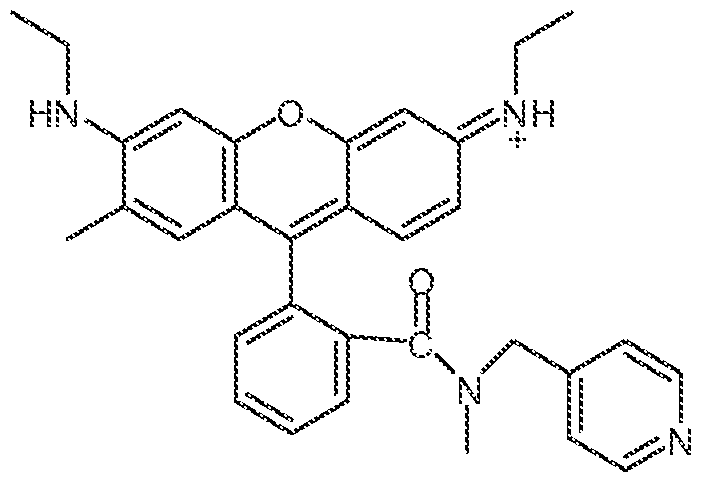
Rhod6G-MAMePy
(Rhod6G-MAMePy) or a chloride salt thereof (Rhod6G-MAMePy-Cl). .
[001 73 ] In some embodiments, the labeling molecule or an active derivative thereof is bonded to Ru to Ru through other coordinating groups: - Efe, pyridyl, or a phosphine group.
[ 00174] in some embodiments of Photolabilc Compounds, 1 comprises a labeling molecule or an active derivative thereof, which can serve as a light antenna and can transfer energy to the portion of the compound that effects photorelease of moiety L1, This way the light gathering becomes dissociated from the chemical release step, enabling orthogonal chemical strategies for both processes. Thus, in some
embodiments, a Photolabile Compound has a dual fimetionarization, one being a light antenna and second being a photorelease entity.
[ 001 75 ] In some embodiments, L 1 is an organic molecule having a 5-membered monocyclic aromatic ring, one of the ring's members being a nitrogen atom that forms a. bond with Ru. In some embodiments, L: is an organic molecule having a 6- membered monocyclic aromatic ring, one of the ring's members being a nitrogen atom that forms a bond with Ru. In some embodiments, L 1 is an organic molecule having an 8- 10-membered bicyclic ring, one of the bicyclic rings being aromatic and having a nitrogen atom member that forms a bond with Ru. In some embodiments, L1 is an organic molecule having an -NH? group whose nitrogen atom forms a bond with Ru. In some embodiments, L1 is an organic molecule having a -COOH group, one of whose oxygen atoms forms a bond with Ru. In some embodiments, L1 is an organic molecule having a -PR; group whose phosphorus atom forms a bond with Ru, wherein R is independently -H, -Cj-Cis alkyl, or aryl. In some embodiments, L1 is an organic molecule having an -SR group whose sulfur atom forms a bond with Ru, wherein R is independently -Ή, -Ci-Q g alkyl, or aryl. In some embodiments, L1 is an organic molecule having a -CN group whose nitrogen atom forms a bond with Ru.
[00176] In some embodiments, L1 is a 5-membered monocyclic aromatic ring, one of the ring's members being a nitrogen atom that forms a bond with Ru. In some embodiments, 1/ is a 6-membered monocyclic aromatic ring, one of the ring's members being a nitrogen atom that forms a bond with Ru. In some embodiments, V is an 8- 10-membered bicyclic ring, one of the bicyclic rings being aromatic and having a nitrogen atom member that iorms a bond with Ru.
[ 001 77 ] In some embodiments, L2 is (R9)3P, (R90)3P, or iJ and m is 2; or L2 is - CN and m is 1 ; or L~ is a labeling molecule or an active derivative thereof connected to M through the phosphorous atom of ( ¾P or (R90)2P and m is 2; or L~ is a labeling molecule or an active derivative thereof connected to M through the nitrogen atom of: IR9, ]\(R9)2, pyridyl, C(R )==NH, C(R )=NR cyclic aliphatic amine group or nitrile and m is 2; wherein each R9 is independently -Ci~C; x alkyl, -Cj-Cg cycloalkyl, or phenyl; R f -Rs are independently -H, -Ci-Cis alkyl, - H2, -COOH, -(Ci-C1 S alkyl)-0-
(Ci-Cis alky]), or -OC(0)(Ci-C]g alkyi); and X is CT, F\ Br ", I . PF6 CF3SO3 ", (G- C18 alkyl)-C02 ", or (Q-Qs alkyl)-S03 ".
[00178] In some embodiments, when L is P(phenyl)3 or a. labeling molecule or an active derivative thereof connected to Ru through the phosphorous atom of P(phenyl)2, each phenyl is independently substituted with -C;-C;s alkyi, -(C]-Cis alkylVOH, aryl, -(Q-Qs aIkyl)-oxy, -(C;-C!S alkylVamino, -(C]-CiS alkyl)--thio,■· C02Y, ·( ; 0)Y. -C(=0)NY2, -NH2, -NO¾ -OH, or Si I: and R to R" are
independently ~-H, -C C;8 alkyi; -NH2,-(C]-Cis alkyi)-0»(C]-€iS alkyi), -OC(0)(Cr- Cjg alkyi), -(Cj-C!8 alkyl)-OH, aryl, -(Cr-Ci8 alkyl)-oxy, -(Cj-Cis alkyD-amino, -(Cj- Cis alkyli-thio, -C02Y, ·( ( 0)\. -C(=0)NY2, -NO¾ or -SH, orR1 and R2 and/or R3 and R'1 can combine to form a carbocyclic ring substituted by one or more oxo groups;
[00179] In some embodiments, when L" is not P(phenyl)3, R! to R¾ are independently -H, -(Ci-Cj8 alkyl)-OH, aryl, ~(Cj-C;g alkyl)-oxy, -(Ci-Cjg alkyi)- amino, -(Cj-Ci8 alkyl)-thio, -C02Y, -C(=0)Y, -C(=0)NY2i -N02i -OH, or-SH, or R1 and R"' and/or R and R4 can combine to form a. carbocyclic ring substituted by one or more oxo groups, wherein at least one of R1 to R4 is not H;
[0Θ18Θ] In some embodiments, X is CI", F, Br ", I", PF6 ", CF3SO3", (d-Cig alky1)-C02 ", or (C;-C|S alky])-S03 ".
[00181] In some embodiments, Y is selected from the group consisting of -H,■■ Ci-C]g alkyi, aryl, ~(C]-Cis alkyl)~aryl, -C^-Cs cycloalkyl, heteroaryl, and heterocyclyl.
[ 0182] In one aspect, a Photolabile Compound can be used in combinatorial chemistry strategies. For example, one could generate a systematic series of derivatives in the photorelease part of the molecule and perform large-scale screening with them. Alternatively or in addition, one could fix the photorelease part of the molecule while derivatizing the light antenna moiety.
[ 183] In another aspect, the magnetic and/or radio-opaque properties of a Photolabile Compound are used as a means of indentifying it or manipulating it in living cells. In one such embodiment, Photolabile Compounds are used as MRI (Magnetic Resonance Imaging) contrast agents.
[001 84J When 1/ comprises a labeling molecule such as a fluorophore or a derivative thereof, L2 can servean antenna, to extend the irradiation spectrum to lower energies with very high absorption and efficiency. In specific embodiments, the fluorescent dye is linked through a derivatization using a non-releasable Jigand, i.e., a phosphine ( :P(R)2-fluorophore). In these embodiments, the light is collected by the fluorescent moiety acting as an antenna, and transferred to the Ru center, populating the MLCT or d-d excited states. Once the excited state is reached, the other ligand (i.e., L', which can be a biomolecule or drag) is released.
[001 85] The fact that in this case the active wavelength is not determined by the Ru center but by the high absorption of the fluorescent dye (- 100,000 M";cm":) allows the tuning of different complexes having different phoiouncageable drugs at different wavelengths, from 400 to 600 nm, providing orthogonality.
[ 18 ] Use of a suitable organic dye coordinated to the rathenium next to the coordinated fluorescent dye (i.e., a. labeling molecule) pemiits the selective quenching of the fluorescence due to its proximity. In this case, the absorption of light via the Ru- bpy MLCT band (without antenna, effect, the fluorescent being quenched by the nearby nonfluorescent dye), can photorelease either the fluorescent dye, increasing dramatically the fluorescence and "uncaging" the fluorophore, or the nonfluorescent quencher, writh somewhat similar results (under some conditions, however, the presence of the metallic center can quench the fluorophore).
[ 00 87] Further in accordance with the invention, the compounds of Formulas V-Vifl, wherein R1 and R2 and/or RJ and R" combine to form a carbocyclic ring substituted by one or more oxo groups, can attach to surfaces and are useful for the delivery of compounds to surfaces. For example, such compounds can bind to nanoparticies or nanopowders and be used to deliver biologically active organic molecules or labeling molecules. Nanoscale delivery systems have substantial applications in the controlled and targeted transport of drugs. Drags can be carried selectively to targeted cells by means of nanoparticies with specific surface fictionalization. anoparticies can penetrate ceil membranes and overcome physiological barriers in the organism, and nanoparticies can also improve the solubility and bio-availability of drugs.
[001 88J In another embodiment, the invention provides a method for enhancing the solubility of an organic molecule, comprising complexing an organic molecule to a photolahile caging group to form a Photolabile Compound, such that exposing the compound to light under sufficient conditions releases the organic molecule from the compound, in an embodiment, the organic molecule has:
(i) a 5-membered monocyclic aromatic ring, one of the ring's members being a nitrogen atom that forms a bond with Ru;
(ii) a 6-membered monocyclic aromatic ring, one of the ring's members being a nitrogen atom that forms a bond with Ru;
(iii) an 8-10-membered bicyclic ring, one of the bicyclic rings being aromatic and having a nitrogen atom member that forms a bond with Ru;
(iv) an -NH2 group whose nitrogen atom forms a bond with Ru;
(v) a --COOH group, one of whose oxygen atoms forms a bond with Ru;
(vi) a -PR? group whose phosphorus atom forms a bond with Ru, wherein R is independently -Ή, -Ci-Os alkyi, or aryi;
(vii) an -SR. group whose sulfur atom forms a bond with Ru, wherein R is independently -H, -Ci-Cis alkyi, or and; or
(viii) a -CN group whose nitrogen atom forms a bond with Ru.
[0018 ] In another embodiment, the organic molecule has:
(i) a 5-membered monocyclic aromatic ring, one of the ring's members being a nitrogen atom that forms a bond with Ru;
(ii) a 6-membered monocyclic aromatic ring, one of the ring's members being a nitrogen atom that forms a bond with Ru;
(iii) an 8-10-membered bicyclic ring, one of the bicyclic rings being aromatic and having a nitrogen atom member that forms a bond with Ru;
(iv) an -NJ¾ group whose nitrogen atom forms a bond with Ru;
(v) a -COOH group, one of whose oxygen atoms forms a bond with Ru;
(vi) a -PR2 group whose phosphorus atom fonrss a bond with Ru, wherein R is independently -H, -Ci-Qs alkyi, or aryi; or
(vii) an -SR. group whose sulfur atom forms a bond with Ru, wherein R is independently -H, -Ci-Qs alkyi, or aryl.
[ 001 Θ ] In an embodiment, the present invention encompasses a composition comprising an effective amount of a Photolabiie Compound and a physiologically acceptable earner, vehicle, diluent, or excipient. Suitable carriers, vehicles, diluents, or excipients are known to those skilled in the art and include, without limitation, physiologically sterile saline and others as described herein,
[001 1 ] In another embodiment, the present invention provides a vessel containing a Photolabiie Compound. The vessel can further contain a biological sample, wherein the sample is, for example, hair, an organ specimen; a tissue or cell, for example, a neuronal tissue or cell; a tumor or cancer or neoplastic tissue or cell; or a. tissue or ceil removed from a patient or subject of interest. Tissue specimens sliced from microtomes, for example, are examples of suitable biological samples.
[ 0 1 2 ] Any type of vessel that is capable of transmitting the wavelengths of light used for releasing the organic molecules or labeling molecules comprising the Photolabiie Compounds, and that is inert to solvent in which a Photolabiie Compound is suspended, is suitable for use. For example, the vessel can be made of glass, plastic, acrylic, quartz, a noble metal, etc. in addition, if the vessel is composed of, or encased in, metal, e.g., aluminum, titanium, or stainless steel, exposure to light is performed through the top of the vessel, or through a "window" or other light-penetrable opening in the vessel. For sol id-l ike materials, acrylic plastic or acrylamide-bisacrylamide gel, etc., for example, can be used as media in which the Photolabiie Compounds are contained. For example, an acrylic plastic coating formulated using a CHCU solution of acrylic and a Ru(bpy) complex changed its spectrum following irradiation, thus allowing photorelease in a. solid state. For such solid state aspects of the invention, the temperature may be kept at 4K.
[00 3 ] Solvents suitable in which a Photolabiie Compounds can be exposed to light include aqueous solvents; water; acetonitriie; alcohol, e.g., methanol, ethanol; acetone; chlorinated solvents such as CH2CI2 and CFICI3; or dimethyisulfoxide.
[01) 1 4 J Suitable temperatures at which a Photolabile Compound is exposed to light range, in general from about 0°C to about 100-150°C.
[001 5] In another embodiment, this invention encompasses a method for releasing an organic molecule or a labeling molecule from a Photolabile Compound. The method comprises exposing a Photolabile Compound to light under conditions sufficient to release the organic molecule or labeling molecule from the compound. In the method, the light comprises a wavelength of about 300 to about 500 nm, or about 300 to about 360 nm, or about 450 to about 500 nm. Further, the exposing can occur at a. temperature from about 0°C to about 150°C. In an embodiment, the methods of the inven tion comprise a Photolabile Compound, e.g., a compound of Formula I- VIII, light of a wavelength of about 300 nm to about 500 nm; L1 being i , and a temperature of about 0°C to about 150°C. In another embodiment, the methods comprise a
Photolabile Compound, light of a wavelength of about 300 nm to about 360 nm; LJ being L , and a temperature of about 0°C to about 150°C. In another embodiment, the methods comprise a Photolabile Compound, light of a wavelength of about 450 nm to about 500 nm; L1 being ΙΛ and a temperature of about 0°C to about 150°C. in another embodiment, the methods comprise a Photolabile Compound, visible or infrared light; L1 being If, and a temperature of about 0°C to about 150°C.
[ 001 J In an embodiment, the inve tion encompasses a method for assaying an organic molecule, comprising exposing a Photolabile Compound and a biological sample to light under conditions sufficient to release the organic molecule from the Photolabile Compound, and (b) determining an effect of the organic molecule on the biological sample. The sample can be a biological sample, such as a sample excised, removed, or otherwise taken from a subject's body. The subject's biological sample can be, for example, a hair sample, an organ or tissue sample, e.g., from a biopsy or an autopsy, or a cell sample. In addition, the biological sample can be a body fluid sample. Body fluid samples include, without limitation, blood, serum, plasma, lymph, saliva, sputum, tears, semen, or urine. Biological samples can further include, without limitation, brain tissue, brain cells, muscle tissue, muscle cells, muscle fibers, fibroblasts, tissue slices, or fine tissue specimens, from any organ of the body , sarcoplasmic reticulum, skin tissue, membrane preparations or fragments, etc.
[001 7 J The light for exposing the compounds according to the methods of this invention can be sunlight, photo-optic light, or laser light. Advantageously, in the methods of this invention, the light for exposing the compound is other than "UV radiation. Thus, for example, the light can be visible light or infrared light, including one-photo and two-photon light. The light can be emitted from a. variety of sources, including without limitation, a laser light source, a tungsten light source, a photooptic light source, etc. Another advantage of visible light to expose or irradiate the compounds of the invention relates to the convenience and ability to use a visible light microscope, for example, to view a sample into which a. compound is introduced and to microscopically visualize or monitor a photoreieased ligand from the compound after exposure to visible light. Because many microscopes do not transmit UV light, it is advantageous to be able to use a non-quartz microscope in accordance with this invention. Yet another advantage to the use of visible light is that it is not detrimental to living ceils and tissues, making it beneficial for in vivo patient use. In addition, for patient use, the light can be specifically directed to an area where a Photolabile Compound is introduced or admini tered by the use of laser technology, fibers, probes, tubes, and the like. Such probes, fibers, or tubes can be directly inserted, for example, into a. body cavity or opening, or under or through the skin, to expose the Photolabile Compound to light.
[ 001 8 J Tn another of its embodiments, the present invention includes a method of making an organic molecule bioavailable to a subject. The organic molecule can be made bioavailable to a localized body region or area of the subject, or systeraically to the whole body. Local bioavailability of the Photolabile Compounds is achieved, for example, via deliver}' devices and methods that allow the compounds to be directly administered, for example, inserted into a body cavity, or opening, or through or into the skin. The method of this embodiment involves administering a Photolabile Compound to the subject, and exposing the compound to light under conditions sufficient to release the organic molecule from the compound, thereby making the organic molecule bioavailable to the subject, and/or to a body site or region of the subject. The exposure to light can comprise the use of probes, fibers, tubes, and the like, which allow the light to be speci fically directed to the area of interest on or wi thin the body. Alternatively, the Photolabile Compounds can be administered to the patient
kept in the dark; for photorelease of the organic molecule, the patien t can he moved to the light where exposure to light and photorelease occur, in an embodiment according to this method, the organic molecule has:
(a) a 5-membered monocyclic aromatic ring, one of the ring's members being a nitrogen atom that forms a bond with Ru;
(b) a 6-membered monocyclic aromatic ring, one of the ring's members being a nitrogen atom that forms a bond with Ru;
(c) an 8- 10-membered bicyclic ring, one of the bicyclic rings being aromatic and having a nitrogen atom member that forms a bond with Ru;
(d) an -NH2 group whose nitrogen atom forms a bond with Ru;
(e) a -COOH group, one of whose oxygen atoms forms a bond with Ru;
(f) a -PR2 group whose phosphorus atom fonrss a bond with Ru, wherein R is independently -H, -C1-C1 8 alkyl, or aryl;
(g) an -SR group whose sulfur atom forms a bond with Ru, wherein R is independently -H, -C1-C1 8 alkyl, or aryl; or
(h) a. -CN group whose nitrogen atom forms a bond with Ru.
[ 1) β 1 ] in another embodiment according to this method, the organic molecule has:
(a.) a 5-membered monocyclic aromatic ring, one of the ring's members being a nitrogen atom that forms a bond with Ru;
(b) a 6-membered monocyclic aromatic ring, one of the ring's members being a nitrogen atom that forms a bond with Ru;
(c) an 8- 10-niembered bicyclic ring, one of the bicyclic rings being aromatic and having a nitrogen atom member that forms a bond with Ru;
(d) an -NH2 group whose nitrogen atom tonus a bond with Ru;
(e) a -COOH group, one of whose oxygen atoms forms a bond with Ru;
(f) a -PR? group whose phosphorus atom forms a bond with Ru, wherein R is independently -H, -Ci-Cjs alkyl, or and; or
(g) an -SR group whose sulfur atom forms a bond with Ru, wherein R is independently -H, -Ci-Cjs alkyl, or and.
[ 002001 In another embodiment, the organic molecule has:
(a) a tetrazolyi group, one of its nitrogen atoms forming a bond with Ru;
(b) nicotine or caffeine, whose pyridyl nitrogen atom forms a bond with Ru;
(c) an 8-10-membered bicyclic ring, one of the bicyclic rings being aromatic and having a nitrogen atom member th t forms a bond with Ru;
(d) an -NH2 group whose nitrogen atom forms a bond with Ru;
(e) a -COOH group, one of whose oxygen atoms forms a bond with Ru;
(f) a -PR2 group whose phosphorus atom forms a bond with Ru, wherein R. is independently -H, -C1-C1 8 alkyl, or aryl;
(g) an -SR group whose sulfur atom forms a bond with Ru, wherein R. is independently -H, -C1-C1 8 alkyl, or aryl; or
(h) a. -CN group whose nitrogen atom forms a bond with Ru.
[00201 ] In another embodiment, the organic molecule has:
(a) a tetrazolyi group, one of its nitrogen atoms forming a bond with Ru;
(b) nicotine or caffeine, whose pyridyl nitrogen atom forms a bond with Ru;
(c) an 8- 10-membered bicyclic ring, one of the bicyclic rings being aromatic and having a nitrogen atom member that forms a bond with Ru;
(d) an -NH2 group whose nitrogen atom forms a bond with Ru;
(e) a -COOH group, one of whose oxygen atoms forms a bond with Ru;
(f) a -PR2 group whose phosphorus atom forms a bond with Ru, wherein R is independently -H, -Ci-Cis alkyl, or and; or
(g) an -SR. group whose sulfur atom forms a bond with Ru, wherein R is independently -H, -Ci-Cjs alkyl, or and.
[Θ Θ2 Θ2] In a related embodiment, the Photolabile Compounds are useful for releasing an organic molecule, such as a drag, pharmaceutical, small biologically active mol cule, and the like as described above. Release of the organic molecule from the Photolabile Compound allows the organic molecule to become bioavailable to a subject, or patient, afflicted with a disease, disorder, pathology, or condition. The Photolabile Compounds and organic molecules are useful in veterinary and human medicine. Diseases, disorders, pathologies, or conditions for which making an organic molecule bioavailable would serve to treat, ameliorate, reduce, eliminate, abate, or prevent the disease, disorder, pathology, or condition are further described below and
include, as noniimiting examples, peripheral and central nervous system disorders, neurological disorders and disorders related thereto, neurodegenerative disorders and disorders related thereto, epilepsy, seizures, migraines, headaches, stroke, anxiety, depression, restricted brain function, addictive disorders, neuroses, psychoses, pruritic conditions, Parkinson's disease, Huntington's chorea, cognitive disorders, memory lapses, Alzheimer's disease, dementia, dyskinesia, muscle spasms, retinopathy, vomiting, cancers, neoplasms, tumors, vascular diseases, and cardiovascular diseases.
[00203 ] As further, yet non- limiting examples, the organic molecule is a neurochemical that blocks potassium channels for use, for example, in treating neurodegenerative, or neurological diseases or disorders. In a particular embodiment, the organic molecule is 4-AP, which is a calcium channel blocker. In another embodiment, the organic molecule is TzGly, which is an NMDA-receptor agonist that is more potent than NMD A. In one embodiment, for making an organic molecule of the invention bioavailable to a subject in need thereof, the exposure of the Photolabile Compound to light can occur at the site of the disease, disorder, pathology, or condition, such as a site of a tumor, neoplasm, or cancer lesion or growth, thereb releasing the organic molecule locally and more precisely at the needed location. In another embodiment, for making an organic molecule of the invention bioavailable to a subject in need thereof, the exposure of the Photolabile Compound to light can occur at the sight of a blood dyscrasia.
[00204] in other related embodiments, the present invention provides methods for treatment, therapy, and prophylaxis by administering an effective amount of a. Photoiabiie Compound, or a physiologically acceptable composition comprising a Photolabile Compound to a subject, so as to make an orgamc molecule bioavailable to the subject. The Photoiabiie Compound can be substantially purified (e.g., substantially free from substances that limit its effect or produce undesired side- effects). Advantageously, for methods in which a Photolabile Compound is administered to a. subject, the light, e.g., infrared, laser, or visible light, for photoreleasing the organic molecule to make it bioavailable to the subject can be directed to an internal site or region of interest by using photooptic devices, probes and fibers, such as are known in the art and described supra. Those having skill in the art
can employ, manipulate, and internally direct the devices for exposing a Photolabile Compound to light after the Photolabile Compound is administered to a subject.
[00205] In the methods of the present invention involving subj ects, and/or the treatment, therapy, or prophylaxis of a disease, disorder, pathology, or condition, the subject is preferably an animal, including but not limited to, mammals such as human and non-human primates, cows, pigs, horses, goats, sheep, rabbits, chickens, cats, dogs, guinea pigs, rats, mice, etc. The methods of the invention especially encompass human treatments.
[0 2 6] Various delivery systems are known and can be used to administer a Photolabile Compound, e.g., in sterile solution, encapsulation in liposomes, microparricles, microcapsules, or receptor-mediated endocytosis (See, e.g. , Wu and Wu, 1987, J. Biol. Chem., 262:4429-4432, herein incorporated by reference in its entirety). Methods of introduction include, but are not limited to, intradermal, intramuscular, intraperitoneal, intravenous, subcutaneous, intranasal, epidural, topical, transdermal, parenteral, intrathecal, vaginal, rectal, colorectal, oral, intracranial, retroorbital, intrasternal routes, or a combination thereof.
[00207] The Photolabile Compounds or compositions may be administered by any convenient route or mode, for example, by continuous infusion, non-continuous infusion, or bolus injection, by absorption through epithelial or mucocutaneous linings (e.g., oral mucosa, epidermis, rectal and intestinal mucosa, etc.) and may be administered together with other biologically active and/or therapeutic agents.
Administration can be systemic or local, in addition, it may be desirable to introduce the Photolabile Compounds or compositions into the central nervous system by any suitable route, including intraventricular and intrathecal injection; intraventricular injection may be facilitated by an intraventricular catheter, for example, attached to a reservoir, such as an Ommaya reservoir. Pulmonary administration can also be employed, e.g., by use of an inhaler or nebulizer, and formulation with an aerosolizing agent.
[00208] In a particular embodiment, it may be desirable to administer the Photolabile Compounds or compositions locally to the area in need of treatment. This
may be achieved, for example, by local infusion during surgery, topical application, e.g., in conjunction with a wound dressing after surgery, by injection, by means of a catheter, by means of a suppository, or by means of an implant, where the implant is a porous, non-porous, or gelatinous material, including membranes, such as sialastic membranes, or fibers.
[0020 ] In another embodiment involving topical administration, a transdermal patch can be used. In accordance with this embodiment, the Photolabile Compound remains unexposed to light until the patch is manipulated by a patient or medical provider so that all or a portion of the patch containing a Photolabile Compound is exposed to light. Accordingly, the patch can be opened and the bioactive molecule released, or "acti vated" from the compound after exposure to light, for example, by the patient's moving from a dark room to a lighted room, or from a dark area to a light area; by the patient's directly exposing the patch, or a portion thereof, to a suitable light source, or by the patient's exposing all or a portion of the patch to daylight. A variety of types of transdermal patches are known and used by the skilled practitioner in the art. Alternatively for topical administration, a Photolabile Compound can be formulated into a light-sensitive composition, which is contained in a dark, light- protected container, and applied topically to the area of interest, e.g., applied to or rubbed onto the skin of a subject, in the dark. Following topical application in the dark, the area of interest is exposed to light, or to an appropriate light source, or the subject moves into the light, thereby causing the organic molecule of the Photolabile Compound to be released.
[ 00210] In another embodiment, the Photolabile Compounds or compositions can be delivered in a vesicle, in particular a. liposome (See, e.g., Langer, 1990, Science, 2.49: 152.7- 1533; Treat et al. In: Liposomes in the Therapy of Infectious Disease and Cancer, Lopez-Berestein and Fidler (eds.), Liss, New York, pp. 353-365 (1989);
Lopez-Berestein, ibid., pp. 317-327; see generally ibid.) In yet another embodiment, the Photolabile Compounds or compositions can be delivered in a controiled-reiease system. For example, a pump may be used (see Langer, supra; Sefton, 1987, CRC Crit. Ref: Biomed. Eng. 14:201 ; Buchwald et al., 1980, Surgery, 88:507; Saudek et al, 1989, NEJM, Med. 32.1 :574 (1989)), or polymeric materials can be used (See, e.g., Medical Applications of Controlled Release, Langer and Wise (eds.), CRC Press, Boca
Raton, Fla. (1974); Controlled Drug Bioavailability, Drug Product Design and Performance, Smolen and Ball (eds.), Wiley, New York (1984); Ranger and Peppas, 1983, ,/ Macromol. Sci. Rev. Macromol Chem., 23:61 ; Levy et al, 1985, Science, 228: 190; During et al, 1989, Neurol, 25:351 ; and Howard et al, 1989, /. Neurosurg., 71 : 105). Moreover, a controlled-release system can be placed proximal to the therapeutic target, e.g., the brain, thus requiring only a fraction of the systemic dose (see, e.g., Goodson, 1984, In: Medical Applications of Controlled Release, Vol. 2, pp. 1 15-138). As further guidance, other controlled release systems are found in Langer, 1990, Science, 249: 1527-1533. Each of the references in this paragraph is herein incorporated by reference in its entirety.
[00211 J The Photolabile Compounds are also provided in effective amounts in pharmaceutical compositions comprising a pharmaceutically acceptable carrier, diluent, excipient, or vehicle, for example, for use as therapeutics. In one embodiment, the term "pharmaceutically acceptable" refers to approval by a regulatory agency of the Federal or a state government, or listed in the U.S. Pharmacopeia or other generally recognized pharmacopeia for use in animals, and more particularly, in humans. The terms vehicle, carrier, or excipient refer to a diluent or adjuvant in or with which the therapeutic is administered. Such pharmaceutical carriers, vehicles, or excipients can be sterile liquids, such as water and oils, including those of petroleum, animal, vegetable or synthetic origin, e.g., peanut oil, soybean oil, mineral oil, sesame oil and the like. Water is a preferred carrier when a pharmaceutical composition is administered intravenously and is water soluble. Saline solutions and aqueous dextrose and glycerol solutions can also be employed as liquid carriers, particularly for injectable solutions. Suitable pharmaceutical excipients include starch, glucose, lactose, sucrose, gelatin, malt, rice, flour, chalk, silica gel, sodium stearate, glycerol monostearate, talc, sodium chloride, dried skim milk, glycerol, propylene, glycol, water, ethanol and the like. If needed or desired, the composition of the invention can also contain minor amounts of wetting or emulsifying agents, or pH buffering agents.
[ θ Θ 212 ] The Photolabile Compounds and compositions of the present invention can be formulated as solutions, suspensions, emulsions, tablets, pills, capsules, powders, sustained-release formulations and the like. The compositions can be formulated as a suppository, with traditional binders and carriers such as triglycerides.
Oral formulations can include standard carriers, such as pharmaceutical grades of mannitol, lactose, starch, magnesium stearate, sodium saccharine, cellulose, magnesium carbonate, etc. Examples of suitable pharmaceutical carriers and the like are described in the current edition of "Remington's Pharmaceutical Sciences" by E. W. Martin, herein incorporated by reference in its entirety. Such compositions routinely contain a therapeutically effective amount of the Photolabile Compound, preferably in purified form, together with a suitable amount of carrier so as to provide the form for proper administration to a subject. The formulation should suit the mode of admini tration,
[ θ Θ 213 ] In another embodiment, a Photolabile Compound of the invention is formulated in accordance with routine procedures as a pharmaceutical composition adapted for intravenous administration to human beings. Typically, compositions for intravenous administration are solutions in sterile isotonic aqueous buffer. Where necessary, the composition may also include a solubilizing agent and a local anesthetic such as lidocaine to ease pain at the site of the injection. Generally, the ingredients are supplied either separately or mixed together in unit dosage form, for example, as a dr lyophihzed powder or water free concentrate in a hermetically sealed container, such as an ampoule or sachette indicating the quantity of acti ve agent. Where the composition is to be administered by infusion, it can be dispensed with an infusion bottle containing sterile pharmaceutical grade water or saline. Where the composition is administered by injection, an ampoule of sterile water for injection or saline can be pro vided so that the ingredients may be mixed prior to administration. Sterility for of a composition for therapeutic administration is readily accomplished by filtration through sterile filtration membranes (e.g., 0.2 micron membranes). Therapeutics generally are placed into a container having a sterile access port, for example, an intravenous solution bag or vial having a stopper pierceabie by a hypodermic injection needle. Therapeutics are typically stored in unit or multi-dose containers, for example, sealed ampoules or vials, as an aqueous solution or as a lyophihzed formulation for reconstitution. Where necessary, the ampoule or vial is essentially impenetrable by light. As an example of a lyophihzed therapeutic formulation, 10-ml vials are filled with 5 ml of sterile-filtered 1% (w/v) aqueous therapeutic solution, and the resulting
mixture is lyophi!ized. The infusion solution is prepared by reconstituting the !yophiiized therapeutic using bacteriostatic Water-for-Injection.
[ θ Θ 214 ] The amount of a Photoiabiie Compound which will be effective in the treatment, amelioration, reduction, elimination, inhibition, or prevention of a particular disease, condition, pathology, or disorder associated with the use and bioactivity of an organic molecule can be determined by standard clinical techniques. An "effective amount" or a "pharmaceutically effective amount" of a Photoiabiie Compound of this invention refers to an amount effective for treating, ameliorating, reducing, abating, eliminating, preventing, a disease, condition, pathology, or disorder for which the compound is being used. In particular embodiments, an effective amount is an amount effective for making an organic molecule of the invention bioavaiiabie to a subject. If another therapeutic agent is used in conjunction with the Photoiabiie Compounds, the effective amount of the therapeutic agent refers to an amount effective for providing the therapeutic effect of the therapeutic agent. The precise dose to be employ ed in the formulation will also depend on the route of administration, as well as an indi vidual patient's circumstances, such as age, health and vital statistics of the patient, and the severity of the disease, condition, or disorder. Dosing should be decided according to the judgment of the medical practitioner based on an evaluation of the patient and considerations of a patient's physiologic situation and medical history. In addition, in vitro assays may optionall be used to assist in determining optimal dosage ranges. Effective doses can be extrapolated from dose-response curves derived from in vitro or in vivo animal model test systems.
[ 002 I S] As general guidance, the total effective amount of a Photoiabiie Compound administered parenteraliy per dose will be in the range of about 1
.ug/kg/day to 10 mg/kg/day of a subject's body weight, although, as noted above, this will be subject to discretion based on the subject's condition and the above-mentioned variables. A therapeutic dose can also be at least 0.01 mg/kg day, or between about 0.01 and 1 mg/kg/day, with particular regard for human administration. If given continuously, a. therapeutic is typically administered at a dose rate of about 1
.ug/kg/hour to about 50 g/kg/hour, either by 1 to 4 injections per day or by continuous subcutaneous infusions, e.g., using a mini-pump. An intravenous bag solution may
also be employed. The length of treatment needed to observe changes and the interval following treatment for responses to occur will likely vary depending on the desired effect. In some embodiments, suitable effective dosage amounts range from about 10 ag to about 2500 mg about every 4 hours, although the amounts are typically about 100 mg or less. Tn one embodiment, the effective dosage of a Photoiabile Compound ranges from about 0.01 mg to about 100 mg about every 4 hours. In another embodiment, the effective dosage of a compound of the invention ranges from about 0.020 mg to about 50 mg every 4 hours, and in another embodiment, about 0.025 mg to about 20 mg about every 4 hours. The effective dosage amounts refer to total amounts administered. Thus, if more than one of the Photoiabile Compounds is administered, the effective dosage amounts correspond to the total amount administered.
[0021 6] In another embodiment, if a Photoiabile Compound is contacted with a biological sample in vitro, an effective amount will typically range from about 0.01 Lig/L to about 5 mg/L; in another embodiment from about 0.01 ,ug/L to about 2.5 mg/L: in another embodiment, from about 0.01 ^ig/L to about 0.5 mg/L; and in yet another embodiment, from about 0.01 .ug/L to about 0.25 mg/L of a solution or suspension of a pharmaceutically acceptable carrier, diluent, or excipient. In an embodiment, the volume of solution or suspension is from about 1 LIL to about 1 mL; in another embodiment, the volume of solution or suspension is about 200 μΐ...
[00217] Examples of neoplastic or hyperproliferative diseases, disorders, pathologies, or conditions that can be treated, ameliorated, reduced, abated, eliminated, inhibited, prevented, and/or diagnosed using the Photoiabile Compounds and photoreleased organic molecules include, but are not limited to, neoplasms (cancers or tumors) located in the colon, abdomen, bone, breast, digestive system, esophagus, liver, pancreas, peritoneum, endocrine glands (adrenal, parathyroid, pituitary, testicles, ovaries, cervix, thymus, thyroid), eye, head and neck, nervous (central and peripheral), lymphatic system, pelvis, skin, soft tissue, spleen, thoracic areas, bladder, and urogenital system. Cancers that may be treatable using the Photoiabile Compounds include follicular lymphomas, carcinomas with p53 mutations, and hormone-dependent tumors, including, but not limited to colon cancer, cardiac tumors, pancreatic cancer, melanoma, retinoblastoma, glioblastoma, lung cancer, intestinal cancer, testicular
cancer, stomach cancer, neuroblastoma, myxoma, myoma, lymphoma, endothelioma, osteoblastoma, osteoclastoma, osteosarcoma, chondrosarcoma, adenoma, breast cancer, prostate cancer, Kaposi's sarcoma and ovarian cancer, or metastases thereof.
Autoimmune diseases, disorders, or conditions may be treatable with the Photolabile Compounds and include multiple sclerosis, Sjogren's syndrome, Hashimoto's thyroiditis, biliary cirrhosis, Bechet's disease, Crohn's disease, polymyositis, systemic lupus erythematosus and immune-related glomerulonephritis, rheumatoid arthritis, ischemic injur}' (e.g., caused by myocardial infarction, stroke and reperfusion injury), liver injury (e.g., hepatitis related liver injury, ischemia/reperfusion injury, cholestasis (bile duct injury) and liver cancer); toxin-induced liver disease (e.g., caused by alcohol), septic shock, cachexia and anorexia. Viral infections (such as herpes viruses, pox viruses and adenoviruses), inflammation, graft versus host (GVH) disease, acute graft rejection, and chronic graft rejection may also be treatable with the Photolabile Compounds.
[00218] Additional diseases or conditions associated with abnormal and increased cell survival that may be treated, ameliorated, reduced, abated, eliminated, inhibited, prevented, and/or diagnosed using the Photolabile Compounds include, but are not limited to, progression and/or metastases of malignancies and related disorders such as leukemia (including acute leukemias (e.g., acute lymphocytic leukemia, acute myelocytic leukemia, including myeloblastic, promyelocytic, myelomonocytic, monocytic, and erythroleukemia) and chronic leukemias (e.g., chronic myelocytic (granulocytic) leukemia and chronic lymphocytic leukemia)), polycythemia vera, lymphomas (e.g., Hodgkin's disease and non-Hodgkin's disease), multiple myeloma, Waldenstrom's macroglobuiinemia, heavy chain disease, and solid tumors including, but not limited to, sarcomas and carcinomas such as fibrosarcoma, myxosarcoma, liposarcoma, chondrosarcoma, osteogenic sarcoma, chordoma, angiosarcoma, endotheliosarcoma, lymphangiosarcoma, lymphangioendotheiiosarcoma, synovioma, mesothelioma, Ewing's tumor, leiomyosarcoma, rhabdomyosarcoma, colon carcinoma, pancreatic cancer, breast cancer, ovarian cancer, prostate cancer, squamous cell carcinoma, basal cell carcinoma, adenocarcinoma, sweat gland carcinoma, sebaceous gland carcinoma, papillary carcinoma, papillary adenocarcinomas,
cystadenocarcinoma, medullary carcinoma, bronchogenic carcinoma, renal cell
carcinoma, hepatoma, bile duct carcinoma, choriocarcinoma, seminoma, embryonal carcinoma, Wilni's tumor, cervical cancer, testicular tumor, lung carcinoma, small cell lung carcinoma, bladder carcinoma, epithelial carcinoma, glioma, astrocytoma, medulloblastoma, craniopharyngioma, ependymoma, pinealoma, hemangioblastoma, acoustic neuroma, oligodendroglioma, menangioma, melanoma, neuroblastoma, and retinoblastoma,
[ 21 ] In another embodiment, the Photolabile Compounds may be needed as therapeutics to stimulate epithelial cell proliferation and basal kerafinocytes for the purpose of wound healing, and to stimulate hair follicle production and the healing of dermal wounds. The Photolabile Compounds of the invention may be clinically useful in stimulating wound healing, including surgical wounds, excisionai wounds, deep wounds in volving damage of the dermis and epidermis, eye tissue wounds, dental tissue wounds, oral cavity wounds, diabetic ulcers, dermal ulcers, cubitus ulcers, arterial ulcers, venous stasis ulcers, burns resulting from heat exposure or chemicals, and other abnormal wound healing conditions such as uremia, malnutrition, vitamin deficiencies and complications associated with systemic treatment using steroids, radiation therapy, anti-neoplastic drugs and anti-metabolites.
[ 00220] Other diseases, disorders, or conditions that may be treated, ameliorated, reduced, abated, eliminated, inhibited, prevented, and/or diagnosed with the Photolabile Compounds include AIDS; neurodegenerative diseases, disorders, and/or conditions (such as Alzheimer's disease, Parkinson's disease, amyotrophic lateral sclerosis (ALS), multiple sclerosis. Retinitis pigmentosa ( P), cerebellar degeneration and brain tumor or prior associated disease).
[00221 In one embodiment, diseases and conditions that are treatable using calcium channel blockers, e.g., 4AP, include without limitation, heart disease, hypertension, angina, chest pain, cardiovascular diseases, such as coronary artery disease, cardiomyopathies, valvular heart disease, renal disease, Peyronie's disease and neurological, neurophysiological, or neuromuscular diseases and conditions, e.g., amyotrophic lateral sclerosis (ALS), multiple sclerosis, and epilepsy.
[00222 J ϊη another embodiment, diseases thai are treatable using NMDA receptor agonists or antagonists, e.g., TzGly, include without limitation, neurological, neurodegenerative, or neurophysiological diseases, disorders, and conditions, such as Alzheimer's disease, Parkinson's disease, Huntington's disease, and dyskinesias, in another embodiment, neurological, neurodegenerative, and neurophysiological diseases, e.g., Parkinson's disease, Alzheimer's disease, etc., are treatable using Tz- AMPA.
[ 00223 ] In another embodiment, the present invention relates to kits comprising a Phoiolabile Compound and instructions for use. A kit may be used in a diagnostic, screening, or testing assay. A kit may also be a pharmaceutical pack, particularly for use in treating or preventing a disease, disorder, pathology, or condition. A kit for pharmaceutical use is typically sterile and contains a Phoiolabile Compound in an amount effective to treat or prevent a disease, disorder, pathology, or condition, and a pharmaceutically acceptable carrier, diluent, or excipient. The kit, or a pharmaceutical pack, can comprise one or more vessels or containers filled with an effective amount, e.g., unit dosage form, of one or more of the Phoiolabile Compounds or compositions of the invention, and a pharmaceutically acceptable carrier, diluent, or excipient. The kit, or pharmaceutical pack, can further comprise a label, in addition, the kit, or pharmaceutical pack, can also include a unit dosage form of another therapeutic agent, for example, a container containing an effective amount of the other therapeutic agent. The kit, or pharmaceutical pack, may further optionally contain a notice in the form prescribed by a governmental agency regulating the manufacture, use, or sale of pharmaceuticals or biological products, reflecting approval by the agency of manufacture, use or sale for human administration. 'T'he kit, or pharmaceutical pack, can also contain a device useful for administering the unit dosage forms. Examples of such devices include, without limitation, a syringe, a drip bag, a patch, an inhaler, and an enema bag or container.
[ 00224 J It will recognized that one or more features of any embodiments disclosed herein may be combined and'or rearranged within the scope of the invention to produce further embodiments that are also within the scope of the invention. Those skilled in the art will recognize, or be able to ascertain using no more than routine experimentation, many equivalents to the specific embodiments of the invention
described herein. Such equivalents are intended to be within the scope of the present- invention.
[00225] Although the invention has been described and illustrated in the illustrative embodiments included herein, it is understood that the present disclosure has been made only by way of example, and that numerous changes in the details of implementation of the invention can be made without departing from the spirit and scope of the invention, which is limited only by the ciaims that follow. Features of the disclosed embodiments can be combined and rearranged in various ways within the scope and spirit of the invention.
EXAMPLES
[ 00226 ] The examples described below are provided to illustrate the present invention and are not included for the purpose of limiting the invention.
EXAMPLE 1
[00227] Synthesis of [Ru(bpy)2(4AP)2]Cl2. 159 mg of Ru(bpy)2Cl2 , where bpy 2;2'-bipyridine, were suspended in 7 mL of water at 85°C under N?. After dissolution, 66 mg of 4-aminopyridine ("4AP") were added, and the resultant solution was heated for about 20 minutes at about 50-80°C or greater. A molar excess of NH4PF6, was added, and the resultant red solid was washed with water and dried. The red solid was dissolved in a minimal amount of acetone, and to the acetone solution was added tetraethylammonium chloride, precipitating [Ru(bpy)2(4AP)2] C12 (79% yield).
EXAMPLE 2
[00228] Synthesis of [Rt bpy)2(TzGly)2]Cl2. [Ru(bpy)2(TzGiy)2]Ci2 was made according to the procedure used to make [Ru(bpy)2(4AP)2]C12 set forth in Example 1 , except that (RS)-(tetrazol-5-yl)giycine ("TzGly") was used in place of 4AP.
EXAMPLE 3
[002291 Synthesis of [Ra(bpy)2(5HT)2lCl2. [RuCbpy)2(5HT)2]Cl2 is made according to the procedure used to make [Ru(bpy)2(4AP)2]Cl2 set forth in Example 1, except that serotonin ("5HT") is used in place of 4AP.
EXAMPLE 4
[00230] Synthesis of [Ru(bpy)2(4AP)(PPh3)] Cl2. Ru(bpy)2Cl2 , where bpy = 2,2'-bipyridine, was suspended in water at a concentration of 10 mg/niL at 85°C under >½. After dissolution, 1 equivalent of PPI13 was added, and the resultant solution was heated for about 60 minutes at about 50-80°C or greater. 1.1 Equivalents of 4 P were subsequently added, and heating continued for an additional 30 minutes. A molar excess ofNt^PFg, was added, and the resultant orange solid was washed with water and dried. The orange was dissolved in a. minimal amount of acetone, and to the acetone solution was added telraethylammonium chloride, precipitating
[Ru(bpy)2(4AP)(PPh3)]Cl2.
EXAMPLE S
[002311 Synthesis of [R«(bpy)2(TzGly)(PPh3)l Cl2.
[Ru(bpy)2(TzGly)(PPh.3)]Cl2 was made according to the procedure used to make
[Ru(bpy)?(4AP)(PPli3)]Cl2 set forth in Example 4, except that TzGiy was used in place of 4AP.
EXAMPLE 6
[00232] Synthesis of [Ru(bpy)2(5HT)(PPh3)lCl2. [Ru(bpy)2(5HT)(PPh3)]Cl2 is made according to the procedure used to make [Ru(bpy) ?(4AP)(PPh3)]Cl2 set forth in Example 4, except that serotonin is used in place of 4AP.
EXAMPLE 7
[00233 ] Synthesis of [Ru(bpy)2(nicotine)(PPh3)l C¾.
[Ru(bpy)2(nicotine)(PPh3)]Cl2 is made according to the procedure used to make
[Ru(bpy)2(4AP)(PPh3)]Cl2 set forth in Example 4, except that nicotine is used in place of 4AP.
EXAMPLE 8
[00234] Synthesis of [R«(bpy)2(TzGly)(py)]Ci2. [Ru(bpy)2(TzGly)(py)]Cl2, where py = pyridine, was made according to the procedure used to make
[Ru(bpy)2(4AP)(PPh3)]Cl2 set forth in Example 4, except that TzGly was used in place of 4AP and pyridine was used in place of PP1¾.
EXAMPLE 9
[002351 Synthesis of [Ru(bpy)2(4AP)(py)] C!2. [Ru(bpy)2(4AP)(py)] Cl2, where py pyridine, is made according to the procedure used to make
[Ru(bpy)2(4AP)(PPh3)]Cl2 set forth in Example 4, except that pyridine is used in place of PPh3.
EXAMPLE 10
[002361 Synthesis of [Ra(bpy)2(5HT)(py)lCl2. [Ru(bpy)2(5HT)(py)]Cl2, where py = pyridine, is made according to the procedure used to make
[Ru(bpy)2(4AP)(PPh3)]C12 set forth in Example 4, except that 5HT is used in place of 4AP and pyridine is used in place of PPh3i
EXAMPLE 11
[00237 ] Syn hesis of [RM(bpy)2(meotine)(py)] C½.
[Ru(bpy)2(nicotine)(py)]Cl2, where py = pyridine, is made according to the procedure used to make [Ru(bpy)2(4AP)(PPh.3)]Ci2 set forth in Example 4, except that nicotine is used in place of 4AP and pyridine is used in place of PPh3.
EXAMPLE 12
[002381 Synthesis of Co(DMG)2(5HT)(Cl). CoCl2 was dissolved in a 1 : 1 v/v mixture of water/ethanoi at a final concentration of about 0,2 M, Two equivalents of dimethylglyoxime ("DMG") were added, and the resultant mixture was allowed to stir under Is until dissolution. One equivalent of 5HT was added, air was bubbled into the resultant mixture for 6 hours and Co(DMG)2(5HT)(Cl) precipitated. The precipitated product was filtered and washed.
EXAMPLE 13
[0023 ] Photoreiease of 4AP from [R«(bpy)2(4AP)2] C¾. UV- vis spectra in water were obtained with an HP 8453 diode array spectrophotometer. MN Ή spectra were obtained using a Broker 500 MHz equipment. CV measurements were performed with a PAR 273 A potentiostat. Irradiation was effected by means of a pulsed Xe lamp, (pulse energy -0.5 J), with a low-pass filter at 480 ran. Irradiation using a 473 ran DPSS laser gave similar results.
[00240] [Ru(bpy)2(4AP)2]Cl2 is very soluble in water and stable in the dark, while undergoing decomposition under irradiation with visible light in its metal-to- ligand charge transfer (MLCT) band, centered at 489 nm. (In CHjCN solution, the absorption band is red-shifted to 492 nm, consistent with the lower polarity of the solvent, despite a previous characterization that reported 450 nm. However, light exposure of a€¾CI\! solution of [Ru(bpy)2(4AP)2]Cl2 produced a yellow compound with absorption maximum at 450 nm. This may correspond to the previously misinterpreted assignments for this compound (D. Chun- Ying et al, 1999, J. Coord. Chem. , 46:301-312, herein incorporated by reference in its entirety), and the photoproduct is likely to be the complex [Ru(bpy)2(4AP)CH3CN]2+). Several ruthenium poiypyridyl complexes present this behavior. (D.V. Pinnick et al, 1984, Inorg. Chem., 23: 1440- 1445, herein incorporated by reference in its entirety).
[00241 ] Although at pH 7 the spectrum of the irradiated complex is very similar to that of the original complex, a diminished shoulder at 470 nm becomes evident. To determine the nature of the photoreaction, NMR spectra were taken before and after irradiation with visible light. FIG. 1 shows the signal assigned to the meta hydrogens | ¾: ρν ί >· 4ΛΡ · Κ Τ (ml). After irradiation, this signal decreased, and two new signals appeared at lower fields: one corresponding to the free ligand (m3), and the other corresponding to the aquo-4AP complex ( m2), indicating photorelea.se of the 4AP. These two latter signals integrated for 0.30 and 0.27 of the initial signal, which corresponds to a photoreaction of 60%.
[00242] The redox potential of the couple Rum/Ruu for [Ru(bpy)2(4AP)2] Cl2 measured in water is E - 0.76 V versus Ag/AgCl, which is consistent with the higher
basicity of 4AP compared with that of pyridine. Thus, the redox and the
photochemistry of [Rufbpy)2(4AP)2]Cl2 is in total agreement with resuhs obtained corresponding to the Ru(bpy)2XY family, X and Y being monodentate ligands. (See, e.g., E.S. Dodsworth et a!., 1986, Chem. Phys. Lett, 124: 152- 158, herein incorporated by reference in its entirety). The photoactivity of these compounds has been explained in terms of a reaction pathway that involves the transition between the MLCT state to a lower-energy d-d state, which promotes ligand release. There is a direct
correspondence between the energy of the MLCT transition and the quantum yield of the photoreaction. For [Ru(bpy)2(4AP)CFl3CN]2T , the photoreaction yield is about φρ = 0.4. Since [Ru(bpy)2(4AP)2]Cl2 presents a red-shifted band, a lower photoreaction yield is expected. An estimate based on early experiments leads to an estimate of φρρ. = 0.02 at 473 nm.
EXAMPLE 14
[ 00243 ] europhysiological Activity of 4AP Photoreleased from
[Ru(bp )2(4AP)2j Cl2. A standard setup for intracellular voltage measurements was used, and the medicinal leech Hirudo medicinal is was used to demonstrate photoreleased 4AP's neurophysiological activity, Hirudo medicinalis has a central nerve cord with several ganglia, each one containing about 400 neurons arranged in a known pattern. (W.-R. Schlue et aL 1980, J. Exp. Biol., 82:23-34, herein incorporated by reference in its entirety). An entire ganglion was mounted on a dish. The transmembrane potential for a single cell (a. neuron) in the ganglion was recorded by inserting inside the neuron a glass micropipet with a micrometer-sized end, filled with saturated aqueous KC1 that acts as a luggin bridge for an Ag/AgCl electrode. Another Ag/AgCl electrode was used as a reference. The signal was taken with an AM-System 1600 amplifier, and the entire setup was covered with a Faraday cage, A 12 bit A/D acquisition card was used to digitize the data using an ad-hoc program written in QuickB sie,
[1) 0244] Low Ca2+-high Mg21" saline solution (NaCl, 102 mM KCi, 4 mM; CaCl2: 1 mM: and MgCl2: 10 mM; Tris base, pH 5.4 adjusted to 7.4) was perfused through the dish. [Ru(bpy)2(4AP)2]C]2 and the free ligand 4AP were injected in the mainstream at controlled times. A pulsed Xe lamp located under the dish was used to
irradiate the solution. UV light was removed using a band-pass filter at 500 nm. FIG. 2 shows the behavior of the membrane potential recorded at one of the Retzius (Rz) cells in the ganglion. The upper graph in FIG. 2 shows the raw data, presenting periods of rest potential and very fast spikes (action potentials), produced by the changes in membrane ion permeabilities. The lower graph shows the instantaneous spiking frequency at each time.
[0024S] After impaling the cell with an electrode, many experiments were performed on the same cell to ensure reproducibility. After 5000 seconds, the cell showed low acti vity, as can be seen at the left of the graph. At t = 5200 s, ~ 100 μΜ Ru(bpy)3Cl2 was added to the saline solution, without significant changes in activity. 300 seconds later, at 5500 s, a light flash was directed to the ganglion. The sudden increase in the frequency of the action potentials is mainly due to the temperature pulse, but after a short time the activity decreased to the basal level. After washing by perfusion, further irradiation (t = 6000 s) with a pulse showed a very similar pattern. At t - 6250 s, -100 μΜ [Ru(bpy)2(4AP)2]Cl2 was added to the saline and the activity remained unchanged. However, after a new light flash (t = 6400 s), sudden activity was recorded and it remained high after 300 s. A second light pulse at 6750 s promoted an even higher activity, which decreased only after cleaning perfusion with pure saline.
[00246] A similar frequency increase occurred when free 4AP was perfused onto the ganglion, thus demonstrating that the release of 4AP causes this maintained frequency increase. Calibration of the cell activity using solutions of 4AP showed that in each irradiation, 10- 15 μΜ of 4AP were released from [Ru(bpy)2(4AP)2]Cl2. during the previous experiments, Neither toxicity nor a deleterious effect was obsen'ed on the neuron during the experiments. These results show that a neuronal response can be stimulated using [Ru(bpy)2(4AP)2]Cl2, an illustrative Photolabile Compound, to photorelease an organic molecule having neurophysiological activity.
EXAMPLE 15
[00247] Pho torelease of TzGly from [R«(bpy )2(TzGly )(py)] 02. The procedure for the photorelease of TzGly from [Ru(bpy)2(TzGly)(py)]Ci2 is analogous
to that used for photorelease of 4AP from [Ru(bpy)2(4AP)2]Cl2 described above in Example 13, except that the irradiation; light spot was very localized (diameter < 1 micron), irradiation of [Ru(bpy)2(TzGiy)(py)]Cl2 at 470 nm photoreleased TzGly.
EXAMPLE 1
[00248] Neurophysiologies? Activity of TzGly Photoreleased from
[R«(bpy)2(TzG]y)(py)]Cl2. The neurophysioiogicai activity of photoreleased TzGly was assessed by performing experiments similar to those as set forth above in Example 14. Accordingly, the standard setup for intracellular voltage measurements was used, and the medicinal leech Hirudo medicinatis was used to demonstrate photoreleased TzGly' s neurophysioiogicai activity in the leech ganglion.
EXAMPLE 17
[ 0 ()24 | Synthesis of lRu(bpy)2(PMe3)Cl)PF6. 520 mg of [Ru(bpy)2Cl2] were dissolved in 20 mL of a 1 : 1 mixture of methanol and water and refluxed under N2. 1 .2 mL of trimethylphosphine IM in THF (Aldrich, 324108) were added with a syringe. The reaction was followed by UV-Vis spectroscopy. In some cases, more phosphme solution was added. Once the UV-Vis spectrum is stable, methanol and excess phosphine are distilled under vacuum with a rotavap. The resulting aqueous solution is filtered to remove any solids, and precipitated with excess of KPFg over ice. The dark orange solid is washed three times with cold water and dried.
EXAMPLE 18
[ 002 S 0 ] Synthesis of [R«(bpy)2(PMe3)GlutH2i (PF6)2. 110 mg of
[Ru(bpy)2(PMe3)Cl)PF6 were dissolved in 2 mL of acetone, A suspension of 200 mg chloride- containing anionic exchange resin DOWEX 2x8 was added, and stirred during 10 minutes. The resulting [Ru(bpy)2(PMe3)Ci]Cl solution was filtered, 500 mg of monosodiiim glutamate and 4.4 mL of NaOH IM were added, and heated during 3 hours. 1 mL of saturated KPFf, was added, and the resulting precipitate was discarded. The solution was cooled to 0 °C and acidified with HCl 5M to pH2.
[Ru(bpy)2(PMe3)Glut¾](PF6)2 precipitates upon addition of excess of PF6. The ye lo wish- orange solid is washed three times with cold water and dried.
EXAMPLE 19
[ 002 S 1 ] Photoreiease of Glutamate from [Ru(bpy)2(PMe3)Ghit¾] (PF6>2.
[Ru(bpy)2(PMe3)Glutfi23 (PF6)2 exhibits a bright orange color and presents a high solubility in water at pH>6 (as the deproionated species [Ru(bpy)2(PMe3)Glu]). Its aqueous solutions present a strong metal to ligand charge-transfer band (MLCT band) at 450 ran, characteristic of this family of Ru polypyridines. Cyclic voltammeiry of the compound dissolved in acetonitrile (Figure 15) shows three redox processes at 0.98, 1.46 and 1.56 V vs. NHE, corresponding respecti vely to a Ru(III)/Ru(II) couple of the original complex, and those of the complexes bearing oxidation products of glutamate.
[1) 0252] Figure 16 (top) shows the UV-Vis spectrum of the complex, at pH=7 during irradiation with a 450±20 nm LED. As the photoreaction proceeds, the generation of the aquo complex was recorded to reach compl etion in about 4 minutes. The presence of two isosbestic points as well as a factor analysis performed on the spectra indicate that just two colored species are present in the solution, according to what is expected in a single photoaquation process. The spectrum of the photoproduct was found identical to that of the complex [Ru(bpy)2(PMe3)(H20)]2 T, which can be synthesized by refluxing the chloro complex in water. At pH=l 1 a similar behavior was observed, although in this case the product is the hydroxo complex
[Ru(bpy)2(PMe3)(OH)]+.
[1) 02 S3 ] The inset in Figure 16 (top) shows the yield of free glutamate generated by the photolysis obtained from the analysis of the spectra. The irradiance of the light source was calibrated using the known efficiency of the photolysis of
[Ru(bpy)(Py )2]" ; . The amount of photoreleased glutamate was fitted using a two- parameter single-exponential function: y=a[l-exp(-bx)] and the quantum yield (<pPC) was obtained as a»b, adopting a value of 0.13 at pF!~7 and 0.10 at H=l l.
[Θ Θ254] In order to estimate the uncaging time, a flash photolysis experiment was performed on a basic aqueous solution of [Ru(bpy)2(PMe3)Glu] using the second harmonic of a Nd-YAG laser (532 nm, 10 ns pulse). The results are shown in Figure 16 (bottom). The photocleavage occurs within the first 50 ns, being the fastest reported caged compound, to our knowledge. The fact that a tens of nanoseconds are required to
complete the glutamate uncag ng reaction is compatible with the observation that the excited state lifetime measured for a similar compound containing pyridine instead of glutamate is in the range of 10-100 ns.
[00255] The photoreaction was also followed by MR spectroscopy. In the aromatic region of the IH-NMR spectrum of the complex (Figure 17) it is possible to distinguish 16 signals corresponding to the bpy protons, which are found duplicated because the obtained material is a roughly 1 : 1 mixture of diasteromeres, resulting from the coordination of L-glutamate with the raeemie mixture of Λ and Δ Ru-bpy enantiomeres. No efforts were done to separate the diasteromeres and both the chemical and biological tests suggest a similar behavior.
[00256J The aliphatic region corresponding to the glutamate moiety is depicted in the upper trace of Figure 18, where -NH2 protons appear at 4,50, 4.12, 4.00 and 3.57 ppm. The presence of these signals in a D20 solution, evidencing the absence of isotopic exchange in the complex, clearly indicates that the coordination of glutamate is done via the amine nitrogen, hampering further protonation. This behavior differs from that of free glutamate which, under the same conditions, exchanges rapidly D+ for H+. After 2 months in D20 at room temperature, no exchange is seen, also demonstrating that the compound is indeed inert.
[00257J After photolysis, many new signals appear in the aromatic region which correspond to the aquo complexes. At the same time, the analysis of the aliphatic region (Figure 18, bottom trace) clearly evidences the appearance of free glutamate signals. Coordinated - H2 signals diminish upon irradiation, and the characteristic signals of methylene protons of free glutamate appear at 3.50, 2.30 and 2.04 and 1.94 ppm.
[ 00258 ] Further addition of glutamate did not produce new signals, but only an intensity enhancement of the existent ones, which proves that the unique aliphatic photoproduct is glutamate.
[00259] Biocompatibtlity tests were performed to evaluate the potential toxicity of the complex. 350 μΜ [Ru(bpy)2(PMe3)Glu], a concentration used for two-photon uncaging experiments, was incubated with living neocortical pyramidal neurons in
mouse brain slices, and carefully monitored the morphology and electrophys ological properties of the neurons using t wo-photon microscopy and whole-cell patch recordings. After 1 hour of incubation, no detectable effects were observed, and the neurons remained healthy. This indicates that the complex does not modify membrane integrity or has deleterious effect on living neurons.
[ 0026 Θ J All patent applications, published patent applications, issued and granted patents, texts, and literature references cited in this specification are hereby incorporated herein by reference in their entirety to more fully describe the state of the art to which the present invention pertains.
[ 002 1 J As various changes can be made in the above methods and
compositions without departing from the scope and spirit of the invention as described, it is intended that all subject matter contained in the above description, shown in the accompanying drawings, or defined in the appended claims be interpreted as illustrative, and not in a limiting sense.
EXAMPLE 20
A Ruthenium-Rhodamine Complex as an Activate ble Fluorescent Probe
[ 002 2 ] This example describes a caged fluoresce t probe based on a ruthenium-bipyridine core, bearing a modified rhodamine as an active derivative of a labeling molecule. This complex behaves as a caged fluorescent probe, increasing its fluorescence around 6-fold upon visible light excitation. Thus, this example demonstrates the advantages of Photolabile Compounds comprising a labeling molecule or an active derivative thereof in increasing fluorescence of fluorescent molecule or an active derivative thereof, such as, rhodamine B, rhodamine 6G, RhodB- MAPN, Rhod-6G-MAPN, RhodB-MAMePy and Rhod-6G-MAMePy.
[ 00263 ] All reagents were purchased from Sigma- Akirich and used as received, Ru(bpy)2Cl2 was synthesized according to the literature using water as solvent (Viala, C; Coudret, C. Inorg. Chim. Acta 2.006, 359: 984-989, herein incorporated by reference in its entirety). UV-vis spectra were taken with a HP8453 diode-array spectrometer. MR spectra were obtained using a. 500 MHz Braker AM-500.
Fluorescence emission measurements were made with a PTI Qua tamaster spectroiluorometer, corrected for the instruments response function. Rhodamine B was used as fluorescence s tandard of emission quantum yield (φ = 0.31 in aqueous solutions). Quan tum yield of the complex was obtained direc tly from the ratio of the spectral areas, which present the same shape.
[ 00264 J The photouncaging quantum yield measurements were performed with a. Nd: YAG diode pumped solid state laser doubled to 473 nm with a constant power of 6.3 inf. The light was collimated and sent through an optical path of 1 cm into a fluorescence glass cuvette, with stirring. Total irradiation energy was measured using a Coherent Fieldmaster FM light meter with a visible light phoiodiode model SR45.
[00265] Microscopy of leech (Hir do medicinalis) ganglia was performed in a custom-made setup for photoeleetrophisiology equipped with a micromanipulator used to impale the neuron body with the - 1 μπι tip diameter capillaries, and a. CCD webcam as a registering device. An isolated leech ganglion from a segment between 7 and 14 was pinned down in a sylgard-coated, 35 mm Petri dish. Retzius cells were identified by their position, size, and firing behavior, intracellular recordings were obtained with ~ 20 ΜΩ sharp capillary mieroeleetrodes, a Neuroprobe 1600 (A-M Systems) amplifier and a AID signal acquisition board at i kHz sampling rate and custom-made software. For iontophoretical injection of the dye the microelectrode was filled with recording solution to which 1 mM caged fluorescent dye (chloride form) was added. Square, biphasic pulses of 1 nA, 2 Hz were applied for less that 5 min.
[00266] Images of thin spectrophotometric flow cells and FIA capillaries were performed using a Nikon TS-100 with a fluorescence adapter. A consumer-electronics type compact digital camera (Casio Exiiim EX-FCIOO) focusing through a normal eyepiece through a custom adapter were use to register the videos at ISO 800 sensitivity. Videos and image analysis were done using public access TmageJ software. Activation of fluorescence was performed with a 405 nm 6 mW laser diode was controlled with a pulse generator using a fast Reed relay to provide 20 ms light pulses. The laser beam was focused at the cell plane and monitored with an inverted microscope (Nikon TS10G w/fluorescence adapter).
[ 00267J Syntheses. Rhodamine B-Methylaminopropionitriiearnide (RhodB-
MAP ). 550 mg of rhodamine B.HC1 were dissolved into 10 mL of dry 1 ,2 dichloroethane. The system was purged with 2 and 300 μΐ. of phosphorus oxychloride were added. The mixture was refluxed during 5 h. The solvents were distilled under a. vacuum and the solid was immediately dissolved in dry aeetomtri!e. 500 μϊ_, of triethylamme and 108 uL of N-methylaminepropionitrile were added, and the mixture was refluxed during 12 h. The sol vent was removed under a vacuum, redissolved in water, filtered to eliminate any solids and precipitated by addition of excess KPFe. The dark red solid was washed several times with distilled water and dried over silica gel. Exchange of Ci for PFf, in order to have a water soluble ligand was performed by stirring overnight a 1 :1 acetone-water solution of RhodB-MAPN.PFe with Dowcx 22 anionic resin and lyophilizing the obtained solution. RhodB-MAP chloride salt is somewhat hygroscopic and must be stored in a moisture free environment.
[00268] Overall yield: 55%. 1 H NMR (Acetone-d6): 1H 8 1.37 (t, 12H), 2.37 (t, 2H), 3.16 (s, 3H), 3.53 (t 2H), 3.80 On. 8H), 6.98 (d, 2H), 7.20 (dd, 2H), 7.37 (dd, 2H), 7.62 (m, 1H), 7.77 (in, 1H), 7.82 (i, 2H).
[00269] [Ru(bpy)2(L)Q]PF6. For L - Rhodamine B- Methylaminopropionitrileamide.
[ 00270 ] Twenty mg of Ru(bpy)2Cl2 were suspended in 2 mL of a 2: 1
EtOH/water mixture and the suspension was heated to 80 °C until total dissolution. The formation of the [Ru(bpy)2(H20)CI]÷ complex was determined by its absorption band at 490 nm (in water). After formation of the chloro-aquo complex, two equivalents of the RhodB-MAPM chloride salt were added, and the reaction was followed by TLC using silica plates and a. mixture of 1 : 1 : 1 watcr/EtOH/nBuOH as eluent. The solution was heated at 80 °C during about 2 h, until no further TLC changes were observed. All the following procedures were done in darkness. The solution was filtered to remove any insoluble particles and the solvent was removed under a vacuum. The obtained oil was redissolved in 4 mL of a 3: 1 acetonemicthanol mixture and was precipitated by addition of excess THF,
[00271 J The THF fraction containing unreacted ligand was discarded, and the precipitate was washed several times with THF, redisolved in water and precipitated with saturated KPF6, Yield: 26%. NMR (Acetone-d6): 1H δ 1 .35 (m, 12H), 2.98 (t, 2H), 3.10 (s, 3H), 3.40-3.55 (dm, 2H), 3.80 (m, 8H), 6.97 (d, 2H), 7.20-7.40 (m, 6H), 7.60 (d, 1H), 7.67 (t, 1H), 7.70-7.85 (m, 4H), 7.88-7.98 (m, 4H), 8.17 it, 1 H), 8.30 (t, I ) . 8.56 (dd, 11 1 ). 8.69 (d. 1H), 8.72 (d, I I I ). 9.55 (d, IE), 10.08 (d, lH).
[ 00272 ] For L = Vinylacetonitrile (VACN). Twenty nig of Ru(bpy)2Cl2 were suspended in 2 mL of 96% EtOH, and the suspension was heated at 80 °C until total dissolution. The formation of the [Ru(bpy)2(H?0)Cl] : complex was determined by its band at 490 nm in water. 1.5 equi valents of VACN diluted in 4 mL of EtOH were added and the mixture was kept at 80 °C during 2 h. The sol vent was removed by distilling under a vacuum, and the residue was redissolved in 2 mL of water, centrifuged to remove any solid, and precipitated with saturated KPF - Yield 66%».
[ 00273 ] NMR (Acetone-d6): 1H δ 3.65 (d, 2H), 5.13 (d, 2H), 5.75 (m, 1H), 7.29 (t, 1H), 7.32 (t, 1H), 7.70 (d, 1H), 7.81 (t, 1H), 7.92 (3t, 3H), 7.97 (d, 1H), 8.20 (t 1H), 8.31 (t, 1H), 8.56 (d, 1H)} 8.60 (d, 1H), 8.69 (d, 1H), 8.74 (d, 1H), 9.53 (d, 1H). 10.08 (d, 1H).
[ 00274 ] Rhodamines are useful f! uorophores, due to their emission quantum yield approaching unity and their high resistance to photobleaching. They are comprised of a xanthene moiety that provides the fluorescence and a benzoic acid which modulates their spectral properties. Scheme 1 A shows the structure of rhodamine B which was chosen as the starting point for this example.

[00276] Given these properties, the chemical structure of rhodamine B was modified by adding a "sticky tail" in order to coordinate the fluorescent molecule to the metal center. In a first attempt to synthesize a modified rhodamine bearing a coordinating group, carboxilate was amidated with aminopropionitrile, using the Adamczyk procedure (Adamczyk, M. J. Bioorg. Med. Chem. Lett, 2000, 10: 1539- 1541 , herein incorporated by reference in its entirety). The obtained compound is RhodB-APN, indicated in scheme IB. However, although this ligand can be coordinated to Ru-bpy complexes through the nitrile, it undergoes isomerization to the cyclic spirolactame form at physiological pH (scheme IC) becoming nonfluorescent, Rhodamine 6G can be modified similarly to the rhodamine B, described above,
[Θ Θ277] A secondary amide cannot isomerize to the cyclic form, thus RhodB- MAPN, obtained through an amidation of rhodamine B acid chloride with
aminopropionitrile (Scheme ID) presents a very high, yellow fluorescence while its terminal nitrile allows its coordination to a Ru-bpy center.
[00278] The complex cis~[Ru(bpy)2(L)CljPF6, L ) RhodB-MAPN was obtained as a dark purple solid, slightly soluble in water and very soluble in acetone. Due to its very high molar absorptivity, its water solubility is high enough for most experimental situations. For the FIA imaging experiments it was used in this form. A much more soluble chloride salt, which is better for the biological experiments, was prepared by means of batch ion exchange with Dowex 22-Chloride resin in 1 : 1 acetone-water. The salt was used in biological experiments. The solutions of the complex present a weak yellowish fluorescence. Preliminary studies showed that the complex is light sensitive, increasing its fluorescence when irradiated in aqueous, ethanol or acetone solutions.
[00279] Figure 19 (top) shows the aliphatic region of the Ti NMR spectrum of the Ru complex bearing RhodB-MAPN as a ligand, showing the expected number of signals and integrations for a coordinate RhodB-MAPN. The double multiplet at 3.40- 3.55 ppm (labeled a') corresponds to the methylene group closest to the coordination point. The triplet at 2,98 ppm (b') and the singlet at 3.10 ppm (c') correspond to the other methylene and the N-methyl group respectively. Similar signals were obtained if just the aminonitrile tail is coordinated to the Ru-bpy core. After 5 min of irradiation inside the NMR tube using a 450 nm LED (middle trace), new signals appear at 2.37, 3.16, and 3.53 ppm, due to the release of the RhodB-MAPN ligand. These three signals exactly match with those of the free ligand (labeled a, c, and b, respectively, bottom trace). The four ethyl groups of RhodB-MAPN are not totally equivalen t, and they are seen as a multiplet (-€¾-) or broad triplet (-€¾) and present little change after irradiation since they are far from the coordination center.
[00280] In the aromatic region the expected number of signals and integrations for a nonsymmetric cis complex bearing RhodB-MAPN were obtained. After photolysis, the signals from the free RhodB-MAPN at 6.98, 7.20, 7.37, 7.62, 7.77, and 7.82 appear at the same chemical shifts as those from aquo -complex

1 281 ] Dilute aqueous solutions of [Ru(bpy)2(RhodB-MAPN)Cl present weak fluorescence with a maximum at 592 nm (excitation 518 nm).
[ 00282 ] Figure 20 depicts the emission spectra of the complex during irradiation. The maximum and the shape of the initial emission spectrum is the same as that of the free ligand RhodB-MAPN but the emission quantum yield is much lower, around <pt = 0,04. Quantum yields are easily calculated integrating the spectral areas. After irradiation with a 473 ran laser, RhodB-MAPN is released and the solution increases its fluorescence up to 6 fold, to <pt = 0.24. The inset shows the maxima, of the spectra as a function of the irradiation time.
[ 00283 ] The quantum yield of rhodamme photore lease was calculated after the analysis of fluorescence emission data during photouncaging at 473 nm. A complete spectrum was obtained once per second. Absorption of light by the complex
[Ru(bpy)2(RhodB-MAPN)Cl]÷ yields the aquo complex [Ru(bpy)2(H20)Cl]+ and free RhodB-MAPN. In each irradiation period the amount of aquo complex and free RhodB-MAPN generated is given by the following:
ό-η = s¾it½(l - !0'"'A sl)Ab¾/A
where 8t is the irradiation period, I the light intensity in moles of photons per second, φρυ is the quantum yield of photouncaging, AbsR is the absorbance of the photoactive species [Ru(bpy)2(RhodB-MAPN)Clj 1 at 473 nm and Abs is the total absorbance of the irradiated solution. By means of finite element calculation of the former equation a photouncaging quantum yield of < pu - 0.12 at 25 °C was calculated. This value is in good agreement with the reported quantum yields for similar complexes.
[ 0 284 ] The origin of this quenching can be attributed to the presence of the nearby ruthenium- bipyridine moiety, which presents an MLCT transition which overlaps with that of the rhodamine emission. However, direct inspection of the absorption bands of this complex at such a wavelength range is impossible, due to the very high molar extinction of the fluorescent ligand (ca,, 105 Μ'Όη'1), which obscures any absorption due to the metal center.
[ 1) 0285 ] in order to measure this absorption, an analogous complex was synthesized using vinyiacetonitriie iVACN) instead of RhodB-MAPN. It is recognized that the energy of the MLCT band of the Ru-bpy complexes are strongly dependent on the nature and basicity of the ligands near the Ru center but almost independent of the
farther fragments. The complex [Ru(bpy)2(VACN)C3] + shows a typical MLCT band, which is centered around 460 nra and extends more than 100 nm to the low energy region, overlapping with the emission spectra of the rhodamine ligand. This absorption is enough to explain the observed quenching. This analog complex photoreleases VACN with even a higher quantum yield of φρυ ^ 0.21.
[ 00286 J This example provides an activatable fluorescent probe with surprising sensitivity in the visible light region. It increases its intrinsic fluorescence up to 6-fold after blue light irradiation. This probe is physiologically friendly and can be injected into living ceils■■ even excitable ones like neurons■■ with no sign of acute toxicity in short-term (~ 2 h) experiments. The probe was used to image the laminar flow inside a thin spectrophotometric flow cell and to visualize the parabolic-shaped flow in a FIA capillary. This probe reveals not only the broadening of the plume, but also the memory effect due to accumulation of analyte near the walls, where the flow velocity approaches zero, in brief, the complex [Ru(¾py)2(RhodB-MAPN)C1] CI is a surprisingly effective tool to image any kind of systems where manipulation of fluorescence is required.
[ 00287] [Ru(bpy)2(Rhod6G-MAPN)Cl]Cl and [Ru(bpy)2(RhodB-
MAM ePy)CiJ were made using the procedures described herein and exhibited results similar to those described herein for [Ru(bpy)2(RhodB-MAP )Cl]Cl, thus illustrating the applicability of the light antenna concept to the genus of Photolabiie Compounds of Formulas I, II, III, V, VI, VII and VIII described herein, wherein L2 comprises a labeling molecule or an active derivative thereof.
[ 00288 ] The same surprising properties demonstrated in this example for
[Ru(bpy)2(RbodB-MAP )Ci]Cl are expected to apply to the Photolabiie Compounds of Formulas 1, II, III, V, VI, VII and VTII described herein, wherein L"' comprises a labeling molecule or an active derivative thereof.
EXAMPLE 21
Synthesis of [RH(bpy)2(PMe3)(MTG).
[0028 ] A total of 67 rag of ! Rui bp ) >( l!M )( l i! .··. were suspended in 4 ml acetone and 2 ml water, and were heated and stirred at 80°C until dissolution.
Evaporated acetone was gradually replaced with water or acetone to keep total volume constant but avoiding precipitation. All the following was performed under dim red light. 100 mg of D(+)methyithiogaiaetose were added and the mixture was kept at 80 °C for 5 hours. The reaction progress was followed by UV-Vis spectrophotometry until the aquo complex was no longer detectable. The solution was cooled in ice-cold water and saturated [BP u]" as sodium salt was added carefully. The pale yellow precipitate was washed six times in ice cold water by resuspending the precipitate and
centrifugation. NMR spectra were taken in a 500 MHz Bniker Avance 11 spectrometer. Photolysis of the NMR sample was performed inside the unopened NMR tube, by means of a custom-built NMR photolysis device based in 10 high current ( 100 mA) LEDs with emission wavelength centered at 520 +/- 20 nm.
[ 0029 Θ ] UV-Vis absorption spectrum of the complex
[Ru(bpy)2(PMe3)(MTG)] t2 is shown in Figure 21 as the red line. The complex has a molar absorptivity coefficient of -3100 and a maximum absorption avelength in the visible range at 422 nm . Photolysis quantum yield is 0.3. Successive photolysis products of the same sample are shown in black (Figure 21).
[00291 ] Schematic drawing of [(Ru(bpy)2P(Me)3(MTG)f 2 is shown in Figure 22, Protons in caged MTG numbered in red correspond to signals labeled in the NMR spectrum (Figure 23 ). The first (top) tracing shows the aliphatic signals of caged MTG. Middle trace corresponds to the photolysis product. Bottom trace shows free MTG. Signals below 2.5 ppm are shown multiplied by (¼). The "signature" C¾ group labeled (1 ) in MTG, usually at 2.25 ppm in free MTG, appears as a pair of signals (Δ & Λ isomers ) at 1.55 ppm and 1.48 ppm in the caged form. Also the proton labeled (2) appears as a pair of doublets at 4.07 ppm and 4.09 ppm in the complex, while in free MTG it appears as a doublet at 4.20 ppm. Solvent signals have been truncated for clarity.
[00292 ] A handheld proj ector 3M ( 1 10 MPro) is used to irradiate for 20 minutes an E.coii culture growing in a piece of 7 cm diameter whatman filter paper soaked in LB medium containing 1 mM [(Ru{bpy)2P(Me)3(MTG)]+2 and 0.02% X-Gai
(Figure 24 A), After image projection, the culture is left at 37 CC for until blue precipitate is noticed (~ 40 minutes, Figure 24B).
EXAMPLE 22
Syntheses of complexes of general form la [R«( py)2 L^..2]"2
[0 Θ293 ] For L2 = 4-methylpyridine; L1 =■ benzonitrile:
[01)2941 67 mg ( 130 μηιο1ε8) Ruibpy'hCb were suspended in 10 ml ethanoi and 2 ml water, and were heated and stirred until dissolution. Under dim red light 20 μΐ of 4-methylpyridine (220 [imoies) were added and the mixture was re fluxed for 3 hours. Volume was reduced in a rotary evaporator and the reaction product was cooled and precipitated by addition of 500 μΐ of 0.5 M KPFf, solution in water. The precipitate was washed in cold water and dried in the dissicator overnight. This precipitate was dissolved in 5 ml of acetone and 10 ml of water, and 5 equivalents benzonitril e were added. The product was hot-precipitated by adding 1 ml 0.5 M of KPFf, in water. The precipitate was filtered and washed with water and ether. Ή NM (acetone-Dg) δ = 9.91 ( H, d, (bpy)), 8.91 (IH, d, (bpy)), 8.88 (IH, d, (bpy)), 8.76 (IH, d, (bpy)), 8.75 (IH, d, (bpy)), 8.68 (IH, d, (bpy)), 8.62 (IH), 8.44 (IH, t, (bpy)), 8.36 (I H, t, (bpy)), 8.14-8.2 (3H, m), 8.09 (I H, d, (bpy)), 8.02 (I H, t, (bpy)), 7.94 (I H, t, (bpy)), 7.55-7.78 (3H, m), 7.55-7.61 (3H, m), 7.49 (IH, 1, (bpy)), 7.37 (IH, d), 2.40 (3H, s, Me). The UV-vis spectrum of the [Ru(bpy)2(4-methylpyridine)(benzonitriie)j"'" complex is shown in Figure 25. The spectrum corresponding to zero photolysis is the one with the maximum absorption peak furthest to the left, in this case, photolysis products have their maxima to the right of the original compound. 00295 J For L2 - PMe3; L1 - 3-butenenitrile:
[00296] Starting from [Ru(bpy)2(PMe3)Cl] r 3 equivalents of 3-butenenitrile were added; the remaining of the reaction proceeded as for L2 = 4-methylpyridine; L1 = benzonitrile. ¾ NMR (acetone-D6) δ - 9.50 (IH, d, (bpy)), 9.40 (IH, d, (bpy)), 8.86 ( IH, d, (bpy)), 8.83 ( IH, d, (bpy)), 8.77 (IH, d, (bpy)), 8.68 (IH, d, (bpy)), 8,46- 8.41 (2H, m), 8.23 (IH, t, (bpy)), 8.14 (IH, 1, (bpy)), 8.07 ( IH, d, (bpy)), 8.01 ( IH, t, (bpy)), 7.97 (IH, t, (bpy)), 7.75 (IH, d, (bpy)), 7.58 (IH, t (bpy)), 7.48 ( IH, t, (bpy)), 5.78-
5.71 (IH, m, H2OCH-), 5.14 (IH, d, J=10Hz, Π Π, .ί ' ί. Ή- ι. 4.94 (IH, d, J ! ?! !/. HH^C-CH-), 3.66-3.79 (2H, m, -CH2-CN), 1.32 (9H, d, JHP=9Hz, PMe3). The UV- vis spectrum of the [Ru(bpy)2(PMe3)(3-buteTien trile)] "t complex is shown in Figure 26. The spectrum corresponding to zero photolysis is the one with the maximum absorption peak furthest to the left. Irs this ease, photolysis products have their maxima to the right of the original compound.
[ 00297] For ! . ' - PPh3; V - butenenitrile:
[00298] Starting from [Ru(bpy)2(PPh3)Cl]+ 3 equivalents of 3-butenenitrile were added; the remaining of the reaction proceeded as for L2 = 4-raethylpyridine; L' = benzonitrile. ¾ MR (acetone-D6) δ = 9.24 (IH, d, (bpy)), 8.92 (IH, d, (bpy)), 8.89 ( H, d, (bpy)), 8.82 ( H, d, (bpy)), 8.65 (IH, d, (bpy)), 8.63 (IH, d, (bpy)), 8.43 (I H, t, (bpy)), 8.27 (IH, t, (bpy)), 8.20 (IH, t, (bpy)), 8.10 (I H, t, (bpy)), 7.79 (IH, t, (bpy)), 7.55-7.63 (3H, m), 7.47-7.53 (4H, ra), 7.29-7.39 (12H, m), 7.26 (IH, t, (bpy)), 5.63- 5.73 (I H, m, H2C=CH-), 5.16 (IH, d, J=10.5Hz, HHC1SC=CH-), 4.97 (IH, d, J=17Hz, HHtraLtiSC=CH-), 3.71-3.75 (2H, m, -CH2-C ). The UV-vis spectrum of the
[Ru(bpy)2(PPhj)(3-butenenitrile)]"" complex is shown in Figure 27. The spectrum corresponding to zero photolysis is the one with the maximum absorption peak furthest to the left, in this case, photolysis products have their maxima to the right of the original compound.
[ 00299 ] For L2 - PMe3; I - 2-cyanophenol:
[ 003 Θ ] Starting from [Ru(bpy)2(PPh3)Clj+ 3 equivalents of 2-cya.nophenol were added; the remaining of the reaction proceeded as for L2 = 4-memylpyridine; L1 = benzonitrile. !H NMR (acetone-D6) δ - 9.73 ( IH, d, (bpy)), 9.45 ( IH, d, (bpy)), 8.85 (2H, d, (bpy)), 8.76 (IH, d, (bpy)), 8.70 (IH, d, (bpy)), 8.41 -8.44 (2H, m, (bpy)), 8.21 (IH, t, (bpy)), 8.16 (IH, t, (bpy)), 8.12 (IH, d, (bpy)), 8.00 (IH, f, (bpy)), 7.96 ( IH, t, (bpy)), 7.78 ( IH, d, (bpy)), 7.58 (IH, f), 7.47-7.54 (IH, m), 7.44(1H, t), 7.38 ( IH, d), 6.97 ( IH, d), 6.77 (IH, t), 1.37 (9H, d, ½- Ηζ, PMe3). The UV-vis spectram of the [Ru(bpy)2(PMe3)(2-cyanophenol)] ' complex is shown in Figure 28. The spectrum corresponding to zero photolysis is the one with the maximum absorption peak furthest
to the left. In this case, photolysis products have their maxima to the right of the original compound.
[00301 ] Analagously to the above procederes, the following complexes were also synthesized:
[00302] The UV-vis spectrum of the [Ru(bpy)2(4-niethylpyridine)(2- cyanophenol)]2" complex is shown in Figure 29. The spectrum corresponding to zero photolysis is the one with the maximum absorption peak furthest to the left. In this case, photolysis products have their maxima, to the right of the original compound.
[00303 ] The UV-vis spectrum of the [Ru(bpy)2(4-methylpyridine)(3- butenenitrile) complex is shown in Figure 30. The spectrum corresponding to zero photolysis is the one with the maximum absorption peak furthest to the left. In this case, photolysis products have their maxima to the right of the original compound.
[00304] The UV-vis spectrum of the [Ru(bpy)2(PPh3)(2-cyanophenol)]2"' complex is shown in Figure 31. The spectrum corresponding to zero photolysis is the one with the maximum absorption peak furthest to the left. In this case, photolysis products have their maxima to the right of the original compound.
[003 5] It will be noted th t, photolysis products to the right of the react! ves is not a general rule. In some cases, photolysis absorption spectra may lie to the left of the reactant spectrum.
Claims
We claim:
A compound of Formula V:

V
wherein:
each L1 is independently an organic molecule having:
(a) a 5-membered monocyclic aromatic ring, one of the ring's members being a nitrogen atom that forms a bond with Ru;
(b) a 6-membered monocyclic aromatic ring, one of the ring's members being a nitrogen atom that forms a bond with Ru;
(c) an 8- 1 0-membered bicyclic ring, one of the bicyclic rings being aromatic and having a nitrogen atom member that forms a bond with Ru;
(d) an -NFT? group whose nitrogen atom forms a bond with Ru;
(e) a -COOH group, one of whose oxygen atoms forms a bond with Ru;
(f) a -PR2 group whose phosphorus atom forms a bond with Ru, wherein R is independently -H, -Ci -Ci* aikyi, or aryl;
(g) an -SR group whose sulfur atom forms a bond with Ru, wherein R is independently -FT, -Cj-Cjg alky], or aryl; or
(h) a --CN group whose nitrogen atom forms a bond with Ru; \ is (R )3P, (R 0)3P, or L1 and m is 2; or L2 is -CN and m is 1 ; or 1/ is a labeling molecule or an active derivative thereof connected to Ru through the phosphorous atom of (R9)2P or (R 0)2P and m is 2; or L2 is a labeling molecule or an active derivative thereof connected to Ru through the nitrogen atom of: NHR9, N(R )2, pyridyl, CiR^NH,
C(R9);r;]\R9 cyclic aliphatic amine group or nitrile and m is 2;
wherein each R9 is independently -C i-Cjg alky], -C:,-Cg cycioaikyl, or phenyl;
wherein when L2 is Piphenylb or a labeling molecule or an active derivative thereof connected to Ru through the phosphorous atom of P(phenyl)2, each phenyl is independently substituted with -C|-C]g alkyl, -(Ci-Cjg alkyl)-OH, aryl, -(Ci-Cig alkyl)-oxy, -(Cj-Cig alkyl)- amino, -(C,-Cj 3 alkyl)-thio, -C02Y, -C(=0)Y, -C(=0)NY2, -NH¾ -NO?, -OH, or -SH, and
R1 to R4 are independently -H, -C :-C! S alkyl: -NH2,-(C C-l8 alkyl)-0-(Ci-C18 alkyl), -QC(0)(C,-Cj 8 alkyl), -(d-Cjg alkyl)-OH, aryl, -(C] -Cl g alkyl)-oxy, -(C] -C] 8 alkyl)- amino, -(Q-Cj g alkyl)-tbio, -C02Y, -C(=0)Y, -C(=0)NY¾ -N02, or -SH, or R! and R2 and/or R3 and R' can combine to form a carbocyclic ring substituted by one or more oxo groups;
wherein when L2 is not P(phenyi}3, R ' to R4 are independently -H, -(Ci-Ci* aJkyi}- OH, aryl, -(Ci-Cjg alkyl)-oxy, -(Ci-Cig alkyl)-amino, -(Ci-Cig alkyl)-thio, -C02Y, -C(=0)Y, -C(=0)NY2, -N02, -OH, or -SH, or R1 and R2 and/or R3 and R4 can combine to form a. carbocyclic ring substituted by one or more oxo groups, wherein at least one of R1 to R4 is not H;
X is CI", F\ Br ", Γ, PF6 CF3SO3 (Ci-Qg alkyl)-C02 ", or (d-Cjg alkyl)-S03 "; and
Y is selected from the group consisting of-H, -Q-Cjg alkyl, aryl, -(Ci-Cig alkyl)-aryl, -C' 3-Cs cycioaikyl, heteroaryl, and heterocyclyl.
2. The compound of claim 1, wherein each L1 is independently an organic molecule having a -CN group whose nitrogen atom forms a bond with Ru.
3. The compound of claim 1, wherein the organic molecule is methyl beta-D-l- thiogalactopyranoside.
4. The compound of claim 1, wherein the organic molecule is isopropyl beia-D-1- thiogalactopyranoside.
5. The compound of claim 1, wherein the organic molecule is mercaptopurine, thioguanine, doxorubicin, cytarabin, temozolomide or gentamicin,
6. The compound of claim 1, wherein the organic molecule is mercaptopurine.
7. The compound of claim i, wherein the organic molecule is thioguanine.
8. The compound of claim 1 , wherein the organic molecule is doxorubicin.
9. The compound of claim 1 , wherein the organic molecule is cytarabin.
10. The compound of claim I, wherein the organic molecule is temozolomide.
1 1. The compound of claim I, wherein the organic molecule is gentaraicin.
12. The compound of claims 1 or 2, wherein the organic molecule is benzonitrile, 3- butenenitrile or 2-cyanophenol.
13. The compound of claim 1, wherein the organic molecule is an amino acid or a protected amino acid.
14. The compound of claim i or 13, wherein the organic molecule is methionine.
15. The compound of claim I or 13, wherein the organic molecule is an -FMQC- protected amino acid, or an N-BOC-protected amino acid.
16. The compound of claims 1 , 13 or 15, wherein the organic molecule is N-FMOC- methionine, N-FMOC-lysine, -FMOC-arginine, -BOC-methionine, N-BOC-lysine, or N~ BOC-arginine.
17. The compound of claim 1 , wherein the organic molecule is a nucleotide analog.
18. The compound of claims 1 or 17, wherein the organic molecule is emtricitabine, lamivudine, apricitabine, gemcitabine, cladribine, azathioprine, fludarabin, fludarabine, or 5- fluoracyl.
19. The compound of claim 1, wherein the organic molecule is methotrexate, folic acid, a inopterin or pemetrexed.
20. A method for releasing an organic molecule from a Photolabile Compound, comprising:
exposing a compound of any of claims 1-19 to light under conditions sufficient to release the organic molecule.
21. The method of claim 20, wherein the organic molecule has a -CN group whose nitrogen atom forms a bond with R.u.
22. The method of claims 20 or 21 , wherein the light comprises a wavelength of about 300 to about 500 ran.
23. The method of any of claims 20-22, wherein the light comprises a wavelength of about 300 to about 360 nm.
24. The method of any of claims 20-22, wherein the light comprises a wavelengt of about 450 to about 500 nm.
25. The me thod of any of claims 20-24, wherein L2 is L1.
26. The method of any of claims 20-25, wherein the light comprises visible light or infrared light.
27. The method of any of claims 20-26, wherein the exposing occurs at a temperature from about 0 °C to about 150 CC.
28. A method for making an organic molecule bioavaiiabie to a subject, comprising:
(a) administering a compound of any of claims 1-19 to the subject; and
(b) exposing the compound to light under conditions sufficient to release the organic molecule from the compound.
29. The method of claim 28, wherein the organic molecule has a -CN group whose nitrogen atom forms a bond with Ru.
30. The method of claims 28 or 29, wherein the light is sunlight, photo-op tic ligh t, or laser light.
31. The method of claims 28 or 29, wherein the light is visible light or infrared light.
32. The method of any of claims 28-31, wherein the exposing occurs at the site of a tumor, cancer, or neoplasm.
33. The method of any of claims 28-31, wherein the exposing occurs at the site of a bio dyscrasia.
34. The method of any of claims 28-33, wherein the administering occurs intravenous! topically, intradermal! y, intramuscularly, transderma!fy, subcutaneously, intranasally, parentera!iy, intrathecal!}', vaginally, rectally, colorectally, orally, intracranial!}', retroorbi tally, intrasternaify, or by injection.
35. The method of any of claims 28-34, wherein the administering is via a transdermal patch.
36. A composition comprising a compound of any of claims 1- 19 and a physiologically acceptable carrier, vehicle, diluent, or excipient,
37. A vessel containing a compound of any of claims 1 - 19.
38. The vessel of claim 37, further containing a biological sample.
39. The vessel of claim 38, wherein the biological sample is an organ, tissue, cell, or hair sample.
40. The vessel of claim 39, wherein the tissue is neuronal tissue.
4! . The vessel of claim 39, wherein the cell is a neuronal cell.
42. The vessel of claim 39, wherein the tissue or cell is a tumor, cancer, or neoplastic tissue or cell.
43. The vessel of claim 38, wherein the biological sample is a body fluid sample.
44. The vessel of claim 43, wherein the body fluid sample is blood, serum, plasma, lymph, saliva, sputum, tears, semen, or urine.
45. A kit comprising a compound of any of claims 1-19 and instructions for use of the compound.
46. A method of treating disorders and diseases in a subject, comprising
(a) administering a therapeutically effective amount compound of any of claims 1-19 to the subject; and
(b) exposing the compound to light under conditions sufficient to release the organic molecule from the compound.
47. The method of claim 46, wherein the organic molecule has, a -CN group whose nitrogen atom forms a bond with u.
48. The method of claims 46 or 47, wherein the disorders and diseases are neurological, neurophysiological, or neuromuscular diseases and conditions.
49. The method of any of claims 46-48, wherein the neurological, neurophysiological, or neuromuscular disease and condition is epilepsy.
50. The method of any of claims 46-48, wherein the neurological, neurophysiological, or neuromuscular disease and condition is multiple sclerosis.
51. The method of any of claims 46-48, wherein the disorder is diaphoresis.
52. The method of any of claims 46-48, wherein the disease is cancer.
53. A method for enhancing the solubility of an organic molecule, comprising
complexing an organic molecule to a photolabile caging group to form a compound of any of claims 1 -19;
wherein exposing the compound to light under sufficient conditions releases the organic molecule from the compound.
54. The method of claim 53, wherein the organic molecule has a -C group whose nitrogen atom forms a bond with Ru.
55. A compound of Formula VI:

VI
wherein:
each L1 is independently an organic molecule having:
(a) a 5-membered monocyclic aromatic ring, one of the ring's members being a. nitrogen atom that forms a bond with Ru; (b) a 6-membered monocyclic aromatic ring, one of the ring's members being a nitrogen atom that forms a bond with Ru;
(c) an 8- 10-membered bicyclic ring, one of the bicyclic rings being aromatic and having a nitrogen atom member that forms a bond with Ru;
(d) an -NH2 group whose nitrogen atom forms a bond with Ru:
(e) a -COOH group, one of whose oxygen atoms forms a. bond with Ru;
(f) a --PR2 group whose phosphorus atom forms a bond with Ru, wherein R is independently -Ή, -d -d 8 alkyi, or aryl;
(g) an --SR group whose sulfur atom forms a. bond with Ru, wherein R is independently -H, -d -ds alkyi, or aryl; or
(h) a -CN group whose nitrogen atom forms a bond with Ru;
1 is Pfpbeny!):,, wherein each phenyl is independently substituted with ~d~ds alkyi, -(Cj-Cis alkyi)-OB, aryl, -(d ~dx alkyl)-oxy, -(d-d* alkylj-amino, -(d -ds alkyli-thio, - C02Y, -C(=0)Y, -C(=0)NY2, -NH2, -N02, -OH, or -SJ¾j>r L2 is a labeling molecule or an active derivative thereof connected to Ru through the phosphorous atom of (R9)2P or (R 0)2P and m is 2; or L2 is a labeling molecule or an active derivative thereof connected to Ru through the nitrogen atom of: HR9, N(R9)2, pyridyf, O k" ) \ U . C(R R9 cyclic aliphatic amine group or nitrile and m is 2;
wherein each R9 is independently -Q-Cig alkyi, -d-d cycioalkyl, or phenyl;
R1 to R4 are independently -H, -d ~ds alkyi; -NH2, -id ~ds alkyl)-0-(Ci-C i8 alkyi ;, ()( ·(( ) !(( · -< s alkyi), -(d -ds alkyi)-OH, aryl, -(Ci-C18 alkyl)-oxy, -(Cj -Cis alkyl)-amino, - (C i-C : 8 alkyi)-thio, -C02Y, -( { 0)\. -C(=0)NY2, -N02, or Si I . or ! and R2 and or R3 and R4 can combine to form a carbocychc ring substituted by one or more oxo groups;
X is CI", F", Br Γ, PF6 ", CF3SO3 ", (d-Cj s alkyl)-C02 or (d-d g alkyl)-S03 "; and
Y is selected from the group consisting of -H, -d -ds alkyi, aryl, -(d-d s alky{)-aryl, -C3-C8 cycioalkyl, hetcroaryi, and heterocyclyl.
56. The compound of claim 55, wherein each L1 is independently an organic molecule having a -CN group whose nitrogen atom forms a bond with Ru.
57. The compound of claims 55 or 56, wherein L is P(phenyl)3 and each phenyl is independently substituted at the 3 or 4 position,
58. The compound of claims 55 or 56, wherein L2 is P(phenyl)j and at least one phenyl is substituted with -(Cj-C'i g alkylVQH.
59. The compound of claims 55 or 56, wherein L2 is P(phenyl)3 and each phenyl is substituted with -(C;--C] 8 alkyl)-QH.
60. The compound of claims 55 or 56, wherein L2 is P(phenyl)3 and at least one phenyl is substituted with -COOH.
61. The compound of claims 55 or 56, wherein L2 is P(phenyf)3 and each phenyl is substituted with -COOH.
62. The compound of claims 55 or 56, wherein L2 is Prphenyib and at least one phenyl is substituted with -OH.
63. The compound of claims 55 or 56, wherein L2 is P{phenyl)3 and each phenyl is substituted with -OH.
64. The compound of claims 55 or 56, wherein L2 is P(phenyl)s and at least one phenyl is substituted with -Nth.
65. The compound of claims 55 or 56, wherein L2 is P(phenyl)3 and each phenyl is substituted with -N¾.
66. The compound of claims 55 or 56, wherein L2 is P(phenyl)j and at least one phenyl is substituted with -NQ2.
67. The compound of claims 55 or 56, wherein L2 is P(phenyi)3 and each phenyl is substituted with -N02.
68. A compound of Formula VII:

VII
wherem:
each L1 is independently an organic molecule having:
(a) a 5-membered monocyclic aromatic ring, one of the ring's members being a nitrogen atom that forms a. bond with Ru;
(b) a 6-membered monocyclic aromatic ring, one of the ring's members being a nitrogen atom that forms a. bond with Ru;
(c) an 8- 10-membered bicyclic ring, one of the bicyclic rings being aromatic and having a nitrogen atom member that forms a bond with Ru;
(d) an - ¾ group whose nitrogen atom forms a bond with Ru:
(e) a -COOH group, one of whose oxygen atoms forms a bond wi th Ru;
(f) a -PR?, group whose phosphorus atom forms a bond with Ru, wherein R is independently -Ή, -Ci-Cjg alkyl, or aryl;
(g) an - SR group whose sulfur atom forms a. bond with Ru, wherein R is independently -H, -Ci -Ci* alkyl, or aryl; or
(h) a -C group whose nitrogen atom forms a bond with Ru;
I is (R9)3P, (R90)3P, or L1. wherein each R5 is independently -Ci-Cjs alkyl. -Cs-C'g cycloalkyl, or phenyl, m is 2, and L2 is not P(phenyl)3; or 1/ is -CN and tn is l ;_or L2 is a labeling molecule or an active derivati ve thereof connected to Ru through the phosphorous atom of (R9)?P or (R90)2P and m is 2; or L2 is a labeling molecule or an active derivative thereof connected to Ru through the nitrogen atom of: NHR , N(R9)2, pyridyl, C(R9)=NH, cyclic aliphatic amine group or nitrile and m is 2;
wherein each R9 is independently -C i-Cjg alky], -Cj-Cg cycioaikyl, or phenyl;
R! to R4 are independently -H, -(Cj-Cis alkyl)-OH, aryl, -(Ci-Cig alk l)-oxy, -(Cj-Cis alkyl)-amino, -(Ci-Cis alkyl)-thio, -CO >V. -C{ O iY. -C(=0)NY2, -N02, -OH, or -SH, or R1 and R2 and/or R3 and R4 can combine to form a carbocyclie ring substituted by one or more oxo groups, wherein at least one of R: to R4 is not H;
X is CI", F", Br ", Γ, PF6 ", CF3S03 \ (d-Cjs alkyl)-C02 or (d-Cjs alkyl)-S03 "; and
Y is selected from the group consisting of -H, -C1-C18 aikyl, aryl, -(Ci-Os alkyi)-aryl, -Cj-Cx cycioaikyl, heteroaryi, and heterocyclyl.
69. The compound of claim 68, wherein each L1 is independently an organic molecule having a -CN group whose nitrogen atom forms a bond with Ru.
70. The compound of claims 68 or 69, wherein L2 is P(methyl)(phenyi)2.
71. The compound of claims 68 or 69, wherein L2 is P(methy1)2(pheny ).
72. The compound of claim 69, wherein L1 is methyl beta-D- 1 -thiogalactopy ranoside, and L2 is P(phenyl)3.
73. The compound of claim 69, wherein L1 is isopropyl beta-D- 1 -thiogalactopyranoside, and L2 is P(phenyl);;.
Priority Applications (1)
| Application Number | Priority Date | Filing Date | Title |
|---|---|---|---|
| US14/368,114 US20150032045A1 (en) | 2011-12-23 | 2012-12-21 | Photolabile compounds |
Applications Claiming Priority (2)
| Application Number | Priority Date | Filing Date | Title |
|---|---|---|---|
| US13/336,643 US9744236B2 (en) | 2009-06-26 | 2011-12-23 | Photolabile compounds |
| US13/336,643 | 2011-12-23 |
Publications (1)
| Publication Number | Publication Date |
|---|---|
| WO2013096836A1 true WO2013096836A1 (en) | 2013-06-27 |
Family
ID=48669738
Family Applications (1)
| Application Number | Title | Priority Date | Filing Date |
|---|---|---|---|
| PCT/US2012/071370 Ceased WO2013096836A1 (en) | 2011-12-23 | 2012-12-21 | Photolabile compounds |
Country Status (2)
| Country | Link |
|---|---|
| US (2) | US9744236B2 (en) |
| WO (1) | WO2013096836A1 (en) |
Families Citing this family (11)
| Publication number | Priority date | Publication date | Assignee | Title |
|---|---|---|---|---|
| US9593138B2 (en) | 2012-10-05 | 2017-03-14 | Wayne State University | Nitrile-containing enzyme inhibitors and ruthenium complexes thereof |
| US10406227B2 (en) | 2012-12-19 | 2019-09-10 | California Institute Of Technology | Photoactivated molecules for light-induced modulation of the activity of electrically excitable cells and methods of using same |
| JP2016516774A (en) * | 2013-04-08 | 2016-06-09 | ユニバーシティー オブ ノースキャロライナ アット チャペル ヒルUniversity Of North Carolina At Chapel Hill | Photoresponsive compound |
| US10232043B2 (en) | 2015-08-19 | 2019-03-19 | California Institute Of Technology | Photoactivated molecules for light-induced modulation of the activity of electrically excitable cells and methods of using the same |
| US10183027B2 (en) * | 2016-09-21 | 2019-01-22 | Hong Kong Baptist University | Lanthanide toolbox for multi-modal, non-invasive tumor specific theranostic prodrugs |
| US10781226B2 (en) | 2017-10-19 | 2020-09-22 | Texas State University | Photoactivatable cancer prodrug |
| WO2019183376A1 (en) | 2018-03-21 | 2019-09-26 | The Board Of Trustees Of The Leland Stanford Junior University | Methods for temporal and spatial multiplexing of spatial light modulators and systems for same |
| CN109232663B (en) * | 2018-11-08 | 2020-09-25 | 云南大学 | A kind of preparation method of ruthenium complex and its HIV reverse transcriptase inhibition application |
| EP4274546A4 (en) * | 2021-01-06 | 2024-12-11 | The Penn State Research Foundation | METHODS AND MATERIALS FOR TREATMENT OF HAIR LOSS |
| CN112940015A (en) * | 2021-01-29 | 2021-06-11 | 上海蓝骋光电科技有限公司 | Organic metal complex and organic photoelectric element containing same |
| US12268677B2 (en) | 2022-04-27 | 2025-04-08 | The Penn State Research Foundation | 4-aminopyridine (4-AP) and bone morphogenetic protein 2 (BMP-2) |
Citations (2)
| Publication number | Priority date | Publication date | Assignee | Title |
|---|---|---|---|---|
| US20080176940A1 (en) * | 2003-12-29 | 2008-07-24 | The Trustees Of Columbia University In The City Of New York | Photolabile Compounds |
| WO2010151879A1 (en) * | 2009-06-26 | 2010-12-29 | The Trustees Of Columbia University In The City Of New York | Photolabile compounds |
Family Cites Families (16)
| Publication number | Priority date | Publication date | Assignee | Title |
|---|---|---|---|---|
| CA1341077C (en) | 1988-03-31 | 2000-08-08 | Randell L. Mills | Luminide and macroluminide class of pharmaceuticals |
| US5252743A (en) | 1989-11-13 | 1993-10-12 | Affymax Technologies N.V. | Spatially-addressable immobilization of anti-ligands on surfaces |
| ES2080313T3 (en) | 1990-04-17 | 1996-02-01 | Ecole Polytech | PHOTOVOLTAIC CELLS. |
| FR2673183B1 (en) | 1991-02-21 | 1996-09-27 | Asulab Sa | MONO, BIS OR TRIS (2,2'-BIPYRIDINE SUBSTITUTED) COMPLEXES OF A SELECTED METAL AMONG IRON, RUTHENIUM, OSMIUM OR VANADIUM AND THEIR PREPARATION PROCESSES. |
| FR2682110B1 (en) | 1991-10-02 | 1995-05-24 | Atta | PERFLUOROALKYL AMPHIPHILIC LIGANDS, THEIR METAL COMPLEXES AND THEIR USES IN PREPARATIONS FOR THERAPEUTIC USE. |
| GB9217811D0 (en) | 1992-08-21 | 1992-10-07 | Graetzel Michael | Organic compounds |
| US5514710A (en) | 1994-01-11 | 1996-05-07 | Molecular Probes, Inc. | Photocleavable derivatives of hydroxyprenesulfonic acids |
| DE69415350T2 (en) | 1994-05-02 | 1999-07-01 | Ecole Polytechnique Federale De Lausanne (Epfl), Lausanne | PHOSPHONATED POLYPYRIDYL COMPOUNDS AND THEIR METAL COMPLEXES |
| US5888829A (en) | 1994-11-08 | 1999-03-30 | Molecular Probes, Inc. | Photolabile caged ionophores and method of using in a membrane separation process |
| US5635608A (en) | 1994-11-08 | 1997-06-03 | Molecular Probes, Inc. | α-carboxy caged compounds |
| US5872243A (en) | 1995-06-30 | 1999-02-16 | Molecular Probes, Inc. | Caged nucleotides |
| US6569544B1 (en) | 1997-07-31 | 2003-05-27 | Ecole Polytechnique Federale De Lausanne | Electroluminescent device |
| US6472541B2 (en) | 1998-11-20 | 2002-10-29 | The Regents Of The University Of California | Protecting groups with increased photosensitivities |
| US6750357B1 (en) | 1999-06-25 | 2004-06-15 | Syngen, Inc. | Rhodamine-based fluorophores useful as labeling reagents |
| US20030198960A1 (en) | 2002-04-01 | 2003-10-23 | Wenhong Fan | Signal amplifying targeted reporters for biological and chemical sensor applications |
| WO2003093236A1 (en) | 2002-05-02 | 2003-11-13 | Euro-Celtique, S.A. | 1-(pyrid-2-yl)-piperazine compounds as metabotropic glutamate receptor inhibitor |
-
2011
- 2011-12-23 US US13/336,643 patent/US9744236B2/en not_active Expired - Fee Related
-
2012
- 2012-12-21 WO PCT/US2012/071370 patent/WO2013096836A1/en not_active Ceased
- 2012-12-21 US US14/368,114 patent/US20150032045A1/en not_active Abandoned
Patent Citations (2)
| Publication number | Priority date | Publication date | Assignee | Title |
|---|---|---|---|---|
| US20080176940A1 (en) * | 2003-12-29 | 2008-07-24 | The Trustees Of Columbia University In The City Of New York | Photolabile Compounds |
| WO2010151879A1 (en) * | 2009-06-26 | 2010-12-29 | The Trustees Of Columbia University In The City Of New York | Photolabile compounds |
Also Published As
| Publication number | Publication date |
|---|---|
| US20150032045A1 (en) | 2015-01-29 |
| US9744236B2 (en) | 2017-08-29 |
| US20120220922A1 (en) | 2012-08-30 |
Similar Documents
| Publication | Publication Date | Title |
|---|---|---|
| WO2013096836A1 (en) | Photolabile compounds | |
| JP5902618B2 (en) | Photolabile compound | |
| US9688708B2 (en) | Photolabile compounds | |
| ES2667706T3 (en) | Heterocyclic Diamino Carboxamide Compound | |
| JP4171061B2 (en) | Maleimide derivatives, pharmaceutical compositions and their use for the treatment of cancer | |
| CN116096372A (en) | EGFR inhibitor, preparation method and pharmaceutical application thereof | |
| JP2021510696A (en) | Polymers with rigid spacing groups containing biologically active compounds | |
| EA015779B1 (en) | Compounds for inhibiting mitotic progression | |
| JP2021510698A (en) | Phosphoralkyl ribose polymers containing biologically active compounds | |
| PT2385832E (en) | Phosphoinositide 3-kinase inhibitors with a zinc binding moiety | |
| AU2008261491B2 (en) | Azaindole-indole coupled derivatives, preparation methods and uses thereof | |
| AU2010236162A1 (en) | Method of treating disorders associated with protein kinase CK2 activity | |
| US20230295163A1 (en) | Tetracyclic derivative, method for preparing same and use thereof in medicine | |
| ES2960601T3 (en) | Compositions and methods for the treatment of cancer | |
| US20080275019A1 (en) | Metal complex protein kinase inhibitors | |
| WO2016209935A1 (en) | Platinum compounds, compositions, and uses thereof | |
| Abo-Elfadl et al. | Insights into the cytotoxicity of photoactivatable Ru (II) carbonyl complexes towards human liver carcinoma cells | |
| EP2711366A1 (en) | Cationic triphenylamine derivatives activable by visible and Infra Red light for inducing and imaging apoptosis in cancer cells | |
| CN109476633A (en) | Inhibitors of tryptophan 2,3-dioxygenase | |
| US20230366885A1 (en) | Dna constructs, recombinant cells comprising thereof, bacterial probes, methods for their preparation, and method of using thereof | |
| Wang et al. | Synthesis and antitumor activity evaluations of albumin-binding prodrugs of CC-1065 analog | |
| EP3801643B1 (en) | Near-ir activatable fluorescent small molecules with dual modes of cytotoxicity | |
| CN115073439B (en) | A kind of pyrimidine compound and its medicinal use | |
| KR20200110322A (en) | 1,2,3',5'-tetrahydro-2'H-spiro[indole-3,1'-pyrrolo[3,4-C]pyrrole]-2,3 as therapeutic agents that activate TP53 '-Dione compounds | |
| IT202300023406A1 (en) | INHIBITORS OF THE HEXOSAMINE BIOSYNTHETIC PATHWAY |
Legal Events
| Date | Code | Title | Description |
|---|---|---|---|
| 121 | Ep: the epo has been informed by wipo that ep was designated in this application |
Ref document number: 12860195 Country of ref document: EP Kind code of ref document: A1 |
|
| NENP | Non-entry into the national phase |
Ref country code: DE |
|
| 122 | Ep: pct application non-entry in european phase |
Ref document number: 12860195 Country of ref document: EP Kind code of ref document: A1 |