WO2013090929A1 - Amino quinoline derivatives inhibitors of hcv - Google Patents
Amino quinoline derivatives inhibitors of hcv Download PDFInfo
- Publication number
- WO2013090929A1 WO2013090929A1 PCT/US2012/070187 US2012070187W WO2013090929A1 WO 2013090929 A1 WO2013090929 A1 WO 2013090929A1 US 2012070187 W US2012070187 W US 2012070187W WO 2013090929 A1 WO2013090929 A1 WO 2013090929A1
- Authority
- WO
- WIPO (PCT)
- Prior art keywords
- compound
- alkyl
- mmol
- membered
- halo
- Prior art date
- Legal status (The legal status is an assumption and is not a legal conclusion. Google has not performed a legal analysis and makes no representation as to the accuracy of the status listed.)
- Ceased
Links
- 0 CC1=NN=C*1 Chemical compound CC1=NN=C*1 0.000 description 12
- XDTMQSROBMDMFD-UHFFFAOYSA-N C1CCCCC1 Chemical compound C1CCCCC1 XDTMQSROBMDMFD-UHFFFAOYSA-N 0.000 description 2
- KMONLMXXNSLMPU-MRXNPFEDSA-N CC(C)(C)c(cc(cc1c(C)c2)NCC(F)(F)F)c1nc2-c1nnc(N[C@H](CCC2)CC2(OC)OC)[o]1 Chemical compound CC(C)(C)c(cc(cc1c(C)c2)NCC(F)(F)F)c1nc2-c1nnc(N[C@H](CCC2)CC2(OC)OC)[o]1 KMONLMXXNSLMPU-MRXNPFEDSA-N 0.000 description 1
- KXJMSJHJARGDEP-UHFFFAOYSA-N CC(C)(C)c(cc(cc1c(C)c2)NCC(F)(F)F)c1nc2C(NCC1CCC1)=O Chemical compound CC(C)(C)c(cc(cc1c(C)c2)NCC(F)(F)F)c1nc2C(NCC1CCC1)=O KXJMSJHJARGDEP-UHFFFAOYSA-N 0.000 description 1
- VFGYZOKGFMSGDC-UHFFFAOYSA-N CC(C)(C)c(cc(cc1c(C)c2)NCC(F)(F)F)c1nc2C(NNC(NC(C1)CC1(C(F)F)O)=S)=O Chemical compound CC(C)(C)c(cc(cc1c(C)c2)NCC(F)(F)F)c1nc2C(NNC(NC(C1)CC1(C(F)F)O)=S)=O VFGYZOKGFMSGDC-UHFFFAOYSA-N 0.000 description 1
- SQWXGAKLPBYUFB-AWEZNQCLSA-N CC(C)(C)c(cc(cc1c(C)c2)NCCC(F)(F)F)c1nc2-c1nnc(N[C@@H](CC2)CNC2=O)[o]1 Chemical compound CC(C)(C)c(cc(cc1c(C)c2)NCCC(F)(F)F)c1nc2-c1nnc(N[C@@H](CC2)CNC2=O)[o]1 SQWXGAKLPBYUFB-AWEZNQCLSA-N 0.000 description 1
- RTLWLZBBHHMUSH-NLPMCADVSA-N CC(C)(C)c1cc(NCC(F)(F)F)cc(c(C)c2)c1nc2-c1nnc(N[C@]2(C3)C3CCC2)[o]1 Chemical compound CC(C)(C)c1cc(NCC(F)(F)F)cc(c(C)c2)c1nc2-c1nnc(N[C@]2(C3)C3CCC2)[o]1 RTLWLZBBHHMUSH-NLPMCADVSA-N 0.000 description 1
- WAFUCHAEIOJUFE-UHFFFAOYSA-N CC(C)(C)c1cc(NCC(F)(F)F)cc2c(C)cc(-c3nnc(N=C)[o]3)nc12 Chemical compound CC(C)(C)c1cc(NCC(F)(F)F)cc2c(C)cc(-c3nnc(N=C)[o]3)nc12 WAFUCHAEIOJUFE-UHFFFAOYSA-N 0.000 description 1
- WBYPMHZCHVOUQE-UHFFFAOYSA-N CC(C)(C)c1cc(NCC(F)(F)F)cc2c(C)cc(-c3nnc(NCCC(C)(C)O)[o]3)nc12 Chemical compound CC(C)(C)c1cc(NCC(F)(F)F)cc2c(C)cc(-c3nnc(NCCC(C)(C)O)[o]3)nc12 WBYPMHZCHVOUQE-UHFFFAOYSA-N 0.000 description 1
- INZNMKUYAPXYKY-NHPVSCMHSA-N CC(C)(C)c1cc(NCC(F)(F)F)cc2c(C)cc(-c3nnc(N[C@H](C4)C[C@@]4(C(F)F)N)[o]3)nc12 Chemical compound CC(C)(C)c1cc(NCC(F)(F)F)cc2c(C)cc(-c3nnc(N[C@H](C4)C[C@@]4(C(F)F)N)[o]3)nc12 INZNMKUYAPXYKY-NHPVSCMHSA-N 0.000 description 1
- UQYFEUOKNBMECC-MZFQRVJHSA-N CC(C)(C)c1cc(NCC(F)(F)F)cc2c(C)cc(/C(/OCN[C@H](CC3)CC[C@H]3O)=N/N)nc12 Chemical compound CC(C)(C)c1cc(NCC(F)(F)F)cc2c(C)cc(/C(/OCN[C@H](CC3)CC[C@H]3O)=N/N)nc12 UQYFEUOKNBMECC-MZFQRVJHSA-N 0.000 description 1
- DDRJLDYJZNMLMY-UHFFFAOYSA-N FCC(OC1CCCCC1)Cl Chemical compound FCC(OC1CCCCC1)Cl DDRJLDYJZNMLMY-UHFFFAOYSA-N 0.000 description 1
- NAYNBFUVNDRHKB-FRRXJZEGSA-N O/N=C(\C1)/C[C@@H]1[N]1(C=C1)C(OCc1ccccc1)=O Chemical compound O/N=C(\C1)/C[C@@H]1[N]1(C=C1)C(OCc1ccccc1)=O NAYNBFUVNDRHKB-FRRXJZEGSA-N 0.000 description 1
Classifications
-
- C—CHEMISTRY; METALLURGY
- C07—ORGANIC CHEMISTRY
- C07D—HETEROCYCLIC COMPOUNDS
- C07D413/00—Heterocyclic compounds containing two or more hetero rings, at least one ring having nitrogen and oxygen atoms as the only ring hetero atoms
- C07D413/02—Heterocyclic compounds containing two or more hetero rings, at least one ring having nitrogen and oxygen atoms as the only ring hetero atoms containing two hetero rings
- C07D413/04—Heterocyclic compounds containing two or more hetero rings, at least one ring having nitrogen and oxygen atoms as the only ring hetero atoms containing two hetero rings directly linked by a ring-member-to-ring-member bond
-
- C—CHEMISTRY; METALLURGY
- C07—ORGANIC CHEMISTRY
- C07D—HETEROCYCLIC COMPOUNDS
- C07D215/00—Heterocyclic compounds containing quinoline or hydrogenated quinoline ring systems
- C07D215/02—Heterocyclic compounds containing quinoline or hydrogenated quinoline ring systems having no bond between the ring nitrogen atom and a non-ring member or having only hydrogen atoms or carbon atoms directly attached to the ring nitrogen atom
- C07D215/16—Heterocyclic compounds containing quinoline or hydrogenated quinoline ring systems having no bond between the ring nitrogen atom and a non-ring member or having only hydrogen atoms or carbon atoms directly attached to the ring nitrogen atom with hetero atoms or with carbon atoms having three bonds to hetero atoms with at the most one bond to halogen, e.g. ester or nitrile radicals, directly attached to ring carbon atoms
- C07D215/48—Carbon atoms having three bonds to hetero atoms with at the most one bond to halogen
-
- C—CHEMISTRY; METALLURGY
- C07—ORGANIC CHEMISTRY
- C07D—HETEROCYCLIC COMPOUNDS
- C07D401/00—Heterocyclic compounds containing two or more hetero rings, having nitrogen atoms as the only ring hetero atoms, at least one ring being a six-membered ring with only one nitrogen atom
- C07D401/02—Heterocyclic compounds containing two or more hetero rings, having nitrogen atoms as the only ring hetero atoms, at least one ring being a six-membered ring with only one nitrogen atom containing two hetero rings
- C07D401/06—Heterocyclic compounds containing two or more hetero rings, having nitrogen atoms as the only ring hetero atoms, at least one ring being a six-membered ring with only one nitrogen atom containing two hetero rings linked by a carbon chain containing only aliphatic carbon atoms
-
- C—CHEMISTRY; METALLURGY
- C07—ORGANIC CHEMISTRY
- C07D—HETEROCYCLIC COMPOUNDS
- C07D401/00—Heterocyclic compounds containing two or more hetero rings, having nitrogen atoms as the only ring hetero atoms, at least one ring being a six-membered ring with only one nitrogen atom
- C07D401/02—Heterocyclic compounds containing two or more hetero rings, having nitrogen atoms as the only ring hetero atoms, at least one ring being a six-membered ring with only one nitrogen atom containing two hetero rings
- C07D401/12—Heterocyclic compounds containing two or more hetero rings, having nitrogen atoms as the only ring hetero atoms, at least one ring being a six-membered ring with only one nitrogen atom containing two hetero rings linked by a chain containing hetero atoms as chain links
-
- C—CHEMISTRY; METALLURGY
- C07—ORGANIC CHEMISTRY
- C07D—HETEROCYCLIC COMPOUNDS
- C07D405/00—Heterocyclic compounds containing both one or more hetero rings having oxygen atoms as the only ring hetero atoms, and one or more rings having nitrogen as the only ring hetero atom
- C07D405/02—Heterocyclic compounds containing both one or more hetero rings having oxygen atoms as the only ring hetero atoms, and one or more rings having nitrogen as the only ring hetero atom containing two hetero rings
- C07D405/12—Heterocyclic compounds containing both one or more hetero rings having oxygen atoms as the only ring hetero atoms, and one or more rings having nitrogen as the only ring hetero atom containing two hetero rings linked by a chain containing hetero atoms as chain links
-
- C—CHEMISTRY; METALLURGY
- C07—ORGANIC CHEMISTRY
- C07D—HETEROCYCLIC COMPOUNDS
- C07D409/00—Heterocyclic compounds containing two or more hetero rings, at least one ring having sulfur atoms as the only ring hetero atoms
- C07D409/02—Heterocyclic compounds containing two or more hetero rings, at least one ring having sulfur atoms as the only ring hetero atoms containing two hetero rings
- C07D409/12—Heterocyclic compounds containing two or more hetero rings, at least one ring having sulfur atoms as the only ring hetero atoms containing two hetero rings linked by a chain containing hetero atoms as chain links
-
- C—CHEMISTRY; METALLURGY
- C07—ORGANIC CHEMISTRY
- C07D—HETEROCYCLIC COMPOUNDS
- C07D413/00—Heterocyclic compounds containing two or more hetero rings, at least one ring having nitrogen and oxygen atoms as the only ring hetero atoms
- C07D413/02—Heterocyclic compounds containing two or more hetero rings, at least one ring having nitrogen and oxygen atoms as the only ring hetero atoms containing two hetero rings
- C07D413/12—Heterocyclic compounds containing two or more hetero rings, at least one ring having nitrogen and oxygen atoms as the only ring hetero atoms containing two hetero rings linked by a chain containing hetero atoms as chain links
-
- C—CHEMISTRY; METALLURGY
- C07—ORGANIC CHEMISTRY
- C07D—HETEROCYCLIC COMPOUNDS
- C07D413/00—Heterocyclic compounds containing two or more hetero rings, at least one ring having nitrogen and oxygen atoms as the only ring hetero atoms
- C07D413/14—Heterocyclic compounds containing two or more hetero rings, at least one ring having nitrogen and oxygen atoms as the only ring hetero atoms containing three or more hetero rings
-
- C—CHEMISTRY; METALLURGY
- C07—ORGANIC CHEMISTRY
- C07D—HETEROCYCLIC COMPOUNDS
- C07D417/00—Heterocyclic compounds containing two or more hetero rings, at least one ring having nitrogen and sulfur atoms as the only ring hetero atoms, not provided for by group C07D415/00
- C07D417/02—Heterocyclic compounds containing two or more hetero rings, at least one ring having nitrogen and sulfur atoms as the only ring hetero atoms, not provided for by group C07D415/00 containing two hetero rings
- C07D417/04—Heterocyclic compounds containing two or more hetero rings, at least one ring having nitrogen and sulfur atoms as the only ring hetero atoms, not provided for by group C07D415/00 containing two hetero rings directly linked by a ring-member-to-ring-member bond
-
- C—CHEMISTRY; METALLURGY
- C07—ORGANIC CHEMISTRY
- C07D—HETEROCYCLIC COMPOUNDS
- C07D417/00—Heterocyclic compounds containing two or more hetero rings, at least one ring having nitrogen and sulfur atoms as the only ring hetero atoms, not provided for by group C07D415/00
- C07D417/02—Heterocyclic compounds containing two or more hetero rings, at least one ring having nitrogen and sulfur atoms as the only ring hetero atoms, not provided for by group C07D415/00 containing two hetero rings
- C07D417/12—Heterocyclic compounds containing two or more hetero rings, at least one ring having nitrogen and sulfur atoms as the only ring hetero atoms, not provided for by group C07D415/00 containing two hetero rings linked by a chain containing hetero atoms as chain links
Definitions
- the present application includes novel inhibitors of HCV, compositions containing such compounds, therapeutic methods that include the administration of such compounds.
- Hepatitis is a disease occurring throughout the world. Hepatitis is generally of viral nature, although there are other known causes. Viral hepatitis is by far the most common form of hepatitis. In the U.S. nearly 750,000 are affected by hepatitis each year, and out of those, more than 150,000 are infected with the hepatitis C virus ("HCV"). HCV is a positive-stranded RNA virus belonging to the Flaviviridae family and has closest relationship to the pestiviruses that include hog cholera virus and bovine viral diarrhea virus (BVDV).
- HCV hepatitis C virus
- HCV is believed to replicate through the production of a complementary negative-strand RNA template.
- the HCV genome is a single-stranded, positive- sense RNA of about 9,600 bp coding for a polyprotein of 3009-3030 amino-acids, which is cleaved co- and post-translationally by cellular and two viral proteinases into mature viral proteins (core, E1 , E2, p7, NS2, NS3, NS4A, NS4B, NS5A, NS5B).
- the structural proteins, E1 and E2 are believed to be embedded into a viral lipid envelope and form stable heterodimers.
- the structural core protein is believed to interact with the viral RNA genome to form the nucleocapsid.
- the nonstructural proteins designated NS2 to NS5 include proteins with enzymatic functions involved in virus replication and protein processing including a polymerase, protease, and helicase.
- the main source of contamination with HCV is blood.
- the magnitude of the HCV infection as a health problem is illustrated by the prevalence among high-risk groups. For example, 60% to 90% of hemophiliacs and more than 80% of intravenous drug abusers in western countries are chronically infected with HCV. For intravenous drug abusers, the prevalence varies from about 28% to 70% depending on the population studied.
- the proportion of new HCV infections associated with post-transfusion has been markedly reduced lately due to advances in diagnostic tools used to screen blood donors.
- One available treatment for HCV infection is interferon-a (IFN-a).
- ALT alanine aminotransferase
- RIBA ribavirin
- HCV is currently classified into eleven major genotypes (designated 1-11 ), many subtypes (designated a, b, c, and so on), and about 100 different strains (numbered 1 ,2,3, and so on) based on the genomic sequence heterogeneity.
- Genotypes 1 , 2 and 3 are distributed worldwide. Types 1a and 1b are the most common, accounting for about 60% of global infections. Types 1a and 1 b
- Type 2 predominate in Northern Europe and North America, and in Southern and Eastern Europe and Japan, respectively.
- Type 2 is less frequently represented than type 1.
- Type 3 is endemic in south-east Asia and is variably distributed in different countries.
- Genotype 4 is principally found in the Middle East, Egypt, and central Africa.
- Type 5 is almost exclusively found in South Africa, and genotypes 6-11 are distributed in Asia
- R 1 is (d - C 8 ) alkyl, NR 9 R 10 , halo, amino, -C ⁇ N, (C 2 -C 8 ) alkenyl, C 2 -C 8 ) alkynyl, (C C 8 ) haloalkyl,
- R 2 is C(0)NR 11 R 12 , C(0)R 13 , 5 membered heterocycle, or5 membered heteroaryl ;
- R 3 is H, (d - d) alkyl, (d-d)alkenyl, (d-d)alkynyl, (d-d)alkoxy, hydroxyl, halo, amino, amido, amino(C 1 -d)alkylamido, heterocyclyl, sulfonyl, aminosulfonyl, amino(d-d)alkysulfonyl, cyano, or (C 1 -d)haloalkyl;
- R 4 is (d - d) alkyl, either unsubstituted or substituted with halo, (d - d) alkoxy, (d - d) haloaikoxy, S(0)-R 6 , S(0) 2 , S(0) 2 -R 6 , S(0) 2 , C(0)R 6 , C(0)OR 7 or
- R 5 is H or halo
- R 6 is H, (d - d) alkyl, (d - d) alkoxy or (d - d) haloalkyl;
- R 7 is H, (d - d) alkyl, (d - d) alkoxy or (d - d) haloalkyl;
- R 8 is H, (d - d) alkyl or (d - d) haloalkyl;
- R 9 is H, (d - d) alkyl, said (d - d) alkyl being unsusbstituted or substituted with one
- R 10 is H, (d - d) alkyl, said (d - d) alkyl being unsusbstituted or substituted with one
- R is H, (d - C 4 ) alkyl, (d - C 4 ) haloalkyl, 5-6 membered heterocycle or
- R 12 is H , (d - C 4 ) alkyl or (O, - C 4 ) haloalkyl; or
- R 13 is OH, 0-(Ci - C 4 ) alkyl
- R 4 is H or halo
- R 15 is H, (d - C 6 ) alkyl, (Ci - C 6 ) haloalkyl, 4-7 membered heterocycle, 5-6 membered
- R 16 is H, (d - C 6 ) alkyl, or (d - d) haloalkyl;
- R 23 is H or halo.
- R 2 is a 5 membered heteroaryl.
- R z is , and X is O, NH, CH, or S. In other embodiments, R 2 is C(0)NR 11 R 12 .
- R 4 is (Ci - d) alkyl, either unsubstituted or substituted with halo, (Ci - d) alkoxy, or (Ci - C 6 ) haloalkoxy.
- R 1 is (Ci - C 8 ) alkyl, (C C 8 ) haloalkyl, amino, or (Ci-d) haloalkoxy.
- R 1 is (d - C 6 ) alkyl, O - (d - C 6 ) alkyl, O - (d - C 6 ) haloalkyl, NR 9 R 10 , Halo, (C 2 - C 8 )
- R 3 is H, (d - d) alkyl, (d-d)alkenyl, (d-d)alkynyl, (d-d)alkoxy, amino, or (d-d)haloalkyl;
- R 4 is H, (d - d) alkyl, either unsubstituted or substituted with halo, (d - d) alkoxy, S(O), S(0) 2 , S(0)CH 3 , S(0) 2 CH 3 , C(0)R 6 , C(0)OR 7 or (d-d)cycloalkyl, said
- (d-d)cycloalkyl being unsusbstituted or substituted with one or more halo, amino, (d - d) alkyl, or (d-d) haloalkyl;
- R 20 is H, (d - d) alkyl, either unsubstituted or substituted with halo, or (d - d) alkoxy;
- R 4 and R 20 together with the nitrogen atom to which they are attached, form a 4-6 membered nitrogen heterocycle, said 4-6 membered nitrogen heterocycle being unsubstituted or substituted with one or more halo, hydroxyl or amino;
- R 5 is H, (d - d) alkyl or (d - d) haloalkyl;
- R 6 is H, (d - d) alkyl or (d - d) haloalkyl;
- R 7 is H, (d - d) alkyl or (d - d) haloalkyl;
- R 8 is H, (d - d) alkyl or (d - d) haloalkyl;
- R 9 is H, (d - d) alkyl, said (d - d) alkyl being unsusbstituted or substituted with one or more halo;
- R 10 is H, (d - C 4 ) alkyl, said (C - C 4 ) alkyl being unsusbstituted or substituted with one
- R 11 is H or (C, - C 4 ) alkyl
- R 12 is H or (d - C 4 ) alkyl, or
- R 13 is OH, 0- ⁇ C - C 4 ) alkyl
- R 14 is H or halo
- R 5 is H, (d - C 6 ) alkyl, (Ci - C 6 ) haloalkyl, 4-7 membered heterocycle,
- 5-6 membered heteroaryl, 3-7 membered cycloaikyl, and wherein each of said 4-7 membered heterocycle, 5-6 membered heteroaryl, 3-7 membered cycloaikyl is unsubstituted or substituted at a substitutable position with one or more 0, OH, (Ci - C 6 ) alkyl, (d - C 6 ) haloalkyl, (d - C 6 ) alkoxy, amino, or , (d - C 6 ) aminoalkyl;
- R 16 is H, (d - C 6 ) alkyl, or (d - C 6 ) haloalkyl;
- R 17 is (C-i - C 6 ) alkyl, either unsubstituted or substituted with halo, or NR 21 R 22 ;
- R 21 is H, (C-i - C 6 ) alkyl, either unsubstituted or substituted with halo, (Ci - C 6 )
- R 22 is H, (d - C 6 ) alkyl, either unsubstituted or substituted with halo, (Ci - C 6 )
- R" is H or halo.
- X is O.
- R 4 is (Ci - C 6 ) alkyl, either unsubstituted or substituted with halo, (d - C 6 ) alkoxy, or (Ci - C 6 ) haloalkoxy.
- R 1 is (d - C 8 ) alkyl, (C C 8 ) haloalkyl, amino, or (C C 8 ) haloalkoxy.
- R 1 is (Ci - Ce) alkyl, O - (d - C 6 ) alkyl, O - (Ci - C 6 ) haloalkyl, NR 9 R 10 , Halo,
- R 3 is H, (d - Ce) alkyl, (C 2 -C 6 )alkenyl, (C 2 -C 6 )alkynyl, (C r C 3 )alkoxy, amino, or (d-C 3 )haloalkyl;
- R 4 is H, (Ci - C 6 ) alkyl, either unsubstituted or substituted with halo, (d - C 6 ) alkoxy, S(O), S(0) 2 , S(0)CH 3 , S(0) 2 CH 3 , C(0)R 6 , C(0)OR 7 or (C 3 -C 6 )cycloalkyl, said (C 3 -C 6 )cycloalkyl being unsusbstituted or substituted with one or more halo, amino, (d - C 6 ) alkyl, or (C C 6 ) haloalkyl; R is H, (d - C 6 ) alkyl, either unsubstituted or substituted with halo, (Ci - C 6 ) alkoxy,
- 4- 6 membered nitrogen heterocycle said 4-6 membered nitrogen heterocycle being unsubstituted or substituted with one or more halo, hydroxyl or amino;
- R 5 is H or halo
- R 6 is H, (d - C 6 ) alkyl or (C, - C 6 ) haloalkyl;
- R 7 is H, (Ci - C 6 ) alkyl or (d - C 6 ) haloalkyl;
- R 8 is H, (d - C 6 ) alkyl or (d - C 6 ) haloalkyl;
- R 9 is H, (d - d) alkyl, said (Ci - C 4 ) alkyl being unsusbstituted or substituted with one
- R 0 is H, (d - C 4 ) alkyl, said (d - C 4 ) alkyl being unsusbstituted or substituted with one
- R 11 is H or (d - C ) alkyl
- R 12 is H or (d - C 4 ) alkyl
- R 13 is OH, 0-(d - d) alkyl
- R 14 is , (Ci - C 6 ) alkyl, (d - C 6 ) haloalkyl, or NR 5 R 16 ;
- R 15 is H, (Ci - C 6 ) alkyl, (d - C 6 ) haloalkyl, 4-7 membered heterocycle,
- R 16 is H, (d - C e ) aikyl, or (d - C 6 ) haloalkyl;
- R 18 is (d - C 6 ) alkyl, either unsubstituted or substituted with halo, or NR 21 R 22 ;
- R 9 is H, (d - C 6 ) alkyl, either unsubstituted or substituted with halo, or NR 2 R 22 ; or
- R 21 is H, (d - C 6 ) alkyl, either unsubstituted or substituted with halo, (C - C 6 ) alkoxy,
- R 22 is H, (d - C 6 ) alkyl, either unsubstituted or substituted with halo, (d - C 6 ) alkoxy,
- R 23 is H or halo.
- R 4 is (d - C 6 ) alkyl, either unsubstituted or substituted with halo, (C-i - C 6 ) alkoxy, or (d - C 6 ) haloalkoxy.
- R 1 is (C - C 8 ) alkyl, (C C 8 ) haloalkyl, amino, or (C Ce) haloalkoxy.
- a pharmaceutical composition comprising a compound of claim 1 , or a pharmaceutically acceptable salt thereof, and a pharmaceutically acceptable carrier.
- a method of treating HCV in patient in need thereof comprising administering to the patient a compound of Formula I, Formula II, or Formula III or a pharmaceutically acceptable salt thereof.
- alkyl either alone or in combination with another term, means a saturated straight or branched chain hydrocarbon, including without limitation, methyl, ethyl, n-propyl, isopropyl, n-butyl, isobutyl, sec-butyl, ferf-butyl, n-pentyl, and the like.
- alkyl when preceded with a carbon limitation, it is to be understood that the limitation applies to the number of carbons in the hydrocarbon chain.
- (d - C 4 ) alkyl includes methyl, ethyl, propyl, n-butyl, isobutyl (or methylpropyl), sec-butyl and fert-butyl.
- alkenyl is a hydrocarbon containing normal, secondary, tertiary, or cyclic carbon atoms with at least one site of unsaturation, i.e. a carbon- carbon, sp2 double bond.
- an alkenyl group can have 2 to 20 carbon atoms (i.e., C2-C20 alkenyl), 2 to 12 carbon atoms (i.e., C2-C12 alkenyl), or 2 to 6 carbon atoms (i.e., C 2 -C6 alkenyl).
- Alkynyl is a hydrocarbon containing normal, secondary, tertiary or cyclic carbon atoms with at least one site of unsaturation, i.e. a carbon- carbon, sp triple bond.
- an alkynyl group can have 2 to 20 carbon atoms (i.e., C 2 -C 2 o alkynyl), 2 to 12 carbon atoms (i.e., C2-C12 alkyne,), or 2 to 6 carbon atoms (i.e., C 2 -C6 alkynyl).
- suitable alkynyl groups include, but are not limited to, acetylenic (-C ⁇ CH), propargyl
- Alkylene refers to a saturated, branched or straight chain or cyclic hydrocarbon radical having two monovalent radical centers derived by the removal of two hydrogen atoms from the same or two different carbon atoms of a parent alkane.
- an alkylene group can have 1 to 20 carbon atoms, 1 to 10 carbon atoms, or 1 to 6 carbon atoms.
- Typical alkylene radicals include, but are not limited to, methylene (-CH 2 -), 1 ,1-ethylene (-CH(CH 3 )-), 1 ,2- ethylene (-CH 2 CH 2 -), 1 ,1-propylene (-CH(CH 2 CH 3 )-), 1 ,2-propylene
- alkenylene refers to an unsaturated, branched or straight chain or cyclic hydrocarbon radical having two monovalent radical centers derived by the removal of two hydrogen atoms from the same or two different carbon atoms of a parent alkene.
- alkenylene group can have 1 to 20 carbon atoms, 1 to 10 carbon atoms, or 1 to 6 carbon atoms.
- Alkynylene refers to an unsaturated, branched or straight chain or cyclic hydrocarbon radical having two monovalent radical centers derived by the removal of two hydrogen atoms from the same or two different carbon atoms of a parent alkyne.
- an alkynylene group can have 1 to 20 carbon atoms, 1 to 10 carbon atoms, or 1 to 6 carbon atoms.
- Typical alkynylene radicals include, but are not limited to, acetylene (-C ⁇ C-), propargyl (-CH 2 C ⁇ C-), and 4-pentynyl (-CH 2 CH 2 CH 2 C ⁇ C-).
- alkyl, alkenyl or alkynyl group has the generalized prefix (C n -
- C m such as, for example, (Ci-C 3 )alkyl
- (Ci-C 3 )alkyl includes methyl, ethyl, n-propyl and sec-propyl.
- (Ci-C 3 )alkyl would also provide for substituted hydrocarbons of the indicated number of the carbon "backbone," for illustration, and without limitation, a (Ci-C 3 )alkyl optionally substituted with halo would encompass methyl, monofluoromethyl, difluoromethyl, trifluoromethyl, monofluoroethyl, chlorodifluoromethyl, iodoethyl, 2-bromopropyl, and the like.
- an oxygen atom forms the point of attachment between a substituent and the parent molecule
- that substituent may be represented by the prefix "0-.”
- “O-alkyl” group means that an oxygen forms the link between the parent compound and the alkyl group.
- an "0- haloalky” group means that the oxygen links the halogen substituted alkyl group to the parent compound.
- an "O-haloalkyl" substutuent such as 1-chloro,2-fluoro ethoxy may be represented by the formula:
- an alkyl or haloalkyl and the like may be an "O-alky” or O-haloalkyl," but in the case of an alkoxy or haloalkoxy, the oxygen atom may appear anywhere in the carbon chain, and is not limited to the point of attachment to the parent molecule.
- Amino refers to a primary, secondary or tertiary amine group of the generalized formula -NRR', where when R and R' are both H, a primary amine is referenced, where either R or R' is H and the other is not, a secondary amine is referenced, and where both R and R' are other than H, a tertiary amine is referenced.
- Aryl means a monovalent aromatic hydrocarbon radical derived by the removal of one hydrogen atom from a single carbon atom of a parent aromatic ring system.
- an aryl group can have 6 to 20 carbon atoms, 6 to 14 carbon atoms, or 6 to 12 carbon atoms.
- Typical aryl groups include, but are not limited to, radicals derived from benzene (e.g., phenyl), substituted benzene, naphthalene, anthracene, biphenyl, and the like.
- Arylene refers to an aryl as defined above having two monovalent radical centers derived by the removal of two hydrogen atoms from the same or two different carbon atoms of a parent aryl.
- Typical arylene radicals include, but are not limited to, phenylene.
- halo means Fluorine, Chlorine, Bromine or Iodine.
- haloalkyl When used in conjunction with another substituent, such as "haloalkyl"' one or more hydrogens in the moiety is replaced by a halogen selected independently from Fluorine, Chlorine, Bromine and Iodine.
- Cycloalkyi refers to a saturated or partially unsaturated ring having 3 to 7 carbon atoms as a monocycle, 7 to 12 carbon atoms as a bicycle, and up to about 20 carbon atoms as a polycycle.
- Monocyclic cycloalkyi groups have 3 to 6 ring atoms, still more typically 5 or 6 ring atoms.
- Bicyclic cycloalkyi groups have 7 to 12 ring atoms, e.g., arranged as a bicyclo
- Cycloalkyi groups include hydrocarbon mono-, bi-, and poly-cyclic rings, whether fused, bridged, or spiro.
- Non-limiting examples of monocyclic cycloalkyls include cyclopropyl, cyclobutyl, cyclopentyl, 1 - cyclopent-1 -enyl, 1-cyclopent-2-enyl, 1 -cyclopent-3-enyl, cyclohexyl, 1 - cyclohex-1-enyl, 1 -cyclohex-2-enyl, 1 -cyclohex-3-enyl, and the like.
- Cycloalkoxy refers to a cycloalkyi that is attached to the adjacent moiety through an oxygen atom.
- Cycloalkylene refers to a cycloalkyi as defined above having two monovalent radical centers derived by the removal of two hydrogen atoms from the same or two different carbon atoms of a parent cycloalkyi.
- Typical cycloalkylene radicals include, but are not limited to, cyclopropylene and cyclopentylene.
- heterocycle means a cyclic saturated or partially unsaturated (but not aromatic) group containing carbon and at least one heteroatom, such as Oxygen, Nitrogen, or Sulfur, in the ring structure.
- Heterocycle or “heterocyclyl” refers to a saturated or partially saturated cyclic group having from 1 to 14 carbon atoms and from 1 to 6 heteroatoms selected from N, S, P, or 0, and includes single ring and multiple ring systems including, fused, bridged, and spiro ring systems.
- heterocycle or “heteroaryl”
- n-membered the total number of atoms, both carbon atoms and heteroatoms, is indicated.
- heterocycles include:
- Heterocycles of the present invention may be unsubstituted, or substituted with one or more halo, (C ⁇ - C 4 ) alkyl, hydroxyl, Ci - C 4 ) haloalkyl
- nitrogen containing heterocycle means a heterocycle with at least one nitrogen atom in its ring structure.
- heteroaryl as used herein, “means a monovalent aromatic cyclic group having at least one heteroatom in the ring.
- heteroaryl refers to an aromatic group of from 1 to 14 carbon atoms and 1 to 6 heteroatoms selected from oxygen, nitrogen, sulfur, or phosphorous.
- heteroaryl includes fused, bridged, and spiro ring systems having aromatic and non-aromatic rings.
- heteroaryl rings include pyridinyl, pyrrolyl, oxazolyl, indolyl, isoindolyl, purinyl, furanyl, thienyl, benzofuranyl,
- benzothiophenyl carbazolyl, imidazolyl, thiazolyl, isoxazolyl, pyrazolyl, isothiazolyl, quinolyl, isoquinolyl, pyridazyl, pyrimidyl, pyrazyl, and the like.
- the sulfur atom can be at different oxidation levels, namely, S, SO, SO 2 , or SO 3 . All such oxidation levels are within the scope of the present invention.
- aminosulfonyl refers to a moiety of general structure:
- Alkylsulfonyl refers to a moiety of general structure:
- R is an alkyl group as defined herein.
- a wavy line ( ⁇ - ) represents the point of attachment of a substituent.
- substituted in reference to a particular moiety of the compound of the Formulae of the invention, for example, “substituted aryl”, refers to a moiety in which one or more hydrogen atoms are each
- substituted or are shown diagrammatically to be substituted (or optionally substituted, e.g., when the number of substituents ranges from zero to a positive integer), then the terms "alkyl”, "aryl”,
- heterocyclyl etc. are understood to be interchangeable with “alkylene”, “arylene”, “heterocyclylene”, and the like.
- the compounds of the present invention may exist in solvated or hydrated form.
- the scope of the present invention includes such forms.
- the compounds may be capable of esterification.
- the scope of the present invention includes esters and other physiologically functional derivatives.
- the scope of the present invention includes prodrug forms of the compound herein described.
- Ester means any ester of a compound in which any of the --COOH functions of the molecule is replaced by a -C(O)OR function, or in which any of the -OH functions of the molecule are replaced with a -OC(O)R function, in which the R moiety of the ester is any carbon-containing group which forms a stable ester moiety, including but not limited to alkyl, alkenyl, alkynyl, cycloalkyl, cycloalkylalkyl, aryl, arylalkyl, heterocyclyl, heterocyclylalkyl and substituted derivatives thereof.
- protecting groups include prodrug moieties and chemical protecting groups.
- Protecting groups are available, commonly known and used, and are optionally used to prevent side reactions with the protected group during synthetic procedures, i.e. routes or methods to prepare the compounds of the invention. For the most part the decision as to which groups to protect, when to do so, and the nature of the chemical protecting group "PG" will be dependent upon the chemistry of the reaction to be protected against (e.g., acidic, basic, oxidative, reductive or other conditions) and the intended direction of the synthesis. The PG groups do not need to be, and generally are not, the same if the compound is substituted with multiple PG. In general, PG will be used to protect functional groups such as carboxyl, hydroxyl, thio, or amino groups and to thus prevent side reactions or to otherwise facilitate the synthetic efficiency. The order of deprotection to yield free, deprotected groups is dependent upon the intended direction of the synthesis and the reaction conditions to be encountered, and may occur in any order as determined by the artisan.
- protecting groups for -OH groups include "ether- or ester- forming groups”.
- Ether- or ester-forming groups are capable of functioning as chemical protecting groups in the synthetic schemes set forth herein.
- hydroxyl and thio protecting groups are neither ether- nor ester-forming groups, as will be understood by those skilled in the art, and are included with amides, discussed below.
- Ester-forming groups include: (1 ) phosphonate ester-forming groups, such as phosphonamidate esters, phosphorothioate esters, phosphonate esters, and phosphon-bis-amidates; (2) carboxyl ester-forming groups, and (3) sulphur ester-forming groups, such as sulphonate, sulfate, and sulfinate.
- Salts of the present invention are formed from acids which form non-toxic salts.
- Examples include the acetate, aspartate, benzoate, besylate, bicarbonate/carbonate, bisulphate/sulphate, borate, camsylate, citrate, edisylate, esylate, formate, fumarate, gluceptate, gluconate, glucuronate, hexafluorophosphate, hibenzate, hydrochloride/chloride, hydrobromide/bromide, hydroiodide/iodide, isethionate, lactate, malate, maleate, malonate, mesylate, methylsulphate, naphthylate, 2- napsylate, nicotinate, nitrate, orotate, oxalate, palmitate, pamoate, phosphate/hydrogen phosphate/dihydrogen phosphate, saccharate, stearate, succinate, tartrate, tosylate and trifluoroacetate salts.
- Suitable base salts are formed from bases which form non-toxic salts. Examples include the aluminium, arginine, benzathine, calcium, choline, diethylamine, diolamine, glycine, lysine, magnesium, meglumine, olamine, potassium, sodium, tromethamine and zinc salts.
- salts and “pharmaceutically acceptable salts” are complexes such as clathrates, drug-host inclusion complexes wherein, in contrast to the aforementioned solvates, the drug and host are present in stoichiometric or non-stoichiometric amounts. Also included are complexes of the drug containing two or more organic and/or inorganic components which may be in stoichiometric or non-stoichiometric amounts. The resulting complexes may be ionised, partially ionised, or non-ionised.
- the compounds of the invention include compounds of formula (I) as hereinbefore defined, polymorphs, and isomers thereof (including optical, geometric and tautomeric isomers) as hereinafter defined and isotopically-labeled compounds of formula (I).
- Compounds of formula (I) containing one or more asymmetric carbon atoms can exist as two or more stereoisomers. Where a compound of formula (I) contains an alkenyl or alkenylene group, geometric cis/trans (or Z/E) isomers are possible. Where the compound contains, for example, a keto or oxime group or an aromatic moiety, tautomeric isomerism ('tautomerism') can occur. It follows that a single compound may exhibit more than one type of isomerism.
- Cisltrans isomers may be separated by conventional techniques well known to those skilled in the art, for example, chromatography and fractional crystallisation.
- the racemate (or a racemic precursor) may be reacted with a suitable optically active compound, for example, an alcohol, or, in the case where the compound of formula (I) contains an acidic or basic moiety, an acid or base such as tartaric acid or 1 -phenylethylamine.
- a suitable optically active compound for example, an alcohol, or, in the case where the compound of formula (I) contains an acidic or basic moiety, an acid or base such as tartaric acid or 1 -phenylethylamine.
- the resulting diastereomeric mixture may be separated by chromatography and/or fractional crystallization and one or both of the diastereoisomers converted to the corresponding pure enantiomer(s) by means well known to a skilled person.
- Chiral compounds of the invention may be obtained in enantiomerically-enriched form using chromatography, typically HPLC, on an asymmetric resin with a mobile phase consisting of a hydrocarbon, typically heptane or hexane, containing from 0 to 50% isopropanol, typically from 2 to 20%, and from 0 to 5% of an alkylamine, typically 0.1 % diethylamine. Concentration of the eluate affords the enriched mixture.
- chromatography typically HPLC
- a mobile phase consisting of a hydrocarbon, typically heptane or hexane, containing from 0 to 50% isopropanol, typically from 2 to 20%, and from 0 to 5% of an alkylamine, typically 0.1 % diethylamine.
- the present invention includes all pharmaceutically acceptable isotopically- labelled compounds of formula (I) wherein one or more atoms are replaced by atoms having the same atomic number, but an atomic mass or mass number different from the atomic mass or mass number usually found in nature.
- isotopes suitable for inclusion in the compounds of the invention include isotopes of hydrogen, such as 2 H and 3 H, carbon, such as 1 C, 13 C and 14 C, chlorine, such as 36 CI, fluorine, such as 18 F, iodine, such as 123 l and 125 l, nitrogen, such as 13 N and 15 N, oxygen, such as 15 0, 17 0 and 8 0, phosphorus, such as 32 P, and sulphur, such as 35 S.
- isotopically-labelled compounds of formula (I), for example, those incorporating a radioactive isotope, are useful in drug and/or substrate tissue distribution studies.
- the radioactive isotopes tritium, i.e. 3 H, and carbon-14, i.e. 14 C, are particularly useful for this purpose in view of their ease of incorporation and ready means of detection.
- substitution with heavier isotopes such as deuterium, i.e. 2 H, may afford certain therapeutic advantages resulting from greater metabolic stability, for example, increased in vivo half-life or reduced dosage requirements, and hence may be preferred in some circumstances.
- Isotopically-labeled compounds of formula (I) can generally be prepared by conventional techniques known to those skilled in the art or by processes analogous to those described in the accompanying Examples and Preparations using an appropriate isotopically-labeled reagents in place of the non-labeled reagent previously employed.
- Compounds of the invention intended for pharmaceutical use may be administered as crystalline or amorphous products. They may be obtained, for example, as solid plugs, powders, or films by methods such as precipitation, crystallization, freeze drying, spray drying, or evaporative drying. Microwave or radio frequency drying may be used for this purpose.
- the compounds of the invention intended for pharmaceutical use may be administered alone or in combination with one or more other compounds of the invention or in combination with one or more other drugs (or as any combination thereof). Generally, they will be administered as a formulation in association with one or more pharmaceutically acceptable excipients.
- excipient is used herein to describe any ingredient other than the compound(s) of the invention. The choice of excipient will to a large extent depend on factors such as the particular mode of administration, the effect of the excipient on solubility and stability, and the nature of the dosage form.
- the compounds of the invention may be administered orally.
- Oral administration may involve swallowing, so that the compound enters the gastrointestinal tract, or buccal or sublingual administration may be employed by which the compound enters the blood stream directly from the mouth.
- Formulations suitable for oral administration include solid formulations, such as tablets, capsules containing particulates, liquids, or powders; lozenges (including liquid-filled), chews; multi- and nano-particulates; gels, solid solution, liposome, films (including muco-adhesive), ovules, sprays and liquid formulations.
- Liquid formulations include suspensions, solutions, syrups and elixirs. Such formulations may be employed as fillers in soft or hard capsules and typically comprise a carrier, for example, water, ethanol, polyethylene glycol, propylene glycol, methylcellulose, or a suitable oil, and one or more emulsifying agents and/or suspending agents. Liquid formulations may also be prepared by the reconstitution of a solid, for example, from a sachet.
- the drug may make up from 1 wt% to 80 wt% of the dosage form, more typically from 5 wt% to 60 wt% of the dosage form.
- tablets generally contain a disintegrant.
- disintegrants include sodium starch glycolate, sodium carboxymethyl cellulose, calcium carboxymethyl cellulose, croscarmellose sodium, crospovidone, polyvinylpyrrolidone, methyl cellulose, microcrystalline cellulose, lower alkyl- substituted hydroxypropyl cellulose, starch, pregelatinised starch and sodium alginate.
- the disintegrant will comprise from 1 wt% to 25 wt%, preferably from 5 wt% to 20 wt% of the dosage form.
- Binders are generally used to impart cohesive qualities to a tablet formulation. Suitable binders include microcrystalline cellulose, gelatin, sugars, polyethylene glycol, natural and synthetic gums, polyvinylpyrrolidone, pregelatinised starch, hydroxypropyl cellulose and hydroxypropyl methylcellulose. Tablets may also contain diluents, such as lactose (monohydrate, spray-dried monohydrate, anhydrous and the like), mannitol, xylitol, dextrose, sucrose, sorbitol, macrocrystalline cellulose, starch and dibasic calcium phosphate dihydrate.
- lactose monohydrate, spray-dried monohydrate, anhydrous and the like
- mannitol xylitol
- dextrose sucrose
- sorbitol macrocrystalline cellulose
- starch dibasic calcium phosphate dihydrate
- Tablets may also optionally comprise surface active agents, such as sodium lauryl sulfate and polysorbate 80, and glidants such as silicon dioxide and talc.
- surface active agents such as sodium lauryl sulfate and polysorbate 80
- glidants such as silicon dioxide and talc.
- surface active agents may comprise from 0.2 wt% to 5 wt% of the tablet, and glidants may comprise from 0.2 wt% to 1 wt% of the tablet.
- Tablets also generally contain lubricants such as magnesium stearate, calcium stearate, zinc stearate, sodium stearyl fumarate, and mixtures of magnesium stearate with sodium lauryl sulphate.
- Lubricants generally comprise from 0.25 wt% to 10 wt%, preferably from 0.5 wt% to 3 wt% of the tablet.
- ingredients include anti-oxidants, colourants, flavouring agents, preservatives and taste-masking agents.
- Exemplary tablets contain up to about 80% drug, from about 10 wt% to about 90 wt% binder, from about 0 wt% to about 85 wt% diluent, from about 2 wt% to about 10 wt% disintegrant, and from about 0.25 wt% to about 10 wt% lubricant.
- Tablet blends may be compressed directly or by roller to form tablets. Tablet blends or portions of blends may alternatively be wet-, dry-, or melt-granulated, melt congealed, or extruded before tabletting.
- the final formulation may comprise one or more layers and may be coated or uncoated; it may even be encapsulated.
- Modified release formulations include delayed-, sustained-, pulsed-, controlled-, targeted and programmed release.
- the compounds of the invention may also be administered directly into the blood stream, into muscle, or into an internal organ.
- Suitable means for parenteral administration include intravenous, intraarterial, intraperitoneal, intrathecal, intraventricular, intraurethral, intrasternal, intracranial, intramuscular and subcutaneous.
- Suitable devices for parenteral administration include needle (including microneedle) injectors, needle-free injectors and infusion techniques.
- Parenteral formulations are typically aqueous solutions which may contain excipients such as salts, carbohydrates and buffering agents (preferably to a pH of from 3 to 9), but, for some applications, they may be more suitably formulated as a sterile non-aqueous solution or as a dried form to be used in conjunction with a suitable vehicle such as sterile, pyrogen-free water.
- excipients such as salts, carbohydrates and buffering agents (preferably to a pH of from 3 to 9)
- a suitable vehicle such as sterile, pyrogen-free water.
- parenteral formulations under sterile conditions may readily be accomplished using standard pharmaceutical techniques well known to those skilled in the art.
- solubility of compounds of formula (I) used in the preparation of parenteral solutions may be increased by the use of appropriate formulation techniques, such as the incorporation of solubility-enhancing agents.
- Formulations for parenteral administration may be formulated to be immediate and/or modified release.
- compounds of the invention may be formulated as a solid, semi-solid, or thixotropic liquid for administration as an implanted depot providing modified release of the active compound.
- the compounds of the invention may also be administered topically to the skin or mucosa, that is, dermally or transdermally.
- Typical formulations for this purpose include gels, hydrogels, lotions, solutions, creams, ointments, dusting powders, dressings, foams, films, skin patches, wafers, implants, sponges, fibres, bandages and microemulsions. Liposomes may also be used.
- Typical carriers include alcohol, water, mineral oil, liquid petrolatum, white petrolatum, glycerin, polyethylene glycol and propylene glycol.
- Penetration enhancers may be
- the compounds of the invention can also be administered intranasally or by inhalation, typically in the form of a dry powder (either alone, as a mixture, for example, in a dry blend with lactose, or as a mixed component particle, for example, mixed with phospholipids, such as phosphatidylcholine) from a dry powder inhaler or as an aerosol spray from a pressurised container, pump, spray, atomiser (preferably an atomiser using electrohydrodynamics to produce a fine mist), or nebuiiser, with or without the use of a suitable propellant, such as 1 ,1 ,1 ,2-tetrafluoroethane or 1 ,1 ,1 ,2,3,3,3-heptafluoropropane.
- a suitable propellant such as 1 ,1 ,1 ,2-tetrafluoroethane or 1 ,1 ,1 ,2,3,3,3-heptafluoropropane.
- the powder may comprise a bioadhesive agent, for example, chitosan or cyclodextrin.
- a bioadhesive agent for example, chitosan or cyclodextrin.
- the drug product Prior to use in a dry powder or suspension formulation, the drug product is micronised to a size suitable for delivery by inhalation (typically less than 5 microns). This may be achieved by any appropriate comminuting method, such as spiral jet milling, fluid bed jet milling, supercritical fluid processing to form nanoparticles, high pressure homogenisation, or spray drying.
- Capsules made, for example, from gelatin or HP C
- blisters and cartridges for use in an inhaler or insufflator may be formulated to contain a powder mix of the compound of the invention, a suitable powder base such as lactose or starch and a performance modifier such as /-leucine, mannitol, or magnesium stearate.
- the lactose may be anhydrous or in the form of the monohydrate, preferably the latter.
- Other suitable excipients include dextran, glucose, maltose, sorbitol, xylitol, fructose, sucrose and trehalose.
- a suitable solution formulation for use in an atomiser using electrohydrodynamics to produce a fine mist may contain from 1 g to 20mg of the compound of the invention per actuation and the actuation volume may vary from 1 ⁇ to 100 ⁇ .
- a typical formulation may comprise a compound of formula (I), propylene glycol, sterile water, ethanol and sodium chloride.
- Alternative solvents which may be used instead of propylene glycol include glycerol and polyethylene glycol.
- Suitable flavours such as menthol and levomenthol, or sweeteners, such as saccharin or saccharin sodium, may be added to those formulations of the invention intended for inhaled/intranasal administration.
- Formulations for inhaled/intranasal administration may be formulated to be immediate and/or modified release using, for example, poly(DL-lactic-coglycolic acid (PGLA).
- Modified release formulations include delayed-, sustained-, pulsed-, controlled-, targeted and programmed release.
- the dosage unit is determined by means of a valve which delivers a metered amount.
- Units in accordance with the invention are typically arranged to administer a metered dose or "puff" containing from 0.3 to 1000 ⁇ g of the compound of formula (I).
- the overall daily dose will typically be in the range 1 ⁇ g to 5 mg which may be administered in a single dose or, more usually, as divided doses throughout the day.
- the compounds of the invention may be administered rectally or vaginally, for example, in the form of a suppository, pessary, or enema. Cocoa butter is a traditional suppository base, but various alternatives may be used as appropriate.
- the compounds of the invention may be combined with soluble macromolecular entities, such as cyclodextrin and suitable derivatives thereof or polyethylene glycol-containing polymers, in order to improve their solubility, dissolution rate, taste-masking, bioavailability and/or stability for use in any of the aforementioned modes of administration.
- soluble macromolecular entities such as cyclodextrin and suitable derivatives thereof or polyethylene glycol-containing polymers
- Drug-cyclodextrin complexes are found to be generally useful for most dosage forms and administration routes. Both inclusion and non-inclusion complexes may be used.
- the cyclodextrin may be used as an auxiliary additive, i.e. as a carrier, diluent, or solubiliser. Most commonly used for these purposes are alpha-, beta- and gamma- cyclodextrins.
- compositions are preferably formulated in a unit dosage form.
- unit dosage forms refers to physically discrete units suitable as unitary dosages for human subjects and other mammals, each unit containing a predetermined quantity of active material calculated to produce the desired therapeutic effect, in association with a suitable pharmaceutical excipient (e.g., a tablet, capsule, ampoule).
- a suitable pharmaceutical excipient e.g., a tablet, capsule, ampoule.
- the compounds are generally administered in a pharmaceutically effective amount.
- each dosage unit contains from 1 mg to 2 g of a compound described herein, and for parenteral administration, preferably from 0.1 to 700 mg of a compound a compound described herein.
- amount of the compound actually administered usually will be determined by a physician, in the light of the relevant circumstances, including the condition to be treated, the chosen route of administration, the actual compound administered and its relative activity, the age, weight, and response of the individual patient, the severity of the patient's symptoms, and the like. The physician will readily be able to determine doses for subjects whose weight falls outside this range, such as infants and the elderly. Dosage regimens may be adjusted to provide the optimum desired response.
- Dosage unit form refers to physically discrete units suited as unitary dosages for the mammalian subjects to be treated; each unit containing a predetermined quantity of active compound calculated to produce the desired therapeutic effect in association with the required pharmaceutical carrier.
- the dose and dosing regimen is adjusted in accordance with methods well-known in the therapeutic arts. That is, the maximum tolerable dose can be readily established, and the effective amount providing a detectable therapeutic benefit to a patient may also be determined, as can the temporal requirements for administering each agent to provide a detectable therapeutic benefit to the patient. Accordingly, while certain dose and administration regimens are exemplified herein, these examples in no way limit the dose and administration regimen that may be provided to a patient in practicing the present invention.
- dosage values may vary with the type and severity of the condition to be alleviated, and may include single or multiple doses. It is to be further understood that for any particular subject, specific dosage regimens should be adjusted over time according to the individual need and the professional judgment of the person administering or supervising the administration of the compositions, and that dosage ranges set forth herein are exemplary only and are not intended to limit the scope or practice of the claimed composition. For example, doses may be adjusted based on pharmacokinetic or pharmacodynamic parameters, which may include clinical effects such as toxic effects and/or laboratory values. Thus, the present invention encompasses intra-patient dose-escalation as determined by the skilled artisan.
- a pharmaceutical composition of the invention may be prepared, packaged, or sold in bulk, as a single unit dose, or as a plurality of single unit doses.
- a "unit dose" is discrete amount of the pharmaceutical composition comprising a predetermined amount of the active ingredient.
- the amount of the active ingredient is generally equal to the dosage of the active ingredient which would be administered to a subject or a convenient fraction of such a dosage such as, for example, one-half or one-third of such a dosage.
- compositions of the invention will vary, depending upon the identity, size, and condition of the subject treated and further depending upon the route by which the composition is to be administered.
- the composition may comprise between 0.1 % and 100% (w/w) active ingredient.
- the compounds of the present invention may be combined with one or more active agent.
- suitable combinations include combinations of one or more compounds of the present invention with one or more interferons, ribavirin or its analogs, HCV NS3 protease inhibitors, alpha-glucosidase 1 inhibitors, hepatoprotectants, nucleoside or nucleotide inhibitors of HCV NS5B polymerase, non-nucleoside inhibitors of HCV NS5B polymerase, HCV NS5A inhibitors, TLR-7 agonists, cyclophillin inhibitors, HCV IRES inhibitors, pharmacokinetic enhancers, and other drugs for treating HCV.
- one or more compounds of the present invention may be combined with one or more compounds selected from the group consisting of
- interferons e.g., pegylated rIFN-alpha 2b (PEG-lntron), pegylated rIFN-alpha 2a (Pegasys), rIFN-alpha 2b (Intron A), rIFN-alpha 2a (Roferon-A), interferon alpha (MOR-22, OPC-18, Alfaferone, Alfanative, Multiferon, subalin), interferon alfacon- (Infergen), interferon alpha-n1 (Wellferon), interferon alpha-n3 (Alferon), interferon-beta (Avonex, DL-8234), interferon- omega (omega DUROS, Biomed 510), albinterferon alpha-2b (Albuferon), IFN alpha XL, BLX-883 (Locteron), DA-3021 , glycosylated interferon alpha-2b (AVI-005), PEG-lntron
- ribavirin and its analogs e.g., ribavirin (Rebetol, Copegus), and taribavirin (Viramidine),
- HCV NS3 protease inhibitors e.g., boceprevir (SCH-503034 , SCH-
- telaprevir VX-950
- VX-813 VX-813
- TMC-435 TMC-435350
- ABT-450 Bl- 201335
- BI-1230 MK-7009
- VX-500 GS-9256
- GS- 9451 BMS-790052
- BMS-605339 PHX-1766
- AS-101 YH-5258, YH5530, YH5531
- ITMN-191 R-7227
- alpha-glucosidase 1 inhibitors e.g., celgosivir (MX-3253), Miglitol, and UT-231 B,
- hepatoprotectants e.g., emericasan (IDN-6556), ME-3738, GS-9450 (LB-84451 ), silibilin, and MitoQ,
- nucleoside or nucleotide inhibitors of HCV NS5B polymerase e.g., R1626, R7128 (R4048), IDX184, IDX-102, PSI-7851 , BCX-4678,
- non-nucleoside inhibitors of HCV NS5B polymerase e.g., filibuvir (PF-868554), ABT-333, ABT-072, BI-207127, VCH-759, VCH-916, JTK-652, MK-3281 , VBY-708, VCH-222, A848837, ANA-598, GL60667, GL59728, A- 63890, A-48773, A-48547, BC-2329, VCH-796 (nesbuvir), GSK625433, BILN- 1941 , XTL-2125, and GS-9190,
- filibuvir PF-868554
- ABT-333 ABT-072
- BI-207127 VCH-759, VCH-916, JTK-652, MK-3281 , VBY-708, VCH-222, A848837
- ANA-598 GL60667, GL59728, A- 63890, A-48773,
- HCV NS5A inhibitors e.g., AZD-2836 (A-831 ), AZD-7295 (A-689), and BMS-790052,
- TLR-7 agonists e.g., imiquimod, 852A, GS-9524, ANA-773, ANA- 975, AZD-8848 (DSP-3025), PF-04878691 , and SM-360320,
- cyclophillin inhibitors e.g., DEBIO-025, SCY-635, and NIM811 ,
- HCV IRES inhibitors e.g., MCI-067,
- pharmacokinetic enhancers e.g., BAS-100, SPI-452, PF-4194477, TMC-41629, GS-9350, GS-9585, and roxythromycin,
- KPE02003002 actilon (CPG-10101 ), GS-9525, KRN-7000, civacir, GI-5005, XTL-6865, BIT225, PTX-1 1 1 , ITX2865, TT-033i, ANA 971 , NOV-205, tarvacin, EHC-18, VGX-410C, EMZ-702, AVI 4065, BMS-650032, BMS- 791325, Bavituximab, MDX-1 106 (ONO-4538), Oglufanide, FK-788, and VX- 497 (merimepodib).
- compositions comprising a compound of the present invention, or a pharmaceutically acceptable salt thereof, in combination with at least one additional active agent, and a pharmaceutically acceptable carrier or excipient.
- the present application provides a combination pharmaceutical agent with two or more therapeutic agents in a unitary dosage form.
- any compound of the invention with one or more other active agents in a unitary dosage form.
- the combination therapy may be administered as a simultaneous or sequential regimen.
- the combination may be administered in two or more administrations.
- Co-administration of a compound of the invention with one or more other active agents generally refers to simultaneous or sequential
- Co-administration includes administration of unit dosages of the compounds of the invention before or after administration of unit dosages of one or more other active agents, for example, administration of the
- a unit dose of a compound of the invention can be administered first, followed within seconds or minutes by administration of a unit dose of one or more other active agents.
- a unit dose of one or more other active agents can be administered first, followed by administration of a unit dose of a compound of the invention within seconds or minutes.
- the combination therapy may provide "synergy” and "synergistic effect", i.e. the effect achieved when the active ingredients used together is greater than the sum of the effects that results from using the compounds separately.
- a synergistic effect may be attained when the active ingredients are: (1 ) co-formulated and administered or delivered simultaneously in a combined formulation; (2) delivered by alternation or in parallel as separate formulations; or (3) by some other regimen.
- a synergistic effect may be attained when the compounds are administered or delivered sequentially, e.g., in separate tablets, pills or capsules, or by different injections in separate syringes.
- an effective dosage of each active ingredient is
- Another embodiment of the present invention includes a method for treating a viral infection comprising administering a compound of the present invention.
- the treatment results in one or more of a reduction in viral load or clearance of RNA.
- Another embodiment of the present invention includes a method for treating or preventing HCV comprising administering a compound of the present invention.
- Another embodiment includes the use of a compound of the present invention for the manufacture of a medicament for the treatment or prevention of HCV.
- Another embodiment of the present invention includes a method for treating a viral infection comprising administering a compound of the present invention.
- the compound is administered to a human subject in need thereof, such as a human being who is infected with a virus of the Flaviviridae family, such as hepatitis C virus.
- the viral infection is acute or chronic HCV infection.
- the treatment results in one or more of a reduction in viral load or clearance of RNA.
- the effective dose can be expected to be from about 0.001 to about 100 mg/kg body weight per day, typically from about 0.1 to about 50 mg/kg body weight per day, more typically from about 1 .0 to about 10 mg/kg body weight per day.
- Illustrative Preparations Scheme 1 shows a method for assembling the quinoline scaffold with various substituents.
- An aniline substituted with R 8 ' can be halogentaed with iodine or similar reagent in a solvent such as DMF.
- C6 is then functionalized to form the alkoxy substituted aniline 1.3 under Ullmann-type conditions, preferably with benzyl alcohol as the nucleophile in the presence of a Cu- catalyst.
- Aniline 1 .3 is cyclyzed to quinoline 1.4 by heating with ethyl acetyienedicarboxylate or similar reagent, in a solvent such as diphenyl ether.
- Activation of the phenol of 1 .4 with a suitable reagent such as
- trifluromethanesulfonic anhydride allows palladium mediated coupling reactions such as Suzuki, Negishi and Buckwald and the diversification of intermediates 1.5.
- Removal of the benzyl protecting group in the presence of an appropriate catalyst, such as Pd-C affords free phenols of formula 1 .6.
- Activation of the phenol functionality with a suitable reagent, such as trifluromethanesulfonic anhydride allows palladium mediated coupling reactions in the presence of a suitable primary or secondary amine, providing N-substitued anilines 1.7.
- Heating with hydrazine hydrate in a solvent such as ethanol affords hydrazides 1.8.
- Conversion to the oxadiazole is effected via treatment with a suitable isothiocyanate or similar reagent, in the presence of a dehydrating species, preferably EDCI.
- Scheme 2 shows a general preparation of thiadiazole compounds of formula 2.3.
- Treatment of hydrazide compounds of formula 2.1 with a suitable isothiocyanate or similar reagent provides compounds of formula 2.2.
- Scheme 3 shows a general preparation of amide compounds of formula 2.2. Hydrolysis of compounds of formula 1.7 with a suitable reagent, such as lithium hydroxide, provides acids of formula 3.1 . Reacting compounds of formula 3.2 with a suitable primary or secondary amine or amine salt, for example an amine of the formula NR1 R2. The reaction can be carried out in the presence of a coupling reagent such as tetramethyluronium
- HATU hexafluorophosphate
- a suitable base such as triethylamine (TEA) or ⁇ , ⁇ -diethylisopropylamine (DIEA) may be added.
- TAA triethylamine
- DIEA ⁇ , ⁇ -diethylisopropylamine
- the reaction can be carried out in suitable organic solvents such as DMF, DCM and the like.
- suitable amines or their corresponding salts are available commercially or can be prepared from commercially available materials by methods known in the art.
- Scheme 4 describes the synthesis of C4 methylated quinolines of formula 4.3
- 4-OH quinoline compounds of formula 4.1 can be activated by treatment with a suitable reagent such as trifluromethanesulfonic anhydride or the like, to provide compounds of formula 4.2.
- Palladium mediated coupling with suitable reagents such as methylboronic acid or dimethyl zinc provide C4 methyl compounds of formula 4.3.
- Scheme 5 outlines the synthesis of C4 aminoquinolines of formula 5.4.
- 4- OH quinoline compounds of formula 5.1 can be activated by treatment with a suitable reagent such as oxalyl chloride or the like, to provide compounds of formula 4.2.
- Suitable protecting groups can be removed by methods known in the art to provide C4 free amino compounds of formula 5.5.
- Scheme 6 shows a general preparation of oxadiazole compounds of formula 6.2.
- Treatment of hydrazide compounds of formula 2.1 with triphosgene or similar reagent provides oxadiazolone compounds of formula 6.1.
- Scheme 7 outlines an alternative preparation of oxadiazoles from hydrazides of formula 2.1.
- Condensation with cyanogen bromide or similar reagent provides amino-oxadiazoles of formula 7.1 .
- Reaction of 7.1 with an oxidizing reagent such as t-butyl nitrite or the like, in the presence of an acid such as hydrochloric acid (HCI) provides bromides of formula 7.2.
- Reaction with primary amines of diverse structure provides oxadiazoles of formula 7.3.
- Scheme 8 outlines the formation of oxadiazoles of formula 8.3.
- Coupling of hydrazides 8.1 with a suitable carboxylic acid provides acylated hydrazides of formula 8.2.
- Treatment with a suitable dehydrating reagent, such as imidazolinium chloride or the like, provides substituted oxadiazoles of formula 8.3.
- a suitable dehydrating reagent such as imidazolinium chloride or the like
- the aqueous fraction was extracted with dichloromethane (100 mL x 1 ) and the two organic fractions were washed with water (x 1 ), combined, dried (Na 2 S0 4 ), and concentrated to dryness to obtain 50.30 g (98%) of the crude iodide B.
- Example I A mixture of Example I (100 mg, 0.225 mmol), 250 mg AD-mix-a and 250 mg AD-mix- ⁇ in 8 mL THF was stirred at 45 °C for 16 h. The reaction was diluted with EtOAc and 0.5 N sodium thiosulfate and stirred vigorously for an additional 30 min. The organic layer was dried (Na 2 S0 4 ) and filtered through silica with 25% THF in EtOAc. Purification of the crude product by RP-HPLC provided the desired product as a mixture of 2 isomers: major isomer
- example 10 example 11 The compounds in the example were made according to procedures described in example 1.
- the intermediate used for example 9 was prepared according to the following procedures:
- Flouromethylphenylsulfone 17.4g, l OOmmol was dissolved in THF (150ml), followed by the addition of 2.5 N of n-BuLi in Hexane solution (40ml, l OOmmol) at -78°C, After 30min. cyclobutanone (9.25g, 50mmol) in 50ml THF solution was added. The reaction was stirred at -78°C for 2h. After warm to room temperature, the reaction was quenched with saturated NH 4 CI water solution and extracted with ethyl acetate. The extract was dried and purified silica gel column, the purified material was crystallized from the mixture of ethyl acetate and hexane to afford 8.82g, 98% pure cis product.
- Phenylsulfone (8.8g, 24.5mmol) was dissolved in MeOH (100ml), followed by the addition of Na 2 HPO 4 (20.88g, 147mmol) and Na/Hg (10%, 28.2g,
- Step 1
- step 6 step 7
- Phenyl chlorothionoformate (0.027 g, 0.00016 mol) was slowly added to the reaction mixture and stirred for 1 hour.
- the reaction was diluted with EA (50 ml), washed by brine and dried by Na 2 S0 4 . After concentration to remove solvent and purified by flash chromatography on silica gel with EA/Hex to give 7 (0.02 g, 33%) .
- MS [M+H] + 377.
- Phenyl chlorothionoformate (0.173 g, 0.001 mol) was slowly added to the reaction mixture and stirred for 1 hour.
- the reaction was diluted with EA (50 ml), washed by brine and dried by Na 2 S0 4 . After concentration to remove solvent and purified by flash chromatography on silica gel with EA/Hex to give 4 (0.013 g, 6%) .
- MS [M+H] + 237.
- reaction was diluted with EA (50 ml), washed by brine and dried by Na 2
- Step 1
- Example compound 22 was made according to procedures described
- step 1 2 ste p 2
- tert-butyl 3-oxocyclohexylcarbamate (5.0 g, 0.023 mol), 2-methylpropane-2- sulfinamide (3.4 g, 0.028 mol) and titanium ethoxide (16.0 g, 0.070 mol) were dissolved in THF (100ml) in a 500 ml round bottom flask and refluxed for 3 hours. The reaction mixture was quenched by adding H 2 0 (50 ml) slowly.
- Example compound 27 was prepared analogously to example 1 from compounds J and 1 .
- Example compounds 35-38 were made from intermediate 6 and other required intermediates described previously according to procedures in example 1
- Example compound 35: MS [M+H] + 506.1 .
- Step 1
- example compound 42 as a yellow solid (31 mg, 45 %).
- Step 1
- Step 2 Compound HH, dissolved in THF (10 mL), was treated with 2N HCI solution (3 mL). The reaction mixture was stirred at rt for 3h. It was then concentrated and the residue was dissolved in EtOAc and washed with 1 N NaOH solution. The organic layer was concentrated to give compound Z as a brown solid (219 mg, 64 %).
- Example compound 49 as a white solid (5 mg, 38 %).
- Example compounds 51 and 52 were made with corresponding PMB-amine according to procedures in example 50.
- Example compound 53 was made with corresponding MeS0 2 CI according to procedures in example 50.
- Example compound 54 was made with corresponding AcCI according to procedures in example 50.
- Example compound 55 was made with corresponding AcCl accord procedures in example 50.
- Example compound 56 was made according to procedures in example 50.
- Example compound 56: MS [M+H] + 418.1.
- Step 1
- example compound 57 as a yellow solid (50 mg, 56 %).
- Step 1
- example compound 58 as an off-white solid (28 mg, 65 %).
- Example compound 59 MS [M+H] + 457.2; LC/MS RT 2.42 min.
- Example compound 60 MS [M+H] + 448.2; LC/MS RT 2.63 min.
- Example compound 61 MS [M+H] + 452.2; LC/MS RT 2.46 min.
- Example compound 62 MS [M+H] + 420.2; LC/MS RT 2.53 min.
- Step 1
- Step 1
- Example compound 63 as an off-white solid (37 mg, 65 %).
- reaction mixture was extracted with ethyl acetate and washed with brine.
- the extract was dried and purified by silica gel column to afford 47mg of (R)-ethyl 2-(2-amino-3-(8-tert-butyl-4-methyl-6-(2,2,2- trifluoroethylamino)quinoline-2-carboxamido)propylthio)acetate (A-5)
- hydroxypropylthio)propan-2-ylcarbamate (B-2) (R)-N-(2-amino-3-(3-hydroxypropylthio)propyl)-8-tert-butyl-4-nnethyl-6-(2,2,2- trifluoroethylamino)quinoline-2-carboxamide (B-1 ) (100mg, 0.21 mmol) was dissolved in 10ml of DCE. TEA (50mg, 0.5mmol) and Di-tert-butyl dicarbonate (68mg, 0.31 mmol) was added at room temperature.
- Example compound 83 (0.011 g, 42%) & 9, example compound 84 (0.011 g, 42%).
- MS [M+H] + 455.
- Example compound 97 was prepared using a modification of the procedure used for Example I, by omitting EDCI .
- Example compounds 106B to 1061 were made according to procedures described previously. [1000] 106-B:
- Step 1
- reaction mixture was heated at 40 °C overnight. After cooling to rt, the reaction mixture was diluted with water and extracted with EtOAc. The organic layer was concentrated and the residue was purified by ISCO ®
- example compound 108 as a white solid (4 mg, 14%).
- the compound 6 (284mg, 2.0mmol) was dissolved in THF (5ml), with benzoic acid (366mg, 3.0mmol) and triphenylphosphine (393mg, 3.0mmol). The mixture was cooled to 0°C under N 2 . DIAD (0.6ml, 3.0mmol) was added to the reaction mixture. It was warmed to RT and stirred for 16h. The reaction was quenched with some ice-water carefully. It was extracted with EtOAc. The organic phase was washed with sat'd NaHC0 3 and brine. It was dried
- azadicarboxylate (1.47 mL, 7.366 mmol) was added dropwise. After 15 min, the mixture was warmed to rt and added additional THF (15 mL) to allow stirring. The resulting mixture became a solution after 16 h at rt. After the solution was concentrated, the resulting syrup was dissolved in ether (50 mL) and ethyl acetate (50 mL) before washing with aq. NaHC0 3 (x 1 ) and brine (x 1 ). Aqueous solutions were extracted with ethyl acetate (x 1 ) and the organic fractions were combined, dried (MgS0 4 ), and concentrated.
- example compound 111 70 mg
- example compound 112 20 mg
- mixture 380 mg
- Example compound 111
Landscapes
- Chemical & Material Sciences (AREA)
- Organic Chemistry (AREA)
- Pharmaceuticals Containing Other Organic And Inorganic Compounds (AREA)
Abstract
A compound of Formula I: or a pharmaceutically acceptable salt thereof, wherein the substituents are defined herein, and methods of treating HCV infection in a patient are disclosed.
Description
AMINO QUINOLINE DERIVATIVES INHIBITORS OF HCV
FIELD OF THE INVENTION
The present application includes novel inhibitors of HCV, compositions containing such compounds, therapeutic methods that include the administration of such compounds.
BACKGROUND OF THE INVENTION Hepatitis is a disease occurring throughout the world. Hepatitis is generally of viral nature, although there are other known causes. Viral hepatitis is by far the most common form of hepatitis. In the U.S. nearly 750,000 are affected by hepatitis each year, and out of those, more than 150,000 are infected with the hepatitis C virus ("HCV"). HCV is a positive-stranded RNA virus belonging to the Flaviviridae family and has closest relationship to the pestiviruses that include hog cholera virus and bovine viral diarrhea virus (BVDV).
HCV is believed to replicate through the production of a complementary negative-strand RNA template. The HCV genome is a single-stranded, positive- sense RNA of about 9,600 bp coding for a polyprotein of 3009-3030 amino-acids, which is cleaved co- and post-translationally by cellular and two viral proteinases into mature viral proteins (core, E1 , E2, p7, NS2, NS3, NS4A, NS4B, NS5A, NS5B). The structural proteins, E1 and E2, are believed to be embedded into a viral lipid envelope and form stable heterodimers. The structural core protein is believed to interact with the viral RNA genome to form the nucleocapsid. The nonstructural proteins designated NS2 to NS5 include proteins with enzymatic functions involved in virus replication and protein processing including a polymerase, protease, and helicase.
The main source of contamination with HCV is blood. The magnitude of the HCV infection as a health problem is illustrated by the prevalence among high-risk groups. For example, 60% to 90% of hemophiliacs and more than 80% of intravenous drug abusers in western countries are chronically infected with HCV. For intravenous drug abusers, the prevalence varies from about 28% to 70% depending on the population studied. The proportion of new HCV infections associated with post-transfusion has been markedly reduced lately due to advances in diagnostic tools used to screen blood donors.
One available treatment for HCV infection is interferon-a (IFN-a). According to different clinical studies, however, only 70% of treated patients normalize alanine aminotransferase (ALT) levels in the serum and after discontinuation of IFN, 35% to 45% of these responders relapse. In general, only 20% to 25% of patients have long-term responses to IFN. Clinical studies have shown that combination treatment with IFN and ribavirin (RIBA) results in a superior clinical response than IFN alone. Different genotypes of HCV respond differently to IFN therapy; genotype 1 is more resistant to IFN therapy than types 2 and 3.
HCV is currently classified into eleven major genotypes (designated 1-11 ), many subtypes (designated a, b, c, and so on), and about 100 different strains (numbered 1 ,2,3, and so on) based on the genomic sequence heterogeneity.
Genotypes 1 , 2 and 3 are distributed worldwide. Types 1a and 1b are the most common, accounting for about 60% of global infections. Types 1a and 1 b
predominate in Northern Europe and North America, and in Southern and Eastern Europe and Japan, respectively. Type 2 is less frequently represented than type 1. Type 3 is endemic in south-east Asia and is variably distributed in different countries. Genotype 4 is principally found in the Middle East, Egypt, and central Africa. Type 5 is almost exclusively found in South Africa, and genotypes 6-11 are distributed in Asia
It would be useful, therefore, to provide a compound that is effective against more than a single HCV genotype.
SUMMARY OF THE INVENTION
There have now been discovered new antiviral compounds that are effective against not only genotype 1a HCV, but other genotypes as well.
In one embodiment of the present invention, there is disclosed a compound of Formula I:

R1 is (d - C8) alkyl, NR9R10, halo, amino, -C≡N, (C2-C8) alkenyl, C2-C8) alkynyl, (C C8) haloalkyl,
(C2-C8) haloalkenyl, (C2-C8) haloaikynyi, (d-d)alkoxy, (d-d) haloaikoxy, (Ci - C6) alkyl (d - C6) alkoxy, 4-7 membered heterocyclyl, 5-6 membered heteroaryl, CH(O), C(0)OR8 , SF5, -OH, -SH, (d - d) hydroxyalkyl, (d- d)alkylsulfonyl, aminosulfonyl, amino(d-d)alkylsulfonyl or aryl;
R2 is C(0)NR11R12 , C(0)R13, 5 membered heterocycle, or5 membered heteroaryl ;
R3 is H, (d - d) alkyl, (d-d)alkenyl, (d-d)alkynyl, (d-d)alkoxy, hydroxyl, halo, amino, amido, amino(C1-d)alkylamido, heterocyclyl, sulfonyl, aminosulfonyl, amino(d-d)alkysulfonyl, cyano, or (C1-d)haloalkyl;
R4 is (d - d) alkyl, either unsubstituted or substituted with halo, (d - d) alkoxy, (d - d) haloaikoxy, S(0)-R6, S(0)2, S(0)2-R6, S(0)2, C(0)R6, C(0)OR7 or
(d-d)cycloalkyl;
R5 is H or halo;
R6 is H, (d - d) alkyl, (d - d) alkoxy or (d - d) haloalkyl;
R7 is H, (d - d) alkyl, (d - d) alkoxy or (d - d) haloalkyl;
R8 is H, (d - d) alkyl or (d - d) haloalkyl;
R9 is H, (d - d) alkyl, said (d - d) alkyl being unsusbstituted or substituted with one
or more halo;
R10 is H, (d - d) alkyl, said (d - d) alkyl being unsusbstituted or substituted with one
or more halo, or R9and R 0, together with the nitrogen atom to which they are attached, form a 4 or 5 membered nitrogen containing heterocycle, said 4 or 5 membered nitrogen containing heterocycle being unsubstituted or substituted with one or more halo;
R is H, (d - C4) alkyl, (d - C4) haloalkyl, 5-6 membered heterocycle or
5-6 membered heteroaryl;;
R12 is H , (d - C4) alkyl or (O, - C4) haloalkyl; or
R11 and R12, together with the nitrogen atom to which they are attached, form a 5 or 6 membered nitrogen containing heterocycle, said 5 or 6 membered nitrogen containing heterocycle being unsubstituted or substituted with OH, halo, =0, or (d - C6) alkyl;
R13 is OH, 0-(Ci - C4) alkyl;
R 4 is H or halo;
R15 is H, (d - C6) alkyl, (Ci - C6) haloalkyl, 4-7 membered heterocycle, 5-6 membered
heteroaryl, 3-7 membered cycloalkyl, and wherein each of said 4-7
membered heterocycle, 5-6 membered heteroaryl, 3-7 membered cycloalkyl is unsubstituted or substituted at a substitutable position with one or more =0, OH, (d - C6) alkyl, (Ci - Ce) haloalkyl, (d - C6) alkoxy, amino, or , (d - C6) aminoalkyl;
R16 is H, (d - C6) alkyl, or (d - d) haloalkyl;
provided that when one of R 5 or R16 is H, the other is not H; and
R23 is H or halo.
In some embodiments, R2 is a 5 membered heteroaryl.
In some embodiments, Rz is
 , and X is O, NH, CH, or S. In other embodiments, R2 is C(0)NR11R12.
In some embodiments of a compound of Formula I, R4 is (Ci - d) alkyl, either unsubstituted or substituted with halo, (Ci - d) alkoxy, or (Ci - C6) haloalkoxy. In some embodiments of Formula I, R1 is (Ci - C8) alkyl, (C C8) haloalkyl, amino, or (Ci-d) haloalkoxy.
In some embodiments, there is provided a compound of Formula II:

R1 is (d - C6) alkyl, O - (d - C6) alkyl, O - (d - C6) haloalkyl, NR9R10, Halo, (C2- C8)
alkenyl, C2-C8) alkynyl, (d-d) haloalkyl, O - (d - d) haloalkyl, (d-d) haloalkenyl, (d-d) haloalkynyl, (d-d)alkoxy, or (d-d) haloalkoxy,;
R3 is H, (d - d) alkyl, (d-d)alkenyl, (d-d)alkynyl, (d-d)alkoxy, amino, or (d-d)haloalkyl;
R4 is H, (d - d) alkyl, either unsubstituted or substituted with halo, (d - d) alkoxy, S(O), S(0)2, S(0)CH3, S(0)2CH3, C(0)R6, C(0)OR7 or (d-d)cycloalkyl, said
(d-d)cycloalkyl being unsusbstituted or substituted with one or more halo, amino, (d - d) alkyl, or (d-d) haloalkyl;
R20 is H, (d - d) alkyl, either unsubstituted or substituted with halo, or (d - d) alkoxy;
or
R4 and R20, together with the nitrogen atom to which they are attached, form a 4-6 membered nitrogen heterocycle, said 4-6 membered nitrogen heterocycle being unsubstituted or substituted with one or more halo, hydroxyl or amino;
R5 is H, (d - d) alkyl or (d - d) haloalkyl;
R6 is H, (d - d) alkyl or (d - d) haloalkyl;
R7 is H, (d - d) alkyl or (d - d) haloalkyl;
R8 is H, (d - d) alkyl or (d - d) haloalkyl;
R9 is H, (d - d) alkyl, said (d - d) alkyl being unsusbstituted or substituted with one
or more halo;
R10 is H, (d - C4) alkyl, said (C - C4) alkyl being unsusbstituted or substituted with one
or more halo, or R9 and R10, together with the nitrogen atom to which they are attached, form a 4 or 5 membered nitrogen containing heterocycle, said 4 or
5 membered nitrogen containing heterocycle being unsubstituted or substituted with one or more halo;
R11 is H or (C, - C4) alkyl;
R12 is H or (d - C4) alkyl, or
R11 and R12, together with the nitrogen atom to which they are attached, form a 5 or 6 membered nitrogen containing heterocycle, said 5 or 6 membered nitrogen containing heterocycle being unsubstituted or substituted with OH, halo, =0, or (d - C6) alkyl;
R13 is OH, 0-{C - C4) alkyl;
R14 is H or halo;
R 5 is H, (d - C6) alkyl, (Ci - C6) haloalkyl, 4-7 membered heterocycle,
5-6 membered heteroaryl, 3-7 membered cycloaikyl, and wherein each of said 4-7 membered heterocycle, 5-6 membered heteroaryl, 3-7 membered cycloaikyl is unsubstituted or substituted at a substitutable position with one or more =0, OH, (Ci - C6) alkyl, (d - C6) haloalkyl, (d - C6) alkoxy, amino, or , (d - C6) aminoalkyl;
R16 is H, (d - C6) alkyl, or (d - C6) haloalkyl;
provided that when one of R15 or R16 is H, the other is not H.
R17 is (C-i - C6) alkyl, either unsubstituted or substituted with halo, or NR21R22;
R21 is H, (C-i - C6) alkyl, either unsubstituted or substituted with halo, (Ci - C6)
alkoxy, 3-7 membered cycloaikyl, and wherein each of said 4-7 membered heterocycle, 5-6 membered heteroaryl, 3-7 membered cycloaikyl is unsubstituted or substituted at a substitutable position with one or more =0, OH, (d - Ce) alkyl, (d - C6) haloalkyl, (d - C6) alkoxy, amino, 4-7 membered heterocycle, 5-6 membered heteroaryl, 3-7 membered cycloaikyl or (Ci - C6) aminoalkyl;
R22 is H, (d - C6) alkyl, either unsubstituted or substituted with halo, (Ci - C6)
alkoxy, 3-7 membered cycloaikyl, and wherein each of said 4-7 membered heterocycle, 5-6 membered heteroaryl, 3-7 membered cycloaikyl is unsubstituted or substituted at a substitutable position with one or more =0,
OH, (d - Ce) alkyl, (d - C6) haloalkyl, (d - C6) alkoxy, amino, 4-7
membered heterocycle, 5-6 membered heteroaryl, 3-7 membered cycloalkyi or (Ci - C6) aminoalkyl; and
R" is H or halo.
In some embodiments of Formula II, X is O.
In some embodiments of Formula II, R4 is (Ci - C6) alkyl, either unsubstituted or substituted with halo, (d - C6) alkoxy, or (Ci - C6) haloalkoxy.
In some embodiments of Formula II, R1 is (d - C8) alkyl, (C C8) haloalkyl, amino, or (C C8) haloalkoxy.
In some embodiments, there is provided a compound of Formula

(III)
or a pharmaceutically acceptable salt thereof, wherein:
R1 is (Ci - Ce) alkyl, O - (d - C6) alkyl, O - (Ci - C6) haloalkyl, NR9R10, Halo,
(C2-C8) alkenyl, C2-C8) alkynyl, (d-C6) haloalkyl, O - (Ci - C6) haloalkyl, (C2- C6) haloalkenyl, (C2-C6) haloalkynyl, (C C6)alkoxy, or (C C6) haloalkoxy,; R3 is H, (d - Ce) alkyl, (C2-C6)alkenyl, (C2-C6)alkynyl, (CrC3)alkoxy, amino, or (d-C3)haloalkyl;
R4 is H, (Ci - C6) alkyl, either unsubstituted or substituted with halo, (d - C6) alkoxy, S(O), S(0)2, S(0)CH3, S(0)2CH3, C(0)R6, C(0)OR7 or (C3-C6)cycloalkyl, said (C3-C6)cycloalkyl being unsusbstituted or substituted with one or more halo, amino, (d - C6) alkyl, or (C C6) haloalkyl;
R is H, (d - C6) alkyl, either unsubstituted or substituted with halo, (Ci - C6) alkoxy,
S(O), S(0)2, S(0)CH3, S(0)2CH3, C(0)R6, C(0)OR7 or (C3-C6)cycloalkyl, said (C3-C6)cycloalkyl being unsusbstituted or substituted with one or more halo, amino, (d - C6) alkyl, or (C C6) haloalkyl; or
R4 and R24, together with the nitrogen atom to which they are attached, form a
4- 6 membered nitrogen heterocycle, said 4-6 membered nitrogen heterocycle being unsubstituted or substituted with one or more halo, hydroxyl or amino;
R5 is H or halo;
R6 is H, (d - C6) alkyl or (C, - C6) haloalkyl;
R7 is H, (Ci - C6) alkyl or (d - C6) haloalkyl;
R8 is H, (d - C6) alkyl or (d - C6) haloalkyl;
R9 is H, (d - d) alkyl, said (Ci - C4) alkyl being unsusbstituted or substituted with one
or more halo;
R 0 is H, (d - C4) alkyl, said (d - C4) alkyl being unsusbstituted or substituted with one
or more halo, or R9 and R 0, together with the nitrogen atom to which they are attached, form a 4 or 5 membered nitrogen containing heterocycle, said 4 or 5 membered nitrogen containing heterocycle being unsubstituted or substituted with one or more halo;
R11 is H or (d - C ) alkyl;
R12 is H or (d - C4) alkyl,
or
R11 and R12, together with the nitrogen atom to which they are attached, form a
5 or 6 membered nitrogen containing heterocycle, said 5 or 6 membered nitrogen containing heterocycle being unsubstituted or substituted with OH, halo, =0, or (d - C6) alkyl;
R13 is OH, 0-(d - d) alkyl;
R14 is , (Ci - C6) alkyl, (d - C6) haloalkyl, or NR 5R16 ;
R15 is H, (Ci - C6) alkyl, (d - C6) haloalkyl, 4-7 membered heterocycle,
5- 6 membered heteroaryl, 3-7 membered cycloalkyl, and wherein each of said 4-7 membered heterocycle, 5-6 membered heteroaryl, 3-7 membered cycloalkyl is unsubstituted or substituted at a substitutable position with one
or more =0, OH, (d - C6) alkyl, (Ci - C6) haloalkyl, (d - C6) alkoxy, amino, or , (Ci - C6) aminoalkyl;
R16 is H, (d - Ce) aikyl, or (d - C6) haloalkyl;
provided that when one of R15 or R 6 is H, the other is not H.
R18 is (d - C6) alkyl, either unsubstituted or substituted with halo, or NR21 R22;
R 9 is H, (d - C6) alkyl, either unsubstituted or substituted with halo, or NR2 R22; or
R18 and R19, together with the nitrogen atom to which they are attached, form a 5 or 6 membered nitrogen containing heterocycle, said 5 or 6 membered nitrogen containing heterocycle being unsubstituted or substituted with OH, halo, =0, or (Ci - Ce) alkyl;
R21 is H, (d - C6) alkyl, either unsubstituted or substituted with halo, (C - C6) alkoxy,
3-7 membered cycloalkyl, and wherein each of said 4-7 membered heterocycle, 5-6 membered heteroaryl, 3-7 membered cycloalkyl is unsubstituted or substituted at a substitutable position with one or more =0, OH, (d - Ce) alkyl, (d - Ce) haloalkyl, (d - C6) alkoxy, amino, 4-7 membered heterocycle, 5-6 membered heteroaryl, 3-7 membered cycloalkyl or (Ci - C6) aminoalkyl ;
R22 is H, (d - C6) alkyl, either unsubstituted or substituted with halo, (d - C6) alkoxy,
3-7 membered cycloalkyl, and wherein each of said 4-7 membered heterocycle, 5-6 membered heteroaryl, 3-7 membered cycloalkyl is unsubstituted or substituted at a substitutable position with one or more =0, OH, (d - Ce) alkyl, (d - C6) haloalkyl, (d - C6) alkoxy, amino, 4-7 membered heterocycle, 5-6 membered heteroaryl, 3-7 membered cycloalkyl or (d - C6) aminoalkyl; and
R23 is H or halo.
In some embodiments of Formula III, R4 is (d - C6) alkyl, either unsubstituted or substituted with halo, (C-i - C6) alkoxy, or (d - C6) haloalkoxy.
In some embodiments of Formula II I, R1 is (C - C8) alkyl, (C C8) haloalkyl, amino, or (C Ce) haloalkoxy.
In some embodiments of the invention there is provided a pharmaceutical composition comprising a compound of claim 1 , or a pharmaceutically acceptable salt thereof, and a pharmaceutically acceptable carrier.
In some embodiments of the invention there is provided a method of treating HCV in patient in need thereof, comprising administering to the patient a compound of Formula I, Formula II, or Formula III or a pharmaceutically acceptable salt thereof.
In some embodiments there is provided of a compound of any of Formulae I, II, III, or any exemplified compound herein for treating HCV.
In some embodiments there is provided the use of a compound of any of Formulae I, II, III, or any exemplified compound herein for the manufacture of a medicament for treating HCV.
DETAILED DESCRIPTION OF THE INVENTION
Reference will now be made in detail to certain embodiments of the invention, examples of which are illustrated in the accompanying description, structures and formulas. While the invention will be described in conjunction with the enumerated embodiments, it will be understood that they are not intended to limit the invention to those embodiments. On the contrary, the invention is intended to cover all alternatives, modifications, and equivalents, which may be included within the scope of the present invention.
Definitions
The term "alkyl," either alone or in combination with another term, means a saturated straight or branched chain hydrocarbon, including without limitation, methyl, ethyl, n-propyl, isopropyl, n-butyl, isobutyl, sec-butyl, ferf-butyl, n-pentyl, and the like.
When the term "alkyl" is preceded with a carbon limitation, it is to be understood that the limitation applies to the number of carbons in the hydrocarbon chain. For example, the term (d - C4) alkyl includes methyl, ethyl, propyl, n-butyl, isobutyl (or methylpropyl), sec-butyl and fert-butyl.
"Alkenyl" is a hydrocarbon containing normal, secondary, tertiary, or cyclic carbon atoms with at least one site of unsaturation, i.e. a carbon- carbon, sp2 double bond. For example, an alkenyl group can have 2 to 20 carbon atoms (i.e., C2-C20 alkenyl), 2 to 12 carbon atoms (i.e., C2-C12 alkenyl), or 2 to 6 carbon atoms (i.e., C2-C6 alkenyl). Examples of suitable alkenyl groups include, but are not limited to, ethylene, vinyl (-CH=CH2), allyl
(-CH2CH=CH2), cyclopentenyl (-C5H7), and 5-hexenyl

"Alkynyl" is a hydrocarbon containing normal, secondary, tertiary or cyclic carbon atoms with at least one site of unsaturation, i.e. a carbon- carbon, sp triple bond. For example, an alkynyl group can have 2 to 20 carbon atoms (i.e., C2-C2o alkynyl), 2 to 12 carbon atoms (i.e., C2-C12 alkyne,), or 2 to 6 carbon atoms (i.e., C2-C6 alkynyl). Examples of suitable alkynyl
groups include, but are not limited to, acetylenic (-C≡CH), propargyl
(-CH2C≡CH), , propyne, 2- butyne, and 1-3 butadiyne and the like.
"Alkylene" refers to a saturated, branched or straight chain or cyclic hydrocarbon radical having two monovalent radical centers derived by the removal of two hydrogen atoms from the same or two different carbon atoms of a parent alkane. For example, an alkylene group can have 1 to 20 carbon atoms, 1 to 10 carbon atoms, or 1 to 6 carbon atoms. Typical alkylene radicals include, but are not limited to, methylene (-CH2-), 1 ,1-ethylene (-CH(CH3)-), 1 ,2- ethylene (-CH2CH2-), 1 ,1-propylene (-CH(CH2CH3)-), 1 ,2-propylene
(-CH2CH(CH3)-), 1 ,3-propylene (-CH2CH2CH2-), 1 ,4-butylene
(-CH2CH2CH2CH2-), and the like.
"Alkenylene" refers to an unsaturated, branched or straight chain or cyclic hydrocarbon radical having two monovalent radical centers derived by the removal of two hydrogen atoms from the same or two different carbon atoms of a parent alkene. For example, and alkenylene group can have 1 to 20 carbon atoms, 1 to 10 carbon atoms, or 1 to 6 carbon atoms. Typical alkenylene radicals include, but are not limited to, 1 ,2-ethylene (-CH=CH-).
"Alkynylene" refers to an unsaturated, branched or straight chain or cyclic hydrocarbon radical having two monovalent radical centers derived by the removal of two hydrogen atoms from the same or two different carbon atoms of a parent alkyne. For example, an alkynylene group can have 1 to 20 carbon atoms, 1 to 10 carbon atoms, or 1 to 6 carbon atoms. Typical alkynylene radicals include, but are not limited to, acetylene (-C≡C-), propargyl (-CH2C≡C-), and 4-pentynyl (-CH2CH2CH2C≡C-).
When an alkyl, alkenyl or alkynyl group has the generalized prefix (Cn-
Cm), such as, for example, (Ci-C3)alkyl, it is to be understood that the term provides for the number of carbons in the hydrocarbon chain. Thus, for example, (Ci-C3)alkyl includes methyl, ethyl, n-propyl and sec-propyl. If the indicated group is optionally substituted, then, for example, the term (Ci-C3)alkyl would also provide for substituted hydrocarbons of the indicated number of the carbon "backbone," for illustration, and without limitation, a (Ci-C3)alkyl optionally substituted with halo would encompass methyl, monofluoromethyl,
difluoromethyl, trifluoromethyl, monofluoroethyl, chlorodifluoromethyl, iodoethyl, 2-bromopropyl, and the like.
When an oxygen atom forms the point of attachment between a substituent and the parent molecule, that substituent may be represented by the prefix "0-." For example, and "O-alkyl" group means that an oxygen forms the link between the parent compound and the alkyl group. Similarly, an "0- haloalky" group means that the oxygen links the halogen substituted alkyl group to the parent compound. For example, if cyclohexyl is the parent molecule, then an "O-haloalkyl" substutuent, such as 1-chloro,2-fluoro ethoxy may be represented by the formula:

"Amino" refers to a primary, secondary or tertiary amine group of the generalized formula -NRR', where when R and R' are both H, a primary amine is referenced, where either R or R' is H and the other is not, a secondary amine is referenced, and where both R and R' are other than H, a tertiary amine is referenced.
"Amido,"carboxamide" and "amide" refer to a group of general formula:

"Aryl" means a monovalent aromatic hydrocarbon radical derived by the removal of one hydrogen atom from a single carbon atom of a parent aromatic ring system. For example, an aryl group can have 6 to 20 carbon atoms, 6 to 14 carbon atoms, or 6 to 12 carbon atoms. Typical aryl groups include, but are not
limited to, radicals derived from benzene (e.g., phenyl), substituted benzene, naphthalene, anthracene, biphenyl, and the like.
"Arylene" refers to an aryl as defined above having two monovalent radical centers derived by the removal of two hydrogen atoms from the same or two different carbon atoms of a parent aryl. Typical arylene radicals include, but are not limited to, phenylene.
The term "halo" means Fluorine, Chlorine, Bromine or Iodine.
When used in conjunction with another substituent, such as "haloalkyl"' one or more hydrogens in the moiety is replaced by a halogen selected independently from Fluorine, Chlorine, Bromine and Iodine.
The term "Cycloalkyi" refers to a saturated or partially unsaturated ring having 3 to 7 carbon atoms as a monocycle, 7 to 12 carbon atoms as a bicycle, and up to about 20 carbon atoms as a polycycle. Monocyclic cycloalkyi groups have 3 to 6 ring atoms, still more typically 5 or 6 ring atoms. Bicyclic cycloalkyi groups have 7 to 12 ring atoms, e.g., arranged as a bicyclo
(4.5) , (5,5), (5,6) or (6,6) system, or 9 or 10 ring atoms arranged as a bicyclo
(5.6) or (6,6) system. Cycloalkyi groups include hydrocarbon mono-, bi-, and poly-cyclic rings, whether fused, bridged, or spiro. Non-limiting examples of monocyclic cycloalkyls include cyclopropyl, cyclobutyl, cyclopentyl, 1 - cyclopent-1 -enyl, 1-cyclopent-2-enyl, 1 -cyclopent-3-enyl, cyclohexyl, 1 - cyclohex-1-enyl, 1 -cyclohex-2-enyl, 1 -cyclohex-3-enyl, and the like.
"Cycloalkoxy" refers to a cycloalkyi that is attached to the adjacent moiety through an oxygen atom.
"Cycloalkylene" refers to a cycloalkyi as defined above having two monovalent radical centers derived by the removal of two hydrogen atoms from the same or two different carbon atoms of a parent cycloalkyi. Typical cycloalkylene radicals include, but are not limited to, cyclopropylene and cyclopentylene.
The term "heterocycle," as used herein, means a cyclic saturated or partially unsaturated (but not aromatic) group containing carbon and at least one heteroatom, such as Oxygen, Nitrogen, or Sulfur, in the ring structure. "Heterocycle" or "heterocyclyl" refers to a saturated or partially saturated cyclic group having from 1 to 14 carbon atoms and from 1 to 6 heteroatoms selected from N, S, P,
or 0, and includes single ring and multiple ring systems including, fused, bridged, and spiro ring systems. When a "heterocycle" or "heteroaryl" is prefaced by the term "n-membered," then the total number of atoms, both carbon atoms and heteroatoms, is indicated. Non-limitative examples of heterocycles include:

The term "heteroaryl," as used herein, "means a monovalent aromatic cyclic group having at least one heteroatom in the ring. Thus, "heteroaryl" refers to an aromatic group of from 1 to 14 carbon atoms and 1 to 6 heteroatoms selected from oxygen, nitrogen, sulfur, or phosphorous. For multiple ring systems, by way of example, the term "heteroaryl" includes fused, bridged, and spiro ring systems having aromatic and non-aromatic rings. In one
embodiment, the carbon, nitrogen, or sulfur ring atom(s) of the heteroaryl group may be oxidized to provide for C(=0), N-oxide, sulfinyl, or sulfonyl moieties.
Non-limiting examples of heteroaryl rings include pyridinyl, pyrrolyl, oxazolyl, indolyl, isoindolyl, purinyl, furanyl, thienyl, benzofuranyl,
benzothiophenyl, carbazolyl, imidazolyl, thiazolyl, isoxazolyl, pyrazolyl, isothiazolyl, quinolyl, isoquinolyl, pyridazyl, pyrimidyl, pyrazyl, and the like.
When there is a sulfur atom present, the sulfur atom can be at different oxidation levels, namely, S, SO, SO2, or SO3. All such oxidation levels are within the scope of the present invention.
"Sulfonyl" refers to a moiety of general structure

"Aminosulfonyl" refers to a moiety of general structure:

wherein R is an alkyl group as defined herein.
A wavy line ( <- ) represents the point of attachment of a substituent.
The term "substituted" in reference to a particular moiety of the compound of the Formulae of the invention, for example, "substituted aryl", refers to a moiety in which one or more hydrogen atoms are each
independently replaced with a non-hydrogen substituent. Divalent groups may also be similarly substituted.
Those skilled in the art will recognize that when moieties such as "alkyl", "aryl", "heterocyclyl", etc. are substituted with one or more substituents, they could alternatively be referred to as "alkylene", "arylene", "heterocyclylene", etc. moieties (i.e., indicating that at least one of the hydrogen atoms of the parent "alkyl", "aryl", "heterocyclyl" moieties has been replaced with the indicated substituent(s)). When moieties such as "alkyl", "aryl", "heterocyclyl", etc. are referred to herein as "substituted" or are shown diagrammatically to be substituted (or optionally substituted, e.g., when the number of substituents ranges from zero to a positive integer), then the terms "alkyl", "aryl",
"heterocyclyl", etc. are understood to be interchangeable with "alkylene", "arylene", "heterocyclylene", and the like.
As will be appreciated by those skilled in the art, the compounds of the present invention may exist in solvated or hydrated form. The scope of the present invention includes such forms. Again, as will be appreciated by those skilled in the art, the compounds may be capable of esterification. The scope of the present invention includes esters and other physiologically functional derivatives. The scope of the present invention includes prodrug forms of the compound herein described.
"Ester" means any ester of a compound in which any of the --COOH functions of the molecule is replaced by a -C(O)OR function, or in which any of the -OH functions of the molecule are replaced with a -OC(O)R function, in which the R moiety of the ester is any carbon-containing group which forms a stable ester moiety, including but not limited to alkyl, alkenyl, alkynyl, cycloalkyl, cycloalkylalkyl, aryl, arylalkyl, heterocyclyl, heterocyclylalkyl and substituted derivatives thereof.
Protecting Groups
In the context of the present invention, protecting groups include prodrug moieties and chemical protecting groups.
Protecting groups are available, commonly known and used, and are optionally used to prevent side reactions with the protected group during synthetic procedures, i.e. routes or methods to prepare the compounds of the invention. For the most part the decision as to which groups to protect, when
to do so, and the nature of the chemical protecting group "PG" will be dependent upon the chemistry of the reaction to be protected against (e.g., acidic, basic, oxidative, reductive or other conditions) and the intended direction of the synthesis. The PG groups do not need to be, and generally are not, the same if the compound is substituted with multiple PG. In general, PG will be used to protect functional groups such as carboxyl, hydroxyl, thio, or amino groups and to thus prevent side reactions or to otherwise facilitate the synthetic efficiency. The order of deprotection to yield free, deprotected groups is dependent upon the intended direction of the synthesis and the reaction conditions to be encountered, and may occur in any order as determined by the artisan.
Various functional groups of the compounds of the invention may be protected. For example, protecting groups for -OH groups (whether hydroxyl, carboxylic acid, phosphonic acid, or other functions) include "ether- or ester- forming groups". Ether- or ester-forming groups are capable of functioning as chemical protecting groups in the synthetic schemes set forth herein.
However, some hydroxyl and thio protecting groups are neither ether- nor ester-forming groups, as will be understood by those skilled in the art, and are included with amides, discussed below.
A very large number of hydroxyl protecting groups and amide-forming groups and corresponding chemical cleavage reactions are described in
Protective Groups in Organic Synthesis, Theodora W. Greene and Peter G. M. Wuts (John Wiley & Sons, Inc., New York, 1999, ISBN 0-471 -16019-9) ("Greene"). See also Kocienski, Philip J.; Protecting Groups (Georg Thieme Verlag Stuttgart, New York, 1994), which is incorporated by reference in its entirety herein. In particular Chapter 1 , Protecting Groups: An Overview, pages 1 -20, Chapter 2, Hydroxyl Protecting Groups, pages 21-94, Chapter 3, Diol Protecting Groups, pages 95-1 17, Chapter 4, Carboxyl Protecting
Groups, pages 118-154, Chapter 5, Carbonyl Protecting Groups, pages 155- 184. For protecting groups for carboxylic acid, phosphonic acid,
phosphonate, sulfonic acid and other protecting groups for acids see Greene as set forth below. Such groups include by way of example and not limitation, esters, amides, hydrazides, and the like.
Ether- and Ester-forming protecting groups
Ester-forming groups include: (1 ) phosphonate ester-forming groups, such as phosphonamidate esters, phosphorothioate esters, phosphonate esters, and phosphon-bis-amidates; (2) carboxyl ester-forming groups, and (3) sulphur ester-forming groups, such as sulphonate, sulfate, and sulfinate.
Salts of the present invention Suitable acid addition salts are formed from acids which form non-toxic salts.
Examples include the acetate, aspartate, benzoate, besylate, bicarbonate/carbonate, bisulphate/sulphate, borate, camsylate, citrate, edisylate, esylate, formate, fumarate, gluceptate, gluconate, glucuronate, hexafluorophosphate, hibenzate, hydrochloride/chloride, hydrobromide/bromide, hydroiodide/iodide, isethionate, lactate, malate, maleate, malonate, mesylate, methylsulphate, naphthylate, 2- napsylate, nicotinate, nitrate, orotate, oxalate, palmitate, pamoate, phosphate/hydrogen phosphate/dihydrogen phosphate, saccharate, stearate, succinate, tartrate, tosylate and trifluoroacetate salts.
Suitable base salts are formed from bases which form non-toxic salts. Examples include the aluminium, arginine, benzathine, calcium, choline, diethylamine, diolamine, glycine, lysine, magnesium, meglumine, olamine, potassium, sodium, tromethamine and zinc salts.
Included within the scope of the invention, and the term "salts" and "pharmaceutically acceptable salts" are complexes such as clathrates, drug-host inclusion complexes wherein, in contrast to the aforementioned solvates, the drug and host are present in stoichiometric or non-stoichiometric amounts. Also included are complexes of the drug containing two or more organic and/or inorganic components which may be in stoichiometric or non-stoichiometric amounts. The resulting complexes may be ionised, partially ionised, or non-ionised.
The compounds of the invention include compounds of formula (I) as hereinbefore defined, polymorphs, and isomers thereof (including optical, geometric and tautomeric isomers) as hereinafter defined and isotopically-labeled compounds of formula (I).
Compounds of formula (I) containing one or more asymmetric carbon atoms can exist as two or more stereoisomers. Where a compound of formula (I) contains
an alkenyl or alkenylene group, geometric cis/trans (or Z/E) isomers are possible. Where the compound contains, for example, a keto or oxime group or an aromatic moiety, tautomeric isomerism ('tautomerism') can occur. It follows that a single compound may exhibit more than one type of isomerism.
Included within the scope of the present invention are all stereoisomers, geometric isomers and tautomeric forms of the compounds of formula (I), including compounds exhibiting more than one type of isomerism, and mixtures of one or more thereof. Also included are acid addition or base salts wherein the counterion is optically active, for example, D-lactate or L-lysine, or racemic, for example, DL- tartrate or DL-arginine.
Cisltrans isomers may be separated by conventional techniques well known to those skilled in the art, for example, chromatography and fractional crystallisation.
Conventional techniques for the preparation/isolation of individual enantiomers include chiral synthesis from a suitable optically pure precursor or resolution of the racemate (or the racemate of a salt or derivative) using, for example, chiral high pressure liquid chromatography (HPLC).
Alternatively, the racemate (or a racemic precursor) may be reacted with a suitable optically active compound, for example, an alcohol, or, in the case where the compound of formula (I) contains an acidic or basic moiety, an acid or base such as tartaric acid or 1 -phenylethylamine. The resulting diastereomeric mixture may be separated by chromatography and/or fractional crystallization and one or both of the diastereoisomers converted to the corresponding pure enantiomer(s) by means well known to a skilled person.
Chiral compounds of the invention (and chiral precursors thereof) may be obtained in enantiomerically-enriched form using chromatography, typically HPLC, on an asymmetric resin with a mobile phase consisting of a hydrocarbon, typically heptane or hexane, containing from 0 to 50% isopropanol, typically from 2 to 20%, and from 0 to 5% of an alkylamine, typically 0.1 % diethylamine. Concentration of the eluate affords the enriched mixture.
Mixtures of stereoisomers may be separated by conventional techniques known to those skilled in the art. [- see, for example, "Stereochemistry of Organic Compounds" by E L Eliel (Wiley, New York, 1994).]
The present invention includes all pharmaceutically acceptable isotopically- labelled compounds of formula (I) wherein one or more atoms are replaced by atoms
having the same atomic number, but an atomic mass or mass number different from the atomic mass or mass number usually found in nature.
Examples of isotopes suitable for inclusion in the compounds of the invention include isotopes of hydrogen, such as 2H and 3H, carbon, such as 1 C, 13C and 14C, chlorine, such as 36CI, fluorine, such as 18F, iodine, such as 123l and 125l, nitrogen, such as 13N and 15N, oxygen, such as 150, 170 and 80, phosphorus, such as 32P, and sulphur, such as 35S.
Certain isotopically-labelled compounds of formula (I), for example, those incorporating a radioactive isotope, are useful in drug and/or substrate tissue distribution studies. The radioactive isotopes tritium, i.e. 3H, and carbon-14, i.e. 14C, are particularly useful for this purpose in view of their ease of incorporation and ready means of detection.
Substitution with heavier isotopes such as deuterium, i.e. 2H, may afford certain therapeutic advantages resulting from greater metabolic stability, for example, increased in vivo half-life or reduced dosage requirements, and hence may be preferred in some circumstances.
Substitution with positron emitting isotopes, such as 1 C, 18F, 150 and 13N, can be useful in Positron Emission Topography (PET) studies for examining substrate receptor occupancy.
Isotopically-labeled compounds of formula (I) can generally be prepared by conventional techniques known to those skilled in the art or by processes analogous to those described in the accompanying Examples and Preparations using an appropriate isotopically-labeled reagents in place of the non-labeled reagent previously employed.
Compounds of the invention intended for pharmaceutical use may be administered as crystalline or amorphous products. They may be obtained, for example, as solid plugs, powders, or films by methods such as precipitation, crystallization, freeze drying, spray drying, or evaporative drying. Microwave or radio frequency drying may be used for this purpose.
The compounds of the invention intended for pharmaceutical use may be administered alone or in combination with one or more other compounds of the invention or in combination with one or more other drugs (or as any combination thereof). Generally, they will be administered as a formulation in association with one or more pharmaceutically acceptable excipients. The term "excipient" is used herein to describe any ingredient other than the compound(s) of the invention. The choice of
excipient will to a large extent depend on factors such as the particular mode of administration, the effect of the excipient on solubility and stability, and the nature of the dosage form.
Oral Administration
The compounds of the invention may be administered orally. Oral administration may involve swallowing, so that the compound enters the gastrointestinal tract, or buccal or sublingual administration may be employed by which the compound enters the blood stream directly from the mouth.
Formulations suitable for oral administration include solid formulations, such as tablets, capsules containing particulates, liquids, or powders; lozenges (including liquid-filled), chews; multi- and nano-particulates; gels, solid solution, liposome, films (including muco-adhesive), ovules, sprays and liquid formulations.
Liquid formulations include suspensions, solutions, syrups and elixirs. Such formulations may be employed as fillers in soft or hard capsules and typically comprise a carrier, for example, water, ethanol, polyethylene glycol, propylene glycol, methylcellulose, or a suitable oil, and one or more emulsifying agents and/or suspending agents. Liquid formulations may also be prepared by the reconstitution of a solid, for example, from a sachet.
For tablet dosage forms, depending on dose, the drug may make up from 1 wt% to 80 wt% of the dosage form, more typically from 5 wt% to 60 wt% of the dosage form. In addition to the drug, tablets generally contain a disintegrant. Examples of disintegrants include sodium starch glycolate, sodium carboxymethyl cellulose, calcium carboxymethyl cellulose, croscarmellose sodium, crospovidone, polyvinylpyrrolidone, methyl cellulose, microcrystalline cellulose, lower alkyl- substituted hydroxypropyl cellulose, starch, pregelatinised starch and sodium alginate. Generally, the disintegrant will comprise from 1 wt% to 25 wt%, preferably from 5 wt% to 20 wt% of the dosage form.
Binders are generally used to impart cohesive qualities to a tablet formulation. Suitable binders include microcrystalline cellulose, gelatin, sugars, polyethylene glycol, natural and synthetic gums, polyvinylpyrrolidone, pregelatinised starch, hydroxypropyl cellulose and hydroxypropyl methylcellulose. Tablets may also contain diluents, such as lactose (monohydrate, spray-dried monohydrate, anhydrous and
the like), mannitol, xylitol, dextrose, sucrose, sorbitol, macrocrystalline cellulose, starch and dibasic calcium phosphate dihydrate.
Tablets may also optionally comprise surface active agents, such as sodium lauryl sulfate and polysorbate 80, and glidants such as silicon dioxide and talc. When present, surface active agents may comprise from 0.2 wt% to 5 wt% of the tablet, and glidants may comprise from 0.2 wt% to 1 wt% of the tablet.
Tablets also generally contain lubricants such as magnesium stearate, calcium stearate, zinc stearate, sodium stearyl fumarate, and mixtures of magnesium stearate with sodium lauryl sulphate. Lubricants generally comprise from 0.25 wt% to 10 wt%, preferably from 0.5 wt% to 3 wt% of the tablet.
Other possible ingredients include anti-oxidants, colourants, flavouring agents, preservatives and taste-masking agents.
Exemplary tablets contain up to about 80% drug, from about 10 wt% to about 90 wt% binder, from about 0 wt% to about 85 wt% diluent, from about 2 wt% to about 10 wt% disintegrant, and from about 0.25 wt% to about 10 wt% lubricant.
Tablet blends may be compressed directly or by roller to form tablets. Tablet blends or portions of blends may alternatively be wet-, dry-, or melt-granulated, melt congealed, or extruded before tabletting. The final formulation may comprise one or more layers and may be coated or uncoated; it may even be encapsulated.
The foregoing formulations for the various types of administration discussed above may be formulated to be immediate and/or modified release. Modified release formulations include delayed-, sustained-, pulsed-, controlled-, targeted and programmed release. Parenteral Administration
The compounds of the invention may also be administered directly into the blood stream, into muscle, or into an internal organ. Suitable means for parenteral administration include intravenous, intraarterial, intraperitoneal, intrathecal, intraventricular, intraurethral, intrasternal, intracranial, intramuscular and subcutaneous. Suitable devices for parenteral administration include needle (including microneedle) injectors, needle-free injectors and infusion techniques.
Parenteral formulations are typically aqueous solutions which may contain excipients such as salts, carbohydrates and buffering agents (preferably to a pH of from 3 to 9), but, for some applications, they may be more suitably formulated as a
sterile non-aqueous solution or as a dried form to be used in conjunction with a suitable vehicle such as sterile, pyrogen-free water.
The preparation of parenteral formulations under sterile conditions, for example, by lyophilisation, may readily be accomplished using standard pharmaceutical techniques well known to those skilled in the art.
The solubility of compounds of formula (I) used in the preparation of parenteral solutions may be increased by the use of appropriate formulation techniques, such as the incorporation of solubility-enhancing agents.
Formulations for parenteral administration may be formulated to be immediate and/or modified release. Thus, compounds of the invention may be formulated as a solid, semi-solid, or thixotropic liquid for administration as an implanted depot providing modified release of the active compound.
Topical Administration
The compounds of the invention may also be administered topically to the skin or mucosa, that is, dermally or transdermally. Typical formulations for this purpose include gels, hydrogels, lotions, solutions, creams, ointments, dusting powders, dressings, foams, films, skin patches, wafers, implants, sponges, fibres, bandages and microemulsions. Liposomes may also be used. Typical carriers include alcohol, water, mineral oil, liquid petrolatum, white petrolatum, glycerin, polyethylene glycol and propylene glycol. Penetration enhancers may be
incorporated. Inhaled/lntranasal Administration
The compounds of the invention can also be administered intranasally or by inhalation, typically in the form of a dry powder (either alone, as a mixture, for example, in a dry blend with lactose, or as a mixed component particle, for example, mixed with phospholipids, such as phosphatidylcholine) from a dry powder inhaler or as an aerosol spray from a pressurised container, pump, spray, atomiser (preferably an atomiser using electrohydrodynamics to produce a fine mist), or nebuiiser, with or without the use of a suitable propellant, such as 1 ,1 ,1 ,2-tetrafluoroethane or 1 ,1 ,1 ,2,3,3,3-heptafluoropropane. For intranasal use, the powder may comprise a bioadhesive agent, for example, chitosan or cyclodextrin.
Prior to use in a dry powder or suspension formulation, the drug product is micronised to a size suitable for delivery by inhalation (typically less than 5 microns). This may be achieved by any appropriate comminuting method, such as spiral jet milling, fluid bed jet milling, supercritical fluid processing to form nanoparticles, high pressure homogenisation, or spray drying.
Capsules (made, for example, from gelatin or HP C), blisters and cartridges for use in an inhaler or insufflator may be formulated to contain a powder mix of the compound of the invention, a suitable powder base such as lactose or starch and a performance modifier such as /-leucine, mannitol, or magnesium stearate. The lactose may be anhydrous or in the form of the monohydrate, preferably the latter. Other suitable excipients include dextran, glucose, maltose, sorbitol, xylitol, fructose, sucrose and trehalose.
A suitable solution formulation for use in an atomiser using electrohydrodynamics to produce a fine mist may contain from 1 g to 20mg of the compound of the invention per actuation and the actuation volume may vary from 1 μΙ to 100μΙ. A typical formulation may comprise a compound of formula (I), propylene glycol, sterile water, ethanol and sodium chloride. Alternative solvents which may be used instead of propylene glycol include glycerol and polyethylene glycol.
Suitable flavours, such as menthol and levomenthol, or sweeteners, such as saccharin or saccharin sodium, may be added to those formulations of the invention intended for inhaled/intranasal administration.
Formulations for inhaled/intranasal administration may be formulated to be immediate and/or modified release using, for example, poly(DL-lactic-coglycolic acid (PGLA). Modified release formulations include delayed-, sustained-, pulsed-, controlled-, targeted and programmed release.
In the case of dry powder inhalers and aerosols, the dosage unit is determined by means of a valve which delivers a metered amount. Units in accordance with the invention are typically arranged to administer a metered dose or "puff" containing from 0.3 to 1000 μg of the compound of formula (I). The overall daily dose will typically be in the range 1 μg to 5 mg which may be administered in a single dose or, more usually, as divided doses throughout the day.
Rectal/lntravaqinal Administration
The compounds of the invention may be administered rectally or vaginally, for example, in the form of a suppository, pessary, or enema. Cocoa butter is a traditional suppository base, but various alternatives may be used as appropriate. Other Technologies
The compounds of the invention may be combined with soluble macromolecular entities, such as cyclodextrin and suitable derivatives thereof or polyethylene glycol-containing polymers, in order to improve their solubility, dissolution rate, taste-masking, bioavailability and/or stability for use in any of the aforementioned modes of administration.
Drug-cyclodextrin complexes, for example, are found to be generally useful for most dosage forms and administration routes. Both inclusion and non-inclusion complexes may be used. As an alternative to direct complexation with the drug, the cyclodextrin may be used as an auxiliary additive, i.e. as a carrier, diluent, or solubiliser. Most commonly used for these purposes are alpha-, beta- and gamma- cyclodextrins.
Dosage
The compositions are preferably formulated in a unit dosage form. The term
"unit dosage forms" refers to physically discrete units suitable as unitary dosages for human subjects and other mammals, each unit containing a predetermined quantity of active material calculated to produce the desired therapeutic effect, in association with a suitable pharmaceutical excipient (e.g., a tablet, capsule, ampoule). The compounds are generally administered in a pharmaceutically effective amount.
Preferably, for oral administration, each dosage unit contains from 1 mg to 2 g of a compound described herein, and for parenteral administration, preferably from 0.1 to 700 mg of a compound a compound described herein. It will be understood, however, that the amount of the compound actually administered usually will be determined by a physician, in the light of the relevant circumstances, including the condition to be treated, the chosen route of administration, the actual compound administered and its relative activity, the age, weight, and response of the individual patient, the severity of the patient's symptoms, and the like. The physician will readily be able to determine doses for subjects whose weight falls outside this range, such as infants and the elderly.
Dosage regimens may be adjusted to provide the optimum desired response. For example, a single bolus may be administered, several divided doses may be administered over time or the dose may be proportionally reduced or increased as indicated by the exigencies of the therapeutic situation. It is especially advantageous to formulate parenteral compositions in dosage unit form for ease of administration and uniformity of dosage. Dosage unit form, as used herein, refers to physically discrete units suited as unitary dosages for the mammalian subjects to be treated; each unit containing a predetermined quantity of active compound calculated to produce the desired therapeutic effect in association with the required pharmaceutical carrier. The specification for the dosage unit forms of the invention are dictated by and directly dependent on (a) the unique characteristics of the chemotherapeutic agent and the particular therapeutic or prophylactic effect to be achieved, and (b) the limitations inherent in the art of compounding such an active compound for the treatment of sensitivity in individuals.
Thus, the skilled artisan would appreciate, based upon the disclosure provided herein, that the dose and dosing regimen is adjusted in accordance with methods well-known in the therapeutic arts. That is, the maximum tolerable dose can be readily established, and the effective amount providing a detectable therapeutic benefit to a patient may also be determined, as can the temporal requirements for administering each agent to provide a detectable therapeutic benefit to the patient. Accordingly, while certain dose and administration regimens are exemplified herein, these examples in no way limit the dose and administration regimen that may be provided to a patient in practicing the present invention.
It is to be noted that dosage values may vary with the type and severity of the condition to be alleviated, and may include single or multiple doses. It is to be further understood that for any particular subject, specific dosage regimens should be adjusted over time according to the individual need and the professional judgment of the person administering or supervising the administration of the compositions, and that dosage ranges set forth herein are exemplary only and are not intended to limit the scope or practice of the claimed composition. For example, doses may be adjusted based on pharmacokinetic or pharmacodynamic parameters, which may include clinical effects such as toxic effects and/or laboratory values. Thus, the present invention encompasses intra-patient dose-escalation as determined by the skilled artisan. Determining appropriate dosages and regiments for administration of the chemotherapeutic agent are well-known in the relevant art and would be understood to be encompassed by the skilled artisan once provided the teachings disclosed herein.
A pharmaceutical composition of the invention may be prepared, packaged, or sold in bulk, as a single unit dose, or as a plurality of single unit doses. As used herein, a "unit dose" is discrete amount of the pharmaceutical composition comprising a predetermined amount of the active ingredient. The amount of the active ingredient is generally equal to the dosage of the active ingredient which would be administered to a subject or a convenient fraction of such a dosage such as, for example, one-half or one-third of such a dosage.
The relative amounts of the active ingredient, the pharmaceutically acceptable carrier, and any additional ingredients in a pharmaceutical composition of the invention will vary, depending upon the identity, size, and condition of the subject treated and further depending upon the route by which the composition is to be administered. By way of example, the composition may comprise between 0.1 % and 100% (w/w) active ingredient.
Combination Therapy, Including HCV Combination Therapy
In another embodiment, the compounds of the present invention may be combined with one or more active agent. Non-limiting examples of suitable combinations include combinations of one or more compounds of the present invention with one or more interferons, ribavirin or its analogs, HCV NS3 protease inhibitors, alpha-glucosidase 1 inhibitors, hepatoprotectants, nucleoside or nucleotide inhibitors of HCV NS5B polymerase, non-nucleoside inhibitors of HCV NS5B polymerase, HCV NS5A inhibitors, TLR-7 agonists, cyclophillin inhibitors, HCV IRES inhibitors, pharmacokinetic enhancers, and other drugs for treating HCV.
More specifically, one or more compounds of the present invention may be combined with one or more compounds selected from the group consisting of
1 ) interferons, e.g., pegylated rIFN-alpha 2b (PEG-lntron), pegylated rIFN-alpha 2a (Pegasys), rIFN-alpha 2b (Intron A), rIFN-alpha 2a (Roferon-A), interferon alpha (MOR-22, OPC-18, Alfaferone, Alfanative, Multiferon, subalin), interferon alfacon- (Infergen), interferon alpha-n1 (Wellferon), interferon alpha-n3 (Alferon), interferon-beta (Avonex, DL-8234), interferon- omega (omega DUROS, Biomed 510), albinterferon alpha-2b (Albuferon), IFN alpha XL, BLX-883 (Locteron), DA-3021 , glycosylated interferon alpha-2b
(AVI-005), PEG-lnfergen, PEGylated interferon lambda (PEGylated IL-29), and belerofon,
2) ribavirin and its analogs, e.g., ribavirin (Rebetol, Copegus), and taribavirin (Viramidine),
3) HCV NS3 protease inhibitors, e.g., boceprevir (SCH-503034 , SCH-
7), telaprevir (VX-950), VX-813, TMC-435 (TMC435350), ABT-450, Bl- 201335, BI-1230, MK-7009, SCH-900518, VBY-376, VX-500, GS-9256, GS- 9451 , BMS-790052, BMS-605339, PHX-1766, AS-101 , YH-5258, YH5530, YH5531 , and ITMN-191 (R-7227),
4) alpha-glucosidase 1 inhibitors, e.g., celgosivir (MX-3253), Miglitol, and UT-231 B,
5) hepatoprotectants, e.g., emericasan (IDN-6556), ME-3738, GS-9450 (LB-84451 ), silibilin, and MitoQ,
6) nucleoside or nucleotide inhibitors of HCV NS5B polymerase, e.g., R1626, R7128 (R4048), IDX184, IDX-102, PSI-7851 , BCX-4678,
valopicitabine (NM-283), and MK-0608,
7) non-nucleoside inhibitors of HCV NS5B polymerase, e.g., filibuvir (PF-868554), ABT-333, ABT-072, BI-207127, VCH-759, VCH-916, JTK-652, MK-3281 , VBY-708, VCH-222, A848837, ANA-598, GL60667, GL59728, A- 63890, A-48773, A-48547, BC-2329, VCH-796 (nesbuvir), GSK625433, BILN- 1941 , XTL-2125, and GS-9190,
8) HCV NS5A inhibitors, e.g., AZD-2836 (A-831 ), AZD-7295 (A-689), and BMS-790052,
9) TLR-7 agonists, e.g., imiquimod, 852A, GS-9524, ANA-773, ANA- 975, AZD-8848 (DSP-3025), PF-04878691 , and SM-360320,
10) cyclophillin inhibitors, e.g., DEBIO-025, SCY-635, and NIM811 ,
1 1 ) HCV IRES inhibitors, e.g., MCI-067,
12) pharmacokinetic enhancers, e.g., BAS-100, SPI-452, PF-4194477, TMC-41629, GS-9350, GS-9585, and roxythromycin,
13) other drugs for treating HCV, e.g., thymosin alpha 1 (Zadaxin), nitazoxanide (Alinea, NTZ), BIVN-401 (virostat), PYN-17 (altirex),
KPE02003002, actilon (CPG-10101 ), GS-9525, KRN-7000, civacir, GI-5005, XTL-6865, BIT225, PTX-1 1 1 , ITX2865, TT-033i, ANA 971 , NOV-205,
tarvacin, EHC-18, VGX-410C, EMZ-702, AVI 4065, BMS-650032, BMS- 791325, Bavituximab, MDX-1 106 (ONO-4538), Oglufanide, FK-788, and VX- 497 (merimepodib).
In yet another embodiment, the present application discloses
pharmaceutical compositions comprising a compound of the present invention, or a pharmaceutically acceptable salt thereof, in combination with at least one additional active agent, and a pharmaceutically acceptable carrier or excipient. In yet another embodiment, the present application provides a combination pharmaceutical agent with two or more therapeutic agents in a unitary dosage form. Thus, it is also possible to combine any compound of the invention with one or more other active agents in a unitary dosage form.
The combination therapy may be administered as a simultaneous or sequential regimen. When administered sequentially, the combination may be administered in two or more administrations.
Co-administration of a compound of the invention with one or more other active agents generally refers to simultaneous or sequential
administration of a compound of the invention and one or more other active agents, such that therapeutically effective amounts of the compound of the invention and one or more other active agents are both present in the body of the patient.
Co-administration includes administration of unit dosages of the compounds of the invention before or after administration of unit dosages of one or more other active agents, for example, administration of the
compounds of the invention within seconds, minutes, or hours of the administration of one or more other active agents. For example, a unit dose of a compound of the invention can be administered first, followed within seconds or minutes by administration of a unit dose of one or more other active agents. Alternatively, a unit dose of one or more other active agents can be administered first, followed by administration of a unit dose of a compound of the invention within seconds or minutes. In some cases, it may be desirable to administer a unit dose of a compound of the invention first, followed, after a period of hours (e.g., 1 -12 hours), by administration of a unit dose of one or more other active agents. In other cases, it may be desirable
to administer a unit dose of one or more other active agents first, followed, after a period of hours (e.g., 1-12 hours), by administration of a unit dose of a compound of the invention.
The combination therapy may provide "synergy" and "synergistic effect", i.e. the effect achieved when the active ingredients used together is greater than the sum of the effects that results from using the compounds separately. A synergistic effect may be attained when the active ingredients are: (1 ) co-formulated and administered or delivered simultaneously in a combined formulation; (2) delivered by alternation or in parallel as separate formulations; or (3) by some other regimen. When delivered in alternation therapy, a synergistic effect may be attained when the compounds are administered or delivered sequentially, e.g., in separate tablets, pills or capsules, or by different injections in separate syringes. In general, during alternation therapy, an effective dosage of each active ingredient is
administered sequentially, i.e. serially, whereas in combination therapy, effective dosages of two or more active ingredients are administered together.
Methods of Treatment
Another embodiment of the present invention includes a method for treating a viral infection comprising administering a compound of the present invention. In one embodiment, the treatment results in one or more of a reduction in viral load or clearance of RNA.
Another embodiment of the present invention includes a method for treating or preventing HCV comprising administering a compound of the present invention. Another embodiment includes the use of a compound of the present invention for the manufacture of a medicament for the treatment or prevention of HCV.
Another embodiment of the present invention includes a method for treating a viral infection comprising administering a compound of the present invention. The compound is administered to a human subject in need thereof, such as a human being who is infected with a virus of the Flaviviridae family, such as hepatitis C virus. In one embodiment, the viral infection is acute or
chronic HCV infection. In one embodiment, the treatment results in one or more of a reduction in viral load or clearance of RNA.
The effective dose can be expected to be from about 0.001 to about 100 mg/kg body weight per day, typically from about 0.1 to about 50 mg/kg body weight per day, more typically from about 1 .0 to about 10 mg/kg body weight per day.
Illustrative Preparations Scheme 1 shows a method for assembling the quinoline scaffold with various substituents. An aniline substituted with R8' can be halogentaed with iodine or similar reagent in a solvent such as DMF. C6 is then functionalized to form the alkoxy substituted aniline 1.3 under Ullmann-type conditions, preferably with benzyl alcohol as the nucleophile in the presence of a Cu- catalyst. Aniline 1 .3 is cyclyzed to quinoline 1.4 by heating with ethyl acetyienedicarboxylate or similar reagent, in a solvent such as diphenyl ether. Activation of the phenol of 1 .4 with a suitable reagent, such as
trifluromethanesulfonic anhydride, allows palladium mediated coupling reactions such as Suzuki, Negishi and Buckwald and the diversification of intermediates 1.5. Removal of the benzyl protecting group in the presence of an appropriate catalyst, such as Pd-C, affords free phenols of formula 1 .6. Activation of the phenol functionality with a suitable reagent, such as trifluromethanesulfonic anhydride, allows palladium mediated coupling reactions in the presence of a suitable primary or secondary amine, providing N-substitued anilines 1.7. Heating with hydrazine hydrate in a solvent such as ethanol affords hydrazides 1.8. Conversion to the oxadiazole is effected via treatment with a suitable isothiocyanate or similar reagent, in the presence of a dehydrating species, preferably EDCI.
Scheme 1

Scheme 2 shows a general preparation of thiadiazole compounds of formula 2.3. Treatment of hydrazide compounds of formula 2.1 with a suitable isothiocyanate or similar reagent provides compounds of formula 2.2.
Subsequent treatment with a suitable oxophilic dehydrating agent such as phosphoyl chloride, provides thiadiazole compounds of formula 2.3.

Scheme 3 shows a general preparation of amide compounds of formula 2.2. Hydrolysis of compounds of formula 1.7 with a suitable reagent, such as lithium hydroxide, provides acids of formula 3.1 . Reacting compounds of formula 3.2 with a suitable primary or secondary amine or amine salt, for example an amine of the formula NR1 R2. The reaction can be carried out in the presence of a coupling reagent such as tetramethyluronium
hexafluorophosphate (HATU) or the like. When appropriate, a suitable base, such as triethylamine (TEA) or Ν,Ν-diethylisopropylamine (DIEA) may be added. The reaction can be carried out in suitable organic solvents such as DMF, DCM and the like. Suitable amines or their corresponding salts are
available commercially or can be prepared from commercially available materials by methods known in the art.

Scheme 4 describes the synthesis of C4 methylated quinolines of formula 4.3 4-OH quinoline compounds of formula 4.1 can be activated by treatment with a suitable reagent such as trifluromethanesulfonic anhydride or the like, to provide compounds of formula 4.2. Palladium mediated coupling with suitable reagents such as methylboronic acid or dimethyl zinc provide C4 methyl compounds of formula 4.3.

Scheme 5 outlines the synthesis of C4 aminoquinolines of formula 5.4. 4- OH quinoline compounds of formula 5.1 can be activated by treatment with a suitable reagent such as oxalyl chloride or the like, to provide compounds of formula 4.2. Palladium mediated coupling with suitable protected ammonia compounds such as p-methoxybenzyl amine or the like, can provide N- protected (P = protecting group) C4 amino compounds of formula 5.3.
Suitable protecting groups can be removed by methods known in the art to provide C4 free amino compounds of formula 5.5.
Scheme 5

Scheme 6 shows a general preparation of oxadiazole compounds of formula 6.2. Treatment of hydrazide compounds of formula 2.1 with triphosgene or similar reagent provides oxadiazolone compounds of formula 6.1.
Subsequent reaction with a coupling reagent such as benzotriazole-1- yloxytrisdimethylamino-phosphonium hexafluorophosphate (BOP) in the presence of a primary or secondary amine provides oxadiazole compounds of formula 6.2. heme 6 (BOP Coupling)

Scheme 7 outlines an alternative preparation of oxadiazoles from hydrazides of formula 2.1. Condensation with cyanogen bromide or similar reagent provides amino-oxadiazoles of formula 7.1 . Reaction of 7.1 with an oxidizing reagent such as t-butyl nitrite or the like, in the presence of an acid such as hydrochloric acid (HCI) provides bromides of formula 7.2. Reaction with primary amines of diverse structure provides oxadiazoles of formula 7.3.
Scheme 7 (Br Coupling)


Scheme 8 outlines the formation of oxadiazoles of formula 8.3. Coupling of hydrazides 8.1 with a suitable carboxylic acid provides acylated hydrazides of formula 8.2. Treatment with a suitable dehydrating reagent, such as imidazolinium chloride or the like, provides substituted oxadiazoles of formula 8.3. -Linked)

Examples The following non-limiting Preparations and Examples illustrate the preparation of compounds of the present invention. H Nuclear magnetic resonance (NMR) spectra were in all cases consistent with the proposed structures. Characteristic chemical shifts (δ) are given in parts-per- million downfield from tetramethylsilane using conventional abbreviations for designation of major peaks: e.g. s, singlet; d, doublet; t, triplet; q, quartet; m, multiplet; br, broad. The mass spectra (m/z) were recorded using either electrospray ionisation (ESI) or atmospheric pressure chemical ionisation (APCI). The following abbreviations have been used for common solvents: CDCI3, deuterochloroform; D6-
DMSO, deuterodimethylsulphoxide; CD3OD, deuteromethanol; THF, tetrahydrofuran. 'Ammonia' refers to a concentrated solution of ammonia in water possessing a specific gravity of 0.88. Where thin layer chromatography (TLC) has been used it refers to silica gel TLC using silica gel 60 F254 plates, Rf is the distance travelled by a compound divided by the distance travelled by the solvent front on a TLC plate.
Example 1
Stage A

A mixture of 27.80 g (186.3 mmol) of 2-tert-butylaniline and 27.90 g (332 mmol) of sodium bicarbonate in dichloromethane (190 mL) and water (190 mL) was stirred vigorously at 0 °C while iodine 47.44 g (186.9 mmol) was added portion wise (every 5 min) over 1 h. After addition, the mixture was stirred for an additional 30 min at 0 °C then was diluted with dichloromethane, water (200 mL each), and aq. Na2S203 solution. A 30 min of additional stirring the two layers were separated. The aqueous fraction was extracted with dichloromethane (100 mL x 1 ) and the two organic fractions were washed with water (x 1 ), combined, dried (Na2S04), and concentrated to dryness to obtain 50.30 g (98%) of the crude iodide B. A flask containing the crude iodide B (13.185 g, 47.92 mmol), Cul (458 mg, 2.408 mmol), 3,4,7,8-tetramethyM ,10-phenanthroline (1 .134 g, 4.799 mmol), cesium carbonate (18.752 g, 57.55 mmol), and a magnetic stir bar was evacuated and back-filled with argon 3 times. Benzyl alcohol (10.0 mL, 96.54 mmol) and toluene (24 mL) were added to this mixture, the flask was capped tightly and the resulting mixture was stirred at 80 °C for 17 h, and at 1 10 °C for 6 h before cooling to rt and dilution with ethyl acetate. The mixture was
filtered through a silica gel pad and the pad washed with ethyl acetate (a total 200 mL of ethyl acetate was used). After the filtrate was concentrated, the residual oil was purified by ISCO® chromatography using hexane and ethyl acetate to obtain 9.964 g (81 %) of Intermediate C as dark brown solids.
Aniline Intermediate C (10.0 g, 39.2 mmol) was taken up in diphenyl ether (50 mL) and treated with diethyl acetylenedlcarboxylate (6.9 mL, 43.1 mmol). The mixture was heated to 60 °C for 1 h under N2 atmosphere. An internal thermocouple (J-KE ®) was attached, and the mixture was placed in a preheated reaction block (225 °C) providing rapid heating to an internal temperature of 183 °C. Analysis by LCMS indicated complete conversion to the desired product. The mixture was cooled to below 100 °C with vigorous stirring and diluted with hexanes. After stirring at reflux for 15 min, the mixture was cooled to rt and filtered, providing 7.1 g (48 %) of Intermediate D as a tan solid. The mother liquor was applied directly to a 65 g loading cartridge and purified by ISCO® (220 g Column, 100% DCM to 100% EtOAc gradient) providing an additional 3.75 g (25 %) of D. MS [M+H]+ = 352.23 (100%), 354.0 (90%). H-NMR (400 MHz, DMSO -d6) δ 1 1 .44 (s, 1 H), 7.52-7.47 (m, 2H), 7.43 - 7.25 (m, 5H), 5.19 (s, 2H), 4.32 (q, J = 8 Hz, 2H), 1.58 (s, 9H), 1 .32 (t, J = 8 Hz, 3Hz); MS [M+H]+ = 380.17.
Stage B

H
A 3-L reactor fitted with an addition funnel, a N2 inlet and a thermocouple was charged with Intermediate D (91 g, 240 mmol), 300 mL DCM and 2,6-lutidine (84 mL, 723 mmol). The solution was cooled to an internal temperature of less than 10 °C, and a solution of trifluoromethanesulfonic anhydride (100 g, 355 mmoL, single 100g ampule) in 100 mL DCM was added over 20 min, keeping the internal temperature below 10 °C. After the addition, analysis of the reaction mixture by LCMS indicated clean conversion to the desired product. The reaction was diluted with -1.5 L 1 N HCI and the DCM layer drained. The organic layer was washed twice with DCM, the organics were combined, dried with MgS04 and filtered thru a pad of silica. After removal of the solvent, the product crystallized into a very hard, solid mass. The mass was suspended in ether and carefully broken up with heating and sonication. Filtration provided the desired product E (85.1 g, 70% yield) as an off-white solid. The filtrate was concentrated and the solids slurried in hexanes, then filtered to provide a second crop of the desired product (3 .7 g, 25.8% yield), again as an off-white sold. Concentration of the filtrate provided a third batch of product (7.5 g, 6 % yield). All 3 batches were essentially pure by H-NMR; LCMS rt = 4.65 min; [M+H] = 512.1 ; 9F-NMR□ -73.47 (s); H-NMR (400 mHz, DMSO) δ 8.07 (s, 1 H), 7.50 (m, 3H), 7.39 (m, 2H), 7.34 (m, 2H), 7.22 (d,
2H, J = 2 Hz), 5.29 (s, 2H), 4.39 (q, J = 7 Hz, 2H), 1.59 (s, 9 H), 1.43 (t, J = 7 Hz, 3 H).
A 3-L reactor fitted with a thermocouple and a N2 inlet was charged with 800 ml_ dioxane, Intermediate E (124 g, 240 mmol), methylboronic acid (35.2 g, 587 mmol) and K2CO3 (108 g, 782 mmol). The mixture was degassed by stirring under vacuum and backfilling with N2 (3x). [1 ,1 - Bis(diphenylphosphino)ferrocene]pa//ad/i7 T?(ll) chloride, complex with dichloromethane (1 :1 ) (16 g, 19.6 mmol) was added and the mixture was heated to 100 °C. After 1 h, analysis by LCMS indicated that the reaction was complete. The reaction mixture was cooled to rt and concentrated by rotary evaporation. The residue was suspended in 500 ml_ of DCM and filtered thru silica, washing well with additional DCM. The filtrate was concentrated to provide desired product F(91.4 g, 101 % yield) as a light yellow solid; LCMS rt = 2.81 min; [M+H] = 378.1 ;
A solution of Intermediate F (91 .4 g, 242 mmol) in 1 L of EtOH was treated with ammonium formate (153 g, 2.42 mmol) and a slurry of 10% Pd-C (18.1g, 17.2 mmol, Degussa-type E101 ) in ~8 mL water. The mixture was heated to 55 °C for 1 h, then cooled to rt and filtered thru Celite (Note: filtration was very sluggish). The filtrate was concentrated and the residue partitioned between EtOAc and water. The organic layer was washed with water, brine, dried with sodium sulfate and concentrated to provide the desired product G(60.1 g, 87% yield); LCMS rt = 2.63 min; [M+H] = 288.1 ; H-NMR (400 mHz, DMSO) δ 10.22 (s, 1 H), 7.82 (s, 1 H), 7.26 (s, 1 H), 7.10 (s, 1 H), 4.39 (q, J = 7 Hz, 2H), 2.57 (s, 3H), 1.58 (s, 9 H), 1 .32 (t, J = 7 Hz, 3 H).
A solution of free phenol G (9.2 g, 28 mmol) and lutidine (9.1 g, 85 mmol) in 100 mL DCM was cooled to 0 C and treated dropwise over 15 min with triflic anhydride (7.13 mL, 42.4 mL). The reaction was then allowed to warm to rt and stir an additional 1 h. The reaction was quenched with sat. sodium bicarbonate solution and the layers separated. The organic layer was dried with sodium sulfate and concentrated in vacuo. The residue was purified by
silica gel chromatography to provide Intermediate H (10.81 g, 91 % yield) as a light brown oil. LCMS rt = 2.81 min; [M+H] = 420.0.
Stage C

A solution of palladium(ll) acetate (13.1 mg, 0.43 mmol), BINAP (44 mg, 0.064 mmol) and cesium carbonate (141 mg, 0.43 mmol) in 2 mL degassed toluene was treated with triflate H (150 mg, 0.29 mmol) in 1 mL toluene and 140 μί of 2,2,2-trifluoroethyl amine. The mixture was heated to 80 °C for 2 h, the cooled to rt, diluted with EtOAc and washed with water. The organic layer was dried with Na2S04 and filtered through a plug of silica gel. The crude product was purified by silica gel chromatography with DCM/EtOAc as the elutant, providing Intermediate I (71 mg, 66% yield) as a brown oil; LCMS rt = 2.62 min; [M+H] = 369.08.
Stage D

A solution of Intermediate I (871 mg, 2.37 mmol) in 8 mL EtOH and 1 mL Ν2Η4·Η2Ο was heated at 60 °C overnight. The reaction was concentrated vacuo and the solid trituated with ether to provide Intermediate J (855 g, 101 % yield) as a brown solid. LCMS rt = 2.27 min; [M+H] = 355.1 1.
Stage E

A solution of 1-amino-3-cyclopentene hydrochloride (1.1 1 g, 13.2 mmol) in 100 mL DCM was cooled to 0°C and treated with TEA (4.6 mmol, 33 mmol) and phenyl thiochloroformate (2.0 mL, 14.5 mmol). The reaction was allowed to warm to rt and stir for 1 h, then diluted with EtOAc and washed with 1 N HCI and brine. The residue was purified with silica chromatography (Hex/EtOAc) to provide Intermediate L as a yellow oil that slowly crystallized upon standing. LCMS rt = 2.35 min; [M+H] = 219.93.
Stage F

Example 1
A solution of Intermediate J (352 mg, 1 mmol), TEA (140 uL, 1.0 mmol) and Intermediate L (250 mg, 1 .2 mmol) in 5 mL DMF was heated to 65 °C for 1 h. The solution was then cooled to rt and EDCI added (478 mg, 2.5 mmol), the mixture stirred at 60 °C for 1 h then at 40 °C for 16 h. The reaction was diluted with EtOAc and washed with pH 3 citrate buffer and 5% LiCI. After drying with sodium sulfate and concentration in vacuo, the residue was purified by silica chromatography to provide Example compound 1 (41 1 mg, 92% yield) and an off-white solid. LCMS rt = 2.59 min; [M+H] = 446.18.
Examples 2A and 2B

A mixture of Example I (100 mg, 0.225 mmol), 250 mg AD-mix-a and 250 mg AD-mix-β in 8 mL THF was stirred at 45 °C for 16 h. The reaction was diluted with EtOAc and 0.5 N sodium thiosulfate and stirred vigorously for an additional 30 min. The organic layer was dried (Na2S04) and filtered through silica with 25% THF in EtOAc. Purification of the crude product by RP-HPLC provided the desired product as a mixture of 2 isomers: major isomer
(Example compound 2A) (14.1 mg, 13% yield); minor isomer (Example compound 2B) (4.1 mg, 4% yield); LCMS rt = 2.16 min; [M+H] = 480.18.
Example 3

Preparation of Intermediate A:
Rac-3-aminopentanol hydrochloride (100 mg, 0.7267 mmol), dissolved in DCM (8 mL), was cooled to 0 °C and then treated with triethylamine (140 pL, 1.018 mmol) followed by dropwise addition of o-phenylchlorothiocarbonate (1 10 pL, 0.7994 mmol). The reaction mixture was allowed to warm to rt over 2h and concentrated. The residue was purified by ISCO® chromatography (EtOAc/hexanes) to give Intermediate A as yellow oil (45 mg, 26 %).

Compound J from example 1 (67 mg, 0.1893 mmol), dissolved in DMF (2 mL), was treated with Intermediate A (45 mg, 0.1893 mmol) and triethylamine (26 μΙ_, 0.1893 mmol). The reaction mixture was heated at 50 °C overnight. EDC hydrochloride (108 mg, 0.5678 mmol) was then added and the reaction mixture was heated at 50 °C overnight.
After cooling to rt, the reaction mixture was diluted with EtOAc and washed with water. The organic layer was concentrated and the residue was purified by RP HPLC to give example compound 3 as a light yellow solid (29 mg, 33
%).
MS [M+H]+ = 464.2; LC/MS RT = 2.30 min.
Examples 4-11

example 4 example 5 example 6

example 10 example 11
The compounds in the example were made according to procedures described in example 1. The intermediate used for example 9 was prepared according to the following procedures:
Step I

Flouromethylphenylsulfone ( 17.4g, l OOmmol) was dissolved in THF (150ml), followed by the addition of 2.5 N of n-BuLi in Hexane solution (40ml, l OOmmol) at -78°C, After 30min. cyclobutanone (9.25g, 50mmol) in 50ml THF solution was added. The reaction was stirred at -78°C for 2h. After warm to room temperature, the reaction was quenched with saturated NH4CI water solution and extracted with ethyl acetate. The extract was dried and purified silica gel column, the purified material was crystallized from the mixture of ethyl acetate and hexane to afford 8.82g, 98% pure cis product.
1H-NMR (400 MHz, CDCI3J δ 7.93 (m, 2H), 7.72 (m, 1 H), 7.6 (m, 2H), 5 (d, 1 H), 4.87 (br., 1 H), 3.88 (m, 2H), 3.0 (m, 2H), 2.1 (m, 2H), 1 .42 (s, 9H)
MS [M+H = 359.51
Step II
Ph
,OH teOH, Na/Hg (10%; .OH
-30°C
BocHN BocHN
Phenylsulfone (8.8g, 24.5mmol) was dissolved in MeOH (100ml), followed by the addition of Na2HPO4 (20.88g, 147mmol) and Na/Hg (10%, 28.2g,
122.5mmol) at -30°C, After 30min. the reaction was filtered and the MeOH was removed, the product was crystallized from the mixture of ethyl acetate and hexane to afford 4.47g of pure cis product.
Eample 4: MS [M+H]+ = 478.2; LC/MS RT = 2.38 min.
Eample 5: MS [M+Hf = 478.2; LC/MS RT = 2.37 min.
Eample 6: MS [M+H]+ = 466.1 ; LC/MS RT = 2.33 min.
Eample 7: MS [M+H]+ = 466.2; LC/MS RT = 2.49 min.
Eample 7: MS [M+H]+ = 465.2; LC/MS RT = 2.41 min.
Eample 9: MS [M+H]+ = 482.2; LC/MS RT = 2.36 min.
Eample 10: MS [M+H]+ = 478.2; LC/MS RT = 2.40 min
Eample 1 1 : MS [M+H]+ = 478.2; LC/MS RT = 2.37 min
Example 12

Ί g Example 12
Preparation of Intermediate B
Step 1 :
20 Compound H of example 1 (200 mg, 0.4762 mmol) dissolved in toluene (4 mL), was treated with Pd(OAc)2 (10 mg, 0.0476 mmol), BINAP (33 mg, 0.0524 mmol), Cs2C03 (232 mg, 0.7143 mmol), and finally 2,2-difluoroethaneamine (232 mg, 2.857 mmol). The reaction mixture was heated at 80 °C for 2 d. After cooling to rt, the reaction mixture was diluted with EtOAc and filtered. 5 The filtrate was concentrated and the residue was purified by ISCO®
chromatography (EtOAc/hexanes) to give compound U as an off-white solid (70 mg, 42 %).
Step 2:
Compound U (70 mg, 0.200 mmol), suspended in ethanol (2 mL), was added to hydrazine hydrate (45 μ1_, 0.600 mmol) dissolved in ethanol (1 mL). The reaction mixture was heated at 70 °C overnight.
After cooling to rt, the reaction mixture was concentrated. The residue was dissolved in EtOAc and washed with water. The organic layer was concentrated to give compound V as a yellow solid (62 mg, 92 %).
Step 3:
The procedures from example 1 were followed to give eample 12 as a yellow solid (28 mg, 52%).
MS [M+H]+ = 464.2; LC/MS RT = 2.36 min.
Example 13

J W

Example 13
Step :
The procedures from example 1 were followed to give Compound W as yellow oil.
Step 2:
Compound W was dissolved in THF (2 mL) and treated with 1 M TBAF in THF (300 μΐ_). The reaction mixture was stirred at rt overnight and then
concentrated. The residue was dissolved in EtOAc and washed with water. The organic layer was concentrated and purified by ISCO® chromatography (EtOAc/hexanes) to give example 13 as a white solid (29 mg, 33 %).
MS [M+H]+ = 452.2; LC/MS RT = 2.40 min.
Example 14
CbzHN O +
NH,

step 1 3 -78°C step2 O ph°

step 6 step 7

Step 1
Benzyl 3-oxocyclobutylcarbamate (5.89 g, 0.027 mol), 2-methylpropane-2- sulfinamide (3.9 g, 0.032 mol) and titanium ethoxide (12.3 g, 0.054 mol) were dissolved in THF (100ml) in a 500 ml round bottom flask and refluxed for 3
hours. The reaction mixture was quenched by adding H20 (50 ml) slowly. After filtration to remove the salt, the product 3 (3.5 g, 40%) was obtained by flash chromatography on silica gel with EA/Hex. MS [M+H]+ = 323. Step 2
Compound 3 (0.75 g, 0.0023 mol), difluoromethylsulfonyl (0.45 g, 0.0023 mol) were dissolved in THF (20ml) in a 250 ml round bottom flask and cooled to - 78°C. 1.0 M of Lithium bis(trimethylsilyl)amide in hexane (4.6 ml) was added slowly to the reaction mixture. After stirring at -78°C for 3 hours, the reaction was quenched by adding H20 (10 ml) and diluted with EA (100 ml). The organic layer was dried by Na2 S04 . After concentration to remove the solvent, the crude was purified by flash chromatography on silica gel with EA/Hex to give 4 (0.2 g, 17%) . MS [M+H]+ = 515. Step 3
Compound 4 (0.2 g, 0.00039 mol), sodium hydrogenphosphate (0.54 g, 0.023 mol) were dissolved in MeOH (5ml) in a 100 ml round bottom flask and cooled to -10°C. Na/Hg (10%) (0.55 g, 0.0039 mol) was added in to the reaction mixture and stirred for 1 hour. The solvent was poured to another flask and concentrated to remove solvent and purified by flash chromatography on silica gel with EA/Hex to give 7 (0.1 g, 67%) . MS [M+H]+ = 375.
Step 4
Compound 5 (0.1 g, 0.0002 mol), palladium hydroxide 20% on carbon (200 mg) were dissolved in EtOH (10ml) in a 50 ml round bottom flask and under hydrogen for 1 hour. After filtration to give 6 (0.04 g, 80%) . MS [M+H]+ = 241 .
Step 5
Compound 6 (0.04 g, 0.00016 mol), triethylamine (0.021 g, 0.00021 mol) were dissolved in DCM (5ml) in a 50 ml round bottom flask and cooled to 0°C.
Phenyl chlorothionoformate (0.027 g, 0.00016 mol) was slowly added to the
reaction mixture and stirred for 1 hour. The reaction was diluted with EA (50 ml), washed by brine and dried by Na2 S04. After concentration to remove solvent and purified by flash chromatography on silica gel with EA/Hex to give 7 (0.02 g, 33%) . MS [M+H]+ = 377.
Step 6 & 7
Compound 7 (0.02 g, 0.000053 mol), compound J of example 1 (0.019 g 0.000053 mol) triethylamine (0.007 g, 0.000069 mol) were dissolved in DMF (2ml) in a 50 ml round bottom flask and heated to 60°C for 1 hour. EDCI (0.015 g, 0.00008 mol) was added to the reaction mixture and heated to another 1 hour. The reaction was diluted with EA (20 ml), washed by brine and dried by Na2 S04. After concentration to remove solvent and purified by flash chromatography on silica gel with EA/Hex. The desired compound was stired at HCI/ dioxane 1 ml and purifed by HPLC to give example compound 14 (0.02 g, 80%) . MS [M+H]+ = 499.
Example 15

Example 15
Step 1
4- aminopiperidin-2-one (0.2 g, 0.0018 mol), triethylamine (0.35 g, 0.0036 mol) were dissolved in MeOH (10ml) in a 50 ml round bottom flask and cool
to 0°C. Phenyl chlorothionoformate (0.3 g, 0.0018 mol) was slowly added to the reaction mixture and stirred for 1 hour. The reaction was diluted with EA (50 ml), washed by brine and dried by Na2 S04. After concentration to remove solvent and purified by flash chromatography on silica gel with EA/Hex to give 2 (0.03 g, 7%) . MS [M+H]+ = 251.
Step 2
Compound 2 (0.03 g, 0.00012 mol), compound J of example 1 (0.043 g 0.00012 mol) triethylamine (0.025 g, 0.00024 mol) were dissolved in DMF (2ml) in a 50 ml round bottom flask and heated to 60°C for 1 hour. EDCI (0.045 g, 0.00024 mol) was added to the reaction mixture and heated to another 1 hour. The reaction was diluted with EA (50 ml), washed by brine and dried by Na2 S04. After concentration to remove solvent and purified by flash chromatography on silica gel with EA/Hex to give 4 as example compound 15 (0.05 g, 88%) . MS [M+H]+ = 477.
Example 16

Step 1
Benzyl 3-oxocyclobutylcarbamate (1.0 g, 0.0045 mol), hydroxylamine hydrochloride (0.94 g, 0.014 mol) and pyridine (1.8 g, 0.023 mol) were dissolved in DCM (10ml) in a 250 ml round bottom flask and stirred at room temperature over night. The reaction mixture was diluted with EA (50 ml), washed by 2 N HCI and dried by Na2 S04.C. After concentration to remove
solvent and purified by flash chromatography on silica gel with EA/Hex to give 2 (1 .1 g, 95%) . MS [M+H]+ = 235.
Step 2
Compound 2 (0.2 g, 0.00085 mol), palladium hydroxide 20% on carbon (40 mg) were dissolved in EtOH (10ml) in a 50 ml round bottom flask and under hydrogen for 1 hour. After filtration to give 3 (0.06 g, 71 %) . MS [M+H]+ = 101 .
Step 3
Compound 3 (0.1 g, 0.001 mol), triethylamine (0.13 g, 0.0013 mol) were dissolved in DCM (5ml) in a 50 ml round bottom flask and cooled to 0°C.
Phenyl chlorothionoformate (0.173 g, 0.001 mol) was slowly added to the reaction mixture and stirred for 1 hour. The reaction was diluted with EA (50 ml), washed by brine and dried by Na2 S04. After concentration to remove solvent and purified by flash chromatography on silica gel with EA/Hex to give 4 (0.013 g, 6%) . MS [M+H]+ = 237.
Step 4
Compound 4 (0.013 g, 0.000055 mol), compound J from example 1 (0.02 g 0.000055 mol) triethylamine (0.007 g, 0.00007 mol) were dissolved in DMF (2ml) in a 50 ml round bottom flask and heated to 60°C for 1 hour. EDCI (0.014 g, 0.000072 mol) was added to the reaction mixture and heated to another 1 hour. The reaction was diluted with EA (20 ml), washed by brine and dried by Na2 S04. After concentration to remove solvent and purified by flash chromatography on silica gel with EA/Hex. The desired compound was stired at HCI/ dioxane 1 ml and purifed by HPLC to give example 16 (0.003 g, 12%) . MS [M+H]+ = 463.
Example 17

2 3 (example 17)
Compound 1 prepared from compound I from example 1 (0.05 g, 0.00013 mol), and compound 2 prepared in the manner similar to example 1 (0.034 g 0.00013 mol) triethylamine (0.014 g, 0.00013 mol) were dissolved in DMF (2ml) in a 50 ml round bottom flask and heated to 60°C for 1 hour. EDCI (0.038 g, 0.00020 mol) was added to the reaction mixture and heated to another 1 hour. The reaction was diluted with EA (50 ml), washed by brine and dried by Na2 SO4. After concentration to remove solvent and purified by flash chromatography on silica gel with EA/Hex to give 3 as example compound 17 (0.02 g, 30%) . MS [M+H]+ = 514.

Diflouromethylphenylsulfone ( 5g, 27mmol) and cyclobutanone (5.19g, 27mmol) were dissolved in THF (100ml), followed by the addition of 1 N of L1NTMS2 in THF solution (54ml, 54mmol) at -78°C. The reaction was stirred at -78°C for 2h. After warm to room temperature, the reaction was quenched with saturated NH4CI water solution and extracted with ethyl acetate. The extract was dried and purified and recrystallized from the mixture of ethyl acetate and hexane to afford 5.25g pure cis product.
1 H-NMR (400 MHz, CDCI3J δ 7.97 (m, 2H), 7.75 (m, 1 H), 7.6 (m, 2H), 4.9 (br., 1 H), 4.1 Br., 1 H), 3.87 (m, 1 H), 3.18 (m, 2H), 2.28 (m, 2H), 1.42 (s, 9H)
19F NMR (376.1 MHz) δ -1 12.45 (s)
Stepll

Procedure is same as for example 9
1H-NMR (400 MHz, CDCI3j δ 5.65 (t, 1 H), 4.85 (br., H), 3.75 (m, 1 H), 3.0 (br., 1 H), 2.82 (m, 2H), 2.1 (m, 2H), 1 .42 (s, 9H)
19F NMR (376.1 MHz) δ -133.9 (d)
Examples 18-19

Step 1
tert-butyl (1 s,3s)-3-aminocyclobutylcarbamate (0.46 g, 0.0025 mol), triethylamine (0.33 g, 0.0032 mol) were dissolved in DCM (10ml) in a 50 ml round bottom flask and cooled to 0°C. Phenyl chlorothionoformate (0.43 g,
0.0025 mol) was slowly added to the reaction mixture and stirred for 1 hour.
The reaction was diluted with EA (50 ml), washed by brine and dried by Na2
S04. After concentration to remove solvent and purified by flash
chromatography on silica gel with EA/Hex to give 2 (0.4 g, 50%) . MS [M+H]+
= 323.
Step 2
Compound J from example 1 (0.091 g, 0.00028 mol), compound 3 (0.1 g 0.00028 mol) and triethylamine (0.039 g, 0.00037 mol) were dissolved in
DMF (2ml) in a 50 ml round bottom flask and heated to 60°C for 1 hour. EDCI (0.081 g, 0.000423 mol) was added to the reaction mixture and heated to another 1 hour. The reaction was diluted with EA (50 ml), washed by brine and dried by Na2 S04. After concentration to remove solvent and purified by flash chromatography on silica gel with EA/Hex to give example compound 18 (0.12 g, 78%) . MS [M+H]+ = 549.
Step 3
Compound 4 (0.12 g, 0.0021 mol) was dissolved in 4 N HCI/Dioxane in a 50 ml round bottom flask and stirred for 1 hour. After concentration to remove solvent, the residue was dissolved in EA (100 ml), washed by sat. NaHC03 and dried Na2 S04. After concentration, example compound 19 was obtained (0.08 g, 85%) . MS [M+H]+ = 449.
Example 20

Compound 1 (example 19, 0.12 g, 0.00024 mol), Cs2CO3 (0.16 g, 0.00047 mol), 2,2,2-trifluoroethyl trifluoromethanesulfonate (0.055g, 0.00024 mol) were dissolved in DMF (2ml) and stirred at room temperature for 1 hour. The reaction mixture was diluted with EA (50 ml), washed by brine and dried by Na2 S04. After concentration to remove solvent, the residue was purified by flash chromatography on silica gel with EA/Hex to give example compound 20 (0.02 g, 16%) . MS [M+H]+ = 451 .
Example 21

GG Example 21
Step 1 :
Compound J (84 mg, 0.2364 mmol), dissolved in dioxane (2.5 ml_), was treated with trichloromethyl chloroformate (30 μΙ_, 0.2601 mmol). The reaction mixture was stirred at rt for 30min. It was diluted with water and filtered to give compound GG as an orange solid (87 mg, 98 %). Step 2:
Compound GG (35 mg, 0.0921 mmol), dissolved in DMF (1 ml_), was treated with DIEA (65 μΙ_, 0.3684 mmol), (7ft,2S)-2-aminocyclopentanol hydrochloride (25 mg, 0.1842 mmol), and BOP reagent (44 mg, 0.1013 mmol). The reaction mixture was stirred at rt for 1 h. It was then diluted with water and extracted with EtOAc. The organic layer was concentrated and the residue was purified by ISCO® chromatography (EtOAc/hexanes) to give example compound 21 as a white solid (10 mg, 24 %).
MS [M+H]+ = 464.2; LC/MS RT = 2.44 min.
Example 22
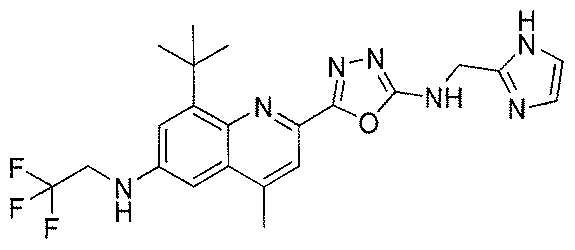
Example 22
Example compound 22 was made according to procedures described
example 21.
MS [M+H]+ = 460.1 ; LC/MS RT = 2.05 min.
Example 23-24

step 1 2 step 2

Example 24
Step 1
tert-butyl 3-oxocyclohexylcarbamate (5.0 g, 0.023 mol), 2-methylpropane-2- sulfinamide (3.4 g, 0.028 mol) and titanium ethoxide (16.0 g, 0.070 mol) were dissolved in THF (100ml) in a 500 ml round bottom flask and refluxed for 3 hours. The reaction mixture was quenched by adding H20 (50 ml) slowly.
After filtration to remove the salt, the product 3 (2.5 g, 34%) was obtained by flash chromatography on silica gel with EA/Hex. MS [M+H]+ = 317.
Step 2
Compound 2 (2.0 g, 0.0063 mol), difluoromethylsulfonyl (1.2 g, 0.0063 mol) were dissolved in THF (20ml) in a 250 ml round bottom flask and cooled to - 78°C. 1.0 M of Lithium bis(trimethylsilyl)amide in hexane (12.6 ml) was added slowly to the reaction mixture. After stirring at -78°C for 3 hours, the reaction
was quenched by adding H20 (10 ml) and diluted with EA (100 ml). The organic layer was dried by Na2 S04. After concentration to remove the solvent, the crude was purified by flash chromatography on silica gel with EA/Hex to give 3 (2.1 g, 66%) . MS [M+H]+ = 509.
Step 3
Compound 3 (0.7 g, 0.0014 mol), sodium hydrogenphosphate (1.9 g, 0.014 mol) were dissolved in MeOH (5ml) in a 100 ml round bottom flask and cooled to -10°C. Na/Hg (10%) (1.9 g, 0.008 mol) was added in to the reaction mixture and stirred for 1 hour. The solvent was poured to another flask and
concentrated to remove solvent and purified by flash chromatography on silica gel with EA/Hex to give 4 (0.4 g, 77%) . MS [M+Hf = 369.
Step 4
Compound 4 (0.4 g, 0.001 1 mol) was dissolved in 4 N HCI/dioxane (5ml) in a 50 ml round bottom flask and stirred for 1 hour. The reaction mixture was concentrated to give HCI salt of compound 5 which used for next step without further purification. MS [M+H]+ = 165.
Step 5
Compound 5 (0.1 g, 0.0006 mol), compound GG from example 21 (0.12 g , 0.0003 mol), DIEA (0.14 g, 0.0012 mol) were dissolved in DMF (2ml) and stirred at room temperature for 1 hour. The reaction mixture was diluted with EA (50 ml), washed by brine and dried by Na2 SO4. After concentration to remove solvent and purified by flash chromatography on silica gel with
EA/Hex to give example compounds 23 and 24 (0.1 1 g, 70%) . MS [M+H]+ = 527.
Example 25

A THF (17 mL) solution of (fluoromethylsulfonyl)benzene (852.4 mg, 4.9 mmol) was treated drop-wise with 1 M LiHMDS/THF (4.8 mL, 4.8 mmol) at -78 °C followed by the drop-wise addition of a THF (3mL) solution of compound 11 (440 mg, 2.21 mmol). Initial evaluation of reaction progress by silica gel TLC after 67 min. indicated significant 1 remained. The reaction was warmed slightly before recooling to -78 °C and adding additional LiHMDS (2.4 mL) solution drop-wise and allowing the reaction bath to warm to ambient temperature, at which time the reaction had consumed all of compound 1 . After the addition of 1 mL of HOAc and an approximately equal volume of THF the reaction was evaporated (in vacuo) at 30 °C before partitioning between DCM and water. Combined DCM phases after an extraction of the initial aqueous phase with DCM were washed with brine, dried Na2SO4, and evaporated. Isolation and purification of compound 2 was accomplished via flash chromatography (silica gel, DCM/ethyl acetate) affording 330 mg. An alternate isomer (presumed trans) was further eluted affording 102 mg. H and 9F spectra (CDCI3) were consistent with expectations. 1 ) Barrow, James C: Glass, Kristen L: Selnick, Harold G.; Freidinger, Roger M.;
Chang, Raymond S. L.; O'Malley, Stacey S.; Woyden, Carla Bioorganic & Medicinal Chemistry Letters, 2000 , vol. 10(17), 1917. (S)-tert-Butyl 3-oxocyclopentylcarbamate is also listed as being commercially available from multiple sources.


Compound 3 was treated with 12 mL of 4N HCI/dioxane at ambient temperature. Reaction progress was monitored by silica gel TLC. At completion, the reaction was evaporated (in vacuo) at 30 °C, dissolved in methanol, evaporated, sonicated with 20 mL of DCE before evaporating again and subjecting to high vacuum overnight. The hydrochloride salt 4 obtained was evaluated by 1H and 19F NMR spectra (DMSO (d6) and determined to be consistent with expectations.

Intermediate 5 was prepared from (1 R,3S)-3-amino-1 -(fluoromethyl) cyclopentanol hydrochloride, by a method analogous to the preparation of compound L from example 1.

Example compound 25 was prepared analogously to example 1 from compounds J and compound 5. M+1 = 496.19, Rt = 2.42 min.
Example 26

Eample compound 26 was prepared analogously to example 1 from compound J and compound 1 from example 17. M+1 = 500.18, Rt = 2.32 min.
Example 27

A DCM (22 mL) solution prepared from methyl 3- aminocyclohexanecarboxylate hydrochloride (1.01 g, 5.22 mmol) and TEA (2.5 mL, 17.9 mmol) was treated drop-wise with thiophosgene (480 pL in 1 .5 mL of DCM) at 0 °C. When the reaction was complete it was diluted with ether, filtered, evaporated and purified by silica gel flash chromatography, 902 mg. This material was pure by HPLC and a 1H NMR spectrum (400 MHz,
CDCI3) was consistent with expectations was obtained. Compound 1 was used as obtained without further characterization.

Example compound 27 was prepared analogously to example 1 from compounds J and 1 . M+1 = 520.23, Rt = 2.62 min.
Example 28

Lithium hydroxide mono hydrate (10.1 mg, 0.24 mmol) dissolved in water (400 pL) was added drop-wise to a stirred solution of 1 (example compound 27) (< 39.5 mg, < 0.076 mmol) in 4 mL of THF/Methanol (1 : 1 v/v). Reaction progress was followed by a combination of HPLC and LCMS. When complete, 1 N aqueous HCI was added to the reaction before it was • evaporated (in vacuo) at 30 °C. The residue obtained was dissolved in DMF (1 .5 mL) and purification was accomplished by preparative HPLC, 13.7 mg, M+1 = 506.23, Rt = 2.40 min.
Example 29


Step 1
A solution of (+)-cis-2-benzyloxycarbonylaminocyclobutane carboxylic acid (1 , 519 mg, 2.08 mmol)) and N-methylmorpholine (0.26 ml_, 2.37 mmol) in THF (10 ml_) was stirred in ice-salt bath as ethyl chloroformate (0.22 ml_, 2.30 mmol) was added dropwise. After 30 min, NaBH4 (236 mg, 6.24 mmol) was added and methanol (20 ml_) was added over 20 min. The mixture was stirred in ice bath for 20 min and diluted with ethyl acetate and water. After the mixture was acidified with 1 N HCI and then treated with aq. NaHCOs, two layers were separatedthe aqueous fraction was extracted with ethyl acetate (x 1 ). The organic fractions were washed with water (x 1 ), combined, dried ( a2SO4), and concentrated. The residue was purified using combiflash with hexanes-ethyl acetate as eluents to obtain 471 mg of compound 2, which was -85% pure. MS [M+H]+ = 236.
Step 2
A solution of compound 2 (471 mg, 2.00 mmol, 85% purity) and N- methylmorpholine (0.27 ml_, 2.46 mmol) in THF (5 ml_) was stirred in ice bath
as benzoyl chloride (0.25 mL, 2.15 mmol) was added. After 2 h, additional N- methylmorpholine (0.27 mL, 2.46 mmol) and benzoyl chloride (0.25 mL, 2.15 mmol) were added and the mixture was stirred at rt for 1 h. The reaction mixture was diluted with ethyl acetate and washed with water (x 2). After the aqueous fractions were extracted with ethyl acetate (x 1 ), the organic fractions were combined, dried (Na2S04), and concentrated. The residue was purified using combiflash with hexanes-ethyl acetate as eluents to obtain compound 3 (448 mg, 63%). Step 3
A suspension of compound 3 (448 mg, 1.32 mmol) and 75 mg of 20%
Pd(OH)2 on carbon (76 mg) in ethyl acetate (10 mL) and methanol (2.5 mL) was vigorously stirred under H2 atmosphere. After 1.5 h, additional 20% Pd(OH)2 on carbon (75 mg) was added and the resulting mixture was stirred under H2 atmosphere for 2 h. The mixture was filtered through celite and the filtrate was concentrated. After the residue was co-evaporated with toluene twice, the resulting crude compound 4 (284 mg) was used for the next reaction. MS [M+H]+ = 206. Step 4
A solution of compound 4 (284 mg) and triethylamine (0.25 mL, 1.79 mmol) in dichloromethane (5 mL) was stirred at 0 °C as phenyl chlorothioformate (0.20 mL, 1.45 mmol) was added dropwise. After 1.5 h, the reaction mixture was diluted with ethyl acetate and washed with water (x 2). After the aqueous fractions were extracted with ethyl acetate (x 1 ), the organic fractions were combined, dried (Na2S04), and concentrated. The residue was purified using combiflash with hexanes-ethyl acetate as eluents to obtain compound 5 (309 mg, 69% from compound 3). MS [M+H]+ = 342. Step 5
Compound 7 (132 mg, 81 %) was prepared from compound 5 and compound J in a manner similar to that described previously. MS [M+H]+ = 568.
Step 6
To a solution of compound 7 (132 mg, 0.232 mmol) in methanol (10 mL) and water (2 mL) was added 1 N KOH (0.5 mL) and the resulting mixture was stirred at rt for 1.5 h and at 40 oC for 1 h. After the reaction mixture was concentrated to remove methanol and the concentrated solution was acidified with 1 N HCI, the mixture was extracted with ethyl acetate (x 2). The organic extracts were washed with water (x 1 ), combined, dried (Na2S04), and concentrated. The residue was purified using combiflash with hexanes-ethyl acetate as eluents to obtain example compound 29 (104 mg, 97%). MS
[M+H]+ = 464.
Examples 30-32

xamp e 3
Step 1
A solution of compound 9 (250 mg, 0.97 mmol) was dissolved in 4 N HCI dioxane (3 mL) and stirred at rt for 1 h. The solution was concentrated
completely and the residue was converted to compound 10 (254 mg, 89%) in a manner similar to that described previously. MS [M+H]+ = 294.
Step 2
Compound 11 (Example compound 30) (46 mg, 75%) was prepared from compound 6 and compound 10 in a manner similar to that described in example 1. MS [M+H]+ = 492.
Step 3
A solution of compound 11 (14 mg, 0.027 mmol) in THF (3 mL) was stirred at 0 °C as 1 M LiAIH4 in ether (1 mL) was added. The reaction mixture was diluted with water and extracted with ethyl acetate (x 2). The combined extracts were dried (Na2SO4), and concentrated. The residue was purified using combiflash with hexanes-ethyl acetate as eluents to obtain compound 12 (Example compound 31) (1 1 mg, 81 %). MS [M+H]+ = 478.
Step 4
A solution of compound 11 (Example compound 30) (15 mg, 0.029 mmol) in methanol (0.5 mL) and THF (2 mL) was stirred at rt as 1 N KOH (0.3 mL) was added. After 1 h, the mixture was acidified with with 1 N HCI and
concentrated. The residue was diluted with water, extracted with ethyl acetate, and the combined extracts were dried (Na2SO4), and concentrated. The residue and triethylamine (0.03 mL, 0.22 mmol) in THF (1 mL) was stirred in ice-salt bath as isobutyl chloroformate (0.02 mL, 0.15 mmol) was added. After 30 min, c. NH4OH (5 drops) was added and the mixture was stirred in freezer overnight. After the mixture was neutralized with 1 N HCI aq.
NaHCO3, the product was extracted with ethyl acetate (x 2), and the combined extracts were dried (Na2SO4), and concentrated. The residue was purified by combiflash followed by preparative HPLC to obtain compound 13 (Example compound 32) (8 mg, 54%). MS [M+Hf = 491 .
Example 33


Step 1
A mixture of Boc-Gly-OH (1 10mg, 0.63 mmol) and CDI (107 mg, 0.66 mmol) in DCM (10 ml_) was stirred at 0 °C for 0.5h under N2. Hydrazine J from example 1 (212 mg, 0.6 mmol) was added at once. The suspension reaction was monitored by LC/MS. At 3h, there were 1/3 of J left. Another portion of CDI (107 mg)/Boc-Gly-OH (1 10 mg) solution was added into the reaction mixture. The reaction was done in another 2h to give compound 1. Step 2
Both CBr4 (796 mg, 2.4 mmol) and PPh3 (678 mg, 2.4 mmol) were added to above reaction mixture. The solution became clear. It was stirred at rt for 18h. It was concentrate by vacuum. The crude product was purified by combiflash using hexanes and ethyl acetate to give 255 mg (86% yield) of compound 2. MS [M+H]+ = 494.1
Step 3
The suspension of compound 2 (252 mg, 0.51 mmol) in 4ml_ of DCM and 2mL of 4N HCI/Dioxane was stirred at rt for 3h. The solvent was removed by Rota- evaporation to give 3.
Step 4
A mixture of compound 3 (0.51 mmol) and NaHC03 (428 mg, 5.1 mmol) in EtOH (10 mL) was stirred at 70 °C for 24h. After filtered off solid, the filtrate was concentrated then added EtOAc. It was washed with water and brine.
The organic fraction was dried ( a2S04) and concentrated. The crude product was purified by combiflash using hexanes and ethyl acetate to give 59 mg (24% yield) of example compound 33. MS [M+H]+ = 476.1

Example 34
A solution of t-butyl acetate (5.51 mL, 41 mmol) in 200 mL of THF at -78 °C was treated by dropwise addition of 1 N LiHMDS (39 mL, 39 mmol) and left to stir for 15 min. A solution of 3-(benzyloxy)cyclobutanone (7.6 g, 43.1 mmol) in
25 mL THF was added over 5 min. The reaction was stirred for 1 h then warmed to rt and quenched with sat. NH4CI. The mixture was extracted with EtOAc the organic layer dried with sodium sulfate and then concentrated in vacuo. Purification of the residue by ISCO® chromatography provided
Intermediate U (5.5 g, 44% yield) as a mixture of isomers.
Compound U (1 .0483 g, 3.6 mmol) in 40 mL of DCM was treated drop-wise with 4 mL of TFA. After stirring overnight, HPLC analysis showed the reaction to be complete. It was evaporated (in vacuo) at 30 °C, dissolved in DCM and re-evaporated (3X) before being subjected to high vacuum. This material was used as obtained without further characterization.
A solution of Intermediate W was prepared from Intermediate V using the same procedure as for intermediate S.
A solution of Intermediate W (45 mg, 0.078 mmol) in 2 mL DCM was treated with imidazolonium chloride (28 mg, 0.165 mmol) and TEA (38 pL, 0.275 mmol) and allowed to stir at 35 °C for 16 h. Aqueous work-up (EtOAc and H20) provided Intermediate X as a tan solid.
A solution of Intermediate X and Pd/C in DMF was stirred under H2 for 15 min. The reaction was then filtered and purified by RP-HPLC to provide Example compound 34 (12.7 mg, 24% yield, 2 steps) as a white solid; LCMS rt = 2.51 min; [M+H] = 465.14.
Examples 35-38
Preparation of Compound 6

4-iodo-2-(trifluoromethoxy) aniline (1 ) was commercial available. It was thermally cycloiized and converted into compound (6) (ethyl 4-methyl-6-(2,2,2- trifluoroethylamino)-8-(trifluoromethoxy)quinoline-2-carboxylate) by the similar scheme and chemistry as describe in Example 1

Example 35
Example 36

Example 37
Example 38
Example compounds 35-38 were made from intermediate 6 and other required intermediates described previously according to procedures in example 1
Example compound 35: MS [M+H]+ = 506.1 .
Example compound 36: WIS [M+Hf = 506.1.
Example compound 37: MS [M+H]+ = 510.1.
Example compound 38: MS [M+H]+ = 492.1 .
Example 39
Sta e A

A solution of Intermediate D from example 1 (1 .5 g, 5.1 mmol) and oxalyl chloride (1.55 mL, 17.9 mmol) in 100 ml_ DCM was treated with 1 drop of DMF and stirred at 35 °C for 30 min. The reaction mixture was concentrated in vacuo, then taken up in DCE and concentrated again (2x) to provide Intermediate M (1.67 g, 101 % yield) as a tan solid.
A solution of Pd2(dba)3 (131 mg, 0.127 mmol) and Dave-Phos (200 mg, 0.51 mmol) in 12 mL of degassed dioxane was stirred for 5 min, then treated with Intermediate M (1.01 g, 2.54 mmol), Cs2C03 (2.48g, 7.64 mmol) and 4- methoxybenzylamine (550 μΙ_, 3.81 mmol). The reaction was heated at 100 °C for 16 h, then cooled to rt and diluted with EtOAc and water. The organic layer was separated, dried with sodium sulfate and filtered through a plug of silica. The residue was purified by ISCO® to provide Intermediate N (710 mg, 56% yield) as yellow oil.
Sta e B

Intermediate O was prepared using the same procedure as for Intermediate I
Intermediate P was prepared using the same procedures used to prepare Intermediate J. LCMS rt = 2.20 min; [M+H] = 476.22.

Intermediate Q was prepared using the same procedure as for Example 2. LCMS rt = 2.40 min; [M+H] = 621.28.
A solution of Intermediate Q (225 mg, 0.47 mmol) in 3 mL TFA was treated with 228 mg of p-TsOH»H2O and heated to 60 °C for 60 min. Solvent was removed in vacuo, the residue taken up in 2 mL MeOH and 1 mL THF.
Treatment with 1 mL 1 N LiOH provided complete conversion to the free aminoquinoline in 1 min. Purification by RP-HPLC (MeCN-neutral H2O) provided Example compound 39 as a white solid (15.1 mg, 7 % yield). LCMS rt = 1 .87 min; [M+H] = 488.01 .
Example 40

Example 41


Example 41
The procedure was same as in Example 39 to afford Example compound 41 . MS [M+H]+ = 507.1
Example 42

Step 1 :
In a vial under N2, Pd2(dba)3 (44 mg, 0.0477 mmol) and (2-biphenyl)-di-f- butylphosphine (14 mg, 0.0477 mmol) were suspended in toluene (5 mL). After 10 min, 3,3-difluoroazetidine hydrochloride (93 mg, 0.7160 mmol) and compound H from example 1 (200 mg, 0.4773 mmol) were added. Cs2C03 (232 mg, 0.7160 mmol) was added last. The reaction mixture was heated at 80 °C overnight.
After cooling to rt, the reaction mixture was diluted with EtOAc and filtered. The filtrate was concentrated and the residue was purified by ISCO® chromatography (EtOAc/hexanes) to give compound 1 as an off-white solid (57 mg, 33 %).
Step 2:
The procedures from example 1 were followed to give Compound 2 as a yellow solid (48 mg, 84 %). Step 3:
The procedures from example 1 were followed to give example compound 42 as a yellow solid (31 mg, 45 %).
MS [ +Hf = 494.2; LC/MS RT = 2.49 min.
Examples 43-48

Example 44 Example 45

The compounds in these examples were made according to procedures described in example 42.
Example compound 43 : MS [M+H]+ = 508.2; LC/MS RT = 2.50 min.
Example compound 44: MS [M+Hf = 526.2; LC/MS RT = 2.46 min.
Example compound 45: MS [M+H]+ = 514.2; LC/MS RT = 2.38 min.
Example compound 46: MS [M+H]+ = 508.3; LC/MS RT = 2.50 min.
Example compound 47: MS [M+H]+ = 514.2; LC/MS RT = 2.36 min.
Example compound 48: MS [M+H]+ = 504.3; LC/MS RT = 2.41 min.
Example 49

Preparation of Compound Z:
Step 1 :
The procedures from stage C of example 1 were followed to give Compound HH as a yellow oil.
Step 2:
Compound HH, dissolved in THF (10 mL), was treated with 2N HCI solution (3 mL). The reaction mixture was stirred at rt for 3h. It was then concentrated and the residue was dissolved in EtOAc and washed with 1 N NaOH solution. The organic layer was concentrated to give compound Z as a brown solid (219 mg, 64 %).

Example 49
Step :
Compound Z (40 mg, 0.1399 mmol), dissolved in THF (1.5 mL), was treated with methyl chloroformate (12 pL, 0.1538 mmol) followed by triethylamine (42 pL, 0.3077 mmol). The reaction mixture was stirred at rt overnight.
The reaction mixture was quenched with brine and extracted with EtOAc. The organic layer was concentrated and the residue was purified by ISCO® chromatography (EtOAc/hexanes) to give compound AA as a white solid (12 mg, 25 %).
Step 2:
The procedures from example 1 were followed to give Compound BB as a white solid (9.4 mg, 82 %).
Step 3:
The procedures from example 1 were followed to give Example compound 49 as a white solid (5 mg, 38 %).
MS [M+H]+ = 476.2; LC/MS RT = 2.33 min.
Example 50

Step 1
A mixture of ethyl 8-tert-butyl-4-methyl-6-(trifluoromethylsulfonyloxy)quinoline- 2-carboxylate (1) from example 1 (889 mg, 2.12 mmmol), PMBNH2 (0.55 mL, 4.24 mmol), Pd(OAc)2 (149 mg, 0.212 mmol), BINAP (145 mg, 0.233 mmol) and CS2CO3 (1.04 g, 3.18 mmol) in toluene (20 mL) was flashed with N2 three times. The reaction was done after heated to 100 °C for 3h. The mixture was cooled to rt and concentrated. The residue was purified by combiflash using hexanes and ethyl acetate to obtain 561 mg (65% yield) of compound 2. MS [M+H]+ = 407.1
Step 2
A mixture of compound 2 (560 mg, .38 mmmol) and p-TsOH (393 mg, 2.07 mmol) in TFA (5 mL) was stirred at rt for 3h. The reaction was done and TFA
was removed by evaporation. The residual was diluted with ethyl acetate, washed with sat'd NaHC03 and brine. The organic fraction was dried
(Na2S04) and concentrated to give compound 3. MS [M+H]+ = 287.0 Step 3
A mixture of compound 3 (1 .38 mmmol), MsCI (0.128 mL, 1.66 mmol) and DIPEA (0.48 mL, 2.76 mmol) in DCM (5 mL) was stirred at rt for 1 h. The mixture was diluted with DCM, washed with sat'd NaHC03. The organic fraction was dried (Na2S04) and concentrated to give compound 4. MS
[M+H]+ = 443.0
Step 4
A mixture of compound 4 (1.38 mmol) and hydrazine hydrate (3 mL) in EtOH (10 mL) was stirred at 80 °C for 18h. The mixture was concentrated then added EtOAc. It was washed with sat'd NaHCO3 and brine. The organic fraction was dried (Na2SO4) and concentrated to give compound 5. MS
[M+H]+ = 351 .0
Step 5
It was same procedure to generate Example compound 50 as in Example 1. MS [M+H]+ = 478.1
Examples 51-52

ExamPle S1 Example 52
Example compounds 51 and 52 were made with corresponding PMB-amine according to procedures in example 50.
Example compound 51 : MS [M+H]+ = 414.1 .
Example compound 52: MS [M+H = 446.1
Example 53

3 (example 51 ) 2

Example compound 53 was made with corresponding MeS02CI according to procedures in example 50.
Example compound 53: MS [M+H]+ = 492.1.
Example 54

Example compound 54 was made with corresponding AcCI according to procedures in example 50.
Example compound 54: MS [M+H]+ = 474.1.
Example 55


Example 55
Example compound 55 was made with corresponding AcCl accord procedures in example 50.
Example compound 55: MS [M+H]+ = 460.1 .
Example 56


Example compound 56 was made according to procedures in example 50. Example compound 56: MS [M+H]+ = 418.1.
Example 57

Step 1 :
The procedures from example 1 were followed to give Compound CC as a yellow solid (72 mg, 42 %).
Step 2:
The procedures from example 1 were followed to give example compound 57 as a yellow solid (50 mg, 56 %).
MS [M+H]+ = 512.1 ; LC/MS RT = 2.33 min.
Example 58

Step 1 :
The procedures from example 1 were followed to give Compound DD as an off-white solid (55 mg, 45 %).
Step 2:
Compound DD (54 mg, 0.0976 mmol) dissolved in MeOH (400 μΐ_) and THF (600 μΙ_) was treated with 2M LiOH solution (400 μΙ_). The reaction mixture was stirred at rt for 30 min and then concentrated. The residue was dissolved in EtOAc and washed with saturated NaHC03 solution. The organic layer was concentrated and the residue was purified by ISCO® chromatography
(EtOAc/hexanes) to give example compound 58 as an off-white solid (28 mg, 65 %).
MS [M+Hf = 450.2; LC/WIS RT = 2.33 min.
Examples 59-61

xamp e 5 xamp e 0

The compounds in the examples were made according to procedures described in example 1.
Example compound 59: MS [M+H]+ 457.2; LC/MS RT 2.42 min.
Example compound 60: MS [M+H]+ 448.2; LC/MS RT 2.63 min.
Example compound 61 : MS [M+H]+ 452.2; LC/MS RT 2.46 min.
Example compound 62: MS [M+H]+ 420.2; LC/MS RT 2.53 min.
Example 63
BocHN

Intermediate E
Preparation of Intermediate E:
Step 1 :
A solution of N-Boc-aminocyclobutanone (2.5 g, 13.5 mmol) in 50 mL THF
was cooled to -78 °C and treated with a 1 N solution of L-Selectride® (16.2 mL, 16.2 mmol) in THF. After stirring for 1 h the reaction was quenched with 5 mL water and warmed to rt. Aqueous work-up with EtOAc and water and
purification by ISCO® chromatography (EtOAc/hexanes) provided the desired alcohol (2.5 g, 100%) as a white solid. This material proved a single isomer by 1H-NMR.
Step 2:
The above alcohol (1.38 g, 7.4 mmol) was taken up in 50 mL DCM at rt.
Benzoyl chloride (1 .04 mL, 8.97 mmol) and pyridine (6 mL, 24 mmol) were
added and the mixture stirred for 1 h. Aqueous work-up with EtOAc and
NaHS04 and purification by ISCO® chromatography (EtOAc/hexanes)
provided the desired ester (1.03 g, 46% yield) as a white powder.
Step 3:
A solution of the above ester was stirred in a solution of 50% TFA in DCM for
5 min and rthe eaction then concentrated in vacuo. The residue was taken
up in 35 mL THF and 1.89 mL TEA, then cooled to 0 °C. Thiophosgene (0.313 mL, 4.1 mmol) was added and the reaction stirred for 30 min. The reaction was concentrated to dryness, then taken up in EtOAc and filtered through a plug of silica gel. After concentrating the filtrate in vacuo, the residue was purified by ISCO® chromatography (EtOAc/hexanes) to provide Intermediate E (490 mg, 62% yield) as a partially crystalline solid.

Example 63
Preparation of Intermediate F:
Intermediate E (100 mg, 0.4292 mmol), dissolved in isopropyl alcohol (3 mL) was added dropwise to a solution of hydrazine hydrate (40 pL, 0.5150 mmol) in isopropyl alcohol (1 mL). The reaction mixture was stirred at rt for 2h. The precipitate formed was filtered and dried to give Intermediate F as a white solid (83 mg, 74 %).
Step 1 :
Compound i (100 mg, 0.2717 mmol), dissolved in THF (2 mL) and methanol (500 pL), was treated with lithium hydroxide (34 mg, 0.8152 mmol) dissolved in water (500 pL). The reaction mixture was stirred at rt for 4h and then concentrated. The residue was suspended in EtOAc and washed with 1 N HCI solution. The organic layer was concentrated to give compound EE as a yellow solid (86 mg, 94 %).
Step 2:
Compound EE (43 mg, 0.1265 mmol) and Intermediate F (34 mg, 0.1265 mmol) were combined in the reaction vessel and phosphorus oxychloride (700 pi_) was then added. The reaction mixture was heated at 70 °C for 1 h.
After cooling to rt, the reaction mixture was carefully poured into ice water and extracted with DCM. The organic layer was concentrated to give compound FF as an orange oil (70 mg, 97 %). Step 3:
The procedures from example 1 were followed to give Example compound 63 as an off-white solid (37 mg, 65 %).
MS [M+H = 466.2; LC/MS RT = 2.31 min.
Examples 64-65

19 Example 64 20 Example 65
Step 1
To a suspension of L-penicillamine (compound 1 , 2.00 g, 13.39 mmol) in methanol (40 ml_) was added SOCI2 (10 ml_) dropwise and the resulting
solution was refluxed. After 4 h, the solution was cooled to 0 0C and additional SOCI2 (5 mL) was added dropwise. After the resulting solution was refluxed overnight and concentrated to a half volume, the concentrated solution was diluted with ether (-50 mL). The mixture was stirred in ice bath for 1 h and the solids were filtered, washed with ether, and dried to get compound 2 (1.69 g, 63%). MS [M+H]+ = 164.
Step 2
A solution of 1 ,2-dibromoethane (0.88 mL 10.21 mmol) in DMF (8.5 mL) was stirred at rt as a solution of compound 2 (1.69 g, 8.47 mmol) in DMF (17 mL), and DBU (3.82 mL, 25.56 mmol) was added over 50 min. The resulting solution was stirred for 18 h and diluted with ethyl acetate and aq. NaHC03. Separated aqueous fraction was extracted with ethyl acetate (x ). The organic fractions were washed with 5% aq. LiCI solution (x 1 ) combined, dried (Na2S04), and concentrated. MS [M+H]+ = 190.
A solution of the residue and triethylamine (2.9 mL, 20.81 mmol) in THF (13 mL) was stirred at 0 °C as Boc20 (2.45 g, 1 1 .23 mmol) was added. After 1.5 h at rt, additional triethylamine (1.0 mL, 7.17 mmol) and Boc20 (830 mg, 3.80 mmol) were added and the resulting mixture was stirred at 40 °C for 4 h and then rt overnight. After the mixture was concentrated, the residue was dissolved in ethyl acetate and washed with water (x 2). The aqueous fractions were extracted with ethyl acetate, and the combined organic fractions were dried (Na2S0 ), and concentrated. The residue was purified using combiflash with hexanes-ethyl acetate as eluents to obtain compound 3 (1.64 g, 67% from compound 15).
Step 3
A mixture of compound 3 (1.63 g, 5.64 mmol) in THF (5 mL), methanol (10 mL), and 1 N KOH (1 1.5 mL) was stirred at rt for 1 h and at 40 °C for 2 h before adding additional 1 N KOH (5.75 mL). After the resulting mixture was stirred at 50 oC for 2 h, the solution was concentrated to remove organic solvent and acidified with 1 N HCI before dilution with water and extraction
with ethyl acetate (x 2). The organic extracts were washed with water (x 1 ), combined, dried (Na2S04), and concentrated.
The concentrated residue and N-methylmorpholine (0.94 mL, 8.55 mmol) in THF (20 mL) was stirred in ice-salt bath as isobutyl chloroformate (0.89 mL, 6.80 mmol) was added. After 30 min, c. NH4OH (2 mL) was added and the mixture was stirred in the bath for 1 h and at rt for 1 h. After the mixture was diluted with water, the product was extracted with ethyl acetate (x 2). The extracts were washed with water (x1 ), combine, dried (Na2S04), and concentrated. The residue was triturated with ethyl acetate (~ 5-8 mL), stirred in ice bath for 1 h, and filtered to obtain compound 4 (889 mg, 57%). MS
[M+H = 275.
Step 4
Compound 5 was prepared from compound 4 in a manner similar to that described previously. The crude product was used for the next reaction. MS [M+H]+ = 161 .
Step 5
Example compound 64 (263 mg, 84%) was prepared from compound J from example l and compound 18 in a manner similar to that described previously. MS [M+Hf = 483.
Step 6
Example compound 65 (192 mg, 81 %) was prepared from example compound 64 in a manner similar to that described previously. MS [M+H]+ = 515.
Examples 66-71 Preparation of intermediate 4

Step 1
A mixture of (6,6-dimethylthiomorpholin-3-yl)methanol (1 ) (512 mg, 3.175 mmol), BnCI (0.44 mL, 3.81 mmol), and DIPEA (0.7 mL, 7.0 mmol) in DCE (10 mL) was heated at 60 °C for 18h. It was concentrated by Rota evaporator. The crude mixture was purified by combiflash using EA/hexanes to give compound 2 (722 mg, 91 % yield). MS [M+Hf = 252.1
Step 2
A mixture of compound 2 (720 mg, 2.86 mmol), PPh3 (1.2g, 4.58 mmol), and phthalimide (948 mg, 4.29 mmol) in THF (10 mL) was cooled to 0°C under N2. DIAD (0.9 mL, 4.58 mmol) was added dropwise. After addition, the mixture was warmed to rt and stirred overnight. The solution was diluted with ethyl acetate, washed with sat'd NaHC03 and brine. The organic fraction was dried (Na2SO4) and concentrated and purified by combiflash using hexanes and ethyl acetate to obtain 925 mg (85% yield) of compound 3. MS [M+Hf = 381 .1
Step 3
A solution of compound 3(925 mg, 2.43 mmol) in EtOH (20 mL) and hydrazine hydrate (1 mL) was stirred at rt for 18h. After the reaction completed, it was diluted with ether. The solid was filtered off. The mother liquid was
concentrated to give the crude residue which was dissolved back into ethyl acetate. It was washed with water and brine. The organic fraction was dried (Na2SO4) and concentrated to give 486 mg (80% yield) of compound 4. MS [M+H]+ = 251 .0
Compound 4 was used for preparation of examplecompound 66 and 66A.

Example 66 (X=S02) Example 67
Example 66A (X=S) Example 68

The compounds in the examples were made with corresponding amine according to procedures in examples 64-65.
Example compound 66: MS [M+H]+ = 515.1.
Example compound 66A: MS [M+H]+ = 483.1.
Example compound 67: MS [M+H]+ = 487.2.
Example compound 68: MS [M+H]+ = 439.0.
Example compound 69: MS [M+H]+ = 500.2.
Example compound 70: MS [M+H]+ = 490.1 .
Example compound 71 : MS [M+H]+ = 493.1 .
Examples 72-73


Example 73
(R)-tert-butyl 4-((8-tert-butyl-4-methyl-6-(2,2,2- trifluoroethylamino)quinoline-2-carboxamido)methyl)thiazolidine-3- carboxylate (A-1).
8-tert-butyl-4-methyl-6-(2,2,2-trifluoroethylamino)quinoline-2-carboxylic acid ( 1 .2g, 3.5mmol), (R)-tert-butyl 4-(aminomethyl)thiazolidine-3-carboxyiate ( 0.872g, 4mmol) and DIPEA (1 .03g, 8mmol) was dissolved in DMF (10ml). HATU (1.6g, 4.2mmol) was added at room temperature. After I h at room temperature, the reaction mixture was extracted with ethyl acetate and
washed with brine. The extract was dried and purified by silica gel column to afford 1.07g of (R)-tert-butyl 4-((8-tert-butyl-4-methyl-6-(2,2,2- trifluoroethylamino)quinoline-2-carboxamido)methyl)thiazolidine-3-carboxylate (A-1 ).
MS [M+H]+ = 540.97
(R)-8-tert-butyI-4-methy!-N-(thiazoIidin-4-yImethyl)-6-(2,2,2- trifluoroethylamino)quinoline-2-carboxamide (A-2)
(R)-tert-butyl 4-((8-tert-butyl-4-methyl-6-(2,2,2-trifluoroethylamino)quinoline-2- carboxamido)methyl)thiazolidine-3-carboxylate (A-1 ) (1 .07g, 1 .98mmol) was dissolved in 10ml of DCM. TFA (3ml) was added at room temperature, after 2h, DCM and TFA was removed. The residue was diluted with ethyl acetate and washed with saturated sodium bicarbonate solution and brine. The extract was dried and purified silica gel column to afford 0.83g of (R)-8-tert- butyl-4-methyl-N-(thiazolidin-4-ylmethyl)-6-(2,2,2- trifluoroethylamino)quinoline-2-carboxamide (A-2). MS [M+H]+ = 441.06
(R)-N-(2-amino-3-mercaptopropyl)-8-tert-butyl-4-methyl-6-(2,2,2- trifluoroethylamino)quinoline-2-carboxamide (A-4) and dimer (A-3)
(R)-8-tert-butyl-4-methyl-N-(thiazolidin-4-ylmethyl)-6-(2,2,2- trifluoroethylamino)quinoline-2-carboxamide (A-2) (0.83g,1.88mmol) was dissolved in 30ml of MeOH. Hydroxylamine hydrochloride (0.158g, 2.3mmol) was added. After 2h reflux, the MeOH was removed. The residue was diluted with ethyl acetate and washed with saturated sodium bicarbonate solution and brine. The extract was dried to afford 0.58g mixture of (R)-N-(2-amino-3- mercaptopropyl)-8-tert-butyl-4-methyl-6-(2,2,2-trifluoroethylamino)quinoline-2- carboxamide (A-4) and dimmer (A-3).A-3: MS [M+H]+ = 855.24. A-4: MS
[M+H]+ = 429.07
(R)-ethyl 2-(2-amino-3-(8-tert-butyl-4-methyl-6-(2,2,2- trifluoroethylamino)quinoline-2-carboxamido)propylthio)acetate (A-5)
Mixture of (R)-N-(2-amino-3-mercaptopropyl)-8-tert-butyl-4-methyl-6-(2,2,2- trifluoroethylamino)quinoline-2-carboxamide (A-4) and dimmer (A-3) (71 mg) obtained above was dissolved in DMF (5ml). Tris(2-carboxyethyl)phosphine
hydrochloride (29mg, O.l mmol) was added at room temperature, After 30min., !N solution of NaOH (0.6ml) and etjhyl bromoacetate (28mg, 0.17mmol) was added. Atfer 30mim., The reaction mixture was extracted with ethyl acetate and washed with brine. The extract was dried and purified by silica gel column to afford 47mg of (R)-ethyl 2-(2-amino-3-(8-tert-butyl-4-methyl-6-(2,2,2- trifluoroethylamino)quinoline-2-carboxamido)propylthio)acetate (A-5)
MS [M+H]+ = 515.12
(R)-8-tert-butyl-4-methyl-N-((5-oxothiomorpholin-3-yl)methyl)-6-(2,2,2- trifiuoroethylamino)quinoline-2-carboxamide (Example compound 72)
(R)-ethyl 2-(2-amino-3-(8-tert-butyl-4-methyl-6-(2,2,2- trifluoroethylamino)quinoline-2-carboxamido)propylthio)acetate (A-5)(47mg, 0.09mmol) was dissolved in MeOH (5ml). 2N water solution of LiOH (0.2ml) was added at room temperature. After 1 h, the solvent was removed and extracted with ethyl acetate. After dried, the solvent was removed, residue was purified by silica gel column to afford 35mg of (R)-8-tert-butyl-4-methyl-N- ((5-oxothiomorpholin-3-yl)methyl)-6-(2,2,2-trifluoroethylamino)quinoline-2- carboxamide (Example compound 72). MS [M+H]+ = 469.15 (R)-tert-butyl 8-tert-butyl-4-methyl-2-((5-oxothiomorpholin-3- yl)methylcarbamoyl)quinolin-6-yl(2,2,2-trifluoroethyl)carbamate (A-6)
(R)-8-tert-butyl-4-methyl-N-((5-oxothiomorpholin-3-yl)methyl)-6-(2,2,2- trifluoroethylamino)quinoline-2-carboxamide (GS-589754) (32.5mg,
0.069mmol) was dissolved in THF (5ml), TEA (20mg, 0.2mmol), Di-tert-butyl dicarbonate ( 21.6mg, 0.1 mmol) and D AP (5mg) was added to the reaction mixture. After flux for 2h, the solvent was removed, the residue was purified by silica gel column to afford 32mg of (R)-tert-butyl 8-tert-butyl-4-methyl-2-((5- oxothiomorpholin-3-yl)methylcarbamoyl)quinolin-6-yl(2,2,2- trifluoroethyl)carbamate (A-6). MS [M+H]+ = 569.06
Compound (A-7)
Into the solution of (R)-tert-butyl 8-tert-butyl-4-methyl-2-((5-oxothiomorpholin- 3-yl)methylcarbamoyl)quinolin-6-yl(2,2,2-trifluoroethyl)carbamate (A-6) (32mg)
in 10ml of MeOH, was added solution of oxone (280mg) in 5ml of water. After 1 h stirring, the reaction mixture was extracted with ethyl acetate and washed with brine. The extract was dried to afford 38mg crude of A-7. WIS [ +H]+ = 601 .13
Example compound 73
Crude A-7 (38mg) was dissolved in 2ml of DCM, TFA (1 ml) was added. After stirred for 1 h, the solvent and excess TFA was removed. The residue was diluted with ethyl acetate and washed with saturated sodium bicarbonate solution and brine. The extract was dried and purified by silica gel column to afford 25mg of Example compound 73. MS [M+H]+ = 501 .15
Examples 74-75

(R)-N-(2-amino-3-(3-hydroxypropyIthio)propyl)-8-tert-butyI-4-methyI-6- (2,2,2-trifluoroethylamino)quinoline-2-carboxamide (B-1 )
(R)-N-(2-amino-3-(3-hydroxypropylthio)propyl)-8-tert-butyl-4-methyl-6-(2,2,2- trifluoroethylamino)quinoline-2-carboxamide (B-1 ) was prepared as compound (A-5) in Scheme A. MS [M+H]+ = 487.16
(R)-tert-butyl 1 -(8-tert-butyl-4-methyl-6-(2,2,2- trifluoroethylamino)quinoline-2-carboxamido)-3-(3
hydroxypropylthio)propan-2-ylcarbamate (B-2)
(R)-N-(2-amino-3-(3-hydroxypropylthio)propyl)-8-tert-butyl-4-nnethyl-6-(2,2,2- trifluoroethylamino)quinoline-2-carboxamide (B-1 ) (100mg, 0.21 mmol) was dissolved in 10ml of DCE. TEA (50mg, 0.5mmol) and Di-tert-butyl dicarbonate (68mg, 0.31 mmol) was added at room temperature. After stirred for 2h, the solvent was removed, the residue was purified by silica gel column to afford 182mg of (R)-tert-butyl 1 -(8-tert-butyl-4-methyl-6-(2,2,2- trifluoroethylamino)quinoline-2-carboxamido)-3-(3-hydroxypropylthio)propan- 2-ylcarbamate (B-2). . MS [M+H]+ = 587.06 (R)-3-(2-(tert-butoxycarbonylamino)-3-(8-tert-butyl-4-methyl-6-(2,2,2- trifluoroethylamino)quinoline-2-carboxamido)propylthio)propyl methanesulfonate (B-3)
(R)-tert-butyl 1-(8-tert-butyl-4-methyl-6-(2,2,2-trifluoroethylamino)quinoline-2- carboxamido)-3-(3-hydroxypropylthio)propan-2-ylcarbamate (B-2) (182mg, 0.31 mmol) was dissolved in DCM 10ml), TEA (47mg, 0.47mmol) and MsCI (39mg, 0.34mmol) was added at 0°C. After 1 h stirring, The solvent was removed, the residue was purified by silica gel column to afford 142mg of (R)-3-(2-(tert-butoxycarbonylamino)-3-(8-tert-butyl-4-methyl-6-(2,2,2- trifluoroethylamino)quinoline-2-carboxamido)propylthio)propyl
methanesulfonate (B-3). MS [M+H]+ = 665.03
(R)-tert-butyl 3-((8-tert-butyl-4-methyl-6-(2,2,2- trifluoroethylamino)quinoline-2-carboxamido)methyl)-1 ,4-thiazepane-4- carboxylate (B-4)
Into the solution of (R)-3-(2-(tert-butoxycarbonylamino)-3-(8-tert-butyl-4- methyl-6-(2,2,2-trifluoroethylamino)quinoline-2-carboxamido)propylthio)propyl methanesulfonate (B-3) (142mg) in THF (10ml), was added 1 N solution of LiN(TMS)2 in THF (1 ml) at 0°C. After 1 h stirring, The reaction mixture was extracted with ethyl acetate. The extract was washed with brine. After dried, the solvent was removed, the residue was purified by silica gel column to afford 98mg of (R)-tert-butyl 3-((8-tert-butyl-4-methyl-6-(2,2,2- trifluoroethylamino)quinoline-2-carboxamido)methyl)-1 ,4-thiazepane-4- carboxylate (B-4). MS [M+H]+ = 569.04
(R)-N-((1 ,4-thiazepan-3-yl)methyl)-8-tert-butyl-4-methyl-6-(2,2,2- trifluoroethylamino)quinoline-2-carboxamide (Example compound 74) was prepared from B4 by standard methods, MS [M+H]+ = 469.07
Example compound 75 was prepared from example compound 74. MS [M+H]+ = 501.15
Examples 76-77

Example compound 76 was prepared in the manners similar to example 72. MS [M+H]+ = 523.05
Example compound 77 was prepared in the manners similar to exam
MS [M+H]+ = 555.1
Examples 78-79
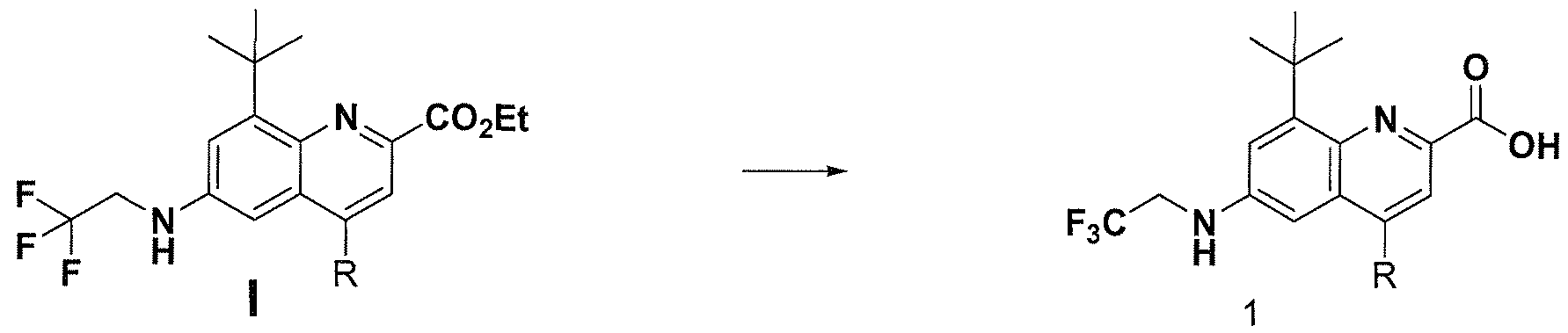
Intermediates 1 were prepared from E (R=H) and from I (R=Me) in example 1 by standard operations and were used as obtained.

Example compound 78 was prepared from 1 (R=Me) and 2-aminomethyl tetrahydro(2H)pyran hydrochloride by a method analogous to the amide formation method described in example 87. M+1 = 438.21 , Rt = 4.00 (5.5 min. method).
Example compound 79 (arising from 1 where R = H) was isolated from the same preparation, M+1 = 424.23, Rt = 2.59 min.
Examples 80

Example compound 80 was prepared from 3-aminomethyl tetrahydro(2H)pyran hydrochloride and 1 of example 78 by a method analogous to the preparation of other amide, M+1 = 438.21 , Rt = 2.57 min.
Examples 81

Example 81 was prepared by method of example 78, M+1 = 438.20, Rt = 2.54 min.
Example 81


Step 1
(S)-l-tert-butyl 2-methyl 4-oxopiperidine-1 ,2-dicarboxylate (3.0 g, 0.012 mol), ethane-1 ,2-diol (2.2 g, 0.036 mol) and TsOH (50 mg) were dissolved in toluene ( 00ml) in a 250 ml round bottom flask and refluxed for over night. The reaction mixture was concentrated to remove solvent. The residue was purified by flash chromatography on silica gel with EA/Hex to give compound 1 (2.0 g, 66%). MS [M+H]+ = 302.
Step 2
Compound 2 (1 .0 g, 0.0033 mol), sodium hydroxide (0.53 g, 0.0133 mol) were dissolved in THF/MeOH/ H20 (30ml) in a 250 ml round bottom flask and stirred at room temperature for 3 hours. The reaction was quenched by adding 1 N HCI to adjust pH = 6 and extracted with EA (100 ml). The organic layer was dried by Na2 S04 . After concentration to remove the solvent, the residue was under high vacuum overnight. The residue, HATU (1.9 g, 0.0049 mol), N M (1.7 g, 0.017 mol), ammonium hydroxide (1 ml) were dissolved in DMF and stirred for 1 hour. The reaction was diluted with EA (50 ml), washed by brine and dried by Na2 S04. After concentration to remove solvent and
purified by flash chromatography on silica gel with EA/Hex to give 3 (0.2 g, 21 %) . MS [M+H]+ = 287.
Step 3
Compound 3 (0.2 g, 0.0007 mol) was dissolved in THF (3ml) in a 50 ml round bottom flask. 1 .0 M borane in THF (2.1 ml) was added to the reaction mixture. The reaction was refluxed for 1 hour, cooled to room temperature and quenched by adding MeOH (2 ml) dropwise. After concentration to remove the solvent, compound 4 (0.19 g) was obtained. MS [M+H]+ = 273.
Step 4
Compound 4 (0.19 g, 0.0007 mol), compound 5 (0.12 g, 0.00035 mol), HATU (0.27 g, 0.0007 mol) and NMM (0.11 g, 0.001 mol) were dissolved in DMF (2ml) in a 50 ml round bottom flask and stirred for 1 hour. The reaction mixture was diluted with EA (50 ml), washed by brine and dried by Na2 S04. After concentration to remove solvent, the residue was purified by flash chromatography on silica gel with EA/Hex to give 6 (0.07 g, 34%) . MS [M+H]+ = 595.
Step 5
Compound 6 (0.07 g, 0.00012 mol), TsOH.H20 (0.1 g, 0.00051 mol) were dissolved in acetone/H20 (5ml/1 ml) in a 50 ml round bottom flask and heated to 50°C for 4 hours. The reaction mixture was diluted with EA (50 ml), washed by brine and dried by Na2 S04. After concentration to remove solvent and purified by flash chromatography on silica gel with EA/Hex to give 7, example compound 81. (0.02 g, 40%) . MS [M+H]+ = 451 .
Example 82

Step 1
Compound 1 (Example compound 81 ) (0.01 g, 0.00002 mol), NaBH4 (0.003 g, 0.00006 mol) were dissolved in MeOH (1 ml) at -10°C and stirred for 1 hour. The reaction mixture was diluted with EA (50 ml), washed by brine and dried by Na2 S04. After concentration to remove solvent, the residue was purified by flash chromatography on silica gel with EA/Hex to give 7 (0.005 g, 50%) . MS [M+Hf = 453.
Examples 83-84

Step 1
Methyl 4-oxotetrahydro-2H-thiopyran-3-carboxylate (2.5 g, 0.014 mol), ethane-1 ,2-diol (2.8 g, 0.043 mol) and TsOH (50 mg) were dissolved in toluene (100ml) in a 250 ml round bottom flask and refluxed for over night. The reaction mixture was concentrated to remove solvent. The residue was purified by flash chromatography on silica gel with EA/Hex to give compound 1 (2.0 g, 65%). MS [M+H = 219.
Step 2
Compound 2 (1 .0 g, 0.0046 mol), sodium hydroxide (0.53 g, 0.0133 mol) were dissolved in THF/MeOH/ H20 (30ml) in a 250 ml round bottom flask and stirred at room temperature for 3 hours. The reaction was quenched by adding 1 N HCI to adjust pH = 6 and extracted with EA (100 ml). The organic layer was dried by Na2 S04. After concentration to remove the solvent, the residue was under high vacuum overnight. The residue, HATU (1.9 g, 0.0049 mol), NMM (1.7 g, 0.017 mol), ammonium hydroxide (1 ml) were dissolved in DMF and stirred for 1 hour. The reaction was diluted with EA (50 ml), washed by brine and dried by Na2 S04. After concentration to remove solvent and purified by flash chromatography on silica gel with EA/Hex to give 3 (0.2 g, 20%) . MS [M+H]+ = 204.
Step 3
Compound 3 (0.14 g, 0.0007 mol) was dissolved in THF (3ml) in a 50 ml round bottom flask. 1 .0 M borane in THF (2.1 ml) was added to the reaction mixture. The reaction was refluxed for 1 hour, cooled to room temperature and quenched by adding MeOH (2 ml) dropwise. After concentration to remove the solvent, compound 4 (0.13 g) was obtained. MS [M+H]+ = 190.
Step 4
Compound 4 (0.13 g, 0.0007 mol), compound 5 (0.12 g, 0.00035 mol), HATU (0.27 g, 0.0007 mol) and NMM (0.11 g, 0.001 mol) were dissolved in DMF (2ml) in a 50 ml round bottom flask and stirred for 1 hour. The reaction mixture was diluted with EA (50 ml), washed by brine and dried by Na2 S04.
After concentration to remove solvent, the residue was purified by flash chromatography on silica gel with EA/Hex to give 6 (0.07 g, 20%) . MS
[M+Hf = 512.
Step 5
Compound 6 (0.07 g, 0.00014 mol), TsOH.H20 (0.1g, 0.00051 mol) were dissolved in acetone/H20 (5ml/1 ml) in a 50 ml round bottom flask and heated to 50°C for 4 hours. The reaction mixture was diluted with EA (50 ml), washed by brine and dried by Na2 S04. After concentration to remove solvent and purified by flash chromatography on silica gel with EA/Hex to give 7 (0.03 g, 45%) . MS [M+H]+ = 468.
Step 6
Compound 7 (0.026 g, 0.00005 mol), NaBH4 (0.008 g, 0.0002 mol) were dissolved in MeOH (1 ml) at -10°C and stirred for 1 hour. The reaction mixture was diluted with EA (50 ml), washed by brine and dried by Na2 SO4. After concentration to remove solvent, the residue was purified by flash
chromatography on silica gel with EA/Hex to give 8, Example compound 83 (0.011 g, 42%) & 9, example compound 84 (0.011 g, 42%). MS [M+H]+ = 455.
Examples 85-86

Step 1
Compound 1 (0.07 g, 0.00011 mol), oxone (300 mg) were dissolved in MeOH/H20 (4 ml/4 ml) in a 50 ml round bottom flask and stirred at room temperature for 1 hour. The reaction mixture was diluted with EA (50 ml), washed by brine and dried by Na2 S04. After concentration, the residue was purified by flash chromatography on silica gel with EA/Hex to give compound 1 (0.07 g, 90%). MS [M+Hf = 644.
Step 2
Compound 2 (0.07 g, 0.0001 1 mol), TsOH.H20 (0.2g, 0.0011 mol) were dissolved in acetone/H20 (5ml/1 ml) in a 50 ml round bottom flask and heated to 50°C for 4 hours. The reaction mixture was diluted with EA (50 ml), washed by brine and dried by Na2 S04. After concentration to remove solvent and purified by flash chromatography on silica gel with EA/Hex to give 3 (0.03 g, 44%). MS [M+H]+ = 500.
Step 3
Compound 3 (0.03 g, 0.00006 mol), NaBH4 (0.008 g, 0.0002 mol) were dissolved in MeOH (1 ml) at -10°C and stirred for 1 hour. The reaction mixture was diluted with EA (50 ml), washed by brine and dried by Na2 SO4. After concentration to remove solvent, the residue was purified by flash
chromatography on silica gel with EA/Hex to give 4 as example 85 (0.004 g, 13%) & 5 as example 86 (0.008 g, 26%). MS [M+H]+ = 502.
Example 87

Compound 1 described in example 78 (50 mg, 0.1471 mmol), dissolved in DCM (1 .5 ml_), was treated with HATU (1 1 mg, 0.2941 mmol), cis-3- (aminomethyl)cyclobutanol (30 mg, 0.2941 mmol), and DIEA (100 μΐ_, 0.5882 mmol). The reaction mixture was stirred at rt for 3h and then concentrated. The residue was dissolved in EtOAc and washed with sodium citrate solution. The organic layer was concentrated and the residue was purified by ISCO® chromatography (EtOAc/hexanes) to give example compound 87 as a light- yellow solid (47 mg, 76 %).
MS [M+H]+ = 424.2; LC/MS RT = 2.31 min.
Examples 88-92

Example 91 Example 92
The compounds in the example were made according to procedures described in Step 1 of example 87.
Example compound 88: MS [M+H]+ = 424.2; LC/MS RT = 2.29 min.
Example compound 89: MS [M+Hf = 452.2; LC/MS RT = 2.43 min.
Example compound 90: MS [M+H]+ = 410. ; LC/MS RT = 2.27 min.
Example compound 91 : MS [M+Hf = 424.2; LC/MS RT = 2.57 min.
Example compound 92 : MS [M+H]+ = 424.2; LC/MS RT = 2.54 min.
Example 93

The procedure was same as in example 77 using 1 from example 35 to afford example compound 93. MS [M+Hf = 515.0
Example 94


The procedure was same as in example 77 to afford example compound 94. MS [M+H]+ = 543.0
Example 95

A solution of Intermediate O (100 mg, 0.20 mmol) in 1 .5 mL THF and 1 mL MeOH was treated dropwise with 500 μί of 1 N LiOH. After 2 h the reaction was partitioned between EtOAc and pH 7 buffer . Removal of the organic
solvent in vacuo provided Intermediate R as a bright yellow solid. LCMS rt = 2.54 min; [M+H] = 490.19.
A solution of the crude Intermediate R from the previous step in 1 ml_ DMF was treated with 556 pL TEA and HATU (114 mg, 0.30 mmol). After 30 min the reaction mixture was partitioned between EtOAc and pH 7.0 buffer. The organic layer was dried (Na2SO4) and concentrated in vacuo to provide Intermediate S (88 mg, 77% yield) as a yellow semi-solid.
A solution of Intermediate S (88 mg, 0.15 mmol) in 1ml_ THF was treated with Boc2O (4.2 g, 15 mmol), TEA (2.1 ml_, 15 mmol) crystal of DMAP. After heating at 90 °C for 2 h, the mixture was concentrated in vacuo, then subjected to aq workup (EtOAc, 1 N KH2PO4) and concentrated again. The residue was dissolved in 10 mL MeOH and treated with an equal volume of aq. Oxone® solution with vigorous stirring for 4 h. The mixture was quenched with aq. sodium thiosulfate and extracted with EtOAc. Purification by ISCO® chromatography provided the desired sulfone (38 mg, 40% yield).
Deprotection to example compound 95 was affected via the same procedure used for Example compound 94. LCMS rt = 1.84 min; [M+H] = 488.20.
Example 96

Example 97

Example 98

Example compound 98I was prepared using the same procedure as for Intermediate S. LCMS rt = 2.73 min; [M+H] = 408.16.
Example 99
 Example compound 99 was prepared using the same procedure as for Intermediate S. LCMS rt = 2.81 min; [M+H] = 436.21.
Example 100

Example compound 100 was prepared using the same procedure as for Intermediate s. LCMS rt = 2.48 min; [M+H] = 440.17.
Example 101
 Example compound 101 was prepared using the same procedure as for Intermediate s. LCMS rt = 2.30 min; [M+H] = 452.16.
Example 102
(GS-575438)

Example compound 102 was prepared using the same procedure as for Intermediate R. LCMS rt = 2.35 min; [M+H] = 341.05.
Example 103

Example 104

Example compound 104 was prepared using the same procedure as for Intermediate S. LCMS rt = 2.44 min; [M+H] = 438.11.
Example 105

Example compound 105 was prepared using the same procedure as for Intermediate s. LCMS rt = 2.53 min; [M+H] = 452.17.
Example 106
Preparation of Example Compounds 106-A to 106-1

Intermediate A
Preparation of Intermediate A:
Cyclohexanamine (200 mg, 2.020 mmol), dissolved in DCM (20 ml_), was cooled to 0 °C and then treated with A/,A/-diisopropylethylamine (420 μΐ_, 2.424 mmol) followed by dropwise addition of o-phenylchlorothiocarbonate (300 μΐ_, 2.222 mmol). The reaction mixture was allowed to warm to rt over 2h and concentrated. The residue was purified by ISCO® chromatography
(EtOAc/hexanes) to give Intermediate A as a yellow oil (150 mg, 32 %).
106A
Compound J (60 mg, 0.1695 mmol), dissolved in DMF (2 mL), was treated with Intermediate A (48 mg, 0.2034 mmol) and triethylamine (25 μΙ_, 0.1695 mmol). The reaction mixture was heated at 50 °C overnight. EDC
hydrochloride (97 mg, 0.5085 mmol) was then added and the reaction mixture was heated at 50 °C overnight.
After cooling to rt, the reaction mixture was diluted with EtOAc and washed with water. The organic layer was concentrated and the residue was purified
by ISCO® chromatography (EtOAc/hexanes) to give example compound 106-A as a white solid (13 mg, 17 %).
1H NMR (400 MHz, DMSO-d6) δ 7.80 (d, J = 7.2 Hz, 1 H), 7.74 (s, 1 H), 7.27 (s, 1 H), 6.88 (s, 1 H), 6.82 (t, J = 6.6 Hz, 1 H), 4.16 - 4.03 (m, 2H), 3.39 (m, 1 H), 2.57 (s, 3H), 1 .95 (m, 3H), 1 .72 (m, 2H), 1 .59 (s, 9H), 1.58 (m, 1 H), 1 .29 (m, 4H); 19F NMR (376.1 MHz) δ -70.60; MS [M+H]+ = 462.2; LC/MS RT = 2.76 min.
Preparations of Compounds 106-B to 106-1

Example compounds 106B to 1061 were made according to procedures described previously. [1000] 106-B:
[1001] 1H NMR (400 MHz, DMSO-d6) δ 7.87 (d, J = 5.8 Hz, 1 H), 7.74 (s, 1 H), 7.27 (s, 1 H), 6.88 (s, 1 H), 6.82 (d, J = 7.1 Hz, 1 H), 4.44 (s, 1 H), 4.16 - 4.04 (m, 2H), 3.66 (s, 1 H), 2.57 (s, 3H), 2.21 (m, 2H), 1.95 (m, 3H), 1.72 (d, J =
12.0 Hz, 2H), 1.62 (d, J= 23.4 Hz, 4H), 1.59 (s, 9H), 1.31 (d, J = 11.3 Hz, 2H); 19F NMR (376.1 MHz) δ -70.59; MS [M+H]+ = 530.2; LC/MS RT = 2.50 min.
M0021106-C: 1H NMR (400 MHz, DMSO-c6) δ 7.74 (s, 2H), 7.27 (d, J = 2.2 Hz, 1H), 6.88 (s, 1 H), 6.83 (t, J = 6.7 Hz, 1H), 4.52 (s, 1H), 4.17 - 4.03 (m, 2H), 2.57 (s, 3H), 2.18 (s, 2H), .88 (m, 5H), 1.64 - 1.40 (m, 7H), 1.60 (s, 9H); 19F NMR (376.1 MHz) δ -70.60; MS [M+H]+ = 530.1 ; LC/MS RT = 2.51 min.
[1003]
[ 0041 106-D:
[1005] 1H NMR (400 MHz, DMSO-c6) δ 7.91 (d, J= 5.9 Hz, 1H), 7.74 (s, 1H), 7.27 (s, 1H), 6.88 (s, 1H), 6.83 (t, J = 7.0 Hz, 1H), 4.17- 4.04 (m, 2H), 3.74 (s, 1 H), 2.57 (s, 3H), 2.08 (m, 4H), 1.87 - 1.73 (m, 6H), 1.69 (s, 2H), 1.59 (s, 9H), 1.48 (d, J = 12.2 Hz, 2H); 19F NMR (376.1 MHz) δ -70.60; MS [M+H]+ = 514.2; LC/MS RT = 2.83 min.
[1006]
[1007]106-E:
[1008]1H NMR (400 MHz, DMSO-c/6) δ 7.77 (d, J = 6.4 Hz, 1H), 7.74 (s, 1H), 7.27 (s, 1 H), 6.86 (d, J = 12.2 Hz, 1 H), 6.82 (t, J = 6.8 Hz, 1 H), 4.17 - 4.03 (m, 2H), 3.44 (s, 1 H), 2.57 (s, 3H), 2.30 (s, H), 2.21 (s, 1 H), 1.67 (d, J = 6.7 Hz, 2H), 1.59 (s, 9H), 1.54 - 1.37 (m, 4H), .23 - 1.04 (m, 3H); 19F NMR
(376.1 MHz) δ -70.60; MS [M+H]+ = 474.2; LC/MS RT = 2.79 min.
[1009]
[1010]106-F:
[1011] 1H NMR (400 MHz, DMSO-c/6) δ 7.75 (s, 1H), 7.27 (d, J = 2.3 Hz, H), 6.88 (s, 1 H), 6.83 (t, J = 6.8 Hz, 1 H), 4.16 - 4.04 (m, 2H), 3.90 (dd, J = 10.6, 2.9 Hz, 1H), 3.71 (d, J =10.9 Hz, 1H), 3.60-3.48 (m, 1H), 3.33 (d, J=10.8 Hz, 1H), 3.28 (s, 1H), 3.23 (dd, J- 10.6, 8.9 Hz, 1H), 2.57 (s, 3H), 2.02 (s, 1H), 1.71 (d, J = 13.1 Hz, 1H), 1.64- 1.47 (m, 1H), 1.61 (s, 9H); 1 F NMR
(376.1 MHz) δ -70.60; MS [M+H]+ = 464.2; LC/MS RT = 2.57 min.
[1012]
[1013]106-G:
[1014] H NMR (400 MHz, DMSO-c/6) δ 7.99 (d, J = 7.8 Hz, 1H), 7.90 (s, 1 H), 7.42 (s, 1H), 7.14 (m, 1H), 7.07 (s, 1H), 4.65 (d, J = 4.6 Hz, 1H), 4.26-4.14
(m,2H), 3.43 (m, 2H), 2.61 (s, 3H), 2.16 (s, 1H), 1.92 (s, 1H), 1.76 (s, 1H), 1.66 (s, 1 H), 1.29 - 0.96 (m, 4H); 19F NMR (376.1 MHz) δ -56.59, -70.71 ; MS [M+H]+ = 506.1; LC/MS RT = 2.25 min.
[1015]
[1016J106-H:
[1017]1H NMR (400 MHz, DMSO-d6) δ 7.83 (d, J= 7.6 Hz, 1H), 7.75 (s, 1H), 7.27 (s, 1 H), 6.87 (s, 1 H), 6.83 (t, J = 6.9 Hz, 1 H), 4.65 (d, J = 4.6 Hz, 1 H), 4.17 - 4.04 (m, 2H), 3.41 (d, J = 10.6 Hz, 2H), 2.57 (s, 3H), 2.16 (s, 1H), 1.95 (s, 1 H), 1.77 (s, 1 H), 1.67 (s, 1 H), 1.58 (s, 9H), 1.28 - 0.95 (m, 3H); 19F NMR (376.1 MHz) δ -70.60; MS [M+H = 478.2; LC/MS RT = 2.39 min.
[1018]
[1019J106-I:
[1020] 1H NMR (400 MHz, DMSO-d6) δ 7.81 (d, J= 5.9 Hz, 1H), 7.75 (s, 1H), 7.27 (s, 1H), 6.87 (s, 1H), 6.84 (s, 1H), 4.57 (d, J = 3.6 Hz, 1H), 4.10 (s, 2H), 3.62 (s, 1H), 3.36-3.31 (m, H), 2.57 (s, 3H), 2.17 (s, 2H), 1.59(s, 10H), 1.45 (d, J = 9.9 Hz, 2H), 1.41 -1.28 (m, 2H), 1.19- 1.09 (m, 1H); 9F NMR (376.1 MHz) δ -70.61; MS [M+H]+ = 490.2; LC/MS RT = 2.51 min.
[1021]
Example 107

Intermediate A prepared from intermediate I of example 1 (60 mg, 0.1765 mmol), suspended in DCM (2 mL), was treated with 2-adamantyl
thiosemicarbazide (44 mg, 0.1941 mmol) and EDC hydrochloride (135 mg, 0.7059 mmol). The yellow-colored suspension was stirred at rt overnight. Reaction mixture was concentrated. The residue was dissolved in EtOAc and washed with sodium citrate solution. The organic layer was concentrated and the residue was purified by ISCO® chromatography (EtOAc/hexanes) to give example compound 107 as a white solid (8 mg, 10%).
H NMR (400 MHz, DMSO-c/6) δ 7.74 (s, 1 H), 7.69 (s, 1 H), 7.27 (s, 1 H), 6.88 s, 1 H), 6.83 (m, 1 H), 4.1 1 (d, J = 9.8 Hz, 2H), 2.57 (s, 3H), 2.06 (s, 3H), 2.00 s, 4H), 1.65 (s, 8H), 1 .60 (s, 9H); 9F NMR (376.1 MHz) δ -70.63; MS [M+H]+ = 514.3; LC/MS RT = 2.84 min.
Example 108

Example 108
Step 1 :
Intermediate^ (60 mg, 0.1105 mmol), dissolved in DCM (1.5 mL), was treated with 4 M HCI in dioxane (0.3315 mmol, 100 μΙ_). The reaction mixture was stirred at rt overnight. The reaction mixture was concentrated and the residue was purified by ISCO® chromatography (EtOAc/hexanes) to give Intermediate B as a white solid (24 mg, 55%).
Step 2:
Intermediate^ (24 mg, 0.0603 mmol), dissolved in DMF (1 mL), was treated with C (15 mg, 0.0905 mmol) followed by DIPEA (25 μΙ_, 0.1508 mmol).
Reaction mixture was heated at 40 °C overnight. After cooling to rt, the reaction mixture was diluted with water and extracted with EtOAc. The organic layer was concentrated and the residue was purified by ISCO®
chromatography (EtOAc/hexanes) to give example compound 108 as a white solid (4 mg, 14%).
[1022] 1H NMR (400 MHz, DMSO-d6) δ 7.85 - 7.77 (m, 1 H), 7.75 (s, 1 H), 7.26 (s, 1 H), 6.86 (m, 2H), 5.65 (m, 1 H), 4.39 - 4.29 (m, 1 H), 4.1 1 (m, 3H), 2.57 (s,
3H), 2.42 (m, 1 H), 2.19 (m, 2H), 2.09 - 1 .97 (m, 1 H), 1.57 (s, 9H), 1 .32 (s, 2H), 1.20 (m, 1 H), 1 .14 - 1 .05 (m, 1 H); 19F NMR (376.1 MHz) δ -56.39, - 70.60; WIS [M+H]+ = 490.2; LC/MS RT = 2.67 min.
Example 109

xamp e 9
** The following intermediates had no mass on LC/MS, and were monitored by TLC using PMA as stain solution. Structures were confirmed by NMR.
Conversion of ompound 1 to compound 2 was done according to a literature procedure.
Compound 2 to compound 3:
Compound 2 (8.8g, 50.57mmol) was dissolved in DMF (100ml), with imidazole (5.22g, 75.86mmol) and DMAP (1 .24g, 10.11 mmol). The mixture was cooled to 0°C under N2. TBSCI (10.22g, 65.75mmol) was added to the reaction mixture. It was stirred 1 h at 0°C and 2h at RT. The reaction was quenched with water, extracted with ethyl acetate and washed with 3% LiCI (aq) and brine. The extract was dried (Na2S04) and concentrated to give crude mixture which was purified by flash chromatography using
EtOAc/Hexane. It yielded 12.46g, 85% desired product 3.
Compound 3: 1H-NMR (400 MHz, CDCI3) δ 4.80 (t, 1 H), 3.90(t, 1 H), 3.80 (m, 1 H), 2.85 (br, 1 H), 2.55 (d, 2H), 2.20 (m, 1 H), 1.90 (m, 2H), 0.80 (s, 9H), 0.00 (s, 6H).
Compound 3 to compound 4:
To the mixture of compound 3 (2.126g, 7.37mmol) and DMAP (2.7g,
22.12mmol, 3eq), TEA (5.1 ml, 36.85mmol, 5eq) in DCM (70ml) was added Phenyl chlorothioformate (2.5ml, 18.4mmol, 2.5eq). The reaction mixture was stirred at RT under N2 for 2h. The reaction was quenched with some ice-water carefully. It was extracted with EtOAc. The organic phase was washed with sat'd NaHC03 and brine. It was dried (Na2S04) and concentrated. The crude product was purified by Flash Chromatogram on silica gel with EA/Hex. It gave 2.5g, 61 % of compound 4.
Compound 4: 1H-NMR (400 MHz, CDCI3) δ 7.32 (t, 4H), 7.20 (d, 2H), 7.00 (m, 4H), 5.75 (t, 1 H), 4.98 (t, 1 H), 4.15 (m, 1 H), 3.62 (m, 1 H), 2.50 (d, 1 H), 2.15 (m, 2H), 0.80 (s, 9H), 0.00 (s, 6H).
Compound 4 to compound 5:
To a three necked flask was equipped with condenser and addition funnel was place a mixture of Bu3SnH (12.2g, 40.74mmol, 14eq) and AIBN (0.676g,
4.74mmol, 1 .4eq) in toluene (100 ml). It was heated to reflux under nitrogen. The solution of compound 4 (1.63g, 2.91 mmol) in 10OmL toluene was added drop-wise via addition funnel over 1 h period. It was then refluxed for 2h. After cooled to RT, toluene was removed by Rota evaporation. The residue was purified by Flash Chromatogram on silica gel with EA/Hex to give compound 5, 671 mg, 90%.
Compound 5: 1H-N R (400 MHz, CDCI3) δ 4.80 (t, 1 H), 4.00 (m, 1 H), 2.60 (br, 1 H), 2.30 (m, 2H), 2.20 (m, 1 H), 1 .80 (d, 1 H), 1 .50 (m, 2H), 0.80 (s, 9H), 0.00 (s, 6H).
Compound 5 to compound 6:
To the solution of compound 5 (671 mg, 2.617mmol) in THF (5ml) was added TBAF-H2O (1 .37g, 5.234mmol). The reaction mixture was stirred at RT under N2 for 2h. It was concentrated and purified by Flash Chromatogram on silica gel with EA/Hex. It gave 284mg, 77% of compound 6.
Compound 6: 1H-N R (400 MHz, MeOH-d4) δ 5.85 (t, 1 H), 3.85 (m, 1 H), 2.62 (br, 1 H), 2.35 (m, 2H), 2.15 (m, 1 H), 1 .80 (d, 1 H), 1 .50 (m, 2H).
Compound 6 to compound 7:
The compound 6 (284mg, 2.0mmol) was dissolved in THF (5ml), with benzoic acid (366mg, 3.0mmol) and triphenylphosphine (393mg, 3.0mmol). The mixture was cooled to 0°C under N2. DIAD (0.6ml, 3.0mmol) was added to the reaction mixture. It was warmed to RT and stirred for 16h. The reaction was quenched with some ice-water carefully. It was extracted with EtOAc. The organic phase was washed with sat'd NaHC03 and brine. It was dried
(Na2S04) and concentrated. The crude product was purified by Flash
Chromatogram on silica gel with EA/Hex. It gave 428mg, 87% of compound 7. Compound 7: 1H-NMR (400 MHz, CDCI3) δ 8.0 (d, 2H), 7.48 (t, 1 H), 7.40 (m, 2H), 5.42 (t, 1 H), 4.82 (t, 1 H), 2,60 (m, 1 H), 2.50 (m, 1 H), 2.30 (m, 2H), 2.10 (m, 1 H), 2.00 (m, 1 H), 1 .80 (d, 1 H).
Compound 7 to compound 9:
The compound 7 (428mg, 1.744mmol) was dissolved in THF (10ml) and eOH (1 ml). It was added 1 NaOH (aq) (10ml) and stirred at RT for 16h. The reaction mixture was acidified with 6N HCI to pH about 3. The organic phase was removed by concentration and azeotroped with toluene twice to give crude compound 8.
Compound 8 was dissolved in DMF (100ml), with imidazole (479mg,
6.96mmol) and DMAP (106mg, 0.87mmol). TBSCI (81 1 mg, 5.22mmol) was added to the reaction mixture. It was stirred at RT 24h under N2. The reaction was diluted with ethyl acetate and washed with the mixture of 3% LiCI (aq) and 1 N HCI (1 :1 ) then brine. The extract was dried (MgS0 ) and concentrated to give crude mixture which was purified by flash chromatography using EtOAc/Hexane. It yielded 416mg, 62% desired product 9.
Compound 9: 1H-NMR (400 MHz, CDCI3) δ 3.55 (m, 2H), 2.25(m, 1 H), 2.02 (m, 3H), 1 .30 (m, 3H), 0.80 (s,s 18H), 0.00 (s,s, 12H).
Compound 9 to compound 10:
Compound 9 (416mg, 1.07mmol) was dissolved in t-BuOH (10ml), with Et3N (0.223ml, 1 .61 mmol) and DPPA (0.262ml, 1 .18mmol). The mixture was refluxed under N2 for 6h. After cooling to RT, it was diluted with ethyl acetate and washed with 0.5N HCI (aq) and brine. The extract was dried (Na2S04) and concentrated to give crude mixture which was purified by flash
chromatography using EtOAc/Hexane. It yielded 73mg, 15% desired product 10.
Compound 10: 1H-N R (400 MHz, CDCI3) δ 3.60(m, 3H), 2.00 (m, 3H), 1.4 (s,s, 9H), 1.38-1.00 (m, 4H), 0.80 (s, 18H), 0.00 (s, 12H).
Compound 10 to compound 12:
Compound 10 (73mg, 0.16mmol) was dissolved in DCM (1 ml). It was added 4N HCI/dioxane (1 ml) and stirred at RT for 2h. It was concentrated and co- evaporated with toluene twice to give crude mixture of compound 11.
The compound 11 was converted into thiocarbamate 12 using the procedure same as describe in example xx
Compound 12 was coupled with intermediate J from example 1 with the same procedure as example 1 to afford example compound 109:
1H-NMR (400 MHz, MeOH-c/4) δ 7.80 (s, 1 H), 7.25 (m, 1 H), 6.90 (m, 1 H), 4.00 (m, 2H), 3.85 (m, 2H), 3.80 (m, 1 H), 3.15 (m, 1 H), 2.62 (s, 3H), 2.35 (m, 2H), 2.20 (m, 1 H), 1.85 (s, 9H), 0.90 (m, 2H). 19F NMR (400 MHz) δ -59.6 (s, 3F), 69.9 (t); MS [M+H]+ = 494.2
Example 110

Example 110
** The following intermediates had no mass on LC/MS, and were monitored by TLC using PMA as stain solution. Structures were confirmed by NMR. Compound 3 was made according to a literature procedure. Perlman, K. L; Swenson, R.E.; Paaren, H.E,; Schnoes, H.K.; DeLuca, H.F. Tetrahedron Lett. 1991 , 32, 7663-7666
Compound 3 to compound 4:
To a three necked flask was equipped with condenser and addition funnel was place a mixture of Bu3SnH (37.8g, 126mmol, 7eq) and AIBN (2.11g,
12.6mmol, 0.7eq) in toluene (200 ml). It was heated to reflux under nitrogen.
The solution of compound 3 (1 .63g, 2.91 mmol) in 200mL toluene was added drop-wise via addition funnel over 1 h period. It was then refluxed for 2h. After cooled to RT, toluene was removed by Rota evaporation. The residue was purified by Flash Chromatogram on silica gel with EA/Hex. 7.5g of compound
4 was obtained (100%).
Compound 4: 1H-NMR (400 MHz, CDCI3) δ 4.35 (br, 1 H), 4.25 (m, 1 H), 3.70 (s, 3H), 2.15 (m, 1 H), 1.98 (m, 1 H), 1.90 (m, 2H), 1 .65 (m, 1 H), 1 .44 (m, 1 H), 0.80 (s,s, 18H), 0.00 (s,s, 12H).
Compound 4 to compound 5:
Compound 4 (7.23g, 17.27mmol) in EtOH (200ml) was cooled to 0°C under N2. NaBH4 (1.98g, 51 .81 mmol) was carefully added. The reaction mixture was stirred at RT for 4h. The reaction mixture was poured in to 200ml of sat'd
NH4CI. It was extracted with DCM twice. The organic phases were combined and dried (Na2S04) and concentrated to give white solid of diol.
The white solid from above reaction was dissolved in MeOH (100ml) and cooled to 0°C under N2. Nal04 in water (50ml) was added slowly. The reaction mixture was stirred at 0°C for 10min then RT for 30min. It was extracted with EtOAc. The organic phase was washed with brine, dried (Na2S04) and concentrated. The crude product was purified by Flash Chromatogram on silica gel with EA/Hex to afford 4.6g (74%) of compound 5.
Compound 5: 1H-NMR (400 MHz, CDCI3) δ 4.30 (m, 2H), 2,50 (m, 2H), 2.30 (m, 2H), 1.90 (m, 2H), 0.80 (s, 18H), 0.00 (s, 12H).
Compound 5 to compound 6:
Compound 5 (1 .33g, 3.77mmol) with benzylamine (1 .62ml, 14.84mmol) and titanium(IV) isopropoxide (1 .36ml, 4.64mmol) in EtOH (10ml) stirred at RT for 2h. TLC show no compound 5 left. EtOH (10ml) and Sodium
cyanoborohydride (1.854g, 29.68mmol) were added. After 10min, the reaction mixture became very thick, and more EtOH (10ml) was added. The mixture was stirred at RT for 16h. It was quenched with water, extracted with ethyl acetate and washed with sat'd NaHCO3 and brine. It was dried (Na2SO4) and concentrated. The crude product was purified by Flash Chromatogram on silica gel with EA/Hex to give 1 .36g (81 %) of compound 6.
Compound 6: 1H-NMR (400 MHz, CDCI3) δ 7.30 (m, 4H), 7.20 (m, 1 H), 4.15 (br, 1 H), 4.02 (m, 1 H), 3.82 (s, 2H), 3.00 (m, 1 H), 2.05 (m, 1 H), 1.92 (m, 2H), 1 .35 (m, 1 H), 1 .20 (m, 2H), 0.85 (s,s, 18H), 0.00 (s,s, 12H). MS [M+H]+ = 450.2
Compound 6 to compound 7:
Compound 6 (369mg) in EtOH with 20% Pd(OH)2 on carbon as catalyst was hydrogenated as usual. It was converted into thiocarbamate 7 using the procedure same as describe in example 1.
The mixture of compounds 7 and 8 (intermediate J in example 1 ) were coupled according to the procedure in example 1 to afford 30mg of example compound 110 (39%).
H-NMR (400 MHz, MeOH-d4) δ 7.80 (s, 1 H), 7.25 (s, 1 H), 6.86 (s, 1 H), 4.22 (m, 1 H), 4.15 (m, 1 H), 4.00 (m, 2H), 2.62 (s, 3H), 2.38 (m, 1 H), 2.15 (m, 2H), 1 .65 (s, 9H), 1.58 (m, 1 H), 1 .38 (m, 2H). 19F NMR (400 MHz) δ 73.86 (t); MS [M+H]+ = 494.2
Examples 111 and 112


Step 1
A mixture of compound A (973 mg, 3.373 mmol; J. Org. Chem. 2011 , 66, 8277), phthalimide (796 mg, 5.410 mmol), and triphenylphosphine (1.948 g, 7.427 mmol) in THF (15 mL) was stirred at 0 °C as diisopropyl
azadicarboxylate (1.47 mL, 7.366 mmol) was added dropwise. After 15 min, the mixture was warmed to rt and added additional THF (15 mL) to allow stirring. The resulting mixture became a solution after 16 h at rt. After the solution was concentrated, the resulting syrup was dissolved in ether (50 mL) and ethyl acetate (50 mL) before washing with aq. NaHC03 (x 1 ) and brine (x 1 ). Aqueous solutions were extracted with ethyl acetate (x 1 ) and the organic fractions were combined, dried (MgS04), and concentrated. The residue was purified using combiflash with hexanes-ethyl acetate as eluents to obtain compound B (1 .173 g, 83%). 1H-N R (400 MHz, CDCI3J δ 7.81 (m, 2H), 7.71 (m, 2H), 5.22 (br, 1 H), 5.02 (tt, J = 12.4 and 3.6 Hz, 1 H), 4.28 (br, 1 H), 2.55 (td, J = 13.2 and 3.2 Hz, 1 H), 2.42 (td, J = 12.8 and 2.8 Hz, 1 H), 2.07 (s, 3H), 2.03-2.10 (m, 1 H), 1.95 (br d, J = 13.6 Hz, 1 H), 1.82 (br d, J = 12.8 Hz, 3H), 1.70 (dt, J = 15.2 and 3.6 Hz, 1 H), 0.94 (s, 9H), 0.06 (s, 3H), 0.04 (s, 3H).
Step 2
A suspension of compound B (1 .173 g, 2.809 mmol) and K2C03 (255 mg, .845 mmol) in methanol (15 mL) was stirred at rt for 2 h and concentrated. The residue was dissolved in water and extracted with dichloromethane (x 2). The extracts were washed with brine (x 1 ), combined, dried (MgS04), and concentrated to obtain the alcohol (898 mg, 85%).
A solution of the alcohol (898 mg, 2.391 mmol), triphenyl phosphine (1.388 g, 5.292 mmol), and pivaloic acid (419 mg, 4.103 mmol) in THF (20 mL) was stirred at 0 °C as diisopropyl azadicarboxylate (1.05 mL, 5.333 mmol) was added dropwise. After 5 min, the mixture was warmed to rt and stirred for 14 h. The solution was concentrated, and the resulting syrup was dissolved in ethyl acetate before washing with aq. NaHCOs (x 1 ) and brine (x 1 ). Aqueous solutions were extracted with ethyl acetate (x 1 ) and the organic fractions were combined, dried (Na2SO4), and concentrated. The residue was purified using combiflash with hexanes-ethyl acetate as eluents to obtain a mixture (~1 :2) of compound C and D (898 mg).
Step 3
The mixture of compound C and D (898 mg) and hydrazine hydrate (0.5 mL) were dissolved in ethanol (20 mL) and refluxed for 1 .5 h. After the mixture was cooled and filtered, the filtrate was concentrated and then co-evaporated with toluene.
A solution of the residue and triethylamine (0.82 mL, 5.883 mmol) in dichloromethane (10 mL) was stirred at 0 °C as phenyl chlorothioformate (0.55 mL, 3.976 mmol) was added. After 3 h at 0 °C, the mixture was diluted with ethyl acetate and washed with water (x 2). The aqueous fractions were extracted with ethyl acetate (x 1 ) and the organic fractions were combined, dried (Na2SO4), and concentrated. The residue was purified using combiflash with hexanes-ethyl acetate as eluents to obtain a mixture of two
thiocarbamates (613 mg). MS [M+H]+ = 364 and 466.
To a solution of the thiocarbamate mixture (613 mg) and the hydrazide J from example 1 (563 mg, 1.589 mmol) in DMF (5 mL) was added triethylamine (0.3 mL, 2.152 mmol) at rt. After the mixture was stirred for 45 min at 65 °C, EDCI
(606 mg, 3. 6 mmol) was added to the mixture and the resulting mixture was stirred for 2h at 65 °C. The mixture was diluted with ethyl acetate and washed with 5% aq. LiCI (x 1 ) and water (x 1 ). The aqueous fractions were extracted with ethyl acetate (x 1 ) and the organic fractions were combined, dried
(Na2SO4), and concentrated. The residue was purified using combiflash with hexanes-ethyl acetate as eluents to obtain a mixture of two adducts (516 mg). MS [M+H]+ = 590 and 692.
A solution of the mixture of two adducts (516 mg) in THF (5 mL) was stirred at rt as TBAF (483 mg, 1.847 mmol) was added. After 1 .5 h at rt, additional TBAF (477 mg, 1 .824 mmol) was added and the resulting solution was stirred at rt for 18 h. The reaction mixture was diluted with ethyl acetate and washed with water (x 3). The aqueous fractions were extracted with ethyl acetate (x 1 ) and the organic fractions were combined, dried (Na2S04), and
concentrated. The residue was purified using combiflash with hexanes-ethyl acetate as eluents to obtain example compound 111 (70 mg), example compound 112 (20 mg), and their mixture (380 mg).
Example compound 111 :
1H-NMR (400 MHz, CDCI3J δ 7.91 (s, 1 H), 7.10 (d, J = 2.1 Hz, 1 H), 6.83 (d, J = 2.1 Hz, 1 H), 5.63 (br d, J = 8.0 Hz, 1 H), 5.35 (br, 1 H), 4.38 (br, 1 H), 4.31 (br, 2H), 3.92 (br m, 2H), 2.61 (s, 3H), 2.08-2.28 (m, 3H), 2.01 (br, 1 H), 1 .76- 1.95 (m, 3H), 1.65 (s, 9H), 1.24 (s, 9H). 19F NMR (376.1 MHz, CDCI3) δ - 72.29 (t, J = 9.0 Hz). MS [M+H]+ = 578. Example compound 112:
1H-NMR (400 MHz, CDCI3j δ 7.93 (s, 1 H), 7.1 1 (d, J = 1 .8 Hz, 1 H), 6.84 (d, J = 1 .8 Hz, 1 H), 5.85-5.95 (m, 2H), 5.37 (br d, J = 7.2 Hz, 1 H), 4.44 (d, J = 3.6 Hz,), 4.36 (br, 1 H), 4.18 (br, 1 H), 3.92 (br, 2H), 2.75 (dt, J = 17.2 and 2.4 Hz, 1 H), 2.62 (s, 3H), 2.23 (br d, J = 12.8 Hz, 1 H), 2.09-2.19 (m, H), 2.01 (br, 1 H), 1 .99-2.08 (m, 1 H), 1.76-1 .95 (m, 3H), 1 .66 (s, 9H). 19F NMR (376.1 MHz, CDCI3) δ -72.30 (t, J = 8.8 Hz). MS [M+Hf = 476.
Example 113

Compound 1 (example 1 1 1 ) to compound 2:
To the solution of compound 1 (83mg, 0.144mmol) in DCM was added Dess- Martin reagent (73mg, 0.173mmol). The mixture was stirred at RT for 3h. It was quenched with a sat'd Na2S203 solution, and stirred for 10min. It was extracted with DCM twice. It was dried (Na2S04) and concentrated to give the crude product of ketone compound 2. MS [M+H]+ = 576.2
Compound 2 to compound 3:
To the solution of compound 2 (45mg, 0.078mmol) in DCM was added DAST reagent (0.02ml, 0.156mmol) at -78°C. The mixture was stirred at at -78°C for 30min, then RT for 4h. It was poured into sat'd NaHC03 solution, extracted with DCM twice. It was dried (Na2S04) and concentrated to give the crude product of mono-flouro compound 3. MS [M+H]+ = 578.2
Compound 3 to compound example compound 113:
The mixture of crude compound 3 was treated with DIBAL in THF to give
Example compound 113. 1H-NMR (400 MHz, MeOH-d4) δ 7.80 (s, 1 H), 7.08 (m, H), 6.79 (d, 1 H), 4.40 (m, 1 H), 4.15 (br, H), 3.90 (q, 2H), 2.65 (m, 1 H), 2.59 (s, 3H), 2.45 (m, 1 H), 2.30 (m, 2H), 2.20 (m, 2H), 1.82 (m, 1 H), 1.63 (s, 9H), 0.96 (d, 1 H). 19F NMR (400 MHz) δ 72.3 (t, 3F), 131.0 (s, 1 F); MS [M+H]+ = 494.2
Example 114

Compound 1 (compound 2 from example 1 3) to compound example compound 114:
The mixture of compound 1 (47mg, 0!082mmol), ethylene glycol (0.091 ml, 1.633mmol) and p-TsOH (3mg, 0.016mmol) in toluene was placed in three- necked flask equipped with a Dean-Stark trap and refluxed overnight. The solvent was removed after cooling to RT, and the residue was dissolved in ethyl acetate and washed with sat'd NaHC03 and brine. It was dried (Na2S04) and concentrated. The crude product was purified by HPLC to give 1 1 mg (26%) of example compound 114. H-NMR (400 MHz, MeOH-d4) δ 7.80 (m, 1 H), 7.68 (s, 1 H), 7.25 (d, 1H), 6.86 (s, 1 H), 4.55 (br, 1 H), 4.00 (q, 2H), 3.95- 3.73 (m, 4H), 2.61 (s, 3H), 2.25 (m, 1 H), 2.10 (m, 2H), 1.90 (m, 2H), 1 .63 (s, 9H), 1.22 (m, 2H), 0.88 (d, 1 H). 19F NMR (400 MHz) δ 73.83 (t); MS [M+H = 518.2
Example 115

C
D KOH 1 ) HCI ,
"OTBS 2) DPPA, NEt3 f-BuOH
MeOOC "OTBS 2) CICSOPh, NEt3
BocHN

Example 115
Step 1
A suspension of compound A (5.015 g, 19.56 mmol; Tetrahedron Lett. 1995, 36, 8299) and 4A moleculer sieves (2.28 g) in methanol (65 ml_) was starred at rt for 17 h and filtered. After the filtrate was concentrated, the residue was purified using combiflash with hexanes-ethyl acetate as eluents to obtain compound B (4.83 g, 86%). 1H-NMR (400 MHz, CDCI3j δ 4.23 (br, 1 H), 4.05 (m, 1 H), 3.68 (s, 3H), 2.85 (tt, J = 1 1.8 and 3.6 Hz, 1 H), 2.22 (br d, J = 12.4 Hz, 1 H), 1 .98 (dm, J = 14.8 Hz, 1 H), 1 .86 (dm, J = 13.6 Hz, 1 H), 1 .48-1 .57 (m, 2H), 1.30-1 .46 (m, 2H), 0.88 (s, 9H), 0.06 (s, 3H), 0.05 (s, 3H).
Step 2
A solution of compound B (2.297 g, 7.964 mmol) and DABCO (1.651 g,
14.719 mmol) in dichloromethane (40 ml_) was stirred at 0 °C as BsCI (3.260 g, 12.758 mmol) was added. The resulting suspension was stirred at rt for 16 h and concentrated. The residue was diluted with water ( 00 ml_) and the product was extracted with ethyl acetate (100 ml_ x 2). The organic extracts were washed with aq. NaHCO3 (x 1 ), combined, dried (Na2SO4), and
concentrated. The residue was purified using combiflash with hexanes-ethyl acetate as eluents to obtain compound C (2.378 g, 59%) and to recover the reactant B (791 mg, 34%). H-NMR (400 MHz, CDCI3j δ 7.76 (m, 2H), 7.68 (m,
2H), 4.72 (m, 1 H), 4.18 (br, 1 H), 3.67 (s, 3H), 2.81 (tt, J = 12.6 and 3.8 Hz, 1 H), 2.32 (br d, J = 12.4 Hz, 1 H), 1.87 (br m, 2H), 1.68 (q, J = 12.1 Hz, 1 H), 1 .42-1 .56 (m, 2H), 0.83 (s, 9H), 0.00 (s, 3H), -0.03 (s, 3H). Step 3
A solution of compound C (2.015 g, 3.970 mmol) in THF (20 mL) was stirred at -78 °C as 1 M LiHMDS in THF (4.8 mL, 4.8 mmol) was added dropwise. After the mixture was stirred at -78 °C for 5 min and at rt for 1 h, it was diluted with water (100 mL) and the product was extracted with ethyl acetate (100 mL x 2). The organic extracts were washed with water (x 1 ), combined, dried (Na2S04), and concentrated. The residue was purified using combiflash with hexanes-ethyl acetate as eluents to obtain compound D (917 mg, 85%). 1H- N R (400 MHz, CDCI¾) δ 3.93 (quint, J = 7.6 Hz, 1 H), 3.66 (s, 3H), 2.19 (td, J = 13.2 and 7.2 Hz, 1 H), 2.04-2.14 (m, 1 H), 1 .75-1 .84 (m, 2H), 1 .30 (m, 1 H), 0.86 (s, 9H), 0.68 (t, J = 4.8 Hz, 1 H), 0.02 (s, 3H), 0.01 (s, 3H).
Step 4
A mixture of compound D (580 mg, 2.145 mmol) in THF (8.6 mL), methanol (8.6 mL), and 1 N KOH (8.6 mL, 8.6 mmol) was stirred at 40 °C for 2.5 h. After the solution was concentrated to remove organic solvents, the remained aq. solution was diluted with water, and washed with ether (x 1 ). The aqueous fraction was acidified with 1 N HCI (9 mL) and the product was extracted with ethyl acetate (25 mL x 2). The organic extracts were combined, dried (Na2S04), and concentrated to obtain the acid (496 mg, 90%).
A solution of the acid (362 mg, 1 .412 mmol) and triethylamine (0.60 mL, 4.305 mmol) in f-BuOH (5 mL) was stirred at rt as DPPA (0.39 mL, 1.804 mmol) was added. The resulting solution was refluxed for 4 h. After the reaction mixture was diluted with ice-cooled water, the product was extracted with ethyl acetate (x 2). The organic extracts were washed with brine (x 1 ), combined, dried (Na2S04), and concentrated. The residue was purified using combiflash with hexanes-ethyl acetate as eluents to obtain compound E (247 mg, 53%). MS [M+H]+ = 328.
Step 5
A solution of compound E (247 mg, 0.754 mmol) in 4 N HCI in dioxane (4 mL) was stirred at rt for 1.5 h and concentrated. The residue was co-evaporated with toluene and used for the next reaction.
A suspension of the obtained residue and triethylamine (0.42 mL, 3.013 mmol) in dichloromethane (5 mL) was stirred at 0 °C as phenyl
chlorothioformate (0.105 mL, 0.759 mmol) was added. After 1.5 h at 0 °C, the mixture was diluted with ethyl acetate and washed with water (x 2). The aqueous fractions were extracted with ethyl acetate (x 1 ) and the organic fractions were combined, dried (Na2S04), and concentrated. The residue was purified using combiflash with hexanes-ethyl acetate as eluents to obtain the thiocarbamates (107 mg, 57%). MS [M+H]+ = 259.
To a solution of the thiocarbamate (82 mg, 0.329 mmol) and the hydrazide J of example 1 (116 mg, 0.327 mmol) in DMF (2 mL) was added triethylamine (0.1 mL, 0.717 mmol) at rt. After the mixture was stirred for 1 h at 65 °C, EDCI (191 mg, 0.996 mmol) was added to the mixture and the resulting mixture was stirred for 4 h at 65 °C. The mixture was diluted with ethyl acetate and washed with 5% aq. LiCI (x 1 ) and water (x 1 ). The aqueous fractions were extracted with ethyl acetate (x 1 ) and the organic fractions were combined, dried (Na2S04), and concentrated. The residue was purified using combiflash with hexanes-ethyl acetate as eluents to obtain a mixture of two adducts to afford example compound 115(70 mg, 45%). 1H-NMR (400 MHz, CD3ODJ δ 7.79 (s, 1 H), 7.26 (d, J = 1 .8 Hz, 1 H), 6.87 (d, J = 1.8 Hz, 1 H), 3.89-4.01 (m, 3H), 2.61 (s, 3H), 2.52 (dd, J = 12.0 and 7.2 Hz, 1 H), 1.97-2.06 (m, 3H), 1 .66 (s, 9H), 1.59-1.68 (m, 1 H), 0.90 (dd, J = 8.8 and 6.2 Hz, 1 H), 0.77 (7, J = 5.2 Hz, 1 H). 19F NMR (376.1 MHz, CD3OD) δ -73.81 (t, J = 9.2 Hz). MS [M+H]+ = 476.
Example 116

Example 115 to Example 116:
Example compound 115 (30mg, 0.06mmol) was dissolved in THF (5ml), with benzoic acid (15mg, 0.12mmol) and triphenylphosphine (33mg, 0.12mmol). The mixture was cooled to 0°C under N2. DIAD (0.025ml, 0.12mmol) was added to the reaction mixture. It was warmed to RT and stirred for 16h. The reaction was quenched with some ice-water carefully. It was extracted with EtOAc. The organic phase was washed with sat'd NaHC03 and brine. It was dried (Na2S04) and concentrated. The crude product was purified by Flash Chromatogram on silica gel with EA/Hex. It gave 15mg of benzoate
intermediate of GS 619198.
This intermediate was dissolved in THF (1 ml), MeOH (0.1 ml) and 1 N NaOH (aq)(1 ml). It was stirred at RT for 4h. The reaction mixture was diluted with in ethyl acetate and washed with brine. It was dried (Na2S04) and concentrated. The crude product was purified by Flash Chromatogram on silica gel with EA/Hex to give 4mg of example compound 116. 1H-NMR (400 MHz, CDCI3) δ 7.93 (s, 1 H), 7.09 (m, 1 H), 6.83 (s, 1 H), 4.76 (br, 1 H), 4.50 (m, 1 H), 4.34 (br, 1 H), 3.91 (m, 2H), 2.62 (s, 3H), 2.54 (m, 2H), 2.13 (d, 1 H), 1.72 (m, 1 H), 1 .65 (s, 9H), 1.5 (m, 1 H), 1 .09 (m, 1 H). 9F NMR (400 MHz) δ 72.3 (t); MS [M+H]+ = 576.2
Example 117

Example 117
Step 1 A solution of compound 1 (Intermediate B, example 1 1 1 , 719 mg, 1 .722 mmol) in 4 N HCI in dioxane ( 0 mL) was stirred at rt for 1.5 h and the resulting reaction mixture was slowly added to a stirred aq. NaHC03 solution (100 mL). The product was extracted with ethyl acetate (100 mL x 2) and the extracts were washed with brine (x 1 ). After the extracts were combined, dried (Na2S04) and concentrated, the residue was purified using combiflash with hexanes-ethyl acetate as eluents to obtain compound 2 (454 mg, 87%).
Step 2
A mixture of compound 2 (1 .432 g, 4.721 mmol) and triphenylphosphine (2.735 g, 10.43 mmol) in THF (32 mL) was stirred at 0 °C as DIAD (2.05 mL, 10.41 mmol) was added dropwise. The resulting reaction mixture was stirred at rt for 16 h and concentrated. After the residue was treated with aq.
NaHC03, the product was extracted with ethyl acetate (x 2) and the extracts were washed with brine (x 1 ), combined, dried (Na2S04), and concentrated. The residue was purified using combiflash with hexanes-ethyl acetate as eluents to obtain compound 3.
Step 3
A mixture of compound 3 (304 mg, 1.066 mmol) and sodium fluoride (1.3 mg, 0.031 mmol) in THF (0.7 ml_) was stirred in 110 °C bath as
FSO2CF2COOTMS (0.6 ml_, 3.021 mmol) was added over 5 .5 h using a syringe drive. The resulting reaction mixture was stirred at 1 10 °C bath for 14 h, diluted with dichloromethane, and washed with aq. NaHC03 (x 1 ) and water (x 1 ). After the aqueous fractions were extracted with dichloromethane (x 1 ), the organic fractions were combined, dried (Na2S04), and concentrated. The residue was purified using combiflash with hexanes-ethyl acetate as eluents to obtain compound 4 (122 mg, 34%) as a -13:1 mixture of two isomers.
Step 4
The compound 4(126mg, 0.376mmol) was dissolved in MeOH (4ml), added potassium carbonate (52mg, 0.376mmol). It was stirred at RT for 2h. It was diluted with water, extracted with EtOAc. The organic phase was washed with brine and dried (Na2S04) and concentrated to give the crude intermediate (74mg).
This crude compound was dissolved in THF (2.5ml), with benzoic acid
(61.5mg,
0.504mmol) and triphenylphosphine (132mg, 0.504mmol). The mixture was cooled to 0°C under N2. DIAD (0.099ml, 0.504mmol) was added to the reaction mixture. It was warmed to RT and stirred for 16h. The reaction was quenched with some ice-water carefully. It was extracted with EtOAc. The organic phase was washed with sat'd aHC03 and brine. It was dried
(Na2SO4) and concentrated. The crude product was purified by Flash
Chromatogram on silica gel with EA/Hex. It gave 70 mg of compound 5
Step 5
A 50-mL 1-neck rbf was charged with intermediate 5 (70 mg, 0.176 mmol), Hydrazine monohydrate (44 mg, 0.882 mmol) and EtOH (3 ml_). The reaction mixture was heated to 60 °C with stirring for 1 hour. After concentration, the crude compound 6 was used for next step without further purification.
Step 6
A 50-mL 1 -neck rbf was charged with intermediate 6 (crude, 0.176 mmol), Phenyl chlorothionoformate (30 mg, 0.176 mmol), TEA (36 mg, 0.352 mmol) and DCM (5 mL). The reaction mixture was stirred at room temperature for 1 hour. After concentration, the residue was purified by preparative flash chromatography (silica gel, ethyl acetate/ hexane gradient) affording 30 mg of intermediate 7. Step 7
A 50-mL 1 -neck rbf was charged with intermediate 7 (30 mg, 0.100 mmol), 8 (36 mg, 0.100 mmol), TEA (21 mg, 0.200 mmol) and DMF (3 mL). The reaction mixture was heated to 60 °C with stirring for 1 hour. EDCI (39 mg, 0.200 mmol) was added to the reaction mixture for another 1 h. After concentration, the residue was purified by preparative flash chromatography (silica gel, ethyl acetate/ hexane gradient) affording example compound 117 (40 mg, 76%). 1H-NMR (400 MHz, CD3ODj δ 7.79 (s, 1 H), 7.25 (s, 1 H), 6.88 (s, 1 H), 4.38 (m, 1 H), 4.00 (m, 2H), 3.51 (m, 2H), 2.61 (s, 3H), 2.41 (m, 1 H), 2.20(m, 1 H), 1.97 (m, 2H), 1.63 (s, 9H), 1 .52 (m, 1 H), 1 .38 (m, 1 H); 9F NMR (376.1 MHz, CD3OD) δ -74.05 (t, J = 24.4, Hz, 3F), -125.53 (d, J = 73.2,1 F), - 150.43 (d, J = 73.2,1 F) ; MS [M+Hf = 526.
Example 118

Step 1
A 50-mL 1-neck rbf was charged with intermediate 1 (400 mg, 1 .1 mmol), Dimethyl sulfide (0.77 imL) and TFA (3 mL). The reaction mixture was stirred at room temperature over night. After concentration, the crude was diluted with EtOAc (50 mL) and washed with sat. NaHCOs. The organic layer was separated and dried with Na2S04. After concentration, compound 2 was used for next step without further purification.
Step 2
A 50-mL 1 -neck rbf was charged with intermediate 2 (crude, 0.1 1 mmol), Phenyl chlorothionoformate (203 mg, 0.12 mmol), TEA (218 mg, 0.22 mmol) and DCM (10 mL). The reaction mixture was stirred at room temperature for 1 hour. After concentration, the residue was purified by preparative flash chromatography (silica gel, ethyl acetate/ hexane gradient) affording 30 mg of intermediate 3.
Step 3
A 50-mL 1-neck rbf was charged with intermediate 3 (180 mg, 0.49 mmol), 4 (174 mg, 0.49 mmol), TEA (100 mg, 0.98 mmol) and DMF (5 mL). The reaction mixture was heated to 60 °C with stirring for 1 hour. EDCI (188 mg, 0.98 mmol) was added to the reaction mixture for another 1 h. After concentration, the residue was purified by preparative flash chromatography (silica gel, ethyl acetate/ hexane gradient) and hydrolyzed with NaOH to remove the benzoyl protection group affording example compound 118 (200
mg, 83%). H-NMR (400 MHz, CCI3H -d) δ 7.94 (s, 1H), 7.11 (s, 1H), 6.80 (s, 1H), 5.55 (m, 1H), 5.05 (m, 2H), 4.38 (m, 1H), 3.90 (m, 2H), 3.70 (m, 1H), 3.31 (m,1H), 2.62 (s, 3H), 2.22 (m, 1H), 2.03(m, 2H), 1.77 (m, 4H), 1.63 (s, 9H); 19F NMR (376.1 MHz, CCI3H- ); 72.31 (t, J = 24.4, Hz, 3F); MS [M+H]+ = 490.
Example 119

A 50-mL 1-neck rbf was charged with example compound 118 (25 mg, 0.051 mmol), palladium hydroxide on carbon (5 mg) and EtOH (10 ml_). The reaction mixture was under hydrogen for 2 hours. After filtration and concentration, the residue was purified by preparative flash chromatography (silica gel, ethyl acetate/ hexane gradient) affording example compound 119 (20 mg, 80%).1H-NMR (400 MHz, CCI3H -d) δ 7.94 (s, 1 H), 7.11 (s, 1 H), 6.80 (s, 1H), 5.55 (m, 1H), 4.38 (m, 1H), 3.90 (m, 2H), 3.70 (m, 1H), 3.31 (m,1H), 2.62 (s, 3H), 2.22 (m, 1H), 2.03(m, 2H), 1.77 (m, 4H), 1.63 (s, 9H), 1.10 (m, 3H); 19F NMR (376.1 MHz, CCI3H-c/); 72.31 (t, J = 24.4, Hz, 3F); MS [M+H]+ = 492.
Example 120

Step 1 A 50-mL 1 -neck rbf was charged with intermediate 1 (500 mg, 1 ,36 mmol), 1 N NaOH/H20 (4.1 mL, 4.08 mmol) and THF (10 mL). The reaction mixture was stirred at room temperature for 1 hour. After acidified with 1 N HCI/H20 (4 mL), the reaction mixture was extracted with EtOAc (50 mL) and dried with Na2S04. After concentration, the crude was dissolved in DCM (20 mL) and cooled to 0 °C. Diethylzinc (1 .0 M, 6.8 mL), diiodomethane (1.78 g, 6.8 mmol) were added to the reaction mixture. The reaction was stiired at room temperature for 3 hours and poured to ice cold sat. NH4CI. The reaction mixtured was extracted with EtOAc (2 x 100 mL) and dried with Na2S0 . After concentration, the residue was purified by preparative flash chromatography (silica gel, ethyl acetate/ hexane gradient) affording 50 mg of intermediate 2.
Step 2
A 50-mL 1-neck rbf was charged with intermediate 2 (50 mg, 0.18 mmol), palladium hydroxide on carbon (5 mg) and EtOH (10 mL). The reaction mixture was under hydrogen for 2 hours. After filtration and concentration, the residue was added to a 50-mL 1 -neck rbf with phenyl chlorothionoformate (34 mg, 0.20 mmol), TEA (38 mg, 0.36 mmol) and DCM (5 mL). The reaction mixture was stirred at room temperature for 1 hour. After concentration, the residue was purified by preparative flash chromatography (silica gel, ethyl acetate/ hexane gradient) affording 40 mg of intermediate 3.
Step 3
A 50-mL 1-neck rbf was charged with intermediate 3 (40 mg, 0.143 mmol), 4 (52 mg, 0.143 mmol), TEA (29 mg, 0.286 mmol) and DMF (3 mL). The reaction mixture was heated to 60 °C with stirring for 1 hour. EDCI (56 mg, 0.286 mmol) was added to the reaction mixture for another 1 h. After concentration, the residue was purified by preparative flash chromatography (silica gel, ethyl acetate/ hexane gradient) affording example compound 120 (40 mg, 80%). 1H-N R (400 MHz, CCI3H -d) δ 7.91 (s, 1 H), 7.05 (s, 1 H), 6.80 (s, 1 H), 6.55 (m, 1 H), 4.38 (m, 1 H), 4.18 (m, 1 H), 3.90 (m, 2H), 3.31 (m,1 H), 2.59 (s, 3H), 2.21 (m, 1 H), 2.03(m, 2H), 1.77 (m, 1 H), 1.63 (s, 9H), 0.42 (m, 4H); 19F NMR (376.1 MHz, CCI3H-d); 72.21 (t, J = 24.4, Hz, 3F); MS [M+H = 504.
Example 121

Example 120 Example 121
Step 1
A 50-mL 1 -neck rbf was charged with example compound 120 (1 1 mg, 0.022 mmol), platinum oxide (5 mg), two drops of AcOH and EtOAc (10 mL). The reaction mixture was under hydrogen for 2 hours. After filtration and concentration, the residue was purified by preparative flash chromatography (silica gel, ethyl acetate/ hexane gradient) affording example compound 121 (22 mg, 20%). 1H-N R (400 MHz, CD3OD) δ 7.79 (s, 1 H), 7.25 (s, 1 H), 6.88 (s, 1 H), 4.58 (m, 1 H), 4.00 (m, 2H), 3.39 (m, 2H), 2.61 (s, 3H), 2.41 (m, 1 H), 1 .63 (s, 9H), 1 .57 (m, 3H), 1.32 (m, 3H), 1 .03 (s, 3H), 0.88 (s, 3H); 19F NMR (376.1 MHz, CD3OD) δ -74.01 (t, J = 24.4, Hz, 3F) ; MS [M+H]+ = 506.
Example 122

Example 4 Example 122
A 50-mL 1-neck rbf was charged with example compound 4 (200 mg, 0.42 mmol), Boc-Ala (95 mg, 0.50 mmol), HATU (239 mg, 0.63 mmol), DIPEA (108 mg, 0.84 mmol) and THF (5 mL). The reaction mixture was stirred at room temperature for 1 hour. The reaction mixture was diiued with EtOAc (50 mL), washed with H20 (50 mL), and dried by Na2S04. After concentration, the residue was purified by preparative flash chromatography (silica gel, ethyl acetate/ hexane gradient) and treated with 4 N HCI/dioxane affording example compound 122 (200 mg, 85%). H-NMR (400 MHz, (CD3)2SO) δ 8.51 -8.40 (br, 3H) 7.74 (s, 1 H), 7.29 (s, 1 H), 6.88 (s, 1 H), 4.82 (m, 1 H), 4.12 (m, 2H), 4.00 (m, 1 H), 3.59 (m, 2H), 2.57 (s, 3H), 2.31 (m, 1 H), 1.94 (m, 2H), 1 .80 (m, 1 H), 1.61 (s, 9H), 1 .57-1.22 (m, 7H); 19F NMR (400 MHz, (CD3)2SO) δ -70.56 (t, J = 24.4, Hz, 3F) ; MS [M+H]+ = 549.
Example 123

Example 123
Step 1
A 50-mL 1 -neck rbf was charged with example compound 4 (800 mg, 1 .68 mmol), dibenzyl diisopropylphosphoramidite (3.5 mg, 10.1 mmol) and DCE (20 mL). The reaction mixture was heated to reflux for 1 hour. The reaction mixture was cooled to 0 °C. Hydrogen peroxide 30 wt. % solution in H20 (3 mL) was added to the reaction mixture with stirring for 10 minutes. The reaction mixture was dilued with EtOAc (200 mL), washed with H20 (100 mL), and dried by Na2S04. After concentration, the residue was purified by preparative flash chromatography (silica gel, ethyl acetate/ hexane gradient) affording intermediate 2 (1 .2 g, 97%).
Step 2
A 50-mL 1-neck rbf was charged with intermediate 2 (1 .2 g, 1.63 mmol), palladium hydroxide on carbon (0.24 g) and EtOH (20 mL). The reaction mixture was under hydrogen for 2 hours. After filtration and concentration, the residue was purified by preparative flash chromatography (silica gel, ethyl acetate/ hexane gradient) affording example compound 123 (700 mg, 77%). 1H-NMR (400 MHz, (CD3)2SO) δ 7.92 (br, 1 H) 7.74 (s, 1 H), 7.25 (s, 1 H), 6.84 (m, 2H), 4.12 (m, 3H), 3.59 (m, 1 H), 2.57 (s, 3H), 2.41 (m, 1 H), 1 .97 (m,1 H), 1 .78 (m, 1 H), 1.61 (s, 9H), 1 .42-1 .22 (m, 6H); 19F NMR (400 MHz, (CD3)2SO) δ -70.56 (t, J = 24.4, Hz, 3F) ; MS [M+H]+ = 558.
Example 124

Step 2
A 50-mL 1-neck rbf was charged with intermediate 2 (150 mg, 0.57 mmol), palladium hydroxide on carbon (30 mg) and EtOH (30 mL). The reaction mixture was under hydrogen for 2 hours. After filtration and concentration, the residue was added to a 50-mL 1-neck rbf with phenyl chlorothionoformate (98 mg, 0.57 mmol), TEA (120 mg, 1.14 mmol) and DCM (3 mL). The reaction mixture was stirred at room temperature for 1 hour. After concentration, the residue was purified by preparative flash chromatography (silica gel, ethyl acetate/ hexane gradient) affording 90 mg of intermediate 3.
Step 3
A 50-mL 1-neck rbf was charged with intermediate 3 (79 mg, 0.3 mmol), 4 (107 mg, 0.3 mmol), TEA (60 mg, 0.6 mmol) and DMF (5 mL). The reaction mixture was heated to 60 °C with stirring for 1 hour. EDCI (1 18 mg, 0.6 mmol) was added to the reaction mixture for another 1 h. After concentration, the residue was purified by preparative flash chromatography (silica gel, ethyl acetate/ hexane gradient) affording example compound 124 (80 mg, 54%).
H-N R (400 MHz, CD3ODJ δ 7.79 (s, 1 H), 7.25 (s, 1 H), 6.88 (s, 1 H), 4.00 (m, 2H), 3.79 (s, 3H), 3.17 (m, 1 H), 2.61 (s, 3H), 2.43 (m, 1 H), 2.38-2.02 (m, 3H), 1 .63 (s, 9H), 1 .57 (m, 2H), 1 .25 (m, 2H); 19F NMR (376.1 MHz, CD3OD) δ -74.01 (t, J = 24.4, Hz, 3F) ; MS [M+H]+ = 505.
Example 125

Step 1 A 50-mL 1 -neck rbf was charged with intermediate 1 (500 mg, 2.0 mmol), hydroxylamine hydrogen chloride salt (420 mg, 6.0 mmol), TEA (1.01 g, 10.0 mmol) and DCM (10 mL). The reaction mixture was stirred at room temperature for 1 hour. The reaction mixture was diluted with EtOAc (100 mL), washed with water and dried with Na2S04. After concentration, the residue was purified by preparative flash chromatography (silica gel, ethyl acetate/ hexane gradient) affording 400 mg of intermediate 2.
Step 2
A 50-mL 1-neck rbf was charged with intermediate 2 (150 mg, 0.57 mmol), palladium hydroxide on carbon (30 mg) and EtOH (30 mL). The reaction mixture was under hydrogen for 2 hours. After filtration and concentration, the residue was added to a 50-mL 1 -neck rbf with phenyl chlorothionoformate (98 mg, 0.57 mmol), TEA (120 mg, 1.14 mmol) and DCM (3 mL). The reaction mixture was stirred at room temperature for 1 hour. After concentration, the residue was purified by preparative flash chromatography (silica gel, ethyl acetate/ hexane gradient) affording 90 mg of intermediate 3.
Step 3
A 50-mL 1 -neck rbf was charged with intermediate 3 (79 mg, 0.3 mmol), 4 (107 mg, 0.3 mmol), TEA (60 mg, 0.6 mmol) and DMF (5 mL). The reaction
mixture was heated to 60 °C with stirring for 1 hour. EDCI (1 18 mg, 0.6 mmol) was added to the reaction mixture for another 1 h. After concentration, the residue was purified by preparative flash chromatography (silica gel, ethyl acetate/ hexane gradient) affording example compound 125 (80 mg, 54%). 1H-NMR (400 MHz, (CD3)2SO) δ 10.22 (s, 1 H), 7.92 (br, 1 H) 7.79 (s, 1 H), 7.25 (s, 1 H), 6.88 (s, 1 H), 6.80 (m, 1 H), 4.12 (m, 2H), 3.69 (m, 1 H), 3.07 (m, 1 H), 2.61 (s, 3H), 2.31 (m, 1 H), 2.20-1.95 (m, 4H), (s, 9H), 1.62-1 .42 (m, 2H); 19F NMR (400 MHz, (CD3)2SO) δ -70.56 (t, J = 24.4, Hz, 3F) ; MS [M+H]+ = 491.
Example 126

Step 1
A 50-mL 1 -neck rbf was charged with intermediate 1 (100 mg, 0.77 mmol), phenyl chlorothionoformate (159 mg, 0.92 mmol), TEA (155 mg, 1 .54 mmol) and MeOH (5 ml_). The reaction mixture was stirred at room temperature for 1 hour. After concentration, the residue was purified by preparative flash chromatography (silica gel, ethyl acetate/ hexane gradient) affording 100 mg of intermediate 2.
Step 3
A 50-mL 1-neck rbf was charged with intermediates 2 (50 mg, 0.188 mmol), 3 (67 mg, 0.188 mmol), TEA (40 mg, 0.38 mmol) and DMF (3 mL). The reaction mixture was heated to 60 °C with stirring for 1 hour. EDCI (75 mg, 0.38 mmol)
was added to the reaction mixture for another 1 h. After concentration, the residue was purified by preparative flash chromatography (silica gel, ethyl acetate/ hexane gradient) affording example compound 126 (40 mg, 43%). •1H-NMR (400 MHz, CD3OD δ 7.79 (s, 1 H), 7.25 (s, 1 H), 6.83 (s, 1 H), 4.60 (m, 1 H), 4.35 (m, 1 H), 4.20 (m, 1 H), 4.00 (m, 2H), 3.58-3.42 (m, 1 H), 3.20 (m, 1 H), 2.61 (s, 3H), 2.44-2.22 (m, 2H), 1 .63 (s, 9H); 9F NMR (376.1 MHz, CD3OD) δ -73.81 (t, J = 24.4, Hz, 3F); MS [M+H]+ = 493.
Example 127 )

Example 127
Step 1
A 50-mL 1 -neck rbf was charged with intermediate 1 (100 mg, 0.77 mmol), phenyl chlorothionoformate (159 mg, 0.92 mmol), TEA (155 mg, 1.54 mmol) and MeOH (5 ml_). The reaction mixture was stirred at room temperature for 1 hour. After concentration, the residue was purified by preparative flash chromatography (silica gel, ethyl acetate/ hexane gradient) affording 100 mg of intermediate 2.
Step 2
A 50-mL 1-neck rbf was charged with intermediate 2 (50 mg, 0.188 mmol), 3 (67 mg, 0.188 mmol), TEA (40 mg, 0.38 mmol) and DMF (3 mL). The reaction mixture was heated to 60 °C with stirring for 1 hour. EDCI (75 mg, 0.38 mmol) was added to the reaction mixture for another 1 h. After concentration, the
residue was purified by preparative flash chromatography (silica gel, ethyl acetate/ hexane gradient) affording example compound 127 (40 mg, 43%). 1H-NMR (400 MHz, CD3ODJ δ 7.79 (s, 1 H), 7.25 (s, 1 H), 6.83 (s, 1 H), 4.60 (m, 1 H), 4.35 (m, 1 H), 4.20 (m, 1 H), 4.00 (m, 2H), 3.58-3.42 (m, 1 H), 3.20 (m, 1 H), 2.61 (s, 3H), 2.44-2.22 (m, 2H), 1.63 (s, 9H); 9F NMR (376.1 MHz, CD3OD) δ -73.81 (t, J = 24.4, Hz, 3F); MS [M+H]+ = 493.
Example 128

A 50-mL 1 -neck rbf was charged with intermediate 1 (100 mg, 0.27 mmol) and DCM (5 mL). The reaction mixture was cooled to 0°C with stirring. DAST (97 mg, 0.60 mmol) was added to the reaction mixture. After stirred at room temperature for 3 hours, the reaction mixture was quenched with MeOH (0.5 mL). After concentration, the crude was diluted with EtOAc (50 mL), washed with H20 (50 mL) and dried with Na2S04. After concentration, the residue was purified by preparative flash chromatography (silica gel, ethyl acetate/ hexane gradient) affording 50 mg of intermediate 2.
Step 2
A 50-mL 1-neck rbf was charged with intermediate 2 (50 mg, 0.128 mmol), palladium hydroxide on carbon (5 mg) and EtOH (10 mL). The reaction mixture was under hydrogen for 2 hours. After filtration and concentration, the residue was added to a 50-mL 1 -neck rbf with phenyl chlorothionoformate (22
mg, 0.128 mmol), TEA (26 mg, 0.256 mmol) and DCM (5 mL). The reaction mixture was stirred at room temperature for 1 hour. After concentration, the residue was purified by preparative flash chromatography (silica gel, ethyl acetate/ hexane gradient) affording 30 mg of intermediate 3.
Step 3
A 50-mL 1-neck rbf was charged with intermediate 3 (50 mg, 0.13 mmol), 4 (46 mg, 0.13 mmol), TEA (28 mg, 0.26 mmol) and DMF (3 mL). The reaction mixture was heated to 60 °C with stirring for 1 hour. EDCI (51 mg, 0.26 mmol) was added to the reaction mixture for another 1 h. After concentration, the residue was purified by preparative flash chromatography (silica gel, ethyl acetate/ hexane gradient) and hydrolyzed with NaOH to remove the benzoyl protection group affording example compound 128 (40 mg, 60%). H-NMR (400 MHz, CD3ODJ δ 7.79 (s, 1 H), 7.25 (s, 1 H), 6.88 (s, 1 H), 4.08-3.91 (m, 4H), 2.61 (s, 3H), 2.21 (m, 4H), 1.92 (m, 2H), 1.63 (s, 9H); 19F NMR (376.1 MHz, CD3OD) δ -73.81 (t, J = 24.4, Hz, 3F); -1 10.06 (m, 2F); MS [M+H = 514.
Example 129

, example 1) h Example 129
Step 1
A 50-mL 1 -neck rbf was charged with intermediate 1 (100 mg, 0.27 mmol) and DCM (5 mL). The reaction mixture was cooled to 0°C with stirring. DAST (97 mg, 0.60 mmol) was added to the reaction mixture. After stirred at room temperature for 3 hours, the reaction mixture was quenched with MeOH (0.5 mL). After concentration, the crude was diluted with EtOAc (50 mL), washed with H20 (50 mL) and dried with Na2S04. After concentration, the residue was purified by preparative flash chromatography (silica gel, ethyl acetate/ hexane gradient) affording 50 mg of intermediate 2. Step 2
A 50-mL 1-neck rbf was charged with intermediate 2 (50 mg, 0.128 mmol), palladium hydroxide on carbon (5 mg) and EtOH (10 mL). The reaction mixture was under hydrogen for 2 hours. After filtration and concentration, the residue was added to a 50-mL 1-neck rbf with phenyl chlorothionoformate (22 mg, 0.128 mmol), TEA (26 mg, 0.256 mmol) and DCM (5 mL). The reaction mixture was stirred at room temperature for 1 hour. After concentration, the residue was purified by preparative flash chromatography (silica gel, ethyl acetate/ hexane gradient) affording 30 mg of intermediate 3. Step 3
A 50-mL 1-neck rbf was charged with intermediate 3 (50 mg, 0.13 mmol), 4 (46 mg, 0.13 mmol), TEA (28 mg, 0.26 mmol) and DMF (3 mL). The reaction mixture was heated to 60 °C with stirring for 1 hour. EDCI (51 mg, 0.26 mmol) was added to the reaction mixture for another 1 h. After concentration, the residue was purified by preparative flash chromatography (silica gel, ethyl acetate/ hexane gradient) and hydrolyzed with NaOH to remove the benzoyl protection group affording example compound 129 (40 mg, 60%). '1H-NMR (400 MHz, CD3ODJ δ 7.79 (s, 1 H), 7.25 (s, 1 H), 6.88 (s, 1 H), 4.58-4.36 (m, 1 H), 4.00 (m, 2H), 3.38 (m, 2H), 2.61 (s, 3H), 2.09-1 .65 (m, 4H), 1.63 (s, 9H), 1 .35 (m, 2H); 19F NMR (376.1 MHz, CD3OD) δ -73.81 (t, J = 24.4, Hz, 3F); - 187.06 (m, 1 F); MS [M+H]+ = 496.
Example 130


Example 130
Step 1
A 100-mL 1-neck rbf was charged with example compound 4 (500 mg, 1.05 mmol), Dess-martin reagent (490 mg, 1 .15 mmol) and DCM (20 ml_). The reaction mixture was stirred at room temperature for 1 hour. The reaction mixture was dilued with EtOAc (200 ml_), washed with H20 (100 ml_), and dried by Na2S04. After concentration, the residue was purified by preparative flash chromatography (silica gel, ethyl acetate/ hexane gradient) affording compound 2 (450 mg, 90%).
Step 2
A 50-mL 1 -neck rbf was charged with intermediate 2 (100 mg, 0.21 mmol), 2, 2-dimethoxypropane (1 10 mg, 1 .05 mmol), TsOH (5mg) and MeOH (10 ml_). The reaction mixture was heated to 60 °C for 3 hours. After concentration, the residue was purified by preparative flash chromatography (silica gel, ethyl acetate/ hexane gradient) affording example compound 130 (50 mg, 49%). 1H-N R (400 MHz, CD3ODj δ 7.79 (s, 1 H), 7.25 (s, 1 H), 6.83 (s, 1 H), 4.00 (m, 2H), 3.75 (m, 1 H), 3.21 (s, 6H), 2.61 (s, 3H), 2.16-1.98 (m, 2H), 1.63 (s, 9H), 1 .68-1 .23 (m, 6H); 19F NMR (376.1 MHz, CD3OD) δ -73.81 (t, J = 24.4, Hz, 3F); MS [M+H]+ = 522.
Example 131

2, example 130 Example
A 50-mL 1-neck rbf was charged with intermediate 2 from example 130 (50 mg, 0.105 mmol), hydroxylamine hydrogen chloride salt (22 mg, 0.316 mmol), Pyridine (42mg, 0.525 mmol) and DCM (5 mL). The reaction mixture was stirred at room temperature for 1 hour. After concentration, the residue was purified by preparative flash chromatography (silica gel, ethyl acetate/ hexane gradient) affording example compound 131 (30 mg, 59%). H-NMR (400 MHz, CD3ODJ δ 7.79 (s, 1 H), 7.25 (s, 1 H), 6.83 (s, 1 H), 4.00 (m, 2H), 3.75 (m, 2H), 3.45 (m, 1 H), 3.1 1 (s, 1 H), 2.73 (m, 1 H), 2.61 (s, 3H), 2.39-1.86 (m, 4H), 1 .63 (s, 9H); 19F NMR (376.1 MHz, CD3OD) δ -73.81 (t, J = 24.4, Hz, 3F); MS [M+H]+ = 491.
Example 132

3 (J, example 1)

Example 132 Step 1
A 50-mL 1 -neck rbf was charged with intermediate 1 (300 mg, 2.63 mmol), phenyl chlorothionoformate (540 mg, 3.16 mmol), TEA (530 mg, 5.26 mmol) and MeOH (10 mL). The reaction mixture was stirred at room temperature for 1 hour. After concentration, the residue was purified by preparative flash chromatography (silica gel, ethyl acetate/ hexane gradient) affording 200 mg of intermediate 2.
Step 2
A 50-mL 1-neck rbf was charged with intermediate 2 (100 mg, 0.40 mmol), 3 (142 mg, 0.40 mmol), TEA (80 mg, 0.80 mmol) and DMF (5 mL). The reaction mixture was heated to 60 °C with stirring for 1 hour. EDCI (158 mg, 0.80 mmol) was added to the reaction mixture for another 1 h. After concentration, the residue was purified by preparative flash chromatography (silica gel, ethyl acetate/ hexane gradient) affording example compound 132 (80 mg, 42%). 1H-NMR (400 MHz, CD3ODJ δ 7.79 (s, 1 H), 7.25 (s, 1 H), 6.83 (s, 1 H), 4.00 (m, 2H), 3.61 (m, 1 H), 3.41 (m, 2H), 2.61 (s, 3H), 2.43 (m, 2H), 2.20 (m, 2H), 1 .63 (s, 9H); 9F NMR (376.1 MHz, CD3OD) δ -73.81 (t, J = 24.4, Hz, 3F); MS [M+H]+ = 477.
Example 133

Example 133
Step 1
A 50-mL 1-neck rbf was charged with intermediate 1 (263 mg, 2.63 mmol), phenyl chlorothionoformate (540 mg, 3.16 mmol), TEA (530 mg, 5.26 mmol) and MeOH (10 mL). The reaction mixture was stirred at room temperature for 1 hour. After concentration, the residue was purified by preparative flash chromatography (silica gel, ethyl acetate/ hexane gradient) affording 200 mg of intermediate 2.
Step 2
A 50-mL 1 -neck rbf was charged with intermediate 2 (94 mg, 0.40 mmol), 3 (142 mg, 0.40 mmol), TEA (80 mg, 0.80 mmol) and DMF (5 mL). The reaction mixture was heated to 60 °C with stirring for 1 hour. EDCI (158 mg, 0.80 mmol) was added to the reaction mixture for another 1 h. After concentration, the residue was purified by preparative flash chromatography (silica gel, ethyl acetate/ hexane gradient) affording example compound 133 (80 mg, 43%). 1H-N R (400 MHz, CD3OD) δ 7.79 (s, 1 H), 7.25 (s, 1 H), 6.83 (s, 1 H), 4.42 (m, 1 H), 4.00 (m, 2H), 3.82 (m, 1 H), 3.42 (m, 1 H), 2.83 (m, 1 H), 2.61 (s, 3H), 2.43 (m, 1 H), 1.63 (s, 9H); 19F NMR (376.1 MHz, CD3OD) δ -73.81 (t, J = 24.4, Hz, 3F); MS [M+Hf = 463.
Examples 134-137

Example 136

Example 135 Example 137
2 (1 R,4R)-4-acetoxycyclopent-2-enyl pivalate)
1 , (1 R,4S)-4-hydroxycyclopent-2-enyl acetate (2.3g, 15mmol), pivalic acid (2.4g, 23mmol), and PPh3(7.8g, 30mmol) were dissolved in THF(100ml). The solution was cooled to 0°C and treated with DIAD (5.8ml, 30mmol). The reaction mixture was allowed to reach room temperature and was stirred for 30mion before evaporation to dryness. The residue was purified by column chromatography on silica gel with hexane/EtOAc as elucent to give (1 R, 4R)- 4-acetoxycyclopent-2-enyl pivalate (3.9g).
1 HNMR (CDCI3); δ 6.08 (2H, s), 5.78 (2H, m), 2.2 (2H, m), 2.02 (3H, s), 1 .15
(9H, s).
3 (1 R,4R)-4-hydroxycyclopent-2-enyl pivalate
2, (1 R, 4R)-4-acetoxycyclopent-2-enyl pivalate (3.8g, 17mmol) was dissolved in MeOH(100ml) and stirred with K2C03(2.3g, 17mmol) at room temperature for 2h. After diluting with DCM, filtered and evaporated in vacumn. The residue was purified by column chromatography on silica gel with
hexane/EtOAc as elucent to give 3 (1 R,4R)-4-hydroxycyclopent-2-enyl pivalate (1 .73g)
1HNMR (CDCIs); δ 6.08 (1 H, dd), 5.97 (1 H, m), 5.76 (1 H, m), 5.01 (1 H, m), 2.1 1 (2H, m), 1 .97 (1 H, OH), 1 .15 (9H, s).
4 (1 R, 4S)-4-(1 , 3-dioxoisoindolin-2-yl)cyclopent-2-enyl pivalate
3, (1 R, 4R)-4-hydroxycyclopent-2-enyl pivalate (1 .73g, 9.35mmol), phthalimide(2.2g, 15mmol) and PPh3(5.4g, 20.6mmol) were dissolved in THF( 00ml). The solution was cooled to 0°C and treated with DIAD(4.2g, 20.6mmol). The reaction mixture was allowed to reach room temperature and was stirred for overnight before evaporation to dryness. The residue was purified by column chromatography on silica gel with hexane/EtOAc as elucent to give 4 (1 R,4S)-4-(1 ,3-dioxoisoindolin-2-yl)cyclopent-2-enyl pivalate (2.15g).
HNMR (CDCI3); δ 7.8 (2H, m), 7.69(2H, m), 6.05 (1 H, m), 5.98 (1 H, m), 5.63 (1 H, m), 5.24 (1 H, m), 2.89 (1 H, m), 2.13 (1 H, m), 1.21 (9H, s).
5 (1 R,4S)-4-aminocyclopent-2-enyl pivalate
4, (1 R,4S)-4-(1 ,3-dioxoisoindolin-2-yl)cyclopent-2-enyl pivalate (2.15g, 6.87mmol) was dissolved in EtOH(30ml). Hydrazine hydrate (1.4g, 28mmol) was added and heated to 70°C for 2h. The reaction mixture was diluted with ethyl ether and filtered to remove solid. After evaporated to dryness to give 1 .16g of 5 (1 R, 4S)-4-aminocyclopent-2-enyl pivalate.
1HNMR (CDCI3); δ 5.96 (1 H, m), 5.78 (1 H, m), 5.46 (1 H, m), 3.81 (1 H, m), 2.72 (1 H, m), 1 .49 (2H, m), 1.34 (1 H, m), 1 .14 (9H, s).
MS [M+H]+ = 183.85
Example 134
GS-607575 was made by the same way as before
1HNMR (CDCI3); δ 7.933 (1 H, s), 7.24 (1 H, s), 7.09 (1 H, d), 6.83 (1 H, d), 6.19 (1 H, d), 6.07 (1 H, d), 5.59 91 H, m), 5.05 (1 H, d), 4.87 (1 H, m), 4.33 (1 H, br.), 3.9 (1 H, m), 2.99 (1 H, m), 2.62 (3H, s), 1 .74 (1 H, m), 1 .64 (9H, s), 1 .186 (9H, s).
MS [M+Hf = 546.06 Example 135
Example compound 134 (594mg, 1.09mmol) was dissolved in 25ml of THF, and treated with 1 M DIBAL-H in toluene solution at -78°C. After being stirred for 60min., the reaction was quenched with MeOH (1 ml) and evaporate in vacuo. The residue was purified by column chromatography on silica gel with EtOAc as elucent to give example compound 135 (298mg).
1HNMR ( eOH-d); δ 7.79 (1 H, s), 7.26 (1 H, d), 6.88 (1 H, d), 6.0 (2H, m), 4.71 (1 H, t), 4.6 (1 H, t), 3.98 (2H, q), 2.9 (1 H, m), 2.62 (3H, s), 1 .64 (9H, s). MS [M+Hf = 462.07
Example 136
Example compound 136 was obtained by hydrogenation of example compound 135.
1HNMR (MeOH-d); δ 7.78 (1 H, s), 7.25 (1 H, d), 6.87 (1 H, s), 4.28 (1 H, m), 4.06 (1 H, m), 3.97 (2H, q), 2.61 (3H, s), 2.4 (2H, m), 2.13 (2H, m), 1 .86 (2H, m), 1.78 ( H, m), 1 .64 (9H, s).
MS [M+Hf = 464.29
Example 137
Into the solution of example compound 135 (46.1 mg, O.l mmol) in
dimethylethyleneglycol(2ml), sodium bromodifluoroacetate
indimethylethyleneglycol(2ml) solution was added at 150°C over 30min. After 5min , the solvent was removed under vacuo. The residue was purified by
column chromatography on silica gel with EtOAc as elucent to give example compound 137 (25mg).
1HNMR (MeOH-d); δ 7.69 (1 H, s), 7.27 (1 H, d), 7.175 (1 H, t), 6.86 (1 H, d), 9.94 (2H, q), 4.73 (1 H, t), 4.64 (1 H, t), 3.97 (2H, q), 2.9 (1 H, m), 2.59 (3H, s), 1 .64 (9H, s), 1.55 (1 H, m).
MS [M+H]+ = 512.02


Over a cooling bath at 0°C, 1 , (1 R,4R)-4-hydroxycyclopent-2-enyl pivalate (3g, 21 .1 mmol) was dissolved inDCM (100ml) and treated with 1 M Et2Zn/hexane (23.3ml). After the mixture was stirred for 15min., CH2I2 (3.8ml) and 1 M 1 M Et2Zn/hexane (23.3ml) were added. 15min., later, additional amount of CH2I2 (3.8ml) was added. The reaction mixture was allowed to reach room
temperature, and after being stirred for 1 h, the content was poured onto a cold aqueous solution of NH4CI. Following the extraction with ethyl acetate, the organic layer was dried, and evaporated in vacuo. The residue was purified by column chromatography on silica gel with Hexane-EtOAc as elucent to give 2.5g of
2, (1 R,2R,4R,5S)-4-hydroxybicyclo[3.1 .0]hexan-2-yl pivalate.
1HNMR (CD3CI); δ 5.07 (1 H, d), 4.72 (1 H, m), 1 .95 (1 H, OH), 1.91 (1 H, m),
1.64 (1 H, m), 1.45 (1 H, m), 1.36 (1 H, m), 1.14 (9H, s), 0.53 (2H, m). Example 138
Example compound 138 was made by the same way as example compound 134.
1HNMR (CD3CI); δ 7.749 (1 H, s), 6.9 (1 H, d), 6.63 (1 H, d), 5.05 (1 H, d), 4.95 (11-1, d), 4.16 (2h, M), 3.71 (2h, M), 2.43 (3h, S), 1.68 (2h, M), 1 .66 (1 h, M), 1.49 (1 h, M), 1.44 (9h, S), 1 .04 (9h, S), 0.5 (1 h, ), 0.007 (1 h, M).
MS [M+H]+ = 560.1 1
Example 139
Example compound 139 was made by the same way as example compound 135.
HNMR (MeOH-d); δ 7.73 (1 H, s), 7.19 (1 H, d), 6.81 (1 H, d), 4.17 (1 H, d), 4.04 (1 H, d), 3.91 (2H, q), 2.56 (3H, s), 1.75 (1 H, m), 1.73 (1 H, m), 0.55 (1 H, m), 0.01 (1 H, m).
MS [M+Hf = 476.1
Example 140

Example 140
Example compound 140 was prepared in the manner similar to example 139 1HNMR (MeOH-d); δ 7.795 (1 H, s), 7.25 (1 H, d), 6.87 (1 H, d), 4.45 (1 H, m), 4.24 (1 H, m), 3.98 (2H, q), 2.62 (3H, s), 2.31 (1 H, m), 1.78 (1 H, m), 1.65 (9H s), 1 .61 (1 H, m), 1 .17 (1 H, m), 0.93 (1 H, m), 0.47 (1 H, m).
MS [M+H]+ = 476.1 1
Example 141

Example 141
Example compound 141 was made from example compound 111 in the manner similar to example compound 137.
MS [M+H]+ = 544.1 1
Example 142

Step 1 :
Thionyl chloride (7.5 mL, 12.26 g, 103 mmol) was added drop-wise to a suspension of 1A (7.51 g, 52.45 mmol) in 100 mL of methanol. The reaction was sealed and heated at 60 °C for 20.5 h. After cooling to ambient temperature the reaction was evaporated at 30 °C. The resulting residue was dissolved in methanol and reevaporated before dissolving in a small volume of methanol and diluting drop-wise with ether to a volume of 500 mL. The
resulting slurry was stirred for 30 min. before filtering and washing with ether and hexane, drying afforded 2A (9.603 g, 94.5%).
Step 2:
A solution of 2A ( .01 g, 5.22 mmol) in 22 mL of DCM containing TEA (2.5 mL, 17.9 mmol) was cooled to 0 °C (ice bath) and treated drop-wise with thiophosgene (1 .5 mL of DCM, 480 μί, 6.26 mmol). The ice bath was removed and the reaction attained ambient temperature. After stirring overnight the reaction was diluted with ether, filtered, and evaporated at 30 °C before isolation and purification by flash chromatography affording compound 3A, 902 mg.
Step 3:
Oxadiazole 5A was prepared from 4A (218.2 mg, 0.0.616 mmol) and 3A (140.8 mg, 0.707 mmol) via coupling and EDCI cyclization.
Step 4:
An aliquot of 5A stock solution (1 .5 mL, < 48 mg, < 0.092 mmol) was diluted with 8.5 mL of THF, stirred under argon and was treated drop-wise with a solution of LAH (1.5 mL, 1 M in THF, 1.5 mmol) at 0 °C. Ten minutes post addition, evaluation of the reaction by LCMS indicated that it was complete. Careful quenching of the reaction with 1 mL of water with vigorous stirring at 0 °C, filtration (10 micron) and evaporation at 30 °C afforded crude product. Isolation and purification were accomplished by preparative HPLC affording example compound 142 (20.7 mg).
[1023] H NMR (400 MHz, dmso) δ 7.81 (d, J = 7.5 Hz, 1 H), 7.74 (s, 1 H), 7.27 (d, J = 2.3 Hz, 1 H), 6.88 (s, 1 H), 6.82 (t, J = 6.8 Hz, 1 H), 4.40 (t, J = 5.3 Hz, 1 H), 4.09 (dd, J = 16.6, 9.8 Hz, 2H), 3.40 (d, J = 7.5 Hz, 1 H), 3.22 (t, J - 5.5 Hz, 2H), 2.57 (s, 3H), 2.1 1 - 1.92 (m, 2H), 1.76 (d, J = 13.3 Hz, 1 H), 1.67 (d, J = 12.2 Hz, 1 H), 1 .58 (s, 9H), 1.46 (s, 1 H), 1.36 - 1.08 (m, 2H), 0.94 (q, J = 12.0 Hz, 1 H), 0.88 - 0.67 (m, 1 H); 19F NMR (376 MHz, dmso) δ -70.58, - 70.60, -70.63; MS [M+H]+ = 492.20.
Example 143
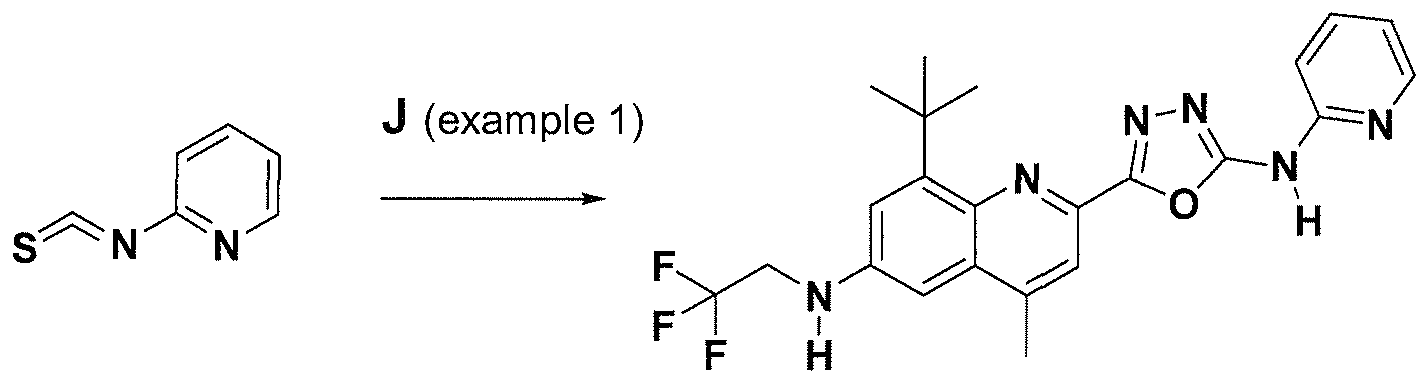
Example 143
Example compound 143 was prepared from J of example 1 in the manner described in example 1.
[1024] H NMR (400 MHz, dmso) δ 1 .39 (s, 1 H), 8.27 (s, 1 H), 7.94 - 7.70 (m, 3H), 7.30 (d, J = 2.3 Hz, 1 H), 7.00 (s, 1 H), 6.89 (t, J = 5.5 Hz, 2H), 4.23 - 3.98 (m, 2H), 2.60 (s, 3H), 1.62 (s, 9H); 19F NMR (376 MHz, dmso) δ -70.56, - 70.58, -70.61 ; MS [M+H]+ = 457.19.
Examples 144-145
Example compounds 144-145 were prepared in themanner similar to example 39.
[1025]
[1026] Example 144

[1028]1H NMR (400 MHz, dmso) δ 1H NMR (400 MHz, dmso) δ 8.26 (d, J = 5.1 Hz, 1 H), 7.84 (s, 2H), 7.19 (s, 1 H), 7.13 (s, 1 H), 7.02 (d, J = 8.4 Hz, 2H), 4.04 (q, J = 9.6 Hz, 2H), 1 .59 (s, 9H); 19F NMR (376 MHz, dmso) δ -70.98, - 71 .01 , -71.03, -75.31 ; MS [M+H]+ = 458.20.
[1029]
[1030] Example 145

[1032]
[1033]1H NMR (400 MHz, dmso) δ 1H NMR (400 MHz, dmso) δ 8.26 (d, J = 5.1 Hz, 1 H), 7.84 (s, 2H), 7.19 (s, 1 H), 7.13 (s, 1 H), 7.02 (d, J = 8.4 Hz, 2H), 4.04 (q, J = 9.6 Hz, 2H), 1.59 (s, 9H); 19F NMR (376 MHz, dmso) δ -70.98, - 71.01 , -71.03, -75.31 ; MS [M+H]+ = 458.20.
[1034]
Example 146

Example 146
1 (1 R,3S,5s)-5-aminocyclohexane-1 ,3-diol was prepared by the method of Fielden (Fielden, John; Sprott, Joanna; Cronin, Leroy, New Journal of Chemistry, 2005 , vol. 29(9) 1 152 - 158. Coupling between 1 and J from example 1 afforded example compound 147.
[1035] 1H NMR (400 MHz, dmso) δ 7.77 (dd, J = 14.3, 7.4 Hz, 2H), 7.27 (d, J = 2.3 Hz, 1 H), 6.88 (s, 1 H), 6.83 (t, J = 6.8 Hz, 1 H), 4.18 - 4.05 (m, 2H), 4.03 (s, 1 H), 3.83 (d, J = 4.6 Hz, 2H), 2.57 (s, 3H), 1.94 (d, J = 12.8 Hz, 3H), 1 .58 (d, J = 6.0 Hz, 9H), 1 .44 (t, J = 9.6 Hz, 3H), 1 .28 - 1.14 (m, 2H); 19F NMR (376 MHz, dmso) δ -70.54, -70.58, -70.60, -70.63, -73.94; MS [M+H]+ = 494.20.
Examples 147-151
Example compounds 147-151 were prepared from J of example 1 and appropriate amines in the manner similar to example 1.
Example 147

Example 147
H NMR (400 MHz, dmso) δ 1 1.05 - 10.92 (m, 1 H), 10.52 - 10.40 (m, 1 H), 7.97 - 7.87 (m, 1 H), 7.87 - 7.79 (m, 1 H), 7.51 - 7.40 (m, 1 H), 7.36 - 7.25 (m, 1 H), 7.27 - 7.14 (m, 2H), 6.90 (m, J = 6.3 Hz, 2H), 6.38 - 6.30 (m, 1 H), 4.21 - 4.03 (m, 2H), 2.64 - 2.54 (m, 3H), 1.71 - 1 .56 (m, 9H); 19F NMR (376 MHz, dmso) δ -70.56, -70.59, -70.61 , -75.32; MS [M+Hf = 495.24 Example 148

Example 148 H NMR (400 MHz, dmso) δ 7.83 (s, 1 H), 7.61 (d, J = 7.4 Hz, 1 H), 7.29 (d, J = 15.3 Hz, 2H), 7.09 (dt, J = 15.6, 7.9 Hz, 2H), 6.90 (d, J = 5.7 Hz, 3H), 4.12 (d, J = 9.2 Hz, 2H), 2.60 (s, 3H), .64 (s, 9H); 19F NMR (376 MHz, dmso) δ - 70.56, -70.58, -70.61 , -75.13; [M+H]+ = 595.22,
Example 149

Example 149
[1036]1H NMR (400 MHz, dmso) δ 10.68 (s, 1H), 7.83 (s, 1H), 7.36 (s, 1H), 7.31 (d, J = 2.3 Hz, 1H), 7.22 (s, 2H), 6.90 (s, 2H), 6.60 (s, 1H), 4.19-4.05 (m, 2H), 2.60 (s, 3H), 1.63 (s, 9H); 19F NMR (376 MHz, dmso) δ -70.56, - 70.58, -70.61 , -74.77; MS [M+Hf = 471.25.
[1037]
Example 150

Example 150
1H NMR (400 MHz, dmso) δ 10.52 (s, 1H), 9.43 (s, 1H), 7.83 (s, 1H), 7.30 (d, J = 2.2 Hz, 1H), 7.15 (s, 1H), 7.13 - 7.02 (m, 2H), 6.90 (s, 2H), 6.40 (d, J = 7.5 Hz, 1H), 4.11 (s, 2H), 2.60 (s, 3H), 1.63 (s, 9H); 19F NMR (376 MHz, dmso) δ 19F NMR (376 MHz, dmso) δ -70.56, -70.59, -70.61, -75.19; MS [M+Hf = 472.38. Example 151

Example 151
[1038] Ή NWIR (400 MHz, dmso) δ 7.80 (s, 1 H), 7.53 (s, 1 H), 7.31 (d, J = 2.2 Hz, 1 H), 7.07 - 6.81 (m, 3H), 6.21 (d, J = 8.0 Hz, 1 H), 4.21 - 4.01 (m, 2H), 2.60 (s, 3H), 1.62 (s, 9H); 19F NMR (376 MHz, dmso) δ -70.55, -70.58, -70.61 , -74.83; MS [M+Hf = 472.20.
Examples 152-155
Example compounds 152-155 were prepared from intermediate F or G and intermediate J of example 1 in themanner similar to example 144.

Preparation of F and G: Step 1 :
A suspension of bis(acetonitrile)dichloropalladium(ll) (79.3 mg, 0.306 mmol) in 3 mL of DCM was treated slowly with a solution of benzyl carbamate 683.2 mg, 4.52 mmol) and 2-cyclohepten-1-one (343.1 mg, 3.119 mmol) in 3 mL of DCM. The reaction was stirred overnight before being diluted with ether,
filtered, and evaporated at 30 °C. Isolation and purification of A was accomplished by flash chromatography (silica gel, ethyl acetate/hexanes) 790 mg. [1039] 1H NMR (400 MHz, cdcl3) δ 7.35 (d, J = 4.4 Hz, 5H), 5.09 (s, 2H); MS [M+H]+ = 261 .88.
Step 2: Sodium borohydide (2.04 g, 54 mmol) was added in five portions over 25 min. at 0 °C to A (6.04 g, 23 mmol) dissolved in approximately 200 ml_ of ethanol. Acetic acid was added cautiously after 42 min. to quench the reaction followed by water and saturated aqueous sodium bicarbonate. Evaporation at 30 °C, partitioning between water and ethyl acetate, extraction of the aqueous with ethyl acetate, washing of the combined organic phases with water and brine, drying (Na2S04), filtration, and evaporation in vacuo at 30 °C afforded crude 7-2. Isolation and purification of B was accomplished by flash chromatography (silica gel 60, ethyl acetate/hexanes, 4.3 g. Step 3:
TEA (715 μΙ_, 519 mg, 5.13 mmol) and DMAP (16.8 mg, 0.14 mmol) were added to a solution of B (540 mg, 2.05 mmol) in 15 ml of DCM. The substrate solution was treated drop-wise with benzoyl chloride (300 μΙ_, 363 mg, 2.58 mmol) dissolved in 5 ml of DCM. After stirring overnight the reaction was diluted with saturated aqueous sodium bicarbonate, phases were split, aqueous extracted with DCM, combined organic phases were washed with brine, dried Na2S04, and evaporated in vacuo at 30 °C. Isolation and purification was accomplished via flash chromatography (silica gel 60, ethyl acetate/hexanes) affording 627.8 mg of C. NMR analysis was strongly suggestive of two isomers (cis/trans) and otherwise consistent with
expectations.
Step 4:
Hydrogenolysis of C (5.45 g, 14.8 mmol) in 200 mL of ethanol with 10% Pd/C Degussa type E101 NE W (394.5 mg) was accomplished using 1 atm P of hydrogen (balloon). Filtration (Celite®), evaporation in vacuo at 30 °C, dissolution in DCM and evaporation (2X) and subjection to high vacuum afforded 3.33 g of D, 96%.
Step 5:
Amine D (1.6 g, 6.868 mmol) was converted to the corresponding
isothiocyanate. Isolation and purification by flash chromatography (silica gel 60, ethyl acetate/hexanes) afforded two racemic isothiocyanates E (cis and trans) . Both isomers were individually dissolved in DCM and evaporated in vacuo and subjected to high vacuum. Each isomer was characterized by its 1H NMR spectrum for purity without specific assignments relative to cis vs. trans isomers, early eluting isomer F 852 mg, late eluting isomer G 662 mg. Each isomer was used as obtained without further characterization. Intermediate F
Early eluting isomer 1H NMR (400 MHz, cdcl3) δ 8.05 - 7.94 (m, 2H), 7.55 (t, J = 7.4 Hz, 1 H), 7.43 (t, J = 7.7 Hz, 2H), 5.35 (m, 1 H), 4.14 - 4.02 (m, 1 H), 2.36 - 2.17 (m, 2H), 2.18 - 1.98 (m, 2H), 1.97 - 1.48 (m, 7H). Intermediate G
Late eluting isomer 1H NMR (400 MHz, cdcl3) δ 8.07 - 7.95 (m, 2H), 7.55 (t, J = 7.4 Hz, 1 H), 7.43 (t, J = 7.6 Hz, 2H), 5.16 (ddd, J = 12.7, 8.5, 4.1 Hz, 1 H), 3.97 (ddd, J = 12.2, 8.4, 4.1 Hz, 1 H), 2.46 - 2.33 (m, 1 H), 2.19 (dt, J = 14.1 , 8.9 Hz, 1 H), 2.08 - 1.83 (m, 4H), 1.83 - 1.65 (m, 2H), 1.67 - 1.43 (m, 3H).
Example 152

Example 152
Example compound 152 was prepared from the more polar thioisocyanate in themanner similar to example 144. 1H NMR (400 MHz, dmso) δ 8.02 - 7.93 (m, 2H), 7.91 (bs, 1 H), 7.61 (t, J = 7.4 Hz, 1 H), 7.48 (t, J = 7.7 Hz, 2H), 7.14 (s, 1 H), 7.04 (s, 1 H), 7.00 (s, 1 H), 6.51 (bs, 2H), 5.26 (m, 1 H), 4.02 (m, J = 9.6 Hz, 2H), 3.91 (m, 1 H), 2.27 (m, J = 14.4 Hz, 1 H), 2.14 (m, J = 8.9 Hz, 1 H), 2.09 (m, 1 H), 1 .95 (m, 1 H), 1.87 - .59 (m, 4H), .54 (s, 9H); 9F NMR (376 MHz, dmso) δ -7 .00, -71.02, - 71.05, -75.34; MS [M+H]+ = 596.24.
Example 153

Example 153
Example compound 153 was prepared from the less polar thioisocyanate F of example 152 in themanner similar to example 144.
[1040] 1H NMR (400 MHz, dmso) δ 7.96 - 7.85 (m, 2H), 7.61 (t, J = 7.4 Hz, 1 H), 7.47 (t, J = 7.7 Hz, 2H), 7.15 (s, 1 H), 7.05 (s, 1 H), 7.01 (s, 1 H), 6.51 (bs, 2H), 5.17 - 5.06 (m, 1 H), 4.02 (m, 2H), 3.71 (m, 1 H), 2.37 (m, 1 H), 2.00 (m, 3H), 1.75 (m, 4H), .55 (s, 9H); 9F NMR (376 MHz, dmso) δ -70.99, -71 .02, - 71 .04, -75.22; MS [M+H]+ = 597.27.
[1041]
Example 154

Example 154
Example compound 154 was obtained by hydrolysis of example compound 152.
[1042]1H NMR (400 MHz, dmso δ 7.85 (bs, 1H), 7.16 (bs, 1H), 7.05 (s, 1H), 7.01 (bs, 2H), 6.53 (bs, 3H), 4.03 (m, 2H), 3.83 (m, 2H), 1.93 (m, 3H), 1.82 - 1.19 (m, 16H); 9F NMR (376 MHz, dmso) δ -70.99, -71.02, -71.04, -75.24; MS [M+H]+ = 493.28.
Example 155

Example 155 Example compound 155 was obtained by hydrolysis of example compound 153.
[1043]1H NMR (400 MHz, dmso) δ 7.16 (bs, 1H), 7.05 (bs, 1H), 7.02 (s, 1H), 6.53 (bs, 1H), 4.03 (m, 2H), 3.67 (m, 1H), 3.56 (m, 1H), 2.11 (m, 1H), 1.88 (m, 1 H), 1.77 (m, 1 H), 1.68 - 1.50 (m, 1 H), 1.45 (m, 3H); 19F NMR (376 MHz, dmso) δ -71.02, -75.29; MS [M+Hf = 493.24.
Example 156

F (example 152) Example 156 B(R=H)
Example 156A:
Example compound 156A was prepared from J of example 1 and the less polar thioisocyanate in the manner similar to example 1.
[1044] 1H N R (400 MHz, dmso) δ 8.03 - 7.92 (m, 3H), 7.73 (s, 1 H), 7.61 (t, J = 7.4 Hz, 1 H), 7.48 (t, J = 7.7 Hz, 2H), 7.26 (d, J = 2.4 Hz, 1 H), 6.87 (s, 1 H), 6.83 (bs, 1 H), 5.27 (m, 1 H), 4.10 (m, 2H), 3.93 (m, 1 H), 2.56 (s, 3H), 2.33 - 2.22 (m, 1 H), 2.17 - 2.11 (m, 1 H), 2.10 (m, 1 H), 1.95 (m, 1 H), 1 .87 - 1.59 (m, 5H), 1.60 - 1.43 (m, 1 1 H); 19F NMR (376 MHz, dmso) δ -70.58, -70.61 , - 70.63, -75.25; MS [M+H]+ = 596.24. Example 156B:
A THF/MeOH (1 :1 v/v, 8 mL) solution containing 80% of the example compound 156A from the (< 0.23 mmol) was treated drop-wise with LiOH monohydrate (47.2 mg, 1 .12 mmol) dissolved in 1 mL of water. The reaction was stirred overnight, evaporated in vacuo at 30 °C, product isolation and purification was accomplished by preparative HPLC affording example compound 156B.
[1045] 1H NMR (400 MHz, dmso) δ 7.91 (d, J = 7.5 Hz, 1 H), 7.75 (s, 1 H), 7.27 (d, J = 2.3 Hz, 1 H), 6.88 (s, 1 H), 6.83 (bs, 1 H), 4.10 (m, 2H), 3.84 (m, 2H), 2.57 (s, 3H), 1.94 (m, 3H), 1.74 (m, 1 H), 1 .70 - 1 .54 (m, 1 1 H), 1 .52 - 1 .35 (m, 3H), 1 .36 - 1 .23 (m, 1 H); 19F NMR (376 MHz, dmso) δ -70.58, -70.60, -70.63, -75.36; MS [M+H]+ = 492.19.
Example 157

Example compound 157 was prepared from J of example 1 and intermediate G of example 152 in the manner similar to example 1 .
[1046]1H NMR (400 MHz, dmso) δ 7.91 (d, J = 7.7 Hz, 1 H), 7.74 (s, 1 H), 7.27 (d, J = 2.3 Hz, 1 H), 6.88 (s, 1 H), 6.84 (bs, 1 H), 4.10 (m, 2H), 3.72 - 3.63 (m, 1 H), 3.57 (m, 1 H), 2.57 (s, 3H), 2.12 (m 1 H), 1.89 (m, 1 H), 1 .78 (m, 1 H), 1.69 - 1 .51 (m, 12H), 1 .50 - 1 .31 (m, 3H)); 9F NMR (376 MHz, dmso) δ -70.58, - 70.61 , -70.63, -75.40; MS [M+H]+ = 492.20.
Example 158

Step 1
Intermediate 1 was prepared using the method of Kingsbury (Kingsbury, William D.; Boehm, Jeffrey C; Jakas, Dalia R.; Holden, Kenneth G.; Hecht, Sidney M, Journal of Medicinal Chemistry, 1991 , 34:1 , 98 - 107);
Step 2
Intermediate 2 was taken up in 700 ml_ MeOH with ammonium formate (195 g, 3.1 mol) in a 3-L rbf with a condenser. A slurry of Pd-C in water was added and the mixture heated to 55 °C. After 16 h the reaction was filtered under N2, washing with EtOH. After concentration in vacuo, the residue was partitioned between water and EtOAc. The organic layer was dried with sodium sulfate and concentrated under strong vacuum to provide the desired product (49.05 g, 88 % yield) as a clear oil.
Step 3
A mixture of the substrate (49.1 g, 274 mmol) and NaHC03 (69.5 g, 274 mmol) in 250 mL DCM and 250 ml_ water was cooled to 0 °C. I2 (69.5 g, 274 mmol) was added portionwise over 1 h follwed by 500 mL 1 N sodium thiosulfate. After an additional 30 min stirring, the layers were separated and the organic layer dried with sodium sulfate and concentrated in vacuo. The residue was purified by flash column chromatography (ISCO®, EtOAc/Hexanes) to provide the desired product (63.1 g, 69% yield) as tan solid that slowly crystallized.
MS [M+H]+ = 413.86. Step 4
A solution of intermediate 4 (25.1 g, 82 mmol) in 175 mL EtOH was treated with diethyl acetylenedicarboxyiate (15.3 g, 90 mmol) and heated to 80 °C for 45 min, then left to stire at 45 °C overnight. The reaction was concentrated in vacuo and the residue purified by flash chromatography (ISCO®, ethyl acetate/hexanes) to provide 30.94 g of the adduct as a yellow powder. This residue was added portionwise to 35 mL of well stirred DPE preheated to 240 °C. the internal temperature stabilized at 210 °C and the mixture was stirred under a stream of N2 for 50 min. After cooling to 120 °C the rapidly stirred solution was diluted with 100 mL hexanes and allowed to coole further to rt. Filtration provided the quinoline product (6.4 g, 71 % yield) as a tan solid. Purification of the mother liquor by flash column chromatography (ISCO®, EtOAc/Hexanes) provided additional product (1.0 g, 13 % yield) as a yellow powder. MS [M+H]+ = 429.1 .
Step 5
A solution of Phenol X (7.4 g, 17 mmol) in 150 mL DCE was treated with oxalyl chloride (3 mL, 34 mmol) and heated to 50 °C for 10 min. The solvent was removed under vacuum, and the residue was slurried in DCE and concentrated again. This was repeated 2 more times. The residue was purified by flash column (ISCO®, EtOAc/Hexanes) to provide the desired product (6.19 g, 76% yield) as a white solid. MS [M+H]+ = 447.91. Step 6
A solution of Intermediate X in 100 mL toluene wa stirred for 5 min under vacuum (-55 torr) and backfilled with N2. Pd(OAc)2 and BINAP were added and the mixture stirred for 5min. Cs2CO3 (6.75 g, 20.7 mmol) and
trifluoroethylamine (5.87 g, 69 mmol) were added and the mixture heated to 85 C for 1 h and at 100 C for 8h. The reaction was cooled to rt and diluted with EtOAc and sat. NaHCO3. The organic layer was dried with MgSO4, filtered thru silica and concentrated. The residue was purified by flash chromatography (ISCO®, EtOAc/Hexanes) to yield the desired product (4.32 g, 75% yield; MS [M-H]+ = 419.1.
Step 7
To a solution of the substrate (2.1 g, 4.37 mmol) in 30 mL degassed dioxane was added Pd2dba3 (100.8 mg, and S-Phos (181 mg, 0.44 mmol) and the mixture stirred for 5min. Methyl boron ic acid (787 mg, 13.1 mmol) and CS2CO3 (5.7 g, 17.5 mmol) were added and the mixture stirred at 100 °C for 1 h. The reaction was diluted with EtOAc and pH 7 phosphate buffer. The organic layer was dried with soldium sulfate and concentrated in vacuo. The residue was purified by flash chromatography ISCO®, EtOAc/Hexanes) to yield the desired product (1.23 g, 62% yield); MS [M+H]+ =399.9.
Step 8
A solution of the substrate (1 .22 g, 3 mmol) in 15 mL EtOH was treated wioth 3 mL hydrazine and stirred at rt for 16 h. The reaction was then filtered,
providing the desired product as a yellow solis (929 mg, 84% yield) .
[M+H]+ = 485.1 .
Example compound 158

Example compound 158 was prepared from the above hydrazide and cyclohexanol in the manner similar to example .
1H-NMR (400 MHz, DMSOj δ 7.88 (d, J = 8 Hz, 1 H), 7.78 (s, 1 H), 7.53 (d, J = 2 Hz, 1 H), 6.97 (s, J = 2 Hz, H), 6.94 (t, J = 7 Hz, 1 H), 4.64 (d, J = 4 Hz, H), 4.1 1 (m, 2H), 3.98 (m, 2H), 3.72 (m, 2H), 3.41 (m, 2H), 2.58 (s, 3H), 2.03 (s, 3H), 2.16 (m, 1 H), 1.95 (ad J = 12 Hz, 1 H), 1 .75 (ad, J = 12 Hz, 1 H), 1.67 (dt, 13, 4 Hz, 1 H); MS [M-H]+ = 508.18.
Example 159

A solution of example compound 158 (2.43 g, 4.8 mmol) in 100 mL THF treated with 10 mL 1 N HCI and heated to 45 C for 2h. The reaction was diluted with EtOAc, washed with sodium bicarbonate and concentrated in vacuo to provide 1 .97 g of the desired product. 1H NMR (400 MHz, dmso) δ 7.93 (t, J = 8 Hz, 1 H), 7.86 (s, 1 H), 7.43 (d, J = 3 Hz, 1 H), 7.20 (d, J = 3 Hz, 1 H), 7.08 (t, J = 7 Hz, 1 h), 4.66 (d, J = 8 Hz, 1 H), 4.18 (a. Quintet, J = 8 Hz, 2H), 3.43 (m, 1 H), 2.81 (s, 3H), 2.62 (s, 3H), 2.15 (m, 1 H), 1.95 (m, 1 H), 1.77
(m, 1 H), 1.68 (m, 1 H); 19F N R (376.1 MHz) δ -70.71 (t, J
H]+ = 464.17.
Example 160

A solution of example compound 159 (480 mg, 1.03 mmol) in 25 mL THF was cooled to -78 C and treated with MeMgBr in THF (3.09 mL, 3M, 9.3 mmol) anf the reaction allowed to stir for 30 min. The mixture was quenched with sat. NH4CI and extracted with EtOAc. After removal of solvent the crude product was filtered thru a silica plug to provide example compound 160 (443 mg, 87%) as a bright yellow solid. 1H-NMR (400 MHz, DMSO δ 7.92 (d, J = 8 Hz), 7.78 (s, 1 H), 7.48 (m, 1 H), 6.92 (m, 2H), 6.45 (s, 1 H), 4.65 (d, J = 4 Hz, 1 H), 4.17 (m, 2H), 3.57 (m, 2H), 2.59 (s, 3H), 2.15 (m, 1 H), 1.95 (s, 1 H), 1 .71 -1 .79 (m, 2H), 1 .68 (s, 6H); 19F NMR (376.1 MHz) δ -70.60(t, J = 1 1 Hz)); MS [M-H]+ = 480.08
Example 161

A solution of example compound 160 (37 mg, 0.07 mmol) in 2 mL MeOH was treated with 0.5 mL methylorthoformate and a small amout of TsOH and stirred at 60 C for 2h. Work up with EtOAc and sat sodium bicarbonate provided the desired product (15.1 mg, 47 % yield) as a yellow solid. MS [M- H]+ = 404.17.
Example 162

A solution of 20 mg of example compound 160 in 10 mL DCM was cooled to 0°C and HBr gas was bubbled in over 30 min. The reaction was sealed and allowed to stir an additional 60 min at rt. The reaction was concentrated and the residue purified by RP-HPLC, providing 2.2 mg (10% yield) of the desired bromide as a yellow powder. 1H-NMR (400 MHz, DMSOJ δ 7.79 (s, 1 H), 7.49 (s, 1 H), 6.94 (m, 2H), 6.46 (d, J = 8 Hz, 1 H), 4.90 (m, 1 H), 4.12 (app Quin, J = 8 Hz, 2H), 3.52 (m, 1 H), 2.59 (s, 3H), 2.24 (m, 2H), 2.01 (m, 2H), 1 .85 (m, 2H), 1 .68 (s, 6H), 1 .48 (m, 2H); 19F NMR (376.1 MHz) δ -70.62 (t, J = 8 Hz); MS [M+Hf = 542.0
Example 163

_ A solution of example compound 160 (31 .7 mg, 0.061 mmol) in 1 mL DCM was stirred with deoxoflour (1 1 .2 mg, 0.061 mmol) for 2h. Dilution with EtOAc and 10 % Na2C03 solution and concentration of the organic provided a yellow solid. This material was dissolved in 0.5 mL 1 :1 THF:MeOH mixture and treated with 0.1 mL 2N LiOH for 15 min. After removal of the solvent, the residue was purified by RP-HPLC to provide the desired product (26 g, 91 % yield); LCMS rt = 2.68 min; [M+H] = 524.10; 19F-NMR (376.1 MHz) δ -
128.28 (sept, J = 26 Hz), -70.61 (t, J = 8 Hz); 1H-NMR (400 mHz, DMSO) δ 7.88 (d, J = 8 Hz, 1 H), 7.78 (s, 1 H), 7.47 (s, 1 H), 7.00 (d, J = 8 Hz, 1 H), 6.96
(s, 1 H), 4.66 (d, J = 4 Hz, 1 H), 4.13 (m, 2 H), 3.42 (m, 1 H), 2.59 (s, 3H), 2.29 (s, 3H), 2.17 (m, 2H), 1.95 (d, J = 26 Hz, 6H), 1 .94 m, 1 H), 1.77 (m, 2H), 1 .68 (m, 2H).

Step 1
A solution of compound I (from example 1 , 300 mg, 0.814 mmol) in DMF (5 ml_) was stirred at -40 °C bath as Selectfluor (431 mg, 1 .217 mmol) was added. The bath temp was slowly warmed to -25 °C over 30 min. After the bath was cooled to -40 °C again, the bath was slowly warmed to 10 °C over 2 h. The reaction mixture was diluted with ethyl acetate and washed with 5% aq. LiCI (x 2). After the aqueous fractions were extracted with ethyl acetate (x 2), the organic fractions were combined, dried (Na2S04) and concentrated. The residue was purified using combiflash with hexanes-ethyl acetate as eluents to obtain compound A (172 mg, 55%) with some impurities. MS
[M+H]+ = 387. Step 2
Compound B (1 19 mg, 72%) was prepared from compound A in a manner similar to that described previously. MS [M+H]+ = 373.
Step 3
Example compound 164 (30 mg, 91 %) was prepared from compound B in a manner similar to that described previously. 1H-N R (400 MHz, CDCI3) δ 7.89 (s, 1 H), 7.32 (d, J = 9.2 Hz, 1 H), 5.74 (br, 1 H), 4.49 (br, 1 H), 3.96 (m, 2H), 3.93 (br, 1 H), 3.85 (br, 1 H), 2.82 (d, J = 7.2 Hz, 3H), 2.33 (br d, J = 1 1.6 Hz, 1 H), 2.02 (br, 1 H), 1 .93 (br, 3H), 1 .65 (s, 9H), 1 .39-1 .66 (m, 4H). 19F NMR (376.1 MHz, CDCI3) δ -72.98 (t, J = 8.7 Hz, 3F), -141.28 (br, 1 F). MS [M+H]+ = 496.
Example 165

Example compound 165 was prepared from B of example 164. (22 mg, 65%) 3 in a manner similar to that described previously. 1H-NMR (400 MHz, CDCI3j δ 7.89 (s, 1 H), 7.32 (d, J = 9.2 Hz, 1 H), 5.74 (br, 1 H), 4.49 (br, 1 H), 3.96 (m, 2H), 3.93 (br, 1 H), 3.85 (br, 1 H), 2.82 (d, J = 7.2 Hz, 3H), 2.33 (br d, J = 11.6 Hz, 1 H), 2.02 (br, 1 H), 1.93 (br, 3H), 1.65 (s, 9H), 1.39-1.66 (m, 4H). 9F NMR (376.1 MHz, CDCI3) δ -72.98 (t, J = 8.7 Hz, 3F), -141 .28 (br, 1 F). MS [M+H]+ = 496.
Example 166

A solution of compound I (50 mg, 0.135 mmol) in DMF (1 imL) was stirred at - 45 °C bath as N-chlorosuccimide (21 mg, 0.154 mmol) was added. The mixture was stirred at rt for 94 h and diluted with 5% aq. LiCI solution before extraction with ethyl acetate (x 2). After the organic extracts were combined, dried (Na2S04) and concentrated, the residue was purified using combiflash with hexanes-ethyl acetate as eluents to obtain compound A (48 mg, 88%). MS [M+H]+ = 403.
Step 2
Compound B (49 mg, quantitative) was prepared from compound A in a manner similar to that described previously. MS [M+H]+ = 389.
Step 3
Example compound 166 (27 mg, 83%) was prepared from compound B in a manner similar to that described previously. 1H-NMR (400 MHz, CDC ) δ 7.92 (s, 1 H), 7.34 (s, 1 H), 5.71 (br, 1 H), 5.23 (br t, J = 6.8 Hz, 1 H), 4.01 (m, 2H), 3.93 (br, 1 H), 3.85 (br, 1 H), 3.05 (s, 3H), 2.33 (br d, J = 11 .2 Hz, 1 H), 2.02 (br, 1 H), 1.93 (br, 3H), 1.66 (s, 9H), 1 .40-1 .70 (m, 4H). 19F NMR (376.1 MHz, CDCI3) δ -72.71 (t, J = 8.7 Hz). MS [M+H = 512.
Example 167

Example compound 167 (24 mg, 75%) was prepared from compound B in manner similar to that described previously. 1H-NMR (400 MHz, CDCI¾) δ 7.92 (s, 1 H), 7.34 (s, 1 H), 5.71 (br, 1 H), 5.23 (br t, J = 6.8 Hz, 1 H), 4.01 (m, 2H), 3.93 (br, 1 H), 3.85 (br, 1 H), 3.05 (s, 3H), 2.33 (br d, J = 1 1 .2 Hz, 1 H),
2.02 (br, 1 H), 1.93 (br, 3H), 1 .66 (s, 9H), 1.40-1 .70 (m, 4H). 19F NMR (376.1 MHz, CDCI3) δ -72.71 (t, J = 8.7 Hz). MS [M+H]+ = 512.

Ste l
A solution of the acid (A, 1 .018 g, 2.99 mmol, prepared from intermediate I, example 1 ), the amine (B, 797 mg, 3.65 mmol) and HATU (1.708 g, 4.49 mmol) in DMF (5 ml_) and dichloromethane (5 mL) was stirred at 0 °C as N- methylmorpholine was added. After 5 min, the mixture was stirred at rt for 2 h and diluted with ethyl acetate before washing with 5% aq. LiCI solution (x 2). After the aqueous fractions were extracted with ethyl acetate (x 1 ), the organic fractions were combined, dried (Na2S04), and concentrated. The residue was purified using combiflash with hexanes-ethyl acetate as eluents to obtain 1.264 g (76%) of compound C. MS [M+Hf = 541.
Step 2
To a solution of compound C (820 mg, 1.52 mmol) in dichloromethane (10 mL) was added trifluoroacetic acid (5 mL) at rt and the resulting solution was
stirred at rt for 3.5 h before concentration. After the residue was treated with aq. NaHC03 solution, the product was extracted with dichloromethane (200 mL x 1 ; 100 mL x 1 ). The extracts were washed with water (x 1 ), combined, dried (Na2S04), and concentrated to obtain 666 mg (quantitative) of the deprotected compound. MS [M+H]+ = 441.
The suspension of the deprotected compound (666 mg, 1.52 mmol) and hydroxylamine hydrochloride (210 mg, 3.02 mmol) in methanol (30 mL) was refluxed for 2 h. The solution was cooled at 0 °C and stirred while some was added until the color of the solution became darker. MS [M+H]+ = 855. After the solution was concentrated, the residue was dissolved in water and THF (10-20 mL each) and aq. saturated NaHC03 (3 mL) was added. The resulting mixture was stirred at 0 °C as benzyl chloroformate (0.32 mL, 2.242 mmol) was added. After 30 min, additional aq. saturated NaHC03 (3 mL) and benzyl chloroformate (0.32 mL, 2.242 mmol) were added. After 30 min, the mixture was diluted with ethyl acetate and washed with water (x 2). After the aqueous fractions were extracted with ethyl acetate (x 1 ), the organic fractions were combined, dried (Na2S04) and concentrated. The residue was purified using combiflash with hexanes-ethyl acetate as eluents to obtain compound D (792 mg, 93%). MS [M+H]+ = 1 123.
Step 3
A solution of compound D (102 mg, 0.091 mmol) in methanol (4 mL) and water (0.4 mL) was stirred at rt as PBu3 (0.03 mL, 0.122 mmol) was added. After 30 min, the solution was concentrated and dried in vacuum. MS [M+H]+ = 563.
The residue was dissolved in THF (5 mL) and stirred at -78 °C as bromoacetyl bromide (0.032 mL, 0.369 mmol) was added. After 30 min, the mixture was warmed at rt and stirred for 2 h before additional bromoacetyl bromide (0.032 mL, 0.369 mmol) was added. After 1 h, the mixture was concentrated and the residue was dissolved in ethyl acetate before washing with aq. NaHC03 solution (x 1 ) and water (x 1 ). The aqueous fractions were extracted with ethyl acetate (x 1 ) and the organic fractions were combined, dried (Na2S04), and concentrated. The residue was purified using combiflash with hexanes-
ethyl acetate as eluents to obtain compound E (59 mg, 48%). MS [M+H]+ = 683.
Step 4
A solution of compound E (59 mg, 0.086 mmol) in THF (3 ml_) was stirred at - 78 °C bath as 1 M solution of LiHMDS in THF (0.2 ml_, 0.2 mmol) was added. After 30 min, aq. NaHC03, water, and ethyl acetate were added to the cold reaction mixture, and the resulting mixture was warmed to rt before two layers were separated. After the aqueous fraction was extracted with ethyl acetate, the organic fractions were washed with water (x 1 ), combined, dried (Na2S04), and concentrated. The residue was purified using combiflash with hexanes- ethyl acetate as eluents to obtain the cyclized product (30 mg, 58%). WIS
[M+H]+ = 603.
A mixture of the cyclic thioester (10 mg, 0.0166 mmol) and Pd(OH)2/C (20% Pd, 20 mg) in ethyl acetate (3 ml_) was stirred under H2 atmosphere for 30 min and the added methanol (1 mL). After 1 .5 h stirring under H2 atmosphere, additional Pd(OH)2/C (20% Pd, 26 mg) was added and the resulting mixture was stirred under H2 atmosphere. After 1.5 h, additional Pd(OH)2/C (20% Pd, 30 mg) was added and the resulting mixture was stirred under H2 atmosphere. After 1.25 h, the mixture was filtered and the filtrate was concentrated and the residue was purified using combiflash with hexanes-ethyl acetate as eluents to obtain example compound 168 (2.7 mg, 35%). 1H-NMR (400 MHz, CDCI3J δ 8.24 (br t, J = 5.8 Hz, 1 H), 8.01 (s, 1 H), 7.13 (d, J = 2.6 Hz, 1 H), 6.86 (d, J = 2.6 Hz, 1 H), 6.21 (br, 1 H), 4.39 (br t, 1 H), 4.04 (br, 1 H), 3.93 (m, 2H), 3.75 (dt, J = 2.8 and 6.0 Hz, 2H), 3.30 (AB qt, J = 17.6 Hz, 2H), 2.91 (dd, J = 13.6 and 4.0 Hz, 1 H), 2.75 (dd, J = 13.6 and 8.0 Hz, 1 H), 2.67 (s, 3H), 1 .65 (s, 9H). 19F NMR (376.1 MHz, CDCI3) δ -72.26 (t, J = 8.8 Hz). MS
[M+H = 469.
Examples 169-170

Example 170
Compound (C).
A mixture of carboxylic acid (A) (prepared from intermediate O of example 39, using procedures described in example 35 and example 39, 309 mg, 0.632mmol), amine (B) (190mg, 0.759mmol) and NMM (0.2ml_, 1.90mmol) DMF (6mL) was added HATU (360mg, 0.95mmol). After I h at room temperature, the reaction mixture was extracted with ethyl acetate and washed with sat'd NaHC03 and brine. The extract was dried (Na2S04) and purified by silica gel column to afford 110mg of compound (C).
MS [M+H]+ = 722.21
Compound (D)
Step (1 )
The compound (C) (60mg, 0.083mmol) was dissolved in THF (5ml), TEA (0.5 ml_), Di-tert-butyl dicarbonate (18 mg, 0.83mmol) and DMAP (10mg) was added to the reaction mixture. After room temperature overnight, the reaction mixture was quenched with water, extracted with ethyl acetate and washed with 1 HCI (aq), sat'd NaHC03 and brine. The extract was dried (Na2S04) and concentrated to give crude mixture.
Step (2)
To above mixture in 10ml of MeOH, was added solution of oxone (1 g) in 10ml of water. After 6h stirring, the reaction mixture was extracted with ethyl acetate, washed with sat'd NaHCO3 and brine. The extract was dried
(Na2SO4) and concentrated to give crude mixture of compound (D).
Compound (E)
Step (1 )
Crude mixture of compound (D) was dissolved in 2ml of TFA, with 10mg of p- TsOH. After stirred for 1 h, the solvent TFA was removed. The residue was dissolved in 2ml EtOAc/2ml 1 N KOH (aq) and stirred for 15min. It was diluted with ethyl acetate and washed with sat'd NaHCO3 and brine. The extract was dried (Na2SO ) and concentrated to give crude mixture.
Step (2)
Above crude mixture was dissolved in EtOAc(I Oml) and EtOH(10ml). After added catalytic amount of 10%Pd/C and a drop of 4N HCI/dioxane, it was flushed with hydrogen three times. It was then stirred under hydrogen atmosphere for 18h. After filtering off catalyst, it was concentrated and purified by HPLC to give both desired product example compound 169 (3mg) and example compound 170 (6mg).
Example compound 169: 1H-NMR (400 MHz, MeOH -d4) δ 7.41 (m, 1 H), 7.27 (m, 1 H), 7.17 (s, 1 H), 4.07-3.99 (m, 2H), 3.69-3.58 (m, 3H), 3.20 (m, 4H),
1.51 (s, 3H), 1 .28 (s, 3H); 19F N R (400 MHz) δ -59.6 (s, 3F), 74.2 (t, 3F), 77.7 (s, 2TFA);
MS [M+H]+ = 544.0
Examples 171-173
The procedures were the same as in Example 39 to afford example compounds 171-173
Example compoun

1H-NMR (400 MHz, MeOH -d4) δ 7.21 (m, 1 H), 7.18 (m, 1 H), 7.09 (s, 1 H), 4.01 -3.94 (m, 2H), 3.66-3.52 (m, 2H), 2.35-2.33 (m, 1 H), 2.07-1.78 (m, 3H), 1 .39-1.17 (m, 4H); 19F NMR (400 MHz) δ -59.1 (s, 3F), 74.0 (t, 3F);
MS [M+H]+ = 507.1
Example compound 172:

Example 172
Step 1 :
The procedures from Example 39 were followed to give A as yellow oil.
Step 2:
A was dissolved in chloroform (1 .5 ml_) and treated with 300 μΙ_ of
trifluoroacetic acid and 150 mg of p-toluenesulfonic acid. The reaction was stirred at rt overnight. The reaction mixture was then concentrated. The residue was dissolved in EtOAc and washed with 1 N NaOH solution. The organic layer was concentrated and the residue was purified by ISCO® chromatography (EtOAc/hexanes) to give example compound 172 as a yellow solid (18 mg, 26%).
[1047] 1H NMR (400 MHz, DMSO- /6) δ 7.87 (d, J = 7.0 Hz, 1 H), 7.31 (s, 1 H), 7.26 (s, 1 H), 7.16 (m, 2H), 4.09 (m, 2H), 3.41 (m, 1 H), 2.20 - 2.12 (m, 2H), 1 .96 - 1.84 (m, 1 H), 1.84 - 1.73 (m, 1 H), 1.73 - 1.66 (m, 1 H), 1.06 (m, 3H); 9F NMR (376.1 MHz) δ -56.39, -71.05; MS [M+H]+ = 507.2; LC/MS RT = 1.93 min.
[1048]
Example compound 173:
[1049]

Example 173 [1050] H NMR (400 MHz, dmso) δ 8.27 (d, J = 4.6 Hz, 1 H), 7.90 (d, J = 8.5 Hz, 1 H), 7.82 (t, J = 7.8 Hz, 1 H), 7.30 (s, 1 H), 7.24 (d, J = 3.3 Hz, 2H), 7.08 - 6.97 (m, 2H), 6.90 (s, 1 H), 4.10 (s, 2H); 19F NMR (376 MHz, dmso) δ -56.37, - 71 .03, -71 .05, -71.08, -75.21 ; MS [M+H]+ = 486.13.
[1051]
Examples 174-178
The procedures were the same as in Example 38 to afford example
compounds 174-178.
Example compound

Example 174
[1052] Ή NMR (400 MHz, dmso) δ 8.26 (s, 1 H), 7.99 (s, 1 H), 7.92 (s, 1 H), 7.81 (t, J = 7.9 Hz, 1 H), 7.46 (s, 1 H), 7.21 (t, J = 6.7 Hz, 1 H), 7.10 (s, 1 H), 7.01 (s, 1 H), 4.30 - 4.13 (m, 2H), 3.87 (s, 1 H), 2.65 (s, 3H); 19F NMR (376 MHz, dmso) δ -56.56, -70.67, -70.70, -70.72; MS [M+H]+ = 485.12.
Example compou

[1053] 1H NMR (400 MHz, dmso) δ 8.14 (d, J = 7.6 Hz, 1 H), 8.02 - 7.95 (m, 2H), 7.88 (s, 1 H), 7.62 (t, J = 7.4 Hz, 1 H), 7.49 (t, J = 7.7 Hz, 2H), 7.42 (s, 1 H), 7.14 (t, J = 6.8 Hz, 1 H), 7.07 (d, J = 2.1 Hz, 1 H), 5.26 (m, 1 H), 4.29 - 4.13 (m, 2H), 3.94 (m, 1 H), 2.60 (s, 3H), 2.26 (m, J = 21.8 Hz, 2H), 2.1 1 (m, J = 20.1 Hz, 2H), 1.96 (m, 1 H), 1.86 - 1.42 (m, 7H; 19F NMR (376 MHz, dmso) δ -56.59, -70.69, -70.72, -70.75, -75.09; MS [M+H]+ = 624.13.
[1054]
Example compound 176:

[1055]1H NMR (400 MHz, dmso) 8.04 (d, J = 7.7 Hz, 1H), 7.90 (s, 1H), 7.42 (s, 1H), 7.14 (s, 1H), 7.07 (d, J = 2.0 Hz, 1H), 4.30 - 4.11 (m, 2H), 3.83 (d, J = 3.7 Hz, 2H), 2.61 (s, 3H), 1.92 (dd, J = 14.6, 8.7 Hz, 3H), 1.72 (d, J = 4.2 Hz, 1H), 1.64 (s, 2H), 1.54 - 1.21 (m, 4H); 19F NMR (376 MHz, dmso) δ -56.58, - 70.69, -70.72, -70.75, -75.35; MS [M+Hf = 520.12. [1056]
Example compou

[1057]1H NMR (400 MHz, dmso) δ 8.14 (d, J = 7.4 Hz, 1 H), 7.90 (dd, J = 8.2, 6.8 Hz, 3H), 7.60 (t, J = 7.4 Hz, 1 H), 7.47 (t, J = 7.7 Hz, 2H), 7.42 (s, 1 H), 7.14 (t, J = 6.5 Hz, 1H), 7.07 (d, J = 2.2 Hz, 1H), 5.17-5.08 (m, 1H), 4.27- 4.13 (m,2H), 3.75 (m, 1H), 2.61 (s, 3H), 2.36 (m, 1H), 1.98 (m, 3H), 1.88- 1.77 (m, 1 H), 1.78 - 1.61 (m, 3H), 1.53 (m, 2H); 19F NMR (376 MHz, dmso) δ -56.60, -70.69, -70.72, -70.75, -75.17; MS [M+H]+ = 624.11.
[1058]
Example compound 178:
[1059]
[1060]

[1061]1H NMR (400 MHz, dmso) δ 8.02 (d, J = 7.5 Hz, 1 H), 7.89 (s, 1 H), 7.42 (s, 1 H), 7.14 (m, 1 H), 7.07 (d, J = 2.0 Hz, 1 H), 4.27 - 4.13 (m, 2H), 3.64 (m, 1 H), 3.57 (m, 1 H), 2.61 (s, 3H), 2.13 (m, 1 H), 1 .89 (m, 1 H), 1 .78 (m, 1 H), 1 .59 (m, 11.3 Hz, 4H), 1 .50 - 1 .32 (m, 3H); 19F NMR (376 MHz, dmso) δ 9F NMR (376 MHz, dmso) δ -56.59, -70.69, -70.72, -70.74, -75.32; MS [M+Hf =
520.11.
Example 179

Step 1 :
Intermediate 2 from example 50 (50 mg, 0.1232 mmol), dissolved in DCM (2 ml_), was cooled to 0 °C and treated with 2,6-lutidine (25 μΐ_, 0.2094 mmol), followed by triflic anhydride (200 μΙ_, 0.1970 mmol, 1 M in DCM). The reaction mixture was slowly warmed to rt. After 3 h, the reaction mixture was diluted with water and the layers were separated. The organic layer was purified by ISCO® chromatography (EtOAc/hexanes) to give A as an off-white solid (41 mg, 62%).
Step 2:
A (41 mg, 0.0762 mmol), dissolved in ethanol (1 ml_) was treated with hydrazine hydrate (17 μΐ_, 0.2286 mmol). The reaction mixture was heated at
55 °C overnight. After cooling to rt, the reaction mixture was concentrated. The residue was dissolved in EtOAc and washed with water. The organic layer was concentrated to give B as a yellow solid (37 mg, 92%).
Step 3:
The procedures from Example 1 were followed to give C as a yellow oil (26 mg, 51 %).
Step 4:
Deprotection of of C gave example compound 179 as a yellow solid (2 mg, 10%).
[1062] 1H NMR (400 MHz, DMSO-d6) δ 8.38 (d, J - 6.4 Hz, 1 H), 7.86 (s, H), 7.61 (s, 1 H), 7.51 (s, 1 H), 5.92 (dd, J = 69.4, 43.1 Hz, 2H), 3.77 (dt, J = 15.5, 7.7 Hz, 1 H), 2.76 - 2.67 (m, 2H), 2.60 (s, 3H), 2.13 (d, J = 9.8 Hz, 2H), 1.59 (s, 9H); 19F NMR (376.1 MHz) δ -76.21 , -133.04; MS [M+H]+ = 550.1 ; LC/MS RT = 2.37 min.
Examples 180-185
The procedures were the same as in Example 38 to afford example compounds 180-185.
Examples 180-185

The example compounds were made according to procedures described example 42.
Example compound 180:
[1063] 1H NMR (400 MHz, DMSO-d6) δ 7.80 - 7.76 (m, 1H), 7.69 (s, 1H), 7.36 -7.32 (m, 1H), 6.55-6.50 (m, 1H), 6.21 -6.13 (m, 1H), 4.65 (s, 1H), 3.45- 3.37 (m,2H), 2.91 (s, 2H), 2.53 (s, 3H), 2.23 - 2.13 (m, 1H), 1.99- 1.89 (m, 1H), 1.83- 1.74 (m, 1H), 1.74 - 1.63 (m, 2H), 1.58 (s, 9H), 1.25- 1.14 (m, 3H), 0.99 (s, 9H); MS [M+H]+ = 466.2; LC/MS RT = 2.62 min.
Example compound 181
[1064]
[1065] lH NMR (400 MHz, DMSO-t6) δ 7.81 (d, J= 7.6 Hz, 1H), 7.73 (s, 1H), 7.26 (s, 1H), 6.71 (d, J= 5.6 Hz, 2H), 4.65 (d, J= 4.5 Hz, 1H), 3.42 (s, 2H), 3.37 (d, J = 5.8 Hz, 2H), 2.56 (s, 3H), 2.16 (s, 1H), 1.93 (s, 1H), 1.77 (s, 2H), 1.67 (s, 1H), 1.59 (s, 9H), 1.26 (dd,J = 7.1, 4.6 Hz, 2H), 1.23 - 1.12 (m, 2H), 1.08 (q,J= 4.8 Hz, 2H); MS [M+H]+ = 475.2; LC/MS RT = 2.35 min.
Example compound 182:
[1066]
[1067] 1H NMR (400 MHz, DMSO-c/6) δ 7.82 (s, 1H), 7.73 (s, 1H), 7.29 (s, 1 H), 6.70 (s, 1 H), 6.62 (m, 1 H), 4.64 (d, J = 4.3 Hz, 1 H), 3.64 (m, 2H), 3.42 - 3.32 (m,2H),2.55 (s, 3H), 2.22 - 2.10 (m, 1H), 1.99- 1.87 (m, 1H), 1.80 (m, 1 H), 1.67 (m, 1 H), 1.58 (s, 9H), 1.21 (m, 3H); 19F NMR (376.1 MHz) δ -93.70; MS [M+H]+ = 474.2; LC/MS RT = 2.42 min.
Example compound 183:
[1068]
[1069] H NMR (400 MHz, DMSO-c/6) δ 7.80 (s, 1H), 7.72 (s, 1H), 7.29 (s, 1 H), 6.76 (s, 1 H), 6.62 (s, 1 H), 4.64 (d, J = 4.3 Hz, 1 H), 3.64 (m, 2H), 3.48 - 3.32 (m,2H),2.55 (s, 3H), 2.22 - 2.10 (m, 1H), 1.99-1.87 (m, 1H), 1.80 (m, 1 H), 1.67 (m, 1 H), 1.58 (s, 9H), 1.21 (m, 3H); 19F NMR (376.1 MHz) δ -93.74; MS [M+H]+ = 474.2; LC/MS RT = 2.41 min.
[1070]
Example compound 184:
[1071]
[1072]1H NMR (400 MHz, DMSO-c/6) δ 7.81 (d, J = 7.5 Hz, 1 H), 7.73 (s, 1H), 7.25 (s, 1H), 6.74 (s, 1H), 6.62 (s, 1H), 6.19 (s, 1H), 4.65 (d, J = 4.6 Hz, 1H), 3.64 (s, 2H), 3.42 (s, 2H), 2.56 (s, 3H), 2.22 -2.13 (m, 1H), 1.99- 1.89 (m, 1 H), 1.84 - 1.73 (m, 1 H), 1.67 (s, 1 H), 1.58 (s, 9H), 1.19 (d, J = 11.5 Hz, 2H), 1.09-0.96 (m, 1H); 19F NMR (376.1 MHz) δ -121.42; MS [M+H]+ = 460.2; LC/MS RT = 2.39 min.
Example compound 185:
[1073]
[1074]1H NMR (400 MHz, DMSO-c/6) δ 7.85 (d, J = 7.8 Hz, 1H), 7.75 (s, 1H), 7.28 (s, 1H), 6.85 (s, 1H), 6.82 (s, 1H), 4.66 (s, 1H), 4.15 (s, 2H), 3.41 (s, 2H), 2.56 (s, 3H), 2.16 (s, 1H), 1.98-1.89 (m, 1H), 1.83- 1.73 (m, 1H), 1.71 - 1.64 (m, 1H), 1.58 (s, 9H), 1.19 (d, J = 11.1 Hz, 3H); 19F NMR (376.1 MHz) δ - 83.48, -120.16; MS [M+H]+ = 528.2; LC/MS RT = 2.53 min.
[1075]
[1076] Example 186

[1077]
Example compound 186 was made according to procedures described in example 42.
[1078] 1H NMR (400 MHz, DMSO-J6) δ 7.87 (d, J= 7.0 Hz, 1H), 7.81 (s, 1H), 6.98 (s, 1H), 6.75 (s, 1H), 4.46 (t, J= 12.4 Hz, 4H), 3.43 (s, 3H), 2.60 (s, 3H), 2.23 - 2.11 (m, 1H), 1.98 - 1.88 (m, 1H), 1.84 - 1.73 (m, 1H), 1.73 - 1.65 (m, 1H), 1.61 (s, 9H), 1.20 (d, J= 11.2 Hz, 3H); 'V NMR (376.1 MHz) δ -99.16; MS [M+H]+ = 472.2; LC/MS RT = 2.52 min.
[1079]
Example 187

BB Example 187
Preparation of Intermediate C:
2-Chloro-2,2-difluoroacetamide (500 mg, 3.846 mmol) dissolved in THF (30 mL) was treated with 1 M borane in THF solution (19.23 mmol, 19 mL). The reaction mixture was slowly heated to 60 °C for 2 h. After cooling to rt, the reaction mixture was cooled to 0 °C and quenched by slowing the slow, dropwise addition of methanol. After the bubbling subsided, the reaction mixture was warmed to rt and concentrated in vacuo to give intermediate C as a white solid (450 mg, 100 %).
Step 1 :
The procedures from Step 1 of Example 3 were followed to give
Intermediate AA as a yellow solid.
Step 2:
The procedures from Step 2 of Example 3 were followed to give
Intermediate BB as a yellow solid.
Step 3:
The procedures from Step 3 of Example 3 were followed to give example compound 187 as a yellow solid (3 mg, 23%).
[1080]1H NMR (400 MHz, DMSO-d6) δ 7.83 (d, J = 7.4 Hz, 1 H), 7.74 (s, 1 H), 7.28 (s, 1 H), 6.96 (m, 1 H), 6.91 (s, 1 H), 4.65 (d, J = 4.5 Hz, 1 H), 4.22 (m, 2H), 3.48 - 3.33 (m, 2H), 2.57 (s, 3H), 2.22 - 2.12 (m, 1 H), 1.99 - 1.89 (m, 1 H), 1 .83 - 1 .73 (m, 1 H), 1 .73 - 1.63 (m, 1 H), 1 .21 (m, 3H); 19F NMR (376.1 MHz) δ -56.95; MS [M+Hf = 494.2; LC/MS RT = 2.42 min.
[1081]
Biological Data
Biological properties of the exemplified compounds were determined using the assay presented below, and the results are found in Table I.
HCV replicon assay
Compounds are tested for antiviral activity in the HCV replicon harboring a reporter (human Renilla luciferase) and HCV subgenomic RNA derived from H77 (GT1a), Con1 (GT1b), or JFH-1(GT2a) strain. Replicon cells are maintained in Dulbecco's Modified Eagle Medium (DMEM) supplemented with glutamine, 10% FBS, 0.5 mg/ml of G-418, Pen-Strep, and non-essential amino acids. Cells are seeded in 384-well assay plates. Compounds are serially diluted in 100% DMSO and subsequently added into cells in assay plates at 1 :225. Following three day incubation at 37°C, the activity of Renilla luciferase in replicon cells is quantified as a marker of HCV replication using the Dual-Glo luciferase assay system from
Promega. Luciferase levels were converted into percentages relative to the untreated controls (defined as 100%) and data were fit to the logistic dose response equation y = a/(1 +(x/b)c) using a dose response tool. EC50 values were calculated as the compound concentration (x) at 50% inhibition (y) from the resulting equations in
which a represents the curve's amplitude, b is the x value at its transition center, and c is a parameter which defines its transition width.
Table I: Biological Activity of Exemplified Compounds

4444.4 1.371 1.511 53.248
24 0.04 0.1 1.4
244.51 0.074 0.452 9.796
2137.7 1.481 0.803 32.361
57.973 0.051 0.215 2.722
209.96 0.034 0.218 11.214
188.65 0.119 0.221 3.689
222.44 0.59 1.987 46.777
253.58 0.085 0.147 23.799
375.01 0.183 0.843 12.191
3423.1 9.955 18.064 306.65
1247 0.969 5.335 313.68
1945.1 0.297 11.708 221.06
4435.9 4.274 4.261 73.274
4444.4 42.88 197.03 444.44
2358.7 23.066 83.13 444.44
2213.6 75.6 444.44 444.44
41.164 0.028 0.064 1.956
25.752 0.044 0.08 0.751
4444.4 55.154 326.06 444.44
4444.4 223.03 444.44 444.44
454.86 0.078 0.411 45.27
4403.2 509.48 134.17 444.44
4444.4 14.094 47.298 444.44
3297.3 444.44 98.105 444.44
2332.3 0.571 0.436 8.594
2860 569.96 3496.1 444.44
33.217 0.318 1.397 43.962
150.79 0.947 21.1 18 430.08
176.97 0.269 3.022 46.738
328.76 0.162 3.579 87.801
11.48 0.157 0.207 2.979
4 0.2 0.3 NA
4.765 4.983 7.859 8.899
285.19 0.147 1.247 37.799
886.04 0.356 1.404 52.015
1489 1.447 2.107 72.953
1602.9 0.393 1.529 40.107
1704.9 0.069 0.278 22.607
2274.1 0.252 15.565 159.77
4249.9 2.321 30.659 404.64
1594 0.791 3.743 69.278
431.9 2.626 15.76 156.68
3149.8 0.23 1.968 26.357
2935.6 0.1 18 0.415 7.922
4444.4 49.725 712.16 444.44
2397.2 2.961 20.934 197.78
1382.2 3.023 4.451 94.073
1757 1.577 5.44 204.5
196.14 0.099 0.34 16.472
40.58 0.042 0.213 4.043
197.74 0.25 0.826 35.444
408.53 0.347 0.151 8.825
1339.6 0.321 0.345 26.581
1476.3 0.594 0.502 40.89
633.56 0.329 3.872 248.14
2555 34 444
2057 14 444
99.894 0.069 0.338 2.126
179.23 0.113 0.08 0.908
213.23 0.117 0.612 9.553
2757.6 1.286 1.152 22.277
3327.5 4.991 76.776
4444.4 2.438 15.099 238.44
71 2690.5 15.871 46.452 444.44
72 2273.5 20.738 43.214 444.44
73 2912 133.96 641.42 444.44
74 4444.4 0.845 0.45 31.088
75 2298.5 0.422 1.711 51.763
76 4444.4 81.884 444.44 444.44
77 4444.4 264.26 444.44 444.44
78 3625.4 1.016 0.276 10.615
79 4444.4 6.06 2.596 170.25
80 4444.4 1.458 0.681 86.132
81 4444.4 2.906 6.683 444.44
82 1567.1 0.427 3.018 217.21
82 2534.8 2.392 19.61 444.44
S3 4444.4 2.79 1.557 133.37
84 4444.4 4.979 1.696 123.11
85 4444.4 1.852 19.462 444.44
86 4444.4 20.848 194.44 444.44
87 1355.3 0.475 3.462 112.78
88 1692 0.416 3.505 120.34
89 2118.3 1.131 3.403 356.73
90 4444.4 4.402 43.671 444.44
91 4444.4 3.829 0.978 91.748
92 4444.4 2.761 6.749 439.46
93 842.16 0.782 8.302 444.44
94 245.74 0.704 13.153 444.44
95 263.49 0.834 3.128 16.966
96 470.42 7.681 21.245 263.19
97 1207.4 0.765 1.138 9.473
98 1342.4 6.761 1.604 179.62
99 1465.1 3.386 0,582 74.09
100 2005.3 0.225 0.211 16.91
101 4444.4 198.16 329.13 444.44
102 4444.4 8982.6 32.734 444.44
103 2485.6 1.663 0.18 12.763
104 2668 2.077 2.048 20.082
105 4444.4 11.709 13.655 218.56
106 514.5 0.704 0.218 3.498
106 980.63 388.06 444.44 444.44
106 1089.3 10.194 112.82 444.44
106 1889.6 227.84 170.94 444.44
106 337.3 0.486 0.167 3.767
106 649.57 0.317 0.217 3.819
106 47.528 0.599 2.816 52.846
106 13.406 0.088 0.154 2.151
106 87 0.19 0.39 10
107 1047.5 284.65 92.605 444.44
108 755 5.2 1.6 "08
109 48.23 1.144 1.956 133.32
110 508.43 1.673 4.67 444.44
111 1334.3 6.418 18.809 444.44
112 1136.6 1.077 1.366 23.72
113 3012.3 160.52 298.83 444.44
114 1175.6 444.44 444.44 444.44
115 358 0.2 0.6 31
116 423 0.7 0.5 31
117 8.053 0.053 0.114 2.874
118 691.47 0.967 0.377 12.065
119 508.06 0.916 1.183 43.077
120 534.6 0.939 1.253 61.96
121 3846.8 8.683 29.101 444.44
122 14.228 0.15 0.2 1.558
123 6.049 0.059 0.079 0.9
124 1738.4 6.322 14.362 444.44
125 753.84 0.951 1.306 39,893
126 811.43 8.377 9.968 150.43
127 2757.9 60.076 12.482 444.44
128 65.677 0.137 0.392 5.013
129 123.4 0.384 0.638 7.603
130 595.93 4.163 4.657 87.289
131 34.88 0.27 0.254 4.787
132 3586.3 30.286 42.32 444.44
133 1539.1 3.083 10.209 291.19
134 80.572 0.101 0.225 2.863
135 34.144 0.04 0.118 2.184
136 32.048 0.05 0.121 2.561
137 597.8 2.272 6.28 77.406
138 1986.7 7.359 14.8 252.91
139 1281.1 1.515 0.522 35.642
140 14.663 0.028 0.116 2.467
141 4444.4 27.598 157.29 444.44
142 1442.5 1.06 3.934 92.16
143 100.72 0.201 0.184 0.991
°| 49.786 0.453 0.259 1.525
145 131.82 0.382 0.512 7.526
146 2333.4 1.054 6.054 208.73
1 7 595.8 20.242 4.43 388.72
148 665.79 58.512 116.15 444.44
149 26.233 0.157 0.169 1.516
150 209.99 0.285 0.454 15.07
151 122.4 0.113 0.2 2.367
152 2725.2 11.517 14.424 170.32
153 711.48 1.577 1.623 128.62
154 1164.4 2.712 5.451 98.307
155 241.64 0.438 1.758 90.073
156 888.48 1.321 2.471 120.52
156 1079.2 4.34 10.217 175.65
157 420.46 0.564 1.3 98.359
158 382.37 3.499 16.217 209
159 1086.3 5.01 25.092 408.41
160 555.41 4.672 16.066 398.82
161 104.6 0.37 0.95 21.026
2491.6 60.019 58.719 404.87
163 102.46 0.487 1.612 17.991
164 2876.1 2.361 5.514 240.52
165 1786.3 14.393 54.036 444.44
166 2272.9 19.126 13.113 157.93
167 2714.5 21.783 35.13 437.47
168 4444.4 42.204 51.678 444.44
169 1084.4 3.624 40.231 444.44
170 3858.9 11.691 168.42 444.44
171 614.07 6.443 111.2 444.44
172 176.56 10.359 100.96 444.44
173 48.442 2.005 1.193 9.194
174 4444.4 0.383 0.3 1.56
175 4444.4 444.44 444.44 444.44
176 3593 75.788 444.44 444.44
177 744.85 15.233 79.891 444.44
178 366.09 7.18 40.267 444.44
179 4444.4 135.02 414.96 444.44
180 187.46 0.325 1.433 119.69
181 109.32 0.138 0.482 74.466
182 13.967 0.037 0.121 2.005
183 28.487 0.086 0.186 2.718
184 19.252 0.071 0.158 2.323
185 693 0.2 2.6 257
186 536.44 0.224 1.616 28.252
187 19.919 0.077 0.127 1.716
Claims
1. A compound of Formula

or a pharmaceutically acceptable salt thereof, wherein:
R1 is (d - C8) alkyl, NR9R10, halo, amino, -C≡N, (C2-C8) alkenyl, C2-C8) alkynyl, (C C8) haloalkyl,
(C2-C8) haloalkenyl, (C2-C8) haloalkynyl, (CrC8)alkoxy, (Ci-C8) haloalkoxy, (d - C6) alkyl (d - C6) alkoxy, 4-7 membered heterocyclyl, 5-6 membered heteroaryl, CH(O), C(0)OR8 , SF5, -OH, -SH, (d - C6) hydroxyalkyl, (d- C4)alkylsulfonyi, aminosulfonyl, amino(d-C4)alkylsulfonyl or aryl;
R2 is C(0)NR11R12 , C(0)R13, 5 membered heterocycle, or 5 membered heteroaryl ;
R3 is H, (d - C6) alkyl, (C2-C6)alkenyl, (C2-C6)alkynyl, (C C3)alkoxy, hydroxyl, halo, amino, amido, amino(d-C8)alkylamido, heterocyclyl, sulfonyl, aminosulfonyl, amino(d-C8)alkysulfonyl, cyano, or (d-C3)haloalkyl;
R4 is (Ci - C6) alkyl, either unsubstituted or substituted with halo, (Ci - C6) alkoxy, (d - C6) haloalkoxy, S(0)-R6, S(0)2, S(0)2-R6, S(0)2, C(0)R6, C(0)OR7 or
(C3-C6)cycloalkyl;
R5 is H or halo;
R6 is H, (d - C6) alkyl, (d - C6) alkoxy or (d - d) haloalkyl;
R7 is H, (d - C6) alkyl, (d - C6) alkoxy or (C1 - C6) haloalkyl;
R8 is H, (Ci - Ce) alkyl or (d - C6) haloalkyl;
R9 is H, (d - C4) alkyl, said (d - C4) alkyl being unsusbstituted or substituted with one
or more halo; R10 is H, (d - C4) alkyl, said (C-i - C4) alkyl being unsusbstituted or substituted with one
or more halo, or R9 and R10, together with the nitrogen atom to which they are attached, form a 4 or 5 membered nitrogen containing heterocycle, said 4 or 5 membered nitrogen containing heterocycle being unsubstituted or substituted with one or more halo;
R11 is H, (Ci - C4) alkyl, (d - C4) haloalkyl, 5-6 membered heterocycle or
5-6 membered heteroaryl;;
R 2 is H , (C-i - C4) alkyl or (Ci - C4) haloalkyl; or
R11 and R12, together with the nitrogen atom to which they are attached, form a 5 or 6 membered nitrogen containing heterocycle, said 5 or 6 membered nitrogen containing heterocycle being unsubstituted or substituted with OH, halo, =0, or (d - C6) alkyl;
R13 is OH, 0-(d - C4) alkyl;
R14 is H or halo;
R15 is H, (Ci - C6) alkyl, (C^ - C6) haloalkyl, 4-7 membered heterocycle, 5-6 membered
heteroaryl, 3-7 membered cycloalkyi, and wherein each of said 4-7
membered heterocycle, 5-6 membered heteroaryl, 3-7 membered cycloalkyi is unsubstituted or substituted at a substitutable position with one or more =0,
OH, (d - C6) alkyl, (d - C6) haloalkyl, (d - C6) alkoxy, amino, or , (d - C6) aminoalkyl;
R16 is H, (d - C6) alkyl, or (d - C6) haloalkyl;
provided that when one of R15 or R16 is H, the other is not H; and
R23 is H or halo.
2. The compound of claim 1 wherein R2 is a 5 membered heteroaryl.
3. The compound of claim 2 wherein  , and X is O, NH, CH, or S.
4. The compound of claim 1 wherein R^ is C(0)NR11 R12.
5. The compound of claim 1 wherein R4 is (d - C6) alkyl, either unsubstituted substituted with halo, (C1 - C6) alkoxy, or (d - C6) haloalkoxy.
6. The compound of claim 1 wherein R1 is (d - C8) alkyl, (d-d) haloalkyl, amino, or (d-d) haloalkoxy.
7. A compound of Formula II:

(II)
or a pharmaceutically acceptable salt thereof, wherein:
X is O or S; R1 is (Ci - Ce) alkyl, O - (d - Ce) alkyl, O - (d - Ce) haloalkyl, NR9R10, Halo, (C2- d)
alkenyl, d-d) alkynyl, (C C6) haloalkyl, O - (d - Ce) haloalkyl, (d-d) haloalkenyl, (d-d) haloalkynyl, (d-C6)alkoxy, or (d-C6) haloalkoxy,;
R3 is H, (d - Ce) alkyl, (C2-C6)alkenyl, (C2-C6)alkynyl, (d-C3)alkoxy, amino, or (d-d)haloalkyl;
R4 is H, (Ci - C6) alkyl, either unsubstituted or substituted with halo, (d - d) alkoxy, S(O), S(0)2, S(0)CH3, S(0)2CH3, C(0)R6, C(0)OR7 or (C3-Ce)cycloalkyl, said (C3-C6)cycloalkyl being unsusbstituted or substituted with one or more halo, amino, (d - d) alkyl, or (d-C6) haloalkyl;
R20 is H, (d - C6) alkyl, either unsubstituted or substituted with halo, or (Ci - C6) alkoxy;
or R4 and R20, together with the nitrogen atom to which they are attached, form a 4-6 membered nitrogen heterocycle, said 4-6 membered nitrogen heterocycle being unsubstituted or substituted with one or more halo, hydroxyl or amino;
R5 is H, (d - C6) alkyl or (d - C6) haloalkyl;
R6 is H, (d - C6) alkyl or (d - C6) haloalkyl;
R7 is H, (d - C6) alkyl or (d - C6) haloalkyl;
R8 is H, (d - C6) alkyl or (d - Ce) haloalkyl;
R9 is H, (d - C4) alkyl, said (d - d) alkyl being unsusbstituted or substituted with one
or more halo;
R10 is H, (d - C4) alkyl, said (d - d) alkyl being unsusbstituted or substituted with one
or more halo, or R9and R10, together with the nitrogen atom to which they are attached, form a 4 or 5 membered nitrogen containing heterocycle, said 4 or 5 membered nitrogen containing heterocycle being unsubstituted or substituted with one or more halo;
R11 is H or (d - d) alkyl;
R12 is H or (d - d) alkyl, or
R11 and R12, together with the nitrogen atom to which they are attached, form a 5 or 6 membered nitrogen containing heterocycle, said 5 or 6 membered nitrogen containing heterocycle being unsubstituted or substituted with OH, halo, =0, or (d - d) alkyl;
R13 is OH, 0-(C, - d) alkyl;
R14 is H or halo;
R15 is H, (Ci - C6) alkyl, (d - C6) haloalkyl, 4-7 membered heterocycle,
5-6 membered heteroaryl, 3-7 membered cycloalkyl, and wherein each of said 4-7 membered heterocycle, 5-6 membered heteroaryl, 3-7 membered cycloalkyl is unsubstituted or substituted at a substitutable position with one or more =0, OH, (d - C6) alkyl, (d - C6) haloalkyl, (d - C6) alkoxy, amino, or , (d - C6) aminoalkyl;
R16 is H, (d - C6) alkyl, or (d - C6) haloalkyl;
provided that when one of R15 or R16 is H, the other is not H.
R17 is (d - C6) alkyl, either unsubstituted or substituted with halo, or NR21R22;
R21 is H, (Ci - C6) alkyl, either unsubstituted or substituted with halo, (d - C6)
alkoxy, 3-7 membered cycloalkyl, and wherein each of said 4-7 membered heterocycle, 5-6 membered heteroaryl, 3-7 membered cycloalkyl is unsubstituted or substituted at a substitutable position with one or more =0, OH, (d - Ce) alkyl, (d - C6) haloalkyl, (d - Ce) alkoxy, amino, 4-7 membered heterocycle, 5-6 membered heteroaryl, 3-7 membered cycloalkyi or (d - C6) aminoalkyl;
R22 is H, (d - d) alkyl, either unsubstituted or substituted with halo, (d - d)
alkoxy, 3-7 membered cycloalkyi, and wherein each of said 4-7 membered heterocycle, 5-6 membered heteroaryl, 3-7 membered cycloalkyi is unsubstituted or substituted at a substitutable position with one or more =0, OH, (d - d) alkyl, (d - d) haloalkyl, (d - d) alkoxy, amino, 4-7 membered heterocycle, 5-6 membered heteroaryl, 3-7 membered cycloalkyi or (d - d) aminoalkyl; and
R23 is H or halo.
8. The compound of claim 7 wherein X is O.
9. The compound of claim 7 wherein R4 is (d - d) alkyl, either unsubstituted or substituted with halo, (d - d) alkoxy, or (d - d) haloalkoxy.
10. The compound of claim 7 wherein R1 is (d - d) alkyl, (d-d) haloalkyl, amino,
or (d-d) haloalkoxy.
11. A compound of Formula III:

(III)
or a pharmaceutically acceptable salt thereof, wherein: R1 is (d - Ce) alkyl, O - (C1 - C6) alkyl, O - (d - C6) haloalkyl, NR9R10, Halo,
(C2-C8) alkenyl, C2-C8) alkynyl, (d-d) haloalkyl, O - (d - C6) haloalkyl, (C2- d) haloalkenyl, (d-d) haloalkynyl, (d-d)alkoxy, or (d-d) haloalkoxy,; R3 is H, (d - d) alkyl, (d-d)alkenyl, (d-d)alkynyl, (CrC3)alkoxy, amino, or (d-d)haloalkyl;
R4 is H, (d - d) alkyl, either unsubstituted or substituted with halo, (d - d) alkoxy, S(O), S(0)2, S(0)CH3, S(0)2CH3, C(0)R6, C(0)OR7 or (d-d)cycloalkyl, said (d-d)cycloalkyl being unsusbstituted or substituted with one or more halo, amino, (d - d) alkyl, or (d-d) haloalkyl;
R24 is H, (d - d) alkyl, either unsubstituted or substituted with halo, (d - d) alkoxy,
S(O), S(0)2, S(0)CH3, S(0)2CH3, C(0)R6, C(0)OR7 or (d-d)cycloalkyl, said (d-d)cycloalkyl being unsusbstituted or substituted with one or more halo, amino, (d - d) alkyl, or (d-d) haloalkyl; or
R4 and R24, together with the nitrogen atom to which they are attached, form a
4-6 membered nitrogen heterocycle, said 4-6 membered nitrogen heterocycle being unsubstituted or substituted with one or more halo, hydroxyl or amino; R5 is H or halo;
R6 is H, (d - d) alkyl or (d - d) haloalkyl;
R7 is H, (d - d) alkyl or (d - C6) haloalkyl;
R8 is H, (d - d) alkyl or (d - d) haloalkyl;
R9 is H, (d - d) alkyl, said (d - d) alkyl being unsusbstituted or substituted with one
or more halo;
R10 is H, (d - d) alkyl, said (d - d) alkyl being unsusbstituted or substituted with one
or more halo, or R and R10, together with the nitrogen atom to which they are attached, form a 4 or 5 membered nitrogen containing heterocycle, said 4 or
5 membered nitrogen containing heterocycle being unsubstituted or substituted with one or more halo;
R1 is H or (d - d) alkyl;
R 2 is H or (d - d) alkyl,
or
R11 and R12, together with the nitrogen atom to which they are attached, form a 5 or 6 membered nitrogen containing heterocycle, said 5 or 6 membered nitrogen containing heterocycle being unsubstituted or substituted with OH, halo, =0, or (C, - Ce) alkyl;
R13 is OH, 0-(d - C4) alkyl;
R14 is , (C, - C6) alkyl, (d - C6) haloalkyl, or NR15R16 ;
R15 is H, (d - C6) alkyl, (d - C6) haloalkyl, 4-7 membered heterocycle,
5-6 membered heteroaryl, 3-7 membered cycloalkyi, and wherein each of said 4-7 membered heterocycle, 5-6 membered heteroaryl, 3-7 membered cycloalkyi is unsubstituted or substituted at a substitutable position with one or more =0, OH, (d - C6) alkyl, (d - C6) haloalkyl, (d - C6) alkoxy, amino, or , (d - Ce) aminoalkyl;
R16 is H, (d - Ce) alkyl, or (d - C6) haloalkyl;
provided that when one of R15 or R 6 is H, the other is not H.
R18 is (d - C6) alkyl, either unsubstituted or substituted with halo, or NR21R22;
R19 is H, (d - Ce) alkyl, either unsubstituted or substituted with halo, or NR21R22; or
R18 and R19, together with the nitrogen atom to which they are attached, form a 5 or 6 membered nitrogen containing heterocycle, said 5 or 6 membered nitrogen containing heterocycle being unsubstituted or substituted with OH, halo, =0, or (d - Ce) alkyl;
R21 is H, (d - C6) alkyl, either unsubstituted or substituted with halo, (Ci - C6) alkoxy,
3-7 membered cycloalkyi, and wherein each of said 4-7 membered heterocycle, 5-6 membered heteroaryl, 3-7 membered cycloalkyi is unsubstituted or substituted at a substitutable position with one or more =0,
OH, (d - C6) alkyl, (d - C6) haloalkyl, (d - C6) alkoxy, amino, 4-7 membered heterocycle, 5-6 membered heteroaryl, 3-7 membered cycloalkyi or (d - C6) aminoalkyl ;
R22 is H, (d - C6) alkyl, either unsubstituted or substituted with halo, (d - C6) alkoxy,
3-7 membered cycloalkyi, and wherein each of said 4-7 membered heterocycle, 5-6 membered heteroaryl, 3-7 membered cycloalkyi is unsubstituted or substituted at a substitutable position with one or more =0, OH, (d - Ce) alkyl, (d - C6) haloalkyl, (d - C6) alkoxy, amino, 4-7 membered heterocycle, 5-6 membered heteroaryl, 3-7 membered cycloalkyi or (d - C6) aminoalkyl; and R23 is H or halo.
12. The compound of claim 1 1 wherein R4 is (Ci - C6) alkyl, either unsubstituted or substituted with halo, (C^ - C6) alkoxy, or (C^ - C6) haloalkoxy.
13. The compound of claim 1 1 wherein R1 is (C^ - C8) alkyl, (C-t-Ce) haloalkyl, amino,
or (C C8) haloalkoxy.
14. A compound, or pharmaceutically acceptable salt thereof, selected from the group consisting of:


-227- PCT/US2012/070187 


-229-
15. A pharmaceutical composition comprising a compound of claim 1 , or a pharmaceutically acceptable salt thereof, and a pharmaceutically acceptable carrier.
16. A method of treating HCV in a patient in need thereof, comprising
administering to the patient a compound of formula I, or a pharmaceutically acceptable salt thereof.
17. Use of a compound of any of claims 1 -14 for treating HCV.
18. Use of a compound of any of claims 1 -14 for the manufacture of a
medicament for treating HCV.
Applications Claiming Priority (2)
| Application Number | Priority Date | Filing Date | Title |
|---|---|---|---|
| US201161576278P | 2011-12-15 | 2011-12-15 | |
| US61/576,278 | 2011-12-15 |
Publications (1)
| Publication Number | Publication Date |
|---|---|
| WO2013090929A1 true WO2013090929A1 (en) | 2013-06-20 |
Family
ID=47436281
Family Applications (1)
| Application Number | Title | Priority Date | Filing Date |
|---|---|---|---|
| PCT/US2012/070187 Ceased WO2013090929A1 (en) | 2011-12-15 | 2012-12-17 | Amino quinoline derivatives inhibitors of hcv |
Country Status (1)
| Country | Link |
|---|---|
| WO (1) | WO2013090929A1 (en) |
Cited By (9)
| Publication number | Priority date | Publication date | Assignee | Title |
|---|---|---|---|---|
| WO2015006731A1 (en) | 2013-07-12 | 2015-01-15 | Gilead Sciences, Inc. | Polycyclic-carbamoylpyridone compounds and their use for the treatment of hiv infections |
| US20170045501A1 (en) * | 2014-04-01 | 2017-02-16 | Howard Hughes Medical Institute | Azetidine-substituted fluorescent compounds |
| WO2019113462A1 (en) | 2017-12-07 | 2019-06-13 | Emory University | N4-hydroxycytidine and derivatives and anti-viral uses related thereto |
| WO2019217977A1 (en) * | 2018-05-08 | 2019-11-14 | Northeastern University | N-acylethanolamine hydrolyzing acid amidase (naaa) inhibitors and use thereof |
| US10640494B2 (en) | 2014-05-19 | 2020-05-05 | Northeastern University | N-acylethanolamine hydrolyzing acid amidase (NAAA) inhibitors and their use thereof |
| US11628181B2 (en) | 2014-12-26 | 2023-04-18 | Emory University | N4-hydroxycytidine and derivatives and anti-viral uses related thereto |
| WO2025051267A1 (en) | 2023-09-08 | 2025-03-13 | 西藏海思科制药有限公司 | Lpar1 antagonist and use thereof |
| US12440581B2 (en) | 2019-09-19 | 2025-10-14 | Howard Hughes Medical Institute | Fluorophores for super-resolution imaging |
| EP4525853A4 (en) * | 2022-05-20 | 2026-04-08 | Univ Leland Stanford Junior | Methods and compositions for the treatment of fatty liver and viral infections |
Citations (6)
| Publication number | Priority date | Publication date | Assignee | Title |
|---|---|---|---|---|
| US20060183909A1 (en) * | 2001-07-20 | 2006-08-17 | Martine Schmitt | Compositions derived from quinoline and quinoxaline, preparation and use thereof |
| WO2007019397A2 (en) * | 2005-08-05 | 2007-02-15 | Genelabs Technologies, Inc. | 6-membered aryl and heteroaryl derivatives for the treatment of hepatitis c virus |
| WO2009053828A2 (en) * | 2007-10-22 | 2009-04-30 | Enanta Pharmaceuticals, Inc. | P3 hydroxyamino macrocyclic hepatitis c serine protease inhibitors |
| WO2009106586A1 (en) * | 2008-02-28 | 2009-09-03 | Novartis Ag | Quinolines as inhibitors of farnesyl pyrophosphate synthase |
| WO2010142656A1 (en) * | 2009-06-09 | 2010-12-16 | F. Hoffmann-La Roche Ag | Heterocyclic antiviral compounds |
| WO2011156610A2 (en) * | 2010-06-09 | 2011-12-15 | Gilead Sciences, Inc. | Inhibitors of hepatitis c virus |
-
2012
- 2012-12-17 WO PCT/US2012/070187 patent/WO2013090929A1/en not_active Ceased
Patent Citations (6)
| Publication number | Priority date | Publication date | Assignee | Title |
|---|---|---|---|---|
| US20060183909A1 (en) * | 2001-07-20 | 2006-08-17 | Martine Schmitt | Compositions derived from quinoline and quinoxaline, preparation and use thereof |
| WO2007019397A2 (en) * | 2005-08-05 | 2007-02-15 | Genelabs Technologies, Inc. | 6-membered aryl and heteroaryl derivatives for the treatment of hepatitis c virus |
| WO2009053828A2 (en) * | 2007-10-22 | 2009-04-30 | Enanta Pharmaceuticals, Inc. | P3 hydroxyamino macrocyclic hepatitis c serine protease inhibitors |
| WO2009106586A1 (en) * | 2008-02-28 | 2009-09-03 | Novartis Ag | Quinolines as inhibitors of farnesyl pyrophosphate synthase |
| WO2010142656A1 (en) * | 2009-06-09 | 2010-12-16 | F. Hoffmann-La Roche Ag | Heterocyclic antiviral compounds |
| WO2011156610A2 (en) * | 2010-06-09 | 2011-12-15 | Gilead Sciences, Inc. | Inhibitors of hepatitis c virus |
Non-Patent Citations (14)
| Title |
|---|
| "Carbonyl Protecting Groups", pages: 155 - 184 |
| "Carboxyl Protecting Groups", pages: 118 - 154 |
| "Diol Protecting Groups", pages: 95 - 117 |
| "Hydroxyl Protecting Groups", pages: 21 - 94 |
| "Protecting Groups: An Overview", pages: 1 - 20 |
| BARROW, JAMES C.; GLASS, KRISTEN L.; SELNICK, HAROLD G.; FREIDINGER, ROGER M.; CHANG, RAYMOND S. L.; O'MALLEY, STACEY S.; WOYDEN,, BIOORGANIC & MEDICINAL CHEMISTRY LETTERS, vol. 10, no. 17, 2000, pages 1917 |
| E L ELIEL: "Stereochemistry of Organic Compounds", 1994, WILEY |
| FIELDEN, JOHN; SPROTT, JOANNA; CRONIN, LEROY, NEW JOURNAL OF CHEMISTRY, vol. 29, no. 9, 2005, pages 1152 - 1158 |
| J. ORG. CHEM., vol. 66, 2011, pages 8277 |
| KINGSBURY, WILLIAM D.; BOEHM, JEFFREY C.; JAKAS, DALIA R.; HOLDEN, KENNETH G.; HECHT, SIDNEY M, JOURNAL OF MEDICINAL CHEMISTRY, vol. 34, no. 1, 1991, pages 98 - 107 |
| KOCIENSKI, PHILIP J.: "Protecting Groups", 1994, GEORG THIEME VERLAG STUTTGART |
| PERLMAN, K. L.; SWENSON, R.E.; PAAREN, H.E; SCHNOES, H.K.; DELUCA, H.F., TETRAHEDRON LETT., vol. 32, 1991, pages 7663 - 7666 |
| TETRAHEDRON LETT., vol. 36, 1995, pages 8299 |
| THEODORA W. GREENE; PETER G. M. WUTS: "Protective Groups in Organic Synthesis", 1999, JOHN WILEY & SONS, INC. |
Cited By (21)
| Publication number | Priority date | Publication date | Assignee | Title |
|---|---|---|---|---|
| EP3252058A1 (en) | 2013-07-12 | 2017-12-06 | Gilead Sciences, Inc. | Polycyclic-carbamoylpyridone compounds and their use for the treatment of hiv infections |
| WO2015006731A1 (en) | 2013-07-12 | 2015-01-15 | Gilead Sciences, Inc. | Polycyclic-carbamoylpyridone compounds and their use for the treatment of hiv infections |
| CN106471067B (en) * | 2014-04-01 | 2020-12-08 | 霍华德休斯医学研究所 | Azetidine Substituted Fluorescent Compounds |
| US20170045501A1 (en) * | 2014-04-01 | 2017-02-16 | Howard Hughes Medical Institute | Azetidine-substituted fluorescent compounds |
| CN106471067A (en) * | 2014-04-01 | 2017-03-01 | 霍华德休斯医学研究所 | The fluorescent chemicalses that azetidine replaces |
| EP3126451A4 (en) * | 2014-04-01 | 2017-09-20 | Howard Hughes Medical Institute | Azetidine-substituted fluorescent compounds |
| US9933417B2 (en) | 2014-04-01 | 2018-04-03 | Howard Hughes Medical Institute | Azetidine-substituted fluorescent compounds |
| AU2015240774B2 (en) * | 2014-04-01 | 2019-08-15 | Howard Hughes Medical Institute | Azetidine-substituted fluorescent compounds |
| US10640494B2 (en) | 2014-05-19 | 2020-05-05 | Northeastern University | N-acylethanolamine hydrolyzing acid amidase (NAAA) inhibitors and their use thereof |
| US12551497B2 (en) | 2014-12-26 | 2026-02-17 | Emory University | N4-hydroxycytidine and derivatives and anti-viral uses related thereto |
| US11628181B2 (en) | 2014-12-26 | 2023-04-18 | Emory University | N4-hydroxycytidine and derivatives and anti-viral uses related thereto |
| EP4491232A2 (en) | 2017-12-07 | 2025-01-15 | Emory University | N4-hydroxycytidine and derivatives and anti-viral uses related thereto |
| US11331331B2 (en) | 2017-12-07 | 2022-05-17 | Emory University | N4-hydroxycytidine and derivatives and anti-viral uses related thereto |
| US11903959B2 (en) | 2017-12-07 | 2024-02-20 | Emory University | N4-hydroxycytidine and derivatives and anti-viral uses related thereto |
| US12329770B2 (en) | 2017-12-07 | 2025-06-17 | Emory University | N4-hydroxycytidine and derivatives and anti-viral uses related thereto |
| WO2019113462A1 (en) | 2017-12-07 | 2019-06-13 | Emory University | N4-hydroxycytidine and derivatives and anti-viral uses related thereto |
| US10689357B2 (en) | 2018-05-08 | 2020-06-23 | Northeastern University | N-acylethanolamine hydrolyzing acid amidase (NAAA) inhibitors and use thereof |
| WO2019217977A1 (en) * | 2018-05-08 | 2019-11-14 | Northeastern University | N-acylethanolamine hydrolyzing acid amidase (naaa) inhibitors and use thereof |
| US12440581B2 (en) | 2019-09-19 | 2025-10-14 | Howard Hughes Medical Institute | Fluorophores for super-resolution imaging |
| EP4525853A4 (en) * | 2022-05-20 | 2026-04-08 | Univ Leland Stanford Junior | Methods and compositions for the treatment of fatty liver and viral infections |
| WO2025051267A1 (en) | 2023-09-08 | 2025-03-13 | 西藏海思科制药有限公司 | Lpar1 antagonist and use thereof |
Similar Documents
| Publication | Publication Date | Title |
|---|---|---|
| US20120053148A1 (en) | Inhibitors of hepatitis c virus | |
| CN103403009B (en) | The macrocyclic hcv inhibitors of flaviviridae | |
| EP3492464B1 (en) | Intermediates for preparing inhibitors of hepatitis c virus | |
| KR101727776B1 (en) | Inhibitors of flaviviridae viruses | |
| JP5393665B2 (en) | Modulator of pharmacokinetic properties of therapeutic agents | |
| WO2013090840A1 (en) | 2 -amino- pyrido [3, 2 -d] pyrimidine derivatives as hcv inhibitors | |
| KR20120123678A (en) | Inhibitors of flaviviridae viruses | |
| US9617310B2 (en) | Inhibitors of hepatitis C virus | |
| US8927484B2 (en) | Antiviral compounds | |
| JP2019089819A (en) | Crystalline forms of a macrocyclic hcv ns3 inhibiting tripeptide | |
| TW201313697A (en) | Methods for preparation of thiophene compounds | |
| HK40009144B (en) | Intermediates for preparing inhibitors of hepatitis c virus | |
| HK40009144A (en) | Intermediates for preparing inhibitors of hepatitis c virus | |
| TW201247656A (en) | 2,3,5-trisubstituted thiophene compounds and uses thereof | |
| HK1143144B (en) | Modulators of pharmacokinetic properties of therapeutics |
Legal Events
| Date | Code | Title | Description |
|---|---|---|---|
| 121 | Ep: the epo has been informed by wipo that ep was designated in this application |
Ref document number: 12806848 Country of ref document: EP Kind code of ref document: A1 |
|
| NENP | Non-entry into the national phase |
Ref country code: DE |
|
| 122 | Ep: pct application non-entry in european phase |
Ref document number: 12806848 Country of ref document: EP Kind code of ref document: A1 |