WO2013079942A1 - Catalyst compounds - Google Patents
Catalyst compounds Download PDFInfo
- Publication number
- WO2013079942A1 WO2013079942A1 PCT/GB2012/052945 GB2012052945W WO2013079942A1 WO 2013079942 A1 WO2013079942 A1 WO 2013079942A1 GB 2012052945 W GB2012052945 W GB 2012052945W WO 2013079942 A1 WO2013079942 A1 WO 2013079942A1
- Authority
- WO
- WIPO (PCT)
- Prior art keywords
- compound
- group
- around
- formula
- reducing agent
- Prior art date
- Legal status (The legal status is an assumption and is not a legal conclusion. Google has not performed a legal analysis and makes no representation as to the accuracy of the status listed.)
- Ceased
Links
- 0 C*(C)c1nc(cccc2)c2[n]1C Chemical compound C*(C)c1nc(cccc2)c2[n]1C 0.000 description 3
- NOTZYDYZBOBDFE-UHFFFAOYSA-N CCOC(c1ncc[n]1C)=O Chemical compound CCOC(c1ncc[n]1C)=O NOTZYDYZBOBDFE-UHFFFAOYSA-N 0.000 description 1
- WJOVRVQECNTHQU-IBGZPJMESA-N C[n]1c(C(N(CCC2)[C@@H]2C(c2ccccc2)(c2ccccc2)O)=O)ncc1 Chemical compound C[n]1c(C(N(CCC2)[C@@H]2C(c2ccccc2)(c2ccccc2)O)=O)ncc1 WJOVRVQECNTHQU-IBGZPJMESA-N 0.000 description 1
- PSBAHEUNTKFRSR-QFIPXVFZSA-N Cc1cc(C([C@H](CCC2)N2C(c2ncc[n]2C)=O)(c2cc(C)ccc2)OC)ccc1 Chemical compound Cc1cc(C([C@H](CCC2)N2C(c2ncc[n]2C)=O)(c2cc(C)ccc2)OC)ccc1 PSBAHEUNTKFRSR-QFIPXVFZSA-N 0.000 description 1
- OGCGXUGBDJGFFY-INIZCTEOSA-N OC([C@H]1NCCC1)(c1ccccc1)c1ccccc1 Chemical compound OC([C@H]1NCCC1)(c1ccccc1)c1ccccc1 OGCGXUGBDJGFFY-INIZCTEOSA-N 0.000 description 1
Classifications
-
- C—CHEMISTRY; METALLURGY
- C07—ORGANIC CHEMISTRY
- C07D—HETEROCYCLIC COMPOUNDS
- C07D403/00—Heterocyclic compounds containing two or more hetero rings, having nitrogen atoms as the only ring hetero atoms, not provided for by group C07D401/00
- C07D403/02—Heterocyclic compounds containing two or more hetero rings, having nitrogen atoms as the only ring hetero atoms, not provided for by group C07D401/00 containing two hetero rings
- C07D403/06—Heterocyclic compounds containing two or more hetero rings, having nitrogen atoms as the only ring hetero atoms, not provided for by group C07D401/00 containing two hetero rings linked by a carbon chain containing only aliphatic carbon atoms
Definitions
- the present invention relates to compounds particularly, but not exclusively, for use as catalysts, methods for producing said compounds and the use of said compounds as catalysts in catalytic processes including, but not limited to, the asymmetric reduction of imine compounds and/or the reductive amination of aldehyde or ketone compounds.
- compounds containing imine groups can also be used, whereby the imine group is reduced to the corresponding chiral amine group.
- the three most widely adopted methods developed to date are transition metal catalysed high pressure hydrogenation, hydrosilylation (typically using trichlorosilane) and transfer hydrogenation. Methods employing metal catalysts, however, suffer from disadvantages associated with metal leaching and catalyst regeneration and so the development of improved catalysts for the generation of chiral amines is of significant commercial interest.
- An object of the present invention is to obviate or mitigate one or more of the above problems.
- R 1 , R 2 , R 3 , R 4 and R 5 are each separately selected from the group consisting of hydrogen, alkyl and aryl;
- X is oxygen or sulfur
- W is selected from the group consisting of -OR 18 ,-SR 18 , -NR 19 R 20 , -PR 19 R 20 where R 18 is alkyl or aryl, and R 19 and R 20 are each separately selected from the group consisting of hydrogen, alkyl and aryl; and
- R 6 and R 7 are each separately selected from the group consisting of hydrogen, alkoxy, nitro, halogen, alkyl and aryl, or R 6 and R 7 are linked to form a cyclic group;
- Y is oxygen, sulfur or NR 10 in which R 10 is selected from the group consisting of hydrogen, alkyl and aryl.
- R 8 and R 9 are each separately selected from the group consisting of hydrogen, alkoxy, nitro, halogen, alkyl and aryl; and Y is oxygen, sulfur or NR 10 in which R 10 is selected from the group consisting of hydrogen, alkyl and aryl.
- a further aspect of the present invention provides a process for the production of a compound according the first aspect of the present invention, the process comprising methylation of the hydroxyl group of a compound according to formula 4
- Compound 4 may be prepared by reacting compounds 5 and 6 below in the presence of a base
- R 1 1 is a substituted or unsubstituted alkyl group.
- a related aspect of the present invention provides a process for the production of a compound according to formula 1 in which Z is formula 3, the process comprising methylation of the hydroxyl group of a compound according to formula 4
- compound 4 may be prepared by reaction of compounds 5 and 7 below in the presence of a base
- R 1 1 is a substituted or unsubstituted alkyl group.
- Any appropriate methylating agent may be used in the hydroxyl to methyl group transformations set out above.
- a preferred methylating agent is a methyl halide, such as methyl iodide.
- the methylation is preferably carried out in the presence of a base. Any suitable base may be used, but a preferred base is NaH.
- the methylation may be conducted in any appropriate solvent; a preferred solvent is tetrahydrofuran.
- An examplary method for preparing a preferred compound according to the present invention is set out below in the Examples.
- a process for effecting catalytic reduction of an imine compound to provide a corresponding amine compound comprising reacting said imine compound with a reducing agent in the presence of a catalyst compound having a formula according to the first aspect of the present invention.
- a third aspect of the present invention provides use of a compound having a formula according to the first aspect of the present invention to catalyse the reduction of an imine compound to provide a corresponding amine compound.
- a process for effecting the direct asymmetric reductive amination of a first compound including an aldehyde or ketone group with a second compound including a first amine group to provide a third compound including a second amine group comprising reacting said first compound with said second compound and a reducing agent in the presence of a catalyst compound having a formula according to the first aspect of the present invention.
- a fifth aspect of the present invention provides use of a compound having a formula according to the first aspect of the present invention to catalyse the direct asymmetric reductive amination of an aldehyde or ketone compound to provide an amine compound.
- a process for effecting catalytic reduction of an enamine compound to provide a corresponding amine compound comprising reacting said enamine compound with a reducing agent in the presence of a catalyst compound having a formula according to the first aspect of the present invention.
- a seventh aspect of the present invention provides use of a compound having a formula according to the first aspect of the present invention to catalyse the reduction of an enamine compound to provide a corresponding amine compound.
- reduction of the enamine compound is effected using a chiral catalytic compound according to the first aspect of the present invention such that the process provides a chiral amine compound.
- a chiral catalytic compound such that the process provides a chiral amine compound.
- alkyl or “alkyl group” is used herein without any further qualification it is to be interpreted as encompassing both substituted and unsubstituted alkyl groups. Moreover, where the term “alkyl” or “alkyl group” is used herein without any further qualification it will be understood to encompass linear, branched and cyclic alkyl groups.
- aryl or "aryl group” is used herein without any further qualification it is to be interpreted as encompassing both substituted and unsubstituted aryl groups. Any substitution may be provided as an appendage to the carbocyclic ring structure and/or within the carbocyclic ring structure wherein at least one carbon atom forming part of the aryl ring structure is replaced with a non-carbon atom so as to provide a heteroaryl ring structure, e.g. a pyridinyl group.
- a Roman reference numeral will be used and where a formula is used to depict a specific enantiomer of that compound the Roman reference numeral will be suffixed by a letter 'a' or 'b'.
- a preferred compound according to the first aspect of the present invention has a generic formula denoted '8' and the (S)-enantiomer of this preferred compound is denoted '8a'.
- R 18 is preferably an alkyi group, such as a Ci-C 6 linear or branched alkyi group, for example a methyl, ethyl or propyl group.
- a particularly preferred alkyi group is methyl.
- W in compound 1 may be OR 18 or SR 18 it is preferred that W is OR 18 .
- R 19 and R 20 may be an alkyi group.
- One of R 19 and R 20 may be hydrogen and the other may be an alkyi group.
- both R 19 and R 20 may be hydrogen or both may be alkyi groups.
- R 19 and/or R20 are alkyi groups, it is preferred that the or each alkyi group is a C C 6 linear or branched alkyi group.
- two alkyi groups may be same, such that group W is symmetrically substituted, or the two alkyi groups may be different, in which case group W would be asymmetrically substituted.
- Suitable alkyi groups may be chosen from the group consisting of methyl, ethyl and propyl; methyl being particularly preferred.
- X may be oxygen or sulfur
- X is oxygen such that compound 1 incorporates a central carbonyl moiety.
- the preferred embodiment of compound 1 wherein X is oxygen, incorporates an amide functional group. Since the nitrogen atom bonded to the carbonyl carbon atom forms part of a 5-membered heterocyclic ring, the amide functional group is a cyclic amide.
- substituent Y may be oxygen, sulfur or NR 10 , in which R 10 is hydrogen, alkyl or aryl. It is preferred that Y is NR 10 such that group Z is an imidazole of formula 9 or 10.
- R 10 is an alkyl group, more preferably a C C 6 linear or branched alkyl group, such as a methyl, ethyl or propyl group. Most preferably, R 10 is a methyl group.
- each of these substituents may be individually selected from the group consisting of hydrogen, alkoxy (e.g. methoxy, ethoxy), nitro (-N0 2 ), halogen (e.g. F, CI, Br, I), alkyl (e.g. C C 6 linear or branched alkyl group, such as methyl, ethyl or propyl) and aryl (e.g. phenyl). It is preferred that at least one of R 6 and R 7 is hydrogen, more preferably, both of R 6 and R 7 are hydrogen.
- group Z has a formula 1 1
- R 6 and R 7 may be linked to form a cyclic group, which may be substituted with one or more substituent selected from the group consisting of hydrogen, alkoxy (e.g. methoxy, ethoxy), nitro (-N0 2 ), halogen (e.g. F, CI, Br, I), alkyl (e.g. C C 6 linear or branched alkyl group, such as methyl, ethyl or propyl) and aryl (e.g. phenyl). It is particularly preferred that the cyclic group, which may be substituted or unsubstituted, is a cycloalkyl group or an aromatic group.
- a preferred embodiment of the compound having formula 1 incorporates group Z having the formula 12
- R 8 and R 9 are individually selected from the group consisting of hydrogen, alkoxy (e.g. methoxy, ethoxy), nitro (-N0 2 ), halogen (e.g. F, CI, Br, I), alkyl (e.g. Ci-C 6 linear or branched alkyl group, such as methyl, ethyl or propyl) and aryl (e.g. phenyl).
- At least one of R 8 and R 9 may be hydrogen and it is preferred that both R 8 and R 9 are hydrogen.
- a preferred embodiment of the compound having formula 1 incorporates group Z having the formula 13
- R 1 and R 2 are each separately selected from the group consisting of hydrogen, alkyl (e.g. Ci-C 6 linear or branched alkyl group, such as methyl, ethyl or propyl) and aryl (e.g. phenyl).
- R 1 and R2 may be same or different functional groups.
- R 1 and R 2 may both be hydrogen, methyl or phenyl groups, or one of R 1 and R 2 may be an alkyl group and the other of R 1 and R 2 may be an aryl group.
- R 1 and R 2 are both hydrogen, which provides a compound having formula 33 below.
- At least one of R 1 and R 2 is a relatively bulky group, i.e. possessing an atomic radius greater than hydrogen. It is thus preferred that at least one of R 1 and R 2 is an alkyl group or an aryl group. Suitable alkyl groups incorporate at least one to six carbon atoms and possibly more, and include linear or branched alkyl groups, such as methyl, ethyl, n-propyl, i-propyl, n-butyl, i-butyl and t-butyl. In a preferred embodiment, R 1 and R 2 are both methyl groups, which provides a preferred structure for the compound according to the first aspect of the present invention having formula 34 below.
- At least one of R 1 and R 2 is preferably an aryl group, preferably both of R 1 and R 2 are the same or different aryl groups, such as phenyl, benzyl, tolyl or xylyl groups. It is particularly preferred that both R 1 and R 2 are phenyl groups, which may be substituted or unsubstituted.
- Formula 14 below represents a preferred structure for the compound according to the first aspect of the present invention, in which R 1 and R 2 are both unsubstituted phenyl groups.
- one or both of the aryl groups representing R 1 and R 2 may be substituted at the ortho-, meta- and/or para- positions, that is, substituted at the 2-, 3-, or 4- positions.
- R 1 and R 2 are alkyl-substituted phenyl groups, such as phenyl groups, each of which is substituted at the meta-position or the 3-position with a Ci-C 6 alkyl group, such as a methyl group.
- a particularly preferred compound according to the first aspect of the present invention has the formula 35
- W is preferably -OR 18 , a preferred option for R 18 being methyl.
- X is preferably oxygen.
- Preferred embodiments of compound 14 thus have form 16.
- Z preferably has formula 2, in particular formula 1 1 .
- Preferred embodiments of compounds 15 and 16 thus have formulae 17 and 18.
- Still further preferred compounds according to the first aspect of the present invention are based on compounds 15 to 18 but which include the pattern of alkyl substitution on the phenyl groups as in compound 35 above.
- preferred compounds based on compounds 15 and 18 are compounds 36 and 37 below.
- R 3 , R 4 and R 5 are each separately selected from the group consisting of hydrogen, alkyl (e.g. C C 6 linear or branched alkyl group, such as methyl, ethyl or propyl) and aryl (e.g. phenyl). It is preferred that at least one of R 3 , R 4 and R 5 is hydrogen, more preferably at least two of R 3 , R 4 and R 5 is hydrogen, and most preferably R 3 , R 4 and R 5 are all hydrogen.
- alkyl e.g. C C 6 linear or branched alkyl group, such as methyl, ethyl or propyl
- aryl e.g. phenyl
- W is preferably -OR 18 , R 18 preferably being methyl.
- X is preferably oxygen.
- Preferred embodiments of compound 19 thus have formulae 20 and 21 .
- Z is of formula 2, and is more preferably of formula 1 1 , which thus define preferred compounds 22 and 23 below.
- a particularly preferred embodiment of the first aspect of the present invention has the formula 8
- a further particularly preferred embodiment of the first aspect of the present invention has the formula 38.
- Another particularly preferred embodiment of the first aspect of the present invention has the formula 39 (encompassing both the (S)- and (R)-enantiomers).
- a yet further embodiment of the first aspect of the present invention has the formula 40 (encompassing both the (S)- and (R)-enantiomers).
- the second aspect of the present invention relates to a process for effecting catalytic reduction of an imine compound to provide a corresponding amine compound, the process comprising reacting said imine compound with a reducing agent in the presence of a catalyst compound of formula 1 .
- the imine nitrogen atom is bonded to an electron-withdrawing group.
- the imine nitrogen atom is bonded to an atom or group of atoms of higher electronegativity than the imine nitrogen atom.
- the imine nitrogen atom may be bonded to an atom or group of atoms which polarises the bond connecting said atom or group of atoms to the imine nitrogen atom.
- said polarisation produces a dipole across the bond such that a partial positive charge (sometimes referred to as a "delta positive” charge) resides on the imine nitrogen atom and a partial negative charge (sometimes referred to as a "delta negative” charge) resides on the atom or group of atoms bonded to the imine nitrogen atom.
- a partial positive charge sometimes referred to as a "delta positive” charge
- a partial negative charge sometimes referred to as a "delta negative” charge
- the imine nitrogen atom of the substrate is bonded to an electron-donating group, which is of lower electronegativity than the imine nitrogen atom, such that a partial negative charge resides on the imine nitrogen atom and a partial positive charge resides on the atom or group of atoms bonded to the imine nitrogen atom.
- the imine nitrogen atom is bonded directly to a cyclic group, such as a carbocyclic or heterocyclic group which may be aromatic or non-aromatic.
- the imine nitrogen atom may be bonded to a cyclic group (e.g. an aryl group) via a bivalent alkyl group, such as a C C 6 bivalent alkyl group, e.g. methylene.
- the imine nitrogen atom is bonded directly to an aromatic group, which is preferably substituted with one or more atoms or groups of atoms which are other than hydrogen atoms. It is particularly preferred that the aromatic group is substituted with one or more electron donating group, for example an alkoxide group, such as a methoxy group. Most preferably the or each electron donating group is provided at the position on the aromatic group which maximises the electron donating ability of that group.
- the imine nitrogen atom is bonded directly to a six-membered aryl group (e.g. phenyl)
- the aryl group is substituted with a methoxy group at the carbon atom of the aryl group that is para to the carbon bonded to the imine nitrogen atom.
- R 12 , R 13 and R 14 are chemical groups, for example but not limited to, hydrogen, alkyl or aryl, moreover, R 12 and R 13 may be linked to form a carbocyclic or heterocyclic ring structure.
- R 14 is an electron withdrawing group, although in other preferred embodiments R 14 may be an electron donating group.
- the electronegativity of the imine nitrogen atom will be affected to some extent by the nature of the other two atoms or groups (R 12 and R 13 ) bonded to the imine nitrogen. Accordingly, the electron donating/withdrawing ability of a particular R 14 group relative to the imine nitrogen atom may also be affected by the nature of R 12 and/or R 13 .
- compound 24 is not an oxime.
- R 14 is preferably any chemical group, subject to the proviso that it is other than a hydroxide group or alkoxide group bonded to the imine nitrogen atom via the alkoxide oxygen atom.
- compound 24 is other than an enamide and/or phosphinoylimine.
- the second aspect of the present invention therefore provides a means by which an imine, preferably a ketimine, functional group present in a compound can be selectively converted, via asymmetric reduction, to a chiral amine group.
- an imine, preferably a ketimine, functional group present in a compound can be selectively converted, via asymmetric reduction, to a chiral amine group.
- the achiral imine functionality can be converted to a chiral amine possessing the desired stereochemistry in high enantiomeric excess.
- the catalyst is provided in an amount of around 0.001 mol % to around 10 mol % of the amount of the reducing agent.
- the catalyst loading may be lowered further, such that the catalyst may be provided in an amount of around 0.005 mol % to around 5 mol % of the amount of the reducing agent, or an amount of around 0.005 mol % to around 1 mol % of the amount of the reducing agent. More preferably still lower catalyst loadings may be employed, such as around 0.005 mol % to around 0.1 mol % or 0.005 to 0.01 mol % of the amount of the reducing agent. Most preferably the catalyst is provided in an amount of around 0.1 mol% or around 0.01 mol % of the amount of the reducing agent.
- any suitable reducing agent may be used provided it shows the potential to reduce a carbon- nitrogen double bond to a carbon-nitrogen single bond, that is, reduce an imine to a corresponding amine.
- Preferred reducing agents are silanes and a particularly preferred reducing agent is trichlorosilane, not least because it is known to be a cheap, versatile reducing agent.
- the initial molar amount of the reducing agent is in excess of the initial molar amount of the imine that is to undergo asymmetric reduction to a corresponding amine.
- the initial molar ratio of the reducing agent compared to the imine may lie in the range around 1 : 1 (reducing agent : imine) to around 5 : 1 . That is, the reducing agent and imine may be provided initially in approximately equal molar amounts or up to an amount whereby the reducing agent is provided in a five-fold excess compared to the amount of the imine starting material.
- the initial molar ratio of the reducing agent compared to the imine may be in the range around 1 .5 : 1 (reducing agent : imine) to around 4 : 1 , and may lie in the range around 1 .5 : 1 to around 2 : 1 .
- the reducing agent is provided in about two-fold excess compared to the initial amount of imine, i.e. a molar ratio of around 2 : 1 (reducing agent : imine).
- the asymmetric reduction reaction may be effected over a wide range of reaction temperatures without detriment to the enantiomeric excess obtained.
- the process may be effected at a reaction temperature in the range around -20 °C to around 30 °C, more preferably at a reaction temperature in the range around -10 °C to around 10 °C. Still more preferably, the process is effected at a reaction temperature of around 0 °C.
- reaction solvent any appropriate reaction solvent or mixture of solvents may be employed in the asymmetric reduction reaction.
- Preferred solvents are selected from the group consisting of trichloromethane, dichloromethane, ethyl acetate, methyl ethyl ketone, acetone and toluene.
- Any suitable reaction time may be adopted in order to obtain the optimum yield.
- the process may be effected over a time period of up to around 15 hours, more preferably a time period in the range around 1 hour to around 13 hours, or most preferably a time period of around 4 hours.
- the fourth aspect of the present invention provides a process for effecting the direct, i.e. single-step or One-pot', asymmetric reductive amination of a first compound including an aldehyde or ketone group with a second compound including a first amine group to provide a third compound including a second amine group, the process comprising reacting said first compound with said second compound and a reducing agent in the presence of a catalyst compound having a formula according to the first aspect of the present invention.
- This aspect of the present invention is depicted in general terms below, with reference to the asymmetric reductive amination of an aldehyde or ketone 26 to an amine 27 by reaction with an amine 28 in the presence of a reducing agent (e.g.
- the basis of the reductive amination process is to couple compound 26 to compound 27 by linking the carbonyl carbon atom of compound 26 to the amine nitrogen atom of compound 27.
- the new amine compound 28 is generated in which groups R 15 , R 16 and R 17 are linked via a new carbon-nitrogen bond and resulting in that carbon atom being a chiral centre when R 16 and R 17 are different chemical groups.
- each of R 15 , R 16 and R 17 is any chemical group, for example but not limited to, hydrogen, alkyl or aryl.
- R 15 and R 16 can also be linked to form a carbocyclic or heterocyclic ring.
- the reducing agent may be a silane, and is preferably trichlorosilane.
- the catalyst is provided in an amount of around 0.001 mol % to around 10 mol % of the amount of the reducing agent.
- the catalyst loading may be lower, for example 0.005 mol % to around 5 mol %, or around 0.005 mol % to around 1 mol % of the amount of the reducing agent.
- catalyst loadings may be employed in the range of 0.005 mol % to 0.1 mol %, or around 0.005 mol % to around 0.01 mol %.
- the catalyst is provided in an amount of around 0.01 mol % of the amount of the reducing agent.
- the first compound i.e. the aldehyde or ketone starting material
- the second compound i.e. the amine starting material
- the initial molar amount of the reducing agent is preferably in excess of the initial molar amount of the aldehyde or ketone that is to undergo reductive amination to the third compound (i.e. the product incorporating the second amine group).
- the initial molar ratio of the reducing agent compared to the aldehyde or ketone may lie in the range around 1 : 1 to around 5 : 1 .
- the reducing agent and aldehyde/ketone may be provided initially in approximately equal molar amounts or up to an amount whereby the reducing agent is provided in a five-fold excess compared to the amount of the aldehyde/ketone starting material.
- the initial molar ratio of the reducing agent compared to the aldehyde/ketone may be in the range around 1 .5 : 1 (first compound : second compound) to around 4 : 1 , and may lie in the range around 1 .5 : 1 to around 2 : 1 .
- the reducing agent is provided in about two-fold excess compared to the initial amount of aldehyde/ketone, i.e. a molar ratio of around 2 : 1 .
- the solvent in which the reductive amination process is carried out may be any appropriate solvent. It is preferred that the process in carried out in a non-polar solvent.
- a preferred reaction solvent is dichloromethane.
- the reductive amination can be conducted at any suitable temperature, for example, a temperature in the range around 0 °C to around 50 °C.
- the reaction is more preferably carried out at a temperature in the range around 10 °C to around 40 °C, still more preferably around 20 °C to around 30 °C.
- the reaction is most preferably carried out at around room temperature.
- reaction time period may be adopted to provide optimum generation of the chiral amine product, that is, a satisfactory yield over a realistic and economically viable time period. It is preferred that the reaction is carried out over a time period of up to around 30 hours, more preferably around 1 hour to around 20 hours, and still more preferably around 5 hours to around 20 hours. It is most preferred that the process is carried out over a time period of around 15 hours.
- Catalyst compounds Villa and 8a were each tested for their ability to catalyse the asymmetric reduction of imine 29 to chiral amine 30 at 1 mol% catalyst loading (Scheme 1 ).
- Catalyst compounds Villa and 8a were each tested for their ability to catalyse the asymmetric reduction of imine 31 to chiral amine 32 at 1 mol% catalyst loading (Scheme 2).
- (S)- a,a-Di(3-methylphenyl)prolinol was prepared as follows. Magnesium turnings (0.84 g, 35 mmol), a catalytic amount of iodine and THF (10 mL) were added into a 250 mL two-necked flask fitted with a dropping funnel under a N 2 atmosphere. 3-Bromotoluene (5.13 g, 30 mmol) and THF (30 mL) were introduced into the dropping funnel. The reaction was initiated by heating after addition of ca. 5 mL of the solution of 3-bromotoluene in THF, which then was added dropwise at a rate to keep the reaction heated at reflux.
- the aqueous phase was extracted with diethyl ether (3 ⁇ 80 mL) and the combined organic phases were dried over Mg 2 S0 4 .
- the residue was dissolved in methanol (70 mL) with potassium hydroxide (5.6 g). The reaction wasthen refluxed for overnight. After cooling to ambient temperature, the methanol was removed in vacuo and the residue was treated with water (50 mL) and extracted with dichloromethane (3 x 50 mL). The combined organic phases were dried over MgS0 4 .
- (S)-[2-(hydroxydim-tolylmethyl)pyrrolidin-1 -yl](1 -methyl-imidazol-2-yl)methanone was first prepared by dissolving (S)-a,a-Di(3-methylphenyl)prolinol (prepared as described above, 0.8 g, 2.85 mmol) in toluene (10 mL) and NaH (60 % dispersion in mineral oil, 148 mg,3.7 mmol) added at room temperature. After stirring for 30 mins, ethyl 1 -methylimidazole-2-carboxylate (527 mg, 3.4 mmol) was added.
- the resulting reaction mixture was slowly warm to 70 °C and stirred for 24 h at the same temperature.
- the reaction was cooled to room temperature, quenched by addition of saturated aqueous NH 4 CI (20 mL) and extracted with dichloromethane (3 x 20 mL). The combined organic extracts were washed with brine (20 mL) and dried over magnesium sulfate. After filtration, the filtrate was evaporated and purified by chromatography on silica gel (10% to 50% ethyl acetate in petroleum ether) to yield the product (0.53 g, 48 %) as white solid; m.p.
- Catalyst compounds 38, 39 and 40 were each tested for their ability to catalyse the asymmetric reduction reaction shown below in Scheme 3.
- the crude imine (5.35 g) prepared as described above was dissolved in ethyl acetate (20 mL) and catalyst (7.5 mg, 0.02 mmol, 0.1 % catalyst loading) was added. The resulting solution was cooled to 0 e C and then HSiCI 3 (4 mL, 40 mmol) was added dropwise. The mixture was stirred for 5 hours at 0 e C. The reaction mixture was transferred into a 500 mL conical flask, diluted with ethyl acetate (100 mL) and quenched carefully by addition of water (40 mL) at 0 e C.
- the ee may be improved to 95 % by heating at reflux the salt of L-tartaric acid in ethyl acetate, with 90 % yield.
- a white solid salt can also be formed with 1 eq. oxalic acid.
- the reaction has also been conducted on a 40 mmol scale (about 10 g), 99 % yield over 2 steps, 90 % ee by 1 H NMR and 91 % ee by GC.
- Favoured compound 8a was employed in the following reaction to determine the effect of carrying out the reaction in different solvents (Sche
Landscapes
- Chemical & Material Sciences (AREA)
- Organic Chemistry (AREA)
- Organic Low-Molecular-Weight Compounds And Preparation Thereof (AREA)
- Low-Molecular Organic Synthesis Reactions Using Catalysts (AREA)
Abstract
The present invention relates to compounds, particularly but not exclusively, compounds for use as catalysts, methods for producing said compounds and the use of said compounds as catalysts in catalytic processes including, but not limited to, the asymmetric reduction of imine and enamine compounds and/or the reductive amination of ketone compounds. The compounds have the formula 1 wherein: R1, R2, R3, R4 and R5 are each separately selected from the group consisting of hydrogen, alkyl and aryl; X is oxygen or sulfur; W is selected from the group consisting of – OR18,–SR18, –NR19R20, –PR19R20 where R18 is alkyl or aryl, and R19 and R20 are each separately selected from the group consisting of hydrogen, alkyl and aryl; and Z has the formula 2 wherein: R6 and R7 are each separately selected from the group consisting of hydrogen, alkoxy, nitro, halogen, alkyl and aryl, or R6 and R7 are linked to form a cyclic group; and Y is oxygen, sulfur or NR10 in which R10 is selected from the group consisting of hydrogen, alkyl and aryl.
Description
CATALYST COMPOUNDS
The present invention relates to compounds particularly, but not exclusively, for use as catalysts, methods for producing said compounds and the use of said compounds as catalysts in catalytic processes including, but not limited to, the asymmetric reduction of imine compounds and/or the reductive amination of aldehyde or ketone compounds.
Many commercially important chemical compounds incorporate amine, particularly chiral amine, groups. Moreover, compounds incorporating amine and chiral amine functionality are valuable chemical intermediates in, for example, the pharmaceutical and fine chemicals industries. A significant amount of work has therefore been undertaken by many different groups to develop new, more efficient methods for preparing compounds incorporating amine groups and, in particular, chiral amine groups.
Different methods have been developed by which chiral amines can be produced from corresponding aldehydes and ketones by stoichiometric or catalytic asymmetric reduction. Unfortunately, each of these methods is a multi-step process, which limits the overall product yield and enantiomeric excess that can be obtained.
Rather than using a carbonyl compound as the starting material, compounds containing imine groups can also be used, whereby the imine group is reduced to the corresponding chiral amine group. The three most widely adopted methods developed to date are transition metal catalysed high pressure hydrogenation, hydrosilylation (typically using trichlorosilane) and transfer hydrogenation. Methods employing metal catalysts, however, suffer from disadvantages associated with metal leaching and catalyst regeneration and so the development of improved catalysts for the generation of chiral amines is of significant commercial interest.
In spite of the clear commercial motivation to explore new methods for producing amine, particularly chiral amine, containing compounds it is widely appreciated that the development of new catalytic protocols, particularly those which must control the chirality of the final product, is complicated and involves a great deal of optimisation of many different factors which affect the outcome of the catalytic process, such as the catalyst structure, catalyst loading, solvent, temperature and time. Relatively minor changes in any one of these factors can have a significant and often detrimental effect on the stereochemical outcome of the reaction.
An object of the present invention is to obviate or mitigate one or more of the above problems.
According to a first aspect of the present invention there is provided a compound having the formula 1

(1 ) wherein:
R1 , R2, R3, R4 and R5 are each separately selected from the group consisting of hydrogen, alkyl and aryl;
X is oxygen or sulfur;
W is selected from the group consisting of -OR18,-SR18, -NR19R20, -PR19R20 where R18 is alkyl or aryl, and R19 and R20 are each separately selected from the group consisting of hydrogen, alkyl and aryl; and
Z has the formula 2

(2)
wherein:
R6 and R7 are each separately selected from the group consisting of hydrogen, alkoxy, nitro, halogen, alkyl and aryl, or R6 and R7 are linked to form a cyclic group; and
Y is oxygen, sulfur or NR10 in which R10 is selected from the group consisting of hydrogen, alkyl and aryl.
The results presented below in the Examples clearly demonstrate that compounds according to the first aspect of the present invention, in particular but not limited to compound 8, are eminently suitable for use as catalysts in the asymmetric reduction of imine compounds to corresponding chiral amine compounds. On the basis of these results it is envisaged that
compounds according to the first aspect of the present invention will be amenable to the direct asymmetric reductive amination of aldehydes and ketones to corresponding chiral amine compounds, and to catalyse the asymmetric reduction of enamines to corresponding chiral amine compounds.
The exceptional catalytic performance of compounds according to the first aspect of the present invention was entirely unexpected in view of the widely held belief in this technical field that hydrogen bonding between a hydroxyl group at the position of group W in formula 1 and the nitrogen atom of the substrate imine played a crucial role in obtaining high enantioselectivity (Matsumura et al., Tetrahedron Letters 47 (2006) 3751 -3754). With reference to the Examples below, it was completely unexpected that compound 8 would be catalytically active, and even more surprising that its activity would be so high at lower catalyst loadings than a previously developed compound which exhibited exceptional performance compared to the prior art and which included a hydroxyl group at the position that was until now understood to be 'crucial' in achieving high enantioselectivity.
In a related aspect of the present invention there is provided a compound according to formula 1 wherein Z has formula 3

(3) wherein: R8 and R9 are each separately selected from the group consisting of hydrogen, alkoxy, nitro, halogen, alkyl and aryl; and Y is oxygen, sulfur or NR10 in which R10 is selected from the group consisting of hydrogen, alkyl and aryl.
A further aspect of the present invention provides a process for the production of a compound according the first aspect of the present invention, the process comprising methylation of the hydroxyl group of a compound according to formula 4

Compound 4 may be prepared by reacting compounds 5 and 6 below in the presence of a base

A related aspect of the present invention provides a process for the production of a compound according to formula 1 in which Z is formula 3, the process comprising methylation of the hydroxyl group of a compound according to formula 4

In this case compound 4 may be prepared by reaction of compounds 5 and 7 below in the presence of a base

wherein R1 1 is a substituted or unsubstituted alkyl group.
Any appropriate methylating agent may be used in the hydroxyl to methyl group transformations set out above. A preferred methylating agent is a methyl halide, such as methyl iodide. The methylation is preferably carried out in the presence of a base. Any suitable base may be used, but a preferred base is NaH. The methylation may be conducted in any appropriate solvent; a preferred solvent is tetrahydrofuran. An examplary method for preparing a preferred compound according to the present invention is set out below in the Examples.
According to a second aspect of the present invention there is provided a process for effecting catalytic reduction of an imine compound to provide a corresponding amine compound, the process comprising reacting said imine compound with a reducing agent in the presence of a catalyst compound having a formula according to the first aspect of the present invention.
A third aspect of the present invention provides use of a compound having a formula according to the first aspect of the present invention to catalyse the reduction of an imine compound to provide a corresponding amine compound.
According to a fourth aspect of the present invention there is provided a process for effecting the direct asymmetric reductive amination of a first compound including an aldehyde or ketone group with a second compound including a first amine group to provide a third compound including a second amine group, the process comprising reacting said first compound with said second compound and a reducing agent in the presence of a catalyst compound having a formula according to the first aspect of the present invention.
A fifth aspect of the present invention provides use of a compound having a formula according to the first aspect of the present invention to catalyse the direct asymmetric reductive amination of an aldehyde or ketone compound to provide an amine compound.
According to a sixth aspect of the present invention there is provided a process for effecting catalytic reduction of an enamine compound to provide a corresponding amine compound, the process comprising reacting said enamine compound with a reducing agent in the presence of a catalyst compound having a formula according to the first aspect of the present invention.
A seventh aspect of the present invention provides use of a compound having a formula according to the first aspect of the present invention to catalyse the reduction of an enamine compound to provide a corresponding amine compound.
With regard to the sixth and seventh aspects of the present invention it is preferred that reduction of the enamine compound is effected using a chiral catalytic compound according to the first aspect of the present invention such that the process provides a chiral amine compound. In this way, enamines containing carboxyl or carboxylate groups bonded to the opposite carbon atom of the carbon to carbon double bond to that which the nitrogen atom of the amine group is attached can be used as substrates to afford access to chiral peptide bond containing compounds, such as amino acids.
In the second to seventh aspects of the present invention where reference is made to compounds according to the first aspect of the present invention, further related aspects of the present invention employ compounds of formula 1 but in which group Z has formula 3 rather than formula 2.
Where the term "alkyl" or "alkyl group" is used herein without any further qualification it is to be interpreted as encompassing both substituted and unsubstituted alkyl groups. Moreover, where the term "alkyl" or "alkyl group" is used herein without any further qualification it will be understood to encompass linear, branched and cyclic alkyl groups.
Where the term "aryl" or "aryl group" is used herein without any further qualification it is to be interpreted as encompassing both substituted and unsubstituted aryl groups. Any substitution may be provided as an appendage to the carbocyclic ring structure and/or within the carbocyclic ring structure wherein at least one carbon atom forming part of the aryl ring structure is replaced with a non-carbon atom so as to provide a heteroaryl ring structure, e.g. a pyridinyl group.
It will be understood that where formulae are used herein to depict chemical structures which include one or more chiral atoms, formulae which depict a particular stereochemistry should be interpreted as relating to a particular enantiomer having the stereochemistry shown, but in formulae where no particular stereochemistry is depicted (e.g. a single solid line is used to represent an interatomic bond, rather than a bold wedge or a hashed wedge) those formulae should be interpreted as encompassing both enantiomers. To aid understanding, where non- stereospecific formulae are used to refer generically to both enantiomers a Roman reference
numeral will be used and where a formula is used to depict a specific enantiomer of that compound the Roman reference numeral will be suffixed by a letter 'a' or 'b'. By way of example, a preferred compound according to the first aspect of the present invention has a generic formula denoted '8' and the (S)-enantiomer of this preferred compound is denoted '8a'.

(8) (8a)
With regard to the compound of formula 1 defined above in the first aspect of the present invention R18 is preferably an alkyi group, such as a Ci-C6 linear or branched alkyi group, for example a methyl, ethyl or propyl group. A particularly preferred alkyi group is methyl. While W in compound 1 may be OR18 or SR18 it is preferred that W is OR18.
In compound 1 at least one of R19 and R20 may be an alkyi group. One of R19 and R20 may be hydrogen and the other may be an alkyi group. Alternatively, both R19 and R20 may be hydrogen or both may be alkyi groups. Where R19 and/or R20 are alkyi groups, it is preferred that the or each alkyi group is a C C6 linear or branched alkyi group. Where two alkyi groups are present they may be same, such that group W is symmetrically substituted, or the two alkyi groups may be different, in which case group W would be asymmetrically substituted. Suitable alkyi groups may be chosen from the group consisting of methyl, ethyl and propyl; methyl being particularly preferred.
Concerning compound of formula 1 defined above in the first aspect of the present invention, while X may be oxygen or sulfur, it is preferred that X is oxygen such that compound 1 incorporates a central carbonyl moiety. By virtue of the carbon atom of the carbonyl group being bonded to a nitrogen atom, the preferred embodiment of compound 1 , wherein X is oxygen, incorporates an amide functional group. Since the nitrogen atom bonded to the carbonyl carbon atom forms part of a 5-membered heterocyclic ring, the amide functional group is a cyclic amide.
In the group Z which forms part of compound 1 , substituent Y may be oxygen, sulfur or NR10, in which R10 is hydrogen, alkyl or aryl. It is preferred that Y is NR10 such that group Z is an imidazole of formula 9 or 10.

(9) (10)
It is preferred that R10 is an alkyl group, more preferably a C C6 linear or branched alkyl group, such as a methyl, ethyl or propyl group. Most preferably, R10 is a methyl group.
When group Z has the formula 2 including substituents R6 and R7, each of these substituents may be individually selected from the group consisting of hydrogen, alkoxy (e.g. methoxy, ethoxy), nitro (-N02), halogen (e.g. F, CI, Br, I), alkyl (e.g. C C6 linear or branched alkyl group, such as methyl, ethyl or propyl) and aryl (e.g. phenyl). It is preferred that at least one of R6 and R7 is hydrogen, more preferably, both of R6 and R7 are hydrogen.
In a preferred embodiment of the compound of the first aspect of the present invention, group Z has a formula 1 1

(1 1 )
Alternatively, R6 and R7 may be linked to form a cyclic group, which may be substituted with one or more substituent selected from the group consisting of hydrogen, alkoxy (e.g. methoxy, ethoxy), nitro (-N02), halogen (e.g. F, CI, Br, I), alkyl (e.g. C C6 linear or branched alkyl group, such as methyl, ethyl or propyl) and aryl (e.g. phenyl). It is particularly preferred that the cyclic group, which may be substituted or unsubstituted, is a cycloalkyl group or an aromatic group.
A preferred embodiment of the compound having formula 1 incorporates group Z having the formula 12

(12) in which, with reference to formula 2 above, Y is nitrogen substituted with a methyl group, and R6 and R7 are linked to form an unsubstituted phenyl group.
In the compound of formula 1 , wherein Z has the formula 3, R8 and R9 are individually selected from the group consisting of hydrogen, alkoxy (e.g. methoxy, ethoxy), nitro (-N02), halogen (e.g. F, CI, Br, I), alkyl (e.g. Ci-C6 linear or branched alkyl group, such as methyl, ethyl or propyl) and aryl (e.g. phenyl).
At least one of R8 and R9 may be hydrogen and it is preferred that both R8 and R9 are hydrogen.
A preferred embodiment of the compound having formula 1 incorporates group Z having the formula 13

(13) in which, with reference to formula 3 above, Y is nitrogen substituted with a methyl group, and R8 and R9 are hydrogen.
With regard to the compound of formula 1 , R1 and R2 are each separately selected from the group consisting of hydrogen, alkyl (e.g. Ci-C6 linear or branched alkyl group, such as methyl, ethyl or propyl) and aryl (e.g. phenyl). R1 and R2 may be same or different functional groups. For example, R1 and R2 may both be hydrogen, methyl or phenyl groups, or one of R1 and R2 may be an alkyl group and the other of R1 and R2 may be an aryl group. In one
embodiment, R1 and R2 are both hydrogen, which provides a compound having formula 33 below.

It is preferred that at least one of R1 and R2 is a relatively bulky group, i.e. possessing an atomic radius greater than hydrogen. It is thus preferred that at least one of R1 and R2 is an alkyl group or an aryl group. Suitable alkyl groups incorporate at least one to six carbon atoms and possibly more, and include linear or branched alkyl groups, such as methyl, ethyl, n-propyl, i-propyl, n-butyl, i-butyl and t-butyl. In a preferred embodiment, R1 and R2 are both methyl groups, which provides a preferred structure for the compound according to the first aspect of the present invention having formula 34 below.

At least one of R1 and R2 is preferably an aryl group, preferably both of R1 and R2 are the same or different aryl groups, such as phenyl, benzyl, tolyl or xylyl groups. It is particularly preferred that both R1 and R2 are phenyl groups, which may be substituted or unsubstituted. Formula 14 below represents a preferred structure for the compound according to the first aspect of the present invention, in which R1 and R2 are both unsubstituted phenyl groups.

(35)
In compound 14 and/or 35, W is preferably -OR18, a preferred option for R18 being methyl. X is preferably oxygen.
Preferred embodiments of compound 14 thus have form 16.

(15) (16)
Z preferably has formula 2, in particular formula 1 1 . Preferred embodiments of compounds 15 and 16 thus have formulae 17 and 18.


In the compound of formula 1 , R3, R4 and R5 are each separately selected from the group consisting of hydrogen, alkyl (e.g. C C6 linear or branched alkyl group, such as methyl, ethyl or propyl) and aryl (e.g. phenyl). It is preferred that at least one of R3, R4 and R5 is hydrogen, more preferably at least two of R3, R4 and R5 is hydrogen, and most preferably R3, R4 and R5 are all hydrogen.
In a preferred embodiment of the compound of formula 1 said compound has a formula 19

(19) in which, with reference to formula 1 , R3, R4 and R5 are all hydrogen.
In compound 19, W is preferably -OR18, R18 preferably being methyl. X is preferably oxygen. Preferred embodiments of compound 19 thus have formulae 20 and 21 .

(20) (21 )
Preferably Z is of formula 2, and is more preferably of formula 1 1 , which thus define preferred compounds 22 and 23 below.

(22) (23)
A particularly preferred embodiment of the first aspect of the present invention has the formula 8

which encompasses both the (S)- and (R)-enantiomers that are depicted below in formulae 8a and 8b respectively.

(8a) (8b)
A further particularly preferred embodiment of the first aspect of the present invention has the formula 38.

(38)
Another particularly preferred embodiment of the first aspect of the present invention has the formula 39 (encompassing both the (S)- and (R)-enantiomers).

A yet further embodiment of the first aspect of the present invention has the formula 40 (encompassing both the (S)- and (R)-enantiomers).

In compounds 38, 39 and 40 above, the (S)-enantiomer is preferred. A preferred form of compound 38 is therefore a compound of formula 41 below.

The second aspect of the present invention relates to a process for effecting catalytic reduction of an imine compound to provide a corresponding amine compound, the process comprising reacting said imine compound with a reducing agent in the presence of a catalyst compound of formula 1 .
With regard to the substrate it is preferred that the imine nitrogen atom is bonded to an electron-withdrawing group. Preferably the imine nitrogen atom is bonded to an atom or group of atoms of higher electronegativity than the imine nitrogen atom. The imine nitrogen atom may be bonded to an atom or group of atoms which polarises the bond connecting said atom or group of atoms to the imine nitrogen atom. Preferably said polarisation produces a dipole across the bond such that a partial positive charge (sometimes referred to as a "delta positive" charge) resides on the imine nitrogen atom and a partial negative charge
(sometimes referred to as a "delta negative" charge) resides on the atom or group of atoms bonded to the imine nitrogen atom.
In an alternative preferred embodiment the imine nitrogen atom of the substrate is bonded to an electron-donating group, which is of lower electronegativity than the imine nitrogen atom, such that a partial negative charge resides on the imine nitrogen atom and a partial positive charge resides on the atom or group of atoms bonded to the imine nitrogen atom.
In a preferred embodiment the imine nitrogen atom is bonded directly to a cyclic group, such as a carbocyclic or heterocyclic group which may be aromatic or non-aromatic. Alternatively, the imine nitrogen atom may be bonded to a cyclic group (e.g. an aryl group) via a bivalent alkyl group, such as a C C6 bivalent alkyl group, e.g. methylene.
In a preferred embodiment the imine nitrogen atom is bonded directly to an aromatic group, which is preferably substituted with one or more atoms or groups of atoms which are other than hydrogen atoms. It is particularly preferred that the aromatic group is substituted with one or more electron donating group, for example an alkoxide group, such as a methoxy group. Most preferably the or each electron donating group is provided at the position on the aromatic group which maximises the electron donating ability of that group. By way of example, in a preferred embodiment where the imine nitrogen atom is bonded directly to a six-membered aryl group (e.g. phenyl), it is preferred that the aryl group is substituted with a methoxy group at the carbon atom of the aryl group that is para to the carbon bonded to the imine nitrogen atom.
This aspect of the present invention is depicted in general terms below with reference to the conversion of imine compound 24 to the corresponding chiral amine compound 25

(24) (25) wherein each of R12, R13 and R14 is a chemical group, for example but not limited to, hydrogen, alkyl or aryl, moreover, R12 and R13 may be linked to form a carbocyclic or heterocyclic ring structure.
When defining the second aspect of the present invention with reference to the above reaction scheme, it is preferred that R14 is an electron withdrawing group, although in other preferred embodiments R14 may be an electron donating group. It will be appreciated that the electronegativity of the imine nitrogen atom will be affected to some extent by the nature of the other two atoms or groups (R12 and R13) bonded to the imine nitrogen. Accordingly, the electron donating/withdrawing ability of a particular R14 group relative to the imine nitrogen atom may also be affected by the nature of R12 and/or R13.
In a particularly preferred embodiment, compound 24 is not an oxime. Thus, R14 is preferably any chemical group, subject to the proviso that it is other than a hydroxide group or alkoxide group bonded to the imine nitrogen atom via the alkoxide oxygen atom. In further preferred embodiments, compound 24 is other than an enamide and/or phosphinoylimine.
The second aspect of the present invention therefore provides a means by which an imine, preferably a ketimine, functional group present in a compound can be selectively converted, via asymmetric reduction, to a chiral amine group. Moreover, by appropriate selection of the stereochemistry of the catalyst compound of formula 1 , the achiral imine functionality can be converted to a chiral amine possessing the desired stereochemistry in high enantiomeric excess.
In a preferred embodiment of the second aspect of the present invention the catalyst is provided in an amount of around 0.001 mol % to around 10 mol % of the amount of the reducing agent. The catalyst loading may be lowered further, such that the catalyst may be provided in an amount of around 0.005 mol % to around 5 mol % of the amount of the reducing agent, or an amount of around 0.005 mol % to around 1 mol % of the amount of the reducing agent. More preferably still lower catalyst loadings may be employed, such as around 0.005 mol % to around 0.1 mol % or 0.005 to 0.01 mol % of the amount of the reducing agent. Most preferably the catalyst is provided in an amount of around 0.1 mol% or around 0.01 mol % of the amount of the reducing agent.
Any suitable reducing agent may be used provided it shows the potential to reduce a carbon- nitrogen double bond to a carbon-nitrogen single bond, that is, reduce an imine to a corresponding amine. Preferred reducing agents are silanes and a particularly preferred reducing agent is trichlorosilane, not least because it is known to be a cheap, versatile reducing agent.
Preferably the initial molar amount of the reducing agent is in excess of the initial molar amount of the imine that is to undergo asymmetric reduction to a corresponding amine. The initial molar ratio of the reducing agent compared to the imine may lie in the range around 1 : 1 (reducing agent : imine) to around 5 : 1 . That is, the reducing agent and imine may be provided initially in approximately equal molar amounts or up to an amount whereby the reducing agent is provided in a five-fold excess compared to the amount of the imine starting material.
The initial molar ratio of the reducing agent compared to the imine may be in the range around 1 .5 : 1 (reducing agent : imine) to around 4 : 1 , and may lie in the range around 1 .5 : 1 to around 2 : 1 . Most preferably, the reducing agent is provided in about two-fold excess compared to the initial amount of imine, i.e. a molar ratio of around 2 : 1 (reducing agent : imine).
As is demonstrated below in Example 5, the asymmetric reduction reaction may be effected over a wide range of reaction temperatures without detriment to the enantiomeric excess obtained. The process may be effected at a reaction temperature in the range around -20 °C to around 30 °C, more preferably at a reaction temperature in the range around -10 °C to around 10 °C. Still more preferably, the process is effected at a reaction temperature of around 0 °C.
Any appropriate reaction solvent or mixture of solvents may be employed in the asymmetric reduction reaction. Preferred solvents are selected from the group consisting of trichloromethane, dichloromethane, ethyl acetate, methyl ethyl ketone, acetone and toluene.
Any suitable reaction time may be adopted in order to obtain the optimum yield. The process may be effected over a time period of up to around 15 hours, more preferably a time period in the range around 1 hour to around 13 hours, or most preferably a time period of around 4 hours.
The fourth aspect of the present invention provides a process for effecting the direct, i.e. single-step or One-pot', asymmetric reductive amination of a first compound including an aldehyde or ketone group with a second compound including a first amine group to provide a third compound including a second amine group, the process comprising reacting said first compound with said second compound and a reducing agent in the presence of a catalyst compound having a formula according to the first aspect of the present invention.
This aspect of the present invention is depicted in general terms below, with reference to the asymmetric reductive amination of an aldehyde or ketone 26 to an amine 27 by reaction with an amine 28 in the presence of a reducing agent (e.g. trichlorosilane) and a catalyst (e.g. compound 10a). As can be seen, the basis of the reductive amination process is to couple compound 26 to compound 27 by linking the carbonyl carbon atom of compound 26 to the amine nitrogen atom of compound 27. In this way, the new amine compound 28 is generated in which groups R15, R16 and R17 are linked via a new carbon-nitrogen bond and resulting in that carbon atom being a chiral centre when R16 and R17 are different chemical groups.
^ Q17
O ^ Reducing agent HN
(26) (27)
(28)
wherein each of R15, R16 and R17 is any chemical group, for example but not limited to, hydrogen, alkyl or aryl. R15 and R16 can also be linked to form a carbocyclic or heterocyclic ring.
Any appropriate reducing agent may be employed in the direct asymmetric reductive amination process, for example, the reducing agent may be a silane, and is preferably trichlorosilane.
In a preferred embodiment of the fifth aspect of the present invention the catalyst is provided in an amount of around 0.001 mol % to around 10 mol % of the amount of the reducing agent. The catalyst loading may be lower, for example 0.005 mol % to around 5 mol %, or around 0.005 mol % to around 1 mol % of the amount of the reducing agent. Yet more preferably catalyst loadings may be employed in the range of 0.005 mol % to 0.1 mol %, or around 0.005 mol % to around 0.01 mol %. Most preferably the catalyst is provided in an amount of around 0.01 mol % of the amount of the reducing agent.
While the first compound (i.e. the aldehyde or ketone starting material) and the second compound (i.e. the amine starting material) are preferably provided in approximately equal amounts, i.e. a molar ratio of around 1 : 1 (first compound : second compound), the initial molar amount of the reducing agent is preferably in excess of the initial molar amount of the aldehyde or ketone that is to undergo reductive amination to the third compound (i.e. the product incorporating the second amine group). The initial molar ratio of the reducing agent
compared to the aldehyde or ketone may lie in the range around 1 : 1 to around 5 : 1 . That is, the reducing agent and aldehyde/ketone may be provided initially in approximately equal molar amounts or up to an amount whereby the reducing agent is provided in a five-fold excess compared to the amount of the aldehyde/ketone starting material.
The initial molar ratio of the reducing agent compared to the aldehyde/ketone may be in the range around 1 .5 : 1 (first compound : second compound) to around 4 : 1 , and may lie in the range around 1 .5 : 1 to around 2 : 1 . Most preferably, the reducing agent is provided in about two-fold excess compared to the initial amount of aldehyde/ketone, i.e. a molar ratio of around 2 : 1 .
The solvent in which the reductive amination process is carried out may be any appropriate solvent. It is preferred that the process in carried out in a non-polar solvent. A preferred reaction solvent is dichloromethane.
The reductive amination can be conducted at any suitable temperature, for example, a temperature in the range around 0 °C to around 50 °C. The reaction is more preferably carried out at a temperature in the range around 10 °C to around 40 °C, still more preferably around 20 °C to around 30 °C. The reaction is most preferably carried out at around room temperature.
Any appropriate reaction time period may be adopted to provide optimum generation of the chiral amine product, that is, a satisfactory yield over a realistic and economically viable time period. It is preferred that the reaction is carried out over a time period of up to around 30 hours, more preferably around 1 hour to around 20 hours, and still more preferably around 5 hours to around 20 hours. It is most preferred that the process is carried out over a time period of around 15 hours.
Aspects of the present invention will be further described, by way of example only, with reference to the following non-limiting Examples.
EXAMPLES
Example 1
Preparation of Compounds
An exemplary method of preparing a compound according to the first aspect of the present invention is set out below.

(Villa) (8a)
Compound (Villa) was prepared as follows.

(Villa)
Catalytic Performance of Compounds
A study was conducted to compare the performance of the optimum catalyst compound (Villa) described in published International patent application no. PCT/GB2008/002663 with the performance of a compound (8a) that represents a preferred embodiment of the new class of catalytic compounds according to the present invention.

(Villa) (8a)
Imine Reduction - 1
Catalyst compounds Villa and 8a were each tested for their ability to catalyse the asymmetric reduction of imine 29 to chiral amine 30 at 1 mol% catalyst loading (Scheme 1 ).
NT PM P HSiCI3 (2eq.), catalyst (1 mol%) Hljl
Prf ^ DCM, 0 °C, 4h Prf ^
(29) (30)
Scheme 1
In order to investigate how the catalyst loading affected the catalytic performance of the two compounds the reduction of imine 29 was then performed at a much lower catalyst loading. The results of these tests are shown below in Table 1 .

Table 1
The results presented in Table 1 demonstrate that both compounds exhibited high enantioselectivity a 0.01 mol% catalyst loading. However, while compound Villa exhibited a dramatic decrease in conversion efficiency upon reducing the catalyst loading from 1 mol% to 0.1 mol% and then again to 0.001 mol%, compound 8a retained a 100 % conversion efficiency after a 10-fold decrease in catalyst loading and was still very active, achieving a conversion efficiency of 96 %, after a 100-fold decrease in catalyst loading.
It was completely unexpected that catalyst compound 8a would be catalytically active, and even more surprising that it was in fact very active. This surprising result runs entirely counter to Matsumura's transition state model in which hydrogen bonding between the hydroxyl group of the catalyst and the nitrogen atom of the imine was interpreted as playing a crucial role in obtaining high enantioselectivity (Matsumura et al., Tetrahedron Letters 47 (2006) 3751 -3754). These tests provided a further surprising result in that, not only was the methylated compound 8a catalytically active, it was more active at lower catalyst loadings than the best compound known to-date.
Imine Reduction - 2
Catalyst compounds Villa and 8a were each tested for their ability to catalyse the asymmetric reduction of imine 31 to chiral amine 32 at 1 mol% catalyst loading (Scheme 2).

(31 ) (32)
Scheme 2

Table 2
The reduction of imine 31 to chiral amine 32 using 1 mol% of each catalyst compound was highly enantioselective but generated relatively low yields. The significant result obtained in relation to compound 8 was that the high enantioselectivity was still achieved when the catalyst loading was reduced 10-fold (Table 2), consistent with the results presented above in Table 1 .
Example 2
Preparation of Compounds
Compound 40

(40)
NaH (60 % dispersion in mineral oil, 88 mg, 2.2 mmol) was added to a solution of the corresponding hydroxyl compound (418 mg, 2 mmol) in THF (15 ml_). After stirring for 10 min at room temperature, Mel (312 mg, 2.2 mmol) was added dropwise at room temperature and was then stirred overnight. The resulting mixture was quenched by saturated aqueous NH4CI (15 ml_). The organic phase was separated and the aqueous phase was extracted with ethyl acetate (3 x 20 ml_). The combined organic phases were dried over MgS04. After filtration and concentration, the residue was purified by chromatography on silica gel (50 % ethyl acetate in petroleum ether to ethyl acetate) to yield the product as a yellow oil (384 mg, 86 %);[a]D -1 16.3 (c 1 .4 in CHCI3) ; vmax (thin film, cm 1 ) 2955, 1619, 1456;δΗ (400 MHz, CDCI3, as a 2 : 1 mixture of two rotamers A and B)1 .86-2.12 (m, 4H, rotamer A, 4x CH2), 1 .86-2.12 (m, 4H, rotamerB, 4x CH2), 3.18-3.22 (m, 1 H, rotamerA, 1 χ CH2), 3.24 (s, 3H, rotamerB, NCH3),3.38-3.42 (m, 1 H, rotamerB, 1 χ CH2),3.39 (s, 3H, rotamerA, NCH3), 3.46-3.50 (m, 1 H, rotamerA, 1 χ CH2), 3.63-3.75 (m, 2H, rotamerA, CH2), 3.63-3.75 (m, 2H, rotamer B, 1 χ CH2), 3.93 (s, 3H, CH3, rotamer B), 3.97 (s, 3H, rotamer A, CH3), 3.99-4.08 (m, 2H, rotamer B, CH2), 3.99-4.08 (m, 1 H, rotamer A, 1 χ CH2), 4.45-4.50 (m, 1 H, rotamer A, NCH), 5.22- 5.27 (m, 1 H, rotamer B, NCH), 6.93 (s, 1 H, rotamer B, ArH), 6.94 (s, 1 H, rotamer A, ArH), 7.04 (s, 1 H, rotamer B, ArH), 7.07 (s, 1 H, rotamer A, ArH);5c (100 MHz, CDCI3) 21 .5 (rotamerB, CH2), 24.7 (rotamerA, CH2), 27.2 (rotamerA, CH2), 28.4 (rotamerB, CH2), 35.2 (rotamerB, N CH3), 35.6(rotamer A, N CH3), 46.2 (rotamerB, CH2), 49.9 (rotamer A, CH2), 57.2 (rotamer B, OCH), 57.2 (rotamer A, OCH), 58.8 (rotamerB, NCH3), 59.0 (rotamer A, NCH3), 72.2 (rotamer A, CH2OMe), 73.8 (rotamer B, CH2OMe), 123.6 (rotamer B, ArCH), 124.2(rotamer A, ArCH), 127.1 (rotamer B, ArCH), 127.3(rotamer A, ArCH), 140.4 (rotamer A, ArC), 140.7(rotamer B, ArC), 159.2 (rotamer A, CO), 159.3 (rotamer B, CO); m/z (TOF ES+) 224.1393 (100%, MH+, Cn H18N302 requires 224.1399).
Compound 39

(39)
NaH (60 % dispersion in mineral oil, 56 mg, 1 .41 mmol) was added to a solution of the corresponding hydroxyl compound (303 mg, 1 .28 mmol) in THF (10 mL). After stirring for 10 min at room temperature, Mel (199.6 mg, 1 .41 mmol) was added dropwise at room temperature and was then stirred overnight. The resulting mixture was quenched by saturated aqueous NH4CI (15 mL). The organic phase was separated and the aqueous phase was extracted with ethyl acetate (3 x 20 mL). The combined organic phases were dried over MgS04. After filtration and concentration, the residue was purified by chromatography on silica gel (50 % ethyl acetate in petroleum ether to ethyl acetate) to yield the product as a yellow oil (180 mg, 56 %); [a]D -132.7 (c 1 .0 in CHCI3); vmax (thin film, cm"1) 2976, 28299, 1625, 1448; δΗ (400 MHz, CDCI3, as a 3 : 1 mixture of two rotamers A and B)0.83 (s, 3H, rotamer B,CH3), 0.93 (s, 3H, rotamer B, CH3), 1 .19 (s, 4H, rotamer A, 2xCH3), 1 .66-1 .74 (m, 1 H, rotamer A, 1 x CH2), 1 .79-1 .88 (m, 1 H, rotamer A, 1 x CH2), 1 .79-1 .88 (m, 1 H, rotamer B, 1 x CH2), 1 .92-2.01 (m, 1 H, rotamer A, 1 x CH2), 1 .92-2.01 (m, 2H, rotamer A, 2x CHz), 2.05-2.14 (m, 1 H, rotamer A, 1 x CH2), 2.05-2.14 (m, 1 H, rotamer A, 1 x CH2), 2.52 (s, 3H, rotamer B, CH3), 2.88 (s, 3H, rotamer A, CH3), 3.42-3.46 (m, 1 H, rotamerB, 1 x CH2), 3.71 -3.93 (m, 1 H, rotomer A,1 x CH2), 3.71 -3.93 (m, 1 H, rotamer B, 1 x CH2), 3.81 (m, 3H, rotamer B, CH3), 3.88 (m, 3H, rotamer A, CH3), 3.98-4.04 (m, 1 H, rotamer A, 1 x CH2), 4.60 (dd, 1 H, J 8.6, 3.6, rotamer A, OH), 5.26 (d, 1 H, J 7.0, rotamer B, OH), 6.84(s, 1 H, rotamer B, ArH), 6.90(s, 1 H, rotamerA, ArH), 6.93 (s, 1 H, rotamer B, ArH), 7.04(s, 1 H, rotamerA, ArH); 5c (100 MHz, CDCI3) 21 .2 (rotamer B, CH3), 21 .3 (rotamer B, CH3), 21 .3 (rotamer A, CH3), 22.0 (rotamer A, CH3), 24.4 (rotamer A, CH2), 25.2 (rotamer A, CH2), 26.5 (rotamer B, 2 x CH2), 34.3 (rotamer B, CH3)„ 35.2 (rotamer A, CH3), 47.9 (rotamer B, CH2), 49.1 (rotamerB, CH3), 49.4 (rotamer A, CH3), 50.6 (rotamer A, CH2),63.0 (rotamer A, NCH), 64.3 (rotamer B, NCH), 77.9 (rotamer A, COMe), 78.3 (rotamer A, COMe), 122.5 (rotamer B, ArCH), 124.0 (rotamer A, ArCH), 126.7 (rotamer B, ArCH), 127.7 (rotamer A, ArCH), 140.7 (rotamer A, ArC), 160.9 (rotamer A, CC); mlz (TOF ES+) 252.1702 (100%, MH+, C13H22N302 requires 252.1712).
Compound 38

(38)
(S)- a,a-Di(3-methylphenyl)prolinol was prepared as follows. Magnesium turnings (0.84 g, 35 mmol), a catalytic amount of iodine and THF (10 mL) were added into a 250 mL two-necked flask fitted with a dropping funnel under a N2 atmosphere. 3-Bromotoluene (5.13 g, 30 mmol) and THF (30 mL) were introduced into the dropping funnel. The reaction was initiated by heating after addition of ca. 5 mL of the solution of 3-bromotoluene in THF, which then was added dropwise at a rate to keep the reaction heated at reflux. After addition was completed, the reaction mixture was stirred at room temperature for 40 mins. A solution of (R)-N- ethoxycarbonylproline methyl ester (2.87 g, 14.3 mmol) in THF (20 mL) was added into this solution of 3-methyl phenyl magnesium bromide at room temperature. The resulting reaction mixture was stirred at room temperature for one hour and then at reflux temperature for 4 hours. The reaction was quenched by dropwiseaddition of saturated aqueous NH4CI (100 mL). The aqueous phase was extracted with diethyl ether (3 χ 80 mL) and the combined organic phases were dried over Mg2S04.After filtration and evaporation of the solvent, the residue was dissolved in methanol (70 mL) with potassium hydroxide (5.6 g).The reaction wasthen refluxed for overnight. After cooling to ambient temperature, the methanol was removed in vacuo and the residue was treated with water (50 mL) and extracted with dichloromethane (3 x 50 mL). The combined organic phases were dried over MgS04. After filtration and concentration under reduced pressure, the residue was purified by chromatography on silica gel (5:1 petroleum ether / ethyl acetate ~ ethyl acetate) to yield the product (0.8 g, 28 %) as colorless oil; [a]D-64 (c1 .7 in CHCI3); vmax (thin film, cm"1) 3355, 2945, 2869, 1604, 1486; δΗ (400 MHz, CDCI3) 1 .62-1 .70 (m, 2H, CH2), 1 .71 -1 .81 (m, 2H, CH2), 2.35 (s, 3H, CH3), 2.36 (s, 3H, CH3), 2.94-3.00 (m, 1 H, CH2N), 3.04-3.09 (m, 1 H, CH2N), 4.27 (t, 1 H, J 7.5, CHN), 7.01 (d, 2H, J 7.4, ArH), 7.19 (d,1 H, J8.0, ArH), 7.23 (d,1 H,
J7.9, ArH), 7.31 (d,1 H, J7.8, ArH), 7.38-7.43 (m, 3H, ArH); 5C (100 MHz, CDCI3) 21 .7 (2 x CH3), 25.5 (CH2), 26.3 (CH2), 46.8 (CH2),64.5 (CH), 77.1 (COH) 122.6 (ArCH), 122.7 (ArCH), 126.2 (ArCH), 126.7 (ArCH), 127.1 (ArCH), 127.2 (ArCH), 127.8 (ArCH), 128.0 (ArCH), 137.5 (ArC), 137.8 (ArC), 145.4 (ArC), 148.2 (ArC);m/z (TOF ES+) 282.1859 (100%, MH+, Ci9H24NO requires 282.1858).
(S)-[2-(hydroxydim-tolylmethyl)pyrrolidin-1 -yl](1 -methyl-imidazol-2-yl)methanone was first prepared by dissolving (S)-a,a-Di(3-methylphenyl)prolinol (prepared as described above, 0.8 g, 2.85 mmol) in toluene (10 mL) and NaH (60 % dispersion in mineral oil, 148 mg,3.7 mmol) added at room temperature. After stirring for 30 mins, ethyl 1 -methylimidazole-2-carboxylate (527 mg, 3.4 mmol) was added. The resulting reaction mixture was slowly warm to 70 °C and stirred for 24 h at the same temperature. The reaction was cooled to room temperature, quenched by addition of saturated aqueous NH4CI (20 mL) and extracted with dichloromethane (3 x 20 mL). The combined organic extracts were washed with brine (20 mL) and dried over magnesium sulfate. After filtration, the filtrate was evaporated and purified by chromatography on silica gel (10% to 50% ethyl acetate in petroleum ether) to yield the product (0.53 g, 48 %) as white solid; m.p. 162-164°C;[a]D-95.5 (c1 .1 in CHCI3);vmax (thin film, cm 1) 2952, 1615, 1456, 1282; δΗ (500 MHz, d6-DMSO, 100 eC) 1 .66-1 .75 (m, 1 H, 1 xCH2), 1 .78-1 .86 (m, 1 H, 1 χ CH2), 1 .93-1 .97 (m, 1 H, 1 χ CH2), 2.05-2.12 (m, 1 H, 1 χ CH2), 2.14 (s, 3H, CH3), 2.29(s, 3H, CH3), 3.36 (s, 3H, NCH3), 3.47-3.52 (m, 1 H, 1 χ CH2), 3.87- 3.92 (m, 1 H, 1 x CH2), 5.68 (s, 1 H, NCH), 6.14 (br, s, 1 H, OH), 6.85-6.87 (m, 2H, ArH), 6.91 - 6.98 (m, 4H, ArH), 7.04 (app. d, 1 H, J 7.7, ArH), 7.18-7.24 (m, 2H, ArH), 7.28 (s, 1 H, ArH); 5C (126 MHz, d6-DMSO, 100 eC) 20.6(2 x CH3), 22.2(CH2),27.2 (CH2), 33.6 (CH3),47.4(NCH2), 63.5(NCH), 80.1 (COH), 123.2, 123.3, 123.6, 125.3, 125.9, 126.2, 126.6, 126.9, 127.2, 135.2, 136.1 , 140.2, 145.3, 145.4, 158.9 ( CO) ;mlz (TOF ES+) 390.2188 (100%, MH+, C24H28N302 requires 390.2182), 372.2092 (20).
NaH (60 % dispersion in mineral oil, 57 mg, 1 .42 mmol) was added to a solution of (S)-[2- (hydroxydim-tolylmethyl)pyrrolidin-l -yl](1 -methyl-imidazol-2-yl)methanone (prepared as described above, 276 mg, 0.71 mmol) in THF (8 mL). After stirring for 15 min at room temperature, Mel (202 mg, 1 .42 mmol) was added dropwise at room temperature and was then stirred overnight. The resulting mixture was quenched by saturated aqueous NH4CI (20 mL). The organic phase was separated and the aqueous phase was extracted with ethyl acetate (3 x 15 mL). The combined organic phases were dried over Na2S04. After filtration and concentration, the residue was purified by chromatography on silica gel (10 % ethyl acetate in petroleum ether to ethyl acetate) to yield the product as a yellow solid (308 mg, 83
%); m.p. 43-45 °C; [a]D -59.6 (cO.5 inCHCI3); vmax (thin film, cm"1) 2953, 1624, 1462, 1075; δΗ (400 MHz, CDCI3, as a 3.8 : 1 mixture of two rotamers A and B)1 .07-1 .13 (m, 1 H, rotamer A, 1 x CHz), 1 .13-1 .24 (m, 1 H, rotamer B, 1 χ CH2), 1 .46-1 .56 (m, 1 H, rotamer B, 1 χ CH2), 1 .57-1 .70 (m, 1 H, rotamer A, 1 χ CH2), 1 .97-2.06 (m, 1 H, rotamer A, 1 χ CH2), 1 .97-2.06 (m, 2H, rotamer B, 1 χ CH2), 2.31 (s, 3H, rotamer A, CH3), 2.31 (s, 3H, rotamerB, CH3), 2.35 (s, 3H, rotamer A, CH3), 2.35 (s, 3H, rotamerB, CH3), 2.38 (s, 3H, rotamer A, CH3), 2.38 (s, 3H, rotamerB, CH3), 2.37-2.46 (m, 2H, rotamer A, CH2),2.37-2.46 (m, 1 H, rotamer B, 1 xCH2), 2.91 -2.98 (m, 1 H, rotomer B, 1 χ CH2), 3.01 (s, 3H, rotamer B, OCH3), 3.56-3.62 (m, 1 H, rotamer A, 1 xCH2), 3.70-3.77 (m, 1 H, rotamer B, 1 xCH2), 3.83 (s, rotamer A, NCH3), 3.89 (s, rotamer B, NCH3), 5.69 (dd, J 8.8, 3.1 , 1 H, rotamer B, NCH), 6.27 (app. d, J8.0, 1 H, rotamer A, NCH), 6.80 (s, 1 H, rotamer A, ArH), 6.90 (s, 1 H, rotamer B, ArH), 6.96 (s, 1 H, rotamer A, ArH), 7.07-7.24 (m, 8H, rotamer A, ArH), 7.07-7.27 (m, 7H, rotamer B,ArH), 7.32 (s, 1 H, rotamer B,ArH), 7.41 (s, 1 H, rotamer B,ArH); δΗ (400 MHz, CDCI3, mixture of isomer A and B) 21 .7 (rotamer A, CH3), 21 .7 (rotamer B, CH3), 21 .8 (rotamer A, CH2), 24.0 (rotamer B, CH2), 26.6 (rotamer B, CH2), 27.7(rotamer A, CH2), 34.2 (rotamer A, CH3), 35.4 (rotamer B, CH3), 47.3 (rotamer A, CH2), 50.7 (rotamerB, CH2), 51 .7 (rotamer A, NCH), 52.4 (rotamer B, NCH), 60.4 (rotamerB, OCH3), 63.4 (rotamer A, OCH3), 86.9 (rotamerA, COMe), 87.0 (rotamerB, COMe), 122.3 (ArCH), 123.9 (ArCH), 126.6 (ArCH), 126.7 (ArCH), 127.1 (ArCH), 127.3 (ArCH), 127.5 (χ2, ArCH), 127.7 (ArCH), 128.0 (ArCH), 128.2 (ArCH), 128.3 (ArCH), 128.5 (ArCH), 130.1 (ArCH), 130.4 (ArCH), 130.6 (ArCH), 130.7 (ArCH), 137.0 (ArC), 137.1 (ArC), 137.2 (ArC), 138.9 (ArC), 139.9 (ArC), 140.0 (ArC), 141 .0 (ArC), 142.7 (ArC), 161 .0 (CO);m/z (TOF ES+) 405.2348 (100%, MH+, C25H30N3O2 requires 404.2338), 372.2081 (25).
Catalytic Performance of Compounds
Catalyst compounds 38, 39 and 40 were each tested for their ability to catalyse the asymmetric reduction reaction shown below in Scheme 3.

Scheme 3
The results of these tests are shown below in Table 3.

Table 3
The results presented in Table 3 demonstrate that all three compounds exhibited high conversion rates and that componds 38 and 39 also exhibited high enantioselectivity, even at catalyst loadings as low as 0.01 mol% and 0.1 mol% respective. While not wishing to be bound by any particular theory, these results suggest that bulky substituents may be required on the carbon atom bearing the methoxyl group in order to achieve high enantioselectivity.
Example 3
A series of tests was carried out to investigate the catalytic performance of favoured catalyst 8a against a panel of different imine substrates. The reaction shown in Scheme 4 below was used to test catalyst 8a (A and B are functional groups which remain unchanged as a result of the asymmetric reduction of the imine group to a chiral amine).
N-B 0.1% catalyst 8a HN-B
2 eq. HSiCI3 j
rt CH2CI2, 0 °C, 4 rt
Scheme 4
The results of each test (% conversion, % ee) are shown below against each chiral produced.
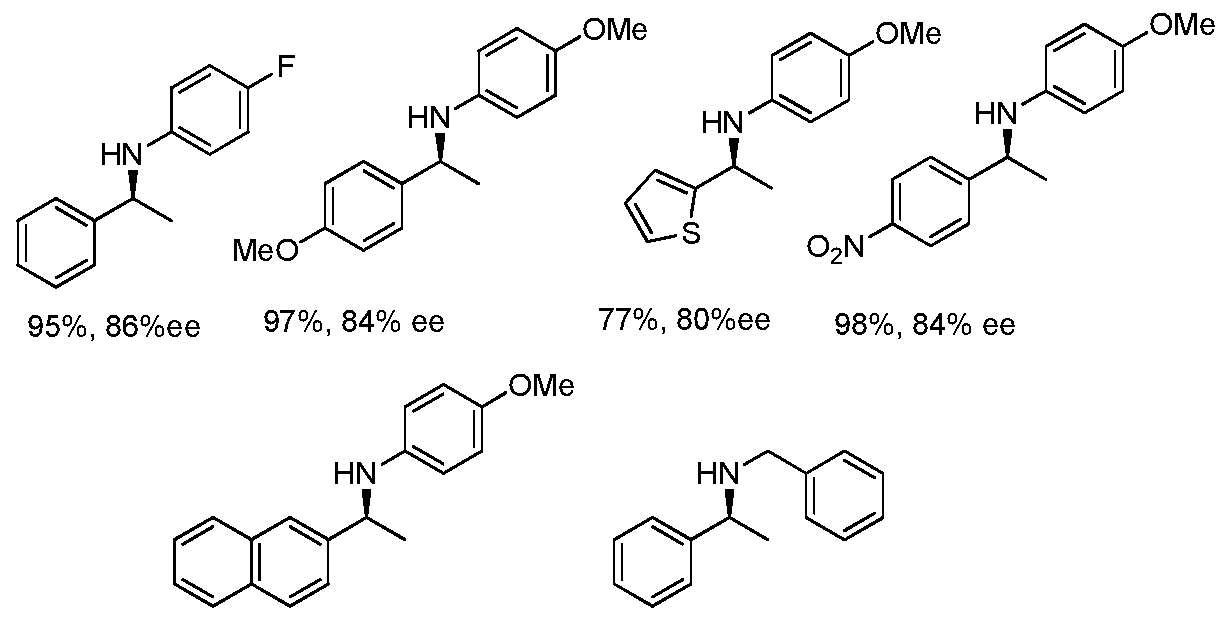
99%, 92% ee 80%, 89% ee
The above results demonstrate the excellent conversion rate and ee obtained using compound 8a across a range of different imine substrates.
Example 4
The preparation of the industrially important chiral amine, N-Methyl-1 -[3,5- bis(trifluoromethyl)phenyl]ethylamine, was effected as shown below in Scheme 4 on a 20 mmol scale using favoured catalyst 8a.

Scheme 4
Synthesis of Imine
The mixture of ketone (5.12 g, 20 mmol), p-TsOH (380 mg, 2 mmol) and Na2S04 (5.68 g, 40 mmol) in 20 mL of MeNH2/MeOH (40 %) was stirred at room temperature overnight. The solvent was removed by rotary evaporation. The residue was filtered via a short pad of celite and washed with petroleum ether (40-60 eC, 150 mL). The filtrate was concentrated to afford the crude imine as light yellow oil (5.35 g, 99 % yield, >95 % purity by 1 H NMR).
Reduction of Imine
The crude imine (5.35 g) prepared as described above was dissolved in ethyl acetate (20 mL) and catalyst (7.5 mg, 0.02 mmol, 0.1 % catalyst loading) was added. The resulting solution was cooled to 0 eC and then HSiCI3 (4 mL, 40 mmol) was added dropwise. The
mixture was stirred for 5 hours at 0 eC. The reaction mixture was transferred into a 500 mL conical flask, diluted with ethyl acetate (100 mL) and quenched carefully by addition of water (40 mL) at 0 eC. After addition of Na2S04 (15 g), the resulting mixture was neutralized by addition of Na2C03 (8 g) and ethyl acetate (100 mL) was added. The mixture was then left overnight and filtered via a short pad of Celite. The solid was washed with ethyl acetate (400 mL) and the filtrate was dried over Na2S04 and concentrated to afford the crude product as yellow oil (5.06 g, 93 % yield, 87 % ee by GC, > 95 % purity by 1 H NMR); [a]D+36.7 (c 1 .5 in CHCI3); δΗ (400 MHz, CDCI3) 1 .39 (d, 3H, J 6.6, CH3), 1 .48 (br, s, 1 H, NH), 2.34 (s, 3H, CH3), 3.82 (q, 1 H, J 6.6, CH), 7.78 (s, 1 H, ArH), 7.83 (s, 2H, ArH); 5C(400 MHz, CDCI3) 24.2 (CH3), 34.5 (NCH3), 59.9 (NCH), 120.9 (ArCH), 123.5 (q, J 270, 2 x CF3), 126.9 (ArCH), 131 .6 (q, J 33, ArC).
The ee may be improved to 95 % by heating at reflux the salt of L-tartaric acid in ethyl acetate, with 90 % yield. A white solid salt can also be formed with 1 eq. oxalic acid.
The reaction has also been conducted on a 40 mmol scale (about 10 g), 99 % yield over 2 steps, 90 % ee by 1 H NMR and 91 % ee by GC.
The above example demonstrates the commercial viability of catalysts according to the present invention.
Example 5
Favoured compound 8a was employed in the following reaction to determine the effect of carrying out the reaction in different solvents (Sche

Scheme 5
The results of these tests are presented in Table 4 below.

Table 4
Claims
1 . A compound having the formula

(1 )
wherein:
R1 , R2, R3, R4 and R5 are each separately selected from the group consisting of hydrogen, alkyl and aryl;
X is oxygen or sulfur;
W is selected from the group consisting of -OR18,-SR18, -NR19R20, -PR19R20 where R18 is alkyl or aryl, and R19 and R20 are each separately selected from the group consisting of hydrogen, alkyl and aryl; and
Z has the formula 2

(2)
wherein:
R6 and R7 are each separately selected from the group consisting of hydrogen, alkoxy, nitro, halogen, alkyl and aryl, or R6 and R7 are linked to form a cyclic group; and
Y is oxygen, sulfur or NR10 in which R10 is selected from the group consisting of hydrogen, alkyl and aryl.
2. A compound according to claim 1 , wherein R18 is an alkyl group.
3. A compound according to claim 1 , wherein R18 is a Ci-C6 linear or branched alkyl group.
4. A compound according to claim 1 , wherein R18 is selected from the group consisting of methyl, ethyl and propyl.
5. A compound according to any preceding claim, wherein at least one of R19 and R20 is an alkyl group.
6. A compound according to any one of claims 1 to 4, wherein at least one of R19 and R20 is a Ci-C6 linear or branched alkyl group.
7. A compound according to any one of claims 1 to 4, wherein at least one of R19 and R20 is selected from the group consisting of methyl, ethyl and propyl.
8. A compound according to any preceding claim, wherein X is oxygen.
9. A compound according to any preceding claim, wherein Y is NR10.
10. A compound according to claim 9, wherein R10 is an alkyl group.
1 1 . A compound according to claim 9, wherein R10 is a C C6 linear or branched alkyl group.
12. A compound according to claim 9, wherein R10 is selected from the group consisting of methyl, ethyl and propyl.
13. A compound according to any preceding claim, wherein at least one of R1 and R2 is an alkyl group or an aryl group.
14. A compound according to claim 13, wherein at least one of R1 and R2 is a Ci-C6 linear or branched alkyl group.
15. A compound according to claim 13, wherein each of R1 and R2 is methyl, ethyl or propyl group.
16. A compound according to claim 13, wherein said aryl group is a phenyl group.
17. A compound according to claim 13, wherein said aryl group is an alkyl-substituted phenyl group.
18. A compound according to claim 13, wherein each of R1 and R2 is a 3-methylphenyl group.
19. A compound according to any preceding claim, wherein at least one of R3, R4 and R5 is hydrogen.
20. A compound according to claim 1 , wherein said compound has a formula 20

(20)
21 . A compound according to claim 1 , wherein said compound has a formula 21

22. A compound according to any preceding claim, wherein at least one of R6 and R7 is hydrogen.
23. A compound according to claim 1 , wherein the compound has the formula 8

(8)
24. A compound according to claim 1 , wherein the compound as the formula 38

(38)
25. A compound according to cla mpound as the formula 39

(39)
26. A process for effecting catalytic reduction of an imine compound to provide a corresponding amine compound, the process comprising reacting said imine compound with a reducing agent in the presence of a catalyst compound having a formula according to any one of claims 1 to 25.
27. A process according to claim 26, wherein the catalyst is provided in an amount of around 0.001 mol % to around 10 mol % of the amount of the reducing agent.
28. A process according to claim 26, wherein the catalyst is provided in an amount of around 0.005 mol % to around 1 mol % of the amount of the reducing agent.
29. A process according to claim 26, wherein the catalyst is provided in an amount of around 0.005 mol % to around 0.1 mol % of the amount of the reducing agent.
30. A process according to claim 26, wherein the catalyst is provided in an amount of around 0.01 mol % or around 0.1 mol % of the amount of the reducing agent.
31 . A process according to any one of claims 26 to 30, wherein the reducing agent is a silane.
32. A process according to any one of claims 26 to 31 , wherein the initial molar amount of the reducing agent is in excess of the initial molar amount of the imine.
33. A process according to any one of claims 26 to 31 , wherein the initial molar ratio of the reducing agent compared to the imine is in the range around 1 : 1 to around 5 : 1 .
34. A process according to any one of claims 26 to 31 , wherein the initial molar ratio of the reducing agent compared to the imine is around 2 : 1 .
35. A process according to any one of claims 26 to 34, wherein the process is effected at a reaction temperature in the range around -20 °C to around 30 °C.
36. A process according to any one of claims 26 to 34, wherein the process is effected at a reaction temperature in the range around -10 °C to around 10 °C.
37. A process according to any one of claims 26 to 34, wherein the process is effected at a reaction temperature of around 0 °C.
38. A process according to any one of claims 26 to 37, wherein the process is effected in a solvent selected from the group consisting of trichloromethane, dichloromethane, ethyl acetate, methyl ethyl ketone, acetone and toluene.
39. A process according to any one of claims 26 to 38, wherein the process is effected over a time period of up to around 15 hours.
40. A process according to any one of claims 26 to 38, wherein the process is effected over a time period of around 4 hours.
41 . Use of a compound having a formula according to any one of claims 1 to 25 to catalyse the reduction of an imine compound to provide a corresponding amine compound.
42. A process for effecting the direct asymmetric reductive amination of a first compound including an aldehyde or ketone group with a second compound including a first amine group to provide a third compound including a second amine group, the process comprising reacting said first compound with said second compound and a reducing agent in the presence of a catalyst compound having a formula according to any one of claims 1 to 25.
43. Use of a compound having a formula according to any one of claims 1 to 25 to catalyse the direct asymmetric reductive amination of an aldehyde or ketone compound to provide an amine compound.
44. A process for effecting catalytic reduction of an enamine compound to provide a corresponding amine compound, the process comprising reacting said enamine compound with a reducing agent in the presence of a catalyst compound having a formula according to any one of claims 1 to 25.
45. Use of a compound having a formula according to any one of claims 1 to 25 to catalyse the reduction of an enamine compound to provide a corresponding amine compound.
Applications Claiming Priority (2)
| Application Number | Priority Date | Filing Date | Title |
|---|---|---|---|
| GB201120594A GB201120594D0 (en) | 2011-11-30 | 2011-11-30 | Catalyst compounds |
| GB1120594.5 | 2011-11-30 |
Publications (1)
| Publication Number | Publication Date |
|---|---|
| WO2013079942A1 true WO2013079942A1 (en) | 2013-06-06 |
Family
ID=45508939
Family Applications (1)
| Application Number | Title | Priority Date | Filing Date |
|---|---|---|---|
| PCT/GB2012/052945 Ceased WO2013079942A1 (en) | 2011-11-30 | 2012-11-29 | Catalyst compounds |
Country Status (2)
| Country | Link |
|---|---|
| GB (1) | GB201120594D0 (en) |
| WO (1) | WO2013079942A1 (en) |
Cited By (1)
| Publication number | Priority date | Publication date | Assignee | Title |
|---|---|---|---|---|
| EP4332098A1 (en) * | 2022-08-31 | 2024-03-06 | Siegfried AG | Chiral synthesis of nornicotine and nicotine |
Citations (2)
| Publication number | Priority date | Publication date | Assignee | Title |
|---|---|---|---|---|
| WO2009019469A2 (en) * | 2007-08-06 | 2009-02-12 | The University Of Sheffield | Pyrrolidines as catalyst compounds |
| WO2011031934A1 (en) * | 2009-09-11 | 2011-03-17 | Enanta Pharmaceuticals, Inc. | Hepatitis c virus inhibitors |
-
2011
- 2011-11-30 GB GB201120594A patent/GB201120594D0/en not_active Ceased
-
2012
- 2012-11-29 WO PCT/GB2012/052945 patent/WO2013079942A1/en not_active Ceased
Patent Citations (2)
| Publication number | Priority date | Publication date | Assignee | Title |
|---|---|---|---|---|
| WO2009019469A2 (en) * | 2007-08-06 | 2009-02-12 | The University Of Sheffield | Pyrrolidines as catalyst compounds |
| WO2011031934A1 (en) * | 2009-09-11 | 2011-03-17 | Enanta Pharmaceuticals, Inc. | Hepatitis c virus inhibitors |
Non-Patent Citations (2)
| Title |
|---|
| FRANÇOIS-MOANA GAUTIER ET AL: "Asymmetric reduction of ketimines with trichlorosilane employing an imidazole derived organocatalyst", ORGANIC & BIOMOLECULAR CHEMISTRY, vol. 7, no. 2, 1 January 2009 (2009-01-01), pages 229, XP055050132, ISSN: 1477-0520, DOI: 10.1039/b816051a * |
| MATSUMURA ET AL., TETRAHEDRON LETTERS, vol. 47, 2006, pages 3751 - 3754 |
Cited By (2)
| Publication number | Priority date | Publication date | Assignee | Title |
|---|---|---|---|---|
| EP4332098A1 (en) * | 2022-08-31 | 2024-03-06 | Siegfried AG | Chiral synthesis of nornicotine and nicotine |
| WO2024047152A1 (en) * | 2022-08-31 | 2024-03-07 | Siegfried Ag | Chiral synthesis of nornicotine and nicotine |
Also Published As
| Publication number | Publication date |
|---|---|
| GB201120594D0 (en) | 2012-01-11 |
Similar Documents
| Publication | Publication Date | Title |
|---|---|---|
| JP6150179B2 (en) | Synthesis of R-biphenylalaninol | |
| JP2018515515A (en) | Chiral spirocyclic phosphine-nitrogen-sulfur tridentate ligands and their preparation and applications | |
| ES2378507T3 (en) | Synthetic routes for 2 (S), 4 (S), 5 (S), 7 (S) -2,7-dialkyl-4-hydroxy-5-amino-8-aryl-octanoylamides | |
| JP6966656B2 (en) | Intermediates of optically active piperidine derivatives and methods for producing them | |
| SK64697A3 (en) | Method of producing optically active metallocenyl phosphines | |
| JP6487568B2 (en) | Kinetic resolution by catalytic asymmetric hydrogenation of racemic δ-hydroxy ester and its application | |
| Yang et al. | Squaramide-catalysed enantio-and diastereoselective sulfa-Michael addition of thioacetic acid to α, β-disubstituted nitroalkenes | |
| Pini et al. | Addition of diethylzinc to aryl aldehydes catalyzed by (1S, 3S)-N, N1-bis [benzyl]-1, 3-diphenyl-1, 3-propanediamine and its dilithium salt: a mechanistic rationale investigation. | |
| CA2414049A1 (en) | Ruthenium-diphosphine complexes and their use as catalysts | |
| WO2013079942A1 (en) | Catalyst compounds | |
| JP5482200B2 (en) | Phosphoramide compound and method for producing optically active alcohol | |
| KR20130088689A (en) | A preparation method of (s)-dapoxetine hydrochloride | |
| JP4474861B2 (en) | Optically active quaternary ammonium salt, process for producing the same, and process for producing optically active α-amino acid derivative using the same | |
| US11124532B2 (en) | Chiral metal complex compounds | |
| Wally et al. | Ferrocene derivatives, LXXI; Stereochemistry of metallocenes, LVI Synthesis and structure of optically active ferrocenylaminoalcohols | |
| JP5891334B2 (en) | Process for producing solifenacin or a salt thereof and novel intermediate used therein | |
| WO2015081920A1 (en) | Process for preparing lurasidone and intermediate thereof | |
| JP5232989B2 (en) | Optically active 2,6-bisaminomethylpyridine derivative, production method thereof and use thereof | |
| WO2009019469A2 (en) | Pyrrolidines as catalyst compounds | |
| US9340519B2 (en) | Paracyclophane-based ligands, their preparation and use in catalysis | |
| CN114409640B (en) | Preparation method of trans-strigolactone analogue and intermediate compound thereof | |
| WO2012040853A1 (en) | Group 5 metal complexes useful for amine functionalization and synthetic process for manufacture thereof | |
| JP5410677B2 (en) | Method for producing optically active aminopentane derivative, intermediate and method for producing the same | |
| JP2008222600A (en) | Process for producing optically active 1,2-aminoalcohol compound and optically active catalyst | |
| JP3563347B2 (en) | Synthesis method of homoallyl type amine and chiral zirconium catalyst |
Legal Events
| Date | Code | Title | Description |
|---|---|---|---|
| 121 | Ep: the epo has been informed by wipo that ep was designated in this application |
Ref document number: 12795605 Country of ref document: EP Kind code of ref document: A1 |
|
| NENP | Non-entry into the national phase |
Ref country code: DE |
|
| 122 | Ep: pct application non-entry in european phase |
Ref document number: 12795605 Country of ref document: EP Kind code of ref document: A1 |