WO2013046629A1 - 基本周波数抽出装置および基本周波数抽出方法 - Google Patents
基本周波数抽出装置および基本周波数抽出方法 Download PDFInfo
- Publication number
- WO2013046629A1 WO2013046629A1 PCT/JP2012/006061 JP2012006061W WO2013046629A1 WO 2013046629 A1 WO2013046629 A1 WO 2013046629A1 JP 2012006061 W JP2012006061 W JP 2012006061W WO 2013046629 A1 WO2013046629 A1 WO 2013046629A1
- Authority
- WO
- WIPO (PCT)
- Prior art keywords
- straight line
- information
- fundamental frequency
- intercept
- plot
- Prior art date
- Legal status (The legal status is an assumption and is not a legal conclusion. Google has not performed a legal analysis and makes no representation as to the accuracy of the status listed.)
- Ceased
Links
Images





Classifications
-
- G—PHYSICS
- G10—MUSICAL INSTRUMENTS; ACOUSTICS
- G10L—SPEECH ANALYSIS TECHNIQUES OR SPEECH SYNTHESIS; SPEECH RECOGNITION; SPEECH OR VOICE PROCESSING TECHNIQUES; SPEECH OR AUDIO CODING OR DECODING
- G10L25/00—Speech or voice analysis techniques not restricted to a single one of groups G10L15/00 - G10L21/00
- G10L25/90—Pitch determination of speech signals
Definitions
- the present invention relates to a fundamental frequency extraction device and a fundamental frequency extraction method.
- Non-Patent Document 1 and Non-Patent Document 2 disclose a method using a Hough transform.
- the fundamental frequency extraction method using the Hough transform is robust against noise and is effective for speech recognition under a noisy environment, for example, when driving a car.
- an object of the present invention is to provide a fundamental frequency extraction device and a fundamental frequency extraction method that can perform speech recognition with high accuracy even in a noisy environment with a smaller amount of calculation and memory. .
- the fundamental frequency shown on a two-dimensional plane having a numerical value corresponding to a fundamental frequency as a first coordinate axis and time information as a second coordinate axis is used.
- a time-series information calculation unit that calculates time-series information of corresponding numerical values
- a probability coefficient storage unit that stores a probability coefficient that is a numerical value indicating the probability of each plot constituting the time-series information, and the time-series information.
- a straight line creating unit that creates a plurality of straight lines on the two-dimensional plane using plots of arbitrary two points of the respective plots that constitutes, and the straight line created in the straight line creating unit in the two-dimensional plane
- a straight line information calculation unit for calculating an intercept and an inclination; information on the intercept and inclination calculated by the straight line information calculation unit; and information on a plot used for calculating the intercept and the inclination.
- a fundamental frequency extraction device is provided. According to this configuration, it is possible to extract the fundamental frequency of the input voice with high accuracy even under a noisy environment with less calculation amount and memory amount. This is particularly effective in the case of voice recognition in a tone language.
- the fundamental frequency extraction device further includes a candidate calculation unit that calculates a plurality of numerical value candidates corresponding to the fundamental frequency for each predetermined time unit of the input speech, and the time-series information
- the calculation unit sets the time series information to N candidates (N is an integer of N ⁇ 1) in the descending order of the candidates calculated by the candidate calculation unit as numerical values corresponding to the fundamental frequency. It may be calculated.
- the fundamental frequency extraction device further includes a candidate calculation unit that calculates a plurality of numerical value candidates corresponding to the fundamental frequency for each predetermined time unit of the input speech, and the time-series information
- the calculation unit may calculate the time-series information using the candidates calculated by the candidate calculation unit as numerical values corresponding to the fundamental frequency, with four or less candidates in descending order.
- the optimum straight line information selection unit calculates a weight for each combination of intercept and slope included in the straight line information from the straight line information and the accuracy coefficient of each plot.
- the combination of the intercept and the slope having the maximum weight may be selected as the intercept and slope of the optimum straight line.
- the numerical value corresponding to the fundamental frequency may be a cepstrum dimension number
- the accuracy coefficient may be a cepstrum value.
- a time series information calculation unit an accuracy coefficient storage unit, a straight line creation unit, a straight line information calculation unit, a straight line information storage unit, an optimum straight line information selection unit, a plot
- a first step of calculating time series information of a numerical value corresponding to the fundamental frequency shown on a two-dimensional plane; and the accuracy coefficient storage unit is a numerical value indicating a probability of each plot constituting the time series information.
- the straight line information calculation unit calculates an intercept and an inclination of the straight line created in the straight line creation unit in the two-dimensional plane
- the straight line information storage unit includes the straight line information
- the computer corresponds to the fundamental frequency shown on a two-dimensional plane having a numerical value corresponding to the fundamental frequency as the first coordinate axis and time information as the second coordinate axis.
- a first step of calculating numerical time-series information a second step of storing a probability coefficient that is a numerical value indicating the probability of each plot constituting the time-series information, and the time-series information
- a basic frequency extraction program is provided. According to this configuration, it is possible to extract the fundamental frequency of the input voice with high accuracy even under a noisy environment with less calculation amount and memory amount. This is particularly effective in the case of voice recognition in a tone language.
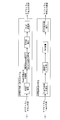
- FIG. 1 is a flowchart showing an outline of processing in the fundamental frequency extracting apparatus according to the present embodiment.
- the fundamental frequency extraction device according to the present embodiment calculates a cepstrum value for each frame of input audio data (step S1). Then, the fundamental frequency extraction device selects candidate cepstrum values from the cepstrum values calculated for each frame (Step S2). In the present embodiment, the fundamental frequency extraction device selects N cepstrum values in order from the maximum value (N is an integer of N ⁇ 1).
- a cepstrum plane is generated based on the candidate point (plot indicating the cepstrum value) of the frame being processed (hereinafter referred to as “the frame”) selected in step S2 and the candidate point of the adjacent frame (step S3).
- the “cepstrum plane” is a plane in which one of the vertical axis and the horizontal axis is the axis of the cepstrum dimension number and the other is the axis of the cepstrum value.
- a plurality of straight lines passing through two of the candidate points on the generated cepstrum plane are generated, and an optimal straight line serving as a reference for determining the fundamental frequency is acquired from the generated plurality of straight lines (step S4).
- the number of cepstrum dimensions at the intersection of the frame and the optimum straight line is acquired, and the fundamental frequency F0 of the frame is calculated from the number of cepstrum dimensions (step S5).
- the number of cepstrum dimensions (candidate point values) of each frame is corrected to be a value on the optimum straight line.
- the fundamental frequency of each frame can be calculated from the corrected cepstrum dimension number.
- the fundamental frequency is calculated by dividing by the sampling frequency and the cepstrum dimension.
- FIG. 2 is a diagram for explaining a difference between the acquisition method of the optimum straight line on the cepstrum plane according to the present embodiment and the acquisition method of the optimum straight line on the cepstrum plane in Non-Patent Documents 1 and 2.
- FIG. 2 is a diagram for explaining a difference in processing in step S4 of FIG.
- the fundamental frequency extraction method of Non-Patent Documents 1 and 2 uses a Hough transform from each candidate point to a Hough plane for candidate points on the cepstrum plane generated in Step S3 of FIG. Perform linear transformation to (conversion from point to straight line). Then, a point where the most straight lines intersect on the Hough plane is acquired, and Hough inverse transformation is performed on this point to return to a straight line on the cepstrum plane, and this is determined as the optimum straight line.
- the fundamental frequency extraction method using the Hough transform performs linear transformation from the cepstrum plane to the Hough plane (MC plane), the data on the Hough plane is stored in the memory of the fundamental frequency extractor. Process. Therefore, the fundamental frequency extraction method using the Hough transform has a problem that it requires a large amount of memory, a large amount of calculation, and a long processing time.
- the fundamental frequency extraction method of this embodiment as shown in FIG. 2B, no conversion is performed on the candidate points on the cepstrum plane, and among the plurality of candidate points on the cepstrum plane. A plurality of straight lines passing through the two points are generated.
- n n ⁇ (n ⁇ 1) / 2 sets can be selected.
- Each straight line can be represented by slope (S) and intercept (I).
- the same straight lines are discriminated based on the slope (S) and the intercept (I), and the weights W are accumulated for the same straight lines to accumulate the cumulative value ⁇ W. Is calculated. Then, the straight line having the maximum calculated cumulative value ⁇ W is determined as the optimum straight line on the cepstrum plane.
- the fundamental frequency extraction method of the present embodiment determines the optimal straight line on the cepstrum plane without performing the Hough transform as in Non-Patent Documents 1 and 2, and therefore does not require a large amount of memory capacity and the amount of calculation. Can be suppressed.
- FIG. 3 is a diagram for explaining a difference between a method for selecting a fundamental frequency candidate for each frame according to the present embodiment and a method for selecting a fundamental frequency candidate for each frame in Non-Patent Documents 1 and 2.
- a method for selecting a fundamental frequency candidate for each frame in Non-Patent Documents 1 and 2. in the fundamental frequency extraction methods described in Non-Patent Documents 1 and 2, as shown in FIG. 3A, for each point on the cepstrum plane, every point whose cepstrum value is equal to or greater than a threshold is selected as a candidate point. Select as.
- N 3 in FIG. 3B.
- the threshold is set low so that candidate points can be acquired in all frames, the number of candidate points to be selected increases, the extraction accuracy deteriorates, and the computation time Becomes longer.
- the threshold is set high, a case where candidate points cannot be acquired in all frames occurs.
- the fundamental frequency extraction method of the present embodiment since the N cepstrum values are selected as the candidate points for each frame, the conventional problem is solved.
- FIG. 4 is a diagram illustrating a configuration example of the fundamental frequency extraction device according to the present embodiment.
- the fundamental frequency extraction apparatus 1 includes a candidate calculation unit 110, a time series information calculation unit 120, an accuracy coefficient storage unit 130, a straight line creation unit 140, a straight line information calculation unit 150, a straight line
- the information storage unit 160, the optimum straight line information selection unit 170, and the plot correction unit 180 are included.
- the time-series information calculation unit 120 calculates time-series information of numerical values corresponding to the fundamental frequency shown on the two-dimensional plane with the numerical value corresponding to the fundamental frequency as the first coordinate axis and the time information as the second coordinate axis. .
- the numerical value corresponding to the fundamental frequency is the number of cepstrum dimensions.
- the candidate calculation unit 110 calculates a plurality of numerical value candidates corresponding to the fundamental frequency for each predetermined time unit (for example, a predetermined frame) of the input voice. At this time, the time series information calculation unit 120 sets N candidates (N is an integer of N ⁇ 1) in descending order of the candidates calculated by the candidate calculation unit 110 as numerical values corresponding to the fundamental frequency. Series information is calculated.
- the accuracy coefficient storage unit 130 stores an accuracy coefficient that is a numerical value indicating the probability of each plot (candidate numerical values corresponding to the fundamental frequency) constituting the time series information calculated by the time series information calculation unit 120.
- an accuracy coefficient that is a numerical value indicating the probability of each plot (candidate numerical values corresponding to the fundamental frequency) constituting the time series information calculated by the time series information calculation unit 120.
- the “accuracy coefficient” is a cepstrum value will be described as a non-limiting example.
- the accuracy coefficient is larger, the value indicated by the plot is more likely to be equal to the actual fundamental frequency of the input speech in the frame.
- the straight line creation unit 140 creates a plurality of straight lines on a two-dimensional plane using plots of arbitrary two points among the plots constituting the time series information calculated by the time series information calculation unit 120.
- the straight line information calculation unit 150 calculates the intercept and inclination of the straight line created by the straight line creation unit 140 in the two-dimensional plane.
- the straight line information storage unit 160 stores straight line information including information on the intercept and inclination calculated by the straight line information calculation unit 150 and information on the plot used to calculate the intercept and inclination.
- a case where “information about plot” is a probability coefficient and is a cepstrum value will be described.
- the optimal straight line information selection unit 170 selects a set of intercepts and slopes stored in the straight line information storage unit 160 based on the straight line information stored in the straight line information storage unit 160 and the accuracy coefficient of each plot.
- the intercept and slope are selected as the optimum straight line intercept and slope.
- the optimal straight line information selection unit 170 determines that straight lines passing through two plots having the same intercept and slope are the same straight line. Then, the accuracy coefficients of the plots on the same straight line are integrated, and this integrated value is used as the weight of the straight line.
- the intercept and slope of the straight line having the maximum weight are selected as the intercept and slope of the optimum straight line.
- the present invention it is determined that those having the same intercept and inclination as the same straight line, but the present invention is not limited to this. For example, it may be determined that two or more straight lines having intercept and slope values within a predetermined range are the same straight line.
- the plot correcting unit 180 corrects the plot on the two-dimensional plane that is not located on the optimal straight line selected by the optimal straight line information selecting unit 170 based on the optimal straight line.
- FIG. 5 is a diagram showing acoustic analysis conditions in a specific example of the fundamental frequency extraction method according to the present embodiment.
- the input speech waveform is converted into a cepstrum under the following acoustic analysis conditions.
- Acoustic analysis conditions See Fig. 5)
- Sampling frequency 16kHz
- Analysis window Hamming window (short-time window in Fig. 5)
- Analysis window length (Frame length in FIG. 5): 32 ms Frame period (Frame interval in FIG. 5): 10 ms
- FFT size 512 samples
- cepstrum value is calculated for each frame. Since this technique is a known technique, details are omitted. In this example, in addition to the frame being processed (the frame concerned), cepstrum values are similarly calculated for the four frames before and after that (that is, all nine frames).
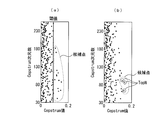
- FIG. 6 is a diagram in which cepstrum values in each calculated cepstrum dimension number are sorted in descending order for the frame.
- the horizontal axis represents the cepstrum value
- the vertical axis represents the cepstrum dimension number.
- the cepstrum dimension is limited to a range of 30 to 250. This is because it is assumed that there is no straight line that greatly deviates from the plane of this range for speech generated from a human sound organ. As a result, unnecessary calculations can be omitted and the amount of calculation can be reduced, and the accuracy of the fundamental frequency extraction can be improved.
- Non-Patent Documents 1 and 2 a cepstrum value equal to or greater than a predetermined threshold is selected for each frame, but in the present embodiment, only the maximum N candidates (hereinafter referred to as “TopN”). ) Is selected. Thereby, the calculation speed can be increased.
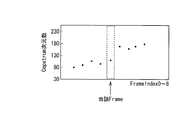
- FIG. 7 is a diagram illustrating a specific example of a cepstrum plane.
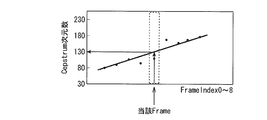
- a cepstrum plane is constructed by arranging the TopN candidates for the frame and the four frames before and after it (FrameIndex 0 to 8) in the order of frames.
- N 1, that is, candidates for Top1 of each frame are arranged in order. Therefore, nine candidate points exist in the constructed cepstrum plane.
- 9 ⁇ N candidate points exist on the constructed cepstrum plane.
- the N candidate points selected in each frame have different positions depending on the cepstrum value (0 to 0.2) of each candidate point in FIG. 6, but a cepstrum plane is constructed. In this case (FIG. 7), for example, each candidate point is arranged along a straight line that passes vertically through the center of each frame width.
- the cepstrum plane is constructed in units of 9 frames by adding the preceding and succeeding 4 frames to the frame, and generally the change in the voice pitch (fundamental frequency F0) in the frame-cepstrum plane is: The fact that it is linear in about 100 ms is used. Therefore, it is not limited to this.
- FIG. 8 is a diagram illustrating a state in which a straight line is generated using each candidate point on the cepstrum plane.
- a straight line passing through two points of each candidate existing in the constructed cepstrum plane is generated.
- a total of 36 straight lines are generated.
- each candidate point in FIG. 8 has a cepstrum value. Therefore, as shown in FIG. 9, the sum of the cepstrum values of the two candidate points connected by each straight line is set as the weight of each straight line.
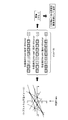
- FIG. 9 is a diagram showing an outline of processing for determining an optimum straight line from each straight line generated on the cepstrum plane. A straight line is uniquely determined by a pair of slope (Slope) and intercept (Intercept) (Slope, Intercept). In FIG. 9, the weight of each straight line is indicated by “w (s, i)” (abbreviation of Weight (Slope, Intercept)).
- the slope and the intercept are calculated by a straight line connecting the two candidate points, and then quantized and processed in increments of “0.1”. Note that FIG. 9 is simplified for the sake of simplicity, and the cepstrum plane image of FIG. 9 is actually the same as that shown in FIG.
- the weights of the straight lines having the same slope value and the same intercept value are accumulated.
- the accumulated value is calculated by the following equation (2). Note that “straight lines having the same slope value and the same intercept value” means that these straight lines are the same straight line on the cepstrum plane. That is, as a result of generating a straight line passing through each of the two points, the cumulative value of the weight is calculated for one or more straight lines that are the same straight line.
- the straight line that maximizes the value of the above equation (1) is taken as the optimum straight line. That is, the slope and intercept of the straight line that maximizes the value of the above formula (1) are determined as the slope and intercept of the optimal straight line (the following formula (2)).
- FIG. 10 is a diagram illustrating a case where the cepstrum dimension number that is the intersection of the frame and the optimal straight line is acquired.
- the weight of the optimum straight line is the voicedness of the frame.
- the “voiced degree” is a feature amount for distinguishing voiced sound from unvoiced sound or noise.
- FIG. 11 is a diagram showing the results of performance evaluation (extraction accuracy, calculation time) between the conventional method and this method.
- the fundamental frequency extraction process was performed on 2300 seconds of sampled input speech.
- the extraction accuracy was 79.2% and the computation time was 856 seconds.
- the extraction accuracy is a value calculated by the same calculation method as the “accuracy rate” of Non-Patent Document 1, and is specifically calculated by the following calculation method.
- Extraction accuracy (number of frames with an error within ⁇ 5% of the correct fundamental frequency) / (number of frames in the voiced portion of the correct answer)
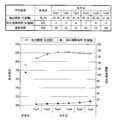
- FIG. 12 is a diagram showing the performance evaluation results of the conventional method and this method under different SNR (signal-to-noise ratio) situations.
- the relative calculation time in FIG. 12 shows the relative value of the calculation time of Top1 to Top6 in this method, where the calculation time in the conventional method is 100. It can be seen that under any SNR situation, the present method has higher extraction accuracy and is improved over the conventional method.
- the improvement rate is high when the SNR is low, such as SNR-5 dB and SNR-10 dB, and the effect of this method becomes more remarkable as the influence of noise increases.
- FIG. 13 is a diagram illustrating a comparison result regarding the amount of calculation memory used in a part (steps S2 and S4 in FIG. 1) in which processing is different between the conventional method (Non-Patent Document 2) and the present method.
- the calculation memory usage required in the fundamental frequency extraction method of Non-Patent Document 2 is as follows. In other words, the number of m-axis divisions of the MC quantization plane (ie, the Hough plane) required for the Hough transform is 80 (m ranges from ⁇ 20 to +20, quantization in 0.5 steps), and c-axis division.
- the calculation memory usage necessary for accumulating straight lines is as follows. That is, for each straight line, a memory for storing three parameters of “slope”, “intercept”, and “weight” is required, and 8 bytes are assigned to each parameter as in the conventional method.
- each structure in the fundamental frequency extraction apparatus demonstrated to said each embodiment is the same structure as the structure of general computers, such as CPU (Central Processing Unit) which is not shown in figure, memory
- the function of each structure demonstrated above is a function implement
- this program is stored in a semiconductor storage medium such as RAM or ROM, a magnetic storage type storage medium such as FD or HD, an optical reading type storage medium such as CD, CDV, LD, or DVD, or a magnetic storage type / optical such as MO. Regardless of the electronic, magnetic, optical, or other reading method, it can be stored in a computer-readable storage medium and distributed, sold, etc. It is possible to download through.
Landscapes
- Engineering & Computer Science (AREA)
- Computational Linguistics (AREA)
- Signal Processing (AREA)
- Health & Medical Sciences (AREA)
- Audiology, Speech & Language Pathology (AREA)
- Human Computer Interaction (AREA)
- Physics & Mathematics (AREA)
- Acoustics & Sound (AREA)
- Multimedia (AREA)
- Compression, Expansion, Code Conversion, And Decoders (AREA)
Abstract
演算量およびメモリ量がより少なく、かつ雑音環境下においても高精度に、入力音声の基本周波数を抽出することが可能な基本周波数抽出装置を提供する。入力音声データについて、フレーム単位でケプストラム値を計算し(S1)、これらの複数のケプストラム値から候補となるケプストラム値を選択する(S2)。そして、当該フレームの候補点と、隣接フレームの候補点とによって、縦軸をケプストラム次元数軸とし、横軸をケプストラム値軸とするケプストラム平面を生成する(S3)。そして、このケプストラム平面上の各候補点のうちの2点を通る直線を複数生成し、生成した複数の直線から基本周波数を決定するための基準となる最適直線を決定する(S4)。当該フレームと最適直線との交点のケプストラム次元数を取得し、このケプストラム次元数から当該フレームの基本周波数F0を算出する(S5)。
Description
本発明は、基本周波数抽出装置および基本周波数抽出方法に関する。
マイク等に入力された入力音声の認識を行う音声認識処理において、入力音声から基本周波数をより正確に抽出することは、音声認識の精度の向上につながる。特に、中国語やベトナム語等のような、いわゆる声調言語における音声認識においては、入力音声の声調を識別するために、基本周波数をより正確に抽出することは重要である。
入力音声から基本周波数を抽出する方法として、例えば、非特許文献1および非特許文献2には、ハフ(Hough)変換を用いた方法が開示されている。このハフ変換を用いた基本周波数抽出方法は、雑音に頑健であり、例えば自動車走行時などにおける雑音環境下での音声認識には有効である。
入力音声から基本周波数を抽出する方法として、例えば、非特許文献1および非特許文献2には、ハフ(Hough)変換を用いた方法が開示されている。このハフ変換を用いた基本周波数抽出方法は、雑音に頑健であり、例えば自動車走行時などにおける雑音環境下での音声認識には有効である。
関高浩、他2名、「ハフ変換による雑音に頑健な基本周波数抽出法」、情報処理学会研修報告、2001年10月19日、Vol.2001、No.100、pp.9-14
安井英巳、他3名、「ハフ変換による基本周波数情報を用いた耐雑音音声認識の高性能化の検討」、日本音響学会講演論文集、2009年3月、pp.35-38
しかしながら、非特許文献1および非特許文献2のハフ変換を用いた基本周波数抽出方法は、耐雑音性には優れているものの、ケプストラム(Cepstrum)平面からハフ(Hough)平面(M-C平面)への線形変換を行うため、演算量およびメモリ量が多く、処理時間がかかるという問題がある。特に、カーナビゲーションや携帯端末などのように、処理プロセッサの性能やメモリ容量に制限がある装置において音声認識を行う場合には、大きな問題となる。
そこで、本発明は、演算量およびメモリ量がより少なく、かつ雑音環境下においても高精度に音声認識を行うことを可能とする基本周波数抽出装置および基本周波数抽出方法を提供することを目的とする。
そこで、本発明は、演算量およびメモリ量がより少なく、かつ雑音環境下においても高精度に音声認識を行うことを可能とする基本周波数抽出装置および基本周波数抽出方法を提供することを目的とする。
上記問題を解決するために、本発明の一態様によれば、基本周波数に対応する数値を第1の座標軸とし、時間情報を第2の座標軸とする2次元平面上に示される前記基本周波数に対応する数値の時系列情報を算出する時系列情報算出部と、前記時系列情報を構成する各プロットの確からしさを示す数値である確度係数を記憶する確度係数記憶部と、前記時系列情報を構成する前記各プロットのうちの任意の2点のプロットを用いて前記2次元平面上における直線を複数作成する直線作成部と、前記直線作成部において作成された前記直線の前記2次元平面内における切片と傾きとを算出する直線情報算出部と、前記直線情報算出部において算出された切片と傾きとに関する情報と、この切片と傾きの算出に用いたプロットに関する情報と、を含む直線情報を記憶する直線情報記憶部と、前記直線情報と、前記各プロットの前記確度係数と、に基づき、前記直線情報記憶部において記憶された切片と傾きの中から、一組の切片と傾きを、最適直線の切片と傾きとして選択する最適直線情報選択部と、前記最適直線上に位置しない前記2次元平面上のプロットを、前記最適直線に基づいて修正するプロット修正部と、を有する基本周波数抽出装置が提供される。
この構成によれば、演算量およびメモリ量がより少なく、かつ雑音環境下においても高精度に、入力音声の基本周波数を抽出することが可能である。特に、声調言語の音声認識の場合に有効である。
この構成によれば、演算量およびメモリ量がより少なく、かつ雑音環境下においても高精度に、入力音声の基本周波数を抽出することが可能である。特に、声調言語の音声認識の場合に有効である。
また、本発明の他の態様は、基本周波数抽出装置は、入力音声の所定時間単位ごとに、前記基本周波数に対応する数値の候補を複数算出する候補算出部をさらに有し、前記時系列情報算出部は、前記候補算出部において算出された前記候補のうち、値が大きい順にN個(NはN≧1の整数)の前記候補を前記基本周波数に対応する数値として、前記時系列情報を算出してもよい。
また、本発明の他の態様は、基本周波数抽出装置は、入力音声の所定時間単位ごとに、前記基本周波数に対応する数値の候補を複数算出する候補算出部をさらに有し、前記時系列情報算出部は、前記候補算出部において算出された前記候補のうち、値が大きい順に4個以下の前記候補を前記基本周波数に対応する数値として、前記時系列情報を算出してもよい。
また、本発明の他の態様は、前記最適直線情報選択部は、前記直線情報と、前記各プロットの確度係数とから、前記直線情報に含まれる切片と傾きの各組み合わせについての重み付けを算出し、前記重み付けが最大である前記切片と傾きの組み合わせを、最適直線の切片と傾きとして選択してもよい。
この構成によれば、演算量およびメモリ量がより少なく、かつ雑音環境下においても高精度に、入力音声の基本周波数を抽出することが可能である。特に、声調言語の音声認識の場合に有効である。
また、本発明の他の態様は、前記基本周波数に対応する数値はケプストラム次元数であり、前記確度係数はケプストラム値であってもよい。
この構成によれば、演算量およびメモリ量がより少なく、かつ雑音環境下においても高精度に、入力音声の基本周波数を抽出することが可能である。特に、声調言語の音声認識の場合に有効である。
また、本発明の他の態様は、前記基本周波数に対応する数値はケプストラム次元数であり、前記確度係数はケプストラム値であってもよい。
また、本発明の他の態様によれば、時系列情報算出部と、確度係数記憶部と、直線作成部と、直線情報算出部と、直線情報記憶部と、最適直線情報選択部と、プロット修正部とを有する基本周波数抽出装置が実行する基本周波数抽出方法であって、前記時系列情報算出部が、基本周波数に対応する数値を第1の座標軸とし、時間情報を第2の座標軸とする2次元平面上に示される前記基本周波数に対応する数値の時系列情報を算出する第1のステップと、前記確度係数記憶部が、前記時系列情報を構成する各プロットの確からしさを示す数値である確度係数を記憶する第2のステップと、前記直線作成部が、前記時系列情報を構成する前記各プロットのうちの任意の2点のプロットを用いて前記2次元平面上における直線を複数作成する第3のステップと、前記直線情報算出部が、前記直線作成部において作成された前記直線の前記2次元平面内における切片と傾きとを算出する第4のステップと、前記直線情報記憶部が、前記直線情報算出部において算出された切片と傾きとに関する情報と、この切片と傾きの算出に用いたプロットに関する情報と、を含む直線情報を記憶する第5のステップと、前記最適直線情報選択部が、前記直線情報と、前記各プロットの前記確度係数と、に基づき、前記直線情報記憶部において記憶された切片と傾きの中から、一組の切片と傾きを、最適直線の切片と傾きとして選択する第6のステップと、前記プロット修正部が、前記最適直線上に位置しない前記2次元平面上のプロットを、前記最適直線に基づいて修正する第7のステップと、を含むことを特徴とする基本周波数抽出方法が提供される。
この構成によれば、演算量およびメモリ量がより少なく、かつ雑音環境下においても高精度に、入力音声の基本周波数を抽出することが可能である。特に、声調言語の音声認識の場合に有効である。
この構成によれば、演算量およびメモリ量がより少なく、かつ雑音環境下においても高精度に、入力音声の基本周波数を抽出することが可能である。特に、声調言語の音声認識の場合に有効である。
また、本発明の他の態様によれば、コンピュータに、基本周波数に対応する数値を第1の座標軸とし、時間情報を第2の座標軸とする2次元平面上に示される前記基本周波数に対応する数値の時系列情報を算出する第1のステップと、前記時系列情報を構成する各プロットの確からしさを示す数値である確度係数を記憶する第2のステップと、前記時系列情報を構成する前記各プロットのうちの任意の2点のプロットを用いて前記2次元平面上における直線を複数作成する第3のステップと、前記直線作成部において作成された前記直線の前記2次元平面内における切片と傾きとを算出する第4のステップと、前記直線情報算出部において算出された切片と傾きとに関する情報と、この切片と傾きの算出に用いたプロットに関する情報と、を含む直線情報を記憶する第5のステップと、前記直線情報と、前記各プロットの前記確度係数と、に基づき、前記直線情報記憶部において記憶された切片と傾きの中から、一組の切片と傾きを、最適直線の切片と傾きとして選択する第6のステップと、前記最適直線上に位置しない前記2次元平面上のプロットを、前記最適直線に基づいて修正する第7のステップと、を実行させるための基本周波数抽出プログラムが提供される。
この構成によれば、演算量およびメモリ量がより少なく、かつ雑音環境下においても高精度に、入力音声の基本周波数を抽出することが可能である。特に、声調言語の音声認識の場合に有効である。
この構成によれば、演算量およびメモリ量がより少なく、かつ雑音環境下においても高精度に、入力音声の基本周波数を抽出することが可能である。特に、声調言語の音声認識の場合に有効である。
本発明の一態様によれば、演算量およびメモリ量がより少なく、かつ雑音環境下においても高精度に、入力音声の基本周波数を抽出することが可能である。
以下、本発明の実施の形態について、図面を参照しながら説明する。なお、以下の説明において参照する各図では、他の図と同等部分は同一符号によって示される。
(本実施形態の概要)
最初に、本実施形態に係る基本周波数抽出方法の特徴を説明するとともに、非特許文献1および2における基本周波数抽出方法との相違点について説明する。
(本実施形態の概要)
最初に、本実施形態に係る基本周波数抽出方法の特徴を説明するとともに、非特許文献1および2における基本周波数抽出方法との相違点について説明する。
まず、図1を用いて、本実施形態に係る基本周波数抽出装置における処理の概要を説明する。図1は、本実施形態に係る基本周波数抽出装置における処理の概要を示すフロー図である。本実施形態に係る基本周波数抽出装置は、入力される音声データについて、フレーム単位でケプストラム値を計算する(ステップS1)。そして、基本周波数抽出装置は、フレーム(Frame)毎に計算したケプストラム値から候補となるケプストラム値を選択する(ステップS2)。なお、本実施形態においては、基本周波数抽出装置は、最大値から順に値の大きなN個(NはN≧1の整数)のケプストラム値を選択する。
そして、ステップS2において選択された、処理中のフレーム(以下、「当該フレーム」という)の候補点(ケプストラム値を示すプロット)と、隣接フレームの候補点とによって、ケプストラム平面を生成する(ステップS3)。
ここで、「ケプストラム平面」とは、縦軸および横軸のいずれか一方をケプストラム次元数の軸とし、他方をケプストラム値の軸とする平面である。
そして、生成されたケプストラム平面上の各候補点のうちの2点を通る直線を複数生成し、生成した複数の直線から基本周波数を決定するための基準となる最適直線を取得する(ステップS4)。
ここで、「ケプストラム平面」とは、縦軸および横軸のいずれか一方をケプストラム次元数の軸とし、他方をケプストラム値の軸とする平面である。
そして、生成されたケプストラム平面上の各候補点のうちの2点を通る直線を複数生成し、生成した複数の直線から基本周波数を決定するための基準となる最適直線を取得する(ステップS4)。
当該フレームと、最適直線との交点のケプストラム次元数を取得し、このケプストラム次元数から当該フレームの基本周波数F0を算出する(ステップS5)。また、各フレームのケプストラム次元数(候補点の値)が最適直線上の値となるように修正する。これにより、修正したケプストラム次元数から各フレームの基本周波数が算出できる。なお、基本周波数は、サンプリング周波数とケプストラム次元数で除算することで算出される。
図1に示される各ステップのうち、ステップS1、S3、S5における処理は非特許文献1および2と同様であるが、ステップS2、S4における処理は非特許文献1および2と異なり、本実施形態の特徴となる部分である。
図1に示される各ステップのうち、ステップS1、S3、S5における処理は非特許文献1および2と同様であるが、ステップS2、S4における処理は非特許文献1および2と異なり、本実施形態の特徴となる部分である。
(本実施形態と従来技術との相違点)
図2および図3を用いて、本実施形態に係る基本周波数抽出方法と、非特許文献1および2における基本周波数抽出方法との相違点(図1のステップS2、S4)について説明する。図2は、本実施形態に係るケプストラム平面上の最適直線の取得方法と、非特許文献1および2におけるケプストラム平面上の最適直線の取得方法との相違点を説明する図である。
図2および図3を用いて、本実施形態に係る基本周波数抽出方法と、非特許文献1および2における基本周波数抽出方法との相違点(図1のステップS2、S4)について説明する。図2は、本実施形態に係るケプストラム平面上の最適直線の取得方法と、非特許文献1および2におけるケプストラム平面上の最適直線の取得方法との相違点を説明する図である。
(ステップS4における処理について)
図2は、図1のステップS4における処理の違いを説明する図である。図2(a)に示されるように、非特許文献1および2の基本周波数抽出方法は、図1のステップS3で生成されたケプストラム平面上の候補点について、ハフ変換により各候補点からハフ平面への線形変換を行う(点から直線への変換)。そして、ハフ平面上において最も多くの直線が交わる点を取得し、この点に対してハフ逆変換を施すことで、ケプストラム平面上の直線に戻し、これを最適直線として決定する。
図2は、図1のステップS4における処理の違いを説明する図である。図2(a)に示されるように、非特許文献1および2の基本周波数抽出方法は、図1のステップS3で生成されたケプストラム平面上の候補点について、ハフ変換により各候補点からハフ平面への線形変換を行う(点から直線への変換)。そして、ハフ平面上において最も多くの直線が交わる点を取得し、この点に対してハフ逆変換を施すことで、ケプストラム平面上の直線に戻し、これを最適直線として決定する。
しかしながら、このハフ変換を用いた基本周波数抽出方法は、ケプストラム平面からハフ平面(M-C平面)への線形変換を行うため、ハフ平面上のデータを基本周波数抽出装置のメモリに記憶し、これを処理する。そのため、ハフ変換を用いた基本周波数抽出方法では、多くのメモリ容量を必要とするとともに、演算量も多く、処理に時間がかかるという問題がある。
これに対し、本実施形態の基本周波数抽出方法では、図2(b)に示されるように、ケプストラム平面上の候補点に対して何ら変換を行わず、ケプストラム平面上において複数の候補点のうちの2点を通る直線を複数生成する。
これに対し、本実施形態の基本周波数抽出方法では、図2(b)に示されるように、ケプストラム平面上の候補点に対して何ら変換を行わず、ケプストラム平面上において複数の候補点のうちの2点を通る直線を複数生成する。
具体的には、複数の候補点から2点を選択する組み合わせは、候補点の個数がnであれば、n×(n-1)/2組だけ選択可能であるから、それら全ての組み合わせについて直線を生成する。各直線は、傾き(S)および切片(I)によって表すことができる。そして、本実施形態の基本周波数抽出方法では、その傾き(S)および切片(I)に基づいて、同一の直線同士を判別し、同一の直線について、それらの重みWを累積して累積値ΣWを算出する。そして、その算出された累積値ΣWが最大の直線をケプストラム平面上の最適直線として決定する。
すなわち、本実施形態の基本周波数抽出方法は、非特許文献1および2のようなハフ変換を行わずにケプストラム平面上の最適直線を決定するため、多くのメモリ容量を必要とせず、演算量も抑えることができる。
すなわち、本実施形態の基本周波数抽出方法は、非特許文献1および2のようなハフ変換を行わずにケプストラム平面上の最適直線を決定するため、多くのメモリ容量を必要とせず、演算量も抑えることができる。
(ステップS2における処理について)
次に、図3を用いて、図1のステップS2における処理の違いについて説明する。図3は、本実施形態に係るフレーム毎における基本周波数候補の選択方法と、非特許文献1および2におけるフレーム毎における基本周波数候補の選択方法との相違点を説明する図である。非特許文献1および2に記載の基本周波数抽出方法では、図3(a)に示されるように、フレームごとに、ケプストラム平面上の点について、ケプストラム値が閾値以上であるすべての点を候補点として選択する。
次に、図3を用いて、図1のステップS2における処理の違いについて説明する。図3は、本実施形態に係るフレーム毎における基本周波数候補の選択方法と、非特許文献1および2におけるフレーム毎における基本周波数候補の選択方法との相違点を説明する図である。非特許文献1および2に記載の基本周波数抽出方法では、図3(a)に示されるように、フレームごとに、ケプストラム平面上の点について、ケプストラム値が閾値以上であるすべての点を候補点として選択する。
一方、本実施形態の基本周波数抽出方法では、図3(b)に示されるように、ケプストラム平面上の点について、ケプストラム値が最大であるものからN個(図3(b)ではN=3個)を候補点(TopN)として選択する。
非特許文献1および2に記載の基本周波数抽出方法では、全てのフレームにおいて候補点が取得できるように閾値を低めに設定すると、選択される候補点が多くなり、抽出精度が劣化し、演算時間が長くなる。逆に、閾値を高めに設定すると、全てのフレームにおいて候補点が取得できない場合が発生する。これに対し、本実施形態の基本周波数抽出方法では、各フレームについてケプストラム値が最大のものからN個を候補点として選択するため、従来のような問題は解消される。
非特許文献1および2に記載の基本周波数抽出方法では、全てのフレームにおいて候補点が取得できるように閾値を低めに設定すると、選択される候補点が多くなり、抽出精度が劣化し、演算時間が長くなる。逆に、閾値を高めに設定すると、全てのフレームにおいて候補点が取得できない場合が発生する。これに対し、本実施形態の基本周波数抽出方法では、各フレームについてケプストラム値が最大のものからN個を候補点として選択するため、従来のような問題は解消される。
(基本周波数抽出装置の構成)
次に、本実施形態に係る基本周波数抽出装置の構成について、図4を参照して説明する。図4は、本実施形態に係る基本周波数抽出装置の構成例を示す図である。図4に示されるように、基本周波数抽出装置1は、候補算出部110と、時系列情報算出部120と、確度係数記憶部130と、直線作成部140と、直線情報算出部150と、直線情報記憶部160と、最適直線情報選択部170と、プロット修正部180と、を有する。
次に、本実施形態に係る基本周波数抽出装置の構成について、図4を参照して説明する。図4は、本実施形態に係る基本周波数抽出装置の構成例を示す図である。図4に示されるように、基本周波数抽出装置1は、候補算出部110と、時系列情報算出部120と、確度係数記憶部130と、直線作成部140と、直線情報算出部150と、直線情報記憶部160と、最適直線情報選択部170と、プロット修正部180と、を有する。
時系列情報算出部120は、基本周波数に対応する数値を第1の座標軸とし、時間情報を第2の座標軸とする2次元平面上に示される基本周波数に対応する数値の時系列情報を算出する。具体的には、本実施形態では、「基本周波数に対応する数値」はケプストラム次元数である。
また、候補算出部110は、入力音声の所定時間単位(例えば、所定フレーム)ごとに、基本周波数に対応する数値の候補を複数算出する。この時、時系列情報算出部120は、候補算出部110において算出された候補のうち、値が大きい順にN個(NはN≧1の整数)の候補を基本周波数に対応する数値として、時系列情報を算出する。
また、候補算出部110は、入力音声の所定時間単位(例えば、所定フレーム)ごとに、基本周波数に対応する数値の候補を複数算出する。この時、時系列情報算出部120は、候補算出部110において算出された候補のうち、値が大きい順にN個(NはN≧1の整数)の候補を基本周波数に対応する数値として、時系列情報を算出する。
確度係数記憶部130は、時系列情報算出部120で算出された時系列情報を構成する各プロット(基本周波数に対応する数値の候補)の確からしさを示す数値である確度係数を記憶する。具体的には、本実施形態では、非限定的一例として、「確度係数」はケプストラム値である場合を説明する。確度係数が大きいほど、当該プロットが示す値と入力音声の当該フレームにおける実際の基本周波数とが等しくなる可能性が高い。
直線作成部140は、時系列情報算出部120で算出された時系列情報を構成する各プロットのうちの任意の2点のプロットを用いて2次元平面上における直線を複数作成する。
直線情報算出部150は、直線作成部140において作成された直線の2次元平面内における切片と傾きとを算出する。
直線情報記憶部160は、直線情報算出部150において算出された切片と傾きとに関する情報と、この切片と傾きの算出に用いたプロットに関する情報と、を含む直線情報を記憶する。具体的には、本実施形態では、非限定的一例として、「プロットに関する情報」は確度係数であり、ケプストラム値である場合を説明する。
直線情報算出部150は、直線作成部140において作成された直線の2次元平面内における切片と傾きとを算出する。
直線情報記憶部160は、直線情報算出部150において算出された切片と傾きとに関する情報と、この切片と傾きの算出に用いたプロットに関する情報と、を含む直線情報を記憶する。具体的には、本実施形態では、非限定的一例として、「プロットに関する情報」は確度係数であり、ケプストラム値である場合を説明する。
最適直線情報選択部170は、直線情報記憶部160で記憶された直線情報と、各プロットの確度係数と、に基づき、直線情報記憶部160において記憶された切片と傾きの中から、一組の切片と傾きを、最適直線の切片と傾きとして選択する。例えば、最適直線情報選択部170は、2つのプロットを通る直線のうち、切片と傾きが同一であるものを同一直線であると判別する。そして、この同一直線上にある各プロットの確度係数を積算し、この積算値をその直線の重み付けとする。この重み付けが最大である直線の切片と傾きを、最適直線の切片と傾きとして選択する。
尚、本実施形態では、切片と傾きが同一であるものを同一直線であると判別しているが、これに限定されない。例えば、2つ以上の直線であって、切片、傾きの値がそれぞれ所定の範囲内にある直線を同一直線であると判別しても良い。
プロット修正部180は、最適直線情報選択部170において選択された最適直線上に位置しない2次元平面上のプロットを、最適直線に基づいて修正する。
プロット修正部180は、最適直線情報選択部170において選択された最適直線上に位置しない2次元平面上のプロットを、最適直線に基づいて修正する。
(基本周波数抽出方法の具体例)
以下、本実施形態に係る基本周波数抽出方法の具体例について、図5を参照して説明する。図5は、本実施形態に係る基本周波数抽出方法の具体例における音響分析条件を示す図である。なお、本例においては、以下の音響分析条件の下、入力音声波形をケプストラムに変換するものとする。
[音響分析条件](図5参照)
サンプリング周波数:16kHz
分析窓:Hamming 窓(図5の短時間窓)
分析窓長(図5のFrame長):32ms
フレーム周期(図5のFrame間隔):10ms
FFTのサイズ:512サンプル
以下、本実施形態に係る基本周波数抽出方法の具体例について、図5を参照して説明する。図5は、本実施形態に係る基本周波数抽出方法の具体例における音響分析条件を示す図である。なお、本例においては、以下の音響分析条件の下、入力音声波形をケプストラムに変換するものとする。
[音響分析条件](図5参照)
サンプリング周波数:16kHz
分析窓:Hamming 窓(図5の短時間窓)
分析窓長(図5のFrame長):32ms
フレーム周期(図5のFrame間隔):10ms
FFTのサイズ:512サンプル
まず、フレームごとにケプストラム値を算出する。なお、この技術については公知の技術であるので、詳細は割愛する。また、本例においては、処理中のフレーム(当該フレーム)に加えて、その前後4フレーム(すなわち全9フレーム)についても、同様にケプストラム値を算出する。
図6は、当該フレームについて、算出した各ケプストラム次元数におけるケプストラム値を大きい順でソートした図である。図6のグラフにおいて、横軸はケプストラム値、縦軸はケプストラム次元数である。なお、図6に示されるケプストラム平面では、ケプストラム次元数は、30~250の範囲に限定している。これは、人間の発音器官から発生される音声については、この範囲の平面から大きく外れるような直線は存在しないと想定されるからである。これにより、不要な計算を省いて計算量を削減することができるとともに、基本周波数抽出の精度の向上にもつながる。
ここで、非特許文献1および2においては、各フレームについて、所定の閾値以上のケプストラム値を選択しているが、本実施形態においては、最大のN個の候補のみ(以下、「TopN」という)を選択する。これにより、演算速度を早めることができる。なお、本例では、説明を簡単なものとするために、一例として、最大の1個の候補(N=1)を選択するものとする。
次に、ケプストラム平面の具体例について、図7を参照して説明する。図7は、ケプストラム平面の具体例を示す図である。図7に示されるように、当該フレームとその前後4フレーム分(FrameIndex0~8)のTopNの候補をフレーム順に並べることで、ケプストラム平面を構築する。本例においてはN=1であり、すなわち、各フレームのTop1の候補を順番に並べる。よって、構築したケプストラム平面には、9個の候補点が存在することになる。なお、TopNの場合は、構築したケプストラム平面には、9×N個の候補点が存在することになる。また、TopNの場合、各フレームで選択されたN個の候補点は、図6では各候補点のケプストラム値(0~0.2)によって、位置がバラバラになっているが、ケプストラム平面を構築する際(図7)には、例えば、各フレーム幅の中央を垂直に通る直線に沿って各候補点が配置される。
なお、本例において、当該フレームにその前後の4フレームを加えて計9フレーム単位でケプストラム平面を構築するのは、一般的に、フレーム-ケプストラム平面において音声ピッチ(基本周波数F0)の変化は、100ms程度の間においては直線的であることを利用したものである。よって、これに限定されるものではない。
次に、ケプストラム平面における各候補点を用いて直線を生成した状態について、図8を参照して説明する。図8は、ケプストラム平面における各候補点を用いて直線を生成した状態を示す図である。図8に示されるように、構築したケプストラム平面に存在する各候補の2点を通る直線を生成する。本例では、9点のうちの各2点を一本の直線で結ぶため、計36本の直線が生成される。TopNの場合は、直線は36N2本である。なお、同一フレーム内の2点を通る直線は生成されない。
ここで、図8の各候補点はそれぞれケプストラム値を持っている。そこで、図9に示されるように、各直線で結ばれた2点の候補点のケプストラム値の和を、それぞれの直線の重み(Weight)とする。図9は、ケプストラム平面において生成した各直線から最適直線を決定する処理の概要を示す図である。直線は、傾き(Slope)と切片(Intercept)のペア(Slope, Intercept)で一意に決まる。図9においては、各直線の重みを、「w(s,i)」(Weight(Slope, Intercept)の略)で示している。
ここで、切片は、例えば、当該フレームの中央位置(図6のケプストラム値=0.1の位置)を縦軸の位置(すなわち、横軸の原点位置)とし、これと直線との交点を切片(ケプストラム次元数)とする。また、本処理では、例えば、傾きと切片を各2点の候補点を結ぶ直線で算出してから、“0.1”刻みで量子化して処理する。なお、図9は、説明を簡単なものとするために簡素化して示しており、図9のケプストラム平面イメージは、実際には図8に示したものと同じものである。
そして、ケプストラム平面上において各2点を結んだ直線のうち、同じ傾き値、かつ同じ切片値を持つ直線の重みを累積する。累積値は、以下の式(2)で算出される。なお、「同じ傾き値、かつ同じ切片値を持つ直線」とは、すなわち、これらの直線はケプストラム平面上においては、同一直線であるということである。つまり、各2点を通る直線を生成してみた結果、同一直線であった1以上の直線については、重みの累積値を算出するということである。

上記式(1)の値が最大となる直線を最適直線とする。すなわち、上記式(1)の値が最大となる直線の傾きと切片を、最適直線の傾きと切片として決定する(下記式(2))。

そして、当該フレームと最適直線との交点であるケプストラム次元数を取得し(図10)、下記式(3)によって、基本周波数F0を算出する。図10は、当該フレームと最適直線との交点であるケプストラム次元数を取得する場合について示す図である。なお、最適直線の重みは、当該フレームの有声度とする。ここで、「有声度」とは、有声音と、無声音又は雑音とを区別するための特徴量である。

なお、上記の処理において、ケプストラム平面上の直線の傾き値および切片値が、ともに特定の範囲外の場合には、その傾きと切片の組み合わせについては、処理の対象外としてもよい。人間の発音器官から発生される音声において想定されない傾き値と切片値について処理を省くことで、計算量削減の効果を奏するとともに、無用な直線が選択されることを防ぐことができるため、基本周波数抽出の精度の向上にもつながるからである。
(性能評価)
[抽出精度および演算時間]
以下、図11~図13を用いて、従来法(非特許文献2の基本周波数抽出方法)と、本手法(本実施形態の基本周波数抽出方法)の性能評価結果について説明する。
図11は、従来法と本手法の性能評価(抽出精度、演算時間)の結果を示す図である。まず、従来法を用いて、2300秒のサンプル入力音声について基本周波数抽出処理を実行した結果、抽出精度は79.2%、演算時間は856秒であった。
尚、抽出精度は、非特許文献1の「正解率」と同一の計算方法で算出した値であり、具体的には、以下の計算方法で算出される。
抽出精度=(正解の基本周波数と±5%以内の誤差となるフレーム数)/(正解の有声部分のフレーム数)
[抽出精度および演算時間]
以下、図11~図13を用いて、従来法(非特許文献2の基本周波数抽出方法)と、本手法(本実施形態の基本周波数抽出方法)の性能評価結果について説明する。
図11は、従来法と本手法の性能評価(抽出精度、演算時間)の結果を示す図である。まず、従来法を用いて、2300秒のサンプル入力音声について基本周波数抽出処理を実行した結果、抽出精度は79.2%、演算時間は856秒であった。
尚、抽出精度は、非特許文献1の「正解率」と同一の計算方法で算出した値であり、具体的には、以下の計算方法で算出される。
抽出精度=(正解の基本周波数と±5%以内の誤差となるフレーム数)/(正解の有声部分のフレーム数)
これに対し、本手法について、TopNのNの値を1~6まで変動させて、同一のサンプル入力音声について基本周波数抽出処理を実行した結果は、図11に示される通りとなった。すなわち、Top1では、抽出精度は80.8%、演算時間は36秒であり、Top2~Top6においては、抽出精度は約82%、演算時間は42~109秒となった。従来法の演算時間を100とした場合、Top1~Top6の相対演算時間はそれぞれ4、5、6、7、9、13であり、いずれも従来法の性能を大きく上回った。特に、抽出精度と演算時間の観点から、Nは4以下とすることが好ましい。
また、図12は、異なるSNR(信号対雑音比)状況下における従来法と本手法の性能評価結果について示す図である。尚、図12における向上率は、向上率=((本手法の抽出精度-従来法の抽出精度)/従来法の抽出精度)×100%で計算される値である。また、図12における相対演算時間は、従来法での演算時間を100として、本手法でのTop1~Top6の演算時間の相対値を示したものである。
いずれのSNR状況下においても、本手法のほうが、抽出精度が高く、従来法よりも改善されていることが分かる。特に、SNR-5dBやSNR-10dBなど、SNRが低い場合において向上率が高くなっており、雑音の影響が大きくなるほど、本手法の効果が顕著となる。
いずれのSNR状況下においても、本手法のほうが、抽出精度が高く、従来法よりも改善されていることが分かる。特に、SNR-5dBやSNR-10dBなど、SNRが低い場合において向上率が高くなっており、雑音の影響が大きくなるほど、本手法の効果が顕著となる。
[演算メモリ使用量]
図13は、従来法(非特許文献2)と本手法において処理の異なる部分(図1のステップS2およびS4)における演算メモリ使用量についての比較結果を示す図である。
非特許文献2の基本周波数抽出方法において必要な演算メモリ使用量は、以下の通りである。すなわち、ハフ変換に必要なM-C量子化平面(すなわち、ハフ平面)のm軸の分割数は80(mの範囲は-20~+20、0.5刻みで量子化)、c軸の分割数は772(cの範囲は―50~+336、0.5刻みで量子化)であるので、M-C量子化平面のビン(ブロック)数=80×772=61760個である。よって、ビンごとに8Byte(倍精度浮動小数点)を割り当てる場合は、演算メモリ使用量=61760×8≒494KByteである。
図13は、従来法(非特許文献2)と本手法において処理の異なる部分(図1のステップS2およびS4)における演算メモリ使用量についての比較結果を示す図である。
非特許文献2の基本周波数抽出方法において必要な演算メモリ使用量は、以下の通りである。すなわち、ハフ変換に必要なM-C量子化平面(すなわち、ハフ平面)のm軸の分割数は80(mの範囲は-20~+20、0.5刻みで量子化)、c軸の分割数は772(cの範囲は―50~+336、0.5刻みで量子化)であるので、M-C量子化平面のビン(ブロック)数=80×772=61760個である。よって、ビンごとに8Byte(倍精度浮動小数点)を割り当てる場合は、演算メモリ使用量=61760×8≒494KByteである。
一方、本手法において、直線を累積するために必要な演算メモリ使用量は、以下の通りである。すなわち、直線ごとに、「傾き」、「切片」、および「重み」の3つのパラメータを記憶するメモリが必要であり、従来法と同様に、各パラメータに8Byteを割り当てる。
ここで、Top1(N=1)の候補点を採用する場合には36本の直線が生成されるため、必要な演算メモリ使用量は、36(本)×3(パラメータ)×8(Byte)=0.864KByte≒1KByteである。また、Top2(N=2)の候補点を採用する場合には144本の直線が生成されるため、必要な演算メモリ使用量は、144(本)×3×8=3.456KByte≒3KByteとなる。また、Top3(N=3)の候補点を採用する場合には324本の直線が生成されるため、必要な演算メモリ使用量は、324(本)×3×8=7.776KByte≒8KByteとなる。Top4(N=4)~Top6(N=6)についても同様に演算メモリ使用量を算出した。
ここで、Top1(N=1)の候補点を採用する場合には36本の直線が生成されるため、必要な演算メモリ使用量は、36(本)×3(パラメータ)×8(Byte)=0.864KByte≒1KByteである。また、Top2(N=2)の候補点を採用する場合には144本の直線が生成されるため、必要な演算メモリ使用量は、144(本)×3×8=3.456KByte≒3KByteとなる。また、Top3(N=3)の候補点を採用する場合には324本の直線が生成されるため、必要な演算メモリ使用量は、324(本)×3×8=7.776KByte≒8KByteとなる。Top4(N=4)~Top6(N=6)についても同様に演算メモリ使用量を算出した。
これらの本手法において使用する演算メモリ使用量と、従来法において使用する演算メモリ使用量との比率は、Top1においては“0.002”、Top2においては“0.006”、Top3においては“0.016”となる(図13)。いずれにおいても、演算メモリ使用量が大幅に削減されていることが分かる。
なお、上記各実施形態に説明した基本周波数抽出装置における各構成は、図示しないCPU(Central Processing Unit)、RAMやROM等の記憶装置、ネットワークインターフェイス等の一般的なコンピュータの構成と同様の構成により実現される。また、上記に説明した各構成の機能は、例えば、CPUが記憶装置に記憶されているプログラムを読み出して実行することによって実現される機能である。
なお、上記各実施形態に説明した基本周波数抽出装置における各構成は、図示しないCPU(Central Processing Unit)、RAMやROM等の記憶装置、ネットワークインターフェイス等の一般的なコンピュータの構成と同様の構成により実現される。また、上記に説明した各構成の機能は、例えば、CPUが記憶装置に記憶されているプログラムを読み出して実行することによって実現される機能である。
また、このプログラムは、RAM、ROM等の半導体記憶媒体、FD、HD等の磁気記憶型記憶媒体、CD、CDV、LD、DVD等の光学的読取方式記憶媒体、MO等の磁気記憶型/光学的読取方式記憶媒体などであって、電子的、磁気的、光学的等の読み取り方法のいかんにかかわらず、コンピュータで読み取り可能な記憶媒体に記憶し配布・販売等することが可能であり、ネットワークなどを通じてダウンロードすることが可能である。
以上、本発明の実施の形態について説明したが、本発明の範囲は、図示され記載された例示的な実施形態に限定されるものではなく、本発明が目的とするものと均等な効果をもたらす全ての実施形態をも含む。さらに、本発明の範囲は、すべての開示されたそれぞれの特徴のうち特定の特徴のあらゆる所望する組み合わせによって画されうる。
1 基本周波数抽出装置
110 候補算出部
120 時系列情報算出部
130 確度係数記憶部
140 直線作成部
150 直線情報算出部
160 直線情報記憶部
170 最適直線情報選択部
180 プロット修正部
110 候補算出部
120 時系列情報算出部
130 確度係数記憶部
140 直線作成部
150 直線情報算出部
160 直線情報記憶部
170 最適直線情報選択部
180 プロット修正部
Claims (7)
- 基本周波数に対応する数値を第1の座標軸とし、時間情報を第2の座標軸とする2次元平面上に示される前記基本周波数に対応する数値の時系列情報を算出する時系列情報算出部と、
前記時系列情報を構成する各プロットの確からしさを示す数値である確度係数を記憶する確度係数記憶部と、
前記時系列情報を構成する前記各プロットのうちの任意の2点のプロットを用いて前記2次元平面上における直線を複数作成する直線作成部と、
前記直線作成部において作成された前記直線の前記2次元平面内における切片と傾きとを算出する直線情報算出部と、
前記直線情報算出部において算出された切片と傾きとに関する情報と、この切片と傾きの算出に用いたプロットに関する情報と、を含む直線情報を記憶する直線情報記憶部と、
前記直線情報と、前記各プロットの前記確度係数と、に基づき、前記直線情報記憶部において記憶された切片と傾きの中から、一組の切片と傾きを、最適直線の切片と傾きとして選択する最適直線情報選択部と、
前記最適直線上に位置しない前記2次元平面上のプロットを、前記最適直線に基づいて修正するプロット修正部と、
を有する基本周波数抽出装置。 - 入力音声の所定時間単位ごとに、前記基本周波数に対応する数値の候補を複数算出する候補算出部をさらに有し、
前記時系列情報算出部は、前記候補算出部において算出された前記候補のうち、値が大きい順にN個(NはN≧1の整数)の前記候補を前記基本周波数に対応する数値として、前記時系列情報を算出することを特徴とする請求項1に記載の基本周波数抽出装置。 - 前記時系列情報算出部は、前記候補算出部において算出された前記候補のうち、値が大きい順に4個以下の前記候補を前記基本周波数に対応する数値として、前記時系列情報を算出することを特徴とする請求項2に記載の基本周波数抽出装置。
- 前記最適直線情報選択部は、前記直線情報と、前記各プロットの確度係数とから、前記直線情報に含まれる切片と傾きの各組み合わせについての重み付けを算出し、前記重み付けが最大である前記切片と傾きの組み合わせを、最適直線の切片と傾きとして選択することを特徴とする請求項1から3のいずれか一項に記載の基本周波数抽出装置。
- 前記基本周波数に対応する数値はケプストラム次元数であり、前記確度係数はケプストラム値であることを特徴とする請求項1から4のいずれか一項に記載の基本周波数抽出装置。
- 時系列情報算出部と、確度係数記憶部と、直線作成部と、直線情報算出部と、直線情報記憶部と、最適直線情報選択部と、プロット修正部とを有する基本周波数抽出装置が実行する基本周波数抽出方法であって、
前記時系列情報算出部が、基本周波数に対応する数値を第1の座標軸とし、時間情報を第2の座標軸とする2次元平面上に示される前記基本周波数に対応する数値の時系列情報を算出する第1のステップと、
前記確度係数記憶部が、前記時系列情報を構成する各プロットの確からしさを示す数値である確度係数を記憶する第2のステップと、
前記直線作成部が、前記時系列情報を構成する前記各プロットのうちの任意の2点のプロットを用いて前記2次元平面上における直線を複数作成する第3のステップと、
前記直線情報算出部が、前記直線作成部において作成された前記直線の前記2次元平面内における切片と傾きとを算出する第4のステップと、
前記直線情報記憶部が、前記直線情報算出部において算出された切片と傾きとに関する情報と、この切片と傾きの算出に用いたプロットに関する情報と、を含む直線情報を記憶する第5のステップと、
前記最適直線情報選択部が、前記直線情報と、前記各プロットの前記確度係数と、に基づき、前記直線情報記憶部において記憶された切片と傾きの中から、一組の切片と傾きを、最適直線の切片と傾きとして選択する第6のステップと、
前記プロット修正部が、前記最適直線上に位置しない前記2次元平面上のプロットを、前記最適直線に基づいて修正する第7のステップと、
を含むことを特徴とする基本周波数抽出方法。 - コンピュータに、
基本周波数に対応する数値を第1の座標軸とし、時間情報を第2の座標軸とする2次元平面上に示される前記基本周波数に対応する数値の時系列情報を算出する第1の処理ステップと、
前記時系列情報を構成する各プロットの確からしさを示す数値である確度係数を記憶する第2の処理ステップと、
前記時系列情報を構成する前記各プロットのうちの任意の2点のプロットを用いて前記2次元平面上における直線を複数作成する第3の処理ステップと、
前記直線作成部において作成された前記直線の前記2次元平面内における切片と傾きとを算出する第4の処理ステップと、
前記直線情報算出部において算出された切片と傾きとに関する情報と、この切片と傾きの算出に用いたプロットに関する情報と、を含む直線情報を記憶する第5の処理ステップと、
前記直線情報と、前記各プロットの前記確度係数と、に基づき、前記直線情報記憶部において記憶された切片と傾きの中から、一組の切片と傾きを、最適直線の切片と傾きとして選択する第6の処理ステップと、
前記最適直線上に位置しない前記2次元平面上のプロットを、前記最適直線に基づいて修正する第7の処理ステップと、
を実行させるための基本周波数抽出プログラム。
Applications Claiming Priority (2)
| Application Number | Priority Date | Filing Date | Title |
|---|---|---|---|
| JP2011-218449 | 2011-09-30 | ||
| JP2011218449 | 2011-09-30 |
Publications (1)
| Publication Number | Publication Date |
|---|---|
| WO2013046629A1 true WO2013046629A1 (ja) | 2013-04-04 |
Family
ID=47994713
Family Applications (1)
| Application Number | Title | Priority Date | Filing Date |
|---|---|---|---|
| PCT/JP2012/006061 Ceased WO2013046629A1 (ja) | 2011-09-30 | 2012-09-24 | 基本周波数抽出装置および基本周波数抽出方法 |
Country Status (1)
| Country | Link |
|---|---|
| WO (1) | WO2013046629A1 (ja) |
Citations (4)
| Publication number | Priority date | Publication date | Assignee | Title |
|---|---|---|---|---|
| JP2002091472A (ja) * | 2000-09-19 | 2002-03-27 | Nippon Hoso Kyokai <Nhk> | 音声言語の韻律表示装置、再生装置、類似度判定装置、音声言語処理装置、および記録媒体 |
| JP2005202354A (ja) * | 2003-12-19 | 2005-07-28 | Toudai Tlo Ltd | 信号解析方法 |
| JP2007525779A (ja) * | 2003-07-03 | 2007-09-06 | トムソン ライセンシング | グラフィカルインタフェースを用いてオーディオドキュメント集合内を巡回する方法、及び当該方法による巡回のための受信機 |
| JP2010078990A (ja) * | 2008-09-26 | 2010-04-08 | Toshiba Corp | 基本周波数変化量抽出装置、方法及びプログラム |
-
2012
- 2012-09-24 WO PCT/JP2012/006061 patent/WO2013046629A1/ja not_active Ceased
Patent Citations (4)
| Publication number | Priority date | Publication date | Assignee | Title |
|---|---|---|---|---|
| JP2002091472A (ja) * | 2000-09-19 | 2002-03-27 | Nippon Hoso Kyokai <Nhk> | 音声言語の韻律表示装置、再生装置、類似度判定装置、音声言語処理装置、および記録媒体 |
| JP2007525779A (ja) * | 2003-07-03 | 2007-09-06 | トムソン ライセンシング | グラフィカルインタフェースを用いてオーディオドキュメント集合内を巡回する方法、及び当該方法による巡回のための受信機 |
| JP2005202354A (ja) * | 2003-12-19 | 2005-07-28 | Toudai Tlo Ltd | 信号解析方法 |
| JP2010078990A (ja) * | 2008-09-26 | 2010-04-08 | Toshiba Corp | 基本周波数変化量抽出装置、方法及びプログラム |
Non-Patent Citations (2)
| Title |
|---|
| HIDEKI YASUI ET AL.: "Hough Henkan ni yoru Kihon Shuhasu Joho o Mochiita Tai Zatsuon Onsei Ninshiki no Koseinoka no Kento", REPORT OF THE 2009 SPRING MEETING, THE ACOUSTICAL SOCIETY OF JAPAN CD-ROM, 10 March 2009 (2009-03-10), pages 35 - 38 * |
| TAKAHIRO SEKI ET AL.: "Robust Pitch Extraction for Noisy Environments Using Hough Transformation", IPSJ SIG NOTES, vol. 2001, no. 100, 19 October 2001 (2001-10-19), pages 9 - 14 * |
Similar Documents
| Publication | Publication Date | Title |
|---|---|---|
| JP5229234B2 (ja) | 非音声区間検出方法及び非音声区間検出装置 | |
| CN102473412B (zh) | 语音信号区间估计装置与方法 | |
| JP5949550B2 (ja) | 音声認識装置、音声認識方法、及びプログラム | |
| JP4245617B2 (ja) | 特徴量補正装置、特徴量補正方法および特徴量補正プログラム | |
| US20110238417A1 (en) | Speech detection apparatus | |
| US20140148933A1 (en) | Sound Feature Priority Alignment | |
| CN106205637B (zh) | 音频信号的噪声检测方法与装置 | |
| KR20140135349A (ko) | 복수의 마이크로폰을 이용한 비동기 음성인식 장치 및 방법 | |
| JP2014145838A (ja) | 音響処理装置及び音響処理方法 | |
| KR100770839B1 (ko) | 음성 신호의 하모닉 정보 및 스펙트럼 포락선 정보,유성음화 비율 추정 방법 및 장치 | |
| JP2015082036A (ja) | 音響分析フレーム信頼度計算装置と音響モデル適応装置と音声認識装置とそれらのプログラムと、音響分析フレーム信頼度計算方法 | |
| US12106767B2 (en) | Pitch emphasis apparatus, method and program for the same | |
| WO2020039598A1 (ja) | 信号処理装置、信号処理方法および信号処理プログラム | |
| CN103915099B (zh) | 语音基音周期检测方法和装置 | |
| Yarra et al. | A mode-shape classification technique for robust speech rate estimation and syllable nuclei detection | |
| JP5621786B2 (ja) | 音声検出装置、音声検出方法、および音声検出プログラム | |
| US8849662B2 (en) | Method and system for segmenting phonemes from voice signals | |
| US6823304B2 (en) | Speech recognition apparatus and method performing speech recognition with feature parameter preceding lead voiced sound as feature parameter of lead consonant | |
| JP2023079258A (ja) | 音抽出システム及び音抽出方法 | |
| WO2013046629A1 (ja) | 基本周波数抽出装置および基本周波数抽出方法 | |
| US10636438B2 (en) | Method, information processing apparatus for processing speech, and non-transitory computer-readable storage medium | |
| CN108074588B (zh) | 一种音高计算方法及装置 | |
| JP4413175B2 (ja) | 非定常雑音判別方法、その装置、そのプログラム及びその記録媒体 | |
| WO2012150658A1 (ja) | 音声認識装置および音声認識方法 | |
| JP4760179B2 (ja) | 音声特徴量算出装置およびプログラム |
Legal Events
| Date | Code | Title | Description |
|---|---|---|---|
| 121 | Ep: the epo has been informed by wipo that ep was designated in this application |
Ref document number: 12835531 Country of ref document: EP Kind code of ref document: A1 |
|
| NENP | Non-entry into the national phase |
Ref country code: DE |
|
| 122 | Ep: pct application non-entry in european phase |
Ref document number: 12835531 Country of ref document: EP Kind code of ref document: A1 |
|
| NENP | Non-entry into the national phase |
Ref country code: JP |