WO2012177856A2 - Cognition modification - Google Patents
Cognition modification Download PDFInfo
- Publication number
- WO2012177856A2 WO2012177856A2 PCT/US2012/043520 US2012043520W WO2012177856A2 WO 2012177856 A2 WO2012177856 A2 WO 2012177856A2 US 2012043520 W US2012043520 W US 2012043520W WO 2012177856 A2 WO2012177856 A2 WO 2012177856A2
- Authority
- WO
- WIPO (PCT)
- Prior art keywords
- seq
- group
- subject
- aptamer
- rna aptamer
- Prior art date
- Legal status (The legal status is an assumption and is not a legal conclusion. Google has not performed a legal analysis and makes no representation as to the accuracy of the status listed.)
- Ceased
Links
- 0 CCC(C(C1*(*)C2CC1S(*)O)=CC2=O)=[U] Chemical compound CCC(C(C1*(*)C2CC1S(*)O)=CC2=O)=[U] 0.000 description 1
Classifications
-
- A—HUMAN NECESSITIES
- A61—MEDICAL OR VETERINARY SCIENCE; HYGIENE
- A61K—PREPARATIONS FOR MEDICAL, DENTAL OR TOILETRY PURPOSES
- A61K31/00—Medicinal preparations containing organic active ingredients
- A61K31/33—Heterocyclic compounds
- A61K31/395—Heterocyclic compounds having nitrogen as a ring hetero atom, e.g. guanethidine or rifamycins
- A61K31/435—Heterocyclic compounds having nitrogen as a ring hetero atom, e.g. guanethidine or rifamycins having six-membered rings with one nitrogen as the only ring hetero atom
- A61K31/46—8-Azabicyclo [3.2.1] octane; Derivatives thereof, e.g. atropine, cocaine
-
- A—HUMAN NECESSITIES
- A61—MEDICAL OR VETERINARY SCIENCE; HYGIENE
- A61K—PREPARATIONS FOR MEDICAL, DENTAL OR TOILETRY PURPOSES
- A61K31/00—Medicinal preparations containing organic active ingredients
- A61K31/70—Carbohydrates; Sugars; Derivatives thereof
- A61K31/7088—Compounds having three or more nucleosides or nucleotides
- A61K31/7105—Natural ribonucleic acids, i.e. containing only riboses attached to adenine, guanine, cytosine or uracil and having 3'-5' phosphodiester links
Definitions
- the present invention relates to methods of improving cognition and treating or preventing cognitive impairment in a subject.
- Cognition is an overall term for mental processes, including attention, memory, language, problem solving, and decision making. Cognition is studied in various disciplines such as psychology, philosophy, linguistics, and biological and physical science. The term is used differently in different disciplines. In psychology, cognitive science, and medicine it usually refers to an information processing view of an individual's psychological functions. It is also used in a branch of social psychology called social cognition to explain attitudes, attribution and group dynamics.
- cognition can refer to the ability for the processing of information, applying knowledge, and changing preferences.
- Cognition, or cognitive processes can be natural or artificially induced, conscious or unconscious. These processes are analyzed from different perspectives within different contexts, such as in the fields of neurology, psychiatry, psychology and anthropology. Within psychology and medicine the concept of cognition is closely related to mental functions, thoughts, and states of intelligent entities.
- Cognitive impairment is seen when problems with thought processes occur. It can include loss of higher reasoning, forgetfulness, learning disabilities, concentration difficulties, decreased intelligence, and other reductions in mental functions. Cognitive impairment may be present at birth or can occur at any point in a person's lifespan.
- Cognitive impairment can occur at any point in life, and can be transitory or permanent. For example, it can result from conditions that occur during fetal
- cognitive impairment can be an age-related phenomenon, it is also commonly associated with various diseases and conditions.
- Some early causes of cognitive impairment include chromosome
- hypoglycemia low blood sugar
- neonatal jaundice high bilirubin levels developing after birth
- hypothyroidism underactive thyroid
- complications of prematurity trauma or child abuse such as shaken baby syndrome, or oxygen deprivation in the womb or during or after birth.
- Cognitive impairment that develops in childhood or adolescence can result from many conditions. Examples include side effects of cancer therapy, malnutrition, heavy metal poisoning, autism (abnormal development of communication and social skills), metabolic conditions, and systemic lupus erythematosus (disorder in which the body attacks its own healthy cells and tissues).
- antidepressants such as amitriptyline and selective serotonin reuptake inhibitors (SSRIs) can raise the mood of depressed patients toward a normal stale, thereby facilitating more normal functioning in society by this psychiatrical ly-impaired group of people.
- Other groups of psychiatrically-impaired people, such as schizophrenics, can experience normalization of mood, thought processes, and cognitive functioning by the use of major tranquillizers, or neuroleptics, such as Seroquel, clozapine, or thioridazine.
- nootropics are by definition cognitive enhancers, all cognitive enhancers are not nootropics.
- drugs and nutritional supplements such as B vitamins, omega-3 fatty acids, isoflavones, vitamin D, tetrahydrocannabinol, tobacco and certain berries, that are believed by some people to exert stimulative or other beneficial effects of a similar kind by means of comparable pharmacological mechanisms.
- very few, if any, of the compounds mentioned above can reverse impairment of memory resulting from medically identifiable illnesses, such as dementia, traumatic brain injury, attention deficit disorder and similar conditions.
- the invention described herein overcomes these and other problems in the art.
- the present invention relates to a method of improving cognition or treating or preventing cognitive impairment in a subject. This method involves selecting a subject in need of cognitive improvement or a subject having or at risk for developing impaired cognition, and administering to the subject a ligand that binds to the nicotinic
- acetylcholine receptor and improves cognition or treats or prevents cognitive impairment in the subject.
- Figure I is a graph showing brain (ng/g) and plasma (ng/ml) concentrations of ecgonine methyl ester ("EME”) in rats following intraperitoneal administration of a 10 mg/kg dose at 0, 1 , 4, 8, and 24 hours.
- EME ecgonine methyl ester
- Figures 2A-2C are Morris water maze traces of three individual rats following vehicle treatment (Figure 2A), a single dose of scopolamine ( 1 mg/kg) ( Figure 2B), and a single dose of EME ( 10 mg/kg) and scopolamine ( I mg/kg) ( Figure 2C).
- the target platform was located in the lower left quadrant of the water bath.
- Figure 3 shows time spent in the area previously occupied by the platform in seconds (y-axis) in the Morris water maze test for rats administered vehicle ( 1 ), EME alone (2), scopolamine alone (3), and the EME in combination with scopolamine (4). The differences between 1, 2, and 4 are not significant. Group 3 showed the well-established lack of ability to find the platform when rats are under the influence of scopolamine, a lest probe that adversely affects learning and memory in both rats and humans, also shown in Figure 2B. EME reversed this effect of scopolamine (p ⁇ 0.05) as also illustrated in Figure 2C.
- Figure 4 is a graph showing latency, i.e., time (seconds) required for animal to find the platform, in young vehicle-treated rats ("young"), aged vehicle-treated rats ("aged”), and aged rats administered 3 mg/kg or 10 mg/kg EME. DETAILED DESCRIPTION OF THE INVENTION
- the present invention relates to a method of improving cognition or treating or preventing cognitive impairment in a subject.
- This method involves selecting a subject in need of cognitive improvement or a subject having or at risk for developing impaired cognition, and administering to the subject a ligand that binds to the nicotinic
- acetylcholine receptor and improves cognition or treats or prevents cognitive impairment in the subject.
- a subject suitable for treatment using the methods of the present invention includes any animal, preferably a mammal, e.g., human, non-human primate, rodent, cow, horse, sheep, pig, goat, deer, elk, bison, etc.
- the subject is a human.
- "Cognitive impairment” as used herein includes any impairment to thought processes, including, for example, loss of higher reasoning, forgetfulness, learning disabilities, concentration difficulties, decreased intelligence, and any other reduction in mental function. Cognitive impairment may be present at birth or can occur at any point in a person's lifespan. Accordingly, suitable subjects for treatment in accordance with the methods of the present invention include infants, children, adolescents, young adults, adults, and elderly.
- causes of cognitive impairment in infants and small children include chromosome abnormalities and genetic syndromes, malnutrition, prenatal drug exposure, poisoning due to lead or other heavy metals, hypoglycemia (low blood sugar), neonatal jaundice (high bilirubin levels developing after birth), hypothyroidism (underactive thyroid), complications of prematurity, trauma or child abuse such as shaken baby syndrome, or oxygen deprivation in the womb or during or after birth.
- Cognitive impairment that develops in childhood or adolescence can result from many conditions. Examples include side effects of cancer therapy, malnutrition, heavy metal poisoning, autism (abnormal development of communication and social skills), metabolic conditions, and systemic lupus erythematosus (disorder in which the body attacks its own healthy cells and tissues.
- Cognitive impairment also occurs in young adults, adults, and elderly adults. This impairment may be an age-related phenomenon (i.e., not associated with any disease state), for example, age-related memory loss. Alternatively, cognitive impairment in these individuals may be associated with or resulting from a disease or other condition.
- cognitivos are unable to think well enough to do normal activities, such as dressing or eating.
- Other manifestations of cognitive impairment include a loss of problem solving capacity, memory impairment, and difficulty with recall of information and remembering new experiences and past events.
- Individuals suffering from cognitive impairment may be unable to differentiate between real and unreal experiences.
- There may be a loss of a train of thought, a phenomenon known as "word salad", social withdrawal at least in part because of fear, disorganized thinking, loss of long-term memory, and loss of reponsiveness.
- Other individuals may experience difficulty concentrating amid distractions and may be slower at processing new information, experience a loss of recent memory, have difficulty with new learning, and/or lose executive function ability in starting tasks and setting goals.
- the Folstein mini-mental state examination is a test which incorporates simple assessments of memory, reading, copying, response to commands, identification of places and dates, writing and naming into derivation of a composite score.
- the Folstein test is often used to assess the severity of cognitive impairment and follow the course of cognitive change in an individual.
- the Mini-Cog test is another commonly used test to assess cognitive decline where the person is given three words to remember, then is exposed to a distraction such as a drawing exercise, and is rated on his or her ability to recall the three words.
- any one of these tests can be used to assess the initial cognitive state of an individual, i.e., determine the severity of cognitive impairment, and to track or assess cognitive improvement in an individual following treatment in accordance with the methods of the present invention.
- Treatment-induced improvement in the cognitive state of a patient can also be observed by family members of a patient as enhanced memory, improved level of alertness and reduced anxiety, along with a general improved level of participation in personal care ability and family affairs.
- the patient may experience improved recall and general ability to function in society, plus a general lifting of a heavy cloud over his or her ability to think clearly.
- pharmacologist may observe improved responses in formal tests of drug action, which can include the induction of an artificial foggy state with experimental drugs such as scopolamine, then reversal by the therapeutic agent, in much the same way as this drug is used as a test compound in laboratory animals.
- the patient care professional may observe improved performance in his or her objective tests of memory and other aspects of mental functioning, including response to questioning.
- cognition can be improved and cognitive impairment in a subject can be treated or prevented by administering to the subject a ligand that binds to the nicotinic acetylcholine receptor and improves cognition or treats or prevents cognitive impairment in the subject.
- ligand includes, but is not limited to, small organic molecules, aptainers, and other compounds that similarly bind to a regulatory site on the nicotinic acetylcholine receptor and induce an allosteric change in the receptor, thereby improving or enhancing the flow of inorganic cations through the ion channel of the receptor.
- Ligands that bind to the regulatory site of the nicotinic acetylcholine receptor comprise two different classes. Both classes modulate the opening and closing of the ion channel of the receptor to control flow of inorganic cations through the ion channel, especially the inflow that is normally stimulated by the natural neurotransmitter acetylcholine.
- Class I ligands are compounds that bind with higher affinity to the regulatory site on the closed-channel form than on the open-channel form of the receptor.
- Class 1 ligands facilitate closure and or continued existing closure of the receptor ion channel, which inhibits neurotransmission and impairs cognition.
- Class 1 ligands include both endogenous and exogenous compounds. Prototypical exogenous Class 1 ligands include, without limitation, cocaine, M -801, and phencyclidine.
- Class 2 ligands are compounds that bind to the regulatory site on the nicotinic acetylcholine receptor and shift the channel-opening equilibrium towards the open channel form of the receptor. For example, in the presence of an activating ligand such as acetylcholine or carbamoylcholine, and in the presence of a deleterious factor such as a Class I ligand, a mutation, etc.. Class 2 ligands bind with equal or higher affinity to the regulatory site on the open-channel form of the receptor than to the closed- channel form. This binding shifts the channel-opening equilibrium to the open-channel state and alleviates the inhibition and impairment caused by a Class I compound, mutation, etc., thereby improving cognition.
- an activating ligand such as acetylcholine or carbamoylcholine
- Class 2 ligands bind with equal or higher affinity to the regulatory site on the open-channel form of the receptor than to the closed- channel form. This binding shifts the channel-opening
- Class 2 ligands include tropane and its derivative, e.g., ecgonine. ecgonine methyl ester, RTI-4229-70.
- RCS-III- 143, RCS-III- I40A, RCS-III-218, and RCS-III-202A piperidine and its derivatives, derivatives of MK801 (but not MK-801 ), derivatives of phencyclidine (but not phencyclidine), and certain RNA aptamers all of which are described in more detail infra.
- These Class 2 ligands are the cognition-enhancing ligands that are suitable for use in the methods of the present invention.
- a ligand that binds to the nicotinic acetylcholine receptor and improves cognition or treats or prevents cognitive impairment comprises an organic compound that is a derivative or analogue of tropane that is not cocaine.
- the general chemical structures of tropane derivatives are as follows:
- R 1 , R 2 , R 3 , R 4 , R 5 , R 6 , and R 7 are the same or different and are independently selected from the group consisting of hydrogen, hydroxyl, alkyl, cycloalkyl, alkenyl, alkoxy, aryl, alkylaryl, isoxazole, thiophene, indol, naphthalene, heterocyclic ring, halogen, and amine, as well as their esters and ethers, and X
- X 2 , and X . ⁇ are the same or different and are independently selected from the group consisting of hydrogen, hydroxyl, alkyl, cycloalkyl, alkenyl, alkoxy, aryl, alkylaryl, isoxazole, thiophene, indol, naphthalene, heterocyclic ring, halogen, and amine, as well as their esters and ethers, and X
- ligands i.e.. Class 2 ligands
- ligands that bind to the nicotinic acetylcholine receptor and improve cognition or treat or prevent cognitive impairment
- derivatives of cocaine including, without limitation, one of the following organic compounds: ecgonine; ecgonine methyl ester; RTl-4229-70; RCS-III-143;
- RCS-III- 140A RCS-III-218; RCS-I1I-202A; and metabolites, analogues, and/or derivatives of these compounds.
- organic compound "ecgonine” has the following chemical structure:
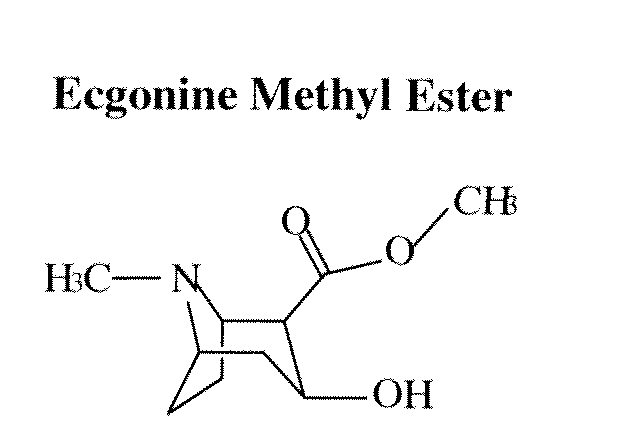
- organic compound "ecgonine methyl ester” has the following chemical structure:
- the organic compound "RTI-4229-70” has the following chemical structure:
- the organic compound "RCS-III- 143” has the following chemical structure:
- the organic compound "RCS-III- 140A” has the following chemical structure:
- the organic compound "RCS-III-218” has the following chemical structure: [0036] As referred to herein, the organic compound “RCS-II1-202A” has the following chemical structure:
- a ligand that binds to the nicotinic acetylcholine receptor and improves cognition or treats or prevents cognitive impairment includes one or more of the following cocaine analogues and derivatives:
- R 1 , R 2 , R 3 , R 4 , R 5 , R 6 , R 7 , R 8 , and R 9 are the same or different and are
- X is independently selected from the group consisting of N, S, O, and C.
- a ligand that binds to the nicotinic acetylcholine receptor and improves cognition or treats or prevents cognitive impairment in accordance with the present invention includes derivatives or analogues of piperidine.
- the general chemical structure of piperidine derivatives is as follows:
- R 1 , R 2 , R 3 , R 4 , R 5 , and R 6 are the same or different and are independently selected from the group consisting of hydrogen, hydroxyl, alkyl, cycloalkyl, alkenyl, alkoxy, aryl, alkylaryl, isoxazole, thiophene, indol, naphthalene, heterocyclic ring, halogen, and amine, as well as their esters and ethers, and X
- a ligand that binds to the nicotinic acetylcholine receptor and improves cognition or treats or prevents cognitive impairment in accordance with the present invention is a derivative or analogue of dizocilpine (also known as MK- 801), but is not dizocilpine.
- dizocilpine also known as MK- 801
- the general chemical structures of these derivatives are as follows:
- R, R 1 , and R 2 are the same or different and are independently .selected from the group consisting of hydrogen, hydroxyl, alkyl, cycloalkyl, alkenyl, alkoxy, aryl, alkylaryl, halogen, and amine, as well as their esters and ethers, and X is N or C.
- a ligand that binds to the nicotinic acetylcholine receptor and improves cognition or treats or prevents cognitive impairment in accordance with the present invention includes a derivative or analogue of phencyclidine (PCP), but is not PCP.
- PCP phencyclidine
- the chemical structure of the PCP derivatives is as follows: Phencyciidine Derivatives
- the present invention relates to a method of improving cognition or treating or preventing cognitive impairment in a subject that involves administering to a subject in need of cognitive improvement an aptamer that binds to the nicotinic acetylcholine receptor and improves cognition or treats or prevents cognitive impairment in the subject.
- RNA aptamers are preferred types of nucleic acid elements that have affinity for and can bind to a target molecule.
- Aptamers typically are generated and identified from a combinatorial library (typically in vitro) wherein a target molecule, generally although not exclusively a protein or nucleic acid, is used to select from a combinatorial pool of molecules, generally although not exclusively oligonucleotides, those that are capable of binding to the target molecule.
- the selected reagents can be identified as primary aptamers.
- the term "aptamer” includes not only the primary aptamer in its original form, but also secondary aptamers derived from (i.e., created by minimizing and/or modifying the structure of) the primary aptamer. Aptamers, therefore, behave as ligands, binding to their target molecule.
- Kj 20-50 nM
- SELEX any method known in the art can be used to identify primary aptamers of any particular target molecule.
- SELEX the established in vitro selection and amplification scheme
- the SELEX scheme is described in detail in U.S. Patent No. 5,270.163 to Gold et al.:
- RNA aptamers where the structure and sequence of the RNA has been established, the RNA molecule can either be prepared synthetically or a DNA construct or an engineered gene capable of encoding uch an RNA molecule can be prepared.
- RNA aptamers that can be used in the methods of the present invention, include, but are not limited to, RNA aptamers that having the consensus sequence according to: (a) SEQ ID NO: I (i.e., ACCG). SEQ ID NO:2 (i.e., UCCG), SEQ ID NO:3 (i.e., UUUACCG), SEQ ID NO:4 (i.e., UUCACCG), and/or SEQ ID NO:5 (i.e.,
- SEQ ID NO:6 i.e.. AUCACCGUAAGG (see Aptamer B5)
- SEQ ID NO:7 i.e., UUUACCGUAAGG (see Aptamer B 15)
- SEQ ID NO:8 i.e.,
- UUUUCCGUAAGG see Aptamer B 19
- SEQ ID NO:9 i.e., UUUACCGUAAGG (see Aptamer B27)
- SEQ ID NO: 10 i.e., AUCACCGUAAGG (see Aptamer B28)
- SEQ ID NO: 1 1 i.e., UCCACCGUAGAU (see Aptamer B36)
- SEQ ID NO: 12 i.e..
- AUCACCGUAAGG (see Aptamer B44)
- SEQ ID NO: 13 i.e., UUUACCGUAAGG (see Aptamer B55)
- SEQ ID NO: 14 i.e., UCCACCGUAAGA (see Aptamer B59)
- SEQ ID NO: 15 i.e., UCCACCGUAAGA (see Aptamer B61)
- SEQ ID NO: 16 i.e.,
- UUUACCGUAAGG see Aptamer B64
- SEQ ID NO: 17 i.e., UUUACCGUAAGG (see Aptamer B65)
- SEQ ID NO: 18 i.e., UUUACCGUAAGG (see Aptamer B69)
- SEQ ID NO: 19 i.e., UCCACCGUAAGA (see Aptamer B76)
- SEQ ID NO:20 i.e.,
- UUUUCCGUAAGG (see Aptamer B78)
- SEQ ID NO:21 i.e., UCCACCGUAAGA (see Aptamer B108)
- SEQ ID NO:22 i.e., UUUACCGUAAGG (see Aptamer Bi l l )
- SEQ ID NO:23 i.e., AUCACCGUAAGG (see Aptamer B 124)
- SEQ ID NO:66 i.e., GAAAG
- SEQ ID NO: 88 i.e., GUUAAU
- RNA aptamers that can be used in the methods of the present invention, include, but are not limited to, RNA aptamers having a nucleotide sequence according to:
- SEQ ID NO:24 (Aptamer B5), SEQ ID NO:25 (Aptamer B 15), SEQ ID NO:26 (Aptamer B 19), SEQ ID NO:27 (Aptamer B27), SEQ ID NO:28 (Aptamer B28),
- SEQ ID NO:29 (Aptamer B36), SEQ ID NO:30 (Aptamer B44), SEQ ID NO:31
- SEQ ID NO:42 (Aptamer 01 ), SEQ ID NO:43 (Aptamer 05), SEQ ID NO:44 (Aptamer 06), SEQ ID NO:45 (Aptamer 07), SEQ ID NO:46 (Aptamer 09), SEQ ID NO:47 (Aptamer I I ), SEQ ID NO:48 (Aptamer 13), SEQ ID NO:49 (Aptamer 14), SEQ ID NO:50 (Aptamer 16), SEQ ID NO:51 (Aptamer 18), SEQ ID NO:52 (Aptamer 19), SEQ ID NO:53 (Aptamer 20,21 ), and/or SEQ ID NO:54 (Aptamer 22);
- SEQ ID NO:56 (Aptamer 3), SEQ ID NO:57 (Aptamer 8), SEQ ID NO:58 (Aptamer 23), SEQ ID NO:59 (Aptamer 24), SEQ ID NO:60 (Aptamer 26), SEQ ID NO:
- SEQ ID NO:89 (Aptamer S5), SEQ ID NO:90 (Aptamer S 18), SEQ ID NO:9l (Aptamer S20), SEQ ID NO:92 (Aptamer S25), SEQ ID NO:93 (Aptamer S48), SEQ ID NO:94 (Aptamer S51), and/or SEQ ID NO:95 (Aptamer S57).
- modified aptamers having improved properties such as decreased size, enhanced stability, or enhanced binding affinity.
- modifications of the aptamer sequences include adding, deleting or substituting nucleotide residues, and/or chemically modifying one or more residues.
- Methods for producing such modified aptamers are known in the art and described in, e.g., U.S. Patent Nos. 5,817,785 to Gold et al.. and 5,958,691 to Wolfgang et al., which are hereby incorporated by reference in their entirety.
- Chemically modified aptamers include those containing one or more modified bases.
- a modified pyrimidine bases may have substitutions of the general formula 5'-X and or 2 * -Y
- a modified purine bases may have modifications of the general formula 8'-X and/or 2'-Y.
- the group X includes the halogens I, Br, CI, or an azide or amino group.
- the group Y includes an amino group, fluorine, or a methoxy group. Other functional substitutions that would serve the same function may also be included.
- the aptamers of the present invention may have one or more X-modified bases, or one or more Y-modifted bases, or a combination of X- and Y-modified bases.
- the present invention encompasses derivatives of these substituted pyrimidines and purines such as 5 -triphosphates, and S'-dimethoxytrityl, 3'-beta-cyanoethyl, N,N-diisopropyl phosphoramidites with isobutyryl protected bases in the case of adenosine and guanosine, or acyl protection in the case of cytosine.
- 5 -triphosphates and S'-dimethoxytrityl, 3'-beta-cyanoethyl, N,N-diisopropyl phosphoramidites with isobutyryl protected bases in the case of adenosine and guanosine, or acyl protection in the case of cytosine.
- nucleotide analogs e.g., nucleotide analogs modified at the 5 and 2 * positions, including 5-(3-aminoallyl)uridine triphosphate (5-AA-UTP), 5-(3- aminoallyl)deoxyuridine triphosphate (5-AA-dUTP), 5-fluorescein-l2-uridine
- nucleotide analogs modified at the 5 and 2 * positions including 5-(3-aminoallyl)uridine triphosphate (5-AA-UTP), 5-(3- aminoallyl)deoxyuridine triphosphate (5-AA-dUTP), 5-fluorescein-l2-uridine
- triphosphate (5-F- 12-UTP), 5-digoxygenin- 1 1 -uridine triphosphate (5-Dig- 1 1 -UTP), 5- bromouridine triphosphate (5-Br-UTP), 2'-amino-uridine triphosphate (2'-NH2-UTP) and 2'-amino-cytidine triphosphate (2 - NH 2 -CTP), 2 * -fluoro-cytidine triphosphate (2'-F-CTP), and 2'-fluoro-uridine triphosphate (2'-F-UTP).
- the aptamers may also be modified by capping at the 3" and 5" end.
- the aptamer can be modified by adding to an end a polyethyleneglycol, amino acid, peptide, inverted dT, nucleic acid, nucleosides, myristoyl, lithocolic-oleyl, docosanyl, lauro l, stearoyl, palmitoyl, oleoyl, linoleoyl, other lipids, steroids, cholesterol, caffeine, vitamins, pigments, fluorescent substances, toxin, enzymes, radioactive substance, biotin and the like.
- U.S. Patent Publication No. 2005/0096290 to Adamis et al. and U.S. Patent No. 5,660,985 to Wolfgang et al. which are hereby incorporated by reference in their entirety.
- sequences (consensus and RNA aptamer nucleotide sequences) referenced above by "SEQ ID NO.” are identified herein below in Tables A, B, C, D, E, and F.
- the nicotinic acetylcholine receptor ligands that improve cognition or prevent or treat cognitive impairment of the present invention can be administered orally, parenterally, for example, subcutaneously, intravenously, intramuscularly,
- ligands may be administered alone or with suitable pharmaceutical carriers, and can be in solid or liquid form such as, tablets, capsules, powders, solutions, suspensions, or emulsions.
- the nicotinic acetylcholine receptor ligands that improve cognition or prevent or treat cognitive impairment of the present invention may be orally administered, for example, with an inert diluent, or with an assimilable edible carrier, or they may be enclosed in hard or soft shell capsules, or they may be compressed into tablets, or they may be incorporated directly with the food of the diet.
- an inert diluent or with an assimilable edible carrier
- cognition enhancing ligands including compounds and aptamers of the present invention may be incorporated with excipients and used in the form of tablets, capsules, elixirs, suspensions, syrups, and the like.
- Such compositions and preparations should contain at least 0.1 % of active compound.
- the percentage of cognition enhancing ligand of the present invention in these compositions may, of course, be varied and may conveniently be between about 2% to about 60% of the weight of the unit.
- the concentration of nicotinic acetylcholine receptor ligand in such therapeutically useful composition is such that a suitable dosage will be obtained.
- Preferred compositions according to the present invention are prepared so that an oral dosage unit contains between about I and 250 mg of one or more cognition enhancing ligandsof the present invention.
- the tablets, capsules, and the like may also contain a binder such as gum tragacanth, acacia, corn starch, or gelatin; excipients such as dicalcium phosphate; a disintegrating agent such as corn starch, potato starch, alginic acid; a lubricant such as magnesium stearate; and a sweetening agent such as sucrose, lactose, or saccharin.
- a binder such as gum tragacanth, acacia, corn starch, or gelatin
- excipients such as dicalcium phosphate
- a disintegrating agent such as corn starch, potato starch, alginic acid
- a lubricant such as magnesium stearate
- a sweetening agent such as sucrose, lactose, or saccharin.
- a liquid carrier such as a fatty oil.
- tablets may be coated with shellac, sugar, or both.
- a syrup may contain, in addition to active ingredient, sucrose as a sweetening agent, methyl and propylparabens as preservatives, a dye, and flavoring such as cherry or orange flavor.
- the nicotinic acetylcholine receptor ligands that improve cognition or prevent or treat cognitive impairment of the present invention may also be administered parenterally.
- Solutions or suspensions of these active compounds can be prepared in water suitably mixed with a surfactant, such as hydroxypropylcellulose.
- Dispersions can also be prepared in glycerol, liquid polyethylene glycols, and mixtures thereof in oils.
- Illustrative oils are those of petroleum, animal, vegetable, or synthetic origin, for example, peanut oil, soybean oil, or mineral oil.
- water, saline, aqueous dextrose and related sugar solution, and glycols such as, propylene glycol or polyethylene glycol are preferred liquid carriers, particularly for injectable solutions. Under ordinary conditions of storage and use, these preparations contain a preservative to prevent the growth of microorganisms.
- the pharmaceutical forms suitable for injectable use include sterile aqueous solutions or dispersions and sterile powders for the extemporaneous preparation of sterile injectable solutions or dispersions.
- the form must be sterile and must be fluid to the extent that easy syringability exists. It must be stable under the conditions of manufacture and storage and must be preserved against the contaminating action of microorganisms, such as bacteria and fungi.
- the carrier can be a solvent or dispersion medium containing, for example, water, ethanol, polyol (e.g., glycerol, propylene glycol, and liquid polyethylene glycol), suitable mixtures thereof, and vegetable oils.
- the nicotinic acetylcholine receptor ligands that improve cognition or prevent or treat cognitive impairment of the present invention may also be administered directly to the airways in the form of an aerosol.
- the compounds of the present invention in solution or suspension may be packaged in a pressurized aerosol container together with suitable propellants, for example, hydrocarbon propel lanLs like propane, butane, or isobutane with conventional adjuvants.
- suitable propellants for example, hydrocarbon propel lanLs like propane, butane, or isobutane with conventional adjuvants.
- the materials of the present invention also may be administered in a non-pressurized form such as in a nebulizer or atomizer.
- the dosage of nicotinic acetylcholine receptor ligands that improve cognition or prevent or treat cognitive impairment of the present invention varies depending on the kind and activity of active ingredient, seriousness of cognitive impairment, animal species being the subject of administration, drug tolerability of the subject of administration, body weight, age and the like, and the usual dosage, based on the amount of active ingredient per day for an adult, can be about 0.0001 to about 100 mg/kg, for example, about 0.0001 to about 10 mg/kg, preferably about 0.005 to about 1 mg/kg.
- IP intraperitoneal
- EME ecgonine methyl ester
- the data show rapid absorption after an IP dose, a biexponenlial decay of plasma concentrations, as if the drug confers on the body the characteristics of a two-compartment system, and sufficient persistence in the body to predict a half-life in humans of 6 - 8 hours.
- Figures 2A-2C show three individual swimming traces for rats treated with vehicle, EME alone, and EME plus scopolamine.
- the target area was in the bottom left quadrant of the bath.
- the control rat found the target area ( Figure 2A) while the scopolamine-treated rat showed no preference ( Figure 2B).
- the swimming trace of the rat treated with the scopolamine and the EME was similar to the control-treated rat ( Figure 2C), indicating the ability of this rat to readily find the target area.
- a repeat latency test showed the same results as Figure 4, particularly demonstrating the acute response to the challenge and a new cycle of searching and learning.
Landscapes
- Health & Medical Sciences (AREA)
- Life Sciences & Earth Sciences (AREA)
- Chemical & Material Sciences (AREA)
- Medicinal Chemistry (AREA)
- Pharmacology & Pharmacy (AREA)
- Epidemiology (AREA)
- Animal Behavior & Ethology (AREA)
- General Health & Medical Sciences (AREA)
- Public Health (AREA)
- Veterinary Medicine (AREA)
- Emergency Medicine (AREA)
- Biochemistry (AREA)
- Molecular Biology (AREA)
- Pharmaceuticals Containing Other Organic And Inorganic Compounds (AREA)
Abstract
The present invention relates to methods of improving cognition and treating or preventing cognitive impairment in a subject. These methods involve administering to a subject in need of cognitive improvement or to a subject having or at risk for developing impaired cognition a ligand which binds to the nicotinic acetylcholine receptor and improves cognition or treats or prevents cognitive impairment in the subject.
Description
COGNITION MODIFICATION
[0001] This application claims the priority benefit of U.S. Provisional Patent Application Serial No. 61/499,577, filed June 21 , 2011 , which is hereby incorporated by reference in its entirety.
FIELD OF THE INVENTION
[0002] The present invention relates to methods of improving cognition and treating or preventing cognitive impairment in a subject. BACKGROUND OF THE INVENTION
[0003] Cognition is an overall term for mental processes, including attention, memory, language, problem solving, and decision making. Cognition is studied in various disciplines such as psychology, philosophy, linguistics, and biological and physical science. The term is used differently in different disciplines. In psychology, cognitive science, and medicine it usually refers to an information processing view of an individual's psychological functions. It is also used in a branch of social psychology called social cognition to explain attitudes, attribution and group dynamics.
[0004] The term cognition can refer to the ability for the processing of information, applying knowledge, and changing preferences. Cognition, or cognitive processes, can be natural or artificially induced, conscious or unconscious. These processes are analyzed from different perspectives within different contexts, such as in the fields of neurology, psychiatry, psychology and anthropology. Within psychology and medicine the concept of cognition is closely related to mental functions, thoughts, and states of intelligent entities.
[0005] Cognitive impairment is seen when problems with thought processes occur. It can include loss of higher reasoning, forgetfulness, learning disabilities, concentration difficulties, decreased intelligence, and other reductions in mental functions. Cognitive impairment may be present at birth or can occur at any point in a person's lifespan.
[0006] Cognitive impairment can occur at any point in life, and can be transitory or permanent. For example, it can result from conditions that occur during fetal
development, at birth, shortly after birth, or at any age. Sometimes, the cause of cognitive
impairment cannot be determined. While cognitive impairment can be an age-related phenomenon, it is also commonly associated with various diseases and conditions.
[0007] Some early causes of cognitive impairment include chromosome
abnormalities and genetic syndromes, malnutrition, prenatal drug exposure, poisoning due to lead or other heavy metals, hypoglycemia (low blood sugar), neonatal jaundice (high bilirubin levels developing after birth), hypothyroidism (underactive thyroid), complications of prematurity, trauma or child abuse such as shaken baby syndrome, or oxygen deprivation in the womb or during or after birth.
[0008] Cognitive impairment that develops in childhood or adolescence can result from many conditions. Examples include side effects of cancer therapy, malnutrition, heavy metal poisoning, autism (abnormal development of communication and social skills), metabolic conditions, and systemic lupus erythematosus (disorder in which the body attacks its own healthy cells and tissues).
[0009] While there have been many claims made for a wide variety of substances in regard to their ability to enhance cognition, very few substances actually prevent cognitive decline, enhance cognition, or reverse cognitive impairment. For example amphetamine, methylphenidate and modafinil, which are pharmacologically classified as stimulants, are known to temporarily induce states of excitement, restlessness, euphoria and sleeplessness. While some believe these drugs enhance learning, there is no evidence of improved brain efficiency, but rather, merely an induction of a state of wakefulness that makes more learning temporarily possible. There is no medically-proven evidence that these substances improve memory, or the ability to process thoughts. Similarly, antidepressants, such as amitriptyline and selective serotonin reuptake inhibitors (SSRIs) can raise the mood of depressed patients toward a normal stale, thereby facilitating more normal functioning in society by this psychiatrical ly-impaired group of people. Other groups of psychiatrically-impaired people, such as schizophrenics, can experience normalization of mood, thought processes, and cognitive functioning by the use of major tranquillizers, or neuroleptics, such as Seroquel, clozapine, or thioridazine. Many other drugs are thought of in a similar light, including piracetam and other racetams, buproprion and other drugs affecting dopaminergic systems, caffeine and other xanthines, choline and other cholinergics, compounds affecting gamma aminobutyric acid and glutamate receptors, and cyclic AMP receptors, serotinergics, compounds affecting cerebral blood flow such as CoQ-10, certain centrally-acting histamine antagonists,
anlioxidants such as glutathione, hormones and hormone precursors such as vasopressin and dehydroepiandrosterone, and royal jelly. These compounds are sometimes referred to as nootropics, from Greek stems for "mind" and "bend". However, this term is more associated with a concept of neuroprotection, rather than behavioral change. While nootropics are by definition cognitive enhancers, all cognitive enhancers are not nootropics. There are also other drugs and nutritional supplements, such as B vitamins, omega-3 fatty acids, isoflavones, vitamin D, tetrahydrocannabinol, tobacco and certain berries, that are believed by some people to exert stimulative or other beneficial effects of a similar kind by means of comparable pharmacological mechanisms. However, very few, if any, of the compounds mentioned above can reverse impairment of memory resulting from medically identifiable illnesses, such as dementia, traumatic brain injury, attention deficit disorder and similar conditions. The invention described herein overcomes these and other problems in the art.
SUMMARY OF THE INVENTION [0010] The present invention relates to a method of improving cognition or treating or preventing cognitive impairment in a subject. This method involves selecting a subject in need of cognitive improvement or a subject having or at risk for developing impaired cognition, and administering to the subject a ligand that binds to the nicotinic
acetylcholine receptor and improves cognition or treats or prevents cognitive impairment in the subject.
[0011] There are relatively few approved agents that prevent cognitive decline, enhance cognition, or reverse cognitive impairment. Of these agents, most target the synthesis, release, or degradation of neurotransmitters in the cholinergic system, and have demonstrated only modest effects in modifying clinical symptoms of cognitive impairment for relatively short periods of time. None of the available agents has shown a clear, long-lasting effect on preventing the progression of cognitive decline or reversing impairment. As described herein, applicants have found that certain ligands of the nicotinic acetylcholine receptor are effective agents for improving cognition and for preventing and reversing cognitive impairment. Accordingly, the present invention provides a means to achieve long-term significant enhancement of memory processes, thereby holding at bay the ravages of diseases causing memory loss and other cognitive problems.
BRIEF DESCRIPTION OF THE DRAWINGS
[0012] Figure I is a graph showing brain (ng/g) and plasma (ng/ml) concentrations of ecgonine methyl ester ("EME") in rats following intraperitoneal administration of a 10 mg/kg dose at 0, 1 , 4, 8, and 24 hours.
[0013] Figures 2A-2C are Morris water maze traces of three individual rats following vehicle treatment (Figure 2A), a single dose of scopolamine ( 1 mg/kg) (Figure 2B), and a single dose of EME ( 10 mg/kg) and scopolamine ( I mg/kg) (Figure 2C). The target platform was located in the lower left quadrant of the water bath.
[0014] Figure 3 shows time spent in the area previously occupied by the platform in seconds (y-axis) in the Morris water maze test for rats administered vehicle ( 1 ), EME alone (2), scopolamine alone (3), and the EME in combination with scopolamine (4). The differences between 1, 2, and 4 are not significant. Group 3 showed the well-established lack of ability to find the platform when rats are under the influence of scopolamine, a lest probe that adversely affects learning and memory in both rats and humans, also shown in Figure 2B. EME reversed this effect of scopolamine (p< 0.05) as also illustrated in Figure 2C.
[0015] Figure 4 is a graph showing latency, i.e., time (seconds) required for animal to find the platform, in young vehicle-treated rats ("young"), aged vehicle-treated rats ("aged"), and aged rats administered 3 mg/kg or 10 mg/kg EME. DETAILED DESCRIPTION OF THE INVENTION
[0016] The present invention relates to a method of improving cognition or treating or preventing cognitive impairment in a subject. This method involves selecting a subject in need of cognitive improvement or a subject having or at risk for developing impaired cognition, and administering to the subject a ligand that binds to the nicotinic
acetylcholine receptor and improves cognition or treats or prevents cognitive impairment in the subject.
[0017] In accordance with this and all aspects of the present invention, a subject suitable for treatment using the methods of the present invention includes any animal, preferably a mammal, e.g., human, non-human primate, rodent, cow, horse, sheep, pig, goat, deer, elk, bison, etc. Preferably, the subject is a human.
[0018] "Cognitive impairment" as used herein includes any impairment to thought processes, including, for example, loss of higher reasoning, forgetfulness, learning disabilities, concentration difficulties, decreased intelligence, and any other reduction in mental function. Cognitive impairment may be present at birth or can occur at any point in a person's lifespan. Accordingly, suitable subjects for treatment in accordance with the methods of the present invention include infants, children, adolescents, young adults, adults, and elderly.
[0019] Causes of cognitive impairment in infants and small children include chromosome abnormalities and genetic syndromes, malnutrition, prenatal drug exposure, poisoning due to lead or other heavy metals, hypoglycemia (low blood sugar), neonatal jaundice (high bilirubin levels developing after birth), hypothyroidism (underactive thyroid), complications of prematurity, trauma or child abuse such as shaken baby syndrome, or oxygen deprivation in the womb or during or after birth.
[0020] Cognitive impairment that develops in childhood or adolescence can result from many conditions. Examples include side effects of cancer therapy, malnutrition, heavy metal poisoning, autism (abnormal development of communication and social skills), metabolic conditions, and systemic lupus erythematosus (disorder in which the body attacks its own healthy cells and tissues.
[0021] Cognitive impairment also occurs in young adults, adults, and elderly adults. This impairment may be an age-related phenomenon (i.e., not associated with any disease state), for example, age-related memory loss. Alternatively, cognitive impairment in these individuals may be associated with or resulting from a disease or other condition.
[0022] Individuals suffering from cognitive impairment are unable to think well enough to do normal activities, such as dressing or eating. Other manifestations of cognitive impairment include a loss of problem solving capacity, memory impairment, and difficulty with recall of information and remembering new experiences and past events. Individuals suffering from cognitive impairment may be unable to differentiate between real and unreal experiences. There may be a loss of a train of thought, a phenomenon known as "word salad", social withdrawal at least in part because of fear, disorganized thinking, loss of long-term memory, and loss of reponsiveness. Other individuals may experience difficulty concentrating amid distractions and may be slower at processing new information, experience a loss of recent memory, have difficulty with new learning, and/or lose executive function ability in starting tasks and setting goals.
Still other individuals with cognitive impairment may experience difficulty with decision making, control of inhibitions, planning, and memory, may have problems with concentration, sifting different thoughts, application to problems, and general mental activities. These symptoms and signs are purely for illustration and it is understood by one of skill in the art that there are many other medical manifestations arising from cognitive impairment and decline.
[0023] There are a wide variety of tests available for assessing cognitive function. Some examples include, without limitation, scoring the ability of a person to recognize shapes, numbers, symbols and/or pictures presented on flash cards and/or computer screens. The Folstein mini-mental state examination is a test which incorporates simple assessments of memory, reading, copying, response to commands, identification of places and dates, writing and naming into derivation of a composite score. The Folstein test is often used to assess the severity of cognitive impairment and follow the course of cognitive change in an individual. The Mini-Cog test is another commonly used test to assess cognitive decline where the person is given three words to remember, then is exposed to a distraction such as a drawing exercise, and is rated on his or her ability to recall the three words. There are many other tests known and used by medical professionals in the clinical field that operate on similar principles ranging from very simple to highly complex. Any one of these tests can be used to assess the initial cognitive state of an individual, i.e., determine the severity of cognitive impairment, and to track or assess cognitive improvement in an individual following treatment in accordance with the methods of the present invention.
[0024] Treatment-induced improvement in the cognitive state of a patient, including drug-induced improvement, can also be observed by family members of a patient as enhanced memory, improved level of alertness and reduced anxiety, along with a general improved level of participation in personal care ability and family affairs. The patient may experience improved recall and general ability to function in society, plus a general lifting of a heavy cloud over his or her ability to think clearly. The clinical
pharmacologist may observe improved responses in formal tests of drug action, which can include the induction of an artificial foggy state with experimental drugs such as scopolamine, then reversal by the therapeutic agent, in much the same way as this drug is used as a test compound in laboratory animals. The patient care professional may
observe improved performance in his or her objective tests of memory and other aspects of mental functioning, including response to questioning.
[0025] In accordance with the methods of the present invention cognition can be improved and cognitive impairment in a subject can be treated or prevented by administering to the subject a ligand that binds to the nicotinic acetylcholine receptor and improves cognition or treats or prevents cognitive impairment in the subject. As used herein, the term "ligand" includes, but is not limited to, small organic molecules, aptainers, and other compounds that similarly bind to a regulatory site on the nicotinic acetylcholine receptor and induce an allosteric change in the receptor, thereby improving or enhancing the flow of inorganic cations through the ion channel of the receptor. The enhanced flow of inorganic cations through the receptor channel improves nerve function and cognition. The characteristics and binding function of this regulatory site on the nicotinic acetylcholine receptor have previously been described (see e.g., Hess et al., "Mechanism-Based Discovery of Ligands that Counteract Inhibition of the Nicotinic Acetylcholine Receptor by Cocaine and MK-801 ," Proc. Nat. Acad. Sci. 97(25): 13895- 13900 (2000), Chen et al., "Mechanism-Based Discovery of Small Molecules that Prevent Noncompetitive Inhibition by Cocaine and MK-801 Mediated by Two Different Sites on the Nicotinic Acetylcholine Receptor," Biochemistry 43: 10149-10156 (2004), Hess et al., "Reversing the Action of Noncompetitive Inhibitors (MK-801 and Cocaine) on a Protein (Nicotinic Acetylcholine Receptor)-Mediated Reaction," Biochemistry 42:6106-61 14 (2003), Cui et al., "Selection of 2'-Fluoro-modified RNA Aptamers for Alleviation of Cocaine and MK-801 Inhibition of the Nicotinic Acetylcholine Receptor," J. Membrane Biol. 202: 137-149 (2004), Sivaprakasam et al., "Minimal RNA Aptamer Sequences That Can Inhibit or Alleviate Noncompetitive Inhibition of the Muscle-Type Nicotinic
Acetylcholine Receptor," J. Membrane Biol. 233: 1-12 (2010), Ulrich et al., "in Vitro
Selection of RNA Molecules that Displace Cocaine from the Membrane-Bound Nicotinic Acetylcholine Receptor," Proc. Nat. Acad. Sci. 95: 14051 -14056 ( 1998), and Grewer et al., "On the Mechanism of Inhibition of the Nicotinic Acetylcholine Receptor by the Anticonvulsant MK-801 Investigated by Laser-Pulse Photolysis in the Microsecond-to- Millisecond Time Region," Biochemistry 38(24):7837-46 ( 1999), which are all hereby incorporated by reference in their entirety).
[0026] Ligands that bind to the regulatory site of the nicotinic acetylcholine receptor comprise two different classes. Both classes modulate the opening and closing
of the ion channel of the receptor to control flow of inorganic cations through the ion channel, especially the inflow that is normally stimulated by the natural neurotransmitter acetylcholine. Class I ligands are compounds that bind with higher affinity to the regulatory site on the closed-channel form than on the open-channel form of the receptor. Class 1 ligands facilitate closure and or continued existing closure of the receptor ion channel, which inhibits neurotransmission and impairs cognition. Class 1 ligands include both endogenous and exogenous compounds. Prototypical exogenous Class 1 ligands include, without limitation, cocaine, M -801, and phencyclidine.
[0027] Broadly, Class 2 ligands are compounds that bind to the regulatory site on the nicotinic acetylcholine receptor and shift the channel-opening equilibrium towards the open channel form of the receptor. For example, in the presence of an activating ligand such as acetylcholine or carbamoylcholine, and in the presence of a deleterious factor such as a Class I ligand, a mutation, etc.. Class 2 ligands bind with equal or higher affinity to the regulatory site on the open-channel form of the receptor than to the closed- channel form. This binding shifts the channel-opening equilibrium to the open-channel state and alleviates the inhibition and impairment caused by a Class I compound, mutation, etc., thereby improving cognition. Class 2 ligands, include tropane and its derivative, e.g., ecgonine. ecgonine methyl ester, RTI-4229-70. RCS-III- 143, RCS-III- I40A, RCS-III-218, and RCS-III-202A, piperidine and its derivatives, derivatives of MK801 (but not MK-801 ), derivatives of phencyclidine (but not phencyclidine), and certain RNA aptamers all of which are described in more detail infra. These Class 2 ligands are the cognition-enhancing ligands that are suitable for use in the methods of the present invention.
[0028] According to one embodiment of the present invention, a ligand that binds to the nicotinic acetylcholine receptor and improves cognition or treats or prevents cognitive impairment comprises an organic compound that is a derivative or analogue of tropane that is not cocaine. The general chemical structures of tropane derivatives are as follows:
Tropane Derivatives

independently selected from the group consisting of N, S, O, and C.
[0029] In addition other ligands (i.e.. Class 2 ligands) that bind to the nicotinic acetylcholine receptor and improve cognition or treat or prevent cognitive impairment include derivatives of cocaine, including, without limitation, one of the following organic compounds: ecgonine; ecgonine methyl ester; RTl-4229-70; RCS-III-143;
RCS-III- 140A; RCS-III-218; RCS-I1I-202A; and metabolites, analogues, and/or derivatives of these compounds.
[0030] As referred to herein, the organic compound "ecgonine" has the following chemical structure:

[0031] As referred to herein, the organic compound "ecgonine methyl ester" has the following chemical structure:
[0032] As referred to herein, the organic compound "RTI-4229-70" has the following chemical structure:

[0033] As referred to herein, the organic compound "RCS-III- 143" has the following chemical structure:

[0034] As referred to herein, the organic compound "RCS-III- 140A" has the following chemical structure:

[0035] As referred to herein, the organic compound "RCS-III-218" has the following chemical structure:
 [0036] As referred to herein, the organic compound "RCS-II1-202A" has the following chemical structure:

[0037] In another embodiment, a ligand that binds to the nicotinic acetylcholine receptor and improves cognition or treats or prevents cognitive impairment that is useful in carrying out the methods of the present invention includes one or more of the following cocaine analogues and derivatives:

independently selected from the group consisting of hydrogen, hydroxyl, alkyl, cycloalkyl, alkenyl, alkoxy, aryl, alkylaryl, isoxazole, thiophene, indol, naphthalene, heterocyclic ring, halogen, and amine, as well as their esters and ethers, and X is independently selected from the group consisting of N, S, O, and C.
[0038] In another embodiment, a ligand that binds to the nicotinic acetylcholine receptor and improves cognition or treats or prevents cognitive impairment in accordance with the present invention includes derivatives or analogues of piperidine. As referred to herein, the general chemical structure of piperidine derivatives is as follows:

[0039] In another embodiment, a ligand that binds to the nicotinic acetylcholine receptor and improves cognition or treats or prevents cognitive impairment in accordance with the present invention is a derivative or analogue of dizocilpine (also known as MK- 801), but is not dizocilpine. As referred to herein, the general chemical structures of these derivatives are as follows:
Derivatives

where R, R1, and R2 are the same or different and are independently .selected from the group consisting of hydrogen, hydroxyl, alkyl, cycloalkyl, alkenyl, alkoxy, aryl, alkylaryl, halogen, and amine, as well as their esters and ethers, and X is N or C.
[0040] In another embodiment, a ligand that binds to the nicotinic acetylcholine receptor and improves cognition or treats or prevents cognitive impairment in accordance with the present invention includes a derivative or analogue of phencyclidine (PCP), but is not PCP. As referred to herein, the chemical structure of the PCP derivatives is as follows:
Phencyciidine Derivatives

[0041] In another aspect, the present invention relates to a method of improving cognition or treating or preventing cognitive impairment in a subject that involves administering to a subject in need of cognitive improvement an aptamer that binds to the nicotinic acetylcholine receptor and improves cognition or treats or prevents cognitive impairment in the subject.
[0042] RNA aptamers are preferred types of nucleic acid elements that have affinity for and can bind to a target molecule. Aptamers typically are generated and identified from a combinatorial library (typically in vitro) wherein a target molecule, generally although not exclusively a protein or nucleic acid, is used to select from a combinatorial pool of molecules, generally although not exclusively oligonucleotides, those that are capable of binding to the target molecule. The selected reagents can be identified as primary aptamers. The term "aptamer" includes not only the primary aptamer in its original form, but also secondary aptamers derived from (i.e., created by minimizing and/or modifying the structure of) the primary aptamer. Aptamers, therefore, behave as ligands, binding to their target molecule.
[0043] Identifying primary aptamers basically involves selecting aptamers that bind a target molecule with sufficiently high affinity (e.g., Kj = 20-50 nM) and specificity from a pool of nucleic acids containing a random region of varying or predetermined length (Shi et al., "A Specific RNA Hairpin Loop Structure Binds the RNA Recognition Motifs of the Drosophila SR Protein B52," Mol. Cell Biol. 17: 1649- 1657 ( 1997), which is hereby incorporated by reference in its entirety).
[0044] Any method known in the art can be used to identify primary aptamers of any particular target molecule. In one embodiment of the present invention the established in vitro selection and amplification scheme, SELEX, can be used. The SELEX scheme is described in detail in U.S. Patent No. 5,270.163 to Gold et al.:
Ellington and Szostak, "In Vitro Selection of RNA Molecules that Bind Specific
Ligands," Nature 346:818-822 ( 1990); and Tuerk and Gold, "Systematic Evolution of Ligands by Exponential Enrichment: RNA Ligands to Bacteriophage T4 DNA
Polymerase," Science 249:505-510 (1990), which are hereby incorporated by reference in their entirety.
[0045] In the case of RNA aptamers, where the structure and sequence of the RNA has been established, the RNA molecule can either be prepared synthetically or a DNA construct or an engineered gene capable of encoding uch an RNA molecule can be prepared.
[0046] Suitable examples of RNA aptamers that can be used in the methods of the present invention, include, but are not limited to, RNA aptamers that having the consensus sequence according to:
(a) SEQ ID NO: I (i.e., ACCG). SEQ ID NO:2 (i.e., UCCG), SEQ ID NO:3 (i.e., UUUACCG), SEQ ID NO:4 (i.e., UUCACCG), and/or SEQ ID NO:5 (i.e.,
UUCACCGUAAGG);
(b) SEQ ID NO:6 (i.e.. AUCACCGUAAGG (see Aptamer B5)), SEQ ID NO:7 (i.e., UUUACCGUAAGG (see Aptamer B 15)), SEQ ID NO:8 (i.e.,
UUUUCCGUAAGG (see Aptamer B 19)), SEQ ID NO:9 (i.e., UUUACCGUAAGG (see Aptamer B27)), SEQ ID NO: 10 (i.e., AUCACCGUAAGG (see Aptamer B28)), SEQ ID NO: 1 1 (i.e., UCCACCGUAGAU (see Aptamer B36)), SEQ ID NO: 12 (i.e..
AUCACCGUAAGG (see Aptamer B44)), SEQ ID NO: 13 (i.e., UUUACCGUAAGG (see Aptamer B55)), SEQ ID NO: 14 ( i.e., UCCACCGUAAGA (see Aptamer B59)). SEQ ID NO: 15 (i.e., UCCACCGUAAGA (see Aptamer B61)), SEQ ID NO: 16 (i.e.,
UUUACCGUAAGG (see Aptamer B64)), SEQ ID NO: 17 (i.e., UUUACCGUAAGG (see Aptamer B65)), SEQ ID NO: 18 (i.e., UUUACCGUAAGG (see Aptamer B69)), SEQ ID NO: 19 (i.e., UCCACCGUAAGA (see Aptamer B76)), SEQ ID NO:20 (i.e.,
UUUUCCGUAAGG (see Aptamer B78)), SEQ ID NO:21 ( i.e., UCCACCGUAAGA (see Aptamer B108)). SEQ ID NO:22 (i.e., UUUACCGUAAGG (see Aptamer Bi l l )), and/or SEQ ID NO:23 (i.e., AUCACCGUAAGG (see Aptamer B 124));
(c) SEQ ID NO:55 (i.e.. GCUGAA);
(d) SEQ ID NO:66 (i.e., GAAAG); and/or
(e) SEQ ID NO: 88 (i.e., GUUAAU).
[0047] Suitable examples of RNA aptamers that can be used in the methods of the present invention, include, but are not limited to, RNA aptamers having a nucleotide sequence according to:
(a) SEQ ID NO:24 (Aptamer B5), SEQ ID NO:25 (Aptamer B 15), SEQ ID NO:26 (Aptamer B 19), SEQ ID NO:27 (Aptamer B27), SEQ ID NO:28 (Aptamer B28),
SEQ ID NO:29 (Aptamer B36), SEQ ID NO:30 (Aptamer B44), SEQ ID NO:31
(Aptamer B55). SEQ ID NO:32 (Aptamer B59), SEQ ID NO:33 (Aptamer B61), SEQ ID NO:34 (Aptamer B64), SEQ ID NO:35 (Aptamer B65), SEQ ID NO:36 (Aptamer B69), SEQ ID NO:37 (Aptamer B76), SEQ ID NO:38 (Aptamer B78), SEQ ID NO:39
(Aptamer B108), SEQ ID NO:40 (Aptamer B i l l ), and or SEQ ID NO:41 (Aptamer BI24);
(b) SEQ ID NO:42 (Aptamer 01 ), SEQ ID NO:43 (Aptamer 05), SEQ ID NO:44 (Aptamer 06), SEQ ID NO:45 (Aptamer 07), SEQ ID NO:46 (Aptamer 09), SEQ
ID NO:47 (Aptamer I I ), SEQ ID NO:48 (Aptamer 13), SEQ ID NO:49 (Aptamer 14), SEQ ID NO:50 (Aptamer 16), SEQ ID NO:51 (Aptamer 18), SEQ ID NO:52 (Aptamer 19), SEQ ID NO:53 (Aptamer 20,21 ), and/or SEQ ID NO:54 (Aptamer 22);
(c) SEQ ID NO:56 (Aptamer 3), SEQ ID NO:57 (Aptamer 8), SEQ ID NO:58 (Aptamer 23), SEQ ID NO:59 (Aptamer 24), SEQ ID NO:60 (Aptamer 26), SEQ ID
NO:61 (Aptamer 30), SEQ ID NO:62 (Aptamer 31 ), SEQ ID NO:63 (Aptamer 38), SEQ ID NO:64 (Aptamer 39). and/or SEQ ID NO:65 (Aptamer 42);
(d) SEQ ID NO:67 (Aptamer S 1 ), SEQ ID NO:68 (Aptamer S 13), SEQ ID NO:69 (Aptamer S 14), SEQ ID NO: 70 (Aptamer S21 ), SEQ ID NO:71 (Aptamer S24), SEQ ID NO:72 (Aptamer S29), SEQ ID NO:73 (Aptamer S43), SEQ ID NO:74 (Aptamer S44), SEQ ID NO:75 (Aptamer S45), SEQ ID NO:76 (Aptamer S46), SEQ ID NO:77 (Aptamer S47), SEQ ID NO:78 (Aptamer S49), SEQ ID NO:79 (Aptamer S50), SEQ ID NO:80 (Aptamer S53), SEQ ID NO:81 (Aptamer S56), SEQ ID NO:82 (Aptamer S59), SEQ ID NO:83 (Aptamer S62), SEQ ID NO:84 (Aptamer S 15), SEQ ID NO:85 (Aptamer S 17), SEQ ID NO:86 (Aptamer S28), and or SEQ ID NO:87 (Aptamer S54); and/or
(e) SEQ ID NO:89 (Aptamer S5), SEQ ID NO:90 (Aptamer S 18), SEQ ID NO:9l (Aptamer S20), SEQ ID NO:92 (Aptamer S25), SEQ ID NO:93 (Aptamer S48), SEQ ID NO:94 (Aptamer S51), and/or SEQ ID NO:95 (Aptamer S57).
[0048] Also included within the invention are modified aptamers, having improved properties such as decreased size, enhanced stability, or enhanced binding affinity. Such modifications of the aptamer sequences include adding, deleting or substituting nucleotide residues, and/or chemically modifying one or more residues. Methods for producing such modified aptamers are known in the art and described in, e.g., U.S. Patent Nos. 5,817,785 to Gold et al.. and 5,958,691 to Wolfgang et al., which are hereby incorporated by reference in their entirety.
[0049] Chemically modified aptamers include those containing one or more modified bases. For example, a modified pyrimidine bases may have substitutions of the general formula 5'-X and or 2*-Y, and a modified purine bases may have modifications of the general formula 8'-X and/or 2'-Y. The group X includes the halogens I, Br, CI, or an azide or amino group. The group Y includes an amino group, fluorine, or a methoxy group. Other functional substitutions that would serve the same function may also be included. The aptamers of the present invention may have one or more X-modified bases, or one or more Y-modifted bases, or a combination of X- and Y-modified bases. The
present invention encompasses derivatives of these substituted pyrimidines and purines such as 5 -triphosphates, and S'-dimethoxytrityl, 3'-beta-cyanoethyl, N,N-diisopropyl phosphoramidites with isobutyryl protected bases in the case of adenosine and guanosine, or acyl protection in the case of cytosine. Further included in the present invention are aptamers bearing nucleotide analogs, e.g., nucleotide analogs modified at the 5 and 2* positions, including 5-(3-aminoallyl)uridine triphosphate (5-AA-UTP), 5-(3- aminoallyl)deoxyuridine triphosphate (5-AA-dUTP), 5-fluorescein-l2-uridine
triphosphate (5-F- 12-UTP), 5-digoxygenin- 1 1 -uridine triphosphate (5-Dig- 1 1 -UTP), 5- bromouridine triphosphate (5-Br-UTP), 2'-amino-uridine triphosphate (2'-NH2-UTP) and 2'-amino-cytidine triphosphate (2 - NH2-CTP), 2*-fluoro-cytidine triphosphate (2'-F-CTP), and 2'-fluoro-uridine triphosphate (2'-F-UTP).
Γ0050] The aptamers may also be modified by capping at the 3" and 5" end. For example, the aptamer can be modified by adding to an end a polyethyleneglycol, amino acid, peptide, inverted dT, nucleic acid, nucleosides, myristoyl, lithocolic-oleyl, docosanyl, lauro l, stearoyl, palmitoyl, oleoyl, linoleoyl, other lipids, steroids, cholesterol, caffeine, vitamins, pigments, fluorescent substances, toxin, enzymes, radioactive substance, biotin and the like. For such alterations, see for example, U.S. Patent Publication No. 2005/0096290 to Adamis et al. and U.S. Patent No. 5,660,985 to Wolfgang et al., which are hereby incorporated by reference in their entirety.
[0051] The sequences (consensus and RNA aptamer nucleotide sequences) referenced above by "SEQ ID NO." are identified herein below in Tables A, B, C, D, E, and F.


[0052] The nicotinic acetylcholine receptor ligands that improve cognition or prevent or treat cognitive impairment of the present invention can be administered orally, parenterally, for example, subcutaneously, intravenously, intramuscularly,
intracerebroventricularly, intraparenchymal (i.e., brain or brain stem), intravascularly, intraperitoneal ly, by intranasal inhalation, or by application to mucous membranes, such as, that of the nose, throat, and bronchial tubes. The ligands may be administered alone or with suitable pharmaceutical carriers, and can be in solid or liquid form such as, tablets, capsules, powders, solutions, suspensions, or emulsions.
[0053] The nicotinic acetylcholine receptor ligands that improve cognition or prevent or treat cognitive impairment of the present invention may be orally administered, for example, with an inert diluent, or with an assimilable edible carrier, or they may be enclosed in hard or soft shell capsules, or they may be compressed into tablets, or they may be incorporated directly with the food of the diet. For oral therapeutic
administration, the cognition enhancing ligands, including compounds and aptamers of the present invention may be incorporated with excipients and used in the form of tablets, capsules, elixirs, suspensions, syrups, and the like. Such compositions and preparations should contain at least 0.1 % of active compound. The percentage of cognition enhancing ligand of the present invention in these compositions may, of course, be varied and may
conveniently be between about 2% to about 60% of the weight of the unit. The concentration of nicotinic acetylcholine receptor ligand in such therapeutically useful composition is such that a suitable dosage will be obtained. Preferred compositions according to the present invention are prepared so that an oral dosage unit contains between about I and 250 mg of one or more cognition enhancing ligandsof the present invention.
[0054] The tablets, capsules, and the like may also contain a binder such as gum tragacanth, acacia, corn starch, or gelatin; excipients such as dicalcium phosphate; a disintegrating agent such as corn starch, potato starch, alginic acid; a lubricant such as magnesium stearate; and a sweetening agent such as sucrose, lactose, or saccharin. When the dosage unit form is a capsule, it may contain, in addition to materials of the above type, a liquid carrier, such as a fatty oil.
[0055] Various other materials may be present as coatings or to modify the physical form of the dosage unit. For instance, tablets may be coated with shellac, sugar, or both. A syrup may contain, in addition to active ingredient, sucrose as a sweetening agent, methyl and propylparabens as preservatives, a dye, and flavoring such as cherry or orange flavor.
[0056] The nicotinic acetylcholine receptor ligands that improve cognition or prevent or treat cognitive impairment of the present invention may also be administered parenterally. Solutions or suspensions of these active compounds can be prepared in water suitably mixed with a surfactant, such as hydroxypropylcellulose. Dispersions can also be prepared in glycerol, liquid polyethylene glycols, and mixtures thereof in oils. Illustrative oils are those of petroleum, animal, vegetable, or synthetic origin, for example, peanut oil, soybean oil, or mineral oil. In general, water, saline, aqueous dextrose and related sugar solution, and glycols such as, propylene glycol or polyethylene glycol, are preferred liquid carriers, particularly for injectable solutions. Under ordinary conditions of storage and use, these preparations contain a preservative to prevent the growth of microorganisms.
[0057] The pharmaceutical forms suitable for injectable use include sterile aqueous solutions or dispersions and sterile powders for the extemporaneous preparation of sterile injectable solutions or dispersions. In all cases, the form must be sterile and must be fluid to the extent that easy syringability exists. It must be stable under the conditions of manufacture and storage and must be preserved against the contaminating
action of microorganisms, such as bacteria and fungi. The carrier can be a solvent or dispersion medium containing, for example, water, ethanol, polyol (e.g., glycerol, propylene glycol, and liquid polyethylene glycol), suitable mixtures thereof, and vegetable oils.
[0058] The nicotinic acetylcholine receptor ligands that improve cognition or prevent or treat cognitive impairment of the present invention may also be administered directly to the airways in the form of an aerosol. For use as aerosols, the compounds of the present invention in solution or suspension may be packaged in a pressurized aerosol container together with suitable propellants, for example, hydrocarbon propel lanLs like propane, butane, or isobutane with conventional adjuvants. The materials of the present invention also may be administered in a non-pressurized form such as in a nebulizer or atomizer.
[0059] The dosage of nicotinic acetylcholine receptor ligands that improve cognition or prevent or treat cognitive impairment of the present invention varies depending on the kind and activity of active ingredient, seriousness of cognitive impairment, animal species being the subject of administration, drug tolerability of the subject of administration, body weight, age and the like, and the usual dosage, based on the amount of active ingredient per day for an adult, can be about 0.0001 to about 100 mg/kg, for example, about 0.0001 to about 10 mg/kg, preferably about 0.005 to about 1 mg/kg.
[0060] These aspects of the present invention are further illustrated by the examples below.
EXAMPLES
[0061] The following examples are provided to illustrate embodiments of the present invention, but they are by no means intended to limit its scope.
Example 1 - Ecgonine Methyl Ester (EME) is Readily Absorbed Following
Intraperitoneal Administration
[0062] Twenty young adult rats were administered intraperitoneal (IP) doses of 10 mg/kg ecgonine methyl ester (EME). The animals were sacrificed at various times after dosing to analyze brain and plasma concentrations of the administered compound. Brain and plasma samples from pre-dose (0-hour), and at 1 , 2, 4, 8 and 24 hours after dosing were analyzed by GC-MS and the data are shown in Figure I . Each data point represents the mean concentration level in four rats. Plasma concentrations had already peaked at one hour after dosing while brain concentrations were maximal at 2 hours. The maximum brain-to-plasma ratio was approximately 10. The data show rapid absorption after an IP dose, a biexponenlial decay of plasma concentrations, as if the drug confers on the body the characteristics of a two-compartment system, and sufficient persistence in the body to predict a half-life in humans of 6 - 8 hours.
Example 2 - Ecgonine Methyl Ester Administration Reverses Scopolamine- induced Cognitive Decline
[0063] This was a single-dose probe trial in normal healthy rats with the objective of determining whether: (a) there is an effect of raising cognitive efficiency in unimpaired rats and (b) impairment caused by scopolamine can be reversed by EME, a nicotinic acetylcholine receptor regulatory site binding ligand of the present invention.
[0064] Figures 2A-2C show three individual swimming traces for rats treated with vehicle, EME alone, and EME plus scopolamine. The target area was in the bottom left quadrant of the bath. The control rat found the target area (Figure 2A) while the scopolamine-treated rat showed no preference (Figure 2B). The swimming trace of the rat treated with the scopolamine and the EME was similar to the control-treated rat (Figure 2C), indicating the ability of this rat to readily find the target area. The group size was 10, and analysis of variance of the "time in target area" data showed that there was no significant difference in performance between the EME only treated group and the control group, but also no difference between the EME scopol amine combination group
and controls or the EME only group (Figure 3). The scopolamine only group however showed significant impairment compared to the other groups as previously demonstrated by others (Figure 3). This observation was significant (p < 0.05). These experiments demonstrate the ability of the nicotinic acetylcholine receptor regulatory site binding ligand, EME, to reverse the scopolamine effect and improve cognition.
Example 3 - EME Administration Reverses Cognitive Impairment in an Aging Rat
Model
[0065] Fifteen young and 45 aged rats were assigned to this study, and were first assessed for general health/locomotion/swimming ability with no pharmacological intervention ("Pre-Training" with no drug on board). During this time, rats were assessed multiple times in the Morris water maze with the platform visible and a flag marking its position. The next stage of the protocol involved five days of training with EME (or vehicle) treatment ("Drug-on-Board Training"). This work was conducted with the platform visible and the flag removed. The next stage of the protocol was "Acquisition Training". During this stage, drug vehicle treatment continued without a break and latency, i.e., time required for animal to find the platform was assessed on ten occasions over 12 days, referred to as Occasions 1 - 10. This was with the platform in a new position, present but submerged, therefore not visible, and with no flag. This was followed by a repeat study in which the protocol for the first 5 days was repeated, with a changed platform position, i.e., platform again present but submerged. These stages of the investigation related to the need to incorporate adequate training, with and without drug on board, rewards for learning (Finding the submerged platform), a repeat study with new challenges, and a probe test for comparison with the young rats protocol.
[0066] The four groups of rats were equal in swimming ability from the outset, and alt four groups showed learning of the task, in that there was an improvement in their cognition over a period of days after exposure to the new task, i.e., provided by moving of the platform. Individually, the rats learned to find the platform, but clearly at different rates.
[0067] New challenges (changed platform position) led to impaired performance and a new searching and finding cycle, even with drug on board at the time of the change in platform position. Because there were no a priori expectations of effect of the administered compound on learning, the data analysis included pooling of all data in a
search for trends that would indicate where more detailed testing of should be directed. Accordingly, Figure 4 shows a dose-related effect on latency. However, the data were also used to search for, in particular, time-dependent events.
[0068] The young rats learned quickly, reaching maximum performance by the third day. The untreated aged rats learned more slowly, gradually showing improved performance in latency over the 10 days (first trial) and the five days (second trial) reaching a maximum level of performance about one half that of the young rats. The drug-treated aged rats showed faster learning, with the performance of rats receiving 10 mg/kg EME coming close to that of the young controls by the tenth day. A repeat latency test showed the same results as Figure 4, particularly demonstrating the acute response to the challenge and a new cycle of searching and learning.
[0069] Although preferred embodiments have been depicted and described in detail herein, it will be apparent to those skilled in the relevant art that various modifications, additions, substitutions, and the like can be made without departing from the spirit of the invention and these are therefore considered to be within the scope of the invention as defined in the claims which follow.
Claims
1. A method of improving cognition or treating or preventing cognitive impairment in a subject, said method comprising:
selecting a subject in need of cognitive improvement or having or at risk for developing impaired cognition and
administering to the subject a ligand that binds to the nicotinic acetylcholine receptor and improves cognition or treats or prevents cognitive impairment in the subject.
2. The method according to claim I , wherein said ligand comprises tropane or a derivative thereof having one of the following structures:

R1, R2, R3, R4, R5, R6, and R7 are the same or different and are independently selected from the group consisting of hydrogen, hydroxyl, alkyl, cycloalkyl, alkenyl, alkoxy, aryl, alkylaryl, isoxazole, thiophene, indol, naphthalene, heterocyclic ring, halogen, and amine, as well as their esters and ethers, and X(, X2, and X3 are
independently selected from the group consisting of N, S, O, and C.
3. The method of claim 2, wherein said ligand is selected from the group consisting of ecgonine, ecgonine methyl ester, RTI-4229-70, RCS-III- 143, RCS-III- 140A, RCS-III-218, and RCS-III-202A.
4. The method according to claim I , wherein said ligand comprises a cocaine analogue selected from the group consisting of

wherein
R1, R2, R3, R4, R5, R6, R7, R8, and R9 are the same or different and are
independently selected from the group consisting of hydrogen, hydroxyl, alkyl, cycloalkyl, alkenyl, alkoxy, aryl, alkylaryl, isoxazole, thiophene, indol, naphthalene, heterocyclic ring, halogen, and amine, as well as their esters and ethers, and X is independently selected from the group consisting of N, S, O, and C.
5. The method according to claim I, wherein said ligand comprises piperidine or a derivative thereof having the structure
wherein 
R1, R2, R3, R4, R5, and R6 are the same or different and are independently selected from the group consisting of hydrogen, hydroxyl, alkyl, cycloalkyl, alkenyl, alkoxy, aryl, alkylaryl, isoxazole, thiophene, indol, naphthalene, heterocyclic ring, halogen, and amine, as well as their esters and ethers, and X1 and X3 are independently selected from the group consisting of N, S, O, and C.
6. The method according to claim I, wherein said ligand comprises a structure selected from the group consisting of
wherein  R, R1, and R2 are the same or different and are independently selected from the group consisting of hydrogen, hydroxyl, alkyl, cycloalkyl, alkenyl, alkoxy, aryl, alkylaryl, halogen, and amine, as well as their esters and ethers, and X is N or C.
7. The method according to claim 1, wherein said ligand comprises:
wherein 

8. The method of claim 1 , wherein said ligand that binds to the nicotinic acetylcholine receptor and improves cognition or treats or prevents cognitive impairment in the subject comprises an RNA aptamer.
9. The method of claim 8, wherein the RNA aptamer comprises a consensus sequence selected from the group of nucleotide sequences consisting of SEQ ID NO: 1 , SEQ ID NO:2, SEQ ID NO:3, SEQ ID NO:4, and SEQ ID NO:5.
10. The method of claim 8, wherein said RNA aptamer comprises a consensus sequence selected from the group of nucleotide sequences consisting of SEQ
ID NO:6, SEQ ID NO:7, SEQ ID NO:8, SEQ ID NO:9, SEQ ID NO: 10, SEQ ID NO: 1 1 , SEQ ID NO: 12. SEQ ID NO: 13, SEQ ID NO: 14, SEQ ID NO: 15, SEQ ID NO: 16, SEQ ID NO: 17, SEQ ID NO: 18, SEQ ID NO: 19, SEQ ID NO:20, SEQ ID NO:21, SEQ ID NO:22, and SEQ ID NO:23.
1 1. The method according to claim 8, wherein said RNA aptamer comprises a nucleotide sequence selected from the group consisting of SEQ ID NO:24, SEQ ID NO:25, SEQ ID NO:26, SEQ ID NO:27, SEQ ID NO:28. SEQ ID NO:29, SEQ ID NO:30. SEQ ID NO:31, SEQ ID NO:32, SEQ ID NO:33, SEQ ID NO:34, SEQ ID NO:35, SEQ ID NO:36, SEQ ID NO:37, SEQ ID NO:38, SEQ ID NO:39, SEQ ID NO:40, and SEQ ID NO:41.
12. The method according to claim 8, wherein said RNA aptamer comprises a nucleotide sequence selected from the group consisting of SEQ ID NO:42, SEQ ID NO:43, SEQ ID NO:44, SEQ ID NO:45, SEQ ID NO:46, SEQ ID NO:47, SEQ ID NO:48, SEQ ID NO:49, SEQ ID NO:50, SEQ ID NO:51 , SEQ ID NO:52, SEQ ID NO:53, and SEQ ID NO:54.
13. The method of claim 8, wherein said RNA aptamer comprises a consensus sequence comprising a nucleotide sequence of SEQ ID NO:55.
14. The method according to claim 13, wherein said RNA aptamer comprises a nucleotide sequence selected from the group consisting of SEQ ID NO:56, SEQ ID NO:57, SEQ ID NO:58, SEQ ID NO:59, SEQ ID NO:60, SEQ ID NO:61 , SEQ ID NO:62, SEQ ID NO:63. SEQ ID NO:64, and SEQ ID NO:65.
15. The method of claim 8, wherein said RNA aptamer comprises a consensus sequence comprising a nucleotide sequence of SEQ ID NO:66.
16. The method of claim 15, wherein said RNA aptamer comprises a nucleotide sequence selected from the group consisting of SEQ ID NO:67, SEQ ID NO:68, SEQ ID NO:69, SEQ ID NO:70, SEQ ID NO:71 , SEQ ID NO:72, SEQ ID NO:73, SEQ ID NO:74, SEQ ID NO:75, SEQ ID NO:76, SEQ ID NO:77, SEQ ID NO:78, SEQ ID NO:79, SEQ ID NO:80, SEQ ID NO:81 , SEQ ID NO:82, SEQ ID NO:83, SEQ ID NO:84, SEQ ID NO:85, SEQ ID NO:86, and SEQ ID NO:87.
17. The method of claim 8, wherein said RNA aptamer comprises a consensus sequence comprising a nucleotide sequence of SEQ ID NO:88.
18. The method according to claim 17, wherein said RNA aptamer comprises a nucleotide sequence selected from the group consisting of SEQ ID NO:89, SEQ ID NO:90, SEQ ID NO:91, SEQ ID NO:92, SEQ ID NO:93, SEQ ID NO:94, and SEQ ID NO:95.
19. The method of claim 8, wherein said RNA aptamer is chemically modified.
20. The method according to claim 19, wherein said chemically modified RNA aptamer comprises one or more modified nucleotides.
21. The method according to claim I , wherein said administering is carried out orally, parenterally, nasally, subcutaneously, intravenously, intramuscularly, intracerebroventricularly, intraparenchymal, intraperitoneally, by intranasal inhalation, by implantation, by intracavitary or intravesical instillation, intraocularly, intraarterially, intralesionally, transdermal ly, or by application to mucous membranes.
22. The method according to claim 1, wherein the subject is a human.
23. The method of claim 1 , wherein cognition is improved in the selected subject.
24. The method of claim 1, wherein cognitive impairment is prevented in the selected subject.
25. The method of claim 1 , wherein cognitive impairment is treated in the selected subject
Applications Claiming Priority (2)
| Application Number | Priority Date | Filing Date | Title |
|---|---|---|---|
| US201161499577P | 2011-06-21 | 2011-06-21 | |
| US61/499,577 | 2011-06-21 |
Publications (2)
| Publication Number | Publication Date |
|---|---|
| WO2012177856A2 true WO2012177856A2 (en) | 2012-12-27 |
| WO2012177856A3 WO2012177856A3 (en) | 2013-02-21 |
Family
ID=47423200
Family Applications (1)
| Application Number | Title | Priority Date | Filing Date |
|---|---|---|---|
| PCT/US2012/043520 Ceased WO2012177856A2 (en) | 2011-06-21 | 2012-06-21 | Cognition modification |
Country Status (1)
| Country | Link |
|---|---|
| WO (1) | WO2012177856A2 (en) |
Cited By (2)
| Publication number | Priority date | Publication date | Assignee | Title |
|---|---|---|---|---|
| WO2015023664A3 (en) * | 2013-08-12 | 2015-06-04 | Adispell, Inc. | Therapeutic treatment for drug poisoning and addiction |
| US11091499B2 (en) | 2017-06-09 | 2021-08-17 | Novartis Ag | Compounds and compositions for inducing chondrogenesis |
Family Cites Families (4)
| Publication number | Priority date | Publication date | Assignee | Title |
|---|---|---|---|---|
| US5227385A (en) * | 1992-03-13 | 1993-07-13 | Wake Forest University | Method for treatment of neurodegenerative diseases |
| SE9904176D0 (en) * | 1999-11-18 | 1999-11-18 | Astra Ab | New use |
| US9233106B2 (en) * | 2006-07-12 | 2016-01-12 | Cornell Research Foundation, Inc. | Inhibition of beta-amyloid peptide aggregation |
| JP5808319B2 (en) * | 2009-05-11 | 2015-11-10 | フォルム ファーマシューティカルズ、インコーポレイテッド | Treatment of cognitive impairment using specific α7 nicotinic acid receptors in combination with acetylcholinesterase inhibitors |
-
2012
- 2012-06-21 WO PCT/US2012/043520 patent/WO2012177856A2/en not_active Ceased
Cited By (4)
| Publication number | Priority date | Publication date | Assignee | Title |
|---|---|---|---|---|
| WO2015023664A3 (en) * | 2013-08-12 | 2015-06-04 | Adispell, Inc. | Therapeutic treatment for drug poisoning and addiction |
| US11091499B2 (en) | 2017-06-09 | 2021-08-17 | Novartis Ag | Compounds and compositions for inducing chondrogenesis |
| US11753416B2 (en) | 2017-06-09 | 2023-09-12 | Novartis Ag | Compounds and compositions for inducing chondrogenesis |
| US12209096B2 (en) | 2017-06-09 | 2025-01-28 | Novartis Ag | Compounds and compositions for inducing chondrogenesis |
Also Published As
| Publication number | Publication date |
|---|---|
| WO2012177856A3 (en) | 2013-02-21 |
Similar Documents
| Publication | Publication Date | Title |
|---|---|---|
| Wu et al. | Spinal cord injury causes brain inflammation associated with cognitive and affective changes: role of cell cycle pathways | |
| Martínez-Cué et al. | Reducing GABAA α5 receptor-mediated inhibition rescues functional and neuromorphological deficits in a mouse model of down syndrome | |
| Hara et al. | Oxytocin attenuates deficits in social interaction but not recognition memory in a prenatal valproic acid-induced mouse model of autism | |
| Qi et al. | A role for the extracellular signal-regulated kinase signal pathway in depressive-like behavior | |
| ES2906107T3 (en) | novel uses | |
| Noll | The encyclopedia of schizophrenia and other psychotic disorders | |
| Werner et al. | Neuroadaptations in the dorsal hippocampus underlie cocaine seeking during prolonged abstinence | |
| ES2969532T3 (en) | 3-(4-((4-(Morfolinomethyl-benzyl)oxy)-1-oxoisoindolin-2-yl)piperidin-2,6-dione for the treatment of systemic lupus erythematosus | |
| Bohbot et al. | Caudate nucleus-dependent response strategies in a virtual navigation task are associated with lower basal cortisol and impaired episodic memory | |
| US12576042B2 (en) | Methods and compositions for treating neurological conditions | |
| Xiong et al. | Thymol improves autism-like behaviour in VPA-induced ASD rats through the Pin1/p38 MAPK pathway | |
| CN104394866A (en) | Medicament for treating mental and behavioural disorders | |
| EP3119406B1 (en) | Methods for improving cognitive function via modulation of quinone reductase 2 | |
| ES2836905T3 (en) | Use of negative modulators of gaba receptors containing alpha5 subunits as fast-acting antidepressants | |
| Hu et al. | Depletion of mitochondrial DNA in differentiated retinal pigment epithelial cells | |
| WO2012177856A2 (en) | Cognition modification | |
| Rossi | Stress-induced alternative gene splicing in mind-body medicine | |
| Kopelman et al. | Pharmacological treatments of dementia (non-cholinergic) | |
| Noda et al. | Multiple nicotinic acetylcholine receptor subtypes regulate social or cognitive behaviors in mice repeatedly administered phencyclidine | |
| US20160193202A1 (en) | Therapeutic treatment for drug poisoning and addiction | |
| Critch | The Yin and Yang of L-Type calcium channels: age-related roles in learning and memory | |
| Tuccitto | Assessing eIF4E-S209 Signaling and Translationally Regulated Mechanisms in Neurodegeneration | |
| Rodriguez | Exploring Oxytocin's Contributions to Neuropsychiatric Conditions and Addictive States | |
| Seckl | Glucocorticoid metabolism: A scientific lifetime in and beyond psychoneuroendocrinology | |
| Gritti | CHARACTERIZATION OF A NOVEL ANTIEPILEPTIC THERAPY BY TARGETING THE EEF2K/EEF2 PATHWAY |
Legal Events
| Date | Code | Title | Description |
|---|---|---|---|
| 121 | Ep: the epo has been informed by wipo that ep was designated in this application |
Ref document number: 12802519 Country of ref document: EP Kind code of ref document: A2 |
|
| NENP | Non-entry into the national phase |
Ref country code: DE |
|
| 122 | Ep: pct application non-entry in european phase |
Ref document number: 12802519 Country of ref document: EP Kind code of ref document: A2 |