WO2012177484A1 - Catalysts for the production of hydroxy ether hydrocarbons by vapor phase hydrogenolysis of cyclic acetals and ketals - Google Patents
Catalysts for the production of hydroxy ether hydrocarbons by vapor phase hydrogenolysis of cyclic acetals and ketals Download PDFInfo
- Publication number
- WO2012177484A1 WO2012177484A1 PCT/US2012/042453 US2012042453W WO2012177484A1 WO 2012177484 A1 WO2012177484 A1 WO 2012177484A1 US 2012042453 W US2012042453 W US 2012042453W WO 2012177484 A1 WO2012177484 A1 WO 2012177484A1
- Authority
- WO
- WIPO (PCT)
- Prior art keywords
- cyclic
- catalyst
- catalyst composition
- amount
- compounds
- Prior art date
- Legal status (The legal status is an assumption and is not a legal conclusion. Google has not performed a legal analysis and makes no representation as to the accuracy of the status listed.)
- Ceased
Links
- 0 ***C(*)(*)OCN* Chemical compound ***C(*)(*)OCN* 0.000 description 1
Classifications
-
- B—PERFORMING OPERATIONS; TRANSPORTING
- B01—PHYSICAL OR CHEMICAL PROCESSES OR APPARATUS IN GENERAL
- B01J—CHEMICAL OR PHYSICAL PROCESSES, e.g. CATALYSIS OR COLLOID CHEMISTRY; THEIR RELEVANT APPARATUS
- B01J35/00—Catalysts, in general, characterised by their form or physical properties
- B01J35/60—Catalysts, in general, characterised by their form or physical properties characterised by their surface properties or porosity
- B01J35/61—Surface area
- B01J35/613—10-100 m2/g
-
- B—PERFORMING OPERATIONS; TRANSPORTING
- B01—PHYSICAL OR CHEMICAL PROCESSES OR APPARATUS IN GENERAL
- B01J—CHEMICAL OR PHYSICAL PROCESSES, e.g. CATALYSIS OR COLLOID CHEMISTRY; THEIR RELEVANT APPARATUS
- B01J21/00—Catalysts comprising the elements, oxides, or hydroxides of magnesium, boron, aluminium, carbon, silicon, titanium, zirconium, or hafnium
- B01J21/06—Silicon, titanium, zirconium or hafnium; Oxides or hydroxides thereof
- B01J21/066—Zirconium or hafnium; Oxides or hydroxides thereof
-
- B—PERFORMING OPERATIONS; TRANSPORTING
- B01—PHYSICAL OR CHEMICAL PROCESSES OR APPARATUS IN GENERAL
- B01J—CHEMICAL OR PHYSICAL PROCESSES, e.g. CATALYSIS OR COLLOID CHEMISTRY; THEIR RELEVANT APPARATUS
- B01J23/00—Catalysts comprising metals or metal oxides or hydroxides, not provided for in group B01J21/00
- B01J23/38—Catalysts comprising metals or metal oxides or hydroxides, not provided for in group B01J21/00 of noble metals
- B01J23/40—Catalysts comprising metals or metal oxides or hydroxides, not provided for in group B01J21/00 of noble metals of the platinum group metals
- B01J23/44—Palladium
-
- B—PERFORMING OPERATIONS; TRANSPORTING
- B01—PHYSICAL OR CHEMICAL PROCESSES OR APPARATUS IN GENERAL
- B01J—CHEMICAL OR PHYSICAL PROCESSES, e.g. CATALYSIS OR COLLOID CHEMISTRY; THEIR RELEVANT APPARATUS
- B01J23/00—Catalysts comprising metals or metal oxides or hydroxides, not provided for in group B01J21/00
- B01J23/38—Catalysts comprising metals or metal oxides or hydroxides, not provided for in group B01J21/00 of noble metals
- B01J23/54—Catalysts comprising metals or metal oxides or hydroxides, not provided for in group B01J21/00 of noble metals combined with metals, oxides or hydroxides provided for in groups B01J23/02 - B01J23/36
- B01J23/56—Platinum group metals
- B01J23/58—Platinum group metals with alkali- or alkaline earth metals
-
- B—PERFORMING OPERATIONS; TRANSPORTING
- B01—PHYSICAL OR CHEMICAL PROCESSES OR APPARATUS IN GENERAL
- B01J—CHEMICAL OR PHYSICAL PROCESSES, e.g. CATALYSIS OR COLLOID CHEMISTRY; THEIR RELEVANT APPARATUS
- B01J35/00—Catalysts, in general, characterised by their form or physical properties
- B01J35/60—Catalysts, in general, characterised by their form or physical properties characterised by their surface properties or porosity
- B01J35/61—Surface area
- B01J35/612—Surface area less than 10 m2/g
-
- B—PERFORMING OPERATIONS; TRANSPORTING
- B01—PHYSICAL OR CHEMICAL PROCESSES OR APPARATUS IN GENERAL
- B01J—CHEMICAL OR PHYSICAL PROCESSES, e.g. CATALYSIS OR COLLOID CHEMISTRY; THEIR RELEVANT APPARATUS
- B01J37/00—Processes, in general, for preparing catalysts; Processes, in general, for activation of catalysts
- B01J37/28—Phosphorising
-
- C—CHEMISTRY; METALLURGY
- C07—ORGANIC CHEMISTRY
- C07C—ACYCLIC OR CARBOCYCLIC COMPOUNDS
- C07C41/00—Preparation of ethers; Preparation of compounds having groups, groups or groups
- C07C41/01—Preparation of ethers
- C07C41/18—Preparation of ethers by reactions not forming ether-oxygen bonds
- C07C41/28—Preparation of ethers by reactions not forming ether-oxygen bonds from acetals, e.g. by dealcoholysis
-
- B—PERFORMING OPERATIONS; TRANSPORTING
- B01—PHYSICAL OR CHEMICAL PROCESSES OR APPARATUS IN GENERAL
- B01J—CHEMICAL OR PHYSICAL PROCESSES, e.g. CATALYSIS OR COLLOID CHEMISTRY; THEIR RELEVANT APPARATUS
- B01J21/00—Catalysts comprising the elements, oxides, or hydroxides of magnesium, boron, aluminium, carbon, silicon, titanium, zirconium, or hafnium
- B01J21/02—Boron or aluminium; Oxides or hydroxides thereof
- B01J21/04—Alumina
Definitions
- the invention relates to new catalyst compositions and to the
- Acetals and ketals are readily obtained by the reaction of aldehyde or ketone hydrocarbons and polyhydroxy hydrocarbons by many methods well known in the art. There are many references to the efficient preparation of these materials. It is desirable to prepare 2-alkoxy-ethanol compounds, such as 2-n-butoxyethanol and 2-n-propoxyethanol without the requirement of using ethylene oxide as the reactant. It is also desirable to have a process which is flexible enough to prepare other hydroxy ether compounds without the requirement of using other highly reactive epoxy compounds and similar materials such as propylene oxide, 1 ,2-epoxybutane, glycidol (2,3-epoxy-1 - propanol) and trimethylene oxide.
- hydroxy ether hydrocarbons have great value as solvents and dispersants for latex paints and other coatings. They also have value as components of industrial and consumer cleaning solutions and surfactants and raw materials for the preparation of
- polyurethane materials The large bulk of this class of compounds that are commercially available are generally known as ⁇ -series" and "P-series" solvents.
- the ⁇ -series” solvents are prepared by the reaction of ethylene oxide (EO) with corresponding alcohols to form the ⁇ -series" products.
- the "P-series” of solvents are prepared by the reaction of propylene oxide (PO) with corresponding alcohols to form similar materials.
- EO ethylene oxide
- PO propylene oxide
- This technology has a number of concerns and difficulties. First, ethylene oxide and propylene oxide are hazardous materials.
- Dioxolane compounds are characterized by having a five-membered ring with oxygen atoms in the 1 and 3 positions.
- Other materials based on renewable materials can also be used to prepare acetal compounds by known reactions with aldehydes, including glycerin, 1 ,3-propanediol and sugar- derived polyols such as mannitol, erythritol, 1 ,2- and 2,3-butanediol, and the like.
- aldehydes including glycerin, 1 ,3-propanediol and sugar- derived polyols such as mannitol, erythritol, 1 ,2- and 2,3-butanediol, and the like.
- a class of acetal compound having a six-membered ring with oxygen atoms in the 1 and 3 positions known as 1 ,3- dioxanes can be prepared.
- Ketals may also be prepared by the reaction of ketone hydrocarbons with the above poly hydroxyl hydrocarbons in a similar manner to that of the preparation of acetals.
- Previous work has been disclosed in the literature that discusses the hydrogenolysis of acetals, both cyclic and open to produce ether type hydrocarbons.
- work has been disclosed that describes the preparation of valuable 2-alkoxy ethanol compounds. This chemical transformation is carried out by the cleavage of the oxygen-carbon bond attached to the carbon in the 2-position of the ring with hydrogen using a noble metal catalyst.
- US Patent No 4,479,017 discusses the desire to generate ether compounds in high selectivity and yield by employing a palladium catalyst on a carbon carrier support in the absence of an added acid promoter compound.
- US Patent No 4,484,009 discloses the product of monoethers of
- the BET surface area of the support is less than 30 m2/g.
- a process comprising contacting hydrogen with a cyclic compound comprising a cyclic acetal, a cyclic ketal, or a combination thereof in the presence of a catalyst composition comprising an ⁇ - aluminum oxide support containing or on which is deposited:
- BET surface area of the support is within a range of 100 m2/g - 350 m2/g.
- a process comprising contacting hydrogen with a cyclic compound comprising a cyclic acetal, a cyclic ketal, or a combination thereof in the presence of a catalyst composition comprising a zirconium oxide support containing or on which is deposited:
- the BET surface area of the support is less than 0.2 m2/g to 100 m2/g.
- catalyst composition comprising an aluminum oxide support containing or on which is deposited:
- a modifier other than lithium acetate comprising an alkali metal, alkaline earth metal, or an organophosphine oxide compound.
- a catalyst composition comprising a zirconium oxide support containing or on which is deposited:
- a modifier other than lithium acetate comprising an alkali metal, alkaline earth metal, or an organophosphine oxide compound.
- the hydrogenolysis reaction of the invention is carried out in the vapor phase to produce hydroxy ether hydrocarbons using any one of the catalysts of the invention.
- a process comprising contacting hydrogen with a cyclic compound composition comprising cyclic acetal compounds, cyclic ketal compounds, or a combination thereof in the vapor phase and in the presence of any of the catalyst compositions of the invention to produce a hydroxy ether hydrocarbon composition.
- cyclic compounds includes cyclic acetal compounds, cyclic ketal compounds, and combinations thereof.
- the term “within” includes the end points of a range.
- an efficient hydrogenolysis reaction can be carried out to transform cyclic compounds, such as 1 ,3-dioxolane compounds and 1 ,3-dioxane classes of compounds, with high selectivity in a vapor phase reaction using catalysts having a combination of features.
- Improving the selectivity to the production of the desired hydroxy ether mono- hydrocarbon is the criteria of choice because the unconverted compounds can be recycled for conversion to the desired hydroxy ether hydrocarbon, whereas catalysts with high activity but low selectivity are problematic because the cyclic acetals can be converted to by-products which have no possibility of further conversion to desired hydroxy ether mono-hydrocarbons.
- the catalyst compositions of the invention and used in the process of the invention are:
- a catalyst compositions comprising palladium metal supported on
- aluminum oxide or zirconium oxide having relatively low surface area, a low weight percentage loading of palladium, and a low silica content
- triorganophosphine oxide compound Silica, carbon, titania, and other supports were not found to provide improved selectivity to the production of hydroxy ether mono-hydrocarbon compounds.
- the catalyst supports employed in the process are aluminum oxide supports or zirconium oxide supports. Category A
- the surface area of the supports in the catalyst composition is relatively low.
- the low surface area of the support is effective to increase the selectivity to obtain the desired hydroxy ether hydrocarbon.
- the specific surface area most effective will depend on the type of support employed as well as the phase content of the support.
- Aluminum oxide has many phases. Suitable phases include alpha, gamma, theta, and delta. For some catalyst compositions of the invention, the phases include the alpha and gamma phases. Each of these phases and their characterization are well known.
- the a-alumina (alpha) phase has a hexagonal crystal structure which is the most thermodynamically stable form
- ⁇ -alumina (gamma) typically has a cubic crystal structure which is also stable at the operating temperatures of the invention
- ⁇ -alumina (theta) crystal structure can be characterized as typically having a monoclinic crystal structure, although the crystal structure can vary depending on the calcining temperature.
- the crystal structure of these forms are known and described in, for example, Kirk Othmer Encyclopedia of Chemical Technology, Volume 2, pages 302-317 (1992).
- An a-aluminum oxide support desirably contains more than 95% of its crystal phases in the alpha phase.
- These ultrapure alpha phase aluminum oxide supports are desirable.
- Such high purity supports contain at least 97%, or at least 98%, or at least 99% of their phases in the alpha phase
- a- aluminum oxide supports that have less than 90% alpha phase content often also contain high amounts of silicon oxide.
- Alumina supports with high contents of silicon oxide impact the selectivity of the catalyst toward the production of the desired hydroxy ether mono-hydrocarbon
- ⁇ -alumina supports have a gamma phase content of at least 95%, or at least 96%, or at least 97%, or at least 98%, or at least 99%.
- ⁇ -alumina supports have a theta phase content of at least 95%, or at least 96%, or at least 97%, or at least 98%, or at least 99%.
- silicon oxides such as silicon dioxide reduce the selectivity of the catalyst toward the production of hydroxy ether mono-hydrocarbon compounds.
- the BET surface area (determined by the BET method by nitrogen adsorption to DIN 9277) of the aluminum oxide or zirconium oxide support are as follows:
- a- aluminum oxide supports less than 30 m2/g, or less than 25 m2/g, or up to 20 m2/g, or up to 15 m2/g, or up to 10 m2/g, or up to 8 m2/g, or up to 6 m2/g, and at least 0.1 m2/g, or at least 0.2 m2/g, or at least 0.5 m2/g. or at least 1 m2/g. or at least 2 m2/g. or at least 3 m2/g.
- Those with a surface area within a range of 0.1 -30 m2/g, or 0.2-30 m2/g, or 0.2-15 m2/g are also suitable and provide good selectivity; and
- ⁇ -aluminum oxide less than 350 m2/g, or less than 300 m2/g, and at least 100 m2/g, or at least 150 m2/g, or at least 200 m2/g.
- Those with a surface area within a range of 100-350 m2/g, or 150-300 m2/g, or 200-300 m2/g are also suitable and provide good selectivity;
- (iii) for zirconium oxide supports up to 100 m2/g, or up to 85 m2/g, or up to 80 m2/g, or up to 75 m2/g, or up to 70 m2/g, or at least 0.2 m2/g, or at least 0.5 m2/g. or at least 1 m2/g, or at least 5 m2/g. or at least 10 m2/g. or at least 15 m2/g. or at least 20 m2/g. or at least 25 m2/g, or at least 30 m2/g. or at least 35 m2/g.
- Those with a surface area within a range of 1 -100 m2/g, or 10-90 m2/g, or 25-70 m2/g are also suitable and provide good selectivity.
- Aluminum oxide and zirconium oxide supports with a low weight percentage of palladium loading generally yield catalysts that reduce the formation of byproducts such as diether compounds, ester compounds and other by-products that result from unselective reactions upon the cyclic compound feed and by secondary decomposition of liberated ethylene glycol, a co-product of diether formation.
- Suitable palladium metal catalyst loadings for the catalyst used in the invention are at least 0.1 wt%, or at least 0.15 wt%, or at least 0.2 wt%, or at least 0.3 wt%, or at least 0.35 wt%, or at least 0.4 wt%, and up to or less than 2.0 wt%, or up to 1 .5 wt%, or up to 1 .0 wt%, or up to 0.8 wt%, or up to 0.7 wt%, or up to 0.6 wt%, or up to 0.5 wt%.
- suitable ranges include 0.1 wt % to 1 .0 wt%, or 0.2 wt% to 0.7 wt%, or 0.2 wt% to 0.6 wt%.
- Palladium can be loaded onto the supports by any conventional means.
- Palladium can be added as a metal or as a compound, such as palladium chloride, palladium chloride dihydrate, palladium bromide, palladium iodide, palladium oxide, or an organic palladium salt or complex such as palladium formate, palladium acetate, palladium butyrate and palladium acetylacetonate.
- the catalyst compositions of the invention also have a low silicon dioxide content.
- Supports having a high silicon dioxide content have been found to reduce the selectivity and yield to the product of hydroxy ether mono- hydrocarbon compounds.
- the supports for the catalysts should have a Si0 2 content of no more than 1 .0 wt%, or less than 0.5 wt%, or less than0.3 wt%, or no more than 0.2 wt%, or no more than 0.1 wt%. Those with low contents of silicon dioxide are effective at increasing selectivity.
- the catalyst compositions in this Category A are those that have a moderate level of activity, that is, those which do not cause extremely high conversions of the cyclic compound feed across the catalyst.
- Moderate activity catalysts that is, those that yield a conversion of the cyclic compound of at least 15%, or at least 20%, and up to 90%, or up to 85% (e.g. 15-90%, or 15-85%, or 20-90%, or 20-85%) generally yield the best selectivity to the desired hydroxy ether hydrocarbon.
- the aluminum oxide (in any phase, including but not limited to ⁇ , ⁇ , ⁇ phases) and zirconium oxide supports loaded with palladium and doped with alkali metals (Li, Na, K, Rb, Cs), other than lithium acetate, and alkaline earth metals (Mg, Ca, Sr, Ba) will increase the selectivity of converted acetal into desired products, or at least with a reduction in byproducts that have no utility, with some of the very active but relatively unselective catalyst systems.
- the surface areas of the catalyst supports are not particularly limited and the catalyst loading is also not particularly limited. While these dopants can be used on any of the catalyst compositions in Category A, the effects of these particular dopants are quite marked with the use of highly active catalysts that require
- the alkali or alkaline earth metal or metals deposited onto the catalyst supports may have an oxidation state of other than zero.
- the supports may also be doped with alkali metal salts, other than lithium acetate, or alkaline earth metal salts.
- Suitable salts of alkali metals and alkaline earth metals include organic anions, such as C1 -C8 carboxylates and halides such as acetate, chloride and fluoride salts, to increase the selectivity of converted acetal into desired products with some of the very active but relatively unselective catalyst systems.
- the anion appears to participate in affecting the selectivity of the metal.
- the fluoride salt of lithium improves the selectivity of the catalyst while the acetate salt of lithium showed no improvement.
- triorganophosphine oxide moieties will also modify the selectivity of very active catalyst systems to suppress certain undesired diether co-product formation.
- modifiers used to dope the supports include potassium acetate, sodium acetate, barium acetate, calcium acetate, lithium fluoride, sodium fluoride, sodium chloride, potassium fluoride, potassium chloride, calcium fluoride, calcium chloride, magnesium acetate, magnesium fluoride, magnesium chloride, with potassium acetate, barium acetate, potassium fluoride, and sodium fluoride being preferred.
- the dopants can be added to the catalyst supports by any conventional technique.
- One common technique for the impregnation of catalysts with dopants is the incipient wetness method.
- the dopant is dissolved in a suitable solvent, in many cases being deionized water.
- the catalyst is added to the solution and the amount of solution is sufficient to wet the entire surface of the catalyst without any liquid remaining so as to disperse all the salts onto the support.
- the solvent is then evaporated leaving the salt dispersed onto the support and in the pores of the support. Vacuum can be applied and the supports agitated to assist migration of the salts into the pores of the support.
- the triorganophosphine oxide compound may contain one or two pentavalent phosphorus atoms where each phosphorus atom has a phosphorus-oxygen double bond and each phosphorus atom is bound to hydrocarbon moieties. These can be monotriorganophosphine oxides or bis- triorganophosphine dioxide compounds.
- the monotriorganophosphine compound can be represented by the general formula. They can be represented by the general formula:
- R 1 , R 2 , and R 3 are independently a branched or unbranched, substituted or unsubstituted alkyl group, aryl group, alicyclic group, or alkaryl group each having from 1 to 20 carbon atoms, or any one of the R groups may be a bridging group having the following general formula:
- X is a bridging group to form a bis-triorganophosphine dioxide and can be a branched or unbranched, substituted or unsubstituted alkyl group, aryl group, alicyclic group, or alkaryl group each having from 1 to 20 carbon atoms, and R 4 and R 5 can be selected from any of the groups of R 1 , R 2 , or R 3 mentioned above.
- phosphine oxides include without limitation
- butyldiphenylphosphine oxide butyldipropylphosphine oxide
- decyldiethylphosphine oxide decyldimethylphosphine oxide
- decyldiphenylphosphine oxide dibutyl(2-methylphenyl)-phosphine oxide, diethyl(3-methylphenyl)-phosphine oxide, ethyldioctylphosphine oxide, ethyldibutylphosphine oxide, ethyldimethylphosphine oxide,
- heptyldibutylphosphine oxide heptyldiethylphosphine oxide, heptyldimethyl phosphine oxide, heptyldipentylphosphine oxide, heptyldiphenylphosphine oxide, hexyldibutylphosphine oxide, hexyldiethylphosphine oxide,
- hexyldiphenylphosphine oxide methylbis(4-methylphenyl)-phosphine oxide, methyldibutylphosphine oxide, methyldidecylphosphine oxide,
- propyldimethylphosphine oxide propyldiphenylphosphine oxide, tris(2,6- dimethylphenyl)-phosphine oxide, tris(2-methylphenyl)-phosphine oxide, tris(4-methylphenyl)-phosphine oxide, tris[4-(l, l-dimethylethyl)phenyl]- phosphine oxide, (1 -methylethyl) diphenyl-phosphine oxide, 4- (diphenylmethyl)phenyl] diphenyl-phosphine oxide, bis(2- methylphenyl)(2methylpropyl)-phosphine oxide, tributylphosphine oxide, tripropylphophine oxide, tnisopropylphophine oxide, triethylphosphine oxide, triheptylphosphine oxide, trimethylphosphine oxide, trioctylphosphine oxide, tripentylphosphin
- dimethyltetradecylphosphine oxide methylethyltetradecylphosphine oxide, dimethylhexadecylphosphine oxide, dimethyloctadecylphosphine oxide, ethylpropylhexadecylphosphine oxide, diethyldodecylphosphine oxide, diethyltetradecylphosphine oxide, dipropyldodecylphosphine oxide, bis(2- hydroxyethyl)dodecylphosphine oxide, bis-(3-hydroxypropyl)- dodecylphosphine oxide, 20 methyl-2-hydroxypropyltetradecylphosphine oxide, dimethyloleylphosphine oxide, dimethyl-2-hydroxydodecylphosphine oxide, bis(hydroxymethyl)-dodecylphosphine oxide, diethyl-l- hydroxydode
- tetraphenyl dimethylene diphosphine dioxide (diphosdioxide), tetraphenyl trimethylene diphosphine dioxide, bis(diphenylphosphino)methane dioxide, 1 ,2bis(diphenylphosphino)ethane dioxide, 1 ,3bis(diphenylphosphino)propane dioxide, 1 ,4bis(diphenylphosphino)butane dioxide;
- Such a catalyst composition is a catalyst comprising an aluminum oxide support on which is deposited:
- a modifier other than lithium acetate, comprising an alkali metal, alkaline earth metal, or a triorganophosphine oxide compound.
- Another example of such a catalyst composition is a catalyst
- a modifier other than lithium acetate, comprising an alkali metal, alkaline earth metal, or a triorganophosphine oxide compound.
- the type of support and BET surface area of the support may be as described in each of the examples given in Category A. but are not limited to those surface areas.
- the dopants are effective also at improving the selectivity of the catalyst compositions beyond the surface areas described in Category A.
- the dopants are effective modifiers for highly active catalysts, and those would include compositions having high surface area and high loadings of palladium.
- the surface area and palladium loading are not particularly limited in this embodiment.
- Suitable surface areas of the doped supports are not limited, and can include those having a BET surface area ranging from 1 to 350 m2/g.
- Suitable loading of palladium ranges from 0.1 wt% up to 5 wt%, or up to 4 wt%, or up to 3 wt%, or up to 2 wt%.
- the support may contain or have deposited onto the support an alkali metal salt, other than a lithium salt, or an alkaline earth metal salt of C1 -C8 carboxylates, chlorides, or fluorides.
- the support may contain or have deposited onto the support potassium acetate, sodium acetate, barium acetate, calcium acetate, lithium fluoride, sodium fluoride, sodium chloride, potassium fluoride, potassium chloride, calcium fluoride, calcium chloride, barium chloride, magnesium acetate, magnesium fluoride, magnesium chloride, with
- the catalysts may be additionally doped with other modifiers, including those that do not increase selectivity. It is desirable, however, to avoid the presence of additional dopants which decrease selectivity, retard the activity of the catalyst, do not appreciably increase yield, or are difficult to remove and process.
- any of the catalyst compositions of the invention are useful to provide a selectivity to the production of hydroxy ether mono-hydrocarbons to a level of at least 80%, or at least 82%, or at least 84%, or at least 86%, or at least 88%, or at least 90%, or at least 92%, or at least 94%, or at least 95%.
- the hydroxy ether mono-hydrocarbons have both (i) at least one ether linkage and (ii) at least one hydroxyl group, and in addition, are those compounds in which the reaction product of cyclic acetal or cyclic ketal with one or more moles of hydrogen has not reacted any further with other cyclic acetals or cyclic ketals or other reaction products of cyclic acetals and cyclic ketals and hydrogen, and has not been subjected to a decrease in its molecular weight due to chain scission.
- the cyclic acetal or ketal compound fed to the reaction zone contains 2 or more ether linkages to start, but does not react with any other cyclic acetal or cyclic ketal compounds or any other reaction products of hydrogen with cyclic acetals or cyclic ketals, it is deemed a hydroxy ether mono-hydrocarbon even though more than one ether linkage is present. This is because the reaction product of hydrogen and the cyclic acetal or cyclic ketal having multiple ether linkages has not reacted any further with other cyclic acetals or with any other reaction products of hydrogen and cyclic acetals or cyclic ketals.
- the catalysts of the invention also are effective to suppress the formation of diether by-product compounds. It is advantageous to use a catalyst composition that, even though a significant improvement in selectivity is not observed, nevertheless results in the formation of fewer diether byproducts.
- a product stream composition from a vapor phase hydrogenolysis of cyclic hydrocarbons that contains up to 5 wt% of diether compound co- products, or up to 4 wt%, or up to 3 wt%, or up to 2 wt%, or up to 1 wt% are also suitable.
- the aluminum oxide supports may be obtained from natural sources or synthesized, such as by calcination of aluminum hydroxide.
- the shape of the solid catalysts are not particularly limited but should be of a shape and size and robust enough to resist breaking in a catalyst bed. Spherical and trilobal shapes are shown to be suitable for use in the invention.
- the average particle size of the catalysts are not particularly limited. Shapes can be selected to provide efficient mass transfer. Suitable average particle sizes range from 0.1 mm to 8 mm, with 1 mm to 6 mm well suited in the practice of the invention.
- the average pore size and pore volume of the supports is not particularly limited. Consideration is given for having pore sizes and pore density to support the palladium metal and provide active sites for the conversion of cyclic compounds to the hydroxy ether mono-hydrocarbon compounds. Typical average pore sizes range from 30A to 300A, or 60A to 200A, and typical pore volumes range from 0.2 cc/g to 1 .0 cc/g, or 0.3 cc/g to 0.8 cc/g.
- cyclic compounds in a cyclic compound composition are contacted with hydrogen in the vapor phase to produce hydroxy ether hydrocarbons.
- the cyclic compounds are in the vapor phase at least in the reaction zone and desirably also fed to the reaction zone in the vapor phase.
- the cyclic compounds can be contacted with hydrogen in a reaction zone over a noble metal catalyst advantageously in the absence of a liquid, such as a solvent like ethylene glycol, in the reaction zone during the hydrogenolysis reaction.
- a noble metal catalyst advantageously in the absence of a liquid, such as a solvent like ethylene glycol, in the reaction zone during the hydrogenolysis reaction.
- the noble metal catalyst does not need to be separated from the product stream effluent because the reaction proceeds in the vapor phase over a heterogeneous catalyst bed, preferably a fixed bed.
- the cyclic compound composition of the invention contains cyclic compounds.
- the cyclic compounds that are contacted with hydrogen in the process of the invention are those having a cyclic acetal or ketal moiety.
- the cyclic acetal moiety produced in the process of the invention has two oxygen atoms single bonded to the same carbon atom in the ring structure.
- Examples include cyclic compounds having 1 ,3-dioxolane moieties and dioxane moieties (especially 1 ,3-dioxane moieties), as well as those having larger rings with oxygen atoms in the 1 ,3 position.
- cyclic compound(s) may be represented by the general formula:
- R 1 , R 2 , R 3 , and R 4 are independently H ; an branched or un-branched C1 -C50 alkyl, C 2 -C 5 o alkenyl, aryl-CrC 5 o alkyl, aryl-C 2 -C 5 o alkenyl-, C3-C12 cylcoalkyl, or a C3-C50 carboxylate ester; and wherein the alkyl, alkenyl, aryl, and cycloalkyl groups of R 1 , R 2 , R 3 , and R 4 are optionally substituted with 1 , 2, or 3 groups independently selected
- R 3 and R 4 are optionally independently a hydroxyl, halogen, dialkylamino, amine, aldehyde, ketone, carboxylic acid, ester, ether, alkynyl, dialkylamide, anhydride, carbonate, epoxide, lactone, lactam, phosphine, silyl, thioether, thiol, or phenol;
- R 1 and R 2 are not both H
- R 1 and R2 optionally together form a cycloalkyl having 3-12 carbon atoms
- R 5 is branched or unbranched, substituted or
- n is an integer selected from 0 or 1 .
- R 1 , R 2 , R 3 , and R 4 may independently be H, or a branched or un-branched C-
- R 1 may be a branched or unbranched CrC 6 alkyl group while R 2 is a hydrogen atom.
- R 5 may be a branched or unbranched divalent alkyl group
- Examples of cyclic acetals include 2-propyl-1 ,3-dioxolane, 2-propyl-1 ,3- dioxane, 2-ethyl-1 ,3-dioxolane, 2-ethyl-1 ,3-dioxane, 2-methyl-1 ,3-dioxolane, 2-methyl-1 ,3-dixoane, 2-propyl-4-methyl- 1 ,3-dioxane, 5,5-dimethyl-2-propyl- 1 ,3-dioxane, 5,5-dimethyl-2-ethyl-1 ,3-dioxane, 4-hydroxymethyl-2-propyl-1 ,3- dioxolane, 4-hydroxymethyl-2-propyl-1 ,3-dioxane, 2-ethyl-1 ,3-dioxepane, 2- ethyl-1 ,3,6-trioxocane.
- R 3 or R 4 is a hydroxyl group.
- R 1 or R 2 is a hydrogen atom.
- R 1 and R 2 may independently be H, or a branched or un-branched C-
- Particularly useful cyclic acetals for this invention leading to useful materials of commerce include 1 ,3-dioxolanes having R 1 being an alkyl group that can lead to ⁇ -series" type solvents. Likewise, 1 ,3-dioxolanes having R 1 being an alkyl group and R 3 being a methyl group can lead to "P-series" type solvents.
- R 1 and R 2 may independently be a branched or un-branched CrC 6 alkyl group. Or, R 1 and R 2 may independently be a branched or un-branched CrC 4 alkyl group.
- a variation of the glycerin acetals that have potentially useful derivatives would be 1 ,3-dioxolane acetals having R 1 being an alkyl group and R 3 being a hydroxymethyl group.
- Examples of cyclic acetals that have 1 ,3-dioxolane moieties include 2- propyl-1 ,3-dioxolane, 2-propyl-1 ,3-dioxolane, 2-ethyl-1 ,3-dioxolane, 2-methyl- 1 ,3-dioxolane, 4-hydroxymethyl-2-propyl-1 ,3-dioxolane.
- Examples of cyclic acetals that have 1 ,3-dioxane moieties include 2- propyl-1 ,3-dioxane, 2-ethyl-1 ,3-dioxane, 2-methyl-1 ,3-dixoane, 2-propyl-4- methyl- 1 ,3-dioxane, 5, 5-dimethyl-2-propyl-1 ,3-dioxane, 5,5-dimethyl-2-ethyl- 1 ,3-dioxane, and 4-hydroxymethyl-2-propyl-1 ,3-dioxane.
- the cyclic acetals and ketals are prepared by reacting a polyhydroxyl compound with a carbonyl functional compound that is either an aldehyde or a ketone, in the present of an acid catalyst.
- the cyclic acetals and ketals are prepared by reacting a polyhydroxyl compound with a carbonyl functional compound that is either an aldehyde or a ketone, in the present of an acid catalyst.
- the polyhydroxyl compounds have at least two hydroxyl (-OH) functionalities.
- the polyhydroxyl compounds may contain ether or ester linkages in the longest carbon chain.
- Suitable polyhydroxyl compounds for the present invention include, but are not limited to ethylene glycol, 1 ,2-propanediol, 1 ,3-propanediol, 1 ,4- butanediol, 1 ,3-butanediol, 1 ,2- butanediol, 1 ,2-pentanediol, 2,4-pentandiol, 2, 2-dimethyl-1 ,3-propanediol, diethyleneglycol, and triethyleneglycol, glycerin, trimethylolpropane, xylitol, arabitol, 1 ,2- or 1 ,3cyclopentanediol, 1 ,2- or 1 ,3- cyclohexanediol, and 2,3-norbornanediol.
- the carbonyl compounds contain at least one carbonyl functionality. In the present invention, any carbonyl compound may be used.
- carbonyl compound is represented by the formula:
- R 1 and R 2 are independently H, C-1 -C50 alkyl, C 2 -C 5 o alkenyl, aryl-d- C 5 o alkyl, aryl-C 2 -C 5 o alkenyl-, or C3-C12 cylcoalkyl, and wherein the alkyl, alkenyl, aryl, and cycloalkyl groups of R 1 are optionally saturated or
- R 1 and R2 optionally together form a cycloalkyl having 3-1 2 carbon atoms;
- the carbonyl compound is an aldehyde compound.
- the aldehyde compound may have, if desired, at least one aldehyde functional group wherein the aldehyde carbon atom is bonded to a (i) branched or unbranched C 1 -C 9 alkyl group or (ii) an aryl or alicyclic group which is optionally substituted with a branched or unbranched C 1 -C 9 alkyl group.
- aldehyde compounds include, but are not limited to, formaldehyde,
- the carbonyl compound is a ketone.
- suitable ketone compounds include, but are not limited to, acetone, methyl isobutyl ketone (2-butanone), methyl ethyl ketone, methyl propyl ketone (2-pentanone), methyl isopropyl ketone (3-methyl-2-butanone), methyl isobutyl ketone (4-methyl-2-pentanone), 2-hexanone, cyclohexanone, 2-heptanone (methyl amyl ketone), 4-heptanone, and 2-octanone.
- the starting feed materials used in the process of the invention comprise cyclic acetal compounds or cyclic ketal compound or combinations thereof.
- the process of the invention is a vapor phase reaction conducted at an elevated pressure. Therefore, the feed materials selected should be sufficiently volatile to enter the reaction vessel in a gaseous state as a gaseous feed stream. Accordingly, the feed materials must have a pure liquid vapor pressure of at least 1 mm Hg (0.133 kPa) (at the reaction temperature). To obtain better reaction rates, it is desired to select a feed material that has a vapor pressure in excess of 10 mm Hg (1 .33 kPa).
- feed material compounds with relatively high boiling points like a cyclic acetal or ketal compound can be selected with high boiling points (at 1 atm) in excess of 200 °C or even at least 250 °C (523 degrees K) because those same compounds may have practical vapor pressures of in excess of 50 mm Hg or at least 70 mm Hg (9.33 kPa) at typical
- hydrogenolysis reaction temperatures (at least 150°C, or at least 180°C or at least 190°C or at least 200 °C) in the reaction vessel.
- reaction temperatures range from at least 100 °C, or at least 130 °C, or at least 150 °C, or at least 170°C, or at least 180°C, or at least 190 °C, or at least 200 °C, or at least 210°C, or at least 220 °C, and up to 300 °C, or up to 275 °C, or up to 250 °C, or up to 240 °C, or up to 230 °C, or up to 220 °C, or up to 210°C, or up to 200 °C.
- the favored temperature range for the practice of the invention is at least 150°C because reaction rates increase at higher temperatures and up to about 250 °C. Temperatures in excess of 250 °C start to suffer from excessive side product reactions. Suitable ranges include 190 ° to 250 °C, or 200° to 230 °C.
- the efficiency of the process is increased if the operating reaction conditions are at temperatures above the dew point of the cyclic compound composition in the gaseous feed stream at reaction pressure.
- the operating reaction conditions are at a temperature above the dew point of both the cyclic compound composition and the reaction products of the cyclic acetals in the gaseous product stream.
- Dew point is defined as the temperature and pressure at which liquid condensation begins to take place for a gaseous mixture having a
- dew point is controlled by a combination of factors.
- the first factor is the actual vapor pressure of a pure liquid as a function of temperature. Increasing temperature increases the vapor pressure of a pure liquid thereby making it less likely to condense at higher temperature. Cyclic acetals and ketals behave in this manner. Lowering the temperature also lowers the vapor pressure of the liquid. Thus, operating the reaction at lower temperatures will require lowering the pressure in the reaction vessel to prevent the cyclic acetals from dropping below their dew point. It is desirable to conduct the hydrogenolysis at elevated temperatures in order to keep materials from condensing into a liquid phase at reaction conditions.
- the second factor that keeps the cyclic compounds in the gaseous state and prevents them from dropping below their dew points is to keep the reactor absolute pressure low enough to keep the actual partial pressure of the component cyclic acetals above the dew point in the gaseous feed.
- the partial pressure of the cyclic acetals is related to the vapor pressure of the pure compounds at reaction temperature. Partial pressure (PP) of a given component "b" is defined: P(absolute) x (mole fraction of b in the mixture). Mole fraction is the portion of moles of the component in the total moles of a mixture.
- the partial vapor pressures of organic materials in this invention at reaction pressure and temperature must remain below the vapor pressure of the pure materials at that reaction temperature to avoid condensation.
- vapor pressures of pure materials may be obtained by normal calculations with established physical constants or obtained from vapor pressure tables.
- the vapor pressure of pure PDX would be about 4560 mm Hg (607.95 kPa) at 200 degrees Celsius (473 degrees K).
- the hydrogenolysis reaction uses hydrogen as both a gaseous feed medium and reactant in this invention.
- a hydrogenolysis reaction uses hydrogen to cleave the carbon-oxygen bond of either the 1 ,2 carbon-oxygen bond or the 2,3-carbon-oxygen bond by means of the supported noble metal catalyst.
- the purity of the hydrogen being fed to the reactor is high enough to effect the desired reaction and not contain significant amounts of impurities that could act as poisons or inhibitors.
- Inert hydrocarbons such as methane, ethane, propane and butane are managed by normal gas purging methods to keep the desired partial pressure of reactant hydrogen present in the reactor.
- methods such as nickel methanation catalyst beds and the like can be used to convert this poison into an inert methane impurity and thereby control the concentration of CO in the reactor feed stream.
- the amount of hydrogen fed in the continuous process can be that amount sufficient to enhance selectivity to the hydroxy ether mono- hydrocarbon.
- the amount of hydrogen used will vary depending on the reaction conditions and type of cyclic compound used as the substrate, but generally, a molar ratio of hydrogen to cyclic compound of at least 5:1 is suitable.
- Other examples of molar ratios of hydrogen to cyclic compounds include at least 10:1 , or at least 50:1 , or at least 1 00:1 , or at least 1 50:1 , or at least 170:1 , or at least 1 90:1 , or at least 200:1 , or at least 250:1 , and can be as high as desired. It is desirable to adjust the molar ratio to increase selectivity. The selectivity is improved with the catalyst compositions of the invention when the molar ratio exceeds 1 00:1 , or is at least 1 25:1 , or is at least 150:1 .
- the reactor pressures used may be from one atmosphere absolute (or 0 psig or 0 kPa gauge), or from at least 5 atm, or from at least 8 atm, or from at least 1 0 atm, or from at least 1 2 atm, or from at least 1 3 atm, or from at least 15 atm, or from at least 20 atm (about 300 psig), or at least 28 atm (400 psig) and up to 141 atmospheres (2000 psig), or up to 1 05 atmospheres (1 500 psig), or up to 88 atmospheres (1 250 psig), or up to 69 atmospheres (or 1 000 psig, or 6895 kPa) or up to 51 atmospheres (or 750 psig, or 51 71 kPa gauge), or), or up to 45 atm, or up to 40 atm, or up to 35 atm, or up to 30 atm, or up to 27 atm, or up to 25 atm, or up to 1 0 atm.
- Suitable reactor pressures can range from at least 1 0 atm, or at least 13 atm, and up to 141 atm, or up to 1 05 atm, or up to 88 atm.
- One example of a suitable range is from 1 3 atm to 141 atm (200 to 2000 psig), or 20 atm (300 psig to 88 atm (1 250 psig), for many practical operations.
- the reactor design is not crucial for the operation of this invention.
- the reactor should be designed to permit a gaseous mixture of hydrogen and the cyclic compounds to pass over the supported noble metal catalyst and exit the reactor zone with the desired hydroxy ether hydrocarbon as a gaseous product mixture.
- Convenient designs include plug flow reactors such as long tubular designs and multi-tube short path designs.
- Other reactors known as "pancake" reactors have a wide continuous catalyst bed that is of a relatively short path.
- the process can also be conducted in exotic designs such as spinning basket or Berty type reactors can be used. In all reactor designs, however, the catalyst bed should remain at a temperature above the dew point of the reactants and products at the reactor conditions used.
- the design of the reactor feed system should be designed to keep the feed composition compositionally balanced so that the partial pressures of the cyclic compounds fed to the reactor remain above the dew points of the cyclic compounds under the operating reactor conditions. This may be easily achieved by use of vapor liquid equilibrium feed chambers or by controlling the rates of liquid and hydrogen feed rate to the reactor via a mixing chamber to assure complete vaporization of the cyclic compounds at the reactor conditions prior to contact with the hydrogenolysis catalyst bed and to maintain the cyclic compounds at the proper feed partial pressure.
- the conversion rates from the cyclic compounds to any and all converted reaction products can be at least 35%, or at least 75%, or at least 90%, or at least 92%, or at least 94%, or at least 95%.
- the product stream is withdrawn from the reaction zone.
- the product stream contains a hydroxy ether reaction product of the cyclic compound(s) with hydrogen.
- the reaction zone reaction conditions can be set to ensure that the hydroxy ether reaction product remains above its dew point.
- the reaction conditions can also be set within the reaction zone to ensure that the product stream withdrawn from the reaction zone remains above its dew point and is a vapor.
- the product stream will also contain other types of compounds in minor amounts, such as by-products, hydrogen gas, and un-reacted cyclic acetal or ketal compounds.
- the noble metal catalyst is not withdrawn in the product stream.
- the product stream withdrawn from the reaction zone contains less than 500 ppmw of the metal catalyst used in the reaction zone, or less than 100 ppmw, or less than 50 ppmw, or less than 25 ppmw, or less than 10 ppmw, or less than 5 ppmw, or less than 2 ppmw, based on the weight of all ingredients fed to the reaction zone.
- Suitable hydroxy ether hydrocarbons are the reaction products of the cyclic compounds with hydrogen gas resulting in a hydrocarbon with at least one ether linkage and at least one primary hydroxyl group.
- the hydroxy ether hydrocarbons may contain secondary hydroxyl groups, and additional ether linkages.
- the hydroxy ether hydrocarbons are
- R 6 is a branched or un-branched C1 -C50 alkyl, C 2 -C 5 o alkenyl, aryl-d- C 5 o alkyl, aryl-C 2 -C 5 o alkenyl-, C3-C12 cylcoalkyl, or a C3-C50 carboxylate ester; and wherein the alkyl, alkenyl, aryl, and cycloalkyi groups of R 6 optionally contain 1 , 2, or 3 oxygen atoms in the alkyl, cycloalkyi, or alkenyl group and are optionally substituted with 1 , 2, or 3 groups independently selected from - OH, halogen, dialkylamino, aldehyde, ketone, carboxylic acid, ester, ether, alkynyl, dialkylamide, anhydride, carbonate, epoxide, lactone, lactam, phosphine, silyl, thio
- R 6 branched at least at the carbon adjacent the ether linkage in the general formula above.
- the branch can be selected from the same groups as R 6 .
- R 7 is a branched or un-branched divalent C1-C50 alkyl, C 2 -C 5 o alkenyl, aryl-CrC 5 o alkyl, aryl-C 2 -C 5 o alkenyl-, C3-C12 cylcoalkyl, or a C3-C50
- the divalent alkyl, alkenyl, aryl, and cycloalkyi groups of R 7 optionally contain 1 , 2, or 3 oxygen atoms in the divalent alkyl, cycloalkyi, or alkenyl group and are optionally substituted with 1 , 2, or 3 groups independently selected from -OH, halogen, dialkylamino, aldehyde, ketone, carboxylic acid, ester, ether, alkynyl, dialkylamide, anhydride, carbonate, epoxide, lactone, lactam, phosphine, silyl, thioether, thiol, and phenol.
- the R 6 group of the general formula may be a branched or un- branched C -C alkyl or aryl-C -C alkyl; optionally substituted with 1 , 2, or 3 groups independently selected from -OH, halogen, dialkylamino, aldehyde, ketone, carboxylic acid, ester, ether, alkynyl, dialkylamide, anhydride, carbonate, epoxide, lactone, lactam, phosphine, silyl, thioether, thiol, and phenol.
- the R 7 group of the general formula may be a divalent branched or un- branched C-1-C-12 alkyl or a C2-C12 alkenyl; and wherein the divalent alkyl or alkenyl groups of R 7 optionally contain 1 , 2, or 3 oxygen atoms in the divalent alkyl or alkenyl groups and are optionally substituted with 1 , 2, or 3 groups independently selected from -OH or halogen.
- the alkyl groups may have from 1 -8 carbon atoms, or 1 -6 carbon atoms, or 1 -4 carbon atoms, and the alkenyl groups may have from 2-8 carbon atoms, or 2-6 carbon atoms, or 2-4 carbon atoms,.
- Examples of the types of hydroxy ether hydrocarbons that are made by the process of the invention include ethylene glycol propyl ether, ethylene glycol butyl ether, ethylene glycol 2-ethylhexyl ether, diethylene glycol methyl ether, diethylene glycol ethyl ether, diethylene glycol propyl ether, diethylene glycol butyl ether, propylene glycol methyl ether, ether, 3-butoxy-1 ,2- propanediol, 2-butoxy-1 ,3-propanediol, 2-isopropoxyethanol, isopropoxy-2- propanol, 3-isopropoxypropanol, 2-(3-methyl-2-butoxy)ethanol, 3-(3- methylbutan-2-yloxy)propanol, 2-(4-methylpentan-2-yloxy)ethanol, 3-(4- methylpentan-2-yloxy)propanol, 3-(4-methylpentan-2-yloxy)-1 ,2-
- the hydroxy ether hydrocarbons have a wide variety of uses. They can be used as solvents, coalescents and plasticizers in all-purpose cleaners, architectural coatings, automotive coatings, cleaners for ink processes, coalescents for latex paints, coatings for plastics, floor cleaners, solvents for removing photoresists in semiconductor wafers, glass cleaners, household cleaners, industrial cleaners, industrial coatings, and metal brighteners and cleaners. They can be used a solvents for a large variety of coatings resin types, including alkyd, phenolic, maleic, epoxy, and nitrocellulose resins. They are also useful as retarder solvent for lacquers, improving gloss and flow-out.
- Some of the hydroxy ether hydrocarbons can also be used in amine- solubilized, water-dilutable coatings because of their high flash point, complete water solubility, slow evaporation rate, low surface tension, and high coupling efficiency. As coalescents, they improve film integrity in both architectural and industrial maintenance latex paints.
- the desired hydroxy ether hydrocarbon can be readily separated from the product stream.
- One particularly useful method is to cool the gaseous reactor product stream to below the dew point of the reaction products and unreacted cyclic compounds to form a liquid product and from which a gaseous stream comprised primarily of hydrogen gas (greater than 70 vol.%) is easily separated.
- a gaseous stream comprised primarily of hydrogen gas (greater than 70 vol.%) is easily separated.
- the condensed liquid products may then be recovered and purified by known methods, such as distillation, extraction, crystallization and the like to obtain the desired product.
- a liquid scrubber may be employed to recover condensable liquid products from the gaseous reactor effluent.
- the process of the invention is carried out batchwise or continuously, preferably continuously.
- a process comprising contacting hydrogen with a cyclic compound comprising a cyclic acetal, a cyclic ketal, or a combination thereof in the presence of a catalyst composition comprising an a- aluminum oxide support containing or on which is deposited:
- the BET surface area of the support is less than 30 m2/g.
- the catalyst composition can comprise:
- silicon dioxide in an amount not to exceed 0.2 wt%
- the BET surface area of the support is less than 10 m2/g.
- the catalyst composition can further contain or to which is added a modifier, other than lithium acetate, comprising an alkali metal, an alkaline earth metal, or an organophosphine oxide compound.
- a modifier other than lithium acetate, comprising an alkali metal, an alkaline earth metal, or an organophosphine oxide compound.
- a process comprising contacting hydrogen with a cyclic compound comprising a cyclic acetal, a cyclic ketal, or a combination thereof in the presence of a catalyst composition comprising an ⁇ - aluminum oxide support containing or on which is deposited: a. palladium in an amount of up to 1 wt% based on the weight of the catalyst composition, and
- the BET surface area of the support is within a range of 100 m2/g - 350 m2/g.
- the process of the second embodiment comprising a vapor phase hydrogenolysis of cyclic compounds by contacting cyclic compounds in the vapor phase with hydrogen to produce hydroxy ether mono- hydrocarbon compounds.
- the catalyst composition can comprise:
- the amount of silicon dioxide, if present, does not exceed 0.2 wt%.
- the catalyst composition can further contain or to which is added a modifier, other than lithium acetate, comprising an alkali metal, an alkaline earth metal, or a organophosphine oxide compound.
- a process comprising contacting hydrogen with a cyclic compound comprising a cyclic acetal, a cyclic ketal, or a combination thereof in the presence of a catalyst composition comprising a zirconium oxide support containing or on which is deposited: a. palladium in an amount of up to 1 wt% based on the weight of the catalyst composition, and
- the BET surface area of the support is less than 0.2 m2/g to 100 m2/g.
- the process of the third embodiment comprising a vapor phase hydrogenolysis of cyclic compounds by contacting cyclic compounds in the vapor phase with hydrogen to produce hydroxy ether mono- hydrocarbon compounds.
- the catalyst composition comprises:
- the amount of silicon dioxide, if present, does not exceed 0.2 wt%.
- the catalyst composition can further contain or to which is added a modifier, other than lithium acetate, comprising an alkali metal, an alkaline earth metal, or a organophosphine oxide compound.
- a catalyst composition comprising an aluminum oxide support containing or on which is deposited: a. palladium in an amount of up to 1 wt%, and
- a modifier other than lithium acetate comprising an alkali metal, alkaline earth metal, or an organophosphine oxide compound.
- the catalyst composition of the fourth embodiment wherein a modifier comprising potassium acetate, sodium acetate, cesium acetate, rubidium acetate, barium acetate, calcium acetate, magnesium acetate, lithium fluoride, sodium fluoride, potassium fluoride, calcium fluoride sodium chloride, potassium chloride, or calcium chloride is deposited onto the support.
- the catalyst composition of the fourth embodiment wherein the modifier comprises sodium acetate, potassium acetate, barium acetate, or sodium fluoride.
- the catalyst composition of the fourth embodiment, wherein the modifier other than lithium acetate comprises an alkali metal or an alkaline earth metal.
- a process comprising a vapor phase hydrogenolysis of cyclic compounds comprising cyclic acetals or cyclic ketals, comprising contacting cyclic compounds in the vapor phase with hydrogen in the presence of the catalyst composition of the fourth
- the modifier other than lithium acetate comprises an alkali metal or an alkaline earth metal.
- the alumina support has an alpha phase content of at least 99%, the BET surface area of the support ranges from 0.2 m2/g to 1 5 m2/g, and palladium is present in an amount of up to 0.7 wt%. 6.
- a catalyst composition comprising a zirconium oxide support containing or on which is deposited: a. palladium in an amount of up to 1 wt%, and
- a modifier other than lithium acetate comprising an alkali metal, alkaline earth metal, or an organophosphine oxide compound.
- the catalyst composition of the sixth embodiment, wherein the modifier other than lithium acetate comprises an alkali metal or an alkaline earth metal.
- the catalyst composition of the sixth embodiment, wherein the modifier comprises sodium acetate, potassium acetate, barium acetate, or sodium fluoride.
- a process comprising a vapor phase hydrogenolysis of cyclic compounds comprising cyclic acetals or cyclic ketals, comprising contacting cyclic compounds in the vapor phase with hydrogen in the presence of the catalyst composition of the sixth embodiment to produce hydroxy ether mono-hydrocarbon compounds.
- the liquid feed part of the hydrogenolysis unit consists of a 100 mm graduated burette feed tank for the acetal feed. This is connected to a flow programmable high pressure lab scale ball and check feed pump (Eldex ReciPro Optos Series Model 1 ). All equipment under pressure is constructed of 316 stainless steel tubing or fittings. The discharge of the pump leads to 1 /8 inch diameter (3.2 mm) tubing that is connected to a fitting on the top of the reactor. This fitting is further connected to a 1 /8 inch diameter (3.2 mm) tubing section that leads to a vaporization section prior to the catalyst bed. Hydrogen feed is supplied from high pressure cylinders of zero grade hydrogen via a high pressure regulator to a lab scale Brooks mass flow controller.
- Nitrogen feed used for purging and other inert gas needs, is fed by a similar design from a high pressure cylinder via a gas regulator through another dedicated Brooks mass flow controller for inert gas flow.
- the discharges from these two mass flow controllers are connected by a manifold to a 1 ⁇ 4 inch diameter (6.35 ) mm) tubing feed line that is connected to the top of the reactor.
- the hydrogen or inert gas feeds enter the reactor by an annulus around the 1 /8 inch diameter liquid feed line and mix with the liquid above the vaporization section in the reactor.
- the reactor is a 24" (70 cm) long x 1 ⁇ 2" diameter (12.7 mm) section of high pressure tubing held in a vertical arrangement.
- the top part of the reactor consists of a stainless steel Swagelok cross with the appropriate fittings required to permit liquid feed to the reactor via the 1 /8 inch diameter (3.2 mm) tubing, to permit hydrogen or other gas feed to the reactor via 1 ⁇ 4 inch (6.35 mm) tubing and to connect to a pressure gage and a safety pressure relief device.
- the top portion of the reactor consists of a bed 4" (10 cm) deep of fused alumina beads 2-3 mm in diameter that are used for the vaporization of the liquid feed in contact with the gaseous hydrogen feed.
- the reactor is jacketed with a 1 " diameter brass round stock bored through the linear axis to receive the 1 ⁇ 2 stainless steel tubing.
- thermocouple wells were drilled into the brass at a 45 degree angle to receive thermocouples at the top and bottom of the vaporizer section and at the top 1 -2" inches of the bed and at the bottom of the catalyst bed.
- a spacer of pyrex wool packing is used to separate the vaporizer section from the catalyst section of the bed that is downstream from the vaporizer.
- the lab unit normally uses 20 cubic centimeters of the hydrogenolysis catalyst used in this invention. The depth of the bed is approximately 10 inches (25 cm) deep.
- the bed is held in place by another spacer of pyrex wool packing and a support of 1 ⁇ 4 inch (6.35 mm) diameter tubing to hold it in place.
- a second thermocouple is attached with similar insulation to the outer skin of the reactor tubing about 2 thirds of the depth of the catalyst bed towards the bottom and is used both as a control point and measure of the reactor temperature.
- the reactor tubing is placed inside a "clam shell" heater that is electrically heated and controlled by the temperature recorded by the thermocouple located near the bottom of the catalyst bed.
- the 1 ⁇ 2 inch (12.7 mm) tubing of the bottom of the reactor is connected by appropriate Swagelok fittings to a 1 " 316 stainless steel "T".
- This "T” is filled with 1 /8" stainless steel Penn State packing material as a coalescer and is cooled by way of a circulating bath to copper tubing on the outside of the "T”.
- This "T” is a high pressure vapor/ liquid ( V/L) separator where liquid product is condensed for recovery.
- the bottom of the "T” has a needle valve connected to a small section of 1 /8" diameter (3.2 mm) tubing where the collected liquid product is drained periodically.
- the side fitting of the "T” consists of 1 ⁇ 2 (12.7 mm) tubing that provides an exit for the uncondensed hydrogen and other gases.
- the side fitting also has a thermocouple in it to measure the inside temperature of the "T".
- the gases leaving the side tubing of the "T” are then directed upwards to a back pressure regulator that controls the pressure of the reactor. Gases leaving downstream from the back pressure regulator are at ambient pressure and proceed to a dry ice trap to collect any material that may not have been removed in the V/L separator.
- Example 1 Vapor Phase Hydroqenation Using Evonik Dequssa 0.5 %
- the liquid feed tank of the hydrogenolysis unit was filled with 2-n- propyl-1 ,3-dioxolane (PDX).
- the reactor had been charged with 20 cc (14.27 grams) of Evonik Degussa 0.5 % Pd/ 1 /16" alumina sphere catalyst.
- the hydrogen flow was set at 2960 seem and the back pressure regulator was set to 300 psig (2068 kPa).
- the catalyst bed (skin) temperature target was set at 210 degrees Celsius (483 degrees K). After reaching 210 degrees (483 degrees K), the reactor was permitted to equilibrate at 210 degrees Celsius (483 degrees K) for fifteen minutes. After that period, the PDX pump was started with a target feed rate of 0.12 ml/ minute.
- Liquid product samples were collected hourly as was operating data. The samples were weighed and analyzed by gas chromatographic analysis on Agilent Technologies 6890 series machine having a thermal conductivity detector. The column used was a 30 m J & W 125-3232 DB-FFAP capillary column. A 6 minute hold was used at 40 degrees C followed by a 10 deg/ min heat up rate to a final temperature of 220 deg C and a final 5 minute hold at 220 deg. C. Response factors were used in normal standard practice to obtain the weights of the different components.
- the conversion of the PDX was 49 % with a selectivity of consumed PDX to 2-n-butoxyethanol of 96.4 %.
- the H2 / PDX feed mole ratio of this run was 161 / 1 with the PDX partial pressure in the reactor at 100.4 mm Hg.
- the specific production rate of the desired 2-n-butoxyethanol was 9.20 lb / cu-ft-hr (147.3 grams / liter-hr).
- PDX 2-n-propyl-1 ,3-dioxolane
- EB 2-n-butoxyethanol
- MBE methyl-n-butylether
- EtButyr ethyl n-butyrate
- DBE 1 ,2-di-n butoxyethane.
- the table below records the results of runs using different catalysts in terms of grams of product recovered in four hours and a final % selectivity to the desired EB product based on converted PDX.
- the catalysts A-D may be considered as "moderate activity" catalysts and generally gave the highest selectivity to the desired product.
- Catalysts E and F are low activity catalysts.
- Catalysts G-K are high activity catalysts, of which catalyst J, having the lowest activity of that subgroup, as measured as % conversion of the acetal, also had the highest selectivity to desired product.
- Table 3 records data on the conversion of PDX into 2-n-butoxyethanol, by a bed of 1 % Pd/ granular carbon catalyst, BASF C 3655, 20 cc with a weight of catalyst of 7.83 grams.
- the carbon supported palladium catalyst generally was not selective to the desired 2-n-butoxyethanol product.
- the data below lists the average % PDX conversion and % selectivity to desired 2- n-butoxyethanol over the last four hours and the sum of grams of products during the last four hours. Ethylene glycol solvent and an acidic acid promoter were not added to the reaction mixture.
- the last run -141 was carried out using nitrogen gas feed to demonstrate that the presence of hydrogen is required to prepare significant amounts of desired hydroxyl ether hydrocarbon product.
- Comparative Examples 2 and 3 Use of the catalyst compositions of the invention in a liquid phase process.
- the contents of the autoclave were mixed by stirring with a spatula.
- the autoclave head was placed on the base and the head bolts torqued to secure the autoclave base.
- the autoclave was then purged with nitrogen to displace any air.
- the autoclave was then pressured to 400 psig (2758 kPa) with hydrogen and the magnetic stirrer started.
- the autoclave was heated to 200 degrees Celsius (473 degrees K) and the pressure adjusted to 500 psig (3447 kPa).
- the reaction was permitted to run for 1 hour. Following this, the autoclave was cooled to ambient temperature and vented of its pressure.
- the contents of the autoclave were removed and the solid catalyst was removed from the liquid by filtration.
- the liquid product was then analyzed by normal gas chromatographic methods described previously.
- the liquid product contained: PDX 3.41 grams; 2-n-butoxyethanol 10.78 grams; 1 ,2-di-n- butoxyethane 0.30 grams; ethylene glycol 99.
- a sample (1 2 grams) of Evonik Degussa 0.5% Pd/ 11 ⁇ 6" Alumina sphere catalyst E was pulverized in a clean mortar and pestle to below 1 20 mesh powder.
- Ten (10.0) grams of this powdered catalyst containing 50 mg of palladium was added to the base of a 300 ml Autoclave Engineers magnetic drive Hastelloy B autoclave.
- a mixture of PDX (20.0 grams) and ethylene glycol (1 00.0 grams) co-solvent were prepared in a 250 ml beaker and mixed well and then added to the base of the autoclave. The contents in the autoclave were stirred with a spatula prior to placing the autoclave head on the base.
- the autoclave was pressured to 400 psig (2758 kPa) with hydrogen and heated with stirring to 200 degrees Celsius (473 degrees K). At 200 degrees C (473 degrees K), the pressure was adjusted to 500 psig (3447 kPa) and the reaction was run for one hour. After the one hour period, the autoclave was cooled to ambient temperature and the pressure vented. The contents were removed and filtered. The filtration was difficult. A total of 88.4 grams of liquid product was recovered. The amount of compounds contained in this material was: PDX 6.0 grams, water 1 .0 grams, ethylene glycol 81 .4 grams, no 2-n-butoxyethanol product was observed.
- the unmodified Evonik Degussa catalyst of the examples below is considered to be a selective catalyst for the preparation of desired EB product but is of relatively low catalyst activity.
- the modifiers listed below were added by the generalized incipient wetness method described below for the purpose of increasing the activity of the catalyst while retaining desired selectivity to EB product:
- Table 4 shows the effects of different additives to an Evonik Degussa 0.5% Pd/1 /16" alumina sphere catalyst E on the conversion of PDX into 2-n- butoxyethanol. All runs were carried out at 200 degrees Celsius ( 473 degrees K), 300 psig (2068 kPa), with 13.5 grams of PDX fed / hr with a H2/PDX feed mole ratio of about 18/1 .
- Tables 5 and 6 below show effect of alkali metal acetate additives upon a highly active but relatively unselective 0.5% Pd/ alumina catalyst, Johnson Matthey Type 31 0 trilobe extrudate.
- the original untreated catalyst had a surface area of 206 m2/gram of theta alumina.
- the surface area dropped to 1 22 m2/gram, in a second example also using the Johnson Matthey 31 0 catalyst with 0.05 mmole of potassium acetate / gram produced a catalyst having 1 33 m2/gram.
- these additives may be changing the surface area of catalysts by reducing the number of accessible catalyst pores in addition to possibly changing the number of acidic sites present on the support, thereby changing the resulting performance of the catalyst.
- Table 5 shown below shows the effect of different alkali metal acetate additives on the selectivities to desired product EB and different undesired co-products at a hydrogen / PDX feed mole ratio of 1 50 ⁇ .
- Example 4 Catalysts Doped With Alkali Metals Increasing The
- Table 6 shows the effects of these additives upon the Johnson Matthey Type 310 Trilobe catalyst when the hydrogen / PDX feed mole ratio was adjusted to 55:1 .
- Example 5 Catalysts Doped With Alkaline Earth Metals
- Alkaline earth metals are effective modifiers for improving the desired selectivity of a relatively active but moderately selective catalyst.
- the tables below list the results of alkaline earth acetate additive upon the JM Type 310 Trilobe catalyst at 150:1 (Table 7) and 55:1 (Table 8) hydrogen to PDX feed mole ratios using the hydrogenolysis unit.
- the alkaline earth additives show a similar performance trend to that observed in the alkali metal series.
- barium appears to be the favored metal of this series for obtaining the highest selectivity to EB product as an additive.
- the alkaline earth acetate series has the greatest impact on suppression of the DBE co- product with the largest cation, namely barium exhibiting the greatest effect at a given concentration and reaction temperature.
- barium and strontium are the preferred alkaline earth additives to give the best
- the data shows that a higher amount of the divalent cation additive is required to achieve a similar percent selectivity to EB than the corresponding mono-valent cations of the alkali metal acetate series. As observed in the alkali metal case, very little DB co-product is produced. In both the alkali metal and alkaline earth acetate additive cases, higher H2 / PDX feed mole ratios favor higher selectivity to desired EB product.
- alkali metal fluorides in particular potassium fluoride
- Table 9 lists the effect of treatment of a highly active but relatively unselective catalyst, namely
- Example 7 Catalysts Doped With Alkali Metal Fluorides
- Table 10 shows the effect of changing the hydrogen / PDX feed ratio to 55/1 at the same conditions with the same catalysts of Example 6.
- lithium acetate did not appear to contribute to an improvement in selectivity, while lithium fluoride results showed a marked improvement in selectivity toward the production of EB.
- Table 1 1 shows the effect on selectivity by varying those anions of potassium additives with acetate, chloride or fluoride. The examples were carried out at 0.05 mmole additive/gram of catalyst at 210 degrees Celsius at 300 psig. Two different hydrogen / PDX feed ratios are given. While potassium acetate is generally considered to be a mild base and potassium chloride a neutral salt, the data below indicates that the potassium acetate and chloride perform in a similar manner unlike the fluoride cases.
- Certain Lewis bases a class of compounds that bind to acid sites without the formation of conjugate acids such as water or acetic acid, have the ability to modify highly active, but relatively unselective hydrogenation catalyst to suppress the formation of undesired DBE co-product.
- Table 12 shows the effect of 0.05 mmole of TOPO (tri-n-octylphosphine oxide)/gram upon Johnson Matthey 0.5% Pd/AI2O3 Type 310 Trilobe.
- the TOPO modified catalyst was prepared using an incipient wetness method that used 1 ,4-dioxane solvent in place of water. Table 12
- Table 13 shows the effect of controlled poisoning of a highly active but relatively unselective catalyst with known poisons to palladium hydrogenation catalysts in an attempt to attain higher selectivity to desired EB product.
- Selective catalyst poisoning of palladium with the metals lead, silver and tin have been employed in the art for selective hydrogenation of acetylene and other highly active substrates in the presence of ethylene to achieve higher hydrogenation efficiency.
- the table below indicates that this type of additive is not desirable for use on the catalysts of this invention.
- palladium is the noble metal catalyst for use in the process of the invention.
- Table 14 lists other noble metal catalyst systems and their performance as applied to this invention in a vapor phase hydrogenolysis unit..
- Table 15 compares the catalysts of this invention with other support examples using the vapor phase hydrogenolysis unit.
- Example 1 Effect of Silica on Selectivity
- Silica and silica/alumina catalysts are noteworthy as being known as acidic catalyst supports.
- the following table 16 lists the performance of different alumina catalysts of known properties as applied to the conversion of PDX into EB in accordance with this invention.
Landscapes
- Chemical & Material Sciences (AREA)
- Organic Chemistry (AREA)
- Chemical Kinetics & Catalysis (AREA)
- Engineering & Computer Science (AREA)
- Materials Engineering (AREA)
- Organic Low-Molecular-Weight Compounds And Preparation Thereof (AREA)
- Catalysts (AREA)
Abstract
Catalyst compositions of palladium supported on alumina or zirconium oxide supports having low or no silicon dioxide contents and having a specific surface area or modified with alkali, alkaline earth, or phosphine oxide compounds are selective in a vapor phase hydrogenolysis reaction to convert cyclic acetal compounds and/or cyclic ketal compounds in the presence of hydrogen to their corresponding hydroxy ether hydrocarbon reaction products.
Description
CATALYSTS FOR THE PRODUCTION OF HYDROXY ETHER
HYDROCARBONS BY VAPOR PHASE HYDROGENOLYSIS OF CYCLIC
ACETALS AND KETALS
1. Field Of The Invention
The invention relates to new catalyst compositions and to the
production of hydroxy ether hydrocarbons from the hydrogenolysis of cyclic acetals or cyclic ketals in the vapor phase using certain catalyst compositions.
2. Background Of The Invention
Acetals and ketals are readily obtained by the reaction of aldehyde or ketone hydrocarbons and polyhydroxy hydrocarbons by many methods well known in the art. There are many references to the efficient preparation of these materials. It is desirable to prepare 2-alkoxy-ethanol compounds, such as 2-n-butoxyethanol and 2-n-propoxyethanol without the requirement of using ethylene oxide as the reactant. It is also desirable to have a process which is flexible enough to prepare other hydroxy ether compounds without the requirement of using other highly reactive epoxy compounds and similar materials such as propylene oxide, 1 ,2-epoxybutane, glycidol (2,3-epoxy-1 - propanol) and trimethylene oxide. It is also desirable to prepare hydroxy ether compounds in high selectivity without requiring alkylating agents such as alkyl bromides, chlorides and sulfates in their reaction with polyhydroxy compounds in a Williamson ether synthesis with the concurrent production of waste salts.
The classes of compounds known as hydroxy ether hydrocarbons have great value as solvents and dispersants for latex paints and other coatings. They also have value as components of industrial and consumer cleaning solutions and surfactants and raw materials for the preparation of
polyurethane materials. The large bulk of this class of compounds that are commercially available are generally known as Έ-series" and "P-series" solvents. The Έ-series" solvents are prepared by the reaction of ethylene oxide (EO) with corresponding alcohols to form the Έ-series" products.
Conversely, the "P-series" of solvents are prepared by the reaction of propylene oxide (PO) with corresponding alcohols to form similar materials. This technology has a number of concerns and difficulties. First, ethylene oxide and propylene oxide are hazardous materials. Likewise, the nature of the reaction of an alcohol with highly reactive epoxides generates relatively low selectivity for desirable mono addition of EO or PO to the alcohol resulting in di-, tri and poly- EO or PO addition products in significant amounts. Third, the technology of mono ethylene glycol (MEG) production is moving away from the traditional isolation of ethylene oxide and subsequent reaction with water toward more efficient methods to prepare MEG in higher yield that use other technology, such as ethylene carbonate and direct water quenching of crude EO reactor product. These newer technologies remove a ready source of on-site EO for the production of E-series products. Fourthly, historically, a large capital intensive EO/MEG facility needs to be located in close proximity to the alcohol production facility to be efficient and avoid the risk of having to transport EO over long distances. In the case of "P-series" products, a propylene oxide unit also has to be conveniently located. The traditional preparation of PO involves the co-product formation of precursor materials leading to final products such as styrene and MTBE. Other methods to make PO have been developed, as for example, by the use of expensive hydrogen peroxide. The use of PO to make P-series materials thus has cost concerns.
Dioxolane compounds are characterized by having a five-membered ring with oxygen atoms in the 1 and 3 positions. Other materials based on renewable materials can also be used to prepare acetal compounds by known reactions with aldehydes, including glycerin, 1 ,3-propanediol and sugar- derived polyols such as mannitol, erythritol, 1 ,2- and 2,3-butanediol, and the like. In some of these other examples a class of acetal compound having a six-membered ring with oxygen atoms in the 1 and 3 positions known as 1 ,3- dioxanes can be prepared. Ketals may also be prepared by the reaction of ketone hydrocarbons with the above poly hydroxyl hydrocarbons in a similar manner to that of the preparation of acetals.
Previous work has been disclosed in the literature that discusses the hydrogenolysis of acetals, both cyclic and open to produce ether type hydrocarbons. In the case of 1 ,3-dioxolane acetal compounds, work has been disclosed that describes the preparation of valuable 2-alkoxy ethanol compounds. This chemical transformation is carried out by the cleavage of the oxygen-carbon bond attached to the carbon in the 2-position of the ring with hydrogen using a noble metal catalyst. The focus of that work has been on the liquid-phase hydrogenolysis of acetals in a solvent that is typically the diol moiety used to prepare the cyclic acetal. The art teaches the importance of having a large excess of this diol solvent present during the hydrogenolysis reaction to prevent the formation of significant amounts of undesired co- product, namely a diether.
US Patent No 4,479,017 discusses the desire to generate ether compounds in high selectivity and yield by employing a palladium catalyst on a carbon carrier support in the absence of an added acid promoter compound. US Patent No 4,484,009 discloses the product of monoethers of
monoethylene glycol by hydrogenolysis of an acetal with a co-catalytic system of a palladium catalyst in combination with an acidic phosphorus promoter compound and ethylene glycol. In both instances, the reactions were conducted in the liquid phase. There remains a need to provide suitable catalyst systems that will generate hydroxy ether hydrocarbons in high selectivity in a vapor phase hydrogenolysis process and in another aspect also without the need for a solvent co-feed material.
3. Summary of the Invention
There is now provided a process comprising contacting hydrogen with a cyclic compound comprising a cyclic acetal, a cyclic ketal, or a combination thereof in the presence of a catalyst composition comprising an a- aluminum oxide support containing or on which is deposited:
a. palladium in an amount of up to 1 wt% based on the weight of the catalyst composition, and
b. up to 1 wt% silicon dioxide based on the weight of the catalyst composition,
wherein the BET surface area of the support is less than 30 m2/g.
There is also provided a process comprising contacting hydrogen with a cyclic compound comprising a cyclic acetal, a cyclic ketal, or a combination thereof in the presence of a catalyst composition comprising an γ- aluminum oxide support containing or on which is deposited:
a. palladium in an amount of up to 1 wt% based on the weight of the catalyst composition, and
b. up to 1 wt% silicon dioxide based on the weight of the catalyst composition,
wherein the BET surface area of the support is within a range of 100 m2/g - 350 m2/g. There is also provided a process comprising contacting hydrogen with a cyclic compound comprising a cyclic acetal, a cyclic ketal, or a combination thereof in the presence of a catalyst composition comprising a zirconium oxide support containing or on which is deposited:
a. palladium in an amount of up to 1 wt% based on the weight of the catalyst composition, and
b. up to 1 wt% silicon dioxide based on the weight of the catalyst composition,
wherein the BET surface area of the support is less than 0.2 m2/g to 100 m2/g.
There is also provided a catalyst composition comprising an aluminum oxide support containing or on which is deposited:
(i) palladium in an amount of up to 1 wt%, and
(ii) a modifier other than lithium acetate comprising an alkali metal, alkaline earth metal, or an organophosphine oxide compound.
There is also provided a catalyst composition comprising a zirconium oxide support containing or on which is deposited:
(i) palladium in an amount of up to 1 wt%, and
(ii) a modifier other than lithium acetate comprising an alkali metal, alkaline earth metal, or an organophosphine oxide compound.
The hydrogenolysis reaction of the invention is carried out in the vapor phase to produce hydroxy ether hydrocarbons using any one of the catalysts of the invention.
There is also provided a process comprising contacting hydrogen with a cyclic compound composition comprising cyclic acetal compounds, cyclic ketal compounds, or a combination thereof in the vapor phase and in the presence of any of the catalyst compositions of the invention to produce a hydroxy ether hydrocarbon composition.
There is also provided a process of:
(a) feeding hydrogen and the cyclic compound composition to a reaction zone within a reaction vessel, and
(b) conducting a reaction in the reaction zone comprising contacting hydrogen with at least a portion of the cyclic compound composition in the presence of any one of the catalyst compositions of the invention in the reaction zone under reaction zone conditions above the dew point of the cyclic compound composition to produce hydroxy ether hydrocarbons, fed to the reaction zone, and
(c) withdrawing a product stream from the reaction zone comprising hydroxy ether hydrocarbons, hydrogen, and if present any unreacted cyclic compounds.
There is also now provided a process comprising contacting cyclic compounds in the vapor phase with hydrogen in the presence of any of the
catalyst compositions of the invention and in a reaction zone to produce a vapor hydroxy ether hydrocarbon, wherein said cyclic compounds comprise cyclic acetals, cyclic ketals, or a combination thereof.
4. Detailed Description Of The Invention
As used herein, "cyclic compounds" includes cyclic acetal compounds, cyclic ketal compounds, and combinations thereof. The term "within" includes the end points of a range.
We have surprisingly found that an efficient hydrogenolysis reaction can be carried out to transform cyclic compounds, such as 1 ,3-dioxolane compounds and 1 ,3-dioxane classes of compounds, with high selectivity in a vapor phase reaction using catalysts having a combination of features.
Improving the selectivity to the production of the desired hydroxy ether mono- hydrocarbon is the criteria of choice because the unconverted compounds can be recycled for conversion to the desired hydroxy ether hydrocarbon, whereas catalysts with high activity but low selectivity are problematic because the cyclic acetals can be converted to by-products which have no possibility of further conversion to desired hydroxy ether mono-hydrocarbons.
We have found that a particular catalyst having a combination of features is highly selective for obtaining the desired hydroxyl ether
hydrocarbon product, often in greater than 90% molar selectivity from the converted acetal feed material. The catalyst compositions of the invention and used in the process of the invention are:
A catalyst compositions comprising palladium metal supported on
aluminum oxide or zirconium oxide having relatively low surface area, a low weight percentage loading of palladium, and a low silica content and
B catalyst compositions comprising palladium metal supported on
aluminum oxide or zirconium oxide doped with an alkali metal comprising K, Na, Rb, of Cs; an alkaline earth metal, or a
triorganophosphine oxide compound.
Silica, carbon, titania, and other supports were not found to provide improved selectivity to the production of hydroxy ether mono-hydrocarbon compounds. The catalyst supports employed in the process are aluminum oxide supports or zirconium oxide supports. Category A
In this category, the surface area of the supports in the catalyst composition is relatively low. The low surface area of the support is effective to increase the selectivity to obtain the desired hydroxy ether hydrocarbon. The specific surface area most effective will depend on the type of support employed as well as the phase content of the support.
Aluminum oxide has many phases. Suitable phases include alpha, gamma, theta, and delta. For some catalyst compositions of the invention, the phases include the alpha and gamma phases. Each of these phases and their characterization are well known. For example, the a-alumina (alpha) phase has a hexagonal crystal structure which is the most thermodynamically stable form, γ-alumina (gamma) typically has a cubic crystal structure which is also stable at the operating temperatures of the invention, θ-alumina (theta) crystal structure can be characterized as typically having a monoclinic crystal structure, although the crystal structure can vary depending on the calcining temperature. The crystal structure of these forms are known and described in, for example, Kirk Othmer Encyclopedia of Chemical Technology, Volume 2, pages 302-317 (1992).
An a-aluminum oxide support desirably contains more than 95% of its crystal phases in the alpha phase. These ultrapure alpha phase aluminum oxide supports are desirable. Such high purity supports contain at least 97%, or at least 98%, or at least 99% of their phases in the alpha phase, a- aluminum oxide supports that have less than 90% alpha phase content often also contain high amounts of silicon oxide. Alumina supports with high contents of silicon oxide impact the selectivity of the catalyst toward the production of the desired hydroxy ether mono-hydrocarbon, γ-alumina
supports have a gamma phase content of at least 95%, or at least 96%, or at least 97%, or at least 98%, or at least 99%. θ-alumina supports have a theta phase content of at least 95%, or at least 96%, or at least 97%, or at least 98%, or at least 99%. Like the alpha phase aluminum oxide supports, silicon oxides such as silicon dioxide reduce the selectivity of the catalyst toward the production of hydroxy ether mono-hydrocarbon compounds.
The BET surface area (determined by the BET method by nitrogen adsorption to DIN 9277) of the aluminum oxide or zirconium oxide support are as follows:
(i) for a- aluminum oxide supports, less than 30 m2/g, or less than 25 m2/g, or up to 20 m2/g, or up to 15 m2/g, or up to 10 m2/g, or up to 8 m2/g, or up to 6 m2/g, and at least 0.1 m2/g, or at least 0.2 m2/g, or at least 0.5 m2/g. or at least 1 m2/g. or at least 2 m2/g. or at least 3 m2/g. Those with a surface area within a range of 0.1 -30 m2/g, or 0.2-30 m2/g, or 0.2-15 m2/g are also suitable and provide good selectivity; and
(ii) for γ-aluminum oxide, less than 350 m2/g, or less than 300 m2/g, and at least 100 m2/g, or at least 150 m2/g, or at least 200 m2/g. Those with a surface area within a range of 100-350 m2/g, or 150-300 m2/g, or 200-300 m2/g are also suitable and provide good selectivity; and
(iii) for zirconium oxide supports, up to 100 m2/g, or up to 85 m2/g, or up to 80 m2/g, or up to 75 m2/g, or up to 70 m2/g, or at least 0.2 m2/g, or at least 0.5 m2/g. or at least 1 m2/g, or at least 5 m2/g. or at least 10 m2/g. or at least 15 m2/g. or at least 20 m2/g. or at least 25 m2/g, or at least 30 m2/g. or at least 35 m2/g. Those with a surface area within a range of 1 -100 m2/g, or 10-90 m2/g, or 25-70 m2/g are also suitable and provide good selectivity.
Aluminum oxide and zirconium oxide supports with a low weight percentage of palladium loading generally yield catalysts that reduce the formation of byproducts such as diether compounds, ester compounds and
other by-products that result from unselective reactions upon the cyclic compound feed and by secondary decomposition of liberated ethylene glycol, a co-product of diether formation. Suitable palladium metal catalyst loadings for the catalyst used in the invention are at least 0.1 wt%, or at least 0.15 wt%, or at least 0.2 wt%, or at least 0.3 wt%, or at least 0.35 wt%, or at least 0.4 wt%, and up to or less than 2.0 wt%, or up to 1 .5 wt%, or up to 1 .0 wt%, or up to 0.8 wt%, or up to 0.7 wt%, or up to 0.6 wt%, or up to 0.5 wt%.
Examples of suitable ranges include 0.1 wt % to 1 .0 wt%, or 0.2 wt% to 0.7 wt%, or 0.2 wt% to 0.6 wt%.
Palladium can be loaded onto the supports by any conventional means. Palladium can be added as a metal or as a compound, such as palladium chloride, palladium chloride dihydrate, palladium bromide, palladium iodide, palladium oxide, or an organic palladium salt or complex such as palladium formate, palladium acetate, palladium butyrate and palladium acetylacetonate.
The catalyst compositions of the invention also have a low silicon dioxide content. Supports having a high silicon dioxide content have been found to reduce the selectivity and yield to the product of hydroxy ether mono- hydrocarbon compounds. The supports for the catalysts should have a Si02 content of no more than 1 .0 wt%, or less than 0.5 wt%, or less than0.3 wt%, or no more than 0.2 wt%, or no more than 0.1 wt%. Those with low contents of silicon dioxide are effective at increasing selectivity.
We have found that the desired conversion of a cyclic acetal into a hydroxy ether hydrocarbon may be carried out in a vapor phase hydrogenation by a wide variety of palladium based catalysts.
The catalyst compositions in this Category A are those that have a moderate level of activity, that is, those which do not cause extremely high conversions of the cyclic compound feed across the catalyst. Moderate activity catalysts, that is, those that yield a conversion of the cyclic compound of at least 15%, or at least 20%, and up to 90%, or up to 85% (e.g. 15-90%, or 15-85%, or 20-90%, or 20-85%) generally yield the best selectivity to the
desired hydroxy ether hydrocarbon. Low activity catalysts, yielding
conversions of the cyclic compound below 20%, are not as desirable due to the inherent inefficiency of requiring a large amount of acetal recovery for recycle and in most cases also having a poor selectivity to the desired hydroxy ether hydrocarbon product based on converted cyclic acetal. The selectivity to the desired hydroxy ether mono-hydrocarbon suffers when the conversion activity of the catalyst is greater than 85%. While catalysts can be used outside these ranges and are within the scope of this invention, those having an activity of conversion of cyclic compounds from 20% to 85% are preferred.
Category B
We have also found that the aluminum oxide (in any phase, including but not limited to α, δ, γ phases) and zirconium oxide supports loaded with palladium and doped with alkali metals (Li, Na, K, Rb, Cs), other than lithium acetate, and alkaline earth metals (Mg, Ca, Sr, Ba) will increase the selectivity of converted acetal into desired products, or at least with a reduction in byproducts that have no utility, with some of the very active but relatively unselective catalyst systems. In these cases, the surface areas of the catalyst supports are not particularly limited and the catalyst loading is also not particularly limited. While these dopants can be used on any of the catalyst compositions in Category A, the effects of these particular dopants are quite marked with the use of highly active catalysts that require
improvement in selectivity. Although some of the dopants may actually decrease the activity of the catalyst, this is quite acceptable in the process of the invention because unconverted cyclic compounds can be recycled and subjected to further hydrogenolysis reactions.
Efforts at improving the selectivity of the highly active catalysts were not promising when candidates such as phosphoric acid and lithium acetate were investigated. We have found, however, that the specific dopants
mentioned above were effective at improving selectivity of these active catalysts.
The alkali or alkaline earth metal or metals deposited onto the catalyst supports may have an oxidation state of other than zero. The supports may also be doped with alkali metal salts, other than lithium acetate, or alkaline earth metal salts. Suitable salts of alkali metals and alkaline earth metals include organic anions, such as C1 -C8 carboxylates and halides such as acetate, chloride and fluoride salts, to increase the selectivity of converted acetal into desired products with some of the very active but relatively unselective catalyst systems. We have found that the anion appears to participate in affecting the selectivity of the metal. For example, the fluoride salt of lithium improves the selectivity of the catalyst while the acetate salt of lithium showed no improvement. In addition to the alkali metals and alkaline earth metals, we have also found that compounds containing
triorganophosphine oxide moieties will also modify the selectivity of very active catalyst systems to suppress certain undesired diether co-product formation.
Specific examples of such modifiers used to dope the supports include potassium acetate, sodium acetate, barium acetate, calcium acetate, lithium fluoride, sodium fluoride, sodium chloride, potassium fluoride, potassium chloride, calcium fluoride, calcium chloride, magnesium acetate, magnesium fluoride, magnesium chloride, with potassium acetate, barium acetate, potassium fluoride, and sodium fluoride being preferred.
The dopants can be added to the catalyst supports by any conventional technique. One common technique for the impregnation of catalysts with dopants is the incipient wetness method.
The dopant is dissolved in a suitable solvent, in many cases being deionized water. The catalyst is added to the solution and the amount of solution is sufficient to wet the entire surface of the catalyst without any liquid remaining so as to disperse all the salts onto the support. The solvent is then evaporated leaving the salt dispersed onto the support and in the pores of the
support. Vacuum can be applied and the supports agitated to assist migration of the salts into the pores of the support.
The triorganophosphine oxide compound may contain one or two pentavalent phosphorus atoms where each phosphorus atom has a phosphorus-oxygen double bond and each phosphorus atom is bound to hydrocarbon moieties. These can be monotriorganophosphine oxides or bis- triorganophosphine dioxide compounds. The monotriorganophosphine compound can be represented by the general formula. They can be represented by the general formula:
R1
R p : :0
RJ
wherein R1 , R2, and R3 are independently a branched or unbranched, substituted or unsubstituted alkyl group, aryl group, alicyclic group, or alkaryl group each having from 1 to 20 carbon atoms, or any one of the R groups may be a bridging group having the following general formula:
R4
— X— P ^O
R5
wherein X is a bridging group to form a bis-triorganophosphine dioxide and can be a branched or unbranched, substituted or unsubstituted alkyl group,
aryl group, alicyclic group, or alkaryl group each having from 1 to 20 carbon atoms, and R4 and R5 can be selected from any of the groups of R1, R2, or R3 mentioned above.
Examples of phosphine oxides include without limitation
butyldiethylphosphine oxide, butyldimethylphosphine oxide,
butyldiphenylphosphine oxide, butyldipropylphosphine oxide,
decyldiethylphosphine oxide, decyldimethylphosphine oxide,
decyldiphenylphosphine oxide, dibutyl(2-methylphenyl)-phosphine oxide, diethyl(3-methylphenyl)-phosphine oxide, ethyldioctylphosphine oxide, ethyldibutylphosphine oxide, ethyldimethylphosphine oxide,
ethyldiphenylphosphine oxide, ethyldipropylphosphine oxide,
heptyldibutylphosphine oxide, heptyldiethylphosphine oxide, heptyldimethyl phosphine oxide, heptyldipentylphosphine oxide, heptyldiphenylphosphine oxide, hexyldibutylphosphine oxide, hexyldiethylphosphine oxide,
hexyldimethyl phosphine oxide, hexyldipentylphosphine oxide,
hexyldiphenylphosphine oxide, methylbis(4-methylphenyl)-phosphine oxide, methyldibutylphosphine oxide, methyldidecylphosphine oxide,
methyldiethylphosphine oxide, methyldiphenylphosphine oxide,
methyldipropylphosphine oxide, octyldimethylphosphine oxide,
octyldiphenylphosphine oxide, pentyldibutylphosphine oxide,
pentyldiethylphosphine oxide, pentyldimethylphosphine oxide,
pentyldiphenylphosphine oxide, phenyldibutylphosphine oxide,
phenyldiethylphosphine oxide, phenyldimethylphosphine oxide,
phenyldipropylphosphine oxide, propyldibutylphosphine oxide,
propyldimethylphosphine oxide, propyldiphenylphosphine oxide, tris(2,6- dimethylphenyl)-phosphine oxide, tris(2-methylphenyl)-phosphine oxide, tris(4-methylphenyl)-phosphine oxide, tris[4-(l, l-dimethylethyl)phenyl]- phosphine oxide, (1 -methylethyl) diphenyl-phosphine oxide, 4- (diphenylmethyl)phenyl] diphenyl-phosphine oxide, bis(2- methylphenyl)(2methylpropyl)-phosphine oxide, tributylphosphine oxide, tripropylphophine oxide, tnisopropylphophine oxide, triethylphosphine oxide,
triheptylphosphine oxide, trimethylphosphine oxide, trioctylphosphine oxide, tripentylphosphine oxide, tripropylphosphine oxide, triphenylphosphine oxide, tri-(o-tolyl)phosphine oxide, tri-(p-tolyl)phosphine oxide, tri-(m-tolyl)phosphine oxide, tri-(o-chlorophenylphosphine oxide, tri-(p-chlorophenyl)phosphine oxide, tri-(m-chlorophenyl)phosphine oxide, tricyclohexyl phosphine oxide, tribenzylphophine oxide, dimethyl phosphine oxide, tri-2-methyl propyl phosphine oxide, dimethyldodecylphosphine oxide, 10
dimethyltetradecylphosphine oxide, methylethyltetradecylphosphine oxide, dimethylhexadecylphosphine oxide, dimethyloctadecylphosphine oxide, ethylpropylhexadecylphosphine oxide, diethyldodecylphosphine oxide, diethyltetradecylphosphine oxide, dipropyldodecylphosphine oxide, bis(2- hydroxyethyl)dodecylphosphine oxide, bis-(3-hydroxypropyl)- dodecylphosphine oxide, 20 methyl-2-hydroxypropyltetradecylphosphine oxide, dimethyloleylphosphine oxide, dimethyl-2-hydroxydodecylphosphine oxide, bis(hydroxymethyl)-dodecylphosphine oxide, diethyl-l- hydroxydodecylphosphine oxide,
tetraphenyl dimethylene diphosphine dioxide(diphosdioxide), tetraphenyl trimethylene diphosphine dioxide, bis(diphenylphosphino)methane dioxide, 1 ,2bis(diphenylphosphino)ethane dioxide, 1 ,3bis(diphenylphosphino)propane dioxide, 1 ,4bis(diphenylphosphino)butane dioxide;
1 , 1 'bis(diphenylphosphino)ferrocene dioxide, 1 ,2- bis(di(pentafluorophenyl)phosphino)ethane dioxide,
bis(diphenylphosphinoefhyl)phenyl phosphine dioxides, or combinations thereof.
One example of such a catalyst composition is a catalyst comprising an aluminum oxide support on which is deposited:
(i) palladium in an amount of up to 1 wt%, and
(ii) a modifier, other than lithium acetate, comprising an alkali metal, alkaline earth metal, or a triorganophosphine oxide compound.
Another example of such a catalyst composition is a catalyst
comprising a zirconium oxide support containing or on which is deposited:
(i) palladium in an amount of up to 1 wt%, and
(ii) a modifier, other than lithium acetate, comprising an alkali metal, alkaline earth metal, or a triorganophosphine oxide compound. In each of these examples, the type of support and BET surface area of the support may be as described in each of the examples given in Category A. but are not limited to those surface areas. However, the dopants are effective also at improving the selectivity of the catalyst compositions beyond the surface areas described in Category A. The dopants are effective modifiers for highly active catalysts, and those would include compositions having high surface area and high loadings of palladium. Thus, the surface area and palladium loading are not particularly limited in this embodiment. Suitable surface areas of the doped supports are not limited, and can include those having a BET surface area ranging from 1 to 350 m2/g. Suitable loading of palladium ranges from 0.1 wt% up to 5 wt%, or up to 4 wt%, or up to 3 wt%, or up to 2 wt%.
In each of these examples in Category B, the support may contain or have deposited onto the support an alkali metal salt, other than a lithium salt, or an alkaline earth metal salt of C1 -C8 carboxylates, chlorides, or fluorides. In each of these examples, the support may contain or have deposited onto the support potassium acetate, sodium acetate, barium acetate, calcium acetate, lithium fluoride, sodium fluoride, sodium chloride, potassium fluoride, potassium chloride, calcium fluoride, calcium chloride, barium chloride, magnesium acetate, magnesium fluoride, magnesium chloride, with
potassium acetate, barium acetate, and sodium fluoride being preferred. The catalysts may be additionally doped with other modifiers, including those that do not increase selectivity. It is desirable, however, to avoid the presence of additional dopants which decrease selectivity, retard the activity of the catalyst, do not appreciably increase yield, or are difficult to remove and process.
Any of the catalyst compositions of the invention are useful to provide a selectivity to the production of hydroxy ether mono-hydrocarbons to a level of
at least 80%, or at least 82%, or at least 84%, or at least 86%, or at least 88%, or at least 90%, or at least 92%, or at least 94%, or at least 95%. The hydroxy ether mono-hydrocarbons have both (i) at least one ether linkage and (ii) at least one hydroxyl group, and in addition, are those compounds in which the reaction product of cyclic acetal or cyclic ketal with one or more moles of hydrogen has not reacted any further with other cyclic acetals or cyclic ketals or other reaction products of cyclic acetals and cyclic ketals and hydrogen, and has not been subjected to a decrease in its molecular weight due to chain scission. If the cyclic acetal or ketal compound fed to the reaction zone contains 2 or more ether linkages to start, but does not react with any other cyclic acetal or cyclic ketal compounds or any other reaction products of hydrogen with cyclic acetals or cyclic ketals, it is deemed a hydroxy ether mono-hydrocarbon even though more than one ether linkage is present. This is because the reaction product of hydrogen and the cyclic acetal or cyclic ketal having multiple ether linkages has not reacted any further with other cyclic acetals or with any other reaction products of hydrogen and cyclic acetals or cyclic ketals.
The catalysts of the invention also are effective to suppress the formation of diether by-product compounds. It is advantageous to use a catalyst composition that, even though a significant improvement in selectivity is not observed, nevertheless results in the formation of fewer diether byproducts. A product stream composition from a vapor phase hydrogenolysis of cyclic hydrocarbons that contains up to 5 wt% of diether compound co- products, or up to 4 wt%, or up to 3 wt%, or up to 2 wt%, or up to 1 wt% are also suitable.
The aluminum oxide supports may be obtained from natural sources or synthesized, such as by calcination of aluminum hydroxide.
The shape of the solid catalysts are not particularly limited but should be of a shape and size and robust enough to resist breaking in a catalyst bed. Spherical and trilobal shapes are shown to be suitable for use in the invention.
The average particle size of the catalysts are not particularly limited. Shapes can be selected to provide efficient mass transfer. Suitable average particle sizes range from 0.1 mm to 8 mm, with 1 mm to 6 mm well suited in the practice of the invention.
The average pore size and pore volume of the supports is not particularly limited. Consideration is given for having pore sizes and pore density to support the palladium metal and provide active sites for the conversion of cyclic compounds to the hydroxy ether mono-hydrocarbon compounds. Typical average pore sizes range from 30A to 300A, or 60A to 200A, and typical pore volumes range from 0.2 cc/g to 1 .0 cc/g, or 0.3 cc/g to 0.8 cc/g.
The catalysts in each of these examples are useful in the process of the invention.
In the process of the invention, cyclic compounds in a cyclic compound composition are contacted with hydrogen in the vapor phase to produce hydroxy ether hydrocarbons. The cyclic compounds are in the vapor phase at least in the reaction zone and desirably also fed to the reaction zone in the vapor phase. For example, one may hydrogenate the cyclic compounds by:
(a) feeding hydrogen and a cyclic compound composition
comprising cyclic compounds, and preferably a cyclic compound vapor composition, to a reaction zone within a reaction vessel, and
(b) contacting at least a portion of the cyclic compound composition with hydrogen in the reaction zone under reaction zone conditions above the dew point of the cyclic compound composition fed to the reaction zone to produce hydroxy ether compounds in the reaction zone, and
(c) withdrawing a product stream from the reaction zone comprising hydroxy ether hydrocarbons, hydrogen, and if present any unreacted cyclic compounds.
The cyclic compounds can be contacted with hydrogen in a reaction zone over a noble metal catalyst advantageously in the absence of a liquid,
such as a solvent like ethylene glycol, in the reaction zone during the hydrogenolysis reaction. Also, advantageously, the noble metal catalyst does not need to be separated from the product stream effluent because the reaction proceeds in the vapor phase over a heterogeneous catalyst bed, preferably a fixed bed.
The cyclic compound composition of the invention contains cyclic compounds. The cyclic compounds that are contacted with hydrogen in the process of the invention are those having a cyclic acetal or ketal moiety. The cyclic acetal moiety produced in the process of the invention has two oxygen atoms single bonded to the same carbon atom in the ring structure.
Examples include cyclic compounds having 1 ,3-dioxolane moieties and dioxane moieties (especially 1 ,3-dioxane moieties), as well as those having larger rings with oxygen atoms in the 1 ,3 position.
In one embodiment, the cyclic compound(s) may be represented by the general formula:

wherein R1 , R2, R3, and R4 are independently H ; an branched or un-branched C1 -C50 alkyl, C2-C5o alkenyl, aryl-CrC5o alkyl, aryl-C2-C5o alkenyl-, C3-C12 cylcoalkyl, or a C3-C50 carboxylate ester; and wherein the alkyl, alkenyl, aryl, and cycloalkyl groups of R1 , R2, R3, and R4 are optionally substituted with 1 , 2, or 3 groups independently selected
from -OH, halogen, dialkylamino, aldehyde, ketone, carboxylic acid, ester, ether, alkynyl, dialkylamide, anhydride, carbonate, epoxide,
lactone, lactam, phosphine, silyl, thioether, thiol, and phenol ;
and any one or both of R3 and R4 are optionally independently a hydroxyl, halogen, dialkylamino, amine, aldehyde, ketone, carboxylic acid, ester, ether, alkynyl, dialkylamide, anhydride, carbonate, epoxide, lactone, lactam, phosphine, silyl, thioether, thiol, or phenol;
and wherein R1 and R2 are not both H;
and R1 and R2 optionally together form a cycloalkyl having 3-12 carbon atoms;
and wherein R5 is branched or unbranched, substituted or
unsubstituted, divalent alkyl or divalent alkenyl group each having 1 to
8 carbon atoms and optionally containing 1 , 2, or 3 oxygen atoms in
the alkyl or alkenyl group;
and wherein n is an integer selected from 0 or 1 .
R1 , R2, R3, and R4 may independently be H, or a branched or un-branched C-|-C6 alkyl group. Or, R1 , R2, R3, and R4 may
independently be H, or a branched or un-branched C C4 alkyl group.
R1 may be a branched or unbranched CrC6 alkyl group while R2 is a hydrogen atom.
R5 may be a branched or unbranched divalent alkyl group
having 1 to 6, or 1 to 4, or 1 to 3, or 1 to 2 carbon atoms.
Examples of cyclic acetals include 2-propyl-1 ,3-dioxolane, 2-propyl-1 ,3- dioxane, 2-ethyl-1 ,3-dioxolane, 2-ethyl-1 ,3-dioxane, 2-methyl-1 ,3-dioxolane, 2-methyl-1 ,3-dixoane, 2-propyl-4-methyl- 1 ,3-dioxane, 5,5-dimethyl-2-propyl- 1 ,3-dioxane, 5,5-dimethyl-2-ethyl-1 ,3-dioxane, 4-hydroxymethyl-2-propyl-1 ,3- dioxolane, 4-hydroxymethyl-2-propyl-1 ,3-dioxane, 2-ethyl-1 ,3-dioxepane, 2- ethyl-1 ,3,6-trioxocane.
As to substituents, in one embodiment, R3 or R4 is a hydroxyl group.
In the case one desires to use a cyclic acetal compound as a starting material, one of R1 or R2 is a hydrogen atom. R1 and R2 may independently be H, or a branched or un-branched C-|-C6 alkyl group. Or, R1 and R2 may independently be H, or a branched or un-branched C C4 alkyl group. R1 may be a branched or unbranched CrC6 alkyl group while R2 is a hydrogen atom.
Particularly useful cyclic acetals for this invention leading to useful materials of commerce include 1 ,3-dioxolanes having R1 being an alkyl group that can lead to Έ-series" type solvents. Likewise, 1 ,3-dioxolanes having R1 being an alkyl group and R3 being a methyl group can lead to "P-series" type solvents.
In the case one desires to start with a cyclic ketal compound as the starting material, then neither R1 nor R2 are hydrogen atoms. R1 and R2 may independently be a branched or un-branched CrC6 alkyl group. Or, R1 and R2 may independently be a branched or un-branched CrC4 alkyl group.
Other potentially useful acetals that make use of 1 ,3-propylene glycol and glycerin in their preparation would include 1 ,3-dioxane acetals having R1 being an alkyl group and 1 ,3-dioxane acetals having R1 being an alkyl group and R4 being a hydroxyl group. A variation of the glycerin acetals that have potentially useful derivatives would be 1 ,3-dioxolane acetals having R1 being an alkyl group and R3 being a hydroxymethyl group.
Examples of cyclic acetals that have 1 ,3-dioxolane moieties include 2- propyl-1 ,3-dioxolane, 2-propyl-1 ,3-dioxolane, 2-ethyl-1 ,3-dioxolane, 2-methyl- 1 ,3-dioxolane, 4-hydroxymethyl-2-propyl-1 ,3-dioxolane.
Examples of cyclic acetals that have 1 ,3-dioxane moieties include 2- propyl-1 ,3-dioxane, 2-ethyl-1 ,3-dioxane, 2-methyl-1 ,3-dixoane, 2-propyl-4- methyl- 1 ,3-dioxane, 5, 5-dimethyl-2-propyl-1 ,3-dioxane, 5,5-dimethyl-2-ethyl- 1 ,3-dioxane, and 4-hydroxymethyl-2-propyl-1 ,3-dioxane.
Examples of cyclic ketals that can be utilized in the present invention include, but are not limited to, 2,2-dimethyl-1 ,3-dioxolane, 2,2-dimethyl-1 ,3- dioxane, 2, 2,4-trimethyl-1 ,3-dioxolane, 2,2-dimethyl-1 ,3-dioxepane, 2,2- dimethyl-1 ,3,6-trioxocane, 4-methanol-2,2-dimethyl-1 ,3-dioxolane, 2,2- dimethyl-1 ,3-dioxan-5-ol, 2,2,5,5-tetramethyl-1 ,3-dioxane, 2-ethyl-2-methyl- 1 ,3-dioxolane, 2-ethyl-2-methyl-1 ,3-dioxane, 2-ethyl-2,4-dimethyl-1 ,3-dioxane, 2-ethyl-2-methyl-1 ,3-dioxepane, 2-ethyl-2-methyl-1 ,3,6-trioxocane, 2-ethyl- 2,5,5-trimethyl-1 ,3-dioxane, 4-methanol-2-ethyl-2-methyl-1 ,3-dioxolane, 2- ethyl-2-methyl-1 ,3-dioxan-5-ol, 2-methyl-2-propyl-1 ,3-dioxolane, 2-methyl-2- propyl-1 ,3-dioxane, 2,4-dimethyl-2-propyl-1 ,3-dioxane, 2-methyl-2-propyl-1 ,3-
dioxepane, 2-methyl-2-propyl-1 ,3,6-trioxocane, 2,5,5-trimethyl-2-propyl-1 ,3- dioxane, 4-methanol-2-methyl-2-propyl-1 ,3-dioxolane, 2-methyl-2-propyl-1 ,3- dioxan-5-ol, 2-methyl-2-pentyl-1 ,3-dioxolane, 2-methyl-2-pentyl-1 ,3-dioxane, 2,4-dimethyl-2-pentyl-1 ,3-dioxane, 2-methyl-2-pentyl-1 ,3-dioxepane, 2-methyl- 2-pentyl-1 ,3,6-trioxocane, 2,5,5-trimethyl-2-pentyl-1 ,3-dioxane, 4-methanol-2- methyl-2-pentyl-1 ,3-dioxolane, and 2-methyl-2-pentyl-1 ,3-dioxan-5-ol.
The cyclic acetals and ketals are prepared by reacting a polyhydroxyl compound with a carbonyl functional compound that is either an aldehyde or a ketone, in the present of an acid catalyst.
The cyclic acetals and ketals are prepared by reacting a polyhydroxyl compound with a carbonyl functional compound that is either an aldehyde or a ketone, in the present of an acid catalyst.
The polyhydroxyl compounds have at least two hydroxyl (-OH) functionalities. The polyhydroxyl compounds may contain ether or ester linkages in the longest carbon chain.
Suitable polyhydroxyl compounds for the present invention include, but are not limited to ethylene glycol, 1 ,2-propanediol, 1 ,3-propanediol, 1 ,4- butanediol, 1 ,3-butanediol, 1 ,2- butanediol, 1 ,2-pentanediol, 2,4-pentandiol, 2, 2-dimethyl-1 ,3-propanediol, diethyleneglycol, and triethyleneglycol, glycerin, trimethylolpropane, xylitol, arabitol, 1 ,2- or 1 ,3cyclopentanediol, 1 ,2- or 1 ,3- cyclohexanediol, and 2,3-norbornanediol.
The carbonyl compounds contain at least one carbonyl functionality. In the present invention, any carbonyl compound may be used.
For example, the carbonyl compound is represented by the formula:
R1 R2C=0
in which R1 and R2 are independently H, C-1 -C50 alkyl, C2-C5o alkenyl, aryl-d- C5o alkyl, aryl-C2-C5o alkenyl-, or C3-C12 cylcoalkyl, and wherein the alkyl, alkenyl, aryl, and cycloalkyl groups of R1 are optionally saturated or
unsaturated, and branched or unbranched or substituted or unsubstituted with 1 , 2, or 3 groups comprising -OH, halogen, dialkylamino, C-|-C6 alkyl, aldehyde, ketone, carboxylic acid, ester, ether, alkynyl, dialkylamide,
anhydride, carbonate, epoxide, lactone, lactam, phosphine, silyl, thioether, thiol, aryl, phenol, or combinations thereof. R1 and R2 optionally together form a cycloalkyl having 3-1 2 carbon atoms;
When one of R1 and R2 is hydrogen, the carbonyl compound is an aldehyde compound. The aldehyde compound may have, if desired, at least one aldehyde functional group wherein the aldehyde carbon atom is bonded to a (i) branched or unbranched C1-C9 alkyl group or (ii) an aryl or alicyclic group which is optionally substituted with a branched or unbranched C1-C9 alkyl group.
Examples of aldehyde compounds include, but are not limited to, formaldehyde,
benzaldehyde, acetaldehyde, propionaldehyde, butyraldehyde,
isobutyraldehyde, pentaldehyde, 2-methylbutyraldehyde, 3- methylbutyraldehyde,n-pentanal, isopentanal, hexaldehyde, heptaldehyde, 2- ethylhexaldehyde, octanal, nonanal, n-decanal, 2-methylundecanal,lauryl aldehyde, myristyl aldehyde, cetyl aldehyde, stearyl aldehyde, behenyl aldehyde, glutaraldehyde, acrolein, crotonaldehyde, oleyl aldehyde, linoleyl aldehyde, linolenyl aldehyde, erucyl aldehyde, cinnamaldehyde, 1 ,3- cyclohexanedicarboxaldehyde, 1 ,4-cyclohexanedicarboxaldehyde, and combinations thereof.
When neither R1 nor R2 is hydrogen, the carbonyl compound is a ketone. Examples of suitable ketone compounds include, but are not limited to, acetone, methyl isobutyl ketone (2-butanone), methyl ethyl ketone, methyl propyl ketone (2-pentanone), methyl isopropyl ketone (3-methyl-2-butanone), methyl isobutyl ketone (4-methyl-2-pentanone), 2-hexanone, cyclohexanone, 2-heptanone (methyl amyl ketone), 4-heptanone, and 2-octanone.
The starting feed materials used in the process of the invention comprise cyclic acetal compounds or cyclic ketal compound or combinations thereof. The process of the invention is a vapor phase reaction conducted at an elevated pressure. Therefore, the feed materials selected should be sufficiently volatile to enter the reaction vessel in a gaseous state as a
gaseous feed stream. Accordingly, the feed materials must have a pure liquid vapor pressure of at least 1 mm Hg (0.133 kPa) (at the reaction temperature). To obtain better reaction rates, it is desired to select a feed material that has a vapor pressure in excess of 10 mm Hg (1 .33 kPa).
For example, feed material compounds with relatively high boiling points like a cyclic acetal or ketal compound can be selected with high boiling points (at 1 atm) in excess of 200 °C or even at least 250 °C (523 degrees K) because those same compounds may have practical vapor pressures of in excess of 50 mm Hg or at least 70 mm Hg (9.33 kPa) at typical
hydrogenolysis reaction temperatures ( at least 150°C, or at least 180°C or at least 190°C or at least 200 °C) in the reaction vessel.
The process has the ability to be operated at a wide range of reaction temperature conditions. Suitable reaction temperatures (reactor set points) range from at least 100 °C, or at least 130 °C, or at least 150 °C, or at least 170°C, or at least 180°C, or at least 190 °C, or at least 200 °C, or at least 210°C, or at least 220 °C, and up to 300 °C, or up to 275 °C, or up to 250 °C, or up to 240 °C, or up to 230 °C, or up to 220 °C, or up to 210°C, or up to 200 °C.
The favored temperature range for the practice of the invention is at least 150°C because reaction rates increase at higher temperatures and up to about 250 °C. Temperatures in excess of 250 °C start to suffer from excessive side product reactions. Suitable ranges include 190 ° to 250 °C, or 200° to 230 °C.
We have found that the efficiency of the process is increased if the operating reaction conditions are at temperatures above the dew point of the cyclic compound composition in the gaseous feed stream at reaction pressure. In another embodiment, the operating reaction conditions are at a temperature above the dew point of both the cyclic compound composition and the reaction products of the cyclic acetals in the gaseous product stream.
Dew point is defined as the temperature and pressure at which liquid condensation begins to take place for a gaseous mixture having a
condensable material. See Dictionary of Scientific and Technical Terms
published by McGraw-Hill, Fifth Edition, 1994. In practice, dew point is controlled by a combination of factors. The first factor is the actual vapor pressure of a pure liquid as a function of temperature. Increasing temperature increases the vapor pressure of a pure liquid thereby making it less likely to condense at higher temperature. Cyclic acetals and ketals behave in this manner. Lowering the temperature also lowers the vapor pressure of the liquid. Thus, operating the reaction at lower temperatures will require lowering the pressure in the reaction vessel to prevent the cyclic acetals from dropping below their dew point. It is desirable to conduct the hydrogenolysis at elevated temperatures in order to keep materials from condensing into a liquid phase at reaction conditions.
The second factor that keeps the cyclic compounds in the gaseous state and prevents them from dropping below their dew points is to keep the reactor absolute pressure low enough to keep the actual partial pressure of the component cyclic acetals above the dew point in the gaseous feed. The partial pressure of the cyclic acetals is related to the vapor pressure of the pure compounds at reaction temperature. Partial pressure (PP) of a given component "b" is defined: P(absolute) x (mole fraction of b in the mixture). Mole fraction is the portion of moles of the component in the total moles of a mixture. The partial vapor pressures of organic materials in this invention at reaction pressure and temperature must remain below the vapor pressure of the pure materials at that reaction temperature to avoid condensation. In essence, lowering reactor absolute pressure of a given mole fraction of reactant cyclic acetal in the feed will thereby lower the partial pressure of the reactant cyclic acetal. The vapor pressures of pure materials may be obtained by normal calculations with established physical constants or obtained from vapor pressure tables. For example one such method of vapor pressure calculation for the pure compound 2-n-propyl-1 ,3-dioxolane (PDX) would be: vapor pressure of PDX in mm Hg = 10**((-0.2185x(A/K) + B) where A = 10183.9; K = Temperature of the PDX in degrees Kelvin; and B =
+8.363358. Thus the vapor pressure of pure PDX would be about 4560 mm Hg (607.95 kPa) at 200 degrees Celsius (473 degrees K).
Without being bound to a theory, not having liquid condensation on the surface of the supported noble metal catalyst facilitates the transfer of gaseous hydrogen into the catalytic cycle. Indeed, we have found
improvement in catalyst performance when progressively lower partial pressures of organic reactants are used at a given reactor temperature and pressure.
The hydrogenolysis reaction uses hydrogen as both a gaseous feed medium and reactant in this invention. A hydrogenolysis reaction uses hydrogen to cleave the carbon-oxygen bond of either the 1 ,2 carbon-oxygen bond or the 2,3-carbon-oxygen bond by means of the supported noble metal catalyst. The purity of the hydrogen being fed to the reactor is high enough to effect the desired reaction and not contain significant amounts of impurities that could act as poisons or inhibitors. Inert hydrocarbons such as methane, ethane, propane and butane are managed by normal gas purging methods to keep the desired partial pressure of reactant hydrogen present in the reactor. For certain impurities such as carbon monoxide, methods such as nickel methanation catalyst beds and the like can be used to convert this poison into an inert methane impurity and thereby control the concentration of CO in the reactor feed stream.
The amount of hydrogen fed in the continuous process can be that amount sufficient to enhance selectivity to the hydroxy ether mono- hydrocarbon. The amount of hydrogen used will vary depending on the reaction conditions and type of cyclic compound used as the substrate, but generally, a molar ratio of hydrogen to cyclic compound of at least 5:1 is suitable. Other examples of molar ratios of hydrogen to cyclic compounds include at least 10:1 , or at least 50:1 , or at least 1 00:1 , or at least 1 50:1 , or at least 170:1 , or at least 1 90:1 , or at least 200:1 , or at least 250:1 , and can be as high as desired. It is desirable to adjust the molar ratio to increase selectivity. The selectivity is improved with the catalyst compositions of the
invention when the molar ratio exceeds 1 00:1 , or is at least 1 25:1 , or is at least 150:1 .
The reactor pressures used may be from one atmosphere absolute (or 0 psig or 0 kPa gauge), or from at least 5 atm, or from at least 8 atm, or from at least 1 0 atm, or from at least 1 2 atm, or from at least 1 3 atm, or from at least 15 atm, or from at least 20 atm (about 300 psig), or at least 28 atm (400 psig) and up to 141 atmospheres (2000 psig), or up to 1 05 atmospheres (1 500 psig), or up to 88 atmospheres (1 250 psig), or up to 69 atmospheres (or 1 000 psig, or 6895 kPa) or up to 51 atmospheres (or 750 psig, or 51 71 kPa gauge), or), or up to 45 atm, or up to 40 atm, or up to 35 atm, or up to 30 atm, or up to 27 atm, or up to 25 atm, or up to 1 0 atm. Suitable reactor pressures can range from at least 1 0 atm, or at least 13 atm, and up to 141 atm, or up to 1 05 atm, or up to 88 atm. One example of a suitable range is from 1 3 atm to 141 atm (200 to 2000 psig), or 20 atm (300 psig to 88 atm (1 250 psig), for many practical operations.
The reactor design is not crucial for the operation of this invention. The reactor should be designed to permit a gaseous mixture of hydrogen and the cyclic compounds to pass over the supported noble metal catalyst and exit the reactor zone with the desired hydroxy ether hydrocarbon as a gaseous product mixture. Convenient designs include plug flow reactors such as long tubular designs and multi-tube short path designs. Other reactors known as "pancake" reactors have a wide continuous catalyst bed that is of a relatively short path. The process can also be conducted in exotic designs such as spinning basket or Berty type reactors can be used. In all reactor designs, however, the catalyst bed should remain at a temperature above the dew point of the reactants and products at the reactor conditions used.
Additionally, the design of the reactor feed system should be designed to keep the feed composition compositionally balanced so that the partial pressures of the cyclic compounds fed to the reactor remain above the dew points of the cyclic compounds under the operating reactor conditions. This may be easily achieved by use of vapor liquid equilibrium feed chambers or
by controlling the rates of liquid and hydrogen feed rate to the reactor via a mixing chamber to assure complete vaporization of the cyclic compounds at the reactor conditions prior to contact with the hydrogenolysis catalyst bed and to maintain the cyclic compounds at the proper feed partial pressure.
No polyhydroxyl hydrocarbon co-solvent feed, such as ethylene glycol, is required in a vapor phase hydrogenolysis conversion process. Thus, an advantage of the current process is conducting a conversion of cyclic compounds to their corresponding hydroxy ether hydrocarbon reaction products in the absence of a liquid solvent feed, such as ethylene glycol, at high selectivities.
The conversion rates from the cyclic compounds to any and all converted reaction products can be at least 35%, or at least 75%, or at least 90%, or at least 92%, or at least 94%, or at least 95%.
The product stream is withdrawn from the reaction zone. The product stream contains a hydroxy ether reaction product of the cyclic compound(s) with hydrogen. The reaction zone reaction conditions can be set to ensure that the hydroxy ether reaction product remains above its dew point. The reaction conditions can also be set within the reaction zone to ensure that the product stream withdrawn from the reaction zone remains above its dew point and is a vapor. When the product stream is withdrawn from the reaction zone as a vapor, the product stream will also contain other types of compounds in minor amounts, such as by-products, hydrogen gas, and un-reacted cyclic acetal or ketal compounds.
In the vapor phase hydrogenolysis of the cyclic compounds over a heterogeneous supported noble metal catalyst, the noble metal catalyst is not withdrawn in the product stream. The product stream withdrawn
advantageously does not contain any appreciable quantities of the noble metal catalyst that have to be separated from the desired hydroxy ether hydrocarbon. In one embodiment of the invention in the product stream withdrawn from the reaction zone contains less than 500 ppmw of the metal catalyst used in the reaction zone, or less than 100 ppmw, or less than 50
ppmw, or less than 25 ppmw, or less than 10 ppmw, or less than 5 ppmw, or less than 2 ppmw, based on the weight of all ingredients fed to the reaction zone.
Suitable hydroxy ether hydrocarbons are the reaction products of the cyclic compounds with hydrogen gas resulting in a hydrocarbon with at least one ether linkage and at least one primary hydroxyl group. The hydroxy ether hydrocarbons may contain secondary hydroxyl groups, and additional ether linkages. In one embodiment, the hydroxy ether hydrocarbons are
represented by the general formula:
R6OR7OH
wherein R6 is a branched or un-branched C1 -C50 alkyl, C2-C5o alkenyl, aryl-d- C5o alkyl, aryl-C2-C5o alkenyl-, C3-C12 cylcoalkyl, or a C3-C50 carboxylate ester; and wherein the alkyl, alkenyl, aryl, and cycloalkyi groups of R6 optionally contain 1 , 2, or 3 oxygen atoms in the alkyl, cycloalkyi, or alkenyl group and are optionally substituted with 1 , 2, or 3 groups independently selected from - OH, halogen, dialkylamino, aldehyde, ketone, carboxylic acid, ester, ether, alkynyl, dialkylamide, anhydride, carbonate, epoxide, lactone, lactam, phosphine, silyl, thioether, thiol, and phenol.
In the case that the cyclic compound starting material is a cyclic ketal, then R6 branched at least at the carbon adjacent the ether linkage in the general formula above. The branch can be selected from the same groups as R6.
R7 is a branched or un-branched divalent C1-C50 alkyl, C2-C5o alkenyl, aryl-CrC5o alkyl, aryl-C2-C5o alkenyl-, C3-C12 cylcoalkyl, or a C3-C50
carboxylate ester; and wherein the divalent alkyl, alkenyl, aryl, and cycloalkyi groups of R7 optionally contain 1 , 2, or 3 oxygen atoms in the divalent alkyl, cycloalkyi, or alkenyl group and are optionally substituted with 1 , 2, or 3 groups independently selected from -OH, halogen, dialkylamino, aldehyde, ketone, carboxylic acid, ester, ether, alkynyl, dialkylamide, anhydride, carbonate, epoxide, lactone, lactam, phosphine, silyl, thioether, thiol, and phenol.
The R6 group of the general formula may be a branched or un- branched C -C alkyl or aryl-C -C alkyl; optionally substituted with 1 , 2, or 3 groups independently selected from -OH, halogen, dialkylamino, aldehyde, ketone, carboxylic acid, ester, ether, alkynyl, dialkylamide, anhydride, carbonate, epoxide, lactone, lactam, phosphine, silyl, thioether, thiol, and phenol.
The R7 group of the general formula may be a divalent branched or un- branched C-1-C-12 alkyl or a C2-C12 alkenyl; and wherein the divalent alkyl or alkenyl groups of R7 optionally contain 1 , 2, or 3 oxygen atoms in the divalent alkyl or alkenyl groups and are optionally substituted with 1 , 2, or 3 groups independently selected from -OH or halogen.
In each case above, the alkyl groups may have from 1 -8 carbon atoms, or 1 -6 carbon atoms, or 1 -4 carbon atoms, and the alkenyl groups may have from 2-8 carbon atoms, or 2-6 carbon atoms, or 2-4 carbon atoms,.
Examples of the types of hydroxy ether hydrocarbons that are made by the process of the invention include ethylene glycol propyl ether, ethylene glycol butyl ether, ethylene glycol 2-ethylhexyl ether, diethylene glycol methyl ether, diethylene glycol ethyl ether, diethylene glycol propyl ether, diethylene glycol butyl ether, propylene glycol methyl ether, ether, 3-butoxy-1 ,2- propanediol, 2-butoxy-1 ,3-propanediol, 2-isopropoxyethanol, isopropoxy-2- propanol, 3-isopropoxypropanol, 2-(3-methyl-2-butoxy)ethanol, 3-(3- methylbutan-2-yloxy)propanol, 2-(4-methylpentan-2-yloxy)ethanol, 3-(4- methylpentan-2-yloxy)propanol, 3-(4-methylpentan-2-yloxy)-1 ,2-propanediol, 2-(4-methylpentan-2-yloxy)-1 ,3-propanediol, 2-(pentan-2-yloxy)ethanol, 3- (pentan-2-yloxy)-propanol, 2-(pentan-2-yloxy)-1 ,3-propanediol, 3-(pentan-2- yloxy)-1 ,2-propanediol, 2-(methyl-hexyloxy)ethanol, 3-(methyl-hexyloxy)- propanol, 2-(methyl-hexyloxy)-1 ,3-propanediol, 3-(methyl-hexyloxy)-1 ,2- propanediol.
The hydroxy ether hydrocarbons have a wide variety of uses. They can be used as solvents, coalescents and plasticizers in all-purpose cleaners, architectural coatings, automotive coatings, cleaners for ink processes,
coalescents for latex paints, coatings for plastics, floor cleaners, solvents for removing photoresists in semiconductor wafers, glass cleaners, household cleaners, industrial cleaners, industrial coatings, and metal brighteners and cleaners. They can be used a solvents for a large variety of coatings resin types, including alkyd, phenolic, maleic, epoxy, and nitrocellulose resins. They are also useful as retarder solvent for lacquers, improving gloss and flow-out. Some of the hydroxy ether hydrocarbons can also be used in amine- solubilized, water-dilutable coatings because of their high flash point, complete water solubility, slow evaporation rate, low surface tension, and high coupling efficiency. As coalescents, they improve film integrity in both architectural and industrial maintenance latex paints.
The desired hydroxy ether hydrocarbon can be readily separated from the product stream. One particularly useful method is to cool the gaseous reactor product stream to below the dew point of the reaction products and unreacted cyclic compounds to form a liquid product and from which a gaseous stream comprised primarily of hydrogen gas (greater than 70 vol.%) is easily separated. When the cooling is carried out at reactor pressure, very little energy is required to re-circulate the un-reacted hydrogen back as a feedstock reactant stream to the reactor vessel. The condensed liquid products may then be recovered and purified by known methods, such as distillation, extraction, crystallization and the like to obtain the desired product. Similarly, a liquid scrubber may be employed to recover condensable liquid products from the gaseous reactor effluent. These and other known methods of product recovery may be used in combination with the hydrogenolysis process of this invention.
The process of the invention is carried out batchwise or continuously, preferably continuously.
The invention is also described in the following embodiments::
1 . In a first embodiment, there is provided a process comprising contacting hydrogen with a cyclic compound comprising a cyclic acetal, a cyclic ketal, or a
combination thereof in the presence of a catalyst composition comprising an a- aluminum oxide support containing or on which is deposited:
a. palladium in an amount of up to 1 wt% based on the weight of the catalyst composition, and
b. up to 1 wt% silicon dioxide based on the weight of the catalyst composition,
wherein the BET surface area of the support is less than 30 m2/g.
The process of the first embodiment, wherein the BET surface area ranges from 0.2 m2/g to 1 5 m2/g.
The process of the first embodiment, wherein the BET surface area ranges from 0.2 m2/g to 8 m2/g.
The process of the first embodiment, wherein palladium is present amount of up to 0.7 wt%.
The process of the first embodiment, wherein silicon dioxide, if present in the catalyst composition, does not exceed 0.2 wt%. The process of the first embodiment, wherein palladium is present in an amount of 0.2 wt% up to 0.7 wt%.
The process of the first embodiment, wherein the a-alumina support has an alpha phase content of at least 99%.
The process of the first embodiment, comprising a vapor phase hydrogenolysis of the cyclic compounds by contacting cyclic compounds in the vapor phase with hydrogen to produce hydroxy ether mono- hydrocarbon compounds.
In any of the preceding embodiments, the catalyst composition can comprise:
a. palladium in an amount of up to 0.7 wt% based on the weight of the catalyst composition, and
b. if present, silicon dioxide, in an amount not to exceed 0.2 wt%, and
wherein the BET surface area of the support is less than 10 m2/g.
Likewise, in any of the preceding embodiments, the catalyst composition can further contain or to which is added a modifier, other than lithium acetate, comprising an alkali metal, an alkaline earth metal, or an organophosphine oxide compound.
2. In a second embodiment, there is provided a process comprising contacting hydrogen with a cyclic compound comprising a cyclic acetal, a cyclic ketal, or a combination thereof in the presence of a catalyst composition comprising an γ- aluminum oxide support containing or on which is deposited: a. palladium in an amount of up to 1 wt% based on the weight of the catalyst composition, and
b. up to 1 wt% silicon dioxide based on the weight of the catalyst composition,
wherein the BET surface area of the support is within a range of 100 m2/g - 350 m2/g.
The process of the second embodiment, wherein the BET surface area ranges from 150 m2/g to 300 m2/g.
The process of the second embodiment, wherein the BET surface area ranges from 200 m2/g to 300 m2/g.
The process of the second embodiment, wherein palladium is present an amount of up to 0.7 wt%.
The process of the second embodiment, wherein silicon dioxide, if present in the catalyst composition, does not exceed 0.2 wt%.
The process of the second embodiment, wherein palladium is present an amount of 0.2 wt% up to 0.7 wt%.
The process of the second embodiment, wherein the γ-alumina support has a gamma phase content of at least 99%.
The process of the second embodiment, comprising a vapor phase hydrogenolysis of cyclic compounds by contacting cyclic compounds in the vapor phase with hydrogen to produce hydroxy ether mono- hydrocarbon compounds.
In any of the embodiments of the second embodiment, the catalyst composition can comprise:
a. palladium in an amount of up to 0.7 wt% based on the weight of the catalyst composition, and
b. the amount of silicon dioxide, if present, does not exceed 0.2 wt%.
In any of the embodiments of the second embodiments, the catalyst composition can further contain or to which is added a modifier, other than lithium acetate, comprising an alkali metal, an alkaline earth metal, or a organophosphine oxide compound.
3. In a third embodiment, there is provided a process comprising contacting hydrogen with a cyclic compound comprising a cyclic acetal, a
cyclic ketal, or a combination thereof in the presence of a catalyst composition comprising a zirconium oxide support containing or on which is deposited: a. palladium in an amount of up to 1 wt% based on the weight of the catalyst composition, and
b. up to 1 wt% silicon dioxide based on the weight of the catalyst composition,
wherein the BET surface area of the support is less than 0.2 m2/g to 100 m2/g.
The process of the third embodiment, wherein the BET surface area is within a range from 10 m2/g to 90 m2/g.
The process of the third embodiment, wherein the BET surface area is within a range from 25 m2/g to 70 m2/g. The process of the third embodiment, wherein palladium is present in an amount of up to 0.7 wt%.
The process of the third embodiment, wherein silicon dioxide, if present in the catalyst composition, does not exceed 0.2 wt%.
The process of the third embodiment, wherein palladium is present in an amount of 0.2 wt% up to 0.7 wt%.
The process of the third embodiment, wherein silicon dioxide, if present in the catalyst composition, does not exceed 0.1 wt%.
The process of the third embodiment, comprising a vapor phase hydrogenolysis of cyclic compounds by contacting cyclic compounds in the vapor phase with hydrogen to produce hydroxy ether mono- hydrocarbon compounds.
The process of any one of the embodiments of the third embodiment, wherein the catalyst composition comprises:
a. palladium in an amount of up to 0.7 wt% based on the weight of the catalyst composition, and
b. the amount of silicon dioxide, if present, does not exceed 0.2 wt%.
The process of any one of the embodiments of the third embodiment, wherein the catalyst composition can further contain or to which is added a modifier, other than lithium acetate, comprising an alkali metal, an alkaline earth metal, or a organophosphine oxide compound.
4. In a fourth embodiment, there is provided a catalyst composition comprising an aluminum oxide support containing or on which is deposited: a. palladium in an amount of up to 1 wt%, and
b. a modifier other than lithium acetate comprising an alkali metal, alkaline earth metal, or an organophosphine oxide compound.
The catalyst composition of the fourth embodiment, wherein a modifier comprising potassium acetate, sodium acetate, cesium acetate, rubidium acetate, barium acetate, calcium acetate, magnesium acetate, lithium fluoride, sodium fluoride, potassium fluoride, calcium fluoride sodium chloride, potassium chloride, or calcium chloride is deposited onto the support.
The catalyst composition of the fourth embodiment, wherein the modifier comprises sodium acetate, potassium acetate, barium acetate, or sodium fluoride.
The catalyst composition of the fourth embodiment, wherein the modifier other than lithium acetate comprises an alkali metal or an alkaline earth metal.
The catalyst composition of the fourth embodiment, wherein silicon dioxide, if present in the catalyst composition, does not exceed 0.2 wt%.
The catalyst composition of one of the embodiments of the fourth embodiment, wherein the alumina support has an alpha phase content of at least 99% and the BET surface area ranges from 0.2 m2/g to 1 5 m2/g.
The catalyst composition of any one of the embodiments of the fourth embodiment, wherein palladium is present in an amount of up to 0.7 wt%.
5. In a fifth embodiment, there is provided a process comprising a vapor phase hydrogenolysis of cyclic compounds comprising cyclic acetals or cyclic ketals, comprising contacting cyclic compounds in the vapor phase with hydrogen in the presence of the catalyst composition of the fourth
embodiment to produce hydroxy ether mono-hydrocarbon compounds.
The process of the fifth embodiment, wherein the modifier other than lithium acetate comprises an alkali metal or an alkaline earth metal. The process of any one of the embodiments in the fifth embodiment, wherein silicon dioxide, if present in the catalyst composition, does not exceed 0.2 wt%; the alumina support has an alpha phase content of at least 99%, the BET surface area of the support ranges from 0.2 m2/g to 1 5 m2/g, and palladium is present in an amount of up to 0.7 wt%.
6. In a sixth embodiment, there is provided a catalyst composition comprising a zirconium oxide support containing or on which is deposited: a. palladium in an amount of up to 1 wt%, and
b. a modifier other than lithium acetate comprising an alkali metal, alkaline earth metal, or an organophosphine oxide compound.
The catalyst composition of the sixth embodiment, wherein the modifier other than lithium acetate comprises an alkali metal or an alkaline earth metal.
The catalyst composition of the sixth embodiment, wherein a modifier comprising potassium acetate, sodium acetate, barium acetate, calcium acetate, lithium fluoride, sodium fluoride, sodium chloride, potassium fluoride, potassium chloride, calcium fluoride, or calcium chloride is deposited onto the support.
The catalyst composition of the sixth embodiment, wherein the modifier comprises sodium acetate, potassium acetate, barium acetate, or sodium fluoride.
The catalyst composition of the sixth embodiment, wherein silicon dioxide, if present in the catalyst composition, does not exceed 0.2 wt%.
The catalyst composition of any one of the embodiments in the sixth embodiment, wherein the BET surface area ranges from 0.2 m2/g to 15 m2/g.
The catalyst composition of any one of the embodiments of the sixth embodiment, wherein palladium is present in an amount of up to 0.7 wt%.
7. In an seventh embodiment, there is also provided a process comprising a vapor phase hydrogenolysis of cyclic compounds comprising cyclic acetals or cyclic ketals, comprising contacting cyclic compounds in the vapor phase with hydrogen in the presence of the catalyst composition of the sixth embodiment to produce hydroxy ether mono-hydrocarbon compounds.
The process of the seventh embodiment, wherein the modifier other than lithium acetate comprises an alkali metal or an alkaline earth metal.
The process of the seventh embodiment, wherein silicon dioxide, if present in the catalyst composition, does not exceed 0.2 wt%.
8. In an eighth embodiment, there is provided a process according to any one of the embodiments 1 -7, wherein the catalyst is effective to obtain a selectivity to the production of hydroxy ether mono-hydrocarbons in an amount of at least 86%, or at least 90%, or in the alternative, wherein the molar ration of hydrogen to cyclic compounds is at least 100:1 , or in the alternative, the combination of these features.
Working Examples
The liquid feed part of the hydrogenolysis unit consists of a 100 mm graduated burette feed tank for the acetal feed. This is connected to a flow programmable high pressure lab scale ball and check feed pump (Eldex ReciPro Optos Series Model 1 ). All equipment under pressure is constructed of 316 stainless steel tubing or fittings. The discharge of the pump leads to 1 /8 inch diameter (3.2 mm) tubing that is connected to a fitting on the top of the reactor. This fitting is further connected to a 1 /8 inch diameter (3.2 mm) tubing section that leads to a vaporization section prior to the catalyst bed. Hydrogen feed is supplied from high pressure cylinders of zero grade hydrogen via a high pressure regulator to a lab scale Brooks mass flow controller. Nitrogen feed, used for purging and other inert gas needs, is fed
by a similar design from a high pressure cylinder via a gas regulator through another dedicated Brooks mass flow controller for inert gas flow. The discharges from these two mass flow controllers are connected by a manifold to a ¼ inch diameter (6.35 ) mm) tubing feed line that is connected to the top of the reactor. The hydrogen or inert gas feeds enter the reactor by an annulus around the 1 /8 inch diameter liquid feed line and mix with the liquid above the vaporization section in the reactor.
The reactor is a 24" (70 cm) long x ½" diameter (12.7 mm) section of high pressure tubing held in a vertical arrangement. The top part of the reactor consists of a stainless steel Swagelok cross with the appropriate fittings required to permit liquid feed to the reactor via the 1 /8 inch diameter (3.2 mm) tubing, to permit hydrogen or other gas feed to the reactor via ¼ inch (6.35 mm) tubing and to connect to a pressure gage and a safety pressure relief device. The top portion of the reactor consists of a bed 4" (10 cm) deep of fused alumina beads 2-3 mm in diameter that are used for the vaporization of the liquid feed in contact with the gaseous hydrogen feed. The reactor is jacketed with a 1 " diameter brass round stock bored through the linear axis to receive the ½ stainless steel tubing. Four thermocouple wells were drilled into the brass at a 45 degree angle to receive thermocouples at the top and bottom of the vaporizer section and at the top 1 -2" inches of the bed and at the bottom of the catalyst bed. A spacer of pyrex wool packing is used to separate the vaporizer section from the catalyst section of the bed that is downstream from the vaporizer. The lab unit normally uses 20 cubic centimeters of the hydrogenolysis catalyst used in this invention. The depth of the bed is approximately 10 inches (25 cm) deep. The bed is held in place by another spacer of pyrex wool packing and a support of ¼ inch (6.35 mm) diameter tubing to hold it in place. A second thermocouple is attached with similar insulation to the outer skin of the reactor tubing about 2 thirds of the depth of the catalyst bed towards the bottom and is used both as a control point and measure of the reactor temperature. The reactor tubing is placed inside a "clam shell" heater that is electrically heated and controlled by the
temperature recorded by the thermocouple located near the bottom of the catalyst bed.
The ½ inch (12.7 mm) tubing of the bottom of the reactor is connected by appropriate Swagelok fittings to a 1 " 316 stainless steel "T". This "T" is filled with 1 /8" stainless steel Penn State packing material as a coalescer and is cooled by way of a circulating bath to copper tubing on the outside of the "T". This "T" is a high pressure vapor/ liquid ( V/L) separator where liquid product is condensed for recovery. The bottom of the "T" has a needle valve connected to a small section of 1 /8" diameter (3.2 mm) tubing where the collected liquid product is drained periodically. The side fitting of the "T" consists of ½ (12.7 mm) tubing that provides an exit for the uncondensed hydrogen and other gases. The side fitting also has a thermocouple in it to measure the inside temperature of the "T". The gases leaving the side tubing of the "T" are then directed upwards to a back pressure regulator that controls the pressure of the reactor. Gases leaving downstream from the back pressure regulator are at ambient pressure and proceed to a dry ice trap to collect any material that may not have been removed in the V/L separator.
Example 1 : Vapor Phase Hydroqenation Using Evonik Dequssa 0.5 %
Pd/Alumina
The liquid feed tank of the hydrogenolysis unit was filled with 2-n- propyl-1 ,3-dioxolane (PDX). The reactor had been charged with 20 cc (14.27 grams) of Evonik Degussa 0.5 % Pd/ 1 /16" alumina sphere catalyst. The hydrogen flow was set at 2960 seem and the back pressure regulator was set to 300 psig (2068 kPa). The catalyst bed (skin) temperature target was set at 210 degrees Celsius (483 degrees K). After reaching 210 degrees (483 degrees K), the reactor was permitted to equilibrate at 210 degrees Celsius (483 degrees K) for fifteen minutes. After that period, the PDX pump was started with a target feed rate of 0.12 ml/ minute. Liquid product samples were collected hourly as was operating data. The samples were weighed and analyzed by gas chromatographic analysis on Agilent Technologies 6890
series machine having a thermal conductivity detector. The column used was a 30 m J & W 125-3232 DB-FFAP capillary column. A 6 minute hold was used at 40 degrees C followed by a 10 deg/ min heat up rate to a final temperature of 220 deg C and a final 5 minute hold at 220 deg. C. Response factors were used in normal standard practice to obtain the weights of the different components.
The last four hours of samples and feed level drop were used to perform calculations on the conversion of PDX into the desired product 2-n- butoxyethanol. A total of 26.3 ml of PDX ( 24.67 grams) was fed during the last four hours. A total of 12.43 grams of PDX was recovered, 1 1 .78 grams of 2-n-butoxyethanol (EB), 0.13 grams of 1 ,2-di-n-butoxyethane (DBE), 0.05 grams of methyl-n-butylether (MBE),0.19 grams of ethyl n-butyrate (EtButyr), 0.03 grams of ethylene glycol (EG) and 0.08 grams of other organic materials were recovered. The conversion of the PDX was 49 % with a selectivity of consumed PDX to 2-n-butoxyethanol of 96.4 %. The H2 / PDX feed mole ratio of this run was 161 / 1 with the PDX partial pressure in the reactor at 100.4 mm Hg. The specific production rate of the desired 2-n-butoxyethanol was 9.20 lb / cu-ft-hr (147.3 grams / liter-hr).
The table of runs below used the same charge of catalyst, namely a 20 cc sample of Evonik Degussa 0.5 % Pd/ 1 /16" diameter alumina spheres in the above described unit and demonstrates the effect of better selectivity to desired 2-n-butoxyethanol product with progressively lower partial pressures of PDX in the reactor feed brought about by having higher H2 / PDX feed mole ratios.
Table 1

All reactions carried out at 300 psig. PDX = 2-n-propyl-1 ,3-dioxolane; EB = 2-n-butoxyethanol; MBE = methyl-n-butylether; EtButyr = ethyl n-butyrate; DBE = 1 ,2-di-n butoxyethane.
Example 2: Conversion Rates
We have found that the more desirable catalysts are those which are not of high activity, that is, those which do not cause extremely high conversions of the cyclic acetal feed across the catalyst bed. Table 2 below lists the results of several different palladium based catalysts for the conversion of PDX into 2-n-butoxyethanol (EB). All the runs were carried out at a reaction temperature of 200 degrees Celsius (473 degrees K) with a total reactor pressure of 300 psig (2068 kPa) and a target PDX feed rate of 13.5 grams / hr and a hydrogen feed rate of 700 standard cc / minute. The H2 / PDX feed mole ratio was about 18/ 1 . In all examples, 20 cc of catalyst material was packed as a bed in the unit described above. The total milligrams of Pd in each of the catalyst charges is also included for
comparison. The table below records the results of runs using different catalysts in terms of grams of product recovered in four hours and a final % selectivity to the desired EB product based on converted PDX.
Table 2

e catalysts used in the above table are listed below:
A = Degussa 0.5% Pd/1 /16" alumina spheres
B = Calsicat (Mallinckrodt Specialty Chemical Co.)0.5% Pd/1 /16" alumina spheres
C = Engelhard (BASF) 0.3% Pd/1 /8" alumina spheres
D = Engelhard 1 % Pd/ 1 /8" silica "star" extrudates with MgO binder
E = Engelhard 2% Pd/ 1 /8" silica "star" extrudates with MgO binder
F = Sud-Chemie -0.2% Pd/ Ag/ 1 /8" alumina sphere "acetylene case catalyst" G-98B
G = Engelhard (BASF) 0.75% Pd/1 /16" alumina extrudates E4126E
H = Engelhard (BASF) 1 % Pd/1 /16" alumina spheres AS-38
I = Engelhard (BASF) 1 % Pd/1 /8" alumina spheres AS-38 lot SEO 7473
J = Evonik 0.6% Pd/ 1 /16" alumina spheres Noblyst 1 513
K = Evonik 2% Pd/1 /1 6" silicon dioxide extrudates product number 48.7823.4010
As may be seen from the table, the catalysts A-D may be considered as "moderate activity" catalysts and generally gave the highest selectivity to the desired product. Catalysts E and F are low activity catalysts. Catalysts G-K are high activity catalysts, of which catalyst J, having the lowest activity of that subgroup, as measured as % conversion of the acetal, also had the highest selectivity to desired product.
Comparative Example 1 : Carbon Supports
Table 3 records data on the conversion of PDX into 2-n-butoxyethanol, by a bed of 1 % Pd/ granular carbon catalyst, BASF C 3655, 20 cc with a weight of catalyst of 7.83 grams. The carbon supported palladium catalyst generally was not selective to the desired 2-n-butoxyethanol product. The data below lists the average % PDX conversion and % selectivity to desired 2- n-butoxyethanol over the last four hours and the sum of grams of products during the last four hours. Ethylene glycol solvent and an acidic acid promoter were not added to the reaction mixture.
Table 3

Comparative Examples 2 and 3: Use of the catalyst compositions of the invention in a liquid phase process.
The comparison examples listed below are batch autoclave liquid phase PDX hydrogenation runs carried out using pulverized samples of catalysts of this invention. The two batch autoclave liquid phase
hydrogenation examples are a direct comparison between the Evonik
Degussa 0.5% Pd/AI203 catalyst and the BASF 1 % Pd/ C3655 carbon catalyst. In both cases the same amount of Pd catalytic metal (50 mgs) was present. The data below shows the differing behavior of catalysts employed in a liquid phase hydrogenolysis compared to the same catalysts used in a vapor phase hydrogenolysis, and that the suitability of the catalysts in the liquid phase hydrogenolysis cannot predict catalyst performance in a vapor phase process.
Comparative Example 2: Batch Autoclave Hydrogenation of 2-n-Propyl-1 ,3- dioxolane (PDX) Using Ethylene Glycol Co-Solvent with a Pulverized BASF
1 % Pd/ carbon granules C 3655 Catalyst
1 % Pd/ Carbon catalyst as described in Comparative Example 1 was used to produce the examples listed above in this application. Six grams of BASF 1 % Pd/ carbon granules C 3655 were pulverized in a clean mortar and pestle and sieved to a powder of particles less than 50 mesh. Five grams (5.00 g) of this powder containing a total of 50 mg of palladium was charged to a 300 ml Autoclave Engineers magnetic drive Hastelloy B autoclave. A mixture of 20.0 grams of PDX and 1 00.0 grams of ethylene glycol co-solvent was prepared in a 250 ml beaker and mixed thoroughly and added to the autoclave base containing the pulverized palladium / carbon catalyst. The
contents of the autoclave were mixed by stirring with a spatula. The autoclave head was placed on the base and the head bolts torqued to secure the autoclave base. The autoclave was then purged with nitrogen to displace any air. The autoclave was then pressured to 400 psig (2758 kPa) with hydrogen and the magnetic stirrer started. The autoclave was heated to 200 degrees Celsius (473 degrees K) and the pressure adjusted to 500 psig (3447 kPa). The reaction was permitted to run for 1 hour. Following this, the autoclave was cooled to ambient temperature and vented of its pressure. The contents of the autoclave were removed and the solid catalyst was removed from the liquid by filtration. The liquid product was then analyzed by normal gas chromatographic methods described previously. The liquid product contained: PDX 3.41 grams; 2-n-butoxyethanol 10.78 grams; 1 ,2-di-n- butoxyethane 0.30 grams; ethylene glycol 99.65 grams.
Comparative Example 3: Batch Autoclave Hydroqenation of 2-n-Propyl-1 ,3- dioxolane (PDX) Using Ethylene Glycol Co-solvent With a Pulverized Evonik
Dequssa 0.5% Pd/ Alumina E Catalyst
A sample (1 2 grams) of Evonik Degussa 0.5% Pd/ 11λ 6" Alumina sphere catalyst E was pulverized in a clean mortar and pestle to below 1 20 mesh powder. Ten (10.0) grams of this powdered catalyst containing 50 mg of palladium was added to the base of a 300 ml Autoclave Engineers magnetic drive Hastelloy B autoclave. A mixture of PDX (20.0 grams) and ethylene glycol (1 00.0 grams) co-solvent were prepared in a 250 ml beaker and mixed well and then added to the base of the autoclave. The contents in the autoclave were stirred with a spatula prior to placing the autoclave head on the base. After applying torque to the head bolts to secure the autoclave, it was purged with nitrogen to displace any air. The autoclave was pressured to 400 psig (2758 kPa) with hydrogen and heated with stirring to 200 degrees Celsius (473 degrees K). At 200 degrees C (473 degrees K), the pressure was adjusted to 500 psig (3447 kPa) and the reaction was run for one hour.
After the one hour period, the autoclave was cooled to ambient temperature and the pressure vented. The contents were removed and filtered. The filtration was difficult. A total of 88.4 grams of liquid product was recovered. The amount of compounds contained in this material was: PDX 6.0 grams, water 1 .0 grams, ethylene glycol 81 .4 grams, no 2-n-butoxyethanol product was observed.
Comparative Example 4: Catalysts Doped Lithium, Phosphoric Acid, or Ni
As mentioned previously, certain additives may be used to modify the performance of the catalysts of this invention. The unmodified Evonik Degussa catalyst of the examples below is considered to be a selective catalyst for the preparation of desired EB product but is of relatively low catalyst activity. The modifiers listed below were added by the generalized incipient wetness method described below for the purpose of increasing the activity of the catalyst while retaining desired selectivity to EB product:
Preparation of a Degussa 0.5% Pd/1 /16" alumina sphere catalyst having 0.5 mmole of H3P04/gram of catalyst by incipient wetness method
0.88 grams of 85% aqueous phosphoric acid was added to a 250 milliliter round bottomed flask along with 7.0 ml of de-ionized water. This solution was chilled externally by a water ice bath. 20 cubic centimeters (14.04 grams) of Evonik Degussa 0.5% Pd/1 /16" alumina sphere catalyst (E exp P/D lot 1 1 DJ022) was added to the flask and swirled rapidly to permit all pellets to absorb the dilute aqueous acid. A vacuum adapter was placed on the round bottomed flask and the cold wet pellets were subjected to 30 mm Hg pressure ( 4 kPa) by a vacuum pump for about 5 minutes. The pressure was then permitted to return to atmospheric pressure. This vacuum and and
repressuring was repeated twice more to mix the liquid into all pores of the catalyst. Following this, the pellets were swept with a stream of about 1 liter /
minute of dry nitrogen for 48 hours to remove the water and leave behind the non-volatile acid. The net weight of final dry catalyst was 14.44 grams.
Table 4 below shows the effects of different additives to an Evonik Degussa 0.5% Pd/1 /16" alumina sphere catalyst E on the conversion of PDX into 2-n- butoxyethanol. All runs were carried out at 200 degrees Celsius ( 473 degrees K), 300 psig (2068 kPa), with 13.5 grams of PDX fed / hr with a H2/PDX feed mole ratio of about 18/1 .
Table 4

The results indicate that the addition of relatively basic lithium acetate retards the rate of reaction, especially at the relatively high 0.5 mmole/g loading. The addition of phosphoric acid increases PDX conversion rate but significantly promotes the formation of DBE above trace (0.05 mmole/gram) amounts of acid added. The addition of nickel increased PDX conversion even at trace amounts but significantly increased the formation of the undesired DBE co-product. These particular additives exhibited either a negative or very minor improvement on selectivity to desired EB product. The base metal modifier nickel in particular harmed desired selectivity by producing significant amounts of DBE at low nickel loadings.
Example 3: Catalysts Doped With Alkali Metals
Tables 5 and 6 below show effect of alkali metal acetate additives upon a highly active but relatively unselective 0.5% Pd/ alumina catalyst, Johnson Matthey Type 31 0 trilobe extrudate. The original untreated catalyst had a surface area of 206 m2/gram of theta alumina. In one example where this same catalyst was treated with 0.05 mmole of potassium acetate / gram by incipient wetness technique, the surface area dropped to 1 22 m2/gram, in a second example also using the Johnson Matthey 31 0 catalyst with 0.05 mmole of potassium acetate / gram produced a catalyst having 1 33 m2/gram. While not wishing to be bound by theory, these additives may be changing the surface area of catalysts by reducing the number of accessible catalyst pores in addition to possibly changing the number of acidic sites present on the support, thereby changing the resulting performance of the catalyst. Table 5 shown below shows the effect of different alkali metal acetate additives on the selectivities to desired product EB and different undesired co-products at a hydrogen / PDX feed mole ratio of 1 50 Ιλ .
Table 5
Effect of M+(OAc-) Additives on JM 0.5 % Pd/AI203 Type 310 Trilobe Catalyst
At 150/1 H2/PDX Feed Ratio at 210 Deg C @ 300 psig

Example 4: Catalysts Doped With Alkali Metals Increasing The
Hvdroqen:PDX Molar Ratio
Using the procedure in Example 3, Table 6 shows the effects of these additives upon the Johnson Matthey Type 310 Trilobe catalyst when the hydrogen / PDX feed mole ratio was adjusted to 55:1 .
Table 6
Effect of M+(OAc-) Additives on JM 0.5% Pd/AI203 Type 310 Trilobe Catalyst
At 55/1 H2/PDX Feed Ratio at 210 Deg C @ 300 psig

Notes are the same as for table 5; PDX feed rate 13.5 grams/hr.
The data in Examples 3 and 4 shows that the addition of alkali metal acetate to the moderately selective JM catalyst increased selectivity to the desired EB product. This is most strongly observed by the reduction of DBE co-product a high boiling co-product of little value, with cesium having the most significant impact on DBE formation. The data also demonstrates the overall desired performance of the vapor phase process for not making significant amounts of DB, which is a major co-product of ethylene oxide
based traditional processes to prepare EB. The data of these tables also indicates that sodium and potassium are effective and desirable as they give a combination of good selectivity to EB product with the smallest drop in catalytic activity.
Example 5: Catalysts Doped With Alkaline Earth Metals
Alkaline earth metals are effective modifiers for improving the desired selectivity of a relatively active but moderately selective catalyst. The tables below list the results of alkaline earth acetate additive upon the JM Type 310 Trilobe catalyst at 150:1 (Table 7) and 55:1 (Table 8) hydrogen to PDX feed mole ratios using the hydrogenolysis unit.
Table 7
Effect of M(+2) (OAc-)2 Additives on JM 0.5% Pd/AI203 Type 31 0 Trilobe Catalyst
At 150/1 H2/PDX Feed Ratio at 210 Deg C @ 300 psig
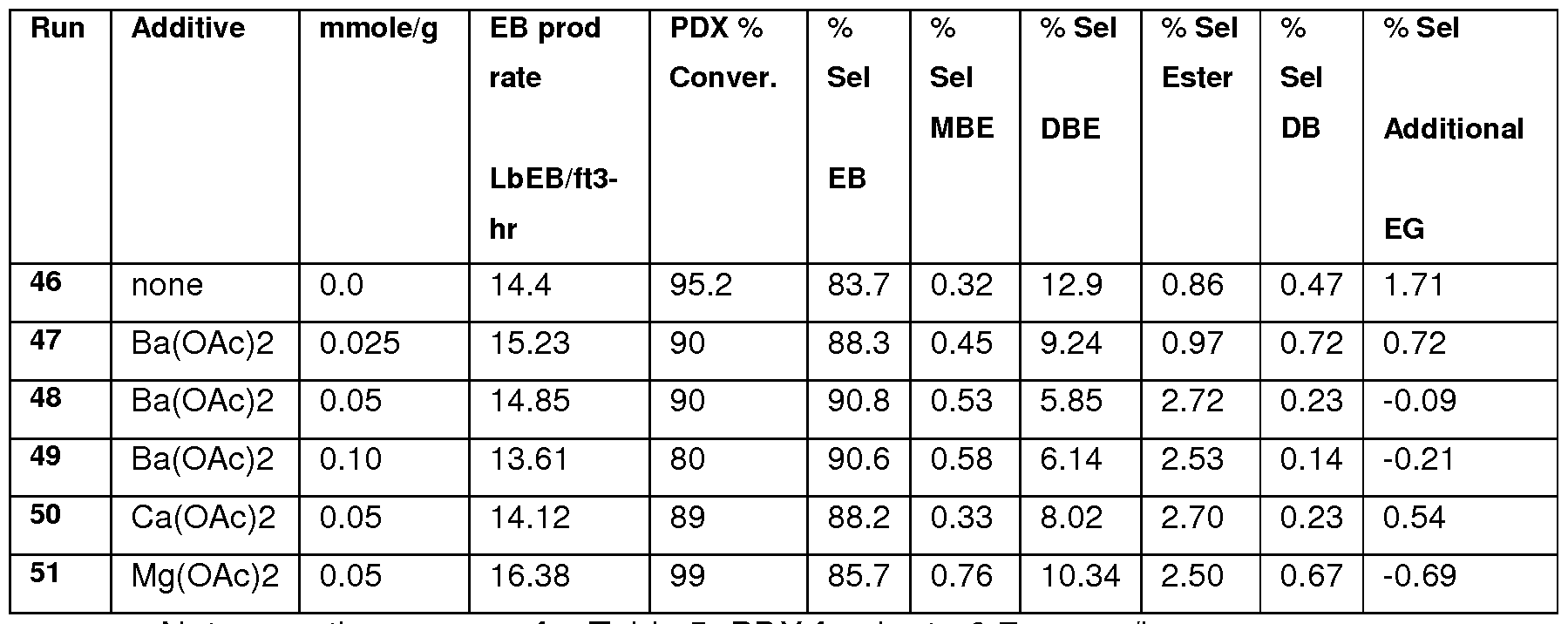
Notes are the same as for Table 5; PDX feed rate 6.7 grams/hr
Table 8
Effect of M(+2)(OAc-)2 Additives on JM 0.5% Pd/AI203 Type 310 Trilobe Catalyst
At 55/1 H2/ PDX Feed Ratio at 210 Deg C @ 300 psig

Notes are the same as for Table 5, runs with (*) carried out at 230 deg Celsius; run with (**) carried out at 220 deg Celsius; PDX feed rate 13.5 grams/hr
The alkaline earth additives show a similar performance trend to that observed in the alkali metal series. In this case, barium appears to be the favored metal of this series for obtaining the highest selectivity to EB product as an additive. As in the case with the alkali metal acetate series, the alkaline earth acetate series has the greatest impact on suppression of the DBE co- product with the largest cation, namely barium exhibiting the greatest effect at a given concentration and reaction temperature. In this series, barium and strontium are the preferred alkaline earth additives to give the best
combination of selectivity and good production rate. Further, the data shows that a higher amount of the divalent cation additive is required to achieve a similar percent selectivity to EB than the corresponding mono-valent cations of the alkali metal acetate series. As observed in the alkali metal case, very little DB co-product is produced. In both the alkali metal and alkaline earth acetate additive cases, higher H2 / PDX feed mole ratios favor higher selectivity to desired EB product.
Example 6: Catalysts Doped With Alkali Metal Fluorides
The use of alkali metal fluorides, in particular potassium fluoride, have been reported to modify aluminum oxide supports in a manner to make them
basic for purposes of carrying out aldol condensation and other types of similar reactions as reported by G.W. Kabalka et al Tetrahedron 1997, 83, 7999 and references therein. Table 9 shown below lists the effect of treatment of a highly active but relatively unselective catalyst, namely
Johnson Matthey 0.5% Pd/AI203 Type 310 Trilobe catalyst, with different alkali metal fluoride additives. The reaction conditions were 210 degrees Celsius at 300 psig with a hydrogen / PDX feed mole ratio of 150/1 .
Table 9
Effect of 0.05 mmole M(+)F(-)/gram Upon JM 0.5% Pd/AI203 Type 310 Trilobe Catalyst lot #10527
At 210 Degree Celsius at 150/1 H2/PDX Feed Mole Ratio at 300 psig

Notes same as in table 5; PDX feed rate 6.7 grams/hr
Example 7: Catalysts Doped With Alkali Metal Fluorides
Table 10 shows the effect of changing the hydrogen / PDX feed ratio to 55/1 at the same conditions with the same catalysts of Example 6.
Table 10
Effect of 0.05 mmole M(+)F(-)/gram Upon JM 0.5% Pd/AI203 Type 310 Trilobe Catalyst lot #10527
At 210 Degrees Celsius at 55/1 H2/PDX Feed Mole Ratio at 300 psig

Notes same as in table 5; PDX feed rate 13.5 gram/hr As was observed with the alkali metal acetate additives, a trend is observed with the alkali metal fluoride additives where activity, as measured by the percent PDX conversion, is observed to increase as the alkali metal cation size decreases from Cs+ down to the smallest ion Li+. However, the Cs metal fluoride is the poorer additive at improving selectivity to EB product as can be seen from the high production of undesired DBE co-product. Also apparent with the alkali metal fluoride additive cases is the combination of high selectivity to EB product while retaining good production rate as exhibited with the sodium fluoride case. By contrast, sodium and potassium acetates were essentially equivalent. Further, lithium acetate did not appear to contribute to an improvement in selectivity, while lithium fluoride results showed a marked improvement in selectivity toward the production of EB. These observations are an indication that the two anion classes do participate in affecting the selectivity of the catalyst as do the metal cations.
Example 8: Varying The Anions of K Doped Catalysts
Table 1 1 shows the effect on selectivity by varying those anions of potassium additives with acetate, chloride or fluoride. The examples were carried out at 0.05 mmole additive/gram of catalyst at 210 degrees Celsius at 300 psig. Two different hydrogen / PDX feed ratios are given. While
potassium acetate is generally considered to be a mild base and potassium chloride a neutral salt, the data below indicates that the potassium acetate and chloride perform in a similar manner unlike the fluoride cases.
Table 11
Effect of Different Anions of K(+) Additives Upon JM 0.5%Pd/'AI2O3 Type 310 Trilobe Catalyst
At 210 Degrees Celsius at 300 Psig at 0.05 mmole/gram K(+) Loading

Notes same as in Table 5; PDX feed rate at 150/1 = 6.7 grams/hr; PDX feed rate at 55/1 = 13.5 grams/hr Example 9: TOPO Doped Catalysts
Certain Lewis bases, a class of compounds that bind to acid sites without the formation of conjugate acids such as water or acetic acid, have the ability to modify highly active, but relatively unselective hydrogenation catalyst to suppress the formation of undesired DBE co-product. Table 12 below shows the effect of 0.05 mmole of TOPO (tri-n-octylphosphine oxide)/gram upon Johnson Matthey 0.5% Pd/AI2O3 Type 310 Trilobe. The TOPO modified catalyst was prepared using an incipient wetness method that used 1 ,4-dioxane solvent in place of water.
Table 12
Effect of 0.05 mmole TOPO/gram Upon JM 0.5% Pd/AI203 Type 310 Trilobe Catalyst
At 210 Degrees Celsius at 300 psig

Notes same as in Table 5; PDX feed rate at 150/1 = 6.7 grams/hr; PDX feed rate at 55/1 = 13.5 grams/hr
While this particular additive lowered the catalytic activity, it greatly reduced the formation of the undesired co-product DBE demonstrating the ability to modify the catalyst in a manner to control unwanted co-products using Lewis base materials.
Comparative Example 5: Catalysts Doped With Conventional Modifiers
The following Table 13 shows the effect of controlled poisoning of a highly active but relatively unselective catalyst with known poisons to palladium hydrogenation catalysts in an attempt to attain higher selectivity to desired EB product. Selective catalyst poisoning of palladium with the metals lead, silver and tin have been employed in the art for selective hydrogenation of acetylene and other highly active substrates in the presence of ethylene to achieve higher hydrogenation efficiency. The table below indicates that this type of additive is not desirable for use on the catalysts of this invention.
Table 13 - Comparative Examples
Effect of Different Metal Poisons Upon JM 0.5% Pd/AI203 Type 310 Trilobe Catalyst
At 210 Degrees Celsius at 150/1 H2/PDX Feed MR at 300 psig

Comparative Examples 6: Other Noble Metals Loaded Onto Supports
We have found that palladium is the noble metal catalyst for use in the process of the invention. Table 14 lists other noble metal catalyst systems and their performance as applied to this invention in a vapor phase hydrogenolysis unit..
Table 14 - Comparative Examples
Palladium vs Other Noble Metal Catalysts at 210 Deg Celsius at 300 Psig

Notes:
a) Evonik 0.5% Pd/1/16 alumina catalyst used, run 026 used same catalyst treated with 1/1 mole ratio of Pd/ NH4 Re04 by incipient wetness.
b) Engelhard catalyst
c) Alfa Aesar catalyst
(*) much butanol and other unknown co-products formed
(**) Only condensable product was water
Example 10: Varying Surface Area of Supports and Types of Supports
Table 15 compares the catalysts of this invention with other support examples using the vapor phase hydrogenolysis unit.
Table 15
Comparison of Desired Alumina and Zirconia Supports vs Other Supports Palladium Catalyzed at 210 Degrees Celsius at 300 psig at 150/1 H2/PDX Feed Mole Ratio

While not wishing to be bound by theory, but from our observations, the formation of the undesired diether DBE is a major yield loss of this particular reaction to prepare EB. It is speculated that acidic catalyst sites in
combination with high support surface area may be major factors in the formation of DBE.
Example 1 1 : Effect of Silica on Selectivity
Silica and silica/alumina catalysts are noteworthy as being known as acidic catalyst supports. The following table 16 lists the performance of different alumina catalysts of known properties as applied to the conversion of PDX into EB in accordance with this invention.
Table 16
Properties of Alumina Supports vs. Production Rate and % Selectivity to EB Product from PDX at 210 Degrees Celsius at 300 psig at 150/1 H2/PDX Feed
Mole Ratio

Claims
1 . A process comprising contacting hydrogen with a cyclic compound
comprising a cyclic acetal, a cyclic ketal, or a combination thereof in the presence of a catalyst composition comprising an a- aluminum oxide support containing or on which is deposited:
a. palladium in an amount of up to 1 wt% based on the weight of the catalyst composition, and
b. up to 1 wt% silicon dioxide based on the weight of the catalyst composition,
wherein the BET surface area of the support is less than 30 m2/g.
2. The process of claim 1 , wherein the a-alumina support has an alpha phase content of at least 99%.
3. The process of claim 1 , comprising a vapor phase hydrogenolysis of the cyclic compounds by contacting cyclic compounds in the vapor phase with hydrogen to produce hydroxy ether mono-hydrocarbon compounds.
4. The process of claim 1 , wherein the catalyst composition comprises palladium in an amount of up to 0.7 wt% based on the weight of the catalyst composition, silicon dioxide, if present, is in an amount not to exceed 0.2 wt%, the BET surface area of the support is less than 10 m2/g, and the catalyst is effective to obtain a selectivity to the production of hydroxy ether mono-hydrocarbons in an amount of at least 90%.
5. A process comprising contacting hydrogen with a cyclic compound
comprising a cyclic acetal, a cyclic ketal, or a combination thereof in the presence of a catalyst composition comprising an γ- aluminum oxide support containing or on which is deposited: a. palladium in an amount of up to 1 wt% based on the weight of the catalyst composition, and
b. up to 1 wt% silicon dioxide based on the weight of the catalyst composition,
wherein the BET surface area of the support is within a range of 100 m2/g - 350 m2/g.
The process of claim 5, wherein the γ-alumina support has a gamma phase content of at least 99%.
The process of claim 5, comprising a vapor phase hydrogenolysis of cyclic compounds by contacting cyclic compounds in the vapor phase with hydrogen to produce hydroxy ether mono-hydrocarbon compounds.
The process of claim 7, wherein the catalyst composition comprises palladium in an amount of up to 0.7 wt% based on the weight of the catalyst composition, the amount of silicon dioxide, if present, does not exceed 0.2 wt%, the BET surface area ranges from 150 m2/g to 300 m2/g, and the catalyst is effective to obtain a selectivity to the production of hydroxy ether mono-hydrocarbons in an amount of at least 90%.
A process comprising contacting hydrogen with a cyclic compound comprising a cyclic acetal, a cyclic ketal, or a combination thereof in the presence of a catalyst composition comprising a zirconium oxide support containing or on which is deposited:
a. palladium in an amount of up to 1 wt% based on the weight of the catalyst composition, and
b. up to 1 wt% silicon dioxide based on the weight of the catalyst composition,
c. wherein the BET surface area of the support is less than 0.2 m2/g to 100 m2/g, and d. the catalyst is effective to obtain a selectivity to the production of hydroxy ether mono-hydrocarbons in an amount of at least 90%.
1 0. The process of claim 9, comprising a vapor phase hydrogenolysis of cyclic compounds by contacting cyclic compounds in the vapor phase with hydrogen to produce hydroxy ether mono-hydrocarbon compounds.
1 1 . The process of claim 1 0, wherein the catalyst composition comprises palladium in an amount of up to 0.7 wt% based on the weight of the catalyst composition, the amount of silicon dioxide, if present, does not exceed 0.1 wt%, the BET surface area is within a range from 1 0 m2/g to
90 m2/g, and the catalyst is effective to obtain a selectivity to the production of hydroxy ether mono-hydrocarbons in an amount of at least 90%.
1 2. A catalyst composition comprising an aluminum oxide support containing or on which is deposited:
a. palladium in an amount of up to 1 wt%, and
b. a modifier other than lithium acetate comprising an alkali metal, alkaline earth metal, or an organophosphine oxide compound.
1 3. The process of claim 1 2, wherein silicon dioxide, if present in the catalyst composition, does not exceed 0.2 wt%; the aluminum oxide support has an alpha phase content of at least 99%, the BET surface area of the support ranges from 0.2 m2/g to 1 5 m2/g, palladium is present in an amount of up to 0.7 wt%, and the catalyst is effective to obtain a selectivity to the production of hydroxy ether mono-hydrocarbons in an amount of at least 90%.
14. The catalyst composition of claim 1 2, wherein the modifier comprises sodium acetate, potassium acetate, barium acetate, or sodium fluoride. The catalyst composition of claim 12, wherein the modifier other than lithium acetate comprises an alkali metal or an alkaline earth metal.
A process comprising a vapor phase hydrogenolysis of cyclic compounds comprising cyclic acetals or cyclic ketals, comprising contacting cyclic compounds in the vapor phase with hydrogen in the presence of the catalyst composition of claim 12 to produce hydroxy ether mono-hydrocarbon compounds.
A catalyst composition comprising a zirconium oxide support containing or on which is deposited:
a. palladium in an amount of up to 1 wt%, and
b. a modifier other than lithium acetate comprising an alkali metal, alkaline earth metal, or an organophosphine oxide compound.
The catalyst composition of claim 17, wherein the modifier other than lithium acetate comprises an alkali metal or an alkaline earth metal.
The catalyst composition of claim 17, wherein silicon dioxide, if present in the catalyst composition, does not exceed 0.2 wt%, the BET surface area ranges from 0.2 m2/g to 15 m2/g, palladium is present in an amount of up to 0.7 wt%, and the catalyst is effective to obtain a selectivity to the production of hydroxy ether mono-hydrocarbons in an amount of at least 90%.
A process comprising a vapor phase hydrogenolysis of cyclic compounds comprising cyclic acetals or cyclic ketals, comprising contacting cyclic compounds in the vapor phase with hydrogen in the presence of the catalyst composition of claim 17 to produce hydroxy ether mono-hydrocarbon compounds.
Applications Claiming Priority (2)
| Application Number | Priority Date | Filing Date | Title |
|---|---|---|---|
| US13/168,349 | 2011-06-24 | ||
| US13/168,349 US9056313B2 (en) | 2011-06-24 | 2011-06-24 | Catalysts for the production of hydroxy ether hydrocarbons by vapor phase hydrogenolysis of cyclic acetals and ketals |
Publications (1)
| Publication Number | Publication Date |
|---|---|
| WO2012177484A1 true WO2012177484A1 (en) | 2012-12-27 |
Family
ID=46331731
Family Applications (1)
| Application Number | Title | Priority Date | Filing Date |
|---|---|---|---|
| PCT/US2012/042453 Ceased WO2012177484A1 (en) | 2011-06-24 | 2012-06-14 | Catalysts for the production of hydroxy ether hydrocarbons by vapor phase hydrogenolysis of cyclic acetals and ketals |
Country Status (2)
| Country | Link |
|---|---|
| US (1) | US9056313B2 (en) |
| WO (1) | WO2012177484A1 (en) |
Cited By (1)
| Publication number | Priority date | Publication date | Assignee | Title |
|---|---|---|---|---|
| CN107107049A (en) * | 2014-11-14 | 2017-08-29 | 切弗朗菲利浦化学公司 | Selective hydrogenation catalyst and its preparation and application |
Families Citing this family (7)
| Publication number | Priority date | Publication date | Assignee | Title |
|---|---|---|---|---|
| US9388105B2 (en) | 2011-06-24 | 2016-07-12 | Eastman Chemical Company | Production of hydroxy ether hydrocarbons by liquid phase hydrogenolysis of cyclic acetals or cyclic ketals |
| US8969598B2 (en) | 2011-06-24 | 2015-03-03 | Eastman Chemical Company | Production of cyclic acetals or ketals using liquid-phase acid catalysts |
| US8785697B2 (en) * | 2011-06-24 | 2014-07-22 | Eastman Chemical Company | Nickel modified catalyst for the production of hydroxy ether hydrocarbons by vapor phase hydrogenolysis of cyclic acetals and ketals |
| US8829207B2 (en) | 2011-06-24 | 2014-09-09 | Eastman Chemical Company | Production of cyclic acetals by reactive distillation |
| US8829206B2 (en) | 2011-06-24 | 2014-09-09 | Eastman Chemical Company | Production of cyclic acetals or ketals using solid acid catalysts |
| CN115925668A (en) | 2017-06-16 | 2023-04-07 | 罗地亚经营管理公司 | Process for the catalytic decarboxylative cross-ketonization of aryl and aliphatic carboxylic acids |
| KR102079120B1 (en) * | 2018-06-18 | 2020-02-19 | 한국과학기술연구원 | Calcium salts-supported metal catalyst, method for preparing the same, and method for hydrodeoxygenation reaction of oxygenates using the same |
Citations (11)
| Publication number | Priority date | Publication date | Assignee | Title |
|---|---|---|---|---|
| GB1020500A (en) * | 1963-09-30 | 1966-02-16 | Shell Int Research | A process for the production of an ether by the hydrogenolysis of a cyclic ketal |
| US4038175A (en) * | 1974-09-23 | 1977-07-26 | Union Carbide Corporation | Supported metal catalyst, methods of making same, and processing using same |
| US4479017A (en) | 1981-06-29 | 1984-10-23 | Mitsubishi Petrochemical Co., Ltd. | Process for producing ether compounds by catalytic hydrogenolysis |
| US4484009A (en) | 1982-04-20 | 1984-11-20 | Atochem | Process for the manufacture of glycol monoethers |
| EP0499055A2 (en) * | 1991-02-14 | 1992-08-19 | BASF Aktiengesellschaft | Process for the preparation of pyrocatechols |
| EP0616994A2 (en) * | 1993-03-15 | 1994-09-28 | Kao Corporation | Process for producing ether alcohols by hydrogenolysis of cyclic ketal |
| EP0696564A1 (en) * | 1994-08-11 | 1996-02-14 | Kao Corporation | Polyol ether derivatives and production methods therefor |
| US5866735A (en) * | 1996-02-01 | 1999-02-02 | Phillips Petroleum Company | Hydrocarbon hydrogenation process |
| US6013844A (en) * | 1997-07-15 | 2000-01-11 | Basf Aktiengesellschaft | Preparation of catechol monoethers and catechols |
| WO2001019763A1 (en) * | 1999-09-17 | 2001-03-22 | Phillips Petroleum Company | Catalyst composition and process for making the composition |
| US20110034739A1 (en) * | 2008-06-11 | 2011-02-10 | Evonik Oxeno Gmbh | Catalyst and process for preparing saturated ethers by hydrogenating unsaturated ethers |
Family Cites Families (88)
| Publication number | Priority date | Publication date | Assignee | Title |
|---|---|---|---|---|
| DE419223C (en) | 1924-02-02 | 1925-09-22 | Hoechst Ag | Process for the production of solutions of organic bodies |
| US2425042A (en) | 1943-12-01 | 1947-08-05 | Carbide & Carbon Chem Corp | Glycol diethers |
| US2429878A (en) | 1946-05-17 | 1947-10-28 | Du Pont | Synthesis of glycol ethers |
| US2486024A (en) | 1947-08-19 | 1949-10-25 | Shell Dev | Preparation of polyalkylene glycols |
| DE1185604B (en) * | 1962-02-03 | 1965-01-21 | Bayer Ag | Process for the production of vinyl acetate |
| US4024159A (en) | 1974-08-07 | 1977-05-17 | E. I. Du Pont De Nemours And Company | Process for the production of liquid acetals |
| US4062898A (en) | 1975-10-06 | 1977-12-13 | Ethyl Corporation | Conversion of acetals |
| US4071568A (en) | 1975-12-12 | 1978-01-31 | Mitsubishi Chemical Industries Limited | Process for producing glycol monoether |
| JPS6044290B2 (en) | 1975-12-18 | 1985-10-02 | 三菱化学株式会社 | Method for producing glycol monoether |
| US4088700A (en) | 1976-09-27 | 1978-05-09 | Texaco Development Corporation | Process for the hydrogenolysis of dioxolanes |
| DE2716690A1 (en) | 1977-04-15 | 1978-10-19 | Hoechst Ag | PROCESS FOR THE PRODUCTION OF ETHYLENE GLYCOL DIMETHYL ETHER (DIMETHYL GLYCOL) |
| DE3064734D1 (en) | 1979-05-02 | 1983-10-13 | Ici Plc | Acetals and their preparation |
| JPS56166186A (en) | 1980-05-27 | 1981-12-21 | Mitsubishi Chem Ind Ltd | Production of cyclic acetal |
| US4308403A (en) | 1980-09-12 | 1981-12-29 | Texaco Inc. | Process for preparing glycol ethers |
| US4317943A (en) | 1980-09-12 | 1982-03-02 | Texaco Inc. | Process for preparing glycol ethers |
| US4357477A (en) | 1981-10-29 | 1982-11-02 | Texaco Inc. | Process for preparing ethylene glycol monoalkyl ethers |
| US4356327A (en) | 1981-10-29 | 1982-10-26 | Texaco Inc. | Process for preparing propylene glycol monoalkyl ethers and alkoxyacetones |
| US4390734A (en) | 1982-01-13 | 1983-06-28 | Texaco Inc. | Process for producing propylene glycol monoalkyl ethers from acetaldehyde, an alkanol and syngas using a new catalyst system |
| US4430253A (en) | 1982-02-11 | 1984-02-07 | Ethyl Corporation | Sulfide-modified ruthenium catalyst |
| US4375394A (en) | 1982-03-11 | 1983-03-01 | Eastman Kodak Company | Electrolytic process for the preparation of ethylene glycol and glycerine |
| US4435595A (en) | 1982-04-26 | 1984-03-06 | Eastman Kodak Company | Reactive distillation process for the production of methyl acetate |
| JPS58198431A (en) | 1982-05-12 | 1983-11-18 | Mitsubishi Gas Chem Co Inc | Method for producing 2-alkoxy alcohol |
| US4478017A (en) | 1983-03-28 | 1984-10-23 | Brown William R | Flooring protection system |
| US4482753A (en) | 1983-03-28 | 1984-11-13 | Olin Corporation | Catalyst for use in the hydrogenolysis of methyl glycol formals |
| DE3328561A1 (en) | 1983-08-08 | 1985-02-28 | Chemische Werke Hüls AG, 4370 Marl | ALIPHATIC MONOETHER OF THE 2.2-DIMETHYLPROPANE-1.3-DIOL WITH C (DOWN ARROW) 3 (DOWN ARROW) - TO C (DOWN ARROW) 2 (DOWN ARROW) (DOWN ARROW) 0 (DOWN ARROW ALUMINUM OXYGEN, 3 -PROPOXY-2.2-DIMETHYLPROPAN-1-OL AND THE 3-TERT.-BUTOXY-2.2-DIMETHYLPROPAN-1-OL, METHOD FOR THE PRODUCTION THEREOF AND THEIR USE AS SOFTENER ALCOHOLS |
| US4692426A (en) | 1984-06-21 | 1987-09-08 | Sun Refining And Marketing Company | Phosphite-promoted ruthenium-cobalt catalysts for the dealkoxyhydroxymethylation of acetals to form glycol ethers |
| US4652542A (en) | 1984-06-21 | 1987-03-24 | Sun Refining And Marketing Company | Ruthenium-cobalt carbonyl catalysts for the dealkoxyhydroxymethylation of acetals to form glycol ethers |
| DE3561508D1 (en) | 1984-06-21 | 1988-03-03 | Sun Refining & Marketing | Catalysts and process for the dealkoxyhydroxymethylation of acetals to form glycol ethers |
| CA1254190A (en) | 1984-06-21 | 1989-05-16 | James E. Lyons | Ruthenium-promoted cobalt catalysts for the dealkoxyhydroxymethylation of formaldehyde acetals to form glycol ethers |
| US4618729A (en) | 1984-06-21 | 1986-10-21 | Sun Refining And Marketing Company | Ruthenium-cobalt carbonyl metal cluster catalysts for the dealkoxyhydroxymethylation of acetals to form glycol ethers |
| US4617287A (en) | 1984-06-21 | 1986-10-14 | Sun Refining And Marketing Company | Ruthenium-cobalt carbonyl catalysts for the dealkoxyhydroxymethylation of aldehyde acetals to form glycol ethers |
| EP0168989A1 (en) | 1984-06-21 | 1986-01-22 | Sun Refining and Marketing Company | Rutheniumpromoted cobalt catalysts for the dealkoxyhydroxymethylation of formaldehyde acetals to form glycol ethers |
| US4568780A (en) | 1984-10-22 | 1986-02-04 | Texaco Inc. | Process for low pressure synthesis of ethylene glycol from synthesis gas plus 1,3-dioxolane |
| DD238232A1 (en) | 1985-06-11 | 1986-08-13 | Univ Schiller Jena | PROCESS FOR PREPARING 2,2-DIMETHYL-4-METHYLOL-1,3-DIOXOLANE |
| US4895987A (en) | 1986-06-06 | 1990-01-23 | Sun Refining And Marketing Company | Phosphonite-and phosphonite-promoted ruthenium - cobalt catalysts for the dealkoxyhydroxymethylation of acetals to form glycol ethers |
| JPS63146838A (en) | 1986-12-11 | 1988-06-18 | Japan Tobacco Inc | Acetalization of aldehyde for ketone |
| DE3718564A1 (en) | 1987-06-03 | 1988-12-15 | Basf Ag | METHOD FOR PRODUCING 4-ISOPROPYL-CYCLOHEXYLMETHANOL OR WHOSE ALKYLETHERS |
| JPH01102039A (en) | 1987-10-20 | 1989-04-19 | Sun Refining & Marketing Co | Phosphonite for dealkoxyhydroxymethylating acetal for production of glycol ether and ruthenium cobalt catalyst for phosphonite promotion |
| US4939294A (en) | 1989-05-22 | 1990-07-03 | Eastman Kodak Company | Preparation of ultra high purity methyl acetate |
| DE4124199A1 (en) | 1991-07-20 | 1993-01-21 | Henkel Kgaa | PROCESS FOR THE PRODUCTION OF POLYOLETHERS |
| EP0786444B1 (en) | 1992-04-24 | 1999-12-22 | Showa Denko Kabushiki Kaisha | Process for producing acetaldehyde dimethylacetal |
| EP1059279B1 (en) | 1992-06-04 | 2005-08-17 | Idemitsu Kosan Co., Ltd. | Polyvinyl ether compound and method of preperation |
| EP0624563A1 (en) | 1993-05-13 | 1994-11-17 | Kao Corporation | Glycerin derivatives and process for producing the same |
| US5616736A (en) | 1994-02-04 | 1997-04-01 | Hoechst Celanese Corporation | Method of preparing cyclic formals |
| KR100483787B1 (en) | 1995-04-20 | 2005-06-16 | 이데미쓰 고산 가부시키가이샤 | Process for producing ether compounds |
| US5763691A (en) | 1995-11-30 | 1998-06-09 | Mitsubishi Chemical Corporation | Ethylene glycol process |
| US5935896A (en) * | 1996-05-02 | 1999-08-10 | Basf Aktiengesellschaft | Catalyst supports and catalysts for dehydrocyanation reactions and processes for producing them |
| DE19621703A1 (en) | 1996-05-30 | 1997-12-04 | Hoechst Ag | Process for the preparation of 3-oxyalkylpropan-1-ols |
| US6124479A (en) | 1996-09-10 | 2000-09-26 | Daiso Co., Ltd. | Process for the preparation of 1,3-dioxolane-4-methanols |
| AU4136597A (en) | 1996-09-10 | 1998-04-02 | Daiso Co. Ltd. | Process for preparing 1,3-dioxolane-4-methanol compounds |
| BR9712761B1 (en) | 1996-11-13 | 2010-02-23 | Method for the production of 1,3-propanediol and transformed host microorganism. | |
| DE19647395A1 (en) | 1996-11-15 | 1998-05-20 | Basf Ag | Process for the preparation of cyclic acetals or ketals |
| DE19648960A1 (en) | 1996-11-26 | 1998-05-28 | Basf Ag | Cyclic acetal or ketal preparation from poly:ol and aldehyde or ketone |
| SG65045A1 (en) | 1997-01-29 | 1999-05-25 | Toray Industries | A method for continuously producing a cyclic formal |
| BE1014031A3 (en) | 1997-07-04 | 2003-03-04 | Basf Ag | THE PREPARATION OF ESTERS. |
| US6080897A (en) | 1998-03-19 | 2000-06-27 | Mitsubishi Chemical Corporation | Method for producing monoethylene glycol |
| US6458992B1 (en) | 1998-03-25 | 2002-10-01 | Sulzer Chemtech Ag | Process and apparatus for the production of butylacetate and isobutylacetate |
| US6015875A (en) | 1998-08-11 | 2000-01-18 | Catalytic Distillation Technologies | Process for making acetals |
| DE19840277A1 (en) | 1998-09-04 | 2000-03-09 | Degussa | Process for reducing the content of acetals or ketals in alcoholic reaction mixtures |
| DE19840276C2 (en) | 1998-09-04 | 2002-10-31 | Perstorp Specialty Chem Ab | Process for reducing cleavage of linear and cyclic acetals, especially formals |
| JP4287546B2 (en) | 1999-07-27 | 2009-07-01 | 花王株式会社 | Manufacturing method of glyceryl ether |
| JP2001072636A (en) | 1999-09-03 | 2001-03-21 | Kao Corp | Production method of polyol alkyl ether |
| JP3802314B2 (en) | 1999-11-02 | 2006-07-26 | 花王株式会社 | Ether production |
| US6207850B1 (en) | 1999-11-03 | 2001-03-27 | Mobil Oil Corporation | Process for co-production of dialkyl carbonate and alkanediol |
| JP3659109B2 (en) | 2000-01-19 | 2005-06-15 | 三菱化学株式会社 | Co-production method of ethylene glycol and carbonate |
| US6166240A (en) | 2000-02-22 | 2000-12-26 | Mobil Oil Corporation | Process for co-production of dialkyl carbonate and alkanediol |
| US6291725B1 (en) | 2000-03-03 | 2001-09-18 | Board Of Trustees Operating Michigan State University | Catalysts and process for hydrogenolysis of sugar alcohols to polyols |
| DE10044352A1 (en) | 2000-09-07 | 2002-03-21 | Basf Ag | Continuous process for the production of acetals |
| IL154960A0 (en) | 2000-10-10 | 2003-10-31 | Du Pont | Polymers having attached luminescent metal complexes and devices made with sych polymers |
| DE10062814A1 (en) | 2000-12-15 | 2002-06-20 | Ticona Gmbh | Process for removing methanol from formaldehyde-containing solutions |
| CN1197858C (en) | 2001-01-15 | 2005-04-20 | 旭化成株式会社 | Process for producing cyclic formal |
| US6548681B1 (en) | 2001-06-26 | 2003-04-15 | Board Of Trustees Of Michigan State University | Process for the recovery of a polyol from an aqueous solution |
| US6930206B1 (en) | 2001-07-05 | 2005-08-16 | Catalytic Distillation Technologies | Process and apparatus for catalytic distillations |
| US6969779B2 (en) | 2002-11-01 | 2005-11-29 | Shell Oil Company | Method for removal of MW176 cyclic acetal formed during the production of 1,3-propanediol |
| DE10255647A1 (en) | 2002-11-28 | 2004-06-09 | Basf Ag | Process for obtaining an aliphatic dialdehyde monoacetal |
| EP2837617B1 (en) | 2003-08-27 | 2015-12-23 | Mitsubishi Gas Chemical Company Inc. | Process for producing alicyclic aldehydes |
| PT103123A (en) | 2004-05-19 | 2005-11-30 | Univ Do Porto | INDUSTRIAL PROCESS OF ACETAL PRODUCTION IN AN ADSORPTIVE REACTOR OF SIMULATED MOVEL MOBILE |
| US7534922B2 (en) | 2004-12-13 | 2009-05-19 | Ticona Gmbh | Processes for the manufacture of acetals |
| DE102005042505A1 (en) | 2005-09-07 | 2007-03-08 | Basf Ag | Process for the preparation of dioxolane |
| DE102005051974A1 (en) | 2005-10-31 | 2007-05-03 | Basf Ag | Preparing trioxane and comonomer, useful for preparing trioxane based (co)polymer, comprises converting formaldehyde and co-monomer educt to trioxane and co-monomer, and distillating the obtained reaction mixtures |
| FR2906246B1 (en) | 2006-09-22 | 2008-12-12 | Arkema France | PROCESS FOR SYNTHESIZING CYCLIC ACETALS IN A SIMUL MOBILE BED REACTOR |
| FR2906807A1 (en) | 2006-10-09 | 2008-04-11 | Arkema France | PROCESS FOR THE SYNTHESIS OF CYCLIC ACETALS BY REACTIVE EXTRACTION OF A POLYOL IN A CONCENTRATED SOLUTION |
| CN104478844B (en) | 2007-10-09 | 2018-12-04 | Gf 生物化学知识产权资产有限公司 | The method for preparing ketal and acetal |
| JP5209941B2 (en) | 2007-11-13 | 2013-06-12 | 昭和電工株式会社 | Method for producing α, β-unsaturated ether |
| CN102131757A (en) | 2008-08-25 | 2011-07-20 | 陶氏环球技术有限责任公司 | Polyol ethers and process for making them |
| US7981390B2 (en) * | 2008-12-23 | 2011-07-19 | Basf Corporation | Small engine palladium catalyst article and method of making |
| EP3144064B1 (en) | 2009-03-04 | 2021-07-28 | Chevron Phillips Chemical Company LP | Selective hydrogenation catalyst and methods of making and using same |
| US20110207969A1 (en) | 2010-02-23 | 2011-08-25 | Olken Michael M | Process for making polyol ethers |
-
2011
- 2011-06-24 US US13/168,349 patent/US9056313B2/en active Active
-
2012
- 2012-06-14 WO PCT/US2012/042453 patent/WO2012177484A1/en not_active Ceased
Patent Citations (11)
| Publication number | Priority date | Publication date | Assignee | Title |
|---|---|---|---|---|
| GB1020500A (en) * | 1963-09-30 | 1966-02-16 | Shell Int Research | A process for the production of an ether by the hydrogenolysis of a cyclic ketal |
| US4038175A (en) * | 1974-09-23 | 1977-07-26 | Union Carbide Corporation | Supported metal catalyst, methods of making same, and processing using same |
| US4479017A (en) | 1981-06-29 | 1984-10-23 | Mitsubishi Petrochemical Co., Ltd. | Process for producing ether compounds by catalytic hydrogenolysis |
| US4484009A (en) | 1982-04-20 | 1984-11-20 | Atochem | Process for the manufacture of glycol monoethers |
| EP0499055A2 (en) * | 1991-02-14 | 1992-08-19 | BASF Aktiengesellschaft | Process for the preparation of pyrocatechols |
| EP0616994A2 (en) * | 1993-03-15 | 1994-09-28 | Kao Corporation | Process for producing ether alcohols by hydrogenolysis of cyclic ketal |
| EP0696564A1 (en) * | 1994-08-11 | 1996-02-14 | Kao Corporation | Polyol ether derivatives and production methods therefor |
| US5866735A (en) * | 1996-02-01 | 1999-02-02 | Phillips Petroleum Company | Hydrocarbon hydrogenation process |
| US6013844A (en) * | 1997-07-15 | 2000-01-11 | Basf Aktiengesellschaft | Preparation of catechol monoethers and catechols |
| WO2001019763A1 (en) * | 1999-09-17 | 2001-03-22 | Phillips Petroleum Company | Catalyst composition and process for making the composition |
| US20110034739A1 (en) * | 2008-06-11 | 2011-02-10 | Evonik Oxeno Gmbh | Catalyst and process for preparing saturated ethers by hydrogenating unsaturated ethers |
Non-Patent Citations (5)
| Title |
|---|
| "Dictionary of Scientific and Technical Terms", 1994, MCGRAW-HILL |
| A.C.V. COELHO ET AL.: "Surface Area, Crystal Morphology and Characterization of TransitionAlumina Powders from a New Gibbsite Precursor", MATERIALS RESEARCH, vol. 10, no. 2, 2007, pages 183 - 189, XP002683656, ISSN: 1516-1439 * |
| G.W. KABALKA ET AL., TETRAHEDRON, vol. 83, 1997, pages 7999 |
| KEITH HUDSON L ET AL: "Aluminum Oxide", INTERNET CITATION, 15 June 2000 (2000-06-15), pages 1 - 40, XP002596245, Retrieved from the Internet <URL:http://onlinelibrary.wiley.com/doi/10.1002/14356007.a01_557/pdf> [retrieved on 20100812] * |
| KIRK OTHMER: "Encyclopedia of Chemical Technology", vol. 2, 1992, pages: 302 - 317 |
Cited By (1)
| Publication number | Priority date | Publication date | Assignee | Title |
|---|---|---|---|---|
| CN107107049A (en) * | 2014-11-14 | 2017-08-29 | 切弗朗菲利浦化学公司 | Selective hydrogenation catalyst and its preparation and application |
Also Published As
| Publication number | Publication date |
|---|---|
| US9056313B2 (en) | 2015-06-16 |
| US20120330067A1 (en) | 2012-12-27 |
Similar Documents
| Publication | Publication Date | Title |
|---|---|---|
| US9056313B2 (en) | Catalysts for the production of hydroxy ether hydrocarbons by vapor phase hydrogenolysis of cyclic acetals and ketals | |
| US9000229B2 (en) | Production of hydroxy ether hydrocarbons by vapor phase hydrogenolysis of cyclic acetals and ketals | |
| JP5530437B2 (en) | Production of ethylene from acetic acid using a dual reaction zone process | |
| US9862664B2 (en) | Process for the production of alkenols and use thereof for the production of 1,3-butadiene | |
| US9382179B2 (en) | Nickel modified catalyst for the production of hydroxy ether hydrocarbons by vapor phase hydrogenolysis of cyclic acetals and ketals | |
| JP2011529497A (en) | Process for the catalytic production of ethylene directly from acetic acid in a single reaction zone | |
| BR112015007328B1 (en) | process of direct synthesis of unsaturated aldehydes from mixtures of alcohols | |
| US11905239B2 (en) | Process for producing methacrylic acid or methacrylic acid esters | |
| US4590314A (en) | Catalytic process for the production of alcohols from carbon monoxide, hydrogen and olefins | |
| TW201605777A (en) | Improved catalytic performance in processes for preparing acetic acid | |
| WO2012177469A1 (en) | Production of hydroxy ether hydrocarbons by liquid phase hydrogenolysis of cyclic acetals or cyclic ketals | |
| JP2014534167A (en) | Catalytic dehydration of alcohols and ethers over ternary mixed oxides | |
| CN103998407A (en) | Method for preparing a mixture of alcohols | |
| JP4424746B2 (en) | Process for producing unsaturated alcohol and catalyst for producing unsaturated alcohol used therefor | |
| KR101606191B1 (en) | Catalyst for dehydration of glycerin, method of preparing the same, and preparing method of acrolein | |
| US5731471A (en) | Process for the preparation of 2,3-pentanedione | |
| US9714205B2 (en) | Process for direct synthesis of (meth)acrolein from ethers and/or acetals | |
| CA1219003A (en) | Production of monethylene glycol and ethanol from hydrogenolysis of polyalkylene glycols | |
| JP4428530B2 (en) | Unsaturated alcohol production catalyst and method for producing unsaturated alcohol using the same | |
| US4649225A (en) | Hydrogenolysis of polyalkylene glycols to produce monoethylene glycol monoalkyl ethers, monoethylene glycol and ethanol | |
| JPH041150A (en) | Preparation of methyl tertiary butyl ether |
Legal Events
| Date | Code | Title | Description |
|---|---|---|---|
| 121 | Ep: the epo has been informed by wipo that ep was designated in this application |
Ref document number: 12729314 Country of ref document: EP Kind code of ref document: A1 |
|
| NENP | Non-entry into the national phase |
Ref country code: DE |
|
| 122 | Ep: pct application non-entry in european phase |
Ref document number: 12729314 Country of ref document: EP Kind code of ref document: A1 |