WO2012172093A1 - Dihydroindolizine derivate as metabotropic glutamate receptor modulators - Google Patents
Dihydroindolizine derivate as metabotropic glutamate receptor modulators Download PDFInfo
- Publication number
- WO2012172093A1 WO2012172093A1 PCT/EP2012/061527 EP2012061527W WO2012172093A1 WO 2012172093 A1 WO2012172093 A1 WO 2012172093A1 EP 2012061527 W EP2012061527 W EP 2012061527W WO 2012172093 A1 WO2012172093 A1 WO 2012172093A1
- Authority
- WO
- WIPO (PCT)
- Prior art keywords
- ethynyl
- dihydroindolizin
- dihydropyrrolo
- pyrazin
- phenylethynyl
- Prior art date
- Legal status (The legal status is an assumption and is not a legal conclusion. Google has not performed a legal analysis and makes no representation as to the accuracy of the status listed.)
- Ceased
Links
- 0 **(*C1(*)*)*[n]2c1cc(C#C*)c2* Chemical compound **(*C1(*)*)*[n]2c1cc(C#C*)c2* 0.000 description 2
- YACCTJSJOWDSBC-UHFFFAOYSA-N CC(C)(CC1=O)C[n]2c1ccc2 Chemical compound CC(C)(CC1=O)C[n]2c1ccc2 YACCTJSJOWDSBC-UHFFFAOYSA-N 0.000 description 1
- AJTIMUPILSGPJQ-UHFFFAOYSA-N CC(C)(CC[n]1c2cc(I)c1)C2=O Chemical compound CC(C)(CC[n]1c2cc(I)c1)C2=O AJTIMUPILSGPJQ-UHFFFAOYSA-N 0.000 description 1
- XDQQVJCXJIDCPG-UHFFFAOYSA-N CC(CC[n]1c2cc(I)c1)C2=O Chemical compound CC(CC[n]1c2cc(I)c1)C2=O XDQQVJCXJIDCPG-UHFFFAOYSA-N 0.000 description 1
- ONSQAWOLNXNABL-UHFFFAOYSA-N O=C1c2cc(I)c[n]2CCC1 Chemical compound O=C1c2cc(I)c[n]2CCC1 ONSQAWOLNXNABL-UHFFFAOYSA-N 0.000 description 1
- JHDCRSBRRZPACW-UHFFFAOYSA-N O=C1c2ccc[n]2CCC1 Chemical compound O=C1c2ccc[n]2CCC1 JHDCRSBRRZPACW-UHFFFAOYSA-N 0.000 description 1
Classifications
-
- C—CHEMISTRY; METALLURGY
- C07—ORGANIC CHEMISTRY
- C07D—HETEROCYCLIC COMPOUNDS
- C07D471/00—Heterocyclic compounds containing nitrogen atoms as the only ring hetero atoms in the condensed system, at least one ring being a six-membered ring with one nitrogen atom, not provided for by groups C07D451/00 - C07D463/00
- C07D471/02—Heterocyclic compounds containing nitrogen atoms as the only ring hetero atoms in the condensed system, at least one ring being a six-membered ring with one nitrogen atom, not provided for by groups C07D451/00 - C07D463/00 in which the condensed system contains two hetero rings
- C07D471/04—Ortho-condensed systems
-
- A—HUMAN NECESSITIES
- A61—MEDICAL OR VETERINARY SCIENCE; HYGIENE
- A61P—SPECIFIC THERAPEUTIC ACTIVITY OF CHEMICAL COMPOUNDS OR MEDICINAL PREPARATIONS
- A61P25/00—Drugs for disorders of the nervous system
-
- C—CHEMISTRY; METALLURGY
- C07—ORGANIC CHEMISTRY
- C07D—HETEROCYCLIC COMPOUNDS
- C07D487/00—Heterocyclic compounds containing nitrogen atoms as the only ring hetero atoms in the condensed system, not provided for by groups C07D451/00 - C07D477/00
- C07D487/12—Heterocyclic compounds containing nitrogen atoms as the only ring hetero atoms in the condensed system, not provided for by groups C07D451/00 - C07D477/00 in which the condensed system contains three hetero rings
- C07D487/14—Ortho-condensed systems
-
- C—CHEMISTRY; METALLURGY
- C07—ORGANIC CHEMISTRY
- C07D—HETEROCYCLIC COMPOUNDS
- C07D498/00—Heterocyclic compounds containing in the condensed system at least one hetero ring having nitrogen and oxygen atoms as the only ring hetero atoms
- C07D498/12—Heterocyclic compounds containing in the condensed system at least one hetero ring having nitrogen and oxygen atoms as the only ring hetero atoms in which the condensed system contains three hetero rings
- C07D498/14—Ortho-condensed systems
Definitions
- the present invention relates to heterocyclic derivatives, which may act as novel metabotropic glutamate receptor (mGluR) modulators, methods for their synthesis and the treatment and/or prevention of various diseases and disorders, including neurological disorders, by administration of such derivatives.
- mGluR metabotropic glutamate receptor
- Neuronal stimuli are transmitted by the central nervous system (CNS) through the interaction of a neurotransmitter released by a neuron, which neurotransmitter has a specific effect on a neuroreceptor of another neuron.
- L-Glutamic acid is considered to be a major excitatory neurotransmitter in the mammalian CNS, consequently playing a critical role in a large number of physiological processes.
- Glutamate-dependent stimulus receptors are divided into two main groups. The first group comprises ligand-controlled ion channels whereas the other comprises metabotropic glutamate receptors (mGluR). Metabotropic glutamate receptors are a subfamily of G-protein-coupled receptors (GPCR). There is increasing evidence for a peripheral role of both ionotropic and metabotropic glutamate receptors outside the CNS e.g, in chronic pain states.
- mGluRI and mGluR5 belong to Group I which are positively coupled to phospholipase C and their activation leads to a mobilization of intracellular calcium ions.
- mGluR2 and mGluR3 belong to Group II and mGluR4, mGluR6, mGluR7 and mGluR8 belong to Group III, both of which are negatively coupled to adenylyl cyclase, i.e., their activation causes a reduction in second messenger cAMP and thus a dampening of neuronal activity.
- mGluR2 and mGluR3 belong to Group II and mGluR4, mGluR6, mGluR7 and mGluR8 belong to Group III, both of which are negatively coupled to adenylyl cyclase, i.e., their activation causes a reduction in second messenger cAMP and thus a dampening of neuronal activity.
- class C GPCRs the class to which mGluR5 belongs
- the orthosteric ligand e.g.
- glutamate binds to a distinct module at the N-terminus of the receptor, the venus fly trap module (Bockaert, et al., The EMBO Journal, 1999, 18, 1723-1729). Moreover, within the helix bundle of mGluR5 a binding site for allosteric ligands, exemplified by MPEP, exists.
- the mGluR5 modulators have been shown to modulate the effects of the presynaptically released neurotransmitter glutamate via postsynaptic mechanisms (receptors). Moreover, as these modulators may be both positive and/or negative mGluR5 modulators, such modulators may increase or inhibit the effects mediated through these metabotropic glutamate receptors.
- Modulators which are negative mGluR5 modulators decrease the effects mediated through metabotropic glutamate receptors. Since a variety of pathophysiological processes and disease states affecting the CNS are thought to be related to abnormal glutamate neurotransmission, and mGluR5 receptors are shown to be expressed in many areas of the CNS and in PNS (peripheral nervous system), modulators of these receptors could be therapeutically beneficial in the treatment of diseases involving CNS and PNS.
- mGluR5 positive or negative modulators may be administered to provide neuroprotection and/or disease modification in the following acute or chronic pathological conditions or to provide a symptomatological effect on the following conditions: Alzheimer's disease, Creutzfeld-Jakob ' s syndrome/disease, bovine spongiform encephalopathy (BSE), prion related infections, diseases involving mitochondrial dysfunction, diseases involving ⁇ -amyloid and/or tauopathy, Down's syndrome, hepatic encephalopathy, Huntington's disease, motor neuron diseases, amyotrophic lateral sclerosis (ALS), multiple system atrophy, olivoponto-cerebellar atrophy, synucleinopathies, alpha-synucleinopathies, Lewy body dementia, neurodegeneration with Brain Iron Accumulation, Parkinson-plus syndrome, Pick's disease, progressive supranuclear palsy (PSP), frontotemporal dementia and parkinsonism linked to chromosome 17 (FTDP-17
- mGluR5 negative or positive modulators may also be administered to provide inhibition of tumour cell growth, migration, invasion, adhesion and toxicity in the peripheral tissues, peripheral nervous system and CNS.
- mGluR5 modulators may be administered to provide therapeutic intervention in neoplasia, hyperplasia, dysplasia, cancer, carcinoma, sarcoma, oral cancer, squamous cell carcinoma (SCC), oral squamous cell carcinoma (SCC), lung cancer, lung adenocarcinoma, breast cancer, prostate cancer, gastric cancer, liver cancer, colon cancer, colorectal carcinoma, rhabdomyosarcoma, brain tumour, tumour of a nerve tissue, glioma, malignant glioma, astroglioma, neuroglioma, neuroblastoma, glioblastoma, medulloblastonna, cancer of skin cells, melanoma, malignant melanoma, epithelial neoplasm, lymphoma
- mGluR5 positive or negative modulators may also be administered to provide disease modification and/or to provide a symptomatological effect on the following conditions: diabetes, hyperammonemia and liver failure.
- mGluR5 negative or positive modulators include those indications wherein a particular condition does not necessarily exist but wherein a particular physiological parameter may be improved through administration of the instant compounds, for example cognitive enhancement, learning impairment and/or neuroprotection.
- Positive modulators may be particularly useful in the treatment of positive and negative symptoms and cognitive deficits in schizophrenia as well as cognitive deficits in various forms of dementia and mild cognitive impairment.
- Silent modulators may be useful for attenuation of disease states emerging from disregulation of a natural ligand for the allosteric site.
- mGluR modulators may have activity when administered in combination with other substances exhibiting neurological effects via different mechanisms.
- Group I mGluR modulators and compounds such as L-DOPA, dopaminomimetics, and/or neuroleptics may be useful in treating various conditions including drug induced dyskinesias, neuroleptic-induced dyskinesias, haloperidol-induced dyskinesias, dopaminominnetic-induced dyskinesias.
- heterocyclic derivatives are potent mGluR5 modulators. Therefore, these substances may be therapeutically beneficial in the treatment of conditions which involve abnormal glutamate neurotransmission or in which modulation of mGluR5 receptors results in therapeutic benefit.
- These substances may be administered in the form of a pharmaceutical composition, wherein they are present together with one or more pharmaceutically acceptable diluents, carriers, or excipients.
- An additional object of the invention is the provision of processes for producing the heterocyclic derivatives.
- R 1 represents aryl, heteroaryl, cycloC 3-7 alkyl or heterocyclyl, wherein the cycloC 3-7 alkyl and heterocyclyl groups may be optionally fused with an aryl or heteroaryl ring;
- R 2 and R 3 which may be the same or different, each independently represent H, Ci -6 alkyl, F, OH, C-i -6 alkoxy, or R 2 and R 3 together with the carbon atom to which they are attached form a carbonyl group, or R 2 and R 3 together with the carbon atom to which they are attached form a 3 to 6 membered ring, wherein the ring may optionally contain a heteroatom selected from O, S and N, and wherein the ring may be optionally substituted with one or more substituents selected from C-i -6 alkyl, F, oxo, and acyl;
- R 4 and R 5 which may be the same or different each independently represent H, C-i-6alkyl or F or R 4 and R 5 together with the carbon atom to which they are attached form a 3 to 6 membered ring, wherein the ring may optionally contain a heteroatom selected from O, S and N, and wherein the ring may be optionally substituted with one or more substituents selected from d-6 alkyl, F, oxo, and acyl;
- X represents CR 6 R 7 or NR 8 ;
- R 6 and R 7 which may be the same or different, each independently represent H, C-i-6alkyl, F, amino, Ci-6alkylamino or di-(Ci-6alkyl)amino or R 6 and R 7 , together with the carbon atom to which they are attached, form a 3 to 6 membered ring, wherein the ring may optionally contain a heteroatom selected from O, S and N, and wherein the ring may be optionally substituted with one or more substituents selected from C-i-6 alkyl, F, oxo, and acyl; or R 3 and R 6 , together with the carbon atoms to which they are attached, may form a 4 to 7 membered ring wherein the ring may optionally contain one or two heteroatoms selected from O, S and N, and wherein the ring may be optionally substituted with one or more substituents selected from C-i -6 alkyl, F, oxo, and acyl;
- R 8 represents H, C h alky!, acyl, aryl, heteroaryl, aryl-C-i-6alkyl, heteroaryl-C-i-6alkyl, or di- (C-i-6 alkyl)aminosulfonyl; or R 2 and R 8 together with the atoms to which they are attached, may form a 4 to 7 membered ring wherein the ring may optionally contain one or two additional heteroatoms selected from O, S and N, and wherein the ring may be optionally substituted with one or more substituents selected from C-i -6 alkyl which is optionally substituted by one or more halogen atoms, F, oxo, and acyl;
- Y represents a bond, CR 9 R 10 or -CR 9 R 10 -CH 2 -;
- R 9 and R 10 which may be the same or different, each independently represent H, C-i-6alkyl or F or R 9 and R 10 , together with the carbon atom to which they are attached, form a 3 to 6 membered ring, wherein the ring may optionally contain a heteroatom selected from O, S and N, and wherein the ring may be optionally substituted with one or more substituents selected from C-i -6 alkyl, F, oxo, and acyl;
- R 11 represents H, halogen, C h alky!, aryl, heteroaryl, cycloC3-7alkyl or heterocyclyl;
- a further aspect of the invention relates to a compound of Formula I, wherein R 1 represents aryl or heteroaryl.
- Such a compound of Formula I wherein X represents CR 6 R 7 and Y represents a bond, CR 9 R 10 , or -CR 9 R 10 -CH 2 -.
- Such a compound of Formula I wherein R 6 and R 7 each independently represent H or Ci -6 alkyl, and Y represents CR 9 R 10 or -CR 9 R 10 -CH 2 -, wherein R 9 and R 10 each represent H.
- Such a compound of Formula I wherein X represents NR 8 and Y represents CR 9 R 10 or -CR 9 R 10 -CH 2 -.
- Such a compound of Formula I wherein R 8 represents H, C h alky!, C-i- 6 alkylcarbonyl, di-(Ci -6 alkyl)aminocarbonyl, arylcarbonyl, heterocyclylcarbonyl, aryl or aryl-C-i -6 alkyl and R 9 and R 10 each represent H.
- Such a compound of Formula I wherein R 8 represents H, methyl, ethyl, propyl, butyl, teff-butylcarbonyl, dimethylaminocarbonyl, pyrrol id inocarbonyl, phenyl, benzyl, wherein the phenyl moiety may be optionally substituted by one or more substituents selected from F and C h alky! (e.g., methyl) and wherein the methylene moiety may be optionally substituted by C h alky! (e.g., methyl), or phenethyl.
- R 11 represents H, halogen, or cycloC 3 -7alkyl.
- R 1 represents phenyl optionally substituted by one or more substituents selected from F, C h alky!, cyano, and fluoromethyl; pyridyl optionally substituted by one or more substituents selected from amino and Ci -6 alkylamino; thienyl optionally substituted by one or more chlorine atoms; or dihydroindolizinyl.
- Such a compound of Formula I wherein represents phenyl substituted by one or more fluorine atoms and one or more C-i -6 alkyl (e.g., methyl) groups.
- a further aspect of the invention relates to a compound of Formula I, which is selected from those of Formula IA
- R 1 represents aryl, heteroaryl, cycloC 3-7 alkyl or heterocyclyl, wherein the cycloC 3-7 alkyl or heterocyclyl group may be optionally fused with an aryl or heteroaryl ring;
- R 4 and R 5 which may be the same or different each independently represent H, C-i -6 alkyl or F or R 4 and R 5 together with the carbon atom to which they are attached form a 3 to 6 membered ring, wherein the ring may optionally contain a heteroatom selected from O, S and N, and wherein the ring may be optionally substituted with one or more substituents selected from C-i-6 alkyl, F, oxo, and acyl;
- R 11 represents H, halogen, C-i -6 alkyl, aryl, heteroaryl, cycloC 3- 7alkyl or heterocyclyl; and optical isomers, prodrugs, pharmaceutically acceptable salts, hydrates, solvates, and polymorphs thereof.
- a further aspect of the invention relates to a compound of Formula IA, wherein R 1 represents aryl or heteroaryl;
- R 4 and R 5 which may be the same or different, each independently represent H, C-i- 6 alkyl or F; or R 4 and R 5 together with the carbon atom to which they are attached form a 3 to 6 membered ring, wherein the ring may optionally contain a heteroatom selected from O, S and N, and wherein the ring may be optionally substituted with one or more substituents selected from C-i -6 alkyl, F, oxo, and acyl;
- R 6 and R 7 which may be the same or different, each independently represent H, C-i -6 alkyl or F; or R 6 and R 7 together with the carbon atom to which they are attached form a 3 to 6 membered ring, wherein the ring may optionally contain a heteroatom selected from O, S and N, and wherein the ring may be optionally substituted with one or more substituents selected from C-i-6 alkyl, F, oxo, and acyl;
- R 9 and R 10 which may be the same or different, each independently represent H, C-i- 6 alkyl or F or R 9 and R 10 , together with the carbon atom to which they are attached, form a 3 to 6 membered ring, wherein the ring may optionally contain a heteroatom selected from O, S and N, and wherein the ring may be optionally substituted with one or more substituents selected from Ci -6 alkyl, F, oxo, and acyl.
- R 1 represents phenyl optionally substituted by one or more substituents selected from F, C-i -6 alkyl, cyano, and fluoromethyl; pyridyl optionally substituted by one or more substituents selected from amino and Ci-6alkylamino; thienyl optionally substituted by one or more chlorine atoms; or dihydroindolizinyl.
- Such a compound of Formula IA wherein represents phenyl substituted by one or more fluorine atoms and one or more C h alky! (e.g., methyl) groups.
- a further aspect of the invention relates to a compound of Formula I, which is selected from those of Formula IB
- R 1 represents aryl, heteroaryl, cycloC 3-7 alkyl or heterocyclyl, wherein the cycloC 3-7 alkyl or heterocyclyl group may be optionally fused with an aryl or heteroaryl ring;
- R 4 and R 5 which may be the same or different each independently represent H, Ci -6 alkyl or F or R 4 and R 5 together with the carbon atom to which they are attached form a 3 to 6 membered ring, wherein the ring may optionally contain a heteroatom selected from O, S and N, and wherein the ring may be optionally substituted with one or more substituents selected from C-i -6 alkyl, F, oxo, and acyl;
- R 6 and R 7 which may be the same or different, each independently represent H, C-i-6alkyl, F, amino, Ci-6alkylamino or di-(Ci-6alkyl)amino or R 6 and R 7 , together with the carbon atom to which they are attached, form a 3 to 6 membered ring, wherein the ring may optionally contain a heteroatom selected from O, S and N, and wherein the ring may be optionally substituted with one or more substituents selected from C-i-6 alkyl, F, oxo, and acyl; and optical isomers, prodrugs, pharmaceutically acceptable salts, hydrates, solvates, and polymorphs thereof.
- R 1 represents phenyl optionally substituted by one or more substituents selected from fluoro and cyano or pyridyl optionally substituted by one or more amino groups,
- a further aspect of the invention relates to a compound of Formula I, which is selected from those of Formula IC
- R 1 represents aryl, heteroaryl, cycloC 3-7 alkyl or heterocyclyl, wherein the cycloC 3-7 alkyl or heterocyclyl group may be optionally fused with an aryl or heteroaryl ring;
- R 4 and R 5 which may be the same or different each independently represent H, Ci -6 alkyl or F or R 4 and R 5 together with the carbon atom to which they are attached form a 3 to 6 membered ring, wherein the ring may optionally contain a heteroatom selected from O, S and N, and wherein the ring may be optionally substituted with one or more substituents selected from d-6 alkyl, F, oxo, and acyl;
- R 6 and R 7 which may be the same or different, each independently represent H, C-i-6alkyl, F, amino, Ci-6alkylamino or di-(Ci-6alkyl)amino or R 6 and R 7 , together with the carbon atom to which they are attached, form a 3 to 6 membered ring, wherein the ring may optionally contain a heteroatom selected from O, S and N, and wherein the ring may be optionally substituted with one or more substituents selected from C-i -6 alkyl, F, oxo, and acyl;
- R 9 and R 10 which may be the same or different, each independently represent H, C-i -6 alkyl or F or R 9 and R 10 , together with the carbon atom to which they are attached, form a 3 to 6 membered ring, wherein the ring may optionally contain a heteroatom selected from O, S and N, and wherein the ring may be optionally substituted with one or more substituents selected from C h alky!, F, oxo, and acyl; and optical isomers, prodrugs, pharmaceutically acceptable salts, hydrates, solvates, and polymorphs thereof.
- Such a compound of Formula IC wherein R 8 and R 9 each independently represent H or C-i -6 alkyl.
- Such a compound of Formula IC wherein R 1 represents phenyl optionally substituted by one or more fluorine atoms or pyridyl optionally substituted by one or more amino groups.
- a further aspect of the invention relates to a compound of Formula I, which is selected from those of Formula ID wherein R 1 , R 4 , R 5 , and R 9 -R 11 are as defined above for Formula I, and optical isomers, prodrugs, pharmaceutically acceptable salts, hydrates, solvates, and polymorphs thereof.
- R 8 represents represents H, C h alky!, C-i- 6 alkylcarbonyl, di-(Ci- 6 alkyl)aminocarbonyl, arylcarbonyl, heterocyclylcarbonyl, aryl or aryl-Ci -6 alkyl.
- Such a compound of Formula ID wherein R 8 represents H, methyl, ethyl, propyl, butyl, te/t-butylcarbonyl, dimethylaminocarbonyl, pyrrol id inocarbonyl, phenyl, or benzyl, wherein the phenyl moiety may be optionally substituted by one or more substituents selected from F and Ci -6 alkyl (e.g., methyl) and wherein the methylene moiety may be optionally substituted by C h alky! (e.g., methyl), or phenethyl.
- R 8 represents H, methyl, ethyl, propyl, butyl, te/t-butylcarbonyl, dimethylaminocarbonyl, pyrrol id inocarbonyl, phenyl, or benzyl
- the phenyl moiety may be optionally substituted by one or more substituents selected from F and Ci -6 al
- R 1 represents phenyl optionally substituted by one or more substituents selected from F, Ci -6 alkyl, cyano, and fluoromethyl or pyridyl optionally substituted by one or more substituents selected from amino and Ci-6alkylamino.
- a further aspect of the invention relates to a compound of Formula I, which is selected from those of Formula IE
- R 1 , R 4 , R 5 , and R 9 -R 11 are as defined above for Formula I, and optical isomers, prodrugs, pharmaceutically acceptable salts, hydrates, solvates, and polymorphs thereof.
- R 1 represents phenyl optionally substituted by one or more substituents selected from F, Ci -6 alkyl, cyano, and fluoromethyl or pyridyl optionally substituted by one or more substituents selected from amino and Ci-6alkylamino.
- a further aspect of the invention relates to a compound of Formula I, which is selected from those of Formula IF
- R 1 , R 4 , R 5 , Y, and R 11 are as defined above for Formula I;
- R 3 represents H, C-i -6 alkyl, F, OH, C-i -6 alkoxy;
- R 2 and R 8 together with the atoms to which they are attached, form a 4 to 7 membered ring wherein the ring may optionally contain one or two additional heteroatoms selected from O, S and N, and wherein the ring may be optionally substituted with one or more substituents selected from C h alky! which is optionally substituted by one or more halogen atoms, F, oxo, and acyl; and optical isomers, prodrugs, pharmaceutically acceptable salts, hydrates, solvates, and polymorphs thereof.
- Such a compound of Formula IF wherein R 2 and R 8 together with the atoms to which they are attached form an oxazine ring which is substituted by one or more substituents selected from C h alky! which is optionally substituted by one or more fluorine atoms, C-i- 6 alkoxycarbonyl, di-(Ci- 6 alkyl)aminocarbonyl, and heterocyclylcarbonyl .
- [001 10]A further aspect of the invention relates to a compound of Formula I, which is selected from those of Formula IG
- R 1 represents aryl, heteroaryl, cycloC 3 -7alkyl or heterocyclyl, wherein the cycloC 3 -7alkyl and heterocyclyl groups may be optionally fused with an aryl or heteroaryl ring;
- X represents CR 6 R 7 or NR 8 ;
- R 6 and R 7 which may be the same or different, each independently represent H, C-i-6alkyl, F, amino, Ci-6alkylamino or di-(Ci-6alkyl)amino or R 6 and R 7 , together with the carbon atom to which they are attached, form a 3 to 6 membered ring, wherein the ring may optionally contain a heteroatom selected from O, S and N, and wherein the ring may be optionally substituted with one or more substituents selected from C-i-6 alkyl, F, oxo, and acyl; or R 3 and R 6 , together with the carbon atoms to which they are attached, may form a 4 to 7 membered ring wherein the ring may optionally contain one or two heteroatoms selected from O, S and N, and wherein the ring may be optionally substituted with one or more substituents selected from C-i -6 alkyl, F, oxo, and acyl;
- R 8 represents H, C h alky!, acyl, aryl, or heteroaryl
- Y represents a bond, CR 9 R 10 or -CR 9 R 10 -CH 2 -;
- R 9 and R 10 which may be the same or different, each independently represent H, C-i-6alkyl or F or R 9 and R 10 , together with the carbon atom to which they are attached, form a 3 to 6 membered ring, wherein the ring may optionally contain a heteroatom selected from O, S and N, and wherein the ring may be optionally substituted with one or more substituents selected from C h alky!, F, oxo, and acyl; and optical isomers, prodrugs, pharmaceutically acceptable salts, hydrates, solvates, and polymorphs thereof.
- [001 1 1 ]A further aspect of the invention relates to a compound of Formula IG, wherein R 1 represents aryl or heteroaryl.
- R 1 represents phenyl optionally substituted by one or more substituents selected from F, Ci -6 alkyl, cyano, and fluoromethyl; pyridyl optionally substituted by one or more substituents selected from amino and Ci-6alkylamino; or thienyl.
- Specific compounds of Formula I within the present invention include, but are not limited to, the following compounds:
- the invention relates to a compound of Formula I as defined above or an optical isomer, pharmaceutically acceptable salt, hydrate, solvate or polymorph thereof for use in therapy.
- the invention relates to a compound of Formula I as defined above or an optical isomer, pharmaceutically acceptable salt, hydrate, solvate or polymorph thereof for the treatment and/or prevention of a condition or disease associated with abnormal glutamate neurotransmission, including a condition or disease which is affected or facilitated by modulation of the mGluR5 receptor, including for the conditions or diseases selected from those described earlier in the description.
- the invention relates to a compound of Formula I as defined above or an optical isomer, pharmaceutically acceptable salt, hydrate, solvate or polymorph thereof for the treatment and/or prevention of a CNS disorder.
- the invention relates to a compound of Formula I as defined above or an optical isomer, pharmaceutically acceptable salt, hydrate, solvate or polymorph thereof for the treatment and/or prevention of abnormal glutamate neurotransmission.
- the invention additionally relates to a compound of Formula I as defined above or an optical isomer, pharmaceutically acceptable salt, hydrate, solvate or polymorph thereof for modulation of the mGluR5 receptor.
- the invention furthermore relates to such a compound for treatment, prevention and or modulation of a condition or disease selected from those described earlier in the description.
- the invention still further relates to such a compound for treatment, prevention and or modulation of a a physiological parameter, such as cognitive disorder, whether or not a specific identifiable condition exists.
- a further aspect of the invention relates to a compound of Formula I as defined above or an optical isomer, pharmaceutically acceptable salt, hydrate, solvate or polymorph thereof for the treatment and/or prevention of a condition associated with abnormal glutamate neurotransmission or in which modulation of mGluR5 receptors results in therapeutic benefit.
- the conditions which may be treated have already been described above.
- Such conditions and indications include: a) For mGluR5 modulators: chronic pain, neuropathic pain, diabetic neuropathic pain (DNP), cancer pain, pain related to rheumathic arthritis, inflammatory pain, L-DOPA-induced dyskinesias, dopaminomimetic- induced dyskinesias, L-DOPA-induced dyskinesias in Parkinson's disease therapy, dopaminomimetic-induced dyskinesias in Parkinson's disease therapy, tardive dyskinesias, Parkinson's disease, anxiety disorders, panic disorders, anxiety and panic disorders, social anxiety disorder (SAD), generalized anxiety disorder, substance-induced anxiety disorder, eating disorders, obesity, binge eating disorders, Huntington's chorea, epilepsy, Alzheimer's disease, positive and negative symptoms of schizophrenia, cognitive deficits of schizophrenia, cognitive impairment, functional gastrointestinal disorders, gastroesophageal reflux disease (GERD), migraine, irritable bowel syndrome (IBS), or for cognitive enhancement and/or neuroprotection.
- Negative modulation of mGluR5 may be particularly useful for: chronic pain, neuropathic pain, diabetic neuropathic pain (DNP), cancer pain, pain related to rheumathic arthritis, inflammatory pain, L-DOPA-induced dyskinesias, dopaminomimetic-induced dyskinesias, L-DOPA-induced dyskinesias in Parkinson's disease therapy, dopaminomimetic-induced dyskinesias in Parkinson's disease therapy, tardive dyskinesias, Parkinson's disease, anxiety disorders, panic disorders, anxiety and panic disorders, social anxiety disorder (SAD), generalized anxiety disorder, substance-induced anxiety disorder, eating disorders, obesity, binge eating disorders, migraine, irritable bowel syndrome (IBS), functional gastrointestinal disorders, gastroesophageal reflux disease (GERD), Huntington's chorea and/or epilepsy.
- Positive modulation of mGluR5 may be particularly useful for: Alzheimer's disease, positive and/or negative symptoms of schizophrenia, cognitive deficit
- a further aspect of the invention relates to a compound of Formula I as defined above or an optical isomer, pharmaceutically acceptable salt, hydrate, solvate or polymorph thereof for the treatment of binge eating disorders.
- the invention relates to the use of a compound of Formula I as defined above or an optical isomer, pharmaceutically acceptable salt, hydrate, solvate or polymorph thereof for the preparation of a medicament for treating or preventing a condition or disease associated with abnormal glutamate neurotransmission.
- a use includes the use of such a compound for the preparation of a medicament for the prevention and/or treatment of a condition or disease in an animal including a human being which condition or disease is affected or facilitated by modulation of the mGluR5 receptor.
- the invention relates to a method for treating or preventing a condition associated or disease associated with abnormal glutamate neurotransmission, including a condition or disease which is affected or facilitated by modulation of the mGluR5 receptor, including for the conditions or diseases selected from those described earlier in the description.
- a further aspect of the invention relates to the use of isotopic derivatives of the compounds of Formula I as PET or SPECT ligands.
- the invention relates to a pharmaceutical composition
- a pharmaceutical composition comprising as active ingredient at least one compound of Formula I as defined above or an optical isomer, pharmaceuctically acceptable salt, hydrate, solvate or polymorph thereof, together with one or more pharmaceutically acceptable excipients.
- the mGluR modulators as described above are expected to have a high activity when administered in combination with other substances exhibiting neurological effects via different mechanisms.
- the invention thus relates to a compound of Formula I as defined above or an optical isomer, pharmaceutically acceptable salt, hydrate, solvate or polymorph thereof for neuroprotection and/or for cognitive enhancement in combination with at least one NMDA receptor antagonist such as Memantine.
- a further aspect of the invention relates to a pharmaceutical composition
- a pharmaceutical composition comprising at least two different active ingredients, selected from at least one compound of Formula I as defined above, and, additionally, at least one NMDA- antagonist, together with one or more pharmaceutically acceptable excipients.
- These compositions may be used for the treatment of CNS-related diseases, cognitive enhancement and for neuro-protection.
- the invention thus additionally provides a composition comprising at least two different active ingredients, selected from at least one compound of Formula I as defined above, and, additionally, at least one NMDA- antagonist for the treatment of any of the conditions indicated herein, including CNS- related diseases, cognitive enhancement and for neuroprotection.
- This invention also relates to a pharmaceutical composition
- a pharmaceutical composition comprising a combination of a compound of Formula I as described above and an NMDA receptor antagonist, including compositions wherein the NMDA receptor antagonist is, e.g., Memantine and pharmaceutically acceptable salts, polymorphs, hydrates and solvates thereof.
- the NMDA receptor antagonist is, e.g., Memantine and pharmaceutically acceptable salts, polymorphs, hydrates and solvates thereof.
- the invention also relates to a pharmaceutical composition
- a pharmaceutical composition comprising at least two different active ingredients, selected from at least one compound of Formula I as defined above, and, additionally, at least one active ingredient selected from L-DOPA, other dopaminomimetics (such as antiparkinsonian dopaminomimetics, including bromocriptine, cabergolin, ropinirole, pramiperole, pergolide, rotigotine), and neuroleptics (such as classical neuroleptics, including haloperidol, perphenazin, chlorpromazine, metoclopramide or atypicals such as clozapine, risperidone or olanzapine).
- dopaminomimetics such as antiparkinsonian dopaminomimetics, including bromocriptine, cabergolin, ropinirole, pramiperole, pergolide, rotigotine
- neuroleptics such as classical neuroleptics, including haloperidol, perphenazin
- the invention also relates to a method of providing neuroprotection in a living animal, including a human, comprising the step of administering to a living animal, including a human, a therapeutically effective amount of a composition as described above.
- the invention relates to the use of a composition as described above for the manufacture of a medicament to provide neuroprotection in an animal, including a human.
- the invention also relates to a process for the synthesis or preparation of a compound of Formula ⁇ '
- R 1 is as defined above for Formula I, wherein the
- R 1 is as defined above for Formula I, wherein the
- the invention also relates to a process for the synthesis or preparation of a compound of Formula IA"
- R 1 is as defined above for Formula I, wherein the
- the invention also relates to a process for the synthesis or preparation of a compound of Formula IA'"
- R 1 is as defined above for Formula I, wherein the
- the invention also relates to a process for the synthesis or preparation of a compound of Formula lA'"
- R 1 is as defined above for Formula I, wherein the
- the invention also relates to a process for the synthesis or preparation of a compound of Formula IA""
- R 1 is as defined above for Formula I and R 4 represents H or methyl, wherein a compound of Formula VIII
- the carbon atom content of various hydrocarbon-containing moieties is indicated by a prefix designating the minimum and maximum number of carbon atoms in the moiety, i.e., the prefix C j indicates a moiety of the integer "i" to the integer "j" carbon atoms, inclusive.
- (Ci -3 )alkyl refers to alkyl of one to three carbon atoms (i.e.
- C-i-6 refers to a radical of one to six carbon atoms (i.e. 1 , 2, 3, 4, 5 or 6 carbon atoms).
- Ci-6alkyl represents straight or branched chain alkyl groups. Examples of such alkyl groups include methyl, ethyl, n-propyl, isopropyl, n-butyl, isobutyl, sec-butyl, and terf-butyl.
- C 2 - 6 alkenyl represents straight or branched chain alkenyl groups.
- Ci -6 alkoxy represents straight or branched chain -O-C-i -6 alkyl groups. Examples of such alkoxy groups include methoxy, ethoxy, n-propoxy, and isopropoxy, sec-butoxy, terf-butoxy.
- acyl represents Ci -6 alkylcarbonyl, trifluoroacetyl, hydroxy- Ci -6 alkylcarbonyl, Ci -6 alkoxycarbonyl, A/-Ci -6 alkylaminocarbonyl, ⁇ /,/V-di- (Ci- 6 alkyl)aminocarbonyl, Ci- 6 alkoxy-Ci- 6 alkylcarbonyl, arylcarbonyl, heteroarylcarbonyl, cyclo-C 3- i 2 alkylcarbonyl, aryl-Ci -6 alkylcarbonyl, heteroaryl-Ci -6 alkylcarbonyl, arylamino- Ci -6 alkylcarbonyl, heteroarylamino-Ci -6 alkylcarbonyl, heterocyclylcarbonyl and heterocyclyl-Ci- 6 alkylcarbonyl.
- cycloC 3- i 2 alkyr' represents monocyclic, bicyclic, or tricyclic alkyl groups, including cyclopropyl, cyclobutyl, cyclopentyl, cyclohexyl, bicyclo[2.2.1 ]heptyl and adamantanyl, which may be optionally substituted by one or more (e.g., 1 , 2, 3, 4, or 5) substituents, which may be the same or different, selected independently from halogen, trifluoromethyl, trifluoromethoxy, Ci -6 alkyl, C 2-6 alkenyl, C-i -6 alkoxy, amino, hydroxy, cyano, C-i -6 alkoxycarbonyl, Ci -6 alkylamino, and di-(Ci -6 alkyl)amino, C-i -6 alkyl- carbonylamino, oxo, Ci -6 alkoxyimino, A/-Ci -6 alkylamin
- cycloC 3-7 alkyl represents monocyclic alkyl groups, including cyclopropyl, cyclobutyl, cyclopentyl, and cyclohexyl, which may be optionally substituted by one or more (e.g., 1 , 2, 3, 4, or 5) substituents, which may be the same or different, selected independently from halogen, trifluoromethyl, trifluoromethoxy, C-i -6 alkyl, C 2-6 alkenyl, C-i -6 alkoxy, amino, hydroxy, cyano, C-i -6 alkoxycarbonyl, C-i -6 alkylcarbonyl, Ci-6alkylamino, and di-(Ci-6alkyl)amino, Ci-6alkylcarbonylamino, oxo, Ci-6alkoxyimino, A/-Ci -6 alkylaminocarbonyl, N,N-di-(Ci -6 alkyl)anrii
- aryl represents phenyl or naphthyl, wherein the phenyl or naphthyl group is optionally substituted by one or more (e.g., 1 , 2, 3, 4, or 5) substituents, which may be the same or different, selected independently from halogen, fluoromethyl, difluoromethyl, trifluoromethyl, fluoromethoxy, difluoromethoxy, trifluoromethoxy, C-i- 6 alkyl, hydroxyC-i- 6 alkyl, C 2 - 6 alkenyl, C-i- 6 alkylthio, Ci- 6 alkoxyCi- 6 alkyl, amino, hydroxy, nitro, cyano, formyl, C-i- 6 alkylcarbonyl, C-i- 6 alkoxycarbonyl, C-i -6 alkylcarbonyloxy, Ci -6 alkylcarbonyloxyCi -6 alkyl, Ci -6 alkylamino, di-(C
- heteroaryl represents an aromatic 5-6 membered ring containing from one to four heteroatoms selected from oxygen, sulfur and nitrogen, or a bicyclic group comprising a 5-6 membered ring containing from one to four heteroatoms selected from oxygen, sulfur and nitrogen fused with a benzene ring or a 5-6 membered ring containing from one to four heteroatoms selected from oxygen, sulfur and nitrogen, wherein the heteroaryl group may be optionally substituted by one or more (e.g., 1 , 2, 3, 4, or 5) substituents, which may be the same or different, selected independently from halogen, fluoromethyl, difluoromethyl, trifluoromethyl, fluoromethoxy, difluoromethoxy, trifluoromethoxy, C-i -6 alkyl, hydroxyC-i -6 alkyl, C 2-6 alkenyl, C-i -6 alkoxy, C-i -6 alkylthio, amino, hydroxy, nitro
- heteroaryl groups include furyl, thienyl, pyrrolyl, oxazolyl, isoxazolyl, isothiazolyl, oxadiazolyl, pyrazolyl, triazolyl, thiadiazolyl, thiazolyl, imidazolyl, oxadiazolyl, tetrazolyl, pyridyl, pyrimidyl, pyridazinyl, pyrazinyl, triazinyl, purinyl, benzofuryl, benzothienyl, indolyl, indolizinyl, isoindolyl, indolinyl, indazolyl, benzimidazolyl, benzoxazolyl, benzothiazolyl, quinolinyl, quinazolinyl, quinoxalinyl, cinnolinyl, naphthyridinyl, isoquinolinyl, quinolizin
- heterocyclyl represents a saturated or unsaturated non-aromatic 3 to 12 membered ring comprising one to four heteroatoms selected from oxygen, sulfur and nitrogen, and a saturated or unsaturated non-aromatic bicyclic ring system having 3 to 12 members comprising one to six heteroatoms selected from oxygen, sulfur and nitrogen, wherein the heterocyclic ring or ring system may be optionally substituted by one or more (e.g., 1 , 2, 3, 4, or 5) substituents, which may be the same or different, selected independently from halogen, trifluoromethyl, fluoromethoxy, difluoromethoxy, trifluoromethoxy, C-i -6 alkyl, C 2- 6alkenyl, C-i -6 alkoxy, amino, hydroxy, nitro, cyano, C-i -6 alkoxycarbonyl, C-i -6 alkylcarbonyl, Ci -6 alkylamino, and di-(Ci -6 alkyl
- halogen represents fluorine, chlorine, bromine and iodine.
- [00162]Memantine is a systemically-active noncompetitive NMDA receptor antagonists having moderate affinity for the receptor. It exhibits strong voltage dependent characteristics and fast blocking/unblocking kinetics (see e.g. Gortelmeyer et al., Arzneim-Forsch/Drug Res., 1992, 42: 904-913; Winblad et al., Int. J. Geriat. Psychiatry, 1999, 74:135-146; Rogawski, Amino Acids, 2000, 19: 133-49; Danysz et al., Curr. Pharm. Des., 2002, 8:835-43; Jirgensons et. al. Eur. J. Med. Chem., 2000, 35: 555- 565).
- analog or “derivative” is used herein in the conventional pharmaceutical sense, to refer to a molecule that structurally resembles a reference molecule, but has been modified in a targeted and controlled manner to replace one or more specific substituents of the reference molecule with an alternate substituent, thereby generating a molecule which is structurally similar to the reference molecule.
- Synthesis and screening of analogs e.g., using structural and/or biochemical analysis, to identify slightly modified versions of a known compound which may have improved or biased traits (such as higher potency and/or selectivity at a specific targeted receptor type, greater ability to penetrate blood-brain barriers, fewer side effects, etc.) is a drug design approach that is well known in pharmaceutical chemistry.
- analogs and derivatives of the compounds of the invention may be created which have improved therapeutic efficacy, i.e., higher potency and/or selectivity at a specific targeted receptor type, either greater or lower ability to penetrate mammalian blood-brain barriers (e.g., either higher or lower blood-brain barrier permeation rate), fewer side effects, etc.
- prodrug is used herein in the conventional pharmaceutical sense to refer to a molecule which undergoes a transformation in vivo (e.g., an enzymatic or chemical transformation) to release an active parent drug.
- Prodrugs of the compounds of Formula I of the present invention may be prepared by chemically modifying a functional group present in the compound of Formula I such that the chemically modified compound may undergo a transformation in vivo (e.g., enzymatic hydrolysis) to provide the compound of Formula I.
- Examples of functional groups present in the compounds of Formula I which may be modified to produce prodrugs include carboxy, hydroxy, amino, and thio groups.
- Prodrugs of the compounds of Formula I of the present invention may be prepared according to conventional techniques which have been described in the art (see, for example, Stella V., et al., Prodrugs: Challenges and Rewards, AAPS Press/Springer, New York, 2007).
- compositions of the invention refers to molecular entities and other ingredients of such compositions that are physiologically tolerable and do not typically produce untoward reactions when administered to a mammal (e.g., human).
- pharmaceutically acceptable may also mean approved by a regulatory agency of the Federal or a state government or listed in the U.S. Pharmacopeia or other generally recognized pharmacopeia for use in mammals, and more particularly in humans.
- compositions of the present invention may be in the form of pharmaceutically acceptable salts.
- “Pharmaceutically acceptable salts” refers to those salts which possess the biological effectiveness and properties of the parent compound and which are not biologically or otherwise undesirable. The nature of the salt is not critical, provided that it is non-toxic and does not substantially interfere with the desired pharmacological activity.
- IC are prepared by Sonogashira coupling of 2-iodo-6,7-dihydroindolizin-8(5H)-one (5a), 2-iodo-7-methyl-6,7-dihydroindolizin-8(5H)-one (6a), 2-iodo-7,7-dimethyl-6,7- dihydroindolizin-8(5H)-one (7a), 6-iodo-2,3-dihydro-1 H-pyrrolizin-1 -one (5b), 6-iodo-2- methyl-2,3-dihydro-1 H-pyrrolizin-1 -one (6b), 6-iodo-2,2-dimethyl-2,3-dihydro-1 H- pyrrolizin-1 -one (7b), 2-iodo-7,8-dihydro-5H-pyrrolo[1 ,2-a]azepin-9(6H)-one (5c), 2- iodo-8-methyl-7,8-dihydro-5/-
- 2,3-dihydro-1 H-pyrrolizin-1 -one (2b) is synthesized from 3- aminopropanoic acid via 4-(1 H-pyrrol-1 -yl)propanoic acid (1 b) and 7,8-dihydro-5H- pyrrolo[1 ,2-a]azepin-9(6H)-one (2c) is similarily synthesized via 5-(1 H-pyrrol-1 - yl)pentanoic acid .
- the methylation can be performed after the iodination step, thus converting 2-lodo-6,7-dihydroindolizin- 8(5H)-one (5a), 6-iodo-2,3-dihydro-1 H-pyrrolizin-1 -one (5b) or 2-iodo-7,8-dihydro-5H- pyrrolo[1 ,2-a]azepin-9(6H)-one (5c), to their methylated analogues 6a, 6b, 6c and further to 7a , 7b and 7c.
- Scheme 2 Synthesis of 6-substituted dihydroindolizin-8(5H)-ones
- 2-lodo-6-methyl-6,7-dihydroindolizin-8(5H)-one (14a) and 2-iodo-6,6-dimethyl-6,7-dihydroindolizin-8(5/-/)-one (14b) are prepared by iodination of 6-methyl-6,7-dihydroindolizin-8(5H)-one (13a) or 6,6-dimethyl-6,7- dihydroindolizin-8(5H)-one (13b) accordingly.
- Compounds 13a and 13b are synthesized from 4-amino-3-methylbutanoic acid (11a) or 4-amino-3,3-dimethylbutanoic acid (11 b) via 3-methyl-4-(1 H-pyrrol-1 -yl)butanoic acid (12a) and 3,3-dimethyl-4-(1 H-pyrrol-1 - yl)butanoic acid (12b) in close analogy to the method described in the literature (J. Org. Chem., 2009, 74 (8), 3160-63) for 6,7-dihydroindolizin-8(5H)-one (2, Scheme 1 ).
- ketone 5a is brominated in 3-position by means of /V-bromosuccinimide in DMF to give dihalogenated intermediate 28 followed by a Sonogashira coupling reaction with an appropriate acetylene 29 to furnish compounds of general structure 30.
- the bromo substituent may be substituted by alkyl or aryl groups using boronic acids (31 ) in a Suzuki coupling reaction to provide compounds of general formula 32.
- Ketone 5a may be transformed into oxime 33 in the presence of sodium acetate and hydroxylamine hydrochloride. Oxime 33 is then converted into the corresponding tosylate 34 using a standard protocol.
- a-Amino group is introduced in Neber rearrangement reaction in the presence of potassium f-butoxide, which gives (in rather low yield) a mixture of aminoketone 35 and its dimethyl acetal, which is hydrolyzed during work up into aminoketone 35.
- Acylation of aminoketone 35 with chloroacetyl chloride gives the corresponding amide 36.
- the carbonyl group is reduced with DIBALH to give alcohol 37, which cyclizes in the presence of sodium hydride to provide the morpholinone derivative 38. Reduction of this lactam with LAH provides the key intermediate morpholine 39.
- Morpholine 39 may be /V-alkylated under standard reaction conditions with an appropriate alkyl halide and then coupled with an arylacetylene to provide compound 40.
- morpholine 39 may be acylated with acyl chlorides, chloroformates and carbomoyl chlorides to give the corresponding /V-acyl derivatives, which may be coupled with an arylacetylene to provide the compound 40.
- Diastereomers may be separated by physical separation methods such as selective crystallization and chromatographic techniques, e.g., liquid chromatography using chiral stationary phases.
- Enantiomers (optically active isomers) may be separated from each other by selective crystallization of their diastereomeric salts with optically active acids. Alternatively, enantiomers may be separated by chromatographic techniques using chiral stationary phases.
- Pure stereoisomeric forms may also be derived from the corresponding pure stereoisomeric form of appropriate starting materials, provided that the reaction occur stereoselectively. Stereoisomeric forms of Formula I are included within the scope of this invention.
- Compounds of Formula I which are marked by radioactive atoms may be obtained using art-known procedures. Typical compounds include those where one or more hydrogens are substituted by tritium, where one or more 12 C are substituted by 14 C, where one or more fluorine atoms are substituted by 18 F or other isotopes. These may be used for the treatment of diseases (e.g. cancer) but also for diagnostic purposes.
- the radioactive atoms exchanged in the molecule are often isotopes of carbon, hydrogen, halogen, sulphur or phosphorus.
- Compounds of the Formula I which are marked by radioactive atoms are included within the scope of this invention.
- salts of the compounds of Formula I are those wherein the counterion is pharmaceutically acceptable.
- salts of acids and bases which are non-pharmaceutically acceptable, may also find use, for example, in the preparation and purification of pharmaceutically acceptable compounds. All salts whether pharmaceutically acceptable or not are included within the ambit of the present invention.
- the pharmaceutically acceptable salts as mentioned above are meant to comprise the therapeutically active non-toxic salt forms, which the compounds of Formula I are able to form. The latter may conveniently be obtained by treating the base form with such appropriate acids as inorganic acids, e.g.
- hydrohalic acids such as hydrochloric, hydrobromic and the like; sulfuric acid; nitric acid; phosphoric acid and the like; or organic acids such as acetic, propanoic, hydroxyacetic, 2-hydroxypropanoic, oxopropanoic, oxalic, malonic, succinic, maleic, fumaric, malic, tartaric, 2-hydroxy-1 ,2,3- propanetricarboxylic, methanesulfonic, ethanesulfonic, benzenesulfonic, 4- methylbenzenesulfonic, cyclohexanesulfonic, 2-hydroxybenzoic, 4-amino-2- hydroxybenzoic and the like acids.
- the salt form may be converted by treatment with alkali into the free base form.
- the active ingredients of the compounds of the invention may be placed into the form of pharmaceutical compositions, unit dosages or dosage forms.
- the pharmaceutical compositions may be employed as solid dosage forms, such as powders, granules, pellets, coated or uncoated tablets or filled capsules, or liquid dosage forms, such as solutions, suspensions, emulsions, or capsules filled with the same, or semi solid dosage forms, such as gels, creams and ointments.
- the active ingredient(s) dissolution and release profiles of the pharmaceutical dosage forms may be varied from seconds to months.
- compositions are designed for the use in animals and humans and may be applied via all application routes.
- Preferred application routes will be the oral route, the dermal route, the pulmonary route, the nasal route, the rectal route, and the parenteral route, respectively.
- Such pharmaceutical compositions and unit dosage forms thereof may comprise conventional or new ingredients in conventional or special proportions, with or without additional active compounds or principles, and such unit dosage forms may contain any suitable effective amount of the active ingredient commensurate with the intended daily dosage range to be employed.
- Tablets containing one (1 ) to one hundred (100) milligrams of active ingredient or, more broadly, zero point five (0.5) to five hundred (500) milligrams per tablet, are accordingly suitable representative unit dosage forms.
- carrier applied to pharmaceutical compositions of the invention refers to a diluent, excipient, or vehicle with which an active compound is administered.
- Such pharmaceutical carriers may be sterile liquids, such as water, saline solutions, aqueous dextrose solutions, aqueous glycerol solutions, and oils, including those of petroleum, animal, vegetable or synthetic origin, such as peanut oil, soybean oil, mineral oil, sesame oil and the like.
- A.R. Gennaro, 20 th Edition describes suitable pharmaceutical carriers in "Remington: The Science and Practice of Pharmacy”. METHOD OF TREATING
- the active principles of the invention may be administered to a subject, e.g., a living animal (including a human) body, in need thereof, for the treatment, alleviation, or amelioration, palliation, or elimination of an indication or condition which is susceptible thereto, or representatively of an indication or condition set forth elsewhere in this application, preferably concurrently, simultaneously, or together with one or more pharmaceutically-acceptable excipients, carriers, or diluents, especially and preferably in the form of a pharmaceutical composition thereof, whether by oral, rectal, or parental (including intravenous and subcutaneous) or in some cases even topical route, in an effective amount.
- Suitable dosage ranges are 1 -1000 milligrams daily, optionally 10-500 milligrams daily, and optionally 50-500 milligrams daily, depending as usual upon the exact mode of administration, form in which administered, the indication toward which the administration is directed, the subject involved and the body weight of the subject involved, and the preference and experience of the physician or veterinarian in charge.
- treat is used herein to mean to relieve or alleviate at least one symptom of a disease in a subject.
- the term “treat” also denotes to arrest, delay the onset (i.e., the period prior to clinical manifestation of a disease) and/or reduce the risk of developing or worsening a disease.
- compositions comprising a compound of the present invention and a second active ingredient (e.g., an NMDA receptor antagonist, L-DOPA, a dopaminomimetic, or a neuroleptic), in a formulation known in the art, or two separate pharmaceutical compositions (formulations), one comprising a compound of the present invention as formulated above and one comprising a second active ingredient (e.g., an NMDA receptor antagonist, L-DOPA, a dopaminomimetic, or a neuroleptic) in a formulation known in the art, to be administered conjointly.
- a second active ingredient e.g., an NMDA receptor antagonist, L-DOPA, a dopaminomimetic, or a neuroleptic
- the term “conjoint administration” is used to refer to administration of a compound of the present invention and a second active ingredient (e.g., an NMDA receptor antagonist, L-DOPA, a dopaminominnetic, or a neuroleptic) in one composition, or simultaneously in different compositions, or sequentially.
- a second active ingredient e.g., an NMDA receptor antagonist, L-DOPA, a dopaminominnetic, or a neuroleptic
- the sequential administration to be considered “conjoint”
- the compound of the present invention and the NMDA receptor antagonist must be administered separated by a time interval that still permits the resultant beneficial effect in a mammal.
- the compound of the present invention and the NMDA receptor antagonist must be administered on the same day ⁇ e.g., each - once or twice daily), including within an hour of each other, and including simultaneously.
- terapéuticaally effective applied to dose or amount refers to that quantity of a compound or pharmaceutical composition that is sufficient to result in a desired activity upon administration to a living animal body in need thereof.
- Compounds of the present invention may be administered orally, topically, parenterally, or mucosally (e.g., buccally, by inhalation, or rectally) in dosage unit formulations containing conventional non-toxic pharmaceutically acceptable carriers. It is usually desirable to use the oral route.
- the active agents may be administered orally in the form of a capsule, a tablet, or the like (see Remington: The Science and Practice of Pharmacy, 20 th Edition).
- the orally administered pharmaceutical compositions may be administered in the form of a time-controlled release vehicle, including diffusion- controlled systems, osmotic devices, dissolution-controlled matrices, and erodible/degradable matrices.
- the active drug component of Formula I may be combined with non-toxic, pharmaceutically acceptable excipients such as binding agents (e.g., pregelatinized maize starch, polyvinylpyrrolidone or hydroxypropyl methylcellulose); fillers (e.g., lactose, sucrose, glucose, mannitol, sorbitol and other reducing and non-reducing sugars, microcrystalline cellulose, calcium sulfate, or calcium hydrogen phosphate); lubricants (e.g., magnesium stearate, talc, or silica, steric acid, sodium stearyl fumarate, glyceryl behenate, calcium stearate, and the like); disintegrants (e.g., potato starch or sodium starch glycolate); and/or wetting agents (e.g., sodium lauryl sulphate), coloring and flavoring agents, gelatin, sweeteners, natural and synthetic gums (such as
- the drug components may be combined with nontoxic, pharmaceutically acceptable inert carriers (e.g., ethanol, glycerol, water), suspending agents (e.g., sorbitol syrup, cellulose derivatives or hydrogenated edible fats), emulsifying agents (e.g., lecithin or acacia), non-aqueous vehicles (e.g., almond oil, oily esters, ethyl alcohol or fractionated vegetable oils), preservatives (e.g., methyl or propyl-p-hydroxybenzoates or sorbic acid), and the like.
- Stabilizing agents such as antioxidants (BHA, BHT, propyl gallate, sodium ascorbate, citric acid) may also be added to stabilize the dosage forms.
- compositions of the invention containing as active compound a compound of Formula I may be also introduced in beads, microspheres or microcapsules, e.g., fabricated from polyglycolic acid/lactic acid (PGLA).
- Liquid preparations for oral administration may take the form of, for example, solutions, syrups, emulsions or suspensions, or they may be presented as a dry product for reconstitution with water or other suitable vehicle before use. Preparations for oral administration may be suitably formulated to give controlled or postponed release of the active compound.
- Liposome delivery systems such as small unilamellar vesicles, large unilamellar vesicles and multilamellar vesicles.
- Liposomes may be formed from a variety of phospholipids, such as cholesterol, stearylamine or phosphatidylcholines, as is well known.
- Compounds of the present invention may also be delivered by the use of monoclonal antibodies as individual carriers to which the compound molecules are coupled.
- Active drugs may also be coupled with soluble polymers as targetable drug carriers.
- Such polymers include polyvinyl-pyrrolidone, pyran copolymer, polyhydroxy- propyl methacrylamide-phenol, polyhydroxy-ethyl-aspartamide-phenol, or polyethyleneoxide-polylysine substituted with palmitoyl residues.
- active drug may be coupled to a class of biodegradable polymers useful in achieving controlled release of a drug, for example, polylactic acid, polyglycolic acid, copolymers of polylactic and polyglycolic acid, polyepsilon caprolactone, polyhydroxybutyric acid, polyorthoesters, polyacetals, polyhydropyrans, polycyanoacrylates, and cross-linked or amphipathic block copolymers of hydrogels.
- biodegradable polymers useful in achieving controlled release of a drug, for example, polylactic acid, polyglycolic acid, copolymers of polylactic and polyglycolic acid, polyepsilon caprolactone, polyhydroxybutyric acid, polyorthoesters, polyacetals, polyhydropyrans, polycyanoacrylates, and cross-linked or amphipathic block copolymers of hydrogels.
- the therapeutics according to the present invention containing as active compound a compound of Formula I may be conveniently delivered in the form of an aerosol spray presentation from pressurized packs or a nebulizer, with the use of a suitable propellant, e.g., dichlorodifluoromethane, trichlorofluoromethane, dichlorotetrafluoroethane, carbon dioxide, or other suitable gas.
- a suitable propellant e.g., dichlorodifluoromethane, trichlorofluoromethane, dichlorotetrafluoroethane, carbon dioxide, or other suitable gas.
- the dosage unit may be determined by providing a valve to deliver a metered amount.
- Capsules and cartridges of, e.g., gelatin for use in an inhaler or insufflator may be formulated containing a powder mix of the compound and a suitable powder base such as lactose or starch.
- Formulations comprising compounds of the present invention may be delivered parenterally, i.e., by intravenous (i.v.), intracerebroventricular (i.c.v.), subcutaneous (s.c), intraperitoneal (i.p.), intramuscular (i.m.), subdermal (s.d.), or intradermal (i.d.) administration, by direct injection, via, for example, bolus injection or continuous infusion.
- Formulations for injection may be presented in unit dosage form, e.g., in ampoules or in multi-dose containers, with an added preservative.
- compositions may take such forms as excipients, suspensions, solutions, or emulsions in oily or aqueous vehicles, and may contain formulatory agents such as suspending, stabilizing and/or dispersing agents.
- the active ingredient may be in powder form for reconstitution with a suitable vehicle, e.g., sterile pyrogen-free water, before use.
- Compounds of the present invention may also be formulated for rectal administration, e.g., as suppositories or retention enemas (e.g., containing conventional suppository bases such as cocoa butter or other glycerides).
- rectal administration e.g., as suppositories or retention enemas (e.g., containing conventional suppository bases such as cocoa butter or other glycerides).
- compositions containing a compound of Formula I may, if desired, be presented in a pack or dispenser device, which may contain one or more unit dosage forms containing the active ingredient and/or may contain different dosage levels to facilitate dosage titration.
- the pack may, for example, comprise metal or plastic foil, such as a blister pack.
- the pack or dispenser device may be accompanied by instructions for administration.
- Compositions of the invention formulated in a compatible pharmaceutical carrier may also be prepared, placed in an appropriate container, and labeled for treatment of an indicated condition.
- the dose of the components in the compositions of the present invention is determined to ensure that the dose administered continuously or intermittently will not exceed an amount determined after consideration of the results in test animals and the individual conditions of a patient.
- a specific dose naturally varies depending on the dosage procedure, the conditions of a patient or a subject animal such as age, body weight, sex, sensitivity, feed, dosage period, drugs used in combination, seriousness of the disease.
- the appropriate dose and dosage times under certain conditions may be determined by the test based on the above-described indices but may be refined and ultimately decided according to the judgment of the practitioner and each patient's circumstances (age, general condition, severity of symptoms, sex, etc.) according to standard clinical techniques.
- compositions of the invention may be determined by standard pharmaceutical procedures in experimental animals, e.g., by determining the LD 50 (the dose lethal to 50% of the population) and the ED 50 (the dose therapeutically effective in 50% of the population).
- the dose ratio between therapeutic and toxic effects is the therapeutic index and it may be expressed as the ratio LD50/ED50.
- Compositions that exhibit large therapeutic indices are preferred.
- the instant compounds of Formula I represent a novel class of mGluR5 modulators. In view of their potency, they will be useful therapeutics in a wide range of disorders, in particular CNS disorders, which involve excessive glutamate induced excitation.
- Neuroprotection as well as cognitive enhancement may also be achieved by administration of the instant compounds in combination with a NMDA receptor antagonist like Memantine.
- the method-of-treating a living animal body with a compound of the invention, for the inhibition of progression or alleviation of the selected ailment therein, is as previously stated by any normally-accepted pharmaceutical route, employing the selected dosage which is effective in the alleviation of the particular ailment desired to be alleviated.
- Use of the compounds of the present invention in the manufacture of a medicament for the treatment of a living animal for inhibition of progression or alleviation of selected ailments or conditions, particularly ailments or conditions susceptible to treatment with a Group I mGluR modulator is carried out in the usual manner comprising the step of admixing an effective amount of a compound of the invention with a pharmaceutically-acceptable diluent, excipient, or carrier, and the method-of- treating, pharmaceutical compositions, and use of a compound of the present invention in the manufacture of a medicament.
- compositions prepared by admixing the active ingredient with a suitable pharmaceutically-acceptable excipient, diluent, or carrier include tablets, capsules, solutions for injection, liquid oral formulations, aerosol formulations, TDS formulations, and nanopartide formulations, thus to produce medicaments for oral, injectable, or dermal use, also in accord with the foregoing.
- DCM dichloromethane
- BuLi as n-butyllithium
- DBU as 1 ,8-diazabicyclo[5.4.0]undec-7-ene
- DIPEA as ⁇ /,/V-diisopropylethylamine
- DMAP 4-dimethylaminopyridine
- DMF ⁇ /,/V-dimethylformamide
- EtOAc as ethyl acetate
- LDA lithium diisopropylamide
- MeOH as methanol
- Pd(dppf)CI 2 as 1 ,1 '-bis(diphenylphosphino)ferrocenepalladium(ll)dichloride
- TAF as tetrabutylammonium fluoride
- TAA triethylamine
- THF tetrahydrofuran
- the precipitate is recrystallized from ethyl acetate to give 4800 mg of 2-iodide (5) and 1700 mg of 2,3-diiodide.
- the filtrate is extracted with EtOAc, dried over anhydrous sodium sulfate, and the solvent is evaporated in vacuo.
- the residue is purified by flash column chromatography, using hexanes/ethyl acetate mixture as an eluent, providing 1220 mg of 2-iodide (5a) and 1460 mg of 3-iodide.
- the combined yield of title compound 5a is 6020 mg (60%).
- the 2,3-diodide by-product can be converted to 2-iodide (5a) by its treatment at low temperature with BuLi or isopropylmagnesium bromide and quenching the reaction mixture with water.
- the LDA solution is cooled to -78 °C and added via cannula to a stirred solution of 6,7-dihydroindolizin-8(5H)-one (2a) (1400 mg, 10.36 mmol, 1 eq.) in 12 mL of THF under argon.
- the mixture is stirred for 1 h at -78 °C, then methyl iodide (1617 mg, 1 1 .39 mmol, 1 .1 eq.) is added dropwise, and the mixture is stirred for 3 h at -78 °C and then allowed to warm to room temperature.
- a saturated solution of ammonium chloride is added, and the mixture is extracted with DCM.
- the LDA solution is cooled to -78 °C and added via cannula to a stirred solution of 7-methyl-6,7-dihydroindolizin-8(5/-/)-one (3a) in 4 mL of THF under argon.
- the mixture is stirred for 1 h at -78 °C.
- Methyl iodide (470 mg, 3.32 mmol, 1 .1 eq.) is added dropwise, and the mixture is stirred for 3 h at -78 °C and then allowed to warm to room temperature.
- a saturated solution of ammonium chloride is added, and the mixture is extracted with DCM.
- the organic phase is dried over anhydrous Na 2 SO 4 , and the solvent is evaporated. Purification of the residue by flash column chromatography provides 428 mg (87%) of the title compound as yellow crystals.
- the title compounds are prepared by iodination of 6-methyl-6,7-dihydroindolizin- 8(5H)-one (13a), 6,6-dimethyl-6,7-dihydroindolizin-8(5H)-one (13b), 7-methyl-6,7- dihydroindolizin-8(5H)-one (3a), or 7,7-dimethyl-6,7-dihydroindolizin-8(5H)-one (4a) correspondingly, using identical procedures to that described for 2-iodo-6,7- dihydroindolizin-8(5H)-one (5a, Preparation 1 ).
- the obtained residue is purified by column chromatography (silica gel, hexane/ethyl acetate) followed by preparative TLC (silica gel, hexane/EtOAc, 4:1 ) to give 8,8-dimethyl-7,8-dihydro-5H-pyrrolo[1 ,2-a]azepin-9(6/-/)-one (1 10 mg, 24%) as a brown oil.
- 6-((4-Fluorophenyl)ethynyl)-2,3-dihydro-1 H-pyrrolizin-1-one [00291 ]According to General Procedure 1 , 6-iodo-2,3-dihydro-1 /-/-pyrrolizin-1 -one is reacted with 1 -ethynyl-4-fluorobenzene to provide the title compound as a colorless solid.
- the obtained residue is purified by column chromatography (silica gel, DCM/EtOH) and preparative TLC (silica gel, hexane/EtOAc, 1 : 1 ) to provide the title compound (51 mg, 26%) as a beige solid.
- the obtained residue is purified by column chromatography (silica gel, DCM/MeOH, 15:1 ) to furnish 8-iodo-2,3,4,5-tetrahydro-1 H-pyrrolo[1 ,2-a][1 ,4]diazepin-1 -one (980 mg, 65%) as beige crystalline solid.
- the reaction mixture is stirred at room temperature for 18 h, concentrated at reduced pressure, diluted with DCM (20 mL), washed with an aqueous citric acid solution (10%), dried over MgSO 4 , and concentrated at reduced pressure.
- the obtained residue is purified by column chromatography (silica gel, DCM/MeOH, 30:1 ) and by preparative HPLC (C18, acetonitrile/water) to provide the title compound (84 mg, 47%) as a white powder.
- reaction mixture is cooled to room temperature, poured into saturated aqueous NH 4 CI solution (25 mL) and extracted with EtOAc (2x20 mL). The combined organic layers are dried over Na 2 SO and concentrated in vacuo. Purification by column chromatography (silica, 50% EtOAc/heptane, isocratic), followed by recrystallization from / ' -PrOH ( ⁇ 4 mL) and air-drying provides the title compound (123 mg, 64%) as a beige powder.
- the title compound can be prepared from the corresponding anisole derivative (synthesized from 2-iodo-6,7-dihydroindolizin-8(5H)-one and 4- methoxyphenylacetylene following General Procedure 1 , yield: 84%) by means of a demethylation reaction using BBr 3 (yield: 21 %).
- Example 80 52 mg, 0.21 mmol is dissolved in dry THF (1 .5 mL). To the formed solution sodium hydride (60% in oil, 14 mg, 0.35 mmol) is added, and the resulting mixture is stirred at room temperature for 15 min. Then methyl iodide (28 ⁇ , 0.44 mmol) is added. The reaction mixture is stirred at 30 °C for 2 h, concentrated at reduced pressure, diluted with water (5 mL), and extracted with DCM (10 mL). The organic phase is separated, dried over MgSO 4 , and concentrated at reduced pressure. The obtained residue is purified by column chromatography (silica gel, hexane, then
- the obtained residue is purified by column chromatography (silica gel, hexane, DCM/MeOH, 10:1 ), washed with diethyl ether (3 mL) and air-dried to furnish 8-iodo-2-methyl-2,3,4,5-tetrahydro-1 H-pyrrolo[1 ,2- a][1 ,4]diazepin-1 -one (458 mg, 86%) as off-white crystals.
Landscapes
- Chemical & Material Sciences (AREA)
- Organic Chemistry (AREA)
- Health & Medical Sciences (AREA)
- Engineering & Computer Science (AREA)
- Bioinformatics & Cheminformatics (AREA)
- Biomedical Technology (AREA)
- Neurology (AREA)
- Neurosurgery (AREA)
- Chemical Kinetics & Catalysis (AREA)
- General Chemical & Material Sciences (AREA)
- Medicinal Chemistry (AREA)
- Nuclear Medicine, Radiotherapy & Molecular Imaging (AREA)
- Pharmacology & Pharmacy (AREA)
- Life Sciences & Earth Sciences (AREA)
- Animal Behavior & Ethology (AREA)
- General Health & Medical Sciences (AREA)
- Public Health (AREA)
- Veterinary Medicine (AREA)
- Nitrogen Condensed Heterocyclic Rings (AREA)
- Pharmaceuticals Containing Other Organic And Inorganic Compounds (AREA)
Abstract
The invention relates to heterocyclic derivatives of formula I, wherein the substituents R1-R5 and R11 are as defined in the claims, as well as their pharmaceutically acceptable salts. The invention further relates to a process for the preparation of such compounds. The compounds of the invention are mGluR5 modulators and are therefore useful for the control and prevention of acute and/or chronic neurological disorders.
Description
DIHYDROINDOLIZINE DERIVATE AS METABOTROPIC GLUTAMATE RECEPTOR
MODULATORS
FIELD OF THE INVENTION
[0001 ] The present invention relates to heterocyclic derivatives, which may act as novel metabotropic glutamate receptor (mGluR) modulators, methods for their synthesis and the treatment and/or prevention of various diseases and disorders, including neurological disorders, by administration of such derivatives.
BACKGROUND OF THE INVENTION
[0002] Neuronal stimuli are transmitted by the central nervous system (CNS) through the interaction of a neurotransmitter released by a neuron, which neurotransmitter has a specific effect on a neuroreceptor of another neuron. L-Glutamic acid is considered to be a major excitatory neurotransmitter in the mammalian CNS, consequently playing a critical role in a large number of physiological processes. Glutamate-dependent stimulus receptors are divided into two main groups. The first group comprises ligand-controlled ion channels whereas the other comprises metabotropic glutamate receptors (mGluR). Metabotropic glutamate receptors are a subfamily of G-protein-coupled receptors (GPCR). There is increasing evidence for a peripheral role of both ionotropic and metabotropic glutamate receptors outside the CNS e.g, in chronic pain states.
[0003] At present, eight different members of these mGluRs are known. On the basis of structural parameters such as sequence homology, the second messenger system utilized by these receptors and their different affinity to low-molecular weight compounds, these eight receptors may be divided into three groups. mGluRI and mGluR5 belong to Group I which are positively coupled to phospholipase C and their activation leads to a mobilization of intracellular calcium ions. mGluR2 and mGluR3 belong to Group II and mGluR4, mGluR6, mGluR7 and mGluR8 belong to Group III, both of which are negatively coupled to adenylyl cyclase, i.e., their activation causes a reduction in second messenger cAMP and thus a dampening of neuronal activity.
[0004] In contrast to class A GPCRs (rhodopsin like receptors) where orthosteric ligands bind to a site within the transmembrane helix bundle, for class C GPCRs (the class to which mGluR5 belongs) the orthosteric ligand (e.g. glutamate) binds to a distinct module at the N-terminus of the receptor, the venus fly trap module (Bockaert, et al., The EMBO Journal, 1999, 18, 1723-1729). Moreover, within the helix bundle of mGluR5 a binding site for allosteric ligands, exemplified by MPEP, exists.
[0005] In analogy to ligands to the orthosteric site of class A receptors, where full agonists, partial agonists, neutral antagonists, and inverse agonists can be described (Seifert, et al., Naunyn Schmiedebergs Arch Pharmacol., 2002, 366, 381 -416), a spectrum of ligands to the allosteric site (i.e., negative allosteric modulators, positive allosteric modulators, and silent allosteric modulators) may be observed. The first example of a silent allosteric modulator for mGluR5 (5-MPEP) was reported by Rodriguez, et al. {Molecular Pharmacology, 2005, 68, 1793-1802).
[0006] The mGluR5 modulators have been shown to modulate the effects of the presynaptically released neurotransmitter glutamate via postsynaptic mechanisms (receptors). Moreover, as these modulators may be both positive and/or negative mGluR5 modulators, such modulators may increase or inhibit the effects mediated through these metabotropic glutamate receptors.
[0007] Modulators which are negative mGluR5 modulators decrease the effects mediated through metabotropic glutamate receptors. Since a variety of pathophysiological processes and disease states affecting the CNS are thought to be related to abnormal glutamate neurotransmission, and mGluR5 receptors are shown to be expressed in many areas of the CNS and in PNS (peripheral nervous system), modulators of these receptors could be therapeutically beneficial in the treatment of diseases involving CNS and PNS.
[0008] Therefore, mGluR5 positive or negative modulators may be administered to provide neuroprotection and/or disease modification in the following acute or chronic pathological conditions or to provide a symptomatological effect on the following conditions: Alzheimer's disease, Creutzfeld-Jakob's syndrome/disease, bovine
spongiform encephalopathy (BSE), prion related infections, diseases involving mitochondrial dysfunction, diseases involving β-amyloid and/or tauopathy, Down's syndrome, hepatic encephalopathy, Huntington's disease, motor neuron diseases, amyotrophic lateral sclerosis (ALS), multiple system atrophy, olivoponto-cerebellar atrophy, synucleinopathies, alpha-synucleinopathies, Lewy body dementia, neurodegeneration with Brain Iron Accumulation, Parkinson-plus syndrome, Pick's disease, progressive supranuclear palsy (PSP), frontotemporal dementia and parkinsonism linked to chromosome 17 (FTDP-17), neurodegenerative diseases, postoperative cognitive deficit (POCD), systemic lupus erythematosus, systemic sclerosis, Sjogren's syndrome, Neuronal Ceroid Lipofuscinosis, neurodegenerative cerebellar ataxias, Parkinson's disease, Parkinson's dementia, mild cognitive impairment, cognitive deficits in various forms of mild cognitive impairment, cognitive deficits in various forms of dementia, dementia pugilistica, vascular and frontal lobe dementia, cognitive impairment, learning impairment, eye injuries, eye diseases, eye disorders, glaucoma, retinopathy, macular degeneration, head or brain or spinal cord injuries, head or brain or spinal cord trauma, trauma, hypoglycaemia, hypoxia, perinatal hypoxia, ischaemia, ischaemia resulting from cardiac arrest or stroke or bypass operations or transplants, convulsions, epileptic convulsions, epilepsy, temporal lobe epilepsy, myoclonic epilepsy, inner ear insult, inner ear insult in tinnitus, tinnitus, sound- or drug- induced inner ear insult, sound- or drug-induced tinnitus, hyperacusis, L-DOPA-induced dyskinesias, L-DOPA -induced dyskinesias in Parkinson's disease therapy, dyskinesias, dyskinesia in Huntington's disease, drug induced dyskinesias, neuroleptic-induced dyskinesias, haloperidol-induced dyskinesias, dopaminomimetic-induced dyskinesias, chorea, Huntington's chorea, athetosis, dystonia, stereotypy, ballism, tardive dyskinesias, neuroleptics-induced dyskinesia, tic disorder, torticollis spasmodicus, blepharospasm, focal and generalized dystonia, nystagmus, hereditary cerebellar ataxias, corticobasal degeneration, tremor, essential tremor, abuse, addiction, nicotine addiction, nicotine abuse, alcohol addiction, alcohol abuse, opiate addiction, opiate abuse, cocaine addiction, cocaine abuse, amphetamine addiction, amphetamine abuse, anxiety disorders, panic disorders, anxiety and panic disorders, social anxiety disorder (SAD), attention deficit hyperactivity disorder (ADHD), attention deficit syndrome (ADS), restless leg syndrome (RLS), hyperactivity in children, autism, dementia, dementia in Alzheimer's disease, dementia in Korsakoff syndrome, Korsakoff syndrome, vascular
dementia, dementia related to HIV infections, HIV-1 encephalopathy, AIDS encephalopathy, AIDS dementia complex, AIDS-related dementia, major depressive disorder, major depression, depression, depression resulting from Borna virus infection, major depression resulting from Borna virus infection, bipolar manic-depressive disorder, drug tolerance, drug tolerance to opioids, movement disorders, fragile-X syndrome, irritable bowel syndrome (IBS), migraine, multiple sclerosis (MS), muscle spasms, pain, chronic pain, acute pain, inflammatory pain, neuropathic pain, diabetic neuropathic pain (DNP), pain related to rheumatic arthritis, allodynia, hyperalgesia, nociceptive pain, cancer pain, posttraumatic stress disorder (PTSD), schizophrenia, positive or negative symptoms of schizophrenia, cognitive deficits of schizophrenia, spasticity, Tourette's syndrome, urinary incontinence, vomiting, pruritic conditions, pruritis, sleep disorders, micturition disorders, neuromuscular disorder in the lower urinary tract, gastroesophageal reflux disease (GERD), gastrointestinal dysfunction, lower esophageal sphincter (LES) disease, functional gastrointestinal disorders, dyspepsia, regurgitation, respiratory tract infection, bulimia nervosa, chronic laryngitis, asthma, reflux-related asthma, lung disease, eating disorders, obesity, obesity-related disorders, obesity abuse, food addiction, binge eating disorders, agoraphobia, generalized anxiety disorder, obsessive-compulsive disorder, panic disorder, posttraumatic stress disorder, social phobia, phobic disorders, substance-induced anxiety disorder, delusional disorder, schizoaffective disorder, schizophreniform disorder, substance-induced psychotic disorder, or delirium, diabetes, hyperammonemia and liver failure and sleep disturbances.
[0009] mGluR5 negative or positive modulators may also be administered to provide inhibition of tumour cell growth, migration, invasion, adhesion and toxicity in the peripheral tissues, peripheral nervous system and CNS. mGluR5 modulators may be administered to provide therapeutic intervention in neoplasia, hyperplasia, dysplasia, cancer, carcinoma, sarcoma, oral cancer, squamous cell carcinoma (SCC), oral squamous cell carcinoma (SCC), lung cancer, lung adenocarcinoma, breast cancer, prostate cancer, gastric cancer, liver cancer, colon cancer, colorectal carcinoma, rhabdomyosarcoma, brain tumour, tumour of a nerve tissue, glioma, malignant glioma, astroglioma, neuroglioma, neuroblastoma, glioblastoma, medulloblastonna, cancer of
skin cells, melanoma, malignant melanoma, epithelial neoplasm, lymphoma, myeloma, Hodgkin's disease, Burkitt's lymphoma, leukemia, thymoma, and other tumours.
[0010] mGluR5 positive or negative modulators may also be administered to provide disease modification and/or to provide a symptomatological effect on the following conditions: diabetes, hyperammonemia and liver failure.
[001 1 ] Further indications for mGluR5 negative or positive modulators include those indications wherein a particular condition does not necessarily exist but wherein a particular physiological parameter may be improved through administration of the instant compounds, for example cognitive enhancement, learning impairment and/or neuroprotection.
[0012] Positive modulators may be particularly useful in the treatment of positive and negative symptoms and cognitive deficits in schizophrenia as well as cognitive deficits in various forms of dementia and mild cognitive impairment.
[0013] Silent modulators may be useful for attenuation of disease states emerging from disregulation of a natural ligand for the allosteric site.
[0014] Moreover, mGluR modulators may have activity when administered in combination with other substances exhibiting neurological effects via different mechanisms.
[0015] Simultaneous administration of Group I mGluR modulators and NMDA receptor antagonists has also been shown to provide neuroprotection in animal models (Zieminska et al. Acta Neurobiol. Exp., 2006, 66, 301 -309; Zieminska et al. Neurochemistry International, 2003, 43, 481 -492; and Zieminska et al. Neurochemistry International, 2006, 48, 491 -497).
[0016] Simultaneous administration of Group I mGluR modulators and compounds such as L-DOPA, dopaminomimetics, and/or neuroleptics may be useful in treating
various conditions including drug induced dyskinesias, neuroleptic-induced dyskinesias, haloperidol-induced dyskinesias, dopaminominnetic-induced dyskinesias.
[0017] In the literature, several types of modulators of mGluR5 have already been described.
THE PRESENT INVENTION
[0018] It now has been found that certain heterocyclic derivatives are potent mGluR5 modulators. Therefore, these substances may be therapeutically beneficial in the treatment of conditions which involve abnormal glutamate neurotransmission or in which modulation of mGluR5 receptors results in therapeutic benefit. These substances may be administered in the form of a pharmaceutical composition, wherein they are present together with one or more pharmaceutically acceptable diluents, carriers, or excipients.
OBJECTS OF THE INVENTION
[0019] It is an object of the present invention to provide novel pharmaceutical compounds which are mGluR5 modulators and pharmaceutical compositions thereof. It is a further object of the invention to provide a novel method of treating, eliminating, alleviating, palliating, modifying, or ameliorating undesirable CNS disorders which involve abnormal glutamate neurotransmission, and/or to provide symptomological effects, by employing a compound of the invention or a pharmaceutical composition containing the same.
[0020] An additional object of the invention is the provision of processes for producing the heterocyclic derivatives.
SUMMARY OF THE INVENTION
[0021 ] What we therefore believe to be comprised by our invention may be summarized inter alia in the following words:
A compound selected from those of Formula I
 wherein
R1 represents aryl, heteroaryl, cycloC3-7alkyl or heterocyclyl, wherein the cycloC3-7alkyl and heterocyclyl groups may be optionally fused with an aryl or heteroaryl ring;
R2 and R3, which may be the same or different, each independently represent H, Ci-6alkyl, F, OH, C-i-6alkoxy, or R2 and R3 together with the carbon atom to which they are attached form a carbonyl group, or R2 and R3 together with the carbon atom to which they are attached form a 3 to 6 membered ring, wherein the ring may optionally contain a heteroatom selected from O, S and N, and wherein the ring may be optionally substituted with one or more substituents selected from C-i-6 alkyl, F, oxo, and acyl;
R4 and R5, which may be the same or different each independently represent H, C-i-6alkyl or F or R4 and R5 together with the carbon atom to which they are attached form a 3 to 6 membered ring, wherein the ring may optionally contain a heteroatom selected from O, S and N, and wherein the ring may be optionally substituted with one or more substituents selected from d-6 alkyl, F, oxo, and acyl;
X represents CR6R7 or NR8;
R6 and R7, which may be the same or different, each independently represent H, C-i-6alkyl, F, amino, Ci-6alkylamino or di-(Ci-6alkyl)amino or R6 and R7, together with the carbon atom to which they are attached, form a 3 to 6 membered ring, wherein the ring may optionally contain a heteroatom selected from O, S and N, and wherein the ring may be optionally substituted with one or more substituents selected from C-i-6 alkyl, F, oxo, and acyl;
or R3 and R6, together with the carbon atoms to which they are attached, may form a 4 to 7 membered ring wherein the ring may optionally contain one or two heteroatoms selected from O, S and N, and wherein the ring may be optionally substituted with one or more substituents selected from C-i-6 alkyl, F, oxo, and acyl;
R8 represents H, Chalky!, acyl, aryl, heteroaryl, aryl-C-i-6alkyl, heteroaryl-C-i-6alkyl, or di- (C-i-6 alkyl)aminosulfonyl; or R2 and R8 together with the atoms to which they are attached, may form a 4 to 7 membered ring wherein the ring may optionally contain one or two additional heteroatoms selected from O, S and N, and wherein the ring may be optionally substituted with one or more substituents selected from C-i-6 alkyl which is optionally substituted by one or more halogen atoms, F, oxo, and acyl;
Y represents a bond, CR9R10 or -CR9R10-CH2-;
R9 and R10, which may be the same or different, each independently represent H, C-i-6alkyl or F or R9 and R10, together with the carbon atom to which they are attached, form a 3 to 6 membered ring, wherein the ring may optionally contain a heteroatom selected from O, S and N, and wherein the ring may be optionally substituted with one or more substituents selected from C-i-6alkyl, F, oxo, and acyl;
R11 represents H, halogen, Chalky!, aryl, heteroaryl, cycloC3-7alkyl or heterocyclyl;
and optical isomers, prodrugs, pharmaceutically acceptable salts, hydrates, solvates, and polymorphs thereof.
[0022] A further aspect of the invention relates to a compound of Formula I, wherein R1 represents aryl or heteroaryl.
[0023] Such a compound of Formula I, wherein R2 represents H or OH, and R3 represents H.
[0024] Such a compound of Formula I, wherein R2 and R3 together with the carbon atom to which they are attached form a carbonyl group.
[0025] Such a compound of Formula I, wherein R4 and R5 each independently represent H or C-i-6alkyl.
[0026] Such a compound of Formula I, wherein R4 and R5 each independently represent H or methyl.
[0027] Such a compound of Formula I, wherein X represents CR6R7 and Y represents a bond, CR9R10, or -CR9R10-CH2-.
[0028] Such a compound of Formula I, wherein R6 and R7 each independently represent H or Ci-6alkyl, and Y represents CR9R10 or -CR9R10-CH2-, wherein R9 and R10 each represent H.
[0029] Such a compound of Formula I, wherein R6 and R7 each independently represent H or methyl, and R9 and R10 each represent H.
[0030] Such a compound of Formula I, wherein X represents NR8 and Y represents CR9R10 or -CR9R10-CH2-.
[0031 ] Such a compound of Formula I, wherein R8 represents H, Chalky!, C-i- 6alkylcarbonyl, di-(Ci-6alkyl)aminocarbonyl, arylcarbonyl, heterocyclylcarbonyl, aryl or aryl-C-i-6alkyl and R9 and R10 each represent H.
[0032] Such a compound of Formula I, wherein R8 represents H, methyl, ethyl, propyl, butyl, teff-butylcarbonyl, dimethylaminocarbonyl, pyrrol id inocarbonyl, phenyl, benzyl, wherein the phenyl moiety may be optionally substituted by one or more substituents selected from F and Chalky! (e.g., methyl) and wherein the methylene moiety may be optionally substituted by Chalky! (e.g., methyl), or phenethyl.
[0033] Such a compound of Formula I, wherein R11 represents H, halogen, or cycloC3-7alkyl.
[0034] Such a compound of Formula I, wherein R11 represents H, bromo, or cyclopropyl.
[0035] Such a compound of Formula I, wherein R11 represents H.
[0036] Such a compound of Formula I, wherein R1 represents phenyl optionally substituted by one or more substituents selected from F, Chalky!, cyano, and fluoromethyl; pyridyl optionally substituted by one or more substituents selected from amino and Ci-6alkylamino; thienyl optionally substituted by one or more chlorine atoms; or dihydroindolizinyl.
[0037] Such a compound of Formula I, wherein R1 represents phenyl substituted by one or more fluorine atoms.
[0038] Such a compound of Formula I, wherein R1 represents phenyl substituted by one or more Chalky! (e.g., methyl) groups.
[0039] Such a compound of Formula I, wherein R1 represents phenyl substituted by one or more cyano groups.
[0040] Such a compound of Formula I, wherein R1 represents phenyl substituted by one or more fluoromethyl groups.
[0041 ] Such a compound of Formula I, wherein represents phenyl substituted by one or more fluorine atoms and one or more C-i-6alkyl (e.g., methyl) groups.
[0042] Such a compound of Formula I, wherein R1 represents pyridyl substituted by one or more amino groups.
[0043] Such a compound of Formula I, wherein R1 represents pyridyl substituted by one or more Ci-6alkylamino (e.g., methylamino) groups.
[0044] Such a compound of Formula I, wherein R1 represents thienyl.
[0045] Such a compound of Formula I, wherein R1 represents thienyl substituted by chloro.
[0046] Such a compound of Formula I, wherein R1 represents dihydroindolizinyl.
[0047] A further aspect of the invention relates to a compound of Formula I, which is selected from those of Formula IA

wherein
R1 represents aryl, heteroaryl, cycloC3-7alkyl or heterocyclyl, wherein the cycloC3-7alkyl or heterocyclyl group may be optionally fused with an aryl or heteroaryl ring;
R4 and R5, which may be the same or different each independently represent H, C-i-6alkyl or F or R4 and R5 together with the carbon atom to which they are attached form a 3 to 6 membered ring, wherein the ring may optionally contain a heteroatom selected from O, S and N, and wherein the ring may be optionally substituted with one or more substituents selected from C-i-6 alkyl, F, oxo, and acyl;
R6 and R7, which may be the same or different, each independently represent H, C-i-6alkyl, F, amino, Ci-6alkylamino or di-(Ci-6alkyl)amino or R6 and R7, together with the carbon atom to which they are attached, form a 3 to 6 membered ring, wherein the ring may optionally contain a heteroatom selected from O, S and N, and wherein the ring may be optionally substituted with one or more substituents selected from C-i-6 alkyl, F, oxo, and acyl;
R and R , which may be the same or different, each independently represent H, C-i-6alkyl or F or R9 and R10, together with the carbon atom to which they are attached, form a 3 to 6 membered ring, wherein the ring may optionally contain a heteroatom selected from O, S and N, and wherein the ring may be optionally substituted with one or more substituents selected from Chalky!, F, oxo, and acyl;
R11 represents H, halogen, C-i-6alkyl, aryl, heteroaryl, cycloC3-7alkyl or heterocyclyl; and optical isomers, prodrugs, pharmaceutically acceptable salts, hydrates, solvates, and polymorphs thereof.
[0048] A further aspect of the invention relates to a compound of Formula IA, wherein R1 represents aryl or heteroaryl;
R4 and R5, which may be the same or different, each independently represent H, C-i-6alkyl or F; or R4 and R5 together with the carbon atom to which they are attached form a 3 to 6 membered ring, wherein the ring may optionally contain a heteroatom selected from O, S and N, and wherein the ring may be optionally substituted with one or more substituents selected from C-i-6 alkyl, F, oxo, and acyl;
R6 and R7, which may be the same or different, each independently represent H, C-i-6alkyl or F; or R6 and R7 together with the carbon atom to which they are attached form a 3 to 6 membered ring, wherein the ring may optionally contain a heteroatom selected from O, S and N, and wherein the ring may be optionally substituted with one or more substituents selected from C-i-6 alkyl, F, oxo, and acyl;
R9 and R10, which may be the same or different, each independently represent H, C-i-6alkyl or F or R9 and R10, together with the carbon atom to which they are attached, form a 3 to 6 membered ring, wherein the ring may optionally contain a heteroatom selected from O, S and N, and wherein the ring may be optionally substituted with one or more substituents selected from Ci-6alkyl, F, oxo, and acyl.
[0049] Such a compound of Formula IA, wherein R4 and R5 each independently represent H or Chalky!.
[0050] Such a compound of Formula IA, wherein R4 and R5 each independently represent H or methyl.
[0051 ] Such a compound of Formula IA, wherein R6 and R7 each independently represent H or C-i-6alkyl.
[0052] Such a compound of Formula IA, wherein R6 and R7 each independently represent H or methyl.
[0053] Such a compound of Formula IA, wherein R9 and R10 each represent H.
[0054] Such a compound of Formula IA, wherein R11 represents H, halogen, or cycloC3-7alkyl.
[0055] Such a compound of Formula IA, wherein R11 represents H, bromo, or cyclopropyl.
[0056] Such a compound of Formula IA, wherein R11 represents H.
[0057] Such a compound of Formula IA, wherein R1 represents phenyl optionally substituted by one or more substituents selected from F, C-i-6alkyl, cyano, and fluoromethyl; pyridyl optionally substituted by one or more substituents selected from amino and Ci-6alkylamino; thienyl optionally substituted by one or more chlorine atoms; or dihydroindolizinyl.
[0058] Such a compound of Formula IA, wherein R1 represents phenyl substituted by one or more fluorine atoms.
[0059] Such a compound of Formula IA, wherein R1 represents phenyl substituted by one or more Chalky! (e.g., methyl) groups.
[0060] Such a compound of Formula IA, wherein R1 represents phenyl substituted by one or more cyano groups.
[0061 ] Such a compound of Formula IA, wherein R1 represents phenyl substituted by one or more fluoromethyl groups.
[0062] Such a compound of Formula IA, wherein represents phenyl substituted by one or more fluorine atoms and one or more Chalky! (e.g., methyl) groups.
[0063] Such a compound of Formula IA, wherein R1 represents pyridyl substituted by one or more amino groups.
[0064] Such a compound of Formula IA, wherein R1 represents pyridyl substituted by one or more Ci-6alkylamino (e.g., methylamino) groups.
[0065] Such a compound of Formula IA, wherein R1 represents thienyl.
[0066] Such a compound of Formula IA, wherein R1 represents thienyl substituted by chloro.
[0067] Such a compound of Formula IA, wherein R1 represents dihydroindolizinyl.
[0068] A further aspect of the invention relates to a compound of Formula I, which is selected from those of Formula IB

wherein
R1 represents aryl, heteroaryl, cycloC3-7alkyl or heterocyclyl, wherein the cycloC3-7alkyl or heterocyclyl group may be optionally fused with an aryl or heteroaryl ring;
R4 and R5, which may be the same or different each independently represent H, Ci-6alkyl or F or R4 and R5 together with the carbon atom to which they are attached form a 3 to 6 membered ring, wherein the ring may optionally contain a heteroatom selected from O, S and N, and wherein the ring may be optionally substituted with one or more substituents selected from C-i-6 alkyl, F, oxo, and acyl;
R6 and R7, which may be the same or different, each independently represent H, C-i-6alkyl, F, amino, Ci-6alkylamino or di-(Ci-6alkyl)amino or R6 and R7, together with the carbon atom to which they are attached, form a 3 to 6 membered ring, wherein the ring may optionally contain a heteroatom selected from O, S and N, and wherein the ring may be optionally substituted with one or more substituents selected from C-i-6 alkyl, F, oxo, and acyl; and optical isomers, prodrugs, pharmaceutically acceptable salts, hydrates, solvates, and polymorphs thereof.
[0069] Such a compound of Formula IB, wherein R4 and R5 each independently represent H or C-i-6alkyl.
[0070] Such a compound of Formula IB, wherein R4 and R5 each independently represent H or methyl.
[0071 ] Such a compound of Formula IB, wherein R6 and R7 each independently represent H or Chalky!.
[0072] Such a compound of Formula IB, wherein R6 and R7 each independently represent H or methyl.
[0073] Such a compound of Formula IB, wherein R11 represents H.
[0074] Such a compound of Formula IB, wherein R1 represents phenyl optionally substituted by one or more substituents selected from fluoro and cyano or pyridyl optionally substituted by one or more amino groups,
[0075] Such a compound Formula IB, wherein R1 represents phenyl substituted by one or more fluorine atoms.
[0076] A further aspect of the invention relates to a compound of Formula I, which is selected from those of Formula IC

wherein
R1 represents aryl, heteroaryl, cycloC3-7alkyl or heterocyclyl, wherein the cycloC3-7alkyl or heterocyclyl group may be optionally fused with an aryl or heteroaryl ring;
R4 and R5, which may be the same or different each independently represent H, Ci-6alkyl or F or R4 and R5 together with the carbon atom to which they are attached form a 3 to 6 membered ring, wherein the ring may optionally contain a heteroatom selected from O, S and N, and wherein the ring may be optionally substituted with one or more substituents selected from d-6 alkyl, F, oxo, and acyl;
R6 and R7, which may be the same or different, each independently represent H, C-i-6alkyl, F, amino, Ci-6alkylamino or di-(Ci-6alkyl)amino or R6 and R7, together with the carbon atom to which they are attached, form a 3 to 6 membered ring, wherein the ring may optionally contain a heteroatom selected from O, S and N, and wherein the ring may be optionally substituted with one or more substituents selected from C-i-6 alkyl, F, oxo, and acyl;
R9 and R10, which may be the same or different, each independently represent H, C-i-6alkyl or F or R9 and R10, together with the carbon atom to which they are attached,
form a 3 to 6 membered ring, wherein the ring may optionally contain a heteroatom selected from O, S and N, and wherein the ring may be optionally substituted with one or more substituents selected from Chalky!, F, oxo, and acyl; and optical isomers, prodrugs, pharmaceutically acceptable salts, hydrates, solvates, and polymorphs thereof.
[0077] Such a compound of Formula IC, wherein R4 and R5 each independently represent H or C-i-6alkyl.
[0078] Such a compound of Formula IC, wherein R4 and R5 each independently represent H or methyl.
[0079] Such a compound of Formula IC, wherein R6 and R7 each independently represent H or Chalky!.
[0080] Such a compound of Formula IC, wherein R6 and R7 each independently represent H or methyl.
[0081 ] Such a compound of Formula IC, wherein R8 and R9 each independently represent H or C-i-6alkyl.
[0082] Such a compound of Formula IC, wherein R8 and R9 each independently represent H or methyl.
[0083] Such a compound of Formula IC, wherein R11 represents H.
[0084] Such a compound of Formula IC, wherein R1 represents phenyl optionally substituted by one or more fluorine atoms or pyridyl optionally substituted by one or more amino groups.
[0085] A further aspect of the invention relates to a compound of Formula I, which is selected from those of Formula ID
 wherein R1, R4, R5, and R9-R11 are as defined above for Formula I, and optical isomers, prodrugs, pharmaceutically acceptable salts, hydrates, solvates, and polymorphs thereof.
[0086] Such a compound of Formula ID, wherein R4 and R5 each independently represent H or Ci-6alkyl.
[0087] Such a compound of Formula ID, wherein R4 and R5 each independently represent H or methyl.
[0088] Such a compound of Formula ID, wherein R8 represents represents H, Chalky!, C-i-6alkylcarbonyl, di-(Ci-6alkyl)aminocarbonyl, arylcarbonyl, heterocyclylcarbonyl, aryl or aryl-Ci-6alkyl.
[0089] Such a compound of Formula ID, wherein R8 represents H, methyl, ethyl, propyl, butyl, te/t-butylcarbonyl, dimethylaminocarbonyl, pyrrol id inocarbonyl, phenyl, or benzyl, wherein the phenyl moiety may be optionally substituted by one or more substituents selected from F and Ci-6alkyl (e.g., methyl) and wherein the methylene moiety may be optionally substituted by Chalky! (e.g., methyl), or phenethyl.
[0090] Such a compound of Formula ID, wherein R9 and R10 each represent H.
[0091 ] Such a compound of Formula ID, wherein R11 represents H.
[0092] Such a compound of Formula ID, wherein R1 represents phenyl optionally substituted by one or more substituents selected from F, Ci-6alkyl, cyano, and
fluoromethyl or pyridyl optionally substituted by one or more substituents selected from amino and Ci-6alkylamino.
[0093] Such a compound of Formula ID, wherein R1 represents phenyl substituted by one or more fluorine atoms.
[0094] Such a compound of Formula ID, wherein R1 represents phenyl substituted by one or more C-i-6alkyl (e.g., methyl) groups.
[0095] Such a compound of Formula ID, wherein R1 represents phenyl substituted by one or more cyano groups.
[0096] Such a compound of Formula ID, wherein R1 represents pyridyl substituted by one or more amino groups.
[0097] Such a compound of Formula ID, wherein R1 represents pyridyl substituted by one or more Ci-6alkylamino (e.g., methylamino) groups.
[0098] A further aspect of the invention relates to a compound of Formula I, which is selected from those of Formula IE

wherein R1, R4, R5, and R9-R11 are as defined above for Formula I, and optical isomers, prodrugs, pharmaceutically acceptable salts, hydrates, solvates, and polymorphs thereof.
[0099] Such a compound of Formula IE, wherein R4 and R5 each independently represent H or C-i-6alkyl.
[00100]Such a compound of Formula IE, wherein R4 and R5 each independently represent H or methyl.
[00101 ]Such a compound of Formula IE, wherein R8 represents represents H or C-|. 6alkyl (e.g., methyl).
[00102]Such a compound of Formula IE, wherein R9 and R10 each represent H.
[00103]Such a compound of Formula IE, wherein R11 represents H.
[00104]Such a compound of Formula IE, wherein R1 represents phenyl optionally substituted by one or more substituents selected from F, Ci-6alkyl, cyano, and fluoromethyl or pyridyl optionally substituted by one or more substituents selected from amino and Ci-6alkylamino.
[00105]A further aspect of the invention relates to a compound of Formula I, which is selected from those of Formula IF

R2 and R8 together with the atoms to which they are attached, form a 4 to 7 membered ring wherein the ring may optionally contain one or two additional heteroatoms selected from O, S and N, and wherein the ring may be optionally substituted with one or more substituents selected from Chalky! which is optionally substituted by one or more halogen atoms, F, oxo, and acyl;
and optical isomers, prodrugs, pharmaceutically acceptable salts, hydrates, solvates, and polymorphs thereof.
[00106] Such a compound of Formula IF, wherein R2 and R8 together with the atoms to which they are attached form an oxazine ring which is substituted by one or more substituents selected from Chalky! which is optionally substituted by one or more fluorine atoms, C-i-6alkoxycarbonyl, di-(Ci-6alkyl)aminocarbonyl, and heterocyclylcarbonyl .
[00107]Such a compound of Formula IF, wherein R3, R4, R5, and R11 each represent H.
[00108]Such a compound of Formula IF, wherein Y represents CH2.
[00109]Such a compound of Formula IF, wherein R1 represents phenyl.
[001 10]A further aspect of the invention relates to a compound of Formula I, which is selected from those of Formula IG

R1 represents aryl, heteroaryl, cycloC3-7alkyl or heterocyclyl, wherein the cycloC3-7alkyl and heterocyclyl groups may be optionally fused with an aryl or heteroaryl ring;
R2 and R3, which may be the same or different, each independently represent H, C-i-6alkyl, F, OH,
 or R2 and R3 together with the carbon atom to which they are attached form a carbonyl group, or R2 and R3 together with the carbon atom to which they are attached form a 3 to 6 membered ring, wherein the ring may optionally contain a heteroatom selected from O, S and N, and wherein the ring may be optionally substituted with one or more substituents selected from C-i-6 alkyl, F, oxo, and acyl;
R4 and R5, which may be the same or different each independently represent H, C-i-6alkyl or F or R4 and R5 together with the carbon atom to which they are attached form a 3 to 6 membered ring, wherein the ring may optionally contain a heteroatom selected from O, S and N, and wherein the ring may be optionally substituted with one or more substituents selected from d-6 alkyl, F, oxo, and acyl;
or R2 and R3 together with the carbon atom to which they are attached form a carbonyl group, or R2 and R3 together with the carbon atom to which they are attached form a 3 to 6 membered ring, wherein the ring may optionally contain a heteroatom selected from O, S and N, and wherein the ring may be optionally substituted with one or more substituents selected from C-i-6 alkyl, F, oxo, and acyl;
R4 and R5, which may be the same or different each independently represent H, C-i-6alkyl or F or R4 and R5 together with the carbon atom to which they are attached form a 3 to 6 membered ring, wherein the ring may optionally contain a heteroatom selected from O, S and N, and wherein the ring may be optionally substituted with one or more substituents selected from d-6 alkyl, F, oxo, and acyl;
X represents CR6R7 or NR8;
R6 and R7, which may be the same or different, each independently represent H, C-i-6alkyl, F, amino, Ci-6alkylamino or di-(Ci-6alkyl)amino or R6 and R7, together with the carbon atom to which they are attached, form a 3 to 6 membered ring, wherein the ring may optionally contain a heteroatom selected from O, S and N, and wherein the ring may be optionally substituted with one or more substituents selected from C-i-6 alkyl, F, oxo, and acyl; or R3 and R6, together with the carbon atoms to which they are attached, may form a 4 to 7 membered ring wherein the ring may optionally contain one or two heteroatoms selected from O, S and N, and wherein the ring may be optionally substituted with one or more substituents selected from C-i-6 alkyl, F, oxo, and acyl;
R8 represents H, Chalky!, acyl, aryl, or heteroaryl;
Y represents a bond, CR9R10 or -CR9R10-CH2-;
R9 and R10, which may be the same or different, each independently represent H, C-i-6alkyl or F or R9 and R10, together with the carbon atom to which they are attached, form a 3 to 6 membered ring, wherein the ring may optionally contain a heteroatom selected from O, S and N, and wherein the ring may be optionally substituted with one or more substituents selected from Chalky!, F, oxo, and acyl; and optical isomers, prodrugs, pharmaceutically acceptable salts, hydrates, solvates, and polymorphs thereof.
[001 1 1 ]A further aspect of the invention relates to a compound of Formula IG, wherein R1 represents aryl or heteroaryl.
[001 12]Such a compound of Formula IG, wherein R2 and R3 together with the carbon atom to which they are attached form a carbonyl group.
[001 13]Such a compound of Formula IG, wherein R4 and R5 each independently represent H or C-i-6alkyl.
[001 14]Such a compound of Formula IG, wherein R4 and R5 each independently represent H or methyl.
[001 15]Such a compound of Formula IG, wherein X represents CR6R7 and Y represents a bond or CR9R10.
[001 16]Such a compound of Formula IG, wherein R6 and R7 each independently represent H or Chalky!, and Y represents CR9R10, wherein R9 and R10 each represent H
[001 17]Such a compound of Formula IG, wherein R6 and R7 each independently represent H or methyl, and R9 and R10 each represent H.
[001 18]Such a compound of Formula IG, wherein R1 represents phenyl optionally substituted by one or more substituents selected from F, Ci-6alkyl, cyano, and fluoromethyl; pyridyl optionally substituted by one or more substituents selected from amino and Ci-6alkylamino; or thienyl.
[001 19]Such a compound of Formula IG, wherein R1 represents phenyl substituted by one or more fluorine atoms.
[00120]Such a compound of Formula IG, wherein R1 represents phenyl substituted by one or more C-i-6alkyl (e.g., methyl) groups.
[00121 ]Such a compound of Formula IG, wherein R1 represents phenyl substituted by one or more cyano groups.
[00122]Such a compound of Formula IG, wherein R1 represents phenyl substituted by one or more fluoromethyl groups.
[00123]Such a compound of Formula IG, wherein R1 represents pyridyl substituted by one or more amino groups.
[00124]Such a compound of Formula IG, wherein R1 represents pyridyl substituted by one or more Ci-6alkylamino (e.g., methylamino) groups.
[00125]Such a compound of Formula IG, wherein R1 represents thienyl.
[00126]Specific compounds of Formula I within the present invention include, but are not limited to, the following compounds:
2-(Phenylethynyl)-6,7-dihydroindolizin-8(5H)-one,
2-((4-Fluorophenyl)ethynyl)-6,7-dihydroindolizin-8(5H)-one,
2-((3-Fluorophenyl)ethynyl)-6,7-dihydroindolizin-8(5H)-one,
2-((2-Fluorophenyl)ethynyl)-6,7-dihydroindolizin-8(5H)-one,
2-((2,6-Difluorophenyl)ethynyl)-6,7-dihydroindolizin-8(5H)-one,
2-((2,3-Difluorophenyl)ethynyl)-6,7-dihydroindolizin-8(5H)-one,
2-((2,5-Difluorophenyl)ethynyl)-6,7-dihydroindolizin-8(5H)-one,
2- (m-Tolylethynyl)-6,7-dihydroindolizin-8(5/-/)-one,
3- ((8-Oxo-5,6,7,8-tetrahydroindolizin-2-yl)ethynyl)benzonitrile,
2-((6-Aminopyridin-2-yl)ethynyl)-6,7-dihydroindolizin-8(5/-/)-one,
2-(Thiophen-3-ylethynyl)-6,7-dihydroindolizin-8(5H)-one,
2-(Thiophen-2-ylethynyl)-6,7-dihydroindolizin-8(5H)-one,
2-((3-(Fluoromethyl)phenyl)ethynyl)-6,7-dihydroindolizin-8(5H)-one,
2-((2,3,6-Thfluorophenyl)ethynyl)-6,7-dihydroindolizin-8(5H)-one,
2-((2,4,6-Thfluorophenyl)ethynyl)-6,7-dihydroindolizin-8(5H)-one,
2-((2,3,4,5-Tetrafluorophenyl)ethynyl)-6,7-dihydroindolizin-8(5H)-one,
-Methyl-2-(phenylethynyl)-6,7-dihydroindolizin-8(5/-/)-one,
-Methyl-2-(m-tolylethynyl)-6,7-dihydroindolizin-8(5/-/)-one,
-((4-Fluorophenyl)ethynyl)-7-methyl-6,7-dihydroindolizin-8(5/-/)-one,
-((3-Fluorophenyl)ethynyl)-7-methyl-6,7-dihydroindolizin-8(5/-/)-one,
,7-Dimethyl-2-(phenylethynyl)-6,7-dihydroindolizin-8(5/-/)-one,
,7-Dimethyl-2-(m-tolylethynyl)-6,7-dihydroindolizin-8(5/-/)-one,
-((3-Fluorophenyl)ethynyl)-7,7-dimethyl-6,7-dihydroindolizin-8(5/-/)-one,-((6-Aminopyridin-2-yl)ethynyl)-7,7-dim
,7-Dimethyl-2-((6-(methylamino)pyridin-2-yl)ethynyl)-6,7-dihydroindolizin-^-Methyl-2-(phenylethynyl)-6,7-dihydroindolizin-8(5/-/)-one,
-((3-Fluorophenyl)ethynyl)-6-methyl-6,7-dihydroindolizin-8(5/-/)-one,
-((4-Fluorophenyl)ethynyl)-6-methyl-6,7-dihydroindolizin-8(5/-/)-one,
- ((2-Fluorophenyl)ethynyl)-6-methyl-6,7-dihydroindolizin-8(5/-/)-one,
- ((6-Methyl-8-oxo-5,6,7,8-tetrahydroindolizin-2-yl)ethynyl)benzonitrile,-Methyl-2-(m-tolylethynyl)-6,7-dihydroindolizin-8(5/-/)-one,
-((6-Aminopyridin-2-yl)ethynyl)-6-methyl-6,7-dihydroindolizin-8(5/-/)-one,,6-Dimethyl-2-(phenylethynyl)-6,7-dihydroindolizin-8(5/-/)-one,
,6-Dimethyl-2-(m-tolylethynyl)-6,7-dihydroindolizin-8(5/-/)-one,
-((3-Fluorophenyl)ethynyl)-6,6-dimethyl-6,7-dihydroindolizin-8(5/-/)-one,-((6-Aminopyridin-2-yl)ethynyl)-6,6-dim
,6-Dimethyl-2-((6-(methylamino)pyridin-2-yl)ethynyl)-6,7-dihydroindolizin-^-((4-Fluorophenyl)ethynyl)-6,6-dimethyl-6,7-dihydroindolizin-8(5/-/)-one,-((2-Fluorophenyl)ethynyl)-6,6-dimethyl-6,7-dihydroindolizin-8(5/-/)-one,-((2,3,5-Trifluorophenyl)ethynyl)-6,7-dihydroindolizin-8(5/-/)-one,
-((3,4,5-Trifluorophenyl)ethynyl)-6,7-dihydroindolizin-8(5/-/)-one,
-((2,4,5-Trifluorophenyl)ethynyl)-6,7-dihydroindolizin-8(5/-/)-one,
-((2,3,4-Trifluorophenyl)ethynyl)-6,7-dihydroindolizin-8(5/-/)-one,
-((3,4-Difluorophenyl)ethynyl)-6,7-dihydroindolizin-8(5/-/)-one,
-((2,4-Difluorophenyl)ethynyl)-6,7-dihydroindolizin-8(5/-/)-one,
-((3,5-Difluorophenyl)ethynyl)-6,7-dihydroindolizin-8(5/-/)-one,
-(p-Tolylethynyl)-6,7-dihydroindolizin-8(5/-/)-one,
-(o-Tolylethynyl)-6,7-dihydroindolizin-8(5/-/)-one,
-((3-(Fluoromethyl)phenyl)ethynyl)-6-methyl-6,7-dihydroindolizin-8(5/-/)-one,
-(Phenylethynyl)-2,3-dihydro-1 H-pyrrolizin-1 -one,
- ((3-Fluorophenyl)ethynyl)-2,3-dihydro-1 H-pyrrolizin-1 -one,
-((6,6-Dimethyl-8-oxo-5,6,7,8-tetrahydroindolizin-2-yl)ethynyl)benzonitrile,
-((7-Methyl-8-oxo-5,6,7,8-tetrahydroindolizin-2-yl)ethynyl)benzonitrile,
-((6-Aminopyridin-2-yl)ethynyl)-7-methyl-6,7-dihydroindolizin-8(5/-/)-one,
- Methyl-2-((6-(methylamino)pyridin-2-yl)ethynyl)-6,7-dihydroindolizin-8(5H)-one,-((6-(Methylamino)pyridin-2-yl)ethynyl)-6,7-dihydroindolizin-8(5/-/)-one,
-Methyl-2-((6-(methylamino)pyridin-2-yl)ethynyl)-6,7-dihydroindolizin-8(5H)-one,-(lmidazo[1 ,2-a]pyridin-2-ylethynyl)-6,7-dihydroindolizin-8(5H)-one,
-(lmidazo[1 ,2-a]pyridin-2-ylethynyl)-7-methyl-6,7-dihydroindolizin-8(5/-/)-one,-(lmidazo[1 ,2-a]pyridin-2-ylethynyl)-7,7-dimethyl-6,7-dihydroindolizin-8(5/-/)-one,-(lmidazo[1 ,2-a]pyridin-2-ylethynyl)-6-methyl-6,7-dihydroindolizin-8(5/-/)-one,-(lmidazo[1 ,2-a]pyridin-2-ylethynyl)-6,6-dimethyl-6,7-dihydroindolizin-8(5/-/)-one,-(lmidazo[1 ,2-a]pyridin-2-ylethynyl)-2,3-dihydro-1 H-pyrrolizin-1 -one,
-(lmidazo[1 ,2-a]pyridin-2-ylethynyl)-2-methyl-2,3-dihydro-1 H-pyrrolizin-1 -one,-(lmidazo[1 ,2-a]pyridin-2-ylethynyl)-2,2-dimethyl-2,3-dihydro-1 H-pyrrolizin-1 -one,,2-Dimethyl-6-(phenylethynyl)-2,3-dihydro-1 H-pyrrolizin-1 -one,
- Methyl-6-(phenylethynyl)-2,3-dihydro-1 H-pyrrolizin-1 -one,
- ((2-Methyl-1 -oxo-2, 3-dihydro-1 H-pyrrolizin-6-yl)ethynyl)benzonitrile,
-((2,2-Dimethyl-1 -oxo-2, 3-dihydro-1 H-pyrrolizin-6-yl)ethynyl)benzonitrile,
-((1 -Oxo-2, 3-dihydro-1 H-pyrrolizin-6-yl)ethynyl)benzonitrile,
-((3-Fluorophenyl)ethynyl)-2-methyl-2,3-dihydro-1 H-pyrrolizin-1 -one,
-((3-Fluorophenyl)ethynyl)-2,2-dimethyl-2,3-dihydro-1 H-pyrrolizin-1 -one,
-((6-Aminopyridin-2-yl)ethynyl)-2,2-dimethyl-2,3-dihydro-1 H-pyrrolizin-1 -one,-((6-Aminopyridin-2-yl)ethynyl)-2-methyl-2,3-dihydro-1 H-pyrrolizin-1 -one,
-((6-Aminopyridin-2-yl)ethynyl)-2,3-dihydro-1 H-pyrrolizin-1 -one,
-((6-Aminopyridin-2-yl)ethynyl)-7,8-dihydro-5H-pyrrolo[1 ,2-a]azepin-9(6H)-one,-(Phenylethynyl)-7,8-dihydro-5H-pyrrolo[1 ,2-a]azepin-9(6H)-one,
,8-Dimethyl-2-(phenylethynyl)-7,8-dihydro-5H-pyrrolo[1 ,2-a]azepin-9(6H)-one,-((6-Aminopyridin-2-yl)ethynyl)-8,8-dimethyl-7,8-dihydro-5H-pyrrolo[1 ,2-a]azepin-(6H)-one,
- ((6-Aminopyridin-2-yl)ethynyl)-2,3,4,5-tetrahydro-1 H-pyrrolo[1 ,2-a][1 ,4]diazepin-1 -
8-((6-Aminopyndin-2-yl)ethynyl)-2-methyl-2,3,4,5-tetrahydro-1 /-/-pyrrolo[1 ,2- a][1 ,4]diazepin-1 -one,
2-Methyl-8-(phenylethynyl)-2,3,4,5-tetrahydro-1 H-pyrrolo[1 ,2-a][1 ,4]diazepin-1 -one,
8-(Phenylethynyl)-2,3,4,5-tetrahydro-1 H-pyrrolo[1 ,2-a][1 ,4]diazepin-1 -one,
7-(Phenylethynyl)-3,4-dihydropyrrolo[1 ,2-a]pyrazin-1 (2H)-one,
2-Methyl-7-(phenylethynyl)-3,4-dihydropyrrolo[1 ,2-a]pyrazin-1 (2H)-one,
7-((6-Aminopyridin-2-yl)ethynyl)-2-nnethyl-3,4-dihydropyrrolo[1 ,2-a]pyrazin-1 (2H)-one,
7-((6-Aminopyridin-2-yl)ethynyl)-3,4-dihydropyrrolo[1 ,2-a]pyrazin-1 (2/-/)-one,
1 -(7-((6-Aminopyridin-2-yl)ethynyl)-3,4-dihydropyrrolo[1 ,2-a]pyrazin-2(1 H)-yl)-2,2- dimethylpropan-1 -one,
7-((6-Aminopyridin-2-yl)ethynyl)-N,N-dim^
carboxamide,
A/,/V-Dinnethyl-7-(phenylethynyl)-3,4-dihydropyrrolo[1 ,2-a]pyrazine-2(1 /-/)-carboxamide, 2,2-Dimethyl-1 -(7-(phenylethynyl)-3,4-dihydropyrrolo[1 ,2-a]pyrazin-2(1 H)-yl)propan-1 - one,
2-(Phenylethynyl)-5,6,7,8-tetrahydroindolizine,
6-(Phenylethynyl)-2,3-dihydro-1 H-pyrrolizine,
2-(Phenylethynyl)-6,7,8,9-tetrahydro-5H-pyrrolo[1 ,2-a]azepine,
6-((2-Fluorophenyl)ethynyl)-2,3-dihydro-1 H-pyrrolizin-1 -one,
6-((4-Fluorophenyl)ethynyl)-2,3-dihydro-1 H-pyrrolizin-1 -one,
6-((6-(Methylamino)pyridin-2-yl)ethynyl)-2,3-dihydro-1 H-pyrrolizin-1 -one,
2-Methyl-6-(m-tolylethynyl)-2,3-dihydro-1 H-pyrrolizin-1 -one,
2-((2-Fluoro-3-methylphenyl)ethynyl)-6,7-dihydroindolizin-8(5H)-one,
2-((2-Fluoro-5-methylphenyl)ethynyl)-6,7-dihydroindolizin-8(5H)-one,
2-((3-Fluoro-2-methylphenyl)ethynyl)-6,7-dihydroindolizin-8(5H)-one,
2-((4-Fluoro-3-methylphenyl)ethynyl)-6,7-dihydroindolizin-8(5H)-one,
2,2-Dimethyl-6-(phenylethynyl)-2,3-dihydro-1 H-pyrrolizin-1 -one,
2,2-Dimethyl-6-(m-tolylethynyl)-2,3-dihydro-1 H-pyrrolizin-1 -one,
2-((3-Fluorophenyl)ethynyl)-5,6,7,8-tetrahydroindolizin-8-ol,
2-((2-Fluoro-4-methylphenyl)ethynyl)-6,7-dihydroindolizin-8(5H)-one,
2-((4-Fluoro-2-methylphenyl)ethynyl)-6,7-dihydroindolizin-8(5H)-one,
2-((3-Fluoro-4-methylphenyl)ethynyl)-6,7-dihydroindolizin-8(5H)-one,
2-((3-Fluoro-5-methylphenyl)ethynyl)-6,7-dihydroindolizin-8(5H)-one,
2-((5-Fluoro-2-methylphenyl)ethynyl)-6,7-dihydroindolizin-8(5/-/)-one, 2-(lmidazo[1 ,2-a]pyridin-2-ylethynyl)-6,7-dihydroindolizin-8(5/-/)-one,
2-(lmidazo[1 ,2-a]pyridin-2-ylethynyl)-7,7-dimethyl-6,7-dihydroindolizin-8(5/-/)-one, 2-((2-Fluoro-6-methylphenyl)ethynyl)-6,7-dihydroindolizin-8(5/-/)-one,
2-((5-Chlorothiophen-2-yl)ethynyl)-6,7-dihydroindolizin-8(5/-/)-one,
2-(lmidazo[1 ,2-a]pyridin-2-ylethynyl)-6-methyl-6,7-dihydroindolizin-8(5/-/)-one, 2-((6-Aminopyridin-2-yl)ethynyl)-7,8-dihydro-5/-/-pyrrolo[1 ,2-a]azepin-9(6/-/)-one, 8-(Phenylethynyl)-2,3,4,5-tetrahydro-1 H-pyrrolo[1 ,2-a][1 ,4]diazepin-1 -one,
2-((3-Hydroxyphenyl)ethynyl)-6,7-dihydroindolizin-8(5/-/)-one,
2-((4-Hydroxyphenyl)ethynyl)-6,7-dihydroindolizin-8(5/-/)-one,
2-Methyl-8-(phenylethynyl)-2,3,4,5-tetrahydro-1 H-pyrrolo[1 ,2-a][1 ,4]diazepin-1 -one, 2-(lmidazo[1 ,2-a]pyridin-2-ylethynyl)-7-nnethyl-6,7-dihydroindolizin-8(5/-/)-one,
2- (Phenylethynyl)-7,8-dihydro-5H-pyrrolo[1 ,2-a]azepin-9(6/-/)-one,
3- ((1 -Oxo-2-propyl-1 ,2,3,4-tetrahydropyrrolo[1 ,2-a]pyrazin-7-yl)ethynyl)benzonitrile,
2- Methyl-7-(phenylethynyl)-3,4-dihydropyrrolo[1 ,2-a]pyrazin-1 (2H)-one,
3- ((2-Methyl-1 -oxo-1 ,2,3,4-tetrahydropyrrolo[1 ,2-a]pyrazin-7-yl)ethynyl)benzonitrile, 7-((3-Fluorophenyl)ethynyl)-2-methyl-3,4-dihydropyrrolo[1 ,2-a]pyrazin-1 (2H)-one, 2-Methyl-7-(m-tolylethynyl)-3,4-dihydropyrrolo[1 ,2-a]pyrazin-1 (2/-/)-one,
2-Benzyl-7-((3-fluorophenyl)ethynyl)-3,4-dihydropyrrolo[1 ,2-a]pyrazin-1 (2H)-one, 2-Benzyl-7-(phenylethynyl)-3,4-dihydropyrrolo[1 ,2-a]pyrazin-1 (2H)-one,
2- Benzyl-7-(m-tolylethynyl)-3,4-dihydropyrrolo[1 ,2-a]pyrazin-1 (2H)-one,
3- ((2-Benzyl-1 -oxo-1 ,2,3,4-tetrahydropyrrolo[1 ,2-a]pyrazin-7-yl)ethynyl)benzonitrile,
7- (Phenylethynyl)-2-propyl-3,4-dihydropyrrolo[1 ,2-a]pyrazin-1 (2H)-one,
2-Propyl-7-(m-tolylethynyl)-3,4-dihydropyrrolo[1 ,2-a]pyrazin-1 (2H)-one,
8- ((6-Aminopyridin-2-yl)ethynyl)-2-methyl-2,3,4,5-tetrahydro-1 /-/-pyrrolo[1 ,2- a][1 ,4]diazepin-1 -one,
2-Ethyl-7-(phenylethynyl)-3,4-dihydropyrrolo[1 ,2-a]pyrazin-1 (2H)-one,
2-Butyl-7-(phenylethynyl)-3,4-dihydropyrrolo[1 ,2-a]pyrazin-1 (2H)-one,
2-Butyl-7-((3-fluorophenyl)ethynyl)-3,4-dihydropyrrolo[1 ,2-a]pyrazin-1 (2H)-one,
7-((3-Fluorophenyl)ethynyl)-2-isopropyl-3,4-dihydropyrrolo[1 ,2-a]pyrazin-1 (2H)-one,
2-lsopropyl-7-(m-tolylethynyl)-3,4-dihydropyrrolo[1 ,2-a]pyrazin-1 (2/-/)-one,
8,8-Dimethyl-2-(phenylethynyl)-7,8-dihydro-5/-/-pyrrolo[1 ,2-a]azepin-9(6/-/)-one,
2-Phenyl-7-(phenylethynyl)-3,4-dihydropyrrolo[1 ,2-a]pyrazin-1 (2H)-one,
7-((3-Fluorophenyl)ethynyl)-2-phenyl-3,4-dihydropyrrolo[1 ,2-a]pyrazin-1 (2/-/)-one, 2-Phenyl-7-(m-tolylethynyl)-3,4-dihydropyrrolo[1 ,2-a]pyrazin-1 (2/-/)-one,
7-(Phenylethynyl)-3,4-dihydropyrrolo[1 ,2-a]pyrazin-1 (2H)-one,
7-((3-Fluorophenyl)ethynyl)-3,4-dihydropyrrolo[1 ,2-a]pyrazin-1 (2/-/)-one,
2-((6-Aminopyridin-2-yl)ethynyl)-8,8-dimethyl-7,8-dihydro-5/-/-pyrrolo[1 ,2-a]azepin- 9(6H)-one,
2- (lmidazo[1 ,2-a]pyridin-2-ylethynyl)-6,6-dimethyl-6,7-dihydroindolizin-8(5/-/)-one, 2,2-Dimethyl-1 -(7-(phenylethynyl)-3,4-dihydropyrrolo[1 ,2-a]pyrazin-2(1 H)-yl)propan-1 - one,
3- Bromo-2-(phenylethynyl)-6,7-dihydroindolizin-8(5/-/)-one,
3-Cyclopropyl-2-(phenylethynyl)-6,7-dihydroindolizin-8(5/-/)-one,
A/,/V-Dinnethyl-7-(phenylethynyl)-3,4-dihydropyrrolo[1 ,2-a]pyrazine-2(1 H)-carboxamide, 2-(2-Methylbenzyl)-7-(phenylethynyl)-3,4-dihydropyrrolo[1 ,2-a]pyrazin-1 (2/-/)-one, 7-((3-Fluorophenyl)ethynyl)-2-(2-methylbenzyl)-3,4-dihydropyrrolo[1 ,2-a]pyrazin-1 (2/-/)- one,
2-(3-Methylbenzyl)-7-(phenylethynyl)-3,4-dihydropyrrolo[1 ,2-a]pyrazin-1 (2/-/)-one, 2-(3-Methylbenzyl)-7-(m-tolylethynyl)-3,4-dihydropyrrolo[1 ,2-a]pyrazin-1 (2/-/)-one, 7-((3-Fluorophenyl)ethynyl)-2-(3-methylbenzyl)-3,4-dihydropyrrolo[1 ,2-a]pyrazin-1 (2H)- one,
2-(4-Methylbenzyl)-7-(phenylethynyl)-3,4-dihydropyrrolo[1 ,2-a]pyrazin-1 (2/-/)-one, 2-(4-Methylbenzyl)-7-(m-tolylethynyl)-3,4-dihydropyrrolo[1 ,2-a]pyrazin-1 (2/-/)-one, 7-((3-Fluorophenyl)ethynyl)-2-(4-methylbenzyl)-3,4-dihydropyrrolo[1 ,2-a]pyrazin-1 (2/-/)- one,
2-(2-Fluorobenzyl)-7-(phenylethynyl)-3,4-dihydropyrrolo[1 ,2-a]pyrazin-1 (2/-/)-one, 2-(2-Fluorobenzyl)-7-(m-tolylethynyl)-3,4-dihydropyrrolo[1 ,2-a]pyrazin-1 (2/-/)-one, 2-(2-Fluorobenzyl)-7-((3-fluorophenyl)ethynyl)-3,4-dihydropyrrolo[1 ,2-a]pyrazin-1 (2/-/)- one,
Phenyl(7-(phenylethynyl)-3,4-dihydropyrrolo[1 ,2-a]pyrazin-2(1 /-/)-yl)methanone, (R)-2-(1 -Phenylethyl)-7-(phenylethynyl)-3,4-dihydropyrrolo[1 ,2-a]pyrazin-1 (2H)-one, (R)-2-(1 -Phenylethyl)-7-(m-tolylethynyl)-3,4-dihydropyrrolo[1 ,2-a]pyrazin-1 (2H)-one, (R)-7-((3-Fluorophenyl)ethynyl)-2-(1 -phenylethyl)-3,4-dihydropyrrolo[1 ,2-a]pyrazin- 1 (2H)-one,
2-(3-Fluorobenzyl)-7-(phenylethynyl)-3,4-dihydropyrrolo[1 ,2-a]pyrazin-1 (2/-/)-one,
2-(3-Fluorobenzyl)-7-(m-tolylethynyl)-3,4-dihydropyrrolo[1 ,2-a]pyrazin-1 (2/-/)-one,
2-(3-Fluorobenzyl)-7-((3-fluorophenyl)ethynyl)-3,4-dihydropyrrolo[1 ,2-a]pyrazin-1 (2/-/)- one,
2-(4-Fluorobenzyl)-7-(phenylethynyl)-3,4-dihydropyrrolo[1 ,2-a]pyrazin-1 (2/-/)-one, 2-(4-Fluorobenzyl)-7-(m-tolylethynyl)-3,4-dihydropyrrolo[1 ,2-a]pyrazin-1 (2/-/)-one, 2-(4-Fluorobenzyl)-7-((3-fluorophenyl)ethynyl)-3,4-dihydropyrrolo[1 ,2-a]pyrazin-1 (2/-/)- one,
(S)-2-(1 -Phenylethyl)-7-(m-tolylethynyl)-3,4-dihydropyrrolo[1 ,2-a]pyrazin-1 (2H)-one, (S)-2-(1 -Phenylethyl)-7-(phenylethynyl)-3,4-dihydropyrrolo[1 ,2-a]pyrazin-1 (2H)-one, (S)-7-((3-Fluorophenyl)ethynyl)-2-(1 -phenylethyl)-3,4-dihydropyrrolo[1 ,2-a]pyrazin- 1 (2H)-one,
(7-(Phenylethynyl)-3,4-dihydropyrrolo[1 ,2-a]pyrazin-2(1 H)-yl)(pyrrolidin-1 -yl)methanone, Methyl 7-(phenylethynyl)-3,4-dihydropyrrolo[1 ,2-a]pyrazine-2(1 H)-carboxylate,
2'-(Phenylethynyl)-6\7'-dihydro-5'H-spiro[imidazolidine-4,8'-indolizine]-2,5-dra
1 ,3-Dimethyl-2'-(phenylethynyl)-6\7'-dihydro-5'H-spiro[imidazolidine-4,8'-indo
dione,
c/'s-9-(Phenylethynyl)-4-propyl-3,4,4a,5,6,10b-hexahydro-2/-/-[1 ,4]oxazino[3,2- g]indolizine,
c/'s-9-(Phenylethynyl)-4-(3,3,3-trifluoropropyl)-3,4,4a,5,6,10b-hexahydro-2H- [1 ^JoxazinotS^-^indolizine,
c/'s-9-(Phenylethynyl)-4-(2,2,2-trifluoroethyl)-3,4,4a,5,6,10b-hexahydro-2/-/- [1 ^JoxazinotS^-^indolizine,
c/'s-4-(2,2-Difluoroethyl)-9-(phenylethynyl)-3,4,4a,5,6,10b-hexahydro-2/-/- [1 ^oxazinotS^-gJindolizine,
c/'s-4-(2-Fluoroethyl)-9-(phenylethynyl)-3,4,4a,5,6,10b-hexahydro-2H-[1 ,4]oxazino[3,2- g]indolizine,
c/'s-Methyl 9-(phenylethynyl)-4a,5,6,10b-tetrahydro-2/-/-[1 ^oxazino^-glindolizine- 4(3H)-carboxylate,
c/'s-N,/V-Dimethyl-9-(phenylethynyl)-4a,5,6,10b-tetrahydro-2/-/-[1 ,4]oxazino[3,2- g]indolizine-4(3H)-carboxamide,
Azetidin-1 -yl(c/s-9-(phenylethynyl)-5,6-dihydro-2/-/-[1 ,4]oxazino[3,2-g]indolizin- 4(3H,4aH,10bH)-yl)methanone,
A/,/V-Dinnethyl-7-(phenylethynyl)-3,4-dihydropyrrolo[1 ,2-a]pyrazine-2(1 /-/)-sulfonamide,
7-(Phenylethynyl)-2-(pyrimidin-2-yl)-1 ,2,3,4-tetrahydropyrrolo[1 ,2-a]pyrazine, Morpholino(7-(phenylethynyl)-3,4-dihydropyrrolo[1 ,2-a]pyrazin-2(1 /-/)-yl)methanone, 7-((3-Fluorophenyl)ethynyl)-2-phenethyl-3,4-dihydropy
2-Phenethyl-7-(phenylethynyl)-3,4-dihydropyrrolo[1 ,2-a]pyrazin-1 (2H)-one,
2-Phenethyl-7-(m-tolylethynyl)-3,4-dihydropyrrolo[1 ,2-a]pyrazin-1 (2H)-one and optical isomers, prodrugs, pharmaceutically acceptable salts, hydrates, solvates, and polymorphs thereof.
[00127] In a further aspect, the invention relates to a compound of Formula I as defined above or an optical isomer, pharmaceutically acceptable salt, hydrate, solvate or polymorph thereof for use in therapy.
[00128] Moreover, the invention relates to a compound of Formula I as defined above or an optical isomer, pharmaceutically acceptable salt, hydrate, solvate or polymorph thereof for the treatment and/or prevention of a condition or disease associated with abnormal glutamate neurotransmission, including a condition or disease which is affected or facilitated by modulation of the mGluR5 receptor, including for the conditions or diseases selected from those described earlier in the description.
[00129] In a further aspect, the invention relates to a compound of Formula I as defined above or an optical isomer, pharmaceutically acceptable salt, hydrate, solvate or polymorph thereof for the treatment and/or prevention of a CNS disorder. Moreover, the invention relates to a compound of Formula I as defined above or an optical isomer, pharmaceutically acceptable salt, hydrate, solvate or polymorph thereof for the treatment and/or prevention of abnormal glutamate neurotransmission. The invention additionally relates to a compound of Formula I as defined above or an optical isomer, pharmaceutically acceptable salt, hydrate, solvate or polymorph thereof for modulation of the mGluR5 receptor. The invention furthermore relates to such a compound for treatment, prevention and or modulation of a condition or disease selected from those described earlier in the description. The invention still further relates to such a compound for treatment, prevention and or modulation of a a physiological parameter, such as cognitive disorder, whether or not a specific identifiable condition exists.
[00130] A further aspect of the invention relates to a compound of Formula I as defined above or an optical isomer, pharmaceutically acceptable salt, hydrate, solvate or polymorph thereof for the treatment and/or prevention of a condition associated with abnormal glutamate neurotransmission or in which modulation of mGluR5 receptors results in therapeutic benefit. The conditions which may be treated have already been described above. Such conditions and indications include: a) For mGluR5 modulators: chronic pain, neuropathic pain, diabetic neuropathic pain (DNP), cancer pain, pain related to rheumathic arthritis, inflammatory pain, L-DOPA-induced dyskinesias, dopaminomimetic- induced dyskinesias, L-DOPA-induced dyskinesias in Parkinson's disease therapy, dopaminomimetic-induced dyskinesias in Parkinson's disease therapy, tardive dyskinesias, Parkinson's disease, anxiety disorders, panic disorders, anxiety and panic disorders, social anxiety disorder (SAD), generalized anxiety disorder, substance-induced anxiety disorder, eating disorders, obesity, binge eating disorders, Huntington's chorea, epilepsy, Alzheimer's disease, positive and negative symptoms of schizophrenia, cognitive deficits of schizophrenia, cognitive impairment, functional gastrointestinal disorders, gastroesophageal reflux disease (GERD), migraine, irritable bowel syndrome (IBS), or for cognitive enhancement and/or neuroprotection. b) Negative modulation of mGluR5 may be particularly useful for: chronic pain, neuropathic pain, diabetic neuropathic pain (DNP), cancer pain, pain related to rheumathic arthritis, inflammatory pain, L-DOPA-induced dyskinesias, dopaminomimetic-induced dyskinesias, L-DOPA-induced dyskinesias in Parkinson's disease therapy, dopaminomimetic-induced dyskinesias in Parkinson's disease therapy, tardive dyskinesias, Parkinson's disease, anxiety disorders, panic disorders, anxiety and panic disorders, social anxiety disorder (SAD), generalized anxiety disorder, substance-induced anxiety disorder, eating disorders, obesity, binge eating disorders, migraine, irritable bowel syndrome (IBS), functional
gastrointestinal disorders, gastroesophageal reflux disease (GERD), Huntington's chorea and/or epilepsy. c) Positive modulation of mGluR5 may be particularly useful for: Alzheimer's disease, positive and/or negative symptoms of schizophrenia, cognitive deficits of schizophrenia, cognitive impairment, or for cognitive enhancement and/or neuroprotection.
[00131 ]A further aspect of the invention relates to a compound of Formula I as defined above or an optical isomer, pharmaceutically acceptable salt, hydrate, solvate or polymorph thereof for the treatment of binge eating disorders.
[00132] Further, the invention relates to the use of a compound of Formula I as defined above or an optical isomer, pharmaceutically acceptable salt, hydrate, solvate or polymorph thereof for the preparation of a medicament for treating or preventing a condition or disease associated with abnormal glutamate neurotransmission. Such a use includes the use of such a compound for the preparation of a medicament for the prevention and/or treatment of a condition or disease in an animal including a human being which condition or disease is affected or facilitated by modulation of the mGluR5 receptor.
[00133] Moreover, the invention relates to a method for treating or preventing a condition associated or disease associated with abnormal glutamate neurotransmission, including a condition or disease which is affected or facilitated by modulation of the mGluR5 receptor, including for the conditions or diseases selected from those described earlier in the description.
[00134]A further aspect of the invention relates to the use of isotopic derivatives of the compounds of Formula I as PET or SPECT ligands.
[00135] Further, the invention relates to a pharmaceutical composition comprising as active ingredient at least one compound of Formula I as defined above or an optical
isomer, pharmaceuctically acceptable salt, hydrate, solvate or polymorph thereof, together with one or more pharmaceutically acceptable excipients.
[00136] Moreover, the mGluR modulators as described above are expected to have a high activity when administered in combination with other substances exhibiting neurological effects via different mechanisms.
[00137] In a yet further aspect, the invention thus relates to a compound of Formula I as defined above or an optical isomer, pharmaceutically acceptable salt, hydrate, solvate or polymorph thereof for neuroprotection and/or for cognitive enhancement in combination with at least one NMDA receptor antagonist such as Memantine.
[00138]A further aspect of the invention relates to a pharmaceutical composition comprising at least two different active ingredients, selected from at least one compound of Formula I as defined above, and, additionally, at least one NMDA- antagonist, together with one or more pharmaceutically acceptable excipients. These compositions may be used for the treatment of CNS-related diseases, cognitive enhancement and for neuro-protection. The invention thus additionally provides a composition comprising at least two different active ingredients, selected from at least one compound of Formula I as defined above, and, additionally, at least one NMDA- antagonist for the treatment of any of the conditions indicated herein, including CNS- related diseases, cognitive enhancement and for neuroprotection.
[00139]This invention also relates to a pharmaceutical composition comprising a combination of a compound of Formula I as described above and an NMDA receptor antagonist, including compositions wherein the NMDA receptor antagonist is, e.g., Memantine and pharmaceutically acceptable salts, polymorphs, hydrates and solvates thereof.
[00140]The invention also relates to a pharmaceutical composition comprising at least two different active ingredients, selected from at least one compound of Formula I as defined above, and, additionally, at least one active ingredient selected from L-DOPA, other dopaminomimetics (such as antiparkinsonian dopaminomimetics, including
bromocriptine, cabergolin, ropinirole, pramiperole, pergolide, rotigotine), and neuroleptics (such as classical neuroleptics, including haloperidol, perphenazin, chlorpromazine, metoclopramide or atypicals such as clozapine, risperidone or olanzapine).
[00141 ]The invention also relates to a method of providing neuroprotection in a living animal, including a human, comprising the step of administering to a living animal, including a human, a therapeutically effective amount of a composition as described above.
[00142] Furthermore, the invention relates to the use of a composition as described above for the manufacture of a medicament to provide neuroprotection in an animal, including a human.
[00143]The invention also relates to a process for the synthesis or preparation of a compound of Formula ΙΑ'

or an optical isomer, prodrug, pharmaceutically acceptable salt, hydrate, solvate, or polymorph thereof, wherein R1 is as defined above for Formula I, wherein the
compound of Formula II

is iodinated to yield the compound of Formula III

which compound of Formula III is reacted with an appropriately substituted acetylene in the presence of a suitable catalyst (e.g., Pd[PPh3]2Cl2), to yield a compound of Formula ΙΑ', which may be converted, if desired, to an optical isomer, prodrug, pharmaceutically acceptable salt, hydrate, solvate, or polymorph.
[00144]The invention also relates to a process for the synthesis or preparation of a compound of Formula IA"

or an optical isomer, prodrug, pharmaceutically acceptable salt, hydrate, solvate, or polymorph thereof, wherein R1 is as defined above for Formula I, wherein the
compound of Formula II

is iodinated to yield the compound of Formula

which compound of Formula III is treated with methyl iodide in the presence of a strong base (e.g., LDA) to yield the compound of Formula IV

which compound of Formula IV is reacted with an appropriately substituted acetylene in the presence of a suitable catalyst (e.g., Pd[PPh3]2CI2), to yield a compound of Formula IA", which may be converted, if desired, to an optical isomer, prodrug, pharmaceutically acceptable salt, hydrate, solvate, or polymorph.
[00145]The invention also relates to a process for the synthesis or preparation of a compound of Formula IA"

or an optical isomer, prodrug, pharmaceutically acceptable salt, hydrate, solvate, or polymorph thereof, wherein R1 is as defined above for Formula I, wherein the
compound of Formula II

is treated with methyl iodide in the presence of a strong base (e.g., LDA) to yield the compound of Formula VI

which compound of Formula VI is iodinated to yield the compound of Formula IV

which compound of Formula IV is reacted with an appropriately substituted acetylene in the presence of a suitable catalyst (e.g., Pd[PPh3]2Cl2), to yield a compound of Formula IA", which may be converted, if desired, to an optical isomer, prodrug, pharmaceutically acceptable salt, hydrate, solvate, or polymorph.
[00146]The invention also relates to a process for the synthesis or preparation of a compound of Formula IA'"

or an optical isomer, prodrug, pharmaceutically acceptable salt, hydrate, solvate, or polymorph thereof, wherein R1 is as defined above for Formula I, wherein the
compound of Formula II

is iodinated to yield the compound of Formula III

which compound of Formula III is treated with methyl iodide in the presence of a strong base (e.g., LDA) to yield the compound of Formula IV

which compound of Formula IV is treated with methyl iodide in the presence of a strong base (e.g., LDA) to yield the compound of Formula V

which compound of Formula V is reacted with an appropriately substituted acetylene in the presence of a suitable catalyst (e.g., Pd[PPh3]2CI2), to yield a compound of Formula lA'", which may be converted, if desired, to an optical isomer, prodrug, pharmaceutically acceptable salt, hydrate, solvate, or polymorph.
[00147]The invention also relates to a process for the synthesis or preparation of a compound of Formula lA'"

or an optical isomer, prodrug, pharmaceutically acceptable salt, hydrate, solvate, or polymorph thereof, wherein R1 is as defined above for Formula I, wherein the
compound of Formula II

is treated with methyl iodide in the presence of a strong base (e.g., LDA) to yield the compound of Formula VI

which compound of Formula VI is treated with methyl iodide in the presence of a strong base (e.g., LDA) to yield the compound of Formula VII

which compound of Formula VII is iodinated to yield the compound of Formula V

which compound of Formula V is reacted with an appropriately substituted acetylene in the presence of a suitable catalyst (e.g., Pd[PPh3]2CI2), to yield a compound of Formula lA'", which may be converted, if desired, to an optical isomer, prodrug, pharmaceutically acceptable salt, hydrate, solvate, or polymorph.
[00148]The invention also relates to a process for the synthesis or preparation of a compound of Formula IA""
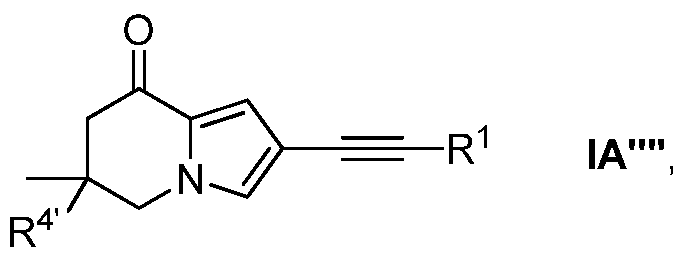
or an optical isomer, prodrug, pharmaceutically acceptable salt, hydrate, solvate, or polymorph thereof, wherein R1 is as defined above for Formula I and R4 represents H or methyl, wherein a compound of Formula VIII

is iodinated to yield the compound of Formula IX

which compound of Formula IX is reacted with an appropriately substituted acetylene in the presence of a suitable catalyst (e.g., Pd[PPh3]2Cl2), to yield a compound of Formula IA"", which may be converted, if desired, to an optical isomer, prodrug,
pharmaceutically acceptable salt, hydrate, solvate, or polymorph.
DETAILED DESCRIPTION OF THE INVENTION
[00149]For the purpose of the present invention, in the compounds of Formula I the carbon atom content of various hydrocarbon-containing moieties is indicated by a prefix designating the minimum and maximum number of carbon atoms in the moiety, i.e., the prefix C j indicates a moiety of the integer "i" to the integer "j" carbon atoms, inclusive.
Thus, for example, (Ci-3)alkyl refers to alkyl of one to three carbon atoms (i.e. 1 , 2 or 3 carbon atoms), inclusive, (i.e., methyl, ethyl, propyl, and isopropyl), straight and branched forms thereof, (C-i-6) for instance refers to a radical of one to six carbon atoms (i.e. 1 , 2, 3, 4, 5 or 6 carbon atoms).
[00150]As used herein, the following definitions are applicable unless otherwise described, the term "Ci-6alkyl" represents straight or branched chain alkyl groups. Examples of such alkyl groups include methyl, ethyl, n-propyl, isopropyl, n-butyl, isobutyl, sec-butyl, and terf-butyl.
[00151 ]The term "C2-6alkenyl" represents straight or branched chain alkenyl groups.
[00152]The term "Ci-6alkoxy" represents straight or branched chain -O-C-i-6alkyl groups. Examples of such alkoxy groups include methoxy, ethoxy, n-propoxy, and isopropoxy, sec-butoxy, terf-butoxy.
[00153]The term "acyl" represents Ci-6alkylcarbonyl, trifluoroacetyl, hydroxy- Ci-6alkylcarbonyl, Ci-6alkoxycarbonyl, A/-Ci-6alkylaminocarbonyl, Λ/,/V-di- (Ci-6alkyl)aminocarbonyl, Ci-6alkoxy-Ci-6alkylcarbonyl, arylcarbonyl, heteroarylcarbonyl, cyclo-C3-i2alkylcarbonyl, aryl-Ci-6alkylcarbonyl, heteroaryl-Ci-6alkylcarbonyl, arylamino- Ci-6alkylcarbonyl, heteroarylamino-Ci-6alkylcarbonyl, heterocyclylcarbonyl and heterocyclyl-Ci-6alkylcarbonyl.
[00154]The term "cycloC3-i2alkyr' represents monocyclic, bicyclic, or tricyclic alkyl groups, including cyclopropyl, cyclobutyl, cyclopentyl, cyclohexyl, bicyclo[2.2.1 ]heptyl and adamantanyl, which may be optionally substituted by one or more (e.g., 1 , 2, 3, 4, or 5) substituents, which may be the same or different, selected independently from halogen, trifluoromethyl, trifluoromethoxy, Ci-6alkyl, C2-6alkenyl, C-i-6alkoxy, amino, hydroxy, cyano, C-i-6alkoxycarbonyl, Ci-6alkylamino, and di-(Ci-6alkyl)amino, C-i-6alkyl- carbonylamino, oxo, Ci-6alkoxyimino, A/-Ci-6alkylaminocarbonyl, Λ/,/V-di- (Ci-6alkyl)aminocarbonyl, arylCi-6alkoxycarbonyl, and Ci-6alkylenedioxy.
[00155]The term "cycloC3-7alkyl" represents monocyclic alkyl groups, including cyclopropyl, cyclobutyl, cyclopentyl, and cyclohexyl, which may be optionally substituted by one or more (e.g., 1 , 2, 3, 4, or 5) substituents, which may be the same or different, selected independently from halogen, trifluoromethyl, trifluoromethoxy, C-i-6alkyl, C2-6alkenyl, C-i-6alkoxy, amino, hydroxy, cyano, C-i-6alkoxycarbonyl, C-i-6alkylcarbonyl, Ci-6alkylamino, and di-(Ci-6alkyl)amino, Ci-6alkylcarbonylamino, oxo, Ci-6alkoxyimino, A/-Ci-6alkylaminocarbonyl, N,N-di-(Ci-6alkyl)anriinocarbonyl, arylCi-6alkoxycarbonyl, and Ci-6alkylenedioxy.
[00156]The term "aryl" represents phenyl or naphthyl, wherein the phenyl or naphthyl group is optionally substituted by one or more (e.g., 1 , 2, 3, 4, or 5) substituents, which may be the same or different, selected independently from halogen, fluoromethyl, difluoromethyl, trifluoromethyl, fluoromethoxy, difluoromethoxy, trifluoromethoxy, C-i-6alkyl, hydroxyC-i-6alkyl, C2-6alkenyl,
 C-i-6alkylthio, Ci-6alkoxyCi-6alkyl, amino, hydroxy, nitro, cyano, formyl, C-i-6alkylcarbonyl, C-i-6alkoxycarbonyl, C-i-6alkylcarbonyloxy, Ci-6alkylcarbonyloxyCi-6alkyl, Ci-6alkylamino, di-(Ci-6alkyl)amino, cycloC3-i2alkylamino, Ci-6alkylcarbonylamino, phenylcarbonylamino, aminocarbonyl, A/-Ci-6alkylaminocarbonyl, N,N-di-(Ci-6alkyl)aminocarbonyl, pyrrolidinyl, piperidinyl, morpholinyl, piperazinyl, cycloC3-i2alkyl, pyridyl, and Ci-6alkylenedioxy.
[00157]The term "heteroaryl" represents an aromatic 5-6 membered ring containing from one to four heteroatoms selected from oxygen, sulfur and nitrogen, or a bicyclic group comprising a 5-6 membered ring containing from one to four heteroatoms selected from oxygen, sulfur and nitrogen fused with a benzene ring or a 5-6 membered ring containing from one to four heteroatoms selected from oxygen, sulfur and nitrogen, wherein the heteroaryl group may be optionally substituted by one or more (e.g., 1 , 2, 3, 4, or 5) substituents, which may be the same or different, selected independently from halogen, fluoromethyl, difluoromethyl, trifluoromethyl, fluoromethoxy, difluoromethoxy, trifluoromethoxy, C-i-6alkyl, hydroxyC-i-6alkyl, C2-6alkenyl, C-i-6alkoxy, C-i-6alkylthio, amino, hydroxy, nitro, cyano, C-i-6alkylcarbonyl, C-i-6alkoxycarbonyl, C-i-6alkoxycarbonyloxy, Ci-6alkylamino, di-(Ci-6alkyl)amino, cycloCs-^alkylamino, Ci-6alkylcarbonylamino, aminocarbonyl, A/-Ci-6alkylaminocarbonyl, Λ/,/V-di- (Ci-6alkyl)aminocarbonyl, pyrrolidinyl, piperidinyl, morpholinyl, cycloC3-i2alkyl,
Ci-6alkylenedioxy, aryl, and pyridyl. Representative heteroaryl groups include furyl, thienyl, pyrrolyl, oxazolyl, isoxazolyl, isothiazolyl, oxadiazolyl, pyrazolyl, triazolyl, thiadiazolyl, thiazolyl, imidazolyl, oxadiazolyl, tetrazolyl, pyridyl, pyrimidyl, pyridazinyl, pyrazinyl, triazinyl, purinyl, benzofuryl, benzothienyl, indolyl, indolizinyl, isoindolyl, indolinyl, indazolyl, benzimidazolyl, benzoxazolyl, benzothiazolyl, quinolinyl, quinazolinyl, quinoxalinyl, cinnolinyl, naphthyridinyl, isoquinolinyl, quinolizinyl, phthalazinyl, and pteridinyl.
[00158]The term "heterocyclyl" represents a saturated or unsaturated non-aromatic 3 to 12 membered ring comprising one to four heteroatoms selected from oxygen, sulfur and nitrogen, and a saturated or unsaturated non-aromatic bicyclic ring system having 3 to 12 members comprising one to six heteroatoms selected from oxygen, sulfur and nitrogen, wherein the heterocyclic ring or ring system may be optionally substituted by one or more (e.g., 1 , 2, 3, 4, or 5) substituents, which may be the same or different, selected independently from halogen, trifluoromethyl, fluoromethoxy, difluoromethoxy, trifluoromethoxy, C-i-6alkyl, C2-6alkenyl, C-i-6alkoxy, amino, hydroxy, nitro, cyano, C-i-6alkoxycarbonyl, C-i-6alkylcarbonyl, Ci-6alkylamino, and di-(Ci-6alkyl)amino, C-i-6alkyl- carbonylamino, oxo, Ci-6alkoxyimino, A/-Ci-6alkylaminocarbonyl, Λ/,/V-di- (Ci-6alkyl)aminocarbonyl, arylC-i-6alkoxycarbonyl, and C-i-6alkylenedioxy; examples of such heterocyclyl groups include oxetanyl, piperidinyl, morpholinyl, thiomorpholinyl, imidazolinyl, imidazolidinyl, pyrazolinyl, pyrazolidinyl, pyrrolinyl, pyrrolidinyl, or piperazinyl, wherein the heterocyclic ring or ring system is linked to the group to which it is attached optionally via nitrogen or a carbon atom.
[00159]The term "halogen" represents fluorine, chlorine, bromine and iodine.
[00160]The compounds of the present invention are usually named according to the lUPAC or CAS nomenclature system. Abbreviations which are well known to one of ordinary skill in the art may be used (e.g. "Ph" for phenyl, "Me" for methyl, "Et" for ethyl, "min" for minute or minutes, "h" for hour or hours, and "rt" for room temperature).
[00161 ]Memantine, also known as 1 -annino-3,5-dinnethyladannantane, is disclosed, U.S. Patent Nos. 4,122,193; 4,273,774; and 5,061 ,703, the subject matter of which patents is hereby incorporated by reference.
[00162]Memantine is a systemically-active noncompetitive NMDA receptor antagonists having moderate affinity for the receptor. It exhibits strong voltage dependent characteristics and fast blocking/unblocking kinetics (see e.g. Gortelmeyer et al., Arzneim-Forsch/Drug Res., 1992, 42: 904-913; Winblad et al., Int. J. Geriat. Psychiatry, 1999, 74:135-146; Rogawski, Amino Acids, 2000, 19: 133-49; Danysz et al., Curr. Pharm. Des., 2002, 8:835-43; Jirgensons et. al. Eur. J. Med. Chem., 2000, 35: 555- 565).
[00163]The term "analog" or "derivative" is used herein in the conventional pharmaceutical sense, to refer to a molecule that structurally resembles a reference molecule, but has been modified in a targeted and controlled manner to replace one or more specific substituents of the reference molecule with an alternate substituent, thereby generating a molecule which is structurally similar to the reference molecule. Synthesis and screening of analogs (e.g., using structural and/or biochemical analysis), to identify slightly modified versions of a known compound which may have improved or biased traits (such as higher potency and/or selectivity at a specific targeted receptor type, greater ability to penetrate blood-brain barriers, fewer side effects, etc.) is a drug design approach that is well known in pharmaceutical chemistry.
[00164] In addition, using methods known to those skilled in the art, analogs and derivatives of the compounds of the invention may be created which have improved therapeutic efficacy, i.e., higher potency and/or selectivity at a specific targeted receptor type, either greater or lower ability to penetrate mammalian blood-brain barriers (e.g., either higher or lower blood-brain barrier permeation rate), fewer side effects, etc.
[00165]The term "prodrug" is used herein in the conventional pharmaceutical sense to refer to a molecule which undergoes a transformation in vivo (e.g., an enzymatic or chemical transformation) to release an active parent drug. Prodrugs of the compounds of Formula I of the present invention may be prepared by chemically modifying a
functional group present in the compound of Formula I such that the chemically modified compound may undergo a transformation in vivo (e.g., enzymatic hydrolysis) to provide the compound of Formula I. Examples of functional groups present in the compounds of Formula I which may be modified to produce prodrugs include carboxy, hydroxy, amino, and thio groups. Prodrugs of the compounds of Formula I of the present invention may be prepared according to conventional techniques which have been described in the art (see, for example, Stella V., et al., Prodrugs: Challenges and Rewards, AAPS Press/Springer, New York, 2007).
[00166]The phrase "pharmaceutically acceptable", as used in connection with compositions of the invention, refers to molecular entities and other ingredients of such compositions that are physiologically tolerable and do not typically produce untoward reactions when administered to a mammal (e.g., human). The term "pharmaceutically acceptable" may also mean approved by a regulatory agency of the Federal or a state government or listed in the U.S. Pharmacopeia or other generally recognized pharmacopeia for use in mammals, and more particularly in humans.
[00167]Compounds of the present invention may be in the form of pharmaceutically acceptable salts. "Pharmaceutically acceptable salts" refers to those salts which possess the biological effectiveness and properties of the parent compound and which are not biologically or otherwise undesirable. The nature of the salt is not critical, provided that it is non-toxic and does not substantially interfere with the desired pharmacological activity.
[00168] It will be appreciated by those skilled in the art that compounds of the invention having a chiral center may exist in and be isolated in optically active and racemic forms. Some compounds may exhibit polymorphism. It is to be understood that the present invention encompasses any racemic, optically active, polymorphic, tautomeric, or stereoisomeric form, or mixture thereof, of a compound of the invention, which possesses the useful properties described herein.
[00169]The following Schemes 1 -6 describe the preparation of compounds of Formula I of the present invention. All of the starting materials may be prepared by procedures
described in these schemes, by procedures well known to one of ordinary skill in organic chemistry, or may be obtained commercially. All of the final compounds of the present invention may be prepared by procedures described in these charts or by procedures analogous thereto, which would be well known to one of ordinary skill in organic chemistry. All of the variables used in Schemes 1 -6 are as defined below or as in the claims. Compounds containing one or more chiral centers may be prepared as racemates or mixtures of various stereoisomers and then separated. However, they also may be prepared by a special enantioselective synthesis. For several of the chiral compounds, the enantiomers differ in pharmacological activity. heme 1 - Synthesis of compounds of Formula IA-IC

IC" n IC" n=2 IC n=2
[00170] Compounds of general Formulas IA', IA", IA'", IB', IB", IB'", IC, IC", and
IC" are prepared by Sonogashira coupling of 2-iodo-6,7-dihydroindolizin-8(5H)-one (5a), 2-iodo-7-methyl-6,7-dihydroindolizin-8(5H)-one (6a), 2-iodo-7,7-dimethyl-6,7- dihydroindolizin-8(5H)-one (7a), 6-iodo-2,3-dihydro-1 H-pyrrolizin-1 -one (5b), 6-iodo-2-
methyl-2,3-dihydro-1 H-pyrrolizin-1 -one (6b), 6-iodo-2,2-dimethyl-2,3-dihydro-1 H- pyrrolizin-1 -one (7b), 2-iodo-7,8-dihydro-5H-pyrrolo[1 ,2-a]azepin-9(6H)-one (5c), 2- iodo-8-methyl-7,8-dihydro-5/-/-pyrrolo[1 ,2-a]azepin-9(6/-/)-one (6c), or 2-iodo-8,8- dimethyl-7,8-dihydro-5/-/-pyrrolo[1 ,2-a]azepin-9(6H)-one (7c) with substituted acetylenes in the presence of a suitable catalyst, such as Pd[PPh3]2CI2. 2-lodo-6,7-dihydroindolizin- 8(5H)-one (5a), 6-iodo-2,3-dihydro-1 H-pyrrolizin-1 -one (5b), 2-iodo-7,8-dihydro-5H- pyrrolo[1 ,2-a]azepin-9(6H)-one (5c) and their methylated analogues 6a, 6b, 6c, 7a, 7b and 7c are prepared by iodination of 6,7-dihydroindolizin-8(5H)-one (2a), 2,3-dihydro- 1 H-pyrrolizin-1 -one (2b), 7,8-dihydro-5H-pyrrolo[1 ,2-a]azepin-9(6H)-one (2c) or corresponding analogues 3a, 3b, 3c, 4a, 4b and 4c. The synthesis of 6,7- dihydroindolizin-8(5H)-one (2a) from 4-aminobutanoic acid via 4-(1 H-pyrrol-1 - yl)butanoic acid (1a), is described in the literature (J. Org. Chem., 2009, 74 (8), 3160- 63). In close analogy, 2,3-dihydro-1 H-pyrrolizin-1 -one (2b) is synthesized from 3- aminopropanoic acid via 4-(1 H-pyrrol-1 -yl)propanoic acid (1 b) and 7,8-dihydro-5H- pyrrolo[1 ,2-a]azepin-9(6H)-one (2c) is similarily synthesized via 5-(1 H-pyrrol-1 - yl)pentanoic acid . Methylation of 6,7-dihydroindolizin-8(5H)-one (2a), 2,3-dihydro-1 H- pyrrolizin-1 -one (2b) or 7,8-dihydro-5H-pyrrolo[1 ,2-a]azepin-9(6H)-one (2c) with methyl iodide in the presence of a strong base, such as LDA, provides 7-methyl-6,7- dihydroindolizin-8(5H)-one, (3a) 2-methyl-2,3-dihydro-1 H-pyrrolizin-1 -one (3b) or 8- methyl-7,8-dihydro-5H-pyrrolo[1 ,2-a]azepin-9(6H)-one (3c), correspondingly. The second methylation of 7-methyl-6,7-dihydroindolizin-8(5H)-one (3a), 2-methyl-2,3- dihydro-1 H-pyrrolizin-1 -one (3b) or 8-methyl-7,8-dihydro-5H-pyrrolo[1 ,2-a]azepin-9(6H)- one (3c) under similar conditions provides 7,7-dimethyl-6,7-dihydroindolizin-8(5H)-one (4a), 2,2-dimethyl-2,3-dihydro-1 H-pyrrolizin-1 -one (4b) or 8,8-dimethyl-7,8-dihydro-5H- pyrrolo[1 ,2-a]azepin-9(6H)-one (4c), correspondingly. Alternatively, the methylation can be performed after the iodination step, thus converting 2-lodo-6,7-dihydroindolizin- 8(5H)-one (5a), 6-iodo-2,3-dihydro-1 H-pyrrolizin-1 -one (5b) or 2-iodo-7,8-dihydro-5H- pyrrolo[1 ,2-a]azepin-9(6H)-one (5c), to their methylated analogues 6a, 6b, 6c and further to 7a , 7b and 7c.
Scheme 2 - Synthesis of 6-substituted dihydroindolizin-8(5H)-ones

13b R =Me 14b R4'=Me R '=H or Me
[00171 ] Compounds of Formula IA"" are prepared by Sonogashira coupling of 2- iodo-6-methyl-6,7-dihydroindolizin-8(5H)-one (14a) or 2-iodo-6,6-dimethyl-6,7- dihydroindolizin-8(5H)-one (14b) with substituted acetylenes in the presence of a suitable catalyst, such as Pd[PPh3]2CI2. 2-lodo-6-methyl-6,7-dihydroindolizin-8(5H)-one (14a) and 2-iodo-6,6-dimethyl-6,7-dihydroindolizin-8(5/-/)-one (14b) are prepared by iodination of 6-methyl-6,7-dihydroindolizin-8(5H)-one (13a) or 6,6-dimethyl-6,7- dihydroindolizin-8(5H)-one (13b) accordingly. Compounds 13a and 13b are synthesized from 4-amino-3-methylbutanoic acid (11a) or 4-amino-3,3-dimethylbutanoic acid (11 b) via 3-methyl-4-(1 H-pyrrol-1 -yl)butanoic acid (12a) and 3,3-dimethyl-4-(1 H-pyrrol-1 - yl)butanoic acid (12b) in close analogy to the method described in the literature (J. Org. Chem., 2009, 74 (8), 3160-63) for 6,7-dihydroindolizin-8(5H)-one (2, Scheme 1 ). The synthesis of 4-amino-3,3-dimethylbutanoic acid (11 b) from methyl 3-methylbut-2-enoate (8b) via methyl 3,3-dimethyl-4-nitrobutanoate (9b) and 4,4-dimethylpyrrolidin-2-one (10b) is performed according to procedures described in the literature (US Published Application No. 2008/0039456A1 ). A closely analogous sequence starting from methyl crotonate (8a) provides 4-amino-3-methylbutanoic acid (11a).
Scheme 3 - Synthesis of 2,3,4,5-tetrahydro-1H-pyrrolo[1 ,2-a][1 ,4]diazepin-1 -ones

20 19
[00172]Methods for the preparation of pyrrolo[1 ,2-a][1 ,4]diazepin-1 -one derivatives 19 and 20 are shown in Scheme 3. Lactam 17 is prepared from ketone 5a via three steps, i.e., oxime formation (15) using hydroxyl amine hydrochloride, tosylation (16), and subsequent rearrangement under basic conditions. Standard Sonogashira coupling reactions provide compounds of general formula 19, which may be further derivatized by, e.g., /V-methylation using methyl iodide to furnish target compounds 20. Alternatively, lactam 17 may first be methylated and then coupled with an appropriate terminal acetylene under Sonogashira conditions to give compounds of general formula 20.
Scheme 4 - S nthesis of 3,4-dihydropyrrolo[1 ,2-a]pyrazin-1(2H)-ones

27
[00173]Compounds of general formula of type 27 are synthesized according to Scheme 4. A known trichloroacetyl derivative 21 (WO2005/1 13541 ) is converted to ester 22 in methanol in the presence of subequimolar amount of sodium methoxide. In close analogy to published procedures (Aust. J. Chem. 1988, 41, 1583), ester 22 is then alkylated with dibromoethane in DMSO using potassium hydroxide as a base. Lactam 25 is obtained in the reaction of compound 23 with 4 eq. of the desired amine. Alternatively, pyrrole 21 is directly converted into amide 24 in the reaction of 1 .2 eq. of the amine in THF, followed by alkylation with dibromoethane under phase transfer catalysis conditions to furnish target lactam 25. In the case of unreactive amines, pyrrole 21 is hydrolyzed with sodium hydroxide to give carboxylic acid, which is then converted to amide 24 using standard condensation conditions (EDC, HOBt) in DMF. Sonogashira coupling of lactams 25 with arylacetylenes provides the target compounds 27.
- S nthesis of 3-substituted 6,7-dih droindolizin-8(5H)-ones

[00174]3-Substituted 6,7-dihydroindolizin-8(5H)-one derivatives are accessible via the synthesis route described in Scheme 5. First, ketone 5a is brominated in 3-position by means of /V-bromosuccinimide in DMF to give dihalogenated intermediate 28 followed by a Sonogashira coupling reaction with an appropriate acetylene 29 to furnish compounds of general structure 30. The bromo substituent may be substituted by alkyl or aryl groups using boronic acids (31 ) in a Suzuki coupling reaction to provide compounds of general formula 32.
Scheme 6 - Synthesis of 3,4,4a,5,6,10b-hexahydro-2H-[1 ,4]oxazino[3,2- g]indolizine derivatives

39 40
R = H, Ci-6alkyl, acyl
[00175] Ketone 5a may be transformed into oxime 33 in the presence of sodium acetate and hydroxylamine hydrochloride. Oxime 33 is then converted into the corresponding tosylate 34 using a standard protocol. a-Amino group is introduced in Neber rearrangement reaction in the presence of potassium f-butoxide, which gives (in rather low yield) a mixture of aminoketone 35 and its dimethyl acetal, which is hydrolyzed during work up into aminoketone 35. Acylation of aminoketone 35 with chloroacetyl chloride gives the corresponding amide 36. The carbonyl group is reduced with DIBALH to give alcohol 37, which cyclizes in the presence of sodium hydride to provide the morpholinone derivative 38. Reduction of this lactam with LAH provides the key intermediate morpholine 39.
[00176]Morpholine 39 may be /V-alkylated under standard reaction conditions with an appropriate alkyl halide and then coupled with an arylacetylene to provide compound 40.
[00177]Analogously, morpholine 39 may be acylated with acyl chlorides, chloroformates and carbomoyl chlorides to give the corresponding /V-acyl derivatives, which may be coupled with an arylacetylene to provide the compound 40.
[00178] It will be appreciated that in the above transformations it may be necessary or desirable to protect any sensitive groups in the molecule of the compound in question in order to avoid undesirable side reactions.
[00179]Pure stereoisomeric forms (including optical isomers) of the compounds and the intermediates of this invention may be obtained by the application of art-known procedures. Diastereomers may be separated by physical separation methods such as selective crystallization and chromatographic techniques, e.g., liquid chromatography using chiral stationary phases. Enantiomers (optically active isomers) may be separated from each other by selective crystallization of their diastereomeric salts with optically active acids. Alternatively, enantiomers may be separated by chromatographic techniques using chiral stationary phases.
[00180]Pure stereoisomeric forms may also be derived from the corresponding pure stereoisomeric form of appropriate starting materials, provided that the reaction occur stereoselectively. Stereoisomeric forms of Formula I are included within the scope of this invention.
[00181 ]Compounds of Formula I which are marked by radioactive atoms may be obtained using art-known procedures. Typical compounds include those where one or more hydrogens are substituted by tritium, where one or more 12C are substituted by 14C, where one or more fluorine atoms are substituted by 18F or other isotopes. These may be used for the treatment of diseases (e.g. cancer) but also for diagnostic purposes. The radioactive atoms exchanged in the molecule are often isotopes of carbon, hydrogen, halogen, sulphur or phosphorus. Compounds of the Formula I which are marked by radioactive atoms are included within the scope of this invention.
ADDITION SALTS
[00182]For therapeutic use, salts of the compounds of Formula I are those wherein the counterion is pharmaceutically acceptable. However, salts of acids and bases, which are non-pharmaceutically acceptable, may also find use, for example, in the preparation and purification of pharmaceutically acceptable compounds. All salts whether pharmaceutically acceptable or not are included within the ambit of the present invention. The pharmaceutically acceptable salts as mentioned above are meant to comprise the therapeutically active non-toxic salt forms, which the compounds of Formula I are able to form. The latter may conveniently be obtained by treating the base form with such appropriate acids as inorganic acids, e.g. hydrohalic acids such as hydrochloric, hydrobromic and the like; sulfuric acid; nitric acid; phosphoric acid and the like; or organic acids such as acetic, propanoic, hydroxyacetic, 2-hydroxypropanoic, oxopropanoic, oxalic, malonic, succinic, maleic, fumaric, malic, tartaric, 2-hydroxy-1 ,2,3- propanetricarboxylic, methanesulfonic, ethanesulfonic, benzenesulfonic, 4- methylbenzenesulfonic, cyclohexanesulfonic, 2-hydroxybenzoic, 4-amino-2- hydroxybenzoic and the like acids. Conversely, the salt form may be converted by treatment with alkali into the free base form.
PHARMACEUTICAL COMPOSITIONS
[00183]The active ingredients of the compounds of the invention, together with one or more excipients such as adjuvants, carriers, or diluents, may be placed into the form of pharmaceutical compositions, unit dosages or dosage forms. The pharmaceutical compositions may be employed as solid dosage forms, such as powders, granules, pellets, coated or uncoated tablets or filled capsules, or liquid dosage forms, such as solutions, suspensions, emulsions, or capsules filled with the same, or semi solid dosage forms, such as gels, creams and ointments. The active ingredient(s) dissolution and release profiles of the pharmaceutical dosage forms may be varied from seconds to months.
[00184]The pharmaceutical compositions are designed for the use in animals and humans and may be applied via all application routes. Preferred application routes will be the oral route, the dermal route, the pulmonary route, the nasal route, the rectal route, and the parenteral route, respectively. Such pharmaceutical compositions and unit dosage forms thereof may comprise conventional or new ingredients in conventional or special proportions, with or without additional active compounds or principles, and such unit dosage forms may contain any suitable effective amount of the active ingredient commensurate with the intended daily dosage range to be employed. Tablets containing one (1 ) to one hundred (100) milligrams of active ingredient or, more broadly, zero point five (0.5) to five hundred (500) milligrams per tablet, are accordingly suitable representative unit dosage forms.
[00185]The term "carrier" applied to pharmaceutical compositions of the invention refers to a diluent, excipient, or vehicle with which an active compound is administered. Such pharmaceutical carriers may be sterile liquids, such as water, saline solutions, aqueous dextrose solutions, aqueous glycerol solutions, and oils, including those of petroleum, animal, vegetable or synthetic origin, such as peanut oil, soybean oil, mineral oil, sesame oil and the like. A.R. Gennaro, 20th Edition, describes suitable pharmaceutical carriers in "Remington: The Science and Practice of Pharmacy".
METHOD OF TREATING
[00186]Due to their high degree of activity and their low toxicity, together presenting a most favorable therapeutic index, the active principles of the invention may be administered to a subject, e.g., a living animal (including a human) body, in need thereof, for the treatment, alleviation, or amelioration, palliation, or elimination of an indication or condition which is susceptible thereto, or representatively of an indication or condition set forth elsewhere in this application, preferably concurrently, simultaneously, or together with one or more pharmaceutically-acceptable excipients, carriers, or diluents, especially and preferably in the form of a pharmaceutical composition thereof, whether by oral, rectal, or parental (including intravenous and subcutaneous) or in some cases even topical route, in an effective amount. Suitable dosage ranges are 1 -1000 milligrams daily, optionally 10-500 milligrams daily, and optionally 50-500 milligrams daily, depending as usual upon the exact mode of administration, form in which administered, the indication toward which the administration is directed, the subject involved and the body weight of the subject involved, and the preference and experience of the physician or veterinarian in charge.
[00187]The term "treat" is used herein to mean to relieve or alleviate at least one symptom of a disease in a subject. Within the meaning of the present invention, the term "treat" also denotes to arrest, delay the onset (i.e., the period prior to clinical manifestation of a disease) and/or reduce the risk of developing or worsening a disease.
[00188]The term "combination" is used herein to define a single pharmaceutical composition (formulation) comprising a compound of the present invention and a second active ingredient (e.g., an NMDA receptor antagonist, L-DOPA, a dopaminomimetic, or a neuroleptic), in a formulation known in the art, or two separate pharmaceutical compositions (formulations), one comprising a compound of the present invention as formulated above and one comprising a second active ingredient (e.g., an NMDA receptor antagonist, L-DOPA, a dopaminomimetic, or a neuroleptic) in a formulation known in the art, to be administered conjointly.
[00189]Within the meaning of the present invention, the term "conjoint administration" is used to refer to administration of a compound of the present invention and a second
active ingredient (e.g., an NMDA receptor antagonist, L-DOPA, a dopaminominnetic, or a neuroleptic) in one composition, or simultaneously in different compositions, or sequentially. For the sequential administration to be considered "conjoint", however, the compound of the present invention and the NMDA receptor antagonist must be administered separated by a time interval that still permits the resultant beneficial effect in a mammal. For example, the compound of the present invention and the NMDA receptor antagonist must be administered on the same day {e.g., each - once or twice daily), including within an hour of each other, and including simultaneously.
[00190]The term "therapeutically effective" applied to dose or amount refers to that quantity of a compound or pharmaceutical composition that is sufficient to result in a desired activity upon administration to a living animal body in need thereof.
[00191 ]Compounds of the present invention may be administered orally, topically, parenterally, or mucosally (e.g., buccally, by inhalation, or rectally) in dosage unit formulations containing conventional non-toxic pharmaceutically acceptable carriers. It is usually desirable to use the oral route. The active agents may be administered orally in the form of a capsule, a tablet, or the like (see Remington: The Science and Practice of Pharmacy, 20th Edition). The orally administered pharmaceutical compositions may be administered in the form of a time-controlled release vehicle, including diffusion- controlled systems, osmotic devices, dissolution-controlled matrices, and erodible/degradable matrices.
[00192]For oral administration in the form of a tablet or capsule, the active drug component of Formula I may be combined with non-toxic, pharmaceutically acceptable excipients such as binding agents (e.g., pregelatinized maize starch, polyvinylpyrrolidone or hydroxypropyl methylcellulose); fillers (e.g., lactose, sucrose, glucose, mannitol, sorbitol and other reducing and non-reducing sugars, microcrystalline cellulose, calcium sulfate, or calcium hydrogen phosphate); lubricants (e.g., magnesium stearate, talc, or silica, steric acid, sodium stearyl fumarate, glyceryl behenate, calcium stearate, and the like); disintegrants (e.g., potato starch or sodium starch glycolate); and/or wetting agents (e.g., sodium lauryl sulphate), coloring and flavoring agents, gelatin, sweeteners, natural and synthetic gums (such as acacia, tragacanth or
alginates), buffer salts, carboxymethylcellulose, polyethyleneglycol, waxes, and the like. For oral administration in liquid form, the drug components may be combined with nontoxic, pharmaceutically acceptable inert carriers (e.g., ethanol, glycerol, water), suspending agents (e.g., sorbitol syrup, cellulose derivatives or hydrogenated edible fats), emulsifying agents (e.g., lecithin or acacia), non-aqueous vehicles (e.g., almond oil, oily esters, ethyl alcohol or fractionated vegetable oils), preservatives (e.g., methyl or propyl-p-hydroxybenzoates or sorbic acid), and the like. Stabilizing agents such as antioxidants (BHA, BHT, propyl gallate, sodium ascorbate, citric acid) may also be added to stabilize the dosage forms.
[00193] Tab lets may be coated by methods well known in the art. Compositions of the invention containing as active compound a compound of Formula I may be also introduced in beads, microspheres or microcapsules, e.g., fabricated from polyglycolic acid/lactic acid (PGLA). Liquid preparations for oral administration may take the form of, for example, solutions, syrups, emulsions or suspensions, or they may be presented as a dry product for reconstitution with water or other suitable vehicle before use. Preparations for oral administration may be suitably formulated to give controlled or postponed release of the active compound.
[00194]Compounds of the present invention may also be administered in the form of liposome delivery systems, such as small unilamellar vesicles, large unilamellar vesicles and multilamellar vesicles. Liposomes may be formed from a variety of phospholipids, such as cholesterol, stearylamine or phosphatidylcholines, as is well known.
[00195]Compounds of the present invention may also be delivered by the use of monoclonal antibodies as individual carriers to which the compound molecules are coupled. Active drugs may also be coupled with soluble polymers as targetable drug carriers. Such polymers include polyvinyl-pyrrolidone, pyran copolymer, polyhydroxy- propyl methacrylamide-phenol, polyhydroxy-ethyl-aspartamide-phenol, or polyethyleneoxide-polylysine substituted with palmitoyl residues. Furthermore, active drug may be coupled to a class of biodegradable polymers useful in achieving controlled release of a drug, for example, polylactic acid, polyglycolic acid, copolymers of polylactic and polyglycolic acid, polyepsilon caprolactone, polyhydroxybutyric acid,
polyorthoesters, polyacetals, polyhydropyrans, polycyanoacrylates, and cross-linked or amphipathic block copolymers of hydrogels.
[00196]For administration by inhalation, the therapeutics according to the present invention containing as active compound a compound of Formula I may be conveniently delivered in the form of an aerosol spray presentation from pressurized packs or a nebulizer, with the use of a suitable propellant, e.g., dichlorodifluoromethane, trichlorofluoromethane, dichlorotetrafluoroethane, carbon dioxide, or other suitable gas. In the case of a pressurized aerosol, the dosage unit may be determined by providing a valve to deliver a metered amount. Capsules and cartridges of, e.g., gelatin for use in an inhaler or insufflator may be formulated containing a powder mix of the compound and a suitable powder base such as lactose or starch.
[00197] Formulations comprising compounds of the present invention may be delivered parenterally, i.e., by intravenous (i.v.), intracerebroventricular (i.c.v.), subcutaneous (s.c), intraperitoneal (i.p.), intramuscular (i.m.), subdermal (s.d.), or intradermal (i.d.) administration, by direct injection, via, for example, bolus injection or continuous infusion. Formulations for injection may be presented in unit dosage form, e.g., in ampoules or in multi-dose containers, with an added preservative. The compositions may take such forms as excipients, suspensions, solutions, or emulsions in oily or aqueous vehicles, and may contain formulatory agents such as suspending, stabilizing and/or dispersing agents. Alternatively, the active ingredient may be in powder form for reconstitution with a suitable vehicle, e.g., sterile pyrogen-free water, before use.
[00198]Compounds of the present invention may also be formulated for rectal administration, e.g., as suppositories or retention enemas (e.g., containing conventional suppository bases such as cocoa butter or other glycerides).
[00199]Compositions containing a compound of Formula I may, if desired, be presented in a pack or dispenser device, which may contain one or more unit dosage forms containing the active ingredient and/or may contain different dosage levels to facilitate dosage titration. The pack may, for example, comprise metal or plastic foil, such as a blister pack. The pack or dispenser device may be accompanied by instructions for
administration. Compositions of the invention formulated in a compatible pharmaceutical carrier may also be prepared, placed in an appropriate container, and labeled for treatment of an indicated condition.
[00200]As disclosed herein, the dose of the components in the compositions of the present invention is determined to ensure that the dose administered continuously or intermittently will not exceed an amount determined after consideration of the results in test animals and the individual conditions of a patient. A specific dose naturally varies depending on the dosage procedure, the conditions of a patient or a subject animal such as age, body weight, sex, sensitivity, feed, dosage period, drugs used in combination, seriousness of the disease. The appropriate dose and dosage times under certain conditions may be determined by the test based on the above-described indices but may be refined and ultimately decided according to the judgment of the practitioner and each patient's circumstances (age, general condition, severity of symptoms, sex, etc.) according to standard clinical techniques.
[00201 jToxicity and therapeutic efficacy of the compositions of the invention may be determined by standard pharmaceutical procedures in experimental animals, e.g., by determining the LD50 (the dose lethal to 50% of the population) and the ED50 (the dose therapeutically effective in 50% of the population). The dose ratio between therapeutic and toxic effects is the therapeutic index and it may be expressed as the ratio LD50/ED50. Compositions that exhibit large therapeutic indices are preferred.
[00202] From the Examples described herein below, it is apparent that the present invention provides novel and valuable applications and uses of the compounds of the present invention, which compounds comprise the active principle according to the present invention, as well as novel pharmaceutical compositions thereof and methods of preparation thereof and of treating therewith.
[00203]The high order of activity of the active agent of the present invention and compositions thereof, as evidenced by the tests reported, is indicative of utility based on its valuable activity in human beings as well as in lower animals. Clinical evaluation in human beings has not been completed. It will be clearly understood that the distribution
and marketing of any compound or composition falling within the scope of the present invention for use in human beings will of course have to be predicated upon prior approval by governmental agencies which are responsible for and authorized to pass judgment on such questions.
[00204]The instant compounds of Formula I represent a novel class of mGluR5 modulators. In view of their potency, they will be useful therapeutics in a wide range of disorders, in particular CNS disorders, which involve excessive glutamate induced excitation.
[00205]These compounds accordingly find application in the treatment of the disorders of a living animal body, especially a human, as listed earlier in the description.
[00206]These compounds also find application in the treatment of indications in a living animal body, especially a human, wherein a particular condition does not necessarily exist but wherein a particular physiological parameter may be improved through administration of the instant compounds, including cognitive enhancement.
[00207] Neuroprotection as well as cognitive enhancement may also be achieved by administration of the instant compounds in combination with a NMDA receptor antagonist like Memantine.
[00208]The method-of-treating a living animal body with a compound of the invention, for the inhibition of progression or alleviation of the selected ailment therein, is as previously stated by any normally-accepted pharmaceutical route, employing the selected dosage which is effective in the alleviation of the particular ailment desired to be alleviated. Use of the compounds of the present invention in the manufacture of a medicament for the treatment of a living animal for inhibition of progression or alleviation of selected ailments or conditions, particularly ailments or conditions susceptible to treatment with a Group I mGluR modulator is carried out in the usual manner comprising the step of admixing an effective amount of a compound of the invention with a pharmaceutically-acceptable diluent, excipient, or carrier, and the method-of-
treating, pharmaceutical compositions, and use of a compound of the present invention in the manufacture of a medicament.
[00209] Representative pharmaceutical compositions prepared by admixing the active ingredient with a suitable pharmaceutically-acceptable excipient, diluent, or carrier, include tablets, capsules, solutions for injection, liquid oral formulations, aerosol formulations, TDS formulations, and nanopartide formulations, thus to produce medicaments for oral, injectable, or dermal use, also in accord with the foregoing.
EXPERIMENTAL PART
[00210]The compounds and their preparation of the present invention will be better understood in connection with the following examples, which are intended as an illustration of and not a limitation upon the scope of the invention.
[0021 1 ] Hereinafter, "DCM" is defined as dichloromethane, "BuLi" as n-butyllithium, "DBU" as 1 ,8-diazabicyclo[5.4.0]undec-7-ene, "DIPEA" as Λ/,/V-diisopropylethylamine, "DMAP" as 4-dimethylaminopyridine, "DMF" as Λ/,/V-dimethylformamide, "EtOAc" as ethyl acetate, "LDA" as lithium diisopropylamide, "MeOH" as methanol, "Pd(dppf)CI2" as 1 ,1 '-bis(diphenylphosphino)ferrocenepalladium(ll)dichloride, "TBAF" as tetrabutylammonium fluoride, "TEA" as triethylamine, and "THF" as tetrahydrofuran.
Preparation 1
2-lodo-6,7-dihydroindolizin-8(5H)-one (5a)
[00212]6,7-Dihydroindolizin-8(5H)-one (2a) (5170 mg, 38.25 mmol, 1 eq.) is dissolved in 130 ml_ of anhydrous DMF, and /V-iodosuccinimide (8605 mg, 38.25 mmol, 1 eq.) is added in single portion. The resulting mixture is stirred for 24 h at room temperature. The mixture is diluted with water, and the formed precipitate is filtered off. The filtrate consists mainly of 2- and 3-monoiodides, whereas the precipitate is found to be mainly 2-iodide (5a) and 2,3-diiodide.
[00213]The precipitate is recrystallized from ethyl acetate to give 4800 mg of 2-iodide (5) and 1700 mg of 2,3-diiodide. The filtrate is extracted with EtOAc, dried over
anhydrous sodium sulfate, and the solvent is evaporated in vacuo. The residue is purified by flash column chromatography, using hexanes/ethyl acetate mixture as an eluent, providing 1220 mg of 2-iodide (5a) and 1460 mg of 3-iodide. The combined yield of title compound 5a is 6020 mg (60%).
[00214]The 2,3-diodide by-product can be converted to 2-iodide (5a) by its treatment at low temperature with BuLi or isopropylmagnesium bromide and quenching the reaction mixture with water.
Preparation 2
7-Methyl-6,7-dihydroindolizin-8(5H)-one (3a)
[00215]To a solution of freshly distilled diisopropylamine (1 152 mg, 1 1 .39 mmol, 1 .1 eq.) in 1 1 ml_ of THF at -78 °C is added a solution of BuLi (2.5 M in hexane, 4.6 ml_, 1 1 .39 mmol, 1 .1 eq.) with stirring under argon. The solution is warmed to 0 °C over 15 min to provide a solution of LDA. The LDA solution is cooled to -78 °C and added via cannula to a stirred solution of 6,7-dihydroindolizin-8(5H)-one (2a) (1400 mg, 10.36 mmol, 1 eq.) in 12 mL of THF under argon. The mixture is stirred for 1 h at -78 °C, then methyl iodide (1617 mg, 1 1 .39 mmol, 1 .1 eq.) is added dropwise, and the mixture is stirred for 3 h at -78 °C and then allowed to warm to room temperature. A saturated solution of ammonium chloride is added, and the mixture is extracted with DCM. The organic phase is dried over anhydrous Na2SO4, and the solvent is evaporated. Purification of the residue by flash column chromatography provides 885 mg (57%) of the title compound along with 250 mg of the recovered starting material and 150 mg of 7,7-dimethyl-6,7-dihydroindolizin-8(5H)-one (4a).
Preparation 3
7,7-Dimethyl-6,7-dihydroindolizin-8(5H)-one (4a)
[00216]To a solution of freshly distilled diisopropylamine (335 mg, 3.32 mmol, 1 .1 eq.) in 4 mL of THF at -78 °C is added a solution of BuLi (2.5 M in hexane, 1 .33 mL, 3.32 mmol, 1 .1 eq.) with stirring under argon. The solution is warmed to 0 °C over 15 min to provide a 0.7 M solution of LDA. The LDA solution is cooled to -78 °C and added via
cannula to a stirred solution of 7-methyl-6,7-dihydroindolizin-8(5/-/)-one (3a) in 4 mL of THF under argon. The mixture is stirred for 1 h at -78 °C. Methyl iodide (470 mg, 3.32 mmol, 1 .1 eq.) is added dropwise, and the mixture is stirred for 3 h at -78 °C and then allowed to warm to room temperature. A saturated solution of ammonium chloride is added, and the mixture is extracted with DCM. The organic phase is dried over anhydrous Na2SO4, and the solvent is evaporated. Purification of the residue by flash column chromatography provides 428 mg (87%) of the title compound as yellow crystals.
Preparation 4
6,6-Dimethyl-6,7-dihydroindolizin-8(5H)-one (13b)
[00217] 1 eq of NaOH is added to a stirred solution of 4-amino-3,3-dimethylbutanoic acid (11 b) (2270 mg, 13.54 mmol, 1 eq.) and NaOAc (1 1 16 mg, 13.61 mmol, 1 eq.) in 20 mL of water, then AcOH (7 mL) and dichloroethane (20 mL) are added. The mixture is heated to 90 °C, and 2,5-dimethoxytetrahydrofuran (1793 mg, 13.57 mmol, 1 eq.) is added. The reaction mixture is stirred for 20 h at 90 °C, then quenched by addition of 1 M HCI. The pH is adjusted to 10 with saturated NaHCO3, and the mixture is extracted with DCM. The aqueous phase is acidified with HCI (1 M) and extracted with DCM. The organic phase is dried over anhydrous Na2SO , and the solvent is evaporated to give sufficiently pure 3,3-dimethyl-4-(1 H-pyrrol-1 -yl)butanoic acid (12b). This intermediate (1916 mg, 10.57 mmol, 1 eq.) is dissolved in 8 mL of polyphosphoric acid, and the mixture is stirred for 24 h at 30 °C. Then water is added, and the resulting mixture is extracted with DCM. The organic phase is dried over anhydrous Na2SO , and the solvent is evaporated. Purification of the residue by flash column chromatography provides 600 mg (35%) of the title compound as yellow oil.
Preparation 5
6-Methyl-6,7-dihydroindolizin-8(5H)-one (13a)
[00218]The title compound is synthesized from 4-amino-3-methylbutanoic acid (11a) using identical procedure to that described for 6,6-dimethyl-6,7-dihydro-5H-indolizin-8- one (13b, Preparation 4).
Preparation 6
2,3-Dihydro-1 H-pyrrolizin-1 -one (2b)
[00219]The title compound is synthesized from 3-aminopropanoic acid (beta-alanine) using identical procedure to that described for 6,6-dimethyl-6,7-dihydroindolizin-8(5H)- one (13b, Preparation 4).
Preparation 7
2-lodo-6-methyl-6,7-dihydroindolizin-8(5H)-one (14a)
2-lodo-6,6-dimethyl-6,7-dihydroindolizin-8(5H)-one (14b)
2-lodo-7-methyl-6,7-dihydroindolizin-8(5H)-one (6a)
2-lodo-7,7-dimethyl-6,7-dihydroindolizin-8(5H)-one (7a)
[00220]The title compounds are prepared by iodination of 6-methyl-6,7-dihydroindolizin- 8(5H)-one (13a), 6,6-dimethyl-6,7-dihydroindolizin-8(5H)-one (13b), 7-methyl-6,7- dihydroindolizin-8(5H)-one (3a), or 7,7-dimethyl-6,7-dihydroindolizin-8(5H)-one (4a) correspondingly, using identical procedures to that described for 2-iodo-6,7- dihydroindolizin-8(5H)-one (5a, Preparation 1 ).
Preparation 8
6-lodo-2,3-dihydro-1H-pyrrolizin-1 -one (5b)
[00221 ]The title compound is prepared by iodination of 2,3-dihydro-1 H-pyrrolizin-1 -one (2b) using identical procedure to that described for 2-iodo-6,7-dihydroindolizin-8(5H)- one (5a, Preparation 1 ).
General Procedure 1 - Sonogashira coupling of 2-iodo-6,7-dihydroindolizin-8(5H)- ones and 6-iodo-2,3-dihydro-1H-pyrrolizin-1 -ones with substituted acetylenes
[00222] 2-lodo-6,7-dihydroindolizin-8(5H)-one or 6-iodo-2,3-dihydro-1 H-pyrrolizin-1 -one (5.75 mmol, 1 .0 eq.), substituted acetylene (8.62 mmol, 1 .5 eq.), triphenylphosphine (45 mg, 0.17 mmol, 0.03 eq.) and copper(l)iodide (54 mg, 0.29 mmol, 0.05 eq.) are dissolved in 25 ml_ of anhydrous DMF. The mixture is flushed thoroughly with argon.
PdCI2(Ph3P)2 (121 mg, 0.17 mmol, 0.03 eq.) and TEA (3 mL) are added, and the reaction mixture is stirred at 60 °C for 4 h. The reaction mixture is then diluted with water and extracted with chloroform. The organic extracts are combined, dried over anhydrous Na2SO , and the solvent is evaporated. The residue is purified by flash column chromatography using hexanes/ethyl acetate mixture as an eluent to give the title compound.
Preparation 9
2-Ethynyl-6,7-dihydroindolizin-8(5H)-one
[00223]A solution of 2-iodo-6,7-dihydroindolizin-8(5H)-one (4.76 g, 18.23 mmol) in dry DMF (50 mL) is flushed with argon for 10 min. Trimethylsilylacetylene (5.19 mL, 36.5 mmol) is added, followed by TEA (10.14 mL, 72.9 mmol), copper(l)iodide (0.174 g, 0.912 mmol) and PdCl2(P i3P)2 (0.640 g, 0.912 mmol). The mixture is stirred overnight at room temperature, then poured into cold water (300 mL) and extracted with EtOAc (200 mL). The organic layer is washed with brine (3x100 mL), dried over Na2SO and concentrated in vacuo. Purification by column chromatography (silica, 33% EtOAc/heptane) affords the intermediate product 2-((trimethylsilyl)ethynyl)-6,7- dihydroindolizin-8(5H)-one (3.58 g, 85%).
[00224]To a dark-brown solution of 2-((thmethylsilyl)ethynyl)-6,7-dihydroindolizin-8(5H)- one (3.58 g, 15.47 mmol) in MeOH (40 mL) is added K2CO3 (4.28 g, 30.9 mmol). The mixture is stirred at room temperature for 1 h after which water (100 mL) is added. The mixture is extracted with EtOAc (2x100 mL). The combined organic layers are washed with brine (100 mL), dried over Na2SO4 and concentrated in vacuo to yield the title compound (2.26 g, 92%).
General Procedure 2 - Sonogashira coupling of 2-ethynyl-6,7-dihydroindolizin- 8(5H)-one with aryl bromides
[00225]A solution of 2-ethynyl-6,7-dihydroindolizin-8(5H)-one, an appropriate aryl bromide (1 .1 eq.) and TEA (4 eq.) in dry DMF (2.5 mL) is flushed with argon for 10 min. PdCl2(Ph3P)2 (0.05 eq.) and copper(l)iodide (0.01 eq.) are added, and the reaction
mixture is heated at 90 °C for 30 min under microwave conditions. After cooling down to room temperature the mixture is diluted with EtOAc (50 mL), washed with brine (3x50 mL), dried over Na2SO and concentrated in vacuo. Purification by preparative TLC (silica, 50% EtOAc/heptane) and co-evaporation with Et2O (2x2 mL) provides the final compound.
Preparation 10
2-lodo-7,8-dihydro-5H-pyrrolo[1 ,2-a]azepin-9(6H)-one
[00226]A mixture of 5-aminovaleric acid (5.00 g, 42.74 mmol, 1 .00 eq.), AcONax3H2O (5.81 g, 42.74 mmol, 1 .00 eq.), water (50 mL), DCE (50 mL), acetic acid (22 mL), and 2,5-dimethoxytetrahydrofuran (5.923 g, 44.87 mmol, 1 .05 eq.) is stirred at 1 10 °C for 20 h, cooled down to room temperature, washed with water (3x50 mL), dried over Na2SO and concentrated at reduced pressure. The obtained residue is purified by column chromatography (silica gel, DCM/EtOH) to give 5-(1 H-pyrrol-1 -yl)pentanoic acid (5.156 g, 72%) as a gray solid.
[00227]P2O5 (2.10 g) is added to methanesulfonic acid (21 .21 g, 15 mL), and the resulting mixture is stirred in a flask equipped with CaCI2 tube at room temperature for 4 h to dissolve P2O5. Then 5-(1 H-pyrrol-1 -yl)pentanoic acid (1 .70 g, 10.2 mmol) is added to the obtained solution. The reaction mixture is stirred at room temperature for 6 h and poured onto ice. The formed solid is filtered. The filtrate is neutralized with an aqueous K2CO3 solution (25%) and extracted with DCM (3x50 mL). The combined organic phases are dried over Na2SO4 and concentrated at reduced pressure. The obtained residue is dried at reduced pressure to yield 7,8-dihydro-5H-pyrrolo[1 ,2-a]azepin-9(6/-/)- one (0.71 g, 47%) as a light brown oil.
[00228] /V-lodosuccinimide (560 mg, 2.48 mmol, 1 .0 eq.) is added to a solution of 7,8- dihydro-5H-pyrrolo[1 ,2-a]azepin-9(6H)-one (370 mg, 2.48 mmol, 1 .0 eq.) in acetonitrile (15 mL). The mixture is stirred at room temperature for 5 h, concentrated at reduced pressure, diluted with DCM (30 mL), washed with an aqueous Na2S2O3 solution (5%, 20 mL) and water (2x15 mL), dried over Na2SO4, and concentrated at reduced pressure.
The obtained residue is purified by column chromatography (silica gel, DCM/EtOH) to provide the title compound (100 mg, 17%) as a brown solid.
Preparation 11
2-lodo-8,8-dimethyl-7,8-dihydro-5H-pyrrolo[1 ,2-a]azepin-9(6H)-one
[00229]f-BuOK (1 .172 g, 10.47 mmol, 4.0 eq.) is added to a solution of 7,8-dihydro-5H- pyrrolo[1 ,2-a]azepin-9(6H)-one (390 mg, 2.62 mmol, 1 .0 eq.) (see Preparation 10) in anhydrous THF (15 ml_) at 0 °C. The mixture is stirred at 0 °C for 15 min. Then methyl iodide (3.55 ml_, 10.47 mmol, 4.0 eq.) is added. The reaction mixture is stirred at room temperature for 6 h, filtered through a pad of Celite and concentrated at reduced pressure. The obtained residue is purified by column chromatography (silica gel, hexane/ethyl acetate) followed by preparative TLC (silica gel, hexane/EtOAc, 4:1 ) to give 8,8-dimethyl-7,8-dihydro-5H-pyrrolo[1 ,2-a]azepin-9(6/-/)-one (1 10 mg, 24%) as a brown oil.
[00230] lodination of 8,8-dimethyl-7,8-dihydro-5H-pyrrolo[1 ,2-a]azepin-9(6H)-one is accomplished according to the procedure described in Preparation 10 using N- iodosuccinimide (yield: 29%).
Preparation 12
Methyl 1 -(2-bromoethyl)-4-iodo-1 H-pyrrole-2-carboxylate
[00231 ]Finely ground KOH (1 .64 g, 29 mmol, 7 eq.) is added to a solution of methyl 4- iodo-1 H-pyrrole-2-carboxylate (prepared according to WO2005/1 13541 ), (1 .05 g, 4.2 mmol, 1 eq.) in 2 ml_ of anhydrous DMSO, and the resulting mixture is stirred at room temperature for 3 h. Dibromoethane (1 1 .78 g, 62.7 mmol, 15 eq.) is added in a single portion, and the mixture is stirred for additional 3 h, then diluted with water and extracted with EtOAc. The organic phase is dried over anhydrous Na2SO , and the solvent is evaporated to give sufficiently pure (ca. 94%) title compound (1 .46 g, 88%) as a slightly yellow oil.
General Procedure 3 - Synthesis of /V-substituted 7-iodo-3,4-dihydropyrrolo[1,2- a]pyrazin-1(2H)-ones from methyl 1 -(2-bromoethyl)-4-iodo-1H-pyrrole-2- carboxylate
[00232]4-8 fold excess of an appropriate amine (or ammonia solution) is added to a solution of methyl 1 -(2-bromoethyl)-4-iodo-1 H-pyrrole-2-carboxylate (Preparation 12), (52 mg, 0.15 mmol) in 2 ml_ of EtOH. The reaction mixture is heated to 80 °C in a closed microwave vial for 1 to 12 h (TLC or LC-MS monitoring). The solvent is evaporated, and the residue is purified by flash column chromatography or preparative HPLC to give the target compound in good to moderate yield.
Example 1
2-(Phenylethynyl)-6,7-dihydroindolizin-8(5H)-one
[00233] According to General Procedure 1 , 2-iodo-6,7-dihydroindolizin-8(5H)-one is reacted with ethynylbenzene to provide the title compound as a colorless solid.
1H NMR (CDCI3), δΗ: 2.30 (m, 2H), 2.62 (t, 2H), 4.12 (t, 2H), 7.07 (d, 1 H), 7.12 (d, 1 H),
7.30-7.34 (m, 3H), 7.46-7.49 (m, 2H).
LC/MS (M+H)+ = 236
Example 2
2-((4-Fluorophenyl)ethynyl)-6,7-dihydroindolizin-8(5H)-one
[00234] According to General Procedure 1 , 2-iodo-6,7-dihydroindolizin-8(5H)-one is reacted with 1 -ethynyl-4-fluorobenzene to provide the title compound as a colorless solid.
1H NMR (CDCI3), δΗ: 2.30 (m, 2H), 2.62 (t, 2H), 4.12 (t, 2H), 7.02 (t, 2H), 7.06 (d, 1 H), 7.1 1 (d, 1 H), 7.45 (dd, 2H).
LC/MS (M+H)+ = 254
Example 3
2-((3-Fluorophenyl)ethynyl)-6,7-dihydroindolizin-8(5H)-one
[00235] According to General Procedure 1 , 2-iodo-6,7-dihydroindolizin-8(5/-/)-one is reacted with 1 -ethynyl-3-fluorobenzene to provide the title compound as a colorless solid.
1H NMR (CDCIs), δΗ: 2.27 (m, 2H), 2.62 (t, 2H), 4.13 (t, 2H), 6.97-7.04 (m, 1 H), 7.09 (d, 1 H), 7.12 (d, 1 H), 7.14-7.31 (m, 3H).
LC/MS (M+H)+ = 254
Example 4
2-((2-Fluorophenyl)ethynyl)-6,7-dihydroindolizin-8(5H)-one
[00236] According to General Procedure 1 , 2-iodo-6,7-dihydroindolizin-8(5H)-one is reacted with 1 -ethynyl-2-fluorobenzene to provide the title compound as a colorless solid.
1H NMR (CDCIs), δΗ: 2.31 (m, 2H), 2.62 (t, 2H), 4.13 (t, 2H), 7.03-7.1 1 (m, 2H), 7.12 (d, 1 H), 7.15 (d, 1 H), 7.23-7.33 (m, 1 H), 7.44-7.52 (m, 1 H).
LC/MS (M+H)+ = 254
Example 5
2-((2,6-Difluorophenyl)ethynyl)-6,7-dihydroindolizin-8(5H)-one
[00237] According to General Procedure 1 , 2-iodo-6,7-dihydroindolizin-8(5H)-one is reacted with 2-ethynyl-1 ,3-difluorobenzene to provide the title compound as a colorless solid.
1H NMR (CDCIs), δΗ: 2.30 (m, 2H), 2.60 (t, 2H), 4.13 (t, 2H), 6.96-7.04 (m, 2H), 7.12 (d, 1 H), 7.14 (d, 1 H), 7.15-7.20 (m, 1 H).
LC/MS (M+H)+ = 272
Example 6
2-((2,3-Difluorophenyl)ethynyl)-6,7-dihydroindolizin-8(5H)-one
[00238] According to General Procedure 1 , 2-iodo-6,7-dihydroindolizin-8(5H)-one is reacted with 1 -ethynyl-2,3-difluorobenzene to provide the title compound as a colorless solid.
1H NMR (CDCIs), δΗ: 2.30 (m, 1 H), 2.62 (t, 2H), 4.13 (t, 2H), 6.97-7.15 (m, 3H), 7.12 (d, 1 H), 7.15 (d, 1 H).
LC/MS (M+H)+ = 272
Example 7
2-((2,5-Difluorophenyl)ethynyl)-6,7-dihydroindolizin-8(5H)-one
[00239] According to General Procedure 1 , 2-iodo-6,7-dihydroindolizin-8(5/-/)-one is reacted with 2-ethynyl-1 ,4-difluorobenzene to provide the title compound as a colorless solid.
1H NMR (CDCIs), δΗ: 2.30 (m, 2H), 2.62 (t, 2H), 4.13 (t, 2H), 6.87-6.95 (m, 2H), 7.14 (d, 1 H), 7.17 (d, 1 H), 7.24 (m, 1 H).
LC/MS (M+H)+ = 272
Example 8
2- (m-Tolylethynyl)-6,7-dihydroindolizin-8(5H)-one
[00240] According to General Procedure 1 , 2-iodo-6,7-dihydroindolizin-8(5H)-one is reacted with 1 -ethynyl-3-methylbenzene to provide the title compound as a colorless solid.
1H NMR (CDCIs), δΗ: 2.30 (m, 2H), 2.34 (s, 3H), 2.62 (t, 2H), 4.12 (t, 2H), 7.06 (d, 1 H), 7.12 (d, 1 H), 7.17 (d, 1 H), 7.21 -7.32 (m, 3H).
LC/MS (M+H)+ = 250
Example 9
3- ((8-Oxo-5,6,7,8-tetrahydroindolizin-2-yl)ethynyl)benzonitrile
[00241 ] According to General Procedure 1 , 2-iodo-6,7-dihydroindolizin-8(5H)-one is reacted with 3-ethynylbenzonitrile to provide the title compound as a colorless solid. 1H NMR (CDCIs), δΗ: 2.29 (m, 2H), 2.62 (t, 2H), 4.14 (t, 2H), 7.10 (d, 1 H), 7.12 (d, 1 H), 7.45 (t, 1 H), 7.54-7.59 (m, 1 H), 7.65-7.74 (m, 2H).
LC/MS (M+H)+ = 261
Example 10
2-((6-Aminopyridin-2-yl)ethynyl)-6,7-dihydroindolizin-8(5H)-one
[00242] According to General Procedure 1 , 2-iodo-6,7-dihydroindolizin-8(5/-/)-one is reacted with 6-ethynylpyridin-2-amine to provide the title compound as a colorless solid. 1H NMR (CDCIs), δΗ: 2.28 (m, 2H), 2.60 (t, 2H), 4.1 1 (t, 2H), 6.45 (d, 1 H), 6.82 (d, 1 H), 7.13 (s, 2H), 7.41 (t, 1 H).
LC/MS (M+H)+ = 252
Example 11
2-(Thiophen-3-ylethynyl)-6,7-dihydroindolizin-8(5H)-one
[00243] According to General Procedure 1 , 2-iodo-6,7-dihydroindolizin-8(5H)-one is reacted with 3-ethynylthiophene to provide the title compound as a colorless solid.
1H NMR (CDCIs), δΗ: 2.30 (m, 2H), 2.62 (t, 2H), 4.12 (t, 2H), 7.05 (d, 1 H), 7.1 1 (d, 1 H), 7.16 (dd, 1 H), 7.28 (dd, 1 H), 7.46 (dd, 2H).
LC/MS (M+H)+ = 242
Example 12
2-(Thiophen-2-ylethynyl)-6,7-dihydroindolizin-8(5H)-one
[00244] According to General Procedure 1 , 2-iodo-6,7-dihydroindolizin-8(5H)-one is reacted with 2-ethynylthiophene to provide the title compound as a colorless solid.
1H NMR (CDCIs), δΗ: 2.30 (m, 2H), 2.62 (t, 2H), 4.12 (t, 2H), 6.98 (dd, 1 H), 7.06 (d, 1 H), 7.1 1 (d, 1 H), 7.21 -7.27 (m, 1 H).
LC/MS (M+H)+ = 242
Example 13
2-((3-(Fluoromethyl)phenyl)ethynyl)-6,7-dihydroindolizin-8(5H)-one
[00245] According to General Procedure 1 , 2-iodo-6,7-dihydroindolizin-8(5H)-one is reacted with 1 -ethynyl-3-(fluoromethyl)benzene to provide the title compound as a colorless solid.
1H NMR (CDCI3), δΗ: 2.30 (m, 2H), 2.62 (t, 2H), 4.13 (t, 2H), 5.36 (d, 2H), 7.07 (d, 1 H), 7.12 (d, 1 H), 7.32-7.49 (m, 4H).
LC/MS (M+H)+ = 268
Example 14
2-((2,3,6-Trifluorophenyl)ethynyl)-6,7-dihydroindolizin-8(5H)-one
[00246] According to General Procedure 1 , 2-iodo-6,7-dihydroindolizin-8(5/-/)-one is reacted with 2-ethynyl-1 ,3,4-trifluorobenzene to provide the title compound as a colorless solid.
1H NMR (CDCIs), δΗ: 2.31 (m, 2H), 2.63 (t, 2H), 4.14 (t, 2H), 6.85 (m, 1 H), 7.06 (m, 1 H),
7.15 (d, 1 H), 7.18 (d, 1 H).
LC/MS (M+H)+ = 290
Example 15
2-((2,4,6-Trifluorophenyl)ethynyl)-6,7-dihydroindolizin-8(5H)-one
[00247] According to General Procedure 1 , 2-iodo-6,7-dihydroindolizin-8(5H)-one is reacted with 2-ethynyl-1 ,3,5-trifluorobenzene to provide the title compound as a colorless solid.
1H NMR (CDCIs), δΗ: 2.30 (m, 2H), 2.63 (t, 2H), 4.13 (t, 2H), 6.70 (t, 2H), 7.13 (d, 1 H),
7.16 (d, 1 H).
LC/MS (M+H)+ = 290
Example 16
2-((2,3,4,5-Tetrafluorophenyl)ethynyl)-6,7-dihydroindolizin-8(5H)-one
[00248] According to General Procedure 1 , 2-iodo-6,7-dihydroindolizin-8(5H)-one is reacted with 1 -ethynyl-2,3,4,5-tetrafluorobenzene to provide the title compound as a colorless solid.
1H NMR (CDCIs), δΗ: 2.32 (m, 2H), 2.63 (t, 2H), 4.14 (t, 2H), 7.02-7.15 (m, 3H).
LC/MS (M+H)+ = 308
Example 17
7-Methyl-2-(phenylethynyl)-6,7-dihydroindolizin-8(5H)-one
[00249] According to General Procedure 1 , 2-iodo-7-methyl-6,7-dihydroindolizin-8(5/-/> one is reacted with ethynylbenzene to provide the title compound as a colorless solid. 1H NMR (CDCIs), δΗ: 1 .30 (d, 3H), 2.06 (m, 1 H), 2.29 (m, 1 H), 2.58 (m, 1 H), 4.15 (AB 2H), 7.04 (d, 1 H), 7.1 1 (d, 1 H), 7.29-7.33 (m, 3H), 7.46-7.50 (m, 2H).
LC/MS (M+H)+ = 250
Example 18
7-Methyl-2-(m-tolylethynyl)-6,7-dihydroindolizin-8(5H)-one
[00250] According to General Procedure 1 , 2-iodo-7-methyl-6,7-dihydroindolizin-8(5/-/) one is reacted with 1 -ethynyl-3-methylbenzene to provide the title compound as a colorless solid.
1H NMR (CDCIs), δΗ: 1 .29 (d, 3H), 2.08 (m, 1 H), 2.29 (m, 1 H), 2.36 (s, 3H), 2.59 (m, 1 H), 4.14 (AB m, 2H), 7.03 (d, 1 H), 7.10 (d, 1 H), 7.13-7.31 (m, 4H).
LC/MS (M+H)+ = 264
Example 19
2-((4-Fluorophenyl)ethynyl)-7-methyl-6,7-dihydroindolizin-8(5H)-one
[00251 ]According to General Procedure 1 , 2-iodo-7-methyl-6,7-dihydroindolizin-8(5/-/) one is reacted with 1 -ethynyl-4-fluorobenzene to provide the title compound as a colorless solid.
1H NMR (CDCIs), δΗ: 1 .29 (d, 3H), 2.09 (m, 1 H), 2.29 (m, 1 H), 2.59 (m, 1 H), 4.15 (AB 2H), 6.97-7.10 (m, 4H), 7.45 (dd, 2H).
LC/MS (M+H)+ = 268
Example 20
2-((3-Fluorophenyl)ethynyl)-7-methyl-6,7-dihydroindolizin-8(5H)-one
[00252] According to General Procedure 1 , 2-iodo-7-methyl-6,7-dihydroindolizin-8(5/-/)- one is reacted with 1 -ethynyl-3-fluorobenzene to provide the title compound as a colorless solid.
1H NMR (CDCIs), δΗ: 1 .30 (d, 3H), 2.10 (m, 1 H), 2.29 (m, 1 H), 2.60 (m, 1 H), 4.15 (AB m, 2H), 6.99 (m, 1 H), 7.04 (d, 1 H), 7.10 (d, 1 H), 7.14-7.30 (m, 3H).
LC/MS (M+H)+ = 268
Example 21
7,7-Dimethyl-2-(phenylethynyl)-6,7-dihydroindolizin-8(5H)-one
[00253] According to General Procedure 1 , 2-iodo-7,7-dimethyl-6,7-dihydroindolizin- 8(5H)-one is reacted with ethynylbenzene to provide the title compound as a colorless solid.
1H NMR (CDCIs), δΗ: 1 .25 (s, 6H), 2.1 1 (t, 2H), 4.13 (t, 2H), 7.02 (d, 1 H), 7.10 (d, 1 H), 7.29-7.33 (m, 3H), 7.45-7.48 (m, 2H).
LC/MS (M+H)+ = 264
Example 22
7,7-Dimethyl-2-(m-tolylethynyl)-6,7-dihydroindolizin-8(5H)-one
[00254] According to General Procedure 1 , 2-iodo-7,7-dimethyl-6,7-dihydroindolizin- 8(5H)-one is reacted with 1 -ethynyl-3-methylbenzene to provide the title compound as a colorless solid.
1H NMR (CDCIs), δΗ: 1 .25 (s, 6H), 2.1 1 (t, 2H), 2.33 (s, 3H), 4.13 (t, 2H), 7.01 (d, 1 H), 7.10 (d, 1 H), 7.12-7.31 (m, 4H).
LC/MS (M+H)+ = 278
Example 23
2-((3-Fluorophenyl)ethynyl)-7,7-dimethyl-6,7-dihydroindolizin-8(5H)-one
[00255] According to General Procedure 1 , 2-iodo-7,7-dimethyl-6,7-dihydroindolizin- 8(5H)-one is reacted with 1 -ethynyl-3-fluorobenzene to provide the title compound as a colorless solid.
1H NMR (CDCI3), δΗ: 1 .25 (s, 6H), 2.12 (t, 2H), 4.14 (t, 2H), 6.97-7.04 (m, 1 H), 7.02 (d, 1 H), 7.10 (d, 1 H), 7.13-7.30 (m, 3H).
LC/MS (M+H)+ = 282
Example 24
2-((6-Aminopyridin-2-yl)ethynyl)-7 -dimethyl-6 -dihydroindolizin-8(5H)-one
[00256] According to General Procedure 1 , 2-iodo-7,7-dimethyl-6,7-dihydroindolizin- 8(5H)-one is reacted with 6-ethynylpyridin-2-amine to provide the title compound as a colorless solid.
1H NMR (CDCIs), δΗ: 1 .25 (s, 6H), 2.12 (t, 2H), 4.14 (t, 2H), 6.46 (d, 1 H), 6.83 (d, 1 H), 7.10 (d, 1 H), 7.13 (d, 1 H), 7.43 (t, 1 H).
LC/MS (M+H)+ = 280
Example 25
7 -Dimethyl-2-((6-(methylamino)pyridin-2-yl)ethynyl)-6,7-dihydroindolizin-8(5H)- one
[00257] According to General Procedure 1 , 2-iodo-7,7-dimethyl-6,7-dihydroindolizin- 8(5H)-one is reacted with 6-ethynyl-/V-methylpyridin-2-amine to provide the title compound as a colorless solid.
1H NMR (CDCIs), δΗ: 1 .24 (s, 3H), 2.1 1 (t, 2H), 2.90 (s, 3H), 4.14 (t, 2H), 6.38 (d, 1 H), 6.77 (d, 1 H), 7.13 (s, 2H), 7.48 (t, 1 H).
LC/MS (M+H)+ = 294
Example 26
6-Methyl-2-(phenylethynyl)-6,7-dihydroindolizin-8(5H)-one
[00258] According to General Procedure 1 , 2-iodo-6-methyl-6,7-dihydroindolizin-8(5H)- one is reacted with ethynylbenzene to provide the title compound as a colorless solid. 1H NMR (CDCIs), δΗ: 1 .16 (d, 3H), 2.30 (dd, 1 H), 2.54 (m, 1 H), 2.68 (dd, 1 H), 3.73 (dd, 1 H), 4.15 (dd, 1 H), 7.06 (d, 1 H), 7.1 1 (d, 1 H), 7.30-7.33 (m, 3H), 7.46-7.49 (m, 2H). LC/MS (M+H)+ = 250
Example 27
2-((3-Fluorophenyl)ethynyl)-6-methyl-6,7-dihydroindolizin-8(5H)-one
[00259] According to General Procedure 1 , 2-iodo-6-methyl-6,7-dihydroindolizin-8(5/-/)- one is reacted with 1 -ethynyl-3-fluorobenzene to provide the title compound as a colorless solid.
1H NMR (CDCIs), δΗ: 1 .16 (d, 3H), 2.30 (dd, 1 H), 2.54 (m, 1 H), 2.68 (dd, 1 H), 3.73 (dd, 1 H), 4.15 (dd, 1 H), 7.00 (m, 1 H), 7.05 (d, 1 H), 7.10 (d, 1 H), 7.13-7.30 (m, 3H).
LC/MS (M+H)+ = 268
Example 28
2-((4-Fluorophenyl)ethynyl)-6-methyl-6,7-dihydroindolizin-8(5H)-one
[00260] According to General Procedure 1 , 2-iodo-6-methyl-6,7-dihydroindolizin-8(5H)- one is reacted with 1 -ethynyl-4-fluorobenzene to provide the title compound as a colorless solid.
1H NMR (CDCIs), δΗ: 1 .16 (d, 3H), 2.30 (dd, 1 H), 2.53 (m, 1 H), 2.67 (dd, 1 H), 3.73 (dd, 1 H), 4.14 (dd, 1 H), 6.97-7.09 (m, 4H), 7.45 (dd, 2H).
LC/MS (M+H)+ = 268
Example 29
2- ((2-Fluorophenyl)ethynyl)-6-methyl-6,7-dihydroindolizin-8(5H)-one
[00261 ] According to General Procedure 1 , 2-iodo-6-methyl-6,7-dihydroindolizin-8(5H)- one is reacted with 1 -ethynyl-2-fluorobenzene to provide the title compound as a colorless solid.
1H NMR (CDCIs), δΗ: 1 .16 (d, 3H), 2.30 (dd, 1 H), 2.53 (m, 1 H), 2.67 (dd, 1 H), 3.73 (dd, 1 H), 4.14 (dd, 1 H), 7.09-7.13 (m, 4H), 7.22-7.30 (m, 1 H), 7.43-7.51 (m, 1 H).
LC/MS (M+H)+ = 268
Example 30
3- ((6-Methyl-8-oxo-5,6,7,8-tetrahydroindolizin-2-yl)ethynyl)benzonitrile
[00262] According to General Procedure 1 , 2-iodo-6-methyl-6,7-dihydroindolizin-8(5H)- one is reacted with 3-ethynylbenzonitrile to provide the title compound as a colorless solid.
1H NMR (CDCIs), δΗ: 1 .17 (d, 3H), 2.27 (dd, 1 H), 2.55 (m, 1 H), 2.69 (dd, 1 H), 3.75 (dd, 1 H), 4.17 (dd, 1 H), 7.08 (d, 1 H), 7.1 1 (d, 1 H), 7.43 (t, 1 H), 7.57 (d, 1 H), 7.68 (d, 1 H), 7.75 (s, 1 H).
LC/MS (M+H)+ = 275
Example 31
6-Methyl-2-(m-tolylethynyl)-6,7-dihydroindolizin-8(5H)-one
[00263] According to General Procedure 1 , 2-iodo-6-methyl-6,7-dihydroindolizin-8(5H)- one is reacted with 1 -ethynyl-3-methylbenzene to provide the title compound as a colorless solid.
1H NMR (CDCIs), δΗ: 1 .16 (d, 3H), 2.30 (dd, 1 H), 2.34 (s, 3H), 2.53 (m, 1 H), 2.68 (dd, 1 H), 3.72 (dd, 1 H), 4.14 (dd, 1 H), 7.04 (d, 1 H), 7.10 (d, 1 H), 7.13-7.38 (m, 4H).
LC/MS (M+H)+ = 264
Example 32
2-((6-Aminopyridin-2-yl)ethynyl)-6-methyl-6,7-dihydroindolizin-8(5H)-one
[00264] According to General Procedure 1 , 2-iodo-6-methyl-6,7-dihydroindolizin-8(5H)- one is reacted with 6-ethynylpyridin-2-amine to provide the title compound as a colorless solid.
1H NMR (CDCIs), δΗ: 1 .16 (d, 3H), 2.29 (dd, 1 H), 2.53 (m, 1 H), 2.67 (dd, 1 H), 3.73 (dd, 1 H), 4.15 (dd, 1 H), 6.46 (d, 1 H), 6.82 (d, 1 H), 7.14 (s, 2H), 7.43 (dd, 4H).
LC/MS (M+H)+ = 266
Example 33
6,6-Dimethyl-2-(phenylethynyl)-6,7-dihydroindolizin-8(5H)-one
[00265] According to General Procedure 1 , 2-iodo-6,6-dimethyl-6,7-dihydroindolizin- 8(5H)-one is reacted with ethynylbenzene to provide the title compound as a colorless solid.
1H NMR (CDCIs), δΗ : 1 .12 (s, 6H), 2.45 (s, 2H), 3.85 (s, 2H), 7.05 (d, 1 H), 7.13 (d, 1 H), 7.30-7.33 (m, 3H), 7.46-7.51 (m, 2H).
LC/MS (M+H)+ = 264
Example 34
6,6-Dimethyl-2-(m-tolylethynyl)-6,7-dihydroindolizin-8(5H)-one
[00266] According to General Procedure 1 , 2-iodo-6,6-dimethyl-6,7-dihydroindolizin- 8(5H)-one is reacted with 1 -ethynyl-3-methylbenzene to provide the title compound as a colorless solid.
1H NMR (CDCIs), δΗ: 1 .12 (s, 6H), 2.34 (s, 3H), 2.45 (s, 2H), 3.85 (s, 2H), 7.05 (d, 1 H), 7.13 (d, 1 H), 7.21 -7.31 (m, 4H).
LC/MS (M+H)+ = 278
Example 35
2-((3-Fluorophenyl)ethynyl)-6,6-dimethyl-6,7-dihydroindolizin-8(5H)-one
[00267] According to General Procedure 1 , 2-iodo-6,6-dimethyl-6,7-dihydroindolizin- 8(5H)-one is reacted with 1 -ethynyl-3-fluorobenzene to provide the title compound as a colorless solid.
1H NMR (CDCIs), δΗ: 1 .12 (s, 6H), 2.45 (s, 2H), 3.86 (s, 2H), 7.05 (d, 1 H), 7.12 (d, 1 H), 7.14-7.31 (m, 4H).
LC/MS (M+H)+ = 282
Example 36
2-((6-Aminopyridin-2-yl)ethynyl)-6,6-dimethyl-6,7-dihydroindolizin-8(5H)-one
[00268] According to General Procedure 1 , 2-iodo-6,6-dimethyl-6,7-dihydroindolizin- 8(5H)-one is reacted with 6-ethynylpyridin-2-amine to provide the title compound as a colorless solid.
1H NMR (CDCI3), δΗ: 1 .1 1 (s, 6H), 2.44 (s, 2H), 3.85 (s, 2H), 6.44 (d, 1 H), 6.87 (d, 1 H), 7.08 (d, 1 H), 7.15 (d, 1 H), 7.40 (t, 1 H).
LC/MS (M+H)+ = 280
Example 37
6,6-Dimethyl-2-((6-(methylamino)pyridin-2-yl)ethynyl)-6J-dihydroindolizin-8(5H) one
[00269] According to General Procedure 1 , 2-iodo-6,6-dimethyl-6,7-dihydroindolizin- 8(5H)-one is reacted with 6-ethynyl-N-methylpyridin-2-amine to provide the title compound as a colorless solid.
1H NMR (CDCIs), δΗ: 1 .10 (s, 6H), 2.43 (s, 2H), 2.91 (s, 3H), 3.84 (s, 2H), 6.37 (d, 1 H), 6.78 (d, 1 H), 7.14 (s, 2H), 7.46 (t, 1 H).
LC/MS (M+H)+ = 294
Example 38
2-((4-Fluorophenyl)ethynyl)-6,6-dimethyl-6 -dihydroindolizin-8(5H)-one
[00270] According to General Procedure 1 , 2-iodo-6,6-dimethyl-6,7-dihydroindolizin- 8(5H)-one is reacted with 1 -ethynyl-4-fluorobenzene to provide the title compound as a colorless solid.
1H NMR (CDCIs), δΗ: 1 .1 1 (s, 6H), 2.44 (s, 2H), 3.84 (s, 2H), 7.02 (t, 2H), 7.06 (d, 1 H), 7.1 1 (d, 1 H), 7.45 (dd, 2H).
LC/MS (M+H)+ = 282
Example 39
2-((2-Fluorophenyl)ethynyl)-6,6-dimethyl-6,7-dihydroindolizin-8(5H)-one
[00271 ]According to General Procedure 1 , 2-iodo-6,6-dimethyl-6,7-dihydroindolizin- 8(5H)-one is reacted with 1 -ethynyl-2-fluorobenzene to provide the title compound as a colorless solid.
1H NMR (CDCIs), δΗ: 1 .10 (s, 6H), 2.43 (s, 2H), 3.84 (s, 2H), 7.02-7.14 (m, 2H), 7.06 (d, 1 H), 7.1 1 (d, 1 H), 7.22-7.29 (m, 1 H), 7.42-7.51 (m, 1 H).
LC/MS (M+H)+ = 282
Example 40
2-((2,3,5-Trifluorophenyl)ethynyl)-6,7-dihydroindolizin-8(5H)-one
[00272] According to General Procedure 1 , 2-iodo-6,7-dihydroindolizin-8(5/-/)-one is reacted with 1 -ethynyl-2,3,5-trifluorobenzene to provide the title compound as a colorless solid.
1H NMR (CDCIs), δΗ: 2.31 (m, 2H), 2.66 (t, 2H), 4.14 (t, 2H), 6.85-7.01 (m, 2H), 7.14 (t, 2H).
LC/MS (M+H)+ = 290 Example 41
2-((3,4,5-Trifluorophenyl)ethynyl)-6,7-dihydroindolizin-8(5H)-one
[00273] According to General Procedure 1 , 2-iodo-6,7-dihydroindolizin-8(5H)-one is reacted with 5-ethynyl-1 ,2,3-trifluorobenzene to provide the title compound as a colorless solid.
1H NMR (CDCIs), δΗ: 2.31 (m, 2H), 2.63 (t, 2H), 4.13 (t, 2H), 7.05-7.1 1 (m, 3H), 7.25 (d, 1 H).
LC/MS (M+H)+ = 290 Example 42
2-((2,4,5-Trifluorophenyl)ethynyl)-6,7-dihydroindolizin-8(5H)-one
[00274] According to General Procedure 1 , 2-iodo-6,7-dihydroindolizin-8(5H)-one is reacted with 1 -ethynyl-2,4,5-trifluorobenzene to provide the title compound as a colorless solid.
1H NMR (CDCIs), δΗ: 2.30 (m, 2H), 2.62 (t, 2H), 4.13 (t, 2H), 6.94 (m, 1 H), 7.10 (d, 1 H), 7.1 1 (d, 1 H), 7.27 (m, 1 H).
LC/MS (M+H)+ = 290
Example 43
2-((2,3,4-Trifluorophenyl)ethynyl)-6,7-dihydroindolizin-8(5H)-one
[00275] According to General Procedure 1 , 2-iodo-6,7-dihydroindolizin-8(5/-/)-one is reacted with 1 -ethynyl-2,3,4-trifluorobenzene to provide the title compound as a colorless solid.
1H NMR (CDCI3), δΗ: 2.31 (m, 2H), 2.63 (t, 2H), 4.14 (t, 2H), 6.95 (m, 1 H), 7.12-7.21 (m, 3H).
LC/MS (M+H)+ = 290 Example 44
2-((3,4-Difluorophenyl)ethynyl)-6,7-dihydroindolizin-8(5H)-one
[00276] According to General Procedure 1 , 2-iodo-6,7-dihydroindolizin-8(5H)-one is reacted with 4-ethynyl-1 ,2-difluorobenzene to provide the title compound as a colorless solid.
1H NMR (CDCI3), δΗ: 2.30 (m, 2H), 2.65 (t, 2H), 4.13 (t, 2H), 7.07-7.25 (m, 5H).
LC/MS (M+H)+ = 272
Example 45
2-((2,4-Difluorophenyl)ethynyl)-6,7-dihydroindolizin-8(5H)-one
[00277] According to General Procedure 1 , 2-iodo-6,7-dihydroindolizin-8(5H)-one is reacted with 1 -ethynyl-2,4-difluorobenzene to provide the title compound as a colorless solid.
1H NMR (CDCIs), δΗ: 2.30 (m, 2H), 2.62 (t, 2H), 4.13 (t, 2H), 6.85 (m, 2H), 7.10 (d, 1 H), 7.13 (d, 1 H), 7.44 (m, 1 H).
LC/MS (M+H)+ = 272
Example 46
2-((3,5-Difluorophenyl)ethynyl)-6,7-dihydroindolizin-8(5H)-one
[00278] According to General Procedure 1 , 2-iodo-6,7-dihydroindolizin-8(5/-/)-one is reacted with 1 -ethynyl-3,5-difluorobenzene to provide the title compound as a colorless solid.
1H NMR (CDCIs), δΗ: 2.31 (m, 2H), 2.65 (t, 2H), 4.13 (t, 2H), 6.76 (m, 1 H), 6.98 (m, 2H), 7.09 (d, 1 H), 7.1 1 (d, 1 H).
LC/MS (M+H)+ = 272
Example 47
2-(p-Tolylethynyl)-6,7-dihydroindolizin-8(5H)-one
[00279] According to General Procedure 1 , 2-iodo-6,7-dihydroindolizin-8(5H)-one is reacted with 1 -ethynyl-4-methylbenzene to provide the title compound as a colorless solid.
1H NMR (CDCIs), δΗ : 2.29 (m, 2H), 2.35 (s, 3H), 2.62 (t, 2H), 4.12 (t, 2H), 7.06 (d, 1 H), 7.1 1 (d, 1 H), 7.13 (d, 2H), 7.38 (d, 2H).
LC/MS (M+H)+ = 250
Example 48
2-(o-Tolylethynyl)-6,7-dihydroindolizin-8(5H)-one
[00280] According to General Procedure 1 , 2-iodo-6,7-dihydroindolizin-8(5H)-one is reacted with 1 -ethynyl-2-methylbenzene to provide the title compound as a colorless solid.
1H NMR (CDCIs), δΗ : 2.30 (m, 2H), 2.47 (s, 3H), 2.62 (t, 2H), 4.13 (t, 2H), 7.08 (d, 1 H), 7.13 (d, 1 H), 7.14-7.22 (m, 3H), 7.44 (d, 1 H).
LC/MS (M+H)+ = 250
Example 49
2-((3-(Fluoromethyl)phenyl)ethynyl)-6-methyl-6,7-dihydroindolizin-8(5H)-one
[00281 ] According to General Procedure 1 , 2-iodo-6-methyl-6,7-dihydroindolizin-8(5H)- one is reacted with 1 -ethynyl-3-(fluoromethyl)benzene to provide the title compound as a colorless solid.
1H NMR (CDCIs), δΗ : 1 .17 (d, 3H), 2.31 (dd, 1 H), 2.54 (m, 1 H), 2.69 (dd, 1 H), 3.74 (dd, 1 H), 4.15 (dd, 1 H), 5.36 (d, 2H), 7.06 (d, 1 H), 7.1 1 (d, 1 H), 7.32-7.49 (m, 4H).
LC/MS (M+H)+ = 282
Example 50
6-(Phenylethynyl)-2,3-dihydro-1 H-pyrrolizin-1 -one
[00282] According to General Procedure 1 , 6-iodo-2,3-dihydro-1 /-/-pyrrolizin-1 -one is reacted with ethynylbenzene to provide the title compound as a colorless solid.
1H NMR (CDCIs), δΗ : 3.10 (t, 2H), 4.34 (t, 2H), 6.87 (s, 1 H), 7.30-7.36 (m, 4H), 7.48- 7.52 (m, 2H).
LC/MS (M+H)+ = 222
Example 51
6-((3-Fluorophenyl)ethynyl)-2,3-dihydro-1 H-pyrrolizin-1-one
[00283] According to General Procedure 1 , 6-iodo-2,3-dihydro-1 H-pyrrolizin-1 -one is reacted with 1 -ethynyl-3-fluorobenzene to provide the title compound as a colorless solid.
1H NMR (CDCIs), δΗ : 3.1 1 (t, 2H), 4.34 (t, 2H), 6.86 (s, 1 H), 6.98-7.07 (m, 1 H), 7.15- 7.34 (m, 4H).
LC/MS (M+H)+ = 240
Example 52
3-((6,6-Dimethyl-8-oxo-5,6,7,8-tetrahydroindolizin-2-yl)ethynyl)benzonitrile
[00284] According to General Procedure 1 , 2-iodo-6,6-dimethyl-6,7-dihydroindolizin- 8(5H)-one is reacted with 1 -ethynylbenzonitrile to provide the title compound as a colorless solid.
1H NMR (CDCIs), δΗ: 1 .12 (s, 6H), 2.45 (s, 2H), 3.87 (s, 2H), 7.07 (d, 1 H), 7.12 (d, 1 H), 7.44 (t, 1 H), 7.57 (m, 1 H), 7.67 (m, 1 H), 7.74 (t, 1 H).
LC/MS (M+H)+ = 289
Example 53
3-((7-Methyl-8-oxo-5,6,7,8-tetrahydroindolizin-2-yl)ethynyl)benzonitrile
[00285] According to General Procedure 1 , 2-iodo-7-methyl-6,7-dihydroindolizin-8(5/-/)- one is reacted with 1 -ethynylbenzonitrile to provide the title compound as a colorless solid.
1H NMR (CDCIs), δΗ: 1 .29 (d, 3H), 2.09 (m, 1 H), 2.29 (m, 1 H), 2.60 (m, 1 H), 4.17 (m, 2H), 7.07 (d, 1 H), 7.1 1 (d, 1 H), 7.43 (t, 1 H), 7.56 (m, 1 H), 7.67 (m, 1 H), 7.74 (s, 1 H). LC/MS (M+H)+ = 275
Example 54
2-((6-Aminopyridin-2-yl)ethynyl)-7-methyl-6 -dihydroindolizin-8(5H)-one
[00286] According to General Procedure 1 , 2-iodo-7-methyl-6,7-dihydroindolizin-8(5H)- one is reacted with 6-ethynylpyridin-2-amine to provide the title compound as a colorless solid.
1H NMR (CDCIs), δΗ: 1 .28 (d, 3H), 2.09 (m, 1 H), 2.29 (m, 1 H), 2.59 (m, 1 H), 4.17 (m, 2H), 6.47 (d, 1 H), 6.82 (d, 1 H), 7.13 (s, 2H), 7.43 (t, 1 H).
LC/MS (M+H)+ = 266
Example 55
7-Methyl-2-((6-(methylamino)pyridin-2-yl)ethynyl)-6,7-dihydroindolizin-8(5H)-one
[00287] According to General Procedure 1 , 2-iodo-7-methyl-6,7-dihydroindolizin-8(5H)- one is reacted with 6-ethynylpyridin-2-amine to provide the title compound as a colorless solid.
1H NMR (CDCIs), δΗ: 1 .28 (d, 3H), 2.10 (m, 1 H), 2.28 (m, 1 H), 2.58 (m, 1 H), 2.91 (s, 3H), 4.14 (m, 2H), 6.33 (d, 1 H), 6.80 (d, 1 H), 7.08 (d, 1 H), 7.13 (d, 1 H), 7.41 (t, 1 H). LC/MS (M+H)+ = 280
Example 56
2-((6-(Methylamino)pyridin-2-yl)ethynyl)-6,7-dihydroindolizin-8(5H)-one
[00288] According to General Procedure 1 , 2-iodo-6,7-dihydroindolizin-8(5/-/)-one is reacted with 6-ethynyl-N-methylpyridin-2-amine to provide the title compound as a colorless solid.
1H NMR (CDCIs), δΗ: 2.29 (m, 2H), 2.60 (t, 2H), 2.91 (s, 3H),4.1 1 (t, 2H), 6.34 (d, 1 H), 6.80 (d, 1 H), 7.12 (d,1 H), 7.15 (d, 1 H), 7.43 (t, 1 H).
LC/MS (M+H)+ = 266
Example 57
6-Methyl-2-((6-(methylamino)pyridin-2-yl)ethynyl)-6,7-dihydroindolizin-8(5H)-on
[00289] According to General Procedure 1 , 2-iodo-6-methyl-6,7-dihydroindolizin-8(5H)- one is reacted with 6-ethynyl-/V-methylpyridin-2-amine to provide the title compound as a colorless solid.
1H NMR (CDCIs), δΗ: 1 .15 (d. 3H), 2.29 (dd, 1 H), 2.52 (m, 1 H), 2.66 (dd, 1 H), 2.91 (s, 3H), 3.72 (dd, 1 H), 4.14 (dd. 1 H), 6.34 (d, 1 H), 6.80 (d, 1 H), 7.10 (d, 1 H), 7.13 (d, 1 H), 7.41 (t, 1 H).
LC/MS (M+H)+ = 280
Example 58
6-((2-Fluorophenyl)ethynyl)-2,3-dihydro-1 H-pyrrolizin-1-one
[00290] According to General Procedure 1 , 6-iodo-2,3-dihydro-1 H-pyrrolizin-1 -one is reacted with 1 -ethynyl-2-fluorobenzene to provide the title compound as a colorless solid .
1H NMR (CDCIs), δΗ: 3.10 (t, 2H), 4.33 (t, 2H), 6.88 (s, 1 H), 7.04-7.14 (m, 2H), 7.21 - 7.31 (m, 2H), 7.44-7.52 (m, 1 H).
LC/MS (M+H)+ = 240
Example 59
6-((4-Fluorophenyl)ethynyl)-2,3-dihydro-1 H-pyrrolizin-1-one
[00291 ]According to General Procedure 1 , 6-iodo-2,3-dihydro-1 /-/-pyrrolizin-1 -one is reacted with 1 -ethynyl-4-fluorobenzene to provide the title compound as a colorless solid.
1H NMR (CDCIs), δΗ: 2.92 (d, 3H), 3.09 (t, 2H), 4.33 (t, 2H), 4.66 (br.s., 1 H), 6.35 (d, 1 H), 6.83 (d, 1 H), 6.90 (s, 1 H), 7.29-7.38 (m, 1 H), 7.41 -7.46 (dd, 1 H).
LC/MS (M+H)+ = 240
Example 60
6-((6-(Methylamino)pyridin-2-yl)ethynyl)-2,3-dihydro-1H-pyrrolizin-1 -one
[00292] According to General Procedure 1 , 6-iodo-2,3-dihydro-1 H-pyrrolizin-1 -one is reacted with 6-ethynyl-N-methylpyridin-2-amine to provide the title compound as a colorless solid.
1H NMR (CDCIs), δΗ: 3.10 (t, 2H), 4.33 (t, 2H), 6.85 (s, 1 H), 6.98-7.07 (m, 2H), 7.20- 7.24 (m, 1 H), 7.43-7.51 (m, 2H).
LC/MS (M+H)+ = 252
Example 61
2-Methyl-6-(m-tolylethynyl)-2,3-dihydro-1 H-pyrrolizin-1-one
[00293] According to General Procedure 1 , 6-iodo-2-methyl-2,3-dihydro-1 H-pyrrolizin-1 - one is reacted with 1 -ethynyl-3-methylbenzene to provide the title compound as a colorless solid.
1H NMR (CDCIs), δΗ: 1 .37 (d, 3H), 2.33 (s, 3H), 3.14 (m, 1 H), 3.85 (dd, 1 H), 4.50 (dd, 1 H), 6.85 ( s, 1 H), 7.1 1 (d, 1 H), 7.19-7.31 (m, 4H).
LC/MS (M+H)+ = 250
Example 62
2-((2-Fluoro-3-methylphenyl)ethynyl)-6,7-dihydroindolizin-8(5H)-one
[00294] According to General Procedure 2, 2-ethynyl-6,7-dihydroindolizin-8(5H)-one (150 mg, 0.942 mmol) is reacted with 1 -bromo-2-fluoro-3-methylbenzene (129 μί, 1 .04 mmol) to provide the title compound (45 mg, 18%) as a light yellow powder.
1H NMR (CDCIs), δΗ: 2.28-2.34 (m, 5H), 2.62 (t, 2H), 4.13 (t, 2H), 6.96-7.31 (m, 5H). LC/MS (M+H)+ = 268
Example 63
2-((2-Fluoro-5-methylphenyl)ethynyl)-6,7-dihydroindolizin-8(5H)-one
[00295] According to General Procedure 2, 2-ethynyl-6,7-dihydroindolizin-8(5/-/)-one (150 mg, 0.942 mmol) is reacted with 2-bromo-1 -fluoro-4-methylbenzene (130 μΙ_, 1 .04 mmol) to provide the title compound (87 mg, 35%) as a light yellow powder.
1H NMR (CDCIs), δΗ: 2.26-2.33 (m, 5H), 2.61 (t, 2H), 4.12 (t, 2H), 6.83-7.55 (m, 5H). LC/MS (M+H)+ = 268
Example 64
2-((3-Fluoro-2-methylphenyl)ethynyl)-6,7-dihydroindolizin-8(5H)-one
[00296] According to General Procedure 2, 2-ethynyl-6,7-dihydroindolizin-8(5H)-one (150 mg, 0.942 mmol) is reacted with 1 -bromo-3-fluoro-2-methylbenzene (196 mg, 1 .04 mmol) to provide the title compound (95 mg, 38%) as a light yellow powder.
1H NMR (CDCIs), δΗ: 2.28-2.39 (m, 5H), 2.63 (t, 2H), 4.13 (t, 2H), 6.95-7.47 (m, 5H). LC/MS (M+H)+ = 268
Example 65
2-((4-Fluoro-3-methylphenyl)ethynyl)-6,7-dihydroindolizin-8(5H)-one
[00297] According to General Procedure 2, 2-ethynyl-6,7-dihydroindolizin-8(5H)-one (150 mg, 0.942 mmol) is reacted with 4-bromo-1 -fluoro-2-methylbenzene (131 μί, 1 .04 mmol) to provide the title compound (32 mg, 13%) as a light yellow powder.
1H NMR (CDCIs), δΗ: 2.26-2.34 (m, 5H), 2.62 (t, 2H), 4.12 (t, 2H), 6.93-7.33 (m, 5H). LC/MS (M+H)+ = 268
Example 66
2,2-Dimethyl-6-(phenylethynyl)-2,3-dihydro-1H-pyrrolizin-1 -one
[00298] According to General Procedure 1 , 6-iodo-2,2-dimethyl-2,3-dihydro-1 H- pyrrolizin-1 -one is reacted with ethynylbenzene to provide the title compound as a colorless solid.
1H NMR (CDCIs), δΗ: 1 .34 (s, 6H), 4.09 (s, 2H), 6.87 (s, 1 H), 7.20 (s, 1 H), 7.30-7.38 (m, 3H), 7.47-7.52 (m, 2H).
LC/MS (M+H)+ = 250
Example 67
2,2-Dimethyl-6-(m-tolylethynyl)-2,3-dihydro-1H-pyrrolizin-1 -one
[00299] According to General Procedure 1 , 6-iodo-2,2-dimethyl-2,3-dihydro-1 H- pyrrolizin-1 -one is reacted with 1 -ethynyl-3-methylbenzene to provide the title
compound as a colorless solid.
1H NMR (CDCIs), δΗ: 1 .33 (s, 6H), 2.34 (s, 3H), 4.08 (s, 2H), 6.87 (s, 1 H), 7.10-7.32 (m, 5H).
LC/MS (M+H)+ = 264 Example 68
2-((3-Fluorophenyl)ethynyl)-5,6,7,8-tetrahydroindolizin-8-ol
[00300]2-((3-Fluorophenyl)ethynyl)-6,7-dihydroindolizin-8(5H)-one (Example 3) is reacted with DIBALH (1 .2 eq.) in THF at -78 °C for 1 .5 h. The reaction is quenched with EtOAc, and the mixture is then partitioned between EtOAc and water, the organic phase is separated, dried over anhydrous Na2SO and evaporated to dryness. Purification of the residue by preparative HPLC provides th title compound as an oil, decomposing over time.
1H NMR (CDCIs), δΗ: 1 .93-1 .95 (m, 1 H), 2.28 (m, 1 H), 3.83-3.88 (m, 1 H), 3.90-3.99 (m, 1 H), 4.86 (t, 1 H), 6.31 (s, 1 H), 6.84-7.01 (m, 1 H), 7.12-7.28 (m, 3H)
LC/MS (M+H)+ = 256
Example 69
2-((2-Fluoro-4-methylphenyl)ethynyl)-6,7-dihydroindolizin-8(5H)-one
[00301 ]According to General Procedure 2, 2-ethynyl-6,7-dihydroindolizin-8(5/-/)-one (150 mg, 0.942 mmol) is reacted with 1 -bromo-2-fluoro-4-methylbenzene (132 μΙ_, 1 .04 mmol) to provide the title compound (49 mg, 19%) as a beige solid.
1H NMR (CDCI3), δΗ: 2.27-2.35 (m, 5H), 2.62 (t, 2H), 4.12 (t, 2H), 6.88-7.37 (m, 5H). LC/MS (M+H)+ = 268
Example 70
2-((4-Fluoro-2-methylphenyl)ethynyl)-6,7-dihydroindolizin-8(5H)-one
[00302] According to General Procedure 2, 2-ethynyl-6,7-dihydroindolizin-8(5H)-one
(150 mg, 0.942 mmol) is reacted with 1 -bromo-4-fluoro-2-methylbenzene (131 μΙ_, 1 .04 mmol) to provide the title compound (60 mg, 24%) as an off-white solid.
1H NMR (CDCI3), δΗ: 2.27-2.34 (m, 2H), 2.46 (s, 3H), 2.63 (t, 2H), 4.13 (t, 2H), 6.83-
7.42 (m, 5H).
LC/MS (M+H)+ = 268
Example 71
2-((3-Fluoro-4-methylphenyl)ethynyl)-6,7-dihydroindolizin-8(5H)-one
[00303] According to General Procedure 2, 2-ethynyl-6,7-dihydroindolizin-8(5H)-one (150 mg, 0.942 mmol) is reacted with 1 -bromo-3-fluoro-4-methylbenzene (131 μΙ_, 1 .04 mmol) to provide the title compound (54 mg, 21 %) as an off-white solid.
1H NMR (CDCI3), δΗ: 2.27-2.33 (m, 5H), 2.62 (t, 2H), 4.13 (t, 2H), 7.07-7.17 (m, 5H). LC/MS (M+H)+ = 268
Example 72
2-((3-Fluoro-5-methylphenyl)ethynyl)-6,7-dihydroindolizin-8(5H)-one
[00304] According to General Procedure 2, 2-ethynyl-6,7-dihydroindolizin-8(5H)-one (150 mg, 0.942 mmol) is reacted with 1 -bromo-3-fluoro-5-methylbenzene (196 mg, 1 .04 mmol) to provide the title compound (140 mg, 56%) as an off-white solid.
1H NMR (CDCI3), δΗ: 2.27-2.34 (m, 5H), 2.62 (t, 2H), 4.13 (t, 2H), 6.83 (t, 1 H), 6.78 (d, 1 H), 7.07-7.1 1 (m, 3H).
LC/MS (M+H)+ = 268
Example 73
2-((5-Fluoro-2-methylphenyl)ethynyl)-6,7-dihydroindolizin-8(5H)-one
[00305] According to General Procedure 2, 2-ethynyl-6,7-dihydroindolizin-8(5/-/)-one
(150 mg, 0.942 mmol) is reacted with 2-bromo-4-fluoro-1 -methylbenzene (131 μΙ_, 1 .04 mmol) to provide the title compound (95 mg, 38%) as a light yellow solid.
1H NMR (CDCI3), δΗ: 2.25-2.30 (m, 2H), 2.42 (s, 3H), 2.63 (t, 2H), 4.13 (t, 2H), 6.89 (m,
1 H), 6.99 (s, 1 H), 7.08-7.16 (m, 3H).
LC/MS (M+H)+ = 268
Example 74
2-(lmidazo[1 ,2-a]pyridin-2-ylethynyl)-6,7-dihydroindolizin-8(5H)-one
[00306]A mixture of 2-iodoimidazo[1 ,2-a]pyridine (2.00 g, 8.20 mmol), ethynyltrimethylsilane (1 .21 g, 12.30 mmol), PdCI2[PPh3]2 (190 mg, 0.27 mmol), Cul (150 mg, 0.80 mmol), and TEA (3.4 mL, 24.0 mmol) in benzene (15 mL) is stirred at 50 °C under argon atmosphere for 12 h, cooled down to room temperature and concentrated at reduced pressure. The obtained residue is purified by column chromatography (silica gel, EtOAc/hexane) to give 2-((trimethylsilyl)ethynyl)imidazo[1 ,2- a]pyridine (1 .23 g, 70%) as light brown oil.
[00307]TBAF solution in THF (1 M, 0.20 mL, 0.20 mmol) is added dropwise to a solution of 2-((trimethylsilyl)ethynyl)imidazo[1 ,2-a]pyridine (636 mg, 2.90 mmol) in THF (10 mL) at 0 °C. The resulting mixture is stirred at 0 °C for 1 h, diluted with water and extracted with DCM (3x10 mL). The combined organic phases are dried over Na2SO4 and concentrated at reduced pressure. The obtained residue is purified by column
chromatography (silica gel, EtOAc/hexane) to give 2-ethynylimidazo[1 ,2-a]pyridine (230 mg, 55%) as brown oil.
[00308]A mixture of compound 2-iodo-6,7-dihydroindolizin-8(5H)-one (200 mg, 0.76 mmol), 2-ethynylimidazo[1 ,2-a]pyridine (1 19 mg, 0.84 mmol), PdCI2[PPh3]2 (26 mg, 0.04
mmol), f-Bu3P (8 mg, 0.04 mmol), DBU (12 mg, 0.08 mmol), TEA (2 ml_), and anhydrous acetonitrile (10 ml_) is stirred at reflux for 6 h under argon atmosphere, cooled down to room temperature and concentrated at reduced pressure. The obtained residue is purified by column chromatography (silica gel, EtOAc/hexane) to provide the title compound (48 mg, 23%) as a light yellow solid.
1H NMR (CDCIs), δΗ: 2.25-2.35 (m, 2H), 2.61 (t, 2H), 4.12 (t, 2H), 6.78 (dd, 1 H), 7.09 (s, 1 H), 7.13-7.21 (m, 2H), 7.54 (d, 1 H), 7.71 (s, 1 H), 8.05 (d, 1 H).
LC/MS (M+H)+ = 276
Example 75
2-(lmidazo[1 ,2-a]pyridin-2-ylethynyl)-7 -dimethyl-6 -dihydroindolizin
[00309] According to the procedure described in Example 74, 2-iodo-7,7-dimethyl-6,7- dihydroindolizin-8(5H)-one (210 mg, 0.72 mmol) is reacted with 2-ethynylimidazo[1 ,2- a]pyridine (1 13 mg, 0.79 mmol) to provide the title compound (65 mg, 29%) as a light yellow solid.
1H NMR (CDCI3), δΗ: 1 .26 (s, 6H), 2.13 (t, 2H), 4.14 (t, 2H), 6.78 (dd, 1 H), 7.05 (s, 1 H), 7.13 (s, 1 H), 7.17 (dd, 1 H), 7.55 (d, 1 H), 7.71 (s, 1 H), 8.05 (d, 1 H).
LC/MS (M+H)+ = 304
Example 76
2-((2-Fluoro-6-methylphenyl)ethynyl)-6,7-dihydroindolizin-8(5H)-one
[00310]ln close analogy to General Procedure 2, 2-ethynyl-6,7-dihydroindolizin-8(5H)- one (150 mg, 0.942 mmol) is reacted with 2-bromo-1 -fluoro-3-methylbenzene (196 mg, 1 .04 mmol) under microwave conditions (90 °C, 30 min) to provide the title compound (42 mg, 17%) as a white powder.
1H NMR (CDCI3), δΗ: 2.30 (m, 2H), 2.47 (s, 3H), 2.63 (t, 2H), 4.13 (t, 2H), 6.91 (t, 1 H), 7.00 (d, 1 H), 7.12-7.18 (m, 3H).
LC/MS (M+H)+ = 268
Example 77
2-((5-Chlorothiophen-2-yl)ethynyl)-6,7-dihydroindolizin-8(5H)-one
[0031 1 ]According to General Procedure 1 , 2-iodo-6,7-dihydroindolizin-8(5H)-one is reacted with 2-chloro-5-ethynylthiophene to provide the title compound as a colorless solid.
1H NMR (CDCI3), δΗ: 2.30 (m, 2H), 2.62 (t, 2H), 4.12 (t, 2H), 6.79 (d, 1 H), 6.78 (d, 1 H), 6.98 (d, 1 H), 7.06-7.09 (m, 2H).
LC/MS (M+H)+ = 276
Example 78
2-(lmidazo[1 ,2-a]pyridin-2-ylethynyl)-6-methyl-6,7-dihydroindolizin-8(5H)-one
[00312]According to the procedure described in Example 74, 2-iodo-6-methyl-6,7- dihydroindolizin-8(5H)-one (300 mg, 1 .09 mmol) is reacted with 2-ethynylimidazo[1 ,2- a]pyridine (170 mg, 1 .19 mmol) to provide the title compound (29 mg, 9%) as a brownish solid.
1H NMR (CDCI3), δΗ: 1 .16 (d, 3H), 2.30 (dd, 1 H), 2.48-2.61 (m, 1 H), 2.67 (dd, 1 H), 3.73 (dd, 1 H), 4.14 (dd, 1 H), 6.78 (dd, 1 H), 7.07 (s, 1 H), 7.14 (br s, 1 H), 7.17 (dd, 1 H), 7.54 (d, 1 H), 7.71 (s, 1 H), 8.05 (d, 1 H).
LC/MS (M+H)+ = 290, 579
Example 79
2-((6-Aminopyridin-2-yl)ethynyl)-7,8-dihydro-5H-pyrrolo[1 ,2-a]azepin-9(6H)-one
[00313]A mixture of 2-iodo-7,8-dihydro-5H-pyrrolo[1 ,2-a]azepin-9(6H)-one (200 mg, 0.73 mmol) (see Preparation 10), TEA (2.5 ml_), DMF (0.5 ml_), PdCI2[PPh3]2 (39 mg, 0.06 mmol) and 6-ethynylpyridin-2-amine (165 mg, 1 .40 mmol) is stirred at 80 °C for 3 h under argon atmosphere, cooled down to room temperature, diluted with EtOAc (30 ml_), washed with water (3x15 ml_), dried over Na2SO , and concentrated at reduced pressure. The obtained residue is purified by column chromatography (silica gel, DCM/EtOH) and preparative TLC (silica gel, hexane/EtOAc, 1 : 1 ) to provide the title compound (51 mg, 26%) as a beige solid.
1H NMR (DMSO-de), δΗ: 1 .73-1 .85 (m, 2H), 1 .88-1 .98 (m, 2H), 2.71 (dd, 2H), 4.32 (t, 2H), 5.95 (br s, 2H), 6.42 (d, 1 H), 6.65 (d, 1 H), 6.89 (d, 1 H), 7.35 (dd, 1 H), 7.45 (d, 1 H).
LC/MS (M+H)+ = 266
Example 80
8-(Phenylethynyl)-2,3,4,5-tetrahydro-1 H-pyrrolo[1 ,2-a][1 ,4]diazepin-1 -one
[00314]A mixture of 2-iodo-6,7-dihydroindolizin-8(5/-/)-one (2.40 g, 9.20 mmol),
NH2OHxHCI (1 .98 g, 27.60 mmol), AcONax3H2O (3.754 g, 27.60 mmol), EtOH (33 mL), and water (1 1 mL) is stirred at reflux for 4 h. The formed white precipitate is collected by filtration, washed with water (20 mL) and dried at 50 °C to give 2-iodo-6,7- dihydroindolizin-8(5H)-one oxime (2.35 g, 93%) as white crystals.
[00315]p-Toluenesulfonyl chloride (1 .81 g, 9.50 mmol) is added to a solution of 2-iodo- 6,7-dihydroindolizin-8(5H)-one oxime (2.09 g, 7.60 mmol) in pyridine (25 mL) stirring at room temperature in one portion. The resulting mixture is stirred at room temperature for 48 h. Then pyridine is removed at reduced pressure. The obtained residue is dissolved in DCM (40 mL), washed with an aqueous NaOH solution (10%), an aqueous HCI solution (5%) and water, dried over MgSO and concentrated at reduced pressure. The obtained residue is purified by column chromatography (silica gel, DCM) to afford 2-iodo-6,7-dihydroindolizin-8(5H)-one O-tosyl oxime (2.36 g, 72%) as an off-white solid.
[00316]A mixture of 2-iodo-6,7-dihydroindolizin-8(5H)-one O-tosyl oxime (2.36 g, 5.50 mmol), DIPEA (1 .34 mL, 8.20 mmol) and aqueous EtOH (80%, 100 mL) is stirred at reflux for 4 h, allowed to stand overnight at room temperature and concentrated at reduced pressure. The residue is partitioned between water (10 mL) and DCM (25 mL). The organic phase is separated, and the aqueous one is additionally extracted with DCM (25 mL). The combined organic extracts are washed with an aqueous citric acid solution (10%), dried over MgSO4, and concentrated at reduced pressure. The obtained residue is purified by column chromatography (silica gel, DCM/MeOH, 15:1 ) to furnish 8-iodo-2,3,4,5-tetrahydro-1 H-pyrrolo[1 ,2-a][1 ,4]diazepin-1 -one (980 mg, 65%) as beige crystalline solid.
[00317]A mixture of 8-iodo-2,3,4,5-tetrahydro-1 H-pyrrolo[1 ,2-a][1 ,4]diazepin-1 -one (200 mg, 0.72 mmol), PdCI2[PPh3]2 (48 mg, 0.07 mmol), Cul (20 mg, 0.1 1 mmol), TEA (0.40
mL, 2.84 mmol), and THF (4 mL) is stirred for 15 min at room temperature under argon atmosphere. Then phenylacetylene (184 μί, 1 .68 mmol) is added. The reaction mixture is stirred at room temperature for 18 h, concentrated at reduced pressure, diluted with DCM (20 mL), washed with an aqueous citric acid solution (10%), dried over MgSO4, and concentrated at reduced pressure. The obtained residue is purified by column chromatography (silica gel, DCM/MeOH, 30:1 ) and by preparative HPLC (C18, acetonitrile/water) to provide the title compound (84 mg, 47%) as a white powder.
1H NMR (CDCIs), δΗ: 2.10-2.21 (m, 2H), 3.34 (dd, 2H), 4.19 (t, 2H), 6.10 (s, 1 H), 6.97 (s, 1 H), 7.01 (d, 1 H), 7.26-7.34 (m, 3H), 7.45-7.51 (m, 2H).
LC/MS (M+H)+ = 251
Example 81
2-((3-Hydroxyphenyl)ethynyl)-6,7-dihydroindolizin-8(5H)-one
[00318]A mixture of 2-iodo-6,7-dihydroindolizin-8(5H)-one (200 mg, 0.766 mmol), 3- ethynylphenol (0.125 mL, 1 .149 mmol), TEA (427 μΙ_, 3.06 mmol) and copper(l)iodide (7.30 mg, 0.038 mmol) in dry DMF (3 mL) is flushed with argon for 10 min. Pd(PPh3)2CI2 (16.13 mg, 0.023 mmol) is added, and the mixture is stirred at 60 °C for 1 h. The reaction mixture is cooled to room temperature, poured into saturated aqueous NH4CI solution (25 mL) and extracted with EtOAc (2x20 mL). The combined organic layers are dried over Na2SO and concentrated in vacuo. Purification by column chromatography (silica, 50% EtOAc/heptane, isocratic), followed by recrystallization from /'-PrOH (~ 4 mL) and air-drying provides the title compound (123 mg, 64%) as a beige powder.
1H NMR (DMSO-d6), δΗ: 2.14-2.20 (m, 2H), 2.53 (t, 2H), 4.15 (t, 2H), 6.76-6.91 (m, 4H), 7.18 (t, 1 H), 7.50 (s, 1 H), 9.63 (br s, 1 H).
LC/MS (M+H)+ = 252
Example 82
2-((4-Hydroxyphenyl)ethynyl)-6,7-dihydroindolizin-8(5H)-one
[00319]To a solution of 4-iodophenol (2.07 g, 9.42 mmol) in dry acetonitrile (100 mL) are added 2-ethynyl-6,7-dihydroindolizin-8(5H)-one (1 .50 g, 9.42 mmol) and cesium carbonate (6.14 g, 18.85 mmol), and the mixture is flushed with N2 for 10 min. The
mixture is heated to reflux when Pd(PPh3)4 (544 mg, 0.471 mmol) is added, and the resulting mixture is stirred at reflux for 1 h. The mixture is filtered over kieselguhr, and the residue is extensively rinsed with acetonitrile (50 mL), DCM (50 mL) and EtOAc (50 mL). The filtrate is concentrated and partitioned between DCM (100 mL) and saturated aqueous NH4CI (100 mL). The organic layer is dried over Na2SO and concentrated. Purification by column chromatography (50% EtOAc/heptane to 100% EtOAc) and trituration from Et2O (~ 10 mL) provides the title compound (530 mg, 22%) as a light yellow solid.
1H NMR (DMSO-de), δΗ: 2.13-2.19 (m, 2H), 2.53 (t, 2H), 4.13 (t, 2H), 6.76 (d, 2H), 6.86 (d, 1 H), 7.28 (d, 2H), 7.44 (d, 1 H), 9.85 (br s, 1 H).
LC/MS (M+H)+ = 252
[00320]Alternatively, the title compound can be prepared from the corresponding anisole derivative (synthesized from 2-iodo-6,7-dihydroindolizin-8(5H)-one and 4- methoxyphenylacetylene following General Procedure 1 , yield: 84%) by means of a demethylation reaction using BBr3 (yield: 21 %).
Example 83
2-Methyl-8-(phenylethynyl)-2,3,4,5-tetrahydro-1 H-pyrrolo[1 ,2-a][1 ,4]diazepin-1 -one
[00321 ]8-(Phenylethynyl)-2,3,4,5-tetrahydro-1 H-pyrrolo[1 ,2-a][1 ,4]diazepin-1 -one
(Example 80, 52 mg, 0.21 mmol) is dissolved in dry THF (1 .5 mL). To the formed solution sodium hydride (60% in oil, 14 mg, 0.35 mmol) is added, and the resulting mixture is stirred at room temperature for 15 min. Then methyl iodide (28 μί, 0.44 mmol) is added. The reaction mixture is stirred at 30 °C for 2 h, concentrated at reduced pressure, diluted with water (5 mL), and extracted with DCM (10 mL). The organic phase is separated, dried over MgSO4, and concentrated at reduced pressure. The obtained residue is purified by column chromatography (silica gel, hexane, then
DCM/MeOH, 10:1 ), washed with diethyl ether and dried to provide the title compound (46 mg, 84%) as grayish crystals.
1H NMR (CDCI3), δΗ: 2.10-2.22 (m, 2H), 3.12 (s, 3H), 3.37 (t, 2H), 4.09 (t, 2H), 6.90 (s, 2H), 7.26-7.37 (m, 3H), 7.47 (d, 2H).
LC/MS (M+H)+ = 264, 306
Example 84
2-(lmidazo[1 ,2-a]pyridin-2-ylethynyl)-7-methyl-6 -dihydroindolizin-8(5H^
[00322] According to the procedure described in Example 74, 2-iodo-7-methyl-6,7- dihydroindolizin-8(5H)-one (200 mg, 0.73 mmol) is reacted with 2-ethynylimidazo[1 ,2- a]pyridine (1 13 mg, 0.79 mmol) to provide the title compound (20 mg, 10%) as a yellowish solid.
1H NMR (CDCI3), δΗ: 1 .30 (d, 3H), 2.01 -2.14 (m, 1 H), 2.22-2.36 (m, 1 H), 2.53-2.64 (m, 1 H), 4.05-4.23 (m, 2H), 6.78 (dd, 1 H), 7.06 (s, 1 H), 7.13 (s, 1 H), 7.17 (dd, 1 H), 7.54 (d, 1 H), 7.71 (s, 1 H), 8.04 (d, 1 H).
LC/MS (M+H)+ = 290
Example 85
2- (Phenylethynyl)-7,8-dihydro-5H-pyrrolo[1 ,2-a]azepin-9(6H)-one
[00323] According to the procedure described in Example 79, 2-iodo-7,8-dihydro-5H- pyrrolo[1 ,2-a]azepin-9(6H)-one (370 mg, 1 .35 mmol) (see Preparation 10) is reacted with ethynylbenzene (152 mg, 1 .49 mmol) to provide the title compound (23 mg, 7%) as a sticky oil.
1H NMR (CDCI3), δΗ: 1 .88-1 .97 (m, 2H), 1 .98-2.08 (m, 2H), 2.73-2.81 (m, 2H), 4.21 (t, 2H), 7.00 (br s, 1 H), 7.13 (d, 1 H), 7.26-7.35 (m, 3H), 7.44-7.50 (m, 2H).
LC/MS (M+H)+ = 250
Example 86
3- ((1 -Oxo-2-propyl-1 ,2,3,4-tetrahydropyrrolo[1 ,2-a]pyrazin-7- yl)ethynyl)benzonitrile
[00324] According to General Procedure 1 , 7-iodo-2-propyl-3,4-dihydropyrrolo[1 ,2- a]pyrazin-1 (2H)-one, which is made according to General Procedure 3 from methyl 1 -(2- bromoethyl)-4-iodo-1 H-pyrrole-2-carboxylate (Preparation 12), is reacted with 3- ethynylbenzonitrile to provide the title compound as an oil.
1H NMR (CDCIs), δΗ: 0.94 (t, 3H), 1 .63 (m, 2H), 3.49 (t, 2H), 3.67 (t, 2H), 4.14 (t, 2H), 6.97 (s, 1 H), 7.01 (s, 1 H), 7.37-7.73 (m, 4H).
LC/MS (M+H)+ = 304
Example 87
2- Methyl-7-(phenylethynyl)-3,4-dihydropyrrolo[1 ,2-a]pyrazin-1(2H)-one
[00325] According to General Procedure 1 , 7-iodo-2-methyl-3,4-dihydropyrrolo[1 ,2- a]pyrazin-1 (2H)-one, which is made according to General Procedure 3 from methyl 1 -(2- bromoethyl)-4-iodo-1 H-pyrrole-2-carboxylate (Preparation 12), is reacted with ethynylbenzene to provide the title compound as an oil.
1H NMR (CDCIs), δΗ: 3.10 (s, 3H), 3.66 (t, 2H), 4.14 (t, 2H), 6.93 (s, 1 H), 7.02 (s, 1 H), 7.29-7.32 (m, 3H), 7.45-7.50 (m, 2H).
LC/MS (M+H)+ = 251
Example 88
3- ((2-Methyl-1 -oxo-1 ,2,3,4-tetrahydropyrrolo[1 ,2-a]pyrazin-7- yl)ethynyl)benzonitrile
[00326] According to General Procedure 1 , 7-iodo-2-methyl-3,4-dihydropyrrolo[1 ,2- a]pyrazin-1 (2H)-one, which is made according to General Procedure 3 from methyl 1 -(2- bromoethyl)-4-iodo-1 H-pyrrole-2-carboxylate (Preparation 12), is reacted with 3- ethynylbenzonitrile to provide the title compound as an oil.
1H NMR (CDCIs), δΗ: 3.1 1 (s, 3H), 3.68 (t, 2H), 4.17 (t, 2H), 6.96 (s, 1 H), 7.02 (s, 1 H), 7.42 (t, 1 H), 7.55 (d, 1 H), 7.65-7.73 (m, 2H).
LC/MS (M+H)+ = 276
Example 89
7-((3-Fluorophenyl)ethynyl)-2-methyl-3,4-dihydropyrrolo[1 ,2-a]pyrazin-1(2H)-one
[00327] According to General Procedure 1 , 7-iodo-2-methyl-3,4-dihydropyrrolo[1 ,2- a]pyrazin-1 (2H)-one, which is made according to General Procedure 3 from methyl 1 -(2-
bromoethyl)-4-iodo-1 /-/-pyrrole-2-carboxylate (Preparation 12), is reacted with 1 - ethynyl-3-fluorobenzene to provide the title compound as an oil.
1H NMR (CDCIs), δΗ: 3.1 1 (s, 3H), 3.67 (t, 2H), 4.15 (t, 2H), 6.94 (s, 1 H), 7.00-7.04 (m,
2H), 7.13-7.28 (m, 3H).
LC/MS (M+H)+ = 269
Example 90
2-Methyl-7-(m-tolylethynyl)-3,4-dihydropyrrolo[1 ,2-a]pyrazin-1(2H)-one
[00328] According to General Procedure 1 , 7-iodo-2-methyl-3,4-dihydropyrrolo[1 ,2- a]pyrazin-1 (2H)-one, which is made according to General Procedure 3 from methyl 1 -(2- bromoethyl)-4-iodo-1 H-pyrrole-2-carboxylate (Preparation 12), is reacted with 1 - ethynyl-3-methylbenzene to provide the title compound as an oil.
1H NMR (CDCIs), δΗ: 2.33 (s, 3H), 3.10 (s, 3H), 3.66 (t, 2H), 4.14 (t, 2H), 6.91 (s, 1 H),
7.01 (s, 1 H), 7.12-7.30 (m, 4H).
LC/MS (M+H)+ = 265
Example 91
2-Benzyl-7-((3-fluorophenyl)ethynyl)-3,4-dihydropyrrolo[1 ,2-a]pyrazin-1(2H)-one
[00329] According to General Procedure 1 , 2-benzyl-7-iodo-3,4-dihydropyrrolo[1 ,2- a]pyrazin-1 (2H)-one, which is made according to General Procedure 3 from methyl 1 -(2- bromoethyl)-4-iodo-1 H-pyrrole-2-carboxylate (Preparation 12), is reacted with 1 - ethynyl-3-fluorobenzene to provide the title compound as an oil.
1H NMR (CDCIs), δΗ: 3.57 (t, 2H), 4.07 (t, 2H), 4.75 (s, 2H), 6.94 (s, 1 H), 6.99-7.04 (m,
2H), 7.09-7.32 (m, 8H).
LC/MS (M+H)+ = 345
Example 92
2-Benzyl-7-(phenylethynyl)-3,4-dihydropyrrolo[1 ,2-a]pyrazin-1(2H)-one
[00330] According to General Procedure 1 , 2-benzyl-7-iodo-3,4-dihydropyrrolo[1 ,2- a]pyrazin-1 (2H)-one, which is made according to General Procedure 3 from methyl 1 -(2-
bromoethyl)-4-iodo-1 /-/-pyrrole-2-carboxylate (Preparation 12), is reacted with ethynylbenzene to provide the title compound as an oil.
1H NMR (CDCIs), δΗ: 3.55 (t, 2H), 4.05 (t, 2H), 4.74 (s, 2H), 6.92 (s, 1 H), 7.09 (s, 1 H), 7.29-7.32 (m, 8H), 7.46-7.51 (m, 2H).
LC/MS (M+H)+ = 327
Example 93
2- Benzyl-7-(m-tolylethynyl)-3,4-dihydropyrrolo[1 ,2-a]pyrazin-1(2H)-one
[00331 ]According to General Procedure 1 , 2-benzyl-7-iodo-3,4-dihydropyrrolo[1 ,2- a]pyrazin-1 (2H)-one, which is made according to General Procedure 3 from methyl 1 -(2- bromoethyl)-4-iodo-1 H-pyrrole-2-carboxylate (Preparation 12), is reacted with 1 - ethynyl-3-methylbenzene to provide the title compound as an oil.
1H NMR (CDCIs), δΗ: 2.34 (s, 3H), 3.56 (t, 2H), 4.06 (t, 2H), 4.74 (s, 2H), 6.92 (s, 1 H),
7.09 (s, 1 H), 7.12-7.32 (m, 9H).
LC/MS (M+H)+ = 341
Example 94
3- ((2-Benzyl-1 -oxo-1 ,2,3,4-tetrahydropyrrolo[1 ,2-a]pyrazin-7- yl)ethynyl)benzonitrile
[00332] According to General Procedure 1 , 2-benzyl-7-iodo-3,4-dihydropyrrolo[1 ,2- a]pyrazin-1 (2H)-one, which is made according to General Procedure 3 from methyl 1 -(2- bromoethyl)-4-iodo-1 H-pyrrole-2-carboxylate (Preparation 12), is reacted with 3- ethynylbenzonitrile to provide the title compound as an oil.
1H NMR (CDCIs), δΗ: 3.57 (t, 2H), 4.08 (t, 2H), 4.74 (s, 2H), 6.96(s, 1 H), 7.08 (s, 1 H), 7.32-7.73 (m, 9H).
LC/MS (M+H)+ = 352
Example 95
7-(Phenylethynyl)-2-propyl-3,4-dihydropyrrolo[1 ,2-a]pyrazin-1(2H)-one
[00333] According to General Procedure 1 , 7-iodo-2-propyl-3,4-dihydropyrrolo[1 ,2- a]pyrazin-1 (2H)-one, which is made according to General Procedure 3 from methyl 1 -(2- bromoethyl)-4-iodo-1 H-pyrrole-2-carboxylate (Preparation 12), is reacted with ethynylbenzene to provide the title compound as an oil.
1H NMR (CDCIs), δΗ: 0.95 (t, 3H), 1 .63 (m, 2H), 3.49 (t, 2H), 3.65 (t, 2H), 4.1 1 (t, 2H), 6.93 (s, 1 H), 7.02 (s, 1 H), 7.28-7.34 (m, 3H), 7.46-7.49 (m, 2H).
LC/MS (M+H)+ = 279
Example 96
2-Propyl-7-(m-tolylethynyl)-3,4-dihydropyrrolo[1 ,2-a]pyrazin-1(2H)-one
[00334] According to General Procedure 1 , 7-iodo-2-propyl-3,4-dihydropyrrolo[1 ,2- a]pyrazin-1 (2H)-one, which is made according to General Procedure 3 from methyl 1 -(2- bromoethyl)-4-iodo-1 H-pyrrole-2-carboxylate (Preparation 12), is reacted with 1 - ethynyl-3-methylbenzene to provide the title compound as an oil.
1H NMR (CDCIs), δΗ: 0.95 (t, 3H), 1 .63 (m, 2H), 2.33 (s, 3H), 3.49 (t, 2H), 3.65 (t, 2H), 4.1 1 (t, 2H), 6.91 (s, 1 H), 7.01 (s, 1 H), 7.10 (d, 1 H), 7.20 (t, 1 H), 7.26-7.30 (m, 2H). LC/MS (M+H)+ = 293
Example 97
8-((6-Aminopyridin-2-yl)ethynyl)-2-methyl-2,3,4,5-tetrahydro-1H-pyrrolo[1 ,2- a][1 ,4]diazepin-1 -one
[00335]NaH (60% in oil, 84 mg, 2.1 mmol) is added to a solution of 8-iodo-2,3,4,5- tetrahydro-1 H-pyrrolo[1 ,2-a][1 ,4]diazepin-1 -one (505 mg, 1 .83 mmol) in dry THF (10 mL). The mixture is stirred at room temperature for 15 min. The resulting suspension is treated with methyl iodide (148 μί, 2.38 mmol), and the formed reaction mixture is stirred at room temperature for 2 h, concentrated at reduced pressure, and diluted with water (20 mL) and DCM (20 mL). The organic phase is separated, dried over MgSO4, and concentrated at reduced pressure. The obtained residue is purified by column chromatography (silica gel, hexane, DCM/MeOH, 10:1 ), washed with diethyl ether (3 mL) and air-dried to furnish 8-iodo-2-methyl-2,3,4,5-tetrahydro-1 H-pyrrolo[1 ,2- a][1 ,4]diazepin-1 -one (458 mg, 86%) as off-white crystals.
[00336]A mixture of 8-iodo-2-methyl-2,3,4,5-tetrahydro-1 H-pyrrolo[1 ,2-a][1 ,4]diazepin-1 - one (200 mg, 0.68 mmol), PdCI2[PPh3]2 (24 mg, 0.04 mmol), f-Bu3P (16 mg, 0.08 mmol), DBU (1 1 mg, 0.068 mL), and TEA (0.192 mL, 1 .36 mmol) in acetonitrile (3 mL) is stirred under argon atmosphere at room temperature for 15 min. Then 6- ethynylpyridin-2-amine (140 mg, 1 .19 mmol) is added. The mixture is stirred at 60 °C for 3 h, cooled down to room temperature, diluted with DCM (15 mL) and water, and filtered through a pad of Celite. The organic phase is separated, dried over MgSO and concentrated at reduced pressure. The obtained residue is purified by column
chromatography (silica gel, DCM/MeOH, 25:1 ) and by preparative HPLC (C18, acetonitrile/water) to provide the title compound (32 mg, 17%) as off-white crystals. 1H NMR (CDCI3), δΗ: 2.1 1 -2.20 (m, 2H), 3.1 1 (s, 3H), 3.36 (t, 2H), 4.08 (t, 2H), 4.46 (s, 2H), 6.41 (d, 1 H), 6.85 (d, 1 H), 6.93 (s, 1 H), 6.94 (s, 1 H), 7.37 (dd, 1 H).
LC/MS (M+H)+ = 281
Example 98
2-Ethyl-7-(phenylethynyl)-3,4-dihydropyrrolo[1 ,2-a]pyrazin-1(2H)-one
[00337] According to General Procedure 1 , 2-ethyl-7-iodo-3,4-dihydropyrrolo[1 ,2- a]pyrazin-1 (2H)-one, which is made according to General Procedure 3 from methyl 1 -(2- bromoethyl)-4-iodo-1 H-pyrrole-2-carboxylate (Preparation 12), is reacted with ethynylbenzene to provide the title compound as an oil.
1H NMR (CDCI3), δΗ: 1 .20 (t, 3H), 3.53-3.69 (m, 4H), 4.13 (t, 2H), 6.94 (s, 1 H), 7.02 (s, 1 H), 7.30-7.32 (m, 3H), 7.46-7.50 (m, 2H).
LC/MS (M+H)+ = 279
Example 99
2-Butyl-7-(phenylethynyl)-3,4-dihydropyrrolo[1 ,2-a]pyrazin-1(2H)-one
[00338] According to General Procedure 1 , 2-butyl-7-iodo-3,4-dihydropyrrolo[1 ,2- a]pyrazin-1 (2H)-one, which is made according to General Procedure 3 from methyl 1 -(2- bromoethyl)-4-iodo-1 H-pyrrole-2-carboxylate (Preparation 12), is reacted with ethynylbenzene to provide the title compound as an oil.
1H NMR (CDCIs), δΗ: 0.94 (t, 3H), 1 .36 (m, 2H), 1 .58 (m, 2H), 3.52 (t, 2H), 3.66 (t, 2H),
4.1 1 (t, 2H), 6.92 (s, 1 H), 7.02 (s, 1 H), 7.28-7.34 (m, 3H), 7.45-7.50 (m, 2H).
LC/MS (M+H)+ = 293
Example 100
2-Butyl-7-((3-fluorophenyl)ethynyl)-3,4-dihydropyrrolo[1 ,2-a]pyrazin-1(2H)-one
[00339] According to General Procedure 1 , 2-butyl-7-iodo-3,4-dihydropyrrolo[1 ,2- a]pyrazin-1 (2H)-one, which is made according to General Procedure 3 from methyl 1 -(2- bromoethyl)-4-iodo-1 H-pyrrole-2-carboxylate (Preparation 12), is reacted with 1 - ethynyl-3-fluorobenzene to provide the title compound as an oil.
1H NMR (CDCIs), δΗ: 0.94 (t, 3H), 1 .38 (m, 2H), 1 .56 (m, 2H), 3.52 (t, 2H), 3.65 (t, 2H),
4.12 (t, 2H), 6.93 (s, 1 H), 6.94-7.01 (m, 2H), 7.16 (d, 1 H), 7.23-7.29 (m, 2H).
LC/MS (M+H)+ = 31 1
Example 101
7-((3-Fluorophenyl)ethynyl)-2-isopropyl-3,4-dihydropyrrolo[1 ,2-a]pyrazin-1(2H)- one
[00340] According to General Procedure 1 , 7-iodo-2-isopropyl-3,4-dihydropyrrolo[1 ,2- a]pyrazin-1 (2H)-one, which is made according to General Procedure 3 from methyl 1 -(2- bromoethyl)-4-iodo-1 H-pyrrole-2-carboxylate (Preparation 12), is reacted with 1 - ethynyl-3-fluorobenzene to provide the title compound as an oil.
1H NMR (CDCIs), δΗ: 1 .19 (d, 6H), 3.57 (t, 2H), 4.10 (t, 2H), 5.02 (m, 1 H), 6.95 (s, 1 H),
7.02 (s, 1 H), 7.15-7.29 (m, 4H).
LC/MS (M+H)+ = 297
Example 102
2-lsopropyl-7-(m-tolylethynyl)-3,4-dihydropyrrolo[1 ,2-a]pyrazin-1(2H)-one
[00341 ] According to General Procedure 1 , 7-iodo-2-isopropyl-3,4-dihydropyrrolo[1 ,2- a]pyrazin-1 (2H)-one, which is made according to General Procedure 3 from methyl 1 -(2-
bromoethyl)-4-iodo-1 /-/-pyrrole-2-carboxylate (Preparation 12), is reacted with 1 - ethynyl-3-methylbenzene to provide the title compound as an oil.
1H NMR (CDCIs), δΗ: 1 .19 (d, 6H), 2.31 (s, 3H), 3.56 (t, 2H), 4.10 (t, 2H), 5.02 (m, 1 H),
6.93 (s, 1 H), 7.02 (s, 1 H), 7.08-7.31 (m, 4H).
LC/MS (M+H)+ = 293
Example 103
8,8-Dimethyl-2-(phenylethynyl)-7,8-dihydro-5H^yrrolo[1 ,2-a]azepin-9(6H)-one
[00342]A mixture of 2-iodo-8,8-dimethyl-7,8-dihydro-5H-pyrrolo[1 ,2-a]azepin-9(6H)-one (200 mg, 0.66 mmol) (see Preparation 11 ), TEA (2.5 ml_), DMF (0.5 ml_), PdCI2[PPh3]2 (37 mg, 0.05 mmol), and ethynylbenzene (84 mg, 0.83 mmol) is stirred at 80 °C for 3 h under argon atmosphere, cooled down to room temperature, diluted with EtOAc (30 ml_), washed with water (3x15 ml_), dried over Na2SO4, and concentrated at reduced pressure. The obtained residue is purified by column chromatography (silica gel, DCM/EtOH), preparative TLC (silica gel, hexane/EtOAc) followed by preparative HPLC (C18, acetonitrile/water) to provide the title compound (28 mg, 15%) as a white solid. 1H NMR (CDCIs), δΗ: 1 .21 (s, 6H), 1 .84 (t, 2H), 2.09-2.17 (m, 2H), 4.06 (t, 2H), 6.92 (s, 1 H), 6.94 (s, 1 H), 7.27-7.33 (m, 3H), 7.44-7.48 (m, 2H).
LC/MS (M+H)+ = 278
Example 104
2-Phenyl-7-(phenylethynyl)-3,4-dihydropyrrolo[1 ,2-a]pyrazin-1(2H)-one
[00343] According to General Procedure 1 , 7-iodo-2-phenyl-3,4-dihydropyrrolo[1 ,2- a]pyrazin-1 (2H)-one, which is made according to General Procedure 3 from methyl 1 -(2- bromoethyl)-4-iodo-1 H-pyrrole-2-carboxylate (Preparation 12), is reacted with ethynylbenzene to provide the title compound as an oil.
1H NMR (CDCIs), δΗ: 4.1 1 (t, 2H), 4.27 (t, 2H), 7.01 (s, 1 H), 7.14 (s, 1 H), 7.29-7.49 (m, 10H).
LC/MS (M+H)+ = 312
Example 105
7-((3-Fluorophenyl)ethynyl)-2-phenyl-3,4-dihydropyrrolo[1 ,2-a]pyrazin-1(2H)-one
[00344] According to General Procedure 1 , 7-iodo-2-phenyl-3,4-dihydropyrrolo[1 ,2- a]pyrazin-1 (2H)-one, which is made according to General Procedure 3 from methyl 1 -(2- bromoethyl)-4-iodo-1 H-pyrrole-2-carboxylate (Preparation 12), is reacted with 1 - ethynyl-3-fluorobenzene to provide the title compound as an oil.
1H NMR (CDCIs), δΗ: 4.06 (t, 2H), 4.21 (t, 2H), 6.91 -6.96 (m, 1 H), 7.01 (s, 1 H), 7.12 (s,
1 H), 7.17-7.36 (m, 8H).
LC/MS (M+H)+ = 331
Example 106
2-Phenyl-7-(m-tolylethynyl)-3,4-dihydropyrrolo[1 ,2-a]pyrazin-1(2H)-one
[00345] According to General Procedure 1 , 7-iodo-2-phenyl-3,4-dihydropyrrolo[1 ,2- a]pyrazin-1 (2H)-one, which is made according to General Procedure 3 from methyl 1 -(2- bromoethyl)-4-iodo-1 H-pyrrole-2-carboxylate (Preparation 12), is reacted with 1 - ethynyl-3-methylbenzene to provide the title compound as an oil.
1H NMR (CDCIs), δΗ: 2.33 (s, 3H), 4.1 1 (t, 2H), 4.26 (t, 2H), 7.00 (s, 1 H), 7.10 (d, 1 H),
7.12 (s, 1 H), 7.18-7.42 (m, 8H).
LC/MS (M+H)+ = 327
Example 107
7-(Phenylethynyl)-3,4-dihydropyrrolo[1 ,2-a]pyrazin-1 (2H)-one
[00346] According to General Procedure 1 , 7-iodo-3,4-dihydropyrrolo[1 ,2-a]pyrazin- 1 (2H)-one, which is made according to General Procedure 3 from methyl 1 -(2- bromoethyl)-4-iodo-1 H-pyrrole-2-carboxylate (Preparation 12), is reacted with ethynylbenzene to provide the title compound as an oil.
1H NMR (CDCIs), δΗ: 3.17 (t, 2H), 4.13 (t, 2H), 6.73 (br.s., 1 H), 7.01 (s, 1 H), 7.06 (s, 1 H), 7.30-7.33 (m, 3H), 7.47-7.51 (m, 2H).
LC/MS (M+H)+ = 237
Example 108
7-((3-Fluorophenyl)ethynyl)-3,4-dihydropyrrolo[1 ,2-a]pyrazin-1(2H)-one
[00347] According to General Procedure 1 , 7-iodo-3,4-dihydropyrrolo[1 ,2-a]pyrazin- 1 (2H)-one, which is made according to General Procedure 3 from methyl 1 -(2- bromoethyl)-4-iodo-1 H-pyrrole-2-carboxylate (Preparation 12), is reacted with 1 - ethynyl-3-fluorobenzene to provide the title compound as an oil.
1H NMR (CDCI3), δΗ: 3.72 (t, 2H), 4.14 (t, 2H), 7.01 -7.14 (m, 3H), 7.19-7.30 (m, 3H). LC/MS (M+H)+ = 255
Example 109
2-((6-Aminopyridin-2-yl)ethynyl)-8,8-dimethyl-7,8-dihydro-5H-pyrrolo[1 ,2-a]azepin- 9(6H)-one
[00348] According to the procedure described in Example 103, 2-iodo-8,8-dimethyl-7,8- dihydro-5/-/-pyrrolo[1 ,2-a]azepin-9(6H)-one (200 mg, 0.66 mmol) (see Preparation 11 ) is reacted with 6-ethynylpyridin-2-amine (97 mg, 0.83 mmol) to provide the title compound (18 mg, 9%) as a beige solid.
1H NMR (CDCI3), δΗ: 1 .20 (s, 6H), 1 .83 (t, 2H), 2.08-2.17 (m, 2H), 4.05 (t, 2H), 4.60 (br s, 2H), 6.42 (d, 1 H), 6.84 (d, 1 H), 6.96 (s, 1 H), 6.97 (s, 1 H), 7.39 (dd, 1 H).
LC/MS (M+H)+ = 294
Example 110
2-(lmidazo[1 ,2-a]pyridin-2-ylethynyl)-6,6-dimethyl-6,7-dihydroindolizin-8(5H)-one
[00349]A mixture of 2-iodo-6,6-dimethyl-6,7-dihydroindolizin-8(5H)-one (290 mg, 1 .0 mmol), PdCI2[PPh3]2 (35 mg, 0.05 mmol), and TEA (0.68 ml_, 5.0 mmol) in dry acetonitrile (5 ml_) is stirred under argon atmosphere at room temperature for 10 min. Then 2-ethynylimidazo[1 ,2-a]pyridine (142 mg, 1 .0 mmol) is added in one portion. The mixture is stirred at 50 °C for 5 h, cooled down to room temperature and concentrated at reduced pressure. The obtained residue is purified by preparative HPLC
chromatography (C18, acetonitrile/water/TFA) to provide the title compound (37 mg, 9%) as a white powder.
1H NMR (CDCIs), δΗ: 1 .16 (s, 6H), 2.45 (s, 2H), 3.88 (s, 2H), 6.61 (br s, 1 H+H2O), 7.1 1 (s, 1 H), 7.16-7.24 (m, 2H), 7.64 (dd, 1 H), 7.77 (s 1 H), 8.12 (d, 1 H), 8.26 (d, 1 H).
LC/MS (M+H)+ = 304
Example 111
2,2-Dimethyl-1 -(7-(phenylethynyl)-3,4-dihydropyrrolo[1,2-a]pyrazin-2(1H)- yl)propan-1-one
[00350] Pivaloyl chloride (3.27 g, 3.34 mL, 27.2 mmol) is added dropwise at 0 °C to a solution of 1 ,2,3,4-tetrahydropyrrolo[1 ,2-a]pyrazine (3.01 g, 24.7 mmol) (WO
2009/90055) and TEA (4.60 mL, 32.6 mmol) in DCM (40 mL). The resulting mixture is stirred at 0 °C for 15 min and washed with an aqueous citric acid solution (10%). The organic phase is dried over MgSO and concentrated at reduced pressure. The obtained residue is purified by column chromatography (silica gel, DCM/acetone, 10:1 ) to give 1 -(3,4-dihydropyrrolo[1 ,2-a]pyrazin-2(1 H)-yl)-2,2-dimethylpropan-1 -one (3.10 g, 61 %) as a yellowish crystalline intermediate product.
[00351 ]/V-lodosuccinimide (1 .64 g, 7.30 mmol) is added to a solution of 1 -(3,4- dihydropyrrolo[1 ,2-a]pyrazin-2(1 H)-yl)-2,2-dimethylpropan-1 -one (1 .50 g, 7.28 mmol) in DMF (15 mL) at room temperature. The mixture is stirred for 16 h, diluted with brine (100 mL) and extracted with EtOAc (2x50 mL). The combined organic extracts are washed with brine (4x50 mL), dried over MgSO4 and concentrated at reduced pressure. The obtained residue is dried affording a mixture of 1 -(7-iodo-3,4-dihydropyrrolo[1 ,2- a]pyrazin-2(1 H)-yl)-2,2-dimethylpropan-1 -one and 1 -(6-iodo-3,4-dihydropyrrolo[1 ,2- a]pyrazin-2(1 H)-yl)-2,2-dimethylpropan-1 -one (2.39 g) as orange oil (ratio 1 :3 according to NMR). The mixture is used on the next stage without separation as a solution in acetonitrile (0.45M).
[00352]A solution of this mixture in acetonitrile (0.45M, 7.0 mL, 3.1 mmol) is mixed with PdCI2[PPh3]2 (1 12 mg, 0.16 mmol), Cul (42 mg, 0.22 mmol), and TEA (1 .33 mL, 9.5 mmol) in acetonitrile (7 mL). The formed mixture is stirred under argon atmosphere at room temperature for 15 min. Then ethynylbenzene (0.45 mL, 4.1 mmol) is added, and the reaction mixture is stirred at 40 °C for 2 h, allowed to stand at room temperature for
48 h, concentrated at reduced pressure, diluted with DCM (40 mL), washed with an aqueous citric acid solution (10%, 10 mL), dried over MgSO4, and concentrated at reduced pressure. Separation and purification is performed by column chromatography (silica gel, hexane/EtOAc, 4:1 ) followed by preparative HPLC (C18, acetonitrile/water) to provide the title compound (64 mg, 7% for two steps) as a light beige powder
(regioisomeric by-product: 1 10 mg, 1 1 % for two steps, red crystals).
1H NMR (CDCIs), δΗ: 1 .35 (s, 9H), 3.96-4.01 (m, 4H), 4.92 (s, 2H), 6.32 (d, J=2.8 Hz, 1 H), 6.52 (d, J=2.8 Hz, 1 H), 7.27-7.35 (m, 3H), 7.43-7.49 (m, 2H).
LC/MS (M+H)+ = 307
Example 112
3-Bromo-2-(phenylethynyl)-6,7-dihydroindolizin-8(5H)-one
[00353]To a cooled solution (0 °C) of 2-iodo-6,7-dihydroindolizin-8(5H)-one (7.97 g, 30.5 mmol) in DMF (120 mL) is added portionwise /V-bromosuccinimide (5.43 g, 30.5 mmol). After complete addition, the mixture is stirred at room temperature for 2 h. A mixture of crushed ice and saturated aqueous NaHCO3 solution (100 mL) is added, and the mixture is extracted with EtOAc (3x100 mL). The combined organic layers are washed with brine (2x100 mL), dried overNa2SO and concentrated in vacuo. The residue is triturated with EtOAc (100 mL), and the solids are isolated by filtration to give 3-bromo-2-iodo-6,7-dihydroindolizin-8(5H)-one (3.71 g, 36%).
[00354]A mixture of 3-bromo-2-iodo-6,7-dihydroindolizin-8(5H)-one (501 mg, 1 .474 mmol), ethynylbenzene (163 μί, 1 .484 mmol), copper(l)iodide (27 mg, 0.142 mmol) and TEA (0.70 mL, 5.04 mmol) in dry DMF (13 mL) is flushed with argon for ~ 5 min.
Pd(PPh3)2Cl2 (55 mg, 0.078 mmol) is added, and the reaction mixture is heated at 100 °C for 10 min under microwave conditions. The reaction mixture is evaporated to dryness. Purification by column chromatography (silica, isocratic 33% EtOAc/heptane) provides the title compound (444 mg, 96%). A sample (- 1 10 mg) is taken, which is purified further by recrystallisation from /'-Pr2O (~ 15 mL). The resulting solids are isolated by filtration, washed with /'-Pr2O (~ 15 mL) and air-dried to provide the title compound (40 mg, 35%).
1H NMR (CDCI3), δΗ: 2.30-2.36 (m, 2H), 2.62 (t, 2H), 4.09 (t, 2H), 7.16 (s, 1 H), 7.32- 7.37 (m, 3H), 7.51 -7.54 ( m, 2H).
LC/MS (M+H)+ = 314
Example 113
3-Cyclopropyl-2-(phenylethynyl)-6,7-dihydroindolizin-8(5H)-one
[00355]A mixture of 1 ,2-dimethoxyethane (4 mL) and water (1 mL) is flushed with argon and added to a mixture of 3-bromo-2-(phenylethynyl)-6,7-dihydroindolizin-8(5H)-one (Example 112) (200 mg, 0.637 mmol), cyclopropylboronic acid (82 mg, 0.955 mmol) and K3PO4 (500 mg, 2.36 mmol). The mixture is flushed with argon for 10 min and then warmed to 90 °C. Next, Pd(dppf)CI2 (52 mg, 0.064 mmol) is added, and the resulting mixture is stirred at 90 °C overnight. After cooling down to room temperature the mixture is diluted with EtOAc (30 mL) and water (30 mL). The mixture is filtered through kieselguhr, and the filtrate layers are separated. The organic layer is washed with brine (20 mL), dried over Na2SO4 and concentrated in vacuo. Purification by flash column chromatography (silica, gradient 15% to 60% EtOAc/heptane) followed by
recrystallisation from EtOAc/heptane provides the title compound (49 mg, 45%) as a slightly yellow solid.
1H NMR (DMSO-de), δΗ: 1 .01 -1 .09 (m, 4H), 1 .90-1 .99 (m, 1 H), 2.17-2.24 (m, 2H), 2.50- 2.52 (m, 2H), 4.15-4.18 (m, 2H), 6.85 (s, 1 H), 7.35-7.39 (m, 3H), 7.38-7.40 (m, 2H). LC/MS (M+H)+ = 276
Example 114
W,W-Dimethyl-7-(phenylethynyl)-3,4-dihydropyrrolo[1 ,2-a]pyrazine-2(1 H)- carboxamide
[00356]To a solution of 7-iodo-3,4-dihydropyrrolo[1 ,2-a]pyrazin-1 (2H)-one (300 mg, 1 .14 mmol), which is made according to General Procedure 3, in THF (6 mL) is added a solution of DIBALH (4.6 mmol, 3.25 mL of 1 .2M solution in toluene), and the resulting mixture is heated to reflux for 4 days. The reaction mixture is cooled and partitioned between EtOAc and saturated sodium potassium tartrate solution. The organic phase is
separated, dried over anhydrous Na2SO and evaporated to dryness to give sufficiently pure 7-iodo-1 ,2,3,4-tetrahydropyrrolo[1 ,2-a]pyrazine.
[00357]To a solution of 7-lodo-1 ,2,3,4-tetrahydropyrrolo[1 ,2-a]pyrazine (96 mg, 0.39 mmol) in DCM (3 mL) are added dimethylcarbamoyl chloride (50 mg, 0.46 mmol) and TEA (0.16 mL, 0.5 mmol), and the mixture is stirred at room temperature overnight. The reaction mixture is partitioned between EtOAc and saturated ammonium chloride solution. The organic phase is separated, dried over anhydrous Na2SO4 and evaporated to dryness. Purification of the residue by flash column chromatography provides 7-iodo- A/,/V-dimethyl-3,4-dihydropyrrolo[1 ,2-a]pyrazine-2(1 /-/)-carboxamide (87 mg, 70%).
[00358] According to General Procedure 1 , 7-iodo-/V,/V-dimethyl-3,4-dihydropyrrolo[1 ,2- a]pyrazine-2(1 /-/)-carboxamide is reacted with ethynylbenzene to provide the title compound as an oil.
1H NMR (CDCIs), δΗ: 2.88 (s, 6H), 3.62 (t, 2H), 4.02 (t, 2H), 4.41 (s, 2H), 6.05 (s, 1 H), 6.84 (s, 1 H), 7.27-7.30 (m, 3H), 7.44-7.48 (m, 2H).
LC/MS (M+H)+ = 294
Example 115
2-(2-Methylbenzyl)-7-(phenylethynyl)-3,4-dihydropyrrolo[1 ,2-a]pyrazin-1(2H)-one
[00359] According to General Procedure 1 , 7-iodo-2-(2-methylbenzyl)-3,4- dihydropyrrolo[1 ,2-a]pyrazin-1 (2H)-one, which is made according to General Procedure
3 from methyl 1 -(2-bromoethyl)-4-iodo-1 H-pyrrole-2-carboxylate (Preparation 12), is reacted with ethynylbenzene to provide the title compound as an oil.
1H NMR (CDCI3), δΗ: 2.32 (s, 3H), 3.50 (t, 2H), 4.02 (t, 2H), 4.75 (s, 2H), 6.91 (s, 1 H),
7.08 (s, 1 H), 7.18-7.31 (m, 7H), 7.47 (m, 2H).
LC/MS (M+H)+ = 341
Example 116
7-((3-Fluorophenyl)ethynyl)-2-(2-methylbenzyl)-3,4-dihydropyrrolo[1 ,2-a]pyrazin- 1(2H)-one
[00360] According to General Procedure 1 , 7-iodo-2-(2-methylbenzyl)-3,4- dihydropyrrolo[1 ,2-a]pyrazin-1 (2/-/)-one, which is made according to General Procedure
3 from methyl 1 -(2-bromoethyl)-4-iodo-1 H-pyrrole-2-carboxylate (Preparation 12), is reacted with 1 -ethynyl-3-fluorobenzene to provide the title compound as an oil.
1H NMR (CDCIs), δΗ: 2.31 (s, 3H), 3.50 (t, 2H), 4.02 (t, 2H), 4.74 (s, 2H), 6.92 (s, 1 H),
6.97 (m, 1 H), 7.08 (s, 1 H), 7.14-7.27 (m, 7H).
LC/MS (M+H)+ = 359
Example 117
2-(3-Methylbenzyl)-7-(phenylethynyl)^,4-dihydropyrrolo[1 ,2-a]pyrazin-1(2H)-one
[00361 ] According to General Procedure 1 , 7-iodo-2-(3-methylbenzyl)-3,4- dihydropyrrolo[1 ,2-a]pyrazin-1 (2/-/)-one, which is made according to General Procedure
3 from methyl 1 -(2-bromoethyl)-4-iodo-1 H-pyrrole-2-carboxylate (Preparation 12), is reacted with 1 -ethynyl-3-fluorobenzene to provide the title compound as an oil.
1H NMR (CDCIs), δΗ: 2.32 (s, 3H), 3.54 (t, 2H), 4.03 (t, 2H), 4.69 (s, 2H), 6.91 (s, 1 H),
7.08-7.21 (m, 4H), 7.24-7.32 (m, 4H), 7.47 (m, 2H).
LC/MS (M+H)+ = 341
Example 118
2-(3-Methylbenzyl)-7-(m-tolylethynyl)-3,4-dihydropyrrolo[1 ,2-a]pyrazin-1(2H)-one
[00362] According to General Procedure 1 , 7-iodo-2-(3-methylbenzyl)-3,4- dihydropyrrolo[1 ,2-a]pyrazin-1 (2H)-one, which is made according to General Procedure
3 from methyl 1 -(2-bromoethyl)-4-iodo-1 H-pyrrole-2-carboxylate (Preparation 12), is reacted with ethynyl-3-methylbenzene to provide the title compound as an oil.
1H NMR (CDCIs), δΗ: 2.32 (s, 3H), 3.54 (t, 2H), 4.03 (t, 2H), 4.69 (s, 2H), 6.90 (s, 1 H),
7.07-7.30 (m, 9H).
LC/MS (M+H)+ = 355
Example 119
7-((3-Fluorophenyl)ethynyl)-2-(3-methylbenzyl)-3,4-dihydropyrrolo[1 ,2-a]pyrazin- 1(2H)-one
[00363] According to General Procedure 1 , 7-iodo-2-(3-methylbenzyl)-3,4- dihydropyrrolo[1 ,2-a]pyrazin-1 (2/-/)-one, which is made according to General Procedure
3 from methyl 1 -(2-bromoethyl)-4-iodo-1 H-pyrrole-2-carboxylate (Preparation 12), is reacted with 1 -ethynyl-3-fluorobenzene to provide the title compound as an oil.
1H NMR (CDCIs), δΗ: 2.28 (s, 3H), 3.51 (t, 2H), 4.01 (t, 2H), 4.65 (s, 2H), 6.89 (s, 1 H),
6.94 (m, 1 H), 7.04 (s, 1 H), 7.06-7.21 (m, 7H).
LC/MS (M+H)+ = 359
Example 120
2-(4-Methylbenzyl)-7-(phenylethynyl)^,4-dihydropyrrolo[1 ,2-a]pyrazin-1(2H)-one
[00364] According to General Procedure 1 , 7-iodo-2-(4-methylbenzyl)-3,4- dihydropyrrolo[1 ,2-a]pyrazin-1 (2/-/)-one, which is made according to General Procedure
3 from methyl 1 -(2-bromoethyl)-4-iodo-1 H-pyrrole-2-carboxylate (Preparation 12), is reacted with 1 -ethynyl-3-fluorobenzene to provide the title compound as an oil.
1H NMR (CDCIs), δΗ: 2.32 (s, 3H), 3.52 (t, 2H), 4.02 (t, 2H), 4.69 (s, 2H), 6.90 (s, 1 H),
7.07 (s, 1 H), 7.12-7.30 (m, 7H), 7.48 (m, 2H).
LC/MS (M+H)+ = 341
Example 121
2-(4-Methylbenzyl)-7-(m-tolylethynyl)-3,4-dihydropyrrolo[1 ,2-a]pyrazin-1(2H)-one
[00365] According to General Procedure 1 , 7-iodo-2-(4-methylbenzyl)-3,4- dihydropyrrolo[1 ,2-a]pyrazin-1 (2H)-one, which is made according to General Procedure
3 from methyl 1 -(2-bromoethyl)-4-iodo-1 H-pyrrole-2-carboxylate (Preparation 12), is reacted with ethynyl-3-methylbenzene to provide the title compound as an oil.
1H NMR (CDCIs), δΗ: 2.32 (s, 3H), 3.52 (t, 2H), 4.02 (t, 2H), 4.68 (s, 2H), 6.89 (s, 1 H),
7.06-7.30 (m, 9H).
LC/MS (M+H)+ = 355
Example 122
7-((3-Fluorophenyl)ethynyl)-2-(4-methylbenzyl)-3,4-dihydropyrrolo[1 ,2-a]pyrazin- 1(2H)-one
[00366] According to General Procedure 1 , 7-iodo-2-(4-methylbenzyl)-3,4- dihydropyrrolo[1 ,2-a]pyrazin-1 (2/-/)-one, which is made according to General Procedure
3 from methyl 1 -(2-bromoethyl)-4-iodo-1 H-pyrrole-2-carboxylate (Preparation 12), is reacted with 1 -ethynyl-3-fluorobenzene to provide the title compound as an oil.
1H NMR (CDCIs), δΗ: 2.32 (s, 3H), 3.53 (t, 2H), 4.02 (t, 2H), 4.68 (s, 2H), 6.91 (s, 1 H),
7.07 (m, 1 H), 7.12-7.20 (m, 8H).
LC/MS (M+H)+ = 359
Example 123
2-(2-Fluorobenzyl)-7-(phenylethynyl)^,4-dihydropyrrolo[1 ,2-a]pyrazin-1(2H)-one
[00367] According to General Procedure 1 , 2-(2-fluorobenzyl)-7-iodo-3,4- dihydropyrrolo[1 ,2-a]pyrazin-1 (2/-/)-one, which is made according to General Procedure
3 from methyl 1 -(2-bromoethyl)-4-iodo-1 H-pyrrole-2-carboxylate (Preparation 12), is reacted with ethynylbenzene to provide the title compound as an oil.
1H NMR (CDCIs), δΗ: 3.59 (t, 2H), 4.01 (t, 2H), 4.71 (s, 2H), 6.85 (s, 1 H), 6.98-7.05 (m,
3H), 7.20-7.24 (m, 4H), 7.40 (m, 3H).
LC/MS (M+H)+ = 345
Example 124
2-(2-Fluorobenzyl)-7-(m-tolylethynyl)-3,4-dihydropyrrolo[1 ,2-a]pyrazin-1(2H)-one
[00368] According to General Procedure 1 , 2-(2-fluorobenzyl)-7-iodo-3,4- dihydropyrrolo[1 ,2-a]pyrazin-1 (2H)-one, which is made according to General Procedure
3 from methyl 1 -(2-bromoethyl)-4-iodo-1 H-pyrrole-2-carboxylate (Preparation 12), is reacted with ethynyl-3-methylbenzene to provide the title compound as an oil.
1H NMR (CDCIs), δΗ: 2.31 (s, 3H), 3.65 (t, 2H), 4.06 (t, 2H), 4.77 (s, 2H), 6.89 (s, 1 H),
7.02-7.29 (m, 8H), 7.42 (t, 1 H).
LC/MS (M+H)+ = 359
Example 125
2-(2-Fluorobenzyl)-7-((3-fluorophenyl)ethynyl)-3,4-dihydropyrrolo[1 ,2-a]pyrazin- 1(2H)-one
[00369] According to General Procedure 1 , 2-(2-fluorobenzyl)-7-iodo-3,4- dihydropyrrolo[1 ,2-a]pyrazin-1 (2/-/)-one, which is made according to General Procedure
3 from methyl 1 -(2-bromoethyl)-4-iodo-1 H-pyrrole-2-carboxylate (Preparation 12), is reacted with 1 -ethynyl-3-fluorobenzene to provide the title compound as an oil.
1H NMR (CDCIs), δΗ: 3.59 (t, 2H), 4.02 (t, 2H), 4.71 (s, 2H), 6.86 (s, 1 H), 6.91 -7.20 (m,
8H), 7.37 (t, 1 H).
LC/MS (M+H)+ = 363
Example 126
Phenyl(7-(phenylethynyl)-3,4-dihydropyrrolo[1 ,2-a]pyrazin-2(1 H)-yl)methanone
[00370]ln close analogy to the procedure given in Example 114, 7-lodo-1 ,2,3,4- tetrahydropyrrolo[1 ,2-a]pyrazine is acylated with benzoyl chloride to give (7-iodo-3,4- dihydropyrrolo[1 ,2-a]pyrazin-2(1 H)-yl)(phenyl)methanone, which - according to General Procedure 1 - Is reacted with ethynylbenzene to provide the title compound as a crystalline solid.
1H NMR (CDCIs), δΗ: 4.06 (m, 4H), 4.70 (s, 2H), 6.04 (s, 1 H), 6.87 (s, 1 H), 7.27-7.31 (m, 4H), 7.44-7.49 (m, 6H).
LC/MS (M+H)+ = 327
Example 127
( ?)-2-(1 -Phenylethyl)-7-(phenylethynyl)-3,4-dihydropyrrolo[1,2-a]pyrazin-1(2H)-one
[00371 ]According to General Procedure 1 , (R)-7-iodo-2-(1 -phenylethyl)-3,4- dihydropyrrolo[1 ,2-a]pyrazin-1 (2H)-one, which is made according to General Procedure 3 from methyl 1 -(2-bromoethyl)-4-iodo-1 H-pyrrole-2-carboxylate (Preparation 12), is reacted with ethynylbenzene to provide the title compound as an oil.
1H NMR (CDCIs), δΗ: 1 .58 (d, 3H), 3.12-3.24 (m, 1 H), 3.46-3.59 (m, 1 H), 3.82-4.03 (m, 2H), 6.16 (q, 1 H), 6.91 (s, 1 H), 7.08 (s, 1 H), 7.21 -7.51 (m, 9H).
LC/MS (M+H)+ = 341
Example 128
( ?)-2-(1 -Phenylethyl)-7-(m-tolylethynyl)-3,4-dihydropyrrolo[1 ,2-a]pyrazin-1(2H)- one
[00372] According to General Procedure 1 , (R)-7-iodo-2-(1 -phenylethyl)-3,4- dihydropyrrolo[1 ,2-a]pyrazin-1 (2/-/)-one, which is made according to General Procedure 3 from methyl 1 -(2-bromoethyl)-4-iodo-1 H-pyrrole-2-carboxylate (Preparation 12), is reacted with ethynyl-3-methylbenzene to provide the title compound as an oil.
1H NMR (CDCIs), δΗ: 1 .57 (d, 3H), 2.33 (s, 3H), 3.1 1 -3.23 (m, 1 H), 3.45-3.58 (m, 1 H), 3.84-4.02 (m, 2H), 6.15 (q, 1 H), 6.89 (s, 1 H), 7.08 (s, 1 H), 7.1 1 -7.36 (m, 9H).
LC/MS (M+H)+ = 355
Example 129
( ?)-7-((3-Fluorophenyl)ethynyl)-2-(1 ^henylethyl)-3,4-dihydropyrrolo[1 ,2-a]pyrazin- 1(2H)-one
[00373] According to General Procedure 1 , (R)-7-iodo-2-(1 -phenylethyl)-3,4- dihydropyrrolo[1 ,2-a]pyrazin-1 (2/-/)-one, which is made according to General Procedure 3 from methyl 1 -(2-bromoethyl)-4-iodo-1 H-pyrrole-2-carboxylate (Preparation 12), is reacted with ethynyl-3-fluorobenzene to provide the title compound as an oil.
1H NMR (CDCIs), δΗ: 1 .58 (d, 3H), 3.12-3.24 (m, 1 H), 3.45-3.59 (m, 1 H), 3.82-4.03 (m, 2H), 6.15 (q, 1 H), 6.91 (s, 1 H), 6.93-7.07 (m, 1 H), 7.08 (s, 1 H), 7.15-7.35 (m, 8H).
LC/MS (M+H)+ = 359
Example 130
2-(3-Fluorobenzyl)-7-(phenylethynyl)-3,4-dihydropyrrolo[1 ,2-a]pyrazin-1(2H)-one
[00374] According to General Procedure 1 , 2-(3-fluorobenzyl)-7-iodo-3,4- dihydropyrrolo[1 ,2-a]pyrazin-1 (2H)-one, which is made according to General Procedure 3 from methyl 1 -(2-bromoethyl)-4-iodo-1 H-pyrrole-2-carboxylate (Preparation 12), is reacted with ethynylbenzene to provide the title compound as an oil.
1H NMR (CDCI3), δΗ: 3.56 (t, 2H), 4.07 (t, 2H), 4.71 (s, 2H), 6.92 (s, 1 H), 6.97-7.09 (m, 4H), 7.28-7.31 (m, 4H), 7.47 (m, 2H).
LC/MS (M+H)+ = 345
Example 131
2-(3-Fluorobenzyl)-7-(m-tolylethynyl)-3,4-dihydropyrrolo[1 ,2-a]pyrazin-1(2H)-one
[00375] According to General Procedure 1 , 2-(3-fluorobenzyl)-7-iodo-3,4- dihydropyrrolo[1 ,2-a]pyrazin-1 (2/-/)-one, which is made according to General Procedure
3 from methyl 1 -(2-bromoethyl)-4-iodo-1 H-pyrrole-2-carboxylate (Preparation 12), is reacted with ethynyl-3-methylbenzene to provide the title compound as an oil.
1H NMR (CDCIs), δΗ: 3.56 (t, 2H), 4.07 (t, 2H), 4.71 (s, 2H), 6.92 (s, 1 H), 6.97-7.09 (m,
4H), 7.28-7.31 (m, 4H), 7.47 (m, 2H).
LC/MS (M+H)+ = 359
Example 132
2-(3-Fluorobenzyl)-7-((3-fluorophenyl)ethynyl)-3,4-dihydropyrrolo[1 ,2-a]pyrazin- 1(2H)-one
[00376] According to General Procedure 1 , 2-(3-fluorobenzyl)-7-iodo-3,4- dihydropyrrolo[1 ,2-a]pyrazin-1 (2/-/)-one, which is made according to General Procedure
3 from methyl 1 -(2-bromoethyl)-4-iodo-1 H-pyrrole-2-carboxylate (Preparation 12), is reacted with 1 -ethynyl-3-fluorobenzene to provide the title compound as an oil.
1H NMR (CDCIs), δΗ: 3.56 (t, 2H), 4.07 (t, 2H), 4.71 (s, 2H), 6.93 (s, 1 H), 6.97-7.08 (m,
4H), 7.13-7.30 (m, 5H).
LC/MS (M+H)+ = 363
Example 133
2-(4-Fluorobenzyl)-7-(phenylethynyl)-3,4-dihydropyrrolo[1 ,2-a]pyrazin-1(2H)-one
[00377] According to General Procedure 1 , 2-(4-fluorobenzyl)-7-iodo-3,4- dihydropyrrolo[1 ,2-a]pyrazin-1 (2H)-one, which is made according to General Procedure
3 from methyl 1 -(2-bromoethyl)-4-iodo-1 H-pyrrole-2-carboxylate (Preparation 12), is reacted with ethynylbenzene to provide the title compound as an oil.
1H NMR (CDCIs), δΗ: 3.41 (t, 2H), 3.92 (t, 2H), 4.56 (s, 2H), 6.78 (s, 1 H), 6.88 (t, 2H),
6.94 (s, 1 H), 7.14-7.18 (m, 5H), 7.34 (m, 2H).
LC/MS (M+H)+ = 345
Example 134
2-(4-Fluorobenzyl)-7-(m^olylethynyl)^,4-dihydropyrrolo[1 ,2-a]pyrazin-1(2H)-one
[00378] According to General Procedure 1 , 2-(4-fluorobenzyl)-7-iodo-3,4- dihydropyrrolo[1 ,2-a]pyrazin-1 (2/-/)-one, which is made according to General Procedure
3 from methyl 1 -(2-bromoethyl)-4-iodo-1 H-pyrrole-2-carboxylate (Preparation 12), is reacted with ethynyl-3-methylbenzene to provide the title compound as an oil.
1H NMR (CDCIs), δΗ: 2.32 (s, 3H), 3.55 (t, 2H), 4.04 (t, 2H), 4.68 (s, 2H), 6.90 (s, 1 H),
6.99-7.10 (m, 3H), 7.17-7.30 (m, 6H).
LC/MS (M+H)+ = 359
Example 135
2-(4-Fluorobenzyl)-7-((3-fluorophenyl)ethynyl)-3,4-dihydropyrrolo[1 ,2-a]pyrazin- 1(2H)-one
[00379] According to General Procedure 1 , 2-(4-fluorobenzyl)-7-iodo-3,4- dihydropyrrolo[1 ,2-a]pyrazin-1 (2H)-one, which is made according to General Procedure
3 from methyl 1 -(2-bromoethyl)-4-iodo-1 H-pyrrole-2-carboxylate (Preparation 12), is reacted with ethynyl-3-fluorobenzene to provide the title compound as an oil.
1H NMR (CDCIs), δΗ: 3.55 (t, 2H), 4.06 (t, 2H), 4.69 (s, 2H), 6.93 (s, 1 H), 6.99-7.07 (m,
3H), 7.14 (s, 1 H), 7.16 (d, 1 H), 7.26-7.35 (m, 4H).
LC/MS (M+H)+ = 363
Example 136
(S)-2-(1 -Phenylethyl)-7-(m-tolylethynyl)-3,4-dihydropyrrolo[1 ,2-a]pyrazin-1 (2H)-one
[00380] According to General Procedure 1 , (S)-7-iodo-2-(1 -phenylethyl)-3,4- dihydropyrrolo[1 ,2-a]pyrazin-1 (2/-/)-one, which is made according to General Procedure 3 from methyl 1 -(2-bromoethyl)-4-iodo-1 H-pyrrole-2-carboxylate (Preparation 12), is reacted with ethynyl-3-methylbenzene to provide the title compound as an oil.
1H NMR (CDCIs), δΗ: 1 .57 (d, 3H), 2.33 (s, 3H), 3.1 1 -3.23 (m, 1 H), 3.45-3.58 (m, 1 H), 3.84-4.02 (m, 2H), 6.15 (q, 1 H), 6.89 (s, 1 H), 7.08 (s, 1 H), 7.1 1 -7.36 (m, 9H).
LC/MS (M+H)+ = 355
Example 137
(S)-2-(1 -Phenylethyl)-7-(phenylethynyl)-3,4-dihydropyrrolo[1 ,2-a]pyrazin-1 (2H)-one
[00381 ] According to General Procedure 1 , (S)-7-iodo-2-(1 -phenylethyl)-3,4- dihydropyrrolo[1 ,2-a]pyrazin-1 (2/-/)-one, which is made according to General Procedure
3 from methyl 1 -(2-bromoethyl)-4-iodo-1 H-pyrrole-2-carboxylate (Preparation 12), is reacted with ethynylbenzene to provide the title compound as an oil.
1H NMR (CDCIs), δΗ: 1 .58 (d, 3H), 3.12-3.24 (m, 1 H), 3.46-3.59 (m, 1 H), 3.82-4.03 (m,
2H), 6.16 (q, 1 H), 6.91 (s, 1 H), 7.08 (s, 1 H), 7.21 -7.51 (m, 9H).
LC/MS (M+H)+ = 341
Example 138
(S)-7-((3-Fluorophenyl)ethynyl)-2-(1 -phenylethyl)-3,4-dihydropyrrolo[1 ,2-a]pyrazin- 1(2H)-one
[00382] According to General Procedure 1 , (S)-7-iodo-2-(1 -phenylethyl)-3,4- dihydropyrrolo[1 ,2-a]pyrazin-1 (2H)-one, which is made according to General Procedure 3 from methyl 1 -(2-bromoethyl)-4-iodo-1 H-pyrrole-2-carboxylate (Preparation 12), is reacted with ethynyl-3-fluorobenzene to provide the title compound as an oil.
1H NMR (CDCIs), δΗ: 1 .58 (d, 3H), 3.12-3.24 (m, 1 H), 3.45-3.59 (m, 1 H), 3.82-4.03 (m, 2H), 6.15 (q, 1 H), 6.91 (s, 1 H), 6.93-7.07 (m, 1 H), 7.08 (s, 1 H), 7.15-7.35 (m, 8H).
LC/MS (M+H)+ = 359
Example 139
(7-(Phenylethynyl)-3,4-dihydropyrrolo[1 ,2-a]pyrazin-2(1 H)-yl)(pyrrolidin-1 - yl)methanone
[00383]ln close analogy to the procedure given in Example 114, 7-lodo-1 ,2,3,4- tetrahydropyrrolo[1 ,2-a]pyrazine is acylated with pyrrolidine-1 -carbonyl chloride to give (7-iodo-3,4-dihydropyrrolo[1 ,2-a]pyrazin-2(1 H)-yl)(pyrrolidin-1 -yl)methanone, which - according to General Procedure 1 is reacted with ethynylbenzene to provide the title compound as a crystalline solid.
1H NMR (CDCI3), δΗ: 1 .86 (t, 4H), 3.41 (t, 4H), 3.66 (t, 2H), 4.02 (t, 2H), 4.46 (s, 2H), 6.05 (s, 1 H), 6.84 (s, 1 H), 7.28-7.30 (m, 3H), 7.44-7.49 (m, 2H).
LC/MS (M+H)+ = 320
Example 140
Methyl 7-(phenylethynyl)-3,4-dihydropyrrolo[1 ,2-a]pyrazine-2(1 H)-carboxylate
[00384]ln close analogy to the procedure given in Example 114, 7-lodo-1 ,2,3,4- tetrahydropyrrolo[1 ,2-a]pyrazine is acylated with methyl chloroformate to give methyl 7- (phenylethynyl)-3,4-dihydropyrrolo[1 ,2-a]pyrazine-2(1 H)-carboxylate which - according to General Procedure 1 - is reacted with ethynylbenzene to provide the title compound as a crystalline solid.
1H NMR (CDCI3), δΗ: 3.76 (s, 3H), 3.85 (t, 2H), 3.95 (t, 2H), 4.63 (s, 2H), 6.08 (s, 1 H), 6.85 (s, 1 H), 7.27-7.31 (m, 3H), 7.44-7.49 (m, 2H).
LC/MS (M+H)+ = 281
Example 141
2,-(Phenylethynyl)-6\7'-dihydro-5'H-spiro[imidazolidine-4,8,-indolizine]-2,5-dione
[00385]2-(Phenylethynyl)-6,7-dihydroindolizin-8(5H)-one (Example 1 ) (180 mg, 0.77 mmol), potassium cyanide (75 mg, 1 .15 mmol) and ammonium carbonate (515 mg, 5.36 mmol) are dissolved in a mixture of 3 mL of EtOH and 3 mL of water, and the mixture is heated in a closed vial to 80 °C overnight. The mixture is then cooled, diluted with water, and the formed precipitate is filtered off and dried to provide the title compound (190 mg, 81 %) as a yellow solid.
1H NMR (CD3OD), δΗ: 1 .95-2.10 (m, 2H), 2.22-2.30 (m, 1 H), 2.38-2.50 (m, 1 H), 4.00 (m, 2H), 6.12 (s, 1 H), 6.96 (s, 1 H), 7.22-7.31 (m, 3H), 7.35-7.40 (m, 2H).
LC/MS (M+H)+ = 306
Example 142
1,3-Dimethyl-2,-(phenylethynyl)-6\7,-dihydro-5'H-spiro[imidazolidine-4,8'- indolizine]-2,5-dione
[00386] Potassium f-butoxide (99 mg, 0.88 mmol) is added to a solution of 2'- (phenylethynyl)-6',7'-dihydro-5'/-/-spiro[imidazolidine-4,8'-indolizine]-2,5-dione (Example 141 ) (90 mg, 0.29 mmol) in 2 mL of dry THF. After 1 h methyl iodide (125 mg, 0.88 mmol) is added, and the slurry is stirred overnight at room temperature. The mixture is then partitioned between water and DCM. The organic phase is separated, dried over anhydrous Na2SO4, filtred and evaporated. The residue is purified by flash column chromatography to provide the title compound (80 mg, 82%) of as a yellow solid.
1H NMR (CDCI3), δΗ: 1 .99-2.15 (m, 4H), 2.22-2.30 (m, 1 H), 2.83 (s, 3H), 3.05 (s, 1 H), 3.89 (m, 1 H), 4.10 (m, 1 H), 6.09 (s, 1 H), 6.93 (s, 1 H), 7.27-7.31 (m, 3H), 7.42-7.45 (m, 2H).
LC/MS (M+H)+ = 334 Example 143
c/s-9-(Phenylethynyl)-4-propyl-3,4,4a,5,6,10b-hexahydro-2H-[1 ,4]oxazino[3,2- g]indolizine
 39 is alkylated with an n-propyl halide under standard conditions to provide an /V-propyl derivative, which is coupled with phenylacetylene according General Procedure 1 to provide the title compound .
Example 144
c/s-9-(Phenylethynyl)-4-(3,3,3-trifluoropropyl)-3,4,4a,5,6,10b-hexahydro-2H- [1 ,4]oxazino[3,2-g]indolizine
 39 is alkylated with a 3,3,3-trifluoropropyl halide under standard conditions to provide an /V-3,3,3- trifluoropropyl derivative, which is coupled with phenylacetylene according General Procedure 1 to provide the title compound .
Example 145
c/s-9-(Phenylethynyl)-4-(2,2,2-trifluoroethyl)-3,4,4a,5,6,10b-hexahydro-2H- [1 ,4]oxazino[3,2-g]indolizine
 39 is alkylated with a 2,2,2-trifluoroethyl halide under standard conditions to provide an /V-2,2,2- trifluoroethyl derivative, which is coupled with phenylacetylene according General Procedure 1 to provide the title compound .
Example 146
c/s-4-(2,2-Difluoroethyl)-9-(phenylethynyl)-3,4,4a,5,6,10b-hexahydro-2H- [1 ,4]oxazino[3,2-g]indolizine
 39 is alkylated with a 2,2-difluoroethyl halide under standard conditions to provide an N-2,2- difluoroethyl derivative, which is coupled with phenylacetylene according General Procedure 1 to provide the title compound .
Example 147
c/s-4-(2-Fluoroethyl)-9-(phenylethynyl)-3,4,4a,5,6,10b-hexahydro-2H- [1 ,4]oxazino[3,2-g]indolizine
[00391
 39 is alkylated with a 2-fluoroethyl halide under standard conditions to provide an A/-2-difluoroethyl derivative, which is coupled with phenylacetylene according General Procedure 1 to provide the title compound .
Example 148
c/s-Methyl 9-(phenylethynyl)-4a,5,6,10b-tetrahydro-2H-[1 ,4]oxazino[3,2- g]indolizine-4(3H)-carboxylate
[00392]9-lodo-3,4,4a,5,6,10b-hexahydro-2H-[1 ,4]oxazino[3,2-g']indolizine 39 is acylated with methyl chloroformate under standard conditions to provide a methyl carbamate derivative, which is coupled with phenylacetylene according General Procedure 1 to provide the title compound.
Example 149
c/s-W,W-Dimethyl-9-(phenylethynyl)-4a,5,6,10b-tetrahydro-2H-[1 ,4]oxazino[3,2- g]indolizine-4(3H)-carboxamide
 39 is acylated with dimethylcarbomoyl chloride under standard conditions to provide an Λ/,/V-dimethyl urea derivative, which is coupled with phenylacetylene according General Procedure 1 to provide the title compound.
Example 150
Azetidin-1 -yl(c/'s-9-(phenylethynyl)-5,6-dihydro-2H-[1 ,4]oxazino[3,2-g]indolizin- 4(3H,4aH,1 ObH)-yl)methanone
[00394]9-lodo-3,4,4a,5,6,10b-hexahydro-2H-[1 ,4]oxazino[3,2-g]indolizine 39 is acylated with carbomoyl chloride under standard conditions to provide azetidinyl urea derivative, which is coupled with phenylacetylene according General Procedure 1 to provide the title compound.
Example 151
W,W-Dimethyl-7-(phenylethynyl)-3,4-dihydropyrrolo[1 ,2-a]pyrazine-2(1H)- sulfonamide
[00395]ln close analogy to the procedure given in Example 114, 7-lodo-1 ,2,3,4- tetrahydropyrrolo[1 ,2-a]pyrazine is acylated with dimethylsulfamoyl chloride to give 7- iodo-A/,A/-dimethyl-3,4-dihydropyrrolo[1 ,2-a]pyrazine-2(1 H)-sulfonamide, which -
according to General Procedure 1 - is reacted with ethynylbenzene to provide the title compound as a crystalline solid.
1H NMR (CDCIs), δΗ: 2.85 (s, 3H), 3.65 (t, 2H), 4.03 (t, 2H), 4.96 (s, 2H), 6.09 (s, 1 H), 6.85 (s, 1 H), 7.24-7.31 (m, 4H), 7.44-7.49 (m, 6H).
LC/MS (M+H)+ = 330
Example 152
7-((3-Fluorophenyl)ethynyl)-2-phenethyl-3,4-dihydropyrrolo[1 ,2-a]pyrazin-1(2H)- one
[00396] According to General Procedure 1 , 7-iodo-2-phenethyl-3,4-dihydropyrrolo[1 ,2- a]pyrazin-1 (2H)-one, which is made according to General Procedure 3 from methyl 1 -(2- bromoethyl)-4-iodo-1 H-pyrrole-2-carboxylate (Preparation 12), is reacted with 1 - ethynyl-3-fluorobenzene to provide the title compound as colorless solid.
1H NMR (CDCIs), δΗ: 2.88 (t, 2H), 3.37 (t, 2H), 3.69 (t, 2H), 3.85 (t, 2H), 6.83 (s, 1 H),
7.00-7.04 (m, 4H), 7.13-7.28 (m, 6H).
LC/MS (M+H)+ = 359
Example 153
2-Phenethyl-7-(phenylethynyl)-3,4-dihydropyrrolo[1 ,2-a]pyrazin-1(2H)-one
[00397] According to General Procedure 1 , 7-iodo-2-phenethyl-3,4-dihydropyrrolo[1 ,2- a]pyrazin-1 (2H)-one, which is made according to General Procedure 3 from methyl 1 -(2- bromoethyl)-4-iodo-1 H-pyrrole-2-carboxylate (Preparation 12), is reacted with ethynylbenzene to provide the title compound as colorless solid.
1H NMR (CDCIs), δΗ: 2.94 (t, 2H), 3.41 (t, 2H), 3.75 (t, 2H), 3.91 (t, 2H), 6.88 (s, 1 H),
7.02 (s, 1 H), 7.22-7.30 (m, 8H), 7.45-7.47 (m, 2H).
LC/MS (M+H)+ = 341
Example 154
2-Phenethyl-7-(m-tolylethynyl)-3,4-dihydropyrrolo[1 ,2-a]pyrazin-1(2H)-one
[00398] According to General Procedure 1 , 7-iodo-2-phenethyl-3,4-dihydropyrrolo[1 ,2- a]pyrazin-1 (2H)-one, which is made according to General Procedure 3 from methyl 1 -(2- bromoethyl)-4-iodo-1 H-pyrrole-2-carboxylate (Preparation 12), is reacted with 1 - ethynyl-3-methylbenzene to provide the title compound as colorless solid.
1H NMR (CDCIs), δΗ: 2.88 (t, 2H), 3.35 (t, 2H), 3.69 (t, 2H), 3.84 (t, 2H), 6.81 (s, 1 H),
6.96 (s, 1 H), 7.02 (d, 1 H), 7.1 1 -7.28 (m, 8H).
LC/MS (M+H)+ = 355
Table 1


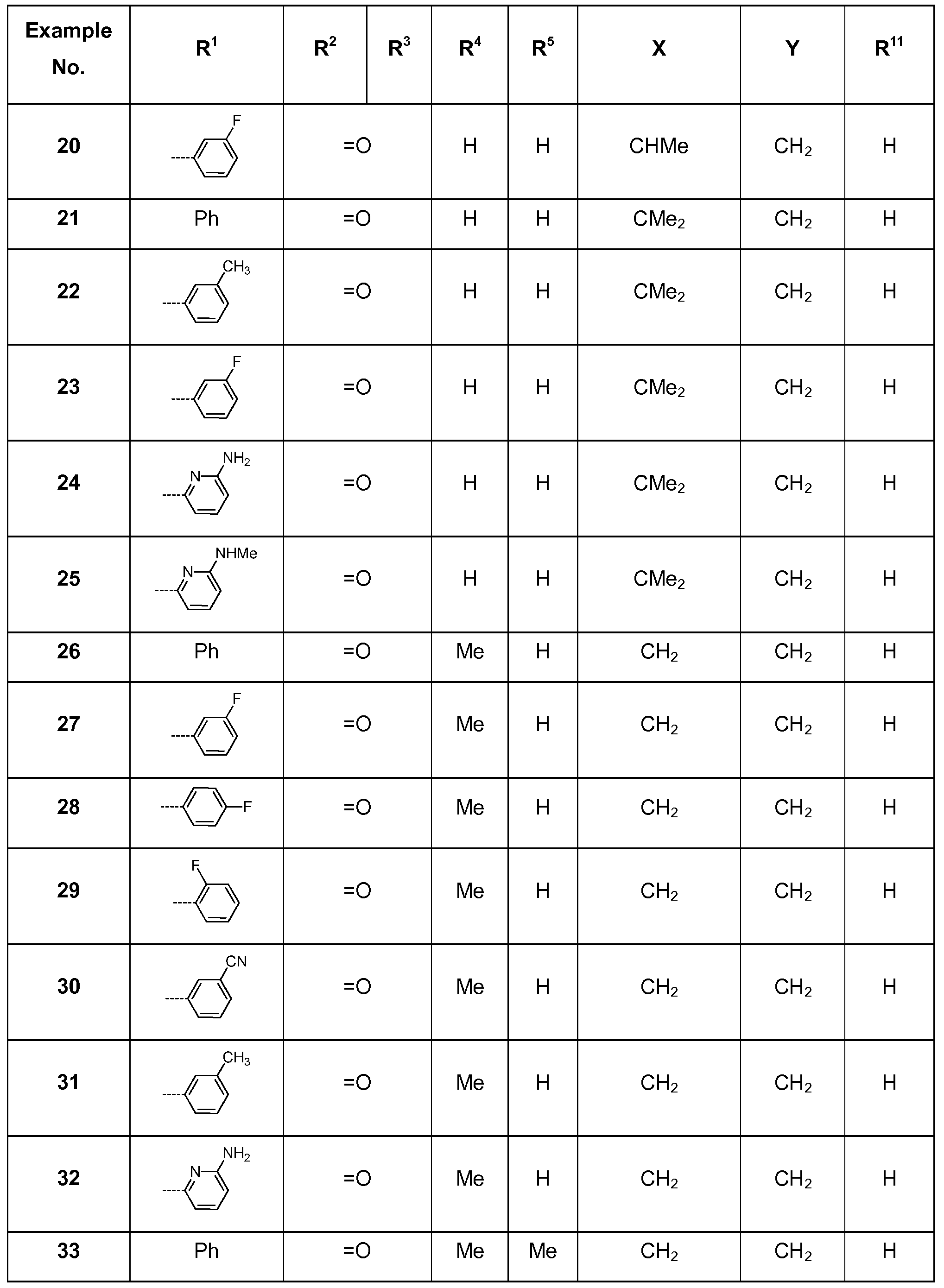


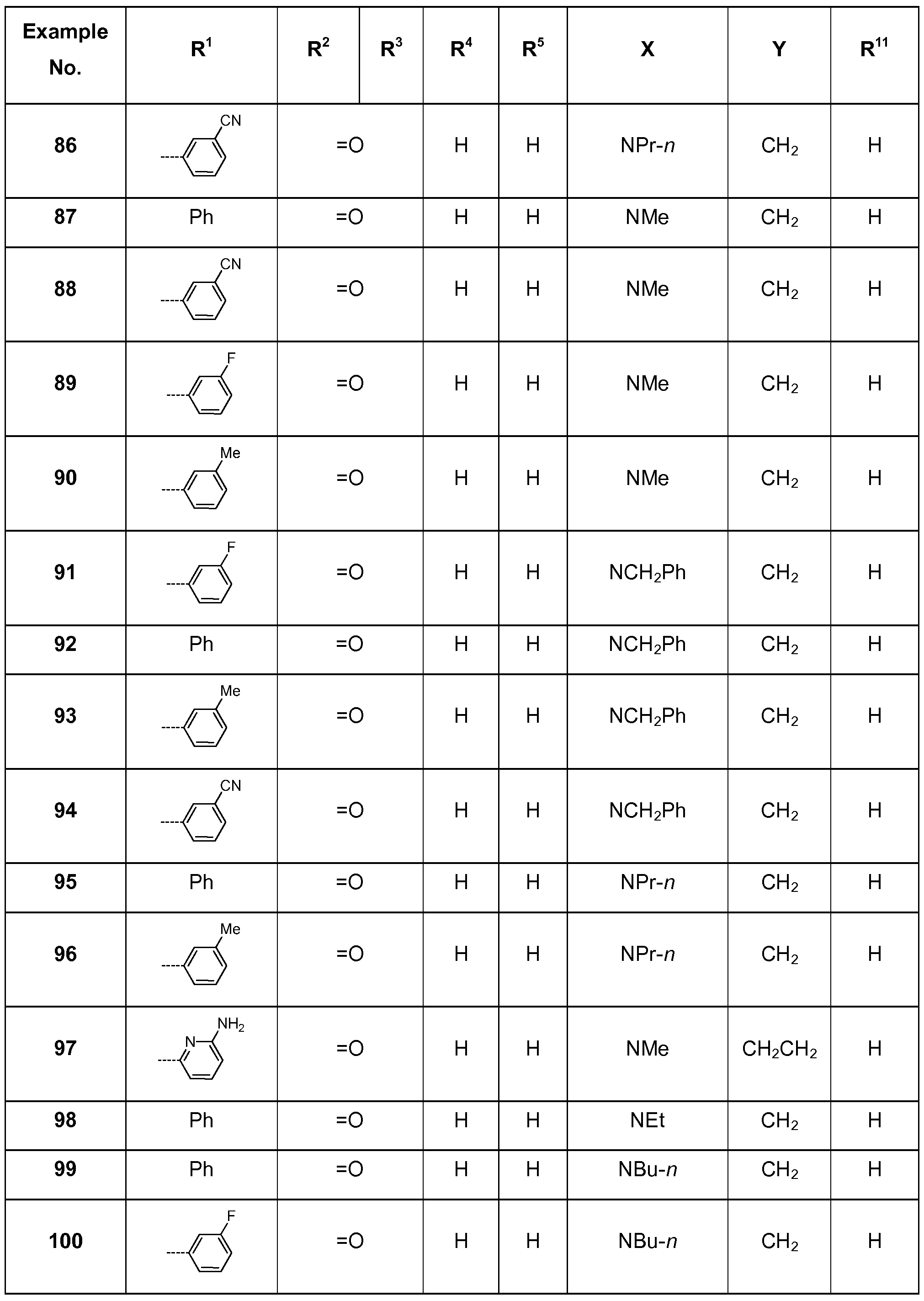
R1 R2 R3 R4 R5 X Y R11 No.
117 Ph =0 H H CH2 H
Me
118 =0 H H CH2 H
119 =0 H H CH2 H
120 Ph =0 H H CH2 H
Me
121 =0 H H CH2 H
122 =0 H H CH2 H
123 Ph =0 H H CH2 H
Me
124 =0 H H CH2 H
125 =0 H H CH2 H
126 Ph H H H H NC(0)Ph CH2 H
Me
127 Ph =0 H H CH2 H
Me Me
128 =0 H H CH2 H
Me
129 =0 H H CH2 H

R1 R2 R3 R4 R5 X Y R11 No.
151 Ph H H H H NS02NMe2 CH2 H
152 -0 =0 H H NCH2CH2Ph CH2 H
153 Ph =0 H H NCH2CH2Ph CH2 H
154 -6 =0 H H NCH2CH2Ph CH2 H
Table 2

IF


EXAMPLES OF REPRESENTATIVE PHARMACEUTICAL COMPOSITIONS
[00399] In combination with commonly used solvents, excipients, auxiliary agents and carriers, the instant compounds may be processed into tablets, coated tablets, capsules, drip solutions, suppositories, injection and infusion preparations, and the like and may be therapeutically applied by oral, rectal, parenteral, and additional routes. Representative pharmaceutical compositions according to the present invention follow:
(a) Tablets suitable for oral administration which contain the active ingredient, may be prepared by conventional tabletting techniques.
(b) For suppositories, any usual suppository base may be employed for incorporation thereinto by usual procedure of the active ingredient, such as a polyethyleneglycol which is a solid at normal room temperature but which melts at or about body temperature.
(c) For parenteral (including intravenous and subcutaneous) sterile solutions, the active ingredient together with conventional ingredients in usual amounts are employed, such as for example sodium chloride and double-distilled water q.s., according to conventional procedure, such as filtration, aseptic filling into ampoules or IV-drip bottles, and autoclaving for sterility.
[00400] Other suitable pharmaceutical compositions will be immediately apparent to one skilled in the art.
FORMULATION EXAMPLES
[00401 ]The following examples are again given by way of illustration only and are not to be construed as limiting.
EXAMPLE 1
Tablet Fornnulation
A suitable fornnulation for a tablet containing 10 mg of active ingredient is as follows: mg
Active Ingredient 10
Lactose 61
Microcrystalline Cellulose 25
Talcum 2
Magnesium stearate 1
Colloidal silicon dioxide 1
EXAMPLE 2
Tablet Formulation
Another suitable formulation for a tablet containing 100 mg is as follows:
mg
Active Ingredient 100
Polyvinylpyrrolidone, crosslinked 10
Potato starch 20
Polyvinylpyrrolidone 19
Magnesium stearate 1
Microcrystalline Cellulose 50
Film coated and colored.
The film coating material consists of:
Hypromellose 10
Microcryst. Cellulose 5
Talcum 5
Polyethylene glycol 2
Color pigments 5
EXAMPLE 3
Capsule Formulation
A suitable formulation for a capsule containing 50 mg of active ingredient is as follows:
mg
Active Ingredient 50
Corn starch 26
Dibasic calcium phosphate 50
Talcum 2
Colloidal silicon dioxide 2
filled in a gelatin capsule.
EXAMPLE 4
Solution for injection
A suitable fornnulation for an injectable solution is as follows:
Active Ingredient mg 10
Sodium chloride mg q.s.
Water for Injection mL add 1 .0
EXAMPLE 5
Liquid oral formulation
A suitable formulation for 1 L of a an oral solution containing 2 mg of active ingredient in one mL of the mixture is as follows:
mg
Active Ingredient 2
Saccharose 250
Glucose 300
Sorbitol 150
Orange flavor 10
Colorant q.s.
Purified water add 1000 mL
EXAMPLE 6
Liquid oral fornnulation
Another suitable fornnulation for 1 liter of a liquid mixture containing 20 mg of active ingredient in one mL of the mixture is as follows:
Active Ingredient 20.00
Tragacanth 7.00
Glycerol 50.00 Saccharose 400.00 Methylparaben 0.50 Propylparaben 0.05 Black currant-flavor 10.00 Soluble Red color 0.02 Purified water add 1000 mL
EXAMPLE 7
Liquid oral formulation
Another suitable formulation for 1 liter of a liquid mixture containing 2 mg of active ingredient in one mL of the mixture is as follows:
9
Active Ingredient 2
Saccharose 400 Bitter orange peel tincture 20 Sweet orange peel tincture 15
Purified water add 1000 mL
EXAMPLE 8
Aerosol formulation
180 g aerosol solution contain: g
Active Ingredient 10
Oleic acid 5
Ethanol 81
Purified Water 9
Tetrafluoroethane 75
15 mL of the solution are filled into aluminum aerosol cans, capped with a dosing valve, purged with 3.0 bar.
EXAMPLE 9
TDS formulation
100 g solution contain:
g
Active Ingredient 10.0
Ethanol 57.5
Propyleneglycol 7.5
Dimethylsulfoxide 5.0
Hydroxyethylcellulose 0.4
Purified water 19.6
1 .8 mL of the solution are placed on a fleece covered by an adhesive backing foil. The system is closed by a protective liner which will be removed before use.
EXAMPLE 10
Nanoparticle formulation
10 g of polybutylcyanoacrylate nanoparticles contain: g
Active Ingredient 1 .00
Poloxamer 0.10
Butylcyanoacrylate 8.75
Mannitol 0.10
Sodium chloride 0.05
Polybutylcyanoacrylate nanopartides are prepared by emulsion polymerization water/0.1 N HCI/ethanol mixture as polymerizsation medium. The nanopartides suspension are finally lyophilized under vacuum.
EXAMPLE 11
Suspension formulation
1 .0 g of the suspension contains the following:
9
Active Ingredient 0.10
Hypromellose 0.01
Purified water Ad 1 .0 g
Hypromellose is dispersed in water homogeneously with a high speed mixer/blender. After about one hour of hydration time of the hypromellose, the active ingredient is blended homogeneously into the hypromellose solution. The viscosity of the suspension may be adjusted by the amount of hypromellose, resulting in a very stable suspension with a very slow tendency of particle sedimentation and particle agglomeration.
EXAMPLE 12
Solution for Injection
1 .0 mL of solution contain: g
Active Ingredient 0.05
Mannitol q.s.
DMSO 0.10
Water for injection Ad 1 .0 mL
The active ingredient is dissolved in DMSO by stirring and heating (solution 1 ). The mannitol is dissolved in WFI (solution 2). After cooling down to room temperature
solution 1 is mixed with solution 2 by continuous stirring. The solution is sterilized by filtration of by autoclaving.
PHARMACOLOGY
[00402]The active principles of the present invention, and pharmaceutical compositions containing them and method of treating therewith, are characterized by unique and advantageous properties. The compounds and pharmaceutical compositions thereof exhibit, in standard accepted reliable test procedures, the following valuable properties and characteristics.
METHODS
BINDING ASSAYS FOR THE CHARACTERIZATION OF mGluR5 ANTAGONIST PROPERTIES
Preparation of rat cortical membranes:
[00403]Tissue preparation is performed according to Foster & Wong (Br. J. Pharmacol., 1987, 91, 403-409) with some modifications. Anaesthetised male Sprague-Dawley rats (200-250 g, Janvier, Le Genest-lsle, France) are decapitated and their brains are removed rapidly. The cortex is dissected out and processed as described by Parsons, et al. (J. Pharmacol. Exp. Ther, 1997, 283(3): 1264-1275). For isolation of the cell membranes, the cortices are homogenized in 20 volumes of ice-cold 0.32 M sucrose (Sigma-Aldrich, Taufkirchen, Germany) using a glass-Teflon homogenizer. The homogenate is centrifuged at 1000 x g for 10 minutes, the pellet is discarded and the supernatant centrifuged at 20,000 x g for 20 minutes. The resulting pellet is re- suspended in 20 volumes of distilled water and centrifuged for 20 minutes at 8000 x g. The supernatant and the buffy coat are then centrifuged six times (48,000 x g for 20 minutes) in the presence of 5 mM Tris-HCI, pH 7.5. All centrifugation steps are carried out at 4 °C. After resuspension in 5 volumes of 5 mM Tris-HCI, pH 7.5, the membrane suspension is frozen rapidly at -80 °C.
[00404]On the day of assay, the membrane suspensions are thawed, centrifuged (48,000 x g for 20 minutes) and then resuspended in 50 mM Tris-HCI, pH 7.5 (assay
buffer). The amount of protein in the final membrane preparation is determined according to the method of Lowry, et al. (J. Biol. Chem., 1951 , 193, 256-275). The final concentration used for our studies is 400 g / ml.
[Ή]-Μ-ΜΡΕΡ (2-(3-Methoxyphenylethynyl)-6-methylpyridine) Displacement Studies
[00405]The Tecan robotic system designed for binding assays is loaded with the membrane solution, a 96 well stock plate containing the solutions for bound control (buffer/DMSO 10%), unlabeled MPEP (10 μΜ) for evaluation of non-specific binding, all compounds to be tested (at 20-fold concentrations), various empty 96-well plates for dilutions and the final assay plates, as well as a 96-well plate filled with the radioligand.
[00406]Before performing displacement studies, saturation experiments are performed to determine the equilibrium dissociation constant (Kd, Cheng and Prussoff, Biochem. Pharmacol., 1973, 22: 3099-3108) of [Ή]-Μ-ΜΡΕΡ, which is a parameter for the affinity of the radioligand to the binding site. On the basis of the saturation experiments, a final [Ή]-Μ-ΜΡΕΡ concentration of 2 nM was selected.
[00407] Firstly, the assay plates are loaded with membrane solution and are shaken at 4 °C. The mother plates were then prepared by pipetting the compounds (n = 5) into assay buffer/10% DMSO to obtain the desired final concentrations. After transferring radioligand into the assay plates, the compounds are added (including the non-specific binding control containing MPEP). The final DMSO concentration is always 1 %. The assay plates are incubated and shaken at 4 °C for 1 h, before the mixture is exhausted as rapidly as possible via a vacuum manifold using the Multiscreen HTS glass fibre (type B) high flow filter plates (Millipore, Schwalbach, Germany) under a constant vacuum of 450 mbar. The membranes are washed four times with cold assay buffer (100 μΙ_). 50 μΙ_ of Ultima Gold scintillation cocktail (PerkinElmer) is added to the wet filter plates and incubated at room temperature overnight before counting the
disintegration per minutes using a liquid scintillation counter (MicroBeta, PerkinElmer).
Characterization
[00408]For the evaluation of the test compound binding affinity to the mGluR5 binding site and its potency to displace [3H]-M-MPEP, the measured radioactivity of the radioligand alone was set as 100% bound control and the non-specific binding of the radioligand represented the 0% control. The residual radioactivity after displacement of the test compound was then corrected with respect to the set controls. Data are given as median IC50 and K,, respectively.
FUNCTIONAL ASSAY OF mGluR5 RECEPTORS
Cytosolic Calcium studies with stably transfected cells
[00409]Chinese hamster ovary cells (CHO-K1 cells), stably transfected for inducible expression of a human metabotropic glutamate receptor mGluR5 to form a cell line called h5CHO, are seeded into black clear bottom 96 well plates at a density of 35.000 cells per well. The standard growth medium used (Dulbecco's modified Eagle Medium, DMEM plus L-proline) contains the appropriate inducer isopropyl- -D- thiogalactopyranosid (IPTG) to achieve optimal receptor expression. One day after seeding the growth medium is exchanged for reconstituted Ca-Kit (Molecular Devices, USA) and incubated for one hour. Ca-Kit is reconstituted in an assay buffer containing 20 nriM HEPES pH 7.4, glutamic-pyruvate transaminase, pyridoxal phosphate and sodium pyruvate in Hank's balanced salt solution (HBBS). Agonistic compounds to the receptor elicit increases in cytosolic calcium which can be measured as increases in fluorescence signals by use of a fluorescence imaging plate reader (Molecular Devices). To analyze their potency to negatively modulate the Ca-response test compounds, dissolved in a final DMSO concentration of 0.5%, are added on-line 5 minutes before the agonist to the receptor (L-quisqualic acid at a concentration giving -80% of the maximal signal). EC50 values for positive allosteric modulators were determined by stimulating the cells which have been preincubated the modulators by an EC2o concentration of L-glutamate.
Astrocyte culture
[00410] Primary astrocyte cultures are prepared from cortices of newborn rats as described by Booher and Sensenbrenner (Neurobiology 1972, 2(3):97-105). Briefly,
Sprague-Dawley rat pups (2 - 4 d old) are decapitated and neocortices are dissected, disintegrated with a nylon filter (pore size 80 μηη) and carefully triturated. The cell suspension is plated on poly-D-lysine pre-coated flasks (Costar, Netherlands) and cultivated in Dulbecco's Modified Eagle's Medium (DMEM, Invitrogen, Germany) supplemented with 10% foetal calf serum (FCS, Sigma, Germany), 4 ITIM glutamine and 50 pg/rnl gentamycin (both Biochrom, Germany) at 37 °C in a humidified atmosphere of 5% CO2 95% air for 7 days with exchanging the medium at day 2 and 6.
[0041 1 ]After 7 days in vitro (DIV), cells are shaken overnight at 250 rpm to remove oligodendrocytes and microglia. The next day, astrocytes are rinsed twice with CMF- PBS (calcium- and magnesium-free phosphate buffered saline, Biochrom, Germany), trypsinized and subplated on poly-D-lysine pre-coated 96-well plates (Greiner, Germany) at a density of 40,000 cells/well. 24 h after establishing the secondary culture the astrocytes are rinsed with PBS++ (phosphate buffered saline, Biochrom, Germany) and fed with astrocyte-defined medium (ADM) consisting of DMEM containing 1 x G5- supplement (Invitrogen, Germany), 0.5 pg/rnl heparan sulfate, and 1 .5 pg/rnl fibronectin (both Sigma, Germany) (Miller et al., Brain Res. 1993, 678(1 ):175-8). 3 days later the medium is exchanged and the cells incubated for another 2-3 days, so that at the time of experiments astrocytes are 14-15 DIV.
I m m u n ocytoch em istry
[00412]lmmunostaining is performed to confirm the presence of astrocytic markers such as the glial fibrillary acidic protein (GFAP) as well as to monitor the expression of mGluR5 receptors.
Cytosolic Calcium studies with astrocytes
[00413]The increase of cytosolic calcium after stimulation with the mGluR5 agonist L- quisqualate is measured using a fluorometric imaging plate reader (FLIPR) and the Ca- Kit (both Molecular Devices). Prior to addition of agonist or antagonist the medium is aspirated and cells are loaded for 2 h at room temperature with 150 μΙ of loading buffer consisting of Ca-sensitive dye reconstituted in sodium chloride (123 ITIM), potassium chloride (5.4 ITIM), magnesium chloride (0.8 ITIM), calcium chloride (1 .8 ITIM), D-glucose (15 ITIM), and HEPES (20 ITIM), pH 7.3. Subsequently, plates are transferred to FLIPR to
detect calcium increase with the addition of L-quisqualate (100 nM) measured as relative fluorescence units (RFU). If antagonists are tested, these compounds are pre-incubated for 10 minutes at room temperature before addition of the respective agonist.
[00414]For positive modulators, concentration-response curves for quisqualate are performed in the presence and absence of 10 μΜ modulator to determine the extent of potentiation / agonist potency increase. Thereafter, concentration-response curves for the positive modulator are performed in the presence of a fixed concentration of quisqualate showing the biggest window for potentiation (normally 10-30 nM).
Data analysis
[00415]The fluorescence signal increase after addition of agonist reflects the increase of cytosolic calcium. Inconsistencies in the amount of cells per well are normalised by using the spatial uniformity correction of the FLIPR operating software Screenworks. The mean of replicated temporal data (n=3-5) is calculated and used for graphical representation. For the evaluation of the pharmacology, the calcium changes in response to different concentrations of agonist or antagonist are determined using a maximum minus minimum (MaxMin) calculation.
[00416]AII responses (RFU-values) are determined as percentage of control (= maximum response). EC50 and IC50 are calculated according the logistic equation using XLFit (IDBS, UK) or Prism 4.0 (GraphPad Software, USA). The compounds of the present invention have a potency (EC50 or IC50) within a range of about 0.5 nM to about 100 μΜ. The left shifts for positive or slient allosteric modulators (PAMs or SAMs, respectively) are determined by comparison of EC50 values from agonist dose response curves run in the presence of 10 μΜ modulator or vehicle (Vanejevs et al., J. Med. Chem., 2008, 51, 634-647).
[00417]The compounds of the present invention show show an affinity to the allosteric site, i.e., the MPEP site, shown by the displacement of the radioligand [3H]-MMPEP.
[00418]Various functional consequences associated with this affinity are observed. Negative allosteric modulators (NAMs), which inhibit the calcium signals of mGluR5
orthostatic ligands, and positive allosteric modulators (PAMs), which modulate by amplification of small glutamate signals and thereby yield a left shift in agonist concentration response curves, (they might be classified into weak PAMs with a shift above 1 .5-fold and strong PAMs with a shift above 3-fold) are observed. Moreover silent allosteric modulators (SAMs), which bind to the allosteric site (i.e., have the capacity to displace M-MPEP), but do not or only moderately influence the calcium signal of orthosteric agonists, are also observed.
[00419] Results for representative compounds of the invention are shown in Tables A1 - A3.
Table A1


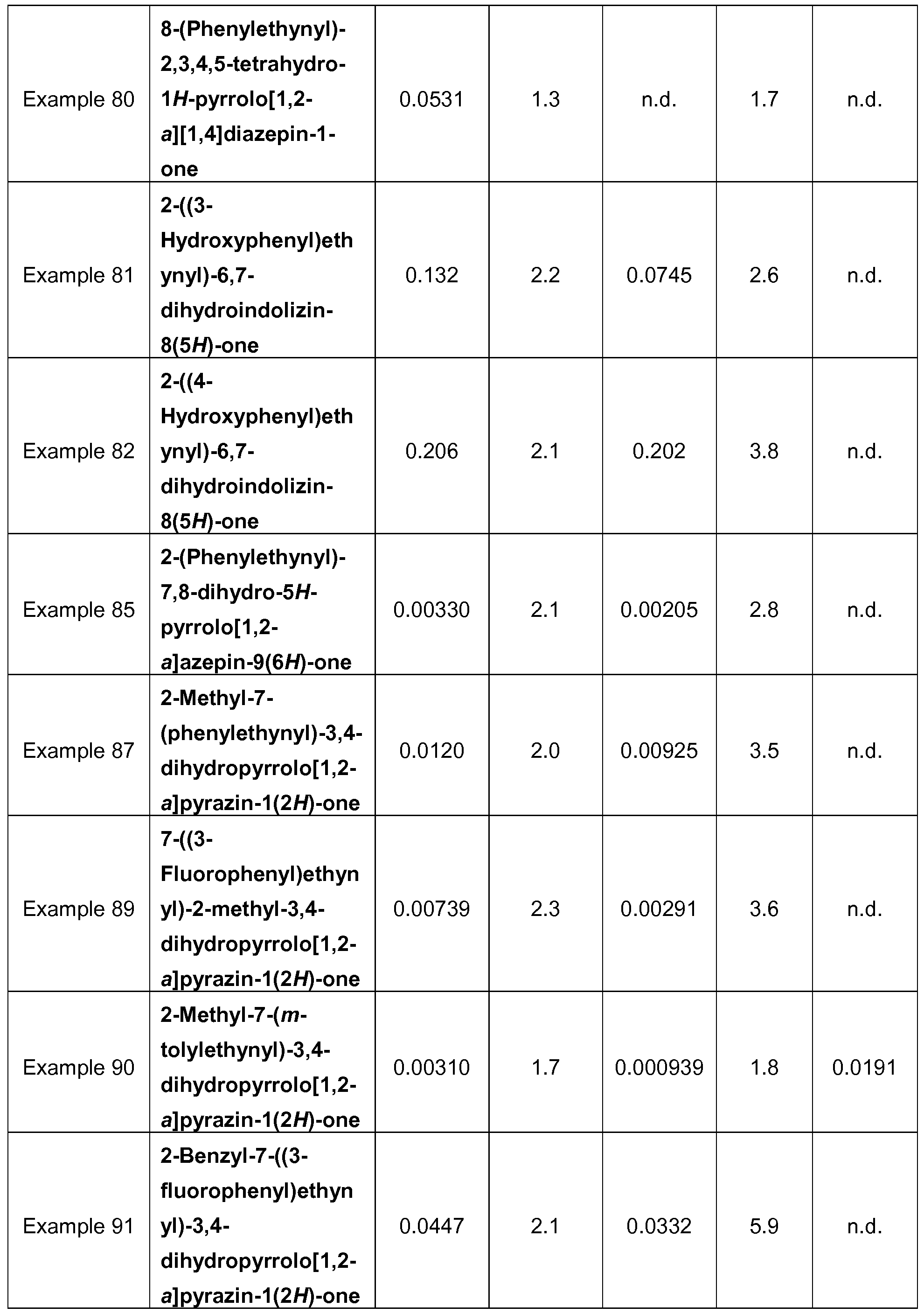
Example 93 0.146 2.4 0.0215 4.4 n.d.
dihydropyrrolo[1 ,2- a]pyrazin-1(2H)-one
3-((2-Benzyl-1 -oxo- 1 ,2,3,4- tetrahydropyrrolo[1 ,
Example 94 0.0728 2.7 0.0344 5.6 n.d.
2-a]pyrazin-7- yl)ethynyl)benzonitr
ile
7-(Phenylethynyl)-2- propyl-3,4-
Example 95 0.0157 1.5 0.00148 1.6 n.d.
dihydropyrrolo[1 ,2- a]pyrazin-1(2H)-one
2-Ethyl-7-
(phenylethynyl)-3,4-
Example 98 0.01 12 1.7 n.d. 1.3 n.d.
dihydropyrrolo[1 ,2- a]pyrazin-1(2H)-one
2-Butyl-7-
(phenylethynyl)-3,4-
Example 99 0.0137 2.2 0.00801 3.2 n.d.
dihydropyrrolo[1 ,2- a]pyrazin-1(2H)-one
2-Butyl-7-((3- fluorophenyl)ethyn
Example
yi)-3,4- 0.021 1 2.2 0.00227 1.7 n.d. 100
dihydropyrrolo[1 ,2- a]pyrazin-1(2H)-one
2-Phenyl-7-
Example (phenylethynyl)-3,4-
0.0155 2.2 0.0339 2.7 n.d. 104 dihydropyrrolo[1 ,2- a]pyrazin-1(2H)-one
7-((3-
Fluorophenyl)ethyn
Example
yl)-2-phenyl-3,4- 0.0361 2.0 0.0222 2.2 n.d. 105
dihydropyrrolo[1 ,2- a]pyrazin-1(2H)-one
 2-(4-Methylbenzyl)-
7-(phenylethynyl)-
Example
3,4- n.d. 4.1 0.0852 n.d. n.d. 120
dihydropyrrolo[1 ,2- a]pyrazin-1(2H)-one
2-(4-Methylbenzyl)-
7-(m-tolylethynyl)-
Example
3,4- n.d. 3.0 0.0849 n.d. n.d. 121
dihydropyrrolo[1 ,2- a]pyrazin-1(2H)-one
7-((3-
Fluorophenyl)ethyn
Example yl)-2-(4- n.d. 2.3 0.0557 n.d. n.d. 122 methy I benzyl ) -3 ,4- dihydropyrrolo[1 ,2- a]pyrazin-1(2H)-one
2-(2-Fluorobenzyl)-
7-(phenylethynyl)-
Example
3,4- n.d. n.d. 0.0274 n.d. n.d. 123
dihydropyrrolo[1 ,2- a]pyrazin-1(2H)-one
2-(2-Fluorobenzyl)-
7-(m-tolylethynyl)-
Example
3,4- n.d. 2.3 0.0315 n.d. n.d. 124
dihydropyrrolo[1 ,2- a]pyrazin-1(2H)-one
2-(2-Fluorobenzyl)- 7-((3-
Example fluorophenyl)ethyn
n.d. n.d. 0.0425 n.d. n.d. 125 yi)-3,4- dihydropyrrolo[1 ,2- a]pyrazin-1(2H)-one
Phenyl(7-
(phenylethynyl)-3,4-
Example
dihydropyrrolo[1 ,2- 0.168 1.9 0.864 n.d. n.d. 126
a]pyrazin-2(1 H)- yl)methanone
(K)-2-(1 - Phenylethyl)-7-
Example
(phenylethynyl)-3,4- 0.0160 n.d. 0.0290 n.d. n.d. 127
dihydropyrrolo[1 ,2- a]pyrazin-1(2H)-one
(K)-2-(1 -
Phenylethyl)-7-(m-
Example
tolylethynyl)-3,4- 0.0693 3.4 0.0619 n.d. n.d. 128
dihydropyrrolo[1 ,2- a]pyrazin-1(2H)-one
(K)-7-((3-
Fluorophenyl)ethyn
Example yl)-2-(1 -
0.0241 3.1 0.0259 n.d. n.d. 129 phenylethyl)-3,4- dihydropyrrolo[1 ,2- a]pyrazin-1(2H)-one
2-(3-Fluorobenzyl)-
7-(phenylethynyl)-
Example
3,4- 0.0031 n.d. 0.0332 5.4 n.d. 130
dihydropyrrolo[1 ,2- a]pyrazin-1(2H)-one
2-(3-Fluorobenzyl)-
7-(m-tolylethynyl)-
Example
3,4- 0.0610 2.2 0.0398 2.7 n.d. 131
dihydropyrrolo[1 ,2- a]pyrazin-1(2H)-one
2-(3-Fluorobenzyl)- 7-((3-
Example fluorophenyl)ethyn
0.00951 n.d. 0.0497 5.1 n.d. 132 yi)-3,4- dihydropyrrolo[1 ,2- a]pyrazin-1(2H)-one
2-(4-Fluorobenzyl)-
7-(phenylethynyl)-
Example
3,4- 0.00639 n.d. 0.0184 5.7 n.d. 133
dihydropyrrolo[1 ,2- a]pyrazin-1(2H)-one
2-(4-Fluorobenzyl)-
7-(m-tolylethynyl)-
Example
3,4- 0.103 2.7 0.0615 3.3 n.d. 134
dihydropyrrolo[1 ,2- a]pyrazin-1(2H)-one
2-(4-Fluorobenzyl)- 7-((3-
Example fluorophenyl)ethyn
0.00967 3.3 0.0413 n.d. n.d. 135 yi)-3,4- dihydropyrrolo[1 ,2- a]pyrazin-1(2H)-one
(S)-2-(1 - Phenylethyl)-7-
Example
(phenylethynyl)-3,4- 0.0739 1.7 0.0257 n.d. n.d. 137
dihydropyrrolo[1 ,2- a]pyrazin-1(2H)-one
(S)-7-((3-
Fluorophenyl)ethyn
Example yl)-2-(1 -
0.0142 1.6 n.d. n.d. n.d. 138 phenylethyl)-3,4- dihydropyrrolo[1 ,2- a]pyrazin-1(2H)-one
(7-(Phenylethynyl)- 3,4-
Example dihydropyrrolo[1 ,2- n.d. n.d. 0.382 3.1 n.d. 139 a]pyrazin-2(1 H)- yl)(pyrrolidin-1- yl)methanone
2'-(Phenylethynyl)- e' '-dihydro-S'H-
Example
spiro[imidazolidine- n.d. n.d. 0.0417 n.d. n.d. 141
4,8'-indolizine]-2,5- dione
1 ,3-Dimethyl-2'-
(phenylethynyl)-
Example e' '-dihydro-S'H- n.d. n.d. 0.0723 n.d. n.d. 142 spiro[imidazolidine-
4,8'-indolizine]-2,5- dione
7-((3-
Fluorophenyl)ethyn
Example
yl)-2-phenethyl-3,4- n.d. n.d. 0.0372 n.d. n.d. 152
dihydropyrrolo[1 ,2- a]pyrazin-1 (2H)-one
2-Phenethyl-7- (phenylethynyl)-3,4-
Example
dihydropyrrolo[1 ,2- n.d. n.d. 0.0191 n.d. n.d. 153
a]pyrazin-1 (2H)- one,
2-Phenethyl-7-(m-
Example tolylethynyl)-3,4- n.d. n.d. 0.0229 n.d. n.d. 154 dihydropyrrolo[1 ,2- a]pyrazin-1 (2H)-one
Table A2

Example 25 0.0308 0.00981 n.d.
yl)ethynyl)-6,7- dihydroindolizin-8(5H)-one
3-((6-Methyl-8-oxo-5,6,7,8-
Example 30 tetrahydroindolizin-2- 0.0312 0.01 15 0.00549
yl)ethynyl)benzonitrile
6-Methyl-2-(m-tolylethynyl)-
Example 31 6,7-dihydroindolizin-8(5H)- 0.0187 0.00444 0.00778
one
2-((6-Aminopyridin-2-
Example 32 yl)ethynyl)-6-methyl-6,7- 0.160 n.d. 0.0415
dihydroindolizin-8(5H)-one
6,6-Dimethyl-2-(m-
Example 34 tolylethynyl)-6,7- 0.0257 n.d. n.d.
dihydroindolizin-8(5H)-one
2-((3-Fluorophenyl)ethynyl)-
Example 35 6,6-dimethyl-6,7- 0.0622 0.00757 n.d.
dihydroindolizin-8(5H)-one
2-((6-Aminopyridin-2-
Example 36 yl)ethynyl)-6,6-dimethyl-6,7- 0.0932 n.d. n.d.
dihydroindolizin-8(5H)-one
6,6-Dimethyl-2-((6- (methylamino)pyridin-2-
Example 37 0.0500 0.0249 n.d.
yl)ethynyl)-6,7- dihydroindolizin-8(5H)-one
2-((4-Fluorophenyl)ethynyl)-
Example 38 6,6-dimethyl-6,7- 0.248 0.0663 n.d.
dihydroindolizin-8(5H)-one
2-((3-
(Fluoromethyl)phenyl)ethyny
Example 49 0.0156 n.d. n.d.
l)-6-methyl-6,7- dihydroindolizin-8(5H)-one
3-((6,6-Dimethyl-8-oxo-
Example 52 5,6,7,8-tetrahydroindolizin-2- 0.0236 0.00745 n.d.
yl)ethynyl)benzonitrile
3-((7-Methyl-8-oxo-5,6,7,8-
Example 53 tetrahydroindolizin-2- 0.0237 0.0406 0.00517
yl)ethynyl)benzonitrile
2-((6-Aminopyridin-2-
Example 54 yl)ethynyl)-7-methyl-6,7- 0.140 n.d. n.d.
dihydroindolizin-8(5H)-one
7-Methyl-2-((6- (methylamino)pyridin-2-
Example 55 0.0491 n.d. n.d.
yl)ethynyl)-6,7- dihydroindolizin-8(5H)-one
2-((6-(Methylamino)pyridin-2-
Example 56 yl)ethynyl)-6,7- 0.809 n.d. n.d.
dihydroindolizin-8(5H)-one
6-Methyl-2-((6- (methylamino)pyridin-2-
Example 57 0.0372 n.d. n.d.
yl)ethynyl)-6,7- dihydroindolizin-8(5H)-one
6-((6-(Methylamino)pyridin-2-
Example 60 yl)ethynyl)-2,3-dihydro-1H- 0.878 n.d. n.d.
pyrrolizin-1 -one
2-Methyl-6-(m-tolylethynyl)-
Example 61 2,3-dihydro-1 H-pyrrolizin-1 - 0.0190 0.00463 n.d.
one
2,2-Dimethyl-6-(m-
Example 67 tolylethynyl)-2,3-dihydro-1H- 0.108 0.0650 n.d.
pyrrolizin-1 -one
2-(lmidazo[1 ,2-a]pyridin-2-
Example 74 ylethynyl)-6,7- 7.4 (est.) n.d. n.d.
dihydroindolizin-8(5H)-one
2-(lmidazo[1 ,2-a]pyridin-2-
Example 75 ylethynyl)-7,7-dimethyl-6,7- 0.0702 0.0356 n.d.
dihydroindolizin-8(5H)-one
2-(lmidazo[1 ,2-a]pyridin-2-
Example 78 ylethynyl)-6-methyl-6,7- 0.401 n.d. n.d.
dihydroindolizin-8(5H)-one

 Table A3


y e yny enzon r e
[00420] In conclusion, from the foregoing, it is apparent that the present invention provides novel and valuable applications and uses of the compounds of the present invention, which compounds comprise the active principle according to the present invention, as well as novel pharmaceutical compositions thereof and methods of preparation thereof and of treating therewith.
[00421 ]The high order of activity of the active agent of the present invention and compositions thereof, as evidenced by the tests reported, is indicative of utility based on its valuable activity in human beings as well as in lower animals. Clinical evaluation in human beings has not been completed. It will be clearly understood that the distribution and marketing of any compound or composition falling within the scope of the present invention for use in human beings will of course have to be predicated upon prior
approval by governmental agencies which are responsible for and authorized to pass judgment on such questions.
[00422]The instant compounds of Formula I represent a novel class of mGluR5 modulators. In view of their potency, they will be useful therapeutics in a wide range of disorders, in particular CNS disorders, which involve excessive glutamate induced excitation.
[00423]These compounds accordingly find application in the treatment of the disorders of a living animal body, especially a human, as listed earlier in the description.
[00424]These compounds also find application in the treatment of indications in a living animal body, especially a human, wherein a particular condition does not necessarily exist but wherein a particular physiological parameter may be improved through administration of the instant compounds, including cognitive enhancement.
[00425] Neuroprotection as well as cognitive enhancement may also be achieved by administration of the instant compounds in combination with a NMDA receptor antagonist like Memantine.
[00426]The method-of-treating a living animal body with a compound of the invention, for the inhibition of progression or alleviation of the selected ailment therein, is as previously stated by any normally-accepted pharmaceutical route, employing the selected dosage which is effective in the alleviation of the particular ailment desired to be alleviated. Use of the compounds of the present invention in the manufacture of a medicament for the treatment of a living animal for inhibition of progression or alleviation of selected ailments or conditions, particularly ailments or conditions susceptible to treatment with a Group I mGluR modulator is carried out in the usual manner comprising the step of admixing an effective amount of a compound of the invention with a pharmaceutically-acceptable diluent, excipient, or carrier, and the method-of- treating, pharmaceutical compositions, and use of a compound of the present invention in the manufacture of a medicament.
[00427] Representative pharmaceutical compositions prepared by admixing the active ingredient with a suitable pharmaceutically-acceptable excipient, diluent, or carrier, include tablets, capsules, solutions for injection, liquid oral formulations, aerosol formulations, TDS formulations, and nanopartide formulations, thus to produce medicaments for oral, injectable, or dermal use, also in accord with the foregoing.
* * * * *
[00428]The present invention is not to be limited in scope by the specific embodiments described herein. Indeed, various modifications of the invention in addition to those described herein will become apparent to those skilled in the art from the foregoing description.
[00429]AII patents, applications, publications, test methods, literature, and other materials cited herein are hereby incorporated by reference.
Claims
1 . A compound selected from those of Formula I

R1 represents aryl, heteroaryl, cycloC3-7alkyl or heterocyclyl, wherein the cycloC3-7alkyl or heterocyclyl group may be optionally fused with an aryl or heteroaryl ring;
R2 and R3, which may be the same or different, each independently represent H, Ci-6alkyl, F, OH, C-i-6alkoxy, or R2 and R3 together with the carbon atom to which they are attached form a carbonyl group, or R2 and R3 together with the carbon atom to which they are attached form a 3 to 6 membered ring, wherein the ring may optionally contain a heteroatom selected from O, S and N, and wherein the ring may be optionally substituted with one or more substituents selected from C-i-6 alkyl, F, oxo, and acyl;
R4 and R5, which may be the same or different each independently represent H, C-i-6alkyl or F or R4 and R5 together with the carbon atom to which they are attached form a 3 to 6 membered ring, wherein the ring may optionally contain a heteroatom selected from O, S and N, and wherein the ring may be optionally substituted with one or more substituents selected from C-i-6 alkyl, F, oxo, and acyl;
X represents CR6R7 or NR8; R6 and R7, which may be the same or different, each independently represent H, C-i-6alkyl, F, amino, Ci-6alkylamino or di-(Ci-6alkyl)amino or R6 and R7, together with the carbon atom to which they are attached, form a 3 to 6 membered ring, wherein the ring may optionally contain a heteroatom selected from O, S and N, and wherein the ring may be optionally substituted with one or more substituents selected from d-6 alkyl, F, oxo, and acyl; or R3 and R6, together with the carbon atoms to which they are attached, may form a 4 to 7 membered ring wherein the ring may optionally contain one or two heteroatoms selected from O, S and N, and wherein the ring may be optionally substituted with one or more substituents selected from C-i-6 alkyl, F, oxo, and acyl;
R8 represents H, Chalky!, acyl, aryl, heteroaryl, aryl-C-i-6alkyl, heteroaryl-d- 6alkyl, or di-( d-6 alkyl)aminosulfonyl; or R2 and R8 together with the atoms to which they are attached, may form a 4 to 7 membered ring wherein the ring may optionally contain one or two additional heteroatoms selected from O, S and N, and wherein the ring may be optionally substituted with one or more substituents selected from d-6 alkyl which is optionally substituted by one or more halogen atoms, F, oxo, and acyl;
Y represents a bond, CR9R10 or -CR9R10-CH2-;
R9 and R10, which may be the same or different, each independently represent H, Ci-6alkyl or F or R9 and R10, together with the carbon atom to which they are attached, form a 3 to 6 membered ring, wherein the ring may optionally contain a heteroatom selected from O, S and N, and wherein the ring may be optionally substituted with one or more substituents selected from d-6alkyl, F, oxo, and acyl;
R11 represents H, halogen, d-6alkyl, aryl, heteroaryl, cycloC3-7alkyl or heterocyclyl; and optical isomers, prodrugs, pharmaceutically acceptable salts, hydrates, solvates, and polymorphs thereof.
2. The compound as claimed in Claim 1 , wherein R1 represents aryl or heteroaryl.
3. The compound as claimed in Claim 2, wherein R1 represents phenyl optionally substituted by one or more substituents selected from F, Ci-6alkyl, cyano, and fluoromethyl; pyridyl optionally substituted by one or more substituents selected from amino and Ci-6alkylamino; or thienyl.
4. The compound as claimed in any preceding claim, wherein R2 and R3 together with the carbon atom to which they are attached form a carbonyl group.
5. The compound as claimed in any preceding claim, wherein R4 and R5 each independently represent H or Ci-6alkyl.
6. The compound as claimed in any preceding claim, wherein X represents CR6R7 and Y represents a bond, CR9R10, or -CR9R10-CH2-.
7. The compound as claimed in any preceding claim, wherein X represents NR8 and Y represents CR9R10 or -CR9R10-CH2-.
8. The compound as claimed in any preceding claim, wherein R11 represents hydrogen, halogen, or cycloC3-7alkyl.
9. The compound as claimed in Claim 1 , which is selected from:
2-(Phenylethynyl)-6,7-dihydroindolizin-8(5H)-one,
2-((4-Fluorophenyl)ethynyl)-6,7-dihydroindolizin-8(5H)-one,
2-((3-Fluorophenyl)ethynyl)-6,7-dihydroindolizin-8(5H)-one,
2-((2-Fluorophenyl)ethynyl)-6,7-dihydroindolizin-8(5H)-one,
2-((2,6-Difluorophenyl)ethynyl)-6,7-dihydroindolizin-8(5H)-one,
2-((2,3-Difluorophenyl)ethynyl)-6,7-dihydroindolizin-8(5H)-one, 2-((2,5-Difluorophenyl)ethynyl)-6,7-dihydroindolizin-8(5/-/)-one,
2- (m-Tolylethynyl)-6,7-dihydroindolizin-8(5/-/)-one,
3- ((8-Oxo-5,6,7,8-tetrahydroindolizin-2-yl)ethynyl)benzonitrile,
2-((6-Aminopyridin-2-yl)ethynyl)-6,7-dihydroindolizin-8(5/-/)-one,
2-(Thiophen-3-ylethynyl)-6,7-dihydroindolizin-8(5/-/)-one,
2-(Thiophen-2-ylethynyl)-6,7-dihydroindolizin-8(5/-/)-one,
2-((3-(Fluoromethyl)phenyl)ethynyl)-6,7-dihydroindolizin-8(5/-/)-one, 2-((2,3,6-Trifluorophenyl)ethynyl)-6,7-dihydroindolizin-8(5/-/)-one,
2-((2,4,6-Trifluorophenyl)ethynyl)-6,7-dihydroindolizin-8(5/-/)-one,
2-((2,3,4,5-Tetrafluorophenyl)ethynyl)-6,7-dihydroindolizin-8(5/-/)-one, 7-Methyl-2-(phenylethynyl)-6,7-dihydroindolizin-8(5/-/)-one,
7-Methyl-2-(m-tolylethynyl)-6,7-dihydroindolizin-8(5/-/)-one,
2-((4-Fluorophenyl)ethynyl)-7-methyl-6,7-dihydroindolizin-8(5/-/)-one, 2-((3-Fluorophenyl)ethynyl)-7-methyl-6,7-dihydroindolizin-8(5/-/)-one, 7,7-Dimethyl-2-(phenylethynyl)-6,7-dihydroindolizin-8(5/-/)-one,
7,7-Dimethyl-2-(m-tolylethynyl)-6,7-dihydroindolizin-8(5/-/)-one,
2-((3-Fluorophenyl)ethynyl)-7,7-dimethyl-6,7-dihydroindolizin-8(5/-/)-one, 2-((6-Aminopyridin-2-yl)ethynyl)-7,7-dimethyl-6,7-dihydroindolizin-8(5H)-on 7,7-Dimethyl-2-((6-(methylamino)pyridin-2-yl)ethynyl)-6,7-dihydroindolizin-^ one,
6-Methyl-2-(phenylethynyl)-6,7-dihydroindolizin-8(5/-/)-one,
2-((3-Fluorophenyl)ethynyl)-6-methyl-6,7-dihydroindolizin-8(5/-/)-one,
2-((4-Fluorophenyl)ethynyl)-6-methyl-6,7-dihydroindolizin-8(5/-/)-one,
2- ((2-Fluorophenyl)ethynyl)-6-methyl-6,7-dihydroindolizin-8(5/-/)-one,
3- ((6-Methyl-8-oxo-5,6,7,8-tetrahydroindolizin-2-yl)ethynyl)benzonitrile, 6-Methyl-2-(m-tolylethynyl)-6,7-dihydroindolizin-8(5/-/)-one,
2-((6-Aminopyridin-2-yl)ethynyl)-6-methyl-6,7-dihydroindolizin-8(5H)-on 6,6-Dimethyl-2-(phenylethynyl)-6,7-dihydroindolizin-8(5/-/)-one,
6,6-Dimethyl-2-(m-tolylethynyl)-6,7-dihydroindolizin-8(5/-/)-one,
2-((3-Fluorophenyl)ethynyl)-6,6-dimethyl-6,7-dihydroindolizin-8(5/-/)-one, 2-((6-Aminopyridin-2-yl)ethynyl)-6,6^
6,6-Dimethyl-2-((6-(methylamino)pyridin-2-yl)ethynyl)-6,7-dihydroindolizi one, 2-((4-Fluorophenyl)ethynyl)-6,6-dimethyl-6,7-dihydroindolizin-8(5/-/)-one,
2-((2-Fluorophenyl)ethynyl)-6,6-dimethyl-6,7-dihydroindolizin-8(5/-/)-one,
2-((2,3,5-Trifluorophenyl)ethynyl)-6,7-dihydroindolizin-8(5/-/)-one,
2-((3,4,5-Trifluorophenyl)ethynyl)-6,7-dihydroindolizin-8(5/-/)-one,
2-((2,4,5-Trifluorophenyl)ethynyl)-6,7-dihydroindolizin-8(5/-/)-one,
2-((2,3,4-Trifluorophenyl)ethynyl)-6,7-dihydroindolizin-8(5/-/)-one,
2-((3,4-Difluorophenyl)ethynyl)-6,7-dihydroindolizin-8(5/-/)-one,
2-((2,4-Difluorophenyl)ethynyl)-6,7-dihydroindolizin-8(5/-/)-one,
2-((3,5-Difluorophenyl)ethynyl)-6,7-dihydroindolizin-8(5/-/)-one,
2-(p-Tolylethynyl)-6,7-dihydroindolizin-8(5/-/)-one,
2-(o-Tolylethynyl)-6,7-dihydroindolizin-8(5/-/)-one,
2- ((3-(Fluoromethyl)phenyl)ethynyl)-6-methyl-6,7-dihydroindolizin-8(5H)-one^ 6-(Phenylethynyl)-2,3-dihydro-1 H-pyrrolizin-1 -one,
6- ((3-Fluorophenyl)ethynyl)-2,3-dihydro-1 H-pyrrolizin-1 -one,
3- ((6,6-Dimethyl-8-oxo-5,6,7,8-tetrahydroindolizin-2-yl)ethynyl)benzonitrile, 3-((7-Methyl-8-oxo-5,6,7,8-tetrahydroindolizin-2-yl)ethynyl)benzonitrile,
2-((6-Aminopyridin-2-yl)ethynyl)-7-methyl-6,7-dihydroindolizin-8(5/-/)-one,
7- Methyl-2-((6-(methylamino)pyridin-2-yl)ethynyl)-6,7-dihydroindolizin-8(5H)-one, 2-((6-(Methylamino)pyridin-2-yl)ethynyl)-6,7-dihydroindolizin-8(5/-/)-one,
6-Methyl-2-((6-(methylamino)pyridin-2-yl)ethynyl)-6,7-dihydroindolizin-8(5H)-one, 2-(lmidazo[1 ,2-a]pyridin-2-ylethynyl)-6,7-dihydroindolizin-8(5H)-one,
2-(lmidazo[1 ,2-a]pyridin-2-ylethynyl)-7-methyl-6,7-dihydroindolizin-8(5/-/)-one, 2-(lmidazo[1 ,2-a]pyridin-2-ylethynyl)-7,7-dimethyl-6,7-dihydroindolizin-8(5/-/)-one, 2-(lmidazo[1 ,2-a]pyridin-2-ylethynyl)-6-methyl-6,7-dihydroindolizin-8(5/-/)-one, 2-(lmidazo[1 ,2-a]pyridin-2-ylethynyl)-6,6-dimethyl-6,7-dihydroindolizin-8(5/-/)-one, 6-(lmidazo[1 ,2-a]pyridin-2-ylethynyl)-2,3-dihydro-1 H-pyrrolizin-1 -one,
6-(lmidazo[1 ,2-a]pyridin-2-ylethynyl)-2-methyl-2,3-dihydro-1 H-pyrrolizin-1 -one, 6-(lmidazo[1 ,2-a]pyridin-2-ylethynyl)-2,2-dimethyl-2,3-dihydro-1 H-pyrrolizin-1 -one, 2,2-Dimethyl-6-(phenylethynyl)-2,3-dihydro-1 H-pyrrolizin-1 -one,
2- Methyl-6-(phenylethynyl)-2,3-dihydro-1 H-pyrrolizin-1 -one,
3- ((2-Methyl-1 -oxo-2, 3-dihydro-1 H-pyrrolizin-6-yl)ethynyl)benzonitrile,
3-((2,2-Dimethyl-1 -oxo-2, 3-dihydro-1 H-pyrrolizin-6-yl)ethynyl)benzonitrile,
3-((1 -Oxo-2, 3-dihydro-1 H-pyrrolizin-6-yl)ethynyl)benzonitrile, 6-((3-Fluorophenyl)ethynyl)-2-methyl-2,3-dihydro-1 /-/-pyrrolizin-1 -one,
6-((3-Fluorophenyl)ethynyl)-2,2-dimethyl-2,3-dihydro-1 /-/-pyrrolizin-1 -one,
6-((6-Aminopyridin-2-yl)ethynyl)-2,2-dimethyl-2,3-dihydro-1 H-pyrrolizin-1 -one, 6-((6-Aminopyridin-2-yl)ethynyl)-2-methyl-2,3-dihydro-1 /-/-pyrrolizin-1 -one,
6- ((6-Aminopyridin-2-yl)ethynyl)-2,3-dihydro-1 /-/-pyrrolizin-1 -one,
2-((6-Aminopyridin-2-yl)ethynyl)-7,8-dihydro-5/-/-pyrrolo[1 ,2-a]azepin-9(6/-/)-one, 2-(Phenylethynyl)-7,8-dihydro-5/-/-pyrrolo[1 ,2-a]azepin-9(6/-/)-one,
8,8-Dimethyl-2-(phenylethynyl)-7,8-dihydro-5/-/-pyrrolo[1 ,2-a]azepin-9(6/-/)-one, 2-((6-Aminopyridin-2-yl)ethynyl)-8,8-dimethyl-7,8-dihydro-5/-/-pyrrolo[1 ,2-a]azepin- 9(6H)-one,
8-((6-Aminopyridin-2-yl)ethynyl)-2,3,4,5-tetrahydro-1 H-pyrrolo[1 ,2-a][1 ,4]diazepin-
1 - one,
8-((6-Aminopyridin-2-yl)ethynyl)-2-methyl-2,3,4,5-tetrahydro-1 /-/-pyrrolo[1 ,2- a][1 ,4]diazepin-1 -one,
2- Methyl-8-(phenylethynyl)-2,3,4,5-tetrahydro-1 H-pyrrolo[1 ,2-a][1 ,4]diazepin-1 - one,
8-(Phenylethynyl)-2,3,4,5-tetrahydro-1 H-pyrrolo[1 ,2-a][1 ,4]diazepin-1 -one,
7- (Phenylethynyl)-3,4-dihydropyrrolo[1 ,2-a]pyrazin-1 (2H)-one,
2-Methyl-7-(phenylethynyl)-3,4-dihydropyrrolo[1 ,2-a]pyrazin-1 (2H)-one,
7-((6-Aminopyridin-2-yl)ethynyl)-2-methyl-3,4-dihydropyrrolo[1 ,2-a]pyrazin-1 (2/-/)- one,
7-((6-Aminopyridin-2-yl)ethynyl)-3,4-dihydropyrrolo[1 ,2-a]pyrazin-1 (2/-/)-one,
1 -(7-((6-Aminopyridin-2-yl)ethynyl)-3,4-dihydropyrrolo[1 ,2-a]pyrazin-2(1 H)-yl)-2,2- dimethylpropan-1 -one,
7-((6-Aminopyridin-2-yl)ethynyl)-/V,/V-dimethyl-3,4-dihydropyrrolo[1 ,2-a]pyrazine- 2(1 /-/)-carboxamide,
N,/V-Dimethyl-7-(phenylethynyl)-3,4-dihydropyrrolo[1 ,2-a]pyrazine-2(1 /-/)- carboxamide,
2,2-Dimethyl-1 -(7-(phenylethynyl)-3,4-dihydropyrrolo[1 ,2-a]pyrazin-2(1 H)- yl)propan-1 -one,
2-(Phenylethynyl)-5,6,7,8-tetrahydroindolizine,
6-(Phenylethynyl)-2,3-dihydro-1 H-pyrrolizine,
2-(Phenylethynyl)-6,7,8,9-tetrahydro-5H-pyrrolo[1 ,2-a]azepine, 6-((2-Fluorophenyl)ethynyl)-2,3-dihydro-1 H-pyrrolizin-1 -one,
6-((4-Fluorophenyl)ethynyl)-2,3-dihydro-1 H-pyrrolizin-1 -one,
6-((6-(Methylamino)pyridin-2-yl)ethynyl)-2,3-dihydro-1 H-pyrrolizin-1 -one,
2-Methyl-6-(m-tolylethynyl)-2,3-dihydro-1 H-pyrrolizin-1 -one,
2-((2-Fluoro-3-methylphenyl)ethynyl)-6,7-dihydroindolizin-8(5H)-one,
2-((2-Fluoro-5-methylphenyl)ethynyl)-6,7-dihydroindolizin-8(5H)-one,
2-((3-Fluoro-2-methylphenyl)ethynyl)-6,7-dihydroindolizin-8(5H)-one,
2-((4-Fluoro-3-methylphenyl)ethynyl)-6,7-dihydroindolizin-8(5H)-one,
2,2-Dimethyl-6-(phenylethynyl)-2,3-dihydro-1 H-pyrrolizin-1 -one,
2,2-Dimethyl-6-(m-tolylethynyl)-2,3-dihydro-1 H-pyrrolizin-1 -one,
2-((3-Fluorophenyl)ethynyl)-5,6,7,8-tetrahydroindolizin-8-ol,
2-((2-Fluoro-4-methylphenyl)ethynyl)-6,7-dihydroindolizin-8(5H)-one,
2-((4-Fluoro-2-methylphenyl)ethynyl)-6,7-dihydroindolizin-8(5H)-one,
2-((3-Fluoro-4-methylphenyl)ethynyl)-6,7-dihydroindolizin-8(5H)-one,
2-((3-Fluoro-5-methylphenyl)ethynyl)-6,7-dihydroindolizin-8(5H)-one,
2-((5-Fluoro-2-methylphenyl)ethynyl)-6,7-dihydroindolizin-8(5H)-one,
2-(lmidazo[1 ,2-a]pyridin-2-ylethynyl)-6,7-dihydroindolizin-8(5H)-one,
2-(lmidazo[1 ,2-a]pyridin-2-ylethynyl)-7,7-dimethyl-6,7-dihydroindolizin-8(5H)-one,
2-((2-Fluoro-6-methylphenyl)ethynyl)-6,7-dihydroindolizin-8(5H)-one,
2-((5-Chlorothiophen-2-yl)ethynyl)-6,7-dihydroindolizin-8(5H)-one,
2-(lmidazo[1 ,2-a]pyridin-2-ylethynyl)-6-methyl-6,7-dihydroindolizin-8(5H)-one,
2-((6-Aminopyridin-2-yl)ethynyl)-7,8-dihydro-5H-pyrrolo[1 ,2-a]azepin-9(6H)-one,
8-(Phenylethynyl)-2,3,4,5-tetrahydro-1 H-pyrrolo[1 ,2-a][1 ,4]diazepin-1 -one,
2-((3-Hydroxyphenyl)ethynyl)-6,7-dihydroindolizin-8(5H)-one,
2-((4-Hydroxyphenyl)ethynyl)-6,7-dihydroindolizin-8(5H)-one,
2-Methyl-8-(phenylethynyl)-2,3,4,5-tetrahydro-1 H-pyrrolo[1 ,2-a][1 ,4]diazepin-1 - one,
2-(lmidazo[1 ,2-a]pyridin-2-ylethynyl)-7-methyl-6,7-dihydroindolizin-8(5H)-one,
2- (Phenylethynyl)-7,8-dihydro-5H-pyrrolo[1 ,2-a]azepin-9(6H)-one,
3- ((1 -Oxo-2-propyl-1 ,2,3,4-tetrahydropyrrolo[1 ,2-a]pyrazin-7- yl)ethynyl)benzonitrile,
2-Methyl-7-(phenylethynyl)-3,4-dihydropyrrolo[1 ,2-a]pyrazin-1 (2H)-one, 3-((2-Methyl-1 -oxo-1 ,2,3,4-tetrahydropyrrolo[1 ,2-a]pyrazin-7- yl)ethynyl)benzonitrile,
7-((3-Fluorophenyl)ethynyl)-2-methyl-3,4-dihydropyrrolo[1 ,2-a]pyrazin-1 (2/-/)-one, 2-Methyl-7-(m-tolylethynyl)-3,4-dihydropyrrolo[1 ,2-a]pyrazin-1 (2/-/)-one,
2-Benzyl-7-((3-fluorophenyl)ethynyl)-3,4-dihydropyrrolo[1 ,2-a]pyrazin-1 (2/-/)-one, 2-Benzyl-7-(phenylethynyl)-3,4-dihydropyrrolo[1 ,2-a]pyrazin-1 (2/-/)-one,
2- Benzyl-7-(m-tolylethynyl)-3,4-dihydropyrrolo[1 ,2-a]pyrazin-1 (2/-/)-one,
3- ((2-Benzyl-1 -oxo-1 ,2,3,4-tetrahydropyrrolo[1 ,2-a]pyrazin-7- yl)ethynyl)benzonitrile,
7- (Phenylethynyl)-2-propyl-3,4-dihydropyrrolo[1 ,2-a]pyrazin-1 (2/-/)-one,
2-Propyl-7-(m-tolylethynyl)-3,4-dihydropyrrolo[1 ,2-a]pyrazin-1 (2/-/)-one,
8- ((6-Aminopyridin-2-yl)ethynyl)-2-methyl-2,3,4,5-tetrahydro-1 /-/-pyrrolo[1 ,2- a][1 ,4]diazepin-1 -one,
2-Ethyl-7-(phenylethynyl)-3,4-dihydropyrrolo[1 ,2-a]pyrazin-1 (2/-/)-one,
2-Butyl-7-(phenylethynyl)-3,4-dihydropyrrolo[1 ,2-a]pyrazin-1 (2/-/)-one,
2-Butyl-7-((3-fluorophenyl)ethynyl)-3,4-dihydropyrrolo[1 ,2-a]pyrazin-1 (2/-/)-one, 7-((3-Fluorophenyl)ethynyl)-2-isopropyl-3,4-dihydropyrrolo[1 ,2-a]pyrazin-1 (2H)- one,
2-lsopropyl-7-(m-tolylethynyl)-3,4-dihydropyrrolo[1 ,2-a]pyrazin-1 (2/-/)-one,
8,8-Dimethyl-2-(phenylethynyl)-7,8-dihydro-5/-/-pyrrolo[1 ,2-a]azepin-9(6/-/)-one, 2-Phenyl-7-(phenylethynyl)-3,4-dihydropyrrolo[1 ,2-a]pyrazin-1 (2/-/)-one,
7-((3-Fluorophenyl)ethynyl)-2-phenyl-3,4-dihydropyrrolo[1 ,2-a]pyrazin-1 (2/-/)-one, 2-Phenyl-7-(m-tolylethynyl)-3,4-dihydropyrrolo[1 ,2-a]pyrazin-1 (2/-/)-one,
7-(Phenylethynyl)-3,4-dihydropyrrolo[1 ,2-a]pyrazin-1 (2H)-one,
7-((3-Fluorophenyl)ethynyl)-3,4-dihydropyrrolo[1 ,2-a]pyrazin-1 (2/-/)-one,
2-((6-Aminopyridin-2-yl)ethynyl)-8,8-dimethyl-7,8-dihydro-5/-/-pyrrolo[1 ,2-a]azepin- 9(6H)-one,
2- (lmidazo[1 ,2-a]pyridin-2-ylethynyl)-6,6-dimethyl-6,7-dihydroindolizin-8(5/-/)-one, 2,2-Dimethyl-l -(7-(phenylethynyl)-3,4-dihydropyrrolo[1 ,2-a]pyrazin-2(1 H)- yl)propan-1 -one,
3- Bromo-2-(phenylethynyl)-6,7-dihydroindolizin-8(5/-/)-one,
3-Cyclopropyl-2-(phenylethynyl)-6,7-dihydroindolizin-8(5/-/)-one, N,N-Dimethyl-7-(phenylethynyl)-3,4-dihydropyrrolo[1 ,2-a]pyrazine-2(1 /-/)- carboxamide,
2-(2-Methylbenzyl)-7-(phenylethynyl)-3,4-dihydropyrrolo[1 ,2-a]pyrazin-1 (2/-/)-one, 7-((3-Fluorophenyl)ethynyl)-2-(2-methylbenzyl)-3,4-dihydropyrrolo[1 ,2-a]pyrazin- 1 (2H)-one,
2-(3-Methylbenzyl)-7-(phenylethynyl)-3,4-dihydropyrrolo[1 ,2-a]pyrazin-1 (2/-/)-one, 2-(3-Methylbenzyl)-7-(m-tolylethynyl)-3,4-dihydropyrrolo[1 ,2-a]pyrazin-1 (2/-/)-one, 7-((3-Fluorophenyl)ethynyl)-2-(3-methylbenzyl)-3,4-dihydropyrrolo[1 ,2-a]pyrazin- 1 (2H)-one,
2-(4-Methylbenzyl)-7-(phenylethynyl)-3,4-dihydropyrrolo[1 ,2-a]pyrazin-1 (2/-/)-one, 2-(4-Methylbenzyl)-7-(m-tolylethynyl)-3,4-dihydropyrrolo[1 ,2-a]pyrazin-1 (2/-/)-one, 7-((3-Fluorophenyl)ethynyl)-2-(4-methylbenzyl)-3,4-dihydropyrrolo[1 ,2-a]pyrazin- 1 (2H)-one,
2-(2-Fluorobenzyl)-7-(phenylethynyl)-3,4-dihydropyrrolo[1 ,2-a]pyrazin-1 (2/-/)-one, 2-(2-Fluorobenzyl)-7-(m-tolylethynyl)-3,4-dihydropyrrolo[1 ,2-a]pyrazin-1 (2/-/)-one, 2-(2-Fluorobenzyl)-7-((3-fluorophenyl)ethynyl)-3,4-dihydropyrrolo[1 ,2-a]pyrazin- 1 (2H)-one,
Phenyl(7-(phenylethynyl)-3,4-dihydropyrrolo[1 ,2-a]pyrazin-2(1 /-/)-yl)methanone, (R)-2-(1 -Phenylethyl)-7-(phenylethynyl)-3,4-dihydropyrrolo[1 ,2-a]pyrazin-1 (2H)- one,
(R)-2-(1 -Phenylethyl)-7-(m-tolylethynyl)-3,4-dihydropyrrolo[1 ,2-a]pyrazin-1 (2H)- one,
(R)-7-((3-Fluorophenyl)ethynyl)-2-(1 -phenylethyl)-3,4-dihydropyrrolo[1 ,2-a]pyrazin- 1 (2H)-one,
2-(3-Fluorobenzyl)-7-(phenylethynyl)-3,4-dihydropyrrolo[1 ,2-a]pyrazin-1 (2/-/)-one, 2-(3-Fluorobenzyl)-7-(m-tolylethynyl)-3,4-dihydropyrrolo[1 ,2-a]pyrazin-1 (2/-/)-one, 2-(3-Fluorobenzyl)-7-((3-fluorophenyl)ethynyl)-3,4-dihydropyrrolo[1 ,2-a]pyrazin- 1 (2H)-one,
2-(4-Fluorobenzyl)-7-(phenylethynyl)-3,4-dihydropyrrolo[1 ,2-a]pyrazin-1 (2/-/)-one, 2-(4-Fluorobenzyl)-7-(m-tolylethynyl)-3,4-dihydropyrrolo[1 ,2-a]pyrazin-1 (2/-/)-one, 2-(4-Fluorobenzyl)-7-((3-fluorophenyl)ethynyl)-3,4-dihydropyrrolo[1 ,2-a]pyrazin- 1 (2H)-one, (S)-2-(1 -Phenylethyl)-7-(m-tolylethynyl)-3,4-dihydropyrrolo[1 ,2-a]pyrazin-1 (2H)- one,
(S)-2-(1 -Phenylethyl)-7-(phenylethynyl)-3,4-dihydropyrrolo[1 ,2-a]pyrazin-1 (2H)- one,
(S)-7-((3-Fluorophenyl)ethynyl)-2-(1 -phenylethyl)-3,4-dihydropyrrolo[1 ,2-a]pyrazin- 1 (2H)-one,
(7-(Phenylethynyl)-3,4-dihydropyrrolo[1 ,2-a]pyrazin-2(1 H)-yl)(pyrrolidin-1 - yl)methanone,
Methyl 7-(phenylethynyl)-3,4-dihydropyrrolo[1 ,2-a]pyrazine-2(1 H)-carboxylate, 2'-(Phenylethynyl)-6\7'-dihydro-5'H-spiro[imidazolidine-4,8'-indolizine]-2,5-dion 1 ,3-Dimethyl-2'-(phenylethynyl)-6\7'-dihydro-5'/-/-spiro[imidazolidine-4,8'- indolizine]-2,5-dione,
c/'s-9-(Phenylethynyl)-4-propyl-3,4,4a,5,6,10b-hexahydro-2/-/-[1 ,4]oxazino[3,2- g]indolizine,
c/'s-9-(Phenylethynyl)-4-(3,3,3-trifluoropropyl)-3,4,4a,5,6,10b-hexahydro-2H- [1 ^loxazinotS^-^indolizine,
c/'s-9-(Phenylethynyl)-4-(2,2,2-trifluoroethyl)-3,4,4a,5,6,10b-hexahydro-2/-/- [1 ^loxazinotS^-^indolizine,
c/'s-4-(2,2-Difluoroethyl)-9-(phenylethynyl)-3,4,4a,5,6,10b-hexahydro-2/-/- [1 ^oxazinotS^-gJindolizine,
c/'s-4-(2-Fluoroethyl)-9-(phenylethynyl)-3,4,4a,5,6,10b-hexahydro-2/-/- [1 ^loxazinotS^-^indolizine,
c/'s-Methyl 9-(phenylethynyl)-4a,5,6,10b-tetrahydro-2/-/-[1 ,4]oxazino[3,2- g]indolizine-4(3/-/)-carboxylate,
c/s-/V,/V-Dimethyl-9-(phenylethynyl)-4a,5,6,10b-tetrahydro-2/-/-[1 ,4]oxazino[3,2- g]indolizine-4(3H)-carboxamide,
Azetidin-1 -yl(c/s-9-(phenylethynyl)-5,6-dihydro-2/-/-[1 ^oxazinotS^-gJindolizin- 4(3H,4aH,10bH)-yl)methanone,
A/,/V-Dinnethyl-7-(phenylethynyl)-3,4-dihydropyrrolo[1 ,2-a]pyrazine-2(1 /-/)- sulfonamide,
7-(Phenylethynyl)-2-(pyrimidin-2-yl)-1 ,2,3,4-tetrahydropyrrolo[1 ,2-a]pyrazine, Morpholino(7-(phenylethynyl)-3,4-dihydropyrrolo[1 ,2-a]pyrazin-2(1 H)- yl)methanone, 7-((3-Fluorophenyl)ethynyl)-2-phenethyl-3,4-dihydropyrrolo[1 ,2-a]pyrazin-1 (2H)- one,
2-Phenethyl-7-(phenylethynyl)-3,4-dihydropyrrolo[1 ,2-a]pyrazin-1 (2H)-one,
2-Phenethyl-7-(m-tolylethynyl)-3,4-dihydropyrrolo[1 ,2-a]pyrazin-1 (2H)-one, and optical isomers, prodrugs, pharmaceutically acceptable salts, hydrates, solvates, and polymorphs thereof.
10. A pharmaceutical composition comprising a compound as claimed in any preceding claim, together with one or more pharmaceutically acceptable excipients.
1 1 . A compound as claimed in any of claims 1 to 9 for use in therapy.
12. A compound as claimed in any of Claims 1 to 9 for use in the treatment and/or prevention of abnormal glutamate neurotransmission.
13. A compound as claimed in any of Claims 1 to 9, for use in the prevention and/or treatment of a condition or disease selected from Alzheimer's disease, Creutzfeld- Jakob's syndrome/disease, bovine spongiform encephalopathy (BSE), prion related infections, diseases involving mitochondrial dysfunction, diseases involving β-amyloid and/or tauopathy, Down's syndrome, hepatic encephalopathy, Huntington's disease, motor neuron diseases, amyotrophic lateral sclerosis (ALS), multiple system atrophy, olivoponto-cerebellar atrophy, synucleinopathies, alpha- synucleinopathies, Lewy body dementia, neurodegeneration with Brain Iron Accumulation, Parkinson-plus syndrome, Pick's disease, progressive supranuclear palsy (PSP), frontotemporal dementia and parkinsonism linked to chromosome 17 (FTDP-17), neurodegenerative diseases, post-operative cognitive deficit (POCD), systemic lupus erythematosus, systemic sclerosis, Sjogren's syndrome, Neuronal Ceroid Lipofuscinosis, neurodegenerative cerebellar ataxias, Parkinson's disease, Parkinson's dementia, mild cognitive impairment, cognitive deficits in various forms of mild cognitive impairment, cognitive deficits in various forms of dementia, dementia pugilistica, vascular and frontal lobe dementia, cognitive impairment, learning impairment, eye injuries, eye diseases, eye disorders, glaucoma, retinopathy, macular degeneration, head or brain or spinal cord injuries, head or brain or spinal cord trauma, trauma, hypoglycaemia, hypoxia, perinatal hypoxia, ischaemia, ischaemia resulting from cardiac arrest or stroke or bypass operations or transplants, convulsions, epileptic convulsions, epilepsy, temporal lobe epilepsy, myoclonic epilepsy, inner ear insult, inner ear insult in tinnitus, tinnitus, sound- or drug-induced inner ear insult, sound- or drug-induced tinnitus, L-DOPA-induced dykinesias, L-DOPA-induced dykinesias in Parkinson's disease therapy, dyskinesias, dyskinesia in Huntington's disease, drug induced dyskinesias, neuroleptic-induced dyskinesias, haloperidol-induced dyskinesias, dopaminomimetic-induced dyskinesias, chorea, Huntington's chorea, athetosis, dystonia, stereotypy, ballism, tardive dyskinesias, tic disorder, torticollis spasmodicus, blepharospasm, focal and generalized dystonia, nystagmus, hereditary cerebellar ataxias, corticobasal degeneration, tremor, essential tremor, abuse, addiction, nicotine addiction, nicotine abuse, alcohol addiction, alcohol abuse, opiate addiction, opiate abuse, cocaine addiction, cocaine abuse, amphetamine addiction, amphetamine abuse, anxiety disorders, panic disorders, anxiety and panic disorders, social anxiety disorder (SAD), attention deficit hyperactivity disorder (ADHD), attention deficit syndrome (ADS), restless leg syndrome (RLS), hyperactivity in children, autism, dementia, dementia in Alzheimer's disease, dementia in Korsakoff syndrome, Korsakoff syndrome, vascular dementia, dementia related to HIV infections, HIV-1 encephalopathy, AIDS encephalopathy, AIDS dementia complex, AIDS-related dementia, major depressive disorder, major depression, depression, depression resulting from Borna virus infection, major depression resulting from Borna virus infection, bipolar manic-depressive disorder, drug tolerance, drug tolerance to opioids, movement disorders, fragile-X syndrome, irritable bowel syndrome (IBS), migraine, multiple sclerosis (MS), muscle spasms, pain, chronic pain, acute pain, inflammatory pain, neuropathic pain, diabetic neuropathic pain (DNP), pain related to rheumatic arthritis, allodynia, hyperalgesia, nociceptive pain, cancer pain, posttraumatic stress disorder (PTSD), schizophrenia, positive or negative symptoms of schizophrenia, cognitive deficits of schizophrenia, spasticity, Tourette's syndrome, urinary incontinence, vomiting, pruritic conditions, pruritis, sleep disorders, micturition disorders, neuromuscular disorder in the lower urinary tract, gastroesophageal reflux disease (GERD), gastrointestinal dysfunction, lower esophageal sphincter (LES) disease, functional gastrointestinal disorders, dyspepsia, regurgitation, respiratory tract infection, bulimia nervosa, chronic laryngitis, asthma, reflux-related asthma, lung disease, eating disorders, obesity, obesity-related disorders, obesity abuse, food addiction, binge eating disorders, agoraphobia, generalized anxiety disorder, obsessive-compulsive disorder, panic disorder, posttraumatic stress disorder, social phobia, phobic disorders, substance-induced anxiety disorder, delusional disorder, schizoaffective disorder, schizophreniform disorder, substance-induced psychotic disorder, or delirium; inhibition of tumour cell growth, migration, invasion, adhesion and toxicity in the peripheral tissues, peripheral nervous system and CNS; neoplasia, hyperplasia, dysplasia, cancer, carcinoma, sarcoma, oral cancer, squamous cell carcinoma (SCC), oral squamous cell carcinoma (SCC), lung cancer, lung adenocarcinoma, breast cancer, prostate cancer, gastric cancer, liver cancer, colon cancer, colorectal carcinoma, rhabdomyosarcoma, brain tumour, tumour of a nerve tissue, glioma, malignant glioma, astroglioma, neuroglioma, neuroblastoma, glioblastoma, medulloblastoma, cancer of skin cells, melanoma, malignant melanoma, epithelial neoplasm, lymphoma, myeloma, Hodgkin's disease, Burkitt's lymphoma, leukemia, thymoma, tumours, diabetes, hyperammonemia and liver failure and sleep disturbances.
14. Use of a compound as claimed in any of Claims 1 to 9 for the manufacture of a medicament for treating or preventing a condition or disease selected from Alzheimer's disease, Creutzfeld-Jakob's syndrome/disease, bovine spongiform encephalopathy (BSE), prion related infections, diseases involving mitochondrial dysfunction, diseases involving β-amyloid and/or tauopathy, Down's syndrome, hepatic encephalopathy, Huntington's disease, motor neuron diseases, amyotrophic lateral sclerosis (ALS), multiple system atrophy, olivoponto-cerebellar atrophy, synucleinopathies, alpha-synucleinopathies, Lewy body dementia, neurodegeneration with Brain Iron Accumulation, Parkinson-plus syndrome, Pick's disease, progressive supranuclear palsy (PSP), frontotemporal dementia and parkinsonism linked to chromosome 17 (FTDP-17), neurodegenerative diseases, post-operative cognitive deficit (POCD), systemic lupus erythematosus, systemic sclerosis, Sjogren's syndrome, Neuronal Ceroid Lipofuscinosis, neurodegenerative cerebellar ataxias, Parkinson's disease, Parkinson's dementia, mild cognitive impairment, cognitive deficits in various forms of mild cognitive impairment, cognitive deficits in various forms of dementia, dementia pugilistica, vascular and frontal lobe dementia, cognitive impairment, learning impairment, eye injuries, eye diseases, eye disorders, glaucoma, retinopathy, macular degeneration, head or brain or spinal cord injuries, head or brain or spinal cord trauma, trauma, hypoglycaemia, hypoxia, perinatal hypoxia, ischaemia, ischaemia resulting from cardiac arrest or stroke or bypass operations or transplants, convulsions, epileptic convulsions, epilepsy, temporal lobe epilepsy, myoclonic epilepsy, inner ear insult, inner ear insult in tinnitus, tinnitus, sound- or drug-induced inner ear insult, sound- or drug-induced tinnitus, L-DOPA-induced dykinesias, L-DOPA-induced dykinesias in Parkinson's disease therapy, dyskinesias, dyskinesia in Huntington's disease, drug induced dyskinesias, neuroleptic-induced dyskinesias, haloperidol-induced dyskinesias, dopaminomimetic-induced dyskinesias, chorea, Huntington's chorea, athetosis, dystonia, stereotypy, ballism, tardive dyskinesias, tic disorder, torticollis spasmodicus, blepharospasm, focal and generalized dystonia, nystagmus, hereditary cerebellar ataxias, corticobasal degeneration, tremor, essential tremor, abuse, addiction, nicotine addiction, nicotine abuse, alcohol addiction, alcohol abuse, opiate addiction, opiate abuse, cocaine addiction, cocaine abuse, amphetamine addiction, amphetamine abuse, anxiety disorders, panic disorders, anxiety and panic disorders, social anxiety disorder (SAD), attention deficit hyperactivity disorder (ADHD), attention deficit syndrome (ADS), restless leg syndrome (RLS), hyperactivity in children, autism, dementia, dementia in Alzheimer's disease, dementia in Korsakoff syndrome, Korsakoff syndrome, vascular dementia, dementia related to HIV infections, HIV-1 encephalopathy, AIDS encephalopathy, AIDS dementia complex, AIDS-related dementia, major depressive disorder, major depression, depression, depression resulting from Borna virus infection, major depression resulting from Borna virus infection, bipolar manic-depressive disorder, drug tolerance, drug tolerance to opioids, movement disorders, fragile-X syndrome, irritable bowel syndrome (IBS), migraine, multiple sclerosis (MS), muscle spasms, pain, chronic pain, acute pain, inflammatory pain, neuropathic pain, diabetic neuropathic pain (DNP), pain related to rheumatic arthritis, allodynia, hyperalgesia, nociceptive pain, cancer pain, posttraumatic stress disorder (PTSD), schizophrenia, positive or negative symptoms of schizophrenia, cognitive deficits of schizophrenia, spasticity, Tourette's syndrome, urinary incontinence, vomiting, pruritic conditions, pruritis, sleep disorders, micturition disorders, neuromuscular disorder in the lower urinary tract, gastroesophageal reflux disease (GERD), gastrointestinal dysfunction, lower esophageal sphincter (LES) disease, functional gastrointestinal disorders, dyspepsia, regurgitation, respiratory tract infection, bulimia nervosa, chronic laryngitis, asthma, reflux-related asthma, lung disease, eating disorders, obesity, obesity-related disorders, obesity abuse, food addiction, binge eating disorders, agoraphobia, generalized anxiety disorder, obsessive-compulsive disorder, panic disorder, posttraumatic stress disorder, social phobia, phobic disorders, substance-induced anxiety disorder, delusional disorder, schizoaffective disorder, schizophreniform disorder, substance-induced psychotic disorder, or delirium; inhibition of tumour cell growth, migration, invasion, adhesion and toxicity in the peripheral tissues, peripheral nervous system and CNS; neoplasia, hyperplasia, dysplasia, cancer, carcinoma, sarcoma, oral cancer, squamous cell carcinoma (SCC), oral squamous cell carcinoma (SCC), lung cancer, lung adenocarcinoma, breast cancer, prostate cancer, gastric cancer, liver cancer, colon cancer, colorectal carcinoma, rhabdomyosarcoma, brain tumour, tumour of a nerve tissue, glioma, malignant glioma, astroglioma, neuroglioma, neuroblastoma, glioblastoma, medulloblastoma, cancer of skin cells, melanoma, malignant melanoma, epithelial neoplasm, lymphoma, myeloma, Hodgkin's disease, Burkitt's lymphoma, leukemia, thymoma, tumours, diabetes, hyperammonemia and liver failure and sleep disturbances.
15. A method for treating or preventing a condition or disease associated with abnormal glutamate neurotransmission, or a method for modulating mGluR5 receptors to achieve therapeutic benefit, such method comprising the step of administering to a living animal, including a human, a therapeutically effective amount of a compound of as claimed in any of Claims 1 to 9.
16. The method as claimed in Claim 15, wherein the condition associated with abnormal glutamate transmission, or wherein modulation of mGluR5 receptors results in therapeutic benefit is selected from: Alzheimer's disease, Creutzfeld- Jakob's syndrome/disease, bovine spongiform encephalopathy (BSE), prion related infections, diseases involving mitochondrial dysfunction, diseases involving β-amyloid and/or tauopathy, Down's syndrome, hepatic encephalopathy, Huntington's disease, motor neuron diseases, amyotrophic lateral sclerosis (ALS), multiple system atrophpy, olivoponto-cerebellar atrophy, synucleinopathies, alpha- synucleinopathies, Lewy body dementia, neurodegeneration with Brain Iron Accumulation, Parkinson-plus syndrome, Pick's disease, progressive
supranuclear palsy (PSP), frontotemporal dementia and parkinsonism linked to chromosome 17 (FTDP-17), neurodegenerative diseases, post-operative cognitive deficit (POCD), systemic lupus erythematosus, systemic sclerosis, Sjogren's syndrome, Neuronal Ceroid Lipofuscinosis, neurodegenerative cerebellar ataxias, Parkinson's disease, Parkinson's dementia, mild cognitive impairment, cognitive deficits in various forms of mild cognitive impairment, cognitive deficits in various forms of dementia, dementia pugilistica, vascular and frontal lobe dementia, cognitive impairment, learning impairment, eye injuries, eye diseases, eye disorders, glaucoma, retinopathy, macular degeneration, head or brain or spinal cord injuries, head or brain or spinal cord trauma, trauma, hypoglycaemia, hypoxia, perinatal hypoxia, ischaemia, ischaemia resulting from cardiac arrest or stroke or bypass operations or transplants, convulsions, epileptic convulsions, epilepsy, temporal lobe epilepsy, myoclonic epilepsy, inner ear insult, inner ear insult in tinnitus, tinnitus, sound- or drug-induced inner ear insult, sound- or drug-induced tinnitus, L-DOPA-induced dykinesias, L-DOPA-induced dykinesias in Parkinson's disease therapy, dyskinesias, dyskinesia in Huntington's disease, drug induced dyskinesias, neuroleptic-induced dyskinesias, haloperidol-induced dyskinesias, dopaminomimetic-induced dyskinesias, chorea, Huntington's chorea, athetosis, dystonia, stereotypy, ballism, tardive dyskinesias, tic disorder, torticollis spasmodicus, blepharospasm, focal and generalized dystonia, nystagmus, hereditary cerebellar ataxias, corticobasal degeneration, tremor, essential tremor, abuse, addiction, nicotine addiction, nicotine abuse, alcohol addiction, alcohol abuse, opiate addiction, opiate abuse, cocaine addiction, cocaine abuse, amphetamine addiction, amphetamine abuse, anxiety disorders, panic disorders, anxiety and panic disorders, social anxiety disorder (SAD), attention deficit hyperactivity disorder (ADHD), attention deficit syndrome (ADS), restless leg syndrome (RLS), hyperactivity in children, autism, dementia, dementia in
Alzheimer's disease, dementia in Korsakoff syndrome, Korsakoff syndrome, vascular dementia, dementia related to HIV infections, HIV-1 encephalopathy, AIDS encephalopathy, AIDS dementia complex, AIDS-related dementia, major depressive disorder, major depression, depression, depression resulting from Borna virus infection, major depression resulting from Borna virus infection, bipolar manic-depressive disorder, drug tolerance, drug tolerance to opioids, movement disorders, fragile-X syndrome, irritable bowel syndrome (IBS), migraine, multiple sclerosis (MS), muscle spasms, pain, chronic pain, acute pain, inflammatory pain, neuropathic pain, diabetic neuropathic pain (DNP), pain related to rheumatic arthritis, allodynia, hyperalgesia, nociceptive pain, cancer pain, posttraumatic stress disorder (PTSD), schizophrenia, positive or negative symptoms of schizophrenia, cognitive deficits of schizophrenia, spasticity,
Tourette's syndrome, urinary incontinence, vomiting, pruritic conditions, pruritis, sleep disorders, micturition disorders, neuromuscular disorder in the lower urinary tract, gastroesophageal reflux disease (GERD), gastrointestinal dysfunction, lower esophageal sphincter (LES) disease, functional gastrointestinal disorders, dyspepsia, regurgitation, respiratory tract infection, bulimia nervosa, chronic laryngitis, asthma, reflux-related asthma, lung disease, eating disorders, obesity, obesity-related disorders, obesity abuse, food addiction, binge eating disorders, agoraphobia, generalized anxiety disorder, obsessive-compulsive disorder, panic disorder, posttraumatic stress disorder, social phobia, phobic disorders, substance-induced anxiety disorder, delusional disorder, schizoaffective disorder, schizophreniform disorder, substance-induced psychotic disorder, or delirium; inhibition of tumour cell growth, migration, invasion, adhesion and toxicity in the peripheral tissues, peripheral nervous system and CNS; neoplasia, hyperplasia, dysplasia, cancer, carcinoma, sarcoma, oral cancer, squamous cell carcinoma (SCC), oral squamous cell carcinoma (SCC), lung cancer, lung adenocarcinoma, breast cancer, prostate cancer, gastric cancer, liver cancer, colon cancer, colorectal carcinoma, rhabdomyosarcoma, brain tumour, tumour of a nerve tissue, glioma, malignant glioma, astroglioma, neuroglioma, neuroblastoma, glioblastoma, medulloblastoma, cancer of skin cells, melanoma, malignant melanoma, epithelial neoplasm, lymphoma, myeloma, Hodgkin's disease, Burkitt's lymphoma, leukemia, thymoma, tumours, diabetes, hyperammonemia and liver failure and sleep disturbances.
17. A pharmaceutical composition comprising a combination of at least one compound as claimed in any of Claims 1 to 9 and at least one NMDA receptor antagonist, together with one or more pharmaceutically acceptable excipients.
Applications Claiming Priority (4)
| Application Number | Priority Date | Filing Date | Title |
|---|---|---|---|
| US201161520939P | 2011-06-17 | 2011-06-17 | |
| EP11170288.2 | 2011-06-17 | ||
| US61/520,939 | 2011-06-17 | ||
| EP11170288 | 2011-06-17 |
Publications (1)
| Publication Number | Publication Date |
|---|---|
| WO2012172093A1 true WO2012172093A1 (en) | 2012-12-20 |
Family
ID=44281128
Family Applications (1)
| Application Number | Title | Priority Date | Filing Date |
|---|---|---|---|
| PCT/EP2012/061527 Ceased WO2012172093A1 (en) | 2011-06-17 | 2012-06-15 | Dihydroindolizine derivate as metabotropic glutamate receptor modulators |
Country Status (1)
| Country | Link |
|---|---|
| WO (1) | WO2012172093A1 (en) |
Cited By (6)
| Publication number | Priority date | Publication date | Assignee | Title |
|---|---|---|---|---|
| WO2016092410A1 (en) | 2014-12-09 | 2016-06-16 | Kaunas University Of Technology | New photochromic compounds and intermediate compounds for production thereof |
| JP2017523201A (en) * | 2014-08-01 | 2017-08-17 | ヤンセン ファーマシューティカ エヌ.ベー. | 6,7-Dihydropyrazolo [1,5-a] pyrazin-4 (5H) -one compounds and their use as negative allosteric modulators of the MGLUR2 receptor |
| CN109761977A (en) * | 2019-03-05 | 2019-05-17 | 江西省药品检验检测研究院 | A kind of rhizoma polygonati alkaloid C and the preparation method and application thereof |
| WO2019145214A1 (en) * | 2018-01-26 | 2019-08-01 | Recordati Industria Chimica E Farmaceutica S.P.A | TRIAZOLE, IMIDAZOLE AND PYRROLE CONDENSED PIPERAZINE DERIVATIVES AND THEIR USE AS MODULATORS OF mGlu5 RECEPTORS |
| US10512646B2 (en) | 2014-08-01 | 2019-12-24 | Janssen Pharmaceutica Nv | Substituted 6,7-dihydropyrazolo[1,5-a]pyrazines as negative allosteric modulators of mGluR2 receptors |
| WO2020244637A1 (en) * | 2019-06-06 | 2020-12-10 | Hutchison Medipharma Limited | Tricyclic compounds and their use |
Citations (11)
| Publication number | Priority date | Publication date | Assignee | Title |
|---|---|---|---|---|
| US4122193A (en) | 1972-04-20 | 1978-10-24 | Merz & Co. | Drugs or medicines for influencing the central nervous system |
| US4273774A (en) | 1978-12-27 | 1981-06-16 | Merz & Co. | Central nervous system compositions and method |
| US5061703A (en) | 1989-04-14 | 1991-10-29 | Merz + Co. Gmbh & Co. | Adamantane derivatives in the prevention and treatment of cerebral ischemia |
| WO2002046166A1 (en) * | 2000-12-04 | 2002-06-13 | F. Hoffmann-La Roche Ag | Phenylethenyl or phenylethinyl derivatives as glutamate receptor antagonists |
| WO2005113541A1 (en) | 2004-05-14 | 2005-12-01 | Vertex Pharmaceuticals, Incorporated | Pyrrole compounds as inhibitors of erk protein kinase, synthesis thereof and intermediates thereto |
| WO2007023242A1 (en) * | 2005-08-24 | 2007-03-01 | Merz Pharma Gmbh & Co. Kgaa | Tetrahydroquinolinones and their use as modulators of metabotropic glutamate receptors |
| US20080039456A1 (en) | 2005-01-06 | 2008-02-14 | Gelder Joel M V | Rigidified Compounds for Modulating Heparanase Activity |
| WO2009090055A1 (en) | 2008-01-17 | 2009-07-23 | Grünenthal GmbH | Substituted sulfonamide derivatives |
| EP2085398A1 (en) * | 2008-02-01 | 2009-08-05 | Merz Pharma GmbH & Co. KGaA | Pyrazolopyrimidines, a process for their preparation and their use as medicine |
| WO2010031816A1 (en) * | 2008-09-19 | 2010-03-25 | Nerviano Medical Sciences S.R.L. | 3,4 DIHYDRO-2H-PYRROLO[1,2-a]PYRAZIN-1-ONE DERIVATIVES |
| WO2011015343A1 (en) * | 2009-08-05 | 2011-02-10 | Merz Pharma Gmbh & Co. Kgaa | Metabotropic glutamate receptor modulators |
-
2012
- 2012-06-15 WO PCT/EP2012/061527 patent/WO2012172093A1/en not_active Ceased
Patent Citations (11)
| Publication number | Priority date | Publication date | Assignee | Title |
|---|---|---|---|---|
| US4122193A (en) | 1972-04-20 | 1978-10-24 | Merz & Co. | Drugs or medicines for influencing the central nervous system |
| US4273774A (en) | 1978-12-27 | 1981-06-16 | Merz & Co. | Central nervous system compositions and method |
| US5061703A (en) | 1989-04-14 | 1991-10-29 | Merz + Co. Gmbh & Co. | Adamantane derivatives in the prevention and treatment of cerebral ischemia |
| WO2002046166A1 (en) * | 2000-12-04 | 2002-06-13 | F. Hoffmann-La Roche Ag | Phenylethenyl or phenylethinyl derivatives as glutamate receptor antagonists |
| WO2005113541A1 (en) | 2004-05-14 | 2005-12-01 | Vertex Pharmaceuticals, Incorporated | Pyrrole compounds as inhibitors of erk protein kinase, synthesis thereof and intermediates thereto |
| US20080039456A1 (en) | 2005-01-06 | 2008-02-14 | Gelder Joel M V | Rigidified Compounds for Modulating Heparanase Activity |
| WO2007023242A1 (en) * | 2005-08-24 | 2007-03-01 | Merz Pharma Gmbh & Co. Kgaa | Tetrahydroquinolinones and their use as modulators of metabotropic glutamate receptors |
| WO2009090055A1 (en) | 2008-01-17 | 2009-07-23 | Grünenthal GmbH | Substituted sulfonamide derivatives |
| EP2085398A1 (en) * | 2008-02-01 | 2009-08-05 | Merz Pharma GmbH & Co. KGaA | Pyrazolopyrimidines, a process for their preparation and their use as medicine |
| WO2010031816A1 (en) * | 2008-09-19 | 2010-03-25 | Nerviano Medical Sciences S.R.L. | 3,4 DIHYDRO-2H-PYRROLO[1,2-a]PYRAZIN-1-ONE DERIVATIVES |
| WO2011015343A1 (en) * | 2009-08-05 | 2011-02-10 | Merz Pharma Gmbh & Co. Kgaa | Metabotropic glutamate receptor modulators |
Non-Patent Citations (23)
| Title |
|---|
| "Remington: The Science and Practice of Pharmacy" |
| A.R. GENNARO: "Remington: The Science and Practice of Pharmacy" |
| AUST. J. CHEM., vol. 41, 1988, pages 1583 |
| BOCKAERT ET AL., THE EMBO JOURNAL, vol. 18, 1999, pages 1723 - 1729 |
| BOOHER; SENSENBRENNER, NEUROBIOLOGY, vol. 2, no. 3, 1972, pages 97 - 105 |
| CHENG; PRUSSOFF, BIOCHEM. PHARMACOL., vol. 22, 1973, pages 3099 - 3108 |
| DANYSZ ET AL., CURR. PHARM. DES., vol. 8, 2002, pages 835 - 43 |
| FOSTER; WONG, BR. J. PHARMACOL., vol. 91, 1987, pages 403 - 409 |
| G6RTELMEYER ET AL., ARZNEIM-FORSCH/DRUG RES., vol. 42, 1992, pages 904 - 913 |
| J. ORG. CHEM., vol. 74, no. 8, 2009, pages 3160 - 63 |
| JIRGENSONS, EUR. J. MED. CHEM., vol. 35, 2000, pages 555 - 565 |
| LOWRY ET AL., J. BIOL. CHEM., vol. 193, 1951, pages 256 - 275 |
| MILLER ET AL., BRAIN RES., vol. 618, no. 1, 1993, pages 175 - 8 |
| PARSONS ET AL., J. PHARMACOL. EXP. THER., vol. 283, no. 3, 1997, pages 1264 - 1275 |
| RODRIGUEZ ET AL., MOLECULAR PHARMACOLOGY, vol. 68, 2005, pages 1793 - 1802 |
| ROGAWSKI, AMINO ACIDS, vol. 19, 2000, pages 133 - 49 |
| SEIFERT ET AL., NAUNYN SCHMIEDEBERGS ARCH PHARMACOL., vol. 366, 2002, pages 381 - 416 |
| STELLA V. ET AL.: "Prodrugs: Challenges and Rewards", 2007, AAPS PRESS/SPRINGER |
| VANEJEVS ET AL., J. MED. CHEM., vol. 51, 2008, pages 634 - 647 |
| WINBLAD ET AL., INT. J. GERIAT. PSYCHIATRY, vol. 14, 1999, pages 135 - 146 |
| ZIEMINSKA ET AL., ACTA NEUROBIOL. EXP., vol. 66, 2006, pages 301 - 309 |
| ZIEMINSKA ET AL., NEUROCHEMISTRY INTERNATIONAL, vol. 43, 2003, pages 481 - 492 |
| ZIEMINSKA ET AL., NEUROCHEMISTRY INTERNATIONAL, vol. 48, 2006, pages 491 - 497 |
Cited By (25)
| Publication number | Priority date | Publication date | Assignee | Title |
|---|---|---|---|---|
| US10512646B2 (en) | 2014-08-01 | 2019-12-24 | Janssen Pharmaceutica Nv | Substituted 6,7-dihydropyrazolo[1,5-a]pyrazines as negative allosteric modulators of mGluR2 receptors |
| JP2017523201A (en) * | 2014-08-01 | 2017-08-17 | ヤンセン ファーマシューティカ エヌ.ベー. | 6,7-Dihydropyrazolo [1,5-a] pyrazin-4 (5H) -one compounds and their use as negative allosteric modulators of the MGLUR2 receptor |
| US10023585B2 (en) | 2014-12-09 | 2018-07-17 | Kaunas University Of Technology | Photochromic compounds and intermediate compounds for production thereof |
| WO2016092410A1 (en) | 2014-12-09 | 2016-06-16 | Kaunas University Of Technology | New photochromic compounds and intermediate compounds for production thereof |
| CN112041319B (en) * | 2018-01-26 | 2024-05-14 | 利康化学与制药工业有限公司 | Triazole, imidazole and pyrrole fused piperazine derivatives and their use as mGlu5Use of modulators of receptors |
| IL276223B2 (en) * | 2018-01-26 | 2024-03-01 | Recordati Ind Chimica E Farmaceutica S P A | History of triazole, imidazole, and pyrrole fused piperazines and their use as modulators of mGlu5 receptors |
| KR20200120915A (en) * | 2018-01-26 | 2020-10-22 | 레코다티인더스트리아치미카이파마슈티카에스.피.에이. | Triazole, imidazole and pyrrole condensed piperazine derivatives as modulators of mGlu5 receptors and their use |
| CN112041319A (en) * | 2018-01-26 | 2020-12-04 | 利康化学与制药工业有限公司 | Triazole, imidazole and pyrrole fused piperazine derivatives and their use as mGlu5Use of modulators of receptors |
| KR102756573B1 (en) | 2018-01-26 | 2025-01-20 | 레코다티인더스트리아치미카이파마슈티카에스.피.에이. | Triazole, imidazole and pyrrole condensed piperazine derivatives as modulators of mGlu5 receptors and their uses |
| JP2021512942A (en) * | 2018-01-26 | 2021-05-20 | レコルダーティ インドゥストリア キミカ エ ファルマチェウチカ ソシエタ・ペル・アチオニ | Triazole, imidazole and pyrrole condensed piperazine derivatives, and their use as modulators of the mGlu5 receptor |
| WO2019145214A1 (en) * | 2018-01-26 | 2019-08-01 | Recordati Industria Chimica E Farmaceutica S.P.A | TRIAZOLE, IMIDAZOLE AND PYRROLE CONDENSED PIPERAZINE DERIVATIVES AND THEIR USE AS MODULATORS OF mGlu5 RECEPTORS |
| US11591337B2 (en) | 2018-01-26 | 2023-02-28 | Recordati Industria Chimica E Farmaceutica S.P.A. | Substituted [1,2,4]triazolo[4,3-a]pyrazines as modulators of mGlu5 receptors |
| AU2019212093B2 (en) * | 2018-01-26 | 2024-05-30 | Recordati Industria Chimica E Farmaceutica S.P.A | Triazole, imidazole and pyrrole condensed piperazine derivatives and their use as modulators of mGlu5 receptors |
| IL276223B1 (en) * | 2018-01-26 | 2023-11-01 | Recordati Ind Chimica E Farmaceutica S P A | TRIAZOLE, IMIDAZOLE AND PYRROLE CONDENSED PIPERAZINE DERIVATIVES AND THEIR USE AS MODULATORS OF mGlu5 RECEPTORS |
| JP7447020B2 (en) | 2018-01-26 | 2024-03-11 | レコルダーティ インドゥストリア キミカ エ ファルマチェウチカ ソシエタ・ペル・アチオニ | Triazole, imidazole and pyrrole-fused piperazine derivatives and their use as modulators of mGlu5 receptors |
| CN109761977A (en) * | 2019-03-05 | 2019-05-17 | 江西省药品检验检测研究院 | A kind of rhizoma polygonati alkaloid C and the preparation method and application thereof |
| CN113966336A (en) * | 2019-06-06 | 2022-01-21 | 和记黄埔医药(上海)有限公司 | Tricyclic compound and use thereof |
| CN117486888A (en) * | 2019-06-06 | 2024-02-02 | 和记黄埔医药(上海)有限公司 | Tricyclic compounds and their uses |
| CN113966336B (en) * | 2019-06-06 | 2023-11-07 | 和记黄埔医药(上海)有限公司 | Tricyclic compounds and uses thereof |
| EP3980424A4 (en) * | 2019-06-06 | 2023-03-29 | Hutchison Medipharma Limited | TRICYCLIC COMPOUNDS AND THEIR USE |
| WO2020244637A1 (en) * | 2019-06-06 | 2020-12-10 | Hutchison Medipharma Limited | Tricyclic compounds and their use |
| IL288672B1 (en) * | 2019-06-06 | 2025-10-01 | Hutchmed Ltd | Tricyclic compounds and their use |
| AU2020288273B2 (en) * | 2019-06-06 | 2025-11-13 | Hutchison Medipharma Limited | Tricyclic compounds and their use |
| US12492210B2 (en) | 2019-06-06 | 2025-12-09 | Hutchison Medipharma Limited | Tricyclic compounds and their use |
| IL288672B2 (en) * | 2019-06-06 | 2026-02-01 | Hutchmed Ltd | Tricyclic compounds and their use |
Similar Documents
| Publication | Publication Date | Title |
|---|---|---|
| WO2011015343A1 (en) | Metabotropic glutamate receptor modulators | |
| EP2054421B1 (en) | Pyrazolopyrimidines, a process for their preparation and their use as medicine | |
| WO2009095254A1 (en) | Pyrazolopyrimidines, a process for their preparation and their use as medicine | |
| WO2009095253A1 (en) | 6-halo-pyrazolo[1, 5-a]pyridines, a process for their preparation and their use as metabotropic glutamate receptor (mglur) modulators | |
| WO2010063487A1 (en) | Pyrazolopyrimidines, a process for their preparation and their use as medicine | |
| WO2012085167A1 (en) | Metabotropic glutamate receptor modulators | |
| WO2012172093A1 (en) | Dihydroindolizine derivate as metabotropic glutamate receptor modulators | |
| WO2012019056A1 (en) | Amino-iso-indole, amino-aza-iso-indole, amino-dihydroisoquinoline and amino-benzoxazine compounds as beta-secretase modulators and methods of use | |
| AU2006283359A1 (en) | Tetrahydroquinolinones and their use as modulators of metabotropic glutamate receptors | |
| WO2012052451A1 (en) | Metabotropic glutamate receptor modulators | |
| WO2011133182A1 (en) | Modulators of 5-ht receptors and methods of use thereof | |
| WO2012085166A1 (en) | Metabotropic glutamate receptor modulators | |
| CA2810659A1 (en) | Quinoxaline compound | |
| EP2650284A1 (en) | Heterocyclic derivatives as metabotropic glutamate receptor modulators | |
| EP2880036A1 (en) | Piperazino[1,2-a]indol-1-ones and [1,4]diazepino[1,2-a]indol-1-one | |
| WO2012152854A1 (en) | Metabotropic glutamate receptor modulators | |
| HK1167386A (en) | Metabotropic glutamate receptor modulators | |
| HK1152297A (en) | Pyrazolopyrimidines, a process for their preparation and their use as medicine | |
| HK1129896A (en) | Pyrazolopyrimidines, a process for their preparation and their use as medicine | |
| TW201305110A (en) | Metabotropic glutamate receptor modulators |
Legal Events
| Date | Code | Title | Description |
|---|---|---|---|
| 121 | Ep: the epo has been informed by wipo that ep was designated in this application |
Ref document number: 12730866 Country of ref document: EP Kind code of ref document: A1 |
|
| NENP | Non-entry into the national phase |
Ref country code: DE |
|
| 122 | Ep: pct application non-entry in european phase |
Ref document number: 12730866 Country of ref document: EP Kind code of ref document: A1 |