WO2012166614A2 - Thiocarbamate and sulfonamide hydroxamate inhibitors of insulin-degrading enzyme - Google Patents
Thiocarbamate and sulfonamide hydroxamate inhibitors of insulin-degrading enzyme Download PDFInfo
- Publication number
- WO2012166614A2 WO2012166614A2 PCT/US2012/039620 US2012039620W WO2012166614A2 WO 2012166614 A2 WO2012166614 A2 WO 2012166614A2 US 2012039620 W US2012039620 W US 2012039620W WO 2012166614 A2 WO2012166614 A2 WO 2012166614A2
- Authority
- WO
- WIPO (PCT)
- Prior art keywords
- substituted
- unsubstituted
- cio
- alkyl
- aryl
- Prior art date
- Legal status (The legal status is an assumption and is not a legal conclusion. Google has not performed a legal analysis and makes no representation as to the accuracy of the status listed.)
- Ceased
Links
- 0 C*(C*(C(NO*)=O)=C)C(c1ccccc1)NS(c1ccccc1)(=O)=O Chemical compound C*(C*(C(NO*)=O)=C)C(c1ccccc1)NS(c1ccccc1)(=O)=O 0.000 description 4
- IRUJZVNXZWPBMU-UHFFFAOYSA-N CN(C)C(CSC(N)=O)CSC(N)=O Chemical compound CN(C)C(CSC(N)=O)CSC(N)=O IRUJZVNXZWPBMU-UHFFFAOYSA-N 0.000 description 1
Classifications
-
- A—HUMAN NECESSITIES
- A61—MEDICAL OR VETERINARY SCIENCE; HYGIENE
- A61K—PREPARATIONS FOR MEDICAL, DENTAL OR TOILETRY PURPOSES
- A61K31/00—Medicinal preparations containing organic active ingredients
- A61K31/21—Esters, e.g. nitroglycerine, selenocyanates
- A61K31/255—Esters, e.g. nitroglycerine, selenocyanates of sulfoxy acids or sulfur analogues thereof
-
- A—HUMAN NECESSITIES
- A61—MEDICAL OR VETERINARY SCIENCE; HYGIENE
- A61K—PREPARATIONS FOR MEDICAL, DENTAL OR TOILETRY PURPOSES
- A61K31/00—Medicinal preparations containing organic active ingredients
- A61K31/21—Esters, e.g. nitroglycerine, selenocyanates
- A61K31/265—Esters, e.g. nitroglycerine, selenocyanates of carbonic, thiocarbonic, or thiocarboxylic acids, e.g. thioacetic acid, xanthogenic acid, trithiocarbonic acid
-
- A—HUMAN NECESSITIES
- A61—MEDICAL OR VETERINARY SCIENCE; HYGIENE
- A61K—PREPARATIONS FOR MEDICAL, DENTAL OR TOILETRY PURPOSES
- A61K31/00—Medicinal preparations containing organic active ingredients
- A61K31/21—Esters, e.g. nitroglycerine, selenocyanates
- A61K31/27—Esters, e.g. nitroglycerine, selenocyanates of carbamic or thiocarbamic acids, meprobamate, carbachol, neostigmine
-
- A—HUMAN NECESSITIES
- A61—MEDICAL OR VETERINARY SCIENCE; HYGIENE
- A61P—SPECIFIC THERAPEUTIC ACTIVITY OF CHEMICAL COMPOUNDS OR MEDICINAL PREPARATIONS
- A61P3/00—Drugs for disorders of the metabolism
-
- A—HUMAN NECESSITIES
- A61—MEDICAL OR VETERINARY SCIENCE; HYGIENE
- A61P—SPECIFIC THERAPEUTIC ACTIVITY OF CHEMICAL COMPOUNDS OR MEDICINAL PREPARATIONS
- A61P3/00—Drugs for disorders of the metabolism
- A61P3/08—Drugs for disorders of the metabolism for glucose homeostasis
- A61P3/10—Drugs for disorders of the metabolism for glucose homeostasis for hyperglycaemia, e.g. antidiabetics
Definitions
- This disclosure relates to pharmaceutical compositions useful for inhibiting insulin-degrading enzyme (IDE) and methods of treating disorders involving the same.
- IDE insulin-degrading enzyme
- Insulin-degrading enzyme is a Zn 2+ -metalloprotease that catalyzes the proteolysis of insulin and several other peptide substrates, including glucagon, amylin, and amyloid- ⁇ protein ( ⁇ ).
- Mice genetically engineered to lack IDE have increased fasting insulin levels in blood and improved insulin and glucose tolerance at 2 months of age, whereas enhanced IDE activity effectively reduces brain ⁇ . See Abdul-Hay et al, PLoS ONE, 201 1, 6(6) e20818.
- IDE is relevant to various diseases, including diabetes, insulin resistance, and Alzheimer's disease.
- the ability of insulin, related or unrelated peptides, or other molecules to exert a physiological function through binding to cognate receptors or other means, to gain entry into cells and/or to be transported across cell layers such as epithelial cells or the blood-brain-barrier is normally limited by the degradation of such molecules by enzymes. Methods that inhibit these enzymes and thereby prevent the degradation of therapeutic molecules would facilitate transport of the therapeutic molecules into organisms and/or into intraorganismal or intracellular compartments relevant to their therapeutic action.
- thiocarbamate and sulfonamide hydroxamate compounds that are useful for inhibiting the activity of IDE.
- the methods include administering to the patient a therapeutically effective amount of a compound of formula (1). Also provided herein are methods of inhibiting insulin-degrading enzyme in a cell. The methods include contacting the cell with an effective amount of the compound of formula (1).
- the compounds of formula (1) are compounds of the following formula (1):
- R 1 is selected from H, OH, SH, NH 2 , substituted or unsubstituted
- R 2 and R 3 are independently selected from H, OH, SH, ⁇ 3 ⁇ 4, substituted or unsubstituted (Ci-Cio)alkyl, substituted or unsubstituted (C2-Cio)alkenyl, substituted or unsubstituted (C2-Cio)alkynyl, substituted or unsubstituted (C3-Ci2)cycloalkyl, substituted or unsubstituted (C6-Ci4)aryl, substituted or unsubstituted
- R a is selected from H, OH, (Ci-Cio)alkyl, substituted or unsubstituted
- R b is selected from (Ci-Cio)alkyl and substituted or unsubstituted (C6-Ci4)aryl;
- n is an integer selected from 1, 2 and 3.
- Embodiments of the compounds of formula (1) include those wherein:
- R 1 is selected from H, OH, SH, NH 2 , substituted or unsubstituted (Ci- Cio)alkyl, substituted or unsubstituted (C2-Cio)alkenyl, substituted or unsubstituted (C2-Cio)alkynyl, substituted or unsubstituted (C3-Ci2)cycloalkyl, substituted or unsubstituted (C6-Ci4)aryl, substituted or unsubstituted (C3-Ci2)heterocycloalkyl, substituted or unsubstituted (C4-Ci2)heteroaryl;
- X is a chemical moiety linking R 1 to the remainder of the molecule selected from -NHC(O)-, -0-, -S-, -S(0) 2 -, -C(0)-, -C(S)-, -NH-, -NHS(0) 2 -, -(1,2,3- triazolyl)-, -(1,2,4-triazolyl)-, or a pharmaceutically acceptable bioisostere of any of the preceding;
- R 2 and R 3 are independently selected from H, OH, SH, ⁇ 3 ⁇ 4, substituted or unsubstituted (Ci-Cio)alkyl, substituted or unsubstituted (C2-Cio)alkenyl, substituted or unsubstituted (C2-Cio)alkynyl, substituted or unsubstituted (C3-Ci2)cycloalkyl, substituted or unsubstituted (C6-Ci4)aryl, substituted or unsubstituted (C3-
- n is an integer selected from 1, 2 and 3.
- a compound of formula (1) can include a compound of formula (1-1):
- R 2 and R 3 are independently selected from H, OH, SH, ⁇ 3 ⁇ 4, substituted or unsubstituted (Ci-Cio)alkyl, substituted or unsubstituted (C2-Cio)alkenyl, substituted or unsubstituted (C2-Cio)alkynyl, substituted or unsubstituted (C3-Ci2)cycloalkyl, substituted or unsubstituted (C6-Ci4)aryl, substituted or unsubstituted
- R 4 , R 5 , R 6 , R 7 , and R 8 are independently selected from H, halo, OH, 0(Ci-Cio)alkyl, NR 9 R 10 , N0 2 , (Ci-Cio)haloalkyl, substituted or unsubstituted (Ci-Cio)alkyl, substituted or unsubstituted (C2-Cio)alkenyl, substituted or unsubstituted (C2-Cio)alkynyl, substituted or unsubstituted (C3-Ci2)cycloalkyl, substituted or unsubstituted (C6-Ci4)aryl, substituted or unsubstituted
- R 9 and R 10 are independently selected from H and (Ci-Cio)alkyl; and m is an integer selected from 1, 2 and 3.
- a compound of formula (1) can include a compound of formula (1-3):
- R 2 and R 3 are independently selected from H, OH, SH, ⁇ 3 ⁇ 4, substituted or unsubstituted (Ci-Cio)alkyl, substituted or unsubstituted (C2-Cio)alkenyl, substituted or unsubstituted (C2-Cio)alkynyl, substituted or unsubstituted (C3-Ci2)cycloalkyl, substituted or unsubstituted (C6-Ci4)aryl, substituted or unsubstituted
- Ar 1 is unsubstituted (C6-Ci4)aryl, or aryl substituted with 1, 2 or 3 substituents independently selected from H, halo, OH, O(Ci-Ci 0 )alkyl, NR 9 R 10 , N0 2 ,
- (Ci-Cio)haloalkyl substituted or unsubstituted (Ci-Cio)alkyl, substituted or unsubstituted (C2-Cio)alkenyl, substituted or unsubstituted (C2-Cio)alkynyl, substituted or unsubstituted (C3-Ci2)cycloalkyl, substituted or unsubstituted
- Ar 2 is unsubstituted (C6-Ci4)aryl, or aryl substituted with 1, 2 or 3 substituents independently selected from H, halo, OH, O(Ci-Ci 0 )alkyl, NR 9 R 10 , N0 2 ,
- (Ci-Cio)haloalkyl substituted or unsubstituted (Ci-Cio)alkyl, substituted or unsubstituted (C2-Cio)alkenyl, substituted or unsubstituted (C2-Cio)alkynyl, substituted or unsubstituted (C3-Ci2)cycloalkyl, substituted or unsubstituted
- R 9 and R 10 are independently selected from H and (Ci-Cio)alkyl; and m is an integer selected from 1, 2 and 3.
- a compound of formula (1) can include a compound of formula (1-4):
- R 2 and R 3 are independently selected from H, OH, SH, ⁇ 3 ⁇ 4, substituted or unsubstituted (Ci-Cio)alkyl, substituted or unsubstituted (C2-Cio)alkenyl, substituted or unsubstituted (C2-Cio)alkynyl, substituted or unsubstituted (C3-Ci2)cycloalkyl, substituted or unsubstituted (C6-Ci4)aryl, substituted or unsubstituted
- R 4 , R 5 , R 6 , R 7 , and R 8 are independently selected from H, halo, OH, 0(Ci-Cio)alkyl, NR 9 R 10 , N0 2 , (Ci-Cio)haloalkyl, substituted or unsubstituted (Ci-Cio)alkyl, substituted or unsubstituted (C2-Cio)alkenyl, substituted or unsubstituted (C2-Cio)alkynyl, substituted or unsubstituted (C3-Ci2)cycloalkyl, substituted or unsubstituted (C6-Ci4)aryl, substituted or unsubstituted
- R 9 and R 10 are independently selected from H and (Ci-Cio)alkyl; and m is an integer selected from 1, 2 and 3.
- a compound of formula (1) can include a compound of formula (1-5):
- R 2 and R 3 are independently selected from H, OH, SH, ⁇ 3 ⁇ 4, substituted or unsubstituted (Ci-Cio)alkyl, substituted or unsubstituted (C2-Cio)alkenyl, substituted or unsubstituted (C2-Cio)alkynyl, substituted or unsubstituted (C3-Ci2)cycloalkyl, substituted or unsubstituted (C6-Ci4)aryl, substituted or unsubstituted
- R 4 , R 5 , R 6 , R 7 , and R 8 are independently selected from H, halo, OH, 0(Ci-Cio)alkyl, NR 9 R 10 , N0 2 , (Ci-Cio)haloalkyl, substituted or unsubstituted (Ci-Cio)alkyl, substituted or unsubstituted (C2-Cio)alkenyl, substituted or unsubstituted (C2-Cio)alkynyl, substituted or unsubstituted (C3-Ci2)cycloalkyl, substituted or unsubstituted (C6-Ci4)aryl, substituted or unsubstituted
- R 9 and R 10 are independently selected from H and (Ci-Cio)alkyl; and m is an integer selected from 1, 2 and 3.
- Provided herein are methods for inhibiting insulin-degrading enzyme, treating diabetes, promoting wound healing, or improving memory in a patient.
- the methods include administering to the patient a therapeutically effective amount of a compound of formula (2).
- Also provided herein are methods of inhibiting insulin-degrading enzyme in a cell.
- the methods include contacting the cell with an effective amount of the compound of formula (2).
- the compounds of formula (2) are compounds of the following formula (2):
- R 11 is selected from H, OH, SH, NH 2 , substituted or unsubstituted (Ci- Cio)alkyl, substituted or unsubstituted (C2-Cio)alkenyl, substituted or unsubstituted (C2-Cio)alkynyl, substituted or unsubstituted (C3-Ci2)cycloalkyl, substituted or unsubstituted (C6-Ci4)aryl, substituted or unsubstituted (C3-Ci2)heterocycloalkyl, substituted or unsubstituted (C4-Ci2)heteroaryl, and an amino acid side chain;
- R 12 is selected from H, OH, SH, NH 2 , substituted or unsubstituted (Ci- Cio)alkyl, substituted or unsubstituted (C2-Cio)alkenyl, substituted or unsubstituted (C2-Cio)alkynyl, substituted or unsubstituted (C3-Ci2)cycloalkyl, substituted or unsubstituted (C6-Ci4)aryl, substituted or unsubstituted (C3-Ci2)heterocycloalkyl, substituted or unsubstituted (C4-Ci2)heteroaryl, and an amino acid side chain;
- R 13 is H or substituted or unsubstituted (Ci-Cio)alkyl
- n is an integer from 0 to 3;
- p is an integer from 0 to 3.
- a compound of formula (2) can include a compound of formula (2-1):
- R 13 is H or substituted or unsubstituted (Ci-Cio)alkyl;
- R is selected from H, halo, OH, O(Ci-Ci 0 )alkyl, NR R , N0 2 , (d- Cio)haloalkyl, substituted or unsubstituted (Ci-Cio)alkyl, substituted or unsubstituted (C2-Cio)alkenyl, substituted or unsubstituted (C2-Cio)alkynyl, substituted or unsubstituted (C3-Ci2)cycloalkyl, substituted or unsubstituted (C6-Ci4)aryl, substituted or unsubstituted (C3-Ci2)heterocycloalkyl, and substituted or unsubstituted (C 4 - Ci2)heteroaryl;
- R 15 is selected from H, halo, OH, O(Ci-Ci 0 )alkyl, NR 16 R 17 , N0 2 , (d- Cio)haloalkyl, substituted or unsubstituted (Ci-Cio)alkyl, substituted or unsubstituted (C2-Cio)alkenyl, substituted or unsubstituted (C2-Cio)alkynyl, substituted or unsubstituted (C3-Ci2)cycloalkyl, substituted or unsubstituted (C6-Ci 4 )aryl, substituted or unsubstituted (C3-Ci2)heterocycloalkyl, and substituted or unsubstituted (C 4 - Ci2)heteroaryl;
- R 16 and R 17 are independently selected from H and substituted or unsubstituted (Ci-Cio)alkyl
- n is an integer from 1 to 10.
- the methods include administering to the patient a therapeutically effective amount of a compound of formula (4). Also provided herein are methods of inhibiting insulin degrading enzyme in a cell. The methods include contacting the cell with an effective amount of the compound of formula (4).
- the compounds of formula (4) are compounds of the following formula (4):
- R 21 , R 22 , R 23 , R 24 , R 25 and R 26 are independently selected from H and substituted or unsubstituted (Ci-Cio)alkyl;
- nl and n2 are integers each independently selected from 1, 2 and 3.
- the methods include administering to the patient a therapeutically effective amount of a compound of formula (5).
- methods of inhibiting insulin degrading enzyme in a cell include contacting the cell with an effective amount of the compound of formula (5).
- the compounds of formula (5) are compounds of the following formula (5):
- R 27 is selected from H, OH, NH 2 , and (Ci-Cio)alkyl
- R 28 is selected from H and (Ci-Cio)alkyl
- R 29 is selected from OR 30 and NR 31 R 32 ;
- R 30 is selected from H and (Ci-Cio)alkyl
- R 31 is selected from H, OH, NH 2 , and (Ci-Cio)alkyl;
- R 32 is selected from H and (Ci-Cio)alkyl
- ql is selected from 0, 1 and 2;
- q2 is selected from 0, 1 and 2;
- Ar 3 is selected from substituted or unsubstituted (C6-Ci4)aryl, and substituted or unsubstituted (C4-Ci2)heteroaryl.
- FIG. 1 illustrates the inhibition of IDE by various thiocarbamate compounds.
- FIG. 2 Illustrates the percentage inhibition at ⁇ observed for various thiocarbamate compounds.
- FIG. 3 shows a dose-response curve for inhibition of IDE by compound 5 A.
- FIGs. 4A and 4B provide evidence that thiocarbamates do not inhibit IDE by interaction with cysteines.
- FIG. 5 illustrates the inhibition of IDE by various sulfonamide hydroxamate compounds.
- FIG. 6 illustrates the inhibition of IDE by pioglitazone and various pioglitazone analogs.
- the ability of insulin, related or unrelated peptides, or other molecules to exert a physiological function through binding to cognate receptors or other means, to gain entry into cells and/or to be transported across cell layers such as epithelial cells or the blood-brain-barrier is normally limited by the degradation of such molecules by enzymes. Methods that inhibit these enzymes and thereby prevent the degradation of therapeutic molecules would enhance the physiological function or facilitate transport of the therapeutic molecules into organisms and/or into intraorganismal or intracellular compartments relevant to their therapeutic action.
- thiocarbamate and sulfonamide hydroxamate compounds that are useful for inhibiting the activity of IDE.
- salt includes any ionic form of a compound and one or more counter-ionic species (cations and/or anions). Salts also include zwitterionic compounds (i.e., a molecule containing one more cationic and anionic species, e.g., zwitterionic amino acids). Counter ions present in a salt can include any cationic, anionic, or zwitterionic species.
- Exemplary anions include, but are not limited to, chloride, bromide, iodide, nitrate, sulfate, bisulfate, sulfite, bisulfite, phosphate, acid phosphate, perchlorate, chlorate, chlorite, hypochlorite, periodate, iodate, iodite, hypoiodite, carbonate, bicarbonate, isonicotinate, acetate, trichloroacetate, trifluoroacetate, lactate, salicylate, citrate, tartrate, pantothenate, bitartrate, ascorbate, succinate, maleate, gentisinate, fumarate, gluconate, glucaronate, saccharate, formate, benzoate, glutamate, methanesulfonate, trifluormethansulfonate, ethanesulfonate, benzensulfonate, -toluenesulfonate, -triflu
- Exemplary cations include, but are not limited, to monovalent alkali metal cations, such as lithium, sodium, potassium, and cesium, and divalent alkaline earth metals, such as beryllium, magnesium, calcium, strontium, and barium. Also included are transition metal cations, such as gold, silver, copper, and zinc, as well as non-metal cations, such as ammonium salts.
- monovalent alkali metal cations such as lithium, sodium, potassium, and cesium
- divalent alkaline earth metals such as beryllium, magnesium, calcium, strontium, and barium.
- transition metal cations such as gold, silver, copper, and zinc
- non-metal cations such as ammonium salts.
- “pharmaceutically-acceptable salt” refers to salts which possess toxicity profiles within a range that affords utility in pharmaceutical applications. Preparation and selection of suitable salt forms is described in Handbook of Pharmaceutical Salts: Properties, Selection, and Use By P. H. Stahl and C. G. Wermuth (Wiley-VCH 2002).
- the compounds described herein and salts thereof may occur in various forms and may, e.g., take the form of solvates, including hydrates.
- the useful properties of the compounds described herein do not depend on whether the compound or salt thereof is or is in a particular solid state form, such as a polymorph or solvate, so, unless clearly indicated otherwise, reference in the specification to compounds and salts should be understood as encompassing any solid state form of the compound, whether or not this is explicitly stated.
- Compounds provided herein can also include all isotopes of atoms occurring in the intermediates or final compounds.
- Isotopes include those atoms having the same atomic number but different mass numbers.
- isotopes of hydrogen include tritium and deuterium.
- alkyl corresponds to an alkane chain wherein one C-H bond is replaced by the point of attachment of the alkyl group to the remainder of the compound.
- (C x -Cy)alkyl (wherein x and y are integers) by itself or as part of another substituent means, unless otherwise stated, an alkyl group containing from x to y carbon atoms.
- An alkyl group formally corresponds to an alkane with one C-H bond replaced by the point of attachment of the alkyl group to the remainder of the compound.
- An alkyl group may be straight-chained or branched.
- Examples of straight-chained alkyl groups include methyl, ethyl, n-propyl, n-butyl, and n-octyl.
- Examples of branched alkyl groups include -propyl, /-butyl, and 2,2-dimethylethyl.
- (C x -C y )alkylene refers to an alkylene group containing from x to y carbon atoms.
- An alkylene group formally corresponds to an alkane with two C-H bond replaced by points of attachment of the alkylene group to the remainder of the compound. Examples are divalent straight hydrocarbon groups consisting of methylene groups, such as, -CH 2 -, -CH 2 CH 2 -, -CH2CH2CH2-.
- the (Cx-Cy)alkylene groups include (Ci-C6)alkylene and
- alkenyl denotes a radical wherein at least one carbon-carbon double bond is present.
- (C x -C y ) alkenyl denotes a radical containing x to y carbons, wherein at least one carbon-carbon double bond is present (therefore x must be at least 2). Some embodiments are 2 to 4 carbons, some embodiments are 2 to 3 carbons, and some embodiments have 2 carbons. Both E and Z isomers are embraced by the term “alkenyl.”
- alkenyl includes di- and tri-alkenyls.
- bonds may be all E or Z or a mixtures of E and Z.
- alkenyl group examples include vinyl, allyl, 2-butenyl, 3-butenyl, 2-pentenyl, 3-pentenyl, 4-pentenyl, 2- hexenyl, 3-hexenyl, 4-hexenyl, 5-hexenyl, and 2,4-hexadienyl.
- alkynyl denotes a radical containing at least one carbon-carbon triple bond.
- (C x -C y ) alkynyl denotes a radical containing x to y carbons, e.g., 2 to 6 carbons, and at least one carbon-carbon triple bond, some embodiments are 2 to 4 carbons, some embodiments are 2 to 3 carbons, and some embodiments are 2 carbons.
- alkynyl examples include ethynyl, 1-propynyl, 2-propynyl, 1-butynyl, 2-butynyl, 3-butynyl, 1-pentynyl, 2- pentynyl, 3-pentynyl, 4-pentynyl, 1-hexynyl, 2-hexynyl, 3-hexynyl, 4-hexynyl, and 5- hexynyl.
- alkynyl includes di- and tri-ynes.
- cycloalkyl as used herein describes a non-aromatic fully saturated or unsaturated, monocyclic or bicyclic alkyl ring system containing 3 to 12 carbons in the ring, such as cyclopentyl, cyclohexyl, cyclohexylmethyl, 4-methylcyclohexyl, bicyclo[2.2.1]heptanyl, norbornyl, and adamantyl.
- (C x -C y ) cycloalkyl (wherein x and y are integers) denotes a cycloalkyl group containing from x to y carbon atoms in the ring.
- Cycloalkyl groups having 7 or more carbon atoms may contain more than one ring and be polycyclic. Ring-forming carbon atoms of a cycloalkyl group can be optionally substituted by oxo. Also included in the definition of cycloalkyl are moieties that have one or more aromatic rings fused (i.e., having a bond in common with) to the cycloalkyl ring, for example, benzo or thienyl derivatives of cyclopentane, cyclohexane, and the like.
- a cycloalkyl group containing a fused aromatic ring can be attached through any ring-forming atom including a ring- forming atom of the fused aromatic ring.
- aromatic refers to a carbocycle or heterocycle having one or more polyunsaturated rings having aromatic character (i.e. having (4n + 2) delocalized ⁇ (pi) electrons where n is an integer).
- aryl as used herein, employed alone or in combination with other terms, denotes an aromatic ring system composed of monocyclic or bicyclic rings and containing from 6 to 14 carbons in the ring, such as phenyl, biphenyl, and naphthyl.
- heteroaryl refers to an aromatic ring system having at least one heteroatom in at least one ring, and from 2 to 9 carbon atoms in the ring system.
- the heteroaryl group has 1 or 2 oxygen atoms, 1 or 2 sulfur atoms, and/or 1 to 4 nitrogen atoms in the ring, and may be bonded to the remainder of the molecule through a carbon or heteroatom.
- Exemplary heteroaryls include furyl, thienyl, pyridyl, oxazolyl, pyrrolyl, indolyl, quinolinyl, and isoquinolinyl.
- heterocycloalkyl refers non-aromatic monocyclic or polycyclic heterocycles having one or more ring-forming heteroatoms selected from O, N, or S. Included in heterocycloalkyl are monocyclic 4-, 5-, 6-, and 7-membered heterocycloalkyl groups. Heterocycloalkyl groups can also include spirocycles.
- Example heterocycloalkyl groups include pyrrolidin-2-one, l,3-isoxazolidin-2-one, pyranyl, tetrahydropuran, oxetanyl, azetidinyl, morpholino, thiomorpholino, piperazinyl, tetrahydrofuranyl, tetrahydrothienyl, piperidinyl, pyrrolidinyl, isoxazolidinyl, isothiazolidinyl, pyrazolidinyl, oxazolidinyl, thiazolidinyl, imidazolidinyl, azepanyl, benzazapene, and the like.
- Ring-forming carbon atoms and heteroatoms of a heterocycloalkyl group can be optionally substituted by oxo or sulfido (e.g., C(O), S(O), C(S), or S(0)2, etc.).
- the heterocycloalkyl group can be attached through a ring-forming carbon atom or a ring- forming heteroatom.
- moieties that have one or more aromatic rings fused (i.e., having a bond in common with) to the cycloalkyl ring for example, benzo or thienyl derivatives of piperidine, morpholine, azepine, etc.
- a heterocycloalkyl group containing a fused aromatic ring can be attached through any ring- forming atom including a ring-forming atom of the fused aromatic ring.
- the heterocycloalkyl has 4-10, 4-7 or 4-6 ring atoms with 1 or 2 heteroatoms independently selected from nitrogen, oxygen or sulfur and having one or more oxidized ring members.
- halogen or halo as used herein refer to chlorine, bromine, fluorine, and iodine.
- haloalkyl refers to an alkyl group having one or more hydrogen atoms replaced by halogen atoms.
- (C x -C y )haloalkyl refers to an alkyl group having from x to y carbon atoms.
- the haloalkyl group is fluorinated only (a fluoroalkyl group).
- the alkyl group has 1 to 6, 1 to 4, or 1 to 3 carbon atoms.
- amino acid side chain refers to the side chain on one of the twenty most commonly occurring amino acids.
- substituted means that an atom or group of atoms formally replaces hydrogen as a "substituent” attached to another group.
- substituted refers to any level of substitution, namely mono-, di-, tri-, tetra-, or penta-substitution, where such substitution is permitted.
- the substituents are independently selected, and substitution may be at any chemically accessible position.
- the substituents can include, but are not limited to, (Ci-C6)alkyl, (C2-C6)alkenyl,
- each R group is hydrogen or (C1-C6 alkyl).
- Divalent groups that are unsymmetrical may be attached at either of the possible attachment points (when chemically possible to form a stable molecule), but preferably are attached in the same orientation as depicted relative to the molecule.
- the molecule when a group C-D- is Z in a molecule A-Z-B, the molecule can be A-C- D-B or A-D-C-B, but is preferably A-C-D-B. Both orientations are separately contemplated.
- the compounds provided herein, or salts thereof are substantially isolated.
- substantially isolated is meant that the compound is at least partially or substantially separated from the environment in which it was formed or detected.
- Partial separation can include, e.g., a composition enriched in the compounds described herein.
- Substantial separation can include compositions containing at least about 50%, at least about 60%, at least about 70%, at least about 80%, at least about 90%, at least about 95%, at least about 97%, or at least about 99% by weight of the compounds, or salt thereof. Methods for isolating compounds and their salts are routine in the art.
- phrases "pharmaceutically acceptable” is employed herein to refer to those compounds, materials, compositions, and/or dosage forms which are, within the scope of sound medical judgment, suitable for use in contact with the tissues of human beings and animals without excessive toxicity, irritation, allergic response, or other problem or complication, commensurate with a reasonable benefit/risk ratio.
- the present disclosure also includes pharmaceutically acceptable salts of the compounds described herein.
- pharmaceutically acceptable salts refers to derivatives of the disclosed compounds wherein the parent compound is modified by converting an existing acid or base moiety to its salt form.
- pharmaceutically acceptable salts include, but are not limited to, mineral or organic acid salts of basic residues such as amines; alkali or organic salts of acidic residues such as carboxylic acids; and the like.
- the pharmaceutically acceptable salts of the compounds described herein include the conventional non-toxic salts of the parent compound formed, e.g., from non-toxic inorganic or organic acids.
- salts of the compounds described herein can be synthesized from a parent compound which contains a basic or acidic moiety by conventional chemical methods.
- such salts can be prepared by reacting the free acid or base forms of these compounds with a stoichiometric amount of the appropriate base or acid in water or in an organic solvent, or in a mixture of the two; generally, non-aqueous media like ether, ethyl acetate, alcohols (e.g., methanol, ethanol, iso-propanol, or butanol) or acetonitrile (ACN) are preferred.
- non-aqueous media like ether, ethyl acetate, alcohols (e.g., methanol, ethanol, iso-propanol, or butanol) or acetonitrile (ACN) are preferred.
- contacting means bringing at least two moieties together, whether in an in vitro system or an in vivo system.
- therapeutically effective amount when used to describe an amount of compound administered in a method, refers to the amount of a compound that achieves the desired pharmacological effect or other effect, e.g., an amount that inhibits the activity of IDE, resulting in a useful effect.
- treating and “treatment” mean causing a therapeutically beneficial effect, such as ameliorating existing symptoms, preventing additional symptoms, ameliorating or preventing the underlying metabolic causes of symptoms, postponing or preventing the further development of a disorder, and/or reducing the severity of symptoms that will or are expected to develop.
- patient as in the subject of the treatment
- Mammals include, e.g., humans; non-human primates, e.g., apes and monkeys; cattle; horses; sheep; rats; mice; dogs; cats; pigs; and goats.
- Non-mammals include, e.g., fish and birds.
- R 1 is selected from H, OH, SH, NH 2 , substituted or unsubstituted
- R 2 and R 3 are independently selected from H, OH, SH, ⁇ 3 ⁇ 4, substituted or unsubstituted (Ci-Cio)alkyl, substituted or unsubstituted (C2-Cio)alkenyl, substituted or unsubstituted (C2-Cio)alkynyl, substituted or unsubstituted (C 3 -Ci2)cycloalkyl, substituted or unsubstituted (C6-Ci4)aryl, substituted or unsubstituted
- R a is selected from H, OH, (Ci-Cio)alkyl, substituted or unsubstituted
- R b is selected from (Ci-Cio)alkyl and substituted or unsubstituted (C6-Ci 4 )aryl;
- n is an integer selected from 1, 2 and 3.
- R 1 is selected from H, OH, SH, NH 2 , substituted or unsubstituted
- X is a chemical moiety linking R 1 to the remainder of the molecule selected from -NHC(O)-, -0-, -S-, -S(0) 2 -, -C(0)-, -C(S)-, -NH-, -NHS(0) 2 -,
- R 2 and R 3 are independently selected from H, OH, SH, ⁇ 3 ⁇ 4, substituted or unsubstituted (Ci-Cio)alkyl, substituted or unsubstituted (C2-Cio)alkenyl, substituted or unsubstituted (C2-Cio)alkynyl, substituted or unsubstituted (C3-Ci2)cycloalkyl, substituted or unsubstituted (C6-Ci 4 )aryl, substituted or unsubstituted
- R 1 is a substituted or unsubstituted (C6-Ci 4 )aryl, e.g., phenyl.
- R 1 may be a substituted Ce aryl.
- X is - H2C(0)-.
- R 2 and R 3 are H.
- m is 1.
- a compound of formula (1) can include a compound of formula (1-1):
- R 2 and R 3 are independently selected from H, OH, SH, ⁇ 3 ⁇ 4, substituted or unsubstituted (Ci-Cio)alkyl, substituted or unsubstituted (C 2 -Cio)alkenyl, substituted or unsubstituted (C 2 -Cio)alkynyl, substituted or unsubstituted (C3-Ci 2 )cycloalkyl, substituted or unsubstituted (C6-Ci 4 )aryl, substituted or unsubstituted
- R 4 , R 5 , R 6 , R 7 , and R 8 are independently selected from H, halo, OH, 0(Ci-Cio)alkyl, NR 9 R 10 , N0 2 , (Ci-Cio)haloalkyl, substituted or unsubstituted (Ci-Cio)alkyl, substituted or unsubstituted (C 2 -Cio)alkenyl, substituted or unsubstituted (C 2 -Cio)alkynyl, substituted or unsubstituted (C3-Ci 2 )cycloalkyl, substituted or unsubstituted (C6-Ci 4 )aryl, substituted or unsubstituted
- R 9 and R 10 are independently selected from H and (Ci-Cio)alkyl; and m is an integer selected from 1, 2 and 3.
- R 2 , R 3 , R 7 , and R 8 are H. In some embodiments R 2 and R 3 . In some embodiments, R 7 and R 8 are H. In some embodiments, m can be 1.
- R 4 is H or substituted or unsubstituted (Ci-Cio)alkyl, e.g., methyl or ethyl. In some embodiments, R 4 is H or substituted or unsubstituted 0(Ci-Cio)alkyl, e.g., methoxy or ethoxy.
- R 5 can be H, halo, -0-(Ci-Cio)alkyl, e.g., methoxy or ethoxy, or substituted or unsubstituted (Ci-Cio)alkyl, e.g., methyl or ethyl.
- R 5 can be selected from H, halo, -OCH3, and CH3.
- R 6 can be H,
- R 6 can be selected from H,
- a compound of formula (1) can include a compound of formula (1-2):
- R 18 is selected from H, substituted or unsubstituted (Ci-Cio)alkyl, substituted or unsubstituted (C 2 -Cio)alkenyl, substituted or unsubstituted (C 2 -Cio)alkynyl, substituted or unsubstituted (C3-Ci 2 )cycloalkyl, substituted or unsubstituted (C6-Ci4)aryl, substituted or unsubstituted (C3-Ci2)heterocycloalkyl, and substituted or unsubstituted (C4-Ci2)heteroaryl; and
- R 19 and R 20 are independently selected from H, substituted or unsubstituted (Ci-Cio)alkyl, substituted or unsubstituted (C2-Cio)alkenyl, substituted or unsubstituted (C2-Cio)alkynyl, substituted or unsubstituted (C3-Ci2)cycloalkyl, substituted or unsubstituted (C6-Ci4)aryl, substituted or unsubstituted
- Non-limiting examples of a compound of formula (1), formula (1- 1), and/or formula (1 -2) include compounds of the following formulae, and pharmaceutically acceptable salts thereof.
- the compounds are according to formula (1-3):
- R 2 and R 3 are independently selected from H, OH, SH, ⁇ 3 ⁇ 4, substituted or unsubstituted (Ci-Cio)alkyl, substituted or unsubstituted (C2-Cio)alkenyl, substituted or unsubstituted (C2-Cio)alkynyl, substituted or unsubstituted
- Ar 1 is unsubstituted (C6-Ci4)aryl, or aryl substituted with 1, 2 or 3 substituents independently selected from H, halo, OH, 0(Ci-Cio)alkyl, NR 9 R 10 , O2, (Ci-Cio)haloalkyl, substituted or unsubstituted (Ci-Cio)alkyl, substituted or unsubstituted (C2-Cio)alkenyl, substituted or unsubstituted (C2-Cio)alkynyl, substituted or unsubstituted (C3-Ci2)cycloalkyl, substituted or unsubstituted (C6-Ci4)aryl, substituted or unsubstituted (C3-Ci2)heterocycloalkyl, and substituted or unsubstituted (C4-Ci2)heteroaryl;
- Ar 2 is unsubstituted (C6-Ci4)aryl, or aryl substituted with 1, 2 or 3 substituents independently selected from H, halo, OH, 0(Ci-Cio)alkyl, NR 9 R 10 , NO2, (Ci-Cio)haloalkyl, substituted or unsubstituted (Ci-Cio)alkyl, substituted or unsubstituted (C2-Cio)alkenyl, substituted or unsubstituted (C2-Cio)alkynyl, substituted or unsubstituted (C3-Ci2)cycloalkyl, substituted or unsubstituted (C6-Ci4)aryl, substituted or unsubstituted (C3-Ci2)heterocycloalkyl, and substituted or unsubstituted (C4-Ci2)heteroaryl;
- R 9 and R 10 are independently selected from H and (Ci-Cio)alkyl; and m is an integer selected from 1, 2 and 3.
- R 2 and R 3 may be H.
- Ar may be phenyl.
- Ar may be, e.g., unsubstituted phenyl.
- Ar 1 may be, e.g., mono-, di- or tri-substituted phenyl.
- Ar 1 may be, e.g., para-substituted phenyl, e.g., para- mono-substituted phenyl.
- Ar 1 may be substituted, e.g., at the para-position with (Cl-ClO)alkyl, e.g., methyl or ethyl, or halogen.
- Ar 1 may be, e.g., 4-tolyl or 4-halosubstituted phenyl.
- Ar 2 may be a group of the following formula:
- R 4 , R 5 , R 6 , R 7 , and R 8 may be independently selected from H, halo, OH, 0(Ci-Cio)alkyl, NR 9 R 10 , N0 2 , (Ci-Cio)haloalkyl, substituted or unsubstituted (Ci-Cio)alkyl, substituted or unsubstituted (C2-Cio)alkenyl, substituted or
- R 9 and R 10 may be independently selected from H and (Ci-Cio)alkyl.
- R 7 or R 8 or both may be H.
- R 4 au be H, substituted or unsubstituted (Ci-Cio)alkyl, e.g., methyl or ethyl, or -0-(Ci-Cio)alkyl, e.g., methoxy or ethoxy.
- R 4 may be, e.g., H or substituted or unsubstituted (Ci-Cio)alkyl, e.g., methyl or ethyl.
- R 4 may be CH 3 or OCH 3 .
- R 5 may be selected from H, halo,
- (Ci-Cio)alkyl e.g., methyl or ethyl.
- R 5 may be selected, e.g., H, halo, -OCH 3 , or CH 3 .
- R 6 may be selected from H, -0-(Ci-Cio)alkyl, e.g., methoxy or ethoxy, and substituted or unsubstituted (Ci-Cio)alkyl, e.g., methyl or ethyl.
- R 6 may be, e.g., H, -OCH 2 CH 3 , or CH 3 .
- R 6 is H.
- Ar 2 may be 1-naphthyl, e.g., unsubstituted 1-naphthyl. In some embodiments, Ar 2 may be 2-naphthyl, e.g., unsubstituted 2-naphthyl.
- Compounds of formula (1-3) include compounds of the following formulae, and pharmaceutically acceptable salts thereof:
- X is -NHNHC(O)-.
- the compounds are according to formula (1-4):
- R 2 and R 3 are independently selected from H, OH, SH, H2, substituted or unsubstituted (Ci-Cio)alkyl, substituted or unsubstituted (C2-Cio)alkenyl, substituted or unsubstituted (C2-Cio)alkynyl, substituted or unsubstituted (C3-Ci2)cycloalkyl, substituted or unsubstituted (C6-Ci 4 )aryl, substituted or unsubstituted
- R 4 , R 5 , R 6 , R 7 , and R 8 are independently selected from H, halo, OH, 0(Ci-Cio)alkyl, NR 9 R 10 , N0 2 , (Ci-Cio)haloalkyl, substituted or unsubstituted (Ci-Cio)alkyl, substituted or unsubstituted (C2-Cio)alkenyl, substituted or unsubstituted (C2-Cio)alkynyl, substituted or unsubstituted (C3-Ci2)cycloalkyl, substituted or unsubstituted (C6-Ci 4 )aryl, substituted or unsubstituted
- R 9 and R 10 are independently selected from H and (Ci-Cio)alkyl; and m is an integer selected from 1, 2 and 3.
- R 2 or R 3 or both may be H.
- m may be 1.
- R 4 or R 5 or both may be H.
- R 7 or R 8 or both may be H.
- R 6 is H, (Ci-Cio)alkyl, e.g., methyl or ethyl, or halogen. In some embodiments, R 6 is H.
- Compounds of formula (1-4) include compounds of the following formula, and pharmaceutically acceptable salts thereof:
- X is -S(0)2NHC(0)-.
- the compounds are according to formula (1-5):
- R 2 and R 3 are independently selected from H, OH, SH, ⁇ 3 ⁇ 4, substituted or unsubstituted (Ci-Cio)alkyl, substituted or unsubstituted (C2-Cio)alkenyl, substituted or unsubstituted (C2-Cio)alkynyl, substituted or unsubstituted (C 3 -Ci2)cycloalkyl, substituted or unsubstituted (C6-Ci 4 )aryl, substituted or unsubstituted
- R 4 , R 5 , R 6 , R 7 , and R 8 are independently selected from H, halo, OH,
- R 9 and R 10 are independently selected from H and (Ci-Cio)alkyl; and m is an integer selected from 1, 2 and 3.
- R 2 or R 3 or both may be H.
- m may be 1.
- R 4 or R 5 or both may be H.
- R 7 or R 8 or both may be H.
- R 6 is H, (Ci-Cio)alkyl, e.g., methyl or ethyl, or halogen. In some embodiments, R 6 is H.
- Compounds of formula (1-5) include compounds of the following formula, and pharmaceutically acceptable salts thereof:
- R 11 is selected from H, OH, SH, NH 2 , substituted or unsubstituted
- R 12 is selected from H, OH, SH, NH 2 , substituted or unsubstituted
- R 13 is H or substituted or unsubstituted (Ci-Cio)alkyl
- n is an integer from 0 to 3;
- p is an integer from 0 to 3.
- R 11 is a substituted or unsubstituted (C6-Ci4)aryl.
- R 11 can be a substituted phenyl.
- R 11 is an amino acid side chain.
- R can be a tyrosine or arginine side chain.
- R 12 is a substituted or unsubstituted (C6-Ci4)aryl.
- R 12 is a substituted phenyl.
- R 12 is an amino acid side chain.
- R 12 can be an arginine side chain.
- R 13 is H.
- n is 1.
- p is 0.
- a compound of formula (2) can include a compound of formula (2-1):
- R 13 is H or substituted or unsubstituted (Ci-Cio)alkyl
- R 14 is selected from H, halo, OH, O(Ci-Ci 0 )alkyl, NR 16 R 17 , N0 2 ,
- (Ci-Cio)haloalkyl substituted or unsubstituted (Ci-Cio)alkyl, substituted or unsubstituted (C2-Cio)alkenyl, substituted or unsubstituted (C2-Cio)alkynyl, substituted or unsubstituted (C3-Ci2)cycloalkyl, substituted or unsubstituted
- R 15 is selected from H, halo, OH, O(Ci-Ci 0 )alkyl, NR 16 R 17 , N0 2 ,
- (Ci-Cio)haloalkyl substituted or unsubstituted (Ci-Cio)alkyl, substituted or unsubstituted (C2-Cio)alkenyl, substituted or unsubstituted (C2-Cio)alkynyl, substituted or unsubstituted (C3-Ci2)cycloalkyl, substituted or unsubstituted
- R 16 and R 17 are independently selected from H and substituted or unsubstituted (Ci-Cio)alkyl
- n is an integer from 1 to 10.
- R 13 is H.
- R 14 is selected from O2, (Ci-Cio)haloalkyl, and (Ci-Cio)alkyl.
- R 15 is halo.
- R 15 is F.
- Non-limiting examples of a compound of formula (2) and/or formula (2-1) include compounds of the following formulae, and pharmaceutically acceptable salts thereof:
- the present disclosure also provides a compound of formula (4):
- R 21 , R 22 , R 23 , R 24 , R 25 and R 26 are independently selected from H and substituted or unsubstituted (Ci-Cio)alkyl;
- nl and n2 are integers each independently selected from 1, 2 and 3.
- nl is 1.
- n2 is 1.
- R , R , R , R ZJ and R may be H or (Ci-Cio)alkyl, e.g., methyl or ethyl.
- R or R or both may be H.
- R 25 or R 26 or both may be H.
- R 23 or R 24 or both may be (Ci-Cio)alkyl, e.g., methyl or ethyl.
- the compounds of formula (4) include the compound of the following formula, and pharmaceutically acceptable salts thereof:
- the present disclosure also provides a compound of formula (5):
- R 2 / is selected from H, OH, NH 2 , and (Ci-Cio)alkyl
- R 28 is selected from H and (Ci-Cio)alkyl
- R 29 is selected from OR 30 and NR 31 R 32 ;
- R 30 is selected from H and (Ci-Cio)alkyl
- R 31 is selected from H, OH, NH 2 , and (Ci-Cio)alkyl;
- R 32 is selected from H and (Ci-Cio)alkyl
- ql is selected from 0, 1 and 2;
- q2 is selected from 0, 1 and 2;
- Ar 3 is selected from substituted or unsubstituted (C6-Ci4)aryl, and substituted or unsubstituted (C4-Ci2)heteroaryl.
- R 27 is H. In some embodiments R 28 is H. In some embodiments, R 27 and R 28 are both H.
- R is OR .
- R may be H.
- R 30 may be (Ci-Cio)alkyl, e.g., methyl or ethyl.
- ql is 0.
- q2 is 1.
- Ar 3 may be an unsubstituted or substituted phenyl ring. In some such embodiments, Ar 3 can be a group of the following formula:
- R A , R B , R D , and R E are independently selected from H, halo, (Ci-Cio)alkyl, e.g., methyl or ethyl, (C 2 -Ci 0 )alkenyl, (C 2 -Ci 0 )alkynyl, (Ci-Cio)haloalkyl, OR F , NR F 2 and N0 2 ;
- R c is independently selected from H, halo, (Ci-Cio)alkyl, e.g., methyl or ethyl, (C 2 -C 10 )alkenyl, (C 2 -C 10 )alkynyl, (d-do ⁇ aloalkyl, OR F , NR F 2 , N0 2 ,
- Ar 4 is selected from unsubstituted (C6-Ci 4 )aryl or (C 4 -Ci 2 )heteroaryl, and (C6-Ci 4 )aryl or (C 4 -Ci 2 )heteroaryl substituted with 1, 2, or 3-substitents selected from, halo, (Ci-Cio)alkyl, (C 2 -Ci 0 )alkenyl, (C 2 -Ci 0 )alkynyl, (Ci-Cio)haloalkyl, OR F , NR F 2 and N0 2 ; and
- each R F is independently selected from hydrogen and (Ci-Cio)alkyl, e.g.
- R A , R B , R D , and/or R F can be H.
- R c can be H. In some embodiments, R c can be
- Ar 4 is aryl, e.g. phenyl. In some embodiments Ar 4 is heteroaryl, e.g. pyridyl, e.g., 2-pyridyl. In some embodiments Ar 4 can be monocyclic. In some embodiments, Ar 4 is unsubstituted. In some embodiments Ar 4 is substituted, e.g. monosubstituted.
- Compounds of formula (5) include compounds of the following formula, and pharmaceutically acceptable salts thereof.
- Preparation of the compounds described herein can involve the protection and deprotection of various chemical groups.
- the need for protection and deprotection, and the selection of appropriate protecting groups, can be readily determined by one skilled in the art.
- the chemistry of protecting groups can be found, e.g., in Protecting Group Chemistry, 1 st Ed., Oxford University Press, 2000; March 's Advanced Organic Chemistry: Reactions, Mechanisms, and Structure, 5 th Ed., Wiley-Interscience Publication, 2001 ; and Peturssion, S. et al., "Protecting Groups in Carbohydrate Chemistry," J. Chem. Educ, 74(11), 1297 (1997) (each of which is incorporated herein by reference in their entirety.
- Reactions can be monitored according to any suitable method known in the art.
- product formation can be monitored by spectroscopic means, such as nuclear magnetic resonance spectroscopy (e.g., X H or 13 C), infrared spectroscopy, spectrophotometry (e.g., UV-visible), mass spectrometry, or by chromatographic methods such as high performance liquid chromatography (HPLC), liquid chromatography-mass spectroscopy (LCMS) or thin layer chromatography (TLC).
- HPLC high performance liquid chromatography
- LCMS liquid chromatography-mass spectroscopy
- TLC thin layer chromatography
- Compounds can be purified by those skilled in the art by a variety of methods, including high performance liquid chromatography (HPLC) ("Preparative LC-MS Purification: Improved Compound Specific Method Optimization " K.F. Blom, et al., J. Combi. Chem. 6(6) (2004), which is incorporated herein by reference in its entirety) and normal phase si
- the compounds described herein can be administered in the form of pharmaceutical compositions, in which an active ingredient is combined with a pharmaceutically acceptable carrier.
- the active ingredient in such formulations may comprise from 0.1 to 99.99 weight percent.
- “Pharmaceutically acceptable carrier” means any carrier, diluent or excipient which is compatible with the other ingredients of the formulation and not deleterious to the recipient.
- compositions can be prepared in a manner well known in the pharmaceutical art, and can be administered by a variety of routes, depending upon whether local or systemic treatment is desired and upon the area to be treated.
- Administration may be topical (including transdermal, epidermal, ophthalmic and to mucous membranes including intranasal, vaginal and rectal delivery), pulmonary (e.g., by inhalation or insufflation of powders or aerosols, including by nebulizer; intratracheal or intranasal), oral, or parenteral.
- Parenteral administration includes intravenous, intraarterial, subcutaneous, intraperitoneal intramuscular or injection or infusion; or intracranial, e.g., intrathecal or intraventricular, administration.
- Parenteral administration can be in the form of a single bolus dose, or may be, e.g., by a continuous perfusion pump.
- compositions and formulations for topical administration may include transdermal patches, ointments, lotions, creams, gels, drops, suppositories, sprays, liquids, and powders.
- Conventional pharmaceutical carriers, aqueous, powder or oily bases, thickeners, and the like may be necessary or desirable.
- the compositions may contain the compound described in isolated or substantially isolated form (in addition to one or more pharmaceutically acceptable carriers).
- the compositions may also contain the compound as the sole
- compositions which contain, as the active ingredient, a compound as described herein or a pharmaceutically acceptable salt thereof, in combination with one or more pharmaceutically acceptable carriers (excipients).
- the composition is suitable for topical administration.
- the active ingredient is typically mixed with an excipient, diluted by an excipient or enclosed within such a carrier in the form of, e.g., a capsule, sachet, paper, or other container.
- the excipient serves as a diluent, it can be a solid, semi-solid, or liquid material, which acts as a vehicle, carrier, or medium for the active ingredient.
- compositions can be in the form of tablets, pills, powders, lozenges, sachets, cachets, elixirs, suspensions, emulsions, solutions, syrups, aerosols (as a solid or in a liquid medium), ointments containing, e.g., up to 10% by weight of the active compound, soft and hard gelatin capsules, suppositories, sterile injectable solutions, and sterile packaged powders.
- an active compound in preparing a formulation, can be milled to provide the appropriate particle size prior to combining with the other ingredients. If an active compound is substantially insoluble, it can be milled to a particle size of less than 200 mesh. If an active compound is substantially water soluble, the particle size can be adjusted by milling to provide a substantially uniform distribution in the formulation, e.g., about 40 mesh.
- the compounds described herein may be milled using known milling procedures such as wet milling to obtain a particle size appropriate for tablet formation and for other formulation types. Finely divided (nanoparticulate) preparations of the compounds described herein can be prepared by processes known in the art, e.g., see International App. No. WO 2002/000196.
- excipients include lactose, dextrose, sucrose, sorbitol, mannitol, starches, gum acacia, calcium phosphate, alginates, tragacanth, gelatin, calcium silicate, microcrystalline cellulose, polyvinylpyrrolidone, cellulose, water, syrup, and methyl cellulose.
- the formulations can additionally include:
- compositions described herein can be formulated so as to provide quick, sustained or delayed release of the active ingredient after administration to the patient by employing procedures known in the art.
- compositions can be formulated in a unit dosage form, each dosage containing from about 5 to about 1000 mg (1 g), more usually about 100 to about 500 mg, of the active ingredient.
- unit dosage forms refers to physically discrete units suitable as unitary dosages for human subjects and other mammals, each unit containing a predetermined quantity of active material calculated to produce the desired therapeutic effect, in association with a suitable pharmaceutical excipient.
- compositions described herein contain from about 5 to about 50 mg of the active ingredient.
- One having ordinary skill in the art will appreciate that this embodies compositions containing about 5 to about 10, about 10 to about 15, about 15 to about 20, about 20 to about 25, about 25 to about 30, about 30 to about 35, about 35 to about 40, about 40 to about 45, or about 45 to about 50 mg of the active ingredient.
- compositions described herein contain from about 50 to about 500 mg of the active ingredient.
- compositions described herein contain about 50 to about 100, about 100 to about 150, about 150 to about 200, about 200 to about 250, about 250 to about 300, about 350 to about 400, or about 450 to about 500 mg of the active ingredient.
- compositions described herein contain from about 500 to about 1000 mg of the active ingredient.
- compositions containing about 500 to about 550, about 550 to about 600, about 600 to about 650, about 650 to about 700, about 700 to about 750, about 750 to about 800, about 800 to about 850, about 850 to about 900, about 900 to about 950, or about 950 to about 1000 mg of the active ingredient.
- the active compound can be effective over a wide dosage range and is generally administered in a pharmaceutically effective amount. It will be understood, however, that the amount of the compound actually administered will usually be determined by a physician, according to the relevant circumstances, including the condition to be treated, the chosen route of administration, the actual compound administered, the age, weight, and response of the individual patient, the severity of the patient's symptoms, and the like.
- the principal active ingredient is mixed with a pharmaceutical excipient to form a solid preformulation composition containing a homogeneous mixture of a compound as described herein.
- a solid preformulation composition containing a homogeneous mixture of a compound as described herein.
- the active ingredient is typically dispersed evenly throughout the composition so that the composition can be readily subdivided into equally effective unit dosage forms such as tablets, pills and capsules.
- This solid preformulation is then subdivided into unit dosage forms of the type described above containing from, e.g., about 0.1 to about 1000 mg of the active ingredient.
- the tablets or pills described herein can be coated or otherwise compounded to provide a dosage form affording the advantage of prolonged action.
- the tablet or pill can comprise an inner dosage and an outer dosage component, the latter being in the form of an envelope over the former.
- the two components can be separated by an enteric layer which serves to resist disintegration in the stomach and permit the inner component to pass intact into the duodenum or to be delayed in release.
- enteric layers or coatings such materials including a number of polymeric acids and mixtures of polymeric acids with such materials as shellac, cetyl alcohol, and cellulose acetate.
- liquid forms in which the compounds and compositions described herein can be incorporated for administration orally or by injection include aqueous solutions, suitably flavored syrups, aqueous or oil suspensions, and flavored emulsions with edible oils such as cottonseed oil, sesame oil, coconut oil, or peanut oil, as well as elixirs and similar pharmaceutical vehicles.
- compositions for inhalation or insufflation include solutions and suspensions in pharmaceutically acceptable, aqueous or organic solvents, or mixtures thereof, and powders.
- the liquid or solid compositions may contain suitable pharmaceutically acceptable excipients as described supra.
- the compositions are administered by the oral or nasal respiratory route for local or systemic effect.
- compositions can be nebulized by use of inert gases. Nebulized solutions may be breathed directly from the nebulizing device or the nebulizing device can be attached to a face mask, tent, or intermittent positive pressure breathing machine. Solution, suspension, or powder compositions can be administered orally or nasally from devices which deliver the formulation in an appropriate manner.
- Topical formulations can contain one or more conventional carriers.
- ointments can contain water and one or more hydrophobic carriers selected from, e.g., liquid paraffin, polyoxyethylene alkyl ether, propylene glycol, white Vaseline, and the like.
- Carrier compositions of creams can be based on water in combination with glycerol and one or more other components, e.g.,
- topical formulations contain at least about 0.1, at least about 0.25, at least about 0.5, at least about 1, at least about 2, or at least about 5 wt % of the compound as described herein.
- the topical formulations can be suitably packaged in tubes of, e.g., 100 g which are optionally associated with instructions for the treatment of the select indication.
- compositions can be administered to a patient already suffering from a disease in an amount sufficient to treat or at least partially arrest the symptoms of the disease and its complications. Effective doses will depend on the disease condition being treated as well as by the judgment of the attending clinician depending upon factors such as the severity of the disease, the age, weight and general condition of the patient, and the like.
- compositions administered to a patient can be in the form of
- compositions described above can be sterilized by conventional sterilization techniques, or may be sterile filtered.
- Aqueous solutions can be packaged for use as is, or lyophilized, the lyophilized preparation being combined with a sterile aqueous carrier prior to administration.
- the pH of the compound preparations typically will be between 3 and 11 , more preferably from 5 to 9 and most preferably from 7 to 8. It will be understood that use of certain of the foregoing excipients, carriers, or stabilizers will result in the formation of
- the therapeutic dosage of a compound described herein can vary according to, e.g., the particular use for which the treatment is made, the manner of administration of the compound, the health and condition of the patient, and the judgment of the prescribing physician.
- the proportion or concentration of a compound in a pharmaceutical composition can vary depending upon a number of factors including dosage, chemical characteristics (e.g., hydrophobicity), and the route of
- the compounds as described herein can be provided in an aqueous physiological buffer solution containing about 0.1 to about 10% w/v of the compound for parenteral administration.
- Some typical dose ranges are from about 1 mg/kg to about 1 g/kg of body weight per day. In some embodiments, the dose range is from about 0.01 mg/kg to about 100 mg/kg of body weight per day.
- the dosage is likely to depend on such variables as the type and extent of progression of the disease or disorder, the overall health status of the particular patient, the relative biological efficacy of the compound selected, formulation of the excipient, and its route of administration. Effective doses can be extrapolated from dose-response curves derived from in vitro or animal model test systems.
- IDE insulin-degrading enzyme
- IDE insulin-degrading enzyme
- IDE can be inhibited in a patient following administration of a therapeutically effective amount of a compound of formula (1) or (2), or a pharmaceutically acceptable salt thereof.
- the method includes administering to the patient a therapeutically effective amount of a compound of formula (1) or (2), or a pharmaceutically acceptable salt thereof.
- Diabetes includes disorders such as diabetes mellitus and/or any of a group of related disorders in which there is a defect in the regulation of circulating and/or intracellular glucose (sugar) levels.
- Diabetic patients include those with abnormally high levels of blood sugar (hyperglycemia) or abnormally low levels of blood sugar (hypoglycemia), and can also include patients with glucose intolerance.
- hyperglycemia hyperglycemia
- hypoglycemia abnormally low levels of blood sugar
- Non-limiting examples of diabetic conditions are described in the following paragraphs.
- Diabetes mellitus is a highly debilitating and increasingly common disorder that is typically associated with impaired insulin signaling.
- the major types of diabetes are:
- Type 1 diabetes results from the body's impairment of insulin production due to loss of pancreatic beta cells.
- Type 1 diabetes is usually diagnosed in children and young adults, and was previously known as juvenile diabetes.
- Conditions associated with type 1 diabetes include hyperglycemia, hypoglycemia, ketoacidosis, and celiac disease.
- Some complications of type 1 diabetes include: heart disease (cardiovascular disease), blindness (retinopathy), nerve damage (neuropathy), and kidney damage (nephropathy).
- Type 2 diabetes results from insulin resistance (a condition in which the body fails to properly use insulin, i.e., cellular sensitivity to circulating insulin is impaired), combined with relative insulin deficiency.
- Type 2 diabetes increases the risk for many serious complications including heart disease (cardiovascular disease), blindness (retinopathy), nerve damage (neuropathy), and kidney damage (nephropathy).
- HHNS Hyperosmolar Hyperglycemic Nonketotic Syndrome
- HHNS is a serious condition most frequently seen in older persons. HHNS can happen to people with either type 1 or type 2 diabetes, but it occurs more often in people with type 2. HHNS is usually brought on by something else, such as an illness or infection. In HHNS, blood sugar levels rise (over 600 mg/dl), and the body tries to eliminate the excess sugar by passing it into urine. If HHNS continues, the severe dehydration will lead to seizures, coma and eventually death. HHNS may take days or even weeks to develop.
- Gestational diabetes affects about 4% of all pregnant women - about 135,000 cases in the United States each year. Pregnant women who have never had diabetes before but who have high blood sugar (glucose) levels during pregnancy are said to have gestational diabetes.
- Pre-diabetes is a condition that occurs when a subject's blood glucose levels are higher than normal but not high enough for a diagnosis of type 2 diabetes. It is estimated that before subjects develop type 2 diabetes, they almost always have "prediabetes”— blood glucose levels that are higher than normal but not yet high enough to be diagnosed as diabetes. Recent research has shown that some long-term damage to the body, especially the heart and circulatory system, may already be occurring during pre-diabetes.
- diabetes also refers to a patient having ketoacidosis - a serious condition where the body has dangerously high levels of ketones or acids that build up in the blood, and it can lead to diabetic coma (passing out for a long time) or even death.
- FPG fasting plasma glucose test
- OGTT oral glucose tolerance test
- the compounds of formula (1) and (2) can also be used in additional methods of treatment.
- a compound as described herein can be used to promote wound healing in a patient; the method comprising administering to the patient a therapeutically effective amount of a compound of formula (1) or (2), or a pharmaceutically acceptable salt thereof.
- the compounds described herein can also be used to improve memory in a patient.
- the method comprises administering to the patient a therapeutically effective amount of a compound of formula (1) or (2), or a pharmaceutically acceptable salt thereof. Improvements in memory can be evaluated by methods known to those of skill in the art. For example, as described in Dhamoon, M.S. et ah, (2009) Neurology 72(3):292-3; author reply 293-4.
- Improvements in memory can be beneficial for patients suffering from a variety of disorders including dementing illnesses.
- Individuals with dementing illnesses usually present with gradual loss of memory followed by progressive deterioration of thought, judgment, language skills, visual-spatial perception, mood, and the ability to manage personal affairs. These patients become severely demented and typically die of intercurrent medical illnesses, such as pneumonia.
- dementia There are many causes of dementia including primary cortical degenerative disorders (Alzheimer's disease, Pick's disease, and Lewy body disorders), cerebrovascular disease (multi- infarct dementia), sub-cortical degenerative disorders (Multiple System Atrophy, Huntington's disease and Progressive Supranuclear Palsy), infections (Neurosyphilis, AIDS), prion disorders, toxic and metabolic disorders (alcohol, hypothyroidism), tumors, and brain injury.
- cortical degenerative disorders Alzheimer's disease, Pick's disease, and Lewy body disorders
- cerebrovascular disease multi- infarct dementia
- sub-cortical degenerative disorders Multiple System Atrophy, Huntington's disease and Progressive Supranuclear Palsy
- infections Neurophilis, AIDS
- prion disorders toxic and metabolic disorders (alcohol, hypothyroidism), tumors, and brain injury.
- Alzheimer's disease is characterized by the progressive and severe accumulation in the brain of the amyloid ⁇ -protein ( ⁇ ) (Selkoe (1999) Nature 399:A23-A31). Little is known, however, about how ⁇ , after being secreted, is degraded and cleared from tissues. Defective degradation of ⁇ would be expected to be a risk factor for the development of Alzheimer's disease.
- IDE insulin-degrading enzyme
- neuronal-type cells exhibit significant extracellular ⁇ , ⁇ -degrading activity that is inhibited by competitive IDE substrates and other IDE inhibitors (Vekrellis, et al. (2000) J Neurosci 20(5): 1657-1665).
- the methods described herein can be used in vitro, e.g., inhibiting IDE in a cell.
- Such in vitro methods can be performed by contacting a cell with an effective amount of a compound of formula (1) or formula (2).
- Uses of such in vitro methods include, but are not limited to, use in a screening assay (e.g., wherein the compound is used as a positive control or standard compared to compounds of unknown activity or potency in inhibiting IDE).
- the dose-curve obtained for compound 5A is shown in FIG.3.
- CF-IDE cysteine-free IDE
- Compound IE inhibited CF-IDE and wild- type IDE with an IC 50 of 2.8 ⁇ 1.9 and 1.3 ⁇ 2.0 ⁇ , respectively while Compound IF inhibited CF-IDE and wild-type IDE with an IC 50 of 3.3 ⁇ 1.8 and 3.1 ⁇ 2.1 ⁇ , respectively.
- FIG. 4 summarizes the results of this experiment.
- the data for compound IE are shown in FIG. 4A and the data for compound IF are shown in FIG. 4B.
- mice are fasted for 6 hours.
- An IDE inhibitor is administered, e.g., orally, intranasally, intravenously, subcutaneous ly, intramuscularly, subcutaneously, or intraperitoneally, or via other routes) at a range of concentrations, e.g., 0.1, 1, 10, 100 mg/kg.
- insulin is also administered to the mice via any of the above routes, at a dose sufficient to induce a partial drop in blood sugar (e.g., 0.5 U/kg administered subcutaneously) relative to the levels measured before insulin administration.
- Control mice are not administered any inhibitor, or are administered vehicle alone. Before and administration of insulin, blood samples are taken from the mice and glucose levels of the blood samples are measured.
- mice receiving an IDE inhibitors are predicted to show significantly larger drops in blood sugar.
Landscapes
- Health & Medical Sciences (AREA)
- Pharmacology & Pharmacy (AREA)
- Veterinary Medicine (AREA)
- Public Health (AREA)
- General Health & Medical Sciences (AREA)
- Chemical & Material Sciences (AREA)
- Animal Behavior & Ethology (AREA)
- Life Sciences & Earth Sciences (AREA)
- Medicinal Chemistry (AREA)
- Diabetes (AREA)
- Emergency Medicine (AREA)
- Epidemiology (AREA)
- Bioinformatics & Cheminformatics (AREA)
- Organic Chemistry (AREA)
- Nuclear Medicine, Radiotherapy & Molecular Imaging (AREA)
- General Chemical & Material Sciences (AREA)
- Chemical Kinetics & Catalysis (AREA)
- Obesity (AREA)
- Hematology (AREA)
- Engineering & Computer Science (AREA)
- Endocrinology (AREA)
- Pharmaceuticals Containing Other Organic And Inorganic Compounds (AREA)
Abstract
This disclosure relates to pharmaceutical compositions useful for inhibiting insulin-degrading enzyme (IDE) and methods of treating disorders involving the same or peptide substrates of the same. For example, provided herein are methods of treating diabetes, promotion of wound healing, and improvement of memory.
Description
THIOCARBAMATE AND SULFONAMIDE HYDROXAMATE INHIBITORS OF INSULIN-DEGRADING ENZYME
CROSS-REFERENCE TO RELATED APPLICATIONS
This application claims the benefit of U.S. Provisional Application No.
61/490,700, filed on May 27, 2011, which is hereby incorporated by reference in its entirety.
TECHNICAL FIELD
This disclosure relates to pharmaceutical compositions useful for inhibiting insulin-degrading enzyme (IDE) and methods of treating disorders involving the same.
BACKGROUND
Insulin-degrading enzyme (IDE) is a Zn2+-metalloprotease that catalyzes the proteolysis of insulin and several other peptide substrates, including glucagon, amylin, and amyloid-β protein (Αβ). Mice genetically engineered to lack IDE have increased fasting insulin levels in blood and improved insulin and glucose tolerance at 2 months of age, whereas enhanced IDE activity effectively reduces brain Αβ. See Abdul-Hay et al, PLoS ONE, 201 1, 6(6) e20818. Thus, IDE is relevant to various diseases, including diabetes, insulin resistance, and Alzheimer's disease.
SUMMARY
The ability of insulin, related or unrelated peptides, or other molecules to exert a physiological function through binding to cognate receptors or other means, to gain entry into cells and/or to be transported across cell layers such as epithelial cells or the blood-brain-barrier is normally limited by the degradation of such molecules by enzymes. Methods that inhibit these enzymes and thereby prevent the degradation of therapeutic molecules would facilitate transport of the therapeutic molecules into organisms and/or into intraorganismal or intracellular compartments relevant to their therapeutic action. Provided herein are thiocarbamate and sulfonamide hydroxamate compounds that are useful for inhibiting the activity of IDE.
Provided herein are methods for inhibiting insulin-degrading enzyme, treating diabetes, promoting wound healing, or improving memory in a patient. The methods include administering to the patient a therapeutically effective amount of a compound
of formula (1). Also provided herein are methods of inhibiting insulin-degrading enzyme in a cell. The methods include contacting the cell with an effective amount of the compound of formula (1). The compounds of formula (1) are compounds of the following formula (1):

or a pharmaceutically acceptable salt thereof, wherein:
R1 is selected from H, OH, SH, NH2, substituted or unsubstituted
(Ci-Cio)alkyl, substituted or unsubstituted (C2-Cio)alkenyl, substituted or
unsubstituted (C2-Cio)alkynyl, substituted or unsubstituted (C3-Ci2)cycloalkyl, substituted or unsubstituted (C6-Ci4)aryl, substituted or unsubstituted
(C3-Ci2)heterocycloalkyl, substituted or unsubstituted (C4-Ci2)heteroaryl;
X is a chemical moiety linking R1 to the remainder of the molecule selected from -NHC(O)-, -NHNHC(O)-, -NH(C=NRa)-, -S(0)2NHC(0)-, -0-, -S-, -S(0)2-, -C(0)-, -C(S)-, -NH-, -NHS(0)2-, -(1,2,3-triazolyl)-, -(1,2,4-triazolyl)-, or a pharmaceutically acceptable bioisostere of any of the preceding;
R2 and R3 are independently selected from H, OH, SH, Ν¾, substituted or unsubstituted (Ci-Cio)alkyl, substituted or unsubstituted (C2-Cio)alkenyl, substituted or unsubstituted (C2-Cio)alkynyl, substituted or unsubstituted (C3-Ci2)cycloalkyl, substituted or unsubstituted (C6-Ci4)aryl, substituted or unsubstituted
(C3-Ci2)heterocycloalkyl, and substituted or unsubstituted (C4-Ci2)heteroaryl;
Ra is selected from H, OH, (Ci-Cio)alkyl, substituted or unsubstituted
(C6-C14)aryl, and S(0)2)Rb;
Rb is selected from (Ci-Cio)alkyl and substituted or unsubstituted (C6-Ci4)aryl; and
m is an integer selected from 1, 2 and 3.
Embodiments of the compounds of formula (1) include those wherein:
R1 is selected from H, OH, SH, NH2, substituted or unsubstituted (Ci- Cio)alkyl, substituted or unsubstituted (C2-Cio)alkenyl, substituted or unsubstituted (C2-Cio)alkynyl, substituted or unsubstituted (C3-Ci2)cycloalkyl, substituted or
unsubstituted (C6-Ci4)aryl, substituted or unsubstituted (C3-Ci2)heterocycloalkyl, substituted or unsubstituted (C4-Ci2)heteroaryl;
X is a chemical moiety linking R1 to the remainder of the molecule selected from -NHC(O)-, -0-, -S-, -S(0)2-, -C(0)-, -C(S)-, -NH-, -NHS(0)2-, -(1,2,3- triazolyl)-, -(1,2,4-triazolyl)-, or a pharmaceutically acceptable bioisostere of any of the preceding;
R2 and R3 are independently selected from H, OH, SH, Ν¾, substituted or unsubstituted (Ci-Cio)alkyl, substituted or unsubstituted (C2-Cio)alkenyl, substituted or unsubstituted (C2-Cio)alkynyl, substituted or unsubstituted (C3-Ci2)cycloalkyl, substituted or unsubstituted (C6-Ci4)aryl, substituted or unsubstituted (C3-
Ci2)heterocycloalkyl, and substituted or unsubstituted (C4-Ci2)heteroaryl; and
m is an integer selected from 1, 2 and 3.
A compound of formula (1) can include a compound of formula (1-1):

or a pharmaceutically acceptable salt thereof, wherein:
R2 and R3 are independently selected from H, OH, SH, Ν¾, substituted or unsubstituted (Ci-Cio)alkyl, substituted or unsubstituted (C2-Cio)alkenyl, substituted or unsubstituted (C2-Cio)alkynyl, substituted or unsubstituted (C3-Ci2)cycloalkyl, substituted or unsubstituted (C6-Ci4)aryl, substituted or unsubstituted
(C3-Ci2)heterocycloalkyl, and substituted or unsubstituted (C4-Ci2)heteroaryl;
R4, R5, R6, R7, and R8 are independently selected from H, halo, OH, 0(Ci-Cio)alkyl, NR9R10, N02, (Ci-Cio)haloalkyl, substituted or unsubstituted (Ci-Cio)alkyl, substituted or unsubstituted (C2-Cio)alkenyl, substituted or unsubstituted (C2-Cio)alkynyl, substituted or unsubstituted (C3-Ci2)cycloalkyl, substituted or unsubstituted (C6-Ci4)aryl, substituted or unsubstituted
(C3-Ci2)heterocycloalkyl, and substituted or unsubstituted (C4-Ci2)heteroaryl;
R9 and R10 are independently selected from H and (Ci-Cio)alkyl; and m is an integer selected from 1, 2 and 3.
A compound of formula (1) can include a compound of formula (1-3):

or a pharmaceutically acceptable salt thereof, wherein:
R2 and R3 are independently selected from H, OH, SH, Ν¾, substituted or unsubstituted (Ci-Cio)alkyl, substituted or unsubstituted (C2-Cio)alkenyl, substituted or unsubstituted (C2-Cio)alkynyl, substituted or unsubstituted (C3-Ci2)cycloalkyl, substituted or unsubstituted (C6-Ci4)aryl, substituted or unsubstituted
(C3-Ci2)heterocycloalkyl, and substituted or unsubstituted (C4-Ci2)heteroaryl;
Ar1 is unsubstituted (C6-Ci4)aryl, or aryl substituted with 1, 2 or 3 substituents independently selected from H, halo, OH, O(Ci-Ci0)alkyl, NR9R10, N02,
(Ci-Cio)haloalkyl, substituted or unsubstituted (Ci-Cio)alkyl, substituted or unsubstituted (C2-Cio)alkenyl, substituted or unsubstituted (C2-Cio)alkynyl, substituted or unsubstituted (C3-Ci2)cycloalkyl, substituted or unsubstituted
(C6-Ci4)aryl, substituted or unsubstituted (C3-Ci2)heterocycloalkyl, and substituted or unsubstituted (C4-Ci2)heteroaryl;
Ar2 is unsubstituted (C6-Ci4)aryl, or aryl substituted with 1, 2 or 3 substituents independently selected from H, halo, OH, O(Ci-Ci0)alkyl, NR9R10, N02,
(Ci-Cio)haloalkyl, substituted or unsubstituted (Ci-Cio)alkyl, substituted or unsubstituted (C2-Cio)alkenyl, substituted or unsubstituted (C2-Cio)alkynyl, substituted or unsubstituted (C3-Ci2)cycloalkyl, substituted or unsubstituted
(C6-Ci4)aryl, substituted or unsubstituted (C3-Ci2)heterocycloalkyl, and substituted or unsubstituted (C4-Ci2)heteroaryl;
R9 and R10 are independently selected from H and (Ci-Cio)alkyl; and m is an integer selected from 1, 2 and 3.
A compound of formula (1) can include a compound of formula (1-4):

or a pharmaceutically acceptable salt thereof, wherein:
R2 and R3 are independently selected from H, OH, SH, Ν¾, substituted or unsubstituted (Ci-Cio)alkyl, substituted or unsubstituted (C2-Cio)alkenyl, substituted or unsubstituted (C2-Cio)alkynyl, substituted or unsubstituted (C3-Ci2)cycloalkyl, substituted or unsubstituted (C6-Ci4)aryl, substituted or unsubstituted
(C3-Ci2)heterocycloalkyl, and substituted or unsubstituted (C4-Ci2)heteroaryl;
R4, R5, R6, R7, and R8 are independently selected from H, halo, OH, 0(Ci-Cio)alkyl, NR9R10, N02, (Ci-Cio)haloalkyl, substituted or unsubstituted (Ci-Cio)alkyl, substituted or unsubstituted (C2-Cio)alkenyl, substituted or unsubstituted (C2-Cio)alkynyl, substituted or unsubstituted (C3-Ci2)cycloalkyl, substituted or unsubstituted (C6-Ci4)aryl, substituted or unsubstituted
(C3-Ci2)heterocycloalkyl, and substituted or unsubstituted (C4-Ci2)heteroaryl;
R9 and R10 are independently selected from H and (Ci-Cio)alkyl; and m is an integer selected from 1, 2 and 3.
A compound of formula (1) can include a compound of formula (1-5):

or a pharmaceutically acceptable salt thereof, wherein:
R2 and R3 are independently selected from H, OH, SH, Ν¾, substituted or unsubstituted (Ci-Cio)alkyl, substituted or unsubstituted (C2-Cio)alkenyl, substituted or unsubstituted (C2-Cio)alkynyl, substituted or unsubstituted (C3-Ci2)cycloalkyl, substituted or unsubstituted (C6-Ci4)aryl, substituted or unsubstituted
(C3-Ci2)heterocycloalkyl, and substituted or unsubstituted (C4-Ci2)heteroaryl;
R4, R5, R6, R7, and R8 are independently selected from H, halo, OH, 0(Ci-Cio)alkyl, NR9R10, N02, (Ci-Cio)haloalkyl, substituted or unsubstituted (Ci-Cio)alkyl, substituted or unsubstituted (C2-Cio)alkenyl, substituted or unsubstituted (C2-Cio)alkynyl, substituted or unsubstituted (C3-Ci2)cycloalkyl, substituted or unsubstituted (C6-Ci4)aryl, substituted or unsubstituted
(C3-Ci2)heterocycloalkyl, and substituted or unsubstituted (C4-Ci2)heteroaryl;
R9 and R10 are independently selected from H and (Ci-Cio)alkyl; and m is an integer selected from 1, 2 and 3.
Provided herein are methods for inhibiting insulin-degrading enzyme, treating diabetes, promoting wound healing, or improving memory in a patient. The methods include administering to the patient a therapeutically effective amount of a compound of formula (2). Also provided herein are methods of inhibiting insulin-degrading enzyme in a cell. The methods include contacting the cell with an effective amount of the compound of formula (2). The compounds of formula (2) are compounds of the following formula (2):

or a pharmaceutically acceptable salt thereof, wherein:
R11 is selected from H, OH, SH, NH2, substituted or unsubstituted (Ci- Cio)alkyl, substituted or unsubstituted (C2-Cio)alkenyl, substituted or unsubstituted (C2-Cio)alkynyl, substituted or unsubstituted (C3-Ci2)cycloalkyl, substituted or unsubstituted (C6-Ci4)aryl, substituted or unsubstituted (C3-Ci2)heterocycloalkyl, substituted or unsubstituted (C4-Ci2)heteroaryl, and an amino acid side chain;
R12 is selected from H, OH, SH, NH2, substituted or unsubstituted (Ci- Cio)alkyl, substituted or unsubstituted (C2-Cio)alkenyl, substituted or unsubstituted (C2-Cio)alkynyl, substituted or unsubstituted (C3-Ci2)cycloalkyl, substituted or unsubstituted (C6-Ci4)aryl, substituted or unsubstituted (C3-Ci2)heterocycloalkyl, substituted or unsubstituted (C4-Ci2)heteroaryl, and an amino acid side chain;
R13 is H or substituted or unsubstituted (Ci-Cio)alkyl;
n is an integer from 0 to 3; and
p is an integer from 0 to 3.
A compound of formula (2) can include a compound of formula (2-1):

or a pharmaceutically acceptable salt thereof, wherein:
R13 is H or substituted or unsubstituted (Ci-Cio)alkyl;
R is selected from H, halo, OH, O(Ci-Ci0)alkyl, NR R , N02, (d- Cio)haloalkyl, substituted or unsubstituted (Ci-Cio)alkyl, substituted or unsubstituted (C2-Cio)alkenyl, substituted or unsubstituted (C2-Cio)alkynyl, substituted or unsubstituted (C3-Ci2)cycloalkyl, substituted or unsubstituted (C6-Ci4)aryl, substituted or unsubstituted (C3-Ci2)heterocycloalkyl, and substituted or unsubstituted (C4- Ci2)heteroaryl;
R15 is selected from H, halo, OH, O(Ci-Ci0)alkyl, NR16R17, N02, (d- Cio)haloalkyl, substituted or unsubstituted (Ci-Cio)alkyl, substituted or unsubstituted (C2-Cio)alkenyl, substituted or unsubstituted (C2-Cio)alkynyl, substituted or unsubstituted (C3-Ci2)cycloalkyl, substituted or unsubstituted (C6-Ci4)aryl, substituted or unsubstituted (C3-Ci2)heterocycloalkyl, and substituted or unsubstituted (C4- Ci2)heteroaryl;
R16 and R17 are independently selected from H and substituted or unsubstituted (Ci-Cio)alkyl; and
n is an integer from 1 to 10.
Provided herein are methods for inhibiting insulin degrading enzyme, treating diabetes, promoting wound healing, or improving memory in a patient. The methods include administering to the patient a therapeutically effective amount of a compound of formula (4). Also provided herein are methods of inhibiting insulin degrading enzyme in a cell. The methods include contacting the cell with an effective amount of the compound of formula (4). The compounds of formula (4) are compounds of the following formula (4):

or a pharmaceutically acceptable salt thereof, wherein:
R21, R22, R23, R24, R25 and R26 are independently selected from H and substituted or unsubstituted (Ci-Cio)alkyl; and
nl and n2 are integers each independently selected from 1, 2 and 3.
Also provided herein are methods for inhibiting insulin degrading enzyme, treating diabetes, promoting wound healing, or improving memory in a patient. The methods include administering to the patient a therapeutically effective amount of a
compound of formula (5). Also provided herein are methods of inhibiting insulin degrading enzyme in a cell. The methods include contacting the cell with an effective amount of the compound of formula (5). The compounds of formula (5) are compounds of the following formula (5):

or a pharmaceutically acceptable salt thereof, wherein:
R27 is selected from H, OH, NH2, and (Ci-Cio)alkyl;
R28 is selected from H and (Ci-Cio)alkyl;
R29 is selected from OR30 and NR31R32;
R30 is selected from H and (Ci-Cio)alkyl;
R31 is selected from H, OH, NH2, and (Ci-Cio)alkyl;
R32 is selected from H and (Ci-Cio)alkyl;
ql is selected from 0, 1 and 2;
q2 is selected from 0, 1 and 2; and
Ar3 is selected from substituted or unsubstituted (C6-Ci4)aryl, and substituted or unsubstituted (C4-Ci2)heteroaryl.
The details of one or more embodiments of the invention are set forth in the accompanying drawings and the description below. Other features, objects and advantages of the invention will be apparent from the description and drawings, and from the claims.
DESCRIPTION OF DRAWINGS
FIG. 1 illustrates the inhibition of IDE by various thiocarbamate compounds.
FIG. 2 Illustrates the percentage inhibition at ΙμΜ observed for various thiocarbamate compounds.
FIG. 3 shows a dose-response curve for inhibition of IDE by compound 5 A.
FIGs. 4A and 4B provide evidence that thiocarbamates do not inhibit IDE by interaction with cysteines.
FIG. 5 illustrates the inhibition of IDE by various sulfonamide hydroxamate compounds.
FIG. 6 illustrates the inhibition of IDE by pioglitazone and various pioglitazone analogs.
DETAILED DESCRIPTION
The ability of insulin, related or unrelated peptides, or other molecules to exert a physiological function through binding to cognate receptors or other means, to gain entry into cells and/or to be transported across cell layers such as epithelial cells or the blood-brain-barrier is normally limited by the degradation of such molecules by enzymes. Methods that inhibit these enzymes and thereby prevent the degradation of therapeutic molecules would enhance the physiological function or facilitate transport of the therapeutic molecules into organisms and/or into intraorganismal or intracellular compartments relevant to their therapeutic action. Provided herein are thiocarbamate and sulfonamide hydroxamate compounds that are useful for inhibiting the activity of IDE.
In the present description, it is appreciated that certain features described herein, which are, for clarity, described in the context of separate embodiments, can also be provided in combination in a single embodiment. Conversely, various features described herein which are, for brevity, described in the context of a single embodiment, can also be provided separately or in any suitable subcombination.
I. Definitions
Unless defined otherwise, all technical and scientific terms used herein have the same meaning as is commonly understood by one of ordinary skill in the art to which this disclosure belongs. All patents, applications, published applications, and other publications cited herein are incorporated by reference in their entirety. In the event that there is a plurality of definitions for terms cited herein, those in this section prevail unless otherwise stated.
For the terms "e.g." and "such as," and grammatical equivalents thereof, the phrase "and without limitation" is understood to follow unless explicitly stated otherwise. As used herein, the term "about" is meant to account for variations due to experimental error. All measurements reported herein are understood to be modified by the term "about," whether or not the term is explicitly used, unless explicitly stated
otherwise. As used herein, the singular forms "a," "an," and "the" include plural referents unless the context clearly dictates otherwise.
The term "salt" includes any ionic form of a compound and one or more counter-ionic species (cations and/or anions). Salts also include zwitterionic compounds (i.e., a molecule containing one more cationic and anionic species, e.g., zwitterionic amino acids). Counter ions present in a salt can include any cationic, anionic, or zwitterionic species. Exemplary anions include, but are not limited to, chloride, bromide, iodide, nitrate, sulfate, bisulfate, sulfite, bisulfite, phosphate, acid phosphate, perchlorate, chlorate, chlorite, hypochlorite, periodate, iodate, iodite, hypoiodite, carbonate, bicarbonate, isonicotinate, acetate, trichloroacetate, trifluoroacetate, lactate, salicylate, citrate, tartrate, pantothenate, bitartrate, ascorbate, succinate, maleate, gentisinate, fumarate, gluconate, glucaronate, saccharate, formate, benzoate, glutamate, methanesulfonate, trifluormethansulfonate, ethanesulfonate, benzensulfonate, -toluenesulfonate, -trifluoromethylbenzenesulfonate, hydroxide, aluminates and borates. Exemplary cations include, but are not limited, to monovalent alkali metal cations, such as lithium, sodium, potassium, and cesium, and divalent alkaline earth metals, such as beryllium, magnesium, calcium, strontium, and barium. Also included are transition metal cations, such as gold, silver, copper, and zinc, as well as non-metal cations, such as ammonium salts. The term
"pharmaceutically-acceptable salt" refers to salts which possess toxicity profiles within a range that affords utility in pharmaceutical applications. Preparation and selection of suitable salt forms is described in Handbook of Pharmaceutical Salts: Properties, Selection, and Use By P. H. Stahl and C. G. Wermuth (Wiley-VCH 2002).
When in the solid state, the compounds described herein and salts thereof may occur in various forms and may, e.g., take the form of solvates, including hydrates. In general, the useful properties of the compounds described herein do not depend on whether the compound or salt thereof is or is in a particular solid state form, such as a polymorph or solvate, so, unless clearly indicated otherwise, reference in the specification to compounds and salts should be understood as encompassing any solid state form of the compound, whether or not this is explicitly stated.
Compounds provided herein can also include all isotopes of atoms occurring in the intermediates or final compounds. Isotopes include those atoms having the
same atomic number but different mass numbers. For example, isotopes of hydrogen include tritium and deuterium.
The term "compound" as used herein is meant to include all stereoisomers, geometric isomers, tautomers, and isotopes of the structures depicted. Compounds herein identified by name or structure as one particular tautomeric form are intended to include other tautomeric forms unless otherwise specified.
The term "alkyl" corresponds to an alkane chain wherein one C-H bond is replaced by the point of attachment of the alkyl group to the remainder of the compound. The term "(Cx-Cy)alkyl" (wherein x and y are integers) by itself or as part of another substituent means, unless otherwise stated, an alkyl group containing from x to y carbon atoms. An alkyl group formally corresponds to an alkane with one C-H bond replaced by the point of attachment of the alkyl group to the remainder of the compound. An alkyl group may be straight-chained or branched. Examples of straight-chained alkyl groups include methyl, ethyl, n-propyl, n-butyl, and n-octyl. Examples of branched alkyl groups include -propyl, /-butyl, and 2,2-dimethylethyl.
The term "(Cx-Cy)alkylene" (wherein x and y are integers) refers to an alkylene group containing from x to y carbon atoms. An alkylene group formally corresponds to an alkane with two C-H bond replaced by points of attachment of the alkylene group to the remainder of the compound. Examples are divalent straight hydrocarbon groups consisting of methylene groups, such as, -CH2-, -CH2CH2-, -CH2CH2CH2-. The (Cx-Cy)alkylene groups include (Ci-C6)alkylene and
(Ci-C3)alkylene.
The term "alkenyl" denotes a radical wherein at least one carbon-carbon double bond is present. The term "(Cx-Cy) alkenyl" (wherein x and y are integers) denotes a radical containing x to y carbons, wherein at least one carbon-carbon double bond is present (therefore x must be at least 2). Some embodiments are 2 to 4 carbons, some embodiments are 2 to 3 carbons, and some embodiments have 2 carbons. Both E and Z isomers are embraced by the term "alkenyl." Furthermore, the term "alkenyl" includes di- and tri-alkenyls. Accordingly, if more than one double bond is present then the bonds may be all E or Z or a mixtures of E and Z. Examples of an alkenyl group include vinyl, allyl, 2-butenyl, 3-butenyl, 2-pentenyl, 3-pentenyl, 4-pentenyl, 2- hexenyl, 3-hexenyl, 4-hexenyl, 5-hexenyl, and 2,4-hexadienyl.
The term "alkynyl" denotes a radical containing at least one carbon-carbon triple bond. The term "(Cx-Cy) alkynyl" (wherein x and y are integers) denotes a radical containing x to y carbons, e.g., 2 to 6 carbons, and at least one carbon-carbon triple bond, some embodiments are 2 to 4 carbons, some embodiments are 2 to 3 carbons, and some embodiments are 2 carbons. Examples of an alkynyl include ethynyl, 1-propynyl, 2-propynyl, 1-butynyl, 2-butynyl, 3-butynyl, 1-pentynyl, 2- pentynyl, 3-pentynyl, 4-pentynyl, 1-hexynyl, 2-hexynyl, 3-hexynyl, 4-hexynyl, and 5- hexynyl. The term "alkynyl" includes di- and tri-ynes.
The term "cycloalkyl" as used herein describes a non-aromatic fully saturated or unsaturated, monocyclic or bicyclic alkyl ring system containing 3 to 12 carbons in the ring, such as cyclopentyl, cyclohexyl, cyclohexylmethyl, 4-methylcyclohexyl, bicyclo[2.2.1]heptanyl, norbornyl, and adamantyl. The term "(Cx-Cy) cycloalkyl" (wherein x and y are integers) denotes a cycloalkyl group containing from x to y carbon atoms in the ring. Cycloalkyl groups having 7 or more carbon atoms may contain more than one ring and be polycyclic. Ring-forming carbon atoms of a cycloalkyl group can be optionally substituted by oxo. Also included in the definition of cycloalkyl are moieties that have one or more aromatic rings fused (i.e., having a bond in common with) to the cycloalkyl ring, for example, benzo or thienyl derivatives of cyclopentane, cyclohexane, and the like. A cycloalkyl group containing a fused aromatic ring can be attached through any ring-forming atom including a ring- forming atom of the fused aromatic ring.
The term "aromatic" refers to a carbocycle or heterocycle having one or more polyunsaturated rings having aromatic character (i.e. having (4n + 2) delocalized π (pi) electrons where n is an integer).
The term "aryl" as used herein, employed alone or in combination with other terms, denotes an aromatic ring system composed of monocyclic or bicyclic rings and containing from 6 to 14 carbons in the ring, such as phenyl, biphenyl, and naphthyl.
The term "heteroaryl" as used herein refers to an aromatic ring system having at least one heteroatom in at least one ring, and from 2 to 9 carbon atoms in the ring system. The heteroaryl group has 1 or 2 oxygen atoms, 1 or 2 sulfur atoms, and/or 1 to 4 nitrogen atoms in the ring, and may be bonded to the remainder of the molecule through a carbon or heteroatom. Exemplary heteroaryls include furyl, thienyl, pyridyl, oxazolyl, pyrrolyl, indolyl, quinolinyl, and isoquinolinyl.
The term "heterocycloalkyl" as used herein refers non-aromatic monocyclic or polycyclic heterocycles having one or more ring-forming heteroatoms selected from O, N, or S. Included in heterocycloalkyl are monocyclic 4-, 5-, 6-, and 7-membered heterocycloalkyl groups. Heterocycloalkyl groups can also include spirocycles. Example heterocycloalkyl groups include pyrrolidin-2-one, l,3-isoxazolidin-2-one, pyranyl, tetrahydropuran, oxetanyl, azetidinyl, morpholino, thiomorpholino, piperazinyl, tetrahydrofuranyl, tetrahydrothienyl, piperidinyl, pyrrolidinyl, isoxazolidinyl, isothiazolidinyl, pyrazolidinyl, oxazolidinyl, thiazolidinyl, imidazolidinyl, azepanyl, benzazapene, and the like. Ring-forming carbon atoms and heteroatoms of a heterocycloalkyl group can be optionally substituted by oxo or sulfido (e.g., C(O), S(O), C(S), or S(0)2, etc.). The heterocycloalkyl group can be attached through a ring-forming carbon atom or a ring- forming heteroatom. Also included in the definition of heterocycloalkyl are moieties that have one or more aromatic rings fused (i.e., having a bond in common with) to the cycloalkyl ring, for example, benzo or thienyl derivatives of piperidine, morpholine, azepine, etc. A heterocycloalkyl group containing a fused aromatic ring can be attached through any ring- forming atom including a ring-forming atom of the fused aromatic ring. In some embodiments, the heterocycloalkyl has 4-10, 4-7 or 4-6 ring atoms with 1 or 2 heteroatoms independently selected from nitrogen, oxygen or sulfur and having one or more oxidized ring members.
The terms "halogen" or "halo" as used herein refer to chlorine, bromine, fluorine, and iodine.
As used herein, the term "haloalkyl", employed alone or in combination with other terms, refers to an alkyl group having one or more hydrogen atoms replaced by halogen atoms. The term "(Cx-Cy)haloalkyl", refers to an alkyl group having from x to y carbon atoms. In some embodiments, the haloalkyl group is fluorinated only (a fluoroalkyl group). In some embodiments, the alkyl group has 1 to 6, 1 to 4, or 1 to 3 carbon atoms.
As used herein, the term "amino acid side chain" refers to the side chain on one of the twenty most commonly occurring amino acids.
The term "substituted" means that an atom or group of atoms formally replaces hydrogen as a "substituent" attached to another group. The term
"substituted", unless otherwise indicated, refers to any level of substitution, namely
mono-, di-, tri-, tetra-, or penta-substitution, where such substitution is permitted. The substituents are independently selected, and substitution may be at any chemically accessible position. When groups are described herein as being substituted, the substituents can include, but are not limited to, (Ci-C6)alkyl, (C2-C6)alkenyl,
(C2-C6)alkynyl, halogen, (Ci-C6)haloalkyl, -CN, -N02, -C(=0)R, -OC(=0)Ar, -C(=0)OR, -C(=0)NR2, -C(=NR)NR2, -OR, -Ar, -OAr, -((Ci-C6)alkylene)Ar, -((Ci-C6)alkylene)OAr, -0((Ci-C6)alkylene)Ar,
-((Ci-C3)alkylene)-0((Ci-C3)alkylene)Ar, -OC(=0)(Ci-C6)alkyl, - OC(=0)0(Ci-C6)alkyl, -OC(=0)NR2, -NR2, -NRAr, -NR((Ci-C6)alkylene)Ar, -NRC(=0)R, -NRC(=0)Ar, -NRC(=0)0(Ci-C6)alkyl, -NRC(=0)NR2, -NRS02R, -SR, -S(0)R, -S02R, -OS02(Ci-C6)alkyl, -S02NR2, (Ci-C8)perfluoroalkyl,
-(C2-C6)alkylene-OR, -0(C2-C6)alkylene-N((Ci-C6)alkyl)2, -P(=0)(OR )2,
-OP(=0)(OR)2, wherein each R group is hydrogen or (C1-C6 alkyl), e.g., methyl and wherein each Ar is independently unsubstituted aryl or heteroaryl or aryl or heteroaryl substituted with one or more of (Ci-C6)alkyl, (C2-C6)alkenyl, (C2-C6)alkynyl, halogen, (Ci-C6)haloalkyl, -CN, -N02, -C(=0)R, -C(=0)OR, -C(=0)NR2,
-C(=NR)NR2, -OR, -OC(=0)(Ci-C6)alkyl, -OC(=0)0(Ci-C6)alkyl, -OC(=0)NR2, -NR2, -NRC(=0)R, -NRC(=0)0(Ci-C6)alkyl, -NRC(=0)NR2, -NRS02R, -SR, -S(0)R, -S02R, -OS02(Ci-C6)alkyl, -S02NR2, (Ci-C8)perfluoroalkyl,
-(C2-C6)alkylene-OR, -0(C2-C6)alkylene-N((Ci-C6)alkyl)2, -P(=0)(OR)2,
-OP(=0)(OR)2 wherein each R group is hydrogen or (C1-C6 alkyl).
Divalent groups that are unsymmetrical may be attached at either of the possible attachment points (when chemically possible to form a stable molecule), but preferably are attached in the same orientation as depicted relative to the molecule. For example, when a group C-D- is Z in a molecule A-Z-B, the molecule can be A-C- D-B or A-D-C-B, but is preferably A-C-D-B. Both orientations are separately contemplated.
All compounds, and pharmaceutically acceptable salts thereof, can be found together with other substances such as water and solvents (e.g. hydrates and solvates).
In some embodiments, the compounds provided herein, or salts thereof, are substantially isolated. By "substantially isolated" is meant that the compound is at least partially or substantially separated from the environment in which it was formed or detected. Partial separation can include, e.g., a composition enriched in the
compounds described herein. Substantial separation can include compositions containing at least about 50%, at least about 60%, at least about 70%, at least about 80%, at least about 90%, at least about 95%, at least about 97%, or at least about 99% by weight of the compounds, or salt thereof. Methods for isolating compounds and their salts are routine in the art.
The phrase "pharmaceutically acceptable" is employed herein to refer to those compounds, materials, compositions, and/or dosage forms which are, within the scope of sound medical judgment, suitable for use in contact with the tissues of human beings and animals without excessive toxicity, irritation, allergic response, or other problem or complication, commensurate with a reasonable benefit/risk ratio.
The present disclosure also includes pharmaceutically acceptable salts of the compounds described herein. As used herein, "pharmaceutically acceptable salts" refers to derivatives of the disclosed compounds wherein the parent compound is modified by converting an existing acid or base moiety to its salt form. Examples of pharmaceutically acceptable salts include, but are not limited to, mineral or organic acid salts of basic residues such as amines; alkali or organic salts of acidic residues such as carboxylic acids; and the like. The pharmaceutically acceptable salts of the compounds described herein include the conventional non-toxic salts of the parent compound formed, e.g., from non-toxic inorganic or organic acids. The
pharmaceutically acceptable salts of the compounds described herein can be synthesized from a parent compound which contains a basic or acidic moiety by conventional chemical methods. Generally, such salts can be prepared by reacting the free acid or base forms of these compounds with a stoichiometric amount of the appropriate base or acid in water or in an organic solvent, or in a mixture of the two; generally, non-aqueous media like ether, ethyl acetate, alcohols (e.g., methanol, ethanol, iso-propanol, or butanol) or acetonitrile (ACN) are preferred. Lists of suitable salts are found in Remington 's Pharmaceutical Sciences, 17th ed., Mack Publishing Company, Easton, Pa., 1985, p. 1418 and Journal of Pharmaceutical Science, 66, 2 (1977), each of which is incorporated herein by reference in its entirety. Conventional methods for preparing salt forms are described, e.g., in Handbook of 'Pharmaceutical Salts: Properties, Selection, and Use, Wiley-VCH, 2002.
The term "contacting" means bringing at least two moieties together, whether in an in vitro system or an in vivo system.
The expression "therapeutically effective amount," when used to describe an amount of compound administered in a method, refers to the amount of a compound that achieves the desired pharmacological effect or other effect, e.g., an amount that inhibits the activity of IDE, resulting in a useful effect.
The terms "treating" and "treatment" mean causing a therapeutically beneficial effect, such as ameliorating existing symptoms, preventing additional symptoms, ameliorating or preventing the underlying metabolic causes of symptoms, postponing or preventing the further development of a disorder, and/or reducing the severity of symptoms that will or are expected to develop.
As used herein, "patient" (as in the subject of the treatment) includes both mammals and non-mammals. Mammals include, e.g., humans; non-human primates, e.g., apes and monkeys; cattle; horses; sheep; rats; mice; dogs; cats; pigs; and goats. Non-mammals include, e.g., fish and birds.
II. Compounds
Provided herein is a compound of formula (1):

or a pharmaceutically acceptable salt thereof, wherein:
R1 is selected from H, OH, SH, NH2, substituted or unsubstituted
(Ci-Cio)alkyl, substituted or unsubstituted (C2-Cio)alkenyl, substituted or unsubstituted (C2-Cio)alkynyl, substituted or unsubstituted (C3-Ci2)cycloalkyl, substituted or unsubstituted (C6-Ci4)aryl, substituted or unsubstituted
(C3-Ci2)heterocycloalkyl, substituted or unsubstituted (C4-Ci2)heteroaryl;
X is a chemical moiety linking R1 to the remainder of the molecule selected from -NHC(O)-, -NHNHC(O)-, -NH(C=NRa)-, -S(0)2NHC(0)-, -0-, -S-, -S(0)2-, -C(0)-, -C(S)-, -NH-, -NHS(0)2-, -(1,2,3-triazolyl)-, -(1,2,4-triazolyl)-, or a pharmaceutically acceptable bioisostere of any of the preceding;
R2 and R3 are independently selected from H, OH, SH, Ν¾, substituted or unsubstituted (Ci-Cio)alkyl, substituted or unsubstituted (C2-Cio)alkenyl, substituted or unsubstituted (C2-Cio)alkynyl, substituted or unsubstituted (C3-Ci2)cycloalkyl,
substituted or unsubstituted (C6-Ci4)aryl, substituted or unsubstituted
(C3-Ci2)heterocycloalkyl, and substituted or unsubstituted (C4-Ci2)heteroaryl;
Ra is selected from H, OH, (Ci-Cio)alkyl, substituted or unsubstituted
(C6-C14)aryl, and S(0)2)Rb;
Rb is selected from (Ci-Cio)alkyl and substituted or unsubstituted (C6-Ci4)aryl; and
m is an integer selected from 1, 2 and 3.
In some embodiments of the compounds of formula (1):
R1 is selected from H, OH, SH, NH2, substituted or unsubstituted
(Ci-Cio)alkyl, substituted or unsubstituted (C2-Cio)alkenyl, substituted or
unsubstituted (C2-Cio)alkynyl, substituted or unsubstituted (C3-Ci2)cycloalkyl, substituted or unsubstituted (C6-Ci4)aryl, substituted or unsubstituted
(C3-Ci2)heterocycloalkyl, and substituted or unsubstituted (C4-Ci2)heteroaryl;
X is a chemical moiety linking R1 to the remainder of the molecule selected from -NHC(O)-, -0-, -S-, -S(0)2-, -C(0)-, -C(S)-, -NH-, -NHS(0)2-,
-(1,2,3-triazolyl)-, -(1,2,4-triazolyl)-, or a pharmaceutically acceptable bioisostere of any of the preceding;
R2 and R3 are independently selected from H, OH, SH, Ν¾, substituted or unsubstituted (Ci-Cio)alkyl, substituted or unsubstituted (C2-Cio)alkenyl, substituted or unsubstituted (C2-Cio)alkynyl, substituted or unsubstituted (C3-Ci2)cycloalkyl, substituted or unsubstituted (C6-Ci4)aryl, substituted or unsubstituted
(C3-Ci2)heterocycloalkyl, and substituted or unsubstituted (C4-Ci2)heteroaryl; and m is an integer selected from 1, 2 and 3.
In some embodiments, R1 is a substituted or unsubstituted (C6-Ci4)aryl, e.g., phenyl. For example, R1 may be a substituted Ce aryl. In some embodiments, X is - H2C(0)-. In some embodiments, R2 and R3 are H. In some embodiments, m is 1.
A compound of formula (1) can include a compound of formula (1-1):

or a pharmaceutically acceptable salt thereof, wherein:
R2 and R3 are independently selected from H, OH, SH, Ν¾, substituted or unsubstituted (Ci-Cio)alkyl, substituted or unsubstituted (C2-Cio)alkenyl, substituted or unsubstituted (C2-Cio)alkynyl, substituted or unsubstituted (C3-Ci2)cycloalkyl, substituted or unsubstituted (C6-Ci4)aryl, substituted or unsubstituted
(C3-Ci2)heterocycloalkyl, and substituted or unsubstituted (C4-Ci2)heteroaryl;
R4, R5, R6, R7, and R8 are independently selected from H, halo, OH, 0(Ci-Cio)alkyl, NR9R10, N02, (Ci-Cio)haloalkyl, substituted or unsubstituted (Ci-Cio)alkyl, substituted or unsubstituted (C2-Cio)alkenyl, substituted or unsubstituted (C2-Cio)alkynyl, substituted or unsubstituted (C3-Ci2)cycloalkyl, substituted or unsubstituted (C6-Ci4)aryl, substituted or unsubstituted
(C3-Ci2)heterocycloalkyl, and substituted or unsubstituted (C4-Ci2)heteroaryl;
R9 and R10 are independently selected from H and (Ci-Cio)alkyl; and m is an integer selected from 1, 2 and 3.
In some embodiments, one or more of R2, R3, R7, and R8 are H. In some embodiments R2 and R3. In some embodiments, R7 and R8 are H. In some embodiments, m can be 1. In some embodiments, R4 is H or substituted or unsubstituted (Ci-Cio)alkyl, e.g., methyl or ethyl. In some embodiments, R4 is H or substituted or unsubstituted 0(Ci-Cio)alkyl, e.g., methoxy or ethoxy. In some embodiments, R5 can be H, halo, -0-(Ci-Cio)alkyl, e.g., methoxy or ethoxy, or substituted or unsubstituted (Ci-Cio)alkyl, e.g., methyl or ethyl. For example, R5 can be selected from H, halo, -OCH3, and CH3. In some embodiments, R6 can be H,
-0-(Ci-Cio)alkyl, e.g., methoxy or ethoxy, or substituted or unsubstituted
(Ci-Cio)alkyl, e.g., methyl or ethyl. For example, R6 can be selected from H,

A compound of formula (1) can include a compound of formula (1-2):

or a pharmaceutically acceptable salt thereof, wherein:
R18 is selected from H, substituted or unsubstituted (Ci-Cio)alkyl, substituted or unsubstituted (C2-Cio)alkenyl, substituted or unsubstituted (C2-Cio)alkynyl, substituted or unsubstituted (C3-Ci2)cycloalkyl, substituted or unsubstituted
(C6-Ci4)aryl, substituted or unsubstituted (C3-Ci2)heterocycloalkyl, and substituted or unsubstituted (C4-Ci2)heteroaryl; and
R19 and R20 are independently selected from H, substituted or unsubstituted (Ci-Cio)alkyl, substituted or unsubstituted (C2-Cio)alkenyl, substituted or unsubstituted (C2-Cio)alkynyl, substituted or unsubstituted (C3-Ci2)cycloalkyl, substituted or unsubstituted (C6-Ci4)aryl, substituted or unsubstituted
(C3-Ci2)heterocycloalkyl, and substituted or unsubstituted (C4-Ci2)heteroaryl; and m is an integer from 1 to 10.
Non-limiting examples of a compound of formula (1), formula (1- 1), and/or formula (1 -2) include compounds of the following formulae, and pharmaceutically acceptable salts thereof.


In some embodiments of the compounds of formula (1), X is -NH(C=NRa)-. In some embodiments, the compounds are according to formula (1-3):

or a pharmaceutically acceptable salt thereof, wherein:
R2 and R3 are independently selected from H, OH, SH, Ν¾, substituted or unsubstituted (Ci-Cio)alkyl, substituted or unsubstituted (C2-Cio)alkenyl, substituted or unsubstituted (C2-Cio)alkynyl, substituted or unsubstituted
(C3-Ci2)cycloalkyl, substituted or unsubstituted (C6-Ci4)aryl, substituted or unsubstituted (C3-Ci2)heterocycloalkyl, and substituted or unsubstituted
(C4-Ci2)heteroaryl;
Ar1 is unsubstituted (C6-Ci4)aryl, or aryl substituted with 1, 2 or 3 substituents independently selected from H, halo, OH, 0(Ci-Cio)alkyl, NR9R10, O2, (Ci-Cio)haloalkyl, substituted or unsubstituted (Ci-Cio)alkyl, substituted or unsubstituted (C2-Cio)alkenyl, substituted or unsubstituted (C2-Cio)alkynyl, substituted or unsubstituted (C3-Ci2)cycloalkyl, substituted or unsubstituted (C6-Ci4)aryl, substituted or unsubstituted (C3-Ci2)heterocycloalkyl, and substituted or unsubstituted (C4-Ci2)heteroaryl;
Ar2 is unsubstituted (C6-Ci4)aryl, or aryl substituted with 1, 2 or 3 substituents independently selected from H, halo, OH, 0(Ci-Cio)alkyl, NR9R10, NO2, (Ci-Cio)haloalkyl, substituted or unsubstituted (Ci-Cio)alkyl, substituted or unsubstituted (C2-Cio)alkenyl, substituted or unsubstituted (C2-Cio)alkynyl, substituted or unsubstituted (C3-Ci2)cycloalkyl, substituted or unsubstituted (C6-Ci4)aryl, substituted or unsubstituted (C3-Ci2)heterocycloalkyl, and substituted or unsubstituted (C4-Ci2)heteroaryl;
R9 and R10 are independently selected from H and (Ci-Cio)alkyl; and m is an integer selected from 1, 2 and 3.
In some embodiments of such compounds, one or both of R2 and R3 may be H.
In some embodiments Ar may be phenyl. Ar may be, e.g., unsubstituted phenyl. Ar1 may be, e.g., mono-, di- or tri-substituted phenyl. Ar1 may be, e.g., para-substituted phenyl, e.g., para- mono-substituted phenyl. Ar1 may be substituted, e.g., at the para-position with (Cl-ClO)alkyl, e.g., methyl or ethyl, or halogen. Ar1 may be, e.g., 4-tolyl or 4-halosubstituted phenyl.
In some embodiments, Ar2 may be a group of the following formula:

R4, R5, R6, R7, and R8 may be independently selected from H, halo, OH, 0(Ci-Cio)alkyl, NR9R10, N02, (Ci-Cio)haloalkyl, substituted or unsubstituted (Ci-Cio)alkyl, substituted or unsubstituted (C2-Cio)alkenyl, substituted or
unsubstituted (C2-Cio)alkynyl, substituted or unsubstituted (C3-Ci2)cycloalkyl, substituted or unsubstituted (C6-Ci4)aryl, substituted or unsubstituted
(C3-Ci2)heterocycloalkyl, and substituted or unsubstituted (C4-Ci2)heteroaryl, and R9 and R10 may be independently selected from H and (Ci-Cio)alkyl.
In some such embodiments, R7 or R8 or both may be H. In some such embodiments, R4,au be H, substituted or unsubstituted (Ci-Cio)alkyl, e.g., methyl or ethyl, or -0-(Ci-Cio)alkyl, e.g., methoxy or ethoxy. R4 may be, e.g., H or substituted or unsubstituted (Ci-Cio)alkyl, e.g., methyl or ethyl. In some embodiments, R4 may be CH3 or OCH3.
In some such embodiments, R5 may be selected from H, halo,
-0-(Ci-Cio)alkyl, e.g., methoxy or ethoxy, and substituted or unsubstituted
(Ci-Cio)alkyl, e.g., methyl or ethyl. R5 may be selected, e.g., H, halo, -OCH3, or CH3.
In some such embodiments, R6 may be selected from H, -0-(Ci-Cio)alkyl, e.g., methoxy or ethoxy, and substituted or unsubstituted (Ci-Cio)alkyl, e.g., methyl or ethyl. R6 may be, e.g., H, -OCH2CH3, or CH3. In some embodiments, R6 is H.
In some embodiments, Ar2 may be 1-naphthyl, e.g., unsubstituted 1-naphthyl. In some embodiments, Ar2 may be 2-naphthyl, e.g., unsubstituted 2-naphthyl.
Compounds of formula (1-3) include compounds of the following formulae, and pharmaceutically acceptable salts thereof:

In some embodiments of the compounds of formula (1), X is -NHNHC(O)-.. In some embodiments, the compounds are according to formula (1-4):

or a pharmaceutically acceptable salt thereof, wherein:
R2 and R3 are independently selected from H, OH, SH, H2, substituted or unsubstituted (Ci-Cio)alkyl, substituted or unsubstituted (C2-Cio)alkenyl, substituted or unsubstituted (C2-Cio)alkynyl, substituted or unsubstituted (C3-Ci2)cycloalkyl, substituted or unsubstituted (C6-Ci4)aryl, substituted or unsubstituted
(C3-Ci2)heterocycloalkyl, and substituted or unsubstituted (C4-Ci2)heteroaryl;
R4, R5, R6, R7, and R8 are independently selected from H, halo, OH, 0(Ci-Cio)alkyl, NR9R10, N02, (Ci-Cio)haloalkyl, substituted or unsubstituted (Ci-Cio)alkyl, substituted or unsubstituted (C2-Cio)alkenyl, substituted or unsubstituted (C2-Cio)alkynyl, substituted or unsubstituted (C3-Ci2)cycloalkyl, substituted or unsubstituted (C6-Ci4)aryl, substituted or unsubstituted
(C3-Ci2)heterocycloalkyl, and substituted or unsubstituted (C4-Ci2)heteroaryl;
R9 and R10 are independently selected from H and (Ci-Cio)alkyl; and m is an integer selected from 1, 2 and 3.
In some such embodiments, R2 or R3 or both may be H.
In some such embodiments, m may be 1.
In some such embodiments, R4 or R5 or both may be H.
In some such embodiments, R7 or R8 or both may be H.
In some embodiments, R6 is H, (Ci-Cio)alkyl, e.g., methyl or ethyl, or halogen. In some embodiments, R6 is H.
Compounds of formula (1-4) include compounds of the following formula, and pharmaceutically acceptable salts thereof:

In some embodiments of the compounds of formula (1), X is -S(0)2NHC(0)-. In some embodiments, the compounds are according to formula (1-5):

or a pharmaceutically acceptable salt thereof, wherein:
R2 and R3 are independently selected from H, OH, SH, Ν¾, substituted or unsubstituted (Ci-Cio)alkyl, substituted or unsubstituted (C2-Cio)alkenyl, substituted or unsubstituted (C2-Cio)alkynyl, substituted or unsubstituted (C3-Ci2)cycloalkyl, substituted or unsubstituted (C6-Ci4)aryl, substituted or unsubstituted
(C3-Ci2)heterocycloalkyl, and substituted or unsubstituted (C4-Ci2)heteroaryl;
R4, R5, R6, R7, and R8 are independently selected from H, halo, OH,
0(Ci-Cio)alkyl, NR9R10, N02, (Ci-Cio)haloalkyl, substituted or unsubstituted
(Ci-Cio)alkyl, substituted or unsubstituted (C2-Cio)alkenyl, substituted or
unsubstituted (C2-Cio)alkynyl, substituted or unsubstituted (C3-Ci2)cycloalkyl, substituted or unsubstituted (C6-Ci4)aryl, substituted or unsubstituted
(C3-Ci2)heterocycloalkyl, and substituted or unsubstituted (C4-Ci2)heteroaryl;
R9 and R10 are independently selected from H and (Ci-Cio)alkyl; and m is an integer selected from 1, 2 and 3.
In some such embodiments, R2 or R3 or both may be H.
In some such embodiments, m may be 1.
In some such embodiments, R4 or R5 or both may be H.
In some such embodiments, R7 or R8 or both may be H.
In some embodiments, R6 is H, (Ci-Cio)alkyl, e.g., methyl or ethyl, or halogen. In some embodiments, R6 is H.
Compounds of formula (1-5) include compounds of the following formula, and pharmaceutically acceptable salts thereof:

Further provided herein is a compound of formula (2):

R11 is selected from H, OH, SH, NH2, substituted or unsubstituted
(Ci-Cio)alkyl, substituted or unsubstituted (C2-Cio)alkenyl, substituted or
unsubstituted (C2-Cio)alkynyl, substituted or unsubstituted (C3-Ci2)cycloalkyl, substituted or unsubstituted (C6-Ci4)aryl, substituted or unsubstituted
(C3-Ci2)heterocycloalkyl, substituted or unsubstituted (C4-Ci2)heteroaryl, and an amino acid side chain;
R12 is selected from H, OH, SH, NH2, substituted or unsubstituted
(Ci-Cio)alkyl, substituted or unsubstituted (C2-Cio)alkenyl, substituted or
unsubstituted (C2-Cio)alkynyl, substituted or unsubstituted (C3-Ci2)cycloalkyl, substituted or unsubstituted (C6-Ci4)aryl, substituted or unsubstituted
(C3-Ci2)heterocycloalkyl, substituted or unsubstituted (C4-Ci2)heteroaryl, and an amino acid side chain;
R13 is H or substituted or unsubstituted (Ci-Cio)alkyl;
n is an integer from 0 to 3; and
p is an integer from 0 to 3.
In some embodiments, R11 is a substituted or unsubstituted (C6-Ci4)aryl. For example, R11 can be a substituted phenyl. In some embodiments, R11 is an amino acid
side chain. For example, R can be a tyrosine or arginine side chain. In some embodiments, R12 is a substituted or unsubstituted (C6-Ci4)aryl. For example, R12 is a substituted phenyl. In some embodiments, R12 is an amino acid side chain. For example, R12 can be an arginine side chain. In some embodiments, R13 is H. In some embodiments, n is 1. In some embodiments, p is 0.
A compound of formula (2) can include a compound of formula (2-1):

or a pharmaceutically acceptable salt thereof, wherein:
R13 is H or substituted or unsubstituted (Ci-Cio)alkyl;
R14 is selected from H, halo, OH, O(Ci-Ci0)alkyl, NR16R17, N02,
(Ci-Cio)haloalkyl, substituted or unsubstituted (Ci-Cio)alkyl, substituted or unsubstituted (C2-Cio)alkenyl, substituted or unsubstituted (C2-Cio)alkynyl, substituted or unsubstituted (C3-Ci2)cycloalkyl, substituted or unsubstituted
(C6-Ci4)aryl, substituted or unsubstituted (C3-Ci2)heterocycloalkyl, and substituted or unsubstituted (C4-Ci2)heteroaryl;
R15 is selected from H, halo, OH, O(Ci-Ci0)alkyl, NR16R17, N02,
(Ci-Cio)haloalkyl, substituted or unsubstituted (Ci-Cio)alkyl, substituted or unsubstituted (C2-Cio)alkenyl, substituted or unsubstituted (C2-Cio)alkynyl, substituted or unsubstituted (C3-Ci2)cycloalkyl, substituted or unsubstituted
(C6-Ci4)aryl, substituted or unsubstituted (C3-Ci2)heterocycloalkyl, and substituted or unsubstituted (C4-Ci2)heteroaryl;
R16 and R17 are independently selected from H and substituted or unsubstituted (Ci-Cio)alkyl; and
n is an integer from 1 to 10.
In some embodiments, R13 is H. In some embodiments, R14 is selected from O2, (Ci-Cio)haloalkyl, and (Ci-Cio)alkyl. In some embodiments, R15 is halo. For example, R15 is F.
Non-limiting examples of a compound of formula (2) and/or formula (2-1) include compounds of the following formulae, and pharmaceutically acceptable salts thereof:


or a pharmaceutically acceptable salt thereof.
The present disclosure also provides a compound of formula (4):

or a pharmaceutically acceptable salt thereof, wherein:
R21, R22, R23, R24, R25 and R26 are independently selected from H and substituted or unsubstituted (Ci-Cio)alkyl; and
nl and n2 are integers each independently selected from 1, 2 and 3.
In some such embodiments, nl is 1.
In some such embodiments, n2 is 1.
21 22 23 24 25
In some such embodiments, one or more of, or all of R , R , R , R , RZJ and R may be H or (Ci-Cio)alkyl, e.g., methyl or ethyl. In some embodiments R or R or both may be H. In some embodiments, R25 or R26 or both may be H. In some embodiments R23 or R24 or both may be (Ci-Cio)alkyl, e.g., methyl or ethyl.
The compounds of formula (4) include the compound of the following formula, and pharmaceutically acceptable salts thereof:

The present disclosure also provides a compound of formula (5):

or a pharmaceutically acceptable salt thereof, wherein:
R2 / is selected from H, OH, NH2, and (Ci-Cio)alkyl;
R28 is selected from H and (Ci-Cio)alkyl;
R29 is selected from OR30 and NR31R32;
R30 is selected from H and (Ci-Cio)alkyl;
R31 is selected from H, OH, NH2, and (Ci-Cio)alkyl;
R32 is selected from H and (Ci-Cio)alkyl;
ql is selected from 0, 1 and 2;
q2 is selected from 0, 1 and 2; and
Ar3 is selected from substituted or unsubstituted (C6-Ci4)aryl, and substituted or unsubstituted (C4-Ci2)heteroaryl.
In some embodiments, R27 is H. In some embodiments R28 is H. In some embodiments, R27 and R28 are both H.
29 30 30
In some embodiments, R is OR . In some such embodiments, R may be H. In some such embodiments, R30 may be (Ci-Cio)alkyl, e.g., methyl or ethyl.
In some embodiments, ql is 0.
In some embodiments, q2 is 1.
In some embodiments, Ar3 may be an unsubstituted or substituted phenyl ring. In some such embodiments, Ar3 can be a group of the following formula:

wherein:
RA, RB, RD, and RE are independently selected from H, halo, (Ci-Cio)alkyl, e.g., methyl or ethyl, (C2-Ci0)alkenyl, (C2-Ci0)alkynyl, (Ci-Cio)haloalkyl, ORF, NRF 2 and N02;
Rc is independently selected from H, halo, (Ci-Cio)alkyl, e.g., methyl or ethyl, (C2-C10)alkenyl, (C2-C10)alkynyl, (d-do^aloalkyl, ORF, NRF 2, N02,
-((Ci-C6)alkylene)Ar4, -((Ci-C6)alkylene)OAr4, -0((Ci-C6)alkylene)Ar4, and
-((Ci-C3)alkylene)-0((Ci-C3)alkylene)Ar4;
Ar4 is selected from unsubstituted (C6-Ci4)aryl or (C4-Ci2)heteroaryl, and (C6-Ci4)aryl or (C4-Ci2)heteroaryl substituted with 1, 2, or 3-substitents selected from, halo, (Ci-Cio)alkyl, (C2-Ci0)alkenyl, (C2-Ci0)alkynyl, (Ci-Cio)haloalkyl, ORF, NRF 2 and N02; and
each RF is independently selected from hydrogen and (Ci-Cio)alkyl, e.g.
methyl or ethyl.
In some such embodiments RA, RB, RD, and/or RF can be H.
In some embodiments Rc can be H. In some embodiments, Rc can be
-0((Ci-C6)alkylene)Ar4, e.g., -OCH2CH2Ar4.
In some embodiments Ar4 is aryl, e.g. phenyl. In some embodiments Ar4 is heteroaryl, e.g. pyridyl, e.g., 2-pyridyl. In some embodiments Ar4 can be monocyclic. In some embodiments, Ar4 is unsubstituted. In some embodiments Ar4 is substituted, e.g. monosubstituted.
Compounds of formula (5) include compounds of the following formula, and pharmaceutically acceptable salts thereof.

When a compound provided herein is referred in the sections that follow, the compound, unless otherwise clearly indicated the compound can be any of the compounds defined above, or in the claims, or any embodiment thereof.
III. Synthesis
Compounds provided herein, including salts thereof, can be purchased from commercial suppliers or prepared using known organic synthesis techniques and can be synthesized according to any of numerous possible synthetic routes known to a person of ordinary skill in the art. Suitable synthetic methods may be identified by reference to the literature, including reference sources such as Comprehensive Organic Synthesis, Ed. B. M. Trost and I. Fleming (Pergamon Press, 1991),
Comprehensive Organic Functional Group Transformations, Ed. A. R. Katritzky, O. Meth-Cohn and C. W. Rees (Pergamon Press, 1996), Comprehensive Organic Functional Group Transformations II, Ed. A. R. Katritzky and R. J. K. Taylor (Editor) (Elsevier, 2nd Edition, 2004), Comprehensive Heterocyclic Chemistry, Ed. A. R. Katritzky and C. W. Rees (Pergamon Press, 1984) and Comprehensive
Heterocyclic Chemistry II, Ed. A. R. Katritzky, C. W. Rees and E. F. V. Scriven (Pergamon Press, 1996).
Preparation of the compounds described herein can involve the protection and deprotection of various chemical groups. The need for protection and deprotection, and the selection of appropriate protecting groups, can be readily determined by one skilled in the art. The chemistry of protecting groups can be found, e.g., in Protecting Group Chemistry, 1st Ed., Oxford University Press, 2000; March 's Advanced Organic Chemistry: Reactions, Mechanisms, and Structure, 5th Ed., Wiley-Interscience Publication, 2001 ; and Peturssion, S. et al., "Protecting Groups in Carbohydrate Chemistry," J. Chem. Educ, 74(11), 1297 (1997) (each of which is incorporated herein by reference in their entirety.
Reactions can be monitored according to any suitable method known in the art. For example, product formation can be monitored by spectroscopic means, such as nuclear magnetic resonance spectroscopy (e.g., XH or 13C), infrared spectroscopy, spectrophotometry (e.g., UV-visible), mass spectrometry, or by chromatographic methods such as high performance liquid chromatography (HPLC), liquid chromatography-mass spectroscopy (LCMS) or thin layer chromatography (TLC). Compounds can be purified by those skilled in the art by a variety of methods, including high performance liquid chromatography (HPLC) ("Preparative LC-MS Purification: Improved Compound Specific Method Optimization " K.F. Blom, et al.,
J. Combi. Chem. 6(6) (2004), which is incorporated herein by reference in its entirety) and normal phase silica chromatography.
IV. Pharmaceutical Formulations and Dosage Forms
When employed as pharmaceuticals, the compounds described herein can be administered in the form of pharmaceutical compositions, in which an active ingredient is combined with a pharmaceutically acceptable carrier. The active ingredient in such formulations may comprise from 0.1 to 99.99 weight percent. "Pharmaceutically acceptable carrier" means any carrier, diluent or excipient which is compatible with the other ingredients of the formulation and not deleterious to the recipient.
These compositions can be prepared in a manner well known in the pharmaceutical art, and can be administered by a variety of routes, depending upon whether local or systemic treatment is desired and upon the area to be treated.
Administration may be topical (including transdermal, epidermal, ophthalmic and to mucous membranes including intranasal, vaginal and rectal delivery), pulmonary (e.g., by inhalation or insufflation of powders or aerosols, including by nebulizer; intratracheal or intranasal), oral, or parenteral. Parenteral administration includes intravenous, intraarterial, subcutaneous, intraperitoneal intramuscular or injection or infusion; or intracranial, e.g., intrathecal or intraventricular, administration. Parenteral administration can be in the form of a single bolus dose, or may be, e.g., by a continuous perfusion pump. Pharmaceutical compositions and formulations for topical administration may include transdermal patches, ointments, lotions, creams, gels, drops, suppositories, sprays, liquids, and powders. Conventional pharmaceutical carriers, aqueous, powder or oily bases, thickeners, and the like may be necessary or desirable. The compositions may contain the compound described in isolated or substantially isolated form (in addition to one or more pharmaceutically acceptable carriers). The compositions may also contain the compound as the sole
pharmaceutically active ingredient.
This disclosure also includes pharmaceutical compositions which contain, as the active ingredient, a compound as described herein or a pharmaceutically acceptable salt thereof, in combination with one or more pharmaceutically acceptable carriers (excipients). In some embodiments, the composition is suitable for topical
administration. In making the compositions described herein, the active ingredient is typically mixed with an excipient, diluted by an excipient or enclosed within such a carrier in the form of, e.g., a capsule, sachet, paper, or other container. When the excipient serves as a diluent, it can be a solid, semi-solid, or liquid material, which acts as a vehicle, carrier, or medium for the active ingredient. Thus, the compositions can be in the form of tablets, pills, powders, lozenges, sachets, cachets, elixirs, suspensions, emulsions, solutions, syrups, aerosols (as a solid or in a liquid medium), ointments containing, e.g., up to 10% by weight of the active compound, soft and hard gelatin capsules, suppositories, sterile injectable solutions, and sterile packaged powders.
In preparing a formulation, an active compound can be milled to provide the appropriate particle size prior to combining with the other ingredients. If an active compound is substantially insoluble, it can be milled to a particle size of less than 200 mesh. If an active compound is substantially water soluble, the particle size can be adjusted by milling to provide a substantially uniform distribution in the formulation, e.g., about 40 mesh.
The compounds described herein may be milled using known milling procedures such as wet milling to obtain a particle size appropriate for tablet formation and for other formulation types. Finely divided (nanoparticulate) preparations of the compounds described herein can be prepared by processes known in the art, e.g., see International App. No. WO 2002/000196.
Some examples of suitable excipients include lactose, dextrose, sucrose, sorbitol, mannitol, starches, gum acacia, calcium phosphate, alginates, tragacanth, gelatin, calcium silicate, microcrystalline cellulose, polyvinylpyrrolidone, cellulose, water, syrup, and methyl cellulose. The formulations can additionally include:
lubricating agents such as talc, magnesium stearate, and mineral oil; wetting agents; emulsifying and suspending agents; preserving agents such as methyl- and propylhydroxy-benzoates; sweetening agents; and flavoring agents. The compositions described herein can be formulated so as to provide quick, sustained or delayed release of the active ingredient after administration to the patient by employing procedures known in the art.
The compositions can be formulated in a unit dosage form, each dosage containing from about 5 to about 1000 mg (1 g), more usually about 100 to about 500
mg, of the active ingredient. The term "unit dosage forms" refers to physically discrete units suitable as unitary dosages for human subjects and other mammals, each unit containing a predetermined quantity of active material calculated to produce the desired therapeutic effect, in association with a suitable pharmaceutical excipient.
In some embodiments, the compositions described herein contain from about 5 to about 50 mg of the active ingredient. One having ordinary skill in the art will appreciate that this embodies compositions containing about 5 to about 10, about 10 to about 15, about 15 to about 20, about 20 to about 25, about 25 to about 30, about 30 to about 35, about 35 to about 40, about 40 to about 45, or about 45 to about 50 mg of the active ingredient.
In some embodiments, the compositions described herein contain from about 50 to about 500 mg of the active ingredient. One having ordinary skill in the art will appreciate that this embodies compositions containing about 50 to about 100, about 100 to about 150, about 150 to about 200, about 200 to about 250, about 250 to about 300, about 350 to about 400, or about 450 to about 500 mg of the active ingredient.
In some embodiments, the compositions described herein contain from about 500 to about 1000 mg of the active ingredient. One having ordinary skill in the art will appreciate that this embodies compositions containing about 500 to about 550, about 550 to about 600, about 600 to about 650, about 650 to about 700, about 700 to about 750, about 750 to about 800, about 800 to about 850, about 850 to about 900, about 900 to about 950, or about 950 to about 1000 mg of the active ingredient.
Similar dosages of the compounds described herein may be used in the methods and uses described below.
The active compound can be effective over a wide dosage range and is generally administered in a pharmaceutically effective amount. It will be understood, however, that the amount of the compound actually administered will usually be determined by a physician, according to the relevant circumstances, including the condition to be treated, the chosen route of administration, the actual compound administered, the age, weight, and response of the individual patient, the severity of the patient's symptoms, and the like.
For preparing solid compositions such as tablets, the principal active ingredient is mixed with a pharmaceutical excipient to form a solid preformulation composition containing a homogeneous mixture of a compound as described herein.
When referring to these preformulation compositions as homogeneous, the active ingredient is typically dispersed evenly throughout the composition so that the composition can be readily subdivided into equally effective unit dosage forms such as tablets, pills and capsules. This solid preformulation is then subdivided into unit dosage forms of the type described above containing from, e.g., about 0.1 to about 1000 mg of the active ingredient.
The tablets or pills described herein can be coated or otherwise compounded to provide a dosage form affording the advantage of prolonged action. For example, the tablet or pill can comprise an inner dosage and an outer dosage component, the latter being in the form of an envelope over the former. The two components can be separated by an enteric layer which serves to resist disintegration in the stomach and permit the inner component to pass intact into the duodenum or to be delayed in release. A variety of materials can be used for such enteric layers or coatings, such materials including a number of polymeric acids and mixtures of polymeric acids with such materials as shellac, cetyl alcohol, and cellulose acetate.
The liquid forms in which the compounds and compositions described herein can be incorporated for administration orally or by injection include aqueous solutions, suitably flavored syrups, aqueous or oil suspensions, and flavored emulsions with edible oils such as cottonseed oil, sesame oil, coconut oil, or peanut oil, as well as elixirs and similar pharmaceutical vehicles.
Compositions for inhalation or insufflation include solutions and suspensions in pharmaceutically acceptable, aqueous or organic solvents, or mixtures thereof, and powders. The liquid or solid compositions may contain suitable pharmaceutically acceptable excipients as described supra. In some embodiments, the compositions are administered by the oral or nasal respiratory route for local or systemic effect.
Compositions can be nebulized by use of inert gases. Nebulized solutions may be breathed directly from the nebulizing device or the nebulizing device can be attached to a face mask, tent, or intermittent positive pressure breathing machine. Solution, suspension, or powder compositions can be administered orally or nasally from devices which deliver the formulation in an appropriate manner.
Topical formulations can contain one or more conventional carriers. In some embodiments, ointments can contain water and one or more hydrophobic carriers selected from, e.g., liquid paraffin, polyoxyethylene alkyl ether, propylene glycol,
white Vaseline, and the like. Carrier compositions of creams can be based on water in combination with glycerol and one or more other components, e.g.,
glycerinemonostearate, PEG-glycerinemonostearate and cetylstearyl alcohol. Gels can be formulated using isopropyl alcohol and water, suitably in combination with other components such as, e.g., glycerol, hydroxyethyl cellulose, and the like. In some embodiments, topical formulations contain at least about 0.1, at least about 0.25, at least about 0.5, at least about 1, at least about 2, or at least about 5 wt % of the compound as described herein. The topical formulations can be suitably packaged in tubes of, e.g., 100 g which are optionally associated with instructions for the treatment of the select indication.
The amount of compound or composition administered to a patient will vary depending upon what is being administered, the purpose of the administration, such as prophylaxis or therapy, the state of the patient, the manner of administration, and the like. In therapeutic applications, compositions can be administered to a patient already suffering from a disease in an amount sufficient to treat or at least partially arrest the symptoms of the disease and its complications. Effective doses will depend on the disease condition being treated as well as by the judgment of the attending clinician depending upon factors such as the severity of the disease, the age, weight and general condition of the patient, and the like.
The compositions administered to a patient can be in the form of
pharmaceutical compositions described above. These compositions can be sterilized by conventional sterilization techniques, or may be sterile filtered. Aqueous solutions can be packaged for use as is, or lyophilized, the lyophilized preparation being combined with a sterile aqueous carrier prior to administration. The pH of the compound preparations typically will be between 3 and 11 , more preferably from 5 to 9 and most preferably from 7 to 8. It will be understood that use of certain of the foregoing excipients, carriers, or stabilizers will result in the formation of
pharmaceutical salts.
The therapeutic dosage of a compound described herein can vary according to, e.g., the particular use for which the treatment is made, the manner of administration of the compound, the health and condition of the patient, and the judgment of the prescribing physician. The proportion or concentration of a compound in a pharmaceutical composition can vary depending upon a number of factors including
dosage, chemical characteristics (e.g., hydrophobicity), and the route of
administration. For example, the compounds as described herein can be provided in an aqueous physiological buffer solution containing about 0.1 to about 10% w/v of the compound for parenteral administration. Some typical dose ranges are from about 1 mg/kg to about 1 g/kg of body weight per day. In some embodiments, the dose range is from about 0.01 mg/kg to about 100 mg/kg of body weight per day. The dosage is likely to depend on such variables as the type and extent of progression of the disease or disorder, the overall health status of the particular patient, the relative biological efficacy of the compound selected, formulation of the excipient, and its route of administration. Effective doses can be extrapolated from dose-response curves derived from in vitro or animal model test systems.
V. Methods of Use
The compounds described herein can be used to inhibit insulin-degrading enzyme (IDE) in a patient and/or in a cell. For example, IDE can be inhibited in a patient following administration of a therapeutically effective amount of a compound of formula (1) or (2), or a pharmaceutically acceptable salt thereof.
Further provided herein are methods of treating diabetes in a patient. The method includes administering to the patient a therapeutically effective amount of a compound of formula (1) or (2), or a pharmaceutically acceptable salt thereof.
Diabetes includes disorders such as diabetes mellitus and/or any of a group of related disorders in which there is a defect in the regulation of circulating and/or intracellular glucose (sugar) levels. Diabetic patients include those with abnormally high levels of blood sugar (hyperglycemia) or abnormally low levels of blood sugar (hypoglycemia), and can also include patients with glucose intolerance. Non-limiting examples of diabetic conditions are described in the following paragraphs.
Diabetes mellitus ("diabetes") is a highly debilitating and increasingly common disorder that is typically associated with impaired insulin signaling. The major types of diabetes are:
Type 1 diabetes results from the body's impairment of insulin production due to loss of pancreatic beta cells. Type 1 diabetes is usually diagnosed in children and young adults, and was previously known as juvenile diabetes. Conditions associated with type 1 diabetes include hyperglycemia, hypoglycemia, ketoacidosis, and celiac
disease. Some complications of type 1 diabetes include: heart disease (cardiovascular disease), blindness (retinopathy), nerve damage (neuropathy), and kidney damage (nephropathy).
Type 2 diabetes results from insulin resistance (a condition in which the body fails to properly use insulin, i.e., cellular sensitivity to circulating insulin is impaired), combined with relative insulin deficiency. Type 2 diabetes increases the risk for many serious complications including heart disease (cardiovascular disease), blindness (retinopathy), nerve damage (neuropathy), and kidney damage (nephropathy).
Hyperosmolar Hyperglycemic Nonketotic Syndrome, or HHNS, is a serious condition most frequently seen in older persons. HHNS can happen to people with either type 1 or type 2 diabetes, but it occurs more often in people with type 2. HHNS is usually brought on by something else, such as an illness or infection. In HHNS, blood sugar levels rise (over 600 mg/dl), and the body tries to eliminate the excess sugar by passing it into urine. If HHNS continues, the severe dehydration will lead to seizures, coma and eventually death. HHNS may take days or even weeks to develop.
Gestational diabetes affects about 4% of all pregnant women - about 135,000 cases in the United States each year. Pregnant women who have never had diabetes before but who have high blood sugar (glucose) levels during pregnancy are said to have gestational diabetes.
Pre-diabetes is a condition that occurs when a subject's blood glucose levels are higher than normal but not high enough for a diagnosis of type 2 diabetes. It is estimated that before subjects develop type 2 diabetes, they almost always have "prediabetes"— blood glucose levels that are higher than normal but not yet high enough to be diagnosed as diabetes. Recent research has shown that some long-term damage to the body, especially the heart and circulatory system, may already be occurring during pre-diabetes.
The term "diabetes" also refers to a patient having ketoacidosis - a serious condition where the body has dangerously high levels of ketones or acids that build up in the blood, and it can lead to diabetic coma (passing out for a long time) or even death.
There are tests routinely used by those of ordinary skill in the art to establish if a patient requires treatment for diabetes. Two different tests include: the fasting plasma glucose test (FPG) or the oral glucose tolerance test (OGTT). The blood
glucose levels measured after these tests can be used to determine whether a patient has a normal metabolism, or whether a patient has pre-diabetes or diabetes.
The compounds of formula (1) and (2) can also be used in additional methods of treatment. For example, a compound as described herein can be used to promote wound healing in a patient; the method comprising administering to the patient a therapeutically effective amount of a compound of formula (1) or (2), or a pharmaceutically acceptable salt thereof.
The compounds described herein can also be used to improve memory in a patient. The method comprises administering to the patient a therapeutically effective amount of a compound of formula (1) or (2), or a pharmaceutically acceptable salt thereof. Improvements in memory can be evaluated by methods known to those of skill in the art. For example, as described in Dhamoon, M.S. et ah, (2009) Neurology 72(3):292-3; author reply 293-4.
Improvements in memory can be beneficial for patients suffering from a variety of disorders including dementing illnesses. Individuals with dementing illnesses usually present with gradual loss of memory followed by progressive deterioration of thought, judgment, language skills, visual-spatial perception, mood, and the ability to manage personal affairs. These patients become severely demented and typically die of intercurrent medical illnesses, such as pneumonia. There are many causes of dementia including primary cortical degenerative disorders (Alzheimer's disease, Pick's disease, and Lewy body disorders), cerebrovascular disease (multi- infarct dementia), sub-cortical degenerative disorders (Multiple System Atrophy, Huntington's disease and Progressive Supranuclear Palsy), infections (Neurosyphilis, AIDS), prion disorders, toxic and metabolic disorders (alcohol, hypothyroidism), tumors, and brain injury.
As one example, Alzheimer's disease is characterized by the progressive and severe accumulation in the brain of the amyloid β-protein (Αβ) (Selkoe (1999) Nature 399:A23-A31). Little is known, however, about how Αβ, after being secreted, is degraded and cleared from tissues. Defective degradation of Αβ would be expected to be a risk factor for the development of Alzheimer's disease.
It has been suggested that insulin-degrading enzyme (IDE) may be involved in the degradation of endogenous brain-derived Αβ peptides (Kurochkin and Goto (1994) FEBS Lett 345:33-37; McDermott and Gibson (1996) D. NeuroReport 7:2163-
2166; Qiu et al. (1998) J Biol Chem. 273 :32730-32738). It has also been shown that intact IDE, like Αβ, can be released into the extracellular fluid by healthy cultured microglial (BV-2) cells and is also present in normal CSF (Qui et al. (1998) J Biol. Chem. 273:32730-32738). In addition, it has been demonstrated that neuronal-type cells exhibit significant extracellular Α,β-degrading activity that is inhibited by competitive IDE substrates and other IDE inhibitors (Vekrellis, et al. (2000) J Neurosci 20(5): 1657-1665).
In some embodiments, the methods described herein can be used in vitro, e.g., inhibiting IDE in a cell. Such in vitro methods can be performed by contacting a cell with an effective amount of a compound of formula (1) or formula (2). Uses of such in vitro methods include, but are not limited to, use in a screening assay (e.g., wherein the compound is used as a positive control or standard compared to compounds of unknown activity or potency in inhibiting IDE).
EXAMPLES
Example 1 - Inhibition of IDE by thiocarbamate compounds
The inhibitory potency of individual compounds was assessed by monitoring the hydrolysis of fluorogenic peptide, FRET1, (7-methoxycoumarin-4-yl)acetic acid- GGFLRKVGQK(2,4-dinitrophenyl) (FRET1; 5 μΜ), (excitation = 335 nm, emission = 395 nm) by recombinant human IDE in assay buffer (50 mM HEPES, 100 mM NaCl, 10 mM MgCl2, 0.1% bovine serum albumin, pH 7.4) in the presence of varying concentrations of compounds using the methods described in Cabrol et al, (2009) PLoS ONE 4(4): e5274.
The data is summarized in Table 1 and FIG. 1.
Table 1


Example 2 - Inhibition of IDE by thiocarbamate compounds
The inhibitory potency of individual compounds was assessed by monitoring the hydrolysis of fluorogenic peptide, FRETl, (7-methoxycoumarin-4-yl)acetic acid- GGFLRKVGQK(2,4-dinitrophenyl) (FRETl; 5 μΜ), (excitation = 335 nm, emission = 395 nm) by recombinant human IDE in assay buffer (50 mM HEPES, 100 mM NaCl, 10 mM MgCl2, 0.1% bovine serum albumin, pH 7.4) in at Ι μΜ using the methods described in Cabrol et al, (2009) PLoS ONE 4(4): e5274. In addition, a dose-response was measured for one compound, 5A, which was found to have a k of 76.4 nM.
The percentage inhibition observed for various compounds is summarized
FIG. 2.
The dose-curve obtained for compound 5A is shown in FIG.3.
The compound


41
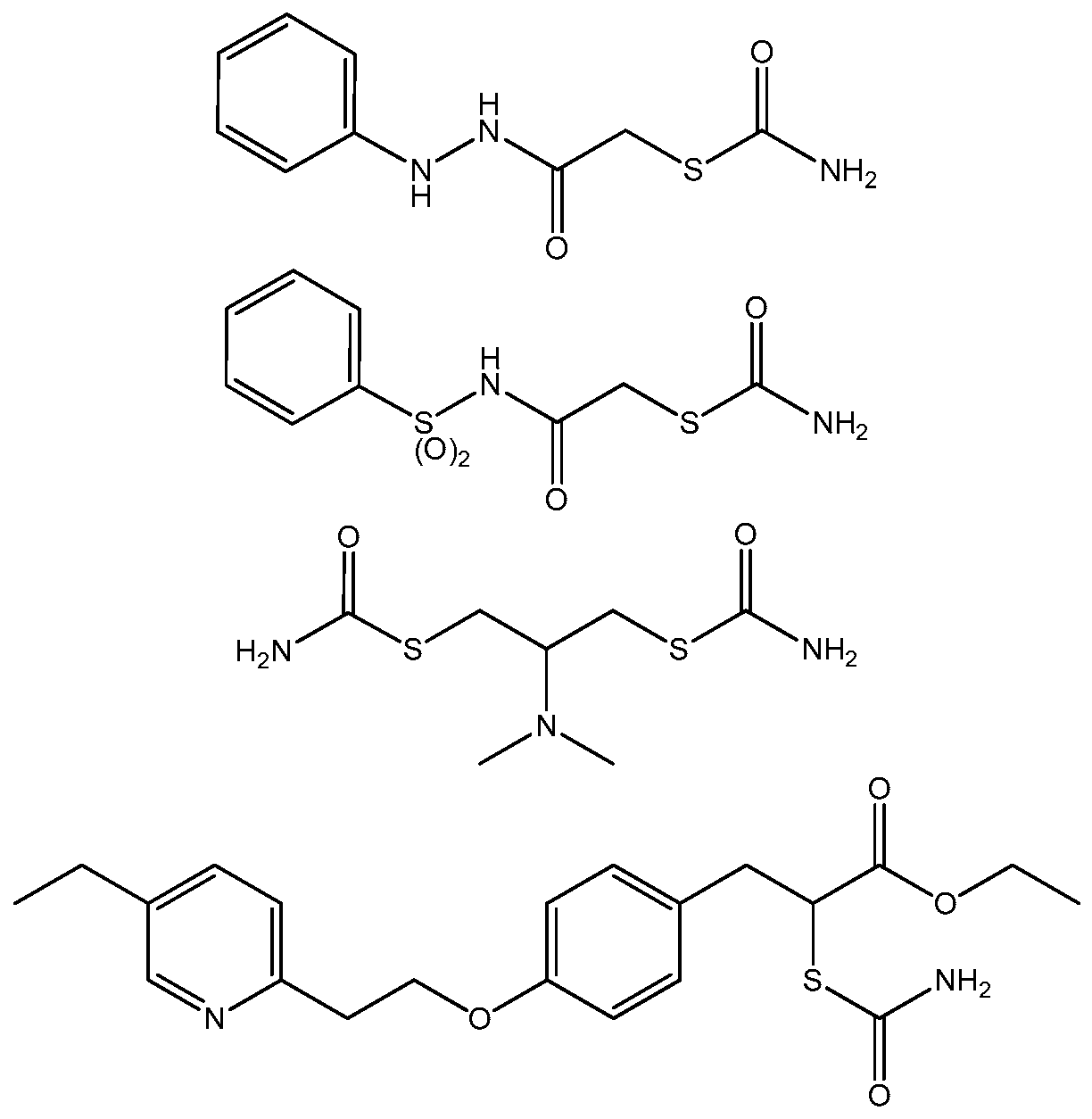
Example 3 - Inhibition of IDE does not occur through interaction with cysteines
To determine whether the thiocarbamate compounds exert their inhibitory effect by irreversible binding to cysteine residues within IDE, the activity of
Compounds IE and IF was tested using cysteine-free IDE (CF-IDE); that is, a mutant form of recombinant IDE in which all cysteine residues were mutated to serines (Neant-Fert et al, (2008) PNAS 105(28): 9582-9587). Using the hydrolysis of FRETl as a measure of IDE activity, Compounds ID and IE were found to inhibit CF-IDE and wild-type IDE (non-mutated IDE containing cysteines) with similar potencies, demonstrating that the ability of these compounds to inhibit IDE does not involve interactions with cysteines. Specifically, Compound IE inhibited CF-IDE and wild- type IDE with an IC50 of 2.8 ± 1.9 and 1.3 ± 2.0 μΜ, respectively while Compound IF inhibited CF-IDE and wild-type IDE with an IC50 of 3.3 ± 1.8 and 3.1 ± 2.1 μΜ, respectively.
FIG. 4 summarizes the results of this experiment. The data for compound IE are shown in FIG. 4A and the data for compound IF are shown in FIG. 4B.
Example 4 - Inhibition of IDE by sulfonamide hydroxamate compounds
The inhibitory potency of individual compounds was assessed by monitoring the hydrolysis of fluorogenic peptide, FRETl, (7-methoxycoumarin-4-yl)acetic acid- GGFLRKVGQK(2,4-dinitrophenyl) (FRETl; 5 μΜ), (excitation = 335 nm, emission = 395 nm) by recombinant human IDE in assay buffer (50 mM HEPES, 100 mM NaCl, 10 mM MgCl2, 0.1% bovine serum albumin, pH 7.4) in the presence of varying concentrations of compounds using the methods described in Cabrol et al, (2009) PLoS ONE 4(4): e5274.
The data is summarized in Table 2 and FIG. 5.
Table 2.


Example 5 - Inhibition of IDE by Pioglitazone Analogs
The inhibitory potency of five pioglitazone analogs was tested at 10μΜ using a β-amyloid-based IDE assay as described by Leissring et ah, J. Biol. Chem., 2003, 278, 37314-37320. The results are shown in FIG. 6. In FIG. 6, bars B to F show the percentage inhibition at 10μΜ by various compounds (whose structures are shown below). Bar A is a DMSO vehicle control (no enzyme inhibitor) while Bar G is a control run with no IDE enzyme present. Compounds tested are summarized in Table 3.
Table 3. Percentage Inhibition of IDE at 10μΜ by Pioglitazone Analogues


Less than 10% inhibition: - 10-40% inhibition at ΙΟμΜ: + 40-60% inhibition at ΙΟμΜ: ++ More than 60% inhibition at ΙΟμΜ: +++ Example 6. Test to Evaluate In Vivo Anti-Diabetic Properties of IDS Inhibitors.
Groups of mice are fasted for 6 hours. An IDE inhibitor is administered, e.g., orally, intranasally, intravenously, subcutaneous ly, intramuscularly, subcutaneously, or intraperitoneally, or via other routes) at a range of concentrations, e.g., 0.1, 1, 10, 100 mg/kg. After administration of inhibitor, or at the same time insulin is also administered to the mice via any of the above routes, at a dose sufficient to induce a partial drop in blood sugar (e.g., 0.5 U/kg administered subcutaneously) relative to the levels measured before insulin administration. Control mice are not administered any inhibitor, or are administered vehicle alone. Before and administration of insulin,
blood samples are taken from the mice and glucose levels of the blood samples are measured.
Relative to mice administered no inhibitor, or vehicle alone, mice receiving an IDE inhibitors are predicted to show significantly larger drops in blood sugar. OTHER EMBODIMENTS
It is to be understood that while the invention has been described in conjunction with the detailed description thereof, the foregoing description is intended to illustrate and not limit the scope of the invention, which is defined by the scope of the appended claims. Other aspects, advantages and modifications are within the scope of the following claims.
Claims
1. A method for inhibiting insulin-degrading enzyme, treating diabetes, promoting wound healing, or improving memory in a patient, comprising administering to the patient a therapeutically effective amount of a compound of formula (1):

or a pharmaceutically acceptable salt thereof, wherein:
R1 is selected from H, OH, SH, NH2, substituted or unsubstituted (Ci-Cio)alkyl, substituted or unsubstituted (C2-Cio)alkenyl, substituted or unsubstituted (C2-Cio)alkynyl, substituted or unsubstituted (C3-Ci2)cycloalkyl, substituted or unsubstituted (C6-Ci4)aryl, substituted or unsubstituted (C3-Ci2)heterocycloalkyl, substituted or unsubstituted (C4-Ci2)heteroaryl;
X is a chemical moiety linking R1 to the remainder of the molecule selected from -NHC(O)-, -NHNHC(O)-, -NH(C=NRa)-, -S(0)2NHC(0)-, -0-, -S-, -S(0)2-, -C(0)-, -C(S)-, -NH-, -NHS(0)2-, -(1,2,3-triazolyl)-, -(1,2,4-triazolyl)-, or a pharmaceutically acceptable bioisostere of any of the preceding;
R2 and R3 are independently selected from H, OH, SH, Ν¾, substituted or unsubstituted (Ci-Cio)alkyl, substituted or unsubstituted (C2-Cio)alkenyl, substituted or unsubstituted (C2-Cio)alkynyl, substituted or unsubstituted (C3-Ci2)cycloalkyl, substituted or unsubstituted (C6-Ci4)aryl, substituted or unsubstituted (C3-Ci2)heterocycloalkyl, and substituted or unsubstituted (C4-Ci2)heteroaryl;
Ra is selected from H, OH, (Ci-Cio)alkyl, substituted or unsubstituted (C6-C14)aryl, and S(0)2)Rb;
Rb is selected from (Ci-Cio)alkyl and substituted or unsubstituted (C6-Ci4)aryl; and
m is an integer selected from 1, 2 and 3.
2. A method for inhibiting insulin-degrading enzyme in a cell, the method comprising
contacting the cell with an effective amount of the compound of formula (1): 
or a pharmaceutically acceptable salt thereof, wherein:
R1 is selected from H, OH, SH, NH2, substituted or unsubstituted (Ci-Cio)alkyl, substituted or unsubstituted (C2-Cio)alkenyl, substituted or unsubstituted (C2-Cio)alkynyl, substituted or unsubstituted (C3-Ci2)cycloalkyl, substituted or unsubstituted (C6-Ci4)aryl, substituted or unsubstituted (C3-Ci2)heterocycloalkyl, substituted or unsubstituted (C4-Ci2)heteroaryl;
X is a chemical moiety linking R1 to the remainder of the molecule selected from -NHC(O)-, -NHNHC(O)-, -NH(C=NRa)-, -S(0)2NHC(0)-, -0-, -S-, -S(0)2-, -C(0)-, -C(S)-, -NH-, -NHS(0)2-, -(1,2,3-triazolyl)-, -(1,2,4-triazolyl)-, or a pharmaceutically acceptable bioisostere of any of the preceding;
R2 and R3 are independently selected from H, OH, SH, Ν¾, substituted or unsubstituted (Ci-Cio)alkyl, substituted or unsubstituted (C2-Cio)alkenyl, substituted or unsubstituted (C2-Cio)alkynyl, substituted or unsubstituted (C3-Ci2)cycloalkyl, substituted or unsubstituted (C6-Ci4)aryl, substituted or unsubstituted (C3-Ci2)heterocycloalkyl, and substituted or unsubstituted (C4-Ci2)heteroaryl;
Ra is selected from H, OH, (Ci-Cio)alkyl, substituted or unsubstituted (C6-C14)aryl, and S(0)2)Rb;
Rb is selected from (Ci-Cio)alkyl and substituted or unsubstituted (C6-Ci4)aryl; and
m is an integer selected from 1, 2 and 3.
3. The method of any one of claims 1 or 2, wherein the compound is a compound of formula (1) or a pharmaceutically acceptable salt thereof, wherein:
R1 is selected from H, OH, SH, NH2, substituted or unsubstituted (Ci-Cio)alkyl, substituted or unsubstituted (C2-Cio)alkenyl, substituted or unsubstituted (C2-Cio)alkynyl, substituted or unsubstituted (C3-Ci2)cycloalkyl, substituted or unsubstituted (C6-Ci4)aryl, substituted or unsubstituted (C3-Ci2)heterocycloalkyl, substituted or unsubstituted (C4-Ci2)heteroaryl; X is a chemical moiety linking R1 to the remainder of the molecule selected from
-NHC(O)-, -0-, -S-, -S(0)2-, -C(0)-, -C(S)-, -NH-, -NHS(0)2-, -(1,2,3-triazolyl)-, -(1,2,4-triazolyl)-, or a pharmaceutically acceptable bioisostere of any of the preceding;
R2 and R3 are independently selected from H, OH, SH, Ν¾, substituted or unsubstituted (Ci-Cio)alkyl, substituted or unsubstituted (C2-Cio)alkenyl, substituted or unsubstituted (C2-Cio)alkynyl, substituted or unsubstituted (C3-Ci2)cycloalkyl, substituted or unsubstituted (C6-Ci4)aryl, substituted or unsubstituted (C3-Ci2)heterocycloalkyl, and substituted or unsubstituted (C4-Ci2)heteroaryl; and
m is an integer selected from 1, 2 and 3.
4. The method of any one of claims 1 to 3, wherein R1 is a substituted or unsubstituted (C6-C14)aryl.
5. The method of any one of claims 1 to 4, wherein m is 1.
6. The method of any one of claims 1 to 5, wherein R2 and R3 are H.
7. The method of any one of claims 1 to 6, wherein X is -NH2C(0)-.
8. The method of claim 7, wherein the compound is a compound of formula (1-1):

or a pharmaceutically acceptable salt thereof, wherein:
R2 and R3 are independently selected from H, OH, SH, Ν¾, substituted or unsubstituted (Ci-Cio)alkyl, substituted or unsubstituted (C2-Cio)alkenyl, substituted or unsubstituted (C2-Cio)alkynyl, substituted or unsubstituted (C3-Ci2)cycloalkyl, substituted or unsubstituted (C6-Ci4)aryl, substituted or unsubstituted (C3-Ci2)heterocycloalkyl, and substituted or unsubstituted (C4-Ci2)heteroaryl;
R4, R5, R6, R7, and R8 are independently selected from H, halo, OH,
0(Ci-Cio)alkyl, NR9R10, N02, (Ci-Cio)haloalkyl, substituted or unsubstituted
(Ci-Cio)alkyl, substituted or unsubstituted (C2-Cio)alkenyl, substituted or unsubstituted (C2-Cio)alkynyl, substituted or unsubstituted (C3-Ci2)cycloalkyl, substituted or unsubstituted (C6-Ci4)aryl, substituted or unsubstituted (C3-Ci2)heterocycloalkyl, and substituted or unsubstituted (C4-Ci2)heteroaryl;
R9 and R10 are independently selected from H and (Ci-Cio)alkyl; and m is an integer selected from 1, 2 and 3.
9. The method of claim 8, wherein R2 and R3 are H.
10. The method of claim 8 or 9, wherein m is 1.
11. The method of any one of claims 8 to 10, wherein R7 and R8 are H.
12. The method of any one of claims 8 to 11, wherein R4 is H, substituted or unsubstituted (Ci-Cio)alkyl or -O-(Ci-Ci0)alkyl.
13. The method of any one of claims 8 to 11, wherein R4 is H or substituted or unsubstituted (d-dc alkyl.
14. The method of any one of claims 8 to 11, wherein R4 is (¾.
15. The method of any one of claims 8 to 11, wherein R4 is OCH3.
16. The method of any one of claims 8 to 15, wherein R5 is selected from H, halo,
-0-(Ci-Cio)alkyl, and substituted or unsubstituted (Ci-Cio)alkyl.
17. The method of any one of claims 8 to 15, wherein R5 is selected from H, halo, -OCH3, and CH3.
18. The method of any one of claims 8 to 17, wherein R6 is selected from H,
-0-(Ci-Cio)alkyl, and substituted or unsubstituted (Ci-Cio)alkyl.
19. The method of any one of claims 8 to 17, wherein R6 is selected from H, -OCH2CH3, and CH3.
20. The method of any one of claims 8 to 17, wherein R6 is H.
21. The method of claim 11, wherein the compound is selected from compounds of the following formulae:


or a pharmaceutically acceptable salt thereof.
22. The method of any one of claims 1 to 6, wherein X is -NH(C=NRa)-.
23. The method of claim 22, wherein the compound is a compound of formula (1-3): 
or a pharmaceutically acceptable salt thereof, wherein: R2 and R3 are independently selected from H, OH, SH, Ν¾, substituted or unsubstituted (Ci-Cio)alkyl, substituted or unsubstituted (C2-Cio)alkenyl, substituted or unsubstituted (C2-Cio)alkynyl, substituted or unsubstituted (C3-Ci2)cycloalkyl, substituted or unsubstituted (C6-Ci4)aryl, substituted or unsubstituted (C3-Ci2)heterocycloalkyl, and substituted or unsubstituted (C4-Ci2)heteroaryl;
Ar1 is unsubstituted (C6-Ci4)aryl, or aryl substituted with 1, 2 or 3 substituents independently selected from H, halo, OH, O(Ci-Ci0)alkyl, NR9R10, N02,
(Ci-Cio)haloalkyl, substituted or unsubstituted (Ci-Cio)alkyl, substituted or unsubstituted (C2-Cio)alkenyl, substituted or unsubstituted (C2-Cio)alkynyl, substituted or unsubstituted (C3-Ci2)cycloalkyl, substituted or unsubstituted (C6-Ci4)aryl, substituted or unsubstituted (C3-Ci2)heterocycloalkyl, and substituted or unsubstituted (C4-Ci2)heteroaryl;
Ar2 is unsubstituted (C6-Ci4)aryl, or aryl substituted with 1, 2 or 3 substituents independently selected from H, halo, OH, O(Ci-Ci0)alkyl, NR9R10, N02,
(Ci-Cio)haloalkyl, substituted or unsubstituted (Ci-Cio)alkyl, substituted or unsubstituted (C2-Cio)alkenyl, substituted or unsubstituted (C2-Cio)alkynyl, substituted or unsubstituted (C3-Ci2)cycloalkyl, substituted or unsubstituted (C6-Ci4)aryl, substituted or unsubstituted (C3-Ci2)heterocycloalkyl, and substituted or unsubstituted (C4-Ci2)heteroaryl;
R9 and R10 are independently selected from H and (Ci-Cio)alkyl; and m is an integer selected from 1, 2 and 3.
24. The method of claim 23, wherein R2 and R3 are H.
25. The method of claim 23 or 24, wherein m is 1.
26. The method of any one of claims 23 to 25, wherein Ar1 is unsubstituted phenyl.
27. The method of any one of claims 23 to 25, wherein Ar1 is para-substituted phenyl.
28. The method of claim 27, wherein Ar1 is 4-tolyl or 4-halosubstituted phenyl.
29. The method of any one of claims 23 to 28, wherein Ar2 is a group of the following
formula:
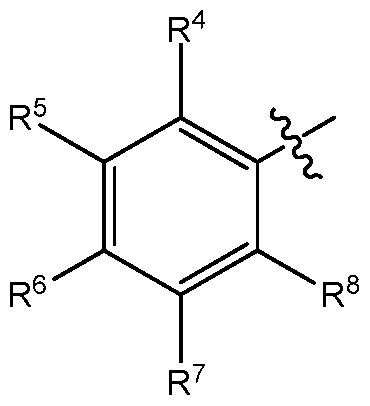
R4, R5, R6, R7, and R8 are independently selected from H, halo, OH, 0(Ci-Cio)alkyl, NR9R10, N02, (Ci-Cio)haloalkyl, substituted or unsubstituted
(Ci-Cio)alkyl, substituted or unsubstituted (C2-Cio)alkenyl, substituted or unsubstituted (C2-Cio)alkynyl, substituted or unsubstituted (C3-Ci2)cycloalkyl, substituted or unsubstituted (C6-Ci4)aryl, substituted or unsubstituted (C3-Ci2)heterocycloalkyl, and substituted or unsubstituted (C4-Ci2)heteroaryl; and
R9 and R10 are independently selected from H and (Ci-Cio)alkyl.
30. The method of claim 29, wherein R7 and R8 are H.
31. The method of claim 29 or claim 30, wherein R4 is H, substituted or unsubstituted
(Ci-Cio)alkyl or -O-(Ci-Ci0)alkyl.
32. The method of any one of claims 29 to 31, wherein R4 is H or substituted or unsubstituted (d-dc alkyl.
33. The method of any one of claims 29 to 31, wherein R4 is C¾ or OCH3.
34. The method of any one of claims 29 to 33, wherein R5 is selected from H, halo,
-0-(Ci-Cio)alkyl, and substituted or unsubstituted (Ci-Cio)alkyl.
35. The method of any one of claims 29 to 33, wherein R5 is selected from H, halo, -OCH3, and CH3.
36. The method of any one of claims 29 to 35, wherein R6 is selected from H,
-0-(Ci-Cio)alkyl, and substituted or unsubstituted (Ci-Cio)alkyl.
37. The method of any one of claims 29 to 35, wherein R6 is selected from H, -OCH2CH3, and CH3.
38. The method of any one of claims 29 to 35, wherein R6 is H.
39. The method of any one of claims 23 to 29, wherein Ar2 is 1-naphthyl.
40. The method of any one of claims 23 to 29, wherein Ar2 is 2-naphthyl.
41. The method of claim 23, wherein the compound is selected from compounds of the
following formulae: 
or a pharmaceutically acceptable salt thereof.
42. The method of any one of claims 1 to 6, wherein X is -NHNHC(O)-.
43. The method of claim 42, wherein the compound is a compound of formula (1-4):

or a pharmaceutically acceptable salt thereof, wherein:
R2 and R3 are independently selected from H, OH, SH, Ν¾, substituted or unsubstituted (Ci-Cio)alkyl, substituted or unsubstituted (C2-Cio)alkenyl, substituted or unsubstituted (C2-Cio)alkynyl, substituted or unsubstituted (C3-Ci2)cycloalkyl, substituted or unsubstituted (C6-Ci4)aryl, substituted or unsubstituted (C3-Ci2)heterocycloalkyl, and substituted or unsubstituted (C4-Ci2)heteroaryl;
R4, R5, R6, R7, and R8 are independently selected from H, halo, OH,
0(Ci-Cio)alkyl, NR9R10, N02, (Ci-Cio)haloalkyl, substituted or unsubstituted
(Ci-Cio)alkyl, substituted or unsubstituted (C2-Cio)alkenyl, substituted or unsubstituted (C2-Cio)alkynyl, substituted or unsubstituted (C3-Ci2)cycloalkyl, substituted or unsubstituted (C6-Ci4)aryl, substituted or unsubstituted (C3-Ci2)heterocycloalkyl, and substituted or unsubstituted (C4-Ci2)heteroaryl;
R9 and R10 are independently selected from H and (Ci-Cio)alkyl; and m is an integer selected from 1, 2 and 3.
44. The method of claim 43, wherein R2 and R3 are H.
45. The method of claim 43 or 44, wherein m is 1.
46. The method of any one of claims 43 to 45, wherein R4 and R5 are H.
47. The method of any one of claims 43 to 46, wherein R7 and R8 are H.
48. The method of any one of claims 43 to 47, wherein R6 is H, (Ci-Cio)alkyl or halogen.
49. The method of any one of claims 43 to 47, wherein R6 is H.
50. The method of cl following formula:

or a pharmaceutically acceptable salt thereof.
51. The method of any one of claims 1 to 6, wherein X is -S(0)2NHC(0)-.
52. The method of claim 51, wherein the compound is a compound of formula (1-5):

or a pharmaceutically acceptable salt thereof, wherein:
R2 and R3 are independently selected from H, OH, SH, Ν¾, substituted or unsubstituted (Ci-Cio)alkyl, substituted or unsubstituted (C2-Cio)alkenyl, substituted or unsubstituted (C2-Cio)alkynyl, substituted or unsubstituted (C3-Ci2)cycloalkyl, substituted or unsubstituted (C6-Ci4)aryl, substituted or unsubstituted (C3-Ci2)heterocycloalkyl, and substituted or unsubstituted (C4-Ci2)heteroaryl;
R4, R5, R6, R7, and R8 are independently selected from H, halo, OH,
0(Ci-Cio)alkyl, NR9R10, N02, (Ci-Cio)haloalkyl, substituted or unsubstituted
(Ci-Cio)alkyl, substituted or unsubstituted (C2-Cio)alkenyl, substituted or unsubstituted (C2-Cio)alkynyl, substituted or unsubstituted (C3-Ci2)cycloalkyl, substituted or unsubstituted (C6-Ci4)aryl, substituted or unsubstituted (C3-Ci2)heterocycloalkyl, and substituted or unsubstituted (C4-Ci2)heteroaryl;
R9 and R10 are independently selected from H and (Ci-Cio)alkyl; and
m is an integer selected from 1, 2 and 3.
53. The method of claim 52, wherein R2 and R3 are H.
54. The method of claim 52 or 53, wherein m is 1.
55. The method of any one of claims 52 to 54, wherein R4 and R5 are H.
56. The method of any one of claims 52 to 55, wherein R7 and R8 are H.
57. The method of any one of claims 52 to 56, wherein R6 is H, (Ci-Cio)alkyl or halogen.
58. The method of any one of claims 52 to 56, wherein R6 is H.
59. The method of claim 52, wherein the compound is selected from compounds of the
following formul

or a pharmaceutically acceptable salt thereof.
60. A method for inhibiting insulin-degrading enzyme, treating diabetes, promoting wound healing, or improving memory in a patient, comprising administering to the patient a therapeutically effective amount of a compound of formula (2):  (2)
(2)
or a pharmaceutically acceptable salt thereof, wherein:
R11 is selected from H, OH, SH, H2, substituted or unsubstituted (Ci-Cio)alkyl, substituted or unsubstituted (C2-Cio)alkenyl, substituted or unsubstituted (C2-Cio)alkynyl, substituted or unsubstituted (C3-Ci2)cycloalkyl, substituted or unsubstituted (C6-Ci4)aryl, substituted or unsubstituted (C3-Ci2)heterocycloalkyl, substituted or unsubstituted (C4-Ci2)heteroaryl, and an amino acid side chain; R is selected from H, OH, SH, NH2, substituted or unsubstituted (Ci-Cio)alkyl, substituted or unsubstituted (C2-Cio)alkenyl, substituted or unsubstituted (C2-Cio)alkynyl, substituted or unsubstituted (C3-Ci2)cycloalkyl, substituted or unsubstituted (C6-Ci4)aryl, substituted or unsubstituted (C3-Ci2)heterocycloalkyl, substituted or unsubstituted (C4-Ci2)heteroaryl, and an amino acid side chain;
R13 is H or substituted or unsubstituted (Ci-Cio)alkyl;
n is an integer from 0 to 3; and
p is an integer from 0 to 3.
61. A method for inhibiting insulin-degrading enzyme in a cell, the method comprising
contacting the cell with an effective amount of the compound of formula (2):

or a pharmaceutically acceptable salt thereof, wherein:
R11 is selected from H, OH, SH, NH2, substituted or unsubstituted (Ci-Cio)alkyl, substituted or unsubstituted (C2-Cio)alkenyl, substituted or unsubstituted (C2-Cio)alkynyl, substituted or unsubstituted (C3-Ci2)cycloalkyl, substituted or unsubstituted (C6-Ci4)aryl, substituted or unsubstituted (C3-Ci2)heterocycloalkyl, substituted or unsubstituted (C4-Ci2)heteroaryl, and an amino acid side chain;
R12 is selected from H, OH, SH, NH2, substituted or unsubstituted (Ci-Cio)alkyl, substituted or unsubstituted (C2-Cio)alkenyl, substituted or unsubstituted (C2-Cio)alkynyl, substituted or unsubstituted (C3-Ci2)cycloalkyl, substituted or unsubstituted (C6-Ci4)aryl, substituted or unsubstituted (C3-Ci2)heterocycloalkyl, substituted or unsubstituted (C4-Ci2)heteroaryl, and an amino acid side chain;
R13 is H or substituted or unsubstituted (Ci-Cio)alkyl;
n is an integer from 0 to 3; and
p is an integer from 0 to 3.
62. The method of claim 60 or 61, wherein R11 is a substituted or unsubstituted (C6-Ci4)aryl.
63. The method of claim 62, wherein R11 is a substituted phenyl.
64. The method of any one of claims 60 to 63, wherein R is a substituted or unsubstituted (C6-C14)aryl.
65. The method of claim 64, wherein R is a substituted phenyl.
66. The method of any one of claims 60 to 65, wherein R13 is H.
67. The method of any one of claims 60 to 66, wherein n is 1.
68. The method of any one of claims 60 to 67, wherein p is 0.
69. The method of any one of claims 60 to 68, wherein the compound is a compound of formula (2-1):

or a pharmaceutically acceptable salt thereof, wherein:
R13 is H or substituted or unsubstituted (Ci-Cio)alkyl;
R14 is selected from H, halo, OH, O(Ci-Ci0)alkyl, NR16R17, N02,
(Ci-Cio)haloalkyl, substituted or unsubstituted (Ci-Cio)alkyl, substituted or unsubstituted (C2-Cio)alkenyl, substituted or unsubstituted (C2-Cio)alkynyl, substituted or unsubstituted (C3-Ci2)cycloalkyl, substituted or unsubstituted (C6-Ci4)aryl, substituted or unsubstituted (C3-Ci2)heterocycloalkyl, and substituted or unsubstituted (C4-Ci2)heteroaryl;
R15 is selected from H, halo, OH, O(Ci-Ci0)alkyl, NR16R17, N02,
(Ci-Cio)haloalkyl, substituted or unsubstituted (Ci-Cio)alkyl, substituted or unsubstituted (C2-Cio)alkenyl, substituted or unsubstituted (C2-Cio)alkynyl, substituted or unsubstituted (C3-Ci2)cycloalkyl, substituted or unsubstituted (C6-Ci4)aryl, substituted or unsubstituted (C3-Ci2)heterocycloalkyl, and substituted or unsubstituted (C4-Ci2)heteroaryl;
R16 and R17 are independently selected from H and substituted or unsubstituted (Ci-Cio)alkyl; and
n is an integer from 1 to 10.
13
70. The method of claim 69, wherein R is H.
71. The method of claim 69 or 70, wherein R is selected from O2, (Ci-Cio)haloalkyl, and (Ci-Cio)alkyl.
72. The method of any one of claims 69 to 71, wherein R15 is halo.
73. The method of claim 72, wherein R15 is F.
74. The method of claim 69, wherein the compound is selected from compounds of the following formulae:

or a pharmaceutically acceptable salt thereof.
75. A method for inhibiting insulin-degrading enzyme, treating diabetes, promoting wound healing, or improving memory in a patient, comprising administering to the patient a therapeutically effective amount of a compound of formula (4):

or a pharmaceutically acceptable salt thereof, wherein:
R21, R22, R23, R24, R25 and R26 are independently selected from H and substituted or unsubstituted (Ci-Cio)alkyl; and nl and n2 are integers each independently selected from 1, 2 and 3.
76. A method for inhibiting insulin-degrading enzyme in a cell, the method comprising contacting the cell with an effective amount of a compound of formula (4):

or a pharmaceutically acceptable salt thereof, wherein:
R21, R22, R23, R24, R25 and R26 are independently selected from H and substituted or unsubstituted (Ci-Cio)alkyl; and
nl and n2 are integers each independently selected from 1, 2 and 3.
77. The method of claim 75 or 76, wherein nl is 1.
78. The method of any one of claims 75 to 77, wherein n2 is 1.
79. The method of any one of claims 75 to 78, wherein R21, R22, R23, R24, R25 and R26 are independently selected from H and (Ci-Cio)alkyl.
80. The method of any one of claims 75 to 79, wherein R21 and R22 are H.
81. The method of any one of claims 75 to 80, wherein R25 and R26 are H.
82. The method of any one of claims 75 to 81, wherein R23 and R24 are (Ci-Cio)alkyl.
83. The method of claim 75 or 76, wherein the compound is a compound of the following formula:

or a pharmaceutically acceptable salt thereof,
84. A method for inhibiting insulin-degrading enzyme, treating diabetes, promoting wound healing, or improving memory in a patient, comprising administering to the patient a therapeutically effective amount of a compound of formula (5): 
or a pharmaceutically acceptable salt thereof, wherein:
R27 is selected from H, OH, NH2, and (Ci-Cio)alkyl;
R28 is selected from H and (Q-Cic alkyl;
R29 is selected from OR30 and NR31R32;
R'° is selected from H and (Ci-Cio)alkyl;
R31 is selected from H, OH, NH2, and (Ci-Cio)alkyl;
R32 is selected from H and (Ci-Cio)alkyl;
ql is selected from 0, 1 and 2;
q2 is selected from 0, 1 and 2; and
Ar3 is selected from substituted or unsubstituted (C6-Ci4)aryl, and substituted or unsubstituted (C4-Ci2)heteroaryl.
85. A method for inhibiting insulin-degrading enzyme in a cell, the method comprising contacting the cell with an effective amount of a compound of formula (5):

or a pharmaceutically acceptable salt thereof,
wherein:
R27 is selected from H, OH, NH2, and (Ci-Cio)alkyl;
R28 is selected from H and (Ci-Cio)alkyl;
R29 is selected from OR30 and NR31R32;
R30 is selected from H and (Ci-Cio)alkyl;
R31 is selected from H, OH, NH2, and (Ci-Cio)alkyl;
Rj2 is selected from H and (Ci-Cio)alkyl; ql is selected from 0, 1 and 2;
q2 is selected from 0, 1 and 2; and
Ar3 is selected from substituted or unsubstituted (C6-Ci4)aryl, and substituted or unsubstituted (C4-Ci2)heteroaryl.
86. The method of claim 84 or 85, wherein R27 is H.
87. The method of any one of claims 84 to 86, wherein R28 is H.
88. The method of any one of claims 84 to 87, wherein R29 is OR30.
89. The method of claim 88, wherein R30 is (Ci-Cio)alkyl.
90. The method of any one of claims 84 to 89, wherein ql is 0.
91. The method of any one of claims 84 to 90, wherein q2 is 1.
92. The method of any one of claims 84 to 91, wherein Ar3 is a phenyl ring.
93. The method of claim 92, wherein 3 is a group of the following formula:

wherein:
RA, RB, RD, and RE are independently selected from H, halo, (C1-C10)alkyl, (C2-Cio)alkenyl, (C2-C10)alkynyl, (Ci-Cio)haloalkyl, ORF, NRF 2 and 02;
Rc is independently selected from H, halo, (Ci-Cio)alkyl, (C2-Cio)alkenyl, (C2-Cio)alkynyl, (Ci-Cio)haloalkyl, ORF, NRF 2, N02, -((Ci-C6)alkylene)Ar4,
-((Ci-C6)alkylene)OAr4, -0((Ci-C6)alkylene)Ar4, and
-((Ci-C3)alkylene)-0((Ci-C3)alkylene)Ar4;
Ar4 is selected from unsubstituted (C6-Ci4)aryl or (C4-Ci2)heteroaryl, and (C6-Ci4)aryl or (C4-Ci2)heteroaryl substituted with 1, 2, or 3-substitents selected from, halo, (Ci-Cio)alkyl, (C2-Ci0)alkenyl, (C2-Ci0)alkynyl, (Ci-Cio)haloalkyl, ORF, NRF 2 and N02; and
each RF is independently selected from hydrogen and (Ci-Cio)alkyl;
94. The method of claim 93, wherein RA, RB, RD, and RF are hydrogen.
95. The method of claim 93 or 94, wherein Rc is -0((d-C6)alkylene)Ar4.
96. The method of claim 93 or 94, wherein Rc is -OCH2CH2Ar4.
97. The method of any one of claims 93 to 96, wherein Ar4 is a pyridyl.
98. The method of claim 97, wherein Ar4 is a 2-pyridyl.
99. The method of any one of claims 93 to 97, wherein Ar4 is unsubstituted or
monosubstituted.
100. The method of claim 84 or 85, wherein the compound is a compound of the following formula:

or a pharmaceutically acceptable salt thereof.
Applications Claiming Priority (2)
| Application Number | Priority Date | Filing Date | Title |
|---|---|---|---|
| US201161490700P | 2011-05-27 | 2011-05-27 | |
| US61/490,700 | 2011-05-27 |
Publications (2)
| Publication Number | Publication Date |
|---|---|
| WO2012166614A2 true WO2012166614A2 (en) | 2012-12-06 |
| WO2012166614A9 WO2012166614A9 (en) | 2013-02-21 |
Family
ID=47260221
Family Applications (1)
| Application Number | Title | Priority Date | Filing Date |
|---|---|---|---|
| PCT/US2012/039620 Ceased WO2012166614A2 (en) | 2011-05-27 | 2012-05-25 | Thiocarbamate and sulfonamide hydroxamate inhibitors of insulin-degrading enzyme |
Country Status (1)
| Country | Link |
|---|---|
| WO (1) | WO2012166614A2 (en) |
-
2012
- 2012-05-25 WO PCT/US2012/039620 patent/WO2012166614A2/en not_active Ceased
Also Published As
| Publication number | Publication date |
|---|---|
| WO2012166614A9 (en) | 2013-02-21 |
Similar Documents
| Publication | Publication Date | Title |
|---|---|---|
| US12605471B2 (en) | Cromolyn derivatives and related methods of imaging and treatment | |
| US11801316B2 (en) | Cromolyn derivatives and related methods of imaging and treatment | |
| EP2911664B1 (en) | Combination therapies for the treatment of alzheimer's disease and related disorders | |
| SK282566B6 (en) | Benzimidazole derivatives, pharmaceutical composition and use | |
| KR20150065873A (en) | Ketamine derivatives | |
| AU2021246142A1 (en) | Compositions and methods for the prevention and/or treatment of mitochondrial disease, including Friedreich's ataxia | |
| US9896423B2 (en) | Deuterium substituted 1-[2-(2,4-dimethyl-phenylsulfanyl)-phenyl]piperazine compound or derivatives thereof, and pharmaceutical composition and use thereof | |
| EP4606798A1 (en) | Benzoisothiazole compound, and pharmaceutical composition and use thereof | |
| WO2012166614A2 (en) | Thiocarbamate and sulfonamide hydroxamate inhibitors of insulin-degrading enzyme | |
| CN109232546B (en) | Medicinal use of a pyrimidine sulfonamide derivative | |
| CN109125325B (en) | Medicinal uses of prostacyclin receptor agonists | |
| TW201302736A (en) | Cathepsin C inhibitor | |
| CN118496144A (en) | Bufadienamine derivative and application thereof in analgesic and antidepressant drugs | |
| WO2025256631A1 (en) | Jak inhibitor for treatment of allergic rhinitis | |
| WO2025122753A2 (en) | Compositions and methods for the treatment of niemann-pick disease | |
| CN117794526A (en) | Compositions and methods for antioxidant and anti-inflammatory therapeutics | |
| HK40016881A (en) | Combination therapies for the treatment of alzheimer's disease and related disorders | |
| HK1213494B (en) | Combination therapies for the treatment of alzheimer's disease and related disorders |
Legal Events
| Date | Code | Title | Description |
|---|---|---|---|
| 121 | Ep: the epo has been informed by wipo that ep was designated in this application |
Ref document number: 12793217 Country of ref document: EP Kind code of ref document: A2 |
|
| NENP | Non-entry into the national phase in: |
Ref country code: DE |
|
| 122 | Ep: pct application non-entry in european phase |
Ref document number: 12793217 Country of ref document: EP Kind code of ref document: A2 |