WO2012162461A1 - Phenyl-thiazolyl inhibitors of pro-matrix metalloproteinase activation - Google Patents
Phenyl-thiazolyl inhibitors of pro-matrix metalloproteinase activation Download PDFInfo
- Publication number
- WO2012162461A1 WO2012162461A1 PCT/US2012/039270 US2012039270W WO2012162461A1 WO 2012162461 A1 WO2012162461 A1 WO 2012162461A1 US 2012039270 W US2012039270 W US 2012039270W WO 2012162461 A1 WO2012162461 A1 WO 2012162461A1
- Authority
- WO
- WIPO (PCT)
- Prior art keywords
- alkyl
- alkylna
- phenyl
- group
- disease
- Prior art date
- Legal status (The legal status is an assumption and is not a legal conclusion. Google has not performed a legal analysis and makes no representation as to the accuracy of the status listed.)
- Ceased
Links
- 0 *C(*=C1*)=IC=C1[N+]([O-])=O Chemical compound *C(*=C1*)=IC=C1[N+]([O-])=O 0.000 description 2
- GIWAOFNTVLEGOG-UHFFFAOYSA-N CC(C)Cc(ccc(C(N)=O)c1)c1N Chemical compound CC(C)Cc(ccc(C(N)=O)c1)c1N GIWAOFNTVLEGOG-UHFFFAOYSA-N 0.000 description 1
- BOYSTCPBVRQXHC-UHFFFAOYSA-N CC(C)Oc(c(Nc1nc(-c(cc2)ccc2N2CCN(C)CC2)c[s]1)c1)ccc1C(N)=O Chemical compound CC(C)Oc(c(Nc1nc(-c(cc2)ccc2N2CCN(C)CC2)c[s]1)c1)ccc1C(N)=O BOYSTCPBVRQXHC-UHFFFAOYSA-N 0.000 description 1
- GJALQMKRYAQMAV-UHFFFAOYSA-N CC(C)Oc(c(Nc1nc(-c(cc2)ccc2N2CCN(Cc3ccccc3)CC2)c[s]1)c1)ccc1C(N)=O Chemical compound CC(C)Oc(c(Nc1nc(-c(cc2)ccc2N2CCN(Cc3ccccc3)CC2)c[s]1)c1)ccc1C(N)=O GJALQMKRYAQMAV-UHFFFAOYSA-N 0.000 description 1
- JTIMMPCFFXYSCU-UHFFFAOYSA-N CC(C)Oc(ccc(C(N)=O)c1)c1Nc1nc(-c(cc2)ccc2OCCCN2CCOCC2)c[s]1 Chemical compound CC(C)Oc(ccc(C(N)=O)c1)c1Nc1nc(-c(cc2)ccc2OCCCN2CCOCC2)c[s]1 JTIMMPCFFXYSCU-UHFFFAOYSA-N 0.000 description 1
- QRVRYBJTVILKOK-UHFFFAOYSA-N CC(c(cc1)ccc1OCCBr)=O Chemical compound CC(c(cc1)ccc1OCCBr)=O QRVRYBJTVILKOK-UHFFFAOYSA-N 0.000 description 1
- BANZXGCVSDAAHM-UHFFFAOYSA-N CC(c(cc1)ccc1OCCCN1CCOCC1)=O Chemical compound CC(c(cc1)ccc1OCCCN1CCOCC1)=O BANZXGCVSDAAHM-UHFFFAOYSA-N 0.000 description 1
- FOMSTKPBNYIWRM-UHFFFAOYSA-N CC(c(cc1)ccc1OCCN1CCOCC1)=O Chemical compound CC(c(cc1)ccc1OCCN1CCOCC1)=O FOMSTKPBNYIWRM-UHFFFAOYSA-N 0.000 description 1
- LJBAWFCBHFQCEZ-UHFFFAOYSA-N CCN(CC1)CC=C1c(cc1)ccc1-c1c[s]c(Nc2cnccc2OCC)n1 Chemical compound CCN(CC1)CC=C1c(cc1)ccc1-c1c[s]c(Nc2cnccc2OCC)n1 LJBAWFCBHFQCEZ-UHFFFAOYSA-N 0.000 description 1
- MIZZVINSUDWEKQ-UHFFFAOYSA-N CCN(CC1)CCN1c(cc1)ccc1-c1c[s]c(Nc(cc(cc2)C(N)=O)c2OC(C)C)n1 Chemical compound CCN(CC1)CCN1c(cc1)ccc1-c1c[s]c(Nc(cc(cc2)C(N)=O)c2OC(C)C)n1 MIZZVINSUDWEKQ-UHFFFAOYSA-N 0.000 description 1
- WTCKTNDBYMAVTM-UHFFFAOYSA-N Cc(c(C(N)=O)c1)cc(OC)c1[N+]([O-])=O Chemical compound Cc(c(C(N)=O)c1)cc(OC)c1[N+]([O-])=O WTCKTNDBYMAVTM-UHFFFAOYSA-N 0.000 description 1
- XBMRTZXRXPAQKM-UHFFFAOYSA-N Cc1cc(OC)ccc1C(N)=O Chemical compound Cc1cc(OC)ccc1C(N)=O XBMRTZXRXPAQKM-UHFFFAOYSA-N 0.000 description 1
- SNAABGGQDWLKIR-UHFFFAOYSA-N O=C(CBr)c(cc1)ccc1OCCN1CCOCC1 Chemical compound O=C(CBr)c(cc1)ccc1OCCN1CCOCC1 SNAABGGQDWLKIR-UHFFFAOYSA-N 0.000 description 1
Classifications
-
- C—CHEMISTRY; METALLURGY
- C07—ORGANIC CHEMISTRY
- C07D—HETEROCYCLIC COMPOUNDS
- C07D417/00—Heterocyclic compounds containing two or more hetero rings, at least one ring having nitrogen and sulfur atoms as the only ring hetero atoms, not provided for by group C07D415/00
- C07D417/02—Heterocyclic compounds containing two or more hetero rings, at least one ring having nitrogen and sulfur atoms as the only ring hetero atoms, not provided for by group C07D415/00 containing two hetero rings
- C07D417/12—Heterocyclic compounds containing two or more hetero rings, at least one ring having nitrogen and sulfur atoms as the only ring hetero atoms, not provided for by group C07D415/00 containing two hetero rings linked by a chain containing hetero atoms as chain links
-
- A—HUMAN NECESSITIES
- A61—MEDICAL OR VETERINARY SCIENCE; HYGIENE
- A61P—SPECIFIC THERAPEUTIC ACTIVITY OF CHEMICAL COMPOUNDS OR MEDICINAL PREPARATIONS
- A61P1/00—Drugs for disorders of the alimentary tract or the digestive system
-
- A—HUMAN NECESSITIES
- A61—MEDICAL OR VETERINARY SCIENCE; HYGIENE
- A61P—SPECIFIC THERAPEUTIC ACTIVITY OF CHEMICAL COMPOUNDS OR MEDICINAL PREPARATIONS
- A61P1/00—Drugs for disorders of the alimentary tract or the digestive system
- A61P1/02—Stomatological preparations, e.g. drugs for caries, aphtae, periodontitis
-
- A—HUMAN NECESSITIES
- A61—MEDICAL OR VETERINARY SCIENCE; HYGIENE
- A61P—SPECIFIC THERAPEUTIC ACTIVITY OF CHEMICAL COMPOUNDS OR MEDICINAL PREPARATIONS
- A61P1/00—Drugs for disorders of the alimentary tract or the digestive system
- A61P1/04—Drugs for disorders of the alimentary tract or the digestive system for ulcers, gastritis or reflux esophagitis, e.g. antacids, inhibitors of acid secretion, mucosal protectants
-
- A—HUMAN NECESSITIES
- A61—MEDICAL OR VETERINARY SCIENCE; HYGIENE
- A61P—SPECIFIC THERAPEUTIC ACTIVITY OF CHEMICAL COMPOUNDS OR MEDICINAL PREPARATIONS
- A61P1/00—Drugs for disorders of the alimentary tract or the digestive system
- A61P1/16—Drugs for disorders of the alimentary tract or the digestive system for liver or gallbladder disorders, e.g. hepatoprotective agents, cholagogues, litholytics
-
- A—HUMAN NECESSITIES
- A61—MEDICAL OR VETERINARY SCIENCE; HYGIENE
- A61P—SPECIFIC THERAPEUTIC ACTIVITY OF CHEMICAL COMPOUNDS OR MEDICINAL PREPARATIONS
- A61P11/00—Drugs for disorders of the respiratory system
-
- A—HUMAN NECESSITIES
- A61—MEDICAL OR VETERINARY SCIENCE; HYGIENE
- A61P—SPECIFIC THERAPEUTIC ACTIVITY OF CHEMICAL COMPOUNDS OR MEDICINAL PREPARATIONS
- A61P11/00—Drugs for disorders of the respiratory system
- A61P11/06—Antiasthmatics
-
- A—HUMAN NECESSITIES
- A61—MEDICAL OR VETERINARY SCIENCE; HYGIENE
- A61P—SPECIFIC THERAPEUTIC ACTIVITY OF CHEMICAL COMPOUNDS OR MEDICINAL PREPARATIONS
- A61P13/00—Drugs for disorders of the urinary system
- A61P13/12—Drugs for disorders of the urinary system of the kidneys
-
- A—HUMAN NECESSITIES
- A61—MEDICAL OR VETERINARY SCIENCE; HYGIENE
- A61P—SPECIFIC THERAPEUTIC ACTIVITY OF CHEMICAL COMPOUNDS OR MEDICINAL PREPARATIONS
- A61P17/00—Drugs for dermatological disorders
-
- A—HUMAN NECESSITIES
- A61—MEDICAL OR VETERINARY SCIENCE; HYGIENE
- A61P—SPECIFIC THERAPEUTIC ACTIVITY OF CHEMICAL COMPOUNDS OR MEDICINAL PREPARATIONS
- A61P17/00—Drugs for dermatological disorders
- A61P17/02—Drugs for dermatological disorders for treating wounds, ulcers, burns, scars, keloids, or the like
-
- A—HUMAN NECESSITIES
- A61—MEDICAL OR VETERINARY SCIENCE; HYGIENE
- A61P—SPECIFIC THERAPEUTIC ACTIVITY OF CHEMICAL COMPOUNDS OR MEDICINAL PREPARATIONS
- A61P19/00—Drugs for skeletal disorders
-
- A—HUMAN NECESSITIES
- A61—MEDICAL OR VETERINARY SCIENCE; HYGIENE
- A61P—SPECIFIC THERAPEUTIC ACTIVITY OF CHEMICAL COMPOUNDS OR MEDICINAL PREPARATIONS
- A61P19/00—Drugs for skeletal disorders
- A61P19/02—Drugs for skeletal disorders for joint disorders, e.g. arthritis, arthrosis
-
- A—HUMAN NECESSITIES
- A61—MEDICAL OR VETERINARY SCIENCE; HYGIENE
- A61P—SPECIFIC THERAPEUTIC ACTIVITY OF CHEMICAL COMPOUNDS OR MEDICINAL PREPARATIONS
- A61P25/00—Drugs for disorders of the nervous system
-
- A—HUMAN NECESSITIES
- A61—MEDICAL OR VETERINARY SCIENCE; HYGIENE
- A61P—SPECIFIC THERAPEUTIC ACTIVITY OF CHEMICAL COMPOUNDS OR MEDICINAL PREPARATIONS
- A61P25/00—Drugs for disorders of the nervous system
- A61P25/06—Antimigraine agents
-
- A—HUMAN NECESSITIES
- A61—MEDICAL OR VETERINARY SCIENCE; HYGIENE
- A61P—SPECIFIC THERAPEUTIC ACTIVITY OF CHEMICAL COMPOUNDS OR MEDICINAL PREPARATIONS
- A61P29/00—Non-central analgesic, antipyretic or antiinflammatory agents, e.g. antirheumatic agents; Non-steroidal antiinflammatory drugs [NSAID]
-
- A—HUMAN NECESSITIES
- A61—MEDICAL OR VETERINARY SCIENCE; HYGIENE
- A61P—SPECIFIC THERAPEUTIC ACTIVITY OF CHEMICAL COMPOUNDS OR MEDICINAL PREPARATIONS
- A61P35/00—Antineoplastic agents
-
- A—HUMAN NECESSITIES
- A61—MEDICAL OR VETERINARY SCIENCE; HYGIENE
- A61P—SPECIFIC THERAPEUTIC ACTIVITY OF CHEMICAL COMPOUNDS OR MEDICINAL PREPARATIONS
- A61P9/00—Drugs for disorders of the cardiovascular system
-
- A—HUMAN NECESSITIES
- A61—MEDICAL OR VETERINARY SCIENCE; HYGIENE
- A61P—SPECIFIC THERAPEUTIC ACTIVITY OF CHEMICAL COMPOUNDS OR MEDICINAL PREPARATIONS
- A61P9/00—Drugs for disorders of the cardiovascular system
- A61P9/10—Drugs for disorders of the cardiovascular system for treating ischaemic or atherosclerotic diseases, e.g. antianginal drugs, coronary vasodilators, drugs for myocardial infarction, retinopathy, cerebrovascula insufficiency, renal arteriosclerosis
-
- A—HUMAN NECESSITIES
- A61—MEDICAL OR VETERINARY SCIENCE; HYGIENE
- A61P—SPECIFIC THERAPEUTIC ACTIVITY OF CHEMICAL COMPOUNDS OR MEDICINAL PREPARATIONS
- A61P9/00—Drugs for disorders of the cardiovascular system
- A61P9/12—Antihypertensives
-
- C—CHEMISTRY; METALLURGY
- C07—ORGANIC CHEMISTRY
- C07D—HETEROCYCLIC COMPOUNDS
- C07D277/00—Heterocyclic compounds containing 1,3-thiazole or hydrogenated 1,3-thiazole rings
- C07D277/02—Heterocyclic compounds containing 1,3-thiazole or hydrogenated 1,3-thiazole rings not condensed with other rings
- C07D277/20—Heterocyclic compounds containing 1,3-thiazole or hydrogenated 1,3-thiazole rings not condensed with other rings having two or three double bonds between ring members or between ring members and non-ring members
- C07D277/32—Heterocyclic compounds containing 1,3-thiazole or hydrogenated 1,3-thiazole rings not condensed with other rings having two or three double bonds between ring members or between ring members and non-ring members with hetero atoms or with carbon atoms having three bonds to hetero atoms with at the most one bond to halogen, e.g. ester or nitrile radicals, directly attached to ring carbon atoms
- C07D277/38—Nitrogen atoms
- C07D277/42—Amino or imino radicals substituted by hydrocarbon or substituted hydrocarbon radicals
-
- C—CHEMISTRY; METALLURGY
- C07—ORGANIC CHEMISTRY
- C07D—HETEROCYCLIC COMPOUNDS
- C07D417/00—Heterocyclic compounds containing two or more hetero rings, at least one ring having nitrogen and sulfur atoms as the only ring hetero atoms, not provided for by group C07D415/00
- C07D417/14—Heterocyclic compounds containing two or more hetero rings, at least one ring having nitrogen and sulfur atoms as the only ring hetero atoms, not provided for by group C07D415/00 containing three or more hetero rings
Definitions
- the present invention relates to novel phenyl-thiazolyl compounds and their therapeutic and prophylactic uses.
- Disorders treated and/or prevented include inflammation related disorders and disorders ameliorated by inhibiting the proteolytic activation of pro-matrix metalloproteinases.
- Matrix metalloproteinases are a family of structurally related zinc-dependent proteolytic enzymes that digest extracellular matrix proteins such as collagen, elastin, laminin and fibronectin.
- MMPs matrix metalloproteinases
- proteolytic enzymes that digest extracellular matrix proteins such as collagen, elastin, laminin and fibronectin.
- proMMPs inactive zymogen precursors
- TIMPs tissue inhibitors of metalloproteinases
- the enzymes play a key role in normal homeostatic tissue remodeling events, but are also considered to play a key role in pathological destruction of the matrix in many connective tissue diseases such as arthritis, periodontitis, and tissue ulceration and also in cancer cell invasion and metastasis.
- MMPs A role for MMPs in oncology is well established, as up-regulation of any number of MMPs are one mechanism by which malignant cells can overcome connective tissue barriers and metastasize (Curr Cancer Drug Targets 5(3): 203-20, 2005). MMPs also appear to have a direct role in angiogenesis, which is another reason they have been an important target for oncology indications (Int J Cancer 115(6): 849-60, 2005; J Cell Mol Med 9(2): 267-85, 2005). Several different classes of MMPs are involved in these processes, including MMP9.
- MMP mediated indications include the cartilage and bone degeneration that results in osteoarthritis and rheumatoid arthritis.
- the degeneration is due primarily to MMP digestion of the extracellular matrix (ECM) in bone and joints ⁇ Aging Clin Exp Res 15(5): 364-72, 2003).
- ECM extracellular matrix
- MMP9 and MMP 13 have been found to be elevated in the tissues and body fluids surrounding the damaged areas.
- Elevated MMP levels including MMP9 and MMP 13 are also believed to be involved in atherosclerotic plaque rupture, aneurysm and vascular and myocardial tissue morphogenesis (Expert Opin Investig Drugs 9(5): 993-1007, 2000; Curr Med Chem 12(8): 917-25, 2005). Elevated levels of MMPs, including MMP9 and MMP 13, have often been associated with these conditions.
- MMPs have been shown to have an impact in propagating the brain tissue damage that occurs following an ischemic or hemorrhagic insult.
- Studies in human stroke patients and in animal stroke models have demonstrated that expression levels and activity of MMPs, including MMP9, increase sharply over a 24 hour period following an ischemic event.
- MMP9 knockout animals demonstrate significant neuroprotection in similar stroke models (J Cereb Blood Flow Metab 20(12): 1681-9, 2000).
- stroke is the third leading cause of mortality, and the leading cause of disability.
- MMP9 may play a role in the progression of multiple sclerosis (MS).
- MMP inhibitors have been shown to prevent the opening of the BBB (J Clin Invest 113(10): 1447-55, 2004).
- Related research has shown that MMP9 is specifically upregulated in damaged brain tissues following traumatic brain injury (J Neurotrauma 19(5): 615-25, 2002), which would be predicted to lead to further brain damage due to edema and immune cell infiltration. MMPs may also have additional roles in additional chronic CNS disorders.
- MMP9 was found to be rapidly upregulated after striatal injection of a dopaminergic neuron poison (MPTP).
- MPTP dopaminergic neuron poison
- MMP9 matrix metalloproteinase 9
- MMP9 is also known as macrophage gelatinase, gelatinase B, 92kDa gelatinase, 92kDa type IV coUagenase, and type V coUagenase.
- the inactive form of MMP9, proMMP9 is expressed with several different domains including a signal sequence for secretion, a propeptide domain which inhibits activity of proMMP9, a catalytic domain for protein cleavage, a fibronectin type-II (Fnll) domain consisting of three fibronectin-type II repeats, and a hemopexin-like domain thought to assist in substrate docking.
- the hemopexin-like domain also serves as a binding domain for interaction with tissue inhibitors of metalloproteinases (TIMPs).
- proMMP9 The inactive zymogen form of MMP9, proMMP9, is maintained through a cysteine-switch mechanism, in which a Cys in the propeptide forms a complex with the catalytic zinc in the catalytic domain and occludes the active site (Proc Natl Acad Sci U S A 87(14): 5578-82, 1990).
- Activation of proMMP9 occurs in a two-step process. A protease cleaves an initial site after Met60, disrupting the zinc coordination and destabilizing the propeptide interaction with the catalytic domain.
- MMPs matrix metalloproteases
- MMPs have performed poorly in clinical trials. The failures have often been caused by dose-limiting toxicity and the manifestation of significant side effects, including the development of musculoskeletal syndrome (MSS). It has been suggested that development of more selective MMP inhibitors might help to overcome some of the problems that hindered clinical success in the past, but there are a number of obstacles to developing more selective MMP active site inhibitors. MMPs share a catalytically important Zn2+ ion in the active site and a highly conserved zinc-binding motif. In addition, there is considerable sequence conservation across the entire catalytic domain for members of the MMP family.
- a novel approach to developing more selective MMP inhibitors is to target the pro domain of the inactive zymogens, proMMPs, with allosteric small-molecule inhibitors that bind and stabilize the inactive pro form of the protein and inhibit processing to the active enzyme.
- proMMPs There is significantly less sequence identity within the pro domains of MMP proteins, no catalytically important Zn2+ ion, and no highly conserved zinc-binding motif.
- targeting the pro domain of proMMPs is an attractive mechanism of action for inhibiting the activity of the MMP proteins. Inhibition of proMMP9 activation has been observed with a specific monoclonal antibody (Hybridoma 12(4): 349-63, 1993).
- proMMP9 The activation of proMMP9 by trypsin has also been shown to be inhibited by Bowman-Birk inhibitor proteins and derived peptide inhibitors (Biotechnol Lett 26(11): 901-5, 2004). There are no reports, however, of allosteric small-molecule inhibitors that bind the pro domain and inhibit activation of proMMP9, proMMP13, or any other proMMP.
- the present invention provides phenyl-thiazolyl compounds as allosteric small-molecule inhibitors of the proteolytic activation of proMMP9, proMMP13, and methods of treatment using such inhibitors.
- the invention comprises the compounds of Formula I
- R 1 is C(i_4 ) alkoxy, C (1-4) alkyl, SC (1-4) alkyl, CI, F, OCH 2 C(3-6 ) Cycloalkyl, OC(3_6 ) Cycloalkyl, OCH 2 CF 3 , SCH 2 C( 3 -6 ) Cycloalkyl, SC (3 -6 ) Cycloalkyl, SCF 3 , or OCF 3 ;
- Q is N or C-R 2 ;
- R 2 is H, or CH 3 ; or R 2 and R 1 may be taken together with the ring to which they are attached, to form a fused ring system selected from the group consisting of: quinolinyl, isoquinolinyl, quinazolinyl, quinoxalinyl, benzimidazolyl, napthalyl, benzofuranyl, 2,3-dihydro-benzofuranyl, benzothiophenyl, benzothiazolyl, benzotriazolyl, indolyl, indolinyl, and indazolyl, wherein said quinolinyl, isoquinolinyl, quinazolinyl, quinoxalinyl, benzimidazolyl, benzothiazolyl, napthalyl, benzofuranyl, 2,3-dihydro-benzofuranyl, benzothiophenyl, benzotriazolyl, indolyl, indolinyl, and indazoly
- R 3 is CI, S0 2 NH 2 , S0 2 CH 3 , C0 2 H, CONH 2 , N0 2 , -CN, CH 3 , CF 3 , or H;
- J is N, or C-R 4 ;
- R d is C ( i_ 4) alkyl, F, CI, Br, -CN, or OC ( i_ 4) alkyl;
- R 5 is H, F, CI, Br, CF 3 , or CH 3 ;
- R 6 is H, C ( i_ 3) alkyl, OCH 3 , F, CI, Br, -CN, or CF 3 ; or if R 7 is H, C ( i_ 3) alkyl, OCH 3 , F, CI, Br, -CN, or CF 3 ; or if R 7 is H, C ( i_ 3) alkyl, OCH 3 , F, CI, Br, -CN, or CF 3 ; or if R 7 is H, C ( i_ 3) alkyl, OCH 3 , F, CI, Br, -
- R b is S0 2 C ( i_ 4) alkylNA 1 A 2 ,
- any piperidinyl in R 6 may be optionally substituted with up to four methyl groups on two or more ring carbon atoms or optionally substituted with up to two CF 3 groups on any two ring carbon atoms;
- cycloalkyl, alkyl, pyrazinyl, pyridyl, or Ph groups may be optionally be substituted with two substituents selected from the group consisting of F, C ⁇ alkyl, CF 3 , pyrrolidinyl, C0 2 H, C(0)NH 2 , S0 2 NH 2 , OC ( i_ 4) alkyl, -CN, N0 2 , OH, NH 2 , NHC ( i_ 4) alkyl, N(C ( i_ 4) alkyl) 2 ; and said pyridyl, or Ph may be additionally be substituted with up to two halogens independently selected from the group consisting of: CI, and Br; or A 1 and A 2 are taken together with their attached nitrogen to form a ring selected from the group consisting of:
- any said A 1 and A 2 ring, except imidazolyl may be optionally substituted with up to four methyl groups on two or more ring carbon atoms or optionally substituted with up to two CF 3 groups on any two ring carbon atoms, or optionally substituted with one -CONH 2 group on any one ring carbon atom;
- R k is selected from the group consisting of H, C0 2 C(CH 3 ) 3 , CH 2 CF 3 , CH 2 CH 2 CF 3 , C(i_ 6) alkyl, COC(i_ 4) alkyl, S0 2 C(i_ 4) alkyl, trifluoromethylpyridyl, CH 2 C( 3 _6 ) Cycloalkyl, CH 2 -phenyl, and C (3 _ 6 ) Cycloalkyl;
- R m is H, OCH 3 , CH 2 OH, NH(C ( i_ 4) alkyl), N(C ( i_ 4) alkyl) 2 , NH 2 , C ( i_ 6) alkyl, F, or OH; and
- R 7 is H, C ( i_ 3) alkyl, OCH 3 , F, CI, Br, -CN, or CF 3 ; or if R 6 is H, C ( i_ 3) alkyl, OCH 3 , F, CI, Br, -CN, or CF 3 ; or if R 6 is H, C ( i_ 3) alkyl, OCH 3 , F, CI, Br, -CN, or CF 3 ; or if R 6 is H, C ( i_ 3) alkyl, OCH 3 , F, CI, Br, -
- alkylNA 1 A 2 pyridinyl, pyrimidinyl, pyrazinyl, NA J A 2 , C(0)NA 1 A 2 , SOzNA ⁇ 2 , SONA ⁇ 2 , C(0)N(C(i_ 3) alkyl)C( 2 _6 ) alkylNA 1 A 2 , C(0)NHC (2 _ 6) alkylNA 1 A 2 , NHC(0)C ( i_ 6) alkylNA 1 A 2 , N(C ( i_ 3) alkyl)C(0)C(i_ 6) alkylNA 1 A 2 , C ( i_ 6) alkylOC (2 _ 6) alkylNA 1 A 2 , C ( i_ 6) alkylNHC (2 _ 6) alkylNA 1 A 2 , C ( i_ 6) alkylN(C(i_3 ) alkyl)C(2-6 ) alkylNA 1 A 2 ,NHC(2-6 ) alkylNA
- any piperidinyl in R 7 may be optionally substituted with up to four methyl groups on two or more ring carbon atoms or optionally substituted with up to two CF 3 groups on any two ring carbon atoms;
- R z is independently selected from the group consisting of H, C (1-3) alkyl, OCH 3 , F, CI, Br, -CN, and CF 3 ;
- Figure 1 Shown are western blots with two different antibodies illustrating the effects of a small molecule allosteric processing inhibitor, Compound a, on the activation of proMMP9 in synoviocytes harvested from female Lewis rats after inducing arthritis with i.p. administration of Streptococcal cell wall peptidoglycan polysaccharides.
- the mouse monoclonal antibody showed that Compound a caused a dose-dependent reduction in the appearance of the 80 kD active form of MMP9 and the appearance of an 86 kD form of the protein ( Figure 1A, lanes 3 - 6).
- the rabbit polyclonal antibody showed that the small molecule allosteric processing inhibitor caused a dose-dependent reduction in the appearance of the 80 kD active form of MMP9 ( Figure IB, lanes 2 - 6).
- Figure 2 Shown are western blots illustrating increased proMMP9 and increased active MMP9 in tibia-tarsus joints (ankles) from female Lewis rats after inducing arthritis with i.p.
- Streptococcal cell wall peptidoglycan polysaccharides In healthy ankles of rats administered saline, mAb-L51/82 detected small amounts of an approximately 100 kD proMMP9 and an approximately 80 kD form of active MMP9 (Figure 2A, lanes 1 and 2). The amount of proMMP9 increased markedly in ankle homogenates 5 and 18 days after SCW- administration ( Figure 2A, lanes 3-5 and 6-8, respectively). The amount of active 80 kD MMP9 increased mildly 5 days after SCW-administration ( Figure 2A, lanes 3-5) and increased markedly 18 days after SCW-administration ( Figure 2A, lanes 6-8).
- mAb-1246 detected small amounts active 80 kD MMP9 (Figure 2B, lanes 1 and 2).
- the 80 kD active MMP9 increased mildly 5 days after SCW-administration ( Figure 2A, lanes 3-5) and increased markedly 18 days after SCW-administration ( Figure 2A, lanes 6-8).
- Figure 3 Shown are western blots with two different antibodies illustrating the effects of a small molecule allosteric processing inhibitor, Compound a, on the activation of proMMP9 in tibia- tarsus joints (ankles) from female Lewis rats after inducing arthritis with i.p. administration of Streptococcal cell wall peptidoglycan polysaccharides (SCW). Both proMMP9 and active MMP9 were abundantly present in ankles of SCW-induced vehicle-treated rats ( Figure 3A and 3B, lanes 1-3). Treatment of rats with Compound a did not reduce the abundance of proMMP-9 ( Figure 3A, lanes 4-9).
- SSW Streptococcal cell wall peptidoglycan polysaccharides
- the invention comprises the compounds of Formula I
- R 1 is C(i_4 ) alkoxy, C (1-4) alkyl, SC (1-4) alkyl, CI, F, OCH 2 C(3-6 ) Cycloalkyl, OC(3_6 ) Cycloalkyl, OCH 2 CF 3 , SCH 2 C(3_6 ) Cycloalkyl, SC (3 -6 ) Cycloalkyl, SCF 3 , or OCF 3 ;
- Q is N or C-R 2 ;
- R 2 is H, or CH 3 ; or R 2 and R 1 may be taken together with the ring to which they are attached, to form a fused ring system selected from the group consisting of: quinolinyl, isoquinolinyl, quinazolinyl, quinoxalinyl, benzimidazolyl, napthalyl, benzofuranyl, 2,3-dihydro-benzofuranyl, benzothiophenyl, benzothiazolyl, benzotriazolyl, indolyl, indolinyl, and indazolyl, wherein said quinolinyl, isoquinolinyl, quinazolinyl, quinoxalinyl, benzimidazolyl, benzothiazolyl, napthalyl, benzofuranyl, 2,3-dihydro-benzofuranyl, benzothiophenyl, benzotriazolyl, indolyl, indolinyl, and indazoly
- R 3 is CI, S0 2 NH 2 , S0 2 CH 3 , C0 2 H, CONH 2 , N0 2 , -CN, CH 3 , CF 3 , or H;
- J is N, or C-R 4 ;
- R d is C ( i_ 4) alkyl, F, CI, Br, -CN, or OC ( i_ 4) alkyl;
- R 5 is H, F, CI, Br, CF 3 , or CH 3 ;
- R 6 is H, C ( i_ 3) alkyl, OCH 3 , F, CI, Br, -CN, or CF 3 ; or if R 7 is H, C ( i_ 3) alkyl, OCH 3 , F, CI, Br,
- any piperidinyl in R 6 may be optionally substituted with up to four methyl groups on two or more ring carbon atoms or optionally substituted with up to two CF 3 groups on any two ring carbon atoms;
- a 1 is H, or C(i_ 3) alkyl; 2 is H, C(i_6 ) alkyl, CH 2 C (3 _ 6) Cycloalkyl, C (3 _ 6) Cycloalkyl,
- any said A 1 and A 2 ring, except imidazolyl may be optionally substituted with up to four methyl groups on two or more ring carbon atoms or optionally substituted with up to two CF 3 groups on any two ring carbon atoms, or optionally substituted with one -CONH 2 group on any one ring carbon atom;
- R k is selected from the group consisting of H, C0 2 C(CH 3 ) 3 , CH 2 CF 3 , CH 2 CH 2 CF 3 , C(i_ 6) alkyl, COC(i_ 4) alkyl, S0 2 C(i_ 4) alkyl, trifluoromethylpyridyl, CH 2 C( 3 _6 ) Cycloalkyl, CH 2 -phenyl, and C (3 _ 6 ) Cycloalkyl;
- R m is H, OCH 3 , CH 2 OH, NH(C ( i_ 4) alkyl), N(C ( i_ 4) alkyl) 2 , NH 2 , C ( i_ 6) alkyl, F, or OH; and
- R 7 is H, C ( i_ 3) alkyl, OCH 3 , F, CI, Br, -CN, or CF 3 ; or if R 6 is H, C ( i_ 3) alkyl, OCH 3 , F, CI, Br, -CN, or CF 3 ; or if R 6 is H, C ( i_ 3) alkyl, OCH 3 , F, CI, Br, -CN, or CF 3 ; or if R 6 is H, C ( i_ 3) alkyl, OCH 3 , F, CI, Br, -
- any piperidinyl in R 7 may be optionally substituted with up to four methyl groups on two or more ring carbon atoms or optionally substituted with up to two CF 3 groups on any two ring carbon atoms;
- R z is independently selected from the group consisting of H, C (1-3) alkyl, OCH 3 , F, CI, Br, -CN, and CF 3 ;
- R 1 is C(i_4 ) alkoxy, C (1-4) alkyl, SC (1-4) alkyl, CI, F, OCH 2 C(3-6 ) Cycloalkyl, OC(3_6 ) Cycloalkyl, OCH 2 CF 3 , SCH 2 C( 3 -6 ) Cycloalkyl, SC (3 -6 ) Cycloalkyl, SCF 3 , or OCF 3 ;
- Q is N or C-R 2 ;
- R 2 is H, or CH 3 ; or R 2 and R 1 may be taken together with the ring to which they are attached, to form a fused ring system selected from the group consisting of: quinolinyl, isoquinolinyl, quinazolinyl, quinoxalinyl, benzimidazolyl, benzofuranyl, 2,3-dihydro-benzofuranyl, benzothiophenyl, benzothiazolyl, and indazolyl, wherein said quinolinyl, isoquinolinyl, quinazolinyl, quinoxalinyl, benzimidazolyl, benzothiazolyl, benzofuranyl, 2,3-dihydro- benzofuranyl, benzothiophenyl, and indazolyl are optionally substituted with one methyl group or up to two fluorine atoms;
- R 3 is CI, SO2NH2, SO2CH3, C0 2 H, CONH2, NO2, -CN, CH 3 , CF 3 , or H;
- J is N, or C-R 4 ;
- R 4 is F, CH 3 , -CN, -CONH 2 , -CO 2 H, -NO 2 , -CONHC ( i_ 4) alkyl, C ( i_ 4) alkylCONH 2 , -NHCOC a _ 4) alkyl, -C0 2 C ( i_ 4) alkyl, CF 3 , S0 2 C ( i_ 4) alkyl, -S0 2 NH 2 , -S0 2 NH(C ( i_ 4) alkyl) , or R 4 is selected from the group consisting of: pyrazolyl, imidazolyl, oxazolyl, isoxazolyl, thiazolyl, furyl, and thiophenyl wherein said pyrazolyl, imidazolyl, oxazolyl, isoxazolyl, thiazolyl, furyl, and thiophenyl are optionally substituted with one R d ; provided
- R d is CH 3 , F, CI, Br, -CN, or OCH 3 ;
- alkylNA 1 A 2 or CF ⁇ NA ⁇ 2 ;
- a 1 is H, or C(i_ 3) alkyl
- alkylOCH 3 C (2 _6 ) alkylC0 2 C(i_ 3) alkyl, S0 2 C ( i_ 4) alkyl, C(0)Ph, C(0)C ( i_ 4) alkyl, pyrazinyl, or pyridyl;
- a 1 and A 2 are taken together with their attached nitrogen to form a ring selected from the group consisting of:
- any said A 1 and A 2 ring, except imidazolyl may be optionally substituted with up to four methyl groups on two or more ring carbon atoms or optionally substituted with up to two CF 3 groups on any two ring carbon atoms, or optionally substituted with one -CONH 2 group on any one ring carbon atom;
- R k is selected from the group consisting of H, C0 2 C(CH 3 ) 3 , CH 2 CF 3 , CH 2 CH 2 CF 3 , C( 1 -5 )alkyl,
- R m is H, OCH 3 , CH 2 OH, NH(C ( i_ 4) alkyl), N(C ( i_ 4) alkyl) 2 , NH 2 , CH 3 , F, or OH;
- R 7 is H, C ( i_ 3) alkyl, OCH 3 , F, CI, Br, -CN, or CF 3 ;
- R z is independently selected from the group consisting of H, and CH 3 ;
- R 1 is C(i_ 4 )alkoxy, C(i_ 4 )alkyl, SC(i_ 4 )alkyl, CI, F, OCH 2 C( 3 _6)Cycloalkyl, OC( 3 _ 6 )Cycloalkyl, OCH 2 CF 3 , SCH 2 C (3 _6)Cycloalkyl, SC (3 _ 6) cycloalkyl, SCF 3 , or OCF 3 ;
- Q is N or C-R 2 ;
- R 2 is H, or CH 3 ; or R 2 and R 1 may be taken together with the ring to which they are attached, to form a fused ring system selected from the group consisting of: quinolinyl, benzofuranyl, and 2,3-dihydro-benzofuranyl, wherein said quinolinyl, benzofuranyl, and 2,3-dihydro-benzofuranyl are optionally substituted with one methyl group or up to two fluorine atoms;
- R 3 is CI, S0 2 NH 2 , S0 2 CH 3 , C0 2 H, CONH 2 , N0 2 , -CN, CH 3 , CF 3 , or H;
- J is N, or C-R 4 ;
- R 4 is F, -CN, -CONH 2 , -C0 2 H, -N0 2 , -C0 2 C ( i_ 4) alkyl, S0 2 C ( i_ 3) alkyl, -S0 2 NH 2 , CH 2 CONH 2 , or R 4 is selected from the group consisting of: pyrazolyl, and oxazolyl, wherein said pyrazolyl, and oxazolyl are optionally substituted with one Rd; provided that R 4 may be H, if R 3 is S0 2 NH 2 , S0 2 CH 3 , C0 2 H, or CONH 2 ; or R 3 and R 4 may both be H, provided that the ring to which they are attached is pyridyl; or R 4 may also be H provided that R 1 and R 2 are taken together with the ring to which they are attached, to form a fused ring system;
- R d is CH 3 , F, or CI
- R 5 is H, F, CI, Br, or CH 3 ; ⁇
- R k is selected from the group consisting of H, C0 2 C(CH 3 ) 3 , C (1-3) alkyl, COC ( i_4 ) alkyl, 4) alkyl, CH 2 CH 2 CF , CH 2 CF , CH 2 -cyclopropyl, CH 2 -phenyl, and C (3 _ 6) Cycloalkyl;
- R m is H, OCH 3 , CH 2 OH, NH(CH 3 ), N(CH 3 ) 2 , NH 2 , CH 3 , F, or OH;
- R 7 is H, CH 3 , F, CI, or Br;
- R z is independently selected from the group consisting of H, and CH ;
- R 1 is OC ( i_4 ) alkyl, SC (1-4) alkyl, C (1-4) alkyl, OCH 2 C( 3 _5 ) Cycloalkyl, OC (3 _ 5) Cycloalkyl, or OCF ;
- Q is N or C-R 2 ;
- R 2 is H; or R 1 and R 2 may be taken together with their attached ring to form 2,3- dihydrobenzofuran-7-yl, or 2-methyl benzofuran-7-yl;
- R 3 is S0 2 NH 2 , S0 2 CH 3 , C0 2 H, CONH 2 , CH 3 , -CN, or H;
- J is N, or C-R 4 ;
- R 4 is F, -CN, -CONH 2 , -C0 2 H, S0 2 C ( i_ 3) alkyl, -S0 2 NH 2 , -N0 2 , CH 2 CONH 2 , or R 4 is selected from the group consisting of: pyrazolyl, and oxazolyl, wherein said pyrazolyl, and oxazolyl are optionally substituted with one R d ; provided that R 4 may be H, if R 3 is S0 2 NH 2 , S0 2 CH 3 , C0 2 H, or CONH 2 ; or R 3 and R 4 may both be H, provided that the ring to which they are attached is pyridyl; or R 4 may also be H provided that R 1 and R 2 are taken together with the ring to which they are attached, to form a fused ring system;
- R d is CH 3 , F, or CI
- R 5 is H
- R 6 is , , ' O , NA A 2 , C(0)NA 1 A 2 ,
- a 1 is H, or C ( i_ 3) alkyl; 2 is H, C ( i_ 5) alkyl, CH 2 -cyclopropyl, C (2 - ) alkylOCH 3 , CH 2 CH 2 CO 2 CH 2 CH 3 , CH 2 CH 2 OH,
- R k is selected from the group consisting of H, C0 2 C(CH 3 ) 3 , C ( i_ 3) alkyl, COC ( i_4 ) alkyl, 4) alkyl, CH 2 CH 2 CF , CH 2 CF , CH 2 -cyclopropyl, CH 2 -phenyl, and C (3 _ 6) Cycloalkyl;
- R m is H, OCH 3 , CH 2 OH, NH(CH 3 ), N(CH 3 ) 2 , NH 2 , CH 3 , F, or OH;
- R 7 is H, CH 3 , F, CI, or Br;
- R z is independently selected from the group consisting of H, and CH ;
- R 1 is OC ( i_3 ) alkyl, isobutyl, or OCF 3 ;
- Q is C-R 2 ;
- R 2 is H; or R 1 and R 2 may be taken together with their attached ring to form 2,3- dihydrobenzofuran-7-yl;
- R 3 is H, or CH 3 ;
- J is N, or C-R 4 ;
- R 4 is F, CONH 2 , or S0 2 NH 2 ;
- R is H
- a 1 and A 2 are taken together with their attached nitrogen to form a ring selected from the group consisting of:
- R k is H, cyclopropyl, C (1-3) alkyl, or CH 2 phenyl;
- R 7 is H, or Br; and and solvates, hydrates, tautomers, and pharmaceutically acceptable salts thereof.
- R 1 is OCH(CH 3 ) 2 ;
- Q is C-R 2 ;
- R 2 is H
- R 3 is H
- J is C-R 4 ;
- R 4 is F, -CONH 2 , -C0 2 H, or -S0 2 NH 2 ;
- R 5 is H
- R 6 is , N / , , NA A 2 , C(0)NA 1 A 2 ,
- alkylNA 1 A 2 or CH 2 NA 1 A 2 ;
- a 1 is H, or C(i_ 3) alkyl; 2 is H, C(i_6 ) alkyl, CH 2 C (3 _ 6) Cycloalkyl, C (3 _ 6) Cycloalkyl , C (2 _ 6) alkylOH, C (2 _
- alkylOCH 3 C (2 _6 ) alkylC0 2 C(i_ 3) alkyl, S0 2 C ( i_ 4) alkyl, C(0)Ph, C(0)C ( i_ 4) alkyl, pyrazinyl, or pyridyl;
- a 1 and A 2 are taken together with their attached nitrogen to form a ring selected from the group consisting of:
- any said A 1 and A 2 ring, except imidazolyl may be optionally substituted with up to four methyl groups on two or more ring carbon atoms or optionally substituted with up to two CF 3 groups on any two ring carbon atoms, or optionally substituted with one -CONH 2 group on any one ring carbon atom;
- R k is selected from the group consisting of H, C0 2 C(CH 3 ) 3 , CH 2 CF 3 , CH 2 CH 2 CF 3 , C (1-5) alkyl,
- R m is H, OCH 3 , CH 2 OH, NH(C ( i_ 4) alkyl), N(C ( i_ 4) alkyl) 2 , NH 2 , CH 3 , F, or OH;
- R 7 is H, C ( i_ 3) alkyl, OCH 3 , F, CI, Br, -CN, or CF 3 ;
- R z is independently selected from the group consisting of H, and CH 3 ;
- Another embodiment of the invention is a pharmaceutical composition, comprising a compound of Formula I and a pharmaceutically acceptable carrier.
- Another embodiment of the invention is a pharmaceutical composition, comprising a compound listed in the Examples section of this specification and a pharmaceutically acceptable carrier.
- the present invention also provides a method for preventing, treating or ameliorating an MMP9 mediated syndrome, disorder or disease comprising administering to a subject in need thereof an effective amount of a compound of Formula I or a form, composition or medicament thereof.
- the present invention also provides a method for preventing, treating or ameliorating an MMP13 mediated syndrome, disorder or disease comprising administering to a subject in need thereof an effective amount of a compound of Formula I or a form, composition or medicament thereof.
- the present invention also provides a method for preventing, treating or ameliorating an MMP9 mediated syndrome, disorder or disease wherein said syndrome, disorder or disease is associated with elevated MMP9 expression or MMP9 overexpression, or is a condition that accompanies syndromes, disorders or diseases associated with elevated MMP9 expression or MMP9 overexpression comprising administering to a subject in need thereof an effective amount of a compound of Formula I or a form, composition or medicament thereof.
- the present invention also provides a method for preventing, treating or ameliorating an MMP13 mediated syndrome, disorder or disease wherein said syndrome, disorder or disease is associated with elevated MMP13 expression or MMP13 overexpression, or is a condition that accompanies syndromes, disorders or diseases associated with elevated MMP13 expression or MMP13 overexpression comprising administering to a subject in need thereof an effective amount of a compound of Formula I or a form, composition or medicament thereof.
- the present invention provides a method of preventing, treating or ameliorating a syndrome, disorder or disease, wherein said syndrome, disorder or disease is selected from the group consisting of: neoplastic disorders, osteoarthritis, rheumatoid arthritis, cardiovascular diseases, gastric ulcer, pulmonary hypertension, chronic obstructive pulmonary disease, inflammatory bowel syndrome, periodontal disease, skin ulcers, liver fibrosis, emphysema, Marfan syndrome, stroke, multiple sclerosis, asthma, abdominal aortic aneurysm, coronary artery disease, idiopathic pulmonary fibrosis, renal fibrosis, and migraine, comprising administering to a subject in need thereof an effective amount of a compound of Formula I or a form, composition or medicament thereof.
- neoplastic disorders selected from the group consisting of: neoplastic disorders, osteoarthritis, rheumatoid arthritis, cardiovascular diseases, gastric ulcer, pulmonary hypertension, chronic obstructive pulmonary
- the present invention provides a method of preventing, treating or ameliorating a neoplastic disorder, wherein said neoplastic disorder is ovarian cancer, comprising administering to a subject in need thereof an effective amount of a compound of Formula I or a form, composition or medicament thereof.
- the present invention provides a method of preventing, treating or ameliorating a cardiovascular disease, wherein said cardiovascular disease is selected from the group consisting of:
- Atherosclerotic plaque rupture aneurysm, vascular tissue morphogenesis, coronary artery disease, and myocardial tissue morphogenesis, comprising administering to a subject in need thereof an effective amount of a compound of Formula I or a form, composition or medicament thereof.
- the present invention provides a method of preventing, treating or ameliorating atherosclerotic plaque rupture, comprising administering to a subject in need thereof an effective amount of a compound of Formula I or a form, composition or medicament thereof.
- the present invention provides a method of preventing, treating or ameliorating rheumatoid arthritis, comprising administering to a subject in need thereof an effective amount of a compound of Formula I or a form, composition or medicament thereof.
- the present invention provides a method of preventing, treating or ameliorating asthma, comprising administering to a subject in need thereof an effective amount of a compound of Formula I or a form, composition or medicament thereof.
- the present invention provides a method of preventing, treating or ameliorating chronic obstructive pulmonary disease, comprising administering to a subject in need thereof an effective amount of a compound of Formula I or a form, composition or medicament thereof.
- the present invention provides a method of preventing, treating or ameliorating inflammatory bowel syndrome, comprising administering to a subject in need thereof an effective amount of a compound of Formula I or a form, composition or medicament thereof.
- the present invention provides a method of preventing, treating or ameliorating abdominal aortic aneurism, comprising administering to a subject in need thereof an effective amount of a compound of Formula I or a form, composition or medicament thereof.
- the present invention provides a method of preventing, treating or ameliorating osteoarthritis, comprising administering to a subject in need thereof an effective amount of a compound of Formula I or a form, composition or medicament thereof.
- the present invention provides a method of preventing, treating or ameliorating idiopathic pulmonary fibrosis, comprising administering to a subject in need thereof an effective amount of a compound of Formula I or a form, composition or medicament thereof.
- the invention also relates to methods of inhibiting MMP9 activity in a mammal by
- the invention also relates to methods of inhibiting MMP 13 activity in a mammal by administration of an effective amount of at least one compound of Formula I.
- the invention relates to a compound as described in the Examples section for use as a medicament, in particular, for use as a medicament for treating a MMP9 mediated syndrome, disorder or disease.
- the invention relates to the use of a compound as described in the Examples section for the preparation of a medicament for the treatment of a disease associated with an elevated or inappropriate MMP9 activity.
- the invention relates to a compound as described in the Examples section for use as a medicament, in particular, for use as a medicament for treating a MMP 13 mediated syndrome, disorder or disease.
- the invention relates to the use of a compound as described in the Examples section for the preparation of a medicament for the treatment of a disease associated with an elevated or inappropriate MMP 13 activity.
- alkyl refers to both linear and branched chain radicals of up to 12 carbon atoms, preferably up to 6 carbon atoms, unless otherwise indicated, and includes, but is not limited to, methyl, ethyl, propyl, isopropyl, butyl, isobutyl, sec-butyl, tert-butyl, pentyl, isopentyl, hexyl, isohexyl, heptyl, octyl, 2,2,4-trimethylpentyl, nonyl, decyl, undecyl and dodecyl. Any alkyl group may be optionally substituted with one OCH 3 , one OH, or up to two fluorine atoms.
- alkenyl whether used alone or as part of a substituent group, for example,
- C(i_4 ) alkenyl(aryl), refers to a partially unsaturated branched or straight chain monovalent hydrocarbon radical having at least one carbon-carbon double bond, whereby the double bond is derived by the removal of one hydrogen atom from each of two adjacent carbon atoms of a parent alkyl molecule and the radical is derived by the removal of one hydrogen atom from a single carbon atom. Atoms may be oriented about the double bond in either the cis (Z) or trans (E) conformation.
- Typical alkenyl radicals include, but are not limited to, ethenyl, propenyl, allyl (2-propenyl), butenyl and the like. Examples include C(2-8 ) alkenyl or C ⁇ alkenyl groups.
- alkoxy refers to a saturated branched or straight chain monovalent hydrocarbon alcohol radical derived by the removal of the hydrogen atom from the hydroxide oxygen substituent on a parent alkane. Examples include C(i_ 6) alkoxy or C(i_4 ) alkoxy groups. Any alkoxy group may be optionally substituted with one OCH 3 , one OH, or up to two fluorine atoms.
- C( a -b (where a and b are integers referring to a designated number of carbon atoms) refers to an alkyl, alkenyl, alkynyl, alkoxy or cycloalkyl radical or to the alkyl portion of a radical in which alkyl appears as the prefix root containing from a to b carbon atoms inclusive.
- C (1-4) denotes a radical containing 1 , 2, 3 or 4 carbon atoms.
- cycloalkyl refers to a saturated or partially unsaturated monocyclic or bicyclic hydrocarbon ring radical derived by the removal of one hydrogen atom from a single ring carbon atom.
- Typical cycloalkyl radicals include cyclopropyl, cyclobutyl, cyclopentyl, cyclopentenyl, cyclohexyl, cyclohexenyl, cycloheptyl and cyclooctyl. Additional examples include C (3- 6 ) Cycloalkyl, C(5_8 ) Cycloalkyl, decahydronaphthalenyl, and 2,3,4,5,6,7-hexahydro-lH-indenyl. Any cycloalkyl group may be optionally substituted with one OCH 3 , one OH, or up to two fluorine atoms.
- Pharmaceutically acceptable acidic/anionic salts include, and are not limited to acetate, benzenesulfonate, benzoate, bicarbonate, bitartrate, bromide, calcium edetate, camsylate, carbonate, chloride, citrate, dihydrochloride, edetate, edisylate, estolate, esylate, fumarate, glyceptate, gluconate, glutamate, glycollylarsanilate, hexylresorcinate, hydrabamine, hydrobromide, hydrochloride, hydroxynaphthoate, iodide, isethionate, lactate, lactobionate, malate, maleate, mandelate, mesylate, methylbromide, methylnitrate, methylsulfate, mucate, napsylate, nitrate, pamoate, pantothenate, phosphate/diphosphate, polygalacturonate,
- Organic or inorganic acids also include, and are not limited to, hydriodic, perchloric, sulfuric, phosphoric, propionic, glycolic, methanesulfonic, hydroxyethanesulfonic, oxalic, 2- naphthalenesulfonic, p-toluenesulfonic, cyclohexanesulfamic, saccharinic or trifluoroacetic acid.
- Pharmaceutically acceptable basic/cationic salts include, and are not limited to aluminum, 2- amino-2-hydroxymethyl-propane-l,3-diol (also known as tris(hydroxymethyl)aminomethane, tromethane or "TRIS”), ammonia, benzathine, t-butylamine, calcium, calcium gluconate, calcium hydroxide, chloroprocaine, choline, choline bicarbonate, choline chloride,
- cyclohexylamine diethanolamine, ethylenediamine, lithium, LiOMe, L-lysine, magnesium, meglumine, NH 3 , NH 4 OH, N-methyl-D-glucamine, piperidine, potassium, potassium- t-butoxide, potassium hydroxide (aqueous), procaine, quinine, sodium, sodium carbonate,
- SEH sodium-2-ethylhexanoate
- sodium hydroxide sodium hydroxide
- triethanolamine triethanolamine
- the present invention is directed to a method for preventing, treating or ameliorating a MMP9 and/or MMP13 mediated syndrome, disorder or disease comprising administering to a subject in need thereof an effective amount of a compound of Formula I or a form, composition or medicament thereof.
- MMP9 and/or MMP13 mediated syndrome, disorder or disease for which the compounds of Formula I are useful include angiogenesis, osteoarthritis, rheumatoid arthritis, gastric ulcers, pulmonary hypertension, chronic obstructive pulmonary disorder, inflammatory bowel syndrome, periodontal disease, skin ulcers, liver fibrosis, emphysema, Marfan syndrome, stroke, multiple sclerosis, abdominal aortic aneurysm, coronary artery disease, idiopathic pulmonary fibrosis, renal fibrosis, migraine, and cardiovascular disorders including:
- Atherosclerotic plaque atherosclerotic plaque, ruptive aneurysm, vascular tissue morphogenesis, and myocardial tissue morphogenesis.
- administering means a method for therapeutically or prophylactically preventing, treating or ameliorating a syndrome, disorder or disease as described herein by using a compound of Formula I or a form, composition or medicament thereof.
- Such methods include administering an effective amount of said compound, compound form, composition or medicament at different times during the course of a therapy or concurrently in a combination form.
- the methods of the invention are to be understood as embracing all known therapeutic treatment regimens.
- subject refers to a patient, which may be animal, typically a mammal, typically a human, which has been the object of treatment, observation or experiment.
- the subject is at risk of (or susceptible to) developing a syndrome, disorder or disease that is associated with elevated MMP9 and/or MMP13 expression or MMP9 and/or MMP13 overexpression, or a patient with an inflammatory condition that accompanies syndromes, disorders or diseases associated with elevated MMP9 and/or MMP13 expression or MMP9 and/or MMP13 overexpression.
- terapéuticaally effective amount means that amount of active compound or pharmaceutical agent that elicits the biological or medicinal response in a tissue system, animal or human, that is being sought by a researcher, veterinarian, medical doctor, or other clinician, which includes preventing, treating or ameliorating the symptoms of a syndrome, disorder or disease being treated.
- the compounds of the invention may be administered in an effective amount within the dosage range of about 0.5 mg to about 10 g, preferably between about 0.5 mg to about 5 g, in single or divided daily doses.
- the dosage administered will be affected by factors such as the route of administration, the health, weight and age of the recipient, the frequency of the treatment and the presence of concurrent and unrelated treatments.
- the therapeutically effective dose for compounds of the present invention or a pharmaceutical composition thereof will vary according to the desired effect. Therefore, optimal dosages to be administered may be readily determined by one skilled in the art and will vary with the particular compound used, the mode of administration, the strength of the preparation, and the advancement of the disease condition. In addition, factors associated with the particular subject being treated, including subject age, weight, diet and time of administration, will result in the need to adjust the dose to an appropriate therapeutic level.
- the above dosages are thus exemplary of the average case. There can, of course, be individual instances where higher or lower dosage ranges are merited, and such are within the scope of this invention.
- the compounds of Formula I may be formulated into pharmaceutical compositions comprising any known pharmaceutically acceptable carriers.
- exemplary carriers include, but are not limited to, any suitable solvents, dispersion media, coatings, antibacterial and antifungal agents and isotonic agents.
- exemplary excipients that may also be components of the formulation include fillers, binders, disintegrating agents and lubricants.
- the pharmaceutically-acceptable salts of the compounds of Formula I include the conventional non-toxic salts or the quaternary ammonium salts which are formed from inorganic or organic acids or bases.
- acid addition salts include acetate, adipate, benzoate, benzenesulfonate, citrate, camphorate, dodecylsulfate, hydrochloride, hydrobromide, lactate, maleate, methanesulfonate, nitrate, oxalate, pivalate, propionate, succinate, sulfate and tartrate.
- Base salts include ammonium salts, alkali metal salts such as sodium and potassium salts, alkaline earth metal salts such as calcium and magnesium salts, salts with organic bases such as dicyclohexylamino salts and salts with amino acids such as arginine. Also, the basic nitrogen- containing groups may be quaternized with, for example, alkyl halides.
- compositions of the invention may be administered by any means that accomplish their intended purpose. Examples include administration by parenteral,
- compositions are intended to encompass a product comprising the specified ingredients in the specified amounts, as well as any product which results, directly or indirectly, from combinations of the specified ingredients in the specified amounts.
- the compounds of the present invention may have one or more polymorph or amorphous crystalline forms and as such are intended to be included in the scope of the invention.
- the compounds may form solvates, for example with water (i.e., hydrates) or common organic solvents.
- solvate means a physical association of the compounds of the present invention with one or more solvent molecules. This physical association involves varying degrees of ionic and covalent bonding, including hydrogen bonding. In certain instances the solvate will be capable of isolation, for example when one or more solvent molecules are incorporated in the crystal lattice of the crystalline solid.
- solvate is intended to encompass both solution-phase and isolatable solvates.
- suitable solvates include ethanolates, methanolates, and the like.
- the present invention include within its scope polymorphs and solvates of the compounds of the present invention.
- the term "administering” shall encompass the means for treating, ameliorating or preventing a syndrome, disorder or disease described herein with the compounds of the present invention or a polymorph or solvate thereof, which would obviously be included within the scope of the invention albeit not specifically disclosed.
- the present invention includes within its scope prodrugs of the compounds of this invention. In general, such prodrugs will be functional derivatives of the compounds which are readily convertible in vivo into the required compound.
- administering shall encompass the treatment of the various disorders described with the compound specifically disclosed or with a compound which may not be specifically disclosed, but which converts to the specified compound in vivo after administration to the patient.
- the compounds according to this invention may accordingly exist as enantiomers. Where the compounds possess two or more chiral centers, they may additionally exist as diastereomers. It is to be understood that all such isomers and mixtures thereof are encompassed within the scope of the present invention.
- the processes for the preparation of the compounds according to the invention give rise to mixture of stereoisomers
- these isomers may be separated by conventional techniques such as preparative chromatography.
- the compounds may be prepared in racemic form, or individual enantiomers may be prepared either by enantiospecific synthesis or by resolution.
- the compounds may, for example, be resolved into their component enantiomers by standard techniques, such as the formation of diastereomeric pairs by salt formation with an optically active acid, such as (-)-di-p-toluoyl-D-tartaric acid and/or (+)-di-p-toluoyl-L-tartaric acid followed by fractional crystallization and regeneration of the free base.
- the compounds may also be resolved by formation of diastereomeric esters or amides, followed by chromatographic separation and removal of the chiral auxiliary. Alternatively, the compounds may be resolved using a chiral HPLC column.
- Scheme 1 illustrates synthetic routes leading to thiourea intermediate V.
- Nitro aromatic II may be reduced to the corresponding aniline III using sodium borohydride and a catalytic amount of nickel (II) chloride hexahydrate.
- the aniline III is converted to an isothiocyanate IV by reaction with thiophosgene and a base, and the isothiocyanate IV is treated with ammonia to provide thiourea V.
- Scheme 2 illustrates synthetic routes leading to compounds of Formula I.
- Aryl ketone VI may be treated with bromine in a mixture of hydrobromic acid and acetic acid to provide a-bromo ketone VII.
- Intermediate VII undergoes condensation with thiourea V in an alcoholic solvent such as ethanol to afford compounds of Formula I.
- Scheme 3 illustrates synthetic routes leading to compounds of Formula I.
- Aryl ketone VI may be treated with bromine in a mixture of hydrobromic acid and acetic acid to provide a-bromo ketone VII.
- Intermediate VII undergoes condensation with thiourea V in an alcoholic solvent such as ethanol to afford compounds of Formula I.
- Scheme 3 illustrates synthetic routes leading to compounds of Formula I.
- aryl ketone intermediates VI are commercially available. Additional aryl ketones VI may be prepared by methods known to those of skill in the art. For example, as shown in Scheme 3, benzylic bromide VIII can be reacted with an amine in the presence of a base, such as diisopropylethylamine, to form VI, where R 6 is CH 2 NA 1 A 2 . In the case where R 6 is 0(CH 2 ) 2 _ 6 NA J A 2 , phenol IX can be alkylated with an amino-substituted alkyl chloride (C1(CH 2 ) 2 _ 6 NA 1 A 2 ) in the presence of a base, such as sodium ethoxide in ethanol (path 1).
- a base such as sodium ethoxide in ethanol
- phenol IX is alkylated with an alpha,omega-dibromoalkane and a base to provide bromide X, which is then treated with an amine and a base to provide aryl ketone VI (path 2).
- Scheme 6 illustrates synthetic routes (paths 1 to 3) to aryl nitro compounds of formula II.
- a 2-nitrofluoro benzene XIV can be reacted with a metal alkoxide or thiolate to yield II, where R 1 is alkoxy, cycloalkoxy, thioalkyl, or thiocycloalkyl (path 1).
- the aryl nitro compound XIV may be obtained by heating 2- fluoronitro benzene XV (unsubstituted para to the fluorine) in neat chlorosulfonic acid, typically at reflux, followed by treatment of the aryl sulfonyl chloride intermediate with ammonium hydroxide solution.
- Additional aryl nitro compounds II may be obtained by treatment of substituted aryls XVI with a nitrating reagent, such as K 0 3 /H 2 S0 4 , HN0 3 /H 2 S0 4 , or HN0 3 /Ac 2 0 (path 3).
- path 3 is preferably employed when nitration is desired to occur at a position ortho or para to electron-donating substituents, such as alkoxy or alkyl, and meta to electron-withdrawing substituents, such as CONH 2 .
- the title compound was prepared as a white powder using 4-isobutyl-benzoic acid (TCI) in place of 4-fluoro-3-nitro-benzoic acid according to the procedure of intermediate 2, step a, except that after partial concentration to remove THF, the product precipitated out of solution and was filtered to give the title compound.
- TCI 4-isobutyl-benzoic acid
- step d The title compound was prepared using 3-amino-4-isobutyl-benzamide (intermediate 8, step c) in place of 3-amino-4-isopropoxy-benzamide according to the procedure described for intermediate 2, step d. (The reaction was monitored by TLC and several additional portions of thiophosgene were added until the reaction approached complete conversion).
- the title compound was prepared using 4-isobutyl-3-isothiocyanato-benzamide (intermediate 8, step d) in place of 4-isopropoxy-3-isothiocyanato-benzamide according to the procedure described for intermediate 2, step e.
- the reaction mixture was concentrated to approximately half its original volume and cooled to 0 °C, causing precipitation.
- the precipitated white solid was collected by vacuum filtration and washed with MeOH to afford the title compound.
- the title compound was prepared as a white powder using 4-methoxy-2-methyl-benzoic acid (Aldrich) in place of 4-fluoro-3-nitro-benzoic acid according to the procedure of intermediate 2, step a, except that after partial concentration to remove THF, the product precipitated out of solution and was filtered to give the title compound.
- the title compound was prepared using 4-methoxy-2-methyl-5-nitro-benzamide (intermediate 9, step b) in place of 4-isobutyl-3-nitro-benzamide according to the procedure of intermediate 8, step c.
- the crude product was purified by column chromatography (Silica gel, 0-7.5% MeOH- CH 2 CI 2 ), affording the title compound as a cream-colored solid.
- step d The title compound was prepared using 5-amino-4-methoxy-2-methyl-benzamide (intermediate 9, step c) in place of 3-amino-4-isopropoxy-benzamide according to the procedure described for intermediate 2, step d. During the extraction, precipitated solid made separation of the phases difficult; the solid was collected by vacuum filtration and was combined with the organic extracts. The crude title compound was obtained as a cream colored solid.
- step a The title compound was prepared using morpholine and l-(4-(3-bromopropoxy)phenyl)ethanone (intermediate 15, step a) according to the procedure of intermediate 11, step b (column chromatography eluent 1-5% MeOH-DCM).
- step b The title compound was prepared using l-(4-(morpholinomethyl)phenyl)ethanone (intermediate 20, step a) in place of l-(4-((4-methylpiperazin-l-yl)methyl)phenyl)ethanone according to the procedure described for Intermediate 19: step b, except compound was not dried on high vacuum.
- step a The title compound was prepared using 4-fluoro-l-isopropoxy-2-isothiocyanato-benzene (intermediate 26, step a) in place of 4-isopropoxy-3-thioureido-benzamide according to the procedure described for intermediate 2, step e (reaction temperature 40 °C, reaction time 30 min), except that the crude product obtained from concentration of the reaction mixture was used without further purification.
- Example 12 The title compound was prepared using 4-isopropoxy-3-((4-(4-(l,2,3,6-tetrahydropyridin-4- yl)phenyl)thiazol-2-yl)amino)benzenesulfonamide-TFA (Example 12) in place of 4-isopropoxy- 3-((4-(4-(piperazin-l-yl)phenyl)thiazol-2-yl)amino)benzamide-TFA (Example 7) by the method of Example 9.
- Example 20 The title compound was prepared using N-(4-ethoxypyridin-3-yl)-4-(4-(l, 2,3,6- tetrahydropyridin-4-yl)phenyl)thiazol-2-amine (Example 20) in place of 4-isopropoxy-3-((4-(4- (piperazin-l-yl)phenyl)thiazol-2-yl)amino)benzenesulfonamide-TFA (Example 1) by the method of Example 4.
- Example 35 4-(4-(2-(4-fluoropiperidin-l-yl)ethoxy)phenyl)-N-(4-methoxypyridin-3- yl)thiazol-2-amine-TFA
- Example 36 N-(4-ethoxypyridin-3-yl)-4-(4-(2-(4-fluoropiperidin-l- yl)ethoxy)phenyl)thiazol-2-amine*TFA
- Example 48 4-isopropoxy-3-((4-(4-((4-methylpiperazin-l-yl)methyl)phenyl)thiazol-2- yl)amino)benzamide.
- Example 49 4-isopropoxy-3-((4-(4-((4-methylpiperazin-l-yl)methyl)phenyl)thiazol-2- yl)amino)benzenesulfonamide.
- Example 52 (R)-3-((4-(4-((3-fluoropyrrolidin-l-yl)methyl)phenyl)thiazol-2-yl)amino)-4- isopropoxybenzamide.TFA
- Example 56 4-isopropoxy-3-((4-(4-((4-isopropylpiperazin-l-yl)methyl)phenyl)thiazol-2- yl)amino)benzamide.
- Example 57 4-isopropoxy-3-((4-(4-((4-isopropylpiperazin-l-yl)methyl)phenyl)thiazol-2- yl)amino)benzenesulfonamide.
- Example 58 4-isopropoxy-3-((4-(4-(morpholinomethyl)phenyl)thiazol-2- yl)amino)benzamide.TFA
- Example 59 4-isopropoxy-3-((4-(4-(morpholinomethyl)phenyl)thiazol-2- yl)amino)benzenesulfonamide.
- Example 62 N-(5-fluoro-2-methoxyphenyl)-4-(4-((4-fluoropiperidin-l- yl)methyl)phenyl)thiazol-2-amine.
- Example 63 N-(5-fluoro-2-methoxyphenyl)-4-(4-((4-isopropylpiperazin-l- yl)methyl)phenyl)thiazol-2-amine.
- Example 65 N-(5-fluoro-2-isopropoxyphenyl)-4-(4-(2-morpholinoethoxy)phenyl)thiazol-2- amine-TFA
- Example 70 4-(4-(2-(4-cyclopropylpiperazin-l-yl)ethoxy)phenyl)-N-(5-fluoro-2- methoxyphenyl)thiazol-2-amine*TFA
- Compound a was tested in cell based, in- vitro and in- vivo assays (vide infra).
- the cell based, in- vitro and in- vivo activity of Compound a is provided as representative of the activity of the compounds of the present invention, but is not to be construed as limiting the invention in any way.
- proMMP9( 1-707) SEQ ID NO: l
- proMMP9(20-445) SEQ ID NO:2
- N-terminal truncated construct was also designed with an N- terminus truncation after the first observable electron density in the previously published proMMP9 structure and a single amino acid was removed from the C-terminus to produce proMMP9(29-444) (SEQ ID NO:3).
- Other truncated constructs were also synthesized without the three fibronectin type-II domains (AFnII), amino acids 216-390.
- the AFnII constructs were proMMP9(29-444;AFnII) (SEQ ID NO:4), proMMP9(67-444;AFnII) (SEQ ID NO:5) and proMMP9(20-445;AFnII) (SEQ ID NO:6). Binding studies with the proMMP9 proteins without the Fnll domains showed that compounds bound with similar affinity compared to the wild-type protein (data not shown).
- proMMP9(29-444;AFnII) SEQ ID NO:4
- proMMP9(67-444;AFnII) SEQ ID NO:5
- proMMP9(20-445;AFnII) SEQ ID NO:6
- plasmids encoding the different proMMP9 truncations were used as templates for PCR to create two fragments of DNA corresponding to amino acid pairs including: 29-215/391-444, 67- 215/391-444, and 20-215/391-445, respectively.
- Overlapping PCR was used to join the fragments.
- the 5' primers had an Ndel site and a start methionine and the 3' primers had a stop codon and a Bgl2 site.
- the final PCR products were cloned into the TOPO TA cloning vector (Invitrogen) and the sequences were confirmed. Subsequently the vectors were digested with Ndel and Bgl2 and the sequences were subcloned into Ndel and BamHl sites of the T7 expression vector pETl la (Novagen).
- cell pellets were suspended in 25 mM Na 2 HP0 4 pH 7, 150 mM NaCl, 10 mL/gram cell pellet. The cells were homogenized in a Dounce homogenizer, and then processed twice through a microfluidizer (Microfluidics).
- the lysate was centrifuged at 32,000 x g for 45 minutes at 4 °C. The supernatant was discarded.
- the pellet was suspended in 25 mM Na 2 HP0 4 pH 7, 150 mM NaCl, 10 mM DTT, 1 mM EDTA, 10 mL/gram cell pellet. The pellet was homogenized in a Dounce homogenizer, and then centrifuged at 32,000 x g for 45 minutes at 4 °C. The supernatant was discarded.
- the pellet was suspended in 7 M urea, 25 mM Tris pH 7.5, 10 mM DTT, 1 mM EDTA, 6.5 mL/gram cell pellet, and then solubilized in a Dounce homogenizer and stirred for approximately 16 hours at ambient temperature.
- the solubilized protein solution was adjusted to pH 7.5, centrifuged at 45,000 x g, 45 minutes at 4 °C, and the supernatant, containing the denatured proMMP9, was filtered to 0.8 micron.
- a 5 mL HiTrap Q Sepharose HP column (GE Healthcare) was prepared according to manufacturer's instructions using Buffer A: 7 M urea, 25 mM Tris pH 7.5 and Buffer B: 7 M urea, 25 mM Tris pH 7.5, 1.0 M NaCl.
- the protein solution was applied to the HiTrap at 2.5 mL/minute.
- the column was washed to baseline absorbance with approximately 3.5 CV Buffer A.
- the proMMP9 was eluted in a 12CV linear gradient from 0% Buffer B to 12% Buffer B. Fractions were collected, analyzed on SDS-PAGE (Novex) and pooled based on purity.
- the pooled protein was re-natured by drop-wise addition to a solution, stirring and at ambient temperature, of 20 mM Tris pH 7.5, 200 mM NaCl, 5 mM CaCl 2 , 1 mM ZnCl 2 , 0.7 M L-arginine, 10 mM reduced and 1 mM oxidized glutathione, and was stirred for approximately 16 hours at 4 °C.
- the refolded protein was concentrated to approximately 2.5 mg/mL in Jumbo Sep centrifugal concentrators (Pall) with 10,000 MWCO membranes.
- the concentrated protein solution was dialyzed at 4 °C for approximately 16 hours against 20 mM Tris pH 7.5, 150 mM NaCl.
- the dialyzed protein solution was clarified by filtration to 0.8 micron, concentrated to 2 mg/mL as before, centrifuged at 45,000 x g for 15 minutes at 4 °C and filtered to 0.2 micron. It was purified on a HiLoad 26/60 Superdex 200 column (GE Healthcare) equilibrated in 20 mM Tris pH 7.5, 200 mM NaCl. Fractions were analyzed by SDS-PAGE and pooled based on purity. The pooled protein was concentrated in a Jumbo Sep concentrator as before and centrifuged at 16,000 x g for 10 minutes at 4 °C. The protein concentration was determined using Bio-Rad Protein Assay (Bio-Rad Laboratories, Inc.) with bovine serum albumin as a standard. The supernatant was aliquoted, frozen in liquid nitrogen and stored at -80 °C.
- Full-length proMMP9( 1-707) (SEQ ID NO:l) was expressed in HEK293 cells or in COS-1 cells as a secreted protein using a pcDNA3.1 expression vector. When expressed as a secreted protein in HEK293 cells or COS-1 cells, there is cotranslational removal of the signal peptide, amino acids 1-19 of full-length proMMP9(l-707) (SEQ ID NO: l). The final purified proMMP9( 1-707) (SEQ ID NO: l) protein lacks the signal peptide.
- the HEK293 cells Prior to transfection with the proMMP9( 1-707) (SEQ ID NO: l) construct, the HEK293 cells were suspension adapted (shake flasks) in a serum free media (Freestyle 293) supplemented with pluronic acid (F-68) at a final concentration of 0.1%. Once cells reached a density of 1.2 x 10 6 /mL they were transiently transfected using standard methods. Transient transfection of COS- 1 cells was done in flasks with adherent cell cultures and serum free media. For both HEK293 and COS-1 cells, the conditioned media was collected for purification of the proMMP9( 1-707) (SEQ ID NO: l) protein.
- 1.0 M HEPES pH 7.5 was added to 9 L of conditioned media for a final concentration of 50 mM.
- the media was concentrated to 600 mL in a Kvicklab concentrator fitted with a hollow fiber cartridge of 10,000 MWCO (GE Healthcare). This was clarified by centrifugation at 6,000 x g, 15 minutes, at 4 °C and then further concentrated to 400 mL in Jumbo Sep centrifugal concentrators (Pall) with 10,000 MWCO membranes.
- the concentrated protein was dialyzed against 50 mM HEPES pH 7.5, 10 mM CaCl 2 , 0.05% Brij 35, overnight at 4 °C and then dialysis was continued for several hours at 4 °C in fresh dialysis buffer.
- the dialyzed protein was centrifuged at 6,000 x g, 15 minutes, at 4 °C, and filtered to 0.45 micron.
- 12 mL of Gelatin Sepharose 4B resin (GE Healthcare) was equilibrated in 50 mM HEPES pH 7.5, 10 mM CaCl 2 , 0.05% Brij 35 in a 2.5 cm diameter Econo-Column (Bio-Rad Laboratories).
- the filtered protein solution was loaded onto the Gelatin Sepharose resin using gravity flow at approximately 3 mL/minute.
- the resin was washed with 10CV 50 mM HEPES pH 7.5, 10 mM CaCl 2 , 0.05% Brij 35 and eluted with 30 mL 50 mM HEPES pH 7.5, 10 mM CaCl 2 , 0.05% Brij 35, 10% DMSO, collected in 5 mL fractions.
- the dialyzed fractions were analyzed on SDS-PAGE and pooled based on purity.
- the pooled protein was concentrated to 1.2 mg/mL in Jumbo Sep centrifugal concentrators with 10,000 MWCO membranes. Protein concentration was determined with DCTM protein assay (Bio-Rad Laboratories, Inc.). The protein was aliquoted, frozen in liquid nitrogen and stored at -80 °C. Full-length rat proMMP9
- rat proMMP9 full-length rat proMMP9 was based on UniProtKB/Swiss-Prot P50282, full-length rat matrix metalloproteinase-9 precursor, proMMP9( 1-708) (SEQ ID NO: l 1).
- the full-length rat proMMP9 was produced with the same methods as described for full-length human proMMP9.
- full-length rat proMMP9( 1-708) (SEQ ID NO: l 1) was expressed in HEK293 cells as a secreted protein using a pcDNA3.1 expression vector.
- proMMP13 was amino acids 1-268 from UniProtKB/Swiss-Prot P45452, proMMP13(l-268) (SEQ ID NO:7).
- the expression construct included a C-terminal Tev cleavage sequence flanking recombination sequences for use in the Invitrogen Gateway system. The construct was recombined into an entry vector using the Invitrogen Gateway recombination reagents. The resulting construct was transferred into a HEK293 expression vector containing a C-terminal 6X-histidine tag. Protein was expressed via transient transfection utilizing HEK293 cells and secreted into the media.
- proMMP13(l-268) When expressed in HEK293 cells and secreted into the media, there is cotranslational removal of the signal peptide, amino acids 1-19 of proMMP13(l-268) (SEQ ID NO:7).
- the final purified proMMP13(l-268) (SEQ ID NO:7) protein lacks the signal peptide.
- HEK293 media were harvested and centrifuged.
- Catalytic MMP3 was amino acids 100-265 of human MMP3 from UniProtKB/Swiss-Prot P08254, MMP3(100-265) (SEQ ID NO:8). The corresponding nucleotide sequence was sub cloned into a pET28b vector to add a C -terminal 6X-Histidine tag and the construct was used for expression in E. coli. The protein was purified to >95% purity from 4.5 M urea solubilized inclusion bodies by standard techniques. Aliquots of purified protein were stored at -70 °C. Purified recombinant human catalytic MMP3 is also available from commercial sources (e.g., Calbiochem®, 444217).
- ThermoFluor® (TF) assay is a 384-well plate-based binding assay that measures thermal stability of proteins (Biomol Screen 2001, 6, 429-40; Biochemistry 2005, 44, 5258-66). The experiments were carried out using instruments available from Johnson & Johnson
- TF dye used in all experiments was 1,8- anilinonaphthalene-8-sulfonic acid (1,8-ANS) (Invitrogen: A-47).
- Assay plates were robotically loaded onto a thermostatically controlled PCR-type thermal block and then heated from 40 to 90 °C at a ramp-rate of 1 °C/min for all experiments. Fluorescence was measured by continuous illumination with UV light (Hamamatsu LC6) supplied via fiber optics and filtered through a band-pass filter (380-400 nm; > 6 OD cutoff). Fluorescence emission of the entire 384-well plate was detected by measuring light intensity using a CCD camera (Sensys, Roper Scientific) filtered to detect 500 ⁇ 25 nm, resulting in simultaneous and independent readings of all 384 wells. A single image with 20-sec exposure time was collected at each temperature, and the sum of the pixel intensity in a given area of the assay plate was recorded vs temperature and fit to standard equations to yield the T m (JBiomol Screen 2001, 6, 429-40).
- Thermodynamic parameters necessary for fitting compound binding for each proMMP were estimated by differential scanning calorimetry (DSC) and from ThermoFluor® data.
- the heat capacity of unfolding for each protein was estimated from the molecular weight and from
- ThermoFluor® dosing data Unfolding curves were fit singly, then in groups of 12 ligand concentrations the data were fit to a single K D for each compound.
- ThermoFluor® with proMMP9(67-444;AFnII) (SEQ ID NO: 5)
- the protein sample preparations had to include a desalting buffer exchange step via a PD-10 gravity column (GE Healthcare).
- the desalting buffer exchange was performed prior to diluting the protein to the final assay concentration of 3.5 ⁇ proMMP9(67-444;AFnII) (SEQ ID NO:5).
- the concentration of proMMP9(67-444;AFnII) (SEQ ID NO:5) was determined
- ThermoFluor® reference conditions were defined as follows: 80 ⁇ g/mL (3.5 ⁇ ) proMMP9(67-444;AFnII) (SEQ ID NO:5), 50 ⁇ 1,8-ANS, pH 7.0 Buffer (50 mM HEPES pH 7.0, 100 mM NaCl, 0.001% Tween- 20, 2.5 mM MgCl 2 , 300 ⁇ CaCl 2 ).
- ThermoFluor® with proMMP9(20-445;AFnII) (SEQ ID NO: 6)
- the protein sample preparations included a desalting buffer exchange step via a PD-10 gravity column (GE Healthcare).
- the desalting buffer exchange was performed prior to diluting the protein to the final assay concentration of 2.8 ⁇ proMMP9(20-445;AFnII) (SEQ ID NO:6).
- the concentration of proMMP9(20-445;AFnII) (SEQ ID NO: 6) was determined
- ThermoFluor® reference conditions were define as follows: 80 ⁇ g/mL (2.8 ⁇ ) proMMP9(20-445;AFnII) (SEQ ID NO:6), 50 ⁇ 1 ,8-ANS, pH 7.0 Buffer (50 mM HEPES pH 7.0, 100 mM NaCl, 0.001% Tween- 20, 2.5 mM MgCl 2 , 300 ⁇ CaCl 2 ).
- ThermoFluor® with proMMPl 3(1-268) (SEQ ID NO:7)
- the proMMP 13(1 -268) (SEQ ID NO:7) protein sample preparations included a desalting buffer exchange step via a PD-10 gravity column (GE Healthcare). The desalting buffer exchange was performed prior to diluting the protein to the final assay concentration of 3.5 ⁇ .
- ThermoFluor® reference conditions were defined as follows: 100 ⁇ g/mL proMMP13(l-268) (SEQ ID NO:7), 25 ⁇ 1 ,8-ANS, pH 7.0 Buffer (50 mM HEPES pH 7.0, 100 mM NaCl, 0.001% Tween-20, 2.5 mM MgCl 2 , 300 ⁇ CaCl 2 ).
- the assay buffer employed was 50 mM Hepes, pH 7.5, 10 mM CaCl 2 , 0.05% Brij-35.
- DMSO was included at a final concentration of 2%, arising from the test compound addition.
- proMMP9( 1-707) SEQ ID NO: l
- MMP3(100-265) SEQ ID NO:8
- the reaction volume was 50 ⁇ .
- 44 ⁇ of assay buffer was mixed with 1.0 ⁇ of test compound, 2.5 ⁇ of 400 nM proMMP9(l-707) (SEQ ID NO: l) purified from HEK293 cells and the reaction was initiated with 2.5 ⁇ of 400 nM MMP3(100- 265) (SEQ ID NO:8).
- the plate was sealed and incubated for 80 min at 37 °C.
- concentrations were 20 nM proMMP9( 1-707) (SEQ ID NO: l) purified from HEK293 cells and 20 nM MMP3(100-265) (SEQ ID NO:8), and concentrations of test compounds were varied to fully bracket the IC 50 .
- 50 of 40 ⁇ P-126 substrate was added (freshly diluted in assay buffer), and the resulting activity associated with catalytic MMP9 was kinetically monitored at 328 nm excitation, 393 nm emission for 10-15 min at 37 °C, using a Spectramax Gemini XPS reader (Molecular Devices). Reactivity of residual MMP3 towards P-126 substrate was minimal under these conditions.
- Initial velocities were plotted by use of a four-parameter logistics equation (GraphPad Prism ® software) for
- the assay buffer employed was 50 mM Hepes, pH 7.5, 10 mM CaCl 2 , 0.05% Brij-35. DMSO was included at a final concentration of 2%, arising from the test compound addition.
- proMMP13(l-268) SEQ ID NO:7 purified from HEK293 cells and plasmin were diluted to 160 nM and 320 nM, respectively, in assay buffer. The reaction volume was 50 ⁇ .
- Compounds were assessed for inhibition of proMMP9 activation by catalytic MMP3 using a quenched fluorescein gelatin substrate (DQ gelatin, Invitrogen D 12054) that fluoresces upon cleavage by activated MMP9.
- the assay buffer employed was 50 mM Hepes, pH 7.5, 10 mM CaCl 2 , 0.05% Brij-35.
- DMSO was included at a final concentration of 0.2%, arising from the test compound addition.
- full-length proMMP9( 1-707) (SEQ ID NO: l) from COS-1 cells and catalytic MMP3(100-265) (SEQ ID NO:8) were diluted to 60 nM and 30 nM, respectively, in assay buffer.
- Test compounds in DMSO were diluted 250-fold in assay buffer at 4X the final concentration.
- the reaction volume was 12 ⁇ , and all reactions were conducted in triplicate.
- 4 ⁇ of test compound in assay buffer was mixed with 4 ⁇ of 60 nM full-length proMMP9(l-707) (SEQ ID NO: l) from COS-1 cells.
- the plate was sealed and incubated for 30 min at 37 °C. Final concentrations were 20 nM full-length proMMP9( 1-707) (SEQ ID NO: l) from COS-1 cells and 10 nM MMP3(100-265) (SEQ ID NO:8), and concentrations of test compounds were varied to fully bracket the IC 50 . Immediately following the 30 min incubation, 4 ⁇ of 40 ⁇ g/ml DQ gelatin substrate was added (freshly diluted in assay buffer), and incubated for 10 min at room temperature.
- reaction was stopped by the addition of 4 ⁇ of 50 mM EDTA, and the resulting activity associated with catalytic MMP9 was determined at 485 nm excitation, 535 nm emission using an Envision fluorescent reader (Perkin Elmer). Reactivity of residual MMP3 towards DQ gelatin was minimal under these conditions. Percent inhibition of test compounds were determined from suitable positive (DMSO only in assay buffer) and negative (EDTA added prior to reaction initiation) controls. Plots of % inhibition vs. test compound concentration were fit to a four-parameter logistics equation (GraphPad Prism ® software) for determination of IC 50 .
Landscapes
- Health & Medical Sciences (AREA)
- Chemical & Material Sciences (AREA)
- Organic Chemistry (AREA)
- Veterinary Medicine (AREA)
- Animal Behavior & Ethology (AREA)
- Public Health (AREA)
- Chemical Kinetics & Catalysis (AREA)
- General Chemical & Material Sciences (AREA)
- Medicinal Chemistry (AREA)
- Nuclear Medicine, Radiotherapy & Molecular Imaging (AREA)
- General Health & Medical Sciences (AREA)
- Pharmacology & Pharmacy (AREA)
- Life Sciences & Earth Sciences (AREA)
- Bioinformatics & Cheminformatics (AREA)
- Engineering & Computer Science (AREA)
- Pulmonology (AREA)
- Cardiology (AREA)
- Heart & Thoracic Surgery (AREA)
- Neurosurgery (AREA)
- Dermatology (AREA)
- Biomedical Technology (AREA)
- Neurology (AREA)
- Physical Education & Sports Medicine (AREA)
- Rheumatology (AREA)
- Pain & Pain Management (AREA)
- Urology & Nephrology (AREA)
- Gastroenterology & Hepatology (AREA)
- Immunology (AREA)
- Orthopedic Medicine & Surgery (AREA)
- Vascular Medicine (AREA)
- Plural Heterocyclic Compounds (AREA)
- Pharmaceuticals Containing Other Organic And Inorganic Compounds (AREA)
Abstract
This invention relates to phenyl thiazole I and its therapeutic and prophylactic uses, wherein the variables Rz, Q, J, R1, R3, R5, R6, and R7 are defined in the specification. Disorders treated and/or prevented include rheumatoid arthritis. Formula (I)
Description
PHENYL-THIAZOLYL INHIBITORS OF
PRO-MATRIX METALLOPROTEINASE ACTIVATION
CROSS-REFERENCE TO RELATED APPLICATIONS
The present application claims the benefits of the filing of U.S. Provisional Application
No. 61/489,722 filed May 25, 2011. The complete disclosures of the aforementioned related patent applications are hereby incorporated herein by reference for all purposes.
TECHNICAL FIELD
The present invention relates to novel phenyl-thiazolyl compounds and their therapeutic and prophylactic uses. Disorders treated and/or prevented include inflammation related disorders and disorders ameliorated by inhibiting the proteolytic activation of pro-matrix metalloproteinases.
BACKGROUND OF THE INVENTION
Matrix metalloproteinases (MMPs) are a family of structurally related zinc-dependent proteolytic enzymes that digest extracellular matrix proteins such as collagen, elastin, laminin and fibronectin. Currently, at least 28 different mammalian MMP proteins have been identified and they are grouped based on substrate specificity and domain structure. Enzymatic activities of the MMPs are precisely controlled, not only by their gene expression in various cell types, but also by activation of their inactive zymogen precursors (proMMPs) and inhibition by endogenous inhibitors and tissue inhibitors of metalloproteinases (TIMPs). The enzymes play a key role in normal homeostatic tissue remodeling events, but are also considered to play a key role in pathological destruction of the matrix in many connective tissue diseases such as arthritis, periodontitis, and tissue ulceration and also in cancer cell invasion and metastasis.
A role for MMPs in oncology is well established, as up-regulation of any number of MMPs are one mechanism by which malignant cells can overcome connective tissue barriers and metastasize (Curr Cancer Drug Targets 5(3): 203-20, 2005). MMPs also appear to have a direct
role in angiogenesis, which is another reason they have been an important target for oncology indications (Int J Cancer 115(6): 849-60, 2005; J Cell Mol Med 9(2): 267-85, 2005). Several different classes of MMPs are involved in these processes, including MMP9.
Other MMP mediated indications include the cartilage and bone degeneration that results in osteoarthritis and rheumatoid arthritis. The degeneration is due primarily to MMP digestion of the extracellular matrix (ECM) in bone and joints {Aging Clin Exp Res 15(5): 364-72, 2003). Various MMPs, including MMP9 and MMP 13 have been found to be elevated in the tissues and body fluids surrounding the damaged areas.
Elevated MMP levels, including MMP9 and MMP 13 are also believed to be involved in atherosclerotic plaque rupture, aneurysm and vascular and myocardial tissue morphogenesis (Expert Opin Investig Drugs 9(5): 993-1007, 2000; Curr Med Chem 12(8): 917-25, 2005). Elevated levels of MMPs, including MMP9 and MMP 13, have often been associated with these conditions. Several other pathologies such as gastric ulcers, pulmonary hypertension, chronic obstructive pulmonary disease, inflammatory bowel disease, periodontal disease, skin ulcers, liver fibrosis, emphysema, and Marfan syndrome all appear to have an MMP component as well (Expert Opinion on Therapeutic Patents 12(5): 665-707 ', 2002).
Within the central nervous system, altered MMP expression has been linked to several neurodegenerative disease states (Expert Opin Investig Drugs 8(3): 255-68, 1999), most notably in stroke (Glia 50(4): 329-39, 2005). MMPs, including MMP9, have been shown to have an impact in propagating the brain tissue damage that occurs following an ischemic or hemorrhagic insult. Studies in human stroke patients and in animal stroke models have demonstrated that expression levels and activity of MMPs, including MMP9, increase sharply over a 24 hour period following an ischemic event. Administration of MMP inhibitors has been shown to be protective in animal models of stroke (Expert Opin Investig Drugs 8(3): 255-68, 1999; J Neurosci 25(27): 6401-8, 2005). In addition, MMP9 knockout animals also demonstrate significant neuroprotection in similar stroke models (J Cereb Blood Flow Metab 20(12): 1681-9, 2000). In the US, stroke is the third leading cause of mortality, and the leading cause of disability. Thus stroke comprises a large unmet medical need for acute interventional therapy that could potentially be addressed with MMP inhibitors.
It has also been suggested that MMP9 may play a role in the progression of multiple sclerosis (MS). Studies have indicated that serum levels of MMP9 are elevated in active patients, and are concentrated around MS lesions {Lancet Neurol 2(12): 747-56, 2003). Increased serum MMP9 activity would promote infiltration of leukocytes into the CNS, a causal factor and one of the hallmarks of the disease. MMPs may also contribute to severity and prolongation of migraines. In animal models of migraine (cortical spreading depression), MMP9 is rapidly upregulated and activated leading to a breakdown in the BBB, which results in mild to moderate edema (J Clin Invest 113(10): 1447-55, 2004). It is this brain swelling and subsequent vasoconstriction which causes the debilitating headaches and other symptoms associated with migraine. In the cortical spreading depression model, MMP inhibitors have been shown to prevent the opening of the BBB (J Clin Invest 113(10): 1447-55, 2004). Related research has shown that MMP9 is specifically upregulated in damaged brain tissues following traumatic brain injury (J Neurotrauma 19(5): 615-25, 2002), which would be predicted to lead to further brain damage due to edema and immune cell infiltration. MMPs may also have additional roles in additional chronic CNS disorders. In an animal model of Parkinson's disease, MMP9 was found to be rapidly upregulated after striatal injection of a dopaminergic neuron poison (MPTP).
With regard to structure and activation of the inactive zymogen form, a prototypical MMP is matrix metalloproteinase 9 (MMP9). MMP9 is also known as macrophage gelatinase, gelatinase B, 92kDa gelatinase, 92kDa type IV coUagenase, and type V coUagenase. The inactive form of MMP9, proMMP9, is expressed with several different domains including a signal sequence for secretion, a propeptide domain which inhibits activity of proMMP9, a catalytic domain for protein cleavage, a fibronectin type-II (Fnll) domain consisting of three fibronectin-type II repeats, and a hemopexin-like domain thought to assist in substrate docking. The hemopexin-like domain also serves as a binding domain for interaction with tissue inhibitors of metalloproteinases (TIMPs). The inactive zymogen form of MMP9, proMMP9, is maintained through a cysteine-switch mechanism, in which a Cys in the propeptide forms a complex with the catalytic zinc in the catalytic domain and occludes the active site (Proc Natl Acad Sci U S A 87(14): 5578-82, 1990). Activation of proMMP9 occurs in a two-step process. A protease
cleaves an initial site after Met60, disrupting the zinc coordination and destabilizing the propeptide interaction with the catalytic domain. This initial cleavage allows access to the second cleavage site at Phel07, after which the propeptide is removed and the mature active form of the enzyme is released (Biol Chem 378(3-4): 151-60, 1997). The identity of the proMMP9 activating proteases is unknown in vivo, although there is evidence that activation can occur through the actions of MMP3, chymase and trypsin (J Biol Chem 267(6): 3581-4, 1992; J Biol Chem 272(41): 25628-35, 1997; J Biol Chem 280(10): 9291-6, 2005).
Based on the demonstrated involvement in numerous pathological conditions, inhibitors of matrix metalloproteases (MMPs) have therapeutic potential in a range of disease states.
However, non-selective active site MMP inhibitors have performed poorly in clinical trials. The failures have often been caused by dose-limiting toxicity and the manifestation of significant side effects, including the development of musculoskeletal syndrome (MSS). It has been suggested that development of more selective MMP inhibitors might help to overcome some of the problems that hindered clinical success in the past, but there are a number of obstacles to developing more selective MMP active site inhibitors. MMPs share a catalytically important Zn2+ ion in the active site and a highly conserved zinc-binding motif. In addition, there is considerable sequence conservation across the entire catalytic domain for members of the MMP family.
A novel approach to developing more selective MMP inhibitors is to target the pro domain of the inactive zymogens, proMMPs, with allosteric small-molecule inhibitors that bind and stabilize the inactive pro form of the protein and inhibit processing to the active enzyme. There is significantly less sequence identity within the pro domains of MMP proteins, no catalytically important Zn2+ ion, and no highly conserved zinc-binding motif. Thus targeting the pro domain of proMMPs is an attractive mechanism of action for inhibiting the activity of the MMP proteins. Inhibition of proMMP9 activation has been observed with a specific monoclonal antibody (Hybridoma 12(4): 349-63, 1993). The activation of proMMP9 by trypsin has also been shown to be inhibited by Bowman-Birk inhibitor proteins and derived peptide inhibitors (Biotechnol Lett 26(11): 901-5, 2004). There are no reports, however, of allosteric small-molecule inhibitors
that bind the pro domain and inhibit activation of proMMP9, proMMP13, or any other proMMP. The present invention provides phenyl-thiazolyl compounds as allosteric small-molecule inhibitors of the proteolytic activation of proMMP9, proMMP13, and methods of treatment using such inhibitors.
SUMMARY OF THE INVENTION
The invention comprises the compounds of Formula I

wherein:
R1 is C(i_4)alkoxy, C(1-4)alkyl, SC(1-4)alkyl, CI, F, OCH2C(3-6)Cycloalkyl, OC(3_6)Cycloalkyl, OCH2CF3, SCH2C(3-6)Cycloalkyl, SC(3-6)Cycloalkyl, SCF3, or OCF3;
Q is N or C-R2;
R2 is H, or CH3; or R2 and R1 may be taken together with the ring to which they are attached, to form a fused ring system selected from the group consisting of: quinolinyl, isoquinolinyl, quinazolinyl, quinoxalinyl, benzimidazolyl, napthalyl, benzofuranyl, 2,3-dihydro-benzofuranyl, benzothiophenyl, benzothiazolyl, benzotriazolyl, indolyl, indolinyl, and indazolyl, wherein said quinolinyl, isoquinolinyl, quinazolinyl, quinoxalinyl, benzimidazolyl, benzothiazolyl, napthalyl, benzofuranyl, 2,3-dihydro-benzofuranyl, benzothiophenyl, benzotriazolyl, indolyl, indolinyl, and indazolyl are optionally substituted with one methyl group or up to two fluorine atoms;
R3 is CI, S02NH2, S02CH3, C02H, CONH2, N02, -CN, CH3, CF3, or H;
J is N, or C-R4;
R4 is F, NH2, NHC(i_3)alkyl, N(C(i_3)alkyl)2, C(i_3)alkyl, -CN, -CH=CH2, -CONH2, -C02H, - N02, -CONHC(i_4)alkyl, CON(C(i_4)alkyl)2, C(i_4)alkylCONH2, -NHCOC(i_4)alkyl, -C02C(i_
4)alkyl, CF3, S02C(i_4)alkyl, -S02NH2, - S02NH(C(i_4)alkyl), -S02N(C(i_4)alkyl)2, -CONHC(2_ 4)alkyl-piperidinyl, -CONHC(2_4)alkyl-pyrrolidinyl, -CONHC(2_4)alkyl-piperazinyl, -CONHC(2_ 4)alkyl-morpholinyl, -CONHCH2Ph, or R4 is selected from the group consisting of: phenyl, pyridyl, pyrimidyl, pyrazyl, pyrazolyl, imidazolyl, oxazolyl, isoxazolyl, thiazolyl, furyl, and thiophenyl wherein said phenyl, pyridyl, pyrimidyl, pyrazyl, pyrazolyl, imidazolyl, oxazolyl, isoxazolyl, thiazolyl, furyl, and thiophenyl are optionally substituted with one Rj; provided that R4 may be H, if R3 is S02NH2, S02CH3, C02H, or CONH2; or R3 and R4 may both be H, provided that the ring to which they are attached is pyridyl; or R4 may also be H provided that R1 and R2 are taken together with the ring to which they are attached, to form a fused ring system; or R4 and R3 may be taken together with the ring to which they are attached, to form the fused ring system 2,3-dihydroisoindolin-l-one;
Rd is C(i_4)alkyl, F, CI, Br, -CN, or OC(i_4)alkyl;
R5 is H, F, CI, Br, CF3, or CH3;
R6 is H, C(i_3)alkyl, OCH3, F, CI, Br, -CN, or CF3; or if R7 is H, C(i_3)alkyl, OCH3, F, CI, Br, -
CN, or CF3, then Rb is
 S02C(i_4)alkylNA1A2,
SOC(i_4)alkylNA1A2, pyridinyl, pyrimidinyl, pyrazinyl, NAJA2, C(0)NA1A2, SOzNA^2, SONA^2, C(0)N(C(i_3)alkyl)C(2_6)alkylNA1A2, C(0)NHC(2_6)alkylNA1A2, NHC(0)C(i_
6)alkylNA1A2, N(C(i_3)alkyl)C(0)C(i_6)alkylNA1A2, C(i_6)alkylOC(2_6)alkylNA1A2, Ca_
6)alkylNHC(2_6)alkylNA1A2, C(i_6)alkylN(C(i_3)alkyl)C(2_6)alkylNA1A2,NHC(2_6)alkylNA1A2, N(C(i_3)alkyl)C(2_6)alkylNA1A2, OC(2_6)alkylNA1A2, or C(i_6)alkylNA1A2;
wherein any piperidinyl in R6 may be optionally substituted with up to four methyl groups on two or more ring carbon atoms or optionally substituted with up to two CF3 groups on any two ring carbon atoms;
1 is H, or C(i_3)alkyl;

 , C(2_6)alkylOH, C(2_6)alkylOCH3, C(2_
6)alkylC02C(i_4)alkyl, S02C(i_4)alkyl, C(0)Ph, C(0)C(i_4)alkyl, pyrazinyl, or pyridyl, wherein said
6
cycloalkyl, alkyl, pyrazinyl, pyridyl, or Ph groups may be optionally be substituted with two substituents selected from the group consisting of F, C^alkyl, CF3, pyrrolidinyl, C02H, C(0)NH2, S02NH2, OC(i_4)alkyl, -CN, N02, OH, NH2, NHC(i_4)alkyl, N(C(i_4)alkyl)2; and said pyridyl, or Ph may be additionally be substituted with up to two halogens independently selected from the group consisting of: CI, and Br; or A1 and A2 are taken together with their attached nitrogen to form a ring selected from the group consisting of:

wherein any said A1 and A2 ring, except imidazolyl, may be optionally substituted with up to four methyl groups on two or more ring carbon atoms or optionally substituted with up to two CF3 groups on any two ring carbon atoms, or optionally substituted with one -CONH2 group on any one ring carbon atom;
Rk is selected from the group consisting of H, C02C(CH3)3, CH2CF3, CH2CH2CF3, C(i_6)alkyl, COC(i_4)alkyl, S02C(i_4)alkyl, trifluoromethylpyridyl, CH2C(3_6)Cycloalkyl, CH2-phenyl, and C(3_ 6)Cycloalkyl;
Rm is H, OCH3, CH2OH, NH(C(i_4)alkyl), N(C(i_4)alkyl)2, NH2, C(i_6)alkyl, F, or OH; and
R7 is H, C(i_3)alkyl, OCH3, F, CI, Br, -CN, or CF3; or if R6 is H, C(i_3)alkyl, OCH3, F, CI, Br, -
CN, or CF3 then R7

4)alkylNA1A2, pyridinyl, pyrimidinyl, pyrazinyl, NAJA2, C(0)NA1A2, SOzNA^2, SONA^2, C(0)N(C(i_3)alkyl)C(2_6)alkylNA1A2, C(0)NHC(2_6)alkylNA1A2, NHC(0)C(i_6)alkylNA1A2, N(C(i_ 3)alkyl)C(0)C(i_6)alkylNA1A2, C(i_6)alkylOC(2_6)alkylNA1A2, C(i_6)alkylNHC(2_6)alkylNA1A2, C(i_
6)alkylN(C(i_3)alkyl)C(2-6)alkylNA1A2,NHC(2-6)alkylNA1A2, N(C(i_3)alkyl)C(2-6)alkylNA1A2, OC(2_ 6)alkylNA1A2, or C(i_6)alkylNA1A2;
wherein any piperidinyl in R7 may be optionally substituted with up to four methyl groups on two or more ring carbon atoms or optionally substituted with up to two CF3 groups on any two ring carbon atoms;
and
Rz is independently selected from the group consisting of H, C(1-3)alkyl, OCH3, F, CI, Br, -CN, and CF3;
and solvates, hydrates, tautomers, and pharmaceutically acceptable salts thereof. BRIEF DESCRIPTION OF THE DRAWINGS
Embodiments of the present invention will now be described, by way of an example only, with reference to the accompanying drawings wherein:
Figure 1: Shown are western blots with two different antibodies illustrating the effects of a small molecule allosteric processing inhibitor, Compound a, on the activation of proMMP9 in synoviocytes harvested from female Lewis rats after inducing arthritis with i.p. administration of Streptococcal cell wall peptidoglycan polysaccharides. A mouse monoclonal antibody, mAb L51/82, detected pro and processed forms of MMP9. The mouse monoclonal antibody showed that Compound a caused a dose-dependent reduction in the appearance of the 80 kD active form of MMP9 and the appearance of an 86 kD form of the protein (Figure 1A, lanes 3 - 6). A rabbit polyclonal antibody, pAb-1246, detected the 80 kD active form of MMP9, but did not recognize the 100 kD form of proMMP9. The rabbit polyclonal antibody showed that the small molecule allosteric processing inhibitor caused a dose-dependent reduction in the appearance of the 80 kD active form of MMP9 (Figure IB, lanes 2 - 6).
Figure 2: Shown are western blots illustrating increased proMMP9 and increased active MMP9 in tibia-tarsus joints (ankles) from female Lewis rats after inducing arthritis with i.p.
administration of Streptococcal cell wall peptidoglycan polysaccharides (SCW). In healthy ankles of rats administered saline, mAb-L51/82 detected small amounts of an approximately 100
kD proMMP9 and an approximately 80 kD form of active MMP9 (Figure 2A, lanes 1 and 2). The amount of proMMP9 increased markedly in ankle homogenates 5 and 18 days after SCW- administration (Figure 2A, lanes 3-5 and 6-8, respectively). The amount of active 80 kD MMP9 increased mildly 5 days after SCW-administration (Figure 2A, lanes 3-5) and increased markedly 18 days after SCW-administration (Figure 2A, lanes 6-8). In healthy ankles of rats administered saline, mAb-1246 detected small amounts active 80 kD MMP9 (Figure 2B, lanes 1 and 2). The 80 kD active MMP9 increased mildly 5 days after SCW-administration (Figure 2A, lanes 3-5) and increased markedly 18 days after SCW-administration (Figure 2A, lanes 6-8).
Figure 3: Shown are western blots with two different antibodies illustrating the effects of a small molecule allosteric processing inhibitor, Compound a, on the activation of proMMP9 in tibia- tarsus joints (ankles) from female Lewis rats after inducing arthritis with i.p. administration of Streptococcal cell wall peptidoglycan polysaccharides (SCW). Both proMMP9 and active MMP9 were abundantly present in ankles of SCW-induced vehicle-treated rats (Figure 3A and 3B, lanes 1-3). Treatment of rats with Compound a did not reduce the abundance of proMMP-9 (Figure 3A, lanes 4-9). However, treatment of rats with Compound a resulted in a notable reduction in the active 80 kD form of MMP9 detected with pAb-1246 (Figure 3B, lanes 4-9) and also with mAb-L51/82 (Figure 3A, lanes 4-9).
DETAILED DESCRIPTION OF THE INVENTION
The invention comprises the compounds of Formula I

wherein:
R1 is C(i_4)alkoxy, C(1-4)alkyl, SC(1-4)alkyl, CI, F, OCH2C(3-6)Cycloalkyl, OC(3_6)Cycloalkyl, OCH2CF3, SCH2C(3_6)Cycloalkyl, SC(3-6)Cycloalkyl, SCF3, or OCF3;
Q is N or C-R2;
R2 is H, or CH3; or R2 and R1 may be taken together with the ring to which they are attached, to form a fused ring system selected from the group consisting of: quinolinyl, isoquinolinyl, quinazolinyl, quinoxalinyl, benzimidazolyl, napthalyl, benzofuranyl, 2,3-dihydro-benzofuranyl, benzothiophenyl, benzothiazolyl, benzotriazolyl, indolyl, indolinyl, and indazolyl, wherein said quinolinyl, isoquinolinyl, quinazolinyl, quinoxalinyl, benzimidazolyl, benzothiazolyl, napthalyl, benzofuranyl, 2,3-dihydro-benzofuranyl, benzothiophenyl, benzotriazolyl, indolyl, indolinyl, and indazolyl are optionally substituted with one methyl group or up to two fluorine atoms;
R3 is CI, S02NH2, S02CH3, C02H, CONH2, N02, -CN, CH3, CF3, or H;
J is N, or C-R4;
R4 is F, NH2, NHC(i_3)alkyl, N(C(i_3)alkyl)2, C(i_3)alkyl, -CN, -CH=CH2, -CONH2, -C02H, - N02, -CONHC(i_4)alkyl, CON(C(i_4)alkyl)2, C(i_4)alkylCONH2, -NHCOC(i_4)alkyl, -C02C(i_ 4)alkyl, CF3, S02C(i_4)alkyl, -S02NH2, - S02NH(C(i_4)alkyl), -S02N(C(i_4)alkyl)2, -CONHC(2_ 4)alkyl-piperidinyl, -CONHC(2_4)alkyl-pyrrolidinyl, -CONHC(2_4)alkyl-piperazinyl, -CONHC(2_ 4)alkyl-morpholinyl, -CONHCH2Ph, or R4 is selected from the group consisting of: phenyl,
pyridyl, pyrimidyl, pyrazyl, pyrazolyl, imidazolyl, oxazolyl, isoxazolyl, thiazolyl, furyl, and thiophenyl wherein said phenyl, pyridyl, pyrimidyl, pyrazyl, pyrazolyl, imidazolyl, oxazolyl, isoxazolyl, thiazolyl, furyl, and thiophenyl are optionally substituted with one Rj; provided that R4 may be H, if R3 is S02NH2, S02CH3, C02H, or CONH2; or R3 and R4 may both be H, provided that the ring to which they are attached is pyridyl; or R4 may also be H provided that R1 and R2 are taken together with the ring to which they are attached, to form a fused ring system; or R4 and R3 may be taken together with the ring to which they are attached, to form the fused ring system 2,3-dihydroisoindolin-l-one;
Rd is C(i_4)alkyl, F, CI, Br, -CN, or OC(i_4)alkyl;
R5 is H, F, CI, Br, CF3, or CH3;
R6 is H, C(i_3)alkyl, OCH3, F, CI, Br, -CN, or CF3; or if R7 is H, C(i_3)alkyl, OCH3, F, CI, Br,

S02C(i_4)alkylNA1A2, SOC(i_4)alkylNA1A2, pyridinyl, pyrimidinyl, pyrazinyl, NA A2,
C(0)NA1A2, SOzNA^2, SONA^2, C(0)N(C(i_3)alkyl)C(2_6)alkylNA1A2, C(0)NHC(2_
6)alkylNA1A2, NHC(0)C(i_6)alkylNA1A2, N(C(i_3)alkyl)C(0)C(i_6)alkylNA1A2, C(i_6)alkylOC(2_ 6)alkylNA1 A2, C(i_6)alkylNHC(2_6)alkylNA1A2, C(i_6)alkylN(C(i_3)alkyl)C(2_6)alkylNA1 A2, NHC(2_ 6)alkylNA1A2, N(C(i_3)alkyl)C(2_6)alkylNA1A2, OC(2_6)alkylNA1A2, or C(i_6)alkylNA1A2;
wherein any piperidinyl in R6 may be optionally substituted with up to four methyl groups on two or more ring carbon atoms or optionally substituted with up to two CF3 groups on any two ring carbon atoms;
A1 is H, or C(i_3)alkyl; 2 is H, C(i_6)alkyl, CH2C(3_6)Cycloalkyl, C(3_6)Cycloalkyl,


C(2_6)alkylC02C(i_4)alkyl, S02C(i_4)alkyl, C(0)Ph, C(0)C(i_4)alkyl, pyrazinyl, or pyridyl, wherein said cycloalkyl, alkyl, pyrazinyl, pyridyl, or Ph groups may be optionally be substituted with two
substituents selected from the group consisting of F, C(1-6)alkyl, CF3, pyrrolidinyl, C02H, C(0)NH2, S02NH2, OC(i_4)alkyl, -CN, N02, OH, NH2, NHC(i_4)alkyl, N(C(i_4)alkyl)2; and said pyridyl, or Ph may be additionally be substituted with up to two halogens independently selected from the group consisting of: CI, and Br; or A1 and A2 are taken together with their attached nitro en to form a ring selected from the group consisting of:

wherein any said A1 and A2 ring, except imidazolyl, may be optionally substituted with up to four methyl groups on two or more ring carbon atoms or optionally substituted with up to two CF3 groups on any two ring carbon atoms, or optionally substituted with one -CONH2 group on any one ring carbon atom;
Rk is selected from the group consisting of H, C02C(CH3)3, CH2CF3, CH2CH2CF3, C(i_6)alkyl, COC(i_4)alkyl, S02C(i_4)alkyl, trifluoromethylpyridyl, CH2C(3_6)Cycloalkyl, CH2-phenyl, and C(3_ 6)Cycloalkyl;
Rm is H, OCH3, CH2OH, NH(C(i_4)alkyl), N(C(i_4)alkyl)2, NH2, C(i_6)alkyl, F, or OH; and
R7 is H, C(i_3)alkyl, OCH3, F, CI, Br, -CN, or CF3; or if R6 is H, C(i_3)alkyl, OCH3, F, CI, Br, -
CN, or CF3 then R
is
 S02C(i_4)alkylNA1A2,
SOC(i_4)alkylNA1A2, pyridinyl, pyrimidinyl, pyrazinyl, NAJA2, C(0)NA1A2, SO^A^2, SONA^2, C(0)N(C(i_3)alkyl)C(2_6)alkylNA1A2, C(0)NHC(2_6)alkylNA1A2, NHC(0)Ca_ 6)alkylNA1A2, N(C(i_3)alkyl)C(0)C(i_6)alkylNA1A2, C(i_6)alkylOC(2_6)alkylNA1A2, Ca_
 C(i_6)alkylN(C(i_3)alkyl)C(2-6)alkylNA1A^NHC(2-6)alkylNA1A2,
N(C(i_3)alkyl)C(2-6)alkylNA1A2, OC(2-6)alkylNA1A2, or C(i_6)alkylNA1A2;
wherein any piperidinyl in R7 may be optionally substituted with up to four methyl groups on two or more ring carbon atoms or optionally substituted with up to two CF3 groups on any two ring carbon atoms;
and
Rz is independently selected from the group consisting of H, C(1-3)alkyl, OCH3, F, CI, Br, -CN, and CF3;
and solvates, hydrates, tautomers, and pharmaceutically acceptable salts thereof. In another embodiment of the invention:
R1 is C(i_4)alkoxy, C(1-4)alkyl, SC(1-4)alkyl, CI, F, OCH2C(3-6)Cycloalkyl, OC(3_6)Cycloalkyl, OCH2CF3, SCH2C(3-6)Cycloalkyl, SC(3-6)Cycloalkyl, SCF3, or OCF3;
Q is N or C-R2;
R2 is H, or CH3; or R2 and R1 may be taken together with the ring to which they are attached, to form a fused ring system selected from the group consisting of: quinolinyl, isoquinolinyl, quinazolinyl, quinoxalinyl, benzimidazolyl, benzofuranyl, 2,3-dihydro-benzofuranyl, benzothiophenyl, benzothiazolyl, and indazolyl, wherein said quinolinyl, isoquinolinyl, quinazolinyl, quinoxalinyl, benzimidazolyl, benzothiazolyl, benzofuranyl, 2,3-dihydro- benzofuranyl, benzothiophenyl, and indazolyl are optionally substituted with one methyl group or up to two fluorine atoms;
R3 is CI, SO2NH2, SO2CH3, C02H, CONH2, NO2, -CN, CH3, CF3, or H;
J is N, or C-R4;
R4 is F, CH3, -CN, -CONH2, -CO2H, -NO2, -CONHC(i_4)alkyl, C(i_4)alkylCONH2, -NHCOCa_ 4)alkyl, -C02C(i_4)alkyl, CF3, S02C(i_4)alkyl, -S02NH2, -S02NH(C(i_4)alkyl), or R4 is selected from the group consisting of: pyrazolyl, imidazolyl, oxazolyl, isoxazolyl, thiazolyl, furyl, and thiophenyl wherein said pyrazolyl, imidazolyl, oxazolyl, isoxazolyl, thiazolyl, furyl, and thiophenyl are optionally substituted with one Rd; provided that R4 may be H, if R3 is S02NH2, SO2CH3, C02H, or CONH2; or R3 and R4 may both be H, provided that the ring to which they
are attached is pyridyl; or R4 may also be H provided that R1 and R2 are taken together with the ring to which they are attached, to form a fused ring system;
Rd is CH3, F, CI, Br, -CN, or OCH3;

S02NA1A2, SONA^2, C(0)N(CH3)C(2_6)alkylNA1A2, C(0)NHC(2_6)alkylNA1A2, NHC(0)C(i_ 6)alkylNA1A2, N(CH3)C(0)C(i_6)alkylNA1A2, CH2OC(2_6)alkylNA1A2, CH2NHC(2_6)alkylNA1A2, CH2N(CH3)C(2_6)alkylNA1 A2, NHC(2_6)alkylNA1A2, N(CH3)C(2_6)alkylNA1A2, OC(2_
6)alkylNA1A2, or CF^NA^2;
A1 is H, or C(i_3)alkyl;
_6)alkyl, CH2C(3_6)Cycl alkyl, C(3_6)Cycloalkyl,


6)alkylOCH3, C(2_6)alkylC02C(i_3)alkyl, S02C(i_4)alkyl, C(0)Ph, C(0)C(i_4)alkyl, pyrazinyl, or pyridyl;
or A1 and A2 are taken together with their attached nitrogen to form a ring selected from the group consisting of:

Rk is selected from the group consisting of H, C02C(CH3)3, CH2CF3, CH2CH2CF3, C(1 -5)alkyl,
COC(i_4)alkyl, S02C(i_4)alkyl, CH2C(3_6)Cycloalkyl, CH2-phenyl, and C(3_6)Cycloalkyl;
Rm is H, OCH3, CH2OH, NH(C(i_4)alkyl), N(C(i_4)alkyl)2, NH2, CH3, F, or OH;
R7 is H, C(i_3)alkyl, OCH3, F, CI, Br, -CN, or CF3; and
Rz is independently selected from the group consisting of H, and CH3;
and solvates, hydrates, tautomers, and pharmaceutically acceptable salts thereof.
In another embodiment of the invention:
R1 is C(i_4)alkoxy, C(i_4)alkyl, SC(i_4)alkyl, CI, F, OCH2C(3_6)Cycloalkyl, OC(3_6)Cycloalkyl, OCH2CF3, SCH2C(3_6)Cycloalkyl, SC(3_6)cycloalkyl, SCF3, or OCF3;
Q is N or C-R2;
R2 is H, or CH3; or R2 and R1 may be taken together with the ring to which they are attached, to form a fused ring system selected from the group consisting of: quinolinyl, benzofuranyl, and 2,3-dihydro-benzofuranyl, wherein said quinolinyl, benzofuranyl, and 2,3-dihydro-benzofuranyl are optionally substituted with one methyl group or up to two fluorine atoms;
R3 is CI, S02NH2, S02CH3, C02H, CONH2, N02, -CN, CH3, CF3, or H;
J is N, or C-R4;
R4 is F, -CN, -CONH2, -C02H, -N02, -C02C(i_4)alkyl, S02C(i_3)alkyl, -S02NH2, CH2CONH2, or R4 is selected from the group consisting of: pyrazolyl, and oxazolyl, wherein said pyrazolyl, and oxazolyl are optionally substituted with one Rd; provided that R4 may be H, if R3 is S02NH2, S02CH3, C02H, or CONH2; or R3 and R4 may both be H, provided that the ring to which they are attached is pyridyl; or R4 may also be H provided that R1 and R2 are taken together with the ring to which they are attached, to form a fused ring system;
Rd is CH3, F, or CI;
R5 is H, F, CI, Br, or CH3;

Rm is H, OCH3, CH2OH, NH(CH3), N(CH3)2, NH2, CH3, F, or OH;
R7 is H, CH3, F, CI, or Br; and
Rz is independently selected from the group consisting of H, and CH ;
and solvates, hydrates, tautomers, and pharmaceutically acceptable salts thereof.
In another embodiment of the invention:
R1 is OC(i_4)alkyl, SC(1-4)alkyl, C(1-4)alkyl, OCH2C(3_5)Cycloalkyl, OC(3_5)Cycloalkyl, or OCF ; Q is N or C-R2;
R2 is H; or R1 and R2 may be taken together with their attached ring to form 2,3- dihydrobenzofuran-7-yl, or 2-methyl benzofuran-7-yl;
R3 is S02NH2, S02CH3, C02H, CONH2, CH3, -CN, or H;
J is N, or C-R4;
R4 is F, -CN, -CONH2, -C02H, S02C(i_3)alkyl, -S02NH2, -N02, CH2CONH2, or R4 is selected from the group consisting of: pyrazolyl, and oxazolyl, wherein said pyrazolyl, and oxazolyl are optionally substituted with one Rd; provided that R4 may be H, if R3 is S02NH2, S02CH3, C02H, or CONH2; or R3 and R4 may both be H, provided that the ring to which they are attached is pyridyl; or R4 may also be H provided that R1 and R2 are taken together with the ring to which they are attached, to form a fused ring system;
Rd is CH3, F, or CI;
R5 is H;
R6 is
 , , ' O , NA A2, C(0)NA1A2,
SOzNA^2, SONA^2, C(0)N(CH3)C(2_3)alkylNA1A2, C(0)NHC(2_3)alkylNA1A2, NHC(0)C(i_ 3)alkylNA1A2, N(CH3)C(0)C(i_3)alkylNA1A2, CH2OC(2_3)alkylNA1A2, CH2NHC(2_3)alkylNA1A2, CH2N(CH3)C(2_3)alkylNA1 A2, NHC(2_3)alkylNA1A2, N(CH3)C(2_3)alkylNA1A2, OC(2_
3)alkylNA1A2, or ^ ΑΆ2;
A1 is H, or C(i_3)alkyl;
2 is H, C(i_5)alkyl, CH2-cyclopropyl, C(2- )alkylOCH3, CH2CH2CO2CH2CH3, CH2CH2OH,

Rk is selected from the group consisting of H, C02C(CH3)3, C(i_3)alkyl, COC(i_4)alkyl, 4)alkyl, CH2CH2CF , CH2CF , CH2-cyclopropyl, CH2-phenyl, and C(3_6)Cycloalkyl;
Rm is H, OCH3, CH2OH, NH(CH3), N(CH3)2, NH2, CH3, F, or OH;
R7 is H, CH3, F, CI, or Br; and
Rz is independently selected from the group consisting of H, and CH ;
and solvates, hydrates, tautomers, and pharmaceutically acceptable salts thereof.
In another embodiment of the invention:
R1 is OC(i_3)alkyl, isobutyl, or OCF3;
Q is C-R2;
R2 is H; or R1 and R2 may be taken together with their attached ring to form 2,3- dihydrobenzofuran-7-yl;
R3 is H, or CH3;
J is N, or C-R4;
R4 is F, CONH2, or S02NH2;
R is H;

A1 and A2 are taken together with their attached nitrogen to form a ring selected from the group consisting of:

Rk is H, cyclopropyl, C(1-3)alkyl, or CH2phenyl;
R7 is H, or Br; and and solvates, hydrates, tautomers, and pharmaceutically acceptable salts thereof.
Another embodiment of the invention is a compound selected from the group consisting of:
-O HN— ^


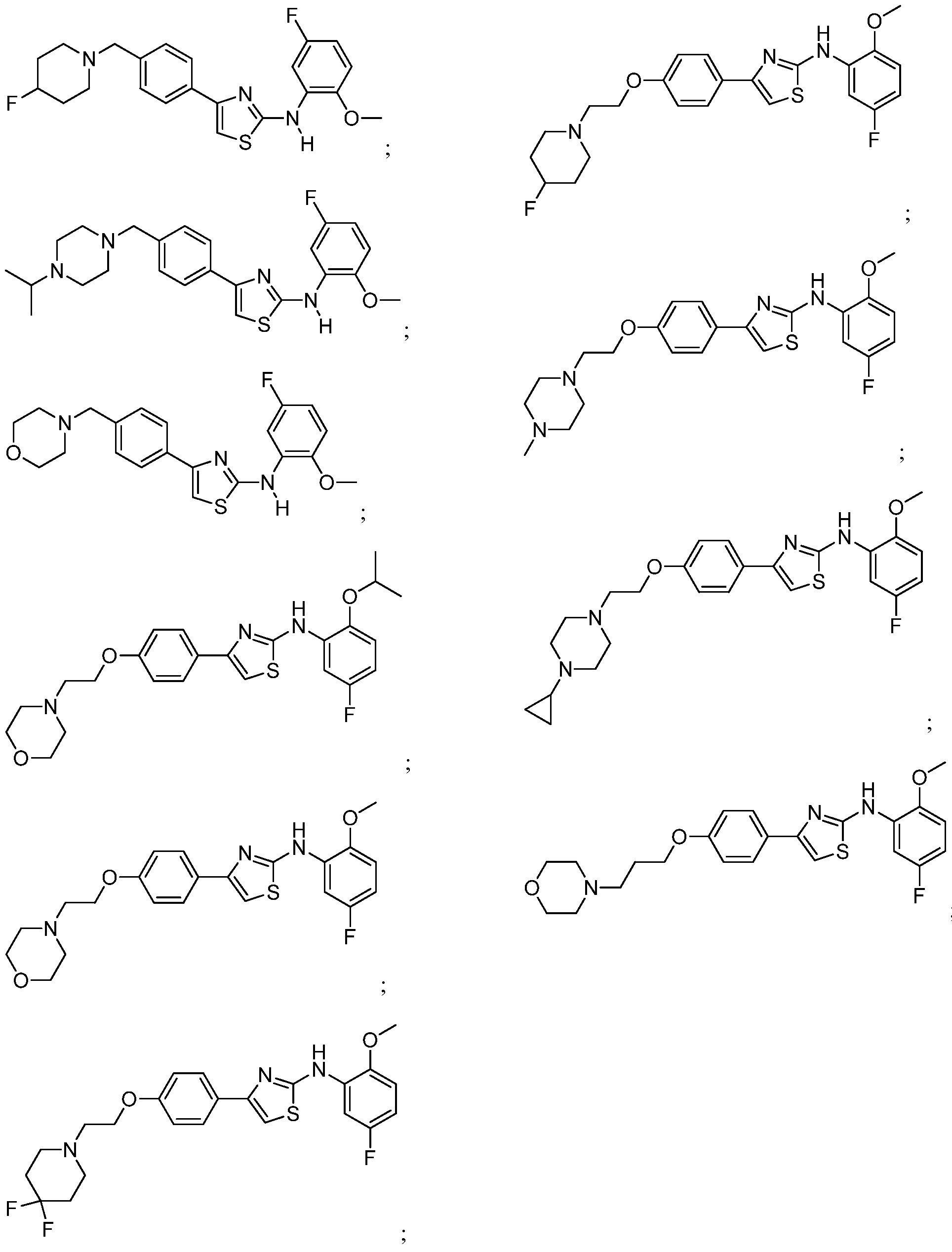
In another embodiment of the invention:
R1 is OCH(CH3)2;
Q is C-R2;
R2 is H;
R3 is H;
J is C-R4;
R4 is F, -CONH2, -C02H, or -S02NH2;
R5 is H;
R6 is
 , N / , , NA A2, C(0)NA1A2,
S02NA1A2, SONA^2, C(0)N(CH3)C(2_6)alkylNA1A2, C(0)NHC(2_6)alkylNA1A2, NHC(0)C(i_ 6)alkylNA1A2, N(CH3)C(0)C(i_6)alkylNA1A2, CH2OC(2_6)alkylNA1A2, CH2NHC(2_6)alkylNA1A2, CH2N(CH3)C(2_6)alkylNA1 A2, NHC(2_6)alkylNA1A2, N(CH3)C(2_6)alkylNA1A2, OC(2_
6)alkylNA1A2, or CH2NA1A2;
A1 is H, or C(i_3)alkyl; 2 is H, C(i_6)alkyl, CH2C(3_6)Cycloalkyl, C(3_6)Cycloalkyl

 , C(2_6)alkylOH, C(2_
6)alkylOCH3, C(2_6)alkylC02C(i_3)alkyl, S02C(i_4)alkyl, C(0)Ph, C(0)C(i_4)alkyl, pyrazinyl, or pyridyl;
or A1 and A2 are taken together with their attached nitrogen to form a ring selected from the group consisting of:

wherein any said A1 and A2 ring, except imidazolyl, may be optionally substituted with up to four methyl groups on two or more ring carbon atoms or optionally substituted with up to two CF3 groups on any two ring carbon atoms, or optionally substituted with one -CONH2 group on any one ring carbon atom;
Rk is selected from the group consisting of H, C02C(CH3)3, CH2CF3, CH2CH2CF3, C(1-5)alkyl,
COC(i_4)alkyl, S02C(i_4)alkyl, CH2C(3-6)Cycloalkyl, CH2-phenyl, and C(3_6)Cycloalkyl;
Rm is H, OCH3, CH2OH, NH(C(i_4)alkyl), N(C(i_4)alkyl)2, NH2, CH3, F, or OH;
R7 is H, C(i_3)alkyl, OCH3, F, CI, Br, -CN, or CF3; and
Rz is independently selected from the group consisting of H, and CH3;
and solvates, hydrates, tautomers, and pharmaceutically acceptable salts thereof.
Another embodiment of the invention is a pharmaceutical composition, comprising a compound of Formula I and a pharmaceutically acceptable carrier.
Another embodiment of the invention is a pharmaceutical composition, comprising a compound listed in the Examples section of this specification and a pharmaceutically acceptable carrier.
The present invention also provides a method for preventing, treating or ameliorating an MMP9 mediated syndrome, disorder or disease comprising administering to a subject in need thereof an effective amount of a compound of Formula I or a form, composition or medicament thereof.
The present invention also provides a method for preventing, treating or ameliorating an MMP13 mediated syndrome, disorder or disease comprising administering to a subject in need thereof an effective amount of a compound of Formula I or a form, composition or medicament thereof.
The present invention also provides a method for preventing, treating or ameliorating an MMP9 mediated syndrome, disorder or disease wherein said syndrome, disorder or disease is associated with elevated MMP9 expression or MMP9 overexpression, or is a condition that accompanies syndromes, disorders or diseases associated with elevated MMP9 expression or MMP9 overexpression comprising administering to a subject in need thereof an effective amount of a compound of Formula I or a form, composition or medicament thereof.
The present invention also provides a method for preventing, treating or ameliorating an MMP13 mediated syndrome, disorder or disease wherein said syndrome, disorder or disease is associated with elevated MMP13 expression or MMP13 overexpression, or is a condition that accompanies syndromes, disorders or diseases associated with elevated MMP13 expression or MMP13 overexpression comprising administering to a subject in need thereof an effective amount of a compound of Formula I or a form, composition or medicament thereof.
The present invention provides a method of preventing, treating or ameliorating a syndrome, disorder or disease, wherein said syndrome, disorder or disease is selected from the group consisting of: neoplastic disorders, osteoarthritis, rheumatoid arthritis, cardiovascular diseases, gastric ulcer, pulmonary hypertension, chronic obstructive pulmonary disease, inflammatory bowel syndrome, periodontal disease, skin ulcers, liver fibrosis, emphysema, Marfan syndrome, stroke, multiple sclerosis, asthma, abdominal aortic aneurysm, coronary artery disease, idiopathic pulmonary fibrosis, renal fibrosis, and migraine, comprising administering to a subject in need
thereof an effective amount of a compound of Formula I or a form, composition or medicament thereof.
The present invention provides a method of preventing, treating or ameliorating a neoplastic disorder, wherein said neoplastic disorder is ovarian cancer, comprising administering to a subject in need thereof an effective amount of a compound of Formula I or a form, composition or medicament thereof.
The present invention provides a method of preventing, treating or ameliorating a cardiovascular disease, wherein said cardiovascular disease is selected from the group consisting of:
atherosclerotic plaque rupture, aneurysm, vascular tissue morphogenesis, coronary artery disease, and myocardial tissue morphogenesis, comprising administering to a subject in need thereof an effective amount of a compound of Formula I or a form, composition or medicament thereof.
The present invention provides a method of preventing, treating or ameliorating atherosclerotic plaque rupture, comprising administering to a subject in need thereof an effective amount of a compound of Formula I or a form, composition or medicament thereof.
The present invention provides a method of preventing, treating or ameliorating rheumatoid arthritis, comprising administering to a subject in need thereof an effective amount of a compound of Formula I or a form, composition or medicament thereof.
The present invention provides a method of preventing, treating or ameliorating asthma, comprising administering to a subject in need thereof an effective amount of a compound of Formula I or a form, composition or medicament thereof.
The present invention provides a method of preventing, treating or ameliorating chronic obstructive pulmonary disease, comprising administering to a subject in need thereof an effective amount of a compound of Formula I or a form, composition or medicament thereof.
The present invention provides a method of preventing, treating or ameliorating inflammatory bowel syndrome, comprising administering to a subject in need thereof an effective amount of a compound of Formula I or a form, composition or medicament thereof.
The present invention provides a method of preventing, treating or ameliorating abdominal aortic aneurism, comprising administering to a subject in need thereof an effective amount of a compound of Formula I or a form, composition or medicament thereof.
The present invention provides a method of preventing, treating or ameliorating osteoarthritis, comprising administering to a subject in need thereof an effective amount of a compound of Formula I or a form, composition or medicament thereof.
The present invention provides a method of preventing, treating or ameliorating idiopathic pulmonary fibrosis, comprising administering to a subject in need thereof an effective amount of a compound of Formula I or a form, composition or medicament thereof.
The invention also relates to methods of inhibiting MMP9 activity in a mammal by
administration of an effective amount of at least one compound of Formula I.
The invention also relates to methods of inhibiting MMP 13 activity in a mammal by administration of an effective amount of at least one compound of Formula I.
In another embodiment, the invention relates to a compound as described in the Examples section for use as a medicament, in particular, for use as a medicament for treating a MMP9 mediated syndrome, disorder or disease.
In another embodiment, the invention relates to the use of a compound as described in the Examples section for the preparation of a medicament for the treatment of a disease associated with an elevated or inappropriate MMP9 activity.
In another embodiment, the invention relates to a compound as described in the Examples section for use as a medicament, in particular, for use as a medicament for treating a MMP 13 mediated syndrome, disorder or disease.
In another embodiment, the invention relates to the use of a compound as described in the Examples section for the preparation of a medicament for the treatment of a disease associated with an elevated or inappropriate MMP 13 activity.
DEFINITIONS
The term "alkyl" refers to both linear and branched chain radicals of up to 12 carbon atoms, preferably up to 6 carbon atoms, unless otherwise indicated, and includes, but is not limited to, methyl, ethyl, propyl, isopropyl, butyl, isobutyl, sec-butyl, tert-butyl, pentyl, isopentyl, hexyl, isohexyl, heptyl, octyl, 2,2,4-trimethylpentyl, nonyl, decyl, undecyl and dodecyl. Any alkyl group may be optionally substituted with one OCH3, one OH, or up to two fluorine atoms.
The term "alkenyl," whether used alone or as part of a substituent group, for example,
"C(i_4)alkenyl(aryl)," refers to a partially unsaturated branched or straight chain monovalent hydrocarbon radical having at least one carbon-carbon double bond, whereby the double bond is derived by the removal of one hydrogen atom from each of two adjacent carbon atoms of a parent alkyl molecule and the radical is derived by the removal of one hydrogen atom from a single carbon atom. Atoms may be oriented about the double bond in either the cis (Z) or trans (E) conformation. Typical alkenyl radicals include, but are not limited to, ethenyl, propenyl, allyl (2-propenyl), butenyl and the like. Examples include C(2-8)alkenyl or C^alkenyl groups.
The term "alkoxy" refers to a saturated branched or straight chain monovalent hydrocarbon alcohol radical derived by the removal of the hydrogen atom from the hydroxide oxygen substituent on a parent alkane. Examples include C(i_6)alkoxy or C(i_4)alkoxy groups. Any
alkoxy group may be optionally substituted with one OCH3, one OH, or up to two fluorine atoms.
The term "C(a-b " (where a and b are integers referring to a designated number of carbon atoms) refers to an alkyl, alkenyl, alkynyl, alkoxy or cycloalkyl radical or to the alkyl portion of a radical in which alkyl appears as the prefix root containing from a to b carbon atoms inclusive. For example, C(1-4) denotes a radical containing 1 , 2, 3 or 4 carbon atoms.
The term "cycloalkyl" refers to a saturated or partially unsaturated monocyclic or bicyclic hydrocarbon ring radical derived by the removal of one hydrogen atom from a single ring carbon atom. Typical cycloalkyl radicals include cyclopropyl, cyclobutyl, cyclopentyl, cyclopentenyl, cyclohexyl, cyclohexenyl, cycloheptyl and cyclooctyl. Additional examples include C(3- 6)Cycloalkyl, C(5_8)Cycloalkyl, decahydronaphthalenyl, and 2,3,4,5,6,7-hexahydro-lH-indenyl. Any cycloalkyl group may be optionally substituted with one OCH3, one OH, or up to two fluorine atoms.
ABBREVIATIONS
Herein and throughout this application, the following abbreviations may be used.
Ac -C(0)CH3
aq. aqueous
Bu butyl
DCM dichloromethane
DMSO dimethylsulfoxide
DIEA diisopropyl ethyl amine
eq equivalents
Et ethyl
g gram
h hours
HATU 2-(7-aza- 1 H-benzotriazole- 1 -yl)- 1 , 1 ,3 ,3 -tetramethyluronium
hexafluorophosphate
hept heptanes
HPLC high pressure liquid chromatography
KHMDS ((CH3)3Si)2NK
NMP N-methyl pyrrolidinone
M molar
Me methyl
mL milliliter
mmol millimole
mg milligram
min minutes
N normal
NMR nuclear magnetic resonance
Pd(dppf)Cl2 [l, -bis(diphenylphosphino)ferrocene]dichloropalladium(II)
Ph phenyl
iPr isopropyl
RP reverse phase
RT room temperature
sat. saturated
TFA trifluoroacetic acid
THF tetrahydrofuran
TLC thin layer chromatography
TsOH para-toluenesulfonic acid
V volume
Pharmaceutically acceptable acidic/anionic salts include, and are not limited to acetate, benzenesulfonate, benzoate, bicarbonate, bitartrate, bromide, calcium edetate, camsylate, carbonate, chloride, citrate, dihydrochloride, edetate, edisylate, estolate, esylate, fumarate, glyceptate, gluconate, glutamate, glycollylarsanilate, hexylresorcinate, hydrabamine, hydrobromide, hydrochloride, hydroxynaphthoate, iodide, isethionate, lactate, lactobionate, malate, maleate, mandelate, mesylate, methylbromide, methylnitrate, methylsulfate, mucate,
napsylate, nitrate, pamoate, pantothenate, phosphate/diphosphate, polygalacturonate, salicylate, stearate, subacetate, succinate, sulfate, tannate, tartrate, teoclate, tosylate and triethiodide.
Organic or inorganic acids also include, and are not limited to, hydriodic, perchloric, sulfuric, phosphoric, propionic, glycolic, methanesulfonic, hydroxyethanesulfonic, oxalic, 2- naphthalenesulfonic, p-toluenesulfonic, cyclohexanesulfamic, saccharinic or trifluoroacetic acid.
Pharmaceutically acceptable basic/cationic salts include, and are not limited to aluminum, 2- amino-2-hydroxymethyl-propane-l,3-diol (also known as tris(hydroxymethyl)aminomethane, tromethane or "TRIS"), ammonia, benzathine, t-butylamine, calcium, calcium gluconate, calcium hydroxide, chloroprocaine, choline, choline bicarbonate, choline chloride,
cyclohexylamine, diethanolamine, ethylenediamine, lithium, LiOMe, L-lysine, magnesium, meglumine, NH3, NH4OH, N-methyl-D-glucamine, piperidine, potassium, potassium- t-butoxide, potassium hydroxide (aqueous), procaine, quinine, sodium, sodium carbonate,
sodium-2-ethylhexanoate (SEH), sodium hydroxide, triethanolamine or zinc.
METHODS OF USE
The present invention is directed to a method for preventing, treating or ameliorating a MMP9 and/or MMP13 mediated syndrome, disorder or disease comprising administering to a subject in need thereof an effective amount of a compound of Formula I or a form, composition or medicament thereof.
Examples of a MMP9 and/or MMP13 mediated syndrome, disorder or disease for which the compounds of Formula I are useful include angiogenesis, osteoarthritis, rheumatoid arthritis, gastric ulcers, pulmonary hypertension, chronic obstructive pulmonary disorder, inflammatory bowel syndrome, periodontal disease, skin ulcers, liver fibrosis, emphysema, Marfan syndrome, stroke, multiple sclerosis, abdominal aortic aneurysm, coronary artery disease, idiopathic pulmonary fibrosis, renal fibrosis, migraine, and cardiovascular disorders including:
atherosclerotic plaque, ruptive aneurysm, vascular tissue morphogenesis, and myocardial tissue morphogenesis.
The term "administering" with respect to the methods of the invention, means a method for therapeutically or prophylactically preventing, treating or ameliorating a syndrome, disorder or
disease as described herein by using a compound of Formula I or a form, composition or medicament thereof. Such methods include administering an effective amount of said compound, compound form, composition or medicament at different times during the course of a therapy or concurrently in a combination form. The methods of the invention are to be understood as embracing all known therapeutic treatment regimens.
The term "subject" refers to a patient, which may be animal, typically a mammal, typically a human, which has been the object of treatment, observation or experiment. In one aspect of the invention, the subject is at risk of (or susceptible to) developing a syndrome, disorder or disease that is associated with elevated MMP9 and/or MMP13 expression or MMP9 and/or MMP13 overexpression, or a patient with an inflammatory condition that accompanies syndromes, disorders or diseases associated with elevated MMP9 and/or MMP13 expression or MMP9 and/or MMP13 overexpression.
The term "therapeutically effective amount" means that amount of active compound or pharmaceutical agent that elicits the biological or medicinal response in a tissue system, animal or human, that is being sought by a researcher, veterinarian, medical doctor, or other clinician, which includes preventing, treating or ameliorating the symptoms of a syndrome, disorder or disease being treated.
When employed as inhibitors of pro-matrix metalloproteinase activation, the compounds of the invention may be administered in an effective amount within the dosage range of about 0.5 mg to about 10 g, preferably between about 0.5 mg to about 5 g, in single or divided daily doses. The dosage administered will be affected by factors such as the route of administration, the health, weight and age of the recipient, the frequency of the treatment and the presence of concurrent and unrelated treatments.
It is also apparent to one skilled in the art that the therapeutically effective dose for compounds of the present invention or a pharmaceutical composition thereof will vary according to the desired effect. Therefore, optimal dosages to be administered may be readily determined by one skilled in the art and will vary with the particular compound used, the mode of administration, the strength of the preparation, and the advancement of the disease condition. In addition, factors associated with the particular subject being treated, including subject age, weight, diet
and time of administration, will result in the need to adjust the dose to an appropriate therapeutic level. The above dosages are thus exemplary of the average case. There can, of course, be individual instances where higher or lower dosage ranges are merited, and such are within the scope of this invention.
The compounds of Formula I may be formulated into pharmaceutical compositions comprising any known pharmaceutically acceptable carriers. Exemplary carriers include, but are not limited to, any suitable solvents, dispersion media, coatings, antibacterial and antifungal agents and isotonic agents. Exemplary excipients that may also be components of the formulation include fillers, binders, disintegrating agents and lubricants.
The pharmaceutically-acceptable salts of the compounds of Formula I include the conventional non-toxic salts or the quaternary ammonium salts which are formed from inorganic or organic acids or bases. Examples of such acid addition salts include acetate, adipate, benzoate, benzenesulfonate, citrate, camphorate, dodecylsulfate, hydrochloride, hydrobromide, lactate, maleate, methanesulfonate, nitrate, oxalate, pivalate, propionate, succinate, sulfate and tartrate. Base salts include ammonium salts, alkali metal salts such as sodium and potassium salts, alkaline earth metal salts such as calcium and magnesium salts, salts with organic bases such as dicyclohexylamino salts and salts with amino acids such as arginine. Also, the basic nitrogen- containing groups may be quaternized with, for example, alkyl halides.
The pharmaceutical compositions of the invention may be administered by any means that accomplish their intended purpose. Examples include administration by parenteral,
subcutaneous, intravenous, intramuscular, intraperitoneal, transdermal, buccal or ocular routes. Alternatively or concurrently, administration may be by the oral route. Suitable formulations for parenteral administration include aqueous solutions of the active compounds in water-soluble form, for example, water-soluble salts, acidic solutions, alkaline solutions, dextrose-water solutions, isotonic carbohydrate solutions and cyclodextrin inclusion complexes.
The present invention also encompasses a method of making a pharmaceutical composition comprising mixing a pharmaceutically acceptable carrier with any of the compounds of the present invention. Additionally, the present invention includes pharmaceutical compositions made by mixing a pharmaceutically acceptable carrier with any of the compounds of the present invention. As used herein, the term "composition" is intended to encompass a product comprising the specified ingredients in the specified amounts, as well as any product which results, directly or indirectly, from combinations of the specified ingredients in the specified amounts.
POLYMORPHS AND SOLVATES
Furthermore, the compounds of the present invention may have one or more polymorph or amorphous crystalline forms and as such are intended to be included in the scope of the invention. In addition, the compounds may form solvates, for example with water (i.e., hydrates) or common organic solvents. As used herein, the term "solvate" means a physical association of the compounds of the present invention with one or more solvent molecules. This physical association involves varying degrees of ionic and covalent bonding, including hydrogen bonding. In certain instances the solvate will be capable of isolation, for example when one or more solvent molecules are incorporated in the crystal lattice of the crystalline solid. The term
"solvate" is intended to encompass both solution-phase and isolatable solvates. Non-limiting examples of suitable solvates include ethanolates, methanolates, and the like.
It is intended that the present invention include within its scope polymorphs and solvates of the compounds of the present invention. Thus, in the methods of treatment of the present invention, the term "administering" shall encompass the means for treating, ameliorating or preventing a syndrome, disorder or disease described herein with the compounds of the present invention or a polymorph or solvate thereof, which would obviously be included within the scope of the invention albeit not specifically disclosed.
The present invention includes within its scope prodrugs of the compounds of this invention. In general, such prodrugs will be functional derivatives of the compounds which are readily convertible in vivo into the required compound. Thus, in the methods of treatment of the present invention, the term "administering" shall encompass the treatment of the various disorders described with the compound specifically disclosed or with a compound which may not be specifically disclosed, but which converts to the specified compound in vivo after administration to the patient.
Where the compounds according to this invention have at least one chiral center, they may accordingly exist as enantiomers. Where the compounds possess two or more chiral centers, they may additionally exist as diastereomers. It is to be understood that all such isomers and mixtures thereof are encompassed within the scope of the present invention.
Where the processes for the preparation of the compounds according to the invention give rise to mixture of stereoisomers, these isomers may be separated by conventional techniques such as preparative chromatography. The compounds may be prepared in racemic form, or individual enantiomers may be prepared either by enantiospecific synthesis or by resolution. The compounds may, for example, be resolved into their component enantiomers by standard techniques, such as the formation of diastereomeric pairs by salt formation with an optically active acid, such as (-)-di-p-toluoyl-D-tartaric acid and/or (+)-di-p-toluoyl-L-tartaric acid followed by fractional crystallization and regeneration of the free base. The compounds may also be resolved by formation of diastereomeric esters or amides, followed by chromatographic separation and removal of the chiral auxiliary. Alternatively, the compounds may be resolved using a chiral HPLC column.
GENERAL SCHEMES:
Compounds of Formula I, can be prepared by methods known to those who are skilled in the art. The following reaction schemes are only meant to represent examples of the invention and are in no way meant to be a limit of the invention.
Scheme 1


Scheme 1 illustrates synthetic routes leading to thiourea intermediate V. Nitro aromatic II may be reduced to the corresponding aniline III using sodium borohydride and a catalytic amount of nickel (II) chloride hexahydrate. The aniline III is converted to an isothiocyanate IV by reaction with thiophosgene and a base, and the isothiocyanate IV is treated with ammonia to provide thiourea V.
Scheme 2

Scheme 2 illustrates synthetic routes leading to compounds of Formula I. Aryl ketone VI may be treated with bromine in a mixture of hydrobromic acid and acetic acid to provide a-bromo ketone VII. Intermediate VII undergoes condensation with thiourea V in an alcoholic solvent such as ethanol to afford compounds of Formula I.
Scheme 3

In many cases, aryl ketone intermediates VI are commercially available. Additional aryl ketones VI may be prepared by methods known to those of skill in the art. For example, as shown in Scheme 3, benzylic bromide VIII can be reacted with an amine in the presence of a base, such as diisopropylethylamine, to form VI, where R6 is CH2NA1A2. In the case where R6 is 0(CH2)2_ 6NAJ A2, phenol IX can be alkylated with an amino-substituted alkyl chloride (C1(CH2)2_6NA1 A2) in the presence of a base, such as sodium ethoxide in ethanol (path 1). Alternatively, phenol IX is alkylated with an alpha,omega-dibromoalkane and a base to provide bromide X, which is then treated with an amine and a base to provide aryl ketone VI (path 2).
Scheme 4

Additional routes to compounds of Formula I where R6 is tetrahydropyridinyl or piperidinyl are depicted in Scheme 4. An aryl bromide XI, prepared as described in Scheme 2, can react with a boronic acid (or ester), in the presence of a palladium catalyst to yield compounds of Formula I where R6 is tetrahydropyridinyl, which can be further reduced to compounds of Formula I where R6 is piperidinyl under hydrogenation conditions.
Scheme 5

A route to compounds of Formula I where R6 is piperazinyl is shown in Scheme 5. Phenol XII is converted to triflate XIII, followed by heating with an amine in a polar solvent such as NMP to provide compounds of Formula I where R6 is piperazinyl.
Scheme 6

(M is Li, Na, or K)
II, where:
XIV, where: Q is C-R2; J is C-R4
Q is C-R2; J is C-R4 R1 is alkoxy, cycloalkoxy
thioalkyl, thiocycloalkyl

Many intermediates of formulae II, III, IV, and V (as used in Scheme 1) are commercially available. Scheme 6 illustrates synthetic routes (paths 1 to 3) to aryl nitro compounds of formula II. A 2-nitrofluoro benzene XIV can be reacted with a metal alkoxide or thiolate to yield II, where R1 is alkoxy, cycloalkoxy, thioalkyl, or thiocycloalkyl (path 1). As shown in path 2, in the case where R4 is S02NH2, the aryl nitro compound XIV may be obtained by heating 2- fluoronitro benzene XV (unsubstituted para to the fluorine) in neat chlorosulfonic acid, typically at reflux, followed by treatment of the aryl sulfonyl chloride intermediate with ammonium hydroxide solution. Additional aryl nitro compounds II may be obtained by treatment of substituted aryls XVI with a nitrating reagent, such as K 03/H2S04, HN03/H2S04, or HN03/Ac20 (path 3). Those skilled in the art will recognize that path 3 is preferably employed
when nitration is desired to occur at a position ortho or para to electron-donating substituents, such as alkoxy or alkyl, and meta to electron-withdrawing substituents, such as CONH2.
EXAMPLES
Intermediate 1: step a
4-Fluoro-3-nitro-benzenesulfonamide

Following the procedure of J. Med. Chem. 2006, 49, 1173, a solution of commercially available 2-fluoronitrobenzene (10.00 g, 70.87 mmol) and chlorosulfonic acid (21 mL) was heated to reflux for 18 hours at 95 °C and then cooled to room temperature. The solution was then added dropwise over a 1 hour period to a solution of i-PrOH (225 mL) and concentrated aqueous NH4OH (54 mL) at -35 °C and stirred for 0.5 hours. The solution was maintained at -35 °C while concentrated aqueous HCl was added until the pH was acidic. The solution was then evaporated to remove some i-PrOH, water was added and the solution was evaporated again to remove most of i-PrOH. More water was added, the mixture was filtered and the solid was washed with 1 N aqueous HCl and water to give the title compound.
Intermediate 1: step b
4-Isopropoxy-3-nitro-benzenesulfonamide

Intermediate 1: step c
3-Amino-4-isopropoxy-benzenesulfonamide

Sodium borohydride (1.88 g, 49.6 mmol) was added slowly to a solution of nickel (II) chloride hexahydrate (3.93 g, 16.5 mmol) in methanol (60 mL) at 0 °C and the resulting black suspension was stirred for 30 min at 23 °C. The mixture was cooled to 0 °C and 4-isopropoxy-3-nitro- benzenesulfonamide (8.60 g, 33.0 mmol, intermediate 1, step b) was added followed by sodium borohydride (4.38 g, 116 mmol). The resulting black suspension was stirred for 30 min at 23 °C. Water was added to the reaction mixture to quench excess NaBH4, followed by addition of saturated aqueous NaHCC"3. The product was extracted with dichloromethane and the organic phase was washed with brine, dried with Na2S04 and evaporated to give the title compound.
Intermediate 1: step d
4-Isopropoxy-3-isothiocyanato-benzenesulfonamide

A solution of sodium bicarbonate (16.8 g, 199.5 mmol) in water (400 mL) was added to 3- amino-4-isopropoxy-benzenesulfonamide (15.3 g, 66.5 mmol, intermediate 1, step c) in a mixture of chloroform (200 mL) and water (200 mL). Thiophosgene (6.37 mL, 83.1 mmol) was then added. The biphasic solution was stirred at room temperature for 1.5 h. The phases were separated and the aqueous phase was extracted with CH2CI2. The organic phase was washed with water, dried (Na2S04), filtered, and concentrated, yielding the crude title compound as a tan solid.
Intermediate 1: step e
4-Isopropoxy-3-thioureido-benzenesulfonamide

Crude 4-isopropoxy-3-isothiocyanato-benzenesulfonamide (17.8 g, 65.2 mmol, intermediate 1, step d) was treated with a 2.0 M solution of ammonia in MeOH (250 mL) and the resulting solution was stirred at room temperature for 18 h. The reaction mixture was then concentrated to about half the volume until a large amount of tan solid precipitated. The solution was cooled to 0 °C for 30 minutes and was filtered. The solid was washed with methanol and ether to give the title compound as a cream colored solid.
Intermediate 2: step a
4-Fluoro-3-nitro-benzamide

A round bottom flask fitted with a reflux condenser vented through an aqueous sodium hydroxide solution was charged with 4-fluoro-3-nitro-benzoic acid (5.0 g, 27 mmol, Aldrich). Thionyl chloride (20 mL) was added and the resulting suspension was heated in an 80 °C oil bath for 3 h. The mixture was concentrated and the residual oil was dissolved in THF (20 mL) and added slowly via pipette to an ice-cold solution of concentrated aqueous NH4OH (20 mL). The resulting bright yellow mixture was stirred at 0 °C for 35 min. The mixture was partially concentrated to remove THF and the residual solution was extracted with EtOAc. The organic phase was dried (Na2S04), filtered, and concentrated. The residue was purified by flash column chromatography (Silica gel, 1-3% EtOH-CH2Cl2) to afford the title compound as a white solid.
Intermediate 2: step b
-Isopropoxy-3-nitro-benzamide

To a solution of i-PrOH (0.619 mL, 8.09 mmol) in THF (25 mL) at 0 °C was added a 0.5 M solution of KHMDS in toluene (16.2 mL, 8.09 mmol) followed by 4-fluoro-3-nitro-benzamide (993 mg, 5.39 mmol, intermediate 2, step a). The resulting brown suspension was stirred at 0 °C for 1 h, then was allowed to warm to 23 °C and was stirred for an additional 4 h. The mixture was partially concentrated to remove THF and was diluted with water and extracted with EtOAc. The organic phase was dried (Na2S04), filtered, and concentrated, affording the crude title compound as an orange solid which was used without further purification in the next reaction.
Intermediate 2: step c
-Amino-4-isopropoxy-benzamide

Sodium borohydride (250 mg, 6.60 mmol) was added slowly to a solution of nickel (II) chloride hexahydrate (567 mg, 2.20 mmol) in MeOH (30 mL) at 0 °C and the resulting black suspension was stirred for 30 min at 23 °C. The mixture was cooled to 0 °C and to it was added a suspension of crude 4-isopropoxy-3-nitro-benzamide (0.987 g, 4.40 mmol, intermediate 2, step b) in MeOH (20 mL), followed by sodium borohydride (583 mg, 15.4 mmol). The mixture was stirred for 1 hour at 23 °C. The mixture was partially concentrated to remove most of the MeOH, water was added to quench excess NaBH4, and the mixture was partitioned between EtOAc and water. The aqueous phase was extracted with EtOAc. The organic phase was dried (Na2S04), filtered, and concentrated. The residue was purified by flash column chromatography (Silica gel, 1-6% MeOH-CH2Cl2), yielding the title compound as a white powder.
Intermediate 2: step d
-Isopropoxy-3-isothiocyanato-benzamide

A solution of sodium bicarbonate (645 mg, 7.68 mmol) in water (15 mL) was added to 3-amino- 4-isopropoxy-benzamide (497 mg, 2.56 mmol, intermediate 2, step c) in a mixture of chloroform (15 mL) and water (15 mL). Thiophosgene (0.206 mL, 2.69 mmol) was then added. The biphasic solution was stirred at room temperature for 2.5 h. TLC analysis indicated slight remaining starting material, so an additional 0.030 mL portion of thiophosgene was added and
the mixture was stirred for 40 min. The phases were separated and the aqueous phase was extracted with CH2CI2. The organic phase was dried (Na2S04), filtered, and concentrated, yielding the crude title compound as an off-white solid.
Intermediate 2: step e
-Isopropoxy-3-thioureido-benzamide

Crude 4-isopropoxy-3-isothiocyanato-benzamide (608 mg, intermediate 2, step d) was suspended in MeOH (2 mL). A 2 M solution of ammonia in MeOH (2 mL) was added and the resulting yellow solution was stirred at room temperature for 16 h. The reaction mixture was concentrated and the residue was purified by flash column chromatography (3-8% MeOH-CELCb), affording the title compound as a white powder.
Intermediate 3: step a
-Ethoxy-3-isothiocyanatopyridine

To a stirred mixture of 4-ethoxypyridin-3 -amine (1.04 g, 7.53 mmol) and sodium bicarbonate (1.90 g, 22.8 mmol) in chloroform (15 mL) and water (10 mL) at 4 °C was added thiophosgene (0.70 mL, 9.13 mmol) dropwise. The cooling bath was removed and the biphasic mixture was stirred at room temperature for 4 h. TLC analysis indicated some of the starting material still present. More thiophosgene (0.2 mL, 2.6 mmol) was added and stirring was continued for another 1 h and filtered. The organic layer was separated, and the aqueous layer was extracted
with CH2CI2. The combined organic layers were dried (Na2S04) and concentrated to give the crude title compound as a brown solid.
Intermediate 3: step b
-(4-Ethoxypyridin-3-yl)thiourea

The above crude 4-ethoxy-3-isothiocyanatopyridine (intermediate 3, step a) in MeOH (11 mL) was treated with a 7 N solution of ammonia in MeOH (11 mL) at room temperature for 18 h and filtered. The solid was washed with EtOH and Et20, and dried to give the title compound as an off-white solid. The filtrate was concentrated and purified by solid loading column chromatography (silica gel, 5-10% MeOH-CIHLCb) to obtain the title compound as a light brown solid.
Intermediate 4: step a
3-Nitro-4-trifluoromethoxy-benzenesulfonamide

To chlorosulfonic acid (11.3 mL, 170 mmol) was slowly added commercially available 2- trifluoromethoxy-nitrobenzene (8 g, 38.6 mmol). The reaction mixture was heated at 120 °C for 4 h and then cooled down. The above crude mixture was added to a stirred solution of cone. aq. NH4OH (34.7 mL, 514 mmol, 14.8 M) in iPrOH (100 mL) at -45 °C dropwise over 30 min. The reaction mixture was stirred at -45 °C for 1 h, and 2 N HCl was added to acidify the mixture. Concentration to remove iPrOH was followed by suspension in water, and filtration of the solid. The solid was washed successively with 1 N HCl and water, then air dried to yield the title compound as a white solid.
Intermediate 4: step b
3-Amino-4-trifluoromethoxy-benzenesulfonamide
Sodium borohydride (1.29 g, 34.2 mmol) was added slowly to a solution of nickel (II) chloride hexahydrate (2.70 g, 11.4 mmol) in MeOH (70 mL) at 0 °C and the resulting black suspension was stirred for 30 min at 23 °C. The mixture was cooled to 0 °C and to it was added a suspension of crude 3-nitro-4-trifluoromethoxy-benzenesulfonamide (6.52 g, 22.8 mmol, intermediate 4, step a) in MeOH (20 mL), followed by sodium borohydride (3.01 g, 79.7 mmol). The mixture was stirred for 40 minutes at 23 °C. Water was added to quench excess NaBH4, and the mixture was filtered through celite and then partitioned between EtOAc and water. The aqueous phase was extracted with EtOAc. The organic phase was dried (Na2S04), filtered, and concentrated. The residue was purified by normal phase column chromatography to give the title compound.
Intermediate 4: step c
3-Isothiocyanato-4-trifluoromethoxy-benzenesulfonamide
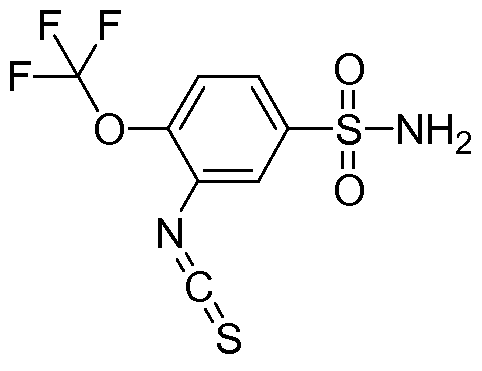
A solution of sodium bicarbonate (3.8 g, 45.2 mmol) in water (50 mL) was added to 3-amino-4- trifluoromethoxy-benzenesulfonamide (3.84 g, 15.0 mmol, intermediate 4, step b) in chloroform (100 mL). Thiophosgene (1.44 mL, 18.7 mmol) was then added. The biphasic solution was stirred at room temperature for 2 h. TLC analysis indicated slight remaining starting material, so
an additional 0.5 mL portion of thiophosgene was added and the mixture was stirred for 40 min. The reaction mixture was partially concentrated to get rid of most chloroform. The precipitated solid was filtered, washed with water, and air dried, yielding the crude title compound as an off- white solid.
Intermediate 4: step d
3-Thioureido-4-trifluoromethoxy-benzenesulfonamide

Crude 3-isothiocyanato-4-trifluoromethoxy-benzenesulfonamide (2.2 g, intermediate 4, step c) was dissolved in a 2 M solution of ammonia in MeOH (29.5 mL). The resulting yellow solution was stirred at room temperature for 16 h. The reaction mixture was concentrated and dried under vacuum to afford the title compound as a foamy solid.
Intermediate 5: step a
-Isothiocyanato-4-methoxypyridine

The title compound was prepared according to the procedure of intermediate 3, step a, using 4- methoxypyridin-3 -amine in place of 4-ethoxypyridin-3 -amine.
Intermediate 5: step b
l-(4-Methoxypyridin-3-yl)thiourea

3-Isothiocyanato-4-methoxypyridine (2.85 g, 17.4 mmol, intermediate 5, step a) was added to a solution of 2N ammonia in methanol (50 mL) and stirred at room temperature overnight. The reaction mixture was concentrated and the residue was dissolved in THF, methanol and dichloromethane and dried on silica gel, then purified by flash column chromatography to give the title compound.
Intermediate 6: step a
3-Nitro-4-trifluoromethoxy-benzamide

To concentrated aqueous sulfuric acid (3 mL) was slowly added 90% aqueous nitric acid (3 mL) and the resulting solution was cooled in an ice-bath. Solid 4-trifluoromethoxy-benzamide (1.0 g, 4.88 mmol, Alfa) was slowly added and the reaction mixture was stirred at room temperature for 10 min, then was poured into a stirred ice/water mixture. The white precipitate was collected by vacuum filtration and washed with water, affording the crude title compound, which was used without further purification.
Intermediate 6: step b
3-Amino-4-trifluoromethoxy-benzamide

To a solution of nickel(II) chloride hexahydrate (470 mg, 1.98 mmol) in MeOH (10 mL) at 0 °C was slowly added sodium borohydride (225 mg, 5.94 mmol) (caution: gas evolution). The resulting black suspension was stirred at room temperature for 30 min, then was cooled to 0 °C before addition of crude 3-nitro-4-trifluoromethoxy-benzamide (0.99 g, 3.96 mmol, intermediate 6, step a) and a second portion of sodium borohydride (524 mg, 13.9 mmol). The resulting black suspension was stirred at room temperature for 0.5 h before addition of a small amount of water to quench remaining borohydride. The mixture was diluted with sat. aq. NaHC03 and extracted with CH2CI2. To facilitate extraction of the polar product, the aqueous phase was saturated with NaCl, then was further extracted with CH2CI2. The organic phase was washed with saturated aqueous NaCl and was dried (Na2S04), filtered, and concentrated. The residual white solid was purified by flash column chromatography (Silica gel, 20-100% EtOAc-Hept), affording the title compound as an off-white solid.
Intermediate 6: step c
3-Isothiocyanato-4-trifluoromethoxy-benzamide

The title compound was prepared according to the procedure of intermediate 3, step a, using 3- amino-4-trifluoromethoxy-benzamide (intermediate 6, step b) in place of 4-ethoxypyridin-3- amine.
Intermediate 6: step d
3-Thioureido-4-trifluoromethoxy-benzamide

Crude 3-isothiocyanato-4-trifluoromethoxy-benzamide (444 mg, 1.69 mmol, intermediate 6, step c) was treated with a solution of ammonia in methanol (2 M, 10 mL, 20 mmol) and the resulting yellow solution was stirred at 40 °C for 30 min. The reaction mixture was concentrated onto Silica gel for purification by column chromatography (Silica gel, 20-100% EtOAc-Hept), which afforded the title compound as a white solid.
Intermediate 7: step a
7-Isothiocyanato-2,3-dihydro-benzofuran-5-sulfonic acid amide
0=S=0
NH2
The title compound was prepared according to the procedure of intermediate 3, step a, using 7- amino-2,3-dihydro-benzofuran-5-sulfonic acid amide (Butt Park Ltd) in place of 4- ethoxypyridin-3-amine.
Intermediate 7: step b
7-Thioureido-2,3-dihydro-benzofuran-5-sulfonic acid amide

The title compound was prepared using 7-isothiocyanato-2,3-dihydro-benzofuran-5-sulfonic acid amide (intermediate 7, step a) in place of 4-isopropoxy-3-isothiocyanato-benzamide according to the procedure described for intermediate 2, step e.
Intermediate 8: step a
-Isobutyl-benzamide

The title compound was prepared as a white powder using 4-isobutyl-benzoic acid (TCI) in place of 4-fluoro-3-nitro-benzoic acid according to the procedure of intermediate 2, step a, except that
after partial concentration to remove THF, the product precipitated out of solution and was filtered to give the title compound.
Intermediate 8: step b
-Isobutyl-3-nitro-benzamide

The title compound was prepared using 4-isobutyl-benzamide (intermediate 8, step a) in place of 4-methoxy-2-methyl-benzamide according to the procedure of intermediate 9, step b.
Intermediate 8: step c
butyl-benzamide

Sodium borohydride (0.64 g, 16.9 mmol) was added slowly to a solution of nickel (II) chloride hexahydrate (1.34 g, 5.64 mmol) in MeOH (20 mL) at 0 °C and the resulting black suspension was stirred for 20 min at 23 °C. The mixture was cooled to 0 °C and to it was added 4-isobutyl- 3-nitro-benzamide (2.51 g, 11.3 mmol, intermediate 8, step b) followed by sodium borohydride (1.49 g, 39.5 mmol). The mixture was stirred for 30 min at 23 °C. A small amount of water was added to quench excess NaBH4 and the mixture was diluted with sat. aq. NaHCC and was filtered through Celite. The filtrate was extracted with EtOAc. The organic phase was dried (Na2S04), filtered, and concentrated, affording the crude title compound as an off-white solid.
Intermediate 8: step d
-Isobutyl-3-isothiocyanato-benzamide

The title compound was prepared using 3-amino-4-isobutyl-benzamide (intermediate 8, step c) in place of 3-amino-4-isopropoxy-benzamide according to the procedure described for intermediate 2, step d. (The reaction was monitored by TLC and several additional portions of thiophosgene were added until the reaction approached complete conversion).
Intermediate 8: step e
-Isobutyl-3-thioureido-benzamide

The title compound was prepared using 4-isobutyl-3-isothiocyanato-benzamide (intermediate 8, step d) in place of 4-isopropoxy-3-isothiocyanato-benzamide according to the procedure described for intermediate 2, step e. The reaction mixture was concentrated to approximately half its original volume and cooled to 0 °C, causing precipitation. The precipitated white solid was collected by vacuum filtration and washed with MeOH to afford the title compound.
Intermediate 9: step a
4-Methoxy-2-methyl-benzamide

The title compound was prepared as a white powder using 4-methoxy-2-methyl-benzoic acid (Aldrich) in place of 4-fluoro-3-nitro-benzoic acid according to the procedure of intermediate 2, step a, except that after partial concentration to remove THF, the product precipitated out of solution and was filtered to give the title compound.
Intermediate 9: step b
4-M thoxy-2-methyl-5-nitro-benzamide

4-Methoxy-2-methyl-benzamide (7.75 g, 46.9 mmol, intermediate 9, step a) was cooled to 0 °C and concentrated sulfuric acid (40 mL) was added followed by potassium nitrate (4.74 g, 46.9 mmol) and the resulting brown suspension was stirred at room temperature for 40 min, then was slowly added to ice. The cream-colored precipitate was collected by vacuum filtration. The solid was dissolved in a mixture of THF and CH2CI2 and was dried over Na2S04, filtered, and concentrated, affording the crude title compound as a white solid.
Intermediate 9: step c
5-Amino-4-methoxy-2-methyl-benzamide

Intermediate 9: step d
-Isothiocyanato-4-methoxy-2-methyl-benzamide

The title compound was prepared using 5-amino-4-methoxy-2-methyl-benzamide (intermediate 9, step c) in place of 3-amino-4-isopropoxy-benzamide according to the procedure described for intermediate 2, step d. During the extraction, precipitated solid made separation of the phases difficult; the solid was collected by vacuum filtration and was combined with the organic extracts. The crude title compound was obtained as a cream colored solid.
Intermediate 9: step e
-Methoxy-2-methyl-5-thioureido-benzamide

The title compound was prepared using 5-isothiocyanato-4-methoxy-2-methyl-benzamide (intermediate 9, step d) in place of 4-isopropoxy-3-isothiocyanato-benzamide according to the procedure described for intermediate 2, step e. The reaction mixture was concentrated to approximately half its original volume and cooled to 0 °C, causing precipitation. The precipitated tan crystalline solid was collected by vacuum filtration and washed with MeOH to afford the title compound.
Intermediate 10: step a l-(4-(2-morpholinoethoxy)phenyl)ethanone

1- (4-Hydroxyphenyl)ethanone (3.0 g, 22.0 mmol) and 4-(2-chloroethyl)morpholine-HCl (4.1 g, 22.0 mmol) were added sequentially to a solution of sodium ethoxide in EtOH (21 wt. %, 16.45 mL, 44.1 mmol) and the resulting yellow suspension was heated to reflux for 3.5 h, then was allowed to stand at room temperature overnight. The mixture was concentrated, the residue treated with 2 N aq. HCl, and washed with diethyl ether. The aq. phase was basified to pH 10 with 1 N aq. NaOH, then was extracted with diethyl ether. The organic phase was dried (Na2S04), filtered, and concentrated. The residue was purified by column chromatography (Silica gel, 75-100% EtOAc-Hept), affording impure title compound which was used as is in the next step.
Intermediate 10: step b
2- bromo-l-(4-(2-morpholinoethoxy)phenyl)ethanone*HBr

A solution of bromine (0.227 mL, 4.41 mmol) in 48% aq. HBr (2 mL) was added to a mixture of l-(4-(2-morpholinoethoxy)phenyl)ethanone (1.00 g, 4.01 mmol, intermediate 10, step a) in 48% aq. HBr (8 mL). The reaction mixture was heated in a 60 °C oil bath for 2 h. The mixture was concentrated from toluene twice. The resulting orange oil was stirred in THF; a cream-colored
solid precipitated and was collected by vacuum filtration, washed with THF, and air-dried, affording the crude title compound which was used in the next step without further purification.
Intermediate 11: step a l-(4-(2-bromoethoxy)phenyl)ethanone

To a mixture of l-(4-hydroxyphenyl)ethanone (4.40 g, 32.3 mmol) and potassium carbonate (4.47 g, 32.3 mmol) was added DMF (25 mL) and the resulting suspension was stirred at room temperature for 10 min before addition of 1 ,2-dibromoethane (13.9 mL, 161.6 mmol). The reaction mixture was heated in a 120 °C oil bath for 2 h, then was poured into ice water. The mixture was extracted with EtOAc, using sat. aq. NaCl to aid separation of phases. The org. phase was washed twice with sat. aq. NaCl. The organic phase was dried (Na2S04), filtered, and concentrated. The residue was purified by column chromatography (Silica gel, 5-20% EtOAc- Hept), affording the title compound as a white powder.
Intermediate 11: step b l-(4-(2-(4,4-difluoropiperidin-l-yl)ethoxy)phenyl)ethanone

A suspension of l-(4-(2-bromoethoxy)phenyl)ethanone (300 mg, 1.23 mmol, intermediate 11, step a), 4,4-difluoropiperidine-FiCl (233 mg, 1.48 mmol), potassium carbonate (426 mg, 3.09 mmol), and DMF (3 mL) was stirred at 80 °C overnight. The reaction mixture was diluted with water and extracted with EtOAc. The organic phase was dried (Na2S04), filtered, and
concentrated. The residue was purified by column chromatography (Silica gel, 30-80% EtOAc- Hept), affording the title compound as a colorless oil.
Intermediate 11: step c
2-bromo-l-(4-(2-(4,4-difluoropiperidin-l-yl)ethoxy)phenyl)ethanone*HBr

The title compound was prepared using l-(4-(2-(4,4-difluoropiperidin-l- yl)ethoxy)phenyl)ethanone (intermediate 11 , step b) according to the procedure of intermediate 10, step b.
Intermediate 12: step a l-(4-(2-(4-fluoropiperidin-l-yl)ethoxy)phenyl)ethanone

The title compound was prepared using 4-fluoropiperidine-HCl according to the procedure of intermediate 11, step b.
Intermediate 12: step b
2-bromo-l-(4-(2-(4-fluoropiperidin-l-yl)ethoxy)phenyl)ethanone*HBr

The title compound was prepared using l-(4-(2-(4-fluoropiperidin-l-yl)ethoxy)phenyl)ethanone (intermediate 12, step a) according to the procedure of intermediate 10, step b, except that EtOAc was used instead of THF in the trituration.
Intermediate 13: step a l-(4-(2-(4-methylpiperazin-l-yl)ethoxy)phenyl)ethanone

The title compound was prepared using 1-methylpiperazine according to the procedure of intermediate 11, step b (column chromatography eluent 1-10% MeOH-DCM).
Intermediate 13: step b
2-bromo-l-(4-(2-(4-methylpiperazin-l-yl)ethoxy)phenyl)ethanone*HBr

The title compound was prepared using l-(4-(2-(4-methylpiperazin-l-yl)ethoxy)phenyl)ethanone (intermediate 13, step a) according to the procedure of intermediate 10, step b.
Intermediate 14: step a
l-(4-(2-(4-cyclopropylpiperazin-l-yl)ethoxy)phenyl)ethanone

The title compound was prepared using 1-cyclopropylpiperazine according to the procedure of intermediate 11, step b (column chromatography eluent 1-10% MeOH-DCM).
Intermediate 14: step b
2-bromo-l-(4-(2-(4-cyclopropylpiperazin-l-yl)ethoxy)phenyl)ethanone*HBr

The title compound was prepared using l-(4-(2-(4-cyclopropylpiperazin-l- yl)ethoxy)phenyl)ethanone (intermediate 14, step a) according to the procedure of intermediate 10, step b.
Intermediate 15: step a l-(4-(3-bromopropoxy)phenyl)ethanone

The title compound was prepared using 1,3-dibromopropane according to the procedure of intermediate 11 , step a, except the reaction was heated overnight.
Intermediate 15: step b l-(4-(3-morpholinopropoxy)phenyl)ethanone

The title compound was prepared using morpholine and l-(4-(3-bromopropoxy)phenyl)ethanone (intermediate 15, step a) according to the procedure of intermediate 11, step b (column chromatography eluent 1-5% MeOH-DCM).
Intermediate 15: step c
2-bromo-l-(4-(3-morpholinopropoxy)phenyl)ethanone*HBr

The title compound was prepared using l-(4-(3-morpholinopropoxy)phenyl)ethanone (intermediate 15, step b) according to the procedure of intermediate 10, step b.
Intermediate 16
2-Bromo-l-(4-(piperazin-l-yl)phenyl)ethanone*HBr

To a suspension of l-(4-(piperazin-l-yl)phenyl)ethanone (1.00 g, 4.90 mmol) in HOAc (5 mL) was added a solution of 33% HBr in HOAc (5 mL, 28.5 mmol) and it became a clear solution. A solution of 48% HBr in water (1.7 mL, 15 mmol) was then added followed by 1.0 M Br2 in
HOAc (4.9 mL, 4.9 mmol). The mixture was stirred at RT for ~4.5 h, concentrated and dried under vacuum overnight to give the title compound as a light brown solid, which was used in the next step reaction without further purification.
Intermediate 17
2-Bromo-l-(3-bromo-4-(piperazin-l-yl)phenyl)ethanone

To a suspension of l-(4-(piperazin-l-yl)phenyl)ethanone (250 mg, 1.22 mmol) in HOAc (3 mL) was added a solution of 1.0 M Br2 in HOAc (1.25 mL, 1.25 mmol) dropwise. The mixture was stirred at RT for 1 h, and ice was added. The mixture was extracted with CH2C12 (x 2) and EtOAc (x 2). The organic layer was dried and concentrated to give the title compound as a yellow oil, which was used in the next step reaction without further purification.
Intermediate 18: step a
-(4-(4-Benzylpiperazin-l-yl)phenyl)ethanone

To l-(4-(piperazin-l-yl)phenyl)ethanone (1.52 g, 7.44 mmol) and K2C03 (1.13 g, 8.19 mmol) in THF (10 mL) was added benzyl bromide (1.40 g, 8.19 mmol) in THF (3 mL) dropwise, then rinsed with THF. The mixture was stirred at RT for 20 h, filtered off the solid, and rinsed with EtOAc. The filtrate was concentrated and purified by flash chromatography (24 g silica gel column, 30-50% EtO Ac-heptane) to give the title compound as a white solid.
Intermediate 18: step b
l-(4-(4-Benzylpiperazin-l-yl)phenyl)-2-bromoethanone*HBr

To a suspension of l-(4-(4-benzylpiperazin-l-yl)phenyl)ethanone (626 mg, 2.13 mmol, Intermediate 18, step a) in HO Ac (6 mL) was added 48% HBr in water (2.5 mL, 22 mmol) followed by 33% HBr in HO Ac (3 mL). After stirring for 20 min, a solution of 1.0 M Br2 in HO Ac (2.2 mL, 2.2 mmol) was added dropwise. The suspension was stirred at RT for 3.5 days, and ice-water was added. The yellow solid was filtered, washed with water, and dried under vacuum overnight to afford the title compound.
Intermediate 19: step a l-(4-((4-methylpiperazin-l-yl)methyl)phenyl)ethanone

A solution of commercially available l-(4-(bromomethyl)phenyl)ethanone (0.20 g, 0.94 mmol), 1-methylpiperazine (0.09 g, 0.94 mmol) and diisopropylamine (0.32 mL) in THF (3 mL) was heated in a sealed tube at 80 °C for several hours. The reaction was then cooled to room temperature and saturated NaHC03 was added and stirred for several minutes. The crude product was extracted with ethyl acetate, dried with Na2S04 and purified via column chromatography to afford the title compound.
Intermediate 19: step b
2-bromo-l-(4-((4-methylpiperazin-l-yl)methyl)phenyl)ethanone*HBr
 Bromine (0.96 mL, 0.5 M in AcOH) was added to a solution of l-(4-((4-methylpiperazin-l- yl)methyl)phenyl)ethanone (0.11 g, 0.48 mmol, intermediate 19, step a) in 48% HBr (2 mL) at 60 °C and continued to stir at this temperature overnight. The reaction was cooled to room temperature and evaporated several times in the presence of toluene, then dried on high vacuum for several minutes at 100 °C to give the title compound.
Intermediate 20: step a l-(4-(morpholinomethyl)phenyl)ethanone

The title compound was prepared using morpholine in place of 1-methylpiperazine according to the procedure described for Intermediate 19: step a.
Intermediate 20: step b
2-bromo-l-(4-(morpholinomethyl)phenyl)ethanone*HBr

The title compound was prepared using l-(4-(morpholinomethyl)phenyl)ethanone (intermediate 20, step a) in place of l-(4-((4-methylpiperazin-l-yl)methyl)phenyl)ethanone according to the procedure described for Intermediate 19: step b, except compound was not dried on high vacuum.
Intermediate 21: step a l-(4-((4-isopropylpiperazin-l-yl)methyl)phenyl)ethanone

The title compound was prepared using 1-isopropylpiperazine in place of 1-methylpiperazine according to the procedure described for Intermediate 19: step a.
Intermediate 21: step b
2-bromo-l-(4-((4-isopropylpiperazin-l-yl)methyl)phenyl)ethanone*HBr

The title compound was prepared using l-(4-((4-isopropylpiperazin-l- yl)methyl)phenyl)ethanone (intermediate 21, step a) in place of l-(4-((4-methylpiperazin-l- yl)methyl)phenyl)ethanone according to the procedure described for Intermediate 19: step b.
Intermediate 22: step a l-(4-((4-cyclopropylpiperazin-l-yl)methyl)phenyl)ethanone

The title compound was prepared using 1-cyclopropylpiperazine in place of 1-methylpiperazine according to the procedure described for Intermediate 19: step a.
Intermediate 22: step b
2-bromo-l-(4-((4-cyclopropylpiperazin-l-yl)methyl)phenyl)ethanone*HBr
 The title compound was prepared using l-(4-((4-cyclopropylpiperazin-l- yl)methyl)phenyl)ethanone (intermediate 22, step a) in place of l-(4-((4-methylpiperazin-l- yl)methyl)phenyl)ethanone according to the procedure described for Intermediate 19: step b.
Intermediate 23: step a l-(4-((4-fluoropiperidin-l-yl)methyl)phenyl)ethanone

The title compound was prepared using 4-fluoro-piperidine.HCl in place of 1-methylpiperazine according to the procedure described for Intermediate 19: step a.
Intermediate 23: step b
2-bromo-l-(4-((4-fluoropiperidin-l-yl)methyl)phenyl)ethanone*HBr

The title compound was prepared using l-(4-((4-fluoropiperidin-l-yl)methyl)phenyl)ethanone (intermediate 23, step a) in place of l-(4-((4-methylpiperazin-l-yl)methyl)phenyl)ethanone according to the procedure described for Intermediate 19: step b.
Intermediate 24: step a
(R)-l-(4-((3-fluoropyrrolidin-l-yl)methyl)phenyl)ethanone

The title compound was prepared using R-(-)-3-fluoropyrrolidine.HCl in place of 1- methylpiperazine according to the procedure described for Intermediate 19: step a.
Intermediate 24: step b
(R)-2-bromo-l-(4-((3-fluoropyrrolidin-l-yl)methyl)phenyl)ethanone*HBr

The title compound was prepared using (R)-l-(4-((3-fluoropyrrolidin-l- yl)methyl)phenyl)ethanone (intermediate 24, step a) in place of l-(4-((4-methylpiperazin-l- yl)methyl)phenyl)ethanone according to the procedure described for Intermediate 19: step b.
Intermediate 25: step a
4-Fluoro-2-isothiocyanato-l-methoxy-benzene

The title compound was prepared using 5-fluoro-2-methoxy-phenylamine (Aldrich) in place of 3-amino-4-isopropoxy-benzenesulfonamide according to the procedure of intermediate 1, step d.
Intermediate 25: step b
-Fluoro-2-methoxy-phenyl)-thiourea
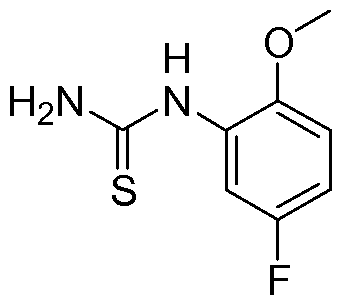
The title compound was prepared using 4-fluoro-2-isothiocyanato-l-methoxy-benzene (intermediate 25, step a) in place of 4-isopropoxy-3-isothiocyanato-benzamide according to the procedure of intermediate 2, step e.
Intermediate 26: step a
-Fluoro-l-isopropoxy-2-isothiocyanato-benzene

The title compound was prepared using 5-fluoro-2-isopropoxy-phenylamine (Combi-Blocks) in place of 3-amino-4-isopropoxy-benzenesulfonamide according to the procedure described for intermediate 1, step d (reaction time 3 h).
Intermediate 26: step b
-Fluoro-2-isopropoxy-phenyl)-thiourea

The title compound was prepared using 4-fluoro-l-isopropoxy-2-isothiocyanato-benzene (intermediate 26, step a) in place of 4-isopropoxy-3-thioureido-benzamide according to the procedure described for intermediate 2, step e (reaction temperature 40 °C, reaction time 30 min), except that the crude product obtained from concentration of the reaction mixture was used without further purification.
Intermediate 27
4-(2-((2-Isopropoxy-5-sulfamoylphenyl)amino)thiazol-4-yl)phi
trifluoromethanesulfonate

To a solution of 3-((4-(4-hydroxyphenyl)thiazol-2-yl)amino)-4-isopropoxybenzenesulfonamide (486 mg, 0.999 mmol, Intermediate 30) in DMF (3.5 mL) at 4 °C was added 60% NaH in mineral oil (50 mg, 1.3 mmol). After stirring at 4 °C for ~7 min, 1,1,1-trifluoro-N-phenyl-N- ((trifluoromethyl)sulfonyl)methanesulfonamide (535 mg, 1.50 mmol) was added portionwise. After stirring at 4 °C for 10 min, the cooling bath was removed. Stirring was continued at RT for 30 min. More 60% NaH in mineral oil (40 mg, 1.0 mmol) was added, and the mixture was stirred for 2.5 days and concentrated. Flash chromatography (40 g silica gel column, 30-50% EtO Ac-heptane) provided the title compound as an orange solid.
Intermediate 28
3-((4-(4-Bromophenyl)thiazol-2-yl)amino)-4-isopropoxybenzamide

The title compound was prepared using 4-isopropoxy-3-thioureido-benzamide (Intermediate 2, step e) in place of 4-isopropoxy-3-thioureido-benzenesulfonamide (Intermediate 1, step e) by the method of Intermediate 31.
Intermediate 29
4-(4-Bromophenyl)-N-(4-ethoxypyridin-3-yl)thiazol-2-amine

The title compound was prepared using l-(4-ethoxypyridin-3-yl)thiourea (Intermediate 3, step b) in place of 4-isopropoxy-3-thioureido-benzenesulfonamide (Intermediate 1, step e) by the method of Intermediate 31.
Intermediate 30
3-((4-(4-Hydroxyphenyl)thiazol-2-yl)amino)-4-isopropoxybenzenesulfonamide*HBr

The suspension of 2-bromo-l-(4-hydroxyphenyl)ethanone (641 mg, 2.98 mmol) and 4- isopropoxy-3-thioureido-benzenesulfonamide (863 mg, 2.98 mmol, Intermediate 1, step e) in EtOH (20 mL) was heated. After the temperature reached ~75 °C, the suspension became a clear solution. Heating was continued at 75 °C for ~15 min, and some solid formed. The mixture was left overnight at RT and filtered. The solid was washed with EtOH and dried to give the title compound as a light yellow solid. 1H NMR (400 MHz, DMSO-d6) δ 9.53 (s, 1H), 9.29 (d, J = 2.20 Hz, 1H), 7.79 (d, J = 8.80 Hz, 2H), 7.40 (dd, J = 2.20, 8.56 Hz, 1H), 7.20 (d, J = 8.80 Hz, 2H), 7.12 (s, 1H), 6.72 - 6.86 (m, 2H), 5.15 (br.s., 2H), 4.77 - 4.83 (m, 1H), 1.37 (d, J= 5.87 Hz, 6H); MS m/e 406.1 (M+H).
Intermediate 31
3-((4-(4-Bromophenyl)thiazol-2-yl)amino)-4-isopropoxybenzenesulfonamide

The suspension of 2-bromo-l-(4-bromophenyl)ethanone (1.12 g, 4.03 mmol) and 4-isopropoxy- 3-thioureido-benzenesulfonamide (1.17 g, 4.04 mmol, Intermediate 1, step e) in EtOH (25 mL) was heated at 75 °C for 3 h, and concentrated in vacuo. The residue was stirred with saturated NaHC03 (aq) for -1.5 h, filtered, washed with water, and air dried overnight to give the title compound as a white solid. 1H NMR (400 MHz, MeOH-d4) δ 8.50 (d, J = 2.45 Hz, 1H), 7.78 (dd, J = 2.32, 8.68 Hz, 1H), 7.70 (d, J = 8.56 Hz, 2H), 7.64 (d, J = 8.56 Hz, 2H), 7.29 (d, J = 8.80 Hz, 1H), 7.25 (s, 1H), 4.82 - 4.89 (m, 1H), 1.39 (d, J = 6.11 Hz, 6H); MS m/e 468.0/470.0 (M+H).
Intermediate 32
4-(2-((4-Ethoxypyridin-3-yl)amino)thiazol-4-yl)phenol*HBr

The suspension of 2-bromo-l-(4-hydroxyphenyl)ethanone (185 mg, 0.860 mmol) and l-(4- ethoxypyridin-3-yl)thiourea (170 mg, 0.862 mmol, Intermediate 3, step b) in EtOH (5 mL) was heated at 85 °C for 1.5 h. NaHC03 (258 mg, 3.6 eq) and 1 mL of water were added. The suspension was stirred at RT for ~ 45 min, and filtered. The solid was washed with EtOH and dried to afford the title compound. 1H NMR (400 MHz, MeOH-d4) δ 9.70 (s, 1H), 8.08 (d, J = 5.62 Hz, 1H), 7.68 - 7.76 (m, 2H), 7.06 (d, J = 5.62 Hz, 1H), 6.88 (s, 1H), 6.74 - 6.83 (m, 2H), 4.28 (q, J= 7.01 Hz, 2H), 1.52 (t, J= 6.97 Hz, 3H); MS m/e 314.1 (M+H).
Example 1
4-Isopropoxy-3-((4-(4-(piperazin-l-yl)phenyl)thiazol-2-yl)amino)benzenesulfonamide*TFA

The suspension of 2-bromo-l-(4-(piperazin-l-yl)phenyl)ethanone-HBr (850 mg, 1.91 mmol, Intermediate 16) and 4-isopropoxy-3-thioureido-benzenesulfonamide (462 mg, 1.60 mmol, Intermediate 1, step e) in EtOH (30 mL) was stirred at RT overnight. A few mL of saturated aqueous K2CO3 was added, stirred for -30 min, and concentrated. The residue was purified by RP-HPLC (90-10% H20-CH3CN, 0.1% TFA) to give the title compound as an off-white solid. 1H NMR (400 MHz, MeOH-d4) δ 9.12 (d, J= 2.20 Hz, 1H), 7.86 (d, J= 8.80 Hz, 2H), 7.58 (dd, J = 2.20, 8.56 Hz, 1H), 7.17 (d, J = 8.80 Hz, 1H), 7.04 - 7.10 (m, 2H), 6.99 (s, 1H), 4.79 - 4.86 (m, 1H), 3.41 - 3.50 (m, 4H), 3.32 - 3.41 (m, 4H), 1.42 (d, J = 5.87 Hz, 6H); MS m/e 474.1 (M+H).
Example 2
3-((4-(3-Bromo-4-(piperazin-l-yl)phenyl)thiazol-2-yl)amino)-4- isopropoxybenzenesulfonamide-TFA

The mixture of 2-bromo-l-(3-bromo-4-(piperazin-l-yl)phenyl)ethanone (140 mg, 0.316 mmol, Intermediate 17) and 4-isopropoxy-3-thioureido-benzenesulfonamide (86 mg, 0.30 mmol, Intermediate 1, step e) in EtOH (2.5 mL) was heated at 75 °C for 1 h and concentrated. The residue was purified by RP-HPLC (90-10% H20-CH3CN, 0.1% TFA) to give the title compound as a tan solid. 1H NMR (400 MHz, DMSO-d6) δ 9.66 (s, 1H), 9.27 (d, J = 1.96 Hz, 1H), 8.76 (br. s., 2H), 8.22 (d, J = 1.22 Hz, 1H), 7.98 (dd, J = 1.35, 8.19 Hz, 1H), 7.47 (s, 1H), 7.43 (dd, J = 1.96, 8.31 Hz, 1H), 7.22 (d, J= 8.56 Hz, 2H), 7.17 (s, 1H), 4.77 - 4.85 (m, 1H), 3.25 - 3.36 (m, 4H), 3.17 - 3.24 (m, 4H), 1.37 (d, J = 5.87 Hz, 6H); MS m/e 554.0 (M+H).
Example 3
4-Isopropoxy-3-((4-(4-(4-methylpiperazin-l-yl)phenyl)thiazol-2- yl)amino)benzenesulfonamide*HCl

A mixture of 4-(2-((2-isopropoxy-5-sulfamoylphenyl)amino)thiazol-4-yl)phenyl trifluoromethanesulfonate (255 mg, 0.474 mmol, Intermediate 27) and 1-methylpiperazine (145 mg, 1.45 mmol) in NMP (0.9 mL) contained in a sealed vial was heated at 150 °C for 16 h. After cooling down to RT, the mixture was purified by RP-HPLC (90-10% H20-CH3CN, 0.1% TFA) to obtain the title compound as a TFA salt. This salt was converted to a HCl salt by dissolving it in MeOH and 37% HCl, and then concentrated in vacuo. This process was repeated twice. The residue was dried under vacuum overnight to give the title compound as a dark brown solid. 1H NMR (400 MHz, MeOH-d4) δ 9.26 (d, J = 2.20 Hz, 1H), 7.87 (d, J = 8.80 Hz, 2H), 7.55 (dd, J = 2.32, 8.68 Hz, 1H), 7.14 (d, J = 8.80 Hz, 1H), 7.03 (d, J = 8.80 Hz, 2H), 6.98 (s, 1H), 4.78 - 4.84 (m, 1H), 3.81 - 3.89 (m, 2H), 3.54 - 3.62 (m, 2H), 3.14 - 3.26 (m, 2H), 2.99 - 3.10 (m, 2H), 2.92 (s, 3H), 1.42 (d, J= 6.11 Hz, 6H); MS m/e 488.1 (M+H).
Example 4
3-((4-(4-(4-Ethylpiperazin-l-yl)phenyl)thiazol-2-yl)amino)-4- isopropoxybenzenesulfonamide-TFA

4-isopropoxy-3-((4-(4-(piperazin-l-yl)phenyl)thiazol-2-yl)amino)benzenesulfonamide.TFA mg, 0.049 mmol, Example 1) in MeOH (2 mL) was added acetaldehyde (0.0055 mL, 0.098
mmol) and NaCNBH3 (8 mg, 0.13 mmol). The mixture was stirred overnight, concentrated, and purified by RP-HPLC (90-10% H20-CH3CN, 0.1% TFA) to obtain the title compound as a solid. 1H NMR (400 MHz, MeOH-d4) δ 9.20 (d, J= 2.20 Hz, 1H), 7.87 (d, J = 8.80 Hz, 2H), 7.57 (dd, J = 2.45, 8.56 Hz, 1H), 7.16 (d, J = 8.80 Hz, 1H), 7.05 (d, J = 8.80 Hz, 2H), 7.00 (s, 1H), 4.78 - 4.86 (m, 1H), 3.85 - 3.93 (m, 2H), 3.59 - 3.69 (m, 2H), 3.23 (q, J= 7.34 Hz, 2H), 3.12 - 3.20 (m, 2H), 2.99 - 3.11 (m, 2H), 1.42 (d, J = 6.11 Hz, 6H), 1.35 (t, J = 7.34 Hz, 3H); MS m/e 502.2 (M+H).
Example 5
4-Isopropoxy-3-((4-(4-(4-isopropylpiperazin-l-yl)phenyl)thiazol-2- yl)amino)benzenesulfonamide*TFA

A mixture of 4-isopropoxy-3-((4-(4-(piperazin-l-yl)phenyl)thiazol-2- yl)amino)benzenesulfonamide.TFA (34 mg, 0.049 mmol, Example 1), 2-iodopropane (0.024 mL, 0.24 mmol), and K2C03 (34 mg, 0.25 mmol) in EtOH (1.5 mL) contained in a sealed vial was heated at 82 °C for 16 h. After cooling down to RT, the mixture was purified by RP-HPLC (90- 10% H20-CH3CN, 0.1% TFA) to obtain the title compound as a brown solid. 1H NMR (400 MHz, MeOD-d4) δ 9.22 - 9.32 (m, 1H), 7.90 (d, J = 8.56 Hz, 2H), 7.54 (dd, J = 2.20, 8.56 Hz, 1H), 7.12 - 7.20 (m, 1H), 7.08 (d, J= 8.80 Hz, 2H), 7.00 (s, 1H), 4.79 - 4.87 (m, 1H), 3.91 - 3.99 (m, 2H), 3.52 - 3.66 (m, 3H), 3.36 - 3.49 (m, 2H), 3.01 - 3.12 (m, 2H), 1.43 (d, J= 5.87 Hz, 6H), 1.41 (d, J = 6.85 Hz, 6H); MS m/e 516.2 (M+H).
Example 6
3-((4-(4-(4-Benzylpiperazin-l-yl)phenyl)thiazol-2-yl)amino)-4- isopropoxybenzenesulfonamide-TFA

The suspension of l-(4-(4-benzylpiperazin-l-yl)phenyl)-2-bromoethanone.HBr (400 mg, 0.748 mmol, Intermediate 18, step b) and 4-isopropoxy-3-thioureido-benzenesulfonamide (216 mg, 0.748 mmol, Intermediate 1, step e) in EtOH (2 mL) was stirred at RT overnight, and concentrated. The residue was purified by RP-HPLC (90-10% H20-CH3CN, 0.1% TFA) to afford the title compound as a solid. 1H NMR (400 MHz, MeOH-d6) d 9.33 (d, J = 2.45 Hz, 1H), 7.90 (d, J = 8.80 Hz, 2H), 7.44 - 7.61 (m, 6H), 7.14 (d, J = 8.56 Hz, 1H), 7.05 (d, J = 9.05 Hz, 2H), 6.99 (s, 1H), 4.76 - 4.86 (m, 1H), 4.38 (s, 2H), 3.80 - 3.96 (m, 2H), 3.46 - 3.61 (m, 2H), 3.34 -3.36 (m, 2H), 2.94 - 3.15 (m, 2H), 1.43 (d, J= 6.11 Hz, 6H); MS m/e 564.2 (M+H).
Example 7
-Isopropoxy-3-((4-(4-(piperazin-l-yl)phenyl)thiazol-2-yl)amino)benzamide*TFA

The title compound was prepared using 4-isopropoxy-3-thioureido-benzamide (Intermediate 2, step e) in place of 4-isopropoxy-3-thioureido-benzenesulfonamide (Intermediate 1, step e) by the method of Example 1. 1H NMR (400 MHz, MeOH-d4) δ 8.81 (d, J = 2.20 Hz, 1H), 7.83 (d, J = 9.05 Hz, 2H), 7.59 (dd, J = 2.20, 8.56 Hz, 1H), 7.11 (d, J = 8.80 Hz, 1H), 7.08 (d, J = 8.80 Hz, 2H), 6.97 (s, 1H), 4.79 - 4.85 (m, 1H), 3.44 - 3.49 (m, 4H), 3.36 - 3.43 (m, 4H), 1.42 (d, J= 6.1 1 Hz, 6H); MS m/e 438.2 (M+H).
Example 8
4-Isopropoxy-3-((4-(4-(4-methylpiperazin-l-yl)phenyl)thiazol-2-yl)amino)benzamide*TFA

To 4-isopropoxy-3-((4-(4-(piperazin-l-yl)phenyl)thiazol-2-yl)amino)benzamide.TFA (34 mg, 0.051 mmol, Example 7) in MeOH (2 mL) was added 37% formaldehyde in water (8.7 mg, 0.11 mmol) and NaCNB]¾ (8 mg, 0.13 mmol). The mixture was stirred overnight, concentrated, and purified by RP-HPLC (90-10% H20-CH3CN, 0.1% TFA) to obtain the title compound as a solid. 1H NMR (400 MHz, MeOH-d4) δ 8.57 (d, J= 2.20 Hz, 1H), 7.77 (d, J = 9.05 Hz, 2H), 7.70 (dd, J = 2.32, 8.68 Hz, 1H), 7.16 (d, J = 8.80 Hz, 1H), 7.09 (d, J = 8.80 Hz, 2H), 6.99 (s, 1H), 4.79 - 4.85 (m, 1H), 3.89 - 4.00 (m, 2H), 3.55 - 3.69 (m, 2H), 3.20 - 3.28 (m, 2H), 3.04 - 3.17 (m, 2H), 2.97 (s, 3H), 1.40 (d, J= 6.11 Hz, 6H); MS m/e 452.2 (M+H).
Example 9
-((4-(4-(4-Ethylpiperazin-l-yl)phenyl)thiazol-2-yl)amino)-4-isopropoxybenzamide*TFA

The title compound was prepared using 4-isopropoxy-3-((4-(4-(piperazin-l-yl)phenyl)thiazol-2- yl)amino)benzamide.TFA (Example 7) in place of 4-isopropoxy-3-((4-(4-(piperazin-l- yl)phenyl)thiazol-2-yl)amino)benzenesulfonamide.TFA (Example 1) according to the procedure described in example 4. 1H NMR (400 MHz, MeOH-d4) δ 8.69 (d, J = 2.20 Hz, 1H), 7.79 (d, J = 8.80 Hz, 2H), 7.66 (dd, J= 2.20, 8.56 Hz, 1H), 7.14 (d, J= 8.80 Hz, 1H), 7.07 (d, J= 8.80 Hz, 2H), 6.98 (s, 1H), 4.77 - 4.87 (m, 1H), 3.88 - 3.96 (m, 2H), 3.60 - 3.70 (m, 2H), 3.26 (q, J= 7.34 Hz, 2H), 3.14 - 3.21 (m, 2H), 3.01 - 3.14 (m, 2H), 1.40 (d, J= 6.11 Hz, 6H), 1.38 (t, J= 7.34 Hz, 3H); MS m/e 466.2 (M+H).
Example 10

To a mixture of 4-isopropoxy-3-((4-(4-(piperazin- 1 -yl)phenyl)thiazol-2- yl)amino)benzamide.TFA (135 mg, 0.203 mmol, Example 7), acetone (84 mg, 1.5 mmol), and HOAc (53 mg, 0.88 mmol) in MeOH (2.5 mL) was added NaCNBH3 (44 mg, 0.70 mmol). The mixture was heated at 65 °C for 18 h, and concentrated. The residue was purified by RP-HPLC (90-10% H20-CH3CN, 0.1% TFA) to obtain the title compound as an off-white solid. This solid was dissolved in MeOH, ~1 mL of 37% HC1 was added, and concentrated in vacuo. This process was repeated twice. The solid was dried under high vacuum overnight to provide the title compound as a HC1 salt. 1H NMR (400 MHz, MeOH-d4) δ 8.04 (d, J = 2.20 Hz, 1H), 7.96 (dd, J = 2.20, 8.80 Hz, 1H), 7.66 (d, J = 8.80 Hz, 2H), 7.31 (d, J = 9.05 Hz, 1H), 7.18 (d, J = 9.05 Hz, 2H), 7.11 (s, 1H), 4.83 - 4.94 (m, 1H), 4.01 - 4.09 (m, 2H), 3.58 - 3.68 (m, 3H), 3.34 - 3.36 (m, 2H), 3.24 - 3.30 (m, 2H), 1.44 (d, J = 6.85 Hz, 6H), 1.38 (d, J = 5.87 Hz, 6H); MS m/e 480.3 (M+H).
Example 11
-((4-(4-(4-Benzylpiperazin-l-yl)phenyl)thiazol-2-yl)amino)-4-isopropoxybenzamide*TFA

The title compound was prepared using 4-isopropoxy-3-thioureido-benzamide (Intermediate 2, step e) in place of 4-isopropoxy-3-thioureido-benzenesulfonamide (Intermediate 1, step e) by the method of Example 6. 1H NMR (400 MHz, MeOH-d4) δ 8.74 (br. s., 1H), 7.79 (d, J = 8.56 Hz,
2H), 7.63 (dd, J= 2.20, 8.56 Hz, 1H), 7.45 - 7.57 (m, 5H), 7.12 (d, J= 8.56 Hz, 1H), 7.04 (d, J = 8.80 Hz, 2H), 6.96 (s, 1H), 4.73 - 4.85 (m, 1H), 4.38 (s, 2H), 3.74 - 4.01 (m, 2H), 3.42 - 3.66 (m, 2H), 3.22 - 3.40 (m, 2H), 2.98 - 3.17 (m, 2H), 1.40 (d, J= 6.11 Hz, 6H); MS m/e 528.3 (M+H).
Example 12
4-Isopropoxy-3-((4-(4-(l,2,3,6-tetrahydropyridin-4-yl)phenyl)thiazol-2- yl)amino)benzenesulfonamide*TFA

A mixture of 3-((4-(4-bromophenyl)thiazol-2-yl)amino)-4-isopropoxybenzenesulfonamide (211 mg, 0.450 mmol, Intermediate 31), tert-butyl 4-(4,4,5,5-tetramethyl-l,3,2-dioxaborolan-2-yl)- 5,6-dihydropyridine-l(2H)-carboxylate (235 mg, 0.718 mmol), PdCl2(dppf) 2 . CH2C12 (35 mg, 0.043 mmol), and 2.0 M K2C03 (0.45 mL, 0.90 mmol) in dioxane (4 mL) was bubbled with N2 for ~4 min, and then heated in a sealed tube at 96 °C for 16 h. The organic layer was separated, and the aqueous layer was extracted with CH2C12. The combined organic phases were dried, concentrated, and purified by flash chromatography (12 g silica gel column, 30-50% EtO Ac- heptane) to obtain a white solid.
This solid (538 mg, 0.943 mmol) in CH2C12 (10 mL) was treated with TFA (4 mL) for lh and concentrated to obtain the title compound as a light yellow solid. 1H NMR (400 MHz, MeOH- d4) δ 9.38 (d, J = 2.45 Hz, 1H), 8.00 (d, J = 8.56 Hz, 2H), 7.55 (d, J = 8.56 Hz, 2H), 7.52 - 7.54 (m, 1H), 7.18 (s, 1H), 7.15 (d, J = 8.80 Hz, 1H), 6.22 - 6.24 (m, 1H), 4.82 - 4.87 (m, 1H), 3.84 - 3.90 (m, 2H), 3.49 (t, J = 6.11 Hz, 2H), 2.79 - 2.92 (m, 2H), 1.44 (d, J = 6.11 Hz, 6H); MS m/e 471.1 (M+H).
Example 13
4-Isopropoxy-3-((4-(4-(l-methyl-l,2,3,6-tetrahydropyridin-4-yl)phenyl)thiazol-2- yl)amino)benzenesulfonamide*TFA

The title compound was prepared using 4-isopropoxy-3-((4-(4-(l,2,3,6-tetrahydropyridin-4- yl)phenyl)thiazol-2-yl)amino)benzenesulfonamide.TFA (Example 12) in place of 4-isopropoxy- 3-((4-(4-(piperazin-l-yl)phenyl)thiazol-2-yl)amino)benzamide.TFA (Example 7) by the method of Example 8. 1H NMR (400 MHz, MeOH-d4) δ 8.43 - 8.50 (m, 1H), 7.82 (d, J= 8.56 Hz, 2H), 7.79 - 7.82 (m, 1H), 7.63 (d, J = 8.56 Hz, 2H), 7.31 (d, J = 8.80 Hz, 1H), 7.27 (s, 1H), 6.24 - 6.27 (m, 1H), 4.82 - 4.86 (m, 1H), 4.07 (d, J= 4.16 Hz, 1H), 3.80 - 3.92 (m, 1H), 3.68 - 3.80 (m, 1H), 3.35 - 3.46 (m, 1H), 3.02 (s, 3H), 2.84 - 3.00 (m, 2H), 1.40 (d, J = 6.11 Hz, 6H); MS m/e 485.1 (M+H).
Example 14
3-((4-(4-(l-Ethyl-l,2,3,6-tetrahydropyridin-4-yl)phenyl)thiazol-2-yl)amino)-4- isopropoxybenzenesulfonamide-TFA

The title compound was prepared using 4-isopropoxy-3-((4-(4-(l,2,3,6-tetrahydropyridin-4- yl)phenyl)thiazol-2-yl)amino)benzenesulfonamide-TFA (Example 12) in place of 4-isopropoxy- 3-((4-(4-(piperazin-l-yl)phenyl)thiazol-2-yl)amino)benzamide-TFA (Example 7) by the method of Example 9. 1H NMR (400 MHz, MeOH-d4) δ 9.41 (d, J= 2.20 Hz, 1H), 8.01 (d, J= 8.56 Hz, 2H), 7.55 (d, J= 8.56 Hz, 2H), 7.52 (d, J= 2.20 Hz, 1H), 7.19 (s, 1H), 7.15 (d, J = 8.80 Hz, 1H), 6.19 - 6.22 (m, 1H), 4.80 - 4.85 (m, 1H), 4.05 - 4.12 (m, 1H), 3.71 - 3.85 (m, 2H), 3.28 - 3.33
(m, 3H), 2.86 - 3.00 (m, 2H), 1.44 (d, J= 6.11 Hz, 6H), 1.41 (t, J= 7.34 Hz, 3H); MS m/e 499.2 (M+H).
Example 15
4-Isopropoxy-3-((4-(4-(l-isopropyl-l,2,3,6-tetrahydropyridin-4-yl)phenyl)thiazol-2- yl)amino)benzenesulfonamide*TFA

The title compound was prepared using 4-isopropoxy-3-((4-(4-(l,2,3,6-tetrahydropyridin-4- yl)phenyl)thiazol-2-yl)amino)benzenesulfonamide-TFA (Example 12) in place of 4-isopropoxy-
3- ((4-(4-(piperazin-l-yl)phenyl)thiazol-2-yl)amino)benzenesulfonamide-TFA (Example 1) by the method of Example 5. 1H NMR (400 MHz, MeOH-d4) δ 9.42 (d, J = 2.45 Hz, 1H), 7.99 (d, J = 8.56 Hz, 2H), 7.52 - 7.55 (m, 1H), 7.52 (d, J = 8.56 Hz, 2H), 7.19 (s, 1H), 7.15 (d, J = 8.80 Hz, 1H), 6.16 - 6.20 (m, 1H), 4.79 - 4.87 (m, 1H), 3.86 - 3.92 (m, 2H), 3.66 - 3.74 (m, 1H), 3.55 - 3.64 (m, 1H), 3.21 - 3.30 (m, 1H), 2.85 - 2.95 (m, 2H), 1.43 (d, J = 5.87 Hz, 6H), 1.39 (d, J = 6.60 Hz, 6H); MS m/e 513.3 (M+H).
Example 16
4- Isopropoxy-3-((4-(4-(l,2,3,6-tetrahydropyridin-4-yl)phenyl)thiazol-2- yl)amino)benzamide*TFA

The title compound was prepared using 3-((4-(4-bromophenyl)thiazol-2-yl)amino)-4- isopropoxybenzamide (Intermediate 28) in place of 3-((4-(4-bromophenyl)thiazol-2-yl)amino)-4-
isopropoxybenzenesulfonamide (Intermediate 31) by the method of Example 12. 1H NMR (400 MHz, MeOH-d4) δ 9.05 (d, J = 2.20 Hz, 1H), 7.97 (d, J = 8.56 Hz, 2H), 7.54 (d, J = 8.31 Hz, 2H), 7.51 - 7.54 (m, 1H), 7.15 (s, 1H), 7.08 (d, J= 8.56 Hz, 1H), 6.21 - 6.24 (m, 1H), 4.78 - 4.84 (m, 1H), 3.86 - 3.89 (m, 2H), 3.49 (t, J= 6.24 Hz, 2H), 2.80 - 2.90 (m, 2H), 1.43 (d, J= 6.11 Hz, 6H); MS m/e 435.1 (M+H).
Example 17
4-Isopropoxy-3-((4-(4-(l-methyl-l,2,3,6-tetrahydropyridin-4-yl)phenyl)thiazol-2- yl)amino)benzamide*TFA

The title compound was prepared using 4-isopropoxy-3-((4-(4-(l,2,3,6-tetrahydropyridin-4- yl)phenyl)thiazol-2-yl)amino)benzamide.TFA (Example 16) in place of 4-isopropoxy-3-((4-(4- (piperazin-l-yl)phenyl)thiazol-2-yl)amino)benzamide-TFA (Example 7) by the method of Example 8. 1H NMR (400 MHz, MeOH-d4) δ 9.02 (d, J = 2.20 Hz, 1H), 7.91 (d, J = 8.56 Hz, 2H), 7.50 (d, J = 8.56 Hz, 2H), 7.50 - 7.54 (m, 1H), 7.11 (s, 1H), 7.07 (d, J = 8.56 Hz, 1H), 6.17 - 6.21 (m, 1H), 4.77 - 4.84 (m, 1H), 3.32 - 3.36 (m, 2H), 2.93 (t, J = 5.75 Hz, 2H), 2.69 - 2.74 (m, 2H), 2.54 (s, 3H), 1.43 (d, J= 5.87 Hz, 6H); MS m/e 449.2 (M+H).
Example 18
3-((4-(4-(l-Ethyl-l,2,3,6-tetrahydropyridin-4-yl)phenyl)thiazol-2-yl)amino)-4- isopropoxybenzamide-TFA

Example 19
4-Isopropoxy-3-((4-(4-(l-isopropyl-l,2,3,6-tetrahydropyridin-4-yl)phenyl)thiazol-2- yl)amino)benzamide*TFA

The title compound was prepared using 4-isopropoxy-3-((4-(4-(l,2,3,6-tetrahydropyridin-4- yl)phenyl)thiazol-2-yl)amino)benzamide.TFA (Example 16) in place of 4-isopropoxy-3-((4-(4- (piperazin-l-yl)phenyl)thiazol-2-yl)amino)benzenesulfonamide.TFA (Example 1) by the method of Example 5. 1H NMR (400 MHz, MeOH-d4) δ 9.04 - 9.08 (m, 1H), 7.98 (d, J= 8.07 Hz, 2H), 7.52 - 7.59 (m, 3H), 7.17 (s, 1H), 7.09 (d, J= 8.31 Hz, 1H), 6.22 - 6.26 (m, 1H), 4.79 - 4.86 (m, 1H), 3.93 - 3.98 (m, 2H), 3.72 - 3.79 (m, 1H), 3.62 - 3.70 (m, 1H), 3.29 - 3.31 (m, 1H), 2.92 - 2.98 (m, 2H), 1.44 (d, 12H); MS m/e 477.1 (M+H).
Example 20
N-(4-Ethoxypyridin-3-yl)-4-(4-(l,2,3,6-tetrahydropyridin-4-yl)phenyl)thiazol-2-amine-TFA
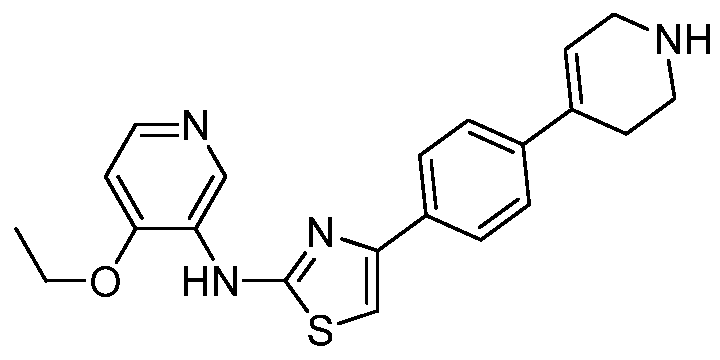
The title compound was prepared using 4-(4-bromophenyl)-N-(4-ethoxypyridin-3-yl)thiazol-2- amine (Intermediate 29) in place of 3-((4-(4-bromophenyl)thiazol-2-yl)amino)-4- isopropoxybenzenesulfonamide (Intermediate 31) by the method of Example 12. 1H NMR (400 MHz, MeOH-d4) δ 10.24 (d, J= 1.22 Hz, 1H), 8.39 (dd, J= 1.22, 6.60 Hz, 1H), 7.97 (d, J= 8.31 Hz, 2H), 7.59 (d, J = 6.60 Hz, 1H), 7.56 (d, J = 8.31 Hz, 2H), 7.36 (s, 1H), 6.22 - 6.26 (m, 1H), 4.56 (q, J = 7.09 Hz, 2H), 3.87 - 3.90 (m, 2H), 3.50 (t, J = 6.11 Hz, 2H), 2.83 - 2.88 (m, 2H), 1.63 (t, d, J= 7.09 Hz, 3H); MS m/e 379.0 (M+H).
Example 21
N-(4-Ethoxypyridin-3-yl)-4-(4-(l-methyl-l,2,3,6-tetrahydropyridin-4-yl)phenyl)thiazol-2- amine

To a solution of N-(4-ethoxypyridin-3-yl)-4-(4-(l,2,3,6-tetrahydropyridin-4-yl)phenyl)thiazol-2- amine.TFA (35 mg, 0.058 mmol, Example 20) in MeOH (2 mL) was added 37% formaldehyde in water (9.5 mg, 0.12 mmol) and NaCNBH3 (8.8 mg, 0.14 mmol). The mixture was stirred overnight and concentrated. The residue was filtered, washed with water, and dried to give the title compound as a yellow solid. 1H NMR (400 MHz, MeOH-d4) δ 9.75 (s, 1H), 8.10 (d, J = 5.62 Hz, 1H), 7.90 (d, J= 8.56 Hz, 2H), 7.50 (d, J= 8.56 Hz, 2H), 7.15 (s, 1H), 7.08 (d, J= 5.38 Hz, 1H), 6.16 - 6.25 (m, 1H), 4.30 (q, J= 7.09 Hz, 2H), 3.47 - 3.51 (m, 2H), 3.08 (t, J= 5.87 Hz, 2H), 2.74 - 2.80 (m, 2H), 2.66 (s, 3H), 1.53 (t, J= 6.97 Hz, 3H); MS m/e 393.1 (M+H).
Example 22
N-(4-Ethoxypyridin-3-yl)-4-(4-(l-ethyl-l,2,3,6-tetrahydropyridin-4-yl)phenyl)thiazol-2- amine-TFA

The title compound was prepared using N-(4-ethoxypyridin-3-yl)-4-(4-(l, 2,3,6- tetrahydropyridin-4-yl)phenyl)thiazol-2-amine (Example 20) in place of 4-isopropoxy-3-((4-(4- (piperazin-l-yl)phenyl)thiazol-2-yl)amino)benzenesulfonamide-TFA (Example 1) by the method of Example 4. 1H NMR (400 MHz, MeOH-d4) δ 10.24 (d, J = 1.47 Hz, 1H), 8.39 (dd, J = 1.22, 6.60 Hz, 1H), 7.98 (d, J = 8.31 Hz, 2H), 7.60 (s, 1H), 7.57 (d, J = 8.80 Hz, 2H), 7.37 (s, 1H), 6.17 - 6.28 (m, 1H), 4.56 (q, J = 6.93 Hz, 2H), 4.05 - 4.18 (m, 1H), 3.74 - 3.90 (m, 3H), 3.32 - 3.38 (m, 2H), 2.89 - 3.01 (m, 2H), 1.63 (t, J= 6.97 Hz, 3H), 1.38 - 1.47 (t, J = 7.34 Hz, 3H); MS m/e 407.1 (M+H).
Example 23
N-(4-Ethoxypyridin-3-yl)-4-(4-(l-isopropyl-l,2,3,6-tetrahydropyridin-4-yl)phenyl)thiazol-2- amine-TFA

To a mixture of N-(4-ethoxypyridin-3-yl)-4-(4-(l,2,3,6-tetrahydropyridin-4-yl)phenyl)thiazol-2- amine.TFA (50 mg, 0.082 mmol, Example 20), acetone (20 mg, 0.34 mmol), and HOAc (22 mg, 0.37 mmol) in MeOH (1.5 mL) was added NaCNBH3 (15 mg, 0.24 mmol). The mixture was heated at 65 °C for 18 h, and concentrated. The residue was purified by RP-HPLC (90-10% H20-CH3CN, 0.1% TFA) to obtain the title compound as an off-white solid. 1H NMR (400 MHz, MeOH-d4) δ 10.17 (s, 1H), 8.31 (d, J = 6.36 Hz, 1H), 7.92 (d, J = 8.31 Hz, 2H), 7.53 (d, J
= 8.56 Hz, 2H), 7.48 (d, J = 6.60 Hz, 1H), 7.31 (s, 1H), 6.21 - 6.25 (m, 1H), 4.46 (q, J = 6.93 Hz, 2H), 3.90 - 4.00 (m, 2H), 3.72 - 3.81 (m, 1H), 3.63 - 3.70 (m, 1H), 3.26 - 3.36 (m, 1H), 2.83 - 3.03 (m, 2H), 1.58 (t, J= 6.97 Hz, 3H), 1.44 (d, J= 6.60 Hz, 6H); MS m e 421.1 (M+H).
Example 24
-Isopropoxy-3-((4-(4-(piperidin-4-yl)phenyl)thiazol-2-yl)amino)benzenesulfonamide*TFA

A mixture of 4-isopropoxy-3-((4-(4-(l,2,3,6-tetrahydropyridin-4-yl)phenyl)thiazol-2- yl)amino)benzenesulfonamide.TFA(13 mg, 0.019 mmol, Example 12) and 10% Pd/C (18 mg) in MeOH (4 mL) in a Parr bottle was shaken under 65 psi H2 for 3.5 days, and filtered through Celite. The filtrate was concentrated and purified by RP-HPLC (90-10% H20-CH3CN, 0.1% TFA) to obtain the title compound as a white solid. 1H NMR (400 MHz, MeOH-d4) δ 9.38 (d, J = 2.20 Hz, 1H), 7.94 (d, J = 8.31 Hz, 2H), 7.52 (dd, J= 2.45, 8.56 Hz, 1H), 7.30 (d, J = 8.31 Hz, 2H), 7.13 (d, J= 8.80 Hz, 1H), 7.10 (s, 1H), 4.78 - 4.85 (m, 1H), 3.44 - 3.53 (m, 2H), 3.06 - 3.18 (m, 2H), 2.77 - 2.97 (m, 1H), 2.01 - 2.14 (m, 2H), 1.83 - 1.97 (m, 2H), 1.43 (d, J= 6.11 Hz, 6H); MS m/e 473.1 (M+H).
Example 25
4-Isopropoxy-3-((4-(4-(l-methylpiperidin-4-yl)phenyl)thiazol-2- yl)amino)benzenesulfonamide*TFA

The title compound was prepared using 4-isopropoxy-3-((4-(4-(piperidin-4-yl)phenyl)thiazol-2- yl)amino)benzenesulfonamide.TFA (Example 24) in place of 4-isopropoxy-3-((4-(4-(piperazin-
l-yl)phenyl)thiazol-2-yl)amino)benzamide-TFA (Example 7) by the method of Example 8. 1H NMR (400 MHz, MeOH-d4) δ 9.34 (d, J= 2.45 Hz, 1H), 7.94 (d, J= 8.31 Hz, 2H), 7.54 (dd, J = 2.20, 8.56 Hz, 1H), 7.31 (d, J= 8.07 Hz, 2H), 7.15 (d, J= 8.80 Hz, 1H), 7.12 (s, 1H), 4.78 - 4.86 (m, 1H), 3.55 - 3.64 (m, 2H), 3.13 (td, J = 2.69, 12.8 Hz, 2H), 2.89 (s, 3H), 2.86 - 2.90 (m, 1H), 2.07 - 2.14 (m, 2H), 1.94 - 2.02 (m, 2H), 1.43 (d, J= 6.11 Hz, 6H); MS m/e 487.0 (M+H).
Example 26
3-((4-(4-(l-Ethylpiperidin-4-yl)phenyl)thiazol-2-yl)amino)-4- isopropoxybenzenesulfonamide-TFA

The title compound was prepared using 4-isopropoxy-3-((4-(4-(piperidin-4-yl)phenyl)thiazol-2- yl)amino)benzenesulfonamide.TFA (Example 24) in place of 4-isopropoxy-3-((4-(4-(piperazin- l-yl)phenyl)thiazol-2-yl)amino)benzenesulfonamide (Example 1) according to the procedure described in example 4. 1H NMR (400 MHz, MeOH-d4) δ 9.39 (d, J = 2.20 Hz, 1H), 7.96 (d, J = 8.31 Hz, 2H), 7.51 - 7.56 (m, 1H), 7.32 (d, J= 8.31 Hz, 2H), 7.15 (d, J= 8.80 Hz, 1H), 7.12 (s, 1H), 4.76 - 4.86 (m, 1H), 3.61 - 3.71 (m, 2H), 3.08 (td, J = 2.32, 12.78 Hz, 2H), 2.83 - 2.96 (m, 1H), 2.06 - 2.18 (m, 2H), 1.88 - 2.04 (m, 2H), 1.44 (d, J= 6.11 Hz, 6H); MS m/e 501.4 (M+H).
Example 27
4-Isopropoxy-3-((4-(4-(l-isopropylpiperidin-4-yl)phenyl)thiazol-2- yl)amino)benzenesulfonamide*TFA

Example 28 : 4-Isopropoxy-3-((4-(4-(2-morpholinoethoxy)phenyl)thiazol-2- yl)amino)benzenesulfonamide*TFA

A mixture of 2-bromo-l-(4-(2-morpholinoethoxy)phenyl)ethanone-HBr (100 mg, 0.244 mmol, intermediate 10, step b), 4-isopropoxy-3-thioureidobenzenesulfonamide (70.7 mg, 0.244 mmol, intermediate 1, step e), and EtOH (1 mL) was stirred at room temperature overnight. The reaction mixture was diluted with sat. aq. NaHC03 and extracted with EtOAc. The organic phase was dried (Na2S04), filtered, and concentrated. The crude product was purified by RP- HPLC (10-90% CH3CN-H20, 0.1% TFA), affording the title compound. 1H NMR (400 MHz, DMSO-de) δ 10.01 (br. s., 1H), 9.59 (s, 1H), 9.33 (d, J= 2.20 Hz, 1H), 7.96 (d, J= 8.80 Hz, 2H), 7.42 (dd, J = 2.20, 8.56 Hz, 1H), 7.28 (s, 1H), 7.21 (d, J = 8.56 Hz, 1H), 7.17 (br. s., 2H), 7.05 (d, J= 8.80 Hz, 2H), 4.81 (sept, J= 5.99 Hz, 1H), 4.37 - 4.46 (m, 2H), 3.95 - 4.05 (m, 2H), 3.66 - 3.78 (m, 2H), 3.49 - 3.64 (m, 4H), 3.16 - 3.31 (m, 2H), 1.37 (d, J = 6.11 Hz, 6H). MS m/e 519.3 (M+H).
4-Isopropoxy-3-((4-(4-(2-morpholinoethoxy)phenyl)thiazol-2-

The title compound was prepared using 4-isopropoxy-3-thioureido-benzamide (intermediate 2, step e) according to the procedure of example 28. 1H NMR (400 MHz, DMSO-d6) δ 10.07 (br. s., 1H), 9.35 (s, 1H), 9.05 (d, J = 1.96 Hz, 1H), 7.92 (d, J = 8.56 Hz, 2H), 7.80 (br. s., 1H), 7.51 (dd, J = 2.08, 8.44 Hz, 1H), 7.21 (s, 1H), 7.02 - 7.14 (m, 4H), 4.77 (sept, J = 6.08 Hz, 1H), 4.41 (t, J = 4.77 Hz, 2H), 3.95 - 4.05 (m, 2H), 3.65 - 3.79 (m, 2H), 3.49 - 3.65 (m, 4H), 3.16 - 3.31 (m, 2H), 1.35 (d, J= 6.11 Hz, 6H). MS m/e 483.3 (M+H).
Example 30: 3-((4-(4-(2-Morpholinoethoxy)phenyl)thiazol-2-yl)amino)-4-
(trifluoromethoxy)benzenesulfonamide-TFA

The title compound was prepared using 3-thioureido-4-(trifluoromethoxy)benzenesulfonamide (intermediate 4, step d) according to the procedure of example 28. 1H NMR (400 MHz, DMSO- d6) δ 10.40 (s, 1H), 10.07 (br. s., 1H), 9.59 (d, J= 2.20 Hz, 1H), 7.96 (d, J= 8.80 Hz, 2H), 7.60 - 7.65 (m, 1H), 7.51 (dd, J = 2.20, 8.56 Hz, 1H), 7.46 (s, 2H), 7.38 (s, 1H), 7.06 (d, J = 8.80 Hz, 2H), 4.42 (t, J = 4.77 Hz, 2H), 3.94 - 4.05 (m, 2H), 3.67 - 3.79 (m, 2H), 3.48 - 3.64 (m, 4H), 3.15 - 3.31 (m, 2H). MS m/e 545.1 (M+H).
Example 31: 3-((4-(4-(2-(4,4-Difluoropiperidin-l-yl)ethoxy)phenyl)thiazol-2-yl)amino)-4- isopropoxybenzenesulfonamide-TFA

The title compound was prepared using 2-bromo-l-(4-(2-(4,4-difluoropiperidin-l- yl)ethoxy)phenyl)ethanone-HBr (intermediate 11, step c) according to the procedure of example 28. 1H NMR (400 MHz, DMSO-d6) δ 9.98 (br. s., 1H), 9.59 (s, 1H), 9.33 (d, J = 2.20 Hz, 1H), 7.96 (d, J = 8.80 Hz, 2H), 7.42 (dd, J = 2.45, 8.56 Hz, 1H), 7.28 (s, 1H), 7.21 (d, J = 8.80 Hz, 1H), 7.17 (br. s., 2H), 7.06 (d, J = 8.80 Hz, 2H), 4.77 - 4.86 (m, 1H), 4.42 (t, J = 4.52 Hz, 2H), 3.60 - 3.81 (m, 4H), 3.21 - 3.44 (m, 2H), 2.21 - 2.48 (m, 4H), 1.37 (d, J = 6.11 Hz, 6H). MS m/e 553.2 (M+H).
Example 32: 3-((4-(4-(2-(4,4-Difluoropiperidin-l-yl)ethoxy)phenyl)thiazol-2-yl)amino)-4- isopropoxybenzamide-TFA

The title compound was prepared using 2-bromo-l-(4-(2-(4,4-difluoropiperidin-l- yl)ethoxy)phenyl)ethanone-HBr (intermediate 11, step c) and 4-isopropoxy-3-thioureido- benzamide (intermediate 2, step e) according to the procedure of example 28. 1H NMR (400 MHz, DMSO-de) δ 9.98 (br. s., 1H), 9.35 (s, 1H), 9.06 (d, J= 1.96 Hz, 1H), 7.92 (d, J= 8.80 Hz, 2H), 7.81 (br. s., 1H), 7.51 (dd, J = 2.08, 8.44 Hz, 1H), 7.22 (s, 1H), 7.01 - 7.13 (m, 4H), 4.78
(sept, 5.75 Hz, 1H), 4.41 (t, J = 4.52 Hz, 2H), 3.59 - 3.84 (m, 4H), 3.19 - 3.43 (m, 2H), 2.20 - 2.48 (m, 4H), 1.35 (d, J= 6.11 Hz, 6H). MS m/e 517.2 (M+H).
Example 33: 3-((4-(4-(2-(4,4-difluoropiperidin-l-yl)ethoxy)phenyl)thiazol-2-yl)amino)-4- (trifluoromethoxy)benzenesulfonamide-TFA
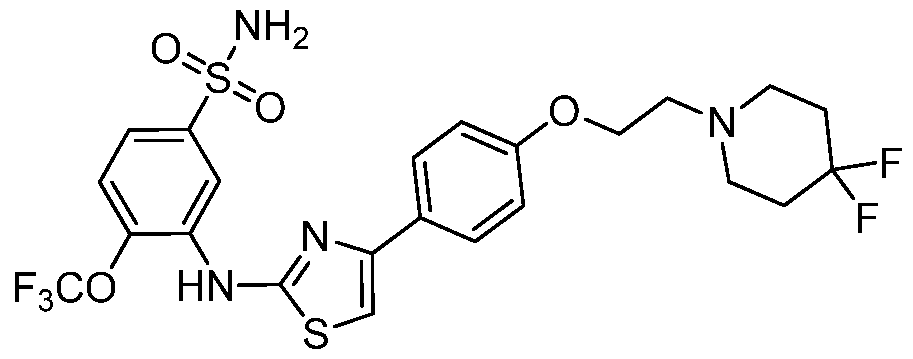
The title compound was prepared using 2-bromo-l-(4-(2-(4,4-difluoropiperidin-l- yl)ethoxy)phenyl)ethanone-HBr (intermediate 11, step c) and 3-thioureido-4- (trifluoromethoxy)benzenesulfonamide (intermediate 4, step d) according to the procedure of example 28. 1H NMR (400 MHz, DMSO-d6) δ 10.40 (s, 1H), 9.96 (br. s., 1H), 9.58 (d, J = 2.20 Hz, 1H), 7.96 (d, J= 8.80 Hz, 2H), 7.62 (dd, J = 1.71, 8.56 Hz, 1H), 7.51 (dd, J= 2.20, 8.56 Hz, 1H), 7.45 (s, 2H), 7.38 (s, 1H), 7.07 (d, J = 8.80 Hz, 2H), 4.42 (t, J = 4.65 Hz, 2H), 3.59 - 3.82 (m, 4H), 3.22 - 3.43 (m, 2H), 2.20 - 2.44 (m, 4H). MS m/e 579.2 (M+H).
Example 34 : 3-((4-(4-(2-(4-fluoropiperidin- l-yl)ethoxy)phenyl)thiazol-2-yl)amino)-4- isopropoxybenzenesulfonamide-TFA

The title compound was prepared using 2-bromo-l-(4-(2-(4-fluoropiperidin-l- yl)ethoxy)phenyl)ethanone-HBr (intermediate 12, step b) according to the procedure of example
28. 1H NMR (400 MHz, DMSO-d6) δ 9.60 (s, 1H), 9.33 (d, J = 2.20 Hz, 1H), 7.96 (d, J = 8.56 Hz, 2H), 7.42 (dd, J = 2.32, 8.68 Hz, 1H), 7.28 (s, 1H), 7.21 (d, J = 8.80 Hz, 1H), 7.17 (br. s., 2H), 7.05 (d, J = 8.80 Hz, 2H), 4.92 - 5.10 (m, 1H), 4.74 - 4.86 (m, 1H), 4.37 - 4.47 (m, 2H), 3.50 - 3.69 (m, 4H), 3.12 - 3.33 (m, 2H), 1.84 - 2.35 (m, 4H), 1.37 (d, J = 6.11 Hz, 6H). MS m/e 535.2 (M+H).
Example 35: 4-(4-(2-(4-fluoropiperidin-l-yl)ethoxy)phenyl)-N-(4-methoxypyridin-3- yl)thiazol-2-amine-TFA

The title compound was prepared using 2-bromo-l-(4-(2-(4-fluoropiperidin-l- yl)ethoxy)phenyl)ethanone-HBr (intermediate 12, step b) and l-(4-methoxypyridin-3-yl)thiourea (intermediate 5, step b) according to the procedure of example 28. 1H NMR (400 MHz, DMSO- d6) δ 10.61 (s, 1H), 10.05 (s, 1H), 9.87 (br. s., 1H), 8.57 (d, J = 6.11 Hz, 1H), 7.94 (d, J = 8.80 Hz, 2H), 7.65 (d, J = 6.36 Hz, 1H), 7.43 (s, 1H), 7.07 (d, J = 8.80 Hz, 2H), 4.89 - 5.12 (m, 1H), 4.36 - 4.44 (m, 2H), 4.20 (s, 3H), 3.46 - 3.69 (m, 4H), 3.14 - 3.36 (m, 2H), 1.82 - 2.38 (m, 4H). MS m/e 429.1 (M+H).
Example 36: N-(4-ethoxypyridin-3-yl)-4-(4-(2-(4-fluoropiperidin-l- yl)ethoxy)phenyl)thiazol-2-amine*TFA

Example 37: 3-((4-(4-(2-(4-fluoropiperidin-l-yl)ethoxy)phenyl)thiazol-2-yl)amino)-4- (trifluoromethoxy)benzamide-TFA

The title compound was prepared using 2-bromo-l-(4-(2-(4-fluoropiperidin-l- yl)ethoxy)phenyl)ethanone-HBr (intermediate 12, step b) and 3-thioureido-4- (trifluoromethoxy)benzamide (intermediate 6, step d) according to the procedure of example 28.
1H NMR (400 MHz, DMSO-d6) δ 10.15 (s, 1H), 9.62 (br. s., 1H), 9.31 (s, 1H), 8.05 (br. s., 1H), 7.93 (d, J= 8.56 Hz, 2H), 7.52 - 7.57 (m, 1H), 7.42 - 7.47 (m, 1H), 7.39 (br. s., 1H), 7.32 (s, 1H), 7.07 (d, J = 8.56 Hz, 2H), 4.92 - 5.09 (m, 1H), 4.36 - 4.45 (m, 2H), 3.49 - 3.68 (m, 4H), 3.13 - 3.32 (m, 2H), 1.82 - 2.36 (m, 4H). MS m/e 525.2 (M+H).
Example 38: 7-((4-(4-(2-(4-fluoropiperidin-l-yl)ethoxy)phenyl)thiazol-2-yl)amino)-2,3- dihydrobenzofuran-5-sulfonamide-TFA

The title compound was prepared using 2-bromo-l-(4-(2-(4-fluoropiperidin-l- yl)ethoxy)phenyl)ethanone-HBr (intermediate 12, step b) and 7-thioureido-2,3- dihydrobenzofuran-5 -sulfonamide (intermediate 7, step b) according to the procedure of example 28. 1H NMR (400 MHz, DMSO-d6) δ 10.03 (s, 1H), 9.58 (br. s., 1H), 9.09 (d, J= 1.22 Hz, 1H), 7.94 (d, J = 8.56 Hz, 2H), 7.35 - 7.38 (m, 1H), 7.24 (s, 1H), 7.14 (br. s., 2H), 7.05 (d, J = 8.80 Hz, 2H), 4.92 - 5.09 (m, 1H), 4.74 (t, J= 8.80 Hz, 2H), 4.36 - 4.44 (m, 2H), 3.49 - 3.68 (m, 4H), 3.32 (t, J= 8.80 Hz, 2H), 3.16 - 3.29 (m, 2H), 1.83 - 2.36 (m, 4H). MS m/e 519.2 (M+H).
Example 39: 5-((4-(4-(2-(4-fluoropiperidin-l-yl)ethoxy)phenyl)thiazol-2-yl)amino)-4- methoxy-2-methylbenzamide*TFA

The title compound was prepared using 2-bromo-l-(4-(2-(4-fluoropiperidin-l- yl)ethoxy)phenyl)ethanone-HBr (intermediate 12, step b) and 4-methoxy-2-methyl-5- thioureidobenzamide (intermediate 9, step e) according to the procedure of example 28. 1H NMR (400 MHz, DMSO-d6) δ 9.66 (br. s., 1H), 9.55 (s, 1H), 8.62 (s, 1H), 7.87 (d, J = 9.05 Hz, 2H), 7.59 (br. s., 1H), 7.13 - 7.19 (m, 2H), 7.05 (d, J = 8.80 Hz, 2H), 6.89 (s, 1H), 4.92 - 5.10 (m, 1H), 4.36 - 4.43 (m, 2H), 3.88 (s, 3H), 3.49 - 3.67 (m, 4H), 3.18 - 3.33 (m, 2H), 2.37 (s, 3H), 1.83 - 2.35 (m, 4H). MS m/e 485.2 (M+H).
3-((4-(4-(2-(4-fluoropiperidin-l-yl)ethoxy)phenyl)thiazol-2-yl)amino)-4- •TFA

The title compound was prepared using 2-bromo-l-(4-(2-(4-fluoropiperidin-l- yl)ethoxy)phenyl)ethanone-HBr (intermediate 12, step b) and 4-isobutyl-3-thioureidobenzamide (intermediate 8, step e) according to the procedure of example 28. 1H NMR (400 MHz, DMSO- d6) δ 9.60 (br. s., 1H), 9.37 (s, 1H), 8.48 (s, 1H), 7.91 (br. s., 1H), 7.84 (d, J = 8.56 Hz, 2H), 7.53 - 7.58 (m, 1H), 7.22 - 7.29 (m, 2H), 7.13 (s, 1H), 7.04 (d, J= 8.56 Hz, 2H), 4.90 - 5.09 (m, 1H), 4.34 - 4.43 (m, 2H), 3.48 - 3.68 (m, 4H), 3.13 - 3.31 (m, 2H), 2.61 (d, J = 7.09 Hz, 2H), 1.81 - 2.36 (m, 4H), 0.85 (d, J= 6.60 Hz, 6H). MS m/e 497.2 (M+H).
Example 41 : 3-((4-(4-(2-(4-fluoropiperidin- l-yl)ethoxy)phenyl)thiazol-2-yl)amino)-4- (trifluoromethoxy)benzenesulfonamide-TFA

The title compound was prepared using 2-bromo-l-(4-(2-(4-fluoropiperidin-l- yl)ethoxy)phenyl)ethanone-HBr (intermediate 12, step b) and 3-thioureido-4- (trifluoromethoxy)benzenesulfonamide (intermediate 4, step d) according to the procedure of example 28. 1H NMR (400 MHz, DMF) δ 10.40 (s, 1H), 9.57 - 9.74 (m, 2H), 7.96 (d, J = 8.56 Hz, 2H), 7.62 (d, J = 8.07 Hz, 1H), 7.51 (dd, J = 2.08, 8.44 Hz, 1H), 7.45 (br. s., 2H), 7.38 (s,
1H), 7.06 (d, J = 8.80 Hz, 2H), 4.92 - 5.09 (m, 1H), 4.38 - 4.45 (m, 2H), 3.50 - 3.67 (m, 4H), 3.13 - 3.32 (m, 2H), 1.84 - 2.36 (m, 4H). MS m/e 561.2 (M+H).
Example 42: 4-isopropoxy-3-((4-(4-(2-(4-methylpiperazin-l-yl)ethoxy)phenyl)thiazol-2- yl)amino)benzamide*TFA

The title compound was prepared using 2-bromo-l-(4-(2-(4-methylpiperazin-l- yl)ethoxy)phenyl)ethanone-HBr (intermediate 13, step b) and 4-isopropoxy-3-thioureido- benzamide (intermediate 2, step e) according to the procedure of example 28. 1H NMR (400 MHz, DMSO-de) δ 9.33 (s, 1H), 9.05 (d, J= 2.20 Hz, 1H), 7.89 (d, J= 8.80 Hz, 2H), 7.80 (br. s., 1H), 7.50 (dd, J = 2.20, 8.31 Hz, 1H), 7.19 (s, 1H), 7.07 (d, J = 8.56 Hz, 2H), 7.00 (d, J = 8.80 Hz, 2H), 4.77 (sept, J = 5.99 Hz, 2H), 4.20 - 4.28 (m, 2H), 2.96 - 3.63 (m, 7H), 2.80 (s, 3H), 1.35 (d, J= 6.11 Hz, 6H). MS m/e 496.2 (M+H).
Example 43: N-(4-ethoxypyridin-3-yl)-4-(4-(2-(4-methylpiperazin-l- yl)ethoxy)phenyl)thiazol-2-amine*TFA

Example 44: 3-((4-(4-(2-(4-cyclopropylpiperazin-l-yl)ethoxy)phenyl)thiazol-2-yl)amino)-4- isopropoxybenzamide-TFA

The title compound was prepared using 2-bromo-l-(4-(2-(4-cyclopropylpiperazin-l- yl)ethoxy)phenyl)ethanone-HBr (intermediate 14, step b) and 4-isopropoxy-3-thioureido- benzamide (intermediate 2, step e) according to the procedure of example 28. 1H NMR (400
MHz, MeOH) δ 8.83 (d, J= 2.20 Hz, 1H), 7.87 (d, J= 8.80 Hz, 2H), 7.59 (dd, J= 2.20, 8.56 Hz, 1H), 7.11 (d, J = 8.56 Hz, 1H), 7.02 - 7.09 (m, 2H), 7.00 (s, 1H), 4.82 (sept, J = 6.11 Hz, 1H), 4.33 - 4.40 (m, 2H), 3.47 - 3.55 (m, 2H), 3.31 - 3,39 (m, 4H), 3.00 - 3.15 (m, 4H), 2.02 - 2.11 (m, 1H), 1.42 (d, J= 6.11 Hz, 6H), 0.54 - 0.69 (m, 4H). MS m/e 522.2 (M+H).
Example 45: 3-((4-(4-(2-(4-cyclopropylpiperazin-l-yl)ethoxy)phenyl)thiazol-2-yl)amino)-4- isopropoxybenzenesulfonamide-TFA

The title compound was prepared using 2-bromo-l-(4-(2-(4-cyclopropylpiperazin-l- yl)ethoxy)phenyl)ethanone-HBr (intermediate 14, step b) according to the procedure of example 28. 1H NMR (400 MHz, MeOH) δ 9.33 (d, J = 2.20 Hz, 1H), 7.94 (d, J = 8.80 Hz, 2H), 7.53 (dd, J = 2.45, 8.56 Hz, 1H), 7.15 (d, J = 8.80 Hz, 1H), 7.04 - 7.09 (m, 2H), 7.02 (s, 1H), 4.83 (sept, J= 6.11 Hz, 1H), 4.34 - 4.41 (m, 2H), 3.49 - 3.56 (m, 2H), 3.31 - 3.39 (m, 4H), 3.01 - 3.16 (m, 4H), 2.02 - 2.09 (m, 1H), 1.44 (d, J = 5.87 Hz, 6H), 0.54 - 0.67 (m, 4H). MS m/e 558.2 (M+H).
4-isopropoxy-3-((4-(4-(3-morpholinopropoxy)phenyl)thiazol-2-

The title compound was prepared using 2-bromo-l-(4-(3- morpholinopropoxy)phenyl)ethanone-HBr (intermediate 15, step c) and 4-isopropoxy-3- thioureido-benzamide (intermediate 2, step e) according to the procedure of example 28. 1H NMR (400 MHz, MeOH) δ 8.87 (d, J = 1.96 Hz, 1H), 7.85 (d, J = 8.31 Hz, 2H), 7.57 (dd, J = 1.96, 8.56 Hz, 1H), 7.10 (d, J = 8.56 Hz, 1H), 6.96 - 7.02 (m, 3H), 4.81 (sept, J = 6.11 Hz, 1H), 4.16 (t, J = 5.75 Hz, 2H), 4.05 - 4.13 (m, 2H), 3.70 - 3.81 (m, 2H), 3.54 - 3.61 (m, 2H), 3.38 -
3.44 (m, 2H), 3.10 - 3.27 (m, 2H), 2.21 - 2.31 (m, 2H), 1.42 (d, J = 6.11 Hz, 6H). MS m/e 497.2 (M+H).
Example 47: 4-isopropoxy-3-((4-(4-(3-morpholinopropoxy)phenyl)thiazol-2- yl)amino)benzenesulfonamide*TFA

The title compound was prepared using 2-bromo-l-(4-(3- morpholinopropoxy)phenyl)ethanone-HBr (intermediate 15, step c) according to the procedure of example 28. 1H NMR (400 MHz, MeOH) δ 9.32 (d, J= 2.20 Hz, 1H), 7.91 (d, J= 8.56 Hz, 2H), 7.52 (dd, J = 2.45, 8.56 Hz, 1H), 7.15 (d, J = 8.56 Hz, 1H), 6.95 - 7.03 (m, 3H), 4.83 (sept, J = 6.11 Hz, 1H), 4.16 (t, J = 5.62 Hz, 2H), 4.04 - 4.13 (m, 2H), 3.69 - 3.82 (m, 2H), 3.52 - 3.60 (m, 2H), 3.36 - 3.44 (m, 2H), 3.13 - 3.25 (m, 2H), 2.20 - 2.32 (m, 2H), 1.44 (d, J= 6.11 Hz, 6H). MS m/e 533.1 (M+H).
Example 48: 4-isopropoxy-3-((4-(4-((4-methylpiperazin-l-yl)methyl)phenyl)thiazol-2- yl)amino)benzamide.TFA

Example 49: 4-isopropoxy-3-((4-(4-((4-methylpiperazin-l-yl)methyl)phenyl)thiazol-2- yl)amino)benzenesulfonamide.TFA

The title compound was prepared using 4-isopropoxy-3-thioureidobenzenesulfonamide (Intermediate 1 , step e) according to the procedure described for Example 48. 1H NMR (MeOH) δ: 9.36 (d, J = 2.4 Hz, 1H), 8.06 (d, J = 8.3 Hz, 2H), 7.41 - 7.60 (m, 3H), 7.23 (s, 1H), 7.15 (d, J = 8.8 Hz, 1H), 4.83 (dt, J = 12.2, 6.0 Hz, 1H), 4.16 (s, 2H), 3.47 (br. s., 4H), 3.26 (br. s., 4H), 2.93 (s, 3H), 1.44 (d, J = 6.1 Hz, 6H); MS m/e 502.2 (M+H).
Example 50: 3-((4-(4-((4-cyclopropylpiperazin-l-yl)methyl)phenyl)thiazol-2-yl)amino)-4- isopropoxybenzamide.TFA

The title compound was prepared using 2-bromo-l-(4-((4-cyclopropylpiperazin-l- yl)methyl)phenyl)ethanone.HBr (intermediate 22, step b) according to the procedure described for Example 48. 1H NMR (MeOH) δ: 9.01 (d, J = 2.0 Hz, 1H), 8.04 (d, J = 8.3 Hz, 2H), 7.46 - 7.60 (m, 3H), 7.23 (s, 1H), 7.09 (d, J = 8.8 Hz, 1H), 4.82 (quin, J = 6.1 Hz, 1H), 4.25 (s, 2H), 3.26 (br. s., 4H), 2.99 - 3.14 (m, 4H), 2.10 (br. s., 1H), 1.43 (d, J = 6.1 Hz, 6H), 0.51 - 0.75 (m, 4H); MS m/e 492.3 (M+H).
Example 51: 3-((4-(4-((4-cyclopropylpiperazin-l-yl)methyl)phenyl)thiazol-2-yl)amino)-4- isopropoxybenzenesulfonamide.TFA
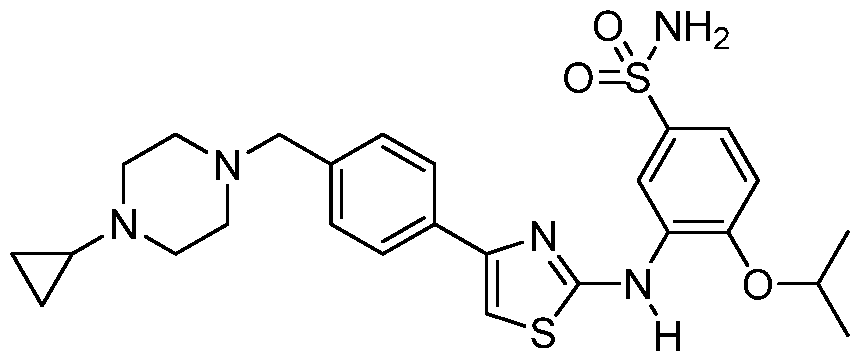
The title compound was prepared using 2-bromo-l-(4-((4-cyclopropylpiperazin-l- yl)methyl)phenyl)ethanone.HBr (intermediate 22, step b) and 4-isopropoxy-3- thioureidobenzenesulfonamide (intermediate 1 , step e) according to the procedure described for
Example 48. 1H NMR (MeOH) δ: 9.41 (d, J = 2.4 Hz, 1H), 8.09 (d, J = 8.3 Hz, 2H), 7.41 - 7.60 (m, 3H), 7.26 (s, 1H), 7.15 (d, J = 9.0 Hz, 1H), 4.77 - 4.87 (m, 1H), 4.28 (s, 2H), 3.18 - 3.29 (m, 4H), 3.04 - 3.18 (m, 4H), 2.13 (br. s., 1H), 1.44 (d, J = 6.1 Hz, 6H), 0.51 - 0.73 (m, 4H); MS m/e 528.2 (M+H).
Example 52: (R)-3-((4-(4-((3-fluoropyrrolidin-l-yl)methyl)phenyl)thiazol-2-yl)amino)-4- isopropoxybenzamide.TFA

The title compound was prepared using (R)-2-bromo-l-(4-((3-fluoropyrrolidin-l- yl)methyl)phenyl)ethanone.HBr (intermediate 24, step b) according to the procedure described for Example 48. 1H NMR (MeOH) δ: 9.07 (d, J = 2.2 Hz, 1H), 8.08 (d, J = 8.6 Hz, 2H), 7.48 - 7.63 (m, 3H), 7.24 (s, 1H), 7.09 (d, J = 8.8 Hz, 1H), 5.53 (br. s., 0.5H), 5.40 (br. s., 0.5H), 4.81 (dt, J = 12.1, 6.2 Hz, 1H), 4.47 (br. s., 2H), 3.73 (br. s., 2H), 3.36 - 3.61 (m, 2H), 2.65 (s, 1H), 2.33 (br. s., 1H), 1.43 (d, J = 5.9 Hz, 6H); MS m/e 455.1 (M+H).
Example 53 : (R)-3-((4-(4-((3-fluoropyrrolidin-l-yl)methyl)phenyl)thiazol-2-yl)amino)-4- isopropoxybenzenesulfonamide.TFA

The title compound was prepared using (R)-2-bromo-l-(4-((3-fluoropyrrolidin-l- yl)methyl)phenyl)ethanone.HBr (intermediate 24, step b) and 4-isopropoxy-3- thioureidobenzenesulfonamide (intermediate 1 , step e) according to the procedure described for Example 48. 1H NMR (MeOH) δ: 9.46 (d, J = 2.2 Hz, 1H), 8.12 (d, J = 8.3 Hz, 2H), 7.41 - 7.65 (m, 3H), 7.28 (s, 1H), 7.15 (d, J = 8.8 Hz, 1H), 5.53 (br. s., 0.5H), 5.40 (br. s., 0.5H), 4.78 - 4.85 (m, 1H), 4.47 (br. s., 2H), 3.72 (br. s., 4H), 2.65 (br. s., 1H), 2.31 (br. s., 1H), 1.44 (d, J = 5.9 Hz, 6H); MS m/e 491.1 (M+H).
Example 54: 3-((4-(4-((4-fluoropiperidin-l-yl)methyl)phenyl)thiazol-2-yl)amino)-4- isopropoxybenzamide.TFA

The title compound was prepared using 2-bromo-l-(4-((4-fluoropiperidin-l- yl)methyl)phenyl)ethanone.HBr (intermediate 23, step b) according to the procedure described for Example 48. 1H NMR (MeOH) δ: 9.08 (d, J = 2.2 Hz, 1H), 8.09 (d, J = 8.3 Hz, 2H), 7.49 - 7.61 (m, 3H), 7.25 (s, 1H), 7.08 (d, J = 8.6 Hz, 1H), 5.02-5.07 (bs, 0.5H) 4.96 - 4.90 (bs, 0.5H), 4.85 - 4.75 (m, 1H), 4.38 (s, 2H), 3.52-3.62 (m, 1H), 3.40 - 3.50 (m, 2H), 3.08 - 3.22 (m, 1H), 2.20-2.40 (m, 2H), 1.85 - 2.12 (m, 2H), 1.43 (d, J = 6.1 Hz, 6H); MS m/e 469.2 (M+H).
Example 55: 3-((4-(4-((4-fluoropiperidin-l-yl)methyl)phenyl)thiazol-2-yl)amino)-4- isopropoxybenzenesulfonamide.TFA

The title compound was prepared using 2-bromo-l-(4-((4-fluoropiperidin-l- yl)methyl)phenyl)ethanone.HBr (intermediate 23, step b) and 4-isopropoxy-3- thioureidobenzenesulfonamide (intermediate 1 , step e) according to the procedure described for Example 48. 1H NMR (MeOH) δ: 9.46 (d, J = 2.2 Hz, 1H), 8.13 (d, J = 8.3 Hz, 2H), 7.48 - 7.63 (m, 3H), 7.28 (s, 1H), 7.15 (d, J = 8.6 Hz, 1H), 5.04 (br. s., 0.5H), 4.89 - 4.95 (bs, 0.5H), 4.79 - 4.84 (m, 1H), 4.38 (s, 2H), 3.56 (br. s., 0.5H), 3.43 (br. s., 1.5H), 3.34 (s, 0.5H), 3.13 (br. s.,
0.5H), 2.36 (br. s., 0.5H), 2.25 (br. s., 1.5H), 1.87 - 2.12 (m, 2H), 1.44 (d, J = 5.9 Hz, 6H); MS m/e 505.0 (M+H).
Example 56: 4-isopropoxy-3-((4-(4-((4-isopropylpiperazin-l-yl)methyl)phenyl)thiazol-2- yl)amino)benzamide.TFA

The title compound was prepared using 2-bromo-l-(4-((4-isopropylpiperazin-l- yl)methyl)phenyl)ethanone.HBr (intermediate 21, step b) according to the procedure described for Example 48. 1H NMR (MeOH) δ: 8.96 (d, J = 2.2 Hz, 1H), 7.96 (d, J = 8.1 Hz, 2H), 7.56 (dd, J = 8.6, 2.2 Hz, 1H), 7.47 (d, J = 8.1 Hz, 2H), 7.17 (s, 1H), 7.10 (d, J = 8.6 Hz, 1H), 4.82 (quin, J = 6.1 Hz, 1H), 3.93 (br. s., 2H), 3.48 - 3.56 (m, J = 6.4 Hz, 1H), 3.45 - 3.49 (m, 0.5H), 3.32 - 3.44 (m, 3.5H), 2.68 - 3.22 (m, 4H), 1.43 (d, J = 6.1 Hz, 6H), 1.36 (d, J = 6.6 Hz, 6H); MS m/e 494.2 (M+H).
Example 57: 4-isopropoxy-3-((4-(4-((4-isopropylpiperazin-l-yl)methyl)phenyl)thiazol-2- yl)amino)benzenesulfonamide.TFA

The title compound was prepared using 2-bromo-l-(4-((4-isopropylpiperazin-l- yl)methyl)phenyl)ethanone.HBr (intermediate 21, step b) and 4-isopropoxy-3- thioureidobenzenesulfonamide (intermediate 1 , step e) according to the procedure described for
Example 48. 1H NMR (MeOH) δ: 9.39 (d, J = 2.2 Hz, 1H), 8.00 (d, J = 8.1 Hz, 2H), 7.52 (dd, J = 8.6, 2.2 Hz, 1H), 7.44 (d, J = 8.1 Hz, 2H), 7.11 - 7.19 (m, 2H), 4.79 - 4.85 (m, 1H), 3.82 (br. s.,
2H), 3.48 (dt, J = 3.4, 1.6 Hz, 1H), 3.40 (br. s., 3H), 3.04 - 3.28 (m, 4H), 1.44 (d, J 1.31 - 1.39 (m, 6H); MS m e 530.2 (M+H).
Example 58 : 4-isopropoxy-3-((4-(4-(morpholinomethyl)phenyl)thiazol-2- yl)amino)benzamide.TFA

The title compound was prepared using 2-bromo-l-(4-(morpholinomethyl)phenyl)ethanone.HBr (intermediate 20, step b) according to the procedure described for Example 48. 1H NMR
(MeOD) δ: 9.04 (s, 1H), 8.08 (d, J = 8.1 Hz, 2H), 7.50 - 7.63 (m, 3H), 7.25 (s, 1H), 7.09 (d, J = 8.6 Hz, 1H), 4.74 - 4.87 (m, 1H), 4.39 (s, 2H), 4.06 (d, J = 12.6 Hz, 2H), 3.73 (t, J = 12.3 Hz, 2H), 3.33 - 3.49 (m, 2H), 3.10 - 3.28 (m, 2H), 1.42 (d, J = 6.1 Hz, 6H); MS m/e 453.1 (M+H).
Example 59 : 4-isopropoxy-3-((4-(4-(morpholinomethyl)phenyl)thiazol-2- yl)amino)benzenesulfonamide.TFA

The title compound was prepared using 2-bromo-l-(4-(morpholinomethyl)phenyl)ethanone.HBr (intermediate 20, step b) and 4-isopropoxy-3-thioureidobenzenesulfonamide (intermediate 1, step e) according to the procedure described for Example 48. lU NMR (MeOD) δ: 9.45 (s, 1H), 8.13 (d, J = 8.1 Hz, 2H), 7.39 - 7.60 (m, 3H), 7.28 (s, 1H), 7.15 (d, J = 8.6 Hz, 1H), 4.83 (dt, J = 12.2, 6.0 Hz, 1H), 4.38 (s, 2H), 4.06 (d, J = 12.7 Hz, 2H), 3.72 (t, J = 12.2 Hz, 2H), 3.33 - 3.45 (m, 2H), 3.16 - 3.28 (m, 2H), 1.38 - 1.48 (m, 6H); MS m/e 489.3 (M+H).
Example 60: 4-(4-((4-cyclopropylpiperazin-l-yl)methyl)phenyl)-N-(5-fluoro-2- methoxyphenyl)thiazol-2-amine.TFA

The title compound was prepared using 2-bromo-l-(4-((4-cyclopropylpiperazin-l- yl)methyl)phenyl)ethanone.HBr (intermediate 22, step b) and l-(5-fluoro-2- methoxyphenyl)thiourea (intermediate 25, step b) according to the procedure described for Example 48. 1H NMR (MeOH) δ: 8.44 (dd, J = 11.4, 2.6 Hz, 1H), 7.92 - 8.08 (m, J = 8.1 Hz, 2H), 7.46 - 7.61 (m, J = 8.3 Hz, 2H), 7.24 (s, 1H), 6.95 (dd, J = 8.9, 5.0 Hz, 1H), 6.67 (td, J = 8.5, 3.1 Hz, 1H), 4.29 (s, 2H), 3.91 (s, 3H), 3.28 (br. s., 4H), 3.06 - 3.21 (m, 4H), 2.19 (br. s., 1H), 0.52 - 0.74 (m, 4H); MS m/e 439.2 (M+H).
Example 61: (R)-N-(5-fluoro-2-methoxyphenyl)-4-(4-((3-fluoropyrrolidin-l- yl)methyl)phenyl)thiazol-2-amine.TFA
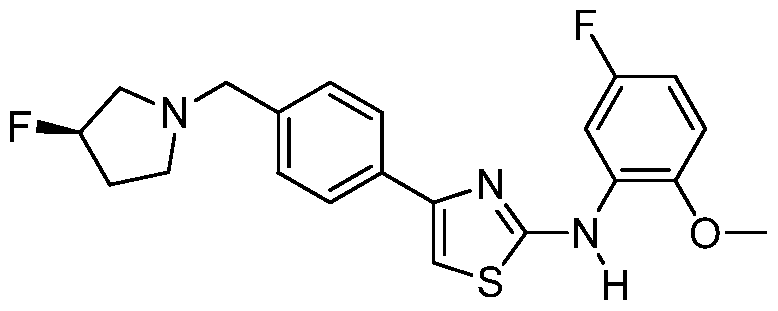
The title compound was prepared using (R)-2-bromo-l-(4-((3-fluoropyrrolidin-l- yl)methyl)phenyl)ethanone.HBr (intermediate 24, step b) and l-(5-fluoro-2- methoxyphenyl)thiourea (intermediate 25, step b) according to the procedure described for Example 48. 1H NMR (MeOH) δ: 8.48 (dd, J = 11.4, 3.1 Hz, 1H), 7.97 - 8.09 (m, J = 8.3 Hz, 2H), 7.54 - 7.62 (m, J = 8.3 Hz, 2H), 7.25 (s, 1H), 6.95 (dd, J = 8.9, 5.0 Hz, 1H), 6.66 (td, J = 8.5, 3.1 Hz, 1H), 5.45 - 5.57 (m, 0.5H), 5.40 (br. s., 0.5H), 4.47 (br. s., 2H), 3.91 (s, 3H), 3.73
(br. s., 2H), 3.48 (br. s., 1H), 3.41 (br. s., 1H), 2.54 (br. s., 1H), 2.33 (br. s., 1H); MS m/e 402.1
(M+H).
Example 62: N-(5-fluoro-2-methoxyphenyl)-4-(4-((4-fluoropiperidin-l- yl)methyl)phenyl)thiazol-2-amine.TFA

The title compound was prepared using 2-bromo-l-(4-((4-fluoropiperidin-l- yl)methyl)phenyl)ethanone.HBr (intermediate 23, step b) and l-(5-fluoro-2- methoxyphenyl)thiourea (intermediate 25, step b) according to the procedure described for Example 48. 1H NMR (MeOH) δ: 8.47 (dd, J = 11.2, 2.9 Hz, 1H), 8.05 (d, J = 8.3 Hz, 2H), 7.57 (d, J = 8.1 Hz, 2H), 7.26 (s, 1H), 6.95 (dd, J = 8.8, 5.1 Hz, 1H), 6.66 (td, J = 8.6, 3.2 Hz, 1H), 5.04 (br. s., 0.5H), 4.93 (br. s., 0.5H), 4.38 (s, 2H), 3.91 (s, 3H), 3.52 - 3.63 (m, 0.5H), 3.39 - 3.50 (m, 1.5H), 3.35 (s, 1.5H), 3.07 - 3.22 (m, 0.5H), 2.36 (br. s., 0.5H), 2.25 (br. s., 1.5H), 1.87 - 2.13 (m, 2H); MS m/e 416.1 (M+H).
Example 63: N-(5-fluoro-2-methoxyphenyl)-4-(4-((4-isopropylpiperazin-l- yl)methyl)phenyl)thiazol-2-amine.TFA

The title compound was prepared using 2-bromo-l-(4-((4-isopropylpiperazin-l- yl)methyl)phenyl)ethanone.HBr (intermediate 21, step b) and l-(5-fluoro-2- methoxyphenyl)thiourea (intermediate 25, step b) according to the procedure described for
Example 48. 1H NMR (MeOH) δ: 8.45 (dd, J = 11.4, 3.1 Hz, 1H), 7.94 - 8.00 (m, J = 8.3 Hz, 2H), 7.44 - 7.53 (m, J = 8.3 Hz, 2H), 7.19 (s, 1H), 6.95 (dd, J = 8.9, 5.0 Hz, 1H), 6.67 (td, J =
8.4, 3.2 Hz, 1H), 4.06 (br. s., 2H), 3.91 (s, 3H), 3.54 (dt, J = 13.1, 6.5 Hz, 1H), 3.39 - 3.50 (m, 4H), 2.97 - 3.27 (m, 4H), 1.37 (d, J = 6.6 Hz, 6H); MS m/e 441.1 (M+H).
Example 64 : N-(5-fluoro-2-methoxyphenyl)-4-(4-(morpholinomethyl)phenyl)thiazol-2- amine.TFA

The title compound was prepared using 2-bromo-l-(4-(morpholinomethyl)phenyl)ethanone.HBr (intermediate 20, step b) and l-(5-fluoro-2-methoxyphenyl)thiourea (intermediate 25, step b) according to the procedure described for Example 48. 1H NMR (MeOH) δ: 8.47 (dd, J = 11.2, 2.9 Hz, 1H), 7.99 - 8.09 (m, J = 8.1 Hz, 2H), 7.51 - 7.61 (m, J = 8.3 Hz, 2H), 7.26 (s, 1H), 6.95 (dd, J = 9.0, 5.1 Hz, 1H), 6.66 (td, J = 8.6, 3.2 Hz, 1H), 4.39 (s, 2H), 3.99 - 4.13 (m, 2H), 3.91 (s, 3H), 3.66 - 3.79 (m, 2H), 3.34 - 3.44 (m, 2H), 3.18 - 3.28 (m, J = 12.0 Hz, 2H); MS m/e 400.0 (M+H).
Example 65 : N-(5-fluoro-2-isopropoxyphenyl)-4-(4-(2-morpholinoethoxy)phenyl)thiazol-2- amine-TFA

Example 66 : N-(5-fluoro-2-methoxyphenyl)-4-(4-(2-morpholinoethoxy)phenyl)thiazol-2- amine-TFA

The title compound was prepared using l-(5-fluoro-2-methoxyphenyl)thiourea (intermediate 25, step b) according to the procedure of example 65. lU NMR (400 MHz, DMSO-d6) δ 10.06 (br. s., 1H), 9.88 (s, 1H), 8.58 (dd, J = 3.06, 11.86 Hz, 1H), 7.87 (d, J = 8.56 Hz, 2H), 7.25 (s, 1H), 7.11 (d, J= 8.80 Hz, 2H), 7.02 (dd, J= 5.26, 8.93 Hz, 1H), 6.74 (td, J= 3.18, 8.56 Hz, 1H), 4.40 (t, J = 4.77 Hz, 2H), 3.93 - 4.07 (m, 2H), 3.87 (s, 3H), 3.66 - 3.78 (m, 2H), 3.45 - 3.66 (m, 4H), 3.13 - 3.30 (m, 2H). MS m/e 430.2 (M+H).
Example 67: 4-(4-(2-(4,4-difluoropiperidin-l-yl)ethoxy)phenyl)-N-(5-fluoro-2- methoxyphenyl)thiazol-2-amine*TFA

The title compound was prepared using 2-bromo-l-(4-(2-(4,4-difluoropiperidin-l- yl)ethoxy)phenyl)ethanone-HBr (intermediate 11, step c) and l-(5-fluoro-2- methoxyphenyl)thiourea (intermediate 25, step b) according to the procedure of example 65. 1H NMR (400 MHz, DMSO-d6) δ 9.98 (br. s., 1H), 9.88 (s, 1H), 8.58 (dd, J = 3.18, 11.74 Hz, 1H), 7.87 (d, J = 8.80 Hz, 2H), 7.25 (s, 1H), 7.11 (d, J = 8.80 Hz, 2H), 7.02 (dd, J = 5.38, 8.80 Hz, 1H), 6.74 (td, J= 3.18, 8.56 Hz, 1H), 4.41 (t, J= 4.65 Hz, 2H), 3.87 (s, 3H), 3.56 - 3.80 (m, 4H), 3.18 - 3.46 (m, 2H), 2.17 - 2.46 (m, 4H). MS m/e 464.2 (M+H).
Example 68: N-(5-fluoro-2-methoxyphenyl)-4-(4-(2-(4-fluoropiperidin-l- yl)ethoxy)phenyl)thiazol-2-amine*TFA

The title compound was prepared using 2-bromo-l-(4-(2-(4-fluoropiperidin-l- yl)ethoxy)phenyl)ethanone-HBr (intermediate 12, step b) and l-(5-fluoro-2- methoxyphenyl)thiourea (intermediate 25, step b) according to the procedure of example 65 (reaction time Id). 1H NMR (400 MHz, DMSO-d6) δ 9.88 (s, 1H), 9.62 (br. s., 1H), 8.58 (dd, J = 3.18, 11.74 Hz, 1H), 7.87 (d, J = 8.80 Hz, 2H), 7.25 (s, 1H), 7.11 (d, J = 8.80 Hz, 2H), 7.02 (dd, J = 5.26, 8.93 Hz, 1H), 6.74 (td, J = 3.18, 8.56 Hz, 1H), 4.91 - 5.09 (m, 1H), 4.36 - 4.44 (m,
2H), 3.87 (s, 3H), 3.49 - 3.66 (m, 4H), 3.11 - 3.33 (m, 2H), 1.81 - 2.37 (m, 4H). MS m e 446.3 (M+H).
Example 69 : N-(5-fluoro-2-methoxyphenyl)-4-(4-(2-(4-methylpiper azin- 1- yl)ethoxy)phenyl)thiazol-2-amine*TFA

The title compound was prepared using 2-bromo-l-(4-(2-(4-methylpiperazin-l- yl)ethoxy)phenyl)ethanone-HBr (intermediate 13, step b) and l-(5-fluoro-2- methoxyphenyl)thiourea (intermediate 25, step b) according to the procedure of example 65 (reaction time Id). 1H NMR (400 MHz, MeOH) δ 8.36 (dd, J= 3.06, 11.13 Hz, 1H), 7.84 (d, J = 8.56 Hz, 2H), 7.03 (d, J= 8.80 Hz, 2H), 6.98 (s, 1H), 6.92 - 6.97 (m, 1H), 6.68 (td, J= 2.93, 8.44 Hz, 1H), 4.30 (t, J= 5.01 Hz, 2H), 3.91 (s, 3H), 3.36 - 3.46 (m, 4H), 3.19 - 3.29 (m, 6H), 2.91 (s, 3H). MS m/e 443.1 (M+H).
Example 70: 4-(4-(2-(4-cyclopropylpiperazin-l-yl)ethoxy)phenyl)-N-(5-fluoro-2- methoxyphenyl)thiazol-2-amine*TFA

Example 71 : N-(5-fluoro-2-methoxyphenyl)-4-(4-(3-morpholinopropoxy)phenyl)thiazol-2- amine-TFA

The title compound was prepared using 2-bromo-l-(4-(3- morpholinopropoxy)phenyl)ethanone-HBr (intermediate 15, step c) and l-(5-fluoro-2- methoxyphenyl)thiourea (intermediate 25, step b) according to the procedure of example 65. 1H NMR (400 MHz, MeOH) δ 8.39 (dd, J= 3.18, 11.25 Hz, 1H), 7.84 (d, J = 8.80 Hz, 2H), 7.01 (d, J = 8.80 Hz, 2H), 6.97 (s, 1H), 6.92 - 6.97 (m, 1H), 6.67 (td, J = 3.18, 8.56 Hz, 1H), 4.17 (t, J = 5.62 Hz, 2H), 4.05 - 4.14 (m, 2H), 3.91 (s, 3H), 3.71 - 3.82 (m, 2H), 3.54 - 3.61 (m, 2H), 3.39 - 3.44 (m, 2H), 3.11 - 3.26 (m, 2H), 2.22 - 2.31 (m, 2H). MS m/e 444.1 (M+H).
Compound a
3-(2',4'-Dimethyl-[4,5,]bithiazolyl-2-ylamino)-4-isopropoxy-benzenesulfonamide-HBr

Compound a was tested in cell based, in- vitro and in- vivo assays (vide infra). The cell based, in- vitro and in- vivo activity of Compound a is provided as representative of the activity of the compounds of the present invention, but is not to be construed as limiting the invention in any way.
Cloning, Expression and Purification
Cloning of human proMMP9
Amino acid numbering for all human proMMP9 constructs was based on UniProtKB/Swiss-Prot P14780, full-length human matrix metalloproteinase-9 precursor, proMMP9( 1-707) (SEQ ID NO: l). One construct, proMMP9(20-445) (SEQ ID NO:2), was based on the previously published crystal structure (Acta Crystallogr D Biol Crystallogr 58(Pt 7): 1182-92). The construct lacked the signal peptide at the N-terminus and also lacked the four hemopexin-like domains at the C-terminus. An N-terminal truncated construct was also designed with an N- terminus truncation after the first observable electron density in the previously published proMMP9 structure and a single amino acid was removed from the C-terminus to produce proMMP9(29-444) (SEQ ID NO:3). Other truncated constructs were also synthesized without the three fibronectin type-II domains (AFnII), amino acids 216-390. The AFnII constructs were proMMP9(29-444;AFnII) (SEQ ID NO:4), proMMP9(67-444;AFnII) (SEQ ID NO:5) and proMMP9(20-445;AFnII) (SEQ ID NO:6). Binding studies with the proMMP9 proteins without the Fnll domains showed that compounds bound with similar affinity compared to the wild-type protein (data not shown).
In order to make the constructs with the Fnll domains deleted, proMMP9(29-444;AFnII) (SEQ ID NO:4), proMMP9(67-444;AFnII) (SEQ ID NO:5) and proMMP9(20-445;AFnII) (SEQ ID
NO:6), plasmids encoding the different proMMP9 truncations were used as templates for PCR to create two fragments of DNA corresponding to amino acid pairs including: 29-215/391-444, 67- 215/391-444, and 20-215/391-445, respectively. Overlapping PCR was used to join the fragments. The 5' primers had an Ndel site and a start methionine and the 3' primers had a stop codon and a Bgl2 site. The final PCR products were cloned into the TOPO TA cloning vector (Invitrogen) and the sequences were confirmed. Subsequently the vectors were digested with Ndel and Bgl2 and the sequences were subcloned into Ndel and BamHl sites of the T7 expression vector pETl la (Novagen).
Expression of truncated forms of human proMMP9
For expression in E. coli, all of the truncated proMMP9 constructs were transformed into BL21(DE3) RIL cells (Stratagene). Cells were initiated for an overnight culture from glycerol stocks in LB + Ampicillin (100 μg/ml) @ 37 °C shaking at 220 rpms. The overnight culture was subcultured 1 : 100 in LB + Ampicillin (100 ug/ml) and maintained at 37 °C shaking at 220 rpms. Samples were taken and A600 readings were monitored until an OD of 0.6 was achieved. The culture was induced with 1 mM IPTG and maintained under present growth conditions. Cultures were harvested 3 hours post induction at 6000 x g for 10 min. Pellets were washed in IX PBS with protease inhibitors and stored at -80 °C.
Purification of truncated forms of human proMMP9
To purify the truncated proMMP9 proteins from E. coli, cell pellets were suspended in 25 mM Na2HP04 pH 7, 150 mM NaCl, 10 mL/gram cell pellet. The cells were homogenized in a Dounce homogenizer, and then processed twice through a microfluidizer (Microfluidics
International Corporation, model M-l 10Y). The lysate was centrifuged at 32,000 x g for 45 minutes at 4 °C. The supernatant was discarded. The pellet was suspended in 25 mM Na2HP04 pH 7, 150 mM NaCl, 10 mM DTT, 1 mM EDTA, 10 mL/gram cell pellet. The pellet was homogenized in a Dounce homogenizer, and then centrifuged at 32,000 x g for 45 minutes at 4 °C. The supernatant was discarded. The pellet was suspended in 7 M urea, 25 mM Tris pH 7.5, 10 mM DTT, 1 mM EDTA, 6.5 mL/gram cell pellet, and then solubilized in a Dounce homogenizer and stirred for approximately 16 hours at ambient temperature. The solubilized
protein solution was adjusted to pH 7.5, centrifuged at 45,000 x g, 45 minutes at 4 °C, and the supernatant, containing the denatured proMMP9, was filtered to 0.8 micron. A 5 mL HiTrap Q Sepharose HP column (GE Healthcare) was prepared according to manufacturer's instructions using Buffer A: 7 M urea, 25 mM Tris pH 7.5 and Buffer B: 7 M urea, 25 mM Tris pH 7.5, 1.0 M NaCl. The protein solution was applied to the HiTrap at 2.5 mL/minute. The column was washed to baseline absorbance with approximately 3.5 CV Buffer A. The proMMP9 was eluted in a 12CV linear gradient from 0% Buffer B to 12% Buffer B. Fractions were collected, analyzed on SDS-PAGE (Novex) and pooled based on purity. The pooled protein was re-natured by drop-wise addition to a solution, stirring and at ambient temperature, of 20 mM Tris pH 7.5, 200 mM NaCl, 5 mM CaCl2, 1 mM ZnCl2, 0.7 M L-arginine, 10 mM reduced and 1 mM oxidized glutathione, and was stirred for approximately 16 hours at 4 °C. The refolded protein was concentrated to approximately 2.5 mg/mL in Jumbo Sep centrifugal concentrators (Pall) with 10,000 MWCO membranes. The concentrated protein solution was dialyzed at 4 °C for approximately 16 hours against 20 mM Tris pH 7.5, 150 mM NaCl. The dialyzed protein solution was clarified by filtration to 0.8 micron, concentrated to 2 mg/mL as before, centrifuged at 45,000 x g for 15 minutes at 4 °C and filtered to 0.2 micron. It was purified on a HiLoad 26/60 Superdex 200 column (GE Healthcare) equilibrated in 20 mM Tris pH 7.5, 200 mM NaCl. Fractions were analyzed by SDS-PAGE and pooled based on purity. The pooled protein was concentrated in a Jumbo Sep concentrator as before and centrifuged at 16,000 x g for 10 minutes at 4 °C. The protein concentration was determined using Bio-Rad Protein Assay (Bio-Rad Laboratories, Inc.) with bovine serum albumin as a standard. The supernatant was aliquoted, frozen in liquid nitrogen and stored at -80 °C.
Full-length human proMMP9
Full-length proMMP9( 1-707) (SEQ ID NO:l) was expressed in HEK293 cells or in COS-1 cells as a secreted protein using a pcDNA3.1 expression vector. When expressed as a secreted protein in HEK293 cells or COS-1 cells, there is cotranslational removal of the signal peptide, amino acids 1-19 of full-length proMMP9(l-707) (SEQ ID NO: l). The final purified proMMP9( 1-707) (SEQ ID NO: l) protein lacks the signal peptide.
Prior to transfection with the proMMP9( 1-707) (SEQ ID NO: l) construct, the HEK293 cells were suspension adapted (shake flasks) in a serum free media (Freestyle 293) supplemented with pluronic acid (F-68) at a final concentration of 0.1%. Once cells reached a density of 1.2 x 10⁶/mL they were transiently transfected using standard methods. Transient transfection of COS- 1 cells was done in flasks with adherent cell cultures and serum free media. For both HEK293 and COS-1 cells, the conditioned media was collected for purification of the proMMP9( 1-707) (SEQ ID NO: l) protein. 1.0 M HEPES pH 7.5 was added to 9 L of conditioned media for a final concentration of 50 mM. The media was concentrated to 600 mL in a Kvicklab concentrator fitted with a hollow fiber cartridge of 10,000 MWCO (GE Healthcare). This was clarified by centrifugation at 6,000 x g, 15 minutes, at 4 °C and then further concentrated to 400 mL in Jumbo Sep centrifugal concentrators (Pall) with 10,000 MWCO membranes. The concentrated protein was dialyzed against 50 mM HEPES pH 7.5, 10 mM CaCl2, 0.05% Brij 35, overnight at 4 °C and then dialysis was continued for several hours at 4 °C in fresh dialysis buffer. The dialyzed protein was centrifuged at 6,000 x g, 15 minutes, at 4 °C, and filtered to 0.45 micron. 12 mL of Gelatin Sepharose 4B resin (GE Healthcare) was equilibrated in 50 mM HEPES pH 7.5, 10 mM CaCl2, 0.05% Brij 35 in a 2.5 cm diameter Econo-Column (Bio-Rad Laboratories). The filtered protein solution was loaded onto the Gelatin Sepharose resin using gravity flow at approximately 3 mL/minute. The resin was washed with 10CV 50 mM HEPES pH 7.5, 10 mM CaCl2, 0.05% Brij 35 and eluted with 30 mL 50 mM HEPES pH 7.5, 10 mM CaCl2, 0.05% Brij 35, 10% DMSO, collected in 5 mL fractions. Fractions containing protein, confirmed by A280 absorbance, were dialyzed, in 500 times the volume of the fractions, against 50 mM HEPES pH 7.5, 10 mM CaCl2, 0.05% Brij 35, overnight at 4 °C. Dialysis was continued for an additional 24 hours in two fresh buffer changes. The dialyzed fractions were analyzed on SDS-PAGE and pooled based on purity. The pooled protein was concentrated to 1.2 mg/mL in Jumbo Sep centrifugal concentrators with 10,000 MWCO membranes. Protein concentration was determined with DC™ protein assay (Bio-Rad Laboratories, Inc.). The protein was aliquoted, frozen in liquid nitrogen and stored at -80 °C.
Full-length rat proMMP9
Amino acid numbering for full-length rat proMMP9 was based on UniProtKB/Swiss-Prot P50282, full-length rat matrix metalloproteinase-9 precursor, proMMP9( 1-708) (SEQ ID NO: l 1). The full-length rat proMMP9 was produced with the same methods as described for full-length human proMMP9. In brief, full-length rat proMMP9( 1-708) (SEQ ID NO: l 1) was expressed in HEK293 cells as a secreted protein using a pcDNA3.1 expression vector. When expressed in HEK293 cells and secreted into the media, there is cotranslational removal of the signal peptide, so the final purified full-length rat proMMP9(l-708) (SEQ ID NO: l 1) protein lacks the signal peptide.
Human proMMP13
The sequence for proMMP13 was amino acids 1-268 from UniProtKB/Swiss-Prot P45452, proMMP13(l-268) (SEQ ID NO:7). The expression construct included a C-terminal Tev cleavage sequence flanking recombination sequences for use in the Invitrogen Gateway system. The construct was recombined into an entry vector using the Invitrogen Gateway recombination reagents. The resulting construct was transferred into a HEK293 expression vector containing a C-terminal 6X-histidine tag. Protein was expressed via transient transfection utilizing HEK293 cells and secreted into the media. When expressed in HEK293 cells and secreted into the media, there is cotranslational removal of the signal peptide, amino acids 1-19 of proMMP13(l-268) (SEQ ID NO:7). The final purified proMMP13(l-268) (SEQ ID NO:7) protein lacks the signal peptide. HEK293 media were harvested and centrifuged. Media were loaded on GE Healthcare HisTrap FF columns, washed with buffer A (20 mM Tris pH 7.5, 200 mM NaCl, 2 mM CaCl2 , 10 mM imidazole), and eluted with buffer B (20 mM Tris pH 7.5, 200 mM NaCl, 2 mM CaCl2 200 mM imidazole). The eluted protein was loaded on a Superdex 200 column equilibrated with buffer C (20 mM HEPES pH 7.4, 100 mM NaCl, 0.5 mM CaCl2). Fractions containing proMMP13(l-268) (SEQ ID NO:7) were pooled and concentrated to >2mg/mL.
Human catalytic MMP3
Catalytic MMP3 was amino acids 100-265 of human MMP3 from UniProtKB/Swiss-Prot P08254, MMP3(100-265) (SEQ ID NO:8). The corresponding nucleotide sequence was
sub cloned into a pET28b vector to add a C -terminal 6X-Histidine tag and the construct was used for expression in E. coli. The protein was purified to >95% purity from 4.5 M urea solubilized inclusion bodies by standard techniques. Aliquots of purified protein were stored at -70 °C. Purified recombinant human catalytic MMP3 is also available from commercial sources (e.g., Calbiochem®, 444217).
Biological Assays
ThermoFluor® Assays
Generalized ThermoFluor® methods
The ThermoFluor® (TF) assay is a 384-well plate-based binding assay that measures thermal stability of proteins (Biomol Screen 2001, 6, 429-40; Biochemistry 2005, 44, 5258-66). The experiments were carried out using instruments available from Johnson & Johnson
Pharmaceutical Research & Development, LLC. TF dye used in all experiments was 1,8- anilinonaphthalene-8-sulfonic acid (1,8-ANS) (Invitrogen: A-47).
Compounds were arranged in a pre-dispensed plate (Greiner Bio-one: 781280), wherein compounds were serially diluted in 100% DMSO across 11 columns within a series. Columns 12 and 24 were used as DMSO reference and contained no compound. For multiple compound concentration-response experiments, the compound aliquots (50 nL) were robotically predispensed directly into black 384-well polypropylene PCR microplates (Abgene: TF-0384/k) using a Cartesian Hummingbird liquid handler (DigiLab, Holliston, MA). Following compound dispense, protein and dye solutions were added to achieve the final assay volume of 3 μί. The assay solutions were overlayed with 1 of silicone oil (Fluka, type DC 200: 85411) to prevent evaporation.
Assay plates were robotically loaded onto a thermostatically controlled PCR-type thermal block and then heated from 40 to 90 °C at a ramp-rate of 1 °C/min for all experiments. Fluorescence was measured by continuous illumination with UV light (Hamamatsu LC6) supplied via fiber optics and filtered through a band-pass filter (380-400 nm; > 6 OD cutoff). Fluorescence
emission of the entire 384-well plate was detected by measuring light intensity using a CCD camera (Sensys, Roper Scientific) filtered to detect 500 ± 25 nm, resulting in simultaneous and independent readings of all 384 wells. A single image with 20-sec exposure time was collected at each temperature, and the sum of the pixel intensity in a given area of the assay plate was recorded vs temperature and fit to standard equations to yield the Tm (JBiomol Screen 2001, 6, 429-40).
Thermodynamic parameters necessary for fitting compound binding for each proMMP were estimated by differential scanning calorimetry (DSC) and from ThermoFluor® data. The heat capacity of unfolding for each protein was estimated from the molecular weight and from
ThermoFluor® dosing data. Unfolding curves were fit singly, then in groups of 12 ligand concentrations the data were fit to a single KD for each compound.
ThermoFluor® with proMMP9(67-444;AFnII) (SEQ ID NO: 5)
The protein sample preparations had to include a desalting buffer exchange step via a PD-10 gravity column (GE Healthcare). The desalting buffer exchange was performed prior to diluting the protein to the final assay concentration of 3.5 μΜ proMMP9(67-444;AFnII) (SEQ ID NO:5). The concentration of proMMP9(67-444;AFnII) (SEQ ID NO:5) was determined
spectrophotometrically based on a calculated extinction coefficient of s2go = 33900 M^cm"1, a calculated molecular weight of 22.6 kDa, and calculated pi of 5.20. ThermoFluor® reference conditions were defined as follows: 80 μg/mL (3.5 μΜ) proMMP9(67-444;AFnII) (SEQ ID NO:5), 50 μΜ 1,8-ANS, pH 7.0 Buffer (50 mM HEPES pH 7.0, 100 mM NaCl, 0.001% Tween- 20, 2.5 mM MgCl2, 300 μΜ CaCl2). The thermodynamic parameters for proMMP9(67- 444;AFnII) (SEQ ID NO:5) are as follows: Tm (°C) = 63 (+/-0.1), ΑυΗ(Τπι) (cal mol"1) =
105000(+/-5000), AuS(Tm) (cal mol"1 K"1) = 450, AVCV (cal mol"1 K"1) = 2000.
ThermoFluor® with proMMP9(20-445;AFnII) (SEQ ID NO: 6)
The protein sample preparations included a desalting buffer exchange step via a PD-10 gravity column (GE Healthcare). The desalting buffer exchange was performed prior to diluting the
protein to the final assay concentration of 2.8 μΜ proMMP9(20-445;AFnII) (SEQ ID NO:6). The concentration of proMMP9(20-445;AFnII) (SEQ ID NO: 6) was determined
spectrophotometrically based on a calculated extinction coefficient of s2go = 39880 M^cm"1, a calculated molecular weight of 28.2 kDa, and calculated pi of 5.5. ThermoFluor® reference conditions were define as follows: 80 μg/mL (2.8 μΜ) proMMP9(20-445;AFnII) (SEQ ID NO:6), 50 μΜ 1 ,8-ANS, pH 7.0 Buffer (50 mM HEPES pH 7.0, 100 mM NaCl, 0.001% Tween- 20, 2.5 mM MgCl2, 300 μΜ CaCl2). The thermodynamic parameters for proMMP9(20- 445;AFnII) (SEQ ID NO:6) are as follows: Tm (°C) = 72 (+/-0.1), AuH(Tm) (cal mol"1) =
160000(+/-5000), AvS(Tm) (cal mol"1 K"1) = 434, AnCp (cal mol"1 K"1) = 2400.
ThermoFluor® with proMMPl 3(1-268) (SEQ ID NO:7)
The proMMP 13(1 -268) (SEQ ID NO:7) protein sample preparations included a desalting buffer exchange step via a PD-10 gravity column (GE Healthcare). The desalting buffer exchange was performed prior to diluting the protein to the final assay concentration of 3.5 μΜ. The concentration of proMMP13(l-268) (SEQ ID NO:7) was estimated spectrophotometrically based on a calculated extinction coefficient of ε28ο = 37000 M^cm"1, a calculated molecular weight of 30.8 kDa, and calculated pi of 5.33. ThermoFluor® reference conditions were defined as follows: 100 μg/mL proMMP13(l-268) (SEQ ID NO:7), 25 μΜ 1 ,8-ANS, pH 7.0 Buffer (50 mM HEPES pH 7.0, 100 mM NaCl, 0.001% Tween-20, 2.5 mM MgCl2, 300 μΜ CaCl2). The thermodynamic parameters for proMMP13(l-268) (SEQ ID NO:7) are as follows: Tm (°C) = 67 (+/-0.1), AuH(Tm) (cal mol"1) = 107000(+/-5000), ΑυΞ(Τπι) (cal mol"1 K"1) = 318, AVCV (cal mol"1 K"1) = 2600.
Thermo fluor data for representative compounds of Formula I is shown in Table 1.
Table 1
Example proMMP9(20-445 ;AFnII) proMMP9(67-444;AFnII)
(SEQ ID NO: 6) (SEQ ID NO: 5) binding, Kd (μΜ) binding, Kd (μΜ)
1 0.015 0.0060
2 0.017 0.015
3 0.088 0.088
4 0.11 0.10
5 ND ND
6 0.41 0.65
7 0.013 0.021
8 0.029 0.067
9 0.034 0.094
10 0.017 0.033
11 0.38 0.87
12 0.018 0.012
13 0.017 0.014
14 ND ND
15 0.017 0.018
16 0.014 0.033
17 0.011 0.024
18 0.017 0.051
19 0.013 0.021
20 0.38 0.069
Example proMMP9(20-445 ;AFnII) proMMP9(67-444;AFnII) (SEQ ID NO: 6) (SEQ ID NO: 5) binding, Kd (μΜ) binding, Kd (μΜ)
21 0.40 >76
22 0.34 0.036
23 0.51 0.035
24 ND ND
25 0.027 0.030
26 0.025 0.046
27 ND ND
28 0.075 0.11
29 0.028 0.10
30 1.2 1.3
31 0.075 0.15
32 0.10 0.39
33 1.3 0.65
34 0.021 0.028
35 4.3 1.0
36 1.8 0.096
37 0.074 0.27
38 2.6 3.0
39 0.55 0.64
40 0.19 0.66
41 0.33 0.18
Example proMMP9(20-445 ;AFnII) proMMP9(67-444;AFnII) (SEQ ID NO: 6) (SEQ ID NO: 5) binding, Kd (μΜ) binding, Kd (μΜ)
42 0.016 0.078
43 0.55 0.089
44 0.024 0.11
45 0.029 0.056
46 0.020 0.099
47 0.032 0.077
48 0.020 0.099
49 0.026 0.040
50 0.022 0.10
51 0.036 0.079
52 0.027 0.087
53 0.058 0.095
54 0.031 0.11
55 0.030 0.053
56 0.018 0.080
57 ND ND
58 0.056 0.21
59 0.098 0.18
60 35 9.4
61 53 5.6
62 45 5.7
Example proMMP9(20-445 ;AFnII) proMMP9(67-444;AFnII)
(SEQ ID NO: 6) (SEQ ID NO: 5)
binding, Kd (μΜ) binding, Kd (μΜ)
63 4.6 0.96
64 48 6.2
65 >19 4.9
66 >19 2.9
67 >9 7.7
68 >19 2.6
69 1.5 0.36
70 >76 2.1
71 44 1.8
Enzyme Assays
proMMP9/MMP3 PI 26 Activation Assay
Compounds were assessed for inhibition of proMMP9 activation by catalytic MMP3,
MMP3(100-265)(SEQ ID NO:8) using full-length proMMP9(l-707) (SEQ ID NO: l) purified from HEK293 cells and a peptide (Mca-PLGL-Dpa-AR-NH2, BioMol P-126) that fluoresces upon cleavage by catalytic MMP9. The assay buffer employed was 50 mM Hepes, pH 7.5, 10 mM CaCl2, 0.05% Brij-35. DMSO was included at a final concentration of 2%, arising from the test compound addition. On the day of assay, proMMP9( 1-707) (SEQ ID NO: l) purified from HEK293 cells and MMP3(100-265) (SEQ ID NO:8) were diluted to 400 nM in assay buffer. The reaction volume was 50 μί. In 96-well black plates (Costar 3915), 44 μΕ of assay buffer was mixed with 1.0 μΕ of test compound, 2.5 μΕ of 400 nM proMMP9(l-707) (SEQ ID NO: l) purified from HEK293 cells and the reaction was initiated with 2.5 μΕ of 400 nM MMP3(100- 265) (SEQ ID NO:8).The plate was sealed and incubated for 80 min at 37 °C. Final
concentrations were 20 nM proMMP9( 1-707) (SEQ ID NO: l) purified from HEK293 cells and 20 nM MMP3(100-265) (SEQ ID NO:8), and concentrations of test compounds were varied to
fully bracket the IC50. Immediately following the 80 min incubation, 50 of 40 μΜ P-126 substrate was added (freshly diluted in assay buffer), and the resulting activity associated with catalytic MMP9 was kinetically monitored at 328 nm excitation, 393 nm emission for 10-15 min at 37 °C, using a Spectramax Gemini XPS reader (Molecular Devices). Reactivity of residual MMP3 towards P-126 substrate was minimal under these conditions. Initial velocities were plotted by use of a four-parameter logistics equation (GraphPad Prism® software) for
determination of IC50.
ProMMP13/Plasmin P 126 Activation Assay
Compounds were assessed for inhibition of proMMP13 activation by plasmin using a peptide (Mca-PLGL-Dpa-APv-NH2, BioMol P-126) that fluoresces upon cleavage by
catalytic MMP13. The assay buffer employed was 50 mM Hepes, pH 7.5, 10 mM CaCl2, 0.05% Brij-35. DMSO was included at a final concentration of 2%, arising from the test compound addition. On the day of assay, proMMP13(l-268) (SEQ ID NO:7) purified from HEK293 cells and plasmin were diluted to 160 nM and 320 nM, respectively, in assay buffer. The reaction volume was 50 μί. In 96-well black plates (Costar 3915), 44 μΕ of assay buffer was mixed with 1.0 μΕ of test compound, 2.5 μΕ of 160 nM proMMP13(l-268) (SEQ ID NO:7), and the reaction was initiated with 2.5 μΐ^ of 320 nM plasmin. The plate was sealed and incubated for 40 min at 37 °C. Final concentrations were 8 nM proMMP 13(1 -268) (SEQ ID NO: 7) and 16 nM plasmin, and concentrations of test compounds were varied to fully bracket the IC50. Immediately following the 40 min incubation, 50 μΐ, of 40 μΜ P-126 substrate was added (freshly diluted in assay buffer), and the resulting activity associated with catalytic MMP13 was kinetically monitored at 328 nm excitation, 393 nm emission for 10-15 min at 37 °C, using a Spectramax Gemini XPS reader (Molecular Devices). Plasmin was not reactive towards P-126 substrate under these conditions. Initial velocities were plotted by use of a four-parameter logistics equation (GraphPad Prism® software) for determination of IC50.
ProMMP9/MMP3 DQ Gelatin Activation Assay
Compounds were assessed for inhibition of proMMP9 activation by catalytic MMP3 using a quenched fluorescein gelatin substrate (DQ gelatin, Invitrogen D 12054) that fluoresces upon cleavage by activated MMP9. The assay buffer employed was 50 mM Hepes, pH 7.5, 10 mM CaCl2, 0.05% Brij-35. DMSO was included at a final concentration of 0.2%, arising from the test compound addition. On the day of assay, full-length proMMP9( 1-707) (SEQ ID NO: l) from COS-1 cells and catalytic MMP3(100-265) (SEQ ID NO:8) were diluted to 60 nM and 30 nM, respectively, in assay buffer. Test compounds in DMSO were diluted 250-fold in assay buffer at 4X the final concentration. The reaction volume was 12 μΕ, and all reactions were conducted in triplicate. In 384-well half- volume plates (Perkin Elmer ProxiPlate 384 F Plus, 6008260), 4 μΕ of test compound in assay buffer was mixed with 4 μΕ of 60 nM full-length proMMP9(l-707) (SEQ ID NO: l) from COS-1 cells. The plate was sealed and incubated for 30 min at 37 °C. Final concentrations were 20 nM full-length proMMP9( 1-707) (SEQ ID NO: l) from COS-1 cells and 10 nM MMP3(100-265) (SEQ ID NO:8), and concentrations of test compounds were varied to fully bracket the IC50. Immediately following the 30 min incubation, 4 μΕ of 40 μg/ml DQ gelatin substrate was added (freshly diluted in assay buffer), and incubated for 10 min at room temperature. The reaction was stopped by the addition of 4 μΕ of 50 mM EDTA, and the resulting activity associated with catalytic MMP9 was determined at 485 nm excitation, 535 nm emission using an Envision fluorescent reader (Perkin Elmer). Reactivity of residual MMP3 towards DQ gelatin was minimal under these conditions. Percent inhibition of test compounds were determined from suitable positive (DMSO only in assay buffer) and negative (EDTA added prior to reaction initiation) controls. Plots of % inhibition vs. test compound concentration were fit to a four-parameter logistics equation (GraphPad Prism® software) for determination of IC50.
Enzyme assay data for representative compounds of Formula I is shown in Table 2.
Table 2
Example proMMP9/MMP3 ProMMP13/Plasmin
P126 P126 Activation Assay, Activation Assay, IC50 (μΜ) IC50 (μΜ)
1 0.020 0.23
2 0.067 0.56
3 0.074 0.39
4 0.085 ND
5 0.13 ND
6 1.2 ND
7 0.028 0.077
8 0.11 ND
9 0.089 ND
10 0.050 0.12
11 0.74 ND
12 0.066 0.34
13 0.024 0.19
14 0.034 ND
15 0.028 ND
16 0.049 ND
17 0.026 0.091
18 0.025 0.032
19 0.028 0.087
20 0.092 ND
Example proMMP9/MMP3 ProMMP13/Plasmin
P126 P126 Activation Assay, Activation Assay, IC50 (μΜ) IC50 (μΜ)
21 0.057 ND
22 0.069 1.2
23 0.060 0.85
24 0.13 ND
25 0.069 ND
26 0.044 ND
27 0.064 ND
28 0.10 ND
29 0.15 ND
30 1.1 ND
31 1.1 ND
32 0.43 ND
33 16 ND
34 0.12 ND
35 0.78 ND
36 0.092 ND
37 0.36 ND
38 >20 ND
39 0.72 ND
40 1.3 ND
Example proMMP9/MMP3 ProMMP13/Plasmin
P126 P126 Activation Assay, Activation Assay, IC50 (μΜ) IC50 (μΜ)
41 0.62 ND
42 0.027 0.27
43 0.070 2.9
44 0.043 0.52
45 0.041 0.95
46 0.062 0.34
47 0.076 0.60
48 0.11 0.85
49 0.18 3.4
50 0.049 0.68
51 0.11 ND
52 0.11 ND
53 0.059 0.93
54 0.095 ND
55 0.14 ND
56 0.10 0.42
57 0.15 4.0
58 0.25 ND
59 0.30 ND
60 0.93 ND
Example proMMP9/MMP3 ProMMP13/Plasmin
P126 P126
Activation Assay, Activation Assay,
IC50 (μΜ) IC50 (μΜ)
61 1.5 ND
62 1.6 ND
63 0.25 ND
64 2.0 ND
65 20 ND
66 1.8 ND
67 20 ND
68 1.3 ND
69 0.090 4.3
70 0.48 ND
71 0.20 ND
Cell-based Assays
Activation of proMMP9 in rat synoviocyte cultures
A primary synoviocytes line was derived from the periarticular tissue of arthritic rats. Arthritis was induced in female Lewis rats following an i.p. administration of streptococcal cell wall peptidoglycan polysaccharides {J Exp Med 1977; 146: 1585-1602). Rats with established arthritis were sacrificed, and hind-limbs were severed, immersed briefly in 70 % ethanol, and placed in a sterile hood. The skin was removed and the inflamed tissue surrounding the tibia-tarsal joint was harvested using a scalpel. Tissue from six rats was pooled, minced to approximately 8 mm3 pieces, and cultured in Dulbecco's Modified Eagle's Medium (DMEM) containing 15% fetal calf serum (FCS). In the following weeks, cells migrated out of the tissue piece, proliferated, and formed a monolayer of adherent cells. The synoviocytes were lifted from culture plates with
0.05% trypsin and passaged weekly at 1 :4 ratios in DMEM containing 10% FCS. Synoviocytes were used at passage 9 to investigate the ability of Compound a to inhibit the maturation of MMP9 to active form.
Rat synoviocytes spontaneously expressed and activated MMP9 when cultured in collagen gels and stimulated with tumor necrosis factor-alpha (TNFa) (Figure 1 and Table 3). Eight volumes of an ice-cold solution of 3.8 mg/mL rat tail collagen (Sigma Cat #C3867-1 VL) were mixed with 1 volume of 1 M sodium bicarbonate and 1 volume of 10X Roswell Park Memorial Institute medium. The pH of the mixture was adjusted to pH 7 with 1 N sodium hydroxide and equal volumes of the pH-adjusted collagen solution were mixed with DMEM containing 0.8 million synoviocytes per mL. One half mL volumes were dispensed into Costar 24-well culture dishes and placed for one hr at 37 °C and 5% C02, during which time the collagen solution formed a gel. Individual gels were dislodged into wells of 12-well Costar plates containing 1 mL/well of DMEM adjusted to contain 0.05% BSA and 100 ng/mL mouse TNFa (R&D Systems Cat # 410- MT-010). The plates were agitated 10 seconds to ensure that the collagen gels did not adhere to the well bottoms. After overnight culture at 37 °C and 5% C02, wells were adjusted to contain an additional 0.5 mL of DMEM containing 0.05% BSA and Compound a at 4X the final desired concentration (final culture volumes were 2 mL). The plates were cultured an additional 48 hrs, at which time 1 mL of conditioned media were harvested into fresh eppendorf tubes containing 40 μΕ/mL of a 50%> slurry of gelatin-conjugated sepharose (GE Healthcare Cat #17-0956-01). Samples were rotated for 2 hrs at 4 °C before centrifugation 1 min x 200 g. Supernatants were discarded. The gelatin-sepharose pellets were washed once with 1 mL of ice cold DMEM, resuspended in 50 of 2X reducing Leamli buffer and heated 5 min at 95 °C. Fifteen of eluted proteins were resolved on 4-12% NuPAGE gels and transferred to 0.45 μιη pore-sized nitrocellose blots. Next, blots were incubated in blocking buffer (5% milk in Tris-buffered saline containing 0.1% Tween-20) for 1 hr at RT and probed overnight (4 °C) with blocking buffer containing 1 μg/mL primary antibodies. Blots were next probed 1 hr at RT with 1/10,000 dilutions of goat anti-mouse IgG-HRP or goat anti-rabbit IgG-HRP (Santa Cruz) in blocking buffer and developed using SuperSignal® West Fempto Maximum Sensitivity Substrate.
Chemiluminesence signal was analyzed using a ChemiDoc imaging system (BioRad Laboratories) and Quantity One® image software. Electrophoretic mobility was estimated based on the mobility of standards (Novex Sharp Pre-Stained Protein Standards P/N 57318).
Mouse mAb-L51/82 (UC Davis/NIH NeuroMab Facility, Antibody Incorporated) was used to detect pro and processed forms of MMP9. Synoviocyte-conditioned media contained an approximately 80 kD form of MMP9 (Figure 1A, lane 2). In the presence of 0.37 - 10 μΜ Compound a (Figure 1 A, lanes 3 - 6), the 80 kD active MMP9 form was reduced in a dose dependent fashion, and a form of approximately 86 kD appeared. The 86 kD form was predominant in the presence of 10 μΜ Compound a (Figure 1A, lane 6). Lane 1 was loaded with a standard containing 3 ng of full-length rat proMMP9( 1-708) (SEQ ID NO: 11) and 3 ng of full-length rat proMMP9( 1-708) (SEQ ID NO: 11) converted to catalytic rat MMP9 by catalytic MMP3. The electrophoretic mobility of the 80 kD form present in synoviocyte conditioned medium was the same as the active MMP9 standard. The 86 kD form produced by synoviocytes in the presence of Compound a demonstrated greater mobility than the full-length rat proMMP9( 1-708) (SEQ ID NO: 11) standard which ran with a mobility of approximately 100 kD. The 86 kD form demonstrated a mobility similar to an incompletely processed intermediate form described previously that retains the cysteine switch and lacks catalytic activity (J Biol Chem; 1992; 267:3581-4).
ProMMP9 is activated when cleaved between R106 and F107 (J Biol Chem; 1992; 267:3581-4). A rabbit polyclonal antibody (pAb-1246) was generated to the active MMP9 N-terminal neoepitope using an approach similar to that reported previously (Eur J Biochem; 1998; 258:37- 43). Rabbits were immunized and boosted with a peptide, human MMP9( 107-113) (SEQ ID NO: 9) conjugated to keyhole limpet hemocyanin, and antibodies were affinity purified from serum using FQTFEGD-conjugated agarose affinity resin and 100 mM glycine (pH 2.5) elution. To resolve N-terminal neoepitope antibodies from antibodies directed to other epitopes within the sequence, eluted antibody was dialyzed in PBS and cross-absorbed by mixing with a peptide, human proMMP9(99-l 13) (SEQ ID NO: 10), that was conjugated to agarose. The unbound fraction containing N-terminal neoepitope antibodies was recovered and was designated pAb- 1246.
Figure IB, lane 1 demonstrated that pAb-1246 bound the 80 kD active MMP9 standard, but did not recognize the 100 kD proMMP9 standard. pAb-1246 detected 80 kD active MMP9 in synoviocyte conditioned medium, and Compound a caused a dose-dependent reduction in active MMP9 (Figure IB, lanes 2 - 6). Band chemiluminescence intensities were measured directly and reported in Table 3. The production of active MMP9 was inhibited by Compound a with an IC50 of approximately 1.1 μΜ. pAb-1246 did not recognize the 86 kD form, providing further evidence that this likely represented an intermediate form whose further maturation was blocked by Compound a.
Table 3. Compound a blocked production of active MMP9 by rat
synoviocytes a
Compound α, μΜ Signal of 80 kD band % Inhibition c
(INT*mm2) b
0 84384 0
0.37 μΜ 74381 12
1.1 μΜ 45381 46
3.3 μΜ 11554 86
10 μΜ 2578 97
a Rat synoviocytes embedded in collagen gels were stimulated 72 hrs with TNFa. Cultures were supplemented with the indicated concentrations of Compound a
for the final 48 hrs and conditioned media were assessed for the 80 kD active
form of MMP9 by Western blotting with pAb-1246 developed against the N- terminal activation neoepitope.
b Chemiluminesence captured during a 30 s exposure was analyzed using a
ChemiDoc imaging system (BioRad Laboratories) and Quantity One® image
software. Signals were measured within uniform sized boxes drawn to
circumscribe the 80 kD bands and were the product of the average intensity (INT)
and the box area (mm2). Values given have been corrected for background signal.
c Percent signal reduction relative to the signal generated by synoviocytes cultured
in the absence of Compound a.
Activation of proMMP9 by human fetal lung fibroblast cultures
Compound a was assessed additionally for ability to block the maturation of proMMP9 to active MMP9 in cultures of human fetal lung fibroblasts (HFL-1, American Type Culture Collection #CCL-153). Unlike rat synoviocytes, HFL-1 cells were unable to process proMMP9 to the active form without addition of neutrophil elastase. Elastase did not directly cause processing of recombinant proMMP9 (data not shown). Rather, the function of elastase in this assay may be to inactivate tissue inhibitors of matrix metalloproteinases (TIMPs) that repress endogenous pathways of MMP9 activation (Am J Respir Crit Care Med; 1999; 159: 1138-46).
HLF-1 were maintained in monolayer culture in DMEM with 10% FCS and were used between passage numbers 5-15. HLF-1 were embedded in collagen gels as described for rat SCW synoviocytes (vida supra). Half mL gels containing 0.4 million cells were dislodged into wells of 12 well Costar plates containing 1 mL/well of DMEM adjusted to contain 0.05% BSA and 100 ng/mL human TNFa (R&D Systems Cat #210-TA/CF). After overnight culture (37 °C and 5% C02) wells were adjusted to contain an additional 0.5 mL of DMEM containing 0.05% BSA and with or without 13.2 μΜ Compound a (final concentration was 3.3 μΜ Compound a). Next, cultures were adjusted to contain 30 nM human elastase (Innovative Research). The
plates were cultured an additional 72 hrs, at which time MMP9 secreted into the conditioned media was bound to gelatin-sepharose and evaluated by Western blot analysis as described for the rat synoviocyte cultures (vida supra). mAb-51/82 detected three forms of MMP9 in HFL-1 cultures.
These included a form of approximately 100 kD with mobility similar to recombinant rat proMMP9, an approximately 80 kD form with mobility similar to rat active MMP9, and an approximately 86 kD intermediate form. The band intensities are provided in Table 4. In the absence of Compound a, most of the MMP9 was present as the 80 kD form. In the presence of Compound a, the 80 kD form was a minor fraction of the total signal while nearly half of the signal were contributed each by the 100 kD and 86 kD forms. The total signal of the three bands was similar with or without Compound a. These data indicate that the 100 kD and 86 kD forms of MMP9 were effectively stabilized by Compound a and the formation of the 80 kD form was suppressed.
Table 4. Compound a blocked processing of MMP9 by HFL-1 cells a
Compound Signal (INT*mm2) b Percent of total signal
a, 3.3 μΜ 100 kD 86 kD 80 kD Total 100 kD 86 kD 80 kD
- 17190 24858 61925 103973 16 24 60
+ 42107 43147 6092 91346 46 47 7 a Human feta lung fibroblasts (HFL-1) embedded in collagen gels were stimulated
90 hrs with TNFa. Cultures were supplemented with or without 3.3 μΜ Compound a and with 30 nM elastase for the final 72 hrs and conditioned media were assessed for the MMP9 forms by Western blotting with mAb-L51/82.
b C emiluminesence captured during a 150 s exposure was analyzed using a
ChemiDoc imaging system (BioRad Laboratories) and Quantity One® ima ge
software. Signals were measured within uniform sized boxes drawn to
circumscribe the bands and were the product of the average intensity (INT) and the
box area (mm2). Values given have been corrected for background signal.
A second experiment was performed to determine if the 80 kD form was mature active MMP9 and to determine the potency of Compound a as an inhibitor of MMP9 maturation in this assay. HFL-1 cells embedded in collagen gels were cultured as described above in the presence of TNFa overnight and the cultures were then adjusted to contain 30 nM elastase and graded concentrations of Compound a for an additional 72 hrs at which time MMP9 secreted into the conditioned media was bound to gelatin-sepharose and evaluated by Western blot analysis for active MMP9 using pAb-1246 raised against the N-terminal neoepitope of active MMP9 (Table 5). In the absence of Compound a, pAb-1246 readily detected MMP9 with an electrophoretic mobility of approximately 80 kD. Compound a effectively inhibited the ability of HFL-1 cultures to process proMMP9 to active MMP9. Inhibition occurred over a dose range with an IC50 of approximately 0.3 μΜ Compound a.
Table 5. Compound a blocked production of active MMP9 by human fetal lung fibroblasts a
Compound α, μΜ Signal of 80 kD band % Inhibition c
(INT*mm2) b
0 168781 0
0.12 μΜ 168211 0
0.37 μΜ 45996 73
1.1 μΜ 1747 99
3.3 μΜ 152 100
10 μΜ 0 100
a Human fetal lung fibroblasts (HFL-1) embedded in collagen gels were stimulated 90 hrs with TNFa. Cultures were supplemented with the indicated concentrations
of Compound a and 30 nM elastase for the final 72 hrs and conditioned media
were assessed for active MMP9 by Western blotting with pAb-1246 developed
against the N-terminal activation neoepitope.
b Chemiluminesence captured during a 10 s exposure was analyzed using a
ChemiDoc imaging system (BioRad Laboratories) and Quantity One® image
software. Signals were measured within uniform sized boxes drawn to
circumscribe the 80 kD bands and were the product of the average intensity (INT)
and the box area (mm2). Values given have been corrected for background signal.
c Percent signal reduction relative to the signal generated by HFL- 1 cells cultured in
the absence of Compound a.
In Vivo Studies
Expression and activation of proMMP9 in vivo is associated with rat SCW-arthritis
MMP9 protein expression was reportedly increased in the synovial fluid of patients with rheumatoid arthritis (Clinical Immunology an d Immunopathology; 1996; 78: 161-71). A preliminary study was performed to assess MMP9 expression and activation in a rat model of arthritis.
A polyarthritis can be induced in female Lewis rats following i.p. administration of streptococcal cell wall (SCW) proteoglycan-polysaccharides (PG-PS) (J Exp Med 1977; 146: 1585-1602). The model has an acute phase (days 3-7) that is complement and neutrophil-dependent and that resolves. A chronic erosive phase begins at about day ten and is dependent on the development of specific T cell immunity to the PG-GS, which resists digestion and remains present in synovial macrophages for months. Like rheumatoid arthritis, SCW-induced arthritis is reduced by TNF inhibitors, and the dependence of SCW-induced arthritis on macrophages
(Rheumatology; 2001; 40:978-987) and the strong association of rheumatoid arthritis severity with synovial-tissue macrophage counts (Ann Rheum Dis; 2005; 64:834-838) makes SCW- arthritis an attractive model for testing potential therapeutic agents.
SCW PG-PS 10S (Beckton Dickinson Cat#210866) suspended in saline was vortexed for 30 seconds and sonicated for 3 min with a probe type sonicator prior to injection. Female Lewis (LEW/N) rats, 5-6 weeks of age (80-100 g) were injected (i.p.) with SCW PG-PS (15 μg of rhamnose/gram BW) in the lower left quadrant of the abdomen using a 1 mL syringe fitted with a 23-gauge needle. Control (disease-free) rats were treated in a similar manner with sterile saline. Control rats were sacrificed on day 5 and groups of SCW-injected rats were sacrificed on day 5 when acute inflammation was maximal or on day 18 when chronic inflammation was
established.
Hind-limbs were skinned, severed just above the tibia-tarsus joint and below the metatarsals, and the tibia-tarsus joints (ankles) were weighed, snap frozen and pulverized on dry ice using a hammer and anvil. The pulverized tissue was suspended in 3 volumes (w:v) of ice-cold homogenization buffer containing 50 mM Tris pH 7.5, 150 mM NaCl, 5 mM EDTA, 1% Triton XI 00, 0.05% Brij 30, 10% dimethylsulfoxide and Complete EDTA-free Protease Inhibitor Cocktail (Roche Diagnostics). The suspended tissue was homogenized sequentially with a Kinematica AG Polytron and a Dounce homogenizer. Homogenates were centrifuged at 16,000 x g for 10 min at 4 °C and the soluble fractions were saved. Dimethylsulfoxide was removed from a portion of each soluble fraction using PD MiniTrapTM G-25 desalting columns (GE Healthcare). Homogenates (0.25 mL), free of DMSO, were diluted with an equal volume of binding buffer (i.e., homogenization buffer without dimethylsufoxide) and adjusted to contain 50 of a 50%) slurry of gelatin-conjugated sepharose. Following 2 hours of rotation at 4 °C the beads were washed twice in binding buffer and eluted in 100 2X-reducing Laemmli buffer with heating to 95 °C for 5 minutes. Eluates (20 μί) were resolved on 4-12% NuPAGE gels, transferred to 0.45 μιη pore-sized nitrocellose and immunoblotted for detection of proMMP9, active MMP9, and other processed forms using mAb-L51/82 and pAb-1246 as described above for detection of MMP9 forms in synoviocyte and HFL-1 cell conditioned media.
In healthy ankles of rats administered saline, mAb-L51/82 detected small amounts of an approximately 100 kD (proMMP9) and an approximately 80 kD form of MMP9 (Figure 2A,
lanes 1 and 2). proMMP9 was increased markedly in ankle homogenates 5 and 18 days after SCW-administration (Figure 2A, lanes 3-5 and 6-8, respectively). The 80 kD MMP9 was increased mildly 5 days after SCW-administration (Figure 2A, lanes 3-5) and was increased markedly 18 days after SCW-administration (Figure 2A, lanes 6-8). In healthy ankles of rats administered saline, mAb-1246 detected small amounts active MMP9 at 80 kD (Figure 2B, lanes 1 and 2). The 80 kD active MMP9 was increased mildly 5 days after SCW-administration (Figure 2A, lanes 3-5) and was increased markedly 18 days after SCW-administration (Figure 2A, lanes 6-8).
Efficacy of Compound a in rats with SCW arthritis
Having shown that active MMP9 is increased in rats with SCW-induced arthritis, we next sought to determine the ability of Compound a to reduce disease severity and to reduce active MMP9.
Compound a reduced ankle swelling of rats with SCW-induced arthritis
To induce arthritis, Female Lewis (LEW/N) rats, 5-6 weeks of age (80-100 g) were injected (i.p.) with SCW PG-PS as described above. Eighteen days later, arthritis was well established.
Calipers were used to measure the width (anterior to posterior surface) of the left and right hind ankles of each rat. Each ankle was measured 3 times and averaged, and treatment groups were randomized based on ankle thickness (Table 6). Commencing on day 18, randomized groups of arthritic rats (n = 5 rats/group) received vehicle or 5, 20, or 50 mg/kg Compound a BID by oral gavage. Vehicle consisted of an aqueous mixture containing 2% (v:v) N-methylpyrrolidone, 5% (v:v) glycerine, and 20% (w:v) captisol. Treatment continued daily through the morning of day 26.
By day 18 mean ankle thickness was increased an average of >4.4 mm compared to disease free rats. Rats treated with vehicle alone continued to gradually develop a more severe arthritis based on ankle thickness measurements over the eight-day treatment period (Table 6). Treatment with Compound a induced a dose-dependent decrease in ankle thickness measurements. By day 26,
the disease associated increase in ankle thickness had been reduced 27, 37, and 46 percent by 5, 20, and 50 mg/kg Compound a, respectively.
Table 6. Ankle thickness of rats with SCW-arthritis dosed with vehicle vs. Compound a
Ankle thickness
Day 26 Δ mm
Treatment (mm) a Inh
(vs. group 1)
Day 18 Day 26
Group 1 : mean (n = 4) 7.20 7.26 0 100 Sterile Saline SD 0.043 0.012
Vehicle
p-value b 0.0000 0.0001
Day 18-26
Group 2: mean (n = 11.86 12.31 5.04
PG-PS (15 g/gramBW) SD 0.77 1.26
Vehicle
p-value* na na
Day 18-26
Group 3: mean (n = 11.79 10.93 3.67 27 PG-PS (15 g/gramBW) SD 0.56 0.21
Compound a (5 mg/kg)
p value* 0.88 0.043
Day 18-26
Group 4: mean (n = 5) 11.76 10.42 3.15 37
PG-PS (15 g/gramBW) SD 0.73 0.93
Compound a (20 mg/kg) Day
p-value* 0.85 0.028
18-26
Group 5: mean (n = 5) 11.68 9.99 2.73 46
PG-PS (15 g/gramBW) SD 0.62 0.73
Compound a (50 mg/kg) Day
p-value* 0.71 0.0075
18-26
a Calipers were used to measure the width (anterior to posterior surface) of the left and right hind ankles
of each rat. Each ankle was measured 3 times and averaged.
b Student's t-test vs. group 2
Hind paw inflammation clinical scores were assigned based on swelling and erythema. By day 18, nearly all rats induced with SCW PG-PS had a clinical score of 8 based on an 8-point scale
(Table 7). Treatment with Compound a induced a dose dependent decrease in clinical score measurements with significant effects emerging at the 20 mg/kg dose (Table 7).
Table 7. Clinical Scores of rats with SCW-arthritis dosed with vehicle vs. Compound a
Clinical Scores (0-8) a Δ Day 18 vs.
Treatment
Day 18 Day 26 day 26
Group 1 : mean (n = 4) 0 0 0
Sterile Saline SD 0 0
Vehicle
p-value b <0.0001
Day 18-26
Group 2: mean (n = 5) 7.80 7.80 0
PG-PS (15 g/gramBW) SD 0.45 0.45
Vehicle
p-value na
Day 18-26
Group 3: mean (n = 5) 8.00 6.80 -1.20
PG-PS (15ug/gramBW) SD 0.00 1.09
Compound a (5 mg/kg)
p-value 0.095
Day 18-26
Group 4: mean (n = 5) 8.00 5.20 -2.80
PG-PS (15 g/gramBW) SD 0.00 1.79
Compound a (20 mg/kg) Day
p-value 0.014
18-26
Group 5: mean (n = 5) 7.80 4.40 -3.40
PG-PS (15 g/gramBW) SD 0.45 1.67
Compound a (50 mg/kg) Day
p-value 0.0023
18-26
a Hind paw inflammation clinical scores were assigned based on swelling and erythema as
follows: 1 = ankle involvement only; 2 = involvement of ankle and proximal ½ of tarsal joint; 3 = involvement of the ankle and entire tarsal joint down to the metatarsal joints;
and 4 = involvement of the entire paw including the digits. Scores of both hind-paws were summed for a maximal score of 8.
b Student's t-test vs. group 2
Compound a reduced active MMP9 in ankles of rats with SCW-induced arthritis demonstrated by Western Blot analysis
Rats in the study reported in Tables 6 and 7 were sacrificed on day 26 four hours after the AM dose. Ankles harvested from the right-hind- limbs were processed by the method described above. Pro and active MMP9 were abundantly present in ankles of SCW-induced vehicle-treated rats (Figure 3 A and 3B, lanes 1-3). Treatment of rats with Compound a did not reduce the abundance of proMMP9 (Figure 3 A, lanes 4-9). However, treatment of rats with Compound a resulted in a notable reduction in the active 80 kD form of MMP9 detected with pAb-1246 (Figure 3B, lanes 4-9 vs. 1-3) and with mAb-L51/82 (Figure 3 A, lanes 4-9 vs. 1-3).
Compound a reduced MMP9 mediated gelatinase activity in the livers of rats with SCW arthritis
In situ zymography provides an alternative approach to assess active MMP9 in tissues (J Histochem Cytochem; 2004; 52:711-722). Tissue sections are overlain with fluorescein- conjugated gelatin wherein the conjugation is sufficiently dense to cause the fluorescein to be dye-quenched (DQ). Proteolytic degradation of the DQ-gelatin releases the fluorescein from the quenching effect giving rise to bright green fluorescence at the site of degradation. Because in situ zymography requires the use of frozen sections, calcified tissues are problematic. However, an additional feature of the SCW arthritis model is the development of hepatic granulomatous disease (J Immunol; 1986; 137:2199-2209), and MMP9 reportedly plays a role in macrophage recruitment in the granulomas response to mycobacteria (Infect Immun; 2006; 74:6135-6144). Consequently, granulomatous livers from SCW-treated rats were assessed for active MMP9 by in situ zymography.
As described above, Female Lewis (LEW/N) rats, 5-6 weeks of age (80-100 g) were injected (i.p.) with saline or SCW PG-PS. On day 28, when the granulomatous response was well established, animals were sacrificed and livers were frozen in OCT cryo-sectioning medium and 10 μιη sections were cut on a Cryome HM 500 M cryotome and mounted on glass microscope slides. Sections were air dried briefly. MMP9 was confirmed as the source of the gelatinase
activity in the liver by treating liver sections with monoclonal antibodies directed against the active site of the two major gelatinases MMP9 and MMP2. Liver sections overlain with 50 of 100 μg/mL neutralizing mouse monoclonal antibodies directed against MMP9 (Calbiochem, clone 6-6B), or MMP2 (Millipore, clone CA-4001), or with PBS for 1 hr at room temperature. Tissues were rinsed once with PBS, blotted, and briefly air dried and then overlain with DQ- gelatin (Invitrogen) dissolved to 1 mg/mL in deionized water and then diluted 1 : 10 in 1% wt/vol low gelling point agarose type VII (Sigma) in PBS. The sections were covered with covers lips, incubated in the dark at room temperature for 20 min, and imaged on an Olympus 1X80 inverted microscope fitted with fluorescence optics, using SlideBook™ imaging software (Intelligent Imaging Innovations, Inc., Philadelphia, PA; version 5.0). Fluorescence intensity was determined (Table 8). When compared to a saline-treated rat, gelatinase activity was abundantly expressed in granulomatous liver sections obtained from a rat with SCW arthritis. The activity in the granulomatous liver sections was almost completely inhibited by treatment with anti-MMP9 monoclonal antibody but not by treatment with anti-MMP2 monoclonal antibody.

Next, liver in situ zymography was used to assess the relative presence of active MMP9 in rats dosed with vehicle vs. Compound a. Female Lewis (LEW/N) rats, 5-6 weeks of age (80-100 g) were injected (i.p.) with saline or SCW PG-PS. Commencing on day 25, randomized groups of rats (n = 3 rats/group) received vehicle or 20 or 50 mg/kg Compound a BID by oral gavage.
Vehicle consisted of an aqueous mixture containing 2% (v:v) N-methylpyrrolidone, 5% (v:v) glycerine, and 20% (w:v) captisol. Treatment continued daily through the morning of day 28. Four hrs after the AM dose on day 28, rats were sacrificed and livers assessed for active MMP9 by in situ zymography (Table 9). Gelatinase activity was increased markedly in SCW-induced rats, but activity was reduced by approximately 80% in animals treated with 50 mg/kg
Compound a.

While the foregoing specification teaches the principles of the present invention, with examples provided for the purpose of illustration, it will be understood that the practice of the invention
encompasses all of the usual variations, adaptations and/or modifications as come within the scope of the following claims and their equivalents.
All publications disclosed in the above specification are hereby incorporated by reference in full.
Claims
1. The compounds of Formula I

wherein:
R1 is C(i_4)alkoxy, C(1-4)alkyl, SC(1-4)alkyl, CI, F, OCH2C(3-6)Cycloalkyl, OC(3_6)Cycloalkyl, OCH2CF3, SCH2C(3_6)Cycloalkyl, SC(3-6)Cycloalkyl, SCF3, or OCF3;
Q is N or C-R2;
R2 is H, or CH3; or R2 and R1 may be taken together with the ring to which they are attached, to form a fused ring system selected from the group consisting of: quinolinyl, isoquinolinyl, quinazolinyl, quinoxalinyl, benzimidazolyl, napthalyl, benzofuranyl, 2,3-dihydro-benzofuranyl, benzothiophenyl, benzothiazolyl, benzotriazolyl, indolyl, indolinyl, and indazolyl, wherein said quinolinyl, isoquinolinyl, quinazolinyl, quinoxalinyl, benzimidazolyl, benzothiazolyl, napthalyl, benzofuranyl, 2,3-dihydro-benzofuranyl, benzothiophenyl, benzotriazolyl, indolyl, indolinyl, and indazolyl are optionally substituted with one methyl group or up to two fluorine atoms;
R3 is CI, S02NH2, S02CH3, C02H, CONH2, N02, -CN, CH3, CF3, or H;
J is N, or C-R4;
R4 is F, NH2, NHC(i_3)alkyl, N(C(i_3)alkyl)2, C(i_3)alkyl, -CN, -CH=CH2, -CONH2, -C02H, - N02, -CONHC(i_4)alkyl, CON(C(i_4)alkyl)2, C(i_4)alkylCONH2, -NHCOC(i_4)alkyl, -C02C(i_ 4)alkyl, CF3, S02C(i_4)alkyl, -S02NH2, - S02NH(C(i_4)alkyl), -S02N(C(i_4)alkyl)2, -CONHC(2_ 4)alkyl-piperidinyl, -CONHC(2_4)alkyl-pyrrolidinyl, -CONHC(2_4)alkyl-piperazinyl, -CONHC(2_ 4)alkyl-morpholinyl, -CONHCH2Ph, or R4 is selected from the group consisting of: phenyl, pyridyl, pyrimidyl, pyrazyl, pyrazolyl, imidazolyl, oxazolyl, isoxazolyl, thiazolyl, furyl, and thiophenyl wherein said phenyl, pyridyl, pyrimidyl, pyrazyl, pyrazolyl, imidazolyl, oxazolyl, isoxazolyl, thiazolyl, furyl, and thiophenyl are optionally substituted with one Rj; provided that R4 may be H, if R3 is S02NH2, S02CH3, C02H, or CONH2; or R3 and R4 may both be H, provided that the ring to which they are attached is pyridyl; or R4 may also be H provided that R1 and R2 are taken together with the ring to which they are attached, to form a fused ring system; or R4 and R3 may be taken together with the ring to which they are attached, to form the fused ring system 2,3-dihydroisoindolin-l-one;
Rd is C(i_4)alkyl, F, CI, Br, -CN, or OC(i_4)alkyl;
R5 is H, F, CI, Br, CF3, or CH3;
6 is H, C(i_3)alkyl, OCH3, F, CI, Br, -CN, or CF3; or if R7 is H, C(i_3)alkyl, OCH3, F, CI, Br, - 
S02C(i_4)alkylNA1A2, SOC(i_4)alkylNA1A2, pyridinyl, pyrimidinyl, pyrazinyl, NA A2,
C(0)NA1A2, SOzNA^2, SONA^2, C(0)N(C(i_3)alkyl)C(2_6)alkylNA1A2, C(0)NHC(2_
6)alkylNA1A2, NHC(0)C(i_6)alkylNA1A2, N(C(i_3)alkyl)C(0)C(i_6)alkylNA1A2, C(i_6)alkylOC(2_ 6)alkylNA1 A2, C(i_6)alkylNHC(2_6)alkylNA1A2, C(i_6)alkylN(C(i_3)alkyl)C(2_6)alkylNA1 A2, NHC(2_ 6)alkylNA1A2, N(C(i_3)alkyl)C(2_6)alkylNA1A2, OC(2_6)alkylNA1A2, or C(i_6)alkylNA1A2;
wherein any piperidinyl in R6 may be optionally substituted with up to four methyl groups on two or more ring carbon atoms or optionally substituted with up to two CF3 groups on any two ring carbon atoms;
A1 is H, or C(i_3)alkyl; _ alkyl, CH2C(3_6)Cycloalkyl, C(3_6)Cycloalkyl, 

6)alkylOCH3, C(2-6)alkylC02C(i_4)alkyl, S02C(i_4)alkyl, C(0)Ph, C(0)C(i_4)alkyl, pyrazinyl, or pyridyl, wherein said cycloalkyl, alkyl, pyrazinyl, pyridyl, or Ph groups may be optionally be substituted with two substituents selected from the group consisting of F, C(i_6)alkyl, CF3, pyrrolidinyl, C02H, C(0)NH2, S02NH2, OC(i_4)alkyl, -CN, N02, OH, NH2, HC(M)alkyl, N(Ca_ 4)alkyl)2; and said pyridyl, or Ph may be additionally be substituted with up to two halogens independently selected from the group consisting of: CI, and Br; or A1 and A2 are taken together with their attached nitro en to form a ring selected from the group consisting of:

wherein any said A1 and A2 ring, except imidazolyl, may be optionally substituted with up to four methyl groups on two or more ring carbon atoms or optionally substituted with up to two CF3 groups on any two ring carbon atoms, or optionally substituted with one -CONH2 group on any one ring carbon atom;
Rk is selected from the group consisting of H, C02C(CH3)3, CH2CF3, CH2CH2CF3, C(i_6)alkyl, COC(i_4)alkyl, S02C(i_4)alkyl, trifluoromethylpyridyl, CH2C(3_6)Cycloalkyl, CH2-phenyl, and C(3_ 6)Cycloalkyl; Rm is H, OCH3, CH2OH, NH(C(i_4)alkyl), N(C(i_4)alkyl)2, NH2, C(i_6)alkyl, F, or OH; and
R7 is H, C(i_3)alkyl, OCH3, F, CI, Br, -CN, or CF3; or if R6 is H, C(i_3)alkyl, OCH3, F, CI, Br, - 7 
SOC(i_4)alkylNA1A2, pyridinyl, pyrimidinyl, pyrazinyl, NAJA2, C(0)NA1A2, SOzNA^2,
SONA^2, C(0)N(C(i_3)alkyl)C(2_6)alkylNA1A2, C(0)NHC(2_6)alkylNA1A2, NHC(0)C(i_
6)alkylNA1A2, N(C(i_3)alkyl)C(0)C(i_6)alkylNA1A2, C(i_6)alkylOC(2_6)alkylNA1A2, Ca_
6)alkylNHC(2_6)alkylNA1A2, C(i_6)alkylN(C(i_3)alkyl)C(2_6)alkylNA1A2,NHC(2_6)alkylNA1A2,
N(C(i_3)alkyl)C(2_6)alkylNA1A2, OC(2_6)alkylNA1A2, or C(i_6)alkylNA1A2;
wherein any piperidinyl in R7 may be optionally substituted with up to four methyl groups on two or more ring carbon atoms or optionally substituted with up to two CF3 groups on any two ring carbon atoms;
and
Rz is independently selected from the group consisting of H, C(i_3)alkyl, OCH3, F, CI, Br, -CN, and CF3;
and solvates, hydrates, tautomers, and pharmaceutically acceptable salts thereof. 2. A compound of Claim 1, wherein:
R2 is H, or CH3; or R2 and R1 may be taken together with the ring to which they are attached, to form a fused ring system selected from the group consisting of: quinolinyl, isoquinolinyl, quinazolinyl, quinoxalinyl, benzimidazolyl, benzofuranyl, 2,3-dihydro-benzofuranyl, benzothiophenyl, benzothiazolyl, and indazolyl, wherein said quinolinyl, isoquinolinyl, quinazolinyl, quinoxalinyl, benzimidazolyl, benzothiazolyl, benzofuranyl,
2,3-dihydro- benzofuranyl, benzothiophenyl, and indazolyl are optionally substituted with one methyl group or up to two fluorine atoms;
R4 is F, CH3, -CN, -CONH2, -C02H, -N02, -CONHC(i_4)alkyl, C(i_4)alkylCONH2, -NHCOCa_ 4)alkyl, -C02C(i_4)alkyl, CF3, S02C(i_4)alkyl, -S02NH2, -S02NH(C(i_4)alkyl), or R4 is selected from the group consisting of: pyrazolyl, imidazolyl, oxazolyl, isoxazolyl, thiazolyl, furyl, and thiophenyl wherein said pyrazolyl, imidazolyl, oxazolyl, isoxazolyl, thiazolyl, furyl, and thiophenyl are optionally substituted with one Rd; provided that R4 may be H, if R3 is S02NH2, S02CH3, C02H, or CONH2; or R3 and R4 may both be H, provided that the ring to which they are attached is pyridyl; or R4 may also be H provided that R1 and R2 are taken together with the ring to which they are attached, to form a fused ring system;
-CN, or OCH3; 
C(0)NA1A2, S02NA1A2, SONA^2, C(0)N(CH3)C(2_6)alkylNA1A2, C(0)NHC(2_6)alkylNA1A2, NHC(0)C(i_6)alkylNA1A2, N(CH3)C(0)C(i_6)alkylNA1A2, CH2OC(2_6)alkylNA1A2, CH2NHC(2_ 6)alkylNA1 A2, CH2N(CH3)C(2_6)alkylNA1 A2, NHC(2_6)alkylNA1A2, N(CH3)C(2_6)alkylNA1A2, OC(2_6)alkylNA1A2, or ^ ΑΆ2;
A1 is H, or C(i_3)alkyl;
A2 is H, C(i_6)alkyl alk l, C(3_6)Cycloalkyl,  ,
,  , , , C(2_6)alkylOH, C(2_
6)alkylOCH3, C(2_6)alkylC02C(i_3)alkyl, S02C(i_4)alkyl, C(0)Ph, C(0)C(i_4)alkyl, pyrazinyl, or pyridyl;
or A1 and A2 are taken together with their attached nitrogen to form a ring selected from the group consisting of:

wherein any said A1 and A2 ring, except imidazolyl, may be optionally substituted with up to four methyl groups on two or more ring carbon atoms or optionally substituted with up to two CF3 groups on any two ring carbon atoms, or optionally substituted with one -CONH2 group on any one ring carbon atom;
Rk is selected from the group consisting of H, C02C(CH3)3, CH2CF3, CH2CH2CF3, C(1-5)alkyl,
COC(i_4)alkyl, S02C(i_4)alkyl, CH2C(3_6)Cycloalkyl, CH2-phenyl, and C(3_6)Cycloalkyl;
Rm is H, OCH3, CH2OH, NH(C(i_4)alkyl), N(C(i_4)alkyl)2, NH2, CH3, F, or OH;
R7 is H, C(i_3)alkyl, OCH3, F, CI, Br, -CN, or CF3; and
Rz is independently selected from the group consisting of H, and CH3;
and solvates, hydrates, tautomers, and pharmaceutically acceptable salts thereof.
3. A compound of Claim 2, wherein:
R2 is H, or CH3; or R2 and R1 may be taken together with the ring to which they are attached, to form a fused ring system selected from the group consisting of: quinolinyl, benzofuranyl, and 2,3-dihydro-benzofuranyl, wherein said quinolinyl, benzofuranyl, and 2,3-dihydro-benzofuranyl are optionally substituted with one methyl group or up to two fluorine atoms;
R4 is F, -CN, -CONH2, -C02H, -N02, -C02C(i_4)alkyl, S02C(i_3)alkyl, -S02NH2, CH2CONH2, or R4 is selected from the group consisting of: pyrazolyl, and oxazolyl, wherein said pyrazolyl, and oxazolyl are optionally substituted with one Rd; provided that R4 may be H, if R3 is S02NH2, S02CH3, C02H, or CONH2; or R3 and R4 may both be H, provided that the ring to which they are attached is pyridyl; or R4 may also be H provided that R1 and R2 are taken together with the ring to which they are attached, to form a fused ring system;
Rd is CH3, F, or CI;

S02NA1A2, SONA^2, C(0)N(CH3)C(2_3)alkylNA1A2, C(0)NHC(2_3)alkylNA1A2, NHC(0)C(i_ 3)alkylNA1A2, N(CH3)C(0)C(i_3)alkylNA1A2, CH2OC(2_3)alkylNA1A2, CH2NHC(2_3)alkylNA1A2, CH2N(CH3)C(2_3)alkylNA1 A2, NHC(2_3)alkylNA1A2, N(CH3)C(2_3)alkylNA1A2, OC(2_
3)alkylNA1A2, or ^ ΑΆ2;
A1 is H, or C(i_3)alkyl;
A2 is H, C(i_5)alkyl, CH2-cyclopropyl, C(2_6)alkylOCH3, CH2CH2C02CH2CH3, C(2_6)alkylOH,

or A1 and A2 are taken together with their attached nitrogen to form a ring selected from the group consisting of:


Rk is selected from the group consisting of H, C02C(CH3)3, C(i_3)alkyl, COC(i_4)alkyl, S02C(i_ 4)alkyl, CH2CH2CF3, CH2CF3, CH2-cyclopropyl, CH2-phenyl, and C( _6)Cycloalkyl;
Rm is H, OCH3, CH2OH, NH(CH3), N(CH3)2, NH2, CH3, F, or OH;
R7 is H, CH3, F, CI, or Br; and
and solvates, hydrates, tautomers, and pharmaceutically acceptable salts thereof.
4. A compound of Claim 3, wherein:
R1 is OC(i_4)alkyl, SC(i_4)alkyl, C(i_4)alkyl, OCH2C(3_5)Cycloalkyl, OC(3_5)Cycloalkyl, or OCF ; R2 is H; or R1 and R2 may be taken together with their attached ring to form 2,3- dihydrobenzofuran-7-yl, or 2-methyl benzofuran-7-yl;
R3 is SO2NH2, S02CH3, C02H, CONH2, CH3, -CN, or H;
R4 is F, -CN, -CONH2, -CO2H, S02C(i_3)alkyl, -S02NH2, -N02, CH2CONH2, or R4 is selected from the group consisting of: pyrazolyl, and oxazolyl, wherein said pyrazolyl, and oxazolyl are optionally substituted with one Rd; provided that R4 may be H, if R3 is S02NH2, S02CH3, C02H, or CONH2; or R3 and R4 may both be H, provided that the ring to which they are attached is pyridyl; or R4 may also be H provided that R1 and R2 are taken together with the ring to which they are attached, to form a fused ring system;
R5 is H; 
SC^NA^2, SONA^2, C(0)N(CH3)C(2_3)alkylNA1A2, C(0)NHC(2_3)alkylNA1A2, NHC(0)C(i_ 3)alkylNA1A2, N(CH3)C(0)C(i_3)alkylNA1A2, CH2OC(2_3)alkylNA1A2, CH2NHC(2_3)alkylNA1A2, CH2N(CH3)C(2_3)alkylNA1 A2, NHC(2_3)alkylNA1A2, N(CH3)C(2_3)alkylNA1A2, OC(2_
3)alkylNA1A2, or 
A1 is H, or C(i_3)alkyl;
2 is H, C(i_5)alkyl, CH2-cyclopropyl, C(2_3)alkylOCH3, CH2CH2C02CH2CH3, CH2CH2OH,

or A1 and A2 are taken together with their attached nitrogen to form a ring selected from the group consisting of:
R


and
Rk is selected from the group consisting of H, C02C(CH3)3, C(i_3)alkyl, COC(i_4)alkyl, S02C(i_
4)alkyl, CH2CH2CF , CH2CF , CH2-cyclopropyl, CH2-phenyl, and C(3_6)Cycloalkyl;
Rm is H, OCH3, CH2OH, NH(CH3), N(CH3)2, NH2, CH3, F, or OH;
and solvates, hydrates, tautomers, and pharmaceutically acceptable salts thereof.
5. A compound of Claim 4, wherein:
R1 is OC(i_3)alkyl, isobutyl, or OCF ;
Q is C-R2;
R3 is H, or CH3;
4 is F, CONH2, or SO2NH2; 
A1 and A2 are taken together with their attached nitrogen to form a ring selected from the group consisting of:

Rk is H, cyclopropyl, C(i_3)alkyl, or CH2phenyl; and
R7 is H, or Br; and and solvates, hydrates, tautomers, and pharmaceutically acceptable salts thereof .
6. A compound of Claim 1, wherein:
R1 is OCH(CH3)2;
Q is C-R2;
R2 is H;
R3 is H;
J is C-R4;
R4 is F, -CONH2, -CO2H, or -SO2NH2;
R5 is H;
and solvates, hydrates, tautomers, and pharmaceutically available salts thereof.
7. A compound selected from the group consisting of:


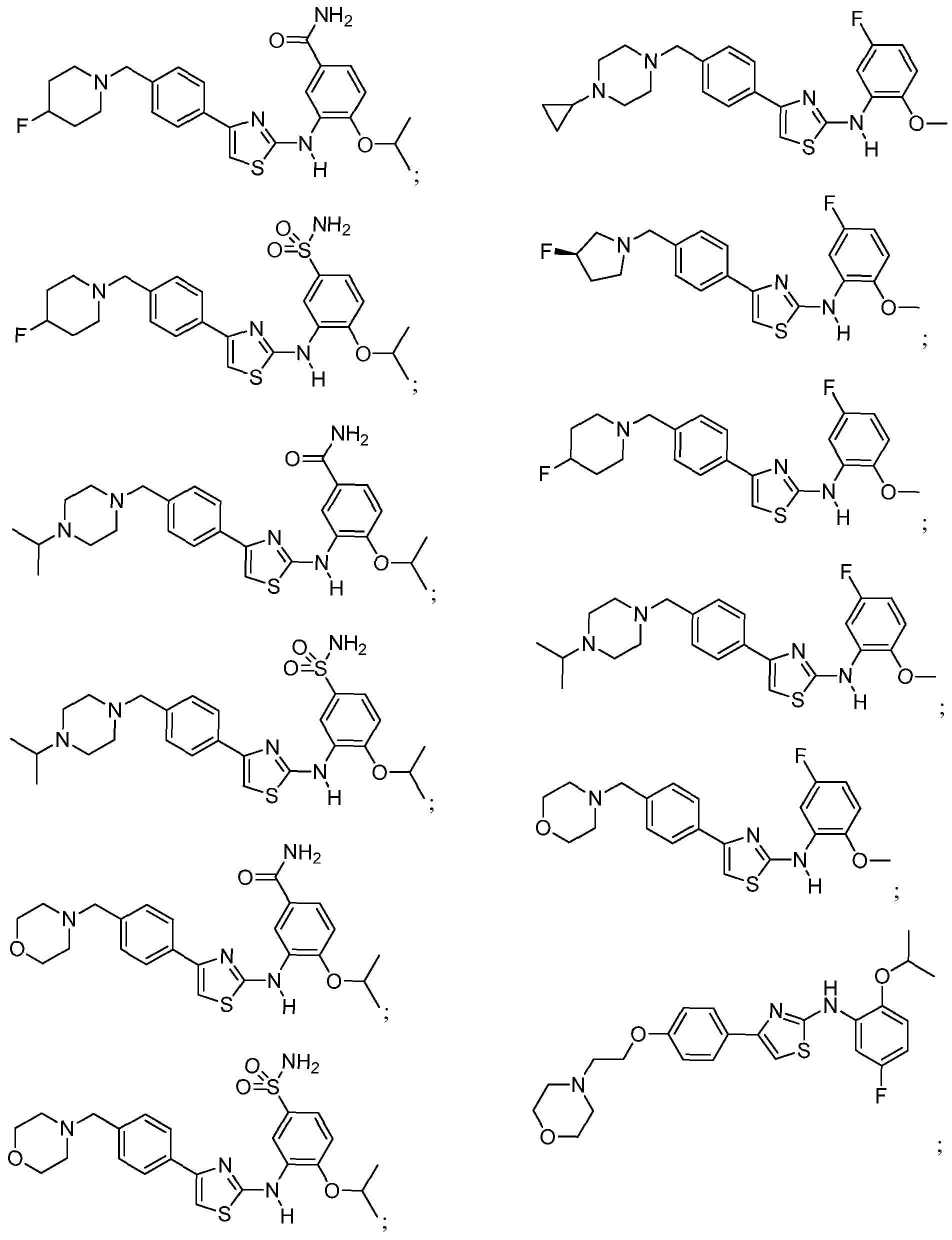

8. A pharmaceutical composition comprising a compound of Claim 1, and a pharmaceutically acceptable carrier.
9. A pharmaceutical composition comprising a compound listed in the Examples section of this specification and a pharmaceutically acceptable carrier.
10. A method for preventing, treating or ameliorating an MMP9 mediated syndrome, disorder or disease comprising administering to a subject in need thereof an effective amount of a compound of Claim 1 or a form, composition or medicament thereof.
11. A method for preventing, treating or ameliorating an MMP9 mediated syndrome, disorder or disease wherein said syndrome, disorder or disease is associated with elevated MMP9 expression or MMP9 overexpression, or is a condition that accompanies syndromes, disorders or diseases associated with elevated MMP9 expression or MMP9 overexpression comprising administering to a subject in need thereof an effective amount of a compound of Formula I or a form, composition or medicament thereof.
12. A method of preventing, treating or ameliorating a syndrome, disorder or disease, wherein said syndrome, disorder or disease is selected from the group consisting of: neoplastic disorders, osteoarthritis, rheumatoid arthritis, cardiovascular diseases, gastric ulcer, pulmonary
hypertension, chronic obstructive pulmonary disease, inflammatory bowel syndrome, periodontal disease, skin ulcers, liver fibrosis, emphysema, Marfan syndrome, stroke, multiple sclerosis, asthma, abdominal aortic aneurysm, coronary artery disease, idiopathic pulmonary fibrosis, renal fibrosis, and migraine, comprising administering to a subject in need thereof an effective amount of a compound of Formula I or a form, composition or medicament thereof.
13. The method of Claim 12, wherein said syndrome, disorder or disease is a neoplastic disorder, which is ovarian cancer.
14. The method of Claim 12, wherein said syndrome, disorder or disease is a cardiovascular disease, wherein said cardiovascular disease is selected from the group consisting of:
atherosclerotic plaque rupture, aneurysm, vascular tissue morphogenesis, coronary artery disease, and myocardial tissue morphogenesis.
15. The method of Claim 14, wherein said cardiovascular disease is atherosclerotic plaque rupture.
16. The method of Claim 12, wherein said syndrome, disorder or disease is rheumatoid arthritis.
17. The method of Claim 12, wherein said syndrome, disorder or disease is asthma.
18. The method of Claim 12, wherein said syndrome, disorder or disease is chronic obstructive pulmonary disease.
19. The method of Claim 12, wherein said syndrome, disorder or disease is inflammatory bowel syndrome.
20. The method of Claim 12, wherein said syndrome, disorder or disease is abdominal aortic aneurism.
21. The method of Claim 12, wherein said syndrome, disorder or disease is osteoarthritis.
22. The method of Claim 12, wherein said syndrome, disorder or disease is idiopathic pulmonary fibrosis.
23. A method of inhibiting MMP9 activity in a mammal by administration of an effective amount of at least one compound of Claim 1.
24. A method for preventing, treating or ameliorating an MMP13 mediated syndrome, disorder or disease comprising administering to a subject in need thereof an effective amount of a compound of Claim 1 or a form, composition or medicament thereof.
25. A method for preventing, treating or ameliorating an MMP13 mediated syndrome, disorder or disease wherein said syndrome, disorder or disease is associated with elevated MMP13 expression or MMP13 overexpression, or is a condition that accompanies syndromes, disorders or diseases associated with elevated MMP13 expression or MMP13 overexpression comprising administering to a subject in need thereof an effective amount of a compound of Formula I or a form, composition or medicament thereof.
26. A method of inhibiting MMP13 activity in a mammal by administration of an effective amount of at least one compound of Claim 1.
Applications Claiming Priority (2)
| Application Number | Priority Date | Filing Date | Title |
|---|---|---|---|
| US201161489722P | 2011-05-25 | 2011-05-25 | |
| US61/489,722 | 2011-05-25 |
Publications (1)
| Publication Number | Publication Date |
|---|---|
| WO2012162461A1 true WO2012162461A1 (en) | 2012-11-29 |
Family
ID=46208176
Family Applications (1)
| Application Number | Title | Priority Date | Filing Date |
|---|---|---|---|
| PCT/US2012/039270 Ceased WO2012162461A1 (en) | 2011-05-25 | 2012-05-24 | Phenyl-thiazolyl inhibitors of pro-matrix metalloproteinase activation |
Country Status (2)
| Country | Link |
|---|---|
| US (1) | US20120302569A1 (en) |
| WO (1) | WO2012162461A1 (en) |
Cited By (1)
| Publication number | Priority date | Publication date | Assignee | Title |
|---|---|---|---|---|
| WO2016124747A1 (en) * | 2015-02-05 | 2016-08-11 | Ab Science | Compounds with anti-tumoral activity |
Families Citing this family (4)
| Publication number | Priority date | Publication date | Assignee | Title |
|---|---|---|---|---|
| LT3388075T (en) | 2015-03-27 | 2023-11-10 | Immatics Biotechnologies Gmbh | Novel peptides and combination of peptides for use in immunotherapy against various tumors (seq id 25 - mrax5-003) |
| GB201505305D0 (en) | 2015-03-27 | 2015-05-13 | Immatics Biotechnologies Gmbh | Novel Peptides and combination of peptides for use in immunotherapy against various tumors |
| WO2020018997A1 (en) | 2018-07-20 | 2020-01-23 | Arkansas State University - Jonesboro | 3,4-thiazolo steroids and methods of making and using the same |
| US20250270199A1 (en) * | 2022-03-31 | 2025-08-28 | Arkansas State University - Jonesboro | Thiazole derivatives and methods of using the same |
Citations (2)
| Publication number | Priority date | Publication date | Assignee | Title |
|---|---|---|---|---|
| EP1331224A1 (en) * | 2000-09-29 | 2003-07-30 | Shionogi & Co., Ltd. | Thiazole or oxazole derivatives |
| WO2003062215A1 (en) * | 2002-01-25 | 2003-07-31 | Kylix Pharmaceuticals B.V. | 4(hetero-) aryl substituted (thia-/oxa-/pyra) zoles for inhibition of tie-2 |
-
2012
- 2012-05-24 WO PCT/US2012/039270 patent/WO2012162461A1/en not_active Ceased
- 2012-05-24 US US13/479,395 patent/US20120302569A1/en not_active Abandoned
Patent Citations (2)
| Publication number | Priority date | Publication date | Assignee | Title |
|---|---|---|---|---|
| EP1331224A1 (en) * | 2000-09-29 | 2003-07-30 | Shionogi & Co., Ltd. | Thiazole or oxazole derivatives |
| WO2003062215A1 (en) * | 2002-01-25 | 2003-07-31 | Kylix Pharmaceuticals B.V. | 4(hetero-) aryl substituted (thia-/oxa-/pyra) zoles for inhibition of tie-2 |
Non-Patent Citations (38)
| Title |
|---|
| AGING CLIN EXP RES, vol. 15, no. 5, 2003, pages 364 - 72 |
| AM J RESPIR CRIT CARE MED, vol. 159, 1999, pages 1138 - 46 |
| ANN RHEUM DIS, vol. 64, 2005, pages 834 - 838 |
| BIOCHEMISTRY, vol. 44, 2005, pages 5258 - 66 |
| BIOL CHEM, vol. 378, no. 3-4, 1997, pages 151 - 60 |
| BIOMOL SCREEN, vol. 6, 2001, pages 429 - 40 |
| BIOTECHNOL LETT, vol. 26, no. 11, 2004, pages 901 - 5 |
| BREUER E ET AL: "Recent non-hydroxamate matrix metalloproteinase inhibitors", EXPERT OPINION ON THERAPEUTIC PATENTS, vol. 15, no. 3, 1 January 2005 (2005-01-01), INFORMA HEALTHCARE, GB, pages 253 - 269, XP002430787, ISSN: 1354-3776, DOI: 10.1517/13543776.15.3.253 * |
| CLINICAL IMMUNOLOGY AND IMMUNOPATHOLOGY, vol. 78, 1996, pages 161 - 71 |
| CURR CANCER DRUG TARGETS, vol. 5, no. 3, 2005, pages 203 - 20 |
| CURR MED CHEM, vol. 12, no. 8, 2005, pages 917 - 25 |
| DATABASE REGISTRY [Online] CHEMICAL ABSTRACTS SERVICE, COLUMBUS, OHIO, US; 2 June 2008 (2008-06-02), XP002679535, Database accession no. 1026492-83-0 * |
| DATABASE REGISTRY CHEMICAL ABSTRACTS SERVICE, COLUMBUS, OHIO, US; 27 August 2009 (2009-08-27), XP002679536, Database accession no. 1176705-37-5 * |
| EUR J BIOCHEM, vol. 258, 1998, pages 37 - 43 |
| EXPERT OPIN INVESTIG DRUGS, vol. 8, no. 3, 1999, pages 255 - 68 |
| EXPERT OPIN INVESTIG DRUGS, vol. 9, no. 5, 2000, pages 993 - 1007 |
| EXPERT OPINION ON THERAPEUTIC PATENTS, vol. 12, no. 5, 2002, pages 665 - 707 |
| GLIA, vol. 50, no. 4, 2005, pages 329 - 39 |
| HYBRIDOMA, vol. 12, no. 4, 1993, pages 349 - 63 |
| INFECT IMMUN, vol. 74, 2006, pages 6135 - 6144 |
| INT J CANCER, vol. 115, no. 6, 2005, pages 849 - 60 |
| J BIOL CHEM, vol. 267, 1992, pages 3581 - 4 |
| J BIOL CHEM, vol. 267, no. 6, 1992, pages 3581 - 4 |
| J BIOL CHEM, vol. 272, no. 41, 1997, pages 25628 - 35 |
| J CELL MOL MED, vol. 9, no. 2, 2005, pages 267 - 85 |
| J CEREB BLOOD FLOW METAB, vol. 20, no. 12, pages 1681 - 9 |
| J CLIN INVEST, vol. 113, no. 10, 2004, pages 1447 - 55 |
| J HISTOCHEM CYTOCHEM, vol. 52, 2004, pages 711 - 722 |
| J IMMUNOL, vol. 137, 1986, pages 2199 - 2209 |
| J NEUROSCI, vol. 25, no. 27, 2005, pages 6401 - 8 |
| J NEUROTRAUMA, vol. 19, no. 5, 2002, pages 615 - 25 |
| J. MED. CHEM., vol. 49, 2006, pages 1173 |
| JBIOL CHEM, vol. 280, no. 10, 2005, pages 9291 - 6 |
| JBIOMOL SCREEN, vol. 6, 2001, pages 429 - 40 |
| JEXP MED, vol. 146, 1977, pages 1585 - 1602 |
| LANCET NEUROL, vol. 2, no. 12, 2003, pages 747 - 56 |
| PROC NATL ACAD SCI U S A, vol. 87, no. 14, 1990, pages 5578 - 82 |
| RHEUMATOLOGY, vol. 40, 2001, pages 978 - 987 |
Cited By (6)
| Publication number | Priority date | Publication date | Assignee | Title |
|---|---|---|---|---|
| WO2016124747A1 (en) * | 2015-02-05 | 2016-08-11 | Ab Science | Compounds with anti-tumoral activity |
| CN107531685A (en) * | 2015-02-05 | 2018-01-02 | Ab科学有限公司 | Compound with antitumor activity |
| JP2018504415A (en) * | 2015-02-05 | 2018-02-15 | エービー サイエンス | Compound having antitumor activity |
| US10570122B2 (en) | 2015-02-05 | 2020-02-25 | Ab Science | Compounds with anti-tumoral activity |
| AU2016214283B2 (en) * | 2015-02-05 | 2020-07-16 | Ab Science | Compounds with anti-tumoral activity |
| RU2758259C2 (en) * | 2015-02-05 | 2021-10-27 | Аб Сьянс | Compound of formula (i), pharmaceutical composition, application of compound of formula (i) for treatment of hematological and/or proliferative disorders |
Also Published As
| Publication number | Publication date |
|---|---|
| US20120302569A1 (en) | 2012-11-29 |
Similar Documents
| Publication | Publication Date | Title |
|---|---|---|
| WO2012162468A1 (en) | Thiazol derivatives as pro -matrix metalloproteinase inhibitors | |
| US20120129842A1 (en) | Bisthiazole inhibitors of pro-matrix metalloproteinase activation | |
| US20120129843A1 (en) | Pyridyl-thiazolyl inhibitors of pro-matrix metalloproteinase activation | |
| AU2015308437B2 (en) | Glycosidase inhibitors | |
| KR101096948B1 (en) | MG Kinesin Inhibitor | |
| IL149150A (en) | 2 - (4 - (6 - methoxy-naphthalene - 2 - yl) - 5 - pyridin - 4 - yl - 1h - imidazole - 2 - yl) - 2 - methyl -derivatives, pharmaceutical compositions comprising them and use thereof as tie2 receptor kinase inhibitors | |
| US9187485B2 (en) | Methods and compositions for the treatment of cancer and related hyperproliferative disorders | |
| CA2948589A1 (en) | 5-chloro-2-difluoromethoxyphenyl pyrazolopyrimidine compounds which are jak inhibitors | |
| JP6042060B2 (en) | Pyrazoloquinolinone derivatives, their preparation and therapeutic use | |
| AU2007207055A1 (en) | Thiazoles as 11 beta-HSD1 inhibitors | |
| KR20190118184A (en) | Sulfoximine glycosidase inhibitors | |
| WO2012162461A1 (en) | Phenyl-thiazolyl inhibitors of pro-matrix metalloproteinase activation | |
| JP7815250B2 (en) | Aldehyde dehydrogenase inhibitors and their therapeutic uses | |
| JP2011504900A (en) | Aminotriazoles as PI3K inhibitors | |
| WO2002040476A1 (en) | Pyridyl-substituted triazoles as tgf inhibitors | |
| CA2922703A1 (en) | Compositions and methods for the treatment of metabolic and body weight related disorders | |
| Shiozaki et al. | Discovery of (1 S, 2 R, 3 R)-2, 3-dimethyl-2-phenyl-1-sulfamidocyclopropanecarboxylates: novel and highly selective aggrecanase inhibitors | |
| US20120129872A1 (en) | Fused heteroaryl inhibitors of pro-matrix metalloproteinase activation | |
| US20150307501A1 (en) | Compositions and Methods for the Treatment of Metabolic and Related Disorders | |
| JP5203937B2 (en) | Thiazole derivatives and uses thereof | |
| US20120129811A1 (en) | Tricyclic inhibitors of pro-matrix metalloproteinase activation | |
| SK163395A3 (en) | Substituted derivatives of 4-phenylthiazoles, preparation method thereof and pharmaceutical compositions containing them | |
| US20120129897A1 (en) | Bis heteroaryl inhibitors of pro-matrix metalloproteinase activation | |
| WO2012162463A1 (en) | Benzothiazolyl inhibitors of pro-matrix metalloproteinase activation | |
| JP2008525337A (en) | Novel heteroarylacetamides |
Legal Events
| Date | Code | Title | Description |
|---|---|---|---|
| 121 | Ep: the epo has been informed by wipo that ep was designated in this application |
Ref document number: 12725583 Country of ref document: EP Kind code of ref document: A1 |
|
| NENP | Non-entry into the national phase |
Ref country code: DE |
|
| 122 | Ep: pct application non-entry in european phase |
Ref document number: 12725583 Country of ref document: EP Kind code of ref document: A1 |