WO2012162330A1 - Tricyclic compounds as inhibitors for the production of beta-amyloid - Google Patents
Tricyclic compounds as inhibitors for the production of beta-amyloid Download PDFInfo
- Publication number
- WO2012162330A1 WO2012162330A1 PCT/US2012/039031 US2012039031W WO2012162330A1 WO 2012162330 A1 WO2012162330 A1 WO 2012162330A1 US 2012039031 W US2012039031 W US 2012039031W WO 2012162330 A1 WO2012162330 A1 WO 2012162330A1
- Authority
- WO
- WIPO (PCT)
- Prior art keywords
- methyl
- thiazin
- mmol
- tetrahydro
- benzo
- Prior art date
- Legal status (The legal status is an assumption and is not a legal conclusion. Google has not performed a legal analysis and makes no representation as to the accuracy of the status listed.)
- Ceased
Links
- 0 CC(*)(*)c(c(Br)c1)cc(CCCC2C(O)OC)c1C2=O Chemical compound CC(*)(*)c(c(Br)c1)cc(CCCC2C(O)OC)c1C2=O 0.000 description 3
- RGQPNGVVIBDMPQ-KNQAVFIVSA-N C[C@]1(c2c3)N=C(N)SC[C@H]1CCCc2ccc3-c1cncc(C#CC)c1 Chemical compound C[C@]1(c2c3)N=C(N)SC[C@H]1CCCc2ccc3-c1cncc(C#CC)c1 RGQPNGVVIBDMPQ-KNQAVFIVSA-N 0.000 description 1
- XPGGLKKSDYVRMC-BLVKFPJESA-N C[C@]1(c2c3)N=C(N)SC[C@H]1CCc2ccc3NC(c(cc1)ncc1F)=O Chemical compound C[C@]1(c2c3)N=C(N)SC[C@H]1CCc2ccc3NC(c(cc1)ncc1F)=O XPGGLKKSDYVRMC-BLVKFPJESA-N 0.000 description 1
- FKWCMJOGZNBMDX-WYRIXSBYSA-N C[C@]12N=C(N)SC[C@H]1CCOc(cc1)c2cc1NC(c(cc1)ncc1F)=O Chemical compound C[C@]12N=C(N)SC[C@H]1CCOc(cc1)c2cc1NC(c(cc1)ncc1F)=O FKWCMJOGZNBMDX-WYRIXSBYSA-N 0.000 description 1
- LVPUNXOSJWGATO-YJYMSZOUSA-N C[C@]12N=C(N)SC[C@H]1CCOc(cc1)c2cc1Nc(nccc1)c1C#N Chemical compound C[C@]12N=C(N)SC[C@H]1CCOc(cc1)c2cc1Nc(nccc1)c1C#N LVPUNXOSJWGATO-YJYMSZOUSA-N 0.000 description 1
- JTNSYOWEBOBJSP-OTYXRUKQSA-N NC1=N[C@@H]2c(cc(cc3F)-c4cncnc4)c3OCC[C@@H]2CS1 Chemical compound NC1=N[C@@H]2c(cc(cc3F)-c4cncnc4)c3OCC[C@@H]2CS1 JTNSYOWEBOBJSP-OTYXRUKQSA-N 0.000 description 1
Classifications
-
- C—CHEMISTRY; METALLURGY
- C07—ORGANIC CHEMISTRY
- C07D—HETEROCYCLIC COMPOUNDS
- C07D279/00—Heterocyclic compounds containing six-membered rings having one nitrogen atom and one sulfur atom as the only ring hetero atoms
- C07D279/04—1,3-Thiazines; Hydrogenated 1,3-thiazines
- C07D279/08—1,3-Thiazines; Hydrogenated 1,3-thiazines condensed with carbocyclic rings or ring systems
-
- A—HUMAN NECESSITIES
- A61—MEDICAL OR VETERINARY SCIENCE; HYGIENE
- A61P—SPECIFIC THERAPEUTIC ACTIVITY OF CHEMICAL COMPOUNDS OR MEDICINAL PREPARATIONS
- A61P25/00—Drugs for disorders of the nervous system
- A61P25/28—Drugs for disorders of the nervous system for treating neurodegenerative disorders of the central nervous system, e.g. nootropic agents, cognition enhancers, drugs for treating Alzheimer's disease or other forms of dementia
-
- C—CHEMISTRY; METALLURGY
- C07—ORGANIC CHEMISTRY
- C07D—HETEROCYCLIC COMPOUNDS
- C07D417/00—Heterocyclic compounds containing two or more hetero rings, at least one ring having nitrogen and sulfur atoms as the only ring hetero atoms, not provided for by group C07D415/00
- C07D417/02—Heterocyclic compounds containing two or more hetero rings, at least one ring having nitrogen and sulfur atoms as the only ring hetero atoms, not provided for by group C07D415/00 containing two hetero rings
- C07D417/04—Heterocyclic compounds containing two or more hetero rings, at least one ring having nitrogen and sulfur atoms as the only ring hetero atoms, not provided for by group C07D415/00 containing two hetero rings directly linked by a ring-member-to-ring-member bond
-
- C—CHEMISTRY; METALLURGY
- C07—ORGANIC CHEMISTRY
- C07D—HETEROCYCLIC COMPOUNDS
- C07D417/00—Heterocyclic compounds containing two or more hetero rings, at least one ring having nitrogen and sulfur atoms as the only ring hetero atoms, not provided for by group C07D415/00
- C07D417/02—Heterocyclic compounds containing two or more hetero rings, at least one ring having nitrogen and sulfur atoms as the only ring hetero atoms, not provided for by group C07D415/00 containing two hetero rings
- C07D417/10—Heterocyclic compounds containing two or more hetero rings, at least one ring having nitrogen and sulfur atoms as the only ring hetero atoms, not provided for by group C07D415/00 containing two hetero rings linked by a carbon chain containing aromatic rings
-
- C—CHEMISTRY; METALLURGY
- C07—ORGANIC CHEMISTRY
- C07D—HETEROCYCLIC COMPOUNDS
- C07D417/00—Heterocyclic compounds containing two or more hetero rings, at least one ring having nitrogen and sulfur atoms as the only ring hetero atoms, not provided for by group C07D415/00
- C07D417/02—Heterocyclic compounds containing two or more hetero rings, at least one ring having nitrogen and sulfur atoms as the only ring hetero atoms, not provided for by group C07D415/00 containing two hetero rings
- C07D417/12—Heterocyclic compounds containing two or more hetero rings, at least one ring having nitrogen and sulfur atoms as the only ring hetero atoms, not provided for by group C07D415/00 containing two hetero rings linked by a chain containing hetero atoms as chain links
-
- C—CHEMISTRY; METALLURGY
- C07—ORGANIC CHEMISTRY
- C07D—HETEROCYCLIC COMPOUNDS
- C07D513/00—Heterocyclic compounds containing in the condensed system at least one hetero ring having nitrogen and sulfur atoms as the only ring hetero atoms, not provided for in groups C07D463/00, C07D477/00 or C07D499/00 - C07D507/00
- C07D513/02—Heterocyclic compounds containing in the condensed system at least one hetero ring having nitrogen and sulfur atoms as the only ring hetero atoms, not provided for in groups C07D463/00, C07D477/00 or C07D499/00 - C07D507/00 in which the condensed system contains two hetero rings
- C07D513/04—Ortho-condensed systems
Definitions
- the present invention relates to compounds which are inhibitors of ⁇ -amyloid peptide ( ⁇ ) production, as well as to methods of treating Alzheimer's Disease (AD) and other conditions related to ⁇ -amyloid production using compounds which are inhibitors of ⁇ -amyloid peptide ( ⁇ ) production.
- the invention further relates to pharmaceutical compositions comprising these compounds.
- AD Alzheimer's disease
- a progressive neurodegenerative disease which begins with memory loss and progresses to include severe cognitive impairment, altered behavior, and decreased motor function (Grundman, M. et ah, Arch Neurol. (2004) 61 : 59-66; Walsh, D.M. et al, Neuron (2004) 44: 181-193). It is the most common form of dementia and represents the third leading cause of death after cardiovascular disorders and cancer.
- the cost of AD is enormous and includes the suffering of the patients and families and the lost productivity of patients and caregivers. No treatment that effectively prevents AD or reverses the clinical symptoms and underlying pathophysiology is currently available.
- AD Alzheimer's disease
- Plaques primarily consist of ⁇ -amyloid ( ⁇ ) peptides that are formed by a stepwise proteolytic cleavage of the amyloid precursor protein (APP) by ⁇ -site APP-cleaving enzyme 1 (BACE1), to generate the N-terminus, and ⁇ -secretase, to generate the C-terminus (Selkoe, D.J., Physiol Rev. (2001) 81 : 741- 766).
- ⁇ -Secretase is a transmembrane protein complex that includes Nicastrin, Aph-1, PEN-2, and either Presenilin-1 (PS-1) or Presenilin-2 (PS-2) (Wolfe, M.S.
- PS-1 and PS-2 are believed to contain the catalytic sites of ⁇ - secretase.
- the BACEl enzyme is a transmembrane aspartyl protease and was described in the literature by several independent groups [see Hussain, I. et al, (1999) Mol. Cell. NeuroscL, 14: 419-427; Lin, X. et al, (2000) Proceedings of the National Academy of Sciences of the United States of America, 97: 1456-1460; Sinha, S., et al., (1999) Nature (London), 402: 537-540; Vassar, R., et al., (1999) Science (Washington, D. C), 286: 735- 741; Walsh, D.M. et al, (2002); Wolfe, M.S. (2001); Yan, R. et al, (1999) Nature (London), 402: 533-537].
- ⁇ 40 is the most abundant form of ⁇ synthesized (80-90%), while ⁇ 42 is most closely linked with AD pathogenesis.
- mutations in the APP, PS-1, and PS-2 genes that lead to rare, familial forms of AD implicate ⁇ 42 aggregates as the primary toxic species (Selkoe, D.J., Physiol Rev., (2001) 81 : 741-766).
- Current evidence suggests that oligomeric, protofibrillar and intracellular ⁇ 42 play a significant role in the disease process (Cleary, J.P. et al, Nat Neurosci. (2005) 8: 79-84).
- Inhibitors of the enzymes that form ⁇ 42 such as BACEl, represent potential disease-modifying therapeutics for the treatment of AD.
- ALS patients Approximately 25% of ALS patients have significant dementia or aphasia (Hamilton, R.L. et al, Acta Neuropathol (Bed) (2004) 107: 515-522). The majority (-60%) of these patients, designated ALS-D, contain ubiquitin-positive inclusions comprised primarily of the TDP-43 protein (Neumann, M. et al, Science (2006) 314: 130-133). About 30% of the ALS-D patients have amyloid plaques consistent with ⁇ causing their dementia (Hamilton, R.L. et al, Acta Neuropathol (Bed) (2004) 107: 515- 522). These patients should be identifiable with amyloid imaging agents and potentially could be treated by compounds that reduce ⁇ levels.
- IBM is a rare, age-related degenerative disease of skeletal muscle.
- ⁇ was identified as one of several components of drusen, extracellular deposits beneath the retinal pigment epithelium (RPE) (Anderson, D.H. et al, Exp Eye Res (2004) 78: 243-256).
- RPE retinal pigment epithelium
- a recent study has shown potential links between ⁇ and macular degeneration in mice (Yoshida, T. et al, J Clin Invest (2005) 1 15: 2793-2800). Increases in ⁇ deposition and supranuclear cataracts have been found in AD patients (Goldstein, L.E. et al, Lancet (2003) 361 : 1258-1265). Compounds that reduce ⁇ levels could reduce or prevent age-related macular degeneration.
- BACE1 inhibitors may prevent long-term damage from traumatic brain injury (Loane, D. J., et al, Nature Medicine (2009) 15: 377-379).
- a logical approach to reducing ⁇ levels is to block the action of the secretases.
- the ⁇ -secretase enzyme (BACE) is responsible for cleaving APP and forms the amino- terminus of ⁇ , initiating the amyloidogenic pathway. Removal of BACE activity in mice by gene targeting completely abolishes ⁇ production [see Luo, Y., et al, (2001) Nature Neuroscience, 4: 231-232; Roberds, S.L. et al, (2001) Human Molecular Genetics, 10: 1317-1324].
- BACE -/- mice also show no significant negative phenotypes, suggesting that disruption of BACE-mediated cleavage of APP does not produce additional undesired effects.
- compounds that reduce ⁇ 1-42 production and their pharmaceutical compositions are beneficial agents that will prevent damage from overproduction of ⁇ and are useful in treating Alzheimer's disease, Down syndrome, CAA, and inclusion body myositis, DLB, and other disorders where ⁇ is overproduced.
- the present invention provides a compound of formula (I), including pharmaceutically acceptable salts thereof:
- X is selected from the group of CH 2 , O, and NR 2 ;
- n 0 to 3;
- R 1 at each instance is selected from the group of halogen, hydroxy, amino, Ci_
- L is a bond, -NHCO-, -NH-, or L and Z together can be absent;
- Z is a C6-C1 0 - aryl group or a 5-10 membered heterocyclic group which can be further substituted with from 0-3 substituents selected from halogen, haloCi-4 alkoxy, 4- methoxyphenyl, hydroxy, amino, Ci-4alkylamino, Ci-4dialkylamino, haloCi-4 alkyl, CN, Ci-C 6 alkyl or cycloalkyl, C1-C6 alkoxy, or C2-C4 alkynyl;
- R 2 is selected from the group of hydrogen, benzyl, C1-C6 alkyl or cycloalkyl, C1-C6 alkoxy, acetyl, and methanesulfonyl;
- R 3 , R 4 and R 5 are each independently selected from hydrogen or Ci-4alkyl.
- the present invention provides a pharmaceutical composition for the treatment of disorders responsive to the reduction of ⁇ -amyloid peptide production comprising a therapeutically effective amount of a compound of formula (I), or a pharmaceutically acceptable salt thereof, in association with a pharmaceutically acceptable carrier or diluent.
- the present invention provides a method for the treatment of disorders responsive to the reduction of ⁇ -amyloid peptide production in a mammal in need thereof, which comprises administering to said mammal a therapeutically effective amount of a compound of formula (I), or a pharmaceutically acceptable salt thereof.
- said disorder is selected from Alzheimer's Disease (AD), Down Syndrome, mild cognitive impairment (MCI), cerebral amyloid angiopathy (CAA), dementia with Lewy bodies (DLB), amyotrophic lateral sclerosis (ALS-D), inclusion body myositis (IBM), age-related macular degeneration, and cancer.
- said disorder is selected from Alzheimer's Disease and Down Syndrome.
- said disorder is Alzheimer's Disease.
- haloCi_ 6 alkoxy denotes a haloalkoxy group containing one to six carbon atoms and the term
- alkoxy refers to an alkyl group attached to the parent molecular moiety through an oxygen atom.
- alkoxyalkyl refers to an alkyl group substituted with one, two, or three alkoxy groups.
- alkoxyalkylcarbonyl refers to an alkoxyalkyl group attached to the parent molecular moiety through a carbonyl group.
- alkoxycarbonyl refers to an alkoxy group attached to the parent molecular moiety through a carbonyl group.
- alkyl refers to a group derived from a straight or branched chain saturated hydrocarbon containing from one to ten carbon atoms.
- alkylamino refers to -NHR X , wherein R x is an alkyl group.
- alkylaminoalkoxy refers to an alkylamino group attached to the parent molecular moiety through an alkoxy group.
- alkylcarbonyl refers to an alkyl group attached to the parent molecular moiety through a carbonyl group.
- alkylsulfonyl refers to an alkyl group attached to the parent molecular moiety through a sulfonyl group.
- alkylsulfonylamido refers to -C(0)NHS(0)2 X wherein R x is an alkyl group.
- amino refers to -NH 2 .
- carbonyl refers to -C(O)-.
- cyano refers to -CN.
- cycloalkyl refers to a saturated monocyclic hydrocarbon ring system having three to fourteen carbon atoms and zero heteroatoms.
- (cycloalkyl)alkyl refers to an alkyl group substituted with one, two, or three cycloalkyl groups.
- cycloalkylamino refers to -NHR X wherein Rx is a cycloalkyl group.
- cycloalkylcarbonyl refers to a cycloalkyl group attached to the parent molecular moiety through a carbonyl group.
- cycloalkylsulfonyl refers to a cycloalkyl group attached to the parent molecular moiety through a sulfonyl group.
- dialkylamino refers to -NR x R y , wherein R x and R y are each alkyl groups.
- dialkylaminoalkoxy refers to a dialkylamino group attached to the parent molecular moiety through an alkoxy group.
- dialkylaminoalkyl refers to an alkyl group substituted with one, two, or three dialkylamino groups.
- dialkylaminoalkylcarbonyl refers to a
- dialkylaminoalkyl group attached to the parent molecular moiety through a carbonyl group.
- H refers to hydrogen, including its isotopes.
- haloalkoxy refers to a haloalkyl group attached to the parent molecular moiety through an oxygen atom.
- haloalkyl refers to an alkyl group substituted with one, two, three, or four halogen atoms.
- hydroxy refers to -OH.
- hydroxyalkyl refers to an alkyl group substituted with one, two, or three hydroxy groups.
- methylamino refers to -NHCH 3 .
- sulfonyl refers to -SO 2 -.
- Certain compounds of the present invention may also exist in different stable conformational forms which may be separable. Torsional asymmetry due to restricted rotation about an asymmetric single bond, for example because of steric hindrance or ring strain, may permit separation of different conformers.
- the present disclosure includes each conformational isomer of these compounds and mixtures thereof.
- isotopes include those atoms having the same atomic number but different mass numbers.
- isotopes of hydrogen include deuterium and tritium.
- isotopes of carbon include 13 C and 14 C.
- Isotopically-labeled compounds of the invention can generally be prepared by conventional techniques known to those skilled in the art or by processes analogous to those described herein, using an appropriate isotopically-labeled reagent in place of the non-labeled reagent otherwise employed. Such compounds may have a variety of potential uses, for example as standards and reagents in determining biological activity. In the case of stable isotopes, such compounds may have the potential to favorably modify biological, pharmacological, or pharmacokinetic properties.
- Certain compounds of the present invention may exist in zwitterionic form and the present disclosure includes each zwitterionic form of these compounds and mixtures thereof.
- the compounds of the present invention can exist as pharmaceutically acceptable salts.
- pharmaceutically acceptable salt represents salts or zwitterionic forms of the compounds of the present invention which are water or oil- soluble or dispersible, which are, within the scope of sound medical judgment, suitable for use in contact with the tissues of patients without excessive toxicity, irritation, allergic response, or other problem or complication commensurate with a reasonable benefit/risk ratio, and are effective for their intended use.
- the salts can be prepared during the final isolation and purification of the compounds or separately by reacting a suitable nitrogen atom with a suitable acid.
- Representative acid addition salts include acetate, adipate, alginate, citrate, aspartate, benzoate, benzenesulfonate, bisulfate, butyrate, camphorate, camphorsulfonate; digluconate, glycerophosphate, hemisulfate, heptanoate, hexanoate, formate, fumarate, hydrochloride, hydrobromide, hydroiodide, 2-hydroxyethanesulfonate, lactate, maleate, mesitylenesulfonate, methanesulfonate, naphthylenesulfonate, nicotinate, 2-naphthalenesulfonate, oxalate, palmoate, pectinate, persulfate, 3-phenylproprionate, picrate, pivalate, propionate, succinate, tartrate, trichloroacetate, trifluoroacetate, phosphate, glutamate, bicarbon
- Basic addition salts can be prepared during the final isolation and purification of the compounds by reacting a carboxy group with a suitable base such as the hydroxide, carbonate, or bicarbonate of a metal cation or with ammonia or an organic primary, secondary, or tertiary amine.
- a suitable base such as the hydroxide, carbonate, or bicarbonate of a metal cation or with ammonia or an organic primary, secondary, or tertiary amine.
- suitable base such as the hydroxide, carbonate, or bicarbonate of a metal cation or with ammonia or an organic primary, secondary, or tertiary amine.
- the cations of pharmaceutically acceptable salts include lithium, sodium, potassium, calcium, magnesium, and aluminum, as well as nontoxic quaternary amine cations such as ammonium, tetramethylammonium,
- tetraethylammonium methylamine, dimethylamine, trimethylamine, triethylamine, diethylamine, ethylamine, tributylamine, pyridine, ⁇ , ⁇ -dimethylaniline, N- methylpiperidine, N-methylmorpholine, dicyclohexylamine, procaine, dibenzylamine, ⁇ , ⁇ -dibenzylphenethylamine, and ⁇ , ⁇ '-dibenzylethylenediamine.
- Other representative organic amines useful for the formation of base addition salts include ethylenediamine, ethanolamine, diethanolamine, piperidine, and piperazine.
- the present invention provides a compound of formula (I), including pharmaceutically acceptable salts thereof:
- n 0 to 3;
- R 1 at each instance is selected from the group of halogen, hydroxy, amino, Ci_
- L is a bond, -NHCO-, -NH-, or L and Z together can be absent;
- Z is a C6-C1 0 - aryl group or a 5- 10 membered heterocyclic group which can be further substituted with from 0-3 substituents selected from halogen, haloCi-4 alkoxy, 4- methoxyphenyl, hydroxy, amino, Ci-4alkylamino, Ci-4dialkylamino, haloCi-4 alkyl, CN, Ci-Ce alkyl or cycloalkyl, Ci-Ce alkoxy, or C2-C4 alkynyl;
- R 2 is selected from the group of hydrogen, benzyl, Ci-Ce alkyl or cycloalkyl, Ci-Ce alkoxy, acetyl, and methanesulfonyl;
- R 3 , R 4 and R 5 are each independently selected from hydrogen or C 1-4 alkyl.
- R 3 , R 4 and R 5 are independently selected from hydrogen or Ci-4alkyl.
- One example of a preferred compound of the invention is 5-Chloro-pyridine-2- carboxylic acid ((4aS, l 1 b5)-2 -amino- 1 lb-methyl-4,4a,5, 6,7, 1 lb-hexahydro-3-thia-l -aza- dibenzo[a,c]cyclohepten- 10-yl)-amide.
- Other especially preferred compounds of the invention including
- compositions which include therapeutically effective amounts of compounds of formula (I) or pharmaceutically acceptable salts thereof, and one or more pharmaceutically acceptable carriers, diluents, or excipients.
- the compounds of formula (I) and pharmaceutically acceptable salts thereof are as described above.
- the carrier(s), diluent(s), or excipient(s) must be acceptable in the sense of being compatible with the other ingredients of the formulation and not deleterious to the recipient thereof.
- a process for the preparation of a pharmaceutical formulation including admixing a compound of formula (I), or a pharmaceutically acceptable salt thereof, with one or more pharmaceutically acceptable carriers, diluents, or excipients.
- the dosage of the compounds of Formula I to achieve a therapeutic effect will depend not only on such factors as the age, weight and sex of the patient and mode of administration, but also on the degree of ⁇ - ⁇ reduction desired and the potency of the particular compound being utilized for the particular disorder of disease concerned. It is also contemplated that the treatment and dosage of the particular compound may be administered in unit dosage form and that the unit dosage form would be adjusted accordingly by one skilled in the art to reflect the relative level of activity. The decision as to the particular dosage to be employed (and the number of times to be administered per day) is within the discretion of the physician, and may be varied by titration of the dosage to the particular circumstances of this invention to produce the desired therapeutic effect.
- a suitable dose of a compound of Formula I or pharmaceutical composition thereof for a mammal, including man, suffering from, or likely to suffer from any condition related to ⁇ - ⁇ production as described herein generally the daily dose will be from about 0.05 mg/kg to about 10 mg/kg and preferably, about 0.1 to 2 mg/kg when administered parenterally.
- the dose may be in the range from about 0.1 to about 75 mg/kg and preferably from 0.1 to 10 mg/kg body weight.
- the active ingredient will preferably be administered in equal doses from one to four times a day. However, usually a small dosage is administered, and the dosage is gradually increased until the optimal dosage for the host under treatment is determined.
- the instant compounds In accordance with good clinical practice, it is preferred to administer the instant compounds at a concentration level that will produce an effective anti-amyloid effect without causing any harmful or untoward side effects.
- the amount of the compound actually administered will be determined by a physician, in the light of the relevant circumstances including the condition to be treated, the choice of compound of be administered, the chosen route of administration, the age, weight, and response of the individual patient, and the severity of the patient's symptoms.
- compositions may be adapted for administration by any appropriate route, for example by the oral (including buccal or sublingual), rectal, nasal, topical (including buccal, sublingual, or transdermal), vaginal, or parenteral (including subcutaneous, intracutaneous, intramuscular, intra-articular, intrasynovial, intrasternal, intrathecal, intralesional, intravenous, or intradermal injections or infusions) route.
- Such formulations may be prepared by any method known in the art of pharmacy, for example by bringing into association the active ingredient with the carrier(s) or excipient(s).
- compositions adapted for oral administration may be presented as discrete units such as capsules or tablets; powders or granules; solutions or suspensions in aqueous or non-aqueous liquids; edible foams or whips; or oil-in-water liquid emulsions or water-in-oil emulsions.
- the active drug component can be combined with an oral, non-toxic pharmaceutically acceptable inert carrier such as ethanol, glycerol, water, and the like.
- an oral, non-toxic pharmaceutically acceptable inert carrier such as ethanol, glycerol, water, and the like.
- Powders are prepared by comminuting the compound to a suitable fine size and mixing with a similarly comminuted pharmaceutical carrier such as an edible carbohydrate, as, for example, starch or mannitol. Flavoring, preservative, dispersing, and coloring agent can also be present.
- Capsules are made by preparing a powder mixture, as described above, and filling formed gelatin sheaths.
- Glidants and lubricants such as colloidal silica, talc, magnesium stearate, calcium stearate, or solid polyethylene glycol can be added to the powder mixture before the filling operation.
- a disintegrating or solubilizing agent such as agar- agar, calcium carbonate, or sodium carbonate can also be added to improve the availability of the medicament when the capsule is ingested.
- suitable binders include starch, gelatin, natural sugars such as glucose or beta-lactose, corn sweeteners, natural and synthetic gums such as acacia, tragacanth or sodium alginate,
- Lubricants used in these dosage forms include sodium oleate, sodium chloride, and the like.
- Disintegrators include, without limitation, starch, methyl cellulose, agar, betonite, xanthan gum, and the like. Tablets are formulated, for example, by preparing a powder mixture, granulating or slugging, adding a lubricant and disintegrant, and pressing into tablets.
- a powder mixture is prepared by mixing the compound, suitable comminuted, with a diluent or base as described above, and optionally, with a binder such as carboxymethylcellulose, an aliginate, gelatin, or polyvinyl pyrrolidone, a solution retardant such as paraffin, a resorption accelerator such as a quaternary salt and/or and absorption agent such as betonite, kaolin, or dicalcium phosphate.
- the powder mixture can be granulated by wetting with a binder such as syrup, starch paste, acadia mucilage, or solutions of cellulosic or polymeric materials and forcing through a screen.
- the powder mixture can be run through the tablet machine and the result is imperfectly formed slugs broken into granules.
- the granules can be lubricated to prevent sticking to the tablet forming dies by means of the addition of stearic acid, a stearate salt, talc, or mineral oil.
- the lubricated mixture is then compressed into tablets.
- the compounds of the present disclosure can also be combined with a free flowing inert carrier and compressed into tablets directly without going through the granulating or slugging steps.
- a clear or opaque protective coating consisting of a sealing coat of shellac, a coating of sugar or polymeric material, and a polish coating of wax can be provided. Dyestuffs can be added to these coatings to distinguish different unit dosages.
- Oral fluids such as solution, syrups, and elixirs can be prepared in dosage unit form so that a given quantity contains a predetermined amount of the compound.
- Syrups can be prepared by dissolving the compound in a suitably flavored aqueous solution, while elixirs are prepared through the use of a non-toxic vehicle.
- Solubilizers and emulsifiers such as ethoxylated isostearyl alcohols and polyoxyethylene sorbitol ethers, preservatives, flavor additive such as peppermint oil or natural sweeteners, or saccharin or other artificial sweeteners, and the like can also be added.
- dosage unit formulations for oral administration can be microencapsulated.
- the formulation can also be prepared to prolong or sustain the release as for example by coating or embedding particulate material in polymers, wax, or the like.
- the compounds of formula (I), and pharmaceutically acceptable salts thereof, can also be administered in the form of liposome delivery systems, such as small unilamellar vesicles, large unilamellar vesicles, and multilamellar vesicles.
- liposomes can be formed from a variety of phopholipids, such as cholesterol, stearylamine, or
- the compounds of formula (I) and pharmaceutically acceptable salts thereof may also be delivered by the use of monoclonal antibodies as individual carriers to which the compound molecules are coupled.
- the compounds may also be coupled with soluble polymers as targetable drug carriers.
- Such polymers can include polyvinylpyrrolidone, pyran copolymer, polyhydroxypropylmethacrylamidephenol,
- polyhydroxyethylaspartamidephenol or polyethyleneoxidepolylysine substituted with palitoyl residues.
- the compounds may be coupled to a class of
- biodegradable polymers useful in achieving controlled release of a drug for example, polylactic acid, polepsilon caprolactone, polyhydroxy butyric acid, polyorthoesters, polyacetals, polydihydropyrans, polycyanoacrylates, and cross-linked or amphipathic block copolymers ofhydrogels.
- compositions adapted for transdermal administration may be presented as discrete patches intended to remain in intimate contact with the epidermis of the recipient for a prolonged period of time.
- the active ingredient may be delivered from the patch by iontophoresis as generally described in Pharmaceutical Research, 3(6), 318 (1986).
- compositions adapted for topical administration may be formulated as ointments, creams, suspensions, lotions, powders, solutions, pastes, gels, sprays, aerosols, or oils.
- the formulations are preferably applied as a topical ointment or cream.
- the active ingredient may be employed with either a paraffinic or a water- miscible ointment base.
- the active ingredient may be formulated in a cream with an oil-in-water cream base or a water-in oil base.
- compositions adapted for topical administrations to the eye include eye drops wherein the active ingredient is dissolved or suspended in a suitable carrier, especially an aqueous solvent.
- compositions adapted for topical administration in the mouth include lozenges, pastilles, and mouth washes.
- compositions adapted for rectal administration may be presented as suppositories or as enemas.
- compositions adapted for nasal administration wherein the carrier is a solid include a course powder which is administered in the manner in which snuff is taken, i.e., by rapid inhalation through the nasal passage from a container of the powder held close up to the nose.
- Suitable formulations wherein the carrier is a liquid, for administration as a nasal spray or nasal drops, include aqueous or oil solutions of the active ingredient.
- Fine particle dusts or mists which may be generated by means of various types of metered, dose pressurized aerosols, nebulizers, or insufflators.
- compositions adapted for vaginal administration may be presented as pessaries, tampons, creams, gels, pastes, foams, or spray formulations.
- compositions adapted for parenteral administration include aqueous and non-aqueous sterile injection solutions which may contain anti-oxidants, buffers, bacteriostats, and solutes which render the formulation isotonic with the blood of the intended recipient; and aqueous and non-aqueous sterile suspensions which may include suspending agents and thickening agents.
- the formulations may be presented in unit-dose or multi-dose containers, for example sealed ampoules and vials, and may be stored in a freeze-dried (lyophilized) condition requiring only the addition of the sterile liquid carrier, for example water for injections, immediately prior to use.
- Extemporaneous injection solutions and suspensions may be prepared from sterile powders, granules, and tablets.
- formulations may include other agents conventional in the art having regard to the type of formulation in question, for example those suitable for oral administration may include flavoring agents.
- the compounds may be prepared using the reactions and techniques described in this section.
- the reactions are performed in solvents appropriate to the reagents and materials employed and are suitable for the transformations being effected.
- all proposed reaction conditions including choice of solvent, reaction atmosphere, reaction temperature, duration of the experiment and workup procedures, are chosen to be the conditions standard for that reaction, which should be readily recognized by one skilled in the art. It is understood by one skilled in the art of organic synthesis that the functionality present on various portions of the molecule must be compatible with the reagents and reactions proposed. Such restrictions to the substituents which are compatible with the reaction conditions will be readily apparent to one skilled in the art and alternate methods must then be used.
- dichloromethane "DIEA” for N,N-diisopropylethylamine; "LDA” for lithium diisopropylamide; "Ph” for phenyl; "TFA” for trifluoracetic acid; "Et” for ethyl; “DMF” for ⁇ , ⁇ -dimethylformamide; “OAc” for acetate; “h” for hours, “min” for minutes; and “THF” for tetrahydrofuran.
- 3-bromobenzocycloheptanones 1 can be acylated under basic conditions with dimethyl carbonate to form the beta-ketoesters 2. Reduction with sodium borohydride or other reducing agents produces the alcohols 3, which eliminate under acidic conditions forming the ⁇ , ⁇ unsaturated esters 4. Reduction of the ester followed by halogenation of the resulting alcohol leads to the allylic chlorides 6, which can be condensed with thiourea followed by acidic cyclization to prepare the aminothiazines 7. Following protection of the aminothiazine using standard conditions including preparation of the bis-boc protected intermediate, the core can undergo a number of reactions to functionalize the 3-bromo group.
- intermediates 2 can be reacted with triflic anhydride under basic conditions to yield the vinyl triflates
- the bromine atom on intermediates 11 (or the corresponding dimethyl intermediates 4) is replaced with a N- trifluoroacetamide group (Scheme 3).
- the trifluoroacetamide group is then easily deprotected under mild basic conditions to reveal the aniline.
- the anilines 12 serve as precursors for coupling reactions known to those skilled in the art, including condensation with carboxylic acids or acid equivalents to make amides (13), or similar reactions with sulfonyl chlorides to make sulfonamides, or isocyanates to make ureas. Deprotection of the coupled intermediates then provides the desired compounds of claim I.
- Additional compounds of the invention can be made using the chemistry described in scheme 4. Bromination of phenols 14 produces intermediates of type 15, which can be alkylated by homoallyl bromide to produce intermediates 16. Suzuki coupling under standard conditions can introduce a variety of aryl groups at the bromide position, here pyrimidinyl boronic acid is used as one such example. Additional known copper-based chemistry can couple primary amides through the amide nitrogen atom to the same position, including the reaction sequence demonstrated in scheme 3. Cyclization of the resulting intermediates 17 results in formation of the products 18 which represent an additional class of compounds of formula I.
- HPLC is an abbreviation used herein for high pressure liquid chromatography. When described as performed under “standard conditions”, samples were dissolved in methanol (1 mg/mL) and run using a gradient program with a solvent flow rate of 1.0 mL/min. Reverse phase preparatory HPLC: When described as performed under “standard conditions”, samples (approx.
- TLC is an abbreviation used herein for thin layer chromatography.
- Proton NMR spectra were obtained on a Bruker 400 or 500 spectrometer. Data were referred to the lock solvent.
- Step A4 (£)-Methyl 2-bromo-6,7-dihydro-5H-benzo[7]annulene-8-carboxylate
- a solution of methyl 3-bromo-5-hydroxy-6,7,8,9-tetrahydro-5H-benzo[7]annulene-6- carboxylate from step A3 230 mg, 0.769 mmol
- p- toluenesulfonic acid monohydrate 29.2 mg, 0.154 mmol
- Step A8 rel-(4aS, ⁇ lbS)-10-Bromo-4,4a,5,6,7, l lb-hexahydro-3-thia-l-aza- dibenzo[a,c]cyclohepten-2-ylamine, bis-N,N-(tert-butyl)carbamate
- Step Bl (Z)-Methyl 2-bromo-9-(trifluoromethylsulfonyloxy)-6,7-dihydro-5H- benzo[7]annulene-8-carboxylate
- step B2 was converted to the compound of step B3 in 77 % yield.
- step B3 In a manner similar to the procedure of step A6, the compound of step B3 was converted to the compound of step B4 in 84 % yield.
- Step B5. rel-(4aS, l lbS 10-Bromo-l lb-methyl-4,4a,5,6,7, l lb-hexahydro-3-thia-l-aza- dibenzo[a,c]cyclohepten-2-ylamine,bis-N,N-(ter?-butyl)carbamate
- Step CI 7-Bromo-2-methylene-3,4-dihydronaphthalen-l(2H)-one
- the ethereal solution was decanted from the red gum into a separatory funnel and washed with half-saturated sodium bicarbonate solution.
- the red gum was triturated with diethyl ether, and the resulting ethereal solution was then used to extract the washing water.
- the combined organic layers were dried over magnesium sulfate. Filtration and concentration of the organic layer afforded a heavy red oil.
- the oil was purified using silica gel column chromatography (20: 1 hexanes/EtOAc) to afford 7-bromo-2-methylene- 3,4-dihydronaphthalen-l(2H)-one (0.850 g, 3.59 mmol, 40 % yield) as a thick viscous yellow oil.
- Triethylamine (0.457 mL, 3.28 mmol), di-tert-butyl dicarbonate (0.571 mL, 2.458 mmol), and DMAP (5.00 mg, 0.041 mmol) were added to the crude product.
- Step Dl tert-Butyl re/-(4aS,10bS)-9-azido-10b-methyl-4a,5,6,10b-tetrahydi
- Step D2 tert-Butyl re/-(4a5',10b5)-9-amino-10b-methyl-4a,5,6,10b-tetrahydro-4H- naphtho[ 1 ,2-d] [ 1 ,3]thiazin-2-ylcarbamate
- Step E2 7-Bromo- 1 -methy 1-2 -methylene- 1 ,2,3 ,4-tetrahydronaphthalen- 1 -ol
- step E2 In a manner similar to the procedure of step C2, but using 3-bromo-6-methylene-6,7,8,9- tetrahydro-5H-benzo[7]annulen-5-one from step El (1.15 g, 4.58 mmol), the titled compound of Step E2 was isolated (400 mg, 1.50 mmol, 33 % yield) as a clear oil.
- step E3 carbamimidothioate, hydrochloride
- Step E rel-(4aS, l lbS)-10-Bromo-l lb-methyl-4,4a,5,6,7, l lb- hexahydrobenzo[6,7]cyclohepta[l,2-d][l,3]thiazin-2-amine, 2,2,2-trifluoroacetate
- Triflic acid (1.33 mL, 15.0 mmol) was added to flask charged with a stirred solution of (2-bromo-9-methyl-6,7-dihydro-5H-benzo[7]annulen-8-yl)methyl carbamimidothioate, HC1 from step E3 (540 mg, 1.5 mmol) in TFA (5.0 mL) at 0 °C.
- the reaction mixture was allowed to warm to rt and stir for 6 h.
- the reaction contents were carefully added to a swirled mixture of ice and excess solid sodium bicarbonate. After gas evolution had ceased, the resulting mixture was extracted with ethyl acetate.
- Step F 1 -(2-(Allyloxy)-4-fluorophenyl)ethanone
- Step F re/-((3S,45)-4-Amino-7-fluoro-4-methylchroman-3 -yl)methanol
- Step F re/-N-(((3,S,45)-7-Fluoro-3 -(hydroxymethyl)-4-methylchroman-4- yl)carbamothioyl)benzamide
- Step F5. re/-N-((4aR,10b5)-8-Fluoro-10b-methyl-4,4a,5,10b-tetrahydrochromeno[4,3- d] [ 1 ,3]thiazin-2-yl)benzamide
- Step H2 7-Bromo-3,4-dihydrobenzo[b]oxepin-5(2H)-one l-(5-bromo-2-(2-bromoethoxy)phenyl)ethanone from step H (9.0 g, 28.0 mmol) was dissolved in THF (175 mL), cooled to 0 °C and treated with sodium hydride (0.805 g, 33.5 mmol). The reaction mixture was carefully heated to reflux and continued heating for 20 h. The crude mixture was cooled, quenched with 2 M HC1 (50 mL) and partitioned between brine (300 mL) and EtOAc (250 mL).
- a solution of 0.4 M (Me ⁇ CuLi was prepared via dropwise addition of methyl lithium in hexanes (1.6 M, 72 mmol, 45 mL) to a suspension of Cul (6.86 g, 36 mmol) in anhydrous diethyl ether (45 mL) in a ice-salt bath. After stirring for 20 min, a homogeneous solution resulted.
- Step H9 re/-(4a5",l lb5)-10-Bromo-l lb-methyl-4a,5,6,l lb-tetrahydro-4H- benzo[2,3]oxepino[4,5-d][l,3]thiazin-2-amine
- Step H10 tert-Butyl rel-((4aS,l lhS 10-bromo-l lb-methyl-4a,5,6,l lb-tetrahydro-4H- benzo[2,3]oxepino[4,5-d][l,3]thiazin-2-yl)carbamate
- Step K3 5-(Difluoromethoxy)picolinic acid To a solution of methyl 5-(difluoromethoxy)picolinate from step K2 (730 mg, 3.59 mmol) in THF (8 mL), was added a solution of lithium hydroxide (430 mg, 18.0 mmol) in water (5 mL). The mixture was stirred at rt for 3 h, then concentrated in vacuo. After the addition of 10 mL of 1 N HCl, 150 mL of EtOAc was added. The resulting mixture was washed with water.
- Step L Methyl 3-bromo-2-fluoro-5-oxo-6,7,8,9-tetrahydro-5H-benzo[7]annulene-6- carboxylate
- step L4 In a manner similar to the procedure of step A2, but using 3-bromo-2-fluoro-6,7,8,9- tetrahydro-5H-benzo[7]annulen-5-one from step L3, the titled compound of step L4 was prepared.
- LCMS (M+H) + 314.95.
- step L5 In a manner similar to the procedure of step B l, but using methyl 3-bromo-2-fluoro-5- oxo-6,7, 8, 9-tetrahydro-5H-benzo[7]annulene-6-carboxylate from step L4, the titled compound of step L5 was prepared.
- step L6 In a manner similar to the procedure of step B2, but using (Z)-methyl 2-bromo-3-fluoro- 9-(trifluoromethylsulfonyloxy)-6,7-dihydro-5H-benzo[7]annulene-8-carboxylate from step L5 the titled compound of step L6 was prepared.
- step L7 (£)-(2-Bromo-3-fluoro-9-methyl-6,7-dihydro-5H-benzo[7]annulen-8- yl)methanol
- step L8 In a manner similar to the procedure of step A6, but using (£)-(2-bromo-3-fluoro-9- methyl-6,7-dihydro-5H-benzo[7]annulen-8-yl)methanol from step L7 the titled compound of step L8 was prepared.
- Step L9 re/-(4a5",l lbS 10-Bromo-9-fluoro-4,4a,5,6,7,l lb-hexahydro-3-thia-l-aza- dibenzo[a,c]cyclohepten-2-ylamine, bis-N,N-(tert-butyl)carbamate
- steps A7 and A8 but using (is)-2-Bromo-8- (chloromethyl)-3-fluoro-9-methyl-6,7-dihydro-5H-benzo[7]annulene from step L8 the titled compound of preparation L was prepared.
- LCMS (M+H) + 545.3.
- Step 1A rel-(4aS, l lbS)-10-Pyrimidin-5-yl-4,4a,5,6,7, l lb-hexahydro-3-thia-l-aza- dibenzo[a,c]cyclohepten-2-ylamine, bis-N,N-(tert-butyl)carbamate
- pyrimidin-5-ylboronic acid 37.3 mg, 0.301 mmol
- CS2CO 3 98 mg, 0.301 mmol
- bis(triphenylphosphine)palladium (II) dichloride (6.04 mg, 8.60 ⁇ ).
- Step IB rel-(4aS, l lb5)-10-Pyrimidin-5-yl-4,4a,5,6,7,l lb-hexahydro-3-thia-l-aza- dibenzo[a,c]cyclohepten-2-ylamine
- Step 2A rel-(4aS, l lb5)-l lb-Methyl- 10-pyrimidin-5-yl-4,4a,5,6,7, l lb-hexahydro-3-thia- l-aza-dibenzo[a,c]cyclohepten-2-ylamine, bis-N-N-(tert-butyl)carbamate
- the compound of preparation B was converted to the compound of step 2A in 67% yield.
- LCMS (M+H) + 525.3.
- Step 2B rel-(4aS, l lbS l lb-Methyl- 10-pyrimidin-5-yl-4,4a,5,6,7, 1 lb-hexahydro-3-thia- l-aza-dibenzo[a,c]cyclohepten-2-ylamine
- Step 3A (£)-Methyl 2-(5-chloropicolinamido)-9-methyl-6,7-dihydro-5H- benzo[7]annulene-8-carboxylate
- Step 3B (£)-5-Chloro-N-(8-(hydroxymethyl)-9-methyl-6,7-dihydro-5H- benzo [7 ] annulen-2 -y l)picolinamide
- Step 4B 5-bromo-2-(but-3-enyloxy)-3-fluorobenzaldehyde
- DMF dimethyl methoxyethyl
- 4-bromo-l-butene 3-bromo-l-butene
- potassium carbonate 1.58 g, 11.4 mmol
- the reaction mixture was stirred at rt overnight.
- the reaction mixture was diluted with EtOAc (100 mL), washed with water (3 x 30 mL) and brine (30 mL), dried over magnesium sulfate, and then filtered and concentrated in vacuo.
- Step 4C 2-(but-3-enyloxy)-3-fluoro-5-(pyrimidin-5-yl)benzaldehyde
- 5-bromo-2-(but-3-enyloxy)-3-fluorobenzaldehyde from step 4B 932 mg, 3.41 mmol
- pyrimidin-5-ylboronic acid hemihydrate 1.81 g, 13.7 mmol
- DME DME
- ethanol 7.75 mL
- water 7.75 mL
- Step 4D rel-(4aS, l lb5)-8-Fluoro-10-pyrimidin-5-yl-4a,5,6, l lb-tetrahydro-4H-7-oxa-3- thia-l-aza-dibenzo[a,c]cyclohepten-2-ylamine
- Step 5A re/-(4a5',10b5)-9-Bromo-10b-methyl-4a,5,6,10b-tetrahydro-4H-naphtho[l,2- d][l,3]thiazin-2-amine-bis-N,N-((tert-butyl)carbamate
- Step 5B rel-(4aS, 10bS 10b-Methyl-9-(pyrimidin-5-yl)-4a,5,6, 10b-tetrahydro-4H- naphtho[l,2-d][l,3]thiazin-2-amine, bis(2,2,2-trifluoroacetate) Trifluoroacetic acid (1 mL) was added to a solution of re/-(4a5', 10b5)-9-bromo-10b- methyl-4a,5,6, 10b-tetrahydro-4H-naphtho[ 1 ,2-d] [ 1 ,3 ]thiazin-2-amine-bis-N,N-((tert- butyl)carbamate from step 5 A (0.089 g, 0.174 mmol) in dichloromethane (5 mL) at rt.
- the vial was capped and heated to 100 °C for 20 min.
- the reaction was cooled, diluted with water, and extracted with EtOAc.
- the organic layer was dried over sodium sulfate, filtered and concentrated in vacuo.
- the crude products were dissolved in dichloromethane (5.00 mL). TFA (1.0 mL) was added at rt and the mixture was allowed to stir at rt for 20 hours.
- the reaction mixture was concentrated under reduced pressure.
- HATU 164 mg, 0.432 mmol
- DIEA 0.090 mL, 0.518 mmol
- step C3 A sample of the crude intermediate from preparation C, step C3 was recrystallized from ethyl acetate to afford re/-(4a5',10b5)-9-bromo-10b-methyl-4a,5,6,10b-tetrahydro-4H- naphtho[l,2-d][l,3]thiazin-2-amine as a white crystalline solid.
- LCMS (M+H) + 313.0.
- Step 19A tert-Butyl re/-((4a5,10b5')-10b-methyl-9-(lH-pyrazol-4-yl)-4a,5,6,10b- tetrahydro-4H-naphtho [ 1 ,2-d] [ 1 ,3 ]thiazin-2-yl)carbamate
- Step 19B re/-(4aS, 10b5)-10b-Methyl-9-(lH-pyrazol-4-yl)-4a,5,6, lOb-tetrahydi naphtho[l,2-d][l,3]thiazin-2-amine, bis(2,2,2-trifluoroacetate) Trifluoroacetic acid (0.1 ml, 1.3 mmol) was added to a solution of tert-butyl re/- ⁇ aS ⁇ Ob ⁇ -lOb-methyl- -ilH- yrazol ⁇ -y ⁇ a ⁇ JOb-tetrahydro ⁇ H-na hthotl ⁇ - d][l,3]thiazin-2-yl)carbamate (10 mg, 0.025 mmol) from step 19A in DCM (1 mL).
- the vial was capped and heated to 100 °C for 20 min.
- the reaction was cooled, diluted with water, and extracted with EtOAc.
- the organic layer was dried over sodium sulfate, filtered and concentrated in vacuo.
- the crude products were dissolved in dichloromethane (1.0 mL). TFA (0.3 mL) was added and the mixture was allowed to stir at rt for 20 hours.
- the reaction mixture was concentrated under reduced pressure.
- Example 22a eluted at 4.2 min and example 22b eluted at 7.5 min.
- X H NMR and LCMS data of the individual enantiomers were identical to those reported for the racemic sample of example 22.
- the compound of Example 26a eluted at 18.3 min and the compound of example 26b eluted at 22.0 min.
- X H NMR and LCMS data were identical to those reported for the racemic compound of example 26.
- Example 27
- Step 31A Methyl 7-(4-(4-methoxyphenyl)-lH-imidazol-l-yl)-5-methyl-2,3- dihydrobenzo[b]oxepine-4-carboxylate
- step H6 the compound of step 31 A was converted to the compound of step 3 IB in a quantitative yield.
- MS (M+H) + 363.15.
- Step 31C l-(4-(Chloromethyl)-5-methyl-2,3-dihydrobenzo[b]oxepin-7-yl)-4-(4- methoxyphenyl)- 1 H-imidazole
- step H7 the compound of step 3 IB was converted to the compound of step 31C in a quantitative yield.
- MS (M+H)+ 381.15.
- Step 3 ID re/-(4aS,l lbS 10-(4-(4-Methoxyphenyl)-lH-imidazol-l-yl)-l lb-methyl- 4a,5,6, l lb-tetrahydro-4H-benzo[2,3]oxepino[4,5-d][l,3]thiazin-2-amine, bis(2,2,2- trifluoroacetate)
- Step 32A Methyl 5-methyl-7-(lH-pyrazol-l-yl)-2,3-dihydrobenzo[b]oxepine-4- carboxylate
- step H5 was converted to the compound of step 32A in 32 % yield.
- MS (M+H) + 285.1.
- Step 32B (5-Methyl-7-(lH-pyrazol-l-yl)-2,3-dihydrobenzo[b]oxepin-4-yl)methanol
- step H6 the compound of step 32A was converted to the compound of step 32B in quantitative yield.
- MS (M+H) + 257.2.
- Step 32C l-(4-(Chloromethyl)-5-methyl-2,3-dihydrobenzo[b]oxepin-7-yl)-lH-pyrazole
- step H7 the compound of step 32B was converted to the compound of step 32C in quantitative yield.
- MS (M+H)+ 275.1.
- Step 32D rel-(4aS,l lbS l lb-methyl-10-(lH-pyrazol-l-yl)-4a,5,6, l lb-tetrahydro-4H- benzo[2,3]oxepino[4,5-d][l,3]thiazin-2-amine, 2,2,2-trifluoroacetate salt.
- the compound of step 32C was converted to the titled compound of example 32 in a 62 % overall yield.
- LCMS (M+H) + 315.15.
- the compound of example 33a eluted at 2.95 min and the compound of example 33b eluted at 4.76 min.
- X H NMR and LCMS data were identical to those reported for the racemic compound of example 33.
- the compound of Example 34a eluted at 11.8 min and the compound of example 34b eluted at 17.2 min.
- X H NMR and LCMS data were identical to those reported for the racemic compound of example 34.
- the compound of example 35a eluted at 13.8 min and the compound of example 35b eluted at 21.4 min.
- X H NMR and LCMS data were identical to those reported for the racemic compound of example 35.
- the compound of example 36a eluted at 14.0 min and the compound of example 36b eluted at 19.1 min.
- X H NMR and LCMS data were identical to those reported for the racemic compound of example 36.
- Step 37A tert-butyl rel-((4aS, 1 lbS)-10-((3-chloropyridin-2-yl)amino)-l lb-methyl- 4a,5,6, l lb-tetrahydro-4H-benzo[2,3]oxepino[4,5-d][l,3]thiazin-2-yl)carbamate
- Step 37B re/-((4a5",l lb5)-N10-(3-chloropyridin-2-yl)-l lb-methyl-4a,5,6, l lb-tetrahydro- 4H-benzo[2,3]oxepino[4,5-d][l,3]thiazine-2, 10-diamine, bis(2,2,2-trifluoroacetate).
- Step 43A ( ⁇ -Methyl 2-(5-fluoropicolinamido)-9-methyl-6,7-dihydro-5H- benzo[7]annulene-8-carboxylate
- Step 43B (£)-5-Fluoro-N-(8-(hydroxymethyl)-9-methyl-6,7-dihydro-5H- benzo[7]annulen-2-yl)picolinamide
- Step 43D rel-N-((4aS, 1 lbS 2-Amino- 1 lb-methyl-4,4a,5,6,7, 1 lb- hexahydrobenzo[6,7]cyclohepta[l,2-d][l,3]thiazin-10-yl)-5-fluoropicolinamide, 2,2,2- trifluoroacetate
- (£)-N-(8-(chloromethyl)-9-methyl-6,7- dihydro-5H-benzo[7]annulen-2-yl)-5-fluoropicolinamide from step 43C was converted into the titled compound of example 43.
- LCMS (M+H) + 385.2.
- Step 44A ( )-5-Cyano-N-(8-(hydroxymethyl)-9-methyl-6,7-dihydro-5H- benzo[7]annulen-2-yl)picolinamide
- Step 44B ( J E)-N-(8-(Chloromethyl)-9-methyl-6,7-dihydro-5H-benzo[7]annulen-2-yl)-5- cyanopicolinamide
- (fs)-5-cyano-N-(8-(hydroxymethyl)-9- methyl-6,7-dihydro-5H-benzo[7]annulen-2-yl)picolinamide from step 44A was converted into the titled compound of Step 44B.
- Step 44C rel-N-((4aS,l lbS 2-amino-l lb-methyl-4,4a,5,6,7,l lb- hexahydrobenzo[6,7]cyclohepta[l,2-d][l,3]thiazin-10-yl)-5-cyanopicolinamide, 2,2,2- trifluoroacetate
- Step 45A (£)-3,5-Dichloro-N-(8-(hydroxymethyl)-9-methyl-6,7-dihydro-5H- benzo[7]annulen-2-yl)picolinamide
- Step 45B (£)-N-(8-(Chloromethyl)-9-methyl-6,7-dihydro-5H-benzo[7]annulen-2-yl)- 3,5-dichloropicolinamide
- step 45A In a manner similar to the procedure of step 3C, (£)-3,3-dichloro-N-(8-(hydroxymethyl)- 9-methyl-6,7-dihydro-5H-benzo[7]annulen-2-yl)picolinamide from step 45A was converted into the titled compound of Step 45B. The crude material was used for the next step without purification or characterization.
- Step 45C rel-N-((4aS, l lb5)-2-amino-l lb-methyl-4,4a,5,6,7, l lb- hexahydrobenzo[6,7]cyclohepta[l,2-d][l,3]thiazin-10-yl)-3,3-dichloropicolinamide,
- Step 46A (E)- 5-(Difluoromethoxy)-N-(8-(hydroxymethyl)-9-methyl-6,7-dihydro-5H- benzo[7]annulen-2-yl)picolinamide
- Step 46B (£)-N-(8-(Chloromethyl)-9-methyl-6,7-dihydro-5H-benzo[7]annulen-2-yl)- 5- (difluoromethoxy)picolinamide
- Step 46C re/-N-((4aS,l lbS)-2-Amino-l lb-methyl-4,4a,5,6,7,l lb- hexahydrobenzo[6,7]cyclohepta[l,2-d][l,3]thiazin-10-yl)- 5- (difluoromethoxy)picolinamide, 2,2,2-trifluoroacetate
- Step 47A rel-(4aS, l lbS)-9-fluoro-l lb-methyl- 10-(pyrimidin-5-yl)-4,4a,5,6,7, 1 lb- hexahydrobenzo[6,7]cyclohepta[ 1 ,2-d] [ 1 ,3]thiazin-2-amine, bi$-N-N-(tert- butyl)carbamate
- Step 2B rel-(4aS, l lbS 9-fluoro-l lb-methyl-10-(pyrimidin-5-yl)-4,4a,5,6,7, l lb- hexahydrobenzo[6,7]cyclohepta[l,2-d][l,3]thiazin-2-amine, bis(2,2,2-trifluoroacetate)
- the compound of step 47 A was converted to the compound of example 47.
- LCMS (M+H) + 525.3.
- H4 cells stably transfected with APP751 containing the Swedish mutation H4 APP751 SWE clone 8.20, developed at BMS were maintained in log phase through twice weekly passage at a 1 :20 split.
- IC5 0 determinations 30 ⁇ cells (1.5 x 10 4 cells/well) in DMEM media containing 0.0125% BSA (Sigma A8412) were plated directly into 384-well compound plates (Costar 3709) containing 0.1 ⁇ serially diluted compound in DMSO. Following incubation for 19 h in 5% CO 2 at 37° C, plates were briefly centrifuged (1000 rpm, 5 min).
- ⁇ 42 measurements antibodies specific for the ⁇ 42 neoepitope (565, developed at BMS; conjugated to the Wallac reagent (Perkin Elmer)) and the N-terminal sequence of ⁇ peptide (26D6, developed at SIBIA; conjugated to APC (Perkin Elmer)) were mixed and 20 ⁇ of the mixture was added to each well of the incubated cell plate yielding a final concentration of 0.8 ng/well 565 and 75 ng/well 26D6.
Landscapes
- Organic Chemistry (AREA)
- Chemical & Material Sciences (AREA)
- Health & Medical Sciences (AREA)
- Neurosurgery (AREA)
- Engineering & Computer Science (AREA)
- Bioinformatics & Cheminformatics (AREA)
- Biomedical Technology (AREA)
- Neurology (AREA)
- Chemical Kinetics & Catalysis (AREA)
- Psychiatry (AREA)
- Hospice & Palliative Care (AREA)
- General Chemical & Material Sciences (AREA)
- Medicinal Chemistry (AREA)
- Nuclear Medicine, Radiotherapy & Molecular Imaging (AREA)
- Pharmacology & Pharmacy (AREA)
- Life Sciences & Earth Sciences (AREA)
- Animal Behavior & Ethology (AREA)
- General Health & Medical Sciences (AREA)
- Public Health (AREA)
- Veterinary Medicine (AREA)
- Pharmaceuticals Containing Other Organic And Inorganic Compounds (AREA)
Abstract
Compounds of formula (I), including pharmaceutically acceptable salts thereof, are set forth herein: formula (I), wherein X is selected from the group of CH2, O, and NR2; m = 0 or 1; R1 at each instance is selected from the group of halogen, hydroxy, amino, C1-4alkylamino, C1-4dialkylamino, haloC1-4 alkyl, CN, C1-C6 alkyl or cycloalkyl, C1-C6 alkoxy, and C2-C4 alkynyl; L is a bond, -NHCO-, -NH-, or L and Z together can be absent; Z is a C6-C10- aryl group or a 5-10 membered heterocyclic group which can be further substituted with from 0-3 substituents selected from the group of halogen, haloC1-4 alkoxy, 4-methoxyphenyl, hydroxy, amino, C1-4alkylamino, C1-4dialkylamino, haloC1-4 alkyl, CN, C1-C6 alkyl or cycloalkyl, C1-C6 alkoxy, and C2-C4 alkynyl; R2 is selected from the group of hydrogen, benzyl, C1-C6 alkyl or cycloalkyl, C1-C6 alkoxy, acetyl, and methanesulfonyl; and R3, R4 and R5 are independently selected from hydrogen or C1-4alkyl.
Description
TRICYCLIC COMPOUNDS AS INHIBITORS FOR THE PRODUCTION OF BETA-AMYLOID
CROSS REFERENCE TO RELATED APPLICATION
This non-provisional application claims the benefit of U.S. Provisional
Application Serial Number 61/489,438, filed May 24, 2011.
FIELD OF THE INVENTION
The present invention relates to compounds which are inhibitors of β-amyloid peptide (Αβ) production, as well as to methods of treating Alzheimer's Disease (AD) and other conditions related to β-amyloid production using compounds which are inhibitors of β-amyloid peptide (Αβ) production. The invention further relates to pharmaceutical compositions comprising these compounds.
BACKGROUND OF THE INVENTION
Alzheimer's disease (AD) is a progressive neurodegenerative disease which begins with memory loss and progresses to include severe cognitive impairment, altered behavior, and decreased motor function (Grundman, M. et ah, Arch Neurol. (2004) 61 : 59-66; Walsh, D.M. et al, Neuron (2004) 44: 181-193). It is the most common form of dementia and represents the third leading cause of death after cardiovascular disorders and cancer. The cost of AD is enormous and includes the suffering of the patients and families and the lost productivity of patients and caregivers. No treatment that effectively prevents AD or reverses the clinical symptoms and underlying pathophysiology is currently available.
A definitive diagnosis of AD for a demented patient requires a histopathological evaluation of the number and localization of neuritic plaques and neurofibrillary tangles upon autopsy (Consensus recommendations for the postmortem diagnosis of Alzheimer's disease. Neurobiol Aging (1997) 18: S l-2). Similar alterations are observed in patients with Trisomy 21 (Down syndrome). Plaques primarily consist of β-amyloid (Αβ) peptides that are formed by a stepwise proteolytic cleavage of the amyloid precursor protein (APP) by β-site APP-cleaving enzyme 1 (BACE1), to generate the N-terminus, and γ-secretase, to generate the C-terminus (Selkoe, D.J., Physiol Rev. (2001) 81 : 741- 766). γ-Secretase is a transmembrane protein complex that includes Nicastrin, Aph-1,
PEN-2, and either Presenilin-1 (PS-1) or Presenilin-2 (PS-2) (Wolfe, M.S. et al, Science (2004) 305: 1 119-1123). PS-1 and PS-2 are believed to contain the catalytic sites of γ- secretase. The BACEl enzyme is a transmembrane aspartyl protease and was described in the literature by several independent groups [see Hussain, I. et al, (1999) Mol. Cell. NeuroscL, 14: 419-427; Lin, X. et al, (2000) Proceedings of the National Academy of Sciences of the United States of America, 97: 1456-1460; Sinha, S., et al., (1999) Nature (London), 402: 537-540; Vassar, R., et al., (1999) Science (Washington, D. C), 286: 735- 741; Walsh, D.M. et al, (2002); Wolfe, M.S. (2001); Yan, R. et al, (1999) Nature (London), 402: 533-537].
Αβ40 is the most abundant form of Αβ synthesized (80-90%), while Αβ42 is most closely linked with AD pathogenesis. In particular, mutations in the APP, PS-1, and PS-2 genes that lead to rare, familial forms of AD implicate Αβ42 aggregates as the primary toxic species (Selkoe, D.J., Physiol Rev., (2001) 81 : 741-766). Current evidence suggests that oligomeric, protofibrillar and intracellular Αβ42 play a significant role in the disease process (Cleary, J.P. et al, Nat Neurosci. (2005) 8: 79-84). Inhibitors of the enzymes that form Αβ42, such as BACEl, represent potential disease-modifying therapeutics for the treatment of AD.
Evidence suggests that a reduction in brain Αβ levels by inhibition of BACE may prevent the onset and progression of AD (Selkoe, D. Physiol. Rev. (2001) 81 : 741-766; Wolfe, M., J. Med. Chem. (2001) 44: 2039-2060). There are emerging data for the role of Αβ in other diseases, including mild cognitive impairment (MCI), Down syndrome, cerebral amyloid angiopathy (CAA), dementia with Lewy bodies (DLB), amyotrophic lateral sclerosis (ALS-D), inclusion body myositis (IBM), and age-related macular degeneration. Advantageously, compounds that inhibit BACEl and reduce production of Αβ could be used to treat these or other Αβ-dependent diseases.
Excess production and/or reduced clearance of Αβ causes CAA (Thai, D. et al, J. Neuropath. Exp. Neuro. (2002) 61 : 282-293). In these patients, vascular amyloid deposits cause degeneration of vessel walls and aneurysms that may be responsible for 10-15% of hemorrhagic strokes in elderly patients. As in AD, mutations in the gene encoding Αβ lead to an early onset form of CAA, referred to as cerebral hemorrhage with amyloidosis of the Dutch type, and mice expressing this mutant protein develop CAA that is similar to patients. Compounds that reduce Αβ levels could reduce or prevent CAA.
DLB manifests with visual hallucinations, delusions, and parkinsonism.
Interestingly, familial AD mutations that cause Αβ deposits can also cause Lewy bodies and DLB symptoms (Yokota, O. et al, Acta Neuropathol (Bed) (2002) 104: 637-648). Further, sporadic DLB patients have Αβ deposits similar to those in AD (Deramecourt, V. et al, J Neuropathol Exp Neurol (2006) 65: 278-288). Based on this data, Αβ likely drives Lewy body pathology in DLB, and therefore compounds that reduce Αβ levels could reduce or prevent DLB.
Approximately 25% of ALS patients have significant dementia or aphasia (Hamilton, R.L. et al, Acta Neuropathol (Bed) (2004) 107: 515-522). The majority (-60%) of these patients, designated ALS-D, contain ubiquitin-positive inclusions comprised primarily of the TDP-43 protein (Neumann, M. et al, Science (2006) 314: 130-133). About 30% of the ALS-D patients have amyloid plaques consistent with Αβ causing their dementia (Hamilton, R.L. et al, Acta Neuropathol (Bed) (2004) 107: 515- 522). These patients should be identifiable with amyloid imaging agents and potentially could be treated by compounds that reduce Αβ levels.
IBM is a rare, age-related degenerative disease of skeletal muscle. The appearance of Αβ deposits in IBM muscle and the recapitulation of several aspects of the disease by directing APP overexpression to muscle in transgenic mice support the role of Αβ in IBM (reviewed in Murphy, M.P. et al, Neurology (2006) 66: S65-68).
Compounds that reduce Αβ levels could reduce or prevent IBM.
In age-related macular degeneration, Αβ was identified as one of several components of drusen, extracellular deposits beneath the retinal pigment epithelium (RPE) (Anderson, D.H. et al, Exp Eye Res (2004) 78: 243-256). A recent study has shown potential links between Αβ and macular degeneration in mice (Yoshida, T. et al, J Clin Invest (2005) 1 15: 2793-2800). Increases in Αβ deposition and supranuclear cataracts have been found in AD patients (Goldstein, L.E. et al, Lancet (2003) 361 : 1258-1265). Compounds that reduce Αβ levels could reduce or prevent age-related macular degeneration.
A recent study by Georgetown University Medical Center researchers suggests that BACE1 inhibitors may prevent long-term damage from traumatic brain injury (Loane, D. J., et al, Nature Medicine (2009) 15: 377-379).
A logical approach to reducing Αβ levels is to block the action of the secretases. The β-secretase enzyme (BACE) is responsible for cleaving APP and forms the amino- terminus of Αβ, initiating the amyloidogenic pathway. Removal of BACE activity in mice by gene targeting completely abolishes Αβ production [see Luo, Y., et al, (2001) Nature Neuroscience, 4: 231-232; Roberds, S.L. et al, (2001) Human Molecular Genetics, 10: 1317-1324]. BACE -/- mice also show no significant negative phenotypes, suggesting that disruption of BACE-mediated cleavage of APP does not produce additional undesired effects. Thus, compounds that reduce Αβ1-42 production and their pharmaceutical compositions are beneficial agents that will prevent damage from overproduction of Αβ and are useful in treating Alzheimer's disease, Down syndrome, CAA, and inclusion body myositis, DLB, and other disorders where Αβ is overproduced.
What is therefore needed in the art are new compounds that inhibit β-amyloid peptide (Αβ) production, as well as compositions containing these compounds, and methods of treatment which utilize these compounds.
SUMMARY OF THE INVENTION
In its first aspect the present invention provides a compound of formula (I), including pharmaceutically acceptable salts thereof:

wherein X is selected from the group of CH2, O, and NR2;
m = 0 or 1 ;
n = 0 to 3;
R1 at each instance is selected from the group of halogen, hydroxy, amino, Ci_
4alkylamino, C1-4 dialkylamino, haloCi-4 alkyl, CN, Ci-C6 alkyl or cycloalkyl, Ci alkoxy, or C2-C4 alkynyl;
L is a bond, -NHCO-, -NH-, or L and Z together can be absent;
Z is a C6-C10- aryl group or a 5-10 membered heterocyclic group which can be further substituted with from 0-3 substituents selected from halogen, haloCi-4 alkoxy, 4- methoxyphenyl, hydroxy, amino, Ci-4alkylamino, Ci-4dialkylamino, haloCi-4 alkyl, CN, Ci-C6 alkyl or cycloalkyl, C1-C6 alkoxy, or C2-C4 alkynyl;
R2 is selected from the group of hydrogen, benzyl, C1-C6 alkyl or cycloalkyl, C1-C6 alkoxy, acetyl, and methanesulfonyl;
and R3, R4 and R5 are each independently selected from hydrogen or Ci-4alkyl.
In a second aspect, the present invention provides a pharmaceutical composition for the treatment of disorders responsive to the reduction of β-amyloid peptide production comprising a therapeutically effective amount of a compound of formula (I), or a pharmaceutically acceptable salt thereof, in association with a pharmaceutically acceptable carrier or diluent.
In a third aspect, the present invention provides a method for the treatment of disorders responsive to the reduction of β-amyloid peptide production in a mammal in need thereof, which comprises administering to said mammal a therapeutically effective amount of a compound of formula (I), or a pharmaceutically acceptable salt thereof. In a first embodiment of the third aspect said disorder is selected from Alzheimer's Disease (AD), Down Syndrome, mild cognitive impairment (MCI), cerebral amyloid angiopathy (CAA), dementia with Lewy bodies (DLB), amyotrophic lateral sclerosis (ALS-D), inclusion body myositis (IBM), age-related macular degeneration, and cancer. In a second embodiment of the third aspect, said disorder is selected from Alzheimer's Disease and Down Syndrome. In a third embodiment of the third aspect, said disorder is Alzheimer's Disease.
Other aspects of the present invention may include suitable combinations of embodiments disclosed herein.
Yet other aspects and embodiments may be found in the description provided herein. DETAILED DESCRIPTION OF THE EMBODIMENTS
The description of the present disclosure herein should be construed in congruity with the laws and principals of chemical bonding. In some instances it may be necessary to remove a hydrogen atom in order to accommodate a substituent at any given location.
It should be understood that the compounds encompassed by the present disclosure are those that are suitably stable for use as pharmaceutical agent.
It is intended that the definition of any substituent or variable at a particular location in a molecule be independent of its definitions elsewhere in that molecule.
All patents, patent applications, and literature references cited in the specification are herein incorporated by reference in their entirety. In the case of inconsistencies, the present disclosure, including definitions, will prevail.
In some instances, the number of carbon atoms in any particular group is denoted before the recitation of the group. For example, the term "haloCi_6alkoxy" denotes a haloalkoxy group containing one to six carbon atoms and the term

denotes an alkoxy group containing one to four alkoxy groups attached to the parent molecular moiety through an alkyl group of one or two carbon atoms. Where these designations exist they supersede all other definitions contained herein.
As used herein and unless otherwise expressly set forth elsewhere in the application, the following terms shall have the following meanings:
As used herein, the singular forms "a", "an", and "the" include plural reference unless the context clearly dictates otherwise.
The term "alkoxy," as used herein, refers to an alkyl group attached to the parent molecular moiety through an oxygen atom.
The term "alkoxyalkyl," as used herein, refers to an alkyl group substituted with one, two, or three alkoxy groups.
The term "alkoxyalkylcarbonyl," as used herein, refers to an alkoxyalkyl group attached to the parent molecular moiety through a carbonyl group.
The term "alkoxycarbonyl," as used herein, refers to an alkoxy group attached to the parent molecular moiety through a carbonyl group.
The term "alkyl," as used herein, refers to a group derived from a straight or branched chain saturated hydrocarbon containing from one to ten carbon atoms.
The term "alkylamino," as used herein, refers to -NHRX, wherein Rx is an alkyl group.
The term "alkylaminoalkoxy," as used herein, refers to an alkylamino group attached to the parent molecular moiety through an alkoxy group.
The term "alkylcarbonyl," as used herein, refers to an alkyl group attached to the parent molecular moiety through a carbonyl group.
The term "alkylsulfonyl," as used herein, refers to an alkyl group attached to the parent molecular moiety through a sulfonyl group.
The term "alkylsulfonylamido," as used herein refers to -C(0)NHS(0)2 X wherein Rx is an alkyl group.
The term "amino," as used herein, refers to -NH2.
The term "carbonyl," as used herein, refers to -C(O)-.
The term "cyano," as used herein, refers to -CN.
The term "cycloalkyl," as used herein, refers to a saturated monocyclic hydrocarbon ring system having three to fourteen carbon atoms and zero heteroatoms.
The term "(cycloalkyl)alkyl," as used herein, refers to an alkyl group substituted with one, two, or three cycloalkyl groups.
The term "cycloalkylamino," as used herein, refers to -NHRX wherein Rx is a cycloalkyl group.
The term "cycloalkylcarbonyl," as used herein, refers to a cycloalkyl group attached to the parent molecular moiety through a carbonyl group.
The term "cycloalkylsulfonyl," as used herein, refers to a cycloalkyl group attached to the parent molecular moiety through a sulfonyl group.
The term "dialkylamino," as used herein, refers to -NRxRy, wherein Rx and Ry are each alkyl groups.
The term "dialkylaminoalkoxy," as used herein, refers to a dialkylamino group attached to the parent molecular moiety through an alkoxy group.
The term "dialkylaminoalkyl," as used herein, refers to an alkyl group substituted with one, two, or three dialkylamino groups.
The term "dialkylaminoalkylcarbonyl," as used herein, refers to a
dialkylaminoalkyl group attached to the parent molecular moiety through a carbonyl group.
The term "H" as used herein, refers to hydrogen, including its isotopes.
The terms "halo" and "halogen," as used herein, refer to F, CI, Br, and I.
The term "haloalkoxy," as used herein, refers to a haloalkyl group attached to the parent molecular moiety through an oxygen atom.
The term "haloalkyl," as used herein, refers to an alkyl group substituted with one, two, three, or four halogen atoms.
The term "hydroxy," as used herein, refers to -OH.
The term "hydroxyalkyl," as used herein, refers to an alkyl group substituted with one, two, or three hydroxy groups.
The term "methylamino," as used herein, refers to -NHCH3.
The term "oxo," as used herein, refers to =0.
The term "sulfonyl," as used herein, refers to -SO2-.
It should be understood that the disclosure encompasses all stereochemical forms, or mixtures thereof, which possess the ability to reduce β-amyloid peptide production.
Certain compounds of the present invention may also exist in different stable conformational forms which may be separable. Torsional asymmetry due to restricted rotation about an asymmetric single bond, for example because of steric hindrance or ring strain, may permit separation of different conformers. The present disclosure includes each conformational isomer of these compounds and mixtures thereof.
The present disclosure is intended to include all isotopes of atoms occurring in the present compounds. Isotopes include those atoms having the same atomic number but different mass numbers. By way of general example and without limitation, isotopes of hydrogen include deuterium and tritium. Isotopes of carbon include 13C and 14C.
Isotopically-labeled compounds of the invention can generally be prepared by conventional techniques known to those skilled in the art or by processes analogous to those described herein, using an appropriate isotopically-labeled reagent in place of the non-labeled reagent otherwise employed. Such compounds may have a variety of potential uses, for example as standards and reagents in determining biological activity. In the case of stable isotopes, such compounds may have the potential to favorably modify biological, pharmacological, or pharmacokinetic properties.
Certain compounds of the present invention may exist in zwitterionic form and the present disclosure includes each zwitterionic form of these compounds and mixtures thereof.
The compounds of the present invention can exist as pharmaceutically acceptable salts. The term "pharmaceutically acceptable salt," as used herein, represents salts or zwitterionic forms of the compounds of the present invention which are water or oil- soluble or dispersible, which are, within the scope of sound medical judgment, suitable for use in contact with the tissues of patients without excessive toxicity, irritation, allergic response, or other problem or complication commensurate with a reasonable benefit/risk ratio, and are effective for their intended use. The salts can be prepared during the final
isolation and purification of the compounds or separately by reacting a suitable nitrogen atom with a suitable acid. Representative acid addition salts include acetate, adipate, alginate, citrate, aspartate, benzoate, benzenesulfonate, bisulfate, butyrate, camphorate, camphorsulfonate; digluconate, glycerophosphate, hemisulfate, heptanoate, hexanoate, formate, fumarate, hydrochloride, hydrobromide, hydroiodide, 2-hydroxyethanesulfonate, lactate, maleate, mesitylenesulfonate, methanesulfonate, naphthylenesulfonate, nicotinate, 2-naphthalenesulfonate, oxalate, palmoate, pectinate, persulfate, 3-phenylproprionate, picrate, pivalate, propionate, succinate, tartrate, trichloroacetate, trifluoroacetate, phosphate, glutamate, bicarbonate, para-toluenesulfonate, and undecanoate. Examples of acids which can be employed to form pharmaceutically acceptable addition salts include inorganic acids such as hydrochloric, hydrobromic, sulfuric, and phosphoric, and organic acids such as oxalic, maleic, succinic, and citric.
Basic addition salts can be prepared during the final isolation and purification of the compounds by reacting a carboxy group with a suitable base such as the hydroxide, carbonate, or bicarbonate of a metal cation or with ammonia or an organic primary, secondary, or tertiary amine. The cations of pharmaceutically acceptable salts include lithium, sodium, potassium, calcium, magnesium, and aluminum, as well as nontoxic quaternary amine cations such as ammonium, tetramethylammonium,
tetraethylammonium, methylamine, dimethylamine, trimethylamine, triethylamine, diethylamine, ethylamine, tributylamine, pyridine, Ν,Ν-dimethylaniline, N- methylpiperidine, N-methylmorpholine, dicyclohexylamine, procaine, dibenzylamine, Ν,Ν-dibenzylphenethylamine, and Ν,Ν'-dibenzylethylenediamine. Other representative organic amines useful for the formation of base addition salts include ethylenediamine, ethanolamine, diethanolamine, piperidine, and piperazine.
As set forth above, the present invention provides a compound of formula (I), including pharmaceutically acceptable salts thereof:

(I)
wherein X is selected from the group of CH2, O, and R2;
m = 0 or 1 ;
n = 0 to 3;
R1 at each instance is selected from the group of halogen, hydroxy, amino, Ci_
4alkylamino, Ci-4dialkylamino, haloCi-4 alkyl, CN, Ci-C6 alkyl or cycloalkyl, Ci-Ce alkoxy, or C2-C4 alkynyl;
L is a bond, -NHCO-, -NH-, or L and Z together can be absent;
Z is a C6-C10- aryl group or a 5- 10 membered heterocyclic group which can be further substituted with from 0-3 substituents selected from halogen, haloCi-4 alkoxy, 4- methoxyphenyl, hydroxy, amino, Ci-4alkylamino, Ci-4dialkylamino, haloCi-4 alkyl, CN, Ci-Ce alkyl or cycloalkyl, Ci-Ce alkoxy, or C2-C4 alkynyl;
R2 is selected from the group of hydrogen, benzyl, Ci-Ce alkyl or cycloalkyl, Ci-Ce alkoxy, acetyl, and methanesulfonyl;
and R3, R4 and R5 are each independently selected from hydrogen or C1-4alkyl.
Also preferred are compounds of formula (I) wherein X is selected from CH2 and O; m = 0 or 1 ; n = 0 to 3; R1 at each instance is selected from the group of halogen, hydroxy, amino, Ci-4alkylamino, Ci-4dialkylamino, haloCi-4 alkyl, CN, Ci-Ce alkyl or cycloalkyl, Ci-Ce alkoxy, or C2-C4 alkynyl; L is either a bond or is -NHCO-; Z is a phenyl, pyridyl, pyrimidinyl, or pyrazinyl group which can be further substituted with from 0-3 substituents selected from the group of halogen, hydroxy, amino, Ci_
4alkylamino, Ci-4dialkylamino, haloCi-4 alkyl, CN, Ci-Ce alkyl or cycloalkyl, Ci-Ce alkoxy, and C2-C4 alkynyl; and R3, R4 and R5 are independently selected from hydrogen or Ci-4alkyl.
It is further preferred that X is selected from CH2 and O; m = 0 or 1 ; n = 0 to 3; R1 at each instance is selected from halogen; L is either a bond or is -NHCO-; Z is a phenyl, pyridyl, pyrimidinyl, or pyrazinyl group which can be further substituted with from 0-3 substituents selected from halogen, CN, or C2-C4 alkynyl; R3 is selected from hydrogen or C1-4alkyl; and R4 and R5 are hydrogen.
Also preferred are compounds of formula (I) wherein the configuration of the chiral center adjacent to the nitrogen of the aminothiazine is (S) or a pharmaceutically acceptable salt thereof.
One example of a preferred compound of the invention is 5-Chloro-pyridine-2- carboxylic acid ((4aS, l 1 b5)-2 -amino- 1 lb-methyl-4,4a,5, 6,7, 1 lb-hexahydro-3-thia-l -aza- dibenzo[a,c]cyclohepten- 10-yl)-amide.
Other especially preferred compounds of the invention, including
pharmaceutically acceptable salts thereof, include the following:
(4aS, 1 lbS)-10-Pyrimidin-5-yl-4,4a,5,6,7, 1 lb-hexahydro-3-thia-l-aza- dibenzo[a,c]cyclohepten-2-ylamine;
re/-(4aS,l lhS)-l lb-Methyl-10-pyrimidin-5-yl-4,4a,5,6,7, l lb-hexahydro-3-thia-l-aza- dibenzo[a,c]cyclohepten-2-ylamine, bis(2,2,2-trifluoroacetate);
(is)-Methyl 2-(5-chloropicolinamido)-9-methyl-6,7-dihydro-5H-benzo[7]annulene-8- carboxylate;
re/-(4aS, 10b5)-10b-Methyl-9-(pyrimidin-5-yl)-4a,5,6, 10b-tetrahydro-4H-naphtho[l^ d][l,3]thiazin-2-amine, bis(2,2,2-trifluoroacetate);
rel-(4aS, 10bS 9-(5-Chloropyridin-3-yl)- 10b-methyl-4a,5,6, 10b-tetrahydro-4H- naphtho[l,2-d][l,3]thiazin-2-amine bis(2,2,2-trifluoroacetate);
N-((4aS, 10bS 2-Amino- 10b-methyl-4a,5 ,6, 10b-tetrahydro-4H-naphtho [ 1 ,2- d][l,3]thiazin-9-yl)-5-chloropicolinamide;
re/-N-((4a5, 10b5')-2-Amino-10b-methyl-4a,5,6, 10b-tetrahydro-4H-naphtho[l,2- d][l,3]thiazin-9-yl)-3,5-difluoropicolinamide, 2,2,2-trifluoroacetate;
re/-N-((4aS, 10bS 2 -amino- 10b-methyl-4a,5,6, 10b-tetrahydro-4H-naphtho[ 1 ,2- d][l,3]thiazin-9-yl)-5-fluoropicolinamide, 2,2,2-trifluoroacetate;
re/-(4aS,l lbS)-10-(5-methoxypyridin-3-yl)-l lb-methyl-4,4a,5,6,7, l lb- hexahydrobenzo[6,7]cyclohepta[l,2-d][l,3]thiazin-2-amine, bis(2,2,2-trifluoroacetate); rel-(4aS, l lbS 10-(3-methoxyphenyl)-l lb-methyl-4,4a,5,6,7, l lb- hexahydrobenzo[6,7]cyclohepta[l,2-d][l,3]thiazin-2-amine, 2,2,2-trifluoroacetate; re/-(4aS, l lbS 10-(5-Chloropyridin-3-yl)-l lb-methyl-4,4a,5,6,7, l lb- hexahydrobenzo[6,7]cyclohepta[l,2-d][l,3]thiazin-2-amine, bis(2,2,2-trifluoroacetate); re/-(4a5, l lb^-lO-CS-fluoropyridin-S-yl)-! lb-methyl-4,4a,5,6,7,l lb- hexahydrobenzo[6,7]cyclohepta[l,2-d][l,3]thiazin-2-amine, bis(2,2,2-trifluoroacetate); rel-(4aS,l lbS)-l lb-Methyl-10-(5-(prop-l-yn-l-yl)pyridin-3-yl)-4,4a,5,6,7, l lb- hexahydrobenzo[6,7]cyclohepta[l,2-d][l,3]thiazin-2-amine, bis(2,2,2-trifluoroacetate); rel-(4aS,l lbS)-l lb-Methyl-10-(5-(prop-l-yn-l-yl)pyridin-3-yl)-4,4a,5,6,7, l lb- hexahydrobenzo[6,7]cyclohepta[l,2-d][l,3]thiazin-2-amine, bis(2,2,2-trifluoroacetate); re/-(4aR, 10b5)-8-Fluoro-10b-methyl-9-(pyrimidin-5-yl)-4,4a,5, 10b- tetrahydrochromeno[4,3-d][l,3]thiazin-2-amine, bis(2,2,2-trifluoroacetate);
rel-(4aS, 10bS 10b-methyl-9-(5-(prop- 1 -yn- 1 -yl)pyridin-3 -yl)-4a,5,6, 10b-tetrahydro-4H- naphtho[l,2-d][l,3]thiazin-2-amine, bis(2,2,2-trifluoroacetate);
(4aS, l lbS)-l lb-Methyl-10-(5-(prop-l-yn-l-yl)pyridin-3-yl)-4a,5,6, l lb-tetrahydro-4H- benzo[2,3]oxepino[4,5-d][l,3]thiazin-2-amine;
re/-(4aS, l lbS l lb-Methyl-10-(l-methyl-lH-pyrazol-4-yl)-4a,5,6, l lb-tetrahydro-4H- benzo[2,3]oxepino[4,5-d][l,3]thiazin-2-amine, bis(2,2,2-trifluoroacetate);
(4a5", l lb5)-l lb-Methyl-10-(2-methylthiazol-5-yl)-4a,5,6, l lb-tetrahydro-4H- benzo[2,3]oxepino[4,5-d][l,3]thiazin-2-amine;
re/-(4aS, l lbS l lb-methyl- 10-(pyrimidin-5-yl)-4a,5,6, 1 lb-tetrahydro-4H- benzo[2,3]oxepino[4,5-d][l,3]thiazin-2-amine, bis(2,2,2-trifluoroacetate);
re/-(4a£, l lbS 10-(isoquinolin-4-yl)-l lb-methyl-4a,5,6,l lb-tetrahydro-4H- benzo[2,3]oxepino[4,5-d][l,3]thiazin-2-amine, bis(2,2,2-trifluoroacetate);
N-((4aS, l lbS 2-amino-l lb-methyl-4a,5,6, l lb-tetrahydro-4H-benzo[2,3]oxepino[4,5- d] [ 1 ,3]thiazin- 10-yl)-5-chloropicolinamide;
N-((4aS, l lb5")-2-Amino-l lb-methyl-4a,5,6, l lb-tetrahydro-4H-benzo[2,3]oxepino[4,5- d] [ 1 ,3]thiazin- 10-yl)-3,5-dichloropicolinamide;
N-((4aS, l lb5")-2-amino-l lb-methyl-4a,5,6, l lb-tetrahydro-4H-benzo[2,3]oxepino[4,5- d] [ 1 ,3]thiazin- 10-yl)-5-cyanopicolinamide;
N-((4aS, l lb5")-2-Amino-l lb-methyl-4a,5,6, l lb-tetrahydro-4H-benzo[2,3]oxepino[4,5- d] [ 1 ,3]thiazin- 10-yl)-5-fluoropicolinamide;
rel-(4aS, l lb5')- 10-(3-Chloropyridin-2-yl)-l lb-methyl-4a,5,6,l lb-tetrahydro-4H- benzo[2,3]oxepino[4,5-d][l,3]thiazine-2,10-diamine, bis(2,2,2-trifluoroacetate);
re/-(4aS, l lb5")-N10-(3-Methoxypyridin-2-yl)-l lb-methyl-4a,5,6, l lb-tetrahydro-4H- benzo[2,3]oxepino[4,5-d][l,3]thiazine-2,10-diamine, bis(2,2,2-trifluoroacetate);
re/-(4aS, l lb5")- 10-(4-Methoxypyrimidin-2-yl)-l lb-methyl-4a,5,6, l lb-tetrahydro-4H- benzo[2,3]oxepino[4,5-d][l,3]thiazine-2,10-diamine, bis(2,2,2-trifluoroacetate);
N-((4aS, l lb5")-2-Amino-l lb-methyl-4,4a,5,6,7, l lb-hexahydrobenzo[6,7]cyclohepta[l,2- d] [ 1 ,3]thiazin- 10-yl)-5-fluoropicolinamide;
N-((4aS, l lb5")-2-Amino-l lb-methyl-4,4a,5,6,7, l lb-hexahydrobenzo[6,7]cyclohepta[l,2- d] [ 1 ,3]thiazin- 10-yl)-5-cyanopicolinamide;
N-((4aS, l lb5")-2-Amino-l lb-methyl-4,4a,5,6,7, l lb-hexahydrobenzo[6,7]cyclohepta[l,2- d] [ 1 ,3]thiazin- 10-yl)-3,5-dichloropicolinamide;
N-((4aS, l lhS)-2-Amino-l lb-methyl-4,4a,5,6,7, l lb-hexahydrobenzo[6,7]cyclohepta[l,2- d][l,3]thiazin-10-yl)- 5-(difluoromethoxy)picolinamide; and
re/-(4aS,l lbS 9-fluoro-l lb-methyl-10-(pyrimidin-5-yl)-4,4a,5,6,7, l lb- hexahydrobenzo[6,7]cyclohepta[l,2-d][l,3]thiazin-2 -amine, bis(2,2,2-trifluoroacetate).
When it is possible that, for use in therapy, therapeutically effective amounts of a compound of formula (I), as well as pharmaceutically acceptable salts thereof, may be administered as the raw chemical, it is possible to present the active ingredient as a pharmaceutical composition. Accordingly, the invention further provides pharmaceutical compositions, which include therapeutically effective amounts of compounds of formula (I) or pharmaceutically acceptable salts thereof, and one or more pharmaceutically acceptable carriers, diluents, or excipients. The compounds of formula (I) and pharmaceutically acceptable salts thereof, are as described above. The carrier(s), diluent(s), or excipient(s) must be acceptable in the sense of being compatible with the other ingredients of the formulation and not deleterious to the recipient thereof. In accordance with another aspect of the invention there is also provided a process for the preparation of a pharmaceutical formulation including admixing a compound of formula (I), or a pharmaceutically acceptable salt thereof, with one or more pharmaceutically acceptable carriers, diluents, or excipients.
The dosage of the compounds of Formula I to achieve a therapeutic effect will depend not only on such factors as the age, weight and sex of the patient and mode of administration, but also on the degree of β-ΑΡ reduction desired and the potency of the particular compound being utilized for the particular disorder of disease concerned. It is also contemplated that the treatment and dosage of the particular compound may be administered in unit dosage form and that the unit dosage form would be adjusted accordingly by one skilled in the art to reflect the relative level of activity. The decision as to the particular dosage to be employed (and the number of times to be administered per day) is within the discretion of the physician, and may be varied by titration of the dosage to the particular circumstances of this invention to produce the desired therapeutic effect.
A suitable dose of a compound of Formula I or pharmaceutical composition thereof for a mammal, including man, suffering from, or likely to suffer from any condition related to β-ΑΡ production as described herein, generally the daily dose will be
from about 0.05 mg/kg to about 10 mg/kg and preferably, about 0.1 to 2 mg/kg when administered parenterally. For oral administration, the dose may be in the range from about 0.1 to about 75 mg/kg and preferably from 0.1 to 10 mg/kg body weight. The active ingredient will preferably be administered in equal doses from one to four times a day. However, usually a small dosage is administered, and the dosage is gradually increased until the optimal dosage for the host under treatment is determined. In accordance with good clinical practice, it is preferred to administer the instant compounds at a concentration level that will produce an effective anti-amyloid effect without causing any harmful or untoward side effects. However, it will be understood that the amount of the compound actually administered will be determined by a physician, in the light of the relevant circumstances including the condition to be treated, the choice of compound of be administered, the chosen route of administration, the age, weight, and response of the individual patient, and the severity of the patient's symptoms.
Pharmaceutical formulations may be adapted for administration by any appropriate route, for example by the oral (including buccal or sublingual), rectal, nasal, topical (including buccal, sublingual, or transdermal), vaginal, or parenteral (including subcutaneous, intracutaneous, intramuscular, intra-articular, intrasynovial, intrasternal, intrathecal, intralesional, intravenous, or intradermal injections or infusions) route. Such formulations may be prepared by any method known in the art of pharmacy, for example by bringing into association the active ingredient with the carrier(s) or excipient(s).
Pharmaceutical formulations adapted for oral administration may be presented as discrete units such as capsules or tablets; powders or granules; solutions or suspensions in aqueous or non-aqueous liquids; edible foams or whips; or oil-in-water liquid emulsions or water-in-oil emulsions.
For instance, for oral administration in the form of a tablet or capsule, the active drug component can be combined with an oral, non-toxic pharmaceutically acceptable inert carrier such as ethanol, glycerol, water, and the like. Powders are prepared by comminuting the compound to a suitable fine size and mixing with a similarly comminuted pharmaceutical carrier such as an edible carbohydrate, as, for example, starch or mannitol. Flavoring, preservative, dispersing, and coloring agent can also be present.
Capsules are made by preparing a powder mixture, as described above, and filling formed gelatin sheaths. Glidants and lubricants such as colloidal silica, talc, magnesium
stearate, calcium stearate, or solid polyethylene glycol can be added to the powder mixture before the filling operation. A disintegrating or solubilizing agent such as agar- agar, calcium carbonate, or sodium carbonate can also be added to improve the availability of the medicament when the capsule is ingested.
Moreover, when desired or necessary, suitable binders, lubricants, disintegrating agents, and coloring agents can also be incorporated into the mixture. Suitable binders include starch, gelatin, natural sugars such as glucose or beta-lactose, corn sweeteners, natural and synthetic gums such as acacia, tragacanth or sodium alginate,
carboxymethylcellulose, polyethylene glycol, and the like. Lubricants used in these dosage forms include sodium oleate, sodium chloride, and the like. Disintegrators include, without limitation, starch, methyl cellulose, agar, betonite, xanthan gum, and the like. Tablets are formulated, for example, by preparing a powder mixture, granulating or slugging, adding a lubricant and disintegrant, and pressing into tablets. A powder mixture is prepared by mixing the compound, suitable comminuted, with a diluent or base as described above, and optionally, with a binder such as carboxymethylcellulose, an aliginate, gelatin, or polyvinyl pyrrolidone, a solution retardant such as paraffin, a resorption accelerator such as a quaternary salt and/or and absorption agent such as betonite, kaolin, or dicalcium phosphate. The powder mixture can be granulated by wetting with a binder such as syrup, starch paste, acadia mucilage, or solutions of cellulosic or polymeric materials and forcing through a screen. As an alternative to granulating, the powder mixture can be run through the tablet machine and the result is imperfectly formed slugs broken into granules. The granules can be lubricated to prevent sticking to the tablet forming dies by means of the addition of stearic acid, a stearate salt, talc, or mineral oil. The lubricated mixture is then compressed into tablets. The compounds of the present disclosure can also be combined with a free flowing inert carrier and compressed into tablets directly without going through the granulating or slugging steps. A clear or opaque protective coating consisting of a sealing coat of shellac, a coating of sugar or polymeric material, and a polish coating of wax can be provided. Dyestuffs can be added to these coatings to distinguish different unit dosages.
Oral fluids such as solution, syrups, and elixirs can be prepared in dosage unit form so that a given quantity contains a predetermined amount of the compound. Syrups can be prepared by dissolving the compound in a suitably flavored aqueous solution, while elixirs are prepared through the use of a non-toxic vehicle. Solubilizers and
emulsifiers such as ethoxylated isostearyl alcohols and polyoxyethylene sorbitol ethers, preservatives, flavor additive such as peppermint oil or natural sweeteners, or saccharin or other artificial sweeteners, and the like can also be added.
Where appropriate, dosage unit formulations for oral administration can be microencapsulated. The formulation can also be prepared to prolong or sustain the release as for example by coating or embedding particulate material in polymers, wax, or the like.
The compounds of formula (I), and pharmaceutically acceptable salts thereof, can also be administered in the form of liposome delivery systems, such as small unilamellar vesicles, large unilamellar vesicles, and multilamellar vesicles. Liposomes can be formed from a variety of phopholipids, such as cholesterol, stearylamine, or
phosphatidylcholines.
The compounds of formula (I) and pharmaceutically acceptable salts thereof may also be delivered by the use of monoclonal antibodies as individual carriers to which the compound molecules are coupled. The compounds may also be coupled with soluble polymers as targetable drug carriers. Such polymers can include polyvinylpyrrolidone, pyran copolymer, polyhydroxypropylmethacrylamidephenol,
polyhydroxyethylaspartamidephenol, or polyethyleneoxidepolylysine substituted with palitoyl residues. Furthermore, the compounds may be coupled to a class of
biodegradable polymers useful in achieving controlled release of a drug, for example, polylactic acid, polepsilon caprolactone, polyhydroxy butyric acid, polyorthoesters, polyacetals, polydihydropyrans, polycyanoacrylates, and cross-linked or amphipathic block copolymers ofhydrogels.
Pharmaceutical formulations adapted for transdermal administration may be presented as discrete patches intended to remain in intimate contact with the epidermis of the recipient for a prolonged period of time. For example, the active ingredient may be delivered from the patch by iontophoresis as generally described in Pharmaceutical Research, 3(6), 318 (1986).
Pharmaceutical formulations adapted for topical administration may be formulated as ointments, creams, suspensions, lotions, powders, solutions, pastes, gels, sprays, aerosols, or oils.
For treatments of the eye or other external tissues, for example mouth and skin, the formulations are preferably applied as a topical ointment or cream. When formulated
in an ointment, the active ingredient may be employed with either a paraffinic or a water- miscible ointment base. Alternatively, the active ingredient may be formulated in a cream with an oil-in-water cream base or a water-in oil base.
Pharmaceutical formulations adapted for topical administrations to the eye include eye drops wherein the active ingredient is dissolved or suspended in a suitable carrier, especially an aqueous solvent.
Pharmaceutical formulations adapted for topical administration in the mouth include lozenges, pastilles, and mouth washes.
Pharmaceutical formulations adapted for rectal administration may be presented as suppositories or as enemas.
Pharmaceutical formulations adapted for nasal administration wherein the carrier is a solid include a course powder which is administered in the manner in which snuff is taken, i.e., by rapid inhalation through the nasal passage from a container of the powder held close up to the nose. Suitable formulations wherein the carrier is a liquid, for administration as a nasal spray or nasal drops, include aqueous or oil solutions of the active ingredient.
Pharmaceutical formulations adapted for administration by inhalation include fine particle dusts or mists, which may be generated by means of various types of metered, dose pressurized aerosols, nebulizers, or insufflators.
Pharmaceutical formulations adapted for vaginal administration may be presented as pessaries, tampons, creams, gels, pastes, foams, or spray formulations.
Pharmaceutical formulations adapted for parenteral administration include aqueous and non-aqueous sterile injection solutions which may contain anti-oxidants, buffers, bacteriostats, and solutes which render the formulation isotonic with the blood of the intended recipient; and aqueous and non-aqueous sterile suspensions which may include suspending agents and thickening agents. The formulations may be presented in unit-dose or multi-dose containers, for example sealed ampoules and vials, and may be stored in a freeze-dried (lyophilized) condition requiring only the addition of the sterile liquid carrier, for example water for injections, immediately prior to use.
Extemporaneous injection solutions and suspensions may be prepared from sterile powders, granules, and tablets.
It should be understood that in addition to the ingredients particularly mentioned above, the formulations may include other agents conventional in the art having regard to
the type of formulation in question, for example those suitable for oral administration may include flavoring agents.
The present invention will now be described in connection with certain embodiments which are not intended to limit its scope. On the contrary, the present disclosure covers all alternatives, modifications, and equivalents as can be included within the scope of the claims. Thus, the following examples, which include specific embodiments, will illustrate one practice of the present disclosure, it being understood that the examples are for the purposes of illustration of certain embodiments and are presented to provide what is believed to be the most useful and readily understood description of its procedures and conceptual aspects.
The compounds of the present application can be synthesized using the methods described below, together with synthetic methods known in the art of synthetic organic chemistry, or variations thereon as appreciated by those skilled in the art. Preferred methods include, but are not limited to, those described below. All references cited herein are hereby incorporated in their entirety herein by reference.
The compounds may be prepared using the reactions and techniques described in this section. The reactions are performed in solvents appropriate to the reagents and materials employed and are suitable for the transformations being effected. Also, in the description of the synthetic methods described below, it is to be understood that all proposed reaction conditions, including choice of solvent, reaction atmosphere, reaction temperature, duration of the experiment and workup procedures, are chosen to be the conditions standard for that reaction, which should be readily recognized by one skilled in the art. It is understood by one skilled in the art of organic synthesis that the functionality present on various portions of the molecule must be compatible with the reagents and reactions proposed. Such restrictions to the substituents which are compatible with the reaction conditions will be readily apparent to one skilled in the art and alternate methods must then be used.
The starting materials useful to synthesize the compounds of the present disclosure are known to those skilled in the art and can be readily manufactured or are commercially available.
The following methods set forth below are provided for illustrative purposes and are not intended to limit the scope of the claims. It will be recognized that it may be necessary to prepare such a compound in which a functional group is protected using a
conventional protecting group then to remove the protecting group to provide a compound of the present disclosure. The details concerning the use of protecting groups in accordance with the present disclosure are known to those skilled in the art.
The abbreviations used in the present application, including particularly in the illustrative schemes and examples which follow, are well-known to those skilled in the art. Some of the abbreviations used are as follows:
Chemical abbreviations used in the specification and Examples are defined as follows: "dba" for dibenzylideneacetone; "?-Bu" for tert-butyl; "DCM" for
dichloromethane; "DIEA" for N,N-diisopropylethylamine; "LDA" for lithium diisopropylamide; "Ph" for phenyl; "TFA" for trifluoracetic acid; "Et" for ethyl; "DMF" for Ν,Ν-dimethylformamide; "OAc" for acetate; "h" for hours, "min" for minutes; and "THF" for tetrahydrofuran.
A general synthesis of one class of the compounds of claim 1 is presented below in Scheme 1. 3-bromobenzocycloheptanones 1 can be acylated under basic conditions with dimethyl carbonate to form the beta-ketoesters 2. Reduction with sodium borohydride or other reducing agents produces the alcohols 3, which eliminate under acidic conditions forming the α,β unsaturated esters 4. Reduction of the ester followed by halogenation of the resulting alcohol leads to the allylic chlorides 6, which can be condensed with thiourea followed by acidic cyclization to prepare the aminothiazines 7. Following protection of the aminothiazine using standard conditions including preparation of the bis-boc protected intermediate, the core can undergo a number of reactions to functionalize the 3-bromo group. These include palladium-catalyzed coupling reactions to install aryl or vinyl groups, or copper- and palladium-catalyzed reactions that install N-linked heterocycles or aminoheterocycles. Final deprotection of the protected compounds using acids including TFA provides the title compounds of claim I.
SCHEME 1

(Scheme 2). These intermediates react with lithiocuprates including dimethyl cuprate to produce the beta-methyl enones 11. These intermediates can then be carried through chemistry analogous to that shown in scheme 1 to provide additional analogs of claim I retaining the additional alkyl group.


Additional compounds of the invention can be made using the chemistry described in scheme 4. Bromination of phenols 14 produces intermediates of type 15, which can be alkylated by homoallyl bromide to produce intermediates 16. Suzuki coupling under standard conditions can introduce a variety of aryl groups at the bromide position, here pyrimidinyl boronic acid is used as one such example. Additional known copper-based chemistry can couple primary amides through the amide nitrogen atom to the same position, including the reaction sequence demonstrated in scheme 3. Cyclization of the resulting intermediates 17 results in formation of the products 18 which represent an additional class of compounds of formula I.

Further compounds of claim I can be prepared as is shown in scheme 5. Substituted tetralones 19 can be reacted with paraformaldehyde to create the exocyclic enones 20. Reaction with methyl cerium dichloride or other alkyl metals produces alcohols 21. Acidic condensation with thiourea proceeds in a Michael (1,4-addition) sense to create the S-linked precursors 22. Cyclization with triflic acid in trifluoroacetic acid provides the tricyclic aminothiazine 23. The free amino group is then protected, and coupling of aryl boronic acids, amides, or additional reagents according to techniques known to those skilled in the art, including the sequence shown in scheme 3, provides the coupled products 24. Deprotection then provides additional products of claim I.
SCHEME 5

"HPLC" is an abbreviation used herein for high pressure liquid chromatography. When described as performed under "standard conditions", samples were dissolved in methanol (1 mg/mL) and run using a gradient program with a solvent flow rate of 1.0 mL/min. Reverse phase preparatory HPLC: When described as performed under "standard conditions", samples (approx. 20 mg) were dissolved in methanol (10 mg/mL) and purified on a 30mm X 100 mm Waters-Atlantis S5 column using a 10 minute gradient elution from 0 % to 100 % buffer B in buffer A (buffer A = 10% CH3OH/90% water/0.1% TFA and buffer B = 90% MeOH/10% water /0.1% TFA).at 40 mL/minute. "MS" refers to mass spectrometry data collected on a high pressure liquid
chromatography system with a mass spectrometry detector, and are typically collected using electrospray ionization. "TLC" is an abbreviation used herein for thin layer chromatography. Proton NMR spectra were obtained on a Bruker 400 or 500 spectrometer. Data were referred to the lock solvent.
The examples provided are intended to assist in a further understanding of the present invention. Particular materials employed, species and conditions are intended to
further illustrate the specific embodiments of the invention and not limit the reasonable scope thereof.
SYNTHESIS OF INTERMEDIATES
Preparation A
rel-(4aS, 1 lhS 10-Bromo-4,4a,5,6,7, l lb-hexahydro-3 -thia- 1 -aza- dibenzo[a,c]cyclohepten-2-ylamine, bis-N,N-(tert-butyl)carbamate

Step Al . 3-Bromo-6,7,8,9-tetrahydro-5H-benzo[7]annulen-5-one
A 3 -neck 250mL flask fitted with a condenser was charged with aluminum trichloride (45.0 g, 337 mmol) which was then heated to 75 °C under nitrogen. 6,7,8,9-Tetrahydro- 5H-benzo[7]annulen-5-one (20.0 g, 125 mmol) was added slowly dropwise via additional funnel. After complete addition, a dark brown slurry was formed. After stirring for 20 min, bromine (8.36 ml, 162 mmol) was added dropwise very slowly at 75 °C, and the reaction mixture was stirred at 75 °C for an additional 20 min. The hot mixture was slowly poured into 400 g of ice and 30 mL of concentrated HC1. The resulting mixture was stirred for 30 min, then extracted with diethyl ether (3x400 mL). The ethereal extract was concentrated and the residue was purified using silica gel column chromatography (hexanes-10% EtOAc) to afford 3-bromo-6,7,8,9-tetrahydro-5H-benzo[7]annulen-5-one (8.3 g, 28%). XH NMR (500 MHz, chloroform-if) δ 7.86 (d, J=2.1 Hz, IH), 7.54 (dd, J=8.2, 2.1 Hz, IH), 7.10 (d, J=8.2 Hz, IH), 2.94 - 2.88 (m, 2H), 2.80 - 2.72 (m, 2H), 1.94 - 1.80 (m, 4H).
Step A2. Methyl 3-bromo-5-oxo-6,7,8,9-tetrahydro-5H-benzo[7]annulene-6-carboxylate
To a solution of 3-bromo-6,7,8,9-tetrahydro-5H-benzo[7]annulen-5-one from step Al (600 mg, 2.51 mmol) in neat dimethyl carbonate (2.81 mL, 33.3 mmol) was slowly added 60% NaH dispersed in mineral oil (251 mg, 6.27 mmol). The mixture was stirred at 85 °C for 3 h, then cooled to rt, treated with 1 N HC1 (40 mL), and extracted with EtOAc (2x50 mL). The combined organic layers were dried over sodium sulfate, filtered, and concentrated in vacuo to afford crude methyl 3-bromo-5-oxo-6,7,8,9-tetrahydro-5H- benzo[7]annulene-6-carboxylate (800 mg, 2.69 mmol, 107 % yield), which was used for the next step without purification. LCMS (M+H)+ = 297.2. XH NMR (500 MHz, chloroform-i/) δ 12.56 (s, 1H), 7.78 (d, J=2.1 Hz, 1H), 7.47 (dd, J=8.2, 2.1 Hz, 1H), 7.12 (d, J=7.9 Hz, 1H), 3.86 (s, 3H), 2.61 (t, J=6.9 Hz, 2H), 2.18 - 2.05 (m, 4H).
Step A3. Methyl 3-bromo-5-hydroxy-6,7,8,9-tetrahydro-5H-benzo[7]annulene-6- carboxylate
To a solution of the crude methyl 3-bromo-5-oxo-6,7,8,9-tetrahydro-5H- benzo[7]annulene-6-carboxylate from step A2 (350 mg, 1.18 mmol) in MeOH (5 mL) was slowly added NaBH4 (44.6 mg, 1.18 mmol) at 0 °C. The mixture was stirred at 0 °C for 30 min. The solvent was removed in vacuo at rt. EtOAc (100 mL) was added and the organic layer was washed with water. The organic layer was concentrated, and the residue was purified using silica gel column chromatography (hexanes-60%EtOAc) to give methyl 3-bromo-5-hydroxy-6,7,8,9-tetrahydro-5H-benzo[7]annulene-6-carboxylate (230 mg, 0.769 mmol, 65 % yield). XH NMR (500 MHz, chloroform-i/) 8 7.81 - 7.39 (m, 1H), 7.35 - 7.23 (m, 1H), 7.01 - 6.87 (m, 1H), 5.13 - 4.96 (m, 1H), 3.77 - 3.65 (m, 3H), 3.39 - 3.22 (m, 1H), 3.20 - 2.56 (m, 3H), 2.47 - 1.86 (m, 3H), 1.65 - 1.30 (m, 1H).
Step A4. (£)-Methyl 2-bromo-6,7-dihydro-5H-benzo[7]annulene-8-carboxylate To a solution of methyl 3-bromo-5-hydroxy-6,7,8,9-tetrahydro-5H-benzo[7]annulene-6- carboxylate from step A3 (230 mg, 0.769 mmol) in toluene (3 mL) was added p- toluenesulfonic acid monohydrate (29.2 mg, 0.154 mmol). The mixture was heated at reflux for 4 h. The solvent was removed in vacuo, and the residue was purified using
silica gel column chromatography (hexanes-10%EtOAc) to give methyl 2-bromo-6,7- dihydro-5H-benzo[7]annulene-8-carboxylate (175 mg, 0.622 mmol, 81 % yield). XH NMR (500 MHz, chloroform-i/) δ 7.61 (s, 1H), 7.44 (d, J=1.8 Hz, 1H), 7.32 (dd, J=8.1, 2.0 Hz, 1H), 7.02 (d, J=7.9 Hz, 1H), 3.83 (s, 3H), 2.79 - 2.72 (m, 2H), 2.63 (t, J=6.6 Hz, 2H), 2.09 - 2.00 (m, 2H).
Step A5. (£)-(2-Bromo-6,7-dihydro-5H-benzo[7]annulen-8-yl)methanol
To a solution of methyl 2-bromo-6,7-dihydro-5H-benzo[7]annulene-8-carboxylate from step A4 (170 mg, 0.605 mmol) in diethyl ether (2 mL) and THF (1 mL) was added 1.0 M DIBAL-H/hexanes (0.726 mL, 0.726 mmol) at -78 °C. The mixture was stirred at rt for 16 h. Another 0.726 mL portion of DIBAL-H was added at 0 °C, and the mixture was stirred at rt for an additional 2 h. The reaction mixture was diluted with 50 mL of diethyl ether, quenched with water, and extracted with EtOAc (100 mL). The organic layer was dried over sodium sulfate, filtered, and concentrated to give (2-bromo-6,7-dihydro-5H- benzo[7]annulen-8-yl)methanol (150 mg, 0.593 mmol, 98 % yield). ¾ NMR (500 MHz, chloroform-i/) δ 7.30 (s, 1H), 7.22 (dd, J=7.9, 1.8 Hz, 1H), 6.98 (d, J=7.9 Hz, 1H), 6.45 (s, 1H), 4.21 (br. s., 2H), 2.81 - 2.71 (m, 2H), 2.34 (t, J=6.4 Hz, 2H), 2.08 - 1.98 (m, 2H). Step A6. (£)-2-Bromo-8-(chloromethyl)-6,7-dihydro-5H-benzo[7]annulene
To a solution of (2-bromo-6,7-dihydro-5H-benzo[7]annulen-8-yl)methanol from step A5 (150 mg, 0.593 mmol) in dichloromethane (2 mL) was added DIEA (0.310 mL, 1.78 mmol) followed by methanesulfonyl chloride (0.053 mL, 0.681 mmol) at 0 °C. The mixture was gradually warmed up to rt and stirred for 18 h. Diethyl ether (50 mL) was added, the mixture was washed with water, the organic layer was pardoned and concentrated. The residue was purified using silica gel column chromatography(hexanes- 10% EtOAc) to give 2-bromo-8-(chloromethyl)-6,7-dihydro-5H-benzo[7]annulene (135 mg, 0.497 mmol, 84 % yield). 'H NMR (500 MHz, chloroform-i/) δ 7.31 - 7.29 (m, 1H), 7.26 (dd, J=8.2, 1.8 Hz, 1H), 7.00 (d, J=7.9 Hz, 1H), 6.51 (s, 1H), 4.21 (s, 2H), 2.80 - 2.74 (m, 2H), 2.48 (t, J=6.7 Hz, 2H), 2.10 - 2.02 (m, 2H).
Step A7. rel-(4aS, l lbS)-10-Bromo-4,4a,5,6,7, l lb-hexahydro-3-thia-l-aza- dibenzo [a, c] cyclohepten-2-y lamine
To a solution of 2-bromo-8-(chloromethyl)-6,7-dihydro-5H-benzo[7]annulene from step A6 (60 mg, 0.221 mmol) in ethanol (1 mL) was added thiourea (16.82 mg, 0.221 mmol). The mixture was heated at reflux for 4 h. The solvent was removed, and the solid residue was triturated with hexanes and dried in vacuo to give (2-bromo-6,7-dihydro-5H- benzo[7]annulen-8-yl)methyl carbamimidothioate hydrochloride (70 mg, 0.201 mmol, 91 % yield). To a solution of (2-bromo-6,7-dihydro-5H-benzo[7]annulen-8-yl)methyl carbamimidothioate, hydrochloride (60 mg, 0.173 mmol) in TFA (1 mL) was added triflic acid (0.2 mL) at 0 °C. The mixture was stirred at rt for 18 h and then heated to 80 °C for 4 h. Another 2 mL of TFA and 0.2 mL of trifilic acid were added, and the mixture was stirred at 60 °C for 20 h. The solvent was removed. The residue was dissolved in 50 mL of EtOAc and the organic layer was washed with saturated sodium bicarbonate/water, dried over sodium sulfate, filtered, and concentrated in vacuo to afford crude product (60 mg, 0.193 mmol, 112 % yield), which was used for the next step without purification.
Step A8. rel-(4aS, \ lbS)-10-Bromo-4,4a,5,6,7, l lb-hexahydro-3-thia-l-aza- dibenzo[a,c]cyclohepten-2-ylamine, bis-N,N-(tert-butyl)carbamate
To the crude product of step A7 (60 mg, 0.193 mmol) in acetonitrile (1 mL) was added DMAP (18 mg, 0.147 mmol) and di-tert-butyl dicarbonate (0.340 mL, 1.47 mmol). The mixture was stirred at rt for 20 h. The solvent was removed, and the residue was purified using silica gel column chromatography (hexanes- 100%EtO Ac) to give the titled compound of preparation A (22 mg, 0.043 mmol, 22 % yield). LCMS (M+H)+ = 513.3. ¾ NMR (500 MHz, chloroform-if) δ 7.55 (d, J=1.8 Hz, 1H), 7.35 (dd, J=7.9, 1.8 Hz, 1H), 7.00 (d, J=7.9 Hz, 1H), 5.70 (br. s., 1H), 2.89 - 2.76 (m, 3H), 2.66 - 2.58 (m, 3H), 1.98 - 1.77 (m, 3H), 1.56 (s, 9H), 1.41 (s, 9H). Preparation B
rel-(4aS,\ lbS)-10-Bromo-l lb-methyl-4,4a,5,6,7, l lb-hexahydro-3-thia-l-aza- dibenzo[a,c]cyclohepten-2-ylamine, bis-N,N-(tert-butyl)carbamate

Step Bl . (Z)-Methyl 2-bromo-9-(trifluoromethylsulfonyloxy)-6,7-dihydro-5H- benzo[7]annulene-8-carboxylate
To a solution of the crude methyl 3-bromo-5-oxo-6,7,8,9-tetrahydro-5H- benzo[7]annulene-6-carboxylate from step A2 (150 mg, 0.505 mmol) in DME (3 mL) was slowly added 60% NaH (20.2 mg, 0.505 mmol) at 0 °C. After stirring for 10 min, trifluoromethanesulfonic anhydride (0.11 1 mL, 0.656 mmol) was added. The mixture was stirred at rt for 2 h. The reaction mixture was diluted with 50 mL of diethyl ether, and the organic layer was washed with saturated aqueous sodium bicarbonate and water. The organic layer was separated and concentrated. The residue was purified by silica gel column chromatography (hexanes-10%EtOAc) to give (Z)-methyl 2-bromo-9- (trifluoromethylsulfonyloxy)-6,7-dihydro-5H-benzo[7]annulene-8-carboxylate (52 mg, 0.121 mmol, 24 % yield). XH NMR (500 MHz, chloroform-if) δ 7.61 (d, J=1.8 Hz, 1H), 7.53 (dd, J=8.1, 2.0 Hz, 1H), 7.18 (d, J=7.9 Hz, 1H), 3.92 (s, 3H), 2.70 (t, J=6.9 Hz, 2H), 2.32 - 2.24 (m, 4H).
Step B2. (is)-Methyl 2-bromo-9-methyl-6,7-dihydro-5H-benzo[7]annulene-8-carboxylate
To a suspension of Cul (760 mg, 4.0 mmol) in anhydrous diethyl ether (5 mL) was dropwise added a 1.6 M solution of methyllithium (8 mmol, 5 mL) in an ice-salt bath (-10 °C). After stirring for 20 min, a homogeneous 0.4 M (Me^CuLi solution was ready for use. To a solution of (Z)-methyl 2-bromo-9-(trifluoromethylsulfonyloxy)-6,7-dihydro- 5H-benzo[7]annulene-8-carboxylate from step Bl (52 mg, 0.121 mmol) in diethyl ether (0.5 mL) was dropwise added the above M^CuLi solution (0.727 mmol, 1.82 mL) at -78 °C. The mixture was stirred from -78 °C to -40 °C over 2 h. The reaction mixture was then quenched with 10 mL of water, and the mixture was extracted with diethyl ether (3x15 mL). The combined organic layers were dried over sodium sulfate, filtered, and
concentrated in vacuo to give (£)-methyl 2-bromo-9-methyl-6,7-dihydro-5H- benzo[7]annulene-8-carboxylate (38 mg, 0.129 mmol, 106 % yield). The material was used for the next step without purification. LCMS (M+H)+ = 297.0. XH NMR (500 MHz, chloroform-if) δ 7.43 (d, J=1.8 Hz, IH), 7.35 (dd, J=8.1, 2.0 Hz, IH), 7.07 (d, J=8.2 Hz, IH), 3.82 (s, 3H), 2.56 - 2.49 (m, 2H), 2.38 (s, 3H), 2.17 - 2.07 (m, 4H).
Step B3. (£)-(2-Bromo-9-methyl-6,7-dihydro-5H-benzo[7]annulen-8-yl)methanol
In a manner similar to the procedure of step A5, the compound of step B2 was converted to the compound of step B3 in 77 % yield. XH NMR (500 MHz, chloroform-if) δ 7.39 (d, J=1.8 Hz, IH), 7.32 - 7.28 (m, IH), 7.06 (d, J=7.9 Hz, IH), 4.39 (s, 2H), 2.51 (t, J=7.2 Hz, 2H), 2.17 - 2.06 (m, 5H), 2.01 - 1.93 (m, 2H).
Step B4. (£)-2-Bromo-8-(chloromethyl)-9-methyl-6,7-dihydro-5H-benzo[7]annulene
In a manner similar to the procedure of step A6, the compound of step B3 was converted to the compound of step B4 in 84 % yield. XH NMR (500 MHz, chloroform-if) δ 7.38 (t, J=2.6 Hz, IH), 7.33 - 7.27 (m, IH), 7.06 (dd, J=7.9, 3.4 Hz, IH), 4.34 (d, J=3.4 Hz, 2H), 2.53 (td, J=7.1, 3.2 Hz, 2H), 2.22 - 2.12 (m, 5H), 2.02 - 1.95 (m, 2H).
Step B5. rel-(4aS, l lbS 10-Bromo-l lb-methyl-4,4a,5,6,7, l lb-hexahydro-3-thia-l-aza- dibenzo[a,c]cyclohepten-2-ylamine,bis-N,N-(ter?-butyl)carbamate
In a manner similar to that reported for steps A7 and A8 the compound of step B4 was converted to the titled compound of preparation B. LCMS (M+H)+ = 527.1. XH NMR
(500 MHz, chloroform-if) δ 7.68 (d, J=2.1 Hz, IH), 7.27 (dd, J=7.9, 2.1 Hz, IH), 6.98 (d, J=7.9 Hz, IH), 3.07 - 2.97 (m, IH), 2.88 (dd, J=12.2, 10.7 Hz, IH), 2.81 (dd, J=14.8, 5.0 Hz, IH), 2.76 - 2.65 (m, IH), 2.33 - 2.21 (m, IH), 2.14 (ddt, J=8.0, 5.1, 2.7 Hz, IH), 2.08 - 1.98 (m, IH), 1.89 - 1.76 (m, IH), 1.71 (s, 3H), 1.56 (s, 18H), 1.35 - 1.25 (m, IH).
Preparation C
tert-Butyl rel-(4aS, 10bS)-9-bromo- 10b-methyl-4a,5,6, 10b-tetrahydro-4H-naphtho[ 1 ,2- d] [ 1 ,3 ]thiazin-2-ylcarbamate

Step CI . 7-Bromo-2-methylene-3,4-dihydronaphthalen-l(2H)-one
A solution of 7-bromo-3,4-dihydronaphthalen-l(2H)-one (2.00 g, 8.89 mmol) in THF (50 mL) was added to a mixture of N-methylanilinium trifluoroacetate (2.95 g, 13.3 mmol) and paraformaldehyde (1.20 g, 40.0 mmol) at rt. The resulting mixture was heated at reflux for 6 hours. The oil bath was removed and the mixture was allowed to cool to rt. Diethyl ether was added to the reaction mixture, which induced the separation of a red gum. The ethereal solution was decanted from the red gum into a separatory funnel and washed with half-saturated sodium bicarbonate solution. The red gum was triturated with diethyl ether, and the resulting ethereal solution was then used to extract the washing water. The combined organic layers were dried over magnesium sulfate. Filtration and concentration of the organic layer afforded a heavy red oil. The oil was purified using silica gel column chromatography (20: 1 hexanes/EtOAc) to afford 7-bromo-2-methylene- 3,4-dihydronaphthalen-l(2H)-one (0.850 g, 3.59 mmol, 40 % yield) as a thick viscous yellow oil. XH NMR (400MHz, chloroform-if) δ 8.23 (d, J=2.0 Hz, 1H), 7.60 (dd, J=8.2, 2.1 Hz, 1H), 7.16 (d, J=8.3 Hz, 1H), 6.26 (q, J=1.3 Hz, 1H), 5.50 (q, J=1.7 Hz, 1H), 3.01 - 2.91 (m, 2H), 2.91 - 2.82 (m, 2H). Step C2. 7-Bromo-l-methyl-2-methylene-l,2,3,4-tetrahydronaphthalen-l-ol
Anhydrous THF (200 mL) was added to a flame dried flask charged with anhydrous cerium(III) chloride (3.90 g, 15.8 mmol) under dry nitrogen. The mixture was vigorously stirred for 2 hours to provide an opaque suspension. The suspension was cooled to -78
°C. Methyllithium (1.6 M in diethylether) (9.89 mL, 15.8 mmol) was added to the suspension of cerium(III) chloride to produce a bright yellow solution of
methylcerium(III) dichloride. After stirring for 1 hour at -78 °C, a solution of 7-bromo-2- methylene-3,4-dihydronaphthalen-l(2H)-one from step CI (1.5 g, 6.33 mmol) in THF (20 mL) was added. The reaction mixture was allowed to stir for 30 min at -78 °C, then it was poured into an Erlenmeyer flask charged with saturated aqueous ammonium chloride solution. The aqueous mixture was extracted with ethyl acetate. The combined organic layers were washed with brine, dried over sodium sulfate, filtered, and concentrated in vacuo. The residue was purified using silica gel column chromatography (10: 1
Hex/EtOAc) to afford 7-bromo-l-methyl-2-methylene-l,2,3,4-tetrahydronaphthalen-l-ol (0.670 g, 2.66 mmol, 42 % yield) as a clear viscous oil. XH NMR (500 MHz, chloroform- d) δ 7.81 (d, J=2.0 Hz, 1H), 7.29 (dd, J=8.1, 2.1 Hz, 1H), 6.93 (d, J=8.1 Hz, 1H), 5.29 - 5.25 (m, 1H), 4.98 (d, J=1.2 Hz, 1H), 2.86 - 2.76 (m, 2H), 2.65 - 2.57 (m, 2H), 1.87 - 1.84 (m, 1H), 1.60 (s, 3H).
Step C3. (7-Bromo-l-methyl-3,4-dihydronaphthalen-2-yl)methyl carbamimidothioate, hydrochloride
A 1.0 M solution of hydrochloric acid/acetic acid (5.93 mL, 5.93 mmol) was added to a stirred mixture of 7-bromo- 1 -methyl-2-methylene- 1 ,2,3 ,4-tetrahydronaphthalen- 1 -ol from step C2 (1.0 g, 3.95 mmol) and thiourea (0.316 g, 4.15 mmol) in acetic acid (10 mL). The resulting mixture was capped and heated at 40 °C for 20 h. The mixture was cooled to rt and a solid slowly precipitated. After 4 h, the solid was collected using vacuum filtration. The solid was rinsed with EtOAc (150 mL) and dried under high vacuum to afford (7-bromo-l-methyl-3,4-dihydronaphthalen-2-yl)methyl carbamimidothioate, HC1 (810 mg, 2.330 mmol, 59.0 % yield) as a white solid. XH NMR (500 MHz, methanol-^) δ 7.46 (d, J=2.0 Hz, 1H), 7.32 (dd, J=7.9, 2.0 Hz, 1H), 7.08 (d, J=7.9 Hz, 1H), 4.17 (s, 2H), 2.77 - 2.70 (m, 2H), 2.43 - 2.35 (m, 2H), 2.14 (t, J=1.5 Hz, 3H). Step C4. tert-Butyl re/-(4a5, 10b5)-9-bromo-10b-methyl-4a,5,6, 10b-tetrahydro-4H- naphtho[ 1 ,2-d] [ 1 ,3]thiazin-2-ylcarbamate
Triflic acid (0.25 mL, 2.82 mmol) was added to flask charged with a stirred solution of (7-bromo-l-methyl-3,4-dihydronaphthalen-2-yl)methyl carbamimidothioate from step C3 (255 mg, 0.819 mmol) in TFA (2.5 mL) at 0 °C. The resulting mixture was capped and left to stir at 0 °C for 2 h. The reaction contents were carefully added to a swirled mixture of ice and excess solid sodium bicarbonate. After gas evolution had ceased, the resulting mixture was extracted with EtOAc. The combined organic layers were washed with brine, dried over sodium sulfate, filtered, and concentrated in vacuo to afford rel- (4aS, 10bR)-9-bromo- 10b-methyl-4a,5,6, 10b-tetrahydro-4H-naphtho[ 1 ,2-d] [ l,3]thiazin-2- amine as a white solid. The crude product was dissolved in THF (2.5 mL).
Triethylamine (0.457 mL, 3.28 mmol), di-tert-butyl dicarbonate (0.571 mL, 2.458 mmol), and DMAP (5.00 mg, 0.041 mmol) were added to the crude product. After 16 h, the reaction mixture was concentrated in vacuo and purified using silica gel column chromatography (10: 1 hexanes/EtOAc) to afford tert-butyl re/-((4a5',10b5)-9-bromo-10b- methyl-4a,5,6, 10b-tetrahydro-4H-naphtho[ 1 ,2-d] [ 1 ,3 ]thiazin-2-yl)carbamate (244 mg, 0.581 mmol, 71.0 % yield) as a white solid. LCMS (M+H)+ = 225.0. XH NMR (500
MHz, chloroform-i/) δ 7.61 (br. s., 1H), 7.32 (dd, J=8.2, 1.8 Hz, 1H), 6.98 (d, J=8.2 Hz, 1H), 3.04 (dd, J=12.9, 3.6 Hz, 1H), 2.88 (dd, J=13.0, 8.2 Hz, 1H), 2.83 (t, J=6.9 Hz, 2H), 2.36 - 2.20 (m, 1H), 2.19 - 2.08 (m, 1H), 2.04 - 1.95 (m, 1H), 1.62 (s, 3H), 1.49 (s, 9H). Preparation D
tert-Butyl re/-(4a5',10b5)-9-amino-10b-methyl-4a,5,6,10b-tetrahydro-4H-naphtho[l,2- d] [ 1 ,3 ]thiazin-2-ylcarbamate

Step Dl. tert-Butyl re/-(4aS,10bS)-9-azido-10b-methyl-4a,5,6,10b-tetrahydi
naphtho[ 1 ,2-d] [ 1 ,3]thiazin-2-ylcarbamate
To a solution of tert-butyl re/-((4aS,10b5')-9-bromo-10b-methyl-4a,5,6,10b-tetrahydro- 4H-naphtho[l,2-d][l,3]thiazin-2-yl)carbamate from preparation C (300 mg, 0.729 mmol) in ethanol (3.6 mL) was added sodium azide (228 mg, 3.51 mmol), trans-1,2- bis(methylamino)cyclohexane (55 mg, 0.387 mmol), 0.66 M solution of aqueous L- ascorbic acid sodium salt (0.780 mL, 0.515 mmol) and water (0.70 mL) and the mixture was purged with nitrogen for 10 min. A 0.33 M solution of aqueous copper(II) sulfate pentahydrate (0.780 mL, 0.257 mmol) was added and the reaction was heated to 80 °C for 12 min. The reaction was poured into water and was extracted three times with ethyl acetate. The combined organic layers were washed with brine, dried over sodium sulfate, filtered and concentrated in vacuo. The crude product was purified using silica gel column chromatography (2: 1 hexanes/ EtOAc) to afford tert-butyl re/-((4aS,10b5)-9- azido- 10b-methyl-4a,5,6, 10b-tetrahydro-4H-naphtho[ 1 ,2-d] [ 1 ,3]thiazin-2-yl)carbamate (190 mg, 0.509 mmol, 70 % yield) as a clear viscous oil. LCMS (M+Na)+ = 396.1. XH NMR (500 MHz, chloroform-i/) δ 7.11 (br. s., 1H), 7.09 (d, J=8.2 Hz, 1H), 6.89 (dd, J=8.2, 2.1 Hz, 1H), 3.03 (dd, J=12.9, 3.6 Hz, 1H), 2.94 - 2.79 (m, 3H), 2.27 (br. s., 1H), 2.21 - 2.07 (m, 1H), 1.99 (dq, J=13.8, 6.7 Hz, 1H), 1.62 (s, 3H), 1.48 (s, 9H).
Step D2. tert-Butyl re/-(4a5',10b5)-9-amino-10b-methyl-4a,5,6,10b-tetrahydro-4H- naphtho[ 1 ,2-d] [ 1 ,3]thiazin-2-ylcarbamate
10% Palladium on carbon (54 mg, 0.051 mmol) was added to a flask charged with a solution of tert-butyl re/-((4aS,10bS)-9-azido-10b-methyl-4a,5,6,10b-tetrahydro-4H- naphtho[l,2-d][l,3]thiazin-2-yl)carbamate from step Dl (190 mg, 0.509 mmol) in methanol (40 mL) under dry nitrogen. The vessel was repeatedly flushed with hydrogen gas. The reaction mixture was allowed to stir under a balloon of hydrogen gas for 20 h. The vessel was flushed with nitrogen. The contents were filtered through celite. The celite and vessel were rinsed with methanol. The combined filtrates were concentrated in vacuo. The residue was dried under high vacuum to afford tert-butyl ((4aS,10bS)-9- amino-10b-methyl-4a,5,6,10b-tetrahydro-4H-naphtho[l,2-d][l,3]thiazin-2-yl)carbamate (180 mg, 0.518 mmol, 100 % yield) as a gray oil. LCMS (M+Na)+ = 270.1. XH NMR (500 MHz, chloroform-if) δ 6.89 (d, J=8.1 Hz, 1H), 6.81 - 6.72 (m, 1H), 6.58 (dd, J=8.1, 2.4 Hz, 1H), 3.66 (br. s, 2H), 3.03 (dd, J=13.0, 3.7 Hz, 1H), 2.92 (dd, J=12.9, 8.3 Hz,
IH), 2.77 (t, J=6.9 Hz, 2H), 2.26 (dt, J=7.2, 3.6 Hz, IH), 2.1 1 (dtd, J=14.0, 7.1, 3.6 Hz, IH), 1.97 (dq, J=13.7, 6.7 Hz, IH), 1.63 (s, 3H), 1.49 (s, 9H).
Preparation E
tert-Butyl rel-((4aS, l lbS)-10-bromo-l lb-methyl-4,4a,5,6,7, l lb- hexahydrobenzo[6,7]cyclohepta[l,2-d][l,3]thiazin-2-yl)carbamate

Step El. 3-Bromo-6-methylene-6,7,8,9-tetrahydro-5H-benzo[7]annulen-5-one
In a manner similar to the procedure of step CI, but using 3-bromo-6,7,8,9-tetrahydro- 5H-benzo[7]annulen-5-one from step Al (2.36 g, 9.89 mmol), the titled compound of Step El (1.2 g, 4.78 mmol, 48 % yield) was isolated as a thick viscous yellow oil.
Analysis of the product using XH NMR revealed the product to be contaminated with approximately 20% by weight of an isomeric compound, 3-bromo-6-methyl-8,9-dihydro- 5H-benzo[7]annulen-5-one. Data for 3-bromo-6-methylene-6,7,8,9-tetrahydro-5H- benzo[7]annulen-5-one: XH NMR (500 MHz, chloroform-if) δ 7.85 (d, J=2.1 Hz, IH), 7.60 - 7.56 (m, IH), 7.08 (d, J=8.1 Hz, IH), 6.28 (d, J=1.8 Hz, IH), 5.48 (dt, J=1.8, 0.9 Hz, IH), 2.78 (t, J=6.9 Hz, 2H), 2.42 - 2.35 (m, 2H), 1.93 (quin, J=6.9 Hz, 2H).
Step E2. 7-Bromo- 1 -methy 1-2 -methylene- 1 ,2,3 ,4-tetrahydronaphthalen- 1 -ol
In a manner similar to the procedure of step C2, but using 3-bromo-6-methylene-6,7,8,9- tetrahydro-5H-benzo[7]annulen-5-one from step El (1.15 g, 4.58 mmol), the titled compound of Step E2 was isolated (400 mg, 1.50 mmol, 33 % yield) as a clear oil.
Analysis of the product using XH NMR revealed that it was contaminated with approximately 50% of an isomeric compound, 3-bromo-6-ethyl-6,7,8,9-tetrahydro-5H-
benzo[7]annulen-5-one. Data for 7-bromo-l-methyl-2-methylene- 1,2,3,4- tetrahydronaphthalen-l-ol: XH NMR (400MHz, chloroform-if) δ 7.86 (d, J=2.3 Hz, IH), 7.29 (dd, J=8.0, 2.3 Hz, IH), 7.01 (d, J=8.3 Hz, IH), 5.39-5.25 (m, IH), 4.99 (d, J=1.0 Hz, IH), 2.86 - 2.69 (m, 2H), 2.55 (dd, J=7.7, 5.9 Hz, IH), 2.37-2.31 (m, 2H), 2.02 - 1.96 (m, IH), 1.71 (s, 3H).
Step E3. (2-Bromo-9-methyl-6,7-dihydro-5H-benzo[7]annulen-8-yl)methyl
carbamimidothioate, hydrochloride In a manner similar to the procedure of step C3, but using 7-bromo-l-methyl-2- methylene-l,2,3,4-tetrahydronaphthalen-l-ol from step E2 (0.298 g, 1.12 mmol), the titled compound of step E3 (543 mg, quantitative yield) was isolated as white solid.
Step E4. rel-(4aS, l lbS)-10-Bromo-l lb-methyl-4,4a,5,6,7, l lb- hexahydrobenzo[6,7]cyclohepta[l,2-d][l,3]thiazin-2-amine, 2,2,2-trifluoroacetate
Triflic acid (1.33 mL, 15.0 mmol) was added to flask charged with a stirred solution of (2-bromo-9-methyl-6,7-dihydro-5H-benzo[7]annulen-8-yl)methyl carbamimidothioate, HC1 from step E3 (540 mg, 1.5 mmol) in TFA (5.0 mL) at 0 °C. The reaction mixture was allowed to warm to rt and stir for 6 h. The reaction contents were carefully added to a swirled mixture of ice and excess solid sodium bicarbonate. After gas evolution had ceased, the resulting mixture was extracted with ethyl acetate. The combined organic layers were washed with brine, dried over sodium sulfate, filtered, and concentrated in vacuo. The crude product was purified using preparatory HPLC (SunFire PrepCl 8 OBD 10 mm, 50 x 250 mm column, 90% MeOH/10 % water/0.1 % TFA - 90% MeOH/10 % water/0.1 % TFA, linear gradiant over 34 min, 50 ml/min) to afford (4a5', l lb5)-10- bromo-1 lb-methyl-4,4a,5, 6,7, 1 lb-hexahydrobenzo[6,7]cyclohepta[l,2-d][l,3]thiazin-2- amine, TFA (77 mg, 0.18 mmol, 12 % yield) as a white solid. LCMS (M+H)+ = 327.0. ¾ NMR (500 MHz, methanol-i/4) δ 7.43 (dd, J=8.1, 2.1 Hz, IH), 7.26 (d, J=2.1 Hz, IH), 7.20 (d, J=8.1 Hz, IH), 3.17 - 3.06 (m, IH), 2.96 (dd, J=12.1, 3.1 Hz, IH), 2.89 (dd, J=15.4, 5.6 Hz, IH), 2.80 (t, J=12.4 Hz, IH), 2.57 - 2.39 (m, 2H), 2.08 (dd, J=14.8, 4.0 Hz, IH), 1.94 - 1.86 (m, IH), 1.84 (s, 3H), 1.67 - 1.48 (m, IH).
Step E5. iert-Butyl re/-((4aS, l lbS)-10-bromo-l lb-methyl-4,4a,5,6,7, l lb- hexahydrobenzo[6,7]cyclohepta[l,2-d][l,3]thiazin-2-yl)carbamate
A mixture of rel-(4aS,l lbS)-10-bromo-l lb-methyl-4,4a,5,6,7, l lb- hexahydrobenzo[6,7]cyclohepta[l,2-d][l,3]thiazin-2-amine, TFA from step E4 (176 mg, 0.401 mmol), di-tert-butyl dicarbonate (0.279 mL, 1.20 mmol), TEA (0.223 mL, 1.60 mmol), and DMAP (2.5 mg, 0.020 mmol) were stirred in THF (5 mL) at rt for 2 h. The reaction mixture was concentrated in vacuo and purified using silica gel column chromatography (5: 1 - 2: 1 hexanes/EtOAc) to afford tert-butyl rel-((4aS,l lb«S)-10- bromo-1 lb-methyl-4,4a,5, 6,7, 1 lb-hexahydrobenzo[6,7]cyclohepta[l,2-d][l,3]thiazin-2- yl)carbamate (142 mg, 0.327 mmol, 82 % yield) as a clear residue. LCMS (M+Na)+ 449.0. XH NMR (500 MHz, chloroform-if) δ 7.37 (d, J=2.0 Hz, 1H), 7.29 (dd, J=8.0, 2.1 Hz, 1H), 6.99 (d, J=8.1 Hz, 1H), 3.04 - 2.93 (m, 1H), 2.79 (dd, J=15.3, 5.6 Hz, 1H), 2.74 - 2.65 (m, 1H), 2.50 (dd, J=12.1, 2.7 Hz, 1H), 2.41 - 2.29 (m, 2H), 1.98 (dd, J=13.9, 2.6 Hz, 1H), 1.89 - 1.78 (m, 1H), 1.71 (s, 3H), 1.52 (s, 9H), 1.55 - 1.44 (m, 1H).
Preparation F
tert-Butyl (4aR, 10bS)-9-bromo-8-fluoro- 10b-methyl-4,4a,5, 10b-tetrahydrochromeno[4,3 - d] [ 1 ,3 ]thiazin-2-ylcarbamate

Step F 1. 1 -(2-(Allyloxy)-4-fluorophenyl)ethanone
A mixture of l-(4-fluoro-2-hydroxyphenyl)ethanone (7.50 g, 48.7 mmol), 3-bromoprop- 1-ene (6.48 g, 53.5 mmol), and potassium carbonate (13.5 g, 97.0 mmol) in DMF (75 mL) was vigorously stirred at rt for 24 h. The reaction mixture was diluted with water (100 mL) while stirring. The white precipitate was collected by vacuum filtration. The solid was rinsed with water (300 mL). The solid was dried under high vacuum to afford l-(2-
(allyloxy)-4-fluorophenyl)ethanone (7.92 g, 40.0 mmol, 82 % yield) as a white solid. LCMS (M+Na)+ = 217.1. 'H NMR (500 MHz, chloroform-if) δ 7.82 (dd, J=8.7, 7.0 Hz, 1H), 6.71 (ddd, J=8.7, 7.6, 2.3 Hz, 1H), 6.66 (dd, J=10.8, 2.3 Hz, 1H), 6.08 (ddt, J=17.3, 10.6, 5.3 Hz, 1H), 5.55 - 5.41 (m, 1H), 5.41 - 5.29 (m, 1H), 4.63 (dt, J=5.4, 1.4 Hz, 2H), 2.62 (s, 3H).
Ste F2. re/-(3aR,9b5)-l-Benzyl-7-fluoro-9b-methyl-3,3a,4,9b-tetrahydro-lH- chromeno[4,3-c]isoxazole N-Benzylhydroxylamine, HC1 (2.99 g, 18.7 mmol) was added to a solution of l-(2- (allyloxy)-4-fluorophenyl)ethanone from step Fl (2.8 g, 14.42 mmol), in ethanol (100 mL) at rt. The reaction mixture was heated in a sealed tube at 70 °C for 2 h. The temperature was increase to 100 °C and stirring was continued for 4 d. The mixture was cooled to rt and allowed to age for 20 h. A crystalline solid formed in the reaction solution. The solid was collected using vacuum filtration and was rinsed with ethanol (3 mL). The solid was dried under high vacuum to afford re/-(3aR,9b5)-l-benzyl-7-fluoro- 9b-methyl-3,3a,4,9b-tetrahydro-lH-chromeno[4,3-c]isoxazole (1.2 g, 4.0 mmol, 28% yield) as a white crystalline solid. LCMS (M+H)+ = 300.2. ¾ NMR (500 MHz, chloroform-i/) δ 7.42 (dd, J=8.6, 6.5 Hz, 1H), 7.38 (d, J=7.5 Hz, 2H), 7.34 - 7.28 (m, 2H), 7.26 - 7.22 (m, 1H), 6.71 (td, J=8.5, 2.6 Hz, 1H), 6.60 (dd, J=10.0, 2.5 Hz, 1H), 4.32 - 4.21 (m, 2H), 4.21 - 4.14 (m, 1H), 4.01 - 3.92 (m, 1H), 3.92 - 3.88 (m, 1H), 3.87 (dd, J=8.1, 5.5 Hz, 1H), 2.80 (dtd, J=9.0, 5.5, 3.4 Hz, 1H), 1.59 (s, 3H).
Step F3. re/-((3S,45)-4-Amino-7-fluoro-4-methylchroman-3 -yl)methanol
10% Palladium on carbon (0.213 g, 0.200 mmol) was added under a nitrogen atmosphere to a solution of re/-(3aR,9b5)-l-benzyl-7-fluoro-9b-methyl-3,3a,4,9b-tetrahydro-lH- chromeno[4,3-c]isoxazole from step F2 (1.2 g, 4.01 mmol), in MeOH (200 mL). The resulting flask was repeatedly flushed with hydrogen gas and vigorously stirred under an atmosphere of hydrogen (double balloon) for 24 h. The reaction mixture was purged with nitrogen, filtered through celite, and concentrated in vacuo. The filtrate was dissolved in MeOH and passed through a 0.45 um filter. The filtrate was concentrated in vacuo and dried under high vacuum to afford re/-((3S,45)-4-amino-7-fluoro-4-methylchroman-3-
yl)methanol (0.80 g, 3.8 mmol, 94 % yield) as a viscous oil. The crude product was used for subsequent chemistry without purification or characterization.
Step F4. re/-N-(((3,S,45)-7-Fluoro-3 -(hydroxymethyl)-4-methylchroman-4- yl)carbamothioyl)benzamide
A solution of ((3S,4S)-4-amino-7-fluoro-4-methylchroman-3-yl)methanol from step F3 (795 mg, 3.76 mmol), and benzoyl isothiocyanate (614 mg, 3.76 mmol) in THF (50 mL) was stirred at rt for 1.5 h. The resulting mixture was concentrated in vacuo. The crude residue was purified using silica gel column chromatography (95:5 chloroform/MeOH) to afford re/-N-(((35,,45)-7-fluoro-3-(hydroxymethyl)-4-methylchroman-4- yl)carbamothioyl)benzamide (1.32 g, 3.53 mmol, 94 % yield). LCMS (M+Na)+ = 397.2. ¾ NMR (500 MHz, DMSO-d6) δ 11.45 (s, 1H), 11.26 (s, 1H), 7.91 (dd, J=8.4, 1.2 Hz, 2H), 7.68 - 7.58 (m, 1H), 7.57 - 7.41 (m, 3H), 6.86 (td, J=8.5, 2.7 Hz, 1H), 6.70 (dd, J=10.4, 2.7 Hz, 1H), 4.84 (t, J=4.7 Hz, 1H), 4.56 (dd, J=11.4, 3.1 Hz, 1H), 4.20 (dd, J=11.4, 1.6 Hz, 1H), 3.64 - 3.52 (m, 1H), 3.26 - 3.12 (m, 2H), 2.07 (s, 2H).
Step F5. re/-N-((4aR,10b5)-8-Fluoro-10b-methyl-4,4a,5,10b-tetrahydrochromeno[4,3- d] [ 1 ,3]thiazin-2-yl)benzamide
DCM (40 mL) and pyridine (0.539 mL, 6.67 mmol) were added to re/-N-(((35",45)-7- fluoro-3-(hydroxymethyl)-4-methylchroman-4-yl)carbamothioyl)benzamide from step F4 (832 mg, 2.22 mmol), under an atmosphere of dry nitrogen. The mixture was cooled to - 78 °C. Triflic anhydride (0.751 mL, 4.44 mmol) was slowly added to the reaction solution over 10 min. The resulting mixture was stirred for 15 min and then further stirred for 1 h while warming to 0 °C. After adding ethyl acetate, a saturated solution of sodium bicarbonate was added. The mixture was extracted with ethyl acetate, the combined organic extracts were washed with brine, dried over sodium sulfate, filtered and concentrated in vacuo. The crude product was dissolved in dichloromethane and one drop of water and one drop of TFA was added. The reaction was stirred for 15 min, then concentrated in vacuo to afford re/-N-((4aR,10b5)-8-fluoro-10b-methyl-4,4a,5,10b- tetrahydrochromeno[4,3-d][l,3]thiazin-2-yl)benzamide . The crude product was used for subsequent chemistry without further purification. LCMS (M+H)+ = 357.2.
Step F6. re/-(4aR,10b5')-8-Fluoro-10b-methyl-4,4a,5,10b-tetrahydrochromeno[4,3- d] [ 1 ,3]thiazin-2-amine A mixture of re/-N-((4aR,10bS)-8-Fluoro-10b-methyl-4,4a,5,10b- tetrahydrochromeno[4,3-d][l,3]thiazin-2-yl)benzamide from step F5 (1.27 g, 3.56 mmol), pyridine (1.0 mL, 12.36 mmol), and hydroxylamine methyl ether hydrochloride (1.0 g, 12.0 mmol) in ethanol (100 mL) was heated at 50 °C for 24 h. The mixture was concentrated under reduced pressure. The residue was diluted with saturated aqueous sodium bicarbonate solution. The aqueous layer was extracted with EtOAc. The combined organic layers were washed with brine, dried over sodium sulfate, filtered and concentrated in vacuo. The crude product was purified using silica gel column chromatography (5-10% MeOH/dichloromethane) to afford re/-(4aR,10b5)-8-fluoro-10b- methyl-4,4a,5,10b-tetrahydrochromeno[4,3-d][l,3]thiazin-2-amine (644 mg, 2.50 mmol, 70 % yield) as a viscous yellow oil. LCMS (M+H)+ = 253.1. XH NMR (500 MHz, chloroform-i/) δ 7.59 (dd, J=8.8, 6.6 Hz, 1H), 6.73 - 6.65 (m, 1H), 6.51 (dd, J=10.1, 2.6 Hz, 1H), 4.40 (dd, J=11.4, 2.8 Hz, 1H), 4.21 (dd, J=11.4, 5.7 Hz, 1H), 3.15 - 3.02 (m, 2H), 2.14 (dddd, J=8.4, 5.7, 3.7, 2.9 Hz, 1H), 1.60 (s, 3H). Step F7. re/-(4aR,10b5)-9-bromo-8-fluoro-10b-methyl-4,4a,5,10b- tetrahydrochromeno[4,3 -d] [ 1 ,3 ]thiazin-2-amine
Bromine (0.20 mL, 3.80 mmol) was added dropwise to a solution of re/-(4aR,10b5)-8- fluoro- 10b-methyl-4,4a,5, 10b-tetrahydrochromeno[4,3 -d] [ 1 ,3 ]thiazin-2-amine from step F6 (644 mg, 2.55 mmol), in acetic acid (20 mL) at rt. The mixture was stirred for 30 min. The reaction was poured onto ice. The slurry was made pH 3 upon slow addition of 50% NaOH/water. The aqueous mixture was made basic pH 7-8 by the addition of solid sodium bicarbonate. The aqueous layers were extracted with EtOAc. The combined organic layers were dried over sodium sulfate, filtered, and concentrated in vacuo. The residue was purified using silica gel column chromatography (0.25%- 10% MeOH/CHCls) to afford re/-(4aR,10b5)-9-bromo-8-fluoro-10b-methyl-4,4a,5,10b- tetrahydrochromeno[4,3-d][l,3]thiazin-2-amine (667 mg, 1.62 mmol, 64 % yield) as a viscous oil. LCMS(M+H)+ = 333.02. ¾ NMR (500 MHz, methanol-i/4) δ 7.73 (d, J=7.5
Hz, 1H), 6.79 (d, J=9.8 Hz, 1H), 4.53 (dd, J=l 1.9, 2.9 Hz, 1H), 4.30 (dd, J=12.0, 6.0 Hz, 1H), 3.50 (dd, J=13.7, 3.9 Hz, 1H), 3.23 (dd, J=13.6, 8.1 Hz, 1H), 2.64 (dtd, J=10.0, 3.9, 3.0 Hz, 1H), 1.80 (s, 3H). Step F8. tert-Butyl re/-((4aR,10b5)-9-bromo-8-fluoro-10b-methyl-4,4a,5,10b- tetrahydrochromeno[4,3-d][l,3]thiazin-2-yl)carbamate
Di-tert-butyl dicarbonate (1.37 mL, 5.89 mmol) was added to flask charged with a stirred solution of re/-(4aR,10bS)-9-bromo-8-fluoro-10b-methyl-4,4a,5,10b- tetrahydrochromeno[4,3-d][l,3]thiazin-2-amine from step F7 (650 mg, 1.963 mmol), in THF (50 mL) at rt. The resulting mixture was capped and left to stir for 24 h. The reaction mixture was concentrated in vacuo. The crude residue was purified using silica gel column chromatography (20: 1 hexanes/EtOAc) to afford tert-butyl re/-((4aR,10b5)-9- bromo-8-fluoro-10b-methyl-4,4a,5,10b-tetrahydrochromeno[4,3-d][l,3]thiazin-2- yl)carbamate (615 mg, 1.43 mmol, 73 % yield) as a clear viscous oil. LCMS (M+Na)+ = 433.2. 'H NMR (500 MHz, chloroform-if) δ 7.76 - 7.52 (m, 1H), 6.61 (d, J=9.5 Hz, 1H), 4.40 (dd, J=11.4, 2.6 Hz, 1H), 4.22 (dd, J=l 1.4, 5.3 Hz, 1H), 3.11 - 3.00 (m, 1H), 3.00 - 2.88 (m, 1H), 2.25 (br. s., 1H), 1.63 (br. s., 3H), 1.49 (s, 9H). Preparation G
tert-Butyl re/-(4aR,10b5)-9-amino-8-fluoro-10b-methyl-4,4a,5,10b- tetrahydrochromeno[4,3-d][l,3]thiazin-2-ylcarbamate

In a manner similar to the two-step procedure used for preparation D, but using tert-butyl re/-((4aR, 10bS)-9-bromo-8-fluoro- 10b-methyl-4,4a,5, 10b-tetrahydrochromeno[4,3- d][l,3]thiazin-2-yl)carbamate from preparation F (250 mg, 0.580 mmol), the titled
compound of preparation G (204 mg, 0.555 mmol, 95% yield) was prepared as a gray oil. LCMS (M+Na)+ = 390.2.
Preparation H
tert-Butyl re/-((4aS,l lb5)-10-bromo-l lb-methyl-4a,5,6,l lb-tetrahydi
benzo[2,3]oxepino[4,5-d][l,3]thiazin-2-yl)carbamate

To a stirred solution of l-(5-bromo-2-hydroxyphenyl)ethanone (9.66 g, 44.9 mmol) in 2- butanone (100 mL) was added potassium carbonate (13 g, 94 mmol) then 1,2- dibromoethane (19.4 mL, 225 mmol). The reaction mixture was heated to reflux and stirred for 16 h. The crude mixture was filtered was washed with acetone, and the filtrate was concentrated in vacuo. The residue was treated with a mixture of diethyl ether/EtOAc (4:1; 250 mL) and the resulting solid was removed by filtration. The filtrate was washed with 2 M NaOH (150 mL), dried over sodium sulfate and concentrated in vacuo to give l-(5-bromo-2-(2-bromoethoxy)phenyl)ethanone (9.0 g, 28.0 mmol, 62 % yield) as a light yellow solid. XH NMR (500 MHz, chloroform-if) δ 7.96 - 7.80 (m, 1H), 7.63 - 7.48 (m, 1H), 6.82 (d, J=8.7 Hz, 1H), 4.41 (t, J=5.7 Hz, 2H), 3.73 (t, J=5.7 Hz, 2H), 2.77 - 2.63 (m, 3H).
Step H2. 7-Bromo-3,4-dihydrobenzo[b]oxepin-5(2H)-one l-(5-bromo-2-(2-bromoethoxy)phenyl)ethanone from step H (9.0 g, 28.0 mmol) was dissolved in THF (175 mL), cooled to 0 °C and treated with sodium hydride (0.805 g, 33.5 mmol). The reaction mixture was carefully heated to reflux and continued heating for 20 h. The crude mixture was cooled, quenched with 2 M HC1 (50 mL) and partitioned
between brine (300 mL) and EtOAc (250 mL). The organic layer was dried over sodium sulfate, concentrated in vacuo and purified by silica gel column chromatography (10-30% EtOAc/hexanes). The clean fractions were concentrated in vacuo to afford 7-bromo-3,4- dihydrobenzo[b]oxepin-5(2H)-one (5.41 g, 22.4 mmol, 80 % yield) as a colorless oil. LCMS (M+H)+ = 242.95. ¾ NMR (500 MHz, chloroform-if) δ 7.91 - 7.85 (m, 1H), 7.54 - 7.48 (m, 1H), 6.98 (d, J=8.5 Hz, 1H), 4.25 (t, J=6.6 Hz, 2H), 2.91 (t, J=6.9 Hz, 2H), 2.23 (quin, J=6.8 Hz, 2H).
Step H3. Methyl-7-bromo-5-oxo-2,3,4,5-tetrahydrobenzo[b]oxepine-4-carboxylate
To a solution of 7-bromo-3,4-dihydrobenzo[b]oxepin-5(2H)-one from step H2 (5.41 g, 22.4 mmol) in dimethyl carbonate (28.3 ml, 337 mmol) was slowly added a sodium hydride dispersion in mineral oil (2.69 g, 1 12 mmol). The mixture was stirred at rt for 15 min, then at 80°C for 2 h. The mixture was then cooled to rt and stirred for 16 h. The mixture was concentrated in vacuo and diethyl ether (150 mL) of was added. The organic layer was washed with of 1 N HC1 (100 mL) followed by water, and dried over sodium sulfate. The solvent was removed in vacuo. The crude product was purified by silica-gel column chromatography (10-40% EtOAc/hexanes, linear gradient) to afford methyl 7- bromo-5-oxo-2,3,4,5-tetrahydrobenzo[b]oxepine-4-carboxylate (3.32 g, 1 1.1 mmol, 50 % yield) as a white solid. LCMS (M+H)+ = 300.95. ¾ NMR (500 MHz, chloroform-if) δ 7.91 (d, J=2.4 Hz, 1H), 7.61 - 7.48 (m, 1H), 7.03 - 6.89 (m, 1H), 4.49 (ddd, J=12.4, 6.7, 3.9 Hz, 1H), 4.15 - 4.03 (m, 2H), 3.77 (s, 3H), 2.68 - 2.47 (m, 2H).
Step H4. Methyl 7-bromo-5-(((trifluoromethyl)sulfonyl)oxy)-2,3- dihydrobenzo[b]oxepine-4-carboxylate
To a solution of methyl 7-bromo-5-oxo-2,3,4,5-tetrahydrobenzo[b]oxepine-4-carboxylate from step H3 (6.5 g, 21.73 mmol), in DME (150 mL) was slowly added sodium hydride (1.22 g, 30.4 mmol) at 0°C under nitrogen. After stirring for 10 min, triflic anhydride (4.41 mL, 26.1 mmol) was slowly added. The mixture was stirred from 0°C to rt over a period of 12 h. The mixture was diluted with diethyl ether (100 mL). The organic layer was washed with water, brine, dried over sodium sulfate and concentrated in vacuo to afford methyl 7-bromo-5-(((trifluoromethyl)sulfonyl)oxy)-2,3-dihydrobenzo[b]oxepine-
4-carboxylate (8.55 g, 19.9 mmol, 92 % yield) as a yellow-waxy solid. LCMS (M+H) = 430.9. ¾ NMR (500 MHz, chloroform-i/) δ 7.64 (d, J=2.4 Hz, IH), 7.53 (dd, J=8.7, 2.4 Hz, IH), 7.01 (d, J=8.7 Hz, IH), 4.61 (t, J=5.7 Hz, 2H), 3.92 (s, 3H), 2.76 (t, J=5.7 Hz, 2H).
Step H5. Methyl 7-bromo-5-methyl-2,3-dihydrobenzo[b]oxepine-4-carboxylate
A solution of 0.4 M (Me^CuLi was prepared via dropwise addition of methyl lithium in hexanes (1.6 M, 72 mmol, 45 mL) to a suspension of Cul (6.86 g, 36 mmol) in anhydrous diethyl ether (45 mL) in a ice-salt bath. After stirring for 20 min, a homogeneous solution resulted. The solution of dimethyl cuprate was slowly added to a solution of methyl 7- bromo-5-(((trifluoromethyl)sulfonyl)oxy)-2,3-dihydrobenzo[b]oxepine-4-carboxylate from step H4 (5.1 g, 1 1.8 mmol) in diethyl ether (40 mL) at -78°C. The mixture was stirred from -78°C to -40°C over 2 h. The reaction was quenched with 30 mL of water and the mixture was extracted with diethyl ether (2 x 200 mL). The combined organic layers were dried over sodium sulfate and concentrated to give methyl 7-bromo-5-methyl- 2,3-dihydrobenzo[b]oxepine-4-carboxylate (3.41 g, 11.5 mmol, 97 % yield). The crude mixture was used in the next step without purification. XH NMR (500 MHz, chloroform- d) δ 7.45 (d, J=2.4 Hz, IH), 7.40 (dd, J=8.5, 2.4 Hz, IH), 6.95 (d, J=8.5 Hz, IH), 4.53 (t, J=6.1 Hz, 2H), 3.84 (s, 3H), 2.54 - 2.49 (m, 2H), 2.45 - 2.42 (m, 3H).
Step H6. (7-Bromo-5-methyl-2,3-dihydrobenzo[b]oxepin-4-yl)methanol
To a stirred solution of methyl 7-bromo-5-methyl-2,3-dihydrobenzo[b]oxepine-4- carboxylate from step H5 (2.0 g, 6.73 mmol), in THF (75 mL) was added DIBAL-H/THF (1.0 M, 67.3 mL, 67.3 mmol) at -60°C. The mixture was allowed to warm to rt over 3 h. The reaction was chilled to -78°C and additional DIBAL-H in THF (5.0 equivalents) was added. The reaction was again allowed to warm to rt over 3 h. After an additional 20 h, the reaction mixture was carefully quenched with water. The aqueous mixture was extracted with diethyl ether. The organic layer was concentrated in vacuo. The residue was purified by silica-gel column chromatography (hexanes-50%EtOAc) to give (7- bromo-5-methyl-2,3-dihydrobenzo[b]oxepin-4-yl)methanol (1.53 g, 5.68 mmol, 84 % yield). MS (M+H-water)+ = 251.
Step H7. 7-Bromo-4-(chloromethyl)-5 -methyl-2,3 -dihydrobenzo[b] oxepine
To a solution of (7-bromo-5-methyl-2,3-dihydrobenzo[b]oxepin-4-yl)methanol from step H6 (1.53 g, 5.68 mmol) in dichloromethane (10 mL) was added DIPEA (2.98 mL, 17.1 mmol) followed by methanesulfonyl chloride (0.886 mL, 11.4 mmol) at 0° C. The mixture was allowed to gradually warm up to rt. After 18 h at rt, diethyl ether (50 mL) was added, the mixture was washed with water, and the organic layer was separated, dried over sodium sulfate, filtered, and concentrated in vacuo to give 7-bromo-4- (chloromethyl)-5-methyl-2,3-dihydrobenzo[b]oxepine (2.05 g, 7.13 mmol, 125 % yield). The crude material was used in the next step without further purification. XH NMR (500 MHz, chloroform-i/) δ 7.40 (d, J=2.4 Hz, 1H), 7.36 - 7.32 (m, 1H), 6.96 (s, 1H), 4.56 (t, J=6.3 Hz, 2H), 4.37 (s, 2H), 2.34 (t, J=1.0 Hz, 2H), 2.17 (s, 3H).
Step H8. (7-Bromo-5-methyl-2,3-dihydrobenzo[b]oxepin-4-yl)methyl
carbamimidothioate, hydrochloride
To a solution of 7-bromo-4-(chloromethyl)-5-methyl-2,3-dihydrobenzo[b]oxepine from step H7 (2.05 g, 7.13 mmol) in ethanol (75 mL) was added thiourea (0.651 g, 8.55 mmol). The mixture was refluxed for 3 h. A white solid precipitated. The solvent was removed. The solid residue was washed with hexanes and dried in vacuo to give a (7-bromo-5- methyl-2,3-dihydrobenzo[b]oxepin-4-yl)methyl carbamimidothioate hydrochloride (2.64 g, 7.26 mmol, 102 % yield). The crude mixture was used in the next step without further purification. XH NMR (500 MHz, methanol-^) δ 7.48 (d, J=2.4 Hz, 1H), 7.43 - 7.36 (m, 1H), 6.97 (d, J=8.5 Hz, 1H), 4.53 (t, J=6.3 Hz, 2H), 4.25 (s, 2H), 2.34 (t, J=6.1 Hz, 2H), 2.18 (s, 3H).
Step H9. re/-(4a5",l lb5)-10-Bromo-l lb-methyl-4a,5,6,l lb-tetrahydro-4H- benzo[2,3]oxepino[4,5-d][l,3]thiazin-2-amine To a solution of (7-bromo-5-methyl-2,3-dihydrobenzo[b]oxepin-4-yl)methyl
carbamimidothioate hydrochloride from step H8 (2.59 g, 7.12 mmol) in TFA (20 mL) was added triflic acid (5.0 mL). The mixture was stirred at rt for 3 h. The reaction mixture was chilled to 0° C then diluted with diethyl ether (150 mL). The resulting
mixture was slowly neutralized with 50 % aqueous NaOH and made basic (pH = 12) with saturated aqueous NaHCCh solution. The organic layer was separated, dried over sodium sulfate, filtered, and concentrated in vacuo. The crude material was purified by silica gel column chromagraphy (30-100% EtOAc/hexanes) to afford rel-(4a5', l lb5)-10-bromo- 1 lb-methyl-4a,5,6, l lb-tetrahydro-4H-benzo[2,3]oxepino[4,5-d][l,3]thiazin-2-amine (1.31 g, 4.00 mmol, 56 % yield). LCMS (M+H)+ = 329.0. XH NMR (500 MHz, methanol-^) δ 7.50 (dd, J=8.5, 2.4 Hz, 1H), 7.18 (d, J=2.4 Hz, 1H), 7.05 (d, J=8.4 Hz, 1H), 4.38 - 4.31 (m, 1H), 3.76 (td, J=13.2, 1.5 Hz, 1H), 3.05 - 2.92 (m, 2H), 2.85 (ddt, J=15.5, 13.4, 4.5 Hz, 1H), 2.55 - 2.47 (m, 1H), 1.96 - 1.88 (m, 1H), 1.86 (s, 3H).
Step H10. tert-Butyl rel-((4aS,l lhS 10-bromo-l lb-methyl-4a,5,6,l lb-tetrahydro-4H- benzo[2,3]oxepino[4,5-d][l,3]thiazin-2-yl)carbamate
A mixture of rel-(4aS,\ lbS)-10-bromo-l lb-methyl-4a,5,6,l lb-tetrahydro-4H- benzo[2,3]oxepino[4,5-d][l,3]thiazin-2-amine from step A9 (500 mg, 1.53 mmol), di- tert-butyl dicarbonate (1.06 mL, 4.58 mmol), and TEA (0.852 mL, 6.1 1 mmol), were stirred in THF (10 mL) at rt for 2 h. The reaction mixture was concentrated in vacuo and purified using silica gel column chromatography (0-50% EtOAc/hexanes, linear gradient) to afford tert-butyl rel-((4aS, l lbS)-10-bromo-l lb-methyl-4a,5,6, l lb-tetrahydro-4H- benzo[2,3]oxepino[4,5-d][l,3]thiazin-2-yl)carbamate (235 mg, 0.550 mmol, 36 % yield) as a pale-yellow solid. LCMS (M+H)+ = 429.0. XH NMR (500 MHz, chloroform-if) δ 7.40 (d, J=8.2 Hz, 1H), 7.28 (s, 1H), 6.96 (s, 1H), 4.35 (d, J=11.3 Hz, 1H), 3.65 (t, J=12.5 Hz, 1H), 2.96 - 2.77 (m, 2H), 2.63 (br. s., 1H), 2.41 (d, J=11.9 Hz, 1H), 2.09 - 1.76 (m, 4H), 1.64 - 1.44 (m, 9H).
Preparation I
ter/-Butyl rel-((4aS, l lb5)-10-amino-l lb-methyl-4a,5,6, l lb-tetrahydro-4H- benzo[2,3]oxepino[4,5-d][l,3]thiazin-2-yl)carbamate

In a manner similar to the two-step procedure used for preparation D, but using tert-butyl rel-((4aS,l lbS)-10-bromo-l lb-methyl-4a,5,6, l lb-tetrahydro-4H-benzo[2,3]oxepino[4,5- d][l,3]thiazin-2-yl)carbamate from preparation H (500 mg, 1.17 mmol), the titled compound of preparation I (93 mg, 0.256 mmol, 22% yield) was prepared as a gray solid. LCMS (M+H)+ 364.1.
Preparation J
(£)-(2-Amino-9-methyl-6,7-dihydro-5H-benzo[7]annulen-8-yl)methanol

Step Jl . (is)-Methyl 2-amino-9-methyl-6,7-dihydro-5H-benzo[7]annulene-8-carboxylate
To a solution of (E)-methyl 2-bromo-9-methyl-6,7-dihydro-5H-benzo[7]annulene-8- carboxylate from step B2 of preparation B (500 mg, 1.694 mmol) in dioxane (5 mL) was added 2,2,2-trifluoroacetamide (1.92 g, 16.94 mmol), copper(I) iodide (323 mg, 1.69 mmol), ,N2-dimethylethane-l,2-diamine (448 mg, 5.08 mmol) and potassium carbonate (702 mg, 5.08 mmol). The mixture was heated in a microwave reactor at 120 °C for 2 h and 15 min. Then water (3 mL), MeOH (3 mL), and potassium carbonate (1 g) were added. The mixture was stirred at rt for 16 h. The mixture was concentrated, the residue was diluted with water (50 mL), and the mixture was extracted with EtOAc. The organic layers were combined, and concentrated. The residue was purified by silica gel column chromatography (hexanes-50%EtOAc) to afford methyl 2-amino-9-methyl-6,7- dihydro-5H-benzo[7]annulene-8-carboxylate (260 mg, 1.12 mmol, 66 % yield). lH NMR (400 MHz, chloroform-if) δ 6.96 (d, J=8.0 Hz, 1H), 6.65 (d, J=2.3 Hz, 1H), 6.58 (dd,
J=7.8, 2.5 Hz, 1H), 3.80 (s, 3H), 3.62 (br. s., 2H), 2.46 (t, J=6.9 Hz, 2H), 2.37 (s, 3H), 2.17 - 2.01 (m, 4H).
Step J2. (2-amino-9-methyl-6,7-dihydro-5H-benzo[7]annulen-8-yl)methanol
To a stirred solution of methyl 2-amino-9-methyl-6,7-dihydro-5H-benzo[7]annulene-8- carboxylate from step Jl (65 mg, 0.281 mmol) in THF (2 mL) was added a solution of LAH in THF (1.0 M, 0.337 mL, 0.337 mmol) at -20 °C. The mixture was warmed to rt over 2 h. The reaction was quenched with a couple of drops of 1 N NaOH. EtOAc was added. The mixture was dried over sodium sulfate, filtered, and concentrated in vacuo to afford (2-amino-9-methyl-6,7-dihydro-5H-benzo[7]annulen-8-yl)methanol (55.0 mg, 0.271 mmol, 96 % yield). LCMS (M+H)+ = 204.1. XH NMR (500 HMz, chloroform-if) δ 6.96 (d, J=7.9 Hz, 1H), 6.63 (d, J=2.4 Hz, 1H), 6.54 (dd, J=7.9, 2.4 Hz, 1H), 4.36 (d, J=3.4 Hz, 2H), 3.59 (br. s., 2H), 2.45 (t, J=6.9 Hz, 2H), 2.19 (d, J=2.9 Hz, 1H), 2.08 (s, 3H), 2.07 - 2.01 (m, 2H), 1.99 - 1.94 (m, 2H).
Preparation K
5-(Difluoromethoxy)picolinic

Step Kl . Methyl 5-hydroxypicolinate hydrochloride
To solution of 5-hydroxypicolinic acid (820 mg, 5.89 mmol) in methanol (20 mL) was dropwise added thionyl chloride (0.430 mL, 5.89 mmol) at rt. The mixture was stirred at 60 °C for 20 h. The mixture was concentrated in vacuo to give a crude methyl 5- hydroxypicolinate hydrochloride (1.12 g, 5.89 mmol, 100 % yield), which was used for the next step without purification. LCMS (M+H)+ = 154.01. XH NMR (500 HMz, methanol-^) δ 8.45 (d, J=6.0 Hz, 2H), 8.08 (dd, J=9.0, 2.3 Hz, 1H), 4.09 (s, 3H)
Step K2. Methyl 5-(difluoromethoxy)picolinate
A mixture of methyl 5-hydroxypicolinate hydrochloride from step Kl (1.12 g, 5.91 mmol), potassium carbonate (8.16 g, 59.1 mmol) and a-chloro-a,a-difluoroacetophenone (3.92 mL, 26.6 mmol) in water (20 mL) and acetonitrile (20 mL) was stirred at 75 °C for 5 h. The solid was filtered out and washed with diethyl ether. The filtrate was washed with water and concentrated. The residue was purified using silica gel column chromatography (hexanes-50%EtOAc) to give methyl 5-(difluoromethoxy)picolinate (730 mg, 3.59 mmol, 61% yield). ¾ NMR (500 HMz, chloroform-if) δ 8.60 (d, J=2.4 Hz, 1H), 8.20 (dd, J=8.6, 0.5 Hz, 1H), 7.62 (dd, J=8.7, 2.7 Hz, 1H), 6.81 - 6.49 (m, 1H), 4.03 (s, 3H).
Step K3. 5-(Difluoromethoxy)picolinic acid To a solution of methyl 5-(difluoromethoxy)picolinate from step K2 (730 mg, 3.59 mmol) in THF (8 mL), was added a solution of lithium hydroxide (430 mg, 18.0 mmol) in water (5 mL). The mixture was stirred at rt for 3 h, then concentrated in vacuo. After the addition of 10 mL of 1 N HCl, 150 mL of EtOAc was added. The resulting mixture was washed with water. The organic layer was dried over sodium sulfate, filtered, and concentrated in vacuo to afford 5-(difluoromethoxy)picolinic acid (610 mg, 3.23 mmol, 90 % yield). LCMS (M+H)+ = 190.1. XH NMR (500 HMz, chloroform-if) δ 8.52 (d, J=2.0 Hz, 1H), 8.30 (d, J=8.5 Hz, 1H), 7.74 (dd, J=8.5, 2.6 Hz, 1H), 6.84 - 6.53 (m, 1H).
Preparation L
rel-(4aS,l lbS)-10-Bromo-9-fluoro-4,4a,5,6,7, l lb-hexahydro-3-thia-l-aza- dibenzo[a,c]cyclohepten-2-ylamine, bis-N,N-(tert-butyl)carbamate

To a solution of 3-carboxypropyltriphenylphosphonium bromide (8.6 g, 20 mmol) in DMSO (20 mL) was added solid KOi-Bu (4.49 g, 40.0 mmol) at rt. After stirring for 40 min, a solution of 4-bromo-3-fluorobenzaldehyde (3.45 g, 17.00 mmol) in DMSO was added slowly. The mixture was stirred at rt for 16 h. The reaction was quenched with water (200 mL), washed with EtOAc/hexanes (1/1). The aqueous layer was neutralized with concentrated hydrochloric acid to pH = 2, extracted with EtOAc. The organic layer was concentrated. The residue was purified by silica gel column chromatography (hexanes-100%EtOAc) to give (£)-5-(4-bromo-3-fluorophenyl)pent-4-enoic acid (2.2 g, 8.06 mmol, 40 % yield). LCMS (M-H)" = 273.1. XH NMR (500 HMz, chloroform-if) δ 7.47 (dd, J=8.2, 7.2 Hz, 1H), 7.12 (dd, J=9.9, 2.0 Hz, 1H), 7.00 (dd, J=8.2, 2.0 Hz, 1H), 6.41 - 6.36 (m, 1H), 6.29 - 6.22 (m, 1H), 2.58 - 2.56 (m, 4H). Step L2. 5-(4-Bromo-3-fluorophenyl)pentanoic acid
To a solution of (£)-5-(4-bromo-3-fluorophenyl)pent-4-enoic acid from step LI (420 mg, 1.54 mmol) in 2-propanol (5 mL), was added sulfide platinum 5 weight % on carbon (100 mg, 0.513 mmol). The mixture was stirred under a hydrogen filled balloon for 3 h. The solid was filtered off. The filtrate concentrated in vacuo to afford 5-(4-bromo-3- fluorophenyl)pentanoic acid (400 mg, 1.45 mmol, 95 % yield). 'H NMR (500 HMz, chloroform-if) δ 7.45 (dd, J=8.0, 7.4 Hz, 1H), 6.96 (dd, J=9.7, 1.9 Hz, 1H), 6.86 (dd, J=8.1, 1.5 Hz, 1H), 2.66 - 2.60 (m, 2H), 2.43 - 2.38 (m, 2H), 1.72 - 1.64 (m, 4H). Step L3. 3-Bromo-2-fluoro-6,7,8,9-tetrahydro-5H-benzo[7]annulen-5-one
A mixture of 5-(4-bromo-3-fluorophenyl)pentanoic acid from step L2 (5.1 g, 18.54 mmol) in polyphosphoric acid (75 g, 18.5 mmol) was stirred at 145-150 °C for 3 h. After cooling to rt, the mixture was poured into ice, neutralized with 50% NaOH/water, and extracted with EtOAc/di ethyl ether. The organic layer was dried over sodium sulfate and concentrated. The residue was purified via silica gel column chromatography (hexanes- 8%EtOAc) to give 3-bromo-2-fluoro-6,7,8,9-tetrahydro-5H-benzo[7]annulen-5-one (2.7 g, 10.5 mmol, 57 % yield). LCMS (M+H)+ = 257.0. XH NMR (500 HMz, chloroform-if)
δ 7.98 (d, J=7.3 Hz, IH), 6.99 (d, J=8.9 Hz, IH), 2.93 - 2.89 (m, 2H), 2.77 - 2.73 (m, 2H), 1.95 - 1.88 (m, 2H), 1.87 - 1.81 (m, 2H).
Step L4. Methyl 3-bromo-2-fluoro-5-oxo-6,7,8,9-tetrahydro-5H-benzo[7]annulene-6- carboxylate
In a manner similar to the procedure of step A2, but using 3-bromo-2-fluoro-6,7,8,9- tetrahydro-5H-benzo[7]annulen-5-one from step L3, the titled compound of step L4 was prepared. LCMS (M+H)+ = 314.95. 'H NMR (500 HMz, chloroform-if) δ 12.57 (s, IH), 7.84 (d, J=7.2 Hz, IH), 7.02 (d, J=8.8 Hz, IH), 3.86 (s, 3H), 2.61 (t, J=6.8 Hz, 2H), 2.16 - 2.13 (m, 2H), 2.13 - 2.09 (m, 2H).
Step L5. (Z)-Methyl 2-bromo-3-fluoro-9-(trifluoromethylsulfonyloxy)-6,7-dihydro-5H- benzo[7]annulene-8-carboxylate
In a manner similar to the procedure of step B l, but using methyl 3-bromo-2-fluoro-5- oxo-6,7, 8, 9-tetrahydro-5H-benzo[7]annulene-6-carboxylate from step L4, the titled compound of step L5 was prepared. XH NMR (500 HMz, chloroform-if) δ 7.68 (d, J=6.7 Hz, IH), 7.09 (d, J=8.7 Hz, IH), 3.92 (s, 3H), 2.73 - 2.69 (m, 2H), 2.32 - 2.27 (m, 4H)
Step L6. (fs)-Methyl 2-bromo-3-fluoro-9-methyl-6,7-dihydro-5H-benzo[7]annulene-8- carboxylate
In a manner similar to the procedure of step B2, but using (Z)-methyl 2-bromo-3-fluoro- 9-(trifluoromethylsulfonyloxy)-6,7-dihydro-5H-benzo[7]annulene-8-carboxylate from step L5 the titled compound of step L6 was prepared. XH NMR (500 HMz, chloroform-if) δ 7.47 (d, J=6.9 Hz, IH), 6.98 (d, J=9.2 Hz, IH), 3.82 (s, 3H), 2.55 - 2.51 (m, 2H), 2.37 (s, 3H), 2.15 - 2.1 1 (m, 4H). Step L7. (£)-(2-Bromo-3-fluoro-9-methyl-6,7-dihydro-5H-benzo[7]annulen-8- yl)methanol
In a manner similar to the procedure of step A5, but using (Zs)-Methyl 2-bromo-3-fluoro- 9-methyl-6,7-dihydro-5H-benzo[7]annulene-8-carboxylate from step L6 the titled compound of step L7 was prepared. XH NMR (500 HMz, chloroform-if) δ 7.39 (d, J=7.0 Hz, IH), 6.95 (d, J=9.2 Hz, IH), 4.37 (s, 2H), 2.50 (t, J=7.1 Hz, 2H), 2.12 - 2.08 (m, 2H), 2.07 (s, 3H), 1.98 - 1.93 (m, 2H), 1.80 (br. s., IH).
Step L8. (£)-2-Bromo-8-(chloromethyl)-3-fluoro-9-methyl-6,7-dihydro-5H- benzo [7 ] annulene
In a manner similar to the procedure of step A6, but using (£)-(2-bromo-3-fluoro-9- methyl-6,7-dihydro-5H-benzo[7]annulen-8-yl)methanol from step L7 the titled compound of step L8 was prepared. XH NMR (500 HMz, chloroform-if) δ 7.41 (d, J=6.9 Hz, IH), 6.96 (d, J=9.2 Hz, IH), 4.33 (s, 2H), 2.53 (t, J=7.1 Hz, 2H), 2.17 (t, J=7.2 Hz, 2H), 2.14 (s, 3H), 2.01 - 1.96 (m, 2H).
Step L9. re/-(4a5",l lbS 10-Bromo-9-fluoro-4,4a,5,6,7,l lb-hexahydro-3-thia-l-aza- dibenzo[a,c]cyclohepten-2-ylamine, bis-N,N-(tert-butyl)carbamate In a manner similar to the procedures of steps A7 and A8, but using (is)-2-Bromo-8- (chloromethyl)-3-fluoro-9-methyl-6,7-dihydro-5H-benzo[7]annulene from step L8 the titled compound of preparation L was prepared. LCMS (M+H)+ = 545.3. XH NMR (500 HMz, chloroform-if) δ 7.76 (d, J=7.5 Hz, IH), 6.89 (d, J=9.3 Hz, IH), 3.07 - 2.99 (m, IH), 2.86 (dd, J=12.1, 10.8 Hz, IH), 2.78 (dd, J=15.0, 5.5 Hz, IH), 2.72 (dd, J=12.1, 2.1 Hz, IH), 2.30 - 2.22 (m, IH), 2.16 - 2.10 (m, IH), 1.86 - 1.78 (m, IH), 1.70 (s, 3H), 1.64 - 1.60 (m, IH), 1.56 (s, 18H).
EXAMPLES
The following examples set forth certain specific aspects of the invention, but should not be construed as limiting the scope thereof:
Example 1
re/-(4a5',l lb5,)-10-Pyrimidin-5-yl-4,4a,5,6,7,l lb-hexahydro-3-thia-l-aza- dibenzo[a,c]cyclohepten-2-ylamine, bis(2,2,2-trifluoroacetate)

Step 1A. rel-(4aS, l lbS)-10-Pyrimidin-5-yl-4,4a,5,6,7, l lb-hexahydro-3-thia-l-aza- dibenzo[a,c]cyclohepten-2-ylamine, bis-N,N-(tert-butyl)carbamate To a solution of the compound of preparation A (22 mg, 0.043 mmol) in DME (0.2 mL) was added pyrimidin-5-ylboronic acid (37.3 mg, 0.301 mmol), CS2CO3 (98 mg, 0.301 mmol) and bis(triphenylphosphine)palladium (II) dichloride (6.04 mg, 8.60 μιηοΐ). Water (0.1 mL) and ethanol (0.1 mL) were added to make a homogeneous solution. The reaction mixture was stirred at 1 15 °C for 1.5 h. The reaction mixture was then concentrated in vacuo, and the crude reaction product was dissolved in 20 mL of EtOAc and washed with water. The organic layer was separated and concentrated, and the residue was purified using silica gel column chromatography (hexanes-100% EtOAc) to give the titled compound of step Al (4 mg, 7.83 μιηοΐ, 18 % yield). 'H NMR (500 MHz, chloroform-i/) δ 9.02 (s, 1H), 8.99 (s, 2H), 7.76 (s, 1H), 7.46 (d, J=1.0 Hz, 1H), 7.30 (d, J=1.0 Hz, 1H), 5.91 (d, J=4.3 Hz, 1H), 2.93 - 2.88 (m, 2H), 2.82 - 2.73 (m, 2H), 2.70 - 2.64 (m, 1H), 2.04 - 1.85 (m, 3H), 1.85 - 1.76 (m, 1H), 1.56 (s, 9H), 1.45 (s, 9H).
Step IB. rel-(4aS, l lb5)-10-Pyrimidin-5-yl-4,4a,5,6,7,l lb-hexahydro-3-thia-l-aza- dibenzo[a,c]cyclohepten-2-ylamine
To a solution of the compound of step 1A (55 mg, 0.108 mmol) in dichloromethane (2 mL) was added TFA (1 mL, 12.98 mmol). The mixture was stirred at rt for 3 h. The solvents were removed, and the crude produce was purified by azeotropic drying with toluene to afford a clean product (53 mg, 0.097 mmol, 90 % yield). LCMS (M+H)+ =
331.2. 'H NMR (500 MHz, methanol-^) δ 9.16 (s, IH), 9.08 (s, 2H), 7.68 (dd, J=7.8, 2.0 Hz, IH), 7.59 - 7.52 (m, IH), 7.43 (d, J=7.9 Hz, IH), 5.15 (d, J=2.7 Hz, IH), 3.35 (d, J=2.7 Hz, IH), 2.99 (t, J=5.5 Hz, 2H), 2.91 (dd, J=12.1, 7.8 Hz, IH), 2.63 (dt, J=7.9, 4.0 Hz, IH), 2.12 - 2.01 (m, IH), 1.95 - 1.71 (m, 3H).
Example la
(4aS,l lb5')-10-Pyrimidin-5-yl-4,4a,5,6,7,l lb-hexahydro-3-thia-l-aza- dibenzo[a,c]cyclohepten-2-ylamine

Example lb
(4aR,l lbR)-10-Pyrimidin-5-yl-4,4a,5,6,7,l lb-hexahydro-3-thia-l-aza- dibenzo[a,c]cyclohepten-2-ylamine
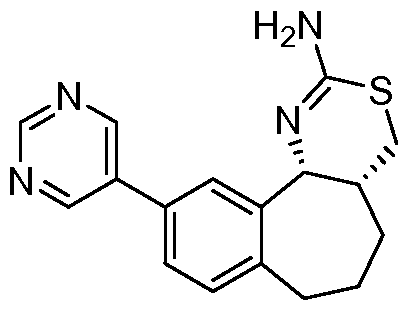
A sample of the compound of example 1 (racemic) was separated by chiral HPLC under the following conditions: column = Chiralcel OJ 21 X 250 mm 10 um, flow rate = 15 mL/min, isocratic elution of 25% solvent B/80% solvent A, where solvent A = 0.1% diethylamine in n-heptane and solvent B = ethanol. The compound of example 1 a eluted at 11.5 min and the compound of example lb eluted at 20.1 min. XH NMR and LCMS data were identical to those reported for the racemic compound of example 1. The absolute configuration of compound la was unambiguously determined by X-ray crystallography.
Example 2
rel-(4aS,l lhS)-l lb-Methyl-10-pyrimidin-5-yl-4,4a,5,6,7, l lb-hexahydro-3-thia-l-aza- dibenzo[a,c]cyclohepten-2-ylamine, bis(2,2,2-trifluoroacetate)

Step 2A. rel-(4aS, l lb5)-l lb-Methyl- 10-pyrimidin-5-yl-4,4a,5,6,7, l lb-hexahydro-3-thia- l-aza-dibenzo[a,c]cyclohepten-2-ylamine, bis-N-N-(tert-butyl)carbamate In a manner similar to that reported for step 1A of example 1, the compound of preparation B was converted to the compound of step 2A in 67% yield. LCMS (M+H)+ = 525.3. 'H NMR (500 MHz, chloroform-if) δ 9.17 (s, 1H), 9.10 (s, 2H), 7.96 (d, J=1.8 Hz, 1H), 7.40 (dd, J=7.8, 2.0 Hz, 1H), 7.27 (d, J=1.0 Hz, 2H), 3.21 (t, J=13.4 Hz, 1H), 2.98 - 2.85 (m, 2H), 2.66 (dd, J=l 1.9, 2.4 Hz, 1H), 2.50 - 2.38 (m, J=13.9, 13.9 Hz, 1H), 2.21 - 2.12 (m, 1H), 2.11 - 2.03 (m, J=3.7 Hz, 1H), 1.97 - 1.86 (m, 1H), 1.84 (s, 3H), 1.64 - 1.58 (m, J=13.7 Hz, 1H), 1.55 (s, 18H)
Step 2B. rel-(4aS, l lbS l lb-Methyl- 10-pyrimidin-5-yl-4,4a,5,6,7, 1 lb-hexahydro-3-thia- l-aza-dibenzo[a,c]cyclohepten-2-ylamine
In a manner similar to that reported for step IB of example 1, the compound of Step 2 A was converted to the compound of example 2 in 87% yield. MS (M+H)+ = 325.1 XH
NMR (500 MHz, chloroform-i/) δ 9.16 (s, 1H), 8.90 (s, 2H), 7.45 - 7.38 (m, 2H), 7.31 (d, J=7.6 Hz, 1H), 3.18 - 3.08 (m, 1H), 2.91 (dd, J=15.1, 5.0 Hz, 1H), 2.83 (t, J=12.4 Hz, 1H), 2.71 (dd, J=1 1.9, 2.7 Hz, 1H), 2.53 - 2.36 (m, 2H), 2.08 - 1.99 (m, 1H), 1.98 - 1.90 (m, 1H), 1.88 (s, 3H), 1.62 - 1.49 (m, 1H).
Example 3
5-Chloro-pyridine-2-carboxylic acid (re/-(4aS,l lb«S)-2-amino-l lb-methyl- 4,4a,5,6,7,l lb-hexahydro-3-thia-l-aza-dibenzo[a,c]cyclohepten-10-yl)-amide, 2,2,2- trifluoroacetate

Step 3A. (£)-Methyl 2-(5-chloropicolinamido)-9-methyl-6,7-dihydro-5H- benzo[7]annulene-8-carboxylate
To a solution of 5-chloropicolinic acid (354 mg, 2.248 mmol) in dichloromethane (5 mL) was added HATU (940 mg, 2.473 mmol) and DIPEA (0.589 mL, 3.37 mmol). After stirring for 10 min, methyl 2-amino-9-methyl-6,7-dihydro-5H-benzo[7]annulene-8- carboxylate from preparation J, step Jl (260 mg, 1.124 mmol) was added. The mixture was stirred at rt for 4 h. Ethyl acetate (100 mL) was added and the organic layer was washed with water. After concentration of the organic layer, the residue was purified using silica gel column chromatography (hexanes-100% EtOAc) to give methyl 2-(5- chloropicolinamido)-9-methyl-6,7-dihydro-5H-benzo[7]annulene-8-carboxylate (345 mg, 0.930 mmol, 83 % yield). LCMS (M+H)+ = 371.3. XH NMR (400 MHz, chloroform-if) δ 9.84 (s, IH), 8.56 (dd, J=2.4, 0.6 Hz, IH), 8.25 (dd, J=8.4, 0.6 Hz, IH), 7.88 (dd, J=8.4, 2.4 Hz, IH), 7.73 (d, J=2.3 Hz, IH), 7.63 (dd, J=8.0, 2.3 Hz, IH), 7.20 (d, J=8.3 Hz, IH), 3.82 (s, 3H), 2.55 (t, J=6.5 Hz, 2H), 2.44 (s, 3H), 2.18 - 2.08 (m, 4H).
Step 3B. (£)-5-Chloro-N-(8-(hydroxymethyl)-9-methyl-6,7-dihydro-5H- benzo [7 ] annulen-2 -y l)picolinamide
To a solution of methyl 2-(5-chloropicolinamido)-9-methyl-6,7-dihydro-5H- benzo[7]annulene-8-carboxylate from step 3A (345 mg, 0.930 mmol) in THF (2 mL) was slowly added 1.0 M DIBAL-H/THF (4.65 mL, 4.65 mmol) at -78 °C. The mixture was stirred at -78 °C for 4 h and then allowed to warm to rt. Brine was added slowly to quench
the reaction. The reaction mixture was then extracted with 3x100 mL of EtOAc and the organic layers were combined, dried over sodium sulfate, and concentrated. The residue was purified using silica gel column chromatography (hexanes-60%EtOAc) to give a clean (E)-5-chloro-N-(8-(hydroxymethyl)-9-methyl-6,7-dihydro-5H-benzo[7]annulen-2- yl)picolinamide (120 mg, 0.350 mmol, 37.6 % yield). LCMS (M+H)+ = 343.2. XH NMR (500 MHz, chloroform-if) δ 9.81 (s, IH), 8.56 (dd, J=2.3, 0.6 Hz, IH), 8.25 (dd, J=8.4, 0.6 Hz, IH), 7.87 (dd, J=8.4, 2.3 Hz, IH), 7.66 (d, J=2.3 Hz, IH), 7.55 (dd, J=8.1, 2.3 Hz, IH), 7.18 (d, J=8.2 Hz, IH), 4.39 (s, 2H), 2.54 (t, J=7.0 Hz, 2H), 2.14 (s, 3H), 2.10 (quin, J=7.1 Hz, 2H), 2.01 - 1.95 (m, 2H)
Step 3C. (JE)-5-Chloro-N-(8-(chloromethyl)-9-methyl-6,7-dihydro-5H-benzo[7]annulen- 2-yl)picolinamide
To a solution of 5-chloro-N-(8-(hydroxymethyl)-9-methyl-6,7-dihydro-5H- benzo[7]annulen-2-yl)picolinamide from step 3B (52 mg, 0.15 mmol) in dichloromethane (1 mL) was added methanesulfonylchloride (0.015 mL, 0.20 mmol) and DIPEA (0.048 mL, 0.27 mmol). The mixture was stirred at rt for 20 h. The mixture was subjected to chromatography (hexanes-100% EtOAc) to give 5-chloro-N-(8-(chloromethyl)-9-methyl- 6,7-dihydro-5H-benzo[7]annulen-2-yl)picolinamide (30 mg, 0.083 mmol, 55 % yield). LCMS (M+H)+ = 361.2. XH NMR (500 MHz, chloroform-if) δ 9.81 (br. s., IH), 8.58 (dd, J=2.3, 0.6 Hz, IH), 8.27 (dd, J=8.4, 0.6 Hz, IH), 7.90 (dd, J=8.4, 2.3 Hz, IH), 7.70 (d, J=2.3 Hz, IH), 7.57 (dd, J=8.1, 2.3 Hz, IH), 7.20 (d, J=8.1 Hz, IH), 4.37 (s, 2H), 2.57 (t, J=7.0 Hz, 2H), 2.21 (s, 3H), 2.17 (quin, J=7.1 Hz, 2H), 2.05 - 1.98 (m, 2H) Step 3D. 5-Chloro-pyridine-2-carboxylic acid (re/-(4aS,l lb«S)-2-amino-l lb-methyl- 4,4a,5, 6,7,1 lb-hexahydro-3-thia-l-aza-dibenzo[a,c]cyclohepten-10-yl)-amide, 2,2,2- trifluoroacetate
To a solution of (E)-5-chloro-N-(8-(chloromethyl)-9-methyl-6,7-dihydro-5H- benzo[7]annulen-2-yl)picolinamide from step 3C (30 mg, 0.083 mmol) in ethanol (0.5 mL) was added thiourea (6.32 mg, 0.083 mmol). The mixture was heated to reflux for 3 h. The solvent was removed to give crude (2-(5-chloropicolinamido)-9-methyl-6,7- dihydro-5H-benzo[7]annulen-8-yl)methyl carbamimidothioate hydrochloride (36.3 mg,
0.083 mmol, 100 % yield), which was used directly for the next step without purification. To a solution of the crude (2-(5-chloropicolinamido)-9-methyl-6,7-dihydro-5H- benzo[7]annulen-8-yl)methyl carbamimidothioate hydrochloride (36 mg, 0.082 mmol) in TFA (2 mL) was added trifluoromethanesulfonic acid (0.5 mL). The reaction mixture was stirred at rt for 16 h. The mixture was then concentrated and dried by azetropic distillation with toluene. The residue was then dissolved in 1.5 mL of MeOH, and a precipitate was removed by filtration. The mother liquor was purified via HPLC under standard conditions to give 5-chloro-pyridine-2-carboxylic acid (rel-(4aS,l lb«S)-2-amino-l lb- methyl-4,4a,5, 6,7, 1 lb-hexahydro-3-thia-l-aza-dibenzo[a,c]cyclohepten-10-yl)-amide, 2,2,2-trifluoroacetate salt (16 mg, 0.030 mmol, 36 % yield). LCMS (M+H)+ = 401.2. XH NMR (500 MHz, methanol-i/4) δ 8.72 (br. s., 1H), 8.21 (br. s., 1H), 8.08 (dd, J=8.4, 2.0 Hz, 1H), 7.90 (d, J=2.1 Hz, 1H), 7.58 (dd, J=8.1, 2.1 Hz, 1H), 7.28 (d, J=8.1 Hz, 1H), 3.22 - 3.10 (m, 1H), 2.99 - 2.80 (m, 3H), 2.57 - 2.40 (m, 2H), 2.10 (dd, J=14.7, 3.7 Hz, 1H), 1.90 (dd, J=14.5, 3.5 Hz, 1H), 1.87 (s, 3H), 1.64 - 1.52 (m, 1H)
Example 3a
5-Chloro-pyridine-2-carboxylic acid ((4a5,l lb5)-2-amino-l lb-methyl-4,4a,5,6,7, l lb- hexahydro-3-thia-l-aza-dibenzo[a,c]cyclohepten-10-yl)-amide

Example 3b
5-Chloro-pyridine-2-carboxylic acid ((4aR,l 1 bR)-2 -amino- 1 lb-methyl-4,4a,5,6,7, l lb- hexahydro-3-thia-l-aza-dibenzo[a,c]cyclohepten-10-yl)-amide.

Example 4
rel-(4aS, 1 lb5)-8-fluoro- 10-pyrimidin-5-yl-4a,5,6, 1 lb-tetrahydro-4H-7-oxa-3 -thia- 1 -aza- dibenzo[a,c]cyclohepten-2-ylamine

This material was prepared as reported in J. Molecular Catalysis A, 2007, 30-33.
Commercial 3-fluoro-2-hydroxybenzaldehyde (0.280 g, 2 mmol) was dissolved in MeCN (10 mL, 191 mmol) and ammonium acetate (0.015 g, 0.200 mmol) and BS (0.392 g, 2.200 mmol) were added at rt. The mixture was stirred at rt for 1 h. The reaction mixture was then concentrated and the crude compound was dissolved in a small amount of dichloromethane and charged to a 12 g silica gel cartridge which was eluted with a 25 min gradient of from 0 % to 30 % ethyl acetate in hexanes at 30 mL/min. Fractions containing product were pooled and concentrated in vacuo to give 5-bromo-3-fluoro-2- hydroxybenzaldehyde (0.43 g, 1.963 mmol, 98 % yield). XH NMR (400 MHz, chloroform-^ δ ppm 10.89 (s, 1 H) 9.87 (s, 1 H) 7.39 - 7.65 (m, 2 H).
Step 4B. 5-bromo-2-(but-3-enyloxy)-3-fluorobenzaldehyde
To a solution of 5-bromo-3-fluoro-2-hydroxybenzaldehyde from step 4A (2.0 g, 9.13 mmol) in DMF (36.5 ml) was added 4-bromo-l-butene (3.71 ml, 36.5 mmol) and potassium carbonate (1.58 g, 11.4 mmol). The resulting mixture was stirred at rt overnight. The reaction mixture was diluted with EtOAc (100 mL), washed with water (3 x 30 mL) and brine (30 mL), dried over magnesium sulfate, and then filtered and concentrated in vacuo. Purification by silica gel column chromatography (0 - 20% EtOAc/ hexanes) gave 5-bromo-2-(but-3-enyloxy)-3-fluorobenzaldehyde (2.38 g, 8.71 mmol, 95 % yield). XH NMR (500 MHz, DMSO-d6) δ 10.22 (d, J=0.9 Hz, 1H), 7.98 (dd, J=11.3, 2.4 Hz, 1H), 7.63 (dd, J=2.4, 1.2 Hz, 1H), 5.89 (ddt, J=17.1, 10.4, 6.7 Hz, 1H), 5.17 (dd, J=17.2, 1.7 Hz, 1H), 5.12 - 5.07 (m, 1H), 4.29 (t, J=6.4 Hz, 1H), 2.57 - 2.49 (m, 3H).
Step 4C. 2-(but-3-enyloxy)-3-fluoro-5-(pyrimidin-5-yl)benzaldehyde To a solution of 5-bromo-2-(but-3-enyloxy)-3-fluorobenzaldehyde from step 4B (932 mg, 3.41 mmol) and pyrimidin-5-ylboronic acid hemihydrate (1.81 g, 13.7 mmol) in DME (15.5 mL), ethanol (7.75 mL), and water (7.75 mL) was added
bis(triphenylphosphine)palladium(II) chloride (479 mg, 0.683 mmol) and cesium carbonate (4.44 g, 13.7 mmol). The resulting mixture was brought to 150 °C under microwave irradiation in a sealed tube and stirred for 15 min. The reaction mixture was then cooled and diluted with EtOAc (50 mL), washed with water (2 x 25 mL), brine (25 mL), dried over magnesium sulfate, filtered and concentrated in vacuo. Purification by silica gel column chromatography (- 65% EtOAc/ hexanes) gave 2-(but-3-enyloxy)-3- fluoro-5-(pyrimidin-5-yl)benzaldehyde (662 mg, 2.43 mmol, 71 % yield). MS (ESI, M+H)+ = 273.12. XH NMR (500 MHz, DMSO-d6) δ 10.36 (s, 1H), 9.26 - 9.17 (m, 3H), 8.20 (dd, j=13.0, 2.3 Hz, 1H), 7.95 (d, J=2.4 Hz, 1H), 5.93 (ddt, j=17.2, 10.3, 6.6 Hz, 1H), 5.24 - 5.09 (m, 2H), 4.37 (td, J=6.1, 1.5 Hz, 2H), 2.57 (q, J=6.4 Hz, 2H).
Step 4D. rel-(4aS, l lb5)-8-Fluoro-10-pyrimidin-5-yl-4a,5,6, l lb-tetrahydro-4H-7-oxa-3- thia-l-aza-dibenzo[a,c]cyclohepten-2-ylamine
To a solution of 2-(but-3-enyloxy)-3-fluoro-5-(pyrimidin-5-yl)benzaldehyde from step 4C (662 mg, 2.43 mmol) in acetonitrile (1.62 ml) and DMF (0.810 ml) was added thiourea
(185 mg, 2.43 mmol) and chlorotrimethylsilane (0.311 ml, 2.43 mmol). The resulting mixture was brought to reflux and stirred for 1 h. The reaction mixture was then diluted with EtOAc (10 mL), washed with water (3 x 2 mL), brine (5 mL), dried over magnesium sulfate, filtered and concentrated in vacuo. Purification by silica gel column
chromatography (0 - 80% EtOAc/hexanes) gave the desired product (3.1 mg, 8.44 μιηοΐ, 0.35 % yield). ¾ NMR (500 MHz, methanol-i/4) δ 7.63 (d, J=2.1 Hz, 1H), 7.57 (d, J=2.1 Hz, 2H), 6.03 (s, 1H), 5.99 (d, J=10.4 Hz, 1H), 3.12 - 3.01 (m, J=6.1, 6.1 Hz, 1H), 2.29 - 2.16 (m, J=4.6 Hz, 1H), 1.82 (d, J=1.2 Hz, 2H), 1.58 (t, J=12.1 Hz, 1H), 1.35 (dd, J=12.5, 3.1 Hz, 1H), 0.62 - 0.47 (m, 2H), 0.35 - 0.18 (m, 1H), -0.07 - -0.31 (m, 1H). MS (ESI, M+H)+ = 331.16
Example 5
re/-(4a5,,10b5,)-10b-Methyl-9-(pyrimidin-5-yl)-4a,5,6,10b-tetrahydro-4H-naphtho[l,2- d][l,3]thiazin-2-amine, bis(2,2,2-trifluoroacetate)

Step 5A. re/-(4a5',10b5)-9-Bromo-10b-methyl-4a,5,6,10b-tetrahydro-4H-naphtho[l,2- d][l,3]thiazin-2-amine-bis-N,N-((tert-butyl)carbamate
A mixture of 1 ,2-dimethoxyethane (5 mL), water (2.5 mL), and ethanol (2 mL) was purged with nitrogen gas for 15 min. The degassed solvent was transferred to a vial charged with a mixture of the tert-butyl re/-((4aS,10bS)-9-bromo-10b-methyl-4a,5, 6,10b- tetrahydro-4H-naphtho[l,2-d][l,3]thiazin-2-yl)carbamate from preparation C (161 mg, 0.391 mmol), pyrimidin-5-ylboronic acid (388 mg, 3.13 mmol),
bis(triphenylphosphine)palladium(II) chloride (54.9 mg, 0.078 mmol), and cesium carbonate (1.14 g, 3.52 mmol). The vial was capped and heated to 100 °C for 20 min. The reaction mixture was cooled, diluted with water, and extracted with ethyl acetate. The combined organic layers were dried over sodium sulfate, filtered and concentrated in vacuo. Di-tert-butyl dicarbonate (0.272 mL, 1.173 mmol), triethylamine (0.218 mL,
1.564 mmol), and N,N-dimethylpyridin-4-amine (2.388 mg, 0.020 mmol) were sequentially added to a solution of the coupling reaction product mixture in THF (20 mL). The reaction mixture was allowed to stir for 20 hours and then it was concentrated in vacuo. The residue was purified using silica gel column chromatography (20: 1 hexane/EtOAc) to afford re/-(4a5', 10b5)-9-bromo-10b-methyl-4a,5,6, 10b-tetrahydro-4H- naphtho[l,2-d][l,3]thiazin-2-amine-bis-N,N-((tert-butyl)carbamate (89 mg, 0.174 mmol, 45 % yield) as a clear viscous oil. XH NMR (500 MHz, chloroform-i/) δ 9.16 (s, IH), 8.95 (s, 2H), 7.91 (d, J=1.8 Hz, IH), 7.37 (dd, J=7.9, 2.0 Hz, IH), 7.21 (d, J=7.9 Hz, IH), 3.31 (dd, J=12.8, 3.5 Hz, IH), 3.04 - 2.84 (m, 3H), 2.20 - 2.09 (m, IH), 2.06 - 1.96 (m, 2H), 1.65 (s, 3H), 1.38 (s, 18H).
Step 5B. rel-(4aS, 10bS 10b-Methyl-9-(pyrimidin-5-yl)-4a,5,6, 10b-tetrahydro-4H- naphtho[l,2-d][l,3]thiazin-2-amine, bis(2,2,2-trifluoroacetate) Trifluoroacetic acid (1 mL) was added to a solution of re/-(4a5', 10b5)-9-bromo-10b- methyl-4a,5,6, 10b-tetrahydro-4H-naphtho[ 1 ,2-d] [ 1 ,3 ]thiazin-2-amine-bis-N,N-((tert- butyl)carbamate from step 5 A (0.089 g, 0.174 mmol) in dichloromethane (5 mL) at rt. The mixture was allowed to stir at rt for 20 hours. The reaction mixture was concentrated under reduced pressure. The residue was purified using reverse phase preparatory HPLC (SunFire PrepCl 8 OBD 10 μιη, 50 x 250 mm column, 90% MeOH/10 % water/0.1 % TFA - 90% MeOH/10 % water/0.1 % TFA, linear gradient over 34 min, 50 ml/min) to afford re/-(4a5,10b5)-10b-methyl-9-(pyrimidin-5-yl)-4a,5,6,10b-tetrahydro-4H- naphtho[l,2-d][l,3]thiazin-2-amine, 2 TFA (53 mg, 0.096 mmol, 55 % yield) as a clear solid residue. LCMS (M+H)+ = 311.1. XH NMR (500 MHz, methanol-i/4) δ 9.14 (s, IH), 9.10 (s, 2H), 7.91 (d, J=1.7 Hz, IH), 7.64 (dd, J=7.9, 1.8 Hz, IH), 7.37 (d, J=7.9 Hz, IH), 3.47 (dd, J=13.3, 3.5 Hz, IH), 3.15 (dd, J=13.3, 7.8 Hz, IH), 3.01 (t, J=6.8 Hz, 2H), 2.54 (tt, J=7.5, 3.5 Hz, IH), 2.25 (dtd, J=14.0, 6.9, 3.4 Hz, IH), 2.05 (dq, J=14.0, 7.0 Hz, IH), 1.82 (s, 3H).
Example 6
rel-(4aS, 10b5)-9-(5-Chloropyridin-3-yl)- 10b-methyl-4a,5,6, lOb-tetrahydi
naphtho[l,2-d][l,3]thiazin-2-amine bis(2,2,2-trifluoroacetate)

A mixture of 1 ,2-dimethoxyethane (5 mL), water (2.5 mL), and ethanol (2 mL) was purged with nitrogen for 15 min. The degassed solvent was transferred to a vial charged with a mixture of the aryl bromide tert-butyl re/-((4aS,10b5)-9-bromo-10b-methyl- 4a,5,6, 10b-tetrahydro-4H-naphtho[l,2-d][l,3]thiazin-2-yl)carbamate from preparation C (80 mg, 0.194 mmol), (5-chloropyridin-3-yl)boronic acid (122 mg, 0.778 mmol), bis(triphenylphosphine)palladium(II) chloride (27.3 mg, 0.039 mmol), and cesium carbonate (285 mg, 0.875 mmol). The vial was capped and heated to 100 °C for 20 min. The reaction was cooled, diluted with water, and extracted with EtOAc. The organic layer was dried over sodium sulfate, filtered and concentrated in vacuo. The crude products were dissolved in dichloromethane (5.00 mL). TFA (1.0 mL) was added at rt and the mixture was allowed to stir at rt for 20 hours. The reaction mixture was concentrated under reduced pressure. The residue was purified using reverse phase preparatory HPLC (SunFire PrepC18 OBD 10 μιη, 50 x 250 mm column, 90% MeOH/10 % water/0.1 % TFA - 90% MeOH/10 % water/0.1 % TFA, linear gradient over 34 min, 50 ml/min) to afford re/-(4a5', 10b5)-9-(5-chloropyridin-3-yl)-10b-methyl-4a,5,6,10b- tetrahydro-4H-naphtho[l,2-d][l,3]thiazin-2-amine, 2 TFA (37 mg, 0.063 mmol, 33 % yield) as a clear residue. LCMS (M+H)+ = 344.1. XH NMR (500 MHz, methanol-^) δ 8.81 (br. s., IH), 8.58 (br. s., IH), 8.23 (s, IH), 7.96 - 7.73 (m, IH), 7.61 (dd, J=7.9, 1.7 Hz, IH), 7.35 (d, J=7.9 Hz, IH), 3.47 (dd, J=13.3, 3.2 Hz, IH), 3.15 (dd, J=13.2, 7.7 Hz, IH), 3.08 - 2.86 (m, 2H), 2.62 - 2.40 (m, IH), 2.25 (td, J=6.9, 3.2 Hz, IH), 2.05 (dq, J=14.0, 6.9 Hz, IH), 1.81 (s, 3H).
Example 7
rel-N-((4aS, 10b5)-2-Amino- 10b-methyl-4a,5 ,6, 10b-tetrahydro-4H-naphtho [ 1 ,2- d][l,3]thiazin-9-yl)-5-chloropicolinamide, 2,2,2-trifluoroacetate

HATU (164 mg, 0.432 mmol) and DIEA (0.090 mL, 0.518 mmol) were sequentially added to a mixture of tert-butyl re/-((4aS,10bS)-9-amino-10b-methyl-4a,5, 6,10b- tetrahydro-4H-naphtho[l,2-d][l,3]thiazin-2-yl)carbamate from preparation D (60 mg, 0.173 mmol), and 5-chloropicolinic acid (54.4 mg, 0.345 mmol) in DCM (5.0 mL). The resulting mixture was left to stir at rt for 20 h. The mixture was poured into aqueous saturated sodium bicarbonate solution (3 mL) and extracted with EtOAc (2x3 mL). The combined organics were washed with brine (1 mL), dried (sodium sulfate), filtered, and concentrated in vacuo. The residue was dissolved in DCM (5.0 mL) and TFA (1.0 mL, 13.0 mmol. The resulting mixture was allowed to stir at rt for 2 h and concentrated in vacuo. The crude product was purified using reverse phase preparatory HPLC (SunFire PrepC18 OBD 10 mm, 50 x 250 mm column, 90% MeOH/10 % water/0.1 % TFA - 90% MeOH/10 % water/0.1 % TFA, linear gradiant over 34 min, 50 ml/min) to afford rel-N- ((4aS, 10bS 2-amino- 10b-methyl-4a,5,6, 10b-tetrahydro-4H-naphtho[ 1 ,2-d] [ 1 ,3 ]thiazin-9- yl)-5-chloropicolinamide, TFA (45 mg, 0.088 mmol, 51 % yield). LCMS (M+H)+ = 387.1. 'H NMR (500 MHz, methanol-^) δ 8.70 (d, J=1.8 Hz, IH), 8.28 - 8.16 (m, J=8.4 Hz, IH), 8.11 - 8.01 (m, 2H), 7.61 (dd, J=8.2, 2.1 Hz, IH), 7.29 - 7.15 (m, J=8.4 Hz, IH), 3.50 (dd, J=13.1, 3.7 Hz, IH), 3.14 (dd, J=13.1, 7.3 Hz, IH), 2.95 (t, j=6.8 Hz, 2H), 2.51 (tt, j=7.6, 3.6 Hz, IH), 2.20 (dtd, J=13.8, 6.7, 3.4 Hz, IH), 2.00 (dq, J=14.2, 7.2 Hz, IH), 1.78 (s, 3H).
Example 7a
N-((4aR,10bR)-2-Amino-10b-methyl-4a,5,6,10b-tetrahydro-4H-naphtho[l,2- d][l,3]thiazin-9-yl)-5-chloropicolinamide

N-((4aS, 10bS 2-Amino- 10b-methyl-4a,5 ,6, 10b-tetrahydro-4H-naphtho [ 1 ,2- d][l,3]thiazin-9-yl)-5-chloropicolinamide

A sample of the compound of example 7 (racemic) was separated using chiral HPLC under the following conditions: column = Chiralcel OJ 21 X 250 mm 10 u, flow rate = 15 mL/min, isocratic elution of 40% solvent B/60% solvent A, where solvent A = 0.1% diethylamine in w-heptane and solvent B = ethanol. The compound of Example 7a eluted at 8.4 min and the compound of example 7b eluted at 1 1.5 min. XH NMR and LCMS data were identical to those reported for the racemic compound of example 7. Example 8
rel-N-((4aS, 10hS)-2-Amino- 10b-methyl-4a,5,6, 10b-tetrahydro-4H-naphtho[ 1 ,2- d][l,3]thiazin-9-yl)-3,5-difluoropicolinamide, 2,2,2-trifluoroacetate

In a manner similar to the two-step procedure used for the preparation of example 7, but using tert-butyl rel-((4aS, 10hS 9-amino-10b-methyl-4a,5,6, 10b-tetrahydro-4H- naphtho[l,2-d][l,3]thiazin-2-yl)carbamate from preparation D (60 mg, 0.173 mmol) and 3,5-difluoropicolinic acid (54.9 mg, 0.345 mmol) as starting materials, the titled compound of Example 8 (46 mg, 0.090 mmol, 52 % yield) was prepared as a white solid. LCMS (M+H)+ = 398.1. 'H NMR (500 MHz, methanol-^) δ 8.51 (d, J=2.1 Hz, IH), 8.07 (d, J=2.1 Hz, IH), 7.80 (ddd, J=10.7, 8.6, 2.4 Hz, IH), 7.54 (dd, J=8.2, 2.1 Hz, IH),
7.22 (d, J=8.2 Hz, IH), 3.50 (dd, J=13.2, 3.7 Hz, IH), 3.14 (dd, J=13.2, 7.4 Hz, IH), 2.95 (t, J=6.8 Hz, 2H), 2.51 (tt, J=7.5, 3.6 Hz, IH), 2.21 (dtd, J=13.8, 6.8, 3.5 Hz, IH), 2.00 (dq, J=14.2, 7.1 Hz, IH), 1.78 (s, 3H). Example 9
rel-N-((4aS, 10bS 2 -amino- 10b-methyl-4a,5,6, 10b-tetrahydro-4H-naphtho[ 1 ,2- d][l,3]thiazin-9-yl)-5-fluoropicolinamide, 2,2,2-trifluoroacetate

In a manner similar to the two-step procedure used for the preparation of example 7, but using tert-butyl rel-({AaS, 10bS 9-amino-10b-methyl-4a,5,6, 10b-tetrahydro-4H- naphtho[l,2-d][l,3]thiazin-2-yl)carbamate from preparation D (60 mg, 0.173 mmol) and 5-fluoropicolinic acid as starting materials, the titled compound of example 9 (51 mg, 0.10 mmol, 60 % yield) was prepared as a white solid. LCMS (M+H)+ = 371.1. ¾ NMR (500 MHz, methanol-^) δ 8.61 (d, J=2.7 Hz, IH), 8.30 (dd, J=8.7, 4.6 Hz, IH), 8.14 - 8.03 (m, IH), 7.82 (td, J=8.5, 2.7 Hz, IH), 7.60 (dd, J=8.2, 2.1 Hz, IH), 7.23 (d, J=8.2 Hz, IH), 3.52 (dd, J=13.2, 3.7 Hz, IH), 3.15 (dd, J=13.3, 7.2 Hz, IH), 2.95 (t, J=6.8 Hz, 2H), 2.51 (tt, J=7.6, 3.6 Hz, IH), 2.19 (dtd, J=13.7, 6.7, 3.6 Hz, IH), 2.07 - 1.95 (m, IH), 1.79 (s, 3H).
Example 10
rel-(4aS, 10bS 9-Bromo- 10b-methyl-4a,5,6, 10b-tetrahydro-4H-naphtho[ 1 ,2- d] [ 1 ,3]thiazin-2-amine

Example 11
re/-(4aS,l lbS)-10-(5-methoxypyridin-3-yl)-l lb-methyl-4,4a,5,6,7,l lb- hexahydrobenzo[6,7]cyclohepta[l,2-d][l,3]thiazin-2-amine, bis(2,2,2-trifluoroacetate)

In a manner similar to the two-step procedure used for the preparation of example 6, but using tert-butyl re/-((4a5",l lb5)-10-bromo-l lb-methyl-4,4a,5,6,7,l lb- hexahydrobenzo[6,7]cyclohepta[l,2-d][l,3]thiazin-2-yl)carbamate from preparation E (28 mg, 0.066 mmol) and (5-methoxypyridin-3-yl)boronic acid (81 mg, 0.527 mmol) as starting materials, the titled compound of example 11 (13 mg, 0.0.22 mmol, 33 % yield) was prepared as clear residue. LCMS (M+H)+ = 354.1. XH NMR (500 MHz, methanol- d4) δ 8.55 (br. s., 1H), 8.45 (br. s., 1H), 8.02 - 7.92 (m, 1H), 7.67 (dd, J=7.8, 2.0 Hz, 1H), 7.47 (d, J=7.8 Hz, 1H), 7.44 (d, J=2.0 Hz, 1H), 3.28 - 3.20 (m, 1H), 3.04 - 2.95 (m, 2H), 2.83 (t, J=12.4 Hz, 1H), 2.61 - 2.47 (m, 2H), 2.12 (dd, J=14.6, 3.6 Hz, 1H), 2.01 - 1.92 (m, 1H), 1.91 (s, 3H), 1.72 - 1.56 (m, 1H). Example 12
rel-(4a,S,l lb5)-10-(3-methoxyphenyl)-l lb-methyl-4,4a,5,6,7,l lb- hexahydrobenzo[6,7]cyclohepta[l,2-d][l,3]thiazin-2-amine, 2,2,2-trifluoroacetate

In a manner similar to the two-step procedure used for the preparation of example 6, but using tert-butyl rel-((4aS, l lbS)-10-bromo-l lb-methyl-4,4a,5,6,7, l lb- hexahydrobenzo[6,7]cyclohepta[l,2-d][l,3]thiazin-2-yl)carbamate from preparation E (28 mg, 0.066 mmol) and (3-methoxyphenyl)boronic acid (80 mg, 0.527 mmol) as starting materials, the titled compound of example 12 (10 mg, 0.021 mmol, 33 % yield) was prepared as clear residue. LCMS (M+H)+ = 353.1. ¾ NMR (500 MHz, methanol-^) δ 7.50 (dd, J=7.7, 1.9 Hz, 1H), 7.37 - 7.29 (m, 3H), 7.16 - 7.1 1 (m, 1H), 7.1 1 - 7.05 (m, 1H), 6.96 - 6.88 (m, 1H), 3.84 (s, 3H), 3.24 - 3.13 (m, 1H), 3.00 - 2.88 (m, 2H), 2.82 (t, J=12.4 Hz, 1H), 2.58 - 2.40 (m, 2H), 2.09 (dd, J=14.7, 3.7 Hz, 1H), 1.91 (dt, J=14.4, 3.1 Hz, 1H), 1.88 (s, 3H), 1.60 (q, J=13.9 Hz, 1H).
Example 13
re/-(4aS, l lb5)-10-(5-Chloropyridin-3-yl)-l lb-methyl-4,4a,5,6,7, l lb- hexahydrobenzo[6,7]cyclohepta[l,2-d][l,3]thiazin-2-amine, bis(2,2,2-trifluoroacetate)

In a manner similar to the two-step procedure used for the preparation of example 6, but using tert-butyl re/-((4aS, l lbS)-10-bromo-l lb-methyl-4,4a,5,6,7, l lb- hexahydrobenzo[6,7]cyclohepta[l,2-d][l,3]thiazin-2-yl)carbamate from preparation E (28 mg, 0.066 mmol) and (5-chloropyridin-3-yl)boronic acid (83 mg, 0.527 mmol) as starting materials, the titled compound of example 13 (19 mg, 0.032 mmol, 48 % yield) was prepared as clear residue. LCMS (M+H)+ = 358.1. ¾ NMR (500 MHz, methanol-^) δ 8.77 - 8.64 (m, 1H), 8.57 (d, J=1.8 Hz, 1H), 8.09 (t, J=2.1 Hz, 1H), 7.59 (dd, J=7.8, 2.0
Hz, IH), 7.43 (d, J=7.8 Hz, IH), 7.36 (d, J=2.0 Hz, IH), 3.26 - 3.17 (m, IH), 3.01 - 2.92 (m, 2H), 2.81 (t, J=12.4 Hz, IH), 2.59 - 2.44 (m, 2H), 2.10 (dd, J=14.6, 3.7 Hz, IH), 1.97 - 1.91 (m, IH), 1.89 (s, 3H), 1.62 (q, J=13.8 Hz, IH). Example 14
rel-(4aS,l lbS 10-(5-fluoropyridin-3-yl)-l lb-methyl-4,4a,5,6,7,l lb- hexahydrobenzo[6,7]cyclohepta[l,2-d][l,3]thiazin-2-amine, bis(2,2,2-trifluoroacetate)

In a manner similar to the two-step procedure used for the preparation of example 6, but using tert-butyl re/-((4a5", l lbS 10-bromo-l lb-methyl-4,4a,5,6,7, l lb- hexahydrobenzo[6,7]cyclohepta[l,2-d][l,3]thiazin-2-yl)carbamate from preparation E (28 mg, 0.066 mmol) and (5-fluoropyridin-3-yl)boronic acid (74.2 mg, 0.527 mmol) as starting materials, the titled compound of example 14 (13 mg, 0.022 mmol, 34 % yield) was prepared as clear residue. LCMS (M+H)+ = 342.1. XH NMR (500 MHz, methanol- d4) δ 8.64 (br. s., IH), 8.49 (br. s., IH), 7.90 - 7.82 (m, IH), 7.61 (dd, J=7.8, 2.0 Hz, IH), 7.43 (d, J=7.8 Hz, IH), 7.37 (d, J=1.8 Hz, IH), 3.26 - 3.18 (m, IH), 3.01 - 2.93 (m, 2H), 2.81 (t, J=12.4 Hz, IH), 2.59 - 2.41 (m, 2H), 2.16 - 2.05 (m, IH), 1.98 - 1.90 (m, IH), 1.89 (s, 3H), 1.69 - 1.54 (m, IH).
Example 15
rel-(4aS,l lbS l lb-Methyl-10-(5-(prop-l-yn-l-yl)pyridin-3-yl)-4,4a,5,6,7, l lb- hexahydrobenzo[6,7]cyclohepta[l,2-d][l,3]thiazin-2-amine, bis(2,2,2-trifluoroacetate)

In a manner similar to the two-step procedure used for the preparation of example 6, but using tert-butyl rel-((4aS, l lbS)-10-bromo-l lb-methyl-4,4a,5,6,7, l lb- hexahydrobenzo[6,7]cyclohepta[l,2-d][l,3]thiazin-2-yl)carbamate from preparation E (28 mg, 0.066 mmol) and (5-(prop-l-yn-l-yl)pyridin-3-yl)boronic acid (85 mg, 0.527 mmol) as starting materials, the titled compound of example 15 (10 mg, 0.016 mmol, 25 % yield) was prepared as clear residue. LCMS (M+H)+ = 362.1. XH NMR (500 MHz, methanol- d4) δ 8.70 (br. s., IH), 8.57 (br. s., IH), 8.09 (t, J=1.9 Hz, IH), 7.58 (dd, J=7.8, 2.0 Hz, IH), 7.43 (d, J=7.8 Hz, IH), 7.35 (d, J=2.0 Hz, IH), 3.22 (t, J=13.6 Hz, IH), 3.03 - 2.92 (m, 2H), 2.81 (t, J=12.4 Hz, IH), 2.61 - 2.41 (m, 2H), 2.16 - 2.04 (m, IH), 2.10 (s, 3H), 1.99 - 1.85 (m, IH), 1.89 (s, 3H), 1.62 (q, J=13.9 Hz, IH).
Example 16
rel-(4aS, l lb5)-l lb-Methyl-10-(5-(prop-l-yn-l-yl)pyridin-3-yl)-4,4a,5,6,7, l lb- hexahydrobenzo[6,7]cyclohepta[l,2-d][l,3]thiazin-2-amine, bis(2,2,2-trifluoroacetate)

Prepared as described in preparation E, step E4. LCMS (M+H)+ 327.0. XH NMR (500 MHz, methanol-i/4) δ 7.43 (dd, J=8.1, 2.1 Hz, IH), 7.26 (d, J=2.1 Hz, IH), 7.20 (d, J=8.1 Hz, IH), 3.17 - 3.06 (m, IH), 2.96 (dd, J=12.1, 3.1 Hz, IH), 2.89 (dd, J=15.4, 5.6 Hz, IH), 2.80 (t, J=12.4 Hz, IH), 2.57 - 2.39 (m, 2H), 2.08 (dd, J=14.8, 4.0 Hz, IH), 1.94 - 1.86 (m, IH), 1.84 (s, 3H), 1.67 - 1.48 (m, IH).
Example 17
re/-(4aR,10b5)-8-Fluoro-10b-methyl-9-(pyrimidin-5-yl)-4,4a,5,10b- tetrahydrochromeno[4,3-d][l,3]thiazin-2-amine, bis(2,2,2-trifluoroacetate)

In a manner similar to the two-step procedure used for the preparation of example 6, but using tert-butyl re/-((4aR,10b5)-9-bromo-8-fluoro-10b-methyl-4,4a,5,10b- tetrahydrochromeno[4,3-d][l,3]thiazin-2-yl)carbamate preparation F (50 mg, 0.116 mmol) from and pyrimidin-5-ylboronic acid (115 mg, 0.927 mmol) as starting materials, the titled compound of Example 17 (26 mg, 0.045 mmol, 39 % yield) was prepared as a clear residue. LCMS (M+H)+ = 331.1. XH NMR (500 MHz, methanol-^) δ 7.89 (br. s., 1H), 7.75 (br. s., 2H), 6.51 (d, J=8.2 Hz, 1H), 5.57 (d, J=11.7 Hz, 1H), 3.32 (dd, J=12.1, 2.9 Hz, 1H), 3.10 (dd, J=12.0, 5.7 Hz, 1H), 2.24 (dd, J=13.7, 3.7 Hz, 1H), 1.99 (dd, J=13.6, 8.4 Hz, 1H), 1.46 - 1.36 (m, 1H), 0.59 (s, 3H).
Example 18
rel-N-((4aR, 10bS)-2-Amino-8-fluoro- 10b-methyl-4,4a,5, 10b-tetrahydrochromeno[4,3 - d][l,3]thiazin-9-yl)-5-chloropicolinamide, 2,2,2-trifluoroacetate

In a manner similar to the two-step procedure used for the preparation of example 7, but using tert-butyl re/-((4aR, 10bS)-9-amino-8-fluoro- 10b-methyl-4,4a,5, 10b- tetrahydrochromeno[4,3-d][l,3]thiazin-2-yl)carbamate from preparation G (100 mg, 0.272 mmol) and 5-chloropicolinic acid (86 mg, 0.544 mmol) as starting materials, the titled compound of Example 18 (40 mg, 0.075 mmol, 28 % yield) was prepared as a white
solid. LCMS (M+H)+ = 407.1. ¾ NMR (500 MHz, methanol-i/4) δ 8.73 (dd, J=2.3, 0.6 Hz, IH), 8.29 (d, J=8.4 Hz, IH), 8.23 (dd, J=8.4, 0.6 Hz, IH), 8.11 (dd, J=8.4, 2.4 Hz, IH), 6.83 (d, J=11.4 Hz, IH), 4.56 (dd, J=l 1.7, 2.9 Hz, IH), 4.31 (dd, J=11.8, 6.2 Hz, IH), 3.54 (dd, J=13.6, 4.0 Hz, IH), 3.28 (dd, J=13.7, 7.9 Hz, IH), 2.68 (tt, J=6.8, 3.6 Hz, IH), 1.85 (s, 3H).
Example 19
rel-(4aS, 10bS 10b-Methyl-9-( lH-pyrazol-4-yl)-4a,5,6, 10b-tetrahydro-4H-naphtho[ 1 ,2-

Step 19A. tert-Butyl re/-((4a5,10b5')-10b-methyl-9-(lH-pyrazol-4-yl)-4a,5,6,10b- tetrahydro-4H-naphtho [ 1 ,2-d] [ 1 ,3 ]thiazin-2-yl)carbamate
Dioxane (1 mL) and water (0.1 mL) were added to a mixture of tert-butyl rel- ((4aS, 10b5)-9-bromo- 10b-methyl-4a,5 ,6, 10b-tetrahydro-4H-naphtho [ 1 ,2-d] [ 1 ,3 ]thiazin-2- yl)carbamate from preparation C (10 mg, 0.024 mmol), (lH-pyrazol-4-yl)boronic acid (27.2 mg, 0.243 mmol) and potassium carbonate (33.6 mg, 0.243 mmol). Nitrogen was bubbled through the mixture for 5 min. l,l'-Bis(diphenylphosphino)ferrocenepalladium (II) dichloride, toluene (10 mg, 0.012 mmol) was added and the resulting mixture was heated at 100 °C for 1 h. The reaction contents were cooled to rt and were transferred to a separatory funnel containing saturated aqueous aHC03 solution (10 mL). The aqueous layer was extracted with EtOAc (3 x 25 mL). The combined organic layers were washed with brine (10 mL), dried over sodium sulfate, filtered and concentrated. The crude product of step 19A was used in the next step without further purification. LCMS (M+H)+ = 399.08.
Step 19B. re/-(4aS, 10b5)-10b-Methyl-9-(lH-pyrazol-4-yl)-4a,5,6, lOb-tetrahydi naphtho[l,2-d][l,3]thiazin-2-amine, bis(2,2,2-trifluoroacetate)
Trifluoroacetic acid (0.1 ml, 1.3 mmol) was added to a solution of tert-butyl re/- ^aS^Ob^-lOb-methyl- -ilH- yrazol^-y ^a^^JOb-tetrahydro^H-na hthotl^- d][l,3]thiazin-2-yl)carbamate (10 mg, 0.025 mmol) from step 19A in DCM (1 mL). The reaction mixture was stirred at rt for 3 h. The reaction was evaporated to dryness under reduced pressure. The crude residue was purified by Prep HPLC column chromatography (Luna Axia CI 8, 10 μιη, 30x100 mm column, 90% MeOH/10 % water/0.1 % TFA - 90% MeOH/10 % water/0.1 % TFA, linear gradiant over 20 min, 40 mL/min) to afford the titled compound of example 19 (6.3 mg, 0.012 mmol, 47 % yield). LCMS (M+H)+ = 299.11. XH NMR (500 MHz, methanol-i/4) δ 8.01 (s, 2H), 7.75 (s, 1H), 7.52 (dd, J=7.9, 1.8 Hz, 1H), 7.21 (d, J=8.1 Hz, 1H), 3.54 (dd, J=13.2, 3.6 Hz, 1H), 3.18 (dd, J=13.2, 7.1 Hz, 1H), 2.96 (t, J=6.7 Hz, 2H), 2.53 (dt, J=7.8, 3.7 Hz, 1H), 2.28 - 2.14 (m, 1H), 2.02 (dd, J=13.9, 7.8 Hz, 1H), 1.82 (s, 3H). Example 20
re/-(4a5',10b5)-9-(l,3-Dimethyl-lH-pyrazol-5-yl)-10b-methyl-4a,5,6,10b-tetrahydro-4H- naphtho[l,2-d][l,3]thiazin-2-amine, bis(2,2,2-trifluoroacetate)

In a manner similar to the two step procedure described for example 19, the compound of preparation C was converted to the compound of example 20 in 83 % overall yield.
LCMS (M+H)+ 327.13. 'H NMR (500 MHz, methanol-i/4) δ 7.64 (d, J=1.7 Hz, 1H), 7.42 (dd, J=7.9, 1.8 Hz, 1H), 7.35 (d, J=7.9 Hz, 1H), 6.27 (s, 1H), 3.84 (s, 3H), 3.46 (dd, J=13.1, 3.7 Hz, 1H), 3.16 (dd, J=13.3, 8.1 Hz, 1H), 3.03 (t, J=6.8 Hz, 2H), 2.58 - 2.51 (m, 1H), 2.32 - 2.25 (m, 4H), 2.12 - 2.02 (m, 1H), 1.80 (s, 3H).
Example 21
rel-(4aS, 10bS 10b-methyl-9-(5-(prop- 1 -yn- 1 -yl)pyridin-3 -yl)-4a,5,6, 1 Ob-tetrahydi naphtho[l,2-d][l,3]thiazin-2-amine, bis(2,2,2-trifluoroacetate)

In a manner similar to the two step procedure described for example 19, the compound of preparation C was converted to the compound of example 21 in 29 % overall yield.
LCMS (M+H)+ = 348.12. ¾ NMR (500 MHz, chloroform-if) δ 9.02 (br. s., 1H), 8.71 - 8.63 (m, 2H), 8.13 (s, 1H), 7.56 (d, J=8.1 Hz, 1H), 7.32 (d, J=7.9 Hz, 1H), 3.26 - 3.19 (m, 1H), 3.16 - 3.09 (m, 1H), 3.00 (t, J=6.6 Hz, 2H), 2.47 (br. s., 1H), 2.33 - 2.24 (m, 1H), 2.18 - 2.09 (m, 4H), 1.84 (s, 3H).
Example 22
re/-(4aS,l lbS)-l lb-methyl-10-(5-(prop-l-yn-l-yl)pyridin-3-yl)-4a,5,6,l lb-tetrahydro- 4H-benzo[2,3]oxepino[4,5-d][l,3]thiazin-2-amine, bis(2,2,2-trifluoroacetate)

A mixture of dimethoxyethane (2 mL), water (1.0 mL), and ethanol (0.6 mL) was purged with nitrogen (bubbling via pipette) for 15 min. The degassed solvent was transferred to a vial charged with a mixture of tert-butyl re/-((4aS,l lb5)-10-bromo-l lb-methyl- 4a,5,6,l lb-tetrahydro-4H-benzo[2,3]oxepino[4,5-d][l,3]thiazin-2-yl)carbamate from preparation H (25 mg, 0.058 mmol), (5-(prop-l-yn-l-yl)pyridin-3-yl)boronic acid (75 mg,
0.468 mmol), bis(triphenylphosphine)palladium(II) chloride (8.2 mg, 0.012 mmol), and CS2CO3 (152 mg, 0.468 mmol). The vial was capped and heated to 100 °C for 20 min. The reaction was cooled, diluted with water, and extracted with EtOAc. The organic layer was dried over sodium sulfate, filtered and concentrated in vacuo. The crude products were dissolved in dichloromethane (1.0 mL). TFA (0.3 mL) was added and the mixture was allowed to stir at rt for 20 hours. The reaction mixture was concentrated under reduced pressure. The residue was purified using reverse phase preparatory HPLC (Sunfire PrepC18 OBD 10 μιη, 50x250 mm column, 90% MeOH/10% water/0.1% TFA- 90% MeOH/10% water/0.1% TFA, linear gradient over 34 min, 50 mL/min) to afford the titled compound of example 22 (7.8 mg, 0.013 mmol, 21 % yield) as a colorless residue.
LCMS (M+H)+ = 364.1. 'H NMR (500 MHz, methanol-i/4) δ 8.68 (br. s., 1H), 8.57 (br. s., 1H), 8.08 - 8.04 (m, 1H), 7.67 (dd, J=8.2, 2.4 Hz, 1H), 7.32 - 7.23 (m, 2H), 4.45 - 4.36 (m, 1H), 3.86 - 3.76 (m, 1H), 3.08 - 2.96 (m, 2H), 2.95 - 2.84 (m, 1H), 2.61 - 2.52 (m, 1H), 2.12 (s, 3H), 1.98 (d, J=5.5 Hz, 1H), 1.92 (s, 3H).
Example 22a
(4aR,l lbR)-l lb-Methyl-10-(5-(prop-l-yn-l-yl)pyridin-3-yl)-4a,5,6,l lb-tetrahydi benzo[2,3]oxepino[4,5-d][l,3]thiazin-2-amine
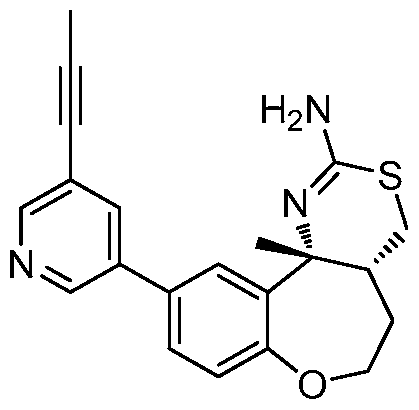
Example 22b
(4a5,l lb5)-l lb-Methyl-10-(5-(prop-l-yn-l-yl)pyridin-3-yl)-4a,5,6,l lb-tetrahydi benzo[2,3]oxepino[4,5-d][l,3]thiazin-2-amine

A sample of example 21 (racemic mixture) was separated using chiral HPLC under the following conditions: column = Chiracel AS-H 4.6 X 100 mm 5 μιη, flow rate = 1.0 mL/min, isocratic elution of 10% solvent B/90% solvent A, where solvent A = 0.1% diethylamine in w-heptane and solvent B = ethanol. Example 22a eluted at 4.2 min and example 22b eluted at 7.5 min. XH NMR and LCMS data of the individual enantiomers were identical to those reported for the racemic sample of example 22.
Example 23
rel-(4aS,l lb5)-l lb-Methyl-10-(l-methyl-lH-pyrazol-4-yl)-4a,5,6, l lb-tetrahydi benzo[2,3]oxepino[4,5-d][l,3]thiazin-2-amine, bis(2,2,2-trifluoroacetate)

In a manner similar to the two-step procedure used for the preparation of example 22, but using l-methyl-4-(4,4,5,5-tetramethyl-l,3,2-dioxaborinan-2-yl)-lH-pyrazole (130 mg, 0.585 mmol), potassium carbonate (81 mg, 0.585 mmol), and
bis(diphenylphosphino)ferrocenepalladium(II) dichloride (24 mg, 0.029 mmol) as starting materials, the compound of preparation H was converted to the titled compound of example 23 (19 mg, 0.032 mmol, 55 % yield over two steps) was prepared as a white residue. LCMS (M+H)+ = 329.14. XH NMR (500 MHz, methanol-^) δ 7.89 (s, 1H), 7.72 (s, 1H), 7.50 (dd, J=8.2, 2.2 Hz, 1H), 7.18 (d, J=2.1 Hz, 1H), 7.11 (d, J=8.1 Hz, 1H), 3.94 (s, 3H), 3.75 (td, J=13.1, 1.4 Hz, 1H), 3.03 - 2.97 (m, 2H), 2.86 (ddt, J=15.4, 13.4, 4.5 Hz, 1H), 2.52 (td, J=9.8, 4.1 Hz, 1H), 1.90 (s, 3H).
Example 24
rel-(4aS,l lbS l lb-methyl-10-(lH-pyrazol-4-yl)-4a,5,6, l lb-tetrahydro-4H- benzo[2,3]oxepino[4,5-d][l,3]thiazin-2-amine, bis(2,2,2-trifluoroacetate)

In a manner similar to the two-step procedure reported for example 23, the compound of preparation H was converted to the titled compound of example 24 in a 35 % overall yield. MS (M+H)+ = 315.13. 'H NMR (500 MHz, methanol-^) δ 7.91 (br. s., 2H), 7.54 (dd, J=8.1, 2.1 Hz, IH), 7.21 (d, J=2.1 Hz, IH), 7.12 (d, J=8.2 Hz, IH), 4.38 - 4.32 (m, IH), 3.76 (td, J=13.1, 1.3 Hz, IH), 3.03 - 2.97 (m, 2H), 2.92 - 2.83 (m, IH), 2.56 - 2.50 (m, IH), 1.94 (d, J=2.7 Hz, IH), 1.91 (s, 3H).
Example 25
re/-(4aS,l lbS 10-(Isoxazol-4-yl)-l lb-methyl-4a,5,6, l lb-tetrahydro-4H- benzo[2,3]oxepino[4,5-d][l,3]thiazin-2-amine, 2,2,2-trifluoroacetate salt

In a manner similar to the two-step procedure reported for example 23, the compound of preparation H was converted to the titled compound of example 25 in a 22 % overall yield. LCMS (M+H)+ = 316.12. XH NMR (500 MHz, methanol-i/4) δ 9.02 (s, IH), 8.76 (s, IH), 7.61 (dd, J=8.2, 2.2 Hz, IH), 7.23 (d, J=2.1 Hz, IH), 7.19 (d, J=8.2 Hz, IH), 4.40 - 4.33 (m, IH), 3.78 (td, J=13.1, 1.5 Hz, IH), 3.05 - 2.95 (m, 2H), 2.92 - 2.83 (m, IH), 2.58 - 2.51 (m, IH), 1.98 - 1.92 (m, IH), 1.90 (s, 3H).
Example 26
re/-(4aS,l \bS)-\ lb-Methyl-10-(2-methylthiazol-5-yl)-4a,5,6,l lb-tetrahydi
benzo[2,3]oxepino[4,5-d][l,3]thiazin-2-amine, 2,2,2-trifluoroacetate salt

In a manner similar to the two-step procedure reported for example 23, the compound of preparation H was converted to the titled compound of example 26 in a 94 % overall yield. MS (M+H)+ = 346.13. 'H NMR (500 MHz, methanol-^) δ 7.82 (s, IH), 7.60 (dd, J=8.2, 2.3 Hz, IH), 7.22 (d, J=2.1 Hz, IH), 7.18 (d, J=8.2 Hz, IH), 4.40 - 4.34 (m, IH), 3.78 (td, J=13.1, 1.4 Hz, IH), 3.05 - 2.95 (m, 2H), 2.93 - 2.84 (m, IH), 2.74 (s, 3H), 2.55 (dq, J=12.0, 4.0 Hz, IH), 1.97 - 1.91 (m, IH), 1.90 (s, 3H).
Example 26a
(4aR,l lbR)-l lb-Methyl-10-(2-methylthiazol-5-yl)-4a,5,6,l lb-tetrahydro-4H- benzo[2,3]oxepino[4,5-d][l,3]thiazin-2-amine

Example 26b
(4a5",l lbS l lb-Methyl-10-(2-methylthiazol-5-yl)-4a,5,6,l lb-tetrahydi
benzo[2,3]oxepino[4,5-d][l,3]thiazin-2-amine

A sample of the compound of Example 26 (racemic) was separated by chiral HPLC under the following conditions: column = Chiralpak AD-H 30 X 250 mm 5 μιη, flow rate = 70 mL/min, isocratic elution of 15% solvent B/85% solvent A, where solvent A = 0.1% diethylamine in n-heptane and solvent B = ethanol. The compound of Example 26a eluted at 18.3 min and the compound of example 26b eluted at 22.0 min. XH NMR and LCMS data were identical to those reported for the racemic compound of example 26. Example 27
re/-(4aS,l VoS)-\ lb-methyl- 10-(pyrimidin-5-yl)-4a,5,6, 1 lb-tetrahydro-4H- benzo[2,3]oxepino[4,5-d][l,3]thiazin-2-amine, bis(2,2,2-trifluoroacetate)

In a manner similar to the two-step procedure reported for example 23, the compound of preparation H was converted to the titled compound of example 27 in a 17 % overall yield. LCMS (M+H)+ = 327.1. XH NMR (500 MHz, methanol-^) δ 9.17 (s, 1H), 9.02 (s, 2H), 7.73 (dd, J=8.2, 2.4 Hz, 1H), 7.35 - 7.27 (m, 2H), 4.45 - 4.36 (m, 1H), 3.82 (td, J=13.2, 1.6 Hz, 1H), 3.08 - 2.97 (m, 2H), 2.96 - 2.85 (m, 1H), 2.62 - 2.53 (m, 1H), 2.01 - 1.88 (m, 4H).
Example 28
rel-2-((4aS,l 1 bS 2 -amino- 1 lb-methyl-4a,5,6,l lb-tetrahydro-4H-benzo[2,3]oxepino[4,5- d] [1 ,3]thiazin- 10-yl)- lH-indole-5-carbonitrile, 2,2,2-trifluoroacetate salt

In a manner similar to the two-step procedure reported for example 23, the compound of preparation H was converted to the titled compound of example 28 in a 42 % overall yield. LCMS (M+H)+ = 389.13. XH NMR (500 MHz, chloroform-if) δ 11.36 (s, IH), 10.43 (br. s., IH), 7.91 (d, J=l . l Hz, IH), 7.73 - 7.63 (m, 2H), 7.52 (d, J=8.4 Hz, IH), 7.38 (dd, J=8.4, 1.5 Hz, IH), 7.16 (d, J=8.2 Hz, IH), 6.77 (d, J=1.5 Hz, IH), 4.40 (dt, J=12.9, 3.7 Hz, IH), 3.81 (td, J=12.6, 1.8 Hz, IH), 3.22 (t, J=12.4 Hz, IH), 2.89 - 2.77 (m, 2H), 2.53 (dd, J=12.6, 3.7 Hz, 3H), 1.93 (s, 3H).
Example 29
rel-(4aS,l lbS 10-(isoquinolin-4-yl)-l lb-methyl-4a,5,6,l lb-tetrahydro-4H- benzo[2,3]oxepino[4,5-d][l,3]thiazin-2-amine, bis(2,2,2-trifluoroacetate)

In a manner similar to the two-step procedure reported for example 23, the compound of preparation H was converted to the titled compound of example 29 in a 65 % overall yield. LCMS (M+H)+ = 376.13. XH NMR (500 MHz, chloroform-if) δ 9.59 (br. s., IH), 8.55 (br. s., IH), 8.39 (d, J=7.9 Hz, IH), 8.21 (d, J=8.5 Hz, IH), 8.12 (t, J=7.7 Hz, IH), 8.00 - 7.94 (m, IH), 7.48 (d, J=8.1 Hz, IH), 7.33 (d, J=8.1 Hz, 2H), 4.49 (d, J=11.4 Hz, IH), 3.81 (t, J=13.1 Hz, IH), 3.08 (t, J=12.6 Hz, IH), 3.03 - 2.93 (m, IH), 2.84 (d, J=9.9 Hz, IH), 2.52 (d, J=10.7 Hz, IH), 2.05 (s, 3H), 1.92 (d, J=14.8 Hz, IH).
Example 30
re/-(4aS,l lbS)-10-(lH-indol-3-yl)-l lb-methyl-4a,5,6, l lb-tetrahydro-4H- benzo[2,3]oxepino[4,5-d][l,3]thiazin-2-amine, 2,2,2-trifluoroacetate salt

Example 31
rel-(4aS,l lbS)-10-(4-(4-Methoxyphenyl)-lH-imidazol-l-yl)-l lb-methyl-4a,5,6, l lb- tetrahydro-4H-benzo[2,3]oxepino[4,5-d][l,3]thiazin-2-amine, bis(2,2,2-trifluoroacetate)

To an oven dried microwave vial was added methyl 7-bromo-5-methyl-2,3- dihydrobenzo[b]oxepine-4-carboxylate from step H5 (200 mg, 0.673 mmol), 4-(4- methoxyphenyl)-lH-imidazole (141 mg, 0.808 mmol), potassium carbonate (186 mg, 1.35 mmol) and copper(I) iodide (72.9 mg, 0.383 mmol). The vial was capped with a
septum and the system was degassed and flushed with nitrogen (3x). Then 2,2,6,6- tetramethylheptane-3,5-dione (0.194 mL, 0.944 mmol) and DMF (5 mL) were added and the reaction mixture was degassed and flushed with nitrogen (3x). The vial was sealed and place in a pre-heated oil bath at 120 °C. The reaction mixture was stirred at 120 °C for 20 h. The reaction was poured into water to afford a blue mixture that was extracted with ethyl acetate. The combined organic layers were washed with brine, dried over sodium sulfate, filtered and concentrated in vacuo. The crude material was purified by silica gel column chromatography (30-100 % EtOAc/hexanes) to afford methyl 7-(4-(4- methoxyphenyl)-lH-imidazol-l-yl)-5-methyl-2,3-dihydrobenzo[b]oxepine-4-carboxylate (180 mg, 0.461 mmol, 69 % yield). LCMS (M+H)+ = 391.1. 'H NMR (500 MHz, chloroform-i/) δ 7.88 (br. s., 1H), 7.77 (d, J=7.2 Hz, 2H), 7.39 - 7.33 (m, 3H), 7.18 (d, J=8.4 Hz, 1H), 6.94 (d, J=7.5 Hz, 2H), 4.59 (t, J=6.0 Hz, 2H), 3.87 - 3.82 (m, 6H), 2.57 (t, J=5.9 Hz, 2H), 2.49 (s, 3H). Step 3 IB. (7-(4-(4-Methoxyphenyl)-lH-imidazol-l-yl)-5-methyl-2,3- dihydrobenzo[b]oxepin-4-yl)methanol
In a manner similar to that reported for step H6, the compound of step 31 A was converted to the compound of step 3 IB in a quantitative yield. MS (M+H)+ = 363.15.
Step 31C. l-(4-(Chloromethyl)-5-methyl-2,3-dihydrobenzo[b]oxepin-7-yl)-4-(4- methoxyphenyl)- 1 H-imidazole
In a manner similar to that reported for step H7, the compound of step 3 IB was converted to the compound of step 31C in a quantitative yield. MS (M+H)+ = 381.15.
Step 3 ID. re/-(4aS,l lbS 10-(4-(4-Methoxyphenyl)-lH-imidazol-l-yl)-l lb-methyl- 4a,5,6, l lb-tetrahydro-4H-benzo[2,3]oxepino[4,5-d][l,3]thiazin-2-amine, bis(2,2,2- trifluoroacetate)
In a manner similar to that reported for steps H8 and H9, the compound of step 31 C was converted to the titled compound of example 31 in 27% overall yield. LCMS (M+H)+ = 421.15. 'H NMR (500 MHz, DMSO-i¾) δ 9.22 (br. s., 4H), 8.42 (s, 1H), 7.84 - 7.75 (m,
3H), 7.68 (dd, J=8.7, 2.7 Hz, 1H), 7.25 (d, J=8.7 Hz, 1H), 7.1 1 - 7.02 (m, 2H), 4.53 (t, J=6.2 Hz, 2H), 4.25 (br. s., 2H), 3.82 (s, 3H), 2.35 - 2.27 (m, 2H), 2.21 (s, 3H).
Example 32
rel-(4aS,l lbS l lb-Methyl-10-(lH-pyrazol-l-yl)-4a,5,6,l lb-tetrahydro-4H- benzo[2,3]oxepino[4,5-d][l,3]thiazin-2-amine, 2,2,2-trifluoroacetate

Step 32A. Methyl 5-methyl-7-(lH-pyrazol-l-yl)-2,3-dihydrobenzo[b]oxepine-4- carboxylate
In a manner similar to that reported for step 31 A, the compound of step H5 was converted to the compound of step 32A in 32 % yield. MS (M+H)+ = 285.1.
Step 32B. (5-Methyl-7-(lH-pyrazol-l-yl)-2,3-dihydrobenzo[b]oxepin-4-yl)methanol
In a manner similar to that reported for step H6, the compound of step 32A was converted to the compound of step 32B in quantitative yield. MS (M+H)+ = 257.2.
Step 32C. l-(4-(Chloromethyl)-5-methyl-2,3-dihydrobenzo[b]oxepin-7-yl)-lH-pyrazole
In a manner similar to that reported for step H7, the compound of step 32B was converted to the compound of step 32C in quantitative yield. MS (M+H)+ = 275.1.
Step 32D. rel-(4aS,l lbS l lb-methyl-10-(lH-pyrazol-l-yl)-4a,5,6, l lb-tetrahydro-4H- benzo[2,3]oxepino[4,5-d][l,3]thiazin-2-amine, 2,2,2-trifluoroacetate salt.
In a manner similar to that reported for steps H8 and H9, the compound of step 32C was converted to the titled compound of example 32 in a 62 % overall yield. LCMS (M+H)+ = 315.15. ¾ NMR (500 MHz, methanol-i/4) δ 8.20 (dd, J=2.5, 0.5 Hz, 1H), 7.75 - 7.69 (m, 2H), 7.60 (dd, J=8.6, 2.7 Hz, 1H), 7.16 (d, J=8.7 Hz, 1H), 6.54 (t, J=2.2 Hz, 1H), 4.56 (t, J=6.3 Hz, 2H), 4.27 (s, 2H), 2.38 (s, 2H), 2.26 (s, 3H).
Example 33
rel-N-((4aS,l 1 bS 2 -amino- 1 lb-methyl-4a,5,6,l lb-tetrahydro-4H-benzo[2,3]oxepino[4,5- d] [1 ,3]thiazin- 10-yl)-5-chloropicolinamide, 2,2,2-trifluoroacetate salt

In a manner similar to the two-step procedure used for the preparation of example 7, but using tert-butyl rel-((4aS, l lb5)-10-amino-l lb-methyl-4a,5,6, l lb-tetrahydro-4H- benzo[2,3]oxepino[4,5-d][l,3]thiazin-2-yl)carbamate from preparation I (89 mg, 0.245 mmol) as the starting material, the titled compound of example 33 (52 mg, 0.099 mmol, 40 % yield) was prepared as a white solid. LCMS (M+H)+ 403.1. XH NMR (500 MHz, DMSO-i/6) δ 10.85 (s, 1H), 10.33 (br. s., 1H), 8.79 (dd, J=2.4, 0.7 Hz, 1H), 8.23 - 8.18 (m, 1H), 8.16 - 8.11 (m, 1H), 7.85 - 7.76 (m, 2H), 7.10 - 7.03 (m, 1H), 4.26 (dt, J=10.8, 1.8 Hz, 1H), 3.64 (t, J=12.7 Hz, 1H), 3.01 (dd, J=12.3, 3.1 Hz, 1H), 2.78 (t, J=12.7 Hz, 1H), 2.71 - 2.60 (m, 1H), 2.47 - 2.34 (m, 1H), 1.87 (d, J=13.9 Hz, 1H), 1.76 (s, 3H).
Example 33a
N-((4aS, l lbS 2-amino-l lb-methyl-4a,5,6, l lb-tetrahydro-4H-benzo[2,3]oxepino[4,5- d] [ 1 ,3]thiazin- 10-yl)-5-chloropicolinamide

Example 33b
N-((4aR,l lbR)-2-amino-l lb-methyl-4a,5,6,l lb-tetrahydro-4H-benzo[2,3]oxepino[4,5- d] [ 1 ,3]thiazin- 10-yl)-5-chloropicolinamide

A sample of the compound of example 33 (racemic) was separated by chiral HPLC under the following conditions: column = Chiracel OD-H 4.6 X 100 mm 5 μιη, flow rate = 1.0 mL/min, isocratic elution of 30% solvent B/90% solvent A, where solvent A = 0.1% diethylamine in n-heptane and solvent B = ethanol. The compound of example 33a eluted at 2.95 min and the compound of example 33b eluted at 4.76 min. XH NMR and LCMS data were identical to those reported for the racemic compound of example 33.
Example 34
re/-N-((4aS,l lbS 2-Amino-l lb-methyl-4a,5,6,l lb-tetrahydro-4H- benzo[2,3]oxepino[4,5-d][l,3]thiazin-10-yl)-3,5-dichloropicolinamide, 2,2,2- trifluoroacetate salt

N-((4aS,l lbS 2-Amino-l lb-methyl-4a,5,6,l lb-tetrahydro-4H-benzo[2,3]oxepino[4,5- d] [ 1 ,3]thiazin- 10-yl)-3,5-dichloropicolinamide

Example 34b
N-((4aR,l lbR)-2 -Amino- 1 lb-methyl-4a,5,6,l lb-tetrahydro-4H-benzo[2,3]oxepino[4,5- d] [ 1 ,3]thiazin- 10-yl)-3,5-dichloropicolinamide

A sample of the compound of example 34 (racemic) was separated by chiral HPLC under the following conditions: column = Chiracel OD 21 X 250 mm 10 μιη, flow rate = 15 mL/min, isocratic elution of 20% solvent B/90% solvent A, where solvent A = 0.1% diethylamine in n-heptane and solvent B = ethanol. The compound of Example 34a
eluted at 11.8 min and the compound of example 34b eluted at 17.2 min. XH NMR and LCMS data were identical to those reported for the racemic compound of example 34.
Example 35
re/-N-((4aS,l lhS 2-Amino-l lb-methyl-4a,5,6, l lb-tetrahydro-4H- benzo[2,3]oxepino[4,5-d][l,3]thiazin-10-yl)-5-cyanopicolinamide, 2,2,2-trifluoroacetate salt

In a manner similar to the two-step procedure used for the preparation of example 7, but using tert-butyl rel-((4aS, l lb5)-10-amino-l lb-methyl-4a,5,6, l lb-tetrahydro-4H- benzo[2,3]oxepino[4,5-d][l,3]thiazin-2-yl)carbamate from preparation I as the starting material, the titled compound of example 35 was prepared in 29 % yield. LCMS (M+H) 394.21. 'H NMR (500 MHz, methanol-^) δ 9.88 (s, 1H), 9.24 (dd, J=8.1, 1.8 Hz, 1H), 9.06 (d, J=8.1 Hz, 1H), 8.63 - 8.59 (m, 1H), 8.52 (d, J=8.7 Hz, 1H), 7.86 (d, J=8.7 Hz, 1H), 5.09 - 5.03 (m, 1H), 4.45 (t, J=12.6 Hz, 1H), 3.75 (dd, J=12.4, 3.2 Hz, 1H), 3.64 (t, J=12.6 Hz, 1H), 3.56 - 3.44 (m, 1H), 3.25 - 3.19 (m, 1H), 2.65 (d, J=13.9 Hz, 1H), 2.58 (s, 3H).
Example 35a
N-((4aR, l lbR)-2-amino-l lb-methyl-4a,5,6, l lb-tetrahydro-4H-benzo[2,3]oxepino[4,5- d] [ 1 ,3]thiazin- 10-yl)-5-cyanopicolinamide

N-((4aS,l lhS)-2-amino-l lb-methyl-4a,5,6, l lb-tetrahydro-4H-benzo[2,3]oxepino[4,5- d] [ 1 ,3]thiazin- 10-yl)-5-cyanopicolinamide

A sample of the compound of example 35 (racemic) was separated by chiral HPLC under the following conditions: column = Chiracel AS 21 X 250 mm 10 μιη, flow rate = 15 mL/min, isocratic elution of 25% solvent B/90% solvent A, where solvent A = 0.1% diethylamine in n-heptane and solvent B = ethanol. The compound of example 35a eluted at 13.8 min and the compound of example 35b eluted at 21.4 min. XH NMR and LCMS data were identical to those reported for the racemic compound of example 35.
Example 36
re/-N-((4aS,l lbS 2-Amino-l lb-methyl-4a,5,6, l lb-tetrahydro-4H- benzo[2,3]oxepino[4,5-d][l,3]thiazin-10-yl)-5-fluoropicolinamide, 2,2,2-trifluoroacetate salt

In a manner similar to the two-step procedure used for the preparation of example 7, but using tert-butyl rel-((4aS, l lb5)-10-amino-l lb-methyl-4a,5,6, l lb-tetrahydro-4H- benzo[2,3]oxepino[4,5-d][l,3]thiazin-2-yl)carbamate from preparation I as the starting material, the titled compound of example 36 was prepared in 48 % yield. MS (M+H)+ 387.1. 'H NMR (500 MHz, methanol-^) δ 8.61 (s, 1H), 8.28 (dd, J=8.8, 4.5 Hz, 1H), 7.91 - 7.76 (m, 2H), 7.63 (dd, J=8.5, 2.6 Hz, 1H), 7.13 (d, J=8.5 Hz, 1H), 4.40 - 4.26 (m,
1H), 3.75 (td, J=13.2, 1.4 Hz, 1H), 3.03 - 2.97 (m, 2H), 2.87 (ddt, J=15.3, 13.4, 4.5 Hz, 1H), 2.57 - 2.49 (m, 1H), 1.95 (br. s., 1H), 1.93 - 1.89 (m, 3H).
Example 36a
N-((4aS,l lhS)-2-Amino-l lb-methyl-4a,5,6,l lb-tetrahydro-4H-benzo[2,3]oxepino[4,5- d] [ 1 ,3]thiazin- 10-yl)-5-fluoropicolinamide

N-((4aR,l lbR)-2-Amino-l lb-methyl-4a,5,6,l lb-tetrahydro-4H-benzo[2,3]oxepino[4,5- d] [ 1 ,3]thiazin- 10-yl)-5-fluoropicolinamide

A sample of the compound of Example 36 (racemic) was separated by chiral HPLC under the following conditions: column = Chiracel AD 21 X 250 mm 10 μιη, flow rate = 15 mL/min, isocratic elution of 30% solvent B/90% solvent A, where solvent A = 0.1% diethylamine in n-heptane and solvent B = ethanol. The compound of example 36a eluted at 14.0 min and the compound of example 36b eluted at 19.1 min. XH NMR and LCMS data were identical to those reported for the racemic compound of example 36.
Example 37
rel-(4aS,l lbS 10-(3-Chloropyridin-2-yl)-l lb-methyl-4a,5,6,l lb-tetrahydro-4H- benzo[2,3]oxepino[4,5-d][l,3]thiazine-2,10-diamine, bis(2,2,2-trifluoroacetate)

Step 37A. tert-butyl rel-((4aS, 1 lbS)-10-((3-chloropyridin-2-yl)amino)-l lb-methyl- 4a,5,6, l lb-tetrahydro-4H-benzo[2,3]oxepino[4,5-d][l,3]thiazin-2-yl)carbamate
An oven dried vial was charged with brettphos precatalyst (12 mg, 0.014 mmol), brettphos (7.6 mg, 0.014 mmol), 2,3-dichloropyridine (8.5 mg, 0.058 mmol), tert-butyl rel-((4aS,l lb5)-10-amino-l lb-methyl-4a,5,6, l lb-tetrahydro-4H-benzo[2,3]oxepino[4,5- d][l,3]thiazin-2-yl)carbamate from preparation I (25 mg, 0.069 mmol) and LiHMDS (14 mg, 0.086 mmol). The vial was purged with nitrogen. Dioxane (1 mL) was added. The vial was placed in a preheated oil bath at 100 °C for 1 h. The reaction was then diluted with ethyl acetate and saturated aqueous ammonium chloride solution. The organic layer was washed with water, brine, and dried over sodium sulfate. The organic layer was filtered and concentrated in vacuo to afford tert-butyl rel-((4aS, l lb5)-10-((3- chloropyridin-2-yl)amino)-l lb-methyl-4a,5,6, l lb-tetrahydro-4H-benzo[2,3]oxepino[4,5- d][l,3]thiazin-2-yl)carbamate (27 mg, 0.057 mmol, 99 % yield). The crude material was used in the next step without further purification. MS (M+H)+ = 475.26.
Step 37B. re/-((4a5",l lb5)-N10-(3-chloropyridin-2-yl)-l lb-methyl-4a,5,6, l lb-tetrahydro- 4H-benzo[2,3]oxepino[4,5-d][l,3]thiazine-2, 10-diamine, bis(2,2,2-trifluoroacetate). tert-Butyl re/-((4a5", l lb5)-10-((3-chloropyridin-2-yl)amino)-l lb-methyl-4a,5,6,l lb- tetrahydro-4H-benzo[2,3]oxepino[4,5-d][l,3]thiazin-2-yl)carbamate from step 37A (27 mg, 0.057 mmol) was dissolved in DCM (2 mL) and to this was added TFA (0.5 mL, 6.49 mmol). The reaction mixture was stirred at rt for 16 h. The solvent was removed in vacuo. The crude residue was purified by Prep HPLC column chromatography (Luna Axia C18, 10 μιη, 30x100 mm column, 90% MeOH/10 % water/0.1 % TFA - 90% MeOH/10 % water/0.1 % TFA, linear gradiant over 20 min, 40 mL/min) to afford the
titled compound of example 37 (5.5 mg, 8.7 μιηοΐ, 15 % yield) as a light orange residue. LCMS (M+H)+ 375.1. XH NMR (500 MHz, methanol-i/4) δ 8.03 (dd, J=5.0, 1.6 Hz, IH), 7.79 (d, J=2.7 Hz, IH), 7.75 (dd, J=7.8, 1.5 Hz, IH), 7.36 (dd, J=8.5, 2.7 Hz, IH), 7.07 (d, J=8.4 Hz, IH), 6.81 (dd, J=7.8, 4.9 Hz, IH), 4.36 - 4.29 (m, IH), 3.73 (t, J=12.5 Hz, IH), 3.10 - 3.03 (m, IH), 3.01 - 2.96 (m, IH), 2.92 - 2.82 (m, IH), 2.54 - 2.47 (m, IH), 1.95 - 1.89 (m, 4H).
Example 38
re/-(4aS,l lb5)-N10-(3-Methoxypyridin-2-yl)-l lb-methyl-4a,5,6,l lb-tetrahydro-4H- benzo[2,3]oxepino[4,5-d][l,3]thiazine-2,10-diamine, bis(2,2,2-trifluoroacetate)

Example 39
rel-2-(((4aS,l lbS)-2-Amino-l lb-methyl-4a,5,6, l lb-tetrahydro-4H- benzo[2,3]oxepino[4,5-d][l,3]thiazin-10-yl)amino)nicotinonitrile, bis(2,2,2- trifluoroacetate)

In a manner similar to that reported for example 37, the compound of preparation I was converted to the compound of Example 39 in a 52 % overall yield. MS (M+H) 366.1. ¾ NMR (500 MHz, methanol-i/4) δ 8.56 (dd, J=7.6, 1.5 Hz, 1H), 8.30 - 8.17 (m, 1H), 7.65 - 7.55 (m, 1H), 7.47 - 7.38 (m, 2H), 7.19 - 7.08 (m, 1H), 4.50 - 4.42 (m, 1H), 3.95 - 3.81 (m, 1H), 3.10 - 2.99 (m, 1H), 2.97 - 2.86 (m, 1H), 2.63 - 2.50 (m, 1H), 2.05 - 1.86 (m, 4H).
Example 40
rel-(4aS,l lbS l lb-Methyl-N10-(quinazolin-4-yl)-4a,5,6, l lb-tetrahydro-4H- benzo[2,3]oxepino[4,5-d][l,3]thiazine-2,10-diamine, bis(2,2,2-trifluoroacetate)

Example 41
rel-(4aS,l lbS N10-(Isoquinolin-l-yl)-l lb-methyl-4a,5,6,l lb-tetrahydro-4H- benzo[2,3]oxepino[4,5-d][l,3]thiazine-2,10-diamine, bis(2,2,2-trifluoroacetate)

In a manner similar to that reported for example 37, the compound of preparation I was converted to the compound of Example 41 in a 8 % overall yield. MS (M+H) 391.1. ¾ NMR (500 MHz, methanol-i/4) δ 8.58 (s, 1H), 8.09 - 7.96 (m, 2H), 7.92 - 7.81 (m, 1H), 7.65 - 7.48 (m, 2H), 7.35 (dd, J=12.7, 7.6 Hz, 3H), 4.48 - 4.36 (m, 1H), 3.85 (t, J=12.4 Hz, 1H), 3.13 - 3.00 (m, 2H), 2.97 - 2.85 (m, 1H), 2.63 - 2.50 (m, 1H), 2.04 - 1.86 (m, 4H).
Example 42
re/-(4aS,l lbS N10-(4-Methoxypyrimidin-2-yl)-l lb-methyl-4a,5,6,l lb-tetrahydi benzo[2,3]oxepino[4,5-d][l,3]thiazine-2,10-diamine, bis(2,2,2-trifluoroacetate)

rel-N-((4aS,l lbS 2-Amino-l lb-methyl-4,4a,5,6,7,l lb- hexahydrobenzo[6,7]cyclohepta[l,2-d][l,3]thiazin-10-yl)-5-fluoropicolinamide, 2,2,2- trifluoroacetate

Step 43A. (^-Methyl 2-(5-fluoropicolinamido)-9-methyl-6,7-dihydro-5H- benzo[7]annulene-8-carboxylate
In a manner similar to the procedure of step 3 A, methyl 2-amino-9-methyl-6,7-dihydro- 5H-benzo[7]annulene-8-carboxylate from preparation J, step Jl, was coupled with 5- fluoropicolinic acid to afford the titled compound of Step 43A. XH NMR (500 HMz, chloroform-i/) δ 9.82 (br. s., IH), 8.48 (d, J=2.7 Hz, IH), 8.36 (dd, J=8.7, 4.6 Hz, IH), 7.73 (d, J=2.3 Hz, IH), 7.66 - 7.59 (m, 2H), 7.22 (d, J=8.1 Hz, IH), 3.83 (s, 3H), 2.57 (t, J=6.6 Hz, 2H), 2.45 (s, 3H), 2.17 - 2.10 (m, 4H).
Step 43B. (£)-5-Fluoro-N-(8-(hydroxymethyl)-9-methyl-6,7-dihydro-5H- benzo[7]annulen-2-yl)picolinamide
In a manner similar to the procedure of step 3B, (£)-methyl 2-(5-fluoropicolinamido)-9- methyl-6,7-dihydro-5H-benzo[7]annulene-8-carboxylate from step 43A was reduced with DIBAL to afford the titled compound of Step 43B. LCMS (M+H)+ = 327.2. XH NMR (500 HMz, chloroform-if) δ 9.79 (s, IH), 8.44 (d, J=2.7 Hz, IH), 8.35 - 8.31 (m, IH), 7.65 (d, J=2.3 Hz, IH), 7.61 - 7.56 (m, IH), 7.54 (dd, J=8.1, 2.3 Hz, IH), 7.17 (d, J=8.1 Hz, IH), 4.38 (s, 2H), 2.53 (t, J=7.0 Hz, 2H), 2.13 (s, 3H), 2.09 (quin, J=7.1 Hz, 2H), 2.02 - 1.95 (m, 3H).
Step 43C. (£)-N-(8-(Chloromethyl)-9-methyl-6,7-dihydro-5H-benzo[7]annulen-2-yl)-5- fluoropicolinamide
In a manner similar to the procedure of step 3C, (£)-5-fluoro-N-(8-(hydroxymethyl)-9- methyl-6,7-dihydro-5H-benzo[7]annulen-2-yl)picolinamide from step 43B was converted into the titled compound of Step 43C. ¾ NMR (500 HMz, chloroform-if) δ 9.79 (br. s., IH), 8.46 (d, J=2.7 Hz, IH), 8.35 (dd, J=8.7, 4.6 Hz, IH), 7.70 (d, J=2.1 Hz, IH), 7.63 - 7.58 (m, IH), 7.56 (dd, J=8.1, 2.3 Hz, IH), 7.19 (d, J=8.1 Hz, IH), 4.36 (s, 2H), 2.57 (t, J=7.1 Hz, 2H), 2.21 (s, 3H), 2.17 (quin, J=7.1 Hz, 2H), 2.03 - 1.98 (m, 2H).
Step 43D. rel-N-((4aS, 1 lbS 2-Amino- 1 lb-methyl-4,4a,5,6,7, 1 lb- hexahydrobenzo[6,7]cyclohepta[l,2-d][l,3]thiazin-10-yl)-5-fluoropicolinamide, 2,2,2- trifluoroacetate In a manner similar to the procedure of step 3D, (£)-N-(8-(chloromethyl)-9-methyl-6,7- dihydro-5H-benzo[7]annulen-2-yl)-5-fluoropicolinamide from step 43C was converted into the titled compound of example 43. LCMS (M+H)+ = 385.2. XH NMR (500 HMz, methanol-^) δ 8.61 (d, J=2.9 Hz, IH), 8.30 - 8.26 (m, IH), 7.87 (d, J=2.3 Hz, IH), 7.82 (td, J=8.5, 2.9 Hz, IH), 7.60 (dd, J=8.2, 2.2 Hz, IH), 7.27 (d, J=8.1 Hz, IH), 3.19 - 3.10 (m, IH), 2.96 - 2.82 (m, 3H), 2.56 - 2.42 (m, 2H), 2.10 (dd, J=14.6, 3.8 Hz, IH), 1.90 (dd, J=13.9, 4.3 Hz, IH), 1.86 (s, 3H), 1.59 (d, J=14.0 Hz, IH).
Example 43a
N-((4aR, l lbR)-2 -Amino- 1 lb-methyl-4,4a,5,6,7, l lb-hexahydrobenzo[6,7]cyclohepta[l,2- d] [ 1 ,3]thiazin- 10-yl)-5-fluoropicolinamide

N-((4aS, l lhS)-2-Amino-l lb-methyl-4,4a,5,6,7, l lb-hexahydrobenzo[6,7]cyclohepta[l,2- d] [ 1 ,3]thiazin- 10-yl)-5-fluoropicolinamide

A sample of the compound of example 43 (racemic TFA salt) was separated by chiral HPLC under the following conditions: column = Chiralpak AD 21 X 250 mm 10 um, flow rate = 15 mL/min, isocratic elution of 20% solvent B/80% solvent A, where solvent A = 0.1% diethylamine in n-heptane and solvent B = ethanol. The compound of example 43a eluted at 19.1 min and the compound of example 43b eluted at 24.5 min. XH NMR and LCMS data of the individual enantiomers 43 a and 43b were identical. LCMS (M+H)+ = 385.2. XH NMR (500 HMz, chloroform-if) δ 9.77 (br. s., 1H), 8.45 (d, J=2.7 Hz, 1H), 8.33 (dd, J=8.7, 4.6 Hz, 1H), 7.91 (dd, J=8.1, 2.3 Hz, 1H), 7.61 - 7.56 (m, 1H), 7.34 (d, J=2.3 Hz, 1H), 7.16 (d, J=8.1 Hz, 1H), 3.17 - 3.08 (m, 1H), 2.86 - 2.78 (m, 2H), 2.57 (dd, J=1 1.6, 3.1 Hz, 1H), 2.48 - 2.39 (m, 1H), 2.16 - 2.09 (m, 1H), 1.96 (dd, J=14.5, 4.1 Hz, 1H), 1.73 (s, 3H), 1.63 - 1.53 (m, 1H)
Example 44
rel-N-((4aS, 1 lbS)-2-amino-l lb-methyl-4,4a,5,6,7, 1 lb- hexahydrobenzo[6,7]cyclohepta[l,2-d][l,3]thiazin-10-yl)-5-cyanopicolinamide, 2,2,2- trifluoroacetate
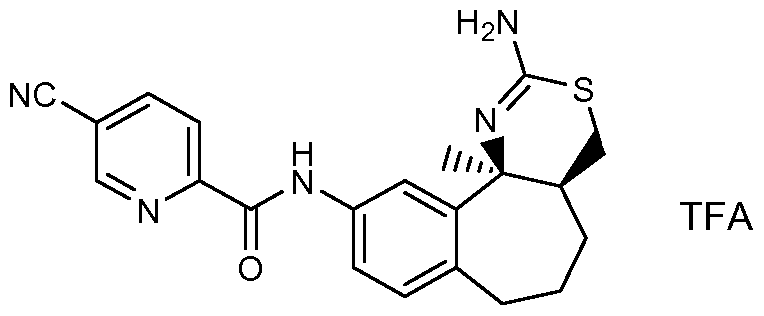
In a manner similar to the procedure of step 3 A, (£)-(2-amino-9-methyl-6,7-dihydro-5H- benzo[7]annulen-8-yl)methanol from preparation J was coupled with 5-cyanopicolinic acid to afford the titled compound of Step 44A. XH NMR (500 HMz, chloroform-if) δ 9.84 (s, IH), 8.90 (dd, J=2.0, 0.8 Hz, IH), 8.45 (dd, J=8.1, 0.8 Hz, IH), 8.21 (dd, J=8.1, 2.0 Hz, IH), 7.68 (d, J=2.3 Hz, IH), 7.56 (dd, J=8.1, 2.3 Hz, IH), 7.21 (d, J=8.2 Hz, IH), 4.41 (s, 2H), 2.56 (t, J=7.0 Hz, 2H), 2.16 (s, 3H), 2.12 (quin, J=7.1 Hz, 2H), 2.02 - 1.96 (m, 2H), 1.57 (br. s., IH).
Step 44B. (JE)-N-(8-(Chloromethyl)-9-methyl-6,7-dihydro-5H-benzo[7]annulen-2-yl)-5- cyanopicolinamide In a manner similar to the procedure of step 3C, (fs)-5-cyano-N-(8-(hydroxymethyl)-9- methyl-6,7-dihydro-5H-benzo[7]annulen-2-yl)picolinamide from step 44A was converted into the titled compound of Step 44B. ¾ NMR (500 HMz, chloroform-if) δ 9.85 (br. s., IH), 8.92 (dd, J=1.9, 0.8 Hz, IH), 8.46 (dd, J=8.2, 0.8 Hz, IH), 8.23 (dd, J=8.1, 2.0 Hz, IH), 7.70 (d, J=2.3 Hz, IH), 7.58 (dd, J=8.2, 2.3 Hz, IH), 7.22 (d, J=8.1 Hz, IH), 4.37 (s, 2H), 2.59 (t, J=7.1 Hz, 2H), 2.22 (s, 3H), 2.21 - 2.14 (m, 2H), 2.04 - 1.99 (m, 2H)
Step 44C. rel-N-((4aS,l lbS 2-amino-l lb-methyl-4,4a,5,6,7,l lb- hexahydrobenzo[6,7]cyclohepta[l,2-d][l,3]thiazin-10-yl)-5-cyanopicolinamide, 2,2,2- trifluoroacetate
In a manner similar to the procedure of step 3D, (£)-N-(8-(chloromethyl)-9-methyl-6,7- dihydro-5H-benzo[7]annulen-2-yl)-5-cyanopicolinamide from step 44B was converted into the titled compound of example 44. XH NMR (500 HMz, methanol^) δ 9.04 (dd, J=2.0, 0.8 Hz, IH), 8.41 (dd, J=8.2, 2.1 Hz, IH), 8.37 - 8.33 (m, IH), 7.90 (d, J=2.1 Hz, IH), 7.63 (dd, J=8.2, 2.2 Hz, IH), 7.28 (d, J=8.2 Hz, IH), 3.19 - 3.10 (m, IH), 2.98 - 2.88 (m, 2H), 2.88 - 2.81 (m, IH), 2.57 - 2.42 (m, 2H), 2.10 (dd, J=14.6, 3.7 Hz, IH), 1.94 - 1.88 (m, IH), 1.87 (s, 3H), 1.59 (d, J=14.0 Hz, IH).
Example 44a
N-((4aR,l lbR)-2 -Amino- 1 lb-methyl-4,4a,5,6,7,l lb-hexahydrobenzo[6,7]cyclohepta[l,2- d] [ 1 ,3]thiazin- 10-yl)-5-cyanopicolinamide

Example 44b
N-((4aS,l lb5")-2-Amino-l lb-methyl-4,4a,5,6,7,l lb-hexahydrobenzo[6,7]cyclohepta[l,2- d] [ 1 ,3 Jthiazin- 10-yl)-5-cyanopicolinamide

A sample of the compound of example 44 (racemic TFA salt) was separated by chiral HPLC under the following conditions: column = Chiralpak AS 21 X 250 mm 10 um, flow rate = 15 mL/min, isocratic elution of 18% solvent B/82% solvent A, where solvent A = 0.1% diethylamine in n-heptane and solvent B = ethanol. The compound of example 44a eluted at 15.9 min and the compound of example 44b eluted at 21.7 min. XH NMR and LCMS data of the individual enantiomers 44a and 44b were identical. LCMS
(M+H)+ = 392.3. XH NMR (500 HMz, chloroform-if) δ 9.75 (br. s., IH), 8.76 (d, J=l.l Hz, IH), 8.37 (d, J=8.1 Hz, IH), 8.16 (dd, J=8.1, 1.8 Hz, IH), 7.81 (dd, J=8.0, 1.6 Hz,
IH), 7.39 (s, IH), 7.10 (d, J=8.1 Hz, IH), 4.44 (br. s., 2H), 3.13 (t, J=13.7 Hz, IH), 2.87 - 2.76 (m, 2H), 2.56 (d, J=10.4 Hz, IH), 2.49 - 2.39 (m, 1H), 2.11 (dd, J=12.7, 3.1 Hz, IH), 1.95 (dd, J=14.3, 2.6 Hz, IH), 1.88 - 1.80 (m, IH), 1.74 (s, 3H), 1.56 (q, J=13.6 Hz, IH).
Example 45
rel-N-((4aS,l lbS 2-amino-l lb-methyl-4,4a,5,6,7, l lb- hexahydrobenzo[6,7]cyclohepta[l,2-d][l,3]thiazin-10-yl)-3,5-dichloropicolinamide, 2,2,2-trifluoroacetate

Step 45A. (£)-3,5-Dichloro-N-(8-(hydroxymethyl)-9-methyl-6,7-dihydro-5H- benzo[7]annulen-2-yl)picolinamide
In a manner similar to the procedure of step 3 A, (£)-(2-amino-9-methyl-6,7-dihydro-5H- benzo[7]annulen-8-yl)methanol from preparation J was coupled with 3,5- dichloropicolinic acid to afford the titled compound of Step 45A. LCMS (M+H)+ = 375.2. XH NMR (500 HMz, methanol-i/4) δ 8.62 (d, J=2.0 Hz, IH), 8.18 (d, J=2.1 Hz, IH), 7.65 (d, J=2.1 Hz, IH), 7.50 (dd, J=8.1, 2.3 Hz, IH), 7.19 (d, J=8.2 Hz, IH), 4.33 (s, 2H), 2.56 (t, J=7.0 Hz, 2H), 2.14 (s, 3H), 2.13 - 2.08 (m, 2H), 2.00 - 1.95 (m, 2H).
Step 45B. (£)-N-(8-(Chloromethyl)-9-methyl-6,7-dihydro-5H-benzo[7]annulen-2-yl)- 3,5-dichloropicolinamide
In a manner similar to the procedure of step 3C, (£)-3,3-dichloro-N-(8-(hydroxymethyl)- 9-methyl-6,7-dihydro-5H-benzo[7]annulen-2-yl)picolinamide from step 45A was converted into the titled compound of Step 45B. The crude material was used for the next step without purification or characterization.
Step 45C. rel-N-((4aS, l lb5)-2-amino-l lb-methyl-4,4a,5,6,7, l lb- hexahydrobenzo[6,7]cyclohepta[l,2-d][l,3]thiazin-10-yl)-3,3-dichloropicolinamide,
2,2,2-trifluoroacetate
In a manner similar to the procedure of step 3D, (£)-N-(8-(chloromethyl)-9-methyl-6,7- dihydro-5H-benzo[7]annulen-2-yl)-3,3-dichloropicolinamide from step 45B was converted into the titled compound of example 45. LCMS (M+H)+ = 435.2.
Example 45a
N-((4aS, l lhS)-2-Amino-l lb-methyl-4,4a,5,6,7, l lb-hexahydrobenzo[6,7]cyclohepta[l,2- d] [ 1 ,3]thiazin- 10-yl)-3,5-dichloropicolinamide

Example 45b
N-((4aR, l lbR)-2 -Amino- 1 lb-methyl-4,4a,5,6,7, l lb-hexahydrobenzo[6,7]cyclohepta[l,2- d] [ 1 ,3]thiazin- 10-yl)- 3,5-dichloropicolinamide

A sample of the compound of example 45 (racemic TFA salt) was separated by chiral HPLC under the following conditions: column = Chiralpak AD 21 X 250 mm 10 um, flow rate = 15 mL/min, isocratic elution of 25% solvent B/75% solvent A, where solvent A = 0.1% diethylamine in n-heptane and solvent B = ethanol. The compound of example 45a eluted at 13.5 min and the compound of example 45b eluted at 18.7 min. XH NMR and LCMS data of the individual enantiomers 45a and 45b were identical. LCMS
(M+H)+ = 435.05. ¾ NMR (500 HMz, methanol-i/4) δ 8.59 (d, J=2.1 Hz, IH), 8.15 (d, J=2.0 Hz, IH), 7.71 (dd, J=8.1, 2.3 Hz, IH), 7.44 (d, J=2.3 Hz, IH), 7.17 (d, J=8.1 Hz, IH), 3.16 (t, J=13.4 Hz, IH), 2.83 (dd, J=15.0, 5.4 Hz, IH), 2.76 - 2.69 (m, IH), 2.66 -
2.61 (m, 1H), 2.51 - 2.42 (m, IH), 2.1 1 - 2.05 (m, IH), 1.98 (dd, J=14.5, 3.8 Hz, IH), 1.86 - 1.79 (m, IH), 1.70 (s, 3H), 1.62 - 1.52 (m, IH).
Example 46
rel-N-((4aS,l lbS 2-Amino-l lb-methyl-4,4a,5,6,7,l lb- hexahydrobenzo[6,7]cyclohepta[l,2-d][l,3]thiazin-10-yl)-5- (difluoromethoxy)picolinamide, 2,2,2-trifluoroacetate

Step 46A. (E)- 5-(Difluoromethoxy)-N-(8-(hydroxymethyl)-9-methyl-6,7-dihydro-5H- benzo[7]annulen-2-yl)picolinamide
In a manner similar to the procedure of step 3 A, (£)-(2-amino-9-methyl-6,7-dihydro-5H- benzo[7]annulen-8-yl)methanol from preparation J was coupled with 5-
(difluoromethoxy)picolinic acid from preparation K to afford the titled compound of step 46A. LCMS (M+H)+ = 375.27, 'H NMR (500 HMz, chloroform-if) δ 9.81 (s, IH), 8.46 (d, J=2.1 Hz, IH), 8.32 (dd, J=8.6, 0.5 Hz, IH), 7.68 - 7.64 (m, 2H), 7.55 (dd, J=8.1, 2.3 Hz, IH), 7.18 (d, J=8.1 Hz, IH), 6.81 - 6.51 (m, IH), 4.39 (s, 2H), 2.56 - 2.51 (m, 2H), 2.14 (s, 3H), 2.10 (quin, J=7.1 Hz, 2H), 2.00 - 1.96 (m, 2H), 1.89 (br. s., IH).
Step 46B. (£)-N-(8-(Chloromethyl)-9-methyl-6,7-dihydro-5H-benzo[7]annulen-2-yl)- 5- (difluoromethoxy)picolinamide In a manner similar to the procedure of step 3C, (E)- 5-(difluoromethoxy)-N-(8-
(hydroxymethyl)-9-methyl-6,7-dihydro-5H-benzo[7]annulen-2-yl)picolinamide from step 46A was converted into the titled compound of Step 46B. XH NMR (500 HMz, chloroform-i/) δ 9.82 (s, IH), 8.49 - 8.46 (m, IH), 8.34 (dd, J=8.6, 0.5 Hz, IH), 7.71 - 7.65 (m, 2H), 7.56 (dd, J=8.1, 2.3 Hz, IH), 7.20 (d, J=8.1 Hz, IH), 6.81 - 6.51 (m, IH),
4.37 (s, 2H), 2.57 (t, J=7.1 Hz, 2H), 2.21 (s, 3H), 2.20 - 2.13 (m, 2H), 2.03 - 1.98 (m,
2H).
Step 46C. re/-N-((4aS,l lbS)-2-Amino-l lb-methyl-4,4a,5,6,7,l lb- hexahydrobenzo[6,7]cyclohepta[l,2-d][l,3]thiazin-10-yl)- 5- (difluoromethoxy)picolinamide, 2,2,2-trifluoroacetate
In a manner similar to the procedure of step 3D, (£)-N-(8-(chloromethyl)-9-methyl-6,7- dihydro-5H-benzo[7]annulen-2-yl)- 5-(difluoromethoxy)picolinamide from step 46B was converted into the titled compound of example 46. LCMS (M+H)+ = 431.4.
Example 46a
N-((4aS,l lbS 2-Amino-l lb-methyl-4,4a,5,6,7,l lb-hexahydrobenzo[6,7]cyclohepta[l,2- d][l,3]thiazin-10-yl)- 5-(difluoromethoxy)picolinamide

Example 46b
N-((4aR,l lbR)-2 -Amino- 1 lb-methyl-4,4a,5,6,7,l lb-hexahydrobenzo[6,7]cyclohepta[l,2- d][l,3]thiazin-10-yl)- 5-(difluoromethoxy)picolinamide

A sample of the compound of example 46 (racemic TFA salt) was separated by chiral HPLC under the following conditions: column = Chiralpak AD 21 X 250 mm 10 um, flow rate = 15 mL/min, isocratic elution of 25% solvent B/75% solvent A, where solvent
A = 0.1% diethylamine in n-heptane and solvent B = ethanol. The compound of example 46a eluted at 8.8 min and the compound of example 46b eluted at 15.8 min. XH NMR and LCMS data of the individual enantiomers 46a and 46b were identical. XH NMR (500 HMz, methanol-i/4) δ 8.55 (d, J=2.4 Hz, IH), 8.25 (d, J=8.7 Hz, IH), 7.80 (dd, J=8.6, 2.7 Hz, IH), 7.72 (dd, J=8.1, 2.1 Hz, IH), 7.51 (d, J=2.1 Hz, IH), 7.23 - 6.92 (m, 2H), 3.16 (t, J=13.6 Hz, IH), 2.84 (dd, J=15.0, 5.1 Hz, IH), 2.77 - 2.70 (m, IH), 2.67 - 2.61 (m, IH), 2.52 - 2.43 (m, IH), 2.13 - 2.06 (m, IH), 1.99 (dd, J=14.5, 3.5 Hz, IH), 1.87 - 1.80 (m, IH), 1.72 (s, 3H), 1.57 (d, J=13.6 Hz, IH).
Example 47
rel-(4aS,l lbS 9-fluoro-l lb-methyl-10-(pyrimidin-5-yl)-4,4a,5,6,7, l lb- hexahydrobenzo[6,7]cyclohepta[l,2-d][l,3]thiazin-2-amine, bis(2,2,2-trifluoroacetate)

Step 47A. rel-(4aS, l lbS)-9-fluoro-l lb-methyl- 10-(pyrimidin-5-yl)-4,4a,5,6,7, 1 lb- hexahydrobenzo[6,7]cyclohepta[ 1 ,2-d] [ 1 ,3]thiazin-2-amine, bi$-N-N-(tert- butyl)carbamate
In a manner similar to that reported for step 1 A of example 1, the compound of preparation L was converted to the compound of step 47A. LCMS (M+H)+ = 543.5. XH NMR (500 HMz, chloroform-i/) δ 9.17 (s, IH), 9.07 (d, J=l . l Hz, 2H), 7.85 (d, J=8.2 Hz, IH), 7.02 (d, J=11.3 Hz, IH), 3.19 (t, J=13.2 Hz, IH), 2.93 - 2.87 (m, IH), 2.87 - 2.82 (m, 1H), 2.68 (dd, J=12.1, 2.6 Hz, IH), 2.46 - 2.38 (m, IH), 2.17 - 2.1 1 (m, IH), 2.10 - 2.04 (m, IH), 1.94 - 1.87 (m, IH), 1.81 (s, 3H), 1.53 (s, 18H), 1.49 - 1.45 (m, IH),
Step 2B. rel-(4aS, l lbS 9-fluoro-l lb-methyl-10-(pyrimidin-5-yl)-4,4a,5,6,7, l lb- hexahydrobenzo[6,7]cyclohepta[l,2-d][l,3]thiazin-2-amine, bis(2,2,2-trifluoroacetate)
In a manner similar to that reported for step IB of example 1, the compound of step 47 A was converted to the compound of example 47. LCMS (M+H)+ = 525.3. H NMR (500 MHz, chloroform-i/) δ 9.17 (s, 1H), 9.10 (s, 2H), 7.96 (d, J=1.8 Hz, 1H), 7.40 (dd, J=7.8, 2.0 Hz, 1H), 7.27 (d, J=1.0 Hz, 2H), 3.21 (t, J=13.4 Hz, 1H), 2.98 - 2.85 (m, 2H), 2.66 (dd, J=1 1.9, 2.4 Hz, 1H), 2.50 - 2.38 (m, J=13.9, 13.9 Hz, 1H), 2.21 - 2.12 (m, 1H), 2.11 - 2.03 (m, J=3.7 Hz, 1H), 1.97 - 1.86 (m, 1H), 1.84 (s, 3H), 1.64 - 1.58 (m, J=13.7 Hz, 1H), 1.55 (s, 18H).
BIOLOGICAL METHODS
Cellular assays for inhibition of Αβ 1-40 and Αβ1-42 production H4 cells stably transfected with APP751 containing the Swedish mutation (H4 APP751 SWE clone 8.20, developed at BMS) were maintained in log phase through twice weekly passage at a 1 :20 split. For IC50 determinations, 30 μΐ cells (1.5 x 10⁴ cells/well) in DMEM media containing 0.0125% BSA (Sigma A8412) were plated directly into 384-well compound plates (Costar 3709) containing 0.1 μΐ serially diluted compound in DMSO. Following incubation for 19 h in 5% CO2 at 37° C, plates were briefly centrifuged (1000 rpm, 5 min). A 10 μΐ aliquot from each well was transferred to a second assay plate (Costar 3709) for Αβ40 measurements. Antibody cocktails were freshly prepared by dilution into 40 mM Tris-HCl (pH 7.4) with 0.2% BSA and added to assay plates. For Αβ42 measurements, antibodies specific for the Αβ42 neoepitope (565, developed at BMS; conjugated to the Wallac reagent (Perkin Elmer)) and the N-terminal sequence of Αβ peptide (26D6, developed at SIBIA; conjugated to APC (Perkin Elmer)) were mixed and 20 μΐ of the mixture was added to each well of the incubated cell plate yielding a final concentration of 0.8 ng/well 565 and 75 ng/well 26D6. For the Αβ40 measurements, antibodies specific for the Αβ40 neoepitope (TSD, developed at BMS; conjugated to the Wallac reagent (Perkin Elmer)) and 26D6 as described above were mixed and 20 μΐ of the mixture was added to the 10 μΐ aliquots which had been removed previously from the cell plate yielding a final concentration of 1.6 ng/well TSD and 17.5 ng/well 26D6. Assay plates containing antibodies were sealed with aluminum foil and incubated overnight at 4° C. Signal was determined using a Viewlux counter (Perkin Elmer) and IC50 values determined using curve fitting in CurveMaster (Excel Fit based).
The activity of representative compounds of the present invention, based on Αβ42 cellular IC50 values in H4 APP751 SWE clone 8.20, are illustrated below in Table 1.
Table 1. Cellular activity of examples


Claims
is claimed is:
A compound of formula (I), including pharmaceutically acceptable salts thereof:

(I)
wherein X is selected from the group of CH2, O, and R2;
m = 0 or 1 ;
n = 0 to 3;
R1 at each instance is selected from the group of halogen, hydroxy, amino, Ci_
4alkylamino, Ci_4dialkylamino, haloCi_4 alkyl, CN, Ci-Ce alkyl or cycloalkyl, Ci-Ce alkoxy, and C2-C4 alkynyl;
L is a bond, -NHCO-, -NH-, or L and Z together can be absent;
Z is a C6-C10- aryl group or a 5- 10 membered heterocyclic group which can be further substituted with from 0-3 substituents selected from the group of halogen, haloCi_4 alkoxy, 4-methoxyphenyl, hydroxy, amino, Ci_4alkylamino, Ci_4dialkylamino, haloCi_4 alkyl, CN, Ci-Ce alkyl or cycloalkyl, Ci-Ce alkoxy, and C2-C4 alkynyl;
R2 is selected from the group of hydrogen, benzyl, Ci-Ce alkyl or cycloalkyl, Ci-Ce alkoxy, acetyl, and methanesulfonyl;
and R3, R4 and R5 are independently selected from hydrogen or C1-4alkyl.
2. The compound of Claim 1, wherein:
X is selected from CH2 and O;
m = 0 or 1 ;
n = 0 to 3;
R1 at each instance is selected from the group of halogen, hydroxy, amino, Ci_
4alkylamino, Ci_4dialkylamino, haloCi_4 alkyl, CN, Ci-Ce alkyl or cycloalkyl, Ci-Ce alkoxy, or C2-C4 alkynyl; L is either a bond or is -NHCO-;
Z is a phenyl, pyridyl, pyrimidinyl, or pyrazinyl group which can be further substituted with from 0-3 substituents selected from the group of halogen, hydroxy, amino, Ci_ 4alkylamino, Ci_4dialkylamino, haloCi_4 alkyl, CN, Ci-C6 alkyl or cycloalkyl, Ci-Ce alkoxy, and C2-C4 alkynyl;
and R3, R4 and R5 are independently selected from hydrogen or Ci_4alkyl.
3. The compound of Claim 2, wherein:
X is selected from CH2 and O;
m = 0 or 1 ;
n = 0 to 3;
R1 at each instance is selected from halogen,
L is either a bond or is -NHCO-;
Z is a phenyl, pyridyl, pyrimidinyl, or pyrazinyl group which can be further substituted with from 0-3 substituents selected from halogen, CN, or C2-C4 alkynyl;
R3 is selected from hydrogen or Ci_4alkyl;
and R4 and R5 are hydrogen.
4. A compound of any claims of 1 to 3 wherein the configuration of the chiral center adjacent to the nitrogen of the aminothiazine is (S) or a pharmaceutically acceptable salt thereof.
5. The compound of claim 4, which is 5-Chloro-pyridine-2-carboxylic acid
((4aS, l lhS)-2-amino- l lb-methyl-4,4a,5,6,7, l lb-hexahydro-3-thia- l -aza- dibenzo[a,c]cyclohepten- 10-yl)-amide.
6. A pharmaceutical composition which comprises one or more of the compounds as claimed in claim 1, together with one or more pharmaceutically acceptable carriers, excipients or diluents.
7. A pharmaceutical composition which comprises one or more of the compounds as claimed in claim 4, together with one or more pharmaceutically acceptable carriers, excipients or diluents.
8. A pharmaceutical composition which comprises the compound as claimed in claim 5, together with one or more pharmaceutically acceptable carriers, excipients or diluents.
9. A method for the treatment of disorders responsive to the reduction of β-amyloid peptide production in a mammal in need thereof, which comprises administering to said mammal a therapeutically effective amount of a compound of formula (I) as claimed in claim 1.
10. A method for the treatment of disorders responsive to the reduction of β-amyloid peptide production in a mammal in need thereof, which comprises administering to said mammal a therapeutically effective amount of a compound of formula (I) as claimed in claim 4.
11. A method for the treatment of disorders responsive to the reduction of β-amyloid peptide production in a mammal in need thereof, which comprises administering to said mammal a therapeutically effective amount of the compound of formula (I) as claimed in claim 5.
12. The compound of claim 1 selected from the group consisting of:
(4aS, 1 lbS)-10-Pyrimidin-5-yl-4,4a,5,6,7, 1 lb-hexahydro-3-thia-l-aza- dibenzo[a,c]cyclohepten-2-ylamine;
re/-(4aS,l lhS)-l lb-Methyl-10-pyrimidin-5-yl-4,4a,5,6,7, l lb-hexahydro-3-thia-l-aza- dibenzo[a,c]cyclohepten-2-ylamine, bis(2,2,2-trifluoroacetate);
(is)-Methyl 2-(5-chloropicolinamido)-9-methyl-6,7-dihydro-5H-benzo[7]annulene-8- carboxylate;
re/-(4aS, 10hS)-l 0b-Methyl-9-(pyrimidin-5 -yl)-4a,5 ,6, 10b-tetrahydro-4H-naphtho [ 1 ,2- d][l,3]thiazin-2-amine, bis(2,2,2-trifluoroacetate);
re/-(4aS, 10bS 9-(5-Chloropyridin-3-yl)- 10b-methyl-4a,5,6, 10b-tetrahydro-4H- naphtho[l,2-d][l,3]thiazin-2-amine bis(2,2,2-trifluoroacetate); N-((4aS, 10bS 2-Amino- 10b-methyl-4a,5 ,6, 10b-tetrahydro-4H-naphtho [ 1 ,2- d][l,3]thiazin-9-yl)-5-chloropicolinamide;
re/-N-((4aS, 10hS)-2-Amino- 10b-methyl-4a,5 ,6, 10b-tetrahydro-4H-naphtho [ 1 ,2- d][l,3]thiazin-9-yl)-3,5-difluoropicolinamide, 2,2,2-trifluoroacetate;
re/-N-((4aS, 10hS 2 -amino- 10b-methyl-4a,5,6, 10b-tetrahydro-4H-naphtho[ 1 ,2- d][l,3]thiazin-9-yl)-5-fluoropicolinamide, 2,2,2-trifluoroacetate;
re/-(4aS,l lbS)-10-(5-methoxypyridin-3-yl)-l lb-methyl-4,4a,5,6,7, l lb- hexahydrobenzo[6,7]cyclohepta[l,2-d][l,3]thiazin-2-amine, bis(2,2,2-trifluoroacetate); rel-(4a5,l lb^-lO-CS-methoxyphenyl)-! lb-methyl-4,4a,5,6,7, l lb- hexahydrobenzo[6,7]cyclohepta[l,2-d][l,3]thiazin-2-amine, 2,2,2-trifluoroacetate;
re/-(4a5, l lb^-lO-CS-Chloropyridin-S-yl)-! lb-methyl-4,4a,5,6,7, l lb- hexahydrobenzo[6,7]cyclohepta[l,2-d][l,3]thiazin-2-amine, bis(2,2,2-trifluoroacetate); rel-(4aS, l lbS 10-(5-fluoropyridin-3-yl)-l lb-methyl-4,4a,5,6,7,l lb- hexahydrobenzo[6,7]cyclohepta[l,2-d][l,3]thiazin-2-amine, bis(2,2,2-trifluoroacetate); rel-(4aS, l lbS)-l lb-Methyl-10-(5-(prop-l-yn-l-yl)pyridin-3-yl)-4,4a,5,6,7, l lb- hexahydrobenzo[6,7]cyclohepta[l,2-d][l,3]thiazin-2-amine, bis(2,2,2-trifluoroacetate); rel-(4aS, l lbS)-l lb-Methyl-10-(5-(prop-l-yn-l-yl)pyridin-3-yl)-4,4a,5,6,7, l lb- hexahydrobenzo[6,7]cyclohepta[l,2-d][l,3]thiazin-2-amine, bis(2,2,2-trifluoroacetate); re/-(4aR, 10b5)-8-Fluoro-10b-methyl-9-(pyrimidin-5-yl)-4,4a,5, 10b- tetrahydrochromeno[4,3-d][l,3]thiazin-2-amine, bis(2,2,2-trifluoroacetate);
rel-(4aS, 10bS 10b-methyl-9-(5-(prop- 1 -yn- 1 -yl)pyridin-3 -yl)-4a,5,6, 10b-tetrahydro-4H- naphtho[l,2-d][l,3]thiazin-2-amine, bis(2,2,2-trifluoroacetate);
(4aS, l lbS)-l lb-Methyl-10-(5-(prop-l-yn-l-yl)pyridin-3-yl)-4a,5,6, l lb-tetrahydro-4H- benzo[2,3]oxepino[4,5-d][l,3]thiazin-2-amine;
re/-(4aS, l lbS l lb-Methyl-10-(l-methyl-lH-pyrazol-4-yl)-4a,5,6, l lb-tetrahydro-4H- benzo[2,3]oxepino[4,5-d][l,3]thiazin-2-amine, bis(2,2,2-trifluoroacetate);
(4a5", l lb5)-l lb-Methyl-10-(2-methylthiazol-5-yl)-4a,5,6, l lb-tetrahydro-4H- benzo[2,3]oxepino[4,5-d][l,3]thiazin-2-amine;
re/-(4aS,l lbS l lb-methyl- 10-(pyrimidin-5-yl)-4a,5,6, 1 lb-tetrahydro-4H- benzo[2,3]oxepino[4,5-d][l,3]thiazin-2-amine, bis(2,2,2-trifluoroacetate);
re/-(4aS,l lbS 10-(isoquinolin-4-yl)-l lb-methyl-4a,5,6,l lb-tetrahydro-4H- benzo[2,3]oxepino[4,5-d][l,3]thiazin-2-amine, bis(2,2,2-trifluoroacetate); N-((4aS, l lhS)-2-amino-l lb-methyl-4a,5,6, l lb-tetrahydro-4H-benzo[2,3]oxepino[4,5- d] [ 1 ,3]thiazin- 10-yl)-5-chloropicolinamide;
N-((4aS, l lhS)-2-Amino-l lb-methyl-4a,5,6, l lb-tetrahydro-4H-benzo[2,3]oxepino[4,5- d] [ 1 ,3]thiazin- 10-yl)-3,5-dichloropicolinamide;
N-((4aS, l lhS)-2-amino-l lb-methyl-4a,5,6, l lb-tetrahydro-4H-benzo[2,3]oxepino[4,5- d] [ 1 ,3]thiazin- 10-yl)-5-cyanopicolinamide;
N-((4aS, l lhS)-2-Amino-l lb-methyl-4a,5,6, l lb-tetrahydro-4H-benzo[2,3]oxepino[4,5- d] [ 1 ,3]thiazin- 10-yl)-5-fluoropicolinamide;
rel-(4aS, l lbS 10-(3-Chloropyridin-2-yl)-l lb-methyl-4a,5,6, l lb-tetrahydro-4H- benzo[2,3]oxepino[4,5-d][l,3]thiazine-2,10-diamine, bis(2,2,2-trifluoroacetate);
re/-(4aS, l lb5")-N10-(3-Methoxypyridin-2-yl)-l lb-methyl-4a,5,6, l lb-tetrahydro-4H- benzo[2,3]oxepino[4,5-d][l,3]thiazine-2,10-diamine, bis(2,2,2-trifluoroacetate);
re/-(4aS, l lb5")- 10-(4-Methoxypyrimidin-2-yl)-l lb-methyl-4a,5,6, l lb-tetrahydro-4H- benzo[2,3]oxepino[4,5-d][l,3]thiazine-2,10-diamine, bis(2,2,2-trifluoroacetate);
N-((4aS, l lb5)-2-Amino-l lb-methyl-4,4a,5,6,7, l lb-hexahydrobenzo[6,7]cyclohepta[l,2- d] [ 1 ,3]thiazin- 10-yl)-5-fluoropicolinamide;
N-((4aS, l lhS)-2-Amino-l lb-methyl-4,4a,5,6,7, l lb-hexahydrobenzo[6,7]cyclohepta[l,2- d] [ 1 ,3]thiazin- 10-yl)-5-cyanopicolinamide;
N-((4aS, l lhS)-2-Amino-l lb-methyl-4,4a,5,6,7, l lb-hexahydrobenzo[6,7]cyclohepta[l,2- d] [ 1 ,3]thiazin- 10-yl)-3,5-dichloropicolinamide;
N-((4aS, l lhS)-2-Amino-l lb-methyl-4,4a,5,6,7, l lb-hexahydrobenzo[6,7]cyclohepta[l,2- d][l,3]thiazin-10-yl)- 5-(difluoromethoxy)picolinamide; and
rel-(4aS, l lb5)-9-fluoro-l lb-methyl-10-(pyrimidin-5-yl)-4,4a,5,6,7, l lb- hexahydrobenzo[6,7]cyclohepta[l,2-d][l,3]thiazin-2-amine, bis(2,2,2-trifluoroacetate).
Applications Claiming Priority (4)
| Application Number | Priority Date | Filing Date | Title |
|---|---|---|---|
| US201161489438P | 2011-05-24 | 2011-05-24 | |
| US61/489,438 | 2011-05-24 | ||
| US13/477,143 | 2012-05-22 | ||
| US13/477,143 US8604024B2 (en) | 2011-05-24 | 2012-05-22 | Compounds for the reduction of beta-amyloid production |
Publications (1)
| Publication Number | Publication Date |
|---|---|
| WO2012162330A1 true WO2012162330A1 (en) | 2012-11-29 |
Family
ID=46201836
Family Applications (1)
| Application Number | Title | Priority Date | Filing Date |
|---|---|---|---|
| PCT/US2012/039031 Ceased WO2012162330A1 (en) | 2011-05-24 | 2012-05-23 | Tricyclic compounds as inhibitors for the production of beta-amyloid |
Country Status (4)
| Country | Link |
|---|---|
| US (1) | US8604024B2 (en) |
| AR (1) | AR086538A1 (en) |
| TW (1) | TW201300381A (en) |
| WO (1) | WO2012162330A1 (en) |
Cited By (23)
| Publication number | Priority date | Publication date | Assignee | Title |
|---|---|---|---|---|
| US8541408B2 (en) | 2007-04-24 | 2013-09-24 | Shionogi & Co., Ltd. | Aminodihydrothiazine derivatives substituted with a cyclic group |
| US8546380B2 (en) | 2005-10-25 | 2013-10-01 | Shionogi & Co., Ltd. | Aminodihydrothiazine derivatives |
| US8637504B2 (en) | 2008-06-13 | 2014-01-28 | Shionogi & Co., Ltd. | Sulfur-containing heterocyclic derivative having beta secretase inhibitory activity |
| US8653067B2 (en) | 2007-04-24 | 2014-02-18 | Shionogi & Co., Ltd. | Pharmaceutical composition for treating Alzheimer's disease |
| US8703785B2 (en) | 2008-10-22 | 2014-04-22 | Shionogi & Co., Ltd. | 2-aminopyrimidin-4-one and 2-aminopyridine derivatives both having BACE1-inhibiting activity |
| US20140213581A1 (en) * | 2013-01-29 | 2014-07-31 | Amgen Inc. | Fused multi-cyclic sulfone compounds as inhibitors of beta-secretase and methods of use thereof |
| US8883779B2 (en) | 2011-04-26 | 2014-11-11 | Shinogi & Co., Ltd. | Oxazine derivatives and a pharmaceutical composition for inhibiting BACE1 containing them |
| US8927721B2 (en) | 2010-10-29 | 2015-01-06 | Shionogi & Co., Ltd. | Naphthyridine derivative |
| WO2015017407A1 (en) | 2013-07-30 | 2015-02-05 | Amgen Inc. | Bridged bicyclic amino thiazine dioxide compounds as inhibitors of beta- secretase |
| US8999980B2 (en) | 2009-12-11 | 2015-04-07 | Shionogi & Co., Ltd. | Oxazine derivatives |
| US9018219B2 (en) | 2010-10-29 | 2015-04-28 | Shionogi & Co., Ltd. | Fused aminodihydropyrimidine derivative |
| WO2016022724A1 (en) | 2014-08-08 | 2016-02-11 | Amgen Inc. | Cyclopropyl fused thiazin-2-amine compounds as beta-secretase inhibitors and methods of use |
| US9296734B2 (en) | 2013-03-01 | 2016-03-29 | Amgen Inc. | Perfluorinated 5,6-dihydro-4H-1,3-oxazin-2-amine compounds as beta-secretase inhibitors and methods of use |
| US9540359B2 (en) | 2012-10-24 | 2017-01-10 | Shionogi & Co., Ltd. | Dihydrooxazine or oxazepine derivatives having BACE1 inhibitory activity |
| US9611261B2 (en) | 2013-03-08 | 2017-04-04 | Amgen Inc. | Perfluorinated cyclopropyl fused 1,3-oxazin-2-amine compounds as beta-secretase inhibitors and methods of use |
| US9643947B2 (en) | 2013-08-28 | 2017-05-09 | Northwestern University | 7-membered fused heterocycles and methods of their synthesis |
| EP3201204A4 (en) * | 2014-10-03 | 2018-05-16 | Merck Sharp & Dohme Corp. | C5-c6-fused tricyclic iminothiadiazine dioxide compounds as bace inhibitors, compositions, and their use |
| WO2018112081A1 (en) | 2016-12-15 | 2018-06-21 | Amgen Inc. | Oxazine derivatives as beta-secretase inhibitors and methods of use |
| WO2018112083A1 (en) | 2016-12-15 | 2018-06-21 | Amgen Inc. | Thiazine derivatives as beta-secretase inhibitors and methods of use |
| WO2018112094A1 (en) | 2016-12-15 | 2018-06-21 | Amgen Inc. | 1,4-thiazine dioxide and 1,2,4-thiadiazine dioxide derivatives as beta-secretase inhibitors and methods of use |
| WO2018112084A1 (en) | 2016-12-15 | 2018-06-21 | Amgen Inc. | Bicyclic thiazine and oxazine derivatives as beta-secretase inhibitors and methods of use |
| WO2018112086A1 (en) | 2016-12-15 | 2018-06-21 | Amgen Inc. | Cyclopropyl fused thiazine derivatives as beta-secretase inhibitors and methods of use |
| US10246429B2 (en) | 2015-08-06 | 2019-04-02 | Amgen Inc. | Vinyl fluoride cyclopropyl fused thiazin-2-amine compounds as beta-secretase inhibitors and methods of use |
Citations (2)
| Publication number | Priority date | Publication date | Assignee | Title |
|---|---|---|---|---|
| EP1942105A1 (en) * | 2005-10-25 | 2008-07-09 | Shionogi Co., Ltd. | Aminodihydrothiazine derivative |
| US20100093999A1 (en) * | 2008-09-30 | 2010-04-15 | Eisai R&D Management Co., Ltd. | Novel fused aminodihydrothiazine derivative |
Family Cites Families (1)
| Publication number | Priority date | Publication date | Assignee | Title |
|---|---|---|---|---|
| AR077277A1 (en) | 2009-07-09 | 2011-08-17 | Lilly Co Eli | BICYCLE COMPOUNDS (1,3) TIAZIN-2-AMINA PHARMACEUTICAL FORMULATION THAT INCLUDES IT AND ITS USE FOR THE MANUFACTURE OF A USEFUL MEDICINAL PRODUCT FOR THE TREATMENT OF ALZHEIMER'S DISEASE |
-
2012
- 2012-05-22 US US13/477,143 patent/US8604024B2/en active Active
- 2012-05-23 WO PCT/US2012/039031 patent/WO2012162330A1/en not_active Ceased
- 2012-05-23 TW TW101118387A patent/TW201300381A/en unknown
- 2012-05-23 AR ARP120101825A patent/AR086538A1/en not_active Application Discontinuation
Patent Citations (2)
| Publication number | Priority date | Publication date | Assignee | Title |
|---|---|---|---|---|
| EP1942105A1 (en) * | 2005-10-25 | 2008-07-09 | Shionogi Co., Ltd. | Aminodihydrothiazine derivative |
| US20100093999A1 (en) * | 2008-09-30 | 2010-04-15 | Eisai R&D Management Co., Ltd. | Novel fused aminodihydrothiazine derivative |
Non-Patent Citations (25)
| Title |
|---|
| ANDERSON, D.H. ET AL., EXP EYE RES, vol. 78, 2004, pages 243 - 256 |
| CLEARY, J.P. ET AL., NAT NEUROSCI., vol. 8, 2005, pages 79 - 84 |
| DERAMECOURT, V. ET AL., J NEUROPATHOL EXP NEUROL, vol. 65, 2006, pages 278 - 288 |
| GOLDSTEIN, L.E. ET AL., LANCET, vol. 361, 2003, pages 1258 - 1265 |
| GRUNDMAN, M. ET AL., ARCH NEUROL., vol. 61, 2004, pages 59 - 66 |
| HAMILTON, R.L. ET AL., ACTA NEUROPATHOL (BERL, vol. 107, 2004, pages 515 - 522 |
| HUSSAIN, 1. ET AL., MOL. CELL. NEUROSCI., vol. 14, 1999, pages 419 - 427 |
| LIN, X. ET AL., PROCEEDINGS OF THE NATIONAL ACADEMY OF SCIENCES OF THE UNITED STATES OFAMERICA, vol. 97, 2000, pages 1456 - 1460 |
| LOANE, D. J. ET AL., NATURE MEDICINE, vol. 15, 2009, pages 377 - 379 |
| LUO, Y. ET AL., NATURE NEUROSCIENCE, vol. 4, 2001, pages 231 - 232 |
| MURPHY, M.P. ET AL., NEUROLOGY, vol. 66, 2006, pages 65 - 68 |
| NEUMANN, M. ET AL., SCIENCE, vol. 314, 2006, pages 130 - 133 |
| NEUROBIOL AGING, vol. 18, 1997, pages 1 - 2 |
| ROBERDS, S.L. ET AL., HUMAN MOLECULAR GENETICS, vol. 10, 2001, pages 1317 - 1324 |
| SELKOE, D., PHYSIOL. REV., vol. 81, 2001, pages 741 - 766 |
| SELKOE, D.J., PHYSIOL REV., vol. 81, 2001, pages 741 - 766 |
| SINHA, S. ET AL., NATURE (LONDON, vol. 402, 1999, pages 537 - 540 |
| THAL, D. ET AL., J. NEUROPATH. EXP. NEURO., vol. 61, 2002, pages 282 - 293 |
| VASSAR, R. ET AL., SCIENCE (WASHINGTON, D. C., vol. 286, 1999, pages 735 - 741 |
| WALSH, D.M. ET AL., NEURON, vol. 44, 2004, pages 181 - 193 |
| WOLFE, M., J. MED. CHEM., vol. 44, 2001, pages 2039 - 2060 |
| WOLFE, M.S. ET AL., SCIENCE, vol. 305, 2004, pages 1119 - 1123 |
| YAN, R. ET AL., NATURE (LONDON, vol. 402, 1999, pages 533 - 537 |
| YOKOTA, O. ET AL., ACTA NEUROPATHOL (BERL, vol. 104, 2002, pages 637 - 648 |
| YOSHIDA, T. ET AL., J CLIN INVEST, vol. 115, 2005, pages 2793 - 2800 |
Cited By (43)
| Publication number | Priority date | Publication date | Assignee | Title |
|---|---|---|---|---|
| US8815851B2 (en) | 2005-10-25 | 2014-08-26 | Shionogi & Co., Ltd. | Aminodihydrothiazine derivatives |
| US8546380B2 (en) | 2005-10-25 | 2013-10-01 | Shionogi & Co., Ltd. | Aminodihydrothiazine derivatives |
| US8633188B2 (en) | 2005-10-25 | 2014-01-21 | Shionogi & Co., Ltd. | Aminodihydrothiazine derivatives |
| US9029358B2 (en) | 2005-10-25 | 2015-05-12 | Shionogi & Co., Ltd. | Aminodihydrothiazine derivatives |
| US8653067B2 (en) | 2007-04-24 | 2014-02-18 | Shionogi & Co., Ltd. | Pharmaceutical composition for treating Alzheimer's disease |
| US8884062B2 (en) | 2007-04-24 | 2014-11-11 | Shionogi & Co., Ltd. | Aminodihydrothiazine derivatives substituted with a cyclic group |
| US8541408B2 (en) | 2007-04-24 | 2013-09-24 | Shionogi & Co., Ltd. | Aminodihydrothiazine derivatives substituted with a cyclic group |
| US8895548B2 (en) | 2007-04-24 | 2014-11-25 | Shionogi & Co., Ltd. | Pharmaceutical composition for treating alzheimer's disease |
| US9650371B2 (en) | 2008-06-13 | 2017-05-16 | Shionogi & Co., Ltd. | Sulfur-containing heterocyclic derivative having beta secretase inhibitory activity |
| US9273053B2 (en) | 2008-06-13 | 2016-03-01 | Shionogi & Co., Ltd. | Sulfur-containing heterocyclic derivative having Beta secretase inhibitory activity |
| US8637504B2 (en) | 2008-06-13 | 2014-01-28 | Shionogi & Co., Ltd. | Sulfur-containing heterocyclic derivative having beta secretase inhibitory activity |
| US8703785B2 (en) | 2008-10-22 | 2014-04-22 | Shionogi & Co., Ltd. | 2-aminopyrimidin-4-one and 2-aminopyridine derivatives both having BACE1-inhibiting activity |
| US9656974B2 (en) | 2009-12-11 | 2017-05-23 | Shionogi & Co., Ltd. | Oxazine derivatives |
| US9290466B2 (en) | 2009-12-11 | 2016-03-22 | Shionogi & Co., Ltd. | Oxazine derivatives |
| US8999980B2 (en) | 2009-12-11 | 2015-04-07 | Shionogi & Co., Ltd. | Oxazine derivatives |
| US8927721B2 (en) | 2010-10-29 | 2015-01-06 | Shionogi & Co., Ltd. | Naphthyridine derivative |
| US9018219B2 (en) | 2010-10-29 | 2015-04-28 | Shionogi & Co., Ltd. | Fused aminodihydropyrimidine derivative |
| US8883779B2 (en) | 2011-04-26 | 2014-11-11 | Shinogi & Co., Ltd. | Oxazine derivatives and a pharmaceutical composition for inhibiting BACE1 containing them |
| US9540359B2 (en) | 2012-10-24 | 2017-01-10 | Shionogi & Co., Ltd. | Dihydrooxazine or oxazepine derivatives having BACE1 inhibitory activity |
| US9758513B2 (en) | 2012-10-24 | 2017-09-12 | Shionogi & Co., Ltd. | Dihydrooxazine or oxazepine derivatives having BACE1 inhibitory activity |
| US9309263B2 (en) | 2013-01-29 | 2016-04-12 | Amgen Inc. | Fused multi-cyclic sulfone compounds as inhibitors of beta-secretase and methods of use thereof |
| WO2014120658A1 (en) | 2013-01-29 | 2014-08-07 | Amgen Inc. | Fused multicyclic 3-amino-5,6-dihydro-2h-1,4-thiazine derivatives and their use as beta-secretase inhibitors |
| US20140213581A1 (en) * | 2013-01-29 | 2014-07-31 | Amgen Inc. | Fused multi-cyclic sulfone compounds as inhibitors of beta-secretase and methods of use thereof |
| US9296734B2 (en) | 2013-03-01 | 2016-03-29 | Amgen Inc. | Perfluorinated 5,6-dihydro-4H-1,3-oxazin-2-amine compounds as beta-secretase inhibitors and methods of use |
| US9611261B2 (en) | 2013-03-08 | 2017-04-04 | Amgen Inc. | Perfluorinated cyclopropyl fused 1,3-oxazin-2-amine compounds as beta-secretase inhibitors and methods of use |
| US9096615B2 (en) | 2013-07-30 | 2015-08-04 | Amgen Inc. | Bridged bicyclic amino thiazine dioxide compounds as inhibitors of beta-secretase and methods of use thereof |
| WO2015017407A1 (en) | 2013-07-30 | 2015-02-05 | Amgen Inc. | Bridged bicyclic amino thiazine dioxide compounds as inhibitors of beta- secretase |
| US9643947B2 (en) | 2013-08-28 | 2017-05-09 | Northwestern University | 7-membered fused heterocycles and methods of their synthesis |
| WO2016022724A1 (en) | 2014-08-08 | 2016-02-11 | Amgen Inc. | Cyclopropyl fused thiazin-2-amine compounds as beta-secretase inhibitors and methods of use |
| US9550762B2 (en) | 2014-08-08 | 2017-01-24 | Amgen, Inc. | Cyclopropyl fused thiazin-2-amine compounds as beta-secretase inhibitors and methods of use |
| EP3201204A4 (en) * | 2014-10-03 | 2018-05-16 | Merck Sharp & Dohme Corp. | C5-c6-fused tricyclic iminothiadiazine dioxide compounds as bace inhibitors, compositions, and their use |
| US10238743B2 (en) | 2014-10-03 | 2019-03-26 | Merck Sharp & Dohme Corp. | C5-C6-fused tricyclic iminothiadiazine dioxide compounds as BACE inhibitors, compositions, and their use |
| US10246429B2 (en) | 2015-08-06 | 2019-04-02 | Amgen Inc. | Vinyl fluoride cyclopropyl fused thiazin-2-amine compounds as beta-secretase inhibitors and methods of use |
| WO2018112081A1 (en) | 2016-12-15 | 2018-06-21 | Amgen Inc. | Oxazine derivatives as beta-secretase inhibitors and methods of use |
| WO2018112083A1 (en) | 2016-12-15 | 2018-06-21 | Amgen Inc. | Thiazine derivatives as beta-secretase inhibitors and methods of use |
| WO2018112094A1 (en) | 2016-12-15 | 2018-06-21 | Amgen Inc. | 1,4-thiazine dioxide and 1,2,4-thiadiazine dioxide derivatives as beta-secretase inhibitors and methods of use |
| WO2018112084A1 (en) | 2016-12-15 | 2018-06-21 | Amgen Inc. | Bicyclic thiazine and oxazine derivatives as beta-secretase inhibitors and methods of use |
| WO2018112086A1 (en) | 2016-12-15 | 2018-06-21 | Amgen Inc. | Cyclopropyl fused thiazine derivatives as beta-secretase inhibitors and methods of use |
| US10889581B2 (en) | 2016-12-15 | 2021-01-12 | Amgen Inc. | Cyclopropyl fused thiazine derivatives as beta-secretase inhibitors and methods of use |
| US10889579B2 (en) | 2016-12-15 | 2021-01-12 | Amgen Inc. | Thiazine derivatives as β-secretase inhibitors and methods of use |
| US10947223B2 (en) | 2016-12-15 | 2021-03-16 | Amgen Inc. | Substituted oxazines as beta-secretase inhibitors |
| US11021493B2 (en) | 2016-12-15 | 2021-06-01 | Amgen Inc. | 1,4-thiazine dioxide and 1,2,4-thiadiazine dioxide derivatives as beta-secretase inhibitors and methods of use |
| US11548903B2 (en) | 2016-12-15 | 2023-01-10 | Amgen Inc. | Bicyclic thiazine and oxazine derivatives as beta-secretase inhibitors and methods of use |
Also Published As
| Publication number | Publication date |
|---|---|
| TW201300381A (en) | 2013-01-01 |
| US8604024B2 (en) | 2013-12-10 |
| AR086538A1 (en) | 2014-01-08 |
| US20130131051A1 (en) | 2013-05-23 |
Similar Documents
| Publication | Publication Date | Title |
|---|---|---|
| US8604024B2 (en) | Compounds for the reduction of beta-amyloid production | |
| RU2476431C2 (en) | Condensed aminohydrothiazine derivative | |
| WO2012162334A1 (en) | Compounds for the reduction of beta-amyloid production | |
| EP2456774B1 (en) | Fused aminodihydro-oxazine derivatives | |
| AU2009300836B2 (en) | Novel fused aminodihydrothiazine derivative | |
| EP2935256B1 (en) | 4,6-diarylaminothiazines as bace1 inhibitors and their use for the reduction of beta-amyloid production | |
| WO2020167628A1 (en) | Thioeno[3,2-b] pyridin-7-amine compounds for treating familial dysautonomia | |
| US20120202828A1 (en) | Fused aminodihydropyrimidone derivatives | |
| IL224202A (en) | Macrocyclic compounds and pharmaceutical compositions comprising them for treating disorders responsive to reduction of beta-amyloid production | |
| CA2897678A1 (en) | Heteroaryl-substituted hexahydropyrano[3,4-d][1,3]thiazin-2-amine compounds | |
| CN119546608A (en) | Novel imidazopyridine and pyrazolopyridine sulfonamide derivatives |
Legal Events
| Date | Code | Title | Description |
|---|---|---|---|
| 121 | Ep: the epo has been informed by wipo that ep was designated in this application |
Ref document number: 12725223 Country of ref document: EP Kind code of ref document: A1 |
|
| NENP | Non-entry into the national phase |
Ref country code: DE |
|
| 122 | Ep: pct application non-entry in european phase |
Ref document number: 12725223 Country of ref document: EP Kind code of ref document: A1 |