WO2012149604A1 - Bis-thymine derivatives and photo-reversible polymers thereof - Google Patents
Bis-thymine derivatives and photo-reversible polymers thereof Download PDFInfo
- Publication number
- WO2012149604A1 WO2012149604A1 PCT/AU2012/000470 AU2012000470W WO2012149604A1 WO 2012149604 A1 WO2012149604 A1 WO 2012149604A1 AU 2012000470 W AU2012000470 W AU 2012000470W WO 2012149604 A1 WO2012149604 A1 WO 2012149604A1
- Authority
- WO
- WIPO (PCT)
- Prior art keywords
- optionally substituted
- alkylene
- arylene
- group
- compound
- Prior art date
- Legal status (The legal status is an assumption and is not a legal conclusion. Google has not performed a legal analysis and makes no representation as to the accuracy of the status listed.)
- Ceased
Links
- 0 CC(C(N1*N(C(C(C)=CN2*C(*)=O)=O)C2=O)=O)=CN(*C(*)=O)C1=O Chemical compound CC(C(N1*N(C(C(C)=CN2*C(*)=O)=O)C2=O)=O)=CN(*C(*)=O)C1=O 0.000 description 2
- CHMQUVJOOLSPOX-UHFFFAOYSA-N CC(C(N1CCCCN(C(C(C)=CN2CCC(OC)=O)=O)C2=O)=O)=CN(CCC(OC)=O)C1=O Chemical compound CC(C(N1CCCCN(C(C(C)=CN2CCC(OC)=O)=O)C2=O)=O)=CN(CCC(OC)=O)C1=O CHMQUVJOOLSPOX-UHFFFAOYSA-N 0.000 description 1
Classifications
-
- C—CHEMISTRY; METALLURGY
- C08—ORGANIC MACROMOLECULAR COMPOUNDS; THEIR PREPARATION OR CHEMICAL WORKING-UP; COMPOSITIONS BASED THEREON
- C08F—MACROMOLECULAR COMPOUNDS OBTAINED BY REACTIONS ONLY INVOLVING CARBON-TO-CARBON UNSATURATED BONDS
- C08F2/00—Processes of polymerisation
- C08F2/46—Polymerisation initiated by wave energy or particle radiation
- C08F2/48—Polymerisation initiated by wave energy or particle radiation by ultraviolet or visible light
-
- C—CHEMISTRY; METALLURGY
- C07—ORGANIC CHEMISTRY
- C07D—HETEROCYCLIC COMPOUNDS
- C07D239/00—Heterocyclic compounds containing 1,3-diazine or hydrogenated 1,3-diazine rings
- C07D239/02—Heterocyclic compounds containing 1,3-diazine or hydrogenated 1,3-diazine rings not condensed with other rings
- C07D239/24—Heterocyclic compounds containing 1,3-diazine or hydrogenated 1,3-diazine rings not condensed with other rings having three or more double bonds between ring members or between ring members and non-ring members
- C07D239/28—Heterocyclic compounds containing 1,3-diazine or hydrogenated 1,3-diazine rings not condensed with other rings having three or more double bonds between ring members or between ring members and non-ring members with hetero atoms or with carbon atoms having three bonds to hetero atoms with at the most one bond to halogen, directly attached to ring carbon atoms
- C07D239/46—Two or more oxygen, sulphur or nitrogen atoms
- C07D239/52—Two oxygen atoms
- C07D239/54—Two oxygen atoms as doubly bound oxygen atoms or as unsubstituted hydroxy radicals
Definitions
- R 2 and R 4 are independently selected from optionally substituted alkylene, optionally substituted alkenylene, optionally substituted alkynylene, optionally substituted cycloalkylene, optionally substituted cycloalkenylene, optionally substituted cycloalkynylene, optionally substituted heterocycloalkylene, optionally substituted heterocycloalkenylene, optionally substituted heterocycloalkynylene, optionally substituted arylene, or optionally substituted heteroarylene; and
- alkynyl or “alkynylene” refer to a mono- or divalent straight or branched hydrocarbon chain containing one or more carbon-carbon triple bonds.
- alkenyl groups include, but are not limited to ethynyl, propynyl, isopropynyl, n- butynyl, hexynyl and the like.
- R 2 and R 4 are independently selected from optionally substituted alkylene, optionally substituted alkenylene, optionally substituted alkynylene, optionally substituted cycloalkylene, optionally substituted cycloalkenylene, optionally substituted cycloalkynylene, optionally substituted heterocycloalkylene, optionally substituted heterocycloalkenylene, optionally substituted heterocycloalkynylene, optionally substituted arylene, or optionally substituted heteroarylene; and
- R 1 or R 5 is amino
- R 3 is an alkenylene group.
- the present invention also provides a photoreversible polymer of general formula (II)
- the present invention also provides a process for producing a polymer of general formula (II):
- R 1 and R 5 are independently selected from amino or OR 6 where R 6 is selected from H, optionally substituted alkyl, optionally substituted alkenyl, optionally substituted alkynyl, optionally substituted cycloalkyl, optionally substituted cycloalkenyl, optionally substituted cycloalkynyl, optionally substituted heterocycloalkyl, optionally substituted heterocycloalkenyl, optionally substituted heterocycloalkynyl, optionally substituted aryl or optionally substituted heteroaryl;
- q is an integer between 1 and 1,000;
- the present invention also provides a process for producing the compound of general formula (I):
- R 1 and R 5 are independently selected from amino or OR 6 where R 6 is selected from H, optionally substituted alkyl, optionally substituted alkenyl, optionally substituted alkynyl, optionally substituted cycloalkyl, optionally substituted cycloalkenyl, optionally substituted cycloalkynyl, optionally substituted heterocycloalkyl, optionally substituted heterocycloalkenyl, optionally substituted heterocycloalkynyl, optionally substituted aryl or optionally substituted heteroaryl;
- R 2 and R 4 are independently selected from optionally substituted alkylene, optionally substituted alkenylene, optionally substituted alkynylene, optionally substituted cycloalkylene, optionally substituted cycloalkenylene, optionally substituted cycloalkynylene, optionally substituted heterocycloalkylene, optionally substituted heterocycloalkenylene, optionally substituted heterocycloalkynylene, optionally substituted arylene, or optionally substituted heteroarylene; and
- R 3 is an optionally substituted alkylene, optionally substituted alkenylene, optionally substituted alkynylene, optionally substituted cycloalkylene, optionally substituted cycloalkenylene, optionally substituted cycloalkynylene, optionally substituted heterocycloalkylene, optionally substituted heterocycloalkenylene, optionally substituted heterocycloalkynylene, optionally substituted arylene, optionally substituted heteroarylene, or optionally substituted alkylene-arylene-alkylene; and
- the thymine units in formula (I) may be substituted with other photoreversible monomer units include for example, but not limited to, anthracene, coumarin, thymine, stilbene and cinnamic acid monomers.
- the photoreversible monomer is a substituted coumarin.
- the photoreversible monomer is a substituted coumarin.
- photoreversible monomer is an anthracene monomer.
- the frequency of the photoreversible monomer is an anthracene monomer.
- photopolymerization / depolymerization can be adjusted depending the monomer used and the intended purpose of the polymer.
- photodepolymerization can be induced by ultraviolet radiation that has a wavelength of 249 nm or less, or 240 nm or less. Both photopolymerization and
- R 1 and R 5 are independently selected from amino or OR 6 where R 6 is selected from H, optionally substituted alkyl, optionally substituted alkenyl, optionally substituted alkynyl, optionally substituted cycloalkyl, optionally substituted cycloalkenyl, optionally substituted cycloalkynyl, optionally substituted heterocycloalkyl, optionally substituted heterocycloalkenyl, optionally substituted heterocycloalkynyl, optionally substituted aryl or optionally substituted heteroaryl;
- the polymer may be used for the preparation of photoresists.
- a photoresist is a light-sensitive material used in several industrial processes, such as photolithography and photoengraving to form a patterned coating on a surface.
- Example 1 Synthesis of dimethyl 3,3'-(3,3'-(butane-l,4-diyl)bis(5-methyl-2,4-dioxo- 3,4-dihydropyrimidine-3,l(2H)-diyl))dipropanoate or butyl- linked bis-(thymine propanoate).
- Example 3 Poly [dimethyl 3,3'-(3,3'-(butane-l,4-diyl)bis(5-methyl-2,4-dioxo-3,4- dihydropyrimidine-3 , 1 (2H)-diyl))dipropanoate]
- the monomer absorbs UV light more efficiently than the polymer (whose conjugation is lost owing to the cyclobutane ring).
- monomeric and terminal thyminyl groups absorb the UV irradiation more efficiently than the cyclobutane-containing regions.
- any cleaved photoproducts are likely to absorb more strongly at ⁇ 240 nm and repolymerize, permitted that they remain in suitable orientations to do so.
- MeCN was selected as the solvent for solution-phase depolymerization due to it partially solubilizing the monomer at ambient temperature, and because of its UV- transparency in the wavelength range used for depolymerization.
- MeCN solution a 5 mg piece of the film was depolymerized over a 20 hours period ( ⁇ 240 nm). After irradiation it was noticed that the film had completely disappeared (Figure 8). Depolymerization products were subjected to GPC analysis, and it was found that almost complete conversion to the monomer was achieved in 20 hours.
- Selected IR bands (ATR, cm “1 ): 3069 w, 3010 w, 2963 w, 2932 w, 2856 w, 1804 s, 1737 s, 1691 s, 1658 s, 1631 s, 1465 m, 1449 m, 1432 m, 1412 w, 1377 m, 1356 m, 1342 w, 1328 w, 1292 w, 1246 m.
- CHN (calcd, found for C 26 H 3 oN 4 0 8 ), C (59.31, 58.72), H (5.74, 5.67), N (10.64, 10.67).
- Example 10 Synthesis of poly(3,3 * -(3,3 * -(butane-l,4-diyl)bis(5-methyl-2,4-dioxo-3,4- dihydropyrimidine-3 , 1 (2H)-diy l))dipropanoic acid)
- MALDI-TOF sinapinic acid shows oligomeric photoproducts up to m/z 4.2 x 10 3 .
- Selected IR bands in "as-polymerized sample" (ATR, cm “1 ): 2963 m, 1696 s, 1647 s, 1457 s, 1401 s, 1345 s, 1283 w, 1203 m, 1040 w, 965 w, 890 w, 750 m.
- Example 11 Synthesis of 3,3 * -(3,3 * -(butane-l,4-diyl)bis(5-methyl-2,4-dioxo-3,4- dihydropyrimidine-3 , 1 -diyl))dipropanamide
- Thymine propanamide was first prepared by aminolysis of thymine propanoate (1.0 g, 4.7 mmol). The ester was added to concentrated NH 4 OH (15 mL), and then shaken in a capped flask until dissolution (approx. 5 min). The amide crystallized from the crude mixture as large colourless needles, which were subsequently collected by filtration. The crystalline solids were recrystallised from hot d.H 2 0, to obtain the pure amide. Mp 233.9-235.8 °C, lit.
- IR (KBr, cm “1 ): 3410 m, 3364 m, 3232 m, 3188 m, 3078 m, 3048 w, 2964 w, 2932 w, 2804 w, 1686 s, 1672 s, 1658 s, 1618 sh, 1472 m, 1464 m, 1448 w, 1434 w, 1386 m, 1362 m, 1242 m, 1218 m.
- Thymine propanamide (1.35 g, 6.8 mmol) was dissolved in anhydrous DMF (10 mL) at 70 °C.
- K 2 C0 3 (1.13 g, 8.2 mmol) was added, and the mixture was stirred for 5 min before the addition of diiodobutane (0.84 g, 2.7 mmol).
- the insoluble white material was collected by filtration.
- the solids were suspended in d.H 2 0 to dissolve K 2 CO 3 , and precipitate the products.
- the insoluble material was collected by filtration, washed with d.H 2 0, and recrystallised from hot MeOH. Yield: 0.90 g (73%).
- Mp 241.9-243.6°C.
- Example 12 Synthesis of alternative monomer units: Butane- 1, 3 -diyl bis(3- phenylacrylate)
- Cinnamoyl chloride (4.5 g, 27 mmol) was dissolved in anhydrous tetrahydrofuran (10 mL). Triethylamine (2.73 g, 27 mmol) was added, and the mixture was stirred for a short time before the addition of 1,3-butanediaol (0.81 g, 9 mmol). The reaction was allowed to continue for 24 h at room temperature. After the reaction, the product was extracted using ethyl acetate/water. The organic phases were then dried over MgS0 4 , and the solvent was removed under diminished pressure.
- Cinnamoyl chloride (4.5 g, 27 mmol) was dissolved in anhydrous tetrahydrofuran (10 mL). Triethylamine (2.73 g, 27 mmol) was added, and the mixture was stirred for a short time before the addition of 1,3-hexanediaol (1.06 g, 9 mmol). The reaction was allowed to continue for 24 h at room temperature. After the reaction, the product was extracted using ethyl acetate/water. The organic phases were then dried over MgSC ⁇ , and the solvent was removed under diminished pressure.
- Cinnamoyl chloride (4.5 g, 27 mmol) was dissolved in anhydrous tetrahydrofuran (10 mL). Triethylamine (2.73 g, 27 mmol) was added, and the mixture was stirred for a short time before the addition of 1 ,4-benzenedimethanol (1.5 g, 9 mmol). The reaction was allowed to continue for 24 h at room temperature. After the reaction, the product was extracted using ethyl acetate/water. The organic phases were then dried over MgSC ⁇ , and the solvent was removed under diminished pressure.
Landscapes
- Chemical & Material Sciences (AREA)
- Organic Chemistry (AREA)
- Health & Medical Sciences (AREA)
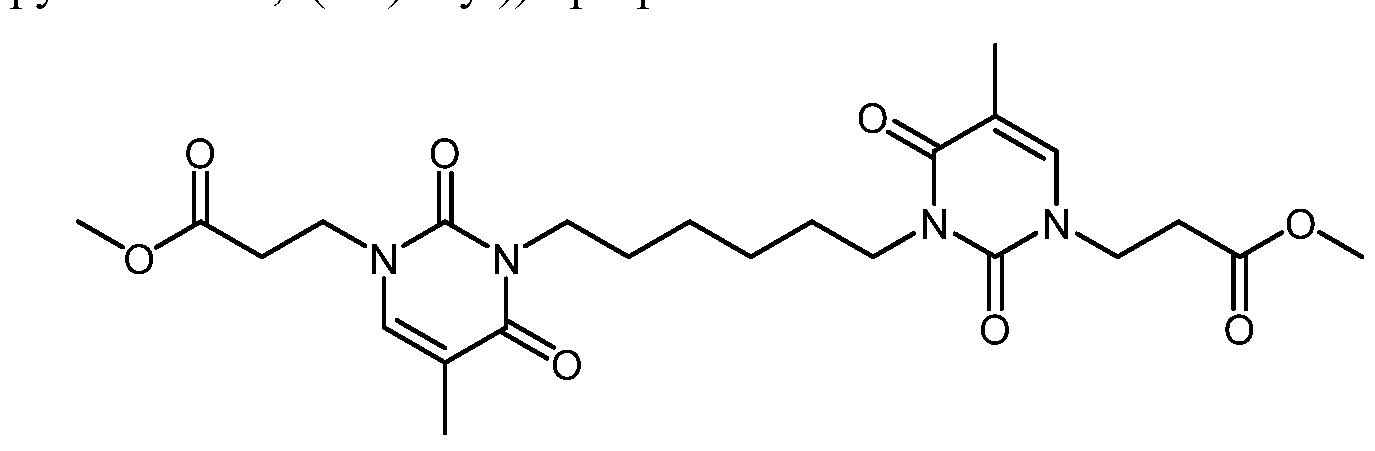
- Chemical Kinetics & Catalysis (AREA)
- Medicinal Chemistry (AREA)
- Polymers & Plastics (AREA)
- Organic Low-Molecular-Weight Compounds And Preparation Thereof (AREA)
Abstract
The present invention relates to bis-thymine derivatives and processes for their preparation. The present invention also relates to the photoreversible polymerization of the bis-thymine derivatives to form polymers and uses thereof.
Description
BIS-THYMINE DERIVATIVES AND PHOTO-REVERSIBLE POLYMERS THEREOF Cross-Reference to Related Applications
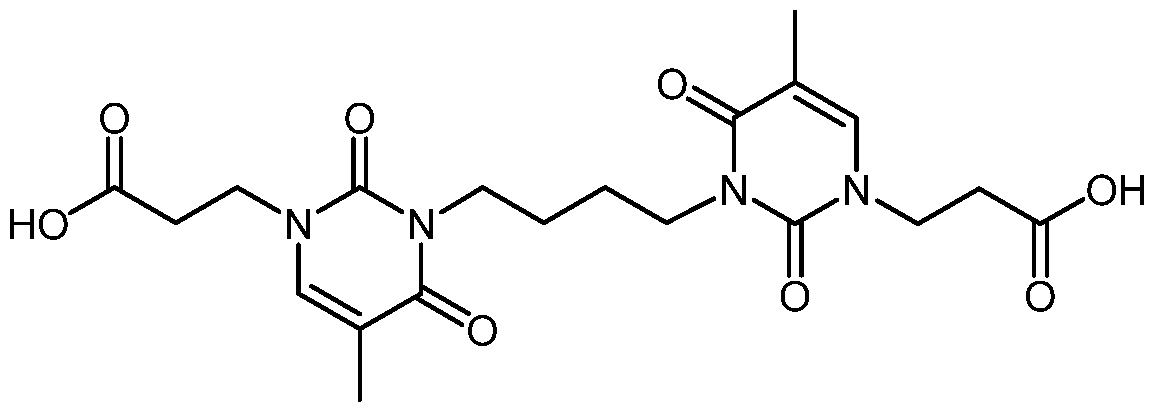
[01] The present application claims priority from United States of America Provisional Patent application 61/481, 321 the content of which is incorporated herein by reference.
Technical Field
[02] The present invention relates to bis-thymine derivatives and processes for their preparation. The present invention also relates to the photoreversible polymerization of the bis-thymine derivatives to form polymers and uses thereof.
Background
[03] Reversible polymers represent a relatively new class of materials that possess bonds capable of reversibly connecting and disconnecting monomers in response to stimuli such as heat or light. These reversible bonds can be used to construct a recyclable polymer via material polymerization and depolymerization on demand.
[04] Several reversible polymerizations have been reported, however these are mostly based on thermally-reversible reactions, like the Diels- Alder reaction, which require high energies for depolymerization and polymerization. Photochemical reactions, on the other hand, are generally considered to provide a greener synthetic pathway to polymerization and depolymerization because photons do not leave residues and they can be conducted at ambient temperature, often in the solid state.
[05] Thymine, one of the nucleic acid bases of DNA, reversibly photodimerizes in the solid-state to form bis-thymine (Figure 1). However it has been difficult to produce reversible polymers of bis-thymine or bis-thymine derivatives. One attempt to produce such a polymer utilised a non-covalent polymer template to facilitate the supramolecular alignment and photopolymerization of the bis-thymine monomers. This method was found to be unsatisfactory due to difficulty in achieving satisfactory alignment of the monomers with the template which caused the depolymerization reaction to be incomplete.
[06] Therefore a need exists for an efficient method to reversibly photopolymerize thymine and/or its derivatives.
Summary
The present invention provides a compound of general formula (I)

(I)
wherein:
R1 and R5 are independently selected from amino or OR6 where R6 is selected from H, optionally substituted alkyl, optionally substituted alkenyl, optionally substituted alkynyl, optionally substituted cycloalkyl, optionally substituted cycloalkenyl, optionally substituted cycloalkynyl, optionally substituted heterocycloalkyl, optionally substituted heterocycloalkenyl, optionally substituted heterocycloalkynyl, optionally substituted aryl or optionally substituted heteroaryl;
R2 and R4 are independently selected from optionally substituted alkylene, optionally substituted alkenylene, optionally substituted alkynylene, optionally substituted cycloalkylene, optionally substituted cycloalkenylene, optionally substituted cycloalkynylene, optionally substituted heterocycloalkylene, optionally substituted heterocycloalkenylene, optionally substituted heterocycloalkynylene, optionally substituted arylene, or optionally substituted heteroarylene; and
R3 is an optionally substituted alkylene, optionally substituted alkenylene, optionally substituted alkynylene, optionally substituted cycloalkylene, optionally substituted cycloalkenylene, optionally substituted cycloalkynylene, optionally substituted heterocycloalkylene, optionally substituted heterocycloalkenylene, optionally substituted heterocycloalkynylene, optionally substituted arylene, optionally substituted heteroarylene, or optionally substituted alkylene-arylene-alkylene.
[08] The present invention provides a photoreversible polymer of general formula (II):

(II)
wherein:
R1 and R5 are independently selected from amino or OR6 where R6 is selected from H, optionally substituted alkyl, optionally substituted alkenyl, optionally substituted alkynyl, optionally substituted cycloalkyl, optionally substituted cycloalkenyl, optionally substituted cycloalkynyl, optionally substituted heterocycloalkyl, optionally substituted heterocycloalkenyl, optionally substituted heterocycloalkynyl, optionally substituted aryl or optionally substituted heteroaryl;
R2 and R4 are independently selected from optionally substituted alkylene, optionally substituted alkenylene, optionally substituted alkynylene, optionally substituted cycloalkylene, optionally substituted cycloalkenylene, optionally substituted cycloalkynylene, optionally substituted heterocycloalkylene, optionally substituted heterocycloalkenylene, optionally substituted heterocycloalkynylene, optionally substituted arylene, or optionally substituted heteroarylene; and
R3 is an optionally substituted alkylene, optionally substituted alkenylene, optionally substituted alkynylene, optionally substituted cycloalkylene, optionally substituted cycloalkenylene, optionally substituted cycloalkynylene, optionally substituted heterocycloalkylene, optionally substituted heterocycloalkenylene, optionally substituted
heterocycloalkynylene, optionally substituted arylene, optionally substituted heteroarylene, or optionally substituted alkylene-arylene-alkylene; and
q is an integer between 1 and 1,000.
[09] The present invention provides a process for producing a polymer of general formula (II):

( II)
wherein:
R1 and R5 are independently selected from amino or OR6 where R6 is selected from H, optionally substituted alkyl, optionally substituted alkenyl, optionally substituted alkynyl, optionally substituted cycloalkyl, optionally substituted cycloalkenyl, optionally substituted cycloalkynyl, optionally substituted heterocycloalkyl, optionally substituted heterocycloalkenyl, optionally substituted heterocycloalkynyl, optionally substituted aryl or optionally substituted heteroaryl;
R2 and R4 are independently selected from optionally substituted alkylene, optionally substituted alkenylene, optionally substituted alkynylene, optionally substituted cycloalkylene, optionally substituted cycloalkenylene, optionally substituted cycloalkynylene, optionally substituted heterocycloalkylene, optionally substituted heterocycloalkenylene, optionally substituted heterocycloalkynylene, optionally substituted arylene, or optionally substituted heteroarylene; and
R3 is an optionally substituted alkylene, optionally substituted alkenylene, optionally substituted alkynylene, optionally substituted cycloalkylene, optionally substituted cycloalkenylene, optionally substituted cycloalkynylene, optionally substituted heterocycloalkylene, optionally substituted heterocycloalkenylene, optionally substituted
heterocycloalkynylene, optionally substituted arylene, optionally substituted heteroarylene, or optionally substituted alkylene-arylene-alkylene; and
q is an integer between 1 and 1,000;
comprising the step of:
irradiating a compound of general formula (I):

(I)
wherein:
R1 and R5 are independently selected from amino or OR6 where R6 is selected from H, optionally substituted alkyl, optionally substituted alkenyl, optionally substituted alkynyl, optionally substituted cycloalkyl, optionally substituted cycloalkenyl, optionally substituted cycloalkynyl, optionally substituted heterocycloalkyl, optionally substituted heterocycloalkenyl, optionally substituted heterocycloalkynyl, optionally substituted aryl or optionally substituted heteroaryl;
R2 and R4 are independently selected from optionally substituted alkylene, optionally substituted alkenylene, optionally substituted alkynylene, optionally substituted cycloalkylene, optionally substituted cycloalkenylene, optionally substituted cycloalkynylene, optionally substituted heterocycloalkylene, optionally substituted heterocycloalkenylene, optionally substituted heterocycloalkynylene, optionally substituted arylene, or optionally substituted heteroarylene; and
R3 is an optionally substituted alkylene, optionally substituted alkenylene, optionally substituted alkynylene, optionally substituted cycloalkylene, optionally substituted cycloalkenylene, optionally substituted cycloalkynylene, optionally substituted heterocycloalkylene, optionally substituted heterocycloalkenylene, optionally substituted heterocycloalkynylene, optionally substituted arylene, optionally substituted heteroarylene, or optionally substituted alkylene-arylene-alkylene;
with sufficient ultraviolet radiation to cause polymerization.
[10] The present invention also provides a process for producing the compound of general formula (I):

(I)
wherein:
R1 and R5 are independently selected from amino or OR6 where R6 is selected from H, optionally substituted alkyl, optionally substituted alkenyl, optionally substituted alkynyl, optionally substituted cycloalkyl, optionally substituted cycloalkenyl, optionally substituted cycloalkynyl, optionally substituted heterocycloalkyl, optionally substituted heterocycloalkenyl, optionally substituted heterocycloalkynyl, optionally substituted aryl or optionally substituted heteroaryl;
R2 and R4 are independently selected from optionally substituted alkylene, optionally substituted alkenylene, optionally substituted alkynylene, optionally substituted cycloalkylene, optionally substituted cycloalkenylene, optionally substituted cycloalkynylene, optionally substituted heterocycloalkylene, optionally substituted heterocycloalkenylene, optionally substituted heterocycloalkynylene, optionally substituted arylene, or optionally substituted heteroarylene; and
R3 is an optionally substituted alkylene, optionally substituted alkenylene, optionally substituted alkynylene, optionally substituted cycloalkylene, optionally substituted cycloalkenylene, optionally substituted cycloalkynylene, optionally substituted heterocycloalkylene, optionally substituted heterocycloalkenylene, optionally substituted heterocycloalkynylene, optionally substituted arylene, optionally substituted heteroarylene, or optionally substituted alkylene-arylene-alkylene;
comprising the steps of:
irradiating the polymer of general formula (II):

(II)
wherein:
R1 and R5 are independently selected from amino or OR6 where R6 is selected from H, optionally substituted alkyl, optionally substituted alkenyl, optionally substituted alkynyl, optionally substituted cycloalkyl, optionally substituted cycloalkenyl, optionally substituted cycloalkynyl, optionally substituted heterocycloalkyl, optionally substituted heterocycloalkenyl, optionally substituted heterocycloalkynyl, optionally substituted aryl or optionally substituted heteroaryl;
R2 and R4 are independently selected from optionally substituted alkylene, optionally substituted alkenylene, optionally substituted alkynylene, optionally substituted cycloalkylene, optionally substituted cycloalkenylene, optionally substituted cycloalkynylene, optionally substituted heterocycloalkylene, optionally substituted heterocycloalkenylene, optionally substituted heterocycloalkynylene, optionally substituted arylene, or optionally substituted heteroarylene; and
R3 is an optionally substituted alkylene, optionally substituted alkenylene, optionally substituted alkynylene, optionally substituted cycloalkylene, optionally substituted cycloalkenylene, optionally substituted cycloalkynylene, optionally substituted heterocycloalkylene, optionally substituted heterocycloalkenylene, optionally substituted
heterocycloalkynylene, optionally substituted arylene, optionally substituted heteroarylene, or optionally substituted alkylene-arylene-alkylene; and
q is an integer between 1 and 1,000;
with sufficient ultraviolet radiation to cause depolymerization.
Furthermore, the present invention provides use of the polymer of general formula (II)

( II)
wherein:
R1 and R5 are independently selected from amino or OR6 where R6 is selected from H, optionally substituted alkyl, optionally substituted alkenyl, optionally substituted alkynyl, optionally substituted cycloalkyl, optionally substituted cycloalkenyl, optionally substituted cycloalkynyl, optionally substituted heterocycloalkyl, optionally substituted heterocycloalkenyl, optionally substituted heterocycloalkynyl, optionally substituted aryl or optionally substituted heteroaryl;
R2 and R4 are independently selected from optionally substituted alkylene, optionally substituted alkenylene, optionally substituted alkynylene, optionally substituted cycloalkylene, optionally substituted cycloalkenylene, optionally substituted cycloalkynylene, optionally substituted heterocycloalkylene, optionally substituted heterocycloalkenylene, optionally substituted heterocycloalkynylene, optionally substituted arylene, or optionally substituted heteroarylene; and
R3 is an optionally substituted alkylene, optionally substituted alkenylene, optionally substituted alkynylene, optionally substituted cycloalkylene, optionally substituted cycloalkenylene, optionally substituted cycloalkynylene, optionally substituted heterocycloalkylene, optionally substituted heterocycloalkenylene, optionally substituted
heterocycloalkynylene, optionally substituted arylene, optionally substituted heteroarylene, or optionally substituted alkylene-arylene-alkylene; and
q is an integer between 1 and 1,000;
as a recyclable material, a degradable material, a photoresistant material, or in various applications including medical, surgical, dental, construction, electronic or automotive applications.
[12] The present invention furthermore provides a process for producing a compound of general formula (I):

(I)
wherein:
R1 and R5 are independently selected from amino or OR6 where R6 is selected from H, optionally substituted alkyl, optionally substituted alkenyl, optionally substituted alkynyl, optionally substituted cycloalkyl, optionally substituted cycloalkenyl, optionally substituted cycloalkynyl, optionally substituted heterocycloalkyl, optionally substituted heterocycloalkenyl, optionally substituted heterocycloalkynyl, optionally substituted aryl or optionally substituted heteroaryl;
R2 and R4 are independently selected from optionally substituted alkylene, optionally substituted alkenylene, optionally substituted alkynylene, optionally substituted cycloalkylene, optionally substituted cycloalkenylene, optionally substituted cycloalkynylene, optionally substituted heterocycloalkylene, optionally substituted heterocycloalkenylene, optionally substituted heterocycloalkynylene, optionally substituted arylene, or optionally substituted heteroarylene; and
R3 is an optionally substituted alkylene, optionally substituted alkenylene, optionally substituted alkynylene, optionally substituted cycloalkylene, optionally substituted cycloalkenylene, optionally substituted cycloalkynylene, optionally substituted heterocycloalkylene, optionally substituted heterocycloalkenylene, optionally substituted
heterocycloalkynylene, optionally substituted arylene, optionally substituted heteroarylene, or optionally substituted alkylene-arylene-alkylene;
comprising the step of:
reacting a compound of general formula III):

(I I I)
wherein:
R1 and R2 are as defined for formula (I);
with a compound of general formula IV):
 wherein:
X is halo and R3 is as defined for formula (I);
in the presence of a base.
Brief Description of Drawings
[13] Figure 1: Synthetic scheme for the photoreversible dimerization of thymine to form bis-thymine.
[14] Figure 2: Synthetic scheme for the preparation of a compound of formula (I) according to one embodiment of the present invention as described in example 1.
[15] Figure 3: Reversible photopolymerisation of a compound of formula (I) to form a polymer of formula (II) according to one embodiment of the present invention as described in examples 3 and 4.
[16] Figure 4: Comparison of infrared (IR) spectra of the compound of formula (I) shown described in example 1 and the polymer of formula (II) based thereon as described in example 3.
[17] Figure 5: A graph showing the changes to relative peak areas of compound, oligomer and polymer of the present invention that were observed in the gel permeation
chromatography (GPC) traces over the course of a polymerization reaction (30 hours, 302 nm) as described in example 3.
[18] Figure 6: A graph demonstrating the effect on molecular weight of cyclic
depolymerization and re -polymerization experiments on compounds and polymers of the present invention in the solid state as described in example 4.
[19] Figure 7: A graph demonstrating the effect of solvent on the depolymerization of a polymer of formula (II) as described in example 4.
Description of Embodiments
[20] Definitions: Listed below are definitions of various terms used to describe this invention. These definitions apply to the terms as they are used throughout this specification and claims, unless otherwise limited in specific instances, either individually or as part of a larger group.
[21] The term "independently selected" is used herein to indicate that the choices can be identical or different. In the case of R groups, for example, the term "independently selected"
1 2 3 1 2 3
indicates that the R groups (e.g., R , R , R ) can be identical (e.g., R , R and R all may be substituted alkyl groups) or different (e.g., R1 may be a substituted alkyl group, R2 may be a substituted alkenyl group and R3 may be an aryl group).
[22] The term "optionally substituted" refers to a group that may or may not be further substituted with one or more groups selected from alkyl, cycloalkyl, alkenyl, cycloalkenyl, alkynyl, cycloalkynyl, aryl, heterocyclyl (heterocycloalkyl, heterocycloalkenyl,
heterocycloalkynyl), halo, haloalkyl, haloaryl, haloheterocycylyl, hydroxy, alkoxy, aryloxy,
carboxy, amino, alkylamino, acyl, acylamino, arylacyl, heterocyclylacyl, acylamino, acyloxy, acylalkoxy, nitro, thio, alkylthio, sulfmyl, alkylsulfmyl, sulfonyl, alkylsulfonyl, arylsulphonyl, carbonyl, oxo, cyano and the like.
[23] The terms "alkyl" or "alkylene" refer to a mono- or divalent, saturated, straight or branched hydrocarbon chain containing up to twenty carbon atoms. The terms "Ci_2o alkyl" and "C3_io alkyl" as used herein, refer to saturated, straight chain or branched hydrocarbon moieties containing one to twenty carbon atoms and three to ten carbon atoms respectively. Examples of alkyl groups include, but are not limited to, methyl, ethyl, propyl, isopropyl, n- hexyl, octyl, decyl, dodecyl and the like.
[24] The terms "alkenyl" or "alkenylene" refer to a mono- or divalent straight or branched hydrocarbon chain containing one or more carbon-carbon double bonds. Examples of alkenyl groups include, but are not limited to ethenyl (vinyl), propenyl, isopropenyl, n- butenyl, hexenyl and the like.
[25] The terms "alkynyl" or "alkynylene" refer to a mono- or divalent straight or branched hydrocarbon chain containing one or more carbon-carbon triple bonds. Examples of alkenyl groups include, but are not limited to ethynyl, propynyl, isopropynyl, n- butynyl, hexynyl and the like.
[26] The terms "cycloalkyl" or "cycloalkylene" refer to a mono- or divalent non-aromatic cyclic hydrocarbon group having from 3 or more carbon atoms. Examples include
cyclopropyl, cyclobutyl, cyclopentyl, cyclohexyl, cycloctyl and the like.
[27] The terms "cycloalkenyl" or "cycloalkenylene" refer to a mono- or divalent non- aromatic cyclic hydrocarbon groups having 3 or more carbon atoms with one or more carbon- carbon double bonds. Examples include cyclopropenyl, cyclobutenyl, cyclopentenyl, cyclohexenyl and cycloctenyl.
[28] The terms "cycloalkynyl" or "cycloalkynylene" refer to a mono- or divalent non- aromatic cyclic hydrocarbon groups having 3 or more carbon atoms with one or more carbon-
carbon triple bonds. Examples include cyclopropynyl, cyclobutynyl, cyclopentynyl, cyclohexynyl and cycloctynyl.
[29] The terms "aryl" or "arylene" refer to a mono- or divalent aromatic carbocyclic group having a single ring (e.g., phenyl), multiple rings (e.g., biphenyl), or multiple condensed rings in which at least one is aromatic, (e.g., 1,2,3,4-tetrahydronaphthyl, naphthyl), which is optionally substituted. The aryl groups herein are unsubstituted or, as specified, substituted in one or more substitutable positions with various groups.
[30] The terms "heteroaryl" or "heteroarylene" refer to a mono- or divalent monocyclic or bicyclic ring system containing one or two aromatic rings and containing at least one heteroatom in an aromatic ring, and which can be unsubstituted or substituted, for example, with one or more, and in particular one to three, substituents, as defined above. Examples of heteroaryl groups include thienyl, furyl, pyridyl, oxazolyl, quinolyl, isoquinolyl, indolyl, triazolyl, isothiazolyl, isoxazolyl, imidizolyl, benzothiazolyl, pyrazinyl, pyrimidinyl, thiazolyl, and thiadiazolyl.
[31] The terms "heterocycloalkyl" or "heterocycloalkylene" refer to a mono- or divalent saturated non-aromatic ring, comprising three or more ring atoms, or a bi- or tri-cyclic fused system, where each ring contains between one and three heteroatoms.
[32] The terms "heterocycloalkenyl" or "heterocycloalkenylene" refers to a mono- or divalent unsaturated non-aromatic ring, comprising three or more ring atoms, or a bi- or tricyclic fused system, where each ring contains between one and three heteroatoms and one or more carbon-carbon double bonds.
[33] The terms "heterocycloalkynyl" or "heterocycloalkynylene" refers to a mono- or divalent unsaturated non-aromatic ring, comprising three or more ring atoms, or a bi- or tricyclic fused system, where each ring contains between one and three heteroatoms and one or more carbon-carbon triple bonds.
[34] The term "amino" refers to the group -NH2j -NHR, or -NR2, wherein R is an optionally substituted alkyl, optionally substituted alkenyl, optionally substituted alkynyl,
optionally substituted cycloalkyl, optionally substituted cycloalkenyl, optionally substituted cycloalkynyl, optionally substituted heterocycloalkyl, optionally substituted heterocycloalkenyl, optionally substituted heterocycloalkynyl, optionally substituted aryl or optionally substituted heteroaryl group.
[35] The term "heteroatom" is an atom other than carbon or hydrogen, such as oxygen (O), nitrogen (N), sulfur (S), phosphorous (P), boron (B), halo or selenium (Se).
[36] The term "halo" refers to chlorine (CI), bromine (Br), fluorine (F) or iodine (I).
[37] The present invention provides bis-thymine derivatives and methodology for the photoreversible preparation of polymers based thereon. In particular, the present invention provides a compound according to general formula (I):

(I)
wherein:
R1 and R5 are independently selected from amino or OR6 where R6 is selected from H, optionally substituted alkyl, optionally substituted alkenyl, optionally substituted alkynyl, optionally substituted cycloalkyl, optionally substituted cycloalkenyl, optionally substituted cycloalkynyl, optionally substituted heterocycloalkyl, optionally substituted heterocycloalkenyl, optionally substituted heterocycloalkynyl, optionally substituted aryl or optionally substituted heteroaryl;
R2 and R4 are independently selected from optionally substituted alkylene, optionally substituted alkenylene, optionally substituted alkynylene, optionally substituted cycloalkylene, optionally substituted cycloalkenylene, optionally substituted cycloalkynylene, optionally substituted heterocycloalkylene, optionally substituted heterocycloalkenylene, optionally substituted heterocycloalkynylene, optionally substituted arylene, or optionally substituted heteroarylene; and
R3 is an optionally substituted alkylene, optionally substituted alkenylene, optionally substituted alkynylene, optionally substituted cycloalkylene, optionally substituted cycloalkenylene, optionally substituted cycloalkynylene, optionally substituted heterocycloalkylene, optionally substituted heterocycloalkenylene, optionally substituted heterocycloalkynylene, optionally substituted arylene, optionally substituted heteroarylene, or optionally substituted alkylene-arylene-alkylene.
[38] The present invention also provides a photoreversible polymer of general formula (II):

( II)
wherein:
R1 and R5 are independently selected from amino or OR6 where R6 is selected from H, optionally substituted alkyl, optionally substituted alkenyl, optionally substituted alkynyl, optionally substituted cycloalkyl, optionally substituted cycloalkenyl, optionally substituted cycloalkynyl, optionally substituted heterocycloalkyl, optionally substituted heterocycloalkenyl, optionally substituted heterocycloalkynyl, optionally substituted aryl or optionally substituted heteroaryl;
R2 and R4 are independently selected from optionally substituted alkylene, optionally substituted alkenylene, optionally substituted alkynylene, optionally substituted cycloalkylene, optionally substituted cycloalkenylene, optionally substituted cycloalkynylene, optionally substituted heterocycloalkylene, optionally substituted heterocycloalkenylene, optionally substituted heterocycloalkynylene, optionally substituted arylene, or optionally substituted heteroarylene; and
R3 is an optionally substituted alkylene, optionally substituted alkenylene, optionally substituted alkynylene, optionally substituted cycloalkylene, optionally substituted cycloalkenylene, optionally substituted cycloalkynylene, optionally substituted
heterocycloalkylene, optionally substituted heterocycloalkenylene, optionally substituted heterocycloalkynylene, optionally substituted arylene, optionally substituted heteroarylene, or optionally substituted alkylene-arylene-alkylene; and
q is an integer between 1 and 1,000.
[39] In some embodiments, R1 or R5 is amino.
[40] In other embodiments, R1 or R5 is OR6 wherein R6 is selected from H, optionally substituted alkyl, optionally substituted alkenyl, optionally substituted aryl or an optionally substituted heteroaryl.
[41] In some embodiments, R6 is an optionally substituted alkyl group. Preferably, R6 is a Ci-C6 alkyl group.
[42] In some embodiments, R2 or R4 is an optionally substituted alkylene group, preferably a Ci-Cio alkylene group.
[43] In some embodiments, R3 is an optionally substituted alkylene group, preferably a C2- Cio alkylene group. In some embodiments, R3 is a butylene group. In some embodiments, R3 is a propylene group. In other embodiments, R3 is a hexylene group.
[44] In other embodiments, R3 is an alkenylene group. With this embodiment, R3 maybe an alkenylene group according to -(CH=CH)n- where n is an integer between 1 and 10.
[45] In another embodiment, R3 is an alkylene group is interrupted by -O- group.
Preferably, the interrupted alkylene group is according to -(CH2-0-CH2)n- where n is an integer between 1 and 10. another embodiment, R3 is an arylene group. Preferably, the arylene group is a
 group.
[47] In another embodiment, R3 is an alkylene-arylene-alkylene group. With this embodiment, R3 maybe a C2_io-alkylene-arylene-C2-io alkylene group. In particular, group is
group.
[47] In another embodiment, R3 is an alkylene-arylene-alkylene group. With this embodiment, R3 maybe a C2_io-alkylene-arylene-C2-io alkylene group. In particular, group is
 group where m is an integer between 1 and 10.
In particular embodiments, the compound of general formula (I) is selected from:


The present invention also provides a photoreversible polymer of general formula (II)

( II)
wherein:
R1 and R5 are independently selected from amino or OR6 where R6 is selected from H, optionally substituted alkyl, optionally substituted alkenyl, optionally substituted alkynyl, optionally substituted cycloalkyl, optionally substituted cycloalkenyl, optionally substituted cycloalkynyl, optionally substituted heterocycloalkyl, optionally substituted heterocycloalkenyl, optionally substituted heterocycloalkynyl, optionally substituted aryl or optionally substituted heteroaryl;
R2 and R4 are independently selected from optionally substituted alkylene, optionally substituted alkenylene, optionally substituted alkynylene, optionally substituted cycloalkylene, optionally substituted cycloalkenylene, optionally substituted cycloalkynylene, optionally substituted heterocycloalkylene, optionally substituted heterocycloalkenylene, optionally substituted heterocycloalkynylene, optionally substituted arylene, or optionally substituted heteroarylene; and
R3 is an optionally substituted alkylene, optionally substituted alkenylene, optionally substituted alkynylene, optionally substituted cycloalkylene, optionally substituted cycloalkenylene, optionally substituted cycloalkynylene, optionally substituted heterocycloalkylene, optionally substituted heterocycloalkenylene, optionally substituted heterocycloalkynylene, optionally substituted arylene, optionally substituted heteroarylene, or optionally substituted alkylene-arylene-alkylene; and
q is an integer between 1 and 1,000.
[50] The present invention also provides a process for producing a polymer of general formula (II):

( II)
wherein:
R1 and R5 are independently selected from amino or OR6 where R6 is selected from H, optionally substituted alkyl, optionally substituted alkenyl, optionally substituted alkynyl, optionally substituted cycloalkyl, optionally substituted cycloalkenyl, optionally substituted cycloalkynyl, optionally substituted heterocycloalkyl, optionally substituted heterocycloalkenyl, optionally substituted heterocycloalkynyl, optionally substituted aryl or optionally substituted heteroaryl;
R2 and R4 are independently selected from optionally substituted alkylene, optionally substituted alkenylene, optionally substituted alkynylene, optionally substituted cycloalkylene, optionally substituted cycloalkenylene, optionally substituted cycloalkynylene, optionally substituted heterocycloalkylene, optionally substituted heterocycloalkenylene, optionally substituted heterocycloalkynylene, optionally substituted arylene, or optionally substituted heteroarylene; and
R3 is an optionally substituted alkylene, optionally substituted alkenylene, optionally substituted alkynylene, optionally substituted cycloalkylene, optionally substituted cycloalkenylene, optionally substituted cycloalkynylene, optionally substituted heterocycloalkylene, optionally substituted heterocycloalkenylene, optionally substituted heterocycloalkynylene, optionally substituted arylene, optionally substituted heteroarylene, or optionally substituted alkylene-arylene-alkylene; and
q is an integer between 1 and 1,000;
comprising the step of:
irradiating a compound of general formula (I):

(I)
wherein:
R1 and R5 are independently selected from amino or OR6 where R6 is selected from H, optionally substituted alkyl, optionally substituted alkenyl, optionally substituted alkynyl, optionally substituted cycloalkyl, optionally substituted cycloalkenyl, optionally substituted cycloalkynyl, optionally substituted heterocycloalkyl, optionally substituted heterocycloalkenyl, optionally substituted heterocycloalkynyl, optionally substituted aryl or optionally substituted heteroaryl;
R2 and R4 are independently selected from optionally substituted alkylene, optionally substituted alkenylene, optionally substituted alkynylene, optionally substituted cycloalkylene, optionally substituted cycloalkenylene, optionally substituted cycloalkynylene, optionally substituted heterocycloalkylene, optionally substituted heterocycloalkenylene, optionally substituted heterocycloalkynylene, optionally substituted arylene, or optionally substituted heteroarylene; and
R3 is an optionally substituted alkylene, optionally substituted alkenylene, optionally substituted alkynylene, optionally substituted cycloalkylene, optionally substituted cycloalkenylene, optionally substituted cycloalkynylene, optionally substituted heterocycloalkylene, optionally substituted heterocycloalkenylene, optionally substituted
heterocycloalkynylene, optionally substituted arylene, optionally substituted heteroarylene, or optionally substituted alkylene-arylene-alkylene;
with sufficient ultraviolet radiation to cause polymerization.
[51] The present invention also provides a process for producing the compound of general formula (I):

(I)
wherein:
R1 and R5 are independently selected from amino or OR6 where R6 is selected from H, optionally substituted alkyl, optionally substituted alkenyl, optionally substituted alkynyl, optionally substituted cycloalkyl, optionally substituted cycloalkenyl, optionally substituted cycloalkynyl, optionally substituted heterocycloalkyl, optionally substituted heterocycloalkenyl, optionally substituted heterocycloalkynyl, optionally substituted aryl or optionally substituted heteroaryl;
R2 and R4 are independently selected from optionally substituted alkylene, optionally substituted alkenylene, optionally substituted alkynylene, optionally substituted cycloalkylene, optionally substituted cycloalkenylene, optionally substituted cycloalkynylene, optionally substituted heterocycloalkylene, optionally substituted heterocycloalkenylene, optionally substituted heterocycloalkynylene, optionally substituted arylene, or optionally substituted heteroarylene; and
R3 is an optionally substituted alkylene, optionally substituted alkenylene, optionally substituted alkynylene, optionally substituted cycloalkylene, optionally substituted cycloalkenylene, optionally substituted cycloalkynylene, optionally substituted heterocycloalkylene, optionally substituted heterocycloalkenylene, optionally substituted heterocycloalkynylene, optionally substituted arylene, optionally substituted heteroarylene, or optionally substituted alkylene-arylene-alkylene;
comprising the step of:
irradiating the polymer of general formula (II):

(II)
wherein:
R1 and R5 are independently selected from amino or OR6 where R6 is selected from H, optionally substituted alkyl, optionally substituted alkenyl, optionally substituted alkynyl, optionally substituted cycloalkyl, optionally substituted cycloalkenyl, optionally substituted cycloalkynyl, optionally substituted heterocycloalkyl, optionally substituted heterocycloalkenyl, optionally substituted heterocycloalkynyl, optionally substituted aryl or optionally substituted heteroaryl;
R2 and R4 are independently selected from optionally substituted alkylene, optionally substituted alkenylene, optionally substituted alkynylene, optionally substituted cycloalkylene, optionally substituted cycloalkenylene, optionally substituted cycloalkynylene, optionally substituted heterocycloalkylene, optionally substituted heterocycloalkenylene, optionally substituted heterocycloalkynylene, optionally substituted arylene, or optionally substituted heteroarylene; and
R3 is an optionally substituted alkylene, optionally substituted alkenylene, optionally substituted alkynylene, optionally substituted cycloalkylene, optionally substituted cycloalkenylene, optionally substituted cycloalkynylene, optionally substituted heterocycloalkylene, optionally substituted heterocycloalkenylene, optionally substituted
heterocycloalkynylene, optionally substituted arylene, optionally substituted heteroarylene, or optionally substituted alkylene-arylene-alkylene; and
q is an integer between 1 and 1,000;
with sufficient ultraviolet radiation to cause depolymerization.
[52] In an alternative embodiment, the thymine units in formula (I) may be substituted with other photoreversible monomer units include for example, but not limited to, anthracene, coumarin, thymine, stilbene and cinnamic acid monomers. In one embodiment, the photoreversible monomer is a substituted coumarin. In another embodiment, the
photoreversible monomer is a cinnamate monomer. In yet another embodiment, the photoreversible monomer is a stilbene monomer. In yet a further embodiment, the
photoreversible monomer is an anthracene monomer. The frequency of the
photopolymerization / depolymerization can be adjusted depending the monomer used and the intended purpose of the polymer.
[53] The photopolymerization can be performed at one wavelength (hv) while the depolymerization can be performed at the same or at a different wavelength (hv*).
[54] For example, photodepolymerization can be induced by ultraviolet radiation that has a wavelength of 249 nm or less, or 240 nm or less. Both photopolymerization and
photodepolymerization can be induced by wavelengths in the range of 250 - 320 nm, are more particularly 250-270 nm. Photopolymerization can be induced by wavelengths of 270 nm or greater.
[55] For the photopolymerization reaction, the compound of general formula (I) is in a substantially solid state. Preferably, the compound is in a substantially crystalline state.
Without wishing to be limited, it is thought that the structural alignment of the compound in the solid state assists in the photopolymerization of the compound of general formula (I) to form the polymer of general formula (II). This structural configuration of the compound of general formula (I) is important for an efficient topochemical polymerization.
[56] For the photodepolymerization reaction, the polymer of general formula (II) can be in a substantially solid or solution state. If the polymer is in the solid state, the polymer can be in
a substantially crystalline state. Without wishing to be limited, it is thought that the physical state of the polymer can influence the degree of depolymerization. In the solid state, the alignment of the cleaved photoproducts remain within close proximity of one another and can undergo re-photopolymerization more easily than if they were in the solution state. In the solution state, the cleaved photoproducts are able to dissociate away from the bulk polymer and therefore limit any re- photopolymerization.
[57] In the solution state, a solvent which partially solubilises the compound of formula (I) and has UV -transparency in the wavelength range used for depolymerization is ideal. One such example of such a solvent is acetonitrile (MeCN), as it is able to solubilise the compound at ambient temperature and possesses UV-transparency in the preferred
wavelength.
[58] The present invention furthermore provides a process for producing a compound of general formula (I):

(I)
wherein:
R1 and R5 are independently selected from amino or OR6 where R6 is selected from H, optionally substituted alkyl, optionally substituted alkenyl, optionally substituted alkynyl, optionally substituted cycloalkyl, optionally substituted cycloalkenyl, optionally substituted cycloalkynyl, optionally substituted heterocycloalkyl, optionally substituted heterocycloalkenyl, optionally substituted heterocycloalkynyl, optionally substituted aryl or optionally substituted heteroaryl;
R2 and R4 are independently selected from optionally substituted alkylene, optionally substituted alkenylene, optionally substituted alkynylene, optionally substituted cycloalkylene, optionally substituted cycloalkenylene, optionally substituted cycloalkynylene, optionally substituted heterocycloalkylene, optionally substituted heterocycloalkenylene,
optionally substituted heterocycloalkynylene, optionally substituted arylene, or optionally substituted heteroarylene; and
R3 is an optionally substituted alkylene, optionally substituted alkenylene, optionally substituted alkynylene, optionally substituted cycloalkylene, optionally substituted cycloalkenylene, optionally substituted cycloalkynylene, optionally substituted heterocycloalkylene, optionally substituted heterocycloalkenylene, optionally substituted heterocycloalkynylene, optionally substituted arylene, optionally substituted heteroarylene, or optionally substituted alkylene-arylene-alkylene;
comprising the step of:
reacting a compound of general formula III)

(I I I)
wherein:
R1 and R2 are as defined for formula (I);
with a compound of general formula (IV):
X X
( IV)
wherein:
X is halo and R3 is as defined for formula (I);
in the presence of a base.
[59] X is a halo group selected from chlorine (CI), fluorine (F), bromine (Br) or iodine (I). Preferably, the halo group is Br or I.
[60] Any base may be used. Preferred bases include potassium carbonate (K2CO3).
[61] Any solvent may be used. Preferred solvents include tetrahydrofuran (THF), dimethylsulfoxide (DMSO) or dimethylformamide (DMF).
[62] The present invention provides use of the polymer of general formula (II) as described above as a recyclable material, a degradable material, a photoresistant material, or in various applications including medical, surgical, dental, construction, electronic or automotive applications.
[63] In particular, the polymer may be used for the preparation of photoresists. A photoresist is a light-sensitive material used in several industrial processes, such as photolithography and photoengraving to form a patterned coating on a surface.
[64] Applications of photoresists include fabrication of printed circuit boards, sand carving, and microelectronics (mainly silicon wafers/silicon integrated circuits), and patterning and etching of substrates (including specialty photonics materials, MEMS, glass printed circuit boards, and other micropatterning tasks).
[65] The polymer may also be used in the medical field as a material for use in medical devices, or as a medical bandage or dressing, all of which are capable of being applied to the relevant area as a compound and photopolymerized in situ to form the polymer. As the photopolymerization reaction is reversible, it is possible that the medical device, bandage or dressing can be photodepoymerized in situ.
[66] The polymer may also be used as a degradable material or recyclable material for many applications, such as shopping bags. It is envisaged that such bags would be easily degradable as the polymer is able to be degraded by light, or alternatively, 'recycled' (i.e. polymerized and depolymerized) as required, thus providing a greener alternative to the currently available plastic bags.
Non-Limiting Examples
[67] The present invention is described in greater detail below with the aid of the following non-limiting examples. The percentages are given by weight unless otherwise stated. It goes without saying, however, that these examples are given by way of illustration of the invention and do not constitute in any manner a limitation thereto.
[68] General: All chemicals were used as supplied by Sigma Aldrich, and were of the highest available purity. 1H- and 13C- nuclear magnetic resonance experiments were conducted on a Bruker Avance 400 Spectrometer. All spectra were recorded at 25°C, and referenced to the residual solvent signal. Infrared spectra were recorded using a Perkin Elmer 2000 FT-IR spectrophotometer, in absorbance mode, using KBr as the background reference. The molecular weight of irradiated samples were determined by gel permeation
chromatography performed on a Tosoh Ecosec HLC-8320GPC equipped with both refractive index (PJ) and ultraviolet (UV) detectors (UV-detection, λ = 280 nm) using Tosoh alpha 4000 and 2000 columns. DMF containing 10 mmol LiBr was used as the solvent. Calibration curves were obtained using poly(styrene sulfonic acid sodium salt) standards.
[69] Example 1: Synthesis of dimethyl 3,3'-(3,3'-(butane-l,4-diyl)bis(5-methyl-2,4-dioxo- 3,4-dihydropyrimidine-3,l(2H)-diyl))dipropanoate or butyl- linked bis-(thymine propanoate).

[70] The title compound was synthesized according to the reaction scheme depicted in Figure 2. Thymine propanoate (1.4 g, 6.8 mmol) was dissolved in anhydrous DMF (10 mL) at 70 °C. K2CO3 (1.1 g, 8.2 mmol) was added, and the mixture was stirred for 5 min before the addition of diiodobutane (0.84 g, 2.7 mmol). After 48 hours, the insoluble white material was collected by filtration. The solids were suspended in distilled H20 to dissolve K2C03, and precipitate the products. The insoluble material was collected by filtration, washed with distilled H20, and recrystallised from hot EtOH. Mp. 189 °C; Yield: 0.72 g (89 %). MS (ESI): calculated for [C22H23N408]+: m/z 478.2; Found: m/z 479.1 (M+l), 501.1 (M+Na). 1H- NMR (400 MHz, CDC13): δΗ 7.14 (d, J = 1.2 Hz 2H, CH), 3.96 (t, J = 6.4 Hz, 8H, 2 x N3- CH2, 2 x NI-CH2), 2.77 (t, J = 6.4 Hz, 4H, N1-C-CH2), 1.90 (d, J = 1.2 Hz, 6H, C-CH3), 1.68 (m, J = 3.2 Hz, 4H, (CH2)2). 13C-NMR (200 MHz, CDC13): 5C 151.47, 139.52, 109.66, 61.17 (C-CH3), 52.16 (O-CH3), 45.96 (CH2), 41.22 (CH2), 33.11 (CH2), 25.42 ((CH2)2), 13.15 (C- CH3). IR (KBr, cm"1): 1730 (v COOR
[71] Example 2: X-ray diffraction of butyl-linked bis-(thymine propanoate)
[72] According to Schmidt, topochemical [2+2]-cycloaddition requires that photoreactive olefin pairs align parallel with one another in the lattice, and are separated by a distance of 3.5-4.2 A (see for example, Schmidt, G. M. J., entitled "Photopolymerizations in the solid state", Pure Appl. Chem. 27, 647-678 (1971). In order to identify topochemically suitable monomer conformations, the crystal structure of the monomer was determined prior to irradiation.
[73] Monoclinic plates of butyl-linked bis-(thymine propanoate) were obtained by slow cooling of a hot ethanolic solution. The crystal structure (not shown) reveals that molecules of butyl-linked bis-(thymine propanoate), related by rotational and translational symmetry elements, pack into tight layers along the b-axis [010 line]. At the point of closest contact, the intermolecular separation distance within the layers is just 2.366 A (CH3a " O4 ), which corresponds to one of two observed, weak hydrogen-bonds. The second stabilizing intermolecular hydrogen-bond occurs between O3 "' H8 (2.881 A). In each molecule, the propanoate chains lie approximately perpendicular to the thyminyl ring planes (C9-C4-C1 = 104.6 °), which enforces close intramolecular association between the carbonyl oxygen of the propanoate chain (O2) and the olefmic thyminyl CH6 (2.655 A). However, the CH6 and O2 are related by a torsion angle of (-)18.1° (02-C2-C6-H6) which is out-of-range for hydrogen- bonding.
[74] As the individual crystal sizes were small (in the range of 40-60 μιη), structural analysis was performed on the MX1 micro-crystallography beam- line at the Australian Synchrotron.
[75] Crystal data for Butyl-linked bis(thymine proponoate): C22H30N4O8, M = 478.50, Colourless Prism, 0.02 x 0.02 x 0.02 mm3, monoclinic, space group l\lc (No. 14), a = 9.5800(19), b = 16.550(3), c = 7.6900(15) A, β= 112.13(3)°, V= 1129.4(4) A3, Z = 2, Dc = 1.407 g/cm3, ooo = 508, MoKa radiation, λ = 0.71073 A, T = 100(2)K, 26>max = 54.3°, 15282 reflections collected, 2341 unique (Rin, = 0.0558). Final G00F = 1.023, Rl = 0.0446, wR2 = 0.1096, R indices based on 2190 reflections with I >2sigma(I) (refinement on F2), 156 parameters, 0 restraints. Lp and absorption corrections applied, μ = 0.108 mm"1.
[76] Table 1: Bond lengths and bond angles for n-butyl-linked-bis(thymine propanoate)
Bond Length (A) Bond Length (A)
01— C2 1.3428 (17) C2— C3 1.5008 (19)
01— CI 1.4450 (2) 03— C5 1.2172 (17)
Nl— C6 1.3728 (17) C3— C4 1.5223 (18)
Nl— C5 1.3805 (17) C6— C7 1.3456 (19)
Nl— C4 1.4710 (16) C7— C9 1.4480 (18)
02— C2 1.2044 (17) C7— C8 1.4979 (18)
N2— C5 1.3923 (16) C9— 04 1.2282 (16)
N2— C9 1.3992 (16) CIO— CI 1 1.5194 (17)
N2— CIO 1.4688 (16) Cl l— Cl l1 1.5250 (2)
C2— 01- -Cl 116.00 (12) 03— C5— Nl 122.42 (12)
C6— Nl- -C5 122.00 (11) 03— C5— N2 122.34 (12)
C6— Nl- -C4 121.18 (11) Nl— C5— N2 115.24 (11)
C5— Nl- -C4 116.71 (11) C7— C6— Nl 123.27 (12)
C5— N2- -C9 125.03 (11) C6— C7— C9 118.20 (12)
C5— N2- -CIO 117.38 (11) C6— C7— C8 123.33 (12)
C9— N2- -CIO 117.59 (10) C9— C7— C8 118.46 (11)
02— C2- -01 123.25 (13) 04— C9— N2 119.77 (11)
02— C2- -C3 126.26 (13) 04— C9— C7 123.99 (12)
01— C2- -C3 110.47 (12) N2— C9— C7 116.24 (11)
C2— C3- -C4 113.32 (11) N2— CIO— Cl l 112.10 (10)
Nl— C4- -C3 112.65 (11) CIO— CI 1— CI Ϋ 110.42 (13)
[77] Example 3: Poly [dimethyl 3,3'-(3,3'-(butane-l,4-diyl)bis(5-methyl-2,4-dioxo-3,4- dihydropyrimidine-3 , 1 (2H)-diyl))dipropanoate]
[78] The title compound was synthesized according to the reaction scheme depicted in Figure 3. Crystalline butyl-linked bis-(thymine propanoate) was spread into a thin layer (approx. 1 mm thick) over a petri dish. The uncovered sample was irradiated with an Ultraviolet Products CL1000M UV-crosslinker lamp (302 nm) that produced mid-range UV- wavelengths centred at 302 nm (10-120 hours). The crystalline material was agitated
periodically during the irradiation to ensure even UV-exposure. Photoreactions were monitored by 1H-NMR and GPC. GPC (DMF + 10 mM LiBr): Mn 19 x 103 (Mw/Mn = 4.0). 1H-NMR (400 MHz, CDC13): δΗ 4.00 (dt, J = 14.27, 6.39 Hz, 2H, N1-CH2), 3.94 (s, 2H, CH), 3.85 (br. t, 4H, 2 x N3-CH2), 3.66 (s, 6H, 0-CH3), 3.25 (dt, J = 13.72, 7.03 Hz, 2H, N1-CH2), 2.77 (dt, J = 16.84, 7.26 Hz, 2H, N1-C-CH2), 2.60 (dt, J = 16.75, 5.56 Hz, 2H, N1-C-CH2), 1.61 (br. s, 6H, but. (CH2)2, H20), 1.36 (s, 6H, CH3). 13C-NMR (200 MHz, CDC13): 5C 171.90 (C=0), 151.36 (C=0), 61.98 (2 x CH), 51.84 (0-CH3), 45.81 (N1-CH2), 43.82 (Nl- CH2), 40.74 (2 x N3-CH2), 32.15 (C-CH3), 31.89 (N1-C-CH2), 25.63 ((CH2)2), 18.37 (CH3). IR (KBr, cm 1): 1731 (vCooMe).
[79] The high photochemical yield of such a reaction can be evidenced by a comparison of the infrared spectra of monomer and photoproducts (Figure 4). The monomer showed =C-H stretching at 3068 and 3004 cm"1, and C-H in-plane bending from the unsaturated bond at 1424 cm"1. However, these absorption bands were absent from the photoproduct spectrum. Three absorption bands in the monomer spectrum at 1542, 1514 and 1510 cm"1, possibly due to C=C stretching of the conjugated thyminyl rings, were also absent from the photoproduct spectrum.
[80] Since the 1H-NMR and infrared spectra of the photoproducts showed extensive olefmic photoconversion, gel permeation chromatography (GPC) was used to determine photoproduct molecular weights. Several samples of the crystalline solid were collected over an irradiation period of 30 hours (302 nm), and were each subjected to GPC. The
chromatograms revealed both oligomeric and polymeric photoproducts. Figure 5 follows changes to the relative content of monomer, oligomer and polymer at each point during the irradiation; the average molecular weight (Mn) of the resulting photopolymer.
[81] Referring to Figure 5, photopolymerization of the n-butyl-linked bis-(thymine propanoate) crystals proceeded smoothly. In the first 30 min of UV exposure, only 5 % of the monomer was photochemically converted to yield oligomers (n = 2-3) and low molecular weight polymer (Mn = 9.5 x 10³, Mw/Mn = 1.9). After 4 hours irradiation however, monomer photoconversion increased to 60 %. At this point, the oligomer content reached a maximum of 14 %, and the average molecular weight of the main polymer peak also increased to Mn 15.5 x 10³ (Mw/Mn = 5.3). Photochemical conversion to the polymer did not occur as rapidly
after 8 hours irradiation, but had nevertheless increased to 93 % by 30 hours. Beyond 4 hours irradiation, the oligomer content decreased to 4 % which suggested that oligomer and monomer were both consumed in the polymerization reactions.
[82] The molecular weight of the main polymer peak plateaued between 8 and 30 hours irradiation, which corresponded to an Mn between 19-20 x 103. However over this irradiation period, photochemical conversion to the polymer increased by a further 15 % and
polydispersity of the main polymer peak narrowed from Mw/Mn = 5.0 at 8 hours, to Mw/Mn = 4.0 at 30 hours. Small amounts (< 2 %) of a very high molecular weight species (Mn 1.7 x 10⁶) were also observed in samples irradiated for 8-30 hours, which indicated that prolonged irradiation, leads to further photoreaction of the formed polymer molecules.
[83] Reproducibility of GPC measurements within individual samples was good.
Furthermore, the photopolymerization of n-butyl-linked bis-(thymine propanoate) was repeated several times, and in each case similar conversion values (>90 %) and polymer molecular weights were achieved. However, the time in which polymerization occurred was dependent on the sample size, how thinly the crystals could be spread, and more specifically, the irradiation dose.
[84] Despite crystals fracturing during the polymerization, it was apparent that oligomer and polymer molecules were still capable of further photoreactions to yield higher molecular weight species. Cracking, it seemed, was not detrimental to the molecular topochemistry, nor photoactivity of the solids. As such, we proposed that the fractured crystals also remained capable of depolymerization reactions.
[85] Example 4: Photodepolymerization of poly [dimethyl 3,3'-(3,3'-(butane-l,4-diyl)bis(5- methyl-2,4-dioxo-3,4-dihydropyrimidine-3,l(2H)-diyl))dipropanoate] to form dimethyl 3,3'- (3 ,3'-(butane- 1 ,4-diyl)bis(5-methyl-2,4-dioxo-3 ,4-dihydropyrimidine-3 , 1 (2H)- diyl))dipropanoate (a.k.a butyl-linked bis-(thymine propanoate)
[86] The title compound was synthesized according to the reaction scheme depicted in
Figure 3. Photodepolymerization of poly [dimethyl 3,3'-(3,3'-(butane-l,4-diyl)bis(5-methyl- 2,4-dioxo-3,4-dihydropyrimidine-3,l(2H)-diyl))dipropanoate] was achieved by irradiating the
polymer under an Ultraviolet Products CL1000S UV-crosslinker lamp (254 nm) coupled with a 250 nm short-pass optical filter and a 230 nm cut-out filter (Asahi Spectra Co.) to provide polychromatic light < 240 nm.
[87] For a specific depolymerization reaction, the polymerized crystals were irradiated with short-wavelength UV (< 240 nm) over an 82 hours period. After 82 hours, polymer molecular weight decreased to Mn 6.7 x 10³ (Mw/Mn = 2.9), from Mn 19 x 103 (Mw/Mn = 4.0).
[88] Depolymerization in the crystalline state was found to be reversible when a 50 mg sample of the polymer was depolymerized (10 hours) and repolymerized (10 hours) over 3 irradiation cycles. Figure 6 follows the changes to polymer molecular weight as a percentage of the initial molecular weight of the sample. It shows that after the first depolymerization, polymer molecular weight decreased by 56 %. Good, but incomplete recovery (92 %) to the initial polymer molecular weight was observed in the subsequent re -polymerization. The second depolymerization resulted in a decrease of 65 % to polymer molecular weight, but a poorer recovery was observed in the final re-polymerization (76 %). The degree of depolymerization in the final irradiation remained relatively similar to that of the previous cycle (66 %). The gradual decrease in molecular weight recovery after repeated cycles of depolymerization and repolymerization could indicate a breakdown in uniformity of the lattice structure. Thereby fewer molecules adopt appropriate topochemistry for the repolymerization. Nevertheless, the reversibility of this polymer system demonstrates, to some extent, the potential for tuning polymer characteristics such as molecular weight, and highlights the recyclability of this class of material.
[89] Although depolymerization in the crystalline state resulted in a 56-64 % decrease to average polymer molecular weight, the depolymerization was incomplete. Ideally for the commercial viability of these types of materials, depolymerization should be more efficient. As such, we set about trying to improve the photoreversibility of the system by altering the conditions of depolymerization. Mildly polymerized samples (0.5 and 1 hours, 302 nm) were shown to undergo further photoconversion when exposed to short- wavelength UV for 10 hours. This indicated that polymerization and depolymerization processes occurred simultaneously upon exposure to < 240 nm UV. Due to the highly conjugated thyminyl rings, the monomer absorbs UV light more efficiently than the polymer (whose conjugation is lost
owing to the cyclobutane ring). As such, monomeric and terminal thyminyl groups absorb the UV irradiation more efficiently than the cyclobutane-containing regions.
Therefore, any cleaved photoproducts are likely to absorb more strongly at < 240 nm and repolymerize, permitted that they remain in suitable orientations to do so.
[90] In the crystalline state, depolymerized molecules have limited mobility which means that they remain within close proximity of one another, and are susceptible to
repolymerization. Overall a low net depolymerization is observed. In a film, the polymer is in a more amorphous state, which permits larger mobility of the molecules. When photoproducts are cleaved, they would be less prone to repolymerize in an amorphous state and would therefore cause a higher net depolymerization. In an appropriate solvent, this effect would be further amplified. As photodepolymerization occurs, the cleaved products can dissociate away from the bulk, leading to greater overall depolymerization.
[91] MeCN was selected as the solvent for solution-phase depolymerization due to it partially solubilizing the monomer at ambient temperature, and because of its UV- transparency in the wavelength range used for depolymerization. To demonstrate the benefits of depolymerization in MeCN solution, a 5 mg piece of the film was depolymerized over a 20 hours period (< 240 nm). After irradiation it was noticed that the film had completely disappeared (Figure 8). Depolymerization products were subjected to GPC analysis, and it was found that almost complete conversion to the monomer was achieved in 20 hours.
[92] Example 5: Synthesis of dimethyl 3,3'-(3,3'-(hexane-l ,6-diyl)bis(5-methyl-2,4-dioxo- 3 ,4-dihydropyrimidine-3 , 1 (2H)-diyl))dipropanoate
[93] The previously synthesized thymine propanoate (2.99 g, 14.8 mmol) was dissolved in acetonitrile (40 mL) at 80 °C. K2C03 (2.46 g, 17.8 mmol) was added, and the mixture was stirred for 5 min before the addition of dibromohexane (1.44 g, 5.90 mmol). After 48 h, the reaction mixture was decanted into CH2C12. The solids were removed by filtration, and the
solvents were evaporated from the filtrate. The residues were dissolved in THF (15 mL) and precipitated using hexane (15 mL). A crystalline sample of the monomer was obtained by slow evaporation of an aqueous solution containing 20% ethanol. Characterization: Yield: 0.98 g (33%). Mp: 139.3-140.9°C. 1H-NMR (400 MHz, CDC13): δΗ 1.37 (p, J= 3.6 Hz, 4H, alk. core CH2), 1.60 (p, J= 7.2 Hz, 4H, alk. CH2), 1.90 (d, J= 1.2 Hz, 6H, C5-CH3), 2.76 (t, J = 6.2 Hz, 4H, CH2-C=0), 3.69 (s, 6H, 0-CH3), 3.90 (t, J= 6.2 Hz, 4H, N1-CH2), 3.96 (t, J = 7.6 Hz, 4H, N3-CH2), 7.13 (d, J= 1.2 Hz, 2H, C6H). 13C-NMR (100 MHz, CDC13): 5C 12.96 (C5-CH3), 26.58 (alk. core CH2), 27.41 (alk. CH2), 32.91 (CH2-C=0), 41.29 (N3-CH2), 45.76 (N1-CH2), 51.96 (0-CH3), 109.46 (C5), 139.23 (C6H), 151.24 (C2=0), 163.67 (C4=0), 171.86 (ester C=0). IR (ATR, cm"1): 3409 wb, 3085 w, 2954 m, 1732 m, 1696 m, 1662 s, 1637 s, 1509 m, 1460 m, 1429 m, 1381 m, 1355 m, 1203 s. MS (ESI) calcd for
[C24H34N408]+: m/z 506.2; found: m/z 529.1 (M+Na), 530.1 (M+Na+1), 531.1 (M+Na+2). CHN Analysis (calcd, found for C24H34N408): C (56.91, 57.01), H (6.77, 6.53), N (11.06, 10.92). Crystal data (CCDC 841956): C24H36N409, M = 524.57, Colourless Prism, 0.02 x 0.02 x 0.02 mm3, monoclinic, space group Cllc (No. 15), a = 22.4706(5), b = 9.3600(19), c = 16.0501(3) A, β= 131.959(3)°, V= 2510.3(5) A3, Z = 4, Dc = 1.388 g/cm3, 0oo = 1120, goniostat with quantum 21 Or detector, synchrotron radiation, λ = 0.710699 A, T= 173(2)K, 26 x = 50.0°, 15754 reflections collected, 2179 unique (Rin, = 0.0422). Final GooF = 1.087, Rl = 0.0459, wR2 = 0.1191, R indices based on 1961 reflections with I >2sigma(I)
(refinement on F2), 174 parameters, 0 restraints. Lp and absorption corrections applied, μ = 0.107 mm"1.
[94] Example 6: Synthesis of poly (dimethyl 3,3'-(3,3'-(hexane-l,6-diyl)bis(5-methyl-2,4- dioxo-3 ,4-dihydropyrimidine-3 , 1 (2H)-diyl))dipropanoate)

[96] Example 7: Synthesis of dimethyl 3,3'-(3,3'-(l,4-phenylenebis(methylene))bis(5- methyl-2,4-dioxo-3 4-dihydropyrimidine-3 , 1 (2H)-diyl))dipropanoate

[97] Thymine propanoate (2.99 g, 14.8 mmol), K2C03 (2.45 g, 17.8 mmol) and 1,4- bis(bromomethyl)benzene (1.56 g, 5.92 mmol) were combined in 50 mL MeCN, under N2. The temperature was increased to 85 °C and the reaction was allowed to continue for 20 h. The reaction mixture was then cooled to ambient temperature and decanted into 150 mL CH2C12. The salts were removed by filtration, and the solvent was evaporated from the filtrate giving white residues. The residual solids were twice triturated in EtOAc:EtOH (90: 10). The target compound was then isolated by filtration. Characterization: Yield: 1.2 g,
40 %. M.p: 178.5-180.2 °C. MS (ESI): Calcd for [C26H3oN408] : m/z 526.2; Found: m/z
549.0 (M+Na)+ (100%), 550.0 (M+Na)+ (30%), 551.0 (M+Na)+ (6%), 564.9 (M+K)+ (3%),
283.1 (M+H+K)2+ (7%). 1H-NMR: (400 MHz, CDC13) ^ 1.91 (s, 6H, C5-CH3), 2.77 (t, J = 6.2 Hz, 4H, 2 x CH2-C=0), 3.69 (s, 6R, 0-CH3), 3.96 (t, J= 6.2 Hz, 4H, N1-CH2), 5.08 (s, 4H, N3-CH2), 7.16 (s, 2H, C6H), 7.40 (s, 4H, ar.H). 13C-NMR (100 MHz, CDC13): 5C 13.11 (C5-CH3), 33.03 (CH2-C=0), 44.32 (N3-CH2), 45.96 (N1-CH2), 52.12 (0-CH3), 109.72 (C5), 129.24 (ar. CH), 136.31 (C6H), 139.64 (ar.C), 151.53 (C2=0), 163.8 (C4=0), 171.97 (ester C=0). Selected IR bands (ATR, cm"1): 3069 w, 3010 w, 2963 w, 2932 w, 2856 w, 1804 s, 1737 s, 1691 s, 1658 s, 1631 s, 1465 m, 1449 m, 1432 m, 1412 w, 1377 m, 1356 m, 1342 w, 1328 w, 1292 w, 1246 m. CHN: (calcd, found for C26H3oN408), C (59.31, 58.72), H (5.74, 5.67), N (10.64, 10.67).
Example 8: Synthesis of poly (dimethyl 3,3*-(3,3*-(l, 4- phenylenebis(methylene))bis(5-methyl-2,4-dioxo-3,4-dihydropyrimidine-3,l(2H)- diyl))dipropanoate)

[99] Crystalline dimethyl 3,3'-(3,3'-(l,4-phenylenebis(methylene))bis(5-methyl-2,4-dioxo- 3,4-dihydropyrimidine-3,l(2H)-diyl))dipropanoate obtained from EtOAc solution, was irradiated (302 nm) for 57 h. Characterization: Photochemical yield (1H-NMR): 93 %, 1H- NMR (400 MHz, CDC13:TFAD 75:25): δΗ 1.39 (s, 6H, cyclobut. C5-CH3), 2.75 (m, 4H, CH2- C=0), 3.33 (m, 2H, N1-CH2), 3.73 (s, 6H, 0-CH3), 4.08 (s, 2H, cyclobut. C6H), 4.09 (m, 2H, N1-CH2), 4.98 (s, 2H, N3-CH2), 7.24 (s, 4H, ar. CH). 13C-NMR (100 MHz, CDC13:TFAD 75:25): 5C 18.17 (cyclobut. CH3), 31.79 (C5-CH3), 44.33, 45.00, 46.32, 53.07 (0-CH3), 61.75 (cyclobut. CH), 128.61 (ar.CH), 135.80 (ar.C-CH2), 152.70 (C=0), 173.07 (C=0), 175.04 (C=0). Selected IR bands in "as-polymerized sample" (ATR, cm"1): 2953 w, 1722 s, 1680 s, 1510 m, 1471 w, 1456 w, 1439 w, 1377 m, 1290 w, 1274w, 1201 m, 1163 w, 1106 m, 985 w, 959 w, 917 w, 887 w, 842 w, 814 w, 787 m.
[100] Example 9: Synthesis of 3,3*-(3,3*-(Butane-l,4-diyl)bis(5-methyl-2,4-dioxo-3,4- dihydropyrimidin -3 , 1 (2H)-diyl))dipropanoic acid
[101] Dimethyl 3 ,3 '-(3 ,3 '-(butane- 1 ,4-diyl)bis(5 -methyl-2,4-dioxo-3 ,4-dihydropyrimidine- 3,l(2H)-diyl))dipropanoate was refluxed in aqueous KOH (3 M, 30 mL) for 4 h and until the reaction mixture became a clear solution. Whilst still hot, the reaction mixture was rapidly
acidified with 10% aqueous HC1 to yield single crystals of title compound. The crystals were filtered and washed repeatedly with d.H20. Characterization: Mp: 236.8-239.2 °C. MS (ESI): Calcd for [C2oH26N408]+: m/z 450.18; Found: m/z 473.0 (M+Na, 100%). 1H- NMR: (400 MHz, D6-DMSO) δ 1.47 (m (p), 4H, core CH2), 1.78 (s, 3H, C5-CH3), 2.61 (t, J = 6.8 Hz, 4H, CH2-C=0), 3.78 (m (t), 4H, N3-CH2), 3.87 (t, J= 6.8 Hz, 4H, 2 x N1-CH2), 7.56 (s, 1H, C6H). 13C-NMR (100 MHz, CDC13): 5C 12.54 (C5-CH3), 24.60 (alk. core CH2), 32.70 (CH2-C=0), 40.10 (N3-CH2), 44.95 (N1-CH2), 107.27 (C5), 140.47 (C6H), 150.64 (C2=0), 163.03 (C4=0), 172.22 (carboxylic C=0). IR (ATR, cm"1): 3498 m, 3071 m, 2930 m, 1714 m, 1691 m, 1621 s, 1434 m, 1383 m, 1357 m, 1205 m. Crystal data: C2oH30N4Oio, M = 486.48, Colourless Prism, 0.02 x 0.02 x 0.02 mm3, triclinic, space group P-\ (No. 2), a = 7.6000(15), b = 8.9000(18), c = 9.4500(19) A, a = 96.93(3), β= 111.13(3), γ= 101.53(3)°, V = 571.1(2) A3, Z = 1, Dc = 1.415 g/cm3, 0oo = 258, goniostat with quantum 210r detector, synchrotron radiation, λ = 0.71069 A, T= 100(2)K, 26 x = 50.0°, 7078 reflections collected, 1856 unique (Rin, = 0.0760). Final GooF = 1.074, Rl = 0.0503, wR2 = 0.1339, R indices based on 1687 reflections with I >2sigma(I) (refinement on F2), 167 parameters, 3 restraints. Lp and absorption corrections applied, μ = 0.114 mm"1. The water molecule was refined such that O-H distances were restrained to reasonable values (0.88-0.98A). The measured completeness is low (0.923) due to the hardware limitations of the synchrotron beamline (i.e. fixed detector angle, minimum detector distance). However, the amount of observed data is close to 100% and yields a more than satisfactory refinement (Rl = 0.0503).
[102] Example 10: Synthesis of poly(3,3*-(3,3*-(butane-l,4-diyl)bis(5-methyl-2,4-dioxo-3,4- dihydropyrimidine-3 , 1 (2H)-diy l))dipropanoic acid)
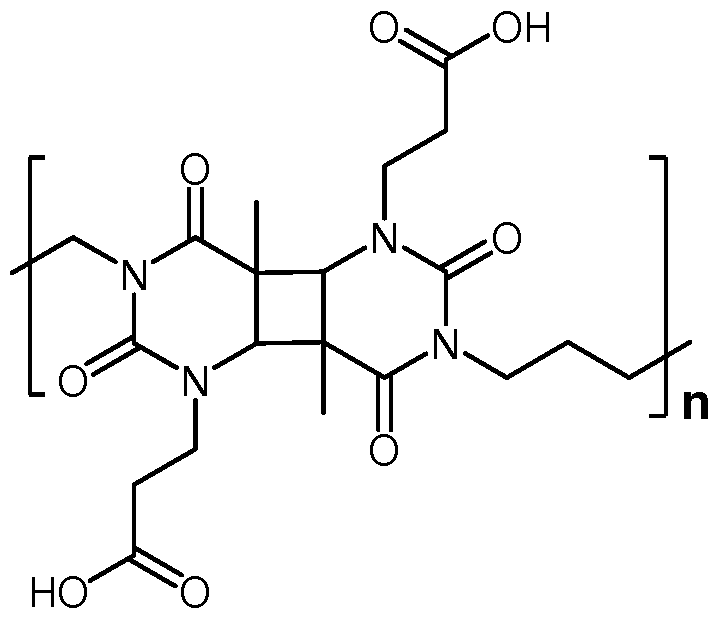
[103] Crystalline 3,3'-(3,3'-(Butane-l,4-diyl)bis(5-methyl-2,4-dioxo-3,4-dihydropyrimidine- 3,l(2H)-diyl))dipropanoic acid was irradiated for 57 h with 302 nm UV. Characterization:
Photochemical yield (1H- MR): 90 %. 1H- NMR: (400 MHz, D6-DMSO) δ 1.24 (s, 6H, C5-CH3), 1.46 (m, 4H, alk. CH2), 2.61 (m, 2H, CH2), 3.07 (m, 2H, CH2), 3.71 (br. m, 2H, CH2), 3.71 (m, , CH2), 3.80 (m, 2H, CH2), 3.97 (s, 2H, C6H), 12.4 (br. s, 2H, COOH).
MALDI-TOF (sinapinic acid) shows oligomeric photoproducts up to m/z 4.2 x 10³. Selected IR bands in "as-polymerized sample" (ATR, cm"1): 2963 m, 1696 s, 1647 s, 1457 s, 1401 s, 1345 s, 1283 w, 1203 m, 1040 w, 965 w, 890 w, 750 m.
[104] Example 11: Synthesis of 3,3*-(3,3*-(butane-l,4-diyl)bis(5-methyl-2,4-dioxo-3,4- dihydropyrimidine-3 , 1 -diyl))dipropanamide

[105] Thymine propanamide was first prepared by aminolysis of thymine propanoate (1.0 g, 4.7 mmol). The ester was added to concentrated NH4OH (15 mL), and then shaken in a capped flask until dissolution (approx. 5 min). The amide crystallized from the crude mixture as large colourless needles, which were subsequently collected by filtration. The crystalline solids were recrystallised from hot d.H20, to obtain the pure amide. Mp 233.9-235.8 °C, lit.
(not reported). Yield: 0.48 g (52 %). MS (ESI): Calcd for [C8HnN303] : m/z 197.1; Found: m/z 220.1 (M+Na). 1H-NMR (400 MHz, D6-DMSO): δΗ 1.72 (d, J= 0.8 Hz, 3H, C5-CH3), 2.42 (t, J= 6.8 Hz, 2H, CH2-C=0), 3.80 (t, J= 6.8 Hz, 2H, N1-CH2), 6.89 (s, 1H, amide NH), 7.40 (s, 1H, amide NH), 7.43 (d, J= 1.2 Hz, 1H, C6H), 11.19 (s, 1H, N3H). 13C-NMR (100 MHz, D6-DMSO): 5C 11.96 (C5-CH3), 33.91 (CH2-C=0), 44.39 (N1-CH2), 107.92 (C5), 142.01 (C6H), 150.75 (C2=0), 164.35 (C4=0), 171.69 (prop. C=0). IR (KBr, cm"1): 3410 m, 3364 m, 3232 m, 3188 m, 3078 m, 3048 w, 2964 w, 2932 w, 2804 w, 1686 s, 1672 s, 1658 s, 1618 sh, 1472 m, 1464 m, 1448 w, 1434 w, 1386 m, 1362 m, 1242 m, 1218 m.
[106] Thymine propanamide (1.35 g, 6.8 mmol) was dissolved in anhydrous DMF (10 mL) at 70 °C. K2C03 (1.13 g, 8.2 mmol) was added, and the mixture was stirred for 5 min before the addition of diiodobutane (0.84 g, 2.7 mmol). After 48 h, the insoluble white material was
collected by filtration. The solids were suspended in d.H20 to dissolve K2CO3, and precipitate the products. The insoluble material was collected by filtration, washed with d.H20, and recrystallised from hot MeOH. Yield: 0.90 g (73%). Mp: 241.9-243.6°C. 1H- NMR: (400 MHz, D6-DMSO) δ 1.48 ((m, 4H, alk. core CH2), 1.78 (s, 6H, C5-CH3), 2.45 (t, J = 6.8 Hz, 4H, CH2-C=0), 3.79 (m, 4H, 2 x N3-CH2), 3.86 (t, J= 6.8 Hz, 4H, N1-CH2), 6.89 (s, 2H, amide NH), 7.39 (s, 2H, amide NH), 7.50 (s, 2H, C6H). 13C-NMR (100 MHz, D6- DMSO): 5c 12.61 (C5-CH3), 24.71 (alk. core CH2), 33.77 (CH2-C=0), 45.53 (N1-CH2, N3- CH2 under DMSO), 107.15 (C5), 140.68 (C6H), 150.66 (C2=0), 163.09 (C4=0), 171.65 (amide C=0). IR (KBr, cm-1): 3405 (v N-H), 3213 (v N-H), 2949 (v CH, CH2), 2923 (v CH, CH2), 1668 (v C=0), 1629 (v C=0). MS (ESI): Calcd for [C20H28N6O6]+: m/z 448.2; Found: m/z 471.1 (M+Na), 472.1 (M+Na+1). CHN Analysis (calcd, found for CzoH^NeOe): C (53.56, 53.61), H (6.29, 6.15), N (18.74, 18.68).
[107] Example 12: Synthesis of alternative monomer units: Butane- 1, 3 -diyl bis(3- phenylacrylate)

[108] Cinnamoyl chloride (4.5 g, 27 mmol) was dissolved in anhydrous tetrahydrofuran (10 mL). Triethylamine (2.73 g, 27 mmol) was added, and the mixture was stirred for a short time before the addition of 1,3-butanediaol (0.81 g, 9 mmol). The reaction was allowed to continue for 24 h at room temperature. After the reaction, the product was extracted using ethyl acetate/water. The organic phases were then dried over MgS04, and the solvent was removed under diminished pressure. The crude product was obtained as a yellow solution and this crude was isolated by recrystallised twice from methanol and once with hexane to give the title compound as white crystals. Characterization: 1H-NMR (400 MHz, CDC13): δΗ 1.87 (t, 4H, CH2), 4.30 (t, 4H, CH2), 6.48 (d, 2H, vinyl), 7.41 (m, 10H, Ar), 7.60 (d, 2H, vinyl).
[109] Example 13: Synthesis of alternative monomer units: Hexane- 1,6-diyl bis(3- phenylacrylate)

[110] Cinnamoyl chloride (4.5 g, 27 mmol) was dissolved in anhydrous tetrahydrofuran (10 mL). Triethylamine (2.73 g, 27 mmol) was added, and the mixture was stirred for a short time before the addition of 1,3-hexanediaol (1.06 g, 9 mmol). The reaction was allowed to continue for 24 h at room temperature. After the reaction, the product was extracted using ethyl acetate/water. The organic phases were then dried over MgSC^, and the solvent was removed under diminished pressure. The crude product was obtained as a yellow solution and this crude was isolated by recrystallised twice from methanol and once with hexane to give the title compound as white crystals. Characterization: 1H-NMR (400 MHz, CDC13): δΗ 1.50 (m, 4H, CH2), 1.76 (t, 4H, CH2), 4.24 (t, 4H, CH2), 6.53 (d, 2H, vinyl), 7.43 (m, 10H, Ar), 7.72 (d, 2H, vinyl).
[I l l] Example 14: Synthesis of alternative monomer units: 1 ,4-Phenylenebis(methylene) bis(3 -phenylacrylate)

[112] Cinnamoyl chloride (4.5 g, 27 mmol) was dissolved in anhydrous tetrahydrofuran (10 mL). Triethylamine (2.73 g, 27 mmol) was added, and the mixture was stirred for a short time before the addition of 1 ,4-benzenedimethanol (1.5 g, 9 mmol). The reaction was allowed to continue for 24 h at room temperature. After the reaction, the product was extracted using ethyl acetate/water. The organic phases were then dried over MgSC^, and the solvent was removed under diminished pressure. The crude product was obtained as a yellow solution and this crude was isolated by recrystallised twice from methanol and once with hexane to give the title compound as white crystals. Characterization: 1H-NMR (400 MHz, CDC13): δΗ 5.28 (s, 4H, CH2), 6.50 (d, 2H, vinyl), 7.40 (m, 14H, Ar), 7.72 (d, 2H, vinyl).
[113] It must be noted that, as used in the subject specification, the singular forms "a", "an" and "the" include plural aspects unless the context clearly dictates otherwise.
[114] In the subject specification except where the context requires otherwise due to express language or necessary implication, the word "comprise" or variations such as "comprises" or "comprising" is used in an inclusive sense, i.e. to specify the presence of the stated features but not to preclude the presence or addition of further features in various embodiments of the invention.
[115] It will be appreciated by persons skilled in the art that numerous variations and/or modifications may be made to the invention as shown in the specific embodiments without departing from the scope of the invention as broadly described. The present embodiments are, therefore, to be considered in all respects as illustrative and not restrictive.
Claims
CLAIMS:
1. A compound of general formula (I)

(I)
wherein:
R1 and R5 are independently selected from amino or OR6 where R6 is selected from H, optionally substituted alkyl, optionally substituted alkenyl, optionally substituted alkynyl, optionally substituted cycloalkyl, optionally substituted cycloalkenyl, optionally substituted cycloalkynyl, optionally substituted heterocycloalkyl, optionally substituted heterocycloalkenyl, optionally substituted heterocycloalkynyl, optionally substituted aryl or optionally substituted heteroaryl;
R2 and R4 are independently selected from optionally substituted alkylene, optionally substituted alkenylene, optionally substituted alkynylene, optionally substituted cycloalkylene, optionally substituted cycloalkenylene, optionally substituted cycloalkynylene, optionally substituted heterocycloalkylene, optionally substituted heterocycloalkenylene, optionally substituted heterocycloalkynylene, optionally substituted arylene, or optionally substituted heteroarylene; and
R3 is an optionally substituted alkylene, optionally substituted alkenylene, optionally substituted alkynylene, optionally substituted cycloalkylene, optionally substituted cycloalkenylene, optionally substituted cycloalkynylene, optionally substituted heterocycloalkylene, optionally substituted heterocycloalkenylene, optionally substituted heterocycloalkynylene, optionally substituted arylene, optionally substituted heteroarylene, or optionally substituted alkylene-arylene-alkylene.
2. The compound of claim 1 , wherein R1 or R5 is amino.
3. The compound of claim 1, wherein R1 or R5 is OR6 wherein R6 is selected from H, optionally substituted alkyl, optionally substituted alkenyl, optionally substituted aryl or optionally substituted heteroaryl.
4. The compound of claim 3, wherein R6 is an optionally substituted alkyl group.
5. The compound of claim 4, wherein the alkyl group is a Ci-C6 alkyl group.
The compound of claim 1 , wherein R2 or R4 is an optionally substituted alkyli
7. The compound of claim 6, wherein the alkylene group is a Ci-Cio alkylene group.
8. The compound of claim 1 , wherein R3 is an optionally substituted alkylene group.
9. The compound of claim 8, wherein alkylene group is a C2-Cio alkylene group.
10. The compound of claim 1 , wherein R3 is a butylene, propylene or hexylene group.
1 1. The compound of claim 1 , wherein R3 is an alkenylene group.
12. The compound of claim 1 1 , wherein R3 is an alkenylene group according to -(CH=CH)n- where n is an integer between 1 and 10.
13. The compound of claim 1 , wherein R3 is an alkylene group is interrupted by an -O- group.
14. The compound of claim 13, wherein the interrupted alkylene group is according to -(CH2-0-CH2)n- where n is an integer between 1 and 10.
The compound of claim 1 , wherein R3 is an arylene group.
The compound of claim 15, wherein the arylene group is a
 group.
The compound of claim 1 , wherein R3 is an alkylene-arylene-alkylene group.
18. The compound of claim 17, wherein R3 is C2_io alkylene-arylene- C2_io alkylene group.
The compound of claim 18, wherein the alkylene-arylene-alkylene group
 group where m is an integer between 1 and 10.
The com ound of claim 1 selected from


A hoto-reversible olymer of general formula (II)

(II)
wherein:
R1 and R5 are independently selected from amino or OR6 where R6 is selected from H, optionally substituted alkyl, optionally substituted alkenyl, optionally substituted alkynyl, optionally substituted cycloalkyl, optionally substituted cycloalkenyl, optionally substituted cycloalkynyl, optionally substituted heterocycloalkyl, optionally substituted heterocycloalkenyl, optionally substituted heterocycloalkynyl, optionally substituted aryl or optionally substituted heteroaryl;
R2 and R4 are independently selected from optionally substituted alkylene, optionally substituted alkenylene, optionally substituted alkynylene, optionally substituted cycloalkylene, optionally substituted cycloalkenylene, optionally substituted cycloalkynylene, optionally substituted heterocycloalkylene, optionally substituted heterocycloalkenylene, optionally substituted heterocycloalkynylene, optionally substituted arylene, or optionally substituted heteroarylene; and
R3 is an optionally substituted alkylene, optionally substituted alkenylene, optionally substituted alkynylene, optionally substituted cycloalkylene, optionally substituted cycloalkenylene, optionally substituted cycloalkynylene, optionally substituted heterocycloalkylene, optionally substituted heterocycloalkenylene, optionally substituted heterocycloalkynylene, optionally substituted arylene, optionally substituted heteroarylene, or optionally substituted alkylene-arylene-alkylene; and
q is an integer between 1 and 1 ,000.
22. The polymer of claim 21 , wherein R1 or R5 is amino.
23. The polymer of claim 21 , wherein R1 or R5 is OR6 wherein R6 is selected from H, optionally substituted alkyl, optionally substituted alkenyl, optionally substituted aryl or optionally substituted heteroaryl.
24. The polymer of claim 23, wherein R6 is an optionally substituted alkyl group.
25. The polymer of claim 24, wherein the alkyl group is a Ci-C6 alkyl group.
26. The polymer of claim 21 , wherein R2 or R4 is an optionally substituted alkylene group.
27. The polymer of claim 26, wherein the alkylene group is a Ci-Cio alkylene group.
28. The polymer of claim 21 , wherein R3 is an optionally substituted alkylene group.
29. The polymer of claim 28, wherein alkylene group is a C2-Cio alkylene group.
30. The polymer of claim 29, wherein R3 is a butylene group.
31. The polymer of claim 21 , wherein R3 is an alkenylene group.
32. The polymer of claim 31 , wherein R3 is an alkenylene group according to -(CH=CH)n- where n is an integer between 1 and 10.
33. The polymer of claim 21 , wherein R3 is an alkylene group interrupted by an -O- group.
34. The polymer of claim 33, wherein the interrupted alkylene group is according to -(CH2-0-CH2)n- where n is an integer between 1 and 10.
The polymer of claim 21 , wherein R3 is an arylene group
36. The polymer of claim 35, wherein the arylene group is a
 group.
The polymer of claim 21 , wherein R is an alkylene-arylene-alkylene group.
The polymer of claim 37, wherein R is C2_io-alkylene-arylene-C2_io alkylene group. of claim 21 , wherein R is alkylene-arylene-alkylene group

A rocess for roducing a polymer of general formula (II)

( II)
wherein:
R1 and R5 are independently selected from amino or OR6 where R6 is selected from H, optionally substituted alkyl, optionally substituted alkenyl, optionally substituted alkynyl, optionally substituted cycloalkyl, optionally substituted cycloalkenyl, optionally substituted cycloalkynyl, optionally substituted heterocycloalkyl, optionally substituted
heterocycloalkenyl, optionally substituted heterocycloalkynyl, optionally substituted aryl or optionally substituted heteroaryl;
R2 and R4 are independently selected from optionally substituted alkylene, optionally substituted alkenylene, optionally substituted alkynylene, optionally substituted cycloalkylene, optionally substituted cycloalkenylene, optionally substituted cycloalkynylene, optionally substituted heterocycloalkylene, optionally substituted heterocycloalkenylene, optionally substituted heterocycloalkynylene, optionally substituted arylene, or optionally substituted heteroarylene; and
R3 is an optionally substituted alkylene, optionally substituted alkenylene, optionally substituted alkynylene, optionally substituted cycloalkylene, optionally substituted cycloalkenylene, optionally substituted cycloalkynylene, optionally substituted heterocycloalkylene, optionally substituted heterocycloalkenylene, optionally substituted heterocycloalkynylene, optionally substituted arylene, optionally substituted heteroarylene, or optionally substituted alkylene-arylene-alkylene; and
q is an integer between 1 and 1,000;
comprising the step of:
irradiating a compound of general formula (I):
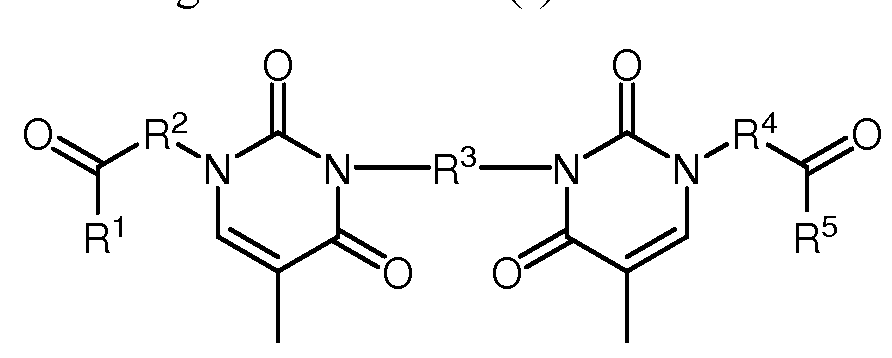
(I)
wherein:
R1 and R5 are independently selected from amino or OR6 where R6 is selected from H, optionally substituted alkyl, optionally substituted alkenyl, optionally substituted alkynyl, optionally substituted cycloalkyl, optionally substituted cycloalkenyl, optionally substituted cycloalkynyl, optionally substituted heterocycloalkyl, optionally substituted heterocycloalkenyl, optionally substituted heterocycloalkynyl, optionally substituted aryl or optionally substituted heteroaryl;
R2 and R4 are independently selected from optionally substituted alkylene, optionally substituted alkenylene, optionally substituted alkynylene, optionally substituted cycloalkylene, optionally substituted cycloalkenylene, optionally substituted cycloalkynylene,
optionally substituted heterocycloalkylene, optionally substituted heterocycloalkenylene, optionally substituted heterocycloalkynylene, optionally substituted arylene, or optionally substituted heteroarylene; and
R3 is an optionally substituted alkylene, optionally substituted alkenylene, optionally substituted alkynylene, optionally substituted cycloalkylene, optionally substituted cycloalkenylene, optionally substituted cycloalkynylene, optionally substituted heterocycloalkylene, optionally substituted heterocycloalkenylene, optionally substituted heterocycloalkynylene, optionally substituted arylene, optionally substituted heteroarylene, or optionally substituted alkylene-arylene-alkylene;
with sufficient ultraviolet radiation to cause polymerization.
41. The method of claim 40, wherein the compound is in a substantially crystalline state.
42. The method of claim 40, wherein the ultraviolet radiation has a wavelength between 250-320 nm.
43. The method of claim 40, wherein the ultraviolet radiation has a wavelength of greater than 270 nm.
44. A photo-reversible polymer of general formula (II) as defined in claim 40 produced by the method of claim 40.
45. A process for producing the compound of general formula (I):

(I)
wherein:
R1 and R5 are independently selected from amino or OR6 where R6 is selected from H, optionally substituted alkyl, optionally substituted alkenyl, optionally substituted alkynyl, optionally substituted cycloalkyl, optionally substituted cycloalkenyl, optionally substituted cycloalkynyl, optionally substituted heterocycloalkyl, optionally substituted
heterocycloalkenyl, optionally substituted heterocycloalkynyl, optionally substituted aryl or optionally substituted heteroaryl;
R2 and R4 are independently selected from optionally substituted alkylene, optionally substituted alkenylene, optionally substituted alkynylene, optionally substituted cycloalkylene, optionally substituted cycloalkenylene, optionally substituted cycloalkynylene, optionally substituted heterocycloalkylene, optionally substituted heterocycloalkenylene, optionally substituted heterocycloalkynylene, optionally substituted arylene, or optionally substituted heteroarylene; and
R3 is an optionally substituted alkylene, optionally substituted alkenylene, optionally substituted alkynylene, optionally substituted cycloalkylene, optionally substituted cycloalkenylene, optionally substituted cycloalkynylene, optionally substituted heterocycloalkylene, optionally substituted heterocycloalkenylene, optionally substituted heterocycloalkynylene, optionally substituted arylene, optionally substituted heteroarylene, or optionally substituted alkylene-arylene-alkylene;
comprising the step of:
irradiatin the polymer of general formula (II):

(II)
wherein:
R1 and R5 are independently selected from amino or OR6 where R6 is selected from H, optionally substituted alkyl, optionally substituted alkenyl, optionally substituted alkynyl, optionally substituted cycloalkyl, optionally substituted cycloalkenyl, optionally substituted cycloalkynyl, optionally substituted heterocycloalkyl, optionally substituted heterocycloalkenyl, optionally substituted heterocycloalkynyl, optionally substituted aryl or optionally substituted heteroaryl;
R2 and R4 are independently selected from optionally substituted alkylene, optionally substituted alkenylene, optionally substituted alkynylene, optionally substituted
cycloalkylene, optionally substituted cycloalkenylene, optionally substituted cycloalkynylene, optionally substituted heterocycloalkylene, optionally substituted heterocycloalkenylene, optionally substituted heterocycloalkynylene, optionally substituted arylene, or optionally substituted heteroarylene; and
R3 is an optionally substituted alkylene, optionally substituted alkenylene, optionally substituted alkynylene, optionally substituted cycloalkylene, optionally substituted cycloalkenylene, optionally substituted cycloalkynylene, optionally substituted heterocycloalkylene, optionally substituted heterocycloalkenylene, optionally substituted heterocycloalkynylene, optionally substituted arylene, optionally substituted heteroarylene, or optionally substituted alkylene-arylene-alkylene; and
q is an integer between 1 and 1,000;
with sufficient ultraviolet radiation to cause depolymerization.
46. The process of claim 45, wherein the polymer is in the solid state or at least substantially dissolved in a solution phase.
47. The process of claim 45, wherein the ultraviolet radiation has a wavelength of 249 nm or less, or 240 nm or less.
48. The process of claim 45, wherein the ultraviolet radiation has a wavelength of between 250 - 270 nm, or 250-320 nm.
49. A compound of general formula (I) as defined in claim 45 produced by the process of claim 45.
50. Use of a polymer of general formula (II):
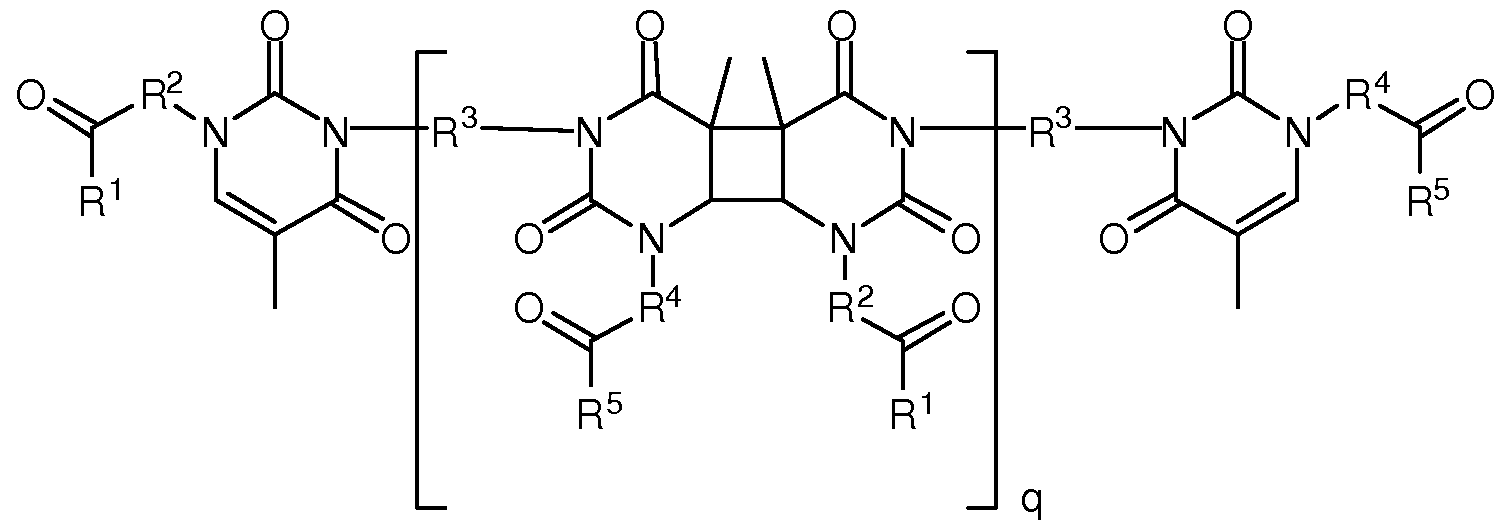
(II)
wherein:
R1 and R5 are independently selected from amino or OR6 where R6 is selected from H, optionally substituted alkyl, optionally substituted alkenyl, optionally substituted alkynyl, optionally substituted cycloalkyl, optionally substituted cycloalkenyl, optionally substituted cycloalkynyl, optionally substituted heterocycloalkyl, optionally substituted heterocycloalkenyl, optionally substituted heterocycloalkynyl, optionally substituted aryl or optionally substituted heteroaryl;
R2 and R4 are independently selected from optionally substituted alkylene, optionally substituted alkenylene, optionally substituted alkynylene, optionally substituted cycloalkylene, optionally substituted cycloalkenylene, optionally substituted cycloalkynylene, optionally substituted heterocycloalkylene, optionally substituted heterocycloalkenylene, optionally substituted heterocycloalkynylene, optionally substituted arylene, or optionally substituted heteroarylene; and
R3 is an optionally substituted alkylene, optionally substituted alkenylene, optionally substituted alkynylene, optionally substituted cycloalkylene, optionally substituted cycloalkenylene, optionally substituted cycloalkynylene, optionally substituted heterocycloalkylene, optionally substituted heterocycloalkenylene, optionally substituted
heterocycloalkynylene, optionally substituted arylene, optionally substituted heteroarylene, or optionally substituted alkylene-arylene-alkylene; and
q is an integer between 1 and 1,000;
as a recyclable material, a degradable material, a photoresistant material, or in medical, surgical, dental, construction, electronic or automotive applications.
51. A process for producing a compound of general formula (I):

(I)
wherein:
R1 and R5 are independently selected from amino or OR6 where R6 is selected from H, optionally substituted alkyl, optionally substituted alkenyl, optionally substituted alkynyl, optionally substituted cycloalkyl, optionally substituted cycloalkenyl, optionally substituted cycloalkynyl, optionally substituted heterocycloalkyl, optionally substituted heterocycloalkenyl, optionally substituted heterocycloalkynyl, optionally substituted aryl or optionally substituted heteroaryl;
R2 and R4 are independently selected from optionally substituted alkylene, optionally substituted alkenylene, optionally substituted alkynylene, optionally substituted cycloalkylene, optionally substituted cycloalkenylene, optionally substituted cycloalkynylene, optionally substituted heterocycloalkylene, optionally substituted heterocycloalkenylene, optionally substituted heterocycloalkynylene, optionally substituted arylene, or optionally substituted heteroarylene; and
R3 is an optionally substituted alkylene, optionally substituted alkenylene, optionally substituted alkynylene, optionally substituted cycloalkylene, optionally substituted cycloalkenylene, optionally substituted cycloalkynylene, optionally substituted heterocycloalkylene, optionally substituted heterocycloalkenylene, optionally substituted heterocycloalkynylene, optionally substituted arylene, optionally substituted heteroarylene, or optionally substituted alkylene-arylene-alkylene;
comprising the step of:
reacting a compound of general formula (III)

(I I I)
wherein:
R1 and R2 are as defined for formula (I);
with a compound of general formula IV):
 wherein:
X is halo and R3 is as defined for formula (I);
in the presence of a base.
52. A compound of general formula (I) as defined in claim 51 produced by the process of claim 51.
Applications Claiming Priority (2)
| Application Number | Priority Date | Filing Date | Title |
|---|---|---|---|
| US201161481321P | 2011-05-02 | 2011-05-02 | |
| US61/481,321 | 2011-05-02 |
Publications (1)
| Publication Number | Publication Date |
|---|---|
| WO2012149604A1 true WO2012149604A1 (en) | 2012-11-08 |
Family
ID=47107685
Family Applications (1)
| Application Number | Title | Priority Date | Filing Date |
|---|---|---|---|
| PCT/AU2012/000470 Ceased WO2012149604A1 (en) | 2011-05-02 | 2012-05-02 | Bis-thymine derivatives and photo-reversible polymers thereof |
Country Status (1)
| Country | Link |
|---|---|
| WO (1) | WO2012149604A1 (en) |
-
2012
- 2012-05-02 WO PCT/AU2012/000470 patent/WO2012149604A1/en not_active Ceased
Non-Patent Citations (5)
| Title |
|---|
| BURDI, D. ET AL.: "Design Of A Cleavable Linker For The Synthesis Of A Cis-Syn Pyrimidine Photodimer.", TETRAHEDRON LETTERS, vol. 33, no. 16, 1992, pages 2133 - 2136 * |
| JOHNSTON, P. ET AL.: "Solid-State Photoreversible Polymerisation of n-Alkyl-Linked Bis-Thymines using Non-Covalent Polymer-Templating.", AUST. J. CHEM., vol. 63, 2010, pages 631 - 639 * |
| JOHNSTON, P. ET AL.: "Topochemical photo-reversible polymerization of a bioinspired monomer and its recovery and repolymerization after photo-depolymerization.", CHEMICAL SCIENCE, vol. 3, 18 April 2012 (2012-04-18), pages 2301,-2306 * |
| LEONARD, N. J. ET AL.: "Stereochemically Controlled Photoreactions between Two Thymine Rings.", J. AM. CHEM. SOC., vol. 96, no. 18, 1974, pages 5904 - 5910 * |
| MOGHADDAM, M. J. ET AL.: "Syntheses and Photochemical Reactions of Bis-Thymine Derivatives.", POLYMER JOURNAL, vol. 22, no. 5, 1990, pages 369 - 380 * |
Similar Documents
| Publication | Publication Date | Title |
|---|---|---|
| CN102232065B (en) | Photobase generator | |
| CN102791669B (en) | 5-norbornene-2-spiro-alpha-cycloalkanone-alpha'-spiro-2''-5''-norbornene and method for producing same | |
| JP2013530994A (en) | Thioxanthone-4-carboxylic acid ester, production method, photoinitiator composition and application | |
| KR20180030732A (en) | Photoinitiated reactions | |
| JP6565687B2 (en) | Method for producing cyclobutanetetracarboxylic acid derivative | |
| Cınar et al. | Structure-reactivity relationships of novel monomeric photoinitiators | |
| JP7224054B2 (en) | Photoreactive composition, reaction product and method for producing reaction product | |
| Nechifor | Synthesis and properties of some aromatic polyamides with coumarin chromophores | |
| CN101812141B (en) | Diphenyl ketone photo initiator containing cyclic acctals and preparation method thereof | |
| CA2964291A1 (en) | New branched polymers, their preparation process, and uses thereof | |
| CN110590798A (en) | Process for producing cyclobutanetetracarboxylic acid derivative | |
| EP4011864B1 (en) | Photobase generator compounds and photoreactive compositions comprising them | |
| He et al. | A thioxanthone-based photocaged superbase for highly effective free radical photopolymerization | |
| Suyama et al. | Multifunctional methacryloyloximes: molecules playing the role of monomer, photoinitiator, and photolabile Units | |
| JP5801928B2 (en) | Polyimide film, gas barrier film using the same, flexible wiring board, and transparent electrode substrate | |
| Soomro et al. | Dendrimers with peripheral stilbene chromophores | |
| Scheler et al. | Synthesis and photopatterning of fluorene based reactive mesogens | |
| Chae et al. | Application of an anthracene containing polymer to a negative type photoresist | |
| Lex et al. | Photosensitive polynorbornene containing the benzyl thiocyanate group—Synthesis and patterning | |
| JP2022001620A (en) | Polymerizable compound, polymer, and optical thin film | |
| KR20070052639A (en) | Adamantane derivatives and preparation method thereof | |
| WO2014185279A1 (en) | Carbamic acid ester compound and solvent composition for resist production containing same | |
| Linh et al. | Synthesis and properties of some polyethers from chalcones | |
| JP6524768B2 (en) | Oligofluor orange (meth) acrylate, (meth) acrylate resin composition, optical member and lens | |
| US20190202976A1 (en) | Dicyclopentadiene derivatives and polymers thereof |
Legal Events
| Date | Code | Title | Description |
|---|---|---|---|
| 121 | Ep: the epo has been informed by wipo that ep was designated in this application |
Ref document number: 12779914 Country of ref document: EP Kind code of ref document: A1 |
|
| NENP | Non-entry into the national phase |
Ref country code: DE |
|
| 122 | Ep: pct application non-entry in european phase |
Ref document number: 12779914 Country of ref document: EP Kind code of ref document: A1 |