WO2012144752A1 - Phenyl-isoxazol derivatives and preparation process thereof - Google Patents

Phenyl-isoxazol derivatives and preparation process thereof Download PDF

Info

Publication number
WO2012144752A1
WO2012144752A1 PCT/KR2012/002362 KR2012002362W WO2012144752A1 WO 2012144752 A1 WO2012144752 A1 WO 2012144752A1 KR 2012002362 W KR2012002362 W KR 2012002362W WO 2012144752 A1 WO2012144752 A1 WO 2012144752A1
Authority
WO
WIPO (PCT)
Prior art keywords
piperazine
isoxazol
methanone
phenyl
amino
Prior art date
Legal status (The legal status is an assumption and is not a legal conclusion. Google has not performed a legal analysis and makes no representation as to the accuracy of the status listed.)
Ceased
Application number
PCT/KR2012/002362
Other languages
French (fr)
Inventor
Dong Yeon Kim
Dae Jin Cho
Gong Yeal Lee
Hong Youb Kim
Seok Hun Woo
Hae Un Lee
Sung Moo Kim
Choong Am Ahn
Seung Bin Yoon
Current Assignee (The listed assignees may be inaccurate. Google has not performed a legal analysis and makes no representation or warranty as to the accuracy of the list.)
Il Yang Pharmaceutical Co Ltd
Original Assignee
Il Yang Pharmaceutical Co Ltd
Priority date (The priority date is an assumption and is not a legal conclusion. Google has not performed a legal analysis and makes no representation as to the accuracy of the date listed.)
Filing date
Publication date
Family has litigation
First worldwide family litigation filed litigation Critical https://patents.darts-ip.com/?family=46514985&utm_source=google_patent&utm_medium=platform_link&utm_campaign=public_patent_search&patent=WO2012144752(A1) "Global patent litigation dataset” by Darts-ip is licensed under a Creative Commons Attribution 4.0 International License.
Priority to EP12774858.0A priority Critical patent/EP2699566B1/en
Priority to MX2013007661A priority patent/MX340098B/en
Priority to CN201280005377.5A priority patent/CN103313982B/en
Priority to EA201300805A priority patent/EA022336B1/en
Priority to US13/979,743 priority patent/US9132126B2/en
Priority to SG2013056734A priority patent/SG192134A1/en
Priority to NZ613314A priority patent/NZ613314B2/en
Application filed by Il Yang Pharmaceutical Co Ltd filed Critical Il Yang Pharmaceutical Co Ltd
Priority to HK14102103.4A priority patent/HK1188998B/en
Priority to PH1/2013/501883A priority patent/PH12013501883A1/en
Priority to CA2824757A priority patent/CA2824757A1/en
Priority to AU2012246914A priority patent/AU2012246914B2/en
Priority to JP2013551922A priority patent/JP5833143B2/en
Publication of WO2012144752A1 publication Critical patent/WO2012144752A1/en
Priority to ZA2013/05277A priority patent/ZA201305277B/en
Priority to IL227711A priority patent/IL227711A0/en
Anticipated expiration legal-status Critical
Ceased legal-status Critical Current

Links

Classifications

    • AHUMAN NECESSITIES
    • A61MEDICAL OR VETERINARY SCIENCE; HYGIENE
    • A61KPREPARATIONS FOR MEDICAL, DENTAL OR TOILETRY PURPOSES
    • A61K31/00Medicinal preparations containing organic active ingredients
    • A61K31/33Heterocyclic compounds
    • A61K31/395Heterocyclic compounds having nitrogen as a ring hetero atom, e.g. guanethidine or rifamycins
    • A61K31/495Heterocyclic compounds having nitrogen as a ring hetero atom, e.g. guanethidine or rifamycins having six-membered rings with two or more nitrogen atoms as the only ring heteroatoms, e.g. piperazine or tetrazines
    • A61K31/496Non-condensed piperazines containing further heterocyclic rings, e.g. rifampin, thiothixene or sparfloxacin
    • AHUMAN NECESSITIES
    • A61MEDICAL OR VETERINARY SCIENCE; HYGIENE
    • A61KPREPARATIONS FOR MEDICAL, DENTAL OR TOILETRY PURPOSES
    • A61K31/00Medicinal preparations containing organic active ingredients
    • A61K31/33Heterocyclic compounds
    • A61K31/395Heterocyclic compounds having nitrogen as a ring hetero atom, e.g. guanethidine or rifamycins
    • A61K31/41Heterocyclic compounds having nitrogen as a ring hetero atom, e.g. guanethidine or rifamycins having five-membered rings with two or more ring hetero atoms, at least one of which being nitrogen, e.g. tetrazole
    • A61K31/42Oxazoles
    • AHUMAN NECESSITIES
    • A61MEDICAL OR VETERINARY SCIENCE; HYGIENE
    • A61KPREPARATIONS FOR MEDICAL, DENTAL OR TOILETRY PURPOSES
    • A61K31/00Medicinal preparations containing organic active ingredients
    • A61K31/33Heterocyclic compounds
    • A61K31/395Heterocyclic compounds having nitrogen as a ring hetero atom, e.g. guanethidine or rifamycins
    • A61K31/435Heterocyclic compounds having nitrogen as a ring hetero atom, e.g. guanethidine or rifamycins having six-membered rings with one nitrogen as the only ring hetero atom
    • A61K31/44Non condensed pyridines; Hydrogenated derivatives thereof
    • A61K31/445Non condensed piperidines, e.g. piperocaine
    • A61K31/4523Non condensed piperidines, e.g. piperocaine containing further heterocyclic ring systems
    • A61K31/454Non condensed piperidines, e.g. piperocaine containing further heterocyclic ring systems containing a five-membered ring with nitrogen as a ring hetero atom, e.g. pimozide, domperidone
    • AHUMAN NECESSITIES
    • A61MEDICAL OR VETERINARY SCIENCE; HYGIENE
    • A61KPREPARATIONS FOR MEDICAL, DENTAL OR TOILETRY PURPOSES
    • A61K45/00Medicinal preparations containing active ingredients not provided for in groups A61K31/00 - A61K41/00
    • A61K45/06Mixtures of active ingredients without chemical characterisation, e.g. antiphlogistics and cardiaca
    • AHUMAN NECESSITIES
    • A61MEDICAL OR VETERINARY SCIENCE; HYGIENE
    • A61PSPECIFIC THERAPEUTIC ACTIVITY OF CHEMICAL COMPOUNDS OR MEDICINAL PREPARATIONS
    • A61P31/00Antiinfectives, i.e. antibiotics, antiseptics, chemotherapeutics
    • A61P31/12Antivirals
    • AHUMAN NECESSITIES
    • A61MEDICAL OR VETERINARY SCIENCE; HYGIENE
    • A61PSPECIFIC THERAPEUTIC ACTIVITY OF CHEMICAL COMPOUNDS OR MEDICINAL PREPARATIONS
    • A61P31/00Antiinfectives, i.e. antibiotics, antiseptics, chemotherapeutics
    • A61P31/12Antivirals
    • A61P31/14Antivirals for RNA viruses
    • A61P31/16Antivirals for RNA viruses for influenza or rhinoviruses
    • AHUMAN NECESSITIES
    • A61MEDICAL OR VETERINARY SCIENCE; HYGIENE
    • A61PSPECIFIC THERAPEUTIC ACTIVITY OF CHEMICAL COMPOUNDS OR MEDICINAL PREPARATIONS
    • A61P43/00Drugs for specific purposes, not provided for in groups A61P1/00-A61P41/00
    • CCHEMISTRY; METALLURGY
    • C07ORGANIC CHEMISTRY
    • C07DHETEROCYCLIC COMPOUNDS
    • C07D261/00Heterocyclic compounds containing 1,2-oxazole or hydrogenated 1,2-oxazole rings
    • C07D261/02Heterocyclic compounds containing 1,2-oxazole or hydrogenated 1,2-oxazole rings not condensed with other rings
    • C07D261/06Heterocyclic compounds containing 1,2-oxazole or hydrogenated 1,2-oxazole rings not condensed with other rings having two or more double bonds between ring members or between ring members and non-ring members
    • C07D261/08Heterocyclic compounds containing 1,2-oxazole or hydrogenated 1,2-oxazole rings not condensed with other rings having two or more double bonds between ring members or between ring members and non-ring members with only hydrogen atoms, hydrocarbon or substituted hydrocarbon radicals, directly attached to ring carbon atoms
    • CCHEMISTRY; METALLURGY
    • C07ORGANIC CHEMISTRY
    • C07DHETEROCYCLIC COMPOUNDS
    • C07D261/00Heterocyclic compounds containing 1,2-oxazole or hydrogenated 1,2-oxazole rings
    • C07D261/02Heterocyclic compounds containing 1,2-oxazole or hydrogenated 1,2-oxazole rings not condensed with other rings
    • C07D261/06Heterocyclic compounds containing 1,2-oxazole or hydrogenated 1,2-oxazole rings not condensed with other rings having two or more double bonds between ring members or between ring members and non-ring members
    • C07D261/10Heterocyclic compounds containing 1,2-oxazole or hydrogenated 1,2-oxazole rings not condensed with other rings having two or more double bonds between ring members or between ring members and non-ring members with hetero atoms or with carbon atoms having three bonds to hetero atoms with at the most one bond to halogen, e.g. ester or nitrile radicals, directly attached to ring carbon atoms
    • C07D261/18Carbon atoms having three bonds to hetero atoms, with at the most one bond to halogen
    • CCHEMISTRY; METALLURGY
    • C07ORGANIC CHEMISTRY
    • C07DHETEROCYCLIC COMPOUNDS
    • C07D413/00Heterocyclic compounds containing two or more hetero rings, at least one ring having nitrogen and oxygen atoms as the only ring hetero atoms
    • C07D413/02Heterocyclic compounds containing two or more hetero rings, at least one ring having nitrogen and oxygen atoms as the only ring hetero atoms containing two hetero rings
    • C07D413/06Heterocyclic compounds containing two or more hetero rings, at least one ring having nitrogen and oxygen atoms as the only ring hetero atoms containing two hetero rings linked by a carbon chain containing only aliphatic carbon atoms

Definitions

  • the present invention relates to a novel phenyl-isoxazol derivative having antiviral activity against an influenza virus and other similar viruses, which is useful in treatment and prevention of virus infection. Also, the present invention relates to a method using a compound for treating or preventing infection of an influenza virus and other similar viruses, a composition including the compound, a preparation method of the compound, and a synthesis intermediate used for the preparation method.
  • influenza virus causes infectious acute febrile respiratory illness in a host. When the influenza virus is epidemic, it can easily spread across borders due to its strong infectiousness. Also, it may be unpredictably variously mutated, thereby causing interspecific infection. Thus, it is necessary to provide worldwide common countermeasures and monitoring systems.
  • An influenza virus is taxonomically defined as a member of Orthomyxovirus, and has three types of A, B, and C. Especially, A, and Btypes are epidemically spread.
  • Type A influenza has a high mutatability, and zoonotically infects birds, pigs, and horses, as well as humans.
  • the type A influenza includes various subtypes according to a combination of surface antigens (HA and NA).
  • HA and NA surface antigens
  • type B influenza causes relatively light symptoms, and infects humans and seals. Especially, in humans, it mainly causes an illness in children.
  • Type C influenza can infect humans and pigs, but is known to have relatively low pathogenicity to humans.
  • Hemagglutinin has a trimer structure including a head and a stem. The head region is related to most antigen mutations, which attaches the virus to a host cell by binding to a terminal sialic acid residue on the surface of the host cell, and sequentially allows the virus to penetrate the host cell.
  • Neuraminidase is a mushroom-shaped tetramer with a head and a stem.
  • an active region exists, which cleaves the alpha-ketosidic bond linking a terminal neuraminic acid residue to the oligosaccharide moiety on the cell surface. This cleavage performs an important role when a replicated and propagated virus within the infected cell comes out from the host cell and penetrates a respiratory organ mucous membrane cell. Surface antigens of a virus are mutated in the same subtype, and a new antigen mutant strain appears annually. Especially, from among influenza viruses, an avian influenza virus that has been problematic recently, infects various kinds of birds such as chickens, turkeys, ducks and wild birds through antigenic shift and quickly spreads.
  • the morality rate is 80% or more.
  • it is a virus causing serious damage and threatening the poultry farming industry worldwide.
  • its ripple effect is not limited to the poultry farming industry.
  • the virus may spread to humans by infecting a human body. Accordingly, research on the treatment of a virus may include inhibition of adsorption into an epithelial cell, inhibition of penetration into a cell, inhibition of transcription and replication of a gene, inhibition of protein synthesis, inhibition of release from a cell, and the like. Each of these is an objective of development of a novel antiviral drug.
  • Conventionally developed representative therapeutic agents for treating an influenza virus include 4 materials such as Amantadine, Rimantadine, Zanamivir, and Oseltamivir, which were approved by the US Food and Drug Administration (FDA) (see FIGs. 1 to 4).
  • Amantadine or Rimantadine is an M2 ion channel blocker having activity only against a Hamagglutinin virus strain (an influenza virus), and interrupts replication of a virus particle introduced into a host cell.
  • FDA US Food and Drug Administration
  • Oseltamivir Korean Patent Publication No. 10-1998-0703600
  • Zanamivir Zanamivir
  • the two kinds of therapeutic agents intervene in one process of influenza virus infection and interrupt the process, thereby inhibiting of the propagation of a virus.
  • Zanamivir has a high antiviral effect, but has disadvantages such as a low bioavailability and a quick release from a kidney.
  • there have been reported some side effects such as generation of a resistant virus, and serious emesis symptoms.
  • the inventors of the present invention invented, as a better antiviral agent than a conventional agent, a novel phenyl-isoxazol compound having a high influenza virus inhibiting activity, and a high preventive effect of virus replication, which can treat or prevent an illness caused by an influenza virus.
  • the present invention has been made to solve the above mentioned disadvantages.
  • the inventors found a compound represented by Formula 1, which has a different novel structure from a conventionally developed compound structure. Then, based on the finding, they completed this invention.
  • a phenyl-isoxazol derivative represented by Formula 1 below or its pharmaceutically acceptable salt, hydrate, solvate, prodrug, or composite.
  • R 1 , R 2 and R 3 each independently represents hydrogen, lower alkyl optionally substituted with halogen, lower alkoxy optionally substituted with halogen, or halogen,
  • R 4 represents methyl or amine
  • R 8 may be substituted with a radical of Formula 2 below, or substituted with a radical of Formula 3 below,
  • R 5 , R 6 and R 7 each independently represents hydrogen, lower alkyl optionally substituted with halogen, hydroxy, lower alkoxy or halogen, and
  • R 9 represents lower alkyl.
  • composition including the inventive compound, or its pharmaceutically acceptable salt, hydrate, solvate, prodrug, or composite, and a pharmaceutically acceptable carrier or excipient.
  • compositions for treating or preventing virus infection includes the inventive compound, or its pharmaceutically acceptable salt, hydrate, solvate, prodrug, or composite, and a pharmaceutically acceptable carrier or excipient.
  • preventive compound or its pharmaceutically acceptable salt, hydrate, solvate, prodrug, or composite, for preparing a pharmaceutical composition for treatment or prevention of virus infection.
  • a method for preventing or treating virus infection including the step of administering a therapeuticallyeffective amount of the inventive compound, or its pharmaceutically acceptable salt, hydrate, solvate, prodrug, or composite, to mammals, including humans, requiring virus infection treatment or prevention.
  • influenza virus infection caused by an influenza virus is an illness frequently lethal to humans and animals.
  • the influenza virus causes an infectious acute febrile respiratory organ illness in a host.
  • influenza virus When the influenza virus is epidemic, it can easily spread across borders due to its strong infectiousness. Also, it may be unpredictably variously mutated, thereby causinginterspecific infection. Thus, it is necessary to provide worldwide common countermeasures and monitoring systems.
  • Neuraminidase inhibitors include Oseltamivir and Zanamivir. These therapeutic agents perform a role of inhibiting the propagation of an influenza virus.
  • Zanamivir has a high antiviral effect but has disadvantages such as a low bioavailability and a quick release from a kidney.
  • Oseltamivir there have been reported some side effects such as generation of a resistant virus, and serious emesis symptoms.
  • the inventors of the present invention found a compound represented by Formula 1 below, that is, a phenyl-isoxazol derivative, which has a higher antiviral activity against an influenza virus, and a higher susceptibility to a virus replication inhibitor inhibiting virus replication than its corresponding Oseltamivir phosphate.
  • the present invention provides a compound represented by Formula 1 below, and its pharmaceutically acceptable derivative.
  • R 1 , R 2 , R 3 , R 4 and R 8 are the same as defined above.
  • a compound represented by Formula 1 includes its hydrate, solvate, pharmaceutically acceptable salt, prodrug, composite, and pharmaceutically acceptable derivative including diastereomer or enantiomer.
  • lower alkyl indicates a straight-chain or branched saturated aliphatic hydrocarbon radical that preferably includes 1 to 12 carbon atoms, alternatively 1 to 8 carbon atoms, or alternatively 1 to 6 carbon atoms.
  • alkyl radical may include methyl, ethyl, n-propyl, isopropyl, n-butyl, isobutyl, secondary-butyl, tertiary-butyl, pentyl, isoamyl, n-hexyl, and the like, but the present invention is not limited thereto.
  • an alkyl group may be optionally substituted.
  • alkoxy indicates oxygen added with an alkyl substituent.
  • an alkoxy group may be optionally substituted.
  • lower halo alkyl indicates a straight-chain or branched saturated aliphatic radical that preferably includes 1 to 12 carbon atoms, alternatively 1 to 8 carbon atoms, or alternatively 1 to 6 carbon atoms, in which hydrogen is substituted with halogen.
  • halogen indicates an atom of fluoro, chlorine, bromine or iodine, and preferably indicates fluoro or chlorine.
  • a halogen group may be optionally substituted.
  • inventive compound also includes a salt within the scope of the present invention. It is understood that the inventive compound, e.g., the compound represented by Formula 1, as long as not explicitly stated otherwise, includes its salt.
  • salt indicates an acidic and/or basic salt formed from inorganic and/or organic acid and base.
  • the salt of the inventive compound may be, for example, formed by reacting the inventive compound with an acid or a base in the same amount as that of the compound in a medium or aqueous medium capable of precipitating the salt.
  • Non-limiting examples of the salt may include the following salts.
  • the compound may be reacted with acetic acid, adipic acid, benzenesulfonic acid, benzoic acid, camphoric acid, camphorsulfonic acid, citric acid, cyclamate, ethane-1,2-disulphonic acid, ethanesulfonic acid, 2-hydroxy ethanesulfonic acid, formic acid, fumaric acid, bromic acid, hydrochloric acid, sulfuric acid, nitric acid, phosphoric acid, malic acid, maleic acid, methanesulfonic acid, naphthalene-2-sulfonic acid, naphthalene-1,5-disulfonic acid, 1-hydroxy-2-naphthalate, nicotinic acid, trifluoroacetic acid, oxalic acid, p-toluene sulfonic acid, propionic acid, glycolic acid, succinic acid, tartaric acid
  • the compound represented by Formula 1 has ethylester as a functional group, and thus may form a carboxyl group.
  • ethylester of the compound represented by Formula 1 may be hydrolyzed.
  • the hydrolyzedcompound represented by Formula 1 includes a carboxyl group, thereby forming a cation and a salt. There is no specific limitation in the kind of such a salt, as long as it is pharmaceutically acceptable.
  • Examples of such a salt may include an alkaline metal salt, such as sodium, potassium and lithium salt an alkaline earth metal salt, such as calcium and magnesium salt other metal salts, such as aluminum, iron, zinc, copper nickel, and cobalt salt other inorganic salts, such as ammonium salt an amine salt, such as t-octylamine, dibenzylamine, morpholin, glucosamine, phenylglycine alkyl ester, ethylenediamine, methylglucamine, guanidine, diethylamine, triethylamine, dicyclohexylamine, N,N-dibenzylethylenediamine, chloroprocaine, procaine, diethaneolamine, benzyl-phenethylamine, piperazine, tetraethylammonium and tris(hydroxymethyl)aminomethane salt.
  • an alkaline metal salt such as sodium, potassium and lithium salt
  • an alkaline earth metal salt such
  • pharmaceutically acceptable derivative indicates the inventive compounds hydrate, solvate, pharmaceutically acceptable salt, prodrug, or composite, which maintains the required biological activity of the compound and does not show an unwanted toxicological effect.
  • the present invention also includes a prodrug of the inventive compound.
  • the term "prodrug” indicates a compound covalently bonded to a carrier.
  • the prodrug may release an active ingredient while being administered to a mammal subject.
  • the release of the active ingredient may occur within a living body,and the prodrug may be prepared by technologies known to a person skilled in the art. In such technologies, in a certain compound, an appropriate functional group is modified. However, the modified functional group regenerates an original functional group through a general operation or within a living body.
  • Non-limiting examples of the prodrug include ester (e.g., acetate, formate, and benzoate derivative) and the like.
  • the inventive compound has an inhibiting activity against a strain of an influenza virus, and is highly effective in the treatment and the prevention of infection of influenza having susceptibility to a virus replication inhibitorinhibiting virus replication, and other similar viruses.
  • the radical in Formula 2 when the radical in Formula 2 is substituted for R 8 , two from among R 1 , R 2 and R 3 represent hydrogen, the remaining one represents lower alkyl optionally substituted with halogen, lower alkoxy optionally substituted with halogen, or halogen, preferably fluoro or chlorine.
  • R 4 represents methyl, or amine, and from among R 5 , R 6 and R 7 , one or two each independently represents hydrogen, lower alkyl optionally substituted with halogen, hydroxy, lower alkoxy, or halogen or R 1 represents halogen, preferably chlorine, R 4 represents methyl or amine, R 2 , R 3 , R 5 , and R 7 each represents hydrogen, and R 6 represents alkoxy, preferably methoxy.
  • R 4 represents amine
  • R 9 represents lower alkyl.
  • R 4 represents methyl or amine, from among R 5 , R 6 and R 7 , one or two each independently represents hydrogen, methoxy, chlorine, fluoro, trifluoromethyl or hydroxy; or R 1 represents halogen, preferably chlorine, R 4 represents methyl or amine, R 2 , R 3 , R 5 , and R 7 each represents hydrogen, and R 6 represents alkoxy, preferably methoxy.
  • R 4 represents amine
  • two from among R 1 , R 2 and R 3 represent hydrogen, the remaining one represents trifluoromethyl, fluoro, or trifluoromethoxy
  • R 9 represents methyl or ethyl.
  • R 1 represents trifluoromethyl, or trifluoromethoxy
  • R 2 and R 3 represent hydrogen
  • R 4 represents methyl, and from among R 5 , R 6 and R 7 , one or two each independently represents hydrogen, hydroxy, methoxy, or chlorine
  • R 1 represents chlorine
  • R 4 represents methyl
  • R 2 , R 3 , R 5 and R 7 represent hydrogen
  • R 6 represents methoxy or R 2 represents fluoro, trifluoromethyl, or trifluoromethoxy
  • R 1 and R 3 represent hydrogen
  • R 4 represents methyl or amine
  • R 9 represents ethyl.
  • the inventive compound represented by Formula 1 may be prepared by the following synthesis process.
  • the isomer and solvate (e.g., hydrate) of the compound represented by Formula 1 are also within the scope of the present invention.
  • the solvation method is generally known in the art. Accordingly, the inventive compound may be used in the form of a pharmaceutically useful hydrate or salt, and obtained by the method described by Reaction Scheme below.
  • the inventive compound of Formula 1 is prepared by the steps of: reacting a compound represented by Formula 4 below preferably with hydroxylammoniumchloride in the presence of a base to produce a compound represented by Formula 5 below chlorinating the compound represented by Formula 5 so as to produce a compound represented by Formula 6 below cyclizing the compound represented by Formula 6 so as to produce a compound represented by Formula 7 below as an isoxazol compound removing R 10 as a protecting group of Formula 7 so as to produce a compound represented by Formula 8 and reacting the compound represented by Formula 8 with a compound represented by Formula 2 or Formula 3 so as to produce a compound represented by Formula 9a or Formula 9b.
  • R 1 to R 9 are the same as defined above, and
  • R 10 represents lower alkyl, preferably methyl, ethyl or isopropyl group.
  • R 1 to R 10 are the same as defined above.
  • a phenylaldehyde compound (I) having R 1 , R 2 and R 3 substituted onto a benzene ring was commercially available.
  • the phenylaldehyde compound (I) is reacted with hydroxylammoniumchloride or its equivalent in the presence of a base so as to synthesize a compound of benzaldehyde oxime (II).
  • a benzimidoyl chloride compound (III) is produced.
  • An isoxazol compound (V) in which R 4 is substituted with methyl or amine may be obtained through a generally used synthesis method (cyclization reaction) by using alkyl acetoacetate or alkyl cyanoacetate.
  • a phenyl-isoxazol derivative compound (VIa or VIb) is produced by using 1-ethyl-3-(3'-dimethylaminopropyl)carbodiimidehydrochloride (EDCl) or hydroxybenzotriazol (HOBt) in the presence of a base.
  • EDCl 1-ethyl-3-(3'-dimethylaminopropyl)carbodiimidehydrochloride
  • HOBt hydroxybenzotriazol
  • the inventive preparation method may be carried out preferably in a solvent in the presence of a base or an acid.
  • a solvent there is no specific limitation in a solvent, an acid, and a baseas long as they have no adverse effect on the reaction.
  • the solvent may be at least one kind selected from the group consisting of tetrahydrofuran, methylenechloride, ethanol, N,N-dimethylformamide, N,N-dimethylacetamide, ethylacetate, tert-butanol, toluene, and dioxane.
  • the base may be at least one kind selected from the group consisting of pyridine, triethylamine, diethylamine, sodium carbonate, potassium carbonate, sodium hydroxide, potassium hydroxide, sodium hydride, sodium methoxide, sodium ethoxide, sodium tert-butoxide, potassium tert-butoxide, lithium aluminum hydride, lithium borohydride, and sodium nitrate, and cesium carbonate.
  • the acid may be at least one kind selected from the group consisting of trifluoroacetic acid, hydrochloric acid, nitric acid, sulfuric acid, bromic acid, and acetic acid.
  • the present invention is related to a pharmaceutical compositionfor treating or preventing virus infection, in which the compound represented by Formula 1, or its pharmaceutically acceptable derivative is administered in an effective amount to mammals, including humans.
  • the composition is effective in inhibiting influenza infection, and thus may be effectively used in the treatment of such an illness.
  • a single dose or a multiple dose generally ranges from 0.01 to 750mg/kg per day, preferably ranges from 0.1 to 100mg, and most preferably ranges from 0.5 to 25mg.
  • the specific dose for an individual patient may vary according to a specific compound, a patient's weight, sex, diet, a drug administration time, an administration method, a release ratio, a drug mixing ratio, a patient's state, age, etc.
  • the inventive compound may be administered without being processed in the treatment.
  • the active ingredient is preferably provided as a pharmaceutical formulation.
  • the present invention provides a pharmaceutical formulation obtained by mixing a compound represented by Formula 1 or its pharmaceutically acceptable derivative with a pharmaceutically acceptable carrier and/or excipient.
  • inventive compound may be administered via any suitable route.
  • the compound is administered by injection or in oral form.
  • An injection preparation for example, a sterile injection aqueous or oily suspension, may be prepared by using an appropriate material such as a dispersant, a wetting agent or a suspension according to a known art.
  • a solvent water, ringer's solution or isotonic NaCl solution may be used.
  • sterile fixed oil is also generally used as a solvent or a suspension medium.
  • any nonirritating fixed oil including mono-glyceride or di-glyceride, may be used.
  • fatty acid such as oleic acid may used in injection preparation.
  • a solid administration form for oral administration may include capsule, tablet, pill, powder and granule forms. Especially, capsule and tablet forms are preferred. Preferably, tablet and pill forms are prepared as intestinal drugs.
  • the solid administration form may be prepared by mixing the inventive active compound represented by Formula 1 with at least one inert diluent (such as sucrose, lactose, starch), a lubricant (such as magnesium stearate), and a carrier (such as a disintegrating agent, a binding agent, etc.).
  • the inventive compound has an inhibiting activity against a strain of an influenza virus, and may be used to treat and prevent infection of influenza having susceptibility to a Neuraminidase inhibitor or a virus replication inhibitor inhibiting virus replication, and other similar viruses.
  • it may be used in combination with a secondary therapeutic agent having an activity against the same virus.
  • This compound for example, may be used in combination with Zanamivir, Oseltamivir, Amantadine, Rimantadine or the like.
  • the administration amount of each compound may be the same or different, compared to the administration amount of the compound alone.
  • 2-(trifluoromethyl)benzaldehydeoxime (30.0g, 158.60mmol) was dissolved in dimethylformimide (300mL), and added with N-chlorosuccinimide (23.31g, 174.46mmol), followed by stirring for 15 hours. After the reaction was completed, the resultant solution was vacuum evaporated, added with ethylacetate (1,500mL), washed with saturated sodium chloride aqueous solution (1,000mL) and purified water (1,000mL), respectively, dried with anhydrous sodium sulfate, and vacuum-evaporated to provide a pale yellow solid required compound(32.81g, 146.70mmol, 93%).
  • N-hydroxy-2-(trifluoromethyl)benzimidoylchloride (8.0g, 35.78mmol) and methylacetoacetate (8.30g, 71.56mmol) were dissolved in methanol (160mL). The resultant solution was stirred for 30 minutes while the reactor was cooled to -10°C Then, sodium methoxide (5.80g, 107.34mmol) was slowly added thereto. The resultant product was warmed up to room temperature, stirred for 3 hours, and vacuum-evaporated to remove methanol. Then, ethylacetate (200mL) was added thereto.
  • methyl 5-methyl-3-(2-(trifluoromethyl)phenyl)isoxazol-4-carboxylate (6.0g, 21.03mmol) was dissolved in methanol (60mL), added with 3% sodium hydroxide aqueous solution (60mL), stirred at 30°Cfor 7hours, and vacuum-evaporated so as to remove methanol. The remaining solution was washed with ethyl acetate (20mL), and the aqueous layer was neutralized by a hydrochloric acid aqueous solution. Then, the produced crystal was filtered, washed with purified water (50mL), and dried so as to provide a white solid required compound (5.48g, 20.12mmol, 96%).
  • Example 126 In a similar manner as described in Example 126, by using acetone(10mL), 3-(2-chlorophenyl)-5-methylisoxazol-4-yl)(4-(3-methoxyphenyl)piperazine-1-yl)methanone(82mg, 0.20mmol) and hydrochloric ethanol(10%, 73mg, 0.20mmol), a white solid required compound(58mg, 0.13, 65%) was obtained.
  • Example 126 In a similar manner as described in Example 126, by using acetone(10mL), ethyl-1-(5-methyl-3-(2-(trifluoromethoxy)phenyl)isoxazol-4-carbomyl)piperazine-4-carboxylate(85mg, 0.20mmol) and hydrochloric ethanol(10%, 73mg, 0.20mmol), a white solid required compound(64mg, 0.14mmol, 69%) was obtained.
  • Example 126 In a similar manner as described in Example 126, by using acetone(10mL), (4-(2-methoxyphenyl)piperazine-1-yl)(5-methyl-3-(2-(trifluoromethyl)phenyl)isoxazol-4-yl)methanone(90mg, 0.20mmol) and hydrochloric ethanol(10%, 73mg, 0.20mmol), a white solid required compound(53mg, 0.11mmol, 55%) was obtained.
  • Example 126 In a similar manner as described in Example 126, by using acetone(10mL), 3-(3-fluorophenyl)-5-methylisoxazol-4-yl)(4-(2-hydroxyphenyl)piperazine-1-yl)methanone(76mg, 0.20mmol) and hydrochloric ethanol(10%, 73mg, 0.20mmol), a white solid required compound(48mg, 0.12mmol, 57%) was obtained.
  • Example 126 In a similar manner as described in Example 126, by using acetone(10mL), (5-amino-3-(2-chlorophenyl)isoxazol-4-yl)(4-(3-methoxyphenyl)piperazine-1-yl)methanone(83mg, 0.20mmol) and hydrochloric ethanol(10%, 73mg, 0.20mmol), a white solid required compound(63mg, 0.14mmol, 70%) was obtained.
  • Acell (MDCK) was infected with an influenza virus (K09) expressing GFP (Green fluorescence protein) for 1 hour, and cultured in a medium added with a compound with different concentrations. After 24 to 72 hours, through a fluorescent microscope, a GFP signal was observed. Then, a cell not treated with a virus and a compound at all, and a cell only infected with an influenza virus were used as control groups. If the compound has an antiviral effect, it can be observed that the GFP signal is decreased according to an increase of the concentration of the compound.
  • GFP Green fluorescence protein
  • the virus is directly treated with a compound so as to determine if the compound has an effect on the inhibition of the intracellular penetration of the influenza virus.
  • a compound with different concentrations was reacted with an influenza virus at room temperature for 1hour.
  • an MDCK cell was infected with the virus for 1 hour, washed with PBS, and cultured in a medium including 2% oxoid agar. After 72 hours, the cell was dyed with crystal violet. Then, it was observed if a plaque was formed.
  • the number and size of plaques were compared to those in the control groups. Then, through analysis of antiviral activity, EC50 was determined.
  • a cell was infected with a virus, and then the virus was directly treated with a compound so as to determine if the virus-infected cell has toxicity.
  • a cell MDCK
  • an influenza virus K09
  • the compound with different concentrations for 24 hours.
  • the cell was treated with a MTT reagent for 1 hour.
  • a formazan crystal produced by the MTT reagent was dissolved in DMSO, and the absorbance was measured by an ELISA reader so as to determine CC50.
  • the antiviral efficacy test of the inventive compound was carried out on compounds according to Examples of this specification through Experimental Example 1 to Experimental Example 3. As a result, it was found that the inventive compound has a Formula structure having antiviral activity.
  • SI Selective Index

Landscapes

  • Health & Medical Sciences (AREA)
  • Chemical & Material Sciences (AREA)
  • Organic Chemistry (AREA)
  • Life Sciences & Earth Sciences (AREA)
  • General Health & Medical Sciences (AREA)
  • Veterinary Medicine (AREA)
  • Public Health (AREA)
  • Animal Behavior & Ethology (AREA)
  • Pharmacology & Pharmacy (AREA)
  • Medicinal Chemistry (AREA)
  • Epidemiology (AREA)
  • Virology (AREA)
  • Nuclear Medicine, Radiotherapy & Molecular Imaging (AREA)
  • General Chemical & Material Sciences (AREA)
  • Chemical Kinetics & Catalysis (AREA)
  • Oncology (AREA)
  • Communicable Diseases (AREA)
  • Molecular Biology (AREA)
  • Engineering & Computer Science (AREA)
  • Bioinformatics & Cheminformatics (AREA)
  • Pulmonology (AREA)
  • Pharmaceuticals Containing Other Organic And Inorganic Compounds (AREA)
  • Heterocyclic Carbon Compounds Containing A Hetero Ring Having Nitrogen And Oxygen As The Only Ring Hetero Atoms (AREA)
  • Acyclic And Carbocyclic Compounds In Medicinal Compositions (AREA)
  • Plural Heterocyclic Compounds (AREA)

Abstract

Disclosed are a phenyl-isoxazol derivative compound, which is useful as a treatment material for virus infection, especially, infection of an influenza virus, or its pharmaceutically acceptable derivative, a preparation method thereof, and an illness treatment pharmaceutical composition including the compound as an active ingredient.

Description

PHENYL-ISOXAZOL DERIVATIVES AND PREPARATION PROCESS THEREOF
The present invention relates to a novel phenyl-isoxazol derivative having antiviral activity against an influenza virus and other similar viruses, which is useful in treatment and prevention of virus infection. Also, the present invention relates to a method using a compound for treating or preventing infection of an influenza virus and other similar viruses, a composition including the compound, a preparation method of the compound, and a synthesis intermediate used for the preparation method.
An influenza virus causes infectious acute febrile respiratory illness in a host. When the influenza virus is epidemic, it can easily spread across borders due to its strong infectiousness. Also, it may be unpredictably variously mutated, thereby causing interspecific infection. Thus, it is necessary to provide worldwide common countermeasures and monitoring systems.
An influenza virus is taxonomically defined as a member of Orthomyxovirus, and has three types of A, B, and C. Especially, A, and Btypes are epidemically spread. Type A influenza has a high mutatability, and zoonotically infects birds, pigs, and horses, as well as humans. Furthermore, the type A influenza includes various subtypes according to a combination of surface antigens (HA and NA). Unlike type A influenza, type B influenza causes relatively light symptoms, and infects humans and seals. Especially, in humans, it mainly causes an illness in children. Type C influenza can infect humans and pigs, but is known to have relatively low pathogenicity to humans. On the surface of these viruses, two kinds of surface antigens (that is, glycoproteins of Hemagglutinin (HA) and Neuraminidase (NA)) exist. Also, within the viruses, 8 fragmented RNAs exist. Hemagglutinin has a trimer structure including a head and a stem. The head region is related to most antigen mutations, which attaches the virus to a host cell by binding to a terminal sialic acid residue on the surface of the host cell, and sequentially allows the virus to penetrate the host cell. Neuraminidase is a mushroom-shaped tetramer with a head and a stem. On the surface of the head, an active region exists, which cleaves the alpha-ketosidic bond linking a terminal neuraminic acid residue to the oligosaccharide moiety on the cell surface. This cleavage performs an important role when a replicated and propagated virus within the infected cell comes out from the host cell and penetrates a respiratory organ mucous membrane cell. Surface antigens of a virus are mutated in the same subtype, and a new antigen mutant strain appears annually. Especially, from among influenza viruses, an avian influenza virus that has been problematic recently, infects various kinds of birds such as chickens, turkeys, ducks and wild birds through antigenic shift and quickly spreads. When chickens are infected with the virus, the morality rate is 80% or more. Thus, it is a virus causing serious damage and threatening the poultry farming industry worldwide. Further, it is reported that its ripple effect is not limited to the poultry farming industry. In other words, the virus may spread to humans by infecting a human body. Accordingly, research on the treatment of a virus may include inhibition of adsorption into an epithelial cell, inhibition of penetration into a cell, inhibition of transcription and replication of a gene, inhibition of protein synthesis, inhibition of release from a cell, and the like. Each of these is an objective of development of a novel antiviral drug.
Table 0
Figure PCTKR2012002362-appb-T000001
Conventionally developed representative therapeutic agents for treating an influenza virus include 4 materials such as Amantadine, Rimantadine, Zanamivir, and Oseltamivir, which were approved by the US Food and Drug Administration (FDA) (see FIGs. 1 to 4).  Amantadine or Rimantadine is an M2 ion channel blocker having activity only against a Hamagglutinin virus strain (an influenza virus), and interrupts replication of a virus particle introduced into a host cell. These drugs are effective in only type A influenza virus A. Also, since they have been used for 40 years, it is known that a virus resistant to the drugs has been generated, and the drugs cause serious side effects in a nervous system and a stomach. Meanwhile, Oseltamivir (Korean Patent Publication No. 10-1998-0703600) or Zanamivir (Korean Registered Patent 0169496) is a Neuraminidase inhibitor having activity only against a Neuraminidase virus strain (influenza virus) and interrupts a replicated virus from escaping from a host cell. The two kinds of therapeutic agents intervene in one process of influenza virus infection and interrupt the process, thereby inhibiting of the propagation of a virus. However, Zanamivir has a high antiviral effect, but has disadvantages such as a low bioavailability and a quick release from a kidney. Also, in Oseltamivir, there have been reported some side effects such as generation of a resistant virus, and serious emesis symptoms.
Following these drugs used as antiviral therapeutic agents, mutant viruses having serious side effects, tolerance, and strong resistance have rapidly appeared recently. Thus, their application requires great care. Also, in the development of a vaccine, there is a problem in that when an epidemic virus type does not correspond to a virus of the vaccine, the effect is insignificant. Accordingly, it is highly required to develop an improved drug that has a high effect in treatment and prevention of influenza infection, and has a high stability.
Through research, the inventors of the present invention invented, as a better antiviral agent than a conventional agent, a novel phenyl-isoxazol compound having a high influenza virus inhibiting activity, and a high preventive effect of virus replication, which can treat or prevent an illness caused by an influenza virus.
The present invention has been made to solve the above mentioned disadvantages. As a result, the inventors found a compound represented by Formula 1, which has a different novel structure from a conventionally developed compound structure. Then, based on the finding, they completed this invention.
In accordance with an aspect of the present invention, there is provided a phenyl-isoxazol derivative represented by Formula 1 below, or its pharmaceutically acceptable salt, hydrate, solvate, prodrug, or composite.
Formula 1
Figure PCTKR2012002362-appb-I000001
In Formula above,
R1, R2 and R3 each independently represents hydrogen, lower alkyl optionally substituted with halogen, lower alkoxy optionally substituted with halogen, or halogen,
R4 represents methyl or amine, and
R8 may be substituted with a radical of Formula 2 below, or substituted with a radical of Formula 3 below,
Formula 2
Figure PCTKR2012002362-appb-I000002
Formula 3
Figure PCTKR2012002362-appb-I000003
wherein, R5, R6 and R7 each independently represents hydrogen, lower alkyl optionally substituted with halogen, hydroxy, lower alkoxy or halogen, and
R9 represents lower alkyl.
In accordance with another aspect of the present invention, there is provided a composition including the inventive compound, or its pharmaceutically acceptable salt, hydrate, solvate, prodrug, or composite, and a pharmaceutically acceptable carrier or excipient.
In accordance with a further aspect of the present invention, there is provided a pharmaceutical composition for treating or preventing virus infection, the composition includes the inventive compound, or its pharmaceutically acceptable salt, hydrate, solvate, prodrug, or composite, and a pharmaceutically acceptable carrier or excipient.
In accordance with a still further aspect of the present invention, there is provided the use of the preventive compound, or its pharmaceutically acceptable salt, hydrate, solvate, prodrug, or composite, for preparing a pharmaceutical composition for treatment or prevention of virus infection.
In accordance with a still yet further aspect of the present invention, there is provided a method for preventing or treating virus infection, the method including the step of administering a therapeuticallyeffective amount of the inventive compound, or its pharmaceutically acceptable salt, hydrate, solvate, prodrug, or composite, to mammals, including humans, requiring virus infection treatment or prevention.
Hereinafter, the present invention will be described in detail.
An influenza virus infection caused by an influenza virus is an illness frequently lethal to humans and animals. The influenza virus causes an infectious acute febrile respiratory organ illness in a host. When the influenza virus is epidemic, it can easily spread across borders due to its strong infectiousness. Also, it may be unpredictably variously mutated, thereby causinginterspecific infection. Thus, it is necessary to provide worldwide common countermeasures and monitoring systems.
However, unlike an antifungal agent, etc. there exist only limited kinds of drugs applicable to influenza. For example, at present, representative therapeutic agents that have been recently used as Neuraminidase inhibitors include Oseltamivir and Zanamivir. These therapeutic agents perform a role of inhibiting the propagation of an influenza virus. However, Zanamivir has a high antiviral effect but has disadvantages such as a low bioavailability and a quick release from a kidney. Also, in Oseltamivir, there have been reported some side effects such as generation of a resistant virus, and serious emesis symptoms.
The inventors of the present invention found a compound represented by Formula 1 below, that is, a phenyl-isoxazol derivative, which has a higher antiviral activity against an influenza virus, and a higher susceptibility to a virus replication inhibitor inhibiting virus replication than its corresponding Oseltamivir phosphate.
Accordingly, the present invention provides a compound represented by Formula 1 below, and its pharmaceutically acceptable derivative.
Formula 1
Figure PCTKR2012002362-appb-I000004
In Formula 1, R1, R2, R3, R4 and R8 are the same as defined above.
In the present invention, it is understood that "a compound represented by Formula 1" (or "the inventive compound"), as long as not explicitly stated otherwise, includes its hydrate, solvate, pharmaceutically acceptable salt, prodrug, composite, and pharmaceutically acceptable derivative including diastereomer or enantiomer.
In the present invention, the term "lower alkyl" indicates a straight-chain or branched saturated aliphatic hydrocarbon radical that preferably includes 1 to 12 carbon atoms, alternatively 1 to 8 carbon atoms, or alternatively 1 to 6 carbon atoms. Examples of thealkyl radical may include methyl, ethyl, n-propyl, isopropyl, n-butyl, isobutyl, secondary-butyl, tertiary-butyl, pentyl, isoamyl, n-hexyl, and the like, but the present invention is not limited thereto. In the present invention, an alkyl group may be optionally substituted.
Also, the term "alkoxy" indicates oxygen added with an alkyl substituent. In the present invention, an alkoxy group may be optionally substituted.
Also, the term "lower halo alkyl" indicates a straight-chain or branched saturated aliphatic radical that preferably includes 1 to 12 carbon atoms, alternatively 1 to 8 carbon atoms, or alternatively 1 to 6 carbon atoms, in which hydrogen is substituted with halogen.
Also, the term "halogen" indicates an atom of fluoro, chlorine, bromine or iodine, and preferably indicates fluoro or chlorine. In the present invention, a halogen group may be optionally substituted.
The inventive compound also includes a salt within the scope of the present invention. It is understood that the inventive compound, e.g., the compound represented by Formula 1, as long as not explicitly stated otherwise, includes its salt.
In this specification, the term "salt" indicates an acidic and/or basic salt formed from inorganic and/or organic acid and base. The salt of the inventive compound may be, for example, formed by reacting the inventive compound with an acid or a base in the same amount as that of the compound in a medium or aqueous medium capable of precipitating the salt. 
Non-limiting examples of the salt may include the following salts. The compound may be reacted with acetic acid, adipic acid, benzenesulfonic acid, benzoic acid, camphoric acid, camphorsulfonic acid, citric acid, cyclamate, ethane-1,2-disulphonic acid, ethanesulfonic acid, 2-hydroxy ethanesulfonic acid, formic acid, fumaric acid, bromic acid, hydrochloric acid, sulfuric acid, nitric acid, phosphoric acid, malic acid, maleic acid, methanesulfonic acid, naphthalene-2-sulfonic acid, naphthalene-1,5-disulfonic acid, 1-hydroxy-2-naphthalate, nicotinic acid, trifluoroacetic acid, oxalic acid, p-toluene sulfonic acid, propionic acid, glycolic acid, succinic acid, tartaric acid, oxalic acid, amino acid (e.g., lysin), salicylic acid, 2,2-chloroacetic acid, L-aspartic acid, (+)-(1S)-camphor-10-sulfonic acid, 4-acetamido benzoic acid, caproic acid, cinnamic acid, gentistic acid, glutaric acid, malonic acid, mandelic acid, ortic acid, pamoate, aminosalicylic acid or the like to form an acid addition salt. When a lot of basic groups exist, a mono or poly acid addition salt may be formed.
Also, the compound represented by Formula 1 has ethylester as a functional group, and thus may form a carboxyl group. Under an acidic or basic condition, for example, at pH 11-12 (with a base such as sodium hydroxide, potassium hydroxide, sodium carbonate, sodium hydrogen carbonate, or ammonium hydroxide) or at pH 2-3 (with an acid such as hydrochloric acid or sulfuric acid), ethylester of the compound represented by Formula 1may be hydrolyzed. The hydrolyzedcompound represented by Formula 1 includes a carboxyl group, thereby forming a cation and a salt. There is no specific limitation in the kind of such a salt, as long as it is pharmaceutically acceptable. Examples of such a salt may include an alkaline metal salt, such as sodium, potassium and lithium salt an alkaline earth metal salt, such as calcium and magnesium salt other metal salts, such as aluminum, iron, zinc, copper nickel, and cobalt salt other inorganic salts, such as ammonium salt an amine salt, such as t-octylamine, dibenzylamine, morpholin, glucosamine, phenylglycine alkyl ester, ethylenediamine, methylglucamine, guanidine, diethylamine, triethylamine, dicyclohexylamine, N,N-dibenzylethylenediamine, chloroprocaine, procaine, diethaneolamine, benzyl-phenethylamine, piperazine, tetraethylammonium and tris(hydroxymethyl)aminomethane salt.
In this specification, the term "pharmaceutically acceptable derivative" indicates the inventive compounds hydrate, solvate, pharmaceutically acceptable salt, prodrug, or composite, which maintains the required biological activity of the compound and does not show an unwanted toxicological effect.
The present invention also includes a prodrug of the inventive compound. The term "prodrug" indicates a compound covalently bonded to a carrier. The prodrug may release an active ingredient while being administered to a mammal subject. The release of the active ingredient may occur within a living body,and the prodrug may be prepared by technologies known to a person skilled in the art. In such technologies, in a certain compound, an appropriate functional group is modified. However, the modified functional group regenerates an original functional group through a general operation or within a living body. Non-limiting examples of the prodrug include ester (e.g., acetate, formate, and benzoate derivative) and the like.
The inventive compound has an inhibiting activity against a strain of an influenza virus, and is highly effective in the treatment and the prevention of infection of influenza having susceptibility to a virus replication inhibitorinhibiting virus replication, and other similar viruses.
According to an embodiment of the present invention, in the compound represented by Formula 1, preferably, when the radical in Formula 2 is substituted for R8, two from among R1, R2 and R3 represent hydrogen, the remaining one represents lower alkyl optionally substituted with halogen, lower alkoxy optionally substituted with halogen, or halogen, preferably fluoro or chlorine. R4 represents methyl, or amine, and from among R5, R6 and R7, one or two each independently represents hydrogen, lower alkyl optionally substituted with halogen, hydroxy, lower alkoxy, or halogen or R1 represents halogen, preferably chlorine, R4 represents methyl or amine, R2, R3, R5, and R7 each represents hydrogen, and R6 represents alkoxy, preferably methoxy. When the radical in Formula 3 is substituted for R8, two from among R1, R2 and R3 represent hydrogen, the remaining one represents lower alkyl optionally substituted with halogen, lower alkoxy optionally substituted with halogen, or halogen, R4 represents amine, and R9 represents lower alkyl.
Formula 2
Figure PCTKR2012002362-appb-I000005
Formula 3
Figure PCTKR2012002362-appb-I000006
In another embodiment of the present invention, in the compound represented by Formula 1, more preferably, when the radical of Formula 2 is substituted for R8, two from among R1, R2 and R3 represent hydrogen, the other one represents trifluoromethyl, fluoro, or trifluoromethoxy, R4 represents methyl or amine, from among R5, R6 and R7, one or two each independently represents hydrogen, methoxy, chlorine, fluoro, trifluoromethyl or hydroxy; or R1 represents halogen, preferably chlorine, R4 represents methyl or amine, R2, R3, R5, and R7 each represents hydrogen, and R6 represents alkoxy, preferably methoxy. When the radical of Formula 3 is substituted for R8, R4 represents amine, two from among R1, R2 and R3 represent hydrogen, the remaining one represents trifluoromethyl, fluoro, or trifluoromethoxy, and R9 represents methyl or ethyl. In view of inhibition of influenza virus, especially, when the radical of Formula 2 is substituted for R8, R1 represents trifluoromethyl, or trifluoromethoxy, R2 and R3 represent hydrogen, R4 represents methyl, and from among R5, R6 and R7, one or two each independently represents hydrogen, hydroxy, methoxy, or chlorine R1 represents chlorine, R4 represents methyl, R2, R3, R5 and R7 represent hydrogen, and R6 represents methoxy or R2 represents fluoro, trifluoromethyl, or trifluoromethoxy, R1 and R3 represent hydrogen, R4 represents methyl or amine, and from among R5, R6 andR7, one or two each independently represents hydrogen, hydroxy, methoxy, trifluoromethyl or chlorine. Meanwhile, when the radical of Formula 3 is substituted for R8, R1 represents trifluoromethoxy, R2 and R3 represent hydrogen, R4 represents amine, and R9 represents ethyl.
The inventive compound represented by Formula 1 may be prepared by the following synthesis process. The isomer and solvate (e.g., hydrate) of the compound represented by Formula 1 are also within the scope of the present invention. The solvation method is generally known in the art. Accordingly, the inventive compound may be used in the form of a pharmaceutically useful hydrate or salt, and obtained by the method described by Reaction Scheme below.
The inventive compound of Formula 1 is prepared by the steps of: reacting a compound represented by Formula 4 below preferably with hydroxylammoniumchloride in the presence of a base to produce a compound represented by Formula 5 below chlorinating the compound represented by Formula 5 so as to produce a compound represented by Formula 6 below cyclizing the compound represented by Formula 6 so as to produce a compound represented by Formula 7 below as an isoxazol compound removing R10 as a protecting group of Formula 7 so as to produce a compound represented by Formula 8 and reacting the compound represented by Formula 8 with a compound represented by Formula 2 or Formula 3 so as to produce a compound represented by Formula 9a or Formula 9b.
Formula 4
Figure PCTKR2012002362-appb-I000007
Formula 5
Figure PCTKR2012002362-appb-I000008
Formula 6
Figure PCTKR2012002362-appb-I000009
Formula 7
Figure PCTKR2012002362-appb-I000010
Formula 8
Figure PCTKR2012002362-appb-I000011
Formula 9a
Figure PCTKR2012002362-appb-I000012
Formula 9b
Figure PCTKR2012002362-appb-I000013
In Formulas above,
R1 to R9 are the same as defined above, and
R10 represents lower alkyl, preferably methyl, ethyl or isopropyl group.
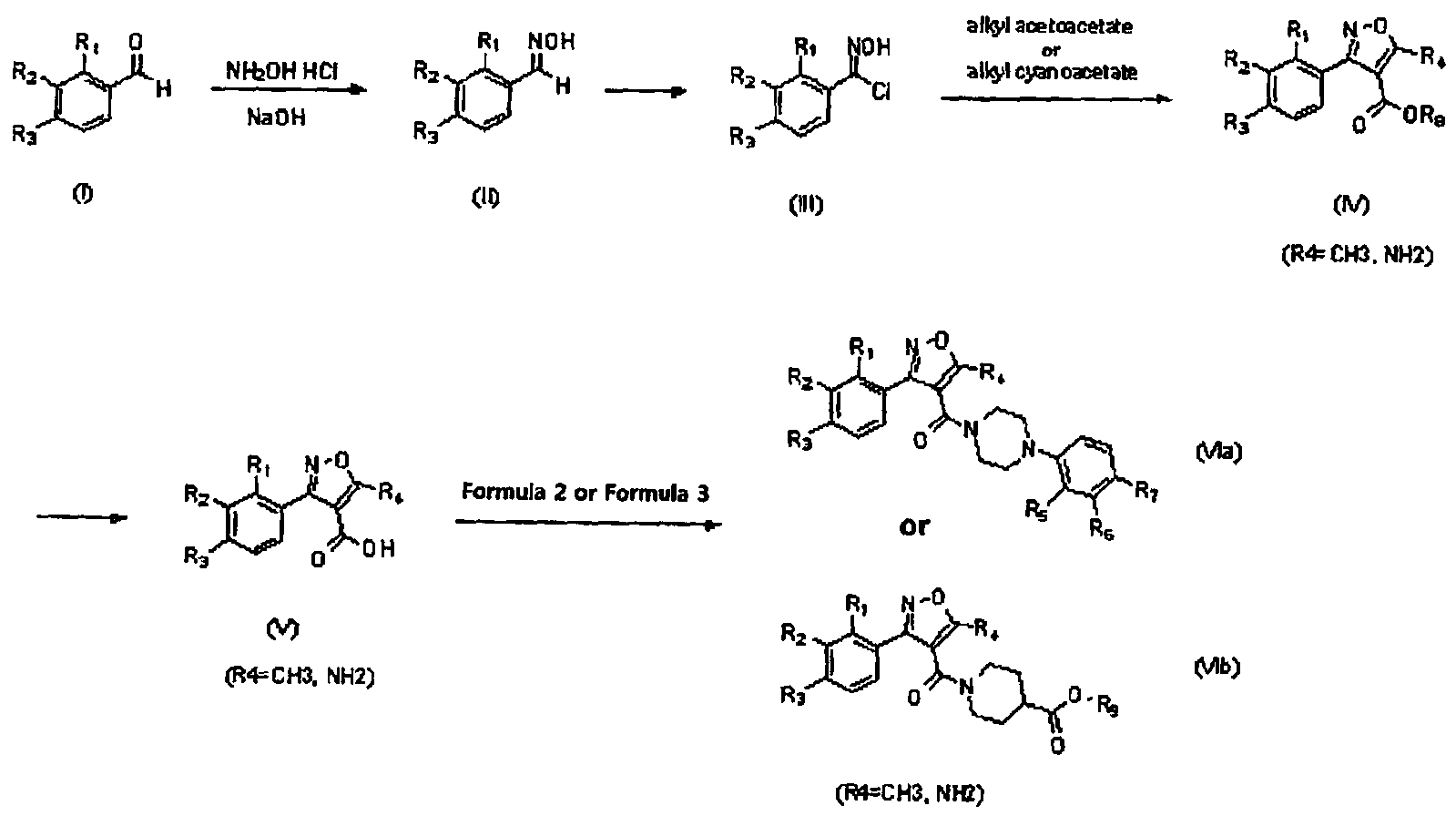
Reaction scheme 1
[Rectified under Rule 91 01.05.2012]
Figure WO-DOC-FIGURE-87
In Reaction scheme 1 above, R1 to R10 are the same as defined above.
A phenylaldehyde compound (I) having R1, R2 and R3 substituted onto a benzene ring was commercially available. The phenylaldehyde compound (I) is reacted with hydroxylammoniumchloride or its equivalent in the presence of a base so as to synthesize a compound of benzaldehyde oxime (II). Then, through a chlorination reaction, a benzimidoyl chloride compound (III) is produced. An isoxazol compound (V) in which R4 is substituted with methyl or amine may be obtained through a generally used synthesis method (cyclization reaction) by using alkyl acetoacetate or alkyl cyanoacetate.  From a phenyl-isoxazol derivative compound (V, R4=methyl) or a compound (V, R4=amine) including a carboxyl group and an amine group, a phenyl-isoxazol derivative compound (VIa or VIb) is produced by using 1-ethyl-3-(3'-dimethylaminopropyl)carbodiimidehydrochloride (EDCl) or hydroxybenzotriazol (HOBt) in the presence of a base.
The inventive preparation method may be carried out preferably in a solvent in the presence of a base or an acid. Herein, there is no specific limitation in a solvent, an acid, and a baseas long as they have no adverse effect on the reaction. For example, the solvent may be at least one kind selected from the group consisting of tetrahydrofuran, methylenechloride, ethanol, N,N-dimethylformamide, N,N-dimethylacetamide, ethylacetate, tert-butanol, toluene, and dioxane. The base may be at least one kind selected from the group consisting of pyridine, triethylamine, diethylamine, sodium carbonate, potassium carbonate, sodium hydroxide, potassium hydroxide, sodium hydride, sodium methoxide, sodium ethoxide, sodium tert-butoxide, potassium tert-butoxide, lithium aluminum hydride, lithium borohydride, and sodium nitrate, and cesium carbonate. The acid may be at least one kind selected from the group consisting of trifluoroacetic acid, hydrochloric acid, nitric acid, sulfuric acid, bromic acid, and acetic acid.
Starting materialsused in the preparation of the inventive compounds according to the method are commercially available, or can be easily bought. The reaction may be generally carried out under a cooling or heating condition. After the reaction, through a general after-treatment process, such as column chromatography, recrystallization, etc. a final compound may be purified.
Meanwhile, the present inventionis related to a pharmaceutical compositionfor treating or preventing virus infection, in which the compound represented by Formula 1, or its pharmaceutically acceptable derivative is administered in an effective amount to mammals, including humans. Especially, the composition is effective in inhibiting influenza infection, and thus may be effectively used in the treatment of such an illness. 
When the inventive compounds determined to be effective in inhibiting the illness is administered, a single dose or a multiple dose generally ranges from 0.01 to 750mg/kg per day, preferably ranges from 0.1 to 100mg, and most preferably ranges from 0.5 to 25mg. However, the specific dose for an individual patient may vary according to a specific compound, a patient's weight, sex, diet, a drug administration time, an administration method, a release ratio, a drug mixing ratio, a patient's state, age, etc.
The inventive compound may be administered without being processed in the treatment. However, the active ingredient is preferably provided as a pharmaceutical formulation.  
Accordingly, the present invention provides a pharmaceutical formulation obtained by mixing a compound represented by Formula 1 or its pharmaceutically acceptable derivative with a pharmaceutically acceptable carrier and/or excipient.
Also, the inventive compoundmay be administered via any suitable route. However, preferably, the compound is administered by injection or in oral form.
An injection preparation, for example, a sterile injection aqueous or oily suspension, may be prepared by using an appropriate material such as a dispersant, a wetting agent or a suspension according to a known art. As a solvent, water, ringer's solution or isotonic NaCl solution may be used. Also, sterile fixed oil is also generally used as a solvent or a suspension medium. For this, any nonirritating fixed oil, including mono-glyceride or di-glyceride, may be used. Also, fatty acid such as oleic acid may used in injection preparation.
A solid administration form for oral administration may include capsule, tablet, pill, powder and granule forms. Especially, capsule and tablet forms are preferred. Preferably, tablet and pill forms are prepared as intestinal drugs. The solid administration form may be prepared by mixing the inventive active compound represented by Formula 1 with at least one inert diluent (such as sucrose, lactose, starch), a lubricant (such as magnesium stearate), and a carrier (such as a disintegrating agent, a binding agent, etc.).
The inventive compound has an inhibiting activity against a strain of an influenza virus, and may be used to treat and prevent infection of influenza having susceptibility to a Neuraminidase inhibitor or a virus replication inhibitor inhibiting virus replication, and other similar viruses. Herein, it may be used in combination with a secondary therapeutic agent having an activity against the same virus. This compound, for example, may be used in combination with Zanamivir, Oseltamivir, Amantadine, Rimantadine or the like. The administration amount of each compound may be the same or different, compared to the administration amount of the compound alone. 
Hereinafter, the present invention will be described in more detail with reference to Preparation Examples and Examples. However, Preparation Examples and Examples, as described below, are illustrative only, and do not limit the present invention.
Preparation Example 1
synthesis of 2-(trifluoromethyl)benzaldehydeoxime
2-(trifluoromethyl)benzaldehyde (34.82g, 200.0mmol) was dissolved in ethanol (200mL), and added with sodium hydroxide (12.00g, 300.0mmol) dissolved in purified water (50mL). Hydrochloric acidhydroxylamine (16.68g, 240mmol) dissolved in purified water (50mL) was added thereto, followed by stirring for 3 hours. After the reaction was completed, the resultant product was added with ice. The produced solid was filtered, washed with purified water (600mL), and dried so as to provide a white solid required compound (32.15g, 171mmol, 85%).
1H-NMR(400㎒, CDCl3, δ) = 7.23 (dd, 1H), 7.59 (dd, 1H), 7.76 (m, 2H), 8.39 (s, 1H), 11.63 (s, 1H)
Preparation Example 2
synthesis of 2-chlorobenzaldehydeoxime
In a similar manner as described in Preparation Example 1, by using 2-chlorobenzaldehyde (29.14g, 200.0mmol), sodium hydroxide (12.00g, 300.0mmol) and hydrochloric acidhydroxylamine (16.68g, 240mmol), a white solid required compound (29.73g, 189mmol, 95%)was obtained. 
1H-NMR(400㎒, CDCl3, δ) = 7.37 (m, 2H), 7.48 (dd, 1H), 7.82 (dd, 1H), 8.37 (s, 1H), 11.28 (s, 1H)
Preparation Example 3
synthesis of 3-fluorobenzaldehydeoxime
In a similar manner as described in Preparation Example 1, by using 3-fluorobenzaldehyde (24.82g, 200.0mmol), sodium hydroxide (12.00g, 300.0mmol) and hydrochloric acidhydroxylamine (16.68g, 240mmol), a white solid required compound (22.48g, 162mmol, 81%) was obtained.
1H-NMR(400㎒, CDCl3, δ) = 7.32 (m, 1H), 7.56 (m, 3H), 8.20 (s, 1H)
Preparation Example 4
synthesis of 2-fluorobenzaldehydeoxime
In a similar manner as described in Preparation Example 1, by using 2-fluorobenzaldehyde (24.82g, 200.0mmol), sodium hydroxide (12.00g, 300.0mmol) and hydrochloric acidhydroxylamine (16.68g, 240mmol), a white solid required compound(25.96g, 186mmol, 93%) was obtained.
1H-NMR(400㎒, CDCl3, δ) = 7.22 (m, 1H), 7.45 (m, 1H), 7.65 (m, 2H), 8.15 (s, 1H)
Preparation Example 5
synthesis of 4-(trifluoromethoxy)benzaldehydeoxime
In a similar manner as described in Preparation Example 1, by using 4-(trifluoromethoxy)benzaldehyde (38.02g, 200.0mmol), sodium hydroxide (12.00g, 300.0mmol) and hydrochloric acidhydroxylamine (16.68g, 240mmol), a white solid required compound(38.68g, 188mmol, 94%) was obtained.
1H-NMR(400㎒, CDCl3, δ) = 7.38 (d, 2H), 7.72 (tt, 2H), 8.20 (s, 1H), 11.43 (s, 1H)
Preparation Example 6
synthesis of 2-(trifluoromethoxy)benzaldehydeoxime
In a similar manner as described in Preparation Example 1, by using 2-(trifluoromethoxy)benzaldehyde (38.03g, 200.0mmol), sodium hydroxide (12.00g, 300.0mmol) and hydrochloric acidhydroxylamine (16.6g, 240mmol), a white solid required compound(38.67g, 188mmol, 94%) was obtained.
1H-NMR(400㎒, CDCl3, δ) = 7.43 (m, 2H), 7.54 (m, 1H), 7.89 (m, 1H), 8.24 (s, 1H), 11.76 (s, 1H)
Preparation Example 7
synthesis of 3-(trifluoromethyl)benzaldehydeoxime
In a similar manner as described in Preparation Example 1, by using 3-(trifluoromethyl)benzaldehyde (34.82g, 200.0mmol), sodium hydroxide (12.00g, 300.0mmol) and hydrochloric acidhydroxylamine (16.68g, 240mmol), a white solid required compound(35.33g, 187mmol, 93%) was obtained.
1H-NMR(400㎒, CDCl3, δ) = 7.33 (m, 1H), 7.72 (m, 3H), 8.44 (s, 1H), 11.62 (s, 1H)
Preparation Example 8
synthesis of 3-(trifluoromethoxy)benzaldehydeoxime
In a similar manner as described in Preparation Example 1, by using 3-(trifluoromethoxy)benzaldehyde(38.03g, 200.0mmol), sodium hydroxide (12.00g, 300.0mmol) and hydrochloric acidhydroxylamine (16.6g, 240mmol), a white solid required compound (39.74g, 193mmol, 97%) was obtained.
1H-NMR(400㎒, CDCl3, δ) = 7.53 (m, 1H), 7.69 (m, 3H), 8.31 (s, 1H), 11.71 (s, 1H)
Preparation Example 9
synthesis of N-hydroxy-2-(trifluoromethyl)benzimidoylchloride
2-(trifluoromethyl)benzaldehydeoxime (30.0g, 158.60mmol) was dissolved in dimethylformimide (300mL), and added with N-chlorosuccinimide (23.31g, 174.46mmol), followed by stirring for 15 hours. After the reaction was completed, the resultant solution was vacuum evaporated, added with ethylacetate (1,500mL), washed with saturated sodium chloride aqueous solution (1,000mL) and purified water (1,000mL), respectively, dried with anhydrous sodium sulfate, and vacuum-evaporated to provide a pale yellow solid required compound(32.81g, 146.70mmol, 93%).
1H-NMR(400㎒, CDCl3, δ) = 7.73 (m, 2H), 7.80 (t, 1H), 7.86 (d, 1H), 12.61 (s, 1H)
Preparation Example 10
synthesis of 2-chloro-N-hydroxybenzimidoylchloride
In a similar manner as described in Preparation Example 9, by using dimethylformamide (240mL), 2-chlorobenzaldehydeoxime (19.97g, 128.32mmol) and N-chlorosuccinimide(18.85g, 141.14mmol), a pale yellow solid required compound(20.04g, 105.21mmol, 82%) was obtained. 
1H-NMR(400㎒,CDCl3, δ) = 7.46 (m, 1H), 7.54 (m. 1H), 7.58 (m, 2H), 12.54 (s, 1H)
Preparation Example 11
synthesis of 3-fluoro-N-hydroxybenzimidoylchloride
In a similar manner as described in Preparation Example 9, by using dimethylformamide (240mL), 3-fluorobenzaldehydeoxime (20.0g, 143.77mmol) and N-chlorosuccinimide(21.12g, 158.12mmol), a pale yellow solid required compound(22.52g, 129.79mmol, 90%) was obtained. 
1H-NMR(400㎒, CDCl3, δ) = 7.37 (m, 1H), 7.60 (m, 3H)
Preparation Example 12
synthesis of 2-fluoro-N-hydroxybenzimidoylchloride
In a similar manner as described in Preparation Example 9, by using dimethylformamide (240mL), 2-fluorobenzaldehydeoxime (20.0g, 143.76mmol) and N-chlorosuccinimide (21.12g, 158.12mmol), a pale yellow solid required compound(23.32g, 134.40mmol, 94%) was obtained. 
1H-NMR(400㎒, CDCl3, δ) = 7.29 (m, 1H), 7.47 (m, 1H), 7.62 (m, 2H)
Preparation Example 13
synthesis of N-hydroxy-4-(trifluoromethoxy)benzimidoylchloride
In a similar manner as described in Preparation Example 9, by using dimethylformamide (240mL), 4-(trifluoromethoxy)benzaldehydeoxime (20.0g, 97.51mmol) and N-chlorosuccinimide (14.31g, 107.26mmol), a pale yellow solid required compound(21.10g, 88.04mmol, 90%) was obtained. 
1H-NMR(400㎒, CDCl3, δ) = 7.47 (dd, 1H), 7.72 (tt, 2H), 12.60 (s, 1H)
Preparation Example 14
synthesis of N-hydroxy-2-(trifluoromethoxy)benzimidoylchloride
In a similar manner as described in Preparation Example 9, by using dimethylformamide (240mL), 4-(trifluoromethoxy)benzaldehydeoxime (20.0g, 97.50mmol) and N-chlorosuccinimide (14.32g, 107.26mmol), a pale yellow solid required compound(19.48g, 81.30mmol, 83%)was obtained. 
1H-NMR(400㎒, CDCl3, δ) = 7.49 (m, 1H), 7.62 (m, 1H), 7.68 (dd, 1H), 12.67 (s, 1H)
Preparation Example 15
synthesis of N-hydroxy-3-(trifluoromethyl)benzimidoylchloride
In a similar manner as described in Preparation Example 9, by using 3-(trifluoromethyl)benzaldehydeoxime (30.0g, 158.60mmol), dimethylformimide (300mL) and N-chlorosuccinimide (23.31g, 174.46mmol), a pale yellow solid required compound(33.81g, 151.22mmol, 95%) was obtained.
1H-NMR(400㎒, CDCl3, δ) = 7.79 (m, 3H), 7.83 (m, 1H), 12.64 (s, 1H)
Preparation Example 16
synthesis of N-hydroxy-3-(trifluoromethoxy)benzimidoylchloride
In a similar manner as described in Preparation Example 9, by using dimethylformamide (240mL), 3-(trifluoromethoxy)benzaldehydeoxime (20.0g, 97.50mmol) and N-chlorosuccinimide (14.32g, 107.26mmol), a pale yellow solid required compound(19.43g, 81.10mmol, 82%)was obtained. 
1H-NMR(400㎒, CDCl3, δ) = 7.56 (m, 1H), 7.64 (m, 3H), 12.61 (s, 1H)
Preparation Example 17
synthesis of methyl-5-methyl-3-(2-(trifluoromethyl)phenyl)isoxazol-4-carboxylate
N-hydroxy-2-(trifluoromethyl)benzimidoylchloride (8.0g, 35.78mmol) and methylacetoacetate (8.30g, 71.56mmol) were dissolved in methanol (160mL). The resultant solution was stirred for 30 minutes while the reactor was cooled to -10℃ Then, sodium methoxide (5.80g, 107.34mmol) was slowly added thereto. The resultant product was warmed up to room temperature, stirred for 3 hours, and vacuum-evaporated to remove methanol. Then, ethylacetate (200mL) was added thereto. The resultant product was washed with purified water (200mL) and saturated sodium chloride aqueous solution (200mL), respectively, dried with anhydroussodium sulfate, and vacuum-evaporated. Through column chromatography, a purified white solid required compound(5.79g, 20.31mmol, 57%)was obtained.
1H-NMR(400㎒, CDCl3, δ) = 2.75 (s, 3H), 3.58 (s, 3H), 7.56 (m, 1H), 7.78 (m, 1H), 7.90 (m, 1H)
Preparation Example 18
synthesis of methyl-3-(2-chlorophenyl)-5-methylisoxazol-4-carboxylate
In a similar manner as described in Preparation Example 17, by using methanol (160mL), 2-chloro-N-hydroxybenzimidoylchloride (8.0g, 42.10mmol), methylacetoacetate (9.78g, 84.20mmol) and sodium methoxide(6.83g, 126.30mmol), a white solid required compound (6.32g, 25.11mmol, 60%) was obtained.
1H-NMR(400㎒, CDCl3, δ) = 2.59 (s, 3H), 3.86 (s, 3H), 7.62 (m, 3H)
Preparation Example 19
synthesis of methyl-3-(3-fluorophenyl)-5-methylisoxazol-4-carboxylate
In a similar manner as described in Preparation Example 17, by using methanol (160mL), 3-fluoro-N-hydroxybenzimidoyl chloride (8.00g, 46.09mmol), methylacetoacetate (10.07g, 92.18mmol) and sodium methoxide(7.47g, 138.27mmol), a white solid required compound (7.60g, 32.14mmol, 70%) was obtained.
1H-NMR(400㎒, CDCl3, δ) = 2.58 (s, 3H), 3.91 (s, 3H), 7.21 (m, 1H), 7.42 (m, 3H)
Preparation Example 20
synthesis of methyl-3-(2-fluorophenyl)-5-methylisoxazol-4-carboxylate
In a similar manner as described in Preparation Example 17, by using methanol (160mL), 2-fluoro-N-hydroxybenzimidoyl chloride (8.00g, 46.09mmol), methylacetoacetate (10.07g, 92.18mmol) and sodium methoxide (7.47g, 138.27mmol), a white solid required compound (7.84g, 33.33mmol, 72%) was obtained.
1H-NMR(400㎒, CDCl3, δ) = 2.59 (s, 3H), 3.92 (s, 3H), 7.22 (m, 1H), 7.43 (m, 1H), 7.55 (m, 2H)
Preparation Example 21
synthesis of methyl-5-methyl-3-(4-(trifluoromethoxy)phenyl)isoxazol-4-carboxylate
In a similar manner as described in Preparation Example 17, by using methanol (160mL), N-hydroxy-4-(trifluoromethoxy)benzimidoylchloride (8.00g, 33.39mmol), methylacetoacetate (7.76g, 66.78mmol) and sodium methoxide (5.41g, 100.17mmol), a white solid required compound (6.74g, 22.36mmol, 67%) was obtained.
1H-NMR(400㎒, CDCl3, δ) = 2.71 (s, 3H), 3.73 (s, 3H), 7.48 (d, 2H), 7.76 (d, 2H)
Preparation Example 22
synthesis of methyl-5-methyl-3-(2-(trifluoromethoxy)phenyl)isoxazol-4-carboxylate
In a similar manner as described in Preparation Example 17, by using methanol (160mL), N-hydroxy-4-(trifluoromethoxy)benzimidoylchloride (8.00g, 33.39mmol), methylacetoacetate (7.76g, 66.78mmol) and sodium methoxide (5.41g, 100.17mmol), a white solid required compound (7.04g, 23.37mmol, 70%) was obtained.
1H-NMR(400㎒, CDCl3, δ) = 2.73 (s, 3H), 3.64 (s, 3H), 7.53 (m, 1H), 7.61 (m, 1H), 7.69 (m, 1H)
Preparation Example 23
synthesis of methyl-5-methyl-3-(3-(trifluoromethyl)phenyl)isoxazol-4-carboxylate
In a similar manner as described in Preparation Example 17, by using methanol (160mL), N-hydroxy-3-(trifluoromethyl)benzimidoylchloride (8.0g, 35.78mmol), methylacetoacetate (8.30g, 71.56mmol) and sodium methoxide (5.80g, 107.34mmol), a white solid required compound (5.82g, 20.41mmol, 57%) was obtained.
1H-NMR(400㎒, CDCl3, δ) = 2.73 (s, 3H), 3.56 (s, 3H), 7.58 (m, 1H), 7.97 (m, 3H)
Preparation Example 24
synthesis of methyl-5-methyl-3-(3-(trifluoromethoxy)phenyl)isoxazol-4-carboxylate
In a similar manner as described in Preparation Example 17, by using methanol (160mL), N-hydroxy-3-(trifluoromethoxy)benzimidoylchloride (8.00g, 33.39mmol), methylacetoacetate (7.76g, 66.78mmol) and sodium methoxide (5.41g, 100.17mmol), a white solid required compound (6.82g, 22.64mmol, 68%) was obtained.
1H-NMR(400㎒, CDCl3, δ) = 2.76 (s, 3H), 3.62 (s, 3H), 7.54 (m, 1H), 7.61 (m, 3H)
Preparation Example 25
synthesis of 5-methyl-3-(2-(trifluoromethyl)phenyl)isoxazol-4-carboxylic acid
methyl 5-methyl-3-(2-(trifluoromethyl)phenyl)isoxazol-4-carboxylate (6.0g, 21.03mmol) was dissolved in methanol (60mL), added with 3% sodium hydroxide aqueous solution (60mL), stirred at 30℃for 7hours, and vacuum-evaporated so as to remove methanol. The remaining solution was washed with ethyl acetate (20mL), and the aqueous layer was neutralized by a hydrochloric acid aqueous solution. Then, the produced crystal was filtered, washed with purified water (50mL), and dried so as to provide a white solid required compound (5.48g, 20.12mmol, 96%).
1H-NMR(400㎒, DMSO, δ) = 2.69 (s, 3H), 7.49 (m, 1H), 7.72 (m, 1H), 7.83 (m, 1H), 13.12 (brs, 1H)
Preparation Example 26
synthesis of 3-(2-chlorophenyl)-5-methylisoxazol-4-carboxylic acid
In a similar manner as described in Preparation Example 25, by using methanol (60mL), methyl-3-(2-chlorophenyl)-5-methylisoxazol-4-carboxylate (6.0g, 23.84mmol) and 3% sodium hydroxide aqueous solution(60mL), a white solid required compound(5.10g, 21.44mmol, 90%) was obtained.
1H-NMR(400㎒, DMSO, δ) = 2.75 (s, 3H), 7.46 (m, 2H), 7.53(m, 1H), 7.59 (m, 1H), 13.00 (brs, 1H)
Preparation Example 27
synthesis of 3-(3-fluorophenyl)-5-methylisoxazol-4-carboxylic acid
In a similar manner as described in Preparation Example 25, by using methanol (60mL), methyl-3-(3-fluorophenyl)-5-methylisoxazol-4-carboxylate (6.0g, 25.51mmol) and 3% sodium hydroxide aqueous solution (60mL), a white solid required compound(5.51g, 24.92mmol, 98%) was obtained.
1H-NMR(400㎒, DMSO, δ) = 2.58 (s, 3H), 7.21 (m, 1H), 7.42 (m, 3H), 13.04 (brs, 1H)
Preparation Example 28
synthesis of 3-(3-fluorophenyl)-5-methylisoxazol-4-carboxylic acid
In a similar manner as described in Preparation Example 25, by using methanol (60mL), methyl-3-(3-fluorophenyl)-5-methylisoxazol-4-carboxylate (6.0g, 25.51mmol) and 3% sodium hydroxide aqueous solution(60mL), a white solid required compound (5.21g, 23.44mmol, 92%) was obtained.
1H-NMR(400㎒, DMSO, δ) = 2.60 (s, 3H), 7.21 (m, 1H), 7.43 (m, 1H), 7.54 (m, 2H)
Preparation Example 29
synthesis of 5-methyl-3-(4-(trifluoromethoxy)phenyl)isoxazol-4-carboxylic acid
In a similar manner as described in Preparation Example 25, by using methanol (60mL), methyl-5-methyl-3-(4-(trifluoromethoxy)phenyl)isoxazol-4-carboxylate (6.0g, 19.91mmol) and 3% sodium hydroxide aqueous solution(60mL), a white solid required compound(5.55g, 19.32mmol, 97%) was obtained.
1H-NMR(400㎒, DMSO, δ) = 2.71 (s, 3H), 7.48 (d, 2H), 7.76 (d, 2H), 13.15 (brs, 1H)
Preparation Example 30
synthesis of 5-methyl-3-(2-(trifluoromethoxy)phenyl)isoxazol-4-carboxylic acid
In a similar manner as described in Preparation Example 25, by using methanol (60mL), methyl-5-methyl-3-(2-(trifluoromethoxy)phenyl)isoxazol-4-carboxylate (6.0g, 19.91mmol) and 3% sodium hydroxide aqueous solution (60mL), a white solid required compound (5.34g, 18.59mmol, 93%) was obtained.
1H-NMR(400㎒, DMSO, δ) = 2.72 (s, 3H), 7.50 (m, 2H), 7.58 (m, 1H), 7.67 (m, 1H), 13.62 (brs, 1H)
  
Preparation Example 31
synthesis of 5-methyl-3-(3-(trifluoromethyl)phenyl)isoxazol-4-carboxylic acid
In a similar manner as described in Preparation Example 25, by using methanol (60mL), methyl-5-methyl-3-(3-(trifluoromethyl)phenyl)isoxazol-4-carboxylate (6.0g, 21.03mmol) and 3% sodium hydroxide aqueous solution(60mL), a white solid required compound(5.37g, 19.80mmol, 94%) was obtained.
1H-NMR(400㎒, DMSO, δ) = 2.67 (s, 3H), 7.48 (m, 1H), 7.80 (m, 3H), 13.11 (brs, 1H) 
Preparation Example 32
synthesis of 5-methyl-3-(3-(trifluoromethoxy)phenyl)isoxazol-4-carboxylic acid
In a similar manner as described in Preparation Example 25, by using methanol (60mL), methyl-5-methyl-3-(3-(trifluoromethoxy)phenyl)isoxazol-4-carboxylate(6.0g, 19.91mmol) and 3% sodium hydroxide aqueous solution (60mL), a white solid required compound(5.47g, 19.04mmol, 96%) was obtained.
1H-NMR(400㎒, DMSO, δ) = 2.71 (s, 3H), 7.48 (m, 2H), 7.64 (m, 2H), 13.57 (brs, 1H)
Preparation Example 33
synthesis of methyl-5-amino-3-(2-(trifluoromethyl)phenyl)isoxazol-4-carboxylate
In a similar manner as described in Preparation Example 17, by using methanol (160mL), N-hydroxy-2-(trifluoromethyl)benzimidoyl chloride (8.00g, 33.39mmol), methylcyanoacetate (4.14g, 41.74mmol) and sodium methoxide (3.61g, 66.78mmol), a white solid required compound (8.13g, 28.42mmol, 85%) was obtained.
1H-NMR(400㎒, DMSO, δ) = 3.59 (s, 3H), 6.12 (brs, 2H), 7.36 (m, 1H), 7.57 (m, 2H), 7.69 (m, 1H)
Preparation Example 34
synthesis of methyl-5-amino-3-(2-chlorophenyl)isoxazol-4-carboxylate
In a similar manner as described in Preparation Example 17, by using methanol (160mL), 2-chloro-N-hydroxybenzimidoylchloride (8.00g, 42.10mmol), methylcyanoacetate (5.22g, 52.63mmol) and sodium methoxide (4.55g, 84.20mmol), a white solid required compound(9.40g, 37.21mmol, 88%) was obtained.
1H-NMR(400㎒, DMSO, δ) = 3.65 (s, 3H), 6.20(brs, 2H), 7.41 (m, 4H)
Preparation Example 35
synthesis of methyl 5-amino-3-(3-fluorophenyl)isoxazol-4-carboxylate
In a similar manner as described in Preparation Example 17, by using methanol (160mL), 3-fluoro-N-hydroxybenzimidoyl chloride (8.00g, 46.09mmol), methylcyanoacetate (5.94g, 59.92mmol) and sodium methoxide (4.98g, 92.18mmol), a white solid required compound (8.42g, 35.64mmol, 77%) was obtained.
1H-NMR(400㎒, CDCl3, δ) = 3.92 (s, 3H), 6.30 (brs, 2H), 7.21 (m, 1H), 7.42 (m, 3H)
Preparation Example 36
synthesis of methyl-5-amino-3-(2-fluorophenyl)isoxazol-4-carboxylate
In a similar manner as described in Preparation Example 17, by using methanol (160mL), 2-fluoro-N-hydroxybenzimidoyl chloride (8.00g, 46.09mmol), methylcyanoacetate (5.94g, 59.92mmol) and sodium methoxide (4.98g, 92.18mmol), a white solid required compound(8.23g, 34.82mmol, 76%) was obtained.
1H-NMR(400㎒, CDCl3, δ) = 3.89 (s, 3H), 6.31 (brs, 2H), 7.22 (m, 1H), 7.41 (m, 1H), 7.55 (m, 2H)
Preparation Example 37
synthesis of methyl 5-amino-3-(4-(trifluoromethoxy)phenyl)isoxazol-4-carboxylate
In a similar manner as described in Preparation Example 17, by using methanol (160mL), N-hydroxy-4-(trifluoromethoxy)benzimidoylchloride (8.00g, 33.39mmol), methylcyanoacetate (4.31g, 43.41mmol) and sodium methoxide (3.61g, 66.78mmol), a white solid required compound(8.27g, 27.35mmol, 82%) was obtained.
1H-NMR(400㎒, DMSO, δ) = 3.51 (s, 3H), 6.21 (brs, 2H), 7.26 (d, 2H), 7.77 (d, 2H)
Preparation Example 38
synthesis of methyl 5-amino-3-(2-(trifluoromethoxy)phenyl)isoxazol-4-carboxylate
In a similar manner as described in Preparation Example 17, by using methanol (160mL), N-hydroxy-2-(trifluoromethoxy)benzimidoylchloride (8.00g, 33.39mmol), methylcyanoacetate (4.31g, 43.41mmol) and sodium methoxide (3.61g, 66.78mmol), a white solid required compound(9.07g, 30.02mmol, 90%) was obtained.
1H-NMR(400㎒,DMSO, δ) = 3.38 (s, 3H), 6.18 (brs, 2H), 7.41 (m, 2H), 7.42 (m, 1H), 7.47 (m, 1H)
  
Preparation Example 39
synthesis of methyl-5-amino-3-(3-(trifluoromethyl)phenyl)isoxazol-4-carboxylate
In a similar manner as described in Preparation Example 17, by using methanol (160mL), N-hydroxy-3-(trifluoromethyl)benzimidoylchloride (8.00g, 33.39mmol), methylcyanoacetate (4.14g, 41.74mmol) and sodium methoxide (3.61g, 66.78mmol), a white solid required compound(7.46g, 26.06mmol, 78%) was obtained.
1H-NMR(400㎒, DMSO, δ) = 3.61 (s, 3H), 6.11 (brs, 2H), 7.32 (m, 1H), 7.62 (m, 3H)
Preparation Example 40
synthesis of methyl-5-amino-3-(3-(trifluoromethoxy)phenyl)isoxazol-4-carboxylate
In a similar manner as described in Preparation Example 17, by using methanol (160mL), N-hydroxy-3-(trifluoromethoxy)benzimidoylchloride (8.00g, 33.39mmol), methylcyanoacetate (4.31g, 43.41mmol) and sodium methoxide (3.61g, 66.78mmol), a white solid required compound(8.42g, 27.87mmol, 83%) was obtained.
1H-NMR(400㎒,DMSO, δ) = 3.42 (s, 3H), 6.22 (brs, 2H), 7.46 (m, 2H), 7.53 (m, 2H)
Preparation Example 41
synthesis of 5-amino-3-(2-(trifluoromethyl)phenyl)isoxazol-4-carboxylic acid
In a similar manner as described in Preparation Example 25, by using methanol (60mL), 5-amino-3-(2-(trifluoromethyl)phenyl)isoxazol-4-carboxylate (6.0g, 20.96mmol) and 3% sodium hydroxide aqueous solution (60mL), a white solid required compound(4.06g, 14.92mmol, 71%) was obtained.
1H-NMR(400㎒, DMSO, δ) = 7.40 (m, 1H), 7.70 (m, 2H), 7.76 (m, 1H), 7.81 (brs, 2H), 12.18 (brs, 1H)
Preparation Example 42
synthesis of 5-amino-3-(2-chlorophenyl)isoxazol-4-carboxylic acid
In a similar manner as described in Preparation Example 25, by using methanol (60mL), methyl-5-amino-3-(2-chlorophenyl)isoxazol-4-carboxylate (6.0g, 23.75mmol) and 3% sodium hydroxide aqueous solution (60mL), a white solid required compound(3.66g, 15.33mmol, 65%) was obtained.
1H-NMR(400㎒, DMSO, δ) = 7.45 (m, 3H), 7.54 (m, 1H), 7.85 (brs, 2H), 12.04 (brs, 1H)
Preparation Example 43
synthesis of 5-amino-3-(3-fluorophenyl)isoxazol-4-carboxylic acid
In a similar manner as described in Preparation Example 25, by using methanol (60mL), methyl-5-amino-3-(3-fluorophenyl)isoxazol-4-carboxylate (6.0g, 25.40mmol) and 3% sodium hydroxide aqueous solution (60mL), a white solid required compound(3.08g, 13.86mmol, 55%) was obtained.
1H-NMR(400㎒, DMSO, δ) = 6.28 (brs, 2H), 7.20 (m, 1H), 7.44 (m, 3H)
Preparation Example 44
synthesis of 5-amino-3-(2-fluorophenyl)isoxazol-4-carboxylic acid
In a similar manner as described in Preparation Example 25, by using methanol (60mL), methyl-5-amino-3-(2-fluorophenyl)isoxazol-4-carboxylate (6.0g, 25.40mmol) and 3% sodium hydroxide aqueous solution (60mL), a white solid required compound(3.18g, 14.33mmol, 56%) was obtained.
1H-NMR(400㎒, DMSO, δ) = 6.22 (brs, 2H), 7.25 (m, 1H), 7.45 (m, 1H), 7.59 (m, 2H), 12.13 (brs, 1H)
Preparation Example 45
synthesis of 5-amino-3-(4-(trifluoromethoxy)phenyl)isoxazol-4-carboxylic acid
In a similar manner as described in Preparation Example 25, by using methanol (60mL), methyl-5-amino-3-(4-(trifluoromethoxy)phenyl)isoxazol-4-carboxylate (6.0g, 19.85mmol) and 3% sodium hydroxide aqueous solution (60mL), a white solid required compound (4.32g, 15.02mmol, 76%) was obtained.
1H-NMR(400㎒, DMSO, δ) = 7.31 (d, 2H), 7.83 (d, 2H), 7.85 (brs, 2H), 12.01 (brs, 1H)
 
Preparation Example 46
synthesis of 5-amino-3-(2-(trifluoromethoxy)phenyl)isoxazol-4-carboxylic acid
In a similar manner as described in Preparation Example 25, by using methanol (60mL), methyl-5-amino-3-(2-(trifluoromethoxy)phenyl)isoxazol-4-carboxylate (6.0g, 19.85mmol) and 3% sodium hydroxide aqueous solution (60mL), a white solid required compound(4.00g, 13.89mmol, 70%) was obtained.
1H-NMR(400㎒, DMSO, δ) = 7.45 (m, 3H), 7.59 (m, 1H), 7.82 (brs, 2H), 12.04 (brs, 1H)
Preparation Example 47
synthesis of 5-amino-3-(3-(trifluoromethyl)phenyl)isoxazol-4-carboxylic acid
In a similar manner as described in Preparation Example 25, by using methanol (60mL), 5-amino-3-(3-(trifluoromethyl)phenyl)isoxazol-4-carboxylate (6.0g, 20.96mmol) and 3% sodium hydroxide aqueous solution(60mL), a white solid required compound(4.14g, 15.21mmol, 73%) was obtained.
1H-NMR(400㎒, DMSO, δ) = 7.34 (m, 1H), 7.68 (m, 3H), 7.87 (brs, 2H), 12.31 (brs, 1H)
Preparation Example 48
synthesis of 5-amino-3-(3-(trifluoromethoxy)phenyl)isoxazol-4-carboxylic acid
In a similar manner as described in Preparation Example 25, by using methanol (60mL), methyl 5-amino-3-(3-(trifluoromethoxy)phenyl)isoxazol-4-carboxylate (6.0g, 19.85mmol) and 3% sodium hydroxide aqueous solution (60mL), a white solid required compound(4.16g, 14.43mmol, 73%) was obtained.
1H-NMR(400㎒, DMSO, δ) = 7.43 (m, 3H), 7.63 (m, 1H), 7.84 (brs, 2H), 12.04 (brs, 1H)
Example 1
synthesis of (4-(2-fluorophenyl)piperazine-1-yl)(5-methyl-3-(2-(trifluoromethyl)phenyl)isoxazol-4-yl)methanone
5-methyl-3-(2-(trifluoromethyl)phenyl)isoxazol-4-carboxylic acid (500mg, 1.84mmol), 1-ethyl-3-(dimethylaminopropyl)carbodiimide hydrochloride(388mg, 2.02mmol) and 1-(2-fluorophenyl)piperazine(332mg, 1.84mmol) were dissolved in dichloromethane (30mL), and stirred at room temperature for 8 hours. The resultant solution was washed with saturated sodium carbonate aqueous solution (30mL), purified water (30mL) and saturated sodium chloride aqueous solution (30mL), respectively. Then, the organic layer was dried with anhydrous sodium sulfate, concentrated, and purified with column chromatographyso as to provide a white solid required compound (528mg, 1.34mmol, 73%).
1H-NMR(400㎒, CDCl3, δ) = 2.56 (s, 3H), 2.73 (brs, 2H), 3.01 (brs, 2H), 3.41 (brs, 2H), 3.72 (brs, 2H), 6.04 (m, 3H), 6.81 (t, 1H), 7.49 (m, 1H), 7.72 (m, 1H), 7.83 (m, 1H)
Example 2
synthesis of (4-(3,4-dichlorophenyl)piperazine-1-yl)(5-methyl-3-(2-(trifluoromethyl)phenyl)isoxazol-4-yl)methanone
In a similar manner as described in Example 1, by using dichloromethane (30mL), 5-methyl-3-(2-(trifluoromethyl)phenyl)isoxazol-4-carboxylic acid (500mg, 1.84mmol), 1-ethyl-3-(dimethylaminopropyl)carbodiimide hydrochloride (388mg, 2.02mmol) and 1-(3,4-dichlorophenyl)piperazine (425mg, 1.84mmol), a white solid required compound(644mg, 1.33mmol, 72%) was obtained.
1H-NMR(400㎒, CDCl3, δ) = 2.58 (s, 3H), 2.75 (brs, 2H), 3.03 (brs, 2H), 3.42 (brs, 2H), 3.74 (brs, 2H), 6.69 (dd, 1H), 6.89 (d, 1H), 7.28 (m, 1H), 7.55 (d, 1H), 7.64 (m, 2H), 7.82 (d, 2H)
Example 3
synthesis of (4-(3-methoxyphenyl)piperazine-1-yl)(5-methyl-3-(2-(trifluoromethyl)phenyl)isoxazol-4-yl)methanone
In a similar manner as described in Example 1, by using dichloromethane (30mL), 5-methyl-3-(2-(trifluoromethyl)phenyl)isoxazol-4-carboxylic acid (500mg, 1.84mmol), 1-ethyl-3-(dimethylaminopropyl)carbodiimide hydrochloride (388mg, 2.02mmol) and 1-(3-methoxyphenyl)piperazine (354mg, 1.84mmol), a gel-like required compound (602mg, 1.35mmol, 73%) was obtained.
1H-NMR(400㎒, CDCl3, δ) = 2.64 (brs, 2H), 2.67 (s, 3H), 3.13 (brs, 2H), 3.38 (brs, 2H), 4.06 (brs, 2H), 6.43 (brs, 1H), 6.53 (m, 2H), 7.39 (dd, 1H), 7.49 (m, 1H), 7.70 (m, 1H), 7.80 (dd, 1H), 7.81 (m, 1H)
Example 4
synthesis of (4-(2-methoxyphenyl)piperazine-1-yl)(5-methyl-3-(2-trifluoromethyl)phenyl)isoxazol-4-yl)methanone
In a similar manner as described in Example 1, by using dichloromethane (30mL), 5-methyl-3-(2-(trifluoromethyl)phenyl)isoxazol-4-carboxylic acid (500mg, 1.84mmol), 1-ethyl-3-(dimethylaminopropyl)carbodiimide hydrochloride (388mg, 2.02mmol) and 1-(2-methoxyphenyl)piperazine (354mg, 1.84mmol), a white solid required compound(504mg, 1.13mmol, 62%) was obtained.
1H-NMR(400㎒, CDCl3, δ) = 2.59 (S, 3H), 2.75 (brs, 2H), 3.06 (brs, 2H), 3.42 (brs, 2H), 3.76 (brs, 2H), 3.82 (s, 3H), 6.49 (brs, 1H), 6.49 (m, 2H), 7.19 (t, 1H), 7.55 (d, 1H), 7.67 (m, 2H), 7.82 (d, 1H)
Example 5
synthesis of (5-methyl-3-(2-(trifluoromethyl)phenyl)isoxazol-4-yl)(4-(3-(trifluoromethyl)phenyl)piperazine-1-yl)methanone
In a similar manner as described in Example 1, by using dichloromethane (30mL), 5-methyl-3-(2-(trifluoromethyl)phenyl)isoxazol-4-carboxylic acid (500mg, 1.84mmol), 1-ethyl-3-(dimethylaminopropyl)carbodiimide hydrochloride (388mg, 2.02mmol) and 1-(3-(trifluoromethyl)phenyl)piperazine(424mg, 1.84mmol), a gel-like required compound (593mg, 1.23mmol, 67%) was obtained.
1H-NMR(400㎒, CDCl3, δ) = 2.63 (brs, 2H), 2.69 (s, 3H), 3.15 (brs, 2H), 3.37 (brs, 2H), 3.39 (brs, 2H), 4.02 (brs, 2H), 6.91 (m, 2H), 7.03 (m, 1H), 7.26 (m, 1H), 7.51 (m, 1H), 7.70 (m, 2H), 7.82 (m, 1H)
Example 6
synthesis of (4-(4-hydroxyphenyl)piperazine-1-yl)(5-methyl-3-(2-(trifluoromethyl)phenyl)isoxazol-4-yl)methanone
In a similar manner as described in Example 1, by using dimethylformimide (15mL), 5-methyl-3-(2-(trifluoromethyl)phenyl)isoxazol-4-carboxylic acid (500mg, 1.84mmol), 1-ethyl-3-(dimethylaminopropyl)carbodiimide hydrochloride (388mg, 2.02mmol), hydroxybenzotriazole (299mg, 2.21mmol) and 4-(piperazine-1-yl)phenol (328mg, 1.84mmol), a white solid required compound (467mg, 1.08mmol, 59%) was obtained.
1H-NMR(400㎒, CDCl3, δ) = 2.64 (brs, H), 2.69 (s, 3H), 3.91 (brs, 4H), 6.78 (m, 4H), 7.49 (m, 2H), 7.72 (m, 1H), 7.83 (m, 1H)
Example 7
synthesis of (4-(2-hydroxyphenyl)piperazine-1-yl)(5-methyl-3-(2-(trifluoromethyl)phenyl)isoxazol-4-yl)methanone
In a similar manner as described in Example 1, by using dimethylformimide (15mL), 5-methyl-3-(2-(trifluoromethyl)phenyl)isoxazol-4-carboxylic acid (500mg, 1.84mmol), 1-ethyl-3-(dimethylaminopropyl)carbodiimide hydrochloride (388mg, 2.02mmol), hydroxybenzotriazole (299mg, 2.21mmol) and 2-(piperazine-1-yl)phenol (328mg, 1.84mmol), a white solid required compound(451mg, 1.05mmol, 57%) was obtained.
1H-NMR(400㎒, CDCl3, δ) = 2.49 (brs, 2H), 2.61 (s, 3H), 2.78 (brs, 2H), 3.50 (brs, 2H), 3.80 (brs, 2H), 6.93 (m, 3H), 7.13 (m, 1H), 7.58 (m, 1H), 7.70 (m, 2H), 7.86 (m, 1H)
Example 8
synthesis of (4-(4-fluorophenyl)piperazine-1-yl)(5-methyl-3-(2-trifluoromethyl)phenyl)isoxazol-4-yl)methanone
In a similar manner as described in Example 1, by using dichloromethane (30mL), 5-methyl-3-(2-(trifluoromethyl)phenyl)isoxazol-4-carboxylic acid (500mg, 1.84mmol), 1-ethyl-3-(dimethylaminopropyl)carbodiimide hydrochloride (388mg, 2.02mmol) and 1-(4-fluorophenyl)piperazine (332mg, 1.84mmol), a white solid required compound (548mg, 1.26mmol, 69%)was obtained.
1H-NMR(400㎒, CDCl3, δ) = 2.68 (s, 3H), 2.91 (brs, 4H), 3.42 (brs, 4H), 6.91 (m, 2H), 7.05 (m, 2H), 7.45 (m, 1H), 7.71 (m, 1H), 7.82 (m, 1H)
Example 9
synthesis of (3-(2-chlorophenyl)-5-methylisoxazol-4-yl)(4-(3-methoxyphenyl)piperazine-1-yl)methanone
In a similar manner as described in Example 1, by using dichloromethane (30mL), 3-(2-chlorophenyl)-5-methylisoxazol-4-carboxylic acid (437mg, 1.84mmol), 1-ethyl-3-(dimethylaminopropyl)carbodiimide hydrochloride (388mg, 2.02mmol) and 1-(3-methoxyphenyl)piperazine(354mg, 1.84mmol), a white solid required compound(576mg, 1.40mmol, 76%) was obtained.
1H-NMR(400㎒, CDCl3, δ) = 2.61 (s, 3H), 3.10 (brs, 2H), 3.33 (brs, 2H), 3.74 (brs, 4H), 3.79 (s, 3H), 6.36 (t, 1H), 6.46 (m, 2H), 7.18 (t, 1H), 7.41 (m, 2H), 7.50 (m, 1H), 7.56 (dd, 1H)
Example 10
synthesis of (3-(3-fluorophenyl)-5-methylisoxazol-4-yl)(4-(2-fluorophenyl)piperazine-1-yl)methanone
In a similar manner as described in Example 1, by using dichloromethane (30mL), 3-(3-fluorophenyl)-5-methylisoxazol-4-carboxylic acid (407mg, 1.84mmol), 1-ethyl-3-(dimethylaminopropyl)carbodiimide hydrochloride (388mg, 2.02mmol) and 1-(2-fluorophenyl)piperazine (332mg, 1.84mmol), a white solid required compound(562mg, 1.41mmol, 76%) was obtained.
1H-NMR (400MHz, CDCl3, δ) = 2.56 (s, 3H), 2.70 (brs, 2H), 3.14 (brs, 2H), 3.28 (brs, 2H), 3.96 (brs, 2H), 6.70 (m, 2H), 7.02 (m, 2H), 7.17 (m, 1H), 7.45 (m, 3H)
Example 11
synthesis of (4-(3,4-dichlorophenyl)piperazine-1-yl)(3-(3-fluorophenyl)-5-methylisoxazol-4-yl)methanone
In a similar manner as described in Example 1, by using dichloromethane (30mL), 3-(3-fluorophenyl)-5-methylisoxazol-4-carboxylic acid (407mg, 1.84mmol), 1-ethyl-3-(dimethylaminopropyl)carbodiimide hydrochloride (388mg, 2.02mmol) and 1-(3,4-dichlorophenyl)piperazine(425mg, 1.84mmol), a white solid required compound(619mg, 1.43mmol, 78%) was obtained.
1H-NMR (CDCl3, 400MHz, δ) = 2.56 (s, 3H), 2.66 (brs, 2H), 3.16 (brs, 2H), 3.27 (brs, 2H), 3.91 (brs, 2H), 6.67 (dd, 1H), 6.88 (d, 1H), 7.19 (m, 1H), 7.29 (m, 1H), 7.44 (m, 3H)
Example 12
synthesis of (3-(3-fluorophenyl)-5-methylisoxazol-4-yl)(4-(3-methoxyphenyl)piperazine-1-yl)methanone
In a similar manner as described in Example 1, by using dichloromethane (30mL), 3-(3-fluorophenyl)-5-methylisoxazol-4-carboxylic acid (407mg, 1.84mmol), 1-ethyl-3-(dimethylaminopropyl)carbodiimide hydrochloride (388mg, 2.02mmol) and 1-(3-methoxyphenyl)piperazine (354mg, 1.84mmol), a white solid required compound(612mg, 1.55mmol, 84%) was obtained.
1H-NMR (400MHz, CDCl3, δ) = 2.56 (s, 3H), 2.73 (brs, 2H), 3.19 (brs, 2H), 3.30 (brs, 2H), 3.80 (s, 3H), 3.93 (brs, 2H), 6.41(m, 1H), 6.49 (m, 2H), 7.18 (m, 2H), 7.46 (m, 3H)
Example 13
synthesis of (3-(3-fluorophenyl)-5-methylisoxazol-4-yl)(4-(2-methoxyphenyl)piperazine-1-yl)methanone
In a similar manner as described in Example 1, by using dichloromethane (30mL), 3-(3-fluorophenyl)-5-methylisoxazol-4-carboxylic acid (407mg, 1.84mmol), 1-ethyl-3-(dimethylaminopropyl)carbodiimide hydrochloride (388mg, 2.02mmol) and 1-(2-methoxyphenyl)piperazine(354mg, 1.84mmol), a white solid required compound(586mg, 1.48mmol, 81%) was obtained.
1H-NMR (400MHz, CDCl3, δ) = 2.56 (s, 3H), 2.61 (brs, 2H), 3.07 (brs, 2H), 3.34 (brs, 2H), 3.86 (s, 3H), 3.97 (brs, 2H), 6.53 (m, 1H), 6.90 (m, 2H), 7.18 (m, 1H), 7.05 (m, 1H), 7.46 (m, 3H)
Example 14
synthesis of (3-(3-fluorophenyl)-5-methylisoxazol-4-yl)(4-(3-(trifluoromethyl)phenyl)piperazine-1-yl)methanone
In a similar manner as described in Example 1, by using dichloromethane (30mL), 3-(3-fluorophenyl)-5-methylisoxazol-4-carboxylic acid (407mg, 1.84mmol), 1-ethyl-3-(dimethylaminopropyl)carbodiimide hydrochloride (388mg, 2.02mmol) and 1-(3-(trifluoromethyl)phenyl)piperazine (424mg, 1.84mmol), a white solid required compound(506mg, 1.17mmol, 64%) was obtained.
1H-NMR (400MHz, CDCl3, δ) = 2.56 (s, 3H), 2.59 (brs, 2H), 3.03 (brs, 2H), 3.32 (brs, 2H), 3.88 (brs, 2H), 6.99 (m, 1H), 7.21 (m, 4H), 7.42 (m, 3H)
Example 15
synthesis of (3-(3-fluorophenyl)-5-methylisoxazol-4-yl)(4-(4-hydroxyphenyl)piperazine-1-yl)methanone
In a similar manner as described in Example 1, by using dimethylformimide (15mL), 3-(3-fluorophenyl)-5-methylisoxazol-4-carboxylic acid (407mg, 1.84mmol), 1-ethyl-3-(dimethylaminopropyl)carbodiimide hydrochloride (388mg, 2.02mmol), hydroxybenzotriazole (299mg, 2.21mmol) and 4-(piperazine-1-yl)phenol (424mg, 1.84mmol), a white solid required compound(486mg, 1.27mmol, 69%) was obtained.
1H-NMR (400MHz, CDCl3, δ) = 2.56 (s, 3H), 2.61 (brs, 2H), 3.07 (brs, 2H), 3.32 (brs, 2H), 3.95 (brs, 2H), 6.78 (m, 4H), 7.19 (m, 1H), 7.45 (m, 3H)
Example 16
synthesis of (3-(3-fluorophenyl)-5-methylisoxazol-4-yl)(4-(2-hydroxyphenyl)piperazine-1-yl)methanone
In a similar manner as described in Example 1, by using dimethylformimide (15mL), 3-(3-fluorophenyl)-5-methylisoxazol-4-carboxylic acid (407mg, 1.84mmol), 1-ethyl-3-(dimethylaminopropyl)carbodiimide hydrochloride (388mg, 2.02mmol), hydroxybenzotriazole (299mg, 2.21mmol) and 2-(piperazine-1-yl)phenol (424mg, 1.84mmol), a white solid required compound (462mg, 1.21mmol, 66%) was obtained.
1H-NMR ( 400MHz, CDCl3, δ) = 2.58 (s, 3H), 2.63 (brs, 2H), 3.00 (brs, 2H), 3.39 (brs, 2H), 4.02 (brs, 2H), 6.89 (m, 1H), 7.01 (m, 2H), 7.17 (m, 1H), 7.24 (m, 1H), 7.45 (m, 1H), 7.51 (m, 2H)
Example 17
synthesis of (3-(3-fluorophenyl)-5-methylisoxazol-4-yl)(4-(4-fluorophenyl)piperazine-1-yl)methanone
In a similar manner as described in Example 1, by using dichloromethane (30mL), 3-(3-fluorophenyl)-5-methylisoxazol-4-carboxylic acid (407mg, 1.84mmol), 1-ethyl-3-(dimethylaminopropyl)carbodiimide hydrochloride (388mg, 2.02mmol) and 1-(4-fluorophenyl)piperazine (332mg, 1.84mmol), a white solid required compound(511mg, 1.33mmol, 72%) was obtained.
1H-NMR (400MHz, CDCl3, δ) = 2.55 (s, 3H), 2.66 (brs, 2H), 2.99 (brs, 2H), 3.44 (brs, 2H), 3.88 (brs, 2H), 6.74 (m, 2H), 7.03 (m, 2H), 7.17 (m, 1H), 7.45 (m, 3H)
Example 18
synthesis of (3-(2-fluorophenyl)-5-methylisoxazol-4-yl)(4-(2-fluorophenyl)piperazine-1-yl)methanone
In a similar manner as described in Example 1, by using dichloromethane (30mL), 3-(2-fluorophenyl)-5-methylisoxazol-4-carboxylic acid (407mg, 1.84mmol), 1-ethyl-3-(dimethylaminopropyl)carbodiimide hydrochloride (388mg, 2.02mmol) and 1-(2-fluorophenyl)piperazine (332mg, 1.84mmol), a white solid required compound(578mg, 1.51mmol, 82%) was obtained.
1H-NMR (400MHz, CDCl3, δ) = 2.56 (s, 3H), 2.71 (brs, 2H), 3.06 (brs, 2H), 3.38 (brs, 2H), 3.75 (brs, 2H), 6.10 (m, 3H), 6.79 (t, 1H), 7.19 (m, 1H), 7.40 (m, 1H), 7.57 (m, 2H)
Example 19
synthesis of (4-(3,4-dichlorophenyl)piperazine-1-yl)(3-(2-fluorophenyl)-5-methylisoxazol-4-yl)methanone
In a similar manner as described in Example 1, by using dichloromethane (30mL), 3-(2-fluorophenyl)-5-methylisoxazol-4-carboxylic acid (407mg, 1.84mmol), 1-ethyl-3-(dimethylaminopropyl)carbodiimide hydrochloride (388mg, 2.02mmol) and 1-(3,4-dichlorophenyl)piperazine (425mg, 1.84mmol), a white solid required compound(587mg, 1.35mmol, 74%) was obtained.
1H-NMR (CDCl3, 400MHz, δ) = 2.57 (s, 3H), 2.79 (brs, 2H), 3.01 (brs, 2H), 3.40 (brs, 2H), 3.73 (brs, 2H), 6.65 (dd, 1H), 6.87 (d, 1H), 7.16 (m, 1H), 7.27 (m, 1H), 7.40 (m, 1H), 7.54 (m, 2H)
Example 20
synthesis of (3-(2-fluorophenyl)-5-methylisoxazol-4-yl)(4-(3-methoxyphenyl)piperazine-1-yl)methanone
In a similar manner as described in Example 1, by using dichloromethane (30mL), 3-(2-fluorophenyl)-5-methylisoxazol-4-carboxylic acid (407mg, 1.84mmol), 1-ethyl-3-(dimethylaminopropyl)carbodiimide hydrochloride (388mg, 2.02mmol) and 1-(3-methoxyphenyl)piperazine (354mg, 1.84mmol), a white solid required compound(622mg, 1.57mmol, 86%) was obtained.
1H-NMR (400MHz, CDCl3, δ) = 2.57 (s, 3H), 2.63 (brs, 2H), 3.11 (brs, 2H), 3.32 (brs, 2H), 3.83 (brs, 2H), 3.82 (s, 3H), 6.43 (brs, 1H), 6.48 (m, 2H), 7.19 (m, 1H), 7.42 (m, 1H), 7.46 (dd, 1H), 7.54 (m, 1H), 7.78 (dd, 2H)
Example 21
synthesis of (3-(2-fluorophenyl)-5-methylisoxazol-4-yl)(4-(2-methoxyphenyl)piperazine-1-yl)methanone
In a similar manner as described in Example 1, by using dichloromethane (30mL), 3-(2-fluorophenyl)-5-methylisoxazol-4-carboxylic acid (407mg, 1.84mmol), 1-ethyl-3-(dimethylaminopropyl)carbodiimide hydrochloride (388mg, 2.02mmol) and 1-(2-methoxyphenyl)piperazine (354mg, 1.84mmol), a white solid required compound(532mg, 1.35mmol, 73%) was obtained.
1H-NMR (400MHz, CDCl3, δ) = 2.56 (s, 3H), 2.61 (brs, 2H), 2.99 (brs, 2H), 3.31 (brs, 2H), 3.79 (brs, 2H), 3.83 (s, 3H), 6.78 (brs, 1H), 6.84 (t, 1H), 6.91 (t, 1H), 7.19 (m, 1H), 7.42 (m, 1H), 7.59 (m, 2H), 7.69 (dd, 1H)
Example 22
synthesis of (3-(2-fluorophenyl)-5-methylisoxazol-4-yl)(4-(3-(trifluoromethyl)phenyl)piperazine-1-yl)methanone
In a similar manner as described in Example 1, by using dichloromethane (30mL), 3-(2-fluorophenyl)-5-methylisoxazol-4-carboxylic acid (407mg, 1.84mmol), 1-ethyl-3-(dimethylaminopropyl)carbodiimide hydrochloride (388mg, 2.02mmol) and 1-(3-(trifluoromethyl)phenyl)piperazine (424mg, 1.84mmol), a white solid required compound (501mg, 1.15mmol, 63%) was obtained.
1H-NMR (400MHz, CDCl3, δ) = 2.55 (s, 3H), 2.62 (brs, 2H), 3.03 (brs, 2H), 3.38 (brs, 2H), 7.02 (m, 2H), 7.19 (m, 1H), 7.23 (m, 1H), 7.42 (m, 1H), 7.54 (m, 2H)
Example 23
synthesis of (3-(2-fluorophenyl)-5-methylisoxazol-4-yl)(4-(4-hydroxyphenyl)piperazine-1-yl)methanone
In a similar manner as described in Example 1, by using dimethylformimide (15mL), 3-(2-fluorophenyl)-5-methylisoxazol-4-carboxylic acid (407mg, 1.84mmol), 1-ethyl-3-(dimethylaminopropyl)carbodiimide hydrochloride (388mg, 2.02mmol), hydroxybenzotriazole (299mg, 2.21mmol) and 4-(piperazine-1-yl)phenol (424mg, 1.84mmol), a white solid required compound (542mg, 1.42mmol, 77%) was obtained.
1H-NMR (400MHz, CDCl3, δ) = 2.56 (s, 3H), 2.61 (brs, 2H), 3.07 (brs, 2H), 3.32 (brs, 2H), 3.95 (brs, 2H), 6.78 (m, 4H), 7.19 (m, 1H), 7.40 (m, 1H), 7.57 (m, 2H)
Example 24
synthesis of (3-(2-fluorophenyl)-5-methylisoxazol-4-yl)(4-(2-hydroxyphenyl)piperazine-1-yl)methanone
In a similar manner as described in Example 1, by using dimethylformimide (15mL), 3-(2-fluorophenyl)-5-methylisoxazol-4-carboxylic acid (407mg, 1.84mmol), 1-ethyl-3-(dimethylaminopropyl)carbodiimide hydrochloride (388mg, 2.02mmol), hydroxybenzotriazole (299mg, 2.21mmol) and 2-(piperazine-1-yl)phenol (424mg, 1.84mmol), a white solid required compound (433mg, 1.13mmol, 62%) was obtained.
1H-NMR (400MHz, CDCl3, δ) = 2.57 (s, 3H), 2.61 (brs, 2H), 3.04 (brs, 2H), 3.35 (brs, 2H), 4.01 (brs, 2H), 6.91 (m, 1H), 7.03 (m, 2H), 7.17 (m, 1H), 7.20  (m, 1H), 7.43 (m, 1H), 7.58 (m, 2H)
Example 25
synthesis of (3-(2-fluorophenyl)-5-methylisoxazol-4-yl)(4-(4-fluorophenyl)piperazine-1-yl)methanone
In a similar manner as described in Example 1, by using dichloromethane (30mL), 3-(2-fluorophenyl)-5-methylisoxazol-4-carboxylic acid (407mg, 1.84mmol), 1-ethyl-3-(dimethylaminopropyl)carbodiimide hydrochloride (388mg, 2.02mmol) and 1-(4-fluorophenyl)piperazine (332mg, 1.84mmol), a white solid required compound(538mg, 1.40mmol, 76%) was obtained.
1H-NMR (400MHz, CDCl3, δ) = 2.55 (s, 3H), 2.87 (brs, 4H), 3.05 (brs, 4H), 6.91 (m, 2H), 7.04 (m, 2H), 7.19 (m, 1H), 7.43 (m, 1H), 7.59 (m, 2H)
Example 26
synthesis of (4-(2-fluorophenyl)piperazine-1-yl)(5-methyl-3-(4-(trifluoromethoxy)phenyl)isoxazol-4-yl)methanone
In a similar manner as described in Example 1, by using dichloromethane (30mL), 5-methyl-3-(4-(trifluoromethoxy)isoxazol-4-carboxylic acid (500mg, 1.84mmol), 1-ethyl-3-(dimethylaminopropyl)carbodiimide hydrochloride (388mg, 2.02mmol) and 1-(2-fluorophenyl)piperazine (332mg, 1.84mmol), a white solid required compound(536mg, 1.20mmol, 65%) was obtained.
1H-NMR(400㎒, CDCl3, δ) = 2.56 (s, 3H), 2.63 (brs, 2H), 3.06 (brs, 2H), 3.33 (brs, 2H), 3.94 (brs, 2H), 6.80 (t, 1H), 6.04 (m, 3H), 7.32 (d, 2H), 7.76 (d, 2H)
Example 27
synthesis of (4-(3,4-dichlorophenyl)piperazine-1-yl)(5-methyl-3-(4-(trifluoromethoxy)phenyl)isoxazol-4-yl)methanone
In a similar manner as described in Example 1, by using dichloromethane (30mL), 5-methyl-3-(4-(trifluoromethoxy)isoxazol-4-carboxylic acid (500mg, 1.84mmol), 1-ethyl-3-(dimethylaminopropyl)carbodiimide hydrochloride (388mg, 2.02mmol) and 1-(3,4-dichlorophenyl)piperazine (425mg, 1.84mmol), a gel-like required compound(589mg, 1.17mmol, 64%) was obtained.
1H-NMR(400㎒, CDCl3, δ) = 2.55 (s, 3H), 2.68 (brs, 2H), 3.15 (brs, 2H), 3.28 (brs, 2H), 3.89 (brs, 2H), 6.65 (dd, 1H), 6.87 (d, 1H), 7.28 (t, 1H), 7.32 (dd, 2H), 7.74 (dd, 2H)
Example 28
synthesis of (4-(3-methoxyphenyl)piperazine-1-yl)(5-methyl-3-(4-(trifluoromethoxy)phenyl)isoxazol-4-yl)methanone
In a similar manner as described in Example 1, by using dichloromethane (30mL), 5-methyl-3-(4-(trifluoromethoxy)isoxazol-4-carboxylic acid (500mg, 1.84mmol), 1-ethyl-3-(dimethylaminopropyl)carbodiimide hydrochloride (388mg, 2.02mmol) and 1-(3-methoxyphenyl)piperazine (353mg, 1.84mmol), a white solid required compound (622mg, 1.35mmol, 73%) was obtained.
1H-NMR(400㎒, CDCl3, δ) = 2.59 (s, 3H), 2.64 (brs, 2H), 3.17 (brs, 2H), 3.29 (brs, 2H), 3.75 (brs, 2H), 3.80 (s, 3H), 6.42 (brs, 1H), 6.52 (m, 2H), 7.43 (dd, 1H), 7.47 (d, 2H), 7.75 (d, 2H), 7.78 (dd, 1H)
Example 29
synthesis of (4-(2-methoxyphenyl)piperazine-1-yl)(5-methyl-3-(4-(trifluoromethoxy)phenyl)isoxazol-4-yl)methanone
In a similar manner as described in Example 1, by using dichloromethane (30mL), 5-methyl-3-(4-(trifluoromethoxy)isoxazol-4-carboxylic acid (500mg, 1.84mmol), 1-ethyl-3-(dimethylaminopropyl)carbodiimide hydrochloride (388mg, 2.02mmol) and 1-(2-methoxyphenyl)piperazine (353mg, 1.84mmol), a white solid required compound(604mg, 1.33mmol, 72%) was obtained.
1H-NMR(400㎒, CDCl3, δ) = 2.60 (brs, 5H), 2.98 (brs, 2H), 3.31 (brs, 2H), 3.85 (s, 3H), 6.76 (s, 1H), 6.87 (t, 1H), 6.91 (t, 1H), 7.65 (dd, 1H), 7.43 (d, 2H), 7.73 (d, 2H), 7.78 (brs, 2H)
Example 30
synthesis of (5-methyl-3-(4-(trifluoromethoxy)phenyl)isoxazol-4-yl)(4-(3-(trifluoromethyl)phenyl)piperazine-1-yl)methanone
In a similar manner as described in Example 1, by using dichloromethane (30mL), 5-methyl-3-(4-(trifluoromethoxy)isoxazol-4-carboxylic acid (500mg, 1.84mmol), 1-ethyl-3-(dimethylaminopropyl)carbodiimide hydrochloride (388mg, 2.02mmol) and 1-(3-(trifluoromethyl)phenyl)piperazine (424mg, 1.84mmol), a gel-like required compound(574mg, 1.15mmol, 63%) was obtained.
1H-NMR(400㎒, CDCl3, δ) = 2.61 (s, 3H), 2.65 (brs, 2H), 3.13 (brs, 2H), 3.32 (brs, 2H), 7.10 (m, 2H), 7.14 (d, 1H), 7.41 (m, 1H), 7.46 (d, 2H), 7.77 (d, 2H)
Example 31
synthesis of (4-(4-hydroxyphenyl)piperazine-1-yl)(5-methyl-3-(4-(trifluoromethoxy)phenyl)isoxazol-4-yl)methanone
In a similar manner as described in Example 1, by using dimethylformimide (15mL), 5-methyl-3-(4-(trifluoromethoxy)isoxazol-4-carboxylic acid (500mg, 1.84mmol), 1-ethyl-3-(dimethylaminopropyl)carbodiimide hydrochloride (388mg, 2.02mmol), hydroxybenzotriazole (299mg, 2.21mmol) and 4-(piperazine-1-yl)phenol(328mg, 1.84mmol), a white solid required compound(502mg, 1.12mmol, 61%) was obtained.
1H-NMR(400㎒, DMSO, δ) = 2.60 (brs, 2H), 2.62 (s, 3H), 3.08 (brs, 2H), 3.29 (brs, 2H), 3.91 (brs, 2H), 6.74 (m, 2H), 6.74 (m, 2H), 7.46 (d, 2H), 7.78 (d, 2H)
Example 32
synthesis of (4-(2-hydroxyphenyl)piperazine-1-yl)(5-methyl-3-(4-(trifluoromethoxy)phenyl)isoxazol-4-yl)methanone
In a similar manner as described in Example 1, by using dimethylformimide (15mL), 5-methyl-3-(4-(trifluoromethoxy)isoxazol-4-carboxylic acid (500mg, 1.84mmol), 1-ethyl-3-(dimethylaminopropyl)carbodiimide hydrochloride (388mg, 2.02mmol), hydroxybenzotriazole (299mg, 2.21mmol) and 2-(piperazine-1-yl)phenol(328mg, 1.84mmol), a white solid required compound(538mg, 1.02mmol, 65%) was obtained.
1H-NMR (400㎒, DMSO, δ) = 2.62 (s, 3H), 2.63 (brs, 2H), 3.01 (brs, 2H), 3.38 (brs, 2H), 4.02 (brs, 2H), 6.87 (m, 1H), 7.08 (m, 2H), 7.25 (m, 1H), 7.43 (d, 2H), 7.73 (d, 2H)
Example 33
synthesis of (4-(4-fluorophenyl)piperazine-1-yl)(5-methyl-3-(4-trifluoromethoxy)phenyl)isoxazol-4-yl)methanone
In a similar manner as described in Example 1, by using dichloromethane (30mL), 5-methyl-3-(4-(trifluoromethoxy)isoxazol-4-carboxylic acid (500mg, 1.84mmol), 1-ethyl-3-(dimethylaminopropyl)carbodiimide hydrochloride (388mg, 2.02mmol) and 1-(4-fluorophenyl)piperazine (332mg, 1.84mmol), a white solid required compound(610mg, 1.35mmol, 74%) was obtained.
1H-NMR(400㎒, CDCl3, δ) = 2.62 (s, 3H), 2.91 (brs, 4H), 4.47 (brs, 4H), 6.96 (m, 2H), 7.07 (m, 2H), 7.44 (d, 2H), 7.75 (d, 2H)
Example 34
synthesis of (4-(2-fluorophenyl)piperazine-1-yl)(5-methyl-3-(2-(trifluoromethoxy)phenyl)isoxazol-4-yl)methanone
In a similar manner as described in Example 1, by using dichloromethane (30mL), 5-methyl-3-(2-(trifluoromethoxy)isoxazol-4-carboxylic acid (500mg, 1.84mmol), 1-ethyl-3-(dimethylaminopropyl)carbodiimide hydrochloride (388mg, 2.02mmol) and 1-(2-fluorophenyl)piperazine (332mg, 1.84mmol), a white solid required compound(593mg, 1.32mmol, 72%) was obtained.
1H-NMR(400㎒, CDCl3, δ) = 2.56 (brs, 2H), 2.61 (s, 3H), 3.01 (brs, 2H), 3.31 (brs, 2H), 3.81 (brs, 2H), 6.80 (t, 1H), 6.99 (m, 2H), 7.05 (m, 1H), 7.40 (m, 1H), 7.44 (dd, 1H), 7.55 (m, 1H), 7.77 (dd, 1H)
Example 35
synthesis of (4-(3,4-dichlorophenyl)piperazine-1-yl)(5-methyl-3-(2-(trifluoromethoxy)phenyl)isoxazol-4-yl)methanone
In a similar manner as described in Example 1, by using dichloromethane (30mL), 5-methyl-3-(2-(trifluoromethoxy)isoxazol-4-carboxylic acid (500mg, 1.84mmol), 1-ethyl-3-(dimethylaminopropyl)carbodiimide hydrochloride (388mg, 2.02mmol) and 1-(3,4-dichlorophenyl)piperazine (381mg, 1.84mmol), a white solid required compound(652mg, 1.30mmol, 71%) was obtained.
1H-NMR(400㎒, CDCl3, δ) = 2.60 (s, 3H), 2.61 (brs, 2H), 3.09 (brs, 2H), 3.27 (brs, 2H), 3.70 (brs, 2H), 6.66 (dd, 1H), 6.86 (d, 1H), 7.29 (t, 1H), 7.39 (d, 1H), 7.43 (t, 1H), 7.55 (t, 1H), 7.66 (dd, 1H)
Example 36
synthesis of (4-(3-methoxyphenyl)piperazine-1-yl)(5-methyl-3-(2-trifluoromethoxy)phenyl)isoxazol-4-yl)methanone
In a similar manner as described in Example 1, by using dichloromethane (30mL), 5-methyl-3-(2-(trifluoromethoxy)isoxazol-4-carboxylic acid (500mg, 1.84mmol), 1-ethyl-3-(dimethylaminopropyl)carbodiimide hydrochloride (388mg, 2.02mmol) and 1-(3-methoxyphenyl)piperazine (354mg, 1.84mmol), a gel-like required compound(564mg, 1.22mmol, 66%) was obtained.
1H-NMR(400㎒, CDCl3, δ) = 2.60 (s, 3H), 2.65 (brs, 2H), 3.12 (brs, 2H), 3.31 (brs, 2H), 3.79 (brs, 2H), 3.81 (s, 3H), 6.40 (brs, 1H), 6.50 (m, 2H), 7.19 (t, 1H), 7.39 (m, 1H), 7.44 (dd, 1H), 7.54 (m, 1H), 7.77 (dd, 1H)
Example 37
synthesis of (4-(2-methoxyphenyl)piperazine-1-yl)(5-methyl-3-(2-trifluoromethoxy)phenyl)isoxazol-4-yl)methanone
In a similar manner as described in Example 1, by using dichloromethane (30mL), 5-methyl-3-(2-(trifluoromethoxy)isoxazol-4-carboxylic acid (500mg, 1.84mmol), 1-ethyl-3-(dimethylaminopropyl)carbodiimide hydrochloride (388mg, 2.02mmol) and 1-(2-methoxyphenyl)piperazine (354mg, 1.84mmol), a white solid required compound(570mg, 1.24mmol, 67%) was obtained.
1H-NMR(400㎒, CDCl3, δ) = 2.60 (brs, 2H), 2.61 (S, 3H), 2.99 (brs, 2H), 3.33 (brs, 2H), 3.78 (brs, 2H), 3.85 (s, 3H), 6.77 (brs, 1H), 6.89 (t, 1H), 6.92 (t, 1H), 7.05 (t, 1H), 7.42 (m, 2H), 7.55 (t, 1H), 7.66 (dd, 1H)
Example 38
synthesis of (5-methyl-3-(2-(trifluoromethoxy)phenyl)isoxazol-4-yl)(4-(3-(trifluoromethyl)phenyl)piperazine-1-yl)methanone
In a similar manner as described in Example 1, by using dichloromethane (30mL), 5-methyl-3-(2-(trifluoromethoxy)isoxazol-4-carboxylic acid (500mg, 1.84mmol), 1-ethyl-3-(dimethylaminopropyl)carbodiimide hydrochloride (388mg, 2.02mmol) and 1-(3-(trifluoromethyl)phenyl)piperazine (424mg, 1.84mmol), a gel-like required compound(486mg, 0.97mmol, 53%) was obtained.
1H-NMR(400㎒, CDCl3, δ) = 2.61 (s, 3H), 2.69 (brs, 2H), 3.17 (brs, 2H), 3.32 (brs, 2H), 3.82 (brs, 2H), 7.01 (d, 1H), 7.02 (s, 1H), 7.16 (d, 1H), 7.40 (m, 2H), 7.45 (t, 1H), 7.55 (t, 1H), 7.68 (dd, 1H)
Example 39
synthesis of (4-(4-hydroxyphenyl)piperazine-1-yl)(5-methyl-3-(2-(trifluoromethoxy)phenyl)isoxazol-4-yl)methanone
In a similar manner as described in Example 1, by using dimethylformimide (15mL), 5-methyl-3-(2-(trifluoromethoxy)isoxazol-4-carboxylic acid (500mg, 1.84mmol), 1-ethyl-3-(dimethylaminopropyl)carbodiimide hydrochloride (388mg, 2.02mmol), hydroxybenzotriazole (299mg, 2.21mmol) and 4-(piperazine-1-yl)phenol(328mg, 1.84mmol), a white solid required compound(502mg, 1.12mmol, 61%) was obtained.
1H-NMR(400㎒, DMSO, δ) = 2.61 (brs, 2H), 2.64 (s, 3H), 3.04 (brs, 2H), 3.29(brs, 2H), 3.91 (brs, 2H), 6.76 (m, 4H), 7.53 (m, 2H), 7.60 (m, 1H), 7.69 (m, 1H)
Example 40
synthesis of (4-(2-hydroxyphenyl)piperazine-1-yl)(5-methyl-3-(2-(trifluoromethoxy)phenyl)isoxazol-4-yl)methanone
In a similar manner as described in Example 1, by using dimethylformimide (15mL), 5-methyl-3-(2-(trifluoromethoxy)isoxazol-4-carboxylic acid (500mg, 1.84mmol), 1-ethyl-3-(dimethylaminopropyl)carbodiimide hydrochloride (388mg, 2.02mmol), hydroxybenzotriazole (299mg, 2.21mmol) and 2-(piperazine-1-yl)phenol (328mg, 1.84mmol), a white solid required compound(536mg, 1.20mmol, 65%) was obtained.
1H-NMR(400㎒, CDCl3, δ) = 2.39 (brs, 2H), 2.63 (s, 3H), 2.89 (brs, 2H), 3.36 (brs, 2H), 3.86 (brs, 2H), 6.89 (m, 1H), 6.98 (m, 2H), 7.15 (m, 1H), 7.47 (m, 2H), 7.76 (m, 1H), 7.68 (dd, 1H)
Example 41
synthesis of (4-(4-fluorophenyl)piperazine-1-yl)(5-methyl-3-(2-(trifluoromethoxy)phenyl)isoxazol-4-yl)methanone
In a similar manner as described in Example 1, by using dichloromethane (30mL), 5-methyl-3-(2-(trifluoromethoxy)isoxazol-4-carboxylic acid (500mg, 1.84mmol), 1-ethyl-3-(dimethylaminopropyl)carbodiimide hydrochloride (388mg, 2.02mmol) and 1-(4-fluorophenyl)piperazine (332mg, 1.84mmol), a white solid required compound(536mg, 1.20mmol, 65%) was obtained.
1H-NMR(400㎒, CDCl3, δ) = 2.63 (s, 3H), 2.91 (brs, 4H), 3.51 (brs, 4H), 6.94 (m, 2H), 7.07 (m, 2H), 7.53 (m, 2H), 7.63 (m, 1H), 7.74 (m, 1H)
Example 42
synthesis of (4-(2-fluorophenyl)piperazine-1-yl)(5-methyl-3-(3-(trifluoromethyl)phenyl)isoxazol-4-yl)methanone
In a similar manner as described in Example 1, by using dichloromethane (30mL), methyl-3-(3-(trifluoromethyl)phenyl)isoxazol-4-carboxylic acid (500mg, 1.84mmol), 1-ethyl-3-(dimethylaminopropyl)carbodiimide hydrochloride (388mg, 2.02mmol) and 1-(2-fluorophenyl)piperazine (332mg, 1.84mmol), a white solid required compound(536mg, 1.24mmol, 67%) was obtained.
1H-NMR(400㎒, CDCl3, δ) = 2.68 (s, 3H), 2.73 (brs, 2H), 3.01 (brs, 2H), 3.41 (brs, 2H), 3.72 (brs, 2H), 6.09 (m, 3H), 6.83 (t, 1H), 7.34 (m, 1H), 7.72 (m, 1H), 7.86 (m, 2H)
Example 43
synthesis of (4-(3,4-dichlorophenyl)piperazine-1-yl)(5-methyl-3-(3-(trifluoromethyl)phenyl)isoxazol-4-yl)methanone
In a similar manner as described in Example 1, by using dichloromethane (30mL), 5-methyl-3-(3-(trifluoromethyl)phenyl)isoxazol-4-carboxylic acid (500mg, 1.84mmol), 1-ethyl-3-(dimethylaminopropyl)carbodiimide hydrochloride (388mg, 2.02mmol) and 1-(3,4-dichlorophenyl)piperazine (425mg, 1.84mmol), a white solid required compound(644mg, 1.24mmol, 68%) was obtained.
1H-NMR(400㎒, CDCl3, δ) = 2.62 (s, 3H), 2.73 (brs, 2H), 3.12 (brs, 2H), 3.48 (brs, 2H), 3.76 (brs, 2H), 6.70 (dd, 1H), 6.84 (d, 1H), 7.31 (m, 1H), 7.54 (d, 1H), 7.72 (m, 1H), 7.82 (m, 2H)
Example 44
synthesis of (4-(3-methoxyphenyl)piperazine-1-yl)(5-methyl-3-(3-(trifluoromethyl)phenyl)isoxazol-4-yl)methanone
In a similar manner as described in Example 1, by using dichloromethane (30mL), 5-methyl-3-(3-(trifluoromethyl)phenyl)isoxazol-4-carboxylic acid (500mg, 1.84mmol), 1-ethyl-3-(dimethylaminopropyl)carbodiimide hydrochloride (388mg, 2.02mmol) and 1-(3-methoxyphenyl)piperazine (354mg, 1.84mmol), a gel-like required compound(602mg, 1.37mmol, 75%) was obtained.
1H-NMR(400㎒, CDCl3, δ) = 2.61 (brs, 2H), 2.69 (s, 3H), 3.15 (brs, 2H), 3.46 (brs, 2H), 4.12 (brs, 2H), 6.48 (brs, 1H), 6.6.50 (m, 2H), 7.31 (dd, 1H), 7.37 (m, 1H), 7.75 (m, 1H), 7.85 (m, 2H)
Example 45
synthesis of (4-(2-methoxyphenyl)piperazine-1-yl)(5-methyl-3-(3-(trifluoromethyl)phenyl)isoxazol-4-yl)methanone
In a similar manner as described in Example 1, by using dichloromethane (30mL), 5-methyl-3-(3-(trifluoromethyl)phenyl)isoxazol-4-carboxylic acid (500mg, 1.84mmol), 1-ethyl-3-(dimethylaminopropyl)carbodiimide hydrochloride (388mg, 2.02mmol) and 1-(2-methoxyphenyl)piperazine (354mg, 1.84mmol), a white solid required compound(524mg, 1.18mmol, 64%) was obtained.
1H-NMR(400㎒, CDCl3, δ) = 2.59 (S, 3H), 2.73 (brs, 2H), 2.08 (brs, 2H), 3.41 (brs, 2H), 3.73 (brs, 2H), 3.84 (s, 3H), 6.47 (brs, 1H), 6.52 (m, 2H), 7.13 (t, 1H), 7.32 (m, 1H), 7.76 (m, 1H), 7.83 (m, 2H)
Example 46
synthesis of (5-methyl-3-(3-trifluoromethyl)phenyl)isoxazol-4-yl)(4-(3-(trifluoromethyl)phenyl)piperazine-1-yl)methanone
In a similar manner as described in Example 1, by using dichloromethane (30mL), 5-methyl-3-(3-(trifluoromethyl)phenyl)isoxazol-4-carboxylic acid (500mg, 1.84mmol), 1-ethyl-3-(dimethylaminopropyl)carbodiimide hydrochloride (388mg, 2.02mmol) and 1-(3-(trifluoromethyl)phenyl)piperazine (424mg, 1.84mmol), a gel-like required compound(501mg, 1.04mmol, 56%) was obtained.
1H-NMR(400㎒, CDCl3, δ) = 2.60 (brs, 2H), 2.62 (s, 3H), 3.28 (brs, 2H), 3.42 (brs, 2H), 3.54 (brs, 2H), 4.03 (brs, 2H), 6.92 (m, 2H), 7.04 (m, 1H), 7.32 (m, 1H), 7.76 (m, 2H), 7.85 (m, 2H)
Example 47
synthesis of (4-(4-hydroxyphenyl)piperazine-1-yl)(5-methyl-3-(3-(trifluoromethyl)phenyl)isoxazol-4-yl)methanone
In a similar manner as described in Example 1, by using dimethylformimide (15mL), 5-methyl-3-(3-(trifluoromethyl)phenyl)isoxazol-4-carboxylic acid (500mg, 1.84mmol), 1-ethyl-3-(dimethylaminopropyl)carbodiimide hydrochloride (388mg, 2.02mmol), hydroxybenzotriazole(299mg, 2.21mmol) and 4-(piperazine-1-yl)phenol (328mg, 1.84mmol), a white solid required compound(438mg, 1.02mmol, 55%) was obtained.
1H-NMR(400㎒, CDCl3, δ) = 2.67 (s, 3H), 2.71 (brs, 4H), 3.89 (brs, 4H),  6.81 (m, 4H),  7.36 (m, 1H), 7.72 (m, 1H), 7.86 (m, 2H)
Example 48
synthesis of (4-(2-hydroxyphenyl)piperazine-1-yl)(5-methyl-3-(3-(trifluoromethyl)phenyl)isoxazol-4-yl)methanone
In a similar manner as described in Example 1, by using dimethylformimide (15mL), 5-methyl-3-(3-(trifluoromethyl)phenyl)isoxazol-4-carboxylic acid (500mg, 1.84mmol), 1-ethyl-3-(dimethylaminopropyl)carbodiimide hydrochloride (388mg, 2.02mmol), hydroxybenzotriazole (299mg, 2.21mmol) and 2-(piperazine-1-yl)phenol (328mg, 1.84mmol), a white solid required compound(466mg, 1.08mmol, 59%) was obtained.
1H-NMR(400㎒, CDCl3, δ) = 2.48 (brs, 2H), 2.64 (s, 3H), 2.77 (brs, 2H), 3.53 (brs, 2H), 3.87 (brs, 2H), 6.92 (m, 3H), 7.19 (m, 1H), 7.36 (m, 1H),  7.72 (m, 1H), 7.84 (m, 2H)
Example 49
synthesis of (4-(4-fluorophenyl)piperazine-1-yl)(5-methyl-3-(3-(trifluoromethyl)phenyl)isoxazol-4-yl)methanone
In a similar manner as described in Example 1, by using dichloromethane (30mL), 5-methyl-3-(3-(trifluoromethyl)phenyl)isoxazol-4-carboxylic acid (500mg, 1.84mmol), 1-ethyl-3-(dimethylaminopropyl)carbodiimide hydrochloride (388mg, 2.02mmol) and 1-(4-fluorophenyl)piperazine (332mg, 1.84mmol), a white solid required compound (566mg, 1.31mmol, 71%) was obtained.
1H-NMR(400㎒, CDCl3, δ) = 2.68 (s, 3H), 2.94 (brs, 4H), 3.38 (brs, 4H), 6.94 (m, 2H), 7.06 (m, 2H), 7.39 (m, 1H), 7.75 (m, 1H), 7.84 (m, 2H)
Example 50
synthesis of (4-(2-fluorophenyl)piperazine-1-yl)(5-methyl-3-(3-(trifluoromethoxy)phenyl)isoxazol-4-yl)methanone
In a similar manner as described in Example 1, by using dichloromethane (30mL), 5-methyl-3-(3-(trifluoromethoxy)isoxazol-4-carboxylic acid (500mg, 1.84mmol), 1-ethyl-3-(dimethylaminopropyl)carbodiimide hydrochloride (388mg, 2.02mmol) and 1-(2-fluorophenyl)piperazine (332mg, 1.84mmol), a white solid required compound(542mg, 1.21mmol, 65%) was obtained.
1H-NMR(400㎒, CDCl3, δ) = 2.53 (brs, 2H), 2.41 (s, 3H), 3.03 (brs, 2H), 3.48 (brs, 2H), 3.79 (brs, 2H), 6.84 (t, 1H), 7.02 (m, 2H), 7.06 (m, 2H), 7.42 (m, 2H), 7.61 (m, 2H)
Example 51
synthesis of (4-(3,4-dichlorophenyl)piperazine-1-yl)(5-methyl-3-(3-(trifluoromethoxy)phenyl)isoxazol-4-yl)methanone
In a similar manner as described in Example 1, by using dichloromethane (30mL), 5-methyl-3-(3-(trifluoromethoxy)isoxazol-4-carboxylic acid (500mg, 1.84mmol), 1-ethyl-3-(dimethylaminopropyl)carbodiimide hydrochloride (388mg, 2.02mmol) and 1-(3,4-dichlorophenyl)piperazine (381mg, 1.84mmol), a white solid required compound(602mg, 1.20mmol, 65%) was obtained.
1H-NMR(400㎒, CDCl3, δ) = 2.59 (brs, 2H), 2.72 (s, 3H), 3.12 (brs, 2H), 3.28 (brs, 2H), 3.70 (brs, 2H), 6.69 (dd, 1H), 6.82 (d, 1H), 7.20 (t, 1H), 7.44 (m, 2H), 7.58 (m, 2H)
Example 52
synthesis of (4-(3-methoxyphenyl)piperazine-1-yl)(5-methyl-3-(3-(trifluoromethoxy)phenyl)isoxazol-4-yl)methanone
In a similar manner as described in Example 1, by using dichloromethane (30mL), 5-methyl-3-(3-(trifluoromethoxy)isoxazol-4-carboxylic acid (500mg, 1.84mmol), 1-ethyl-3-(dimethylaminopropyl)carbodiimide hydrochloride (388mg, 2.02mmol) and 1-(3-methoxyphenyl)piperazine (354mg, 1.84mmol), a gel-like required compound(564mg, 1.22mmol, 66%) was obtained.
1H-NMR(400㎒, CDCl3, δ) = 2.69 (s, 3H), 2.72 (brs, 2H), 3.16 (brs, 2H), 3.33 (brs, 2H), 3.82 (brs, 2H), 3.83 (s, 3H), 6.42 (brs, 1H), 6.58 (m, 2H), 7.22 (t, 1H), 7.44 (m, 2H), 7.59 (m, 2H)
Example 53
synthesis of (4-(2-methoxyphenyl)piperazine-1-yl)(5-methyl-3-(3-(trifluoromethoxy)phenyl)isoxazol-4-yl)methanone
In a similar manner as described in Example 1, by using dichloromethane (30mL), 5-methyl-3-(3-(trifluoromethoxy)isoxazol-4-carboxylic acid (500mg, 1.84mmol), 1-ethyl-3-(dimethylaminopropyl)carbodiimide hydrochloride (388mg, 2.02mmol) and 1-(2-methoxyphenyl)piperazine (354mg, 1.84mmol), a white solid required compound(633mg, 1.37mmol, 75%) was obtained.
1H-NMR(400㎒, CDCl3, δ) = 2.68 (brs, 2H), 2.70 (S, 3H), 2.98 (brs, 2H), 3.43 (brs, 2H), 3.87 (brs, 2H), 3.82 (s, 3H), 6.76 (brs, 1H), 6.91 (t, 1H), 6.96 (t, 1H), 7.04 (t, 1H), 7.41 (m, 2H), 7.65 (m, 2H)
Example 54
synthesis of (5-methyl-3-(3-(trifluoromethoxy)phenyl)isoxazol-4-yl)(4-(3-trifluoromethyl)phenyl)piperazine-1-yl)methanone
In a similar manner as described in Example 1, by using dichloromethane (30mL), 5-methyl-3-(3-(trifluoromethoxy)isoxazol-4-carboxylic acid (500mg, 1.84mmol), 1-ethyl-3-(dimethylaminopropyl)carbodiimide hydrochloride (388mg, 2.02mmol) and 1-(3-(trifluoromethyl)phenyl)piperazine (424mg, 1.84mmol), a gel-like required compound(501mg, 1.00mmol, 55%) was obtained.
1H-NMR(400㎒, CDCl3, δ) = 2.64 (s, 3H), 2.70 (brs, 2H), 3.21 (brs, 2H), 3.30 (brs, 2H), 3.84 (brs, 2H), 7.02 (d, 1H), 7.08 (s, 1H), 7.18 (d, 1H), 7.40 (m, 1H), 7.43 (m, 2H), 7.68 (m, 2H)
Example 55
synthesis of (4-(4-hydroxyphenyl)piperazine-1-yl)(5-methyl-3-(3-(trifluoromethoxy)phenyl)isoxazol-4-yl)methanone
In a similar manner as described in Example 1, by using dimethylformimide (15mL), 5-methyl-3-(3-(trifluoromethoxy)isoxazol-4-carboxylic acid (500mg, 1.84mmol), 1-ethyl-3-(dimethylaminopropyl)carbodiimide hydrochloride (388mg, 2.02mmol), hydroxybenzotriazole (299mg, 2.21mmol) and 4-(piperazine-1-yl)phenol(328mg, 1.84mmol), a white solid required compound(502mg, 1.12mmol, 61%) was obtained.
1H-NMR(400㎒, DMSO, δ) = 2.62 (brs, 4H), 2.69 (s, 3H), 3.49 (brs, 4H), 6.74 (m, 4H), 7.47 (m, 2H), 7.69 (m, 2H)
Example 56
synthesis of (4-(2-hydroxyphenyl)piperazine-1-yl)(5-methyl-3-(3-(trifluoromethoxy)phenyl)isoxazol-4-yl)methanone
In a similar manner as described in Example 1, by using dimethylformimide (15mL), 5-methyl-3-(3-(trifluoromethoxy)isoxazol-4-carboxylic acid (500mg, 1.84mmol), 1-ethyl-3-(dimethylaminopropyl)carbodiimide hydrochloride (388mg, 2.02mmol), hydroxybenzotriazole (299mg, 2.21mmol) and 2-(piperazine-1-yl)phenol (328mg, 1.84mmol), a white solid required compound(536mg, 1.20mmol, 65%) was obtained.
1H-NMR(400㎒, CDCl3, δ) = 2.34 (brs, 2H), 2.63 (s, 3H), 2.85 (brs, 2H), 3.35 (brs, 2H), 3.84 (brs, 2H), 6.85 (m, 1H), 6.97 (m, 2H), 7.20 (m, 1H), 7.45 (m, 2H), 7.69 (m, 2H)
Example 57
synthesis of (4-(4-fluorophenyl)piperazine-1-yl)(5-methyl-3-(3-(trifluoromethoxy)phenyl)isoxazol-4-yl)methanone
In a similar manner as described in Example 1, by using dichloromethane (30mL), 5-methyl-3-(3-(trifluoromethoxy)isoxazol-4-carboxylic acid (500mg, 1.84mmol), 1-ethyl-3-(dimethylaminopropyl)carbodiimide hydrochloride (388mg, 2.02mmol) and 1-(4-fluorophenyl)piperazine (332mg, 1.84mmol), a white solid required compound(536mg, 1.20mmol, 65%) was obtained.
1H-NMR(400㎒, CDCl3, δ) = 2.64 (s, 3H), 2.94 (brs, 4H), 3.58 (brs, 4H), 6.90 (m, 2H), 7.21 (m, 2H), 7.50 (m, 2H), 7.63 (m, H)
Example 58
synthesis of (5-amino-3-(2-chlorophenyl)isoxazol-4-yl)(4-(2-fluorophenyl)piperazine-1-yl)methanone
In a similar manner as described in Example 1, by using dichloromethane (30mL), 5-amino-3-(2-chlorophenyl)isoxazol-4-carboxylic acid (440 mg, 1.84mmol), 1-ethyl-3-(dimethylaminopropyl)carbodiimide hydrochloride (388mg, 2.02mmol) and 1-(2-fluorophenyl)piperazine (332mg, 1.84mmol), a white solid required compound(532mg, 1.33mmol, 72%) was obtained.
1H-NMR(400㎒, DMSO, δ) = 2.73 (brs, 2H), 3.04 (brs, 2H), 3.45 (brs, 2H), 3.73 (brs, 2H), 6.09 (m, 3H), 6.86 (m, 1H), 7.41 (s, 2H), 7.44 (m, 3H), 7.54 (m, 1H)
Example 59
synthesis of (5-amino-3-(2-chlorophenyl)isoxazol-4-yl)(4-(3,4-dichlorophenyl)piperazine-1-yl)methanone
In a similar manner as described in Example 1, by using dichloromethane (30mL), 5-amino-3-(2-chlorophenyl)isoxazol-4-carboxylic acid (440mg, 1.84mmol), 1-ethyl-3-(dimethylaminopropyl)carbodiimide hydrochloride (388mg, 2.02mmol) and 1-(3,4-dichlorophenyl)piperazine(425mg, 1.84mmol), a white solid required compound(577mg, 1.35mmol, 73%) was obtained.
1H-NMR(400㎒, DMSO, δ) = 2.98 (brs, 4H), 3.43 (brs, 4H), 6.86 (t, 1H), 7.10 (d, 1H), 7.40 (s, 2H), 7.50 (m, 5H)
Example 60
synthesis of (5-amino-3-(2-chlorophenyl)isoxazol-4-yl)(4-(3-methoxyphenyl)piperazine-1-yl)methanone
In a similar manner as described in Example 1, by using dichloromethane (30mL), 5-amino-3-(2-chlorophenyl)isoxazol-4-carboxylic acid (440mg, 1.84mmol), 1-ethyl-3-(dimethylaminopropyl)carbodiimide hydrochloride (388mg, 2.02mmol) and 1-(3-methoxyphenyl)piperazine (354mg, 1.84mmol), a white solid required compound(516mg, 1.25mmol, 68%) was obtained.
1H-NMR(400㎒, DMSO, δ) = 2.88 (brs, 4H), 3.43 (brs, 4H), 3.71 (s, 3H), 6.38 (m, 2H), 6.46 (dd, 1H), 7.10 (m, 1H), 7.38 (s, 2H), 7.51 (m, 4H)
Example 61
synthesis of (5-amino-3-(2-chlorophenyl)isoxazol-4-yl)(4-(2-methoxyphenyl)piperazine-1-yl)methanone
In a similar manner as described in Example 1, by using dichloromethane (30mL), 5-amino-3-(2-chlorophenyl)isoxazol-4-carboxylic acid (440mg, 1.84mmol), 1-ethyl-3-(dimethylaminopropyl)carbodiimide hydrochloride (388mg, 2.02mmol) and 1-(2-methoxyphenyl)piperazine (354mg, 1.84mmol), a white solid required compound(523mg, 1.27mmol, 69%) was obtained.
1H-NMR(400㎒, DMSO, δ) = 2.66 (brs, 4H), 3.40 (brs, 4H), 3.76 (s, 3H), 6.76 (d, 1H), 6.85 (t, 1H), 6.95 (m, 2H), 7.38 (s, 2H), 7.50 (m, 3H), 7.57 (m, 1H)
Example 62
synthesis of (5-amino-3-(2-chlorophenyl)isoxazol-4-yl)(4-(3-(trifluoromethyl)phenyl)piperazine-1-yl)methanone
In a similar manner as described in Example 1, by using dichloromethane (30mL), 5-amino-3-(2-chlorophenyl)isoxazol-4-carboxylic acid (440mg, 1.84mmol), 1-ethyl-3-(dimethylaminopropyl)carbodiimide hydrochloride (388mg, 2.02mmol) and 1-(3-(trifluoromethyl)phenyl)piperazine (424mg, 1.84mmol), a white solid required compound(633mg, 1.40mmol, 76%) was obtained.
1H-NMR(400㎒, DMSO, δ) = 2.61 (brs, 2H), 3.14 (brs, 2H), 3.35 (brs, 2H), 7.15 (m, 2H), 7.17 (d, 1H), 7.46 (m, 1H), 7.39 (s, 2H), 7.54 (m, 3H), 7.59 (m, 1H)
Example 63
synthesis of (5-amino-3-(2-chlorophenyl)isoxazol-4-yl)(4-(4-hydroxyphenyl)piperazine-1-yl)methanone
In a similar manner as described in Example 1, by using dimethylformimide (15mL), 5-amino-3-(2-chlorophenyl)isoxazol-4-carboxylic acid (440mg, 1.84mmol), 1-ethyl-3-(dimethylaminopropyl)carbodiimide hydrochloride (388mg, 2.02mmol), hydroxybenzotriazole (299mg, 2.21mmol) and 4-(piperazine-1-yl)phenol(328mg, 1.84mmol), a white solid required compound(504mg, 1.26mmol, 69%) was obtained.
1H-NMR(400㎒, DMSO, δ) = 2.62 (brs, 2H), 3.09 (brs, 2H), 3.31 (brs, 2H), 3.95 (brs, 2H), 6.80 (m, 4H), 7.31 (s, 2H), 7.50 (m, 3H), 7.53 (m, 1H)
Example 64
synthesis of (5-amino-3-(2-chlorophenyl)isoxazol-4-yl)(4-(2-hydroxyphenyl)piperazine-1-yl)methanone
In a similar manner as described in Example 1, by using dimethylformimide (15mL), 5-amino-3-(2-chlorophenyl)isoxazol-4-carboxylic acid (440mg, 1.84mmol), 1-ethyl-3-(dimethylaminopropyl)carbodiimide hydrochloride (388mg, 2.02mmol), hydroxybenzotriazole (299mg, 2.21mmol) and 2-(piperazine-1-yl)phenol(328mg, 1.84mmol), a white solid required compound(518mg, 1.30mmol, 71%) was obtained.
1H-NMR(400㎒, DMSO, δ) = 2.60 (brs, 2H), 3.04 (brs, 2H), 3.32 (brs, 2H), 3.99 (brs, 2H), 6.87 (m, 1H), 7.00 (m, 2H), 7.19 (m, 1H), 7.41 (s, 2H), 7.54 (m, 3H), 7.56 (m, 1H)
Example 65
synthesis of (5-amino-3-(2-chlorophenyl)isoxazol-4-yl)(4-(4-fluorophenyl)piperazine-1-yl)methanone
In a similar manner as described in Example 1, by using dichloromethane (30mL), 5-amino-3-(2-chlorophenyl)isoxazol-4-carboxylic acid (440mg, 1.84mmol), 1-ethyl-3-(dimethylaminopropyl)carbodiimide hydrochloride(388mg, 2.02mmol) and 1-(4-fluorophenyl)piperazine(332mg, 1.84mmol), a white solid required compound(561mg, 1.40mmol, 76%) was obtained.
1H-NMR(400㎒, DMSO, δ) = 2.84 (brs, 4H), 3.45 (brs, 4H), 6.91 (m, 2H), 7.03(m, 2H), 7.36 (s, 2H), 7.52 (m, 3H), 7.59 (m, 1H)
Example 66
synthesis of (5-amino-3-(3-fluorophenyl)isoxazol-4-yl)(4-(2-fluorophenyl)piperazine-1-yl)methanone
In a similar manner as described in Example 1, by using dichloromethane (30mL), 5-amino-3-(3-fluorophenyl)isoxazol-4-carboxylic acid (409mg, 1.84mmol), 1-ethyl-3-(dimethylaminopropyl)carbodiimide hydrochloride (388mg, 2.02mmol) and 1-(2-fluorophenyl)piperazine (332mg, 1.84mmol), a white solid required compound(508mg, 1.32mmol, 72%) was obtained.
1H-NMR (400MHz, CDCl3, δ) = 2.72 (brs, 2H), 3.04 (brs, 2H), 3.39 (brs, 2H), 3.69 (brs, 2H), 6.05 (m, 3H), 6.83 (t, 1H), 7.26 (m, 1H), 7.35 (brs, 2H), 7.45 (m, 3H)      
Example 67
synthesis of (5-amino-3-(3-fluorophenyl)isoxazol-4-yl)(4-(3,4-dichlorophenyl)piperazine-1-yl)methanone
In a similar manner as described in Example 1, by using dichloromethane (30mL), 5-amino-3-(3-fluorophenyl)isoxazol-4-carboxylic acid (409mg, 1.84mmol), 1-ethyl-3-(dimethylaminopropyl)carbodiimide hydrochloride(388mg, 2.02mmol) and 1-(3,4-dichlorophenyl)piperazine(425mg, 1.84mmol), a white solid required compound(596mg, 1.37mmol, 74%) was obtained.
1H-NMR (400MHz, CDCl3, δ) = 2.73 (brs, 2H), 3.02 (brs, 2H), 3.39 (brs, 2H), 3.69 (brs, 2H), 6.65 (dd, 1H), 6.87 (d, 1H), 7.20 (m, 1H), 7.21 (m, 1H), 7.36 (brs, 2H), 7.43 (m, 3H)
Example 68
synthesis of (5-amino-3-(3-fluorophenyl)isoxazol-4-yl)(4-(3-methoxyphenyl)piperazine-1-yl)methanone
In a similar manner as described in Example 1, by using dichloromethane(30mL), 5-amino-3-(3-fluorophenyl)isoxazol-4-carboxylic acid(409mg, 1.84mmol), 1-ethyl-3-(dimethylaminopropyl)carbodiimide hydrochloride(388mg, 2.02mmol) and 1-(3-methoxyphenyl)piperazine(354mg, 1.84mmol), a white solid required compound(601mg, 1.52mmol, 82%) was obtained.
1H-NMR (400MHz, CDCl3, δ) = 2.61 (brs, 2H), 3.14 (brs, 2H), 3.30 (brs, 2H), 3.78 (brs, 2H), 3.80 (s, 3H), 6.42 (brs, 1H), 6.53 (m, 2H), 7.19 (m, 1H), 7.37 (brs, 2H), 7.43 (m, 3H), 7.46 (dd, 1H), 7.76 (dd, 1H)          
Example 69
synthesis of (5-amino-3-(3-fluorophenyl)isoxazol-4-yl)(4-(2-methoxyphenyl)piperazine-1-yl)methanone
In a similar manner as described in Example 1, by using dichloromethane(30mL), 5-amino-3-(3-fluorophenyl)isoxazol-4-carboxylic acid(409mg, 1.84mmol), 1-ethyl-3-(dimethylaminopropyl)carbodiimide hydrochloride(388mg, 2.02mmol) and 1-(2-methoxyphenyl)piperazine(354mg, 1.84mmol), a white solid required compound(482mg, 1.21mmol, 66%) was obtained.
1H-NMR (400MHz, CDCl3, δ) = 2.63 (brs, 2H), 3.02 (brs, 2H), 3.36 (brs, 2H), 3.76 (brs, 2H), 3.89 (brs, 2H), 6.75 (brs, 1H), 6.89 (m, 1H), 6.90 (m, 1H), 7.24 (m, 1H), 7.33 (brs, 2H), 7.45 (m, 3H), 7.65 (dd, 1H)           
Example 70
synthesis of (5-amino-3-(3-fluorophenyl)isoxazol-4-yl)(4-(3-(trifluoromethyl)phenyl)piperazine-1-yl)methanone
In a similar manner as described in Example 1, by using dichloromethane(30mL), 5-amino-3-(3-fluorophenyl)isoxazol-4-carboxylic acid(409mg, 1.84mmol), 1-ethyl-3-(dimethylaminopropyl)carbodiimide hydrochloride(388mg, 2.02mmol) and 1-(3-trifluoromethyl)phenyl)piperazine(424mg, 1.84mmol), a white solid required compound(639mg, 1.47mmol, 80%) was obtained.
1H-NMR (400MHz, CDCl3, δ) = 2.61 (brs, 2H), 3.17 (brs, 2H), 3.35 (brs, 2H), 7.01 (m, 2H), 7.15 (d, 1H), 7.21 (m, 1H), 7.39 (brs, 2H), 7.42 (m, 3H), 7.45 (m, 1H)
Example 71
synthesis of (5-amino-3-(3-fluorophenyl)isoxazol-4-yl)(4-(4-hydroxyphenyl)piperazine-1-yl)methanone
In a similar manner as described in Example 1, by using dimethylformimide(15mL), 5-amino-3-(3-fluorophenyl)isoxazol-4-carboxylic acid(409mg, 1.84mmol), 1-ethyl-3-(dimethylaminopropyl)carbodiimide hydrochloride(388mg, 2.02mmol), hydroxybenzotriazole(299mg, 2.21mmol) and 4-(piperazine-1-yl)phenol(328mg, 1.84mmol), a white solid required compound(483mg, 1.26mmol, 68%) was obtained.
1H-NMR (400MHz, CDCl3, δ) = 2.60 (brs, 2H), 3.14 (brs, 2H), 3.36 (brs, 2H), 3.99 (brs, 2H), 6.83 (m, 4H), 7.20 (m, 1H), 7.39 (brs, 2H), 7.45 (m, 3H)
Example 72
synthesis of (5-amino-3-(3-fluorophenyl)isoxazol-4-yl)(4-(2-hydroxyphenyl)piperazine-1-yl)methanone
In a similar manner as described in Example 1, by using dimethylformimide(15mL), 5-amino-3-(3-fluorophenyl)isoxazol-4-carboxylic acid(409mg, 1.84mmol), 1-ethyl-3-(dimethylaminopropyl)carbodiimide hydrochloride(388mg, 2.02mmol), hydroxybenzotriazole(299mg, 2.21mmol) and 2-(piperazine-1-yl)phenol(312mg, 1.84mmol), a white solid required compound(381mg, 0.81mmol, 44%) was obtained.
1H-NMR (400MHz, CDCl3, δ) = 2.61 (brs, 2H), 3.06 (brs, 2H), 3.42 (brs, 2H), 4.02 (brs, 2H), 6.89 (m, 1H), 7.06 (m, 1H), 7.24 (m, 2H), 7.41 (brs, 2H), 7.48 (m, 3H)
Example 73
synthesis of (5-amino-3-(3-fluorophenyl)isoxazol-4-yl)(4-(4-fluorophenyl)piperazine-1-yl)methanone
In a similar manner as described in Example 1, by using dichloromethane(30mL), 5-amino-3-(3-fluorophenyl)isoxazol-4-carboxylic acid(409mg, 1.84mmol), 1-ethyl-3-(dimethylaminopropyl)carbodiimide hydrochloride(388mg, 2.02mmol) and 1-(4-fluorophenyl)piperazine(332mg, 1.84mmol), a white solid required compound(576mg, 1.50mmol, 81%) was obtained.
1H-NMR (400MHz, DMSO, δ) = 2.91 (brs, 4H), 3.50 (brs, 4H), 6.97 (m, 2H), 7.10 (m, 2H), 7.28 (m, 1H), 7.37 (brs, 2H), 7.46 (m, 3H)
Example 74
synthesis of (5-amino-3-(2-fluorophenyl)isoxazol-4-yl)(4-(2-fluorophenyl)piperazine-1-yl)methanone
In a similar manner as described in Example 1, by using dichloromethane(30mL), 5-amino-3-(2-fluorophenyl)isoxazol-4-carboxylic acid(409mg, 1.84mmol), 1-ethyl-3-(dimethylaminopropyl)carbodiimide hydrochloride(388mg, 2.02mmol) and 1-(2-fluorophenyl)piperazine(332mg, 1.84mmol), a white solid required compound(533mg, 1.39mmol, 75%) was obtained.
1H-NMR (400MHz, CDCl3, δ) = 2.69 (brs, 2H), 2.92 (brs, 2H), 3.40 (brs, 2H), 3.85 (brs, 2H), 6.62 (m, 1H), 6.78 (m, 1H), 7.06 (m, 2H), 7.27 (m, 1H), 7.37 (brs, 2H), 7.47 (m, 1H), 7.56 (m, 2H)
Example 75
synthesis of (5-amino-3-(2-fluorophenyl)isoxazol-4-yl)(4-(3,4-dichlorophenyl)piperazine-1-yl)methanone
In a similar manner as described in Example 1, by using dichloromethane(30mL), 5-amino-3-(2-fluorophenyl)isoxazol-4-carboxylic acid(409mg, 1.84mmol), 1-ethyl-3-(dimethylaminopropyl)carbodiimide hydrochloride(388mg, 2.02mmol) and 1-(3,4-dichlorophenyl)piperazine(425mg, 1.84mmol), a white solid required compound(613mg, 1.49mmol, 81%) was obtained.
1H-NMR (400MHz, CDCl3, δ) = 2.63 (brs, 2H), 3.09 (brs, 2H), 3.22 (brs, 2H), 3.87 (brs, 2H), 6.66 (dd, 1H), 6.87 (d, 1H), 7.28 (m, 1H), 7.36 (s, 2H), 7.37 (m, 1H), 7.48 (m, 1H), 7.57 (m, 2H)
Example 76
synthesis of (5-amino-3-(2-fluorophenyl)isoxazol-4-yl)(4-(3-methoxyphenyl)piperazine-1-yl)methanone
In a similar manner as described in Example 1, by using dichloromethane(30mL), 5-amino-3-(2-fluorophenyl)isoxazol-4-carboxylic acid(409mg, 1.84mmol), 1-ethyl-3-(dimethylaminopropyl)carbodiimide hydrochloride(388mg, 2.02mmol) and 1-(3-methoxyphenyl)piperazine(354mg, 1.84mmol), a white solid required compound(558mg, 1.41mmol, 77%) was obtained.
1H-NMR (400MHz, CDCl3, δ) = 2.64 (brs, 2H), 3.19 (brs, 2H), 3.30 (brs, 2H), 3.80 (s, 3H), 3.93 (brs, 2H), 6.42 (m, 1H), 6.48 (m, 2H), 7.13 (m, 1H), 7.26 (m, 1H), 7.36 (brs, 2H), 7.47 (m, 1H), 7.61 (m, 2H)
Example 77
synthesis of (5-amino-3-(2-fluorophenyl)isoxazol-4-yl)(4-(2-methoxyphenyl)piperazine-1-yl)methanone
In a similar manner as described in Example 1, by using dichloromethane(30mL), 5-amino-3-(2-fluorophenyl)isoxazol-4-carboxylic acid(409mg, 1.84mmol), 1-ethyl-3-(dimethylaminopropyl)carbodiimide hydrochloride(388mg, 2.02mmol) and 1-(2-methoxyphenyl)piperazine(354mg, 1.84mmol), a white solid required compound(464mg, 1.170.64mmol, 77%) was obtained.
1H-NMR (400MHz, CDCl3, δ) = 2.57 (brs, 2H), 3.03 (brs, 2H), 3.32 (brs, 2H), 3.83 (s, 3H), 3.95 (brs, 2H), 6.55 (m, 1H), 6.90 (m, 2H), 7.04 (m, 1H), 7.25 (m, 1H), 7.37 (brs, 2H), 7.45 (m, 1H), 7.59 (m, 2H)             
Example 78
synthesis of (5-amino-3-(2-fluorophenyl)isoxazol-4-yl)(4-(3-(trifluoromethyl)phenyl)piperazine-1-yl)methanone
In a similar manner as described in Example 1, by using dichloromethane(30mL), 5-amino-3-(2-fluorophenyl)isoxazol-4-carboxylic acid(409mg, 1.84mmol), 1-ethyl-3-(dimethylaminopropyl)carbodiimide hydrochloride(388mg, 2.02mmol) and 1-(3-trifluoromethyl)phenyl)piperazine(424mg, 1.84mmol), a white solid required compound(596mg, 1.37mmol, 75%) was obtained.
1H-NMR (400MHz, CDCl3, δ) = 2.62 (brs, 2H), 3.07 (brs, 2H), 3.33 (brs, 2H), 3.90 (brs, 2H), 7.00 (m, 1H), 7.24 (m, 4H), 7.32 (brs, 2H), 7.44 (m, 1H), 7.59 (m, 2H)
Example 79
synthesis of (5-amino-3-(2-fluorophenyl)isoxazol-4-yl)(4-(4-hydroxyphenyl)piperazine-1-yl)methanone
In a similar manner as described in Example 1, by using dimethylformimide(15mL), 5-amino-3-(2-fluorophenyl)isoxazol-4-carboxylic acid(409mg, 1.84mmol), 1-ethyl-3-(dimethylaminopropyl)carbodiimide hydrochloride(388mg, 2.02mmol), hydroxybenzotriazole(299mg, 2.21mmol) and 4-(piperazine-1-yl)phenol(328mg, 1.84mmol), a white solid required compound(412mg, 1.08mmol, 59%) was obtained.
1H-NMR (400MHz, CDCl3, δ) = 2.61 (brs, 2H), 3.07 (brs, 2H), 3.32 (brs, 2H), 3.95 (brs, 2H), 6.77 (m, 4H), 7.22 (m, 1H), 7.33 (brs, 2H), 7.50 (m, 1H), 7.63 (m, 2H) 
Example 80
synthesis of (5-amino-3-(2-fluorophenyl)isoxazol-4-yl)(4-(2-hydroxyphenyl)piperazine-1-yl)methanone
In a similar manner as described in Example 1, by using dimethylformimide(15mL), 5-amino-3-(2-fluorophenyl)isoxazol-4-carboxylic acid(409mg, 1.84mmol), 1-ethyl-3-(dimethylaminopropyl)carbodiimide hydrochloride(388mg, 2.02mmol), hydroxybenzotriazole(299mg, 2.21mmol) and 2-(piperazine-1-yl)phenol(328mg, 1.84mmol), a white solid required compound(439mg, 1.15mmol, 62%) was obtained.
1H-NMR (400MHz, CDCl3, δ) = 2.62 (brs, 2H), 3.02 (brs, 2H), 3.38 (brs, 2H), 4.01 (brs, 2H), 6.60 (m, 1H), 6.83 (m, 3H), 7.25 (m, 1H), 7.33 (brs, 2H), 7.47 (m, 1H), 7.63 (m, 2H)
Example 81
synthesis of (5-amino-3-(2-fluorophenyl)isoxazol-4-yl)(4-(4-fluorophenyl)piperazine-1-yl)methanone
In a similar manner as described in Example 1, by using dichloromethane(30mL), 5-amino-3-(2-fluorophenyl)isoxazol-4-carboxylic acid(409mg, 1.84mmol), 1-ethyl-3-(dimethylaminopropyl)carbodiimide hydrochloride(388mg, 2.02mmol) and 1-(4-fluorophenyl)piperazine(332mg, 1.84mmol), a white solid required compound(538mg, 1.40mmol, 76%) was obtained.
1H-NMR (400MHz, DMSO, δ) = 2.89 (brs, 4H), 3.49 (brs, 4H), 6.92 (m, 2H), 7.06 (m, 2H), 7.31 (m, 2H), 7.33 (brs, 2H), 7.54 (m, 2H)
Example 82
synthesis of (5-amino-3-(2-(trifluoromethoxy)phenyl)isoxazol-4-yl)(4-(2-fluorophenyl)piperazine-1-yl)methanone
In a similar manner as described in Example 1, by using dichloromethane(30mL), 5-amino-3-(2-(trifluoromethoxy)phenyl)isoxazol-4-carboxylic acid(530mg, 1.84mmol), 1-ethyl-3-(dimethylaminopropyl)carbodiimide hydrochloride(388mg, 2.02mmol) and 1-(2-fluorophenyl)piperazine(332mg, 1.84mmol), a white solid required compound(576mg, 1.28mmol, 70%) was obtained.
1H-NMR(400㎒, DMSO, δ) = 2.71 (brs, 2H), 3.04 (brs, 2H), 3.43 (brs, 2H), 3.69 (brs, 2H), 6.07 (m, 3H), 6.79 (t, 1H), 7.31 (brs, 2H), 7.41 (m, 3H), 7.54 (m, 1H)
Example 83
synthesis of (5-amino-3-(2-(trifluoromethoxy)phenyl)isoxazol-4-yl)(3,4-dichlorophenyl)piperazine-1-yl)methanone
In a similar manner as described in Example 1, by using dichloromethane(30mL), 5-amino-3-(2-(trifluoromethoxy)phenyl)isoxazol-4-carboxylic acid(530mg, 1.84mmol), 1-ethyl-3-(dimethylaminopropyl)carbodiimide hydrochloride(388mg, 2.02mmol) and 1-(3,4-dichlorophenyl)piperazine(425mg, 1.84mmol), a white solid required compound(713mg, 1.42mmol, 77%) was obtained.
1H-NMR(400㎒, DMSO, δ) = 2.73 (brs, 2H), 3.03 (brs, 2H), 3.45 (brs, 2H), 3.71 (brs, 2H), 6.65 (dd, 1H), 6.87 (d, 1H), 7.29 (m, 1H), 7.31 (brs, 2H), 7.41 (m, 3H), 7.54 (m, 1H)
Example 84
synthesis of (5-amino-3-(2-(trifluoromethoxy)phenyl)isoxazol-4-yl)(4-(3-methoxyphenyl)piperazine-1-yl)methanone
In a similar manner as described in Example 1, by using dichloromethane(30mL), 5-amino-3-(2-(trifluoromethoxy)phenyl)isoxazol-4-carboxylic acid(530mg, 1.84mmol), 1-ethyl-3-(dimethylaminopropyl)carbodiimide hydrochloride(388mg, 2.02mmol) and 1-(3-methoxyphenyl)piperazine(354mg, 1.84mmol), a white solid required compound(592mg, 1.28mmol, 70%) was obtained.
1H-NMR(400㎒, DMSO, δ) = 2.65 (brs, 2H), 3.12 (brs, 2H), 3.31 (brs, 2H), 3.79 (brs, 2H), 3.81 (s, 3H), 6.40 (brs, 1H), 6.50 (m, 2H), 7.32 (brs, 2H), 7.45 (m, 3H), 7.44 (dd, 1H), 7.59 (m, 1H), 7.77 (dd, 1H)
Example 85
synthesis of (5-amino-3-(2-(trifluoromethoxy)phenyl)isoxazol-4-yl)(4-(2-methoxyphenyl)piperazine-1-yl)methanone
In a similar manner as described in Example 1, by using dichloromethane(30mL), 5-amino-3-(2-(trifluoromethoxy)phenyl)isoxazol-4-carboxylic acid(530mg, 1.84mmol), 1-ethyl-3-(dimethylaminopropyl)carbodiimide hydrochloride(388mg, 2.02mmol) and 1-(2-methoxyphenyl)piperazine(354mg, 1.84mmol), a white solid required compound(559mg, 1.21mmol, 66%) was obtained.
1H-NMR(400㎒, DMSO, δ) = 2.62 (brs, 2H), 2.95 (brs, 2H), 3.31 (brs, 2H), 3.75 (brs, 2H), 3.89 (s, 3H), 6.78 (brs, 1H), 6.86 (t, 1H), 6.91 (t, 1H), 7.32 (brs, 2H), 7.41 (m, 3H), 7.54 (m, 1H), 7.69 (dd, 1H)
Example 86
synthesis of (5-amino-3-(2-(trifluoromethoxy)phenyl)isoxazol-4-yl)(4-(3-(trifluoromethyl)phenyl)piperazine-1-yl)methanone
In a similar manner as described in Example 1, by using dichloromethane (30mL), 5-amino-3-(2-(trifluoromethoxy)phenyl)isoxazol-4-carboxylic acid (530mg, 1.84mmol), 1-ethyl-3-(dimethylaminopropyl)carbodiimide hydrochloride (388mg, 2.02mmol) and 1-(3-(trifluoromethyl)phenyl)piperazine (424mg, 1.84mmol), a white solid required compound(633mg, 1.27mmol, 69%) was obtained.
1H-NMR(400㎒, DMSO, δ) = 2.61 (brs, 2H), 3.13 (brs, 2H), 3.35 (brs, 2H), 7.01 (m, 2H), 7.15 (d, 1H), 7.31 (brs, 2H), 7.45 (m, 4H), 7.58 (m, 1H)
Example 87
synthesis of (5-amino-3-(2-(trifluoromethoxy)phenyl)isoxazol-4-yl)(4-(4-hydroxyphenyl)piperazine-1-yl)methanone
In a similar manner as described in Example 1, by using dimethylformimide(15mL), 5-amino-3-(2-(trifluoromethoxy)phenyl)isoxazol-4-carboxylic acid(530mg, 1.84mmol), 1-ethyl-3-(dimethylaminopropyl)carbodiimide hydrochloride(388mg, 2.02mmol), hydroxybenzotriazole(299mg, 2.21mmol) and 4-(piperazine-1-yl)phenol(328mg, 1.84mmol), a white solid required compound(608mg, 1.36mmol, 73%) was obtained.
1H-NMR(400㎒, DMSO, δ) = 2.60 (brs, 2H), 3.34 (brs, 2H), 3.29 (brs, 2H), 3.98 (brs, 2H), 6.71 (m, 4H), 7.31 (brs, 2H), 7.45 (m, 3H), 7.55 (m, 1H)
Example 88
synthesis of (5-amino-3-(2-(trifluoromethoxy)phenyl)isoxazol-4-yl)(4-(2-hydroxyphenyl)piperazine-1-yl)methanone
In a similar manner as described in Example 1, by using dimethylformimide(15mL),5-amino-3-(2-(trifluoromethoxy)phenyl)isoxazol-4-carboxylic acid(530mg, 1.84mmol), 1-ethyl-3-(dimethylaminopropyl)carbodiimide hydrochloride(388mg, 2.02mmol), hydroxybenzotriazole(299mg, 2.21mmol) and 2-(piperazine-1-yl)phenol(328mg, 1.84mmol), a white solid required compound(551mg, 1.23mmol, 67%) was obtained.
1H-NMR(400㎒, DMSO, δ) = 2.63 (brs, 2H), 3.04 (brs, 2H), 3.33 (brs, 2H), 4.03 (brs, 2H), 6.85 (m, 1H), 7.04 (m, 2H), 7.20 (m, 1H), 7.30 (brs, 2H), 7.47 (m, 3H), 7.61 (m, 1H)
Example 89
synthesis of (5-amino-3-(2-(trifluoromethoxy)phenyl)isoxazol-4-yl)(4-(4-fluorophenyl)piperazine-1-yl)methanone
In a similar manner as described in Example 1, by using dichloromethane(30mL), 5-amino-3-(2-(trifluoromethoxy)phenyl)isoxazol-4-carboxylic acid(530mg, 1.84mmol), 1-ethyl-3-(dimethylaminopropyl)carbodiimide hydrochloride(388mg, 2.02mmol) and 1-(4-fluorophenyl)piperazine(332mg, 1.84mmol), a white solid required compound(607mg, 1.35mmol, 73%) was obtained.
1H-NMR(400㎒, DMSO, δ) = 2.87 (brs, 4H), 3.47 (brs, 4H), 6.91 (m, 2H), 7.05 (m, 2H), 7.31 (brs, 2H), 7.44 (m, 3H), 7.62 (m, 1H)
Example 90
synthesis of (5-amino-3-(2-(trifluoromethyl)phenyl)isoxazol-4-yl)(4-(2-fluorophenyl)piperazine-1-yl)methanone
In a similar manner as described in Example 1, by using dichloromethane(30mL), 5-amino-3-(2-trifluoromethyl)phenyl)isoxazol-4-carboxylic acid(501mg, 1.84mmol), 1-ethyl-3-(dimethylaminopropyl)carbodiimide hydrochloride(388mg, 2.02mmol) and 1-(2-fluorophenyl)piperazine(332mg, 1.84mmol), a white solid required compound(573mg, 1.32mmol, 72%) was obtained.
1H-NMR(400㎒, DMSO, δ) = 2.72 (brs, 2H), 3.06 (brs, 2H), 3.39 (brs, 2H), 3.69 (brs, 2H), 6.04 (m, 3H), 6.83 (m, 1H), 7.42 (brs, 2H), 7.40 (m, 1H), 7.75 (m, 2H), 7.79 (m, 1H)
Example 91
synthesis of (5-amino-3-(2-(trifluoromethyl)phenyl)isoxazol-4-yl)(4-(3,4-dichlorophenyl)piperazine-1-yl)methanone
In a similar manner as described in Example 1, by using dichloromethane(30mL), 5-amino-3-(2-trifluoromethyl)phenyl)isoxazol-4-carboxylic acid(501mg, 1.84mmol), 1-ethyl-3-(dimethylaminopropyl)carbodiimide hydrochloride(388mg, 2.02mmol) and 1-(3,4-dichlorophenyl)piperazine(425mg, 1.84mmol), a white solid required compound(633mg, 1.30mmol, 71%) was obtained.
1H-NMR(400㎒, DMSO, δ) = 2.72 (brs, 2H), 3.09 (brs (brs, 2H), 3.38 (brs, 2H), 3.76 (brs, 2H), 6.66 (dd, 1H), 6.84 (d, 1H), 7.28 (m, 1H), 7.41 (brs, 2H), 7.40 (m, 1H), 7.73 (m, 2H), 7.78 (m, 1H)
Example 92
synthesis of (5-amino-3-(2-trifluoromethyl)phenyl)isoxazol-4-yl)(4-(3-methoxyphenyl)piperazine-1-yl)methanone
In a similar manner as described in Example 1, by using dichloromethane(30mL), 5-amino-3-(2-trifluoromethyl)phenyl)isoxazol-4-carboxylic acid(501mg, 1.84mmol), 1-ethyl-3-(dimethylaminopropyl)carbodiimide hydrochloride(388mg, 2.02mmol) and 1-(3-methoxyphenyl)piperazine(354mg, 1.84mmol), a white solid required compound(549mg, 1.23mmol, 67%) was obtained.
1H-NMR(400㎒, DMSO, δ) = 2.62 (brs, 2H), 3.15 (brs, 2H), 3.33 (brs, 2H), 3.81 (brs, 2H), 3.87 (s, 3H), 6.43 (s, 1H), 6.51 (m, 2H), 7.40 (m, 1H), 7.43 (brs, 2H), 7.44 (dd, 1H), 7.73 (m, 2H), 7.79 (dd, 1H)
Example 93
synthesis of (5-amino-3-(2-(trifluoromethyl)phenyl)isoxazol-4-yl)(4-(2-methoxyphenyl)piperazine-1-yl)methanone
In a similar manner as described in Example 1, by using dichloromethane(30mL), 5-amino-3-(2-trifluoromethyl)phenyl)isoxazol-4-carboxylic acid(501mg, 1.84mmol), 1-ethyl-3-(dimethylaminopropyl)carbodiimide hydrochloride(388mg, 2.02mmol) and 1-(2-methoxyphenyl)piperazine(354mg, 1.84mmol), a white solid required compound(473mg, 1.06mmol, 58%) was obtained.
1H-NMR(400㎒, DMSO, δ) = 2.61 (brs, 2H), 3.02 (brs, 2H), 3.34 (brs, 2H), 3.75 (brs, 2H), 3.83 (s, 3H), 6.72 (brs, 1H), 6.89 (t, 1H), 6.92 (t, 1H), 7.43 (brs, 2H), 7.44 (m, 1H), 7.65 (dd, 1H), 7.72 (m, 2H), 7.75 (m, 1H)
Example 94
synthesis of 5-amino-3-(2-(trifluoromethyl)phenyl)isoxazol-4-yl)(4-(3-(trifluoromethyl)phenyl)piperazine-1-yl)methanone
In a similar manner as described in Example 1, by using dichloromethane(30mL), 5-amino-3-(2-trifluoromethyl)phenyl)isoxazol-4-carboxylic acid(501mg, 1.84mmol), 1-ethyl-3-(dimethylaminopropyl)carbodiimide hydrochloride(388mg, 2.02mmol) and 1-(3-(trifluoromethyl)phenyl)piperazine(424mg, 1.84mmol), a white solid required compound(631mg, 1.30mmol, 71%) was obtained.
1H-NMR(400㎒, DMSO, δ) = 2.65 (brs, 2H), 3.15 (brs, 4H), 3.37 (brs, 2H), 7.03 (m, 2H), 7.16 (d, 1H), 7.40 (m, 1H), 7.43 (brs, 2H), 7.44 (m, 1H), 7.70 (m, 2H), 7.76 (m, 1H)
Example 95
synthesis of (5-amino-3-(2-(trifluoromethyl)phenyl)isoxazol-4-yl)(4-(4-hydroxyphenyl)piperazine-1-yl)methanone
In a similar manner as described in Example 1, by using dimethylformamide(15mL), 5-amino-3-(2-trifluoromethyl)phenyl)isoxazol-4-carboxylic acid(501mg, 1.84mmol), 1-ethyl-3-(dimethylaminopropyl)carbodiimide hydrochloride(388mg, 2.02mmol), hydroxybenzotriazole(299mg, 2.21mmol) and 4-(piperazine-1-yl)phenol(328mg, 1.84mmol), a white solid required compound(434mg, 1.00mmol, 55%) was obtained.
1H-NMR(400㎒, DMSO, δ) = 2.61 (brs, 2H), 3.04 (brs, 2H), 3.32 (brs, 2H), 3.89 (brs, 2H), 6.79 (m, 4H), 7.38 (m, 1H), 7.46 (brs, 2H), 7.70 (m, 2H), 7.76 (m, 1H)
Example 96
synthesis of 5-amino-3-(2-(trifluoromethyl)phenyl)isoxazol-4-yl)(4-(2-hydroxyphenyl)piperazine-1-yl)methanone
In a similar manner as described in Example 1, by using dimethylformamide(15mL), 5-amino-3-(2-trifluoromethyl)phenyl)isoxazol-4-carboxylic acid(501mg, 1.84mmol), 1-ethyl-3-(dimethylaminopropyl)carbodiimide hydrochloride(388mg, 2.02mmol), hydroxybenzotriazole(299mg, 2.21mmol) and 2-(piperazine-1-yl)phenol(328mg, 1.84mmol), a white solid required compound(471mg, 1.09mmol, 59%) was obtained.
1H-NMR(400㎒, DMSO, δ) = 2.63 (brs, 2H), 3.01 (brs, 2H), 3.35 (brs, 2H), 4.09 (brs, 2H), 6.81 (m, 1H), 7.06 (m, 2H), 7.19 (m, 1H), 7.42 (brs, 2H), 7.48 (m, 1H), 7.73 (m, 2H), 7.78 (m, 1H)
Example 97
synthesis of (5-amino-3-(2-(trifluoromethyl)phenyl)isoxazol-4-yl)(4-(4-fluorophenyl)piperazine-1-yl)methanone
In a similar manner as described in Example 1, by using dichloromethane(30mL), 5-amino-3-(2-trifluoromethyl)phenyl)isoxazol-4-carboxylic acid(501mg, 1.84mmol), 1-ethyl-3-(dimethylaminopropyl)carbodiimide hydrochloride(388mg, 2.02mmol) and 1-(4-fluorophenyl)piperazine(332mg, 1.84mmol), a white solid required compound(603mg, 1.39mmol, 75%) was obtained.
1H-NMR(400㎒, CDCl3, δ) = 2.86 (brs, 4H), 3.47 (brs, 4H), 6.90 (m, 2H), 7.04 (m, 2H), 7.43 (brs, 2H), 7.49 (m, 1H), 7.70 (m, 2H), 7.76 (m, 1H)
Example 98
synthesis of (5-amino-3-(4-(trifluoromethoxy)phenyl)isoxazol-4-yl)(4-(2-fluorophenyl)piperazine-1-yl)methanone
In a similar manner as described in Example 1, by using dichloromethane(30mL), 5-amino-3-(4-(trifluoromethoxy)phenyl)isoxazol-4-carboxylic acid(530mg, 1.84mmol), 1-ethyl-3-(dimethylaminopropyl)carbodiimide hydrochloride(388mg, 2.02mmol) and 1-(2-fluorophenyl)piperazine(332mg, 1.84mmol), a white solid required compound(533mg, 1.18mmol, 64%) was obtained.
1H-NMR(400㎒, DMSO, δ) = 2.72 (brs, 2H), 3.03 (brs, 2H), 3.43 (brs, 2H), 3.70 (brs, 2H), 6.08 (m, 3H), 6.79 (t, 1H), 7.31 (brs, 2H), 7.38 (d, 2H), 7.44 (d, 2H)
Example 99
synthesis of (5-amino-3-(4-(trifluoromethoxy)phenyl)isoxazol-4-yl)(3,4-dichlorophenyl)piperazine-1-yl)methanone
In a similar manner as described in Example 1, by using dichloromethane(30mL), 5-amino-3-(4-(trifluoromethoxy)phenyl)isoxazol-4-carboxylic acid(530mg, 1.84mmol), 1-ethyl-3-(dimethylaminopropyl)carbodiimide hydrochloride(388mg, 2.02mmol) and 1-(3,4-dichlorophenyl)piperazine(425mg, 1.84mmol), a white solid required compound(688mg, 1.37mmol, 75%) was obtained.
1H-NMR(400㎒, DMSO, δ) = 2.72 (brs, 2H), 3.03 (brs, 2H), 3.47 (brs, 2H), 3.71 (brs, 2H), 6.64 (dd, 1H), 6.86(d, 1H), 7.32 (brs, 2H), 7.33 (d, 2H), 7.45 (d, 2H), 7.54 (m, 1H)
Example 100
synthesis of (5-amino-3-(4-(trifluoromethoxy)phenyl)isoxazol-4-yl)(4-(3-methoxyphenyl)piperazine-1-yl)methanone
In a similar manner as described in Example 1, by using dichloromethane(30mL), 5-amino-3-(4-(trifluoromethoxy)phenyl)isoxazol-4-carboxylic acid(530mg, 1.84mmol), 1-ethyl-3-(dimethylaminopropyl)carbodiimide hydrochloride(388mg, 2.02mmol) and 1-(3-methoxyphenyl)piperazine(354mg, 1.84mmol), a white solid required compound(588mg, 1.27mmol, 69%) was obtained.
1H-NMR(400㎒, DMSO, δ) = 2.65 (brs, 2H), 3.12 (brs, 2H), 3.31 (brs, 2H), 3.79 (brs, 2H), 3.81 (s, 3H), 6.40 (brs, 1H), 6.50 (m, 2H), 7.30 (brs, 2H), 7.36 (d, 2H), 7.44 (dd, 1H), 7.49 (d, 2H), 7.77 (dd, 1H)
Example 101
synthesis of (5-amino-3-(4-(trifluoromethoxy)phenyl)isoxazol-4-yl)(4-(2-methoxyphenyl)piperazine-1-yl)methanone
In a similar manner as described in Example 1, by using dichloromethane(30mL), 5-amino-3-(4-(trifluoromethoxy)phenyl)isoxazol-4-carboxylic acid(530mg, 1.84mmol), 1-ethyl-3-(dimethylaminopropyl)carbodiimide hydrochloride(388mg, 2.02mmol) and 1-(2-methoxyphenyl)piperazine(354mg, 1.84mmol), a white solid required compound(603mg, 1.30mmol, 71%) was obtained.
1H-NMR(400㎒, DMSO, δ) = 2.62 (brs,2H), 2.95 (brs, 2H), 3.31 (brs, 2H), 3.75 (brs, 2H), 3.89 (s, 3H), 6.78 (brs, 1H), 6.86 (t, 1H), 6.91 (t, 1H), 7.32 (brs, 2H), 7.36 (d, 2H), 7.45 (d, 2H), 7.69 (dd, 1H)
Example 102
synthesis of (5-amino-3-(4-(trifluoromethoxy)phenyl)isoxazol-4-yl)(4-(3-(trifluoromethyl)phenyl)piperazine-1-yl)methanone
In a similar manner as described in Example 1, by using dichloromethane(30mL), 5-amino-3-(4-(trifluoromethoxy)phenyl)isoxazol-4-carboxylic acid(530mg, 1.84mmol), 1-ethyl-3-(dimethylaminopropyl)carbodiimide hydrochloride(388mg, 2.02mmol) and 1-(3-(trifluoromethyl)phenyl)piperazine(424mg, 1.84mmol), a white solid required compound(597mg, 1.19mmol, 65%) was obtained.
1H-NMR(400㎒, DMSO, δ) = 2.63 (brs, 2H), 3.12 (brs, 2H), 3.33 (brs, 2H), 7.02 (m, 2H), 7.14 (d, 1H), 7.33 (brs, 2H), 7.38 (d, 2H), 7.45 (m, 1H), 7.46 (d, 2H), 7.58 (m, 1H)
Example 103
synthesis of (5-amino-3-(4-(trifluoromethoxy)phenyl)isoxazol-4-yl)(4-(4-hydroxyphenyl)piperazine-1-yl)methanone
In a similar manner as described in Example 1, by using dimethylformimide(15mL), 5-amino-3-(4-(trifluoromethoxy)phenyl)isoxazol-4-carboxylic acid(530mg, 1.84mmol), 1-ethyl-3-(dimethylaminopropyl)carbodiimide hydrochloride(388mg, 2.02mmol), hydroxybenzotriazole(299mg, 2.21mmol) and 4-(piperazine-1-yl)phenol(328mg, 1.84mmol), a white solid required compound(566mg, 1.26mmol, 69%) was obtained.
1H-NMR(400㎒, DMSO, δ) = 2.62 (brs, 2H), 3.29 (brs, 2H), 3.34 (brs, 2H), 3.94 (brs, 2H), 6.71 (m, 4H), 7.33 (brs, 2H), 7.37 (d, 2H), 7.42 (d, 2H)
Example 104
synthesis of (5-amino-3-(4-(trifluoromethoxy)phenyl)isoxazol-4-yl)(4-(2-hydroxyphenyl)piperazine-1-yl)methanone
In a similar manner as described in Example 1, by using dimethylformimide(15mL), 5-amino-3-(4-(trifluoromethoxy)phenyl)isoxazol-4-carboxylic acid(530mg, 1.84mmol), 1-ethyl-3-(dimethylaminopropyl)carbodiimide hydrochloride(388mg, 2.02mmol), hydroxybenzotriazole(299mg, 2.21mmol) and 2-(piperazine-1-yl)phenol(328mg, 1.84mmol), a white solid required compound(591mg, 1.32mmol, 72%) was obtained.
1H-NMR(400㎒, DMSO, δ) = 2.63 (brs, 2H), 3.04 (brs, 2H), 3.33 (brs, 2H), 4.03 (brs, 2H), 6.85 (m, 1H), 7.03 (m, 2H), 7.22 (m, 1H), 7.31 (brs, 2H), 7.38 (d, 2H), 7.46 (d, 2H)
Example 105
synthesis of (5-amino-3-(4-(trifluoromethoxy)phenyl)isoxazol-4-yl)(4-(4-fluorophenyl)piperazine-1-yl)methanone
In a similar manner as described in Example 1, by using dichloromethane(30mL), 5-amino-3-(4-(trifluoromethoxy)phenyl)isoxazol-4-carboxylic acid(530mg, 1.84mmol), 1-ethyl-3-(dimethylaminopropyl)carbodiimide hydrochloride(388mg, 2.02mmol) and 1-(4-fluorophenyl)piperazine(332mg, 1.84mmol), a white solid required compound(621mg, 1.38mmol, 75%) was obtained.
1H-NMR(400㎒, DMSO, δ) = 2.83 (brs, 4H), 3.47 (brs, 4H), 6.91 (m, 2H), 7.05 (m, 2H), 7.31 (brs, 2H), 7.36 (d, 2H), 7.46 (d, 2H)
Example 106
synthesis of (5-amino-3-(3-(trifluoromethyl)phenyl)isoxazol-4-yl)(4-(2-fluorophenyl)piperazine-1-yl)methanone
In a similar manner as described in Example 1, by using dichloromethane(30mL), 5-amino-3-(3-trifluoromethyl)phenyl)isoxazol-4-carboxylic acid(501mg, 1.84mmol), 1-ethyl-3-(dimethylaminopropyl)carbodiimide hydrochloride(388mg, 2.02mmol) and 1-(2-fluorophenyl)piperazine(332mg, 1.84mmol), a white solid required compound(566mg, 1.31mmol, 71%) was obtained.
1H-NMR(400㎒, DMSO, δ) = 2.73 (brs, 2H), 3.02 (brs, 2H), 3.31 (brs, 2H), 3.72 (brs, 2H), 6.14 (m, 3H), 6.87 (m, 1H), 7.29 (m, 1H), 7.49 (brs, 2H), 7.63 (m, 1H), 7.71 (m, 2H)
Example 107
synthesis of (5-amino-3-(3-(trifluoromethyl)phenyl)isoxazol-4-yl)(4-(3,4-dichlorophenyl)piperazine-1-yl)methanone
In a similar manner as described in Example 1, by using dichloromethane(30mL), 5-amino-3-(3-trifluoromethyl)phenyl)isoxazol-4-carboxylic acid(501mg, 1.84mmol), 1-ethyl-3-(dimethylaminopropyl)carbodiimide hydrochloride(388mg, 2.02mmol) and 1-(3,4-dichlorophenyl)piperazine(425mg, 1.84mmol), a white solid required compound(633mg, 1.30mmol, 71%) was obtained.
1H-NMR(400㎒, DMSO, δ) = 2.73 (brs, 2H), 3.08 (brs (brs, 2H), 3.35 (brs, 2H), 3.72 (brs, 2H), 6.62 (dd, 1H), 6.84 (d, 1H), 7.24 (m, 1H), 7.31 (m, 1H), 7.44 (brs, 2H), 7.61 (m, 1H), 7.71 (m, 2H)
Example 108
synthesis of (5-amino-3-(3-(trifluoromethyl)phenyl)isoxazol-4-yl)(4-(3-methoxyphenyl)piperazine-1-yl)methanone
In a similar manner as described in Example 1, by using dichloromethane(30mL), 5-amino-3-(3-trifluoromethyl)phenyl)isoxazol-4-carboxylic acid(501mg, 1.84mmol), 1-ethyl-3-(dimethylaminopropyl)carbodiimide hydrochloride(388mg, 2.02mmol) and 1-(3-methoxyphenyl)piperazine(354mg, 1.84mmol), a white solid required compound(549mg, 1.23mmol, 67%) was obtained.
1H-NMR(400㎒, DMSO, δ) = 2.63 (brs, 2H), 3.18 (brs, 2H), 3.30 (brs, 2H), 3.82 (brs, 2H), 3.85 (s, 3H), 6.39 (s, 1H), 6.48 (m, 2H), 7.29 (m, 1H), 7.37 (m, 1H), 7.40 (brs, 2H), 7.60 (m, 1H), 7.69 (m, 2H)
Example 109
synthesis of (5-amino-3-(3-(trifluoromethyl)phenyl)isoxazol-4-yl)(4-(2-methoxyphenyl)piperazine-1-yl)methanone
In a similar manner as described in Example 1, by using dichloromethane(30mL), 5-amino-3-(3-trifluoromethyl)phenyl)isoxazol-4-carboxylic acid(501mg, 1.84mmol), 1-ethyl-3-(dimethylaminopropyl)carbodiimide hydrochloride(388mg, 2.02mmol) and 1-(2-methoxyphenyl)piperazine(354mg, 1.84mmol), a white solid required compound(473mg, 1.06mmol, 58%) was obtained.
1H-NMR(400㎒, DMSO, δ) = 2.63 (brs, 2H), 3.12 (brs, 2H), 3.37 (brs, 2H), 3.79 (brs, 2H), 3.81 (s, 3H), 6.74 (brs, 1H), 6.82 (t, 1H), 6.91 (t, 1H), 7.29 (m, 1H), 7.46 (m, 3H), 7.65 (m, 1H), 7.70 (m, 2H)
Example 110
synthesis of (5-amino-3-(3-(trifluoromethyl)phenyl)isoxazol-4-yl)(4-(3-(trifluoromethyl)phenyl)piperazine-1-yl)methanone
In a similar manner as described in Example 1, by using dichloromethane(30mL), 5-amino-3-(3-trifluoromethyl)phenyl)isoxazol-4-carboxylic acid(501mg, 1.84mmol), 1-ethyl-3-(dimethylaminopropyl)carbodiimide hydrochloride(388mg, 2.02mmol) and 1-(3-(trifluoromethyl)phenyl)piperazine(424mg, 1.84mmol), a white solid required compound(631mg, 1.30mmol, 71%) was obtained.
1H-NMR(400㎒, DMSO, δ) = 2.69 (brs, 2H), 3.14 (brs, 4H), 3.35 (brs, 2H), 7.01 (m, 2H), 7.21 (d, 1H), 7.33 (m, 1H), 7.41 (m, 1H), 7.45 (brs, 2H), 7.63 (m, 1H), 7.70 (m, 2H)
Example 111
synthesis of (5-amino-3-(3-(trifluoromethyl)phenyl)isoxazol-4-yl)(4-(4-hydroxyphenyl)piperazine-1-yl)methanone
In a similar manner as described in Example 1, by using dimethylformamide(15mL), 5-amino-3-(3-trifluoromethyl)phenyl)isoxazol-4-carboxylic acid(501mg, 1.84mmol), 1-ethyl-3-(dimethylaminopropyl)carbodiimide hydrochloride(388mg, 2.02mmol), hydroxybenzotriazole(299mg, 2.21mmol) and 4-(piperazine-1-yl)phenol(328mg, 1.84mmol), a white solid required compound(460mg, 106mmol, 58%) was obtained.
1H-NMR(400㎒, DMSO, δ) = 2.69 (brs, 4H), 3.82 (brs, 4H), 6.72 (m, 4H), 7.32 (m, 1H), 7.46 (brs, 2H), 7.64 (m, 1H), 7.73 (m, 1H)
Example 112
synthesis of (5-amino-3-(3-(trifluoromethyl)phenyl)isoxazol-4-yl)(4-(2-hydroxyphenyl)piperazine-1-yl)methanone
In a similar manner as described in Example 1, by using dimethylformamide(15mL), 5-amino-3-(3-trifluoromethyl)phenyl)isoxazol-4-carboxylic acid(501mg, 1.84mmol), 1-ethyl-3-(dimethylaminopropyl)carbodiimide hydrochloride(388mg, 2.02mmol), hydroxybenzotriazole(299mg, 2.21mmol) and 2-(piperazine-1-yl)phenol(328mg, 1.84mmol), a white solid required compound(492mg, 1.14mmol, 62%) was obtained.
1H-NMR(400㎒, DMSO, δ) = 2.62 (brs, 2H), 3.02 (brs, 2H), 3.32 (brs, 2H), 4.09 (brs, 2H), 6.85 (m, 1H), 7.12 (m, 2H), 7.17 (m, 1H), 7.29 (m, 1H), 7.46 (brs, 2H), 7.63 (m, 1H), 7.71 (m, 2H)
Example 113
synthesis of (5-amino-3-(3-(trifluoromethyl)phenyl)isoxazol-4-yl)(4-(4-fluorophenyl)piperazine-1-yl)methanone
In a similar manner as described in Example 1, by using dichloromethane(30mL), 5-amino-3-(3-trifluoromethyl)phenyl)isoxazol-4-carboxylic acid(501mg, 1.84mmol), 1-ethyl-3-(dimethylaminopropyl)carbodiimide hydrochloride(388mg, 2.02mmol) and 1-(4-fluorophenyl)piperazine(332mg, 1.84mmol), a white solid required compound(603mg, 1.39mmol, 75%) was obtained.
1H-NMR(400㎒, CDCl3, δ) = 2.89 (brs, 4H), 3.46 (brs, 4H), 6.91 (m, 2H), 7.05 (m, 2H), 7.31 (m, 1H), 7.47 (brs, 2H), 7.60 (m, 1H), 7.76 (m, 2H)
Example 114
synthesis of (5-amino-3-(3-(trifluoromethoxy)phenyl)isoxazol-4-yl)(4-(2-fluorophenyl)piperazine-1-yl)methanone
In a similar manner as described in Example 1, by using dichloromethane(30mL), 5-amino-3-(3-(trifluoromethoxy)phenyl)isoxazol-4-carboxylic acid(530mg, 1.84mmol), 1-ethyl-3-(dimethylaminopropyl)carbodiimide hydrochloride(388mg, 2.02mmol) and 1-(2-fluorophenyl)piperazine(332mg, 1.84mmol), a white solid required compound(538mg, 1.19mmol, 65%) was obtained.
1H-NMR(400㎒, DMSO, δ) = 2.74 (brs, 2H), 3.06 (brs, 2H), 3.41 (brs, 2H), 3.69 (brs, 2H), 6.12 (m, 3H), 6.78 (t, 1H), 7.33 (brs, 2H), 7.36 (m, 2H), 7.53 (m, 1H), 7.69 (m, 1H)
Example 115
synthesis of (5-amino-3-(3-(trifluoromethoxy)phenyl)isoxazol-4-yl)(4-(3,4-dichlorophenyl)piperazine-1-yl)methanone
In a similar manner as described in Example 1, by using dichloromethane(30mL), 5-amino-3-(3-(trifluoromethoxy)phenyl)isoxazol-4-carboxylic acid(530mg, 1.84mmol), 1-ethyl-3-(dimethylaminopropyl)carbodiimide hydrochloride(388mg, 2.02mmol) and 1-(3,4-dichlorophenyl)piperazine(425mg, 1.84mmol), a white solid required compound(652mg, 1.31mmol, 71%) was obtained.
1H-NMR(400㎒, DMSO, δ) = 2.75 (brs, 2H), 3.09 (brs, 2H), 3.51 (brs, 2H), 3.78 (brs, 2H), 6.60 (dd, 1H), 6.89 (d, 1H), 7.36 (m, 1H), 7.37 (brs, 2H), 7.53 (m, 3H), 7.69 (m, 1H)
Example 116
synthesis of (5-amino-3-(3-(trifluoromethoxy)phenyl)isoxazol-4-yl)(4-(3-methoxyphenyl)piperazine-1-yl)methanone
In a similar manner as described in Example 1, by using dichloromethane(30mL), 5-amino-3-(3-(trifluoromethoxy)phenyl)isoxazol-4-carboxylic acid(530mg, 1.84mmol), 1-ethyl-3-(dimethylaminopropyl)carbodiimide hydrochloride(388mg, 2.02mmol) and 1-(3-methoxyphenyl)piperazine(354mg, 1.84mmol), a white solid required compound(562mg, 1.22mmol, 66%) was obtained.
1H-NMR(400㎒, DMSO, δ) = 2.63 (brs, 2H), 3.15 (brs, 2H), 3.29 (brs, 2H), 3.82 (brs, 2H), 3.82 (s, 3H), 6.43 (brs, 1H), 6.52 (m, 2H), 7.31 (brs, 2H), 7.36 (m, 2H), 7.51(m, 1H), 7.70(m, 1H), 7.77 (dd, 1H)
Example 117
synthesis of (5-amino-3-(3-(trifluoromethoxy)phenyl)isoxazol-4-yl)(4-(2-methoxyphenyl)piperazine-1-yl)methanone
In a similar manner as described in Example 1, by using dichloromethane(30mL), 5-amino-3-(3-(trifluoromethoxy)phenyl)isoxazol-4-carboxylic acid(530mg, 1.84mmol), 1-ethyl-3-(dimethylaminopropyl)carbodiimide hydrochloride(388mg, 2.02mmol) and 1-(2-methoxyphenyl)piperazine(354mg, 1.84mmol), a white solid required compound(622mg, 1.35mmol, 73%) was obtained.
1H-NMR(400㎒, DMSO, δ) = 2.60 (brs, 2H), 2.99 (brs, 2H), 3.29 (brs, 2H), 3.74 (brs, 2H), 3.85 (s, 3H), 6.71 (brs, 1H), 6.85 (t, 1H), 6.93 (t, 1H), 7.31 (brs, 2H), 7.36 (m, 2H), 7.53 (m, 1H), 7.65 (m, 1H), 7.69 (dd, 1H)
Example 118
synthesis of (5-amino-3-(3-(trifluoromethoxy)phenyl)isoxazol-4-yl)(4-(3-trifluoromethyl)phenyl)piperazine-1-yl)methanone
In a similar manner as described in Example 1, by using dichloromethane(30mL), 5-amino-3-(3-(trifluoromethoxy)phenyl)isoxazol-4-carboxylic acid(530mg, 1.84mmol), 1-ethyl-3-(dimethylaminopropyl)carbodiimide hydrochloride(388mg, 2.02mmol) and 1-(3-(trifluoromethyl)phenyl)piperazine(424mg, 1.84mmol), a white solid required compound(542mg, 1.19mmol, 59%) was obtained.
1H-NMR(400㎒, DMSO, δ) = 2.60 (brs, 2H), 3.10 (brs, 2H), 3.35 (brs, 2H), 7.01 (m, 2H), 7.15 (d, 1H), 7.31 (brs, 2H), 7.36 (m, 2H), 7.43 (m, 1H), 7.51 (m, 1H), 7.53 (m, 1H), 7.65 (m, 1H)
Example 119
synthesis of (5-amino-3-(3-(trifluoromethoxy)phenyl)isoxazol-4-yl)(4-(4-hydroxyphenyl)piperazine-1-yl)methanone
In a similar manner as described in Example 1, by using dimethylformimide(15mL), 5-amino-3-(3-(trifluoromethoxy)phenyl)isoxazol-4-carboxylic acid(530mg, 1.84mmol), 1-ethyl-3-(dimethylaminopropyl)carbodiimide hydrochloride(388mg, 2.02mmol), hydroxybenzotriazole(299mg, 2.21mmol) and 4-(piperazine-1-yl)phenol(328mg, 1.84mmol), a white solid required compound(601mg, 1.34mmol, 72%) was obtained.
1H-NMR(400㎒, DMSO, δ) = 2.61 (brs, 2H), 3.31 (brs, 2H), 3.32 (brs, 2H), 3.95 (brs, 2H), 6.69 (m, 4H), 7.31 (brs, 2H), 7.38 (m, 2H), 7.52 (m, 1H), 7.72 (m, 1H)
Example 120
synthesis of (5-amino-3-(3-(trifluoromethoxy)phenyl)isoxazol-4-yl)(4-(2-hydroxyphenyl)piperazine-1-yl)methanone
In a similar manner as described in Example 1, by using dimethylformimide(15mL), 5-amino-3-(3-(trifluoromethoxy)phenyl)isoxazol-4-carboxylic acid(530mg, 1.84mmol), 1-ethyl-3-(dimethylaminopropyl)carbodiimide hydrochloride(388mg, 2.02mmol), hydroxybenzotriazole(299mg, 2.21mmol) and 2-(piperazine-1-yl)phenol(328mg, 1.84mmol), a white solid required compound(588mg, 1.31mmol, 71%) was obtained.
1H-NMR(400㎒, DMSO, δ) = 2.61 (brs, 2H), 3.06 (brs, 2H), 3.31 (brs, 2H), 4.02 (brs, 2H), 6.84 (m, 1H), 7.01 (m, 2H), 7.23 (m, 1H), 7.31 (brs, 2H), 7.38 (m, 2H), 7.54 (m, 1H), 7.66 (m, 1H)
Example 121
synthesis of (5-amino-3-(3-(trifluoromethoxy)phenyl)isoxazol-4-yl)(4-(4-fluorophenyl)piperazine-1-yl)methanone
In a similar manner as described in Example 1, by using dichloromethane(30mL), 5-amino-3-(3-(trifluoromethoxy)phenyl)isoxazol-4-carboxylic acid(530mg, 1.84mmol), 1-ethyl-3-(dimethylaminopropyl)carbodiimide hydrochloride(388mg, 2.02mmol) and 1-(4-fluorophenyl)piperazine(332mg, 1.84mmol), a white solid required compound(609mg, 1.35mmol, 73%) was obtained.
1H-NMR(400㎒, DMSO, δ) = 2.81 (brs, 4H), 3.45 (brs, 4H), 6.92 (m, 2H), 7.09 (m, 2H), 7.34 (brs, 2H), 7.39 (m, 2H), 7.51 (m, 1H), 7.68 (m, 1H)
Example 122
synthesis of ethyl-1-(5-amino-3-(2-chlorophenyl)isoxazol-4-carbonyl)piperidine-4-carboxylate
In a similar manner as described in Example 1, by using dichloromethane(30mL), 5-amino-3-(2-chlorophenyl)isoxazol-4-carboxylic acid(439mg, 1.84mmol), 1-ethyl-3-(dimethylaminopropyl)carbodiimide hydrochloride(388mg, 2.02mmol) and ethyl piperazine-4-carboxylate(289mg, 1.84mmol), a white solid required compound(422mg, 1.12mmol, 60%) was obtained.
1H-NMR(400㎒, CDCl3, δ) = 1.14 (m, 5H), 1.66 (m, 2H), 2.51 (m, 1H), 2.81 (q, 2H), 3.76 (d, 2H), 4.05 (q, 2H), 7.25 (s, 2H), 7.46 (m, 3H), 7.57 (m, 1H)
Example 123
synthesis of methyl-1-(5-amino-3-(2-fluorophenyl)isoxazol-4-carbonyl)piperidine-4-carboxylate
In a similar manner as described in Example 1, by using dichloromethane(30mL), 5-amino-3-(2-fluorophenyl)isoxazol-4-carboxylic acid(409mg, 1.84mmol), 1-ethyl-3-(dimethylaminopropyl)carbodiimide hydrochloride(388mg, 2.02mmol) and methyl piperazine-4-carboxylate (263mg, 1.84mmol), a white solid required compound(463mg, 1.33mmol, 72%) was obtained.
1H-NMR (400MHz, CDCl3, δ) = 1.58 (m, 2H), 1.81 (m, 2H), 2.03 (m, 2H), 2.29 (m, 1H), 7.76 (m, 2H), 3.71 (s, 3H), 7.26 (m, 1H), 7.45 (m, 1H), 7.64 (m, 2H)
Example 124
synthesis of ethyl-1-(5-amino-3-(2-trifluoromethoxy)phenyl)isoxazol-4-carbonyl)piperidine-4-carboxylate
In a similar manner as described in Example 1, by using dichloromethane(30mL), 5-amino-3-(2-(trifluoromethoxy)phenyl)isoxazol-4-carboxylic acid(530mg, 1.84mmol), 1-ethyl-3-(dimethylaminopropyl)carbodiimide hydrochloride(388mg, 2.02mmol) and ethyl piperazine-4-carboxylate(289mg, 1.84mmol), a white solid required compound(429mg, 1.00mmol, 55%) was obtained.
1H-NMR(400㎒, CDCl3, δ) = 1.16 (m, 5H), 1.65 (m, 2H), 2.54 (m, 1H), 2.83 (q, 2H), 3.74 (d, 2H), 4.06 (q, 2H), 7.41, (brs, 2H), 7.45 (m, 3H), 7.59 (m, 1H)
Example 125
synthesis of ethyl-1-(5-amino-3-(2-trifluoromethyl)phenyl)isoxazol-4-carbonyl)piperidine-4-carboxylate
In a similar manner as described in Example 1, by using dichloromethane(30mL), 5-amino-3-(2-(trifluoromethyl)phenyl)isoxazol-4-carboxylic acid(501mg, 1.84mmol), 1-ethyl-3-(dimethylaminopropyl)carbodiimide hydrochloride(388mg, 2.02mmol) and ethyl piperazine-4-carboxylate(289mg, 1.84mmol), a white solid required compound(495mg, 1.20mmol, 65%) was obtained.
1H-NMR(400㎒, CDCl3, δ) = 1.13 (m, 5H), 1.62 (m, 2H), 2.49 (m, 1H), 2.76 (q, 2H), 3.74 (d, 2H), 4.09 (q, 2H), 7.41 (m, 1H), 7.43 (brs, 2H), 7.78 (m, 2H), 7.81 (m, 1H)
Example 126
synthesis of (4-(3,4-dichlorophenyl)piperazine-1-yl)(5-methyl-3-(2-(trifluoromethoxy)phenyl)isoxazol-4-yl)methanone hydrochloric acid
(4-(3,4-dichlorophenyl)piperazine-1-yl)(5-methyl-3-(2-(trifluoromethoxy)phenyl)isoxazol-4-yl)methanone (100mg, 0.20mmol) was dissolved in acetone (10mL), cooled to 0℃ and slowly added with hydrochloric ethanol (10%, 73mg, 0.20mmol). The resultant product was stirred at room temperature for 8 hours, filtered, and dried so as to provide a white solid required compound (84mg, 1.20mmol, 78%).
1H-NMR(400㎒, DMSO, δ) = 2.55 (s, 3H), 2.78 (brs, 2H), 3.14 (brs, 2H), 3.28 (brs, 2H), 3.58 (brs, 2H), 6.88 (dd, 1H), 7.10 (d, 1H), 7.40 (d, 1H), 7.56 (m, 2H), 7.68 (m, 2H)
Example 127
synthesis of (3-(2-chlorophenyl)-5-methylisoxazol-4-yl)(4-(3-methoxyphenyl)piperazine-1-yl)methanone hydrochloric acid
In a similar manner as described in Example 126, by using acetone(10mL), 3-(2-chlorophenyl)-5-methylisoxazol-4-yl)(4-(3-methoxyphenyl)piperazine-1-yl)methanone(82mg, 0.20mmol) and hydrochloric ethanol(10%, 73mg, 0.20mmol), a white solid required compound(58mg, 0.13, 65%) was obtained.
1H-NMR(400㎒, DMSO, δ) = 2.56 (s, 3H), 2.74 (brs, 2H), 3.06 (brs, 2H), 3.53 (brs, 2H), 3.72 (brs, 2H), 3.74 (s, 3H), 6.66 (m, 1H), 7.12 (m, 2H), 7.52 (m, 4H), 7.66 (m, 1H)
Example 128
synthesis of ethyl-1-(5-methyl-3-(2-(trifluoromethoxy)phenyl)isoxazol-4-carbomyl)piperazine-4-carboxylate hydrochloric acid
In a similar manner as described in Example 126, by using acetone(10mL), ethyl-1-(5-methyl-3-(2-(trifluoromethoxy)phenyl)isoxazol-4-carbomyl)piperazine-4-carboxylate(85mg, 0.20mmol) and hydrochloric ethanol(10%, 73mg, 0.20mmol), a white solid required compound(64mg, 0.14mmol, 69%) was obtained.
1H-NMR(400㎒, DMSO, δ) = 1.18 (m, 5H), 1.70 (m, 2H), 2.53 (m, 1H), 2.82 (q, 2H), 3.70 (d, 2H), 4.18 (q, 2H), 7.42 (m, 3H), 7.63 (brs, 2H), 7.72 (m, 1H)
Example 129
synthesis of (4-(2-methoxyphenyl)piperazine-1-yl)(5-methyl-3-(2-(trifluoromethyl)phenyl)isoxazol-4-yl)methanone hydrochloric acid
In a similar manner as described in Example 126, by using acetone(10mL), (4-(2-methoxyphenyl)piperazine-1-yl)(5-methyl-3-(2-(trifluoromethyl)phenyl)isoxazol-4-yl)methanone(90mg, 0.20mmol) and hydrochloric ethanol(10%, 73mg, 0.20mmol), a white solid required compound(53mg, 0.11mmol, 55%) was obtained.
1H-NMR(400㎒, DMSO, δ) = 2.36 (brs, 2H), 2.57 (s, 3H), 2.87 (brs, 2H), 3.31 (brs, 2H), 3.74 (brs, 2H), 3.82 (s, 3H), 6.39 (m, 2H), 7.12 (m, 2H), 7.71 (m, 2H), 7.87 (m, 1H)
Example 130
synthesis of (3-(3-fluorophenyl)-5-methylisoxazol-4-yl)(4-(2-hydroxyphenyl)piperazine-1-yl)methanone hydrochloric acid
In a similar manner as described in Example 126, by using acetone(10mL), 3-(3-fluorophenyl)-5-methylisoxazol-4-yl)(4-(2-hydroxyphenyl)piperazine-1-yl)methanone(76mg, 0.20mmol) and hydrochloric ethanol(10%, 73mg, 0.20mmol), a white solid required compound(48mg, 0.12mmol, 57%) was obtained.
1H-NMR(400㎒, DMSO, δ) = 2.48 (brs, 2H), 2.53 (s, 3H), 2.86 (brs, 2H), 3.17 (brs, 2H), 3.84 (brs, 2H), 7.24 (m, 3H), 7.42 (m, 3H), 7.56 (m, 2H)
Example 131
synthesis of (5-amino-3-(2-chlorophenyl)isoxazol-4-yl)(4-(3-methoxyphenyl)piperazine-1-yl)methanone hydrochloric acid
In a similar manner as described in Example 126, by using acetone(10mL), (5-amino-3-(2-chlorophenyl)isoxazol-4-yl)(4-(3-methoxyphenyl)piperazine-1-yl)methanone(83mg, 0.20mmol) and hydrochloric ethanol(10%, 73mg, 0.20mmol), a white solid required compound(63mg, 0.14mmol, 70%) was obtained.
1H-NMR(400㎒, DMSO, δ) = 2.58 (brs, 4H), 3.29 (brs, 2H), 3.53 (brs, 2H), 3.66 (s, 3H), 6.49 (m, 2H), 6.58 (m, 1H), 7.24 (m, 1H), 7.62 (s, 2H), 7.66 (m, 4H)
Experimental Example 1: Reduction assay using GFP expression influenza virus
Acell (MDCK) was infected with an influenza virus (K09) expressing GFP (Green fluorescence protein) for 1 hour, and cultured in a medium added with a compound with different concentrations. After 24 to 72 hours, through a fluorescent microscope, a GFP signal was observed. Then, a cell not treated with a virus and a compound at all, and a cell only infected with an influenza virus were used as control groups. If the compound has an antiviral effect, it can be observed that the GFP signal is decreased according to an increase of the concentration of the compound. 
 
Experimental Example 2: Virucidal assay by plaque reduction assay
In this experiment, before a cell is infected with a virus, the virus is directly treated with a compound so as to determine if the compound has an effect on the inhibition of the intracellular penetration of the influenza virus. For this, first, a compound with different concentrations was reacted with an influenza virus at room temperature for 1hour. Then, an MDCK cell was infected with the virus for 1 hour, washed with PBS, and cultured in a medium including 2% oxoid agar. After 72 hours, the cell was dyed with crystal violet. Then, it was observed if a plaque was formed. At the positions added with the compound with different concentrations, the number and size of plaques were compared to those in the control groups. Then, through analysis of antiviral activity, EC50 was determined.
Experimental Example 3: cytotoxicity assay using MTT(3-(4,5-dimethylthiazol-2yl)-2,5-diphenyl-2H-tetrazolium bromide)
In this experiment, a cell was infected with a virus, and then the virus was directly treated with a compound so as to determine if the virus-infected cell has toxicity. For this, a cell (MDCK) was infected with an influenza virus (K09) for 1 hour, and treated with the compound with different concentrations for 24 hours. Then, the cell was treated with a MTT reagent for 1 hour. After 1 hour, a formazan crystal produced by the MTT reagent was dissolved in DMSO, and the absorbance was measured by an ELISA reader so as to determine CC50.
The antiviral efficacy test of the inventive compound was carried out on compounds according to Examples of this specification through Experimental Example 1 to Experimental Example 3. As a result, it was found that the inventive compound has a Formula structure having antiviral activity. 
From among compounds according to Examples of this specification, about 30 compounds were determined through reduction assay to show antiviral activity after intracellular infection of a virus.
These compounds were subjected to MTT assay, and reduction assay, and EC50, CC50, and SI (Selective index) values were measured. The results are noted in Table 1 below.
1) EC50 (Effective Concentration 50%):
measured by reduction assay.  A minimum concentration of the compound, at which the number of plaques is reduced to half or more compared to that of a control group
2) CC50 (Cytotoxicity concentration 50%):
measured by MTT assay. A maximum concentration of the compound, at which the number of cells is reduced to half or more compared to that of a control group
3) SI (Selective Index): value indicated by CC50/EC50
Table 1
Figure PCTKR2012002362-appb-T000002
Figure PCTKR2012002362-appb-I000015
* O=effective, X=ineffective.
From among the compounds according to Examples of this specification, some compounds showing a high antiviral activity effect, from Example 3, Example 4, Example 9, Example 11, Example 12, Example 16, Example 35, Example 60 and Example 124, were subjected to antiviral drug efficacy assay of novel influenza virus (K09 and B/Field), H1N1 influenza virus (solomon) and Oseltamivir resistant strain virus, according to the method of Experimental Examples 2 and 3. The results are noted in Table 2 below.
Table 2
Figure PCTKR2012002362-appb-T000003
Figure PCTKR2012002362-appb-I000016
As noted in Table 1, it can be seen from the results that the SI value obtained by EC50 and CC50 was the highest in the compounds from Example 11, Example 35 and Example 60. Especially, most of the compounds according to Examples of this specification showed a high effect in inhibition of propagation of an intracellular infected virus.
At present, Oseltamivir (tamiflu) and Zanamivir (relenza) used as an influenza virus therapeutic agent are drugs which inhibit Neuraminidase related to the release of an influenza virus, thereby inhibiting movement of the virus to non-infected cells. Also, as other therapeutic agents, M2 ion channel inhibitors of an influenza virus such as Amantadine and Rimantadine are used. However, at present, from some research results, it has been reported that a mutant influenza virus resistant to Oseltamivir was discovered. This is because the influenza virus is an RNA virus that can be more easily mutated than DNAviruses. Accordingly, as advents and side effects of a virus resistant to Oseltamivir have increased, it is urgently required to develop an effective novel influenza virus therapeutic agent. 
Accordingly, compounds showing a high antiviral activity effect on a virus strain resistant to Oseltamivir (tamiflu), from Example 3, Example 4, Example 9, Example 11, Example 12, Example 16, Example 35, Example 60, and Example 124, and their derivatives are very useful drugs in the development of an effective novel influenza virus therapeutic agent.
Experimental Example 4
An acute toxicitytest through oral administration in a rat
The acute toxicity of the inventive compound was determined through oral administration in a rat.  Since the compound is expected to be orally administered in a clinical situation, an oral administration route was selected. A male rat aged 6 weeks (SD-Rat, 220±30g) was subjected to quarantine, and acclimated for 1 week under a condition of lighting of 12 hours (08:00~20:00), and luminance of 150~300 Lux at 22±3℃ at a relative humidity of 50±20%, while being freely fed with feed and water. Each of a control group and an experimental group include 8 rats. The control group was orally administered with 0.5% HPMC, and the experimental group was orally administered with a material (different concentrations) suspended in 0.5% HPMC, by using a sonde in an amount in proportion to the measured weight of each individual.
The concentration of the drug administered to the experimental group was set as 2000mg/kg (the highest concentration for a single dose administration in a non-clinical test), and 1000mg/kg, and 500mg/kg (with a common ratio). For 14 days from drug administration, clinical symptoms were observed while the weight change was measured. Test animals that died during the test were subjected to autopsy, and abnormalities of main organs (heart, liver, lung, spleen, kidney, and large intestine) were observed and recorded. On the last day of the test (on the 14th day from the administration), all individuals were subjected to autopsy, and the changes of the organs caused by a test material were observed and compared to those in the control group. In the control group, no rats had died, and abnormalities were not observed through autopsy.
Each group was orally administered in a concentration of 500mg/kg, 1000mg/kg, and 2000mg/kg. For 14 days from the administration, according to the test method, clinical symptoms were observed. On the last day of the test (on the 14thday from the administration), changes of the organswere observed with a naked eye through autopsy. The control group, and experimental groups administered with 500mg/kg, 1000mg/kg, and 2000mg/kg did not show any premonitory symptoms right after administration. Also, in the groups administered in various amounts, no individuals died. Also, all administration groups showed a similar weight increase ratio irrespective of the amount of a drug during the observation period. Further, no abnormal responses were observed, and from the autopsy results, no peculiarities were observed. The results of this experiment are noted in Table 3, from which it was found that the compounds of Examples have an LD50 value of 2000mg/kg or more in oral administration. From this result, it can be determined that the inventive compound is a safe material in view of acute toxicity.
Table 3
Figure PCTKR2012002362-appb-T000004
Although several exemplary embodiments of the present invention have been described for illustrative purposes, those skilled in the art will appreciate that various modifications, additions and substitutions are possible, without departing from the scope and spirit of the invention as disclosed in the accompanying claims.

Claims (17)

  1. A compound represented by Formula 1 below, or its pharmaceutically acceptable salt, hydrate, solvate, prodrug, or composite:
    Figure PCTKR2012002362-appb-I000017
        Formula 1
    wherein in Formula 1,
    R1, R2 and R3 each independently represents hydrogen, lower alkyl optionally substituted with halogen, lower alkoxy optionally substituted with halogen, or halogen,
    R4 represents methyl or amine, and
    R8 is substituted with a radical of Formula 2 below, or substituted with a radical of Formula 3 below,
    Figure PCTKR2012002362-appb-I000018
        Formula 2
    Figure PCTKR2012002362-appb-I000019
             Formula 3
    wherein, R5, R6 and R7 each independently represents hydrogen, lower alkyl optionally substituted with halogen, hydroxy, lower alkoxy, or halogen, and
    R9 represents lower alkyl.
  2. The compound or its pharmaceutically acceptable salt, hydrate, solvate, prodrug, or composite, as claimed in claim 1, wherein when the radical of Formula 2 is substituted for R8,
    two from among R1, R2 and R3 represent hydrogen, the remaining one represents lower alkyl optionally substituted with halogen, lower alkoxy optionally substituted with halogen, or halogen, preferably fluoro or chlorine, R4 represents methyl, or amine, and from among R5, R6 and R7, one or two each independently represents hydrogen, lower alkyl optionally substituted with halogen, hydroxy, lower alkoxy, or halogen;
    two from among R1, R2 and R3 represent hydrogen, the remaining one represents trifluoromethyl, fluoro, or trifluoromethoxy, R4 represents methyl or amine, and from among R5, R6 and R7, one or two each independently represents hydrogen, methoxy, chlorine, fluoro, trifluoromethyl or hydroxy; or
    R1 represents halogen, preferably chlorine, R4 represents methyl or amine, R2, R3, R5, and R7 each represents hydrogen, and R6 represents alkoxy, preferably methoxy.
  3. The compound or itspharmaceutically acceptable salt, hydrate, solvate, prodrug, or composite, as claimed in claim 1, wherein when the radical of Formula 2 is substituted for R8,
    R1 represents trifluoromethyl, or trifluoromethoxy, R2 and R3 represent hydrogen, R4 represents methyl or amine, and from among R5, R6 and R7, one or two each independently represents hydrogen, hydroxy, methoxy, or chlorine;
    R1 represents chlorine, R4 represents methyl, R2, R3, R5 and R7 each represents hydrogen, and R6 represents methoxy; or
    R2 represents fluoro, trifluoromethyl, or trifluoromethoxy, R1 and R3 each represents hydrogen, R4 represents methyl or amine, and from among R5, R6 and R7, one or two each independently represents hydrogen, hydroxy, methoxy, trifluoromethyl or chlorine.
  4. The compound or itspharmaceutically acceptable salt, hydrate, solvate, prodrug, or composite, as claimed in claim 1, wherein when the radical of Formula 3 is substituted for R8,
    two from among R1, R2 and R3 represent hydrogen, the remaining one represents lower alkyl optionally substituted with halogen, lower alkoxy optionally substituted with halogen, or halogen, R4 represents amine, and R9 represents lower alkyl, or
    R4 represents amine, two from among R1, R2 and R3 represent hydrogen, the remaining one represents trifluoromethyl, fluoro, or trifluoromethoxy, and R9 represents methyl or ethyl.
  5. The compound or itspharmaceutically acceptable salt, hydrate, solvate, prodrug, or composite, as claimed in claim 1, wherein when the radical of Formula 3 is substituted for R8, R1 represents trifluoromethoxy, R2 and R3 each represents hydrogen, R4 represents amine, and R9 represents ethyl.
  6. The compound, or itspharmaceutically acceptable salt, hydrate, solvate, prodrug, or composite, as claimed in claim 1, wherein the compound comprises (4-(2-fluorophenyl)piperazine-1-yl)(5-methyl-3-(2-(trifluoromethyl)phenyl)isoxazol-4-yl)methanone, (4-(3,4-dichlorophenyl)piperazine-1-yl)(5-methyl-3-(2-(trifluoromethyl)phenyl)isoxazol-4-yl)methanone, (4-(3-methoxyphenyl)piperazine-1-yl)(5-methyl-3-(2-(trifluoromethyl)phenyl)isoxazol-4-yl)methanone, (4-(2-methoxyphenyl)piperazine-1-yl)(5-methyl-3-(2-trifluoromethyl)phenyl)isoxazol-4-yl)methanone, (5-methyl-3-(2-(trifluoromethyl)phenyl)isoxazol-4-yl)(4-(3-(trifluoromethyl)phenyl)piperazine-1-yl)methanone, (4-(4-hydroxyphenyl)piperazine-1-yl)(5-methyl-3-(2-(trifluoromethyl)phenyl)isoxazol-4-yl)methanone, (4-(2-hydroxyphenyl)piperazine-1-yl)(5-methyl-3-(2-(trifluoromethyl)phenyl)isoxazol-4-yl)methanone, (4-(4-fluorophenyl)piperazine-1-yl)(5-methyl-3-(2-trifluoromethyl)phenyl)isoxazol-4-yl)methanone, (3-(2-chlorophenyl)-5-methylisoxazol-4-yl)(4-(3-methoxyphenyl)piperazine-1-yl)methanone, (3-(3-fluorophenyl)-5-methylisoxazol-4-yl)(4-(2-fluorophenyl)piperazine-1-yl)methanone, (4-(3,4-dichlorophenyl)piperazine-1-yl)(3-(3-fluorophenyl)-5-methylisoxazol-4-yl)methanone, (3-(3-fluorophenyl)-5-methylisoxazol-4-yl)(4-(3-methoxyphenyl)piperazine-1-yl)methanone, (3-(3-fluorophenyl)-5-methylisoxazol-4-yl)(4-(2-methoxyphenyl)piperazine-1-yl)methanone, (3-(3-fluorophenyl)-5-methylisoxazol-4-yl)(4-(3-(trifluoromethyl)phenyl)piperazine-1-yl)methanone, (3-(3-fluorophenyl)-5-methylisoxazol-4-yl)(4-(4-hydroxyphenyl)piperazine-1-yl)methanone, (3-(3-fluorophenyl)-5-methylisoxazol-4-yl)(4-(2-hydroxyphenyl)piperazine-1-yl)methanone, (3-(3-fluorophenyl)-5-methylisoxazol-4-yl)(4-(4-fluorophenyl)piperazine-1-yl)methanone, (3-(2-fluorophenyl)-5-methylisoxazol-4-yl)(4-(2-fluorophenyl)piperazine-1-yl)methanone, (4-(3,4-dichlorophenyl)piperazine-1-yl)(3-(2-fluorophenyl)-5-methylisoxazol-4-yl)methanone, (3-(2-fluorophenyl)-5-methylisoxazol-4-yl)(4-(3-methoxyphenyl)piperazine-1-yl)methanone, (3-(2-fluorophenyl)-5-methylisoxazol-4-yl)(4-(2-methoxyphenyl)piperazine-1-yl)methanone, (3-(2-fluorophenyl)-5-methylisoxazol-4-yl)(4-(3-(trifluoromethyl)phenyl)piperazine-1-yl)methanone, (3-(2-fluorophenyl)-5-methylisoxazol-4-yl)(4-(4-hydroxyphenyl)piperazine-1-yl)methanone, (3-(2-fluorophenyl)-5-methylisoxazol-4-yl)(4-(2-hydroxyphenyl)piperazine-1-yl)methanone, (3-(2-fluorophenyl)-5-methylisoxazol-4-yl)(4-(4-fluorophenyl)piperazine-1-yl)methanone, (4-(2-fluorophenyl)piperazine-1-yl)(5-methyl-3-(4-(trifluoromethoxy)phenyl)isoxazol-4-yl)methanone, (4-(3,4-dichlorophenyl)piperazine-1-yl)(5-methyl-3-(4-(trifluoromethoxy)phenyl)isoxazol-4-yl)methanone, (4-(3-methoxyphenyl)piperazine-1-yl)(5-methyl-3-(4-(trifluoromethoxy)phenyl)isoxazol-4-yl)methanone, (4-(2-methoxyphenyl)piperazine-1-yl)(5-methyl-3-(4-(trifluoromethoxy)phenyl)isoxazol-4-yl)methanone, (5-methyl-3-(4-(trifluoromethoxy)phenyl)isoxazol-4-yl)(4-(3-(trifluoromethyl)phenyl)piperazine-1-yl)methanone, (4-(4-hydroxyphenyl)piperazine-1-yl)(5-methyl-3-(4-(trifluoromethoxy)phenyl)isoxazol-4-yl)methanone, (4-(2-hydroxyphenyl)piperazine-1-yl)(5-methyl-3-(4-(trifluoromethoxy)phenyl)isoxazol-4-yl)methanone, (4-(4-fluorophenyl)piperazine-1-yl)(5-methyl-3-(4-trifluoromethoxy)phenyl)isoxazol-4-yl)methanone, (4-(2-fluorophenyl)piperazine-1-yl)(5-methyl-3-(2-(trifluoromethoxy)phenyl)isoxazol-4-yl)methanone, (4-(3,4-dichlorophenyl)piperazine-1-yl)(5-methyl-3-(2-(trifluoromethoxy)phenyl)isoxazol-4-yl)methanone, (4-(3-methoxyphenyl)piperazine-1-yl)(5-methyl-3-(2-(trifluoromethoxy)phenyl)isoxazol-4-yl)methanone, (4-(2-methoxyphenyl)piperazine-1-yl)(5-methyl-3-(2-trifluoromethoxy)phenyl)isoxazol-4-yl)methanone, (5-methyl-3-(2-(trifluoromethoxy)phenyl)isoxazol-4-yl)(4-(3-(trifluoromethyl)phenyl)piperazine-1-yl)methanone, (4-(4-hydroxyphenyl)piperazine-1-yl)(5-methyl-3-(2-(trifluoromethoxy)phenyl)isoxazol-4-yl)methanone, (4-(2-hydroxyphenyl)piperazine-1-yl)(5-methyl-3-(2-(trifluoromethoxy)phenyl)isoxazol-4-yl)methanone, (4-(4-fluorophenyl)piperazine-1-yl)(5-methyl-3-(2-(trifluoromethoxy)phenyl)isoxazol-4-yl)methanone, (4-(2-fluorophenyl)piperazine-1-yl)(5-methyl-3-(3-(trifluoromethyl)phenyl)isoxazol-4-yl)methanone, (4-(3,4-dichlorophenyl)piperazine-1-yl)(5-methyl-3-(3-(trifluoromethyl)phenyl)isoxazol-4-yl)methanone, (4-(3-methoxyphenyl)piperazine-1-yl)(5-methyl-3-(3-(trifluoromethyl)phenyl)isoxazol-4-yl)methanone, (4-(2-methoxyphenyl)piperazine-1-yl)(5-methyl-3-(3-(trifluoromethyl)phenyl)isoxazol-4-yl)methanone, (5-methyl-3-(3-trifluoromethyl)phenyl)isoxazol-4-yl)(4-(3-(trifluoromethyl)phenyl)piperazine-1-yl)methanone, (4-(4-hydroxyphenyl)piperazine-1-yl)(5-methyl-3-(3-(trifluoromethyl)phenyl)isoxazol-4-yl)methanone, (4-(2-hydroxyphenyl)piperazine-1-yl)(5-methyl-3-(3-(trifluoromethyl)phenyl)isoxazol-4-yl)methanone, (4-(4-fluorophenyl)piperazine-1-yl)(5-methyl-3-(3-(trifluoromethyl)phenyl)isoxazol-4-yl)methanone, (4-(2-fluorophenyl)piperazine-1-yl)(5-methyl-3-(3-(trifluoromethoxy)phenyl)isoxazol-4-yl)methanone, (4-(3,4-dichlorophenyl)piperazine-1-yl)(5-methyl-3-(3-(trifluoromethoxy)phenyl)isoxazol-4-yl)methanone, (4-(3-methoxyphenyl)piperazine-1-yl)(5-methyl-3-(3-(trifluoromethoxy)phenyl)isoxazol-4-yl)methanone, (4-(2-methoxyphenyl)piperazine-1-yl)(5-methyl-3-(3-(trifluoromethoxy)phenyl)isoxazol-4-yl)methanone, (5-methyl-3-(3-(trifluoromethoxy)phenyl)isoxazol-4-yl)(4-(3-trifluoromethyl)phenyl)piperazine-1-yl)methanone, (4-(4-hydroxyphenyl)piperazine-1-yl)(5-methyl-3-(3-(trifluoromethoxy)phenyl)isoxazol-4-yl)methanone, (4-(2-hydroxyphenyl)piperazine-1-yl)(5-methyl-3-(3-(trifluoromethoxy)phenyl)isoxazol-4-yl)methanone, (4-(4-fluorophenyl)piperazine-1-yl)(5-methyl-3-(3-(trifluoromethoxy)phenyl)isoxazol-4-yl)methanone, (5-amino-3-(2-chlorophenyl)isoxazol-4-yl)(4-(2-fluorophenyl)piperazine-1-yl)methanone, (5-amino-3-(2-chlorophenyl)isoxazol-4-yl)(4-(3,4-dichlorophenyl)piperazine-1-yl)methanone, (5-amino-3-(2-chlorophenyl)isoxazol-4-yl)(4-(3-methoxyphenyl)piperazine-1-yl)methanone, (5-amino-3-(2-chlorophenyl)isoxazol-4-yl)(4-(2-methoxyphenyl)piperazine-1-yl)methanone, (5-amino-3-(2-chlorophenyl)isoxazol-4-yl)(4-(3-(trifluoromethyl)phenyl)piperazine-1-yl)methanone, (5-amino-3-(2-chlorophenyl)isoxazol-4-yl)(4-(4-hydroxyphenyl)piperazine-1-yl)methanone, (5-amino-3-(2-chlorophenyl)isoxazol-4-yl)(4-(2-hydroxyphenyl)piperazine-1-yl)methanone, (5-amino-3-(2-chlorophenyl)isoxazol-4-yl)(4-(4-fluorophenyl)piperazine-1-yl)methanone, (5-amino-3-(3-fluorophenyl)isoxazol-4-yl)(4-(2-fluorophenyl)piperazine-1-yl)methanone, (5-amino-3-(3-fluorophenyl)isoxazol-4-yl)(4-(3,4-dichlorophenyl)piperazine-1-yl)methanone, (5-amino-3-(3-fluorophenyl)isoxazol-4-yl)(4-(3-methoxyphenyl)piperazine-1-yl)methanone, (5-amino-3-(3-fluorophenyl)isoxazol-4-yl)(4-(2-methoxyphenyl)piperazine-1-yl)methanone, (5-amino-3-(3-fluorophenyl)isoxazol-4-yl)(4-(3-(trifluoromethyl)phenyl)piperazine-1-yl)methanone, (5-amino-3-(3-fluorophenyl)isoxazol-4-yl)(4-(4-hydroxyphenyl)piperazine-1-yl)methanone, (5-amino-3-(3-fluorophenyl)isoxazol-4-yl)(4-(2-hydroxyphenyl)piperazine-1-yl)methanone, (5-amino-3-(3-fluorophenyl)isoxazol-4-yl)(4-(4-fluorophenyl)piperazine-1-yl)methanone, (5-amino-3-(2-fluorophenyl)isoxazol-4-yl)(4-(2-fluorophenyl)piperazine-1-yl)methanone, (5-amino-3-(2-fluorophenyl)isoxazol-4-yl)(4-(3,4-dichlorophenyl)piperazine-1-yl)methanone, (5-amino-3-(2-fluorophenyl)isoxazol-4-yl)(4-(3-methoxyphenyl)piperazine-1-yl)methanone, (amino-3-(2-fluorophenyl)isoxazol-4-yl)(4-(2-methoxyphenyl)piperazine-1-yl)methanone, (5-amino-3-(2-fluorophenyl)isoxazol-4-yl)(4-(3-(trifluoromethyl)phenyl)piperazine-1-yl)methanone, (5-amino-3-(2-fluorophenyl)isoxazol-4-yl)(4-(4-hydroxyphenyl)piperazine-1-yl)methanone, (5-amino-3-(2-fluorophenyl)isoxazol-4-yl)(4-(2-hydroxyphenyl)piperazine-1-yl)methanone, (5-amino-3-(2-fluorophenyl)isoxazol-4-yl)(4-(4-fluorophenyl)piperazine-1-yl)methanone, (5-amino-3-(2-(trifluoromethoxy)phenyl)isoxazol-4-yl)(4-(2-fluorophenyl)piperazine-1-yl)methanone, (5-amino-3-(2-(trifluoromethoxy)phenyl)isoxazol-4-yl)(3,4-dichlorophenyl)piperazine-1-yl)methanone, (5-amino-3-(2-(trifluoromethoxy)phenyl)isoxazol-4-yl)(4-(3-methoxyphenyl)piperazine-1-yl)methanone, (5-amino-3-(2-(trifluoromethoxy)phenyl)isoxazol-4-yl)(4-(2-methoxyphenyl)piperazine-1-yl)methanone, (5-amino-3-(2-(trifluoromethoxy)phenyl)isoxazol-4-yl)(4-(3-(trifluoromethyl)phenyl)piperazine-1-yl)methanone, (5-amino-3-(2-(trifluoromethoxy)phenyl)isoxazol-4-yl)(4-(4-hydroxyphenyl)piperazine-1-yl)methanone, (5-amino-3-(2-(trifluoromethoxy)phenyl)isoxazol-4-yl)(4-(2-hydroxyphenyl)piperazine-1-yl)methanone, (5-amino-3-(2-(trifluoromethoxy)phenyl)isoxazol-4-yl)(4-(4-fluorophenyl)piperazine-1-yl)methanone, (5-amino-3-(2-(trifluoromethyl)phenyl)isoxazol-4-yl)(4-(2-fluorophenyl)piperazine-1-yl)methanone, (5-amino-3-(2-(trifluoromethyl)phenyl)isoxazol-4-yl)(4-(3,4-dichlorophenyl)piperazine-1-yl)methanone, (5-amino-3-(2-trifluoromethyl)phenyl)isoxazol-4-yl)(4-(3-methoxyphenyl)piperazine-1-yl)methanone, (5-amino-3-(2-(trifluoromethyl)phenyl)isoxazol-4-yl)(4-(2-methoxyphenyl)piperazine-1-yl)methanone, 5-amino-3-(2-(trifluoromethyl)phenyl)isoxazol-4-yl)(4-(3-(trifluoromethyl)phenyl)piperazine-1-yl)methanone, (5-amino-3-(2-(trifluoromethyl)phenyl)isoxazol-4-yl)(4-(4-hydroxyphenyl)piperazine-1-yl)methanone, (5-amino-3-(2-(trifluoromethyl)phenyl)isoxazol-4-yl)(4-(2-hydroxyphenyl)piperazine-1-yl)methanone, (5-amino-3-(2-(trifluoromethyl)phenyl)isoxazol-4-yl)(4-(4-fluorophenyl)piperazine-1-yl)methanone, (5-amino-3-(4-(trifluoromethoxy)phenyl)isoxazol-4-yl)(4-(2-fluorophenyl)piperazine-1-yl)methanone, (5-amino-3-(4-(trifluoromethoxy)phenyl)isoxazol-4-yl)(4-(3,4-dichlorophenyl)piperazine-1-yl)methanone, (5-amino-3-(4-(trifluoromethoxy)phenyl)isoxazol-4-yl)(4-(3-methoxyphenyl)piperazine-1-yl)methanone, (5-amino-3-(4-(trifluoromethoxy)phenyl)isoxazol-4-yl)(4-(2-methoxyphenyl)piperazine-1-yl)methanone, (5-amino-3-(4-(trifluoromethoxy)phenyl)isoxazol-4-yl)(4-(3-(trifluoromethylphenyl)piperazine-1-yl)methanone, (5-amino-3-(4-(trifluoromethoxy)phenyl)isoxazol-4-yl)(4-(4-hydroxyphenyl)piperazine-1-yl)methanone, (5-amino-3-(4-(trifluoromethoxy)phenyl)isoxazol-4-yl)(4-(2-hydroxyphenyl)piperazine-1-yl)methanone, (5-amino-3-(4-(trifluoromethoxy)phenyl)isoxazol-4-yl)(4-(4-fluorophenyl)piperazine-1-yl)methanone, (5-amino-3-(3-(trifluoromethyl)phenyl)isoxazol-4-yl)(4-(2-fluorophenyl)piperazine-1-yl)methanone, (5-amino-3-(3-(trifluoromethyl)phenyl)isoxazol-4-yl)(4-(3,4-dichlorophenyl)piperazine-1-yl)methanone, (5-amino-3-(3-(trifluoromethyl)phenyl)isoxazol-4-yl)(4-(3-methoxyphenyl)piperazine-1-yl)methanone, (5-amino-3-(3-(trifluoromethyl)phenyl)isoxazol-4-yl)(4-(2-methoxyphenyl)piperazine-1-yl)methanone, (5-amino-3-(3-(trifluoromethyl)phenyl)isoxazol-4-yl)(4-(3-(trifluoromethyl)phenyl)piperazine-1-yl)methanone, (5-amino-3-(3-(trifluoromethyl)phenyl)isoxazol-4-yl)(4-(4-hydroxyphenyl)piperazine-1-yl)methanone, (5-amino-3-(3-(trifluoromethyl)phenyl)isoxazol-4-yl)(4-(2-hydroxyphenyl)piperazine-1-yl)methanone, (5-amino-3-(3-(trifluoromethyl)phenyl)isoxazol-4-yl)(4-(4-fluorophenyl)piperazine-1-yl)methanone, (5-amino-3-(3-(trifluoromethoxy)phenyl)isoxazol-4-yl)(4-(2-fluorophenyl)piperazine-1-yl)methanone, (5-amino-3-(3-(trifluoromethoxy)phenyl)isoxazol-4-yl)(4-(3,4-dichlorophenyl)piperazine-1-yl)methanone, (5-amino-3-(3-(trifluoromethoxy)phenyl)isoxazol-4-yl)(4-(3-methoxyphenyl)piperazine-1-yl)methanone, (5-amino-3-(3-(trifluoromethoxy)phenyl)isoxazol-4-yl)(4-(2-methoxyphenyl)piperazine-1-yl)methanone, (5-amino-3-(3-(trifluoromethoxy)phenyl)isoxazol-4-yl)(4-(3-trifluoromethyl)phenyl)piperazine-1-yl)methanone, (5-amino-3-(3-(trifluoromethoxy)phenyl)isoxazol-4-yl)(4-(4-hydroxyphenyl)piperazine-1-yl)methanone, (5-amino-3-(3-(trifluoromethoxy)phenyl)isoxazol-4-yl)(4-(2-hydroxyphenyl)piperazine-1-yl)methanone, (5-amino-3-(3-(trifluoromethoxy)phenyl)isoxazol-4-yl)(4-(4-fluorophenyl)piperazine-1-yl)methanone, ethyl-1-(5-amino-3-(2-chlorophenyl)isoxazol-4-carbonyl)piperidine-4-carboxylate, methyl-1-(5-amino-3-(2-fluorophenyl)isoxazol-4-carbonyl)piperidine-4-carboxylate, ethyl-1-(5-amino-3-(2-trifluoromethoxy)phenyl)isoxazol-4-carbonyl)piperidine-4-carboxylate, or ethyl-1-(5-amino-3-(2-(trifluoromethyl)phenyl)isoxazol-4-carbonyl)piperidine-4-carboxylate.
  7. The compound or itspharmaceutically acceptable salt, hydrate, solvate, prodrug, or composite, as claimed in any one of claims 1 to 5, wherein the compound comprises (4-(3-methoxyphenyl)piperazine-1-yl)(5-methyl-3-(2-(trifluoromethyl)phenyl)isoxazol-4-yl)methanone, (4-(2-methoxyphenyl)piperazine-1-yl)(5-methyl-3-(2-trifluoromethyl)phenyl)isoxazol-4-yl)methanone, (3-(2-chlorophenyl)-5-methylisoxazol-4-yl)(4-(3-methoxyphenyl)piperazine-1-yl)methanone, (4-(3,4-dichlorophenyl)piperazine-1-yl)(3-(3-fluorophenyl)-5-methylisoxazol-4-yl)methanone, (3-(3-fluorophenyl)-5-methylisoxazol-4-yl)(4-(3-methoxyphenyl)piperazine-1-yl)methanone, (3-(3-fluorophenyl)-5-methylisoxazol-4-yl)(4-(2-hydroxyphenyl)piperazine-1-yl)methanone, (4-(3,4-dichlorophenyl)piperazine-1-yl)(3-(2-fluorophenyl)-5-methylisoxazol-4-yl)methanone, (3-(2-fluorophenyl)-5-methylisoxazol-4-yl)(4-(3-methoxyphenyl)piperazine-1-yl)methanone, (4-(3,4-dichlorophenyl)piperazine-1-yl)(5-methyl-3-(4-(trifluoromethoxy)phenyl)isoxazol-4-yl)methanone, (4-(3,4-dichlorophenyl)piperazine-1-yl)(5-methyl-3-(2-(trifluoromethoxy)phenyl)isoxazol-4-yl)methanone, (3-(2-fluorophenyl)-5-methylisoxazol-4-yl)(4-(3-methoxyphenyl)piperazine-1-yl)methanone, (4-(3-methoxyphenyl)piperazine-1-yl)(5-methyl-3-(3-(trifluoromethyl)phenyl)isoxazol-4-yl)methanone, (4-(2-hydroxyphenyl)piperazine-1-yl)(5-methyl-3-(3-(trifluoromethyl)phenyl)isoxazol-4-yl)methanone, (4-(3,4-dichlorophenyl)piperazine-1-yl)(5-methyl-3-(3-(trifluoromethoxy)phenyl)isoxazol-4-yl)methanone, (4-(3-methoxyphenyl)piperazine-1-yl)(5-methyl-3-(3-(trifluoromethoxy)phenyl)isoxazol-4-yl)methanone, (5-amino-3-(2-chlorophenyl)isoxazol-4-yl)(4-(3-methoxyphenyl)piperazine-1-yl)methanone, (5-amino-3-(2-chlorophenyl)isoxazol-4-yl)(4-(2-methoxyphenyl)piperazine-1-yl)methanone, (5-amino-3-(3-fluorophenyl)isoxazol-4-yl)(4-(3,4-dichlorophenyl)piperazine-1-yl)methanone, (5-amino-3-(3-fluorophenyl)isoxazol-4-yl)(4-(2-hydroxyphenyl)piperazine-1-yl)methanone, (5-amino-3-(2-fluorophenyl)isoxazol-4-yl)(4-(3,4-dichlorophenyl)piperazine-1-yl)methanone, (5-amino-3-(2-fluorophenyl)isoxazol-4-yl)(4-(3-methoxyphenyl)piperazine-1-yl)methanone, (5-amino-3-(2-(trifluoromethoxy)phenyl)isoxazol-4-yl)(3,4-dichlorophenyl)piperazine-1-yl)methanone, (5-amino-3-(2-(trifluoromethoxy)phenyl)isoxazol-4-yl)(4-(3-methoxyphenyl)piperazine-1-yl)methanone, (5-amino-3-(2-(trifluoromethyl)phenyl)isoxazol-4-yl)(4-(3,4-dichlorophenyl)piperazine-1-yl)methanone, (5-amino-3-(2-trifluoromethyl)phenyl)isoxazol-4-yl)(4-(3-methoxyphenyl)piperazine-1-yl)methanone, (5-amino-3-(3-(trifluoromethyl)phenyl)isoxazol-4-yl)(4-(3,4-dichlorophenyl)piperazine-1-yl)methanone, (5-amino-3-(3-(trifluoromethyl)phenyl)isoxazol-4-yl)(4-(3-methoxyphenyl)piperazine-1-yl)methanone, (5-amino-3-(3-(trifluoromethyl)phenyl)isoxazol-4-yl)(4-(2-hydroxyphenyl)piperazine-1-yl)methanone, (5-amino-3-(3-(trifluoromethoxy)phenyl)isoxazol-4-yl)(4-(3,4-dichlorophenyl)piperazine-1-yl)methanone, (5-amino-3-(3-(trifluoromethoxy)phenyl)isoxazol-4-yl)(4-(3-methoxyphenyl)piperazine-1-yl)methanone, (5-amino-3-(3-(trifluoromethoxy)phenyl)isoxazol-4-yl)(4-(2-hydroxyphenyl)piperazine-1-yl)methanone, ethyl-1-(5-amino-3-(2-chlorophenyl)isoxazol-4-carbonyl)piperidine-4-carboxylate, or ethyl-1-(5-amino-3-(2-trifluoromethoxy)phenyl)isoxazol-4-carbonyl)piperidine-4-carboxylate.
  8. A method for preparing the compound represented by Formula 1, as claimed in claim 1, the method comprising the steps of:
    reacting a compound represented by Formula 4 below with hydroxylammoniumchloridein the presence of a base to produce a compound represented by Formula 5 below;
    chlorinating the compound represented by Formula 5 so as to produce a compound represented by Formula 6 below;
    cyclizing the compound represented by Formula 6 so as to produce a compound represented by Formula 7 below as an isoxazol compound;
    removing R10 as an alkyl group of Formula 7 so as to produce a compound represented by Formula 8; and
    reacting the compound represented by Formula 8 with a compound represented by Formula 2 or Formula 3 so as to produce a compound represented by Formula 9a or Formula 9b:
    Figure PCTKR2012002362-appb-I000020
        Formula 2
    Figure PCTKR2012002362-appb-I000021
            Formula 3
    Figure PCTKR2012002362-appb-I000022
                Formula 4
    Figure PCTKR2012002362-appb-I000023
             Formula 5
    Figure PCTKR2012002362-appb-I000024
             Formula 6
    Figure PCTKR2012002362-appb-I000025
       Formula 7
    Figure PCTKR2012002362-appb-I000026
          Formula 8
    Formula 9a
    Figure PCTKR2012002362-appb-I000027
    Formula 9b
    Figure PCTKR2012002362-appb-I000028
    wherein in Formulas above,
    R1 to R9 are the same as defined in claim 1, and
    R10 represents a lower alkyl group, preferably methyl, ethyl or an isopropyl group.
  9. The method as claimed in claim 8, wherein the method is carried out in the presence of a general solvent and/or an acid or a base, in which the solvent, the acid and the base have no adverse effect on a reaction.
  10. The method as claimed in claim 9, wherein the solventis at least one kind selected from the group consisting of tetrahydrofuran, methylene chloride, ethanol, N,N-dimethylformamide, N,N-dimethylacetamide, ethylacetate, tert-butanol, toluene and dioxane.
  11. The method as claimed in claim 9, wherein the baseis at least one kind selected from the group consisting of pyridine, triethylamine, diethylamine, sodiumcarbonate, potassium carbonate, sodium hydroxide, potassium hydroxide, sodium hydride, sodium methoxide, sodium ethoxide, sodium t-butoxide, potassium t-butoxide, lithium aluminum hydride, lithium borohydride, sodium nitrate and cesium carbonate.
  12. The method as claimed in claim 9, wherein the acid is at least one kind selected from the group consisting of trifluoroacetic acid, hydrochloric acid, nitric acid, sulfuric acid, bromic acid, zinc bromide and acetic acid.
  13. A composition comprising the compoundas claimed in any one of claims 1 to 6, or its pharmaceutically acceptable salt, hydrate, solvate, prodrug, or composite, and its pharmaceutically acceptable carrier or excipient.
  14. A pharmaceutical compositionfor treating or preventing virus infection, the pharmaceutical composition comprising the compound as claimed in any one of claims 1 to 6, or its pharmaceutically acceptable salt, hydrate, solvate, prodrug, or composite, and its pharmaceutically acceptable carrier or excipient.
  15. A combination comprising the compound as claimed in any one of claims 1 to 6, or its pharmaceutically acceptable salt, hydrate, solvate, prodrug, or composite, together with another virus infection therapeutic or preventive agent such as Zanamivir, Oseltamivir, Amantadine or Rimantadine.
  16. Use of the compoundas claimed in any one of claims 1 to 6, or its pharmaceutically acceptable salt, hydrate, solvate, prodrug, or composite, for preparing a pharmaceutical compositionfor treatment or prevention of virus infection.
  17. A method for preventing or treating virus infection, comprising administering a therapeutically effective amount of the compound as claimed in any one of claims 1 to 6, or its pharmaceutically acceptable salt, hydrate, solvate, prodrug, or composite, to mammals, including humans, requiring virus infection treatment or prevention.
PCT/KR2012/002362 2011-04-19 2012-03-30 Phenyl-isoxazol derivatives and preparation process thereof Ceased WO2012144752A1 (en)

Priority Applications (14)

Application Number Priority Date Filing Date Title
JP2013551922A JP5833143B2 (en) 2011-04-19 2012-03-30 Phenyl-isoxazole derivative and method for producing the same
HK14102103.4A HK1188998B (en) 2011-04-19 2012-03-30 Phenyl-isoxazol derivatives and preparation process thereof
CN201280005377.5A CN103313982B (en) 2011-04-19 2012-03-30 Phenyl-isoxazole derivatives and preparation method thereof
EA201300805A EA022336B1 (en) 2011-04-19 2012-03-30 Phenyl-isoxazol derivatives and preparation process thereof
US13/979,743 US9132126B2 (en) 2011-04-19 2012-03-30 Phenyl-isoxazole derivatives and preparation process thereof
SG2013056734A SG192134A1 (en) 2011-04-19 2012-03-30 Phenyl-isoxazol derivatives and preparation process thereof
NZ613314A NZ613314B2 (en) 2011-04-19 2012-03-30 Phenyl-isoxazol derivatives and preparation process thereof
EP12774858.0A EP2699566B1 (en) 2011-04-19 2012-03-30 Phenyl-isoxazol derivatives and preparation process thereof
PH1/2013/501883A PH12013501883A1 (en) 2011-04-19 2012-03-30 Phenyl-isoxazol derivatives and preparation process thereof
CA2824757A CA2824757A1 (en) 2011-04-19 2012-03-30 Phenyl-isoxazol derivatives and preparation process thereof
MX2013007661A MX340098B (en) 2011-04-19 2012-03-30 Phenyl-isoxazol derivatives and preparation process thereof.
AU2012246914A AU2012246914B2 (en) 2011-04-19 2012-03-30 Phenyl-isoxazol derivatives and preparation process thereof
ZA2013/05277A ZA201305277B (en) 2011-04-19 2013-07-12 Phenyl-isoxazol derivatives and preparation process thereof
IL227711A IL227711A0 (en) 2011-04-19 2013-07-29 Phenyl-isoxazole history and their preparation process

Applications Claiming Priority (2)

Application Number Priority Date Filing Date Title
KR1020110036172A KR101369584B1 (en) 2011-04-19 2011-04-19 Phenyl-isoxazol derivatives and preparation process thereof
KR10-2011-0036172 2011-04-19

Publications (1)

Publication Number Publication Date
WO2012144752A1 true WO2012144752A1 (en) 2012-10-26

Family

ID=46514985

Family Applications (1)

Application Number Title Priority Date Filing Date
PCT/KR2012/002362 Ceased WO2012144752A1 (en) 2011-04-19 2012-03-30 Phenyl-isoxazol derivatives and preparation process thereof

Country Status (21)

Country Link
US (1) US9132126B2 (en)
EP (1) EP2699566B1 (en)
JP (1) JP5833143B2 (en)
KR (1) KR101369584B1 (en)
CN (1) CN103313982B (en)
AR (1) AR086029A1 (en)
AU (1) AU2012246914B2 (en)
CA (1) CA2824757A1 (en)
CL (1) CL2013001910A1 (en)
CO (1) CO6771432A2 (en)
EA (1) EA022336B1 (en)
IL (1) IL227711A0 (en)
MX (1) MX340098B (en)
PE (1) PE20140629A1 (en)
PH (1) PH12013501883A1 (en)
SA (1) SA112330457B1 (en)
SG (1) SG192134A1 (en)
TW (1) TWI434836B (en)
UY (1) UY34023A (en)
WO (1) WO2012144752A1 (en)
ZA (1) ZA201305277B (en)

Cited By (4)

* Cited by examiner, † Cited by third party
Publication number Priority date Publication date Assignee Title
WO2018141854A1 (en) 2017-02-02 2018-08-09 Janssen Vaccines & Prevention B.V. Piperazine derivatives for influenza virus inhibition
WO2021032209A1 (en) * 2019-08-22 2021-02-25 四川海思科制药有限公司 Anti-influenza virus compound, preparation method and use thereof
US11040963B2 (en) 2017-02-02 2021-06-22 Janssen Vaccines & Prevention B.V. Piperazine derivatives for influenza virus inhibitions
WO2022166767A1 (en) 2021-02-04 2022-08-11 四川海思科制药有限公司 Salt and crystal form of ha inhibitor compound

Families Citing this family (3)

* Cited by examiner, † Cited by third party
Publication number Priority date Publication date Assignee Title
SG11201907034PA (en) * 2017-02-08 2019-08-27 Biotron Ltd Methods of treating influenza
CN111704587B (en) * 2020-06-29 2023-04-07 遵义医科大学 Synthetic method of trifluoromethyl 1, 3-oxazine compound
CN112300147B (en) * 2020-11-19 2021-12-24 中国医学科学院医药生物技术研究所 Pyridine compound, preparation method and application thereof, and pharmaceutical composition

Citations (1)

* Cited by examiner, † Cited by third party
Publication number Priority date Publication date Assignee Title
WO2011015037A1 (en) * 2009-08-05 2011-02-10 The University Of Hongkong Antiviral compounds and methods of making and using there of cross reference to related applications

Family Cites Families (23)

* Cited by examiner, † Cited by third party
Publication number Priority date Publication date Assignee Title
GB8427618D0 (en) * 1984-11-01 1984-12-05 Shell Int Research Anticoccidial compositions
AP249A (en) 1990-04-24 1993-03-17 Biota Scient Management Pty Ltd Anti-viral compounds.
CN100409844C (en) 1995-02-27 2008-08-13 吉里德科学公司 neuraminidase inhibitors
UA74912C2 (en) 2001-07-06 2006-02-15 Merck & Co Inc Beta-aminotetrahydroimidazo-(1,2-a)-pyrazines and tetratriazolo-(4,3-a)-pyrazines as inhibitors of dipeptylpeptidase for the treatment or prevention of diabetes
ES2180456B1 (en) * 2001-07-20 2004-05-01 Laboratorios S.A.L.V.A.T., S.A. SUBSTITUTED ISOXAZOLS AND ITS USE AS ANTIBIOTICS.
AU2002337843A1 (en) 2001-10-12 2003-04-22 Onconova Therapeutics, Inc. Processes for the preparation of substituted isoxazoles and 2-isoxazolines
UA79286C2 (en) * 2002-06-29 2007-06-11 Zentaris Gmbh Arylcarbonylpipererazines and heteroarylcarbonylpiperazines and their use in the treatment of benign and malignant tumors
AU2003232650A1 (en) 2003-05-06 2004-11-26 Il Yang Pharm Co., Ltd. N-phenyl-2-pyrimidine-amine derivatives and process for the preparation thereof
KR20050051729A (en) 2003-11-28 2005-06-02 일양약품주식회사 Process for preparing phenyl heterocycles as a cyclooxygenase-2 inhibitor
CN1687075A (en) * 2005-03-24 2005-10-26 天津药物研究院 3-phenyl iso-oxazole-5-aminocarbonyl substituted beta-lactam derivative and application
WO2007008541A2 (en) 2005-07-08 2007-01-18 Kalypsys, Inc. Cellular cholesterol absorption modifiers
KR100674813B1 (en) 2005-08-05 2007-01-29 일양약품주식회사 N-phenyl-2-pyrimidine-amine derivatives and preparation method thereof
AU2007275301A1 (en) * 2006-07-20 2008-01-24 Amgen Inc. Substituted azole aromatic heterocycles as inhibitors of 11-beta-HSD-1
WO2009084024A2 (en) 2007-11-02 2009-07-09 Glenmark Generics Limited A process for the preparation of r-sit agliptin and its pharmaceutically acceptable salts thereof
US20090192326A1 (en) 2007-11-13 2009-07-30 Nurit Perlman Preparation of sitagliptin intermediate
WO2009086303A2 (en) * 2007-12-21 2009-07-09 University Of Rochester Method for altering the lifespan of eukaryotic organisms
KR101044880B1 (en) 2008-06-12 2011-06-28 일양약품주식회사 Method for preparing intermediates useful for the synthesis of antiulcer compounds
KR20100021321A (en) 2008-08-14 2010-02-24 일양약품주식회사 Process for the preparation of n-phenyl-2-pyrimidine-amine derivatives
US20100297079A1 (en) * 2009-05-20 2010-11-25 Chimerix, Inc. Compounds, compositions and methods for treating viral infection
GB2474748B (en) 2009-10-01 2011-10-12 Amira Pharmaceuticals Inc Polycyclic compounds as lysophosphatidic acid receptor antagonists
JP5902172B2 (en) 2010-09-08 2016-04-13 ブリストル−マイヤーズ スクイブ カンパニーBristol−Myers Squibb Company Novel piperazine analogs as a broad spectrum of influenza antiviral drugs
BR112013007651A2 (en) 2010-09-28 2019-09-24 Bristol-Myers Squibb Company piperazine analogues with substituted heteroaryl groups as broad spectrum influenza antivirals
KR101956586B1 (en) 2012-03-27 2019-03-11 일양약품주식회사 Pharmaceutical composition and preparation method thereof

Patent Citations (1)

* Cited by examiner, † Cited by third party
Publication number Priority date Publication date Assignee Title
WO2011015037A1 (en) * 2009-08-05 2011-02-10 The University Of Hongkong Antiviral compounds and methods of making and using there of cross reference to related applications

Non-Patent Citations (2)

* Cited by examiner, † Cited by third party
Title
See also references of EP2699566A4 *
SU, C.-Y. ET AL.: "High-throughput identification of compounds targeting influenza RNA-dependent RNA polymerase activity", PROCEEDINGS OF THE NATIONAL ACADEMY OF SCIENCES OF THE UNITED STATES OF AMERICA, vol. 107, no. 45, 2010, pages 19151 - 19156, XP055009856 *

Cited By (5)

* Cited by examiner, † Cited by third party
Publication number Priority date Publication date Assignee Title
WO2018141854A1 (en) 2017-02-02 2018-08-09 Janssen Vaccines & Prevention B.V. Piperazine derivatives for influenza virus inhibition
US11040963B2 (en) 2017-02-02 2021-06-22 Janssen Vaccines & Prevention B.V. Piperazine derivatives for influenza virus inhibitions
WO2021032209A1 (en) * 2019-08-22 2021-02-25 四川海思科制药有限公司 Anti-influenza virus compound, preparation method and use thereof
CN114269725A (en) * 2019-08-22 2022-04-01 四川海思科制药有限公司 Anti-influenza virus compound and preparation method and application thereof
WO2022166767A1 (en) 2021-02-04 2022-08-11 四川海思科制药有限公司 Salt and crystal form of ha inhibitor compound

Also Published As

Publication number Publication date
PE20140629A1 (en) 2014-05-22
AR086029A1 (en) 2013-11-13
AU2012246914B2 (en) 2015-09-24
EA022336B1 (en) 2015-12-30
CN103313982A (en) 2013-09-18
CN103313982B (en) 2016-02-03
TWI434836B (en) 2014-04-21
UY34023A (en) 2012-06-29
EP2699566A4 (en) 2014-09-03
KR20120118665A (en) 2012-10-29
KR101369584B1 (en) 2014-03-06
PH12013501883A1 (en) 2019-06-03
AU2012246914A1 (en) 2013-08-15
IL227711A0 (en) 2013-09-30
HK1188998A1 (en) 2014-05-23
CA2824757A1 (en) 2012-10-26
EP2699566A1 (en) 2014-02-26
EA201300805A1 (en) 2013-11-29
US20140031364A1 (en) 2014-01-30
CL2013001910A1 (en) 2014-04-21
SA112330457B1 (en) 2015-08-19
EP2699566B1 (en) 2017-02-22
SG192134A1 (en) 2013-08-30
JP5833143B2 (en) 2015-12-16
US9132126B2 (en) 2015-09-15
ZA201305277B (en) 2014-09-25
MX2013007661A (en) 2013-08-12
TW201309658A (en) 2013-03-01
MX340098B (en) 2016-06-27
CO6771432A2 (en) 2013-10-15
JP2014503601A (en) 2014-02-13
NZ613314A (en) 2015-09-25

Similar Documents

Publication Publication Date Title
WO2012144752A1 (en) Phenyl-isoxazol derivatives and preparation process thereof
WO2013048164A1 (en) NOVEL COMPOUNDS AS HIF-1αINHIBITORS AND MANUFACTURING PROCESS THEREOF
EP2536697A2 (en) Novel antifungal triazole derivatives
WO2015034271A1 (en) Novel antifungal pyridinylhydrazide derivatives
WO2020262996A1 (en) Derivative compound introducing biphenyl group into novel aminoalkanoic acid and antifungal pharmaceutical composition comprising same
WO2018062978A1 (en) Novel heteroaryl compound, enantiomer, diastereomer or pharmaceutically acceptable salt thereof, and antiviral composition containing same as active ingredient
WO2024096708A1 (en) Novel crystalline form of a pyrimidine compound and pharmaceutical compositions comprising the same and methods of use thereof
WO2021040333A1 (en) Composition for preventing or treating bacterial infectious disease comprising 4-gingerol derivative compound as active ingredient
WO2023224371A1 (en) Novel oxadiazole derivative compound, and pharmaceutical composition for preventing or treating neuroinflammatory diseases comprising same
WO2014119947A1 (en) Biaryl- or heterocyclic biaryl-substituted cyclohexene derivative compounds as cetp inhibitors
WO2015026172A1 (en) Indole amide compound as inhibitor of necrosis
WO2015060613A1 (en) Novel antifungal oxodihydropyridinecarbohydrazide derivative
WO2020242245A1 (en) Phthalazinone compounds and use thereof
WO2020036474A1 (en) Novel halo-(3-(phenylsulfonyl)prop-1-enyl)pyridine derivative and use thereof
WO2023211195A1 (en) N-oxide compounds and use thereof
WO2023090908A1 (en) Novel flavonoid derivative and pharmaceutical composition comprising same as active ingredient for prevention or treatment of metabolic disease
WO2017217741A1 (en) Novel brominated furanone derivative, method for preparing same, and pharmaceutical composition containing same as active ingredient
WO2022010328A1 (en) 1-alkyl-5-arylidene-2-selenoxoimidazolidine-4-on and derivative thereof, preparation method therefor, and composition comprising same for preventing, alleviating or treating neurodegenerative diseases
WO2015069011A1 (en) Novel compound, method for preparation thereof, and antifungal composition comprising the same
WO2025110621A1 (en) Novel oxazole-based compound and composition for preventing, alleviating, or treating inflammatory diseases comprising same
WO2015037892A1 (en) Novel bis-amide derivative and use thereof
WO2022245120A1 (en) Novel compound and composition containing same as active ingredient for inhibiting biofilm formation or virulence of pathogenic microorganism
WO2023229099A1 (en) Benzofuranyl hydroxyphenyl methanone oxime derivative and uses thereof
WO2017131500A1 (en) Novel compound having hsp90 inhibitory activity or pharmaceutically acceptable salt thereof, and medical use thereof
WO2024071538A1 (en) Novel benzoxazole derivative comprising 4-amino-butanamide and use thereof

Legal Events

Date Code Title Description
121 Ep: the epo has been informed by wipo that ep was designated in this application

Ref document number: 12774858

Country of ref document: EP

Kind code of ref document: A1

WWE Wipo information: entry into national phase

Ref document number: 2013001910

Country of ref document: CL

WWE Wipo information: entry into national phase

Ref document number: MX/A/2013/007661

Country of ref document: MX

REEP Request for entry into the european phase

Ref document number: 2012774858

Country of ref document: EP

WWE Wipo information: entry into national phase

Ref document number: 2012774858

Country of ref document: EP

ENP Entry into the national phase

Ref document number: 2824757

Country of ref document: CA

ENP Entry into the national phase

Ref document number: 2013551922

Country of ref document: JP

Kind code of ref document: A

WWE Wipo information: entry into national phase

Ref document number: 201300805

Country of ref document: EA

ENP Entry into the national phase

Ref document number: 2012246914

Country of ref document: AU

Date of ref document: 20120330

Kind code of ref document: A

WWE Wipo information: entry into national phase

Ref document number: 13196001

Country of ref document: CO

WWE Wipo information: entry into national phase

Ref document number: 002002-2013

Country of ref document: PE

WWE Wipo information: entry into national phase

Ref document number: 13979743

Country of ref document: US

WWE Wipo information: entry into national phase

Ref document number: 1301004399

Country of ref document: TH

NENP Non-entry into the national phase

Ref country code: DE

REG Reference to national code

Ref country code: BR

Ref legal event code: B01A

Ref document number: 112013021280

Country of ref document: BR

REG Reference to national code

Ref country code: BR

Ref legal event code: B01E

Ref document number: 112013021280

Country of ref document: BR

ENPW Started to enter national phase and was withdrawn or failed for other reasons

Ref document number: 112013021280

Country of ref document: BR

Free format text: PEDIDO RETIRADO POR NAO CUMPRIMENTO DA EXIGENCIA PUBLICADA NA RPI 2475 DE 12/06/2018.