WO2012142159A2 - Structural mutations in titin cause dilated cardiomyopathy - Google Patents
Structural mutations in titin cause dilated cardiomyopathy Download PDFInfo
- Publication number
- WO2012142159A2 WO2012142159A2 PCT/US2012/033122 US2012033122W WO2012142159A2 WO 2012142159 A2 WO2012142159 A2 WO 2012142159A2 US 2012033122 W US2012033122 W US 2012033122W WO 2012142159 A2 WO2012142159 A2 WO 2012142159A2
- Authority
- WO
- WIPO (PCT)
- Prior art keywords
- ttn
- dcm
- subject
- sequencing
- mutation
- Prior art date
- Legal status (The legal status is an assumption and is not a legal conclusion. Google has not performed a legal analysis and makes no representation as to the accuracy of the status listed.)
- Ceased
Links
Classifications
-
- C—CHEMISTRY; METALLURGY
- C12—BIOCHEMISTRY; BEER; SPIRITS; WINE; VINEGAR; MICROBIOLOGY; ENZYMOLOGY; MUTATION OR GENETIC ENGINEERING
- C12Q—MEASURING OR TESTING PROCESSES INVOLVING ENZYMES, NUCLEIC ACIDS OR MICROORGANISMS; COMPOSITIONS OR TEST PAPERS THEREFOR; PROCESSES OF PREPARING SUCH COMPOSITIONS; CONDITION-RESPONSIVE CONTROL IN MICROBIOLOGICAL OR ENZYMOLOGICAL PROCESSES
- C12Q1/00—Measuring or testing processes involving enzymes, nucleic acids or microorganisms; Compositions therefor; Processes of preparing such compositions
- C12Q1/68—Measuring or testing processes involving enzymes, nucleic acids or microorganisms; Compositions therefor; Processes of preparing such compositions involving nucleic acids
- C12Q1/6876—Nucleic acid products used in the analysis of nucleic acids, e.g. primers or probes
- C12Q1/6883—Nucleic acid products used in the analysis of nucleic acids, e.g. primers or probes for diseases caused by alterations of genetic material
-
- C—CHEMISTRY; METALLURGY
- C12—BIOCHEMISTRY; BEER; SPIRITS; WINE; VINEGAR; MICROBIOLOGY; ENZYMOLOGY; MUTATION OR GENETIC ENGINEERING
- C12N—MICROORGANISMS OR ENZYMES; COMPOSITIONS THEREOF; PROPAGATING, PRESERVING, OR MAINTAINING MICROORGANISMS; MUTATION OR GENETIC ENGINEERING; CULTURE MEDIA
- C12N9/00—Enzymes; Proenzymes; Compositions thereof; Processes for preparing, activating, inhibiting, separating or purifying enzymes
- C12N9/10—Transferases (2.)
- C12N9/12—Transferases (2.) transferring phosphorus containing groups, e.g. kinases (2.7)
-
- C—CHEMISTRY; METALLURGY
- C12—BIOCHEMISTRY; BEER; SPIRITS; WINE; VINEGAR; MICROBIOLOGY; ENZYMOLOGY; MUTATION OR GENETIC ENGINEERING
- C12Q—MEASURING OR TESTING PROCESSES INVOLVING ENZYMES, NUCLEIC ACIDS OR MICROORGANISMS; COMPOSITIONS OR TEST PAPERS THEREFOR; PROCESSES OF PREPARING SUCH COMPOSITIONS; CONDITION-RESPONSIVE CONTROL IN MICROBIOLOGICAL OR ENZYMOLOGICAL PROCESSES
- C12Q2600/00—Oligonucleotides characterized by their use
- C12Q2600/112—Disease subtyping, staging or classification
-
- C—CHEMISTRY; METALLURGY
- C12—BIOCHEMISTRY; BEER; SPIRITS; WINE; VINEGAR; MICROBIOLOGY; ENZYMOLOGY; MUTATION OR GENETIC ENGINEERING
- C12Q—MEASURING OR TESTING PROCESSES INVOLVING ENZYMES, NUCLEIC ACIDS OR MICROORGANISMS; COMPOSITIONS OR TEST PAPERS THEREFOR; PROCESSES OF PREPARING SUCH COMPOSITIONS; CONDITION-RESPONSIVE CONTROL IN MICROBIOLOGICAL OR ENZYMOLOGICAL PROCESSES
- C12Q2600/00—Oligonucleotides characterized by their use
- C12Q2600/156—Polymorphic or mutational markers
Definitions
- the technology described herein relates to determining if a subject is at increased risk of developing dilated cardiomyopathy.
- the technology described herein further relates to methods and compositions for treating dilated cardiomyopathy.
- DCM dilated cardiomyopathy
- TTN the gene encoding titin
- Titin is the largest human protein (-33,000 amino acids)
- the inventors have discovered inter alia that certain mutations in the TTN gene sequence are associated with an increased risk of having or developing DCM and/or heart failure. Further, the inventors have discovered that certain TTN mutations which result in truncated versions of the titin protein being produced are much more widespread in subjects with DCM as compared to healthy controls as well as control subjects suffering from other forms of cardiomyopathy. Usually, mutations that truncate titin increase the risk of developing DCM and/or heart failure by 100-200 fold.
- the methods and compositions described herein relate to methods and compositions for de terming whether a subject is at increased risk for having or developing DCM as well as for treating a subject determined to have or be at risk of developing DCM.
- an assay for determining if a subject has an increased risk for developing a dilated cardiomyopathy (DCM) or is in need of treatment to prevent further development of DCM or progression towards DCM comprises detecting a mutation in the TTN gene, which results in a truncated (shortened) titin polypeptide. Presence of such a mutation in the nucleic acid sample indicates that the subject has an increased risk for developing DCM and/or heart failure.
- detection of the mutation can be by sequencing of a TTN gene derived-nucleic acid.
- Sequencing of the nucleic acid sample can be carried out using any nucleic acid sequencing known to one of ordinary skill in the art.
- Exemplary nucleic acid sequencing methods and systems include, but are not limited to, Maxam-Gilbert sequencing, dye-terminator sequencing, Lynx Therapeutics' Massively Parallel Sequencing (MPSS) Polony sequencing, 454 Pyrosequencing, Illumina (Solexa) sequencing, SOLiD sequencing, Single Molecule SMART sequencing, Single Molecule real time (RNAP) sequencing, Nanaopore DNA sequencing, sequencing by technology from VisiGen Biotechnologies, and the like.
- the mutation is predicted to result in a titin polypeptide lacking or missing part of the pro-band or the A-band region in the individual carrying the mutation.
- Also provided herein is a method of treating a subject destined to develop dilated cardiomyopathy and/or heart failure.
- the method comprises selecting a subject at risk for developing DCM or in need of treatment for DCM or pre -DCM using an assay described herein and
- FIG. 1 depicts the spatial distribution of TTN structural mutations.
- Titin solid, dark grey lines in left-most portion of the diagram
- the titin protein is linearly depicted with its Z-disk region, I-band region, A-band region, and M-band region demarcated.
- Titin isoform classes and sequence variants are shown relative to the titin UniProt sequence (Q8WZ42) below.
- TTN expresses many titin isoforms that span the sarcomere and are classified as N2BA or N2B, as well as the shorter and less abundant novex-3 titin.
- the exon specific to novex-3 titin is marked (black).
- the locations of splicing and copy-number mutations (top row of mutation marks) and nonsense and frameshift mutations (middle row of mutation marks, except above the M-band region) identified in DCM subjects, including two frameshift mutations previously reported to be linked to DCM (Table 16), and truncating variants in control and HCM subjects (bottom row of mutation marks) are indicated with vertical bars.
- Truncation mutations (middle row of mutation marks in the M-band region) previously identified in patients with congenital myopathy (light grey) or limb-girdle muscular dystrophy (dark grey) are also indicated.
- Overlapping mutations are stacked horizontally and appear as thicker bars.
- Figures 2A-2D depict the clinical onset and progression in DCM caused by TTN mutations.
- Kaplan-Meier curves comparing freedom from cardiac transplant, left ventricular assist device implantation, and death among 94 TTN truncation mutation carriers from 19 families ( Figure 5) classified according to mutation type ( Figure 2C) and gender ( Figure 2D).
- Figures 3A-3B depict myocardial histopathology of subjects with 7 N structural mutations. Light microscopy of hematoxylin and eosin stained specimens from the cardiac interventricular septum of subject MEK-111 ( Figure 3A) or MGW-11 ( Figure 3B). Myocyte nuclei with abnormal morphology are indicated (arrowheads).
- Figures 4A-4B depict Kaplan-Meier curves displaying (Figure 4A) age of clinical diagnosis and ( Figure 4B) freedom cardiac transplantation, ventricular assist device and/or death among subjects with DCM from group A, group B, and group C.
- Figure 5 depicts pedigrees of families with 7TN truncation mutations.
- Probands (arrow) and family members are from group A or group C of the DCM cohort.
- Clinical status defined by cardiac evaluations and/or medical records is indicated: black, DCM; white, unaffected; grey, status uncertain due to age ⁇ 40 years, and/or confounding cardiac diagnoses; slash, deceased.
- Genotypes (+, 7 N mutation present; -, mutation absent) are indicated.
- Figures 6A-6D demonstrate that 7TN mutation (c.44725+2delT) disrupts normal splicing.
- Figure 6A IGV (Integrated Genomics View) screenshot of -950 bp of genomic sequence from subject MIV-14. Eight reads are displayed. Among the 188 50-basepair reads aligned at residue chr2: 179477886, 98 reads predicted the A/T deletion (Tables 6 and 8).
- FIG. 6B IGV screenshot of aligned sequences derived from RNA sequence of left ventricular tissue. Reads were aligned using TOPHAT. A BAM file of RNA sequences corresponding to genomic region in A is displayed. Ten of 11 sequences show normal RNA splicing. One read (denoted as exon skip) omitted exon 204. Six other reads that were not aligned by TOPHAT (not shown) also indicate abnormal splicing.
- Figure 6C IGV screenshot of TTN exons and introns in the 950 bp region flanking chr2: 179477886. Note that normal splicing (indicated in panel B) includes exon 204.
- Primers designed to correspond to sequences in exon 203 and 205 are: pF : CC ATC ATGTTCTGGTTTTGTCC A ATTC A ACCTT ACT (SEQ ID NO: 3)and pR: CAATCACAGGATACTGGGTTGAAAGACTGGA (SEQ ID NO:4).
- Figure 6D MIV-14 RNA was RT-PCR amplified using primer pF and pR and size fractionated by gel electrophoresis (3% agarose). Lanes (left to right) are: 50bp ladder, control A, control B, and MIV14. PCR products corresponding to WT-splicing and MIV-14 exon skip splicing were analyzed by dideoxy sequencing (data not shown).
- Figure 7 demonstrates confirmation of a large TTN tandem-insertion in MEQ-132.
- Primer pairs TTN_21_3F and TTN_21_3R amplimer TTN_21
- TTN_155F and TTN_155R amplimer TTN_155R
- amplimers TTN_155 and TTN_37+intFl and TTN_i22_Rl (predicted break-point) were used for PCR amplification of genomic DNA from proband MEQ-132, unaffected relatives (MEQ-130, MEQ-131) and an unrelated control sample (CTL).
- the lane denoted by '-' contained no genomic DNA.
- the predicted size of the PCR product was 292 bp.
- Figure 8 depicts a transmission electron micrograph of a cardiac left ventricular free wall specimen, derived at autopsy, from DCM-A subject MGW-11 who carries a TTN nonsense mutation (p.Arg26949X). Sarcomere structure is normal. The myocyte nucleus is highly lobulated.
- Figure 9 is a diagram of an embodiment of a system for performing a method for determining whether a subject has an increased risk of having or developing DCM.
- Figure 10 is a diagram of an embodiment of a comparison module as described herein.
- Figure 11 is a diagram of an embodiment of an operating system and applications for a computing system as described herein.
- compositions and methods of determining if a subject is at increased risk or in need of treatment to prevent onset of DCM and or heart-failure based upon the inventors' discovery of a number of mutations in the TTN gene, which are predicted to encode truncated titin proteins in the affected individuals and which cause or will eventually cause DCM and or heart failure.
- This discovery and further characterization of the mutations is the basis for further methods of treating DCM involving administering a variety of treatments to a subject who, without treatment has >95% chance of developing DCM and/or heart failure.
- DCM Dilated cardiomyopathy
- Heart failure is a condition heart failure in which the heart is unable to maintain an adequate circulation of blood in the tissues of the body or to pump out the venous blood returned to it by the venous circulation.
- DCM is the most common form of non-ischemic cardiomyopathy and causes
- Methods for diagnosing DCM are well known in the art and include, but are not limited to a magnetic resonance image (MRI) to determine whether the subject's heart is enlarged, an electrocardiogram to detect abnormal electrical activity of the heart, an echocardiogram to determine the size and shape of the heart, a radionuclide ventriculogram to examine heart function, or cardiac catheterization of dyes coupled with the use of x-ray examination to assess cardiac structure and function.
- MRI magnetic resonance image
- a diagnosis of DCM can be made when dilation and increased sphericity of, typically, at least the left ventricle and reduced systolic function are observed.
- Subjects with DCM can be asymptomatic or can exhibit one or more symptoms associated with DCM, which include, but are not limited to shortness of breath, dyspnoea, fatigue, swelling of the ankles and legs, muscle weakness, dystrophy, syncope, arrhythymia, thromboembolism, and/or congestive heart failure.
- the diagnosis of DCM is reviewed in more detail, for example, in Taylor et al. Orphanet J Rare Dis 2006 1 :27; which is incorporated by reference herein in its entirety.
- DCM can be idiopathic.
- a "subject” means a human or animal. Usually the animal is a vertebrate such as a primate, rodent, domestic animal or game animal. Primates include chimpanzees, cynomologous monkeys, spider monkeys, and macaques, e.g., Rhesus. Rodents include mice, rats, woodchucks, ferrets, rabbits and hamsters.
- Domestic and game animals include cows, horses, pigs, deer, bison, buffalo, feline species, e.g., domestic cat, canine species, e.g., dog, fox, wolf, avian species, e.g., chicken, emu, ostrich, and fish, e.g., trout, catfish and salmon.
- Patient or subject includes any subset of the foregoing, e.g., all of the above, but excluding one or more groups or species such as humans, primates or rodents.
- the subject is a mammal, e.g., a primate, e.g., a human.
- the subject is a mammal.
- the mammal can be a human, non-human primate, mouse, rat, dog, cat, horse, or cow, but are not limited to these examples. Mammals other than humans can be advantageously used, for example, as subjects that represent animal models of, for example, DCM.
- the methods described herein can be used to treat domesticated animals and/or pets.
- a subject can be male or female.
- a subject can be one who has been previously diagnosed with or identified as suffering from or having DCM or one or more complications related to DCM, and optionally, but need not have already undergone treatment for DCM or the one or more complications related to DCM.
- a subject can be one who has not been previously diagnosed as having DCM or one or more complications related to DCM.
- a subject can be one who exhibits one or more risk factors for DCM or one or more complications related to DCM or a subject who does not exhibit risk factors or a subject who is a family member of an individual who has been diagnosed with a cardiac condition.
- a subject at risk of having or developing DCM can be identified by any means known in the art, including the present methods described herein.
- a subject at risk can be identified by a family history of DCM, signs or symptoms of DCM, or by having one or more risk factors for DCM.
- Risk factors for DCM include, but are not limited to, prior instances of myocardial infarction, infection with coxsacki B virus or enteroviruses, autoimmune disease, alcohol abuse, chemotherapy (particularly doxorubicin and cobalt), thyroid disease, tachycardia, stimulant use, extrasystole, and pregnancy.
- a subject in need of treatment for DCM can be a subject having or diagnosed as having DCM, a subject at risk for developing DCM, or a subject displaying signs and/or symptoms of DCM.
- a subject in need of treatment for DCM or at risk of developing DCM can be asymptomatic.
- a method of treating a subject for dilated cardiomyopathy and/or heart failure comprises selecting a subject at risk for developing DCM or in need of treatment for DCM or pre -DCM using an assay described herein and administering a treatment for DCM to the subject.
- the methods and compositions described herein relate to determining if a subject is at increased risk of having or developing DCM.
- a subject is at increased risk if they are at least 10% more likely, to develop DCM, a symptom of DCM, or a condition associated with DCM as compared to the average risk or a the risk for a reference of developing DCM, a symptom of DCM, or a condition associated with DCM.
- the average risk of developing DCM, a symptom of DCM, or a condition associated with DCM can be the likelihood of a subject in a population which does not display risk factors for DCM (e.g. family history of DCM) of developing DCM a symptom of DCM, or a condition associated with DCM.
- the reference can be a normal healthy subject with no genetic susceptibility for DCM.
- a normal healthy subject is not a carrier of any of the TTN mutations described herein or is not diagnosed with any forms DCM or cardiomyopathy.
- the reference can be also a control sample, a pooled sample of control individuals or a numeric value or range of values based on the same.
- the methods and compositions described herein relate to determining the presence of a TTN nucleic acid mutation in a sample obtained from a subject.
- TTN (NCBI Gene ID: 7273) is a gene encoding the large protein titin, which contributes to the elasticity of muscle tissue.
- the methods and compositions described herein relate to determining the presence of a TTN nucleic acid mutation, which results in a truncated (shortened) TITIN polypeptide, in a sample obtained from a subject.
- sequencing of the nucleic acid sample can be carried out using any nucleic acid sequencing known to one of ordinary skill in the art. Presence of such a mutation can indicate an increased risk of having or developing DCM.
- TTN nucleic acid mutations which result in a truncated TITIN polypeptide are also referred to as DCM-risk associated TTN mutations herein.
- the mutation results in a titin polypeptide lacking or missing part of the pro-band or the A-band region, i.e., the truncated TITIN polypeptide lacks part of the A-band, having a wild- type sequence set forth in SEQ ID NO: 725
- the sample can be obtained from a fetus using methods known in the art. This can be helpful in prenetal diagnosis of DCM when a family member has been diagnosed or is at risk of developing DCM or one or more complications related to DCM, or a cardiac condition.
- the presence of one or more of the TTN mutations described herein can indicate an increased risk of having or developing DCM.
- the DCM-risk associated TTN mutation can be any of the following mutations: 6247_6247delG, 12745C>T, 14470_14471insCACACTCCATA (SEQ ID NO: 722), 19183_19183delG,
- 53935_53935delC 56367T>A, 565720T, 56953C>T, 58678C>T, 59530C>T, 61046_61046delC, 65867_65867delA, 67057_67063delGCATATGinsTA, 67745_67745delT, 72178_72179insT, 72723_72739delinsAGA, 77065C>T, 79896G>A, 80845C>T, 81046A>T, 81440G>A,
- a subject at risk for having or developing DCM can have one of the DCM-risk associated TTN mutations. In some embodiments, a subject at risk for having or developing DCM can have two or more of the DCM-risk associated TTN mutations, e.g. two of the DCM-risk associated TTN mutations. In some embodiments, a subject at risk for having or developing DCM can have one or more of the DCM-risk associated TTN mutations and one or more other mutations known to be associated with a risk for DCM. Other mutations known to be associated with a risk for DCM can be mutations relative to the wild-type sequence of DCM or mutations in other DCM-risk associated genes.
- the methods and compositions described herein relate to determining if any of the TTN mutations described herein (e.g. DCM-risk associated TTN mutations) is present in a nucleic acid sample obtained from a subject.
- Methods of determining the presence of a mutation in a nucleic acid are known to one of ordinary skill in the art. Examples include, but are not limited to, contacting the sample with a probe capable of detecting at least one of the TTN mutations, sequencing the nucleic acid present in the sample.
- the nucleic acid can be transformed into one or more detectable targets before determining the presence of a DCM-risk associated TTN mutation in the nucleic acid sample.
- the term "probe” means any molecule or reagent that can aid in the detection of a mutation in a nucleic acid.
- a probe is not limited to an oligonucleotide that hybridizes with the nucleic acid of interest.
- the term probe also includes reagents used in new generation nucleic acid sequeing technologies.
- the probe when the probe is a nucleic acid, e.g., an oligonucleotide, it is not necessary that the probe hybridize to a location that includes the mutation site. Thus, when the probe is a nucleic acid, it can hybridize upstream (5') or downsteam (3') of the mutation site or a region that incudes the mutation site.
- the probe comprises, at its 3'-terminus, a nucleic acid sequence selected from the group consisting of SEQ ID NO: 4-332 and 342-670.
- the probe is a sequencing primer.
- sequencing primer refers to an oligonucleotide primer that is used to initiate a sequencing reaction performed on a nucleic acid.
- sequencing primer refers to both a forward sequencing primer and to a reverse sequencing primer.
- nucleic acid molecules can be double- stranded molecules and that reference to a particular site on one strand refers, as well, to the corresponding site on a complementary strand.
- reference to an adenine, a thymine (uridine), a cytosine, or a guanine at a particular site on one strand of a nucleic acid molecule also defines the thymine (uridine), adenine, guanine, or cytosine (respectively) at the corresponding site on a complementary strand of the nucleic acid molecule.
- Probes and primers can be designed to hybridize to either strand and genotyping methods disclosed herein can generally target either strand. Accordingly, the claims are intended to cover analysis of the opposite strand as well.
- One of skill in the art can readily determine the reverse complement nucleic acid sequence of the TTN mutations and wild-type sequences described herein.
- Identification method of mutations can be of either a positive -type (inclusion of an allele) or a negative- type (exclusion of an allele).
- Positive-type methods determine the identity of a nucleotide contained in a polymorphic site
- negative -type methods determine the identity of a nucleotide not present in a polymorphic site.
- a wild-type site can be identified either as wild- type or not mutant.
- a site can be positively determined to be either adenine or cytosine or negatively determined to be not adenine (and thus cytosine) or not cytosine (and thus adenine).
- the method comprises (a) contacting a nucleic acid sample obtained from the subject with a probe, wherein the probe is capable of detecting one or more of the DCM-risk associated TTN nucleic acid mutations described above herein; and (b) detecting presence or absence of at least one mutation in the TTN nucleic acid wherein the mutations in the TTN nucleic acid is determined based upon the wild type TTN gene sequence of SEQ ID NO: 1. Detection of the presence of at least one DCM-risk associated TTN mutation is indicative of the subject having an increased risk for having or developing DCM.
- contacting the nucleic acid in the sample involves an allelic discrimination method.
- the allelic discrimination method involves use of a first oligonucleotide probe, which anneals with a target portion of the individual's genome.
- the target portion comprises, for example, the 12745C>T mutation described herein. Because the nucleotide residue at this position differs, for example at the position in the C-allele and the T-allele, the first probe is completely complementary to only one of the two alleles.
- a second oligonucleotide probe can also be used which is completely complementary to the target portion of the other of the two alleles.
- the allelic discrimination method can also involves use of at least one, and preferably a pair of amplification primers for amplifying a reference region, for example, at least a portion of the flanking region including the 12745C>T mutation locus.
- the probe in some embodiments is a DNA oligonucleotide having a length in the range from about 20 to about 40 nucleotide residues, preferably from about 20 to about 30 nucleotide residues, and more preferably having a length of about 25 nucleotide residues.
- the probe is rendered incapable of extension by a PCR-catalyzing enzyme such as Taq polymerase, for example by having a fluorescent probe attached at one or both ends thereof.
- a PCR-catalyzing enzyme such as Taq polymerase
- the probes are preferably detectably labeled.
- Exemplary labels include radionuclides, light-absorbing chemical moieties (e.g.
- the label is a fluorescent moiety, such as 6- carboxyfluorescein (FAM), 6-carboxy-4,7,2',7'-tetrachlorofluoroscein (TET), rhodamine, JOE (2,7- dimethoxy-4,5-dichloro-6-carboxyfluorescein), HEX (hexachloro-6-carboxyfluorescein), or VIC.
- FAM 6- carboxyfluorescein
- TET 6-carboxy-4,7,2',7'-tetrachlorofluoroscein
- rhodamine rhodamine
- JOE 2,7- dimethoxy-4,5-dichloro-6-carboxyfluorescein
- HEX hexachloro-6-carboxyfluorescein
- the probe can comprise both a fluorescent label and a fluorescence -quenching moiety such as 6-carboxy-N,N,N',N'-tetramethylrhodamine (TAMRA), or 4- (4'-dimethlyaminophenylazo)benzoic acid (DABCYL).
- TAMRA 6-carboxy-N,N,N',N'-tetramethylrhodamine
- DBCYL 4- (4'-dimethlyaminophenylazo)benzoic acid
- the probe of the present invention has a fluorescent label attached at or near (i.e. within about 10 nucleotide residues of) one end of the probe and a fluorescence -quenching moiety attached at or near the other end.
- Degradation of the probe by a PCR-catalyzing enzyme releases at least one of the fluorescent label and the fluorescence- quenching moiety from the probe, thereby discontinuing fluorescence quenching and increasing the detectable intensity of the fluorescent labels.
- cleavage of the probe (which, as discussed above, is correlated with complete complementarity of the probe with the target portion) can be detected as an increase in fluorescence of the assay mixture.
- the assay mixture can contain a first probe which is completely complementary to the target portion of, for example, the 12745C>T mutation and to which a first label is attached, and a second probe which is completely
- a first probe can be completely complementary to the target portion of the polymorphism and have FAM and TAMRA attached at or near opposite ends thereof.
- the first probe can be used in the method of the present invention together with a second probe which is completely complementary to the target portion of another DCM risk associated TTN mutation and has TET and TAMRA attached at or near opposite ends thereof. Fluorescent enhancement of FAM (i.e.
- allelic discrimination method suitable for use in detection of TTN mutations employs "molecular beacons". Detailed description of this methodology can be found in Kostrikis et al., Science 1998;279: 1228-1229, which is incorporated herein by reference.
- microarrays comprising a multiplicity of sequences, e.g., mutations described herein is becoming increasingly common in the art. Accordingly, a microarray having at least one oligonucleotide probe, as described above, appended thereon, can be used for detecting the presence or absence of a DCM-risk associated TTN mutation.
- the polymorphisms of the present invention can be detected directly or indirectly using any of a variety of suitable methods including fluorescent polarization, mass spectroscopy, and the like.
- suitable methods comprise direct or indirect sequencing methods, restriction site analysis, hybridization methods, nucleic acid amplification methods, gel migration methods, the use of antibodies that are specific for the proteins encoded by the different alleles of the polymorphism, or by other suitable means.
- many such methods are well known in the art and are described, for example in T. Maniatis et al., Molecular Cloning, a Laboratory Manual, 2nd Edition, Cold Spring Harbor Press, Cold Spring Harbor, New York (1989), J.W.
- any approach that detects mutations in a gene can be used, including but not limited to single-strand conformational polymorphism (SSCP) analysis (Orita et al. (1989) Proc. Natl. Acad. Sci. USA 86:2766-2770), heteroduplex analysis (Prior et al. (1995) Hum. Mutat. 5:263-268), oligonucleotide ligation (Nickerson et al. (1990) Proc. Natl. Acad. Sci. USA 87:8923-8927) and hybridization assays (Conner et al. (1983) Proc. Natl. Acad. Sci. USA 80:278- 282) and DNA sequence analysis.
- SSCP single-strand conformational polymorphism
- nucleic acid sequences of the gene's allelic variants, or portions thereof can be the basis for probes or primers, e.g., in methods for determining the identity of the allelic variant of the polymorphic region.
- nucleic acid probes or primers can be used in the methods of the present invention to determine whether a subject is at risk of developing disease such as DCM.
- One of skill in the art can readily access the nucleic acid sequences flanking or spanning the TTN mutations SNPs described herein by examining SEQ ID NO: l.
- SEQ ID NO: l a skilled artisan can readily design and optimize primers or probes based on the flanking sequences of the TTN mutations described herein.
- One aspect of the invention provides a method for determining an increased risk for developing DCM in a subject, by identifying in a biological sample of the subject the TTN muations described herein.
- the method comprises detecting presence or absence of at least one mutation in the TTN nucleic acid wherein the mutations in the TTN nucleic acid is determined based upon the wild type TTN gene sequence of SEQ ID NO: l, and wherein the mutation is selected from the DCM- risk associated TTN mutations described above herein. Detection of the presence of at least one DCM-risk associated TTN mutation is indicative of the subject having an increased risk for having or developing DCM.
- the method comprises: (a) transforming a portion of TTN nucleic acid in sample obtained from the subject into at least one detectable target; and (b) detecting presence or absence of at least one mutation in the TTN nucleic acid wherein the mutations in the TTN nucleic acid is determined based upon the wild type TTN gene sequence of SEQ ID NO: l, and wherein the mutation is selected from the DCM- risk associated TTN mutations described above herein.
- Detection of the presence of at least one DCM-risk associated TTN mutation is indicative of the subject having an increased risk for having or developing DCM.
- the term "transforming” or “transformation” refers to changing an object or a substance, e.g., biological sample, nucleic acid or protein, into a substance, which can be differentiated from the first substance.
- the transformation can be physical, biological or chemical.
- Exemplary physical transformation includes, but not limited to, pre -treatment of a biological sample, e.g., from whole blood to blood serum by differential centrifugation.
- a biological/chemical transformation can involve at least one enzyme and/or a chemical reagent in a reaction.
- a DNA sample can be digested into fragments by one or more restriction enzyme, or an exogenous molecule can be attached to a fragmented DNA sample with a ligase.
- a DNA sample can undergo enzymatic replication, e.g., by polymerase chain reaction (PCR).
- PCR polymerase chain reaction
- restriction enzymes can be utilized to identify variances or a polymorphic site using "restriction fragment length polymorphism" (RFLP) analysis (Lentes et al. , Nucleic Acids Res. 16:2359 (1988); and C.K. McQuitty et al., Hum. Genet. 93:225 (1994)).
- RFLP restriction fragment length polymorphism
- at least one target polynucleotide is digested with at least one restriction enzyme and the resulting restriction fragments are separated based on mobility in a gel. Typically, smaller fragments migrate faster than larger fragments.
- restriction site analysis of particular nucleotide sequence to identify a nucleotide at a polymorphic site is determined by the presence or absence of a restriction enzyme site.
- restriction enzymes are known in the art and, taken together, they are capable of recognizing at least one allele of many polymorphisms.
- a number of approaches use DNA ligase, an enzyme that can join two adjacent oligonucleotides hybridized to a DNA template.
- OLA Oligonucleotide ligaton assay
- the sequence surrounding the mutation site is first amplified and one strand serves as a template for three ligation probes, two of these are ASO (allele-specific oligonucleotides) and a third common probe.
- ASOs When used on arrays, ASOs can be spotted at specific locations or addresses on a chip, PCR amplified DNA can then be added and ligation to labeled oligonucleotides at specific addreses on the array measured (Zhong et al, Proc Natl Acad Sci 2003; 100;11559-64).
- Allele-specific amplification is also known as amplification refectory mutation system (ARMS) uses allele specific oligonucleotides (ASO) PCR primers and is an well established and known PCR based method for genotyping (Newton et al, J Med Genet, 1991;28;248-51). Typically, one of the two oligonucleotide primers used for the PCR binds to the mutation site, and amplification only takes place if the nucleotide of the mutation is present, with a mismatch being refractory to amplification. The resulting PCR Products can be analyzed by any means known to persons skilled in the art.
- MS-PCR mutagenically separated PCR
- the two ARMS primer of different lengths, one specific for the normal gene and one for the mutation are used, to yield PCR procures of different lengths for the normal and mutant alleles (Rust et al, Nucl Acids Res, 1993; 21;3623-9).
- Subsequent gel electrophoresis for example will show at least one of the two allelic products, with normal, mutant or both (heterozygote) genes.
- a further variation of this forms the basis of the Masscode SystemTM (www.bioserve.com) which uses small molecular weight tags covalently attached through a photo-cleavable linker to the ARMS primers, with each ARMS primers labeled with a tag of differing weight (Kokoris et al, 2000, 5;329-40).
- a catalogue of numerous tags allows simultaneous amplification/genotyping (multiplexing) of 24 different targets in a single PCR reaction. For any one mutation, genotyping is based on comparison of the relative abundance of the two relevant mass tags by mass spectrometry.
- Normal or mutant alleles can be genotyped by measuring the binding of allele-specific oligonucleotides (ASO) hybridization probes.
- ASO allele-specific oligonucleotides
- two ASO probes, one complementary to the normal allele and the other to the mutant allele are hybridized to PCR-amplified DNA spanning the mutation site.
- the amplified products can be immobilized on a solid surface and hybridization to radiolabeled oligonucleotides such as known as a 'dot-blot' assay.
- the binding of the PCR products containing a quantifiable label eg biotin or fluorescent labels
- telomere binding of PCR products containing a quantifiable lable for example but not limited to biotin or fluorescent labels
- a solid phase allele-specific oligonucleotide can be measured.
- the use of microarrays comprising hundreds of ASO immobilized onto a solid support surfaces to form an array of ASO can also be used for large scale genotyping of multiple single polymorphisms simultaneously, for example Affymetrix GENECHIP® Mapping 10K Array, which can easily be performed by persons skilled in the art.
- Homogenous assays also called “closed tube” arrays, genomic DNA and all the reagents required for the amplification and genotyping are added simultaneously. Genotyping can be achieved without any post-amplification processing.
- one such homogenous assay is the 5'flurogenic nuclease assay, also known as the TAQMAN® Assay (Livak et al, Genet Anal, 1999; 14: 143-9) and in alternative embodiments Melting curve analyses of FRET probes are used.
- TAQMAN® Assay Melting curve analyses of FRET probes are used.
- Such methods are carried out using "real-time" theromcyclers, and utilize two dual-labeled ASO hybridization probes complementary to normal and mutant alleles, where the two probes have different reported labels but a common quencher dye.
- the changes in fluorescence characteristics of the probes upon binding to PCR products of target genes during amplification enables "real-time” monitoring of PCR amplification and differences in affinity of the fluorogenic probes for the PCR products of normal and mutant genes enables differentiation of genotypes.
- the approach uses two dual-labeled ASO hybridization probes complementary to the mutant and normal alleles. The two probes have different fluorescent reported dyes but a common quencher dye. When intact, the probes do not fluoresces due to the proximity of the reporter and quencher dyes.
- two probes compete for hybridization to their target sequences, downstream of the primer sites and are subsequently cleaved by 5' nuclease activity of Thermophilis aquaticus (Taq) polymerase as the primer is extended, resulting in the separation of the reporter dyes from the quencher.
- Genotyping is determined by measurement of the fluorescent intensity of the two reporter dyes after PCR amplification.
- the reaction includes two oligonucleotide probes which when in close proximity forms a fluorescent complex, where one probe often termed the “mutant sensor” probe is designed to specifically hybridize across the mutation site and the other probe (often referred to as the “anchor probe") hybridizes to an adjacent site.
- Fluorescent light is emitted by the “donor” excites the “acceptor” fluorphore creasing a unique fluorogenic complex, which only forms when the probes bind to adjacent sites on the amplified DNA.
- the “sensor” probe is complementary to either the normal or the mutant allele.
- LCGREENTM is a sensitive highly fluorogenic double-stranded DNA (dsDNA) binding dye that is used to detect the dissociation of unlabelled probes (Liew et al, Clin Chem, 2004; 50; 1156-64 and Zhou et al, Clin Chem, 2005;
- the method uses unlabeled allele-specific oligonucleotides probes that are perfectly complementary either to the mutant or normal allele, and the mismatch of the ASO/template double strand DNA complex results in a lower melting temperature and an earlier reduction in fluorescent signal form the dsDNA binding dye with increasing temperature.
- the OLA can also be used for FRET Probes (Chen et al, 1998; 8:549-56), for example, the PCR/ligation mixture can contain PCR primers, DNA polymerase without 5' nuclease activity, thermal stable DNA ligase and oligonucleotides for the ligation reaction.
- the ligation of the allele- specific oligonucleotides have a different acceptor fluorophore and the third ligation oligonucleotide, which binds adjacently to the ASO has a donor fluorophore, and the three ligation oligonucleotides are designed to have a lower melting temperature for the PCR primers to prevent their interference in the PCR amplification.
- the temperature is lowered to allow ligation to proceed, which results in FRET between the donor and acceptor dyes, and alleles can be disconcerted by comparing the fluorescence emission of the two dyes.
- the OLA can also be performed by the use of FRET probes (Chen et al, Genome Res, 1998;8: 549-56).
- the PCR/ligation mix contains PCR primers, a thermostable DNA polymerase without 5' exonuclease activity (to prevent the cleavage of ligation probes during the ligation phase), a thermostable DNA ligase as well as the oligonucleotides for the ligation reaction.
- the ligation of the ASO each have a different acceptor flurophore and the third ligation oligonucleotide which binds adjacently to the ASO has a donor flurophore.
- the three ligation oligonucleotides are designed to horrin a lower melting temperature than the annealing temperature for the PCR primers prevent their interference in PCR amplification. Following PCR, the temperature is lowered to allow ligation to proceed. Ligation results in FRET between donor and acceptor dyes, and alleles can be discerned by comparing the fluorescence emission of the two dyes.
- Molecular Beacons (Tyagi et al, Nat Biotech 1998; 16; 49-53) and SCORPION® Probes (Thelwell et al, Nucleic Acid Res 2000;28;3752-61).
- Molecular Beacons are comprised of oligonucleotides that have fluorescent reporter and dyes at their 5' and 3' ends, with the central portion of the oligonucleotide hybridizing across the target sequence, but the 5' and 3' flanking regions are complementary to each other.
- SCORPION® Probes which are similar but incorporate a PCR primer sequence as part of the probe (Thelwell et al, Nucleic Acid Res 2000;28;3752-61). In another variation, 'duplex' format gives a better fluorescent signal (Solinas et al, Nucleic Acid Res, 2001, 29; E96).
- polymorphisms can be detected by genotyping using a homogenous or real-time analysis on whole blood samples, without the need for DNA extraction or real-time PCR.
- a homogenous or real-time analysis on whole blood samples, without the need for DNA extraction or real-time PCR.
- Such a method is compatible with FRET and TAQMAN® (Castley et al, Clin Chem, 2005 ;51 ; 2025-30) enabling extremely rapid screening for the particular polymorphism of interest.
- FP the degree to which the emitted light remains polarized in a particular plane is proportional to the speed at which the molecules rotate and tumble in solution. Under constand pressure, temperature and viscosity, FP is directly related to the molecular weight of a fluorescent species. Therefore, when a small fluorescent molecule is incorporated into a larger molecule, there is an increase in FP.
- FP can be used in for genotyping of polymorphisms of interest (Chen et al, Genome Res, 1999; 9: 492-8 and Latif et al, Genome Res, 2001; l l;436-40).
- FP can be utilized in 5' nuclease assay (as described above), where the oligonucleotide probe is digested to a lower molecule weight species, for example is amenable to analysis by FP, but with the added benefit of not requiring a quencher.
- Perlkin-Elmers AcycloPrimeTM-FP SNP Detection Kit can be used as a FP minisequencing method. Following PCR amplification, unincorporated primers and nucleotides are degraded enzymatially, the enzymes heat inactivated and a miniseqencing reaction using DNA polymerase and fluorescent-labelled dideoxynucleotides performed. FP is then measured, typically in a 96- to 386-well plate format on a FP-plate reader.
- One aspect of the invention provides a method for determining an increased risk for developing DCM in a subject, by identifying in a biological sample of the subject the TTN muations described herein.
- the method comprises (a) sequencing at least a portion of a TTN nucleic acid in a sample obtained from the subject; (b) comparing the sequence obtained in step (a) with the wildtype TTN sequence of SEQ ID NO: 1 to determine the presence or absence of a TTN mutation; and wherein the mutation is selected from the DCM- risk associated TTN mutations described above herein. Detection of the presence of at least one DCM-risk associated TTN mutation is indicative of the subject having an increased risk for having or developing DCM.
- Single base-extension or minisequencing involves annealing an oligonucleotide primer to the single strand of a PCR product and the addition of a single dideoxynucleotide by thermal DNA polymerase.
- the oligonucleotide is designed to be one base short of the mutation site.
- the dideoxynucleotide incorporated is complementary to the base at the mutation site.
- Approaches cans uses different fluorescent tags or haptens for each of the four different dideoxynucleotides (Pastinen et al, Clin Chem 1996, 42;1391-7).
- the dideoxynucleotide differ in molecular weight and this is the basis for single -base extension methods utilizing mass-spectrometry, and genotyping based on the mass of the extended oligonucleotide primer, can be used, for example matrix-assisted laser adsorption/ionization time-of flight mass spectrometry or MALDI-TOF (Li et al, Electrophoresis, 1999,20; 1258-65), which is quantitative and can be used to calculate the relative allele abundance making the approach suitable for other applications such as gene dosage studies (for example for estimation of allele frequencies on pooled DNA samples).
- matrix-assisted laser adsorption/ionization time-of flight mass spectrometry or MALDI-TOF (Li et al, Electrophoresis, 1999,20; 1258-65), which is quantitative and can be used to calculate the relative allele abundance making the approach suitable for other applications such as gene dosage studies (for example for estimation of allele frequencies on pooled DNA samples
- Minisequencing or Microsequencing by MALDI-TOF can be performed by means known by persons skilled in the art.
- some embodiments can use the Sequenom's Mass Array Technology (www.sequenom.com) (Sauser et al, Nucleic Acid Res, 2000, 28;E13 and Sauser et al, Nucleic Acid Res 2000, 28: El 00). and also the GOOD Assay (Sauer S et al, Nucleic Acid Res, 2000; 28, E13 and Sauer et al, Nucleic Acid Res, 2000;28:E100).
- variations of MALDI-TOF can be performed for analysis of variances in the genes associated with mutations described herein.
- MALDI and electrospray ioinization (ESI) (Sauer S. Clin Chem Acta, 2006; 363; 93-105) is also useful with the methods of the present invention.
- the primer extension reaction and analysis is performed using PYROSEQUENCINGTM (Uppsala, Sweden) which essentially is sequencing by synthesis.
- a sequencing primer designed directly next to the nucleic acid differing between the disease-causing mutation and the normal allele is first hybridized to a single stranded, PCR amplified DNA template from the individual, and incubated with the enzymes, DNA polymerase, ATP sulfurylase, luciferase and apyrase, and the substrates, adenosine 5' phosphosulfate (APS) and luciferin.
- dNTP deoxynucleotide triphosphates
- DNA polymerase catalyzes the incorporation of the dNTP into the standard DNA strand.
- PPi pyrophosphate
- ATP sulfurylase converts PPi to ATP in the presence of adenosine 5' phosphosulfate.
- This ATP drives the luciferase-mediated conversion of luciferin to oxyluciferin that generates visible light in amounts that are proportional to the amount of ATP.
- the light produced in the luciferase -catalyzed reaction is detected by a charge coupled device (CCD) camera and seen as a peak in a
- Each light signal is proportional to the number of nucleotides incorporated and allows a clear determination of the presence or absence of, for example, the mutation or
- a long-range PCR (LR-PCR) is used to detect mutations or polymorphisms of the present invention.
- LR-PCR products are genotyped for mutations or polymorphisms using any genotyping methods known to one skilled in the art, and haplotypes inferred using mathematical approaches (e.g., Clark's algorithm (Clark (1990) Mol. Biol. Evol. 7: 111- 122).
- TaqMan probes and molecular beacons allow multiple DNA species to be measured in the same sample (multiplex PCR), since fluorescent dyes with different emission spectra can be attached to the different probes, e.g. different dyes are used in making the probes for different DCM-risk associated mutations.
- Multiplex PCR also allows internal controls to be co- amplified and permits allele discrimination in single-tube assays.
- Another method to detect mutations or polymorphisms is by using fluorescence tagged dNTP/ddNTPs.
- a standard nucleic acid sequencing gel can be used to detect the fluorescent label incorporated into the PCR amplification product.
- a sequencing primer is designed to anneal next to the base differentiating the mutations and wildtype alleles.
- a primer extension reaction is performed using chain terminating dideoxyribonucleoside triphosphates (ddNTPs) labeled with a fluorescent dye, one label attached to the ddNTP to be added to the standard nucleic acid and another to the ddNTP to be added to the target nucleic acid.
- ddNTPs chain terminating dideoxyribonucleoside triphosphates
- an INVADER® assay can be used (Third Wave Technologies, Inc (Madison, WI)). This assay is generally based upon a structure-specific nuclease activity of a variety of enzymes, which are used to cleave a target-dependent cleavage structure, thereby indicating the presence of specific nucleic acid sequences or specific variations thereof in a sample (see, e.g. U.S. Patent No. 6,458,535).
- an INVADER® operating system provides a method for detecting and quantifying DNA and RNA.
- the INVADER® OS is based on a "perfect match" enzyme-substrate reaction.
- the INVADER® OS uses proprietary CLEAVASE® enzymes (Third Wave Technologies, Inc (Madison, WI)), which recognize and cut only the specific structure formed during the INVADER® process which structure differs between the different alleles selected for detection, i.e. the wildtype TTN sequence and the DCM-risk associated mutations. Unlike the PCR- based methods, the INVADER® OS relies on linear amplification of the signal generated by the INVADER® process, rather than on exponential amplification of the target.
- Mutations or polymophisms can also be detected using allele-specific hybridization followed by a MALDI-TOF-MS detection of the different hybridization products.
- the detection of the enhanced or amplified nucleic acids representing the different alleles is performed using matrix-assisted laser desorption ionization/time-of -flight (MALDI-TOF) mass spectrometric (MS) analysis described in the Examples below. This method differentiates the alleles based on their different mass and can be applied to analyze the products from the various above- described primer-extension methods or the INVADER® process.
- MALDI-TOF matrix-assisted laser desorption ionization/time-of -flight
- MS mass spectrometric
- a haplotyping method can be used for the purpose of the invention.
- a halotyping method is a physical separation of alleles by cloning, followed by sequencing.
- Other methods of haplotyping include, but are not limited to monoallelic mutation analysis (MAMA) (Papadopoulos et al. (1995) Nature Genet. 11 :99-102) and carbon nanotube probes (Woolley et al. (2000) Nature Biotech. 18:760-763).
- MAMA monoallelic mutation analysis
- U.S. Patent Application No. US 2002/0081598 also discloses a useful haplotying method which involves the use of PCR amplification.
- Examples of newly discovered methods include for example, but are not limited to; SNP mapping (Davis et al, Methods Mol Biology, 2006; 351;75-92); Nanogen Nano Chip, (keen-Kim et al, 2006; Expert Rev Mol Diagnostic, 6;287-294); Rolling circle amplification (RCA) combined with circularable oligonucleotide probes (c -probes) for the detection of nucleic acids (Zhang et al, 2006: 363;61-70), luminex XMAP system for detecting multiple SNPs in a single reaction vessel (Dunbar SA, Clin Chim Acta, 2006; 363;71-82; Dunbar et al, Methods Mol Med, 2005;114: 147-1471) and enzymatic mutation detection methods (Yeung et al, Biotechniques, 2005; 38;749-758).
- Methods used to detect point mutations include denaturing gradient gel electrophoresis (“DGGE”), restriction fragment length polymorphism analysis (“RFLP”), chemical or enzymatic cleavage methods, direct sequencing of target regions amplified by PCR (see above), single strand conformation polymorphism analysis (“SSCP”) and other methods well known in the art.
- DGGE denaturing gradient gel electrophoresis
- RFLP restriction fragment length polymorphism analysis
- chemical or enzymatic cleavage methods direct sequencing of target regions amplified by PCR (see above), single strand conformation polymorphism analysis (“SSCP”) and other methods well known in the art.
- mismatch is defined as a region of one or more unpaired or mispaired nucleotides in a double-stranded RNA/RNA, RNA/DNA or DNA/DNA molecule. This definition thus includes mismatches due to
- protection from cleavage agents (such as a nuclease,
- hydroxylamine or osmium tetroxide and with piperidine can be used to detect mismatched bases in RNA/RNA DNA/DNA, or RNA/DNA heteroduplexes (see, e.g., Myers et al. (1985) Science
- the technique of "mismatch cleavage” starts by providing heteroduplexes formed by hybridizing a control nucleic acid, which is optionally labeled, e.g., RNA or DNA, comprising a nucleotide sequence of the allelic variant of the gene of interest with a sample nucleic acid, e. g., RNA or DNA, obtained from a tissue sample.
- a control nucleic acid which is optionally labeled, e.g., RNA or DNA
- sample nucleic acid e. g., RNA or DNA
- RNA/DNA duplexes can be treated with RNase and DNA/DNA hybrids treated with SI nuclease to enzymatically digest the mismatched regions.
- either DNA/DNA or RNA/DNA duplexes can be treated with hydroxylamine or osmium tetroxide and with piperidine in order to digest mismatched regions. After digestion of the mismatched regions, the resulting material is then separated by size on denaturing polyacrylamide gels to determine whether the control and sample nucleic acids have an identical nucleotide sequence or in which nucleotides they are different. See, for example, U. S. Patent No. 6,455,249, Cotton et al. (1988) Proc. Natl. Acad. Sci. USA 85:4397; Saleeba et al. (1992) Methods Enzy. 217:286-295.
- the control or sample nucleic acid is labeled for detection.
- U.S. Patent 4,946,773 describes an RNaseA mismatch cleavage assay that involves annealing single-stranded DNA or RNA test samples to an RNA probe, and subsequent treatment of the nucleic acid duplexes with RNaseA. For the detection of mismatches, the single-stranded products of the RNaseA treatment, electrophoretically separated according to size, are compared to similarly treated control duplexes. Samples containing smaller fragments (cleavage products) not seen in the control duplex are scored as positive.
- RNasel in mismatch assays.
- the use of RNasel for mismatch detection is described in literature from Promega Biotech. Promega markets a kit containing RNasel that is reported to cleave three out of four known mismatches.
- alterations in electrophoretic mobility is used to identify the particular allelic variant.
- SSCP single strand conformation polymorphism
- Single-stranded DNA fragments of sample and control nucleic acids are denatured and allowed to renature.
- the secondary structure of single-stranded nucleic acids varies according to sequence, the resulting alteration in electrophoretic mobility enables the detection of even a single base change.
- the DNA fragments can be labeled or detected with labeled probes.
- the sensitivity of the assay can be enhanced by using RNA (rather than DNA), in which the secondary structure is more sensitive to a change in sequence.
- the subject method utilizes heteroduplex analysis to separate double stranded heteroduplex molecules on the basis of changes in electrophoretic mobility (Keen et al. (1991) Trends Genet. 7:5).
- SSCP can be utilized to identify polymorphic sites, as wherein amplified products (or restriction fragments thereof of the target polynucleotide are denatured, then run on a non- denaturing gel. Alterations in the mobility of the resultant products are thus indicative of a base change. Suitable controls and knowledge of the "normal" migration patterns of the wild-type alleles can be used to identify polymorphic variants.
- the identity of the allelic variant is obtained by analyzing the movement of a nucleic acid comprising the polymorphic region in polyacrylamide gels containing a gradient of denaturant, which is assayed using denaturing gradient gel electrophoresis (DGGE) (Myers et al. (1985) Nature 313:495).
- DGGE denaturing gradient gel electrophoresis
- DNA will be modified to insure that it does not completely denature, for, example by adding a GC clamp of approximately 40 bp of high-melting GC rich DNA by PCR.
- a temperature gradient is used in place of a denaturing agent gradient to identify differences in the mobility of control and sample DNA (Rosenbaum and Reissner (1987) Biophys Chem 265: 1275).
- multiplex PCR procedures using allele-specific primers can be used to simultaneously amplify multiple regions of a target nucleic acid (PCT Application
- nucleic acid amplification procedures include transcription- based amplification systems (Malek, L.T. et al., U.S. Patent 5,130,238; Davey, C. et al., European Patent Application 329,822; Schuster et al.) U.S. Patent 5,169, 766; Miller, H.I. et al, PCT -Application W089/06700; Kwoh, D. et al., Proc. Natl. Acad Sci. (U.S.A) 86: 1173 Z1989); Gingeras, T.R.
- Probes can be affixed to surfaces for use as “gene chips.” Such gene chips can be used to detect genetic variations by a number of techniques known to one of skill in the art. In one technique, oligonucleotides are arrayed on a gene chip for determining the DNA sequence of a by the sequencing by hybridization approach, such as that outlined in U.S. Patent Nos. 6,025,136 and 6,018,041. The probes of the present invention also can be used for fluorescent detection of a genetic sequence. Such techniques have been described, for example, in U.S. Patent Nos. 5,968,740 and 5,858,659.
- a probe also can be affixed to an electrode surface for the electrochemical detection of nucleic acid sequences such as described by Kayyem et al. U.S. Patent No. 5,952,172 and by Kelley, S.O. et al. (1999) Nucleic Acids Res. 27:4830-4837.
- Any oligonucleotide-based diagnostic may be utilized to determine whether a sample includes the presence or absence of a polymorphic variant in a sample.
- primer extension methods e.g., U.S. Pat. Nos. 5,679,524 and 5,952,174, and WO 01/27326
- mismatch sequence determination methods e.g., U.S. Pat. Nos. 5,851,770; 5,958,692; 6,110,684; and 6,183,958
- microarray sequence determination methods e.g., restriction fragment length polymorphism (RFLP), single strand conformation polymorphism detection (SSCP) (e.g., U.S. Pat. Nos. 5,891,625 and 6,013,499)
- PCR-based assays e.g., TAQMANTM PCR System (Applied
- Oligonucleotide extension methods typically involve providing a pair of oligonucleotide primers in a polymerase chain reaction (PCR) or in other nucleic acid amplification methods for the purpose of amplifying a region from the nucleic acid sample that comprises the polymorphic variation.
- PCR polymerase chain reaction
- One oligonucleotide primer is complementary to a region 3' or downstream of the polymorphism and the other is complementary to a region 5' or upstream of the polymorphism.
- a PCR primer pair may be used in methods disclosed in U.S. Pat. Nos.
- PCR primer pairs may also be used in any commercially available machines that perform PCR, such as any of the GENEAMPTM, systems available from Applied Biosystems. Also, those of ordinary skill in the art will be able to design oligonucleotide primers based upon the nucleotide sequences set forth in SEQ ID NO: l. [0097] Determination of the presence or absence of a TTN mutation described herein can also involve the use of an extension oligonucleotide that hybridizes to the amplified fragment adjacent to the polymorphic variation.
- An adjacent fragment refers to the 3' end of the extension oligonucleotide being often 1 nucleotide from the 5' end of the polymorphic site, and sometimes 2, 3, 4, 5, 6, 7, 8, 9, or 10 nucleotides from the 5' end of the polymorphic site, in the nucleic acid when the extension oligonucleotide is hybridized to the nucleic acid.
- the extension oligonucleotide then is extended by one or more nucleotides, and the number and/or type of nucleotides that are added to the extension oligonucleotide determine whether the polymorphic variant is present. Oligonucleotide extension methods are disclosed, for example, in U.S. Pat. Nos.
- Multiple extension oligonucleotides may be utilized in one reaction, which is referred to as multiplexing.
- the methods and assays described herein can comprise administering a treatment for DCM if the subject is determined to be at risk for DCM, e.g. if a sample obtained from the subject is determined to comprise at least one of the DCM-risk associated TTN mutations described herein.
- Methods of treating DCM include, but are not limited to the use of angiotensin-converting enzyme (ACE) inhibitors, angiotensin II receptor blockers, beta blockers, diuretics, aldosterone antagonists, digoxin (Lanoxin), blood thinning medications, biventricular pacemakers, implantable cardioverter-defibrillators (ICDs), heart pumps (left ventricular assist devices, or LVADs), heart transplant, salt restriction, digitalis, alcohol restriction, reverse remodeling, conenzyme Q10, and any combinations thereof.
- ACE angiotensin-converting enzyme
- ICDs implantable cardioverter-defibrillators
- heart pumps left ventricular assist devices, or LVADs
- heart transplant salt restriction, digitalis, alcohol restriction, reverse remodeling, conenzyme Q10, and any combinations thereof.
- salt restriction digitalis
- alcohol restriction alcohol restriction
- reverse remodeling conenzyme Q10
- a subject treated according to the methods described herein is asymptomatic. In some embodiments, a subject treated according to the methods described herein has idiopathic DCM.
- the methods described herein relating to treating DCM in a subject can comprise administering a polypeptide comprising titin (e.g. a polypeptide comprising the sequence of SEQ ID NO:2).
- a polypeptide comprising the sequence of SEQ ID NO: 2 is administered.
- a nucleic acid encoding the sequence of SEQ ID NO: 2 is administered.
- Subjects determined to have one or more of the DCM-risk associated TTN mutations described herein can be suffering from a lack of full-length, or fully functional titin. Accordingly, in some embodiments, a subject determined to have one or more of the DCM-risk associated TTN mutations described herein can be administered a polypeptide comprising titin (e.g. a polypeptide having the sequence of SEQ ID NO:2). In some embodiments, a polypeptide comprising the sequence of SEQ ID NO: 2 is administered. In some embodiments, a nucleic acid encoding the sequence of SEQ ID NO: 2 is administered.
- titin e.g. a polypeptide having the sequence of SEQ ID NO:2
- a polypeptide comprising the sequence of SEQ ID NO: 2 is administered.
- a nucleic acid encoding the sequence of SEQ ID NO: 2 is administered.
- treatment means preventing the progression of the disease, or altering the course of the disorder (for example, but not limited to, slowing the progression of the disorder), or reversing a symptom of the disorder or reducing one or more symptoms and/or one or more biochemical markers in a subject, preventing one or more symptoms from worsening or progressing, promoting recovery or improving prognosis.
- therapeutic treatment can refer to reducing the myocardial enlargement in a subject.
- Measurable lessening includes any statistically significant decline in a measurable marker or symptom, such as measuring the size of the subject's heart or the performance of the subject's heart after treatment.
- a nucleic acid encoding a polypeptide comprising the amino acid sequence of SEQ ID NO: 2 is administered to a subject.
- the nucleic acid encoding the polypeptide of SEQ ID NO: 2 is operably linked to a vector.
- the nucleic acid encoding the polypeptide of SEQ ID NO: 2 is a recombinant gene.
- Gene therapy has the advantage of potentially long-term therapeutic benefit with only one, or perhaps a limited number, of administrations. These methods allow clinicians to introduce DNA coding for a gene of interest directly into a patient (in vivo gene therapy) or into cells isolated from a patient or a donor (ex vivo gene therapy). Therapeutic proteins produced by transduced cells after gene therapy may be maintained at a relatively constant level in the myocardial tissue of a subject, as compared to a protein that is administered directly, which will typically vary greatly in concentration between the time right after administration of a first dose and the time immediately before the succeeding dose.
- Administration of gene therapy vectors can be performed by intravenous, intramuscular, intraarterial, intraventricular, intracardiac, intradermal, intraperitoneal, subcutaneous, subcuticular, and/or intraarticular administration with known techniques.
- regulatable genetic constructs using small molecule inducers have been developed that might be included in vectors to be used in gene therapy embodiments of the present invention.
- Rivera et al. (1996) Nat. Med. 2: 1028-32; No et al. (1996) Proc. Natl. Acad. Sci. USA, 93:3346-51 ; Gossen and Bujard (1992) Proc. Natl. Acad. Sci. USA 89:5547-51 ; the GeneSwitch® system (Valentis, Inc., Burlingame, Calif.).
- These systems are based on the use of engineered transcription factors whose activity is controlled by a small molecule drug, and a transgene whose expression is driven by the regulated transcription factor.
- dimerizer system based on induction by rapamycin
- Rivera et al. (1996) Nat. Med. 2: 1028-32; Pollock et al. (2000) Proc. Natl. Acad. Sci. USA 97: 13221-26.
- the dimerizer system is a component of the ARGENT Transcription Technology platform of ARIAD Pharmaceuticals, Inc. (Cambridge, Mass.). See U.S. Pat. Nos. 6,043,082 and 6,649,595; Rivera et al. (1999) Proc. Natl. Acad. Sci. USA 96:8657-62.
- DNA may be introduced into a patient's cells in several ways.
- transfection methods including chemical methods such as calcium phosphate precipitation and liposome-mediated transfection, and physical methods such as electroporation.
- transfection methods are not suitable for in vivo gene delivery.
- Genes can be delivered using "naked" DNA in plasmid form.
- Current viral-mediated gene delivery methods employ retrovirus, adenovirus, herpes virus, pox virus, and adeno-associated virus (AAV) vectors. Of the more than one hundred gene therapy trials conducted, more than 95% used viral-mediated gene delivery.
- AAV adeno-associated virus
- the recombinant titin encoding gene is operably linked to a vector.
- vector refers to any genetic element, such as a plasmid, phage, transposon, cosmid, chromosome, virus, virion, etc., that is capable of replication when associated with the proper control elements and that can transfer gene sequences to cells.
- the term includes cloning and expression vehicles, as well as viral vectors.
- recombinant vector is meant a vector that includes a heterologous nucleic acid sequence, or "transgene,” that is capable of expression in vivo.
- immunoglobulin molecules for example the Fc portion of a mouse IgG2a with a noncytolytic mutation, to provide for sustained expression.
- Such a technique has been shown to provide for sustained expression of cytokines, especially when combined with electroporation. See e.g. Jiang et al. (2003) J. Biochem. 133:423-27; Adachi et al. (2002) Gene Ther. 9:577-83.
- the recombinant titin encoding gene can be delivered using non-viral plasmid-based nucleic acid delivery systems, as described in U.S. Pat. Nos. 6,413,942, 6,214,804, 5,580,859, 5,589,466, 5,763,270 and 5,693,622, all incorporated herein by reference in their entireties. Plasmids will include the gene of interest operably linked to control elements that direct the expression of the gene in a target cell, which control elements are well known in the art. Plasmid DNA can be guided by a nuclear localization signal or like modification.
- plasmid vectors encoding the gene of interest can be packaged in liposomes prior to delivery to a subject or to cells, as described in U.S. Pat. Nos. 5,580,859, 5,549,127,
- the plasmid vector is complexed with Lipofectamine 2000 at a ratio of 3 ⁇ of Lipofectamine per ⁇ g of DNA. Wang et al. (2005) Mol. Therapy 12(2):314- 320.
- Biolistic delivery systems employing particulate carriers such as gold and tungsten may also be used to deliver genes of interest.
- the particles are coated with the gene to be delivered and accelerated to high velocity, generally under reduced pressure, using a gun powder discharge from a "gene gun.” See, e.g., U.S. Pat. Nos. 4,945,050, 5,036,006, 5,100,792, 5,179,022, 5,371,015, and 5,478,744, all incorporated herein by reference in their entireties.
- a wide variety of other methods can be used to deliver the vectors. Such methods include DEAE dextran-mediated transfection, calcium phosphate precipitation, polylysine- or polyornithine- mediated transfection, or precipitation using other insoluble inorganic salts, such as strontium phosphate, aluminum silicates including bentonite and kaolin, chromic oxide, magnesium silicate, talc, and the like.
- Other useful methods of transfection include electroporation, sonoporation, protoplast fusion, peptoid delivery, or microinjection.
- Plasmid vectors can also be introduced directly into the heart by injection, as described herein in greater detail with regard to protein administration.
- Plasmid DNA can be complexed with cationic agents such as polyethyleneimine (PEI) or Lipofectamine 2000 to facilitate uptake.
- PEI polyethyleneimine
- a plasmid vector encoding titin is complexed with PEI (25 kDa, Sigma-Aldrich, San Diego, Calif.) in a 5% glucose solution at a N/P ratio of approximately 15, where N represents PEI nitrogen and P represents DNA phosphate.
- Retroviral Gene Delivery provides a convenient platform for gene delivery.
- a selected gene can be inserted into a vector and packaged in retroviral particles using techniques known in the art.
- the recombinant virus can then be isolated and delivered to cells of the subject either in vivo or ex vivo.
- retroviral systems have been described. See, e.g., U.S. Pat. No. 5,219,740; Miller and Rosman (1989) BioTechniques 7:980-90; Miller, A. D. (1990) Human Gene Therapy 1 :5-14; Scarpa et al. (1991) Virology 180:849-52; Burns et al. (1993) Proc. Natl. Acad. Sci. USA 90:8033-37; Boris- Lawrie and Temin (1993) Curr. Opin. Genet. Develop. 3: 102-09.
- Retroviral vectors are widely used gene transfer vectors.
- Murine leukemia retroviruses include a single stranded RNA molecule complexed with a nuclear core protein and polymerase (pol) enzymes, encased by a protein core (gag), and surrounded by a glycoprotein envelope (env) that determines host range.
- the genomic structure of retroviruses includes gag, pol, and env genes and 5' and 3' long terminal repeats (LTRs).
- Retroviral vector systems exploit the fact that a minimal vector containing the 5' and 3' LTRs and the packaging signal are sufficient to allow vector packaging, infection and integration into target cells, provided that the viral structural proteins are supplied in trans in the packaging cell line. Fundamental advantages of retroviral vectors for gene transfer include efficient infection and gene expression in most cell types, precise single copy vector integration into target cell chromosomal DNA and ease of manipulation of the retroviral genome.
- a nucleotide sequence encoding titin is inserted into an adenovirus-based expression vector.
- adenoviruses persist extrachromosomally thus minimizing the risks associated with insertional mutagenesis (Haj-Ahmad and Graham (1986) J. Virol. 57:267-74; Bett et al. (1993) J. Virol. 67:5911-21 ; Mittereder et al. (1994) Human Gene Therapy 5:717-29; Seth et al. (1994) J. Virol. 68:933-40; Barr et al. (1994) Gene Therapy 1 :51-58; Berkner, K. L. (1988) BioTechniques 6:616-29; and Rich et al. (1993) Human Gene Therapy 4:461-76).
- the adenovirus genome is a linear double-stranded DNA molecule of approximately 36,000 base pairs with the 55-kDa terminal protein covalently bound to the 5' terminus of each strand.
- Adenoviral (“Ad") DNA contains identical Inverted Terminal Repeats ("LTRs") of about 100 base pairs with the exact length depending on the serotype. The viral origins of replication are located within the ITRs exactly at the genome ends.
- Adenoviral vectors have several advantages in gene therapy. They infect a wide variety of cells, have a broad host-range, exhibit high efficiencies of infectivity, direct expression of
- adenovirus is not associated with severe human pathology, and the recombinant vectors derived from the virus can be rendered replication defective by deletions in the early-region 1 ("El") of the viral genome. Adenovirus can also be produced in large quantities with relative ease. For all these reasons vectors derived from human adenoviruses, in which at least the El region has been deleted and replaced by a gene of interest, have been used extensively for gene therapy experiments in the pre -clinical and clinical phase.
- Adenoviral vectors for use with the present invention can be derived from any of the various adenoviral serotypes, including, without limitation, any of the over 40 serotype strains of adenovirus, such as serotypes 2, 5, 12, 40, and 41.
- the adenoviral vectors used herein are replication- deficient and contain the gene of interest under the control of a suitable promoter, such as any of the promoters discussed below with reference to adeno-associated virus.
- adenoviruses of various serotypes can be created by those skilled in the art. See, e.g., U.S. Pat. No. 6,306,652, incorporated herein by reference in its entirety.
- minimal adenovirus vectors as described in U.S. Pat. No. 6,306,652 will find use with the present invention. Such vectors retain at least a portion of the viral genome required for encapsidation (the encapsidation signal), as well as at least one copy of at least a functional part or a derivative of the ITR. Packaging of the minimal adenovirus vector can be achieved by co-infection with a helper virus or, alternatively, with a packaging-deficient replicating helper system.
- adenovirus-based vectors for delivery of titin gene include the "gutless" (helper-dependent) adenovirus in which the vast majority of the viral genome has been removed. Wu et al. (2001) Anesthes. 94: 1119-32. Such "gutless" adenoviral vectors produce essentially no viral proteins, thus allowing gene therapy to persist for over a year after a single administration. Parks (2000) Clin. Genet. 58: 1-11 ; Tsai et al. (2000) Curr. Opin. Mol. Ther. 2:515-23.
- AAV Adeno Associated Virus
- AAV One viral system that has been used for gene delivery is AAV.
- AAV is a parvovirus which belongs to the genus Dependovirus.
- AAV has several attractive features not found in other viruses.
- AAV can infect a wide range of host cells, including non-dividing cells.
- AAV can infect cells from different species.
- AAV has not been associated with any human or animal disease and does not appear to alter the biological properties of the host cell upon integration. Indeed, it is estimated that 80-85% of the human population has been exposed to the virus.
- AAV is stable at a wide range of physical and chemical conditions, facilitating production, storage and transportation.
- the AAV genome is a linear single-stranded DNA molecule containing approximately 4681 nucleotides.
- the AAV genome generally comprises an internal non-repeating genome flanked on each end by inverted terminal repeats (ITRs).
- ITRs are approximately 145 base pairs (bp) in length.
- the ITRs have multiple functions, including serving as origins of DNA replication and as packaging signals for the viral genome.
- the internal non-repeated portion of the genome includes two large open reading frames, known as the AAV replication (rep) and capsid (cap) genes.
- the rep and cap genes code for viral proteins that allow the virus to replicate and package the viral genome into a virion.
- a family of at least four viral proteins is expressed from the AAV rep region, Rep 78, Rep 68, Rep 52, and Rep 40, named according to their apparent molecular weight.
- the AAV cap region encodes at least three proteins, VP1, VP2, and VP3.
- AAV is a helper-dependent virus; that is, it requires co-infection with a helper virus (e.g., adenovirus, herpes virus or vaccinia) in order to form AAV virions in the wild.
- helper virus e.g., adenovirus, herpes virus or vaccinia
- AAV establishes a latent state in which the viral genome inserts into a host cell chromosome, but infectious virions are not produced.
- Subsequent infection by a helper virus rescues the integrated genome, allowing it to replicate and package its genome into infectious AAV virions.
- the helper virus While AAV can infect cells from different species, the helper virus must be of the same species as the host cell. Thus, for example, human AAV will replicate in canine cells co-infected with a canine adenovirus.
- Adeno-associated virus has been used with success in gene therapy.
- AAV has been engineered to deliver genes of interest by deleting the internal nonrepeating portion of the AAV genome (i.e., the rep and cap genes) and inserting a heterologous gene (in this case, the gene encoding the anti-inflammatory cytokine) between the ITRs.
- the heterologous gene is typically functionally linked to a heterologous promoter (constitutive, cell-specific, or inducible) capable of driving gene expression in the patient's target cells under appropriate conditions.
- Recombinant AAV virions comprising a titin gene can be produced using a variety of art- recognized techniques.
- a rAAV vector construct is packaged into rAAV virions in cells co-transfected with wild-type AAV and a helper virus, such as adenovirus. See, e.g., U.S. Pat. No. 5,139,941.
- plasmids can be used to supply the necessary replicative functions from AAV and/or a helper virus.
- rAAV virions are produced using a plasmid to supply necessary AAV replicative functions (the "AAV helper functions"). See e.g., U.S. Pat. Nos. 5,622,856 and 5,139,941, both incorporated herein by reference in their entireties.
- AAV helper functions the "AAV helper functions”
- a triple transfection method is used to produce rAAV virions. The triple transfection method is described in detail in U.S. Pat. Nos. 6,001,650 and 6,004,797, which are incorporated by reference herein in their entireties.
- the triple transduction method is advantageous because it does not require the use of an infectious helper virus during rAAV production, enabling production of a stock of rAAV virions essentially free of contaminating helper virus.
- This is accomplished by use of three vectors for rAAV virion production: an AAV helper function vector, an accessory function vector, and a rAAV expression vector.
- an AAV helper function vector an AAV helper function vector
- an accessory function vector a rAAV expression vector.
- nucleic acid sequences encoded by these vectors can be provided on two or more vectors in various combinations.
- Vectors and cell lines necessary for preparing helper virus-free rAAV stocks are commercially available as the AAV Helper-Free System (Catalog No. 240071) (Stratagene, La Jolla, Calif.).
- the AAV helper function vector encodes AAV helper function sequences (i.e., rep and cap) that function in trans for productive rAAV replication and encapsidation.
- the AAV helper function vector supports efficient rAAV virion production without generating any detectable replication competent AAV virions (i.e., AAV virions containing functional rep and cap genes).
- An example of such a vector, pHLP19, is described in U.S. Pat. No. 6,001,650.
- the rep and cap genes of the AAV helper function vector can be derived from any of the known AAV serotypes.
- the AAV helper function vector may have a rep gene derived from AAV -2 and a cap gene derived from AAV-6.
- rep gene derived from AAV -2 may be derived from AAV-6.
- cap gene derived from AAV-6 may be derived from AAV-6.
- rep and cap gene combinations are possible, the defining feature being the ability to support rAAV virion production.
- the accessory function vector encodes nucleotide sequences for non-AAV -derived viral and/or cellular functions upon which AAV is dependent for replication (the "accessory functions").
- the accessory functions include those functions required for AAV replication, including, without limitation, genes involved in activation of AAV gene transcription, stage specific AAV mRNA splicing, AAV DNA replication, synthesis of cap expression products, and AAV capsid assembly.
- Viral-based accessory functions can be derived from any of the well-known helper viruses such as adenovirus, herpes virus (other than herpes simplex virus type-1), and vaccinia virus.
- the accessory function plasmid pLadeno5 can be used. See U.S. Pat. No. 6,004,797. This plasmid provides a complete set of adenovirus accessory functions for AAV vector production, but lacks the components necessary to form replication-competent adenovirus.
- stocks prepared using an accessory function vector do not contain contaminating helper virus because no helper virus is added during rAAV production. Even after purification, for example by CsCl density gradient centrifugation, rAAV stocks prepared using helper virus still remain contaminated with some level of residual helper virus.
- contaminating adenovirus can be inactivated by heating to temperatures of approximately 60° C. for 20 minutes or more.
- Recombinant AAV expression vectors can be constructed using standard techniques of molecular biology.
- rAAV vectors comprise a transgene of interest (e.g. a gene encoding titin) flanked by AAV ITRs at both ends.
- rAAV vectors are also constructed to contain transcription control elements operably linked to the transgene sequence, including a transcriptional initiation region and a transcriptional termination region. The control elements are selected to be functional in a mammalian target cell.
- AAV ITR regions are known. See, e.g., Kotin (1994) Human Gene Therapy 5:793-801 ; Berns "Parvoviridae and their Replication" in Fundamental Virology, 2nd Edition, (B. N. Fields and D. M. Knipe, eds.) for the AAV-2 sequence.
- AAV ITRs used in the vectors of the invention need not have a wild-type nucleotide sequence, and may be altered, e.g., by the insertion, deletion or substitution of nucleotides.
- AAV ITRs may be derived from any of several AAV serotypes, including without limitation, AAV-1, AAV-2, AAV-3, AAV-4, AAV-5, AAV-6, AAV-7 and AAV-8, etc.
- 5' and 3' ITRs which flank a selected nucleotide sequence in an AAV expression vector need not necessarily be identical or derived from the same AAV serotype or isolate, so long as they function as intended, i.e., to allow for excision and rescue of the sequence of interest from a host cell genome or vector, and to allow integration of the DNA molecule into the recipient cell genome when AAV Rep gene products are present in the cell.
- Suitable transgenes for delivery in AAV vectors will be less than about 5 kilobases (kb) in size.
- a complete titin gene can be delivered with AAV vectors.
- the selected polynucleotide sequence is operably linked to control elements that direct the transcription thereof in the subject in vivo.
- control elements can comprise control sequences normally associated with the selected gene.
- heterologous control sequences can be employed.
- Useful heterologous control sequences generally include those derived from sequences encoding mammalian or viral genes.
- Examples include, but are not limited to, neuron-specific enolase promoter, a GFAP promoter, the SV40 early promoter, mouse mammary tumor virus LTR promoter; adenovirus major late promoter (Ad MLP); a herpes simplex virus (HSV) promoter, a cytomegalovirus (CMV) promoter such as the CMV immediate early promoter region (CMVIE), a rous sarcoma virus (RSV) promoter, synthetic promoters, hybrid promoters, and the like.
- sequences derived from nonviral genes such as the murine metallothionein gene, will also find use herein.
- AAV expression vector harboring a transgene of interest bounded by AAV ITRs can be constructed by directly inserting the selected sequence(s) into an AAV genome that has had the major AAV open reading frames ("ORFs") excised. Other portions of the AAV genome can also be deleted, so long as enough of the ITRs remain to provide replication and packaging functions.
- ORFs major AAV open reading frames
- Such constructs can be designed using techniques well known in the art. See, e.g., U.S. Pat. Nos. 5,173,414 and 5,139,941; International Publication Nos.
- AAV ITR-containing DNA fragments can be ligated at both ends of a selected transgene using standard techniques, such as those described in Sambrook et al., supra.
- ligations can be accomplished in 20 mM Tris-Cl pH 7.5, 10 mM MgC12, 10 mM DTT, 33 ug/ml BSA, 10 mM- 50 mM NaCl, and either 40 ⁇ ATP, 0.01-0.02 (Weiss) units T4 DNA ligase at 0°C. (for "sticky end” ligation) or 1 mM ATP, 0.3-0.6 (Weiss) units T4 DNA ligase at 14° C. (for "blunt end” ligation). Intermolecular "sticky end” ligations are usually performed at 30-100 ⁇ g/ml total DNA concentrations (5-100 nM total end concentration).
- Suitable host cells for producing rAAV virions of the present invention from rAAV expression vectors include microorganisms, yeast cells, insect cells, and mammalian cells. Such host cells are preferably capable of growth in suspension culture, a bioreactor, or the like.
- the term "host cell” includes the progeny of the original cell that has been transfected with an rAAV virion.
- Cells from the stable human cell line, 293 (readily available through the American Type Culture Collection under Accession Number ATCC CRL1573) are preferred in the practice of the present invention.
- the human cell line 293 is a human embryonic kidney cell line that has been transformed with adenovirus type-5 DNA fragments (Graham et al. (1977) J. Gen. Virol.
- the 293 cell line is readily transfected, and provides a particularly convenient platform in which to produce rAAV virions.
- Additional viral vectors useful for delivering the nucleic acid molecules of interest include those derived from the pox family of viruses, including vaccinia virus and avian poxvirus.
- vaccinia virus recombinants expressing a gene of interest can be constructed as follows. DNA carrying the gene is inserted into an appropriate vector adjacent to a vaccinia promoter and flanking vaccinia DNA sequences, such as the sequence encoding thymidine kinase (TK). This vector is then used to transfect cells that are simultaneously infected with vaccinia. Homologous recombination serves to insert the vaccinia promoter and the gene into the viral genome. The resulting TK-recombinant can be selected by culturing the cells in the presence of 5-bromodeoxyuridine and picking viral plaques resistant thereto.
- TK thymidine kinase
- avipoxviruses such as the fowlpox and canarypox viruses
- Recombinant avipox viruses expressing immunogens from mammalian pathogens are known to confer protective immunity when administered to non-avian species.
- the use of avipox vectors in human and other mammalian species is advantageous with regard to safety because members of the avipox genus can only productively replicate in susceptible avian species.
- Methods for producing recombinant avipoxviruses are known in the art and employ genetic recombination, as described above with respect to the production of vaccinia viruses. See, e.g., WO 91/12882; WO 89/03429; and WO 92/03545.
- Molecular conjugate vectors such as the adenovirus chimeric vectors, can also be used for gene delivery.
- Members of the Alphavirus genus for example the Sindbis and Semliki Forest viruses, may also be used as viral vectors for delivering the TTN gene or a fragment thereof. See, e.g., Dubensky et al. (1996) J. Virol. 70:508-19; WO 95/07995; WO 96/17072.
- the term "pharmaceutically acceptable” refers to those compounds, materials, compositions, and/or dosage forms which are, within the scope of sound medical judgment, suitable for use in contact with the tissues of human beings and animals without excessive toxicity, irritation, allergic response, or other problem or complication, commensurate with a reasonable benefit/risk ratio.
- the term "pharmaceutically acceptable carrier” means a pharmaceutically- acceptable material, composition or vehicle, such as a liquid or solid filler, diluent, excipient, manufacturing aid (e.g., lubricant, talc magnesium, calcium or zinc stearate, or steric acid), or solvent encapsulating material, involved in carrying or transporting the subject compound from one organ, or portion of the body, to another organ, or portion of the body.
- manufacturing aid e.g., lubricant, talc magnesium, calcium or zinc stearate, or steric acid
- solvent encapsulating material involved in carrying or transporting the subject compound from one organ, or portion of the body, to another organ, or portion of the body.
- Each carrier must be “acceptable” in the sense of being compatible with the other ingredients of the formulation and not injurious to the patient.
- materials which can serve as pharmaceutically-acceptable carriers include: (i) sugars, such as lactose, glucose and sucrose; (ii) starches, such as corn starch and potato starch; (iii) cellulose, and its derivatives, such as sodium carboxymethyl cellulose, methylcellulose, ethyl cellulose, microcrystalline cellulose and cellulose acetate; (iv) powdered tragacanth; (v) malt; (vi) gelatin; (vii) lubricating agents, such as magnesium stearate, sodium lauryl sulfate and talc; (viii) excipients, such as cocoa butter and suppository waxes; (ix) oils, such as peanut oil, cottonseed oil, safflower oil, sesame oil, olive oil, corn oil and soybean oil; (x) glycols, such as propylene glycol; (xi) polyols, such as glycerin, sorbitol, mannitol and
- administer refers to the placement of a composition into a subject by a method or route which results in at least partial localization of the composition at a desired site such that desired effect is produced, such as intracranially to brain or specific areas of brain.
- Stereotactic means can be used to guide intracranial administration if desired.
- Routes of administration suitable for the methods of the invention include both local and systemic administration. Generally, local administration results in more of the composition being delivered to a specific location as compared to the entire body of the subject, whereas, systemic administration can result in delivery to essentially the entire body of the subject.
- chemotropic property of NSCs can guide the cells to a specific location with a tissue injury, e.g., brain, even with systemic administration.
- composition described herein can be administered by any appropriate route known in the art including, but not limited to, oral or parenteral routes, including intravenous, intramuscular, subcutaneous, transdermal, and nasal administration.
- Exemplary modes of administration include, but are not limited to, injection, infusion, instillation, inhalation, or ingestion.
- injection includes, without limitation, intravenous,
- Kits for determining if a subject is at increased risk of developing DCM will include at least one reagent specific for detecting for the presence or absence of the TTN mutations described herein and instructions for observing that the subject is at increased risk of developing DCM if the presence of at least one of the TTN mutations described herein is detected.
- the kit may optionally include a nucleic acid for detection of the gene of interest.
- the invention also provides assays to identify a subject with an increased risk for developing DCM.
- the assay comprises or consists essentially of a system for transforming and identifying at least one TTN mutation described herein in a biological sample of a subject, and a system for computing the likelihood of the subject getting DCM on the basis of comparison of the identified TNN mutation against the DCM-risk associated TTN mutations described herein. If the computing or comparison system, which can be a computer implemented system, indicates that at least one of the TTN mutations described herein is present in the sample, the subject from which the sample is collected can be diagnosed with increased risk for having or developing DCM.
- Embodiments of the invention also provide for systems (and computer readable media for causing computer systems) to perform a method for determining presence or absence of TTN mutations associated with an increased risk of a subject for developing DCM.
- a system comprising: (a) a determination module configured to identify and detect at least one TTN mutation as described herein in a biological sample of a subject; (b) a storage module configured to store output data from the determination module; (c) a computing module adapted to identify from the output data at least one of DCM risk associated TTN mutations is present in the output data stored on the storage module; and (d) a display module for displaying if any of the DCM risk associated TTN mutations was identified or not, and/or displaying the detected TTN mutations.
- Embodiments of the invention can be described through functional modules, which are defined by computer executable instructions recorded on computer readable media and which cause a computer to perform method steps when executed.
- the modules are segregated by function for the sake of clarity. However, it should be understood that the modules/systems need not correspond to discreet blocks of code and the described functions can be carried out by the execution of various code portions stored on various media and executed at various times. Furthermore, it should be appreciated that the modules can perform other functions, thus the modules are not limited to having any particular functions or set of functions.
- a system comprising: (a) at least one memory containing at least one computer program adapted to control the operation of the computer system to implement a method that includes (i) a determination module configured to identify and/or detect the presence or absence of DCM-risk associated mutation in a sample obtained from a subject or the sequence of a nucleic acid comprising a titin-encoding DNA or RNA in a sample obtained from a subject; (ii) a storage module configured to store output data from the determination module; (iii) a computing module adapted to identify from the output data whether the nucleic acid sequence of the sample obtained from the subject differs from SEQ ID NO: l or comprises a DCM-risk associated mutation as described herein and (iv) a display module for displaying whether the subject has an increased risk of having or developing DCM and/or is in need of treatment for DCM and/or displaying the presence or absence of a DCM-risk associated mutation as described herein (b) at least one processor
- the computer readable storage media can be any available tangible media that can be accessed by a computer.
- Computer readable storage media includes volatile and nonvolatile, removable and non-removable tangible media implemented in any method or technology for storage of information such as computer readable instructions, data structures, program modules or other data.
- Computer readable storage media includes, but is not limited to, RAM (random access memory), ROM (read only memory), EPROM (eraseable programmable read only memory), EEPROM
- Computer-readable data embodied on one or more computer-readable media may define instructions, for example, as part of one or more programs that, as a result of being executed by a computer, instruct the computer to perform one or more of the functions described herein, and/or various embodiments, variations and combinations thereof.
- Such instructions may be written in any of a plurality of programming languages, for example, Java, J#, Visual Basic, C, C#, C++, Fortran, Pascal, Eiffel, Basic, COBOL assembly language, and the like, or any of a variety of combinations thereof.
- the computer-readable media on which such instructions are embodied may reside on one or more of the components of either of a system, or a computer readable storage medium described herein, may be distributed across one or more of such components.
- the computer-readable media may be transportable such that the instructions stored thereon can be loaded onto any computer resource to implement the aspects of the present invention discussed herein.
- the instructions stored on the computer- readable medium, described above are not limited to instructions embodied as part of an application program running on a host computer. Rather, the instructions may be embodied as any type of computer code (e.g., software or microcode) that can be employed to program a computer to implement aspects of the present invention.
- the computer executable instructions may be written in a suitable computer language or combination of several languages.
- the functional modules of certain embodiments of the invention include at minimum a determination module, a storage module, a computing module, and a display module.
- the functional modules can be executed on one, or multiple, computers, or by using one, or multiple, computer networks.
- the determination module has computer executable instructions to provide e.g., allelic variance etc in computer readable form.
- the determination module can comprise any system for detecting a signal elicited from the SNPs described herein in a biological sample.
- such systems can include an instrutment, e.g., for genotyping such as Pyrosequencer described earlier.
- the determination module can comprise multiple units for different functions, such as amplication and hybridization.
- the determination module can be configured to perform the genotyping methods described in the Examples, including restriction enzyme digestion, ligation, PCR, purification, labeling, incubation and hybridization.
- the determination module can be further configured to identify and detect the presence of at least one additional DCM risk associated TTN mutation as described above herein.
- the information determined in the determination system can be read by the storage module.
- the "storage module” is intended to include any suitable computing or processing apparatus or other device configured or adapted for storing data or information. Examples of electronic apparatus suitable for use with the present invention include stand-alone computing apparatus, data telecommunications networks, including local area networks (LAN), wide area networks (WAN), Internet, Intranet, and Extranet, and local and distributed computer processing systems. Storage modules also include, but are not limited to: magnetic storage media, such as floppy discs, hard disc storage media, magnetic tape, optical storage media such as CD-ROM, DVD, electronic storage media such as RAM, ROM, EPROM, EEPROM and the like, general hard disks and hybrids of these categories such as magnetic/optical storage media.
- the storage module is adapted or configured for having recorded thereon, for example, sample name and TTN mutations, and frequency of each TTN mutation.
- Such information may be provided in digital form that can be transmitted and read electronically, e.g., via the Internet, on diskette, via USB (universal serial bus) or via any other suitable mode of communication.
- stored refers to a process for encoding information on the storage module.
- Those skilled in the art can readily adopt any of the presently known methods for recording information on known media to generate manufactures comprising expression level information.
- the storage module stores the output data from the determination module.
- the storage module stores the reference information such as DCM risk associated TTN mutations at the allels described herein, and/or the wild-type sequence in subjects who do not have symptoms associated with DCM.
- the "computing module” can use a variety of available software programs and formats for computing the presence or absence of at least one TTN mutation described herein and identifying the presence or absence of at least one of DCM risk associated mutation described herein.
- Genotyping algorithms are well established in the art. A skilled artisan is readily able to determine the appropriate genotyping algorithms based on the size and quality of the sample. Genotyping algorithms, e.g., DM or BRLMM, and statistics tools for data analysis described in Examples can be implemented in the computing module of the invention.
- the computing module further comprises a comparison module, which compares the genotype determined at the TTN mutations described herein with the DCM -risk associated TTN mutations and/or wide -type TTN sequence and the comparison module can generate an output indicating undetermined risk for AD.
- the comparison module can be configured using existing commercially-available or freely-available software for comparison purpose, and may be optimized for particular data comparisons that are conducted, (see Figure 10)
- the computing and/or comparison module can include an operating system (e.g., UNIX) on which runs a relational database management system, a World Wide Web application, and a World Wide Web server.
- World Wide Web application includes the executable code necessary for generation of database language statements (e.g., Structured Query Language (SQL) statements).
- SQL Structured Query Language
- the executables will include embedded SQL statements.
- the World Wide Web application may include a configuration file which contains pointers and addresses to the various software entities that comprise the server as well as the various external and internal databases which must be accessed to service user requests.
- the Configuration file also directs requests for server resources to the appropriate hardware— as may be necessary should the server be distributed over two or more separate computers.
- the World Wide Web server supports a TCP/IP protocol. Local networks such as this are sometimes referred to as
- Intranets An advantage of such Intranets is that they allow easy communication with public domain databases residing on the World Wide Web (e.g., the GenBank or Swiss Pro World Wide Web site). Thus, in a particular preferred embodiment of the present invention, users can directly access data (via Hypertext links for example) residing on Internet databases using a HTML interface provided by Web browsers and Web servers ( Figure 11).
- World Wide Web e.g., the GenBank or Swiss Pro World Wide Web site.
- users can directly access data (via Hypertext links for example) residing on Internet databases using a HTML interface provided by Web browsers and Web servers ( Figure 11).
- the computing and/or comparison module provides a computer readable comparison result that can be processed in computer readable form by predefined criteria, or criteria defined by a user, to provide a content-based in part on the comparison result that may be stored and output as requested by a user using an output module, e.g., a display module.
- an output module e.g., a display module.
- the content displayed on the display module can be a genotype identified in the biological sample of the subject together with a reference sequence.
- the reference sequence can be a DCM-risk associated TTN mutation or a wild-type TTN sequence.
- the content displayed on the display module can be a numerical value indicating the probability of developing DCM.
- the probability can be expressed in percentages or a fraction of developing DCM. For example, higher percentage or a fraction closer to 1 indicates a higher likelihood of a subject going to to be affected by DCM.
- the content displayed on the display module can be single word or phrases to quanlitatively indicate the likelihood of a subject going to be affected with DCM. For example, a word "unlikely" can be used to indicate a lower risk for DCM, while “likely” can be used to indicate a high risk for DCM.
- the content based on the computing and/or comparison result is displayed on a computer monitor. In one embodiment of the invention, the content based on the computing and/or comparison result is displayed through printable media.
- the display module can be any suitable device configured to receive from a computer and display computer readable information to a user.
- Non-limiting examples include, for example, general- purpose computers such as those based on Intel PENTIUM-type processor, Motorola PowerPC, Sun UltraSPARC, Hewlett-Packard PA-RISC processors, any of a variety of processors available from Advanced Micro Devices (AMD) of Sunnyvale, California, or any other type of processor, visual display devices such as flat panel displays, cathode ray tubes and the like, as well as computer printers of various types.
- general- purpose computers such as those based on Intel PENTIUM-type processor, Motorola PowerPC, Sun UltraSPARC, Hewlett-Packard PA-RISC processors, any of a variety of processors available from Advanced Micro Devices (AMD) of Sunnyvale, California, or any other type of processor, visual display devices such as flat panel displays, cathode ray tubes and the like, as well as computer printers of various types.
- AMD Advanced Micro Devices
- a World Wide Web browser is used for providing a user interface for display of the content based on the computing/comparison result. It should be understood that other modules of the invention can be adapted to have a web browser interface. Through the Web browser, a user can construct requests for retrieving data from the computing/comparison module. Thus, the user will typically point and click to user interface elements such as buttons, pull down menus, scroll bars and the like conventionally employed in graphical user interfaces.
- Systems and computer readable media described herein are merely illustrative embodiments of the invention for identifying at least one TTN mutation described herein in a subject and determining a risk of the subject for developing DCM, and therefore are not intended to limit the scope of the invention. Variations of the systems and computer readable media described herein are possible and are intended to fall within the scope of the invention.
- modules of the machine may assume numerous configurations. For example, function may be provided on a single machine or distributed over multiple machines.
- Methods and compositions described herein relating to determining if a subject is at increased risk of having or developing DCM can relate to determining the presence of a TTN mutation in a sample obtained from the subject.
- the sample is a nucleic acid sample.
- a sample obtained from a subject can be a biological sample.
- Biological sample denotes a sample taken or isolated from a biological organism, e.g., tissue cell culture supernatant, cell lysate, a homogenate of a tissue sample from a subject or a fluid sample from a subject.
- Exemplary biological samples include, but are not limited to, blood, sputum, urine, spinal fluid, pleural fluid, nipple aspirates, lymph fluid, the external sections of the skin, respiratory, intestinal, and genitourinary tracts, tears, saliva, milk, feces, sperm, cells or cell cultures, serum, leukocyte fractions, smears, tissue samples of all kinds, embryos, etc and mixtures or combinations thereof.
- biological sample also includes untreated or pretreated (or pre-processed) biological samples.
- a "biological sample” can contain cells from subject, but the term can also refer to non- cellular biological material, such as non-cellular fractions of blood, saliva, or urine, that can be used to determine the presence of a TTN mutation as described herein.
- the sample is from a resection, biopsy, or core needle biopsy.
- fine needle aspirate samples can be used. Samples can be either paraffin-embedded or frozen tissue.
- the sample can be obtained by removing a sample of cells from a subject, but can also be accomplished by using previously isolated cells (e.g. isolated by another person).
- the biological sample can be freshly collected or a previously collected sample.
- the biological sample can be utilized for the detection of the presence and/or quantitative level of a biomolecule of interest.
- Representative biomolecules include, but are not limited to, DNA, RNA, mRNA, polypeptides, and derivatives and fragments thereof.
- the biological sample can be used for TTN mutation determination for diagnosis of a diease or a disorder, e.g., DCM, using the methods, assays and systems of the invention.
- biological sample is a biological fluid.
- biological fluids include, but are not limited to, saliva, bone marrow, blood, serum, plasma, urine, sputum, cerebrospinal fluid, an aspirate, tears, and any combinations thereof.
- the biological sample is an untreated biological sample.
- untreated biological sample refers to a biological sample that has not had any prior sample pre-treatment except for dilution and/or suspension in a solution.
- Exemplary methods for treating a biological sample include, but are not limited to, centrifugation, filtration, sonication, homogenization, heating, freezing and thawing, and any combinations thereof.
- the biological sample is a frozen biological sample, e.g., a frozen tissue or fluid sample such as urine, blood, serum or plasma.
- the frozen sample can be thawed before employing methods, assays and systems of the invention. After thawing, a frozen sample can be centrifuged before being subjected to methods, assays and systems of the invention.
- the biological fluid sample can be treated with at least one chemical reagent, such as a nuclease inhibitor.
- the biological fluid sample is a clarified biological fluid sample, for example, by centrifugation and collection of a supernatant comprising the clarified biological fluid sample.
- a biological sample is a pre-processed biological sample, for example, supernatant or filtrate resulting from a treatment selected from the group consisting of centrifugation, filtration, sonication, homogenization, lysis, thawing, amplification, purification, restriction enzyme digestion ligation and any combinations thereof.
- a biological sample can be a nucleic acid product amplified after polymerase chain reaction (PCR).
- PCR polymerase chain reaction
- the biological sample can be treated with a chemical and/or biological reagent.
- Chemical and/or biological reagents can be employed to protect and/or maintain the stability of the sample, including biomolecules (e.g., nucleic acid and protein) therein, during processing.
- biomolecules e.g., nucleic acid and protein
- One exemplary reagent is a protease inhibitor, which is generally used to protect or maintain the stability of protein during processing.
- chemical and/or biological reagents can be employed to release nucleic acid or protein from the sample.
- Nucleic acid and ribonucleic acid (RNA) molecules can be isolated from a particular biological sample using any of a number of procedures, which are well-known in the art, the particular isolation procedure chosen being appropriate for the particular biological sample.
- freeze -thaw and alkaline lysis procedures can be useful for obtaining nucleic acid molecules from solid materials
- heat and alkaline lysis procedures can be useful for obtaining nucleic acid molecules from urine
- proteinase K extraction can be used to obtain nucleic acid from blood (Roiff, A et al. PCR: Clinical Diagnostics and Research, Springer (1994)).
- DCM cardiomyopathy
- detection of the presence of at least one said mutation is indicative of the subject having an increased risk for developing DCM.
- Maxam-Gilbert sequencing dye -terminator sequencing
- Lynx Therapeutics' Massively Parallel Sequencing Polony sequencing
- 454 Pyrosequencing Illumina (Solexa) sequencing
- Single Molecule real time (RNAP) sequencing Nanaopore DNA sequencing, or sequencing by technology from VisiGen Biotechnologies.
- TTN nucleic acid mutation is selected from the group consisting of 6247_6247delG, 12745C>T, 14470_14471insCACACTCCATA (SEQ ID NO: 722), 19183_19183delG, 23798_23810delGTCAAGATATCTG (SEQ ID NO: 723), 38621_38622insA, 44336_44336delA, 45322_45322delT, 49077OA, 51883C>T, 52408C>T, 53145_53146insG, 53347G>T, 53935_53935delC, 56367T>A, 565720T, 569530T, 58678C>T, 59530C>T, 61046_61046delC, 65867_65867delA,
- a method of treating a subject for dilated cardiomyopathy comprising:
- the treatment is selected from the group consisting of angiotensin-converting enzyme (ACE) inhibitors, angiotensin II receptor blockers, beta blockers, diuretics, aldosterone antagonists, digoxin (Lanoxin), blood thinning medications, biventricular pacemakers, implantable cardioverter-defibrillators (ICDs), heart pumps (left ventricular assist devices, or LVADs), heart transplant, gene therapy, calcium channel blockers, tissue growth factor inhibitors, and any combinations thereof.
- ACE angiotensin-converting enzyme
- ICDs implantable cardioverter-defibrillators
- heart pumps left ventricular assist devices, or LVADs
- heart transplant gene therapy, calcium channel blockers, tissue growth factor inhibitors, and any combinations thereof.
- An in vitro assay comprising:
- detection of the presence of at least one said mutation is indicative of the subject having an increased risk for developing DCM.
- the probe is a sequencing primer.
- TTN titin
- detection of the presence of at least one of the mutation is indicative of the subject having an increased risk for developing DCM.
- An in vitro assay for determining if a subject is need of treatment for DCM comprising:
- step (ii) comparing the sequence obtained in step (i) with wild type TTN gene sequence having a nucleic acid sequence set forth in SEQ ID NO: 1 ;
- detection of at least one of the variations is indicative of subject is in need of treatment for DCM.
- nucleic acid sequencing is Maxam-Gilbert sequencing, dye -terminator sequencing, Lynx Therapeutics' Massively Parallel Sequencing (MPSS) Polony sequencing, 454 Pyrosequencing, Illumina (Solexa) sequencing, Single Molecule real time (RNAP) sequencing, Nanaopore DNA sequencing, or sequencing by technology from VisiGen Biotechnologies.
- MPSS Massively Parallel Sequencing
- Solexa Illumina sequencing
- RNAP Single Molecule real time sequencing
- Nanaopore DNA sequencing or sequencing by technology from VisiGen Biotechnologies.
- dilated cardiomyopathy is idiopathic dilated cardiomyopathy or heart failure or any other related cardiomyopathy.
- a method of treating a subject for dilated cardiomyopathy comprising:
- the treatment is selected from the group consisting of angiotensin-converting enzyme (ACE) inhibitors, angiotensin II receptor blockers, beta blockers, diuretics, aldosterone antagonists, digoxin (Lanoxin), blood thinning medications, biventricular pacemakers, implantable cardioverter-defibrillators (ICDs), heart pumps (left ventricular assist devices, or LVADs), heart transplant, gene therapy, calcium channel blockers, tissue growth factor inhibitors, and any combinations thereof.
- ACE angiotensin-converting enzyme
- ICDs implantable cardioverter-defibrillators
- heart pumps left ventricular assist devices, or LVADs
- heart transplant gene therapy, calcium channel blockers, tissue growth factor inhibitors, and any combinations thereof.
- the treatment comprises administering to said subject a polypeptide comprising amino acid SEQ ID NO: 2 or a nucleic acid encoding a polypeptide comprising amino acid SEQ ID NO: 2.
- nucleic acid encoding the polypeptide of amino acid SEQ ID NO: 2 is operably linked to a vector.
- a method comprising administering a treatment for dilated cardiomyopathy to a subject determined to have a mutation in TTN gene which results in a truncated TITIN polypeptide.
- nucleic acid sequencing is Maxam-Gilbert sequencing, dye-terminator sequencing, Lynx Therapeutics' Massively Parallel Sequencing (MPSS) Polony sequencing, 454 Pyrosequencing, Illumina (Solexa) sequencing, SOLiDTM sequencing, Single Molecule SMARTTM sequencing, Single Molecule real time (RNAP) sequencing, Nanaopore DNA sequencing, or sequencing by technology from VisiGen Biotechnologies.
- MPSS Lynx Therapeutics' Massively Parallel Sequencing
- Solexa sequencing
- SOLiDTM sequencing Single Molecule SMARTTM sequencing
- Single Molecule real time (RNAP) sequencing Single Molecule real time (RNAP) sequencing
- Nanaopore DNA sequencing or sequencing by technology from VisiGen Biotechnologies.
- dilated cardiomyopathy is idiopathic dilated cardiomyopathy.
- the subject is one who exhibits one or more risk factors for DCM or one or more complications related to DCM or a subject who does not exhibit risk factors or a subject who is a family member of an individual who has been diagnosed with a cardiac condition.
- a computer implemented system for determining presence or absence of nucleic acid mutation associated with an increased risk of a subject for developing DCM comprising:
- a determination module configured to identify and detect at least one nucleic acid mutation in TTN gene of SEQ ID NO: 1, wherein the nucleic acid mutation is selected from the group consisting of 6247_6247delG, 12745C>T,
- a storage module configured to store output data from the determination module
- a computing module adapted to identify from the output data at least one of DCM risk associated mutation is present in the output data stored on the storage module;
- a display module for displaying if any of the DCM risk associated mutation was identified or not, and/or displaying the detected mutation.
- the determination module comprises a system that tranforms any nucleic acid or mutation therein into a detectable molecule.
- the computer implemented system of paragraph 42 further comprising a system that detects the detectable molecule.
- the determination module comprises a system for contacting a nucleic acid sample obtained from a subject with a probe, wherein the probe is capable of detecting the TTN nucleic acid mutation.
- the term "about” means 2.5% of the value being referred to.
- about 10 means from 7.5 to 12.5.
- decrease means a decrease by at least 10% as compared to a reference level.
- decrease can be at least about 20%, or at least about 30%, or at least about 40%, or at least about 50%, or at least about 60%, or at least about 70%, or at least about 80%, or at least about 90% or up to and including a 100% decrease (e.g. absent level as compared to a reference sample), or any decrease between 10-100% as compared to a reference level.
- the terms “increased” 'increase” or “enhance” or “activate” are all used herein to generally mean an increase by a statically significant amount; for the avoidance of any doubt, the terms “increased”, “increase” or “enhance” or “activate” means an increase of at least 10% as compared to a reference level.
- increase can be at least about 20%, or at least about 30%, or at least about 40%, or at least about 50%, or at least about 60%, or at least about 70%, or at least about 80%, or at least about 90% or up to and including a 100% increase or any increase between 10-100% as compared to a reference level, or at least about a 2-fold, or at least about a 3- fold, or at least about a 4-fold, or at least about a 5-fold or at least about a 10-fold increase, or any increase between 2-fold and 10-fold or greater as compared to a reference level.
- the term "statistically significant” or “significantly” refers to statistical significance and generally means at least two standard deviation (2SD) away from a reference level.
- the term refers to statistical evidence that there is a difference. It is defined as the probability of making a decision to reject the null hypothesis when the null hypothesis is actually true.
- DCM Dilated cardiomyopathy
- HCM hypertrophic cardiomyopathy
- TTN was analyzed in 312 DCM subjects, 231 HCM subjects, and 249 control subjects using next-generation or dideoxy sequencing. Deleterious variants were evaluated for co-segregation in families and assessed clinical characteristics.
- TTN truncating mutations are a common cause of DCM, occurring in approximately 25% of familial and 18% of sporadic idiopathic DCM. Incorporation of next-generation sequencing approaches that detect TTN truncations into DCM genetic testing should substantially increase test sensitivity, thereby enabling earlier diagnosis and therapeutic intervention for many DCM subjects. Defining the functional impact of TTN truncating mutations should improve understanding of DCM pathophysiology.
- Gene mutation is an important cause of cardiomyopathy. Mutations in eight sarcomere protein genes cause hypertrophic cardiomyopathy (HCM) and are detected in 40 to 70% of HCM patients 1 ' 2 . Variations in over 40 genes, most of which encode components of the sarcomere, the cytoskeleton, or the nuclear lamina, have been demonstrated or posited to cause dilated cardiomyopathy (DCM) 3 ' 4 . Clinical evaluation identifies affected or likely-affected family members in 30 to 50% of DCM cases 5"7 , implicating a genetic etiology, but pathogenic mutations have been found in only 20 to 30% of cases 8 .
- HCM hypertrophic cardiomyopathy
- TTN the gene encoding titin
- cardiomyopathy has been implicated in cardiomyopathy, but has been incompletely studied due to technical challenges posed by the daunting size of its coding sequence (-100 kb).
- TTN mutations have been definitively linked to DCM in 3 families 9"11 , but not to HCM. Additionally, TTN mutations have been implicated in congenital myopathies involving cardiac and skeletal muscle, hereditary myopathy with early respiratory failure, tibial muscular dystrophy, and limb-girdle muscular dystrophy 12"15 .
- Titin is the largest human protein (-33,000 amino acids) and the third most abundant striated muscle protein 16 .
- Two titin molecules together span the sarcomere (-2 ⁇ ) and are anchored at the Z-line and M-line ( Figure l) 17 .
- Titin is necessary for sarcomere assembly 18 ' 19 , provides the majority of passive force 20 ' 21 and modulates active contractile force 22 ' 23.
- There are many different isoforms of titin which in the heart are classified predominantly as N2B and N2BA ( Figure l) 24 .
- TTN also encodes a separate cardiac isoform, novex-3 titin, which is only 5,600 amino acid, lacks the A- band and M-band segments of titin 25 and is less abundant in cardiac tissue than full-length titin.
- DCM-A 92 subjects recruited at Brigham and Women's Hospital (BWH)
- DCM-B 71 subjects recruited during cardiac transplant evaluation at the Royal Brompton and Harefield NHS Trust
- DCM-C Familial Dilated Cardiomyopathy Registry
- DCM-A and DCM-C cohorts were enriched for familial disease.
- cardiomyopathy were recruited from multiple sites. No subjects within cohorts had a known familial relationship.
- Genomic DNA isolated from DCM-A, DCM-B, HCM, and control subjects were used to construct DNA libraries.
- DNA libraries were then enriched for N using filter-based hybridization capture 26 with minor modifications (Tables 3, 4) and studied by single- or paired-end sequencing using an Illumina Genome Analyzer II or HiSeq 29 .
- TTN sequence was assessed in DCM-C subjects by traditional Sanger dideoxy sequencing, performed by the University of Washington, Department of Genome Sciences.
- Dna Sequence Analyses Next-generation sequence data was analyzed using a custom pipeline integrating existing tools, including NOV ALIGNTM (http://www.novocraft.com) and the GENOME ANALYSIS TOOLKITTM 30 , and Perl (using Bio-Samtools) and R 31 scripts. Primary analyses of TTN variations were performed among subjects studied by the same approach (Table 1) to control for differences in variant detection. The amino acid positions of titin variants were identified using the UniProt titin sequence (Q8WZ42) and mutations were reported using Human Genome Variation Society nomenclature (Table 6). Variant confirmation and genotyping was performed by polymerase-chain reaction amplification followed by dideoxy sequencing, restriction digestion, gel electrophoresis 26 and/or RNA sequencing of cardiac tissue 32 .
- NOV ALIGNTM http://www.novocraft.com
- Perl using Bio-Samtools
- Subject Cohorts Study subjects with dilated cardiomyopathy (DCM) were recruited form 3 independent groups. Group A was recruited from among DCM patients clinically evaluated at the Brigham and Women's Cardiovascular Genetics Center and subjects referred directly for research genetic evaluation. Group B was recruited from UK patients undergoing evaluation for cardiac transplantation with sufficient DNA samples for genetic analyses. Group C was recruited from subjects prospectively recruited in Colorado or Italy into a Familial Dilated Cardiomyopathy Registry. Ischemic heart disease was assessed in subjects from Groups A and C non-invasive studies and/or cardiac catheterization. All subjects in cohort DCM-B had coronary arteriography. Subjects who were found to have significant coronary artery disease or who were diagnosed with DCM in infancy were excluded from study.
- DCM dilated cardiomyopathy
- Groups A and C were enriched for subjects with a known family history of DCM. Concurrent genetic studies of other previously identified DCM genes 1"10 in subjects recruited from the Brigham and Women's Cardiovascular Genetics Center, led to the identification of likely pathogenic mutations in 40 subjects. These 40 group A subjects did not undergo TTN sequencing or phenotypic analyses reported here. However, to avoid untended inflation of the frequency of TTN truncating mutations in DCM, the size of group A was increased by 40 subjects for comparisons of mutation frequencies.
- HCM hypertrophic cardiomyopathy
- Targets for filter-based hybridization capture were defined as TTN exons in the UCSC hgl8 refGene table (NM_003319, NM_133437, NM_133378, NM_133432, NM_133379) or the hgl8 known Gene table (uc002umr.l, uc002ums.
- Target regions within 180 bp of one another were merged and primers were designed using EXONPRIMERTM (available on the world wide web at http://ihg.gsf.de/ihg/ExonPrimer.html) or PRIMER3TM (available on the world wide web at http://frodo.wi.mit.edu/primer3) with a 28 bp target gap, an optimal annealing temperature of 62°C and an optimal primer length of 22-24 bp. Filter traps were generated as previously described 14 , except that PCR amplimers were not confirmed by dideoxy sequencing and all DNA cleanups were performed with AmpureXP beads (Agencourt).
- Target amplimers including three autosomal, three X-chromosome, and three Y-chromosome amplimers that were added at one quarter the molarity of the TTN amplimers, as a control for capture and copy-number, are listed in Table 3.
- Genomic DNA libraries were made from 0.5 to 3 ⁇ g of genomic DNA and captured largely as previously described 14 . However, most samples were sheared using a Covaris E200 in single tubes (10% duty cycle, 5 intensity, 200 cycles/burst for 13 m) with a sample volume of 120 ⁇ and most subject libraries were barcoded with a 3bp + ' sequence (Table 4), pooled in groups of 10- 21, and hybridized as a pool of 2 to 4 ⁇ g.
- TTN targets were defined as all coding exons in refseq transcripts NM_133378, NM_00319, and NM_133379.
- next-generation sequence data short-read sequences and quality scores were generated with Illumina GENOME ANALYZER PIPELINE SOFTWARETM vl.O to v.1.80, mapped with NOV ALIGNTM V2.07.05 (available on the world wide web at http://www.novocraft.com/), using full Needleman-Wunsch alignment, to the hgl9 human reference genome. Sequence read base quality scores were recalibrated using the genome analysis toolkit (GATK) vl.0.4418 15 . Sequence reads were realigned (using GATK) and duplicate masked with PICARDTM (available on the world wide web at http://picard.sourceforge.net/).
- GATK genome analysis toolkit
- Single - nucleotide variants (SNV) and small indels were detected using GATK UNIFIEDGENOT YPERTM .
- Shorter single -end sequencing read lengths (32-46 bp) in 56 HCM subjects and 2 control subjects may have limited detection of insertions/deletions (especially those with sizes greater than 3 bp) in these subjects. Reported comparisons remain significant if these subjects or larger mutations are excluded (data not shown).
- the quality of identified nonsense, frameshift, and splicing variants was assessed using additional GATK tools and visual inspection using the INTEGRATIVE GENOMICS
- missense variants excluding nonsense and frameshift variants was assessed using automated GATK tools alone.
- variants c.40160- 10A>G was identified in subjects with different diagnoses and present in 1KG
- variant c.3100G>A was present in a subject with DCM and one with HCM
- TTN copy number heat maps were constructed using the log base-2 copy- ratio of a subject's target amplimer. Copy-ratios were iteratively median-normalized by amplimer and subject. The median read depths of each amplimer in each subject were median-normalized by both amplimer and sample. Newly identified variants were confirmed by the presence of sequence reads spanning likely DNA breakpoints and by breakpoint PCR (Table 10 and Figure 7).
- TTN variants identified by next-generation sequencing in subjects with DCM from groups A and B including 15 frameshifts, 17 nonsense, 12 splice, and one duplication, were assessed by independent dideoxy genomic sequencing and/or RNA sequencing and/or by restriction enzyme digest analyses ( Figures 6A-6D and data not shown). All were confirmed (100% validation).
- TTN Transcript Definitions Used For Variant Analyses The TTN consensus transcript sequence (Q8WZ42.nt) used to describe most variants was constructed to correspond to the protein sequence UniProtKB Q8WZ42 version 88. This transcript was defined as the combination of the UCSC hgl9 alignments of RefSeq transcripts NM_003319 (N2B) and NM_133378 (N2A). The protein product predicted by the genomic sequence differs from Q8WZ42 at positions 17036-17043, because of a likely insertion of 'C at position 51,102 of the cDNA sequence encoding Q8WZ42, and at several scattered single amino acids encoded by polymorphic nucleotides. The few exons
- transcript definitions that include the corresponding alternatively spliced exon (novex-3, NM_133379; novex-1, NM_133432; novex-2, NM_133437).
- TTN Variants in dbSNP In dbSNP version 132, there are nine TTN nonsense SNPs (rs72646813, rs72646828, rs72646831, rs72646837, rs72646846, rs72648222, rs72648224, rs72648249, rs72648250) and two TTN frameshift variants (rs72647879, rs72648265) that were found by dideoxy sequencing of DCM subjects in group C (see the Methods, DNA Sequencing and Genotyping). For all other nonsense or frameshift TTN variants in dbSNP version 132, population frequencies are not provided and these have not been validated.
- Idiopathic DCM was diagnosed in 312 subjects from three independent cohorts: DCM-A, DCM-B, and DCM-C (Tables 11-13). HCM was diagnosed in 231 subjects; 249 subjects without known cardiomyopathy served as controls. Summary characteristics of each cohort are presented in Table 5.
- DNA Sequencing Using genomic DNA isolated from DCM-A, DCM-B, HCM, and control subjects, next-generation sequencing of 145kb of TTN, including all annotated exons and splice sites was performed. For each subject, >97% of targeted bases were observed >20 times (data not shown). From genomic DNA isolated from DCM-C subjects, TTN sequences were determined by traditional dideoxy sequencing.
- polypeptides ( Figure 1). These are denoted as TTN truncating variants.
- Nonsense and Frameshift Variants in DCM subjects Forty four nonsense or frameshift variants were identified that alter full-length titin in DCM subjects (Tables 1 and 8).
- Twelve DCM-C subjects (8%) studied by traditional dideoxy sequencing had such variants.
- TTN variants were identified in DCM subjects that are predicted to alter RNA splicing, including 11 that altered absolutely conserved splice-site nucleotides (Tables 1 and 9).
- DCM Copy-number Variants Copy number was assessed across TTN in DCM-A and DCM-B subjects by comparing the distribution of sequence reads between individuals (data not shown). Traditional dideoxy sequencing of DCM-C subjects did not permit these analyses.
- six TTN mutations were each present in two subjects; analyses of one subject pair were consistent with a shared haplotype (data not shown).
- TTN truncating mutations found in DCM subjects were non-randomly distributed within titin ( Figure 1).
- TTN truncating variants were identified in 67 DCM subjects, three HCM subjects and seven control subjects (Tables 1, 2, 5, 6, 7, 8, and 9). TTN variants included nonsense and frameshifts that are predicted to cause protein truncation; variants of splice donor or acceptor sites that are predicted to cause exon skipping and/or to include intronic sequence or delete exonic sequence; and a large tandem insertion. Without out wishing to be bound by theory, it is possible that these mutant alleles produce shortened titin with abnormal properties that cause DCM.
- RNA and protein surveillance pathways likely degrade some truncated titin peptides 36 . Decreased titin levels could limit sarcomere formation and might produce cardiac dysfunction and remodeling. Yet this is not the case for previously reported TTN mutations that delete only the M-band portion of titin 14 ( Figure 1); immunohistochemical studies showed some of these truncated titin proteins integrate into the sarcomere and cause recessive, early-onset skeletal and cardiac myopathy and not dominant DCM.
- truncated titin proteins in DCM subjects incorporated into the sarcomere would likely be anchored at the Z-line and interact with the full complement of Z-disk factors ( Figure 1). However, these truncated titin proteins would not include the M-band residues that anchor titin to the middle of the sarcomere via myomesin, encode a kinase domain, and interact with many proteins .
- the M-band portion of titin is implicated in sensing and modulating sarcomeric force 1"2' 38 40. Without wishing to be bound by theory, it is suggested that loss of these interactions could lead to DCM by disturbing normal regulation of sarcomeric force.
- TTN truncating mutations are the most common known genetic cause of DCM.
- Ongoing analyses of other classes of TTN variation may further expand the importance of TTN in DCM pathogenesis.
- Incorporation of next- generation sequence analyses of TTN into clinical genetic screens should substantially increase the detection of DCM mutations by approximately 50%, enabling earlier diagnosis and interventions to prevent disease progression. Further study of the functional consequences of TTN truncating mutations on myocardial physiology and myocyte signaling is warranted.
- cardiomyopathy cardiac abnormalities are common in asymptomatic relatives and may represent early disease. Journal of the American College of Cardiology 1998;31(1): 195.
- Tibial muscular dystrophy is a titinopathy caused by mutations in TTN, the gene encoding the giant skeletal-muscle protein titin. Am J Hum Genet 2002;71(3):492-500.
- Genome Analysis Toolkit A MapReduce framework for analyzing next-generation DNA sequencing data.
- Muscle Giants Molecular Scaffolds in Sarcomerogenesis. Physiological Reviews
- TMD tibial muscular dystrophy
- Measurements are from echocardiograms, including LVEF, left ventricular ejection fraction; FS, fractional shortening; LVEDD, left ventricular end-diastolic diameter and LVEDD divided by BSA, body surface area.
- NYHA III-IV Percentage of subjects with New York Heart Association functional class III or IV.
- ICD Number of subjects who with an implantable cardioverter defibrillator
- Tx Numbers of subjects with a cardiac transplant (Tx), ventricular assist device
- TCTTCCTCTCCTTGTCTTATCTC 015 TCTTGGAAAGAATGCGAACAT 0353 17941839 1794190
- TTN 8#2 TACTGCCCTCACTCGGAATATG GAACTGGATGCCCGATTACAC chr2 8 15
- TTN 13#7 TATGGTCAAATTCACAGGGGC GTGCGTGTGATGCCTTGTATC chr2 4 71
- TTN 3#2 TAAAGGCTTGCCCCATAAATTG CACCAAGTGACCACCACAAAG chr2 4 19 GGATCTTTGCAAACAACTGGTT 053 GGTGGTAAAAGGCCTCAAAGA 0391 17940367 1794042
- TTN 10#2 TCC AAAGGTGAACAGACGTGGTCC chr2 3 13
- TTN 140 CACTGGGAAAGGACAAAAGCC GAG 1 1 1 1 G CATG CTCTCTTGTGTG chr2 6 04
- TTN 164 A GGTGGCTCAGTTTTCCAGT chr2 5 64
- TTN_134#1 TTCCATATTGGTTAAATAGCAC 0230 AGCCAAGAAGCACTGGTAAAG 0568 17961505 1796157 0 ACAAG G chr2 7 02
- CAGAGATGTACCTCGGACTCT 0240 CAGACTTACCATACCAATCAAA 0578 17940422 1794046
- AAGTCCATGCCAAACAAACTAT 0246 CAGGATACCACGTGGACTGAA 0584 17961804 1796185
- TTN 162b GGTAAAGGTGATTATCTGTGTT CGAGGCTGGTCTTGAACTAAT chr2 17965806 1796583 GACC TT 1 40
Landscapes
- Chemical & Material Sciences (AREA)
- Life Sciences & Earth Sciences (AREA)
- Health & Medical Sciences (AREA)
- Organic Chemistry (AREA)
- Engineering & Computer Science (AREA)
- Genetics & Genomics (AREA)
- Zoology (AREA)
- Wood Science & Technology (AREA)
- Bioinformatics & Cheminformatics (AREA)
- Proteomics, Peptides & Aminoacids (AREA)
- Biochemistry (AREA)
- General Health & Medical Sciences (AREA)
- Microbiology (AREA)
- Molecular Biology (AREA)
- Analytical Chemistry (AREA)
- Biotechnology (AREA)
- General Engineering & Computer Science (AREA)
- Immunology (AREA)
- Pathology (AREA)
- Biophysics (AREA)
- Physics & Mathematics (AREA)
- Medicinal Chemistry (AREA)
- Biomedical Technology (AREA)
- Measuring Or Testing Involving Enzymes Or Micro-Organisms (AREA)
- Investigating Or Analysing Biological Materials (AREA)
- Medicines That Contain Protein Lipid Enzymes And Other Medicines (AREA)
Abstract
Provided herein are diagnostic markers and methods for identifying a subject having an increased susceptibility for developing or having dilated cardiomyopathy. The method comprises determining if the subject has a mutation in the TTN nucleic acid or titin polypeptide. Further provided herein are methods of treating subjects having or at risk of having dilated cardiomyopathy.
Description
STRUCTURAL MUTATIONS IN TITIN CAUSE DILATED CARDIOMYOPATHY
RELATED APPLICATIONS
[0001] This application claims benefit under 35 U.S.C. § 119(e) of the U.S. Provisional Application No. 61/474,106, filed April 11, 2011, the content of which is incorporated herein by reference in its entirety.
GOVERNMENT SUPPORT
[0002] This invention was made with government support under grant no. N01-HV-48194 awarded by the National Heart, Lung, and Blood Institute. The government has certain rights in the invention.
TECHNOLOGICAL FIELD
[0003] The technology described herein relates to determining if a subject is at increased risk of developing dilated cardiomyopathy. The technology described herein further relates to methods and compositions for treating dilated cardiomyopathy.
BACKGROUND
[0004] Gene mutations have been implicated as a cause of cardiomyopathy. For example, variations in over 40 genes, most of which encode components of the sarcomere, the cytoskeleton, or the nuclear lamina, have been demonstrated or posited to cause dilated cardiomyopathy (DCM) (Ahmad et al. Annual review of genomics and human genetics 2005;6: 185-216; Dellefave L, Mcnally EM. Current Opinion in Cardiology 2010;25(3): 198-204). Further, while clinical evaluation identifies affected or likely-affected family members in 30 to 50% of DCM cases
(Michels et al.N Engl J Med 1992;326(2):77-82; Baig et al. Journal of the American College of Cardiology 1998;31(1): 195; Mestroni et al. Journal of the American College of Cardiology
1999;34(l): 181-90), implicating a genetic etiology, pathogenic mutations have been found in only 20 to 30% of cases (Zimmerman et al. Genet Med 2010;12(5):268-78).
[0005] TTN, the gene encoding titin, has been implicated in cardiomyopathy, but has been incompletely studied due to technical challenges posed by the monumental size of its coding sequence (-100 kb). Titin is the largest human protein (-33,000 amino acids) and
the third most abundant striated muscle protein (Trinick et al. J Mol Biol 1984;180(2):331- 56)
SUMMARY
[0006] The inventors have discovered inter alia that certain mutations in the TTN gene sequence are associated with an increased risk of having or developing DCM and/or heart failure. Further, the inventors have discovered that certain TTN mutations which result in truncated versions of the titin protein being produced are much more widespread in subjects with DCM as compared to healthy controls as well as control subjects suffering from other forms of cardiomyopathy. Usually, mutations
that truncate titin increase the risk of developing DCM and/or heart failure by 100-200 fold.
Accordingly, the methods and compositions described herein relate to methods and compositions for de terming whether a subject is at increased risk for having or developing DCM as well as for treating a subject determined to have or be at risk of developing DCM.
[0007] Accordingly, provided herein is an assay for determining if a subject has an increased risk for developing a dilated cardiomyopathy (DCM) or is in need of treatment to prevent further development of DCM or progression towards DCM. The assay comprises detecting a mutation in the TTN gene, which results in a truncated (shortened) titin polypeptide. Presence of such a mutation in the nucleic acid sample indicates that the subject has an increased risk for developing DCM and/or heart failure.
[0008] In some embodiments, detection of the mutation can be by sequencing of a TTN gene derived-nucleic acid. Sequencing of the nucleic acid sample can be carried out using any nucleic acid sequencing known to one of ordinary skill in the art. Exemplary nucleic acid sequencing methods and systems include, but are not limited to, Maxam-Gilbert sequencing, dye-terminator sequencing, Lynx Therapeutics' Massively Parallel Sequencing (MPSS) Polony sequencing, 454 Pyrosequencing, Illumina (Solexa) sequencing, SOLiD sequencing, Single Molecule SMART sequencing, Single Molecule real time (RNAP) sequencing, Nanaopore DNA sequencing, sequencing by technology from VisiGen Biotechnologies, and the like.
[0009] In some embodiments, the mutation is predicted to result in a titin polypeptide lacking or missing part of the pro-band or the A-band region in the individual carrying the mutation.
[0010] Also provided herein is a method of treating a subject destined to develop dilated cardiomyopathy and/or heart failure. The method comprises selecting a subject at risk for developing DCM or in need of treatment for DCM or pre -DCM using an assay described herein and
administering a treatment for DCM to the subject.
BRIEF DESCRIPTION OF THE DRAWINGS
[0011] Figure 1 depicts the spatial distribution of TTN structural mutations. Titin (solid, dark grey lines in left-most portion of the diagram) is the third major filament of the cardiac sarcomere, in addition to the thick and thin (light grey) filaments. The titin protein is linearly depicted with its Z-disk region, I-band region, A-band region, and M-band region demarcated. Titin isoform classes and sequence variants are shown relative to the titin UniProt sequence (Q8WZ42) below. In cardiac tissue, TTN expresses many titin isoforms that span the sarcomere and are classified as N2BA or N2B, as well as the shorter and less abundant novex-3 titin. The exon specific to novex-3 titin is marked (black). The locations of splicing and copy-number mutations (top row of mutation marks) and nonsense and frameshift mutations (middle row of mutation marks, except above the M-band region) identified in DCM subjects, including two frameshift mutations previously reported to be linked to DCM (Table 16), and truncating variants in control and HCM subjects (bottom row of
mutation marks) are indicated with vertical bars. Truncation mutations (middle row of mutation marks in the M-band region) previously identified in patients with congenital myopathy (light grey) or limb-girdle muscular dystrophy (dark grey) are also indicated. Overlapping mutations are stacked horizontally and appear as thicker bars.
[0012] Figures 2A-2D depict the clinical onset and progression in DCM caused by TTN mutations. Kaplan-Meier curves comparing ages at diagnosis (Figure 2A) and freedom from cardiac transplant, left ventricular assist device implantation, and death (Figure 2B) of subjects in DCM-A, B, C cohorts with (N=67) and without (N=228) TTN truncating mutations. Kaplan-Meier curves comparing freedom from cardiac transplant, left ventricular assist device implantation, and death among 94 TTN truncation mutation carriers from 19 families (Figure 5) classified according to mutation type (Figure 2C) and gender (Figure 2D).
[0013] Figures 3A-3B depict myocardial histopathology of subjects with 7 N structural mutations. Light microscopy of hematoxylin and eosin stained specimens from the cardiac interventricular septum of subject MEK-111 (Figure 3A) or MGW-11 (Figure 3B). Myocyte nuclei with abnormal morphology are indicated (arrowheads).
[0014] Figures 4A-4B depict Kaplan-Meier curves displaying (Figure 4A) age of clinical diagnosis and (Figure 4B) freedom cardiac transplantation, ventricular assist device and/or death among subjects with DCM from group A, group B, and group C.
[0015] Figure 5 depicts pedigrees of families with 7TN truncation mutations. Probands (arrow) and family members are from group A or group C of the DCM cohort. Clinical status defined by cardiac evaluations and/or medical records is indicated: black, DCM; white, unaffected; grey, status uncertain due to age < 40 years, and/or confounding cardiac diagnoses; slash, deceased. Genotypes (+, 7 N mutation present; -, mutation absent) are indicated.
[0016] Figures 6A-6D demonstrate that 7TN mutation (c.44725+2delT) disrupts normal splicing. The consequences of a single A/T basepair deletion at chr2: 179477886 (identified in genomic DNA from subject MIV-14) on splicing was assessed by sequencing RNA from the subject's explanted left ventricular tissue. (Figure 6A): IGV (Integrated Genomics View) screenshot of -950 bp of genomic sequence from subject MIV-14. Eight reads are displayed. Among the 188 50-basepair reads aligned at residue chr2: 179477886, 98 reads predicted the A/T deletion (Tables 6 and 8). (Figure 6B) IGV screenshot of aligned sequences derived from RNA sequence of left ventricular tissue. Reads were aligned using TOPHAT. A BAM file of RNA sequences corresponding to genomic region in A is displayed. Ten of 11 sequences show normal RNA splicing. One read (denoted as exon skip) omitted exon 204. Six other reads that were not aligned by TOPHAT (not shown) also indicate abnormal splicing. (Figure 6C) IGV screenshot of TTN exons and introns in the 950 bp region flanking chr2: 179477886. Note that normal splicing (indicated in panel B) includes exon 204. Primers (denoted pF and pR) designed to correspond to
sequences in exon 203 and 205 are: pF : CC ATC ATGTTCTGGTTTTGTCC A ATTC A ACCTT ACT (SEQ ID NO: 3)and pR: CAATCACAGGATACTGGGTTGAAAGACTGGA (SEQ ID NO:4). (Figure 6D) MIV-14 RNA was RT-PCR amplified using primer pF and pR and size fractionated by gel electrophoresis (3% agarose). Lanes (left to right) are: 50bp ladder, control A, control B, and MIV14. PCR products corresponding to WT-splicing and MIV-14 exon skip splicing were analyzed by dideoxy sequencing (data not shown).
[0017] Figure 7 demonstrates confirmation of a large TTN tandem-insertion in MEQ-132. Primer pairs TTN_21_3F and TTN_21_3R (amplimer TTN_21), TTN_155F and TTN_155R
(amplimers TTN_155), and TTN_37+intFl and TTN_i22_Rl (predicted break-point) were used for PCR amplification of genomic DNA from proband MEQ-132, unaffected relatives (MEQ-130, MEQ-131) and an unrelated control sample (CTL). The lane denoted by '-' contained no genomic DNA. The predicted size of the PCR product was 292 bp.
[0018] Figure 8 depicts a transmission electron micrograph of a cardiac left ventricular free wall specimen, derived at autopsy, from DCM-A subject MGW-11 who carries a TTN nonsense mutation (p.Arg26949X). Sarcomere structure is normal. The myocyte nucleus is highly lobulated.
[0019] Figure 9 is a diagram of an embodiment of a system for performing a method for determining whether a subject has an increased risk of having or developing DCM.
[0020] Figure 10 is a diagram of an embodiment of a comparison module as described herein.
[0021] Figure 11 is a diagram of an embodiment of an operating system and applications for a computing system as described herein.
DETAILED DESCRIPTION
[0022] Described herein are compositions and methods of determining if a subject is at increased risk or in need of treatment to prevent onset of DCM and or heart-failure, based upon the inventors' discovery of a number of mutations in the TTN gene, which are predicted to encode truncated titin proteins in the affected individuals and which cause or will eventually cause DCM and or heart failure. This discovery and further characterization of the mutations is the basis for further methods of treating DCM involving administering a variety of treatments to a subject who, without treatment has >95% chance of developing DCM and/or heart failure. Dilated cardiomyopathy (DCM) is a condition in which part of the heart becomes weakened and enlarged by dilation, resulting in inefficient functioning. Heart failure is a condition heart failure in which the heart is unable to maintain an adequate circulation of blood in the tissues of the body or to pump out the venous blood returned to it by the venous circulation.
[0023] The resulting decreased heart function can lead to effects on other organs such as the liver and lungs. DCM is the most common form of non-ischemic cardiomyopathy and causes
approximately 30% of congestive heart failure cases.
[0024] Methods for diagnosing DCM are well known in the art and include, but are not limited to a magnetic resonance image (MRI) to determine whether the subject's heart is enlarged, an electrocardiogram to detect abnormal electrical activity of the heart, an echocardiogram to determine the size and shape of the heart, a radionuclide ventriculogram to examine heart function, or cardiac catheterization of dyes coupled with the use of x-ray examination to assess cardiac structure and function. A diagnosis of DCM can be made when dilation and increased sphericity of, typically, at least the left ventricle and reduced systolic function are observed. Subjects with DCM can be asymptomatic or can exhibit one or more symptoms associated with DCM, which include, but are not limited to shortness of breath, dyspnoea, fatigue, swelling of the ankles and legs, muscle weakness, dystrophy, syncope, arrhythymia, thromboembolism, and/or congestive heart failure. The diagnosis of DCM is reviewed in more detail, for example, in Taylor et al. Orphanet J Rare Dis 2006 1 :27; which is incorporated by reference herein in its entirety. In some embodiments, DCM can be idiopathic.
[0025] As used herein, a "subject" means a human or animal. Usually the animal is a vertebrate such as a primate, rodent, domestic animal or game animal. Primates include chimpanzees, cynomologous monkeys, spider monkeys, and macaques, e.g., Rhesus. Rodents include mice, rats, woodchucks, ferrets, rabbits and hamsters. Domestic and game animals include cows, horses, pigs, deer, bison, buffalo, feline species, e.g., domestic cat, canine species, e.g., dog, fox, wolf, avian species, e.g., chicken, emu, ostrich, and fish, e.g., trout, catfish and salmon. Patient or subject includes any subset of the foregoing, e.g., all of the above, but excluding one or more groups or species such as humans, primates or rodents. In certain embodiments, the subject is a mammal, e.g., a primate, e.g., a human. The terms, "patient", "individual" and "subject" are used interchangeably herein. Preferably, the subject is a mammal. The mammal can be a human, non-human primate, mouse, rat, dog, cat, horse, or cow, but are not limited to these examples. Mammals other than humans can be advantageously used, for example, as subjects that represent animal models of, for example, DCM. In addition, the methods described herein can be used to treat domesticated animals and/or pets. A subject can be male or female.
[0026] A subject can be one who has been previously diagnosed with or identified as suffering from or having DCM or one or more complications related to DCM, and optionally, but need not have already undergone treatment for DCM or the one or more complications related to DCM. A subject can be one who has not been previously diagnosed as having DCM or one or more complications related to DCM. For example, a subject can be one who exhibits one or more risk factors for DCM or one or more complications related to DCM or a subject who does not exhibit risk factors or a subject who is a family member of an individual who has been diagnosed with a cardiac condition.
[0027] A subject at risk of having or developing DCM can be identified by any means known in the art, including the present methods described herein. Thus, for example, a subject at risk can be
identified by a family history of DCM, signs or symptoms of DCM, or by having one or more risk factors for DCM. Risk factors for DCM include, but are not limited to, prior instances of myocardial infarction, infection with coxsacki B virus or enteroviruses, autoimmune disease, alcohol abuse, chemotherapy (particularly doxorubicin and cobalt), thyroid disease, tachycardia, stimulant use, extrasystole, and pregnancy. A subject in need of treatment for DCM can be a subject having or diagnosed as having DCM, a subject at risk for developing DCM, or a subject displaying signs and/or symptoms of DCM.
[0028] In some embodiments, a subject in need of treatment for DCM or at risk of developing DCM can be asymptomatic.
[0029] Accordingly, provided herein is a method of treating a subject for dilated cardiomyopathy and/or heart failure. The method comprises selecting a subject at risk for developing DCM or in need of treatment for DCM or pre -DCM using an assay described herein and administering a treatment for DCM to the subject.
[0030] In some embodiments, the methods and compositions described herein relate to determining if a subject is at increased risk of having or developing DCM. A subject is at increased risk if they are at least 10% more likely, to develop DCM, a symptom of DCM, or a condition associated with DCM as compared to the average risk or a the risk for a reference of developing DCM, a symptom of DCM, or a condition associated with DCM. The average risk of developing DCM, a symptom of DCM, or a condition associated with DCM can be the likelihood of a subject in a population which does not display risk factors for DCM (e.g. family history of DCM) of developing DCM a symptom of DCM, or a condition associated with DCM. In some embodiments, the reference can be a normal healthy subject with no genetic susceptibility for DCM. For example, a normal healthy subject is not a carrier of any of the TTN mutations described herein or is not diagnosed with any forms DCM or cardiomyopathy. The reference can be also a control sample, a pooled sample of control individuals or a numeric value or range of values based on the same.
[0031] In one aspect, the methods and compositions described herein relate to determining the presence of a TTN nucleic acid mutation in a sample obtained from a subject. TTN (NCBI Gene ID: 7273) is a gene encoding the large protein titin, which contributes to the elasticity of muscle tissue. In some embodiments, the methods and compositions described herein relate to determining the presence of a TTN nucleic acid mutation, which results in a truncated (shortened) TITIN polypeptide, in a sample obtained from a subject. Without limitations, sequencing of the nucleic acid sample can be carried out using any nucleic acid sequencing known to one of ordinary skill in the art. Presence of such a mutation can indicate an increased risk of having or developing DCM. TTN nucleic acid mutations, which result in a truncated TITIN polypeptide are also referred to as DCM-risk associated TTN mutations herein.
[0032] In some embodiments, the mutation results in a titin polypeptide lacking or missing part of the pro-band or the A-band region, i.e., the truncated TITIN polypeptide lacks part of the A-band, having a wild- type sequence set forth in SEQ ID NO: 725
[0033] In some embodiments, the sample can be obtained from a fetus using methods known in the art. This can be helpful in prenetal diagnosis of DCM when a family member has been diagnosed or is at risk of developing DCM or one or more complications related to DCM, or a cardiac condition.
[0034] In some embodiments, the presence of one or more of the TTN mutations described herein can indicate an increased risk of having or developing DCM. In some embodiments, the DCM-risk associated TTN mutation can be any of the following mutations: 6247_6247delG, 12745C>T, 14470_14471insCACACTCCATA (SEQ ID NO: 722), 19183_19183delG,
23798_23810delGTCAAGATATCTG (SEQ ID NO: 723), 38621_38622insA, 44336_44336delA, 45322_45322delT, 49077OA, 51883C>T, 52408C>T, 53145_53146insG, 53347G>T,
53935_53935delC, 56367T>A, 565720T, 56953C>T, 58678C>T, 59530C>T, 61046_61046delC, 65867_65867delA, 67057_67063delGCATATGinsTA, 67745_67745delT, 72178_72179insT, 72723_72739delinsAGA, 77065C>T, 79896G>A, 80845C>T, 81046A>T, 81440G>A,
81536_81537delCT, 82701C>A, 84977_84980delATTA, 87953G>A, 882420T, 88528G>T, 89177_89181delAAATT, 90241OT, 91042_91042delA, 91537_91538insA, 94111A>T, 955220A, 30476-lG>A, 34186+1G>T, 35635G>C, 35635+lG>A, 44725+2delT, 48364+lOT, 50346_+3A>G, 54422-5T>A, 54704-1OA, 55003+lG>A, 62425+5G>A, 63405A>G, 64489+lG>A, 81898+2T>A, 92569+lG>C relative to the wild-type TTN sequence of TTN (i.e. SEQ ID NO: 1, UniProt
Q8WZ42.nt). Mutations are are annotated using Human Genome Variation Society guidelines: available on the world wide web at www.hgvs.org/mutnomen.
[0035] In some embodiments, a subject at risk for having or developing DCM can have one of the DCM-risk associated TTN mutations. In some embodiments, a subject at risk for having or developing DCM can have two or more of the DCM-risk associated TTN mutations, e.g. two of the DCM-risk associated TTN mutations. In some embodiments, a subject at risk for having or developing DCM can have one or more of the DCM-risk associated TTN mutations and one or more other mutations known to be associated with a risk for DCM. Other mutations known to be associated with a risk for DCM can be mutations relative to the wild-type sequence of DCM or mutations in other DCM-risk associated genes.
[0036] In some embodiments, the methods and compositions described herein relate to determining if any of the TTN mutations described herein (e.g. DCM-risk associated TTN mutations) is present in a nucleic acid sample obtained from a subject. Methods of determining the presence of a mutation in a nucleic acid are known to one of ordinary skill in the art. Examples include, but are not limited to, contacting the sample with a probe capable of detecting at least one of the TTN mutations, sequencing the nucleic acid present in the sample. In some embodiments, the nucleic acid can be
transformed into one or more detectable targets before determining the presence of a DCM-risk associated TTN mutation in the nucleic acid sample.
[0037] As used herein, the term "probe" means any molecule or reagent that can aid in the detection of a mutation in a nucleic acid. As such, a probe is not limited to an oligonucleotide that hybridizes with the nucleic acid of interest. As used herein, the term probe also includes reagents used in new generation nucleic acid sequeing technologies. Further, when the probe is a nucleic acid, e.g., an oligonucleotide, it is not necessary that the probe hybridize to a location that includes the mutation site. Thus, when the probe is a nucleic acid, it can hybridize upstream (5') or downsteam (3') of the mutation site or a region that incudes the mutation site.
[0038] In some embodiments, the probe comprises, at its 3'-terminus, a nucleic acid sequence selected from the group consisting of SEQ ID NO: 4-332 and 342-670.
[0039] In some embodiments, the probe is a sequencing primer. As used herein, the term "sequencing primer" refers to an oligonucleotide primer that is used to initiate a sequencing reaction performed on a nucleic acid. The term "sequencing primer" refers to both a forward sequencing primer and to a reverse sequencing primer.
[0040] Those skilled in the art will readily recognize that nucleic acid molecules can be double- stranded molecules and that reference to a particular site on one strand refers, as well, to the corresponding site on a complementary strand. In defining a mutation, mutation position, or nucleotide sequence, reference to an adenine, a thymine (uridine), a cytosine, or a guanine at a particular site on one strand of a nucleic acid molecule also defines the thymine (uridine), adenine, guanine, or cytosine (respectively) at the corresponding site on a complementary strand of the nucleic acid molecule. Thus, reference can be made to either strand in order to refer to a particular position, mutation, or nucleotide sequence. Probes and primers can be designed to hybridize to either strand and genotyping methods disclosed herein can generally target either strand. Accordingly, the claims are intended to cover analysis of the opposite strand as well. One of skill in the art can readily determine the reverse complement nucleic acid sequence of the TTN mutations and wild-type sequences described herein.
[0041] Identification method of mutations can be of either a positive -type (inclusion of an allele) or a negative- type (exclusion of an allele). Positive-type methods determine the identity of a nucleotide contained in a polymorphic site, whereas negative -type methods determine the identity of a nucleotide not present in a polymorphic site. Thus, a wild-type site can be identified either as wild- type or not mutant. For example, at a biallelic polymorphic site where the wild- type allele contains a cytosine and the mutant allele contains adenine, a site can be positively determined to be either adenine or cytosine or negatively determined to be not adenine (and thus cytosine) or not cytosine (and thus adenine).
[0042] One aspect of the invention provides a method for determining an increased risk for developing DCM in a subject, by identifying in a biological sample of the subject the TTN muations described herein. The method comprises (a) contacting a nucleic acid sample obtained from the subject with a probe, wherein the probe is capable of detecting one or more of the DCM-risk associated TTN nucleic acid mutations described above herein; and (b) detecting presence or absence of at least one mutation in the TTN nucleic acid wherein the mutations in the TTN nucleic acid is determined based upon the wild type TTN gene sequence of SEQ ID NO: 1. Detection of the presence of at least one DCM-risk associated TTN mutation is indicative of the subject having an increased risk for having or developing DCM.
[0043] In one embodiment, contacting the nucleic acid in the sample involves an allelic discrimination method. In one embodiment, the allelic discrimination method involves use of a first oligonucleotide probe, which anneals with a target portion of the individual's genome. As an illustrative example only, the target portion comprises, for example, the 12745C>T mutation described herein. Because the nucleotide residue at this position differs, for example at the position in the C-allele and the T-allele, the first probe is completely complementary to only one of the two alleles. In some embodiments, a second oligonucleotide probe can also be used which is completely complementary to the target portion of the other of the two alleles. The allelic discrimination method can also involves use of at least one, and preferably a pair of amplification primers for amplifying a reference region, for example, at least a portion of the flanking region including the 12745C>T mutation locus.
[0044] The probe in some embodiments is a DNA oligonucleotide having a length in the range from about 20 to about 40 nucleotide residues, preferably from about 20 to about 30 nucleotide residues, and more preferably having a length of about 25 nucleotide residues. In one embodiment, the probe is rendered incapable of extension by a PCR-catalyzing enzyme such as Taq polymerase, for example by having a fluorescent probe attached at one or both ends thereof. Although non-labeled oligonucleotide probes can be used in the kits and methods of the invention, the probes are preferably detectably labeled. Exemplary labels include radionuclides, light-absorbing chemical moieties (e.g. dyes), fluorescent moieties, and the like. Preferably, the label is a fluorescent moiety, such as 6- carboxyfluorescein (FAM), 6-carboxy-4,7,2',7'-tetrachlorofluoroscein (TET), rhodamine, JOE (2,7- dimethoxy-4,5-dichloro-6-carboxyfluorescein), HEX (hexachloro-6-carboxyfluorescein), or VIC.
[0045] In some embodiments, the probe can comprise both a fluorescent label and a fluorescence -quenching moiety such as 6-carboxy-N,N,N',N'-tetramethylrhodamine (TAMRA), or 4- (4'-dimethlyaminophenylazo)benzoic acid (DABCYL). When the fluorescent label and the fluorescence-quenching moiety are attached to the same oligonucleotide and separated by no more than about 40 nucleotide residues, and preferably by no more than about 30 nucleotide residues, the fluorescent intensity of the fluorescent label is diminished. When one or both of the fluorescent label
and the fluorescence-quenching moiety are separated from the oligonucleotide, the intensity of the fluorescent label is no longer diminished. In some embodiments, the probe of the present invention has a fluorescent label attached at or near (i.e. within about 10 nucleotide residues of) one end of the probe and a fluorescence -quenching moiety attached at or near the other end. Degradation of the probe by a PCR-catalyzing enzyme releases at least one of the fluorescent label and the fluorescence- quenching moiety from the probe, thereby discontinuing fluorescence quenching and increasing the detectable intensity of the fluorescent labels. Thus, cleavage of the probe (which, as discussed above, is correlated with complete complementarity of the probe with the target portion) can be detected as an increase in fluorescence of the assay mixture.
[0046] If different detectable labels are used, more than one labeled probe can be used, and therefore polymorphisms can be performed in multiplex. For example, the assay mixture can contain a first probe which is completely complementary to the target portion of, for example, the 12745C>T mutation and to which a first label is attached, and a second probe which is completely
complementary to the target portion of the 51883C>T DCM risk associated TTN mutation. When two probes are used, the probes are detectably different from each other, having, for example, detectably different size, absorbance, excitation, or emission spectra, radiative emission properties, or the like. For example, a first probe can be completely complementary to the target portion of the polymorphism and have FAM and TAMRA attached at or near opposite ends thereof. The first probe can be used in the method of the present invention together with a second probe which is completely complementary to the target portion of another DCM risk associated TTN mutation and has TET and TAMRA attached at or near opposite ends thereof. Fluorescent enhancement of FAM (i.e. effected by cessation of fluorescence quenching upon degradation of the first probe by Taq polymerase) can be detected at one wavelength (e.g. 518 nanometers), and fluorescent enhancement of TET (i.e. effected by cessation of fluorescence quenching upon degradation of the second probe by Taq polymerase) can be detected at a different wavelength (e.g. 582 nanometers). Using multiplexing methods, more than one mutation described herein can be detected, providing a better diagnosis and more reliable prediction of DCM risk in a subject.
[0047] Another allelic discrimination method suitable for use in detection of TTN mutations employs "molecular beacons". Detailed description of this methodology can be found in Kostrikis et al., Science 1998;279: 1228-1229, which is incorporated herein by reference.
[0048] The use of microarrays comprising a multiplicity of sequences, e.g., mutations described herein is becoming increasingly common in the art. Accordingly, a microarray having at least one oligonucleotide probe, as described above, appended thereon, can be used for detecting the presence or absence of a DCM-risk associated TTN mutation.
[0049] The polymorphisms of the present invention can be detected directly or indirectly using any of a variety of suitable methods including fluorescent polarization, mass spectroscopy, and the
like. Suitable methods comprise direct or indirect sequencing methods, restriction site analysis, hybridization methods, nucleic acid amplification methods, gel migration methods, the use of antibodies that are specific for the proteins encoded by the different alleles of the polymorphism, or by other suitable means. Alternatively, many such methods are well known in the art and are described, for example in T. Maniatis et al., Molecular Cloning, a Laboratory Manual, 2nd Edition, Cold Spring Harbor Press, Cold Spring Harbor, New York (1989), J.W. Zyskind et al., Recombinant DNA Laboratory Manual, Academic Press, Inc., New York (1988), and in R. Elles, Molecular Diagnosis of Genetic Diseases, Humana Press, Totowa, New Jersey (1996), and Mamotte et al, 2006, Clin Biochem Rev, 27;63-75) each herein incorporated by reference.
[0050] According to the present invention, any approach that detects mutations in a gene can be used, including but not limited to single-strand conformational polymorphism (SSCP) analysis (Orita et al. (1989) Proc. Natl. Acad. Sci. USA 86:2766-2770), heteroduplex analysis (Prior et al. (1995) Hum. Mutat. 5:263-268), oligonucleotide ligation (Nickerson et al. (1990) Proc. Natl. Acad. Sci. USA 87:8923-8927) and hybridization assays (Conner et al. (1983) Proc. Natl. Acad. Sci. USA 80:278- 282) and DNA sequence analysis. Traditional Taq polymerase PCR-based strategies, such as PCR- RFLP, allele-specific amplification (ASA) (Ruano and Kidd (1989) Nucleic Acids Res. 17:8392), single-molecule dilution (SMD) (Ruano et al. (1990) Proc. Natl. Acad. Sci. USA 87:6296-6300), and coupled amplification and sequencing (CAS) (Ruano and Kidd (1991) Nucleic Acids Res. 19:6877- 6882), are easily performed and highly sensitive methods to determine haplotypes of the present invention (Michalatos-Beloin et al. (1996) Nucleic Acids Res. 24:4841-4843; Barnes (1994) Proc. Natl. Acad. Sci. USA 91:5695-5699; Ruano and Kidd (1991) Nucleic Acids Res. 19:6877-6882).
[0051] In some embodiments, the nucleic acid sequences of the gene's allelic variants, or portions thereof, can be the basis for probes or primers, e.g., in methods for determining the identity of the allelic variant of the polymorphic region. Thus, in one embodiment, nucleic acid probes or primers can be used in the methods of the present invention to determine whether a subject is at risk of developing disease such as DCM. One of skill in the art can readily access the nucleic acid sequences flanking or spanning the TTN mutations SNPs described herein by examining SEQ ID NO: l. Thus, a skilled artisan can readily design and optimize primers or probes based on the flanking sequences of the TTN mutations described herein.
[0052] One aspect of the invention provides a method for determining an increased risk for developing DCM in a subject, by identifying in a biological sample of the subject the TTN muations described herein. In some embodiments, the method comprises detecting presence or absence of at least one mutation in the TTN nucleic acid wherein the mutations in the TTN nucleic acid is determined based upon the wild type TTN gene sequence of SEQ ID NO: l, and wherein the mutation is selected from the DCM- risk associated TTN mutations described above herein. Detection of the
presence of at least one DCM-risk associated TTN mutation is indicative of the subject having an increased risk for having or developing DCM.
[0053] In some embodiments, the method comprises: (a) transforming a portion of TTN nucleic acid in sample obtained from the subject into at least one detectable target; and (b) detecting presence or absence of at least one mutation in the TTN nucleic acid wherein the mutations in the TTN nucleic acid is determined based upon the wild type TTN gene sequence of SEQ ID NO: l, and wherein the mutation is selected from the DCM- risk associated TTN mutations described above herein.
Detection of the presence of at least one DCM-risk associated TTN mutation is indicative of the subject having an increased risk for having or developing DCM.
[0054] As used herein, the term "transforming" or "transformation" refers to changing an object or a substance, e.g., biological sample, nucleic acid or protein, into a substance, which can be differentiated from the first substance. The transformation can be physical, biological or chemical. Exemplary physical transformation includes, but not limited to, pre -treatment of a biological sample, e.g., from whole blood to blood serum by differential centrifugation. A biological/chemical transformation can involve at least one enzyme and/or a chemical reagent in a reaction. For example, a DNA sample can be digested into fragments by one or more restriction enzyme, or an exogenous molecule can be attached to a fragmented DNA sample with a ligase. In some embodiments, a DNA sample can undergo enzymatic replication, e.g., by polymerase chain reaction (PCR).
[0055] In some embodiments, restriction enzymes can be utilized to identify variances or a polymorphic site using "restriction fragment length polymorphism" (RFLP) analysis (Lentes et al. , Nucleic Acids Res. 16:2359 (1988); and C.K. McQuitty et al., Hum. Genet. 93:225 (1994)). In RFLP, at least one target polynucleotide is digested with at least one restriction enzyme and the resulting restriction fragments are separated based on mobility in a gel. Typically, smaller fragments migrate faster than larger fragments. Consequently, a target polynucleotide that contains a particular restriction enzyme recognition site will be digested into two or more smaller fragments, which will migrate faster than a larger fragment lacking the restriction enzyme site. Knowledge of the nucleotide sequence of the target polynucleotide, the nature of the polymorphic site, and knowledge of restriction enzyme recognition sequences guide the design of such assays. In another embodiment of the present invention, restriction site analysis of particular nucleotide sequence to identify a nucleotide at a polymorphic site is determined by the presence or absence of a restriction enzyme site. A large number of restriction enzymes are known in the art and, taken together, they are capable of recognizing at least one allele of many polymorphisms.
[0056] A number of approaches use DNA ligase, an enzyme that can join two adjacent oligonucleotides hybridized to a DNA template. In Oligonucleotide ligaton assay (OLA) the sequence surrounding the mutation site is first amplified and one strand serves as a template for three ligation probes, two of these are ASO (allele-specific oligonucleotides) and a third common probe.
Numerous approaches cane be used for the detection of the ligated products, for example the ASOs with differentially labeled with fluorescent of hapten labels and ligated products detected by fluorogenic of colorimetric enzyme -linked immunosorbent assays (Tobe et al, Nuclic Acid Res, 1996;24;3728-32). For electrophorosis-based systems, use of a morbidity modifier taqgs or variation in probe length coupled with floursecence detection enables the multiplex genotyping of several single nucleotide substitutions in a single tube (Baron et al, 1997; Clinical Chem., 43;1984-6). When used on arrays, ASOs can be spotted at specific locations or addresses on a chip, PCR amplified DNA can then be added and ligation to labeled oligonucleotides at specific addreses on the array measured (Zhong et al, Proc Natl Acad Sci 2003; 100;11559-64).
[0057] Allele-specific amplification is also known as amplification refectory mutation system (ARMS) uses allele specific oligonucleotides (ASO) PCR primers and is an well established and known PCR based method for genotyping (Newton et al, J Med Genet, 1991;28;248-51). Typically, one of the two oligonucleotide primers used for the PCR binds to the mutation site, and amplification only takes place if the nucleotide of the mutation is present, with a mismatch being refractory to amplification. The resulting PCR Products can be analyzed by any means known to persons skilled in the art. In a variation of the approach, termed mutagenically separated PCR (MS-PCR) the two ARMS primer of different lengths, one specific for the normal gene and one for the mutation are used, to yield PCR procures of different lengths for the normal and mutant alleles (Rust et al, Nucl Acids Res, 1993; 21;3623-9). Subsequent gel electrophoresis, for example will show at least one of the two allelic products, with normal, mutant or both (heterozygote) genes. A further variation of this forms the basis of the Masscode System™ (www.bioserve.com) which uses small molecular weight tags covalently attached through a photo-cleavable linker to the ARMS primers, with each ARMS primers labeled with a tag of differing weight (Kokoris et al, 2000, 5;329-40). A catalogue of numerous tags allows simultaneous amplification/genotyping (multiplexing) of 24 different targets in a single PCR reaction. For any one mutation, genotyping is based on comparison of the relative abundance of the two relevant mass tags by mass spectrometry.
[0058] Normal or mutant alleles can be genotyped by measuring the binding of allele-specific oligonucleotides (ASO) hybridization probes. In such embodiments, two ASO probes, one complementary to the normal allele and the other to the mutant allele are hybridized to PCR-amplified DNA spanning the mutation site. In some embodiments, the amplified products can be immobilized on a solid surface and hybridization to radiolabeled oligonucleotides such as known as a 'dot-blot' assay. In alternative embodiments, the binding of the PCR products containing a quantifiable label (eg biotin or fluorescent labels) to a solid phase allele-specific oligonucleotide can be measured.
Alternatively, for a reverse hybridixation assay, or "reverse dot-blot" the binding of PCR products containing a quantifiable lable (for example but not limited to biotin or fluorescent labels) to a solid phase allele-specific oligonucleotide can be measured. In some embodiments, the use of microarrays comprising hundreds of ASO immobilized onto a solid support surfaces to form an array of ASO can
also be used for large scale genotyping of multiple single polymorphisms simultaneously, for example Affymetrix GENECHIP® Mapping 10K Array, which can easily be performed by persons skilled in the art.
[0059] Homogenous assays, also called "closed tube" arrays, genomic DNA and all the reagents required for the amplification and genotyping are added simultaneously. Genotyping can be achieved without any post-amplification processing. In some embodiments, one such homogenous assay is the 5'flurogenic nuclease assay, also known as the TAQMAN® Assay (Livak et al, Genet Anal, 1999; 14: 143-9) and in alternative embodiments Melting curve analyses of FRET probes are used. Such methods are carried out using "real-time" theromcyclers, and utilize two dual-labeled ASO hybridization probes complementary to normal and mutant alleles, where the two probes have different reported labels but a common quencher dye. In such embodiments, the changes in fluorescence characteristics of the probes upon binding to PCR products of target genes during amplification enables "real-time" monitoring of PCR amplification and differences in affinity of the fluorogenic probes for the PCR products of normal and mutant genes enables differentiation of genotypes. The approach uses two dual-labeled ASO hybridization probes complementary to the mutant and normal alleles. The two probes have different fluorescent reported dyes but a common quencher dye. When intact, the probes do not fluoresces due to the proximity of the reporter and quencher dyes. During annealing phase of PCR, two probes compete for hybridization to their target sequences, downstream of the primer sites and are subsequently cleaved by 5' nuclease activity of Thermophilis aquaticus (Taq) polymerase as the primer is extended, resulting in the separation of the reporter dyes from the quencher. Genotyping is determined by measurement of the fluorescent intensity of the two reporter dyes after PCR amplification. Thus, when intact the probes do not fluoresce due to the proximity of the quencher dyes, whereas during the annealing phase of the PCR the probes compete for hybridization of the target sequences and the separation of one of the probes from the quencher which can be detected.
[0060] Melting-curve analysis of FRET hybridization is another approach useful in the method of the invention. Briefly, the reaction includes two oligonucleotide probes which when in close proximity forms a fluorescent complex, where one probe often termed the "mutant sensor" probe is designed to specifically hybridize across the mutation site and the other probe (often referred to as the "anchor probe") hybridizes to an adjacent site. Fluorescent light is emitted by the "donor" excites the "acceptor" fluorphore creasing a unique fluorogenic complex, which only forms when the probes bind to adjacent sites on the amplified DNA. The "sensor" probe is complementary to either the normal or the mutant allele. Once PCR is complete, heating of the sample through the melting temperatures of the probe yields a fluorescent temperature curve which differs for the mutant and normal allele.
[0061] A variation of the FRET hybridization method is the LCGREEN™ method, which obviates the requirement for fluorescent labeled probes altogether. LCGREEN™ is a sensitive highly
fluorogenic double-stranded DNA (dsDNA) binding dye that is used to detect the dissociation of unlabelled probes (Liew et al, Clin Chem, 2004; 50; 1156-64 and Zhou et al, Clin Chem, 2005;
51 ;1761-2). The method uses unlabeled allele-specific oligonucleotides probes that are perfectly complementary either to the mutant or normal allele, and the mismatch of the ASO/template double strand DNA complex results in a lower melting temperature and an earlier reduction in fluorescent signal form the dsDNA binding dye with increasing temperature.
[0062] The OLA can also be used for FRET Probes (Chen et al, 1998; 8:549-56), for example, the PCR/ligation mixture can contain PCR primers, DNA polymerase without 5' nuclease activity, thermal stable DNA ligase and oligonucleotides for the ligation reaction. The ligation of the allele- specific oligonucleotides have a different acceptor fluorophore and the third ligation oligonucleotide, which binds adjacently to the ASO has a donor fluorophore, and the three ligation oligonucleotides are designed to have a lower melting temperature for the PCR primers to prevent their interference in the PCR amplification. Following PCR, the temperature is lowered to allow ligation to proceed, which results in FRET between the donor and acceptor dyes, and alleles can be disconcerted by comparing the fluorescence emission of the two dyes.
[0063] The OLA can also be performed by the use of FRET probes (Chen et al, Genome Res, 1998;8: 549-56). In such an embodiment, the PCR/ligation mix contains PCR primers, a thermostable DNA polymerase without 5' exonuclease activity (to prevent the cleavage of ligation probes during the ligation phase), a thermostable DNA ligase as well as the oligonucleotides for the ligation reaction. The ligation of the ASO each have a different acceptor flurophore and the third ligation oligonucleotide which binds adjacently to the ASO has a donor flurophore. The three ligation oligonucleotides are designed to habe a lower melting temperature than the annealing temperature for the PCR primers prevent their interference in PCR amplification. Following PCR, the temperature is lowered to allow ligation to proceed. Ligation results in FRET between donor and acceptor dyes, and alleles can be discerned by comparing the fluorescence emission of the two dyes.
[0064] Further, variations of the homogenous PCR- and hybridization based techniques to detect polymorphisms are also encompassed in the present invention. For example, the use of Molecular Beacons (Tyagi et al, Nat Biotech 1998; 16; 49-53) and SCORPION® Probes (Thelwell et al, Nucleic Acid Res 2000;28;3752-61). Molecular Beacons are comprised of oligonucleotides that have fluorescent reporter and dyes at their 5' and 3' ends, with the central portion of the oligonucleotide hybridizing across the target sequence, but the 5' and 3' flanking regions are complementary to each other. When not hybridized to their target sequence, the 5' and 3' flanking regions hybridize to form a stem-loop structure, and there is little fluorescence because of the proximity of the reported and the quencher dyes. However, upon hybridization to their target sequence, the dyes are separated and there is a large increase in the fluorescence. Mismatched probe -target hybrids dissociate at substantially lower temperatures than exactly matched complementary hybrids. There are a number of variations of
the "molecular Beacon" approach. In some embodiments, such a variation includes use of
SCORPION® Probes which are similar but incorporate a PCR primer sequence as part of the probe (Thelwell et al, Nucleic Acid Res 2000;28;3752-61). In another variation, 'duplex' format gives a better fluorescent signal (Solinas et al, Nucleic Acid Res, 2001, 29; E96).
[0065] In another embodiment, polymorphisms can be detected by genotyping using a homogenous or real-time analysis on whole blood samples, without the need for DNA extraction or real-time PCR. Such a method is compatible with FRET and TAQMAN® (Castley et al, Clin Chem, 2005 ;51 ; 2025-30) enabling extremely rapid screening for the particular polymorphism of interest.
[0066] In FP, the degree to which the emitted light remains polarized in a particular plane is proportional to the speed at which the molecules rotate and tumble in solution. Under constand pressure, temperature and viscosity, FP is directly related to the molecular weight of a fluorescent species. Therefore, when a small fluorescent molecule is incorporated into a larger molecule, there is an increase in FP. FP can be used in for genotyping of polymorphisms of interest (Chen et al, Genome Res, 1999; 9: 492-8 and Latif et al, Genome Res, 2001; l l;436-40). FP can be utilized in 5' nuclease assay (as described above), where the oligonucleotide probe is digested to a lower molecule weight species, for example is amenable to analysis by FP, but with the added benefit of not requiring a quencher. For example, Perlkin-Elmers AcycloPrime™-FP SNP Detection Kit can be used as a FP minisequencing method. Following PCR amplification, unincorporated primers and nucleotides are degraded enzymatially, the enzymes heat inactivated and a miniseqencing reaction using DNA polymerase and fluorescent-labelled dideoxynucleotides performed. FP is then measured, typically in a 96- to 386-well plate format on a FP-plate reader.
[0067] One aspect of the invention provides a method for determining an increased risk for developing DCM in a subject, by identifying in a biological sample of the subject the TTN muations described herein. The method comprises (a) sequencing at least a portion of a TTN nucleic acid in a sample obtained from the subject; (b) comparing the sequence obtained in step (a) with the wildtype TTN sequence of SEQ ID NO: 1 to determine the presence or absence of a TTN mutation; and wherein the mutation is selected from the DCM- risk associated TTN mutations described above herein. Detection of the presence of at least one DCM-risk associated TTN mutation is indicative of the subject having an increased risk for having or developing DCM.
[0068] Single base-extension or minisequencing involves annealing an oligonucleotide primer to the single strand of a PCR product and the addition of a single dideoxynucleotide by thermal DNA polymerase. The oligonucleotide is designed to be one base short of the mutation site. The dideoxynucleotide incorporated is complementary to the base at the mutation site. Approaches cans uses different fluorescent tags or haptens for each of the four different dideoxynucleotides (Pastinen et al, Clin Chem 1996, 42;1391-7). The dideoxynucleotide differ in molecular weight and this is the basis for single -base extension methods utilizing mass-spectrometry, and genotyping based on the
mass of the extended oligonucleotide primer, can be used, for example matrix-assisted laser adsorption/ionization time-of flight mass spectrometry or MALDI-TOF (Li et al, Electrophoresis, 1999,20; 1258-65), which is quantitative and can be used to calculate the relative allele abundance making the approach suitable for other applications such as gene dosage studies (for example for estimation of allele frequencies on pooled DNA samples).
[0069] Minisequencing or Microsequencing by MALDI-TOF can be performed by means known by persons skilled in the art. In a variation of the MALDI-TOF technique, some embodiments can use the Sequenom's Mass Array Technology (www.sequenom.com) (Sauser et al, Nucleic Acid Res, 2000, 28;E13 and Sauser et al, Nucleic Acid Res 2000, 28: El 00). and also the GOOD Assay (Sauer S et al, Nucleic Acid Res, 2000; 28, E13 and Sauer et al, Nucleic Acid Res, 2000;28:E100).
[0070] In some embodiments, variations of MALDI-TOF can be performed for analysis of variances in the genes associated with mutations described herein. For example, MALDI and electrospray ioinization (ESI) (Sauer S. Clin Chem Acta, 2006; 363; 93-105) is also useful with the methods of the present invention.
[0071] In some embodiments, the primer extension reaction and analysis is performed using PYROSEQUENCING™ (Uppsala, Sweden) which essentially is sequencing by synthesis. A sequencing primer, designed directly next to the nucleic acid differing between the disease-causing mutation and the normal allele is first hybridized to a single stranded, PCR amplified DNA template from the individual, and incubated with the enzymes, DNA polymerase, ATP sulfurylase, luciferase and apyrase, and the substrates, adenosine 5' phosphosulfate (APS) and luciferin. One of four deoxynucleotide triphosphates (dNTP), for example, corresponding to the nucleotide present in the mutation or polymorphism, is then added to the reaction. DNA polymerase catalyzes the incorporation of the dNTP into the standard DNA strand. Each incorporation event is accompanied by release of pyrophosphate (PPi) in a quantity equimolar to the amount of incorporated nucleotide. Consequently, ATP sulfurylase converts PPi to ATP in the presence of adenosine 5' phosphosulfate. This ATP drives the luciferase-mediated conversion of luciferin to oxyluciferin that generates visible light in amounts that are proportional to the amount of ATP. The light produced in the luciferase -catalyzed reaction is detected by a charge coupled device (CCD) camera and seen as a peak in a
PYROGRAM™. Each light signal is proportional to the number of nucleotides incorporated and allows a clear determination of the presence or absence of, for example, the mutation or
polymorphism. Thereafter, apyrase, a nucleotide degrading enzyme, continuously degrades unincorporated dNTPs and excess ATP. When degradation is complete, another dNTP is added which corresponds to the dNTP present in for example the selected SNP. Addition of dNTPs is performed one at a time. Deoxyadenosine alfa-thio triphosphate (dATPS) is used as a substitute for the natural deoxy adenosine triphosphate (dATP) since it is efficiently used by the DNA polymerase, but not recognized by the luciferase. For detailed information about reaction conditions for the
PYROSEQUENCING, see, e.g. U.S. Patent No. 6,210,891, which is incorporated herein by reference in its entirety.
[0072] Other techniques known to persons skilled in the art are also incorporated for use with the present invention, for example see Kwok, Hum Mut 2002; 9; 315-323 and Kwok, Annu Rev Genomic Hum Genetics, 2001 ; 2; 235-58 for reviews, which are incorporated herein in their entirety by reference. Examples of other techniques to detect variances and/or polymorphisms are the
INVADER® Assay (Gut et al, Hum Mutat, 2001 ; 17:475-92, Shi et al, Clin Chem, 2001, 47,164-92, and Olivier et al, Mutat Res, 2005; 573:103-110), the method utilizing FLAP endonucleases (U.S. Patent Application 6,706,476) and the SNPlex genoptyping systems (Tobler et al, J. Biomol Tech, 2005; 16;398-406.
[0073] In one embodiment, a long-range PCR (LR-PCR) is used to detect mutations or polymorphisms of the present invention. LR-PCR products are genotyped for mutations or polymorphisms using any genotyping methods known to one skilled in the art, and haplotypes inferred using mathematical approaches (e.g., Clark's algorithm (Clark (1990) Mol. Biol. Evol. 7: 111- 122).
[0074] For example, methods including complementary DNA (cDNA) arrays (Shalon et al., Genome Research 6(7):639-45, 1996; Bernard et al., Nucleic Acids Research 24(8): 1435-42, 1996), solid-phase mini-sequencing technique (U.S. Patent No. 6,013,431, Suomalainen et al. Mol.
Biotechnol. Jun; 15(2): 123-31, 2000), ion-pair high-performance liquid chromatography (Doris et al. J. Chromatogr. A can 8; 806(l):47-60, 1998), and 5' nuclease assay or real-time RT-PCR (Holland et al. Proc Natl Acad Sci USA 88: 7276-7280, 1991), or primer extension methods described in the U.S. Patent No. 6,355,433, can be used.
[0075] Molecular beacons also contain fluorescent and quenching dyes, but FRET only occurs when the quenching dye is directly adjacent to the fluorescent dye. Molecular beacons are designed to adopt a hairpin structure while free in solution, bringing the fluorescent dye and quencher in close proximity. Therefore, for example, two different molecular beacons are designed, one recognizing the mutation or polymorphism and the other the corresponding wildtype allele. When the molecular beacons hybridize to the nucleic acids, the fluorescent dye and quencher are separated, FRET does not occur, and the fluorescent dye emits light upon irradiation. Unlike TaqMan probes, molecular beacons are designed to remain intact during the amplification reaction, and must rebind to target in every cycle for signal measurement. TaqMan probes and molecular beacons allow multiple DNA species to be measured in the same sample (multiplex PCR), since fluorescent dyes with different emission spectra can be attached to the different probes, e.g. different dyes are used in making the probes for different DCM-risk associated mutations. Multiplex PCR also allows internal controls to be co- amplified and permits allele discrimination in single-tube assays. (Ambion Inc, Austin, TX,
TechNotes 8(1) - February 2001, Real-time PCR goes prime time).
[0076] Another method to detect mutations or polymorphisms is by using fluorescence tagged dNTP/ddNTPs. In addition to use of the fluorescent label in the solid phase mini-sequencing method, a standard nucleic acid sequencing gel can be used to detect the fluorescent label incorporated into the PCR amplification product. A sequencing primer is designed to anneal next to the base differentiating the mutations and wildtype alleles. A primer extension reaction is performed using chain terminating dideoxyribonucleoside triphosphates (ddNTPs) labeled with a fluorescent dye, one label attached to the ddNTP to be added to the standard nucleic acid and another to the ddNTP to be added to the target nucleic acid.
[0077] Alternatively, an INVADER® assay can be used (Third Wave Technologies, Inc (Madison, WI)). This assay is generally based upon a structure-specific nuclease activity of a variety of enzymes, which are used to cleave a target-dependent cleavage structure, thereby indicating the presence of specific nucleic acid sequences or specific variations thereof in a sample (see, e.g. U.S. Patent No. 6,458,535). For example, an INVADER® operating system (OS), provides a method for detecting and quantifying DNA and RNA. The INVADER® OS is based on a "perfect match" enzyme-substrate reaction. The INVADER® OS uses proprietary CLEAVASE® enzymes (Third Wave Technologies, Inc (Madison, WI)), which recognize and cut only the specific structure formed during the INVADER® process which structure differs between the different alleles selected for detection, i.e. the wildtype TTN sequence and the DCM-risk associated mutations. Unlike the PCR- based methods, the INVADER® OS relies on linear amplification of the signal generated by the INVADER® process, rather than on exponential amplification of the target.
[0078] In the INVADER® process, two short DNA probes hybridize to the target to form a structure recognized by the CLEAVASE® enzyme. The enzyme then cuts one of the probes to release a short DNA "flap." Each released flap binds to a fluorescently-labeled probe and forms another cleavage structure. When the CLEAVASE® enzyme cuts the labeled probe, the probe emits a detectable fluorescence signal.
[0079] Mutations or polymophisms can also be detected using allele-specific hybridization followed by a MALDI-TOF-MS detection of the different hybridization products. In the preferred embodiment, the detection of the enhanced or amplified nucleic acids representing the different alleles is performed using matrix-assisted laser desorption ionization/time-of -flight (MALDI-TOF) mass spectrometric (MS) analysis described in the Examples below. This method differentiates the alleles based on their different mass and can be applied to analyze the products from the various above- described primer-extension methods or the INVADER® process.
[0080] In one embodiment, a haplotyping method can be used for the purpose of the invention. A halotyping method is a physical separation of alleles by cloning, followed by sequencing. Other methods of haplotyping include, but are not limited to monoallelic mutation analysis (MAMA) (Papadopoulos et al. (1995) Nature Genet. 11 :99-102) and carbon nanotube probes (Woolley et al.
(2000) Nature Biotech. 18:760-763). U.S. Patent Application No. US 2002/0081598 also discloses a useful haplotying method which involves the use of PCR amplification.
[0081] Computational algorithms such as expectation-maximization (EM), subtraction and PHASE are useful methods for statistical estimation of haplotypes (see, e.g., Clark, A.G. Inference of haplotypes from PCR-amplified samples of diploid populations. Mol Biol Evol 7, 111-22. (1990); Stephens, M., Smith, N.J. & Donnelly, P. A new statistical method for haplotype reconstruction from population data. Am J Hum Genet 68, 978-89. (2001); Templeton, A.R., Sing, C.F., Kessling, A. & Humphries, S. A cladistic analysis of phenotype associations with haplotypes inferred from restriction endonuclease mapping. II. The analysis of natural populations. Genetics 120, 1145-54. (1988)).
[0082] Other methods for genetic screening can be used within the scope of the present invention, for example, to detect mutations in genomic DNA, cDNA and/or RNA samples. Methods commonly used, or newly developed or methods yet unknown are encompassed for used in the present invention. Examples of newly discovered methods include for example, but are not limited to; SNP mapping (Davis et al, Methods Mol Biology, 2006; 351;75-92); Nanogen Nano Chip, (keen-Kim et al, 2006; Expert Rev Mol Diagnostic, 6;287-294); Rolling circle amplification (RCA) combined with circularable oligonucleotide probes (c -probes) for the detection of nucleic acids (Zhang et al, 2006: 363;61-70), luminex XMAP system for detecting multiple SNPs in a single reaction vessel (Dunbar SA, Clin Chim Acta, 2006; 363;71-82; Dunbar et al, Methods Mol Med, 2005;114: 147-1471) and enzymatic mutation detection methods (Yeung et al, Biotechniques, 2005; 38;749-758).
[0083] Methods used to detect point mutations include denaturing gradient gel electrophoresis ("DGGE"), restriction fragment length polymorphism analysis ("RFLP"), chemical or enzymatic cleavage methods, direct sequencing of target regions amplified by PCR (see above), single strand conformation polymorphism analysis ("SSCP") and other methods well known in the art.
[0084] One method of screening for point mutations is based on RNase cleavage of base pair mismatches in RNA/DNA or RNA/RNA heteroduplexes. As used herein, the term "mismatch" is defined as a region of one or more unpaired or mispaired nucleotides in a double-stranded RNA/RNA, RNA/DNA or DNA/DNA molecule. This definition thus includes mismatches due to
insertion deletion mutations, as well as single or multiple base point mutations.
[0085] In such embodiments, protection from cleavage agents (such as a nuclease,
hydroxylamine or osmium tetroxide and with piperidine) can be used to detect mismatched bases in RNA/RNA DNA/DNA, or RNA/DNA heteroduplexes (see, e.g., Myers et al. (1985) Science
230: 1242). In general, the technique of "mismatch cleavage" starts by providing heteroduplexes formed by hybridizing a control nucleic acid, which is optionally labeled, e.g., RNA or DNA, comprising a nucleotide sequence of the allelic variant of the gene of interest with a sample nucleic acid, e. g., RNA or DNA, obtained from a tissue sample. The double-stranded duplexes are treated with an agent which cleaves single-stranded regions of the duplex such as duplexes formed based on
basepair mismatches between the control and sample strands. For instance, RNA/DNA duplexes can be treated with RNase and DNA/DNA hybrids treated with SI nuclease to enzymatically digest the mismatched regions. In other embodiments, either DNA/DNA or RNA/DNA duplexes can be treated with hydroxylamine or osmium tetroxide and with piperidine in order to digest mismatched regions. After digestion of the mismatched regions, the resulting material is then separated by size on denaturing polyacrylamide gels to determine whether the control and sample nucleic acids have an identical nucleotide sequence or in which nucleotides they are different. See, for example, U. S. Patent No. 6,455,249, Cotton et al. (1988) Proc. Natl. Acad. Sci. USA 85:4397; Saleeba et al. (1992) Methods Enzy. 217:286-295. In another embodiment, the control or sample nucleic acid is labeled for detection.
[0086] U.S. Patent 4,946,773 describes an RNaseA mismatch cleavage assay that involves annealing single-stranded DNA or RNA test samples to an RNA probe, and subsequent treatment of the nucleic acid duplexes with RNaseA. For the detection of mismatches, the single-stranded products of the RNaseA treatment, electrophoretically separated according to size, are compared to similarly treated control duplexes. Samples containing smaller fragments (cleavage products) not seen in the control duplex are scored as positive.
[0087] Other investigators have described the use of RNasel in mismatch assays. The use of RNasel for mismatch detection is described in literature from Promega Biotech. Promega markets a kit containing RNasel that is reported to cleave three out of four known mismatches.
[0088] In other embodiments, alterations in electrophoretic mobility is used to identify the particular allelic variant. For example, single strand conformation polymorphism (SSCP) can be used to detect differences in electrophoretic mobility between mutant and wild type nucleic acids (Orita et al. (1989) Proc Natl. Acad. Sol USA 86:2766; Cotton (1993) Mutat. Res. 285: 125-144 and Hayashi (1992) Genet Anal Tech Appl 9:73-79). Single-stranded DNA fragments of sample and control nucleic acids are denatured and allowed to renature. The secondary structure of single-stranded nucleic acids varies according to sequence, the resulting alteration in electrophoretic mobility enables the detection of even a single base change. The DNA fragments can be labeled or detected with labeled probes. The sensitivity of the assay can be enhanced by using RNA (rather than DNA), in which the secondary structure is more sensitive to a change in sequence. In another preferred embodiment, the subject method utilizes heteroduplex analysis to separate double stranded heteroduplex molecules on the basis of changes in electrophoretic mobility (Keen et al. (1991) Trends Genet. 7:5).
[0089] Gel Migration Single strand conformational polymorphism (SSCP; M. Orita et al., Genomics 5:8 74-8 79 (1989); Huinphfies et al., In: Molecular Diagnosis of Genetic Diseases, R. Elles, ed. pp321-340 (1996)) and temperature gradient gel electrophoresis (TGGE; R.M. Wartell et al., Nucl. Acids Res. 18:2699-2706 (1990)) are examples of suitable gel migration-based methods for
determining the identity of a polymorphic site. In SSCP, a single strand of DNA will adopt a conformation that is uniquely dependent of its sequence composition. This conformation is usually different, if even a single base is changed. Thus, certain embodiments of the present invention, SSCP can be utilized to identify polymorphic sites, as wherein amplified products (or restriction fragments thereof of the target polynucleotide are denatured, then run on a non- denaturing gel. Alterations in the mobility of the resultant products are thus indicative of a base change. Suitable controls and knowledge of the "normal" migration patterns of the wild-type alleles can be used to identify polymorphic variants.
[0090] In yet another embodiment, the identity of the allelic variant is obtained by analyzing the movement of a nucleic acid comprising the polymorphic region in polyacrylamide gels containing a gradient of denaturant, which is assayed using denaturing gradient gel electrophoresis (DGGE) (Myers et al. (1985) Nature 313:495). When DGGE is used as the method of analysis, DNA will be modified to insure that it does not completely denature, for, example by adding a GC clamp of approximately 40 bp of high-melting GC rich DNA by PCR. In a further embodiment, a temperature gradient is used in place of a denaturing agent gradient to identify differences in the mobility of control and sample DNA (Rosenbaum and Reissner (1987) Biophys Chem 265: 1275).
[0091] Others have described using the MutS protein or other DNA -repair enzymes for detection of single -base mismatches. Alternative methods for detection of deletion, insertion or substitution mutations that can be used in the practice of the present invention are disclosed in U.S. Patents 5,849,483, 5,851,770, 5,866,337, 5,925,525 and 5,928,870, each of which is incorporated herein by reference in its entirety. Several methods have been developed to screen polymorphisms and some examples are listed below. The reference of Kwok and Chen (2003) and Kwok (2001) provide overviews of some of these methods, both of these references are specifically incorporated by reference.
[0092] Examples of identifying polymorphisms and applying that information in a way that yields useful information regarding patients can be found, for example, in U.S. Patent No. 6,472,157; U.S. Patent Application Publications 20020016293, 20030099960, 20040203034; WO 0180896, all of which are hereby incorporated by reference.
[0093] In another embodiment, multiplex PCR procedures using allele-specific primers can be used to simultaneously amplify multiple regions of a target nucleic acid (PCT Application
W089/10414), enabling amplification only if a particular allele is present in a sample. Other embodiments using alternative primer-guided nucleotide incorporation procedures for assaying polymorphic sites in DNA can be used, and have been described (Komher, J. S. et al., Nucl. Acids. Res. 17:7779-7784 (1989); Sokolov, B. P., Nucl. Acids Res. 18:3671 (1990); Syvanen, A.-C, et al., Genomics 8:684-692 (1990); Kuppuswamy, M.N. et al., Proc. Nat. Acad. Sci. (U.S.A) 88: 1143-1147 (1991); Bajaj et al. (U.S. Patent No. 5,846,710); Prezant, T.R. et al., Hum Mutat. 1: 159-164 (1992);
Ugozzoli, L. et al., GAT A 9: 107-112 47 (1992); Nyr6n, P. et al., Anal. Biochem. 208: 171-175 (1993)).
[0094] Other known nucleic acid amplification procedures include transcription- based amplification systems (Malek, L.T. et al., U.S. Patent 5,130,238; Davey, C. et al., European Patent Application 329,822; Schuster et al.) U.S. Patent 5,169, 766; Miller, H.I. et al, PCT -Application W089/06700; Kwoh, D. et al., Proc. Natl. Acad Sci. (U.S.A) 86: 1173 Z1989); Gingeras, T.R. et al., PCT Application W088/10315)), or isothermal amplification methods (Walker, G.T. et al., Proc. Natl. 4cad Sci. (U.S.A) 89:392-396 (1992)) can also be used.
[0095] Another method to determine genetic variation is using "gene chips." Probes can be affixed to surfaces for use as "gene chips." Such gene chips can be used to detect genetic variations by a number of techniques known to one of skill in the art. In one technique, oligonucleotides are arrayed on a gene chip for determining the DNA sequence of a by the sequencing by hybridization approach, such as that outlined in U.S. Patent Nos. 6,025,136 and 6,018,041. The probes of the present invention also can be used for fluorescent detection of a genetic sequence. Such techniques have been described, for example, in U.S. Patent Nos. 5,968,740 and 5,858,659. A probe also can be affixed to an electrode surface for the electrochemical detection of nucleic acid sequences such as described by Kayyem et al. U.S. Patent No. 5,952,172 and by Kelley, S.O. et al. (1999) Nucleic Acids Res. 27:4830-4837.
[0096] Any oligonucleotide-based diagnostic may be utilized to determine whether a sample includes the presence or absence of a polymorphic variant in a sample. For example, primer extension methods, ligase sequence determination methods (e.g., U.S. Pat. Nos. 5,679,524 and 5,952,174, and WO 01/27326), mismatch sequence determination methods (e.g., U.S. Pat. Nos. 5,851,770; 5,958,692; 6,110,684; and 6,183,958), microarray sequence determination methods, restriction fragment length polymorphism (RFLP), single strand conformation polymorphism detection (SSCP) (e.g., U.S. Pat. Nos. 5,891,625 and 6,013,499), PCR-based assays (e.g., TAQMAN™ PCR System (Applied
Biosys terns)), and nucleotide sequencing methods may be used. Oligonucleotide extension methods typically involve providing a pair of oligonucleotide primers in a polymerase chain reaction (PCR) or in other nucleic acid amplification methods for the purpose of amplifying a region from the nucleic acid sample that comprises the polymorphic variation. One oligonucleotide primer is complementary to a region 3' or downstream of the polymorphism and the other is complementary to a region 5' or upstream of the polymorphism. A PCR primer pair may be used in methods disclosed in U.S. Pat. Nos. 4,683,195; 4,683,202, 4,965,188; 5,656,493; 5,998,143; 6,140,054; WO 01/27327; and WO 01/27329 for example. PCR primer pairs may also be used in any commercially available machines that perform PCR, such as any of the GENEAMP™, systems available from Applied Biosystems. Also, those of ordinary skill in the art will be able to design oligonucleotide primers based upon the nucleotide sequences set forth in SEQ ID NO: l.
[0097] Determination of the presence or absence of a TTN mutation described herein can also involve the use of an extension oligonucleotide that hybridizes to the amplified fragment adjacent to the polymorphic variation. An adjacent fragment refers to the 3' end of the extension oligonucleotide being often 1 nucleotide from the 5' end of the polymorphic site, and sometimes 2, 3, 4, 5, 6, 7, 8, 9, or 10 nucleotides from the 5' end of the polymorphic site, in the nucleic acid when the extension oligonucleotide is hybridized to the nucleic acid. The extension oligonucleotide then is extended by one or more nucleotides, and the number and/or type of nucleotides that are added to the extension oligonucleotide determine whether the polymorphic variant is present. Oligonucleotide extension methods are disclosed, for example, in U.S. Pat. Nos. 4,656,127; 4,851,331 ; 5,679,524; 5,834,189; 5,876,934; 5,908,755; 5,912,118; 5,976,802; 5,981,186; 6,004,744; 6,013,431 ; 6,017,702; 6,046,005; 6,087,095; 6,210,891 ; and WO 01/20039. Oligonucleotide extension methods using mass
spectrometry are described, for example, in U.S. Pat. Nos. 5,547,835; 5,605,798; 5,691,141 ;
5,849,542; 5,869,242; 5,928,906; 6,043,031 ; and 6,194,144. Multiple extension oligonucleotides may be utilized in one reaction, which is referred to as multiplexing.
[0098] In some embodiments, the methods and assays described herein can comprise administering a treatment for DCM if the subject is determined to be at risk for DCM, e.g. if a sample obtained from the subject is determined to comprise at least one of the DCM-risk associated TTN mutations described herein. Methods of treating DCM are known to one of skill in the art and include, but are not limited to the use of angiotensin-converting enzyme (ACE) inhibitors, angiotensin II receptor blockers, beta blockers, diuretics, aldosterone antagonists, digoxin (Lanoxin), blood thinning medications, biventricular pacemakers, implantable cardioverter-defibrillators (ICDs), heart pumps (left ventricular assist devices, or LVADs), heart transplant, salt restriction, digitalis, alcohol restriction, reverse remodeling, conenzyme Q10, and any combinations thereof. A subject determined to have an increased DCM risk can further be given life-style advice, dietary advice, follow-up scheduling advice or agents that may assist in preventing or slowing down symptons or development of DCM.
[0099] In some embodiments, a subject treated according to the methods described herein is asymptomatic. In some embodiments, a subject treated according to the methods described herein has idiopathic DCM.
[00100] In some embodiments, the methods described herein relating to treating DCM in a subject can comprise administering a polypeptide comprising titin (e.g. a polypeptide comprising the sequence of SEQ ID NO:2). In some embodiments, a polypeptide comprising the sequence of SEQ ID NO: 2 is administered. In some embodiments, a nucleic acid encoding the sequence of SEQ ID NO: 2 is administered.
[00101] Subjects determined to have one or more of the DCM-risk associated TTN mutations described herein can be suffering from a lack of full-length, or fully functional titin. Accordingly, in
some embodiments, a subject determined to have one or more of the DCM-risk associated TTN mutations described herein can be administered a polypeptide comprising titin (e.g. a polypeptide having the sequence of SEQ ID NO:2). In some embodiments, a polypeptide comprising the sequence of SEQ ID NO: 2 is administered. In some embodiments, a nucleic acid encoding the sequence of SEQ ID NO: 2 is administered.
[00102] As used herein, the terms "treatment" and "treating," with respect to treatment of DCM, means preventing the progression of the disease, or altering the course of the disorder (for example, but not limited to, slowing the progression of the disorder), or reversing a symptom of the disorder or reducing one or more symptoms and/or one or more biochemical markers in a subject, preventing one or more symptoms from worsening or progressing, promoting recovery or improving prognosis. For example, in the case of DCM treatment, therapeutic treatment can refer to reducing the myocardial enlargement in a subject. Measurable lessening includes any statistically significant decline in a measurable marker or symptom, such as measuring the size of the subject's heart or the performance of the subject's heart after treatment.
[00103] In some embodiments, a nucleic acid encoding a polypeptide comprising the amino acid sequence of SEQ ID NO: 2 is administered to a subject. In some embodiments, the nucleic acid encoding the polypeptide of SEQ ID NO: 2 is operably linked to a vector. In some embodiments, the nucleic acid encoding the polypeptide of SEQ ID NO: 2 is a recombinant gene.
[00104] Gene therapy has the advantage of potentially long-term therapeutic benefit with only one, or perhaps a limited number, of administrations. These methods allow clinicians to introduce DNA coding for a gene of interest directly into a patient (in vivo gene therapy) or into cells isolated from a patient or a donor (ex vivo gene therapy). Therapeutic proteins produced by transduced cells after gene therapy may be maintained at a relatively constant level in the myocardial tissue of a subject, as compared to a protein that is administered directly, which will typically vary greatly in concentration between the time right after administration of a first dose and the time immediately before the succeeding dose.
[00105] Administration of gene therapy vectors can be performed by intravenous, intramuscular, intraarterial, intraventricular, intracardiac, intradermal, intraperitoneal, subcutaneous, subcuticular, and/or intraarticular administration with known techniques.
[00106] Further, regulatable genetic constructs using small molecule inducers have been developed that might be included in vectors to be used in gene therapy embodiments of the present invention. Rivera et al. (1996) Nat. Med. 2: 1028-32; No et al. (1996) Proc. Natl. Acad. Sci. USA, 93:3346-51 ; Gossen and Bujard (1992) Proc. Natl. Acad. Sci. USA 89:5547-51 ; the GeneSwitch® system (Valentis, Inc., Burlingame, Calif.). These systems are based on the use of engineered transcription factors whose activity is controlled by a small molecule drug, and a transgene whose expression is driven by the regulated transcription factor. One such system, based on induction by
rapamycin (referred to herein as the "dimerizer system"), involves formation of a functional transcription factor from two synthetic fusion proteins dependent upon addition of rapamycin. Rivera et al. (1996) Nat. Med. 2: 1028-32; Pollock et al. (2000) Proc. Natl. Acad. Sci. USA 97: 13221-26. The dimerizer system is a component of the ARGENT Transcription Technology platform of ARIAD Pharmaceuticals, Inc. (Cambridge, Mass.). See U.S. Pat. Nos. 6,043,082 and 6,649,595; Rivera et al. (1999) Proc. Natl. Acad. Sci. USA 96:8657-62.
[00107] DNA may be introduced into a patient's cells in several ways. There are transfection methods, including chemical methods such as calcium phosphate precipitation and liposome-mediated transfection, and physical methods such as electroporation. In general, transfection methods are not suitable for in vivo gene delivery. Genes can be delivered using "naked" DNA in plasmid form. There are also methods that use recombinant viruses. Current viral-mediated gene delivery methods employ retrovirus, adenovirus, herpes virus, pox virus, and adeno-associated virus (AAV) vectors. Of the more than one hundred gene therapy trials conducted, more than 95% used viral-mediated gene delivery. C. P. Hodgson, Bio/Technology 13, 222-225 (1995).
[00108] In one embodiment, the recombinant titin encoding gene is operably linked to a vector. In general, as used herein, the term "vector" refers to any genetic element, such as a plasmid, phage, transposon, cosmid, chromosome, virus, virion, etc., that is capable of replication when associated with the proper control elements and that can transfer gene sequences to cells. Thus, the term includes cloning and expression vehicles, as well as viral vectors. By "recombinant vector" is meant a vector that includes a heterologous nucleic acid sequence, or "transgene," that is capable of expression in vivo.
[00109] In additional embodiments, it can be desirable to fuse the gene of interest to
immunoglobulin molecules, for example the Fc portion of a mouse IgG2a with a noncytolytic mutation, to provide for sustained expression. Such a technique has been shown to provide for sustained expression of cytokines, especially when combined with electroporation. See e.g. Jiang et al. (2003) J. Biochem. 133:423-27; Adachi et al. (2002) Gene Ther. 9:577-83.
[00110] It should be understood that the vectors delivered by the methods of the present invention be combined with other suitable compositions and therapies for DCM.
Plasmid-Directed Gene Delivery
[00111] The recombinant titin encoding gene can be delivered using non-viral plasmid-based nucleic acid delivery systems, as described in U.S. Pat. Nos. 6,413,942, 6,214,804, 5,580,859, 5,589,466, 5,763,270 and 5,693,622, all incorporated herein by reference in their entireties. Plasmids will include the gene of interest operably linked to control elements that direct the expression of the gene in a target cell, which control elements are well known in the art. Plasmid DNA can be guided by a nuclear localization signal or like modification.
[00112] Alternatively, plasmid vectors encoding the gene of interest can be packaged in liposomes prior to delivery to a subject or to cells, as described in U.S. Pat. Nos. 5,580,859, 5,549,127,
5,264,618, 5,703,055, all incorporated herein by reference in their entireties. For a review of the use of liposomes as carriers for delivery of nucleic acids, see, Hug and Sleight (1991) Biochim. Biophys. Acta. 1097: 1-17; Straubinger et al. (1983) in Methods of Enzymology Vol. 101, pp. 512-27; de Lima et al. (2003) Current Medicinal Chemistry, Volume 10(14): 1221-31. The DNA can also be delivered in cochleate lipid compositions similar to those described by Papahadjopoulos et al. (1975) Biochem. Biophys. Acta. 394:483-491. See also U.S. Pat. Nos. 4,663,161 and 4,871,488, incorporated herein by reference in their entireties. In one embodiment, the plasmid vector is complexed with Lipofectamine 2000 at a ratio of 3 μΐ of Lipofectamine per μg of DNA. Wang et al. (2005) Mol. Therapy 12(2):314- 320.
[00113] Biolistic delivery systems employing particulate carriers such as gold and tungsten may also be used to deliver genes of interest. The particles are coated with the gene to be delivered and accelerated to high velocity, generally under reduced pressure, using a gun powder discharge from a "gene gun." See, e.g., U.S. Pat. Nos. 4,945,050, 5,036,006, 5,100,792, 5,179,022, 5,371,015, and 5,478,744, all incorporated herein by reference in their entireties.
[00114] A wide variety of other methods can be used to deliver the vectors. Such methods include DEAE dextran-mediated transfection, calcium phosphate precipitation, polylysine- or polyornithine- mediated transfection, or precipitation using other insoluble inorganic salts, such as strontium phosphate, aluminum silicates including bentonite and kaolin, chromic oxide, magnesium silicate, talc, and the like. Other useful methods of transfection include electroporation, sonoporation, protoplast fusion, peptoid delivery, or microinjection. See, e.g., Sambrook et al (1989) Molecular Cloning, A Laboratory Manual, Cold Spring Harbor Laboratories, New York, for a discussion of techniques for transforming cells of interest; and Feigner, P. L. (1990) Advanced Drug Delivery Reviews 5: 163-87, for a review of delivery systems useful for gene transfer. Exemplary methods of delivering DNA using electroporation are described in U.S. Pat. Nos. 6,132,419; 6,451,002,
6,418,341, 6,233,483, U.S. Patent Publication No. 2002/0146831, and International Publication No. WO/0045823, all of which are incorporated herein by reference in their entireties.
[00115] Plasmid vectors can also be introduced directly into the heart by injection, as described herein in greater detail with regard to protein administration. Plasmid DNA can be complexed with cationic agents such as polyethyleneimine (PEI) or Lipofectamine 2000 to facilitate uptake. See, e.g., Wang et al. (2005) Mol. Therapy 12(2): 314-320. In one embodiment, a plasmid vector encoding titin is complexed with PEI (25 kDa, Sigma-Aldrich, San Diego, Calif.) in a 5% glucose solution at a N/P ratio of approximately 15, where N represents PEI nitrogen and P represents DNA phosphate.
Retroviral Gene Delivery
[00116] Retroviruses provide a convenient platform for gene delivery. A selected gene can be inserted into a vector and packaged in retroviral particles using techniques known in the art. The recombinant virus can then be isolated and delivered to cells of the subject either in vivo or ex vivo. A number of retroviral systems have been described. See, e.g., U.S. Pat. No. 5,219,740; Miller and Rosman (1989) BioTechniques 7:980-90; Miller, A. D. (1990) Human Gene Therapy 1 :5-14; Scarpa et al. (1991) Virology 180:849-52; Burns et al. (1993) Proc. Natl. Acad. Sci. USA 90:8033-37; Boris- Lawrie and Temin (1993) Curr. Opin. Genet. Develop. 3: 102-09.
[00117] Replication-defective murine retroviral vectors are widely used gene transfer vectors. Murine leukemia retroviruses include a single stranded RNA molecule complexed with a nuclear core protein and polymerase (pol) enzymes, encased by a protein core (gag), and surrounded by a glycoprotein envelope (env) that determines host range. The genomic structure of retroviruses includes gag, pol, and env genes and 5' and 3' long terminal repeats (LTRs). Retroviral vector systems exploit the fact that a minimal vector containing the 5' and 3' LTRs and the packaging signal are sufficient to allow vector packaging, infection and integration into target cells, provided that the viral structural proteins are supplied in trans in the packaging cell line. Fundamental advantages of retroviral vectors for gene transfer include efficient infection and gene expression in most cell types, precise single copy vector integration into target cell chromosomal DNA and ease of manipulation of the retroviral genome.
Adenoviral Gene Delivery
[00118] In one embodiment of the subject invention, a nucleotide sequence encoding titin is inserted into an adenovirus-based expression vector. Unlike retroviruses, which integrate into the host genome, adenoviruses persist extrachromosomally thus minimizing the risks associated with insertional mutagenesis (Haj-Ahmad and Graham (1986) J. Virol. 57:267-74; Bett et al. (1993) J. Virol. 67:5911-21 ; Mittereder et al. (1994) Human Gene Therapy 5:717-29; Seth et al. (1994) J. Virol. 68:933-40; Barr et al. (1994) Gene Therapy 1 :51-58; Berkner, K. L. (1988) BioTechniques 6:616-29; and Rich et al. (1993) Human Gene Therapy 4:461-76).
[00119] The adenovirus genome is a linear double-stranded DNA molecule of approximately 36,000 base pairs with the 55-kDa terminal protein covalently bound to the 5' terminus of each strand. Adenoviral ("Ad") DNA contains identical Inverted Terminal Repeats ("LTRs") of about 100 base pairs with the exact length depending on the serotype. The viral origins of replication are located within the ITRs exactly at the genome ends.
[00120] Adenoviral vectors have several advantages in gene therapy. They infect a wide variety of cells, have a broad host-range, exhibit high efficiencies of infectivity, direct expression of
heterologous genes at high levels, and achieve long-term expression of those genes in vivo. The virus is fully infective as a cell-free virion so injection of producer cell lines is not necessary. With regard to safety, adenovirus is not associated with severe human pathology, and the recombinant vectors
derived from the virus can be rendered replication defective by deletions in the early-region 1 ("El") of the viral genome. Adenovirus can also be produced in large quantities with relative ease. For all these reasons vectors derived from human adenoviruses, in which at least the El region has been deleted and replaced by a gene of interest, have been used extensively for gene therapy experiments in the pre -clinical and clinical phase.
[00121] Adenoviral vectors for use with the present invention can be derived from any of the various adenoviral serotypes, including, without limitation, any of the over 40 serotype strains of adenovirus, such as serotypes 2, 5, 12, 40, and 41. The adenoviral vectors used herein are replication- deficient and contain the gene of interest under the control of a suitable promoter, such as any of the promoters discussed below with reference to adeno-associated virus.
[00122] Other recombinant adenoviruses of various serotypes, and comprising different promoter systems, can be created by those skilled in the art. See, e.g., U.S. Pat. No. 6,306,652, incorporated herein by reference in its entirety.
[00123] Moreover, "minimal" adenovirus vectors as described in U.S. Pat. No. 6,306,652 will find use with the present invention. Such vectors retain at least a portion of the viral genome required for encapsidation (the encapsidation signal), as well as at least one copy of at least a functional part or a derivative of the ITR. Packaging of the minimal adenovirus vector can be achieved by co-infection with a helper virus or, alternatively, with a packaging-deficient replicating helper system.
[00124] Other useful adenovirus-based vectors for delivery of titin gene include the "gutless" (helper-dependent) adenovirus in which the vast majority of the viral genome has been removed. Wu et al. (2001) Anesthes. 94: 1119-32. Such "gutless" adenoviral vectors produce essentially no viral proteins, thus allowing gene therapy to persist for over a year after a single administration. Parks (2000) Clin. Genet. 58: 1-11 ; Tsai et al. (2000) Curr. Opin. Mol. Ther. 2:515-23. In addition, removal of the viral genome creates space that can be used to insert control sequences that provide for regulation of transgene expression by systemically administered drugs (Burcin et al. (1999) Proc. Natl. Acad. Sci. USA 96:355-60), adding both safety and control of virally driven protein expression. These and other recombinant adenoviruses will find use with the present methods.
Adeno Associated Virus (AAV) Gene Delivery
[00125] One viral system that has been used for gene delivery is AAV. AAV is a parvovirus which belongs to the genus Dependovirus. AAV has several attractive features not found in other viruses. First, AAV can infect a wide range of host cells, including non-dividing cells. Second, AAV can infect cells from different species. Third, AAV has not been associated with any human or animal disease and does not appear to alter the biological properties of the host cell upon integration. Indeed, it is estimated that 80-85% of the human population has been exposed to the virus. Finally, AAV is stable at a wide range of physical and chemical conditions, facilitating production, storage and transportation.
[00126] The AAV genome is a linear single-stranded DNA molecule containing approximately 4681 nucleotides. The AAV genome generally comprises an internal non-repeating genome flanked on each end by inverted terminal repeats (ITRs). The ITRs are approximately 145 base pairs (bp) in length. The ITRs have multiple functions, including serving as origins of DNA replication and as packaging signals for the viral genome.
[00127] The internal non-repeated portion of the genome includes two large open reading frames, known as the AAV replication (rep) and capsid (cap) genes. The rep and cap genes code for viral proteins that allow the virus to replicate and package the viral genome into a virion. In particular, a family of at least four viral proteins is expressed from the AAV rep region, Rep 78, Rep 68, Rep 52, and Rep 40, named according to their apparent molecular weight. The AAV cap region encodes at least three proteins, VP1, VP2, and VP3.
[00128] AAV is a helper-dependent virus; that is, it requires co-infection with a helper virus (e.g., adenovirus, herpes virus or vaccinia) in order to form AAV virions in the wild. In the absence of co- infection with a helper virus, AAV establishes a latent state in which the viral genome inserts into a host cell chromosome, but infectious virions are not produced. Subsequent infection by a helper virus rescues the integrated genome, allowing it to replicate and package its genome into infectious AAV virions. While AAV can infect cells from different species, the helper virus must be of the same species as the host cell. Thus, for example, human AAV will replicate in canine cells co-infected with a canine adenovirus.
[00129] Adeno-associated virus (AAV) has been used with success in gene therapy. AAV has been engineered to deliver genes of interest by deleting the internal nonrepeating portion of the AAV genome (i.e., the rep and cap genes) and inserting a heterologous gene (in this case, the gene encoding the anti-inflammatory cytokine) between the ITRs. The heterologous gene is typically functionally linked to a heterologous promoter (constitutive, cell-specific, or inducible) capable of driving gene expression in the patient's target cells under appropriate conditions.
[00130] Recombinant AAV virions comprising a titin gene can be produced using a variety of art- recognized techniques. In one embodiment, a rAAV vector construct is packaged into rAAV virions in cells co-transfected with wild-type AAV and a helper virus, such as adenovirus. See, e.g., U.S. Pat. No. 5,139,941.
[00131] Alternatively, plasmids can be used to supply the necessary replicative functions from AAV and/or a helper virus. In one embodiment of the present invention, rAAV virions are produced using a plasmid to supply necessary AAV replicative functions (the "AAV helper functions"). See e.g., U.S. Pat. Nos. 5,622,856 and 5,139,941, both incorporated herein by reference in their entireties. In another embodiment, a triple transfection method is used to produce rAAV virions. The triple transfection method is described in detail in U.S. Pat. Nos. 6,001,650 and 6,004,797, which are incorporated by reference herein in their entireties. The triple transduction method is advantageous
because it does not require the use of an infectious helper virus during rAAV production, enabling production of a stock of rAAV virions essentially free of contaminating helper virus. This is accomplished by use of three vectors for rAAV virion production: an AAV helper function vector, an accessory function vector, and a rAAV expression vector. One of skill in the art will appreciate, however, that the nucleic acid sequences encoded by these vectors can be provided on two or more vectors in various combinations. Vectors and cell lines necessary for preparing helper virus-free rAAV stocks are commercially available as the AAV Helper-Free System (Catalog No. 240071) (Stratagene, La Jolla, Calif.).
[00132] The AAV helper function vector encodes AAV helper function sequences (i.e., rep and cap) that function in trans for productive rAAV replication and encapsidation. Preferably, the AAV helper function vector supports efficient rAAV virion production without generating any detectable replication competent AAV virions (i.e., AAV virions containing functional rep and cap genes). An example of such a vector, pHLP19, is described in U.S. Pat. No. 6,001,650. The rep and cap genes of the AAV helper function vector can be derived from any of the known AAV serotypes. For example, the AAV helper function vector may have a rep gene derived from AAV -2 and a cap gene derived from AAV-6. One of skill in the art will recognize that other rep and cap gene combinations are possible, the defining feature being the ability to support rAAV virion production.
[00133] The accessory function vector encodes nucleotide sequences for non-AAV -derived viral and/or cellular functions upon which AAV is dependent for replication (the "accessory functions"). The accessory functions include those functions required for AAV replication, including, without limitation, genes involved in activation of AAV gene transcription, stage specific AAV mRNA splicing, AAV DNA replication, synthesis of cap expression products, and AAV capsid assembly. Viral-based accessory functions can be derived from any of the well-known helper viruses such as adenovirus, herpes virus (other than herpes simplex virus type-1), and vaccinia virus. In one embodiment, the accessory function plasmid pLadeno5 can be used. See U.S. Pat. No. 6,004,797. This plasmid provides a complete set of adenovirus accessory functions for AAV vector production, but lacks the components necessary to form replication-competent adenovirus.
[00134] Unlike stocks of rAAV vectors prepared using infectious helper virus, stocks prepared using an accessory function vector (e.g. the triple transfection method) do not contain contaminating helper virus because no helper virus is added during rAAV production. Even after purification, for example by CsCl density gradient centrifugation, rAAV stocks prepared using helper virus still remain contaminated with some level of residual helper virus. When adenovirus is used as the helper virus in preparing a stock of rAAV virions, contaminating adenovirus can be inactivated by heating to temperatures of approximately 60° C. for 20 minutes or more. This treatment effectively inactivates only the helper virus since AAV is extremely heat stable, while the helper adenovirus is heat labile. Although heat inactivating of rAAV stocks may render much of the contaminating adenovirus non-
infectious, it does not physically remove the helper virus proteins from the stock. Such contaminating viral protein can elicit undesired immune responses in subjects and are to be avoided if possible. Contaminating adenovirus particles and proteins in rAAV stocks can be avoided by use of the accessory function vectors disclosed herein.
Recombinant AAV Expression Vectors
[00135] Recombinant AAV expression vectors can be constructed using standard techniques of molecular biology. rAAV vectors comprise a transgene of interest (e.g. a gene encoding titin) flanked by AAV ITRs at both ends. rAAV vectors are also constructed to contain transcription control elements operably linked to the transgene sequence, including a transcriptional initiation region and a transcriptional termination region. The control elements are selected to be functional in a mammalian target cell.
[00136] The nucleotide sequences of AAV ITR regions are known. See, e.g., Kotin (1994) Human Gene Therapy 5:793-801 ; Berns "Parvoviridae and their Replication" in Fundamental Virology, 2nd Edition, (B. N. Fields and D. M. Knipe, eds.) for the AAV-2 sequence. AAV ITRs used in the vectors of the invention need not have a wild-type nucleotide sequence, and may be altered, e.g., by the insertion, deletion or substitution of nucleotides. Additionally, AAV ITRs may be derived from any of several AAV serotypes, including without limitation, AAV-1, AAV-2, AAV-3, AAV-4, AAV-5, AAV-6, AAV-7 and AAV-8, etc. Furthermore, 5' and 3' ITRs which flank a selected nucleotide sequence in an AAV expression vector need not necessarily be identical or derived from the same AAV serotype or isolate, so long as they function as intended, i.e., to allow for excision and rescue of the sequence of interest from a host cell genome or vector, and to allow integration of the DNA molecule into the recipient cell genome when AAV Rep gene products are present in the cell.
[00137] Suitable transgenes for delivery in AAV vectors will be less than about 5 kilobases (kb) in size. In one embodiment, a complete titin gene can be delivered with AAV vectors. The selected polynucleotide sequence is operably linked to control elements that direct the transcription thereof in the subject in vivo. Such control elements can comprise control sequences normally associated with the selected gene. Alternatively, heterologous control sequences can be employed. Useful heterologous control sequences generally include those derived from sequences encoding mammalian or viral genes. Examples include, but are not limited to, neuron-specific enolase promoter, a GFAP promoter, the SV40 early promoter, mouse mammary tumor virus LTR promoter; adenovirus major late promoter (Ad MLP); a herpes simplex virus (HSV) promoter, a cytomegalovirus (CMV) promoter such as the CMV immediate early promoter region (CMVIE), a rous sarcoma virus (RSV) promoter, synthetic promoters, hybrid promoters, and the like. In addition, sequences derived from nonviral genes, such as the murine metallothionein gene, will also find use herein. Such promoter sequences are commercially available from, e.g., Stratagene (San Diego, Calif.).
[00138] The AAV expression vector harboring a transgene of interest bounded by AAV ITRs can be constructed by directly inserting the selected sequence(s) into an AAV genome that has had the major AAV open reading frames ("ORFs") excised. Other portions of the AAV genome can also be deleted, so long as enough of the ITRs remain to provide replication and packaging functions. Such constructs can be designed using techniques well known in the art. See, e.g., U.S. Pat. Nos. 5,173,414 and 5,139,941; International Publication Nos. WO 92/01070 and WO 93/03769; Lebkowski et al. (1988) Molec. Cell. Biol. 8:3988-96; Vincent et al. (1990) Vaccines 90 (Cold Spring Harbor
Laboratory Press); Carter (1992) Current Opinion in Biotechnology 3:533-39; Muzyczka (1992) Current Topics in Microbiol, and Immunol. 158:97-129; Kotin (1994) Human Gene Therapy 5:793- 801 ; Shelling and Smith (1994) Gene Therapy 1 : 165-69; and Zhou et al. (1994) J. Exp. Med.
179: 1867-75.
[00139] AAV ITR-containing DNA fragments can be ligated at both ends of a selected transgene using standard techniques, such as those described in Sambrook et al., supra. For example, ligations can be accomplished in 20 mM Tris-Cl pH 7.5, 10 mM MgC12, 10 mM DTT, 33 ug/ml BSA, 10 mM- 50 mM NaCl, and either 40 μΜ ATP, 0.01-0.02 (Weiss) units T4 DNA ligase at 0°C. (for "sticky end" ligation) or 1 mM ATP, 0.3-0.6 (Weiss) units T4 DNA ligase at 14° C. (for "blunt end" ligation). Intermolecular "sticky end" ligations are usually performed at 30-100 μg/ml total DNA concentrations (5-100 nM total end concentration).
[00140] Suitable host cells for producing rAAV virions of the present invention from rAAV expression vectors include microorganisms, yeast cells, insect cells, and mammalian cells. Such host cells are preferably capable of growth in suspension culture, a bioreactor, or the like. The term "host cell" includes the progeny of the original cell that has been transfected with an rAAV virion. Cells from the stable human cell line, 293 (readily available through the American Type Culture Collection under Accession Number ATCC CRL1573) are preferred in the practice of the present invention. The human cell line 293 is a human embryonic kidney cell line that has been transformed with adenovirus type-5 DNA fragments (Graham et al. (1977) J. Gen. Virol. 36:59), and expresses the adenoviral Ela and Elb genes (Aiello et al. (1979) Virology 94:460). The 293 cell line is readily transfected, and provides a particularly convenient platform in which to produce rAAV virions.
Other Viral Vectors for Gene Delivery
[00141] Additional viral vectors useful for delivering the nucleic acid molecules of interest include those derived from the pox family of viruses, including vaccinia virus and avian poxvirus. By way of example, vaccinia virus recombinants expressing a gene of interest can be constructed as follows. DNA carrying the gene is inserted into an appropriate vector adjacent to a vaccinia promoter and flanking vaccinia DNA sequences, such as the sequence encoding thymidine kinase (TK). This vector is then used to transfect cells that are simultaneously infected with vaccinia. Homologous recombination serves to insert the vaccinia promoter and the gene into the viral genome. The resulting
TK-recombinant can be selected by culturing the cells in the presence of 5-bromodeoxyuridine and picking viral plaques resistant thereto.
[00142] Alternatively, avipoxviruses, such as the fowlpox and canarypox viruses, can be used to deliver the genes. Recombinant avipox viruses expressing immunogens from mammalian pathogens are known to confer protective immunity when administered to non-avian species. The use of avipox vectors in human and other mammalian species is advantageous with regard to safety because members of the avipox genus can only productively replicate in susceptible avian species. Methods for producing recombinant avipoxviruses are known in the art and employ genetic recombination, as described above with respect to the production of vaccinia viruses. See, e.g., WO 91/12882; WO 89/03429; and WO 92/03545.
[00143] Molecular conjugate vectors, such as the adenovirus chimeric vectors, can also be used for gene delivery. Michael et al. (1993) J. Biol. Chem. 268:6866-69 and Wagner et al. (1992) Proc. Natl. Acad. Sci. USA 89:6099-6103. Members of the Alphavirus genus, for example the Sindbis and Semliki Forest viruses, may also be used as viral vectors for delivering the TTN gene or a fragment thereof. See, e.g., Dubensky et al. (1996) J. Virol. 70:508-19; WO 95/07995; WO 96/17072.
[00144] As used herein, the term "pharmaceutically acceptable" refers to those compounds, materials, compositions, and/or dosage forms which are, within the scope of sound medical judgment, suitable for use in contact with the tissues of human beings and animals without excessive toxicity, irritation, allergic response, or other problem or complication, commensurate with a reasonable benefit/risk ratio.
[00145] As used herein, the term "pharmaceutically acceptable carrier" means a pharmaceutically- acceptable material, composition or vehicle, such as a liquid or solid filler, diluent, excipient, manufacturing aid (e.g., lubricant, talc magnesium, calcium or zinc stearate, or steric acid), or solvent encapsulating material, involved in carrying or transporting the subject compound from one organ, or portion of the body, to another organ, or portion of the body. Each carrier must be "acceptable" in the sense of being compatible with the other ingredients of the formulation and not injurious to the patient. Some examples of materials which can serve as pharmaceutically-acceptable carriers include: (i) sugars, such as lactose, glucose and sucrose; (ii) starches, such as corn starch and potato starch; (iii) cellulose, and its derivatives, such as sodium carboxymethyl cellulose, methylcellulose, ethyl cellulose, microcrystalline cellulose and cellulose acetate; (iv) powdered tragacanth; (v) malt; (vi) gelatin; (vii) lubricating agents, such as magnesium stearate, sodium lauryl sulfate and talc; (viii) excipients, such as cocoa butter and suppository waxes; (ix) oils, such as peanut oil, cottonseed oil, safflower oil, sesame oil, olive oil, corn oil and soybean oil; (x) glycols, such as propylene glycol; (xi) polyols, such as glycerin, sorbitol, mannitol and polyethylene glycol (PEG); (xii) esters, such as ethyl oleate and ethyl laurate; (xiii) agar; (xiv) buffering agents, such as magnesium hydroxide and aluminum hydroxide; (xv) alginic acid; (xvi) pyrogen-free water; (xvii) isotonic saline; (xviii)
Ringer's solution; (xix) ethyl alcohol; (xx) pH buffered solutions; (xxi) polyesters, polycarbonates and/or poly anhydrides; (xxii) bulking agents, such as polypeptides and amino acids (xxiii) serum component, such as serum albumin, HDL and LDL; (xxiv) C2-C12 alchols, such as ethanol; and (xxv) other non-toxic compatible substances employed in pharmaceutical formulations. Wetting agents, coloring agents, release agents, coating agents, sweetening agents, flavoring agents, perfuming agents, preservative and antioxidants can also be present in the formulation.
[00146] The term "administer" or "administration" as used herein refers to the placement of a composition into a subject by a method or route which results in at least partial localization of the composition at a desired site such that desired effect is produced, such as intracranially to brain or specific areas of brain. Stereotactic means can be used to guide intracranial administration if desired. Routes of administration suitable for the methods of the invention include both local and systemic administration. Generally, local administration results in more of the composition being delivered to a specific location as compared to the entire body of the subject, whereas, systemic administration can result in delivery to essentially the entire body of the subject. However, it is envisioned that chemotropic property of NSCs can guide the cells to a specific location with a tissue injury, e.g., brain, even with systemic administration.
[00147] A composition described herein can be administered by any appropriate route known in the art including, but not limited to, oral or parenteral routes, including intravenous, intramuscular, subcutaneous, transdermal, and nasal administration.
[00148] Exemplary modes of administration include, but are not limited to, injection, infusion, instillation, inhalation, or ingestion. "Injection" includes, without limitation, intravenous,
intramuscular, intraarterial, intraventricular, intracardiac, intradermal, intraperitoneal, subcutaneous, subcuticular, and intraarticular injection and infusion.
[00149] Kits for determining if a subject is at increased risk of developing DCM will include at least one reagent specific for detecting for the presence or absence of the TTN mutations described herein and instructions for observing that the subject is at increased risk of developing DCM if the presence of at least one of the TTN mutations described herein is detected. The kit may optionally include a nucleic acid for detection of the gene of interest.
[00150] In some embodiments, the invention also provides assays to identify a subject with an increased risk for developing DCM. In one embodiment, the assay comprises or consists essentially of a system for transforming and identifying at least one TTN mutation described herein in a biological sample of a subject, and a system for computing the likelihood of the subject getting DCM on the basis of comparison of the identified TNN mutation against the DCM-risk associated TTN mutations described herein. If the computing or comparison system, which can be a computer implemented system, indicates that at least one of the TTN mutations described herein is present in the sample, the
subject from which the sample is collected can be diagnosed with increased risk for having or developing DCM.
[00151] Embodiments of the invention also provide for systems (and computer readable media for causing computer systems) to perform a method for determining presence or absence of TTN mutations associated with an increased risk of a subject for developing DCM. In one embodiment, provided herein is a system comprising: (a) a determination module configured to identify and detect at least one TTN mutation as described herein in a biological sample of a subject; (b) a storage module configured to store output data from the determination module; (c) a computing module adapted to identify from the output data at least one of DCM risk associated TTN mutations is present in the output data stored on the storage module; and (d) a display module for displaying if any of the DCM risk associated TTN mutations was identified or not, and/or displaying the detected TTN mutations.
[00152] Embodiments of the invention can be described through functional modules, which are defined by computer executable instructions recorded on computer readable media and which cause a computer to perform method steps when executed. The modules are segregated by function for the sake of clarity. However, it should be understood that the modules/systems need not correspond to discreet blocks of code and the described functions can be carried out by the execution of various code portions stored on various media and executed at various times. Furthermore, it should be appreciated that the modules can perform other functions, thus the modules are not limited to having any particular functions or set of functions.
[00153] In one embodiment, provided herein is a system comprising: (a) at least one memory containing at least one computer program adapted to control the operation of the computer system to implement a method that includes (i) a determination module configured to identify and/or detect the presence or absence of DCM-risk associated mutation in a sample obtained from a subject or the sequence of a nucleic acid comprising a titin-encoding DNA or RNA in a sample obtained from a subject; (ii) a storage module configured to store output data from the determination module; (iii) a computing module adapted to identify from the output data whether the nucleic acid sequence of the sample obtained from the subject differs from SEQ ID NO: l or comprises a DCM-risk associated mutation as described herein and (iv) a display module for displaying whether the subject has an increased risk of having or developing DCM and/or is in need of treatment for DCM and/or displaying the presence or absence of a DCM-risk associated mutation as described herein (b) at least one processor for executing the computer program (see Figure 9).
[00154] The computer readable storage media can be any available tangible media that can be accessed by a computer. Computer readable storage media includes volatile and nonvolatile, removable and non-removable tangible media implemented in any method or technology for storage of information such as computer readable instructions, data structures, program modules or other data.
Computer readable storage media includes, but is not limited to, RAM (random access memory), ROM (read only memory), EPROM (eraseable programmable read only memory), EEPROM
(electrically eraseable programmable read only memory), flash memory or other memory technology, CD-ROM (compact disc read only memory), DVDs (digital versatile disks) or other optical storage media, magnetic cassettes, magnetic tape, magnetic disk storage or other magnetic storage media, other types of volatile and non-volatile memory, and any other tangible medium which can be used to store the desired information and which can accessed by a computer including and any suitable combination of the foregoing.
[00155] Computer-readable data embodied on one or more computer-readable media may define instructions, for example, as part of one or more programs that, as a result of being executed by a computer, instruct the computer to perform one or more of the functions described herein, and/or various embodiments, variations and combinations thereof. Such instructions may be written in any of a plurality of programming languages, for example, Java, J#, Visual Basic, C, C#, C++, Fortran, Pascal, Eiffel, Basic, COBOL assembly language, and the like, or any of a variety of combinations thereof. The computer-readable media on which such instructions are embodied may reside on one or more of the components of either of a system, or a computer readable storage medium described herein, may be distributed across one or more of such components.
[00156] The computer-readable media may be transportable such that the instructions stored thereon can be loaded onto any computer resource to implement the aspects of the present invention discussed herein. In addition, it should be appreciated that the instructions stored on the computer- readable medium, described above, are not limited to instructions embodied as part of an application program running on a host computer. Rather, the instructions may be embodied as any type of computer code (e.g., software or microcode) that can be employed to program a computer to implement aspects of the present invention. The computer executable instructions may be written in a suitable computer language or combination of several languages. Basic computational biology methods are known to those of ordinary skill in the art and are described in, for example, Setubal and Meidanis et al., Introduction to Computational Biology Methods (PWS Publishing Company, Boston, 1997); Salzberg, Searles, Kasif, (Ed.), Computational Methods in Molecular Biology, (Elsevier, Amsterdam, 1998); Rashidi and Buehler, Bioinformatics Basics: Application in Biological Science and Medicine (CRC Press, London, 2000) and Ouelette and Bzevanis Bioinformatics: A Practical Guide for Analysis of Gene and Proteins (Wiley & Sons, Inc., 2nd ed., 2001).
[00157] The functional modules of certain embodiments of the invention include at minimum a determination module, a storage module, a computing module, and a display module. The functional modules can be executed on one, or multiple, computers, or by using one, or multiple, computer networks. The determination module has computer executable instructions to provide e.g., allelic variance etc in computer readable form.
[00158] The determination module can comprise any system for detecting a signal elicited from the SNPs described herein in a biological sample. In some embodiments, such systems can include an instrutment, e.g., for genotyping such as Pyrosequencer described earlier. In another embodiment, the determination module can comprise multiple units for different functions, such as amplication and hybridization. In one embodiment, the determination module can be configured to perform the genotyping methods described in the Examples, including restriction enzyme digestion, ligation, PCR, purification, labeling, incubation and hybridization.
[00159] In some embodiments, the determination module can be further configured to identify and detect the presence of at least one additional DCM risk associated TTN mutation as described above herein.
[00160] The information determined in the determination system can be read by the storage module. As used herein the "storage module" is intended to include any suitable computing or processing apparatus or other device configured or adapted for storing data or information. Examples of electronic apparatus suitable for use with the present invention include stand-alone computing apparatus, data telecommunications networks, including local area networks (LAN), wide area networks (WAN), Internet, Intranet, and Extranet, and local and distributed computer processing systems. Storage modules also include, but are not limited to: magnetic storage media, such as floppy discs, hard disc storage media, magnetic tape, optical storage media such as CD-ROM, DVD, electronic storage media such as RAM, ROM, EPROM, EEPROM and the like, general hard disks and hybrids of these categories such as magnetic/optical storage media. The storage module is adapted or configured for having recorded thereon, for example, sample name and TTN mutations, and frequency of each TTN mutation. Such information may be provided in digital form that can be transmitted and read electronically, e.g., via the Internet, on diskette, via USB (universal serial bus) or via any other suitable mode of communication.
[00161] As used herein, "stored" refers to a process for encoding information on the storage module. Those skilled in the art can readily adopt any of the presently known methods for recording information on known media to generate manufactures comprising expression level information.
[00162] In one embodiment of any of the systems described herein, the storage module stores the output data from the determination module. In additional embodiments, the storage module stores the reference information such as DCM risk associated TTN mutations at the allels described herein, and/or the wild-type sequence in subjects who do not have symptoms associated with DCM.
[00163] The "computing module" can use a variety of available software programs and formats for computing the presence or absence of at least one TTN mutation described herein and identifying the presence or absence of at least one of DCM risk associated mutation described herein. Genotyping algorithms are well established in the art. A skilled artisan is readily able to determine the appropriate genotyping algorithms based on the size and quality of the sample. Genotyping algorithms, e.g., DM
or BRLMM, and statistics tools for data analysis described in Examples can be implemented in the computing module of the invention. In one embodiment, the computing module further comprises a comparison module, which compares the genotype determined at the TTN mutations described herein with the DCM -risk associated TTN mutations and/or wide -type TTN sequence and the comparison module can generate an output indicating undetermined risk for AD. In various embodiments, the comparison module can be configured using existing commercially-available or freely-available software for comparison purpose, and may be optimized for particular data comparisons that are conducted, (see Figure 10)
[00164] The computing and/or comparison module, or any other module of the invention, can include an operating system (e.g., UNIX) on which runs a relational database management system, a World Wide Web application, and a World Wide Web server. World Wide Web application includes the executable code necessary for generation of database language statements (e.g., Structured Query Language (SQL) statements). Generally, the executables will include embedded SQL statements. In addition, the World Wide Web application may include a configuration file which contains pointers and addresses to the various software entities that comprise the server as well as the various external and internal databases which must be accessed to service user requests. The Configuration file also directs requests for server resources to the appropriate hardware— as may be necessary should the server be distributed over two or more separate computers. In one embodiment, the World Wide Web server supports a TCP/IP protocol. Local networks such as this are sometimes referred to as
"Intranets." An advantage of such Intranets is that they allow easy communication with public domain databases residing on the World Wide Web (e.g., the GenBank or Swiss Pro World Wide Web site). Thus, in a particular preferred embodiment of the present invention, users can directly access data (via Hypertext links for example) residing on Internet databases using a HTML interface provided by Web browsers and Web servers (Figure 11).
[00165] The computing and/or comparison module provides a computer readable comparison result that can be processed in computer readable form by predefined criteria, or criteria defined by a user, to provide a content-based in part on the comparison result that may be stored and output as requested by a user using an output module, e.g., a display module.
[00166] In some embodiments, the content displayed on the display module can be a genotype identified in the biological sample of the subject together with a reference sequence. For example, the reference sequence can be a DCM-risk associated TTN mutation or a wild-type TTN sequence. In some embodiments, the content displayed on the display module can be a numerical value indicating the probability of developing DCM. In such embodiments, the probability can be expressed in percentages or a fraction of developing DCM. For example, higher percentage or a fraction closer to 1 indicates a higher likelihood of a subject going to to be affected by DCM. In some embodiments, the content displayed on the display module can be single word or phrases to quanlitatively indicate the
likelihood of a subject going to be affected with DCM. For example, a word "unlikely" can be used to indicate a lower risk for DCM, while "likely" can be used to indicate a high risk for DCM.
[00167] In one embodiment of the invention, the content based on the computing and/or comparison result is displayed on a computer monitor. In one embodiment of the invention, the content based on the computing and/or comparison result is displayed through printable media. The display module can be any suitable device configured to receive from a computer and display computer readable information to a user. Non-limiting examples include, for example, general- purpose computers such as those based on Intel PENTIUM-type processor, Motorola PowerPC, Sun UltraSPARC, Hewlett-Packard PA-RISC processors, any of a variety of processors available from Advanced Micro Devices (AMD) of Sunnyvale, California, or any other type of processor, visual display devices such as flat panel displays, cathode ray tubes and the like, as well as computer printers of various types.
[00168] In one embodiment, a World Wide Web browser is used for providing a user interface for display of the content based on the computing/comparison result. It should be understood that other modules of the invention can be adapted to have a web browser interface. Through the Web browser, a user can construct requests for retrieving data from the computing/comparison module. Thus, the user will typically point and click to user interface elements such as buttons, pull down menus, scroll bars and the like conventionally employed in graphical user interfaces.
[00169] Systems and computer readable media described herein are merely illustrative embodiments of the invention for identifying at least one TTN mutation described herein in a subject and determining a risk of the subject for developing DCM, and therefore are not intended to limit the scope of the invention. Variations of the systems and computer readable media described herein are possible and are intended to fall within the scope of the invention.
[00170] The modules of the machine, or those used in the computer readable medium, may assume numerous configurations. For example, function may be provided on a single machine or distributed over multiple machines.
[00171] Methods and compositions described herein relating to determining if a subject is at increased risk of having or developing DCM can relate to determining the presence of a TTN mutation in a sample obtained from the subject. In some embodiments, the sample is a nucleic acid sample. A sample obtained from a subject can be a biological sample. "Biological sample" as used herein denotes a sample taken or isolated from a biological organism, e.g., tissue cell culture supernatant, cell lysate, a homogenate of a tissue sample from a subject or a fluid sample from a subject. Exemplary biological samples include, but are not limited to, blood, sputum, urine, spinal fluid, pleural fluid, nipple aspirates, lymph fluid, the external sections of the skin, respiratory, intestinal, and genitourinary tracts, tears, saliva, milk, feces, sperm, cells or cell cultures, serum, leukocyte fractions, smears, tissue samples of all kinds, embryos, etc and mixtures or combinations
thereof. The term "biological sample" also includes untreated or pretreated (or pre-processed) biological samples.
[00172] A "biological sample" can contain cells from subject, but the term can also refer to non- cellular biological material, such as non-cellular fractions of blood, saliva, or urine, that can be used to determine the presence of a TTN mutation as described herein. In some embodiments, the sample is from a resection, biopsy, or core needle biopsy. In addition, fine needle aspirate samples can be used. Samples can be either paraffin-embedded or frozen tissue.
[00173] The sample can be obtained by removing a sample of cells from a subject, but can also be accomplished by using previously isolated cells (e.g. isolated by another person). In addition, the biological sample can be freshly collected or a previously collected sample. Furthermore, the biological sample can be utilized for the detection of the presence and/or quantitative level of a biomolecule of interest. Representative biomolecules include, but are not limited to, DNA, RNA, mRNA, polypeptides, and derivatives and fragments thereof. In some embodiments, the biological sample can be used for TTN mutation determination for diagnosis of a diease or a disorder, e.g., DCM, using the methods, assays and systems of the invention.
[00174] In some embodiments, biological sample is a biological fluid. Examples of biological fluids include, but are not limited to, saliva, bone marrow, blood, serum, plasma, urine, sputum, cerebrospinal fluid, an aspirate, tears, and any combinations thereof.
[00175] In some embodients, the biological sample is an untreated biological sample. As used herein, the phrase "untreated biological sample" refers to a biological sample that has not had any prior sample pre-treatment except for dilution and/or suspension in a solution. Exemplary methods for treating a biological sample include, but are not limited to, centrifugation, filtration, sonication, homogenization, heating, freezing and thawing, and any combinations thereof.
[00176] In some embodiments, the biological sample is a frozen biological sample, e.g., a frozen tissue or fluid sample such as urine, blood, serum or plasma. The frozen sample can be thawed before employing methods, assays and systems of the invention. After thawing, a frozen sample can be centrifuged before being subjected to methods, assays and systems of the invention.
[00177] In some embodiments, the biological fluid sample can be treated with at least one chemical reagent, such as a nuclease inhibitor. In some embodiments, the biological fluid sample is a clarified biological fluid sample, for example, by centrifugation and collection of a supernatant comprising the clarified biological fluid sample.
[00178] In some embodiments, a biological sample is a pre-processed biological sample, for example, supernatant or filtrate resulting from a treatment selected from the group consisting of centrifugation, filtration, sonication, homogenization, lysis, thawing, amplification, purification, restriction enzyme digestion ligation and any combinations thereof. In some embodiments, a
biological sample can be a nucleic acid product amplified after polymerase chain reaction (PCR). The term "nucleic acid" used herein refers to DNA, RNA, or mRNA.
[00179] In some embodiments, the biological sample can be treated with a chemical and/or biological reagent. Chemical and/or biological reagents can be employed to protect and/or maintain the stability of the sample, including biomolecules (e.g., nucleic acid and protein) therein, during processing. One exemplary reagent is a protease inhibitor, which is generally used to protect or maintain the stability of protein during processing. In addition, or alternatively, chemical and/or biological reagents can be employed to release nucleic acid or protein from the sample.
[00180] The skilled artisan is well aware of methods and processes appropriate for pre-processing of biological samples required for determination of TTN mutations as described herein.
[00181] Nucleic acid and ribonucleic acid (RNA) molecules can be isolated from a particular biological sample using any of a number of procedures, which are well-known in the art, the particular isolation procedure chosen being appropriate for the particular biological sample. For example, freeze -thaw and alkaline lysis procedures can be useful for obtaining nucleic acid molecules from solid materials; heat and alkaline lysis procedures can be useful for obtaining nucleic acid molecules from urine; and proteinase K extraction can be used to obtain nucleic acid from blood (Roiff, A et al. PCR: Clinical Diagnostics and Research, Springer (1994)).
[00182] The invention can be further illustrated by any of the following numbered paragraphs:
1. An assay for determining if a subject has an increased risk for developing a dilated
cardiomyopathy (DCM) or increased risk for heart failure or is in need of treatment for DCM, the assay comprising:
(i) sequencing at least a portion of TTN gene in a sample from a human subject to detect a TTN nucleic acid which results in a truncated TITIN polypeptide; and
(ii) detecting if any such mutation is present in the nucleic acid sample,
wherein detection of the presence of at least one said mutation is indicative of the subject having an increased risk for developing DCM.
2. The assay of paragraph 1 , wherein said nucleic acid sequencing is dideoxy sequencing,
Maxam-Gilbert sequencing, dye -terminator sequencing, Lynx Therapeutics' Massively Parallel Sequencing (MPSS) Polony sequencing, 454 Pyrosequencing, Illumina (Solexa) sequencing, Single Molecule real time (RNAP) sequencing, Nanaopore DNA sequencing, or sequencing by technology from VisiGen Biotechnologies.
3. The assay of paragraph 1 or 2, wherein the truncated TITIN polypeptide lacks part of the A- band, having a wild- type sequence set forth in SEQ ID NO: 725.
4. The assay of any of paragraphs 1-3, wherein said TTN nucleic acid mutation is selected from the group consisting of 6247_6247delG, 12745C>T, 14470_14471insCACACTCCATA (SEQ ID NO: 722), 19183_19183delG, 23798_23810delGTCAAGATATCTG (SEQ ID NO:
723), 38621_38622insA, 44336_44336delA, 45322_45322delT, 49077OA, 51883C>T, 52408C>T, 53145_53146insG, 53347G>T, 53935_53935delC, 56367T>A, 565720T, 569530T, 58678C>T, 59530C>T, 61046_61046delC, 65867_65867delA,
67057_67063delGCATATGinsTA, 67745_67745delT, 72178_72179insT,
72723_72739delinsAGA, 77065C>T, 79896G>A, 80845C>T, 81046A>T, 81440G>A, 81536_81537delCT, 82701C>A, 84977_84980delATTA, 87953G>A, 882420T,
88528G>T, 89177_89181delAAATT, 90241OT, 91042_91042delA, 91537_91538insA, 94111A>T, 955220A, 30476-lG>A, 34186+1G>T, 35635G>C, 35635+lG>A,
44725+2delT, 48364+lOT, 50346_+3A>G, 54422-5T>A, 54704-1OA, 55003+lG>A, 62425+5G>A, 63405A>G, 64489+lG>A, 81898+2T>A, 92569+lG>C, and any combination thereof, wherein the mutation location is determined based upon the wildtype TTN sequence having a nucleic acid sequence set forth in SEQ ID NO: 1.
The assay of any of paragraphs 1-4, wherein said sequencing comprises contacting the nucleic acid sample with a probe or primer.
The assay of any of paragraphs 1-5, wherein the subject is one who exhibits one or more risk factors for DCM or one or more complications related to DCM or a subject who does not exhibit risk factors or a subject who is a family member of an individual who has been diagnosed with a cardiac condition.
The assay of any of paragraphs 1-6, wherein the subject is asymptomatic.
The assay of any of paragraphs 1-7, wherein dilated cardiomyopathy is idiopathic dilated cardiomyopathy.
A method of treating a subject for dilated cardiomyopathy, comprising:
(i) selecting a subject at risk for developing DCM or in need of treatment for DCM using an assay of paragraph 1 ; and
(ii) administering a treatment for DCM to the subject.
The method of paragraph 9, wherein the treatment is selected from the group consisting of angiotensin-converting enzyme (ACE) inhibitors, angiotensin II receptor blockers, beta blockers, diuretics, aldosterone antagonists, digoxin (Lanoxin), blood thinning medications, biventricular pacemakers, implantable cardioverter-defibrillators (ICDs), heart pumps (left ventricular assist devices, or LVADs), heart transplant, gene therapy, calcium channel blockers, tissue growth factor inhibitors, and any combinations thereof.
An in vitro assay comprising:
(iii) contacting a nucleic acid sample obtained from a subject with a probe, wherein the probe is capable of detecting a mutation resulting in a truncated TITIN polypeptide;
(iv) detecting the presence of the mutation in the nucleic acid sample,
wherein detection of the presence of at least one said mutation is indicative of the subject having an increased risk for developing DCM.
The assay of paragraph 11, wherein the probe is a sequencing primer.
An in vitro assay for determining if a subject has an increased risk for developing a dilated cardiomyopathy (DCM), the assay comprising:
(i) transforming a portion of a titin (TTN) nucleic acid in a sample obtained from the subject into at least one detectable target;
(ii) detecting presence or absence of at least one mutation in the TTN nucleic acid, wherein the at least one mutation in the TTN nucleic acid results in a truncated TITIN polypeptide
wherein detection of the presence of at least one of the mutation is indicative of the subject having an increased risk for developing DCM.
An in vitro assay for determining if a subject is need of treatment for DCM, the method comprising:
(i) sequencing at least a portion of TTN gene in a sample from a human subject;
(ii) comparing the sequence obtained in step (i) with wild type TTN gene sequence having a nucleic acid sequence set forth in SEQ ID NO: 1 ; and
(iii) determining if the variation is one or more which results in a truncated (shortened) TITIN polypeptide; and
wherein detection of at least one of the variations is indicative of subject is in need of treatment for DCM.
The in vitro assay of paragraph 14, further comprising administering a treatment for DCM to the subject, if presence of at least one the variations is detected.
The in vitro assay of any of paragraphs 11-15, wherein the truncated TITIN polypeptide lacks part of the A-band, having a wild-type sequence set forth in SEQ ID NO: 725.
The in vitro assay of any of paragraphs 11-16, wherein the mutation is selected from the group consisting of 6247_6247delG, 12745C>T, 14470_14471insCACACTCCATA (SEQ ID NO: 722), 19183_19183delG, 23798_23810delGTCAAGATATCTG (SEQ ID NO: 723), 38621_38622insA, 44336_44336delA, 45322_45322delT, 49077OA, 51883C>T,
52408C>T, 53145_53146insG, 53347G>T, 53935_53935delC, 56367T>A, 565720T, 56953C>T, 58678C>T, 59530C>T, 61046_61046delC, 65867_65867delA,
67057_67063delGCATATGinsTA, 67745_67745delT, 72178_72179insT,
72723_72739delinsAGA, 77065C>T, 79896G>A, 80845C>T, 81046A>T, 81440G>A, 81536_81537delCT, 82701C>A, 84977_84980delATTA, 87953G>A, 882420T,
88528G>T, 89177_89181delAAATT, 90241OT, 91042_91042delA, 91537_91538insA, 94111A>T, 955220A, 30476-lG>A, 34186+1G>T, 35635G>C, 35635+lG>A,
44725+2delT, 48364+lOT, 50346_+3A>G, 54422-5T>A, 54704-1OA, 55003+lG>A, 62425+5G>A, 63405A>G, 64489+lG>A, 81898+2T>A, 92569+lG>C, and any combination
thereof, wherein the mutation location is determined based upon the wildtype TTN sequence having a nucleic acid sequence set forth in SEQ ID NO: 1.
The in vitro assay of any of paragraphs 11-17, wherein the step of detecting the mutation is performed by nucleic acid sequencing.
The in vitro assay of paragraph 18, wherein said nucleic acid sequencing is Maxam-Gilbert sequencing, dye -terminator sequencing, Lynx Therapeutics' Massively Parallel Sequencing (MPSS) Polony sequencing, 454 Pyrosequencing, Illumina (Solexa) sequencing, Single Molecule real time (RNAP) sequencing, Nanaopore DNA sequencing, or sequencing by technology from VisiGen Biotechnologies.
The in vitro assay of any of paragraph 11-19, wherein detection of the mutation is by a computer implemented system.
The in vitro assay of any of paragraphs 11-20, further comprising the step of displaying the result on a display module.
The in vitro assay of any of paragraphs 11-21, wherein dilated cardiomyopathy is idiopathic dilated cardiomyopathy or heart failure or any other related cardiomyopathy.
The in vitro assay of any of paragraphs 11-22, wherein the subject is one who exhibits one or more risk factors for DCM or one or more complications related to DCM or a subject who does not exhibit risk factors or a subject who is a family member of an individual who has been diagnosed with a cardiac condition.
The in vitro assay of any of paragraphs 11-23, wherein the subject is asympotomatic.
A method of treating a subject for dilated cardiomyopathy, comprising:
(iii) selecting a subject at risk for developing DCM or in need of treatment for DCM using an in vitro assay of any of paragraphs 11-24; and
(iv) administering a treatment for DCM to the subject.
The method of paragraph 25, wherein the treatment is selected from the group consisting of angiotensin-converting enzyme (ACE) inhibitors, angiotensin II receptor blockers, beta blockers, diuretics, aldosterone antagonists, digoxin (Lanoxin), blood thinning medications, biventricular pacemakers, implantable cardioverter-defibrillators (ICDs), heart pumps (left ventricular assist devices, or LVADs), heart transplant, gene therapy, calcium channel blockers, tissue growth factor inhibitors, and any combinations thereof.
The method of paragraph 26, wherein the treatment comprises administering to said subject a polypeptide comprising amino acid SEQ ID NO: 2 or a nucleic acid encoding a polypeptide comprising amino acid SEQ ID NO: 2.
The method of paragraph 27, wherein the nucleic acid encoding the polypeptide of amino acid SEQ ID NO: 2 is operably linked to a vector.
The method any of paragraphs 25-28, wherein the subject is one who exhibits one or more risk factors for DCM or one or more complications related to DCM or a subject who does not
exhibit risk factors or a subject who is a family member of an individual who has been diagnosed with a cardiac condition.
The method of any of paragraphs 25-29, wherein the subject is asympotomatic.
A method comprising administering a treatment for dilated cardiomyopathy to a subject determined to have a mutation in TTN gene which results in a truncated TITIN polypeptide. The method of paragraph 31, wherein the truncated TITIN polypeptide lacks part of the A- band, having a wild- type sequence set forth in SEQ ID NO: 725.
The method of paragraph 31 or 32, wherein the mutation is selected from the group consisting of 6247_6247delG, 127450T, 14470_14471insCACACTCCATA (SEQ ID NO: 722), 19183_19183delG, 23798_23810delGTCAAGATATCTG (SEQ ID NO: 723),
38621_38622insA, 44336_44336delA, 45322_45322delT, 49077OA, 51883C>T,
52408C>T, 53145_53146insG, 53347G>T, 53935_53935delC, 56367T>A, 565720T, 56953C>T, 58678C>T, 59530C>T, 61046_61046delC, 65867_65867delA,
67057_67063delGCATATGinsTA, 67745_67745delT, 72178_72179insT,
72723_72739delinsAGA, 77065C>T, 79896G>A, 80845C>T, 81046A>T, 81440G>A, 81536_81537delCT, 82701C>A, 84977_84980delATTA, 87953G>A, 882420T,
88528G>T, 89177_89181delAAATT, 90241OT, 91042_91042delA, 91537_91538insA, 94111A>T, 955220A, 30476-lG>A, 34186+1G>T, 35635G>C, 35635+lG>A,
44725+2delT, 48364+lOT, 50346_+3A>G, 54422-5T>A, 54704-1OA, 55003+lG>A, 62425+5G>A, 63405A>G, 64489+lG>A, 81898+2T>A, 92569+lG>C, and any combination thereof, wherein the mutation location is determined based upon the wildtype TTN sequence having a nucleic acid sequence set forth in SEQ ID NO: 1.
The method any of paragraphs 31-33, wherein detection of the mutation is by nucleic acid sequencing.
The assay of paragraph 34, wherein said nucleic acid sequencing is Maxam-Gilbert sequencing, dye-terminator sequencing, Lynx Therapeutics' Massively Parallel Sequencing (MPSS) Polony sequencing, 454 Pyrosequencing, Illumina (Solexa) sequencing, SOLiD™ sequencing, Single Molecule SMART™ sequencing, Single Molecule real time (RNAP) sequencing, Nanaopore DNA sequencing, or sequencing by technology from VisiGen Biotechnologies.
The assay of any of paragraph 31-35, wherein detection of the mutation is by a computer implemented system.
The assay of any of paragraphs 31-36, further comprising the step of displaying the detection of the mutation on a display module.
The assay of any of paragraphs 31-37, wherein dilated cardiomyopathy is idiopathic dilated cardiomyopathy.
The assay of any of paragraphs 31-38, wherein the subject is one who exhibits one or more risk factors for DCM or one or more complications related to DCM or a subject who does not exhibit risk factors or a subject who is a family member of an individual who has been diagnosed with a cardiac condition.
The assay of any of paragraphs 31-39, wherein the subject is asymptomatic.
A computer implemented system for determining presence or absence of nucleic acid mutation associated with an increased risk of a subject for developing DCM, the system comprising:
(i) a determination module configured to identify and detect at least one nucleic acid mutation in TTN gene of SEQ ID NO: 1, wherein the nucleic acid mutation is selected from the group consisting of 6247_6247delG, 12745C>T,
14470_14471insCACACTCCATA (SEQ ID NO: 722), 19183_19183delG,
23798_23810delGTCAAGATATCTG (SEQ ID NO: 723), 38621_38622insA, 44336_44336delA, 45322_45322delT, 49077OA, 51883C>T, 52408C>T,
53145_53146insG, 53347G>T, 53935_53935delC, 56367T>A, 565720T,
56953C>T, 58678C>T, 59530C>T, 61046_61046delC, 65867_65867delA,
67057_67063delGCATATGinsTA, 67745_67745delT, 72178_72179insT,
72723_72739delinsAGA, 77065C>T, 79896G>A, 80845C>T, 81046A>T,
81440G>A, 81536_81537delCT, 82701C>A, 84977_84980delATTA, 87953G>A, 882420T, 88528G>T, 89177_89181delAAATT, 90241OT, 91042_91042delA, 91537_91538insA, 94111A>T, 955220A, 30476-lG>A, 34186+1G>T, 35635G>C, 35635+lG>A, 44725+2delT, 48364+lOT, 50346_+3A>G, 54422-5T>A, 54704- 1G>A, 55003+lG>A, 62425+5G>A, 63405 A>G, 64489+lG>A, 81898+2T>A, 92569+lG>C, and any combination thereof;
(ii) a storage module configured to store output data from the determination module;
(iii) a computing module adapted to identify from the output data at least one of DCM risk associated mutation is present in the output data stored on the storage module; and
(iv) a display module for displaying if any of the DCM risk associated mutation was identified or not, and/or displaying the detected mutation.
The computer implemented system of paragraph 41, wherein the determination module comprises a system that tranforms any nucleic acid or mutation therein into a detectable molecule.
The computer implemented system of paragraph 42, further comprising a system that detects the detectable molecule.
44. The computer implemented system of any of paragraphs 41-43, wherein the determination module comprises a system for contacting a nucleic acid sample obtained from a subject with a probe, wherein the probe is capable of detecting the TTN nucleic acid mutation.
[00183] Unless stated otherwise, or implicit from context, the following terms and phrases include the meanings provided below. Unless explicitly stated otherwise, or apparent from context, the terms and phrases below do not exclude the meaning that the term or phrase has acquired in the art to which it pertains. The definitions are provided to aid in describing particular embodiments, and are not intended to limit the claimed invention, because the scope of the invention is limited only by the claims. Further, unless otherwise required by context, singular terms shall include pluralities and plural terms shall include the singular.
[00184] As used herein the term "comprising" or "comprises" is used in reference to
compositions, methods, and respective component(s) thereof, that are useful to the invention, yet open to the inclusion of unspecified elements, whether useful or not.
[00185] The singular terms "a," "an," and "the" include plural referents unless context clearly indicates otherwise. Similarly, the word "or" is intended to include "and" unless the context clearly indicates otherwise.
[00186] As used herein, the term "about" means 2.5% of the value being referred to. For example, about 10 means from 7.5 to 12.5.
[00187] Although methods and materials similar or equivalent to those described herein can be used in the practice or testing of this disclosure, suitable methods and materials are described below. The term "comprises" means "includes." The abbreviation, "e.g." is derived from the Latin exempli gratia, and is used herein to indicate a non-limiting example. Thus, the abbreviation "e.g." is synonymous with the term "for example."
[00188] The terms "decrease" , "reduced", "reduction" , "decrease" or "inhibit" are all used herein generally to mean a decrease by a statistically significant amount. However, for avoidance of doubt, ""reduced", "reduction" or "decrease" or "inhibit" means a decrease by at least 10% as compared to a reference level. In some embodiments, decrease can be at least about 20%, or at least about 30%, or at least about 40%, or at least about 50%, or at least about 60%, or at least about 70%, or at least about 80%, or at least about 90% or up to and including a 100% decrease (e.g. absent level as compared to a reference sample), or any decrease between 10-100% as compared to a reference level.
[00189] The terms "increased" 'increase" or "enhance" or "activate" are all used herein to generally mean an increase by a statically significant amount; for the avoidance of any doubt, the terms "increased", "increase" or "enhance" or "activate" means an increase of at least 10% as compared to a reference level. In some embodiments, increase can be at least about 20%, or at least about 30%, or at least about 40%, or at least about 50%, or at least about 60%, or at least about 70%, or at least about 80%, or at least about 90% or up to and including a 100% increase or any increase
between 10-100% as compared to a reference level, or at least about a 2-fold, or at least about a 3- fold, or at least about a 4-fold, or at least about a 5-fold or at least about a 10-fold increase, or any increase between 2-fold and 10-fold or greater as compared to a reference level.
[00190] The term "statistically significant" or "significantly" refers to statistical significance and generally means at least two standard deviation (2SD) away from a reference level. The term refers to statistical evidence that there is a difference. It is defined as the probability of making a decision to reject the null hypothesis when the null hypothesis is actually true.
[00191] The disclosure is further illustrated by the following examples which should not be construed as limiting. The examples are illustrative only, and are not intended to limit, in any manner, any of the aspects described herein. The following examples do not in any way limit the invention.
EXAMPLES
EXAMPLE 1: Truncation of titin causing dilated cardiomyopathy
[00192] Dilated cardiomyopathy (DCM) and hypertrophic cardiomyopathy (HCM) arise from mutations in many genes. The TTN gene, which encodes the sarcomere protein titin, has been insufficiently interrogated for cardiomyopathy mutations because of its enormous size.
[00193] TTN was analyzed in 312 DCM subjects, 231 HCM subjects, and 249 control subjects using next-generation or dideoxy sequencing. Deleterious variants were evaluated for co-segregation in families and assessed clinical characteristics.
[00194] Seventy two mutations were identified (25 nonsense, 23 frameshift, 23 splicing, and one large tandem insertion) that altered full-length titin. Among subjects studied by next-generation sequencing, TTN mutations were strongly enriched in DCM (54 of 203; 27%) versus HCM (3 of 231 ; 1.3%; P=3xl0"16) or control subjects (7 of 249; 2.8%; P=9xl0"14). TTN mutations co-segregated with DCM in families (combined LOD score = 11.1) with high (>95%) penetrance after the age of 40 years. DCM mutations were overrepresented in the A-band but absent from the Z-disk and M-band regions of titin (P<0.01). Overall, cardiac outcomes were similar in subjects with and without TTN mutations, but adverse events occurred earlier in male than female mutation carriers (P=4xl0~5).
[00195] TTN truncating mutations are a common cause of DCM, occurring in approximately 25% of familial and 18% of sporadic idiopathic DCM. Incorporation of next-generation sequencing approaches that detect TTN truncations into DCM genetic testing should substantially increase test sensitivity, thereby enabling earlier diagnosis and therapeutic intervention for many DCM subjects. Defining the functional impact of TTN truncating mutations should improve understanding of DCM pathophysiology.
[00196] Gene mutation is an important cause of cardiomyopathy. Mutations in eight sarcomere protein genes cause hypertrophic cardiomyopathy (HCM) and are detected in 40 to 70% of HCM patients1' 2. Variations in over 40 genes, most of which encode components of the sarcomere, the cytoskeleton, or the nuclear lamina, have been demonstrated or posited to cause dilated
cardiomyopathy (DCM)3' 4. Clinical evaluation identifies affected or likely-affected family members in 30 to 50% of DCM cases5"7, implicating a genetic etiology, but pathogenic mutations have been found in only 20 to 30% of cases8.
[00197] TTN, the gene encoding titin, has been implicated in cardiomyopathy, but has been incompletely studied due to technical challenges posed by the monumental size of its coding sequence (-100 kb). TTN mutations have been definitively linked to DCM in 3 families9"11, but not to HCM. Additionally, TTN mutations have been implicated in congenital myopathies involving cardiac and skeletal muscle, hereditary myopathy with early respiratory failure, tibial muscular dystrophy, and limb-girdle muscular dystrophy12"15.
[00198] Titin is the largest human protein (-33,000 amino acids) and the third most abundant striated muscle protein16. Two titin molecules together span the sarcomere (-2 μπι) and are anchored at the Z-line and M-line (Figure l)17. Titin is necessary for sarcomere assembly18' 19 , provides the majority of passive force 20 ' 21 and modulates active contractile force 22 ' 23. There are many different isoforms of titin, which in the heart are classified predominantly as N2B and N2BA (Figure l)24. TTN also encodes a separate cardiac isoform, novex-3 titin, which is only 5,600 amino acid, lacks the A- band and M-band segments of titin25 and is less abundant in cardiac tissue than full-length titin.
[00199] Filter-based hybridization capture followed by next-generation sequencing26 or traditional dideoxy sequencing was undertaken to assess the contribution of TTN mutations to cardiomyopathies, analyzing 312 subjects with idiopathic DCM, 231 subjects with HCM, and 249 control subjects. Materials and Methods
[00200] Subjects: Studies were performed according to institutional guidelines and human tissue act UK guidelines or local ethics committee approval. Idiopathic DCM subjects were studied from three cohorts (Table 5): 92 subjects recruited at Brigham and Women's Hospital (BWH) (DCM-A); 71 subjects recruited during cardiac transplant evaluation at the Royal Brompton and Harefield NHS Trust (DCM-B); and 149 subjects prospectively recruited in Colorado or Italy into a Familial Dilated Cardiomyopathy Registry (DCM-C). DCM-A and DCM-C cohorts were enriched for familial disease. HCM subjects (N=231) were recruited at BWH or the Mayo Clinic. DCM and HCM subjects were diagnosed using published criteria27' 28. Control subjects (N=249) without
cardiomyopathy were recruited from multiple sites. No subjects within cohorts had a known familial relationship.
Dna Sequencing And Genotyping
[00201] Genomic DNA isolated from DCM-A, DCM-B, HCM, and control subjects were used to construct DNA libraries. DNA libraries were then enriched for N using filter-based hybridization capture26 with minor modifications (Tables 3, 4) and studied by single- or paired-end sequencing using an Illumina Genome Analyzer II or HiSeq29. TTN sequence was assessed in DCM-C subjects by traditional Sanger dideoxy sequencing, performed by the University of Washington, Department of
Genome Sciences.
[00202] Dna Sequence Analyses: Next-generation sequence data was analyzed using a custom pipeline integrating existing tools, including NOV ALIGN™ (http://www.novocraft.com) and the GENOME ANALYSIS TOOLKIT™ 30, and Perl (using Bio-Samtools) and R31 scripts. Primary analyses of TTN variations were performed among subjects studied by the same approach (Table 1) to control for differences in variant detection. The amino acid positions of titin variants were identified using the UniProt titin sequence (Q8WZ42) and mutations were reported using Human Genome Variation Society nomenclature (Table 6). Variant confirmation and genotyping was performed by polymerase-chain reaction amplification followed by dideoxy sequencing, restriction digestion, gel electrophoresis26 and/or RNA sequencing of cardiac tissue32 .
[00203] Statistical Analyses: Association and cross-cohort analyses were performed using Fisher's exact tests, exact conditional tests of independence, or goodness of fit tests unless otherwise specified. The uniformity of the spatial distribution of mutations was assessed using a chi-square goodness of fit test, incorporating the size of each region. The clinical characteristics of subsets of each cohort were compared using two-tailed, unpaired t-tests. Kaplan-Meier curves were computed using software survfit and compared using coxph in R31.
[00204] Two-point logarithm of the odds (LOD) scores were calculated in 19 DCM families (Figure 5; Table 15) using FASTLINK™ software, computed at theta = 0, phenocopy rate = 0.00533, and indicated disease penetrances34. An indeterminate status was assigned to family members <40 years old without clinical criteria for DCM27 and to family members with confounding cardiac diagnoses.
[00205] Subject Cohorts: Study subjects with dilated cardiomyopathy (DCM) were recruited form 3 independent groups. Group A was recruited from among DCM patients clinically evaluated at the Brigham and Women's Cardiovascular Genetics Center and subjects referred directly for research genetic evaluation. Group B was recruited from UK patients undergoing evaluation for cardiac transplantation with sufficient DNA samples for genetic analyses. Group C was recruited from subjects prospectively recruited in Colorado or Italy into a Familial Dilated Cardiomyopathy Registry. Ischemic heart disease was assessed in subjects from Groups A and C non-invasive studies and/or cardiac catheterization. All subjects in cohort DCM-B had coronary arteriography. Subjects who were found to have significant coronary artery disease or who were diagnosed with DCM in infancy were excluded from study. Groups A and C were enriched for subjects with a known family history of DCM. Concurrent genetic studies of other previously identified DCM genes1"10 in subjects recruited from the Brigham and Women's Cardiovascular Genetics Center, led to the identification of likely pathogenic mutations in 40 subjects. These 40 group A subjects did not undergo TTN sequencing or phenotypic analyses reported here. However, to avoid untended inflation of the frequency of TTN truncating mutations in DCM, the size of group A was increased by 40 subjects for
comparisons of mutation frequencies.
[00206] The hypertrophic cardiomyopathy (HCM) cohort consisted of 136 subjects recruited from the Brigham and Women's Cardiovascular Center, and subjects referred directly for research genetic studies and 100 HCM subjects who underwent septal myectomy at the Mayo Clinic, Rochester, MN.
[00207] DCM and HCM subjects were diagnosed according to standard guidelines11'12 without knowledge of genotype. Control samples (n=249) are from de-identified subjects, recruited from multiple sites, with no known history of idiopathic cardiomyopathy. There were no significant differences in the frequencies of TTN truncating variants amongst control samples from different sites.
[00208] All studies were performed in accordance with institutional guidelines and with the approval of the local ethics committees. Subjects in DCM groups A and C, all HCM, and all control subjects provided written informed consent. Within the proband cohorts, no subjects had a known familial relationship.
[00209] Segregation Analyses: For linkage studies, unknown affection status was assigned to family members of age <40 years who lacked criteria for DCM and/or had confounding clinical diagnoses. Logarithm of the odds scores were calculated using FASTLINK ( available on the world wide web at http://www.ncbi.nlm.nih.gov/CBBresearch/Schaffer/fastlink.html)13
[00210] Kaplan-Meier curves (Figure 2D) of freedom from cardiac transplant, left ventricular assist device implantation, and death in male and female mutation carriers remained significantly different when family was used as a covariate (P=1.4X10~5).
[00211] DNA Sequencing: Targets for filter-based hybridization capture were defined as TTN exons in the UCSC hgl8 refGene table (NM_003319, NM_133437, NM_133378, NM_133432, NM_133379) or the hgl8 known Gene table (uc002umr.l, uc002ums. l, ucOlOfrc.l, ucOlOfrd.1, ucOlOfre.l, uc002umz.l, uc002unb.l) +/- 10 bp and genomic intervals in the UCSC hgl8 phastConsElements28wayPlacMammal and hgl8 phastConsElements28way tables that were within 2kb of TTN and had conservation scores >= 350. Target regions within 180 bp of one another were merged and primers were designed using EXONPRIMER™ ( available on the world wide web at http://ihg.gsf.de/ihg/ExonPrimer.html) or PRIMER3™ (available on the world wide web at http://frodo.wi.mit.edu/primer3) with a 28 bp target gap, an optimal annealing temperature of 62°C and an optimal primer length of 22-24 bp. Filter traps were generated as previously described14, except that PCR amplimers were not confirmed by dideoxy sequencing and all DNA cleanups were performed with AmpureXP beads (Agencourt). Target amplimers, including three autosomal, three X-chromosome, and three Y-chromosome amplimers that were added at one quarter the molarity of the TTN amplimers, as a control for capture and copy-number, are listed in Table 3.
[00212] Genomic DNA libraries were made from 0.5 to 3 μg of genomic DNA and captured largely as previously described14. However, most samples were sheared using a Covaris E200 in
single tubes (10% duty cycle, 5 intensity, 200 cycles/burst for 13 m) with a sample volume of 120 μΐ and most subject libraries were barcoded with a 3bp + ' sequence (Table 4), pooled in groups of 10- 21, and hybridized as a pool of 2 to 4 μg.
[00213] For dideoxy sequencing, TTN targets were defined as all coding exons in refseq transcripts NM_133378, NM_00319, and NM_133379.
[00214] Next-Generation DNA Sequence Analysis: For next-generation sequence data, short-read sequences and quality scores were generated with Illumina GENOME ANALYZER PIPELINE SOFTWARE™ vl.O to v.1.80, mapped with NOV ALIGN™ V2.07.05 (available on the world wide web at http://www.novocraft.com/), using full Needleman-Wunsch alignment, to the hgl9 human reference genome. Sequence read base quality scores were recalibrated using the genome analysis toolkit (GATK) vl.0.441815. Sequence reads were realigned (using GATK) and duplicate masked with PICARD™ (available on the world wide web at http://picard.sourceforge.net/). Single - nucleotide variants (SNV) and small indels were detected using GATK UNIFIEDGENOT YPER™ . Shorter single -end sequencing read lengths (32-46 bp) in 56 HCM subjects and 2 control subjects may have limited detection of insertions/deletions (especially those with sizes greater than 3 bp) in these subjects. Reported comparisons remain significant if these subjects or larger mutations are excluded (data not shown). The quality of identified nonsense, frameshift, and splicing variants was assessed using additional GATK tools and visual inspection using the INTEGRATIVE GENOMICS
VIEWER™16. The quality of missense variants (excluding nonsense and frameshift variants) was assessed using automated GATK tools alone.
[00215] The effect of each variant on titin RNA and protein was predicted using transcript definitions from the UCSC hgl9 refGene table, with slight adaptations (see below). To identify variants likely to affect splicing, for each variant within the splice-donor or splice-acceptor sites, the difference between the log2(maximum-entropy) of the mutant allele and that of the wild-type allele was calculated using an existing maximum entropy model17. Twenty-seven variants were identified with a maximum-entropy difference less than -2. Twenty-three of these variants were seen either in a single subject or in subjects with the same diagnosis and were absent from the 1000 Genomes Project18'19 Phase I data (629 samples; 20100804 genotypes) (1KG). However, variant c.40160- 10A>G was identified in subjects with different diagnoses and present in 1KG, variant c.3100G>A was present in a subject with DCM and one with HCM, and variants c.lOl 14+5G>A and
C.30811+5G>A were present in 1KG. Excluding these four variants left 23 variants likely to substantially affect splicing (Table 9).
[00216] In all subjects studied by next-generation sequencing, the copy-number of TTN amplimers was assessed by visual inspection of heat maps and quantile-quantile plots of normalized median read depths (data not shown). TTN copy number heat maps were constructed using the log base-2 copy- ratio of a subject's target amplimer. Copy-ratios were iteratively median-normalized by amplimer
and subject. The median read depths of each amplimer in each subject were median-normalized by both amplimer and sample. Newly identified variants were confirmed by the presence of sequence reads spanning likely DNA breakpoints and by breakpoint PCR (Table 10 and Figure 7).
[00217] Forty-five TTN variants identified by next-generation sequencing in subjects with DCM from groups A and B, including 15 frameshifts, 17 nonsense, 12 splice, and one duplication, were assessed by independent dideoxy genomic sequencing and/or RNA sequencing and/or by restriction enzyme digest analyses (Figures 6A-6D and data not shown). All were confirmed (100% validation).
[00218] TTN Transcript Definitions Used For Variant Analyses: The TTN consensus transcript sequence (Q8WZ42.nt) used to describe most variants was constructed to correspond to the protein sequence UniProtKB Q8WZ42 version 88. This transcript was defined as the combination of the UCSC hgl9 alignments of RefSeq transcripts NM_003319 (N2B) and NM_133378 (N2A). The protein product predicted by the genomic sequence differs from Q8WZ42 at positions 17036-17043, because of a likely insertion of 'C at position 51,102 of the cDNA sequence encoding Q8WZ42, and at several scattered single amino acids encoded by polymorphic nucleotides. The few exons
(identified by black carets in Fig. 1 and defined in Table 17), with the least evidence for cardiac expression (Illumina Human Body Map 2.0 Project and unpublished) were excluded from analyses. Variants falling outside of this transcript are described using transcript definitions that include the corresponding alternatively spliced exon (novex-3, NM_133379; novex-1, NM_133432; novex-2, NM_133437).
[00219] TTN Variants In dbSNP: In dbSNP version 132, there are nine TTN nonsense SNPs (rs72646813, rs72646828, rs72646831, rs72646837, rs72646846, rs72648222, rs72648224, rs72648249, rs72648250) and two TTN frameshift variants (rs72647879, rs72648265) that were found by dideoxy sequencing of DCM subjects in group C (see the Methods, DNA Sequencing and Genotyping). For all other nonsense or frameshift TTN variants in dbSNP version 132, population frequencies are not provided and these have not been validated.
[00220] Previous studies have reported structural mutations within the M-band portion of titin in subjects with recessive, early-onset skeletal and cardiac myopathy or tibial muscular dystrophy (Table 16). Carmignac et al.,22 showed that truncated titin peptides lacking part of the M-band were incorporated into the sarcomere. No TTN truncating mutations were identified herein within the M- band portion in subjects with DCM, implying that M-band TTN truncating mutations may not cause isolated DCM. As such, in addition to assessing the uniformity of TTN truncating mutations in DCM subjects across all of titin, the spatial uniformity of mutations was assessed when excluding the portion of titin distal to the previously reported carboxy-terminal titin truncations that do not appear to cause dominant DCM. With this exclusion the associations remained significant (data not shown). Results
[00221] Subject Characteristics: Idiopathic DCM was diagnosed in 312 subjects from three
independent cohorts: DCM-A, DCM-B, and DCM-C (Tables 11-13). HCM was diagnosed in 231 subjects; 249 subjects without known cardiomyopathy served as controls. Summary characteristics of each cohort are presented in Table 5.
TTN Genetic Variation
[00222] DNA Sequencing: Using genomic DNA isolated from DCM-A, DCM-B, HCM, and control subjects, next-generation sequencing of 145kb of TTN, including all annotated exons and splice sites was performed. For each subject, >97% of targeted bases were observed >20 times (data not shown). From genomic DNA isolated from DCM-C subjects, TTN sequences were determined by traditional dideoxy sequencing. After excluding N variants with frequencies >0.01 in the 1000 Genomes Project (available on the world wide web at www.1000genomes.org/data) or present in subjects (N=792) from all cohorts, 951 rare missense were identified, nonsense, frameshift, splicing or copy number TTN variants that are predicted to change the titin amino acid sequence (Tables 6, 7). Each subject in DCM, HCM or control cohorts had approximately one rare missense variant (range by cohort is 0.91-1.45 per subject.)
[00223] As the TTN transcript novex-3 (Figure 1) is thought to not interact with the sarcomere M- band and is expressed in the heart approximately 20-fold less than full-length titin isoforms (data not shown), variants that exclusively altered novex-3 transcripts were not studied here. Analyses were prioritized for nonsense, frameshift, splicing, and copy-number variants, which unlike missense variants, are all predicted to have a profound effect on the structure of titin N2A or N2BA
polypeptides (Figure 1). These are denoted as TTN truncating variants.
[00224] TTN Variants in HCM and Control Subjects: Among HCM subjects, three TTN truncating variants were found: two frameshift variants and one splicing variant (Supplementary Tables 8, 9). In each of these three subjects, concurrent analyses revealed a pathogenic mutation in well-established HCM gene MYH7 or MYBPC3 (data not shown). No family members were available for segregation analyses. In control subjects, two frameshift and five splicing variants were identified (Figure 1 and Tables 8, 9). The frequency of TTN truncating variants did not differ significantly between subjects with hypertrophic cardiomyopathy and controls (1% and 3%, respectively; P=0.34).
[00225] Nonsense and Frameshift Variants in DCM subjects: Forty four nonsense or frameshift variants were identified that alter full-length titin in DCM subjects (Tables 1 and 8). Among cohorts studied by next-generation sequencing, subjects in cohort DCM-A (N=21 ; 23%) and DCM-B (N=14; 20%) were enriched for these variants as compared to HCM subjects (N=2; 0.9%; P=2xl0"12) or control subjects (N=2; 0.08%; P=3xl0"13). Twelve DCM-C subjects (8%) studied by traditional dideoxy sequencing had such variants. Strong co-segregation (LOD=9.3) of nonsense and frameshift variants was observed with clinical status among 60 members of 16 DCM families (Figure 5, Tables 14, 15), indicating odds of ~1 in 109 that the segregation of these TTN variants occurred by chance. Interestingly, subject MAO-92 who presented with DCM at age 17, had one rare variant on each TTN
allele, a previously described pathogenic missense mutation9 and a nonsense variant inherited from her mother (Figure 5). In all other families, there was co-inheritance of DCM and a single TTN frameshift or nonsense variant. The penetrance of TTN truncating mutations in available family members over the age of 40 (N=32) is > 95%.
[00226] Splicing Variants in DCM subjects: Seventeen TTN variants were identified in DCM subjects that are predicted to alter RNA splicing, including 11 that altered absolutely conserved splice-site nucleotides (Tables 1 and 9). RNA sequencing of cardiac tissues from two subjects with splicing variants, MIV-14 (Figures 6A-6D) and MAM-12 (an adult offspring of a consanguineous marriage with a homozygous splicing variant; data not shown) confirmed aberrant TTN splicing. Among subjects studied by next-generation sequencing, significant enrichment for subjects with splicing variants in DCM-A (N=15; 16%) and DCM-B (N=3; 4%) was observed as compared to HCM (N=l ; P=7xl0~8) or to control (N=5; P=9xl0~6) cohorts. Complete co-segregation of splicing variants and DCM (LOD=1.8 or 60 times more likely than a chance association) was found among 11 members of three families (Figure 5, Table 15).
[00227] DCM Copy-number Variants: Copy number was assessed across TTN in DCM-A and DCM-B subjects by comparing the distribution of sequence reads between individuals (data not shown). Traditional dideoxy sequencing of DCM-C subjects did not permit these analyses. A single copy-number variant (CNV) was identified in a DCM subject (MEQ-132). This tandem insertion of 28kb (spanning introns 71 to 124) was predicted to incorporate a 13% internal duplication of a portion of titin and was confirmed in MEQ-132 and absent from two healthy relatives (Figure 7). No TTN CNVs were observed among HCM or control subjects (N=480).
[00228] Consequences Of Ttn Truncating Variations: Because T7N nonsense, frameshift, splicing and copy-number variants that are predicted to substantially alter titin structure, were significantly enriched among DCM subjects, compared to hypertrophic cardiomyopathy subjects (P=3X10~16) or controls (P=9xl0~14), and were co-inherited with DCM in families, the data suggest that they cause DCM. Of note, six TTN mutations were each present in two subjects; analyses of one subject pair were consistent with a shared haplotype (data not shown).
[00229] To conservatively estimate the frequency of truncating TTN mutations in DCM, the total DCM-A population was increased by 40 additional subjects recruited concurrently with the subjects in cohort DCM-A whose TTN sequences were not analyzed because studies revealed a pathogenic mutation in another DCM gene. Accordingly, the frequencies of TTN truncating mutations in the DCM cohorts were 28% (DCM-A), 24% (DCM-B) and 9% (DCM-C). TTN mutation frequencies were not significantly different between subjects with and without a family history of DCM (Table 5; P=0.36).
[00230] Between the two different DNA-sequencing platforms used to analyze data for the subjects with dilated cardiomyopathy, more subjects in groups A and B than in group C were found to
have TTN truncations (P<0.001). Clinical features among the dilated cardiomyopathy groups (ascertained during evaluation for cardiac transplantation) included more familial disease in group A than in group B (P<0.001) or group C (P=0.005) and more severe dilated cardiomyopathy among the subjects in group B, who had a significantly increased left ventricular end diastolic diameter as compared with group A (P=lxl0~19) and group C (P=3xl0~6), as well as an increased left ventricular ejection fraction (P=.03 and P=0.001, respectively) (Table 2, and Figures 4A-4B).
[00231] TTN truncating mutations found in DCM subjects were non-randomly distributed within titin (Figure 1). DCM mutations were overrepresented in the A-band region as compared to either the remainder of N2BA (P=0.0004) or N2B (P=0.01) and were notably absent from the Z-disk and M- band regions of titin (P=0.006, N2BA; P=0.001, N2B). The distribution of the 10 variants found in HCM and control subjects (Fig. 1) was distinct (P=0.001), in that it was less enriched for the A-band region of titin (40% versus 84%; P=0.006) and included Z-band variants (20% versus 0%; P=0.01).
[00232] Clinical Characteristics: There were no significant differences (P>0.1) in ages at diagnosis, left ventricular end-diastolic dimensions, ejection fraction, or freedom from cardiac transplant, left ventricular assist device implantation, or death between subjects with and without TTN truncating mutations (Table 2, Figures 2A, 2B).
[00233] Subjects with TTN truncating mutations had DCM that usually was unaccompanied by conduction system or skeletal muscle disease (Tables 11, 12, 13), although an overt skeletal myopathy occurred in subject MAM-12 with a homozygous TTN splicing mutation. Cardiac histopathology from subjects with TTN truncating mutations was typical of idiopathic DCM. Of note, some sections revealed foci of myocytes with bizarre, stellate nuclear morphology, best appreciated in cross-section (Figures 3A-3B). Electron microscopy of one specimen obtained post-mortem, showed intact sarcomeric structures (Figure 8).
[00234] Freedom from cardiac transplant, left ventricular assist device implantation, or death in subjects and family members with TTN mutations was influenced by gender (Figures 2C-2D). The mean age for these adverse events in mutation carriers within families (N=94; 19 families) was 68±5 years for women (N=33) and 56±3 years for men (N=61 ; Figures 2A-2D).
Discussion
[00235] TTN truncating variants were identified in 67 DCM subjects, three HCM subjects and seven control subjects (Tables 1, 2, 5, 6, 7, 8, and 9). TTN variants included nonsense and frameshifts that are predicted to cause protein truncation; variants of splice donor or acceptor sites that are predicted to cause exon skipping and/or to include intronic sequence or delete exonic sequence; and a large tandem insertion. Without out wishing to be bound by theory, it is possible that these mutant alleles produce shortened titin with abnormal properties that cause DCM.
[00236] There was a low frequency of TTN truncating variants in HCM subjects was not different than the frequency in controls. In addition, each HCM subject with a TTN variant also had a
pathogenic mutation in an established HCM gene, suggesting that TTN truncations rarely, if ever, cause HCM.
[00237] The frequency of DCM subjects with TTN truncating mutations was significantly higher than that of HCM subjects (P=3xl0~16) or control subjects (P=9xl0~14). Amongst the 3 groups of subjects with dilated cardiomyopathy, the frequency of TTN truncating mutations in groiup A and group B, was comparable (P=0.7) and significantly different from group C (P=3xl0~5) that was studied by a different DNA sequencing platform. Although distiniguishing clinical features of dilated cardiomyopathy were identified in subjects in each group, the lower frequency of mutations identified in DCM-C subjects raises the possibility that the next-generation sequencing strategy provided better mutation detection than dideoxy sequencing.
[00238] TTN truncating mutations and DCM were co-inherited in families (combined LOD score =11.1 ; Figure 5, Table 15). Segregation analyses of frameshift or nonsense mutations in 17 families (LOD= 9.3) and splice site mutations in three families (LOD= 1.8) confirmed the co-inheritance of each type of truncating mutation. Family studies also demonstrated that the penetrance of TTN truncating mutations was > 95% for the studied subjects over the age of 40 years (Figure 5, Table 14).
[00239] DCM subjects with and without TTN truncating mutations had similar clinical manifestations and comparable morbidity and mortality, but men with TTN mutations had adverse events at significantly earlier ages than women (P=4xl0~5). Gender is reported to influence outcomes in heart failure caused by various etiologies35. However, that gender would substantially influence an autosomal monogenetic cause of heart failure is unexpected and warrants further study.
[00240] Mutations that significantly disrupt the structure of full-length titin can cause DCM by several mechanisms. RNA and protein surveillance pathways likely degrade some truncated titin peptides36. Decreased titin levels could limit sarcomere formation and might produce cardiac dysfunction and remodeling. Yet this is not the case for previously reported TTN mutations that delete only the M-band portion of titin14 (Figure 1); immunohistochemical studies showed some of these truncated titin proteins integrate into the sarcomere and cause recessive, early-onset skeletal and cardiac myopathy and not dominant DCM. In addition, if more proximal TTN truncating mutations caused DCM via haploinsufficiency, the distribution of such mutations would be rather uniform across the susceptible portion of titin. In contrast, a biased mutation distribution was observed in DCM subjects that was distinct from that observed in non-DCM subjects (Figure 1 and above herein). This unequal mutation distribution may indicate that truncated titin proteins found in DCM subjects, like previously studied carboxy-terminal titin truncations, integrate into the sarcomere and cause DCM by a dominant-negative mechanism.
[00241] If truncated titin proteins in DCM subjects incorporated into the sarcomere, they would likely be anchored at the Z-line and interact with the full complement of Z-disk factors (Figure 1). However, these truncated titin proteins would not include the M-band residues that anchor titin to the
middle of the sarcomere via myomesin, encode a kinase domain, and interact with many proteins .
The M-band portion of titin is implicated in sensing and modulating sarcomeric force 1"2' 38 40. Without wishing to be bound by theory, it is suggested that loss of these interactions could lead to DCM by disturbing normal regulation of sarcomeric force.
[00242] The data presented herein indicate that TTN truncating mutations are the most common known genetic cause of DCM. Ongoing analyses of other classes of TTN variation (e.g., missense variants) may further expand the importance of TTN in DCM pathogenesis. Incorporation of next- generation sequence analyses of TTN into clinical genetic screens should substantially increase the detection of DCM mutations by approximately 50%, enabling earlier diagnosis and interventions to prevent disease progression. Further study of the functional consequences of TTN truncating mutations on myocardial physiology and myocyte signaling is warranted.
References
1. Morita H, Rehm HL, Menesses A, et al. Shared genetic causes of cardiac hypertrophy
in children and adults. N Engl J Med 2008;358(18): 1899-908.
2. Olivotto I, Girolami F, Ackerman MJ, et al. Myofilament protein gene mutation screening and outcome of patients with hypertrophic cardiomyopathy. Mayo Clin Proc 2008;83(6):630- 8.
3. Ahmad F, Seidman JG, Seidman CE. The genetic basis for cardiac remodeling. Annual review of genomics and human genetics 2005;6: 185-216.
4. Dellefave L, Mcnally EM. The genetics of dilated cardiomyopathy. Current Opinion
in Cardiology 2010;25(3): 198-204.
5. Michels W, Moll PP, Miller FA, et al. The frequency of familial dilated cardiomyopathy in a series of patients with idiopathic dilated cardiomyopathy. N Engl J Med 1992;326(2):77- 82.
6. Baig M, Goldman J, Caforio A, Coonar A, Keeling P, McKenna W. Familial dilated
cardiomyopathy: cardiac abnormalities are common in asymptomatic relatives and may represent early disease. Journal of the American College of Cardiology 1998;31(1): 195.
7. Mestroni L, Rocco C, Gregori D, et al. Familial dilated cardiomyopathy* 1 :: Evidence
for genetic and phenotypic heterogeneity. Journal of the American College of
Cardiology 1999;34(l): 181-90.
8. Zimmerman RS, Cox S, Lakdawala NK, et al. A novel custom resequencing array for
dilated cardiomyopathy. Genet Med 2010;12(5):268-78.
9. Siu BL, Niimura H, Osborne JA, et al. Familial dilated cardiomyopathy locus maps
to chromosome 2q31. Circulation 1999;99(8): 1022-6.
Gerull B, Atherton J, Geupel A, et al. Identification of a novel frameshift mutation in the giant muscle filament titin in a large Australian family with dilated cardiomyopathy. J Mol Med 2006;84(6):478-83.
Gerull B, Gramlich M, Atherton J, et al. Mutations of TTN, encoding the giant muscle filament titin, cause familial dilated cardiomyopathy. Nat Genet 2002;30(2):201-4.
Lange S, Xiang F, Yakovenko A, et al. The kinase domain of titin controls muscle gene expression and protein turnover. Science 2005;308(5728):1599-603.
Hackman P, Vihola A, Haravuori H, et al. Tibial muscular dystrophy is a titinopathy caused by mutations in TTN, the gene encoding the giant skeletal-muscle protein titin. Am J Hum Genet 2002;71(3):492-500.
Carmignac V, Salih MAM, Quijano-Roy S, et al. C-terminal titin deletions cause a novel early-onset myopathy with fatal cardiomyopathy. Ann Neurol 2007;61(4):340-51.
Hackman P, Marchand S, Sarparanta J, et al. Truncating mutations in C-terminal titin may cause more severe tibial muscular dystrophy (TMD). Neuromuscular Disorders
2008;18(12):922-8.
Trinick J, Knight P, Whiting A. Purification and properties of native titin. J Mol
Biol 1984;180(2):331-56.
Liversage AD, Holmes D, Knight PJ, Tskhovrebova L, Trinick J. Titin and the
sarcomere symmetry paradox. J Mol Biol 2001 ;305(3):401-9.
van der Ven PF, Bartsch JW, Gautel M, Jockusch H, Furst DO. A functional knock-out of titin results in defective myofibril assembly. J Cell Sci 2000;113 ( Pt 8): 1405-14.
Musa H, Meek S, Gautel M, Peddie D, Smith AJH, Peckham M. Targeted homozygous deletion of M-band titin in cardiomyocytes prevents sarcomere formation. J Cell Sci 2006; 119(Pt 20):432231.
Granzier HL, Irving TC. Passive tension in cardiac muscle: contribution of collagen, titin, microtubules, and intermediate filaments. Biophysical Journal 1995;68(3):1027-44. Horowits R, Kempner ES, Bisher ME, Podolsky RJ. A physiological role for titin and nebulin in skeletal muscle. Nature 1986;323(6084): 160-4.
Muhle-Goll C, Habeck M, Cazorla 0, Nilges M, Labeit S, Granzier H. Structural and functional studies of titin's fn3 modules reveal conserved surface patterns and binding to myosin SI— a possible role in the Frank-Starling mechanism of the heart. J Mol Biol 2001 ;313(2):431-47.
Cazorla 0, Wu Y, Irving TC, Granzier H. Titin-based modulation of calcium sensitivity of active tension in mouse skinned cardiac myocytes. Circulation Research
2001 ;88(10): 1028-35.
Guo W, Bharmal SJ, Esbona K, Greaser ML. Titin diversity— alternative splicing gone wild. J Biomed Biotechnol 2010;2010:753675.
Bang ML, Centner T, Fornoff F, et al. The complete gene sequence of titin, expression of an unusual approximately 700-kDa titin isoform, and its interaction with obscurin identify a novel Z-line to I-band linking system. Circulation Research 2001 ;89(11): 1065-72.
Herman DS, Hovingh GK, Iartchouk 0, et al. Filter-based hybridization capture of subgenomes enables resequencing and copy-number detection. Nat Methods
2009:27.
Mestroni L, Maisch B, McKenna WJ, et al. Guidelines for the study of familial dilated cardiomyopathies. Collaborative Research Group of the European Human and Capital Mobility Project on Familial Dilated Cardiomyopathy. Eur Heart J 1999;20(2):93-102. Maron BJ, McKenna WJ, Danielson GK, et al. American College of Cardiology/European Society of Cardiology clinical expert consensus document on hypertrophic
cardiomyopathy. A report of the American College of Cardiology Foundation Task Force on Clinical Expert Consensus Documents and the European Society of Cardiology
Committee for Practice Guidelines. Journal of the American College of Cardiology
2003 ;42(9): 1687-713.
Bentley DR, Balasubramanian S, Swerdlow HP, et al. Accurate whole human
genome sequencing using reversible terminator chemistry. Nature
2008;456(7218):53-9.
Mckenna A, Hanna M, Banks E, et al. The Genome Analysis Toolkit: A MapReduce framework for analyzing next-generation DNA sequencing data. Genome Research
2010;20(9): 1297-303.
Team RDC. R: A Language and Environment for Statistical Computing. In: R Foundation for Statistical Computing; 2010.
Gramlich M, Michely B, Krohne C, et al. Stress-induced dilated cardiomyopathy in a knock- in mouse model mimicking human titin-based disease. Journal of Molecular and Cellular Cardiology 2009;47(3):352-8.
Kontrogianni-Konstantopoulos A, Ackermann MA, Bowman AL, Yap SV, Bloch RJ.
Muscle Giants: Molecular Scaffolds in Sarcomerogenesis. Physiological Reviews
2009;89(4): 1217-67.
Peng J, Raddatz K, Molkentin JD, et al. Cardiac hypertrophy and reduced contractility in hearts deficient in the titin kinase region. Circulation 2007;115(6):743-51.
Willis MS, Ike C, Li L, Wang D-Z, Glass DJ, Patterson C. Muscle ring finger 1, but not muscle ring finger 2, regulates cardiac hypertrophy in vivo. Circulation Research
2007;100(4):456-9.
Grater F, Shen J, Jiang H, Gautel M, Grubmiiller H. Mechanically induced titin
kinase activation studied by force-probe molecular dynamics simulations.
Biophysical Journal 2005;88(2):790-804.
Noda S. Histopathology of endomyocardial biopsies from patients with idiopathic cardiomyopathy; quantitative evaluation based on multivariate statistical analysis. Jpn Circ J 1980;44(2):95-116.
Ferrans VJ, Jones M, Maron BJ, Roberts WC. The nuclear membranes in
hypertrophied human cardiac muscle cells. Am J Pathol 1975;78(3):427-60.
Nikolova V, Leimena C, McMahon AC, et al. Defects in nuclear structure and function promote dilated cardiomyopathy in lamin A/C -deficient mice. J Clin Invest
2004;113(3):357-69.
Granzier H, Labeit S. The Giant Protein Titin A Major Player in Myocardial
Mechanics, Signaling, and Disease. Circ Res 2004.
Lakdawala NK, Dellefave L, Redwood CS, et al. Familial dilated cardiomyopathy caused by an alpha-tropomyosin mutation: the distinctive natural history of sarcomeric dilated cardiomyopathy. Journal of the American College of Cardiology 2010;55(4):320-9.
Schonberger J, Wang L, Shin JT, et al. Mutation in the transcriptional coactivator EYA4 causes dilated cardiomyopathy and sensorineural hearing loss. Nat Genet 2005;37(4):418-22. Schmitt JP, Kamisago M, Asahi M, et al. Dilated cardiomyopathy and heart failure caused by a mutation in phospholamban. Science 2003;299(5611): 1410-3.
Gerull B, Gramlich M, Atherton J, et al. Mutations of TTN, encoding the giant muscle filament titin, cause familial dilated cardiomyopathy. Nat Genet 2002;30(2):201-4.
Kamisago M, Sharma SD, DePalma SR, et al. Mutations in sarcomere protein genes as a cause of dilated cardiomyopathy. N Engl J Med 2000;343(23): 1688-96.
Fatkin D, MacRae C, Sasaki T, et al. Missense mutations in the rod domain of the lamin A/C gene as causes of dilated cardiomyopathy and conduction-system disease. N Engl J Med 1999;341(23): 1715-24.
Taylor MRG, Slavov D, Ku L, et al. Prevalence of desmin mutations in dilated
cardiomyopathy. Circulation 2007;115(10): 1244-51.
Taylor MRG, Slavov D, Gajewski A, et al. Thymopoietin (lamina-associated polypeptide 2) gene mutation associated with dilated cardiomyopathy. Hum Mutat 2005;26(6):566-74. Carniel E, Taylor MRG, Sinagra G, et al. Alpha-myosin heavy chain: a
sarcomeric gene associated with dilated and hypertrophic phenotypes of
cardiomyopathy. Circulation 2005;112(l):54-9.
Taylor MRG, Fain PR, Sinagra G, et al. Natural history of dilated
cardiomyopathy due to lamin A/C gene mutations. JAC 2003;41(5):771-80.
Lathrop G, Lalouel J. Easy calculations of lod scores and genetic risks on small computers. Am J Hum Genet 1984;36(2):460-5.
52. Gramlich M, Michely B, Krohne C, et al. Stress-induced dilated cardiomyopathy in a knock- in mouse model mimicking human titin-based disease. Journal of Molecular and Cellular Cardiology 2009;47(3):352-8.
53. Fujita P, Rhead B, Zweig A, et al. The UCSC Genome Browser database: update 2011.
Nucleic Acids Res 2011 ;39(Database issue):D876-82.
54. Herman DS, Hovingh GK, Iartchouk 0, et al. Filter-based hybridization capture of
subgenomes enables resequencing and copy-number detection. Nat Methods 2009:27.
55. Mckenna A, Hanna M, Banks E, et al. The Genome Analysis Toolkit: A MapReduce
framework for analyzing next-generation DNA sequencing data. Genome Research
2010;20(9): 1297-303.
56. Robinson JT, Thorvaldsdottir H, Winckler W, et al. Integrative genomics viewer.
Nature Biotechnology 2011 ;29(l):24-6.
57. Yeo G, Burge CB. Maximum entropy modeling of short sequence motifs with
applications to RNA splicing signals. J Comput Biol 2004;l l(2-3):377-94.
58. Consortium TGP, Author C, Committee S, et al. A map of human genome variation
from population-scale sequencing. Nature 2010;467(7319): 1061-73.
59. Carmignac V, Salih MAM, Quijano-Roy S, et al. C-terminal titin deletions cause a novel early-onset myopathy with fatal cardiomyopathy. Ann Neurol 2007;61(4):34051.
60. Hackman P, Marchand S, Sarparanta J, et al. Truncating mutations in C-terminal
titin may cause more severe tibial muscular dystrophy (TMD). Neuromuscular
Disorders 2008;18(12):922-8.
61. Zimmerman RS, Cox S, Lakdawala NK, et al. A novel custom resequencing array for dilated cardiomyopathy. Genet Med 2010;12(5):268-78.
Table 1. DCM, HCM and Control Subjects with TTN Truncating Variants*

Table 2. Characteristics of DCM cohorts

(mm/cm2) 33.0+5.1 NA 37.6+6.0 NA 34.0+7.1 NA
NYHA III-IV
(%) 62% 41% 94% 91% 46% 43%
ICD, no. ( ) 22 (59) 30 (55) 1 (6) 2 (4) 3 (100) NA
Tx/VAD/Dead
no. ( ) 14 (38) 17 (31) 17 (100) 47 (87) 1 (8) 31(23)
*Data are providec as means + SD, standarc deviation. No., numbers of subjects, NA not available.
Measurements are from echocardiograms, including LVEF, left ventricular ejection fraction; FS, fractional shortening; LVEDD, left ventricular end-diastolic diameter and LVEDD divided by BSA, body surface area.
NYHA III-IV: Percentage of subjects with New York Heart Association functional class III or IV.
ICD: Number of subjects who with an implantable cardioverter defibrillator
Tx, VAD, death: Numbers of subjects with a cardiac transplant (Tx), ventricular assist device
(VAD) or had a cardiac death.
Table 3: TTN and Control amplimer PCR primers*

GATTGTGTGTTGGAAAATTATC 014 0352 17941004 1794106
TTN 8#1 TGTC GAATGCCCAACCCTATCCTATG chr2 1 82
TCTTCCTCTCCTTGTCTTATCTC 015 TCTTGGAAAGAATGCGAACAT 0353 17941839 1794190
TTN 10#5 G C chr2 6 27
CATTGAAAGTATGGAAAGGAA 016 1 CCAAAACAG I 1 1 1 G 1 1 AACG 0354 17942693 1794275
TTN 13#6 GCTC TC chr2 9 99
017 CTGTGAGAGTTCTGGACACGC 0355 17943341 1794340
TTN 13#17 ATCTTGGCCAACCTGTACACTG C chr2 7 75
018 AAAGTGGCTTTGTGAACGTCA 0356 17943992 1794405
TTN 13#28 CTTTGGCAATGACCAGTTTCTG G chr2 0 88
019 0357 17944949 1794501
TTN 18#2 CTTTCCAACCCTGCAGGAAG TGCACCAGTATAGCTCTCCACC chr2 9 49
TTCAGAAAGATTAGTCCGTGTG 020 TCCAGCAGCTTTATGGGAATAT 0358 17939166 1793922
TTN 1#3 AAAC C chr2 4 51
021 CGAGATTCTGTCAACTTAACAT 0359 17939961 1794002
TTN 3#10 CAAAAGCACTTGTGTTAATGCG GG chr2 4 35
022 0360 17941060 1794112
TTN 8#2 TACTGCCCTCACTCGGAATATG GAACTGGATGCCCGATTACAC chr2 8 15
AAAGCATATGCACAGGTTAGC 023 GGTGCTGAATACAGACCACTG 0361 17941910 1794195
TTN 11#1 G TC chr2 4 88
024 0362 17942753 1794281
TTN 13#7 TATGGTCAAATTCACAGGGGC GTGCGTGTGATGCCTTGTATC chr2 4 71
TGTGACTTTCAGGTTAACAGGT 025 0363 17943402 1794346
TTN 13#18 GG CTTCTGCTTACCAAAAGGCTTG chr2 6 81
026 TTGTTTCTTTCTCAGATCCTCC 0364 17944051 1794411
TTN 13#29 ATGTCTGTAGGCCGCAGGTTG AG chr2 9 58
CATGTGTTTGAAAGCCACTGTT 027 TTCTATGTACATTGGAGCAAAT 0365 17945109 1794516
TTN 19 C CC chr2 3 40
CCTCTACCAGTAATTTTATTGC 028 TGCCGTGTAACATTTATTTGCA 0366 17939214 1793927
TTN 1#4 TCACC G chr2 7 88
029 GATGCCACAGTTTACCAAGTCA 0367 17940018 1794007
TTN 3#11 TTTGCTGCCACCATCAGAGG G chr2 2 84
TCAGAACCTGCTCTGATGGTAA 030 CGAAGCTTCAAGACCTATAATG 0368 17941116 1794117
TTN 8#3 C GC chr2 3 67
GTGGGCCTGGTTTGTCTATCA 031 TGCATAGAATTATAATGATGGT 0369 17941946 1794200
TTN 11#2 G GTGTG chr2 5 11
032 TCAGCAATGTTGGTGGTACAA 0370 17942811 1794288
TTN 13#8 AGTGTCCGTCA 1 1 1 1 GGATTG AG chr2 3 07
TGGTTATGTCTATGACTTTGGG 033 TCAAGGTTCTTGACAGACCAG 0371 17943460 1794352
TTN 13#19 G G chr2 4 63
TGGTAGTATCAGTGACATGCG 034 0372 17944109 1794417
TTN 13#30 G CATGTGGCAACCAAACTTATCC chr2 9 67
TTTTAGTATGGATTTGCTCCAA 035 0373 17945160 1794524
TTN 20#1 TG GGATGCCCTATTCGTCTCTTTG chr2 8 71
G l 1 1 I CI G I GC I 1 GAAAGAGA 036 CAGCGATCAGACCCTAACCAT 0374 17939292 1793935
TTN 2#1 GG C chr2 0 07
037 TGTGCTCATTGAATCCCTATTT 0375 17940212 1794028
TTN 4#2 GCTGGACTTTGTATTTCCCAGC ACC chr2 0 34
038 GTTGAAGCTGGTCACACCAAA 0376 17941225 1794128
TTN 8#5 GCGCTTGACACTGGAATTGAC C chr2 8 72
G G A A A AG GTATG CG G A A ATAC 039 GCTGGAGTTGGAAAACCTAGC 0377 17942151 1794220
TTN 12#1 TG C chr2 0 37
CTCCAGTAACTTTCAGAGGCC 040 0378 17942871 1794293
TTN 13#9 C CAGAATGCTTTGTTGCTCGTG chr2 5 74
041 GGCAAGCCGAGTAAAGTATCA 0379 17943514 1794358
TTN 13#20 TATGATGTCACTCCCACCATCC G chr2 5 85
042 TTGCAAGGATGAATACGGTAG 0380 17944168 1794423
TTN 13#31 CAGGTTCTCCTTTGCCATAGTG G chr2 6 45
GGTAGAATTGGGGATGACAAG 043 AGCAACTCTTAATCTCAAGCAC 0381 17945232 1794532
TTN 20#2 G AG chr2 5 34
TTGCTTATGCAGGTGAGGATT 044 CAAAAGTGGAACTGAGAAAGT 0382 17939343 1793941
TTN 2#2 C ATTAGG chr2 9 00
CCAGGGTTCTACTTAGTATAGA 045 CACAGAATGATGTTGGCCTGA 0383 17940318 1794037
TTN 5#1 GGGG G chr2 2 41
046 0384 17941278 1794134
TTN 8#6 CATTCTTGGCCTTCACACGG ACCCTCACTGTGGAAAACTGC chr2 2 15
047 GTTGCAAGAACCATGATGAAA 0385 17942198 1794225
TTN 12#2 CATCAATTGCCAAGACTGGTTC G chr2 6 07
CATTTCAGTGTGACATTGTTTC 048 0386 17942928 1794299
TTN 13#10 TTG TC 1 1 1 1 AGAAAAGCCTGGACC chr2 7 56
049 0387 17943575 1794364
TTN 13#21 ACCGTCATAGGTGGGTTTCTTC TATCGTTCTTGACAAACCAGGG chr2 7 50
050 TGGCACCAAGGAAGGAACTAT 0388 17944326 1794438
TTN 14#1 ACATGTTCAACTGTTCTCAGGG C chr2 0 70
TTTATCGAATACTTCTGTGCTT 051 0389 17945319 1794538
TTN 21#1 GAG AGCCTGGTCCTGTGAGAAATC chr2 7 61
052 0390 17939520 1793958
TTN 3#2 TAAAGGCTTGCCCCATAAATTG CACCAAGTGACCACCACAAAG chr2 4 19
GGATCTTTGCAAACAACTGGTT 053 GGTGGTAAAAGGCCTCAAAGA 0391 17940367 1794042
ΤΤΝ 5#2 C G chr2 8 27
ACCACTGTTGTTTTCCACAGTA 054 GAAAATGCTGCAGGAGTTGGA 0392 17941334 1794139
TTN 8#7 AG C chr2 4 61
ACTTTGGGAAGTGGTTTTCCA 055 0393 17942285 1794235
TTN 12#4 G TGGTTCAGAAGCAAAATGGG chr2 4 22
GAGGTTCCCAAGATATGACTA 056 0394 17942987 1794305
TTN 13#11 CAAAG TGAAAGCTGCTGAACCTCCTTC chr2 0 35
057 0395 17943634 1794370
TTN 13#22 CTTCCACCATCATACTTGGGTG AAGCATCAGAACGACCTCTTCC chr2 3 24
058 GAATATACCTTCAGAGTGAGT 0396 17944379 1794443
TTN 14#2 AAATTTGATTGGTCCAGTGGG GCTGAG chr2 8 72
059 0397 17945378 1794543
TTN 21#2 TCTGGTGGATCCCAGCAAAC TAAAGTGGCGGAGGCCTGAC chr2 6 92
ATCGGAAGCCTGGACTGAAGA 060 0398 17939575 1793963
TTN 3#3 G AGTCCTCACCCTGGAAATTCTG chr2 7 57
061 0399 17940462 1794051
TTN 5#4 GTCTGATGACGCCACCTTGC GGTGGCACAGCTAATTTTCAAC chr2 2 62
062 0400 17941386 1794145
TTN 8#8 GACCACTGTGGGAGGACCTG TTGTGCTCCCATAACCCACTAC chr2 9 05
GAATAGTTTGGGGTGTGAAGG 063 CCCAGTGATAGCTCTGACCCT 0401 17942390 1794246
TTN 13#1 G C chr2 8 53
ATAAGTGATGCACTGGTCTGG 064 GTGAGGCTACATCAGTTCCTG 0402 17943046 1794311
TTN 13#12 G G chr2 0 44
065 TGGAACTCCAAAGGCTGAAGA 0403 17943691 1794376
TTN 13#23 CTAGAATTCGGCTGCCTCCATC C chr2 1 17
066 0404 17944428 1794448
TTN 14#3 AACATCATCCCTTGCCACAAC CCCATTATTGATGGCGGAAG chr2 9 82
ATGACAGATTTGGACTGCCAC 067 GGCAGACCTGAACCAGACATA 0405 17945434 1794549
TTN 21#3 C AC chr2 5 48
CGGTAGGTTCCACTGTCATCA 068 AAATCAAGGCGACAAAGAGAA 0406 17939630 1793969
TTN 3#4 G G chr2 4 38
GGTTTAGAAACCTGAGAAAAG 069 ACAATGCCTCAGAAGACCATC 0407 17940682 1794076
TTN 7#1 GAGG C chr2 7 53
070 TCCATGGATGATTAAGACCTG 0408 17941560 1794160
TTN 9 TACCATTTTACAGGCCAGGGG G chr2 8 52
CAATCAAGGTCTTCCTCATTTC 071 GGCACTAGATCCATTTACAGTT 0409 17942456 1794252
TTN 13#2 AC CC chr2 3 30
CAAGGTCAAGTTCAGGTGCTT 072 0410 17943107 1794317
TTN 13#13 C AATCCATTTGTGCTTCCTGGAC chr2 6 15
GTAACAACTTTGCGCAGGTCA 073 0411 17943754 1794382
TTN 13#24 G TTGCAGTGAATCCTTATGGACC chr2 3 15
074 ATTTTAGGAGTGACAAGGCCA 0412 17944481 1794454
TTN 14#4 ACCAGGATTTCCTCTCTGCATC G chr2 0 19
075 GGAACGTCGAGAAGTAACTGG 0413 17945489 1794555
TTN 21#4 CTCGGACCAATACTTTGCCTTC C chr2 4 28
TAGACGCAGATGAGGATGATT 076 AAATGGCGTATTCCTAAACTGT 0414 17939683 1793974
TTN 3#5 C CC chr2 9 90
077 TATGGCATTGGAGAACCTTGT 0415 17940751 1794081
TTN 7#2 CAACTGTGACACGCTCTGATTC G chr2 5 47
TGCTGTAACAAGTAATTTCTCC 078 0416 17941684 1794174
TTN 10#2 TCC AAAGGTGAACAGACGTGGTCC chr2 3 13
GAAGTAATTTCCAAAGACGTG 079 CCACTGGGCCTATTATAGTTAA 0417 17942517 1794258
TTN 13#3 GG AGATG chr2 7 34
ACAGACGGTCATGGAGTCTTT 080 AGGATGAGGTTGAACTCCCAA 0418 17943164 1794323
TTN 13#14 G G chr2 1 05
081 GCTATCACTTGCAGGGATGAT 0419 17943813 1794388
TTN 13#25 CCAGCAGACAACCATCGAATC G chr2 0 10
TCTTGGAGTTACCAGCTCTACA 082 0420 17944610 1794468
TTN 15#1 CC CTCACCCATCACTGGCTATTTG chr2 6 44
TGAACTTCAGGTCAGCGATAG 083 TGAGCACTACACAGTTGAAAC 0421 17945546 1794560
TTN 21#5 G AGAC chr2 1 86
GGTCGGTAGTAAAAGTCATAA 084 GAGTCACAGCCACTAACACAG 0422 17939739 1793980
TTN 3#6 TCAGG C chr2 3 38
085 0423 17940806 1794087
TTN 7#3 TCGACCACTTCTAGCTTTGCAG AAGACCACCTCCTGTCATAACG chr2 2 51
GGCTAACCTCAATTTCACATGT 086 0424 17941735 1794179
TTN 10#3 CTTAC CACCATTCCTCAAGTTACTCGC chr2 3 36
AACGTCTCGGAACTTGACATC 087 TCAGCTGTTGTTGCAGAGTATC 0425 17942576 1794264
TTN 13#4 C C chr2 1 29
TCAAGTCTGAATGTTTCTCCAG 088 0426 17943221 1794328
TTN 13#15 C CTACAAAGAACCAGGCCCTCC chr2 8 98
GCI I CACC I GC I 1 1 I AA I A I AA 089 TGCCAACTATCCATTTAAGGTT 0427 17943872 1794394
TTN 13#26 CCG CC chr2 2 02
TGAATGTCTTCTCCCACATTAT 090 GAAGCAGCATATGAATTTCCCA 0428 17944757 1794480
TTN 16 TC C chr2 6 44
091 0429 17945593 1794567
TTN 21#6 GCCCAGGAACATCAAGAACAG TTGGATCCTCTCCGTAAGTTGC chr2 2 17
092 0430
TTN 21#7 CTAGGGAGACTTCAGTCTTGT TGAAGATGGTGGAATTTATTCT chr2 17945655 1794571
CAAC TTAAC 7 85
TGGTTCATTCCATTTCACTAGC 093 CCACAAATCATGTCAGAGGAG 0431 17947312 1794737
ΤΤΝ 29#4 ATAC C chr2 8 32
094 CA I CAAA I A I I AACI 1 1 1 0432 17948113 1794817
TTN 34#1 TTGTATGGCATCCCAACCTTC CTTC chr2 0 73
G CTG CTTTC ATGC A ATATA AC A 095 0433 17949676 1794974
TTN 44#1 CTTAG AGGAACCCAGGAAATCACAGG chr2 7 07
GAGCAAGGAGTCAGGTAAAGG 096 CAAAGCTTGGTTTTGATTCTTG 0434 17950921 1795094
TTN 54 G G chr2 5 35
097 GTGATCACAGAATATTTGCCTT 0435 17954227 1795427
TTN 85#1 GGAGATGAACAAAAGGATGGG TC chr2 2 40
098 CCTGAAAGCATTTTAGTTACTT 0436 17956348 1795637
TTN 109 CCTTCCTTCACCCTCCACTG ACACC chr2 5 09
CTACAATTGTTGCAGGCTCTG 099 TTATCACTAGTTTGATTCCCGG 0437 17957888 1795793
TTN 121#2 G C chr2 5 94
TCATCTCCAACTTTCTGGTACT 0100 TGAAAGCCAAAGATCGTTTCA 0438 17945767 1794583
TTN 21#9 CAAC G chr2 2 15
0101 0439 17947383 1794743
TTN 30#1 TGCTGAAGCTATGTCCCATTTC GAGTTGCCACTTTCCCATTTTG chr2 2 93
GGCCTTGGATAGCCTGTACTT 0102 TTTTAGAAACCCAGACTGTGCC 0440 17948164 1794823
TTN 34#2 G TAC chr2 1 80
AAAAGCAGCTGACTTGATCAC 0103 GAGGGGTTGCTTGGTTGTGTA 0441 17949732 1794978
TTN 44#2 C G chr2 0 84
CCACAGTTGACATGAGAGAAA 0104 TGCATCAATGTGAAATTTGTAT 0442 17951102 1795113
TTN 56 CAG GAG chr2 5 67
CTCACCAAGTTATGCTGCATG 0105 AGTGGTGCCAGTGATACCAGT 0443 17954400 1795446
TTN 88#1 G C chr2 1 46
TTN_110- AGGGCCAATGCGTTGTATTAA 0106 TTCTGCCATTAGATATGCCTGA 0444 17956576 1795664 111 G C chr2 0 30
0107 TCTCTCTGATGGAGTGGAAGA 0445 17957962 1795800
TTN 122 GATAAGACTGGGCTGGGGTG TTG chr2 6 77
TCTCATGATGTGAAATGGTCAG 0108 CAAAGCTATGCTGTATGCTGT 0446 17946175 1794622
TTN 23 C GTAAC chr2 0 05
GGGGCATCTATAGTGATCATA 0109 TTTTGTTTTAAGAAGGTGGTTT 0447 17947429 1794747
TTN 30#2 ACC TCC chr2 1 68
TCAACTCCTCCTTTCTGTAGAC 0110 GCATAATAACATGATGTAGCTT 0448 17948300 1794836
TTN 35#2 CAG GGC chr2 5 50
TGTTTGGAGTGAGGGTTAGAA 0111 GACAAAACTGCAGTGGAGAAG 0449 17949777 1794983
TTN 44#3 GG G chr2 3 71
ATGCAACAACAATGAGGACAA 0112 0450 17951419 1795147
TTN 60 C ACTTTGGACCCACAGAATTTGG chr2 2 45
AGTAAGCAATCATTGGTGCTG 0113 0451 17954451 1795452
TTN 88#2 C TGAAGCTCAGAATCCTTTCCAC chr2 5 32
CTAGCATCAGCTGAGTGAGAC 0114 CCCAGACGATGAAGGTGATTT 0452 17956654 1795671
TTN 112 C C chr2 3 94
AAGAATCAATCTTCCACTCCAT 0115 CATTTAACTCTTCTTCCTTGAA 0453 17958004 1795806
TTN 123 CAG CTGC chr2 8 45
TTGTTACACAGCATACAGCATA 0116 GGAAGCCATTAAAGCAAGAAG 0454 17946217 1794628
TTN 24 GC C chr2 8 53
ACATCTACAGGTGGATCAGGG 0117 AGCCCCACTTAGAGACAAGTG 0455 17947468 1794751
TTN 30#3 G C chr2 9 95
GAAATGAAAGACCCTCACAAG 0118 TTGCAAGCTAACTGATAATCCA 0456 17948424 1794848
TTN 36#1 G ATG chr2 6 74
TCACCATCTTTGAACCATTTCA 0119 0457 17949828 1794988
TTN 44#4 C AATGGGTCCCI 1 1 1 ACTCAGGC chr2 6 99
1 1 1 1 GGG 1 CCAAA 1 1 1 1 A 1 0120 CAAAGAAGTCAGTGCAAATGA 0458 17951472 1795151
TTN 61 G GATAG chr2 9 64
GGCTAACAGGCTATGGATGTA 0121 AAGTGCTGAAGAAAGCTGTCC 0459 17954559 1795461
TTN 89#1 TTTAG C chr2 9 80
TGAGCGCATACAGGGTAGAAA 0122 GCTACATTCGACCAGCATGAAT 0460 17956710 1795676
TTN 113 TAC AC chr2 1 08
0123 GTGTCTTGGTACAAGGATGGG 0461 17958173 1795824
TTN 124#1 CTCTCTCTCAAGCACACCCACC G chr2 8 30
ACAGAAGTTAATGGGATTGAG 0124 AGAGCCAGAATATGATGGAGG 0462 17946315 1794637
TTN 25#1 AATAAC C chr2 1 19
GCACTGCAAAGTTAACTAATTT 0125 GATGCTGGGAGAAAACACATT 0463 17947565 1794763
TTN 31#1 CCTC G chr2 2 69
0126 GAAGACCTTAGGATTGTTGAG 0464 17948477 1794853
TTN 36#2 ACTCATCATCCAGCCTGCAATC CC chr2 2 50
TGTAATACTGGGAAACGAGGT 0127 AAGACCTCCACGGCTAAACTT 0465 17950060 1795011
TTN 47#1 CC G chr2 7 55
0128 GTGGAACAAAGGGAGGATGGA 0466 17952912 1795297
TTN 72 AAAGGTGGTCCTTTCTATCGCC G chr2 4 75
GGAACTAGAAGGCAAAGAGCC 0129 TGTCTTTGTCCTTGAATTGTTT 0467 17954787 1795481
TTN 91 AG G chr2 3 11
0130 CAACTTAAAGACCAGGGCAAT 0468 17956881 1795693
TTN 114#1 CACAACATTTGCCATTGACC TATC chr2 5 09
ATACTGCCCTATGTGGCTCTG 0131 GCCTGATAGAAAATGAGGCTG 0469 17958231 1795831
TTN 124#2 G G chr2 1 05
0132 TCTGCCTACAGTGGATCCAAA 0470 17946408 1794646
ΤΤΝ 25#3 CCATCATCTTTAGGTGGAAACC C chr2 2 80
0133 0471 17947625 1794768
TTN 31#2 TCCATTTCTCAGTGCCTACTGG TATTTTCAGCCACTCCTGGACC chr2 8 98
0134 CGGAAGAGAATCCTGGTCATT 0472 17948571 1794863
TTN 36#4 1 1 1 1 C 1 GAAAGCAACCGACAAG C chr2 7 04
TGCAAGTTGCTACTAAGGTTTG 0135 0473 17950105 1795016
TTN 47#2 TTAC TGCTTTACGGCTG 1 1 1 1 ATCC chr2 6 22
TTGGTTGAGCTTCTACTTGGG 0136 CCAAGAAAGTCAAGTCCCACA 0474 17953140 1795318
TTN 74 G C chr2 7 02
CCACCAACATATAAACAGTATG 0137 AAAAGTGAATGCTAAGCCCCA 0475 17954929 1795497
TTN 94 ACCC C chr2 5 96
0138 ACCTAACCAGCATCCAGAATG 0476 17956925 1795697
TTN 114#2 TAGCGCTAGCGATGTGTGGAC G chr2 2 91
TCAGTCATGCCATGTAAAAGA 0139 GAATGAGCCTCACATTCACCA 0477 17958297 1795836
TTN 124#3 GG G chr2 8 52
0140 GGAATTTGATGGAAAGGCAAA 0478 17946613 1794667
TTN 26#2 CTGGATTGACTTTGGTCCAGG G chr2 0 62
0141 TTCTA ATATCTG CCTGTG AG CT 0479 17947684 1794774
TTN 31#3 TC 1 1 1 1 GTCACATCAACCAC ACG chr2 0 64
AAGTAAAGTGGTGACCAGAGA 0142 GGCAGCTTCAAGTGATTTCAAA 0480 17948728 1794876
TTN 37 AGTTG G chr2 1 43
TTCCCCTTGAATATGAACTTTG 0143 TTTATAATGGAGCATGACTCAC 0481 17950202 1795022
TTN 48 G CC chr2 3 41
TGTGGCATTGAGAAGAGAAAG 0144 TGTTTATATCTCTCATG CTCTG 0482 17953485 1795351
TTN 77 G CTTG chr2 6 01
TGGTAGATGTTCACTGAATTTG 0145 CCATGAAGCTATGTCCTAAGCA 0483 17955271 1795530
TTN 96 TGTC G chr2 4 69
AGCCTACAAATTGCAGATGAG 0146 TTGTCTTTAGAGAGGAATAAAC 0484 17957212 1795726
TTN 117 C CAGG chr2 0 98
0147 0485 17958358 1795843
TTN 124#4 GCTGCCTTTAAACCACTTGACC GCACTGTATCCGTCCATGTTTC chr2 2 04
TCCATCCTATTAGAAAAGGAGA 0148 0486 17946663 1794673
TTN 26#3 CAG AAGACTCCAGCACTTCATCAGC chr2 6 80
TCATTAAGAAGTAATGTAGCCA 0149 AAAATAAACATAGGCTTCTTCT 0487 17947737 1794780
TTN 31#4 GGAGG GCTTC chr2 7 69
GCAGGAGCTAGTTATTTACCAA 0150 GTTTGATTAACCAGAAGGCAG 0488 17949336 1794937
TTN 40 AGC G chr2 4 45
GGGCTTGAATTTTAATCAAGTG 0151 CGTGGGCTTAATTTTAGTTTTG 0489 17950434 1795049
TTN 49-50 TG AC chr2 4 19
0152 ATGTGTAATATGAAGGAATGT 0490 17953564 1795361
TTN 78 TTGGTAGAACTTCCCTTGGACC GTGTG chr2 1 21
TGTGGAAGAAGAAGAGACTTT 0153 0491 17955333 1795535
TTN 97 GAGG GGTGTACTGTGCAACTCTTCCC chr2 5 95
GGATTACTTAAGCAGAATTTTA 0154 0492 17957654 1795772
TTN 120#1 AGCC CCCATTTCGGTTACCTGGAAG chr2 8 31
ATGTGGGGAAGGGTAGTTTTG 0155 0493 17958418 1795848
TTN 124#5 C TGATAACATTGCAACCCTCCAG chr2 1 28
AGACTGTTGGGAGTTTGAAGC 0156 GAGCTGGATAAAGACCGTGTT 0494 17947165 1794722
TTN 29#1 C G chr2 4 81
0157 TTGAAAATGTCCCTAAGAAATC 0495 17947884 1794793
TTN 32#2 TCTGCAGCAACTCTGAAGATG CAC chr2 1 21
0158 0496 17949390 1794946
TTN 41 GCGGAAAGAGAAAGGCAAAG GAACCCTTAAAGACCACTTCCC chr2 3 75
GAGTGAGATGGTAAAGAAAAT 0159 GGGAGTGGAAGATAAGTGGAT 0497 17950512 1795055
TTN 51 TAAGCC GG chr2 5 61
GAGGGATCCATTGCTATGTGT 0160 CACCTCTAGGGTTCCTACTCCA 0498 17953807 1795385
TTN 80 ATAAG C chr2 8 96
GG I GACAGACA I 1 1 I G I 1 0161 GATTTGTGCATGTGCCTATGTT 0499 17955440 1795546
TTN 99 C C chr2 1 99
0162 0500 17957710 1795776
TTN 120#2 TGTCCTGCATCCTCTACTGTGC TCCCATGGAT 1 1 1 1 AACTGGG chr2 7 74
AATTAGATGCTTCTGGACTCCC 0163 TTTCTTGTGTCAGCATGTATTG 0501 17958478 1795855
TTN 124#6 C TC chr2 2 13
0164 GGGGAAATTGTTGGCTATTTT 0502 17947219 1794727
TTN 29#2 GCCATGGTCI 1 1 1 CGCAGTG G chr2 5 19
0165 0503 17947919 1794798
TTN 32#3 AAGACGTTCACTTCCACCACAG CTGCTGAATGTACTGCCTGCTC chr2 5 95
TTTGAACCACTTCTGTATTGGA 0166 GTTTCATCACCATTTATTTGTT 0504 17949480 1794952
TTN 42 ATG GC chr2 1 05
AGAAAGCAGACAATGGAAAAC 0167 TCGGTGTAAATGCTTACTTTCC 0505 17950581 1795061
TTN 52 AG AG chr2 6 88
GCTACTGAGAAAGATTTGGAA 0168 0506 17953897 1795392
TTN 81 CACC TTTACACAAGCGTTTCGAAGG chr2 8 42
TTACGCACAACTTTGAACTCTG 0169 0507 17955980 1795603
TTN 106 G CTGCTTGATCCTGCTTCAAATC chr2 7 10
0170 AAAAGAGCCAAATGGATCTAG 0508 17957757 1795782
TTN 120#3 TCACTGCTACCTTTGAACCAGC GG chr2 9 23
0171 0509
TTN 126#1 TGTTGCCTCCAACACTAATACA ATTAAATGGCTCTGCACCCATC chr2 17958643 1795871
C 4 91
0172 0510 17947267 1794731
ΤΤΝ 29#3 CATTTGTGCCAACCAACTGC ATGCACCAGATAAGCCCATTG chr2 1 95
0173 0511 17947995 1794806
TTN 33 TTAAATTTTCCCCAACAAAGCC CTGCAGTTTGTATCCCTGGTC chr2 9 08
0174 0512 17949544 1794960
TTN 43 TCCTGCATCCACTCTGACTTTC TTCCAAGAGATTGTCATTTCCC chr2 7 92
GCGAACCAATTCAAAGAAAAC 0175 TGCAGCGAAAATTGTTACTTAA 0513 17950685 1795071
TTN 53 C TG chr2 9 64
TGAGTGTCCTGTGTGGATAGA 0176 ACAGACCTGTCTTGAGCGACT 0514 17954032 1795408
TTN 83 ACC G chr2 4 38
GAGGAGACTCCACAACTTTCA 0177 GGAAGGGCTGGTGTATGAGTA 0515 17956173 1795620
TTN 108 ATAAG G chr2 4 24
TTGCTGATTCAGAAGATGTCG 0178 CAGATACAAGGCACACACTCA 0516 17957849 1795789
TTN 121#1 G CC chr2 9 94
0179 TTCCTTAGAACCGCCTTATTTT 0517 17958702 1795876
TTN 126#2 GTGGGTTGGAAGCTGAGCAAG G chr2 5 72
0180 AGTGGGGAATACACCTGTGTG 0518 17958762 1795882
TTN 126#3 CTCCAGAGGTTCCAGTTCCG G chr2 7 17
0181 0519 17959743 1795980
TTN 129#9 TGGGTGGTTCTGAAGAAGGG TTGCCCAGCTCAAATTTTATTC chr2 7 76
GAAATGCTCATTTGGTGTACC 0182 AATCACTTCAATGGAGGTGGA 0520 17961168 1796123
TTN 134#4 G AG chr2 3 25
TCTGCAATTTGTGAAAGGGAT 0183 AAGGAACCAGATACTGCATGG 0521 17962127 1796217
TTN 136#2 G C chr2 5 70
CAACTTCAACATTTACTTTGCA 0184 0522 17964164 1796422
TTN 147#5 TCTTG GATTCTGGGGAATGGACTGTG chr2 3 22
0185 0523 17966889 1796694
TTN 170 CTACCCCATGGCTCTGTG CTGCAAAGCAGCTCCAGAGT chr2 9 47
1 1 1 1 1 A 1 1 AGGAAAAA 1 GACCA 0186 CAGGGATGATAATGTGAAATA 0524 17944826 1794487
TTN 17b TCA TGGA chr2 4 12
0187 CACAAG 1 G 1 1 1 1 GAA 1 1 AA 1 0525 17939913 1793996
TTN 3#9b GCTGGAGAGCCTCCGATG GAAAG chr2 4 27
AAACCTTTCACAAAGAGACGG 0188 TCATCACCTATTTCAGTTGCCT 0526 17958814 1795887
TTN 126#4 G G chr2 1 78
TTCTTCCATGGGGTAAGAAAG 0189 TCATGTGAAGCAGTGAATGAC 0527 17959898 1795994
TTN 130#1 C G chr2 7 94
GTGGACGACCTAGTGATTCCT 0190 TTGTCCTCTAGAAAATGGAGG 0528 17961224 1796128
TTN 134#5 G C chr2 0 71
CAGTATGCAATAAAACAAACAG 0191 AAGGACAAGGCAGTAGGAGTG 0529 17962217 1796227
TTN 137 CAG G chr2 1 75
0192 TCATAGCTCCTTGCCACAGTAA 0530 17964349 1796439
TTN 148#1 GCCATTTTAGCCCTCGATTTTC AG chr2 5 37
TTN 13#32 ATGGACCTACCGTATTCATCCT 0193 TGTATAAATAATTTGGGCAACA 0531 17944231 1794429 b T CA chr2 9 93
1 1 GGG 1 A 1 CCAAA 1 1 1 1 I A I CI 0194 GCAAAAGAATAAAATCAAAGC 0532 17954732 1795477
TTN 90b TG ACATT chr2 3 22
AGAAAATCTATTCAAATGCGAG 0195 TCAAGGTAGGAAGGCAAAGAG 0533 17965862 1796588
TTN 163 GTG TG chr2 4 61
0196 CCATCTCACTGGGAGAAACAA 0534 17958870 1795893
TTN 126#5 GTGGTTTGGTACTTTGCTCCAC TC chr2 8 60
TGAAAGCATTGTGTAAGTAATG 0197 0535 17959934 1795998
TTN 130#2 GG TGTGTGTTGGGTCTCTTTGTTG chr2 5 13
0198 CCTGCAATTTCTAAAAGAGCTG 0536 17961280 1796134
TTN 134#6 AAAGG 1 1 1 1 CCTCACTTGCTG AAC chr2 0 49
TTGTGATGGAGGAGAAGCTGA 0199 0537 17962881 1796290
TTN 139 C CTACATGCTCCCTTCTGTGAGG chr2 7 99
TCTTTAAACACATAAAGGATCA 0200 AAAGTTGAGAAGGTACCAAAA 0538 17948903 1794895
TTN 38b GGT CTCT chr2 0 29
TAGAATTAGTAAACTAGTCTTG 0201 CATTGAATATTGTGCTTAAAGA 0539 17967442 1796746
TTN 175 TGGAAACC GAGAA chr2 6 25
GAAACTGATCTTTGCAAACGTG 0202 CATGAGCTAAGAGTTTATGAG 0540 17964836 1796485
TTN 153 TAT ATTTCC chr2 6 83
0203 0541 17964874 1796491
TTN 154 CACCTGGCCCTGCTCAAT GGGCTAGCCATCGGAGGAT chr2 0 36
GATTGTCCAGATCATGCGAGA 0204 GTGCTGGACTCTACTTACCCAT 0542 17959041 1795908
TTN 127#2 G TAG chr2 2 96
AAAGTGTACTGACTGAATTGTT 0205 CTTAACTCATCTTTTCTCTGTCT 0543 17960014 1796008
TTN 131 TGCC TGG chr2 6 93
I G I G I I I I A I I I GAG 1 G 1 GAAA 0206 CCAAGCAGAGGGTACTGTTTA 0544 17961337 1796140
TTN 134#7 CTGC TCC chr2 1 08
0207 0545 17962918 1796296
TTN 140 CACTGGGAAAGGACAAAAGCC GAG 1 1 1 1 G CATG CTCTCTTGTG chr2 6 04
TGAGTTAATGTGCACTGAAGG 0208 0546 17965906 1796593
TTN 164 A GGTGGCTCAGTTTTCCAGT chr2 5 64
0209 ATTGCCAGCCTTAAAATCTTAG 0547 17954337 1795436
TTN 87 AAAGAGTTGCATCCCAAAGAG C chr2 6 25
GGCAGCATAGTACATATGAAG 0210 TGTAATCTTAGATGTCTCAGAA 0548 17955665 1795568
TTN 100b ATCG GGTGA chr2 8 94
AGCATTCCTTGATATATTTGTT 0211 ACCTGAAGATAATGGAGGAGG 0549 17941628 1794168
TTN 10#lc TCTAA AGA chr2 4 83
TAATACCCAGGGGAGAAGGTG 0212 TTTCTGTCTGACTGTGTCTTTG 0550 17959175 1795922
TTN 128#1 G G chr2 7 87
TTTCCCACACATGTACAGAAAG 0213 CACCAATTTCAACTGTTTTACT 0551 17960272 1796031
TTN 132 C CC chr2 8 98
CA 1 1 1 1 CC 1 1 1 1 C 1 GA 1 C 1 ACC 0214 AGAGAAGGGGATTCCATCATT 0552 17961389 1796146
TTN 134#8 AAG C chr2 9 16
TGGACTTTCCTTTCTGAGACCA 0215 CAGGACI I C I 1 1 I CC I 1 GA 1 GA 0553 17963488 1796354
TTN 144#2 G TG chr2 2 66
TTN 128#2 ACCAAAGACACAGTCAGACAG 0216 AATGTCCATAAAACTGTCACAA 0554 17959226 1795926 b AA TAAT chr2 4 63
TCTTCCAAACTGAACACAAAAT 0217 TAGATGCTCTTTCAGGGAGAA 0555 17953661 1795370
TTN 79#lb TTAC CT chr2 2 09
TTACAAGAATTTAGTGACTTAA 0218 0556 17963102 1796314
TTN 141b ACAGGA GGGAGGAAACCAGAGCTTCAA chr2 9 04
GTATGCACACTGTGACTAAATC 0219 TCATTTCATGTTTGTCTCTGTTT 0557 17955822 1795585
TTN 102c TATTATT TC chr2 5 24
ACAAAGGCAAGAGTGATACAT 0220 ATGACCTTGGAATGTGTTGTG 0558 17959276 1795934
TTN 129#1 TTAAG G chr2 6 49
AAGTGAAAATTTAAGTGATGCA 0221 AACAAGTTTGCAAGAAGAAAT 0559 17960378 1796044
TTN 133#1 AGC GG chr2 4 60
0222 0560 17961440 1796151
TTN 134#9 CAACTGCCCCTGAA 1 1 1 1 1 1 C ACATGCCAATCCCACGTAATC chr2 6 85
CTTCGTCTGAAGCATGAGTTC 0223 GAGGGTGACATTGTTCAGCTT 0561 17963824 1796387
TTN 146#2 G G chr2 6 90
AGAGACA I G I GCI 1 1 1 AAG 1 1 1 0224 GA I 1 1 1 I G I 1 1 AGA 1 AAGGC 0562 17966138 1796616
TTN 166 CAC AAAC chr2 4 59
GA 1 1 AG 1 1 1 I A I I C I GA I 0225 TGTCAAGTGTTTATGTTTGGGC 0563 17954866 1795489
TTN 92b CTT TAC chr2 4 04
0226 AAATGCACCCATATACTAGATT 0564 17948994 1794901
TTN 39b TGGCATTGTTCATGAGCCTCT GC chr2 2 80
ATGTTTTGATCTATAGGGACAA 0227 ATTAGTAGTTTGCTAACTTCAC 0565 17955888 1795590
TTN 104c ACAATGC TATGC chr2 9 85
0228 TTGCCCTGAAAGGTCAGTTATA 0566 17959337 1795940
TTN 129#2 TGGGAACTATTTGTTTCCCGTC C chr2 1 26
AACTTCTGGTTCAGTAATGGGT 0229 0567 17960438 1796049
TTN 133#2 TC AGAATTGAGGAAGGCAAGTCC chr2 8 99
TTN_134#1 TTCCATATTGGTTAAATAGCAC 0230 AGCCAAGAAGCACTGGTAAAG 0568 17961505 1796157 0 ACAAG G chr2 7 02
CACAATGTGAACCCTGTCACT 0231 GGGGAGATAAAAGACATACAA 0569 17963868 1796392
TTN 146#3 G GACATC chr2 3 96
GA 1 C 1 A 1 1 1 1 1 1 AA 1 ACACA 0232 ACAACAACATATGCCTTGTCAA 0570 17955713 1795573
TTN 101b GATCTTA A chr2 8 67
AACTGTTGCAGACACTTCAGTC 0233 TGACCTTATCAAGAGATGGTGT 0571 17942250 1794228
TTN 12#3b C C chr2 5 54
GAAACCA 1 AG 1 1 1 1 AAGAGCA 0234 AAATATCACTTTGGTTCAGCTC 0572 17953003 1795302
TTN 73b GAGGAC ATTT chr2 7 70
TTCTGGTAATTCAAAGGGAATA 0235 TTGAATGATGATAGACAATTAA 0573 17956982 1795701
TTN 115c TGTG AAATAAG chr2 2 56
A ATG A ATG ATG GTG GTTCTGT 0236 AAGCCCAGTCCAGTCTTAGTG 0574 17959388 1795946
TTN 129#3 G C chr2 0 52
CAG I ACCI GCI 1 1 I C I I CAAG I 0237 0575 17960494 1796055
TTN 133#3 GC GGGAATTTCTTTGCATCAATGG chr2 0 74
TTN_134#1 TGTCCTCTTG CTTG GGTATTTT 0238 GAGGCTTTAGTTGAAAGGGGA 0576 17961561 1796162 1 C G chr2 4 66
TTTTACCACATGCTAAGGGTGA 0239 TGGTCATAAGAGATGTGACTG 0577 17963958 1796401
TTN 147#1 C CTG chr2 2 84
CAGAGATGTACCTCGGACTCT 0240 CAGACTTACCATACCAATCAAA 0578 17940422 1794046
TTN 5#3b G GG chr2 7 26
TTN_129#5 0241 0579 17959523 1795956 b TTTGACTGTCAGATGCCCACT GCAGCTGCAAGGCTAGAAT chr2 3 81
0242 0580 17966680 1796671
TTN 169 TCCCAATTTGCTGGAGATGT GCAGTGAACATGATGGGACAG chr2 3 47
TTN_119#1 CACCTTCAGGCTATACTACAAA 0243 AATCAAATATGAACTTAGGGA 0581 17957529 1795757 c ATGA GAAAT chr2 8 44
0244 0582 17959567 1795964
TTN 129#6 CAGCTGCTCCTCCCAACATC GTTGGTTCCAGTGAGGGACTG chr2 5 13
0245 0583 17960551 1796061
TTN 133#4 AGGTTGGGAGATGGTTCCTTG AATTCGCTGTGCTCAAGGGC chr2 1 22
AAGTCCATGCCAAACAAACTAT 0246 CAGGATACCACGTGGACTGAA 0584 17961804 1796185
TTN 135#1 TG G chr2 1 40
GACTGGAGGTTTCTCCAGCTA 0247 TGTTGACACCACTGAAACCAAA 0585 17964010 1796406
TTN 147#2 TG G chr2 4 90
0248 TCTAAAATCACAGTACTTTCTG 0586 17954898 1795492
TTN 93b GCCCCCATAACCAGTGTATT GCTAGT chr2 2 23
GACAACAAGAGGGATAAAAAT 0249 TCTAAATACTTGAGTATAAAAT 0587 17955857 1795588
TTN 103b CTGC CCATGTG chr2 8 24
0250 0588
TTN 162b GGTAAAGGTGATTATCTGTGTT CGAGGCTGGTCTTGAACTAAT chr2 17965806 1796583
GACC TT 1 40
CTCATAACTTTGCTAAGAGCCC 0251 ATGGGATCTTCAGCTACAAAAA 0589 17958558 1795860
TTN 125c AAA CAA chr2 1 11
GGGAGCTGGTACTCTCGATCT 0252 GAGAAATTAAGGAGAGCAGCA 0590 17959626 1795969
TTN 129#7 TC AAC chr2 9 51
0253 TCAAGAAATTGTCCTGGAAGTT 0591 17961057 1796112
TTN 134#2 TTGATAAACCTGGGAGGCCC G chr2 4 06
TTCCACAAGGAATATGCACAG 0254 GAATGTCAAACCCCTGGAAGT 0592 17961843 1796189
TTN 135#2 C C chr2 1 38
TTTCATGGGTAATTCTTTCAGC 0255 TGAGAAAAGTCTTGTGGAAGA 0593 17964062 1796412
TTN 147#3 C ATCC chr2 6 03
TTTTCCTAAAACCCAGTTTCAT 0256 0594 17954184 1795421
TTN 84b CA GTTTGTGGTCTTATCCTCACG chr2 7 19
TGATGAAAATGTAGGTGATTTG 0257 CATCCTGTATTTTCCTGAGTGT 0595 17965536 1796556
TTN 160 C TTC chr2 4 63
TTN 21 #10 CATACTGAAACGATCTTTGGCT 0258 CCTGGTTCAAAGATGAAGCTG 0596 17945829 1794588 b TT AT chr2 0 64
TTN_127# 1 GCCAGTAACTCTTAGTAATTCA 0259 CA 1 GA 1 1 GGACAA 1 1 1 1 1 CA 0597 17959002 1795904 c TTCCA AC chr2 8 27
0260 TCATCTTCCCTTAGATCAACCC 0598 17959686 1795975
TTN 129#8 ACCACTGTCTTCGATGCCAAC TC chr2 0 07
CGGGAACTGTCACTATTTTCAC 0261 0599 17961112 1796117
TTN 134#3 C TCCTACTGGAGGACCAAACCC chr2 4 70
TTGAATTTGCATGGCAGAAAA 0262 0600 17962087 1796213
TTN 136# 1 G CTCAAAGTTCCATCCACACAGC chr2 2 53
0263 TCTGCCTGGTATACTGCGACT 0601 17964114 1796417
TTN 147#4 TTCTCTGTAAGCCTTTCCTCCC G chr2 5 18
GCTCATGGATATATAACAGGC 0264 AG 1 1 GG 1 I AGCC I I GA I 1 1 1 I A 0602 17957422 1795746
TTN 118b AGTG AC chr2 8 97
CCCACATTTTATTTATCCATTCA 0265 CCTCAACAGACGCACTAAAAA 0603 17963330 1796337
TTN 143b TT CA chr2 4 69
0266 0604 17965025 1796509
TTN 155 AATCCTCCATTGGCCTACCC C ATCTG CCTGTCCTG ATG C chr2 2 51
TTN 129# 1 0267 AAAACTCTTAAATATAGATGGT 0605 17959805 1795986 Oc AAAATTTGAGCTGGGCAACAT GTTGAAAG chr2 9 94
TTN 134# 1 0268 0606 17961624 1796169 2c CCTTTCAACTAAAGCCTCCACA TAAACAGAGCATGGTGTTGC chr2 9 39
ATTTCACATGATATGTGGTATT 0269 GGAAGGGGGAAGGGTCATACT 0607 17965401 1796542
TTN 158c AATGT A chr2 9 99
AAGGCAGAATTATCCATTTAGT 0270 TACAGTCATCCCTCCCAAAATA 0608 17946853 1794691
TTN 27c GA AGTT chr2 4 29
GACAGTTCTCCCTGAAAGAGC 0271 GTAATGTTGGCGTTGTCTCTG 0609 17953698 1795375
TTN 79#2c AT G chr2 4 16
TTN 21 #11 CATCTTTGAACCAGGAAACCTT 0272 GGAATATTCACTACATCCTACT 0610 17945885 1794594 b AG ACATTCTT chr2 0 49
TCAAATGTGTGTTTCTGCTTTG 0273 ATTTATGGGGCAAGCCTTTAAG 0611 17939452 1793952
TTN 3# lb G A chr2 4 23
TTN_134# 1 GAGTCCATTCCACTGAAACACT 0274 GGTTTATCAAAGGTATTTCTGA 0612 17960998 1796105 c TT CTG chr2 4 83
AGGGATTTTAAAAGGCAAATA 0275 GCC I CC I 1 I C I 1 1 1 I GAC I 1 AC 0613 17965459 1796549
TTN 159c CA G chr2 3 28
ATGGCATCAAACCAGAGTCAT 0276 ACAGGCCTTCCAATGCCTAAG 0614 17946937 1794699
TTN 28#lc GTA A chr2 3 33
TCCGTCCTTCAGTCAGTATTTC 0277 0615 17948630 1794868
TTN 36#5c AT TTTCTTAAGGACACCTGTGTGA chr2 1 00
TTAAAAGAATTTTATGCAAAGA 0278 AAAGTCCAGCTCAGCAATGTTT 0616 17940159 1794021
TTN 4# lb TGG T chr2 9 29
TTTTGGTCGTTTCAGATTTGTG 0279 AAGTTGTGCGTAAAGGTCAAA 0617 17955922 1795598
TTN 105c AG G chr2 0 19
TTGTTACAGACATTGTTAAGAT 0280 GTGTTTG CAG GTA A ATTGTA A A 0618 17962364 1796239
TTN 138c TCGAT AATCC chr2 5 70
0281 GAAAAGGGATTTTACATCTTCA 0619 17965673 1796570
TTN 161c TG CAG CTG GCTGTA ATGTG AT AA chr2 7 33
TTTATTTTAATTGATAGGCCTA 0282 GGTCTACAGAAAGGAGGAGTT 0620 17948243 1794830
TTN 35#lc ATATCTG GA chr2 6 27
0283 0621 17956050 1795610
TTN 107c TGCAAATCAGGTTCATAGCA TAGTGAAGCAGTTGGATGGAT chr2 5 54
TTN_134# 1 TGCATGCTACAGATCTCACAAA 0284 AAAATAGACAATAACCTAGCTG 0622 17961685 1796174 3b TC TCATTC chr2 8 97
0285 AGGCTTATTTTACAAAGGGGG 0623 17957111 1795717
TTN 116c GTTGACTGTGGATGCGGAAC ATA chr2 0 59
TTTTAAAACGATAACGATCAAG 0286 TACTTCTGCAAAGATTTTCCCA 0624 17963587 1796362
TTN 145c ATT TT chr2 4 70
GAGTTTCATGGCAGAAATCCA 0287 1 1 AAAGCAC 1 I CCAGC I 1 1 1 CA 0625 17965957 1796600
TTN 165c G TC chr2 5 69
TAAGGTCTTCCTCTGTTGTAAA 0288 0626 17948534 1794857
TTN 36#3c GG CTTGTCGGTTGCTTTCAGA chr2 1 38
TTN_146# 1 AGGAATTTTGGGGGAAATGAA 0289 AGACGAAGGACCTTACAAGCT 0627 17963775 1796382 c TA G chr2 4 53
AGAATTTAACACACTCGAAGAT 0290 0628 17955371 1795544
TTN 98b TTTT TGTCCACCCGTCTGCTTTC chr2 0 09
TTN_167#1 ATGATACATGATCACCTTCTAA 0291 0629 17966313 1796638 c AATACTTC CCCTCCTCCCGTGTAAGTTTC chr2 5 32
0292 0630 17964391 1796442
TTN 148#c ACTGTGGCAAGGAGCTATGAT TCTCCCAGCTAAAAACTTCAAC chr2 8 93
TTN_167#3 CTTTCTCGTTTCAAAACCTAGT 0293 1 1 1 1 1 AAAA 1 GG 1 CA 1 1 1 G 0631 17966415 1796646 c TCC C chr2 0 94
0294 AAATTTGTATCTGAAACACTTC 0632 17949901 1794996
TTN 45c TTAGAACTTGGCGTCCTATCTT TCCT chr2 3 51
TTN_129#4 0295 GGTTGGCAAATTTTATTTCCAC 0633 17959463 1795952 c GACTGGACTGGGCTTCTTAAT TTA chr2 8 32
GACAGCTTTCTTCAGCACTTCA 0296 CCTACTTCAATAGGCTATGGCT 0634 17954616 1795465
TTN 89#2b AA ATACT chr2 1 92
TAGATCCTGAATATTGGATGTG 0297 TCCTGAAATTTACTAAGGAAGC 0635 17949982 1795005
TTN 46b GT TATGTA chr2 7 20
0298 TTATCAACTTTCCCCAGTGTAG 0636 17964463 1796450
TTN 149c CCGAGCTCATCACTTGAA AG chr2 5 31
0299 TTTAAAAATACCTTGTAGGGAG 0637 17966505 1796654
TTN 168c TGGCCCCATTTAGACACAAAC CAC chr2 7 74
0300 TGTTTTATGTTGGATACTGGTA 0638 17951058 1795109
TTN 55c TCATTTCAGATGGCTGGATAGA TTACG chr2 1 28
TTN_134#1 AGCTAGGTTATTGTCTATTTTC 0301 AAAAATGTTTTAAATCTTTCTG 0639 17961747 1796181 4c AATGTAAT TCAAC chr2 7 13
TCCCAAGGAATACTAAAGAGT 0302 AGTTGCTGCAGAAAACATGTAT 0640 17947840 1794788
TTN 32#lb AAACA GG chr2 4 52
AGACAGTTATGCAAATGTGAA 0303 0641 17954990 1795504
TTN 95b GGTATTATT AGGGGTTTGGCAAGGGTTA chr2 2 46
0304 GGTCTCCAGACCTCTACTCTAT 0642 17944684 1794473
TTN 15#2c TGAGCCCCCATCATCTGC ACTCAT chr2 1 88
AACCAGCTTAAATTGATCTTAC 0305 TTCACTTAATATTCTAAAAGTT 0643 17967130 1796716
TTN 171c ATTCC GAGGTC chr2 2 96
1 1 1 1 1 GCAA 1 A 1 G 1 1 1 1 AA 0306 TGCTGCTCCAATAAATACAGGT 0644 17951385 1795141
TTN 59c CATAAAT TT chr2 8 47
GGTTAGAAAATGTAAAAGGGA 0307 TGAATTATATCTCAATAAAGCT 0645 17963239 1796329
TTN 142e AACATT GTTAAAAA chr2 3 41
0308 ATGAAGAGTGGAGAAGAGCCA 0646 17945718 1794576
TTN 21#8b TCATGGGCAGCATTACGAA ATC chr2 3 75
GGAAGGAAGAAGAACAAAGCT 0309 TCCAATTCCTCTGCTGTATATT 0647 17951540 1795181
TTN 62-63 TAAAT TTG chr2 2 21
0310 TCACAGATAAGTCCAATTATTT 0648 17964577 1796460
TTN 150c CAGCAAACGGACAGCACT TACCC chr2 3 68
0311 CAACACAGTTATTCTTTAAATA 0649 17967187 1796723
TTN 172c TCCAGAGCCAGAGATCAATAA CAGTTCTA chr2 6 75
AATATGTTGATTTCCTGGGGTA 0312 0650 17953965 1795399
TTN 82c AA TCATCTTGTGTATGTGCCTTG chr2 9 58
GCACAGAAACCATATTGTGGA 0313 GCATAAGTTCAAACTCTACATT 0651 17964745 1796478
TTN 152c AAAG TGTT chr2 1 81
CAAAAAGGTGAATTTTCCCACA 0314 CCAACCAAAACCTAAGGAAAA 0652 17940594 1794064
TTN 6b TA CAC chr2 1 02
CCAGAGCACAAGAGATAGATC 0315 0653 17952217 1795240
TTN 67-69 A TG ATGTG CTGCTGGAAAA chr2 5 56
CTACTCTAGGCTTCATGCACGT 0316 TCAGTGCTAAGCAGGGGTCAC 0654 17964687 1796473
TTN 151c AT T chr2 3 91
CACTTGTGGGCAGTCATACAA 0317 TGGATTCTGGAGAATGTAGGT 0655 17967245 1796726
TTN 173c AA AG chr2 1 81
ATGAAGAAGCTTATGAAAGGC 0318 TTTCATATCTATTGCTCTAAGA 0656 17954270 1795430
TTN 85#2c AAAT CATTTT chr2 3 02
TGTGAACTATTATTGAACACCT 0319 0657 17946550 1794661
TTN 26#lc AGGAAG AAGCCTGGACCAAAGTCAA chr2 9 53
0320 TGGCCTTGTGATATGGCACTA 0658 17941449 1794150
TTN 8#9b GAGCACAACCGTCATTGAGTG C chr2 8 92
CCAGAGCAGAAGAGATACATC 0321 0659 17952830 1795291
TTN 71 A TGGGTGGGGCGATAGAAA chr2 4 52
TGATTCCCTAAGGGTAAGATTG 0322 TTGTTTCATTCTTTGCTTTAACT 0660 17965142 1796516
TTN 156c T CTCC chr2 2 24
ATG CTTA A ATC ATCCATA AG GT 0323 ACAAGACAATTTTCCTCCCTCT 0661 17967288 1796731
TTN 174c TCC AAG chr2 8 25
TGTAATGGGGAAATTTGTATGT 0324 C I I AA I CI 1 1 I GAAAC I A I GC I 0662 17954306 1795433
TTN 86c GAG TGG chr2 1 01
GAATGAAATGTACGGCATTTAT 0325 1 AAAACAACA 1 1 1 1 I G I CI CC 0663 17946013 1794606
TTN 22c ACACA TTT chr2 4 33
0326 GCGCACTCAAATTAAAGTCACT 0664 17941176 1794122
TTN 8#4b GCTTCGCTGGCCTTGCTA CAT chr2 2 61
TTN_147#6 0327 I G I 1 1 I GC I GAG I 1 1 I CI 1 I A I 0665 17964221 1796427 c TCCCCAGAATCACTGGGTGT GCC chr2 2 59
GGAGGATGGACTGAATCTAAC 0328 AAAATCTGCTGAACCAGCCAC 0666 17965275 1796529
TTN 157c CA A chr2 3 97
0329 0667
TTN 25#2c CTGGCTCTTCCCAGTTGACAG TGATGGTGGGTCTAAGATTAC chr2 17946371 1794640
AAAC 2 87
AAAAGACAAACATAGTGAATTT 0330 0668 17953403 1795344
TTN 76c AAGGA TCATCTTGTTAGATGCCCCTTC chr2 0 91
TTN_119#2 ATTTCTCCCTAAGTTCATATTT 0331 0669 17957571 1795761 c GATT ATTGCATATATACGTGCGTTTG chr2 9 67
TAGCTCTGACTTGGTAAACTGT 0332 CCAATTTCATCTTTCTGGAATA 0670 17940075 1794014
TTN 3# 12b GG GC chr2 7 35
0333 0671 4736933
MYBPC3 8 GGGCTGGGGATGATTTG GGGACACTAGCCAGATTGG chrl l 47369117 1
CACCCAGAGTAGGGGCCTGAC 0334 TTCAGGCCGAATTTGGGATTG 0672 11135677 1113570
MYL2 2 CTA TTT chrl2 0 73
0335 0673 2389924
MYH7 12 GGGAGTCTCAGAACCCACAG TGAGCAGACATGGCCCTCC chrl4 23898925 0
0336 AGAAGTGCTTACAGTCCTCTGA 0674 10065874 1006590
GLA 2 GTGAAATCCCAAGGTGCCTA A chrX 7 58
0337 CAGATAATGACTTCAATGAAAG 0675 11958274 1195830
LAMP2 4 GGGTAGGGCAGGCAGAGA CTA chrX 1 87
0338 0676 15376033 1537605
G6PDel l TAGCTCCACCCTCACCCCG GTGGCCTTTGCCCTCCCT chrX 8 57
0339 0677 15376080 1537610
G6PDelO GGTCCAGCTCCGACTCCT GGTGCCCTTCATCCTGCG chrX 4 16
0340 0678
SRYc TGGCTGTAGCGGTCCCGT TCGTCGGAAGGCGAAGAT chrY 2655045 2655252
0341 AAATAAGTTTCGAACTCTGGCA 0679
SRYb ATCCTGGACGTTGCCTTTACTG CCT chrY 2655470 2655702
* Positions correspond to hgl9. MYBPC3, MYL2, MYH7, GLA, AMP, G6PD, and SRY primers were used as controls for CNV analyses.
Table 4: Genomic library adaptor oligonucleotides

Solexa_PE_5'GACT /5Phos/GTCAGATCGGAAGAGCGGTTCAGCAGGAATGCCGAG 0708
Solexa_Fh_GACT ACACTCTTTCCCTACACGACGCTCTTCCGATCTGAC*T 0709
Solexa_PE_5'CGTT /5Phos/ACGAGATCGGAAGAGCGGTTCAGCAGGAATGCCGAG 0710
Solexa_Fh_CGTT ACACTCTTTCCCTACACGACGCTCTTCCGATCTCGT*T 0711
Solexa_PE_5'GTGT /5Phos/CACAGATCGGAAGAGCGGTTCAGCAGGAATGCCGAG 0712
Solexa_Fh_GTGT ACACTCTTTCCCTACACGACGCTCTTCCGATCTGTG*T 0713
Solexa_PE_5'CTCT /5Phos/GAGAGATCGGAAGAGCGGTTCAGCAGGAATGCCGAG 0714
Solexa_Fh_CTCT ACACTCTTTCCCTACACGACGCTCTTCCGATCTCTC*T 0715
Solexa_PE_5'CAGT /5Phos/CTGAGATCGGAAGAGCGGTTCAGCAGGAATGCCGAG 0716
Solexa_Fh_CAGT ACACTCTTTCCCTACACGACGCTCTTCCGATCTCAG*T 0717
Solexa_PE_5'GCAT /5Phos/TGCAGATCGGAAGAGCGGTTCAGCAGGAATGCCGAG 0718
Solexa_Fh_GCAT ACACTCTTTCCCTACACGACGCTCTTCCGATCTGCA*T 0719 phosphorothioate linkage; /5Phos/ = 5' phosphate
Table 5: Summary of cohort characteristics
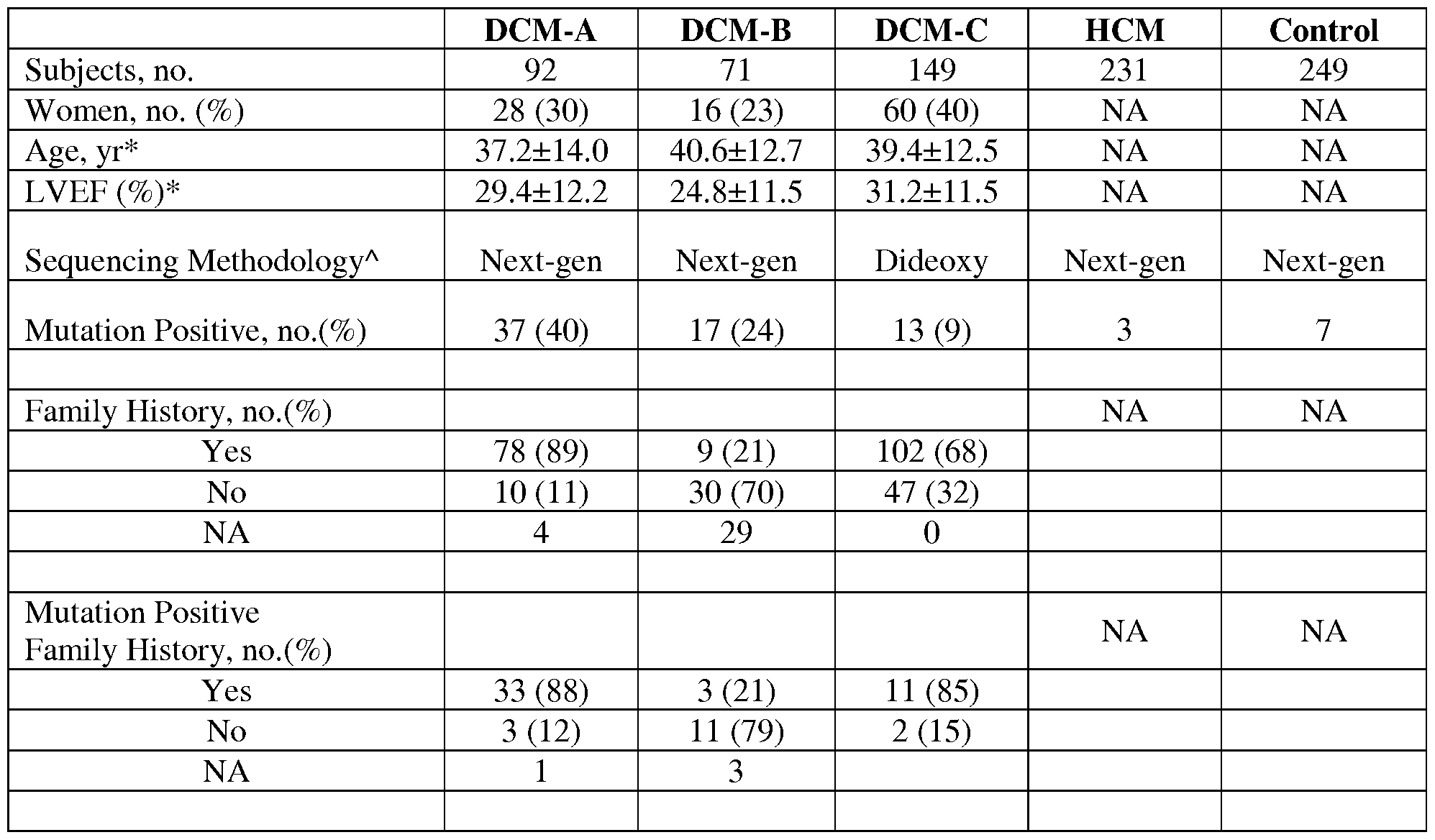
No., number; * Values are means +SD. Sequencing methods were Next-gen, filter-based hybridization capture of TTN and next-generation sequencing or Dideoxy, conventional Sanger dideoxy sequencing. Age and left ventricular ejection fraction (LVEF) are taken at the time of initial diagnosis of DCM. Percent of subjects with family history excludes subjects in whom family history was not available. Across all DCM cohorts, TTN truncating mutations were found in 25% of subjects with and 18% of subjects without a family history of DCM (P=0.3).
Table 6: Sequencing data for TTN truncating mutations


Table 7. Numbers of TTN missense variants* and truncating mutations in cohorts

Missense variants and truncating mutations with a minor allele frequency less than 0.01. Average number of missense variants or truncating mutations per subject.
Table 8: TTN nonsense and frameshift mutations'1

179404491 c.93376 93377delAG p.Arq31126fs UK G7 DCM
179404286 .935830T p.Arq31195X UK G9 DCM
179403522 c.94111A>T p.Lys31371X MHX 11 DCM
179401029 c.95522C>A p.Ser31841X UK C9 DCM
*Mutations are annotated using Human Genome Variation Society guidelines: available on the world wide web at http://www.hgvs.org/mutnomen/.
Table 9: TTN splicing mutations

*Mutations are annotated using Human Genome Variation Society guidelines: available on the world wide web at http://www.hgvs.org/mutnomen/. Amino acid indicated is the residue juxtaposed to the aberrant splice signal.
Table 10: CNV validation primers


H FA-30 M 62 55 No 25 22.6 62 2 60 IC(54) NSVT
H FA-37 M 38 18 No 35 22.6 53 1 NSVT
H FA-43 M 47 37 No 45 22.2 54 1
H FA-50 M 51 47 No 20 16.7 60 3 ICD(49)
H FA-51 M 43 33 No 30 18.3 71 2 ICD
Familial
Screening; Abn LV wall motion; Nl Cors; NSVT;
H FA-53 F 51 47 Yes 55 25 44 1 ICD(47)
H FA-56 M 37 33 Yes 35 20.4 54 1
H FA-61 F 63 47 Yes 37.5 8.8 57 4 ICD(62)
H FA-67 M 49 43 NA 15 14.5 69 4 45 CAD, ICD(41)
H FA-70 F 74 58 Yes 25 12.7 71 3 AF, ICD, NSVT
ICD(45) SM, Nl
JG-32 F 51 43 Yes 45 38 60 3 Cors
MAB- 17 F 31 22 Yes 27 21.2 66 3 33 ICD(33)
MAE- AF, ICD(35), 3111 M 35 34 Yes 25 57 15.8 3 58 NSVT
MAG-3 F 69 50 Yes 35 18 56 3
MAK- 13 M 38 61 Yes 40 22 70 3 ICD(39)
MBS-1 M 65 65 Yes 42.5 30.8 65 1 AF
MCH- 123 M 12 12 Yes 30 15.4 65 1 13 ICD(12)
MDK- 11 M 53 NA Yes 52 NA NA NA
MDU- 111 F 43 31 Yes NA NA NA NA
MDX- Family
11 F 40 37 Yes 40 36 61 1 Screening
MEE-11 M 44 32 Yes 40 22.6 62 2 ICD(34) VT
MEI- 112 M 27 17 Yes NA NA NA NA
MEM- 11 M 18 10 Yes NA NA NA 4 12 CHF
MEN- 111 M 31 12 Yes 42.5 22.6 62 1 AF,ICD, NSVT
MEP- 111 M 46 23 Yes 45 22 61 NA
MER- 11 M 54 38 Yes 18 NA 60 3 ICD(38)
MEX-1 M 53 NA Yes 9 NA 70 NA VT, CAD
MGL- 11 F 27 25 Yes 30 16.1 62 2 27 SMD
MGM-1 F 73 36 Yes 30 14 50 2 AF, ICD, NSVT
MGP-1 M 58 57 Yes 44 29.7 64 2 ICD(58)
MGS- Nl Cors; 111 M 30 25 No 50 NA 59 1 Syncope
MGU- 111 M 41 NA Yes NA NA NA NA 32
MGY- 123 M 35 34 Yes 15 12.3 65 NA
MHA- 145 F 37 34 Yes 40 31.5 54 3 34 ICD(34) NSVT
MHE- 113 M 54 NA Yes 22.5 12.5 64 4 54 ICD, AVB
MHF- 11 F 43 40 Yes 15 8.9 56 1 AF, ICD(41)
MHI-11 M 70† 56 Yes NA NA NA 3 70 AF
MIF-14 M 42 42 Yes 35 30.6 62 2
MIJ-1 M 49 29 Yes 15 5.2 77 4 47 ICD(40) NSVT
MIK- 111 F 38 NA Yes 40 27.6 58 1 37 SCD; ICD(37)
MIM- 11 F 49 33 Yes 20 13.2 68 4 46 ICD(45)
Familial
MIO-13 M 28 25 Yes 30 NA 55 2 Screening
MJ-11 M 26 17 Yes NA NA 69 4 26 WPW, RVF
Familial
Screening;
AVB; SVT; LV biopsy,
myocarditis
MT13 M 48 18 Yes 30 31 56 1 negative
MW- 11 M 61 43 Yes 20 12.5 64 2 ICD(56)
MYC- 11 M 53 43 Yes 15 9.9 71 1 AF, ICD(50)
SS126 M 38 28 Yes 38 18.8 64 1 ICD
SS705 F 42 33 Yes 15 5 59 4 41 MR
SS719 F 60 45 Yes 20 6.3 64 4 CHF; Nl Cors
SS720 M 67 52 NA 25 10.3 68 2 ICD(66), NSVT
AF, MR, Nl
SS731 M 65 65 No 25 16.6 66 3 Cors
MHM- 22 M 29 19 Yes 40 28.8 59 1
H FA-65 F 54 51 Yes 42.5 14.8 54 1 ICD(50)
ICD(54),
NSVT, mild
MHO-4 M 60 54 Yes 20 13.6 66 1 CAD
BSA, body surface area (m2) is provided for subjects with TTN mutations; Age of Dx, age of diagnosis; Family Hx, Familial history of DCM.
I Echocardiography measurements of left ventricular ejection fraction (EF), fractional shortening (FS) and left-ventricular end-diastolic diameter (LVEDD) obtained at time of diagnosis. NA, not available.
¾ New York Heart Association classifications (NYHA) range from 1 to 4.
Λ Earliest ages at which subject received a ventricular assist device (VAD) or a cardiac transplant (Tx), or age at death.
II Clinical data are denoted by: Abn LV wall motion, abnormal left ventricular wall motion identified by echocardiography; AF, atrial fibrillation; AI, aortic insufficiency; AVB, atrio-ventricular block; CHF, hospitalized for congestive heart failure; CVA, cerebral vascular accident; Familial screening, clinical evaluations were prompted by overt DCM in a first-degree relative; ICD, implanted cardiac defibrillator implanted at age (parentheses); MR, mitral regurgitation; PCM, pacemaker; Nl cors, normal coronary artery anatomy defined by cardiac angiography; NSVT, non-sustained ventricular tachycardia; WPW, Wolf Parkinson White; RVD, right ventricular dilation; RVF, right ventricular heart failure, SMD, skeletal muscle disease.
□ TTN mutations are detailed in Tables 8 and 9. * denotes homozygous mutation.
Table 12: Clinical characteristics of DCM-B probands


Footnotes for symbols ( ΦΊΙΑII□) and abbreviations are defined in Table 11.
Additional abbreviations used: AVR, aortic valve replacement; RVEF, right ventricular ejection fraction.
Table 13: Clinical characteristics of DCM-C probands


DNFDC008 F 66 61 Yes 55 29 NA 4 66 Rapid

Footnotes for symbols ( ΦΊΙΑ II□) and abbreviations are defined in Table 11.
Additional abbreviations used: AVR, aortic valve replacement; RVEF, right ventricular ejection fraction.
Table 14: Clinical findings in DCM families with TTN truncating mutations


* Pedigrees are provided in Figure 5. Probands and the TTN truncating mutation are listed first among family members. Footnotes for symbols (ΦΊΙΑ ||) are defined in Table 11.† Non-cardiac causes of death are indicated. Clinical status is denoted: A, affected; U, unaffected; I, indeterminate. □ TTN genotypes are +, mutation present; -, mutation absent; NA, genotype not available; NA(+), obligate carrier based on pedigree position, but genotype not available.
Abbreviations used are defined in Table 11. Additional abbreviations used to describe
electrophysiology are: NSR, normal sinus rhythm, LVH, electrocardiographic criteria for left ventricular hypertrophy; ST, sinus tachycardia; SB, sinus bradycardia; Q, Q waves; STTWA, ST and T-wave abnormality; TWA: T-wave abnormality; 1AVB, first degree atrioventricular block; LAFB, left anterior fasicular block; IVCD, intraventricular conduction delay; JR, junctional rhythm; RBB,
right bundle branch block; LBBB, left bundle block; VT, ventricular tachycardia; PAC, premature atrial contractions; PVC, premature ventricular contractions; long QTc, prolonged corrected QT interval. Additional abbreviations to denote clinical findings are: Abn LV wall motion; abnormal left ventricular wall motion identified by echocardiography; CAD/MI, coronary artery disease/myocardial infarction; Diastolic Dysfunction, physician reported abnormal LV relaxation parameters; DM, diabetes mellitus; EF, ejection fraction; PCI, percutaneous coronary intervention SCD, sudden cardiac death; MRLGdE, LV fibrosis identified by gadolinium enhance-MRI ; RV, right ventricle; VT ablation, ventricular tachycardia treated by ablation.
Table 15: Likelihood of the odds (LOD) scores reflecting linkage between TTN mutation and
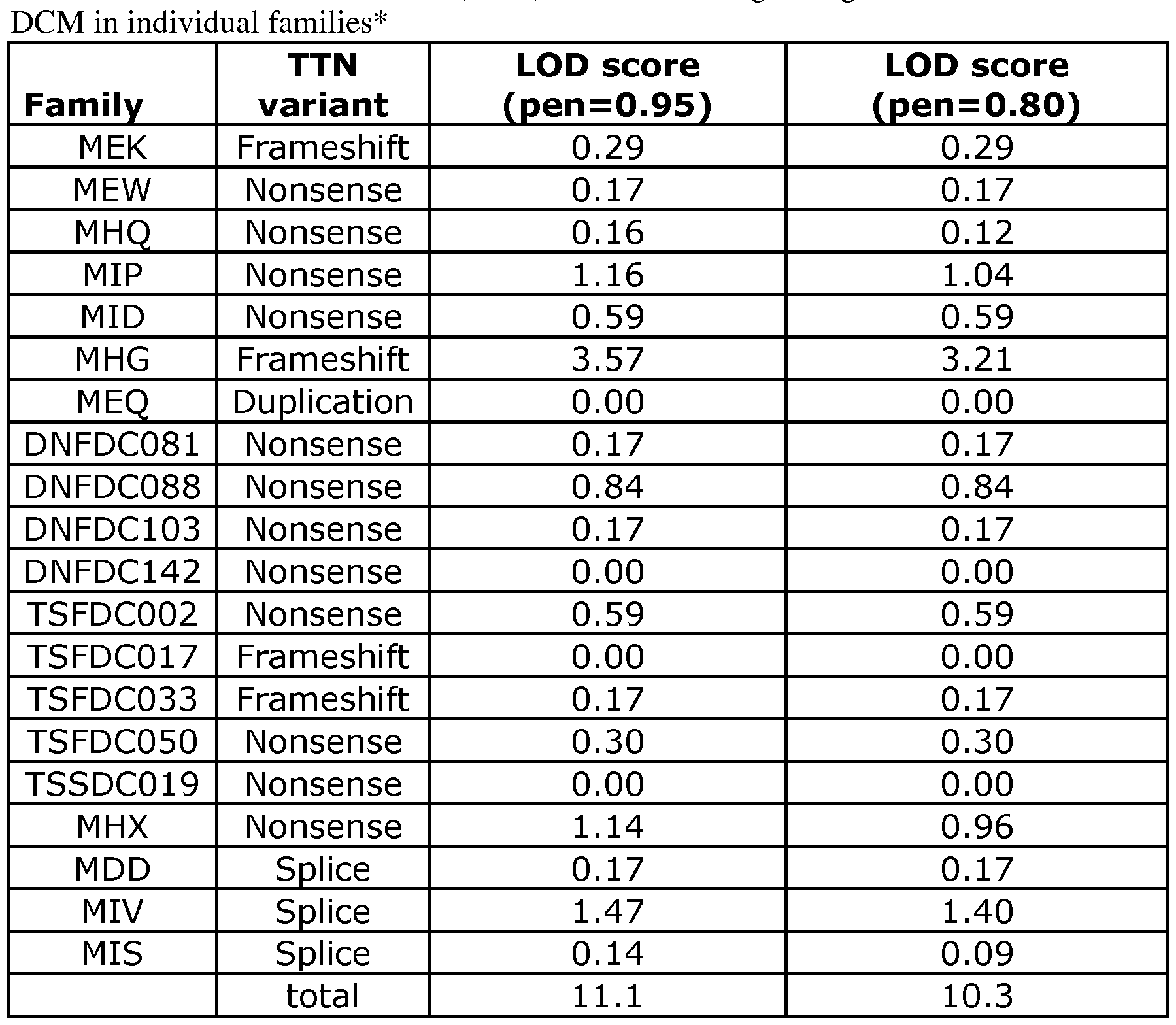
*LOD score for each family calculated at θ=0 and indicated penetrance. Pedigrees and clinical data are provided in Figure 5 and Table 15. See Methods for details on the assignment of affection status.
Table 16 Previously published TTN truncation mutations

^Positions are for UniProt titin (Q8WZ42); Λ Subjects are reported to have germline (hetero, heterozygous or homo, homozygous) or somatic TTN mutations.
Table 17: TTN exons comprising the standard UniProt titin protein (Q8WZ42) that have minimal or no evidence for cardiac expression

[00243] All patents and other publications identified in the specification and examples are expressly incorporated herein by reference for all purposes. These publications are provided solely for their disclosure prior to the filing date of the present application. Nothing in this regard should be construed as an admission that the inventors are not entitled to antedate such disclosure by virtue of prior invention or for any other reason. All statements as to the date or representation as to the contents of these documents is based on the information available to the applicants and does not constitute any admission as to the correctness of the dates or contents of these documents.
[00244] Although preferred embodiments have been depicted and described in detail herein, it will be apparent to those skilled in the relevant art that various modifications, additions, substitutions, and the like can be made without departing from the spirit of the invention and these are therefore considered to be within the scope of the invention as defined in the claims which follow. Further, to the extent not already indicated, it will be understood by those of ordinary skill in the art that any one of the various embodiments herein described and illustrated can be further modified to incorporate features shown in any of the other embodiments disclosed herein.
Claims
1. An assay for determining if a subject has an increased risk for developing a dilated
cardiomyopathy (DCM) or is in need of treatment for DCM or increased risk for heart failure, the assay comprising:
(v) sequencing at least a portion of the TTN gene as detected in a DNA molecule
amplified from a human subject to detect a TTN nucleic acid variant which would be predicted to result in a truncated TITIN polypeptide; or
(vi) detecting if any such mutation is present in the nucleic acid sample,
wherein detection of the presence of at least one said mutation is indicative of the subject having an increased risk for developing DCM.
2. The assay of claim 1 , wherein said nucleic acid sequencing is dideoxy sequencing, Maxam- Gilbert sequencing, dye-terminator sequencing, Lynx Therapeutics' Massively Parallel Sequencing (MPSS) Polony sequencing, 454 Pyrosequencing, Illumina (Solexa) sequencing, Single Molecule real time (RNAP) sequencing, Nanaopore DNA sequencing, or sequencing by technology from VisiGen Biotechnologies or any other method used to determine the nucleotide sequence of a DNA molecule.
3. The assay of claim 1 or 2, wherein the truncated TITIN polypeptide lacks part of the A-band, having a wild- type sequence set forth in SEQ ID NO: 725.
4. The assay of any of claims 1-3, wherein said TTN nucleic acid mutation is selected from the group consisting of 6247_6247delG, 12745C>T, 14470_14471insCACACTCCATA (SEQ ID NO: 722), 19183_19183delG, 23798_23810delGTCAAGATATCTG (SEQ ID NO: 723), 38621_38622insA, 44336_44336delA, 45322_45322delT, 49077OA, 51883C>T,
52408C>T, 53145_53146insG, 53347G>T, 53935_53935delC, 56367T>A, 565720T, 56953C>T, 58678C>T, 59530C>T, 61046_61046delC, 65867_65867delA,
67057_67063delGCATATGinsTA, 67745_67745delT, 72178_72179insT,
72723_72739delinsAGA, 77065C>T, 79896G>A, 80845C>T, 81046A>T, 81440G>A, 81536_81537delCT, 82701C>A, 84977_84980delATTA, 87953G>A, 882420T,
88528G>T, 89177_89181delAAATT, 90241OT, 91042_91042delA, 91537_91538insA, 94111A>T, 955220A, 30476-lG>A, 34186+1G>T, 35635G>C, 35635+lG>A,
44725+2delT, 48364+lOT, 50346_+3A>G, 54422-5T>A, 54704-1OA, 55003+lG>A, 62425+5G>A, 63405A>G, 64489+lG>A, 81898+2T>A, 92569+lG>C, and any combination thereof, wherein the mutation location is determined based upon the wildtype TTN sequence having a nucleic acid sequence set forth in SEQ ID NO: 1.
5. The assay of any of claims 1-4, wherein said sequencing comprises contacting the nucleic acid sample with a probe or primer.
6. The assay of any of claims 1-5, wherein the subject is one who exhibits one or more risk factors for DCM or one or more complications related to DCM or a subject who does not exhibit risk factors or a subject who is a family member of an individual who has been diagnosed with a cardiac condition.
7. The assay of any of claims 1-6, wherein the subject is asympotomatic.
8. The assay of any of claims 1-7, wherein dilated cardiomyopathy is idiopathic dilated
cardiomyopathy.
9. A method of treating a subject for dilated cardiomyopathy, comprising:
(v) selecting a subject at risk for developing DCM or in need of treatment for DCM using an assay of claim 1 ; and
(vi) administering a treatment for DCM to the subject.
10. The method of claim 9, wherein the treatment is selected from the group consisting of
angiotensin-con verting enzyme (ACE) inhibitors, angiotensin II receptor blockers, beta blockers, diuretics, aldosterone antagonists, digoxin (Lanoxin), blood thinning medications, biventricular pacemakers, implantable cardioverter-defibrillators (ICDs), heart pumps (left ventricular assist devices, or LVADs), heart transplant, gene therapy, calcium channel blockers, tissue growth factor inhibitors, and any combinations thereof.
11. An in vitro assay comprising:
(vii) contacting a nucleic acid sample obtained from a subject with a probe, wherein the probe is capable of detecting a mutation resulting in a truncated TITIN polypeptide;
(viii) detecting the presence of the mutation in the nucleic acid sample,
wherein detection of the presence of at least one said mutation is indicative of the subject having an increased risk for developing DCM.
12. The assay of claim 11, wherein the probe is a sequencing primer.
13. An in vitro assay for determining if a subject has an increased risk for developing a dilated cardiomyopathy (DCM), the assay comprising:
(iii) transforming a portion of a titin (TTN) nucleic acid in a sample obtained from the subject into at least one detectable target;
(iv) detecting presence or absence of at least one mutation in the TTN nucleic acid, wherein at least one mutation in the TTN nucleic acid results in a truncated TITIN polypeptide
wherein detection of the presence of at least one of the mutations is indicative of the subject having an increased risk for developing DCM.
14. An in vitro assay for determining if a subject is need of treatment for DCM, the method
comprising:
(iv) sequencing at least a portion of TTN gene in a sample from a human subject; (v) comparing the sequence obtained in step (i) with wild type TTN gene sequence having a nucleic acid sequence set forth in SEQ ID NO: 1 ; and
(vi) determining if the variation is one or more which results in a truncated (shortened) TITIN polypeptide; and
wherein detection of at least one of such variations is indicative of subject is in need of treatment for DCM.
15. The in vitro assay of claim 14, further comprising administering a treatment for DCM to the subject, if presence of at least one the variations is detected.
16. The in vitro assay of any of claims 11-15, wherein the truncated TITIN polypeptide lacks part of A-band having a wild-type sequence set forth in SEQ ID NO: 725.
17. The in vitro assay of any of claims 11-16, wherein the mutation is selected from the group consisting of 6247_6247delG, 127450T, 14470_14471insCACACTCCATA (SEQ ID NO: 722), 19183_19183delG, 23798_23810delGTCAAGATATCTG (SEQ ID NO: 723), 38621_38622insA, 44336_44336delA, 45322_45322delT, 49077OA, 51883C>T,
52408C>T, 53145_53146insG, 53347G>T, 53935_53935delC, 56367T>A, 565720T, 56953C>T, 58678C>T, 59530C>T, 61046_61046delC, 65867_65867delA,
67057_67063delGCATATGinsTA, 67745_67745delT, 72178_72179insT,
72723_72739delinsAGA, 77065C>T, 79896G>A, 80845C>T, 81046A>T, 81440G>A, 81536_81537delCT, 82701C>A, 84977_84980delATTA, 87953G>A, 882420T,
88528G>T, 89177_89181delAAATT, 90241OT, 91042_91042delA, 91537_91538insA, 94111A>T, 955220A, 30476-lG>A, 34186+1G>T, 35635G>C, 35635+lG>A,
44725+2delT, 48364+lOT, 50346_+3A>G, 54422-5T>A, 54704-1OA, 55003+lG>A, 62425+5G>A, 63405A>G, 64489+lG>A, 81898+2T>A, 92569+lG>C, and any combination thereof, wherein the mutation location is determined based upon the wildtype TTN sequence having a nucleic acid sequence set forth in SEQ ID NO: 1.
18. The in vitro assay of any of claims 11-17, wherein the step of detecting the mutation is
performed by nucleic acid sequencing.
19. The in vitro assay of claim 18, wherein said nucleic acid sequencing is Maxam-Gilbert
sequencing, dye-terminator sequencing, Lynx Therapeutics' Massively Parallel Sequencing (MPSS) Polony sequencing, 454 Pyrosequencing, Illumina (Solexa) sequencing, Single Molecule real time (RNAP) sequencing, Nanaopore DNA sequencing, or sequencing by technology from VisiGen Biotechnologies or any other method of sequencing nucleic acid.
20. The in vitro assay of any of claim 11-19, wherein detection of the mutation is by a computer implemented system.
21. The in vitro assay of any of claims 11-20, further comprising the step of displaying the result on a display module.
22. The in vitro assay of any of claims 11-21, wherein dilated cardiomyopathy is idiopathic dilated cardiomyopathy or heart failure or any other related cardiomyopathy.
23. The in vitro assay of any of claims 11-22, wherein the subject is one who exhibits one or more risk factors for DCM or one or more complications related to DCM or a subject who does not exhibit risk factors or a subject who is a family member of an individual who has been diagnosed with a cardiac condition.
24. The in vitro assay of any of claims 11-23, wherein the subject is asympotomatic.
25. A method of treating a subject for dilated cardiomyopathy, comprising:
(vii) selecting a subject at risk for developing DCM or in need of treatment for DCM using an in vitro assay of any of claims 11-24; and
(viii) administering a treatment for DCM to the subject.
26. The method of claim 25, wherein the treatment is selected from the group consisting of
angiotensin-con verting enzyme (ACE) inhibitors, angiotensin II receptor blockers, beta blockers, diuretics, aldosterone antagonists, digoxin (Lanoxin), blood thinning medications, biventricular pacemakers, implantable cardioverter-defibrillators (ICDs), heart pumps (left ventricular assist devices, or LVADs), heart transplant, gene therapy, calcium channel blockers, tissue growth factor inhibitors, and any combinations thereof.
27. The method of claim 26, wherein the treatment comprises administering to said subject a polypeptide comprising amino acid SEQ ID NO: 2 or a nucleic acid encoding a polypeptide comprising amino acid SEQ ID NO: 2.
28. The method of claim 27, wherein the nucleic acid encoding the polypeptide of amino acid SEQ ID NO: 2 is operably linked to a vector.
29. The method any of claims 25-28, wherein the subject is one who exhibits one or more risk factors for DCM or one or more complications related to DCM or a subject who does not exhibit risk factors or a subject who is a family member of an individual who has been diagnosed with a cardiac condition.
30. The method of any of claims 25-29, wherein the subject is asymptomatic.
31. A method comprising administering a treatment for dilated cardiomyopathy to a subject determined to have a mutation in the TTN gene which results in a truncated TITIN polypeptide.
32. The method of claim 31 , wherein the truncated TITIN polypeptide lacks part of the A-band, having a wild- type sequence set forth in SEQ ID NO: 725.
33. The method of claim 31 or 32, wherein the mutation is selected from the group consisting of 6247_6247delG, 12745C>T, 14470_14471insCACACTCCATA (SEQ ID NO: 722), 19183_19183delG, 23798_23810delGTCAAGATATCTG (SEQ ID NO: 723),
38621_38622insA, 44336_44336delA, 45322_45322delT, 49077OA, 51883C>T,
52408C>T, 53145_53146insG, 53347G>T, 53935_53935delC, 56367T>A, 565720T, 569530T, 58678C>T, 59530OT, 61046_61046delC, 65867_65867delA, 67057_67063delGCATATGinsTA, 67745_67745delT, 72178_72179insT,
72723_72739delinsAGA, 77065C>T, 79896G>A, 80845C>T, 81046A>T, 81440G>A, 81536_81537delCT, 82701C>A, 84977_84980delATTA, 87953G>A, 882420T,
88528G>T, 89177_89181delAAATT, 90241OT, 91042_91042delA, 91537_91538insA, 94111A>T, 955220A, 30476-lG>A, 34186+1G>T, 35635G>C, 35635+lG>A,
44725+2delT, 48364+lOT, 50346_+3A>G, 54422-5T>A, 54704-1OA, 55003+lG>A, 62425+5G>A, 63405A>G, 64489+lG>A, 81898+2T>A, 92569+lG>C, and any combination thereof, wherein the mutation location is determined based upon the wildtype TTN sequence having a nucleic acid sequence set forth in SEQ ID NO: 1.
34. The method any of claims 31-33, wherein detection of the mutation is by nucleic acid
sequencing.
35. The assay of claim 34, wherein said nucleic acid sequencing is Maxam-Gilbert sequencing, dye-terminator sequencing, Lynx Therapeutics' Massively Parallel Sequencing (MPSS) Polony sequencing, 454 Pyrosequencing, Illumina (Solexa) sequencing, SOLiD™ sequencing, Single Molecule SMART™ sequencing, Single Molecule real time (RNAP) sequencing, Nanaopore DNA sequencing, or sequencing by technology from VisiGen Biotechnologies.
36. The assay of any of claim 31-35, wherein detection of the mutation is by a computer
implemented system.
37. The assay of any of claims 31-36, further comprising the step of displaying the detection of the mutation on a display module.
38. The assay of any of claims 31-37, wherein dilated cardiomyopathy is idiopathic dilated
cardiomyopathy.
39. The assay of any of claims 31-38, wherein the subject is one who exhibits one or more risk factors for DCM or one or more complications related to DCM or a subject who does not exhibit risk factors or a subject who is a family member of an individual who has been diagnosed with a cardiac condition.
40. The assay of any of claims 31-39, wherein the subject is asymptomatic.
41. A computer implemented system for determining presence or absence of nucleic acid
mutation associated with an increased risk of a subject for developing DCM, the system comprising:
(v) a determination module configured to identify and detect at least one nucleic acid mutation in TTN gene of SEQ ID NO: 1, wherein the nucleic acid mutation is selected from the group consisting of 6247_6247delG, 12745C>T, 14470_14471insCACACTCCATA (SEQ ID NO: 722), 19183_19183delG, 23798_23810delGTCAAGATATCTG (SEQ ID NO : 723), 38621_38622insA, 44336_44336delA, 45322_45322delT, 49077G>A, 51883C>T, 52408C>T, 53145_53146insG, 53347G>T, 53935_53935delC, 56367T>A, 565720T, 56953C>T, 58678C>T, 59530C>T, 61046_61046delC, 65867_65867delA, 67057_67063delGCATATGinsTA, 67745_67745delT, 72178_72179insT, 72723_72739delinsAGA, 77065C>T, 79896G>A, 80845C>T, 81046A>T, 81440G>A, 81536_81537delCT, 82701C>A, 84977_84980delATTA, 87953G>A, 88242C>T, 88528G>T, 89177_89181delAAATT, 90241C>T, 91042_91042delA, 91537_91538insA, 94111A>T, 95522C>A, 30476-lG>A, 34186+1G>T, 35635G>C, 35635+lG>A, 44725+2delT, 48364+lG>T, 50346_+3A>G, 54422-5T>A, 54704-lG>A, 55003+lG>A, 62425+5G>A, 63405A>G, 64489+lG>A, 81898+2T>A, 92569+lG>C, and any combination thereof;
(vi) a storage module configured to store output data from the determination module;
(vii) a computing module adapted to identify from the output data at least one of DCM risk associated mutation is present in the output data stored on the storage module; and
(viii) a display module for displaying if any of the DCM risk associated mutation was identified or not, and/or displaying the detected mutation.
The computer implemented system of claim 41, wherein the determination module comprises a system that tranforms any nucleic acid or mutation therein into a detectable molecule. The computer implemented system of claim 42, further comprising a system that detects the detectable molecule.
The computer implemented system of any of claims 41-43, wherein the determination module comprises a system for contacting a nucleic acid sample obtained from a subject with a probe, wherein the probe is capable of detecting the TTN nucleic acid mutation.
Priority Applications (1)
| Application Number | Priority Date | Filing Date | Title |
|---|---|---|---|
| US14/111,308 US9476097B2 (en) | 2011-04-11 | 2012-04-11 | Structural mutations in titin cause dilated cardiomyopathy |
Applications Claiming Priority (2)
| Application Number | Priority Date | Filing Date | Title |
|---|---|---|---|
| US201161474106P | 2011-04-11 | 2011-04-11 | |
| US61/474,106 | 2011-04-11 |
Publications (2)
| Publication Number | Publication Date |
|---|---|
| WO2012142159A2 true WO2012142159A2 (en) | 2012-10-18 |
| WO2012142159A3 WO2012142159A3 (en) | 2012-12-06 |
Family
ID=47009942
Family Applications (1)
| Application Number | Title | Priority Date | Filing Date |
|---|---|---|---|
| PCT/US2012/033122 Ceased WO2012142159A2 (en) | 2011-04-11 | 2012-04-11 | Structural mutations in titin cause dilated cardiomyopathy |
Country Status (2)
| Country | Link |
|---|---|
| US (1) | US9476097B2 (en) |
| WO (1) | WO2012142159A2 (en) |
Cited By (7)
| Publication number | Priority date | Publication date | Assignee | Title |
|---|---|---|---|---|
| CN110846408A (en) * | 2019-12-11 | 2020-02-28 | 昆明理工大学 | Primer combination for detecting TTN gene mutation and its application |
| CN111004845A (en) * | 2019-12-11 | 2020-04-14 | 昆明理工大学 | Primer combination for detection of AGL gene mutation and its application |
| CN113897368A (en) * | 2021-08-08 | 2022-01-07 | 华中科技大学同济医学院附属协和医院 | TTN gene mutants and their applications |
| WO2022020905A1 (en) * | 2020-07-30 | 2022-02-03 | Gas Services Australia Pty Ltd | A barbecue arrangement |
| AU2021105238B4 (en) * | 2021-07-30 | 2022-05-19 | Gas Services Australia Pty Ltd | A barbecue arrangement |
| CN117253538A (en) * | 2023-10-19 | 2023-12-19 | 北京优迅医疗器械有限公司 | A method, device, computer-readable storage medium and application for producing simulated mutation data |
| WO2024108217A1 (en) * | 2022-11-18 | 2024-05-23 | Genkardia Inc. | Methods and compositions for preventing, treating, or reversing cardiac diastolic dysfunction |
Families Citing this family (8)
| Publication number | Priority date | Publication date | Assignee | Title |
|---|---|---|---|---|
| WO2016179331A1 (en) * | 2015-05-04 | 2016-11-10 | King Abdulaziz City For Science And Technology | Method of diagnosing patients with conditions caused by mendelian mutations |
| AU2021205561A1 (en) * | 2020-01-09 | 2022-08-11 | Jiangsu Hengrui Medicine Co., Ltd. | New polypeptide complex |
| CN112028983B (en) * | 2020-05-25 | 2021-07-20 | 百世诺(北京)医学检验实验室有限公司 | New mutant proteins, new mutant genes related to dilated cardiomyopathy and their applications |
| CN114317708B (en) * | 2021-09-26 | 2022-10-14 | 百世诺(北京)医学检验实验室有限公司 | Mutated TTN gene and hypertrophic cardiomyopathy detection kit |
| CN115961019B (en) * | 2022-08-30 | 2023-12-05 | 百世诺(北京)医疗科技有限公司 | Reagent for detecting novel pathogenic gene TTN of dilated cardiomyopathy and application thereof |
| CN116064774A (en) * | 2022-10-17 | 2023-05-05 | 百世诺(北京)医疗科技有限公司 | Reagent for detecting new site of dilated cardiomyopathy pathogenic gene MYBPC3 and application thereof |
| CN115820836A (en) * | 2022-10-25 | 2023-03-21 | 百世诺(北京)医疗科技有限公司 | Reagent for detecting dilated cardiomyopathy mutant gene and application thereof |
| CN116064807A (en) * | 2022-10-25 | 2023-05-05 | 百世诺(北京)医疗科技有限公司 | Reagent for detecting novel site of dilated cardiomyopathy pathogenic gene TTN and application thereof |
Family Cites Families (2)
| Publication number | Priority date | Publication date | Assignee | Title |
|---|---|---|---|---|
| AU785046B2 (en) * | 2000-01-12 | 2006-09-07 | General Hospital Corporation, The | Methods for diagnosing and treating heart disease |
| US20060034508A1 (en) | 2004-06-07 | 2006-02-16 | Zhou Xiang S | Computer system and method for medical assistance with imaging and genetics information fusion |
-
2012
- 2012-04-11 US US14/111,308 patent/US9476097B2/en not_active Expired - Fee Related
- 2012-04-11 WO PCT/US2012/033122 patent/WO2012142159A2/en not_active Ceased
Cited By (8)
| Publication number | Priority date | Publication date | Assignee | Title |
|---|---|---|---|---|
| CN110846408A (en) * | 2019-12-11 | 2020-02-28 | 昆明理工大学 | Primer combination for detecting TTN gene mutation and its application |
| CN111004845A (en) * | 2019-12-11 | 2020-04-14 | 昆明理工大学 | Primer combination for detection of AGL gene mutation and its application |
| WO2022020905A1 (en) * | 2020-07-30 | 2022-02-03 | Gas Services Australia Pty Ltd | A barbecue arrangement |
| AU2021105238B4 (en) * | 2021-07-30 | 2022-05-19 | Gas Services Australia Pty Ltd | A barbecue arrangement |
| CN113897368A (en) * | 2021-08-08 | 2022-01-07 | 华中科技大学同济医学院附属协和医院 | TTN gene mutants and their applications |
| WO2024108217A1 (en) * | 2022-11-18 | 2024-05-23 | Genkardia Inc. | Methods and compositions for preventing, treating, or reversing cardiac diastolic dysfunction |
| CN117253538A (en) * | 2023-10-19 | 2023-12-19 | 北京优迅医疗器械有限公司 | A method, device, computer-readable storage medium and application for producing simulated mutation data |
| CN117253538B (en) * | 2023-10-19 | 2025-11-21 | 北京优迅医疗器械有限公司 | Method, device, computer readable storage medium and application for producing simulated variation data |
Also Published As
| Publication number | Publication date |
|---|---|
| WO2012142159A3 (en) | 2012-12-06 |
| US20140199284A1 (en) | 2014-07-17 |
| US9476097B2 (en) | 2016-10-25 |
Similar Documents
| Publication | Publication Date | Title |
|---|---|---|
| US9476097B2 (en) | Structural mutations in titin cause dilated cardiomyopathy | |
| Richard et al. | Double heterozygosity for mutations in the β-myosin heavy chain and in the cardiac myosin binding protein C genes in a family with hypertrophic cardiomyopathy | |
| EP3068783B1 (en) | Agonists of hypocretin receptor 2 for use for treating heart failure | |
| US9040238B2 (en) | Polynucleotides for use in medicine | |
| KR20210049833A (en) | Non-destructive gene therapy for the treatment of MMA | |
| CN107058538A (en) | The kit and application of a kind of Primer composition and its composition | |
| EP2502994A1 (en) | Primer set for amplification of mthfr gene, mthfr gene amplification reagent comprising same, and use of same | |
| WO2002072604A2 (en) | Genes and polymorphisms associated with cardiovascular disease and their use | |
| ES2544265T3 (en) | Combinations of polymorphisms to determine the specific expression of IGF2 allele | |
| US20100047798A1 (en) | Adenosine a1 and a3 receptor gene sequence variations for predicting disease outcome and treatment outcome | |
| US20110200564A1 (en) | Diagnosis and treatment of alzheimer's disease (ad) | |
| EP1130123A2 (en) | Diagnostic method | |
| KR20070048645A (en) | Polymorphism in Epidermal Growth Factor Receptor Gene Promoter | |
| US20160186263A1 (en) | Using plexin-a4 as a biomarker and therapeutic target for alzheimer's disease | |
| US20150159216A1 (en) | Methods and compositions related to the smchd1 gene | |
| US8178297B2 (en) | Method of detecting canine exercise-induced collapse | |
| US20210222233A1 (en) | Compositions and methods for diagnosing and treating arrhythmias | |
| US20150211066A1 (en) | Methods and Compositions for Correlating Genetic Markers with Sudden Cardiac Death Risk | |
| KR101703181B1 (en) | Method to predict the blood concentration of tacrolimus using SNP in 3'UTR of CYP3A7 | |
| CN110863044A (en) | Primer combination for detecting VCL gene mutation and application thereof | |
| US20250297315A1 (en) | Methods and compositions for prognosis and treatment of dilated cardiomyopathy and heart failure | |
| CN119639882B (en) | A composition, kit and application thereof for detecting ATP7B gene polymorphism | |
| JP2007014244A (en) | Method for testing genetic predisposition to ventricular conduction disorder or ventricular fibrillation, and reagent therefor | |
| KR101278220B1 (en) | Kits for Determining a Presence of Nasal Polyps in Asthmatics and Uses Thereof | |
| JP2024536001A (en) | Treatment of asthma with reticulocalbin-3 (RCN3) variants and interleukin-4 receptor alpha (IL4R) antagonists |
Legal Events
| Date | Code | Title | Description |
|---|---|---|---|
| 121 | Ep: the epo has been informed by wipo that ep was designated in this application |
Ref document number: 12771801 Country of ref document: EP Kind code of ref document: A2 |
|
| NENP | Non-entry into the national phase |
Ref country code: DE |
|
| WWE | Wipo information: entry into national phase |
Ref document number: 14111308 Country of ref document: US |
|
| 122 | Ep: pct application non-entry in european phase |
Ref document number: 12771801 Country of ref document: EP Kind code of ref document: A2 |