WO2012141994A2 - Surface treated film and/or laminate - Google Patents
Surface treated film and/or laminate Download PDFInfo
- Publication number
- WO2012141994A2 WO2012141994A2 PCT/US2012/032746 US2012032746W WO2012141994A2 WO 2012141994 A2 WO2012141994 A2 WO 2012141994A2 US 2012032746 W US2012032746 W US 2012032746W WO 2012141994 A2 WO2012141994 A2 WO 2012141994A2
- Authority
- WO
- WIPO (PCT)
- Prior art keywords
- film
- treatment
- topcoat
- treated
- coating
- Prior art date
- Legal status (The legal status is an assumption and is not a legal conclusion. Google has not performed a legal analysis and makes no representation as to the accuracy of the status listed.)
- Ceased
Links
Classifications
-
- C—CHEMISTRY; METALLURGY
- C08—ORGANIC MACROMOLECULAR COMPOUNDS; THEIR PREPARATION OR CHEMICAL WORKING-UP; COMPOSITIONS BASED THEREON
- C08L—COMPOSITIONS OF MACROMOLECULAR COMPOUNDS
- C08L75/00—Compositions of polyureas or polyurethanes; Compositions of derivatives of such polymers
- C08L75/04—Polyurethanes
- C08L75/14—Polyurethanes having carbon-to-carbon unsaturated bonds
-
- C—CHEMISTRY; METALLURGY
- C08—ORGANIC MACROMOLECULAR COMPOUNDS; THEIR PREPARATION OR CHEMICAL WORKING-UP; COMPOSITIONS BASED THEREON
- C08G—MACROMOLECULAR COMPOUNDS OBTAINED OTHERWISE THAN BY REACTIONS ONLY INVOLVING UNSATURATED CARBON-TO-CARBON BONDS
- C08G18/00—Polymeric products of isocyanates or isothiocyanates
- C08G18/06—Polymeric products of isocyanates or isothiocyanates with compounds having active hydrogen
- C08G18/28—Polymeric products of isocyanates or isothiocyanates with compounds having active hydrogen characterised by the compounds used containing active hydrogen
- C08G18/40—High-molecular-weight compounds
- C08G18/62—Polymers of compounds having carbon-to-carbon double bonds
- C08G18/6295—Polymers of silicium containing compounds having carbon-to-carbon double bonds
-
- C—CHEMISTRY; METALLURGY
- C08—ORGANIC MACROMOLECULAR COMPOUNDS; THEIR PREPARATION OR CHEMICAL WORKING-UP; COMPOSITIONS BASED THEREON
- C08G—MACROMOLECULAR COMPOUNDS OBTAINED OTHERWISE THAN BY REACTIONS ONLY INVOLVING UNSATURATED CARBON-TO-CARBON BONDS
- C08G18/00—Polymeric products of isocyanates or isothiocyanates
- C08G18/06—Polymeric products of isocyanates or isothiocyanates with compounds having active hydrogen
- C08G18/70—Polymeric products of isocyanates or isothiocyanates with compounds having active hydrogen characterised by the isocyanates or isothiocyanates used
- C08G18/72—Polyisocyanates or polyisothiocyanates
- C08G18/77—Polyisocyanates or polyisothiocyanates having heteroatoms in addition to the isocyanate or isothiocyanate nitrogen and oxygen or sulfur
- C08G18/78—Nitrogen
- C08G18/79—Nitrogen characterised by the polyisocyanates used, these having groups formed by oligomerisation of isocyanates or isothiocyanates
- C08G18/791—Nitrogen characterised by the polyisocyanates used, these having groups formed by oligomerisation of isocyanates or isothiocyanates containing isocyanurate groups
- C08G18/792—Nitrogen characterised by the polyisocyanates used, these having groups formed by oligomerisation of isocyanates or isothiocyanates containing isocyanurate groups formed by oligomerisation of aliphatic and/or cycloaliphatic isocyanates or isothiocyanates
-
- C—CHEMISTRY; METALLURGY
- C08—ORGANIC MACROMOLECULAR COMPOUNDS; THEIR PREPARATION OR CHEMICAL WORKING-UP; COMPOSITIONS BASED THEREON
- C08J—WORKING-UP; GENERAL PROCESSES OF COMPOUNDING; AFTER-TREATMENT NOT COVERED BY SUBCLASSES C08B, C08C, C08F, C08G or C08H
- C08J7/00—Chemical treatment or coating of shaped articles made of macromolecular substances
- C08J7/04—Coating
- C08J7/042—Coating with two or more layers, where at least one layer of a composition contains a polymer binder
-
- C—CHEMISTRY; METALLURGY
- C08—ORGANIC MACROMOLECULAR COMPOUNDS; THEIR PREPARATION OR CHEMICAL WORKING-UP; COMPOSITIONS BASED THEREON
- C08J—WORKING-UP; GENERAL PROCESSES OF COMPOUNDING; AFTER-TREATMENT NOT COVERED BY SUBCLASSES C08B, C08C, C08F, C08G or C08H
- C08J7/00—Chemical treatment or coating of shaped articles made of macromolecular substances
- C08J7/04—Coating
- C08J7/0427—Coating with only one layer of a composition containing a polymer binder
-
- C—CHEMISTRY; METALLURGY
- C08—ORGANIC MACROMOLECULAR COMPOUNDS; THEIR PREPARATION OR CHEMICAL WORKING-UP; COMPOSITIONS BASED THEREON
- C08J—WORKING-UP; GENERAL PROCESSES OF COMPOUNDING; AFTER-TREATMENT NOT COVERED BY SUBCLASSES C08B, C08C, C08F, C08G or C08H
- C08J7/00—Chemical treatment or coating of shaped articles made of macromolecular substances
- C08J7/04—Coating
- C08J7/043—Improving the adhesiveness of the coatings per se, e.g. forming primers
-
- C—CHEMISTRY; METALLURGY
- C08—ORGANIC MACROMOLECULAR COMPOUNDS; THEIR PREPARATION OR CHEMICAL WORKING-UP; COMPOSITIONS BASED THEREON
- C08J—WORKING-UP; GENERAL PROCESSES OF COMPOUNDING; AFTER-TREATMENT NOT COVERED BY SUBCLASSES C08B, C08C, C08F, C08G or C08H
- C08J7/00—Chemical treatment or coating of shaped articles made of macromolecular substances
- C08J7/04—Coating
- C08J7/046—Forming abrasion-resistant coatings; Forming surface-hardening coatings
-
- C—CHEMISTRY; METALLURGY
- C08—ORGANIC MACROMOLECULAR COMPOUNDS; THEIR PREPARATION OR CHEMICAL WORKING-UP; COMPOSITIONS BASED THEREON
- C08J—WORKING-UP; GENERAL PROCESSES OF COMPOUNDING; AFTER-TREATMENT NOT COVERED BY SUBCLASSES C08B, C08C, C08F, C08G or C08H
- C08J7/00—Chemical treatment or coating of shaped articles made of macromolecular substances
- C08J7/04—Coating
- C08J7/056—Forming hydrophilic coatings
-
- C—CHEMISTRY; METALLURGY
- C09—DYES; PAINTS; POLISHES; NATURAL RESINS; ADHESIVES; COMPOSITIONS NOT OTHERWISE PROVIDED FOR; APPLICATIONS OF MATERIALS NOT OTHERWISE PROVIDED FOR
- C09D—COATING COMPOSITIONS, e.g. PAINTS, VARNISHES OR LACQUERS; FILLING PASTES; CHEMICAL PAINT OR INK REMOVERS; INKS; CORRECTING FLUIDS; WOODSTAINS; PASTES OR SOLIDS FOR COLOURING OR PRINTING; USE OF MATERIALS THEREFOR
- C09D175/00—Coating compositions based on polyureas or polyurethanes; Coating compositions based on derivatives of such polymers
- C09D175/04—Polyurethanes
- C09D175/14—Polyurethanes having carbon-to-carbon unsaturated bonds
-
- C—CHEMISTRY; METALLURGY
- C09—DYES; PAINTS; POLISHES; NATURAL RESINS; ADHESIVES; COMPOSITIONS NOT OTHERWISE PROVIDED FOR; APPLICATIONS OF MATERIALS NOT OTHERWISE PROVIDED FOR
- C09J—ADHESIVES; NON-MECHANICAL ASPECTS OF ADHESIVE PROCESSES IN GENERAL; ADHESIVE PROCESSES NOT PROVIDED FOR ELSEWHERE; USE OF MATERIALS AS ADHESIVES
- C09J7/00—Adhesives in the form of films or foils
- C09J7/20—Adhesives in the form of films or foils characterised by their carriers
- C09J7/29—Laminated material
-
- C—CHEMISTRY; METALLURGY
- C08—ORGANIC MACROMOLECULAR COMPOUNDS; THEIR PREPARATION OR CHEMICAL WORKING-UP; COMPOSITIONS BASED THEREON
- C08J—WORKING-UP; GENERAL PROCESSES OF COMPOUNDING; AFTER-TREATMENT NOT COVERED BY SUBCLASSES C08B, C08C, C08F, C08G or C08H
- C08J2475/00—Characterised by the use of polyureas or polyurethanes; Derivatives of such polymers
- C08J2475/04—Polyurethanes
- C08J2475/14—Polyurethanes having carbon-to-carbon unsaturated bonds
-
- C—CHEMISTRY; METALLURGY
- C08—ORGANIC MACROMOLECULAR COMPOUNDS; THEIR PREPARATION OR CHEMICAL WORKING-UP; COMPOSITIONS BASED THEREON
- C08J—WORKING-UP; GENERAL PROCESSES OF COMPOUNDING; AFTER-TREATMENT NOT COVERED BY SUBCLASSES C08B, C08C, C08F, C08G or C08H
- C08J2483/00—Characterised by the use of macromolecular compounds obtained by reactions forming in the main chain of the macromolecule a linkage containing silicon with or without sulfur, nitrogen, oxygen, or carbon only; Derivatives of such polymers
- C08J2483/04—Polysiloxanes
-
- C—CHEMISTRY; METALLURGY
- C09—DYES; PAINTS; POLISHES; NATURAL RESINS; ADHESIVES; COMPOSITIONS NOT OTHERWISE PROVIDED FOR; APPLICATIONS OF MATERIALS NOT OTHERWISE PROVIDED FOR
- C09J—ADHESIVES; NON-MECHANICAL ASPECTS OF ADHESIVE PROCESSES IN GENERAL; ADHESIVE PROCESSES NOT PROVIDED FOR ELSEWHERE; USE OF MATERIALS AS ADHESIVES
- C09J2467/00—Presence of polyester
- C09J2467/006—Presence of polyester in the substrate
-
- C—CHEMISTRY; METALLURGY
- C09—DYES; PAINTS; POLISHES; NATURAL RESINS; ADHESIVES; COMPOSITIONS NOT OTHERWISE PROVIDED FOR; APPLICATIONS OF MATERIALS NOT OTHERWISE PROVIDED FOR
- C09J—ADHESIVES; NON-MECHANICAL ASPECTS OF ADHESIVE PROCESSES IN GENERAL; ADHESIVE PROCESSES NOT PROVIDED FOR ELSEWHERE; USE OF MATERIALS AS ADHESIVES
- C09J2475/00—Presence of polyurethane
- C09J2475/006—Presence of polyurethane in the substrate
-
- C—CHEMISTRY; METALLURGY
- C09—DYES; PAINTS; POLISHES; NATURAL RESINS; ADHESIVES; COMPOSITIONS NOT OTHERWISE PROVIDED FOR; APPLICATIONS OF MATERIALS NOT OTHERWISE PROVIDED FOR
- C09J—ADHESIVES; NON-MECHANICAL ASPECTS OF ADHESIVE PROCESSES IN GENERAL; ADHESIVE PROCESSES NOT PROVIDED FOR ELSEWHERE; USE OF MATERIALS AS ADHESIVES
- C09J2483/00—Presence of polysiloxane
- C09J2483/006—Presence of polysiloxane in the substrate
Definitions
- the present inventive su bject matter relates generally to the art of protective films and/or laminates. Particu lar relevance is found in connection with adhesive sheets useful for protecting various surfaces to which the adhesive sheets are applied, e.g., such as the surfaces of automotive bodies, consumer electronics, wind mill blades, home appliances, and accordingly the present specification makes specific reference thereto. However, it is to be appreciated that aspects of the present inventive su bject matter are also equally amena ble to other like applications.
- Patent No. 6,383,644 to Fuchs discloses one such multilayer sheet. Additionally, the pu blished U.S. Patent Application of McGuire (Pu b No.: US 2008/0286576 Al) also discloses a multilayer protective sheet. Both of the foregoing references are incorporated by reference herein in their entirety.
- the treated plastic film 10 is obtained by treating a solid plastic film with a liquid treatment composition wherein one or more ingredients from the treatment composition diffuse into the plastic film.
- the solid plastic film is used to differentiate from porous or foamy substrates.
- the liquid composition was designed as an irradiation curable protective hardcoat exhibiting 3H pencil hardness.
- the polyurethane film largely retains its flexibility/stretchability, an effect associated with the diffusion of ingredients from the treatment composition into the PU film.
- PU polyurethane
- as much as 90% of the ingredients from the treatment composition diffuse into the PU film, with a diffusion depth of as much as 25 ⁇ into the PU film.
- Diffusion of a liquid or coating ingredients into a macroscopically porous substrate such as paper, foams, or other porous media is known and can be promoted by capillary effect.
- a protection film/laminate made from such treatment process effectively combines the outstanding surface properties provided by the top coating layer, such as stain resistance, anti-graffiti characteristics, chemical/scratch resistance, and the unique bulk properties of the plastic film such as the flexibility, stretchability, etc.
- the release liner 12 is first removed from the construction and the PSA layer 14 is then used to adhere the treated film 10 to the surface of a desired object with the surface 16 facing outward therefrom.
- the film is optionally applied in this manner to an auto body surface or other like surface that one wishes to protect.
- the film 10 shown in Figure 1 can be readily and smoothly applied to complex geometries and/or otherwise curved surfaces.
- alternate means can be used to adhere or otherwise stick the film 10 to a desired surface.
- a need remains for a treated film and/or laminate that includes a solid and macroscopically non-porous plastic film, and particularly including an interfacial transition layer or region.
- a need also exists for a treated film and/or laminate that is free of such interfacial transition layer or region.
- the present invention provides a protective sheet comprising a solid plastic film defining a first surface and an oppositely directed second surface.
- the sheet also comprises a UV curable topcoat formulation disposed on at least one of the first surface and the second surface of the plastic film to thereby constitute a coated film.
- the topcoat formulation comprises (i) at least one silicon-containing polymer, (ii) an ethylenically unsaturated (meth) acrylate monomer or oligomer having at least one urethane (meth) acrylate oligomer, and (iii) a polyurethane resin.
- the present invention provides a protective laminate comprising a polymeric substrate defining a first surface and an oppositely directed second surface.
- the laminate also comprises a layer of a pressure sensitive adhesive disposed on at least a portion of the second surface of the polymeric substrate.
- the laminate additionally comprises a UV curable topcoat formulation disposed on at least a portion of the first surface and/or the second surface of the polymeric substrate.
- the topcoat formulation comprises (i) at least one silicon-containing polymer, (ii) an ethylenically unsaturated (meth) acrylate monomer or oligomer having at least one urethane (meth)acrylate oligomer, and (iii) a polyurethane resin.
- the protective laminate may also comprise an optional removable protective sheet on the air interface of the topcoat.
- the present invention provides a method of forming a protective sheet.
- the method comprises providing a polymeric substrate defining a first surface and an oppositely directed second surface.
- the method also comprises providing a UV curable topcoat formulation comprising (i) at least one silicon-containing polymer, (ii) an ethylenically unsaturated (meth)acrylate monomer or oligomer having at least one urethane (meth)acrylate oligomer, and (iii) a polyurethane resin.
- the method additionally comprises applying the topcoat formulation to at least one of the first surface and second surface of the polymeric substrate.
- the method further comprises exposing the applied topcoat formulation to UV light for a sufficient time to cure the topcoat and thereby form the protective sheet.
- the present invention provides a protective removable topsheet.
- the topsheet comprises a polyurethane film defining a first face and an oppositely directed second face.
- the topsheet also comprises a layer of an adhesive disposed on the second face of the polyurethane film, the layer of adhesive defining an adhesive face.
- the topsheet also comprises a liner layer disposed on the adhesive face.
- the topsheet additionally comprises a topcoat disposed on the first face of the polyurethane film.
- the topcoat includes (i) at least one silicon-containing polymer, (ii) an ethylenically unsaturated (meth)acrylate monomer or oligomer having at least one urethane (meth)acrylate oligomer, and (iii) an optional polyurethane resin.
- Figure 1 is diagrammatic illustration showing an exemplary construction of a surface treated film and/or laminate in accordance with aspects of the present inventive subject matter.
- Figure 2 is diagrammatic illustration showing another exemplary construction of a surface treated film and/or laminate in accordance with aspects of the present inventive subject matter.
- Figure 3 is graph showing measured 60 degree gloss values for each of several tested sample films treated with an exemplary treatment composition prepared in accordance with the present inventive subject matter and comparative examples.
- Figure 4 is graph showing measured b values for each of several tested sample films treated with an exemplary treatment composition prepared in accordance with the present inventive subject matter and comparative examples after exposure to a used motor oil test.
- Figure 5 is graph showing measured b values for each of several tested sample films treated with an exemplary treatment composition prepared in accordance with the present inventive subject matter and comparative examples after exposure to a used motor oil test.
- Figure 6 is graph showing measured tensile stress at 100% elongation for each of several tested sample films treated with an exemplary treatment composition prepared in accordance with the present inventive subject matter and comparative examples.
- Figure 7 is graph showing measured delta b and delta E values for each of several tested sample films treated with an exemplary treatment composition prepared in accordance with the present inventive subject matter and comparative examples after exposure to weathering testing.
- Figure 8 is graph showing the pencil hardness and hand stretcha bility of different plastic films with and without a hard coat.
- Figure 9 is photomicrograph showing a comparative sample film treated with an exemplary treatment composition prepared in accordance with the present inventive subject matter.
- Figure 10 is photomicrograph showing an exemplary sample film treated with an exemplary treatment composition prepared in accordance with the present inventive subject matter.
- Figure 11 is graph showing the relative intensity of an I spectral analysis peak associated with an exemplary radiation curable treatment composition prepared in accordance with the present inventive subject matter as a function of depth into an exemplary film receiving the treatment.
- Figure 12 is photomicrograph showing an exemplary sample film treated with an exemplary treatment composition with a continuous transition from and a treatment layer above the film
- Figure 13 is photomicrograph showing an exemplary sample film treated with an exemplary treatment composition wherein all the treatment materials have diffused into the film.
- Figure 14 is graph showing measured b values for each of several tested sample films treated with another exemplary treatment composition prepared in accordance with the present inventive subject matter and comparative examples after exposure to a used motor oil test.
- Figure 15 is graph showing measured tensile stress at 100% elongation for each of several tested sample films treated with an exemplary treatment composition prepared in accordance with the present inventive subject matter and comparative examples.
- Figure 16 includes graphs showing the variation of elongation % as a function of polyacrylate [wt %] in a treatment composition ( Figure 16a) and of polyisocyanate/polyacrylate weight ratio ( Figure 16b).
- Figure 17 is graph showing the variation of IR spectra as a function of depth into the film treated with an exemplary treatment composition.
- Figure 18 is graph showing the variation of elongation % upon exposure to high temperature for the film treated with an exemplary treatment composition.
- Figure 19 is graph showing the variation of elongation % upon exposure to high humidity for the film treated with an exemplary treatment composition.
- Figure 20 is graph showing the changes in the b values and in the total color for sample films treated with an exemplary treatment composition after exposure to an accelerated UV weathering test.
- Figure 21 is graph showing the changes in the elongation % for sample films treated with an exemplary treatment composition after exposure to an accelerated UV weathering test.
- Figure 22 is a graph showing elongation % and Young's modulus values for various treated films using various exemplary treatment compositions.
- Figure 23 is a graph showing changes in elongation % after aging for sample films treated with exemplary treatment compositions.
- Figure 24 is a graph showing changes in Young's modulus after aging for sample films treated with exemplary treatment compositions.
- Figure 25 is a graph showing changes in elongation % for sample films treated with exemplary treatment compositions after humidity aging.
- Figure 26 is a graph showing changes in Young's modulus for sample films treated with exemplary treatment compositions after humidity aging.
- Figure 27 is a graph of release and adhesion values for sample films treated with various treatment compositions.
- Figure 28 is a photomicrograph showing an exemplary sample film treated with an exemplary treatment composition in which a distinct interface is formed.
- Figure 29 is a photomicrograph showing an exemplary sample film treated with an exemplary treatment composition in which a distinct interface is not formed.
- Figure 30 is a photomicrograph showing an exemplary sample film treated with an exemplary treatment composition in which a distinct interface is formed.
- Figure 31 is a photomicrograph showing an exemplary sample film treated with an exemplary treatment composition in which a distinct interface is formed.
- Figure 32 is a graph showing UV dose at different web speeds.
- Figure 33 is a process schematic diagram illustrating a representative process for forming certain surface treated films or laminates.
- the present invention provides a wide array of inventive aspects.
- the present invention provides new liquid treatment compositions that are thermally curable for treating plastic film/laminates wherein one or more ingredients in the treatment composition diffuse into the plastic film.
- the new treatment compositions may contain components with hydrophobic functionalities such as silicone or fluorinated functional groups for imparting low surface energy to the treated plastic film.
- the treatment compositions may further include inorganic, organic, or organic-inorganic hybrid particles/materials to impart special properties to the treated plastic film/laminate such as extensibility, hardness, scratch/chemical resistance, etc.
- the ingredients from the treatment compositions substantially diffuse into the plastic film/laminates.
- the diffusion creates an interfacial transition layer beneath the top surface of the plastic film consisting of a mixture of the coating materials and the plastic film and leaves a very thin layer consisting of coating materials disposed above the plastic film.
- the formation of the transition layer eliminates the sharp boundary between the treatment layer and the plastic film which is typical in conventional coating processes and minimizes or completely eliminates the mismatch in physical properties between the treatment layer and the plastic film. This unique treatment process leads to excellent adhesion between the treatment layer and plastic film and effectively combines the surface properties provided by the treatment layer and the bulk properties provided by the plastic film.
- the present invention provides new liquid treatment compositions that are curable for treating plastic film/laminates in which one or more ingredients in the treatment composition do not diffuse or do not substantially diffuse into the plastic film.
- the treatment compositions are similar, nearly identical, or identical to treatment compositions which are used in forming plastic films/laminates having regions of diffusion. And so, the present invention also provides methods for selectively forming plastic films/laminates which include a region of diffusion or which are free of such diffusion regions.
- a new thermally curable composition comprises at least one compound bearing hydroxyl groups, at least one crosslinker capa ble of reacting with the hydroxyl groups, and optionally at least one carrier fluid.
- the crosslinker reacts with the hydroxyl groups to produce a crosslinked structure upon application of heat.
- the crosslinked structure provides chemical/scratch resistance to the treated plastic film, and to the article under protection.
- the new thermally curable composition comprises at least one compound bearing hydroxyl groups, at least one crosslinker capable of reacting with hydroxyl groups, at least one reaction catalyst, and optionally at least one carrier fluid.
- the crosslinker reacts with the hydroxyl groups to produce a crosslinked structure upon application of heat.
- the reaction catalyst is aimed to speed up the curing reaction.
- the new thermally curable composition comprises at least one compound bearing hydroxyl groups, at least one crosslinker capable of reacting with hydroxyl groups, at least one organic, inorganic, or organic-inorganic hybrid particle/material, and optionally at least one carrier fluid.
- the organic, inorganic, or organic-inorganic hybrid particle/material also contains reactive functional groups capable of reacting with the crosslinker such that the particle/material is chemically bonded to the matrix of the treatment materials upon application of heat.
- the use of such particle/material may enhance the scratch/chemical resistance and long term durability of the treated plastic film and/or provide other optical properties.
- the treatment composition comprises a matting agent. The matting agent imparts low gloss, anti-glare properties to the treated plastic film or laminate.
- the treatment composition comprises a colorant.
- the colorant diffuses into and is protected by, the plastic film.
- the colorant provides aesthetic features to the treated plastic film/laminate.
- one or more ingredients of the treatment compositions diffuse into the plastic film.
- the diffusion of treatment materials into the plastic film substantially changes the mechanical, optical, chemical resistance, and/or surface properties of the film.
- the components in the above thermally curable treatment compositions contain low surface energy groups such as silicone or fluorine groups
- a surface treated film/laminate with low surface energy can be obtained.
- the low surface energy imparts easy cleaning and anti-graffiti characteristics to the treated plastic film/laminate.
- the diffusion of the treatment materials substantially enhances the hardness and reduces the flexibility/stretcha bility of the plastic film, or vice versa.
- the changes in the surface and/or physical properties in turn lead to changes in the chemical properties of the plastic film such as resistance to staining or to other chemical damages.
- the ingredients of the treatment composition do not diffuse into the plastic film.
- the formation and/or existence of this interface or interface region may, in certain embodiments, substantially change the mechanical, optical, chemical resistance, and/or surface properties of the film.
- a discontinuously surface treated protective film or laminate is provided.
- a surface treated protective film or laminate with textures or surface topography is provided.
- thermoformed protective film or laminate is provided.
- the surface treated film comprises multilayer films of which the top layer is surface treated.
- a surface treated protective film or laminate is provided.
- a method for surface treating a protective film or laminate is provided.
- surface treatment region refers to a region of material having no clear boundary.
- the surface treatment region typically includes a coating and extends into a region of an adjacent su bstrate containing both coating material and substrate material, into which the coating permeates, diffuses, or at least partially migrates into.
- surface treatment refers to treatment of a surface such as a substrate surface by application of a coating which results in no clear boundary between the coating and the substrate.
- elongation % at deformation refers to the elongation % at which a plastic film begins to change appearance such as hazy, cracking, etc. Unless otherwise stated, the term “elongation %” used herein refers to "elongation % at deformation”.
- modulus represents the Young's modulus.
- pot life refers to the time period during which the liquid treatment composition can be used. Typically the end of the pot life is reached when the viscosity of the liquid treatment composition has been doubled.
- nano-materials refers to materials having particle size ranging from a few nanometers up to ⁇ . ⁇ .
- used motor oil refers to automotive engine oil after about 5000 mile usage under normal driving conditions.
- carrier fluid refers to a low molecular weight compound such as an organic solvent or water that is used to dissolve or carry a compound with higher molecular weight.
- the term "residence time” refers to the time period that a film sample is exposed to a treatment agent such as a solvent, temperature, etc.
- hydrophobically modified compound refers to a compound bearing hydrophobic functional groups such as hydrocarbon, silicone, fluorinated groups, etc.
- a hydrophobically modified silica refers to a silica particle comprising hydrophobic groups on the surface.
- solid film refers to a film that does not contain interconnected or enclosed voids that are present in a porous or foamy medium. Unless otherwise stated, the film used in the various preferred embodiments refers to a solid film.
- the present specification discloses a new protective film or laminate that has at least one major surface of a plastic substrate treated with a suitable material to enhance the properties of the protective film or laminate while retaining a sufficient portion of the pristine plastic substrate property, such as flexibility and/or extensibility.
- the surface treatment proposed herein is distinguished from a top coating in that a substantial portion of the material applied during the surface treatment does not ultimately remain extending above or disposed on top or proud of the upper surface of the underlying film or laminate so treated.
- the coating material used in the surface treatment generally includes a liquid coating solution or dispersion.
- a coating solution is typically a clear liquid in which the coating ingredients are either totally soluble in an organic solvent or water, or their size is smaller than the visible wavelength of light and so the coating ingredients do not scatter light. Nano-sized particles generally fall into this latter category.
- a coating dispersion refers to a coating liquid that appears cloudy either because the coating ingredients are not totally soluble in or miscible with an organic solvent or water, or their size is larger than the visible wavelength of light and scatter light.
- FIG. 1 illustrates a suitable construction in accordance with aspects of the present inventive subject matter.
- a plastic film 10 is laminated to a release liner 12 coated with a pressure sensitive adhesive (PSA) 14.
- PSA pressure sensitive adhesive
- the plastic film defines a first or upper surface and an oppositely directed second or lower surface.
- reference numeral 16 identifies a surface created via surface treatment of the plastic film 10 with the coating material as disclosed herein.
- the film 10 is optionally a PU film.
- the surface treatment of the film 10 creates a surface 16 which is not a distinct layer with respect to the film 10. That is to say, there is no strictly defined border between the surface 16 and the film 10 which separates the two into otherwise distinct layers.
- the surface 16 is formed by a chemical treatment of the film 10 such that the material composition gradually transitions from one material to the next.
- the diffusion and formation of a gradual transitioning layer of the treatment materials into the plastic film substrate contributes largely to the retention of the film flexibility/extensibility. This is particularly the case when the treatment material is from a protective hardcoat composition as illustrated in one of the embodiments herein.
- Several mechanisms or factors can contribute to the diffusion and formation of a gradual transition such as the physical size of the coating ingredients, the compatibility with the plastic film, the type and amount of carrier fluid or solvent, the temperature of the plastic film substrate, the temperature of the coating ingredients, the residence time, . . . etc.
- Several considerations are as follows.
- the carrier fluid or the solvent is selected to have good compatibility with the PU film. Accordingly, the solvent swells the PU film and carries the solid coating materials from the surface treatment inside the matrix of the PU film. The inclusion of the coating solids from the treatment in the PU film matrix increases the density of the sub-surface.
- the diffusion is generally more pronounced for a lower viscosity composition, at higher drying temperatures, and/or with longer residence time. The viscosity of the coating ingredients decreases and the free volume of the plastic film increases at high temperatures during the solvent drying process, both favoring penetration of coating ingredients.
- the outermost surface of the PU film like all plastic materials, is generally rough on a nano-meter scale.
- the valley areas are filled with the coating materials, which also beneficially lead to a smoother surface.
- the thickness and/or amount of the coating material from the treatment which remains above or proud of the top surface of the underlying substrate material is relatively small in view of the coating weight used to apply the treatment material. In fact, in some embodiments it may even be unperceivable.
- the carrier fluid or solvent in the liquid treatment composition which is small in size operates to expand the matrix of the underlying film or substrate material to facilitate penetration of one or more coating ingredient(s) into the film or substrate.
- the solvent is selected to be compatible with the chosen film or substrate material in this fashion, and the coating materials are likewise chosen, e.g., based on physical size and/or other appropriate properties, to achieve the desired penetration in view of the film material and selected solvent.
- the coating materials used in the surface treatment include one or more of the following curable ingredients: monomer and oligomer, such as radiation curable (electron beam, gamma irradiation or ultraviolet including both free radical or cationic) or thermally curable monomer and oligomer, additives such as surfactant and defoamer, and small particles of organic compounds, inorganic compounds or hybrid organic-inorganic compound.
- monomer and oligomer such as radiation curable (electron beam, gamma irradiation or ultraviolet including both free radical or cationic) or thermally curable monomer and oligomer
- additives such as surfactant and defoamer
- small particles of organic compounds, inorganic compounds or hybrid organic-inorganic compound are small in size and easily penetrate into the matrix of the plastic film or laminate.
- the size of the monomer or oligomer or particle is less than ⁇ , more prefera bly less than 5 ⁇ , and even more preferably less than ⁇ .
- the temperature during the treatment process has significant effects on the diffusion of treatment ingredients into the plastic film.
- the viscosity of the coating ingredients such as monomers or oligomers, decreases with increasing the temperature.
- the free volume of the plastic film substrate increases with the temperature. Therefore, the diffusion of coating ingredients can be significantly enhanced simply by increasing the processing temperatures and in some cases the presence of organic solvent may not be necessary, i.e., diffusion can also occur from a solvent- free or 100% solid treatment composition.
- a PU film of about 150 to 200 ⁇ in thickness is particularly suitable for such applications.
- polyurethane films made by Deerfield Urethane, Inc. (Whately, Massachusetts) and sold under the trade name Dureflex * (periodically referred to herein as a first sample or exemplary film material) and polyurethane films made by Argotec, Inc. (Greenfield, Massachusetts) and sold under the trade name ARGOTHANE * (periodically referred to herein as a second sample or exemplary film material) have been found acceptable.
- the elastic property of the PU film also provides additional cushion that benefits the impact resistance of the final film or laminate.
- These PU films are extruded onto a PET carrier (PU/PET).
- the ARGOTHANE * film Compared to the Dureflex' film, the ARGOTHANE * film exhibits higher optical clarity and is more attractive for applications which require see-through properties.
- the ARGOTHANE * film has a melting temperature of 60 to 80°C as measured by DSC and a softening temperature of 80 to 110°C as measured by DMA, both at a ramping rate of 5°C/min.
- the film has an elongation of 450 to 588% and Young's modulus of about 22 to 29 MPa.
- the treatment composition is applied and cured at temperatures substantially higher than the melting or softening temperatures, which is beneficial for diffusion of treatment ingredients into the plastic film.
- the coating material used in the surface treatment comprises POSS * (Polyhedral Oligomeric Silsesquioxanes) or other like nano-structured organic-inorganic hybrid material.
- POSS * Polyhedral Oligomeric Silsesquioxanes
- suitable silsesquioxane derivatives are disclosed in U.S. Patent No. 7,235,619 issued June 26, 2007 to Morimoto, et al. and U.S. Patent No. 7,053,167 issued May 30, 2006 to Ito, et al., both of which are incorporated herein by reference in their entirety.
- POSS * materials with various functionalities are available from Hybrid Plastics Inc. (Hattiesburg, MS).
- the surface treatment liquid is a solvent based, UV (ultraviolet) curable solution comprising a POSS * material applied to the underlying substrate or film.
- the treatment solution contains a silsesquioxane compound dissolved in an organic solvent.
- a silsesquioxane compound dissolved in an organic solvent.
- One such suitable solution is available from Chisso Corporation (Osaka, Japan) and is sold under the trade name Sila-MaxTM U1006-40.
- the Sila-MaxTM U1006-40 contains about 40% solid dissolved in an organic solvent.
- other ingredients in the Sila-MaxTM U1006-40 treatment solution include UV curable acrylate monomer/oligomer and a photoinitiator mixed in an organic solvent.
- a film surface treated with the Sila-MaxTM U1006-40 treatment solution exhibits a low surface energy (e.g., approximately 21.8 mN/m) which leads to good chemical resistance while providing added properties such as non-stick and non-wetting properties, anti-graffiti characteristics, anti-fouling, easy-clean properties, water and oil resistance, and anti-smudge properties and a low coefficient of friction which also contributes to good scratch and impact resistance.
- the preferred treatment material also possesses excellent optical clarity, e.g., with less than approximately 1% haze, which is advantageous for applications that call for see-through properties.
- the preferred embodiment treatment material when coated to a film with low porosity such as polyester or polycarbonate, the preferred embodiment treatment material also possesses a high surface hardness (e.g., around 3H pencil hardness), which makes it highly impact resistant and well suited for surface protection, e.g., of automotive bodies, consumer electronics, and other products.
- a high surface hardness e.g., around 3H pencil hardness
- a suitable, extensible polymeric film is surface treated as described herein (e.g., using the noted preferred embodiment treatment material), such as by gravure coating, spray, flexography, slot die coating, roll coating or other suitable methods, the surface, physical, and chemical properties of the film or the laminate are substantially altered.
- the modulus of the film is substantially increased.
- the elongation of the film is largely retained, and effect associated with the diffusion of the treatment ingredients into solid film substrate.
- the optical clarity is largely improved due to smoothing of the film surface by the treatment materials.
- the changes in the mechanical properties of the treated plastic film are caused mainly by the materials diffused into the plastic film and to a much lesser extent, by the presence of an ultra thin treatment layer disposed above the plastic film.
- the modulus of a 150 ⁇ thick Argotec PU film treated with the first treatment solution was increased from about 29M Pa to above 50MPa and the elongation at deformation was maintained at above 150% while no treatment layer could even be detected by optical microscopy, i.e. all the treatment materials diffused into the PU film.
- the surface energy of the thus treated PU film was reduced from about 40.1mN/m to about 24.9mN/m, and the color changes after exposure to used motor oil were reduced from 16.5 to 1.71.
- the Sila-MaxTM treatment solution can be further modified to tailor special properties or to reduce the cost.
- the Sila-MaxTM coating solution is diluted using common organic solvents such as alcohol, ketones, acetates, ethers, etc. Dilution is particularly beneficial for treatment with low coat weight because it allows for more accurate control of the wet coating thickness. Dilution is also beneficial for promoting diffusion of the coating materials into the substrate.
- the Sila-MaxTM solution was diluted to 35% solids by adding ethyl acetate, methyl ethyl ketone (MEK), or isopropanol solvent into the initial solution.
- the Sila-MaxTM solution was diluted to about 30% solids using ethyl acetate solvent.
- UV curable acrylate monomer(s) or oligomer(s) are added into the Sila-MaxTM coating solution.
- an aliphatic urethane acrylate is added to the Sila-MaxTM coating solution to increase the solids content, i.e. solid %, and/or reduce the cost. Higher solid % is advantageous for achieving a thick coating. While any known acrylate monomers and oligomers that are compatible with the Sila-MaxTM treatment solution can be used, aliphatic urethane acrylate(s) are particularly attractive for their high flexibility and long term environmental stability.
- One exemplary urethane acrylate is available from Sartomer Company, Inc.
- the CN2285 was especially developed for UV/EB-cure thermoforming applications where high elongation is desired.
- the mixture of the Sila-MaxTM treatment solution and the foregoing urethane acrylate can be UV cured at the same rate (i.e., at 100 feet/min. using a mercury lamp with 206mJ/cm 2 irradiation energy) with up to about 75% wt of the urethane acrylate in the formulation.
- the photo curing agent contained in the Sila-MaxTM treatment solution is sufficient to cure the composite.
- the wt % of urethane acrylate relative to the Sila-MaxTM treatment solution is less than 75 wt %, and more preferably less than 40 wt %.
- the diffusion inside the plastic film and smoothing of the plastic film surface described above lead at least in part to the relatively thin thickness of the surface treatment material which remains above the top surface of the underlying substrate. Accordingly, this relatively thin thickness along with the gradually transitioning nature contribute to the fact that the flexibility and/or extensibility of the treated film or laminate is largely retained even though the treatment materials (e.g., such as the Sila-MaxTM) are only more generally known for rigid surface applications due to their relatively high surface hardness.
- the treated film or laminate disclosed herein withstands at least 20% elongation without failing (i.e., cracking, breaking, clouding, etc.).
- the treated film or laminate disclosed herein withstands at least 50% elongation without failing. And in still another embodiment, the treated film or laminate disclosed herein withstands at least 70% elongation without failing.
- elongations of up to about 150% or even 300% may be achieved without failure of the treated laminate/film. In general, lower coat weight and/or higher penetration into the plastic film leads to higher extensibility.
- failing refers to the start of loss of clarity and/or increase in haze, e.g., as exhibited by cracking, hazing or whitening.
- a low-gloss, matte finish stretchable protective film/laminate is made by treatment with a solvent based composition comprising a matting agent.
- the matting agent comprises an ultra-fine polyamide powder having an average particle size of 5 ⁇ (available under the designation Orgasof 2001 UD Nat 2 from Arkema Inc.). This polyamide particle is widely used as a matting agent for providing low gloss and smooth surfaces.
- the treatment composition was made comprising the polyamide particle, a UV curable aliphatic urethane acrylate (i.e., CN2285 available from Sartomer Inc.); a UV curable POSS * material (i.e., Acrylo POSS * Cage Mixture (MA0736) obtained from Hybrid Plastics Inc.); and benzophenone (available from Sigma-Aldrich) as photoinitiator.
- a UV curable aliphatic urethane acrylate i.e., CN2285 available from Sartomer Inc.
- a UV curable POSS * material i.e., Acrylo POSS * Cage Mixture (MA0736) obtained from Hybrid Plastics Inc.
- benzophenone available from Sigma-Aldrich
- the loading of the polyamide particle in the coating composition is less than 20 wt %, more preferably less than 15 wt %.
- a matte coating surface with 60° gloss of less than 10 can be achieved at a we
- the coating ingredients diffuse into the PU film, more so for other coating ingredients than for the polyamide particle. This non-uniform diffusion leads to a higher concentration of the polyamide particle in the coating layer a bove the PU surface. Because of such "filtering" effect, a much more efficient anti-glare or low gloss can be achieved at lower particle loading in the starting composition. Reduced particle loading is very advantageous because it reduces the dispersion effort and the viscosity of the starting composition.
- plastic film be at least partially transparent to the curing radiation for treatment with radiation curable composition so that the material diffused into the film receives and/or is otherwise exposed to the curing radiation.
- the PU film surface was treated with treatment compositions that are thermally curable.
- treatment compositions that are thermally curable.
- two treatment compositions were made, each containing two parts, namely, a resin solution part and a curing agent part.
- the thermally curable treatment compositions were prepared by mixing 0.5wt parts of the curing agent in lOOwt parts of the resin solution.
- the dry thickness of the coating be less than ⁇ , as thicker coatings lead to a higher haze %.
- the PU films treated with such thermally curable treatment compositions exhibit excellent optical clarity, more than 100% elongation at deformation, excellent stain resistance to used motor oil, and a surface energy of about 21.8mN/m.
- the thermally curable treatment composition comprises at least one compound bearing hydroxyl functional groups and at least one crosslinker capable of reacting with the hydroxyl groups.
- exemplary hydroxyl-bearing compounds include various polyols such as polyether polyol, polyester polyol, polycaprolactone polyols, caster oil based polyol, acrylic polyol, polyurethane polyol, and their mixtures or copolymers.
- the hydroxyl-bearing compounds may further contain additional functionalities, such as silicone, fluorine, amine, carboxylic acid, urethane, urea, etc., and either with or without unsaturated dou ble bonds.
- a hydrophobically modified compound such as silicone modified or fluorinated compound
- silicone modified or fluorinated compound is particularly attractive because it imparts low surface energy to the treated plastic film which in turn imparts anti-graffiti characteristics, anti-fouling properties, and easy cleaning to the surface.
- exemplary silicone modified compounds bearing hydroxyl functionalities include hydroxy-functional silicone modified polyacrylates available from BYK Chemie (Wallingford, CT) under the trade name BYK SIL-CLEAN 3700, 3710, and 3720.
- Exemplary fluorinated compounds bearing hydroxyl functionalities include Lumiflon * compounds available from Asahi Glass Co. Ltd. (Exton, PA) and PolyfoxTM compounds available from Omnova Solutions Inc. (Mogadore, OH).
- BYK SIL-CLEAN 3700 is a pale yellow solution comprising 25% of hydroxy-functional silicone modified polyacrylate in Metroxypropyl acetate (MPA) solvent.
- MPA Metroxypropyl acetate
- polyacrylate refers to the hydroxy-functional silicone modified polyacrylate in the BYK SIL-CLEAN 3700 solution.
- the crosslinker reacts with the hydroxyl functional groups in the hydroxy-bearing compound, leading to a crosslinked structure.
- silicone or fluorine groups are present in the hydroxyl-bearing compound, the treated film exhibits low surface energy which imparts hydrophobic and oleophobic properties.
- Any crossslinkers that are capable of reacting with the hydroxyl groups can be used, including but not limited to, aminoplastic resins, diacetal crosslinkers such as 2, 2'-diacetyl- bisacetoacetates and bis (beta-ketoesters) as described in U.S. 5,453,464, aluminum containing crossslinkers having hydroxyl functionalities such as disclosed in U.S.
- an aliphatic or a cyclo-aliphatic isocyanate based crosslinker consisting of an average of 2 to 5 isocyanate groups per compound and their mixtures.
- Such compound is typically used as a crosslinker for hydroxyl bearing compounds, especially polyesters and polyacrylic polyols, to prepare two-component polyurethane coatings and varnishes.
- Such coating and vanishes possess excellent outdoor durability and mechanical properties in conjunction with outstanding resistance to solvents, abrasion, chemicals, and UV weathering.
- a hydrophobically modified crosslinker, such as that containing silicone or fluorinated groups, is particularly attractive for imparting low surface energy to the treated film.
- the aliphatic or cyclo-aliphatic isocyanate-functional crosslinker is a polyisocyanate or modified polyisocyanate such as aliphatic, cyclo-aliphatic or their mixtures with low amount of monomeric isocyanates.
- aliphatic polyisocyanates are available from Bayer Materials under the trademark of Desmodur * N such as N-3300A, N-3600, and N-3900.
- the modified aliphatic polyisocyanates are available from Nippon Polyurethane Industry Co. (Tokyo, Japan) under the trademark of Coronate HXLV and HXR.
- NCO % content ranges from 21.5 to 23.9 and the residual HDI monomer is typically ⁇ 0.2% (wt).
- Additional functionalities can be introduced into the isocyanate crosslinkers.
- the at least one hydroxy-bearing compound and the at least one crosslinker can be mixed and used as is. This is for example the case when one or more of these components possess low viscosities, such as with low molecular weight or is supplied as a solution in one or more carrier fluid(s).
- at least one (additional) carrier fluid may be added to the composition to obtain appropriate viscosities and/or to promote diffusion of the ingredients into the plastic substrate which has been found essential to maintain the high flexibility/stretcha bility of the treated plastic film.
- the use of an additional fluidic carrier with higher vapor pressure may also facilitate evaporation of carrying fluid(s) during the drying process.
- the carrier fluid should act as a solvent with respect to both the hydroxy-bearing compound and the crosslinker, and in case these components already contain a carrier fluid, the additional carrier fluid should also be compatible with the existing carrier fluid.
- the additional carrier fluid is a polar organic solvent. More preferably, the additional carrier fluid is a polar aliphatic solvent or polar aromatic solvent. Still more preferably, the additional carrier fluid is a ketone, ester, acetate, aprotic amide, or their mixtures.
- carrier fluids examples include water, acetone, methyl ethyl ketone (MEK), methyl isobutyl ketone (MIBK), amyl acetate, ethylene glycol butyl ether-acetate, ethyl acetate, propylene glycol monomethyl ether acetate, etc.
- the thermally curable treatment composition comprises (a) a solution of silicone modified hydroxy-functional silicone modified polyacrylate available from BYK Chemie under the treated name of BYK SIL-CLEAN 3700; (b) a modified aliphatic polyisocyanate available from Nippon Polyurethane Industries (Tokyo, Japan) under the trade name of Coronate HXLV; and (c) a MEK solvent.
- the BYK SIL-CLEAN 3700 has a hydroxyl (-OH) number of about 30 mg KOH/g in the supplied liquid form and about 124 mg KOH/g on solids. This leads to an equivalent weight of 1870 g/eq.
- the BYK SIL-CLEAN 3700 is designed to be used as an additive in paint or coating formulations which contain, among other ingredients, a polymeric binder to provide mechanical strength to the paint or coating so that it does not crack upon drying or handling.
- the BYK SIL-CLEAN 3700 additive is recommended to be included in the following binder systems: two-pack (2K) polyurethanes, alkyd- melamine, polyester-melamine, acrylate-melamine, and epoxy phenolic resins.
- 2K two-pack
- the BYK SIL- CLEAN 3700 is added to such paint or coating formulation at 3-6 wt % based on the total formulation.
- WO 2003/05776A1 describes the use of a hydroxy- functionalized silicone modified polyacrylate additive in a coating composition comprising an UV absorber, a polyacrylate binder, and a methoxy propanol solvent. The coating is aimed to reduce the adhesion of contaminants to a polymeric substrate.
- the BYK SIL-CLEAN 3700 when used in the present invention, a polymeric binder was not necessary because the coating ingredients diffuse into the plastic film substrate and the coating layer and the PL ) substrate behave like a single entity. That is, the diffusion of coating ingredients creates a smooth and gradual transition layer beneath and adjacent to the PL ) film surface, leaving a very thin coating layer above the PL ) film. Thus there is no sharp interface or boundary between the coating layer and the plastic substrate, the coating layer and the PL ) substrate are effectively linked together and behave like a single entity.
- the polyisocyanate Coronate HXLV is known for producing non-yellowing polyurethane paints with su perior performance to biuret or adduct types of hardeners.
- the Coronate HXLV is resistant to high heat, has high solu bility in solvents, and has good compatibility with polyol materials.
- the Coronate HXLV has a NCO content of 22.5 to 23.9%. At NCO content of 23.5%, the Coronate HXLV has an equivalent weight of 182 g/eq.
- the weight ratio of Coronate HXLV to the polyacrylate needs to be 0.40.
- M EK solvent reduces the viscosity of the treatment composition, which in turn promotes diffusion of the ingredients into the plastic film su bstrate.
- the diffusion into the plastic film was found essential to achieve an accepta ble flexibility/stretcha bility of the treated plastic film.
- the polyacrylate or component (a) ranges from a bout 10 wt % to a bout 85 wt % based on the total solids in the treatment composition, and the polyisocyanate or component (b) ranges from a bout 90 wt % to a bout 15 wt % in the composition. This corresponds to a weight ratio of polyisocyanate to polyacrylate of a bout 0.2 to 10.
- the surface of the coated PU film exhibits no a nti-graffiti property as illustrated by the capa bility of being writa ble using a permanent marker or a king size Sharpie and the ink cannot be wiped off using a KLEEN EX paper, tissue or cloth. This is due, most proba bly, to the presence of the hydroxyl functionalities which have high surface energy and compromise the effect of low surface energy from the silicone grou ps. In addition, the coated PU film cracks easily upon hand stretching.
- the Coronoate HXLV crosslinker when coated alone onto the PU film, or the ratio of polyacrylate/polyisocyanate equals zero, the surface of the coated PU film remains tacky after drying.
- the amount of polyacrylate in the treatment composition is greater than 85 wt % or the ratio of polyisocyanate to polyacrylate is smaller than 0.2, the anti-graffiti property or Sharpie performance is very poor meaning that the writing inks contract slowly and cannot be wiped off cleanly.
- the coating could be tacky, exhibit very poor chemical/scratch resistance, and/or has very poor anti- graffiti or Sha rpie performance.
- the M EK solvent (c) is preferably present in the coating composition in an amount of 0 wt % to 80 wt %, more preferably, in an amount of 4 wt % to 70 wt %.
- a non-tacky coating can be obtained on a PU su bstrate from treatment compositions with 10 to 85 wt % of polyacrylate based on the total solids.
- a tacky coating could be obtained on aluminum (Al) or PET su bstrates when the wt % of polyacrylate in the total solids is less than a bout 40%, or a weight ratio of polyisocyanate/polyacrylate is greater than 1.2 (i.e. 3 times the stoichiometric ratio of 0.4 based on the equivalent weight).
- the thermally curable treatment composition comprises (a) BYK SIL-Clean 3700; (b) Coronate HXLV crosslinker; (c) M EK solvent, and (d) at least one additional aliphatic or cyclo-aliphatic hydroxyl-bearing compound.
- additional hydroxy- bearing compounds include ethylene glycol, propylene glycol, glycerol, BYK SIL-CLEAN 3720, etc.
- the use of additional hydroxy-bearing compounds may speed up the reaction rate and/or provide more flexibility/stretcha bility to the treated plastic film.
- the amount of the additional hydroxyl- bearing compound is from 10 to 85 wt % based on total solids in the compositions, or from 0 to 100% based on the hydroxy-bearing materials.
- reaction catalysts can be included into the above thermally curable treatment compositions to enhance the curing reactions.
- Suitable reaction catalysts include known polyurethane catalysts and/or their mixtures, e.g., organic compounds such as tertiary amine including triethyl amine, pyridine, methyl pyridine, ⁇ , ⁇ -dimethylamino cyclohexane, N-methylpiperidine, pentamethyl diethylene amine, and ⁇ , ⁇ '-dimethyl piperzine; metal salts such as iron chloride, zinc chloride, and metal-organic compounds such as zinc-2-ethyl caproate, tin-ethyl caproate, dibutyltin-dilaurate, and mobybdenum glycolate.
- Such catalysts can be used alone or in combinations. Examples of tin-organic compound catalysts are available from Arkema Inc. under the tradename of FASCAT * .
- the reaction catalyst consists of FASCAT * 2003 which consists of stannous octoate or tin 2-ethylhexanoate (referred to herein as component (e)).
- the FASCAT * 2003 is a solvent-free liquid that can be easily incorporated into a coating solution and has been extensively used in polyisocyanate and hydroxy-bearing compound reactions.
- the FASCAT * 2003 catalyst does not require extensive or rigorous handling conditions and can be charged at any point during the reaction.
- the catalyst is used from 0 to 0.3 wt % in the composition, more preferably from 0 to 0.2 wt % in the coating composition. Under such conditions, the coating formulation shows a pot life of several hours.
- the above thermally curable treatment compositions may further contain inorganic particles, inorganic-organic hybrid particles/materials, polymeric particles, and/or their mixture. These particles may be surface treated and/or contain various functionalities. They may be attached to a monomeric or polymeric backbone or incorporated as segments in a copolymer.
- Suitable inorganic particles include, for example, calcium carbonate, titanium dioxide, silica, alumina, zinc sulfide, zinc oxide, antimony oxide, barium sulfate, etc.
- Suitable organic-inorganic particles include materials derived from silsesquinoxane compounds.
- organic-inorganic hybrid particles of Polyhydral Oligomeric Silsesquinoxane (POSS * ) materials with a vast variety of functionalities are commercially available from Hybrid Plastics (Hattiesburg, MS).
- Suitable organic particles include, for example, polyolefin, polyamide, polyester, and polyurethane particles. These particles can be used alone or in combinations.
- nano-size particles or compounds that can provide special properties without adversely affecting the optical clarity of the treated plastic film.
- aluminum oxide and silicon dioxide particles provide surface hardness and scratch-resistance; zinc oxide and titanium dioxide particles provide UV/light-stability and anti-microbial properties; indium/antimony tin oxide particles provide antistatic and Infrared absorption properties; photocatalytic titanium dioxide nanoparticles provide self-cleaning, anti-microbial, super-hydrophilicity, and UV/light-stability; copper oxide and silver nanoparticles offer anti-microbial property; iron oxide offer UV/light-stability and magnetism; cerium oxide particles provides UV/light-stability and mechanical properties; bismuth oxide particles for X-ray attenuation, etc.
- different functionalities can be introduced to the surface of these particles to render these particles hydrophilic or hydrophobic, and reactive or non-reactive towards other components in the treatment compositions.
- the thermally curable surface treatment composition described above further includes at least one silicon-containing nano-particle or compound (referred to herein as component (f)) e.g., such as an organic-inorganic hybrid material or the like that are derived from silsesquinoxane compounds (POSS * ).
- component (f) silicon-containing nano-particle or compound
- component (f) such as an organic-inorganic hybrid material or the like that are derived from silsesquinoxane compounds (POSS * ).
- POSS * material may contain hydrogen or various carbon moieties such as hydrocarbon, hydroxyl, acid, amine, and epoxy groups, of which some may be capable of reacting with the crosslinker.
- the POSS * material may be attached to a monomer or oligomer as side groups or as a segment in the backbone of a copolymer.
- the component (f) consists of a triphenyl silanol POSS * available from Hybrid Plastics (Hattiesburg, MS) under the trade name of POSS * S01458.
- the amount of POSS * S01458 in the dry coating ranges from 0 to 40 wt %, more preferably from 5 to 30 wt %, based on the total solids in the treatment composition.
- the thermally cura ble treatment solution optionally comprises (a), (b), and at least one inorganic nano-particle that contain reactive groups (g).
- One such inorganic nano-particle consists of a colloidal silica availa ble from Nissan America (Houston, TX) under the trade name M I BK-ST.
- the amount of silica based on the total solids in the treatment solution ranges from 0 to 30 wt %, more preferably from 0 to 20 wt %, and even more preferably from 0 to 10 wt %.
- the use of nano-particles can enhance the hardness of the coating which is beneficial to scratch resistance.
- the elongation decreases with increasing the silica wt %.
- the thus treated plastic film/laminate from the a bove thermally cura ble treatment compositions exhibits a hydrophobic surface (e.g., with a surface energy of around 21.8 m N/m) which is resistant to writing by permanent/Sharpie markers, has excellent optical clarity, excellent stain and scratch resistance, and can be stretched to more than 100% elongation without failure.
- a failure refers to any noticea ble changes in the appearance of the treated film/laminate. Typical failure mechanisms include hazy appearance and cracking which are associated with peeling off or cracking of the coating.
- the surface treated plastic film is laminated to a release liner coated with a pressure sensitive adhesive (PSA) to form the aforementioned la minate ( Figure 1).
- PSA pressure sensitive adhesive
- the Sharpie performance of the surface treated PU film tends to improve fu rther during storage due to post-curing reactions with moisture.
- thermally curable treatment compositions achieve the desired results without the addition of halogen or fluorine containing materia ls, and the aforementioned surface energy remains lower than most conventional silicone release coatings.
- the formulation does not contain additional binder and as such it behaves as a "surface treatment" as opposed to a conventional paint or coating.
- the d iffusion of coating ingredients may cause further reactions with the fu nctional groups or residual reactive moieties present in the plastic film.
- the isocyanate crosslinker is known to react with urethane functionalities in a PU film to form allophanate functionalities.
- the isocyanate crosslinker also reacts with residual hydroxyl or carboxylic functionalities possibly present in a polyurethane film.
- the crosslinker not only reacts with the reactive component in the coating composition but also possibly reacts with the plastic su bstrate, both on the surface and inside the plastic film due to the aforementioned diffusion - thereby providing three dimensional (3 D) curing reactions.
- the reaction of isocyanate with urethane or urea forming allophanate functionalities is known in the field and a combination of zinc or copper compound with a tertiary amine catalyst has been particularly effective as illustrated in U.S. Patent 6,228,472.
- the use of a reaction catalyst will speed up the reaction or reduce the curing temperature.
- the viscosity of the a bove treatment compositions is less than 1000 cps, more preferably, less than 100 cps, and even more prefera bly less than 50 cps, as measured using a Brookfield Viscometer or a rotational rheometer.
- the dry coating thickness as measured by coating on a PET su bstrate, ranges from ⁇ . ⁇ to 25 ⁇ , more prefera bly from 0.5 ⁇ to 15 ⁇ , and even more prefera bly from 0.5 ⁇ to ⁇ .
- the elongation % at deformation decreases with increasing the coating thickness.
- the ink from a permanent marker or Sharpie pen or other chemicals may leak through the coating and stain the PU su bstrate beneath, both causing cha nges in the optical properties of the protective film or laminate.
- Additional agents such as surfactants, wetting agents, dispersing agents, defoamers, thermal sta bilizers, UV absorbers, hindered amine sta bilizers, thickeners, etc. may be incorporated into the a bove rad iation and thermally cura ble treatment compositions.
- the treatment may include both thermal and radiation curing by including curing agents in the coating composition.
- curing agents for example, radiation cura ble acrylate monomers or oligomers with or without hydroxyl groups and a radiation cu ring initiator can be added into the a bove mentioned thermally cura ble formulations for curing by an irradiation source.
- the thermally cura ble components in the a bove thermal cura ble compositions can be added into a UV curable composition and cured thermally. In both cases, curing ca n be started either in sequence or simultaneously.
- the coating can be applied to the plastic film by any means including but not limited to, slot die, flexo-graphy, wire-bar coating, blade coating, gravure coating, spray coating, dip coating, curtain coating, flexography, roll coating or other suita ble methods.
- the coating solution can also be applied by digital printing, such as by UV or solvent Inkjet printing.
- the diffusion of ingredients from the treatment compositions into the plastic film leads to a su bstantial reduction in the layer thickness that is disposed a bove the plastic film.
- the layer formed on and/or over the surface of the PU film is less than ⁇ , more preferably less than 5 ⁇ .
- excellent Sharpie performance and up to 100% elongation can be obtained with less than 5 ⁇ thickness a bove the PU film surface.
- the su rface treatment penetrates, d iffuses or migrates as much as 5 ⁇ into the film.
- the surface treatment penetrates, diffuses or migrates as much as ⁇ into the film.
- the surface treatment penetrates, diffuses or migrates as much as 20 ⁇ into the film.
- the su rface treatment penetrates, diffuses or migrates as much as 50 ⁇ into the film.
- the treatment solution migrates into or penetrates the film such that it has a concentration gradient that gradually decreases with the depth of penetration into the film.
- the diffusion of ingredients from the treatment compositions results in significant changes in the mechanical properties of the plastic film.
- the modulus of a 150 ⁇ thick Argotec PU film was increased from 29.0M Pa to 51.5M Pa and the elongation % decreased from over 300% to 175% after treatment with a preferred em bodiment treatment solution wherein all the treatment materials diffused into the PU film.
- the modulus was further increased to 121.2M Pa and elongation % decreased to 47.1% when more treatment material was applied and a thin layer of treatment materials formed a bove the PU film.
- the low surface energy component present in the noted treatment compositions also diffuses to the top surface simultaneously and leads to low surface energy to the treated plastic film. This two-way simultaneous diffusion leads to highly stretcha ble protection film/laminate with desired low surface energy properties.
- the surface treatment described a bove can be applied to a ny suita ble su bstrates, e.g., including both rigid and flexible or extensible su bstrates.
- su bstrates include but are not limited to plastics, glass, metal, ceramics, woods, composites, etc.
- a flexible plastic film su bstrate is advantageous for application as a protective sheet to be applied to complex geometries, curved surfaces and/or other applications which generally benefit from high conforma bility (e.g., such as a protective sheet for an automotive body surface).
- plastic films include but are not limited to, e.g., polyurethanes, polyvinyl chloride, polyolefins, polyesters, polyamides, polyacrylates, polysilicones, etc.
- the surface treatment described a bove is beneficial for achieving strong adhesion between the treatment layer and the su bstrate. It reduces the stress at the treatment layer and the su bstrate, and minimizes the mismatch in physical properties between the treatment layer and the su bstrate which often lead to delamination, cracking, or other defects, particularly under severe environmental conditions.
- a mismatch in thermal expansion has been a major cause for deformation, delamination, or cracking of plastic or metal su bstrates with a protective hardcoat.
- the a bove treatment compositions can be applied to the plastic su bstrate discontinuously, e.g. in discrete areas which may be either random or regular patterns.
- discrete areas which may be either random or regular patterns.
- the pattern of the discrete areas and/or the a mount of coating ingredients diffused into the PU many interesting properties can be achieved. For examples, a "soft-feel" hand-touch property of the pristine PU film can be preserved, a matte PU surface can be obtained having excellent chemical/stain resistance, and/or a stretchable plastic film having optical properties that change upon stretching can be obtained, etc.
- the treatments in discrete areas can be made by conventional coating methods including but not limited to, pattern printing using flexo-graphy, gravure printing, or by digital printing such as inkjet printing.
- localized heating can be applied to a plastic web to tune the amount of diffusion such as by IR, lasers, or through a mask to create coatings with variable properties at different local areas. In the heated areas, more coating ingredients will penetrate into the plastic substrate and the treated plastic film/laminate will have higher elongation % at deformation. For areas that are not heated or exposed to low temperatures, less coating materials will penetrate into the plastic substrate and better mechanical or chemical resistance can be achieved.
- a plastic substrate with discrete treatment areas can also be achieved by first treating the plastic substrate in the entire surface area followed by embossing using either thermal or IR heating sources.
- plastic substrates with discrete treatment areas can be achieved by first embossing the plastic substrate followed by surface treatment wherein the treatment materials partially fill in the valleys of the embossed plastic film/laminate.
- sequential treatments can be conducted upon the plastic substrate.
- a first treatment can be processed at high temperatures for enhanced diffusion and higher elongation.
- a second treatment can be pattern coated over the first coating layer. The coating ingredients from the second treatment will reside above the surface of the first treatment layer and provide better chemical and mechanical properties.
- textures can be created on the plastic film either before or after surface treatment by for example, printing or embossing techniques.
- a textured surface particularly those mimicking natural species, may provide special properties to the treated films. Examples of such textured surface include an anti-reflection surface from a moth eye; a reduced friction surface from a shark skin; an ultra-hydrophobic surface from lotus leaves; etc.
- a textured surface is also useful for providing a retro-reflective surface for road signs, graphics, and for anti-fingerprint properties.
- the textures created on treated film surfaces can be random or regular patterns, with variable depth, and above or beneath the surface of the plastic film.
- embossing after surface treatment is advantageous because the treated plastic surface has low surface energy which is beneficial for separation from the embossing tool.
- embossing can be conducted first, followed by printing of the treatment composition wherein the treatment materials partially fill the valley areas to preserve the embossing features.
- the treated plastic film/laminate can be thermoformed into three dimensional shapes and used as a protective film/laminate.
- the treated plastic film can also be attached to a support, such as an ABS backing sheet, prior to embossing to make a three dimensional part that can be handled easily without breaking.
- Colors can be introduced by adding a colorant such as dyes or pigments into the treatment compositions to achieve an aesthetic effect or for self-protection.
- a colorant such as dyes or pigments
- the colorant d iffuses into the plastic film su bstrate.
- the depth of diffusion can be tuned by varying the process conditions which lead to various optical effects or an aesthetic appearance. Because of diffusion into the plastic film, the colorant is also protected by the plastic film against environmental degradations.
- the plastic film may be a multilayered film of which the top layer is surface treated.
- a multilayered film can be made by many means including but not limited to, coating, co-extrusion, bonding via an adhesive, etc.
- the use of a multilayer film is advantageous for several reasons.
- the capa bility of coating ingredients diffusing into a plastic su bstrate depends on many factors and no or minimum diffusion may occur for many su bstrates.
- a suita ble organic solvent may not be readily availa ble for promoting the diffusion process.
- a PVC film becomes brittle when exposed to a ketone type solvent.
- a thin layer of PU or other materials can be first attached onto such a plastic su bstrate by one of the means discussed a bove prior to application of the treatment.
- the coating ingredients will d iffuse into the PU layer.
- the release liner 12 is removed from the construction and the PSA layer 14 is used to adhere the treated film 10 to the surface of a desired object with the treated surface 16 of the film 10 facing outward therefrom.
- the film is optionally applied in this manner to an auto body surface or other like surface one wishing to protect.
- stretcha bility, flexibility and/or extensibility is maintained, the film 10 can be readily and smoothly applied to complex geometries and/or otherwise curved surface.
- alternate means can be used to adhere or otherwise stick the film 10 to a desired surface.
- an optionally adhesive free functional layer may be employed.
- a layer of silicone material with weak cohesion and/or low surface tension i.e., excellent weta bility
- the functional layer easily spreads and/or conforms onto the surface of the object to which it is applied, and as air is squeezed out from between the functional layer and the object surface, a vacu um is created there between. This vacuum and/or the external air pressure act to hold the film 10 to the surface of the object.
- other adhesive free options known in the art may also be employed, e.g., such a gecko-mimetic functional material.
- the la minate shown in Figure 1 can be manufactured in different ways.
- a 150 ⁇ thick PU film extruded onto a 2mil thick polyester carrier is obtained from Argotec Inc.
- the PU film has the first and second major surfaces. The first major surface is exposed and the second major surface is attached to the polyester carrier.
- a pressure sensitive layer (PSA) was first coated onto the first major surface of the PU film and the PSA coated PU film was subsequently laminated to a polyester release liner 12 as shown in Figure 1, the polyester carrier being peeled off.
- the second major surface of the PU film is now exposed.
- the treatment composition described above is applied to the second major surface, dried at high temperatures to eliminate the solvent and to initiate curing reactions for thermally curable composition, and subsequently cured using a mercury UV lamp when radiation curable composition is used.
- the laminate shown in Figure 1 may further comprise a protective layer on the top surface of the treated film/laminate to protect the laminate from contamination or physical damages prior to application (Figure 2).
- the new laminate comprises a protective layer 28, a PU film 20, a PSA layer 24, and a PET release layer 22.
- the new laminate can be manufactured in different ways.
- a 150 ⁇ thick PU film 20 extruded onto a 2mil thick polyester carrier is obtained from Argotec Inc.
- the PU film has the first and second major surfaces. The first major surface is exposed and the second major surface is attached to the polyester carrier.
- a pressure sensitive layer (PSA) 24 was first coated onto the first major surface of the PU film and the PSA coated PU film was subsequently laminated to a polyester release liner 22 as shown in Figure 2, the polyester carrier being peeled off.
- the second major surface of the PU film is now exposed.
- the treatment composition described above is applied to the second major surface, dried at high temperatures to eliminate the solvent and to initiate curing reactions for thermally curable compositions, and subsequently cured using a mercury UV lamp when a radiation curable composition is used.
- the protective layer 28 is applied to the treated top surface via thermal lamination or adhesive.
- the PSA layer 24 was first applied to a polyester release liner 22, and subsequently laminated to a first major surface of the PU film 20.
- the polyester carrier on a second surface of the PU film is peeled off, thus exposing the second major surface to receive the treatment by the thermal or irradiation curable treatment compositions.
- the treated PU surface is laminated to the protective layer 28 by lamination or via an adhesive.
- the treatment composition described above is first applied to the first major surface of the PU film, dried at high temperatures to eliminate the solvent and to initiate curing reactions for thermally curable compositions, and subsequently cured using a mercury UV lamp when a radiation curable composition is used.
- the protective layer 28 is then applied to the treated surface 26 by lamination or via an adhesive.
- a pressure sensitive layer (PSA) 24 is coated onto a polyester release liner 22 as shown in Figure 2 and subsequently laminated to the second PU surface after peeling off the polyester carrier.
- a region of diffusion exists typically extending from a top or upper surface of a film into at least an interior location in the film.
- This region includes one or more coating ingredients of a coating composition at least initially disposed along the upper surface of the film.
- the concentration of the coating ingredients within the film typically varies within the region of diffusion, and usually decreases with increasing distance from the upper surface of the film.
- this region of diffusion is referred to herein as a surface treatment region.
- This surface treatment region in which diffusion of coating ingredients within the film material occurs provides a wide array of benefits such as changes in one or more physical properties of the surface treated film.
- films and/or laminates which are free of regions of diffusion can be prepared which exhibit many if not all of the changes in properties previously described herein with regard to films having regions of diffusion.
- a mechanical property of a film may be significantly changed by applying a treatment composition on the film such that one or more components of the treatment composition diffuse into the film.
- a film property e.g., any of the film properties described herein
- a treatment composition can also be significantly changed by applying a treatment composition on the film such that diffusion does not occur and instead a distinct interface forms.
- a particular coating composition applied to a film produces (i) a treated film with a surface treatment region, i.e., a region of diffusion; or (ii) a treated film free or substantially free of a surface treatment region.
- a surface treatment region i.e., a region of diffusion
- a treated film free or substantially free of a surface treatment region i.e., a region of diffusion
- the invention provides methods for selective formation of treated films having regions of diffusion or free of such regions.
- the treatment composition is free of a diffusion promoting solvent.
- the diffusion promoting solvent is a ketone or acetate type solvent such as methyl ethyl ketone (MEK), methyl isobutyl ketone (MIBK), ethyl acetate, etc.
- MEK methyl ethyl ketone
- MIBK methyl isobutyl ketone
- the treatment composition is typically free of MEK, MIBK, ethyl acetate or similar solvent(s).
- the protective sheets exhibit particular and unique combinations of properties. Many of these combinations relate to elongation characteristics and surface energies. For example, in one aspect a protective sheet is provided which can withstand elongation of at least 40% without failing and which exhibits a surface energy of less than 35 mN/m. In another aspect, a protective sheet is provided which can withstand elongation of at least 70% without failing and which exhibits a surface energy of less than 35 mN/m. In yet another aspect, a protective sheet is provided which can withstand elongation of at least 40% without failing and which exhibits a surface energy of less than 25 mN/m.
- a protective sheet that can withstand elongation of at least 70% without failing and which exhibits a surface energy of less than 25 mN/m.
- the invention includes protective sheets exhibiting these particular combinations of properties which are formed using thermally curable compositions and those which are formed using irradiation curable, e.g., UV curable, compositions.
- the invention includes protective sheets exhibiting these particular combinations of properties which include an interface between a coating composition and a film.
- the invention includes protective sheets exhibiting these particular combinations of properties which are free of a region of diffusion of the coating composition on the film.
- the invention includes protective sheets exhibiting these particular combinations of properties and which include a region of a gradual transition between the coating composition and the film.
- the present subject matter provides a UV curable topcoat composition that exhibits a relatively high degree of flexibility and particularly at relatively large thicknesses.
- the use of a thicker topcoat can in certain applications, mask defects in or on an underlying substrate such as a polyurethane film.
- Another advantage associated with a thicker topcoat is providing more consistent product performance.
- a flexible topcoat typically can undergo at least 70% elongation without topcoat cracking.
- Many of the UV topcoat formulations described herein can undergo elongation of 70% or more, and have thicknesses of 1 micron or more.
- a particular class of UV curable topcoat formulations are provided.
- the formulations comprise a silicon-containing polymer, ethylenically unsaturated (methyl)acrylate monomer/oligomers having at least one urethane (methyl)acrylate oligomer, a polyurethane resin, and at least one photo- initiator.
- cross-sectional optical microscopy indicates that there is no clear or distinctive boundary between the polyurethane substrate and the topcoat layer.
- the coated surface is significantly smoother than the uncoated polyurethane film.
- the UV curable topcoat formulations also comprise an ethylenically unsaturated (meth)acrylate monomer or oligomer having at least one urethane (meth)acrylate oligomer.
- an ethylenically unsaturated (meth)acrylate monomer or oligomer having at least one urethane (meth)acrylate oligomer is a mono-functional urethane acrylate commercially available from Rahn USA Corp. of Aurora, IL under the designation GenomerTM 1122.
- Genomer 1122 is believed to be 2-acrylic acid 2- (((butylamino) carbonyl) oxy) ethyl ester.
- the formulations and in particular, the UV curable topcoat formulations also comprise a polyurethane resin.
- a polyurethane resin is a commercially available thermoplastic polyurethane known as Estane * 5715 from Lubrizol Corp. of Wickliffe, Ohio.
- the UV curable topcoat formulations also comprise at least one photo-initiator.
- a photo-initiator is a chemical compound that decomposes into free radicals when exposed to light and for the topcoat formulations described herein, exposed to UV light. These agents promote polymerization.
- a wide array of photo-initiators can be utilized in the UV cura ble topcoat formulations as described herein, such as for example azobisisobutyronitrile (AIBN) or certain peroxide compounds.
- the UV curable topcoat formulations may also comprise one or more acrylic oligomers such as the commercially available CN2285 material described herein; one or more solvents and particularly ketone solvents such as an aromatic ketone such as benzophenone and/or an aliphatic ketone such as methyl ethyl ketone (MEK); one or more antioxidants such as Mayzo BNX 1010 commercially available from Mayzo, Inc. of Suwanee GA; and one or more light stabilizers such as TINUVIN agents from BASF Corp.
- acrylic oligomers such as the commercially available CN2285 material described herein
- solvents and particularly ketone solvents such as an aromatic ketone such as benzophenone and/or an aliphatic ketone such as methyl ethyl ketone (MEK)
- MEK methyl ethyl ketone
- antioxidants such as Mayzo BNX 1010 commercially available from Mayzo, Inc. of Suwanee GA
- the UV curable topcoat formulations of the present subject matter exhibit a relatively high degree of flexibility, i.e., can undergo an elongation of at least 70% without cracking and have a thickness of at least 1 micron.
- the cured topcoat formulations can undergo an elongation of at least 70%, in other applications an elongation of at least 80%, and in still additional instances can undergo an elongation of at least 90%; while having a thickness of at least 1.0 micron, particularly at least 1.5 microns, more particularly at least 2.0 microns, and in still other instances at least 2.5 microns.
- the topcoats can have a final thickness of up to about 15 microns, with a maximum thickness of about 12 being typical.
- Instron Measurement Unless otherwise stated, the measurement was performed on an lnstron-5542 instrument. Samples were cut into l"x 6" strips and a PET casting sheet peeled off before clamping to the sample holder. An initial gauge length of 4" was used . The specimen was elongated at a speed of 2 inch/min and stopped as soon as a change in the optical appearance, such as hazy/milky or cracking, appeared. The elongation % was recorded and named as the elongation % at deformation throughout the description herein. Three measurements were taken for each sample and the average values were reported.
- Gloss Measurement Unless otherwise stated, the gloss at 60° incident angle was measured using a Micro-T I-gloss instrument (BYK Gardner) according to ASTM D-523 testing protocol. At least three measurements were taken at different areas and the average values were reported.
- Haze Measurement The measurement was performed using a Gardener Haze-Guard-Plus instrument (BYK Gardner). For a PU/PET film su bstrate, the measurement was made on the PU film by peeling off the PET carrier. When a PU/PSA/PET film su bstrate was used, the sample was mounted onto a glass panel via the PSA layer after peeling off the PET film. The optical transmission %, haze % and clarity % were recorded. At least three measurements were taken at different areas and the average value was reported .
- Used Motor Oil Test This test is used to emulate resistance to staining by chemical agents. The test was performed by contacting a 2"x 4" test specimen to a used motor oil (Pennzoil, 10W- 30) at room temperature for 48 hours. After the test, the residual motor oil was removed from the sample surface; and the sample surface was thoroughly cleaned using a soap detergent, rinsed with water, and dried at room temperature.
- Asphalt Stain Resistance Test This test is also used to emulate resistance to staining by chemical agents. The test was conducted using a mixture of kerosene and Roof Repair (Roofers Choice plastic roof cement 15) in a 1 to 1 ratio. The liquid was applied to the sample surface using a plastic pipette and kept in the la boratory environment for 48 hou rs. A Bug & Tar Remover fluid was applied over the tested area for a bout 2 minutes and removed using a clean cloth. The tested area was thoroughly cleaned using a general purpose automotive cleaner and d ried at room temperature. [00155] Color Measurement: The measurement was performed using a SpetroEyeTM (GregtagMacbethTM) Colorimeter. The sample was placed on a stack of white paper. Three measurements were taken at different areas and the average value was reported.
- Impact Abrasion Resistance Test A modified ASTM D968-93 testing method was used. The treated plastic film samples were laminated to an alu minum (Al) panel through the PSA layer. The Al panel was firmly mounted on a heavy metal holder. Five pounds of a sand mixture with 3/8 to 1/2 inch in diameter particle size was used as the impact material. The sand mixture was poured from the top of a 3 meters long and 0.5 inch diameter stainless steel tu be. The sand particles gained speed and upon exiting the tu be, impacted on the sample carrying Al panel which was located at 3 inches from the bottom of the tu be and positioned at a 45 degree angle.
- Permanent Marker Test This test is aimed to illustrate the anti-graffiti or easy cleaning properties. The test was performed using a black color MARKS-A-LOT FineMarkTM Permanent Marker. A straight line of a bout 2 inches in length was written onto the surface of the treated film. After 15 seconds dwell time, the ink was wiped off using a KLEEN EX tissue. A rating of "1" to "10” was assigned to represent the amount of ink residue left. A rating "1" means that the ink could not be wiped off at all, and a rating "10” indicates that the ink could be wiped off cleanly.
- Sharpie Performance Testing This test is aimed to illustrate the anti-graffiti or easy cleaning properties. The test was performed using a black color king size Sharpie pen. A straight line a bout 2 inches long was written onto the surface of the treated film. After 15 seconds dwell time, the ink was wiped off using a KLEEN EX tissue. A rating "1" to “10” was assigned to represent the amount of the ink residue left. A rating "1” means that the ink could not be wiped off at all, and a rating "10” indicates that the ink could be wiped off cleanly.
- UV Weathering Test The test was conducted using an Atlas Ci-5000 BH type Weather- ometer according to SAE J-1960 protocol to simulate extreme environmental conditioned encountered by a vehicle in outdoor environments.
- the testing protocol consisted of repeating cycles of 120 minutes of light and 60 minutes of dark in the following sequences: a) 40 minutes of light; b) 20 minutes of light and front specimen spray; c) 60 minutes of light; and d) 60 minutes of dark with both front and back spray.
- the dry bulk of the UV lamp had a temperature of 38°C ⁇ -2°C and relative humidity of the cham ber was 95% ⁇ 5%.
- the dry bulk temperature was maintained at 47°C ⁇ 2°C and the relative humidity in the cham ber was maintained at 50% ⁇ -5%.
- FT-I R Imaging This test method was developed to characterize diffusion of coating ingredients into the film su bstrate. FT-I R measurements were taken using a Perkin Elmer Spotlight 400 system. The samples were first cut cross-section in liquid nitrogen and FT-I R images were collected at different locations from the topcoat surface to the bulk of the PU film at a spatial resolution of a bout 1.56 ⁇ . The images were collected with spectral resolution of 4cm "1 . In total, 32 scans were collected and averaged at each location in order to obtain high quality spectra.
- Coating Thickness Measurement The thickness of the treatment layer d isposed a bove the plastic film was measured using optical microscopy. Samples were cross-sectioned under liquid nitrogen and the layer thickness was measured using an OLYM PUS BX60 optical microscope.
- H PLC/GPC measurements Samples of a bout 150 mg were dissolved in 10 ml of tetra hydrofuran (TH F) solvent and tum bled for a bout 3 hours. The solution was filtered through a 0.20 ⁇ PTFE filter and placed in an auto-sampler vial. A 0.2% acetic acid solution in TH F was used as mobile phase which passed through the column at a flow rate of 1.0 mL/min. About 50 ⁇ of sample liquid was injected into the column of a Waters 2410. The molecular weight calibration standard was constructed by using polystyrene standards dissolved in TH F solvent.
- Sila-MaxTM U 1006-40 treatment solution was obtained from Chisso Corp. (Osaka, Japan).
- the solution contains a silicon-containing copolymer comprising POSS* moities, acrylate monomer/oligomers, and a photoinitiator mixed in methyl isobutyl ketone (M I BK) solvent with 40% solid.
- M I BK methyl isobutyl ketone
- the solution has a viscosity of a bout 2.8cps at 25°C as measured using a Brookfield Viscometer.
- the silicon-containing copolymer contains low surface energy functional groups.
- Polyurethane films of 150 ⁇ and 200 ⁇ in thickness extruded on a PET carrier were obtained from Deerfield Uretha ne (Dureflex*) and Argotec (second PU film), respectively.
- the Sila-MaxTM treatment solution was applied to the PU film using an Automatic Film Applicator at different wet thicknesses.
- the treated PU film was first dried in a thermal oven at 160°F for 3 to 5 minutes and cured by UV light at 206mJ/cm 2 .
- the optical properties of the treated PU film were measured using a Haze-Guard Plus and a Micro-TRI- gloss instrument, respectively.
- the haze % measurements were taken after peeling off the PET carrier whereas for gloss measurements, the PU film remained on the PET carrier.
- the results of haze measurements are shown in Ta ble 1 and the gloss values are shown in Figure 3.
- the gloss values are measured by placing the sample on a stack of white paper.
- a 150 ⁇ thick PU film obtained from Argotec was first laminated to a PSA layer forming a PU/PSA/PET laminate and su bsequently surface treated with a 5 ⁇ and a 15 ⁇ (wet thickness) thick Sila-MaxTM U1006 treatment solution disclosed herein.
- the surface treated samples were dried in a thermal oven at a bout 80°C for a bout 3 to 5 minutes and further cured by UV irradiation using a mercury lamp with 206mJ/cm 2 irradiation energy, at a speed of 100 feet/min. After curing, the release liner was removed and the surface treated PU films were attached to aluminum (Al) plates via the PSA layer.
- FIG. 4 illustrates measured b values of the samples on an L, a, b color scale after subjecting the samples to the aforementioned used motor oil test.
- the listed samples represent 150 ⁇ PU film treated with the Sila-MaxTM U1006 treatment solution applied at the respective coat weights indicated.
- the listed control sample was untreated.
- the control PU films from Deerfield and Argotec show comparable b values of about 27 after the motor oil test.
- the b values are significantly smaller for the PU films treated with the Sila-MaxTM solutions ( ⁇ 2.0).
- the b values decrease slightly by increasing the wet thickness from 5 ⁇ to ⁇ , which has almost the same b value as the 15 ⁇ sample.
- a treatment with 5 ⁇ applied wet thickness is sufficient to achieve excellent resistance to the used motor oil.
- the PU film treated with the Sila-MaxTM U-1006 treatment solution also showed a significant reduction in the surface energy as illustrated in Table 3.
- the surface energies from the existing commercial products (Product-1 and Product-2) were also included.
- the surface energy was obtained through contact angle measurements conducted using D.I. water and tricresylphosphate (TCP) testing liquids, and calculated using the Geometric Mean Model.
- the control PU (Argotec) film surface is hydrophilic with a water contact angle of about 75 deg and a total surface energy of about 40.1mN/m.
- the surface becomes hydrophobic with a water contact angle of 103 deg and the total surface energy was reduced to about 22.1mN/m. The reduction is more pronounced for the polar component than for the non-polar component.
- the existing products are both hydrophilic with water contact angle of below 90 degree and surface energy of about 38mN/m.
- the reduction in the surface energy of the PU film treated with Sila-MaxTM U-1006 treatment solution is due to the presence of low surface energy component present in the treatment materials.
- one of the properties of the Sila-MaxTM U-1006 treatment solution is that the treated surface exhibits a concentration gradient across the thickness for the silicon-containing copolymer which is derived from a silsesquinoxane compound and contains low surface energy functional groups, with more silicon-containing materials being located on the outermost surface than in the sub-surface. It is theorized that during the coating process, the silicon-containing materials migrate to the top surface prior to curing and are subsequently locked in place upon curing. The migration of the low surface energy components to the surface is well known to persons skilled in the art, and is associated with the natural force that has the tendency to minimize the surface energy.
- the low surface energy of the PU film created by the surface treatments described herein provides an excellent release surface, which allows the treated film to be a self-wound, tape-like laminate comprising the surface treated plastic su bstrate and a PSA layer.
- the release liner or backing sheet is not necessary and can be eliminated from the construction, e.g., shown in Figure 1. Accordingly, this both reduces the cost a nd eliminates the waste of a release liner or other like backing materials.
- the treated film can also be used as a release film.
- the low su rface energy of the Sila-MaxTM treated plastic surface provides easy cleaning or anti-graffiti properties to the treated PU film surface. This effect is illustrated in the Sharpie performance test in which the surface was written upon using a black color king size Sharpie pen, kept for a bout 15 seconds, and wiped off using a KLEEN EX tissue. The change in the whiteness of the written area ( ⁇ ) was measured using a Colorimeter and shown in Ta ble 4. For comparison, the changes from the two commercial products (Product-1 and Product-2) were also tested. As shown in Ta ble 4, the change in ⁇ is significantly smaller for the Sila-MaxTM treated PU film than for the commercial products.
- the flexibility/conforma bility of the film/laminate is very important. This is particularly true when the protective film/laminate is applied to an article having irregular surfaces, such as the body of an automobile, house appliance, PDAs, etc.
- a 150 ⁇ thick Deerfield PU film having, on the bottom surface, a 50 ⁇ thick PSA layer was treated with 15 ⁇ wet thickness of the Sila- MaxTM U-1006 treatment solution. After treatment, the tensile stress at 100% elongation was measured using Instron equipment at an elongation speed of 300mm/min. For comparison, the tensile properties of the untreated PU film and commercial products were also measured and are plotted in Figure 6. The results for the commercial products are la beled as Product-1, Product-2, and Product-3.
- the PU film treated with 15 ⁇ wet thickness of the Sila-MaxTM treatment solution exhibits a stress at 100% elongation of 7.3 M Pa which is (i) compara ble to that of the commercial Product-1, (ii) slightly lower than that of the commercial Product- 2, and (iii) slightly higher than that of the commercial Product-3.
- the protective film For application to the body of an article moving at high speeds such as the body of automobiles, trains, aircrafts, etc., the protective film needs to be capable of withstanding impact from particles, such as airborne debris, stones, sand particles, etc., which may hit the film surface at high speeds.
- particles such as airborne debris, stones, sand particles, etc.
- ASTM ASTM D968-93 testing method esta blished by ASTM International, originally known as the American Society for Testing and Materials (ASTM). More specifically, samples were prepared and tested as follows.
- the release liner of the laminate was first removed and the surface treated PU film was laminated to an Al panel through the PSA layer.
- the Al panel was firmly mounted on a heavy metal holder. Five pounds of a sand mixture with 3/8 to 1/2 inch in diameter particle size was used as the impact material.
- the sand mixture was poured from the top of a 3 meters long and 0.5 inch diameter stainless steel tu be. The sand particles gained speed and upon exiting the tu be, impacted on the sample carrying Al panel which was located at 3 inches from the bottom of the tu be and positioned at a 45 degree angle.
- the Al panel was removed from the heavy metal holder. After blowing off any loosely attached dust a nd/or other particles, the impacted area of the sample was inspected and compared to a currently availa ble commercial product that had undergone the same testing. The results suggest that the impact resistance of the surface treated sample is compara ble to the commercially availa ble product.
- UV Xenon weathering tests were performed on a 150 ⁇ thick sample of the Deerfield PU film treated with 15 ⁇ wet thickness of the Sila-MaxTM U-1006 treatment solution.
- Commercial products i.e., Product-1, Product-2 and Product-3) were also tested along with an untreated sample for reference.
- the changes in the b* values (Ab*) and in the total color ( ⁇ ) were measured before and after exposure to the testing. As shown in Figure 7, very little changes ( ⁇ 0.6) are observed for all the samples after 2000 hours. In fact, any color variation that is below 1.0 is nearly unperceivable if at all by naked human eyes.
- a 150 ⁇ thick Argotec PU/PSA/PET laminate treated with the Sila-MaxTM U- 1006 treatment solution was mounted to white and black testing panels via the PSA layer and exposed to outdoor conditions in Florida and Arizona for one year along with and side by side two commercial products, e.g. Product-1 and Product-2.
- Florida represents a high humidity testing environment while Arizona represents a high temperature testing environment.
- Arizona represents a high temperature testing environment.
- the changes in color and gloss of the samples were measured and compared to the pristine samples.
- the changes in the total color density E, the b value, and the 60° gloss are shown in Tables 5 and 6, respectively, for exposure in Florida and Arizona environments.
- a negative Ab value indicates a color shift to blue whereas a positive Ab value indicates a color shift to yellow.
- a positive change in AGIoss indicates a loss of gloss and a negative value indicates a gain in gloss.
- a change in the total color of ⁇ >2.0 is considered noticeable by naked human eyes.
- the protective film treated with the Sila-MaxTM U-1006 solution shows the least total color change ⁇ among the tested panels in both Florida and Arizona conditions, and for both white and black panels. In addition, all the panels show a negative Ab value after exposure, indicating a light shift to blue color.
- the result of the gloss measurement indicates that the treated PU film marginally lost gloss after testing in Florida, slightly more than commercial Product-1 but much less than commercial Product-2.
- the changes in gloss for the treated plastic film are much smaller in Arizona than in Florida environments, and much less than those from commercial Product-1 and Product-2.
- the Sila-MaxTM U-1006 treatment solution leads to a hardcoat layer with 3H pencil hardness.
- the Sila-MaxTM treatment solution was developed primarily as a hardcoat solution, which is not hand stretcha ble, for protection of flat display screens.
- the first and second PU films are very soft, flexible and hand stretchable, having a pencil hardness of about 3B which is several grades lower than the aforementioned Sila-MaxTM coating.
- the PU film was treated with the Sila-MaxTM treatment solution, the flexibility of the PU film was substantially retained and the treated film remains stretchable by hand.
- contradictory properties are largely unexpected and/or unseen in the prior art.
- Figure 8 compares the hardness and the stretchability of some commonly used plastic films with or without a hardcoat layer.
- stretchability means that the plastic film can be elongated at room temperature by hand without failing.
- failing refers to any changes in the appearance of the film/laminates such as hazy, cracking, etc.
- stretchable plastic films such as PU, polyvinyl chloride, rubbers, and polyolefins all have very soft surfaces.
- plastic films with harder surfaces such as acrylic and polycarbonate are not stretchable by hand.
- the treated PU film in accordance with aspects of the present inventive subject matter effectively combines a very hard surface with a very soft plastic core, which is a result of gradual transition from the soft PU to a very hard coating. That is, the penetration of the coating materials into the PU film creates a "composite" layer composed of coating materials and the PU materials. Due to the presence of a diffusion gradient, the composition and the properties of the composite layer gradually changes from the inner part (bulk) of the PU film to the upper surface. At the inner part of the film, the composition of the composite layer contains more PU and less coating materials whose properties are closer to those of pristine PU film.
- the composition of the composite layer is dominated by the coating materials whose properties are closer to the coating layer. Therefore the composite layer originating from the diffusion process effectively bridges the treatment materials and the plastic film, e.g. the treated plastic film behaves like a single "entity”.
- the penetration of coating materials into the plastic film or laminates also leads to other desired benefits, such as strong adhesion. Adhesion is particularly important when the coated film is subject to bending and/or stretching when applied to irregular surfaces.
- a substantially less thick layer i.e., of about 0.5 ⁇
- this is due to the significant migration or penetration of the treatment materials below the surface of the PU film in the latter example.
- more than 90% of the coating ingredients have diffused into the PU film.
- FTI imaging analyses were performed to further investigate the penetration, diffusion and/or migration of the Sila-MaxTM U-1006 treatment materials into the treated plastic films.
- An ATR imaging system Perkin Elmer Spotlight 400
- the FTIR images were collected with a spectral resolution of 4cm "1 and a spatial resolution of about 3 ⁇ . For 400 ⁇ 400 ⁇ 2 image dimension, 2 scans were averaged at each point, while for 25 ⁇ 85 ⁇ 2 image dimension, 32 scans were average at each point in order to obtain better quality spectra.
- the IR absorption peak at 810cm "1 associated with the unreacted double bond from the Sila-MaxTM treatment solution is used as representative of the Sila-MaxTM coating materials.
- the IR absorption peak at 779cm "1 associated with the C-H out of plane bending deformation is used to represent the PU materials.
- the variation of the relative peak intensity of 810cm “1 to 779 cm- "1 as a function of depth into the treated PU film is shown in Figure 11.
- the relative peak intensity of 810cm "1 to 779 cm “1 falls off gradually with increased depth but remains visible up to at least 25 ⁇ . Accordingly, this indicates that the treatment solution penetrates, diffuses or migrates into the PU film to a depth of at least 25 ⁇ with a concentration that gradually decreases from the surface of the PU film to deeper within the PU film.
- treated plastic films/laminates with various surface and bulk properties can be obtained from the same treatment solution by controlling the process conditions, i.e. the amount and/or depth of diffusion.
- Typical process conditions include the web speed, the drying temperatures, the amount of applied coating materials, etc.
- higher diffusion is obtained at high drying temperatures, which in turn leads to higher elongation and poor Sharpie performance for the treated plastic film.
- Table 7 An example is shown in Table 7 wherein the Sila-MaxTM U-1006 treatment solution was applied on a pilot coater to a 150 ⁇ thick Argotec PU film laminated to a PSA layer (PU/PSA/PET).
- the pilot coater contains two drying zones of 15 feet long in total length for solvent drying and a UV curing system for radiation curing.
- the web speed was kept at 15 feet per minute.
- the liquid was delivered by applying a positive pressure to the treatment solution. Higher pressure represents more coating liquids being applied to the PU film.
- the treatment solution was dried at 120F and 165F in the first and second drying zones, respectively, and UV cured using a mercury lamp at about 0.30 J/cm 2 .
- Table 7 The properties of thus treated PU films are shown in Table 7. It should be noted that the surface energy is determined merely by the top surface, typically less than lnm, and represents the contribution from the treatment materials alone.
- the elongation % and modulus result from combined properties of the treatment materials and the PU film whose relative contributions depend on the applied coat weight and the amount of materials diffused into the PU film.
- the resistance to the motor oil and the Sharpie performance are also related both to the treatment material and the PU films, but with more contribution from the treatment materials.
- a reduction in the surface energy provided by the treatment materials impacts motor oil resistance and Sharpie performance.
- the testing chemicals can leak through the treatment materials and into the plastic film and cannot be wiped off cleanly.
- the untreated PU film has a modulus of about 29.0 MPa and an elongation % at deformation of about 450%.
- This modulus value represents the PU film that has not been exposed to the high temperature in the treatment process during solvent drying and by UV curing. It is well known that PU film comprises hard and soft segments and exposure to high temperatures will soften the PL ) film, leading to a reduction in the modulus. For example, it was found that the modulus of untreated PL ) film decreases rapidly upon exposure to high temperatures, to 14.3MPa or 50% of its initial value after exposure to 150°F for 1 hour.
- the PL film treatment with the Sila-MaxTM treatment material which is harder and more brittle, leads to higher modulus and smaller elongation % at deformation. Similar effects were obtained at fixed delivery pressure by changing the process conditions such as the drying temperatures. At higher drying temperatures, more ingredients diffuse into the PU leading to a higher elongation % at deformation but poor Sharpie performance.
- PC-150 can be used as a new substrate and the treatment solution, which could be the same as used in the PC-150 or a new composition, can be applied to the surface of PC-150 in discontinuous fashion, such as by printing.
- the unprinted areas which are composed of PC-150 provide extensive stretchability along with good stain resistance whereas the printed areas provide better scratch resistance.
- a treatment composition with different surface energy, optical index, or colors new film/laminates with unique properties such as alternate hydrophilic-hydrophobic patterns, 3-D impressions, textures, colors, etc. can be produced.
- a new radiation curable surface treatment solution was prepared by adding an aliphatic urethane acrylate CN2285 (Sartomer Company, Inc.) into the Sila-MaxTM U-1006 treatment solution. Without adding a new or additional photoinitiator, the new solution was UV curable at the same rate (i.e., at 100 feet/min. using a mercury lamp with 206mJ/cm 2 irradiation energy) with up to about 75 wt % of the CN2285 in the formulation. A 15 ⁇ wet coating thickness of the new treatment solution was used to surface treat a 200 ⁇ thick Deerfield PU film.
- Figure 15 shows that the PU film treated with the new treatment solution comprising 25/75 weight ratio of CN2285/(Sila-MaxTM U-1006) has comparable tensile stress at 100% elongation as the untreated film.
- the tensile stress decreases with further increase in this ratio, due to the fact that CN2285 is a much softer material compared to Sila-MaxTM U-1006 treatment solution.
- Example 3 A further radiation curable treatment solution comprising an organic-inorganic hybrid material (POSS * ) was obtained from Hybrid Plastics (Hattiesburg, MS) under the name of POSS * Coat MA2310. This treatment solution is solvent free and comprises a mixture of acrylated POSS * compound, acrylate monomers or oligomers, and a photoinitiator. Again, a sample was prepared by surface treating a 200 ⁇ thick Deerfield PU film with a 15 ⁇ wet thickness coating of the foregoing solution and UV cured at 100 feet/min using a UV mercury lamp with 206mJ/cm 2 irradiation energy.
- POSS * organic-inorganic hybrid material
- a further radiation curable treatment solution was prepared comprising a radiation curable Acrylo POSS * MA0736 (Hybrid Plastics), a urethane acrylate CN2285 (Sartomer Inc.), a benzophenone photoinitiator, and a MEK solvent (Table 8).
- the treatment solution was applied to a 200 ⁇ thick Deerfield PU film at ⁇ wet thickness.
- the coated PU film was dried at 80°C for 5 minutes and UV cured using a mercury lamp at 200mJ/cm 2 irradiation energy.
- the thus treated PU film can be hand stretched to more than 100% elongation.
- This result compared to the PU film treated with POSS * Coat MA2310 described above, further suggests that the presence of an organic solvent is important for the coating ingredients to penetrate into and maintain the flexibility of the treated PU film.
- the b value of the coated PU film after dipping in a used motor oil for 48 hours was 5.23, which is much better than that of commercial products as shown in Figure 4 but worse than that from the Sila-MaxTM U-1006 treatment solution.
- a new radiation curable dispersion is prepared for making a protective film/laminate with low-gloss or matte finish.
- the treatment dispersion comprises a 5 ⁇ polyamide matting agent (Orgasof 2001 UD Nat 2, Arkema Inc.); a radiation curable aliphatic urethane acrylate CN2285 (Sartomer Inc.); a radiation curable Acrylo POSS * MA0736 (Hybrid Plastics Inc.); a benzophenone photoinitiator (Sigma- Aldrich), and a MEK solvent.
- the composition of each component is listed in Table 9.
- the coating dispersion was applied to a 2mil MelinexTM PET substrate and a 200 ⁇ Deerfield PU film with 15 ⁇ wet thickness, respectively, dried at 80°C for 5 minutes, and UV cured using a mercury lamp at 200mJ/cm 2 irradiation energy.
- the 60° gloss and the stretchability of thus treated film samples were measured and listed in Table 10. Here the 60° gloss was measured by placing the sample on a stack of white paper.
- the 60° gloss of the treated PU film is substantially lower than the treated PET substrate.
- the treated PU film remains stretchable up to more than 300% without cracking. It is theorized that the lower gloss value from the treated PU film is associated with the migration of the treatment materials into the PU film.
- the solvent and other smaller molecules such as POSS * MA0736 and CN2285 quickly diffuse into the PU film.
- the polyamide particle which is relatively large, is left behind. This leads to a coating layer with higher concentration of polyamide particles than in the starting coating composition.
- the coating is applied to the PET film where little or no diffusion occurred, the coating layer remains uniform with the same concentration as the initial coating composition.
- the treatment solution is “filtered” due to diffusion into the PU film with higher polyamide particle "concentrated” in the coating layer above the PU surface.
- This "concentrating” or “filtering” effect enabled by a non-uniform, differentiated diffusion of different coating ingredients into the plastic film allows maximizing and/or tailoring of surface related coating properties such as abrasion resistance, low gloss, anti-glare, chemical resistance, etc.
- a desired concentration of particles on the coating surface can be obtained using a coating formulation having a lower concentration of particles than on the coating surface. As a result, the amount of particles in the coating formulation can be reduced and the coating formulation can be made with a lower viscosity.
- a non-reactive treatment solution was prepared with a 10% acrylic polymer (available under the designation Plexiglas V825 from Arkema Inc.) in l-methoxy-2-propanol solvent.
- the solution was coated onto a 200 ⁇ thick Argotec PU film with 15 ⁇ wet thickness and dried at 80°C for 5 minutes.
- the coated PU film thus obtained was optically clear.
- the treated PU film becomes hazy and cracks instantaneously. It is theorized that, because of the large size of the acrylic polymer chain, the acrylic material was not able to diffuse into the PU film and consequently, the coating becomes hazy and cracks upon hand stretching.
- Two-part (2K) thermally curable treatment compositions were obtained comprising as a first part, a resin solution with 10% solids in a co-solvent of MEK and IPA, and a curing agent as a second part.
- Two resin solutions were obtained, the first having a viscosity of 0.90mPa.S and the second of 0.90mPa.S.
- the corresponding curing agents are white solid powders for both resin solutions.
- the thermally curable treatment solutions were prepared by mixing 0.5wt parts of the curing agent in lOOwt parts of the corresponding resin solution. To obtain a coating with high optical clarity, it is recommended that the dry thickness of the coating be less than ⁇ , as thicker coatings lead to a higher haze %.
- Samples having a thickness of 150 ⁇ for the first and second exemplary films were treated with the thermally curable treatment solutions described above with a ⁇ wet coating thickness. The samples were then initially dried at about 60°C for about 3 to 5 minutes to eliminate the solvent, followed by thermal curing at about 120°C for about 1 minute. The surface treated films along with untreated control samples were evaluated for resistance to the used motor oil and for conformability. The results are shown in Table 11.
- Thermally curable treatment compositions were made comprising a hydroxy-functional silicone modified polyacrylate BYK SIL-CLEAN 3700 (BYK CHEM IE), a modified polyisocyanate crosslinker Coronate HXLV (Nippon Polyurethane Industries, Japan), and a Methyl Ethyl Ketone (MEK) solvent (Table 12).
- the composition has a viscosity of about 1.8cps as measured using a Brookfield viscometer and behaves like a Newtonian liquid whose viscosity remains unchanged irrespective of shear rate.
- the BYK SIL-CLEAN 3700 is supplied as a colorless liquid with 25% solid in Metroxy Propyl Acetate (MPA) solvent.
- the Coronate HXLV has a hydroxyl (-OH) number of about 30 in mg KOH/g in the liquid form and of about 124 mg KOH/g on solids. This leads to an equivalent weight of about 452.4 g/eq. on solids.
- the Coronate HXLV is HDI (hexamethylene diisocyanate) based modified polyisocyanates containing isocyanurate. It has a NCO content (%) of 22.7 to 23.9 (NCO equivalent weight average of 182), and is supplied as 100% solid with viscosity of 800-1500cps as measured at 25°C.
- the Coronate HXLV has a specific gravity of 1.17g/cm 3 and contains ⁇ 0.2% monomeric HDI.
- thermally curable treatment compositions comprising different amounts of Coronate HXLV polyisocyanate, BYK SIL-Clean 3700, and MEK solvents were prepared as shown in Table 12.
- Total solvent represents the total amounts (wt %) of MEK and MPA solvents, the latter being introduced from the BYK SIL-CLEAN 3700 solution.
- a 150 ⁇ thick Argotec PL ) film was first laminated to a PSA layer and the carrier PET layer was peeled off forming a PU/PSA/PET laminate.
- the treatment compositions were applied to the exposed PU film surface using an Automatic Film Applicator at ⁇ applied wet thickness and dried/cured in a thermal oven at 260°F for 3 minutes, except for sample 8-12 which was dried at 300°F. These drying temperatures are significantly higher than the melting temperature (60 to 80°C) or the softening temperature (80 to 110°C) of the PU film.
- the treated PU film exhibits an elongation of less than 10% and the writing ink from a Sharpie pen cannot be wiped off.
- An elongation of more than 70% can be obtained with polyacrylate content between about 10 to about 85 wt %.
- all treated PU films treated with the polyacrylate from 10 to 85 wt % exhibit excellent resistance to the motor oil with a total color change of ⁇ 2.0.
- the exemplary treatment composition 8-7 was further tested on a pilot coater by applying the treatment composition to the top surface of a PU/PSA/PET substrate and dried/cured at different temperatures as indicated in Table 13.
- the web speed was kept constant at 30 feet per minute.
- the Pilot coater has three drying zones, each about 13 feet in length.
- the coat weight (grams/m 2 or gsm) was first calibrated by applying the treatment composition onto a PET substrate.
- the properties of thus treated PU films are shown in Table 13. For comparison, the properties of the untreated PU film were also reported.
- the untreated PU film represents the PU/PSA/PET laminate that has not been treated by the exemplary 8-7 composition.
- the sample labeled as xxxgsm-xxx-xxx-xxx represents the applied coat weight and the web drying temperatures for the three drying zones, respectively.
- the "5gsm-250-250-300” represents a coat weight of 5gsm and the drying/curing temperatures at the film surface of 250°F, 250°F, and 300°F respectively, for the three drying zones. Again the drying temperatures are significantly higher than the melting temperature or the softening temperature of the PU film.
- the untreated PU film shows a haze value of 4.15%, which is reduced to about 2.0 or less after treatment with the treatment composition. This effect is similar to what is reported with the first exemplary Sila-MaxTM treatment solution (Table 1) and can be explained by the smoothing effect of the rough PU surface by the treatment materials. In addition, all the treated films exhibit 60° gloss of above 90.
- the untreated PU film shows elongation % at deformation of well above 300%. After treatment with the treatment composition, the PU films still maintain >70% elongation at deformation at all three coat weights: 3gsm, 5gsm, and 7gsm, and at various drying/curing conditions. The modulus of the PU films was increased after all treatments because the treatment material is substantially harder than the PU film.
- the untreated PU film After testing in motor oil for 48 hours, the untreated PU film substantially yellowed as indicated by the pronounced increase in both the Ab (16.4) and ⁇ (16.5) values (Table 13). As discussed above, a ⁇ value of above 2.0 is considered noticeable by naked human eyes. In comparison, all treated PU films exhibit negative Ab values indicating a shift to blue color, and total color ( ⁇ ) well below 2.0, not noticeable by naked human eyes.
- the writing ink When writing using a king size Sharpie pen which dispenses significantly more ink than an ordinary permanent marker, the writing ink also beads up instantly but trace amounts of residual ink remain observable (rating 7 or 8) after wiping off using a KLEENEX tissue. In general, better Sharpie performance is obtained for samples treated at higher curing temperatures and/or longer exposure times due to higher degree of curing or crosslinking.
- FT-IR imaging was conducted on the 3gsm-215-300-300 and 7gsm-250-300-300 samples to check the depth of diffusion into the PU film.
- the IR absorptions from 400 to 4000cm "1 were collected at an incremental step of 1.56 ⁇ . In total, 32 scans were taken and the accumulated spectra were reported at each incremental step.
- the characteristic absorption peaks from different functional group are listed in Table 15.
- the untreated PU film also exhibits absorptions at 1450 and 1523 cm “1 , assigned to -CH2 and -N-H bending mode, respectively.
- the same amount of material applied to the PU substrate shows a layer thickness of about 0.5-0.9 ⁇ , which is about 1/3 of the theoretical thickness (2.6 ⁇ ).
- the -NCO/-OH ratio of slightly above 1.0 is typically used in order to compensate for slight losses due to reaction with residual moisture and to fully convert the hydroxyl groups into urethane linkages.
- part of the isocyanate crosslinker diffuses into the PU su bstrate, therefore even more excess amounts of polyisocyanate crosslinker are necessary to compensate for the extra loss incurred from the diffused polyisocyanate crosslinker.
- the polyisocyanate crosslinker that has diffused into the PU film may further react with moisture or other compounds having reactive hydrogen atoms inside the PL ) film, leading to complex reactions and new functionalities.
- the isocyanate crosslinker can also react with these groups to form amide and urethane linkages, respectively.
- the polyisocyanate crosslinker can also react with the urethane group in the PU film to form allophanate structures.
- a three dimensional reaction network may be enabled by the crosslinker which reacts both with the reactive components from the coating composition in the horizontal direction and with the functionalities present in the plastic film in the vertical direction.
- the PU film treated with the exemplary treatment composition 8-7 was further tested for stability under different environments including high temperatures, high humidity, and outdoor sunlight.
- the variation of elongation % is plotted after exposure to 70°C for 4 days and 8 days.
- the elongation % decreased by about 20-30% after 4 days and become stable thereafter.
- a high humidity environment such as 90% humidity
- no change in the elongation % occurs as shown in Figure 19. It is theorized that the decrease in elongation % upon exposure to high temperature is due to continuous crosslinking reactions between the unreacted polyisocyanate and the polyacrylate.
- Thermally curable formulations were prepared by adding a reaction catalyst FASCAT * 2003 (Arkema Inc.) into the thermally curable treatment composition 8-7.
- the use of a reaction catalyst is aimed to reduce the curing temperatures.
- the FASTCAT * 2003 is a pale yellow liquid consisting of 97 wt % of stannous octoate and 3 wt % of 2-ethylhexoic acid.
- FASCAT * 2003 catalyst is used extensively for producing urethanes from the reaction of isocyanates and polyols.
- Two new compositions were prepared with different solid % as shown in Table 17. The composition with lower solid % is intended for treatment with smaller coat weight without changing the liquid delivery system and/or process conditions.
- the PU/PSA/PET films were treated with the two treatment solutions at 2.6gsm and 1.3gsm dry coat weight on a pilot coater, respectively, and dried at various drying temperatures.
- the properties of the treated PU films with both treatment compositions are summarized in Table 18.
- Thermally curable treatment compositions were made by including a component (f) into the exemplary treatment composition 8-7.
- the component (f) was a silicon-containing compound having hydroxyl groups, namely a phenyltrisilanol POSS * material (S01458) available from Hybrid Plastics (Hattiesburg, MS) in the form of a white powder.
- the S01458 is typically used as an additive for surface modification (dispersant), improving moisture resistance, and improving processabilty of plastic materials.
- the S01458 contains hydroxyl groups which are capable of reacting with the polyisocyanate crosslinker and chemically attached to the coating matrix.
- the chemical composition of the newly prepared treatment compositions are shown in Table 19.
- the treatment compositions were applied to the 150 ⁇ thick Argotec PU film (PU/PSA/PET) substrate using an Automatic Film Applicator at ⁇ coat weight and dried in a thermal oven at 260°F for 3 minutes.
- the properties of thus treated PU films and their performance are shown in Ta ble 20.
- the treatment composition 10-3 which comprises 14.29% S01458 in liquid composition exhibits a milky surface covered with the S01458 solid materials after drying.
- the treatment composition 10-2 which contains 10.0% S01458 forms an optically clear coating, but becomes milky upon stretching to 40% elongation.
- the appearance of milky surface for both the 10-2 and 10-3 treatment compositions suggests part of the POSS * S01458 materials have not reacted with the polyisocyanate crosslinker and as a result, they are not chemically bonded to the matrix of the treatment materials and separate from this latter upon stretching.
- the POSS * S01458 in the treatment composition needs to be lower than about 5% in liquid composition or 32% based on the total solids.
- Thermally curable treatment compositions were prepared by including colloidal silica nano-particles into the treatment composition of Example 8-7.
- the colloidal silica was obtained from Nissan Chemical Industries, Ltd. (Houston, TX) under the trade name MIBK-ST. It is a pale yellow liquid with 31% amorphous silica dispersed in the MIBK solvent. So the new treatment compositions include three solvents: MEK, MPA, and MIBK.
- the amorphous silica also contains hydroxyl functional groups on the particle surface.
- the composition of the new treatment compositions comprising the colloidal silica is shown in Table 21.
- all the PU films treated with the above compositions are optically clear with haze % less than 3.0 and 60° gloss of greater than 90. Additionally, at 6.8 wt % silica in the dry coating, the treated PU film achieved elongation of 97% without deformation. However, greater amounts of silica tended to degrade the elongation performance, down to about 60% with 22.6 wt % silica based on total solids in the treatment composition.
- Inorganic particles such as amorphous silica are widely used for increasing the hardness of the coating which leads to improved mar/scratch resistance.
- the modulus of the treated PU film (40.0 MPa) is considerably higher than that of untreated PU film (29.0 MPa). It is also much higher compared to the PU film treated with treatment compositions containing POSS * S01458 nano-material (32.2 MPa, Table 20). As expected, the modulus keeps increasing with the amount of silica loading.
- a 150 ⁇ Argotec PU film on a PET carrier (PU/PET) was treated with 6.5gsm dry thickness of the first exemplary Sila-MaxTM U-1006 treatment composition.
- the thus treated PU film was successfully embossed on a continuous embossing apparatus.
- the embossing conditions and the depth of the embossed patterns are shown in Table 23.
- the thus treated surface was embossed using a stationary heat press.
- the top plate of the press was heated using an I source.
- the treated surface was placed onto a Master shim with a retro-reflective cube pattern and embossed at a pressure of 90psi and an IR heating time of about 4 seconds.
- the PET/MR Lamination Film was thermally laminated to the treated PL ) film surface on a laboratory scale thermal laminator (Cheminstruments, Fairfield, OH) at 250F temperature, 2cm/sec lamination speed, and 40psi pressure.
- the PET lamination layer sticks firmly to the treated PL ) surface and yet can be peeled off easily and cleanly.
- a 150 ⁇ thick black color Polyvinyl chloride) (PVC) film laminated to a PSA layer and a PET release layer (PVC/PSA/PET) was obtained from Avery Dennison Corporation.
- the PVC film was treated using an exemplary treatment composition 15-1 shown in Table 24 at 20 ⁇ applied wet thickness and cured in a thermal oven at 220°F for 3 minutes. The properties of thus treated PVC film are shown in Table 25.
- the untreated PVC film exhibits an elongation of about 500% and a 60° gloss of 30.1. Upon writing using a Sharpie pen, the writing ink does not contract and only trace amounts of the ink can be wiped off (rating 1).
- the 60° gloss of the PVC surface was increased to 91.6 while the flexibility/stretchability was substantially maintained as shown by an elongation at deformation of 151.5%.
- the writing ink contracts instantly and a significant amount of the writing ink can be wiped off (rating 7).
- Cross-hatch tape peel using 3M 810 * tape showed no delamination of the treatment materials from the PVC film.
- Table 26 lists various coating treatment formulations.
- the solvent MEK is methyl ethyl ketone.
- the solvent MPA is metroxy propyl acetate. Unless noted otherwise, the values set forth in Table 26 are parts by weight.
- All treatment compositions except for ARC-36 contained a commercially available polyisocyanate component designated as Desmodur ® N3300A from Bayer Material Sciences. It is also contemplated that Coronate HXLV from Nippon Polyurethane could also be used.
- a polyacrylate based polyol component was also used in each of the treatment compositions. Specifically, a polyol (i.e. having hydroxyl groups) with a polyacrylate backbone is preferably used.
- An example of such an agent is BYK3700 available from BYK Chemie USA.
- This agent contains 25% hydroxyl-functional silicone modified polyacrylate and 75% MPA solvent.
- the isocyanate groups in the polyisocyanate react with the hydroxyl groups in the polyol to produce a cross-linked polyurethane coating.
- the ARC-36 treatment compositions utilized only polyol and so the resulting coating is not cross-linked and is 100% polyacrylate polyol compound.
- the ARC-34 compositions utilized a colloidal silica.
- a commercially available colloidal silica product was used, designated as MIBK-ST and available from Nissan Chemicals.
- the MIBK-ST product contains 31% colloidal silica in methyl isobutyl ketone (MIBK) solvent.
- MIBK methyl isobutyl ketone
- Elongation % at deformation was determined by ASTM D-2370, using an Instron device at a rate of 2 inches/min, using 1 inch by 6 inch strips and 4 inch in gauge length. Visual observations were used for assessing any change in appearance. Long term durability was evaluated in accordance with SAE J-1960 for 2,000 hours, and/or 2 years testing in Florida and Arizona.
- Table 27 further includes two comparative samples, a commercially available paint protection film product from Avery Dennison referred to as NANO-FUSION.
- the other comparative sample is a conventional polyurethane film.
- each formulation was applied at several different coat weights and dried at various web temperatures for further evaluations.
- the previously described labeling nomenclature was used, i.e. xxxgsm-xxx-xxx-xxx where "xxxgsm" represents the applied coat weight and the following values represent the web drying temperatures for three drying zones.
- a prefix is also typically used herein to refer to the sample identifier.
- Figure 22 illustrates various elongation % values and Young's modulus values obtained from numerous samples summarized in Table 27.
- Figure 23 illustrates changes in elongation % after thermal aging at 80°C for 48 hours.
- Figure 24 illustrates variation in Young's modulus after thermal aging at 80°C for 48 hours.
- Figure 25 illustrates change in elongation % after humidity aging at 40°C and 90%RH for 48 hours.
- Figure 26 illustrates change in Young's modulus after humidity aging at 40°C and 90%RH for 48 hours.
- Figure 27 illustrates additional testing results relating to release and adhesion to a painted panel.
- Adhesion was evaluated by a 180° peel test using PU/PSA/white painted panel (ADT), an Instron device at a peel rate of 12 inches/minute.
- the painted panel is a commercially available testing panel designated as APR52956 Testing Panel from ACT Test Panels, LLC. The panel is 4 inches wide and 12 inches long. The panel was cut into 2 inch by 5 inch pieces and cleaned with isopropyl alcohol solvent. The treated film was attached to the 2 inch by 5 inch pieces via a PSA layer and dwelled for 20 minutes prior to adhesion testing. Release was evaluated at 90° peeling angle on a peel terse.
- Cytotoxicity testing was performed in accordance with ISO-10993-10 "Biological Evaluation of Medical Devices". Generally, a collection of wells were provided containing a sub-confluent monolayer of L-929 mouse fibroblast cells.
- the growth medium used included Single Strength Minimum Essential Growth Medium supplemented with 5% fetal bovine serum, 2% antibiotics (100 units/mL penicillin, 100 ⁇ g/mL streptomycin, and 2 ⁇ g/mL asmphotericin B) and 1% (2mM) L-glutamine.
- Triplicate wells were dosed with Icmxlxm test article or sample, a high density polyethylene (HDPE) negative control, and a late positive control. Each article was placed in direct contact with the L-929 cells for 24-26 hrs. Visual checks under lOOx optical microscope were performed for abnormal cell morphology and cell lysis in proximity to the articles.
- HDPE high density polyethylene
- Results of this testing included Primary Irritation Scores and Primary Irritation Index values. These were determined as follows. Animals were observed daily for general health. Changes in body weights were recorded for each animal. Dermal observations for erythema and edema were recorded at 1, 24, 48, and 72 hours after patch removal. The erythema and edema scores obtained at 24, 48, and 72 hours interval were added and divided by the total number of observations. Primary Irritation Scores were obtained by subtracting the scores of the control sample from the scores of testing article. Primary Irritation Index was calculated by averaging the Primary Irritation Scores among the 3 Rabbits.
- films having a transition region and thus free of a distinct interface can be formed, such as samples 2, 9 and 10 in Table 28.
- films having a distinct interface can be formed, such as samples 1 and 3-8 in Table 28.
- UV dose can be selectively varied by selecting a web speed.
- Figure 32 illustrates a representative relationship between UV dose and web speed.
- Figure 33 schematically illustrates a process for preparing the coated laminates described herein.
- a laminate of one or more films of polyethylene terephthalate and/or polyurethane defining a first face and a second face is provided.
- a layer of a pressure sensitive adhesive is disposed along at least a portion of the second face.
- a release liner is provided generally covering the adhesive layer.
- the release liner can be a layer of polyethylene terephthalate.
- the laminate is directed alongside an antistatic bar to dissipate any static electrical charge.
- the laminate is then directed to a location at which a curable topcoat solution or mixture is applied to the first face of the film of the laminate.
- the laminate may also be cut or otherwise modified by one or more pattern dies.
- sheets of approximately 8 foot lengths are formed.
- the coated sheets or web moving at a web speed of 30 feet per minute (fpm) is then passed alongside one or more heated stations, and preferably through a plurality of zones each increasing in temperature.
- three zones are depicted as follows.
- Zone 1 provides a temperature of about 200 Q F
- Zone 2 provides a temperature of about 250 Q F
- Zone 3 provides a temperature of about 300 Q F.
- Dry air typically heated, is passed counter-currently alongside the moving coated laminate. The heating and exposure to moving air promotes evaporation of solvents and other components from the topcoat formulation.
- the moving laminate is then irradiated with UV light at a UV station as shown in Figure 33 to crosslink and thus cure the topcoat formulation. After sufficient curing, the laminate or web is cooled and then stored or packaged as desired.
- Table 30 is a summary of the properties and characteristics of the coated laminates addressed in this investigation.
- Tables 31A, 31B, and 31C provide a detailed listing of the coated laminates, parameters utilized in their formation, properties of the coated laminates, and other information.
- Table 31D provides specific details as to the topcoat formulation PC-7 noted in Tables 31A, 31B, and 31C. Table 31D also includes two other representative formulations.
- Mayzo BNX 1010 Mayzo 0.89 1.30 Tinuvin 292 BASF 0.89 1.30 Tinuvin 1130 BASF 0.89 1.30
- Table 32 is a summary of thermal aging results for certain samples evaluated in this investigation. The noted samples were subjected to a temperature of 60 Q C for a time period of 13 days. Then, the thermally aged samples were subjected to elongation tests using an Instron device. The percent change in elongation in the cross direction (CD) and machine direction (MD) are noted in Table 32.
- Table 33 summarizes the results of UV weathering tests performed upon certain samples in this investigation. The samples were subjected to UV weathering conditions for a time period of 260 hours.
- Tables 34A and 34B summarize various properties and characteristics for coated films and laminates. Many if not all of these aspects are desirable and/or important for coated films and laminates.
Landscapes
- Chemical & Material Sciences (AREA)
- Organic Chemistry (AREA)
- Health & Medical Sciences (AREA)
- Chemical Kinetics & Catalysis (AREA)
- Medicinal Chemistry (AREA)
- Polymers & Plastics (AREA)
- Life Sciences & Earth Sciences (AREA)
- Engineering & Computer Science (AREA)
- Materials Engineering (AREA)
- Wood Science & Technology (AREA)
- Laminated Bodies (AREA)
Abstract
A surface treatment for a protective plastic film and/or laminate is disclosed. In certain versions, the surface treatment includes coating a major surface of the plastic film or laminate with a curable coating formulation wherein one or more of the coating ingredients are diffused or migrated at least partially into the plastic film or plastic laminate. The migration of coating ingredients creates a gradual transition layer from the plastic film to the coating layer and leads to unique properties. In other versions, diffusion does not occur and a relatively sharp interface is defined between the coating formulation and the plastic film. Optionally, the surface treated plastic film is laminated to a release liner coated with a pressure sensitive adhesive (PSA) to form the aforementioned laminate.
Description
SURFACE TREATED FILM AND/OR LAMINATE
CROSS-REFERENCE TO RELATED APPLICATIONS
[0001] The present application is a Continuation-ln-Part and claims priority to International Application No. PCT/US2011/38529 filed May 31, 2011, which is a Continuation-ln-Part and claims priority to International Application No. PCT/US2011/32658 filed April 15, 2011, which is a Continuation- ln-Part and claims priority to U.S. Application No. 12/784, 160 filed May 20, 2010, which claims priority to U.S. Provisional Application No. 61/179,872 filed May 20, 2009, all of which are incorporated herein by reference in their entireties.
FIELD
[0002] The present inventive su bject matter relates generally to the art of protective films and/or laminates. Particu lar relevance is found in connection with adhesive sheets useful for protecting various surfaces to which the adhesive sheets are applied, e.g., such as the surfaces of automotive bodies, consumer electronics, wind mill blades, home appliances, and accordingly the present specification makes specific reference thereto. However, it is to be appreciated that aspects of the present inventive su bject matter are also equally amena ble to other like applications.
BACKGROUND
[0003] Protective films and/or laminates of various types are generally known. For example, U.S.
Patent No. 6,383,644 to Fuchs discloses one such multilayer sheet. Additionally, the pu blished U.S. Patent Application of McGuire (Pu b No.: US 2008/0286576 Al) also discloses a multilayer protective sheet. Both of the foregoing references are incorporated by reference herein in their entirety.
[0004] Notwithstanding prior attempts to develop protective films and/or laminates, there remains a desire for a protective film and/or laminate which performs suita bly in accordance with one or more evaluation criteria, e.g., such as good chemical resistance, good scratch and impact resistance, non-stick and non-wetting properties, good stain resistance, anti-graffiti and anti-fou ling properties, good weather resistance, a low degree of yellowing over time, good optical clarity for see-through applications, a high degree of flexibility for conforming to non-planar surfaces, etc.
[0005] In U.S. Pub. No. 2010/0297376A1 which is incorporated herein by reference in its entirety, the current authors disclose a new surface treated protection film/laminate comprising in sequence a treated plastic film 10 with an outer surface 16 , a pressure sensitive layer (PSA) 14, and a release liner 12 (see Figure 1 of the '376 publication). The treated plastic film 10 is obtained by treating a solid plastic film with a liquid treatment composition wherein one or more ingredients from the treatment composition diffuse into the plastic film. Here the solid plastic film is used to differentiate from porous or foamy substrates. The liquid composition was designed as an irradiation curable protective hardcoat exhibiting 3H pencil hardness. Yet, when a solid and optically transparent polyurethane (PU) film was treated with such liquid, the polyurethane film largely retains its flexibility/stretchability, an effect associated with the diffusion of ingredients from the treatment composition into the PU film. In one exemplary embodiment, as much as 90% of the ingredients from the treatment composition diffuse into the PU film, with a diffusion depth of as much as 25μιη into the PU film. Diffusion of a liquid or coating ingredients into a macroscopically porous substrate such as paper, foams, or other porous media, is known and can be promoted by capillary effect.
[0006] The diffusion of ingredients from the treatment composition into the plastic film effectively eliminates the sharp boundary typically present in a conventional coating process and forms instead, an interfacial transition layer beneath the plastic film along with an ultra thin coating layer disposed above the plastic film. With a composition and physical properties lying between the treatment materials and the plastic film, the transition layer leads to a gradual transition in properties from the plastic film to the treatment layer disposed above the plastic film which produces several benefits. First, it leads to excellent adhesion between the treatment layer and the plastic film via physical interlocking. It also significantly retains the intrinsic properties of the plastic film, such as the stretchability/flexibility of the PU film. A protection film/laminate made from such treatment process effectively combines the outstanding surface properties provided by the top coating layer, such as stain resistance, anti-graffiti characteristics, chemical/scratch resistance, and the unique bulk properties of the plastic film such as the flexibility, stretchability, etc. In application, the release liner 12 is first removed from the construction and the PSA layer 14 is then used to adhere the treated film 10 to the surface of a desired object with the surface 16 facing outward therefrom. For example, the film is optionally applied in this manner to an auto body surface or other like surface that one wishes to protect.
[0007] Since the stretcha bility, flexibility and/or extensibility of the plastic film is substantially maintained, the film 10 shown in Figure 1 can be readily and smoothly applied to complex geometries and/or otherwise curved surfaces. Optionally, alternate means can be used to adhere or otherwise stick the film 10 to a desired surface.
[0008] Although the subject matter described in US Publication No. 2010/0297376A1 is useful and expected to find wide application, a need remains for a treated film and/or laminate that includes a solid and macroscopically non-porous plastic film, and particularly including an interfacial transition layer or region. Furthermore, as described herein, a need also exists for a treated film and/or laminate that is free of such interfacial transition layer or region.
SUMMARY
[0009] In one aspect, the present invention provides a protective sheet comprising a solid plastic film defining a first surface and an oppositely directed second surface. The sheet also comprises a UV curable topcoat formulation disposed on at least one of the first surface and the second surface of the plastic film to thereby constitute a coated film. The topcoat formulation comprises (i) at least one silicon-containing polymer, (ii) an ethylenically unsaturated (meth) acrylate monomer or oligomer having at least one urethane (meth) acrylate oligomer, and (iii) a polyurethane resin.
[0010] In another aspect, the present invention provides a protective laminate comprising a polymeric substrate defining a first surface and an oppositely directed second surface. The laminate also comprises a layer of a pressure sensitive adhesive disposed on at least a portion of the second surface of the polymeric substrate. The laminate additionally comprises a UV curable topcoat formulation disposed on at least a portion of the first surface and/or the second surface of the polymeric substrate. The topcoat formulation comprises (i) at least one silicon-containing polymer, (ii) an ethylenically unsaturated (meth) acrylate monomer or oligomer having at least one urethane (meth)acrylate oligomer, and (iii) a polyurethane resin. The protective laminate may also comprise an optional removable protective sheet on the air interface of the topcoat.
[0011] In yet another aspect, the present invention provides a method of forming a protective sheet. The method comprises providing a polymeric substrate defining a first surface and an oppositely directed second surface. The method also comprises providing a UV curable topcoat formulation comprising (i) at least one silicon-containing polymer, (ii) an ethylenically unsaturated (meth)acrylate monomer or oligomer having at least one urethane (meth)acrylate oligomer, and (iii) a polyurethane resin. The method additionally comprises applying the topcoat formulation to at least one of the first surface and second surface of the polymeric substrate. The method further comprises exposing the applied topcoat formulation to UV light for a sufficient time to cure the topcoat and thereby form the protective sheet.
[0012] In still another aspect, the present invention provides a protective removable topsheet.
The topsheet comprises a polyurethane film defining a first face and an oppositely directed second face. The topsheet also comprises a layer of an adhesive disposed on the second face of the polyurethane
film, the layer of adhesive defining an adhesive face. The topsheet also comprises a liner layer disposed on the adhesive face. And, the topsheet additionally comprises a topcoat disposed on the first face of the polyurethane film. The topcoat includes (i) at least one silicon-containing polymer, (ii) an ethylenically unsaturated (meth)acrylate monomer or oligomer having at least one urethane (meth)acrylate oligomer, and (iii) an optional polyurethane resin.
[0013] Numerous advantages and benefits of the inventive subject matter disclosed herein will become apparent to those of ordinary skill in the art upon reading and understanding the present specification
BRIEF DESCRIPTION OF THE DRAWINGS
[0014] The inventive subject matter disclosed herein may take form in various components and arrangements of components, and in various steps and arrangements of steps. The drawings are only for purposes of illustrating preferred embodiments and are not to be construed as limiting. Further, it is to be appreciated that the drawings may not be to scale.
[0015] Figure 1 is diagrammatic illustration showing an exemplary construction of a surface treated film and/or laminate in accordance with aspects of the present inventive subject matter.
[0016] Figure 2 is diagrammatic illustration showing another exemplary construction of a surface treated film and/or laminate in accordance with aspects of the present inventive subject matter.
[0017] Figure 3 is graph showing measured 60 degree gloss values for each of several tested sample films treated with an exemplary treatment composition prepared in accordance with the present inventive subject matter and comparative examples.
[0018] Figure 4 is graph showing measured b values for each of several tested sample films treated with an exemplary treatment composition prepared in accordance with the present inventive subject matter and comparative examples after exposure to a used motor oil test.
[0019] Figure 5 is graph showing measured b values for each of several tested sample films treated with an exemplary treatment composition prepared in accordance with the present inventive subject matter and comparative examples after exposure to a used motor oil test.
[0020] Figure 6 is graph showing measured tensile stress at 100% elongation for each of several tested sample films treated with an exemplary treatment composition prepared in accordance with the present inventive subject matter and comparative examples.
[0021] Figure 7 is graph showing measured delta b and delta E values for each of several tested sample films treated with an exemplary treatment composition prepared in accordance with the present inventive subject matter and comparative examples after exposure to weathering testing.
[0022] Figure 8 is graph showing the pencil hardness and hand stretcha bility of different plastic films with and without a hard coat.
[0023] Figure 9 is photomicrograph showing a comparative sample film treated with an exemplary treatment composition prepared in accordance with the present inventive subject matter.
[0024] Figure 10 is photomicrograph showing an exemplary sample film treated with an exemplary treatment composition prepared in accordance with the present inventive subject matter.
[0025] Figure 11 is graph showing the relative intensity of an I spectral analysis peak associated with an exemplary radiation curable treatment composition prepared in accordance with the present inventive subject matter as a function of depth into an exemplary film receiving the treatment.
[0026] Figure 12 is photomicrograph showing an exemplary sample film treated with an exemplary treatment composition with a continuous transition from and a treatment layer above the film
[0027] Figure 13 is photomicrograph showing an exemplary sample film treated with an exemplary treatment composition wherein all the treatment materials have diffused into the film.
[0028] Figure 14 is graph showing measured b values for each of several tested sample films treated with another exemplary treatment composition prepared in accordance with the present inventive subject matter and comparative examples after exposure to a used motor oil test.
[0029] Figure 15 is graph showing measured tensile stress at 100% elongation for each of several tested sample films treated with an exemplary treatment composition prepared in accordance with the present inventive subject matter and comparative examples.
[0030] Figure 16 includes graphs showing the variation of elongation % as a function of polyacrylate [wt %] in a treatment composition (Figure 16a) and of polyisocyanate/polyacrylate weight ratio (Figure 16b).
[0031] Figure 17 is graph showing the variation of IR spectra as a function of depth into the film treated with an exemplary treatment composition.
[0032] Figure 18 is graph showing the variation of elongation % upon exposure to high temperature for the film treated with an exemplary treatment composition.
[0033] Figure 19 is graph showing the variation of elongation % upon exposure to high humidity for the film treated with an exemplary treatment composition.
[0034] Figure 20 is graph showing the changes in the b values and in the total color for sample films treated with an exemplary treatment composition after exposure to an accelerated UV weathering test.
[0035] Figure 21 is graph showing the changes in the elongation % for sample films treated with an exemplary treatment composition after exposure to an accelerated UV weathering test.
[0036] Figure 22 is a graph showing elongation % and Young's modulus values for various treated films using various exemplary treatment compositions.
[0037] Figure 23 is a graph showing changes in elongation % after aging for sample films treated with exemplary treatment compositions.
[0038] Figure 24 is a graph showing changes in Young's modulus after aging for sample films treated with exemplary treatment compositions.
[0039] Figure 25 is a graph showing changes in elongation % for sample films treated with exemplary treatment compositions after humidity aging.
[0040] Figure 26 is a graph showing changes in Young's modulus for sample films treated with exemplary treatment compositions after humidity aging.
[0041] Figure 27 is a graph of release and adhesion values for sample films treated with various treatment compositions.
[0042] Figure 28 is a photomicrograph showing an exemplary sample film treated with an exemplary treatment composition in which a distinct interface is formed.
[0043] Figure 29 is a photomicrograph showing an exemplary sample film treated with an exemplary treatment composition in which a distinct interface is not formed.
[0044] Figure 30 is a photomicrograph showing an exemplary sample film treated with an exemplary treatment composition in which a distinct interface is formed.
[0045] Figure 31 is a photomicrograph showing an exemplary sample film treated with an exemplary treatment composition in which a distinct interface is formed.
[0046] Figure 32 is a graph showing UV dose at different web speeds.
[0047] Figure 33 is a process schematic diagram illustrating a representative process for forming certain surface treated films or laminates.
DETAILED DESCRIPTION
[0048] In addition to the previously noted aspects, the present invention provides a wide array of inventive aspects. In one aspect, the present invention provides new liquid treatment compositions that are thermally curable for treating plastic film/laminates wherein one or more ingredients in the treatment composition diffuse into the plastic film. The new treatment compositions may contain components with hydrophobic functionalities such as silicone or fluorinated functional groups for imparting low surface energy to the treated plastic film. The treatment compositions may further include inorganic, organic, or organic-inorganic hybrid particles/materials to impart special properties to the treated plastic film/laminate such as extensibility, hardness, scratch/chemical resistance, etc. Upon application to the surface of a plastic film/laminate, the ingredients from the treatment compositions
substantially diffuse into the plastic film/laminates. The diffusion creates an interfacial transition layer beneath the top surface of the plastic film consisting of a mixture of the coating materials and the plastic film and leaves a very thin layer consisting of coating materials disposed above the plastic film. The formation of the transition layer eliminates the sharp boundary between the treatment layer and the plastic film which is typical in conventional coating processes and minimizes or completely eliminates the mismatch in physical properties between the treatment layer and the plastic film. This unique treatment process leads to excellent adhesion between the treatment layer and plastic film and effectively combines the surface properties provided by the treatment layer and the bulk properties provided by the plastic film.
[0049] In another aspect, the present invention provides new liquid treatment compositions that are curable for treating plastic film/laminates in which one or more ingredients in the treatment composition do not diffuse or do not substantially diffuse into the plastic film. In many cases, the treatment compositions are similar, nearly identical, or identical to treatment compositions which are used in forming plastic films/laminates having regions of diffusion. And so, the present invention also provides methods for selectively forming plastic films/laminates which include a region of diffusion or which are free of such diffusion regions.
[0050] In accordance with one embodiment, a new thermally curable composition comprises at least one compound bearing hydroxyl groups, at least one crosslinker capa ble of reacting with the hydroxyl groups, and optionally at least one carrier fluid. The crosslinker reacts with the hydroxyl groups to produce a crosslinked structure upon application of heat. The crosslinked structure provides chemical/scratch resistance to the treated plastic film, and to the article under protection.
[0051] In accordance with yet another embodiment, the new thermally curable composition comprises at least one compound bearing hydroxyl groups, at least one crosslinker capable of reacting with hydroxyl groups, at least one reaction catalyst, and optionally at least one carrier fluid. The crosslinker reacts with the hydroxyl groups to produce a crosslinked structure upon application of heat. The reaction catalyst is aimed to speed up the curing reaction.
[0052] In accordance with yet another embodiment, the new thermally curable composition comprises at least one compound bearing hydroxyl groups, at least one crosslinker capable of reacting with hydroxyl groups, at least one organic, inorganic, or organic-inorganic hybrid particle/material, and optionally at least one carrier fluid. Preferably the organic, inorganic, or organic-inorganic hybrid particle/material also contains reactive functional groups capable of reacting with the crosslinker such that the particle/material is chemically bonded to the matrix of the treatment materials upon application of heat. The use of such particle/material may enhance the scratch/chemical resistance and long term durability of the treated plastic film and/or provide other optical properties.
[0053] In accordance with yet another embodiment, the treatment composition comprises a matting agent. The matting agent imparts low gloss, anti-glare properties to the treated plastic film or laminate.
[0054] In accordance with yet another embodiment, the treatment composition comprises a colorant. The colorant diffuses into and is protected by, the plastic film. The colorant provides aesthetic features to the treated plastic film/laminate.
[0055] During a particular treatment process, one or more ingredients of the treatment compositions diffuse into the plastic film. The diffusion of treatment materials into the plastic film substantially changes the mechanical, optical, chemical resistance, and/or surface properties of the film. For example, when one or more of the components in the above thermally curable treatment compositions contain low surface energy groups such as silicone or fluorine groups, a surface treated film/laminate with low surface energy can be obtained. The low surface energy imparts easy cleaning and anti-graffiti characteristics to the treated plastic film/laminate. When the film substrate is soft and flexible, the diffusion of the treatment materials substantially enhances the hardness and reduces the flexibility/stretcha bility of the plastic film, or vice versa. The changes in the surface and/or physical properties in turn lead to changes in the chemical properties of the plastic film such as resistance to staining or to other chemical damages.
[0056] During another particular treatment process, the ingredients of the treatment composition do not diffuse into the plastic film. The formation of a layer or coating of the treatment composition along a face of the plastic film, in which diffusion of treatment materials does not occur or substantially not occur, results in an interface region between the layer or coating of the treatment composition and the film. The formation and/or existence of this interface or interface region may, in certain embodiments, substantially change the mechanical, optical, chemical resistance, and/or surface properties of the film.
[0057] In accordance with yet another embodiment, a discontinuously surface treated protective film or laminate is provided.
[0058] In accordance with yet another embodiment, a surface treated protective film or laminate with textures or surface topography is provided.
[0059] In accordance with yet another embodiment, a surface treated, thermoformed protective film or laminate is provided.
[0060] In accordance with yet another embodiment, the surface treated film comprises multilayer films of which the top layer is surface treated.
[0061] In accordance with yet another embodiment, a surface treated protective film or laminate is provided.
[0062] In accordance with yet another embodiment, a method for surface treating a protective film or laminate is provided.
[0063] For clarity and simplicity, the present specification shall refer to structural and/or functional elements, relevant standards and/or protocols, and other components that are commonly known in the art without further detailed explanation as to their configuration or operation except to the extent they have been modified or altered in accordance with and/or to accommodate the preferred embodiment(s) presented herein.
[0064] Before turning attention to details and aspects of the invention and its preferred embodiments, it is instructive to define various terms used herein.
[0065] The term "surface treatment region" as used herein refers to a region of material having no clear boundary. The surface treatment region typically includes a coating and extends into a region of an adjacent su bstrate containing both coating material and substrate material, into which the coating permeates, diffuses, or at least partially migrates into. The term "surface treatment" refers to treatment of a surface such as a substrate surface by application of a coating which results in no clear boundary between the coating and the substrate.
[0066] The term "elongation % at deformation" refers to the elongation % at which a plastic film begins to change appearance such as hazy, cracking, etc. Unless otherwise stated, the term "elongation %" used herein refers to "elongation % at deformation".
[0067] The term "modulus" represents the Young's modulus.
[0068] The term "pot life" refers to the time period during which the liquid treatment composition can be used. Typically the end of the pot life is reached when the viscosity of the liquid treatment composition has been doubled.
[0069] The term "nano-materials" refers to materials having particle size ranging from a few nanometers up to Ι.Ομιη.
[0070] The term "used motor oil" refers to automotive engine oil after about 5000 mile usage under normal driving conditions.
[0071] The term "carrier fluid" refers to a low molecular weight compound such as an organic solvent or water that is used to dissolve or carry a compound with higher molecular weight.
[0072] The term "residence time" refers to the time period that a film sample is exposed to a treatment agent such as a solvent, temperature, etc.
[0073] The term "hydrophobically modified compound" refers to a compound bearing hydrophobic functional groups such as hydrocarbon, silicone, fluorinated groups, etc. For example, a hydrophobically modified silica refers to a silica particle comprising hydrophobic groups on the surface.
[0074] The term "solid film" refers to a film that does not contain interconnected or enclosed voids that are present in a porous or foamy medium. Unless otherwise stated, the film used in the various preferred embodiments refers to a solid film.
[0075] Unless otherwise stated, all parts represents parts in weight.
FILMS/LAMINATES WITH DIFFUSION
[0076] In general and in certain embodiments, the present specification discloses a new protective film or laminate that has at least one major surface of a plastic substrate treated with a suitable material to enhance the properties of the protective film or laminate while retaining a sufficient portion of the pristine plastic substrate property, such as flexibility and/or extensibility. In particular, the surface treatment proposed herein is distinguished from a top coating in that a substantial portion of the material applied during the surface treatment does not ultimately remain extending above or disposed on top or proud of the upper surface of the underlying film or laminate so treated. That is to say, rather than forming a largely distinct layer with a well defined boundary on top of the underlying film or laminate, the coating material applied during the surface treatment significantly penetrates the matrix of the underlying film/laminate and/or fills valleys or depressions on the rough surface of the underlying film/laminate. The coating material used in the surface treatment generally includes a liquid coating solution or dispersion. A coating solution is typically a clear liquid in which the coating ingredients are either totally soluble in an organic solvent or water, or their size is smaller than the visible wavelength of light and so the coating ingredients do not scatter light. Nano-sized particles generally fall into this latter category. A coating dispersion refers to a coating liquid that appears cloudy either because the coating ingredients are not totally soluble in or miscible with an organic solvent or water, or their size is larger than the visible wavelength of light and scatter light.
[0077] Figure 1 illustrates a suitable construction in accordance with aspects of the present inventive subject matter. In the illustrated embodiment, a plastic film 10 is laminated to a release liner 12 coated with a pressure sensitive adhesive (PSA) 14. The plastic film defines a first or upper surface and an oppositely directed second or lower surface. As shown, reference numeral 16 identifies a surface created via surface treatment of the plastic film 10 with the coating material as disclosed herein. Suitably, as discussed above, the film 10 is optionally a PU film. As can be seen from Figure 1, suitably the surface treatment of the film 10 creates a surface 16 which is not a distinct layer with respect to the film 10. That is to say, there is no strictly defined border between the surface 16 and the film 10 which separates the two into otherwise distinct layers. Rather, the surface 16 is formed by a chemical treatment of the film 10 such that the material composition gradually transitions from one material to the next.
[0078] The diffusion and formation of a gradual transitioning layer of the treatment materials into the plastic film substrate contributes largely to the retention of the film flexibility/extensibility. This is particularly the case when the treatment material is from a protective hardcoat composition as illustrated in one of the embodiments herein. Several mechanisms or factors can contribute to the diffusion and formation of a gradual transition such as the physical size of the coating ingredients, the compatibility with the plastic film, the type and amount of carrier fluid or solvent, the temperature of the plastic film substrate, the temperature of the coating ingredients, the residence time, . . . etc. Several considerations are as follows. First, the carrier fluid or the solvent is selected to have good compatibility with the PU film. Accordingly, the solvent swells the PU film and carries the solid coating materials from the surface treatment inside the matrix of the PU film. The inclusion of the coating solids from the treatment in the PU film matrix increases the density of the sub-surface. Second, the diffusion is generally more pronounced for a lower viscosity composition, at higher drying temperatures, and/or with longer residence time. The viscosity of the coating ingredients decreases and the free volume of the plastic film increases at high temperatures during the solvent drying process, both favoring penetration of coating ingredients. Third, the outermost surface of the PU film, like all plastic materials, is generally rough on a nano-meter scale. Upon treatment with the coating material, the valley areas are filled with the coating materials, which also beneficially lead to a smoother surface. In any event, at least in part due to these effects, as visible under magnification, the thickness and/or amount of the coating material from the treatment which remains above or proud of the top surface of the underlying substrate material is relatively small in view of the coating weight used to apply the treatment material. In fact, in some embodiments it may even be unperceivable. By properly designing the treatment composition and/or controlling other process conditions, protective films/laminates with different surface and mechanical properties can be obtained.
[0079] It is reasonable to assume that an ingredient of smaller size and/or having good affinity with the plastic film would diffuse faster than an ingredient that is larger and/or having poor affinity. Since a typical coating formulation contains several ingredients that are different in size and/or in affinity/compatibility with the plastic film, the composition of the coating materials that have diffused/migrated into the plastic film may be substantially different from the composition of the starting formulation. This in turn leads to a new composition for the coating layer that remains above the plastic film, different from the composition of the starting coating formulation as well.
[0080] In practice, the carrier fluid or solvent in the liquid treatment composition which is small in size operates to expand the matrix of the underlying film or substrate material to facilitate penetration of one or more coating ingredient(s) into the film or substrate. Suitably, the solvent is selected to be compatible with the chosen film or substrate material in this fashion, and the coating materials are
likewise chosen, e.g., based on physical size and/or other appropriate properties, to achieve the desired penetration in view of the film material and selected solvent. Preferably, in addition to the solvent, the coating materials used in the surface treatment include one or more of the following curable ingredients: monomer and oligomer, such as radiation curable (electron beam, gamma irradiation or ultraviolet including both free radical or cationic) or thermally curable monomer and oligomer, additives such as surfactant and defoamer, and small particles of organic compounds, inorganic compounds or hybrid organic-inorganic compound. These materials are small in size and easily penetrate into the matrix of the plastic film or laminate. Preferably the size of the monomer or oligomer or particle is less than ΙΟμιη, more prefera bly less than 5μιη, and even more preferably less than Ιμιη.
[0081] The temperature during the treatment process has significant effects on the diffusion of treatment ingredients into the plastic film. In one respect, the viscosity of the coating ingredients such as monomers or oligomers, decreases with increasing the temperature. In another respect, the free volume of the plastic film substrate increases with the temperature. Therefore, the diffusion of coating ingredients can be significantly enhanced simply by increasing the processing temperatures and in some cases the presence of organic solvent may not be necessary, i.e., diffusion can also occur from a solvent- free or 100% solid treatment composition.
[0082] In one embodiment, a PU film of about 150 to 200μιη in thickness is particularly suitable for such applications. For example, polyurethane films made by Deerfield Urethane, Inc. (Whately, Massachusetts) and sold under the trade name Dureflex* (periodically referred to herein as a first sample or exemplary film material) and polyurethane films made by Argotec, Inc. (Greenfield, Massachusetts) and sold under the trade name ARGOTHANE* (periodically referred to herein as a second sample or exemplary film material), have been found acceptable. Notably, the elastic property of the PU film also provides additional cushion that benefits the impact resistance of the final film or laminate. These PU films are extruded onto a PET carrier (PU/PET). Compared to the Dureflex' film, the ARGOTHANE* film exhibits higher optical clarity and is more attractive for applications which require see-through properties. The ARGOTHANE* film has a melting temperature of 60 to 80°C as measured by DSC and a softening temperature of 80 to 110°C as measured by DMA, both at a ramping rate of 5°C/min. The film has an elongation of 450 to 588% and Young's modulus of about 22 to 29 MPa. As shown in the examples, the treatment composition is applied and cured at temperatures substantially higher than the melting or softening temperatures, which is beneficial for diffusion of treatment ingredients into the plastic film.
[0083] In one particularly suitable embodiment, the coating material used in the surface treatment comprises POSS* (Polyhedral Oligomeric Silsesquioxanes) or other like nano-structured organic-inorganic hybrid material. For example, suitable silsesquioxane derivatives are disclosed in U.S.
Patent No. 7,235,619 issued June 26, 2007 to Morimoto, et al. and U.S. Patent No. 7,053,167 issued May 30, 2006 to Ito, et al., both of which are incorporated herein by reference in their entirety. POSS* materials with various functionalities are available from Hybrid Plastics Inc. (Hattiesburg, MS).
[0084] In one embodiment, the surface treatment liquid is a solvent based, UV (ultraviolet) curable solution comprising a POSS* material applied to the underlying substrate or film. More specifically, in accordance with a preferred embodiment, the treatment solution contains a silsesquioxane compound dissolved in an organic solvent. One such suitable solution is available from Chisso Corporation (Osaka, Japan) and is sold under the trade name Sila-Max™ U1006-40. The Sila-Max™ U1006-40 contains about 40% solid dissolved in an organic solvent. In addition to the POSS* material, other ingredients in the Sila-Max™ U1006-40 treatment solution include UV curable acrylate monomer/oligomer and a photoinitiator mixed in an organic solvent.
[0085] A film surface treated with the Sila-Max™ U1006-40 treatment solution exhibits a low surface energy (e.g., approximately 21.8 mN/m) which leads to good chemical resistance while providing added properties such as non-stick and non-wetting properties, anti-graffiti characteristics, anti-fouling, easy-clean properties, water and oil resistance, and anti-smudge properties and a low coefficient of friction which also contributes to good scratch and impact resistance. The preferred treatment material also possesses excellent optical clarity, e.g., with less than approximately 1% haze, which is advantageous for applications that call for see-through properties. For example, when coated to a film with low porosity such as polyester or polycarbonate, the preferred embodiment treatment material also possesses a high surface hardness (e.g., around 3H pencil hardness), which makes it highly impact resistant and well suited for surface protection, e.g., of automotive bodies, consumer electronics, and other products.
[0086] When a suitable, extensible polymeric film is surface treated as described herein (e.g., using the noted preferred embodiment treatment material), such as by gravure coating, spray, flexography, slot die coating, roll coating or other suitable methods, the surface, physical, and chemical properties of the film or the laminate are substantially altered. The modulus of the film is substantially increased. The elongation of the film is largely retained, and effect associated with the diffusion of the treatment ingredients into solid film substrate. In addition, the optical clarity is largely improved due to smoothing of the film surface by the treatment materials. It is to be appreciated that, because most of the treatment materials have diffused into the plastic film, the changes in the mechanical properties of the treated plastic film are caused mainly by the materials diffused into the plastic film and to a much lesser extent, by the presence of an ultra thin treatment layer disposed above the plastic film. For example, the modulus of a 150μιη thick Argotec PU film treated with the first treatment solution was increased from about 29M Pa to above 50MPa and the elongation at deformation was maintained at
above 150% while no treatment layer could even be detected by optical microscopy, i.e. all the treatment materials diffused into the PU film. Along with changes in mechanical properties, the surface energy of the thus treated PU film was reduced from about 40.1mN/m to about 24.9mN/m, and the color changes after exposure to used motor oil were reduced from 16.5 to 1.71.
[0087] Along with changes in the surface and mechanical properties, dramatic improvements are observed in chemical resistance, e.g., such as the resistance to used motor oil, asphalt oil, and to chemicals used for automotive body cleaning. These properties, which when combined with a large retention of flexibility/stretchability, make the treated film and/or laminate very attractive for applications in which the film or laminate is applied to objects having curved surfaces and/or other complex geometries (i.e., non-planar surfaces). For example, when the surface treated film or laminate is used as a protective sheet applied to the surface of an automobile body (e.g., to protect the paint or finish thereon against scratches and staining), a more pleasing appearance and/or other benefits are generally achieved when the film or laminate conforms to the contour of the automobile body. In an alternate embodiment, other coating materials, e.g., as described herein, may also optionally be used for the surface treatment.
[0088] The Sila-Max™ treatment solution can be further modified to tailor special properties or to reduce the cost. In one embodiment, the Sila-Max™ coating solution is diluted using common organic solvents such as alcohol, ketones, acetates, ethers, etc. Dilution is particularly beneficial for treatment with low coat weight because it allows for more accurate control of the wet coating thickness. Dilution is also beneficial for promoting diffusion of the coating materials into the substrate. In one preferred embodiment, the Sila-Max™ solution was diluted to 35% solids by adding ethyl acetate, methyl ethyl ketone (MEK), or isopropanol solvent into the initial solution. In another preferred embodiment, the Sila-Max™ solution was diluted to about 30% solids using ethyl acetate solvent.
[0089] In another embodiment, UV curable acrylate monomer(s) or oligomer(s) are added into the Sila-Max™ coating solution. In one preferred embodiment, an aliphatic urethane acrylate is added to the Sila-Max™ coating solution to increase the solids content, i.e. solid %, and/or reduce the cost. Higher solid % is advantageous for achieving a thick coating. While any known acrylate monomers and oligomers that are compatible with the Sila-Max™ treatment solution can be used, aliphatic urethane acrylate(s) are particularly attractive for their high flexibility and long term environmental stability. One exemplary urethane acrylate is available from Sartomer Company, Inc. (Exton, PA) and sold under the product designation CN2285. With an elongation at break of 120%, the CN2285 was especially developed for UV/EB-cure thermoforming applications where high elongation is desired. Without adding a new or additional photoinitiator, the mixture of the Sila-Max™ treatment solution and the foregoing urethane acrylate can be UV cured at the same rate (i.e., at 100 feet/min. using a mercury lamp with
206mJ/cm2 irradiation energy) with up to about 75% wt of the urethane acrylate in the formulation. Suitably, the photo curing agent contained in the Sila-Max™ treatment solution is sufficient to cure the composite. Additional photoinitiator may be added upon further increase in the urethane acrylate content in order to maintain a suitable curing rate. Preferably, the wt % of urethane acrylate relative to the Sila-Max™ treatment solution is less than 75 wt %, and more preferably less than 40 wt %.
[0090] Again, the diffusion inside the plastic film and smoothing of the plastic film surface described above lead at least in part to the relatively thin thickness of the surface treatment material which remains above the top surface of the underlying substrate. Accordingly, this relatively thin thickness along with the gradually transitioning nature contribute to the fact that the flexibility and/or extensibility of the treated film or laminate is largely retained even though the treatment materials (e.g., such as the Sila-Max™) are only more generally known for rigid surface applications due to their relatively high surface hardness. For example, in one embodiment, the treated film or laminate disclosed herein withstands at least 20% elongation without failing (i.e., cracking, breaking, clouding, etc.). In yet another embodiment, the treated film or laminate disclosed herein withstands at least 50% elongation without failing. And in still another embodiment, the treated film or laminate disclosed herein withstands at least 70% elongation without failing. However, depending on the coat weight of the material used for the surface treatment, the amount and/or type of curing, the composition of the underlying base film, and other factors, elongations of up to about 150% or even 300% may be achieved without failure of the treated laminate/film. In general, lower coat weight and/or higher penetration into the plastic film leads to higher extensibility. As used in this regard, failing refers to the start of loss of clarity and/or increase in haze, e.g., as exhibited by cracking, hazing or whitening.
[0091] In yet another example, a low-gloss, matte finish stretchable protective film/laminate is made by treatment with a solvent based composition comprising a matting agent. In one exemplary treatment dispersion, the matting agent comprises an ultra-fine polyamide powder having an average particle size of 5μιη (available under the designation Orgasof 2001 UD Nat 2 from Arkema Inc.). This polyamide particle is widely used as a matting agent for providing low gloss and smooth surfaces. The treatment composition was made comprising the polyamide particle, a UV curable aliphatic urethane acrylate (i.e., CN2285 available from Sartomer Inc.); a UV curable POSS* material (i.e., Acrylo POSS* Cage Mixture (MA0736) obtained from Hybrid Plastics Inc.); and benzophenone (available from Sigma-Aldrich) as photoinitiator. Preferably, the loading of the polyamide particle in the coating composition is less than 20 wt %, more preferably less than 15 wt %. A matte coating surface with 60° gloss of less than 10 can be achieved at a wet coating thickness of about ΙΟμιη.
[0092] When the composition is applied to a PU substrate, the coating ingredients diffuse into the PU film, more so for other coating ingredients than for the polyamide particle. This non-uniform
diffusion leads to a higher concentration of the polyamide particle in the coating layer a bove the PU surface. Because of such "filtering" effect, a much more efficient anti-glare or low gloss can be achieved at lower particle loading in the starting composition. Reduced particle loading is very advantageous because it reduces the dispersion effort and the viscosity of the starting composition.
[0093] Suitably, since the treatment ingredients diffuse into the underlying PU or other film 10, it is desirable that plastic film be at least partially transparent to the curing radiation for treatment with radiation curable composition so that the material diffused into the film receives and/or is otherwise exposed to the curing radiation.
[0094] In yet another embodiment, the PU film surface was treated with treatment compositions that are thermally curable. In one embodiment, two treatment compositions were made, each containing two parts, namely, a resin solution part and a curing agent part. The thermally curable treatment compositions were prepared by mixing 0.5wt parts of the curing agent in lOOwt parts of the resin solution. To obtain a coating with high optical clarity, it is recommended that the dry thickness of the coating be less than Ιμιη, as thicker coatings lead to a higher haze %. The PU films treated with such thermally curable treatment compositions exhibit excellent optical clarity, more than 100% elongation at deformation, excellent stain resistance to used motor oil, and a surface energy of about 21.8mN/m.
[0095] In yet another exemplary embodiment, the thermally curable treatment composition comprises at least one compound bearing hydroxyl functional groups and at least one crosslinker capable of reacting with the hydroxyl groups. Exemplary hydroxyl-bearing compounds include various polyols such as polyether polyol, polyester polyol, polycaprolactone polyols, caster oil based polyol, acrylic polyol, polyurethane polyol, and their mixtures or copolymers. The hydroxyl-bearing compounds may further contain additional functionalities, such as silicone, fluorine, amine, carboxylic acid, urethane, urea, etc., and either with or without unsaturated dou ble bonds. A hydrophobically modified compound, such as silicone modified or fluorinated compound, is particularly attractive because it imparts low surface energy to the treated plastic film which in turn imparts anti-graffiti characteristics, anti-fouling properties, and easy cleaning to the surface. Exemplary silicone modified compounds bearing hydroxyl functionalities include hydroxy-functional silicone modified polyacrylates available from BYK Chemie (Wallingford, CT) under the trade name BYK SIL-CLEAN 3700, 3710, and 3720. Exemplary fluorinated compounds bearing hydroxyl functionalities include Lumiflon* compounds available from Asahi Glass Co. Ltd. (Exton, PA) and Polyfox™ compounds available from Omnova Solutions Inc. (Mogadore, OH).
[0096] BYK SIL-CLEAN 3700 is a pale yellow solution comprising 25% of hydroxy-functional silicone modified polyacrylate in Metroxypropyl acetate (MPA) solvent. In this description, the word
"polyacrylate" refers to the hydroxy-functional silicone modified polyacrylate in the BYK SIL-CLEAN 3700 solution.
[0097] The crosslinker reacts with the hydroxyl functional groups in the hydroxy-bearing compound, leading to a crosslinked structure. When silicone or fluorine groups are present in the hydroxyl-bearing compound, the treated film exhibits low surface energy which imparts hydrophobic and oleophobic properties. Any crossslinkers that are capable of reacting with the hydroxyl groups can be used, including but not limited to, aminoplastic resins, diacetal crosslinkers such as 2, 2'-diacetyl- bisacetoacetates and bis (beta-ketoesters) as described in U.S. 5,453,464, aluminum containing crossslinkers having hydroxyl functionalities such as disclosed in U.S. 5,804,612, and blocked and unblocked isocyanate compounds and their reaction products. Particular preference is given to an aliphatic or a cyclo-aliphatic isocyanate based crosslinker consisting of an average of 2 to 5 isocyanate groups per compound and their mixtures. Such compound is typically used as a crosslinker for hydroxyl bearing compounds, especially polyesters and polyacrylic polyols, to prepare two-component polyurethane coatings and varnishes. Such coating and vanishes possess excellent outdoor durability and mechanical properties in conjunction with outstanding resistance to solvents, abrasion, chemicals, and UV weathering. A hydrophobically modified crosslinker, such as that containing silicone or fluorinated groups, is particularly attractive for imparting low surface energy to the treated film.
[0098] Preferably, the aliphatic or cyclo-aliphatic isocyanate-functional crosslinker is a polyisocyanate or modified polyisocyanate such as aliphatic, cyclo-aliphatic or their mixtures with low amount of monomeric isocyanates. Examples of aliphatic polyisocyanates are available from Bayer Materials under the trademark of Desmodur* N such as N-3300A, N-3600, and N-3900. The modified aliphatic polyisocyanates are available from Nippon Polyurethane Industry Co. (Tokyo, Japan) under the trademark of Coronate HXLV and HXR. These products have NCO % content ranges from 21.5 to 23.9 and the residual HDI monomer is typically <0.2% (wt). Additional functionalities can be introduced into the isocyanate crosslinkers. A hydrophobically modified polyisocyanate, such as that containing silicone or fluorinated groups, is particularly attractive for imparting low surface energy to the treated film.
[0099] In some cases, the at least one hydroxy-bearing compound and the at least one crosslinker can be mixed and used as is. This is for example the case when one or more of these components possess low viscosities, such as with low molecular weight or is supplied as a solution in one or more carrier fluid(s). In other cases, at least one (additional) carrier fluid may be added to the composition to obtain appropriate viscosities and/or to promote diffusion of the ingredients into the plastic substrate which has been found essential to maintain the high flexibility/stretcha bility of the treated plastic film. Additionally, the use of an additional fluidic carrier with higher vapor pressure may also facilitate evaporation of carrying fluid(s) during the drying process. Persons skilled in the art can appreciate that
the carrier fluid should act as a solvent with respect to both the hydroxy-bearing compound and the crosslinker, and in case these components already contain a carrier fluid, the additional carrier fluid should also be compatible with the existing carrier fluid. Preferably, the additional carrier fluid is a polar organic solvent. More preferably, the additional carrier fluid is a polar aliphatic solvent or polar aromatic solvent. Still more preferably, the additional carrier fluid is a ketone, ester, acetate, aprotic amide, or their mixtures. Examples of carrier fluids include water, acetone, methyl ethyl ketone (MEK), methyl isobutyl ketone (MIBK), amyl acetate, ethylene glycol butyl ether-acetate, ethyl acetate, propylene glycol monomethyl ether acetate, etc.
[00100] In one particular exemplary embodiment, the thermally curable treatment composition comprises (a) a solution of silicone modified hydroxy-functional silicone modified polyacrylate available from BYK Chemie under the treated name of BYK SIL-CLEAN 3700; (b) a modified aliphatic polyisocyanate available from Nippon Polyurethane Industries (Tokyo, Japan) under the trade name of Coronate HXLV; and (c) a MEK solvent. The BYK SIL-CLEAN 3700 has a hydroxyl (-OH) number of about 30 mg KOH/g in the supplied liquid form and about 124 mg KOH/g on solids. This leads to an equivalent weight of 1870 g/eq. for the BYK SIL-CLEAN 3700 solution and of 452.4 g/eq. for the polyacrylate solid. The BYK SIL-CLEAN 3700 is designed to be used as an additive in paint or coating formulations which contain, among other ingredients, a polymeric binder to provide mechanical strength to the paint or coating so that it does not crack upon drying or handling. The BYK SIL-CLEAN 3700 additive is recommended to be included in the following binder systems: two-pack (2K) polyurethanes, alkyd- melamine, polyester-melamine, acrylate-melamine, and epoxy phenolic resins. Typically the BYK SIL- CLEAN 3700 is added to such paint or coating formulation at 3-6 wt % based on the total formulation. During the coating process, the polyacrylate migrates to the top surface wherein the silicone groups provide low surface energy to impart anti-graffiti characteristics or ease of surface cleaning for the paint or coating and the polyacrylate is crosslinked into the paint or coating system via the hydroxyl groups to provide long term durability. For example, WO 2003/05776A1 describes the use of a hydroxy- functionalized silicone modified polyacrylate additive in a coating composition comprising an UV absorber, a polyacrylate binder, and a methoxy propanol solvent. The coating is aimed to reduce the adhesion of contaminants to a polymeric substrate. However, when the BYK SIL-CLEAN 3700 is used in the present invention, a polymeric binder was not necessary because the coating ingredients diffuse into the plastic film substrate and the coating layer and the PL) substrate behave like a single entity. That is, the diffusion of coating ingredients creates a smooth and gradual transition layer beneath and adjacent to the PL) film surface, leaving a very thin coating layer above the PL) film. Thus there is no sharp interface or boundary between the coating layer and the plastic substrate, the coating layer and the PL) substrate are effectively linked together and behave like a single entity.
[00101] The polyisocyanate Coronate HXLV is known for producing non-yellowing polyurethane paints with su perior performance to biuret or adduct types of hardeners. The Coronate HXLV is resistant to high heat, has high solu bility in solvents, and has good compatibility with polyol materials. The Coronate HXLV has a NCO content of 22.5 to 23.9%. At NCO content of 23.5%, the Coronate HXLV has an equivalent weight of 182 g/eq. Hence, to attain a stoichiometric ratio of isocyanate to hydroxyl grou ps, the weight ratio of Coronate HXLV to the polyacrylate needs to be 0.40.
[00102] The use of M EK solvent reduces the viscosity of the treatment composition, which in turn promotes diffusion of the ingredients into the plastic film su bstrate. The diffusion into the plastic film was found essential to achieve an accepta ble flexibility/stretcha bility of the treated plastic film.
[00103] Suita bly, the polyacrylate or component (a) ranges from a bout 10 wt % to a bout 85 wt % based on the total solids in the treatment composition, and the polyisocyanate or component (b) ranges from a bout 90 wt % to a bout 15 wt % in the composition. This corresponds to a weight ratio of polyisocyanate to polyacrylate of a bout 0.2 to 10. When the BYK SI L-CLEAN 3700 is coated alone onto the PU film, i.e. the ratio of polyisocyanate/polyacrylate equals zero, the surface of the coated PU film exhibits no a nti-graffiti property as illustrated by the capa bility of being writa ble using a permanent marker or a king size Sharpie and the ink cannot be wiped off using a KLEEN EX paper, tissue or cloth. This is due, most proba bly, to the presence of the hydroxyl functionalities which have high surface energy and compromise the effect of low surface energy from the silicone grou ps. In addition, the coated PU film cracks easily upon hand stretching. On the other hand, when the Coronoate HXLV crosslinker is coated alone onto the PU film, or the ratio of polyacrylate/polyisocyanate equals zero, the surface of the coated PU film remains tacky after drying. When the amount of polyacrylate in the treatment composition is greater than 85 wt % or the ratio of polyisocyanate to polyacrylate is smaller than 0.2, the anti-graffiti property or Sharpie performance is very poor meaning that the writing inks contract slowly and cannot be wiped off cleanly. On the other hand, when the polyacrylate in the treatment composition is less than 10 wt % or the ratio of polyisocyanate to polyacrylate is greater tha n 10, the coating could be tacky, exhibit very poor chemical/scratch resistance, and/or has very poor anti- graffiti or Sha rpie performance.
[00104] The M EK solvent (c) is preferably present in the coating composition in an amount of 0 wt % to 80 wt %, more preferably, in an amount of 4 wt % to 70 wt %.
[00105] It is noted that a non-tacky coating can be obtained on a PU su bstrate from treatment compositions with 10 to 85 wt % of polyacrylate based on the total solids. However, a tacky coating could be obtained on aluminum (Al) or PET su bstrates when the wt % of polyacrylate in the total solids is less than a bout 40%, or a weight ratio of polyisocyanate/polyacrylate is greater than 1.2 (i.e. 3 times the stoichiometric ratio of 0.4 based on the equivalent weight). The formation of a tacky surface on Al or
PET substrate is due to the presence of an excessive amount of polyisocyanate which is not able to diffuse into these substrates, in contrast to the PU substrate. This result suggests that more polyisocyanates have diffused into the PU substrate relative to the polyacrylate, i.e., the diffusion of the coating ingredients is not uniform and not all the components have diffused into the PU substrate in proportion. Because of this non-uniform diffusion, higher amounts of polyisocyanate are needed for coating on the PU film to maximize reaction with the hydroxyl groups present in the coating composition. HPLC measurements indicate that the Coronate HXLV has a major component with a molecular weight of about 631. This compares to the molecular weight of about 17000 for the polyacrylate. Therefore, the higher diffusion of the Coronate HXLV relative to the polyacrylate can be attributed to its smaller size.
[00106] In another exemplary embodiment, the thermally curable treatment composition comprises (a) BYK SIL-Clean 3700; (b) Coronate HXLV crosslinker; (c) M EK solvent, and (d) at least one additional aliphatic or cyclo-aliphatic hydroxyl-bearing compound. Examples of additional hydroxy- bearing compounds include ethylene glycol, propylene glycol, glycerol, BYK SIL-CLEAN 3720, etc. The use of additional hydroxy-bearing compounds may speed up the reaction rate and/or provide more flexibility/stretcha bility to the treated plastic film. Preferably, the amount of the additional hydroxyl- bearing compound is from 10 to 85 wt % based on total solids in the compositions, or from 0 to 100% based on the hydroxy-bearing materials.
[00107] An optional reaction catalyst can be included into the above thermally curable treatment compositions to enhance the curing reactions. Suitable reaction catalysts include known polyurethane catalysts and/or their mixtures, e.g., organic compounds such as tertiary amine including triethyl amine, pyridine, methyl pyridine, Ν,Ν-dimethylamino cyclohexane, N-methylpiperidine, pentamethyl diethylene amine, and Ν,Ν'-dimethyl piperzine; metal salts such as iron chloride, zinc chloride, and metal-organic compounds such as zinc-2-ethyl caproate, tin-ethyl caproate, dibutyltin-dilaurate, and mobybdenum glycolate. Such catalysts can be used alone or in combinations. Examples of tin-organic compound catalysts are available from Arkema Inc. under the tradename of FASCAT*.
[00108] In one exemplary embodiment, the reaction catalyst consists of FASCAT* 2003 which consists of stannous octoate or tin 2-ethylhexanoate (referred to herein as component (e)). The FASCAT* 2003 is a solvent-free liquid that can be easily incorporated into a coating solution and has been extensively used in polyisocyanate and hydroxy-bearing compound reactions. The FASCAT* 2003 catalyst does not require extensive or rigorous handling conditions and can be charged at any point during the reaction. Preferably, the catalyst is used from 0 to 0.3 wt % in the composition, more preferably from 0 to 0.2 wt % in the coating composition. Under such conditions, the coating formulation shows a pot life of several hours.
[00109] The above thermally curable treatment compositions may further contain inorganic particles, inorganic-organic hybrid particles/materials, polymeric particles, and/or their mixture. These particles may be surface treated and/or contain various functionalities. They may be attached to a monomeric or polymeric backbone or incorporated as segments in a copolymer. Suitable inorganic particles include, for example, calcium carbonate, titanium dioxide, silica, alumina, zinc sulfide, zinc oxide, antimony oxide, barium sulfate, etc. Suitable organic-inorganic particles include materials derived from silsesquinoxane compounds. For example, many organic-inorganic hybrid particles of Polyhydral Oligomeric Silsesquinoxane (POSS*) materials with a vast variety of functionalities are commercially available from Hybrid Plastics (Hattiesburg, MS). Suitable organic particles include, for example, polyolefin, polyamide, polyester, and polyurethane particles. These particles can be used alone or in combinations. Of particular interest are nano-size particles or compounds that can provide special properties without adversely affecting the optical clarity of the treated plastic film. For example, aluminum oxide and silicon dioxide particles provide surface hardness and scratch-resistance; zinc oxide and titanium dioxide particles provide UV/light-stability and anti-microbial properties; indium/antimony tin oxide particles provide antistatic and Infrared absorption properties; photocatalytic titanium dioxide nanoparticles provide self-cleaning, anti-microbial, super-hydrophilicity, and UV/light-stability; copper oxide and silver nanoparticles offer anti-microbial property; iron oxide offer UV/light-stability and magnetism; cerium oxide particles provides UV/light-stability and mechanical properties; bismuth oxide particles for X-ray attenuation, etc. Persons skilled in the art can appreciate that different functionalities can be introduced to the surface of these particles to render these particles hydrophilic or hydrophobic, and reactive or non-reactive towards other components in the treatment compositions.
[00110] In one particular embodiment, the thermally curable surface treatment composition described above further includes at least one silicon-containing nano-particle or compound (referred to herein as component (f)) e.g., such as an organic-inorganic hybrid material or the like that are derived from silsesquinoxane compounds (POSS*). Because the properties of a POSS* material are intermediate between an organic and inorganic material, the use of POSS* material may provide properties in between organic and inorganic materials. The POSS* material may contain hydrogen or various carbon moieties such as hydrocarbon, hydroxyl, acid, amine, and epoxy groups, of which some may be capable of reacting with the crosslinker. In addition, the POSS* material may be attached to a monomer or oligomer as side groups or as a segment in the backbone of a copolymer. In one exemplary embodiment, the component (f) consists of a triphenyl silanol POSS* available from Hybrid Plastics (Hattiesburg, MS) under the trade name of POSS* S01458. Preferably, the amount of POSS* S01458 in the dry coating ranges from 0 to 40 wt %, more preferably from 5 to 30 wt %, based on the total solids in the treatment composition.
[00111] In yet another exemplary em bodiment, the thermally cura ble treatment solution optionally comprises (a), (b), and at least one inorganic nano-particle that contain reactive groups (g). One such inorganic nano-particle consists of a colloidal silica availa ble from Nissan America (Houston, TX) under the trade name M I BK-ST. Prefera bly, the amount of silica based on the total solids in the treatment solution ranges from 0 to 30 wt %, more preferably from 0 to 20 wt %, and even more preferably from 0 to 10 wt %. It is noted that the use of nano-particles can enhance the hardness of the coating which is beneficial to scratch resistance. However, the elongation decreases with increasing the silica wt %.
[00112] The thus treated plastic film/laminate from the a bove thermally cura ble treatment compositions exhibits a hydrophobic surface (e.g., with a surface energy of around 21.8 m N/m) which is resistant to writing by permanent/Sharpie markers, has excellent optical clarity, excellent stain and scratch resistance, and can be stretched to more than 100% elongation without failure. Here the word "failure" refers to any noticea ble changes in the appearance of the treated film/laminate. Typical failure mechanisms include hazy appearance and cracking which are associated with peeling off or cracking of the coating. Optionally, the surface treated plastic film is laminated to a release liner coated with a pressure sensitive adhesive (PSA) to form the aforementioned la minate (Figure 1). Nota bly, the Sharpie performance of the surface treated PU film tends to improve fu rther during storage due to post-curing reactions with moisture.
[00113] Significantly, it is nota ble that the above noted thermally curable treatment compositions achieve the desired results without the addition of halogen or fluorine containing materia ls, and the aforementioned surface energy remains lower than most conventional silicone release coatings. As well, other than the a bove-mentioned components, the formulation does not contain additional binder and as such it behaves as a "surface treatment" as opposed to a conventional paint or coating.
[00114] Persons skilled in the a rt can appreciate that the d iffusion of coating ingredients, particularly the crosslinker into the plastic film, may cause further reactions with the fu nctional groups or residual reactive moieties present in the plastic film. For example, the isocyanate crosslinker is known to react with urethane functionalities in a PU film to form allophanate functionalities. The isocyanate crosslinker also reacts with residual hydroxyl or carboxylic functionalities possibly present in a polyurethane film. Thus, the crosslinker not only reacts with the reactive component in the coating composition but also possibly reacts with the plastic su bstrate, both on the surface and inside the plastic film due to the aforementioned diffusion - thereby providing three dimensional (3 D) curing reactions. The reaction of isocyanate with urethane or urea forming allophanate functionalities is known in the field and a combination of zinc or copper compound with a tertiary amine catalyst has been particularly
effective as illustrated in U.S. Patent 6,228,472. The use of a reaction catalyst will speed up the reaction or reduce the curing temperature.
[00115] Prefera bly, the viscosity of the a bove treatment compositions is less than 1000 cps, more preferably, less than 100 cps, and even more prefera bly less than 50 cps, as measured using a Brookfield Viscometer or a rotational rheometer.
[00116] Suita bly, the dry coating thickness, as measured by coating on a PET su bstrate, ranges from Ο. ΐμιη to 25μιη, more prefera bly from 0.5μιη to 15μιη, and even more prefera bly from 0.5μιη to ΙΟμιη. In general, the elongation % at deformation decreases with increasing the coating thickness. On the other hand, at low coating thickness, the ink from a permanent marker or Sharpie pen or other chemicals may leak through the coating and stain the PU su bstrate beneath, both causing cha nges in the optical properties of the protective film or laminate.
[00117] Additional agents such as surfactants, wetting agents, dispersing agents, defoamers, thermal sta bilizers, UV absorbers, hindered amine sta bilizers, thickeners, etc. may be incorporated into the a bove rad iation and thermally cura ble treatment compositions.
[00118] Optionally, the treatment may include both thermal and radiation curing by including curing agents in the coating composition. For example, radiation cura ble acrylate monomers or oligomers with or without hydroxyl groups and a radiation cu ring initiator can be added into the a bove mentioned thermally cura ble formulations for curing by an irradiation source. Alternately, the thermally cura ble components in the a bove thermal cura ble compositions can be added into a UV curable composition and cured thermally. In both cases, curing ca n be started either in sequence or simultaneously.
[00119] The coating can be applied to the plastic film by any means including but not limited to, slot die, flexo-graphy, wire-bar coating, blade coating, gravure coating, spray coating, dip coating, curtain coating, flexography, roll coating or other suita ble methods. The coating solution can also be applied by digital printing, such as by UV or solvent Inkjet printing.
[00120] The diffusion of ingredients from the treatment compositions into the plastic film leads to a su bstantial reduction in the layer thickness that is disposed a bove the plastic film. Prefera bly, the layer formed on and/or over the surface of the PU film is less than ΙΟμιη, more preferably less than 5μιη. Typically excellent Sharpie performance and up to 100% elongation can be obtained with less than 5μιη thickness a bove the PU film surface.
[00121] In accordance with one exemplary embodiment, it is suita ble that the su rface treatment penetrates, d iffuses or migrates as much as 5μιη into the film. In yet another suitable em bodiment, the surface treatment penetrates, diffuses or migrates as much as ΙΟμιη into the film. In yet another suita ble em bodiment, the surface treatment penetrates, diffuses or migrates as much as 20μιη into the
film. In yet another suita ble embodiment, the su rface treatment penetrates, diffuses or migrates as much as 50μιη into the film. Suita bly, the treatment solution migrates into or penetrates the film such that it has a concentration gradient that gradually decreases with the depth of penetration into the film.
[00122] The diffusion of ingredients from the treatment compositions results in significant changes in the mechanical properties of the plastic film. For example, the modulus of a 150μιη thick Argotec PU film was increased from 29.0M Pa to 51.5M Pa and the elongation % decreased from over 300% to 175% after treatment with a preferred em bodiment treatment solution wherein all the treatment materials diffused into the PU film. The modulus was further increased to 121.2M Pa and elongation % decreased to 47.1% when more treatment material was applied and a thin layer of treatment materials formed a bove the PU film.
[00123] Along with d iffusion into the plastic film, the low surface energy component present in the noted treatment compositions also diffuses to the top surface simultaneously and leads to low surface energy to the treated plastic film. This two-way simultaneous diffusion leads to highly stretcha ble protection film/laminate with desired low surface energy properties.
[00124] Optionally, the surface treatment described a bove can be applied to a ny suita ble su bstrates, e.g., including both rigid and flexible or extensible su bstrates. Examples of such su bstrates include but are not limited to plastics, glass, metal, ceramics, woods, composites, etc. Nevertheless, for application as a protective sheet to be applied to complex geometries, curved surfaces and/or other applications which generally benefit from high conforma bility (e.g., such as a protective sheet for an automotive body surface), a flexible plastic film su bstrate is advantageous. Such plastic films include but are not limited to, e.g., polyurethanes, polyvinyl chloride, polyolefins, polyesters, polyamides, polyacrylates, polysilicones, etc. For rigid and non-stretcha ble su bstrates, the surface treatment described a bove is beneficial for achieving strong adhesion between the treatment layer and the su bstrate. It reduces the stress at the treatment layer and the su bstrate, and minimizes the mismatch in physical properties between the treatment layer and the su bstrate which often lead to delamination, cracking, or other defects, particularly under severe environmental conditions. For example, a mismatch in thermal expansion has been a major cause for deformation, delamination, or cracking of plastic or metal su bstrates with a protective hardcoat.
[00125] Optionally, the a bove treatment compositions can be applied to the plastic su bstrate discontinuously, e.g. in discrete areas which may be either random or regular patterns. By controlling the pattern of the discrete areas and/or the a mount of coating ingredients diffused into the PU, many interesting properties can be achieved. For examples, a "soft-feel" hand-touch property of the pristine PU film can be preserved, a matte PU surface can be obtained having excellent chemical/stain
resistance, and/or a stretchable plastic film having optical properties that change upon stretching can be obtained, etc.
[00126] The treatments in discrete areas can be made by conventional coating methods including but not limited to, pattern printing using flexo-graphy, gravure printing, or by digital printing such as inkjet printing. In addition, localized heating can be applied to a plastic web to tune the amount of diffusion such as by IR, lasers, or through a mask to create coatings with variable properties at different local areas. In the heated areas, more coating ingredients will penetrate into the plastic substrate and the treated plastic film/laminate will have higher elongation % at deformation. For areas that are not heated or exposed to low temperatures, less coating materials will penetrate into the plastic substrate and better mechanical or chemical resistance can be achieved.
[00127] Alternately, a plastic substrate with discrete treatment areas can also be achieved by first treating the plastic substrate in the entire surface area followed by embossing using either thermal or IR heating sources. Alternately, plastic substrates with discrete treatment areas can be achieved by first embossing the plastic substrate followed by surface treatment wherein the treatment materials partially fill in the valleys of the embossed plastic film/laminate.
[00128] Optionally, sequential treatments can be conducted upon the plastic substrate. For example, a first treatment can be processed at high temperatures for enhanced diffusion and higher elongation. A second treatment can be pattern coated over the first coating layer. The coating ingredients from the second treatment will reside above the surface of the first treatment layer and provide better chemical and mechanical properties.
[00129] Optionally, textures can be created on the plastic film either before or after surface treatment by for example, printing or embossing techniques. A textured surface, particularly those mimicking natural species, may provide special properties to the treated films. Examples of such textured surface include an anti-reflection surface from a moth eye; a reduced friction surface from a shark skin; an ultra-hydrophobic surface from lotus leaves; etc. Alternately, a textured surface is also useful for providing a retro-reflective surface for road signs, graphics, and for anti-fingerprint properties. The textures created on treated film surfaces can be random or regular patterns, with variable depth, and above or beneath the surface of the plastic film. Embossing after surface treatment is advantageous because the treated plastic surface has low surface energy which is beneficial for separation from the embossing tool. On the other hand, embossing can be conducted first, followed by printing of the treatment composition wherein the treatment materials partially fill the valley areas to preserve the embossing features.
[00130] Optionally, the treated plastic film/laminate can be thermoformed into three dimensional shapes and used as a protective film/laminate. The treated plastic film can also be attached to a
support, such as an ABS backing sheet, prior to embossing to make a three dimensional part that can be handled easily without breaking.
[00131] Colors can be introduced by adding a colorant such as dyes or pigments into the treatment compositions to achieve an aesthetic effect or for self-protection. During the treatment process, the colorant d iffuses into the plastic film su bstrate. The depth of diffusion can be tuned by varying the process conditions which lead to various optical effects or an aesthetic appearance. Because of diffusion into the plastic film, the colorant is also protected by the plastic film against environmental degradations.
[00132] Persons skilled in the art can further appreciate that the plastic film may be a multilayered film of which the top layer is surface treated. A multilayered film can be made by many means including but not limited to, coating, co-extrusion, bonding via an adhesive, etc. The use of a multilayer film is advantageous for several reasons. First, as discussed a bove, the capa bility of coating ingredients diffusing into a plastic su bstrate depends on many factors and no or minimum diffusion may occur for many su bstrates. In other cases, a suita ble organic solvent may not be readily availa ble for promoting the diffusion process. For example, a PVC film becomes brittle when exposed to a ketone type solvent. In order to solve such problem, a thin layer of PU or other materials can be first attached onto such a plastic su bstrate by one of the means discussed a bove prior to application of the treatment. The coating ingredients will d iffuse into the PU layer.
[00133] Referring now again to Figure 1, in use, the release liner 12 is removed from the construction and the PSA layer 14 is used to adhere the treated film 10 to the surface of a desired object with the treated surface 16 of the film 10 facing outward therefrom. For example, the film is optionally applied in this manner to an auto body surface or other like surface one wishing to protect. Significantly, due to the fact that stretcha bility, flexibility and/or extensibility is maintained, the film 10 can be readily and smoothly applied to complex geometries and/or otherwise curved surface. Optionally, alternate means can be used to adhere or otherwise stick the film 10 to a desired surface. For exa mple, in one alternate em bodiment, an optionally adhesive free functional layer may be employed. In particular, a layer of silicone material with weak cohesion and/or low surface tension (i.e., excellent weta bility) may be used. Accordingly, the functional layer easily spreads and/or conforms onto the surface of the object to which it is applied, and as air is squeezed out from between the functional layer and the object surface, a vacu um is created there between. This vacuum and/or the external air pressure act to hold the film 10 to the surface of the object. Of cou rse, other adhesive free options known in the art may also be employed, e.g., such a gecko-mimetic functional material.
[00134] The la minate shown in Figure 1 can be manufactured in different ways. In one embodiment, a 150μιη thick PU film extruded onto a 2mil thick polyester carrier is obtained from
Argotec Inc. The PU film has the first and second major surfaces. The first major surface is exposed and the second major surface is attached to the polyester carrier. A pressure sensitive layer (PSA) was first coated onto the first major surface of the PU film and the PSA coated PU film was subsequently laminated to a polyester release liner 12 as shown in Figure 1, the polyester carrier being peeled off. The second major surface of the PU film is now exposed. The treatment composition described above is applied to the second major surface, dried at high temperatures to eliminate the solvent and to initiate curing reactions for thermally curable composition, and subsequently cured using a mercury UV lamp when radiation curable composition is used.
[00135] Alternately, the laminate shown in Figure 1 may further comprise a protective layer on the top surface of the treated film/laminate to protect the laminate from contamination or physical damages prior to application (Figure 2). The new laminate comprises a protective layer 28, a PU film 20, a PSA layer 24, and a PET release layer 22. The new laminate can be manufactured in different ways. In one embodiment, a 150μιη thick PU film 20 extruded onto a 2mil thick polyester carrier is obtained from Argotec Inc. The PU film has the first and second major surfaces. The first major surface is exposed and the second major surface is attached to the polyester carrier. A pressure sensitive layer (PSA) 24 was first coated onto the first major surface of the PU film and the PSA coated PU film was subsequently laminated to a polyester release liner 22 as shown in Figure 2, the polyester carrier being peeled off. The second major surface of the PU film is now exposed. The treatment composition described above is applied to the second major surface, dried at high temperatures to eliminate the solvent and to initiate curing reactions for thermally curable compositions, and subsequently cured using a mercury UV lamp when a radiation curable composition is used. Finally, the protective layer 28 is applied to the treated top surface via thermal lamination or adhesive. Alternately, the PSA layer 24 was first applied to a polyester release liner 22, and subsequently laminated to a first major surface of the PU film 20. The polyester carrier on a second surface of the PU film is peeled off, thus exposing the second major surface to receive the treatment by the thermal or irradiation curable treatment compositions. After curing the treatment composition, the treated PU surface is laminated to the protective layer 28 by lamination or via an adhesive. Alternately, the treatment composition described above is first applied to the first major surface of the PU film, dried at high temperatures to eliminate the solvent and to initiate curing reactions for thermally curable compositions, and subsequently cured using a mercury UV lamp when a radiation curable composition is used. The protective layer 28 is then applied to the treated surface 26 by lamination or via an adhesive. A pressure sensitive layer (PSA) 24 is coated onto a polyester release liner 22 as shown in Figure 2 and subsequently laminated to the second PU surface after peeling off the polyester carrier.
FILMS/LAMINATES WITHOUT DIFFUSION
[00136] In many of the embodiments described herein, a region of diffusion exists typically extending from a top or upper surface of a film into at least an interior location in the film. This region includes one or more coating ingredients of a coating composition at least initially disposed along the upper surface of the film. The concentration of the coating ingredients within the film typically varies within the region of diffusion, and usually decreases with increasing distance from the upper surface of the film. As explained in greater detail herein, this region of diffusion is referred to herein as a surface treatment region. This surface treatment region in which diffusion of coating ingredients within the film material occurs, provides a wide array of benefits such as changes in one or more physical properties of the surface treated film. For example, films and/or laminates which are free of regions of diffusion can be prepared which exhibit many if not all of the changes in properties previously described herein with regard to films having regions of diffusion. For instance, as previously described a mechanical property of a film may be significantly changed by applying a treatment composition on the film such that one or more components of the treatment composition diffuse into the film. In accordance with an additional aspect of the invention, by carefully controlling certain parameters, a film property (e.g., any of the film properties described herein) can also be significantly changed by applying a treatment composition on the film such that diffusion does not occur and instead a distinct interface forms.
[00137] In accordance with the present invention, it has been discovered that certain coating compositions described herein or combinations of coating compositions and films, are free of surface treatment regions. That is, it has been discovered that after application of a particular coating composition to a film surface, diffusion of the coating ingredients is hindered or in certain cases, entirely precluded or substantially so. These coated films, free of a surface treatment region or region of diffusion, are also of interest and as described in greater detail herein, have useful characteristics and applications. These coated films free of a region of diffusion, typically include the presence of a distinct interface.
[00138] It has also been surprisingly discovered that depending upon certain factors, a particular coating composition applied to a film produces (i) a treated film with a surface treatment region, i.e., a region of diffusion; or (ii) a treated film free or substantially free of a surface treatment region. Thus, as described in greater detail herein, the invention provides methods for selective formation of treated films having regions of diffusion or free of such regions.
[00139] Although not wishing to be bound to any particular theory, it is believed that diffusion of certain treatment compositions described herein can be avoided or at least significantly hindered by appropriate selection of solvent. More specifically, in the embodiments described herein in which a film/laminate receives a layer or coating of a treatment composition, the treatment composition is free
of a diffusion promoting solvent. Preferably, the diffusion promoting solvent is a ketone or acetate type solvent such as methyl ethyl ketone (MEK), methyl isobutyl ketone (MIBK), ethyl acetate, etc. Thus, for embodiments free of diffusion regions and instead featuring a sharp interface between adjacent layers or materials, the treatment composition is typically free of MEK, MIBK, ethyl acetate or similar solvent(s).
[00140] In certain embodiments, the protective sheets exhibit particular and unique combinations of properties. Many of these combinations relate to elongation characteristics and surface energies. For example, in one aspect a protective sheet is provided which can withstand elongation of at least 40% without failing and which exhibits a surface energy of less than 35 mN/m. In another aspect, a protective sheet is provided which can withstand elongation of at least 70% without failing and which exhibits a surface energy of less than 35 mN/m. In yet another aspect, a protective sheet is provided which can withstand elongation of at least 40% without failing and which exhibits a surface energy of less than 25 mN/m. In still another aspect, a protective sheet is provided that can withstand elongation of at least 70% without failing and which exhibits a surface energy of less than 25 mN/m. The invention includes protective sheets exhibiting these particular combinations of properties which are formed using thermally curable compositions and those which are formed using irradiation curable, e.g., UV curable, compositions. Furthermore, the invention includes protective sheets exhibiting these particular combinations of properties which include an interface between a coating composition and a film. Moreover, the invention includes protective sheets exhibiting these particular combinations of properties which are free of a region of diffusion of the coating composition on the film. In addition, the invention includes protective sheets exhibiting these particular combinations of properties and which include a region of a gradual transition between the coating composition and the film.
[00141] In yet another aspect, the present subject matter provides a UV curable topcoat composition that exhibits a relatively high degree of flexibility and particularly at relatively large thicknesses. The use of a thicker topcoat can in certain applications, mask defects in or on an underlying substrate such as a polyurethane film. Another advantage associated with a thicker topcoat is providing more consistent product performance. A flexible topcoat typically can undergo at least 70% elongation without topcoat cracking. Many of the UV topcoat formulations described herein can undergo elongation of 70% or more, and have thicknesses of 1 micron or more.
[00142] A particular class of UV curable topcoat formulations are provided. The formulations comprise a silicon-containing polymer, ethylenically unsaturated (methyl)acrylate monomer/oligomers having at least one urethane (methyl)acrylate oligomer, a polyurethane resin, and at least one photo- initiator. Upon applying to a polyurethane substrate and curing the topcoat formulation as generally described herein, cross-sectional optical microscopy indicates that there is no clear or distinctive
boundary between the polyurethane substrate and the topcoat layer. The coated surface is significantly smoother than the uncoated polyurethane film.
[00143] The UV curable topcoat formulations also comprise an ethylenically unsaturated (meth)acrylate monomer or oligomer having at least one urethane (meth)acrylate oligomer. An example of this component is a mono-functional urethane acrylate commercially available from Rahn USA Corp. of Aurora, IL under the designation Genomer™ 1122. Genomer 1122 is believed to be 2-acrylic acid 2- (((butylamino) carbonyl) oxy) ethyl ester.
[00144] The formulations and in particular, the UV curable topcoat formulations also comprise a polyurethane resin. An example of a suitable polyurethane resin is a commercially available thermoplastic polyurethane known as Estane* 5715 from Lubrizol Corp. of Wickliffe, Ohio.
[00145] The UV curable topcoat formulations also comprise at least one photo-initiator. As is known in the art, a photo-initiator is a chemical compound that decomposes into free radicals when exposed to light and for the topcoat formulations described herein, exposed to UV light. These agents promote polymerization. A wide array of photo-initiators can be utilized in the UV cura ble topcoat formulations as described herein, such as for example azobisisobutyronitrile (AIBN) or certain peroxide compounds.
[00146] The UV curable topcoat formulations may also comprise one or more acrylic oligomers such as the commercially available CN2285 material described herein; one or more solvents and particularly ketone solvents such as an aromatic ketone such as benzophenone and/or an aliphatic ketone such as methyl ethyl ketone (MEK); one or more antioxidants such as Mayzo BNX 1010 commercially available from Mayzo, Inc. of Suwanee GA; and one or more light stabilizers such as TINUVIN agents from BASF Corp.
[00147] The UV curable topcoat formulations of the present subject matter exhibit a relatively high degree of flexibility, i.e., can undergo an elongation of at least 70% without cracking and have a thickness of at least 1 micron.
[00148] In certain applications, the cured topcoat formulations can undergo an elongation of at least 70%, in other applications an elongation of at least 80%, and in still additional instances can undergo an elongation of at least 90%; while having a thickness of at least 1.0 micron, particularly at least 1.5 microns, more particularly at least 2.0 microns, and in still other instances at least 2.5 microns. Although not wishing to be bound to any particular upper limit for thicknesses, it is contemplated that the topcoats can have a final thickness of up to about 15 microns, with a maximum thickness of about 12 being typical.
Examples
[00149] Various investigations were conducted to further evaluate and assess various embodiments and aspects of the present invention. Various methods were performed in the examples set forth below. These methods are as follows.
Testing Methods
[00150] Instron Measurement: Unless otherwise stated, the measurement was performed on an lnstron-5542 instrument. Samples were cut into l"x 6" strips and a PET casting sheet peeled off before clamping to the sample holder. An initial gauge length of 4" was used . The specimen was elongated at a speed of 2 inch/min and stopped as soon as a change in the optical appearance, such as hazy/milky or cracking, appeared. The elongation % was recorded and named as the elongation % at deformation throughout the description herein. Three measurements were taken for each sample and the average values were reported.
[00151] Gloss Measurement: Unless otherwise stated, the gloss at 60° incident angle was measured using a Micro-T I-gloss instrument (BYK Gardner) according to ASTM D-523 testing protocol. At least three measurements were taken at different areas and the average values were reported.
[00152] Haze Measurement: The measurement was performed using a Gardener Haze-Guard-Plus instrument (BYK Gardner). For a PU/PET film su bstrate, the measurement was made on the PU film by peeling off the PET carrier. When a PU/PSA/PET film su bstrate was used, the sample was mounted onto a glass panel via the PSA layer after peeling off the PET film. The optical transmission %, haze % and clarity % were recorded. At least three measurements were taken at different areas and the average value was reported .
[00153] Used Motor Oil Test: This test is used to emulate resistance to staining by chemical agents. The test was performed by contacting a 2"x 4" test specimen to a used motor oil (Pennzoil, 10W- 30) at room temperature for 48 hours. After the test, the residual motor oil was removed from the sample surface; and the sample surface was thoroughly cleaned using a soap detergent, rinsed with water, and dried at room temperature.
[00154] Asphalt Stain Resistance Test: This test is also used to emulate resistance to staining by chemical agents. The test was conducted using a mixture of kerosene and Roof Repair (Roofers Choice plastic roof cement 15) in a 1 to 1 ratio. The liquid was applied to the sample surface using a plastic pipette and kept in the la boratory environment for 48 hou rs. A Bug & Tar Remover fluid was applied over the tested area for a bout 2 minutes and removed using a clean cloth. The tested area was thoroughly cleaned using a general purpose automotive cleaner and d ried at room temperature.
[00155] Color Measurement: The measurement was performed using a SpetroEye™ (GregtagMacbeth™) Colorimeter. The sample was placed on a stack of white paper. Three measurements were taken at different areas and the average value was reported.
[00156] Impact Abrasion Resistance Test: A modified ASTM D968-93 testing method was used. The treated plastic film samples were laminated to an alu minum (Al) panel through the PSA layer. The Al panel was firmly mounted on a heavy metal holder. Five pounds of a sand mixture with 3/8 to 1/2 inch in diameter particle size was used as the impact material. The sand mixture was poured from the top of a 3 meters long and 0.5 inch diameter stainless steel tu be. The sand particles gained speed and upon exiting the tu be, impacted on the sample carrying Al panel which was located at 3 inches from the bottom of the tu be and positioned at a 45 degree angle. After all the sand mixture flowed out from the tu be, the Al panel was removed from the heavy metal holder. After blowing off any loosely attached dust and/or other particles, the impacted area of the sample was visually inspected for damage. An additional test was conducted following "SAE J400 Test for Chip Resistance of Surface Coatings" testing protocol. After the test, the "Chip Count" representing the num ber and size of damage areas within a pre-determined surface area was measured.
[00157] Permanent Marker Test: This test is aimed to illustrate the anti-graffiti or easy cleaning properties. The test was performed using a black color MARKS-A-LOT FineMark™ Permanent Marker. A straight line of a bout 2 inches in length was written onto the surface of the treated film. After 15 seconds dwell time, the ink was wiped off using a KLEEN EX tissue. A rating of "1" to "10" was assigned to represent the amount of ink residue left. A rating "1" means that the ink could not be wiped off at all, and a rating "10" indicates that the ink could be wiped off cleanly.
[00158] Sharpie Performance Testing: This test is aimed to illustrate the anti-graffiti or easy cleaning properties. The test was performed using a black color king size Sharpie pen. A straight line a bout 2 inches long was written onto the surface of the treated film. After 15 seconds dwell time, the ink was wiped off using a KLEEN EX tissue. A rating "1" to "10" was assigned to represent the amount of the ink residue left. A rating "1" means that the ink could not be wiped off at all, and a rating "10" indicates that the ink could be wiped off cleanly.
[00159] UV Weathering Test: The test was conducted using an Atlas Ci-5000 BH type Weather- ometer according to SAE J-1960 protocol to simulate extreme environmental conditioned encountered by a vehicle in outdoor environments. The testing protocol consisted of repeating cycles of 120 minutes of light and 60 minutes of dark in the following sequences: a) 40 minutes of light; b) 20 minutes of light and front specimen spray; c) 60 minutes of light; and d) 60 minutes of dark with both front and back spray. During the dark cycle, the dry bulk of the UV lamp had a temperature of 38°C±-2°C and relative
humidity of the cham ber was 95%±5%. During the light cycle, the dry bulk temperature was maintained at 47°C± 2°C and the relative humidity in the cham ber was maintained at 50%±-5%.
[00160] Surface Energy Measurement: Contact angle measurement was conducted on a NRL Contact Angle Goniometer using D.I. water and tricresylphosphate (TCP) as testing liquids. At least three measurements were taken at different areas and the average values were calculated. The surface energy values were calculated using the Geometric Mean Model.
[00161] FT-I R Imaging: This test method was developed to characterize diffusion of coating ingredients into the film su bstrate. FT-I R measurements were taken using a Perkin Elmer Spotlight 400 system. The samples were first cut cross-section in liquid nitrogen and FT-I R images were collected at different locations from the topcoat surface to the bulk of the PU film at a spatial resolution of a bout 1.56μιη. The images were collected with spectral resolution of 4cm"1. In total, 32 scans were collected and averaged at each location in order to obtain high quality spectra.
[00162] Coating Thickness Measurement: The thickness of the treatment layer d isposed a bove the plastic film was measured using optical microscopy. Samples were cross-sectioned under liquid nitrogen and the layer thickness was measured using an OLYM PUS BX60 optical microscope.
[00163] H PLC/GPC measurements: Samples of a bout 150 mg were dissolved in 10 ml of tetra hydrofuran (TH F) solvent and tum bled for a bout 3 hours. The solution was filtered through a 0.20μιη PTFE filter and placed in an auto-sampler vial. A 0.2% acetic acid solution in TH F was used as mobile phase which passed through the column at a flow rate of 1.0 mL/min. About 50μί of sample liquid was injected into the column of a Waters 2410. The molecular weight calibration standard was constructed by using polystyrene standards dissolved in TH F solvent.
Example 1
[00164] Sila-Max™ U 1006-40 treatment solution was obtained from Chisso Corp. (Osaka, Japan). The solution contains a silicon-containing copolymer comprising POSS* moities, acrylate monomer/oligomers, and a photoinitiator mixed in methyl isobutyl ketone (M I BK) solvent with 40% solid. The solution has a viscosity of a bout 2.8cps at 25°C as measured using a Brookfield Viscometer. The silicon-containing copolymer contains low surface energy functional groups. Polyurethane films of 150μιη and 200μιη in thickness extruded on a PET carrier (first PU film) were obtained from Deerfield Uretha ne (Dureflex*) and Argotec (second PU film), respectively. The Sila-Max™ treatment solution was applied to the PU film using an Automatic Film Applicator at different wet thicknesses. The treated PU film was first dried in a thermal oven at 160°F for 3 to 5 minutes and cured by UV light at 206mJ/cm2. The optical properties of the treated PU film were measured using a Haze-Guard Plus and a Micro-TRI- gloss instrument, respectively. The haze % measurements were taken after peeling off the PET carrier
whereas for gloss measurements, the PU film remained on the PET carrier. The results of haze measurements are shown in Ta ble 1 and the gloss values are shown in Figure 3. Here the gloss values are measured by placing the sample on a stack of white paper.
Ta ble 1 - Results of Haze Measurements

[00165] Both the clarity and the gloss of the PU films are improved by the surface treatments as illustrated by a reduction in haze % (Table 1) and an increase in the 60° gloss value (Figure 3). Such improvements are due to the diffusion of coating ingredients into and partially filling the valleys or depressions on the rough surface of the underlying PU film. The diffusion and the aforementioned formation of a grad ual transition layer also acts to "harden" the surface, which in turn may help eliminate the appearance of the "orange peel" effect frequently observed on flexible films, leading to more glossy appearance.
[00166] Additionally, various tests were conducted to evaluate the stain resistance of film and/or laminate samples treated in accordance with one or more of the em bodiments presented herein. These tests included su bjecting the samples to various staining and/or fouling materials and/or cond itions, e.g., such as motor oil, HCL, roofing tar, stain mixes for testing carpets, etc., to emulate the exposure to airborne motor oil and dirt from the d riving environment, and to test resistance to the cleaning detergents.
[00167] In one exemplary experiment, a 150μιη thick PU film obtained from Argotec was first laminated to a PSA layer forming a PU/PSA/PET laminate and su bsequently surface treated with a 5μιη and a 15μιη (wet thickness) thick Sila-Max™ U1006 treatment solution disclosed herein. The surface treated samples were dried in a thermal oven at a bout 80°C for a bout 3 to 5 minutes and further cured by UV irradiation using a mercury lamp with 206mJ/cm2 irradiation energy, at a speed of 100 feet/min.
After curing, the release liner was removed and the surface treated PU films were attached to aluminum (Al) plates via the PSA layer. The Al plates carrying the prepared samples were dipped in used motor oil (Pennzoil, 10W30) for 48 hours along with currently available commercial products for comparison. After the 48 hour test period, the samples were taken out of the used motor oil and thoroughly cleaned with detergent and water. The surface treated film samples were inspected and compared with the current commercial products to evaluate any changes in color (yellowing) as a result of the used motor oil test. Figure 4 illustrates measured b values of the samples on an L, a, b color scale after subjecting the samples to the aforementioned used motor oil test. The listed samples represent 150μιη PU film treated with the Sila-Max™ U1006 treatment solution applied at the respective coat weights indicated. The listed control sample was untreated. Also listed are commercially available automotive paint protection film products labeled Product- 1, Product-2 and Product-3 for comparison. While pronounced color change (i.e., yellowing and/or staining) as indicated by a significant increase in the b values was observed for all the commercial products and the untreated PU film (>20), little color change was observed for the treated PU film (<2), even with 5μιη applied wet thickness.
[00168] In another experiment, 150μιη thick samples of PU films from both Deerfield and Argotec were laminated to a PSA layer forming a PU/PSA/PET laminate and subsequently treated with the Sila- Max™ U-1006 treatment solution, with applied wet thicknesses ranging from 15μιη down to 5μιη. The samples were then dried at about 80°C for about 3 to 5 minutes and further cured by UV using a mercury lamp with 206mJ/cm2 irradiation energy, at a speed of 100 feet/min. The treated samples were again tested in the used motor oil following the same procedure. The b values for both the control and treated PU samples are shown in Figure 5. The control PU films from Deerfield and Argotec show comparable b values of about 27 after the motor oil test. The b values are significantly smaller for the PU films treated with the Sila-Max™ solutions (<2.0). The b values decrease slightly by increasing the wet thickness from 5μιη to ΙΟμιη, which has almost the same b value as the 15μιη sample. Clearly, a treatment with 5μιη applied wet thickness is sufficient to achieve excellent resistance to the used motor oil.
[00169] The resistance to the asphalt oil was tested at 23°C for 48 hours and the resistance to the roof tar liquid was tested at 70°C for 12 hours. The changes in the b value (Ab) and the total color (ΔΕ) after both tests were shown in Table 2 for a Sila-Max™ treated PU (Argotec) film at 15μιη applied wet thickness. For comparison, two commercial products named Product-1 and Product-2 were also tested under the same conditions. As shown in Table 2, the changes in both b value (Ab) and the total color ΔΕ are below 1.0 for the PU film treated with the Sila-Max™ solutions, which are not noticeable from the naked eye. In comparison, pronounced changes leading to yellowing were observed for both commercial products.
Table 2 - Changes in b and E Values

[00170] The PU film treated with the Sila-Max™ U-1006 treatment solution also showed a significant reduction in the surface energy as illustrated in Table 3. For comparison, the surface energies from the existing commercial products (Product-1 and Product-2) were also included. The surface energy was obtained through contact angle measurements conducted using D.I. water and tricresylphosphate (TCP) testing liquids, and calculated using the Geometric Mean Model. The control PU (Argotec) film surface is hydrophilic with a water contact angle of about 75 deg and a total surface energy of about 40.1mN/m. After treatment with the Sila-Max™ U-1006 treatment solution, the surface becomes hydrophobic with a water contact angle of 103 deg and the total surface energy was reduced to about 22.1mN/m. The reduction is more pronounced for the polar component than for the non-polar component. In comparison, the existing products are both hydrophilic with water contact angle of below 90 degree and surface energy of about 38mN/m.
[00171] The reduction in the surface energy of the PU film treated with Sila-Max™ U-1006 treatment solution is due to the presence of low surface energy component present in the treatment materials. In fact, one of the properties of the Sila-Max™ U-1006 treatment solution is that the treated surface exhibits a concentration gradient across the thickness for the silicon-containing copolymer which is derived from a silsesquinoxane compound and contains low surface energy functional groups, with more silicon-containing materials being located on the outermost surface than in the sub-surface. It is theorized that during the coating process, the silicon-containing materials migrate to the top surface prior to curing and are subsequently locked in place upon curing. The migration of the low surface energy components to the surface is well known to persons skilled in the art, and is associated with the natural force that has the tendency to minimize the surface energy.
Table 3 - Surface Energies

ΙΟμιη wet thickness
Product-1 38.5 32.3 6.2
Product-2 37.7 29.1 8.6
[00172] The low surface energy of the PU film created by the surface treatments described herein provides an excellent release surface, which allows the treated film to be a self-wound, tape-like laminate comprising the surface treated plastic su bstrate and a PSA layer. In this manner, the release liner or backing sheet is not necessary and can be eliminated from the construction, e.g., shown in Figure 1. Accordingly, this both reduces the cost a nd eliminates the waste of a release liner or other like backing materials. Alternately, the treated film can also be used as a release film.
[00173] The low su rface energy of the Sila-Max™ treated plastic surface provides easy cleaning or anti-graffiti properties to the treated PU film surface. This effect is illustrated in the Sharpie performance test in which the surface was written upon using a black color king size Sharpie pen, kept for a bout 15 seconds, and wiped off using a KLEEN EX tissue. The change in the whiteness of the written area (Δί) was measured using a Colorimeter and shown in Ta ble 4. For comparison, the changes from the two commercial products (Product-1 and Product-2) were also tested. As shown in Ta ble 4, the change in Δί is significantly smaller for the Sila-Max™ treated PU film than for the commercial products.
Ta ble 4 - Change in Whiteness

[00174] For application as protective film/laminate, the flexibility/conforma bility of the film/laminate is very important. This is particularly true when the protective film/laminate is applied to an article having irregular surfaces, such as the body of an automobile, house appliance, PDAs, etc. To evaluate the flexibility/conforma bility of the surface treated PU film, a 150μιη thick Deerfield PU film having, on the bottom surface, a 50μιη thick PSA layer, was treated with 15μιη wet thickness of the Sila- Max™ U-1006 treatment solution. After treatment, the tensile stress at 100% elongation was measured using Instron equipment at an elongation speed of 300mm/min. For comparison, the tensile properties of the untreated PU film and commercial products were also measured and are plotted in Figure 6. The results for the commercial products are la beled as Product-1, Product-2, and Product-3.
[00175] As shown in Figure 6, the PU film treated with 15μιη wet thickness of the Sila-Max™ treatment solution exhibits a stress at 100% elongation of 7.3 M Pa which is (i) compara ble to that of the
commercial Product-1, (ii) slightly lower than that of the commercial Product- 2, and (iii) slightly higher than that of the commercial Product-3.
[00176] For application to the body of an article moving at high speeds such as the body of automobiles, trains, aircrafts, etc., the protective film needs to be capable of withstanding impact from particles, such as airborne debris, stones, sand particles, etc., which may hit the film surface at high speeds. To evaluate the impact resistance, a 150μιη thick Deerfield PU film having a PSA layer on the bottom surface was treated with the Sila-Max™ U-1006 treatment solution and the impact resistance was evaluated using a modified ASTM D968-93 testing method esta blished by ASTM International, originally known as the American Society for Testing and Materials (ASTM). More specifically, samples were prepared and tested as follows. The release liner of the laminate was first removed and the surface treated PU film was laminated to an Al panel through the PSA layer. To simulate the exposure to airborne stones and debris of the driving environment, the Al panel was firmly mounted on a heavy metal holder. Five pounds of a sand mixture with 3/8 to 1/2 inch in diameter particle size was used as the impact material. The sand mixture was poured from the top of a 3 meters long and 0.5 inch diameter stainless steel tu be. The sand particles gained speed and upon exiting the tu be, impacted on the sample carrying Al panel which was located at 3 inches from the bottom of the tu be and positioned at a 45 degree angle. After all the sand mixture flowed out from the tu be, the Al panel was removed from the heavy metal holder. After blowing off any loosely attached dust a nd/or other particles, the impacted area of the sample was inspected and compared to a currently availa ble commercial product that had undergone the same testing. The results suggest that the impact resistance of the surface treated sample is compara ble to the commercially availa ble product.
[00177] Additional testing was conducted following "SAE J400 Test for Chip Resistance of Surface Coatings" testing protocol. The film and/or laminate samples that were surface treated with the Sila- Max™ U-1006 treatment solutions disclosed herein were tested along with commercial products. After the test, the "Chip Count" representing the num ber and size of damage areas within a predetermined surface area was measu red. The results indicate that there are fewer than 9 chipping areas of 3-6mm in diameter when 7gsm coat weight treatment material was applied and fewer than 4 chipping areas when lOgsm coat weight was applied. These results are compara ble to those of commercial products and passed the test requirement. It appears that the impact resistance of the protective film is determined to a large extent by the PU film which can a bsorb the impacts.
[00178] Additionally, to simulate exposure to sunlight and different weathering conditions, UV Xenon weathering tests were performed on a 150μιη thick sample of the Deerfield PU film treated with 15μιη wet thickness of the Sila-Max™ U-1006 treatment solution. Commercial products (i.e., Product-1, Product-2 and Product-3) were also tested along with an untreated sample for reference. The changes in
the b* values (Ab*) and in the total color (ΔΕ) were measured before and after exposure to the testing. As shown in Figure 7, very little changes (< 0.6) are observed for all the samples after 2000 hours. In fact, any color variation that is below 1.0 is nearly unperceivable if at all by naked human eyes.
[00179] Additionally, a 150μιη thick Argotec PU/PSA/PET laminate treated with the Sila-Max™ U- 1006 treatment solution was mounted to white and black testing panels via the PSA layer and exposed to outdoor conditions in Florida and Arizona for one year along with and side by side two commercial products, e.g. Product-1 and Product-2. Florida represents a high humidity testing environment while Arizona represents a high temperature testing environment. After one year, the changes in color and gloss of the samples were measured and compared to the pristine samples. The changes in the total color density E, the b value, and the 60° gloss are shown in Tables 5 and 6, respectively, for exposure in Florida and Arizona environments. It should be noted that a negative Ab value indicates a color shift to blue whereas a positive Ab value indicates a color shift to yellow. Similarly, a positive change in AGIoss indicates a loss of gloss and a negative value indicates a gain in gloss. A change in the total color of ΔΕ>2.0 is considered noticeable by naked human eyes.
Table 5 - Changes After Exposure in Florida

*Actually shows an increase in Gloss
[00180] As shown in Tables 5 and 6, the protective film treated with the Sila-Max™ U-1006 solution shows the least total color change ΔΕ among the tested panels in both Florida and Arizona conditions, and for both white and black panels. In addition, all the panels show a negative Ab value after exposure, indicating a light shift to blue color. The result of the gloss measurement indicates that the treated PU film marginally lost gloss after testing in Florida, slightly more than commercial Product-1 but much less than commercial Product-2. The changes in gloss for the treated plastic film are much smaller in Arizona than in Florida environments, and much less than those from commercial Product-1 and Product-2.
[00181] It should be noted that when applied to a rigid plastic substrate such as glass or metal, the Sila-Max™ U-1006 treatment solution leads to a hardcoat layer with 3H pencil hardness. The Sila-Max™ treatment solution was developed primarily as a hardcoat solution, which is not hand stretcha ble, for protection of flat display screens. The first and second PU films, on the other hand, are very soft, flexible and hand stretchable, having a pencil hardness of about 3B which is several grades lower than the aforementioned Sila-Max™ coating. Yet, when the PU film was treated with the Sila-Max™ treatment solution, the flexibility of the PU film was substantially retained and the treated film remains stretchable by hand. Such contradictory properties are largely unexpected and/or unseen in the prior art. For example, Figure 8 compares the hardness and the stretchability of some commonly used plastic films with or without a hardcoat layer. Here the term "stretchability" means that the plastic film can be elongated at room temperature by hand without failing. Here the word "failing" refers to any changes in the appearance of the film/laminates such as hazy, cracking, etc. Commercially available stretchable plastic films such as PU, polyvinyl chloride, rubbers, and polyolefins all have very soft surfaces. On the other hand, plastic films with harder surfaces such as acrylic and polycarbonate are not stretchable by hand. The treated PU film in accordance with aspects of the present inventive subject matter effectively combines a very hard surface with a very soft plastic core, which is a result of gradual transition from the soft PU to a very hard coating. That is, the penetration of the coating materials into the PU film creates a "composite" layer composed of coating materials and the PU materials. Due to the presence of a diffusion gradient, the composition and the properties of the composite layer gradually changes from the inner part (bulk) of the PU film to the upper surface. At the inner part of the film, the composition of the composite layer contains more PU and less coating materials whose properties are closer to those of pristine PU film. At the upper surface of the PU, the composition of the composite layer is dominated by the coating materials whose properties are closer to the coating layer. Therefore the composite layer originating from the diffusion process effectively bridges the treatment materials and the plastic film, e.g. the treated plastic film behaves like a single "entity".
[00182] The penetration of coating materials into the plastic film or laminates also leads to other desired benefits, such as strong adhesion. Adhesion is particularly important when the coated film is subject to bending and/or stretching when applied to irregular surfaces.
[00183] With reference to Figures 9 and 10, cross-section optical microscopy was taken to investigate the interface formed by treating a Melinex™ PET substrate and a 150μιη thick Argotec PU film substrate and the thickness of the treatment layer disposed above the substrates. Here the same amount of Sila-Max™ U-1006 treatment solution was applied to a PU film and to a Melinex™ PET film. As shown in Figure 9, a well defined interface was formed in the treatment of the PET substrate (Figure 9) whereas no distinct interface was formed in the treatment of the PU film (Figure 10). In addition, a significant distinct layer (i.e., of about 7μιη) forms on and/or over the surface of the PET film where no or negligible amount of diffusion has occurred. In comparison, as shown in Figure 10, a substantially less thick layer (i.e., of about 0.5μιη) is so formed on and/or over the surface of the PU film. As can be appreciated, this is due to the significant migration or penetration of the treatment materials below the surface of the PU film in the latter example. Here more than 90% of the coating ingredients (calculated on the basis of coating thickness) have diffused into the PU film.
[00184] FTI imaging analyses were performed to further investigate the penetration, diffusion and/or migration of the Sila-Max™ U-1006 treatment materials into the treated plastic films. An ATR imaging system (Perkin Elmer Spotlight 400) was used and the IR spectra were taken at an incremental step or pixel size of 1.56μιη. The FTIR images were collected with a spectral resolution of 4cm"1 and a spatial resolution of about 3μιη. For 400χ400μιη2 image dimension, 2 scans were averaged at each point, while for 25χ85μιη2 image dimension, 32 scans were average at each point in order to obtain better quality spectra. The IR absorption peak at 810cm"1 associated with the unreacted double bond from the Sila-Max™ treatment solution is used as representative of the Sila-Max™ coating materials. The IR absorption peak at 779cm"1 associated with the C-H out of plane bending deformation is used to represent the PU materials. The variation of the relative peak intensity of 810cm"1 to 779 cm-"1 as a function of depth into the treated PU film is shown in Figure 11. The relative peak intensity of 810cm"1 to 779 cm"1 falls off gradually with increased depth but remains visible up to at least 25μιη. Accordingly, this indicates that the treatment solution penetrates, diffuses or migrates into the PU film to a depth of at least 25μιη with a concentration that gradually decreases from the surface of the PU film to deeper within the PU film.
[00185] It is to be appreciated that, due to diffusion of coating materials into the treated plastic film, treated plastic films/laminates with various surface and bulk properties can be obtained from the same treatment solution by controlling the process conditions, i.e. the amount and/or depth of diffusion. Typical process conditions include the web speed, the drying temperatures, the amount of
applied coating materials, etc. In general, higher diffusion is obtained at high drying temperatures, which in turn leads to higher elongation and poor Sharpie performance for the treated plastic film. An example is shown in Table 7 wherein the Sila-Max™ U-1006 treatment solution was applied on a pilot coater to a 150μιη thick Argotec PU film laminated to a PSA layer (PU/PSA/PET). The pilot coater contains two drying zones of 15 feet long in total length for solvent drying and a UV curing system for radiation curing. The web speed was kept at 15 feet per minute. The liquid was delivered by applying a positive pressure to the treatment solution. Higher pressure represents more coating liquids being applied to the PU film. The treatment solution was dried at 120F and 165F in the first and second drying zones, respectively, and UV cured using a mercury lamp at about 0.30 J/cm2. The properties of thus treated PU films are shown in Table 7. It should be noted that the surface energy is determined merely by the top surface, typically less than lnm, and represents the contribution from the treatment materials alone. The elongation % and modulus, on the other hand, result from combined properties of the treatment materials and the PU film whose relative contributions depend on the applied coat weight and the amount of materials diffused into the PU film. The resistance to the motor oil and the Sharpie performance, on the other hand, are also related both to the treatment material and the PU films, but with more contribution from the treatment materials. A reduction in the surface energy provided by the treatment materials impacts motor oil resistance and Sharpie performance. However if an insufficient amount of treatment materials is applied and/or too much diffusion occurred, the testing chemicals can leak through the treatment materials and into the plastic film and cannot be wiped off cleanly.
Table 7 - Properties of Treated Polyurethane Films

[00186] As shown in Table 7, the untreated PU film has a modulus of about 29.0 MPa and an elongation % at deformation of about 450%. This modulus value represents the PU film that has not been exposed to the high temperature in the treatment process during solvent drying and by UV curing. It is well known that PU film comprises hard and soft segments and exposure to high temperatures will
soften the PL) film, leading to a reduction in the modulus. For example, it was found that the modulus of untreated PL) film decreases rapidly upon exposure to high temperatures, to 14.3MPa or 50% of its initial value after exposure to 150°F for 1 hour. After treatment with the Sila-Max™ solution, however, all PL) films show a significant change in the mechanical properties as characterized by a pronounced increase in the Young's modulus. The increase is even more pronounced when taking into account the reduction in the modulus of the PL) film following exposure to high temperatures during the treatment process. While the elongation % is significantly reduced for the PC-148, it is substantially retained for the PC-149 and PC-150. In addition, the PC-148 and PC-149 films treated with the Sila-Max™ solution delivered at 1.5 and l.Opsi, respectively, both show a surface energy of 21.8mN/m, which is much lower than that for the PC-150 which was treated with the solution delivered at 0.5psi (24.9mN/m). Since the surface energy is determined by the top few angstroms of the surface, these results indicate that most of the treatment materials in the PC-150 have diffused into the PL) film and the surface of the treated PL) film in matter is actually composed of a mixture of the treatment materials and the PL) which has a substantially higher surface energy (40.1mN/m).
[00187] The total diffusion of the treatment materials for the PC-150 was further confirmed by cross-section optical microscopy. In Figure 12 and Figure 13, the cross-section optical microscopy of PC- 148 and PC-150 are shown. The PC-148 exhibits a continuous transition of the treatment material from the PL) film with about 5.8μιη treatment layer disposed above the PL) film. On the other hand, the PC- 150 shows no treatment layer above the PL) film surface, i.e., all the treatment materials have diffused into the PL) film. The absence of treatment materials above the PL) film is consistent with the smaller increase in the modulus and higher elongation % at deformation for the PC-150 compared to the PC-148 and PC-149 samples. These results confirm that the diffusion of the treatment materials into the film result in significant changes in the mechanical properties of the film.
[00188] The resistance to the used motor oil and the Sharpie performance both decrease with reducing the liquid delivery pressure. For PC-148 and PC-149 wherein the treatment solution was delivered at l.Opsi delivery pressure or higher, the surface of the treated PL) film is fully covered with the treatment material as shown by a surface energy of 21.8mN/m. However, For PC-149, the thickness of the treatment materials disposed above the PL) film appears insufficient to completely stop diffusion of the motor oil and the Sharpie ink into the PL) film, and consequently, leading to poor Sharpie performance compared to sample PC-148. As expected, the worst Sharpie performance is obtained from PC-150 wherein all the treatment liquids have diffused into the PL) film. All samples showed excellent resistance to the used motor oil.
[00189] As shown in Table 7, the PL) film treatment with the Sila-Max™ treatment material, which is harder and more brittle, leads to higher modulus and smaller elongation % at deformation. Similar
effects were obtained at fixed delivery pressure by changing the process conditions such as the drying temperatures. At higher drying temperatures, more ingredients diffuse into the PU leading to a higher elongation % at deformation but poor Sharpie performance.
[00190] The excellent resistance to the motor oil and extensive elongation % demonstrated by sample PC-150 are very attractive for making new protective film/laminates with improved properties. For example, the PC- 150 can be used as a new substrate and the treatment solution, which could be the same as used in the PC-150 or a new composition, can be applied to the surface of PC-150 in discontinuous fashion, such as by printing. The unprinted areas which are composed of PC-150 provide extensive stretchability along with good stain resistance whereas the printed areas provide better scratch resistance. By using a treatment composition with different surface energy, optical index, or colors, new film/laminates with unique properties such as alternate hydrophilic-hydrophobic patterns, 3-D impressions, textures, colors, etc. can be produced.
Example 2
[00191] A new radiation curable surface treatment solution was prepared by adding an aliphatic urethane acrylate CN2285 (Sartomer Company, Inc.) into the Sila-Max™ U-1006 treatment solution. Without adding a new or additional photoinitiator, the new solution was UV curable at the same rate (i.e., at 100 feet/min. using a mercury lamp with 206mJ/cm2 irradiation energy) with up to about 75 wt % of the CN2285 in the formulation. A 15μιη wet coating thickness of the new treatment solution was used to surface treat a 200μιη thick Deerfield PU film. The samples were then dried at about 80°C for about 3-5 minutes followed by UV curing at about 100 feet/min using a mercury lamp with about 206mJ/cm2 irradiation energy. The resistance to the used motor oils and the tensile stress at 100% elongation (elongated at a speed of 300mm/min) were evaluated and shown in Figure 14 and Figure 15, respectively. An untreated sample (i.e., the Control) was also tested and the results are likewise reported here.
[00192] As shown in Figure 14, excellent stain resistance was obtained with up to 50% CN2285 (wt/wt) in the composition formulation, out performing all commercial products as shown in Figure 4. The performance however became worse with further increases in the CN2285 component.
[00193] Figure 15 shows that the PU film treated with the new treatment solution comprising 25/75 weight ratio of CN2285/(Sila-Max™ U-1006) has comparable tensile stress at 100% elongation as the untreated film. The tensile stress decreases with further increase in this ratio, due to the fact that CN2285 is a much softer material compared to Sila-Max™ U-1006 treatment solution.
Example 3
[00194] A further radiation curable treatment solution comprising an organic-inorganic hybrid material (POSS*) was obtained from Hybrid Plastics (Hattiesburg, MS) under the name of POSS* Coat MA2310. This treatment solution is solvent free and comprises a mixture of acrylated POSS* compound, acrylate monomers or oligomers, and a photoinitiator. Again, a sample was prepared by surface treating a 200μιη thick Deerfield PU film with a 15μιη wet thickness coating of the foregoing solution and UV cured at 100 feet/min using a UV mercury lamp with 206mJ/cm2 irradiation energy. The resistance to the used motor oil of the PU film thus treated was measured and showed a b value of 8.2, which is comparable to that of a commercial products (Figure 4) and significantly better than the untreated PU film (see, e.g., Figure 5). However, the treated PU film cracks upon hand stretching, due, most probably, to none or insufficient diffusion of the treatment materials into the PU film.
Example 4
[00195] A further radiation curable treatment solution was prepared comprising a radiation curable Acrylo POSS* MA0736 (Hybrid Plastics), a urethane acrylate CN2285 (Sartomer Inc.), a benzophenone photoinitiator, and a MEK solvent (Table 8). The treatment solution was applied to a 200μιη thick Deerfield PU film at ΙΟμιη wet thickness. The coated PU film was dried at 80°C for 5 minutes and UV cured using a mercury lamp at 200mJ/cm2 irradiation energy.
Table 8 - Treatment Solution

[00196] The thus treated PU film can be hand stretched to more than 100% elongation. This result, compared to the PU film treated with POSS* Coat MA2310 described above, further suggests that the presence of an organic solvent is important for the coating ingredients to penetrate into and maintain the flexibility of the treated PU film. The b value of the coated PU film after dipping in a used motor oil
for 48 hours was 5.23, which is much better than that of commercial products as shown in Figure 4 but worse than that from the Sila-Max™ U-1006 treatment solution.
Example 5
[00197] A new radiation curable dispersion is prepared for making a protective film/laminate with low-gloss or matte finish. The treatment dispersion comprises a 5μιη polyamide matting agent (Orgasof 2001 UD Nat 2, Arkema Inc.); a radiation curable aliphatic urethane acrylate CN2285 (Sartomer Inc.); a radiation curable Acrylo POSS* MA0736 (Hybrid Plastics Inc.); a benzophenone photoinitiator (Sigma- Aldrich), and a MEK solvent. The composition of each component is listed in Table 9.
Table 9 - Treatment Dispersion

[00198] The coating dispersion was applied to a 2mil Melinex™ PET substrate and a 200μιη Deerfield PU film with 15μιη wet thickness, respectively, dried at 80°C for 5 minutes, and UV cured using a mercury lamp at 200mJ/cm2 irradiation energy. The 60° gloss and the stretchability of thus treated film samples were measured and listed in Table 10. Here the 60° gloss was measured by placing the sample on a stack of white paper.
Table 10 - Gloss and Stretchability of Treated Samples

Example 6
[00200] A non-reactive treatment solution was prepared with a 10% acrylic polymer (available under the designation Plexiglas V825 from Arkema Inc.) in l-methoxy-2-propanol solvent. The solution was coated onto a 200μιη thick Argotec PU film with 15μιη wet thickness and dried at 80°C for 5 minutes. The coated PU film thus obtained was optically clear. However, upon hand stretching, the treated PU film becomes hazy and cracks instantaneously. It is theorized that, because of the large size of the acrylic polymer chain, the acrylic material was not able to diffuse into the PU film and consequently, the coating becomes hazy and cracks upon hand stretching.
Example 7
[00201] Two-part (2K) thermally curable treatment compositions were obtained comprising as a first part, a resin solution with 10% solids in a co-solvent of MEK and IPA, and a curing agent as a second part. Two resin solutions were obtained, the first having a viscosity of 0.90mPa.S and the second of 0.90mPa.S. The corresponding curing agents are white solid powders for both resin solutions. The thermally curable treatment solutions were prepared by mixing 0.5wt parts of the curing agent in lOOwt parts of the corresponding resin solution. To obtain a coating with high optical clarity, it is
recommended that the dry thickness of the coating be less than Ιμιη, as thicker coatings lead to a higher haze %.
[00202] Samples having a thickness of 150μιη for the first and second exemplary films were treated with the thermally curable treatment solutions described above with a ΙΟμιη wet coating thickness. The samples were then initially dried at about 60°C for about 3 to 5 minutes to eliminate the solvent, followed by thermal curing at about 120°C for about 1 minute. The surface treated films along with untreated control samples were evaluated for resistance to the used motor oil and for conformability. The results are shown in Table 11.
Table 11 - Characteristics of Surface Treated Films

[00203] As shown in Table 11, the tensile strength at 100% elongation (measured at elongation rate of 300mm/min) is significantly reduced by treatment with both the thermally curable treatment solutions, which leads to an improvement in the conformability. No change in the optical clarity was noticeable after 100% elongation. The resistance to staining, as evidenced by their performance in the used motor oil test, for both exemplary films is significantly improved after treatment with both thermally curable treatment solutions, more so for the second exemplary film than for the first exemplary film.
Example 8
[00204] Thermally curable treatment compositions were made comprising a hydroxy-functional silicone modified polyacrylate BYK SIL-CLEAN 3700 (BYK CHEM IE), a modified polyisocyanate crosslinker Coronate HXLV (Nippon Polyurethane Industries, Japan), and a Methyl Ethyl Ketone (MEK) solvent (Table 12). The composition has a viscosity of about 1.8cps as measured using a Brookfield viscometer and behaves like a Newtonian liquid whose viscosity remains unchanged irrespective of shear rate. The BYK SIL-CLEAN 3700 is supplied as a colorless liquid with 25% solid in Metroxy Propyl Acetate (MPA) solvent. It has a hydroxyl (-OH) number of about 30 in mg KOH/g in the liquid form and of about 124 mg KOH/g on solids. This leads to an equivalent weight of about 452.4 g/eq. on solids. The Coronate HXLV is HDI (hexamethylene diisocyanate) based modified polyisocyanates containing isocyanurate. It has a NCO content (%) of 22.7 to 23.9 (NCO equivalent weight average of 182), and is supplied as 100% solid with viscosity of 800-1500cps as measured at 25°C. The Coronate HXLV has a specific gravity of 1.17g/cm3 and contains <0.2% monomeric HDI. To attain a stoichiometric (1:1) ratio of -NCO/-OH, about 40g of Coronate HXLV polyisocyanate is needed for lOOg of the polyacrylate or 400g of the BYK SIL-CLEAN 3700 solution. In other words, the weight ratio of polyisocyanate/polyacrylate of about 0.4 or the weight ratio of polyisocyanate/BYK SIL-CLEAN 3700 of about 0.1 is needed to attain a stoichiometric -NCO/-OH ratio.
[00205] The thermally curable treatment compositions comprising different amounts of Coronate HXLV polyisocyanate, BYK SIL-Clean 3700, and MEK solvents were prepared as shown in Table 12. Here the "Total solvent" represents the total amounts (wt %) of MEK and MPA solvents, the latter being introduced from the BYK SIL-CLEAN 3700 solution.
Table 12 - Treatment Compositions

8-6 79.31 3.45 17.24 20.69 16.67 83.33 5
7
55.5
8-7 76.39 6.94 16.67 23.61 29.41 70.59 2.4
6
51.7
8-8 77.59 8.62 13.79 22.41 38.46 61.54 1.6
2
45.4
8-9 79.55 11.36 9.09 20.45 55.56 44.44 0.8
5
46.5
8-10 81.40 11.63 6.98 18.60 62.50 37.50 0.6
1
47.6
8-11 83.33 11.90 4.76 16.67 71.43 28.57 0.4
2
48.6
8-12 85.12 12.16 2.72 14.88 81.70 18.30 0.2
4
66.6
8-13 91.67 8.33 0.00 8.33 100.00 0 N.A
7
Tacky surface
[00206] A 150μιη thick Argotec PL) film was first laminated to a PSA layer and the carrier PET layer was peeled off forming a PU/PSA/PET laminate. The treatment compositions were applied to the exposed PU film surface using an Automatic Film Applicator at ΙΟμιη applied wet thickness and dried/cured in a thermal oven at 260°F for 3 minutes, except for sample 8-12 which was dried at 300°F. These drying temperatures are significantly higher than the melting temperature (60 to 80°C) or the softening temperature (80 to 110°C) of the PU film. The properties of thus treated PU films were evaluated in terms of optical clarity, elongation % at deformation, Young's modulus, resistance to staining by used motor oil, clean removal of Sharpie inks, etc. In Figure 16, the elongation % at deformation of the treated PU film is plotted as a function of polyacrylate wt % (Figure 16a) and as a function of the weight ratio of polyisocyanate/polyacrylate (Figure 16b). When the amount of polyacrylate (wt %) in the treatment composition is below about 10 wt % or the ratio of polyisocyanate/polyacrylate is greater than 15, the surface of the treated PU film remains tacky due to the presence of an excessive amount of polyisocyanate compound. On the other hand, when the polyacrylate is used alone (8-13), the treated PU film exhibits an elongation of less than 10% and the writing ink from a Sharpie pen cannot be wiped off. An elongation of more than 70% can be obtained with polyacrylate content between about 10 to about 85 wt %. In addition, all treated PU films treated with the polyacrylate from 10 to 85 wt % exhibit excellent resistance to the motor oil with a total color change of < 2.0.
[00207] The exemplary treatment composition 8-7 was further tested on a pilot coater by applying the treatment composition to the top surface of a PU/PSA/PET substrate and dried/cured at different temperatures as indicated in Table 13. The web speed was kept constant at 30 feet per minute. The Pilot
coater has three drying zones, each about 13 feet in length. The coat weight (grams/m2 or gsm) was first calibrated by applying the treatment composition onto a PET substrate. The properties of thus treated PU films are shown in Table 13. For comparison, the properties of the untreated PU film were also reported.
Table 13 - Characteristics of Samples

[00208] Here the untreated PU film represents the PU/PSA/PET laminate that has not been treated by the exemplary 8-7 composition. The sample labeled as xxxgsm-xxx-xxx-xxx represents the applied coat weight and the web drying temperatures for the three drying zones, respectively. For example, the "5gsm-250-250-300" represents a coat weight of 5gsm and the drying/curing temperatures at the film surface of 250°F, 250°F, and 300°F respectively, for the three drying zones. Again the drying temperatures are significantly higher than the melting temperature or the softening temperature of the PU film.
[00209] The untreated PU film shows a haze value of 4.15%, which is reduced to about 2.0 or less after treatment with the treatment composition. This effect is similar to what is reported with the first exemplary Sila-Max™ treatment solution (Table 1) and can be explained by the smoothing effect of the rough PU surface by the treatment materials. In addition, all the treated films exhibit 60° gloss of above 90.
[00210] The untreated PU film shows elongation % at deformation of well above 300%. After treatment with the treatment composition, the PU films still maintain >70% elongation at deformation at all three coat weights: 3gsm, 5gsm, and 7gsm, and at various drying/curing conditions. The modulus of the PU films was increased after all treatments because the treatment material is substantially harder than the PU film.
[00211] After testing in motor oil for 48 hours, the untreated PU film substantially yellowed as indicated by the pronounced increase in both the Ab (16.4) and ΔΕ (16.5) values (Table 13). As discussed above, a ΔΕ value of above 2.0 is considered noticeable by naked human eyes. In comparison, all treated
PU films exhibit negative Ab values indicating a shift to blue color, and total color (ΔΕ) well below 2.0, not noticeable by naked human eyes.
[00212] When writing using a permanent marker or a king size Sharpie pen, the writing ink on the untreated PU film does not contract (bead up) and the writing ink cannot be wiped off at all using a KLEENEX tissue or cloth without damaging the film. When the PU film is treated with the treatment composition, however, the ink from a permanent marker beads up instantly and can be wiped completely. This property is associated with the low surface energy of the treated PU film provided by the silicone functionalities in the polyacrylate component, as discussed above. When writing using a king size Sharpie pen which dispenses significantly more ink than an ordinary permanent marker, the writing ink also beads up instantly but trace amounts of residual ink remain observable (rating 7 or 8) after wiping off using a KLEENEX tissue. In general, better Sharpie performance is obtained for samples treated at higher curing temperatures and/or longer exposure times due to higher degree of curing or crosslinking.
[00213] The contact angle of the treated PU film with D.I. water and tricresylphosphate (TCP) testing liquids was measured using a Goniometer and the surface energy was calculated using Geometric Mean Model. The result is reported in Ta ble 14 for the PU films treated with 3gsm and 7gm treatment materials, respectively, and dried/cured at 215F (zone 1), 300F (zone 2), and 300F (Zone 3) film surface temperatures. Both treated films show a surface energy of 21.8mN/m, which is in the low range among silicone materials. As expected, the surface treatment leads to a significant decrease in the polar component and an increase in the non-polar component, the latter being by far the major contributor to the total surface energy. The low surface energy is due to the presence of silicone groups from the polyacrylate component, and is responsible for the ink beading up when writing using a permanent marker or Sharpie pen. In addition, the low surface energy is also beneficial for chemical resistance.
Table 14 - Surface Energies
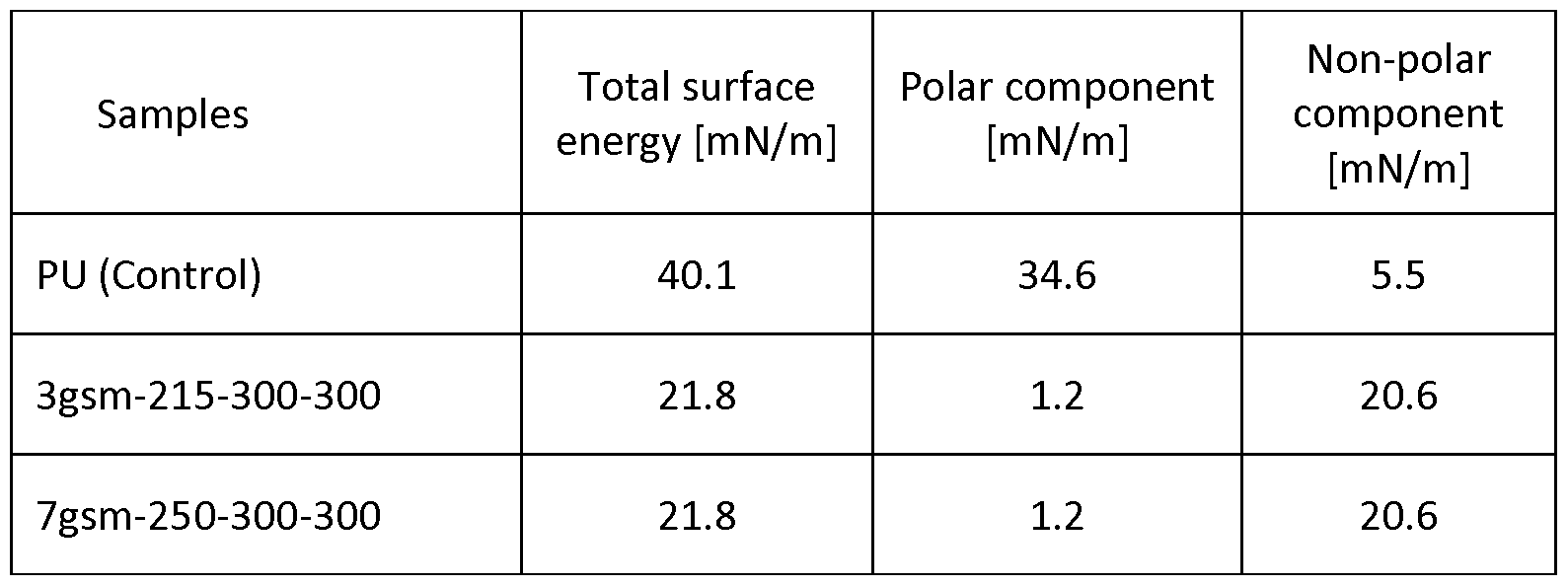
Table 15 - Absorption Peaks

[00215] The FT-IR spectra of untreated PU film shows a broad absorption band from 1681 to 1722 cm"1 which is assigned as bonded -C=0 stretching (centered at about 1698 cm"1) and free -C=0 stretching (centered at about 1716cm"1) with comparable intensities. The untreated PU film also exhibits absorptions at 1450 and 1523 cm"1, assigned to -CH2 and -N-H bending mode, respectively. On the other hand, the unreacted polyisocyanate shows characteristic absorption peaks centered at about 2270cm"1 due to -NCO groups and 1683cm"1 due to -C=0 bending. Additionally, the polyacrylate component shows an absorption peak at about 1722cm"1 due to the -C=0 groups in the ester type environment.
[00216] When polyisocyanate reacts with the hydroxyl groups in the polyacrylate, new polyurethane linkages are created, producing new absorption peaks at about 1698 cm"1 and 1716cm"1, again with comparable intensities. Therefore, the peak at about 1720cm"1 represent contributions from the bonded -C=0 stretching in the polyurethane and the -C=0 in the polyacrylate whereas the peak at about 1680cm"1 represents contributions from the free -C=0 stretching in the polyurethane and the - C=0 in the polyisocyanate.
[00217] The IR spectra were collected at different incremental steps and normalized against the absorption peak at 1720cm"1 (Figure 17). The absorption peak characteristic of the PU film, e.g. 1523 cm" 1 increases continuously with increases in the probing depth until a bout step 10. Based on color changes from the FT-IR imaging, an estimated penetration depth of about Ιΐμιη and 7μιη was obtained for the treatment with the 3gsm and the 7gsm treatment materials, respectively (Table 16). As mentioned above, the diffusion of treatment materials into the PU film contributes to the retention of conformability/stretchability of the PU films.
Table 16 - Depth of Diffusion

Calculated using coating density of 1.17g/cm3
[00218] Cross-section optical microscopy measurements were performed for the PU films treated with the 3gsm and 7gsm coat weight treatment materials and dried at various temperatures to measure the actual thickness of these materials disposed above the surface of both the PET and PU substrates. The density of the dry coating material from this treatment composition was measured to be about 1.17g/cm3, which is the same as the Coronate HXLV compound. The results are also summarized in Table 16. The 3gsm-215-240-250 material applied to the PET substrate exhibits a sharp interface with a layer thickness of about 2.8μιη, which is comparable to the theoretical thickness of 2.6μιη. In comparison, the same amount of material applied to the PU substrate shows a layer thickness of about 0.5-0.9μιη, which is about 1/3 of the theoretical thickness (2.6μιη). Similar results were also found for the 7gsm-250-300- 300 materials which show a thickness of 2.3 to 2.7μιη or less than 1/2 of the theoretical thickness (6.0μιη) on the PU film. These results suggest that more than 50% of the coating materials have diffused into the PU film substrates.
[00219] Further evidence of diffusion, though, indirect, was found when the above treatment solution was applied to PET and to an aluminum foil and dried/cured under the same conditions. The coating remains tacky by hand touch on both substrates. The tacky surface is caused by the presence of an excessive amount of polyisocyanate component that could not penetrate or diffuse into these substrates. Molecular weight measurements by GPC instrument indicate that the Mw of the polyacrylate material is a bout 17800 and that of the Coronate HXLV polyisocyanate is merely 631. The smaller size of the polyisocyanate molecule is consistent with the enhanced diffusion into the PU film.
[00220] In typical 2K polyurethane coatings based on reactions of isocyanate and hydroxyl-bearing compound, the -NCO/-OH ratio of slightly above 1.0 is typically used in order to compensate for slight losses due to reaction with residual moisture and to fully convert the hydroxyl groups into urethane linkages. In the preferred embodiments of the present invention, part of the isocyanate crosslinker diffuses into the PU su bstrate, therefore even more excess amounts of polyisocyanate crosslinker are necessary to compensate for the extra loss incurred from the diffused polyisocyanate crosslinker. The polyisocyanate crosslinker that has diffused into the PU film may further react with moisture or other
compounds having reactive hydrogen atoms inside the PL) film, leading to complex reactions and new functionalities. For example, if the plastic film contains reactive groups such as carboxylic or hydroxyl groups, the isocyanate crosslinker can also react with these groups to form amide and urethane linkages, respectively. Under proper conditions such as the presence of a reaction catalyst, the polyisocyanate crosslinker can also react with the urethane group in the PU film to form allophanate structures. Thus, a three dimensional reaction network may be enabled by the crosslinker which reacts both with the reactive components from the coating composition in the horizontal direction and with the functionalities present in the plastic film in the vertical direction.
[00221] The PU film treated with the exemplary treatment composition 8-7 was further tested for stability under different environments including high temperatures, high humidity, and outdoor sunlight. In Figure 18, the variation of elongation % is plotted after exposure to 70°C for 4 days and 8 days. The elongation % decreased by about 20-30% after 4 days and become stable thereafter. On the other hand, when the treated PU films are exposed to a high humidity environment such as 90% humidity, no change in the elongation % occurs as shown in Figure 19. It is theorized that the decrease in elongation % upon exposure to high temperature is due to continuous crosslinking reactions between the unreacted polyisocyanate and the polyacrylate. In comparison, when the treated PU films are exposed to a high humidity environment, the reactions occur mainly between the unreacted polyisocyanate and moisture to form urea which is not crosslinked. This is consistent with the fact that moisture is more reactive with isocyanate groups than with the hydroxyl groups from a polyol compound. Alternately, FT-IR measurements indicate that after exposure to the high temperature or high humidity environments, all the leftover polyisocyanates in the treated PU film have reacted in less than 100 hours. In addition, the Sharpie performance was significantly improved and become "perfect", i.e., the writing ink can be wiped off completely and it is difficult to tell where the ink was applied (rating 10).
[00222] The stability of PU films against exposure to outdoor sunlight environment was emulated by accelerated testing in an Atlas Ci5000 Weather-Ometer following the SAE J-1960 testing protocol. The changes in the b* values (Ab*) and in the total color (ΔΕ) were measured before and after exposure to the testing conditions and the results are shown in Figure 20. Very little color changes (ΔΕ<0.6) were observed for all the samples after testing for 850 hours. In fact, any color variation that is below 2.0 is nearly unperceivable if at all by naked human eyes. The excellent resistance to yellowing is well known for aliphatic polyisocyanate and polyacrylate materials.
[00223] The changes in the elongation % of the treated PU films were measured after exposure to the UV weathering conditions for 385 hours (Figure 21). The elongation % at deformation remains basically unchanged, similar to what was observed in the high humidity exposure. This result suggests
that most of the post-reactions have occurred between the polyisocyanate and moisture during the UV weathering test. FT-I measurements indicate that all the leftover polyisocyanate reacted after the weathering test for about 100 hours. The Sharpie performance was significantly improved and become perfect (rating 10) for all the samples, also similar to the results after exposure to the high humidity environments.
Example 9
[00224] Thermally curable formulations were prepared by adding a reaction catalyst FASCAT* 2003 (Arkema Inc.) into the thermally curable treatment composition 8-7. The use of a reaction catalyst is aimed to reduce the curing temperatures. The FASTCAT* 2003 is a pale yellow liquid consisting of 97 wt % of stannous octoate and 3 wt % of 2-ethylhexoic acid. FASCAT* 2003 catalyst is used extensively for producing urethanes from the reaction of isocyanates and polyols. Two new compositions were prepared with different solid % as shown in Table 17. The composition with lower solid % is intended for treatment with smaller coat weight without changing the liquid delivery system and/or process conditions. The PU/PSA/PET films were treated with the two treatment solutions at 2.6gsm and 1.3gsm dry coat weight on a pilot coater, respectively, and dried at various drying temperatures. The properties of the treated PU films with both treatment compositions are summarized in Table 18.
Table 17 - Treatment Compositions

Table 18 - Properties of Treated Polyurethane Films

[00226] The Sharpie performance (Table 18) of the treated PU films is slightly worse than those treated with the same composition but without catalyst (Table 13). This result suggests that at current catalyst loading, the effect of catalyst is not strong enough to compensate for the adverse effect of lower drying temperatures. The Sharpie performance is comparable at 1.3gsm and 2.6gsm coat weight, again suggesting that the 1.3gsm coat weight is sufficient to prevent ink from leaking into the PU film.
[00227] Though not shown, all the treated films exhibit a haze % of less than 3.0 and 60° gloss of above 90.
Example 10
[00228] Thermally curable treatment compositions were made by including a component (f) into the exemplary treatment composition 8-7. The component (f) was a silicon-containing compound having hydroxyl groups, namely a phenyltrisilanol POSS* material (S01458) available from Hybrid Plastics (Hattiesburg, MS) in the form of a white powder. The S01458 is typically used as an additive for surface modification (dispersant), improving moisture resistance, and improving processabilty of plastic materials. The S01458 contains hydroxyl groups which are capable of reacting with the polyisocyanate crosslinker and chemically attached to the coating matrix. The chemical composition of the newly prepared treatment compositions are shown in Table 19. The treatment compositions were applied to the 150μιη thick Argotec PU film (PU/PSA/PET) substrate using an Automatic Film Applicator at ΙΟμιη coat weight and dried in a thermal oven at 260°F for 3 minutes. The properties of thus treated PU films and their performance are shown in Ta ble 20.
Table 19 - Treatment Compositions


[00229] The treatment composition 10-3 which comprises 14.29% S01458 in liquid composition exhibits a milky surface covered with the S01458 solid materials after drying. The treatment composition 10-2 which contains 10.0% S01458 forms an optically clear coating, but becomes milky upon stretching to 40% elongation. The appearance of milky surface for both the 10-2 and 10-3 treatment compositions suggests part of the POSS* S01458 materials have not reacted with the polyisocyanate crosslinker and as a result, they are not chemically bonded to the matrix of the treatment materials and separate from this latter upon stretching. In order to maintain an elongation of >40%, the POSS* S01458 in the treatment composition needs to be lower than about 5% in liquid composition or 32% based on the total solids.
[00230] The Sharpie performance of the treatment compositions comprising the S01458 is worse compared to the treatment compositions without POSS* S01458 (Table 13), which can be attributed to the reduced contribution of the polyacrylate component which provides low surface energy silicone groups to the surface, and to a reduced reaction of the hydroxyl groups in the polyacrylate with the polyisocyanate crosslinker.
Example 11
[00231] Thermally curable treatment compositions were prepared by including colloidal silica nano-particles into the treatment composition of Example 8-7. The colloidal silica was obtained from Nissan Chemical Industries, Ltd. (Houston, TX) under the trade name MIBK-ST. It is a pale yellow liquid with 31% amorphous silica dispersed in the MIBK solvent. So the new treatment compositions include three solvents: MEK, MPA, and MIBK. The amorphous silica also contains hydroxyl functional groups on the particle surface. The composition of the new treatment compositions comprising the colloidal silica is shown in Table 21. Again the treatment compositions were applied to the 150μιη thick PL) film (PU/PSA/PET) substrates using an Automatic Film Applicator at ΙΟμιη wet thickness, and dried in a thermal oven at 260°F for 3 minutes. The properties of thus treated PL) films and their performance are shown in Table 22.
Table 21 - Treatment Compositions


[00232] Though not shown, all the PU films treated with the above compositions are optically clear with haze % less than 3.0 and 60° gloss of greater than 90. Additionally, at 6.8 wt % silica in the dry coating, the treated PU film achieved elongation of 97% without deformation. However, greater amounts of silica tended to degrade the elongation performance, down to about 60% with 22.6 wt % silica based on total solids in the treatment composition.
[00233] Inorganic particles such as amorphous silica are widely used for increasing the hardness of the coating which leads to improved mar/scratch resistance. As shown in Tables 21 and 22, even with 6.80 wt % silica loading, the modulus of the treated PU film (40.0 MPa) is considerably higher than that of untreated PU film (29.0 MPa). It is also much higher compared to the PU film treated with treatment compositions containing POSS* S01458 nano-material (32.2 MPa, Table 20). As expected, the modulus keeps increasing with the amount of silica loading.
[00234] Where tested, all samples performed excellent in response to the motor oil test described herein. The Sharpie performance was equal to or slightly worse than those treated with the same solution but without silica.
Example 12
[00235] A 150μιη Argotec PU film on a PET carrier (PU/PET) was treated with 6.5gsm dry thickness of the first exemplary Sila-Max™ U-1006 treatment composition. The thus treated PU film was
successfully embossed on a continuous embossing apparatus. The embossing conditions and the depth of the embossed patterns are shown in Table 23.
Table 23 - Embossing Conditions and Depth

Example 13
[00236] A 150μιη thick Argotec PL) film laminated to a PSA (PU/PSA/PET) was treated with the exemplary treatment composition 8-10. The thus treated surface was embossed using a stationary heat press. The top plate of the press was heated using an I source. The treated surface was placed onto a Master shim with a retro-reflective cube pattern and embossed at a pressure of 90psi and an IR heating time of about 4 seconds.
Example 14
[00237] A 150μιη thick Argotec PL) film laminated to a PSA (PU/PSA/PET) was treated with the exemplary treatment composition 8-10. A 1.7mil thick Trans-Kote* PET/M R Laminating Film was obtained from Transilwrap Company Inc. (Franklin Park, IL). The PET/MR Lamination Film was thermally laminated to the treated PL) film surface on a laboratory scale thermal laminator (Cheminstruments, Fairfield, OH) at 250F temperature, 2cm/sec lamination speed, and 40psi pressure. The PET lamination layer sticks firmly to the treated PL) surface and yet can be peeled off easily and cleanly.
Example 15
[00238] A 150μιη thick black color Polyvinyl chloride) (PVC) film laminated to a PSA layer and a PET release layer (PVC/PSA/PET) was obtained from Avery Dennison Corporation. The PVC film was treated using an exemplary treatment composition 15-1 shown in Table 24 at 20μιη applied wet thickness and cured in a thermal oven at 220°F for 3 minutes. The properties of thus treated PVC film are shown in Table 25. The untreated PVC film exhibits an elongation of about 500% and a 60° gloss of 30.1. Upon writing using a Sharpie pen, the writing ink does not contract and only trace amounts of the ink can be wiped off (rating 1). After treatment with the exemplary treatment composition, the 60° gloss of the PVC surface was increased to 91.6 while the flexibility/stretchability was substantially maintained as shown by an elongation at deformation of 151.5%. Upon writing using a Sharpie pen, the writing ink contracts instantly and a significant amount of the writing ink can be wiped off (rating 7).
Cross-hatch tape peel using 3M 810* tape showed no delamination of the treatment materials from the PVC film.
Table 24 - Treatment Composition

Table 25 - Properties of Treated Films

Example 16
[00239] Additional trials were undertaken relating to the preferred embodiment coating formulations for forming surface treatment regions in polymeric films. Specifically, it was desired to further investigate the use of formulations with higher solid content(s) and/or lower solvent concentrations(s). In addition, it was also desired to evaluate diffusion of a single component such as a polyol into a PL) or PET film substrate.
[00240] Table 26 lists various coating treatment formulations.
Table 26 - Treatment Compositions

ARC-
2 0.375 5 0 22.0 27.1 50.8 0.3 0 35R
2 0.375 5 0 22.0 27.1 50.8 0.3 0
2 0.375 5 0 22.0 27.1 50.8 0.3 0
2 0.375 5 0 22.0 27.1 50.8 0.3 0
[00241] Referring to Table 26, the solvent MEK is methyl ethyl ketone. And, the solvent MPA is metroxy propyl acetate. Unless noted otherwise, the values set forth in Table 26 are parts by weight. All treatment compositions except for ARC-36 contained a commercially available polyisocyanate component designated as Desmodur ® N3300A from Bayer Material Sciences. It is also contemplated that Coronate HXLV from Nippon Polyurethane could also be used. A polyacrylate based polyol component was also used in each of the treatment compositions. Specifically, a polyol (i.e. having hydroxyl groups) with a polyacrylate backbone is preferably used. An example of such an agent is BYK3700 available from BYK Chemie USA. This agent contains 25% hydroxyl-functional silicone modified polyacrylate and 75% MPA solvent. The isocyanate groups in the polyisocyanate react with the hydroxyl groups in the polyol to produce a cross-linked polyurethane coating. The ARC-36 treatment compositions utilized only polyol and so the resulting coating is not cross-linked and is 100% polyacrylate polyol compound. The ARC-34 compositions utilized a colloidal silica. A commercially available colloidal silica product was used, designated as MIBK-ST and available from Nissan Chemicals. The MIBK-ST product contains 31% colloidal silica in methyl isobutyl ketone (MIBK) solvent. On a dry weight basis, the ARC-34 compositions used 3.7% of the colloidal silica.
[00242] The various formulations were applied to PU film substrates at the coat weights noted in Table 27. After coating, the applied formulations were dried and/or cured at a web temperature of from about 250° F (121° C) to about 300° F (149° C). Various aspects of the resulting coated films were then evaluated. These results are set forth below in Tables 27. As previously explained, optical clarity or haze % was determined in accordance with ASTM D-1003. 60° gloss readings were determined in accordance with ASTM D-523. Stain resistance was evaluated by contact with used motor oil for 90 hours at 25°C. Elongation % at deformation was determined by ASTM D-2370, using an Instron device at a rate of 2 inches/min, using 1 inch by 6 inch strips and 4 inch in gauge length. Visual observations were used for assessing any change in appearance. Long term durability was evaluated in accordance with SAE J-1960 for 2,000 hours, and/or 2 years testing in Florida and Arizona.
[00243] Table 27 further includes two comparative samples, a commercially available paint protection film product from Avery Dennison referred to as NANO-FUSION. The other comparative sample is a conventional polyurethane film.
Table 27 - Performance Summary

[00244] As shown in Table 27, each formulation was applied at several different coat weights and dried at various web temperatures for further evaluations. The previously described labeling nomenclature was used, i.e. xxxgsm-xxx-xxx-xxx where "xxxgsm" represents the applied coat weight and the following values represent the web drying temperatures for three drying zones. A prefix is also typically used herein to refer to the sample identifier.
[00245] Figure 22 illustrates various elongation % values and Young's modulus values obtained from numerous samples summarized in Table 27.
[00246] Figure 23 illustrates changes in elongation % after thermal aging at 80°C for 48 hours.
[00247] Figure 24 illustrates variation in Young's modulus after thermal aging at 80°C for 48 hours.
[00248] Figure 25 illustrates change in elongation % after humidity aging at 40°C and 90%RH for 48 hours.
[00249] Figure 26 illustrates change in Young's modulus after humidity aging at 40°C and 90%RH for 48 hours.
[00250] As shown in Table 27, all the treated PU films showed a reduction in the haze % and an increase in the 60deg gloss due to smoothing of the PU film surface as mentioned earlier. Except for the ARC-36 all the treated films exhibited an elongation % at deformation of greater than 70% and the elongation at break of greater than 500%, again indicating that the flexibility/hand stretchability are largely retained. The modulus of the treated films slightly decreased at 2gsm applied coat weight but increased when the coat weight was greater than 3gsm. Upon exposure to the used motor oil, the untreated PU film showed a total color change of 47.4 whereas the color change for all the treated films remained below 1.4 which is not easily noticeable by naked eyes. In addition, all the treated films exhibited good anti-graffiti properties as illustrated by the excellent Sharpie performance.
[00251] Figure 27 illustrates additional testing results relating to release and adhesion to a painted panel. Adhesion was evaluated by a 180° peel test using PU/PSA/white painted panel (ADT), an Instron device at a peel rate of 12 inches/minute. The painted panel is a commercially available testing panel designated as APR52956 Testing Panel from ACT Test Panels, LLC. The panel is 4 inches wide and 12 inches long. The panel was cut into 2 inch by 5 inch pieces and cleaned with isopropyl alcohol solvent. The treated film was attached to the 2 inch by 5 inch pieces via a PSA layer and dwelled for 20 minutes prior to adhesion testing. Release was evaluated at 90° peeling angle on a peel terse. The sample was attached to an aluminum holder on the peel tester by a double-sided tape from the exposed PU surface and the PET layer was peeled off at 90° at a rate of 300 inches/minute. Referring to Figure 27, it can be seen that release force is generally not affected by surface treatments. Furthermore, adhesion to the painted panels increased by use of the surface treatments.
[00252] Samples of the treatment compositions noted in Table 26 were also subjected to cytotoxicity testing and skin irritation testing. It is known that isocyanate materials typically cause skin irritation. And so, the potential for such by the compositions described herein was investigated.
[00253] Cytotoxicity testing was performed in accordance with ISO-10993-10 "Biological Evaluation of Medical Devices". Generally, a collection of wells were provided containing a sub-confluent monolayer of L-929 mouse fibroblast cells. The growth medium used included Single Strength Minimum Essential Growth Medium supplemented with 5% fetal bovine serum, 2% antibiotics (100 units/mL penicillin, 100μg/mL streptomycin, and 2^g/mL asmphotericin B) and 1% (2mM) L-glutamine. Triplicate wells were dosed with Icmxlxm test article or sample, a high density polyethylene (HDPE) negative control, and a late positive control. Each article was placed in direct contact with the L-929 cells for 24-26 hrs. Visual checks under lOOx optical microscope were performed for abnormal cell morphology and cell lysis in proximity to the articles.
[00254] Most of the samples received a grade in which no zone of cell lysis was detected in proximity to the samples. This indicates that the formulations should not adversely affect human health.
[00255] Skin irritation testing was performed in accordance with ISO-10993-10 for "Biological Evaluation of Medical Devices." Generally, test articles were cut into pieces of 25mmx25mm. The surface was moistened with 0.5mL of saline, backed with 4-ply gauze and polyethylene plastic, and applied to the skin of a rabbit. Control samples included 25mmx25mm 4-ply gauze (20% rayon, 80% polyester blend, certified by FDA QS 21 CFR Part 820) supplied by the testing facility, moistened with 0.5mL of saline, backed with polyethylene plastic, and applied to the skin of the same rabbit. Regarding the rabbits, the animals were New Zealand White, young adult rabbits. Male rabbits weighed 2.3-2.6 kg and were obtained from Myrtle's Rabbitry Inc. Three animals were tested for 5 days. Rabbits were weighed and the fur on the back was clipped with an electric clipper 4 to 24 hours prior to the test. On the testing day, 4 sites free of blemishes, 2 on each side of the back and positioned cranially and caudally, were prepared on each rabbit to receive the testing article. After 24 hours exposure, the binders, tape, and patches were removed. The sites were gently wiped with a gauze sponge dampened with Dl water to remove any remaining residue.
[00256] Results of this testing included Primary Irritation Scores and Primary Irritation Index values. These were determined as follows. Animals were observed daily for general health. Changes in body weights were recorded for each animal. Dermal observations for erythema and edema were recorded at 1, 24, 48, and 72 hours after patch removal. The erythema and edema scores obtained at 24, 48, and 72 hours interval were added and divided by the total number of observations. Primary Irritation Scores were obtained by subtracting the scores of the control sample from the scores of
testing article. Primary Irritation Index was calculated by averaging the Primary Irritation Scores among the 3 Rabbits.
[00257] The results of the cytotoxicity and skin irritation testing demonstrate that the treated films are safe for applications to consumer products, for example to application as protective films for consumer electronics which involve frequent skin contact.
Example 17
[00258] In another investigation, various treated films were prepared using either a PU or PET substrate coated with a treatment formulation identified in Example 16. Table 28 summarizes the particular treatment formulations which were applied to the noted substrates. After formation of the treated film, various photomicrographs were obtained for the samples.
Table 28 - Treated Films

[00259] By appropriate selection of solvent, thickness of the treatment layer, and other parameters, films having a transition region and thus free of a distinct interface can be formed, such as samples 2, 9 and 10 in Table 28. Similarly, by appropriate selection of solvent, thickness of the treatment layer, and other parameters, films having a distinct interface can be formed, such as samples 1 and 3-8 in Table 28.
Example 18
[00260] In another series of investigations, various treated laminates were prepared and coated with treatment formulations identified in Table 29. The treatment formulations were cured by passing the coated laminate along one or more UV sources to thereby at least partially crosslink and cure the coating. These aspects are described in greater detail as follows.
Table 29 - Treatment Compositions

[00261] As will be appreciated, the extent of exposure to the UV source depends upon the web speed. Thus, the "UV dose" can be selectively varied by selecting a web speed. Figure 32 illustrates a representative relationship between UV dose and web speed.
[00262] Figure 33 schematically illustrates a process for preparing the coated laminates described herein. Referring to Figure 33, a laminate of one or more films of polyethylene terephthalate and/or polyurethane defining a first face and a second face is provided. A layer of a pressure sensitive adhesive is disposed along at least a portion of the second face. A release liner is provided generally covering the adhesive layer. The release liner can be a layer of polyethylene terephthalate. The laminate, is directed alongside an antistatic bar to dissipate any static electrical charge. The laminate is then directed to a location at which a curable topcoat solution or mixture is applied to the first face of the film of the laminate. The laminate may also be cut or otherwise modified by one or more pattern dies. Typically and in certain processes, sheets of approximately 8 foot lengths are formed. The coated sheets or web moving at a web speed of 30 feet per minute (fpm), is then passed alongside one or more heated stations, and preferably through a plurality of zones each increasing in temperature. In the process schematic depicted in Figure 33, three zones are depicted as follows. Zone 1 provides a temperature of about 200 QF, Zone 2 provides a temperature of about 250 QF, and Zone 3 provides a temperature of about 300 QF. Dry air, typically heated, is passed counter-currently alongside the moving coated laminate. The heating and exposure to moving air promotes evaporation of solvents and other components from the topcoat formulation. The moving laminate is then irradiated with UV light at a UV station as shown in Figure 33 to crosslink and thus cure the topcoat formulation. After sufficient curing, the laminate or web is cooled and then stored or packaged as desired.
[00263] Table 30 is a summary of the properties and characteristics of the coated laminates addressed in this investigation.
Table 30 - Summary of Properties of Coated Laminates

yield if two layer 85% NA
CTQs construction
Topcoat adhesion test =4 Pass
Topcoat potlife 8 hours 6months
Elongation at topcoat break 70% 10, 15, and 20gsm
Haze 3% < 1
Clarity > 98
Transmission 90 > 92
60 degree gloss 80 > 93
Stain resistance (Motor oil
ΔΕ 3.0 < 1.5
resistance)
Resistance to cleaning
Pass
agent
[00264] Tables 31A, 31B, and 31C provide a detailed listing of the coated laminates, parameters utilized in their formation, properties of the coated laminates, and other information.
Table 31A - Details of Coated Laminates

Table 31B - Details of Coated Laminates

Table 31C - Details of Coated Laminates

[00265] Table 31D provides specific details as to the topcoat formulation PC-7 noted in Tables 31A, 31B, and 31C. Table 31D also includes two other representative formulations.
Table 31D - Topcoat Formulations
Ingredient Company/Brand PC-7 AD-2012-1 AD-2012-5 Sila Max™-U1006-40-M02 JNC/Chisso 32.41 31.25 45.45 CN2285 Sartomer 46.30 44.64
Genomer 1122 ahn USA 19.48 Benzophenone Sigma-Aldrich 0.93 3.57 5.19 MEK 19.44 17.86 25.97
ESTANE resin 5715 Lu brizol 0.93
Mayzo BNX 1010 Mayzo 0.89 1.30 Tinuvin 292 BASF 0.89 1.30 Tinuvin 1130 BASF 0.89 1.30
[00266] Table 32 is a summary of thermal aging results for certain samples evaluated in this investigation. The noted samples were subjected to a temperature of 60 QC for a time period of 13 days. Then, the thermally aged samples were subjected to elongation tests using an Instron device. The percent change in elongation in the cross direction (CD) and machine direction (MD) are noted in Table 32.
Table 32 - Thermal Aging Elongation by Instron
Sample 6Q5C/13 days Control Changes [%]
CD MD CD MD CD MD
PC5 123.66 105.7 125.47 110.95 1.46 4.97
PC6 121.21 111.87 139.30 113.60 14.92 1.55
PC7 103.65 102.54 105.60 95.80 1.88 -6.57
PC8 123.89 106.1 104.40 81.10 -15.73 -23.56
PC9 79.71 95.76 74.70 88.20 -6.29 -7.89
PC10 58.74 51.69 71.60 61.20 21.89 18.40
PC11 125 119.7 120.21 109.40 -3.83 -8.60
PC12 97.5 97 98.80 95.23 1.33 -1.82
PC13 81.7 80.3 86.14 84.56 5.43 5.31
PC14 124.8 124.4 118.50 120.39 -5.05 -3.22
PC15 70.4 61.6 73.03 63.97 3.74 3.85
PC16 42.6 42.9 45.33 42.16 6.41 -1.72
PC17 122.2 122.8 112.50 112.80 -7.94 -8.14
PC18 72.6 72.6 75.00 72.90 3.31 0.41
PC19 50.1 48.2 53.30 50.90 6.39 5.60
[00267] Table 33 summarizes the results of UV weathering tests performed upon certain samples in this investigation. The samples were subjected to UV weathering conditions for a time period of 260 hours.
Table 33 - UV Weathering - 260 hrs
Sample Ab ΔΕ
PC5 -0.20 0.55
PC6 -0.13 0.34
PC7 -0.02 0.32
PC8 -0.26 0.42
PC9 -0.13 0.62
PC10 0.35 0.47
PC11 -0.48 0.54
PC12 -0.14 0.26
PC13 0.08 0.21
PCM -0.40 0.47
PC15 -0.02 0.43
PC16 0.35 0.35
PC17
PC18
PC19
[00268] Tables 34A and 34B summarize various properties and characteristics for coated films and laminates. Many if not all of these aspects are desirable and/or important for coated films and laminates.
Table 34A - Properties for Coated Films and Laminates

Table 34B - Properties for Coated Films and Laminates

[00269] All patents, published applications, articles, and standards noted herein are hereby incorporated by reference in their entirety.
[00270] In any event, it is to be appreciated that different aspects of the exemplary embodiments may be selectively employed as appropriate to achieve other alternate embodiments suited for desired applications, the other alternate embodiments thereby realizing the respective advantages of the aspects incorporated therein. In short, the present specification has been set forth with reference to preferred embodiments. For example, one or more components of any of the formulations described herein can be combined with one or more other components of formulations described herein, and will be encompassed by the present subject matter. Modifications and alterations will occur to others upon reading and understanding the present specification. It is intended that the invention be construed as including all such modifications and alterations insofar as they come within the scope of the appended claims or the equivalents thereof.
Claims
1. A protective sheet comprising:
a solid plastic film defining a first surface and an oppositely directed second surface;
a UV curable topcoat formulation disposed on at least one of the first surface and the second surface of the plastic film to thereby constitute a coated film, the topcoat formulation comprising (i) at least one silicon-containing polymer, (ii) an ethylenically unsaturated (meth)acrylate monomer or oligomer having at least one urethane (meth)acrylate oligomer, and (iii) an optional polyurethane resin.
2. The protective sheet of claim 1 wherein the cured topcoat can undergo elongation to at least 70% without cracking.
3. The protective sheet of any one of claims 1-2 wherein the thickness of the cured topcoat is within a range of from about 1 micron to 15 microns.
4. The protective sheet of any one of claims 1-3 wherein the topcoat formulation further comprises at least one agent selected from the group consisting of a photo-initiator, acrylic oligomers, solvents, antioxidants, light stabilizers, and combinations thereof.
5. The protective sheet of any one of claims 1-4 wherein the plastic film includes at least one of a polyurethane and a polyethylene terephthalate.
6. A protective laminate comprising:
a polymeric su bstrate defining a first surface and an oppositely directed second surface;
a layer of a pressure sensitive adhesive disposed on at least a portion of the second surface of the polymeric substrate; and
a UV curable topcoat formulation disposed on at least a portion of the first surface and the second surface of the polymeric substrate, the topcoat formulation comprising (i) at least one silicon-containing polymer, (ii) an ethylenically unsaturated (meth)acrylate monomer or oligomer having at least one urethane (meth)acrylate oligomer, and (iii) a polyurethane resin; and an optional removable protective sheet on the air interface of the topcoat
7. The protective laminate of claim 6 further comprising:
a release liner on the layer of the pressure sensitive adhesive.
8. The protective laminate of any one of claims 6-7 further comprising a protective film on the laminate
9. The protective laminate of any one of claims 6-8 wherein the cured topcoat can undergo elongation to at least 70% without cracking.
10. The protective laminate of any one of claims 6-9 wherein the thickness of the cured topcoat is at least 1 micron.
11. The protective laminate of any one of claims 6-10 wherein the topcoat formulation further comprises at least one agent selected from the group consisting of a photo-initiator, acrylic oligomers, solvents, antioxidants, light stabilizers, and combinations thereof.
12. The protective laminate of any one of claims 6-11 wherein the polymeric substrate includes at least one of a polyurethane and a polyethylene terephthalate.
13. A method of forming a protective sheet, the method comprising:
providing a polymeric substrate defining a first surface and an oppositively directed second surface; providing a UV curable topcoat formulation comprising (i) at least one silicon-containing polymer, (ii) an ethylenically unsaturated (meth)acrylate monomer or oligomer having at least one urethane (meth)acrylate oligomer, and (iii) a polyurethane resin;
applying the topcoat formulation to at least one of the first surface and second surface of the polymeric substrate; and
exposing the applied topcoat formulation to UV light for a sufficient time to cure the topcoat and thereby form the protective sheet.
applying an optional removable protective sheet to the cured topcoat of the laminate
14. The method of claim 13 wherein the cured topcoat can undergo elongation to at least 70% without cracking.
15. The method of any one of claims 13-14 wherein the thickness of the cured topcoat is at least 1 micron.
16. The method of any one of claims 13-15 wherein the thickness of the cured topcoat is up to 15 microns.
17. The method of any one of claims 13-16 wherein the thickness of the cured topcoat is within a range of from about 1 micron to about 12 microns.
18. A protective removable topsheet, the topsheet comprising:
a polyurethane film defining a first face and oppositely directed second face;
a layer of an adhesive disposed on the second face of the polyurethane film, the layer of adhesive defining an adhesive face;
a liner layer disposed on the adhesive face;
a topcoat disposed on the first face of the polyurethane film, the topcoat including (i) at least one silicon-containing polymer, (ii) an ethylenically unsaturated (meth)acrylate monomer or oligomer having at least one urethane (meth)acrylate oligomer, and (iii) an optional polyurethane resin.
19. The protective removable topsheet of claim 18, wherein the topcoat is cured and has a thickness of at least 1 micron.
20. The protective topsheet of any one of claims 18-19 wherein the topcoat has a thickness of up to 15 microns.
21. The protective topsheet of any one of claims 18-20 wherein the topcoat has a thickness of up to 12 microns.
22. The protective topsheet of any one of claims 18-21 wherein the cured topcoat can undergo a deformation of at least 70% without cracking.
23. The protective topsheet of any one of claims 18-22 wherein the topcoat can undergo a deformation of at least 80% without cracking.
Priority Applications (2)
| Application Number | Priority Date | Filing Date | Title |
|---|---|---|---|
| PCT/US2012/048124 WO2013133862A1 (en) | 2012-03-07 | 2012-07-25 | Surface treated film and/or laminate |
| PCT/US2013/029016 WO2013154695A2 (en) | 2012-04-09 | 2013-03-05 | Surface treated film and/or laminate |
Applications Claiming Priority (4)
| Application Number | Priority Date | Filing Date | Title |
|---|---|---|---|
| PCT/US2011/032658 WO2011146188A1 (en) | 2010-05-20 | 2011-04-15 | Surface treated film and/or laminate |
| USPCT/US2011/032658 | 2011-04-15 | ||
| PCT/US2011/038529 WO2012141723A2 (en) | 2011-04-15 | 2011-05-31 | Surface treated film and/or laminate |
| USPCT/US2011/038529 | 2011-05-31 |
Publications (2)
| Publication Number | Publication Date |
|---|---|
| WO2012141994A2 true WO2012141994A2 (en) | 2012-10-18 |
| WO2012141994A3 WO2012141994A3 (en) | 2013-01-03 |
Family
ID=47009921
Family Applications (1)
| Application Number | Title | Priority Date | Filing Date |
|---|---|---|---|
| PCT/US2012/032746 Ceased WO2012141994A2 (en) | 2011-04-15 | 2012-04-09 | Surface treated film and/or laminate |
Country Status (1)
| Country | Link |
|---|---|
| WO (1) | WO2012141994A2 (en) |
Cited By (6)
| Publication number | Priority date | Publication date | Assignee | Title |
|---|---|---|---|---|
| WO2013133862A1 (en) * | 2012-03-07 | 2013-09-12 | Avery Dennison Corporation | Surface treated film and/or laminate |
| WO2013154695A3 (en) * | 2012-04-09 | 2014-06-26 | Ccl Label, Inc. | Surface treated film and/or laminate |
| CN108410351A (en) * | 2018-03-09 | 2018-08-17 | 东莞市派乐玛新材料技术开发有限公司 | Organosilicon/inorganic silicon hybridization barrier coat composition and the preparation method and application thereof |
| CN111826079A (en) * | 2020-08-06 | 2020-10-27 | 宁波惠之星新材料科技有限公司 | A hardening liquid, a hardened film of a flexible high-hardness and high-wear-resistant cover plate, a flexible, high-hardness, high-wear-resistant cover plate and a preparation method thereof |
| CN115461221A (en) * | 2020-05-29 | 2022-12-09 | 东洋纺株式会社 | Polyimide film and method for producing same |
| US12138903B2 (en) | 2018-02-06 | 2024-11-12 | 3M Innovative Properties Company | Surface impression resistant film constructions and methods |
Citations (9)
| Publication number | Priority date | Publication date | Assignee | Title |
|---|---|---|---|---|
| US5453464A (en) | 1993-05-24 | 1995-09-26 | Eastman Chemical Company | Thermosetting coating compositions |
| US5804612A (en) | 1995-06-08 | 1998-09-08 | Arkwright, Incorporated | Transparent anti-fog coating |
| US6228472B1 (en) | 1998-12-21 | 2001-05-08 | Basf Corporation | Process for synthesis of allophanate compounds and compositions including the product thereof |
| US6383644B2 (en) | 1998-11-11 | 2002-05-07 | 3M Innovative Properties Company | Multi-layer sheet comprising a protective polyurethane layer |
| WO2003005776A1 (en) | 2001-07-04 | 2003-01-16 | Luxell Technologies Inc. | El device with enhanced contrast |
| US7053167B2 (en) | 2002-09-13 | 2006-05-30 | Chisso Corporation | Silsesquioxane derivative having functional group |
| US7235619B2 (en) | 2002-08-06 | 2007-06-26 | Chisso Corporation | Silsesquioxane derivative |
| US20080286576A1 (en) | 2005-10-21 | 2008-11-20 | Mcguire Jr James E | Protective Sheets, Articles, and Methods |
| US20100297376A1 (en) | 2009-05-20 | 2010-11-25 | Avery Dennison Corporation | Surface Treated Film and/or Laminate |
Family Cites Families (3)
| Publication number | Priority date | Publication date | Assignee | Title |
|---|---|---|---|---|
| DE10331794A1 (en) * | 2003-07-11 | 2005-02-03 | Degussa Ag | Radiation curable powder coating compositions and their use |
| KR20120044936A (en) * | 2009-05-20 | 2012-05-08 | 애버리 데니슨 코포레이션 | Surface treated film and/or laminate |
| WO2012122206A1 (en) * | 2011-03-10 | 2012-09-13 | Avery Dennison Corporation | Surface treated film and/or laminate |
-
2012
- 2012-04-09 WO PCT/US2012/032746 patent/WO2012141994A2/en not_active Ceased
Patent Citations (9)
| Publication number | Priority date | Publication date | Assignee | Title |
|---|---|---|---|---|
| US5453464A (en) | 1993-05-24 | 1995-09-26 | Eastman Chemical Company | Thermosetting coating compositions |
| US5804612A (en) | 1995-06-08 | 1998-09-08 | Arkwright, Incorporated | Transparent anti-fog coating |
| US6383644B2 (en) | 1998-11-11 | 2002-05-07 | 3M Innovative Properties Company | Multi-layer sheet comprising a protective polyurethane layer |
| US6228472B1 (en) | 1998-12-21 | 2001-05-08 | Basf Corporation | Process for synthesis of allophanate compounds and compositions including the product thereof |
| WO2003005776A1 (en) | 2001-07-04 | 2003-01-16 | Luxell Technologies Inc. | El device with enhanced contrast |
| US7235619B2 (en) | 2002-08-06 | 2007-06-26 | Chisso Corporation | Silsesquioxane derivative |
| US7053167B2 (en) | 2002-09-13 | 2006-05-30 | Chisso Corporation | Silsesquioxane derivative having functional group |
| US20080286576A1 (en) | 2005-10-21 | 2008-11-20 | Mcguire Jr James E | Protective Sheets, Articles, and Methods |
| US20100297376A1 (en) | 2009-05-20 | 2010-11-25 | Avery Dennison Corporation | Surface Treated Film and/or Laminate |
Cited By (8)
| Publication number | Priority date | Publication date | Assignee | Title |
|---|---|---|---|---|
| WO2013133862A1 (en) * | 2012-03-07 | 2013-09-12 | Avery Dennison Corporation | Surface treated film and/or laminate |
| WO2013154695A3 (en) * | 2012-04-09 | 2014-06-26 | Ccl Label, Inc. | Surface treated film and/or laminate |
| US12138903B2 (en) | 2018-02-06 | 2024-11-12 | 3M Innovative Properties Company | Surface impression resistant film constructions and methods |
| CN108410351A (en) * | 2018-03-09 | 2018-08-17 | 东莞市派乐玛新材料技术开发有限公司 | Organosilicon/inorganic silicon hybridization barrier coat composition and the preparation method and application thereof |
| CN108410351B (en) * | 2018-03-09 | 2020-06-16 | 东莞市派乐玛新材料技术开发有限公司 | Organic silicon/inorganic silicon hybrid barrier coating composition and preparation method and application thereof |
| CN115461221A (en) * | 2020-05-29 | 2022-12-09 | 东洋纺株式会社 | Polyimide film and method for producing same |
| CN115461221B (en) * | 2020-05-29 | 2023-12-29 | 东洋纺株式会社 | Polyimide film and manufacturing method thereof |
| CN111826079A (en) * | 2020-08-06 | 2020-10-27 | 宁波惠之星新材料科技有限公司 | A hardening liquid, a hardened film of a flexible high-hardness and high-wear-resistant cover plate, a flexible, high-hardness, high-wear-resistant cover plate and a preparation method thereof |
Also Published As
| Publication number | Publication date |
|---|---|
| WO2012141994A3 (en) | 2013-01-03 |
Similar Documents
| Publication | Publication Date | Title |
|---|---|---|
| US20130059120A1 (en) | Surface Treated Film and/or Laminate | |
| WO2012141723A2 (en) | Surface treated film and/or laminate | |
| WO2013154695A2 (en) | Surface treated film and/or laminate | |
| US10711156B2 (en) | Polyurethane compositions, films, and methods thereof | |
| US11827823B2 (en) | Paint film appliques with reduced defects, articles, and methods | |
| WO2013133862A1 (en) | Surface treated film and/or laminate | |
| WO2012141994A2 (en) | Surface treated film and/or laminate | |
| WO2010135545A1 (en) | Surface treated film and/or laminate | |
| JP2024518949A (en) | Multi-layer surface film | |
| EP3898742A1 (en) | Polyurethane surfacing film | |
| WO2015175911A1 (en) | Paint protection films | |
| HK1185584A (en) | Surface treated film and/or laminate |
Legal Events
| Date | Code | Title | Description |
|---|---|---|---|
| 121 | Ep: the epo has been informed by wipo that ep was designated in this application |
Ref document number: 12740239 Country of ref document: EP Kind code of ref document: A2 |
|
| DPE1 | Request for preliminary examination filed after expiration of 19th month from priority date (pct application filed from 20040101) | ||
| NENP | Non-entry into the national phase |
Ref country code: DE |
|
| 122 | Ep: pct application non-entry in european phase |
Ref document number: 12740239 Country of ref document: EP Kind code of ref document: A2 |