WO2012133935A1 - Method for producing the transition metal complex, catalyst for trimerization, method for producing 1-hexene, method for producing the substituted cyclopentadiene compound (3) - Google Patents
Method for producing the transition metal complex, catalyst for trimerization, method for producing 1-hexene, method for producing the substituted cyclopentadiene compound (3) Download PDFInfo
- Publication number
- WO2012133935A1 WO2012133935A1 PCT/JP2012/059294 JP2012059294W WO2012133935A1 WO 2012133935 A1 WO2012133935 A1 WO 2012133935A1 JP 2012059294 W JP2012059294 W JP 2012059294W WO 2012133935 A1 WO2012133935 A1 WO 2012133935A1
- Authority
- WO
- WIPO (PCT)
- Prior art keywords
- silyl
- carbon atoms
- tris
- halogen atom
- group
- Prior art date
- Legal status (The legal status is an assumption and is not a legal conclusion. Google has not performed a legal analysis and makes no representation as to the accuracy of the status listed.)
- Ceased
Links
- 0 Cc1c(*)c([Si](C2C(*)C(*)C(*)C2*)(c2c(C)c(*)c(*)c(*)c2*)c2c(*)c(*)c(*)c(*)c2*)c(*)c(*)c1* Chemical compound Cc1c(*)c([Si](C2C(*)C(*)C(*)C2*)(c2c(C)c(*)c(*)c(*)c2*)c2c(*)c(*)c(*)c(*)c2*)c(*)c(*)c1* 0.000 description 1
Classifications
-
- C—CHEMISTRY; METALLURGY
- C07—ORGANIC CHEMISTRY
- C07F—ACYCLIC, CARBOCYCLIC OR HETEROCYCLIC COMPOUNDS CONTAINING ELEMENTS OTHER THAN CARBON, HYDROGEN, HALOGEN, OXYGEN, NITROGEN, SULFUR, SELENIUM OR TELLURIUM
- C07F17/00—Metallocenes
-
- B—PERFORMING OPERATIONS; TRANSPORTING
- B01—PHYSICAL OR CHEMICAL PROCESSES OR APPARATUS IN GENERAL
- B01J—CHEMICAL OR PHYSICAL PROCESSES, e.g. CATALYSIS OR COLLOID CHEMISTRY; THEIR RELEVANT APPARATUS
- B01J31/00—Catalysts comprising hydrides, coordination complexes or organic compounds
- B01J31/02—Catalysts comprising hydrides, coordination complexes or organic compounds containing organic compounds or metal hydrides
- B01J31/12—Catalysts comprising hydrides, coordination complexes or organic compounds containing organic compounds or metal hydrides containing organo-metallic compounds or metal hydrides
- B01J31/14—Catalysts comprising hydrides, coordination complexes or organic compounds containing organic compounds or metal hydrides containing organo-metallic compounds or metal hydrides of aluminium or boron
- B01J31/143—Catalysts comprising hydrides, coordination complexes or organic compounds containing organic compounds or metal hydrides containing organo-metallic compounds or metal hydrides of aluminium or boron of aluminium
-
- B—PERFORMING OPERATIONS; TRANSPORTING
- B01—PHYSICAL OR CHEMICAL PROCESSES OR APPARATUS IN GENERAL
- B01J—CHEMICAL OR PHYSICAL PROCESSES, e.g. CATALYSIS OR COLLOID CHEMISTRY; THEIR RELEVANT APPARATUS
- B01J31/00—Catalysts comprising hydrides, coordination complexes or organic compounds
- B01J31/02—Catalysts comprising hydrides, coordination complexes or organic compounds containing organic compounds or metal hydrides
- B01J31/12—Catalysts comprising hydrides, coordination complexes or organic compounds containing organic compounds or metal hydrides containing organo-metallic compounds or metal hydrides
- B01J31/14—Catalysts comprising hydrides, coordination complexes or organic compounds containing organic compounds or metal hydrides containing organo-metallic compounds or metal hydrides of aluminium or boron
- B01J31/146—Catalysts comprising hydrides, coordination complexes or organic compounds containing organic compounds or metal hydrides containing organo-metallic compounds or metal hydrides of aluminium or boron of boron
-
- B—PERFORMING OPERATIONS; TRANSPORTING
- B01—PHYSICAL OR CHEMICAL PROCESSES OR APPARATUS IN GENERAL
- B01J—CHEMICAL OR PHYSICAL PROCESSES, e.g. CATALYSIS OR COLLOID CHEMISTRY; THEIR RELEVANT APPARATUS
- B01J31/00—Catalysts comprising hydrides, coordination complexes or organic compounds
- B01J31/16—Catalysts comprising hydrides, coordination complexes or organic compounds containing coordination complexes
- B01J31/22—Organic complexes
- B01J31/2282—Unsaturated compounds used as ligands
- B01J31/2295—Cyclic compounds, e.g. cyclopentadienyls
-
- C—CHEMISTRY; METALLURGY
- C07—ORGANIC CHEMISTRY
- C07C—ACYCLIC OR CARBOCYCLIC COMPOUNDS
- C07C2/00—Preparation of hydrocarbons from hydrocarbons containing a smaller number of carbon atoms
- C07C2/02—Preparation of hydrocarbons from hydrocarbons containing a smaller number of carbon atoms by addition between unsaturated hydrocarbons
- C07C2/04—Preparation of hydrocarbons from hydrocarbons containing a smaller number of carbon atoms by addition between unsaturated hydrocarbons by oligomerisation of well-defined unsaturated hydrocarbons without ring formation
- C07C2/06—Preparation of hydrocarbons from hydrocarbons containing a smaller number of carbon atoms by addition between unsaturated hydrocarbons by oligomerisation of well-defined unsaturated hydrocarbons without ring formation of alkenes, i.e. acyclic hydrocarbons having only one carbon-to-carbon double bond
- C07C2/08—Catalytic processes
- C07C2/26—Catalytic processes with hydrides or organic compounds
- C07C2/32—Catalytic processes with hydrides or organic compounds as complexes, e.g. acetyl-acetonates
- C07C2/34—Metal-hydrocarbon complexes
-
- B—PERFORMING OPERATIONS; TRANSPORTING
- B01—PHYSICAL OR CHEMICAL PROCESSES OR APPARATUS IN GENERAL
- B01J—CHEMICAL OR PHYSICAL PROCESSES, e.g. CATALYSIS OR COLLOID CHEMISTRY; THEIR RELEVANT APPARATUS
- B01J2231/00—Catalytic reactions performed with catalysts classified in B01J31/00
- B01J2231/20—Olefin oligomerisation or telomerisation
-
- B—PERFORMING OPERATIONS; TRANSPORTING
- B01—PHYSICAL OR CHEMICAL PROCESSES OR APPARATUS IN GENERAL
- B01J—CHEMICAL OR PHYSICAL PROCESSES, e.g. CATALYSIS OR COLLOID CHEMISTRY; THEIR RELEVANT APPARATUS
- B01J2531/00—Additional information regarding catalytic systems classified in B01J31/00
- B01J2531/001—General concepts, e.g. reviews, relating to catalyst systems and methods of making them, the concept being defined by a common material or method/theory
- B01J2531/002—Materials
- B01J2531/007—Promoter-type Additives
-
- B—PERFORMING OPERATIONS; TRANSPORTING
- B01—PHYSICAL OR CHEMICAL PROCESSES OR APPARATUS IN GENERAL
- B01J—CHEMICAL OR PHYSICAL PROCESSES, e.g. CATALYSIS OR COLLOID CHEMISTRY; THEIR RELEVANT APPARATUS
- B01J2531/00—Additional information regarding catalytic systems classified in B01J31/00
- B01J2531/40—Complexes comprising metals of Group IV (IVA or IVB) as the central metal
- B01J2531/46—Titanium
-
- B—PERFORMING OPERATIONS; TRANSPORTING
- B01—PHYSICAL OR CHEMICAL PROCESSES OR APPARATUS IN GENERAL
- B01J—CHEMICAL OR PHYSICAL PROCESSES, e.g. CATALYSIS OR COLLOID CHEMISTRY; THEIR RELEVANT APPARATUS
- B01J2531/00—Additional information regarding catalytic systems classified in B01J31/00
- B01J2531/40—Complexes comprising metals of Group IV (IVA or IVB) as the central metal
- B01J2531/48—Zirconium
-
- B—PERFORMING OPERATIONS; TRANSPORTING
- B01—PHYSICAL OR CHEMICAL PROCESSES OR APPARATUS IN GENERAL
- B01J—CHEMICAL OR PHYSICAL PROCESSES, e.g. CATALYSIS OR COLLOID CHEMISTRY; THEIR RELEVANT APPARATUS
- B01J2531/00—Additional information regarding catalytic systems classified in B01J31/00
- B01J2531/40—Complexes comprising metals of Group IV (IVA or IVB) as the central metal
- B01J2531/49—Hafnium
-
- C—CHEMISTRY; METALLURGY
- C07—ORGANIC CHEMISTRY
- C07C—ACYCLIC OR CARBOCYCLIC COMPOUNDS
- C07C2531/00—Catalysts comprising hydrides, coordination complexes or organic compounds
- C07C2531/02—Catalysts comprising hydrides, coordination complexes or organic compounds containing organic compounds or metal hydrides
- C07C2531/12—Catalysts comprising hydrides, coordination complexes or organic compounds containing organic compounds or metal hydrides containing organo-metallic compounds or metal hydrides
-
- C—CHEMISTRY; METALLURGY
- C07—ORGANIC CHEMISTRY
- C07C—ACYCLIC OR CARBOCYCLIC COMPOUNDS
- C07C2531/00—Catalysts comprising hydrides, coordination complexes or organic compounds
- C07C2531/16—Catalysts comprising hydrides, coordination complexes or organic compounds containing coordination complexes
- C07C2531/22—Organic complexes
Definitions
- Examples of the substituted cyclopentadiene compound (4) include the following cyclopentadiene, methylcyclopentadiene, 1,2-dimethylcyclopentadiene, 1,3- dimethylcyclopentadiene, 1,4-dimethylcyclopentadiene, 2,3-dimethylcyclopentadiene, 1,2,3- trimethylcyclopentadiene, 1,2,4-trimethylcyclopentadiene, 1,2,3,4-tetramethylcyclopentadiene, ethylcyclopentadiene, 1,2-diethylcyclopentadiene, 1,3-diethylcyclopentadiene, 1,4- diethylcyclopentadiene, 2,3-diethylcyclopentadiene, 1,2,3-triethylcyclopentadiene, 1,2,4- triethylcyclopentadiene, 1,2,3,4-tetraethylcyclopentadiene, n-propylcyclopent
- the substituted cyclopentadiene compounds (4) exemplified above may have isomers differing in the double bond position of each cyclopentadiene ring. A mixture of these isomers may be used.
- secondary amines such as N-methylaniline, N-ethylaniline, diphenylamine, N- methylchloroaniline, N-methylbromoaniline, N-methylfluoroaniline, N-methylanisidine, N- methylmethylaniline, N-methylethylaniline, N-methyl-n-propylaniline, N- methylisopropylaniline, diethylamine, dipropylamine, diisopropylamine, dipentylamine, dihexylamine, dicyclohexylamine, diheptylamine, dioctylamine, morpholine, piperidine, 2,2,6,6- tetramethylpiperidine, pyrrolidine, 2-methylaminopyridine, 3-methylaminopyridine and 4- methylaminopyridine; and
- alkylaluminum dichloride examples include methylaluminum dichloride, ethylaluminum dichloride, propylaluminum dichloride, isobutylaluminum dichloride and hexylaluminum dichloride.
- dialkylaluminum hydride examples include dimethylaluminum hydride, diethylaluminum hydride, dipropylaluminum hydride, diisobutylaluminum hydride and dihexylaluminum hydride.
- borate compound (B3) represented by formula (L- H) + (BQ 8 Q 9 Q l0 Q 11 ) " include triethyl ammonium tetrakis(pentafluorophenyl)borate,
- the catalyst for trimerization of the present invention is a catalyst for trimerization obtained by bringing the transition metal complex (1) into contact with an activating co-catalyst component and is a catalyst capable of producing 1-hexene by ethylene trimerization.
- Each of the transition metal complex (1) and the activating co-catalyst component is also referred to as a catalytic component.
- Measurement parameter Probe (5 mm in diameter), OBNUC 13 C, PULPROG zgpg30, accumulated number 256 times or more
Landscapes
- Chemical & Material Sciences (AREA)
- Organic Chemistry (AREA)
- Chemical Kinetics & Catalysis (AREA)
- Engineering & Computer Science (AREA)
- Materials Engineering (AREA)
- Inorganic Chemistry (AREA)
- Organic Low-Molecular-Weight Compounds And Preparation Thereof (AREA)
- Transition And Organic Metals Composition Catalysts For Addition Polymerization (AREA)
- Catalysts (AREA)
- Low-Molecular Organic Synthesis Reactions Using Catalysts (AREA)
Abstract
An object of the present invention is to provide a silicon-bridged Cp-Ar transition metal complex that serves as a catalytic component capable of efficiently and highly selectively producing 1-hexene through the trimerization reaction of ethylene. The present invention provides a transition metal complex represented by the following general formula (1), etc.: wherein M1 represents a transition metal atom of Group 4 of the Periodic Table of the Elements; X1, X2, X3, R1, R2, R3 and R4 each independently represent a hydrogen atom, a halogen atom, an alkyl group having 1 to 20 carbon atoms which may have a halogen atom, an alkoxy group having 1 to 20 carbon atoms which may have a halogen atom, an aryl group having 6 to 20 carbon atoms which may have a halogen atom, an aryloxy group having 6 to 20 carbon atoms which may have a halogen atom, an aralkyl group having 7 to 20 carbon atoms which may have a halogen atom, an aralkyloxy group having 7 to 20 carbon atoms which may have a halogen atom, or the like.
Description
DESCRIPTION
METHOD FOR PRODUCING THE TRANSITION METAL COMPLEX, CATALYST FOR TRIMERIZ AT ION, METHOD FOR PRODUCING 1-HEXENE,
METHOD FOR PRODUCING THE SUBSTITUTED CYCLOPENTADIENE COMPOUND (3)
[Technical Field]
[0001]
The present invention relates to a transition metal complex, a method for producing the transition metal complex, a catalyst for trimerization, a method for producing 1- hexene, a substituted cyclopentadiene compound and a method for producing the substituted cyclopentadiene compound.
[Background Art]
[0002]
An a-olefin is an industrially important raw material monomer that is produced by the oligomerization of ethylene using a metal catalyst. However, the oligomerization of ethylene usually gives a-olefin mixtures according to Schulz-Flory distribution. Therefore, the development of a catalyst system capable of selectively producing one kind of a-olefin is very important industrially.
[0003]
For example, Patent Document 1 has reported that a half-metallocene titanium complex represented by the formula (Cp-B(R)nAr)TiR13 activated with an activating co-catalyst component works as a catalyst for selective trimerization of ethylene.
Among these catalysts for selective ethylene trimerization, a half-metallocene titanium complex (carbon-bridged Cp-Ar complex) comprising cyclopentadiene bonded to a substituted aryl group via a carbon atom, such as [l-(l-methyl-l-(3,5-dimethylphenyl)ethyl)-3- trimethylsilylcyclopentadienyl]titanium trichloride, has been reported to work as an efficient catalytic component for ethylene trimerization under conditions of 30°C with MAO
(methylaluminoxane) as an activating co-catalyst component (see e.g., Non-Patent Document 1). On the other hand, [dimethylphenylsilylcyclopentadienyl]titanium trichloride, which is a half- metallocene titanium complex (silicon-bridged Cp-Ar complex) comprising cyclopentadiene bonded to a substituted aryl group via a silicon atom, has been reported to have low catalytic
activity in ethylene trimerization reaction under the same conditions as above and to also have low 1-hexene selectivity (see Non-Patent Document 1).
[Prior Art]
[Patent Document]
[0004]
[Patent Document 1] JP-A-2004-524959
[Non-Patent Document]
[0005]
[Non-Patent Document 1] Organometallics 2002, 21, 5122-5135. [Summary of the Invention]
[Problem to be Solved by the Invention]
[0006]
Under such circumstances, an object of the present invention is to provide a novel silicon-bridged Cp-Ar transition metal complex that serves as a catalytic component capable of efficiently and highly selectively producing 1-hexene through the trimerization reaction of ethylene.
[Means for Solving the Problem]
[0007]
Specifically, the 1st aspect of the present invention relates to a transition metal complex represented by formula (1):

wherein
M1 represents a transition metal atom of Group 4 of the Periodic Table of the
Elements;
X1, X2, X3, R1, R2, R3 and R4 each independently represent
a hydrogen atom, a halogen atom,
an alkyl group having 1 to 20 carbon atoms which may have a halogen atom as a substituent, an alkoxy group having 1 to 20 carbon atoms which may have a halogen atom as a substituent, an aryl group having 6 to 20 carbon atoms which may have a halogen atom as a substituent, an aryloxy group having 6 to 20 carbon atoms which may have a halogen atom as a substituent, an aralkyl group having 7 to 20 carbon atoms which may have a halogen atom as a substituent, an aralkyloxy group having 7 to 20 carbon atoms which may have a halogen atom as a substituent,
a substituted silyl group represented by -Si(R10)3, wherein the three R10 moieties each independently represent a hydrogen atom, a hydrocarbyl group or a halogenated hydrocarbyl group, and the total number of the carbon atoms in the three R10 moieties is 1 to 20, or a disubstituted amino group represented by -N(Rn)2, wherein the two R11 moieties each independently represent a hydrocarbyl group or a halogenated hydrocarbyl group, and the total number of the carbon atoms in the two R11 moieties is 2 to 20, and
R5, R6, R7, R8 and R9 each independently represent
a hydrogen atom, a halogen atom,
an alkyl group having 1 to 20 carbon atoms which may have a halogen atom as a substituent, an aryl group having 6 to 20 carbon atoms which may have a halogen atom as a substituent, or an aralkyl group having 7 to 20 carbon atoms which may have a halogen atom as a substituent; at least one of R5, R6, R7, R8 and R9 is the aryl group or the aralkyl group, or
of R1, R2, R3 and R4, two groups bonded to two adjoining carbon atoms may be bonded to each other to form a ring together with the two carbon atoms to which the two groups are bonded, and of R5, R6, R7, R8 and R9, two groups bonded to two adjoining carbon atoms may be bonded to each other to form a ring together with the two carbon atoms to which the two groups are bonded.
[0008]
Furthermore, the 2nd aspect of the present invention relates to a catalyst for trimerization which is obtained by bringing the transition metal complex into contact with an activating co-catalyst component.
[0009]
Furthermore, the 3rd aspect of the present invention relates to a method for producing 1-hexene, comprising trimerizing ethylene in the presence of the catalyst for trimerization.
[0010]
Moreover, the 4th aspect of the present invention relates to methods for producing the transition metal complex represented by formula (1).
[0011]
Moreover, the 5th aspect of the present invention relates to a substituted cyclopentadiene compound represented by formula (2):

wherein
R1, R2, R3 and R4 each independently represent
a hydrogen atom, a halogen atom,
an alkyl group having 1 to 20 carbon atoms which may have a halogen atom as a substituent, an alkoxy group having 1 to 20 carbon atoms which may have a halogen atom as a substituent, an aryl group having 6 to 20 carbon atoms which may have a halogen atom as a substituent, an aryloxy group having 6 to 20 carbon atoms which may have a halogen atom as a substituent, an aralkyl group having 7 to 20 carbon atoms which may have a halogen atom as a substituent, an aralkyloxy group having 7 to 20 carbon atoms which may have a halogen atom as a substituent,
a substituted silyl group represented by -Si(R10)3, wherein the three R10 moieties each independently represent a hydrogen atom, a hydrocarbyl group or a halogenated hydrocarbyl group, and the total number of the carbon atoms in the three R10 moieties is 1 to 20, or a disubstituted amino group represented by -N(RU)2, wherein the two R11 moieties each independently represent a hydrocarbyl group or a halogenated hydrocarbyl group, and the total number of the carbon atoms in the two Ru moieties is 2 to 20, and
R5, R6, R7, R8 and R9 each independently represent
a hydrogen atom, a halogen atom,
an alkyl group having 1 to 20 carbon atoms which may have a halogen atom as a substituent, an aryl group having 6 to 20 carbon atoms which may have a halogen atom as a substituent, or
an aralkyl group having 7 to 20 carbon atoms which may have a halogen atom as a substituent; at least one of R5, R6, R7, R8 and R9 is the aryl group or the aralkyl group, or
of R1, R2, R3 and R4, two groups bonded to two adjoining carbon atoms may be bonded to each other to form a ring together with the two carbon atoms to which the two groups are bonded, and of R5, R6, R7, R8 and R9, two groups bonded to two adjoining carbon atoms may be bonded to each other to form a ring together with the two carbon atoms to which the two groups are bonded, and

[0012]
Moreover, the 6th aspect of the present invention relates to methods for producing the substituted cyclopentadiene compound represented by formula (2).
[Advantages of the Invention]
[0013]
The present invention can provide a transition metal complex that is suitable as a catalytic component capable of efficiently and highly selectively producing 1-hexene through the trimerization reaction of ethylene even under high temperature conditions.
[Embodiments for Carrying Out the Invention]
[0014]
In the present invention, the term "substituent" encompasses a halogen atom constituting a compound or a group.
Furthermore, in the present invention, substituted cyclopentadiene compounds represented by formulae (2) and (4) have isomers differing in the double bond position of each cyclopentadiene ring. In the present invention, the substituted cyclopentadiene compounds each refer to any of them or a mixture of them.
[0015]
^Transition metal complexes (1) (catalytic component for trimerization)>
Hereinafter, the transition metal complex represented by formula (1) will be described in detail.
In the transition metal complexes (1), M1 represents an element of Group 4 of the Periodic Table of the Elements, and examples thereof include titanium, zirconium and hafnium atoms. Among them, a titanium atom is preferable.
[0016]
In the transition metal complexes (1), the substituents R1, R2, R3, R4, R5, R6, R7, R8, R9, X1, X2 and X3 are as defined above, and examples thereof are shown below.
[0017]
The halogen atom is a fluorine, chlorine, bromine or iodine atom and is preferably a chlorine atom.
[0018]
Examples of the "alkyl group having 1 to 20 carbon atoms" in the alkyl group having 1 to 20 carbon atoms which may have a halogen atom as a substituent include methyl, ethyl, n-propyl, isopropyl, n-butyl, sec-butyl, tert-butyl, n-pentyl, neopentyl, amyl, n-hexyl, heptyl, n-octyl, n-nonyl, n-decyl, n-dodecyl, n-tridecyl, tetradecyl, pentadecyl, hexadecyl, heptadecyl, octadecyl, nonadecyl and n-eicosyl groups. Of them, a preferable alkyl group is an alkyl group having 1 to 10 carbon atoms, and more preferable examples thereof can include methyl, ethyl, isopropyl, tert-butyl and amyl groups. Moreover, the phrase "may have a halogen atom as a substituent" in the "alkyl group which may have a halogen atom as a substituent" means that some or all hydrogen atoms in the alkyl group may be substituted by a halogen atom. Examples of the halogen atom are as described above. When the alkyl group has a halogen atom as a substituent, the number of its carbon atoms is preferably in the range of 1 to 20, more preferably in the range of 1 to 10. Preferable examples of the alkyl group having a halogen atom as a substituent include fiuoromethyl, difluoromethyl, trifluoromethyl, chloromethyl, dichloromethyl, trichloromethyl, bromomethyl, dibromomethyl, tnbromomethyl, fiuoroethyl, perfluoropropyl, perfluorobutyl, perfluoropentyl and perfluorohexyl groups.
[0019]
Examples of the "aryl group having 6 to 20 carbon atoms" in the aryl group having 6 to 20 carbon atoms which may have a halogen atom as a substituent include phenyl, 2- tolyl, 3-tolyl, 4-tolyl, 2,3-xylyl, 2,4-xylyl, 2,5-xylyl, 2,6-xylyl, 3,4-xylyl, 3,5-xylyl, 2,3,4- trimethylphenyl, 2,3,5-trimethylphenyl, 2,3,6-trimethylphenyl, 2,4,6-trimethylphenyl, 3,4,5- trimethylphenyl, 2,3,4,5-tetramethylphenyl, 2,3,4,6-tetramethylphenyl, 2,3,5,6- tetramethylphenyl, pentamethylphenyl, ethylphenyl, n-propylphenyl, isopropylphenyl, n-
butylphenyl, sec-butylphenyl, tert-butylphenyl, n-pentylphenyl, neopentylphenyl, n-hexylphenyl, n-octylphenyl, n-decylphenyl, n-dodecylphenyl, n-tetradecylphenyl, naphthyl and anthracenyl groups. Of them, a preferable aryl group is an aryl group having 6 to 10 carbon atoms, and more preferable examples thereof can include a phenyl group. Moreover, the phrase "may have a halogen atom as a substituent" in the "aryl group which may have a halogen atom as a substituent" means that some or all hydrogen atoms in the aryl group may be substituted by a halogen atom. Examples of the halogen atom are as described above. When the aryl group has a halogen atom as a substituent, the number of its carbon atoms is preferably in the range of 6 to 20, more preferably in the range of 6 to 10. Preferable examples of the aryl group having a halogen atom as a substituent include fluorophenyl, difluorophenyl, trifluorophenyl,
tetrafluorophenyl, pentafluorophenyl, chlorophenyl, bromophenyl and iodophenyl groups.
[0020]
Examples of the "aralkyl group having 7 to 20 carbon atoms" in the aralkyl group having 7 to 20 carbon atoms which may have a halogen atom as a substituent include benzyl, (2- methylphenyl)methyl, (3-methylphenyl)methyl, (4-methylphenyl)methyl, (2,3- dimethylphenyl)methyl, (2,4-dimethylphenyl)methyl, (2,5-dimethylphenyl)methyl, (2,6- dimethylphenyl)methyl, (3,4-dimethylphenyl)methyl, (3,5-dimethylphenyl)methyl, (2,3,4- trimethylphenyl)methyl, (2,3,5-trimethylphenyl)methyl, (2,3,6-trimethylphenyl)methyl, (3,4,5- trimethylphenyl)methyl, (2,4,6-trimethylphenyl)methyl, (2, 3 ,4, 5-tetramethylphenyl)methyl, (2,3,4,6-tetramethylphenyl)methyl, (2,3,5,6-tetramethylphenyl)methyl,
(pentamethylphenyl)methyl, (ethylphenyl)methyl, (n-propylphenyl)methyl,
(isopropylphenyl)methyl, (n-butylphenyl)methyl, (sec-butylphenyl)methyl, (tert- butylphenyl)methyl, (n-pentylphenyl)methyl, (neopentylphenyl)methyl, (n-hexylphenyl)methyl, (n-octylphenyl)methyl, (n-decylphenyl)methyl, (n-dodecylphenyl)methyl, naphthylmethyl and anthracenylmethyl groups. Of them, a preferable aralkyl group is an aralkyl group having 7 to 10 carbon atoms, and more preferable examples thereof include a benzyl group. Moreover, the phrase "may have a halogen atom as a substituent" in the "aralkyl group which may have a halogen atom as a substituent" means that some or all hydrogen atoms in the aralkyl group may be substituted by a halogen atom. Examples of the halogen atom are as described above.
When the aralkyl group has a halogen atom as a substituent, the number of its carbon atoms is preferably in the range of 7 to 20, more preferably in the range of 7 to 10.
[0021]
Examples of the "alkoxy group having 1 to 20 carbon atoms" in the alkoxy group having 1 to 20 carbon atoms which may have a halogen atom as a substituent include methoxy,
ethoxy, n-propoxy, isopropoxy, n-butoxy, sec-butoxy, tert-butoxy, n-pentyloxy, neopentyloxy, n- hexyloxy, n-octyloxy, n-nonyloxy, n-decyloxy, n-undecyloxy, n-dodecyloxy, tridecyloxy, tetradecyloxy, n-pentadecyloxy, hexadecyloxy, heptadecyloxy, octadecyloxy, nonadecyloxy and n-eicosyloxy groups. Of them, a preferable alkoxy group is an alkoxy group having 1 to 10 carbon atoms, and more preferable examples thereof include methoxy, ethoxy and tert-butoxy groups. Moreover, the phrase "may have a halogen atom as a substituent" in the "alkoxy group which may have a halogen atom as a substituent" means that some or all hydrogen atoms in the alkoxy group may be substituted by a halogen atom. Examples of the halogen atom are as described above. When the alkoxy group has a halogen atom as a substituent, the number of its carbon atoms is preferably in the range of 1 to 20, more preferably in the range of 1 to 10.
[0022]
Examples of the "alkoxy group having 2 to 20 carbon atoms" in the alkoxy group having 2 to 20 carbon atoms which may have a halogen atom as a substituent include ethoxy, n- propoxy, isopropoxy, n-butoxy, sec-butoxy, tert-butoxy, n-pentyloxy, neopentyloxy, n-hexyloxy, n-octyloxy, n-nonyloxy, n-decyloxy, n-undecyloxy, n-dodecyloxy, tridecyloxy, tetradecyloxy, n- pentadecyloxy, hexadecyloxy, heptadecyloxy, octadecyloxy, nonadecyloxy and n-eicosyloxy groups. Of them, a preferable alkoxy group is an alkoxy group having 2 to 10 carbon atoms, and more preferable examples thereof include ethoxy and tert-butoxy groups. Moreover, the phrase "may have a halogen atom as a substituent" in the "alkoxy group which may have a halogen atom as a substituent" means that some or all hydrogen atoms in the alkoxy group may be substituted by a halogen atom. Examples of the halogen atom are as described above.
When the alkoxy group has a halogen atom as a substituent, the number of its carbon atoms is preferably in the range of 2 to 20, more preferably in the range of 2 to 10.
[0023]
Examples of the "aryloxy group having 6 to 20 carbon atoms" in the aryloxy group having 6 to 20 carbon atoms which may have a halogen atom as a substituent include phenoxy, 2-methylphenoxy, 3-methylphenoxy, 4-methylphenoxy, 2,3-dimethylphenoxy, 2,4- dimethylphenoxy, 2,5-dimethylphenoxy, 2,6-dimethylphenoxy, 3,4-dimethylphenoxy, 3,5- dimethylphenoxy, 2,3,4-trimethylphenoxy, 2,3,5-trimethylphenoxy, 2,3,6-trimethylphenoxy, 2,4,5-trimethylphenoxy, 2,4,6-trimethylphenoxy, 3,4,5-trimethylphenoxy, 2,3,4,5- tetramethylphenoxy, 2,3,4,6-tetramethylphenoxy, 2,3,5,6-tetramethylphenoxy,
pentamethylphenoxy, ethylphenoxy, n-propylphenoxy, isopropylphenoxy, n-butylphenoxy, sec- butylphenoxy, tert-butylphenoxy, n-hexylphenoxy, n-octylphenoxy, n-decylphenoxy, n- tetradecylphenoxy, naphthoxy and anthracenoxy groups. Of them, a preferable aryloxy group is
an aryloxy group having 6 to 10 carbon atoms, and more preferable examples thereof can include phenoxy, 2-methylphenoxy, 3-methylphenoxy and 4-methylphenoxy groups. Moreover, the phrase "may have a halogen atom as a substituent" in the "aryloxy group which may have a halogen atom as a substituent" means that some or all hydrogen atoms in the aryloxy group may be substituted by a halogen atom. Examples of the halogen atom are as described above.
When the aryloxy group has a halogen atom as a substituent, the number of its carbon atoms is preferably in the range of 6 to 20, more preferably in the range of 6 to 10.
[0024]
Examples of the "aralkyloxy group having 7 to 20 carbon atoms" in the aralkyloxy group having 7 to 20 carbon atoms which may have a halogen atom as a substituent include benzyloxy, (2-methylphenyl)methoxy, (3-methylphenyl)methoxy, (4- methylphenyl)methoxy, (2,3-dimethylphenyl)methoxy, (2,4-dimethylphenyl)methoxy, (2,5- dimethylphenyl)methoxy, (2,6-dimethylphenyl)methoxy, (3,4-dimethylphenyl)methoxy, (3,5- dimethylphenyl)methoxy, (2,3,4-trimethylphenyl)methoxy, (2,3,5-trimethylphenyl)methoxy, (2,3,6-trimethylphenyl)methoxy, (2,4,5-trimethylphenyl)methoxy, (2,4,6- trimethylphenyl)methoxy, (3,4,5-trimethylphenyl)methoxy, (2,3,4,5-tetramethylphenyl)methoxy, (2,3,4,6-tetramethylphenyl)methoxy, (2,3,5,6-tetramethylphenyl)methoxy,
(pentamethylphenyl)methoxy, (ethylphenyl)methoxy, (n-propylphenyl)methoxy,
(isopropylphenyl)methoxy, (n-butylphenyl)methoxy, (sec-butylphenyl)methoxy, (tert- butylphenyl)methoxy, (n-hexylphenyl)methoxy, (n-octylphenyl)methoxy, (n- decylphenyl)methoxy, naphthylmethoxy and anthracenylmethoxy groups. Of them, a preferable aralkyloxy group is an aralkyloxy group having 7 to 10 carbon atoms, and more preferable examples thereof can include a benzyloxy group. Moreover, the phrase "may have a halogen atom as a substituent" in the "aralkyloxy group which may have a halogen atom as a substituent" means that some or all hydrogen atoms in the aralkyloxy group may be substituted by a halogen atom. Examples of the halogen atom are as described above. When the aralkyloxy group has a halogen atom as a substituent, the number of its carbon atoms is preferably in the range of 7 to 20, more preferably in the range of 7 to 10.
[0025]
In the substituted silyl group represented by -Si(R10)3, wherein the three R10 moieties each independently represent a hydrogen atom, a hydrocarbyl group or a halogenated hydrocarbyl group, and the total number of the carbon atoms in the three R10 moieties is 1 to 20, the R10 moieties are each independently a hydrogen atom; a hydrocarbyl group such as an alkyl group having 1 to 10 carbon atoms (e.g., methyl, ethyl, n-propyl, isopropyl, n-butyl, sec-butyl,
tert-butyl, isobutyl, n-pentyl, n-hexyl, cyclohexyl, n-heptyl, n-octyl, n-nonyl and n-decyl groups) and an aryl group (e.g., a phenyl group); or a halogenated hydrocarbyl group obtained by substituting some or all hydrogen atoms in the hydrocarbyl group by a halogen atom, and the total number of the carbon atoms in the three R10 moieties is in the range of 1 to 20. The total number of the carbon atoms in these three R10 moieties is preferably in the range of 3 to 18. Examples of the substituted silyl group include: monosubstituted silyl groups having one hydrocarbyl or halogenated hydrocarbyl group, such as methylsilyl, ethylsilyl and phenylsilyl groups, and groups obtained by substituting some or all hydrogen atoms in the hydrocarbyl groups of these groups by a halogen atom; disubstituted silyl groups having two hydrocarbyl and/or halogenated hydrocarbyl groups, such as dimethylsilyl, diethylsilyl and diphenylsilyl groups, and groups obtained by substituting some or all hydrogen atoms in the hydrocarbyl groups of these groups by a halogen atom; and trisubstituted silyl group having three
hydrocarbyl and/or halogenated hydrocarbyl groups, such as trimethylsilyl, triethylsilyl, tri-n- propylsilyl, triisopropylsilyl, tri-n-butylsilyl, tri-sec-butylsilyl, tri-tert-butylsilyl, tri-isobutylsilyl, tert-butyl-dimethylsilyl, tri-n-pentylsilyl, tri-n-hexylsilyl, tricyclohexylsilyl and triphenylsilyl groups, and groups obtained by substituting some or all hydrogen atoms in the hydrocarbyl groups of these groups by a halogen atom. Of them, trisubstituted silyl groups are preferable, and trimethylsilyl, tert-butyldimethylsilyl and triphenylsilyl groups, and groups obtained by substituting some or all hydrogen atoms in these groups by a halogen atom are more preferable.
[0026]
In the disubstituted amino group represented by -N(RU)2, wherein the two R11 moieties each independently represent a hydrocarbyl group or a halogenated hydrocarbyl group, and the total number of the carbon atoms in the two Ru moieties is 2 to 20, the R11 moieties each independently represent a hydrocarbyl group or a halogenated hydrocarbyl group, and the total number of the carbon atoms in the two R11 moieties is in the range of 2 to 20, more preferably in the range of 2 to 10. The hydrocarbyl group and the halogenated hydrocarbyl group are the same as those described as a hydrocarbyl group and a halogenated hydrocarbyl group for the substituted silyl group. Moreover, these two Ru moieties may be bonded to each other to form a ring together with the nitrogen atom to which the two R11 moieties are bonded. Examples of such a disubstituted amino group include dimethylamino, diethylamino, di-n-propylamino, diisopropylamino, di-n-butylamino, di-sec-butylamino, di-tert-butylamino, di-isobutylamino, tert-butylisopropylamino, di-n-hexylamino, di-n-octylamino, di-n-decylamino, diphenylamino, bistrimethylsilylamino, bis-tert-butyldimethylsilylamino, pyrrolyl, pyrrolidinyl, piperidinyl, carbazolyl, dihydroindolyl and dihydroisoindolyl groups, and groups obtained by substituting
some or all hydrogen atoms in these groups by a halogen atom. Of them, dimethylamino, diethylamino, pyrrolidinyl and piperidinyl groups, and groups obtained by substituting some or all hydrogen atoms in these groups by a halogen atom are preferable.
[0027]
OfR1, R2, R3 and R4, two groups bonded to two adjoining carbon atoms may be bonded to each other to form a ring together with the carbon atoms to which the two groups are bonded, and of R5, R6, R7, R8 and R9, two groups bonded to two adjoining carbon atoms may be bonded to each other to form a ring together with the carbon atoms to which the two groups are bonded. In this context, the ring is a saturated or unsaturated hydrocarbyl ring substituted by a hydrocarbyl group having 1 to 20 carbon atoms, a saturated or unsaturated silahydrocarbyl ring substituted by a hydrocarbyl group having 1 to 20 carbon atoms, etc. Examples thereof include cyclopropane, cyclopropene, cyclobutane, cyclobutene, cyclopentane, cyclopentene,
cyclohexane, cyclohexene, cycloheptane, cycloheptene, cyclooctane, cyclooctene, benzene, naphthalene, anthracene, silacyclopropane, silacyclobutane, silacyclopentane and
silacyclohexane rings.
[0028]
In the transition metal complex (1), at least one of R5, R6, R7, R8 and R9 is an aryl group having 6 to 20 carbon atoms which may have a halogen atom as a substituent or an aralkyl group having 7 to 20 carbon atoms which may have a halogen atom as a substituent, preferably an aryl group having 6 to 20 carbon atoms which may have a halogen atom as a substituent.
[0029]
In the transition metal complexes (1), R1, R2, R3 and R4 are each independently preferably a hydrogen atom, a halogen atom, an alkyl group having 1 to 20 carbon atoms, an aryl group having 6 to 20 carbon atoms or an aralkyl group having 7 to 20 carbon atoms, more preferably an alkyl group having 1 to 20 carbon atoms, even more preferably a methyl group.
[0030]
Examples of R1, R2, R3 and R4 can include the following substructures represented by a substructural formula (6):

wherein R1, R2, R3 and R4 are as defined above:
[0031]
cyclopentadienyl, methylcyclopentadienyl, ethylcyclopentadienyl, n- propylcyclopentadienyl, isopropylcyclopentadienyl, n-butylcyclopentadienyl, sec-
butylcyclopentadienyl, tert-butylcyclopentadienyl, dimethylcyclopentadienyl,
trimethylcyclopentadienyl, tetramethylcyclopentadienyl, phenylcyclopentadienyl,
benzylcyclopentadienyl, indenyl, fluorenyl, tetrahydroindenyl, methyltetrahydroindenyl, dimethyltetrahydroindenyl and octahydrofluorenyl.
[0032]
Of the substructures exemplified above, a preferable substructure is tetramethylcyclopentadienyl, etc.
[0033]
In the transition metal complex (1), X1, X2 and X3 are each independently preferably a halogen atom, an alkyl group having 1 to 20 carbon atoms, an alkoxy group having 1 to 20 carbon atoms, an aryloxy group having 6 to 20 carbon atoms or an aralkyl group having 7 to 20 carbon atoms, more preferably a halogen atom or an alkyl group having 1 to 20 carbon atoms.
[0034]
In the transition metal complex (1), R5, R6, R7, R8 and R9 are each independently preferably a hydrogen atom, a halogen atom, an alkyl group having 1 to 20 carbon atoms, an aryl group having 6 to 20 carbon atoms or an aralkyl group having 7 to 20 carbon atoms, more preferably a hydrogen atom, an alkyl group having 1 to 20 carbon atoms or an aryl group having 6 to 20 carbon atoms.
[0035]
Examples of a preferable combination of the moieties represented by R5, R6, R7, 8 and R9 can include the following substructures represented by a substructural formula (7):

wherein R5, R6, R7, R8 and R9 are as defined above:
[0036]
biphenyl, diphenylphenyl, triphenylphenyl, (methylphenyl)phenyl, di(methylphenyl)phenyl, (dimethylphenyl)phenyl, bis(dimethylphenyl)phenyl,
(trimethylphenyl)phenyl, bis(trimethylphenyl)phenyl, (tetramethylphenyl)phenyl,
bis(tetramethylphenyl)phenyl, (pentamethylphenyl)phenyl, bis(pentamethylphenyl)phenyl, (ethylphenyl)phenyl, di(ethylphenyl)phenyl, (diethylphenyl)phenyl, bis(diethylphenyl)phenyl, (isopropylphenyl)phenyl, di(isopropylphenyl)phenyl, (diisopropylphenyl)phenyl,
bis(diisopropylphenyl)phenyl, (tert-butylphenyl)phenyl, di(tert-butylphenyl)phenyl, (di-tert-
butylphenyl)phenyl, bis(di-tert-butylphenyl)phenyl, (n-hexylphenyl)phenyl, di(n- hexylphenyl)phenyl, (di-n-hexylphenyl)phenyl, bis(di-n-hexylphenyl)phenyl,
methyl(phenyl)phenyl, methyldi(phenyl)phenyl, methyltri(phenyl)phenyl,
methyltetra(phenyl)phenyl, dimethyl(phenyl)phenyl, dimethyldi(phenyl)phenyl,
dimethyltri(phenyl)phenyl, tert-butyl(phenyl)phenyl, di-tert-butyl(phenyl)phenyl, tert- butylmethyl(phenyl)phenyl,
[0037]
(fluorophenyl)phenyl, di(fluorophenyl)phenyl, (difluorophenyl)phenyl, bis(difluorophenyl)phenyl, (trifluorophenyl)phenyl, bis(trifluorophenyl)phenyl,
(pentafluorophenyl)phenyl, bis(pentafluorophenyl)phenyl, (chlorophenyl)phenyl,
di(chlorophenyl)phenyl, (dichlorophenyl)phenyl, bis(dichlorophenyl)phenyl,
{(trifluoromethyl)phenyl}phenyl, bis{(trifluoromethyl)phenyl}phenyl,
{bis(trifluoromethyl)phenyl}phenyl, bis{bis(trifluoromethyl)phenyl}phenyl,
fluoro(phenyl)phenyl, difluoro(phenyl)phenyl, chloro(phenyl)phenyl, dichloro(phenyl)phenyl, (trifluoromethyl)(phenyl)phenyl,
[0038]
benzylphenyl, dibenzylphenyl, (methylbenzyl)phenyl, di(methylbenzyl)phenyl, (dimethylbenzyl)phenyl, bis(dimethylbenzyl)phenyl, (trimethylbenzyl)phenyl,
bis(trimethylbenzyl)phenyl, (tert-butylbenzyl)phenyl, di(tert-butylbenzyl)phenyl, (di-tert- butylbenzyl)phenyl, bis(di-tert-butylbenzyl)phenyl, benzyl(methyl)phenyl,
dibenzyl(methyl)phenyl, (benzyl)dimethylphenyl, (dibenzyl)dimethylphenyl, benzyl(tert- butyl)phenyl, benzyldi(tert-butyl)phenyl,
[0039]
(fluorobenzyl)phenyl, di(fluorobenzyl)phenyl, (difluorobenzyl)phenyl, bis(difluorobenzyl)phenyl, (trifluorobenzyl)phenyl, bis(trifluorobenzyl)phenyl,
(chlorobenzyl)phenyl, di(chlorobenzyl)phenyl, (dichlorobenzyl)phenyl,
bis(dichlorobenzyl)phenyl, (benzyl)fluorophenyl, (benzyl)chlorophenyl and
(benzyl)(trifluoromethyl)phenyl.
[0040]
Of the substructures exemplified above, a preferable substructure is biphenyl, diphenylphenyl, di(methylphenyl)phenyl, bis(dimethylphenyl)phenyl, benzylphenyl, dibenzylphenyl, etc.
[0041]
In the transition metal complex (1), R6 is preferably
an aryl group having 6 to 20 carbon atoms which may have a halogen atom as a substituent or an aralkyl group having 7 to 20 carbon atoms which may have a halogen atom as a substituent, more preferably an aryl group having 6 to 20 carbon atoms.
[0042]
In the transition metal complex (1), R6 and R8 are each independently preferably an aryl group having 6 to 20 carbon atoms which may have a halogen atom as a substituent or an aralkyl group having 7 to 20 carbon atoms which may have a halogen atom as a substituent, more preferably an aryl group having 6 to 20 carbon atoms.
[0043]
Examples of the transition metal complex (1) include the following complexes:
[0044]
titanium chloride complex such as [l-tri(2-phenylphenyl)silyl-2,3,4,5- tetramethylcyclopentadienyl]titanium trichloride, [l-tri(3-phenylphenyl)silyl-2,3,4,5- tetramethy lcyclopentadieny l]titanium trichloride, [ 1 -tri(4-phenylphenyl) silyl-2, 3 , 4, 5 - tetramethylcyclopentadienyl]titanium trichloride, [l-tris(2,3-diphenylphenyl)silyl-2,3,4,5- tetramethylcyclopentadienyl]titanium trichloride,
[ l-tris(2,4-diphenylphenyl)silyl-2,3,4,5-tetramethyicyclopentadienyl]titanium trichloride, [ 1 - tris(2,5-diphenylphenyl)silyl-2,3,4,5-tetramethylcyclopentadienyl]titanium trichloride, [1- tris(2,6-diphenylphenyl)silyl-2,3,4,5-tetramethylcyclopentadienyl]titanium trichloride, [ 1 - tris(3,5-diphenylphenyl)silyl-2,3,4,5-tetramethylcyclopentadienyl]titanium trichloride, [1- tris(2,3,4-triphenylphenyl)silyl-2,3,4,5-tetramethylcyclopentadienyl]titanium trichloride, [ 1 - tris(2,3,5-triphenylphenyl)silyl-2,3,4,5-tetramethylcyclopentadienyl]titanium trichloride, [1- tris(2,4,5-triphenylphenyl)silyl-2,3,4,5-tetramethylcyclopentadienyl]titanium trichloride, [1- tris(2,4,6-triphenylphenyl)silyl-2,3,4,5-tetramethylcyclopentadienyl]titanium trichloride, [1- tris(3,4,5-triphenylphenyl)silyl-2,3,4,5-tetramethylcyclopentadienyl]titanium trichloride, [1- tris(2,3,4,5-tetraphenylphenyl)silyl-2,3,4,5-tetramethylcyclopentadienyl]titanium trichloride, [1- tris(2,3,4,6-tetraphenylphenyl)silyl-2,3,4,5-tetramethylcyclopentadienyl]titanium trichloride, [l-tris(2,3,5,6-tetraphenylphenyl)silyl-2,3,4,5-tetramethylcyclopentadienyl]titanium trichloride, [l-tris(2,3,4,5,6-pentaphenylphenyl)silyl-2,3,4,5-tetramethylcyclopentadienyl]titanium trichloride,
[0045]
[l-tri(2-methyl-3-phenylphenyl)silyl-2,3,4,5- tetramethylcyclopentadienyl]titanium trichloride, [l-tri(2-methyl-4-phenylphenyl)silyl-2,3,4,5- tetramethylcyclopentadienyl]titanium trichloride, [l-tri(2-methyl-5-phenylphenyl)silyl-2,3,4,5-
tetramethylcyclopentadienyl]titanium trichloride, [l-tri(2-methyl-6-phenylphenyl)silyl-2,3,4,5- tetramethylcyclopentadienyl]titanium trichloride, [l-tris(2-methyl-3,4-diphenylphenyl)silyl- 2,3,4,5-tetramethylcyclopentadienyl]titanium trichloride, [l-tris(2-methyl-3,5- diphenylphenyl)silyl-2, 3 ,4, 5-tetramethylcyclopentadienyl]titanium trichloride, [ 1 -tris(2-methyl- 3,6-diphenylphenyl)silyl-2,3,4,5-tetramethylcyclopentadienyl]titanium trichloride, [l-tris(2- methyl-4,5-diphenylphenyl)silyl-2,3,4,5-tetramethylcyclopentadienyl]titanium trichloride, [1- tris(2-methyl-4,6-diphenylphenyl)silyl-2,3,4,5-tetramethylcyclopentadienyl]titanium trichloride, [l-tris(2-methyl-5,6-diphenylphenyl)silyl-2,3,4,5-tetramethylcyclopentadienyl]titanium trichloride, [l-tris(2-methyl-3,4,5-triphenylphenyl)silyl-2,3,4,5- tetramethylcyclopentadienyljtitanium trichloride, [l-tris(2-methyl-3,4,6-triphenylphenyl)silyl-
2.3.4.5- tetramethylcyclopentadienyljtitanium trichloride, [l-tris(2-methyl-4,5,6- triphenylphenyl)silyl-2,3,4,5-tetramethylcyclopentadienyl]titanium trichloride, [l-tris(2-methyl-
3.4.5.6- tetraphenylphenyl)silyl-2,3,4,5-tetramethylcyclopentadienyl]titanium trichloride,
[0046]
[l-tri(3-methyl-2-phenylphenyl)silyl-2,3,4,5- tetramethylcyclopentadienyl]titanium trichloride, [l-tri(3-methyl-4-phenylphenyl)silyl-2,3,4,5- tetramethylcyclopentadienyl]titanium trichloride, [l-tri(3-methyl-5-phenylphenyl)silyl-2,3,4,5- tetramethylcyclopentadienyljtitanium trichloride, [l-tri(3-methyl-6-phenylphenyl)silyl-2,3,4,5- tetramethylcyclopentadienyljtitanium trichloride, [l-tris(3-methyl-2,4-diphenylphenyl)silyl- 2, 3 ,4, 5 -tetramethylcyclopentadieny l]titanium trichloride, [ 1 -tris(3 -methy 1-2 , 5 - diphenylphenyl)silyl-2,3,4,5-tetramethylcyclopentadienyl]titanium trichloride, [l-tris(3-methyl- 2,6-diphenylphenyl)silyl-2,3,4,5-tetramethylcyclopentadienyl]titanium trichloride, [l-tris(3- methyl-4,5-diphenylphenyl)silyl-2,3,4,5-tetramethylcyclopentadienyl]titanium trichloride, [1- tris(3-methyl-4,6-diphenylphenyl)silyl-2,3,4,5-tetramethylcyclopentadienyl]titanium trichloride, [l-tris(3-methyl-5,6-diphenylphenyl)silyl-2,3,4,5-tetramethylcyclopentadienyl]titanium trichloride, [l-tris(3-methyl-2,4,5-triphenylphenyl)silyl-2,3,4,5- tetramethylcyclopentadienyljtitanium trichloride, [ 1 -tris(3-methyl-2,4,6-triphenylphenyl)silyl-
2.3.4.5- tetramethylcyclopentadienyl]titanium trichloride, [l-tris(3-methyl-4,5,6- triphenylphenyl)silyl-2,3,4,5-tetramethylcyclopentadienyl]titanium trichloride, [l-tris(3-methyl-
2.4.5.6- tetraphenylphenyl)silyl-2,3,4,5-tetramethylcyclopentadienyl]titanium trichloride,
[0047]
[ 1 -tri(4-methyl-2-phenylphenyl)silyl-2,3 ,4, 5- tetramethylcyclopentadienyl]titanium trichloride, [l-tri(4-methyl-3-phenylphenyl)silyl-2,3,4,5- tetramethylcyclopentadienyl]titanium trichloride, [l-tris(4-methyl-2,3-diphenylphenyl)silyl-
2,3,4,5-tetramethylcyclopentadienyl]titanium trichloride, [l-tris(4-methyl-2,5- diphenylphenyl)silyl-2,3,4,5-tetramethylcyclopentadienyl]titanium trichloride, [l-tris(4-methyl- 2,6-diphenylphenyl)silyl-2,3,4, 5-tetramethylcyclopentadienyl]titanium trichloride, [ 1 -tris(4- methyl-3,5-diphenylphenyl)silyl-2,3,4,5-tetramethylcyclopentadienyl]titanium trichloride, [1- tris(4-methyl-2,3,5-triphenylphenyl)silyl-2,3,4,5-tetramethylcyclopentadienyl]titanium trichloride, [ 1 -tris(4-methy 1-2, 3 , 6-tripheny lpheny 1) sily 1-2, 3 , 4, 5 - tetramethylcyclopentadienyl]titanium trichloride, [l-tris(4-methyl-2,3,5,6- tetraphenylphenyl)silyl-2,3,4,5-tetramethylcyclopentadienyl]titanium trichloride,
[0048]
[l-tris(2,3-dimethyl-4-phenylphenyl)silyl-2,3,4,5- tetramethylcyclopentadienyl]titanium trichloride, [l-tris(2,3-dimethyl-5-phenylphenyl)silyl- 2,3,4,5-tetramethylcyclopentadienylJtitanium trichloride, [l-tris(2,3-dimethyl-6- phenylphenyl)silyl-2,3,4,5-tetramethylcyclopentadienyl]titanium trichloride, [l-tris(2,3- dimethyl-4,5-diphenylphenyl)silyl-2,3,4,5-tetramethylcyclopentadienyl]titanium trichloride, [1- tris(2,3-dimethyl-4,6-diphenylphenyl)silyl-2,3,4,5-tetramethylcyclopentadienyl]titanium trichloride, [l-tris(2,3-dimethyl-5,6-diphenylphenyl)silyl-2,3,4,5- tetramethy lcyclopentadieny l]titanium trichloride, [ 1 -tris(2, 3 -dimethyl-4, 5,6- triphenylphenyl)silyl-2,3,4,5-tetramethylcyclopentadienyl]titanium trichloride,
[0049]
[l-tris(2,4-dimethyl-3-phenylphenyl)silyl-2,3,4,5- tetramethylcyclopentadienyl]titanium trichloride, [ 1 -tris(2,4-dimethyl-5-phenylphenyl)silyl- 2,3,4,5-tetramethylcyclopentadienyl]titanium trichloride, [l-tris(2,4-dimethyl-6- phenylphenyl)silyl-2,3,4,5-tetramethylcyclopentadienyl]titanium trichloride, [ 1 -tris(2,4- dimethyl-3,5-diphenylphenyl)silyl-2,3,4,5-tetramethylcyclopentadienyl]titanium trichloride, [1- tris(2,4-dimethyl-3,6-diphenylphenyl)silyl-2,3,4,5-tetramethylcyclopentadienyl]titanium trichloride, [ 1 -tris(2,4-dimethyl-5,6-diphenylphenyl)silyl-2,3,4,5- tetramethylcyclopentadienyl]titanium trichloride, [l-tris(2,4-dimethyl-3,5,6- triphenylphenyl)silyl-2,3,4,5-tetramethylcyclopentadienyl]titanium trichloride,
[0050]
[l-tris(2,5-dimethyl-3-phenylphenyl)silyl-2,3,4,5- tetramethylcyclopentadienyl]titanium trichloride, [l-tris(2,5-dimethyl-4-phenylphenyl)silyl- 2, 3 , 4, 5 -tetramethylcyclopentadienyl] titanium trichloride, [ 1 -tri s(2, 5 -dimethyl-6- phenylphenyl)silyl-2,3 ,4, 5 -tetramethylcyclopentadienyl]titanium trichloride, [ 1 -tris(2, 5- dimethyl-3,4-diphenylphenyl)silyl-2,3,4,5-tetramethylcyclopentadienyl]titanium trichloride, [1-
tris(2,5-dimethyl-3,6-diphenylphenyl)silyl-2,3,4,5-tetramethylcyclopentadienyl]titanium trichloride, [l-tris(2,5-dimethyl-4,6-diphenylphenyl)silyl-2,3,4,5- tetramethylcyclopentadienyl]titanium trichloride, [l-tris(2,5-dimethyl-3,4,6- triphenylphenyl)silyl-2,3,4,5-tetramethylcyclopentadienyl]titanium trichloride,
[0051]
[l-tris(2,6-dimethyl-3-phenylphenyl)silyl-2,3,4,5- tetramethylcyclopentadienyljtitanium trichloride, [ 1 -tris(2,6-dimethyl-4-phenylphenyl)silyl- 2,3,4,5-tetramethylcyclopentadienyljtitanium trichloride, [ l-tris(2, 6-dimethy 1-3,4- diphenylphenyl)silyl-2,3 ,4, 5-tetramethylcyclopentadienyl]titanium trichloride, [ 1 -tris(2,6- dimethyl-3,5-diphenylphenyl)silyl-2,3,4,5-tetramethylcyclopentadienyl]titanium trichloride, [1 tris(2j6-dimethyl-3,4,5-triphenylphenyl)silyl-2,3,4,5-tetramethylcyclopentadienyl]titanium trichloride,
[0052]
[l-tris(3,4-dimethyl-2-phenylphenyl)silyl-2,3,4,5- tetramethylcyclopentadienyl]titanium trichloride, [ 1 -tris(3 ,4-dimethyl-5-phenylphenyl)silyl- 2,3,4,5-tetramethylcyclopentadienylJtitanium trichloride, [l-tris(3,4-dimethyl-6- phenylphenyl)silyl-2,3,4,5-tetramethylcyclopentadienyl]titanium trichloride, [l-tris(3,4- dimethyl-2,5-diphenylphenyl)silyl-2,3,4,5-tetramethylcyclopentadienyl]titanium trichloride, [ 1 tris(3,4-dimethyl-2,6-diphenylphenyl)silyl-2,3,4,5-tetramethylcyclopentadienyl]titanium trichloride, [l-tris(3,4-dimethyl-5,6-diphenylphenyl)silyl-2,3,4,5- tetramethylcyclopentadienyl]titanium trichloride, [l-tris(3,4-dimethyl-2,5,6- triphenylphenyl)silyl-2,3,4,5-tetramethylcyclopentadienyl]titanium trichloride,
[0053]
[ 1 -tris(3 , 5 -dimethyl-2-pheny lpheny l)sily 1-2, 3,4,5- tetramethylcyclopentadienyl]titanium trichloride, [l-tris(3,5-dimethyl-4-phenylphenyl)silyl- 2,3,4,5-tetramethylcyclopentadienyl]titanium trichloride, [l-tris(3,5-dimethyl-2,4- diphenylphenyl)silyl-2,3,4,5-tetramethylcyclopentadienyl]titanium trichloride, [l-tris(3,5- dimethyl-2,6-diphenylphenyl)silyl-2,3,4,5-tetramethylcyclopentadienyl]titanium trichloride, [1 tris(3,5-dimethyl-2,4,6-triphenylphenyl)silyl-2,3,4,5-tetramethylcyclopentadienyl]titanium trichloride,
[0054]
[l-tri(3-tert-butyl-2-phenylphenyl)silyl-2,3,4,5- tetramethylcyclopentadienyl]titanium trichloride, [ 1 -tri(3 -tert-butyl-4-phenylphenyl)silyl- 2,3,4,5-tetramethylcyclopentadienyl]titanium trichloride, [l-tri(3-tert-butyl-5-
phenylphenyl)silyl-2,3,4,5-tetramethylcyclopentadienyl]titanium trichloride, [l-tri(3-tert-butyl-
6-phenylphenyl)silyl-2,3,4,5-tetramethylcyclopentadienyl]titanium trichloride,
[0055]
[l-tri(2-(3-methylphenyl)phenyl)silyl-2,3,4,5- tetramethylcyclopentadienyljtitanium trichloride, [l-tri(3-(3-methylphenyl)phenyl)silyt-2, 3,4,5- tetramethylcyclopentadienyl]titanium trichloride, [l-tri(4-(3-methylphenyl)phenyl)silyl-2,3,4,5- tetramethylcyclopentadienyl]titanium trichloride, [l-tri(2-(4-methylphenyl)phenyl)silyl-2,3,4,5- tetramethylcyclopentadienyl]titanium trichloride, [ 1 -tri(3-(4-methylphenyl)phenyl)silyl-2,3 ,4,5- tetramethylcyclopentadienyljtitanium trichloride, [ 1 -tri(4-(4-methylphenyl)phenyl)silyl-2,3 ,4, 5 - tetramethylcyclopentadienyl]titanium trichloride, [l-tris(3,5-di(3-methylphenyl)phenyl)silyl- 2,3,4,5-tetramethylcyclopentadienylJtitanium trichloride, [l-tris(3,5-di(4- methylphenyl)phenyl)silyl-2,3,4,5-tetramethylcyclopentadienyl]titanium trichloride,
[0056]
[l-tris(2-(3,5-dimethylphenyl)phenyl)silyl-2,3,4,5- tetramethylcyclopentadienyl]titanium trichloride, [ 1 -tris(3-(3,5-dimethylphenyl)phenyl)silyl- 2,3,4,5-tetramethylcyclopentadienyl]titanium trichloride, [l-tris(4-(3,5- dimethylphenyl)phenyl)silyl-2,3,4,5-tetramethylcyclopentadienyl]titanium trichloride, [1- tris(3,5-bis(3,5-dimethylphenyl)phenyl)silyl-2,3,4,5-tetramethylcyclopentadienyl]titanium trichloride, [l-tris(3,5-bis(2,6-dimethylphenyl)phenyl)silyl-2,3,4,5- tetramethylcyclopentadienyljtitanium trichloride,
[0057]
[l-tris(2-(2,4,6-trimethylphenyl)phenyl)silyl-2,3,4,5- tetramethylcyclopentadienyl]titanium trichloride, [l-tris(3-(2,4,6-trimethylphenyl)phenyl)silyl- 2,3,4,5-tetramethylcyclopentadienyl]titanium trichloride, [l-tris(4-(2,4,6- trimethylphenyl)phenyl)silyl-2,3,4,5-tetramethylcyclopentadienyl]titanium trichloride, [1- tris(3 , 5 -bi s(2,4, 6-trimethy lphenyl)phenyl)silyl-2, 3,4,5 -tetramethylcyclopentadieny l]titanium trichloride, [ 1 -tris(2-(2, 3,4, 5 ,6-pentamethy lpheny l)pheny l)sily 1-2, 3 , 4, 5 - tetramethylcyclopentadienyl]titanium trichloride, [l-tris(3-(2,3,4,5,6- pentamethylphenyl)phenyl)silyl-2,3,4,5-tetramethylcyclopentadienyl]titanium trichloride, [1- tris(4-(2,3,4,5,6-pentamethylphenyl)phenyl)silyl-2,3,4,5-tetramethylcyclopentadienyl]titanium trichloride, [l-tris(3,5-bis(2,3,4,5,6-pentamethylphenyl)phenyl)silyl-2,3,4,5- tetramethylcyclopentadienyl]titanium trichloride,
[0058]
[ 1 -tri(3 -(4-ethylphenyl)phenyl)silyl-2,3 ,4, 5-tetramethylcyclopentadienyl]titanium
trichloride, [ 1 -tris(3 , 5-di(4-ethylphenyl)phenyl)silyl-2,3,4, 5- tetramethylcyclopentadienyljtitanium trichloride, [l-tris(3-(3,5-diethylphenyl)phenyl)silyl- 2,3,4,5-tetramethylcyclopentadienyl]titanium trichloride, [1 -tris(3,5-bis(3,5- diethylphenyl)phenyl)silyl-2,3,4,5-tetramethylcyclopentadienyl]titanium trichloride, [l-tri(3-(4- isopropylphenyl)phenyl)silyl-2,3,4,5-tetramethylcyclopentadienyl]titanium trichloride, [1- tris(3 , 5-di(4-isopropylpheny l)phenyl)sily 1-2, 3,4,5 -tetramethylcyclopentadienyljtitanium trichloride, [ 1 -tris(3 -(3 , 5-diisopropylphenyl)phenyl)silyl-2,3 ,4,5- tetramethylcyclopentadienyl]titanium trichloride, [l-tris(3,5-bis(3,5- diisopropylphenyl)phenyl)silyl-2,3,4,5-tetramethylcyclopentadienyl]titanium trichloride, [1- tri(3-(4-tert-butylphenyl)phenyl)silyl-2,3,4,5-tetramethylcyclopentadienyl]titanium trichloride, [l-tris(3,5-di(4-tert-butylphenyl)phenyl)silyl-2,3,4,5-tetramethylcyclopentadienyl]titanium trichloride, [ 1 -tris(3 -(3, 5-di-tert-butylphenyl)phenyl)silyl-2,3 ,4, 5- tetramethy Icyclopentadienyljtitanium trichloride, [ 1 -tris(3 , 5 -bi s(3 , 5 -di-tert- butylphenyl)phenyl)silyl-2,3,4,5-tetramethylcyclopentadienyl]titanium trichloride,
[0059]
[ 1 -tri(3-(4-fluorophenyl)phenyl)silyl-2,3,4,5- tetramethylcyclopentadienyl]titanium trichloride, [l-tri(4-(4-fluorophenyl)phenyl)silyl-2,3,4,5- tetramethylcyclopentadienyljtitanium trichloride, [ 1 -tris(3,5-di(4-fluorophenyl)phenyl)silyl- 2,3,4,5-tetramethylcyclopentadienyl]titanium trichloride, [l-tri(3-(4-chlorophenyl)phenyl)silyl- 2,3,4,5-tetramethylcyclopentadienyl]titanium trichloride, [l-tri(4-(4-chlorophenyl)phenyl)silyl- 2, 3 ,4, 5 -tetramethy Icyclopentadienyljtitanium trichloride, [ 1 -tris(3 , 5 -di(4- chlorophenyl)phenyl)silyl-2,3,4,5-tetramethylcyclopentadienyl]titanium trichloride, [ 1 -tri(3- fluoro-5-phenylphenyl)silyl-2,3,4,5-tetramethylcyclopentadienyl]titanium trichloride, [l-tri(3- chloro-5-phenylphenyl)silyl-2,3,4,5-tetramethylcyclopentadienyl]titanium trichloride,
[0060]
[l-tri(2-benzylphenyl)silyl-2,3,4,5-tetramethylcyclopentadienyl]titanium trichloride, [ 1 -tri(3 -benzylphenyl)silyl-2, 3 ,4, 5-tetramethy Icyclopentadienyljtitanium trichloride, [l-tri(4-benzylphenyl)silyl-2,3,4,5-tetramethylcyclopentadienyl]titanium trichloride, [l-tris(2,3- dibenzylphenyl)silyl-2,3,4,5-tetramethylcyclopentadienyl]titanium trichloride, [l-tris(2,4- dibenzylphenyl)silyl-2,3,4,5-tetramethylcyclopentadienyl]titanium trichloride, [l-tris(2,5- dibenzylphenyl)silyl-2,3,4,5-tetramethylcyclopentadienyl]titanium trichloride, [l-tris(2,6- dibenzylphenyl)silyl-2,3, 4, 5-tetramethylcyclopentadienyl]titanium trichloride, [l-tris(3,5- dibenzylphenyl)silyl-2,3,4,5-tetramethylcyclopentadienyl]titanium trichloride,
[0061]
[ 1 -tri(2-benzy 1-3 -methylphenyl) sily 1-2, 3 , 4, 5 - tetramethylcyclopentadienyljtitanium trichloride, [ 1 -tri(2-benzyl-4-methylphenyl)silyl-2,3,4,5- tetramethylcyclopentadienyljtitanium trichloride, [l-tri(2-benzyl-5-methylphenyl)silyl-2,3,4,5- tetramethylcyclopentadienyljtitanium trichloride, [ 1 -tri(2-benzyl-6-methylphenyl)silyl-2,3 ,4, 5- tetramethylcyclopentadienyljtitanium trichloride, [ l-tris(2-benzyl-3,4-dimethylphenyl)silyl- 2,3 ,4, 5-tetramethylcyclopentadienyl]titanium trichloride, [ 1 -tris(2-benzyl-3 , 5- dimethylphenyl)silyl-2,3,4,5-tetramethylcyclopentadienyl]titanium trichloride, [l-tris(2-benzyl- 3,6-dimethylphenyl)silyl-2,3,4,5-tetramethylcyclopentadienyl]titanium trichloride, [l-tris(2- benzyl-4,5-dimethylphenyl)silyl-2,3,4,5-tetramethylcyclopentadienyl]titanium trichloride, [1- tris(2-benzyl-4,6-dimethylphenyl)silyl-2,3,4,5-tetramethylcyclopentadienyl]titanium trichloride, [l-tris(2-beiizyl-5,6-dimethylphenyl)silyl-2,3,4,5-tetrarnethylcyclopentadienyl]titanium trichloride,
[0062]
[ 1 -tri(3 -benzyl-2-methylphenyl)silyl-2,3,4,5- tetramethylcyclopentadienyljtitanium trichloride, [ 1 -tri(3 -benzyl-4-methylphenyl)silyl-2, 3 ,4, 5 - tetramethylcyclopentadienyl]titanium trichloride, [l-tri(3-benzyl-5-methylphenyl)silyl-2,3,4,5- tetramethylcyclopentadienyl]titanium trichloride, [ 1 -tri(3 -benzyl-6-methylphenyl)silyl-2, 3 ,4, 5 - tetramethylcyclopentadienyljtitanium trichloride, [l-tris(3-benzyl-2,4-dimethylphenyl)silyl- 2,3,4,5-tetramethylcyclopentadienyl]titanium trichloride, [ 1 -tris(3-benzyl-2,5- dimethylphenyl)silyl-2,3,4,5-tetramethylcyclopentadienyl]titanium trichloride, [l-tris(3-benzyl- 2,6-dimethylphenyl)silyl-2,3 ,4, 5 -tetramethylcyclopentadienyljtitanium trichloride, [ 1 -tris(3 - benzyl-4,5-dimethylphenyl)silyl-2,3,4,5-tetramethylcyclopentadienyl]titanium trichloride, [1- tris(3-benzyl-4,6-dimethylphenyl)silyl-2,3,4,5-tetramethylcyclopentadienyl]titanium trichloride, [l-tris(3-berizyl-5,6-dimethylphenyl)silyl-2,3,4,5-tetramethylcyclopentadienyl]titanium trichloride,
[0063]
[ 1 -tri(4-benzyl-2-methylphenyl) silyl-2,3 ,4, 5- tetramethylcyclopentadienyl]titanium trichloride, [l-tri(4-benzyl-3-methylphenyl)silyl-2,3,4,5- tetramethylcyclopentadienyl]titanium trichloride, [ 1 -tris(4-benzyl-2,3-dimethylphenyl)silyl- 2,3,4,5-tetramethylcyclopentadienyl]titanium trichloride, [l-tris(4-benzyl-2,5- dimethylphenyl)silyl-2,3,4, 5-tetramethylcyclopentadienyl]titanium trichloride, [ 1 -tris(4-benzyl- 2,6-dimethylphenyl)silyl-2,3,4,5-tetramethylcyclopentadienyl]titanium trichloride, [l-tris(4- benzyl-3,5-dimethylphenyl)silyl-2,3,4,5-tetramethylcyclopentadienyl]titanium trichloride,
[0064]
[l-tris(2,3-dibenzyl-4-methylphenyl)silyl-2,3,4,5- tetramethylcyclopentadienyl]titanium trichloride, [l-tris(2,3-dibenzyl-5-methylphenyl)silyl- 2,3,4,5-tetramethylcyclopentadienyl]titanium trichloride, [l-tris(2,3-dibenzyl-6- methylphenyl)silyl-2,3,4,5-tetramethylcyclopentadienyl]titanium trichloride, [l-tris(2,3- dibenzyl-4,5-dimethylphenyl)silyl-2,3,4,5-tetramethylcyclopentadienyl]titanium trichloride, [ 1 tris(2,3-dibenzyl-4,6-dimethylphenyl)silyl-2,3,4,5-tetramethylcyclopentadienyl]titanium trichloride, [l-tris(2,3-dibenzyl-5,6-dimethylphenyl)silyl-2,3,4,5- tetramethylcyclopentadienyl]titanium trichloride,
[0065]
[l-tris(2,4-dibenzyl-3-methylphenyl)silyl-2,3,4,5- tetramethylcyclopentadienyljtitanium trichloride, [ 1 -tris(2,4-dibenzyl-5-tnethylphenyl)silyl- 2,3,4,5-tetramethylcyclopentadienylJtitanium trichloride, [ 1 -tris(2,4-dibenzyl-6- methylphenyl)silyl-2,3,4,5-tetramethylcyclopentadienyl]titanium trichloride, [l-tris(2,4- dibenzyl-3,5-dimethylphenyl)silyl-2,3,4,5-tetramethylcyclopentadienyl]titanium trichloride, [1 tris(2,4-dibenzyl-3,6-dimethylphenyl)silyl-2,3,4,5-tetramethylcyclopentadienyl]titanium trichloride, [ 1 -tris(2,4-dibenzyl-5,6-dimethylphenyl)silyl-2,3,4,5- tetramethylcyclopentadienyl]titanium trichloride,
[0066]
[ 1 -tris(2,5-dibenzyl-3-methylphenyl)silyl-2,3,4,5- tetramethylcyclopentadienyl]titanium trichloride, [ 1 -tris(2,5-dibenzyl-4-methylphenyl)silyl- 2,3,4,5-tetramethylcyclopentadienyl]titanium trichloride, [l-tris(2,5-dibenzyl-6- methylphenyl)silyl-2,3,4,5-tetramethylcyclopentadienyl]titanium trichloride, [l-tris(2,5- diberizyl-3,4-dimethylphenyl)silyl-2,3,4,5-tetramethylcyclopentadienyl]titanium trichloride, [1 tris(2,5-diberizyl-3,6-dimethylphenyl)silyl-2,3,4,5-tetramethylcyclopentadienyl]titanium trichloride, [l-tris(2,5-dibenzyl-4,6-dimethylphenyl)silyl-2,3,4,5- tetramethylcyclopentadienyl]titanium trichloride,
[0067]
[l-tris(2,6-dibenzyl-3-methylphenyl)silyl-2,3,4,5- tetramethylcyclopentadienyl]titanium trichloride, [ 1 -tris(2,6-dibenzyl-4-methylphenyl)silyl- 2,3,4,5-tetramethylcyclopentadienyl]titanium trichloride, [l-tris(2,6-dibenzy 1-3,4- dimethylphenyl)silyl-2,3,4,5-tetramethylcyclopentadienyl]titanium trichloride, [ 1 -tris(2,6- dibenzy 1-3 , 5 -dimethylpheny 1) silyl-2, 3 , 4, 5 -tetramethylcyclopentadienyl]titanium trichloride, [0068]
[l-tris(3,4-dibenzyl-2-methylphenyl)silyl-2,3,4,5-
tetramethylcyclopentadienyljtitanium trichloride, [l-tris(3,4-dibenzyl-5-methylphenyl)silyl- 2,3 ,4, 5-tetramethylcyclopentadienyl]titanium trichloride, [ 1 -tris(3 ,4-dibenzyl-6- methylphenyl)silyl-2,3,4,5-tetramethylcyclopentadienyl]titanium trichloride, [l-tris(3,4- dibenzyl-2,5-dimethylphenyl)silyl-2,3,4,5-tetramethylcyclopentadienyl]titanium trichloride, [ 1 tris(3,4-dibenzyl-2,6-dimethylphenyl)silyl-2,3,4,5-tetramethylcyclopentadienyl]titanium trichloride, [l-tris(3,4-dibenzyl-5,6-dimethylphenyl)silyl-2,3,4,5- tetramethylcyclopentadienyljtitanium trichloride,
[0069]
[l-tris(3,5-dibenzyl-2-methylphenyl)silyl-2,3,4,5- tetramethylcyclopentadienyl]titanium trichloride, [l-tris(3,5-dibenzyl-4-methylphenyl)silyl- 2,3,4,5-tetramethylcyclopentadienyljtitanium trichloride, [l-tris(3,5-dibenzyl-2,4- dimethylphenyl)silyl-2,3,4,5-tetramethylcyclopentadienyl]titanium trichloride, [l-tris(3,5- dibenzyl-2,6-dimethylphenyl)silyl-2,3,4,5-tetramethylcyclopentadienyl]titanium trichloride, [0070]
[ 1 -tri(2-(3 -methylbenzyl)phenyl)silyl-2, 3 ,4, 5- tetramethylcyclopentadienyl]titanium trichloride, [ 1 -tri(3 -(3 -methylbenzyl)phenyl)silyl-2,3 ,4, 5 tetramethylcyclopentadienyl]titanium trichloride, [ 1 -tri(4-(3-methylbenzyl)phenyl)silyl-2,3 ,4, 5 tetramethylcyclopentadienyl]titanium trichloride, [l-tri(2-(4-methylbenzyl)phenyl)silyl-2,3,4,5 tetramethylcyclopentadienyl]titanium trichloride, [l-tri(3-(4-methylbenzyl)phenyl)silyl-2,3,4,5 tetramethylcyclopentadienyl]titanium trichloride, [ 1 -tri(4-(4-methylbenzyl)phenyl)silyl-2,3 ,4, 5 tetramethylcyclopentadienyl]titanium trichloride, [l-tris(3,5-di(3-methylbenzyl)phenyl)silyl- 2, 3 , 4, 5 -tetramethy Icy clopentadienyl]titanium trichloride, [ 1 -tris(3 , 5 -di(4- methylbenzyl)phenyl)silyl-2,3,4,5-tetramethylcyclopentadienyl]titanium trichloride,
[0071]
[l-tris(2-(3,5-dimethylbenzyl)phenyl)silyl-2,3,4,5- tetramethylcyclopentadienyl]titanium trichloride, [l-tris(3-(3,5-dimethylbenzyl)phenyl)silyl- 2,3,4,5-tetramethylcyclopentadienylJtitanium trichloride, [l-tris(4-(3,5- dimethylbenzyl)phenyl)silyl-2,3,4,5-tetramethylcyclopentadienyl]titanium trichloride, [1- tris(3,5-bis(3,5-dimethylbenzyl)phenyl)silyl-2,3,4,5-tetramethylcyclopentadienyl]titanium trichloride, [l-tris(3,5-bis(2,6-dimethylbenzyl)phenyl)silyl-2,3,4,5- tetramethylcyclopentadienyl]titanium trichloride,
[0072]
[l-tris(2-(2,4,6-trimethylbenzyl)phenyl)silyl-2,3,4,5- tetramethylcyclopentadienyl]titanium trichloride, [l-tris(3-(2,4,6-trimethylbenzyl)phenyl)silyl-
2,3,4,5-tetramethylcyclopentadienyl]titanium trichloride, [l-tris(4-(2,4,6- trimethylbenzyl)phenyl)siIyl-2,3,4,5-tetramethylcyclopentadienyl]titanium trichloride, [1- tris(3,5-bis(2,4,6-trimethylbenzyl)phenyl)silyl-2,3,4,5-tetramethylcyclopentadienyl]titanium trichloride,
[0073]
[l-tri(2-(4-tert-butylbenzyl)phenyl)silyl-2,3,4,5- tetramethylcyclopentadienyl]titanium trichloride, [l-tri(3-(4-tert-butylbenzyl)phenyl)silyl- 2,3,4,5-tetramethylcyclopentadienyl]titanium trichloride, [l-tri(4-(4-tert- butylbenzy l)phenyl) sily 1-2, 3,4,5 -tetramethylcyclopentadienyl] titanium trichloride, [ 1 -tris(3 , 5 - di(4-tert-butylbenzyl)phenyl)silyl-2,3,4,5-tetramethylcyclopentadienyl]titanium trichloride, [ 1 - tris(3 -(3 , 5-di-tert-butylbenzyl)phenyl) silyl-2, 3,4, 5 -tetramethylcyclopentadienyl]titanium trichloride, [l-tris(3,5-bis(3,5-di-tert-butylbenzyl)phenyl)silyl-2,3,4,5- tetramethylcyclopentadienyljtitanium trichloride,
[0074]
[l-tri(2-benzyl-3-tert-butylphenyl)silyl-2,3,4,5- tetramethylcyclopentadienyl]titanium trichloride, [l-tri(4-benzyl-3-tert-butylphenyl)silyl-2,3,4,5 tetramethylcyclopentadienyl]titanium trichloride, [l-tri(3-benzyl-5-tert-butylphenyl)silyl-2,3,4,5 tetramethylcyclopentadieny l]titanium trichloride, [ 1 -tri(2-benzyl- 5 -tert-butylpheny l)sily 1-2, 3,4,5 tetramethylcyclopentadienyl]titanium trichloride,
[0075]
[ 1 -tri(3 -(4-fluorobenzyl)phenyl)sily 1-2, 3 ,4, 5 - tetramethylcyclopentadienyl]titanium trichloride, [l-tri(4-(4-fluorobenzyl)phenyl)silyl-2,3,4,5- tetramethylcyclopentadienyl]titanium trichloride, [l-tris(3,5-di(4-fluorobenzyl)phenyl)silyl- 2,3,4,5-tetramethylcyclopentadienyl]titanium trichloride, [l-tri(3-(4-chlorobenzyl)phenyl)silyi- 2,3 ,4, 5-tetramethylcyclopentadienyl]titanium trichloride, [ 1 -tri(4-(4-chlorobenzyl)phenyl)silyl- 2,3,4,5-tetramethylcyclopentadienyl]titanium trichloride, [ 1 -tris(3 , 5-di(4- chlorobenzyl)phenyl)silyl-2,3,4,5-tetramethylcyclopentadienyl]titanium trichloride, [l-tri(3- benzyl-5-fluorophenyl)silyl-2,3,4,5-tetramethylcyclopentadienyl]titanium trichloride, [l-tri(3- benzyl-5-chlorophenyl)silyl-2,3,4,5-tetramethylcyclopentadienyl]titanium trichloride.
[0076]
Moreover, examples of the transition metal complex (1) also include titanium chloride complexes obtained by substituting "cyclopentadienyl", "2-methylcyclopentadienyl", "3-methylcyclopentadienyl", "2,3-dimethylcyclopentadienyl", "2,4-dimethylcyclopentadienyl", "2,5-dimethylcyclopentadienyl", "2,3,5-trimethylcyclopentadienyl", "2-ethylcyclopentadienyl",
"3-ethylcyclopentadienyl", "2-n-propylcyclopentadienyl", "3-n-propylcyclopentadienyl", "2- isopropylcy clopentadieny 1 " , " 3 -i sopropylcyclopentadienyl " , "2-n-buty lcyclopentadienyl " , " 3 -n- butylcyclopentadienyl", "2-sec-butylcyclopentadienyl", "3-sec-butylcyclopentadienyl", "2-tert- butylcyclopentadienyl", "3-tert-butylcyclopentadienyl", "2-phenylcyclopentadienyl", "3- phenylcyclopentadienyl", "2-benzylcyclopentadienyl", "3-benzylcyclopentadienyl", "indenyl", "2-methylindenyl", "fluorenyl", "tetrahydroindenyl", "2-methyltetrahydroindenyl" or
"octahydrofluorenyl" for "2,3,4,5-tetramethylcyclopentadienyl" in the complexes exemplified above.
[0077]
Moreover, examples of the transition metal complex (1) also include: transition metal chloride complexes such as zirconium chloride complexes obtained by substituting "zirconium" for "titanium" in the complexes exemplified above, and hafnium chloride complexes obtained by substituting "hafnium" therefor; titanium halide complexes such as titanium fluoride complexes obtained by substituting "fluoride" for "chloride in the complexes, titanium bromide complexes obtained by substituting "bromide" therefor and titanium iodide complexes obtained by substituting "iodide" therefor; titanium hydride complexes obtained by substituting "hydride" therefor; alkylated titanium complexes such as methylated titanium complexes obtained by substituting "methyl" therefor; arylated titanium complexes such as phenylated titanium complexes obtained by substituting "phenyl" therefor; aralkylated titanium complexes such as benzylated titanium complexes obtained by substituting "benzyl" therefor; titanium alkoxide complexes such as titanium methoxide complexes obtained by substituting "methoxide" therefor, titanium n-butoxide complexes obtained by substituting "n-butoxide" therefor and titanium isopropoxide complexes obtained by substituting "isopropoxide" therefor; titanium aryloxide complexes such as titanium phenoxide complexes obtained by substituting "phenoxide" therefor; titanium aralkyloxide complexes such as titanium benzyloxide complexes obtained by substituting "benzyloxide" therefor; and titanium amide complexes such as titanium
dimethylamide complexes obtained by substituting "dimethylamide" therefor and titanium diethylamide complexes obtained by substituting "diethylamide" therefor. Among them, alkylated titanium complexes are preferable, and trimethyltitanium complexes are particularly preferable.
[0078]
Preferable examples of the transition metal complex represented by the formula ( 1 ) include [ 1 -tri(3 -pheny lpheny 1) sily 1-2, 3 ,4, 5 -tetramethy Icy clopentadieny 1] titanium trichloride, [l-tris(3,5-diphenylphenyl)silyl-2,3,4,5-tetramethylcyclopentadienyl]titanium trichloride, [1-
tri(3-methyl-5-phenylphenyl)silyl-2,3,4,5-tetramethylcyclopentadienyl]titanium trichloride, [1- tri(4-methyl-3-phenylphenyl)silyI-2,3,4,5-tetramethylcyclopentadienyl]titanium trichloride, [1- tris(4-methyl-3,5-diphenylphenyl)silyl-2,3,4,5-tetramethylcyclopentadienyl]titanium trichloride, [l-tris(3,5-dimethyl-4-phenylphenyl)siiyl-2,3,4,5-tetramethylcyclopentadienyl]titanium trichloride, [l-tri(3-tert-butyl-5-phenylphenyl)silyl-2,3,4,5-tetramethylcyclopentadienyl]titanium trichloride, [ 1 -tri(3 -(3 -methylphenyl)phenyl)silyl-2,3 ,4, 5-tetramethylcyclopentadienyl]titanium trichloride, [l-tri(3-(4-methylphenyl)phenyl)silyl-2,3,4,5-tetramethylcyclopentadienyl]titanium trichloride, [l-tris(3,5-di(3-methylphenyl)phenyl)silyl-2,3,4,5- tetramethylcyclopentadienyl]titanium trichloride, [l-tris(3,5-di(4-methylphenyl)phenyl)silyl- 2,3,4,5-tetramethylcyclopentadienyl]titanium trichloride, [l-tris(3-(3,5- dimethylphenyl)phenyl)silyl-2,3 ,4, 5-tetramethylcyclopentadienyl]titanium trichloride, [ 1 - tris(3,5-bis(3,5-dimethylphenyl)phenyl)silyl-2,3,4,5-tetramethylcyclopentadienyl]titanium trichloride, [l-tris(3,5-bis(2,6-dimethylphenyl)phenyl)silyl-2,3,4,5- tetramethy lcyclopentadienyljtitanium trichloride, [ 1 -tris(3 -(2,4,6-trimethylphenyl)phenyl)silyl- 2,3,4,5-tetramethylcyclopentadienylJtitanium trichloride, [l-tris(3,5-bis(2,4,6- trimethylphenyl)phenyl)silyl-2,3,4,5-tetramethylcyclopentadienyl]titanium trichloride, [l-tris(3- (2,3,4,5, 6-pentamethylphenyl)phenyl)silyl-2,3,4,5-tetramethylcyclopentadienyl]titanium trichloride, [l-tris(3,5-bis(2,3,4,5,6-pentamethylphenyl)phenyl)silyl-2,3,4,5- tetramethylcyclopentadienyljtitanium trichloride, [l-tri(3-(4-methylphenyl)phenyl)silyl-2,3,4,5- tetramethylcyclopentadienyl]titanium trichloride, [ 1 -tris(3,5-di(4-ethylphenyl)phenyl)silyl- 2,3,4,5-tetramethylcyclopentadienyl]titanium trichloride, [l-tris(3-(3,5- diethylphenyl)phenyl)silyl-2,3,4,5-tetramethylcyclopentadienyl]titanium trichloride, [l-tris(3,5- bis(3,5-diethylphenyl)phenyl)silyl-2,3,4,5-tetramethylcyclopentadienyl]titanium trichloride, [1- tri(3-(4-isopropylphenyl)phenyl)silyl-2,3,4,5-tetramethylcyclopentadienyl]titanium trichloride, [l-tris(3,5-di(4-isopropylphenyl)phenyl)silyl-2,3,4,5 etramethylcyclopentadienyl]titanium trichloride, [l-tris(3-(3,5-diisopropylphenyl)phenyl)silyl-2,3,4,5- tetramethylcyclopentadienyl]titanium trichloride, [ 1 -tris(3,5-bis(3,5- diisopropylphenyl)phenyl)silyl-2,3,4,5-tetramethylcyclopentadienyl]titanium trichloride, [1- tri(3-(4-tert-butylphenyl)phenyl)silyl-2,3,4,5-tetramethylcyclopentadienyl]titanium trichloride, [l-tris(3,5-di(4-tert-butylphenyl)phenyl)silyl-2,3,4,5-tetramethylcyclopentadienyl]titanium trichloride, [ 1 -tris(3 -(3 , 5-di-tert-butylphenyl)phenyl)silyl-2,3 ,4, 5- tetramethylcyclopentadienyljtitanium trichloride, [ 1 -tris(3 , 5-bis(3 , 5 -di-tert- butylphenyl)phenyl)silyl-2,3,4,5-tetramethylcyclopentadienyl]titanium trichloride, [ l-tri(3-(4- fluorophenyl)phenyl)silyl-2,3,4,5-tetramethylcyclopentadienyl]titanium trichloride, [l-tris(3,5-
di(4-fluorophenyl)phenyl)silyl-2,3,4,5-tetramethylcyclopentadienyl]titanium trichloride, [l-tri(3- (4-chlorophenyl)phenyl)silyl-2,3,4,5-tetramethylcyclopentadienyl]titanium trichloride, [1- tris(3,5-di(4-chlorophenyl)phenyl)silyl-2,3,4,5-tetramethylcyclopentadienyl]titanium trichloride, [l-tri(3-benzylphenyl)silyl-2,3,4,5-tetramethylcyclopentadienyl]titanium trichloride, [l-tris(3,5- dibenzylphenyl)silyl-2,3,4,5-tetramethylcyclopentadienyl]titanium trichloride, [l-tri(3 -benzyl- 5- methylphenyl)silyl-2,3,4,5-tetramethylcyclopentadienyl]titanium trichloride, [l-tris(3-benzyl- 4,5-dimethylphenyl)silyl-2,3,4,5-tetramethylcyclopentadienyl]titanium trichloride, [l-tri(4- benzyl-3-methylphenyl)silyl-2,3,4,5-tetramethylcyclopentadienyl]titanium trichloride, [l-tris(4- benzyl-3,5-dimethylphenyl)silyl-2,3,4,5-tetramethylcyclopentadienyl]titanium trichloride, [1- tris(3,5-dibenzyl-4-methylphenyl)silyl-2,3,4,5-tetramethylcyclopentadienyl]titanium trichloride, [ 1 -tri(3 -(3 -methylbenzyl)phenyl)silyl-2, 3 ,4, 5-tetramethylcyclopentadienyl]titanium trichloride, [l-tri(3-(4-methylbenzyl)phenyl)silyl-2,3,4,5-tetramethylcyclopentadienyl]titanium trichloride, [l-tris(3,5-di(3-methylbenzyl)phenyl)silyl-2,3,4,5-tetramethylcyclopentadienyl]titanium trichloride, [l-tris(3,5-di(4-methylbenzyl)phenyl)silyl-2,3,4,5- tetramethylcyclopentadienyl]titanium trichloride, [ 1 -tris(3 -(3 , 5-dimethylbenzyl)phenyl)sily 1- 2,3,4,5-tetramethylcyclopentadienyl]titanium trichloride, [ l-tris(3,5-bis(3,5- dimethylbenzyl)phenyl)silyl-2,3 ,4, 5-tetramethylcyclopentadienyl]titanium trichloride, [ 1 - tris(3,5-bis(2,6-dimethylbenzyl)phenyl)silyl-2,3,4,5-tetramethylcyclopentadienyl]titanium trichloride, [ 1 -tris(3 -(2,4,6-trimethylbenzyl)phenyl)silyl-2, 3 ,4, 5- tetramethylcyclopentadienyl]titanium trichloride, [l-tris(3,5-bis(2,4,6- trimethylbenzyl)phenyl)silyl-2,3,4,5-tetramethylcyclopentadienyl]titanium trichloride, [l-tri(3- (4-tert-butyl benzyl)phenyl)silyl-2,3,4,5-tetramethylcyclopentadienyl]titanium trichloride, [1- tris(3,5-di(4-tert-butyl benzyl)phenyl)silyl-2,3,4,5-tetramethylcyclopentadienyl]titanium trichloride, [ 1 -tris(3 -(3 , 5 -di-tert-butyl benzy )pheny l)sily 1-2, 3,4,5- tetramethylcyclopentadienyljtitanium trichloride, [l-tris(3,5-bis(3,5-di-tert-butyl
benzyl)phenyl)silyl-2,3,4,5-tetramethylcyclopentadienyl]titanium trichloride, [l-tri(3-benzyl-5- tert-butylphenyl)silyl-2,3,4,5-tetramethylcyclopentadienyl]titanium trichloride, [ 1 -tri(3-(4- fluorobenzyl)phenyl)silyl-2,3,4,5-tetramethylcyclopentadienyl]titanium trichloride, [l-tris(3,5- di(4-fluorobenzyl)phenyl)silyl-2,3,4,5-tetramethylcyclopentadienyl]titanium trichloride, [l-tri(3- (4-chlorobenzyl)phenyl)silyl-2,3,4,5-tetramethylcyclopentadienyl]titanium trichloride, [1- tris(3,5-di(4-chlorobenzyl)phenyl)silyl-2,3,4,5-tetramethylcyclopentadienyl]titaniuin trichloride.
[0079]
<Methods for producing transition metal complex (1)>
The transition metal complex (1) can be produced by, for example, a production
method comprising the steps of:
reacting a substituted cyclopentadiene compound represented by formula (2) (hereinafter, referred to as "substituted cyclopentadiene compound (2)") with a base in the presence of an amine compound:

wherein R1, R2, R3, R4, R5, R6, R7, R8 and R9 are as defined above; and
reacting the reaction product of the substituted cyclopentadiene compound (2) and the base with a transition metal compound represented by formula (3) (hereinafter, referred to as a "transition metal compound (3)"):

wherein M1, X1, X2 and X3 are as defined above; and X4 represents
a hydrogen atom, a halogen atom,
an alkyl group having 1 to 20 carbon atoms which may have a halogen atom as a substituent, an alkoxy group having 1 to 20 carbon atoms which may have a halogen atom as a substituent, an aryl group having 6 to 20 carbon atoms which may have a halogen atom as a substituent, an aryloxy group having 6 to 20 carbon atoms which may have a halogen atom as a substituent, an aralkyl group having 7 to 20 carbon atoms which may have a halogen atom as a substituent, an aralkyloxy group having 7 to 20 carbon atoms which may have a halogen atom as a substituent,
a substituted silyl group represented by -Si(Rl0)3 , wherein the three R10 moieties each independently represent a hydrogen atom, a hydrocarbyl group or a halogenated hydrocarbyl group, and the total number of the carbon atoms in the three R10 moieties is 1 to 20 or a disubstituted amino group represented by -N(RU)2 , wherein the two R11 moieties each independently represent a hydrocarbyl group or a halogenated hydrocarbyl group, and the total number of the carbon atoms in the two R11 moieties is 2 to 20, and m represents 0 or 1.
Hereinafter, the step of reacting the substituted cyclopentadiene compound (2) with a base in the
presence of an amine compound may be referred to as a "1st reaction step", and the step of reacting the reaction product of the substituted cyclopentadiene compound (2) and the base with a transition metal compound (3) may be referred to as a "2nd reaction step".
[0080]
Isomers of the substituted cyclopentadiene compound (2) differing in the double bond position of the cyclopentadiene ring include the following structural isomers:

The substituted cyclopentadiene compound (2) has isomers differing in the double bond position of each cyclopentadiene ring. In the present invention, it represents any of them or a mixture of them.
[0081]
In the transition metal compound (3), the substituent X4 is as defined above, and specific examples thereof can include the same as those exemplified for X1, X2 and X3.
[0082]
Examples of the transition metal compound (3) include: titanium halide such as titanium tetrachloride, titanium trichloride, titanium tetrabromide and titanium tetraiodide;
amidotitanium such as tetrakis(dimethylamino)titanium, dichlorobis(dimethylamino)titanium, trichloro(dimethylamino)titanium and tetrakis(diethylamino)titanium; and alkoxytitanium such as tetraisopropoxytitanium, tetra-n-butoxytitanium, dichlorodiisopropoxytitanium and trichloroisopropoxytitanium. Moreover, examples of the transition metal compound (3) include compounds obtained by substituting "zirconium" or "hafnium" for "titanium" in these compounds. Of them, a preferable transition metal compound (3) is titanium tetrachloride.
[0083]
Examples of the base reacted with the substituted cyclopentadiene compound (2) in the 1st reaction step include organic alkali metal compounds typified by organic lithium compounds such as methyllithium, ethyllithium, n-butyllithium, sec-butyllithium, tert- butyllithium, lithiumtrimethylsilyl acetylide, lithium acetylide, trimethylsilylmethyllithium, vinyllithium, phenyllithium and allyllithium.
[0084]
The amount of the base used may be in the range of 0.5 to 5 moles per mole of the substituted cyclopentadiene compound (2).
[0085]
In the reaction of the substituted cyclopentadiene compound (2) with the base in the 1st reaction step, an amine compound is used. Examples of such an amine compound include: primary amine compounds such as methylamine, ethylamine, n-propylamine, isopropylamine, n-butylamine, tert-butylamine, n-octy amine, n-decylamine, aniline and ethylenediamine; secondary amine compounds such as dimethylamine, diethylamine, di-n- propylamine, diisopropylamine, di-n-butylamine, di-tert-butylamine, di-n-octylamine, di-n- decylamine, pyrrolidine, hexamethyldisilazane and diphenylamine; and tertiary amine compounds such as trimethylamine, triethylamine, tri-n-propylamine, tri-n-butylamine, diisopropylethylamine, tri-n-octylamine, tri-n-decylamine, triphenylamine, N,N-dimethylaniline, N,N,N N'-tetramethylethylenediamine, N-methylpyrrolidine and 4-dimethylaminopyridine. The amount of such an amine compound used is preferably 10 moles or smaller, more preferably in the range of 0.5 to 10 moles, even more preferably in the range of 1 to 5 moles, per mole of
the base.
[0086]
In the 1st reaction step, the reaction of the substituted cyclopentadiene compound (2) with the base is preferably performed in the presence of a solvent. Moreover, when the solvent is used, the substituted cyclopentadiene compound (2) and the base are reacted in the solvent and then a transition metal compound (3) can be added into this reaction mixture to thereby further react the transition metal compound (3) with the reaction product of the substituted cyclopentadiene compound (2) and the base. Solids may be deposited in the reaction mixture obtained by reacting the substituted cyclopentadiene compound (2) and the base. In this case, the solvent may be further added until the deposited solid is dissolved; or the deposited solid may be temporarily separated by filtration or the like, and the solvent may be added to the separated solid for dissolution or suspension, followed by the addition of a transition metal compound (3). When the solvent is used, the substituted cyclopentadiene compound (2), the base, amine compound and the transition metal compound (3) can also be added simultaneously to the solvent to thereby perform the 1st reaction step and the 2nd reaction step almost simultaneously.
[0087]
The solvent used in the 1st reaction step or in the 1st and 2nd reaction steps is an inert solvent that does not significantly hinder the progress of the reaction associated with these steps. Examples of such a solvent include aprotic solvents such as: aromatic hydrocarbyl solvents such as benzene and toluene; aliphatic hydrocarbyl solvents such as hexane and heptane; ether solvents such as diethyl ether, tetrahydrofuran and 1,4-dioxane; amide solvents such as hexamethylphosphoric amide and dimethylformamide; polar solvents such as acetonitrile, propionitrile, acetone, diethyl ketone, methyl isobutyl ketone and cyclohexanone; and halogen solvents such as dichloromethane, dichloroethane, chlorobenzene and
dichlorobenzene. These solvents can be used alone or as a mixture of two or more thereof, and the amount thereof used is preferably 1 to 200 parts by weight, more preferably 3 to 50 parts by weight, per part by weight of the substituted cyclopentadiene compound (2).
[0088]
The amount of the transition metal compound (3) used is preferably in the range of 0.5 to 3 moles, more preferably in the range of 0.7 to 1.5 moles, per mole of the substituted cyclopentadiene compound (2).
[0089]
The reaction temperature of the 1st and 2nd reaction steps needs only to be a
temperature between -100°C and the boiling point of the solvent inclusive and is preferably in the range of from -80 to +100°C.
[0090]
From the reaction mixture thus obtained through the 1st and 2nd reaction steps, the produced transition metal complex (1) can be taken by various purification methods known in the art. For example, the transition metal complex (1) of interest can be obtained by a method in which after the 1st and 2nd reaction steps, the formed precipitates are filtered off, and the filtrate is then concentrated to deposit a transition metal complex, which is then collected by filtration.
[0091]
Moreover, a compound wherein any of X1, X2 and X3 in the transition metal complex (1) are
an alkyl group having 1 to 20 carbon atoms which may have a halogen atom as a substituent, an alkoxy group having 1 to 20 carbon atoms which may have a halogen atom as a substituent, an aryl group having 6 to 20 carbon atoms which may have a halogen atom as a substituent, an aryloxy group having 6 to 20 carbon atoms which may have a halogen atom as a substituent, an aralkyl group having 7 to 20 carbon atoms which may have a halogen atom as a substituent, an aralkyloxy group having 7 to 20 carbon atoms which may have a halogen atom as a substituent, or the like
can also be obtained by reacting a compound wherein X1, X2 and X3 in the transition metal complex (1) are a halogen atom, with a lithium, sodium, potassium or magnesium compound having the corresponding alkyl, alkoxy, aryl, aryloxy, aralkyl or aralkyloxy group.
[0092]
Substituted cyclopentadiene compound (2)>
[0093]
In the substituted cyclopentadiene compound (2), the substituents R1, R2, R3, R4, R5, R6, R7, R8 and R9 are as defined above.
[0094]
Examples of the substituted cyclopentadiene compound (2) include the following compounds:
[0095]
l-tri(2-phenylphenyl)silyl-2,3,4,5-tetramethylcyclopentadiene, l-tri(3- phenylphenyl)silyl-2,3,4,5-tetramethylcyclopentadiene, l-tri(4-phenylphenyl)silyl-2,3,4,5- tetramethylcyclopentadiene, l-tris(2,3-diphenylphenyl)silyl-2,3,4,5-tetramethylcyclopentadiene,
l-tris(2,4-diphenylphenyl)silyl-2,3,4,5-tetramethylcyclopentadiene, l-tris(2,5- diphenylphenyl)silyl-2,3,4,5-tetramethylcyclopentadiene, l-tris(2,6-diphenylphenyl)silyl-2,3,4,5- tetramethylcyclopentadiene, l-tris(3,5-diphenylphenyl)silyl-2,3,4,5-tetramethylcyclopentadiene, 1 -tris(2,3,4-triphenylphenyl)silyl-2,3,4,5-tetramethylcyclopentadiene, 1 -tris(2,3,5- triphenylphenyl)silyl-2,3 ,4,5-tetramethylcyclopentadiene, 1 -tris(2,4, 5-triphenylphenyl)silyl- 2, 3, 4, 5 -tetramethylcyclopentadiene, l-tris(2,4,6-triphenylphenyl)silyl-2,3,4,5- tetramethy lcyclopentadiene, 1 -tris(3 , 4, 5 -tripheny lphenyl)silyl-2, 3,4,5- tetramethylcyclopentadiene, 1 -tris(2,3 ,4, 5 -tetraphenylphenyl)silyl-2, 3,4,5- tetramethylcyclopentadiene, l-tris(2,3,4,6-tetraphenylphenyl)silyl-2,3,4,5- tetramethylcyclopentadiene, l-tris(2,3,5,6-tetraphenylphenyl)silyl-2,3,4,5- tetramethylcyclopentadiene, l-tris(2,3,4,5,6-pentaphenylphenyl)silyl-2,3,4,5- tetramethylcyclopentadiene,
[0096]
1 -tri(2-methyl-3 -phenylphenyl)silyl-2,3 ,4, 5 -tetramethylcyclopentadiene, 1 -tri(2- methyl-4-phenylphenyl)silyl-2,3,4,5-tetramethylcyclopentadiene, l-tri(2-methyl-5- phenylphenyl)silyl-2,3,4,5-tetramethylcyclopentadiene, l-tri(2-methyl-6-phenylphenyl)silyl- 2, 3 , 4, 5 -tetramethylcyclopentadiene, 1 -tris(2-methy 1-3 , 4-dipheny lpheny 1) silyl-2, 3 ,4, 5 - tetramethylcyclopentadiene, l-tris(2-methyl-3,5-diphenylphenyl)silyl-2,3,4,5- tetramethylcyclopentadiene, l-tris(2-methyl-3,6-diphenylphenyl)silyl-2,3,4,5- tetramethylcyclopentadiene, l-tris(2-methyl-4,5-diphenylphenyl)silyl-2,3,4,5- tetramethylcyclopentadiene, l-tris(2-methyl-4,6-diphenylphenyl)silyl-2,3,4,5- tetramethylcyclopentadiene, l-tris(2-methyl-5,6-diphenylphenyl)silyl-2,3,4,5- tetramethylcyclopentadiene, l-tris(2-methyl-3,4,5-triphenylphenyl)silyl-2,3,4,5- tetramethylcyclopentadiene, l-tris(2-methyl-3,4,6-triphenylphenyl)silyl-2,3,4,5- tetramethylcyclopentadiene, l-tris(2-methyl-4,5,6-triphenylphenyl)silyl-2,3,4,5- tetramethylcyclopentadiene, l-tris(2-methyl-3,4,5,6-tetraphenylphenyl)silyl-2,3,4,5- tetramethylcyclopentadiene,
[0097]
l-tri(3-methyl-2-phenylphenyl)silyl-2,3,4,5-tetramethylcyclopentadiene, l-tri(3- methyl-4-phenylphenyl)silyl-2,3,4,5-tetramethylcyclopentadiene, l-tri(3-methyl-5- phenylphenyl)silyl-2,3,4,5-tetramethylcyclopentadiene, l-tri(3-methyl-6-phenylphenyl)silyl- 2,3,4,5-tetramethylcyclopentadiene, l-tris(3-methyl-2,4-diphenylphenyl)silyl-2,3,4,5- tetramethylcyclopentadiene, l-tris(3-methyl-2,5-diphenylphenyl)silyl-2,3,4,5- tetramethylcyclopentadiene, l-tris(3-methyl-2,6-diphenylphenyl)silyl-2,3,4,5-
tetramethylcyclopentadiene, l-tris(3-methyl-4,5-diphenylphenyl)silyl-2,3,4,5- tetramethylcyclopentadiene, l-tris(3-methyl-4,6-diphenylphenyl)silyl-2,3,4,5- tetramethylcyclopentadiene, l-tris(3-methyl-5,6-diphenylphenyl)silyl-2,3,4,5- tetramethylcyclopentadiene, 1 -tris(3-methyl-2,4,5-triphenylphenyl)silyl-2,3,4,5- tetramethy lcyclopentadiene, 1 -tris(3 -methy 1-2, 4, 6-triphenylphenyl) sily 1-2, 3 ,4, 5 - tetramethylcyclopentadiene, 1 -tris(3 -methy 1-4, 5 , 6-triphenylphenyl) sily 1-2,3 ,4, 5 - tetramethylcyclopentadiene, l-tris(3-methyl-2,4,5,6-tetraphenylphenyl)silyl-2,3,4,5- tetramethylcyclopentadiene,
[0098]
1 -tri(4-methyl-2-pheny lpheny 1) silyl-2, 3 , 4, 5 -tetramethylcyclopentadiene, 1 -tri(4 methyl-3-phenylphenyl)silyl-2,3,4,5-tetramethylcyclopentadiene, l-tris(4-methy 1-2,3 - diphenylphenyl)silyl-2,3,4,5-tetramethylcyclopentadiene, l-tris(4-methyl-2,5- diphenylphenyl)silyl-2,3,4,5-tetramethylcyclopentadiene, l-tris(4-methyl-2,6- diphenylphenyl)silyl-2,3,4,5-tetramethylcyclopentadiene, l-tris(4-methyl-3,5- diphenylphenyl)silyl-2,3,4,5-tetramethylcyclopentadiene, l-tris(4-methyl-2,3,5- triphenylphenyl)silyl-2,3,4,5-tetramethylcyclopentadiene, l-tris(4-methyl-2,3,6- triphenylphenyl)silyl-2,3,4,5-tetramethylcyclopentadiene, l-tris(4-methyl-2,3,5,6- tetraphenylphenyl)silyl-2,3,4,5-tetramethylcyclopentadiene,
[0099]
l-tris(2,3-dimethyl-4-phenylphenyl)silyl-2,3,4,5-tetramethylcyclopentadiene, 1- tris(2, 3 -dimethyl-5-phenylphenyl)silyl-2,3 ,4, 5-tetramethylcyclopentadiene, 1 -tris(2, 3 -dimethyl 6-phenylphenyl)silyl-2,3,4,5-tetramethylcyclopentadiene, l-tris(2,3-dimethyl-4,5- diphenylphenyl)silyl-2,3 ,4, 5 -tetramethylcyclopentadiene, 1 -tris(2, 3 -dimethyl -4,6- diphenylphenyl)silyl-2,3,4,5-tetramethylcyclopentadiene, l-tris(2,3-dimethyl-5,6- diphenylphenyl)silyl-2,3,4,5-tetramethylcyclopentadiene, l-tris(2,3-dimethyl-4,5,6- triphenylphenyl) sily 1-2, 3 ,4, 5 -tetramethylcyclopentadiene,
[0100]
l-tris(2,4-dimethyl-3-phenylphenyl)silyl-2,3,4,5-tetramethylcyclopentadiene, 1- tris(2,4-dimethyl-5-phenylphenyl)silyl-2,3,4,5-tetramethylcyclopentadiene, l-tris(2,4-dimethyl 6-phenylphenyl)silyl-2,3,4,5-tetramethylcyclopentadiene, l-tris(2,4-dimethyl-3,5- diphenylphenyl)silyl-2,3,4,5-tetramethylcyclopentadiene, l-tris(2,4-dimethyl-3,6- diphenylphenyl)silyl-2,3,4,5-tetramethylcyclopentadiene, l-tris(2,4-dimethyl-5,6- diphenylphenyl)silyl-2,3,4,5-tetramethylcyclopentadiene, l-tris(2,4-dimethyl-3,5,6- triphenylphenyl)silyl-2,3,4,5-tetramethylcyclopentadiene,
[0101]
l-tris(2,5-dimethyl-3-phenylphenyl)silyl-2,3,4,5-tetramethylcyclopentadiene, 1- tris(2,5-dimethyl-4-phenylphenyl)silyl-2,3,4,5-tetramethylcyclopentadiene, l-tris(2, 5 -dimethyl 6-phenylphenyl)silyl-2,3,4,5-tetramethylcyclopentadiene, l-tris(2,5-dimethyl-3,4- diphenylphenyl)silyl-2,3,4,5-tetramethylcyclopentadiene, l-tris(2,5-dimethyl-3,6- dipheny lphenyl)silyl-2, 3 ,4, 5-tetramethylcyclopentadiene, 1 -tris(2, 5-dimethyl-4,6- diphenylphenyl)silyl-2,3,4,5-tetramethylcyclopentadiene, l-tris(2,5-dimethyl-3,4,6- triphenylphenyl)silyl-2, 3 ,4, 5-tetramethylcyclopentadiene,
[0102]
l-tris(2,6-dimethyl-3-phenylphenyl)silyl-2,3,4,5-tetramethylcyclopentadiene, 1- tris(2,6-dimethyl-4-phenylphenyl)silyl-2,3,4,5-tetramethylcyclopentadiene, l-tris(2,6-dimethyl 3,4-diphenylphenyl)silyl-2,3,4,5-tetramethylcyclopentadiene, l-tris(2,6-dimethyl-3,5- diphenylphenyl)silyl-2,3,4,5-tetramethylcyclopentadiene, l-tris(2,6-dimethyl-3,4,5- triphenylphenyl)silyl-2,3,4,5-tetramethylcyclopentadiene,
[0103]
l-tris(3,4-dimethyl-2-phenylphenyl)silyl-2,3,4,5-tetramethylcyclopentadiene, 1- tris(3,4-dimethyl-5-phenylphenyl)silyl-2,3,4,5-tetramethylcyclopentadiene, l-tris(3,4-dimethyl 6-phenylphenyl)silyl-2,3, 4, 5-tetramethylcyclopentadiene, l-tris(3,4-dimethyl-2,5- diphenylphenyl)silyl-2,3,4,5-tetramethylcyclopentadiene, l-tris(3,4-dimethyl-2,6- diphenylphenyl)silyl-2,3,4,5-tetramethylcyclopentadiene, l-tris(3,4-dimethyl-5,6- diphenylphenyl)silyl-2,3,4,5-tetramethylcyclopentadiene, l-tris(3,4-dimethyl-2,5,6- triphenylphenyl)silyl-2,3,4,5-tetramethylcyclopentadiene,
[0104]
l-tris(3,5-dimethyl-2-phenylphenyl)silyl-2,3,4,5-tetramethylcyclopentadiene, 1 - tris(3 , 5 -dimethyl-4-pheny lphenyl)silyl-2,3 ,4, 5-tetramethylcyclopentadiene, 1 -tris(3, 5-dimethyl 2,4-diphenylphenyl)silyl-2,3,4,5-tetramethylcyclopentadiene, l-tris(3,5-dimethyl-2,6- diphenylphenyl)silyl-2,3,4,5-tetramethylcyclopentadiene, l-tris(3,5-dimethyl-2,4,6- triphenylphenyl)silyl-2,3,4,5-tetramethylcyclopentadiene,
[0105]
l-tri(3-tert-butyl-2-phenylphenyl)silyl-2,3,4,5-tetramethylcyclopentadiene, 1- tri(3-tert-butyl-4-phenylphenyl)silyl-2,3,4,5-tetramethylcyclopentadiene, l-tri(3-tert-butyl-5- phenylphenyl)silyl-2,3,4,5-tetramethylcyclopentadiene, l-tri(3-tert-butyl-6-phenylphenyl)silyl- 2,3,4,5 -tetramethy lcyclopentadiene,
[0106]
1 -tri(2-(3 -methylphenyl)phenyl)silyl-2,3 ,4, 5-tetramethylcyclopentadiene, 1 -tri(3- (3 -methylpheny l)phenyl)sily 1-2, 3,4,5 -tetramethy lcyclopentadiene, 1 -tri(4-(3 - methylphenyl)phenyl)silyl-2,3,4,5-tetramethylcyclopentadiene, l-tri(2-(4- methylphenyl)phenyl)silyl-2,3,4,5-tetramethylcyclopentadiene, l-tri(3-(4- methylphenyl)phenyl)silyl-2,3,4,5-tetramethylcyclopentadiene, l-tri(4-(4- methylphenyl)phenyl)silyl-2,3,4,5-tetramethylcyclopentadiene, l-tris(3,5-di(3- methylphenyl)phenyl)silyl-2,3,4,5-tetramethylcyclopentadiene, l-tris(3,5-di(4- methylphenyl)phenyl)silyl-2,3,4,5-tetramethylcyclopentadiene,
[0107]
l-tris(2-(3,5-dimethylphenyl)phenyl)silyl-2,3,4,5-tetramethylcyclopentadiene, 1- tris(3-(3,5-dimethylphenyl)phenyl)silyl-2,3,4,5-tetramethylcyclopentadiene, l-tris(4-(3,5- dimethylpheny l)phenyl) silyl-2, 3 ,4, 5 -tetramethylcy clopentadiene, 1 -tris(3 , 5 -bis(3 , 5 - dimethylphenyl)phenyl)silyl-2,3,4,5-tetramethylcyclopentadiene, l-tris(3,5-bis(2,6- dimethylphenyl)phenyl)silyl-2,3,4,5-tetramethylcyclopentadiene,
[0108]
l-tris(2-(2,4,6-trimethylphenyl)phenyl)silyl-2,3,4,5-tetramethylcyclopentadiene, l-tris(3-(2,4,6-trimethylphenyl)phenyl)silyl-2,3,4,5-tetramethylcyclopentadiene, l-tris(4-(2,4,6- trimethylphenyl)phenyl)silyl-2,3,4,5-tetramethylcyclopentadiene, l-tris(3,5-bis(2,4,6- trimethylphenyl)phenyl)silyl-2,3,4,5-tetramethylcyclopentadiene, l-tris(2-(2,3,4,5,6- pentamethylphenyl)phenyl)silyl-2,3,4,5-tetramethylcyclopentadiene, l-tris(3-(2,3,4,5,6- pentamethylphenyl)phenyl)silyl-2,3,4,5-tetramethylcyclopentadiene, l-tris(4-(2,3,4,5,6- pentamethylphenyl)phenyl)silyl-2,3,4,5-tetramethylcyclopentadiene, l-tris(3,5-bis(2,3,4,5,6- pentamethy lpheny l)pheny l)sily 1-2, 3,4,5 -tetramethy lcyclopentadiene,
[0109]
1 -tri(3 -(4-ethylphenyl)phenyl)silyl-2,3 ,4, 5-tetramethylcyclopentadiene, 1 -tris(3,5- di(4-ethylphenyl)phenyl)silyl-2, 3 ,4, 5-tetramethylcyclopentadiene, 1 -tris(3 -(3,5- diethylphenyl)phenyl)silyl-2,3,4,5-tetramethylcyclopentadiene, l-tris(3,5-bis(3,5- diethylphenyl)phenyl)silyl-2, 3, 4, 5-tetramethylcyclopentadiene, l-tri(3-(4- isopropylphenyl)phenyl)silyl-2,3,4,5-tetramethylcyclopentadiene, l-tris(3,5-di(4- isopropylphenyl)phenyl)silyl-2,3 ,4, 5-tetramethylcyclopentadiene, 1 -tris(3 -(3,5- diisopropylphenyl)phenyl)silyl-2,3,4,5-tetramethylcyclopentadiene, l-tris(3,5-bis(3,5- diisopropylphenyl)phenyl)silyl-2,3,4,5-tetramethylcyclopentadiene, l-tri(3-(4-tert- butylphenyl)phenyl)silyl-2,3,4,5-tetramethylcyclopentadiene, l-tris(3,5-di(4-tert- butylphenyl)phenyl)silyl-2, 3 ,4, 5-tetramethylcyclopentadiene, 1 -tris(3 -(3 , 5-di-tert-
butylphenyl)phenyl)silyl-2,3,4,5-tetramethylcyclopentadiene, l-tris(3,5-bis(3,5-di-tert- butylphenyl)phenyl)silyl-2, 3 ,4, 5-tetramethylcyclopentadiene,
[0110]
1 -tri(3-(4-fluorophenyl)phenyl)silyl-2,3,4,5-tetramethylcyclopentadiene, 1 -tri(4- (4-fluorophenyl)phenyl)silyl-2,3,4,5-tetramethylcyclopentadiene, l-tris(3,5-di(4- fluorophenyl)phenyl)silyl-2,3,4, 5-tetramethylcyclopentadiene, 1 -tri(3 -(4- chlorophenyl)phenyl) silyl-2,3,4,5 -tetramethylcyclopentadiene, 1 -tri(4-(4- chloropheny l)phenyl) sily 1-2, 3 , 4, 5 -tetramethylcyclopentadiene, 1 -tris(3 , 5 -di(4- chlorophenyl)phenyl)silyl-2,3,4,5-tetramethylcyclopentadiene, l-tri(3-fluoro-5- phenylphenyl)silyl-2,3,4, 5-tetramethylcyclopentadiene, l-tri(3-chloro-5-phenylphenyl)silyl- 2, 3 ,4, 5 -tetramethylcyclopentadiene,
[0111]
l-tri(2-benzylphenyl)silyl-2,3,4,5-tetramethylcyclopentadiene, l-tri(3- benzylphenyl)silyl-2,3,4,5-tetramethylcyclopentadiene, l-tri(4-benzylphenyl)silyl-2,3,4,5- tetramethylcyclopentadiene, l-tris(2,3-dibenzylphenyl)silyl-2,3,4,5-tetramethylcyclopentadiene, 1 -tri s(2, 4-dibenzylphenyl) sily 1-2, 3 , 4, 5 -tetramethylcyclopentadiene, 1 -tris(2, 5 - dibenzylphenyl)silyl-2,3,4,5-tetramethylcyclopentadiene, l-tris(2,6-dibenzylphenyl)silyl-2,3,4,5- tetramethylcyclopentadiene, 1 -tris(3 , 5-dibenzy lphenyl)silyl-2, 3 ,4, 5-tetramethylcyclopentadiene, [0112]
l-tri(2-benzyl-3-methylphenyl)silyl-2,3,4,5-tetramethylcyclopentadiene, 1 -tri(2- benzyl-4-methylphenyl)silyl-2,3,4,5-tetramethylcyclopentadiene, l-tri(2-benzyl-5- methylphenyl)silyl-2,3,4,5-tetramethylcyclopentadiene, l-tri(2-benzyl-6-methylphenyl)silyl- 2,3,4,5-tetramethylcyclopentadiene, l-tris(2-benzyl-3,4-dimethylphenyl)silyl-2,3,4,5- tetramethylcyclopentadiene, l-tris(2-benzyl-3,5-dimethylphenyl)silyl-2,3,4,5- tetramethylcyclopentadiene, l-tris(2-benzyl-3,6-dimethylphenyl)silyl-2,3,4,5- tetramethylcyclopentadiene, l-tris(2-benzyl-4,5-dimethylphenyl)silyl-2,3,4,5- tetramethylcyclopentadiene, l-tris(2-benzyl-4,6-dimethylphenyl)silyl-2,3,4,5- tetramethylcyclopentadiene, l-trts(2-benzyl-5,6-dimethylphenyl)silyl-2,3,4,5- tetramethylcyclopentadiene,
[0113]
l-tri(3-benzyl-2-methylphenyl)silyl-2,3,4,5-tetramethylcyclopentadiene, l-tri(3- benzyl-4-methylphenyl)silyl-2,3,4,5-tetramethylcyclopentadiene, l-tri(3-benzyl-5- methylphenyl)silyl-2,3,4,5-tetramethylcyclopentadiene, l-tri(3-benzyl-6-methylphenyl)silyl- 2,3 ,4, 5-tetramethylcyclopentadiene, 1 -tris(3 -benzyl-2,4-dimethylphenyl)silyl-2, 3 ,4, 5-
tetramethylcyclopentadiene, l-tris(3-benzyl-2,5-dimethylphenyl)silyl-2,3,4,5- tetramethylcyclopentadiene, l-tris(3-benzyl-2,6-dimethylphenyl)silyl-2,3,4,5- tetramethy lcyclopentadiene, 1 -tris(3 -benzyl -4, 5 -dimethy lpheny l)silyl-2, 3 ,4, 5 - tetramethylcyclopentadiene, 1 -tris(3 -benzyl -4, 6-dimethylpheny l)sily 1-2 ,3,4,5- tetramethy lcyclopentadiene, 1 -tris(3 -benzyl- 5 , 6-dimethylpheny l)sily 1-2, 3,4,5- tetramethylcyclopentadiene,
[0114]
1 -tri(4-benzyl-2-methylphenyl)silyl-2, 3 ,4, 5-tetramethylcyclopentadiene, 1 -tri(4- benzyl-3-methylphenyl)silyl-2,3,4,5-tetramethylcyclopentadiene, l-tris(4-benzyl-2,3- dimethylphenyl)silyl-2,3,4,5-tetramethylcyclopentadiene, 1 -tris(4-benzy 1-2,5 - dimethylphenyl)silyl-2,3,4, 5-tetramethylcyclopentadiene, 1 -tris(4-benzyl-2,6- dimethylphenyl)silyl-2,3,4,5-tetramethylcyclopentadiene, 1 -tris(4-benzy 1-3,5 - dimethylphenyl)silyl-2,3,4,5-tetramethylcyclopentadiene,
[0115]
l-tris(2,3-dibenzyl-4-methylphenyl)silyl-2,3,4,5-tetramethylcyclopentadiene, 1- tris(2,3-dibenzyl-5-methylphenyl)silyl-2,3,4,5-tetramethylcyclopentadiene, l-tris(2,3-dibenzyl-6- methylphenyl)silyl-2,3,4,5-tetramethylcyclopentadiene, l-tris(2,3-dibenzyl-4,5- dimethylphenyl)silyl-2,3,4,5-tetramethylcyclopentadiene, l-tris(2,3-dibenzyl-4,6- dimethylphenyl)silyl-2,3,4,5-tetramethylcyclopentadiene, l-tris(2,3-dibenzyl-5,6- dimethylphenyl)silyl-2,3,4,5-tetramethylcyclopentadiene,
[0116]
l-tris(2,4-dibenzyl-3-methylphenyl)silyl-2,3,4,5-tetramethylcyclopentadiene, 1- tris(2,4-dibenzyl-5-methylphenyl)silyl-2,3,4,5-tetramethylcyclopentadiene, l-tris(2,4-dibenzyl-6- methylphenyl)silyl-2,3,4,5-tetramethylcyclopentadiene, l-tris(2,4-dibenzyl-3,5- dimethylphenyl)silyl-2,3,4,5-tetramethylcyclopentadiene, l-tris(2,4-dibenzyl-3,6- dimethylphenyl)silyl-2,3,4,5-tetramethylcyclopentadiene, l-tris(2,4-dibenzyl-5,6- dimethylphenyl)silyl-2,3,4,5-tetramethylcyclopentadiene,
[0117]
l-tris(2,5-dibenzyl-3-methylphenyl)silyl-2,3,4,5-tetramethylcyclopentadiene, 1- tris(2,5-dibenzyl-4-methylphenyl)silyl-2,3,4,5-tetramethylcyclopentadiene, l-tris(2,5-dibenzyl-6- methylphenyl)silyl-2,3,4,5-tetramethylcyclopentadiene, l-tris(2,5-dibenzyl-3,4- dimethylphenyl)silyl-2,3,4,5-tetramethylcyclopentadiene, l-tris(2,5-dibenzyl-3,6- dimethylphenyl)silyl-2,3,4,5-tetramethylcyclopentadiene, l-tris(2,5-dibenzyl-4,6- dimethylphenyl)silyl-2,3,4,5-tetramethylcyclopentadiene,
[0118]
1 -tris(2, 6-dibenzyl-3 -methylphenyl) silyl-2, 3 ,4, 5 -tetramethy lcyclopentadiene, 1 - tris(2,6-dibenzyl-4-methylphenyl)silyl-2,3,4, 5-tetramethylcyclopentadiene, l-tris(2,6-dibenzyl- 3,4-dimethylphenyl)silyl-2,3,4,5-tetramethylcyclopentadiene, l-tris(2,6-dibenzyl-3,5- dimethylphenyl)silyl-2,3,4,5-tetramethylcyclopentadiene,
[0119]
l-tris(3,4-dibenzyl-2-methylphenyl)silyl-2,3,4,5-tetramethylcyclopentadiene, 1- tris(3,4-dibenzyl-5-methylphenyl)silyl-2,3,4,5-tetramethylcyclopentadiene, l-tris(3,4-dibenzyl-6- methylphenyl)silyl-2,3,4,5-tetramethylcyclopentadiene, l-tris(3,4-dibenzyl-2,5- dimethylphenyl)silyl-2,3,4,5-tetramethylcyclopentadiene, l-tris(3,4-dibenzyl-2,6- dimethylphenyl)silyl-2,3,4,5-tetramethylcyclopentadiene, l-tris(3,4-dibenzyl-5,6- dimethylphenyl)silyl-2,3,4,5-tetramethylcyclopentadiene,
[0120]
1 -tris(3 , 5-dibenzyl-2-methylphenyl)silyl-2, 3 ,4, 5-tetramethylcyclopentadiene, 1 - tris(3 , 5-dibenzyl-4-methylphenyl)silyl-2,3 ,4, 5-tetramethylcyclopentadiene, 1 -tris(3 , 5-dibenzyl- 2,4-dimethylphenyl)silyl-2,3,4,5-tetramethylcyclopentadiene, l-tris(3,5-dibenzyl-2,6- dimethylphenyl)silyl-2,3,4,5-tetramethylcyclopentadiene,
[0121]
1 -tri(2-(3-methylbenzyl)phenyl)silyl-2,3,4,5-tetramethylcyclopentadiene, 1 -tri(3- (3-methylbenzyl)phenyl)silyl-2,3,4, 5-tetramethylcyclopentadiene, 1 -tri(4-(3- methylbenzyl)phenyl)silyl-2,3,4,5-tetramethylcyclopentadiene, l-tri(2-(4- methylbenzyl)phenyl)silyl-2,3,4,5-tetramethylcyclopentadiene, l-tri(3-(4- methylbenzyl)phenyl)silyi-2,3,4,5-tetramethylcyclopentadiene, l-tri(4-(4- methy Ibenzy I)phenyl) si ly 1-2, 3 ,4, 5 -tetramethy Icy clopentadiene, 1 -tris(3 , 5 -di(3 - methylbenzyl)phenyl)silyl-2, 3 ,4, 5-tetramethylcyclopentadiene, 1 -tris(3 , 5-di(4- methylbenzyl)phenyl)silyl-2,3,4,5-tetramethylcyclopentadiene,
[0122]
l-tris(2-(3,5-dimethylbenzyl)phenyl)silyl-2,3,4,5-tetramethylcyclopentadiene, 1- tris(3 -(3 , 5-dimethylbenzyl)phenyl)silyl-2,3 ,4, 5-tetramethylcyclopentadiene, 1 -tris(4-(3 , 5- dimethylbenzyI)phenyl)silyl-2,3,4,5-tetramethylcyclopentadiene, l-tris(3,5-bis(3,5- dimethylbenzyl)phenyl)silyl-2,3,4,5-tetramethylcyclopentadiene, l-tris(3,5-bis(2,6- dimethylbenzyl)phenyt)silyl-2, 3, 4, 5-tetramethylcyclopentadiene,
[0123]
l-tris(2-(2,4,6-trimethylbenzyl)phenyl)silyl-2,3,4,5-tetramethylcyclopentadiene,
l-tris(3-(2,4,6-trimethylbenzyl)phenyl)silyl-2,3,4,5-tetramethylcyclopentadiene, l-tris(4-(2,4,6- trimethylbenzyl)phenyl)silyl-2,3,4,5-tetramethylcyclopentadiene, l-tris(3,5-bis(2,4,6- trimethylbenzyl)phenyl)silyl-2,3,4,5-tetramethylcyclopentadiene,
[0124]
l-tri(2-(4-tert-butylbenzyl)phenyl)silyl-2,3,4,5-tetramethylcyclopentadiene, 1- tri(3-(4-tert-butylbenzyl)phenyl)silyl-2,3,4,5-tetramethylcyclopentadiene, l-tri(4-(4-tert- butylbenzyl)phenyl)silyl-2,3,4,5-tetramethylcyclopentadiene, l-tris(3,5-di(4-tert- butylbenzyl)phenyl)silyl-2,3,4,5-tetramethylcyclopentadiene, 1 -tris(3 -(3,5 -di-tert- butylbenzyl)phenyl)silyl-2,3,4,5-tetramethylcyclopentadiene, l-tris(3,5-bis(3,5-di-tert- butylbenzyl)phenyl)silyl-2,3,4,5-tetramethylcyclopentadiene,
[0125]
1 -tri(2-benzyl-3-tert-butylphenyl)silyl-2,3,4,5-tetramethylcyclopentadiene, 1 - tri(4-benzyl-3-tert-butylphenyl)silyl-2,3,4,5-tetramethylcyclopentadiene, l-tri(3-benzyl-5-tert- butylphenyl)silyl-2,3,4,5-tetramethylcyclopentadiene, l-tri(2-benzyl-5-tert-butylphenyl)silyl- 2,3,4,5-tetramethylcyclopentadiene,
[0126]
l-tri(3-(4-fluorobenzyl)phenyl)silyl-2,3,4,5-tetramethylcyclopentadiene, l-tri(4- (4-fluorobenzyl)phenyl) sily 1-2, 3,4,5 -tetramethylcy clopentadiene, 1 -tris(3 , 5 -di(4- fluorobenzyl)phenyl)silyl-2, 3 ,4, 5-tetramethylcyclopentadiene, 1 -tri(3 -(4- chlorobenzyl)phenyl)silyl-2,3,4,5-tetramethylcyclopentadiene, l-tri(4-(4- chlorobenzyl)phenyl)silyl-2,3,4,5-tetramethylcyclopentadiene, l-tris(3,5-di(4- ch}orobenzyl)phenyl)silyl-2,3,4,5-tetramethylcyclopentadiene, l-tri(3-benzyl-5- fluorophenyl)silyl-2,3,4,5-tetramethylcyclopentadiene, l-tri(3-benzyl-5-chlorophenyl)silyl- 2, 3 , 4, 5 -tetramethylcyclopentadiene .
[0127]
Moreover, examples of the substituted cyclopentadiene compound (2) also include substituted cyclopentadiene compounds obtained by substituting "cyclopentadiene", "2- methy Icy clopentadiene", "3-methylcyclopentadiene", "2,3-dimethylcyclopentadiene", "2,4- dimethylcyclopentadiene", "2,5-dimethylcyclopentadiene", "2,3,4-trimethylcyclopentadiene", "2,3,5-trimethylcyclopentadiene", "2-ethylcyclopentadiene", "3-ethylcyclopentadiene", "2-n- propylcyclopentadiene", "3-n-propylcyclopentadiene", "2-isopropylcyclopentadiene", "3- isopropylcyclopentadiene", "2-n-butylcyclopentadiene", "3-n-butylcyclopentadiene", "2-tert- butylcyclopentadiene", "3-tert-butylcyclopentadiene", "2-phenylcyclopentadiene", "3- phenylcyclopentadiene", "2-benzylcyclopentadiene", "3-benzylcyclopentadiene", "indene", "2-
methylindene", "fluorene", "tetrahydroindene", "2-methyltetrahydroindene" or
"octahydrofluorene" for "2,3,4,5-tetramethylcyclopentadiene" in the substituted cyclopentadiene compounds exemplified above.
[0128]
The substituted cyclopentadiene compounds exemplified above may have isomers differing in the double bond position of each cyclopentadiene ring. A mixture of these isomers may be used.
[0129]
<Methods for producing substituted cyclopentadiene compound (2)>
The substituted cyclopentadiene compounds represented by formula (2) can be produced by a method comprising the steps of:
reacting a substituted cyclopentadiene compound represented by the general formula (4)
(hereinafter, abbreviated to a "substituted cyclopentadiene compound (4)") with a base; and reacting the reaction product of the substituted cyclopentadiene compound (4) and the base with a halogenated silyl compound represented by formula (5) (hereinafter, abbreviated to a " halogenated silyl compound (5)").
[0130]
The substituted cyclopentadiene compound represented by formula (4) is as follows:

Examples of the substituted cyclopentadiene compound (4) include the following
cyclopentadiene, methylcyclopentadiene, 1,2-dimethylcyclopentadiene, 1,3- dimethylcyclopentadiene, 1,4-dimethylcyclopentadiene, 2,3-dimethylcyclopentadiene, 1,2,3- trimethylcyclopentadiene, 1,2,4-trimethylcyclopentadiene, 1,2,3,4-tetramethylcyclopentadiene, ethylcyclopentadiene, 1,2-diethylcyclopentadiene, 1,3-diethylcyclopentadiene, 1,4- diethylcyclopentadiene, 2,3-diethylcyclopentadiene, 1,2,3-triethylcyclopentadiene, 1,2,4- triethylcyclopentadiene, 1,2,3,4-tetraethylcyclopentadiene, n-propylcyclopentadiene,
isopropylcyclopentadiene, n-butylcyclopentadiene, sec-butylcyclopentadiene, tert- butylcyclopentadiene, n-pentylcyclopentadiene, neopentylcyclopentadiene, n- hexylcyclopentadiene, n-octylcyclopentadiene, phenylcyclopentadiene, benzylcyclopentadiene, naphthylcyclopentadiene, trimethylsilylcyclopentadiene, triethylsilylcyclopentadiene, tert- butyldimethylsilylcyclopentadiene, indene, 2-methylindene, tetrahydroindene, 2- methyltetrahydroindene, 3-methyltetrahydroindene, 2,3-dimethyltetrahydroindene, 2- ethyltetrahydroindene, 2-n-propyltetrahydroindene, 2-isopropyltetrahydroindene, 2-n- butyltetrahydroindene, 2-sec-butyltetrahydroindene, 2-tert-butyltetrahydroindene, 2-n- pentyltetrahydroindene, 2-neopentyltetrahydroindene, 2-amyltetrahydroindene, 2-n- hexyltetrahydroindene, 2-cyclohexyltetrahydroindene, 2-n-octyltetrahydroindene, 2-n- decyltetrahydroindene, 2-phenyltetrahydroindene, 2-benzyltetrahydroindene, 2- naphthyltetrahydroindene, 2-methoxytetrahydroindene, 2-phenoxytetrahydroindene, 2- benzyloxytetrahydroindene, 2-dimethylaminotetrahydroindene, 2-trimethylsilyltetrahydroindene, fluorene and octahydrofluorene.
[0133]
The substituted cyclopentadiene compounds (4) exemplified above may have isomers differing in the double bond position of each cyclopentadiene ring. A mixture of these isomers may be used.
[0134]
The halogenated silyl compound represented by formula (5) is as follows:

[0135]
Examples of the halogenated silyl compound (5) include the following compounds:
[0136]
chlorotri(2-phenylphenyl)silane, chlorotri(3-phenylphenyl)silane, chlorotri(4- phenylphenyl)silane, chlorotris(2,3-diphenylphenyl)silane, chlorotris(2,4-diphenylphenyl)silane, chlorotris(2,5-diphenylphenyl)silane, chlorotris(2,6-diphenylphenyl)silane, chlorotris(3,5- diphenylphenyl)silane, chlorotris(2,3 ,4-triphenylphenyl)silane, chlorotris(2, 3,5- triphenylphenyl)silane, chlorotris(2,4,5-triphenylphenyl)silane, chlorotris(2,4,6- triphenylphenyl)silane, chlorotris(3,4,5-triphenylphenyl)silane, chlorotris(2,3,4,5- tetraphenylphenyl)silane, chlorotris(2,3 ,4,6-tetraphenylphenyl)silane, chlorotris(2,3 , 5,6- tetraphenylphenyl)silane, chlorotris(2,3,4,5,6-pentaphenylphenyl)silane,
[0137]
chlorotri(2-methyl-3-phenylphenyl)silane, chlorotri(2-methyl-4- phenylphenyl)silane, chlorotri(2-methyl-5-phenylphenyl)silane, chlorotri(2-methyl-6- phenylphenyl)silane, chlorotris(2-methyl-3,4-diphenylphenyl)silane, chlorotris(2-methyl-3 , 5- diphenylphenyl)silane, chlorotris(2-methyl-3 ,6-diphenylphenyl)silane, chlorotris(2-methyl-4,5- diphenylphenyl)silane, chlorotris(2-methyl-4,6-diphenylphenyl)silane, chlorotris(2-methyl-5,6- diphenylphenyl)silane, chlorotris(2-methyl-3,4,5-triphenylphenyl)silane, chlorotris(2-methyl- 3,4,6-triphenylphenyl)silane, chlorotris(2-methyl-4,5,6-triphenylphenyl)silane, chlorotris(2- methyl-3,4,5,6-tetraphenylphenyl)silane, chlorotri(3-methyl-2-phenylphenyl)silane, chlorotri(3- methyl-4-phenylphenyl)silane, chlorotri(3-methyl-5-phenylphenyl)silane, chlorotri(3-methyl-6- phenylphenyl)silane, chlorotris(3-methyl-2,4-diphenylphenyl)silane, chlorotris(3-methyl-2,5- diphenylphenyl)silane, chlorotris(3-methyl-2,6-diphenylphenyl)silane, chlorotris(3-methyl-4,5- diphenylphenyl)silane, chlorotris(3-methyl-4,6-diphenylphenyl)silane, chlorotris(3-methyl-5,6- diphenylphenyl)silane, chlorotris(3-methyl-2,4,5-triphenylphenyl)silane, chlorotris(3-methyl- 2,4,6-triphenylphenyl)silane, chlorotris(3-methyl-4,5,6-triphenylphenyl)silane, chlorotris(3- methyl-2,4,5,6-tetraphenylphenyl)silane, chlorotri(4-methyl-2-phenylphenyl)silane, chlorotri(4- methyl-3-phenylphenyl)silane, chlorotris(4-methyl-2,3-diphenylphenyl)silane, chlorotris(4- methyl-2,5-diphenylphenyl)silane, chlorotris(4-methyl-2,6-diphenylphenyl)silane, chlorotris(4- methyl-3,5-diphenylphenyl)silane, chlorotris(4-methyl-2,3,5-triphenylphenyl)silane,
chlorotris(4-methyl-2,3,6-triphenylphenyl)silane, chlorotris(4-methyl-2,3,5,6- tetraphenylphenyl)silane,
[0138]
chlorotris(2,3-dimethyl-4-phenylphenyl)silane, chlorotris(2,3-dimethyl-5- phenylphenyl)silane, chlorotris(2,3-dimethyl-6-phenylphenyl)silane, chlorotris(2,3-dimethyl-4,5- diphenylphenyl)silane, chlorotris(2,3-dimethyl-4,6-diphenylphenyl)silane, chlorotris(2,3- dimethyl-5,6-diphenylphenyl)silane, chlorotris(2,3-dimethyl-4,5,6-triphenylphenyl)silane, chlorotris(2,4-dimethyl-3-phenylphenyl)silane, chlorotris(2,4-dimethyl-5-phenylphenyl)silane, chlorotris(2,4-dimethyl-6-phenylphenyl)silane, chlorotris(2,4-dimethyl-3,5- diphenylphenyl)silane, chlorotris(2,4-dimethyl-3,6-diphenylphenyl)silane, chlorotris(2,4- dimethyl-5,6-diphenylphenyl)silane, chlorotris(2,4-dimethyl-3,5,6-triphenylphenyl)silane, chlorotris(2,5-dimethyl-3-phenylphenyl)silane, chlorotris(2,5-dimethyl-4-phenylphenyl)silane, chlorotris(2,5-dimethyl-6-phenylphenyl)silane, chlorotris(2,5-dimethyl-3,4- diphenylphenyl)silane, chlorotris(2,5-dimethyl-3,6-diphenylphenyl)silane, chlorotris(2,5- dimethyl-4,6-diphenylphenyl)silane, chlorotris(2,5-dimethyl-3,4,6-triphenylphenyl)silane, chlorotris(2,6-dimethyl-3-phenylphenyl)silane, chlorotris(2,6-dimethyl-4-phenylphenyl)silane, chlorotris(2,6-dimethyl-3,4-diphenylphenyl)silane, chlorotris(2,6-dimethyl-3,5- diphenylphenyl)silane, chlorotris(2,6-dimethyl-3,4,5-triphenylphenyl)silane, chlorotris(3,4- dimethyl-2-phenylphenyl)silane, chlorotris(3,4-dimethyl-5-phenylphenyl)silane, chlorotris(3,4- dimethyl-6-phenylphenyl)silane, chlorotris(3,4-dimethyl-2,5-diphenylphenyl)silane,
chlorotris(3,4-dimethyl-2,6-diphenylphenyl)silane, chlorotris(3,4-dimethyl-5,6- diphenylphenyl)silane, chlorotris(3,4-dimethyl-2,5,6-triphenylphenyl)silane, chlorotris(3,5- dimethyl-2-phenylphenyl)silane, chlorotris(3 , 5-dimethyl-4-pheny lphenyl)silane, chlorotris(3 , 5- dimethyl-2,4-diphenylphenyl)silane, chlorotris(3,5-dimethyl-2,6-diphenylphenyl)silane, chlorotris(3,5-dimethyl-2,4,6-triphenylphenyl)silane,
[0139]
chlorotri(3-tert-butyl-2-phenylphenyl)silane, chlorotri(3-tert-butyl-4- phenylphenyl)silane, chlorotri(3-tert-butyl-5-phenylphenyl)silane, chlorotri(3-tert-butyl-6- phenylphenyl)silane, chlorotri(2-(3 -methylphenyl)phenyl)silane, chlorotri(3 -(3 - methylphenyl)phenyl)silane, chlorotri(4-(3-methylphenyl)phenyl)silane, chlorotri(2-(4- methylphenyl)phenyl)silane, chlorotri(3 -(4-methylphenyl)phenyl)silane, chlorotri(4-(4- methy lphenyl)phenyl)silane, chlorotris(3 , 5 -di(3 -methylpheny l)phenyl)silane, chlorotris(3 , 5-di(4- methylphenyl)phenyl)silane, chlorotris(2-(3,5-dimethylphenyl)phenyl)silane, chlorotris(3-(3,5- dimethylphenyl)phenyl)silane, chlorotris(4-(3,5-dimethylphenyl)phenyl)silane, chlorotris(3,5- bis(3,5-dimethylphenyl)phenyl)silane, chlorotris(3,5-bis(2,6-dimethylphenyl)phenyl)silane, chlorotris(2-(2,4,6-trimethylphenyl)phenyl)silane, chlorotris(3-(2,4,6-
trimethylphenyl)phenyl)silane, chlorotris(4-(2,4,6-trimethylphenyl)phenyl)silane, chlorotris(3,5- bis(2, 4, 6-trimethy lphenyl)pheny 1) silane, chlorotri s(2-(2, 3 ,4, 5 , 6- pentamethylphenyl)phenyl)silane, chlorotris(3-(2,3,4,5,6-pentamethylphenyl)phenyl)silane, chlorotris(4-(2,3,4,5,6-pentamethylphenyl)phenyl)silane, chlorotris(3,5-bis(2,3,4,5,6- pentamethylphenyl)phenyl)silane,
[0140]
chlorotri(3-(4-ethylphenyl)phenyl)silane, chlorotris(3,5-di(4- ethylphenyl)phenyl)silane, chlorotris(3-(3,5-diethylphenyl)phenyl)silane, chlorotris(3,5-bis(3,5- diethylphenyl)phenyl)silane, chlorotri(3-(4-isopropylphenyl)phenyl)silane, chlorotris(3,5-di(4- isopropylphenyl)phenyl)silane, chlorotris(3 -(3 , 5-diisopropylphenyl)phenyl)silane, chlorotris(3 , 5- bis(3 , 5 -dii sopropylpheny l)phenyl) silane, tri(3 -(4-tert-buty lpheny l)phenyl)chlorosilane, tri s(3 , 5 - di(4-tert-butylphenyl)phenyl)chlorosilane, tris(3-(3,5-di-tert-butylphenyl)phenyl)chlorosilane, tris(3,5-bis(3,5-di-tert-butylphenyl)phenyl)chlorosilane,
[0141]
chlorotri(3-(4-fluorophenyl)phenyl)silane, chlorotri(4-(4- fluorophenyl)phenyl)silane, chlorotris(3,5-di(4-fluorophenyl)phenyl)silane, chlorotri(3-(4- chlorophenyl)phenyl)silane, chlorotri(4-(4-chlorophenyl)phenyl)silane, chlorotris(3,5-di(4- chlorophenyl)phenyl)silane, chlorotri(3-fluoro-5-phenylphenyl)silane, chlorotri(3-chloro-5- phenylphenyl)silane,
[0142]
tri(2-benzylphenyl)chlorosilane, tri(3-benzylphenyl)chlorosilane, tri(4- benzylphenyl)chlorosilane, tris(2,3-dibenzylphenyl)chlorosilane, tris(2,4- dibenzylphenyl)chlorosilane, tris(2,5-dibenzyIphenyl)chlorosilane, tris(2,6- dibenzylphenyl)chlorosilane, tris(3 , 5-dibenzylphenyl)chlorosilane,
[0143]
tri(2-benzyl-3 -methylphenyl)chlorosilane, tri(2-benzyl-4- methylphenyl)chlorosilane, tri(2-benzyl-5-methylphenyl)chlorosilane, tri(2-benzyl-6- methylphenyl)chlorosilane, tris(2-benzyl-3,4-dimethylphenyl)chlorosilane, tris(2-benzyl-3,5- dimethylphenyl)chlorosilane, tris(2-benzyl-3,6-dimethylphenyl)chlorosilane, tris(2-benzyl-4,5- dimethylphenyl)chlorosilane, tris(2-benzyl-4,6-dimethylphenyl)chlorosilane, tris(2-benzyl-5,6- dimethylphenyl)chlorosilane, tri(3 -benzyl-2-methylphenyl)chlorosilane, tri(3 -benzyl-4- methylphenyl)chlorosilane, tri(3-benzyl-5-methylphenyl)chlorosilane, tri(3-benzyl-6- methylphenyl)chlorosilane, tris(3-benzyl-2,4-dimethylphenyl)chlorosilane, tris(3 -benzy 1-2,5- dimethylphenyl)chlorosilane, tris(3-benzyl-2,6-dimethylphenyl)chlorosilane, tris(3-benzyl-4,5-
dimethylphenyl)chlorosilane, tris(3-benzyl-4,6-dimethylphenyl)chlorosilane, tris(3-benzyl-5,6- dimethylphenyl)chlorosilane, tri(4-benzyl-2-methylphenyl)chlorosilane, tri(4-benzyl-3- methylphenyl)chlorosilane, tris(4-benzyl-2,3-dimethylphenyl)chlorosilane, tris(4-benzyl-2,5- dimethylphenyl)chlorosilane, tris(4-benzyl-2,6-dimethylphenyl)chlorosilane, tris(4-benzyl-3,5- dimethylphenyl)chlorosilane,
[0144]
tris(2,3-dibenzyl-4-methylphenyl)chlorosilane, tris(2,3-dibenzyl-5- methylphenyl)chlorosilane, tris(2,3-dibenzyl-6-methylphenyl)chlorosilane, tris(2,3-dibenzyl-4,5 dimethylphenyl)chlorosilane, tris(2,3-dibenzyl-4,6-dimethylphenyl)chlorosilane, tris(2,3- dibenzyl-5,6-dimethylphenyl)chlorosilane, tris(2,4-dibenzyl-3-methylphenyl)chlorosilane, tris(2,4-dibenzyl-5-methylphenyl)chlorosilane, tris(2,4-dibenzyl-6-methylphenyl)chlorosilane, tris(2,4-dibenzyl-3,5-dimethylphenyl)chlorosilane, tris(2,4-dibenzyl-3,6- dimethylphenyl)chlorosilane, tris(2,4-dibenzyl-5,6-dimethylphenyl)chlorosilane, tris(2,5- dibenzyl-3-methylphenyl)chlorosilane, tris(2,5-dibenzyl-4-methylphenyl)chlorosilane, tris(2,5- dibenzyl-6-methylphenyl)chlorosilane, tris(2,5-dibenzyl-3,4-dimethylphenyl)chlorosilane, tris(2,5-dibenzyl-3,6-dimethylphenyl)chlorosilane, tris(2,5-dibenzyl-4,6- dimethylphenyl)chlorosilane, tris(2,6-dibenzyl-3-methylphenyl)chlorosilane, tris(2,6-dibenzyl-4 methylphenyl)chlorosilane, tris(2,6-dibenzyl-3,4-dimethylphenyl)chlorosilane, tris(2,6-dibenzyl 3,5-dimethylphenyl)chlorosilane, tris(3,4-dibenzyl-2-methylphenyl)chlorosilane, tris(3,4- dibenzyl-5-methylphenyl)chlorosilane, tris(3,4-dibenzyl-6-methylphenyl)chlorosilane, tris(3,4- dibenzyl-2,5-dimethylphenyl)chlorosilane, tris(3,4-dibenzyl-2,6-dimethylphenyl)chlorosilane, tris(3,4-dibenzyl-5,6-dimethylphenyl)chlorosilane, tris(3,5-dibenzyl-2- methylphenyl)chlorosilane, tris(3,5-dibenzyl-4-methylphenyl)chlorosilane, tris(3,5-dibenzyl-2,4 dimethylphenyl)chlorosilane, tris(3,5-dibenzyl-2,6-dimethylphenyl)chlorosilane,
[0145]
chlorotri(2-(3 -methylbenzyl)phenyl) silane, chlorotri(3 -(3 - methylbenzyl)phenyl)silane, chlorotri(4-(3 -methylbenzyl)phenyl)silane, chlorotri(2-(4- methylbenzyl)phenyl)silane, chlorotri(3-(4-methylbenzyl)phenyl)silane, chlorotri(4-(4- methylbenzyl)phenyl)silane, chlorotris(3,5-di(3-methylbenzyl)phenyl)silane, chlorotris(3,5-di(4- methylbenzyl)phenyl)silane, chlorotris(2-(3,5-dimethylbenzyl)phenyl)silane, chlorotris(3-(3,5- dimethylbenzyl)phenyl)silane, chlorotris(4-(3,5-dimethylbenzyl)phenyl)silane, chlorotris(3,5- bis(3,5-dimethylbenzyl)phenyl)silane, chlorotris(3,5-bis(2,6-dimethylbenzyl)phenyl)silane, chlorotris(2-(2,4,6-trimethylbenzyl)phenyl)silane, chlorotris(3 -(2,4,6- trimethylbenzyl)phenyl)silane, chlorotris(4-(2,4,6-trimethylbenzyl)phenyl)silane, chlorotris(3,5-
bis(2,4,6-trimethylbenzyl)phenyl)silane,
[0146]
chlorotri(2-(4-tert-butylbenzyl)phenyl)silane, chlorotri(3 -(4-tert- butylbenzyl)phenyl)silane, chlorotri(4-(4-tert-butylbenzyl)phenyl)silane, chlorotris(3,5-di(4-tert- butylbenzyl)phenyl)silane, chlorotris(3-(3,5-di-tert-butylbenzyl)phenyl)silane, chlorotris(3,5- bis(3,5-di-tert-butylbenzyl)phenyl)silane, tri(2-benzyl-3-tert-butylphenyl)chlorosilane, tri(4- benzyl-3-tert-butylphenyl)chlorosilane, tri(3-benzyl-5-tert-butylphenyl)chlorosilane, tri(2- benzyl-5-tert-butylphenyl)chlorosilane,
[0147]
chlorotri(3 -(4-fluorobenzyl)phenyl)silane, chlorotri(4-(4- fluorobenzyI)phenyl)silane, chlorotris(3,5-di(4-fluorobenzyl)phenyl)silane, chlorotri(3-(4- chlorobenzyl)phenyl)silane, chlorotri(4-(4-chlorobenzyl)phenyl)silane, chlorotris(3,5-di(4- chlorobenzyl)phenyl)silane, tri(3-bertzyl-5-fluorophenyl)chlorosilane, tri(3-benzyl-5- chlorophenyl)chlorosilane.
[0148]
Compounds obtained by substituting "fluoro", "bromo" or "iodo" for "chloro" in these compounds exemplified above are also included therein.
[0149]
Examples of the base reacted with the substituted cyclopentadiene compound (4) include: alkali metal hydride such as lithium hydride, sodium hydride and potassium hydride; alkaline earth metal hydride such as calcium hydride; and organic alkali metal compounds typified by organic lithium compounds such as methyllithium, ethyllithium, n-butyllithium, sec- butyllithium, tert-butyllithium, lithiumtrimethylsilyl acetylide, lithium acetylide,
trimethylsilylmethyllithium, vinyllithium, phenyllithium and allyllithium. The amount thereof used is usually in the range of 0.5- to 3-fold by mol, preferably 0.9- to 2-fold by mol, with respect to the substituted cyclopentadiene compound (4). A usual commercially available mineral oil-containing product can be used directly as sodium hydride or potassium hydride. Of course, the mineral oil may be removed, for use, by washing with a hydrocarbyl solvent such as hexane.
[0150]
In the step of reacting the substituted cyclopentadiene compound (4) with a base, an amine compound may be used. Examples of such an amine compound include: primary anilines such as aniline, chloroaniline, bromoaniline, fluoroaniline, dichloroaniline,
dibromoaniline, difluoroaniline, trichloroaniline, tribromoaniline, trifluoroaniline,
tetrachloroaniline, tetrabromoaniline, tetrafluoroaniline, pentachloroaniline, pentafluoroaniline, nitroaniline, dinitroaniline, hydroxyaniline, phenylenediamine, anisidine, dimethoxyaniline, trimethoxyaniline, ethoxyaniline, diethoxyaniline, triethoxyaniline, n-propoxyaniline, isopropoxyaniline, n-butoxyaniline, sec-butoxyaniline, isobutoxyaniline, t-butoxyaniline, phenoxyaniline, methylaniline, ethylaniline, n-propylaniline, isopropylaniline, n-butylaniline, sec-butylaniline, isobutylaniline, t-butylaniline, dimethylaniline, diethylaniline, di-n- propylaniline, diisopropylaniline, di-n-butylaniline, di-sec-butylaniline, diisobutylaniline, di-t- butylaniline, trimethylaniline, triethylaniline, diisopropylaniline, phenylaniline, benzylaniline, aminobenzoic acid, methyl aminobenzoate, ethyl aminobenzoate, n-propyl aminobenzoate, isopropyl aminobenzoate, n-butyl aminobenzoate, isobutyl aminobenzoate, sec-butyl aminobenzoate and t-butyl aminobenzoate, and other primary amines including naphthylamine, naphthylmethylamine, benzylamine, propylamine, butylamine, pentylamine, hexylamine, cyclohexylamine, heptylamine, octylamine, 2-aminopyridine, 3-aminopyridine and 4- aminopyridine;
[0151]
secondary amines such as N-methylaniline, N-ethylaniline, diphenylamine, N- methylchloroaniline, N-methylbromoaniline, N-methylfluoroaniline, N-methylanisidine, N- methylmethylaniline, N-methylethylaniline, N-methyl-n-propylaniline, N- methylisopropylaniline, diethylamine, dipropylamine, diisopropylamine, dipentylamine, dihexylamine, dicyclohexylamine, diheptylamine, dioctylamine, morpholine, piperidine, 2,2,6,6- tetramethylpiperidine, pyrrolidine, 2-methylaminopyridine, 3-methylaminopyridine and 4- methylaminopyridine; and
[0152]
tertiary amines such as N,N-dimethylaniline, Ν,Ν-dimethylchloroaniline, N,N- dimethylbromoaniline, N,N-dimethylfluoroaniline, Ν,Ν-dimethylanisidine, N,N- dimethylethylaniline, N,N-dimethyl-n-propylaniline, N,N-dimethylisopropylaniline, 1,4- diazabicyclo[2.2.2]octane, l,5-diazabicyclo[4.3.0]non-5-ene, l,8-diazabicyclo[5.4.0]undec-7- ene, 2-dimethylaminopyridine, 3-dimethylaminopyridine, 4-dimethylaminopyridine,
trimethylamine, triethylamine, tri-n-propylamine, tri-n-butylamine, diisopropylethylamine, tri-n- octylamine, tri-n-decylamine and triphenylamine. Preferably primary or secondary amines, more preferably primary amines are used.
[0153]
The amount of such an amine compound used is usually in the range of 0.001- to 2-fold by mol, preferably 0.01- to 0.5-fold by mol, with respect to the base. The reaction is
usually performed in a solvent inert to the reaction. Examples of such a solvent include aprotic solvents such as: aromatic hydrocarbyl solvents such as benzene, toluene and xylene; aliphatic hydrocarbyl solvents such as pentane, hexane, heptane, octane and cyclohexane; ether solvents such as diethyl ether, methyl t-butyl ether, tetrahydrofuran and 1,4-dioxane; amide solvents such as hexamethylphosphoric amide, dimethylformamide, dimethylacetamide and N- methylpyrrolidone; and halogen solvents such as chlorobenzene and dichlorobenzene. These solvents are used alone or as a mixture of two or more thereof, and the amount thereof used is usually in the range of 1- to 200-fold by weight, preferably 3- to 30-fold by weight, with respect to each cyclopentadiene.
[0154]
For the reaction, for example, the substituted cyclopentadiene compound (4), the base and the amine compound may be mixed simultaneously in a solvent, or the base and the amine compound are mixed in advance and then the substituted cyclopentadiene compound (4) may be added to the mixture. The reaction temperature is not particularly limited, and a temperature region that eliminates the need of low temperature equipment is industrially preferable and is, for example, in the range of from 0 to 70°C, preferably from 10 to 60°C. This reaction efficiently produces a metal salt of the substituted cyclopentadiene compound (4). The metal salt of the substituted cyclopentadiene compound (4) thus obtained may be used directly in the form of the reaction mixture or may be taken from the reaction mixture. The former case usually suffices.
[0155]
The reaction for obtaining the substituted cyclopentadiene compound (2) is usually performed in a solvent inert to the reaction. Examples of such a solvent include aprotic solvents such as: aromatic hydrocarbyl solvents such as benzene, toluene and xylene; aliphatic hydrocarbyl solvents such as pentane, hexane, heptane, octane and cyclohexane; ether solvents such as diethyl ether, methyl t-butyl ether, tetrahydrofuran and 1,4-dioxane; amide solvents such as hexamethylphosphoric amide, dimethylformamide, dimethylacetamide and N- methylpyrrolidone; and halogen solvents such as chlorobenzene and dichlorobenzene. These solvents are used alone or as a mixture of two or more thereof, and the amount thereof used is usually in the range of 1- to 200-fold by weight, preferably 3- to 30-fold by weight, with respect to the substituted cyclopentadiene compound (4). This reaction is usually performed, for example, by mixing the base, the amine compound and the substituted cyclopentadiene compound (4) in a solvent and then adding the halogenated silyl compound (5) to the mixture. However, even when a method is adopted in which these components are mixed simultaneously,
the substituted cyclopentadiene compound (2) of interest is produced. The reaction temperature is not particularly limited, and a temperature region that eliminates the need of low temperature equipment is industrially advantageous and is, for example, in the range of from 0 to 70°C, preferably from 10 to 60°C.
[0156]
The amount of the substituted cyclopentadiene compound (4) used is usually in the range of 0.5- to 5-fold by mol, preferably 0.8- to 3-fold by mol, with respect to the halogenated silyl compound (5).
[0157]
After completion of the reaction, water, an aqueous sodium bicarbonate solution, an aqueous sodium carbonate solution, an aqueous ammonium chloride solution or an aqueous solution of hydrochloric acid or the like is added to the obtained reaction mixture. Then, organic and aqueous layers are separated to obtain a solution of the substituted cyclopentadiene compound (2) as the organic layer. When a water-compatible solvent is used in the reaction or when the amount of the solvent used in the reaction is too small to easily separate organic and aqueous layers, a water-insoluble organic solvent such as toluene, ethyl acetate or chlorobenzene may be added to the reaction mixture as appropriate, followed by separation into organic and aqueous layers. The obtained organic layer is concentrated to obtain the substituted
cyclopentadiene compound (2). The obtained substituted cyclopentadiene compound (2) may be purified, if necessary, by a method such as distillation and column chromatography treatment.
[0158]
<Activating co-catalyst component>
Examples of the activating co-catalyst component include compounds (A) and (B) shown below. These compounds (A) and (B) may be used in combination:
compound (A): one or more aluminum compounds selected from the compound group consisting of the following compounds (Al), (A2) and (A3):
(Al): an organic aluminum compound represented by formula (E1)aAl(G)3-a, (A2): cyclic aluminoxane having a structure represented by formula {-Al(E2)-0-
}b, and
(A3): linear aluminoxane having a structure represented by formula E3{-A1(E3)-
0-}cAl(E3)2, wherein
E1, E2 and E3 represent a hydrocarbyl group having 1 to 8 carbon atoms; G represents a hydrogen atom or a halogen atom; a represents an integer of 1 to 3; b represents an integer of 2 or more; c represents an integer of 1 or more; in the case that more than one E1 moieties exist, the E1
moieties may be the same as or different from each other; in the case that more than one G moieties exist, the G moieties may be the same as or different from each other; a plurality of E2 moieties may be the same as or different from each other; and a plurality of E3 moieties may be the same as or different from each other; and
compound (B): one or more boron compounds selected from the compound group consisting of the following compounds (Bl), (B2) and (B3):
(Bl): a boron compound represented by formula BQtQ2Q3,
(B2): a borate compound represented by formula T+(BQ4Q5Q6Q7)", and
(B3): a borate compound represented by formula (L-H)+(BQ8Q9Q10QU)", wherein B represents a trivalent boron; Q1, Q2, Q3, Q4, Q5, Q6, Q7, Q8, Q9, Q10 and Qu are the same as or different from each other and each independently represent a halogen atom, a hydrocarbyl group having 1 to 20 carbon atoms which may be have a halogen atom as a substituent, a
hydrocarbylsilyl group having 1 to 20 carbon atoms which may have a halogen atom as a substituent, an alkoxy group having 1 to 20 carbon atoms which may have a halogen atom as a substituent or a dihydrocarbylamino group having 2 to 20 carbon atoms which may have a halogen atom as a substituent; T+ represents an inorganic or organic cation; and (L-H)+ represents Broensted acid.
[0159]
In the compounds (Al) to (A3), examples of the hydrocarbyl group having 1 to 8 carbon atoms in E1, E2 and E3 include alkyl groups having 1 to 8 carbon atoms. Examples of the alkyl groups having 1 to 8 carbon atoms include methyl, ethyl, normal propyl, isopropyl, normal butyl, isobutyl, normal pentyl and neopentyl group.
[0160]
Examples of the organic aluminum compound (Al) represented by formula (E1)aAl(G)3.a include trialkylaluminum, dialkylaluminum chloride, alkylaluminum dichloride and dialkylaluminum hydride. Examples of the trialkylaluminum include trimethylaluminum, triethylaluminum, tripropylaluminum, triisobutylaluminum and trihexylaluminum. Examples of the dialkylaluminum chloride include dimethylaluminum chloride, diethylaluminum chloride, dipropylaluminum chloride, diisobutylaluminum chloride and dihexylaluminum chloride.
Examples of the alkylaluminum dichloride include methylaluminum dichloride, ethylaluminum dichloride, propylaluminum dichloride, isobutylaluminum dichloride and hexylaluminum dichloride. Examples of the dialkylaluminum hydride include dimethylaluminum hydride, diethylaluminum hydride, dipropylaluminum hydride, diisobutylaluminum hydride and dihexylaluminum hydride.
[0161]
Examples of E and E in the cyclic aluminoxane (A2) having a structure represented by formula {-Al(E2)-0-}b and the linear aluminoxane (A3) having a structure represented by formula E3{-Al(E3)-0-}cAl(E3)2 include alkyl groups such as methyl, ethyl, normal propyl, isopropyl, normal butyl, isobutyl, normal pentyl and neopentyl groups, b is an integer of 2 or more, and c is an integer of 1 or more. Preferably, E2 and E3 are each independently a methyl group or an isobutyl group, b is 2 to 40, and c is 1 to 40.
[0162]
These aluminoxanes are prepared by various methods. The methods are not particularly limited, and they may be prepared according to methods known in the art. For example, a solution containing trialkylaluminum (e.g., trimethylaluminum) dissolved in an appropriate organic solvent (e.g., benzene or aliphatic hydrocarbyl) is brought into contact with water to prepare the aluminoxanes. Another preparation method can involve, for example, bringing trialkylaluminum (e.g., trimethylaluminum) into contact with metal salt (e.g., copper sulfate hydrate) containing crystalline water.
[0163]
In the compounds (Bl) to (B3), Q1, Q2, Q3, Q4, Q5, Q6, Q7, Q8, Q9, Q10 and Q11 are preferably a halogen atom or a hydrocarbyl group having 1 to 20 carbon atoms which may have a halogen atom as a substituent. Examples of the inorganic cation in T+ include a ferrocenium cation, an alkyl- substituted ferrocenium cation and a silver cation. Examples of the organic cation in T+ include a triphenylmethyl cation. Examples of (BQ4Q5Q6Q7)" and (BQ8Q9QI0QU)" include tetrakis(pentafluorophenyl)borate, tetrakis(2,3,5,6- tetrafluorophenyl)borate, tetraki s(2, 3 ,4, 5 -tetrafluoropheny l)borate, tetraki s(3 ,4, 5 - trifluorophenyl)borate, tetrakis(2,3,4-trifluorophenyl)borate, phenyltris(pentafluorophenyl)borate and tetrakis(3,5-bistrifluoromethylphenyl)borate. Examples of the Broensted acid represented by (L-H)+ include trialkyl-substituted ammonium, Ν,Ν-dialkylanilinium, dialkylammonium and triarylphosphonium.
[0164]
Examples of the boron compound (Bl) represented by formula BQ Q Q3 include tris(pentafluorophenyl)borane, tris(2,3,5,6-tetrafluorophenyl)borane, tris(2,3,4,5- tetrafluorophenyl)borane, tris(3,4,5-trifluorophenyl)borane, tris(2,3,4-trifluorophenyl)borane and phenylbis(pentafluorophenyl)borane.
[0165]
Examples of the borate compound (B2) represented by formula T+(BQ4Q5Q6Q7)"
include ferrocenium tetrakis(pentafluorophenyl)borate, Ι, -bis-trimethylsilylferrocenium tetrakis(pentafluorophenyl)borate, silver tetrakis(pentafluorophenyl)borate, triphenylmethyl tetrakis(pentafluorophenyl)borate and triphenylmethyl tetrakis(3,5- bistrifluoromethylphenyl)borate.
[0166]
Examples of the borate compound (B3) represented by formula (L- H)+(BQ8Q9Ql0Q11)" include triethyl ammonium tetrakis(pentafluorophenyl)borate,
tripropylammonium tetrakis(pentafluorophenyl)borate, tri(normal butyl)ammonium
tetrakis(pentafluorophenyl)borate, tri(normal butyl)ammonium tetrakis(3,5- bistrifluoromethylphenyl)borate, Ν,Ν-dimethylanilinium tetrakis(pentafluorophenyl)borate, N,N- bis-trimethylsilylanilinium tetrakis(pentafluorophenyl)borate, N,N-diethylanilinium
tetrakis(pentafiuorophenyl)borate, N,N-2,4,6-pentamethylanilinium
tetrakis(pentafluorophenyl)borate, N,N-bis-trimethylsilylanilinium tetrakis(3 , 5- bistrifluoromethylphenyl)borate, diisopropylammonium tetrakis(pentafluorophenyl)borate, dicyclohexylammonium tetrakis(pentafluorophenyl)borate, triphenylphosphonium
tetrakis(pentafluorophenyl)borate, tri(methylphenyl)phosphonium
tetrakis(pentafluorophenyl)borate, tri(bis-trimethylsilylphenyl)phosphonium
tetrakis(pentafluorophenyl)borate and tri(dimethylphenyl)phosphonium
tetrakis(pentafluorophenyl)borate.
[0167]
<Catalyst for trimerization>
The catalyst for trimerization of the present invention is a catalyst for trimerization obtained by bringing the transition metal complex (1) into contact with an activating co-catalyst component and is a catalyst capable of producing 1-hexene by ethylene trimerization. Each of the transition metal complex (1) and the activating co-catalyst component is also referred to as a catalytic component.
[0168]
Examples of such an activating co-catalyst component include the compounds (A) and (B) described above. Moreover, these compounds (A) and (B) may be used in
combination.
[0169]
In the amount of each catalytic component used, a molar ratio between the compound (A) (in terms of the aluminum atom) and the transition metal complex (1) (compound (A) (in terms of the aluminum atom)/transition metal complex (1)) is usually 0.01 to 10000,
preferably 5 to 5000. Moreover, a molar ratio between the compound (B) and the transition metal complex (1) (compound (B)/transition metal complex (1)) is usually 0.01 to 100, preferably 0.5 to 10.
[0170]
When each catalytic component is used in a solution state, the concentration of the transition metal complex (1) used as a catalytic component is usually 0.0001 to 5 mmol/L, preferably 0.001 to 1 mmol/L. The concentration of the compound (A) is usually 0.01 to 500 mmol/L, preferably 0.1 to 100 mmol/L, in terms of the aluminum atom. The concentration of the compound (B) is usually 0.0001 to 5 mmol L, preferably 0.001 to 1 mmol/L.
[0171]
The method for contacting each catalytic component is not particularly limited. The transition metal complex (1) may be brought into contact with the activating co-catalyst component in advance to prepare a catalyst for trimerization, which is then supplied to a reactor. Alternatively, these catalytic components may be supplied to a reactor in any order and brought into contact with each other in the reactor.
[0172]
<Method for producing l-hexene>
The method for producing 1-hexene according to the present invention is a method for producing 1-hexene from ethylene and is a method for producing 1-hexene by performing trimerization reaction of ethylene in the presence of the catalyst for trimerization.
[0173]
The trimerization reaction is not particularly limited and may be, for example, trimerization reaction using aliphatic hydrocarbyl (e.g., butane, pentane, hexane, heptane and octane), aromatic hydrocarbyl (e.g., benzene and toluene) or halogenated hydrocarbyl (e.g., methylene dichloride and chlorobenzene) as a solvent, trimerization reaction in a slurry state, or trimerization reaction in ethylene in a gas state.
[0174]
The trimerization reaction can be performed by any of batch, semi-continuous and continuous methods.
[0175]
The pressure of ethylene in the trimerization reaction is usually in the range of normal pressure to 10 MPa, preferably in the range of normal pressure to 5 MPa.
[0176]
The temperature of the trimerization reaction can usually be in the range of from -
50°C to +220°C and is preferably in the range of from 0°C to 170°C, more preferably in the range of from 50°C to 120°C.
[0177]
The time of the trimerization reaction can generally be determined appropriately according to the reaction apparatus of interest and can be in the range of 1 minute to 20 hours.
[Examples]
[0178]
The present invention will be described by way of Examples and Comparative Examples below.
<Production of transition metal complex>
Physical properties were measured by the following methods.
(1) Proton nuclear magnetic resonance spectrum (1H-NMR)
Apparatus: DPX300 manufactured by Bruker BioSpin.
Sample cell: Tube (5 mm in diameter)
Measurement solvent: CDC13
Sample concentration: about 10 mg/0.5 mL
Measurement temperature: Room temperature (about 25°C)
Measurement parameter: Probe (5 mm in diameter), OBNUC 'H, PULPROG zg30, accumulated number 16 times or more
Repeat time: ACQTM 2.7 seconds, PD 1 second
Internal standard: CDCI3 (7.26 ppm)
[0179]
(2) Carbon nuclear magnetic resonance spectrum (13C-NMR)
Apparatus: DPX300 manufactured by Bruker BioSpin.
Sample cell: Tube (5 mm in diameter)
Measurement solvent: CDCI3
Sample concentration, about 10 mg/0.5 mL
Measurement temperature: Room temperature (about 25°C)
Measurement parameter: Probe (5 mm in diameter), OBNUC 13C, PULPROG zgpg30, accumulated number 256 times or more
Repeat time: ACQTM 1.36 seconds, PD 2 seconds
Internal standard: CDC13 (77.0 ppm)
[0180]
(3) Electron ionization mass spectrometry (EI-MS)
Apparatus: JMS-T100GC manufactured by JEOL Ltd.
Ionization voltage: 70 eV
Ion source temperature: 230°C
Acceleration voltage: 7 kV
MASS RANGE: m/z 35-1200
[0181]
(4) Field desorption mass spectrometry (FD-MS)
Apparatus: JMS-700 manufactured by JEOL Ltd.
Acceleration voltage: 8 kV
Cathode: 0 kV
Carbon emitter
MASS RANGE: m/z 10-2000
[0182]
[Example 1]
"Synthesis of [ 1 -tris(3 , 5-dimethylphenyl)silyl-2, 3 ,4, 5- tetramethylcyclopentadienyl]titanium trichloride (hereinafter, referred to as "complex 1")"
[0183]
"Synthesis of l-bromo-3,5-diphenylbenzene"
l-Bromo-3,5-diphenylbenzene was synthesized by following a known method
(Synthesis 2004, 13, 2181-2185.).
[0184]
"Synthesis of chlorotris(3,5-diphenylphenyl)silane"
Under a nitrogen atmosphere, to a diethyl ether solution (34 mL) of tetrachlorosilane (3.40 g, 20.00 mmol), a solution of 3,5-diphenylphenyllithium (15.36 g, 65.00 mmol) dissolved in diethyl ether (65 mL) was added dropwise at -78°C. After the mixture was gradually warmed to room temperature, stirring was performed at room temperature for 9 hours. After completion of the reaction, the solvent was removed under reduced pressure. Thereafter, hexane was added to the residue, and insoluble materials were removed by filtration. The solvent was removed from the filtrate under reduced pressure to obtain chlorotris(3,5- diphenylphenyl)silane (13.12 g, yield 87.3%).
1H-NMR (CDC13, δ ppm): 7.28-7.51 (m, 18H), 7.56-7.67 (m, 12H), 7.91-7.95 (m, 3H), 7.97-8.02 (m, 6H)
Mass Spec (EI-MS, m/z): 750(M+)
[0185]
" Synthesis of 1 -tris(3 , 5-diphenylphenyl)silyl-2, 3 ,4, 5-tetramethylcyclopentadiene" Under a nitrogen atmosphere, potassium hydride dispersed in mineral oil was washed with hexane to remove the mineral oil. Thereafter, the resultant potassium hydride (0.44 g, 10.91 mmol) and tetrahydrofuran (16 mL) were mixed. This mixture was warmed to 50°C and a solution of l,2,3,4-tetramethylcyclopenta-l,3-diene (0.98 g, 8.00 mmol) dissolved in tetrahydrofuran (3 mL) was added dropwise and stirred at 50°C for 3 hours. To this solution, a solution of chlorotris(3,5-diphenylphenyl)silane (5.47 g, 7.27 mmol) dissolved in tetrahydrofuran (16 mL) was added dropwise at 50°C and stirred at the same temperature for 20 hours. The resultant mixture was added dropwise at 0°C to a 10% aqueous sodium carbonate solution (40 mL). Toluene (40 mL) was added to separate an organic phase, and the organic phase was washed with water (40 mL) twice and further washed with saturated brine (40 mL). After the organic phase was dried over sodium sulfate and filtrated. The solvent was removed under reduced pressure. Purification was performed by silica gel column chromatography to obtain 1- tris(3,5-diphenylphenyl)silyl-2,3,4,5-tetramethylcyclopentadiene (3.53 g, yield 58.0%).
1H-NMR (CDC13, δ ppm): 1.65 (s, 6H), 1.72 (s, 6H), 3.95 (s, 1H), 7.30-7.46 (m, 18H), 7.56-7.66 (m, 12H), 7.82-7.87 (m, 3H), 7.92-7.98 (m, 6H)
Mass Spec (EI-MS, m/z): 836(]Vf)
[0186]
"Synthesis of complex 1"
Under a nitrogen atmosphere, to a toluene solution (20 mL) of l-tris(3,5- diphenylphenyl)silyl-2,3,4,5-tetramethylcyclopentadiene (1.00 g, 1.20 mmol) and triethylamine (0.61 g, 5.98 mmol), a 1.65 M hexane solution of n-butyllithium (0.80 mL, 1.31 mmol) was added dropwise at -78°C. After the mixture was gradually warmed to room temperature, stirring was performed at 50°C for 7.5 hours. The resultant mixture was cooled to -45°C and a solution of titanium tetrachloride (0.25 g, 1.31 mmol) dissolved in toluene (2 mL) was added dropwise at the same temperature. After the mixture was gradually warmed to room
temperature, stirring was performed at room temperature overnight. After completion of the reaction, the solvent was removed under reduced pressure. Thereafter, heptane was added to the residue, and insoluble materials were removed by filtration. The solvent was removed from the filtrate under reduced pressure. A pentane/diethyl ether solution mixture was added to the resultant solid, and insoluble materials were removed by filtration. The solvent was removed from the filtrate under reduced pressure to obtain a mixture of complex 1 and 2,2'-bis{tris(3,5-
diphenylpheny silyli-lJ^^'^^'^^'-octamethyl-S^'-bi-l^-cyclopentadienyl as orange solids. The content of complex 1 determined by 1H-NMR using ferrocene as an internal standard was 6.5 wt% (6.3 mg, yield 0.5%).
1H-NMR (CDC13, δ ppm): 2.23 (s, 6H), 2.38 (s, 6H), 7.18-7.66 (m, 30H), 7.74-8.07 (m, 9H) Mass Spec (EI-MS, m/z): 990(M")
[0187]
<Production of l-hexene>
(1) Trimerization activity
Trimerization activity was analyzed by using gas chromatography (Shimadzu GC- 2010, DB-1 column).
(2) Synthesis of known transition metal complex
[Dimethylphenylsilylcyclopentadienyljtitanium trichloride (hereinafter, referred to as "complex 2") was synthesized by following a known method (Journal of Organometallic Chemistry 1999, 592, 84-94.).
Moreover, [l-(l-Methyl-l-(3,5-dimethylphenyl)ethyl)-3- trimethylsilylcyclopentadienyljtitanium trichloride (hereinafter, referred to as "complex 3") was synthesized by following a known method (Organometallics 2002, 21, 5122-5135.).
[0188]
[Example 2]
An autoclave (0.4 liter) equipped with a stirrer was dried under reduced pressure and then purged with argon. Toluene (60 ml) and a toluene solution (0.88 mL) of
methylaluminoxane (TMAO-s manufactured by Tosoh Finechem Corp.) having an Al
concentration of 9.0 wt% (3.5 mmol/mL) were supplied to the autoclave and the interior temperature of the system was increased to 40°C. Thereafter, ethylene was introduced so as to obtain a partial pressure of 0.5 MPa to stabilize the system. To this, 0.60 mL of a toluene solution (complex 1 concentration: 1 μιηοΐ/ml) of the mixture of complex 1 obtained in Example 1 was added. A reaction was performed at 40°C for 30 minutes while continuously supplying ethylene gas so as to maintain the whole pressure at a constant value. Ethanol (1.0 mL) was added to stop the reaction. Thereafter, ethylene was purged and the content of the autoclave was decalcificated with ethanol-hydrochloric acid and filtrated. 1-Hexene and polymers were obtained. The trimerization activity was 3.87 x 10⁶ g/mol complex/h and the polymerization activity was 0.30 x 10⁶ g/mol complex/h.
[0189]
[Example 3]
An autoclave (0.4 liter) equipped with a stirrer was dried under reduced pressure and then purged with argon. Toluene (90 ml) and a toluene solution (0.75 g) of
methylaluminoxane (TMAO-s manufactured by Tosoh Finechem Corp.) having an Al concentration of 9.0 wt% (3.3 mmol/g) were supplied to the autoclave and the interior temperature of the system was increased to 80°C. Thereafter, ethylene was introduced so as to obtain a partial pressure of 0.5 MPa to stabilize the system. To this, 1.0 mL of a toluene solution (complex 1 concentration: 1 μιηοΐ/ml) of the mixture of complex 1 obtained in Example 1 was added. A reaction was performed at 80°C for 30 minutes while continuously supplying ethylene gas so as to maintain the whole pressure at a constant value. Ethanol (1.0 mL) was added to stop the reaction. Thereafter, ethylene was purged and the content of the autoclave was decalcificated with ethanol-hydrochloric acid and filtrated. 1-Hexene and polymers were obtained. The trimerization activity was 1.39 x 10⁶ g/mol complex/h and the polymerization activity was 0.03 x 10⁶ g/mol complex/h.
[0190]
[Comparative Example 1]
The same operation was performed as in Example 2 except that complex 2 was used in place of complex 1. As a result, 1-Hexene and polymers were obtained. The trimerization activity was 0.35 x 10⁶ g/mol complex/h and the polymerization activity was 0.13 x 10⁶ g/mol complex/h.
[0191]
[Comparative Example 2]
The same operation was performed as in Example 3 except that complex 3 was used in place of complex 1. As a result, 1-Hexene and polymers were obtained. The trimerization activity was 0.58 x 10⁶ g/mol complex/h and the polymerization activity was 0.09 x 10⁶ g/mol complex/h.
[0192]
[Comparative Example 3]
The same operation was performed as in Example 3 except that complex 2 was used in place of complex 1. As a result, 1-Hexene and polymers were obtained. The trimerization activity was 0.06 x 10⁶ g/mol complex/h and the polymerization activity was 0.02 x 10⁶ g/mol complex/h.
Claims
[Claim 1]
A transition metal complex represented by formula (1):

M1 represents a transition metal atom of Group 4 of the Periodic Table of the
Elements;
X1, X2, X3, R1, R2, R3 and R4 each independently represent
a hydrogen atom, a halogen atom,
an alkyl group having 1 to 20 carbon atoms which may have a halogen atom as a substituent,
an alkoxy group having 1 to 20 carbon atoms which may have a halogen atom as a substituent,
an aryl group having 6 to 20 carbon atoms which may have a halogen atom as a substituent,
an aryloxy group having 6 to 20 carbon atoms which may have a halogen atom as a substituent,
an aralkyl group having 7 to 20 carbon atoms which may have a halogen atom as a substituent,
an aralkyloxy group having 7 to 20 carbon atoms which may have a halogen atom as a substituent,
a substituted silyl group represented by -Si(R10)3, wherein the three R10 moieties each independently represent a hydrogen atom, a hydrocarbyl group or a halogenated
hydrocarbyl group, and the total number of the carbon atoms in the three R10 moieties is 1 to 20, or
a disubstituted amino group represented by -N(Rn)2 , wherein the two R11 moieties each independently represent a hydrocarbyl group or a halogenated hydrocarbyl group, and the total number of the carbon atoms in the two R11 moieties is 2 to 20, and
R5, R6, R7, R8 and R9 each independently represent
a hydrogen atom, a halogen atom,
an alkyl group having 1 to 20 carbon atoms which may have a halogen atom as a substituent,
an aryl group having 6 to 20 carbon atoms which may have a halogen atom as a substituent, or
an aralkyl group having 7 to 20 carbon atoms which may have a halogen atom as a substituent;
at least one of R5, R6, R7, R8 and R9 is the aryl group or the aralkyl group, or of R1, R2, R3 and R4, two groups bonded to two adjoining carbon atoms may be bonded to each other to form a ring together with the two carbon atoms to which the two groups are bonded, and of R5, R6, R7, R8 and R9, two groups bonded to two adjoining carbon atoms may be bonded to each other to form a ring together with the two carbon atoms to which the two groups are bonded.
[Claim 2]
The transition metal complex according to claim 1, wherein in formula (1), M1 is a titanium atom.
[Claim 3]
The transition metal complex according to claim 1 or 2, wherein in formula (1), R1, R2, R3 and R4 are each a methyl group.
[Claim 4]
The transition metal complex according to any one of claims 1 to 3, wherein in formula (1), R6 is
an aryl group having 6 to 20 carbon atoms which may have a halogen atom as a substituent or
an aralkyl group having 7 to 20 carbon atoms which may have a halogen atom as a substituent.
[Claim 5]
The transition metal complex according to any one of claims 1 to 4, wherein in formula (1), R6 and R8 are each independently
an aryl group having 6 to 20 carbon atoms which may have a halogen atom as a substituent or
an aralkyl group having 7 to 20 carbon atoms which may have a halogen atom as a substituent.
[Claim 6]
A catalytic component for trimerization comprising a transition metal complex according to any one of claims 1 to 5.
[Claim 7]
A catalyst for trimerization which is obtained by bringing a transition metal complex according to any one of claims 1 to 5 with an activating co-catalyst component.
[Claim 8]
The catalyst for trimerization according to claim 7, wherein the activating co- catalyst component comprises the following compound (A):
compound (A): one or more aluminum compounds selected from the compound group consisting of the following compounds (Al), (A2) and (A3):
(Al): an organic aluminum compound represented by formula (E1)aAl(G)3.a,
(A2): cyclic aluminoxane having a structure represented by formula {-Al(E2)-0-
}b, and
(A3): linear aluminoxane having a structure represented by formula E3{-A1(E3)- 0-}cAl(E3)2, wherein
E1, E2 and E3 each independently represent a hydrocarbyl group having 1 to 8 carbon atoms; G represents a hydrogen atom or a halogen atom; a represents an integer of 1 to 3; b represents an integer of 2 or more; c represents an integer of 1 or more; in the case that more than one E1 moieties exist, the E1 moieties may be the same as or different from each other; in the case that more than one G moieties exist, the G moieties may be the same as or different from each other; a plurality of E2 moieties may be the same as or different from each other; and a plurality of E3 moieties may be the same as or different from each other.
[Claim 9]
The catalyst for trimerization according to claim 7 or 8, wherein the activating co- catalyst component comprises the following compound (B):
compound (B): one or more boron compounds selected from the compound group consisting of the following compounds (Bl), (B2) and (B3):
(Bl): a boron compound represented by formula BQ Q2Q3,
(B2): a borate compound represented by formula T+(BQ Q5Q6Q7)", and
(B3): a borate compound represented by formula (L-H)+(BQ8Q9Q10Qn)', wherein B represents a trivalent boron; Q1, Q2, Q3, Q4, Q5, Q6, Q7, Q8, Q9, Q10 and Qu are the same as or different from each other and each independently represent a halogen atom, a hydrocarbyl group having 1 to 20 carbon atoms which may have a halogen atom as a substituent, a hydrocarbylsilyl group having 1 to 20 carbon atoms which may have a halogen atom as a substituent, an alkoxy group having 1 to 20 carbon atoms which may have a halogen atom as a substituent or a dihydrocarbylamino group having 2 to 20 carbon atoms which may have a halogen atom as a substituent; T+ represents an inorganic or organic cation; and (L-H)+ represents Broensted acid.
[Claim 10]
A method for producing 1-hexene, comprising trimerizing ethylene in the presence of a catalyst for trimerization according to any one of claims 7 to 9.
[Claim 11]
A method for producing a transition metal complex represented by formula (1) according to claim 1, comprising the steps of:
reacting a substituted cyclopentadiene compound represented by formula (2) with a base in the presence of an amine compound:
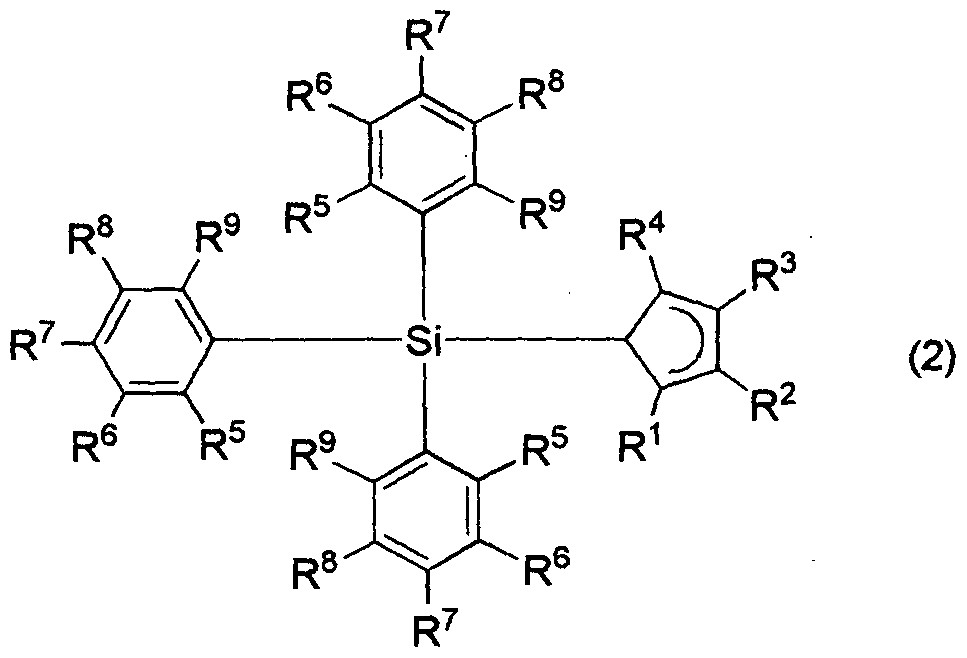
wherein R , Rz, R\ R , R , R , R , Rs and are as defined above, and
the moiety  represents

reacting the reaction product of the substituted cyclopentadiene compound (2) and the base with a transition metal compound represented by formula (3):
(3)

a hydrogen atom, a halogen atom,
an alkyl group having 1 to 20 carbon atoms which may have a halogen atom as a substituent,
an alkoxy group having 1 to 20 carbon atoms which may have a halogen atom as a substituent,
an aryl group having 6 to 20 carbon atoms which may have a halogen atom as a substituent,
an aryloxy group having 6 to 20 carbon atoms which may have a halogen atom as a substituent,
an aralkyl group having 7 to 20 carbon atoms which may have a halogen atom as a substituent,
an aralkyloxy group having 7 to 20 carbon atoms which may have a halogen atom as a substituent,
a substituted silyl group represented by -Si(R10)3, wherein the three R10 moieties each independently represent a hydrogen atom, a hydrocarbyl group or a halogenated
hydrocarbyl group, and the total number of the carbon atoms in the three R10 moieties is 1 to 20, or
a disubstituted amino group represented by -N(Rn)2, wherein the two R11 moieties each independently represent a hydrocarbyl group or a halogenated hydrocarbyl group, and the total number of the carbon atoms in the two R11 moieties is 2 to 20, and m represents 0 or 1.
[Claim 12]
A substituted cyclopentadiene compound represented by formula (2):

wherein
R1, R2, R3 and R4 each independently represent a hydrogen atom, a halogen atom,
an alkyl group having 1 to 20 carbon atoms which may have a halogen atom as a substituent,
an alkoxy group having 1 to 20 carbon atoms which may have a halogen atom as a substituent,
an aryl group having 6 to 20 carbon atoms which may have a halogen atom as a substituent,
an aryloxy group having 6 to 20 carbon atoms which may have a halogen atom as a substituent,
an aralkyl group having 7 to 20 carbon atoms which may have a halogen atom as a substituent,
an aralkyloxy group having 7 to 20 carbon atoms which may have a halogen atom as a substituent,
a substituted silyl group represented by -Si(R10)3, wherein the three R10 moieties each independently represent a hydrogen atom, a hydrocarbyl group or a halogenated
hydrocarbyl group, and the total number of the carbon atoms in the three R10 moieties is 1 to 20, or
a disubstituted amino group represented by -N(Rn)2, wherein the two Rn moieties each independently represent a hydrocarbyl group or a halogenated hydrocarbyl group, and the total number of the carbon atoms in the two R11 moieties is 2 to 20;
R5, R6, R7, R8 and R9 each independently represent
a hydrogen atom, a halogen atom,
an alkyl group having 1 to 20 carbon atoms which may have a halogen atom as a substituent,
an aryl group having 6 to 20 carbon atoms which may have a halogen atom as a substituent or
an aralkyl group having 7 to 20 carbon atoms which may have a halogen atom as a substituent, and
at least one of R5, R6, R7, R8 and R9 is the aryl group or the aralkyl group; or of R1, R2, R3 and R4, two groups bonded to two adjoining carbon atoms may be bonded to each other to form a ring together with the two carbon atoms to which the two groups are bonded, and of R5, R6, R7, R8 and R9, two groups bonded to two adjoining carbon atoms may be bonded to each other to form a ring together with the two carbon atoms to which the two groups are bonded; and the moiety  represents

[Claim 13]
A method for producing a substituted cyclopentadiene compound represented by formula (2) according to claim 12, comprising the steps of:
reacting a substituted cyclopentadiene compound represented by formula (4) with a base:

wherein R1, R2, R3 and R4 ned above, and
the moiety  represents

reacting the reaction product of the substituted cyclopentadiene compound (4) and the base with a halogenated silyl compound represented by formula (5).

wherein R5, R6, R7, R8 and Ry are as defined above, and X is a halogen atom.
Applications Claiming Priority (2)
| Application Number | Priority Date | Filing Date | Title |
|---|---|---|---|
| JP2011-071903 | 2011-03-29 | ||
| JP2011071903 | 2011-03-29 |
Publications (1)
| Publication Number | Publication Date |
|---|---|
| WO2012133935A1 true WO2012133935A1 (en) | 2012-10-04 |
Family
ID=46931610
Family Applications (1)
| Application Number | Title | Priority Date | Filing Date |
|---|---|---|---|
| PCT/JP2012/059294 Ceased WO2012133935A1 (en) | 2011-03-29 | 2012-03-29 | Method for producing the transition metal complex, catalyst for trimerization, method for producing 1-hexene, method for producing the substituted cyclopentadiene compound (3) |
Country Status (2)
| Country | Link |
|---|---|
| JP (1) | JP2012214459A (en) |
| WO (1) | WO2012133935A1 (en) |
Citations (4)
| Publication number | Priority date | Publication date | Assignee | Title |
|---|---|---|---|---|
| WO1997003992A1 (en) * | 1995-07-14 | 1997-02-06 | Sumitomo Chemical Company, Limited | Transition metal complex, process for the preparation thereof, polymerization catalyst for olefins containing the complex, and process for producing olefin polymers |
| JP2004524959A (en) * | 2001-02-22 | 2004-08-19 | ステフティング ダッチ ポリマー インスティテュート | Catalyst system for olefin trimerization. |
| JP2006347899A (en) * | 2005-06-13 | 2006-12-28 | Mitsui Chemicals Inc | Transition metal compound, method for producing transition metal compound, olefin polymerization catalyst component composed of transition metal compound and method for polymerizing olefin by using olefin polymerization catalyst component |
| WO2011040555A1 (en) * | 2009-09-30 | 2011-04-07 | 住友化学株式会社 | Transition metal complex, preparation method for said transition metal complex, trimerization catalyst, preparation method for 1-hexene, preparation method for ethylene polymer, substituted cyclopentadiene compound, and preparation method for said substituted cyclopentadiene compound |
-
2012
- 2012-03-27 JP JP2012071301A patent/JP2012214459A/en active Pending
- 2012-03-29 WO PCT/JP2012/059294 patent/WO2012133935A1/en not_active Ceased
Patent Citations (4)
| Publication number | Priority date | Publication date | Assignee | Title |
|---|---|---|---|---|
| WO1997003992A1 (en) * | 1995-07-14 | 1997-02-06 | Sumitomo Chemical Company, Limited | Transition metal complex, process for the preparation thereof, polymerization catalyst for olefins containing the complex, and process for producing olefin polymers |
| JP2004524959A (en) * | 2001-02-22 | 2004-08-19 | ステフティング ダッチ ポリマー インスティテュート | Catalyst system for olefin trimerization. |
| JP2006347899A (en) * | 2005-06-13 | 2006-12-28 | Mitsui Chemicals Inc | Transition metal compound, method for producing transition metal compound, olefin polymerization catalyst component composed of transition metal compound and method for polymerizing olefin by using olefin polymerization catalyst component |
| WO2011040555A1 (en) * | 2009-09-30 | 2011-04-07 | 住友化学株式会社 | Transition metal complex, preparation method for said transition metal complex, trimerization catalyst, preparation method for 1-hexene, preparation method for ethylene polymer, substituted cyclopentadiene compound, and preparation method for said substituted cyclopentadiene compound |
Non-Patent Citations (2)
| Title |
|---|
| JORG SABMANNSHAUSEN ET AL.: "Half-sandwich complexes of titanium and zirconium with pendant phenyl substituents. The influence of ansa-aryl coordination on the polymerisation activity of half-sandwich catalysts", JOURNAL OF ORGANOMETALLIC CHEMISTRY, vol. 592, 2002, pages 84 - 94, XP001033815, DOI: doi:10.1016/S0022-328X(99)00488-X * |
| PATRICK J. W. DECKERS ET AL.: "Catalytic Trimerization of Ethene with Highly Active Cyclopentadienyl-Arene Titanium Catalysts", ORGANOMETALLICS, vol. 21, no. 23, 2002, pages 5122 - 5135, XP001132361, DOI: doi:10.1021/om020765a * |
Also Published As
| Publication number | Publication date |
|---|---|
| JP2012214459A (en) | 2012-11-08 |
Similar Documents
| Publication | Publication Date | Title |
|---|---|---|
| EP2484685B1 (en) | Transition metal complex, preparation method for said transition metal complex, trimerization catalyst, preparation method for 1-hexene, preparation method for ethylene polymer, substituted cyclopentadiene compound, and preparation method for said substituted cyclopentadiene compound | |
| EP2691406B1 (en) | Transition metal substituted cyclopentadiene complex catalyst for trimerization, method for producing 1-hexene | |
| JP2012213765A (en) | CATALYST FOR OLEFIN OLIGOMERIZATION AND METHOD FOR PRODUCING α-OLEFIN | |
| US20140012056A1 (en) | Method for producing 1-hexene | |
| WO2012133929A1 (en) | Method for producing the transition metal ion complex, catalyst for trimerization, and method for producing 1-hexene | |
| EP0963990B1 (en) | Process for producing cyclopentadienyl metal salts and process for producing cyclopentadiene derivatives by utilizing the same | |
| US9090527B2 (en) | Method for producing transition metal complex, catalyst for trimerization, method for producing 1-hexene, method for producing substituted cyclopentadiene compound (2) | |
| WO2012133935A1 (en) | Method for producing the transition metal complex, catalyst for trimerization, method for producing 1-hexene, method for producing the substituted cyclopentadiene compound (3) | |
| WO2012133928A1 (en) | Trimerization catalyst and method for producing 1-hexene | |
| JP2012211117A (en) | Transition metal complex, method for production thereof, trimerizing catalyst, and method for producing 1-hexene | |
| WO2012133936A1 (en) | Catalyst for producing ethylene-based polymer and method for producing the same | |
| JP2012211118A (en) | Transition metal complex, method for production thereof, trimerizing catalyst, and method for producing 1-hexene | |
| WO2013133439A1 (en) | Method for manufacturing silicon substituted cyclopentadienyl titanium trihalide | |
| JP3960027B2 (en) | Transition metal complex, ligand, catalyst for olefin polymerization, and method for producing olefin polymer | |
| WO2012133919A1 (en) | Process for producing catalyst for producing ethylenic polymer, catalyst for producing ethylenic polymer and process for producing ethylenic polymer |
Legal Events
| Date | Code | Title | Description |
|---|---|---|---|
| 121 | Ep: the epo has been informed by wipo that ep was designated in this application |
Ref document number: 12764069 Country of ref document: EP Kind code of ref document: A1 |
|
| NENP | Non-entry into the national phase |
Ref country code: DE |
|
| 122 | Ep: pct application non-entry in european phase |
Ref document number: 12764069 Country of ref document: EP Kind code of ref document: A1 |