WO2012133560A1 - 命令出力装置、及び実行環境提供システム - Google Patents
命令出力装置、及び実行環境提供システム Download PDFInfo
- Publication number
- WO2012133560A1 WO2012133560A1 PCT/JP2012/058194 JP2012058194W WO2012133560A1 WO 2012133560 A1 WO2012133560 A1 WO 2012133560A1 JP 2012058194 W JP2012058194 W JP 2012058194W WO 2012133560 A1 WO2012133560 A1 WO 2012133560A1
- Authority
- WO
- WIPO (PCT)
- Prior art keywords
- interface
- unit
- vibration
- executed
- output device
- Prior art date
- Legal status (The legal status is an assumption and is not a legal conclusion. Google has not performed a legal analysis and makes no representation as to the accuracy of the status listed.)
- Ceased
Links
Images

Classifications
-
- G—PHYSICS
- G06—COMPUTING OR CALCULATING; COUNTING
- G06F—ELECTRIC DIGITAL DATA PROCESSING
- G06F9/00—Arrangements for program control, e.g. control units
- G06F9/06—Arrangements for program control, e.g. control units using stored programs, i.e. using an internal store of processing equipment to receive or retain programs
- G06F9/46—Multiprogramming arrangements
- G06F9/54—Interprogram communication
- G06F9/541—Interprogram communication via adapters, e.g. between incompatible applications
Definitions
- the present invention relates to an instruction output device for outputting computer software instructions and an execution environment providing system.
- the present application claims priority based on Japanese Patent Application No. 2011-072039 filed on March 29, 2011 and Japanese Patent Application No. 2012-62147 filed on March 19, 2012, and the contents thereof. Is hereby incorporated by reference.
- Non-Patent Document 1 discloses a development environment in which computer software can be developed using a graphical user interface (Graphical User Interface, GUI).
- GUI graphical User Interface
- API ApplicationAProgram Interface
- Non-Patent Document 1 has a problem that an information terminal (electronic device) operated by a Linux operating system cannot be operated.
- An aspect of the present invention provides an instruction output device capable of causing an information terminal operated by the second operating system to perform an operation similar to that of a computer executing software that calls an API executed on the first operating system, and
- An object is to provide an execution environment providing system.
- the aspect of the present invention is similar to the first interface executed by the first device on the first operating system of the first device, and the operation of the first device due to the execution of the first interface.
- a storage unit that associates and stores a second interface executed by the second device on a second operating system of the second device in order to cause the second device to perform an operation; and
- a receiving unit that receives an interface from the first device, a control unit that refers to the storage unit and selects the second interface associated with the first interface, and the second interface selected by the control unit And an output unit that causes the second device to execute the command output device.
- a first device that transmits a first interface that is executed on a first operating system included in the device, and a second operating system that is executed on the second operating system included in the device.
- a second device that executes two interfaces, the first interface that is executed by the first device on a first operating system of the first device, and the first that is executed by executing the first interface.
- the second interface executed by the second device on the second operating system of the second device is stored in advance in association with each other.
- a storage unit that receives the first interface from the first device, and the storage unit.
- a command output device comprising: a control unit that selects the second interface associated with the interface; and an output unit that causes the second device to execute the second interface selected by the control unit.
- the instruction output device causes an information terminal operated by the second operating system to perform an operation similar to that of a computer executing software that calls an API executed on the first operating system. Can do.
- the procedure output device converts a procedure for calling an API in a Windows (registered trademark, the same applies hereinafter) operating system (hereinafter referred to as “Windows OS”) into an XML (ExtensibleEMarkup Language) format, and the converted result is a text file.
- This API is, for example, an API such as DirectX (registered trademark, the same applies below), Direct3D (registered trademark, the same applies below).
- the command output device receives the above text file, and converts the API such as DirectX and Direct3D described in the received text file into an API executed on the Linux operating system (hereinafter referred to as “Linux OS”). Convert and output the converted API.
- This API is, for example, an API such as OpenGL (registered trademark, the same applies hereinafter) (OpenOGraphics Library), OpenAL (Open Audio Library).
- the information terminal executes the API converted by the command output device on the Linux OS.
- the information terminal can display an image or vibrate the housing of the information terminal, for example, according to the API converted by the command output device.
- FIG. 1 is a block diagram showing the configuration of the execution environment providing system.
- the procedure output device 100 includes a control unit 110, a transmission unit 120, a display unit 130, a display unit 140, a storage unit 150, and an operation unit (not shown).
- the procedure output device 100 is connected to the vibration unit 160.
- the procedure output device 100 includes, for example, the development environment (vvvv) disclosed in Non-Patent Document 1 described above.
- the display unit 130 displays a graphical user interface (GUI) based on control by the control unit 110.
- GUI graphical user interface
- the display unit 130 displays a tree-structured GUI in which quadrangular shapes representing nodes (functions) are connected by lines.
- the developer can graphically design the operation of the information terminal 300 (for example, the display pattern of the image displayed on the information terminal, the vibration pattern of the casing of the information terminal, etc.). it can.
- the operation unit receives a GUI operation input and outputs a signal corresponding to the received GUI operation to the control unit 110.
- the storage unit 150 stores in advance a signal corresponding to a GUI operation and a DirectX and Direct3D API (hereinafter referred to as “first interface”) in association with each other.
- the storage unit 150 stores the image display pattern on the display unit 140 in association with the first interface in advance.
- the storage unit 150 stores the vibration pattern of the vibration unit 160 and the first interface in advance in association with each other.
- the storage unit 150 can additionally store the vibration pattern of the vibration unit 160.
- vibration pattern stored in the storage unit 150 examples include the following vibration patterns.
- Vibration patterns related to humans (1-1) Vibration patterns generated in humans when walking or running (1-2) Human voice vibration patterns
- Vibration patterns related to vehicles (2-1) Vibrations generated in the car body (for example, minicars, sports cars, buses, conventional trains, bullet trains, or steam locomotive bodies) at constant speed, acceleration or deceleration Pattern
- Vibration patterns related to animals (3-1) Vibration patterns that occur in animals (eg, large dogs, small dogs, cats, various birds, various insects) during walking or running (3-2) Animal calls 3.
- Vibration pattern Vibration pattern related to the properties of the object surface (4-1) Vibration pattern according to the surface roughness of the object surface (eg, smooth surface, rough surface)
- vibration patterns may be obtained by actual measurement in advance or may be artificially created in advance.
- a recording device (not shown) records an animal call in advance.
- the storage unit 150 stores in advance a vibration pattern of animal calls recorded in advance by the recording device. Thereby, the developer (designer) can feel the vibration related to the animal from the sense of touch by the vibration of the vibration unit 160.
- a tactile recording / reproducing system may actually measure a vibration pattern related to the property of the surface of the object (observed object) in advance.
- the tactile recording / reproducing system includes a vibration detection unit (not shown) that detects vibration and a recording device (not shown) that records a vibration pattern.
- the vibration detection unit detects a vibration pattern of a probe tracing the surface of an object (observed object).
- the recording device records the detected vibration pattern.
- the storage unit 150 stores in advance the vibration pattern recorded by the recording device. As a result, the developer (designer) can feel the vibration related to the property of the object surface from the sense of touch by the vibration of the vibration unit 160.
- a signal corresponding to the GUI operation is input to the control unit 110 from an operation unit (not shown).
- the control unit 110 is a central processing unit (Central Processing Unit) and executes a first interface on the Windows OS.
- the control unit 110 refers to the storage unit 150 using the first interface corresponding to the signal corresponding to the GUI operation as a search key, and outputs information representing an image display pattern determined by the first interface to the display unit 140. .
- control unit 110 refers to the storage unit 150 using the first interface corresponding to the signal corresponding to the GUI operation as a search key, and transmits information representing the vibration pattern to the vibration unit 160 according to the first interface. Output.
- control unit 110 refers to the storage unit 150 using a signal corresponding to the GUI operation as a search key, and outputs information representing the first interface corresponding to the signal corresponding to the GUI operation to the transmission unit 120. .
- the display unit 140 displays an image based on information representing an image display pattern input from the control unit 110. For example, the display unit 140 displays the letter “A” surrounded by a circle at the center of the screen. In addition, the display unit 140 displays the character “B” on the upper left of the screen. The display unit 140 displays the character “D” on the upper right of the screen. Further, the display unit 140 displays the character “C” at the lower right of the screen.
- the vibration unit 160 vibrates the casing of the vibration unit 160 based on information representing the vibration pattern input from the control unit 110.
- the transmission unit 120 transmits a text file in which procedure information including information representing the first interface and character information input from the control unit 110 is described to the command output device 200.
- This text file is, for example, an XML format text file.
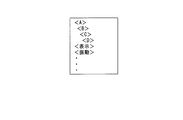
- FIG. 2 shows an XML format text file in which an example of procedure information is described.
- information representing the first interface for displaying the character information “A”, “B”, “C”, and “D” is represented by tags.
- information representing the first interface for vibrating the vibration unit is represented by tags.
- the command output device 200 includes a receiving unit 210, a control unit 220, a storage unit 230, and an output unit 240.
- the receiving unit 210 receives procedure information including information representing the first interface and character information, and outputs the procedure information to the control unit 220.
- the storage unit 230 stores table data associating OpenGL and OpenAL APIs (hereinafter referred to as “second interface”) and the first interface.
- the storage unit 230 includes a first interface executed by the control unit 110 on the Windows OS included in the procedure output device 100, and a second interface executed by the information terminal 300 on the Linux OS included in the information terminal 300.
- the second interface is a command for causing the information terminal 300 to execute the same operation as that of the procedure output device 100 when the first interface is executed by the procedure output device 100.
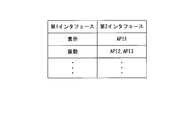
- FIG. 3 shows table data that associates the first interface with the second interface. It is assumed that “API1” that is one of the second interfaces corresponds to “display” that is one of the first interfaces. By executing “API1” of the second interface on the Linux OS, images such as characters are displayed on the screen of the information terminal 300 in a predetermined display pattern.
- API2 and API3 that are two of the second interfaces correspond to “vibration” that is one of the first interfaces.
- Procedure information including information representing the first interface and character information is input from the receiving unit 210 to the control unit 220.
- the control unit 220 is a central processing unit, and outputs character information “A”, “B”, “C”, and “D” (see FIG. 2) included in the input procedure information to the output unit 240.
- the control unit 220 refers to the storage unit 230 and outputs information representing the second interface associated with information representing the first interface included in the input procedure information to the output unit 240.
- the output unit 240 outputs information representing the second interface input from the control unit 220 to the information terminal 300. Further, the output unit 240 outputs the character information “A”, “B”, “C”, and “D” input from the control unit 220 to the information terminal 300 as a command.
- the information terminal 300 includes a control unit 320, a storage unit 330, a display unit 340, and a vibration unit 350.
- the storage unit 330 stores programs in units of addresses.
- the storage unit 330 stores the vibration pattern of the vibration unit 350 in advance in association with the second interface.
- the storage unit 330 may store the same vibration pattern as the vibration pattern stored in the storage unit 150 of the procedure output device 100.
- the storage unit 330 can additionally store the vibration pattern of the vibration unit 350.
- the control unit 320 acquires information representing the second interface and character information from the output unit 240 of the command output device 200.
- the controller 320 is a central processing unit and executes the second interface on the Linux OS. That is, the control unit 320 refers to the storage unit 330 according to the input information representing the second interface, acquires (calls) the second interface (program) from the storage unit 330, and acquires the acquired second interface. Execute. For example, the control unit 320 outputs information representing an image display pattern corresponding to the information representing the input second interface to the display unit 340. Further, the control unit 320 outputs information representing a vibration pattern corresponding to the input information representing the second interface to the vibration unit 350.
- the display unit 340 displays an image based on information representing an image display pattern corresponding to the second interface. For example, the display unit 140 displays the letter “A” surrounded by a circle at the center of the screen. In addition, the display unit 140 displays the character “B” on the upper left of the screen. The display unit 140 displays the character “D” on the upper right of the screen. Further, the display unit 140 displays the character “C” at the lower right of the screen. As a result, the same image as the image displayed on the display unit 140 of the procedure output device 100 is displayed on the display unit 340.
- the vibration unit 350 vibrates the casing of the information terminal 300 based on information representing a vibration pattern corresponding to the second interface.
- the vibration part 350 can vibrate with the same vibration pattern as the vibration pattern of the vibration part 160 connected to the procedure output device 100.
- the user can feel vibration related to a person, vibration related to a vehicle, vibration related to an animal, and vibration related to the property of an object surface from the sense of touch by the vibration of the vibration unit 350.
- the instruction output device 200 includes the procedure output device 100 based on the execution of the API such as DirectX executed by the procedure output device 100 on the Windows OS included in the procedure output device 100 and the API such as DirectX.
- a storage unit 230 that stores in advance an API such as OpenGL executed by the information terminal 300 on the Linux OS included in the information terminal 300, DirectX, etc.
- the receiving unit 210 that receives the API from the procedure output device 100, the storage unit 230, the control unit 220 that selects an API such as OpenGL associated with the API such as DirectX, and the OpenGL selected by the control unit 220
- An output unit 240 that outputs an API such as That.
- the storage unit includes an API such as DirectX for executing the function (node) described in the procedure information output by the procedure output device, an API such as OpenGL for executing the function of the information terminal, Are stored in association with each other, so that the instruction output device performs the same operation as that of the computer that executes the software that calls the API executed on the first operating system, by the second operating system. It can be made to be a terminal. Further, a developer (designer) can develop computer software for causing the information terminal to function by operating a familiar development environment (for example, the development environment disclosed in Non-Patent Document 1).
- a familiar development environment for example, the development environment disclosed in Non-Patent Document 1.
- the execution environment providing system executes a procedure output device 100 that transmits an API such as DirectX that is executed on the Windows OS that the device itself has, and an API such as OpenGL that is executed on the Linux OS that the device itself has.
- an API such as OpenGL executed by the information terminal 300 on the Linux OS included in the information terminal 300 is associated with the storage unit 230 and stored in advance, and an API such as DirectX is stored in the procedure output device.
- the command output includes: a control unit 220 that selects an API such as OpenGL associated with an API such as DirectX; and an output unit 240 that causes the information terminal 300 to execute an API such as OpenGL selected by the control unit 220.
- the information terminal operated by the second operating system can be operated in the same manner as in FIG.
- the execution environment providing system includes a vibration unit 160 connected to the procedure output device 100 and a vibration unit 350 connected to the information terminal 300, and the procedure output device 100 executes an API such as DirectX.
- the vibration unit 160 is vibrated, and the information terminal 300 vibrates the vibration unit 350 by executing an API such as OpenGL.
- the execution environment providing system includes the vibration unit connected to the procedure output device and the vibration unit connected to the information terminal.
- the API executed on the first operating system can be changed.
- a vibration operation similar to that of a computer that executes software to be called can be caused to be performed by an information terminal operated by the second operating system.
- a developer (designer) can develop computer software for vibrating an information terminal by operating a familiar development environment (for example, the development environment disclosed in Non-Patent Document 1).
- the procedure output device 100 vibrates the vibration unit 160 based on a vibration pattern related to a person, a vibration pattern related to a vehicle, a vibration pattern related to an animal, and a vibration pattern related to the property of an object surface.
- the developer can feel vibrations related to humans, vibrations related to vehicles, vibrations related to animals, and vibrations related to the properties of the object surface from the sense of touch by the vibration of the vibration unit 160. Can do.
- the information terminal 300 vibrates the vibration unit 350 based on a vibration pattern related to a person, a vibration pattern related to a vehicle, a vibration pattern related to an animal, and a vibration pattern related to the properties of an object surface. Accordingly, the user can feel vibrations related to humans, vibrations related to vehicles, vibrations related to animals, and vibrations related to the properties of the object surface from the sense of touch by the vibration of the vibration unit 350.
- a program for realizing the instruction output device and execution environment providing system described above is recorded on a computer-readable recording medium, and the program recorded on the recording medium is read into the computer system and executed. Thus, the execution process may be performed.
- the “computer system” may include an OS and hardware such as peripheral devices.
- the “computer system” includes a homepage providing environment (or display environment) if a WWW system is used.
- the “computer-readable recording medium” means a flexible disk, a magneto-optical disk, a ROM, a writable nonvolatile memory such as a flash memory, a portable medium such as a CD-ROM, a hard disk built in a computer system, etc. This is a storage device.
- the “computer-readable recording medium” refers to a volatile memory (for example, DRAM (Dynamic) in a computer system serving as a server or a client when a program is transmitted via a network such as the Internet or a communication line such as a telephone line. Random Access Memory)) that holds a program for a certain period of time is also included.
- the program may be transmitted from a computer system storing the program in a storage device or the like to another computer system via a transmission medium or by a transmission wave in the transmission medium.
- the “transmission medium” for transmitting the program refers to a medium having a function of transmitting information, such as a network (communication network) such as the Internet or a communication line (communication line) such as a telephone line.
- the program may be for realizing a part of the functions described above. Furthermore, what can implement
- DESCRIPTION OF SYMBOLS 100 Procedure output apparatus, 110 ... Control part, 120 ... Transmission part, 130 ... Display part, 140 ... Display part, 150 ... Memory
Landscapes
- Engineering & Computer Science (AREA)
- Software Systems (AREA)
- Theoretical Computer Science (AREA)
- Physics & Mathematics (AREA)
- General Engineering & Computer Science (AREA)
- General Physics & Mathematics (AREA)
- User Interface Of Digital Computer (AREA)
- Digital Computer Display Output (AREA)
- Stored Programmes (AREA)
Abstract
命令出力装置(200)は、第1OS上で手続出力装置(100)により実行される第1インタフェースと、第1インタフェースが実行されたことによる手続出力装置(100)の動作と同様の動作を情報端末(300)にさせるために、第2OS上で情報端末(300)により実行される第2インタフェースと、を対応付けて予め記憶する記憶部(230)と、第1インタフェースを手続出力装置(100)から受信する受信部(210)と、記憶部(230)を参照し、第1インタフェースに対応付けられた第2インタフェースを選択する制御部(220)と、制御部(220)が選択した第2インタフェースを情報端末(300)に実行させる出力部(240)とを備える。
Description
本発明は、コンピュータソフトウェアの命令を出力する命令出力装置、及び実行環境提供システムに関する。
本願は、2011年3月29日に出願された日本国特願2011-072039号および2012年3月19日に出願された日本国特願2012-62147号に基づき優先権を主張し、その内容をここに援用する。
本願は、2011年3月29日に出願された日本国特願2011-072039号および2012年3月19日に出願された日本国特願2012-62147号に基づき優先権を主張し、その内容をここに援用する。
グラフィカル・ユーザ・インターフェース(Graphical User Interface,GUI)を用いて、コンピュータソフトウェアを開発することができる開発環境が、非特許文献1に開示されている。
この開発環境により、開発者(デザイナ)は、ウィンドウズ(登録商標)・オペレーティング・システム(Windows(登録商標) Operating System(OS))が提供する機能を呼び出すためのインタフェース(Application Program Interface、API)を呼び出すソフトウェアを開発することができる。
しかしながら、ウィンドウズ(登録商標)・オペレーティング・システムが提供する機能を呼び出すためのAPIと、リナックス(Linux)(登録商標。以下同様。)・オペレーティング・システムが提供する機能を呼び出すためのAPIとは異なる。このため、非特許文献1に開示された開発環境は、リナックス・オペレーティング・システムにより動作する情報端末(電子機器)を、動作させることができないという問題がある。
本発明の態様は、第1オペレーティング・システム上で実行されるAPIを呼び出すソフトウェアを実行するコンピュータと同様の動作を、第2オペレーティング・システムにより動作する情報端末にさせることができる命令出力装置、及び実行環境提供システムを提供することを目的とする。
本発明の態様は、第1装置が有する第1オペレーティング・システム上で前記第1装置により実行される第1インタフェースと、前記第1インタフェースが実行されたことによる前記第1装置の動作と同様の動作を第2装置にさせるために、前記第2装置が有する第2オペレーティング・システム上で前記第2装置により実行される第2インタフェースと、を対応付けて予め記憶する記憶部と、前記第1インタフェースを前記第1装置から受信する受信部と、前記記憶部を参照し、前記第1インタフェースに対応付けられた前記第2インタフェースを選択する制御部と、前記制御部が選択した前記第2インタフェースを前記第2装置に実行させる出力部と、を備えることを特徴とする命令出力装置である。
また、本発明の別の態様は、自装置が有する第1オペレーティング・システム上で実行される第1インタフェースを送信する第1装置と、自装置が有する第2オペレーティング・システム上で実行される第2インタフェースを実行する第2装置と、前記第1装置が有する第1オペレーティング・システム上で前記第1装置により実行される前記第1インタフェースと、前記第1インタフェースが実行されたことによる前記第1装置の動作と同様の動作を前記第2装置にさせるために、前記第2装置が有する第2オペレーティング・システム上で前記第2装置により実行される前記第2インタフェースと、を対応付けて予め記憶する記憶部と、前記第1インタフェースを前記第1装置から受信する受信部と、前記記憶部を参照し、前記第1インタフェースに対応付けられた前記第2インタフェースを選択する制御部と、前記制御部が選択した前記第2インタフェースを前記第2装置に実行させる出力部と、を有する命令出力装置と、を備えることを特徴とする実行環境提供システムである。
本発明の態様によれば、命令出力装置は、第1オペレーティング・システム上で実行されるAPIを呼び出すソフトウェアを実行するコンピュータと同様の動作を、第2オペレーティング・システムにより動作する情報端末にさせることができる。
本発明の一実施形態について図面を参照して詳細に説明する。手続出力装置は、ウィンドウズ(登録商標。以下同様。)・オペレーティング・システム(以下、「ウィンドウズOS」という)におけるAPIを呼び出す手続を、XML(Extensible Markup Language)形式に変換し、変換結果をテキストファイルで出力する。このAPIは、例えば、DirectX(登録商標。以下同様。)、Direct3D(登録商標。以下同様。)などのAPIである。
命令出力装置は、上記のテキストファイルを受信し、受信したテキストファイルに記載されたDirectX、Direct3DなどのAPIを、リナックス・オペレーティング・システム(以下、「リナックスOS」という)上で実行されるAPIに変換し、変換したAPIを出力する。このAPIは、例えば、OpenGL(登録商標。以下同様。)(Open Graphics Library)、OpenAL (Open Audio Library) などのAPIである。
情報端末(電子機器)は、命令出力装置が変換したAPIを、リナックスOS上で実行する。情報端末は、命令出力装置が変換したAPIに応じて、例えば、画像を表示したり、情報端末の筐体を振動させたりすることができる。
まず、実行環境提供システムの構成を説明する。
図1には、実行環境提供システムの構成がブロック図により表されている。手続出力装置100は、制御部110と、送信部120と、表示部130と、表示部140と、記憶部150と、操作部(不図示)とを備える。また、手続出力装置100は、振動部160と接続されている。
図1には、実行環境提供システムの構成がブロック図により表されている。手続出力装置100は、制御部110と、送信部120と、表示部130と、表示部140と、記憶部150と、操作部(不図示)とを備える。また、手続出力装置100は、振動部160と接続されている。
手続出力装置100は、例えば、上記の非特許文献1に開示された開発環境(vvvv)を備える。
表示部130は、制御部110による制御に基づいて、グラフィカル・ユーザ・インターフェース(GUI)を表示する。例えば、表示部130は、ノード(機能)を表す四角形状同士が線で繋がれたツリー構造のGUIを表示する。開発者(デザイナ)は、このGUIを操作することにより、情報端末300の動作(例えば、情報端末が表示する画像の表示パターン、情報端末の筐体の振動パターンなど)をグラフィカルに設計することができる。
操作部(不図示)は、GUI操作入力を受け付け、受け付けたGUI操作に応じた信号を、制御部110に出力する。
表示部130は、制御部110による制御に基づいて、グラフィカル・ユーザ・インターフェース(GUI)を表示する。例えば、表示部130は、ノード(機能)を表す四角形状同士が線で繋がれたツリー構造のGUIを表示する。開発者(デザイナ)は、このGUIを操作することにより、情報端末300の動作(例えば、情報端末が表示する画像の表示パターン、情報端末の筐体の振動パターンなど)をグラフィカルに設計することができる。
操作部(不図示)は、GUI操作入力を受け付け、受け付けたGUI操作に応じた信号を、制御部110に出力する。
記憶部150は、GUI操作に応じた信号と、DirectX及びDirect3DのAPI(以下、「第1インタフェース」という)とを対応付けて予め記憶する。また、記憶部150は、表示部140における画像表示パターンと、第1インタフェースとを対応付けて予め記憶する。また、記憶部150は、振動部160の振動パターンと、第1インタフェースとを対応付けて予め記憶する。なお、記憶部150は、振動部160の振動パターンを追加記憶することが可能である。
記憶部150が記憶する振動パターンには、例えば、次のような振動パターンがある。
1.人に関連する振動パターン
(1-1)歩行時又は駆け足時に、人に発生する振動パターン
(1-2)人の声の振動パターン
2.乗物に関連する振動パターン
(2-1)定速時、加速時又は減速時に、車体(例えば、軽自動車、スポーツカー、バス、在来線電車、新幹線又は蒸気機関車の車体)に発生する振動パターン
(2-2)定速時、加速時又は減速時に、機体(例えば、ヘリコプター、飛行機又は飛行船の機体)に発生する振動パターン
3.動物に関連する振動パターン
(3-1)歩行時又は駆け足時に、動物(例えば、大型犬、小型犬、猫、各種の鳥、各種の昆虫)に発生する振動パターン
(3-2)動物の鳴き声の振動パターン
4.物体表面の性状に関連する振動パターン
(4-1)物体表面の面粗さ(例えば、滑らかな面、粗い面)に応じた振動パターン
これらの振動パターンは、予め実測されたことにより得られたものでもよいし、人工的に予め作成されたものでもよい。例えば、録音装置(不図示)は、動物の鳴き声を予め録音する。記憶部150は、その録音装置が予め録音した動物の鳴き声の振動パターンを、予め記憶する。これにより、開発者(デザイナ)は、動物に関連する振動を、振動部160の振動により触覚から感じることができる。
また、例えば、物体(観察物)表面の性状に関連する振動パターンを、触覚記録再生システム(不図示)が予め実測してもよい。触覚記録再生システムは、振動を検出する振動検出部(不図示)と、振動パターンを記録する記録装置(不図示)と、を備える。
ここで、前記振動検出部は、物体(観察物)表面をなぞる探針の振動パターンを検出する。前記記録装置は、この検出された振動パターンを記録する。また、記憶部150は、前記記録装置が記録した振動パターンを予め記憶する。これにより、開発者(デザイナ)は、物体表面の性状に関連する振動を、振動部160の振動により触覚から感じることができる。
制御部110には、GUI操作に応じた信号が、操作部(不図示)から入力される。制御部110は、中央処理装置(Central Processing Unit)であり、ウィンドウズOS上で第1インタフェースを実行する。例えば、制御部110は、GUI操作に応じた信号に対応する第1インタフェースを検索キーとして記憶部150を参照し、その第1インタフェースにより定まる画像表示パターンを表す情報を、表示部140に出力する。
また、例えば、制御部110は、GUI操作に応じた信号に対応する第1インタフェースを検索キーとして記憶部150を参照し、その第1インタフェースに応じて、振動パターンを表す情報を振動部160に出力する。
また、例えば、制御部110は、GUI操作に応じた信号を検索キーとして記憶部150を参照し、そのGUI操作に応じた信号に対応する第1インタフェースを表す情報を、送信部120に出力する。
また、例えば、制御部110は、GUI操作に応じた信号を検索キーとして記憶部150を参照し、そのGUI操作に応じた信号に対応する第1インタフェースを表す情報を、送信部120に出力する。
表示部140は、制御部110から入力された画像表示パターンを表す情報に基づいて、画像を表示する。例えば、表示部140は、丸で囲まれた文字「A」を、画面の中央に表示する。また、表示部140は、文字「B」を画面の左上に表示する。また、表示部140は、文字「D」を画面の右上に表示する。また、表示部140は、文字「C」を画面の右下に表示する。
振動部160は、制御部110から入力された振動パターンを表す情報に基づいて、振動部160の筐体を振動させる。
送信部120は、制御部110から入力された第1インタフェースを表す情報と文字情報とを含む手続情報が記載されたテキストファイルを、命令出力装置200に送信する。このテキストファイルは、例えば、XML形式のテキストファイルである。図2には、手続情報の例が記載されたXML形式のテキストファイルが表されている。このテキストファイルには、図2では、文字情報「A」「B」「C」「D」を表示させるための第1インタフェースを表す情報が、タグにより表されている。さらに、このテキストファイルには、図2では、振動部を振動させるための第1インタフェースを表す情報が、タグにより表されている。
送信部120は、制御部110から入力された第1インタフェースを表す情報と文字情報とを含む手続情報が記載されたテキストファイルを、命令出力装置200に送信する。このテキストファイルは、例えば、XML形式のテキストファイルである。図2には、手続情報の例が記載されたXML形式のテキストファイルが表されている。このテキストファイルには、図2では、文字情報「A」「B」「C」「D」を表示させるための第1インタフェースを表す情報が、タグにより表されている。さらに、このテキストファイルには、図2では、振動部を振動させるための第1インタフェースを表す情報が、タグにより表されている。
図1に戻り、実行環境提供システムの構成の説明を続ける。
命令出力装置200は、受信部210と、制御部220と、記憶部230と、出力部240とを備える。受信部210は、第1インタフェースを表す情報と文字情報とを含む手続情報を受信し、制御部220に出力する。
命令出力装置200は、受信部210と、制御部220と、記憶部230と、出力部240とを備える。受信部210は、第1インタフェースを表す情報と文字情報とを含む手続情報を受信し、制御部220に出力する。
記憶部230は、OpenGL及びOpenALのAPI(以下、「第2インタフェース」という)と、第1インタフェースとを対応付けるテーブルデータを記憶する。ここで、記憶部230は、手続出力装置100が有するウィンドウズOS上で制御部110により実行される第1インタフェースと、情報端末300が有するリナックスOS上で情報端末300により実行される第2インタフェースと、を対応付けて予め記憶する。この第2インタフェースは、第1インタフェースが手続出力装置100により実行されたことによる手続出力装置100の動作と同様の動作を、情報端末300に実行させるための命令である。
図3には、第1インタフェースと第2インタフェースとを対応付けるテーブルデータが表されている。第1インタフェースの1つである「表示」には、第2インタフェースの1つである「API1」が対応するものとする。第2インタフェースの「API1」がリナックスOS上で実行されることにより、情報端末300の画面には、予め定められた表示パターンで文字などの画像が表示される。
また、第1インタフェースの1つである「振動」には、第2インタフェースのうちの2つである「API2及びAPI3」が対応するものとする。第2インタフェースの「API2及びAPI3」がリナックスOS上で実行されることにより、振動が情報端末300に発生する。
図1に戻り、実行環境提供システムの構成の説明を続ける。
制御部220には、第1インタフェースを表す情報と文字情報とを含む手続情報が、受信部210から入力される。制御部220は、中央処理装置であり、入力された手続情報に含まれている文字情報「A」「B」「C」「D」(図2を参照)を、出力部240に出力する。また、制御部220は、記憶部230を参照し、入力された手続情報に含まれる第1インタフェースを表す情報に対応付けられた第2インタフェースを表す情報を、出力部240に出力する。
制御部220には、第1インタフェースを表す情報と文字情報とを含む手続情報が、受信部210から入力される。制御部220は、中央処理装置であり、入力された手続情報に含まれている文字情報「A」「B」「C」「D」(図2を参照)を、出力部240に出力する。また、制御部220は、記憶部230を参照し、入力された手続情報に含まれる第1インタフェースを表す情報に対応付けられた第2インタフェースを表す情報を、出力部240に出力する。
出力部240は、制御部220から入力された第2インタフェースを表す情報を、情報端末300に出力する。また、出力部240は、制御部220から入力された文字情報「A」「B」「C」「D」を、情報端末300に命令出力する。
情報端末300は、制御部320と、記憶部330と、表示部340と、振動部350とを備える。記憶部330は、プログラムをアドレス単位で記憶する。また、記憶部330は、振動部350の振動パターンを、第2インタフェースに対応付けて予め記憶する。ここで、記憶部330は、手続出力装置100の記憶部150が記憶している振動パターンと同一の振動パターンを記憶してもよい。なお、記憶部330は、振動部350の振動パターンを追加記憶することが可能である。
制御部320は、命令出力装置200の出力部240から、第2インタフェースを表す情報と文字情報とを取得する。制御部320は、中央処理装置であり、リナックスOS上で第2インタフェースを実行する。つまり、制御部320は、入力された第2インタフェースを表す情報に応じて記憶部330を参照し、その第2インタフェース(プログラム)を記憶部330から取得し(呼び出し)、取得した第2インタフェースを実行する。例えば、制御部320は、入力された第2インタフェースを表す情報に応じた画像表示パターンを表す情報を、表示部340に出力する。また、制御部320は、入力された第2インタフェースを表す情報に応じた振動パターンを表す情報を、振動部350に出力する。
表示部340は、第2インタフェースに応じた画像表示パターンを表す情報に基づいて、画像を表示する。例えば、表示部140は、丸で囲まれた文字「A」を、画面の中央に表示する。また、表示部140は、文字「B」を画面の左上に表示する。また、表示部140は、文字「D」を画面の右上に表示する。また、表示部140は、文字「C」を画面の右下に表示する。これにより、表示部340には、手続出力装置100の表示部140に表示された画像と同一の画像が表示される。
振動部350は、第2インタフェースに応じた振動パターンを表す情報に基づいて、情報端末300の筐体を振動させる。これにより、振動部350は、手続出力装置100に接続された振動部160の振動パターンと同一の振動パターンで振動することができる。例えば、ユーザは、人に関連する振動、乗物に関連する振動、動物に関連する振動、及び、物体表面の性状に関連する振動を、振動部350の振動により触覚から感じることができる。
以上のように、命令出力装置200は、手続出力装置100が有するウィンドウズOS上で手続出力装置100により実行されるDirectX等のAPIと、DirectX等のAPIが実行されたことによる手続出力装置100の動作と同様の動作を情報端末300にさせるために、情報端末300が有するリナックスOS上で情報端末300により実行されるOpenGL等のAPIと、を対応付けて予め記憶する記憶部230と、DirectX等のAPIを手続出力装置100から受信する受信部210と、記憶部230を参照し、DirectX等のAPIに対応付けられたOpenGL等のAPIを選択する制御部220と、制御部220が選択したOpenGL等のAPIを情報端末300に出力する出力部240と、を備える。
この構成により、記憶部が、手続出力装置が出力する手続情報に記載された機能(ノード)を実行するためのDirectX等のAPIと、情報端末の機能を実行するためのOpenGL等のAPIと、を対応付けて予め記憶するので、これにより、命令出力装置は、第1オペレーティング・システム上で実行されるAPIを呼び出すソフトウェアを実行するコンピュータと同様の動作を、第2オペレーティング・システムにより動作する情報端末にさせることができる。また、開発者(デザイナ)は、情報端末を機能させるためのコンピュータソフトウェアを、使い慣れた開発環境(例えば、非特許文献1に開示された開発環境)を操作することにより開発することができる。
この構成により、記憶部が、手続出力装置が出力する手続情報に記載された機能(ノード)を実行するためのDirectX等のAPIと、情報端末の機能を実行するためのOpenGL等のAPIと、を対応付けて予め記憶するので、これにより、命令出力装置は、第1オペレーティング・システム上で実行されるAPIを呼び出すソフトウェアを実行するコンピュータと同様の動作を、第2オペレーティング・システムにより動作する情報端末にさせることができる。また、開発者(デザイナ)は、情報端末を機能させるためのコンピュータソフトウェアを、使い慣れた開発環境(例えば、非特許文献1に開示された開発環境)を操作することにより開発することができる。
また、実行環境提供システムは、自装置が有するウィンドウズOS上で実行されるDirectX等のAPIを送信する手続出力装置100と、自装置が有するリナックスOS上で実行されるOpenGL等のAPIを実行する情報端末300と、手続出力装置100が有するウィンドウズOS上で手続出力装置100により実行されるDirectX等のAPIと、DirectX等のAPIが実行されたことによる手続出力装置100の動作と同様の動作を情報端末300にさせるために、情報端末300が有するリナックスOS上で情報端末300により実行されるOpenGL等のAPIと、を対応付けて予め記憶する記憶部230と、DirectX等のAPIを手続出力装置100から受信する受信部210と、記憶部230を参照し、DirectX等のAPIに対応付けられたOpenGL等のAPIを選択する制御部220と、制御部220が選択したOpenGL等のAPIを情報端末300に実行させる出力部240と、を有する命令出力装置と、を備える。
この構成により、命令出力装置が、選択したOpenGL等のAPIを情報端末に実行させるので、これにより、実行環境提供システムは、第1オペレーティング・システム上で実行されるAPIを呼び出すソフトウェアを実行するコンピュータと同様の動作を、第2オペレーティング・システムにより動作する情報端末にさせることができる。
この構成により、命令出力装置が、選択したOpenGL等のAPIを情報端末に実行させるので、これにより、実行環境提供システムは、第1オペレーティング・システム上で実行されるAPIを呼び出すソフトウェアを実行するコンピュータと同様の動作を、第2オペレーティング・システムにより動作する情報端末にさせることができる。
また、実行環境提供システムは、手続出力装置100に接続された振動部160と、情報端末300に接続された振動部350と、を備え、手続出力装置100が、DirectX等のAPIを実行することにより、振動部160を振動させ、情報端末300が、OpenGL等のAPIを実行することにより、振動部350を振動させる。
この構成により、実行環境提供システムは、手続出力装置に接続された振動部と、情報端末に接続された振動部と、を備えるので、これにより、第1オペレーティング・システム上で実行されるAPIを呼び出すソフトウェアを実行するコンピュータと同様の振動動作を、第2オペレーティング・システムにより動作する情報端末にさせることができる。また、開発者(デザイナ)は、情報端末を振動させるためのコンピュータソフトウェアを、使い慣れた開発環境(例えば、非特許文献1に開示された開発環境)を操作することにより開発することができる。
この構成により、実行環境提供システムは、手続出力装置に接続された振動部と、情報端末に接続された振動部と、を備えるので、これにより、第1オペレーティング・システム上で実行されるAPIを呼び出すソフトウェアを実行するコンピュータと同様の振動動作を、第2オペレーティング・システムにより動作する情報端末にさせることができる。また、開発者(デザイナ)は、情報端末を振動させるためのコンピュータソフトウェアを、使い慣れた開発環境(例えば、非特許文献1に開示された開発環境)を操作することにより開発することができる。
また、手続出力装置100は、人に関連する振動パターン、乗物に関連する振動パターン、動物に関連する振動パターン、及び、物体表面の性状に関連する振動パターンに基づいて、振動部160を振動させる。
これにより、開発者(デザイナ)は、人に関連する振動、乗物に関連する振動、動物に関連する振動、及び、物体表面の性状に関連する振動を、振動部160の振動により触覚から感じることができる。
これにより、開発者(デザイナ)は、人に関連する振動、乗物に関連する振動、動物に関連する振動、及び、物体表面の性状に関連する振動を、振動部160の振動により触覚から感じることができる。
また、情報端末300は、人に関連する振動パターン、乗物に関連する振動パターン、動物に関連する振動パターン、及び、物体表面の性状に関連する振動パターンに基づいて、振動部350を振動させる。
これにより、ユーザは、人に関連する振動、乗物に関連する振動、動物に関連する振動、及び、物体表面の性状に関連する振動を、振動部350の振動により触覚から感じることができる。
これにより、ユーザは、人に関連する振動、乗物に関連する振動、動物に関連する振動、及び、物体表面の性状に関連する振動を、振動部350の振動により触覚から感じることができる。
以上、この発明の実施形態について図面を参照して詳述してきたが、具体的な構成はこの実施形態に限られるものではなく、この発明の要旨を逸脱しない範囲の設計等も含まれる。
なお、以上に説明した命令出力装置及び実行環境提供システムを実現するためのプログラムをコンピュータ読み取り可能な記録媒体に記録して、この記録媒体に記録されたプログラムをコンピュータシステムに読み込ませ、実行することにより、実行処理を行ってもよい。なお、ここでいう「コンピュータシステム」とは、OSや周辺機器等のハードウェアを含むものであってもよい。
また、「コンピュータシステム」は、WWWシステムを利用している場合であれば、ホームページ提供環境(あるいは表示環境)も含むものとする。また、「コンピュータ読み取り可能な記録媒体」とは、フレキシブルディスク、光磁気ディスク、ROM、フラッシュメモリ等の書き込み可能な不揮発性メモリ、CD-ROM等の可搬媒体、コンピュータシステムに内蔵されるハードディスク等の記憶装置のことをいう。
さらに「コンピュータ読み取り可能な記録媒体」とは、インターネット等のネットワークや電話回線等の通信回線を介してプログラムが送信された場合のサーバやクライアントとなるコンピュータシステム内部の揮発性メモリ(例えばDRAM(Dynamic Random Access Memory))のように、一定時間プログラムを保持しているものも含むものとする。
また、上記プログラムは、このプログラムを記憶装置等に格納したコンピュータシステムから、伝送媒体を介して、あるいは、伝送媒体中の伝送波により他のコンピュータシステムに伝送されてもよい。ここで、プログラムを伝送する「伝送媒体」は、インターネット等のネットワーク(通信網)や電話回線等の通信回線(通信線)のように情報を伝送する機能を有する媒体のことをいう。
また、上記プログラムは、前述した機能の一部を実現するためのものであっても良い。
さらに、前述した機能をコンピュータシステムにすでに記録されているプログラムとの組み合わせで実現できるもの、いわゆる差分ファイル(差分プログラム)であっても良い。
また、上記プログラムは、このプログラムを記憶装置等に格納したコンピュータシステムから、伝送媒体を介して、あるいは、伝送媒体中の伝送波により他のコンピュータシステムに伝送されてもよい。ここで、プログラムを伝送する「伝送媒体」は、インターネット等のネットワーク(通信網)や電話回線等の通信回線(通信線)のように情報を伝送する機能を有する媒体のことをいう。
また、上記プログラムは、前述した機能の一部を実現するためのものであっても良い。
さらに、前述した機能をコンピュータシステムにすでに記録されているプログラムとの組み合わせで実現できるもの、いわゆる差分ファイル(差分プログラム)であっても良い。
100…手続出力装置、110…制御部、120…送信部、130…表示部、140…表示部、150…記憶部、160…振動部、200…命令出力装置、210…受信部、220…制御部、230…記憶部、240…出力部、300…情報端末、320…制御部、330…記憶部、340…表示部、340…振動部、350…振動部
Claims (5)
- 第1装置が有する第1オペレーティング・システム上で前記第1装置により実行される第1インタフェースと、前記第1インタフェースが実行されたことによる前記第1装置の動作と同様の動作を第2装置にさせるために、前記第2装置が有する第2オペレーティング・システム上で前記第2装置により実行される第2インタフェースと、を対応付けて予め記憶する記憶部と、
前記第1インタフェースを前記第1装置から受信する受信部と、
前記記憶部を参照し、前記第1インタフェースに対応付けられた前記第2インタフェースを選択する制御部と、
前記制御部が選択した前記第2インタフェースを前記第2装置に実行させる出力部と、
を備えることを特徴とする命令出力装置。 - 自装置が有する第1オペレーティング・システム上で実行される第1インタフェースを送信する第1装置と、
自装置が有する第2オペレーティング・システム上で実行される第2インタフェースを実行する第2装置と、
前記第1装置が有する第1オペレーティング・システム上で前記第1装置により実行される前記第1インタフェースと、前記第1インタフェースが実行されたことによる前記第1装置の動作と同様の動作を前記第2装置にさせるために、前記第2装置が有する第2オペレーティング・システム上で前記第2装置により実行される前記第2インタフェースと、を対応付けて予め記憶する記憶部と、前記第1インタフェースを前記第1装置から受信する受信部と、前記記憶部を参照し、前記第1インタフェースに対応付けられた前記第2インタフェースを選択する制御部と、前記制御部が選択した前記第2インタフェースを前記第2装置に実行させる出力部と、を有する命令出力装置と、
を備えることを特徴とする実行環境提供システム。 - 前記第1装置に接続された第1振動部と、
前記第2装置に接続された第2振動部と、
を備え、
前記第1装置は、前記第1インタフェースを実行することにより、前記第1振動部を振動させ、
前記第2装置は、前記第2インタフェースを実行することにより、前記第2振動部を振動させる
ことを特徴とする請求項2に記載の実行環境提供システム。 - 前記第1装置は、人に関連する振動パターン、乗物に関連する振動パターン、動物に関連する振動パターン、及び、物体表面の性状に関連する振動パターンに基づいて、前記第1振動部を振動させることを特徴とする請求項3に記載の実行環境提供システム。
- 前記第2装置は、人に関連する振動パターン、乗物に関連する振動パターン、動物に関連する振動パターン、及び、物体表面の性状に関連する振動パターンに基づいて、前記第2振動部を振動させることを特徴とする請求項3に記載の実行環境提供システム。
Applications Claiming Priority (4)
| Application Number | Priority Date | Filing Date | Title |
|---|---|---|---|
| JP2011-072039 | 2011-03-29 | ||
| JP2011072039 | 2011-03-29 | ||
| JP2012062147A JP2012216198A (ja) | 2011-03-29 | 2012-03-19 | 命令出力装置、及び実行環境提供システム |
| JP2012-062147 | 2012-03-19 |
Publications (1)
| Publication Number | Publication Date |
|---|---|
| WO2012133560A1 true WO2012133560A1 (ja) | 2012-10-04 |
Family
ID=46931268
Family Applications (1)
| Application Number | Title | Priority Date | Filing Date |
|---|---|---|---|
| PCT/JP2012/058194 Ceased WO2012133560A1 (ja) | 2011-03-29 | 2012-03-28 | 命令出力装置、及び実行環境提供システム |
Country Status (2)
| Country | Link |
|---|---|
| JP (1) | JP2012216198A (ja) |
| WO (1) | WO2012133560A1 (ja) |
Citations (2)
| Publication number | Priority date | Publication date | Assignee | Title |
|---|---|---|---|---|
| JP2006048297A (ja) * | 2004-08-03 | 2006-02-16 | Vodafone Kk | 移動体通信端末 |
| JP2010009623A (ja) * | 2002-05-08 | 2010-01-14 | Ntt Docomo Inc | 異種装置プラットフォーム間を移動するプラットフォーム特定型のグラフィカルユーザインターフェイスのウィジェットの変換 |
-
2012
- 2012-03-19 JP JP2012062147A patent/JP2012216198A/ja active Pending
- 2012-03-28 WO PCT/JP2012/058194 patent/WO2012133560A1/ja not_active Ceased
Patent Citations (2)
| Publication number | Priority date | Publication date | Assignee | Title |
|---|---|---|---|---|
| JP2010009623A (ja) * | 2002-05-08 | 2010-01-14 | Ntt Docomo Inc | 異種装置プラットフォーム間を移動するプラットフォーム特定型のグラフィカルユーザインターフェイスのウィジェットの変換 |
| JP2006048297A (ja) * | 2004-08-03 | 2006-02-16 | Vodafone Kk | 移動体通信端末 |
Also Published As
| Publication number | Publication date |
|---|---|
| JP2012216198A (ja) | 2012-11-08 |
Similar Documents
| Publication | Publication Date | Title |
|---|---|---|
| CN104281468B (zh) | 分布式虚拟机图像管理的方法和系统 | |
| JP2020522001A (ja) | 計算機アシスタントによる遅延応答 | |
| CN111416756B (zh) | 协议测试方法、装置、计算机设备及存储介质 | |
| AU2019201980A1 (en) | A collaborative virtual environment | |
| EP4592840A1 (en) | Artificial intelligence driven user interface structure grounding for automated generation of actionable tasks | |
| US12499324B2 (en) | Personalized branding with prompt adaptation in large language models and visual language models | |
| US12307202B2 (en) | Automatic writing style detection and rewriting | |
| CN111936970B (zh) | 交叉应用特征链接和教育消息传送 | |
| JP2021523480A (ja) | コンテクストデジタルメディア処理システム及び方法 | |
| US20240414044A1 (en) | Runtime fault injection system for cloud infrastructures | |
| CN121488245A (zh) | 用于自适应内容创建的对模板部分的实时人工智能驱动的动态选择 | |
| JP6043194B2 (ja) | 端末装置、サーバ装置、及びプッシュ型配信プログラム | |
| WO2025235056A1 (en) | Artificial intelligence generated virtual gift wrap for content | |
| CN120936997A (zh) | 针对在演示应用中准备的演示生成新内容的系统和方法 | |
| JP2017083997A (ja) | ネットワークシステム、サーバ、プログラム、および端末 | |
| Familiar | What Is a Microservice? | |
| JP6074311B2 (ja) | サーバコンピュータ及びこれを制御するための方法並びにプログラム | |
| WO2023014456A1 (en) | System and method for providing an intelligent learning experience | |
| JP2012216198A (ja) | 命令出力装置、及び実行環境提供システム | |
| WO2025043697A1 (en) | Creating textual output with the writing style of a specific user using generative artificial intelligence | |
| US20240185093A1 (en) | Contextual-based knowledge entity suggestions | |
| CN120130087A (zh) | 用于生成三维音频的多模态机器学习 | |
| TWI515608B (zh) | 電子裝置之動作管理方法及系統,及相關電腦程式產品 | |
| US12626064B2 (en) | Meta-reflection techniques for learning instructions for language agents using past self-reflections | |
| US12242864B2 (en) | File opening optimization |
Legal Events
| Date | Code | Title | Description |
|---|---|---|---|
| 121 | Ep: the epo has been informed by wipo that ep was designated in this application |
Ref document number: 12764084 Country of ref document: EP Kind code of ref document: A1 |
|
| NENP | Non-entry into the national phase |
Ref country code: DE |
|
| 122 | Ep: pct application non-entry in european phase |
Ref document number: 12764084 Country of ref document: EP Kind code of ref document: A1 |