WO2012133185A1 - 脳波解析装置、脳波解析方法、プログラム、及び記録媒体 - Google Patents
脳波解析装置、脳波解析方法、プログラム、及び記録媒体 Download PDFInfo
- Publication number
- WO2012133185A1 WO2012133185A1 PCT/JP2012/057513 JP2012057513W WO2012133185A1 WO 2012133185 A1 WO2012133185 A1 WO 2012133185A1 JP 2012057513 W JP2012057513 W JP 2012057513W WO 2012133185 A1 WO2012133185 A1 WO 2012133185A1
- Authority
- WO
- WIPO (PCT)
- Prior art keywords
- tensor
- electroencephalogram
- data
- subject
- analysis apparatus
- Prior art date
- Legal status (The legal status is an assumption and is not a legal conclusion. Google has not performed a legal analysis and makes no representation as to the accuracy of the status listed.)
- Ceased
Links
Images







Classifications
-
- G—PHYSICS
- G06—COMPUTING OR CALCULATING; COUNTING
- G06F—ELECTRIC DIGITAL DATA PROCESSING
- G06F3/00—Input arrangements for transferring data to be processed into a form capable of being handled by the computer; Output arrangements for transferring data from processing unit to output unit, e.g. interface arrangements
- G06F3/01—Input arrangements or combined input and output arrangements for interaction between user and computer
- G06F3/011—Arrangements for interaction with the human body, e.g. for user immersion in virtual reality
- G06F3/015—Input arrangements based on nervous system activity detection, e.g. brain waves [EEG] detection, electromyograms [EMG] detection, electrodermal response detection
-
- A—HUMAN NECESSITIES
- A61—MEDICAL OR VETERINARY SCIENCE; HYGIENE
- A61B—DIAGNOSIS; SURGERY; IDENTIFICATION
- A61B5/00—Measuring for diagnostic purposes; Identification of persons
- A61B5/24—Detecting, measuring or recording bioelectric or biomagnetic signals of the body or parts thereof
- A61B5/316—Modalities, i.e. specific diagnostic methods
- A61B5/369—Electroencephalography [EEG]
- A61B5/372—Analysis of electroencephalograms
-
- A—HUMAN NECESSITIES
- A61—MEDICAL OR VETERINARY SCIENCE; HYGIENE
- A61B—DIAGNOSIS; SURGERY; IDENTIFICATION
- A61B5/00—Measuring for diagnostic purposes; Identification of persons
- A61B5/40—Detecting, measuring or recording for evaluating the nervous system
- A61B5/4076—Diagnosing or monitoring particular conditions of the nervous system
- A61B5/4088—Diagnosing of monitoring cognitive diseases, e.g. Alzheimer, prion diseases or dementia
-
- A—HUMAN NECESSITIES
- A61—MEDICAL OR VETERINARY SCIENCE; HYGIENE
- A61B—DIAGNOSIS; SURGERY; IDENTIFICATION
- A61B5/00—Measuring for diagnostic purposes; Identification of persons
- A61B5/72—Signal processing specially adapted for physiological signals or for diagnostic purposes
- A61B5/7235—Details of waveform analysis
- A61B5/7264—Classification of physiological signals or data, e.g. using neural networks, statistical classifiers, expert systems or fuzzy systems
- A61B5/7267—Classification of physiological signals or data, e.g. using neural networks, statistical classifiers, expert systems or fuzzy systems involving training the classification device
-
- G—PHYSICS
- G16—INFORMATION AND COMMUNICATION TECHNOLOGY [ICT] SPECIALLY ADAPTED FOR SPECIFIC APPLICATION FIELDS
- G16H—HEALTHCARE INFORMATICS, i.e. INFORMATION AND COMMUNICATION TECHNOLOGY [ICT] SPECIALLY ADAPTED FOR THE HANDLING OR PROCESSING OF MEDICAL OR HEALTHCARE DATA
- G16H50/00—ICT specially adapted for medical diagnosis, medical simulation or medical data mining; ICT specially adapted for detecting, monitoring or modelling epidemics or pandemics
- G16H50/20—ICT specially adapted for medical diagnosis, medical simulation or medical data mining; ICT specially adapted for detecting, monitoring or modelling epidemics or pandemics for computer-aided diagnosis, e.g. based on medical expert systems
Definitions
- the present invention relates to an electroencephalogram analysis apparatus and an electroencephalogram analysis method for analyzing an electroencephalogram.
- AD Alzheimer's disease
- VAD Vascular Dementia
- MCI Mild Cognitive Impairment
- attention deficit attention deficit
- BCI brain computer interface
- a time domain, a power spectrum value, a bispectrum value, and a higher-order spectrum value are obtained from a biopotential signal obtained from a subject. Is derived. Also, using them, features (features) and indices (indices) are calculated that indicate whether or not the subject is in a morbid state or is likely to progress to a morbid state.
- a score which is an index indicating whether or not a subject has attention deficit disorder, is acquired from a plurality of inspection devices, and a composite result is obtained using the plurality of acquired scores. Is output.
- the risk of dementia for the subject is determined based on the subject's brain wave data, cardiovascular risk factor data, and recognition data. .
- the conventional processing apparatus has a problem that the processing amount becomes enormous and the manufacturing cost and maintenance cost of the processing apparatus increase.
- an electroencephalogram analysis apparatus includes an electroencephalogram signal acquisition means for acquiring an electroencephalogram signal from one or a plurality of subjects, and an electroencephalogram signal acquired by the electroencephalogram signal acquisition means.
- Data tensor generation means for generating at least one data tensor
- tensor decomposition means for decomposing the data tensor generated by the data tensor generation means into a product of a core tensor and a plurality of base matrices
- Characteristic management means for managing each element of the core tensor obtained by the above in association with the subject.
- At least one multi-dimensional data tensor is generated from electroencephalogram signals acquired from one or more subjects. Further, the data tensor is decomposed into a product of a core tensor and a plurality of basis matrices. Each element of the core tensor is managed in association with the subject.
- the characteristics of the subject can be efficiently managed as each element of the core tensor.
- the number of elements that should be focused on to manage the characteristics of the subject can be reduced compared to the case where the core tensor is not used, it is possible to reduce the amount of data for managing the characteristics of the subject. Become. Thereby, for example, the amount of processing in processing for comparing features between different subjects, processing for comparing features of subjects with predetermined features, and the like is reduced.
- the manufacturing cost and maintenance cost of the electroencephalogram analysis apparatus are reduced.
- the electroencephalogram analysis method includes an electroencephalogram signal acquisition step of acquiring electroencephalogram signals from one or a plurality of subjects, and at least one multidimensional data tensor from the electroencephalogram signals acquired in the electroencephalogram signal acquisition step.
- a feature management step for managing each element of the core tensor in association with the subject.
- the amount of data for managing the characteristics of the subject is reduced.
- the amount of processing in processing for comparing features between different subjects, processing for comparing features of subjects with predetermined features, and the like is reduced.
- the manufacturing cost and maintenance cost of the electroencephalogram analysis apparatus are reduced.
- (A) shows the flow of processing in the training stage, and (b) shows the flow of processing in the inspection stage.
- FIG. 1 is a block diagram of a computer that functions as an electroencephalogram analysis apparatus according to an embodiment. It is a figure which shows typically an example of the data tensor constructed
- the electroencephalogram analysis method according to the present embodiment extracts a plurality of features from the electroencephalogram signals of a plurality of training subjects (training subjects), and acquires the plurality of features from the subject to be examined (test subject). This is a method for classifying a subject to be examined into one of a plurality of categories (also referred to as a class or a group) by comparing with features extracted from the electroencephalogram signal.
- An electroencephalogram analysis method extracts a plurality of features from brain wave signals of a plurality of training subjects, trains a classifier using the extracted features (trains the classifier), and an inspection
- the test subject is classified into one of a plurality of categories (classes) by comparing a plurality of features extracted from the subject's brain wave signals with the features of the training subject's brain wave signals accumulated in the training stage. And an inspection stage.
- FIG. 1A is a flowchart showing the steps in the training stage of the electroencephalogram analysis method according to the present embodiment.
- the training stage acquires a brain wave signal of a training subject (S101), and frequency-converts brain wave data obtained by AD (Analog-Digital) conversion of the acquired brain wave signal.
- a step of constructing a data tensor from the electroencephalogram data after frequency conversion (S103), a step of deriving a core tensor and a base matrix by tensor decomposition of the data tensor (S104), and The step of learning the classifier using each element (S105) is included.
- the data tensor constructed in step S103 often has a very large number of elements.
- the number of elements included in the core tensor derived in step S104 is smaller than the number of elements included in the data tensor constructed in step S103, and the characteristics of the brain wave signal of the training subject are as follows. Represented by the element.
- the number of features smaller than the number of elements included in the data tensor is extracted from the electroencephalogram signal of the training subject, and the extracted features are used.
- the classifier is trained.
- FIG. 1B is a flowchart showing each step in the examination stage of the electroencephalogram analysis method according to the present embodiment.
- the examination stage obtains an electroencephalogram signal of the subject to be examined (S201), and frequency-transforms electroencephalogram data obtained by AD (Analog-Digital) conversion of the obtained electroencephalogram signal.
- AD Analog-Digital
- a step of constructing a data tensor from the electroencephalogram data after frequency conversion (S203), a step of deriving a core tensor from the data tensor (S204), and a core tensor of the subject for training obtained in the training stage Comparing the core tensor of the subject to be examined obtained in step S204 with a classifier, and classifying the core tensor of the subject to be examined into any category (class) (S205), and The step (S206) of outputting the category information which shows a classification result is included.
- the number of features smaller than the number of elements included in the data tensor of the test subject is extracted from the electroencephalogram signal of the test subject in the test stage, and the test target A test subject's brain wave signal and a training subject's brain wave signal are compared using a classifier.
- the electroencephalogram analysis method according to the present embodiment, a small number of features are extracted from a data tensor having many elements, and classification processing is performed using the extracted features. Is reduced.
- FIG. 2 is a block diagram showing a configuration of the electroencephalogram analysis apparatus 1 according to the present embodiment.
- the electroencephalogram analysis apparatus 1 includes a calculation device 10, a data acquisition device 20, and a storage device 30.
- the electroencephalogram analysis apparatus 1 accumulates a plurality of features extracted from electroencephalogram signals acquired from a plurality of training subjects, and compares the plurality of features with features extracted from electroencephalogram signals acquired from a subject to be examined. Thus, the test subject is classified into one of a plurality of classes.
- the data acquisition device 20 acquires an electroencephalogram signal (hereinafter also simply referred to as an electroencephalogram) from the subject's head.
- the electroencephalogram signal include an electroencephalogram (EEG) signal, a magnetoencephalogram (MEG) signal, a functional magnetic resonance image (fMRI) signal, and a magnetic resonance image (fMRI) signal.
- the acquisition of the electroencephalogram signal can be performed via one or a plurality of sensors attached to the subject's head, or can be performed via a functional magnetic resonance imaging apparatus.
- the data acquisition device 20 manages the electroencephalogram data obtained by AD (Analog-Digital) conversion of the acquired electroencephalogram signal as necessary, by a sensor module that is a computer program module that operates on its own memory.
- AD Analog-Digital
- the sensor module manages the time series of brain wave data values at each sampling time. Therefore, for example, if the sampling frequency is expressed as Fsamp (Hz), the sampling period is expressed as Tsamp (seconds), and the number of sensors (also referred to as the number of channels) is expressed as Nchan, it was acquired from one subject.
- the electroencephalogram is managed as an array of Fsamp ⁇ Tsamp ⁇ Nchan EEG data values.
- the sensor module can manage brain wave data acquired from a plurality of subjects. In this case, if the number of subjects is K (K is a natural number), the sensor module manages an array of Fsamp ⁇ Tsamp ⁇ Nchan ⁇ K EEG data values.
- the subjects who acquire the electroencephalogram signals by the sensor module can be broadly classified into training subjects and test subjects.
- a training subject is a subject who has been determined to belong to any of a plurality of classes. For example, when the electroencephalogram analysis apparatus 1 is used for early detection of Alzheimer's disease, each training subject is a healthy person (class 1), a mild cognitive impairment person (MCI) (class 2), or Alzheimer's. It is assumed that the patient is a disease patient (AD) (class 3).
- AD disease patient
- each training subject is, for example, a subject trying to move the right body (class 1), It is assumed that it is already determined whether the subject is moving the left half (class 2).
- class number c 1, 2,..., C, C is the total number of classes).
- the computing device 10 includes a CPU 11 and a memory 12, and various modules of the computer program operate on the memory 12 in accordance with instructions from the CPU 11.
- the conversion module 121 performs frequency conversion on the electroencephalogram data managed by the sensor module described above, thereby generating electroencephalogram data after frequency conversion.
- the electroencephalogram data after the frequency conversion is stored in the storage device 30.
- specific examples of the frequency conversion performed by the conversion module 121 include wavelet conversion, short time Fourier transformation (STFT), MEMD conversion, and the like. More specific examples of the wavelet transform include Morlet transform, Gabor transform, and Wigner transform. Further, as the conversion module 121, as shown in FIG. 5, a plurality of bandpass filters having different passbands may be used.
- the frequency conversion by the conversion module 121 is performed by limiting the target frequency to a predetermined range (for example, 3 Hz to 18 Hz). In this way, noise and artificial influences can be removed by limiting the frequency to a predetermined range.
- a predetermined range for example, 3 Hz to 18 Hz.
- any frequency conversion performed by the conversion module 121 is performed for each time frame after dividing the time direction into a plurality of time frames (also referred to as windows). Accordingly, the electroencephalogram data after frequency conversion for a certain channel of a subject is an array of data values for each frequency band (frequency bin) and each time frame.
- the conversion module 121 performs a plurality of different types of frequency conversion on the brain wave data of a certain subject's channel, and stores the brain wave data after each type of frequency conversion in the storage device 30. Also good. As an example, there is a case where wavelet transforms having different parameters are performed on brain wave data for a certain subject's channel. As described above, when a plurality of types of frequency conversion are used, the electroencephalogram data after frequency conversion for a certain channel of a subject is an array of data values for each frequency band, each time frame, and each type of frequency conversion. . The type of frequency conversion is sometimes called a dictionary.
- FIG. 6 is a diagram schematically illustrating an example of frequency conversion performed by the conversion module 121.
- bandwidth parameter f b is 6 Hz
- complex wavelet transform CWT6-1 wavelet center frequency f c is 1 Hz
- the bandwidth parameter f b is 1 Hz
- wavelet center frequency f c is employed a complex wavelet transform CWT1-1 is 1 Hz.
- the array of electroencephalogram data values stored in the storage device 30 by the conversion module 121 includes an array of training data values that are electroencephalogram data acquired from a subject for training and an examination that is electroencephalogram data acquired from the subject to be inspected. It is roughly divided into an array of data values.
- each training data value is specified by five parameters: frequency band, time frame, channel, dictionary, and subject number.
- the training data is managed as a five-dimensional array of training data values with each of the five parameters as an argument.
- each test data value is specified by four parameters excluding the subject number among the above five parameters.
- the inspection data is managed as a four-dimensional array of inspection data values having each of these four parameters as arguments.
- the data acquisition module 122 acquires an array of training data values and an array of test data values from the storage device 30, and constructs a training data tensor and a test data tensor, respectively. Further, the constructed data tensor is transferred to the tensor decomposition module 123.
- the dimensions of the training data tensor and the inspection data tensor are the same as the training data value array and the inspection data value dimension, respectively. The dimension of the data tensor is sometimes called a mode.
- an N + 1-dimensional training data tensor is generally expressed as Y 1
- an N-dimensional inspection data tensor is expressed as X.
- the elements Y and X are subscripts p, q, r,. . . Using, respectively, y pqr ... and x pqr ... specified as.
- the total number of subscripts attached to y is N + 1
- the total number of subscripts attached to x is N.
- the training data tensor for the subject whose subject number is k is also expressed as Y (k) .
- Tensor decomposition module 123 Hereinafter, the tensor decomposition module 123 will be described. First, the tensor decomposition process for the training data tensor will be described, and then the core tensor derivation process for the inspection data tensor will be described.
- the tensor decomposition module 123 performs tensor decomposition on the training data tensor Y into a product of a core tensor and a plurality of basis matrices using the following tensor decomposition formula (Formula 1).
- G represents a training core tensor
- (Equation 1) is expressed by omitting the unit matrix corresponding to the (N + 1) th dimension indicating the subject number.
- the symbol “ ⁇ n ” is the nth G
- the contraction of the second subscript and the second subscript of A (n) is shown.
- the rows or columns of the basis matrix may be referred to as “components”.
- Np, Nq, and Nr represent the number of elements along the first, second, and third dimensions of the training core tensor, respectively.
- the training core tensor G is derived so as to be a tensor having a smaller number of elements in each dimension than the training data tensor Y using the tensor decomposition formula of (Formula 1).
- the tensor decomposition module 123, a training data tensor Y is to derive a small training core tensor G number of elements than the training data tensor Y.
- the training data tensor y pqr (1 ⁇ p ⁇ Np, 1 ⁇ q ⁇ Nq, 1 ⁇ r ⁇ Nr) where N 3 is used by the tensor decomposition module 123 (Formula 1 ′) to calculate the core tensor g If it is decomposed into a product of lmn (1 ⁇ l ⁇ Nl, 1 ⁇ m ⁇ Nm, 1 ⁇ n ⁇ Nn) and a base matrix a pl , a qm , a rn , Nl ⁇ Np, Nm ⁇ Nq, Nn ⁇ Nr is satisfied.
- each element of the data tensor and the core tensor may be referred to as a “feature”. This is because the elements of the data tensor and core tensor have a role as an index indicating the neurological state of the subject.
- the neurological state of the subject generally refers to a state or disease relating to the subject's brain or nervous system.
- neurological conditions include Alzheimer's disease, vascular dementia, mild cognitive impairment, attention deficit, attention deficit hyperactivity disorder (ADHD), and the like.
- ADHD attention deficit hyperactivity disorder
- a healthy condition that does not have such diseases and disorders is an example of a neurological condition.
- the tensor decomposition shown in (Formula 1) is a type of tensor decomposition called Tucker decomposition (Tucker decomposition), and an algorithm called N-mode high order orthogonal iteration (N-mode Higher Order Orthogonal Iterations: HOOI), An algorithm called N-mode Singular Decomposition (HSVD), an algorithm called N-mode non-negative decomposition, or N-mode sparse decomposition It can be solved using a so-called algorithm.
- the tensor decomposition module 123 includes a core tensor G 1 that minimizes a cost function D (G, A (1) , A (2) ,..., A (N) ) given by the following (Equation 2), and a basis.
- the matrices A (1) , A (2) , ..., A (N) are determined.
- Equation (3) represents the L 1 norm, that is, the sum of absolute values of all elements.
- J sparse is a condition for requesting that the basis matrix A (n) is a sparse matrix
- J ortho requests orthogonality to the basis matrix A (n)
- J nng is a linear sum of a condition for requesting the core tensor to be non-negative and a logarithmic barrier function.
- J da is for giving category information or discrimination information.
- the tensor decomposition performed using the above-described J nng requesting that the core tensor is non-negative is also called non-negative tensor factrizations (NTF).
- a p (n) and a in, r (n) represent elements of the basis matrix A (n)
- g r represents an element of the core tensor G.
- the symbol “T” indicates each element of the transposed matrix
- ⁇ n , ⁇ n , ⁇ n , ⁇ w , and ⁇ b are parameters.
- Equation (1) Y (k) represents a training data tensor obtained from the k th training subject, and G (k) represents a core tensor for the k th training subject.
- Y (k) represents a training data tensor obtained from the k th training subject
- G (k) represents a core tensor for the k th training subject.
- the training data tensor obtained from any training subject is subjected to tensor decomposition using a common basis matrix A (n) that does not depend on the subject number k.
- the second equation of (Equation 7) represents the average of core tensors belonging to class c
- the third equation of (Equation 7) represents the average of core tensors obtained from each training subject. Yes.
- the symbol c k indicates the class number of the class to which the subject whose subject number is k belongs.
- tensor decomposition module 123 for G and A (n) repeats the update process described below, and returns the G and A (n) after convergence.
- FIG. 3 is a flowchart showing a flow of update processing of the core tensor G and the basis matrix A (n) .
- Step S301 First, the tensor decomposition module 123 acquires the training data tensor Y from the data acquisition module 122.
- Step S303 Subsequently, the tensor decomposition module 123 updates the basis matrix A (n) using the following (Equation 8).
- Step S304 the tensor decomposition module 123 determines whether or not the value of the loop variable n is less than N + 1.
- Step S305 If the value of the loop variable n is less than N + 1 (Yes in step S304), n is incremented (the value of n is incremented by 1).
- Step S306 When the value of the loop variable n is not less than N + 1 (No in Step S304), the tensor decomposition module 123 updates the training core tensor G using the following (Formula 10).
- Step S307 the tensor decomposition module 123 determines whether or not the updated base matrix A (n) and the training core tensor G have converged.
- Step S308 When the updated basis matrix A (n) and the training core tensor G have converged (Yes in step S307), the tensor decomposition module 123 returns the basis matrix A (n) and the training core tensor G. When the updated basis matrix A (n) and training core tensor G have not converged (No in step S307), the tensor decomposition module 123 changes the initial condition and repeats the processing from step S302.
- the tensor decomposition module 123 calculates the training core tensor G and the basis matrix A (n) .
- the basis matrix A (n) that maximizes the Fisher ratio given by (Equation 13) is given by R n leading eigenvectors of the matrix given by (Equation 14) or (Equation 15) below. Can be configured. More specifically, among the eigenvalues of the matrix given by the following (Equation 14) or (Equation 15), it can be configured by eigenvectors corresponding to each of the R n eigenvalues from the largest value.
- the basis matrix calculated in this way may be referred to as discriminant basis factors or discriminant basis matrices.
- the process for calculating the discriminant basis matrix may be referred to as high order discriminant analysis (HODA).
- FIG. 4 is a flowchart showing the flow of the discrimination projection process by the tensor decomposition module 123.
- Step S401 First, the tensor decomposition module 123 acquires the training data tensor Y 1 , the number of classes C, and c k from the data acquisition module 122.
- Step S403 the tensor decomposition module 123 calculates S b ⁇ n and S w ⁇ n using (Equation 9), and then calculates from the larger one of the eigenvalues of the matrix given by (Equation 14).
- a basis matrix A (n) is derived from the eigenvector corresponding to each of the n eigenvalues.
- Step S404 the tensor decomposition module 123 determines whether or not the value of the loop variable n is less than N + 1.
- Step S405 If the value of the loop variable n is less than N (Yes in step S404), n is incremented.
- Step S406 If the value of the loop variable n is not less than N (No in step S404), the process proceeds to step S407.
- Step S407 the tensor decomposition module 123 determines whether or not the base matrix A (n) has converged.
- Step S408 When the base matrix A (n) has converged (Yes in step S407), the tensor decomposition module 123 returns the base matrix A (n) and the training core tensor G. If the updated basis matrix A (n) has not converged (No in step S407), the tensor decomposition module 123 changes the initial condition and repeats the processing from step S402.
- the basis matrix A (n) , training core tensor G 1 , and training core tensor G (k) for each training subject obtained by performing the processes of (Step S 401) to (Step S 408 ) are the core tensor management module. 124.
- the above is the tensor decomposition processing for the training data tensor by the tensor decomposition module 123.
- the core tensor derivation process from the inspection data tensor by the tensor decomposition module 123 is as follows.
- the tensor decomposition module 123 derives the inspection core tensor G test by performing the operation shown in the following (Equation 16) on the inspection data tensor X.
- the base matrix A (n) used in (Expression 16) represents a base matrix whose number of elements has been reduced by the element number reduction module 125 described later.
- Equation 16 can also be expressed as (Equation 16 ') below.
- the inspection core tensor G test corresponds to the core tensor when the inspection data tensor X is tensor-decomposed using the base matrix A (n) .
- the core tensor management module 124 manages the training core tensor and inspection core tensor supplied from the tensor decomposition module 123.
- the element number reduction module 125 is a configuration for further reducing the number of core tensor and basis matrix elements supplied from the core tensor management module 124.
- the element number reduction module 125 reduces the redundancy between the data tensor before the element number reduction and the data tensor after the element number reduction by reducing the redundancy of the core tensor and the base matrix, for example, Reduce the number of core tensor and basis matrix elements.
- the data tensor before the element number reduction is, for example, the data tensor given by (Equation 1)
- the data tensor after the element number reduction is, for example, the core tensor G in (Equation 1) and This is a data tensor obtained by replacing the base matrix A (n) with the core tensor G ′ after the element reduction and the base matrix A ′ (n) .
- the element number reduction module 125 can be configured to select each element of the base matrix so that the difference between classes becomes more prominent based on the prior knowledge based on specific data.
- An example of such prior knowledge is a case where a frequency component vibrates in a desired frequency band. Based on such prior knowledge, several preliminary frequency bands or channels in which differences between classes are significant can be identified. Further, the number of features can be reduced by reducing unnecessary components.
- the core tensor and basis matrix whose number of elements has been reduced by the element number reduction module 125 are supplied to the core tensor management module 124 and the tensor decomposition module 123.
- the core tensor and basis matrix after the reduction in the number of elements may be simply referred to as a core tensor and a basis matrix when there is no particular confusion.
- the training core tensor management module 126 stores training core tensors
- the inspection core tensor management module 127 stores inspection core tensors.
- the classification module 129 performs a classification process for classifying the inspection core tensor into any class by comparing the training core tensor and the inspection core tensor. Further, the classification module 129 outputs information indicating the classification result as category information.
- the classification process in the classification module 129 can be performed using, for example, a KNN classifier (K-NearestearNeighbor Classifier) or a linear support vector machine classifier (Support Vector Machine Classifier).
- KNN classifier K-NearestearNeighbor Classifier
- linear support vector machine classifier Small Vector Machine Classifier
- the classifier learning module 128 is a module for learning the classifier used for the classification process in the classification module 129. For example, the classifier learning module 128 learns a predetermined number of elements or components from the element having the highest Fisher score among the elements of the training core tensor accumulated in the feature point module 126 to the classification module 129. Let In this way, by using an element or component having a high Fisher score for learning, the accuracy of the classification processing by the classification module 129 can be increased.
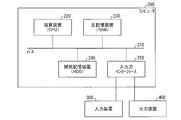
- FIG. 7 is a block diagram illustrating a configuration of a computer 200 that can be used as the electroencephalogram analysis apparatus 1.
- the computer 200 includes an arithmetic device 220, a main storage device 230, an auxiliary storage device 240, and an input / output interface 250 connected to each other via a bus 210.
- An example of a device that can be used as the arithmetic device 220 is a CPU (Central Processing Unit).
- a device that can be used as the main storage device 230 for example, a semiconductor RAM (random access memory) can be cited.
- a device that can be used as the auxiliary storage device 240 is a hard disk drive.
- the input device 300 and the output device 400 are connected to the input / output interface 250 as shown in FIG.
- the input device 300 corresponds to the data acquisition device 20 described above, and a measuring instrument for acquiring an electroencephalogram signal can be used as the input device 300.
- the output device 400 is, for example, for outputting output data (category information) output from the classification module 129 described above, and a monitor, a printer, or the like can be used as the output device 400.
- the output data may be recorded on a recording medium. Further, instead of outputting the output data to the output device 400, the output data may be transmitted to another device.
- the auxiliary storage device 240 stores an electroencephalogram analysis program for operating the computer 200 as the electroencephalogram analysis device 1.
- the electroencephalogram analysis program includes the conversion module 121, the data acquisition module 122, the tensor decomposition module 123, the core tensor management module 124, the element number reduction module 125, the training core tensor management module 126, the test core tensor management module 127, and the classifier learning.
- a module 128, a classification module 129, and the like are included.
- the arithmetic unit 220 causes the computer 200 to function as the electroencephalogram analysis apparatus 1 by executing various instructions included in the electroencephalogram analysis program developed on the main storage device 230. More specifically, the arithmetic device 220 includes a conversion module 121, a data acquisition module 122, a tensor decomposition module 123, a core tensor management module 124, an element number reduction module 125, a training core tensor management module 126 included in the electroencephalogram analysis program, By executing various instructions included in the test core tensor management module 127, the classifier learning module 128, and the classification module 129, the computer 200 is converted into a conversion unit, a tensor decomposition unit, a core tensor management unit, and an element number reduction, respectively.
- the conversion unit, the tensor decomposition unit, the core tensor management unit, the element number reduction unit, the training core tensor management unit, the test core tensor management unit, the classifier learning unit, and the classification module unit are the conversion module 121 and the data, respectively.
- the frequency conversion, bandwidth parameter f b is 4 Hz
- the wavelet center frequency f c can be used complex Morlet conversion CMOR4-1 is 1 Hz.
- CMOR4-1 is 1 Hz.
- a brain wave signal of 8 to 30 Hz is used as an analysis target, and a total of 21 channels of brain wave signals are acquired from each subject.
- the total number of subjects is 83, of which 38 are healthy persons (CTRL), 22 are MCI, and 23 are AD.
- FIG. 8 schematically shows a data tensor obtained under such a setup.
- basis matrices There are two basis matrices, a basis matrix A (1) for the frequency band and a basis matrix A (2) for the time frame, which are derived from the training subject's data tensor. Moreover, the core tensor about the test subject can be obtained by applying the derived basis matrix to (Expression 16).
- FIG. 9 is a diagram schematically showing a tensor decomposition process for the data tensor of the training subject, a tensor decomposition process of the data tensor of the test subject, and a classification process for each category of the test subject.
- the basis matrix in addition to A (1) and A (2) in the case of single-channel basis matrix A (3) is present on the channel, the basis matrix A nonzero elements or components having a (3)
- FIG. 10 is a table showing the classification accuracy ACC when the subject to be examined is classified into either the CTRL group or the MCI group by the electroencephalogram analysis apparatus 1 under the above-described setup.
- FIG. 10 shows classification accuracy ACC (single channel) by single channel analysis, classification accuracy ACC (dual channels) by dual channel analysis, and classification accuracy ACC by dual channel analysis using channel 9 and one other channel. (Channels 9-X) is shown.
- FIG. 10 also shows the 95% bootstrap confidence interval (Confidence Interval: CI) of AUC.
- AUC refers to the area under the curve (Area Under Curve) of the receiver-operator curve (Receiver-Operator Curve: ROC) of the KNN classifier and the SVM classifier.
- FIG. 11 is a diagram showing an example of the spatial position of each channel. Each number in FIG. 11 indicates the channel number of each channel.
- the electroencephalogram analysis apparatus 1 achieves a high classification accuracy of 0.90 to 1.00. This classification accuracy is higher than the accuracy of conventional classification using independent component analysis (Independent Component Analysis: ICA), bump modeling (bump modeling), principal component analysis (Principal Component Analysis), and the like.
- independent Component Analysis ICA
- bump modeling bump modeling
- Principal component analysis Principal Component Analysis
- the classification accuracy when classifying the test subject into either the CTRL group or the AD group shows the classification accuracy when classifying into any of the group, the MCI group, and the AD group, respectively.
- the classification accuracy of the single channel analysis using the channels 13 and 1 and the dual channel analysis using the channels 9 and 12 is particularly high.
- the classification accuracy of the dual channel analysis using 4 and 11, 5 and 11, 5 and 12, 12 and 20, and 13 and 20 is high.
- the electroencephalogram analysis apparatus 1 As described above, by using the electroencephalogram analysis apparatus 1 according to the present embodiment, it is possible to perform highly accurate classification processing while reducing the processing amount.
- the 200 time frames correspond to a total of 20 seconds, for example.
- the electroencephalogram analysis apparatus 1 divides the data tensor into a total of 20 non-overlapping periods each consisting of 10 time frames. Each period is, for example, 1 second. Furthermore, the electroencephalogram analysis apparatus 1 takes the average of the data tensors for each period. As a result, feature extraction can be performed more effectively, and the size of the core tensor can be reduced.
- the electroencephalogram analysis apparatus 1 uses the prior knowledge obtained from the data set so that filtering and feature extraction can be performed more appropriately.
- FIG. 15 shows a map relating to frequency (3 to 18 Hz) and channel (21 channels) for three groups (CTRL, MCI, AD).
- FIG. 15 (a) shows a map for CTRL
- FIG. 15 (b) shows a map for MCI
- FIG. 15 (c) shows a map for AD.
- the CTRL subject shows strong vibration at 8 to 12 Hz
- the MCI subject shows strong vibration at 7 to 10 Hz.
- the characteristics can be extracted more effectively by using the frequency characteristics as described above for each class as preliminary knowledge and using data in a frequency band in which the difference between classes becomes large.
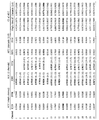
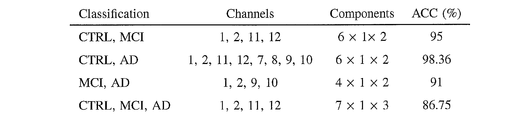
- FIG. 16 shows a table showing the classification accuracy obtained in this way.
- (A) the classification between CTRL and MCI and (B) the classification between CTRL, MCI and AD will be described more specifically.
- a data tensor (also referred to as a connected tensor) including data on all subjects is a four-dimensional tensor, and the total number of elements is 31 (frequency band) ⁇ 10 (time frame) ⁇ 4 (channel) ⁇ 60 (subject). It is.
- the above connected tensor is approximated by six frequency components, one time component, and two spatial components (channel components) under non-negative, sparse, and orthogonal constraints, a total of 12 Individual components are obtained. Of these, 2 and 6 frequency components are selected and combined with the two spatial components to extract a total of four features. Furthermore, two features are selected based on the Fisher score, and the LDA, SVM, and RBF kernel classifiers are learned.
- a data tensor (concatenated tensor) including data for all subjects is a four-dimensional tensor, and the total number of elements is 31 (frequency band) ⁇ 10 (time frame) ⁇ 4 (channel) ⁇ 83 (subject). .
- the first 38 tensors are for the CTRL group, the next 22 tensors are for the MCI group, and the last 23 tensors are for the AD group.
- FIG. 17A is a graph showing the values of the seven frequency components
- FIG. 17B is a graph showing the values of one temporal component.
- the classification performance can be evaluated by the LOO cross-validation method. Also, the LDA classifier is learned to classify the test subject. In this way, regarding the classification of the CTRL group, the MCI group, and the AD group, a classification accuracy of 86.75% can be achieved as shown in FIG.
- the electroencephalogram analysis apparatus 1 can also be used as a brain computer interface (BCI). Even when used as a brain computer interface, each part of the electroencephalogram analysis apparatus 1 performs substantially the same operation as described above. However, the training subjects belong to different classes depending on, for example, whether they are trying to move the right half or the left half. In this case, the electroencephalogram analysis apparatus 1 outputs category information indicating in which class the subject to be examined is classified.
- BCI brain computer interface
- various parameters set in the electroencephalogram analysis apparatus 1 for example, parameters used for frequency conversion, parameters used for the classifier, and the like can be set so that the classification accuracy is further improved.
- the electroencephalogram analysis apparatus includes at least a multidimensional data tensor from an electroencephalogram signal acquisition means for acquiring an electroencephalogram signal from one or a plurality of subjects, and an electroencephalogram signal acquired by the electroencephalogram signal acquisition means.
- Characteristic management means for managing each element of the core tensor in association with the subject.
- At least one multi-dimensional data tensor is generated from electroencephalogram signals acquired from one or more subjects. Further, the data tensor is decomposed into a product of a core tensor and a plurality of basis matrices. Each element of the core tensor is managed in association with the subject.
- the characteristics of the subject can be efficiently managed as each element of the core tensor.
- the number of elements that should be focused on to manage the characteristics of the subject can be reduced compared to the case where the core tensor is not used, it is possible to reduce the amount of data for managing the characteristics of the subject. Become. Thereby, for example, the amount of processing in processing for comparing features between different subjects, processing for comparing features of subjects with predetermined features, and the like is reduced.
- the manufacturing cost and maintenance cost of the electroencephalogram analysis apparatus are reduced.
- the number of elements included in the core tensor is smaller than the number of elements included in the data tensor.
- the amount of data for managing the characteristics of the subject can be more effectively reduced.
- the processing amount in the process of comparing features between different subjects, the process of comparing the features of the subjects with the predetermined feature, and the like is more effectively reduced.
- the manufacturing cost and maintenance cost of the electroencephalogram analysis apparatus can be more effectively reduced.
- the data tensor generating means generates the converted brain wave signal by dividing the brain wave signal into a plurality of time frames and applying frequency conversion to each time frame, and the converted brain wave signal A data tensor having each value as an element is generated, and the data tensor preferably has at least two dimensions indicating each of a time frame and a frequency.
- the electroencephalogram signal is divided into a plurality of time frames, and frequency conversion is applied to each time frame. Further, a data tensor having each element of the converted electroencephalogram signal obtained by applying the frequency conversion is generated.
- the data tensor thus generated has at least two dimensions indicating each of the time frame and the frequency.
- the at least two-dimensional data tensor generated as described above is represented as Y, and each element of the data tensor Y is represented as y ij... Using subscripts ij. Then, the subscript ij ... includes a subscript (for example, i) for specifying a time frame and a subscript (for example, j) for specifying a frequency.
- each element of the data tensor Y is specified by at least a time frame and a frequency.
- the data tensor generating means generates a converted brain wave signal by dividing the brain wave signal into a plurality of time frames and applying a plurality of frequency transforms having different characteristics to each time frame, A data tensor having each value of the transformed electroencephalogram signal as an element, the data tensor having at least three dimensions indicating each of a time frame, a frequency, and a frequency conversion characteristic; It is preferable.
- the electroencephalogram signal is divided into a plurality of time frames, and a plurality of frequency transforms having different characteristics are applied to each time frame. Further, a data tensor having each element of the converted electroencephalogram signal obtained by applying the frequency conversion is generated.
- the data tensor generated in this way has at least three dimensions indicating each of the time frame, frequency, and frequency conversion characteristics.
- each element of the data tensor generated as described above is represented as Y, and each element of the data tensor Y is represented as y ijk ... using subscripts ijk ... corresponding to each dimension.
- a subscript for example, i
- a subscript for specifying a time frame a subscript for specifying a frequency (for example, j)
- a frequency conversion characteristic type of frequency conversion
- each element of the data tensor Y is specified by at least the characteristics of the time frame, frequency, and frequency conversion.
- the electroencephalogram signal acquisition means acquires electroencephalogram signals from a plurality of parts of the head of each subject, and the data tensor generated by the data tensor generation means is at least one indicating the plurality of parts. It is preferable that it has a dimension.
- an electroencephalogram signal is acquired from a plurality of parts of the head of each subject. This can be done, for example, by attaching multiple electrodes to each subject's head.
- the data tensor generated by the above-described electroencephalogram analysis method has at least one dimension indicating the plurality of parts. For example, if each element of the data tensor is expressed as y ijkl... , The subscript ijkl... Includes a subscript (for example, l) for designating the plurality of parts.
- the tensor decomposition means performs tensor decomposition of the data tensor on the condition that each element of the core tensor and the base matrix is non-negative.
- each element of the core tensor and basis matrix obtained by the tensor decomposition means is non-negative, so that each element of the core tensor and basis matrix is physical, physiological, or neurological. It is possible to interpret it more appropriately as a representation of a scientific feature.
- the tensor decomposition means performs tensor decomposition of the data tensor using Tucker decomposition.
- the Tucker decomposition is highly adaptable to various data tensors and can fit various data tensors appropriately. Therefore, according to the above electroencephalogram analysis apparatus, the data tensor can be appropriately tensor-decomposed.
- the tensor decomposition means uses the N-mode high-order orthogonal iteration (N-mode-Higher Order Orthogonal Iterations) or N-mode Singular Value Decomposition to tensor-decompose the data tensor. It is preferable that
- Tensor decomposition can be performed at high speed by using N-mode higher-order orthogonal iterative method and N-mode singular value decomposition. Also, the core tensor and basis matrix decomposed using the N-mode higher-order orthogonal iterative method and the N-mode singular value decomposition tend to be sparse. The feature to be shown can be extracted more appropriately.
- the subject includes a training subject that is a subject classified into any of a plurality of predetermined groups and an examination subject that is a subject to be examined, and the core tensor of the training subject. And a classification means for classifying the test subject into any of the plurality of groups using at least one of the base matrix and at least one of the core tensor and the base matrix of the test subject. .
- the test subject is classified into one of the above groups using at least one of the core tensor and the basis matrix generated based on the electroencephalogram signal of the test subject of the test subject. Subjects can be properly classified.
- the electroencephalogram analysis method includes an electroencephalogram signal acquisition step of acquiring electroencephalogram signals from one or a plurality of subjects, and at least one multidimensional data tensor from the electroencephalogram signals acquired in the electroencephalogram signal acquisition step.
- a feature management step for managing each element of the core tensor in association with the subject.
- Also included in the scope of the present invention are a program for operating the electroencephalogram analysis apparatus, causing the computer to function as each of the above means, and a computer-readable recording medium on which the program is recorded. It is.
- the present invention can be suitably used for an electroencephalogram analysis method for analyzing an electroencephalogram and an electroencephalogram analysis apparatus.
- the present invention can be suitably used for a method and an apparatus that extract features from a subject's brain waves and classify subjects into any of a plurality of groups according to the extracted features.
- Electroencephalogram analysis apparatus 10 Calculation apparatus 20
- storage device 11 CPU 12 memory 121 conversion module 122 data acquisition module 123 tensor decomposition module 124 core tensor management module 125 element number reduction module 126 training core tensor management module 127 inspection core tensor management module 128 classifier learning module 129 classification module
Landscapes
- Health & Medical Sciences (AREA)
- Engineering & Computer Science (AREA)
- Life Sciences & Earth Sciences (AREA)
- Biomedical Technology (AREA)
- Medical Informatics (AREA)
- Public Health (AREA)
- General Health & Medical Sciences (AREA)
- Physics & Mathematics (AREA)
- Pathology (AREA)
- Animal Behavior & Ethology (AREA)
- Heart & Thoracic Surgery (AREA)
- Molecular Biology (AREA)
- Surgery (AREA)
- Neurology (AREA)
- Biophysics (AREA)
- Veterinary Medicine (AREA)
- Psychiatry (AREA)
- Psychology (AREA)
- Artificial Intelligence (AREA)
- General Engineering & Computer Science (AREA)
- Neurosurgery (AREA)
- Theoretical Computer Science (AREA)
- Physiology (AREA)
- Human Computer Interaction (AREA)
- Computer Vision & Pattern Recognition (AREA)
- Fuzzy Systems (AREA)
- Signal Processing (AREA)
- Evolutionary Computation (AREA)
- Mathematical Physics (AREA)
- General Physics & Mathematics (AREA)
- Dermatology (AREA)
- Child & Adolescent Psychology (AREA)
- Developmental Disabilities (AREA)
- Hospice & Palliative Care (AREA)
- Data Mining & Analysis (AREA)
- Databases & Information Systems (AREA)
- Epidemiology (AREA)
- Primary Health Care (AREA)
- Measurement And Recording Of Electrical Phenomena And Electrical Characteristics Of The Living Body (AREA)
Abstract
脳波解析装置(1)は、1又は複数の被験者から脳波信号を取得するデータ取得装置(20)と、取得した脳波信号から複数次元のデータテンソルを少なくとも1つ生成する変換モジュール(121)と、生成されたデータテンソルをコアテンソルと複数の基底行列との積に分解するテンソル分解モジュール(123)と、上記コアテンソルの各要素を上記被験者に関連付けて管理するコアテンソル管理モジュール(124)とを備えている。
Description
本発明は、脳波を解析する脳波解析装置、及び脳波解析方法に関する。
近年、被験者から得られた脳波を解析することによって、アルツハイマー病(AD: Alzheimer Disease)、血管性認知症(VAD: Vascular Dementia)、軽度認識障害(MCI: Mild Cognitive Impairment)、注意欠陥、注意欠陥多動性障害(ADHD)等の認識障害の早期発見を行う試みが盛んになされている。すなわち、被験者から得られた脳波を解析することによって、当該被験者に将来的に生じる各種の認識障害を予見する試みが盛んになされている。また、脳波を解析し、脳コンピュータインターフェース(BCI: Brain Computer Interface)を実現しようとする試みも盛んに行われている。
被験者の脳波を解析することによって各種の認識障害を予見する試みとしては、例えば、特許文献1~3に開示された技術が挙げられる。
特許文献1に開示された技術によれば、被験者から得られた生体電位信号から、時間ドメイン(time domain)、パワースペクトル(power spectrum)値、バイスペクトル(bispectrum)値、及び、高次スペクトル値が導出される。また、それらを用いて、被験者が病的状態にあるか否か、または、病的状態に進行する可能性があるか否かを示す指標である特徴(features)及びインデックス(indices)が算出される。
特許文献2に開示された技術によれば、患者から得られた電脳図信号(EEG signals)に基づいて、患者の神経学的状態、及び、精神的状態を示す指標である特徴及びインデックスが算出される。
特許文献3に開示された技術によれば、被験者が注意欠陥障害であるか否かを示す指標であるスコアが複数の検査機器から取得され、取得された複数のスコアを用いてコンポジットな結果が出力される。
また、特許文献4に開示された技術によれば、被験者の脳波データ、心臓血管のリスク因子(cardiovascular risk factor)データ、及び認識データに基づいて、該被験者についての認知症のリスクが判定される。
これらの従来技術を用いることによって、脳波を解析して各種の認識障害の発生を予見することが現実的なものとなりつつある。
しかしながら、脳波を解析することによって特徴を算出するためには、脳波信号から得られる大量のデータを処理する必要がある。このため、従来の処理装置では、処理量が膨大になると共に、処理装置の製造コスト及び維持管理コストが増大してしまうという問題があった。
上記の課題を解決するために、本発明に係る脳波解析装置は、1又は複数の被験者から脳波信号を取得する脳波信号取得手段と、上記脳波信号取得手段によって取得した脳波信号から、複数次元のデータテンソルを少なくとも1つ生成するデータテンソル生成手段と、上記データテンソル生成手段によって生成されたデータテンソルを、コアテンソルと、複数の基底行列との積に分解するテンソル分解手段と、上記テンソル分解手段によって得られた上記コアテンソルの各要素を、上記被験者に関連付けて管理する特徴管理手段と、を備えていることを特徴としている。
上記の脳波解析装置によれば、1又は複数の被験者から取得された脳波信号から、複数次元のデータテンソルを少なくとも1つ生成する。また、当該データテンソルを、コアテンソルと、複数の基底行列との積に分解する。そして、コアテンソルの各要素を、上記被験者に関連付けて管理する。
このように、基底行列を用いてデータテンソルを分解し、コアテンソルを抽出することによって、被験者の特徴を該コアテンソルの各要素として効率的に管理することができる。また、コアテンソルを用いない場合に比べて、被験者の特徴を管理するために着目すべき要素の数を減らすことができるので、被験者の特徴を管理するためのデータ量を削減することが可能となる。これにより、例えば、異なる被験者の間で特徴を比較する処理、及び被験者の特徴を所定の特徴と比較する処理などにおける処理量が削減される。また、脳波解析装置の製造コスト及び維持管理コストが削減される。
また、本発明に係る脳波解析方法は、1又は複数の被験者から脳波信号を取得する脳波信号取得ステップと、上記脳波信号取得ステップにて取得した脳波信号から、複数次元のデータテンソルを少なくとも1つ生成するデータテンソル生成ステップと、上記データテンソル生成ステップにて生成されたデータテンソルを、コアテンソルと、複数の基底行列との積に分解するテンソル分解ステップと、上記テンソル分解ステップにて得られた上記コアテンソルの各要素を、上記被験者に関連付けて管理する特徴管理ステップと、を含んでいることを特徴としている。
上記のように構成された脳波解析方法によれば、上述の脳波解析装置と同様の効果を奏する。
本発明に係る脳波解析装置によれば、被験者の特徴を管理するためのデータ量が削減される。これにより、例えば、異なる被験者の間で特徴を比較する処理、及び被験者の特徴を所定の特徴と比較する処理などにおける処理量が削減される。また、脳波解析装置の製造コスト及び維持管理コストが削減される。
本発明の一実施形態について、図面を参照して説明すれば以下のとおりである。
(脳波解析方法)
以下では、本実施形態に係る脳波解析方法について、図1(a)~(b)を参照して説明する。本実施形態に係る脳波解析方法は、複数の訓練用被験者(訓練被験者)の脳波信号から、複数の特徴(feature)を抽出し、該複数の特徴を、検査対象の被験者(検査被
験者)から取得した脳波信号から抽出された特徴と比較することによって、検査対象の被験者を、複数のカテゴリ(クラスまたはグループとも呼ぶ)の何れかに分類するための方法である。
以下では、本実施形態に係る脳波解析方法について、図1(a)~(b)を参照して説明する。本実施形態に係る脳波解析方法は、複数の訓練用被験者(訓練被験者)の脳波信号から、複数の特徴(feature)を抽出し、該複数の特徴を、検査対象の被験者(検査被
験者)から取得した脳波信号から抽出された特徴と比較することによって、検査対象の被験者を、複数のカテゴリ(クラスまたはグループとも呼ぶ)の何れかに分類するための方法である。
本実施形態に係る脳波解析方法は、複数の訓練用被験者の脳波信号から、複数の特徴を抽出し、抽出した特徴を用いて分類器を訓練する(分類器を学習させる)訓練ステージと、検査対象の被験者の脳波信号から抽出した複数の特徴を、訓練ステージにおいて蓄積した訓練用被験者の脳波信号の特徴と比較することによって、検査対象の被験者を複数のカテゴリ(クラス)の何れかに分類する検査ステージとを含んでいる。
図1(a)は、本実施形態に係る脳波解析方法の訓練ステージにおける各ステップを示すフローチャートである。図1(a)に示すように、訓練ステージは、訓練用の被験者の脳波信号を取得するステップ(S101)、取得した脳波信号をAD(Analog-Digital)変換して得られる脳波データを周波数変換するステップ(S102)、周波数変換後の脳波データからデータテンソルを構築するステップ(S103)、データテンソルをテンソル分解することによってコアテンソルと基底行列とを導出するステップ(S104)、及び、コアテンソルの各要素を用いて分類器を学習させるステップ(S105)を含んでいる。
ここで、ステップS103にて構築されるデータテンソルは、多くの場合、非常に多くの要素を有している。一方で、ステップS104にて導出されるコアテンソルの有する要素の数は、S103にて構築されたデータテンソルの有する要素の数よりも少なく、訓練用被験者の脳波信号の特徴は、コアテンソルの各要素によって代表される。
このように、本実施形態に係る脳波解析方法によれば、訓練ステージにおいて、訓練用被験者の脳波信号から、データテンソルの有する要素数よりも少ない数の特徴が抽出され、抽出された特徴を用いて分類器が訓練される。
図1(b)は、本実施形態に係る脳波解析方法の検査ステージにおける各ステップを示すフローチャートである。図1(b)に示すように、検査ステージは、検査対象の被験者の脳波信号を取得するステップ(S201)、取得した脳波信号をAD(Analog-Digital)変換して得られる脳波データを周波数変換するステップ(S202)、周波数変換後の脳波データからデータテンソルを構築するステップ(S203)、データテンソルからコアテンソルを導出するステップ(S204)、訓練ステージにて得られた訓練用の被験者のコアテンソルと、ステップS204にて得られた検査対象の被験者のコアテンソルとを分類器を用いて比較し、検査対象の被験者のコアテンソルを何れかのカテゴリ(クラス)に分類するステップ(S205)、及び、分類結果を示すカテゴリ情報を出力するステップ(S206)を含んでいる。
このように、本実施形態に係る脳波解析方法によれば、検査ステージにおいて、検査対象被験者の脳波信号から、検査対象被験者のデータテンソルの有する要素数よりも少ない数の特徴が抽出され、検査対象被験者の脳波信号と訓練対象者の脳波信号とが分類器を用いて比較される。
したがって、本実施形態に係る脳波解析方法によれば、多くの要素を有するデータテンソルから少ない数の特徴を抽出し、抽出した特徴を用いて分類処理を行うので、従来の技術に比べて処理量が削減される。
なお、上記各ステップにおけるより具体的な処理内容は、各ステップの処理を行う脳波解析装置1の各部の説明と共に詳述することにする。
(脳波解析装置)
以下では、本実施形態に係る脳波解析装置について、図2~図14を参照して説明する。図2は、本実施形態に係る脳波解析装置1の構成を示すブロック図である。図2に示すように、脳波解析装置1は、計算装置10、データ取得装置20、及び記憶装置30を備えている。
以下では、本実施形態に係る脳波解析装置について、図2~図14を参照して説明する。図2は、本実施形態に係る脳波解析装置1の構成を示すブロック図である。図2に示すように、脳波解析装置1は、計算装置10、データ取得装置20、及び記憶装置30を備えている。
脳波解析装置1は、複数の訓練用被験者から取得した脳波信号から抽出された複数の特徴を蓄積し、該複数の特徴を、検査対象の被験者から取得した脳波信号から抽出された特徴と比較することによって、該検査対象の被験者を、複数のクラスの何れかに分類するための構成である。
データ取得装置20は、被験者の頭部から脳波信号(以下、単に脳波とも呼ぶ)を取得する。ここで、脳波信号の例としては、脳電図(EEG: Electroencephalogram)信号、脳磁図(MEG: Magnetoencephalogram)信号、及び、機能的磁気共鳴画像(fMRI: functional Magnetic Resonance imaging)信号等が挙げられる。また、上記脳波信号の取得は、被験者の頭部に取り付けられた1又は複数のセンサーを介して行うこともできるし、機能的磁気共鳴撮像装置を介して行うこともできる。データ取得装置20は、取得した脳波信号を必要に応じてAD(Analog-Digital)変換して得られる脳波データを、自身の備えるメモリ上で動作するコンピュータプログラムモジュールであるセンサーモジュールによって管理する。
センサーモジュールは、より具体的には、各サンプリング時刻における脳波データ値の時系列を管理する。したがって、例えば、サンプリング周波数をFsamp(Hz)と表し、サンプリング期間をTsamp(秒)と表し、センサーの個数(チャンネルの個数とも呼ぶ)をNchanと表すことにすると、1人の被験者から取得された脳波は、Fsamp×Tsamp×Nchan個の脳波データ値の配列として管理されることになる。また、センサーモジュールは、複数の被験者から取得された脳波データを管理することができる。この場合、被験者の人数をK人(Kは自然数)とすると、センサーモジュールは、Fsamp×Tsamp×Nchan×K個の脳波データ値の配列を管理することになる。
なお、センサーモジュールによって脳波信号を取得する対象となる被験者は、訓練用の被験者と検査対象の被験者とに大別することができる。ここで、訓練用の被験者とは、脳波解析装置1を訓練する(脳波解析装置1を学習させる)ためのデータを提供する被験者のことであり、被験者番号k(k=1,2,...,K)によって互いに識別される。また、訓練用の被験者は、複数のクラスの何れかに属していることが確定している被験者である。例えば、脳波解析装置1をアルツハイマー病の早期発見のために用いる場合、各訓練用被験者は、健常者であるか(クラス1)、軽度認識障害者(MCI)であるか(クラス2)、アルツハイマー病患者(AD)であるか(クラス3)が既に確定しているものとする。また、脳波解析装置1を、運動心象(motor imagery)に関する脳コンピュータインターフェースのために用いる場合には、各訓練用被験者は、例えば、右半身を動かそうとしている被験者であるか(クラス1)、左半身を動かそうとしている被験者であるか(クラス2)が既に確定しているものとする。各クラスは、クラス番号c(c=1,2,...,C、Cはクラスの総数)によって互いに識別される。
計算装置10は、図2に示すように、CPU11及びメモリ12を備えており、CPU11からの指令に従って、メモリ12上でコンピュータプログラムの各種のモジュールが動作する。
(変換モジュール121)
変換モジュール121は、上述のセンサーモジュールによって管理されている脳波データに対して、周波数変換を行うことによって、周波数変換後の脳波データを生成する。周波数変換後の脳波データは、記憶装置30に格納される。ここで、変換モジュール121によって行われる周波数変換の具体例としては、ウェーブレット変換、短時間フーリエ変換(STFT: Short Time Fourier Transformation)、MEMD変換などが挙げられる。また、ウェーブレット変換としては、より具体的に、Morlet変換、Gabor変換、及びWigner変換などが挙げられる。また、変換モジュール121として、図5に示すように、通過帯域が互いに異なる複数のバンドパスフィルタを用いる構成としてもよい。
変換モジュール121は、上述のセンサーモジュールによって管理されている脳波データに対して、周波数変換を行うことによって、周波数変換後の脳波データを生成する。周波数変換後の脳波データは、記憶装置30に格納される。ここで、変換モジュール121によって行われる周波数変換の具体例としては、ウェーブレット変換、短時間フーリエ変換(STFT: Short Time Fourier Transformation)、MEMD変換などが挙げられる。また、ウェーブレット変換としては、より具体的に、Morlet変換、Gabor変換、及びWigner変換などが挙げられる。また、変換モジュール121として、図5に示すように、通過帯域が互いに異なる複数のバンドパスフィルタを用いる構成としてもよい。
本実施形態において、変換モジュール121による周波数変換は、対象とする周波数を所定の範囲(例えば、3Hz~18Hz)に限定することによって行われる。このように、周波数を所定の範囲に限定することによって、ノイズや人為的な影響などを取り除くことができる。
また、変換モジュール121によって行われる周波数変換は、何れも、時間方向を複数の時間フレーム(ウィンドウとも呼ぶ)に区切ったうえで、各時間フレームについて行われる。したがって、ある被験者のあるチャンネルについての周波数変換後の脳波データは、各周波数帯域(frequency bin)、及び各時間フレームについてのデータ値の配列となる。
また、変換モジュール121は、ある被験者のあるチャンネルについての脳波データに対して、互いに種類の異なる複数の周波数変換を行い、各種類の周波数変換後の脳波データを、記憶装置30に格納する構成としてもよい。一例としては、ある被験者のあるチャンネルについての脳波データに対して、互いにパラメータの異なるウェーブレット変換を行う場合が挙げられる。このように、複数種類の周波数変換を用いる場合、ある被験者のあるチャンネルについての周波数変換後の脳波データは、各周波数帯域、各時間フレーム、及び周波数変換の各種類についてのデータ値の配列となる。周波数変換の種類を辞書(dictionary)と呼ぶこともある。
図6は、変換モジュール121によって行われる周波数変換の一例を模式的に示す図である。図6に示す例においては、周波数変換として、バンド幅パラメータfbが6Hzで
あり、ウェーブレット中心周波数fcが1Hzである複素ウェーブレット変換CWT6-1と、バンド幅パラメータfbが1Hzであり、ウェーブレット中心周波数fcが1Hzである複素ウェーブレット変換CWT1-1とが用いられている。
あり、ウェーブレット中心周波数fcが1Hzである複素ウェーブレット変換CWT6-1と、バンド幅パラメータfbが1Hzであり、ウェーブレット中心周波数fcが1Hzである複素ウェーブレット変換CWT1-1とが用いられている。
なお、変換モジュール121によって記憶装置30に格納された脳波データ値の配列は、訓練用の被験者から取得した脳波データである訓練データ値の配列と、検査対象の被験者から取得した脳波データである検査データ値の配列とに大別される。
本実施形態において、各々の訓練データ値は、周波数帯域、時間フレーム、チャンネル、辞書、及び被験者番号の5つのパラメータによって指定される。換言すれば、訓練データは、上記5つのパラメータの各々を引数とする訓練データ値の5次元配列として管理される。
一方で、検査対象の被験者の数を1人とすると、各々の検査データ値は、上記5つのパラメータのうち、被験者番号を除く4つのパラメータによって指定される。換言すれば、検査データは、これら4つのパラメータの各々を引数とする検査データ値の4次元配列として管理される。
(データ取得モジュール122)
データ取得モジュール122は、記憶装置30から訓練データ値の配列及び検査データ値の配列を取得し、それぞれ、訓練データテンソル、及び検査データテンソルを構築する。また、構築したデータテンソルをテンソル分解モジュール123に受け渡す。訓練データテンソル及び検査データテンソルの次元は、それぞれ、訓練データ値の配列及び検査データ値の次元と同じである。なお、データテンソルの次元は、モード(mode)と呼ばれることもある。
データ取得モジュール122は、記憶装置30から訓練データ値の配列及び検査データ値の配列を取得し、それぞれ、訓練データテンソル、及び検査データテンソルを構築する。また、構築したデータテンソルをテンソル分解モジュール123に受け渡す。訓練データテンソル及び検査データテンソルの次元は、それぞれ、訓練データ値の配列及び検査データ値の次元と同じである。なお、データテンソルの次元は、モード(mode)と呼ばれることもある。
以下の説明では、一般にN+1次元の訓練データテンソルをY、N次元の検査データテンソルをXと表記する。また、Y及びXの要素を、各次元に対応する添え字p,q,r,...を用いて、それぞれ、ypqr...及びxpqr...のように表記する。yに付された添え字の総数はN+1個であり、xに付された添え字の総数はN個である。また、被験者番号がkである被験者についての訓練データテンソルを、Y
(k)とも表記する。
(テンソル分解モジュール123)
以下では、テンソル分解モジュール123について説明を行う。まず、訓練データテンソルについてのテンソル分解処理について説明し、その後に、検査データテンソルについてのコアテンソル導出処理について説明する。
以下では、テンソル分解モジュール123について説明を行う。まず、訓練データテンソルについてのテンソル分解処理について説明し、その後に、検査データテンソルについてのコアテンソル導出処理について説明する。
(訓練データテンソルについてのテンソル分解処理)
テンソル分解モジュール123は、訓練データテンソルYを、以下のテンソル分解式(数式1)を用いて、コアテンソルと複数の基底行列との積にテンソル分解する。
テンソル分解モジュール123は、訓練データテンソルYを、以下のテンソル分解式(数式1)を用いて、コアテンソルと複数の基底行列との積にテンソル分解する。

、それぞれ、2次元の基底行列を表している。また、(数式1)は、被験者番号を示すN+1番目の次元に対応する単位行列を省略して表記している。記号「×n」は、Gの第n
番目の添え字と、A(n)の2番目の添え字とを縮約(contract)することを示している。なお、以下では、基底行列の行または列を「成分」と呼ぶこともある。
簡単のため、N=3である場合、すなわち、訓練コアテンソルの次元が3である場合を例に挙げ、上記テンソル分解式(数式1)を要素表示すると以下のようになる。

訓練コアテンソルGは、(数式1)のテンソル分解式を用いて、訓練データテンソルYに比べて各次元について要素数の少ないテンソルとなるように導出される。換言すれば、テンソル分解モジュール123は、訓練データテンソルYから、該訓練データテンソルYよりも要素数の少ない訓練コアテンソルGを導出するものである。例えば、N=3である訓練データテンソルypqr(1≦p≦Np、1≦q≦Nq、1≦r≦Nr)が、テンソル
分解モジュール123により(数式1’)を用いて、コアテンソルglmn(1≦l≦Nl、1≦m≦Nm、1≦n≦Nn)と、基底行列apl、aqm、arnとの積に分解されるとすると、Nl<Np、Nm<Nq、Nn<Nrが満たされる。
分解モジュール123により(数式1’)を用いて、コアテンソルglmn(1≦l≦Nl、1≦m≦Nm、1≦n≦Nn)と、基底行列apl、aqm、arnとの積に分解されるとすると、Nl<Np、Nm<Nq、Nn<Nrが満たされる。
なお、本明細書においては、データテンソル及びコアテンソルの各要素を、「特徴(feature)」と呼ぶこともある。これは、データテンソル及びコアテンソルの要素が、被験者の神経学的状態を示す指標としての役割を有しているためである。
ここで、被験者の神経学的状態とは、一般に、被験者の脳や神経系についての状態または疾患のことを指す。神経学的状態の具体例としては、アルツハイマー病、血管性認知症、軽度認識障害、注意欠陥、及び、注意欠陥多動性障害(ADHD)等が挙げられる。また、そのような疾患及び障害を有しない健常な状態も、神経学的状態の一例である。
また、(数式1)に示すテンソル分解は、タッカー分解(Tucker decomposition)と呼ばれるテンソル分解の一類型であり、Nモード高次直交反復法(N-mode Higher Order Orthogonal Iterations: HOOI)と呼ばれるアルゴリズム、Nモード特異値分解(N-mode Singular Value Decomposition: HSVD)と呼ばれるアルゴリズム、Nモード非負分解(N-mode non-negative decomposition)と呼ばれるアルゴリズム、又は、Nモード疎分解(N-mode sparse decomposition)と呼ばれるアルゴリズム等を用いて解くことができる。
以下では、テンソル分解モジュール123によるテンソル分解処理の一例について説明する。
テンソル分解モジュール123は、以下の(数式2)によって与えられるコスト関数D(G,A(1),A(2),...,A(N))を最小化するコアテンソルG、及び基底行列A(1),A(2),...,A(N)を決定する。





なお、Jsparseは、基底行列A(n)が疎(sparse)行列であることを要請するための条件であり、Jorthoは、基底行列A(n)に対して直交性(orthogonality)を要請するための条件であり、Jnngは、コアテンソルが非負(non-negative)であることを要請するための条件と、対数バリア関数(logarithmic barrier function)との線形和である。また、Jdaは、カテゴリ情報又は判別情報を与えるためのものである。コアテンソルが非負であることを要請する上述のJnngを用いて行われるテンソル分解は、非負テンソル分解(Nonnegative Tensor factrizations: NTF)とも呼ばれる。
また、(数式4)~(数式6)において、ap
(n)及びain,r
(n)等は基底行列A(n)の要素を表しており、grは、コアテンソルGの要素を表している。また、記号「T」は、転置行列の各要素であることを示しており、αn、βn、γn、λw、及びλbは、パラメータである。
また、(数式6)に示すG(k)等は、以下に示す(数式7)によって与えられる。

また、(数式7)の第2式は、クラスcに属するコアテンソルの平均を表しており、(数式7)の第3式は、各訓練用被験者から得られたコアテンソルの平均を表している。記号ckは、被験者番号がkである被験者が属するクラスのクラス番号を示している。
また、テンソル分解モジュール123は、G及びA(n)について、以下に説明する更新処理を繰り返し、収束後のG及びA(n)を返す。
なお、上記数式において




図3は、コアテンソルG及び基底行列A(n)の更新処理の流れを示すフローチャートである。
(ステップS301)
まず、テンソル分解モジュール123は、データ取得モジュール122より訓練データテンソルYを取得する。
まず、テンソル分解モジュール123は、データ取得モジュール122より訓練データテンソルYを取得する。
(ステップS302)
続いて、テンソル分解モジュール123は、nの値を1に初期化すると共に、n=1,2,...,Nについてのループ処理を開始する。
続いて、テンソル分解モジュール123は、nの値を1に初期化すると共に、n=1,2,...,Nについてのループ処理を開始する。
(ステップS303)
続いて、テンソル分解モジュール123は、以下の(数式8)を用いて、基底行列A(n)を更新する。
続いて、テンソル分解モジュール123は、以下の(数式8)を用いて、基底行列A(n)を更新する。

Y×1A(1)×2A(2)...×n-1A(n-1)×n+1A(n+1)...×NA(N)
を表しており、<P,Q>-nは、PとQとを第n番目の次元に対応する添え字以外の添え字について縮約することを示している。
また、(数式8)におけるSb
-n、Sw
-nは、以下に示す(数式9)によって与えられる。

続いて、テンソル分解モジュール123は、ループ変数nの値がN+1未満であるか否かを判定する。
(ステップS305)
ループ変数nの値がN+1未満である場合(ステップS304でYes)、nをインクリメントする(nの値を1だけ増加させる)。
ループ変数nの値がN+1未満である場合(ステップS304でYes)、nをインクリメントする(nの値を1だけ増加させる)。
(ステップS306)
ループ変数nの値がN+1未満でない場合(ステップS304でNo)、テンソル分解モジュール123は、以下の(数式10)を用いて、訓練コアテンソルGを更新する。
ループ変数nの値がN+1未満でない場合(ステップS304でNo)、テンソル分解モジュール123は、以下の(数式10)を用いて、訓練コアテンソルGを更新する。








(ステップS307)
続いて、テンソル分解モジュール123は、更新された基底行列A(n)及び訓練コアテンソルGが収束しているか否かを判定する。
続いて、テンソル分解モジュール123は、更新された基底行列A(n)及び訓練コアテンソルGが収束しているか否かを判定する。
(ステップS308)
更新された基底行列A(n)及び訓練コアテンソルGが収束している場合(ステップS307でYes)、テンソル分解モジュール123は、基底行列A(n)及び訓練コアテンソルGを返す。更新された基底行列A(n)及び訓練コアテンソルGが収束していない場合(ステップS307でNo)、テンソル分解モジュール123は、初期条件を変更し、ステップS302からの処理を繰り返す。
更新された基底行列A(n)及び訓練コアテンソルGが収束している場合(ステップS307でYes)、テンソル分解モジュール123は、基底行列A(n)及び訓練コアテンソルGを返す。更新された基底行列A(n)及び訓練コアテンソルGが収束していない場合(ステップS307でNo)、テンソル分解モジュール123は、初期条件を変更し、ステップS302からの処理を繰り返す。
以上のステップS301~S308の処理によって、テンソル分解モジュール123は、訓練コアテンソルG及び基底行列A(n)を算出する。
また、後述する検査コアテンソルを、複数のクラスの何れかに適切に分類するためには、適切な判別射影(discriminantprojections)方向を見出しておくことが好ましい。これは、以下の(数式13)によって与えられるフィッシャー比(Fisher's ratio)を最大化するような基底行列A(n)を再度算出することにより行われる。

(数式13)によって与えられるフィッシャー比を最大化する基底行列A(n)は、以下の(数式14)または(数式15)によって与えられる行列のRn個の先導的な固有ベクトル(leading eigenvectors)によって構成することができる。より具体的には、以下の(数式14)または(数式15)によって与えられる行列の固有値のうち、値の大きい方からRn個の固有値の各々に対応する固有ベクトルによって構成することができる。


なお、(数式13)によって与えられるフィッシャー比は以下の(数式13’)のように表現することもできる。

以下では、図4を参照して、上記の判別射影処理について説明する。図4は、テンソル分解モジュール123による判別射影処理の流れを示すフローチャートである。
(ステップS401)
まず、テンソル分解モジュール123は、データ取得モジュール122より訓練データテンソルY、クラス数C、及びckを取得する。
まず、テンソル分解モジュール123は、データ取得モジュール122より訓練データテンソルY、クラス数C、及びckを取得する。
(ステップS402)
続いて、テンソル分解モジュール123は、nの値を1に初期化すると共に、n=1,2,...,Nについてのループ処理を開始する。
続いて、テンソル分解モジュール123は、nの値を1に初期化すると共に、n=1,2,...,Nについてのループ処理を開始する。
(ステップS403)
続いて、テンソル分解モジュール123は、(数式9)を用いて、Sb -n及びSw -nを算出した後、(数式14)によって与えられる行列の固有値のうち、値の大きい方からRn個の固有値の各々に対応する固有ベクトルから、基底行列A(n)を導出する。
続いて、テンソル分解モジュール123は、(数式9)を用いて、Sb -n及びSw -nを算出した後、(数式14)によって与えられる行列の固有値のうち、値の大きい方からRn個の固有値の各々に対応する固有ベクトルから、基底行列A(n)を導出する。
(ステップS404)
続いて、テンソル分解モジュール123は、ループ変数nの値がN+1未満であるか否かを判定する。
続いて、テンソル分解モジュール123は、ループ変数nの値がN+1未満であるか否かを判定する。
(ステップS405)
ループ変数nの値がN未満である場合(ステップS404でYes)、nをインクリメントする。
ループ変数nの値がN未満である場合(ステップS404でYes)、nをインクリメントする。
(ステップS406)
ループ変数nの値がN未満でない場合(ステップS404でNo)、ステップS407に進む。
ループ変数nの値がN未満でない場合(ステップS404でNo)、ステップS407に進む。
(ステップS407)
続いて、テンソル分解モジュール123は、基底行列A(n)が収束しているか否かを判定する。
続いて、テンソル分解モジュール123は、基底行列A(n)が収束しているか否かを判定する。
(ステップS408)
基底行列A(n)が収束している場合(ステップS407でYes)、テンソル分解モジュール123は、基底行列A(n)及び訓練コアテンソルGを返す。更新された基底行列A(n)が収束していない場合(ステップS407でNo)、テンソル分解モジュール123は、初期条件を変更し、ステップS402からの処理を繰り返す。
基底行列A(n)が収束している場合(ステップS407でYes)、テンソル分解モジュール123は、基底行列A(n)及び訓練コアテンソルGを返す。更新された基底行列A(n)が収束していない場合(ステップS407でNo)、テンソル分解モジュール123は、初期条件を変更し、ステップS402からの処理を繰り返す。
(ステップS401)~(ステップS408)の処理を行うことによって得られた基底行列A(n)、訓練コアテンソルG、及び、訓練用被験者毎の訓練コアテンソルG
(k)は、コアテンソル管理モジュール124に供給される。
以上が、テンソル分解モジュール123による、訓練データテンソルについてのテンソル分解処理である。一方で、テンソル分解モジュール123による、検査データテンソルからのコアテンソル導出処理は以下のようなものである。
(検査データテンソルからのコアテンソル導出処理)
テンソル分解モジュール123は、検査データテンソルXに対して、以下の(数式16)に示す演算を行うことによって、検査コアテンソルGtestを導出する。
テンソル分解モジュール123は、検査データテンソルXに対して、以下の(数式16)に示す演算を行うことによって、検査コアテンソルGtestを導出する。

ール125によって要素数が削減された基底行列を表すものとする。
なお、(数式16)は、以下の(数式16’)のように表現することもできる。

コアテンソル管理モジュール124は、テンソル分解モジュール123から供給される訓練コアテンソル及び検査コアテンソルを管理する。
要素数削減モジュール125は、コアテンソル管理モジュール124から供給されるコアテンソル及び基底行列の要素数を更に削減するための構成である。要素数削減モジュール125は、例えば、コアテンソルおよび基底行列の冗長性(redundancy)を削減することにより、要素数削減前のデータテンソルと、要素数削減後のデータテンソルとの誤差を小さく保ちつつ、コアテンソル及び基底行列の要素数を削減する。ここで、要素数削減前のデータテンソルとは、例えば、(数式1)によって与えられるデータテンソルのことであり、要素数削減後のデータテンソルとは、例えば、(数式1)におけるコアテンソルG及び基底行列A(n)を、要素削減後のコアテンソルG’及び基底行列A’(n)に置き換えて得られるデータテンソルのことである。
また、要素数削減モジュール125は、特定のデータに基づく予備知識に基づいて、クラス間の差異がより顕著となるように基底行列の各要素を選択する構成とすることができる。そのような予備知識の例としては、所望の周波数帯域において周波数成分が振動する場合が挙げられる。このような予備知識に基づいて、クラス間の差異が顕著になるいくつかの予備的周波数帯域、または、チャンネルを特定することができる。また、不要な成分を削減することによって、特徴の数を削減することができる。
要素数削減モジュール125によって要素数が削減されたコアテンソル及び基底行列は、コアテンソル管理モジュール124、及び、テンソル分解モジュール123に供給される。なお、以下では、要素数削減後のコアテンソル及び基底行列を、特に混乱が生じない場合には、単にコアテンソル及び基底行列と呼ぶこともある。
訓練コアテンソル管理モジュール126には、訓練コアテンソルが蓄積され、検査コアテンソル管理モジュール127には、検査コアテンソルが蓄積される。
分類モジュール129は、訓練コアテンソルと検査コアテンソルとを比較することによって、検査コアテンソルを、何れかのクラスに分類する分類処理を行う。また、分類モジュール129は、分類した結果を示す情報をカテゴリ情報として出力する。
なお、分類モジュール129における分類処理は、例えば、KNN分類器(K-Nearest Neighbor Classifier)、または、線形サポートベクターマシン分類器(Support Vector Machine Classifier)を用いて行うことができる。
分類器学習モジュール128は、分類モジュール129での分類処理に用いられている分類器を学習させるためのモジュールである。例えば、分類器学習モジュール128は、特徴点モジュール126に蓄積された訓練コアテンソルの各要素のうち、フィッシャースコア(Fisher score)が高い方から所定の個数の要素または成分を、分類モジュール129に学習させる。このように、フィッシャースコアが高い要素または成分を学習に用いることによって、分類モジュール129による分類処理の精度を高めることができる。
(脳波解析装置1の他の構成例)
脳波解析装置1は、コンピュータ(電子計算機)を用いて、以下のように構成することもできる。図7は、脳波解析装置1として利用可能なコンピュータ200の構成を例示したブロック図である。
脳波解析装置1は、コンピュータ(電子計算機)を用いて、以下のように構成することもできる。図7は、脳波解析装置1として利用可能なコンピュータ200の構成を例示したブロック図である。
コンピュータ200は、図7に示したように、バス210を介して互いに接続された演算装置220と、主記憶装置230と、補助記憶装置240と、入出力インタフェース250とを備えている。演算装置220として利用可能なデバイスとしては、CPU(Central Processing Unit)を挙げることができる。また、主記憶装置230として利用可能なデバイスとしては、例えば、半導体RAM(random access memory)を挙げることができる。また、補助記憶装置240として利用可能なデバイスとしては、例えば、ハードディスクドライブを挙げることができる。
入出力インタフェース250には、図7に示したように、入力装置300及び出力装置400が接続される。入力装置300は、上述したデータ取得装置20に対応するものであり、脳波信号を取得するための測定器を入力装置300として利用することができる。出力装置400は、例えば、上述した分類モジュール129が出力する出力データ(カテゴリ情報)を出力するためのものであり、モニタやプリンタなどを出力装置400として利用することができる。
なお、出力装置400を介して出力データを出力する代わりに、記録媒体に出力データを記録するようにしてもよい。また、出力データを出力装置400に出力する代わりに、他の装置に出力データを送信するようにしてもよい。
補助記憶装置240には、コンピュータ200を脳波解析装置1として動作させるための脳波解析プログラムが格納されている。脳波解析プログラムは、上述した変換モジュール121、データ取得モジュール122、テンソル分解モジュール123、コアテンソル管理モジュール124、要素数削減モジュール125、訓練コアテンソル管理モジュール126、試験コアテンソル管理モジュール127、分類器学習モジュール128、及び分類モジュール129等を含んでいる。
演算装置220は、主記憶装置230上に展開された脳波解析プログラムに含まれる各種の命令を実行することによって、コンピュータ200を脳波解析装置1として機能させる。より具体的には、演算装置220は、脳波解析プログラムに含まれる変換モジュール121、データ取得モジュール122、テンソル分解モジュール123、コアテンソル管理モジュール124、要素数削減モジュール125、訓練コアテンソル管理モジュール126、試験コアテンソル管理モジュール127、分類器学習モジュール128、及び分類モジュール129に含まれる各種の命令を実行することによって、コンピュータ200を、それぞれ、変換部、テンソル分解部、コアテンソル管理部、要素数削減部、訓練コアテンソル管理部、試験コアテンソル管理部、分類器学習部、及び分類モジュール部として機能させる。ここで、変換部、テンソル分解部、コアテンソル管理部、要素数削減部、訓練コアテンソル管理部、試験コアテンソル管理部、分類器学習部、及び分類モジュール部は、それぞれ、変換モジュール121、データ取得モジュール122、テンソル分解モジュール123、コアテンソル管理モジュール124、要素数削減モジュール125、訓練コアテンソル管理モジュール126、試験コアテンソル管理モジュール127、分類器学習モジュール128、及び分類モジュール129と同様の動作を行うものである。
(具体的なセットアップ例1及び分類精度)
以下では、図8~14を参照して、脳波解析装置1に関する具体的なセットアップ例、及び、当該セットアップを用いたときの分類精度について説明する。
以下では、図8~14を参照して、脳波解析装置1に関する具体的なセットアップ例、及び、当該セットアップを用いたときの分類精度について説明する。
まず、周波数変換としては、バンド幅パラメータfbが4Hzであり、ウェーブレット中心周波数fcが1Hzである複素Morlet変換CMOR4-1を用いることができる。また、解析対象として、8~30Hzの脳波信号を用い、各被験者から合計21チャンネルの脳波信号を取得するものとする。このようなセットアップの下で、各被験者のデータテンソルは、31(周波数帯域)×200(時間フレーム)×21(チャンネル)=130200個の要素を有することになる。また、被験者の総数は83人であり、そのうちの38人が健常者(CTRL)であり、22人がMCIであり、23人がADである。
図8は、このようなセットアップの下で得られるデータテンソルを模式的に示している。
また、具体的な解析処理として、単一のチャンネルからのデータのみを用いるシングルチャンネル解析、及び、2つのチャンネルからのデータを用いるデュアルチャンネル解析を行うことができる。
(シングルチャンネル解析)
シングルチャンネル解析においては、各被験者について、31(周波数帯域)×200(時間フレーム)=6200個の要素を取り扱うことになる。また、シングルチャンネル解析による分類精度は、LOO交差検定法(Leave-one-out cross validation method)を用いて評価することができる。すなわち、各ランにおいて83人の被験者から抜き出した1人を検査対象被験者とし、他の被験者と訓練用被験者とする。
シングルチャンネル解析においては、各被験者について、31(周波数帯域)×200(時間フレーム)=6200個の要素を取り扱うことになる。また、シングルチャンネル解析による分類精度は、LOO交差検定法(Leave-one-out cross validation method)を用いて評価することができる。すなわち、各ランにおいて83人の被験者から抜き出した1人を検査対象被験者とし、他の被験者と訓練用被験者とする。
基底行列は、周波数帯域についての基底行列A(1)、及び時間フレームについての基底行列A(2)の2つであり、それらは訓練用被験者のデータテンソルから導出される。また、導出された基底行列を(数式16)に適用することによって、検査対象の被験者についてのコアテンソルを得ることができる。
図9は、訓練用被験者のデータテンソルについてのテンソル分解処理、検査対象被験者のデータテンソルのテンソル分解処理、及び、検査対象被験者の各カテゴリへの分類処理を模式的に示す図である。
なお、基底行列A(1)が有するゼロでない要素または成分の数は例えば5であり、基底行列A(2)が有するゼロでない要素または成分の数は例えば2である。したがって、脳波解析装置1を用いたシングルチャンネル解析において、各被験者の脳波信号は、高々5×2=10個の特徴に集約されることになる。なお、分類器としてはKNN(N=3)分類器、及び、線形SVM分類器を用い、それらの分類器は、フィッシャースコアの高い2つの特徴により学習が行われるものとする。
(デュアルチャンネル解析)
シングルチャンネル解析においては、各被験者について、31(周波数帯域)×200(時間フレーム)×2(チャンネル)=12400個の要素を取り扱うことになる。また、21チャンネルから抜き出した任意の2チャンネルの組み合わせについて解析を行うことができる。また、デュアルチャンネル解析による分類精度は、シングルチャンネル解析と同様に、LOO交差検定法を用いて評価することができる。
シングルチャンネル解析においては、各被験者について、31(周波数帯域)×200(時間フレーム)×2(チャンネル)=12400個の要素を取り扱うことになる。また、21チャンネルから抜き出した任意の2チャンネルの組み合わせについて解析を行うことができる。また、デュアルチャンネル解析による分類精度は、シングルチャンネル解析と同様に、LOO交差検定法を用いて評価することができる。
基底行列としては、シングルチャンネルの場合のA(1)及びA(2)に加えて、チャンネルについての基底行列A(3)が存在し、基底行列A(3)の有するゼロでない要素または成分の数は2である。したがって、脳波解析装置1を用いたデュアルチャンネル解析において、各被験者の脳波信号は、高々5×2×2=20個の特徴に集約されることになる。なお、分類器としては、シングルチャンネル解析と同様に、KNN(N=3)分類器、及び、線形SVM分類器を用い、それらの分類器は、フィッシャースコアの高い2または3つの特徴により学習が行われるものとする。
(分類精度)
図10は、上述のセットアップの下で、脳波解析装置1により、検査対象被験者をCTRLグループ及びMCIグループの何れかに分類する際の分類精度ACCを示す表である。図10には、シングルチャンネル解析による分類精度ACC(single channel)、デュアルチャンネル解析による分類精度ACC(dual channels)、及び、チャンネル9と他の1つのチャンネルとを用いたデュアルチャンネル解析による分類精度ACC(channels 9-X)が示されている。
図10は、上述のセットアップの下で、脳波解析装置1により、検査対象被験者をCTRLグループ及びMCIグループの何れかに分類する際の分類精度ACCを示す表である。図10には、シングルチャンネル解析による分類精度ACC(single channel)、デュアルチャンネル解析による分類精度ACC(dual channels)、及び、チャンネル9と他の1つのチャンネルとを用いたデュアルチャンネル解析による分類精度ACC(channels 9-X)が示されている。
また、図10には、AUCの95%ブーツストラップ信頼区間(Confidence Interval:CI)が示されている。ここで、AUCとは、KNN分類器及びSVM分類器のレシーバ-オペレータ曲線(Receiver-Operator Curve: ROC)の曲線下面積(Area Under Curve)のことを指す。
図11は、各チャンネルの空間的位置の例を示す図である。図11における各数字は、各チャンネルのチャンネル番号を示している。
図10に示すように、CTRLグループ及びMCIグループの分類において、脳波解析装置1は、0.90~1.00という高い分類精度を達成している。この分類精度は、独立成分分析(Independent Component Analysis: ICA)、バンプモデリング(bump modeling)、及び主成分分析(Principal Component Analysis)等を用いた従来の分類の精度よりも高い。
同様に、検査対象被験者をCTRLグループ及びADグループの何れかに分類する際の分類精度、検査対象被験者をMCIグループ及びADグループの何れかに分類する際の分類精度、及び、検査対象被験者をCTRLグループ、MCIグループ、及びADグループの何れかに分類する際の分類精度を、それぞれ、図12、図13、及び図14に示す。
図10から明らかなように、CTRLグループ及びMCIグループの分類においては、特に、チャンネル1,11,6,13,15,19を用いたシングルチャンネル解析、及び、チャンネル9と18とを用いたデュアルチャンネル解析の分類精度が高い。
図12から明らかなように、CTRLグループ及びADグループの分類においては、特に、チャンネル13,1を用いたシングルチャンネル解析、及び、チャンネル9と12とを用いたデュアルチャンネル解析の分類精度が高い。
図13から明らかなように、MCIグループ及びADグループの分類においては、特に、チャンネル15,2を用いたシングルチャンネル解析、及び、チャンネル1とX、2とX、11とX、12とX、20とX(X≠1,2,11,12,20)を用いたデュアルチャンネル解析の分類精度が高い。
図14から明らかなように、CTRLグループ、MCIグループ、及びADグループの分類においては、特に、チャンネル4,7,10,11,12,18を用いたシングルチャンネル解析、及び、チャンネル7と14、4と11、5と11、5と12、12と20、13と20を用いたデュアルチャンネル解析の分類精度が高い。
以上のように、本実施形態に係る脳波解析装置1を用いることによって、処理量を削減しついつ、精度の高い分類処理を行うことができる。
(具体的なセットアップ例2及び分類精度)
以下では、図15~16を参照して、具体的なセットアップの他の例及びそのセットアップによって得られる分類精度について説明する。
以下では、図15~16を参照して、具体的なセットアップの他の例及びそのセットアップによって得られる分類精度について説明する。
本セットアップにおいても、周波数変換として、バンド幅パラメータfbが4Hzであり、ウェーブレット中心周波数fcが1Hzである複素Morlet変換CMOR4-1を用いる。また、解析対象として、8~30Hzの脳波信号を用い、各被験者から合計21チャンネルの脳波信号を取得するものとする。このようなセットアップの下で、各被験者のデータテンソルは、31(周波数帯域)×200(時間フレーム)×21(チャンネル)=130200個の要素を有することになる。ここで、200個の時間フレームは、例えば、合計20秒間に対応する。
本セットアップに係る脳波解析装置1は、上記データテンソルを、それぞれが10個の時間フレームよりなる合計20個の重複しない期間に分割する。それぞれの期間は、例えば、1秒間となる。更に、脳波解析装置1は、各期間についてのデータテンソルの平均をとる。これによって、特徴の抽出をより効果的に行うことができると共に、コアテンソルのサイズを小さくすることができる。
また、フィルタリング及び特徴の抽出をより適切に行うことができるように、脳波解析装置1は、データセットより得られる予備知識を利用する。
図15は、3つのグループ(CTRL,MCI,AD)についての、周波数(3~18Hz)及びチャンネル(21チャンネル)に関するマップを示している。図15(a)は、CTRLについてのマップを示しており、図15(b)は、MCIについてのマップを示しており、図15(c)は、ADについてのマップを示している。
図15から明らかなように、CTRL被験者は、8~12Hzにおいて強い振動を示しており、MCI被験者は、7~10Hzにおいて強い振動を示している。
各クラスについての、上記のような周波数特性を予備知識として利用し、クラス間の差異が大きくなる周波数帯域におけるデータを用いることによって、特徴の抽出をより効果的に行うことができる。
このようにして得られた分類精度を示す表を図16に示す。以下では、(A)CTRLとMCIとの分類、及び、(B)CTRLとMCIとADとの分類についてより具体的に説明する。
(A)CTRL+MCI
本セットアップに係る脳波解析装置1によって行なわれるCTRLグループとMCIグループとの分類について説明する。本セットアップにおいては、チャンネル1,2,11,12の合計4つのチャンネルを用いる。
本セットアップに係る脳波解析装置1によって行なわれるCTRLグループとMCIグループとの分類について説明する。本セットアップにおいては、チャンネル1,2,11,12の合計4つのチャンネルを用いる。
全ての被験者についてのデータを含むデータテンソル(連結テンソルとも呼ぶ)は、4次元テンソルとなり、その要素の総数は、31(周波数帯域)×10(時間フレーム)×4(チャンネル)×60(被験者)である。上記連結テンソルを、非負性、疎性、及び直交性の拘束条件の下で、6個の周波数成分、1個の時間成分、及び2個の空間的成分(チャンネル成分)によって近似すると、合計12個の成分が得られる。そのうち、2及び6の周波数成分を選択し、2つの空間成分と合わせることによって、合計4つの特徴を抽出する。さらに、それらのうち、フィッシャースコアに基づいて2つの特徴を選択し、LDA、SVM、及びRBFカーネル分類器を学習させる。
LDA及びSVMrbf分類器を用いることによって、CTRLグループとMCIグループとの分類に関して、図16に示すように、95%の分類精度を達成することができる。
(B)CTRL+MCI+AD
本セットアップに係る脳波解析装置1によって行なわれるCTRLグループとMCIグループとADグループとの分類について説明する。本セットアップにおいては、チャンネル1,2,11,12の合計4つのチャンネルを用いる。
本セットアップに係る脳波解析装置1によって行なわれるCTRLグループとMCIグループとADグループとの分類について説明する。本セットアップにおいては、チャンネル1,2,11,12の合計4つのチャンネルを用いる。
全ての被験者についてのデータを含むデータテンソル(連結テンソル)は、4次元テンソルとなり、その要素の総数は、31(周波数帯域)×10(時間フレーム)×4(チャンネル)×83(被験者)である。最初の38個のテンソルがCTRLグループについてのものであり、次の22個のテンソルがMCIグループについてのものであり、最後の23個のテンソルがADグループについてのものである。
上記連結テンソルを、非負性、疎性、及び直交性の拘束条件を伴うタッカー分解を用いて、7個の周波数成分、1個の時間的成分、及び3個の空間的成分によって近似すると、合計21個の成分が得られる。
図17の(a)は、7個の周波数成分の各値を示すグラフであり、図17の(b)は、1個の時間的成分の各値を示すグラフであり、図17の(c)は、3個の空間的成分の各値を示すトポグラフィーである。これらの周波数成分、時間的成分、及び空間的成分を用いることによって、グループ分けを効果的に行うことができる。
予備知識に基づき、4~6Hz(周波数成分1)、6~8Hz(周波数成分3)、10~12Hz(周波数成分6)、12~18Hz(周波数成分7)に対応する合計4つのチャンネルを選択する。また、フィッシャースコアに基づいて2つの特徴を選択する。
分類性能は、LOO交差検定法によって評価することができる。また、LDA分類器を学習させ、検査対象被験者を分類する。このようにして、CTRLグループとMCIグループとADグループとの分類に関して、図16に示すように、86.75%の分類精度を達成することができる。
(付記事項)
既に言及したように、脳波解析装置1は、脳コンピュータインターフェース(BCI)としても用いることができる。脳コンピュータインターフェースとして用いる場合であっても、脳波解析装置1の備える各部は、既に説明した動作と略同様の動作を行う。ただし、訓練用被験者は、例えば、右半身を動かそうとしているのか、左半身を動かそうとしているのかによって互いに異なるクラスに属することになる。この場合、脳波解析装置1は、検査対象被験者が何れのクラスに分類されるのかを示すカテゴリ情報を出力することになる。
既に言及したように、脳波解析装置1は、脳コンピュータインターフェース(BCI)としても用いることができる。脳コンピュータインターフェースとして用いる場合であっても、脳波解析装置1の備える各部は、既に説明した動作と略同様の動作を行う。ただし、訓練用被験者は、例えば、右半身を動かそうとしているのか、左半身を動かそうとしているのかによって互いに異なるクラスに属することになる。この場合、脳波解析装置1は、検査対象被験者が何れのクラスに分類されるのかを示すカテゴリ情報を出力することになる。
また、脳波解析装置1において設定される各種のパラメータ、例えば、周波数変換に用いられるパラメータや分類器に用いられるパラメータ等は、分類精度がより向上するように設定することができる。
<本明細書に記載された発明>
以上のように、本発明に係る脳波解析装置は、1又は複数の被験者から脳波信号を取得する脳波信号取得手段と、上記脳波信号取得手段によって取得した脳波信号から、複数次元のデータテンソルを少なくとも1つ生成するデータテンソル生成手段と、上記データテンソル生成手段によって生成されたデータテンソルを、コアテンソルと、複数の基底行列との積に分解するテンソル分解手段と、上記テンソル分解手段によって得られた上記コアテンソルの各要素を、上記被験者に関連付けて管理する特徴管理手段と、を備えていることを特徴としている。
以上のように、本発明に係る脳波解析装置は、1又は複数の被験者から脳波信号を取得する脳波信号取得手段と、上記脳波信号取得手段によって取得した脳波信号から、複数次元のデータテンソルを少なくとも1つ生成するデータテンソル生成手段と、上記データテンソル生成手段によって生成されたデータテンソルを、コアテンソルと、複数の基底行列との積に分解するテンソル分解手段と、上記テンソル分解手段によって得られた上記コアテンソルの各要素を、上記被験者に関連付けて管理する特徴管理手段と、を備えていることを特徴としている。
上記の脳波解析装置によれば、1又は複数の被験者から取得された脳波信号から、複数次元のデータテンソルを少なくとも1つ生成する。また、当該データテンソルを、コアテンソルと、複数の基底行列との積に分解する。そして、コアテンソルの各要素を、上記被験者に関連付けて管理する。
このように、基底行列を用いてデータテンソルを分解し、コアテンソルを抽出することによって、被験者の特徴を該コアテンソルの各要素として効率的に管理することができる。また、コアテンソルを用いない場合に比べて、被験者の特徴を管理するために着目すべき要素の数を減らすことができるので、被験者の特徴を管理するためのデータ量を削減することが可能となる。これにより、例えば、異なる被験者の間で特徴を比較する処理、及び被験者の特徴を所定の特徴と比較する処理などにおける処理量が削減される。また、脳波解析装置の製造コスト及び維持管理コストが削減される。
また、上記脳波解析装置においては、上記コアテンソルが有する要素の数は、上記データテンソルの有する要素の数よりも少ない、ことが好ましい。
上記の構成によれば、上記コアテンソルが有する要素の数は、上記データテンソルの有する要素の数よりも少ないので、被験者の特徴を管理するためのデータ量をより効果的に削減することできる。これにより、例えば、異なる被験者の間で特徴を比較する処理、及び被験者の特徴を所定の特徴と比較する処理などにおける処理量がより効果的に削減される。また、脳波解析装置の製造コスト及び維持管理コストがより効果的に削減される。
また、上記データテンソル生成手段は、上記脳波信号を複数の時間フレームに分割したうえで、各時間フレームに対して周波数変換を適用することによって変換済脳波信号を生成し、該変換済脳波信号の各値を要素とするデータテンソルを生成するものであり、当該データテンソルは、時間フレーム、及び周波数の各々を指し示す少なくとも2つの次元を有するものである、ことが好ましい。
上記の脳波解析装置によれば、上記脳波信号を、複数の時間フレームに分割し、各時間フレームに対して周波数変換を適用する。また、当該周波数変換を適用することによって得られた変換済脳波信号を各要素とするデータテンソルを生成する。このようにして生成されたデータテンソルは、時間フレーム、及び周波数の各々を指し示す少なくとも2つの次元を有するものとなる。
例えば、上記のように生成された少なくとも2次元のデータテンソルをYと表し、各次元に対応する添え字ij...を用いて、データテンソルYの各要素をyij...と表すことにすると、添え字ij...には、時間フレームを指定する添え字(例えばi)及び周波数を指定する添え字(例えばj)が含まれる。換言すれば、データテンソルYの各要素は、少なくとも時間フレーム及び周波数によって指定されるものである。
また、上記データテンソル生成手段は、上記脳波信号を複数の時間フレームに分割したうえで、各時間フレームに対して互いに特性の異なる複数の周波数変換を適用することによって変換済脳波信号を生成し、該変換済脳波信号の各値を要素とするデータテンソルを生成するものであり、当該データテンソルは、時間フレーム、周波数、及び周波数変換の特性の各々を指し示す少なくとも3つの次元を有するものである、ことが好ましい。
上記の脳波解析装置によれば、上記脳波信号を、複数の時間フレームに分割し、各時間フレームに対して互いに特性の異なる複数の周波数変換を適用する。また、当該周波数変換を適用することによって得られた変換済脳波信号を各要素とするデータテンソルを生成する。このようにして生成されたデータテンソルは、時間フレーム、周波数、及び周波数変換の特性の各々を指し示す少なくとも3つの次元を有するものとなる。
例えば、上記のように生成された少なくとも3次元のデータテンソルをYと表し、各次元に対応する添え字ijk...を用いて、データテンソルYの各要素をyijk...と表すことにすると、添え字ijk...には、時間フレームを指定する添え字(例えばi)、周波数を指定する添え字(例えばj)、及び、周波数変換の特性(周波数変換の種類)を指定する添え字が含まれる。換言すれば、データテンソルYの各要素は、少なくとも時間フレーム、周波数、及び周波数変換の特性によって指定されるものである。
また、上記脳波信号取得手段は、各被験者の頭部の複数の部位から脳波信号を取得するものであり、上記データテンソル生成手段によって生成されたデータテンソルは、上記複数の部位を指し示す少なくとも1つの次元を有するものである、ことが好ましい。
上記の脳波解析装置によれば、各被験者の頭部の複数の部位から脳波信号を取得する。これは、例えば、各々の被験者の頭部に複数の電極を取り付けることによって行うことができる。また、上記の脳波解析方法によって生成されたデータテンソルは、上記複数の部位を指し示す少なくとも1つの次元を有するものとなる。例えば、データテンソルの各要素をyijkl...と表すことにすると、添え字ijkl...には、上記複数の部位を指定するための添え字(例えばl)が含まれる。
また、上記テンソル分解手段は、コアテンソル及び基底行列の各要素が非負であることを拘束条件として、上記データテンソルをテンソル分解するものである、ことが好ましい。
上記の脳波解析装置によれば、上記テンソル分解手段によって得られたコアテンソル及び基底行列の各要素は非負となるので、当該コアテンソル及び基底行列の各要素は、身体的、生理学的、又は神経学的な特徴を表すものとしてより適切な解釈が可能となる。
また、上記テンソル分解手段は、タッカー分解(Tucker decomposition)を用いて上記データテンソルをテンソル分解するものである、ことが好ましい。
タッカー分解は、様々なデータテンソルに対する適応性が高く、また、様々なデータテンソルを適切にフィットすることができる。したがって、上記の脳波解析装置によれば、上記データテンソルを適切にテンソル分解することができる。
また、上記テンソル分解手段は、Nモード高次直交反復法(N-mode Higher Order Orthogonal Iterations)、又は、Nモード特異値分解(N-mode Singular Value Decomposition)を用いて、上記データテンソルをテンソル分解するものである、ことが好ましい。
Nモード高次直交反復法、及び、Nモード特異値分解を用いることによって、テンソル分解を高速に行うことができる。また、Nモード高次直交反復法、及び、Nモード特異値分解を用いて分解されたコアテンソル及び基底行列は、何れも疎(sparse)となる傾向があるため、被験者の神経学的状態を示す特徴をより適切に抽出することができる。
また、上記被験者には、予め定められた複数のグループの何れかに分類されている被験者である訓練被験者と、検査対象の被験者である検査被験者とが含まれており、上記訓練被験者のコアテンソル及び基底行列の少なくとも何れかと、上記検査被験者のコアテンソル及び基底行列の少なくとも何れかとを用いて、上記検査被験者を上記複数のグループの何れかに分類する分類手段を更に含んでいる、ことが好ましい。
上記の脳波解析装置によれば、予め定められた複数のグループの何れかに分類されている被験者である訓練被験者の脳波信号に基づいて生成されたコアテンソル及び基底行列の少なくとも何れかと、検査対象の被験者である検査被験者の脳波信号に基づいて生成されたコアテンソル及び基底行列の少なくとも何れかとを用いて、検査被験者を上記のグループの何れかに分類するので、処理量を削減しつつ、検査被験者を適切に分類することができる。
また、本発明に係る脳波解析方法は、1又は複数の被験者から脳波信号を取得する脳波信号取得ステップと、上記脳波信号取得ステップにて取得した脳波信号から、複数次元のデータテンソルを少なくとも1つ生成するデータテンソル生成ステップと、上記データテンソル生成ステップにて生成されたデータテンソルを、コアテンソルと、複数の基底行列との積に分解するテンソル分解ステップと、上記テンソル分解ステップにて得られた上記コアテンソルの各要素を、上記被験者に関連付けて管理する特徴管理ステップと、を含んでいることを特徴としている。
上記のように構成された脳波解析方法によれば、上述の脳波解析装置と同様の効果を奏する。
また、上記脳波解析装置を動作させるためのプログラムであって、コンピュータを上記の各手段として機能させるためのプログラム、及び、当該プログラムが記録されたコンピュータ読み取り可能な記録媒体も本発明の範疇に含まれる。
本発明は上述した実施の形態に限定されるものではなく、請求項に示した範囲で種々の変更が可能である。すなわち、請求項で示した範囲で適宜変更した技術的手段を組み合わせて得られる実施形態についても本発明の技術的範囲に含まれる。
本発明は、脳波を解析する脳波解析方法、及び脳波解析装置に好適に用いることができる。特に、被験者の脳波から特徴を抽出し、抽出した特徴に応じて被験者を複数のグループの何れかに分類する方法、及び装置に好適に用いることができる。
1 脳波解析装置
10 計算装置
20 データ取得装置
30 記憶装置
11 CPU
12 メモリ
121 変換モジュール
122 データ取得モジュール
123 テンソル分解モジュール
124 コアテンソル管理モジュール
125 要素数削減モジュール
126 訓練コアテンソル管理モジュール
127 検査コアテンソル管理モジュール
128 分類器学習モジュール
129 分類モジュール
10 計算装置
20 データ取得装置
30 記憶装置
11 CPU
12 メモリ
121 変換モジュール
122 データ取得モジュール
123 テンソル分解モジュール
124 コアテンソル管理モジュール
125 要素数削減モジュール
126 訓練コアテンソル管理モジュール
127 検査コアテンソル管理モジュール
128 分類器学習モジュール
129 分類モジュール
Claims (12)
- 1又は複数の被験者の頭部から脳波信号を取得する脳波信号取得手段と、
上記脳波信号取得手段によって取得した脳波信号の各値から、複数次元のデータテンソルを少なくとも1つ生成するデータテンソル生成手段と、
上記データテンソル生成手段によって生成されたデータテンソルを、コアテンソルと複数の基底行列との積に分解するテンソル分解手段と、
上記テンソル分解手段によって得られた上記コアテンソルの各要素を、上記被験者に関連付けて管理する特徴管理手段と、
を備えていることを特徴とする脳波解析装置。 - 上記コアテンソルが有する要素の数は、上記データテンソルの有する要素の数よりも少ない、
ことを特徴とする請求項1に記載の脳波解析装置。 - 上記データテンソル生成手段は、上記脳波信号を複数の時間フレームに分割したうえで、各時間フレームに対して周波数変換を適用することによって変換済脳波信号を生成し、該変換済脳波信号の各値を要素とするデータテンソルを生成するものであり、当該データテンソルは、時間フレーム、及び周波数の各々を指し示す少なくとも2つの次元を有するものである、
ことを特徴とする請求項1または2に記載の脳波解析装置。 - 上記データテンソル生成手段は、上記脳波信号を複数の時間フレームに分割したうえで、各時間フレームに対して互いに特性の異なる複数の周波数変換を適用することによって変換済脳波信号を生成し、該変換済脳波信号の各値を要素とするデータテンソルを生成するものであり、当該データテンソルは、時間フレーム、周波数、及び周波数変換の特性の各々を指し示す少なくとも3つの次元を有するものである、
ことを特徴とする請求項1または2に記載の脳波解析装置。 - 上記脳波信号取得手段は、各被験者の頭部の複数の部位から脳波信号を取得するものであり、
上記データテンソル生成手段によって生成されたデータテンソルは、上記複数の部位を指し示す少なくとも1つの次元を有するものである、
ことを特徴とする請求項1から4の何れか1項に記載の脳波解析装置。 - 上記テンソル分解手段は、コアテンソル及び基底行列の各要素が非負であることを拘束条件として、上記データテンソルをテンソル分解するものである、
ことを特徴とする請求項1から5の何れか1項に記載の脳波解析装置。 - 上記テンソル分解手段は、タッカー分解(Tucker decomposition)を用いて上記データテンソルをテンソル分解するものである、
ことを特徴とする請求項1から6の何れか1項に記載の脳波解析装置。 - 上記テンソル分解手段は、Nモード高次直交反復法(N-mode Higher Order Orthogonal Iterations)、又は、Nモード特異値分解(N-mode Singular Value Decomposition)を用いて、上記データテンソルをテンソル分解するものである、
ことを特徴とする請求項1から7の何れか1項に記載の脳波解析装置。 - 上記被験者には、予め定められた複数のグループの何れかに分類されている被験者である訓練被験者と、検査対象の被験者である検査被験者とが含まれており、
上記訓練被験者のコアテンソル及び基底行列の少なくとも何れかと、上記検査被験者のコアテンソル及び基底行列の少なくとも何れかとを用いて、上記検査被験者を上記複数のグループの何れかに分類する分類手段を更に備えている、
ことを特徴とする請求項1から8の何れか1項に記載の脳波解析装置。 - 1又は複数の被験者から脳波信号を取得する脳波信号取得ステップと、
上記脳波信号取得ステップにて取得した脳波信号から、複数次元のデータテンソルを少なくとも1つ生成するデータテンソル生成ステップと、
上記データテンソル生成ステップにて生成されたデータテンソルを、コアテンソルと、複数の基底行列との積に分解するテンソル分解ステップと、
上記テンソル分解ステップにて得られた上記コアテンソルの各要素を、上記被験者に関連付けて管理する特徴管理ステップと、
を含んでいることを特徴とする脳波解析方法。 - 請求項1から9の何れか1項に記載の脳波解析装置を動作させるためのプログラムであって、コンピュータを上記の各手段として機能させるためのプログラム。
- 請求項11に記載のプログラムが記録されたコンピュータ読み取り可能な記録媒体。
Applications Claiming Priority (2)
| Application Number | Priority Date | Filing Date | Title |
|---|---|---|---|
| JP2011-081238 | 2011-03-31 | ||
| JP2011081238 | 2011-03-31 |
Publications (1)
| Publication Number | Publication Date |
|---|---|
| WO2012133185A1 true WO2012133185A1 (ja) | 2012-10-04 |
Family
ID=46930908
Family Applications (1)
| Application Number | Title | Priority Date | Filing Date |
|---|---|---|---|
| PCT/JP2012/057513 Ceased WO2012133185A1 (ja) | 2011-03-31 | 2012-03-23 | 脳波解析装置、脳波解析方法、プログラム、及び記録媒体 |
Country Status (1)
| Country | Link |
|---|---|
| WO (1) | WO2012133185A1 (ja) |
Cited By (11)
| Publication number | Priority date | Publication date | Assignee | Title |
|---|---|---|---|---|
| CN107016355A (zh) * | 2017-03-20 | 2017-08-04 | 天津大学 | 一种低误触发率运动想象双层分类识别方法 |
| CN108700931A (zh) * | 2015-12-17 | 2018-10-23 | Looxid实验室公司 | 眼睛-大脑接口(ebi)系统及其控制方法 |
| CN109033030A (zh) * | 2018-07-09 | 2018-12-18 | 成都爱为贝思科技有限公司 | 一种基于gpu的张量分解及重构方法 |
| CN113349795A (zh) * | 2021-06-15 | 2021-09-07 | 杭州电子科技大学 | 基于稀疏低秩张量分解的抑郁症脑电分析方法 |
| CN113796874A (zh) * | 2021-11-19 | 2021-12-17 | 北京大学 | 一种基于张量分解模型的多元脑电数据识别分析方法 |
| CN113951885A (zh) * | 2020-12-22 | 2022-01-21 | 北京航空航天大学 | 一种脑磁图源定位方法、存储介质和设备 |
| CN114139628A (zh) * | 2021-12-01 | 2022-03-04 | 哈尔滨工业大学(深圳) | 运动想象脑电信号处理方法、设备和计算机可读存储介质 |
| JP2022114792A (ja) * | 2021-01-27 | 2022-08-08 | 富士通株式会社 | 機械学習プログラム、機械学習方法及び機械学習装置 |
| US11422538B2 (en) | 2017-06-19 | 2022-08-23 | Nec Corporation | Information processing device, information processing method, and recording medium |
| CN116738140A (zh) * | 2022-08-11 | 2023-09-12 | 西安交通大学 | 基于张量稀疏表示的高速列车传动系统故障诊断方法 |
| CN117503057A (zh) * | 2023-11-09 | 2024-02-06 | 电子科技大学 | 基于高阶张量分解构建脑网络的癫痫发作检测装置及介质 |
-
2012
- 2012-03-23 WO PCT/JP2012/057513 patent/WO2012133185A1/ja not_active Ceased
Non-Patent Citations (2)
| Title |
|---|
| LI JIE ZHANG LIQING: "Regularized tensor discriminant analysis for single trial EEG classification in BCI", PATTERN RECOGNITION LETTERS, vol. 31, no. 7, 1 May 2010 (2010-05-01), pages 619 - 628, XP026952735 * |
| ZHAO QIBIN: "MULTILINEAR GENERALIZATION OF COMMON SPATIAL PATTERN", PROCEEDINGS. IEEE INTERNATIONAL CONFERENCE ON ACOUSTICS, SPEECH AND SIGNAL PROCESSING, vol. 1, 2009, pages 525 - 528, XP031459282 * |
Cited By (23)
| Publication number | Priority date | Publication date | Assignee | Title |
|---|---|---|---|---|
| CN108700931A (zh) * | 2015-12-17 | 2018-10-23 | Looxid实验室公司 | 眼睛-大脑接口(ebi)系统及其控制方法 |
| JP2019506691A (ja) * | 2015-12-17 | 2019-03-07 | ルキシド ラブズ インコーポレイテッド | アイブレインインターフェースシステムのキャリブレーション方法、及びシステム内のスレーブデバイス、ホストデバイス |
| EP3392739A4 (en) * | 2015-12-17 | 2019-08-28 | Looxid Labs Inc. | EYE-BRAIN INTERFACE SYSTEM AND METHOD FOR CONTROLLING THEREOF |
| US10481683B2 (en) | 2015-12-17 | 2019-11-19 | Looxid Labs Inc. | Eye-brain interface (EBI) system and method for controlling same |
| US10860097B2 (en) | 2015-12-17 | 2020-12-08 | Looxid Labs, Inc. | Eye-brain interface (EBI) system and method for controlling same |
| CN107016355A (zh) * | 2017-03-20 | 2017-08-04 | 天津大学 | 一种低误触发率运动想象双层分类识别方法 |
| US11853041B2 (en) | 2017-06-19 | 2023-12-26 | Nec Corporation | Anomaly detection device, anomaly detection method, and recording medium |
| US11422538B2 (en) | 2017-06-19 | 2022-08-23 | Nec Corporation | Information processing device, information processing method, and recording medium |
| CN109033030B (zh) * | 2018-07-09 | 2022-05-20 | 成都爱为贝思科技有限公司 | 一种基于gpu的张量分解及重构方法 |
| CN109033030A (zh) * | 2018-07-09 | 2018-12-18 | 成都爱为贝思科技有限公司 | 一种基于gpu的张量分解及重构方法 |
| CN113951885B (zh) * | 2020-12-22 | 2022-07-05 | 北京航空航天大学 | 一种脑磁图源定位方法、存储介质和设备 |
| WO2022135448A1 (zh) * | 2020-12-22 | 2022-06-30 | 北京航空航天大学 | 基于Tucker分解和ripple时间窗的脑磁图源定位方法和装置 |
| CN113951885A (zh) * | 2020-12-22 | 2022-01-21 | 北京航空航天大学 | 一种脑磁图源定位方法、存储介质和设备 |
| JP2022114792A (ja) * | 2021-01-27 | 2022-08-08 | 富士通株式会社 | 機械学習プログラム、機械学習方法及び機械学習装置 |
| JP7524778B2 (ja) | 2021-01-27 | 2024-07-30 | 富士通株式会社 | 機械学習プログラム、機械学習方法及び機械学習装置 |
| CN113349795B (zh) * | 2021-06-15 | 2022-04-08 | 杭州电子科技大学 | 基于稀疏低秩张量分解的抑郁症脑电分析方法 |
| CN113349795A (zh) * | 2021-06-15 | 2021-09-07 | 杭州电子科技大学 | 基于稀疏低秩张量分解的抑郁症脑电分析方法 |
| CN113796874B (zh) * | 2021-11-19 | 2022-01-28 | 北京大学 | 一种基于张量分解模型的多元脑电数据识别分析方法 |
| CN113796874A (zh) * | 2021-11-19 | 2021-12-17 | 北京大学 | 一种基于张量分解模型的多元脑电数据识别分析方法 |
| CN114139628A (zh) * | 2021-12-01 | 2022-03-04 | 哈尔滨工业大学(深圳) | 运动想象脑电信号处理方法、设备和计算机可读存储介质 |
| CN116738140A (zh) * | 2022-08-11 | 2023-09-12 | 西安交通大学 | 基于张量稀疏表示的高速列车传动系统故障诊断方法 |
| CN117503057A (zh) * | 2023-11-09 | 2024-02-06 | 电子科技大学 | 基于高阶张量分解构建脑网络的癫痫发作检测装置及介质 |
| CN117503057B (zh) * | 2023-11-09 | 2024-05-31 | 电子科技大学 | 基于高阶张量分解构建脑网络的癫痫发作检测装置及介质 |
Similar Documents
| Publication | Publication Date | Title |
|---|---|---|
| Hassan et al. | Fusion of multivariate EEG signals for schizophrenia detection using CNN and machine learning techniques | |
| Basheera et al. | A novel CNN based Alzheimer’s disease classification using hybrid enhanced ICA segmented gray matter of MRI | |
| Li et al. | A novel ensemble learning method using multiple objective particle swarm optimization for subject-independent EEG-based emotion recognition | |
| Pan et al. | A complete scheme for multi-character classification using EEG signals from speech imagery | |
| Asghar et al. | AI inspired EEG-based spatial feature selection method using multivariate empirical mode decomposition for emotion classification | |
| Silva et al. | Model based on deep feature extraction for diagnosis of Alzheimer’s disease | |
| Jha et al. | Alzheimer's disease detection using extreme learning machine, complex dual tree wavelet principal coefficients and linear discriminant analysis | |
| Cui et al. | Adaptive LASSO logistic regression based on particle swarm optimization for Alzheimer's disease early diagnosis | |
| Taherisadr et al. | EEG signal dimensionality reduction and classification using tensor decomposition and deep convolutional neural networks | |
| Lalawat et al. | An automatic framework for detecting autism spectrum disorder from EEG signals using TFD | |
| Yue et al. | Exploring BCI control in smart environments: intention recognition via EEG representation enhancement learning | |
| Jain et al. | Enhanced EEG-based Alzheimer’s disease detection using synchrosqueezing transform and deep transfer learning | |
| Akbari et al. | Identification of normal and depression EEG signals in variational mode decomposition domain: H. Akbari et al. | |
| Pattnaik et al. | Transfer learning based epileptic seizure classification using scalogram images of EEG signals | |
| Ahmed et al. | Early Detection of Alzheimer's Disease Based on Laplacian Re-Decomposition and XGBoosting. | |
| WO2023007118A1 (en) | Learnable filters for eeg classification | |
| Ramakrishnan et al. | Epileptic eeg signal classification using multi-class convolutional neural network | |
| Elahifasaee et al. | A classification algorithm by combination of feature decomposition and kernel discriminant analysis (KDA) for automatic MR brain image classification and AD diagnosis | |
| Dehgan et al. | Artificial neural networks for magnetoencephalography: A review of an emerging field | |
| Gogna et al. | Towards a versatile mental workload modeling using neurometric indices | |
| Latha et al. | Brain tumour detection using neural network classifier and kmeans clustering algorithm for classification and segmentation | |
| Tawhid et al. | Advancing Alzheimer’s disease detection: a novel convolutional neural network based framework leveraging EEG data and segment length analysis: MN Ahad Tawhid et al. | |
| Davuluri et al. | A survey of different machine learning models for alzheimer disease prediction | |
| Zhang et al. | Classification based on neuroimaging data by tensor boosting | |
| Wang et al. | Deep learning for single-channel EEG signals sleep stage scoring based on frequency domain representation |
Legal Events
| Date | Code | Title | Description |
|---|---|---|---|
| 121 | Ep: the epo has been informed by wipo that ep was designated in this application |
Ref document number: 12763104 Country of ref document: EP Kind code of ref document: A1 |
|
| NENP | Non-entry into the national phase |
Ref country code: DE |
|
| 122 | Ep: pct application non-entry in european phase |
Ref document number: 12763104 Country of ref document: EP Kind code of ref document: A1 |
|
| NENP | Non-entry into the national phase |
Ref country code: JP |