WO2012132348A1 - Plant variant, method for producing plant variant, and method for accumulating soluble sugar - Google Patents
Plant variant, method for producing plant variant, and method for accumulating soluble sugar Download PDFInfo
- Publication number
- WO2012132348A1 WO2012132348A1 PCT/JP2012/001985 JP2012001985W WO2012132348A1 WO 2012132348 A1 WO2012132348 A1 WO 2012132348A1 JP 2012001985 W JP2012001985 W JP 2012001985W WO 2012132348 A1 WO2012132348 A1 WO 2012132348A1
- Authority
- WO
- WIPO (PCT)
- Prior art keywords
- plant
- gene
- soluble sugars
- rice
- subunit
- Prior art date
- Legal status (The legal status is an assumption and is not a legal conclusion. Google has not performed a legal analysis and makes no representation as to the accuracy of the status listed.)
- Ceased
Links
Images

Classifications
-
- C—CHEMISTRY; METALLURGY
- C12—BIOCHEMISTRY; BEER; SPIRITS; WINE; VINEGAR; MICROBIOLOGY; ENZYMOLOGY; MUTATION OR GENETIC ENGINEERING
- C12N—MICROORGANISMS OR ENZYMES; COMPOSITIONS THEREOF; PROPAGATING, PRESERVING, OR MAINTAINING MICROORGANISMS; MUTATION OR GENETIC ENGINEERING; CULTURE MEDIA
- C12N15/00—Mutation or genetic engineering; DNA or RNA concerning genetic engineering, vectors, e.g. plasmids, or their isolation, preparation or purification; Use of hosts therefor
- C12N15/09—Recombinant DNA-technology
- C12N15/63—Introduction of foreign genetic material using vectors; Vectors; Use of hosts therefor; Regulation of expression
- C12N15/79—Vectors or expression systems specially adapted for eukaryotic hosts
- C12N15/82—Vectors or expression systems specially adapted for eukaryotic hosts for plant cells, e.g. plant artificial chromosomes (PACs)
- C12N15/8241—Phenotypically and genetically modified plants via recombinant DNA technology
- C12N15/8242—Phenotypically and genetically modified plants via recombinant DNA technology with non-agronomic quality (output) traits, e.g. for industrial processing; Value added, non-agronomic traits
- C12N15/8243—Phenotypically and genetically modified plants via recombinant DNA technology with non-agronomic quality (output) traits, e.g. for industrial processing; Value added, non-agronomic traits involving biosynthetic or metabolic pathways, i.e. metabolic engineering, e.g. nicotine, caffeine
- C12N15/8245—Phenotypically and genetically modified plants via recombinant DNA technology with non-agronomic quality (output) traits, e.g. for industrial processing; Value added, non-agronomic traits involving biosynthetic or metabolic pathways, i.e. metabolic engineering, e.g. nicotine, caffeine involving modified carbohydrate or sugar alcohol metabolism, e.g. starch biosynthesis
- C12N15/8246—Non-starch polysaccharides, e.g. cellulose, fructans, levans
-
- C—CHEMISTRY; METALLURGY
- C12—BIOCHEMISTRY; BEER; SPIRITS; WINE; VINEGAR; MICROBIOLOGY; ENZYMOLOGY; MUTATION OR GENETIC ENGINEERING
- C12N—MICROORGANISMS OR ENZYMES; COMPOSITIONS THEREOF; PROPAGATING, PRESERVING, OR MAINTAINING MICROORGANISMS; MUTATION OR GENETIC ENGINEERING; CULTURE MEDIA
- C12N15/00—Mutation or genetic engineering; DNA or RNA concerning genetic engineering, vectors, e.g. plasmids, or their isolation, preparation or purification; Use of hosts therefor
- C12N15/09—Recombinant DNA-technology
- C12N15/63—Introduction of foreign genetic material using vectors; Vectors; Use of hosts therefor; Regulation of expression
- C12N15/79—Vectors or expression systems specially adapted for eukaryotic hosts
- C12N15/82—Vectors or expression systems specially adapted for eukaryotic hosts for plant cells, e.g. plant artificial chromosomes (PACs)
- C12N15/8241—Phenotypically and genetically modified plants via recombinant DNA technology
- C12N15/8242—Phenotypically and genetically modified plants via recombinant DNA technology with non-agronomic quality (output) traits, e.g. for industrial processing; Value added, non-agronomic traits
- C12N15/8243—Phenotypically and genetically modified plants via recombinant DNA technology with non-agronomic quality (output) traits, e.g. for industrial processing; Value added, non-agronomic traits involving biosynthetic or metabolic pathways, i.e. metabolic engineering, e.g. nicotine, caffeine
- C12N15/8245—Phenotypically and genetically modified plants via recombinant DNA technology with non-agronomic quality (output) traits, e.g. for industrial processing; Value added, non-agronomic traits involving biosynthetic or metabolic pathways, i.e. metabolic engineering, e.g. nicotine, caffeine involving modified carbohydrate or sugar alcohol metabolism, e.g. starch biosynthesis
-
- C—CHEMISTRY; METALLURGY
- C12—BIOCHEMISTRY; BEER; SPIRITS; WINE; VINEGAR; MICROBIOLOGY; ENZYMOLOGY; MUTATION OR GENETIC ENGINEERING
- C12N—MICROORGANISMS OR ENZYMES; COMPOSITIONS THEREOF; PROPAGATING, PRESERVING, OR MAINTAINING MICROORGANISMS; MUTATION OR GENETIC ENGINEERING; CULTURE MEDIA
- C12N9/00—Enzymes; Proenzymes; Compositions thereof; Processes for preparing, activating, inhibiting, separating or purifying enzymes
- C12N9/10—Transferases (2.)
- C12N9/1048—Glycosyltransferases (2.4)
- C12N9/1051—Hexosyltransferases (2.4.1)
-
- C—CHEMISTRY; METALLURGY
- C12—BIOCHEMISTRY; BEER; SPIRITS; WINE; VINEGAR; MICROBIOLOGY; ENZYMOLOGY; MUTATION OR GENETIC ENGINEERING
- C12N—MICROORGANISMS OR ENZYMES; COMPOSITIONS THEREOF; PROPAGATING, PRESERVING, OR MAINTAINING MICROORGANISMS; MUTATION OR GENETIC ENGINEERING; CULTURE MEDIA
- C12N9/00—Enzymes; Proenzymes; Compositions thereof; Processes for preparing, activating, inhibiting, separating or purifying enzymes
- C12N9/10—Transferases (2.)
- C12N9/12—Transferases (2.) transferring phosphorus containing groups, e.g. kinases (2.7)
- C12N9/1241—Nucleotidyltransferases (2.7.7)
-
- C—CHEMISTRY; METALLURGY
- C12—BIOCHEMISTRY; BEER; SPIRITS; WINE; VINEGAR; MICROBIOLOGY; ENZYMOLOGY; MUTATION OR GENETIC ENGINEERING
- C12Y—ENZYMES
- C12Y207/00—Transferases transferring phosphorus-containing groups (2.7)
- C12Y207/07—Nucleotidyltransferases (2.7.7)
- C12Y207/07027—Glucose-1-phosphate adenylyltransferase (2.7.7.27), i.e. ADP-glucose pyrophosphorylase
Definitions
- the present invention relates to a plant variant lacking a given gene function, a method for producing such plant variant, and a method for accumulating a soluble sugar that regulates the amount of soluble sugar contained in a plant lacking a given gene function.
- ADP-glucose pyrophosphorylase (hereafter, referred to as "AGPase”) is a heterotetramer comprising large subunits and small subunits encoded by different genes, and it is an enzyme associated with the starch synthesis pathway.
- Corn with lowered AGPase activity has heretofore been used for sweet corn breeding and its high sucrose content in seeds (albumens) has been known (Non-Patent Document 1).
- Patent Document 1 discloses a method for increasing the seed yield of corn by inducing AGPase to express in a stage- or site-specific manner.
- Non-Patent Document 2 discloses that inhibition of AGPaseB gene expression via RNAi in potato results in decreased starch content in the tuberous root and in increased sucrose content to a level approximately 10 times greater than that of a wild-type plant. Further, Patent Document 2 discloses that inhibition of AGPase activity in garden pea results in increased sucrose content in beans. Regarding garden pea, Non-Patent Document 3 also discloses that decreased starch content and increased sucrose content were observed in mutant garden pea germs exhibiting approximately 3% to 5% AGPase activity.
- Non-Patent Documents 4 and 5 each disclose the correlation between decreased starch content and lack of AGPase activity in Arabidopsis thaliana.
- Non-Patent Document 6 discloses the floury 2 mutant that affects expression of a plurality of enzymes associated with starch biosynthesis, such as DBE or AGPase, in rice.
- rice-derived AGPase four types of genes (i.e., AGPL1, AGPL2, AGPL3, and AGPL4 genes) are known as genes encoding large subunits, and two types of genes (i.e., AGPS1 and AGPS2 genes) and two types of AGPS2 gene transcription products (i.e., AGPS2a and AGPS2b) are known as genes encoding small subunits.
- Non-Patent Document 7 discloses that the seed amount is increased in rice into which E. coli-derived mutant AGPase (Pi-insensitive or constitutively active) has been introduced.
- the present inventors have conducted concentrated studies in order to attain the above object. As a result, they discovered that suppression of a given AGPase gene in a plant enables accumulation of large quantities of soluble sugars in the stem. This has led to the completion of the present invention.
- the present invention includes the following. (1) A plant variant, in which the gene encoding a subunit having high sequence similarity with the subunit encoded by the AGPL1 gene of rice among subunits constituting ADP-glucose pyrophosphorylase of a plant is modified to be suppressed. (2) The plant variant according to (1), which is derived from a plant other than rice.
- the method for producing a plant variant according to (6), wherein the soluble sugar content in an organ that accumulates excess substances resulting from photosynthesis is significantly higher than the content thereof before modification.
- the method for producing a plant variant according to (6) which further comprises steps of cultivating the progeny plant after modification and selecting a line with a fixed trait that enables accumulation of large quantities of soluble sugars.
- a method for accumulating soluble sugars comprising preparing a plant variant modified so as to suppress the gene encoding a subunit having high sequence similarity with the subunit encoded by the AGPL1 gene of rice among subunits constituting ADP-glucose pyrophosphorylase of a plant and growing the plant variant under conditions that allow photosynthesis.
- (13) The method for accumulating soluble sugars according to (12), wherein the plant is derived from a plant other than rice.
- a plant produced in accordance with the present invention contains large quantities of soluble sugars and it thus can be used as a starting material for biofuels.
- Fig. 1 is a characteristic diagram showing the results of quantification of the amounts of soluble sugars and starch accumulated in the leaf sheaths and in the leaf blades of a variant resulting from AGPL1 gene disruption and of a variant resulting from AGPL3 gene disruption.
- a gene encoding a subunit exhibiting the highest sequence similarity with the subunit encoded by the AGPL1 gene of rice among subunits constituting ADP-glucose pyrophosphorylase (AGPase) of a plant is suppressed, in order to accumulate large quantities of soluble sugars in a plant.
- soluble sugars used herein collectively refers to sugars dissolved in water, such as sucrose, glucose, and fructose.
- the expression “large quantities of soluble sugars are accumulated” refers to a case in which large quantities of any one of or a plurality of sugar components (i.e., sucrose, glucose, and fructose) are accumulated.
- the expression “large quantities of...accumulated” refers to a situation in which the amount of soluble sugars accumulated in a plant before the target gene is suppressed is increased to a significant level after the target gene has been suppressed.
- suppression of a gene refers to disruption of the gene of interest, suppression or lowering of the expression level of such gene, and inhibition of functions of a protein encoded by such gene.
- disruption of the gene refers to deletion of a region comprising part of or the entire coding region of the gene from the chromosome and disruption of the gene via introduction of a transposon or the like into the coding region of the gene.
- a method for lowering the gene expression level is not particularly limited. Examples thereof include a method in which the expression-regulated region of the gene is modified so as to reduce the extent of transcription and a method in which a transcription product of the gene is selectively degraded.
- gene suppression techniques include the so-called transposon method, the transgene method, the post-transcriptional gene silencing method, the RNAi technique, the nonsense-mediated decay (NMD) method, the libozyme method, the anti-sense method, the miRNA (micro-RNA) method, and the siRNA (small interfering RNA) method.
- the gene to be suppressed in the present invention is a gene encoding a subunit exhibiting the highest sequence similarity with the subunit encoded by the AGPL1 gene of rice (it may be referred to as "Os05g0580000”) among subunits constituting ADP-glucose pyrophosphorylase.
- Os05g0580000 a gene encoding a subunit exhibiting the highest sequence similarity with the subunit encoded by the AGPL1 gene of rice.
- SEQ ID NOs: 1 and 2 show the nucleotide sequence of the AGPL1 gene of rice and the amino acid sequence of the subunit encoded by the AGPL1 gene, respectively.
- Sequence similarity is a value that quantifies the similarity between two amino acid sequences, and it is determined with the use of sequence similarity search software, such as BLAST, PSI-BLAST, or HMMER, under default settings.
- the gene to be suppressed in the present invention can be a gene having an amino acid sequence having 70% or higher, preferably 80% or higher, more preferably 90% or higher, and most preferably 95% or higher similarity with the amino acid sequence as shown in SEQ ID NO: 2 and encoding a subunit of AGPase.
- the value of similarity is determined with the use of a database storing a computer program and gene sequence information provided with the BLAST (Basic Local Alignment Search Tool) program under default settings.
- the term "the gene to be suppressed in the present invention” is synonymous with the homologous gene of the AGPL1 gene of rice, provided that the plant of such gene is not rice.
- Homologous genes originating from organisms other than rice are not particularly limited, and such genes can be identified by searching a database storing sequence information of various organism species.
- the nucleotide sequence and the amino acid sequence as shown in SEQ ID NOs: 1 and 2 may be employed as query sequences to search, for example, the international nucleotide sequence database (e.g., DDBJ/EMBL/GenBank) or the SWISS-PROT database.
- the gene of interest can be easily searched for and identified from known databases.
- homologous genes generally refers to genes that have evolved and diverged from a common ancestral gene, and the term also refers to homologous genes developed between two species (i.e., orthologs) and homologous genes developed within a single species via duplicate branching (i.e., paralogs). In other words, homologous genes, such as orthologs and paralogs, are within the scope of the "homologous genes" described above.
- a genome library or cDNA library may be prepared in accordance with a conventional technique, and hybridization may be carried out using the entire or part of the AGPL1 gene of rice as a probe.
- the gene to be suppressed can be identified.
- the AGPL1 gene When a plant that is modified so as to accumulate large quantities of soluble sugars is rice, the AGPL1 gene is to be suppressed.
- Four types of genes i.e., AGPL1, AGPL2, AGPL3, and AGPL4 genes, are known as subunits constituting rice AGPase. Traits are changed to accumulate large quantities of soluble sugars via suppression of the AGPL1 gene among such genes; however, such trait change cannot be observed when a gene of a different type is suppressed.
- a plant variant resulting from AGPL3 gene suppression accumulated soluble sugars in an amount substantially the same as that in a wild-type plant.
- SEQ ID NOs: 3 and 4 show the nucleotide sequence of the AGPL3 gene and the amino acid sequence of a subunit encoded by the AGPL3 gene, respectively.
- target plants include, but are not limited to, dicotyledonous plants and monocotyledonous plants, such as plants belonging to Brassicaceae, Gramineae, Solanaceae, Leguminosae, and Salicaceae (see the examples below).
- Brassicaceae Arabidopsis thaliana, Brassica rapa, Brassica napus, Brassica oleracea var. capitata, Brassica rapa, Brassica napus, Brassica rapa var. chinensis, Brassica rapa var. rapa, Brassica rapa var. hakabura, Brassica rapa var. lancinifolia, Brassica rapa var. peruviridis, Brassica rapa var. chinensis, Brassica raphanus sativus, Wasabia japonica, etc.
- Solanaceae Nicotiana tabacum, Solanum melongena, Solaneum tuberosum, Lycopersicon lycopersicum, Capsicum annuum, Petunia, etc.
- Leguminosae Glycine max, Pisum sativum, Vicia faba, Wisteria floribunda, Arachis. hypogaea, Lotus corniculatus var. japonicus, Phaseolus vulgaris, Vigna angularis, Acacia, etc.
- Compositae Chrysanthemum morifolium, Helianthus annuus, etc.
- Palmae Elaeis guineensis, Elaeis oleifera, Cocos nucifera, Phoenix dactylifera, Copernicia, etc.
- Anacardiaceae Rhus succedanea, Anacardium occidentale, Toxicodendron vernicifluum, Mangifera indica, Pistacia vera, etc.
- Cucurbitaceae Cucurbita maxima, Cucurbita moschata, Cucurbita pepo, Cucumis sativus, Trichosanthes cucumeroides, Lagenaria siceraria var. gourda, etc.
- Rosaceae Amygdalus communis, Rosa, Fragaria, Prunus, Malus pumila var. domestica, etc.
- Caryophyllaceae Dianthus caryophyllus, etc.
- Salicaceae Populus trichocarpa, Populus nigra, Populus tremula, etc.
- Myrtaceae Eucalyptus camaldulensis, Eucalyptus grandis, etc.
- Gramineae Zea mays, Oryza sativa, Hordeum vulgare, Triticum aestivum, Phyllostachys, Saccharum officinarum, Pennisetum pupureum, Erianthus ravenae, Miscanthus virgatum, Sorghum, Panicum, etc.
- Liliaceae Tulipa, Lilium, etc.
- monocotyledonous plants capable of accumulating large quantities of soluble sugars is particularly preferable.
- plants of Gramineae such as rice, wheat, barley, sugar cane, and corn, are particularly preferable.
- plants resulting from suppression of a given gene according to the present invention exhibit traits that enable accumulation of larger quantities of soluble sugars compared with original plants without suppression of the gene.
- excess sugar components (soluble sugars) photosynthesized in leaves are translocated to an organ that accumulates excess substances resulting from photosynthesis, such as a stem, and they are accumulated therein.
- plants resulting from suppression of a given gene according to the present invention exhibit traits that enable accumulation of large quantities of soluble sugars in an organ that accumulates excess substances resulting from photosynthesis, such as a stem.
- the leaf sheath and the culm (stem) function as organs that accumulate excess substances resulting from photosynthesis. Specifically, large quantities of soluble sugars are accumulated in the leaf sheath and the culm (stem) in the case of rice.
- plants capable of accumulating large quantities of soluble sugars can be produced. Since such plants have accumulated large quantities of soluble sugars, such plants can be effectively used as starting materials for biofuels. Specifically, the plants produced according to the present invention have accumulated large quantities of soluble sugars and thus can be used for production of biofuels utilizing microorganisms.
- fermented roughage is prepared by adding a sugar component to a plant (e.g., rice straw) to perform lactic acid fermentation with the aid of lactic bacteria.
- a sugar component for lactic acid fermentation becomes unnecessary because such plants have accumulated large quantities of soluble sugars, as described above.
- plants be used before ear emergence. This is because soluble sugars accumulated in organs that accumulate excess substances resulting from photosynthesis are translocated to the ears in the form of sucrose in plants after ear emergence.
- plants may be modified so as to suppress a given gene, and progeny plants can then be obtained in accordance with a conventional technique. That is, progeny plants sustaining fixed traits that allow accumulation of large quantities of soluble sugars acquired via modification of plants so as to suppress a given gene can be obtained in accordance with a conventional technique.
- plant body refers to a grown individual plant, plant cell, plant tissue, callus, or seed. That is, a substance that can be grown to result in an individual plant in the end is regarded as a plant body in the present invention.
- Plant cells may be in various forms. Examples of plant cells include suspension cultured cells, protoplasts, and leaf slices. Plant bodies can be obtained by multiplying and differentiating such plant cells. Plant bodies can be reproduced from plant cells via a conventional technique in accordance with plant cell type.
- variants resulting from disruption of subunits constituting rice AGPase to accumulate soluble sugars was examined using a rice model.
- variants resulting from disruption of subunits encoded by the AGPL1 gene and variants resulting from disruption of subunits encoded by the AGPL3 gene among subunits constituting rice AGPase were obtained.
- variants were provided by the National Institute of Agrobiological Sciences as the collection of Tos17 mutant lines of a rice variety (Nipponbare).
- the two rice seed lines shown below were provided.
- M1 seeds of the mutant lines prepared via translocation of a rice endogenous retrotransposon Tos17 provided by the National Institute of Agrobiological Sciences were cultivated in pots in a greenhouse.
- DNA was extracted in the following manner.
- leaf blades grounded with the use of a Multi-Beads Shocker in an extraction buffer (1 M KCl, 100 mM Tris-HCl (pH 8), 10 mM EDTA) were allowed to stand at 70 degrees C for 20 minutes or longer.
- the grounded leaf blades were centrifuged at 15,000 rpm and room temperature for 10 minutes, and 150 microliters of the supernatant was added to the same amount of isopropanol.
- the resultant was centrifuged at 3,000 rpm and 4 degrees C for 30 minutes, and a precipitate was obtained.
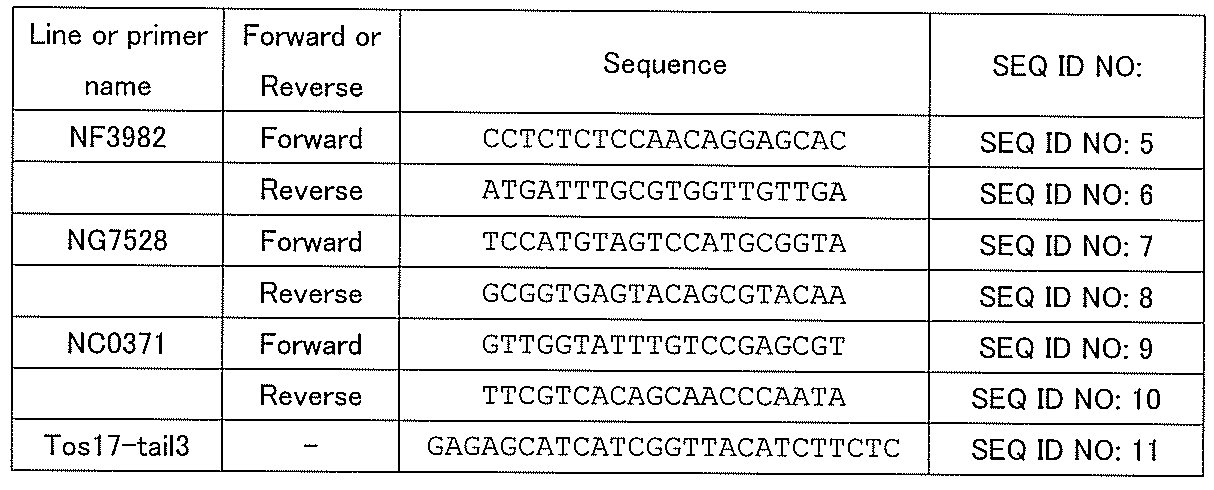
- PCR was carried out using the TaKaRa Multiplex PCR Assay Kit. The reaction was carried out by repeating a cycle of 94 degrees C for 60 seconds, 94 degrees C for 30 seconds, 58 degrees C for 90 seconds, and 72 degrees C for 90 seconds 35 times, followed by 72 degrees C for 10 minutes. Primers shown in Table 2 were used, and forward and reverse primers of such lines and the Tos17-tail3 primer were used at the same time. M2 seeds of WT lines and homozygous KO lines obtained from plants the genotypes of which had been confirmed were seeded, 6 individuals from each line were cultivated in 1/5000-a pots in a greenhouse, and the resultants were subjected to the measurement of sugar and starch concentration and enzyme activity. In the greenhouse, a light period of 14 hours from 5:00 to 19:00 was set, and temperature was set at 27 degrees C during the light period and 23 degrees C during the dark period.
- the thus-obtained supernatant was dehydrated with a centrifugal evaporator, 500 microliters of distilled water was added thereto, and the mixture was thoroughly agitated. The resultant was centrifuged at 15,000 rpm and 4 degrees C for 5 minutes, and the supernatant was recovered as an extract. Concentration of each sugar (mg/ml) in the extract was measured in accordance with the procedure of the F-kit, and sugar concentration per fresh weight was determined based on formula (1).
- sugar concentration (mg/gFW) sugar concentration (mg/ml) x 0.5 (ml)/ fresh weight (g)
- Fig. 1 The results of quantitative analysis of sugar and starch concentration are shown in Fig. 1.
- the term “AGPL1 gene disruption line” refers to a variant of the NF3982 line
- the term “AGPL3 gene disruption line” refers to a variant of the NG7528 line.
- “St” indicates starch
- Suc indicates sucrose
- Glc indicates glucose
- Fru indicates fructose
- S+G+F indicates a total of sucrose, glucose, and fructose (i.e., soluble sugars).
- Fig. 1 demonstrate that the amount of sucrose accumulated in the leaf sheath of a variant resulting from AGPL1 gene disruption increased to a level 2.4 times greater than that in a wild-type line, and the amount of soluble sugars accumulated in the leaf sheath thereof was significantly increased, compared with that in a wild-type line.
- the amount of starch accumulated in the leaf sheath of a variant resulting from AGPL1 gene disruption was significantly decreased, compared with that in a wild-type line.
- the amount of soluble sugars such as sucrose, and starch accumulated in the leaf blade of a variant resulting from AGPL1 gene disruption was substantially the same as that in wild-type plants.
- the amount of soluble sugars, such as sucrose, and starch accumulated in the leaf sheath and the leaf blade of a variant resulting from AGPL3 gene disruption was substantially the same as that in wild-type plants.
Landscapes
- Health & Medical Sciences (AREA)
- Life Sciences & Earth Sciences (AREA)
- Genetics & Genomics (AREA)
- Engineering & Computer Science (AREA)
- Chemical & Material Sciences (AREA)
- Organic Chemistry (AREA)
- Bioinformatics & Cheminformatics (AREA)
- Zoology (AREA)
- Wood Science & Technology (AREA)
- Biotechnology (AREA)
- Molecular Biology (AREA)
- General Engineering & Computer Science (AREA)
- Biomedical Technology (AREA)
- Biochemistry (AREA)
- General Health & Medical Sciences (AREA)
- Nutrition Science (AREA)
- Microbiology (AREA)
- Plant Pathology (AREA)
- Biophysics (AREA)
- Physics & Mathematics (AREA)
- Cell Biology (AREA)
- Medicinal Chemistry (AREA)
- Breeding Of Plants And Reproduction By Means Of Culturing (AREA)
- Preparation Of Compounds By Using Micro-Organisms (AREA)
Abstract
Description
The present invention includes the following.
(1) A plant variant, in which the gene encoding a subunit having high sequence similarity with the subunit encoded by the AGPL1 gene of rice among subunits constituting ADP-glucose pyrophosphorylase of a plant is modified to be suppressed.
(2) The plant variant according to (1), which is derived from a plant other than rice.
(3) The plant variant according to (1), wherein the AGPL1 gene encodes the AGPase subunit comprising the amino acid sequence as shown in SEQ ID NO: 2.
(4) The plant variant according to (1), wherein the plant is a monocotyledonous plant.
(5) The plant variant according to (1), wherein the soluble sugar content in an organ that accumulates excess substances resulting from photosynthesis is significantly higher than the content thereof before modification.
(6) A method for producing a plant variant comprising a step of modification to suppress the gene encoding a subunit having high sequence similarity with the subunit encoded by the AGPL1 gene of rice among subunits constituting ADP-glucose pyrophosphorylase of a plant.
(7) The method for producing a plant variant according to (6), wherein the plant is derived from a plant other than rice.
(8) The method for producing a plant variant according to (6), wherein the AGPL1 gene encodes the AGPase subunit comprising the amino acid sequence as shown in SEQ ID NO: 2.
(9) The method for producing a plant variant according to (6), wherein the plant is a monocotyledonous plant.
(10) The method for producing a plant variant according to (6), wherein the soluble sugar content in an organ that accumulates excess substances resulting from photosynthesis is significantly higher than the content thereof before modification.
(11) The method for producing a plant variant according to (6), which further comprises steps of cultivating the progeny plant after modification and selecting a line with a fixed trait that enables accumulation of large quantities of soluble sugars.
(12) A method for accumulating soluble sugars comprising preparing a plant variant modified so as to suppress the gene encoding a subunit having high sequence similarity with the subunit encoded by the AGPL1 gene of rice among subunits constituting ADP-glucose pyrophosphorylase of a plant and growing the plant variant under conditions that allow photosynthesis.
(13) The method for accumulating soluble sugars according to (12), wherein the plant is derived from a plant other than rice.
(14) The method for accumulating soluble sugars according to (12), wherein the AGPL1 gene encodes the AGPase subunit comprising the amino acid sequence as shown in SEQ ID NO: 2.
(15) The method for accumulating soluble sugars according to (12), wherein the plant is a monocotyledonous plant.
(16) The method for accumulating soluble sugars according to (12), wherein the soluble sugar content in an organ that accumulates excess substances resulting from photosynthesis is significantly higher than the content thereof before modification.
(17) The method for accumulating soluble sugars according to (12), which further comprises steps of cultivating the progeny plant after modification and selecting a line with a fixed trait that enables accumulation of large quantities of soluble sugars.
Compositae: Chrysanthemum morifolium, Helianthus annuus, etc.
Caryophyllaceae: Dianthus caryophyllus, etc.
Salicaceae: Populus trichocarpa, Populus nigra, Populus tremula, etc.
Myrtaceae: Eucalyptus camaldulensis, Eucalyptus grandis, etc.
Liliaceae: Tulipa, Lilium, etc.
Other steps
As described above, plants may be modified so as to suppress a given gene, and progeny plants can then be obtained in accordance with a conventional technique. That is, progeny plants sustaining fixed traits that allow accumulation of large quantities of soluble sugars acquired via modification of plants so as to suppress a given gene can be obtained in accordance with a conventional technique.
In this example, the two rice seed lines shown below were provided.

The results of quantitative analysis of sugar and starch concentration are shown in Fig. 1. In Fig. 1, the term "AGPL1 gene disruption line" refers to a variant of the NF3982 line, and the term "AGPL3 gene disruption line" refers to a variant of the NG7528 line. In Fig. 1, "St" indicates starch, "Suc" indicates sucrose, "Glc" indicates glucose, "Fru" indicates fructose, and "S+G+F" indicates a total of sucrose, glucose, and fructose (i.e., soluble sugars).
Claims (17)
- A plant variant, in which the gene encoding a subunit having high sequence similarity with the subunit encoded by the AGPL1 gene of rice among subunits constituting ADP-glucose pyrophosphorylase of a plant is modified to be suppressed.
- The plant variant according to claim 1, which is derived from a plant other than rice.
- The plant variant according to claim 1, wherein the AGPL1 gene encodes the AGPase subunit comprising the amino acid sequence as shown in SEQ ID NO: 2.
- The plant variant according to claim 1, wherein the plant is a monocotyledonous plant.
- The plant variant according to claim 1, wherein the soluble sugar content in an organ that accumulates excess substances resulting from photosynthesis is significantly higher than the content thereof before modification.
- A method for producing a plant variant comprising a step of modification to suppress the gene encoding a subunit having high sequence similarity with the subunit encoded by the AGPL1 gene of rice among subunits constituting ADP-glucose pyrophosphorylase of a plant.
- The method for producing a plant variant according to claim 6, wherein the plant is derived from a plant other than rice.
- The method for producing a plant variant according to claim 6, wherein the AGPL1 gene encodes the AGPase subunit comprising the amino acid sequence as shown in SEQ ID NO: 2.
- The method for producing a plant variant according to claim 6, wherein the plant is a monocotyledonous plant.
- The method for producing a plant variant according to claim 6, wherein the soluble sugar content in an organ that accumulates excess substances resulting from photosynthesis is significantly higher than the content thereof before modification.
- The method for producing a plant variant according to claim 6, which further comprises steps of cultivating the progeny plant after modification and selecting a line with a fixed trait that enables accumulation of large quantities of soluble sugars.
- A method for accumulating soluble sugars comprising preparing a plant variant modified so as to suppress the gene encoding a subunit having high sequence similarity with the subunit encoded by the AGPL1 gene of rice among subunits constituting ADP-glucose pyrophosphorylase of a plant and growing the plant variant under conditions that allow photosynthesis.
- The method for accumulating soluble sugars according to claim 12, wherein the plant is derived from a plant other than rice.
- The method for accumulating soluble sugars according to claim 12, wherein the AGPL1 gene encodes the AGPase subunit comprising the amino acid sequence as shown in SEQ ID NO: 2.
- The method for accumulating soluble sugars according to claim 12, wherein the plant is a monocotyledonous plant.
- The method for accumulating soluble sugars according to claim 12, wherein the soluble sugar content in an organ that accumulates excess substances resulting from photosynthesis is significantly higher than the content thereof before modification.
- The method for accumulating soluble sugars according to claim 12, which further comprises steps of cultivating the progeny plant after modification and selecting a line with a fixed trait that enables accumulation of large quantities of soluble sugars.
Priority Applications (2)
| Application Number | Priority Date | Filing Date | Title |
|---|---|---|---|
| US14/005,724 US9593343B2 (en) | 2011-03-28 | 2012-03-22 | Plant variant, method for producing plant variant, and method for accumulating soluble sugar |
| BR112013024998A BR112013024998B8 (en) | 2011-03-28 | 2012-03-22 | method for accumulation of soluble sugars in leaf sheaths |
Applications Claiming Priority (2)
| Application Number | Priority Date | Filing Date | Title |
|---|---|---|---|
| JP2011070763A JP5623324B2 (en) | 2011-03-28 | 2011-03-28 | Plant variant, method for producing plant variant, and method for accumulating soluble sugar |
| JP2011-070763 | 2011-03-28 |
Publications (1)
| Publication Number | Publication Date |
|---|---|
| WO2012132348A1 true WO2012132348A1 (en) | 2012-10-04 |
Family
ID=46001677
Family Applications (1)
| Application Number | Title | Priority Date | Filing Date |
|---|---|---|---|
| PCT/JP2012/001985 Ceased WO2012132348A1 (en) | 2011-03-28 | 2012-03-22 | Plant variant, method for producing plant variant, and method for accumulating soluble sugar |
Country Status (4)
| Country | Link |
|---|---|
| US (1) | US9593343B2 (en) |
| JP (1) | JP5623324B2 (en) |
| BR (1) | BR112013024998B8 (en) |
| WO (1) | WO2012132348A1 (en) |
Citations (3)
| Publication number | Priority date | Publication date | Assignee | Title |
|---|---|---|---|---|
| US5498831A (en) | 1993-07-23 | 1996-03-12 | Dna Plant Technology Corporation | Pea ADP-glucose pyrophosphorylase subunit genes and their uses |
| US20030177533A1 (en) | 2001-12-03 | 2003-09-18 | Hannah L. Curtis | Variants of ADP-glucose pyrophosphorylase affecting phosphate sensitivity and other parameters |
| US7193130B2 (en) | 1999-06-21 | 2007-03-20 | Pioneer Hi-Bred International, Inc. | Expressing acid invertase or ADP-glucose pyrophosphorylase in floral tissue for enhanced floral sink strength and increased stability of seed in plants |
-
2011
- 2011-03-28 JP JP2011070763A patent/JP5623324B2/en active Active
-
2012
- 2012-03-22 US US14/005,724 patent/US9593343B2/en active Active
- 2012-03-22 BR BR112013024998A patent/BR112013024998B8/en not_active IP Right Cessation
- 2012-03-22 WO PCT/JP2012/001985 patent/WO2012132348A1/en not_active Ceased
Patent Citations (4)
| Publication number | Priority date | Publication date | Assignee | Title |
|---|---|---|---|---|
| US5498831A (en) | 1993-07-23 | 1996-03-12 | Dna Plant Technology Corporation | Pea ADP-glucose pyrophosphorylase subunit genes and their uses |
| US7193130B2 (en) | 1999-06-21 | 2007-03-20 | Pioneer Hi-Bred International, Inc. | Expressing acid invertase or ADP-glucose pyrophosphorylase in floral tissue for enhanced floral sink strength and increased stability of seed in plants |
| US20030177533A1 (en) | 2001-12-03 | 2003-09-18 | Hannah L. Curtis | Variants of ADP-glucose pyrophosphorylase affecting phosphate sensitivity and other parameters |
| EP1461431A2 (en) | 2001-12-03 | 2004-09-29 | University Of Florida Research Foundation, Inc. | Variants of adp-glucose pyrophosphorylase affecting phosphate sensitivity and other parameters |
Non-Patent Citations (13)
| Title |
|---|
| A. M. SMITH., PLANT PHYS., vol. 89, no. 4, 1989, pages 1279 - 1284 |
| AKIHIRO TAKASHI ET AL: "Gene expression of ADP-glucose pyrophosphorylase and starch contents in rice cultured cells are cooperatively regulated by sucrose and ABA", PLANT AND CELL PHYSIOLOGY, vol. 46, no. 6, June 2005 (2005-06-01), pages 937 - 946, XP002679366, ISSN: 0032-0781 * |
| B. MULLER-ROBER, EMBO J., vol. 11, 1992, pages 1229 - 1238 |
| H. SATOH, JOURNAL OF APPLIED GLYCOSCIENCE, vol. 50, 2003, pages 225 - 230 |
| JUNG-IL PARK ET AL: "Modification of Sugar Composition in Strawberry Fruit by Antisense Suppression of an ADP-glucose Pyrophosphorylase", MOLECULAR BREEDING, KLUWER ACADEMIC PUBLISHERS, DO, vol. 17, no. 3, 1 April 2006 (2006-04-01), pages 269 - 279, XP019258789, ISSN: 1572-9788 * |
| K. LERTRAT, INT. J. PLANT BREED., vol. 1, no. 1, 2007, pages 27 - 30 |
| MUELLER-ROEBER B ET AL: "INHIBITION OF THE ADP-GLUCOSE PYROPHOSPHORYLASE IN TRANSGENIC POTATOES LEADS TO SUGAR-STORING TUBERS AND INFLUENCES TUBER FORMATION AND EXPRESSION OF TUBER STORAGE PROTEIN GENES", EMBO JOURNAL, OXFORD UNIVERSITY PRESS, SURREY, GB, vol. 11, no. 4, 1 January 1992 (1992-01-01), pages 1229 - 1238, XP002058763, ISSN: 0261-4189 * |
| ROSTI SANDRINE ET AL: "A mutant of rice lacking the leaf large subunit of ADP-glucose pyrophosphorylase has drastically reduced leaf starch content but grows normally", FUNCTIONAL PLANT BIOLOGY, vol. 34, no. 6, 2007, pages 480 - 489, XP009160827, ISSN: 1445-4408 * |
| SANG-KYU LEE ET AL: "Identification of the ADP-glucose pyrophosphorylase isoforms essential for starch synthesis in the leaf and seed endosperm of rice (Oryza sativa L.)", PLANT MOLECULAR BIOLOGY, KLUWER ACADEMIC PUBLISHERS, DORDRECHT, NL, vol. 65, no. 4, 4 April 2007 (2007-04-04), pages 531 - 546, XP019556067, ISSN: 1573-5028, DOI: 10.1007/S11103-007-9153-Z * |
| T. P. LIN, PLANT PHYS., vol. 86, 1988, pages 1131 - 1135 |
| T. P. LIN, PLANT PHYS., vol. 86, 1988, pages 1175 - 1181 |
| WEBER HANS ET AL: "Antisense-inhibition of ADP-glucose pyrophosphorylase in developing seeds of Vicia narbonensis moderately decreases starch but increases protein content and affects seed maturation", PLANT JOURNAL, vol. 24, no. 1, October 2000 (2000-10-01), pages 33 - 43, XP002679365, ISSN: 0960-7412 * |
| YASUKO S., NAGAI, PLANT CELL PHYS., vol. 50, 2009, pages 635 - 643 |
Also Published As
| Publication number | Publication date |
|---|---|
| BR112013024998B1 (en) | 2020-10-13 |
| US20140090107A1 (en) | 2014-03-27 |
| JP2012200244A (en) | 2012-10-22 |
| BR112013024998B8 (en) | 2021-08-17 |
| BR112013024998A2 (en) | 2016-11-22 |
| US9593343B2 (en) | 2017-03-14 |
| JP5623324B2 (en) | 2014-11-12 |
Similar Documents
| Publication | Publication Date | Title |
|---|---|---|
| Lata et al. | Foxtail millet: a model crop for genetic and genomic studies in bioenergy grasses | |
| Ahmad et al. | Effects of uniconazole with or without micronutrient on the lignin biosynthesis, lodging resistance, and winter wheat production in semiarid regions | |
| CN116676317B (en) | Rice OsEns gene and application thereof in improving rice plant type and quality and enhancing spike germination resistance | |
| CN108660140B (en) | Application of SlSL4 gene in regulation and control of tomato fruit ripening | |
| CN109369789A (en) | Application of ZmDRR206 protein and its encoding gene in regulating plant disease resistance and growth and development | |
| CN112280785B (en) | Application and method of BnMAPK2 gene in Brassica napus | |
| Uchendu et al. | Genome-wide association study of root mealiness and other texture-associated traits in cassava | |
| CN119570846B (en) | Application of transcription factor B3-337 in improving tomato fruit quality | |
| Kawochar et al. | Suppression of the tonoplast sugar transporter StTST3. 2 improves quality of potato chips | |
| Raineri et al. | Maize expressing the sunflower transcription factor HaHB11 has improved productivity in controlled and field conditions | |
| CN115710588B (en) | Application of over-expression bna-miR166f in improvement of complex quantitative characters such as rape harvest index and the like | |
| US20120030784A1 (en) | Beta-glucan-deficient gene in barley, synthetic gene, and use of same | |
| CN117645657A (en) | Barley germination period moisture-resistant gene HvHSF1 and encoding protein and application thereof | |
| CN119776408B (en) | Application of wheat TaCKS1 protein, its encoding gene, and its mutant sequences in regulating wheat grain development | |
| Tang et al. | Peanut LEAFY COTYLEDON1-type genes participate in regulating the embryo development and the accumulation of storage lipids | |
| Jackson et al. | Sugarcane | |
| CN101701221B (en) | Rice dwarf straw leaf roll mutant (cd1) gene and application thereof | |
| WO2021195780A1 (en) | Methods of determining sensitivity to photoperiod in cannabis | |
| US9593343B2 (en) | Plant variant, method for producing plant variant, and method for accumulating soluble sugar | |
| CN118440978A (en) | Application of OsG PGH1 gene in improving rice quality traits | |
| CN114990137B (en) | Arabidopsis Calcium Binding Protein Gene AtCAREF and Its Application | |
| JP7560883B2 (en) | Fruit plants that exhibit high temperature tolerance, high yield and parthenocarpy | |
| CN117448371A (en) | High-yielding genes that improve crop filling and seed setting rates and their applications | |
| CN104673804B (en) | A kind of paddy gene for adjusting Sucrose synthesis and its application | |
| CN110499326B (en) | Application of RGGA in regulation of agronomic traits of crops |
Legal Events
| Date | Code | Title | Description |
|---|---|---|---|
| 121 | Ep: the epo has been informed by wipo that ep was designated in this application |
Ref document number: 12716679 Country of ref document: EP Kind code of ref document: A1 |
|
| WWE | Wipo information: entry into national phase |
Ref document number: 14005724 Country of ref document: US |
|
| NENP | Non-entry into the national phase |
Ref country code: DE |
|
| REG | Reference to national code |
Ref country code: BR Ref legal event code: B01A Ref document number: 112013024998 Country of ref document: BR |
|
| 122 | Ep: pct application non-entry in european phase |
Ref document number: 12716679 Country of ref document: EP Kind code of ref document: A1 |
|
| ENP | Entry into the national phase |
Ref document number: 112013024998 Country of ref document: BR Kind code of ref document: A2 Effective date: 20130927 |