WO2012123467A1 - Pyrimidine amide compounds - Google Patents
Pyrimidine amide compounds Download PDFInfo
- Publication number
- WO2012123467A1 WO2012123467A1 PCT/EP2012/054409 EP2012054409W WO2012123467A1 WO 2012123467 A1 WO2012123467 A1 WO 2012123467A1 EP 2012054409 W EP2012054409 W EP 2012054409W WO 2012123467 A1 WO2012123467 A1 WO 2012123467A1
- Authority
- WO
- WIPO (PCT)
- Prior art keywords
- carbonyl
- amino
- pyrimidine
- dimethyl
- phenyl
- Prior art date
- Legal status (The legal status is an assumption and is not a legal conclusion. Google has not performed a legal analysis and makes no representation as to the accuracy of the status listed.)
- Ceased
Links
- 0 CCOC(c1c(*)nc(C)nc1*)=O Chemical compound CCOC(c1c(*)nc(C)nc1*)=O 0.000 description 9
- QWWCHVHQVYFMJU-UHFFFAOYSA-N CCOC(c(c(C)n1)c(C)nc1Cl)=O Chemical compound CCOC(c(c(C)n1)c(C)nc1Cl)=O QWWCHVHQVYFMJU-UHFFFAOYSA-N 0.000 description 3
- PWQIAQVRSBVUDF-ZDUSSCGKSA-N Cc1c(C(N[C@@H](CNC(c2ccc[s]2)=O)C(OC)=O)=O)c(C)nc(NCC#C)n1 Chemical compound Cc1c(C(N[C@@H](CNC(c2ccc[s]2)=O)C(OC)=O)=O)c(C)nc(NCC#C)n1 PWQIAQVRSBVUDF-ZDUSSCGKSA-N 0.000 description 3
- TYRYFLDFROKERH-INIZCTEOSA-N Cc1c(C(N[C@@H](CN)C(OC)=O)=O)c(C)nc(NCCCc2cccc(O)c2)n1 Chemical compound Cc1c(C(N[C@@H](CN)C(OC)=O)=O)c(C)nc(NCCCc2cccc(O)c2)n1 TYRYFLDFROKERH-INIZCTEOSA-N 0.000 description 2
- WORQNQLPVDFTKX-UHFFFAOYSA-N BrCc1cccc2c1cn[nH]2 Chemical compound BrCc1cccc2c1cn[nH]2 WORQNQLPVDFTKX-UHFFFAOYSA-N 0.000 description 1
- KJIODOACRIRBPB-UHFFFAOYSA-N Brc1c(cn[nH]2)c2ccc1 Chemical compound Brc1c(cn[nH]2)c2ccc1 KJIODOACRIRBPB-UHFFFAOYSA-N 0.000 description 1
- SHYFMKOWGOMMSI-UHFFFAOYSA-N CB(c1cc(OC)ccc1)O Chemical compound CB(c1cc(OC)ccc1)O SHYFMKOWGOMMSI-UHFFFAOYSA-N 0.000 description 1
- DROJXOJEDORXEY-UHFFFAOYSA-N CC(C)(C)OC(C(Cc1cccc2c1cn[nH]2)C#N)=O Chemical compound CC(C)(C)OC(C(Cc1cccc2c1cn[nH]2)C#N)=O DROJXOJEDORXEY-UHFFFAOYSA-N 0.000 description 1
- AXLHVTKGDPVANO-LURJTMIESA-N CC(C)(C)OC(NC[C@@H](C(OC)=O)N)=O Chemical compound CC(C)(C)OC(NC[C@@H](C(OC)=O)N)=O AXLHVTKGDPVANO-LURJTMIESA-N 0.000 description 1
- GSXAMCXIDWZJHS-IBGZPJMESA-N CC(C)(C)OC(NC[C@@H](C(OC)=O)NC(c1c(C)nc(NCCCc2cccc(O)c2)nc1C)=O)=O Chemical compound CC(C)(C)OC(NC[C@@H](C(OC)=O)NC(c1c(C)nc(NCCCc2cccc(O)c2)nc1C)=O)=O GSXAMCXIDWZJHS-IBGZPJMESA-N 0.000 description 1
- QNDKJWFMZCZBEJ-SFHVURJKSA-N CC(C)(C)OC(NC[C@@H](C(OC)=O)NC(c1cnc(NCCCc2cccc(O)c2)nc1)=O)=O Chemical compound CC(C)(C)OC(NC[C@@H](C(OC)=O)NC(c1cnc(NCCCc2cccc(O)c2)nc1)=O)=O QNDKJWFMZCZBEJ-SFHVURJKSA-N 0.000 description 1
- DFNZFCPEUDSNEO-UHFFFAOYSA-N CC(C)(C)OC(NCc(cccc1)c1Br)=O Chemical compound CC(C)(C)OC(NCc(cccc1)c1Br)=O DFNZFCPEUDSNEO-UHFFFAOYSA-N 0.000 description 1
- PWPUPXJJCPIOGY-UHFFFAOYSA-N CC(C)CCN1CCOCC1 Chemical compound CC(C)CCN1CCOCC1 PWPUPXJJCPIOGY-UHFFFAOYSA-N 0.000 description 1
- LYPNSKPHWOGLHK-UHFFFAOYSA-N CC(C)NC(CCc1c2)Cc1ccc2O Chemical compound CC(C)NC(CCc1c2)Cc1ccc2O LYPNSKPHWOGLHK-UHFFFAOYSA-N 0.000 description 1
- OBYDCRRRZYTBPL-SFHVURJKSA-N CC(NC[C@@H](C(O)=O)NC(c1c(C)nc(NCCCc2c(cn[nH]3)c3ccc2)nc1C)=O)=O Chemical compound CC(NC[C@@H](C(O)=O)NC(c1c(C)nc(NCCCc2c(cn[nH]3)c3ccc2)nc1C)=O)=O OBYDCRRRZYTBPL-SFHVURJKSA-N 0.000 description 1
- KPDJIUUHGZRVQZ-UHFFFAOYSA-N CC([n]1ncc2c1cccc2COC(C)=O)=O Chemical compound CC([n]1ncc2c1cccc2COC(C)=O)=O KPDJIUUHGZRVQZ-UHFFFAOYSA-N 0.000 description 1
- JFHAMNVZHGKQDQ-UHFFFAOYSA-N CCOC(C(C(C)N1)=C(C)NC1=O)=O Chemical compound CCOC(C(C(C)N1)=C(C)NC1=O)=O JFHAMNVZHGKQDQ-UHFFFAOYSA-N 0.000 description 1
- ZPSHHHXKOZUWNO-UHFFFAOYSA-O CCOC(C(CNC(c1ccc[s]1)=O)NC(c1c(C)nc(NCCCc2c(C=N)c([NH3+])ccc2)nc1C)=O)=O Chemical compound CCOC(C(CNC(c1ccc[s]1)=O)NC(c1c(C)nc(NCCCc2c(C=N)c([NH3+])ccc2)nc1C)=O)=O ZPSHHHXKOZUWNO-UHFFFAOYSA-O 0.000 description 1
- KJWOQDPSBKFTPF-UHFFFAOYSA-N CCOC(c(c(C)n1)c(C)nc1O)=O Chemical compound CCOC(c(c(C)n1)c(C)nc1O)=O KJWOQDPSBKFTPF-UHFFFAOYSA-N 0.000 description 1
- NZGGKEIBCQRTPD-UHFFFAOYSA-N CCOC(c1c(C)nc(NC(CCc2c3)Cc2ccc3OC)nc1C)=O Chemical compound CCOC(c1c(C)nc(NC(CCc2c3)Cc2ccc3OC)nc1C)=O NZGGKEIBCQRTPD-UHFFFAOYSA-N 0.000 description 1
- YGCJFSKPFASDHJ-MDZDMXLPSA-N CCOC(c1c(C)nc(NC/C=C/B2OC(C)(C)C(C)(C)O2)nc1C)=O Chemical compound CCOC(c1c(C)nc(NC/C=C/B2OC(C)(C)C(C)(C)O2)nc1C)=O YGCJFSKPFASDHJ-MDZDMXLPSA-N 0.000 description 1
- MFWPJMYRPSYICQ-VOTSOKGWSA-N CCOC(c1c(C)nc(NC/C=C/c(cc(cc2)OC)c2F)nc1C)=O Chemical compound CCOC(c1c(C)nc(NC/C=C/c(cc(cc2)OC)c2F)nc1C)=O MFWPJMYRPSYICQ-VOTSOKGWSA-N 0.000 description 1
- TWRBOKVYKIXYEK-UHFFFAOYSA-N CCOC(c1c(C)nc(NCC#C)nc1C)=O Chemical compound CCOC(c1c(C)nc(NCC#C)nc1C)=O TWRBOKVYKIXYEK-UHFFFAOYSA-N 0.000 description 1
- PYMBPABWQWVHOJ-UHFFFAOYSA-N CCOC(c1c(C)nc(NCC#Cc(cccc2OC)c2F)nc1C)=O Chemical compound CCOC(c1c(C)nc(NCC#Cc(cccc2OC)c2F)nc1C)=O PYMBPABWQWVHOJ-UHFFFAOYSA-N 0.000 description 1
- YLZQHSYIRRCMTP-UHFFFAOYSA-N CCOC(c1c(C)nc(NCCCc(cccc2OC)c2F)nc1C)=O Chemical compound CCOC(c1c(C)nc(NCCCc(cccc2OC)c2F)nc1C)=O YLZQHSYIRRCMTP-UHFFFAOYSA-N 0.000 description 1
- LEJHSIIQJQALED-UHFFFAOYSA-N CCOC(c1c(C)nc(NCc(cccc2)c2-c(cc2)ccc2OC)nc1C)=O Chemical compound CCOC(c1c(C)nc(NCc(cccc2)c2-c(cc2)ccc2OC)nc1C)=O LEJHSIIQJQALED-UHFFFAOYSA-N 0.000 description 1
- VPROQXABPCFUQP-UHFFFAOYSA-N CCOC(c1c(C)nc(NCc(cccc2)c2-c(cccc2)c2OC)nc1C)=O Chemical compound CCOC(c1c(C)nc(NCc(cccc2)c2-c(cccc2)c2OC)nc1C)=O VPROQXABPCFUQP-UHFFFAOYSA-N 0.000 description 1
- PMDFRFDLGLGZEG-DEOSSOPVSA-N CCOCCOCCOC([C@H](CNC(c1ccc[s]1)=O)NC(c1c(C)nc(NCCCc2cc(O)ccc2)nc1C)=O)=O Chemical compound CCOCCOCCOC([C@H](CNC(c1ccc[s]1)=O)NC(c1c(C)nc(NCCCc2cc(O)ccc2)nc1C)=O)=O PMDFRFDLGLGZEG-DEOSSOPVSA-N 0.000 description 1
- PLXVMXDJWIOEBC-UHFFFAOYSA-N CCc1nc(NCCCc2cc(O)ccc2)nc(CC)c1C(OCC)=O Chemical compound CCc1nc(NCCCc2cc(O)ccc2)nc(CC)c1C(OCC)=O PLXVMXDJWIOEBC-UHFFFAOYSA-N 0.000 description 1
- UMLKPBRGLFJILS-UHFFFAOYSA-N CCc1nc(NCCCc2cc(OC)ccc2)nc(CC)c1C(OCC)=O Chemical compound CCc1nc(NCCCc2cc(OC)ccc2)nc(CC)c1C(OCC)=O UMLKPBRGLFJILS-UHFFFAOYSA-N 0.000 description 1
- IBARCOULXOBLSG-NRFANRHFSA-N CCc1nc(NCCCc2cccc(O)c2)nc(CC)c1C(N[C@@H](CNC(OC(C)(C)C)=O)C(OC)=O)=O Chemical compound CCc1nc(NCCCc2cccc(O)c2)nc(CC)c1C(N[C@@H](CNC(OC(C)(C)C)=O)C(OC)=O)=O IBARCOULXOBLSG-NRFANRHFSA-N 0.000 description 1
- MHZJDZMOZVMGLB-UHFFFAOYSA-N CCc1nc(NCCCc2cccc(O)c2)nc(CC)c1C(O)=O Chemical compound CCc1nc(NCCCc2cccc(O)c2)nc(CC)c1C(O)=O MHZJDZMOZVMGLB-UHFFFAOYSA-N 0.000 description 1
- LYIGJBQYDRJPIR-UHFFFAOYSA-N COc(cc1)cc(Br)c1F Chemical compound COc(cc1)cc(Br)c1F LYIGJBQYDRJPIR-UHFFFAOYSA-N 0.000 description 1
- RMRKDYNVZWKAFP-UHFFFAOYSA-N COc1ccc(CC(CC2)=O)c2c1 Chemical compound COc1ccc(CC(CC2)=O)c2c1 RMRKDYNVZWKAFP-UHFFFAOYSA-N 0.000 description 1
- XBKCWOTWIUGAPY-UHFFFAOYSA-N COc1cccc(-c2c(CN)cccc2)c1 Chemical compound COc1cccc(-c2c(CN)cccc2)c1 XBKCWOTWIUGAPY-UHFFFAOYSA-N 0.000 description 1
- FLROJJGKUKLCAE-UHFFFAOYSA-N Cc(c(N)ccc1)c1O Chemical compound Cc(c(N)ccc1)c1O FLROJJGKUKLCAE-UHFFFAOYSA-N 0.000 description 1
- AGNSFQFMNIXTRH-UHFFFAOYSA-N Cc(ccc(CCCNc1nc(C)c(C(NC(C2)(C2NC(c2ccc[s]2)=O)C(OC)=O)=[O]=C)c(C)n1)c1)c1O Chemical compound Cc(ccc(CCCNc1nc(C)c(C(NC(C2)(C2NC(c2ccc[s]2)=O)C(OC)=O)=[O]=C)c(C)n1)c1)c1O AGNSFQFMNIXTRH-UHFFFAOYSA-N 0.000 description 1
- OLYNVAXSBFZBGD-SFHVURJKSA-N Cc(ccc(CCCNc1nc(C)c(C(N[C@@H](CNC(c2ccc[s]2)=O)C(O)=O)=O)c(C)n1)c1)c1O Chemical compound Cc(ccc(CCCNc1nc(C)c(C(N[C@@H](CNC(c2ccc[s]2)=O)C(O)=O)=O)c(C)n1)c1)c1O OLYNVAXSBFZBGD-SFHVURJKSA-N 0.000 description 1
- FOBWRASFBTYIGJ-UHFFFAOYSA-N Cc(nc(NCCCc1cc(O)ccc1)nc1)c1C(O)=O Chemical compound Cc(nc(NCCCc1cc(O)ccc1)nc1)c1C(O)=O FOBWRASFBTYIGJ-UHFFFAOYSA-N 0.000 description 1
- NIRDKBCAVJEUCZ-UHFFFAOYSA-N Cc1c(C(NC(C2)(C2NC(N2c3ccccc3CCC2)=O)C(O)=O)=O)c(C)nc(NCCCc2cc(O)ccc2)n1 Chemical compound Cc1c(C(NC(C2)(C2NC(N2c3ccccc3CCC2)=O)C(O)=O)=O)c(C)nc(NCCCc2cc(O)ccc2)n1 NIRDKBCAVJEUCZ-UHFFFAOYSA-N 0.000 description 1
- RXUDVBWUOIBUDN-UHFFFAOYSA-O Cc1c(C(NC(C2)(C2NC(c2ccc[s]2)=O)C(O)=O)=O)c(C)nc(NCCCc2c(C=N)c([NH3+])ccc2)n1 Chemical compound Cc1c(C(NC(C2)(C2NC(c2ccc[s]2)=O)C(O)=O)=O)c(C)nc(NCCCc2c(C=N)c([NH3+])ccc2)n1 RXUDVBWUOIBUDN-UHFFFAOYSA-O 0.000 description 1
- PDSYANGEXKILSE-KZQYXEPFSA-N Cc1c(C(NC(C2)([C@@H]2NC(N(CCC2)c3c2cccc3)=O)C(OC)=O)=O)c(C)nc(NCCCc2cc(O)ccc2)n1 Chemical compound Cc1c(C(NC(C2)([C@@H]2NC(N(CCC2)c3c2cccc3)=O)C(OC)=O)=O)c(C)nc(NCCCc2cc(O)ccc2)n1 PDSYANGEXKILSE-KZQYXEPFSA-N 0.000 description 1
- AMALGMGEOGHFKI-IBGZPJMESA-N Cc1c(C(NC[C@@H](C(O)=O)NC(c2c(C)nc(NCCCc3cccc(O)c3)nc2C)=O)=O)[s]c(C)n1 Chemical compound Cc1c(C(NC[C@@H](C(O)=O)NC(c2c(C)nc(NCCCc3cccc(O)c3)nc2C)=O)=O)[s]c(C)n1 AMALGMGEOGHFKI-IBGZPJMESA-N 0.000 description 1
- SYLCDSUDQHSYEB-FQEVSTJZSA-N Cc1c(C(NC[C@@H](C(OC)=O)NC(c2c(C)nc(NCCCc3cccc(O)c3)nc2C)=O)=O)[s]c(C)n1 Chemical compound Cc1c(C(NC[C@@H](C(OC)=O)NC(c2c(C)nc(NCCCc3cccc(O)c3)nc2C)=O)=O)[s]c(C)n1 SYLCDSUDQHSYEB-FQEVSTJZSA-N 0.000 description 1
- PSCDMYREGIZIPX-KRWDZBQOSA-N Cc1c(C(N[C@@H](CN)C(OC)=O)=O)c(C)nc(NCCCc2c(cn[nH]3)c3ccc2)n1 Chemical compound Cc1c(C(N[C@@H](CN)C(OC)=O)=O)c(C)nc(NCCCc2c(cn[nH]3)c3ccc2)n1 PSCDMYREGIZIPX-KRWDZBQOSA-N 0.000 description 1
- NSMGSBCTWNIJRY-SFHVURJKSA-N Cc1c(C(N[C@@H](CNC(c([s]2)ccc2Cl)=O)C(OC)=O)=O)c(C)nc(NCCCc2cccc(O)c2)n1 Chemical compound Cc1c(C(N[C@@H](CNC(c([s]2)ccc2Cl)=O)C(OC)=O)=O)c(C)nc(NCCCc2cccc(O)c2)n1 NSMGSBCTWNIJRY-SFHVURJKSA-N 0.000 description 1
- KPZONMIBRMJKAZ-NRFANRHFSA-N Cc1c(C(N[C@@H](CNC(c2c[s]c(-c3ccncc3)n2)=O)C(O)=O)=O)c(C)nc(NCCCc2cccc(O)c2)n1 Chemical compound Cc1c(C(N[C@@H](CNC(c2c[s]c(-c3ccncc3)n2)=O)C(O)=O)=O)c(C)nc(NCCCc2cccc(O)c2)n1 KPZONMIBRMJKAZ-NRFANRHFSA-N 0.000 description 1
- ZDXIQZXZZQGPKW-QFIPXVFZSA-N Cc1c(C(N[C@@H](CNC(c2c[s]c(-c3ccncc3)n2)=O)C(OC)=O)=O)c(C)nc(NCCCc2cccc(O)c2)n1 Chemical compound Cc1c(C(N[C@@H](CNC(c2c[s]c(-c3ccncc3)n2)=O)C(OC)=O)=O)c(C)nc(NCCCc2cccc(O)c2)n1 ZDXIQZXZZQGPKW-QFIPXVFZSA-N 0.000 description 1
- ABCZUXFWSJBTSL-NRFANRHFSA-N Cc1c(C(N[C@@H](CNC(c2cc(O)ccc2)=O)C(O)=O)=O)c(C)nc(NCCCc2cccc(O)c2)n1 Chemical compound Cc1c(C(N[C@@H](CNC(c2cc(O)ccc2)=O)C(O)=O)=O)c(C)nc(NCCCc2cccc(O)c2)n1 ABCZUXFWSJBTSL-NRFANRHFSA-N 0.000 description 1
- YCQWCCMQTRHSNE-QFIPXVFZSA-N Cc1c(C(N[C@@H](CNC(c2cc(O)ccc2)=O)C(OC)=O)=O)c(C)nc(NCCCc2cccc(O)c2)n1 Chemical compound Cc1c(C(N[C@@H](CNC(c2cc(O)ccc2)=O)C(OC)=O)=O)c(C)nc(NCCCc2cccc(O)c2)n1 YCQWCCMQTRHSNE-QFIPXVFZSA-N 0.000 description 1
- UHPOWORJPZCSPA-IBGZPJMESA-N Cc1c(C(N[C@@H](CNC(c2ccc[s]2)=O)C(O)=O)=O)c(C)nc(NCCCc2c(cn[nH]3)c3ccc2)n1 Chemical compound Cc1c(C(N[C@@H](CNC(c2ccc[s]2)=O)C(O)=O)=O)c(C)nc(NCCCc2c(cn[nH]3)c3ccc2)n1 UHPOWORJPZCSPA-IBGZPJMESA-N 0.000 description 1
- HALUBHJSILWAKU-SFHVURJKSA-N Cc1c(C(N[C@@H](CNC(c2ccc[s]2)=O)C(O)=O)=O)c(C)nc(NCCCc2cccc(O)c2)n1 Chemical compound Cc1c(C(N[C@@H](CNC(c2ccc[s]2)=O)C(O)=O)=O)c(C)nc(NCCCc2cccc(O)c2)n1 HALUBHJSILWAKU-SFHVURJKSA-N 0.000 description 1
- ISNWMMIMTLFJPQ-NNBQYGFHSA-N Cc1c(C(N[C@@H](CNC(c2ccc[s]2)=O)C(OC)=O)=O)c(C)nc(NC(CC2)Cc3c2cccc3O)n1 Chemical compound Cc1c(C(N[C@@H](CNC(c2ccc[s]2)=O)C(OC)=O)=O)c(C)nc(NC(CC2)Cc3c2cccc3O)n1 ISNWMMIMTLFJPQ-NNBQYGFHSA-N 0.000 description 1
- FVQVLCZUMVQWAT-FQEVSTJZSA-N Cc1c(C(N[C@@H](CNC(c2ccc[s]2)=O)C(OC)=O)=O)c(C)nc(NCC#Cc2c(cn[nH]3)c3ccc2)n1 Chemical compound Cc1c(C(N[C@@H](CNC(c2ccc[s]2)=O)C(OC)=O)=O)c(C)nc(NCC#Cc2c(cn[nH]3)c3ccc2)n1 FVQVLCZUMVQWAT-FQEVSTJZSA-N 0.000 description 1
- UBJDZJFNJRNHMH-FQEVSTJZSA-N Cc1c(C(N[C@@H](CNC(c2ccc[s]2)=O)C(OC)=O)=O)c(C)nc(NCC#Cc2cc(OC)ccc2Cl)n1 Chemical compound Cc1c(C(N[C@@H](CNC(c2ccc[s]2)=O)C(OC)=O)=O)c(C)nc(NCC#Cc2cc(OC)ccc2Cl)n1 UBJDZJFNJRNHMH-FQEVSTJZSA-N 0.000 description 1
- UMYNHQQPCAHEIR-IBGZPJMESA-N Cc1c(C(N[C@@H](CNC(c2ccc[s]2)=O)C(OC)=O)=O)c(C)nc(NCC#Cc2cccc(O)c2)n1 Chemical compound Cc1c(C(N[C@@H](CNC(c2ccc[s]2)=O)C(OC)=O)=O)c(C)nc(NCC#Cc2cccc(O)c2)n1 UMYNHQQPCAHEIR-IBGZPJMESA-N 0.000 description 1
- HTPUDICPPOXRLV-FQEVSTJZSA-N Cc1c(C(N[C@@H](CNC(c2ccc[s]2)=O)C(OC)=O)=O)c(C)nc(NCCCc2c(cn[nH]3)c3ccc2)n1 Chemical compound Cc1c(C(N[C@@H](CNC(c2ccc[s]2)=O)C(OC)=O)=O)c(C)nc(NCCCc2c(cn[nH]3)c3ccc2)n1 HTPUDICPPOXRLV-FQEVSTJZSA-N 0.000 description 1
- KNFCTFXJPBVLSP-UHFFFAOYSA-N Cc1c(C(O)=O)c(C)nc(NC(CC2)Cc(cc3)c2cc3O)n1 Chemical compound Cc1c(C(O)=O)c(C)nc(NC(CC2)Cc(cc3)c2cc3O)n1 KNFCTFXJPBVLSP-UHFFFAOYSA-N 0.000 description 1
- SXCQZZRETMVSQI-UHFFFAOYSA-N N#CCCc1cccc2c1cn[nH]2 Chemical compound N#CCCc1cccc2c1cn[nH]2 SXCQZZRETMVSQI-UHFFFAOYSA-N 0.000 description 1
- XFVYVTYPFIERLX-UHFFFAOYSA-N NC(CCc1ccc2)Cc1c2O Chemical compound NC(CCc1ccc2)Cc1c2O XFVYVTYPFIERLX-UHFFFAOYSA-N 0.000 description 1
- MZBJILFXZTYSHA-UHFFFAOYSA-N OC(c1cnc(NCCCc2cccc(O)c2)nc1)=O Chemical compound OC(c1cnc(NCCCc2cccc(O)c2)nc1)=O MZBJILFXZTYSHA-UHFFFAOYSA-N 0.000 description 1
Classifications
-
- C—CHEMISTRY; METALLURGY
- C07—ORGANIC CHEMISTRY
- C07D—HETEROCYCLIC COMPOUNDS
- C07D239/00—Heterocyclic compounds containing 1,3-diazine or hydrogenated 1,3-diazine rings
- C07D239/02—Heterocyclic compounds containing 1,3-diazine or hydrogenated 1,3-diazine rings not condensed with other rings
- C07D239/24—Heterocyclic compounds containing 1,3-diazine or hydrogenated 1,3-diazine rings not condensed with other rings having three or more double bonds between ring members or between ring members and non-ring members
- C07D239/28—Heterocyclic compounds containing 1,3-diazine or hydrogenated 1,3-diazine rings not condensed with other rings having three or more double bonds between ring members or between ring members and non-ring members with hetero atoms or with carbon atoms having three bonds to hetero atoms with at the most one bond to halogen, directly attached to ring carbon atoms
- C07D239/32—One oxygen, sulfur or nitrogen atom
- C07D239/42—One nitrogen atom
-
- A—HUMAN NECESSITIES
- A61—MEDICAL OR VETERINARY SCIENCE; HYGIENE
- A61P—SPECIFIC THERAPEUTIC ACTIVITY OF CHEMICAL COMPOUNDS OR MEDICINAL PREPARATIONS
- A61P11/00—Drugs for disorders of the respiratory system
-
- A—HUMAN NECESSITIES
- A61—MEDICAL OR VETERINARY SCIENCE; HYGIENE
- A61P—SPECIFIC THERAPEUTIC ACTIVITY OF CHEMICAL COMPOUNDS OR MEDICINAL PREPARATIONS
- A61P11/00—Drugs for disorders of the respiratory system
- A61P11/06—Antiasthmatics
-
- C—CHEMISTRY; METALLURGY
- C07—ORGANIC CHEMISTRY
- C07D—HETEROCYCLIC COMPOUNDS
- C07D401/00—Heterocyclic compounds containing two or more hetero rings, having nitrogen atoms as the only ring hetero atoms, at least one ring being a six-membered ring with only one nitrogen atom
- C07D401/02—Heterocyclic compounds containing two or more hetero rings, having nitrogen atoms as the only ring hetero atoms, at least one ring being a six-membered ring with only one nitrogen atom containing two hetero rings
- C07D401/12—Heterocyclic compounds containing two or more hetero rings, having nitrogen atoms as the only ring hetero atoms, at least one ring being a six-membered ring with only one nitrogen atom containing two hetero rings linked by a chain containing hetero atoms as chain links
-
- C—CHEMISTRY; METALLURGY
- C07—ORGANIC CHEMISTRY
- C07D—HETEROCYCLIC COMPOUNDS
- C07D403/00—Heterocyclic compounds containing two or more hetero rings, having nitrogen atoms as the only ring hetero atoms, not provided for by group C07D401/00
- C07D403/02—Heterocyclic compounds containing two or more hetero rings, having nitrogen atoms as the only ring hetero atoms, not provided for by group C07D401/00 containing two hetero rings
- C07D403/12—Heterocyclic compounds containing two or more hetero rings, having nitrogen atoms as the only ring hetero atoms, not provided for by group C07D401/00 containing two hetero rings linked by a chain containing hetero atoms as chain links
-
- C—CHEMISTRY; METALLURGY
- C07—ORGANIC CHEMISTRY
- C07D—HETEROCYCLIC COMPOUNDS
- C07D409/00—Heterocyclic compounds containing two or more hetero rings, at least one ring having sulfur atoms as the only ring hetero atoms
- C07D409/02—Heterocyclic compounds containing two or more hetero rings, at least one ring having sulfur atoms as the only ring hetero atoms containing two hetero rings
- C07D409/12—Heterocyclic compounds containing two or more hetero rings, at least one ring having sulfur atoms as the only ring hetero atoms containing two hetero rings linked by a chain containing hetero atoms as chain links
-
- C—CHEMISTRY; METALLURGY
- C07—ORGANIC CHEMISTRY
- C07D—HETEROCYCLIC COMPOUNDS
- C07D409/00—Heterocyclic compounds containing two or more hetero rings, at least one ring having sulfur atoms as the only ring hetero atoms
- C07D409/14—Heterocyclic compounds containing two or more hetero rings, at least one ring having sulfur atoms as the only ring hetero atoms containing three or more hetero rings
-
- C—CHEMISTRY; METALLURGY
- C07—ORGANIC CHEMISTRY
- C07D—HETEROCYCLIC COMPOUNDS
- C07D417/00—Heterocyclic compounds containing two or more hetero rings, at least one ring having nitrogen and sulfur atoms as the only ring hetero atoms, not provided for by group C07D415/00
- C07D417/02—Heterocyclic compounds containing two or more hetero rings, at least one ring having nitrogen and sulfur atoms as the only ring hetero atoms, not provided for by group C07D415/00 containing two hetero rings
- C07D417/12—Heterocyclic compounds containing two or more hetero rings, at least one ring having nitrogen and sulfur atoms as the only ring hetero atoms, not provided for by group C07D415/00 containing two hetero rings linked by a chain containing hetero atoms as chain links
-
- C—CHEMISTRY; METALLURGY
- C07—ORGANIC CHEMISTRY
- C07D—HETEROCYCLIC COMPOUNDS
- C07D417/00—Heterocyclic compounds containing two or more hetero rings, at least one ring having nitrogen and sulfur atoms as the only ring hetero atoms, not provided for by group C07D415/00
- C07D417/14—Heterocyclic compounds containing two or more hetero rings, at least one ring having nitrogen and sulfur atoms as the only ring hetero atoms, not provided for by group C07D415/00 containing three or more hetero rings
Definitions
- the present invention relates to organic compounds useful for therapy and/or prophylaxis in a mammal, and in particular to LFA-1 antagonists and dual LFA-l/MAC-1 antagonists useful for treating inflammatory diseases and disorders.
- phenyl mono- or bi-substituted independently with hydroxy, halogen, lower alkyl, alkoxy - OC(0)CH 3 or -OC(0)CH(CH 3 ) 2 , or heteroaryl, mono- or bi-substituted with hydroxy;
- R3 and R4 independently or each other, are H, methyl, trifluoromethyl or ethyl;
- R5 is lower alkyl, cycloalkyl, lower alkyl-cycloalkyl, heterocycloalkyl, isoquinoline, quinoline, adamantane, NR7R8, OR9, unsubstituted heteroaryl, heteroaryl substituted with phenyl, unsubstituted phenyl or phenyl substituted with hydroxy or methyl;
- R6 is hydrogen, lower alkyl, alkoxy, cycloalkyl, aryl, heteroaryl, -(CH 2 ) 2 0(CH 2 ) 2 0CH 2 CH 3 -,
- R7 and R8, independently of each other, are hydrogen, lower alkyl, cycloalkyl, aryl or heteroaryl;
- R9 is lower alkyl, cycloalkyl, phenyl or heteroaryl;
- RIO, R11, R12 and R13 independently of each other, are hydrogen or lower alkyl, or a pharmaceutically acceptable salt thereof.
- a pharmaceutical composition comprising a therapeutically effective amount of a compound according to formula (I) and a therapeutically inert carrier.
- a method for the treatment or prophylaxis of asthma or COPD comprises the step of administering an effective amount of a compound according to formula (I) to a patient in need thereof.
- LFA-1 on neutrophils and MAC-1 on macrophages are major receptors that upon activation promote leukocyte infiltration and activation into the lung. Therefore, LFA-1 antagonists and dual LFA-l/MAC-1 antagonists are desirable therapeutics for the treatment of inflammatory diseases and disorders.
- LFA-1 antagonist and dual LFA-l/MAC-1 antagonist compounds are provided herein.
- the compounds of the invention are useful for the treatment of inflammatory diseases and disorders such as, for example, asthma and COPD.
- alkyl refers to a branched or straight-chain monovalent saturated aliphatic hydrocarbon radical of one to twenty carbon atoms, preferably one to sixteen carbon atoms, more preferably one to ten carbon atoms.
- cycloalkyl refers to a monovalent mono- or polycarbocyclic radical of three to ten, preferably three to six carbon atoms. This term is further exemplified by radicals such as cyclopropyl, cyclobutyl, cyclopentyl, cyclohexyl, cycloheptyl, norbornyl, adamantyl, indanyl and the like.
- the "cycloalkyl” moieties can optionally be substituted with one, two, three or four substituents, with the understanding that said substituents are not, in turn, substituted further.
- cycloalkyl moieties include, but are not limited to, optionally substituted cyclopropyl, optionally substituted cyclobutyl, optionally substituted cyclopentyl, optionally substituted cyclopentenyl, optionally substituted cyclohexyl, optionally substituted cyclohexylene, optionally substituted cycloheptyl, and the like or those which are specifically exemplified herein.
- heterocycloalkyl denotes a mono- or polycyclic alkyl ring, wherein one, two or three of the carbon ring atoms is replaced by a heteroatom such as N, O or S.
- heterocycloalkyl groups include, but are not limited to, morpholinyl, thiomorpholinyl,
- heterocycloalkyl groups may be unsubstituted or substituted and attachment may be through their carbon frame or through their heteroatom(s) where appropriate, with the
- lower alkyl refers to a branched or straight-chain alkyl radical of one to nine carbon atoms, preferably one to six carbon atoms, more preferably one to four carbon atoms. This term is further exemplified by radicals such as methyl, ethyl, n-propyl, isopropyl, n-butyl, s-butyl, isobutyl, i-butyl, n-pentyl, 3-methylbutyl, n- hexyl, 2-ethylbutyl and the like.
- aryl refers to an aromatic mono- or polycarbocyclic radical of 6 to 12 carbon atoms having at least one aromatic ring.
- groups include, but are not limited to, phenyl, naphthyl, 1,2,3,4-tetrahydronaphthalene, 1,2-dihydronaphthalene, indanyl, lH-indenyl and the like.
- heteroaryl refers to an aromatic mono- or polycyclic radical of 5 to 12 atoms having at least one aromatic ring containing one, two, or three ring heteroatoms selected from N, O, and S, with the remaining ring atoms being C.
- One or two ring carbon atoms of the heteroaryl group may be replaced with a carbonyl group.
- alkyl, lower alkyl, aryl and heteroaryl groups described above may be substituted independently with one, two, or three substituents, with the understanding that said substituents are not, in turn, substituted further. These substituents may optionally form a ring with the heteroaryl group to which they are connected.
- Substituents may include, for example: carbon-containing groups such as alkyl, aryl, arylalkyl (e.g. substituted and unsubstituted phenyl, substituted and unsubstituted benzyl); halogen atoms and halogen-containing groups such as haloalkyl (e.g. tri- fluoromethyl); oxygen-containing groups such as alcohols (e.g.
- alk- oxycarbonyl alkoxycarbonyl, alkoxycarbonylalkyl, alkylcarbonyloxy, alkylcarbonyloxyalkyl
- amides e.g. aminocarbonyl, mono- or di-alkylaminocarbonyl, aminocarbonylalkyl, mono-or di-alkylamino- carbonylalkyl, arylaminocarbonyl
- carbamates e.g. alkoxycarbonylamino, aryloxycarbonyl- amino, aminocarbonyloxy, mono-or di-alkylaminocarbonyloxy, arylminocarbonloxy
- ureas e.g.
- nitrogen-containing groups such as amines (e.g. amino, mono- or di-alkylamino, aminoalkyl, mono- or di-alkyl- aminoalkyl), azides, nitriles (e.g. cyano, cyanoalkyl), nitro; sulfur-containing groups such as thiols, thioethers, sulfoxides and sulfones (e.g.
- alkoxy means alkyl-O-; and "alkoyl” means alkyl-CO-.
- Alkoxy substituent groups or alkoxy-containing substituent groups may be substituted by, for example, one or more alkyl groups, with the understanding that said substituents are not, in turn, substituted further.
- halogen means a fluorine, chlorine, bromine or iodine radical, preferably a fluorine, chlorine or bromine radical, and more preferably a fluorine or chlorine radical.
- Compounds of formula I can have one or more asymmetric carbon atoms and can exist in the form of optically pure enantiomers, mixtures of enantiomers such as, for example, racemates, optically pure diastereoisomers, mixtures of diastereoisomers, diastereoisomeric racemates or mixtures of diastereoisomeric racemates.
- optically active forms can be obtained for example by resolution of the racemates, by asymmetric synthesis or asymmetric chromatography
- salts may be prepared from pharmaceutically acceptable non-toxic acids and bases including inorganic and organic acids and bases.
- acids include, for example, acetic, benzenesulfonic, benzoic, camphorsulfonic, citric, ethenesulfonic, dichloroacetic, formic, fumaric, gluconic, glutamic, hippuric, hydrobromic, hydrochloric, isethionic, lactic, maleic, malic, mandelic, methanesulfonic, mucic, nitric, oxalic, pamoic, pantothenic, phosphoric, succinic, sulfuric, tartaric, oxalic, /?-toluenesulfonic and the like.
- Acceptable base salts include alkali metal (e.g. sodium, potassium), alkaline earth metal (e.g. calcium, magnesium) and aluminum salts.
- an effective amount of any one of the compounds of this invention or a combination of any of the compounds of this invention or a pharmaceutically acceptable salt thereof is administered via any of the usual and acceptable methods known in the art, either singly or in combination.
- the compounds or compositions can thus be administered orally (e.g., buccal cavity), sublingually, parenterally (e.g., intramuscularly, intravenously, or subcutaneously), rectally (e.g., by suppositories or washings), transdermally (e.g., skin electroporation) or by inhalation (e.g., by aerosol), and in the form or solid, liquid or gaseous dosages, including tablets and suspensions.
- buccal cavity e.g., buccal cavity
- parenterally e.g., intramuscularly, intravenously, or subcutaneously
- rectally e.g., by suppositories or washings
- transdermally e.g., skin electroporation
- the administration can be conducted in a single unit dosage form with continuous therapy or in a single dose therapy ad libitum.
- the therapeutic composition can also be in the form of an oil emulsion or dispersion in conjunction with a lipophilic salt such as pamoic acid, or in the form of a biodegradable sustained-release composition for subcutaneous or intramuscular administration.
- compositions hereof can be solids, liquids or gases.
- the compositions can take the form of tablets, pills, capsules, suppositories, powders, enterically coated or other protected formulations (e.g. binding on ion-exchange resins or packaging in lipid-protein vesicles), sustained release formulations, solutions, suspensions, elixirs, aerosols, and the like.
- the carrier can be selected from the various oils including those of petroleum, animal, vegetable or synthetic origin, e.g., peanut oil, soybean oil, mineral oil, sesame oil, and the like.
- formulations for intravenous administration comprise sterile aqueous solutions of the active ingredient(s) which are prepared by dissolving solid active ingredient(s) in water to produce an aqueous solution, and rendering the solution sterile.
- Suitable pharmaceutical excipients include starch, cellulose, talc, glucose, lactose, talc, gelatin, malt, rice, flour, chalk, silica, magnesium stearate, sodium stearate, glycerol monostearate, sodium chloride, dried skim milk, glycerol, propylene glycol, water, ethanol, and the like.
- the compositions may be subjected to conventional pharmaceutical additives such as preservatives, stabilizing agents, wetting or emulsifying agents, salts for adjusting osmotic pressure, buffers and the like.
- Suitable pharmaceutical carriers and their formulation are described in Remington's Pharmaceutical Sciences by E. W. Martin. Such compositions will, in any event, contain an effective amount of the active compound together with a suitable carrier so as to prepare the proper dosage form for proper administration to the recipient.
- the dose of a compound of the present invention depends on a number of factors, such as, for example, the manner of administration, the age and the body weight of the subject, and the condition of the subject to be treated, and ultimately will be decided by the attending physician or veterinarian.
- Such an amount of the active compound as determined by the attending physician or veterinarian is referred to herein, and in the claims, as a "therapeutically effective amount".
- the dose of a compound of the present invention is typically in the range of about 1 to about 1000 mg per day.
- the therapeutically effective amount is in an amount of from about 1 mg to about 500 mg per day.
- the compounds of general formula I in this invention may be derivatized at functional groups to provide derivatives which are capable of conversion back to the parent compound in vivo.
- Physiologically acceptable and metabolically labile derivatives, which are capable of producing the parent compounds of general formula I in vivo are also within the scope of this invention.
- Rl is heteroaryl, mono- or bi-substituted with hydroxy.
- R5 is lower alkyl, -C(0)CH 3 , cycloalkyl, lower alkyl-cycloalkyl, heterocycloalkyl, isoquinoline, quinoline, adamantane or NR7R8, OR9.
- R5 is adamantane, chlorothiophene, pyrazine, thiazole, thiophene, -C(0)CH3, thiazole- phenyl, pyridine, dimethyl-thiazole, isoquinoline, pyridine-thiazole, methyl-thiophene, methyl- pyrazine or ethyl-thiophene.
- provided is pharmaceutical composition comprising a therapeutically effective amount of a compound of formula (I) and a therapeutically inert carrier.
- a compound according to formula (I) for the treatment or prophylaxis of asthma or COPD.
- a compound according to formula (I) for the preparation of a medicament for the treatment or prophylaxis of asthma or COPD.
- a compound according to formula (I) for the treatment or prophylaxis of asthma or COPD is provided.
- a method for the treatment or prophylaxis of asthma or COPD which method comprises the step of administering a therapeutically effective amount of a compound of formula (I) to a patient in need thereof.
- Chromatography supplies and equipment may be purchased from such companies as for example AnaLogix, Inc, Burlington, WI; Biotage AB, Charlottes- ville, VA; Analytical Sales and Services, Inc., Pompton Plains, NJ; Teledyne Isco, Lincoln, NE; VWR International, Bridgeport, NJ; Varian Inc., Palo Alto, CA, and Multigram II Mettler Toledo Instrument Newark, DE. Biotage, ISCO and Analogix columns are pre-packed silica gel columns used in standard chromatography. Final compounds and intermediates were named using the AutoNom2000 feature in the MDL ISIS Draw application.
- the compounds of formula I can be prepared by the following general reaction scheme.
- Rl can be:
- phenyl mono- or bi-substituted independently with hydroxy, halogen, lower alkyl, alkoxy, - OC(0)CH 3 or -OC(0)CH(CH 3 ) 2 , or heteroaryl, mono- or bi- substituted with hydroxy;
- R2 can be:
- R3 and R4, independently or each other, can be H or lower alkyl
- R5 can be lower alkyl, -C(0)CH 3 , cycloalkyl, lower alkyl-cycloalkyl, heterocycloalkyl, iso- quinoline, quinoline, adamantane, NR7R8, OR9, substituted or unsubstituted heteroaryl or substituted or unsubstituted phenyl;
- R6 can be hydrogen, lower alkyl, alkoxy, cycloalkyl, aryl, heteroaryl, (CH 2 ) 2 0(CH 2 ) 2 OCH 2 CH 3
- R7 and R8, independently of each other, can be hydrogen, lower alkyl, cycloalkyl, aryl or heteroaryl;
- R9 can be lower alkyl, cycloalkyl, phenyl or heteroaryl
- RIO, R11, R12 and R13 independently of each other, can be hydrogen, lower alkyl or alkoxy.
- Compounds of formula AB can be prepared starting from compound Al by nucleophilic substitution of the chloro atom of the appropriately substituted pyrimidine with an appropriate nucleo- phile B l, an amine or an alcohol, in the presence of a base such as potassium acetate and solvent such as ethanol at elevated temperatures such as 120-160 °C, the rate of reaction often being en- hanced by the use of a microwave reactor to produce intermediates of formula AB.
- compound AB With C- linked pyrimidines, compound AB can be prepared by condensation of an amidine with an unsaturated ⁇ -keto ester such as A2. This reaction can be carried out, e.g., at reflux in methanol.
- Saponification of compounds of the formula AB to compounds of the formula AC can be carried out with a suitable base such as a metal hydroxide, preferably lithium hydroxide in an appropri- ate solvent such as THF and mixtures thereof with water preferably at room temperature or higher as needed.
- a suitable base such as a metal hydroxide, preferably lithium hydroxide in an appropri- ate solvent such as THF and mixtures thereof with water preferably at room temperature or higher as needed.
- Compounds of the general formula AD can be prepared by coupling of compounds of the general formula AC with H-DAP-BOC-OMe using methods for the formation of peptide bonds such as activation of the carboxylic acid with HBTU/HOBt and coupling with the amine in an inert solvent such as DMF in the presence of a suitable base such as Triethylamine.
- Compounds of the general formula AE can be prepared by deprotection of the amine of compounds of general formula AD by treatment with a mineral acid, preferably HC1 in an inert solvent such as Dioxane or mixtures thereof with methanol.
- Compounds of the general formula AF can be prepared by coupling of compounds of the general formula AE with a desired carboxylic acid using methods for the formation of peptide bonds such as activation of the carboxylic acid with HBTU/HOBt and coupling with the amine in an inert solvent such as DMF in the presence of a suitable base such as Triethylamine.
- Saponification of compounds of the formula AF to compounds of the formula AG can be carried out with a suitable base such as a metal hydroxide, preferably lithium hydroxide in an
- Compounds of Formula I can be prepared by alkylation of the carboxylic acid of compounds of the general formula AG with an alkyl halide, preferably an alkyl bromide or iodide in an inert solvent such as DMF, in the presence of a base such as potassium carbonate at room temperature (rt) or by reaction in a microwave reactor at temperatures between 100-160 °C.
- carboxylic acids of general formula AG can be treated with a chlorinating agent, such as thionyl chloride and then reacting with an appropriately chosen alcohol in the presence of an inert solvent such as dioxane.
- the pyrimidinone B (5.96 g, 30.4 mmol) and the mesylate A (4.95 g, 20.26mmol) were dissolved in dry DMF (100 ml) containing Cs 2 C0 3 (13.2g, 40 mmol) and heated to 75°C for 6h. The mixture was cooled to rt, poured into water and extracted with EtOAc. The combined organic layers were successively washed with IN HCI, water and brine, then dried over MgS0 4 , filtered and concentrated under reduced pressure. The crude was purified by flash chromatography (10% EtOAc/Hexanes) to afford the desired product as a yellow oil (5.6 g, 54% yield)
- a microwave reaction vessel was charged with 2-chloro-4,6-dimethyl-pyrimidine-5-carboxylic acid ethyl ester (208mg, 0.857mmol), 4-(2-amino-ethyl)-phenol hydrochloride (223mg, 1.286mmol), potassium acetate (336mg, 3.43mmol), and ethanol (4ml), then heated to 150°C for lh in a microwave oven. The mixture was cooled to rt and quenched with cold water. The precipitate was collected by filtration, washed with water and dried over sodium sulfate to afford the desired product (285mg, 100% yield). MS m/e 315.9 (M+H + ).
- a microwave reaction vessel was charged with 4,6-dimethyl-2-[(E)-3-(4,4,5,5-tetramethyl- [l,3,2]dioxaborolan-2-yl)-allylamino]-pyrimidine-5-carboxylic acid ethyl ester (300mg, 0.83 mmol), 5-bromo-2-methyl-phenol (155mg, O.83mmol), [1,1' -bis (diphenylphosphinoferrocene) dichloropalladium(II) DCM complex (34 mg, 0.042mmol), potassium carbonate (229mg, 1.66 mmol), DMF (6ml), and water (1ml).
- a microwave reaction vessel was charged with 4,6-dimethyl-2-[(E)-3-(4,4,5,5-tetramethyl- [l,3,2]dioxaborolan-2-yl)-allylamino]-pyrimidine-5-carboxylic acid ethyl ester (300mg, O.83mmol), 3-bromo-phenol (172mg, l.Ommol), [l,l'-bis(diphenylphosphinoferrocene)- dichloropalladium(II) DCM complex (68mg, O.083mmol), potassium carbonate (229mg, 1.6 mmol), DMF (4ml), and water (0.5ml).
- a microwave reaction vessel was charged with 3-(methoxy-phenyl)-propylamine hydrochloride (404mg, 2.0mmol), 2-chloro-4-methyl-pyrimidine-5-carboxylic acid ethyl ester (400mg, 2.0mmol), potassium acetate (785mg, 8.0mmol) and ethanol (10ml), then heated to 150°C for lh in a microwave oven. The mixture was cooled to rt and extracted with EtOAc. The organic phase was washed with 20% sodium bicarbonate, water and brine, then dried over sodium sulfate, filtered, and evaporated. The residue was purified by flash chromatography with 30% EtOAc in hexane to afford the desired compound (568.4mg, 86% yield). MS m/e 330.0 (M+H + ).
- the starting BOC amine (1.7g, 3.3mmol) was treated with 4N HCl in dioxane (20ml) at rt for 45hr and concentrated to dryness to afford a foam. This material was suspended in dry ether and kept at rt overnight. The solvent was removed under reduced pressure and the resulting white solid was dried in a vacuum desiccator to afford the HCl salt of the amine as a white solid (1.6g, 100% yield).
- Example 8 (S)-2-(
- Example 10 (S)-2-( ⁇ 2-[(4'-hvdroxy-biphenyl-2-ylmethyl)-amino1-4 ⁇ 6-dimethyl-pyrimidine-
- Example 13 (S)-2-( ⁇ 2-[(3'-hvdroxy-biphenyl-2-ylmethyl)-amino1-4 ⁇ 6-dimethyl-pyrimidine- 5-carbonyl
- Example 15 (S) 2-(2-[6-hvdroxy-l ⁇ 2 ⁇ 3. l 4-tetrahvdro-naphthalen-2-ylamino1-4 ⁇ 6-dimethyl- pyrimidine-5-carbonyl-amino)-3-[(thiophene-2-carbonyl)-amino1-propionic acid methyl ester:
- Example 16 (S) 2-(2-[8-hvdroxy-l ⁇ 2 ⁇ 3. l 4-tetrahvdro-naphthalen-2-ylamino1-4 ⁇ 6-dimethyl- pyrimidine-5-carbonyl-amino)-3-[(thiophene-2-carbonyl)-amino1-propionic acid methyl ester:
- Example 17 (S) 2-(2-[6-hvdroxy-l ⁇ 2 ⁇ 3. l 4-tetrahvdro-naphthalen-2-ylamino1-4 ⁇ 6-dimethyl- pyrimidine-5-carbonyl-amino)-3-[(thiophene-2-carbonyl)-amino1-propionic acid
- Example 18 (S) 2-(2-[8-hvdroxy-l ⁇ 2 ⁇ 3. l 4-tetrahvdro-naphthalen-2-ylamino1-4 ⁇ 6-dimethyl- pyrimidine-5-carbonyl-amino)-3-[(thiophene-2-carbonyl)-amino1-propionic acid
- Example 28 (S)-2-(
- Example 36 (S)-2-(
- Example 38 (S)-2-(
- Example 54 (S)-2-(
- Example 60 (8 -2-(
- Example 64 (S)-2-(
- Example 65 (S)-2-(
- Example 70 (S)-2-(
- Example 72 (S)-2-(
- Example 79 (8)-2-(
- Example 80 (S)-3-(3,5-Dihvdroxy-benzoylamino-2-(
- Example 100 (S)-2-(
- Example 102 (S)-3-[(3-Chloro-thiophene-2-carbonyl)-amino1-2-(
- Example 103 (S)-3-[(3-Chloro-thiophene-2-carbonyl)-amino1-2-(
- Example 104 (S)-[(5-Ethyl-thiophene-2-carbonyl)-amino1-2-(
- Example 106 (S)-2-(
- Example 109 (S)-2-(
- Example 112 (S)-3-(3,3-Dimethyl-ureido)-2-(
- Example 120 (S)-2-(
- Example 121 (S)-2-(
- Example 125 (S)-2-(
- Example 127 (S)-2-(
- Example 128 (S)-2-(
- Example 129 (S)-2-(
- Example 130 (S)-2-(
- Example 132 (S)-2-(
- Example 133 (S)-2-(
- Example 135 (S)-2-(
- Example 138 (8)-2-(
Landscapes
- Chemical & Material Sciences (AREA)
- Organic Chemistry (AREA)
- Health & Medical Sciences (AREA)
- Pulmonology (AREA)
- Nuclear Medicine, Radiotherapy & Molecular Imaging (AREA)
- Life Sciences & Earth Sciences (AREA)
- General Chemical & Material Sciences (AREA)
- Medicinal Chemistry (AREA)
- Bioinformatics & Cheminformatics (AREA)
- Engineering & Computer Science (AREA)
- Pharmacology & Pharmacy (AREA)
- Chemical Kinetics & Catalysis (AREA)
- Animal Behavior & Ethology (AREA)
- General Health & Medical Sciences (AREA)
- Public Health (AREA)
- Veterinary Medicine (AREA)
- Pharmaceuticals Containing Other Organic And Inorganic Compounds (AREA)
- Plural Heterocyclic Compounds (AREA)
Abstract
Provided herein are compounds of the formula (I): as well as pharmaceutically acceptable salts thereof, wherein the substituents are as those disclosed in the specification. These compounds, and the pharmaceutical compositions containing them, are useful for the treatment of inflammatory diseases and disorders such as, for example, asthma and COPD.
Description
PYRIMIDINE AMIDE COMPOUNDS
The present invention relates to organic compounds useful for therapy and/or prophylaxis in a mammal, and in particular to LFA-1 antagonists and dual LFA-l/MAC-1 antagonists useful for treating inflammatory diseases and disorders.
In an embodiment of the present invention, provided are compounds of general formula (I):

phenyl, mono- or bi-substituted independently with hydroxy, halogen, lower alkyl, alkoxy - OC(0)CH3 or -OC(0)CH(CH3)2, or heteroaryl, mono- or bi-substituted with hydroxy;

R3 and R4, independently or each other, are H, methyl, trifluoromethyl or ethyl;
R5 is lower alkyl, cycloalkyl, lower alkyl-cycloalkyl, heterocycloalkyl, isoquinoline, quinoline, adamantane, NR7R8, OR9, unsubstituted heteroaryl, heteroaryl substituted with phenyl, unsubstituted phenyl or phenyl substituted with hydroxy or methyl;
R6 is hydrogen, lower alkyl, alkoxy, cycloalkyl, aryl, heteroaryl, -(CH2)20(CH2)20CH2CH3-,



R7 and R8, independently of each other, are hydrogen, lower alkyl, cycloalkyl, aryl or heteroaryl; R9 is lower alkyl, cycloalkyl, phenyl or heteroaryl; and
RIO, R11, R12 and R13, independently of each other, are hydrogen or lower alkyl, or a pharmaceutically acceptable salt thereof.
In a further embodiment of the invention, provided is a pharmaceutical composition comprising a therapeutically effective amount of a compound according to formula (I) and a therapeutically inert carrier.
In a still further embodiment of the invention, provided is a method for the treatment or prophylaxis of asthma or COPD, which method comprises the step of administering an effective amount of a compound according to formula (I) to a patient in need thereof.
All documents cited to or relied upon below are expressly incorporated herein by reference.
Asthmatic and COPD symptoms such as restricted breathing and airway inflammation can be linked to the migration and activation of leukocytes into the lung. LFA-1 on neutrophils and MAC-1 on macrophages are major receptors that upon activation promote leukocyte infiltration and activation into the lung. Therefore, LFA-1 antagonists and dual LFA-l/MAC-1 antagonists are desirable therapeutics for the treatment of inflammatory diseases and disorders.
Provided herein are LFA-1 antagonist and dual LFA-l/MAC-1 antagonist compounds. The compounds of the invention are useful for the treatment of inflammatory diseases and disorders such as, for example, asthma and COPD.
It is to be understood that the terminology employed herein is for the purpose of describing particular embodiments, and is not intended to be limiting. Further, although any methods,
devices and materials similar or equivalent to those described herein can be used in the practice or testing of the invention, the preferred methods, devices and materials are now described.
As used herein, the term "alkyl", alone or in combination with other groups, refers to a branched or straight-chain monovalent saturated aliphatic hydrocarbon radical of one to twenty carbon atoms, preferably one to sixteen carbon atoms, more preferably one to ten carbon atoms.
The term "cycloalkyl" refers to a monovalent mono- or polycarbocyclic radical of three to ten, preferably three to six carbon atoms. This term is further exemplified by radicals such as cyclopropyl, cyclobutyl, cyclopentyl, cyclohexyl, cycloheptyl, norbornyl, adamantyl, indanyl and the like. In a preferred embodiment, the "cycloalkyl" moieties can optionally be substituted with one, two, three or four substituents, with the understanding that said substituents are not, in turn, substituted further. Each substituent can independently be, alkyl, alkoxy, halogen, amino, hydroxyl or oxygen (0=) unless otherwise specifically indicated. Examples of cycloalkyl moieties include, but are not limited to, optionally substituted cyclopropyl, optionally substituted cyclobutyl, optionally substituted cyclopentyl, optionally substituted cyclopentenyl, optionally substituted cyclohexyl, optionally substituted cyclohexylene, optionally substituted cycloheptyl, and the like or those which are specifically exemplified herein.
The term "heterocycloalkyl" denotes a mono- or polycyclic alkyl ring, wherein one, two or three of the carbon ring atoms is replaced by a heteroatom such as N, O or S. Examples of
heterocycloalkyl groups include, but are not limited to, morpholinyl, thiomorpholinyl,
piperazinyl, piperidinyl, pyrrolidinyl, tetrahydropyranyl, tetrahydrofuranyl, 1,3-dioxanyl and the like. The heterocycloalkyl groups may be unsubstituted or substituted and attachment may be through their carbon frame or through their heteroatom(s) where appropriate, with the
understanding that said substituents are not, in turn, substituted further.
The term "lower alkyl", alone or in combination with other groups, refers to a branched or straight-chain alkyl radical of one to nine carbon atoms, preferably one to six carbon atoms, more preferably one to four carbon atoms. This term is further exemplified by radicals such as methyl, ethyl, n-propyl, isopropyl, n-butyl, s-butyl, isobutyl, i-butyl, n-pentyl, 3-methylbutyl, n- hexyl, 2-ethylbutyl and the like.
The term "aryl" refers to an aromatic mono- or polycarbocyclic radical of 6 to 12 carbon atoms having at least one aromatic ring. Examples of such groups include, but are not limited to, phenyl, naphthyl, 1,2,3,4-tetrahydronaphthalene, 1,2-dihydronaphthalene, indanyl, lH-indenyl and the like.
The term "heteroaryl," refers to an aromatic mono- or polycyclic radical of 5 to 12 atoms having at least one aromatic ring containing one, two, or three ring heteroatoms selected from N, O, and
S, with the remaining ring atoms being C. One or two ring carbon atoms of the heteroaryl group may be replaced with a carbonyl group.
The alkyl, lower alkyl, aryl and heteroaryl groups described above may be substituted independently with one, two, or three substituents, with the understanding that said substituents are not, in turn, substituted further. These substituents may optionally form a ring with the heteroaryl group to which they are connected. Substituents may include, for example: carbon-containing groups such as alkyl, aryl, arylalkyl (e.g. substituted and unsubstituted phenyl, substituted and unsubstituted benzyl); halogen atoms and halogen-containing groups such as haloalkyl (e.g. tri- fluoromethyl); oxygen-containing groups such as alcohols (e.g. hydroxyl, hydroxyalkyl, aryl- (hydroxyl) alkyl), ethers (e.g. alkoxy, aryloxy, alkoxyalkyl, aryloxy alkyl), aldehydes (e.g. carb- oxaldehyde), ketones (e.g. alkylcarbonyl, alkylcarbonylalkyl, arylcarbonyl, arylalkylcarbonyl, arycarbonylalkyl), acids (e.g. carboxy, carboxyalkyl), acid derivatives such as esters (e.g. alk- oxycarbonyl, alkoxycarbonylalkyl, alkylcarbonyloxy, alkylcarbonyloxyalkyl), amides (e.g. aminocarbonyl, mono- or di-alkylaminocarbonyl, aminocarbonylalkyl, mono-or di-alkylamino- carbonylalkyl, arylaminocarbonyl), carbamates (e.g. alkoxycarbonylamino, aryloxycarbonyl- amino, aminocarbonyloxy, mono-or di-alkylaminocarbonyloxy, arylminocarbonloxy) and ureas (e.g. mono- or di- alkylaminocarbonylamino or arylaminocarbonylamino); nitrogen-containing groups such as amines (e.g. amino, mono- or di-alkylamino, aminoalkyl, mono- or di-alkyl- aminoalkyl), azides, nitriles (e.g. cyano, cyanoalkyl), nitro; sulfur-containing groups such as thiols, thioethers, sulfoxides and sulfones (e.g. alkylthio, alkylsulfinyl, alkylsulfonyl, alkylthio- alkyl, alkylsulfinylalkyl, alkylsulfonylalkyl, arylthio, arysulfinyl, arysulfonyl, arythioalkyl, aryl- sulfinylalkyl, arylsulfonylalkyl); and heterocyclic groups containing one or more heteroatoms, (e.g. thienyl, furanyl, pyrrolyl, imidazolyl, pyrazolyl, thiazolyl, isothiazolyl, oxazolyl, oxadiazol- yl, thiadiazolyl, aziridinyl, azetidinyl, pyrrolidinyl, pyrrolinyl, imidazolidinyl, imidazolinyl, pyr- azolidinyl, tetrahydrofuranyl, pyranyl, pyronyl, pyridyl, pyrazinyl, pyridazinyl, piperidyl, hexa- hydroazepinyl, piperazinyl, morpholinyl, thianaphthyl, benzofuranyl, isobenzofuranyl, indolyl, oxyindolyl, isoindolyl, indazolyl, indolinyl, 7-azaindolyl, benzopyranyl, coumarinyl, iso- coumarinyl, quinolinyl, isoquinolinyl, naphthridinyl, cinnolinyl, quinazolinyl, pyridopyridyl, benzoxazinyl, quinoxalinyl, chromenyl, chromanyl, isochromanyl, phthalazinyl, benzothiazoyl and carbolinyl).
As used herein, the term "alkoxy" means alkyl-O-; and "alkoyl" means alkyl-CO-. Alkoxy substituent groups or alkoxy-containing substituent groups may be substituted by, for example, one or more alkyl groups, with the understanding that said substituents are not, in turn, substituted further. As used herein, the term "halogen" means a fluorine, chlorine, bromine or iodine radical, preferably a fluorine, chlorine or bromine radical, and more preferably a fluorine or chlorine radical.
Compounds of formula I can have one or more asymmetric carbon atoms and can exist in the form of optically pure enantiomers, mixtures of enantiomers such as, for example, racemates, optically pure diastereoisomers, mixtures of diastereoisomers, diastereoisomeric racemates or mixtures of diastereoisomeric racemates. The optically active forms can be obtained for example by resolution of the racemates, by asymmetric synthesis or asymmetric chromatography
(chromatography with a chiral adsorbents or eluant). The invention embraces all of these forms.
As used herein, the term "pharmaceutically acceptable salt" means any pharmaceutically acceptable salt of the compound of formula (I). Salts may be prepared from pharmaceutically acceptable non-toxic acids and bases including inorganic and organic acids and bases. Such acids include, for example, acetic, benzenesulfonic, benzoic, camphorsulfonic, citric, ethenesulfonic, dichloroacetic, formic, fumaric, gluconic, glutamic, hippuric, hydrobromic, hydrochloric, isethionic, lactic, maleic, malic, mandelic, methanesulfonic, mucic, nitric, oxalic, pamoic, pantothenic, phosphoric, succinic, sulfuric, tartaric, oxalic, /?-toluenesulfonic and the like.
Particularly preferred are fumaric, hydrochloric, hydrobromic, phosphoric, succinic, sulfuric and methanesulfonic acids. Acceptable base salts include alkali metal (e.g. sodium, potassium), alkaline earth metal (e.g. calcium, magnesium) and aluminum salts.
In the practice of the method of the present invention, an effective amount of any one of the compounds of this invention or a combination of any of the compounds of this invention or a pharmaceutically acceptable salt thereof, is administered via any of the usual and acceptable methods known in the art, either singly or in combination. The compounds or compositions can thus be administered orally (e.g., buccal cavity), sublingually, parenterally (e.g., intramuscularly, intravenously, or subcutaneously), rectally (e.g., by suppositories or washings), transdermally (e.g., skin electroporation) or by inhalation (e.g., by aerosol), and in the form or solid, liquid or gaseous dosages, including tablets and suspensions. The administration can be conducted in a single unit dosage form with continuous therapy or in a single dose therapy ad libitum. The therapeutic composition can also be in the form of an oil emulsion or dispersion in conjunction with a lipophilic salt such as pamoic acid, or in the form of a biodegradable sustained-release composition for subcutaneous or intramuscular administration.
Useful pharmaceutical carriers for the preparation of the compositions hereof, can be solids, liquids or gases. Thus, the compositions can take the form of tablets, pills, capsules, suppositories, powders, enterically coated or other protected formulations (e.g. binding on ion-exchange resins or packaging in lipid-protein vesicles), sustained release formulations, solutions, suspensions, elixirs, aerosols, and the like. The carrier can be selected from the various oils including those of petroleum, animal, vegetable or synthetic origin, e.g., peanut oil, soybean oil, mineral oil, sesame oil, and the like. Water, saline, aqueous dextrose, and glycols are preferred liquid carriers, particularly (when isotonic with the blood) for injectable solutions. For example,
formulations for intravenous administration comprise sterile aqueous solutions of the active ingredient(s) which are prepared by dissolving solid active ingredient(s) in water to produce an aqueous solution, and rendering the solution sterile. Suitable pharmaceutical excipients include starch, cellulose, talc, glucose, lactose, talc, gelatin, malt, rice, flour, chalk, silica, magnesium stearate, sodium stearate, glycerol monostearate, sodium chloride, dried skim milk, glycerol, propylene glycol, water, ethanol, and the like. The compositions may be subjected to conventional pharmaceutical additives such as preservatives, stabilizing agents, wetting or emulsifying agents, salts for adjusting osmotic pressure, buffers and the like. Suitable pharmaceutical carriers and their formulation are described in Remington's Pharmaceutical Sciences by E. W. Martin. Such compositions will, in any event, contain an effective amount of the active compound together with a suitable carrier so as to prepare the proper dosage form for proper administration to the recipient.
The dose of a compound of the present invention depends on a number of factors, such as, for example, the manner of administration, the age and the body weight of the subject, and the condition of the subject to be treated, and ultimately will be decided by the attending physician or veterinarian. Such an amount of the active compound as determined by the attending physician or veterinarian is referred to herein, and in the claims, as a "therapeutically effective amount". For example, the dose of a compound of the present invention is typically in the range of about 1 to about 1000 mg per day. Preferably, the therapeutically effective amount is in an amount of from about 1 mg to about 500 mg per day.
It will be appreciated, that the compounds of general formula I in this invention may be derivatized at functional groups to provide derivatives which are capable of conversion back to the parent compound in vivo. Physiologically acceptable and metabolically labile derivatives, which are capable of producing the parent compounds of general formula I in vivo are also within the scope of this invention.
In another embodiment of the invention, provided is a compound according to formula (I), wherein Rl is

In another embodiment of the invention, provided is a compound according to formula (I), wherein Rl is phenyl, mono- or bi-substituted independently with hydroxy, halogen, lower alkyl, alkoxy, -OC(0)CH3 or -OC(0)CH(CH3)2.
In another embodiment of the invention, provided is a compound according to formula (I), wherein Rl is heteroaryl, mono- or bi-substituted with hydroxy.
In another embodiment of the invention, provided is a compound according to formula (I), wherein R2 is absent. In another embodiment of the invention, provided is a compound according to formula (I), wherein R3 is methyl.
In another embodiment of the invention, provided is a compound according to formula (I), wherein R4 is methyl.
In another embodiment of the invention, provided is a compound according to formula (I), wherein R5 is lower alkyl, -C(0)CH3, cycloalkyl, lower alkyl-cycloalkyl, heterocycloalkyl, isoquinoline, quinoline, adamantane or NR7R8, OR9.
In another embodiment of the invention, provided is a compound according to formula (I), wherein R5 is unsubstituted heteroaryl, heteroaryl substituted with phenyl, unsubstituted phenyl or phenyl substituted with hydroxy or methyl. In another embodiment of the invention, provided is a compound according to formula (I), wherein R5 is adamantane, chlorothiophene, pyrazine, thiazole, thiophene, -C(0)CH3, thiazole- phenyl, pyridine, dimethyl-thiazole, isoquinoline, pyridine-thiazole, methyl-thiophene, methyl- pyrazine or ethyl-thiophene.
In another embodiment of the invention, provided is a compound according to formula (I), wherein R6 is hydrogen or lower alkyl.
In another embodiment of the invention, provided is a compound according to formula (I), wherein R6 is methyl.
In another embodiment of the invention, provided is a compound according to formula (I), wherein R6 is:


In another embodiment of the invention, provided is a compound according to formula (I), wherein R7 is hydrogen or lower alkyl.
In another embodiment of the invention, provided is a compound according to formula (I), wherein R8 is hydrogen or lower alkyl.
In another embodiment of the invention, provided is a compound according to formula (I), wherein R9 is lower alkyl or phenyl.
In another embodiment of the invention, provided is a compound according to formula (I), wherein RIO is hydrogen or methyl. In another embodiment of the invention, provided is a compound according to formula (I), wherein Rl 1 is hydrogen or methyl.
In another embodiment of the invention, provided is a compound according to formula (I), wherein R12 is hydrogen or methyl.
In another embodiment of the invention, provided is a compound according to formula (I), wherein R13 is hydrogen or methyl.
Particular compounds of formula I include the following:
(S)-2-({2-[4-(3-hydroxy-phenyl)-butyl]-4,6-dimethyl-pyrimidine-5-carbonyl}-amino)-3- [(thiophene-2-carbonyl)-amino] -propionic acid;
(S )-2-( { 2- [3 -(3 -hydroxy-phenyl) -propoxy] -4,6-dimethyl-pyrimidine-5 -carbonyl } -amino)3 - [(thiophene-2-carbonyl)-amino] -propionic acid methyl ester;
(S )-2-( { 2- [3 -(3 -hydroxy-phenyl) -propoxy] -4,6-dimethyl-pyrimidine-5 -carbonyl } -amino)3 - [(thiophene-2-carbonyl)-amino] -propionic acid;
(S)-3-acetylamino-2-({2-[3-(lH-indazol-4-yl)-propylamino]-4,6-dimethyl-pyrimidine-5- carbonyl}-amino)-propionic acid;
(S)-2-({2-[3-(lH-indazol-4-yl)-propylamino]-4,6-dimethyl-pyrimidine-5-carbonyl}-amino)3- [(thiophene-2-carbonyl)-amino] -propionic acid methyl ester;
(S)-2-({2-[3-(lH-indazol-4-yl)-propylamino]-4,6-dimethyl-pyrimidine-5-carbonyl}-amino)3- [(thiophene-2-carbonyl)-amino] -propionic acid;
(S)-2-({2-[3-(3-hydroxy-phenyl)-propylamino]-4,6-dimethyl-pyrimidine-5-carbonyl}-amino)3- [(thiophene-2-carbonyl)-amino]-propionic acid methyl ester;
(S)-2-({2-[3-(3-hydroxy-phenyl)-propylamino]-4,6-dimethyl-pyrimidine-5-carbonyl}-amino)3- [(thiophene-2-carbonyl)-amino] -propionic acid;
(S)-2-({2-[(3'-hydroxy-biphenyl-2-ylmethyl)-amino]-4,6-dimethyl-pyrimidine-5-carbonyl}- amino)-3-[(thiophene-2-carbonyl)-amino]-propionic acid methyl ester;
(S)-2-({2-[(4'-hydroxy-biphenyl-2-ylmethyl)-amino]-4,6-dimethyl-pyrimidine-5-carbonyl}- amino)-3-[(thiophene-2-carbonyl)-amino]-propionic acid methyl ester;
(S)-2-({2-[(2'-hydroxy-biphenyl-2-ylmethyl)-amino]-4,6-dimethyl-pyrimidine-5-carbonyl}- amino)-3-[(thiophene-2-carbonyl)-amino]-propionic acid methyl ester;
(S)-2-({2-[(3'-hydroxy-biphenyl-2-ylmethyl)-amino]-4,6-dimethyl-pyrimidine-5-carbonyl}- amino)-3-[(thiophene-2-carbonyl)-amino]-propionic acid;
(S)-2-({2-[(3'-hydroxy-biphenyl-2-ylmethyl)-amino]-4,6-dimethyl-pyrimidine-5-carbonyl}- amino)-3-[(thiophene-2-carbonyl)-amino]-propionic acid;
(S)-2-({2-[(2'-hydroxy-biphenyl-2-ylmethyl)-amino]-4,6-dimethyl-pyrimidine-5-carbonyl}- amino)-3-[(thiophene-2-carbonyl)-amino]-propionic acid;
(S) 2-(2-[6-hydroxy- l,2,3,4-tetrahydro-naphthalen-2-ylamino]-4,6-dimethyl-pyrimidine-5- carbonyl-amino)-3-[(thiophene-2-carbonyl)-amino]-propionic acid methyl ester;
(S) 2-(2-[6-hydroxy- l,2,3,4-tetrahydro-naphthalen-2-ylamino]-4,6-dimethyl-pyrimidine-5- carbonyl-amino)-3-[(thiophene-2-carbonyl)-amino]-propionic acid;
(S) 2-(2-[8-hydroxy- l,2,3,4-tetrahydro-naphthalen-2-ylamino]-4,6-dimethyl-pyrimidine-5- carbonyl-amino)-3-[(thiophene-2-carbonyl)-amino]-propionic acid;
(S)-2-({2-[3-(3-Hydroxy-phenyl)-prop-2-ynylamino]-4, 6-dimethyl-pyrimidine-5-carbonyl}- amino)-3-[(thiophene-2-carbonyl)-amino]-propionic acid methyl ester;
(S)-2-({2-[(Z)-3-(hydroxy-phenyl)-allylamino]-4, 6-dimethyl-pyrimidine-5-carbonyl}-amino)-3- [(thiophene-2-carbonyl)-amino] -propionic acid methyl ester;
(S)-2-({2-[3-(lH-indazol-4-yl)-prop-2-ynylamino]-4, 6-dimethyl-pyrimidine-5-carbonyl}- amino)-3-[(thiophene-2-carbonyl)-amino]-propionic acid methyl ester;
(S)-2-({2-[3-(lH-indazol-6-yl)-prop-2-ynylamino]-4, 6-dimethyl-pyrimidine-5-carbonyl}- amino)-3-[(thiophene-2-carbonyl)-amino]-propionic acid methyl ester;
(S)-2-({2-[3-(lH-indazol-6-yl)-propylamino]-4,6-dimethyl-pyrimidine-5-carbonyl}-amino)-3- [(thiophene-2-carbonyl)-amino]propionic acid methyl ester;
(S)-2-({2-[3-(3-Fluoro-5-hydroxy-phenyl)-prop-2-ynylamino]-4,6-dimethyl-pyrimidine-5- carbonyl}-amino)-3-[(thiophene-2-carbonyl)-amino]propionic acid methyl ester;
(S)-2-({2-[3-(3-f uoro-5-hydroxy-phenyl)-propylamino]-4,6-dimethyl-pyrimidine-5-carbonyl}- amino)-3-[(thiophene-2-carbonyl)-amino]propionic acid methyl ester;
(S)-2-({2-[3-(4-Fluoro-3-hydroxy-phenyl)-prop-2-ynylamino]-4,6-dimethyl-pyrimidine-5- carbonyl}-amino)-3-[(thiophene-2-carbonyl)-amino]propionic acid methyl ester;
(S)-2-({2-[3-(4-fluoro-3-hydroxy-phenyl)-propylamino]-4,6-dimethyl-pyrimidine-5-carbonyl}- amino)-3-[(thiophene-2-carbonyl)-amino]propionic acid methyl ester;
(S)-2-({2-[3-(3-Hydroxy-2-methyl-phenyl)-prop-2-ynylamino]-4,6-dimethyl-pyrimidine-5- carbonyl}-amino)-3-[(thiophene-2-carbonyl)-amino]propionic acid methyl ester;
(S)-2-({2-[3-(3-Hydroxy-2-methyl-phenyl)-propylamino]-4,6-dimethyl-pyrimidine-5-carbonyl}- amino)-3-[(thiophene-2-carbonyl)-amino]propionic acid methyl ester;
(S)-2-({2-[3-(2-chloro-5-methoxy-phenyl)-prop-2-ynylamino]-4,6-dimethyl-pyrimidine-5- carbonyl}-amino)-3-[(thiophene-2-carbonyl)-amino]propionic acid methyl ester;
(S)-2-({2-[3-(2-chloro-5-methoxy-phenyl)-propylamino]-4,6-dimethyl-pyrimidine-5-carbonyl}- amino)-3-[(thiophene-2-carbonyl)-amino]propionic acid methyl ester;
(S)-2-({2-[3-(4-Hydroxy-phenyl)-prop-2-ynylamino]-4,6-dimethyl-pyrimidine-5-carbonyl}- amino)-3-[(thiophene-2-carbonyl)-amino]propionic acid methyl ester;
(S)-2-({2-[3-(4-hydroxy-phenyl)-propylamino]-4,6-dimethyl-pyrimidine-5-carbonyl}-amino)-3-
[(thiophene-2-carbonyl)-amino]propionic acid methyl ester;
(S)-2-({2-[3-(3-hydroxy-phenyl)-propylamino]-4,6-dimethyl-pyrimidine-5-carbonyl}-amino)-3- [(2-phenyl-thiazole-4-carbonyl)-amino] -propionic acid methyl ester;
(S)-2-({2-[3-(3-hydroxy-phenyl)-propylamino]-4,6-dimethyl-pyrimidine-5-carbonyl}-amino)-3- [(2,4-dimethyl-thiazole-5-carbonyl)-amino] -propionic acid methyl Ester;
(S)-2-({2-[3-(3-hydroxy-phenyl)-propylamino]-4,6-dimethyl-pyrimidine-5-carbonyl}-amino)-3- [2-cyclohexyl-acetylamino] -propionic acid methyl Ester;
(S)-2-({2-[3-(3-hydroxy-phenyl)-propylamino]-4,6-dimethyl-pyrimidine-5-carbonyl}-amino)-3- [(isoquinoline-l-carbonyl)-amino] -propionic acid methyl Ester;
(S)-2-({2-[3-(3-hydroxy-phenyl)-propylamino]-4,6-dimethyl-pyrimidine-5-carbonyl}-amino)-3- [(thiazole-4-carbonyl)-amino] -propionic acid methyl Ester;
(S)-2-({2-[3-(3-hydroxy-phenyl)-propylamino]-4,6-dimethyl-pyrimidine-5-carbonyl}-amino)-3- [(2-pyridin-4-yl-thiazole-4-carbonyl)-amino] -propionic acid methyl Ester;
(S)-2-({2-[3-(3-hydroxy-phenyl)-propylamino]-4,6-dimethyl-pyrimidine-5-carbonyl}-amino)-3- [(2-pyridin-4-yl-thiazole-4-carbonyl)-amino] -propionic acid;
(S)-2-({2-[3-(3-hydroxy-phenyl)-propylamino]-4,6-dimethyl-pyrimidine-5-carbonyl}-amino)-3- [(pyridine-2-carbonyl)-amino] -propionic acid;
(S)-2-({2-[3-(3-hydroxy-phenyl)-propylamino]-4,6-dimethyl-pyrimidine-5-carbonyl}-amino)-3- [(2,4-dimethyl-thiazole-5-carbonyl)-amino] -propionic acid;
(S)-2-({2-[3-(3-hydroxy-phenyl)-propylamino]-4,6-dimethyl-pyrimidine-5-carbonyl}-amino)-3- [2-cyclohexyl-acetylamino] -propionic acid;
(S)-2-({2-[3-(3-hydroxy-phenyl)-propylamino]-4,6-dimethyl-pyrimidine-5-carbonyl}-amino)-3- [(isoquinoline- l-carbonyl)-amino] -propionic acid;
(S)-2-({2-[3-(3-hydroxy-phenyl)-propylamino]-4,6-dimethyl-pyrimidine-5-carbonyl}-amino)-3- [(thiazole-4-carbonyl)-amino] -propionic acid;
(S)-2-({2-[3-(3-hydroxy-phenyl)-propylamino]-4,6-dimethyl-pyrimidine-5-carbonyl}-amino)-3- [(2-pyridin-4-yl-thiazole-4-carbonyl)-amino]-propionic acid;
(S)-2-({2-[3-(3-hydroxy-4-methyl-phenyl)-propylamino]-4,6-dimethyl-pyrimidine-5-carbonyl}- amino)-3-[(thiophene-2-carbonyl)-amino]-propionic acid methyl ester;
(S)-2-({2-[(E)-3-(3-hydroxy-phenyl)-allylamino]-4,6-dimethyl-pyrimidine-5-carbonyl}-amino)- 3-[(thiophene-2-carbonyl)-amino]-propionic acid methyl ester;
(S)-2-({2-[(E)-3-(6-benzyloxy-pyridin-2-yl)-allylamino]-4,6-dimethyl-pyrimidine-5-carbonyl}- amino)-propionic acid methyl ester;
(S)-2-({2-[(E)-3-(6-Benzyloxy-pyridin-2-yl)-allyamino]-4,6-dimethyl-pyrimidine-5-carbonyl}- amino)-3-[(thiophene-2-carbonyl)-amino]-propionic acid;
(S)-2-({2-[3-(6-Hydroxy-pyridin-2-yl)-propylamino]-4,6-dimethyl-pyrimidine-5-carbonyl}- amino)-3-[(thiophene-2-carbonyl)-amino]-propionic acid;
(S)-2-({2-[3-(2-Fluoro-3-hydroxy-phenyl)-propylamino]-4,6-dimethyl-pyrimidine-5-carbonyl}- amino)-3-[(thiophene-2-carbonyl)-amino]-propionic acid methyl ester;
(S)-2-({2-[3-(2-Fluoro-5-hydroxy-phenyl)-propylamino]-4,6-dimethyl-pyrimidine-5-carbonyl}- amino)-3-[(thiophene-2-carbonyl)-amino]-propionic acid methyl ester;
(S)-2-({2-[3-(2-Methyl-5-hydroxy-phenyl)-propylamino]-4,6-dimethyl-pyrimidine-5-carbonyl}- amino)-3-[(thiophene-2-carbonyl)-amino]-propionic acid methyl ester;
(S)-2-( { 2-[3-(3 -hydroxy-phenyl)-propylamino] -pyrimidine-5-carbonyl } -amino)-3- [(thiophene-2- carbonyl)-amino] -propionic acid methyl ester;
(S)-2-({2-[3-(3-hydroxy-phenyl)-propylamino]-4-methyl-pyrimidine-5-carbonyl}-amino)-3- [(thiophene-2-carbonyl)-amino] -propionic acid methyl ester;
(S)-2-({2-[3-(3-hydroxy-phenyl)-propylamino]-4-trifluoromethyl-pyrimidine-5-carbonyl}- amino)-3-[(thiophene-2-carbonyl)-amino]-propionic acid methyl ester;
(S)-2-({4-Ethyl-2-[3-(3-hydroxy-phenyl)-propylamino]-6-methyl-pyrimidine-5-carbonyl}- amino)-3-[(thiophene-2-carbonyl)-amino]-propionic acid methyl ester;
(S)-2-({4,6-diethyl-2-[3-(3-hydroxy-phenyl)-propylamino]-pyrimidine-5-carbonyl}-amino)-3-
[(thiophene-2-carbonyl)-amino] -propionic acid methyl ester;
(S)-2-({2-[3-(3-Hydroxy-phenyl)-prop-2-ynylamino]-4,6-dimethyl-pyrimidine-5-carbonyl}- amino)-3-[(thiophene-2-carbonyl)-amino]-propionic acid;
(S)-2-({2-[3-(lH-Indazol-4-yl)-prop-2-ynylamino]-4,6-dimethyl-pyrimidine-5-carbonyl}- amino)-3-[(thiophene-2-carbonyl)-amino]-propionic acid;
(S)-2-({2-[3-(lH-Indazol-6-yl)-propylamino]-4,6-dimethyl-pyrimidine-5-carbonyl}-amino)-3- [(thiophene-2-carbonyl)-amino] -propionic acid;
(S)-2-({2-[3-(3-Fluoro-5-hydroxy-phenyl)-propylamino]-4,6-dimethyl-pyrimidine-5-carbonyl}- amino)-3-[(thiophene-2-carbonyl)-amino]-propionic acid;
(S)-2-({2-[3-(4-Fluoro-3-hydroxy-phenyl)-propylamino]-4,6-dimethyl-pyrimidine-5-carbonyl}- amino)-3-[(thiophene-2-carbonyl)-amino]-propionic acid;
(S)-2-({2-[3-(3-Hydroxy-2-methyl-phenyl)-propylamino]-4,6-dimethyl-pyrimidine-5-carbonyl}- amino)-3-[(thiophene-2-carbonyl)-amino]-propionic acid;
(S)-2-({2-[3-(3-Hydroxy-4-methyl-phenyl)-propylamino]-4,6-dimethyl-pyrimidine-5-carbonyl}- amino)-3-[(thiophene-2-carbonyl)-amino]-propionic acid;
(S)-2-({2-[3-(2-Chloro-5-hydroxy-phenyl)-propylamino]-4,6-dimethyl-pyrimidine-5-carbonyl}- amino)-3-[(thiophene-2-carbonyl)-amino]-propionic acid;
(S)-2-({2-[3-(4-Hydroxy-phenyl)-propylamino]-4,6-dimethyl-pyrimidine-5-carbonyl}-amino)-3- [(thiophene-2-carbonyl)-amino] -propionic acid;
(S)-2-({2-[3-(2-Fluoro-3-hydroxy-phenyl)-propylamino]-4,6-dimethyl-pyrimidine-5-carbonyl}- amino)-3-[(thiophene-2-carbonyl)-amino]-propionic acid;
(S)-2-({2-[3-(2-Fluoro-5-hydroxy-phenyl)-propylamino]-4,6-dimethyl-pyrimidine-5-carbonyl}- amino)-3-[(thiophene-2-carbonyl)-amino]-propionic acid;
(S)-2-({2-[3-(2-Methyl-5-hydroxy-phenyl)-propylamino]-4,6-dimethyl-pyrimidine-5-carbonyl}- amino)-3-[(thiophene-2-carbonyl)-amino]-propionic acid;
(S)-2-({2-[(Z)-3-(3-Hydroxy-phenyl)-allylamino]-4,6-dimethyl-pyrimidine-5-carbonyl}-amino)- 3-[(thiophene-2-carbonyl)-amino]-propionic acid;
(S)-2-({2-[(E)-3-(3-Hydroxy-phenyl)-allylamino]-4,6-dimethyl-pyrimidine-5-carbonyl}-amino)- 3-[(thiophene-2-carbonyl)-amino]-propionic acid;
(S)-2-({2-[3-(3-Hydroxy-phenyl)-propylamino]-pyrimidine-5-carbonyl}-amino)-3-[(thiophene- 2-carbonyl)-amino] -propionic acid;
(S)-2-({2-[3-(3-Hydroxy-phenyl)-propylamino]-4-methyl-pyrimidine-5-carbonyl}-amino)-3- [(thiophene-2-carbonyl)-amino] -propionic acid;
(S)-2-({2-[3-(3-Hydroxy-phenyl)-propylamino]-4-trfluoromethyl-pyrimidine-5-carbonyl}- amino)-3-[(thiophene-2-carbonyl)-amino]-propionic acid;
(S)-2-({4-Ethyl-2-[3-(3-hydroxy-phenyl)-propylamino]-6-methyl-pyrimidine-5-carbonyl}- amino)-3-[(thiophene-2-carbonyl)-amino]-propionic acid;
(S)-2-({4,6-Diethyl-2-[3-(3-hydroxy-phenyl)-propylamino]-pyrimidine-5-carbonyl}-amino)-3- [(thiophene-2-carbonyl)-amino] -propionic acid;
(S)-3-(3,5-Dihydroxy-benzoylamino-2-({2-[3-(3-hydroxy-phenyl)-propylamino]-4,6-dimethyl- pyrimidine-5-carbonyl}-amino)-propionic acid methyl ester;
(S)-3-(3,5-Dihydroxy-benzoylamino-2-({2-[3-(3-hydroxy-phenyl)-propylamino]-4,6-dimethyl- pyrimidine-5-carbonyl}-amino)-propionic acid;
(S )-3 -(3 -Hydroxy-benzoylamino-2-( { 2- [3 -(3 -hydroxy-phenyl)-propylamino] -4,6-dimethyl- pyrimidine-5-carbonyl}-amino)-propionic acid methyl ester;
(S )-3 -(3 -Hydroxy-benzoylamino-2-( { 2- [3 -(3 -hydroxy-phenyl)-propylamino] -4,6-dimethyl- pyrimidine-5-carbonyl}-amino)-propionic acid;
(S)-2-({2-[3-(3-hydroxy-phenyl)-propylamino]-4,6-dimethyl-pyrimidine -5-carbonyl}-amino)-3-
[(thiophene-3-carbonyl)-amino]-propionic acid methyl ester;
(S)-2-({2-[3-(3-hydroxy-phenyl)-propylamino]-4,6-dimethyl-pyrimidine -5-carbonyl}-amino)-3- [(thiophene-3-carbonyl)-amino]-propionic acid;
(S)-2-({2-[3-(3-hydroxy-phenyl)-propylamino]-4,6-dimethyl-pyrimidine -5-carbonyl}-amino)-3-
[(5-methyl-thiophene-2-carbonyl)-amino] -propionic acid methyl ester;
(S)-2-({2-[3-(3-hydroxy-phenyl)-propylamino]-4,6-dimethyl-pyrimidine -5-carbonyl}-amino)-3-
[(5-methyl-thiophene-2-carbonyl)-amino] -propionic acid;
(S)-2-({2-[3-(3-hydroxy-phenyl)-propylamino]-4,6-dimethyl-pyrimidine -5-carbonyl}-amino)-3-
[(4-methyl-thiophene-2-carbonyl)-amino] -propionic acid methyl ester;
(S)-2-({2-[3-(3-hydroxy-phenyl)-propylamino]-4,6-dimethyl-pyrimidine -5-carbonyl}-amino)-3-
[(4-methyl-thiophene-2-carbonyl)-amino] -propionic acid;
(S)-2-({2-[3-(3-hydroxy-phenyl)-propylamino]-4,6-dimethyl-pyrimidine -5-carbonyl}-amino)-3- [(3-methyl-thiophene-2-carbonyl)-amino]-propionic acid methyl ester;
(S)-2-({2-[3-(3-hydroxy-phenyl)-propylamino]-4,6-dimethyl-pyrimidine -5-carbonyl}-amino)-3-
[(3-methyl-thiophene-2-carbonyl)-amino]-propionic acid;
(S)-2-({2-[3-(3-hydroxy-phenyl)-propylamino]-4,6-dimethyl-pyrimidine -5-carbonyl}-amino)-3-
[(pyrazine -2-carbonyl)-amino] -propionic acid methyl ester;
(S)-2-({2-[3-(3-hydroxy-phenyl)-propylamino]-4,6-dimethyl-pyrimidine -5-carbonyl}-amino)-3-
[(pyrazine -2-carbonyl)-amino] -propionic acid;
(S)-3-[(5-Chloro-thiophene-2-carbonyl)-amino]-2-({2-[3-(3-hydroxy-phenyl)-propylamino]-4,6- dimethyl-pyrimidine-5-carbonyl}-amino)-propionic acid methyl ester;
(S)-3-[(5-Chloro-thiophene-2-carbonyl)-amino]-2-({2-[3-(3-hydroxy-phenyl)-propylamino]-4,6- dimethyl-pyrimidine-5-carbonyl}-amino)-propionic acid;
(S)-2-({2-[3-(3-hydroxy-phenyl)-propylamino]-4,6-dimethyl-pyrimidine-5-carbonyl}-amino)-3- (3-methyl-benzoylamino)-propionic acid methyl ester;
(S)-2-({2-[3-(3-hydroxy-phenyl)-propylamino]-4,6-dimethyl-pyrimidine-5-carbonyl}-amino)-3- (3-methyl-benzoylamino)-propionic acid;
(S)-3-[(Adamantane-l-carbonyl)-amino]-2-({2-[3-(3-hydroxy-phenyl)-propylamino]-4,6- dimethyl-pyrimidine-5-carbonyl}-amino)-propionic acid methyl ester;
(S)-3-[(Adamantane-l-carbonyl)-amino]-2-({2-[3-(3-hydroxy-phenyl)-propylamino]-4,6- dimethyl-pyrimidine-5-carbonyl}-amino)-propionic acid;
(S)-2-({2-[3-(3-Hydroxy-phenyl)-propylamino]-4,6-dimethyl-pyrimidine-5-carbonyl}-amm^ [(5-methyl-pyrazine -2-carbonyl)-amino] -propionic acid methyl ester;
(S)-2-({2-[3-(3-Hydroxy-phenyl)-propylamino]-4,6-dimethyl-pyrimidine-5-carbonyl}-amino)-3- [(5-methyl-pyrazine -2-carbonyl)-amino] -propionic acid;
(S)-3-[(3-Chloro-thiophene-2-carbonyl)-amino]-2-({2-[3-(3-hydroxy-phenyl)-propylamino]-4,6- dimethyl-pyrimidine-5-carbonyl}-amino)-propionic acid methyl ester;
(S)-3-[(3-Chloro-thiophene-2-carbonyl)-amino]-2-({2-[3-(3-hydroxy-phenyl)-propylamino]-4,6- dimethyl-pyrimidine-5-carbonyl}-amino)-propionic acid;
(S)-[(5-Ethyl-thiophene-2-carbonyl)-amino]-2-({2-[3-(3-hydroxy-phenyl)-propylamino]-4,6- dimethyl-pyrimidine-5-carbonyl}-amino)-3-propionic acid methyl ester;
(S)-[(5-Ethyl-thiophene-2-carbonyl)-amino]-2-({2-[3-(3-hydroxy-phenyl)-propylamino]-4,6- dimethyl-pyrimidine-5-carbonyl}-amino)-3-propionic acid;
(S)-2-({4,6-Dimethyl-2-[3-(3-phenyl carbamoyloxy-phenyl)-propylamino]-pyrimidine-5- carbonyl}-amino)-3-(3-phenyl-ureido)-propionic acid methyl ester;
(S)-2-({2-[3-(3-hydroxy-phenyl)-propylamino]-4,6-dimethyl-pyrimidine-5-carbonyl}-amino)-3- (3-phenyl-ureido)-propionic acid;
(S)-2-({2-[3-(3-Hydroxy-phenyl)-propylamino]-4,6-dimethyl-pyrimidine-5-carbonyl}-amino)-3- methoxycarbonylamino-propionic acid methyl ester;
(S)-2-({2-[3-(3-Hydroxy-phenyl)-propylamino]-4,6-dimethyl-pyrimidine-5-carbonyl}-amino)-3- methoxycarbonylamino-propionic acid;
(S )-3 -Benzyloxycarbonylamino-2-( { 2- [3 -(3 -Hydroxy-phenyl)-propylamino] -4,6-dimethyl- pyrimidine-5-carbonyl}-amino)-propionic acid methyl ester;
(S )-3 -Benzyloxycarbonylamino-2-( { 2- [3 -(3 -Hydroxy-phenyl)-propylamino] -4,6-dimethyl- pyrimidine-5-carbonyl}-amino)-propionic acid;
(S )-3 -(3 ,3 -Dimethyl-ureido)-2-( { 2- [3 -(3 -Hydroxy-phenyl)-propylamino] -4,6-dimethyl- pyrimidine-5-carbonyl}-amino)-propionic acid methyl ester;
(S)-3-(3,3-Dimethyl-ureido)-2-({2-[3-(3-Hydroxy-phenyl)-propylamino]-4,6-dimethyl- pyrimidine-5-carbonyl}-amino)-propionic acid;
(S )-3 - [(3 ,4-Dihydro-2H-quinoline- 1 -carbonyl)-amino] -2-( { 2- [3 -(3 -hydroxy-phenyl)- propylamino]-4,6-dimethyl-pyrimidine-5-carbonyl}-amino)-propionic acid methyl ester;
(S )-3 - [(3 ,4-Dihydro-2H-quinoline- 1 -carbonyl)-amino] -2-( { 2- [3 -(3 -hydroxy-phenyl)- propylamino]-4,6-dimethyl-pyrimidine-5-carbonyl}-amino)-propionic acid;
(S)-2-{ [2-(8-Hydroxy-l,2,3,4-tetrahydro-naphthalen-2-ylamino)-4,6-dimethyl-pyrimidine-5- carbonyl]-amino}-3-[(pyrazine-2-carbonyl)-amino]-propionic acid methyl ester;
(S)-2-{ [2-(8-Hydroxy-l,2,3,4-tetrahydro-naphthalen-2-ylamino)-4,6-dimethyl-pyrimidine-5- carbonyl]-amino}-3-[(pyrazine-2-carbonyl)-amino]-propionic acid;
(S)-2-({2-[3-(3-Hydroxy-phenyl)-propylamino]-4,6-dimethyl-pyrimidine-5-carbonyl}-amino)-3- [(thiophene-2-carbonyl)-amino] -propionic acid 2,2-dimethyl-propyl ester;
(S)-2-({2-[3-(3-Hydroxy-phenyl)-propylamino]-4,6-dimethyl-pyrimidine-5-carbonyl}-amino)-3- [(thiophene-2-carbonyl)-amino] -propionic acid butyl ester;
(S)-2-({2-[3-(3-Hydroxy-phenyl)-propylamino]-4,6-dimethyl-pyrimidine-5-carbonyl}-amino)-3- [(thiophene-2-carbonyl)-amino]-propionic acid 3-morpholin-4-yl-propyl ester;
(S)-2-({2-[3-(3-Hydroxy-phenyl)-propylamino]-4,6-dimethyl-pyrimidine-5-carbonyl}-amino)-3- [(thiophene-2-carbonyl)-amino] -propionic acid 2-morpholin-4-yl-ethyl ester;
(S)-2-({2-[3-(3-Hydroxy-phenyl)-propylamino]-4,6-dimethyl-pyrimidine-5-carbonyl}-amino)-3- [(thiophene-2-carbonyl)-amino] -propionic acid propyl ester;
(S)-2-({2-[3-(3-Hydroxy-phenyl)-propylamino]-4,6-dimethyl-pyrimidine-5-carbonyl}-amino)-3- [(thiophene-2-carbonyl)-amino]-propionic acid isobutyl ester;
(S)-2-({2-[3-(3-Hydroxy-phenyl)-propylamino]-4,6-dimethyl-pyrimidine-5-carbonyl}-amino)-3- [(thiophene-2-carbonyl)-amino] -propionic acid isopropyl ester;
(S)-2-({2-[3-(3-Hydroxy-phenyl)-propylamino]-4,6-dimethyl-pyrimidine-5-carbonyl}-amino)-3- [(thiophene-2-carbonyl)-amino] -propionic acid 1 -ethyl-prop yl ester;
(S)-2-({2-[3-(3-Hydroxy-phenyl)-propylamino]-4,6-dimethyl-pyrimidine-5-carbonyl}-amino)-3- [(thiophene-2-carbonyl)-amino] -propionic acid cyclopentyl ester;
(S)-2-({2-[3-(3-Hydroxy-phenyl)-propylamino]-4,6-dimethyl-pyrimidine-5-carbonyl}-amino)-3-
[(thiophene-2-carbonyl)-amino] -propionic acid dimethylcarbamoylmethyl ester;
(S)-2-({2-[3-(3-Hydroxy-phenyl)-propylamino]-4,6-dimethyl-pyrimidine-5-carbonyl}-amino)-3- [(thiophene-2-carbonyl)-amino]-propionic acid 3-ethoxy-propyl ester;
(S)-2-({2-[3-(3-Hydroxy-phenyl)-propylamino]-4,6-dimethyl-pyrimidine-5-carbonyl}-amino)-3-
[(thiophene-2-carbonyl)-amino] -propionic acid tetrahydro-pyran-4-yl ester;
(S)-2-({2-[3-(3-Hydroxy-phenyl)-propylamino]-4,6-dimethyl-pyrimidine-5-carbonyl}-amino)-3-
[(thiophen-2-carbonyl)-amino] -propionic acid 2,2-dimethyl-propionyloxymethyl ester;
(S)-2-({2-[3-(3-Hydroxy-phenyl)-propylamino]-4,6-dimethyl-pyrimidine-5-carbonyl}-amino)-3-
[(thiophene-2-carbonyl)-amino] -propionic acid l-(2,2-dimethyl-propionyloxy)-ethyl ester;
(S)-2-({2-[3-(3-Hydroxy-phenyl)-propylamino]-4,6-dimethyl-pyrimidine-5-carbonyl}-amino)-3-
[(thiophene-2-carbonyl)-amino] -propionic acid 1-isobutyryloxy-ethyl ester;
(S)-2-({2-[3-(3-Hydroxy-phenyl)-propylamino]-4,6-dimethyl-pyrimidine-5-carbonyl}-amino)-3- [(thiophene-2-carbonyl)-amino] -propionic acid 2-(2-ethoxy-ethoxy)-ethyl ester;
(S)-2-({2-[3-(3-Hydroxy-phenyl)-propylamino]-4,6-dimethyl-pyrimidine-5-carbonyl}-amino)-3-
[(thiophene-2-carbonyl)-amino] -propionic acid 2-ethoxy-ethyl ester;
(S)-2-({2-[3-(3-Acetoxy-phenyl)-propylamino]-4,6-dimethyl-pyrimidine-5-carbonyl}-amino)-3- [(thiophene-2-carbonyl)-amino]-propionic acid 3-ethoxy-propyl ester;
(S)-2-({2-[3-(3-Isobutyryloxy-phenyl)-propylamino]-4,6-dimethyl-pyrimidine-5-carbonyl}- amino)-3-[(thiophene-2-carbonyl)-amino]-propionic acid 3-ethoxy-propyl ester;
(S)-2-({2-[3-(lH-Indazol-4-yl)-propylamino]-4,6-dimethyl-pyrimidine-5-carbonyl}-amino)-3- [(thiophene-2-carbonyl)-amino] -propionic acid butyl ester;
(S)-2-({2-[3-(lH-Indazol-4-yl)-propylamino]-4,6-dimethyl-pyrimidine-5-carbonyl amino)-3 [(thiophene-2-carbonyl)-amino] -propionic acid ethyl ester;
(S)-2-({2-[3-(lH-Indazol-4-yl)-propylamino]-4,6-dimethyl-pyrimidine-5-carbonyl amino)-3 [(thiophene-2-carbonyl)-amino] -propionic acid cyclopentyl ester;
(S)-2-({2-[3-(lH-Indazol-4-yl)-propylamino]-4,6-dimethyl-pyrimidine-5-carbonyl amino)-3 [(thiophene-2-carbonyl)-amino] -propionic acid isobutyl ester;
(S)-2-({2-[3-(lH-Indazol-4-yl)-propylamino]-4,6-dimethyl-pyrimidine-5-carbonyl amino)-3 [(thiophene-2-carbonyl)-amino] -propionic acid 1 -ethyl-prop yl ester;
(S)-2-({2-[3-(lH-Indazol-4-yl)-propylamino]-4,6-dimethyl-pyrimidine-5-carbonyl amino)-3 [(thiophene-2-carbonyl)-amino]-propionic acid; dimethylcarbamoylmethyl ester;
(S)-2-({2-[3-(lH-Indazol-4-yl)-propylamino]-4,6-dimethyl-pyrimidine-5-carbonyl amino)-3 [(thiophene-2-carbonyl)-amino] -propionic acid isopropyl ester;
(S)-2-({2-[3-(lH-Indazol-4-yl)-propylamino]-4,6-dimethyl-pyrimidine-5-carbonyl amino)-3 [(thiophene-2-carbonyl)-amino] -propionic acid propyl ester;
(S)-2-({2-[3-(lH-Indazol-4-yl)-propylamino]-4,6-dimethyl-pyrimidine-5-carbonyl amino)-3 [(thiophene-2-carbonyl)-amino] -propionic acid pentyl ester;
(S)-2-({2-[3-(lH-Indazol-4-yl)-propylamino]-4,6-dimethyl-pyrimidine-5-carbonyl amino)-3 [(thiophene-2-carbonyl)-amino]-propionic acid 3-morpholin-4-yl-propyl ester; and
(S)-2-({2-[3-(lH-Indazol-4-yl)-propylamino]-4,6-dimethyl-pyrimidine-5-carbonyl amino)-3 [(thiophene-2-carbonyl)-amino]-propionic acid 3-ethoxy-propyl ester.
In another embodiment of the invention, provided is a process for the preparation of a compound according formula, comprising the steps of:
reacting compounds of formula B l and Al with compounds B2 and A2 to produce a compound of formula AB:
(am in
B2


In another embodiment of the invention, provided is a compound of formula (I) for use as a therapeutically active substance. In another embodiment of the invention, provided is pharmaceutical composition comprising a therapeutically effective amount of a compound of formula (I) and a therapeutically inert carrier.
In another embodiment of the invention, provided isa use of a compound according to formula (I) for the treatment or prophylaxis of asthma or COPD.
In another embodiment of the invention, provided is a use of a compound according to formula (I) for the preparation of a medicament for the treatment or prophylaxis of asthma or COPD.
In another embodiment of the invention, provided is a compound according to formula (I) for the treatment or prophylaxis of asthma or COPD.
In another embodiment of the invention, provided is compound according formula (I), when manufactured according to the process above. In another embodiment of the invention, provided is a method for the treatment or prophylaxis of asthma or COPD, which method comprises the step of administering a therapeutically effective amount of a compound of formula (I) to a patient in need thereof.
In another embodiment of the invention, provided is an invention as hereinbefore described.
Compounds of the present invention can be prepared beginning with commercially available starting materials, or utilizing general synthetic techniques and procedures known to those skilled in the art. Chemicals may be purchased from companies such as for example Aldrich, Argonaut Technologies, VWR, Lancaster, Princeton, Alfa, Oakwood, TCI, Fluorochem, Apollo, Matrix, Maybridge or Meinoah. Chromatography supplies and equipment may be purchased from such companies as for example AnaLogix, Inc, Burlington, WI; Biotage AB, Charlottes- ville, VA; Analytical Sales and Services, Inc., Pompton Plains, NJ; Teledyne Isco, Lincoln, NE; VWR International, Bridgeport, NJ; Varian Inc., Palo Alto, CA, and Multigram II Mettler Toledo Instrument Newark, DE. Biotage, ISCO and Analogix columns are pre-packed silica gel
columns used in standard chromatography. Final compounds and intermediates were named using the AutoNom2000 feature in the MDL ISIS Draw application.
Preferably, the compounds of formula I, can be prepared by the following general reaction scheme.
GENERAL REACTION SCHEME
B1 (a
B2


AG Formula I
Compounds of this invention (formula I) can be synthesized according to general schemes above. Starting materials are available from commercial sources or their preparation is described herein.
As seen in the scheme, Rl can be:

R2 can be:


R3 and R4, independently or each other, can be H or lower alkyl;
R5 can be lower alkyl, -C(0)CH3, cycloalkyl, lower alkyl-cycloalkyl, heterocycloalkyl, iso- quinoline, quinoline, adamantane, NR7R8, OR9, substituted or unsubstituted heteroaryl or substituted or unsubstituted phenyl;
R6 can be hydrogen, lower alkyl, alkoxy, cycloalkyl, aryl, heteroaryl, (CH2)20(CH2)2OCH2CH3


R7 and R8, independently of each other, can be hydrogen, lower alkyl, cycloalkyl, aryl or heteroaryl;
R9 can be lower alkyl, cycloalkyl, phenyl or heteroaryl; and
RIO, R11, R12 and R13, independently of each other, can be hydrogen, lower alkyl or alkoxy.
Compounds of formula AB can be prepared starting from compound Al by nucleophilic substitution of the chloro atom of the appropriately substituted pyrimidine with an appropriate nucleo- phile B l, an amine or an alcohol, in the presence of a base such as potassium acetate and solvent such as ethanol at elevated temperatures such as 120-160 °C, the rate of reaction often being en- hanced by the use of a microwave reactor to produce intermediates of formula AB. With C- linked pyrimidines, compound AB can be prepared by condensation of an amidine with an unsaturated β-keto ester such as A2. This reaction can be carried out, e.g., at reflux in methanol.
Saponification of compounds of the formula AB to compounds of the formula AC can be carried out with a suitable base such as a metal hydroxide, preferably lithium hydroxide in an appropri- ate solvent such as THF and mixtures thereof with water preferably at room temperature or higher as needed.
Compounds of the general formula AD can be prepared by coupling of compounds of the general formula AC with H-DAP-BOC-OMe using methods for the formation of peptide bonds such as activation of the carboxylic acid with HBTU/HOBt and coupling with the amine in an inert solvent such as DMF in the presence of a suitable base such as Triethylamine.
Compounds of the general formula AE can be prepared by deprotection of the amine of compounds of general formula AD by treatment with a mineral acid, preferably HC1 in an inert solvent such as Dioxane or mixtures thereof with methanol.
Compounds of the general formula AF can be prepared by coupling of compounds of the general formula AE with a desired carboxylic acid using methods for the formation of peptide bonds such as activation of the carboxylic acid with HBTU/HOBt and coupling with the amine in an inert solvent such as DMF in the presence of a suitable base such as Triethylamine.
Saponification of compounds of the formula AF to compounds of the formula AG can be carried out with a suitable base such as a metal hydroxide, preferably lithium hydroxide in an
appropriate solvent such as THF and mixtures thereof with water preferably at room temperature.
Compounds of Formula I can be prepared by alkylation of the carboxylic acid of compounds of the general formula AG with an alkyl halide, preferably an alkyl bromide or iodide in an inert solvent such as DMF, in the presence of a base such as potassium carbonate at room temperature (rt) or by reaction in a microwave reactor at temperatures between 100-160 °C. Alternatively carboxylic acids of general formula AG can be treated with a chlorinating agent, such as thionyl chloride and then reacting with an appropriately chosen alcohol in the presence of an inert solvent such as dioxane.
The invention will now be further described in the Examples below, which are intended as an illustration only and do not limit the scope of the invention.
EXAMPLES
PART 1: PREFERRED INTERMEDIATES Preparation of 3-(3-methoxy-phenyl)-propionamide

A solution of 3-(3-methoxy-phenyl)-propionic acid (15g, 83.2 mmol) and 4-methyl-morpholine (10.1ml, 91.56mmol) in THF (150ml) was cooled to 0°C (ice-water bath), and iso-propyl chloroformate (1M in toluene, 91.6ml, 91.56mmol) was added over 20 minutes. The mixture was stirred for another 30 minute at 0 °C, followed by dropwise addition of 7N NH3/MeOH (24ml, 168mmol). The mixture was allowed to warm up to rt and stirred for 2 h. It was quenched with 10% aqK2C03 and extracted with EtOAc. The organic extracts were combined, washed with water and brine, dried over sodium sulfate, filtered and evaporated to give the desired amide (11.15g, 75% yield). MS m/e 179.9 (M+H+). Preparation of 3-(3-methoxy-phenyl)-propylamine

BH3 in THF (2.2g,188mmol) was added at rt to a solution of 3-(3-methoxy-phenyl)- propionamide (11.15g, 62.26mmol) in THF (100ml). The solution was heated to reflux for 4 h, cooled to rt and quenched with MeOH (50ml). The solution was heated to reflux for 30 min, concentrated, treated with water, and extracted with EtOAc. The extract was washed with 10% aqK2C03, water and brine, dried over Na2S04, filtered and evaporated to give title compound (9.26g, 90% yield). MS m/e 165.9 (M+H+).
Preparation of l-acetyl-lH-indazol-4-yl-methyl acetate
 A solution of 3-amino-2-methyl benzyl alcohol (15.0g, 109.3 mmol), Ac20 (33.49g, 328.04 mmol), and KOAc (21.46 g, 218.68 mmol) in chloroform (200ml) was stirred at rt for 2h,
refluxed for 3h and stirred at rt for 2 days. N-amylnitrite (28.82g, 246.02mmol) and 18-crown-6 (1.45g, 5.47mmol) were added and the mixture was refluxed overnight. After cooling to rt, Ac20 (30ml) was added and the mixture was stirred at rt overnight. The reaction mixture was diluted with water (200ml). After one hour the layers was separated, and the organic layer was successively washed with water (200ml), saturated aqNaHC03 (200ml), water (200 mL), and brine (200 mL). The organic layer was dried over sodium sulfate, filtered, and concentrated. The residue was purified by flash chromatography with a 0-20% EtOAc in hexane gradient to afford the desired compound (16.88g, 66 % yield).
A solution of 3-amino-2-methyl benzyl alcohol (15.0g, 109.3 mmol), Ac20 (33.49g, 328.04 mmol), and KOAc (21.46 g, 218.68 mmol) in chloroform (200ml) was stirred at rt for 2h,
refluxed for 3h and stirred at rt for 2 days. N-amylnitrite (28.82g, 246.02mmol) and 18-crown-6 (1.45g, 5.47mmol) were added and the mixture was refluxed overnight. After cooling to rt, Ac20 (30ml) was added and the mixture was stirred at rt overnight. The reaction mixture was diluted with water (200ml). After one hour the layers was separated, and the organic layer was successively washed with water (200ml), saturated aqNaHC03 (200ml), water (200 mL), and brine (200 mL). The organic layer was dried over sodium sulfate, filtered, and concentrated. The residue was purified by flash chromatography with a 0-20% EtOAc in hexane gradient to afford the desired compound (16.88g, 66 % yield).
Preparation of 4-bromomethyl-lH-indazole hydrobromide

A mixture of l-acetyl-lH-indazol-4-yl-methyl acetate (12.76g, 54.94mmol) and 48 % hydrobromic acid (100ml) was heated to 70 °C for 18 h, then cooled to rt. The resulting precipitate was collected by filtration, then washed with water and ether to afford the title compound (10.4g, 65 % yield). Preparation of 2-cvano-3-(lH-indazol-4-yl)-propionic acid tert-butyl ester

A solution of 4-bromomethyl-lH-indazole hydrobromide (2.48g, 8.49mmol) in DMF (10ml) was added dropwise to a mixture of tert-butylcyanoacetate (12.01g, 84.94mmol) and K2C03 (11.74g, 84.94mmol) in DMF (90 mL). The mixture was stirred for 3.5h, then diluted with EtOAc (500 mL) and washed with brine (4 x 300ml). The organic layer was dried over sodium sulfate, filtered, and concentrated. The residue was purified by flash chromatography with a 0- 60% EtOAc in hexane gradient to afford the desired compound (2.05g, 89 % yield).
Preparation of 2-[3-(lH-indazol-4-yl)1-propionitrile

Preparation of 2-[3-(lH-indazol-4-yl)1-propylamine dihydrochloride

A mixture of 3-(lH-indazol-4-yl)-propionitrile (2.0g, 11.6 mmol), platinum (IV) oxide (0.45g), and concentrated HC1 (6ml) in EtOH (100ml) was hydrogenated at rt under 50 psi for 18h. The mixture was filtered through celite, then concentrated and azeotroped twice with MeOH. The residue was triturated with ether and collected by filtration to afford the title compound (2.72g, 94 % yield).
Preparation of 3-(3-methoxy-phenyl)-propan-l-ol

A solution of 3-(3-methoxy-phenyl)-propionic acid (6.0 g, 33.3 mmol) in THF (160 ml) was cooled to 0°C (ice water bath). BH3/THF (1M in THF, 100 ml, 100 mmol) was added dropwise at 0°C over 35 min. The solution was allowed to warm up to rt before heating under reflux for lh. The mixture was cooled to 0°C and then quenched with methanol (30 ml). The mixture was concentrated under reduced pressure and the crude residue was partitioned between EtOAc and 1NHC1. The organic phase was isolated, washed with water, 0.5NNaOH and brine, then dried over MgS04, filtered and concentrated to afford the desired alcohol as a colorless oil (5.7 g, 100% yield).
Preparation of Methanesulfonic acid 3-(3-methoxy-phenyl)-propyl ester

A solution of 3-(3-methoxy-phenyl)-propan-l-ol (5.7 g, 34.4 mmol) in DCM (160 ml) was treated with triethylamine (4.78 ml, 34.4 mmmol) and methanesulfonyl chloride (2.66 ml, 34.4
mmol) at rt for 2 h. The mixture was poured into water and the organic phase was washed with saturated aqNaHC03, water, 1NHC1 and brine. The organic phase was separated, dried over MgS04, filtered and concentrated under reduced pressure to afford the desired methane sulfonate as a colorless oil (8.3 g, 98% yield). Preparation of 3-iodo-2-methyl-phenol

A 250ml round-bottom flask containing BF3.Et20 (2ml, 16.24mmol) was cooled to 0°C and 3- amino-2-methyl-phenol (lg, 8.12mmol) in THF (30ml) was added slowly. The solution was cooled in salt-ice-water bath and isoamyl nitrite (1.4ml, 10.55mmol) in THF (5ml) was added dropwise. Stirring was continued at -10°C for 30 min., followed by addition of cold diethyl ether. The red precipitate was collected by filtration. The solid was then added portion- wise at rt to a solution of sodium iodide (1.6g, 10.55mmol) in acetone (40ml). Stirring was continued for 12h at rt. Acetone was removed by evaporation and the residue was purified by flash chromatography with 30% EtOAc in hexane to afford the desired product (0.98g, 52% yield). MS m/e 233.1 (M+H+).
Preparation of l-chloro-2-iodo-4-methoxy-benzene:

To a 250ml round-bottom flask wrapped with aluminum foil was added a solution of 2-chloro-5- methoxy-phenyl boronic acid (5g, 26.82mmol) in 50% MeOH/H20 (100ml). A solution of Nal (5.57g, 33.5 mmol) in water (34ml) and a solution of Chloramine-T (18.9g, 67.1mmol) in 50% MeOH/H20 (34ml) were added to the mixture while stirring. Stirring was continued for 15 min at rt, followed by treatment with water and extraction with diethyl ether. The organic extraction was washed with water and brine, dried over sodium sulfate, filtered and evaporated. The residue was purified by flash chromatography with 10% EtOAc in hexane to afford the desired product contaminated with EtOAc (8.6g).
Preparation of l-Fluoro-2-bromo-4-methoxy-benzene
 To a solution of 2-fluoro-5-methoxy-phenyl boronic acid (5g, 29.42mmol) in MeOH (200ml) was added copper (II) bromide (19.7g, 88.26mmol) and water (200ml). The mixture was stirred at reflux overnight, then cooled to rt, and extracted with diethyl ether. The organic extract was washed with water and brine, dried over sodium sulfate, filtered, and concentrated. The residue was purified by flash chromatography with 20% EtOAc in hexane to give the desired product (4.6g, 76% yield). l-benzylamino-e-methoxy-l^^^-tetrahydro-naphthane hydrochloride:

To a solution of 6-methoxy-2-tetralone (2.15g, 12.04mmol) and benzylamine (1.33ml,
12.04mmol) in DCM (40ml) was successively added at rt NaBH3(OAc)3 (3.63g, 16.86mmol) and AcOH (700ul, 12.04mmol). The mixture was stirred at rt for 2.5h, quenched with INNaOH and extracted with EtOAc. The organic layer was washed with brine, dried over Na2S04, filtered and concentrated. The residue was dissolved in 4NHCl/dioxane and concentrated under reduced pressure to afford the HCI salt of the amine as a dark brown solid (3.4g, 94% yield). 2-amino-6-methoxy-l,2,3,4-tetrahydro-naphthalene hydrochloride:

The starting benzylamine (200mg, 0.66mmol) in THF/EtOH (lOml/lOml) was hydrogenated at rt over 10%Pd/C (150mg) at 60PSI for 24h (Parr apparatus). The mixture was filtered through celite and concentrated under reduced pressure to afford the desired amine HCI salt as a light grey solid (90mg, 70% yield).
Preparation of 5-(3-Allyloxy-phenyl)-pentanoic acid:


2-(3'-methoxy-phenyl)-benzylamine hydrochloride:

A mixture of BOC-2-bromo-benzylamine (207mg, 0.72mmol), 3-methoxy-phenylboronic acid (165mg, 1.08mmol) and Pd[PPh3]4 (167mg, 0.144mmol) in DME/2MNa2C03 (6ml/1.26ml) was microwaved at 150 °C for 10 min. The mixture was cooled to rt, quenched with 1NHC1 and extracted with EtOAc. The organic layers were combined, successively washed with INNaOH and brine, then dried over Na2S04, filtered and concentrated. The crude residue was purified by flash chromatography with a 5-30% EtOAc in hexane gradient to afford the desired product as a colorless oil. This material was treated with 4N HC1 in dioxane (10ml) at rt for lhr and concentrated to dryness to afford the desired amine HC1 salt as a beige solid (73mg, 40% overall yield).
A similar procedure was used to prepare the following analog:
2-(4'-methoxy-phenyl)-benzylamine hydrochloride:

Preparation of 2, 2-dimethyl-propionic acid 1-chloro-ethyl ester

A mixture containing anhydrous ZnCl2 (lg, 7.34mmol) and trimethylacetyl chloride (37ml, 300mmol) was stirred at rt for 15 min, then cooled in a salt- ice-water bath. Acetaldehyde (26ml, 450mmol) was slowly added so that the reaction temperature did not exceed 0°C. The mixture was warmed up to rt, and quenched with ice water, The pH was adjusted to ~7 with 10%
NaHC03, and the mixture was extracted with EtOAc. The organic extracts were combined, washed with water and brine, dried over MgS04, filtered, and concentrated. The crude residue was distilled under vacuum to afford the desired chloro-ethyl ester as a colorless liquid (21g, 43% yield).
Preparation of 4<6-Dimethyl-2-hvdroxy-l<6-dihvdro-pyrimidine-5-carboxylic acid ethyl ester
 A mixture of 3-oxo-butanoic acid ethyl ester (16.27g, 125mmol), acetaldehyde (5.5 lg,
125mmol), urea (7.5 lg, 125mmol), and glacial acetic acid (20 drops) in ethanol (35ml) was heated to 90°C overnight in a 350ml pressure flask. The mixture was diluted with water. The precipitate was collected by filtration, washed with water and air-dried to afford the desired product (17.68g, 71% yield). MS m/e 198.8 (M+H+). Preparation of 4,6-dimethyl-2-hvdroxy-pyrimidine-5-carboxylic acid ethyl ester

4,6-Dimethyl-2-hydroxy-l,6-dihydro-pyrimidine-5-carboxylic acid ethyl ester (34.63g,
174.7mmol) was added in portions to an ice-cooled solution of 50% nitric acid (120ml) over 5
minutes. The solution was stirred at 0°C for 10 minutes, poured into ice water (500ml), neutralized with solid K2CO3 and extracted with chloroform. The combined organic layers were washed with water and brine, dried over Na2S04, filtered, and concentrated to afford title compound (21.9g, 71% yield). MS m/e 197.1 (M+H+). Preparation of 2-Chloro-4,6-dimethyl-pyrimidine-5-carboxylic acid ethyl ester

To a solution of POCI3 (106ml) and DIEA (65ml) was added 4,6-dimethyl-2-hydroxy-pyrimi- dine-5-carboxylic acid ethyl ester (21.9mg, 111.6mmol). The mixture was heated to 110°C for 2h. Excess POCI3 and DIEA were removed by evaporation under reduced pressure. The residue was dissolved in EtOAc (1.21) and treated with decolorizing carbon. After filtration, the solution was washed with IN NaOH, water and brine. The organic layer was dried over Na2S04. filtered and concentrated. The crude residue was purified by flash chromatography with a 0-30% EtOAc in hexane gradient to afford the desired product (9.33g, 39% yield).
Preparation of 4-6ΐΗν1-2-ΗνάΓθχν-6-ηΐ6ΐΗν1-1,6-άίΗνάΓθ- ν ηιίάίη6-5-€3^οχν1ί€ acid ethyl ester

A mixture of 3-oxo-pentanoic acid ethyl ester (5 g, 34.7mmol), acetaldehyde (1.3ml, 23.1mmol), urea (1.4 g, 23.1 mmol), and concentrated HC1 (10 drops) in ethanol (10 ml) was heated to 80 °C in a sealed tube for 24 h. The solution was loaded directly onto a column and purified by flash chromatography with a 20-80% EtOAC in hexane gradient to give the desired heterocycle (1.83g, 25% yield). MS m/e 212.9 (M+H+).
Preparation of 4-ethyl-2-hvdroxy-6-methyl-pyrimidine-5-carboxylic acid ethyl ester

To a solution of 50% nitric acid (5.5ml, 86mmol) cooled in ice-water bath was added in portions 4-ethyl-2-hydroxy-6-methyl-l,6-dihydro-pyrimidine-5-carboxylic acid ethyl ester (1.83g, 8.6mmol). The solution was stirred at 0 °C for 5 min, followed by treatment with K2C03 at 0 °C
to H 5-6. The mixture was extracted with EtOAc. The organic extracts were combined, washed with water and brine, dried over Na2S04, filtered and concentrated to give the product (579.5mg, 32% yield). MS m/e 210.8 (M+H+).
Preparation of 2-Chloro-4-ethyl-6-methyl-pyrimidine-5-carboxylic acid ethyl ester

To a reaction vessel containing POCl3 (2.6ml, 27.6mmol) were successively added at rt diethyl- isopropyl-amine (1.6ml, 9.2mmol), and 4-ethyl-2-hydroxy-6-methyl-pyrimidine-5-carboxylic acid ethyl ester (579.5 mg, 2.76 mmol). The mixture was heated to 110 °C for 2 h. Excess POCI3 and DIEA were removed by evaporation under reduced pressure. The residue was treated with EtOAc (200ml) and basified with 10% NaOH at 0 °C. The organic layer was separated, washed with brine, dried over sodium sulfate, filtered and evaporated to afford the desired product (289mg, 46% yield).
Preparation of 4,6-diethyl-2-hvdroxy-l,6-dihvdro-pyrimidine-5-carboxylic acid ethyl ester

55.14mmol), urea (3.1 g, 55.14 mmol), and concentrated HC1 (20 drops) in ethanol (10ml) was heated to 160 °C for lh in a microwave oven. The solution was diluted with diethyl ether and the precipitate was removed by filtration. The filtrate was evaporated and the residue was purified by flash chromatography with a 50-100% EtOAC in hexane gradient to give the desired product (1.16g, 14% yield). MS m/e 226.8 (M+H+).
Preparation of 4,6-diethyl-2-hvdroxy-pyrimidine-5-carboxylic acid ethyl ester

A solution of 4,6-diethyl-2-hydroxy-l,6-dihydro-pyrimidine-5-carboxylic acid ethyl ester (359mg, 1.59mmol) in acetic acid (5ml) was cooled in an ice-water bath and 50% nitric acid
(8.6ml) was added dropwise. The solution was stirred at 0 °C for 2 h. No desired product was detected by LC-MS. The solution was then treated with sodium nitrate (20mg) at 0 °C for 30 min, followed by treatment with K2CO3 at 0 °C to raise the pH to -5-6. The mixture was extracted with EtOAc. The organic extracts were combined, washed with water and brine, dried over sodium sulfate, filtered and evaporated to give the desired product (195 mg, 55% yield). MS m/e 224.8 (M+H+).
Preparation of 2-chloro-4,6-diethyl-pyrimidine-5-carboxylic acid ethyl ester

A mixture of POCI3 (2ml) and 4,6-diethyl-2-hydroxy-pyrimidine-5-carboxylic acid ethyl ester (195mg, 0.87mmol) was heated to 120 °C for 6h. The mixture was then cooled to rt, poured into ice, treated with aqNa2C03, and extracted with EtOAc. The organic extract was washed with water and brine, dried over Na2S04, filtered and concentrated to give the desired product (108mg, 51% yield). MS m/e 242.8 (M+H+).
Preparation of 2-Chloro-4-methyl-pyrimidine-5-carboxylic acid ethyl ester

A mixture of POCI3 (10ml) and 2-hydroxy-4-methyl-pyrimidine-5-carboxylic acid ethyl ester (Frontier, lg, 5.49mmol) was heated to reflux for 2h. Excess POCI3 and diethyl iso-propylamine were removed by evaporation under vacuum. The residue was partitioned between 10% NaOH and EtOAc. The organic extract was washed with water and brine, dried over Na2S04, filtered and concentrated to give the desired product (498mg, 45% yield).
Preparation of 2-[3-(3-Methoxy-phenyl)-propylamino1-pyrimidine-5-carboxylic acid methyl ester

A microwave reaction vessel was charged with 3-(methoxy-phenyl)-propylamine (1.44g,
8.7mmol), 2-chloro-pyrimidine-5-carboxylic acid methyl ester (Maybridge, lg, 5.8mmol),
potassium acetate (1.62g, 16.5mmol) and methanol (10ml). The mixture was heated to 150°C for lh in a microwave oven, then cooled to rt and quenched with cold water (4ml). The precipitate was collected by filtration and washed with water and cold methanol to afford the desired product (1.73g, 99% yield). Preparation of 2-[3-(3-Hvdroxy-phenyl)-propylamino)-pyrimidine-5-carboxylic acid methyl ester

A solution of 2-[3-(3-methoxy-phenyl)-propylamino]-pyrimidine-5-carboxylic acid ethyl ester (1.16g, 3.84mmol) in anhydrous DCM (10ml) was cooled in an ice-water bath and BBr3/DCM (1M, 7.7ml, 7. mmol) was added dropwise. The resulting solution was allowed to warm up to rt and stirred for 2h, then quenched with ice water. The organic layer was separated and the aqueous layer was extracted by DCM. The organic extracts were combined, washed with water and brine, dried over magnesium sulfate, filtered, and evaporated to afford the desired product (lg, 91% yield). MS m/e 287.9 (M+H+). Preparation of 2-[3-(3-hvdroxy-phenyl)-propylamino1-pyrimidine-5-carboxylic acid

A mixture of 2-[3-(3-hydroxy-phenyl)-propylamino]-pyrimidine-5-carboxylic acid methyl ester (lg, 3.4 mmol) and lithium hydroxide monohydrate (2.9g, 69.7mmol), in dioxane/water (50ml/50ml) was stirred at reflux overnight, then cooled to rt and quenched with aqueous potassium hydrogen sulfate to adjust the pH to -2-4. The resulting solution was extracted with EtOAc. The organic extracts were combined, washed with brine, dried over sodium sulfate, filtered and evaporated to give the title compound (900mg, 95% yield). MS m/e 273.9 (M+H+).
Preparation of 2-[3-(3-methoxy-phenyl)-propylamino1-4< 6-dimethyl-pyrimidine-5- carboxylic acid ethyl ester

Preparation of 2-[3-(3-hvdroxy-phenyl)-propylamino)-4< 6-dimethyl-pyrimidine-5- carboxylic acid ethyl ester

Preparation of 4-Ethyl-2-[3-(3-methoxy-phenyl)-propylamino1-6-methyl-pyrimidine-5- carboxylic acid ethyl ester

A mixture of 3-(methoxy-phenyl)-propylamine hydrochloride (254 mg, 1.26 mmol), 2-chloro- 4,6-dimethyl-pyrimidine-5-carboxylic acid ethyl ester (288 g, 1.26 mmol) and KOAc (495 mg, 5.04 mmol) in ethanol (10ml) was microwaved at 120 °C for lh. The reaction mixture was cooled to rt, quenched with 20% NaHC03 and extracted with EtOAc. The organic layer was washed with brine, dried over Na2S04, filtered and concentrated. The residue was purified flash chromatography with 30% EtOAC in hexane to afford the desired product (303.3mg, 67% yield). MS m/e 358.0 (M+H+).
Preparation of 4-ethyl-2-[3-(3-hvdroxy-phenyl)-propylamino1-6-methyl-pyrimidine-5- carboxylic acid ethyl ester

A solution of 4-ethyl-2-[3-(3-methoxy-phenyl)-propylamino]-6-methyl-pyrimidine-5-carboxylic acid ethyl ester (303.3mg, 0.85mmol) in DCM (5ml) was cooled in an ice-water bath and BBr3/DCM (1M, 1.7ml, 1.7mmol) was added dropwise. The resulting solution was allowed to warm up to rt and stirred for a further 2h. The solution was quenched with ice water and extracted with DCM. The organic layers were combined, washed with water and brine, dried over MgS04, filtered, and concentrated to afford the desired product (243.8mg, (83% yield). MS m/e 344.0 (M+H+).
Preparation of 4-ethyl-2-[3-(3-hvdroxy-phenyl)-propylamino1-6-methyl-pyrimidine-5- carboxylic acid

A mixture of 4-ethyl-2-[3-(3-hydroxy-phenyl)-propylamino]-6-methyl-pyrimidine-5-carboxylic acid ethyl ester (244mg, 0.71mmol) and LiOH.H20 (745mg, 17.8mmol) in dioxane/water (lOml/lOml) was heated to 90°C for 6h. The solution was cooled to rt, treated with aqKHS03 to bring the pH to 2-4 and extracted with EtOAc. The organic extracts were combined, washed with brine, dried over sodium sulfate, filtered and evaporated to give the title compound (219mg, 98% yield). MS m/e 315.9 (M+H+).
Preparation of 4<6-diethyl-2-[3-(3-methoxy-phenyl)-propylamino1-pyrimidine-5-carboxylic acid ethyl ester

In a microwave reaction vessel, was charged with 3-(methoxy-phenyl)-propylamine hydrochloride (135mg, 0.67mmol), 2-chloro-4,6-diethyl-pyrimidine-5-carboxylic acid ethyl ester (108mg, 0.45mmol), potassium acetate (177mg, 1.8mmol) and ethanol (4ml). The mixture was heated to 150°C for lh in a microwave oven. The mixture was diluted with EtOAc (150ml), washed with 20%aqNaHCO3, water and brine, dried over sodium sulfate, filtered, and concen-
trated. The residue was purified by flash chromatography with 30% EtOAc in hexane to afford the desired product (45 mg, 27% yield). MS m/e 372.0 (M+H+).
Preparation of 4,6-Ρί6ΐΗν1-2-[3-(3-Ην(ΐΓθχν- Η6ην1)- Γο νΐ ΐιιίηο1- ν ιιιί(1ίη6-5-€ ^οχν1ί€ acid ethyl ester

A solution of 4,6-diethyl-2-[3-(3-methoxy-phenyl)-propylamino]-pyrimidine-5-carboxylic acid ethyl ester (45mg, 0.121mmol) in DCM (1ml) was cooled in an ice-water bath and BBr3/DCM (1M, 0.24ml, 0.24mmol) was added dropwise. The resulting solution was allowed to warm up to rt and stirred for a further 2h. The solution was quenched with ice water and extracted with DCM. The organic layers were combined, washed with water and brine, dried over MgS04, filtered, and concentrated to give the desired product (30mg, 69% yield). MS m/e 357.9 (M+H+).
Preparation of 4,6-άί6ΐΗν1-2-[3-(3-ΗνάΓθχν-ρΗ6ην1 -ρΓορνΐ3ηιίηο1-ρνΓίηιίάίη6-5-€3^οχν1ί€ acid

Preparation of 2-[4-(3-Allyloxy-phenyl)-butyl1-4<6-dimethyl-pyrimidine-5-carboxylic acid:

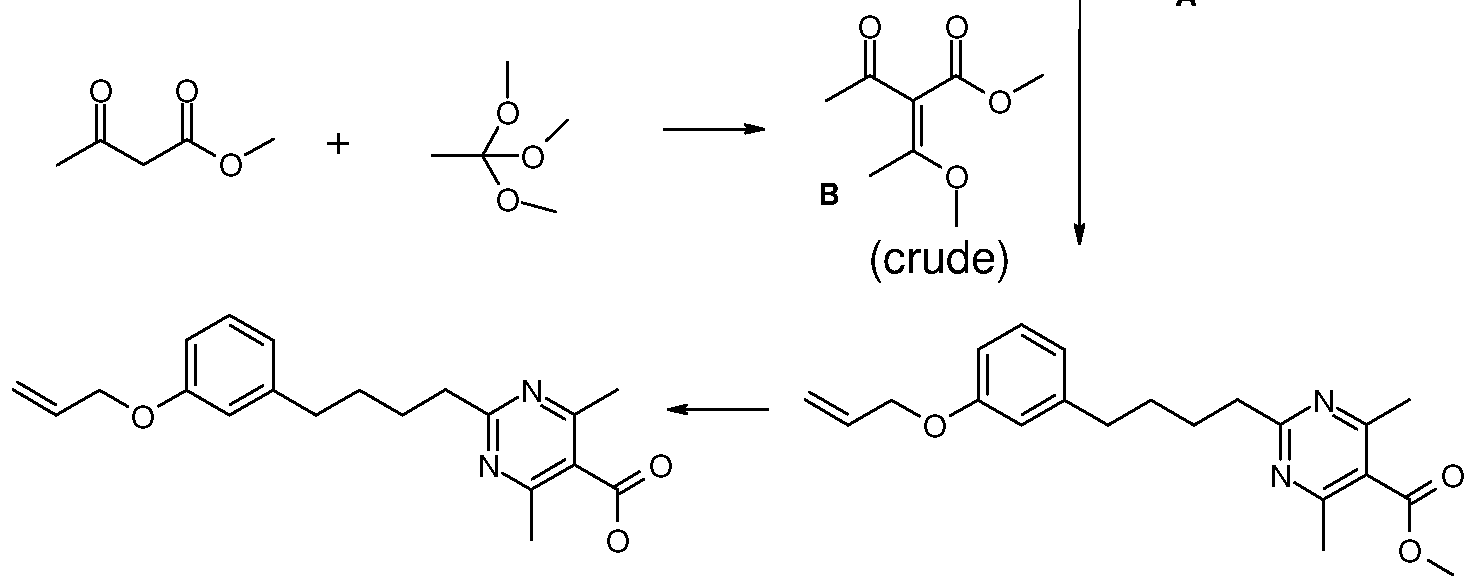
To a solution of 5-(3-allyloxy-phenyl)-pentanoic acid ethyl ester (356 mg, 1.35 mmol) in xylenes (15 ml) was added Lawesson's reagent (655 mg, 1.62 mmol). The mixture was refluxed for 3h. After cooling to rt, a precipitate was removed by filtration and the solution was concentrated to dryness. The crude residue was purified by flash chromatography with a 5-10% EtOAc in hexane gradient to afford the corresponding thioester (92 mg, 24% yield). This thioester was dissolved in MeOH (2 ml) and treated with ammonia (7N in MeOH, 462 ul, 3.23 mmol) and ammonium chloride (173 mg, 3.23 mmol). The mixture was refluxed for 40 min, cooled to rt , quenched with IN NaOH and extracted with EtOAc. The organic layer was concentrated under reduced pressure to afford the desired amidine as a yellow paste (67 mg, 89% yield).
A solution of methyl acetoacetate (10.8ml, 0.1 mmol), trimethyl orthoformate (15.2 ml, 0.12 mmol), pyridine (0.8ml, 0.01 mmol) and acetic acid (0.6ml, 0.01 mmol) in toluene (30 ml) was stirred at 80 °C for 18h. The mixture was concentrated under reduced pressure to afford crude keto ester B as an orange oil. This crude reagent (400ul) was dissolved in methanol (1ml) and the amidine A (0.29 mmol, 67 mg) was added in one portion. The mixture was refluxed for 26h, cooled to rt and concentrated under reduced pressure. The crude residue was purified by flash chromatography with a 10-40% EtOAc in hexane gradient to afford 2-[4-(3-Allyloxy-phenyl)- butyl]-4,6-dimethyl-pyrimidine-5-carboxylic acid ethyl ester. This ester was then hydrolyzed with LiOH.H20 (0.35 mmol, 15 mg) in dioxane/H20 (2ml/0.5ml) at reflux for 2h. The mixture was quenched with pH=3 buffer and extracted with EtOAc. The layers were separated; the organic layer was dried over Na2S04, filtered and concentrated to afford the desired acid as a white solid (67mg, 65% overall yield from amidine A).
Preparation of 2-[3-(3-methoxy-phenyl)-propoxy1-pyrimidine-5-carboxylic acid ethyl ester

The pyrimidinone B (5.96 g, 30.4 mmol) and the mesylate A (4.95 g, 20.26mmol) were dissolved in dry DMF (100 ml) containing Cs2C03 (13.2g, 40 mmol) and heated to 75°C for 6h. The mixture was cooled to rt, poured into water and extracted with EtOAc. The combined organic layers were successively washed with IN HCI, water and brine, then dried over MgS04, filtered and concentrated under reduced pressure. The crude was purified by flash chromatography (10% EtOAc/Hexanes) to afford the desired product as a yellow oil (5.6 g, 54% yield)
Preparation of 2-[3-(3-hvdroxy-phenyl)-propoxy1-pyrimidine-5-carboxylic acid

NaHC03 and brine, then dried over MgS04i filtered and concentrated under reduced pressure to afford a yellow oil (2.3g). This material was dissolved in MeOH (25 ml) and treated with IN NaOH (15ml) at 70 °C for 8h. The mixture was concentrated under reduced pressure and partitioned between an aqueous buffer (pH=5) and EtOAc. The organic phases was washed with water and brine, then dried over MgS04i filtered and concentrated under reduced pressure to afford the desired acid as a beige solid (1.25 g, 57% yield).
2-[(3'-methoxy-biphenyl-2-ylmethyl)-amino)1-4<6-dimethyl-pyrimidine-5-carboxylic acid ethyl ester:

A similar procedure was used to make the following two intermediates:
2-[(4'-methoxy-biphenyl-2-ylmethyl)-amino)1-4<6-dimethyl-pyrimidine-5-carboxylic acid ethyl ester:

(84mg, 51% yield)
2-[(2'-methoxy-biphenyl-2-ylmethyl)-amino)1-4<6-dimethyl-pyrimidine-5-carboxylic acid ethyl ester:

(136mg, 52% yield)
2-[(3'-hvdroxy-biphenyl-2-ylmethyl)-amino1-4<6-dimethyl-pyrimidine-5-carboxylic acid:

A solution of 2-[(3'-methoxy-biphenyl-2-ylmethyl)-amino]-4,6-dimethyl-pyrimidine-5- carboxylic acid ethyl ester (80mg, 0.19mmol) in dry DCM (2ml) was cooled to 0°C in a ice bath, and BBr3/DCM (1M, 380ul, O.38mmol) was added dropwise at 0°C. The reaction mixture was stirred at 0°C for lh, then quenched with water and extracted with DCM. The combined organic layers were washed with water and brine, then dried over Na2S04, filtered and concentrated
under pressure to afford the de-methylated compound which was not purified. This material was dissolved in H20/dioxane (1.5ml/1.5ml) and treated with LiOH.H20 (80mg, 1.9mmol)) at 60 °C overnight. The mixture was quenched with concentrated HC1 to pH=l, concentrated under reduced pressure to ½ its volume, then partitioned between brine and EtOAc. The combined organic phases were dried over Na2S04i filtered and concentrated under reduced pressure to afford the desired acid (75mg, 100% overall yield).
A similar procedure was used to make the following two intermediates:
2-[(4'-hvdroxy-biphenyl-2-ylmethyl)-amino1-4<6-dimethyl-pyrimidine-5-carboxylic acid:

2-[(2'-hvdroxy-biphenyl-2-ylmethyl)-amino1-4<6-dimethyl-pyrimidine-5-carboxylic acid:

(106mg, 91% yield)
2-(6-methoxy-l<2<3,4-tetrahvdro-naphthalen-2-ylamino)-4<6-dimethyl-pyrimidine-5- carboxylic acid ethyl ester:

A mixture of 2-amino-6-methoxy-l,2,3,4-tetrahydro-naphthalene hydrochloride (87mg, 0.43mmol), 2-chloro-4,6-dimethyl-pyrimidine-5-carboxylic acid ethyl ester (71mg, O.33mmol) and KOAc (150mg, 1.5mmol) in ethanol (3ml) was microwaved at 120 °C for lh. The reaction mixture was cooled to rt, quenched with 1NHC1 and extracted with EtOAc. The organic layer was washed with brine, dried over Na2S04, filtered and concentrated. The crude residue was purified by flash chromatography with a 5-60% EtOAC in hexane gradient to afford the desired product (69mg, 60% yield).
A similar procedure was used to make the following intermediate:
2-(8-methoxy-l<2<3,4-tetrahvdro-naphthalen-2-ylamino)-4<6-dimethyl-pyrimidine-5- carboxylic acid ethyl ester:

2-(6-hvdroxy-l<2 <4-tetrahvdro-naphthalen-2-ylamino)-4<6-dimethyl-pyrimidine-5- carboxylic acid:

A solution of 2-(6-methoxy- 1,2,3, 4-tetrahydro-naphthalen-2-ylamino)-4,6-dimethyl-pyrimidine- 5-carboxylic acid ethyl ester (36mg, O.lmmol) in dry DCM (2ml) was cooled to 0°C in a ice bath, and BBr3/DCM (1M, 200ul, 0.2mmol) was added in one portion at 0°C. The reaction mixture was stirred at 0°C for lh, then quenched with ice/water and extracted with DCM. The combined organic layers were dried over Na2S04, filtered and concentrated under pressure to afford the de- methylated compound which was not purified. This material was dissolved in H20/dioxane (l.Oml/l.Oml) and treated with LiOH.H20 (42mg, l.Ommol)) at 60°C overnight. The mixture was quenched with lNHCl/brine (1: 1) and extracted with EtOAc. The combined organic phases were dried over Na2S04i filtered and concentrated under reduced pressure to afford the desired acid (30mg, 100% overall yield).
2-(8-hvdroxy-l<2 <4-tetrahvdro-naphthalen-2-ylamino)-4<6-dimethyl-pyrimidine-5- carboxylic acid:

A solution of 2-(8-methoxy- 1,2,3, 4-tetrahydro-naphthalen-2-ylamino)-4,6-dimethyl-pyrimidine- 5-carboxylic acid ethyl ester (261mg, 0.73mmol) in dry DCM (7ml) was cooled to 0°C in a ice bath, and BBr3/DCM (1M, 1.5ml, 1.47mmol) was added in one portion at 0°C. The reaction mixture was stirred at 0°C for lh, then quenched with ice/water and extracted with DCM. The
combined organic layers were dried over Na2S04, filtered and concentrated under pressure to afford the de-methylated compound which was not purified. This material was dissolved in H20/dioxane (5.0ml/5.0ml) and treated with LiOH.H20 (300mg, 7.3mmol)) at 60°C overnight. The mixture was quenched with lNHCl/brine (1: 1) and extracted with EtOAc. The combined organic phases were dried over Na2S04i filtered and concentrated under reduced pressure to afford the desired acid (166mg, 72% overall yield).
Preparation of 2-[2-(4-Hvdroxy-phenyl)-ethylamino1-4<6-dimethyl-pyrimidine-5-carboxyic acid ethyl ester

Preparation of 2-[2-(4-ΗνάΓθχν-ρΗ6ην1 -6ΐΗνΐ3ηιίηο1-4,6-άίηΐ6ΐΗν1-ρν ηιάίη6-5-€3^οχν1ί€ acid

A solution of 2-[2-(4-hydroxy-phenyl)-ethylamino]-4,6-dimethyl-pyrimidine-5-carboxylic acid ethyl ester (285mg, 0.90mmol) in dioxane (10ml) was treated with a solution of lithium hydroxide monohydrate (948mg, 22.59mmol) in water (10ml). The mixture was stirred at 90°C for 12 h, then cooled to rt and quenched with aqueous potassium hydrogen sulfate to adjust the pH to -2-4. The resulting solution was extracted with EtOAc. The organic extracts were combined, washed with brine, dried over sodium sulfate, filtered and concentrated to give the title compound (298mg, 100% yield). MS m/e 287.9 (M+H+).
Preparation of 4, 6-dimethyl-2-prop-2-vnylamino-pyrimidine-5-carboxylic acid ethyl ester
 A solution of 2-chloro-4, 6-dimethyl-pyrimidine-5-carboxylic acid ethyl ester (lg, 4.66mmol) and propargylamine (0.45ml, 7.0mmol) in EtOH (10ml) was microwaved at 160°C for lh. The mixture was cooled to rt, quenched with 10% aqK2C03 and extracted with EtOAc. The combined organic extracts were washed water and brine, dried over Na2S04, filtered and concentrated to give the product as a yellow solid which was not further purified (1.05g, 92% yield). MS m/e 234.0 (M+H+).
Preparation of 4, 6-dimethyl-2-prop-2-vnylamino-pyrimidine-5-carboxylic acid

To a solution of 4, 6-dimethyl-2-prop-2-ynylamino-pyrimidine-5-carboxylic acid ethyl ester (4.79g, 20.53mmol) in dioxane (100ml) was added a solution of lithium hydroxide monohydrate (21.53 g, 513.25 mmol) in water (100ml). The mixture was stirred at 90°C for 6 h, then cooled to rt and quenched with a solution of KHS04 (80g, 588mmol) in water (1000ml) to bring the pH to 2-4. The mixture was extracted with EtOAc. The organic extracts were combined, washed with brine, dried over sodium sulfate, and concentrated to give a the desired product as a white solid (3g, 71% yield). MS m/e 205.9 (M+H+).
Preparation of 4<6-dimethyl-2-[(E)-3-(4<4<5<5-tetramethyl-[l<3,21dioxaborolan-2-yl)- allylaminol-pyrimidine-5-carboxylic acid ethyl ester

A solution of 4,6-dimethyl-2-prop-2-ynylamino-pyrimidine-5-carboxylic acid (lg, 4.3mmol), 4,4,5, 5-tetramethyl-[l,3,2]dioxaborolane (0.75ml, 5.16mmol), bis(cyclopentadienyl)zirconi- um(IV) chloride hydride (l lmg, 0.43mmol), and triethylamine (0.6ml, 0.43mmol) in THF (10ml) was microwaved at 150°C for 20min Excess 4,4,5,5-tetramethyl-[l,3,2]dioxaborolane (1.5ml, 10.32mmol) was added and the solution was microwaved again at 150°C for 20h. The mixture was directly loaded onto a silica gel column and purified by flash chromatography with 40% EtOAc in hexane to give the desired product (1.19g, 77% yield). MS m/e 362.0 (M+H+).
Preparation of 2-[(E)-3-(3-Hvdroxy-4-methyl-phenyl)-allylamino1-4<6-dimethyl- pyrimidine-5-carboxylic acid ethyl ester

A microwave reaction vessel was charged with 4,6-dimethyl-2-[(E)-3-(4,4,5,5-tetramethyl- [l,3,2]dioxaborolan-2-yl)-allylamino]-pyrimidine-5-carboxylic acid ethyl ester (300mg, 0.83 mmol), 5-bromo-2-methyl-phenol (155mg, O.83mmol), [1,1' -bis (diphenylphosphinoferrocene) dichloropalladium(II) DCM complex (34 mg, 0.042mmol), potassium carbonate (229mg, 1.66 mmol), DMF (6ml), and water (1ml). The mixture was degassed and flushed with nitrogen, followed by heating to 135 °C for 15 min in a microwave oven. The mixture was partitioned between EtOAc and water. The organic layer was separated, washed with brine, dried over sodium sulfate, filtered, and concentrated. The residue was purified by flash chromatography with 30% EtOAc in hexane to give the desired product (145mg, 51% yield). MS m/e 342.0 (M+H+).
Preparation of 2-[3-(3-hvdroxy-4-methyl-phenyl)-propylaminol-4<6-dimethyl-pyrimidine-5- carboxylic acid ethyl ester

Preparation of 2-[3-(3-hvdroxy-4-methyl-phenyl)-propylamino1-4<6-dimethyl-pyrimidine-5- carboxylic acid

A mixture of 2-[3-(3-hydroxy-4-methyl-phenyl)-propylamino]-4,6-dimethyl-pyrimidine-5- carboxylic acid ethyl ester, lithium hydroxide monohydrate (440mg, 10.5mmol), in dioxane/- water(25ml/25ml) was stirred at 95 °C for 4 h, then cooled to rt and quenched with aqueous potassium hydrogen sulfate to pH 2-4. The resulting solution was extracted with EtOAc. The
organic extracts were combined, washed with brine, dried over sodium sulfate, filtered and evaporated to give the title compound (110 mg, 83%yield) MS m/e 316.0 (M+H+).
Preparation of 2-[(Ε)-3-(3-ΗνάΓθχν- Η6ην1)- ΐ1νΐ ηιίηο1-4,6-(1ίηΐ6ΐΗν1- ν ιιιί(1ίη6-5- carboxylic acid ethyl ester

A microwave reaction vessel was charged with 4,6-dimethyl-2-[(E)-3-(4,4,5,5-tetramethyl- [l,3,2]dioxaborolan-2-yl)-allylamino]-pyrimidine-5-carboxylic acid ethyl ester (300mg, O.83mmol), 3-bromo-phenol (172mg, l.Ommol), [l,l'-bis(diphenylphosphinoferrocene)- dichloropalladium(II) DCM complex (68mg, O.083mmol), potassium carbonate (229mg, 1.6 mmol), DMF (4ml), and water (0.5ml). The mixture was degassed and flushed with nitrogen, followed by heating to 140 °C for 10 min in a microwave oven. The mixture was directly loaded onto column. Eluting with a 0-50% EtOAc in hexane gradient provided pure product (136.4mg, 50% yield). MS m/e 328.0 (M+H+).
Preparation of 2-[(Ε -3-(3-ΗνάΓθχν-ρΗ6ην1 -3ΐ1νΐ3ηιίηο1-4,6-άίηΐ6ΐΗν1-ρν ηιίάίη6-5- carboxylic acid

A mixture of 2-[(E)-3-(3-hydroxy-phenyl)-allylamino]-4,6-dimethyl-pyrimidine-5-carboxylic acid ethyl ester (136mg, 0.41mmol), lithium hydroxide monohydrate (430mg, 10.25mmol), dioxane (10ml) and water (10ml) was heated to 90 °C for 4 h, then cooled to rt and quenched with aqueous potassium hydrogen sulfate to pH 2-4. The resulting solution was extracted with EtOAc. The organic extracts were combined, washed with brine, dried over sodium sulfate, filtered and evaporated to give the title compound (l l lmg, 90%yield). MS m/e 299.9 (M+H+).
Preparation of 2-[(E)-3-(6-Benzyloxy-pyridin-2-yl)-allylamino1-4<6-dimethyl-pyrimidine-5- carboxylic acid ethyl ester

0.69mmol), 6-benzyloxy-2-bromopyridine (183mg, 0.69mmol), [l,l'-bis(diphenylphosphino- ferrocene)-dichloropalladium(II) DCM complex (28.2mg, 0.035mmol), potassium carbonate (190mg, 1.38mmol), DMF (4ml), and water (1ml). The mixture was degassed and flushed with nitrogen, followed by heating to 135 °C for 15 min in a microwave oven. The mixture was directly loaded onto column. Eluting with 30% EtOAc in hexane provided the desired product (140mg, 48% yield). MS m/e 419.0 (M+H+).
Preparation of 2-[(E)-3-(6-Benzoxy-pyridin-2-yl)-allylamino1-4<6-dimethyl-pyrimidine-5- carboxylic acid

A mixture of 2-[(E)-3-(6-benzyloxy-pyridin-2-yl)-allylamino]-4,6-dimethyl-pyrimidine-5- carboxylic acid ethyl ester (140mg, O.33mmol), and lithium hydroxide monohydrate (351mg, 8.36mmol), in dioxane/water (lOml/lOml) was stirred at 90 °C for 9 h, then cooled to rt and quenched with aqueous potassium hydrogen sulfate to pH 2-4. The resulting solution was extracted with EtOAc. The organic extracts were combined, washed with brine, dried over sodium sulfate, filtered and concentrated to give the title compound (l l lmg, 86% yield). MS m/e 391.0 (M+H+).
Preparation of 2-[3-(2-Fluoro-3-methoxy-phenyl)-prop-2-vnylamino1-4<6-dimethyl- pyrimidine-5-carboxylic acid ethyl ester

To a solution of 2-fluoro-3-methoxy-phenyl boronic acid ( 219mg, 1.29mmol) and 4,6-dimethyl- 2-ynylamino-pyrimidine-5-carboxylic acid ethyl ester (200mg, 0.87mmol) in anhydrous DCM (15ml) was added [l, -bis(diphenylphosphinoferrocene)-dichloropalladium(II) DCM complex (71mg, 0.087mmol), potassium carbonate (601mg, 4.25mmol) and silver (II) oxide (504mg,
2.18mmol). The mixture was stirred at rt for 3 days, then directly loaded onto a silicagel column. Eluting with 30% EtOAc in hexane provided the desired product (22mg, 7% yield).
Preparation of 2-[3-(2-fluoro-3-methoxy-phenyl)-propylamino1-4<6-dimethyl-pyrimidine-5- carboxylic acid ethyl ester

A solution of 2-[3-(2-Fluoro-3-methoxy-phenyl)-prop-2-ynylamino]-4,6-dimethyl-pyrimidine-5- carboxylic acid ethyl ester (95mg, 0.27mmol) in EtOH (200ml) was passed through H-Cube with a 10% Pd/C small cartridge at 40 bar, 40 °C and 1ml per min. Solvent was then removed by evaporation to give the desired compound (90mg, 94% yield). MS m/e 362.0 (M+H+).
Preparation of 2-[3-(2-Fluoro-3-hvdroxy-phenyl)-propylamino1-4<6-dimethyl-pyrimidine-5- carboxylic acid ethyl ester

To a solution of 2-[3-(2-fluoro-3-methoxy-phenyl)-propylamino]-4,6-dimethyl-pyrimidine-5- carboxylic acid ethyl ester (90mg, 0.249mmol) in anhydrous DCM was added at 0°C BBr3/DCM (1M, 0.5ml, 0.5mmol). The mixture was stirred at rt for 2 h, then quenched with ice water. The mixture was diluted with DCM. The organic layer was separated, washed with brine, dried over sodium sulfate, filtered and evaporated to give the desired product (70mg, 81% yield). MS m/e 347.9 (M+H+).
Preparation of 2-[3-(2-Fluoro-3-hvdroxy-phenyl)-propylamino1-4<6-dimethyl-pyrimidine-5- carboxylic acid


A microwave reaction vessel was charged with 4,6-dimethyl-2-[(E)-3-(4,4,5,5-tetramethyl- [l,3,2]dioxaborolan-2-yl)-allylamino]-pyrimidine-5-carboxylic acid ethyl ester (300mg,
O.83mmol), 3-bromo-6-fluoro-phenol (340mg, 1.66mmol), dichloro-bis(triphenylphosphine)- palladium (II) (38mg, 0.042mmol), l,2,3,4,5-pentaphenyl-l '-(di-tert-butyl-phosphino)-ferrocene (58mg, O.083mmol), cesium fluoride (388mg, 2.49mmol), and THF (20ml). The mixture was degassed, flushed with nitrogen and heated to 120 °C for 20 min in a microwave oven. The mixture was directly loaded onto a silicagel column. Eluting with a 0-30% EtOAc in hexane gradient provided pure product (139 mg, 47% yield). MS m/e 359.9 (M+H+).
Preparation of 2-[3-(2-Fluoro-5-methoxy-phenyl)-propylamino1-4<6-dimethyl-pyrimidine-
5-carboxylic acid ethyl ester

evaporation to give the desired product (123mg, 88% yield). MS m/e 361.9 (M+H+).
Preparation of 2-[3-(2-Fluoro-5-hvdroxy-phenyl)-propylamino1-4<6-dimethyl-pyrimidine-5- carboxylic acid ethyl ester

A solution of 2-[3-(2-fluoro-5-methoxy-phenyl)-propylamino]-4,6-dimethyl-pyrimidine-5- carboxylic acid ethyl ester (123mg, 0.34mmol) in anhydrous DCM was treated at 0°C with BBr3/DCM (1M, 0.7ml, 0.7mmol). The mixture was allowed to warm up to rt and stirred for 2 h, then quenched with ice water. The mixture was extracted with DCM. The organic layer was
separated, washed with brine, dried over sodium sulfate, filtered and concentrated to give the desired product (72mg, 61% yield). MS m/e 347.9 (M+H+).
Preparation of 2-[3-(2-Ρ1υοΓθ-5-ΗνάΓθχν- Η6ην1 - Γο νΐ ηιίηο1-4,6-(1ίηΐ6ΐΗν1- ν ιιιί(1ίη6-5- carboxylic acid

A mixture of 2-[3-(2-fluoro-5-hydroxy-phenyl)-propylamino]-4,6-dimethyl-pyrimidine-5- carboxylic acid ethyl ester (72mg, 0.21mmol), and lithium hydroxide monohydrate (217mg, 5.25mmol) in dioxane/water (5ml/5ml) was stirred at 90 °C overnight, then cooled to rt and quenched with aqueous potassium hydrogen sulfate to adjust the pH to 2-4. The mixture was extracted with EtOAc. The organic extracts were combined, washed with brine, dried over sodium sulfate, filtered and concentrated to give the title compound, (62.5 mg, 93% yield). MS m/e 319.9 (M+H+).
Preparation of 2-[(E)-3-(3-bromo-5-hvdroxy-2-methyl-phenyl)-allylamino1-4<6-dimethyl- pyrimidine-5-carboxylic acid ethyl ester

A mixture of 4,6-dimethyl-2-[(E)-3-(4,4,5,5-tetramethyl-[l,3,2]dioxaborolan-2-yl)-allylamino]- pyrimidine-5-carboxylic acid ethyl ester (150mg, 0.415mmol), 3, 5-dibromo-4-methyl -phenol (221mg, O.83mmol), dichloro-bis(triphenylphosphine)palladium (II) (19mg, 0.021mmol), l,2,3,4,5-pentaphenyl-l '-(di-tert-butyl-phosphino)-ferrocene (29mg, 0.042mmol), and cesium fluoride (189mg, 1.245 mmol) in THF (10ml) was stirred at rt for 24 h. The mixture was directly loaded onto a silicagel column. Eluting with a 0-30% EtOAc in hexane gradient afforded the desired product (94mg, 54% yield). MS m/e 421.7 (M+H+).
Preparation of 2-[3-(2-Methyl-5-methoxy-phenyl)-propylamino1-4<6-dimethyl-pyrimidine-
5-carboxylic acid ethyl ester

A solution of 2-[(E)-3-(3-bromo-5-hydroxy-2-methyl-phenyl)-allylamino]-4,6-dimethyl- pyrimidine-5-carboxylic acid ethyl ester (94mg, 0.22mmol) in EtOH (250ml) was passed through H-Cube with 10% Pd/C small cartridge at 1 atmosphere, rt and 1ml per min. After concentration, the residue was purified by flash chromatography with a 0-50% EtOAc in hexane gradient to afford the desired product (19mg, 25% yield). MS m/e 344.0 (M+H+).
Preparation of 2-[3-(2-Methyl-5-hvdroxy-phenyl)-propylamino1-4<6-dimethyl-pyrimidine-
5-carboxylic acid

Preparation of 2-[3-(3-Methoxy-phenyl)-propylamino1-4-methyl-pyrimidine-5-carboxylic acid ethyl ester

Preparation of 2-[3-(3-Hvdroxy-phenyl)-propylamino)-4-methyl-pyrimidine-5-carboxylic acid ethyl ester

A solution of 2-[3-(3-methoxy-phenyl)-propylamino]-4-methyl-pyrimidine-5-carboxylic acid ethyl ester (568mg, 1.72mmol) in anhydrous DCM (10ml) was treated at 0°C with BBr3/- DCM(1M, 3.4ml, 3.4mmol). The mixture was allowed to warm up to rt and stirred for 2h, then quenched with ice water. The organic layer was separated and the aqueous layer was extracted by DCM. The organic layer was separated, washed with brine, dried over sodium sulfate, filtered and concentrated to give the desired product (530.6mg, 98% yield). MS m/e 315.9 (M+H+).
Preparation of 2-[3-(3-hvdroxy-phenyl)-propylamino1-4-methyl-pyrimidine-5-carboxylic acid

Preparation of 2-[3-(3-Methoxy-phenyl)-propylamino1-4-trifluoromethyl-pyrimidine-5- carboxylic acid methyl ester

4.16mmol), potassium acetate (1.22g, 12.48mmol) and methanol (10ml). The mixture was heated to 150 °C for lh in a microwave oven. The mixture was cooled to rt and extracted with EtOAc. The organic phase washed with water and brine, dried over sodium sulfate, filtered, and concentrated. The residue was purified by flash chromatography with 25% EtOAc in hexane to afford the desired product (917mg, 60% yield). MS m/e 369.9(M+H+).
Preparation of 2-[3-(3-Hvdroxy-phenyl)-propylamino)-4-trifluoromethyl-pyrimidine-5- carboxylic acid methyl ester

A solution of 2-[3-(3-methoxy-phenyl)-propylamino]-4-trifluoromethyl-pyrimidine-5-carboxylic acid ethyl ester (917mg, 2.48mmol) in anhydrous DCM (10ml) was treated at 0°C with
BBr3/DCM (1M, 5ml, 5mmol). The mixture was allowed to warm up to rt and stirred for 2h, then quenched with ice water. The organic layer was separated and the aqueous layer was extracted by DCM. The organic layer was separated, washed with brine, dried over sodium sulfate, filtered and concentrated to give the desired product (0.9g, 100% yield). MS m/e 355.9 (M+H+).
Preparation of 2-[3-(3-hvdroxy-phenyl)-propylamino1-4-trifluoromethyl-pyrimidine-5- carboxylic acid

A mixture of 2-[3-(3-hydroxy-phenyl)-propylamino]-4-trifluoromethyl-pyrimidine-5-carboxylic acid methyl ester (0.9g, 2.53mmol), and lithium hydroxide monohydrate (2.13g, 50.66mmol), in dioxane/water (20ml/20ml) was stirred at 0°C overnight, then cooled to rt and quenched with aqueous potassium hydrogen sulfate to adjust the pH to -2-4. The resulting solution was extracted with EtOAc. The organic extracts were combined, washed with brine, dried over sodium sulfate, filtered and evaporated to give the title compound (770mg, 89% yield). MS m/e 341.9 (M+H+).
Preparation of 2-r3-(lH-indazol-4-vi)-propylaminol-4, 6-dimethyl-pyrimidine-5-carboxylic acid ethyl ester

A mixture of 3-(lH-indazol-4-yl)-propylamine dihydrochloride (1.61g, 7.5mmol), 2-chloro-4,6- dimethyl-pyrimidine-5-carboxylic acid ethyl ester (2.23g, 9.0mmol) and EtOH (30ml) was heated in a microwave reactor at 160°C for 1.0 h, diluted with EtOAc (200ml), washed with brine (200ml) and re-extracted with EtOAc (200ml). The combined organic layers were washed with brine, dried over sodium sulfate, filtered, concentrated in the presence of silica gel and chromatographed (10-80% EtOAc in hexane) to give the desired product (2.28g, 81 % yield).
Preparation of 2-[3-(3-(lH-indazol-4-yl)-propylamino)-4< 6-dimethyl-pyrimidine-5- carboxylic acid

To a solution of 2-[3-(3-(lH-indazol-4-yl)-propylamino)-4, 6-dimethyl-pyrimidine-5-carboxylic acid ethyl ester (1.79g, 5.06mmol) in dioxane (35ml) was added a solution of lithium hydroxide (4.24g, 101.2mmol) in water (45ml). The mixture was heated to reflux for 2 hours, cooled to rt, acidified with 2N KHS04, concentrated, filtered, and the precipitate was washed with water to afford the title compound (1.64g, 99% yield).
Preparation of (S)-3-tert-butoxycarbonylamino-2-(|2-[3-(3-hvdroxy-phenyl)-propylamino1-
4,6-dimethyl-pyrimidine-5-carbonyl|-amino)-propionic acid methyl ester

To a solution of 2-[3-(3-hydroxy-phenyl)-propylamino]-4,6-dimethyl-pyrimidine-5-carboxylic acid (1.76g, 5.84mmol) in anhydrous DMF (60ml) was added Et3N (2.5ml, 7.0mmol), HBTU (2.66g, 7.01mmol), HOBT (0.95g, 7.01mmol), and H-DAP(Boc)OMe hydrochloride (1.79g, 7.01mmol). The mixture was stirred at rt for 3h, diluted with brine (200ml) and extracted with ethyl acetate. The combined organic layers were washed with 1: 1 saturated sodium
bicarbonate/brine and brine, then dried over Na2S04, filtered, and concentrated under reduced pressure. The crude residue was purified by flash chromatography with a 40-100% EtOAc in hexane gradient to give the title compound (2.66g, 91% yield). MS m/e 501.9 (M+H+).
Preparation of (S)-3-Amino-2-(|2-[3-(3-hvdroxy-phenyl)-propylamino1-4<6-dimethyl- pyrimidine-5-carbonyl|-amino)-propionic acid methyl ester hydrochloride
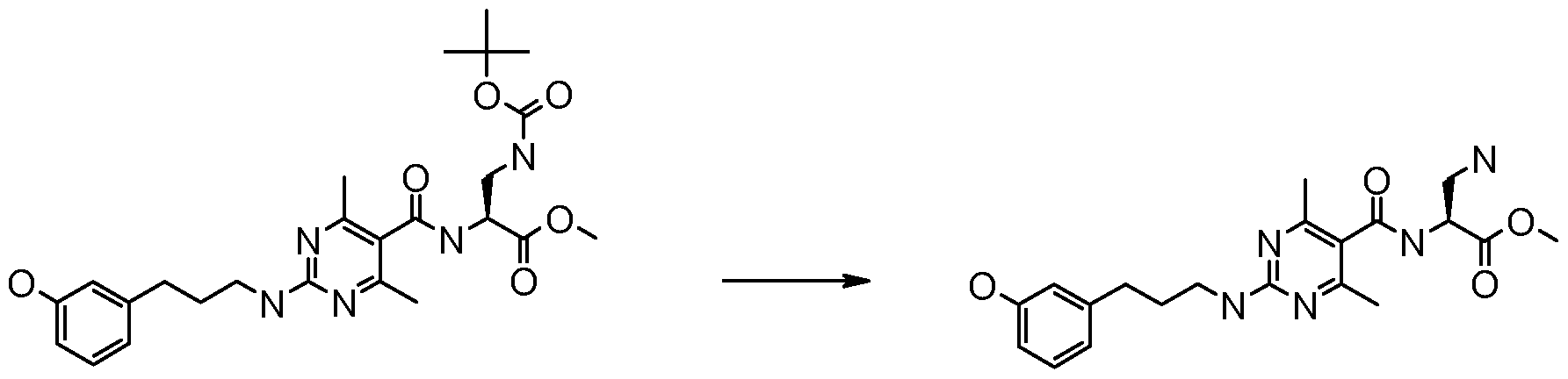
To a solution of (S)-3-tert-Butoxycarbonylamino-2-({2-[3-(3-hydroxy-phenyl)-propylamino]- 4,6-dimethyl-pyrimidine-5-carbonyl}-amino)-propionic acid methyl ester (2.66g, 5.30mmol) in MeOH (10ml) was added 4.0 M HC1 in dioxane (20 mL). After one hour the mixture was concentrated and azeotroped with MeOH. The product was triturated with ether, filtered, and washed with ether to afford the title compound (2.16g, 93 % yield). MS m/e 401.9 (M+H+).
Preparation of (S)-3-tert-butoxycarbonylamino-2-(|2-[3-(3-hvdroxy-4-methyl-phenyl)- propylamino1-4<6-dimethyl-pyrimidine-5-carbonyl|-amino)-propionic acid methyl ester
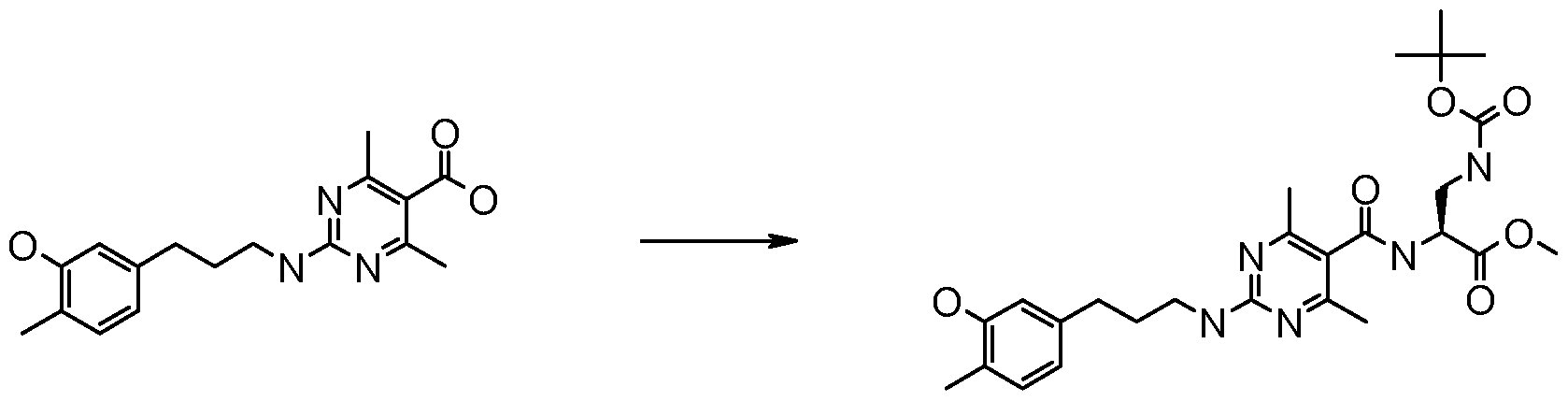
Preparation of (S)-3-tert-Butoxycarbonylamino-2-(|2-[(E)-3-(3-hvdroxy-phenyl)- allylamino1-4<6-dimethyl-pyrimidine-5-carbonyl|-amino)-propionic acid methyl ester

To a solution of 2-[(E)-3-(3-hydroxy-phenyl)-allylamino]-4,6-dimethyl-pyrimidine-5-carboxylic acid (l l lmg, 0.37mmol) in anhydrous DMF (3ml) was added at rt triethylamine (0.15ml, l.l lmmol), HBTU (144mg, O.38mmol), HOBT (51mg, O.38mmol), and H-DAP(Boc)OMe hydrochloride (96.3mg, 0.3 mmol). The mixture was stirred at rt overnight, followed by direct loading onto a silicagel column. Eluting with a 40-100% EtOAc in hexane gradient provided the desired compound contaminated with DMF (274.3mg). MS m/e 500.0 (M+H+).
Preparation of (S)-3-tert-Butoxycarbonylamino-2-(|2-[3-(2-fluoro-3-hvdroxy-phenyl)- Γθ νΐ3ηιίηο1-4,6-(1ίηΐ6ΐΗν1- ν ιιιί(1ίη6-5-€3^οην1|-3ΐιιίηο)- Γθ ίοιιί€ acid methyl ester

To a solution of 2-[3-(2-fluoro-3-hydoxyl-phenyl)-propylamino]-4,6-dimethyl-pyrimidine-5- carboxylic acid (60mg, 0.19mmol) in anhydrous DMF (4ml) was added at rt triethylamine (0.13ml, 1.05mmol), HBTU (143mg, O.38mmol), HOBT (51mg, O.38mmol), and H- DAP(Boc)OMe hydrochloride (96mg, O.38mmol). The mixture was stirred at rt for 18 h, then quenched with water and extracted with EtOAc. The organic layer was separated, washed with brine, dried over sodium sulfate, filtered and evaporated. The residue was purified by flash chromatography with a 40-100% EtOAc on hexane gradient to yield the desired product (94mg, 96% yield). MS m/e 520.0 (M+H+).
Preparation of (S)-3-tert-Butoxycarbonylamino-2-(|2-[3-(2-methyl-5-hvdroxy-phenyl)- ρΓθρνΐ3ηιίηο1-4,6-άίηΐ6ΐΗν1-ρν ηιίάίη6-5-€3^οην1|-3ηιίηο -ρΓθρίοηί€ acid methyl ester

To a solution of 2-[3-(2-methyl-5-hydoxyl-phenyl)-propylamino]-4,6-dimethyl-pyrimidine-5- carboxylic acid (15.8mg, 0.05mmol) in anhydrous DMF (2ml) was added triethylamine (25mg, 0.25mmol), HBTU (37.9mg, 0.1 mmol), HOBT (13.5mg, O.lOmmol), and H-DAP(Boc)OMe hydrochloride (25.5mg, 0. lOmmol). The mixture was stirred at rt for 3 h, quenched with water and extracted with EtOAc. The combined organic layers were washed with brine, dried over sodium sulfate, filtered and concentrated. The residue was purified by flash chromatography with a 40-100% EtOAc in hexane gradient to give the desired product (26mg, 100% yield). MS m/e 516.0 (M+H+). Preparation of (S)-3-tert-Butoxycarbonylamino-2-(|2-[3-(2-fluoro-5-hvdroxy-phenyl)- propylaminol-4,6-dimethyl-pyrimidine-5 arbonyl|-amino)-propionic acid methyl ester
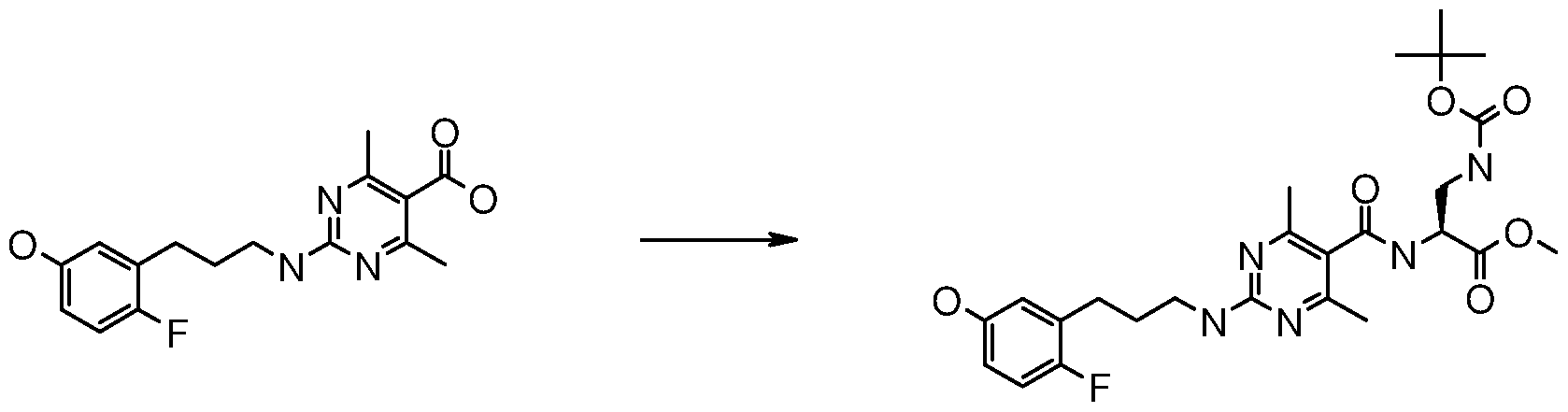
To a solution of 2-[3-(2-fluoro-5-hydoxyl-phenyl)-propylamino]-4,6-dimethyl-pyrimidine-5- carboxylic acid (62.5mg, 0.196mmol) in anhydrous DMF (4ml) was added triethylamine (0.14ml, 0.98mmol), HBTU (149mg, 0.39mmol), HOBT (53mg, 0.39mmol), and H-DAP(Boc)OMe hydrochloride (lOOmg, 0.39mmol). The mixture was stirred at rt over the weekend, then quenched with water and extracted with EtOAc. The organic layer was separated, washed with brine, dried over sodium sulfate, filtered and evaporated. The residue was purified by flash chromatography with a 40-100% EtOAc in hexane gradient to afford the desired product (62mg, 61% yield). MS m/e 520.0 (M+H+).
Preparation of (S)-3-tert-Butoxycarbonylamino-2-(|2-[3-(3-hvdroxy-phenyl)-propylamino1- pyrimidine-5-carbonyl|-amino)-propionic acid methyl ester

To a solution of 2-[3-(3-hydoxyl-phenyl)-propylamino]-pyrimidine-5-carboxylic acid (900mg, 3.29mmol) in anhydrous DMF (10ml) was added triethylamine (1.4ml, 9.87mmol), HBTU (1.5g, 3.85mmol), HOBT (534mg, 3.95mmol), and H-DAP(Boc)OMe hydrochloride (864mg,
3.39mmol). The mixture was stirred at rt overnight, then quenched with water and extracted with EtOAc. The organic layer was separated, washed with brine, dried over sodium sulfate, filtered and evaporated. The residue was purified by flash chromatography with a 0-90% EtOAc in hexane gradient to give the desired product (820mg, 53% yield). MS m/e 474.0 (M+H+).
Preparation of (S)-3-tert-Butoxycarbonylamino-2-(|2-[3-(3-hvdroxy-phenyl)-propylamino1- 4-methyl-pyrimidine-5-carbonyl|-amino)-propionic acid methyl ester

To a solution of 2-[3-(3-hydoxyl-phenyl)-propylamino]-4-methyl-pyrimidine-5-carboxylic acid (415mg, 1.444mmol) in anhydrous DMF (5mL) was added triethylamine (0.6ml, 4.33mmol), HBTU (559mg, 1.47mmol), HOBT (199mg, 1.47mmol), and H-DAP(Boc)OMe hydrochloride (375mg, 1.47mmol). The mixture was stirred at rt overnight, then quenched with water and extracted with EtOAc. The organic layer was separated, washed with brine, dried over sodium sulfate, filtered and evaporated. The residue was purified by flash chromatography with a 0-80% EtOAc in hexane gradient to give the title compound (482mg, 68% yield). MS m/e 488.0 (M+H+). Preparation of (S)-3-tert-Butoxycarbonylamino-2-(|2-[3-(3-hvdroxy-phenyl)-propylamino1-
4-trifluoromethyl-pyrimidine-5-carbonyl|-amino)-propionic acid methyl ester

To a solution of 2-[3-(3-hydoxyl-phenyl)-propylamino]-4-trifluoromethyl-pyrimidine-5-carb- oxylic acid (770mg, 2.26mmol) in anhydrous DMF (10ml) was added triethylamine (0.95ml, 6.78mmol), HBTU (1.03g, 2.71mmol), HOBT (366mg, 2.71mmol), and H-DAP(Boc)OMe hydrochloride (591mg, 2.32mmol). The mixture was stirred at rt overnight, then quenched with water and extracted with EtOAc. The organic layer was separated, washed with brine, dried over sodium sulfate, filtered and evaporated. The residue was purified by flash chromatography with a 0-60% EtOAc in hexane gradient to give the desired product (970mg, 79% yield). MS m/e 441.9 (M+H+-Boc). Preparation of (S)-3-tert-Butoxycarbonylamino-2-(|4-ethyl-2-[3-(3-hvdroxy-phenyl)- propylamino1-6-methyl-pyrimidine-5-carbonyl|-amino)-propionic acid methyl ester

To a solution of 4-ethyl-2-[3-(3-hydroxy-phenyl)-propylamino]-6-methyl-pyrimidine-5-carb- oxylic acid (219mg, 0.694mmol) in anhydrous DMF (10ml) was added triethylamine (0.3ml, 2.082mmol), HBTU (268mg, 0.708mmol), HOBT (96mg, 0.708mmol), and H-DAP(Boc)OMe hydrochloride (180mg, 0.708mmol). The mixture was stirred at rt overnight, then quenched with water and extracted with EtOAc. The organic layer was separated, washed with brine, dried over sodium sulfate, filtered and evaporated. The residue was purified by flash chromatography with a 0-80% EtOAc in hexane gradient to give the title compound (265mg, 74% yield). MS m/e 516.0 (M+H+-Boc).
Preparation of (8 -3-Ϊ6Γΐ-Βυΐοχν€3^οηνΐ3ηιίηο-2-(|4,6-άί6ΐΗν1-2-[3-(3-ΗνάΓθχν-ρΗ6ην1 - propylamino1-pyrimidine-5-carbonyl|-amino)-propionic acid methyl ester

To a solution of 4,6-diethyl-2-[3-(3-hydroxy-phenyl)-propylamino]-pyrimidine-5-carboxylic acid (26mg, 0.08mmol) in anhydrous DMF (2ml) was added triethylamine (40mg, 0.4mmol), HBTU (33mg, 0.09mmol), HOBT (12mg, 0.09mmol), and H-DAP(Boc)OMe hydrochloride (22mg, 0.09mmol). The mixture was stirred at rt overnight, then quenched with water and extracted with EtOAc. The organic layer was separated, washed with brine, dried over sodium sulfate, filtered and evaporated. The residue was purified by flash chromatography with a 0-80% EtOAc in hexane gradient to give the title compound (21.6mg, 52% yield). MS m/e 530.0 (M+H+). Preparation of (S)-3-tert-Butoxycarbonylamino-2-(|2-[3-(lH-indazol-4-yl)-propylamino1-
4,6-dimethyl-pyrimidine-5-carbonyl|-amino)-propionic acid methyl ester

To a solution of 2-[3-(lH-indazol-4-yl)-propylamino]-4,6-dimethyl-pyrimidine-5-carboxylic acid (2.11 g, 6.45 mmol) in anhydrous DMF (60ml) was added triethylamine (2.7ml, 7.74mmol), HBTU (2.94g, 7.74mmol), HOBT (1.05g, 7.74mmol), and H-DAP(Boc)OMe hydrochloride (1.97g, 7.74mmol). The mixture was stirred at rt for 18 h, diluted with brine and extracted with EtOAc. The combined organic layers were washed with brine, saturated sodium bicarbonate and brine, dried over Na2S04, filtered, concentrated in the presence of silica gel and chromate- graphed (50-100% EtOAc in hexane) to give the desired product (2.98g, 88 % yield). Preparation of (S)-3-Amino-2-(|2-[3-(lH-indazol-4-yl)-propylamino1-4<6-dimethyl- pyrimidine-5-carbonyl|-amino)-propionic acid methyl ester hydrochloride

A solution of (S)-3-tert-Butoxycarbonylamino-2-({2-[3-(lH-indazol-4-yl)-propylamino]-4,6- dimethyl-pyrimidine-5-carbonyl}-amino)-propionic acid methyl ester (0.114g, 0.22mmol) in MeOH (2ml) was treated with 4.0 M HCl in dioxane (5ml). After one hour at rt, the mixture was concentrated and azeotroped with MeOH. The product was triturated with ether, filtered, and washed with excess ether to afford the title compound (HCl salt) (98mg, 98 % yield).
Preparation of (S)-3-tert-butoxycarbonylamino-2-(|2-[3-(3-hvdroxy-phenyl)-propoxy1-4<6- dimethyl-pyrimidine-5-carbonyll-amino-propionic acid methyl ester

Preparation of (8)-3-3ηιίηο-2-|2-[3-(3-Η.νάΓθχν-ρΗ.6ην1)-ρΓοροχν1-4,6-άίηΐ6ΐΗ.ν1-ρνηηιίάίη6-
5-carbonyll-amino-propionic acid methyl ester

(S)-3-amino-2-({2-[(3'-hvdroxy-biphenyl-2-ylmethyl)-amino1-4<6-dimethyl-pyrimidine-5- carbonyl|-amino)-propionic acid methyl ester hydrochloride:

To a solution of 2-[(3'-hydroxy-biphenyl-2-ylmethyl)-amino]-4,6-dimethyl-pyrimidine-5-carb- oxylic acid (75mg, 0.2mmol) and H-DAP(BOC)-OMe.HCl (77mg, 0.3mmol) in DMF (2ml) were successively added at rt triethylamine (112ul, 0.8mmol), HOBT (30mg, 0.2mmol) and HBTU (114mg, 0.3mmol). The mixture was stirred at rt overnight then quenched with INHCl and extracted with EtOAc. The organic layer was washed with pH=8 buffer and brine, then dried over Na2S04, filtered and concentrated. The crude product was purified by flash chroma- tography with a 40-100% EtOAC in hexane gradient to afford the desired product (75mg, 68% yield). This material was dissolved in methanol (1.5ml) and treated with 4NHC1 in dioxane (0.5ml) at rt for 3.5h. The reaction mixture was concentrated under reduced pressure to afford the desired amine HCl salt (71mg, 100% yield).
A similar procedure was used to make the following two intermediates: (S)-3-amino-2-({2-[(4'-hvdroxy-biphenyl-2-ylmethyl)-amino1-4<6-dimethyl-pyrimidine-5- carbonyl|-amino)-propionic acid methyl ester hydrochloride:

(69mg, 68% yield)
(S)-3-amino-2-({2-[(2'-hvdroxy-biphenyl-2-ylmethyl)-amino1-4<6-dimethyl-pyrimidine-5- carbonyl|-amino)-propionic acid methyl ester hydrochloride:

(69mg, 68% yield)
(S)-3-amino-2-(|2-[6-hvdroxy-l<2<3 -tetrahvdro-naphthalen-2-ylamino1-4<6-dimethyl- pyrimidine-5-carbonyl|-amino)-propionic acid methyl ester hydrochloride:

To a solution of 2-(6-hydroxy- 1,2,3, 4-tetrahydro-naphthalen-2-ylamino)-4, 6-dimethyl-pyrimi- dine-5-carboxylic acid (36mg, O. lmmol) and H-DAP(BOC)-OMe.HCl (33mg, 0.15mmol) in DMF (1.5ml) were successively added at rt triethylamine (60ul, 0.4mmol), HOBT (15mg, O. lmmol) and HBTU (60mg, 0.15mmol). The mixture was stirred at rt overnight then quenched with 1NHC1 and extracted with EtOAc. The organic layer was washed with brine, then dried over Na2S04, filtered and concentrated. The crude product was purified by flash chromatography with a 50-100% EtOAC in hexane gradient to afford the desired product. This material was dissolved in methanol (1.0ml) and treated with 4NHC1 in dioxane (0.3ml) at rt for 2.5h. The reaction mixture was concentrated under reduced pressure to afford the desired amine HCI salt (20mg, 40% overall yield) .
Preparation of (S)-3-tert-Butoxycarbonylamino-2-|[2-(8-hvdroxy-l<2<3,4-tetrahydro- naphthalen-2-ylamino)-4<6-dimethyl-pyrimidine-5-carbonyl1-amino|-propionic acid methyl ester

To a solution of 2-(2-(8-hydroxy- 1,2,3, 4-tetrahydro-naphthalen-2-ylamino)-4,6-dimethyl- pyrimidine-5-carboxylic acid (0.166g, 0.53mmol), Et3N (0.22ml, 1.59mmol), and H- DAP(Boc)OMe hydrochloride (0.16g, 0.64mmol), in anhydrous DMF (4ml) was added a solution of HBTU (0.24g, 0.64mmol) and HOBT (0.086g, 0.64mmol) in DMF (4ml). The
mixture was stirred at rt overnight, diluted with brine and extracted with EtOAc. The combined organic layers were washed with 1: 1 satNaHCOs/brine and brine, then dried over Na2S04, filtered, and concentrated under reduced pressure. The crude residue was purified by flash chromatography with a 10-100% EtOAc in hexane gradient to give the title compound (188mg, 69% yield). MS m/e 514.0 (M+H+).
Preparation of (S)-3-Amino-2-|[2-(8-hvdroxy-l<2<3.l4-tetrahvdro-naphthalen-2-ylamino)-
4,6-dimethyl-pyrimidine-5-carbonyll-amino|-propionic acid methyl ester hydrochloride

To a solution of (S)-3-tert-butoxycarbonylamino-2-{ [2-(8-hydroxy-l,2,3,4-tetrahydro-naphtha- len-2-ylamino)-4,6-dimethyl-pyrimidine-5-carbonyl] -amino} -propionic acid methyl ester
(188mg, 0.367mmol) in MeOH (1ml) was added 4.0 M HCI ind (4ml). After one hour the mixture was concentrated and azeotroped with MeOH to afford the title compound (209mg, 100% yield). MS m/e 414.0 (M+H+).
Preparation of (S)-3-tert-butoxycarbonylamino-2-[(4< 6-dimethyl-2-prop-2-vnylamino- pyrimidine-5-carbonyl)-amino1 -propionic acid methyl ester

To a solution of 4, 6-dimethyl-2-prop-2-ynylamino-pyrimidine-5-carboxylic acid (3g, 14.62 mmol) in DMF (120ml) was added triethylamine (10.2ml, 73.1mmol), HBTU (6.65g, 17.54 mmol), HOBT (2.4g, 17.54mmol), and H-DAP(Boc)OMe hydrochloride (4.47g, 17.54mmol). The mixture was stirred at rt overnight then quenched with 1NHC1 and extracted with EtOAc. The organic layer was washed with brine, then dried over Na2S04, filtered and concentrated. The crude product was purified by flash chromatography with a 40-100% EtOAC in hexane gradient to afford the desired product as a white solid (4.62g, 78% yield). MS m/e 406.1 (M+H+).
Preparation of (S)-2-i(4, 6-Dimethyl-2-prop-2-vnylamino-pyrimidine-5-carbonyl)-amino1- 3-[(thiophene-2-carbonyl)-amino1-propionic acid methyl ester

A solution of (S)-3-tert-butoxycarbonylamino-2-[(4, 6-dimethyl-2-prop-2-ynylamino-pyrimi- dine-5-carbonyl)-amino]-propionic acid methyl ester (4.62g, 11.39mmol) in DCM (35ml) was cooled to 0°C and 30% TFA/DCM (15ml) was added dropwise. The solution was stirred at rt for lh. The solvent and excess TFA were removed by evaporation under vacuum. The residue was dissolved in DMF (50ml), and treated with DIEA (19.8ml, 113mmol) at 0°C. Thiophene-2- carboxylic acid (1.75g, 13.67mmol), HBTU (5.2g, 13.67mmol) and HOBT (1.85g, 13.67mmol) were added and the mixture was stirred at rt over the weekend. The mixture was partitioned between EtOAc and water. The layers were separated and the organic layer was washed with brine, dried over Na2S04, filtered and concentrated. The residue was purified by flash chromatography with a 40-100% EtOAC in hexane gradient to afford the desired product as a white solid (4g, 85% yield). MS m/e 415.9 (M+H+).
Preparation of (S)-2-(|2-[(E)-3-(6-Benzyloxy-pyridin-2-yl)-allylamino1-4<-6-dimethyl- pyrimidine-5-carbonylamino-propionic acid methyl ester

To a solution of 2-[(E)-3-(6-benzoxy-pyridin-2-yl)-allylamino]-4,6-dimethyl-pyrimidine-5- carboxylic acid (l l lmg, 0.284mmol) in anhydrous DMF (5ml) was added triethylamine (0.12ml, 0.85mmol), HBTU (l lOmg, 0.29mmol), HOBT (39mg, 0.29mmol), and H-DAP(Boc)OMe hydrochloride (74mg, 0.29mmol). The mixture was stirred at rt overnight, then directly loaded onto a silicagel column. Eluting with a 30-100% EtOAc in hexane gradient afforded the desired product (122mg, 73% yield). MS m/e 591.0 (M+H+).
PART II: PREPARATION OF PREFERRED COMPOUNDS OF THE INVENTION
Example 1: (S)-2-(|2-[4-(3-hvdroxy-phenyl)-butyl1-4<6-dimethyl-pyrimidine-5-carbonyl|- amino) -3 - [(thiophene-2-carbonyl) -aminol -propionic acid

To a solution of 2-[4-(3-Allyloxy-phenyl)-butyl]-4,6-dimethyl-pyrimidine-5-carboxylic acid (64mg, O.188mmol) and H-DAP(BOC)-OMe.HCl (72mg, 0.282 mmol) in DMF (2ml) were successively added at rt triethylamine (78ul, 0.56mmol), HOBT (47mg, 0.34mmol) and HBTU (130mg, 0.39mmol). The mixture was stirred at rt for 2h then quenched with pH=3 buffer and extracted with EtOAc. The organic layer was washed with saturated aqueous NaHC03 and brine, then dried over Na2S04, filtered and concentrated. The crude product was purified by flash chromatography with a 10-60% EtOAC in hexane gradient to afford the desired diamino propionic acid derivative (34 mg, 34% yield). This material was treated with 4N HC1 in dioxane (1.5ml) for lh and concentrated to dryness to afford the free amine as the HC1 salt that was then taken up in DMF (1ml). Thiophene-2-carboxylic acid (14mg, O.lOmmol) was added, followed by triethylamine (30ul, 0.21mmol), HOBT (12mg, 0.08mmol) and HBTU (32mg, 0.08mmol). The mixture was stirred at rt for lh30min, quenched with pH=3 buffer and extracted with EtOAc. The organic layer was washed with saturated aqueous NaHC03 and brine, then dried over Na2S04, filtered and concentrated. The crude product was purified by flash chromatography with a 50-100% EtOAC in hexane gradient to afford the desired thiophene amide (10 mg, 26% yield from the BOC derivative). This material was dissolved in DCM (300ul) and treated for 40min at rt with PhSiH3 (25ul, 0.18mmol) in the presence of a catalytic amount of Pd[PPh3]4 (2.5mg, 0.002mmol). The mixture was quenched with pH=3 buffer and extracted with EtOAc. The organic layer was washed with brine, dried over Na2S04, filtered and concentrated. The crude product was purified by flash chromatography with a 50-100% EtOAC in hexane gradient to afford the desired phenol (lOmg, 100% yield). The ester was then hydrolyzed with LiOH.H20 (0.35 mmol, 15mg) in THF/H20 (0.2ml/0.2ml) at rt for l/2h. The mixture was quenched by
adding 220ul of IN KHS04 then partitioned between pH=3 buffer and EtOAc. The layers were separated. The organic layer was dried over Na2S04, filtered and concentrated to afford the desired acid (3 mg, 34% yield, 90% pure). MS m/e 497.0 (MH+).
Example 2: (S)-2-(|2-[3-(3-hvdroxy-phenyl)-propoxy1-4<6-dimethyl-pyrimidine-5- carbonyl|-amino)3-[(thiophene-2-carbonyl)-amino1-propionic acid methyl ester

To a solution of thiophene-2-carboxylic acid (0.46g, 3.6 mmol) and HBTU (1.78g, 4.7mmol) in DMA (20ml) were successively added at rt triethylamine (1.0ml, 7.2mmol) and (S)-3-amino-2- {2-[3-(3-hydroxy-phenyl)-propoxy]-4,6-dimethyl-pyrimidine-5-carbonyl}-amino-propionic acid methyl ester (1.6g, 3.6mmol). The mixture was stirred at rt for 18h then quenched with water and extracted with EtOAc. The organic layer was washed with saturated aqueous NaHC03 and brine, then dried over MgS04, filtered and concentrated. The crude product was purified by flash chromatography with a 20-100% EtOAC in hexane gradient to afford the desired product (1.29g, 70% yield). Example 3: (S)-2-(|2-[3-(3-hvdroxy-phenyl)-propoxy1-4<6-dimethyl-pyrimidine-5- carbonyl|-amino)3-[(thiophene-2-carbonyl)-amino1-propionic acid

A solution of (S)-2-({2-[3-(3-hydroxy-phenyl)-propoxy]-4,6-dimethyl-pyrimidine-5-carbonyl}- amino)-3-[(thiophene-2-carbonyl)-amino]-propionic acid methyl ester (1.29g, 2.52mmol) in methanol (15ml) was treated with 2NNaOH (10ml, 20mmol) and the reaction mixture was stirred at rt for 2.5h. The volume of the reaction mixture was reduced to a third and water was added. This aqueous solution was stirred at rt and the pH was adjusted to 5.0 with 1NHC1 to induce precipitation of the desired acid. The off-white precipitate was collected by filtration, washed with water and dried in a vacuum desiccator to give the product as a beige foam (0.84g, 65% yield). MS m/e 499.0 (MH+).
Example 4: (S)-3-acetylamino-2-(|2-[3-(lH-indazol-4-yl)-propylamino1-4<6-dimethyl- pyrimidine-5-carbonyl|-amino)-propionic acid:

To a solution of (S)-3-amino-2-({2-[3-(lH-indazol-4-yl)-propylamino]-4,6-dimethyl-pyrimidine- 5-carbonyl}-amino)-propionic acid methyl ester (0.05g, 30.1 mmol) and triethylamine (70ul, 0.5 mmol) in DMF (1ml) was added Ac20 (50ul. 0.5mmol). The mixture was stirred at rt for 2h then quenched with 1NHC1 and stirred at rt overnight. The phases were separated. The desired product was present in the acidic aqueous layer. This layer was made basic by adding NaOH pellets. This promoted the saponification of the acid. The aqueous layer was concentrated under reduced pressure and the residue was taken up in pH=2 buffer. The solution was concentrated and the resulting white solid was triturated with DMF/dioxane (1: 10), then filtered. The filtrate was concentrated under reduced pressure to afford the desired acid (18mg, 40% yield). MS m/e 454.3 (MH+).
Example 5: (S)-2-(|2-[3-(lH-indazol-4-yl)-propylamino1-4<6-dimethyl-pyrimidine-5- carbonyl|-amino)3-[(thiophene-2-carbonyl)-amino1-propionic acid methyl ester

To a solution of thiophene-2-carboxylic acid (0.028g, 0.21 mmol), HBTU (O. lg, 0.26 mmol) and HOBT (0.035g, 0.26mmol) in DMF (5ml) were successively added at rt triethylamine (0.09ml, 0.26mmol) and (S)-3-amino-2-({2-[3-(lH-indazol-4-yl)-propylamino]-4,6-dimethyl-pyrimidine- 5-carbonyl}-amino)-propionic acid methyl ester (O. lg, 0.21 mmol). The mixture was stirred at rt for 18h then quenched with water and extracted with EtOAc. The organic layer was washed with saturated aqueous NaHC03 and brine, then dried over MgS04, filtered and concentrated. The crude product was purified by flash chromatography with a 50-100% EtOAC in hexane gradient to afford the desired product (0.059g, 52% yield). Example 6: (S)-2-(|2-[3-(lH-indazol-4-yl)-propylamino1-4<6-dimethyl-pyrimidine-5- carbonyl|-amino)3-[(thiophene-2-carbonyl)-amino1-propionic acid

A solution of (S)-2-({2-[3-(lH-indazol-4-yl)-propylamino]-4,6-dimethyl-pyrimidine-5-carbon- yl}-amino)3-[(thiophene-2-carbonyl)-amino]-propionic acid methyl ester (0.059g, O. l lmmol) in THF/water (4ml/5ml)) was treated with LiOH.H20 (0.023g, 0.55mmol) and the reaction mixture was stirred at rt for lh. The reaction mixture was quenched by adding IN KHS04 (0.55ml) and water. The white precipitate was collected by filtration, washed with water then suspended in acetonitrile/water and lyophilized. White solid (0.056g, 98% yield). MS m/e 522.1 (MH+).
Example 7: (S)-2-(|2-[3-(3-hvdroxy-phenyl)-propylamino1-4<6-dimethyl-pyrimidine-5- carbonyl|-amino)3-[(thiophene-2-carbonyl)-amino1-propionic acid methyl ester

To a solution of thiophene-2-carboxylic acid (0.24g, 1.85mmol), HBTU (0.84g, 2.22mmol) and HOBT (0.30g, 0.22mmol) in DMF (40ml) were added at rt triethylamine (0.56ml, 5.55mmol) and (S)-3-amino-2-({2-[3-(3-hydroxy-phenyl)-propylamino]-4,6-dimethyl-pyrimidine-5-carbon- yl}-amino)-propionic acid methyl ester (0.8 lg, 1.85mmol). The mixture was stirred at rt for lh then quenched with water/brine and extracted with EtOAc. The organic layer was washed with brine, then dried over Na2S04, filtered and concentrated. The crude product was purified by flash chromatography with a 40-100% EtOAC in hexane gradient to afford the desired product (0.59g, 62% yield).
Example 8: (S)-2-(|2-[3-(3-hvdroxy-phenyl)-propylamino1-4<6-dimethyl-pyrimidine-5- carbonyl|-amino)3-[(thiophene-2-carbonyl)-amino1-propionic acid

A solution of (S)-2-({2-[3-(3-hydroxy-phenyl)-propylamino]-4,6-dimethyl-pyrimidine-5- carbonyl}-amino)3-[(thiophene-2-carbonyl)-amino]-propionic acid methyl ester (0.59g,
1.15mmol) in THF/water (20/30ml) was treated with LiOH.H20 (0.24g, 5.77mmol) and the reaction mixture was stirred at rt for 1.5h. The mixture was quenched with IN KHS04 (6ml) and concentrated to about half its volume. The white precipitate was collected by suction filtration, washed with water and air-dried. (0.54g, 94% yield). MS m/e 497.9 (MH+).
Example 9: (S)-2-({2-[(3'-hvdroxy-biphenyl-2-ylmethyl)-amino1-4<6-dimethyl-pyrimidine-5- carbonyl|-amino)-3-[(thiophene-2-carbonyl)-amino1-propionic acid methyl ester

To a solution of (S)-3-amino-2-({2-[(3'-hydroxy-biphenyl-2-ylmethyl)-amino]-4,6-dimethyl- pyrimidine-5-carbonyl}-amino)-propionic acid methyl ester, HC1 salt (71mg, 0.16mmol) and thiophene-2-carboxylic acid (22mg, 0.17mmol) in DMF (2ml), were successively added at rt triethylamine (66ul, 0.47mmol), HOBT (24mg, 0.16mmol) and HBTU (66mg, 0.17mmol). The mixture was stirred at rt for 0.5h then quenched with 1NHC1 and extracted with EtOAc. The combined organic layers were washed with brine, dried over Na2S04, filtered and concentrated. The crude product was purified by flash chromatography with a 50-100% EtOAC in hexane gradient to afford the desired product (47mg, 62% yield).
A similar procedure was used to make the following two examples: Example 10: (S)-2-({2-[(4'-hvdroxy-biphenyl-2-ylmethyl)-amino1-4<6-dimethyl-pyrimidine-
5-carbonyl|-amino)-3-[(thiophene-2-carbonyl)-amino1-propionic acid methyl ester

(47mg, 69% yield) MS m/e 560 (MH+).
Example 11: (S)-2-({2-[(2'-hvdroxy-biphenyl-2-ylmethyl)-amino1-4<6-dimethyl-pyrimidine- 5-carbonyl|-amino)-3-[(thiophene-2-carbonyl)-amino1-propionic acid methyl ester

(69mg, 77% yield).
Example 12: (S)-2-({2-[(3'-hvdroxy-biphenyl-2-ylmethyl)-amino1-4<6-dimethyl-pyrimidine- 5-carbonyl|-amino)-3-[(thiophene-2-carbonyl)-amino1-propionic acid:

A similar procedure was used to make the following two examples:
Example 13: (S)-2-({2-[(3'-hvdroxy-biphenyl-2-ylmethyl)-amino1-4<6-dimethyl-pyrimidine- 5-carbonyl|-amino)-3-[(thiophene-2-carbonyl)-amino1-propionic acid:

(27mg, 60% yield). MS m/e 546 (MH+). Example 14: (S)-2-({2-[(2'-hvdroxy-biphenyl-2-ylmethyl)-amino1-4<6-dimethyl-pyrimidine- 5-carbonyl|-amino)-3-[(thiophene-2-carbonyl)-amino1-propionic acid:

(22mg, 33% yield). MS m/e 546 (MH+).
Example 15: (S) 2-(2-[6-hvdroxy-l<2<3.l4-tetrahvdro-naphthalen-2-ylamino1-4<6-dimethyl- pyrimidine-5-carbonyl-amino)-3-[(thiophene-2-carbonyl)-amino1-propionic acid methyl ester:

To a solution of (S)-3-amino-2-({2-[6-hydroxy-l,2,3,4-tetrahydro-naphthalen-2-ylamino]-4,6- dimethyl-pyrimidine-5-carbonyl}-amino)-propionic acid methyl ester hydrochloride (18mg, 0.04mmol) and thiophene-2-carboxylic acid (6mg, 0.05mmol) in DMF (0.5ml), were successively added at rt triethylamine (18ul, 0.13mmol), HOBT (7mg, 0.04mmol) and HBTU (17mg, 0.05mmol). The mixture was stirred at rt for lh then quenched with INHCl and extracted with EtOAc. The combined organic layers were washed with brine, dried over Na2S04, filtered and concentrated. The crude product was purified by flash chromatography with a 50-100% EtOAC in hexane gradient to afford the desired product (12mg, 60% yield).
A similar procedure was used to prepare the following analog:
Example 16: (S) 2-(2-[8-hvdroxy-l<2<3.l4-tetrahvdro-naphthalen-2-ylamino1-4<6-dimethyl- pyrimidine-5-carbonyl-amino)-3-[(thiophene-2-carbonyl)-amino1-propionic acid methyl ester:

Example 17: (S) 2-(2-[6-hvdroxy-l<2<3.l4-tetrahvdro-naphthalen-2-ylamino1-4<6-dimethyl- pyrimidine-5-carbonyl-amino)-3-[(thiophene-2-carbonyl)-amino1-propionic acid

A similar procedure was used to prepare the following analog:
Example 18: (S) 2-(2-[8-hvdroxy-l<2<3.l4-tetrahvdro-naphthalen-2-ylamino1-4<6-dimethyl- pyrimidine-5-carbonyl-amino)-3-[(thiophene-2-carbonyl)-amino1-propionic acid

(381mg, 59% yield) MS m/e 510 (MH+)
Example 19: (S)-2-(|2-[3-(3-Hvdroxy-phenyl)-prop-2-vnylamino1-4< 6-dimethyl-pyrimidine- 5-carbonyl|-amino)-3-[(thiophene-2-carbonyl)-amino1-propionic acid methyl ester

A reaction vessel containing 3-iodo-phenol (39.7mg, 0.18mmol), DIEA (1ml), dichloro- bis(triphenylphosphine)palladium (II) (4.2mg, 0.006mmol), copper (I) iodide (2.3 mg, 0.012 mmol) and DMF (1ml) was sealed, degassed, and flushed with nitrogen. The mixture was stirred at rt for 30 min. A solution of (S)-2-[(4,6-dimethyl-2-prop-2-ynylamino-pyrimidine-5-carbonyl)- amino]-3-[(thiophene-2-carbonyl)-amino]-propionic acid methyl ester (50mg, 0.1 mmol) and DIEA (0.5ml) in DMF (0.5ml) was added at rt. The reaction mixture was stirred at rt for 18 h. The mixture was extracted with EtOAc. The combined organic extracts were washed with water and brine, dried over sodium sulfate, filtered and concentrated. The residue was purified by flash chromatography with a 40-100% EtOAc in hexane gradient to afford the desired product as a yellow solid (29mg, 48% yield). MS m/e 508.0 (M+H+).
Example 20: (S)-2-(|2-[(Z)-3-(hvdroxy-phenyl)-allylamino1-4< 6-dimethyl-pyrimidine-5- carbonyl|-amino)-3-[(thiophene-2-carbonyl)-amino1-propionic acid methyl ester

A mixture of (S)-2-({2-[3-(3-hydroxy-phenyl)-prop-2-ynylamino]-4, 6-dimethyl-pyrimidine-5- carbonyl}-amino)-3-[(thiophene-2-carbonyl)-amino]-propionic acid methyl ester (552.6mg,
1.09mmol), and Lindlar's catalyst (350 mg) in EtOAc (100ml) was subjected to hydrogenation via Parr Shaker Type Apparatus at 40 psi and rt for 8h. The solution was filtered and the filtrate was concentrated under reduced pressure. The residue was purified by flash chromatography with 10% MeOH in DCM to give the expected product as a white solid (352.5mg, 63% yield). MS m/e 510.0 (M+H+).
Example 21: (S)-2-({2-[3-(lH-indazol-4-yl)-prop-2-vnylamino1-4< 6-dimethyl-pyrimidine-5- carbonyl|-amino)-3-[(thiophene-2-carbonyl)-amino1-propionic acid methyl ester

A reaction vessel containing 4-bromo-indazole (71mg, 0.36mmol), DIEA (1ml), dichlorobis(tri- phenylphosphine)palladium (II) (8.4mg, 0.012mmol), copper (I) iodide (4.4mg, 0.024mmol) and DMF (1ml) was sealed, degassed, and flushed with nitrogen. The mixture was stirred at rt for 30min. A solution of (S)-2-[(4,6-dimethyl-2-prop-2-ynylamino-pyrimidine-5-carbonyl)-amino]- 3- [(thiophene-2-carbonyl)-amino] -propionic acid methyl ester (lOOmg, 0.24mmol) and DIEA (0.5ml) in DMF (0.5ml) was added at rt. The reaction mixture was stirred at 50 °C for 18 h. The mixture was cooled to rt and extracted with EtOAc. The combined organic extracts were washed with water and brine, dried over sodium sulfate, filtered and concentrated. The residue was purified by flash chromatography with 20%MeOH in DCM to give pure product (37.3mg, 29% yield). MS m/e 532.0 (M+H+).
Example 22: (S)-2-(|2-[3-(lH-indazol-6-yl)-prop-2-vnylamino1-4< 6-dimethyl-pyrimidine-5- carbonyl|-amino)-3-[(thiophene-2-carbonyl)-amino1-propionic acid methyl ester

A reaction vessel containing 6-bromoindazole (141.9mg, 0.72mmol), Et3N (1.5ml), dichlorobis- (triphenylphosphine)palladium (II) (16.8mg, 0.024mmol), copper (I) iodide (9.2mg, 0.048mmol) and DMF (2ml) was sealed, degassed and flushed with nitrogen. The mixture was stirred at rt for 30 min. A solution of (S)-2-[(4,6-dimethyl-2-prop-2-ynylamino-pyrimidine-5-carbonyl)-amino]-
3-[(thiophene-2-carbonyl)-amino]-propionic acid methyl ester (200mg, 0.48mmol) in DMF (2ml) was added at rt. The reaction mixture was stirred at 47 °C for 24 h. The mixture was cooled to rt and extracted with EtOAc. The combined organic extracts were washed with water and brine, dried over sodium sulfate, filtered and concentrated. The residue was purified by flash
chromatography with a 40-100% EtOAc in hexane gradient to give pure product (99.2mg, 37% yield). MS m/e 532.0 (M+H+).
Example 23: (S)-2-(|2-[3-(lH-indazol-6-yl)-propylamino1-4<6-dimethyl-pyrimidine-5- carbonyl|-amino)-3-[(thiophene-2-carbonyl)-amino1propionic acid methyl ester

0.16mmol) in MeOH (75ml) was passed through H-Cube with 5% Pd/C small cartridge at 1 atmosphere, rt and 1ml per min. Solvent was then removed by evaporation and the residue was purified by flash chromatography with 10%MeOH in DCM to give the desired product (65mg, 76% yield). MS m/e 536.0 (M+H+).
Example 24: (S)-2-(|2-[3-(3-Fluoro-5-hvdroxy-phenyl)-prop-2-vnylamino1-4<6-dimethyl- pyrimidine-5-carbonyl|-amino)-3-[(thiophene-2-carbonyl)-amino1propionic acid methyl ester

A reaction vessel containing 3-fluoro-5-bromophenol (69mg, 0.36mmol), Et3N (1.5ml), dichlorobis(triphenylphosphine)palladium (II) (8.4mg, 0.012mmol) and copper (I) iodide (4.6mg, 0.024mmol) in DMF (1ml) was sealed, degassed, and flushed with nitrogen. The mixture was stirred at rt for 30 min. A solution of (S)-2[(4,6-dimethyl-2-prop-2-ynylamino-pyrimidine-5-
carbonyl)-amino]-3-[(thiophene-2-carbonyl)-amino]-propionic acid methyl ester (lOOmg, 0.24mmol) in DMF (1 mL) was added at rt. The reaction mixture was stirred at rt over the weekend. The mixture was extracted with EtOAc. The combined organic extracts were washed with water and brine, dried over sodium sulfate, filtered and concentrated. The residue was purified by flash chromatography with 10% MeOH in DCM to give pure product (51 mg, 40% yield). MS m/e 525.9 (M+H+).
Example 25: (S)-2-(|2-[3-(3-fluoro-5-hvdroxy-phenyl)-propylamino1-4<6-dimethyl- pyrimidine-5-carbonyl|-amino)-3-[(thiophene-2-carbonyl)-amino1propionic acid methyl ester

A solution of (S)-2-({2-[3-(3-fluoro-5-hydroxy-phenyl)-prop-2-ynylamino]-4,6-dimethyl- pyrimidine-5-carbonyl}-amino)-3-[(thiophene-2-carbonyl)-amino] propionic acid methyl ester (67.7mg, 0.13mmol) in MeOH (50ml) was passed through H-Cube with 5% Pd/C small cartridge at 1 atmosphere, rt and 1ml per min. Solvent was then removed by evaporation and the residue was purified by flash chromatography with 90% EtOAc in hexane to give pure product (18.2mg, 26% yield). MS m/e 530.0 (M+H+).
Example 26: (S)-2-(|2-[3-(4-Fluoro-3-hvdroxy-phenyl)-prop-2-vnylamino1-4<6-dimethyl- pyrimidine-5-carbonyl|-amino)-3-[(thiophene-2-carbonyl)-amino1propionic acid methyl ester

A reaction vessel containing 2-fluoro-5-bromophenol (138 mg, 0.72 mmol), Et3N (1.5ml), dichlorobis(triphenylphosphine) palladium (II) (16.8mg, 0.024mmol) and copper (I) iodide (9.2mg, 0.048mmol) in DMF (2 ml) was sealed, degassed, and flushed with nitrogen. The
mixture was stirred at rt for 30 min. A solution of (S)-2[(4,6-dimethyl-2-prop-2-ynylamino- pyrimidine-5-carbonyl)-amino]-3-[(thiophene-2-carbonyl)-amino]-propionic acid methyl ester (200mg, 0.48mmol) in DMF (2ml) was added at rt. The reaction mixture was stirred at 47°C for 18 h. The mixture was extracted with EtOAc. The combined organic extracts were washed with water and brine, dried over sodium sulfate, filtered and concentrated. The residue was purified by flash chromatography with 10% MeOH in DCM to give pure product (42mg, 17% yield). MS m/e 526.0 (M+H+).
Example 27: (S)-2-(|2-[3-(4-fluoro-3-hvdroxy-phenyl)-propylamino1-4<6-dimethyl- pyrimidine-5-carbonyl|-amino)-3-[(thiophene-2-carbonyl)-amino1propionic acid methyl ester

A solution of (S)-2-({2-[3-(2-fluoro-5-hydroxy-phenyl)-prop-2-ynylamino]-4,6-dimethyl- pyrimidine-5-carbonyl}-amino)-3-[(thiophene-2-carbonyl)-amino]propionic acid methyl ester (42mg, 0.08mmol) in MeOH (50ml) was passed through H-Cube with 5% Pd/C small cartridge at 1 atmosphere, rt and 1ml per min. Solvent was then removed by evaporation and the residue was purified by flash chromatography with 5% MeOH in DCM to give pure product (42mg, 99% yield). MS m/e 530.0 (M+H+).
Example 28: (S)-2-(|2-[3-(3-Hvdroxy-2-methyl-phenyl)-prop-2-vnylamino1-4<6-dimethyl- pyrimidine-5-carbonyl|-amino)-3-[(thiophene-2-carbonyl)-amino1propionic acid methyl ester

A reaction vessel containing 3-iodo-2-methyl-phenol (253 mg, 0.72 mmol), Et3N (2ml) dichlorobis(triphenylphosphine)palladium (II) (25.3 mg, 0.036 mmol) and copper (I) iodide (13.5 mg, 0.072 mmol) in DMF (2 ml) was sealed, degassed, and flushed with nitrogen. The
mixture was stirred at rt for 30 min. A solution of (S)-2-[(4,6-dimethyl-2-prop-2-ynylamino- pyrimidine-5-carbonyl)-amino]-3-[(thiophene-2-carbonyl)-amino]-propionic acid methyl ester (300 mg, 0.72 mmol) and Et3N (1ml) in DMF (1ml) was added at rt. The reaction mixture was stirred at rt for 18h. The solution was purified directly by preparative HPLC under neutral condition to give pure product (370mg, 48% yield). MS m/e 521.9 (M+H+).
Example 29: (S)-2-(|2-[3-(3-Hvdroxy-2-methyl-phenyl)-propylamino1-4<6-dimethyl- pyrimidine-5-carbonyl|-amino)-3-[(thiophene-2-carbonyl)-amino1propionic acid methyl ester

Example 30: (S)-2-(|2-[3-(2-chloro-5-methoxy-phenyl)-prop-2-vnylamino1-4<6-dimethyl- pyrimidine-5-carbonyl|-amino)-3-[(thiophene-2-carbonyl)-amino1propionic acid methyl ester

(2ml), dichlorobis(triphenylphosphine)palladium (II) (25.3mg, 0.036mmol) and copper (I) iodide (13.5mg, 0.072mmol) in DMF (2ml) was sealed, degassed, and flushed with nitrogen. The mixture was stirred at rt for 30 min. A solution of (S)-2-[(4,6-dimethyl-2-prop-2-ynylamino- pyrimidine-5-carbonyl)-amino]-3-[(thiophene-2-carbonyl)-amino]-propionic acid methyl ester (300mg, 0.72mmol) and Et3N (1ml) in DMF (1ml) was added at rt. The reaction mixture was
stirred at rt for 18h. The mixture was extracted with EtOAc. The combined organic extracts were washed with water and brine, dried over sodium sulfate, filtered and concentrated. The residue was purified by flash chromatography with 30% EtOAc in hexane to afford the title compound (284 mg, 71% yield). MS m/e 555.8 (M+H+). Example 31; (S)-2-(|2-[3-(2-chloro-5-methoxy-phenyl)-propylamino1-4<6-dimethyl- pyrimidine-5-carbonyl|-amino)-3-[(thiophene-2-carbonyl)-amino1propionic acid methyl ester

A solution of (S)-2-({2-[3-(2-chloro-5-methoxy-phenyl)-prop-2-ynylamino]-4,6-dimethyl- pyrimidine-5-carbonyl}-amino)-3-[(thiophene-2-carbonyl)-amino] propionic acid methyl ester (284mg, 0.51mmol) in MeOH (300ml) was passed through H-Cube with 5% Pt/C sulfided small cartridge at 40 bar, rt and 1ml per min three times. Solvent was then removed by evaporation to give pure product (181mg, 63% yield). MS m/e 559.8 (M+H+).
Example 32; (S)-2-(|2-[3-(4-Hvdroxy-phenyl)-prop-2-vnylamino1-4<6-dimethyl-pyrimidine- 5-carbonyl|-amino)-3-[(thiophene-2-carbonyl)-amino1propionic acid methyl ester

A reaction vessel containing 4-iodo-phenol (212 mg, 0.963 mmol), Et3N (3ml), dichlorobis(tri- phenylphosphine)palladium (II) (1 mg, 0.024mmol), copper (I) iodide (9.2mg, 0.048mmol) and (S)-2-[(4,6-dimethyl-2-prop-2-ynylamino-pyrimidine-5-carbonyl)-amino]-3-[(thiophene-2-carb- onyl)-amino] -propionic acid methyl ester (20mg, 0.48mmol) in DMF (3ml) was sealed, degassed, flushed with nitrogen and stirred at rt overnight. The mixture was extracted with EtOAc. The combined organic extracts were washed with water and brine, dried over sodium sulfate, filtered and concentrated. The residue was purified by flash chromatography with 10% MeOH in EtOAc to afford title compound (81mg, 33% yield). MS m/e 507.9 (M+H+).
Example 33: (S)-2-(|2-[3-(4-hvdroxy-phenyl)-propylamino1-4<6-dimethyl-pyrimidine-5- carbonyl|-amino)-3-[(thiophene-2-carbonyl)-amino1propionic acid methyl ester

A solution of (S)-2-({2-[3-(4-hydroxy-phenyl)-prop-2-ynylamino]-4,6-dimethyl-pyrimidine-5- carbonyl}-amino)-3-[(thiophene-2-carbonyl)-amino] propionic acid methyl ester (81mg, 0.16mmol) in MeOH (300ml) was passed through H-Cube with 10% Pd/C sulfided small cartridge at 20 bar, rt and 1ml per min. Solvent was then removed by evaporation to give pure product (36mg, 44% yield). MS m e 511.9 (M+H+).
Example 34: (S)-2-(|2-[3-(3-hvdroxy-phenyl)-propylamino1-4<6-dimethyl-pyrimidine-5- carbonyl|-amino)-3-[(2-phenyl-thiazole-4-carbonyl)-amino1-propionic acid methyl ester

A solution of HBTU (48mg, 0.127mmol) and HOBT (17mg, 0.126mmol) in anhydrous DMF (2ml) was added to a mixture of (S)-3-Amino-2-({2-[3-(3-hydroxy-phenyl)-propylamino]-4,6- dimethyl-pyrimidine-5-carbonyl}-amino)-propionic acid methyl ester hydrochloride (50mg, 0.114mnmol), 2-phenyl-l,3-thiazole-4-carboxylic acid (24mg, 0.117mmol) and triethylamine (0.07ml, 0.502mmol) in anhydrous DMF (1ml). The reaction mixture was stirred at rt for 1.25h, diluted with brine, and extracted with ethyl acetate. The combined organic layers were washed with 1/1 aqueous saturated sodium bicarbonate solution/brine and brine, then dried over MgS04, filtered, concentrated and chromatographed (ethyl acetate to 9/1 ethyl acetate/methanol) to give the desired product as a colorless oil (35.5mg, 52.8%). MS m/e 589 (M+H+).
A similar procedure was used to afford the following 6 examples:
Example 35: (S)-2-(|2-[3-(3-hvdroxy-phenyl)-propylamino1-4<6-dimethyl-pyrimidine-5- carbonyl|-amino)-3-[(pyridine-2-carbonyl)-amino1-propionic acid methyl ester

(31.6mg, 55% yield). MS m/e 507 (M+H+)
Example 36: (S)-2-(|2-[3-(3-hvdroxy-phenyl)-propylamino1-4<6-dimethyl-pyrimidine-5- carbonyl|-amino)-3-[(2<4-dimethyl-thiazole-5-carbonyl)-amino1-propionic acid methyl ester

(21.9mg, 36% yield). MS m/e 541 (M+H+)
Example 37: (S)-2-(|2-[3-(3-hvdroxy-phenyl)-propylamino1-4<6-dimethyl-pyrimidine-5- carbonyl|-amino)-3-[2-cvclohexyl-acetylamino1-propionic acid methyl ester

(39.4mg, 66% yield). MS m/e 526 (M+H+)
Example 38: (S)-2-(|2-[3-(3-hvdroxy-phenyl)-propylamino1-4<6-dimethyl-pyrimidine-5- carbonyl|-amino)-3-[(isoquinoline-l-carbonyl)-amino1-propionic acid methyl ester

(35.4mg, 56% yield). MS m/e 557 (M+H+)
Example 39: (S)-2-(|2-[3-(3-hvdroxy-phenyl)-propylamino1-4<6-dimethyl-pyrimidine-5- carbonyl|-amino)-3-[(thiazole-4-carbonyl)-amino1-propionic acid methyl ester

(37.2mg, 64% yield). MS m/e 513 (M+H+) Example 40: (S)-2-(|2-[3-(3-hvdroxy-phenyl)-propylamino1-4<6-dimethyl-pyrimidine-5- carbonyl|-amino)-3-[(2-pyridin-4-yl-thiazole-4-carbonyl)-amino1-propionic acid methyl ester

(30.9mg, 46% yield). MS m/e 590 (M+H+) Example 41: (S)-2-(|2-[3-(3-hvdroxy-phenyl)-propylamino1-4<6-dimethyl-pyrimidine-5- carbonyl|-amino)-3-[(2-pyridin-4-yl-thiazole-4-carbonyl)-amino1-propionic acid

A solution of (S)-2-({2-[3-(3-hydroxy-phenyl)-propylamino]-4,6-dimethyl-pyrimidine-5- carbonyl}-amino)-3-[(2-phenyl-thiazole-4-carbonyl)-amino]-propionic acid methyl ester (35.5mg, 0.060mmol) in THF (0.7ml) was treated with a solution of lithium hydroxide monohydrate (25mg, 0.596mmol) in water (2ml) and the reaction mixture was stirred at rt for 1.5h. The reaction solution was acidified to pH ca. 3 with aqueous IN KHS04, concentrated to
remove THF, and diluted with water. The precipitate was collected by filtration and air dried to afford the desired product as a white solid (27.6mg, 79.6% yield). MS m/e 575.0 (M+H+)
A similar procedure was used to afford the following 6 examples:
Example 42: (S)-2-(|2-[3-(3-hvdroxy-phenyl)-propylamino1-4<6-dimethyl-pyrimidine-5- carbonyl|-amino)-3-[(pyridine-2-carbonyl)-amino1-propionic acid

(12.8mg, 42% yield). MS m/e 493 (M+H+)
Example 43: (S)-2-(|2-[3-(3-hvdroxy-phenyl)-propylamino1-4<6-dimethyl-pyrimidine-5- carbonyl|-amino)-3-[(2<4-dimethyl-thiazole-5-carbonyl)-amino1-propionic acid

(16.4mg, 77% yield). MS m/e 527 (M+H+)
Example 44: (S)-2-(|2-[3-(3-hvdroxy-phenyl)-propylamino1-4<6-dimethyl-pyrimidine-5- carbonyl|-amino)-3-[2-cvclohexyl-acetylamino1-propionic acid

Example 45: (S)-2-(|2-[3-(3-hvdroxy-phenyl)-propylamino1-4<6-dimethyl-pyrimidine-5- carbonyl|-amino)-3-[(isoquinoline-l-carbonyl)-amino1-propionic acid

(26.4mg, 76% yield). MS m/e 543 (M+H+)
Example 46: (S)-2-(|2-[3-(3-hvdroxy-phenyl)-propylamino1-4<6-dimethyl-pyrimidine-5- carbonyl|-amino)-3-[(thiazole-4-carbonyl)-amino1-propionic acid

(21.6, 60% yield). MS m/e 499 (M+H+)
Example 47: (S)-2-(|2-[3-(3-hvdroxy-phenyl)-propylamino1-4<6-dimethyl-pyrimidine-5- carbonyl|-amino)-3-[(2-pyridin-4-yl-thiazole-4-carbonyl)-amino1-propionic acid

(21.5mg, 71% yield). MS m/e 576 (M+H+)
Example 48: (S)-2-(|2-[3-(3-hvdroxy-4-methyl-phenyl)-propylamino1-4<6-dimethyl- pyrimidine-5-carbonyl|-amino)-3-[(thiophene-2-carbonyl)-amino1-propionic acid methyl ester

To a solution of (S)-3-tert-butoxycarbonylamino-2-({2-[3-(3-hydroxy-4-methyl-phenyl)-propyl- amino]-4,6-dimethyl-pyrimidine-5-carbonyl}-amino)-propionic acid methyl ester (180mg, 0.35mmol) in DCM (35ml) was added dropwise 30% TFA/CH2C12 (10ml) at 0°C. The solution was stirred at rt for 3 h. Solvent and excess TFA were removed by vacuum evaporation. The residue was dissolved in DMF (3ml) and triethylamine (lml, 7mmol) was added dropwise at 0°C followed by thiophene-2-carboxylic acid (53.8mg, 0.42mmol), HBTU (59mg, 0.42mmol) and HOBT (57mg, 0.42mmol). The mixture was stirred at rt for 12h. The mixture was extracted with EtOAc. The combined organic extracts were washed with water and brine, dried over sodium sulfate, filtered and concentrated. The residue was purified by flash chromatography with 10% MeOH in DCM to give the desired product (84.7mg, 46% yield). MS m/e 526.0 (M+H+).
Example 49: (S)-2-({2-[(E)-3-(3-hvdroxy-phenyl)-allylamino1-4<6-dimethyl-pyrimidine-5- carbonyl|-amino)-3-[(thiophene-2-carbonyl)-amino1-propionic acid methyl ester


(S)-2-({2-[(E)-3-(6-benzyloxy-pyridin-2-yl)-allylamino]-4,-6-dimethyl-pyrimidine-5-carbonyl- amino-propionic acid methyl ester (122mg, 0.21mmol) was treated with 30% TFA/CH2CI2 (5ml) at rt for 2 h. Solvent and excess TFA were removed by vacuum evaporation. The residue was dissolved in anhydrous DMF (3ml) and triethylamine (0.59ml, 4.2mmol) was added dropwise at 0°C. Thiophene-2-carboxylic acid (32mg, 0.25mmol), HBTU (95mg, 0.25mmol) and HOBT (34mg, 0.25mmol) were successively added at rt and the mixture was stirred for 12h. The mix- ture was extracted with EtOAc. The combined organic extracts were washed with water and brine, dried over sodium sulfate, filtered and concentrated. The residue was purified by flash chromatography with a 50-100% EtOAc in hexane gradient to give the desired product (92mg, 73% yield). MS m/e 601.0 (M+H+).
Example 51: (S)-2-({2-[(E)-3-(6-Benzyloxy-pyridin-2-yl)-allvamino1-4<6-dimethyl-pyrimi- dine-5-carbonyl|-amino)-3-[(thiophene-2-carbonyl)-amino1-propionic acid

A solution of (S)-2-({2-[(E)-3-(6-benzyloxy-pyridin-2-yl)-allylamino]-4,6-dimethyl-pyrimidine- 5-carbonyl}-amino)-propionic acid methyl ester (92mg, 0.153mmol) and lithium hydroxide monohydrate (32mg, O.Wmmol) in dioxane/water (lOml/lOml) was stirred at rt overnight, then quenched with aqueous potassium hydrogen sulfate to pH 2-4. The mixture was extracted with EtOAc. The organic extracts were combined, washed with brine, dried over sodium sulfate, and filtered to give the desired product in EtOAc. This solution was not concentrated but was used directly in the next step. MS m/e 587.0 (M+H+).
Example 52: (S)-2-(|2-[3-(6-Hvdroxy-pyridin-2-yl)-propylamino1-4<6-dimethyl-pyrimidine- 5-carbonyl|-amino)-3-[(thiophene-2-carbonyl)-amino1-propionic acid
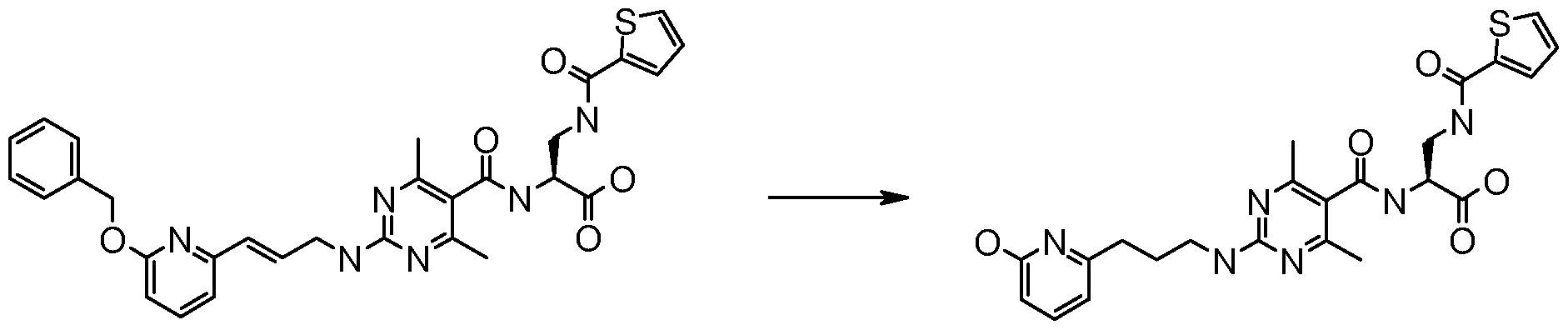
A solution of (S)-2-({2-[(E)-3-(6-benzyloxy-pyridin-2-yl)-allyamino]-4,6-dimethyl-pyrimidine- 5-carbonyl}-amino)-3-[(thiophene-2-carbonyl)-amino]-propionic acid (about O. lmmol) in ethyl acetate (about 20ml) was passed two times through H-Cube with 10% Pd/C small cartridge at 70 bar and 50 °C, at a rate of lml/min. The solution was concentrated and the residue was purified by preparative HPLC under neutral condition to give the desired product (7.7mg). MS m/e 498.9 (M+H+). Example 53: (S)-2-(|2-[3-(2-Fluoro-3-hvdroxy-phenyl)-propylamino1-4<6-dimethyl- pyrimidine-5-carbonyl|-amino)-3-[(thiophene-2-carbonyl)-amino1-propionic acid methyl ester

(S)-3-tert-Butoxycarbonylamino-2-({2-[3-(2-f uoro-3-hydroxy-phenyl)-propylamino]-4,6-di- methyl-pyrimidine-5-carbonyl}-amino)-propionic acid methyl ester (94mg, 0.18mmol) was treated with 50% TFA/CH2CI2 (3ml) at rt for 2h. Solvent and excess TFA were removed by vacuum evaporation. The residue was dissolved in anhydrous DMF (1ml) and triethylamine (0.5ml, 3.62mmol) was added at 0 °C. Thiophene-2-carboxylic acid (46.4mg, 0.36mmol), HBTU (65mg, 0.36mmol) and HOBT (49mg, 0.36mmol), were then added at rt and the mixture was stirred for 12 h. The reaction mixture was quenched with water and extracted with EtOAc. The organic extracts were combined, washed with brine, dried over sodium sulfate, filtered and evaporated. The residue was purified by flash chromatography with a 40-100% EtOAc in hexane gradient to give the title compound (47mg, 49% yield). MS m/e 529.8 (M+H+).
Example 54: (S)-2-(|2-[3-(2-Fluoro-5-hvdroxy-phenyl)-propylamino1-4<6-dimethyl- pyrimidine-5-carbonyl|-amino)-3-[(thiophene-2-carbonyl)-amino1-propionic acid methyl ester

0.36mmol) and HOBT (49mg, 0.36mmol) were successively added at rt and the mixture was stirred for 12 h. The reaction mixture was quenched with water and extracted with EtOAc. The combined organic layers were washed with brine, dried over sodium sulfate, filtered and concentrated. The residue was purified by flash chromatography with a 40-100% EtOAc in hexane gradient to give the title compound (43.5mg, 69% yield). MS m/e 529.8 (M+H+). Example 55: (S)-2-(|2-[3-(2-Methyl-5-hvdroxy-phenyl)-propylamino1-4<6-dimethyl- pyrimidine-5-carbonyl|-amino)-3-[(thiophene-2-carbonyl)-amino1-propionic acid methyl ester

(S)-3-tert-Butoxycarbonylamino-2-({2-[3-(2-methyl-5-hydroxy-phenyl)-propylamino]-4,6-di- methyl-pyrimidine-5-carbonyl}-amino)-propionic acid methyl ester (26.3mg, 0.12mmol) in MeOH (0.5ml) was treated with 4NHCl/dioxane (2ml) at rt for 1.5 h. The solution was concentrated to dryness and the residue was dissolved in anhydrous DMF (2ml). Triethylamine (31mg, 0.306mmol), thiophene-2-carboxylic acid (13mg, 0.102mmol), HBTU (39mg, 0.102mmol) and HOBT (14mg, 0.102mmol) were successively added at rt and the mixture was stirred for 2h. The reaction mixture was quenched with water and extracted with EtOAc. The combined organic
layers were washed with brine, dried over sodium sulfate, filtered and concentrated. The residue was purified by flash chromatography with a 40-100% EtOAc in hexane gradient to give the title compound (18mg, 67% yield). MS m/e 526.0 (M+H+).
Example 56: (S)-2-(|2-[3-(3-hvdroxy-phenyl)-propylamino1-pyrimidine-5-carbonyl|- amino)-3-[(thiophene-2-carbonyl)-amino1-propionic acid methyl ester

(S)-3-tert-butoxycarbonylamino-2-({2-[3-(3-hydroxy-phenyl)-propylamino]-pyrimidine-5-carb- onyl}-amino)-propionic acid methyl ester (820mg, 1.73mmol) was treated with 30% TFA in DCM (50ml) at rt for 2h. The solution was concentrated to dryness and the residue was dissolved in anhydrous DMF (20ml). Triethylamine (4.8ml, 34.6mmol), thiophene-2-carboxylic acid (266mg, 2.08mmol), HBTU (790 mg, 2.08 mmol) and HOBT (281 mg, 2.08 mmol) were successively added at rt and the mixture was stirred overnight. The reaction mixture was quenched with water and extracted with EtOAc. The combined organic layers were washed with brine, dried over sodium sulfate, filtered and concentrated. The residue was purified by flash chromatography with a 40-100% EtOAc in hexane gradient to give the desired product (220mg, 26% yield). MS m/e 483.9(M+H+).
Example 57: (S)-2-(|2-[3-(3-hvdroxy-phenyl)-propylamino1-4-methyl-pyrimidine-5- carbonyl|-amino)-3-[(thiophene-2-carbonyl)-amino1-propionic acid methyl ester

Example 58: (S)-2-(|2-[3-(3-hvdroxy-phenyl)-propylamino1-4-trifluoromethyl-pyrimidine-
5-carbonyl|-amino)-3-[(thiophene-2-carbonyl)-amino1-propionic acid methyl ester

(S)-3-tert-butoxycarbonylamino-2-({2-[3-(3-hydroxy-phenyl)-propylamino]-4-trifluoromethyl- pyrimidine-5-carbonyl}-amino)-propionic acid methyl ester (970mg, 1.79mmol) was treated at rt with 30% TFA in DCM (50ml) for 2h. The solution was concentrated to dryness and the residue was dissolved in anhydrous DMF (20ml). Triethylamine (5ml, 35.8mmol), thiophene-2-carb- oxylic acid (275.5mg, 2.15mmol), HBTU (816mg, 2.15mmol) and HOBT (290mg, 2.15mmol were successively added at rt and the mixture was stirred overnight. The reaction mixture was quenched with water and extracted with EtOAc. The combined organic layers were washed with brine, dried over sodium sulfate, filtered and concentrated. The residue was purified by flash chromatography with a 40-100% EtOAc in hexane gradient to give the title compound (450mg, 46% yield). MS m/e 552.0(M+H+).
Example 59: (S)-2-({4-Ethyl-2-[3-(3-hvdroxy-phenyl)-propylamino1-6-methyl-pyrimidine- 5-carbonyl|-amino)-3-[(thiophene-2-carbonyl)-amino1-propionic acid methyl ester

A solution of (S)-3-tert-butoxycarbonylamino-2-({4-ethyl-2-[3-(3-hydroxy-phenyl) propyl- amino] -6-methyl-pyrimidine-5-carbonyl}-amino)-propionic acid methyl ester (265mg, 0.514 mmol) was treated at rt with 50% TFA in DCM (5ml) for 2 h. The solution was concentrated to
dryness and the residue was dissolved in anhydrous DMF (5ml). Triethylamine (1.4ml, 10.28 mmol), thiophene-2-carboxylic acid (79mg, 0.617mmol), HBTU (234mg, 0.617mmol) and HOBT (83mg, 0.617mmol) were successively added at rt and the mixture was stirred overnight. The reaction mixture was quenched with water and extracted with EtOAc. The combined organic layers were washed with brine, dried over sodium sulfate, filtered and concentrated. The residue was purified by flash chromatography with a 40-100% EtOAc in hexane gradient to give the desired product (221mg, 82% yield). MS m/e 526.0 (M+H+).
Example 60: (8 -2-(|4,6-(1ί6ΐΗν1-2-[3-(3-Ην(ΐΓθχν- Η6ην1 - Γο νΐ ΐιιίηο1- ν ιιιί(1ίη6-5- carbonyl|-amino)-3-[(thiophene-2-carbonyl)-amino1-propionic acid methyl ester

(S)-3-tert-butoxycarbonylamino-2-({4,6-diethyl-2-[3-(3-hydroxy-phenyl) propylamino]-pyrimi- dine-5-carbonyl}-amino)-propionic acid methyl ester (22mg, 0.04mmol) was treated at rt with 50% TFA in DCM (2ml) for 2 h. The solution was concentrated to dryness and the residue was dissolved in anhydrous DMF (2ml). Triethylamine (84mg, 0.8mmol), thiophene-2-carboxylic acid (6.4mg, 0.05mmol), HBTU (9mg, 0.05mmol) and HOBT (7mg, 0.05mmol) were successively added at rt and the mixture was stirred overnight. The reaction mixture was quenched with water and extracted with EtOAc. The combined organic layers were washed with brine, dried over sodium sulfate, filtered and concentrated. The residue was purified by flash chromatography with a 40-100% EtOAc in hexane gradient to give the desired product (9.4mg, 42% yield). MS m/e 540.0 (M+H+).
Example 61: (S)-2-(|2-[3-(3-Hvdroxy-phenyl)-prop-2-vnylamino1-4<6-dimethyl-pyrimidine-
5-carbonyl|-amino)-3-[(thiophene-2-carbonyl)-amino1-propionic acid

A similar procedure was used to afford the following 6 examples:
Example 62: (S)-2-({2-[3-(lH-Indazol-4-yl)-prop-2-vnylamino1-4<6-dimethyl-pyrimidine-5- carbonyl|-amino)-3-[(thiophene-2-carbonyl)-amino1-propionic acid

(S)-2-({2-[3-(lH-indazol-4-yl)-prop-2ynylamino]-4,6-dimethyl-pyrimidine-5-carbonyl}-amino)- 3-[(thiophene-2-carbonyl)-amino]propionic acid methyl ester (37.3 mg, 0.07 mmol) afforded the product (21.5mg, 59% yield). MS m/e 518.0 (M+H+). Example 63: (S)-2-(|2-[3-(lH-Indazol-6-yl)-propylamino1-4<6-dimethyl-pyrimidine-5- carbonyl|-amino)-3-[(thiophene-2-carbonyl)-amino1-propionic acid

(S)-2-({2-[3-(lH-indazol-6-yl)-propylamino]-4,6-dimethyl-pyrimidine-5-carbonyl}-amino)-3- [(thiophene-2-carbonyl)-amino]propionic acid methyl ester (65mg, 0.12mmol) afforded the product (35mg, 56% yield). MS m/e 522.0 (M+H+).
Example 64: (S)-2-(|2-[3-(3-Fluoro-5-hvdroxy-phenyl)-propylamino1-4<6-dimethyl- pyrimidine-5-carbonyl|-amino)-3-[(thiophene-2-carbonyl)-amino1-propionic acid

(S)-2-({2-[3-(3-fluoro-5-hydroxy-phenyl)-propylamino]-4,6-dimethyl-pyrimidine-5-carbonyl}- amino)-3-[(thiophene-2-carbonyl)-amino]propionic acid methyl ester (18.2mg, 0.034mmol afforded the product (9.7mg, 55% yield). MS m/e 516.0 (M+H+). Example 65: (S)-2-(|2-[3-(4-Fluoro-3-hvdroxy-phenyl)-propylamino1-4<6-dimethyl- pyrimidine-5-carbonyl|-amino)-3-[(thiophene-2-carbonyl)-amino1-propionic acid

(S)-2-({2-[3-(4-fluoro-3-hydroxy-phenyl)-propylamino]-4,6-dimethyl-pyrimidine-5-carbonyl}- amino)-3-[(thiophene-2-carbonyl)-amino]propionic acid methyl ester (42mg, 0.079mmol) afforded the product (8.4mg, 21% yield). MS m/e 516.0 (M+H+).
Example 66(S)-2-(|2-[3-(3-Hvdroxy-2-methyl-phenyl)-propylamino1-4<6-dimethyl- pyrimidine-5-carbonyl|-amino)-3-[(thiophene-2-carbonyl)-amino1-propionic acid

(S)-2-({2-[3-(3-hydroxy-2-methyl-phenyl)-propylamino]-4,6-dimethyl-pyrimidine-5-carbonyl}- amino)-3-[(thiophene-2-carbonyl)-amino]propionic acid methyl ester (197mg, 0.375mmol) afforded the product (59mg, 31% yield). MS m/e 511.9 (M+H+).
Example 67: (S)-2-(|2-[3-(3-Hvdroxy-4-methyl-phenyl)-propylamino1-4<6-dimethyl- pyrimidine-5-carbonyl|-amino)-3-[(thiophene-2-carbonyl)-amino1-propionic acid

(S)-2-({2-[3-(3-hydroxy-4-methyl-phenyl)-propylamino]-4,6-dimethyl-pyrimidine-5-carbonyl}^ amino)-3-[(thiophene-2-carbonyl)-amino]propionic acid methyl ester (84.7mg, 0.16mmol) afforded the product (66mg, 81% yield). MS m/e 512.0 (M+H+). Example 68: (S)-2-(|2-[3-(2-Chloro-5-hvdroxy-phenyl)-propylamino1-4<6-dimethyl- pyrimidine-5-carbonyl|-amino)-3-[(thiophene-2-carbonyl)-amino1-propionic acid

A solution of (S)-2-({2-[3-(2-chloro-5-methoxy-phenyl)-propylamino]-4,6-dimethyl-pyrimidine- 5-carbonyl}-amino)-3-[(thiophene-2-carbonyl)-amino]propionic acid methyl ester (181mg, 0.323mmol) in anhydrous DCM (10ml) was treated at 0°C with BBr3/DCM (1M, 1.4ml,
1.4mmol). The mixture was allowed to warm up to rt and stirred for 2h, then quenched with ice water. The mixture was evaporated to dryness and the residue was dissolved in methanol (5ml). A solution of lithium hydroxide monohydrate (68mg, 1.62mmol) in water (5ml) was added and the mixture was stirred at rt for 2 h then concentrated to dryness. The residue was dissolved in THF (10ml) and treated with aqueous potassium hydrogen sulfate to pH 2-4. THF was then removed by evaporation and the mixture was diluted with cold water. The solid was collected by filtration and washed with water and cold methanol to afford the title compound (125mg, 73% yield). MS m/e 531.9 (M+H+).
Example 69: (S)-2-(|2-[3-(4-Hvdroxy-phenyl)-propylamino1-4<6-dimethyl-pyrimidine-5- carbonyl|-amino)-3-[(thiophene-2-carbonyl)-amino1-propionic acid

A similar procedure was used to afford the following 10 examples:
Example 70: (S)-2-(|2-[3-(2-Fluoro-3-hvdroxy-phenyl)-propylamino1-4<6-dimethyl- pyrimidine-5-carbonyl|-amino)-3-[(thiophene-2-carbonyl)-amino1-propionic acid

(S)-2-({2-[3-(2-fluoro-3-hydroxy-phenyl)-propylamino]-4,6-dimethyl-pyrimidine-5-carbonyl}- amino)-3-[(thiophene-2-carbonyl)-amino]propionic acid methyl ester (47mg, 0.089mmol) afforded the product (17mg, 37% yield). MS m/e 515.8 (M+H+). Example 71: (S)-2-(|2-[3-(2-Fluoro-5-hvdroxy-phenyl)-propylamino1-4<6-dimethyl- pyrimidine-5-carbonyl|-amino)-3-[(thiophene-2-carbonyl)-amino1-propionic acid

(S)-2-({2-[3-(2-fluoro-5-hydroxy-phenyl)-propylamino]-4,6-dimethyl-pyrimidine-5-carbonyl}- amino)-3-[(thiophene-2-carbonyl)-amino]-propionic acid methyl ester (43.5mg, 0.082mmol) afforded the desired product (41mg, 100% yield). MS m/e 515.8 (M+H+).
Example 72: (S)-2-(|2-[3-(2-Methyl-5-hvdroxy-phenyl)-propylamino1-4<6-dimethyl- pyrimidine-5-carbonyl|-amino)-3-[(thiophene-2-carbonyl)-amino1-propionic acid

(S)-2-({2-[3-(2-methyl-5-hydroxy-phenyl)-p^
amino)-3-[(thiophene-2-carbonyl)-amino]-propionic acid methyl ester (18mg, 0.034mmol) afforded the desired product (17mg, 100% yield). MS m/e 511.8 (M+H+). Example 73: (S)-2-(|2-[(Z)-3-(3-Hvdroxy-phenyl)-allylamino1-4<6-dimethyl-pyrimidine-5- carbonyl|-amino)-3-[(thiophene-2-carbonyl)-amino1-propionic acid

(S)-2-({2-[(Z)-3-(hydroxy-phenyl)-allylamino]-4,6-dimethyl-pyrimidine-5-carbonyl}-amino)-3- [(thiophene-2-carbonyl)-amino]-propionic acid methyl ester (352.5mg, 0.69mmol) afforded the desired product (141mg, 41% yield). MS m/e 495.9 (M+H+).
Example 74: (S)-2-(|2-[(E)-3-(3-Hvdroxy-phenyl)-allylamino1-4<6-dimethyl-pyrimidine-5- carbonyl|-amino)-3-[(thiophene-2-carbonyl)-amino1-propionic acid

(S)-2-({2-[(E)-3-(hydroxy-phenyl)-allylamino]-4,6-dimethyl-pyrimidine-5-carbonyl}-amino)-3- [(thiophene-2-carbonyl)-amino] -propionic acid methyl ester (45mg, 0.09mmol) afforded the desired product (29.5mg, 66% yield). MS m/e 495.9 (M+H+).
Example 75: (S)-2-(|2-[3-(3-Hvdroxy-phenyl)-propylamino1-pyrimidine-5-carbonyl|- amino) -3 - [(thiophene-2-carbonyl) -aminol -propionic acid

(S)-2-( { 2-[3-(3 -hydroxy-phenyl)-propylamino] -pyrimidine-5-carbonyl } -amino)-3- [(thiophene-2- carbonyl)-amino] -propionic acid methyl ester (220mg, 0.47mmol) afforded the product, (16mg, 7% yield). MS m/e 469.9 (M+H+). Example 76: (S)-2-(|2-[3-(3-Hvdroxy-phenyl)-propylamino1-4-methyl-pyrimidine-5- carbonyl|-amino)-3-[(thiophene-2-carbonyl)-amino1-propionic acid

(S)-2-({2-[3-(3-hydroxy-phenyl)-propylamino]-4-methyl-pyrimidine-5-carbonyl}-amino)-3- [(thiophene-2-carbonyl)-amino]-propionic acid methyl ester (319mg, 0.64mmol) afforded the product (221.8mg, 72% yield). MS m/e 483.9 (M+H+).
Example 77: (S)-2-({2-[3-(3-Hvdroxy-phenyl)-propylamino1-4-trfluoromethyl-pyrimidine- 5-carbonyl|-amino)-3-[(thiophene-2-carbonyl)-amino1-propionic acid

(S)-2-({2-[3-(3-hydroxy-phenyl)-propylamino]-4-trifluoromethyl-pyrimidine-5-carbonyl}- amino)-3-[(thiophene-2-carbonyl)-amino]-propionic acid methyl ester (450mg, 0.816mmol) afforded the product (305mg, 70% yield). MS m/e 538.0 (M+H+).
Example 78: (S)-2-(|4-Ethyl-2-[3-(3-hvdroxy-phenyl)-propylamino1-6-methyl-pyrimidine-
5-carbonyl|-amino)-3-[(thiophene-2-carbonyl)-amino1-propionic acid

(S)-2-({4-Ethyl-2-[3-(3-hydroxy-phenyl)-propylamino]-6-methyl-pyrimidine-5-carbonyl}- amino)-3-[(thiophene-2-carbonyl)-amino]-propionic acid methyl ester (221mg, 0.42mmol) afforded the product (62mg, 29% yield). MS m e 511.9 (M+H+). Example 79: (8)-2-(|4,6-Ρί6ΐΗν1-2-[3-(3-Ην(ΐΓθχν- Η6ην1)- Γο νΐ ΐιιίηο1- ν ιιιί(1ίη6-5- carbonyl|-amino)-3-[(thiophene-2-carbonyl)-amino1-propionic acid

(S)-2-({4,6-diethyl-2-[3-(3-hydroxy-phenyl)-propylamino]-pyrimidine-5-carbonyl}-amino)-3- [(thiophene-2-carbonyl)-amino]-propionic acid methyl ester (9.4mg, 0.02mmol) afforded the product (9mg, 100% yield). MS m/e 526.0 (M+H+).
Example 80: (S)-3-(3,5-Dihvdroxy-benzoylamino-2-(|2-[3-(3-hvdroxy-phenyl)- propylamino1-4<6-dimethyl-pyrimidine-5-carbonyl|-amino)-propionic acid methyl ester

To a mixture of (S)-3-Amino-2-({2-[3-(3-hydroxy-phenyl)-propylamino]-4,6-dimethyl-pyrimi- dine-5-carbonyl}-amino)-propionic acid methyl ester hydrochloride (77mg, 0.175mmol), 3,5- dihydroxybenzoic acid (27mg, 0.175mmol), and triethylamine (53mg, 0.525mmol) in DMF (4 mL) was added a solution of HBTU (80mg, 0.21mmol) and HOBT (28mg, 0.21mmol) in DMF (2mL). The mixture was stirred at rt 0.75h, diluted with EtOAc, washed with brine, dried over
sodium sulfate, filtered and concentrated to give the title compound (82.1mg, 87% yield). MS m/e 538.1 (M+H+).
Example 81; (S)-3-(3,5-Dihvdroxy-benzoylamino-2-(|2-[3-(3-hvdroxy-phenyl)- propylamino1-4<6-dimethyl-pyrimidine-5-carbonyl|-amino)-propionic acid

To a solution (S)-3-(3,5-Dihydroxy-benzoylamino-2-({2-[3-(3-hydroxy-phenyl)-propylamino]- 4,6-dimethyl-pyrimidine-5-carbonyl}-amino)-propionic acid methyl ester (82.1 mg, 0.153 mmol) in THF (5 mL) was added a solution of lithium hydroxide monohydrate (51 mg, 1.22 mmol) in water (6 mL). The mixture was then stirred at rt overnight. The mixture was then diluted with 0.5 N, extracted with EtOAc. The extracts were combined, washed with water and brine, dried over sodium sulfate, filtered, and purified by reverse phase HPLC to give the desired compound (2.0mg, 2.5% yield) MS m/e 524.2 (M+H+).
Example 82; (S)-3-(3-Hvdroxy-benzoylamino-2-(|2-[3-(3-hvdroxy-phenyl)-propylamino1-
4,6-dimethyl-pyrimidine-5-carbonyl|-amino)-propionic acid methyl ester

To a mixture of (S)-3-Amino-2-({2-[3-(3-hydroxy-phenyl)-propylamino]-4,6-dimethyl-pyrimi- dine-5-carbonyl}-amino)-propionic acid methyl ester hydrochloride (65mg, 0.152mmol), 3- hydroxybenzoic acid (21mg, 0.152mmol), and triethylamine (46mg, 0.456mmol) in DMF (3mL) was added a solution of HBTU (69mg, 0.182mmol) and HOBT (25mg, 0.182mmol) in DMF (lmL). The mixture was stirred at rt 1 h, diluted with brine and extracted with EtOAc. The combined organic layers were washed with brine, saturated sodium bicarbonate, and brine, dried over Na2S04, filtered, concentrated in the presence of silica gel and chromatographed (40-100% EtOAc in hexane) to afford the desired compound (42mg, 53% yield) MS m/e 521.9 (M+H+).
Example 83: (S)-3-(3-Hvdroxy-benzoylamino-2-(|2-[3-(3-hvdroxy-phenyl)-propylamino1- 4,6-dimethyl-pyrimidine-5-carbonyl|-amino)-propionic acid

To a solution (S)-3-(3-Hydroxy-benzoylamino-2-({2-[3-(3-hydroxy-phenyl)-propylamino]-4,6- dimethyl-pyrimidine-5-carbonyl}-amino)-propionic acid methyl ester (42mg, 0.081mmol) in THF (3mL) was added a solution of lithium hydroxide monohydrate (17mg, 0.41mmol) in water (4mL). The mixture was then stirred at rt 2h, treated with aqueous potassium hydrogen sulfate to pH 2-4, concentrated, filtered, and the precipitate washed with water to afford title compound (30.1mg, 74% yield). MS m/e 508.3 (M+H+). Example 84: (S)-2-(|2-[3-(3-hvdroxy-phenyl)-propylamino1-4<6-dimethyl-pyrimidine-5- carbonyl|-amino)-3-[(thiophene-3-carbonyl)-amino1-propionic acid methyl ester

To a mixture of (S)-3-Amino-2-({2-[3-(3-hydroxy-phenyl)-propylamino]-4,6-dimethyl-pyrimi- dine-5-carbonyl}-amino)-propionic acid methyl ester hydrochloride (75mg, 0.17mmol), thio- phene-3-carboxylic acid (24mg, 0.19mmol), and triethylamine (52mg, 0.51mmol) in DMF (2ml) was added a solution of HBTU (7 mg, 0.19mmol) and HOBT (26mg, 0.19mmol) in DMF (2ml). The mixture was stirred at rt overnight, diluted with brine and extracted with EtOAc. The combined organic layers were washed with 1: 1 brine- saturated sodium bicarbonate, and brine, dried over Na2S04, filtered, concentrated in the presence of silica gel and chromatographed (30- 100% EtOAc in hexane) to give the title compound (66mg, 76% yield). MS m/e 511.9 (M+H+).
Example 85: (S)-2-(|2-[3-(3-hvdroxy-phenyl)-propylamino1-4<6-dimethyl-pyrimidine-5- carbonyl|-amino)-3-[(thiophene-3-carbonyl)-amino1-propionic acid

To a solution (S)-2-({2-[3-(3-hydroxy-phenyl)-propylarnino]-4,6-dimethyl-pyrimidine-5- carbonyl}-amino)-3-[(thiophene-2-carbonyl)-amino]-propionic acid methyl ester (66.1mg, 0.129mmol) in THF (3ml) was added a solution of lithium hydroxide monohydrate (54mg, 1.29mmol) in water (4ml). The mixture was then stirred at rt for 2h, treated with aqueous potassium hydrogen sulfate to pH 2-4, diluted with water, filtered, and the precipitate washed with water to afford the title compound (38.5mg, 60% yield). MS m/e 498.1 (M+H+).
Example 86: (S)-2-(|2-[3-(3-hvdroxy-phenyl)-propylamino1-4<6-dimethyl-pyrimidine-5- carbonyl|-amino)-3-[(5-methyl-thiophene-2-carbonyl)-amino1-propionic acid methyl ester

To a mixture of (S)-3-Amino-2-({2-[3-(3-hydroxy-phenyl)-propylamino]-4,6-dimethyl-pyrimi- dine-5-carbonyl}-amino)-propionic acid methyl ester hydrochloride (75mg, 0.17mmol), 5- methyl-2-thiophenecarboxylic acid (27mg, 0.19mmol) and triethylamine (52mg, 0.51mmol) in DMF (2ml) was added a solution of HBTU (72mg, 0.19mmol) and HOBT (26mg, 0.19mmol) in DMF (2ml). The mixture was stirred at rt overnight, diluted with brine and extracted with EtOAc. The combined organic layers were washed with 1: 1 brine- saturated sodium bicarbonate and brine, dried over Na2S04, filtered, concentrated in the presence of silica gel and chromato- graphed (30-100% EtOAc in hexane) to give the desired product (70.3mg, 78% yield). MS m/e 525.8 (M+H+). Example 87: (S)-2-(|2-[3-(3-hvdroxy-phenyl)-propylamino1-4<6-dimethyl-pyrimidine-5- carbonyl|-amino)-3-[(5-methyl-thiophene-2-carbonyl)-amino1-propionic acid

To a solution (S)-2-({2-[3-(3-hydroxy-phenyl)-propylarnino]-4,6-dimethyl-pyrimidine-5- carbonyl}-amino)-3-[(5-methyl-thiophene-2-carbonyl)-amino]-propionic acid methyl ester (70.3mg, 0.13mmol) in THF (3ml) was added a solution of lithium hydroxide monohydrate (56mg, 1.34mmol) in water (4ml). The mixture was then stirred at rt for 1.5h, treated with aqueous potassium hydrogen sulfate to pH 2-4, diluted with water, filtered, and the precipitate was washed with water to afford the title compound (45.3mg, 67% yield). MS m/e 511.9 (M+H+).
Example 88: (S)-2-(|2-[3-(3-hvdroxy-phenyl)-propylamino1-4<6-dimethyl-pyrimidine-5- carbonyl|-amino)-3-[(4-methyl-thiophene-2-carbonyl)-amino1-propionic acid methyl ester

To a mixture of (S)-3-Amino-2-({2-[3-(3-hydroxy-phenyl)-propylamino]-4,6-dimethyl-pyrimi- dine-5-carbonyl}-amino)-propionic acid methyl ester hydrochloride (75mg, 0.17mmol), 4- methyl-2-thiophenecarboxylic acid (27mg, 0.19mmol), and triethylamine (52mg, 0.51mmol) in DMF (2ml) was added a solution of HBTU (72mg, 0.19mmol) and HOBT (26mg, 0.19mmol) in DMF (2ml). The mixture was stirred at rt overnight, diluted with brine, and extracted with EtOAc. The combined organic layers were washed with 1: 1 brine- saturated sodium bicarbonate), and brine, dried over Na2S04, filtered, concentrated in the presence of silica gel and chromato- graphed (30-100% EtOAc in hexane) to give the desired product (59.6mg, 66% yield. MS m/e 525.9 (M+H+). Example 89: (S)-2-(|2-[3-(3-hvdroxy-phenyl)-propylamino1-4<6-dimethyl-pyrimidine-5- carbonyl|-amino)-3-[(4-methyl-thiophene-2-carbonyl)-amino1-propionic acid

To a solution (S)-2-({2-[3-(3-hydroxy-phenyl)-propylarnino]-4,6-dimethyl-pyrimidine-5- carbonyl}-amino)-3-[(4-methyl-thiophene-2-carbonyl)-amino]-propionic acid methyl ester (59.6mg, 0.113mmol) in THF (3ml) was added a solution of lithium hydroxide monohydrate (47mg, 1.13mmol) in water (4ml). The mixture was then stirred at rt for 1.5h, treated with aqueous potassium hydrogen sulfate to pH 2-4, diluted with water, filtered, and the precipitate was washed with water to afford the title compound (46.3 mg, 82% yield). MS m/e 511.9 (M+H+).
Example 90: (S)-2-(|2-[3-(3-hvdroxy-phenyl)-propylamino1-4<6-dimethyl-pyrimidine-5- carbonyl|-amino)-3-[(3-methyl-thiophene-2-carbonyl)-amino1-propionic acid methyl ester

To a mixture of (S)-3-Amino-2-({2-[3-(3-hydroxy-phenyl)-propylamino]-4,6-dimethyl- pyrimidine-5-carbonyl}-amino)-propionic acid methyl ester hydrochloride (75mg, 0.17mmol), 3- methyl-2-thiophenecarboxylic acid (24mg, 0.17mmol), and triethylamine (52mg, 0.51mmol) in DMF (2ml) was added a solution of HBTU (72mg, 0.19mmol) and HOBT (26mg, 0.19mmol) in DMF (2ml). The mixture was stirred at rt overnight, diluted with brine (15ml) and extracted with EtOAc. The combined organic layers were washed with 1:1 brine- saturated sodium bicarbonate, and brine, dried over Na2S04, filtered, concentrated in the presence of silica gel and
chromatographed (40-100% EtOAc in hexane) to give the title compound (63.6mg, 71% yield). MS m/e 525.9 (M+H+).
Example 91; (S)-2-(|2-[3-(3-hvdroxy-phenyl)-propylamino1-4<6-dimethyl-pyrimidine-5- carbonyl|-amino)-3-[(3-methyl-thiophene-2-carbonyl)-amino1-propionic acid

To a solution (S)-2-({2-[3-(3-hydroxy-phenyl)-propylarnino]-4,6-dimethyl-pyrimidine-5- carbonyl}-amino)-3-[(3-methyl-thiophene-2-carbonyl)-amino]-propionic acid methyl ester (46.3mg, O.088mmol) in THF (3ml) was added a solution of lithium hydroxide monohydrate (37mg, O.88mmol) in water (4ml). The mixture was stirred at rt for lh, treated with aqueous potassium hydrogen sulfate to pH 2-4, diluted with water, filtered, and the precipitate was washed with water to afford the title compound (45.6 mg, 100% yield). MS m/e 511.9 (M+H+).
Example 92: (S)-2-(|2-[3-(3-hvdroxy-phenyl)-propylamino1-4<6-dimethyl-pyrimidine-5- carbonyl|-amino)-3-[(pyrazine -2-carbonyl)-aminol -propionic acid methyl ester
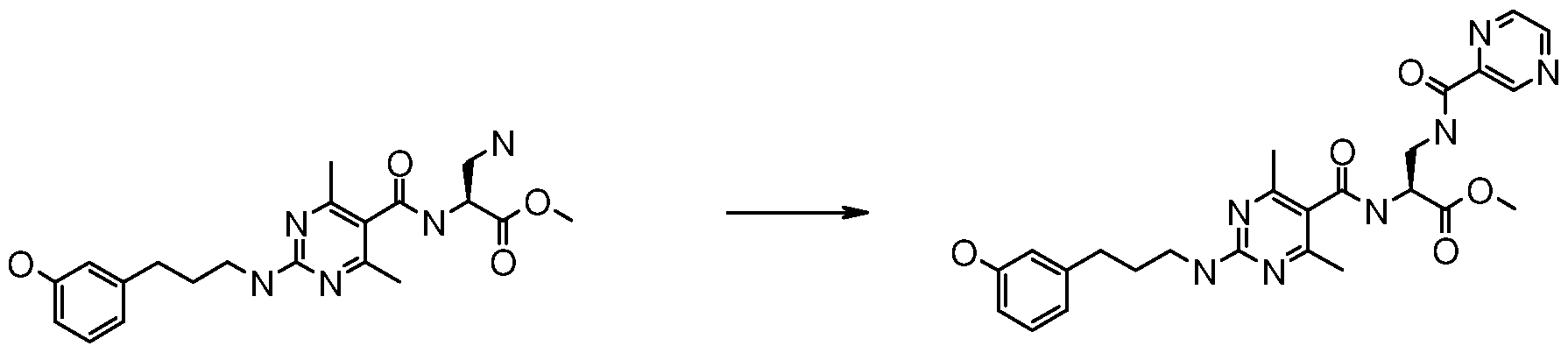
To a mixture of (S)-3-Amino-2-({2-[3-(3-hydroxy-phenyl)-propylamino]-4,6-dimethyl-pyrimi- dine-5-carbonyl}-amino)-propionic acid methyl ester hydrochloride (75mg, 0.17mmol), pyrazine-2-carboxylic acid (21mg, 0.17mmol), and triethylamine (52mg, 0.51mmol) in DMF (2ml) was added a solution of HBTU (72mg, 0.19mmol) and HOBT (26mg, 0.19mmol) in DMF (2ml). The mixture was stirred at rt overnight, diluted with brine and extracted with EtOAc. The combined organic layers were washed with 1: 1 brine- saturated sodium bicarbonate and brine, then dried over Na2S04, filtered, concentrated in the presence of silica gel and chromatographed (50-100% EtOAc in hexane) to give the desired product (37.4mg, 44% yield). MS m/e 508.0 (M+H+). Example 93: (S)-2-(|2-[3-(3-hvdroxy-phenyl)-propylamino1-4<6-dimethyl-pyrimidine-5- carbonyl|-amino)-3-[(pyrazine -2-carbonyl)-aminol -propionic acid

To a solution (S)- 2-({2-[3-(3-hydroxy-phenyl)-propylamino]-4,6-dimethyl-pyrimidine-5- carbonyl}-amino)-3-[(pyrazine-2-carbonyl)-amino]-propionic acid methyl ester (61.2mg, 0.117mmol) in THF (3ml) was added a solution of lithium hydroxide monohydrate (49mg, 1.17mmol) in water (4ml). The mixture was then stirred at rt for lh, treated with aqueous potassium hydrogen sulfate to pH 2-4, diluted with water, filtered, and the precipitate was washed with water to afford the title compound (44.1mg, 80% yield). MS m/e 509.9 (M+H+).
Example 94: (S)-3-[(5-Chloro-thiophene-2-carbonyl)-amino1-2-(|2-[3-(3-hvdroxy-phenyl)- propylamino1-4<6-dimethyl-pyrimidine-5-carbonyl|-amino)-propionic acid methyl ester

To a mixture of (S)-3-amino-2-({2-[3-(3-hydroxy-phenyl)-propylamino]-4,6-dimethyl-pyrimi- dine-5-carbonyl}-amino)-propionic acid methyl ester hydrochloride (75mg, 0.17mmol), 5- chlorothiophene-2-carboxylic acid (28mg, 0.17mmol), and triethylamine (52mg, 0.51mmol) in DMF (2ml) was added a solution of HBTU (72mg, 0.19mmol) and HOBT (26mg, 0.19mmol) in DMF (2ml). The mixture was stirred at rt overnight, diluted with brine and extracted with EtOAc. The combined organic layers were washed with 1: 1 brine- saturated sodium bicarbonate and brine, dried over Na2S04, filtered, concentrated in the presence of silica gel and
chromatographed (30-100% EtOAc in hexane) to give the desired compound (62.2mg, 67% yield). MS m/e 545.9 (M+H+). Example 95: (S)-3-[(5-Chloro-thiophene-2-carbonyl)-amino1-2-(|2-[3-(3-hvdroxy-phenyl)- propylamino1-4<6-dimethyl-pyrimidine-5-carbonyl|-amino)-propionic acid

To a solution (S)-3-[(5-Chloro-thiophene-2-carbonyl)-amino]-2-({2-[3-(3-hydroxy-phenyl)- propylamino]-4,6-dimethyl-pyrimidine-5-carbonyl}-amino)-propionic acid methyl ester (62.2mg, 0.1 lmmol) in THF (3ml) was added a solution of lithium hydroxide monohydrate (48mg, 1.14mmol) in water (4ml). The mixture was stirred at rt for 1.5h, treated with aqueous potassium hydrogen sulfate to pH 2-4, diluted with water, filtered, and the precipitate was washed with water to afford the title compound (45.7mg, 79% yield). MS m/e 532.0 (M+H+).
Example 96: (S)-2-(|2-[3-(3-hvdroxy-phenyl)-propylamino1-4<6-dimethyl-pyrimidine-5- carbonyl|-amino)-3-(3-methyl-benzoylamino)-propionic acid methyl ester

To a mixture of (S)-3-Amino-2-({2-[3-(3-hydroxy-phenyl)-propylamino]-4,6-dimethyl- pyrimidine-5-carbonyl}-amino)-propionic acid methyl ester hydrochloride (75mg, 0.17mmol), m-toluic acid (23mg, 0.17mmol), and triethylamine (52mg, 0.5 lmmol) in DMF (2ml) was added a solution of HBTU (72mg, 0.19mmol) and HOBT (26mg, 0.19 mmol) in DMF (2ml). The mixture was stirred at rt overnight, diluted with brine and extracted with EtOAc. The combined organic layers were washed with 1: 1 brine- saturated sodium bicarbonate and brine, then dried over Na2S04, filtered, concentrated in the presence of silica gel and chromatographed (30-100% EtOAc in hexane) to give the desired compound (67.5mg, 77% yield). MS m/e 520.0 (M+H+).
Example 97: (S)-2-(|2-[3-(3-hvdroxy-phenyl)-propylamino1-4<6-dimethyl-pyrimidine-5- carbonyl|-amino)-3-(3-methyl-benzoylamino)-propionic acid

To a solution (S)-2-({2-[3-(3-hydroxy-phenyl)-propylarnino]-4,6-dimethyl-pyrimidine-5- carbonyl}-amino)-3-(3-methyl-benzoylamino)-propionic acid methyl ester (67.5mg, 0.13mmol) in THF (3ml) was added a solution of lithium hydroxide monohydrate (55mg, 1.17mmol) in water (4ml). The mixture was then stirred at rt for lh, treated with aqueous potassium hydrogen sulfate to pH 2-4, diluted with water, filtered, and the precipitate was washed with water to afford the title compound (52.3mg, 80% yield). MS m/e 505.9 (M+H+).
Example 98: (S)-3-[(Adamantane-l-carbonyl)-amino1-2-(|2-[3-(3-hvdroxy-phenyl)- propylamino1-4<6-dimethyl-pyrimidine-5-carbonyl|-amino)-propionic acid methyl ester

To a mixture of (S)-3-Amino-2-({2-[3-(3-hydroxy-phenyl)-propylamino]-4,6-dimethyl- pyrimidine-5-carbonyl}-amino)-propionic acid methyl ester hydrochloride (50mg, 0.114mmol), l-adamantanecarboxylic acid (21mg, 0.114mmol), and triethylamine (35mg, 0.34mmol) in DMF (1.5ml) was added a solution of HBTU (48mg, 0.126mmol) and HOBT (17mg, 0.126mmol) in DMF (1.5ml). The mixture was stirred at rt for 2h, diluted with brine and extracted with EtOAc. The combined organic layers were washed with 1: 1 brine- saturated sodium bicarbonate and brine, dried over Na2S04, filtered, concentrated in the presence of silica gel and
chromatographed (30-100% EtOAc in hexane) to give the desired product (45.8mg, 73% yield). MS m/e 564.0 (M+H+). Example 99: (S)-3-[(Adamantane-l-carbonyl)-amino1-2-(|2-[3-(3-hvdroxy-phenyl)- propylamino1-4<6-dimethyl-pyrimidine-5-carbonyl|-amino)-propionic acid

To a solution (S)-3-[(adamantane-l-carbonyl)-amino]-2-({2-[3-(3-hydroxy-phenyl)- propylamino]-4,6-dimethyl-pyrimidine-5-carbonyl}-amino)-propionic acid methyl ester (67.5mg, 0.13mmol) in THF (3ml) was added a solution of lithium hydroxide monohydrate (55mg, 1.17mmol) in water (4ml). The mixture was then stirred at rt for lh, treated with aqueous potassium hydrogen sulfate to pH 2-4, diluted with water, filtered, and the precipitate was washed with water to afford the title compound (52.3mg, 80% yield). MS m/e 505.9 (M+H+).
Example 100: (S)-2-(|2-[3-(3-Hvdroxy-phenyl)-propylamino1-4<6-dimethyl-pyrimidine-5- carbonyl|-amino)-3-[(5-methyl-pyrazine -2-carbonyl)-amino1-propionic acid methyl ester

To a mixture of (S)-3-amino-2-({2-[3-(3-hydroxy-phenyl)-propylamino]-4,6-dimethyl- pyrimidine-5-carbonyl}-amino)-propionic acid methyl ester hydrochloride (50mg, 0.114mmol), 5-methyl piperazinecarboxylic acid (16mg, 0.114mmol), and triethylamine (35mg, 0.34mmol) in DMF (1.5ml) was added a solution of HBTU (48mg, 0.126mmol) and HOBT (17mg, 0.126mmol) in DMF (1.5ml). The mixture was stirred at rt for 2.5h, diluted with brine and extracted with EtOAc. The combined organic layers were washed with 1: 1 brine- saturated sodium bicarbonate and brine, dried over Na2S04, filtered, concentrated in the presence of silica gel and
chromatographed (40-100% EtOAc in hexane) to give the title compound (32.9mg, 59% yield). MS m/e 522.0 (M+H+). Example 101: (S)-2-(|2-[3-(3-Hvdroxy-phenyl)-propylamino1-4<6-dimethyl-pyrimidine-5- carbonyl|-amino)-3-[(5-methyl-pyrazine -2-carbonyl)-amino1-propionic acid

To a solution (S)- 2-({2-[3-(3-hydroxy-phenyl)-propylamino]-4,6-dimethyl-pyrimidine-5- carbonyl}-amino)-3-[(5-methyl-pyrazine-2-carbonyl)-amino]-propionic acid methyl ester (32.9mg, 0.063mmol) in THF (3ml) was added a solution of lithium hydroxide monohydrate (26mg, 0.63mmol) in water (4ml). The mixture was then stirred at rt for lh, treated with aqueous potassium hydrogen sulfate to pH 2-4, diluted with water, filtered, and the precipitate was washed with water to afford the title compound (25.4 mg, 78% yield). MS m/e 507.9 (M+H+).
Example 102: (S)-3-[(3-Chloro-thiophene-2-carbonyl)-amino1-2-(|2-[3-(3-hvdroxy-phenyl)- propylamino1-4<6-dimethyl-pyrimidine-5-carbonyl|-amino)-propionic acid methyl ester

To a mixture of (S)-3-amino-2-({2-[3-(3-hydroxy-phenyl)-propylamino]-4,6-dimethyl-pyrimi- dine-5-carbonyl}-amino)-propionic acid methyl ester hydrochloride (50mg, 0.114mmol), 3- chlorothiophenecarboxylic acid (19mg, 0.114mmol), and triethylamine (35mg, 0.34mmol) in DMF (1.5ml) was added a solution of HBTU (48mg, 0.126mmol) and HOBT (17mg, 0.126mmol) in DMF (1.5ml). The mixture was stirred at rt overnight, diluted with brine and extracted with EtOAc. The combined organic layers were washed with 1:1 brine- saturated sodium bicarbonate and brine, dried over Na2S04, filtered, concentrated in the presence of silica gel and chromato- graphed (30-100% EtOAc in hexane) to give the title compound (45.8mg, 92% yield). MS m/e 545.9 (M+H+). Example 103: (S)-3-[(3-Chloro-thiophene-2-carbonyl)-amino1-2-(|2-[3-(3-hvdroxy-phenyl)- propylamino1-4<6-dimethyl-pyrimidine-5-carbonyl|-amino)-propionic acid

To a solution (S)-3-[(3-chloro-thiophene-2-carbonyl)-amino]-2-({2-[3-(3-hydroxy-phenyl)- propylamino]-4,6-dimethyl-pyrimidine-5-carbonyl}-amino)-propionic acid methyl ester (45.8mg, 0.084mmol) in THF (3ml) was added a solution of lithium hydroxide monohydrate (35mg, 0.84mmol) in water (4ml). The mixture was then stirred at rt for lh, treated with aqueous potassium hydrogen sulfate to pH 2-4, diluted with water, filtered, and the precipitate was washed with water to afford the title compound (28.1mg, 66% yield). MS m/e 531.9 (M+H+).
Example 104: (S)-[(5-Ethyl-thiophene-2-carbonyl)-amino1-2-(|2-[3-(3-hvdroxy-phenyl)- propylamino1-4<6-dimethyl-pyrimidine-5-carbonyl|-amino)-3-propionic acid methyl ester

To a mixture of (S)-3-amino-2-({2-[3-(3-hydroxy-phenyl)-propylamino]-4,6-dimethyl- pyrimidine-5-carbonyl}-amino)-propionic acid methyl ester hydrochloride (53mg, 0.121mmol), 5-ethylthiophenecarboxylic acid (19mg, 0.121mmol), and triethylamine (37mg, 0.363mmol) in DMF (1.5ml) was added a solution of HBTU (50mg, O.133mmol) and HOBT (18mg, O.133mmo in DMF (1.5ml). The mixture was stirred at rt overnight, diluted with brine and extracted with EtOAc. The combined organic layers were washed with 1:1 brine- saturated sodium bicarbonate and brine, dried over Na2S04, filtered, concentrated in the presence of silica gel and
chromatographed (30-100% EtOAc in hexane) to give the desired product (36.8mg, 58% yield). MS m/e 539.8 (M+H+). Example 105: (S)-[(5-Ethyl-thiophene-2-carbonyl)-amino1-2-(|2-[3-(3-hvdroxy-phenyl)- propylamino1-4<6-dimethyl-pyrimidine-5-carbonyl|-amino)-3-propionic acid

To a solution (S)-3-[(5-ethyl-thiophene-2-carbonyl)-amino]-2-({2-[3-(3-hydroxy-phenyl)- propylamino]-4,6-dimethyl-pyrimidine-5-carbonyl}-amino)-propionic acid methyl ester (36.8mg, 0.068mmol) in THF (3ml) was added a solution of lithium hydroxide monohydrate (28mg, 0.68mmol) in water (4ml). The mixture was stirred at rt 1.5h, treated with aqueous potassium hydrogen sulfate to pH 2-4, diluted with water, filtered, and the precipitate was washed with water to afford the title compound (23.9mg, 67% yield). MS m/e 525.9 (M+H+).
Example 106: (S)-2-(|4,6-Dimethyl-2-[3-(3-phenyl carbamoyloxy-phenvD-propylaminol- pyrimidine-5-carbonyl|-amino)-3-(3-phenyl-ureido)-propionic acid methyl ester

A mixture of (S)-3-amino-2-({2-[3-(3-hydroxy-phenyl)-propylamino]-4,6-dimethyl-pyrimidine- 5-carbonyl}-amino)-propionic acid methyl ester hydrochloride (50mg, 0.114mmol), phenyl isocyanate (45mg, O.38mmol), triethylamine (38mg, O.38mmol) and DMF (3ml) was stirred at rt overnight, diluted with EtOAc, washed with brine, dried over Na2S04, filtered, concentrated in the presence of silica gel and chromatographed (0-100% EtOAc in hexane) to give the desired product (36.8mg, 53% yield)
Example 107: (S)-2-(|2-[3-(3-hvdroxy-phenyl)-propylamino1-4<6-dimethyl-pyrimidine-5- carbonyl|-amino)-3-(3-phenyl-ureido)-propionic acid

To a solution of (S)-2-({4,6-Dimethyl-2-[3-(3-phenyl carbamoyloxy-phenyl)-propylamino]- pyrimidine-5-carbonyl}-amino)-3-(3-phenyl-ureido)-propionic acid methyl ester (36.8mg, 0.058mmol) in THF (3ml) was added a solution of lithium hydroxide monohydrate (24mg, 0.575mmol) in water (4ml). The mixture was stirred at rt for 1.5h, treated with aqueous potassium hydrogen sulfate to pH 2-4, diluted with water, filtered, and the precipitate was washed with water to afford title compound, (18.8mg, 62% yield). MS m/e 507.9 (M+H+).
Example 108: (S)-2-(|2-[3-(3-Hvdroxy-phenyl)-propylamino1-4<6-dimethyl-pyrimidine-5- carbonyl|-amino)-3-methoxycarbonylamino-propionic acid methyl ester

A mixture of (S)-3-amino-2-({2-[3-(3-hydroxy-phenyl)-propylamino]-4,6-dimethyl-pyrimidine- 5-carbonyl}-amino)-propionic acid methyl ester hydrochloride (50mg, 0.114mmol), methyl chloroformate (32mg, 0.342mmol), triethylamine (58mg, 0.57mmol) and DMF (3ml) was stirred at rt overnight, diluted with brine and extracted with EtOAc. The combined organic layers were washed with brine, dried over Na2S04, filtered, concentrated in the presence of silica gel and chromatographed (40-100% EtOAc in hexane) to give the title compound (30.9mg, 57% yield)
Example 109: (S)-2-(|2-[3-(3-Hvdroxy-phenyl)-propylamino1-4<6-dimethyl-pyrimidine-5- carbonyl|-amino)-3-methoxycarbonylamino-propionic acid

Example 110: (S)-3-Benzyloxycarbonylamino-2-(|2-[3-(3-Hvdroxy-phenyl)-propylamino1-
4,6-dimethyl-pyrimidine-5-carbonyl|-amino)-propionic acid methyl ester

A mixture of (S)-3-amino-2-({2-[3-(3-hydroxy-phenyl)-propylamino]-4,6-dimethyl-pyrimidine- 5-carbonyl}-amino)-propionic acid methyl ester hydrochloride (50mg, 0.114mmol), benzyl chloroformate (21mg, 0.125mmol), triethylamine (38mg, O.38mmol) and DMF (3ml) was stirred at rt overnight, diluted with brine and extracted with EtOAc. The combined organic layers were washed with brine, dried over Na2S04, filtered, concentrated in the presence of silica gel and chromatographed (30-100% EtOAc in hexane) to give the desired product (12.6mg, 21% yield).
Example 111: (S)-3-Benzyloxycarbonylamino-2-(|2-[3-(3-Hvdroxy-phenyl)-propylamino1- 4,6-dimethyl-pyrimidine-5-carbonyl|-amino)-propionic acid

Example 112: (S)-3-(3,3-Dimethyl-ureido)-2-(|2-[3-(3-Hvdroxy-phenyl)-propylamino1-4<6- dimethyl-pyrimidine-5-carbonyl|-amino)-propionic acid methyl ester

A solution of (S)-3-amino-2-({2-[3-(3-hydroxy-phenyl)-propylamino]-4,6-dimethyl-pyrimidine- 5-carbonyl}-amino)-propionic acid methyl ester hydrochloride (53mg, 0.121mmol),
dimethylcarbamyl chloride (16mg, 0.145mmol), triethylamine (40 mg, 0.40 mmol) in DMF (2.5ml) was stirred at rt overnight, diluted with brine and extracted with EtOAc. The combined organic layers were washed with brine, dried over Na2S04, filtered, concentrated in the presence of silica gel and chromatographed (0-10 % MeOH in EtOAc) to give the desired product (35.7mg, 63% yield).
Example 113: (S)-3-(3,3-Dimethyl-ureido)-2-(|2-[3-(3-Hvdroxy-phenyl)-propylamino1-4<6- dimethyl-pyrimidine-5-carbonyl|-amino)-propionic acid

To a solution of (S)-3-(3,3-dimethyl-ureido)-2-({2-[3-(3-hydroxy-phenyl)-propylamino]-4,6- dimethyl-pyrimidine-5-carbonyl}-amino)-propionic acid methyl ester (35.7mg, 0.024 mmol) in THF (3ml) was added a solution of lithium hydroxide monohydrate (32mg, 0.755mmol) in water (4ml). The mixture was stirred at rt lh, treated with aqueous potassium hydrogen sulfate to pH 2- 4, diluted with water and extracted with EtOAc. The combined organic layers were washed with brine, dried over Na2S04, filtered, and concentrated to afford the desired product (10.2mg, 91% yield). MS m/e 459.0 (M+H+).
Example 114: (S)-3-[(3,4-Dihvdro-2H-quinoline-l-carbonyl)-amino1-2-(|2-[3-(3-hydroxy- phenyl)-propylamino1-4<6-dimethyl-pyrimidine-5-carbonyl|-amino)-propionic acid methyl ester

Example 115: (S)-3-[(3,4-Dihvdro-2H-quinoline-l-carbonyl)-amino1-2-(|2-[3-(3-hydroxy- phenyl)-propylamino1-4<6-dimethyl-pyrimidine-5-carbonyl|-amino)-propionic acid

Example 116: (S)-2-|[2-(8-Hvdroxy-l<2<3,4-tetrahydro-naphthalen-2-ylamino)-4<6- dimethyl-pyrimidine-5-carbonyl1-amino|-3-[(pyrazine-2-carbonyl)-amino1-propionic acid methyl ester

To a mixture of (S)-3-Amino-2-{ [2-(8-hydroxy-l,2,3,4-tetrahydro-naphthalen-2-ylamino)-4,6- dimethyl-pyrimidine-5-carbonyl] -amino} -propionic acid methyl ester hydrochloride (50 mg, 0.111 mmol), Pyrazine-2-carboxylic acid (14 mg, 0.111 mmol), and Triethylamine (34 mg, 0.333 mmol) in DMF (1.5 mL) was added a solution of HBTU (46 mg, 0.122 mmol) and HOBT (16 mg, 0.122 mmol) in DMF (1.5 mL). The mixture was stirred at rt 2 h, diluted with brine (20 mL) and extracted with EtOAc (2 x 15 mL). The combined organic layers were washed with 1: 1 brine- saturated sodium bicarbonate (2 x 20 mL), and brine (15 mL), dried over Na2S04, filtered, concentrated in the presence of silica gel and chromatographed (30-100% EtOAc in hexane) to give 24.7 mg title compound. MS m/e 520.0 (M+H+).
Example 117: (S)-2-|[2-(8-Hvdroxy-l<2<3.l4-tetrahvdro-naphthalen-2-ylamino)-4<6- dimethyl-pyrimidine-5-carbonyl1-amino|-3-[(pyrazine-2-carbonyl)-amino1-propionic acid
To a solution of (S)-2-{ [2-(8-Hydroxy-l,2,3,4-tetrahydro-naphthalen-2-ylamino)-4,6-dimethyl- pyrimidine-5-carbonyl]-amino}-3-[(pyrazine-2-carbonyl)-amino]-propionic acid methyl ester(24.7 mg, 0.048 mmol) in THF (2 mL) was added a solution of lithium hydroxide monohydrate (20 mg, 0.48 mmol) in water (3 mL). The mixture was then stirred at rt 1 h, treated with potassium hydrogen sulfate aqueous solution to pH 2-4, diluted with water (20 mL) , extracted with EtOAc (3 15 mL). The organic layers were combined, and washed with water (2 x 20 mL) to afford 8.7 mg title compound. MS m/e 505.9 (M+H+).
Example 118: (S)-2-(|2-[3-(3-Hvdroxy-phenyl)-propylamino1-4<6-dimethyl-pyrimidine-5- carbonyl|-amino)-3-[(thiophene-2-carbonyl)-amino1-propionic acid 2,2-dimethyl-propyl ester

A mixture of (S)-2-({2-[3-(3-Hydroxy-phenyl)-propylamino]-4,6-dimethyl-pyrimidine-5- carbonyl}-amino)-3-[(thiophene-2-carbonyl)-amino]-propionic acid (20mg, 0.04mmol), thionyl chloride (150μ1), and neopentyl alcohol (35mg, 0.4mmol) in dioxane (0.5ml) was heated to 100 °C in a sealed tube overnight. The mixture was diluted with EtOAc, washed with water and brine, then dried over Na2S04, filtered, concentrated in the presence of silica gel and
chromatographed (30-100% EtOAc in hexane) to give the desired product (14.9mg, 66% yield). MS m/e 568.1 (M+H+).
Example 119: (S)-2-(|2-[3-(3-Hvdroxy-phenyl)-propylamino1-4<6-dimethyl-pyrimidine-5- carbonyl|-amino)-3-[(thiophene-2-carbonyl)-amino1-propionic acid butyl ester

A mixture of (S)-2-({2-[3-(3-hydroxy-phenyl)-propylamino]-4,6-dimethyl-pyrimidine-5- carbonyl}-amino)-3-[(thiophene-2-carbonyl)-amino]-propionic acid (50mg, O.lmmol) and thionyl chloride (22μί) in dioxane (1ml) was stirred at rt 2h. 1-butanol (23mg, 0.31mmol) was added. After 1 h, the mixture was diluted with EtOAc, washed with brine, then dried over Na2S04, filtered, concentrated in the presence of silica gel and chromatographed (20-100% EtOAc in hexane) to give the title compound (31.3mg, 56% yield). MS m/e 554.3 (M+H+).
Example 120: (S)-2-(|2-[3-(3-Hvdroxy-phenyl)-propylamino1-4<6-dimethyl-pyrimidine-5- carbonyl|-amino)-3-[(thiophene-2-carbonyl)-amino1-propionic acid 3-morpholin-4-yl- propyl ester

Example 121: (S)-2-(|2-[3-(3-Hvdroxy-phenyl)-propylamino1-4<6-dimethyl-pyrimidine-5- carbonyl|-amino)-3-[(thiophene-2-carbonyl)-amino1-propionic acid 2-morpholin-4-yl-ethyl ester

A mixture of (S)-2-({2-[3-(3-hydroxy-phenyl)-propylamino]-4,6-dimethyl-pyrimidine-5- carbonyl}-amino)-3-[(thiophene-2-carbonyl)-amino]-propionic acid (50mg, O.lmmol) and thionyl chloride (22μ1) in dioxane (1ml) was stirred at rt 2h. 4-(2-hydroxyethyl)morpholine (41mg, 0.31mmol) and triethylamine (3 lmg, 0.3 lmmol) was added. After 4 h, the mixture was diluted with pH 9 Buffer and extracted with EtOAc. The combined organic layers were washed with brine, dried over Na2S04, filtered, concentrated in the presence of silica gel and
chromatographed (0-20% MeOH in EtOAc) to give the desired product (11. lmg, 18% yield). MS m/e 611.1 (M+H+). Example 122: (S)-2-(|2-[3-(3-Hvdroxy-phenyl)-propylamino1-4<6-dimethyl-pyrimidine-5- carbonyl|-amino)-3-[(thiophene-2-carbonyl)-amino1-propionic acid propyl ester

A mixture of (S)-2-({2-[3-(3-hydroxy-phenyl)-propylamino]-4,6-dimethyl-pyrimidine-5- carbonyl}-amino)-3-[(thiophene-2-carbonyl)-amino]-propionic acid (50mg, O.lmmol) and thionyl chloride (22μ1) in dioxane (1ml) was stirred at rt for 90 minutes. 1-propanol (19mg,
0.31mmol) was added. After 1.5h, the mixture was diluted with EtOAc, washed with brine, dried over Na2S04, filtered, concentrated in the presence of silica gel and chromatographed (30- 100% EtOAc in hexane) to give the title compound (27.6mg, 52% yield). MS m/e 540.0 (M+H+).
Example 123: (S)-2-(|2-[3-(3-Hvdroxy-phenyl)-propylamino1-4<6-dimethyl-pyrimidine-5- carbonyl|-amino)-3-[(thiophene-2-carbonyl)-amino1-propionic acid isobutyl ester

A mixture of (S)-2-({2-[3-(3-hydroxy-phenyl)-propylamino]-4,6-dimethyl-pyrimidine-5- carbonyl}-amino)-3-[(thiophene-2-carbonyl)-amino]-propionic acid (50mg, O.lmmol) and thionyl chloride (22μ1) in dioxane (1ml) was stirred at rt for 2h. 2-methyl-l-propanol (23mg, 0.31mmol) was added. After 4h, the mixture was diluted with EtOAc, washed with brine, dried over Na2S04, filtered, concentrated in the presence of silica gel and chromatographed (30-100% EtOAc in hexane) to give the desired product (33.4mg, 61% yield). MS m/e 553.9 (M+H+).
Example 124: (S)-2-(|2-[3-(3-Hvdroxy-phenyl)-propylamino1-4<6-dimethyl-pyrimidine-5- carbonyl|-amino)-3-[(thiophene-2-carbonyl)-amino1-propionic acid isopropyl ester

A mixture of (S)-2-({2-[3-(3-hydroxy-phenyl)-propylamino]-4,6-dimethyl-pyrimidine-5- carbonyl}-amino)-3-[(thiophene-2-carbonyl)-amino]-propionic acid (50mg, O.lmmol) and thionyl chloride (22μ1) in dioxane (1ml) was stirred at rt for 2h. 2-propanol (19mg, 0.31mmo was added. After 18h, the mixture was diluted with EtOAc, washed with brine, dried over Na2S04, filtered, concentrated in the presence of silica gel and chromatographed (30-100% EtOAc in hexane) to give the title compound (26.7 mg, 49% yield). MS m/e 540.2 (M+H+).
Example 125: (S)-2-(|2-[3-(3-Hvdroxy-phenyl)-propylamino1-4<6-dimethyl-pyrimidine-5- carbonyl|-amino)-3-[(thiophene-2-carbonyl)-amino1-propionic acid 1-ethyl-propyl ester

A mixture of (S)-2-({2-[3-(3-hydroxy-phenyl)-propylamino]-4,6-dimethyl-pyrimidine-5- carbonyl}-amino)-3-[(thiophene-2-carbonyl)-amino]-propionic acid (0.70g, 1.4mmol) and thionyl chloride (0.40g) in dioxane (14ml) was stirred at rt for 2h. 3-pentanol (1 lOmg,
0.31mmol) was added. After 18h, the mixture was diluted with EtOAc, washed with brine, dried over Na2S04, filtered, concentrated in the presence of silica gel and chromatographed (30-100% EtOAc in hexane) to give the desired product (302. lmg, 38% yield). MS m/e 568.1 (M+H+).
Example 126: (S)-2-(|2-[3-(3-Hvdroxy-phenyl)-propylamino1-4<6-dimethyl-pyrimidine-5- carbonyl|-amino)-3-[(thiophene-2-carbonyl)-amino1-propionic acid cyclopentyl ester

A mixture of (S)-2-({2-[3-(3-Hydroxy-phenyl)-propylamino]-4,6-dimethyl-pyrimidine-5- carbonyl}-amino)-3-[(thiophene-2-carbonyl)-amino]-propionic acid (0.75g, 1.51mmol) and thionyl chloride (0.54g, 4.52mmol) in dioxane (15ml) was stirred at rt 2h. Cyclopentanol (0.39g, 4.52mmol) was added. After 1.5h, the mixture was diluted with EtOAc, washed with brine, dried over Na2S04, filtered, concentrated in the presence of silica gel and chromatographed (30- 100% EtOAc in hexane) to give the desired product (250mg, 29% yield). MS m/e 566.1 (M+H+).
Example 127: (S)-2-(|2-[3-(3-Hvdroxy-phenyl)-propylamino1-4<6-dimethyl-pyrimidine-5- carbonyl|-amino)-3-[(thiophene-2-carbonyl)-amino1-propionic acid
dimethylcarbamoylmethyl ester

Example 128: (S)-2-(|2-[3-(3-Hvdroxy-phenyl)-propylamino1-4<6-dimethyl-pyrimidine-5- carbonyl|-amino)-3-[(thiophene-2-carbonyl)-amino1-propionic acid 3-ethoxy-propyl ester

A mixture of (S)-2-({2-[3-(3-Hydroxy-phenyl)-propylamino]-4,6-dimethyl-pyrimidine-5- carbonyl}-amino)-3-[(thiophene-2-carbonyl)-amino]-propionic acid (0.63g, 1.26mmol), 1- bromo-3-ethoxy-propane (0.84g, 5.03mmol), sodium iodide (0.75g, 5.03mmol) and
triethylamine (0.5 lg, 5.03mmol) in DMF (4ml) was microwaved at 120 °C for 20 minutes. The mixture was diluted with EtOAc, washed with brine, dried over Na2S04, filtered, concentrated in the presence of silica gel and chromatographed (30-100% EtOAc in hexane) to give the desired product (280.4mg, 38% yield). MS m/e 584.0 (M+H+).
Example 129: (S)-2-(|2-[3-(3-Hvdroxy-phenyl)-propylamino1-4<6-dimethyl-pyrimidine-5- carbonyl|-amino)-3-[(thiophene-2-carbonyl)-amino1-propionic acid tetrahvdro-pyran-4-yl ester

A mixture of (S)-2-({2-[3-(3-hydroxy-phenyl)-propylamino]-4,6-dimethyl-pyrimidine-5- carbonyl}-amino)-3-[(thiophene-2-carbonyl)-amino]-propionic acid (50mg, O.lmmol) and thionyl chloride (46μ1) in dioxane (1ml) was stirred at rt for 2h. Tetrahydro-4-pyranol (0.20g, 2.0mmol) was added and the mixture was microwaved at 90°C for 20 minutes. The mixture was
diluted with EtOAc, washed with brine, dried over Na2S04, filtered, concentrated in the presence of silica gel and chromatographed (30-100% EtOAc in hexane) to give the desired product (26.0mg, 45% yield). MS m/e 582.2 (M+H+).
Example 130: (S)-2-(|2-[3-(3-Hvdroxy-phenyl)-propylamino1-4<6-dimethyl-pyrimidine-5- carbonyl|-amino)-3-[(thiophen-2-carbonyl)-amino1-propionic acid 2,2-dimethyl- propionyloxymethyl ester

A solution of (S)-2-({2-[3-(hydroxyl-phenyl)-propylarnino]-4,6-dimethyl-pyrimidine-5- carbonyl}-amino)-3-[(thiophene-2-carbonyl)-amino]-propionic acid (50mg, O.lmmol), 2,2- dimethyl-propionic acid chloromethyl ester (15.1mg, O. lmmol), and triethylamine (lOmg, O. lmmol) in anhydrous DMF (3ml) was stirred at 80°C overnight. The reaction mixture was cooled to rt, quenched with water and extracted with EtOAc. The organic layer was washed with water and brine, dried over sodium sulfate, filtered and concentrated. The residue was purified by flash chromatography with 10% MeOH in DCM to give the desired product (31mg, 51% yield) pure product. MS m/e 612.1 (M+H+).
Example 131: (S)-2-(|2-[3-(3-Hvdroxy-phenyl)-propylamino1-4<6-dimethyl-pyrimidine-5- carbonyl|-amino)-3-[(thiophene-2-carbonyl)-amino1-propionic acid l-(2,2-dimethyl- propionyloxy) -ethyl ester

Example 132: (S)-2-(|2-[3-(3-Hvdroxy-phenyl)-propylamino1-4<6-dimethyl-pyrimidine-5- carbonyl|-amino)-3-[(thiophene-2-carbonyl)-amino1-propionic acid l-isobutyryloxy-ethyl ester

A mixture of (S)-2-({2-[3-(3-hydroxy-phenyl)-propylamino]-4,6-dimethyl-pyrimidine-5- carbonyl}-amino)-3-[(thiophene-2-carbonyl)-amino]-propionic acid (0.20g, 0.40mmol), Isobutyric acid 1-chloro-ethyl ester (0.18g, 1.2mmol), sodium iodide (0.18g, 1.2mmol) and triethylamine (0.12g, 1.2mmol) in DMF (2.5ml) was microwaved at 120°C for 20 minutes. The mixture was diluted with EtOAc, washed with brine, dried over Na2S04, filtered, concentrated in the presence of silica gel and chromatographed (20-100% EtOAc in hexane) to give the desired compound (103.3mg, 42% yield). MS m/e 612.2 (M+H+).
Example 133: (S)-2-(|2-[3-(3-Hvdroxy-phenyl)-propylamino1-4<6-dimethyl-pyrimidine-5- carbonyl|-amino)-3-[(thiophene-2-carbonyl)-amino1-propionic acid 2-(2-ethoxy-ethoxy)- ethyl ester

A mixture of (S)-2-({2-[3-(3-Hydroxy-phenyl)-propylamino]-4,6-dimethyl-pyrimidine-5- carbonyl}-amino)-3-[(thiophene-2-carbonyl)-amino]-propionic acid (0.20g, 0.40mmol), l-(2- bromoethoxy)-2-ethoxyethane (0.32g, 1.6mmol), sodium iodide (0.24g, 1.6mmol) and triethylamine (0.16g, 1.6mmol) in DMF (3ml) was microwaved at 120°C for 20 minutes. The mixture was diluted with EtOAc (50ml), washed with brine, dried over Na2S04, filtered, concentrated in the presence of silica gel and chromatographed (50-100% EtOAc in hexane) to give the title compound (135.4mg, 55% yield). MS m/e 614.2 (M+H+).
Example 134: (S)-2-(|2-[3-(3-Hvdroxy-phenyl)-propylamino1-4<6-dimethyl-pyrimidine-5- carbonyl|-amino)-3-[(thiophene-2-carbonyl)-amino1-propionic acid 2-ethoxy-ethyl ester

A mixture of (S)-2-({2-[3-(3-hydroxy-phenyl)-propylamino]-4,6-dimethyl-pyrimidine-5- carbonyl}-amino)-3-[(thiophene-2-carbonyl)-amino]-propionic acid (0.20g, 0.40mmol), 2- bromoethyl ethyl ether (0.3 lg, 2.0mmol), sodium iodide (0.30g, 2.0mmol) and triethylamine (0.20g, 2.0 mmol) in DMF (2.5ml) was microwaved at 120°C for 20 minutes. The mixture was diluted with EtOAc, washed with brine, dried over Na2S04, filtered, concentrated in the presence of silica gel and chromatographed (30-100% EtOAc in hexane) to give the title compound (124. lmg, 54% yield). MS m/e 570.2 (M+H+).
Example 135: (S)-2-(|2-[3-(3-Acetoxy-phenyl)-propylamino1-4<6-dimethyl-pyrimidine-5- carbonyl|-amino)-3-[(thiophene-2-carbonyl)-amino1-propionic acid 3-ethoxy-propyl ester

A mixture of (S)-2-({2-[3-(3-hydroxy-phenyl)-propylamino]-4,6-dimethyl-pyrimidine-5- carbonyl}-amino)-3-[(thiophene-2-carbonyl)-amino]-propionic acid 3-ethoxy-propyl ester (0.05g, 0.086mmol), acetic anhydride (0.25ml) and pyridine (0.25ml) was stirred at rt for 3h, diluted with water, and extracted with EtOAc. The organic layer was washed with water, dried over Na2S04, filtered, concentrated in the presence of silica gel and chromatographed (20-100% EtOAc in hexane) to give the desired product (41. lmg, 78% yield). MS m/e 626.0 (M+H+). Example 136: (S)-2-(|2-[3-(3-Isobutyryloxy-phenyl)-propylamino1-4<6-dimethyl-pyrimi- dine-5-carbonyl|-amino)-3-[(thiophene-2-carbonyl)-amino1-propionic acid 3-ethoxy-propyl ester

A mixture of (S)-2-({2-[3-(3-hydroxy-phenyl)-propylamino]-4,6-dimethyl-pyrimidine-5- carbonyl}-amino)-3-[(thiophene-2-carbonyl)-amino]-propionic acid 3-ethoxy-propyl ester (0.154g, 0.26mmol), isobutyric anhydride (0.6ml) and pyridine (0.6ml) was stirred at rt for lh, diluted with EtOAc, washed with water, dried over Na2S04, filtered, concentrated in the presence of silica gel and chromatographed (20-100% EtOAc in hexane) to give the desired product (141.3mg, 83% yield). MS m/e 654.1 (M+H+).
Example 137: (S)-2-(|2-[3-(lH-Indazol-4-yl)-propylamino1-4<6-dimethyl-pyrimidine-5- carbonyl|-amino)-3-[(thiophene-2-carbonyl)-amino1-propionic acid butyl ester

A mixture of (S)-2-({2-[3-(lH-indazol-4-yl)-propylamino]-4,6-dimethyl-pyrimidine-5- carbonyl}-amino)-3-[(thiophene-2-carbonyl)-amino]-propionic acid (0.05g, 0.095mmol), iodobutane (0.021g, 0.114mmol), and potassium carbonate (0.016g, 0.114mmol) in DMF (1ml) was stirred at rt overnight. The mixture was diluted with EtOAc, washed with brine, dried over Na2S04, filtered, concentrated in the presence of silica gel and chromatographed (50-100% EtOAc in hexane) to give the desired product (38.2mg, 58% yield). MS m/e 578.2 (M+H+).
Example 138: (8)-2-(|2-[3-(1Η-Ιηά3ζο1-4-ν1)-ρΓορνΐ3ηιίηο1-4,6-άίηΐ6Ϊΐιν1-ρνηιιιίάίη6-5- carbonyl|-amino)-3-[(thiophene-2-carbonyl)-amino1-propionic acid ethyl ester

Example 139: (S)-2-(|2-[3-(lH-Indazol-4-yl)-propylamino1-4<6-dimethyl-pyrimidine-5- carbonyl|-amino)-3-[(thiophene-2-carbonyl)-amino1-propionic acid cyclopentyl ester

Example 140: (S)-2-({2-[3-(lH-Indazol-4-yl)-propylamino1-4<6-dimethyl-pyrimidine-5- carbonyl|-amino)-3-[(thiophene-2-carbonyl)-amino1-propionic acid isobutyl ester

A mixture of (S)-2-({2-[3-(lH-indazol-4-yl)-propylamino]-4,6-dimethyl-pyrimidine-5- carbonyl}-amino)-3-[(thiophene-2-carbonyl)-amino]-propionic acid (0.10g, 0.19mmol), 1-iodo- 2-methylpropane (0.106g, 0.58mmol), and triethylamine (0.059g, 0.58mmol) in DMF (2ml) was microwaved at 150 °C for 20 minutes. The mixture was diluted with EtOAc, washed with brine, dried over Na2S04, filtered, concentrated in the presence of silica gel and chromatographed (30- 100% EtOAc in hexane) to give the title compound (82.7mg, 75% yield). MS m/e 578.1 (M+H+)
Example 141; (S)-2-({2-[3-(lH-Indazol-4-yl)-propylamino1-4<6-dimethyl-pyrimidine-5- carbonyl|-amino)-3-[(thiophene-2-carbonyl)-amino1-propionic acid 1-ethyl-propyl ester

A mixture of (S)-2-({2-[3-(lH-indazol-4-yl)-propylamino]-4,6-dimethyl-pyrimidine-5-carbon- yl}-amino)-3-[(thiophene-2-carbonyl)-amino]-propionic acid (0.05g, 0.095mmol), 3-bromopentane (0.022g, 0.143mmol), and potassium carbonate (0.020g, 0.143mmol) in DMF (1ml) was stirred at rt overnight. 3-bromopentane (0.022g, 0.143mmol), and potassium carbonate (0.020g, 0.143mmol) were added and the reaction mixture was stirred at 50°C for 5 h, then cooled to rt and stirred for 2 days. The mixture was diluted with EtOAc, washed with brine, dried over Na2S04, filtered, concentrated in the presence of silica gel and chromatographed (50-100% EtOAc in hexane) to give the title compound (28.3mg, 50% yield). MS m/e 592.2 (M+H+).
Example 142; (S)-2-({2-[3-(lH-Indazol-4-yl)-propylamino1-4<6-dimethyl-pyrimidine-5- carbonyl|-amino)-3-[(thiophene-2-carbonyl)-amino1-propionic acid dimethylcarbamo- ylmethyl ester

A mixture of (S)-2-({2-[3-(lH-Indazol-4-yl)-propylamino]-4,6-dimethyl-pyrimidine-5- carbonyl}-amino)-3-[(thiophene-2-carbonyl)-amino]-propionic acid (0.05g, 0.095mmol), 2- chlorodimethyl acetamide (0.017g, 0.143mmol), sodium iodide (0.021g, 0.143mmol), and potassium carbonate (0.020g, 0.143mmol) in DMF (1ml) was stirred at rt overnight. The mixture was diluted with EtOAc, washed with brine, dried over Na2S04, filtered, concentrated the presence of silica gel and chromatographed (100% EtOAc) to give the desired product (38.8mg, 67% yield). MS m/e 607.1 (M+H+).
Example 143; (S)-2-(|2-[3-(lH-Indazol-4-yl)-propylamino1-4<6-dimethyl-pyrimidine-5- carbonyl|-amino)-3-[(thiophene-2-carbonyl)-amino1-propionic acid isopropyl ester

A mixture of (S)-2-({2-[3-(lH-indazol-4-yl)-propylamino]-4,6-dimethyl-pyrimidine-5- carbonyl}-amino)-3-[(thiophene-2-carbonyl)-amino]-propionic acid (0.05g, 0.095mmol), 2- iodopropane (0.019g, 0.114mmol), and potassium carbonate (0.016g, 0.114mmol) in DMF (1ml) was stirred at rt overnight. The mixture was diluted with EtOAc, washed with brine, dried over Na2S04, filtered, concentrated in the presence of silica gel and chromatographed (50-100% EtOAc in hexane) to give the desired product (32.8mg, 62% yield). MS m/e 564.2 (M+H+).
Example 144: (S)-2-({2-[3-(lH-Indazol-4-yl)-propylamino1-4<6-dimethyl-pyrimidine-5- carbonyl|-amino)-3-[(thiophene-2-carbonyl)-amino1-propionic acid propyl ester

A mixture of (S)-2-({2-[3-(lH-indazol-4-yl)-propylamino]-4,6-dimethyl-pyrimidine-5- carbonyl}-amino)-3-[(thiophene-2-carbonyl)-amino]-propionic acid (0.05g, 0.095mmol), 1- iodopropane (0.019g, 0.114mmol), and potassium carbonate (0.016g, 0.114mmol) in DMF (1ml) was stirred at rt overnight. The mixture was diluted with EtOAc, washed with brine, dried over Na2S04, filtered, concentrated in the presence of silica gel and chromatographed (40-100% EtOAc in hexane) to give the desired product (58.1mg, 100% yield). MS m/e 564.1 (M+H+).
Example 145: (S)-2-({2-[3-(lH-Indazol-4-yl)-propylamino1-4<6-dimethyl-pyrimidine-5- carbonyl|-amino)-3-[(thiophene-2-carbonyl)-amino1-propionic acid pentyl ester

Example 146: (S)-2-({2-[3-(lH-Indazol-4-yl)-propylamino1-4<6-dimethyl-pyrimidine-5- carbonyl|-amino)-3-[(thiophene-2-carbonyl)-amino1-propionic acid 3-morpholin-4-yl- propyl ester

A mixture of (S)-2-({2-[3-(lH-indazol-4-yl)-propylamino]-4,6-dimethyl-pyrimidine-5- carbonyl}-amino)-3-[(thiophene-2-carbonyl)-amino]-propionic acid (0.10g, 0.19mmol), chloropropylmorpholine (0.094g, 0.58mmol), sodium iodide (0.087g, 0.58mmol), and
triethylamine (0.059g, 0.58mmol) in DMF (2ml) was microwaved at 120 °C for 20 minutes. The mixture was diluted with EtOAc, washed with brine, dried over Na2S04, filtered, concentrated in the presence of silica gel and chromatographed (0-20% MeOH in EtOAc) to give the title compound (102.3mg, 83% yield). MS m/e 649.3 (M+H+).
Example 147: (S)-2-({2-[3-(lH-Indazol-4-yl)-propylamino1-4<6-dimethyl-pyrimidine-5- carbonyl|-amino)-3-[(thiophene-2-carbonyl)-amino1-propionic acid 3-ethoxy-propyl ester

A mixture of (S)-2-({2-[3-(lH-indazol-4-yl)-propylamino]-4,6-dimethyl-pyrimidine-5-carbon- yl}-amino)-3-[(thiophene-2-carbonyl)-amino]-propionic acid (0.10g, 0.19mmol), l-bromo-3- ethoxy-propane (0.16g, 0.96mmol), sodium iodide (0.14g, 0.96mmol), and triethylamine (0.097g, 0.96mmol) in DMF (2ml) was microwaved at 120 °C for 20 minutes. The mixture was diluted with brine and extracted with EtOAc. The combined organic layers were washed with brine,
dried over Na2S04, filtered, concentrated in the presence of silica gel and chromatographed (50- 100% EtOAc in hexane) to give the desired product (84.6mg, 73% yield). MS m/e 608.2 (M+H+).
Example 148: Activity Assays - sLFA-l/ICAM-1 ELISA and Mac-l/ICAM-1 ELISA
Plates were coated with either 50 μΐ/well of 2.0 ug/ml solution of sLFA-1 or Mac-1 receptor in divalent cation buffer (ImM MnCI2, 0.14M NaCl, 20mM HEPES pH 7.2) at 4°C overnight.
Two hundred fifty μΐ of blocking buffer (1% BSA in divalent cation buffer) was added to each well 1 hour at 37°C. Plates were washed 3 times with wash buffer (TBS/0.05% Tween-20/lmM MnCl2). The compound to be tested was solubilized in DMSO. A series of 1:3 dilutions were performed to achieve a concentration range of 0.45nM - 3uM. Fifty μΐ of binding buffer (0.5% BSA in divalent cation buffer )/l% DMSO and 50 μΐ of the solutions to be tested were added to the appropriate wells and incubated for 1 hour. Fifty μΐ of 5dICAM-Fc (27 ng/ml) was added to the appropriate wells and 50 μΐ binding buffer was added to non-specific binding wells and incubated for 2 hours and washed. One hundred μΐ of 1:4000 HRP-goat anti-huIgG was added to each well and incubated for 1 hour and washed. One hundred μΐ of 1: 1 TMB solution was added to each well and developed for 20 min at rt. Color development was stopped by adding 100 μΐ H3P04 to each well. Absorbance was measured at 450nm.
Human Mixed Lymphocyte Reaction (hMLR)
PBMC's were isolated from two healthy donors by Ficoll gradient. Cells were resuspended with 4 mL assay media and counted with a Coulter Counter. Both cell populations were resuspended to 1 x 10⁷/mL. Stimulator cells were irradiated for 2.5 min (2000 RAD) in cesium irradiator. 5 x 10⁵ cells were added to duplicate wells of the plate. Included were quadruplicate wells receiving responder cells alone and stimulator cells alone. The compound to be tested was solubilized in DMSO. A series of 1:3 dilutions were performed to achieve a concentration range of 0.45nM - 3uM. One hundred μΐ of the solutions to be tested were added to the cell plate (100 μΐ of 2% DMSO/media added to control wells). Plates were then incubated for 2.5 days at 37°C with 5% C02. Plates were pulsed with 50 μΐ/well 3H-thymidine at 0.5uCi/well then incubated for 6 hours at 37°C with 5% C02. Cells were harvested using Cell Harvester (TomTec) and counted on TopCount (Perkin Elmer).
Mouse Mixed Lymphocyte Reaction (mMLR) Spleens were removed from C57B1/6 and Balb/c mice and placed in Hanks Balanced Salt
Solution (HBSS). Red blood cells were removed with ACK lysing buffer and washed two times in assay media. Cells were resuspended with 4 mL assay media and counted with a Coulter Counter. Both cell populations were resuspended to 1 x 10 /mL. Stimulator cells were irradiated for 2.5 min (2000 RAD) in cesium irradiator. 5 x 10⁵ cells were added to duplicate
wells of the plate. Included were quadruplicate wells receiving responder cells alone and stimulator cells alone. The compound to be tested was solubilized in DMSO. A series of 1:3 dilutions were performed to achieve a concentration range of 0.45nM - 3uM. One hundred μΐ of the solutions to be tested were added to the cell plate (100 μΐ of 2% DMSO/media added to control wells). Plates were then incubated for 2.5 days at 37°C with 5% C02. Plates were pulsed with 50 μΐ/well H-thymidine at 0.5uCi/well then incubated for 6 hours at 37°C with 5% C02. Cells were harvested using Cell Harvester (TomTec) and counted on TopCount (Perkin Elmer).
Table 1 provides the in vitro activity for representative LFA-1 antagonists and dual LFA-l/Mac- 1 antagonists in the Examples:
TABLE 1
Example LFA-1/ICAM MAC-1/ICAM human MLR
(IC50, uM) (IC50, uM) (IC50, uM)
1 0.073 0.441 4.455
3 0.032 0.057 0.574
4 0.12 10
6 0.021 0.02 0.374
8 0.04 0.12 0.678
12 0.191
13 0.222
14 0.5
17 0.309
18 0.048
41 0.353
42 0.085
43 0.128
44 0.115
45 0.087
46 0.026 0.753
47 0.07
52 1.979
61 0.041 0.055 1.183
62 0.08 0.045 3.807
63 0.323 0.67
64 0.035 0.023 1.353
65 1.296
66 0.111
67 0.329
68 0.291
69 0.028
70 3
71 0.224
72 0.159
73 0.056 0.809
74 0.152 2.06
75 0.064
76 0.009 1.761
77 0.378
78 0.02 0.766
79 0.09
81 0.012 0.039 0.073
83 0.028 0.025 0.138
85 0.012
87 0.004 1.429
89 0.078
91 0.042
93 0.029 2.304
95 0.265
97 0.177
99 0.287
101 0.052 6.343
103 0.066
105 0.103
107 0.166
109 0.198
111 0.056 4.879
113 0.074 4.18
115 0.456
117 0.175 5.11
It is to be understood that the invention is not limited to the particular embodiments of the invention described above, as variations of the particular embodiments may be made and still fall within the scope of the appended claims.
Claims
Claims
1. A compound of formula (I):

wherein:

phenyl, mono- or bi-substituted independently with hydroxy, halogen, lower alkyl, alkoxy, - OC(0)CH3 or -OC(0)CH(CH3)2, or heteroaryl, mono- or bi-substituted with hydroxy;

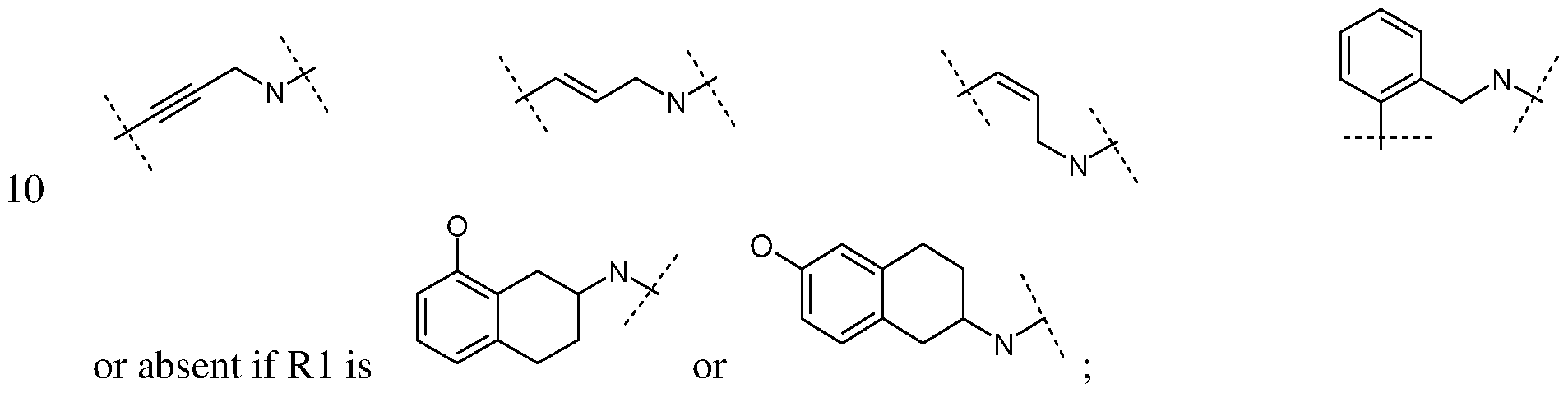
R3 and R4, independently or each other, are H, methyl, trifluoromethyl or ethyl;
R5 is lower alkyl, cycloalkyl, lower alkyl-cycloalkyl, heterocycloalkyl, isoquinoline, quinoline, adamantane, NR7R8, OR9, unsubstituted heteroaryl, heteroaryl substituted with phenyl, unsubstituted phenyl or phenyl substituted with hydroxy or methyl;
R6 is hydrogen, lower alkyl, alkoxy, cycloalkyl, aryl, heteroaryl, -(CH2)20(CH2)2OCH2CH3-,


R7 and R8, independently of each other, are hydrogen, lower alkyl, cycloalkyl, aryl or heteroaryl; R9 is lower alkyl, cycloalkyl, phenyl or heteroaryl; and
RIO, R11, R12 and R13, independently of each other, are hydrogen or lower alkyl,
or a pharmaceutically acceptable salt thereof.
The compound according to claim 1, wherein Rl

3. The compound according to claim 1, wherein Rl is phenyl, mono- or bi- substituted independently with hydroxy, halogen, lower alkyl, alkoxy, -OC(0)CH3 or -OC(0)CH(CH3)2.
4. The compound according to claim 1, wherein Rl is heteroaryl, mono- or bi-substituted with hydroxy.
5. The compound according to claim 1, wherein R2 is absent.
6. The compound according to claim 1, wherein R3 is methyl.
7. The compound according to claim 1, wherein R4 is methyl.
8. The compound according to claim 1, wherein R5 is lower alkyl, cycloalkyl, lower alkyl- cycloalkyl, heterocycloalkyl, isoquinoline, quinoline, adamantane or NR7R8, OR9.
9. The compound according to claim 1, wherein R5 is unsubstituted heteroaryl, heteroaryl substituted with phenyl, unsubstituted phenyl or phenyl substituted with hydroxy or methyl.
10. The compound according to claim 1, wherein R5 is adamantane, chlorothiophene, pyrazine, thiazole, thiophene, -C(0)CH3, thiazole-phenyl, pyridine, dimethyl-thiazole, isoquinoline, pyridine-thiazole, methyl-thiophene, methyl-pyrazine or ethyl-thiophene.
11. The compound according to claim 1, wherein R6 is hydrogen or lower alkyl. 12. The compound according to claim 1, wherein R6 is methyl.
13. The compound according to claim 1, wherein R6 is:


14. The compound according to claim 1, wherein R7 is hydrogen or lower alkyl.
15. The compound according to claim 1, wherein R8 is hydrogen or lower alkyl. 16. The compound according to claim 1, wherein R9 is lower alkyl or phenyl.
17. The compound according to claim 1, wherein RIO is hydrogen or methyl.
18. The compound according to claim 1, wherein Rl 1 is hydrogen or methyl.
19. The compound according to claim 1, wherein R12 is hydrogen or methyl.
20. The compound according to claim 1, wherein R13 is hydrogen or methyl. 21. A process for the preparation of a compound according to any one of claims 1 to 20, comprising the steps of:
reacting compounds of formula B l and Al with compounds B2 and A2 to produce a compound of formula AB:

(am ines or alcohols) A1 ? N R4

or a pharmaceutically acceptable salt thereof. 22. A compound according to any one of claims 1 to 20 for use as a therapeutically active substance.
23. A pharmaceutical composition, comprising a therapeutically effective amount of a compound in accordance with any one of claims 1 to 20 and a therapeutically inert carrier.
24. The use of a compound according to any one of claims 1 to 20 for the treatment or prophylaxis of asthma or COPD.
25. The use of a compound according to any one of claims 1 to 20 for the preparation of a medicament for the treatment or prophylaxis of asthma or COPD.
26. A compound according to any one of claims 1 to 20 for the treatment or prophylaxis of asthma or COPD. 27. A compound according to any one of claims 1 to 20, when manufactured according to a process of claim 21.
28. A method for the treatment or prophylaxis of asthma or COPD, which method comprises the step of administering an effective amount of a compound as defined in any one of claims 1 to 20 to a patient in need thereof. 29. The invention as hereinbefore described.
Applications Claiming Priority (2)
| Application Number | Priority Date | Filing Date | Title |
|---|---|---|---|
| US201161453229P | 2011-03-16 | 2011-03-16 | |
| US61/453,229 | 2011-03-16 |
Publications (1)
| Publication Number | Publication Date |
|---|---|
| WO2012123467A1 true WO2012123467A1 (en) | 2012-09-20 |
Family
ID=45878922
Family Applications (1)
| Application Number | Title | Priority Date | Filing Date |
|---|---|---|---|
| PCT/EP2012/054409 Ceased WO2012123467A1 (en) | 2011-03-16 | 2012-03-14 | Pyrimidine amide compounds |
Country Status (2)
| Country | Link |
|---|---|
| US (1) | US20120270875A1 (en) |
| WO (1) | WO2012123467A1 (en) |
Cited By (1)
| Publication number | Priority date | Publication date | Assignee | Title |
|---|---|---|---|---|
| WO2013110679A1 (en) * | 2012-01-27 | 2013-08-01 | F. Hoffmann-La Roche Ag | Integrin antagonist conjugates for targeted delivery to cells expressing lfa-1 |
Citations (1)
| Publication number | Priority date | Publication date | Assignee | Title |
|---|---|---|---|---|
| WO2001058853A1 (en) * | 2000-02-09 | 2001-08-16 | F. Hoffmann-La Roche Ag | Dehydroamino acids |
-
2012
- 2012-02-17 US US13/399,117 patent/US20120270875A1/en not_active Abandoned
- 2012-03-14 WO PCT/EP2012/054409 patent/WO2012123467A1/en not_active Ceased
Patent Citations (1)
| Publication number | Priority date | Publication date | Assignee | Title |
|---|---|---|---|---|
| WO2001058853A1 (en) * | 2000-02-09 | 2001-08-16 | F. Hoffmann-La Roche Ag | Dehydroamino acids |
Non-Patent Citations (1)
| Title |
|---|
| GANG LIU: "Small molecule antagonists of the LFA-1/ICAM-1 interaction as potential therapeutic agents", EXPERT OPINION ON THERAPEUTIC PATENTS, INFORMA HEALTHCARE, GB, vol. 11, no. 9, 1 January 2001 (2001-01-01), pages 1383 - 1393, XP002321823, ISSN: 1354-3776 * |
Cited By (1)
| Publication number | Priority date | Publication date | Assignee | Title |
|---|---|---|---|---|
| WO2013110679A1 (en) * | 2012-01-27 | 2013-08-01 | F. Hoffmann-La Roche Ag | Integrin antagonist conjugates for targeted delivery to cells expressing lfa-1 |
Also Published As
| Publication number | Publication date |
|---|---|
| US20120270875A1 (en) | 2012-10-25 |
Similar Documents
| Publication | Publication Date | Title |
|---|---|---|
| CA2938280C (en) | 4-amino-imidazoquinoline compounds | |
| WO2020177653A1 (en) | Pyrazine derivative and application thereof in inhibiting shp2 | |
| CN102056905B (en) | Uracil compound or salt thereof having human deoxyuridine triphosphatase inhibitory activity | |
| WO2020135771A1 (en) | Heterocyclic compound intermediate, preparation method therefor and application thereof | |
| CN110582495A (en) | Fused pentacyclic imidazole derivatives as modulators of TNF activity | |
| JP2019513804A (en) | Therapeutic compounds | |
| CN111247138A (en) | Ether compounds and their uses | |
| CN114409656B (en) | PIM kinase inhibitors | |
| CN118772176A (en) | A pyrimidoaromatic ring compound and its preparation method and use | |
| WO2015127872A1 (en) | 2,4-disubstituted phenylene-1,5-diamine derivatives and applications thereof, and pharmaceutical compositions and pharmaceutically acceptable compositions prepared therefrom | |
| WO2017118277A1 (en) | Crystalline form of btk kinase inhibitor and preparation method thereof | |
| WO2022166974A1 (en) | Pyridopyrimidinone derivative, preparation method therefor, and use thereof | |
| CN104144927B (en) | S1p receptor modulators | |
| CN104039766A (en) | Pharmaceutical compounds | |
| WO2012123471A1 (en) | Thiazole and thiophene compounds | |
| CN109476640B (en) | Bicyclic proline compounds | |
| CN111434653A (en) | Triazole compounds and preparation method and use thereof | |
| CN106279119A (en) | The preparation of a kind of Azaindole kinase inhibitors and application thereof | |
| WO2012123467A1 (en) | Pyrimidine amide compounds | |
| WO2022174796A1 (en) | Pyrimidine compound as wee-1 inhibitor | |
| WO2025218293A1 (en) | Hetero (aromatic) ring-substituted cyclic diamine compound and use thereof in preparation of drug for treating and/or preventing tumors | |
| NZ502675A (en) | 2-3-[4-(2-t-butyl-6-trifluoromethyl-4-pyrimidinyl)-1-piperazinyl]propylthio-4-pyrimidinol fumarate | |
| WO2022257960A1 (en) | Bicyclic compound for the treatment of ep2 and ep4 receptor-mediated diseases | |
| WO2022161420A1 (en) | Class of heteroaromatic compound, preparation method therefor and use thereof | |
| TW201625613A (en) | Tetrahydropyrazolopyridine derivatives as ghrelin receptor agonists |
Legal Events
| Date | Code | Title | Description |
|---|---|---|---|
| 121 | Ep: the epo has been informed by wipo that ep was designated in this application |
Ref document number: 12710471 Country of ref document: EP Kind code of ref document: A1 |
|
| NENP | Non-entry into the national phase |
Ref country code: DE |
|
| 122 | Ep: pct application non-entry in european phase |
Ref document number: 12710471 Country of ref document: EP Kind code of ref document: A1 |