WO2012114252A1 - Novel indole and pyrrolopyridine amides - Google Patents
Novel indole and pyrrolopyridine amides Download PDFInfo
- Publication number
- WO2012114252A1 WO2012114252A1 PCT/IB2012/050759 IB2012050759W WO2012114252A1 WO 2012114252 A1 WO2012114252 A1 WO 2012114252A1 IB 2012050759 W IB2012050759 W IB 2012050759W WO 2012114252 A1 WO2012114252 A1 WO 2012114252A1
- Authority
- WO
- WIPO (PCT)
- Prior art keywords
- pyridin
- dihydro
- thieno
- indol
- methanone
- Prior art date
- Legal status (The legal status is an assumption and is not a legal conclusion. Google has not performed a legal analysis and makes no representation as to the accuracy of the status listed.)
- Ceased
Links
- 0 CCC1C2=*C=C*2CC*1 Chemical compound CCC1C2=*C=C*2CC*1 0.000 description 3
Classifications
-
- C—CHEMISTRY; METALLURGY
- C07—ORGANIC CHEMISTRY
- C07D—HETEROCYCLIC COMPOUNDS
- C07D401/00—Heterocyclic compounds containing two or more hetero rings, having nitrogen atoms as the only ring hetero atoms, at least one ring being a six-membered ring with only one nitrogen atom
- C07D401/02—Heterocyclic compounds containing two or more hetero rings, having nitrogen atoms as the only ring hetero atoms, at least one ring being a six-membered ring with only one nitrogen atom containing two hetero rings
- C07D401/04—Heterocyclic compounds containing two or more hetero rings, having nitrogen atoms as the only ring hetero atoms, at least one ring being a six-membered ring with only one nitrogen atom containing two hetero rings directly linked by a ring-member-to-ring-member bond
-
- A—HUMAN NECESSITIES
- A61—MEDICAL OR VETERINARY SCIENCE; HYGIENE
- A61P—SPECIFIC THERAPEUTIC ACTIVITY OF CHEMICAL COMPOUNDS OR MEDICINAL PREPARATIONS
- A61P25/00—Drugs for disorders of the nervous system
- A61P25/22—Anxiolytics
-
- A—HUMAN NECESSITIES
- A61—MEDICAL OR VETERINARY SCIENCE; HYGIENE
- A61P—SPECIFIC THERAPEUTIC ACTIVITY OF CHEMICAL COMPOUNDS OR MEDICINAL PREPARATIONS
- A61P25/00—Drugs for disorders of the nervous system
- A61P25/30—Drugs for disorders of the nervous system for treating abuse or dependence
-
- C—CHEMISTRY; METALLURGY
- C07—ORGANIC CHEMISTRY
- C07D—HETEROCYCLIC COMPOUNDS
- C07D471/00—Heterocyclic compounds containing nitrogen atoms as the only ring hetero atoms in the condensed system, at least one ring being a six-membered ring with one nitrogen atom, not provided for by groups C07D451/00 - C07D463/00
- C07D471/02—Heterocyclic compounds containing nitrogen atoms as the only ring hetero atoms in the condensed system, at least one ring being a six-membered ring with one nitrogen atom, not provided for by groups C07D451/00 - C07D463/00 in which the condensed system contains two hetero rings
- C07D471/04—Ortho-condensed systems
-
- C—CHEMISTRY; METALLURGY
- C07—ORGANIC CHEMISTRY
- C07D—HETEROCYCLIC COMPOUNDS
- C07D487/00—Heterocyclic compounds containing nitrogen atoms as the only ring hetero atoms in the condensed system, not provided for by groups C07D451/00 - C07D477/00
- C07D487/02—Heterocyclic compounds containing nitrogen atoms as the only ring hetero atoms in the condensed system, not provided for by groups C07D451/00 - C07D477/00 in which the condensed system contains two hetero rings
- C07D487/04—Ortho-condensed systems
-
- C—CHEMISTRY; METALLURGY
- C07—ORGANIC CHEMISTRY
- C07D—HETEROCYCLIC COMPOUNDS
- C07D495/00—Heterocyclic compounds containing in the condensed system at least one hetero ring having sulfur atoms as the only ring hetero atoms
- C07D495/02—Heterocyclic compounds containing in the condensed system at least one hetero ring having sulfur atoms as the only ring hetero atoms in which the condensed system contains two hetero rings
- C07D495/04—Ortho-condensed systems
-
- C—CHEMISTRY; METALLURGY
- C07—ORGANIC CHEMISTRY
- C07D—HETEROCYCLIC COMPOUNDS
- C07D513/00—Heterocyclic compounds containing in the condensed system at least one hetero ring having nitrogen and sulfur atoms as the only ring hetero atoms, not provided for in groups C07D463/00, C07D477/00 or C07D499/00 - C07D507/00
- C07D513/02—Heterocyclic compounds containing in the condensed system at least one hetero ring having nitrogen and sulfur atoms as the only ring hetero atoms, not provided for in groups C07D463/00, C07D477/00 or C07D499/00 - C07D507/00 in which the condensed system contains two hetero rings
- C07D513/04—Ortho-condensed systems
-
- C—CHEMISTRY; METALLURGY
- C07—ORGANIC CHEMISTRY
- C07D—HETEROCYCLIC COMPOUNDS
- C07D519/00—Heterocyclic compounds containing more than one system of two or more relevant hetero rings condensed among themselves or condensed with a common carbocyclic ring system not provided for in groups C07D453/00 or C07D455/00
Definitions
- the present invention relates to novel indole and pyrrolopyridine amide derivatives of formula (I) and their use as pharmaceuticals.
- the invention also concerns related aspects including processes for the preparation of the compounds, pharmaceutical compositions containing one or more compounds of formula (I), and especially their use as orexin receptor antagonists.
- Orexins are novel neuropeptides found in 1998 by two research groups, orexin A is a 33 amino acid peptide and orexin B is a 28 amino acid peptide (Sakurai T. et al., Cell, 1998, 92, 573-585). Orexins are produced in discrete neurons of the lateral hypothalamus and bind to the G-protein-coupled receptors (OX-i and OX 2 receptors). The orexin-1 receptor (OX-i) is selective for OX-A, and the orexin-2 receptor (OX 2 ) is capable to bind OX-A as well as OX-B.
- Orexin A is a 33 amino acid peptide
- orexin B is a 28 amino acid peptide (Sakurai T. et al., Cell, 1998, 92, 573-585). Orexins are produced in discrete neurons of the lateral hypothalamus and bind to the G-protein-coupled receptors (OX-i and O
- Orexins are found to stimulate food consumption in rats suggesting a physiological role for these peptides as mediators in the central feedback mechanism that regulates feeding behaviour (Sakurai T. et al., Cell, 1998, 92, 573-585).
- orexins regulate states of sleep and wakefulness opening potentially novel therapeutic approaches to insomnia and other sleep disorders (Chemelli R.M. et al., Cell, 1999, 98, 437-451 ).
- in vitro and in vivo evidence for a critical role of orexin signaling in the ventral tegmental area in neural plasticity relevant to addiction has been published (S. L. Borgland et al. Neuron, 2006, 49, 589-601 ).
- Orexin neurons are likely to be involved in the coordinated regulation of behavioral and physiological responses in stressful environments (Kuru, M, Ueta, Y, Serino, R, Nakazato, M, Yamamoto, Y, Shibuya, I, Yamashita, H; Centrally administered orexin/hypocretin activates HPA axis in rats. Neuroreport, 1 1 (9) (2000) 1977-1980).
- cardiovascular responses to conditioned fear and novelty exposure could be attenuated by a dual orexin receptor antagonist in rats (Furlong, TM, Vianna, DM, Liu, L, Carrive, P; Hypocretin/orexin contributes to the expression of some but not all forms of stress and arousal.
- the acute stress response may include behavioural, autonomic and endocrinological changes, such as promoting heightened vigilance, decreased libido, increased heart rate and blood pressure, or a redirection of blood flow to fuel the muscles, heart and the brain (Majzoub, JA; Corticotropin-releasing hormone physiology European Journal of Endocrinology, 155 (suppM ) (2006) S71-S76).
- behavioural, autonomic and endocrinological changes such as promoting heightened vigilance, decreased libido, increased heart rate and blood pressure, or a redirection of blood flow to fuel the muscles, heart and the brain (Majzoub, JA; Corticotropin-releasing hormone physiology European Journal of Endocrinology, 155 (suppM ) (2006) S71-S76).
- the compound has also been shown to enhance memory function in a rat model (WO2007/105177).
- the compound furthermore decreased brain levels of amyloid-beta ( ⁇ ) as well as ⁇ plaque deposition after acute sleep restriction in amyloid precursor protein transgenic mice [JE Kang et al., "Amyloid-beta dynamics are regulated by orexin and the sleep-wake cycle.”, Science 2009, 326(5955): 1005-1007].
- the accumulation of the ⁇ in the brain extracellular space is hypothesized to be a critical event in the pathogenesis of Alzheimer's disease.
- the so-called and generally known "amyloid cascade hypothesis” links ⁇ to Alzheimer's disease and, thus, to the cognitive dysfunction, expressed as impairment of learning and memory.
- the compound is also active in an animal model of conditioned fear: the rat fear-potentiated startle paradigm (WO2009/0047723) which relates to emotional states of fear and anxiety diseases such as anxieties including phobias and post traumatic stress disorders (PTSDs).
- the compound has, in addition, been shown to induce antidepressant-like activity in a mouse model of depression, when administered chronically [Nollet et al., NeuroPharm 2011 , 61 (1- 2):336-46]; and to attenuate the natural activation induced by orexin A in fasted hungry rats exposed to food odors [MJ Prud'Neill et al., "Nutritional status modulates behavioural and olfactory bulb Fos responses to isoamyl acetate or food odour in rats: roles of orexins and leptin.” Neuroscience 2009, 162(4), 1287-1298].
- the present invention provides novel indole and pyrrolopyridine amide derivatives, which are non-peptide antagonists of human orexin receptors. These compounds are in particular of potential use in the treatment of diseases or disorders related to the orexin system, especially comprising all types of sleep disorders, of stress-related syndromes, of addictions (especially psychoactive substance use, abuse, seeking and reinstatement), of cognitive dysfunctions in the healthy population and in psychiatric and neurologic disorders, of eating or drinking disorders.
- a first aspect of the invention relates to compounds of the formula (I)
- Z represents a carbon atom or a nitrogen atom and Y represents a carbon atom; and ring A together with the atoms Z and Y represents a 5- or 6-membered aromatic ring;
- ring A is a benzene, a pyridine, a thiophene, a pyrazole, or a thiazole ring;
- ring A is an imidazole or a pyrrole ring
- rings A independently are unsubstituted or substituted with one or two substituents independently selected from the group consisting of (Ci -4 )alkyl, (Ci -4 )alkoxy, (C 2-4 )alkinyl, halogen, cyano, (Ci -3 )fluoroalkyl, (Ci -3 )fluoroalkoxy; (C 3- 6)cycloalkyl, 5- membered heteroaryl, and amino;
- R 1 represents aryl or heteroaryl, wherein the aryl or heteroaryl independently is:
- phenyl or 5- or 6-membered heteroaryl wherein said phenyl or 5- or 6- membered heteroaryl is independently unsubstituted, or mono-, di-, or tri- substituted, wherein the substituents are independently selected from the group consisting of (C 1-4 )alkyl, (C 1-4 )alkoxy, halogen, cyano, (C 1-3 )fluoroalkyl, and (C 1-3 )fluoroalkoxy; and
- phenyl-(C 1-4 )alkoxy or 5- or 6-membered heteroaryl-(C 1-4 )alkoxy wherein said phenyl-(Ci -4 )alkoxy or 5- or 6-membered heteroaryl-(Ci -4 )alkoxy is independently unsubstituted, or mono-, di-, or tri-substituted, wherein the substituents are independently selected from the group consisting of (Ci -4 )alkyl, (Ci -4 )alkoxy, halogen, cyano, (Ci -3 )fluoroalkyl, and (Ci -3 )fluoroalkoxy;
- aryl or heteroaryl is fused to a non-aromatic 5- or 6-membered ring, wherein said ring optionally contains one or two heteroatoms independently selected from oxygen and nitrogen; wherein said ring is optionally substituted with one or two substituents independently selected from (C 1-3 )alkyl, oxo, and halogen;
- R 2 represents hydrogen, (C 1-6 )alkyl, (C 3-6 )cycloalkyl, (C 1-4 )alkoxy-(C 2-4 )alkyl, hydroxy- (C 2-4 )alkyl, R 8 R 9 N-(C 2-4 )alkyl, or
- R 3 represents hydrogen or methyl (especially hydrogen);
- one of U, V, W, and X represents CR 10 or N, and the remaining represent CH;
- R 10 represents hydrogen, fluorine, chlorine, methyl, or methoxy
- R 4 and R 5 independently represent hydrogen or (Ci -4 )alkyl
- R 6 represents hydroxy or amino
- R 7 represents hydroxy or (Ci -4 )alkoxy
- R 8 and R 9 independently represent hydrogen or (Ci -4 )alkyl.
- the compounds of formula (I) may contain one or more stereogenic or asymmetric centers, such as one or more asymmetric carbon atoms.
- the compounds of formula (I) may thus be present as mixtures of stereoisomers or preferably as pure stereoisomers. Mixtures of stereoisomers may be separated in a manner known to a person skilled in the art.
- the present invention also includes isotopically labelled, especially 2 H (deuterium) labelled compounds of formula (I), which compounds are identical to the compounds of formula (I) except that one or more atoms have each been replaced by an atom having the same atomic number but an atomic mass different from the atomic mass usually found in nature.
- Isotopically labelled, especially 2 H (deuterium) labelled compounds of formula (I) and salts thereof are within the scope of the present invention. Substitution of hydrogen with the heavier isotope 2 H (deuterium) may lead to greater metabolic stability, resulting e.g. in increased in-vivo half-life or reduced dosage requirements, or may lead to reduced inhibition of cytochrome P450 enzymes, resulting e.g. in an improved safety profile.
- the compounds of formula (I) are not isotopically labelled, or they are labelled only with one or more deuterium atoms. In a sub-embodiment, the compounds of formula (I) are not isotopically labelled at all. Isotopically labelled compounds of formula (I) may be prepared in analogy to the methods described hereinafter, but using the appropriate isotopic variation of suitable reagents or starting materials.
- dotted lines show the point(s) of attachment of a radical drawn.
- pharmaceutically acceptable salts refers to non-toxic, inorganic or organic acid and/or base addition salts. Reference can be made to "Salt selection for basic drugs", Int. J. Pharm. (1986), 33, 201-217.
- halogen means fluorine, chlorine, or bromine, preferably fluorine or chlorine.
- alkyl refers to a saturated straight or branched chain alkyl group containing one to six carbon atoms.
- (C x-y )alkyl refers to an alkyl group as defined before, containing x to y carbon atoms.
- a (C 1-4 )alkyl group contains from one to four carbon atoms.
- alkyl groups are methyl, ethyl, propyl, isopropyl, n-butyl, isobutyl, sec. -butyl and tert.-butyl. Preferred are methyl and ethyl. Most preferred is methyl.
- cycloalkyl refers to a saturated cyclic alkyl group containing three to six carbon atoms.
- (C x-y )cycloalkyl refers to a cycloalkyi group as defined before containing x to y carbon atoms.
- a (C 3 - 6 )cycloalkyl group contains from three to six carbon atoms.
- Examples of cycloalkyi groups are cyclopropyl, cyclobutyl, cyclopentyl and cyclohexyl. Preferred is cyclopropyl.
- alkoxy refers to an alkyl-O- group wherein the alkyl group is as defined before.
- (C x-y )alkoxy (x and y each being an integer) refers to an alkoxy group as defined before containing x to y carbon atoms.
- a (Ci -4 )alkoxy group means a group of the formula (Ci -4 )alkyl-0- in which the term "(Ci -4 )alkyl” has the previously given significance.
- alkoxy groups are methoxy, ethoxy, n- propoxy, isopropoxy, n-butoxy, isobutoxy, sec.-butoxy and tert.-butoxy. Preferred are ethoxy and especially methoxy.
- fluoroalkyl refers to an alkyl group as defined before containing one to three carbon atoms in which one or more (and possibly all) hydrogen atoms have been replaced with fluorine.
- (C x-y )fluoroalkyl (x and y each being an integer) refers to a fluoroalkyl group as defined before containing x to y carbon atoms.
- a (C 1-3 )fluoroalkyl group contains from one to three carbon atoms in which one to seven hydrogen atoms have been replaced with fluorine.
- fluoroalkyl groups include trifluoromethyl, 2-fluoroethyl, 2,2-difluoroethyl and 2,2,2-trifluoroethyl. Preferred are (C-i)fluoroalkyl groups such as trifluoromethyl.
- fluoroalkoxy refers to an alkoxy group as defined before containing one to three carbon atoms in which one or more (and possibly all) hydrogen atoms have been replaced with fluorine.
- (C x-y )fluoroalkoxy (x and y each being an integer) refers to a fluoroalkoxy group as defined before containing x to y carbon atoms.
- a (Ci -3 )fluoroalkoxy group contains from one to three carbon atoms in which one to seven hydrogen atoms have been replaced with fluorine.
- fluoroalkoxy groups include trifluoromethoxy, difluoromethoxy, 2-fluoroethoxy, 2,2-difluoroethoxy and 2,2,2-trifluoroethoxy.
- R 8 R 9 N-(C 2-4 )alkyl groups is dimethylaminoethyl.
- R 4 R 5 N-(C 2-4 )alkoxy groups is dimethylaminoethoxy.
- R 6 -CO- groups is carboxy.
- R 7 -CO-(C 1-4 )alkoxy groups are 2-methoxy-2-oxoethoxy and carboxymethoxy.
- An example of (C 1-3 )fluoroalkyl-sulfonyloxy groups is trifluoromethyl-sulfonyloxy.
- An example of (C 3- 6)cycloalkyl-oxy groups is cyclopropyloxy.
- (Ci -4 )alkoxy-(C2-4)alkoxy groups is 2-methoxyethoxy.
- hydroxy-(C 2 -4)alkoxy groups is 2-hydroxyethoxy.
- amino refers to a H 2 N- group.
- aryl alone or in combination, means a phenyl or a naphthyl group.
- the aryl group may be unsubstituted or substituted as explicitly defined.
- aryl groups as used for the group R 1 are phenyl, 2-naphthyl, 1 - naphthyl, 3-methyl-phenyl, 4-methoxy-phenyl, 3-methoxy-phenyl, 3,5-dimethoxy-phenyl, 3,4- dimethoxy-phenyl, 2,5-dimethoxy-phenyl, 2,3-dimethoxy-phenyl, 3,4,5-trimethoxy-phenyl, 4- fluoro-phenyl, 3,4-difluoro-phenyl, 4-chloro-phenyl, 3-chloro-phenyl, 2-chloro-phenyl, 2,4- dichloro-phenyl, 3,4-dichloro-phenyl, 2,6-dichloro-phenyl, 4-cyano-phenyl, 3-cyano-phenyl, 2- cyano-phenyl, 3-carboxy-phenyl, 3-hydroxy-4-methoxy-phenyl, 4-hydroxy-3
- aryl groups a particular sub-group of aryl as used for the group R 1 are "aryl fused to a non-aromatic 5- or 6-membered ring, wherein said ring optionally contains one or two heteroatoms independently selected from oxygen and nitrogen".
- the aryl is preferably phenyl.
- Examples of such groups are indanyl, tetrahydronaphthyl, 2,3-dihydrobenzofuranyl, chromanyl, chromenyl, benzo[1 ,3]dioxolyl, 2,3-dihydro-benzo[1 ,4]dioxinyl, benzo[b][1 ,4]dioxinyl, 1 ,2,3,4-tetrahydro- quinolinyl, and 3,4-dihydro-2H-benzo[b][1 ,4]oxazinyl.
- aryl groups are optionally substituted said non-aromatic 5- or 6-membered ring with one or two substituents independently selected from (C 1-3 )alkyl, oxo, and halogen.
- aryl groups which are substituted, in a position other than the ortho-position, with phenyl or 5- or 6-membered heteroaryl, wherein said phenyl or 5- or 6- membered heteroaryl is independently unsubstituted, or mono-, di-, or tri-substituted, wherein the substituents are independently selected from the group consisting of (Ci_4)alkyl, (Ci -4 )alkoxy, halogen, cyano, (Ci -3 )fluoroalkyl, and (Ci -3 )fluoroalkoxy.
- Examples of such groups are 3-pyrrazol-1 -yl-phenyl, 3-[1 ,2,4]oxadiazol-3-yl-phenyl, 4-[1 ,2,3]triazol-1 -yl-phenyl, 3-[1 ,2,3]triazol-1 -yl-phenyl, 3-[1 ,2,4]triazol-1-yl-phenyl, 4-[1 ,2,3]triazol-2-yl-phenyl, 3- [1 ,2,3]triazol-2-yl-phenyl, 3-pyrimidin-2-yl-phenyl.
- aryl groups which are substituted, in a position other than the ortho-position, with phenyl-(Ci -4 )alkoxy or 5- or 6-membered heteroaryl-(Ci -4 )alkoxy, wherein said phenyl-(Ci -4 )alkoxy or 5- or 6-membered heteroaryl-(Ci -4 )alkoxy is independently unsubstituted, or mono-, di-, or tri-substituted, wherein the substituents are independently selected from the group consisting of (Ci -4 )alkyl, (Ci -4 )alkoxy, halogen, cyano, (Ci -3 )fluoroalkyl, and (Ci -3 )fluoroalkoxy.
- An examples of such groups is 3-methoxy-4- benzyloxy-phenyl.
- heteroaryl if not explicitly stated otherwise, means a 5- to 10-membered monocyclic or fused bicyclic aromatic ring containing 1 to a maximum of 4 heteroatoms independently selected from oxygen, nitrogen and sulfur.
- monocyclic heteroaryl groups are 5-membered monocyclic heteroaryl groups such as furanyl, oxazolyl, isoxazolyl, oxadiazolyl, thienyl, thiazolyl, isothiazolyl, thiadiazolyl, pyrrolyl, imidazolyl, pyrazolyl, triazolyl, and tetrazolyl; and 6-membered monocyclic heteroaryl such as pyridyl, pyrimidyl, pyridazinyl, and pyrazinyl.
- bicyclic heteroaryl groups comprise 8-membered bicyclic heteroaryl groups such as 4H-furo[3,2-b]pyrrolyl, pyrrolo[2, 1-b]thiazolyl and imidazo[2, 1- b]thiazolyl; 9-membered bicyclic heteroaryl groups such as indolyl, isoindolyl, benzofuranyl, isobenzofuranyl, benzothiophenyl, indazolyl, benzimidazolyl, benzoxazolyl, benzisoxazolyl, benzothiazolyl, benzoisothiazolyl, benzotriazolyl, benzoxadiazolyl, benzothiadiazolyl, pyrazolo[1 ,5-a]pyridyl, pyrazolo[1 ,5-a]pyrimidyl, imidazo[1 ,2-a]pyridyl, 1 H-pyrrolo[3,2- b]pyrid
- heteroaryl groups as used for the group R 1 are 5-membered heteroaryl groups such as oxazolyl, isoxazolyl, thienyl, thiazolyl, and isothiazolyl (notably thiazolyl; especially 2-methyl-thiatzol-4-yl).
- heteroaryl groups as used for the group R 1 are 6-membered monocyclic heteroaryl such as pyrimidyl, pyridazinyl, pyrazinyl and pyridyl (notably pyridyl; especially pyridin-3-yl, pyridin-2- yl, 2-chloro-pyridin-6-yl, 2-methyl-pyridin-5-yl, 2-ethyl-pyridin-5-yl, 2-methoxy-pyridin-6-yl, 2- methoxy-pyridin-5-yl, 2-cyano-pyridin-6-yl, and 2-cyano-pyridin-5-yl).
- pyrimidyl pyridazinyl
- pyrazinyl pyridyl
- pyridyl notably pyridyl; especially pyridin-3-yl, pyridin-2- yl, 2-chloro-pyridin-6-yl, 2-methyl-
- heteroaryl groups as used for the group R 1 are 8- to 10-membered bicyclic heteroaryl groups, notably 9- or 10-membered bicyclic heteroaryl groups, such as indolyl, benzimidazolyl, benzofuranyl, benzothiophenyl, indazolyl, benzoxazolyl, benzisoxazolyl, benzothiazolyl, benzoisothiazolyl, quinolinyl, naphthyridinyl, cinnolinyl, quinazolinyl, and quinoxalinyl (notably indolyl, indazolyl, benzimidazolyl, and quinolinyl; especially indol-3-yl, 1-methyl-indol-3-yl, indazol-3-yl, benzimidazol-2-yl, quinolin-8-yl, quinolin-7-yl, and quinolin-6-yl).
- examples of the particular sub-group of heteroaryl groups which are substituted in a position other than the ortho-position with phenyl or 5- or 6-membered heteroaryl; wherein said phenyl or 5- or 6-membered heteroaryl is independently unsubstituted, or substituted as explicitly defined; are notably oxazolyl, isoxazolyl, thienyl, thiazolyl, isothiazolyl, pyridyl, pyrimidyl and pyrazinyl.
- Examples of the particular 5- or 6-membered heteroaryl groups which are substituents of the group R 1 are notably oxazolyl, isoxazolyl, oxadiazolyl, thienyl, thiazolyl, isothiazolyl, thiadiazolyl, imidazolyl, pyrazolyl, triazolyl, pyridyl, pyrimidyl, and pyrazinyl (notably oxadiazolyl, pyrazolyl, triazolyl, pyridyl, and pyrimidyl; especially pyrazol-1-yl, [1 ,2,4]oxadiazol-3-yl, [1 ,2,3]triazol-1-yl, [1 ,2,3]triazol-1-yl, [1 ,2,4]triazol-1-yl, [1 ,2,3]triazol-2-yl, [1 ,2,3]triazol-2-yl, and pyrimi
- Examples of the particular 5-membered heteroaryl groups which are substituents of the ring A are oxazolyl, isoxazolyl, oxadiazolyl, thienyl, thiazolyl, isothiazolyl, thiadiazolyl, imidazolyl, pyrazolyl, and triazolyl (notably pyrazolyl and triazolyl; especially triazol-2-yl).
- heteroaryl groups as defined herein may be unsubstituted or substituted as explicitly defined.
- examples are notably 1 ,2,3,4-tetrahydro-isoquinoline, 5,6,7,8-tetrahydro-[1 ,7]naphthyridine, 4,5,6,7-tetrahydro-thieno[2,3-c]pyridine, 4,5,6,7- tetrahydro-thieno[3,4-c]pyridine, 4,5,6,7-tetrahydro-thieno[3,2-c]pyridine, 4,5,6,7-tetrahydro- 1 H-pyrazolo[3,4-c]pyridine, 4,5,6,7-tetrahydro-1 H-pyrazolo[4,3-c]pyridine, 4,5,6,7-tetrahydro- thiazolo[5,4-c]pyridine and 5,6,7,8-tetrahydro-imidazo[1 ,2-a]pyrazine.
- These groups may be unsubstituted or substituted as explicitly
- a second embodiment relates to compounds according to embodiment 1 ), which are also compounds of formula (l E i ):
- a third embodiment relates to compounds according to embodiment 1 ), which are also compounds of formula (l E 2):
- Another embodiment relates to compounds according to any one of embodiments 1 ) to 3), wherein ring A together with the atoms Y and Z represents a 5- or 6-membered aromatic ring selected from the group consisting of:
- (R ) n represents one or two optional substituents (i.e. n is 0, 1 or 2) independently selected from the group consisting of (Ci -4 )alkyl, (Ci -4 )alkoxy, (C 2-4 )alkinyl, halogen, cyano, (Ci -3 )fluoroalkyl, (Ci -3 )fluoroalkoxy; (C 3- 6)cycloalkyl, 5-membered heteroaryl, and amino (notably (Ci -4 )alkyl, (Ci -4 )alkoxy, halogen, cyano, and (Ci -3 )fluoroalkyl); (R 6 ) n represents one or two optional substituents (i.e.
- n is 0, 1 or 2) independently selected from the group consisting of (Ci -4 )alkyl, (Ci -4 )alkoxy, (C 2-4 )alkinyl, halogen, cyano, (C 1-3 )fluoroalkyl, (C 1-3 )fluoroalkoxy; (C 3-6 )cycloalkyl, 5-membered heteroaryl, and amino (notably (C 1-4 )alkyl, (C 1-4 )alkoxy, halogen, cyano, and (C 1-3 )fluoroalkyl); (R 7 ) n represents one or two optional substituents (i.e.
- n is 0, 1 or 2) independently selected from the group consisting of (Ci -4 )alkyl, (Ci -4 )alkoxy, (C 2-4 )alkinyl, halogen, cyano, (Ci -3 )fluoroalkyl, (Ci -3 )fluoroalkoxy; (C 3-6 )cycloalkyl, 5-membered heteroaryl, and amino (notably (Ci -4 )alkyl, (Ci -4 )alkoxy, halogen, cyano, and (Ci -3 )fluoroalkyl); R 8 , R 9 , R 10 , R 11 , and R 12 independently represent hydrogen, (Ci -4 )alkyl, (Ci -4 )alkoxy, (C 2-4 )alkinyl, halogen, cyano, (Ci -3 )fluoroalkyl, (Ci -3 )fluoroalkoxy; (C 3-6 )cycloal
- R 8 , R 9 , R 10 , R 11 , and R 12 independently represent hydrogen, (Ci -4 )alkyl, (Ci -4 )alkoxy, (C 2-4 )alkinyl, halogen, cyano, (Ci -3 )fluoroalkyl, (Ci -3 )fluoroalkoxy; (C 3- 6)cycloalkyl, 5- membered heteroaryl, and amino (notably (Ci -4 )alkyl, (Ci -4 )alkoxy, halogen, cyano, and (Ci -3 )fluoroalkyl);
- R 8 , R 9 , R 10 , R 11 , and R 12 independently represent hydrogen, (Ci -4 )alkyl, (Ci -4 )alkoxy, (C 2-4 )alkinyl, halogen, cyano, (Ci -3 )fluoroalkyl, (Ci -3 )fluoroalkoxy; (C 3-6 )cycloalkyl, 5- membered heteroaryl, and amino (notably hydrogen, (C 1-4 )alkyl, and amino);
- n represents one or two optional substituents (i.e. n is 0, 1 or 2) independently selected from the group consisting of (Ci -4 )alkyl, (Ci -4 )alkoxy, (C 2-4 )alkinyl, halogen, cyano, (Ci -3 )fluoroalkyl, (Ci -3 )fluoroalkoxy; (C 3-6 )cycloalkyl, 5-membered heteroaryl, and amino (notably (Ci -4 )alkyl, (Ci -4 )alkoxy, halogen, cyano, and (Ci -3 )fluoroalkyl); and
- (R 14 ) n represents one or two optional substituents (i.e. n is 0, 1 or 2) independently selected from the group consisting of (Ci -4 )alkyl, (Ci -4 )alkoxy, (C 2-4 )alkinyl, halogen, cyano, (Ci -3 )fluoroalkyl, (Ci -3 )fluoroalkoxy; (C 3-6 )cycloalkyl, 5-membered heteroaryl, and amino (notably (Ci -4 )alkyl, (Ci -4 )alkoxy, halogen, cyano, and (Ci -3 )fluoroalkyl); wherein it is well understood that each R 5 to R 14 , and each n may be independently chosen for each respective ring A; and each of the above-listed rings A forms a particular sub- embodiment.
- (R 7 ) n represents one or two optional substituents (i.e. n is 0, 1 or 2) independently selected from the group consisting of (Ci -4 )alkyl, (Ci -4 )alkoxy, (C 2-4 )alkinyl, halogen, cyano, (Ci -3 )fluoroalkyl, and 5-membered heteroaryl (notably triazolyl); (especially (Ci -4 )alkyl, (Ci -4 )alkoxy, halogen, cyano, and (Ci -3 )fluoroalkyl);
- R 8 , and R 9 independently represent (Ci -4 )alkyl
- R 10 , and R 11 independently represent hydrogen, and (Ci -4 )alkyl
- R 12 represents hydrogen, (Ci -4 )alkyl, or amino (especially hydrogen or amino);
- Another embodiment relates to compounds according to embodiments 4) or 5), wherein ring A together with the atoms Y and Z represents a 5- or 6-membered aromatic ring selected from the group consisting of:
- each of the above-listed rings A forms in addition a particular sub-embodiment.
- FIG. 7 Another embodiment relates to compounds according to any one of embodiments 1 ) to 6), wherein ring A together with the atoms Z and Y is a benzene, a pyridine, a thiophene ring, or an imidazole ring; wherein said ring A independently is unsubstituted or substituted as explicitly defined.
- Another embodiment relates to compounds according to any one of embodiments 1 ) to 7), wherein the fragment:
- Another embodiment relates to compounds according to any one of embodiments 1 ) to 8), wherein Z represents a nitrogen atom.
- R 1 represents aryl or heteroaryl, wherein the aryl or heteroaryl independently is unsubstituted, or mono-, di-, or tri-substituted;
- substituents are independently selected from the group consisting of (C 1-4 )alkyl, (C 1-4 )alkoxy, (C 3-6 )cycloalkyl, halogen, cyano, hydroxy, (C 1-3 )fluoroalkyl, (C 1-3 )fluoroalkoxy, (C 1-3 )fluoroalkyl-sulfonyloxy, (C 1-4 )alkyl- sulfonyl, (C 3-6 )cycloalkyl-oxy, (C 1-4 )alkoxy-(C 2-4 )alkoxy, hydroxy-(C 2-4 )alkoxy, R 4 R 5 N-(C 2-4 )alkoxy, R 6 -CO-, R 7 -CO-(C 1-4 )alkoxy;
- R 1 represents phenyl or 5- or 6-membered heteroaryl, wherein the phenyl or 5- or 6-membered heteroaryl independently is mono-, di-, or tri-substituted;
- phenyl or 5- or 6-membered heteroaryl wherein said phenyl or 5- or 6- membered heteroaryl is independently unsubstituted, or mono-, di-, or tri-substituted, wherein the substituents are independently selected from the group consisting of (Ci -4 )alkyl, (Ci -4 )alkoxy, halogen, cyano, (Ci -3 )fluoroalkyl, and (Ci -3 )fluoroalkoxy; or
- phenyl-(Ci -4 )alkoxy or 5- or 6-membered heteroaryl-(Ci -4 )alkoxy wherein said phenyl-(Ci -4 )alkoxy or 5- or 6-membered heteroaryl- (C 1-4 )alkoxy is independently unsubstituted, or mono-, di-, or tri- substituted, wherein the substituents are independently selected from the group consisting of (C 1-4 )alkyl, (C 1-4 )alkoxy, halogen, cyano, (C 1-3 )fluoroalkyl, and (C 1-3 )fluoroalkoxy;
- o and the other of said substituents is/are independently selected from the group consisting of (Ci -4 )alkyl, (Ci -4 )alkoxy, halogen, cyano, (Ci -3 )fluoroalkyl, and (Ci -3 )fluoroalkoxy;
- R 1 represents phenyl or 5- or 6-membered heteroaryl, wherein said phenyl or 5- or 6-membered heteroaryl is fused to a non-aromatic 5- or 6-membered ring, wherein said ring optionally contains one or two heteroatoms independently selected from oxygen and nitrogen; wherein said ring is optionally substituted with one or two substituents independently selected from (Ci -3 )alkyl, oxo, and halogen.
- Another embodiment relates to compounds according to any one of embodiments 1 ) to), wherein
- R 1 represents aryl or heteroaryl, wherein the aryl or heteroaryl independently is unsubstituted, or mono-, di-, or tri-substituted;
- substituents are independently selected from the group consisting of (Ci -4 )alkyl, (Ci -4 )alkoxy, halogen, cyano, hydroxy, (Ci -3 )fluoroalkyl, (C 1-3 )fluoroalkoxy, (C 1-3 )fluoroalkyl-sulfonyloxy, (C 3-6 )cycloalkyl-oxy, hydroxy- (C 2-4 )alkoxy, R 4 R 5 N-(C 2-4 )alkoxy, R 6 -CO-, R 7 -CO-(C 1-4 )alkoxy;
- R 1 represents phenyl (preferred) or 5- or 6-membered heteroaryl, wherein the phenyl or 5- or 6-membered heteroaryl independently is mono-, or di-substituted (preferred: mono-substituted); wherein
- phenyl or 5- or 6-membered heteroaryl wherein said phenyl or 5- or 6-membered heteroaryl is independently unsubstituted (preferred), or mono-, di-, or tri-substituted, wherein the substituents are independently selected from the group consisting of (Ci -4 )alkyl, (Ci -4 )alkoxy, halogen, cyano, (Ci -3 )fluoroalkyl, and (Ci -3 )fluoroalkoxy; or
- phenyl-(Ci -4 )alkoxy or 5- or 6-membered heteroaryl-(Ci -4 )alkoxy is independently unsubstituted (preferred), or mono-, di-, or tri-substituted, wherein the substituents are independently selected from the group consisting of (C 1-4 )alkyl, (C 1-4 )alkoxy, halogen, cyano, (C 1-3 )fluoroalkyl, and (C 1-3 )fluoroalkoxy; o and the other of said substituents, if present, is/are independently selected from the group consisting of (Ci -4 )alkyl, (Ci -4 )alkoxy, halogen, cyano, (Ci -3 )fluoroalkyl, and (C
- R 1 represents phenyl which is fused to a non-aromatic 5- or 6-membered ring, wherein said ring contains one or two oxygen atoms.
- Another embodiment relates to compounds according to any one of embodiments 1 ) to), wherein
- R 1 represents aryl or heteroaryl, wherein the aryl or heteroaryl independently is unsubstituted, or mono-, di-, or tri-substituted;
- substituents are independently selected from the group consisting of (Ci -4 )alkyl, (Ci -4 )alkoxy, halogen, cyano, hydroxy, (Ci -3 )fluoroalkyl, (Ci -3 )fluoroalkoxy, (Ci -3 )fluoroalkyl-sulfonyloxy, (C 3- 6)cycloalkyl-oxy, hydroxy- (C 2-4 )alkoxy, R 4 R 5 N-(C 2-4 )alkoxy, R 6 -CO-, and R 7 -CO-(Ci -4 )alkoxy; (notably selected from (Ci -4 )alkyl, (Ci -4 )alkoxy, halogen, cyano, (Ci -3 )fluoroalkyl, (C 1-3 )fluoroalkoxy, and hydroxy-(C 2-4 )alkoxy; especially selected from (C 1-4 )alkoxy, (C 1-4
- R 1 represents phenyl (preferred) or 6-membered heteroaryl, wherein the phenyl or 6-membered heteroaryl independently is mono-, or di-substituted (preferred: mono- substituted); wherein
- phenyl or 5- or 6-membered heteroaryl wherein said phenyl or 5- or 6-membered heteroaryl is independently unsubstituted (preferred), or mono-, di-, or tri-substituted, wherein the substituents are independently selected from the group consisting of (Ci -4 )alkyl, (Ci -4 )alkoxy, halogen, cyano, (Ci -3 )fluoroalkyl, and (Ci -3 )fluoroalkoxy (especially (Ci -4 )alkyl or halogen);
- o and the other of said substituents is independently selected from the group consisting of (Ci -4 )alkyl, (Ci -4 )alkoxy, halogen, cyano, (C 1-3 )fluoroalkyl, and (C 1-3 )fluoroalkoxy (notably (C 1-4 )alkyl or (C 1-4 )alkoxy; especially (C 1-4 )alkoxy);
- R 1 represents a benzodioxinyl, or a benzodioxolyl group.
- Another embodiment relates to compounds according to any one of embodiments 1 ) to), wherein
- R 1 represents a group selected from phenyl, naphthyl, pyridinyl, quinolinyl, thiazolyl, indazoly, indolyl, benzimidazolyl; wherein said group independently is unsubstituted or mono-, di-, or tri-substituted; wherein o the substituents are independently selected from the group consisting of (Ci -4 )alkyl, (Ci -4 )alkoxy, halogen, cyano, hydroxy, (Ci -3 )fluoroalkyl, (Ci -3 )fluoroalkoxy, (Ci -3 )fluoroalkyl-sulfonyloxy, (C 3- 6)cycloalkyl-oxy, hydroxy- (C 2-4 )alkoxy, R 4 R 5 N-(C 2-4 )alkoxy, R 6 -CO-, and R 7 -CO-(Ci -4 )alkoxy; (notably
- R 1 represents phenyl (preferred) or 6-membered heteroaryl, wherein the phenyl or 6-membered heteroaryl independently is mono-, or di-substituted (preferred: mono- substituted); wherein
- phenyl or 5- or 6-membered heteroaryl wherein said phenyl or 5- or 6-membered heteroaryl is independently unsubstituted (preferred), or mono-, di-, or tri-substituted, wherein the substituents are independently selected from the group consisting of (Ci -4 )alkyl, (Ci -4 )alkoxy, halogen, cyano, (Ci -3 )fluoroalkyl, and (Ci -3 )fluoroalkoxy (especially (Ci -4 )alkyl or halogen);
- o and the other of said substituents is independently selected from the group consisting of (Ci -4 )alkyl, (Ci -4 )alkoxy, halogen, cyano, (Ci -3 )fluoroalkyl, and (Ci -3 )fluoroalkoxy (notably (Ci -4 )alkyl or (Ci -4 )alkoxy, especially (Ci -4 )alkoxy).
- Another embodiment relates to compounds according to any one of embodiments 1 ) to), wherein
- R 1 represents a phenyl, or a pyridinyl group wherein said group independently is unsubstituted or mono-, di-, or tri-substituted;
- substituents are independently selected from the group consisting of (C 1-4 )alkyl, (C 1-4 )alkoxy, halogen, cyano, (C 1-3 )fluoroalkyl, (C 1-3 )fluoroalkoxy, and hydroxy-(C 2-4 )alkoxy (especially selected from (C 1-4 )alkoxy and cyano);
- R 1 represents phenyl which is mono-, or di-substituted (preferred: mono- substituted); wherein
- substituents are attached in a position other than the ortho-position (with regard to the position at which R 1 is attached to the rest of the molecule); wherein said substituent is: ⁇ phenyl or 5- or 6-membered heteroaryl (preferred), wherein said phenyl or 5- or 6-membered heteroaryl is independently unsubstituted (preferred), or mono-, di-, or tri-substituted, wherein the substituents are independently selected from the group consisting of (Ci-4)alkyl, (Ci -4 )alkoxy, halogen, cyano, (Ci -3 )fluoroalkyl, and (Ci -3 )fluoroalkoxy (especially (Ci -4 )alkyl or halogen);
- o and the other of said substituents is independently selected from the group consisting of (Ci -4 )alkyl, (Ci -4 )alkoxy, halogen, cyano, (Ci -3 )fluoroalkyl, and (Ci -3 )fluoroalkoxy (notably (Ci -4 )alkyl or (Ci -4 )alkoxy, especially (Ci -4 )alkoxy).
- R 2 represents hydrogen, (C 1-6 )alkyl, (C 3-6 )cycloalkyl, hydroxy-(C 2-4 )alkyl, or (C 1-4 )fluoroalkyl.
- Another embodiment relates to compounds according to any one of embodiments 1 ) to 15), wherein R 2 represents (C 1-3 )alkyl; especially methyl or ethyl.
- Another embodiment relates to compounds according to any one of embodiments 1 ) to
- Another embodiment relates to compounds according to any one of embodiments 1 ) to
- R 10 represents hydrogen, fluorine, chlorine, methyl, or methoxy (especially hydrogen or fluorine).
- Another embodiment relates to compounds according to any one of embodiments 1 ) to 18), wherein U or X represents N, and the remaining of U, V, W, and X represent CH.
- Trifluoro-methanesulfonic acid 5-[6-(1-ethyl-1 H-indole-3-carbonyl)-4,5,6J-tetrahydro-thieno[2,3-c]pyridin-7- ylmethyl]-2-methoxy-phenyl ester;
- the compounds of formula (I) and their pharmaceutically acceptable salts can be used as medicaments, e.g. in the form of pharmaceutical compositions for enteral or parental administration.
- compositions can be effected in a manner which will be familiar to any person skilled in the art (see for example Remington, The Science and Practice of Pharmacy, 21 st Edition (2005), Part 5, "Pharmaceutical Manufacturing” [published by Lippincott Williams & Wilkins]) by bringing the described compounds of formula (I) or their pharmaceutically acceptable salts, optionally in combination with other therapeutically valuable substances, into a galenical administration form together with suitable, non-toxic, inert, therapeutically compatible solid or liquid carrier materials and, if desired, usual pharmaceutical adjuvants.
- the present invention also relates to a method for the prevention or treatment of a disease or disorder mentioned herein comprising administering to a subject a pharmaceutically active amount of a compound of formula (I).
- the compounds according to formula (I) are useful for the prevention or treatment of diseases or disorders related to the orexin system.
- Such diseases or disorders related to the orexin system may be defined as comprising all types of sleep disorders, stress-related syndromes, addictions (especially psychoactive substance use, abuse, seeking and reinstatement), cognitive dysfunctions in the healthy population and in psychiatric and neurologic disorders, and eating or drinking disorders.
- diseases or disorders related to the orexin system comprise all types of sleep disorders, stress-related syndromes, and addictions (especially psychoactive substance use, abuse, seeking and reinstatement).
- such diseases or disorders related to the orexin system may be selected from the group consisting of sleep disorders that comprises all types of insomnias, sleep-related dystonias, restless leg syndrome, sleep apneas, jet-lag syndrome, shift-work syndrome, delayed or advanced sleep phase syndrome or insomnias related to psychiatric disorders (notably all types of insomnias, especially primary insomnia).
- diseases or disorders related to the orexin system may be selected from the group consisting of cognitive dysfunctions that comprise deficits in all types of attention, learning and memory functions occurring transiently or chronically in the normal, healthy, young, adult or aging population, and also occurring transiently or chronically in psychiatric, neurologic, cardiovascular and immune disorders.
- such diseases or disorders related to the orexin system may be selected from the group consisting of eating disorders that comprise metabolic dysfunction; dysregulated appetite control; compulsive obesities; bulimia or anorexia nervosa.
- such diseases or disorders related to the orexin system may be selected from the group consisting of all types of addictions (especially psychoactive substance use, abuse, seeking and reinstatement) that comprise all types of psychological or physical addictions and their related tolerance and dependence components.
- Eating disorders may be defined as comprising metabolic dysfunction; dysregulated appetite control; compulsive obesities; emeto-bulimia or anorexia nervosa.
- Pathologically modified food intake may result from disturbed appetite (attraction or aversion for food); altered energy balance (intake vs. expenditure); disturbed perception of food quality (high fat or carbohydrates, high palatability); disturbed food availability (unrestricted diet or deprivation) or disrupted water balance.
- Drinking disorders include polydipsias in psychiatric disorders and all other types of excessive fluid intake.
- Sleep disorders include all types of parasomnias, insomnias, sleep-related dystonias; restless leg syndrome; sleep apneas; jet-lag syndrome; shift-work syndrome, delayed or advanced sleep phase syndrome or insomnias related to psychiatric disorders.
- Insomnias are defined as comprising sleep disorders associated with aging; intermittent treatment of chronic insomnia; situational transient insomnia (new environment, noise) or short-term insomnia due to stress; grief; pain or illness. Insomnia also include stress-related syndromes including post-traumatic stress disorders as well as other types and subtypes of anxiety disorders such as generalized anxiety, obsessive compulsive disorder, panic attacks and all types of phobic anxiety and avoidance.
- Addictions may be defined as addiction to one or more rewarding stimuli, notably to one rewarding stimulus. Such rewarding stimuli may be of either natural or synthetic origin.
- Psychoactive substance use, abuse, seeking and reinstatement are defined as all types of psychological or physical addictions and their related tolerance and dependence components.
- Cognitive dysfunctions include deficits in all types of attention, learning and memory functions occurring transiently or chronically in the normal, healthy, young, adult or aging population, and also occurring transiently or chronically in psychiatric, neurologic, cardiovascular and immune disorders.
- such diseases or disorders related to the orexin system may be defined as comprising notably mental health diseases or disorders relating to orexinergic dysfunctions; especially sleep disorders, anxiety disorders, addiction disorders, cognitive dysfunctions, mood disorders, or appetite disorders; wherein sleep disorders comprise dyssomnias, parasomnias, sleep disorders associated with a general medical condition and substance-induced sleep disorders (especially sleep disorders comprise insomnias, sleep- related dystonias; restless leg syndrome; sleep apneas; jet-lag syndrome; shift work sleep disorder, delayed or advanced sleep phase syndrome, or insomnias related to psychiatric disorders; and, in addition, sleep disorders associated with aging; intermittent treatment of chronic insomnia; situational transient insomnia (new environment, noise) or short-term insomnia due to stress; grief; pain or illness); wherein anxiety disorders comprise generalized anxiety disorders (GAD), obsessive compulsive disorders (OCDs), acute stress disorders, posttraumatic stress disorders (PTSDs), panic anxiety disorders (PADs) including panic attacks, phobic anxieties (PHOBs), generalized
- further diseases related to the orexin system are selected from treating, controlling, ameliorating or reducing the risk of epilepsy, including absence epilepsy; treating or controlling pain, including neuropathic pain; treating or controlling Parkinson's disease; treating or controlling psychosis including acute mania and bipolar disorder; treating or controlling stroke, particularly ischemic or haemorrhagic stroke; blocking an emetic response i.e. nausea and vomiting; treating or controlling agitation, in isolation or co-morbid with another medical condition.
- the present compounds may be particularly useful for the treatment of such environmentally conditioned disorder or disease.
- any characteristics described in this invention for the compounds of formula (I) (whether for the compounds themselves, salts thereof, compositions containing the compounds or salts thereof, uses of the compounds or salts thereof, etc.) apply mutatis mutandis to compounds of formula (l E i ) or formula (l E 2)- Preparation of compounds of formula (I):
- the compounds of formula (I) can be prepared by the methods given below, by the methods given in the Examples or by analogous methods. Optimum reaction conditions may vary with the particular reactants or solvents used, but such conditions can be determined by a person skilled in the art by routine optimisation procedures. The compounds obtained may also be converted into salts thereof in a manner known per se.
- Compounds of formula (I) are prepared by reaction of an amine of Structure 1 or a salt thereof, such as a hydrochloride salt, with an acid of Structure 2 in the presence of an amide- coupling reagent such as TBTU, EDC, DCC or PyBOP and a base like DIPEA or TEA in a solvent such as MeCN or DMF.
- an amide- coupling reagent such as TBTU, EDC, DCC or PyBOP and a base like DIPEA or TEA in a solvent such as MeCN or DMF.
- Compounds of Structure 1 may be prepared by one of the synthetic pathways described below.
- Structure 1 represents a 4,5,6,7-tetrahydrothieno[2,3-c]pyridine
- compounds of Structure 1 may be prepared as outlined in Scheme 3.
- An amine of Structure 13 is either commercially available or prepared by the borane reduction of the corresponding commercially available nitrile of structure 10 in a solvent like THF.
- an amine of Structure 13 can be prepared in two steps from the corresponding commercially available aldehyde of Structure 11 via a Henry reaction with nitromethane to give a nitro olefin of Structure 12 that can then be reduced with LAH and sulfuric acid in a solvent like THF to furnish an amine of Structure 13.
- Structure 1 represents a 4,5,6,7-tetrahydrothieno[3,2-c]pyridine
- compounds of Structure 1 may be prepared as outlined in Scheme 4.
- An amine of Structure 18 is either commercially available or prepared by the borane reduction of the corresponding commercially available nitrile of Structure 15 in a solvent like THF.
- an amine of Structure 18 can be prepared in two steps from the corresponding aldehyde of Structure 16 via a Henry reaction with nitromethane to give a nitro olefin of Structure 17 that can then reduced with LAH and sulfuric acid in a solvent like THF to furnish an amine of Structure 18.
- Structure 1 represents a 4,5,6,7-tetrahydrothieno[3,4-c]pyridine
- compounds of Structure 1 may be prepared by one of the synthetic pathways described in Scheme 5.
- substituent R 8 is already present in the starting material
- a readily available acid of Structure 20 may be reduced with borane in a solvent like THF to give an alcohol of Structure 21 that can be subsequently re-oxidised with Mn0 2 in a solvent like DCM to give the corresponding aldehyde of Structure 22.
- an aldehyde of Structure 22 can be transformed via a Henry reaction with nitromethane into a nitro olefin of Structure 23 that can then be reduced with LAH and sulfuric acid in a solvent like THF to furnish an amine of Structure 24a.
- Reaction of an amine of Structure 24a or a salt thereof, such as a hydrochloride salt with an acid of Structure 4 in the presence of an amide- coupling reagent such as TBTU or PyBOP and a base like DIPEA or TEA in a solvent such as MeCN or DMF gives an amide of Structure 25a.
- the amide of Structure 25a is then subjected to Bischler-Napieralski conditions such as POCI 3 in MeCN followed by reduction of the resulting imine with sodium borohydride in a solvent like MeOH to give compounds of Structure 1.
- an amine of Structure 24b is either commercially available or can be prepared by the borane reduction of the corresponding nitrile of Structure 26 in a solvent like THF.
- R 8 Br
- R 8 can then be further modified in for example a Negishi coupling with a readily available organozinc reagent to give further compounds of Structure 1.
- R 8 can be converted to an alkoxy substituent, e.g. EtO, by following the procedure described in US2008/71084.
- Structure 1 represents a 4,5,6,7-tetrahydropyrazolo[3,4-c]pyridine
- compounds of Structure 1 may be prepared as outlined in Scheme 6.
- the amide of Structure 28 is then subjected to Bischler-Napieralski conditions such as POCI 3 in MeCN followed by reduction of the resulting imine with sodium borohydride in a solvent like MeOH to give compounds of Structure 1.
- Structure 1 represents a 4,5,6,7-tetrahydropyrazolo[4,3-c]pyridine
- compounds of Structure 1 may be prepared in analogy to the procedure described in WO2009038812 and as illustrated in Scheme 7.
- An amine of Structure 31 either as a single regioisomer or a mixture of both regioisomers (31 , 33) or a salt thereof, may be coupled with an acid of Structure 4 in the presence of an amide-coupling reagent such as TBTU or PyBOP and a base like DIPEA or TEA in a solvent such as MeCN or DMF to give an amide of Structure 32.
- the amide of Structure 32 is then subjected to Bischler-Napieralski conditions such as POCI 3 in MeCN followed by reduction of the resulting imine with sodium borohydride in a solvent like MeOH to give compounds of Structure 1.
- Structure 1 represents a 4,5,6,7-tetrahydro-thiazolo[5,4-c]pyridine
- compounds of Structure 1 may be prepared either by Bischler-Napieralski conditions in analogy to the procedure described by Zheng et al. in J. Med. Chem. 1999, 42, 2287-2294. or alternatively, via a Pictet-Spengler reaction under basic conditions as depicted in Scheme 8.
- Structure 1 represents a 5,6,7,8-tetrahydroimidazo[1 ,2-a]pyrazine
- compounds of Structure 1 may be prepared as outlined in Scheme 9.
- a Boc-protected amino alcohol of Structure 37 either commercially available, or prepared in 2 steps from the corresponding amino acid may be oxidised using conditions like Swern to give the corresponding amino aldehyde of Structure 38.
- Condensation of aldehyde 38 with a glyoxal derivative in the presence of ammonium hydroxide in a solvent like MeOH gives an imidazole of Structure 39.
- Structure 1 represents a 1 ,2,3,4-tetrahydropyrrolo[1 ,2-a]pyrazine
- compounds of Structure 1 may be prepared in analogy to the procedure described in WO2009090054 and as depicted in Scheme 10.
- An amine of Structure 42 undergoes ring closure by reaction with an aldehyde of Structure 36 in a solvent such as MeOH in the presence of a base like aq. NaOH. Reaction times can vary between 1 h and 5 days.
- Acids of Structure 2 are either commercially available or prepared as depicted in Scheme 1 1 .
- a commercially available or well known indole derivative of Structure 43 may be alkylated on nitrogen by initial deprotonation with a base like sodium hydride in a solvent such as DMF or THF followed by reaction with an alkyl halide like methyl iodide.
- Formylation at the indole-3- position using Duff conditions (hexamethylenetetramine in TFA under reflux) followed by oxidation of the aldehyde using sodium chlorite under buffered conditions in the presence of a chlorine scavenger like 2-methyl-2-butene in a solvent mixture like THF/ f butanol gives an acid of Structure 2.
- a commercially available ester of Structure 44 can be N- alkylated in the same way as described above followed by hydrolysis of the ester function with aq. NaOH in MeOH to give an acid of Structure 2.
- bi-(hetero-)aryl-like structures as present in certain groups R 1 can be synthesised using well established Suzuki chemistry in analogy to scheme 12.
- the enantiomers can be separated using methods known to the one skilled in the art: e.g. by formation and separation of diastereomeric salts or by HPLC over a chiral stationary phase such a Daicel ChiralCel OD-H (5-10 ⁇ ) column, a Daicel ChiralPak IC (5 ⁇ ) column, or a Daicel ChiralPak IA (5-10 ⁇ ) or AD-H (5 ⁇ ) column.
- a chiral stationary phase such as a Daicel ChiralCel OD-H (5-10 ⁇ ) column, a Daicel ChiralPak IC (5 ⁇ ) column, or a Daicel ChiralPak IA (5-10 ⁇ ) or AD-H (5 ⁇ ) column.
- Typical conditions of chiral HPLC are an isocratic mixture of eluent A (heptanes or CH 3 CN) and eluent B (EtOH , MeOH, DCM ot tBME in presence or absence of an amine such as TEA or DEA), at a flow rate of 0.8 to 150 mL/min.
- eluent A heptanes or CH 3 CN
- eluent B EtOH , MeOH, DCM ot tBME in presence or absence of an amine such as TEA or DEA
- Method A Agilent 1 100 series with mass spectrometry detection (MS: Finnigan single quadrupole). Column: Zorbax SB-aq (3.5 ⁇ , 4.6 x 50 mm). Conditions: MeCN [eluent A]; water + 0.04% TFA [eluent B]. Gradient: 95% B ⁇ 5% B over 1 .5 min. (flow: 4.5 mL/min.). Detection: UV/Vis + MS.
- Method B Agilent 1 100 series with mass spectrometry detection (MS: Finnigan single quadrupole). Column: Waters XBridge C18 (5 ⁇ , 4.6 x 50 mm). Conditions: MeCN [eluent A]; water + 0.04% TFA [eluent B]. Gradient: 95% B ⁇ 5% B over 1 .5 min. (flow: 4.5 mL/min.). Detection: UV/Vis + MS.
- Method C Agilent 1 100 series with mass spectrometry detection (MS: Finnigan single quadrupole). Column: Zorbax Extend C18 (5 ⁇ , 4.6 x 50 mm). Conditions: MeCN [eluent A]; 13 mmol/L NH 3 in water [eluent B]. Gradient: 95% B ⁇ 5% B over 1.5 min. (flow: 4.5 mL/min.). Detection: UV/Vis + MS.
- Method D Agilent 1 100 series with mass spectrometry detection (MS: Finnigan single quadrupole).
- MS Finnigan single quadrupole
- Column Waters XBridge C18 (5 ⁇ , 4.6 x 50 mm).
- Conditions MeCN [eluent A]; 13 mmol/L NH 3 in water [eluent B].
- Gradient 95% B ⁇ 5% B over 1.5 min. (flow: 4.5 mL/min.).
- Detection UV/Vis + MS.
- Step 1 /V-Bromosuccinimide (9.89 g, 55.0 mmol, 1 .1 eq.) was added cautiously and portionwise over 20 min at RT to a soln. of 1 ,2,3,4-tetrahydroisoquinoline (6.34 mL, 50.0 mmol, 1.0 eq.) in DCM (130 mL) under argon. After complete addition the reaction mixture was stirred for 2h after which 5M aq. NaOH (30 mL) was added and the mixture was stirred for 2h. The organic layer was separated and washed with water (1x) before being extracted with 2M aq. HCI (2x) and subsequently discarded. The combined acidic aq.
- Step 2 The appropriately substituted benzylmagnesium chloride as a soln. in THF (1.14 mmol, 1 .5 eq.) was added dropwise to a 5°C soln. of 3,4-dihydroisoquinoline from above (0.76 mmol) in THF (3 mL) under argon and after complete addition the reaction mixture was stirred for 1.5h. The reaction was quenched with sat. aq. NH 4 CI, diluted with H 2 0 and extracted with DCM (3x). The combined organic extracts were dried over Na 2 S0 4 , filtered and evaporated in vacuo to give the crude product that was purified by FC (eluent: 2.5% -> 10% MeOH in DCM).
- Step 1 Molecular sieves 4A (-10 wt%), butylamine (4.8 mmol, 0.12 eq.) and acetic acid (8 mmol, 0.20 eq.) were added to a soln. of the substituted thiophene-3-carbaldehyde 11 (40.00 mmol, 1 eq.) in nitromethane (23 mL) and the resulting mixture was heated to 95°C for 30 min. The reaction mixture was transferred to a new flask to remove the molecular sieves and the solvent was removed in vacuo. The residue was purified by FC (eluent: Hept/EtOAc) to furnish the desired nitro olefin 12.
- FC eluent: Hept/EtOAc
- Step 2 H 2 S0 4 (2.87 mL) was added dropwise to a stirred suspension of LiAIH 4 (4.30 g, 108 mmol, 4.46 eq.) in THF (162 mL) under ice-cooling. After stirring for 20 min a soln. of the nitro olefin 12 (24 mmol, 1.0 eq.) in THF (17 mL) was added dropwise over 20 min. After an additional 10 min the cooling bath was removed and the mixture was heated to a gentle reflux for 5 min. The reaction mixture was then cooled to 0°C and carefully quenched by the dropwise addition of 'PrOH (18 mL), followed by 2M aq. NaOH (13 mL). The resulting suspension was filtered and the residue was rinsed with THF. The filtrate was concentrated in vacuo to give the desired substituted 2-thiophen-3-yl-ethylamine as its free base.
- Step 1 TBTU (8.63 g, 26.88 mmol) was added to a RT soln. of the required arylacetic acid 4 (24.44 mmol 1.0 eq.) and DIPEA (6.3 mL, 36.67 mmol) in DMF (10 mL). After stirring for 5 min a soln. of the 2-thiophen-3-yl-ethylamine 13 or 2-thiophen-3-yl-ethylamine.HCI (24.44 mmol) and DIPEA (6.3 mL, 36.67 mmol) in DMF (10 mL) was added and the resulting mixture was stirred for 16h.
- the reaction mixture was diluted with MTBE and washed successively with 1 M aq. NaOH (1 x), 1 M aq. HCI (1 x) and H 2 0 (3x).
- the organic layer was dried over Na 2 S0 4 , filtered and evapotated in vacuo to give the crude product that was either triturated with Et 2 0 or purified by FC (eluent: Hexane/EtOAc) to give the corresponding amide 14.
- Step 2 POCI 3 (4.88 mL, 52.39 mmol) was added to a RT soln. of the amide from above (10.48 mmol 1 .0 eq.) in MeCN (180 mL) and the resulting mixture was heated to 80°C and stirred for 2h. The volatiles were removed in vacuo and the residue was dissolved in MeOH and re-evaporated (2x). The residue was re-dissolved in MeOH and cooled to 0°C before NaBH 4 (1.27 g, 33.53 mmol) was added portionwise. After complete addition the reaction mixture was stirred for 10 min before being concentrated in vacuo and the residue was partitioned between H 2 0 and EtOAc. The phases were separated and the aq. phase was re- extracted with EtOAc (2x). The combined organic extracts were washed with brine, dried over Na 2 S0 4 , filtered and evaporated in vacuo to give the cyclic amine product that was used further without purification.
- Step 1 A soln. of Boc 2 0 (227 mg, 1 .04 mmol) in DCM (5 mL) was added dropwise to a RT soln. of rac-7-(4-iodo-benzyl)-4,5,6,7-tetrahydro-thieno[2,3-c]pyridine (363 mg, 1 .02 mmol) and Et 3 N (0.29 mL, 2.1 mmol) in DCM (15 mL) and the reaction mixture was stirred for 30 min. The reaction was quenched by the addition of 1 M aq. citric acid (10 mL) and the mixture was stirred vigorously for 10 min. The layers were separated and the aq. layer was re- extracted with DCM (2x).
- Step 2 1 H-1 ,2,3-triazole (140 mg, 2 mmol), Cs 2 C0 3 (658 mg, 2 mmol), Cul (9.6 mg, 0.05 mmol) and rac. frans-/V,/V-diaminomethylcyclohexane (29 mg, 2 mmol) were added to a RT soln. of rac-7-(4-iodo-benzyl)-4,7-dihydro-5H-thieno[2,3-c]pyridine-6-carboxylic acid tert-butyl ester (460 mg, 1 mmol) in DMF (4 mL) under argon and the resulting mixture was heated to 120°C for 17h.
- Step 3a 4M HCI in dioxane (2 mL, 19 eq.) was added to a RT soln. of rac-7-(4-[1 ,2,3]triazol- 2-yl-benzyl)-4,7-dihydro-5H-thieno[2,3-c]pyridine-6-carboxylic acid tert-butyl ester (167 mg, 0.42 mmol) in dioxane (1 mL) under argon and the resulting mixture was stirred for 1 h after which it appeared as a white suspension. The product was collected by filtration washing with Et 2 0 and dried in vacuo to give the title compound as a white solid (137 mg).
- Step 3b Boc-deprotection of rac-7-(4-[1 ,2,3]triazol-1 -yl-benzyl)-4,7-dihydro-5H-thieno[2,3- c]pyridine-6-carboxylic acid tert-butyl ester as described above gave the 2 nd title compound as a beige solid (86 mg).
- Step 1 Boc-protection of rac-2-methoxy-4-(4,5,6,7-tetrahydro-thieno[2,3-c]pyridin-7- ylmethyl)-phenol as described above gave rac-7-(4-hydroxy-3-methoxy-benzyl)-4,7-dihydro- 5H-thieno[2,3-c]pyridine-6-carboxylic acid tert-butyl ester.
- Step 2 Cu(OAc) 2 (167 mg, 0.92 mmol) was stirred in DCM (6 mL) under an air atmosphere for 10 min before vinylboronic anhydride.
- pyridine complex 147 mg, 0.61 mmol
- rac-7-(4- hydroxy-3-methoxy-benzyl)-4,7-dihydro-5H-thieno[2,3-c]pyridine-6-carboxylic acid tert-butyl ester 345 mg, 0.92 mmol
- pyridine (0.75 mL, 9.19 mmol
- Step 3 A soln. of TFA (0.1 1 mL, 1 .47 mmol) in DCM (0.75 mL) was added to a 0°C soln. of Et 2 Zn (1 .47 mL, 2 eq.) 1 M soln. in hexanes in DCM (1.5 mL) under argon and the resulting mixture was stirred for 20 min before a soln. of CH2I2 (0.12 mL, 1 .47 mmol) in DCM (0.75 mL) was added. After a further 20 min a soln.
- Step 4 Boc-deprotection of rac-7-(4-cyclopropoxy-3-methoxy-benzyl)-4,7-dihydro-5H- thieno[2,3-c]pyridine-6-carboxylic acid tert-butyl ester as described above gave the title compound as an orange solid (100 mg).
- LC-MS C: t R 0.87 min; No ionisation.
- Step 1 2-Chloroethanol (150 ⁇ _, 2.25 mmol) was added to a mixture of rac-7-(4-hydroxy-3- methoxy-benzyl)-4,7-dihydro-5H-thieno[2,3-c]pyridine-6-carboxylic acid tert-butyl ester (375 mg, 1 .0 mmol), K 2 C0 3 (221 mg, 1 .60 mmol) and Kl (1 mg) in DMSO (5 mL) and the reaction mixture was heated to 85°C and stirred for 3h. The reaction mixture was concentrated in vacuo and the residue was diluted with MTBE (30 mL) and washed with water (4x5 mL).
- Step 2 Boc-deprotection of rac-7-(4-(2-hydroxyethoxy)-3-methoxybenzyl)-4,5- dihydrothieno[2,3-c]pyridine-6(7H)-carboxylate as described above gave the title compound as a white solid (95 mg).
- Step 1 Boc-protection of rac-7-(3,4-dimethoxy-benzyl)-4,5,6,7-tetrahydro-thieno[2,3- c]pyridine as described above gave rac-7-(3,4-dimethoxy-benzyl)-4,7-dihydro-5H-thieno[2,3- c]pyridine-6-carboxylic acid tert-butyl ester.
- Step 2 A soln. of NBS (653 mg, 3.67 mmol) in MeCN (10 mL) was added over a period of 5 min to a RT soln. of rac-7-(3,4-dimethoxy-benzyl)-4,7-dihydro-5H-thieno[2,3-c]pyridine-6- carboxylic acid tert-butyl ester (1 .3 g, 3.34 mmol) in MeCN (40 mL). The reaction mixture was heated to 75°C after which the volatiles were removed in vacuo and the residue was re- dissloved in MeCN and purified by prep.
- Step 3 TFA (0.53 mL, 6.9 mmol) was added to a RT soln. of the 1 :1 mixture of regioisomers from above (0.54 g, 1.15 mmol) in DCM (5 mL). After stirring for 2h the volatiles were removed in vacuo and the residue was partitioned between EtOAc and sat. aq. NaHC0 3 soln. The phases were separated and the aq. phase was re-extracted with EtOAC (2x).
- Step 1 Boc-protection of rac-7-(6-chloro-pyridin-3-ylmethyl)-4,5,6,7-tetrahydro-thieno[2,3- c]pyridine as described above gave rac-7-(6-chloro-pyridin-3-ylmethyl)-4,7-dihydro-5H- thieno[2,3-c]pyridine-6-carboxylic acid tert-butyl ester.
- Step 2 A mixture of Pd(ll) trifluoroacetate (41 mg, 0.12 mmol), zinc powder (34 mg, 0.52 mmol), racemic-2-(di-t-butylphosphino)-1 ,1 '-binaphtyl (96 mg, 0.24 mmol), rac-7-(6-chloro- pyridin-3-ylmethyl)-4,7-dihydro-5H-thieno[2,3-c]pyridine-6-carboxylic acid tert-butyl ester (1 .0 g, 2.74 mmol) and Zn(CN) 2 (180 mg, 1.54 mmol) in DMA (15 ml) was heated to 95°C for 2.5h.
- Step 3 Boc-deprotection of rac-7-(6-cyano-pyridin-3-ylmethyl)-4,7-dihydro-5H-thieno[2,3- c]pyridine-6-carboxylic acid tert-butyl ester using 4M HCI in dioxane as described above gave the title compound as a white solid (0.61 g).
- Step 1 Me 2 Zn 1.2M soln. in toluene (4.62 ml, 5.54 mmol) was added dropwise to a RT soln. of rac-7-(6-chloro-pyridin-3-ylmethyl)-4,7-dihydro-5H-thieno[2,3-c]pyridine-6-carboxylic acid tert-butyl ester (1 .0 g, 2.74 mmol), and [1 ,1 '- bis(diphenylphosphino)ferrocene]dichloropalladium(ll) complex with CH 2 CI 2 (224 mg, 0.27 mmol) in dioxane (20 mL) and the resulting mixture was stirred overnight.
- Step 2 Boc-deprotection of rac-7-(6-methyl-pyridin-3-ylmethyl)-4,7-dihydro-5H-thieno[2,3- c]pyridine-6-carboxylic acid tert-butyl ester using 4M HCI in dioxane as described above gave the title compound as a white solid (0.61 g).
- Step 2 A mixture of rac-7-[3-(4,4,5,5-tetramethyl-[1 ,3,2]dioxaborolan-2-yl)-benzyl]-4,7- dihydro-5H-thieno[2,3-c]pyridine-6-carboxylic acid tert-butyl ester (0.25 g, 0.55 mmol), 2- chloropyrimidine (75 mg, 0.66 mmol), 2M aq. Na 2 C0 3 (3.3 mL) and 2-methyltetrahydrofuran (4.7 mL) was degassed with N 2 for 20s.
- Step 3 Boc-deprotection of rac-7-(3-pyrimidin-2-yl-benzyl)-4,7-dihydro-5H-thieno[2,3- c]pyridine-6-carboxylic acid tert-butyl ester using 4M HCI in dioxane as described above gave the title compound as a white solid (32 mg).
- Step 2 Boc-deprotection of rac-7-(3-pyrazol-1 -yl-benzyl)-4,7-dihydro-5H-thieno[2,3- c]pyridine-6-carboxylic acid tert-butyl ester using 4M HCI in dioxane as described above gave the title compound as a white solid (8 mg).
- Step 1 TBTU (2.17 g, 6.77 mmol) was added to a soln. of 2-thiopheneethylamine (0.78 g, 6.16 mmol), 1-naphthylacetic acid (1 .15 g, 6.16 mmol) and DIPEA (2.64 mL, 15.39 mmol) in DMF (10 mL) and the resulting mixture was stirred for 10 min.
- the reaction mixture was diluted with MTBE and washed successively with 1 M aq. NaOH (1x), 1 M aq. HCI (1x) and H 2 0 (3x).
- Step 1 1 M Borane.THF complex (103 mL, 0.1 mol) was added dropwise to a RT soln. of 2- methylthiophene-3-carboxylic acid (5.0 g, 35.4 mmol) in THF (60 mL) under argon and the resulting mixture was stirred for 2h. The reaction mixture was cautiously quenched with MeOH and subsequently concentrated in vacuo. The residue was purified by FC (eluent: 8:1 - >5:1 hexane:EtOAc) to give (2-methyl-thiophen-3-yl)-methanol as a colourless oil (4.17 g).
- Step 2 Mn0 2 (44.59 g, 0.51 mol) was added portionwise to a RT soln. of (2-methyl- thiophen-3-yl)-methanol (4.17 g, 32.53 mmol) in DCM (350 mL) and the resulting mixture was stirred for 18h. The reaction mixture was filtered through a pad of celite rinsing with additional DCM. The filtrate was evapotated in vacuo to give 2-methyl-thiophene-3- carbaldehyde as a yellow liquid (3.66 g).
- Step 3 Molecular sieves 4A (-10 wt%), butylamine (0.34 mL, 3.41 mmol) and acetic acid (0.34 mL, 5.91 mmol) were added to a soln. of 2-methyl-thiophene-3-carbaldehyde (3.65 g, 28.9 mmol) in nitromethane (16 mL) and the resulting mixture was heated to 95°C for 30 min. The reaction mixture was transferred to a new flask to remove the molecular sieves and the solvent was removed in vacuo. The residue was purified by FC (eluent: DCM) to furnish 2- methyl-3-(£-2-nitrovinyl)thiophene as an orange solid (4.55 g).
- FC eluent: DCM
- Step 5 TBTU (735 mg, 2.29 mmol) was added to a RT soln. of 3,4-dimethoxyphenylacetic acid (409 mg, 2.08 mmol) and DIPEA (0.45 mL, 2.6 mmol) in DMF (3 mL). After stirring for 5 min a soln. of 2-(2-methyl-thiophen-3-yl)-ethylamine hydrochloride (370 mg, 2.08 mmol) and DIPEA (0.45 mL, 2.6 mmol) in DMF (1.5 mL) was added and the resulting mixture was stirred for 30 min. The reaction mixture was diluted with MTBE and washed successively with 1 M aq. NaOH (1x), 1 M aq.
- Step 6 POCI 3 (0.75 mL, 8.1 mmol) was added to a RT soln. of 2-(3,4-dimethoxy-phenyl)-N- [2-(2-methyl-thiophen-3-yl)-ethyl]-acetamide (517 mg, 1.62 mmol) in MeCN (25 mL) and the resulting mixture was heated to 80°C and stirred for 2h. The volatiles were removed in vacuo and the residue was dissolved in MeOH and re-evaporated (2x). The residue was re- dissolved in MeOH (5 mL) and cooled to 0°C before NaBH 4 (196 mg, 5.18 mmol) was added portionwise.
- 2-(3,4-dimethoxy-phenyl)-N- [2-(2-methyl-thiophen-3-yl)-ethyl]-acetamide 517 mg, 1.62 mmol
- MeCN 25 mL
- the volatiles were removed in vacuo and the residue was
- Step 1 A soln. of Br 2 (0.93 mL, 18 mmol) in AcOH (5 ml.) was added over 10 min to a 0°C soln. of 2-thiophen-3-yl-ethylamine hydrochloride (2.95 g, 18 mmol) in AcOH (10 mL). The resulting suspension was warmed to RT and stirred for 5 min. The reaction mixture was basified with 5M aq. NaOH soln. under ice-cooling and then extracted with MTBE (3x). The combined organic extracts were washed with water (2x) and then extracted with 1 M aq. HCI (2x). The combined acidic aq.
- Step 2 TBTU (4.9 g, 15.26 mmol) was added to a RT soln. of 3,4-dimethoxyphenylacetic acid (2.72 g, 13.88 mmol) and DIPEA (3.56 mL, 15.26 mmol) in DMF (20 mL). After stirring for 5 min a soln. of 2-(2-bromo-thiophen-3-yl)-ethylamine (2.86 g, 2.08 mmol) and DIPEA (0.45 mL, 2.6 mmol) in DMF (1.5 mL) was added and the resulting mixture was stirred for 6 h. The reaction mixture was diluted with MTBE and washed successively with 1 M aq.
- Step 3 A soln. of Tf 2 0 (4.84 mL, 28.75 mmol) in DCM (25 mL) was added dropwise over 60 min to a 0°C soln. of A/-[2-(2-bromo-thiophen-3-yl)-ethyl]-2-(3,4-dimethoxyphenyl)acetamide (2.21 g, 5.75 mmol) and DMAP (2.1 1 g, 17.25 mmol) in DCM (150 mL). The reaction mixture was stirred for 2h before the cooling bath was removed and stirring was continued overnight. The reaction mixture was cooled to 0°C and carefully quenched with sat. aq. Na 2 C0 3 soln.
- Step 2 POCI 3 (372 uL, 3.99 mmol) was added to a soln. of N-[2-(1-methyl-1 H-pyrazol-4-yl)- ethyl]-2-quinolin-7-yl-acetamide (235 mg, 0.80 mmol) in MeCN (10 mL) and the resulting mixture was heated to 80°C and stirred overnight. The volatiles were removed in vacuo and the residue was dissolved in MeOH and re-evaporated (2x). The residue was re-dissolved in MeOH (10 mL) and cooled to 0°C before NaBH 4 (97 mg, 2.56 mmol) was added portionwise.
- 4,5,6,7-Tetrahydropyrazolo[4,3-c]pyridines of Structure 1 were prepared in analogy to 4,5,6,7-tetrahydropyrazolo[3,4-c]pyridines of Structure 1 via initial amide coupling of the appropriate aryl acetic acid and the required substituted pyrazoleethanamine followed by Bischler-Napieralski cyclisation and reduction.
- Step 1 DIBAL 1 .7M in toluene (18 mL, 26.9 mmol) was added dropwise to a -78°C soln. of 1-naphthylacetic acid ethyl ester (3.0 g, 14.0 mmol) in toluene (60 mL) and the resulting mixture was stirred for 1 h. The reaction was quenched by the addition of MeOH and the mixture was warmed to 10°C before a soln. of potassium sodium tartrate (18 g in 30 mL H 2 0) was added slowly. The biphasic mixture was stirred for 2h before the layers were separated.
- Step 2 A soln. of 1 -naphthaleneacetaldehyde (2.12 g, 8.72 mmol) in MeOH (20 ml.) was added in one portion to a soln. of 4-(2-aminoethyl)thiazol-2-amine in 2M aq. NaOH (20 ml.) and MeOH (30 ml.) and the resulting mixture was heated to 80°C for 2h.
- Step 1 A soln. of Boc 2 0 (712 mg, 3.26 mmol) in DCM (10 ml.) was added to a RT suspension of rac-4-naphthalen-1 -ylmethyl-4,5,6,7-tetrahydro-thiazolo[5,4-c]pyridin-2- ylamine (900 mg, 3.2 mmol) and Et 3 N (0.47 mL, 3.36 mmol) in DCM (10 ml.) and the resulting mixture was stirred for 6h. The DCM was evaporated in vacuo and the residue was partitioned between EtOAc and H 2 0.
- Step 2 A soln. of rac-2-amino-4-naphthalen-1-ylmethyl-6,7-dihydro-4H-thiazolo[5,4- c]pyridine-5-carboxylic acid tert-butyl ester (1 .14 g, 2.88 mmol) in DMF (9 mL) was added over 5 min to a rapidly stirred 65°C soln. of 'butyl nitrite (0.51 mL, 4.32 mmol) in DMF (6 mL) and the resulting mixture was stirred for 40 min. The reaction mixture was cooled to RT and acidified with 2M aq. HCI (4.5 mL) and stirred for a further 5 min.
- the mixture was basified with 2M aq. NaOH (4.6 mL), diluted with H 2 0 (50 mL) and extracted with EtOAc (3x30 mL). The combined organic extracts were washed with H 2 0 (3x20 mL), dried over Na 2 S0 4 , filtered and evaporated in vacuo to give the Boc-protected intermediate that was subsequently dissolved in 4M HCI in dioxane (8 mL) and stirred for 40 min. The reaction mixture was evaporated in vacuo and the residue was partitioned between H 2 0 and EtOAc and filtered through a pad of celite. The layers were separated and the aq. phase was basified with 2M aq. NaOH and extracted with EtOAc (3x).
- Step 2 A soln. of Boc 2 0 (2.88 g, 13 mmol) in DCM (20 mL) was added dropwise to a 0°C suspension of (S)-2-amino-3-(3,4-dimethoxyphenyl)propan-1 -ol (2.54 g, 12 mmol) and Et 3 N (2.01 mL, 14 mmol) in DCM (30 mL) under argon and after complete addition the resulting cream suspension was warmed to RT and stirred overnight. The reaction mixture was washed successively with 1 M aq.
- Step 3 DMSO (1 .08 mL, 15.15 mmol) was added dropwise to a -60°C soln. of oxalyl chloride (0.69 mL, 8.26 mmol) in DCM (16 ml) and the resulting mixture was stirred for 15 min before a soln. of [(S)-2-(3,4-dimethoxy-phenyl)-1 -hydroxymethyl-ethyl]carbamic acid tert- butyl ester (2.14 g, 6.89 mmol) in DCM (8 mL) was added. After stirring for 3h DIPEA (5.9 mL, 34.43 mmol) was added and the reaction mixture was warmed to RT.
- DIPEA 5.9 mL, 34.43 mmol
- Step 4 A mixture of [(S)-2-(3,4-dimethoxy-phenyl)-1 -formyl-ethyl]-carbamic acid tert-butyl ester (994 mg, 3.21 mmol), 40% aq. glyoxal soln. (0.73 mL, 6.43 mmol) and 25% aq. NH 4 OH soln. (1 .21 mL, 16.07 mmol) were dissolved in MeOH (20 mL) at RT and stirred overnight.
- Step 5 [rac-2-(3,4-Dimethoxy-phenyl)-1 -(1 H-imidazol-2-yl)-ethyl]-carbamic acid tert-butyl ester (1 .03 g, 2.95 mmol) and K 2 C0 3 (531 mg, 3.84 mmol) were added to a RT soln. of bromoacetic acid methylester (0.54 mL, 5.91 mmol) in DMF (10 mL) and the resulting suspension was stirred overnight. The reaction mixture was poured into H 2 0 and extracted with EtOAc (4x).
- Step 6 4M HCI in dioxane (2.41 mL, 9.63 mmol) was added dropwise to a 0°C soln. of ⁇ 2- [rac-1 -tert-butoxycarbonylamino-2-(3,4-dimethoxy-phenyl)-ethyl]-imidazol-1 -yl ⁇ -acetic acid methyl ester (202 mg, 0.48 mmol) in DCM (10 mL) and the resulting mixture was warmed to RT and stirred overnight. The reaction mixture was concentrated in vacuo and the residue was re-dissolved in DCM (10 mL) before Et 3 N (270 ⁇ , 1 .93 mmol) was added.
- Step 7 Borane.THF complex 1 M soln. in THF (1 .31 mL, 1.31 mmol) was added dropwise to a 0°C soln. of rac-8-(3,4-dimethoxy-benzyl)-7,8-dihydro-imidazo[1 ,2-a]pyrazin-6-one (94 mg, 0.33 mmol) in THF (3 mL) and the resulting mixture was warmed to RT and stirred overnight. The reaction mixture was cooled to 0°C and quenched with MeOH (3 mL) before being concentrated in vacuo.
- Step 1 NaH (0.54 g, 14 mmol) was added portionwise to a 0°C soln. of methyl indole-3- carboxylate (2.0 g, 1 1 mmol) in DMF (20 mL) under argon and the resulting mixture was warmed to RT and stirred for 15 min before being cooled back to 0°C.
- the alkyl halide (12.6 mmol, 1.15 eq.) was added dropwise and the reaction mixture was stirred for 5 min before being warmed to RT and stirred overnight.
- the reaction mixture was quenched into ice water and extracted with DCM (3x). The combined organic extracts were washed with brine, dried over Na 2 S0 4 , filtered and evaporated in vacuo to give the crude product that was used directly in Step 2.
- Step 2 2M aq. NaOH soln. (15 ml.) was added to a RT soln. of the crude ester from above (1 1 mmol) in MeOH (30 ml.) and the resulting mixture was heated to reflux for 2h. The MeOH was evaporated in vacuo and the remaining aq. layer was extracted once with DCM. This organic extract was discarded and the aq. phase was acidified with 2M aq. HCI to precipitate the acid product. The product was collected by filtration washing with H 2 0 and dried in a vacuum oven at 40°C overnight.
- Step 1 NaH (0.74 mmol) was added in one portion to a 0°C soln. of the appropriately substituted 1 H-indole-3-carbaldehyde (0.61 mmol) in DMF (5 mL) under argon and the resulting mixture was warmed to RT and stirred for 15 min before being cooled back to 0°C.
- the alkyl halide (0.67 mmol, 1.1 eq.) was added dropwise and the reaction mixture was stirred for 5 min before being warmed to RT and stirred for 30 min.
- the reaction mixture was quenched into ice water and extracted with DCM (3X). The combined organic extracts were washed with brine, dried over Na 2 S0 4 , filtered and evaporated in vacuo to give the crude product that was used directly in Step 2.
- Step 2 2-Methyl-2-butene 2M soln. in THF (7.0 mmol) was added in one portion to a RT soln. of the crude aldehyde from above (0.61 mmol) in THF (10 mL) and f butanol (2.8 mL) followed by a soln. of sodium chlorite (1 .83 mmol) and sodium dihydrogen phosphate dihydrate (2.75 mmol) in H 2 0 (2.5 mL). The resulting colourless soln. was stirred at RT for 14h.
- TBTU 34 mg, 0.1 1 mmol was added to a RT soln. of the required acid 2 (0.1 mmol) and DIPEA (25 ⁇ _, 0.15 mmol) in DMF (0.5 mL) and after stirring for 5 min a soln. of the required amine 1 as its free base or HCI salt (0.1 mmol) and DIPEA (25 ⁇ _, 0.15 mmol) in DMF (0.5 mL) was added. The resulting mixture was stirred for up to 4d before being purified directly by prep. HPLC (column: Waters X-bridge, 30x75 mm, 10 urn, UV/MS, basic conditions) to furnish the desired product.
- HPLC columnumn: Waters X-bridge, 30x75 mm, 10 urn, UV/MS, basic conditions
- Table 10 Listed in Table 10 below are example compounds, prepared according to the above- mentioned method M, from the corresponding amine 1 , either readily available or prepared as described above and the corresponding indole carboxylic acid 2, either readily available or prepared as described above.
Landscapes
- Chemical & Material Sciences (AREA)
- Organic Chemistry (AREA)
- Health & Medical Sciences (AREA)
- Engineering & Computer Science (AREA)
- Bioinformatics & Cheminformatics (AREA)
- Biomedical Technology (AREA)
- Neurology (AREA)
- Neurosurgery (AREA)
- Chemical Kinetics & Catalysis (AREA)
- General Chemical & Material Sciences (AREA)
- Medicinal Chemistry (AREA)
- Nuclear Medicine, Radiotherapy & Molecular Imaging (AREA)
- Pharmacology & Pharmacy (AREA)
- Life Sciences & Earth Sciences (AREA)
- Animal Behavior & Ethology (AREA)
- General Health & Medical Sciences (AREA)
- Public Health (AREA)
- Veterinary Medicine (AREA)
- Addiction (AREA)
- Psychiatry (AREA)
- Heterocyclic Carbon Compounds Containing A Hetero Ring Having Oxygen Or Sulfur (AREA)
Abstract
The present invention relates to indole and pyrrolopyridine amide derivatives of formula (I) wherein R1, R 2, R 3, U, V, W, X, Y, Z and ring A are as described in the description, to their preparation, to pharmaceutically acceptable salts thereof, and to their use as pharmaceuticals, to pharmaceutical compositions containing one or more compounds of formula (I), and especially to their use as orexin receptor antagonists.
Description
Act 234A
Novel indole and pyrrolopyridine amides
The present invention relates to novel indole and pyrrolopyridine amide derivatives of formula (I) and their use as pharmaceuticals. The invention also concerns related aspects including processes for the preparation of the compounds, pharmaceutical compositions containing one or more compounds of formula (I), and especially their use as orexin receptor antagonists.
Orexins (orexin A or OX-A and orexin B or OX-B) are novel neuropeptides found in 1998 by two research groups, orexin A is a 33 amino acid peptide and orexin B is a 28 amino acid peptide (Sakurai T. et al., Cell, 1998, 92, 573-585). Orexins are produced in discrete neurons of the lateral hypothalamus and bind to the G-protein-coupled receptors (OX-i and OX2 receptors). The orexin-1 receptor (OX-i) is selective for OX-A, and the orexin-2 receptor (OX2) is capable to bind OX-A as well as OX-B. Orexins are found to stimulate food consumption in rats suggesting a physiological role for these peptides as mediators in the central feedback mechanism that regulates feeding behaviour (Sakurai T. et al., Cell, 1998, 92, 573-585). On the other hand, it was also observed that orexins regulate states of sleep and wakefulness opening potentially novel therapeutic approaches to insomnia and other sleep disorders (Chemelli R.M. et al., Cell, 1999, 98, 437-451 ). Furthermore, in vitro and in vivo evidence for a critical role of orexin signaling in the ventral tegmental area in neural plasticity relevant to addiction has been published (S. L. Borgland et al. Neuron, 2006, 49, 589-601 ). In addition, several lines of evidence demonstrate a role of the orexin system as modulator of the stress response. For instance, stress (i.e. psychological stress or physical stress) is associated with increased arousal and vigilance which in turn is controlled by orexins (Sutcliffe, JG, de Lecea, L; The hypocretins: setting the arousal threshold. Nat Rev Neurosci, 3(5) (2002) 339- 349). Orexin neurons are likely to be involved in the coordinated regulation of behavioral and physiological responses in stressful environments (Kuru, M, Ueta, Y, Serino, R, Nakazato, M, Yamamoto, Y, Shibuya, I, Yamashita, H; Centrally administered orexin/hypocretin activates HPA axis in rats. Neuroreport, 1 1 (9) (2000) 1977-1980). For instance, cardiovascular responses to conditioned fear and novelty exposure could be attenuated by a dual orexin receptor antagonist in rats (Furlong, TM, Vianna, DM, Liu, L, Carrive, P; Hypocretin/orexin contributes to the expression of some but not all forms of stress and arousal. Eur J Neurosci, 30(8) (2009) 1603-1614). Stress response may lead to dramatic, usually time-limited physiological, psychological and behavioural changes that may affect appetite, metabolism and feeding behavior (Chrousos, GP, Gold, PW; The concepts of stress and stress system disorders. Overview of physical and behavioral homeostasis. JAMA, 267(9) (1992), 1244- 1252). The acute stress response may include behavioural, autonomic and endocrinological changes, such as promoting heightened vigilance, decreased libido, increased heart rate and
blood pressure, or a redirection of blood flow to fuel the muscles, heart and the brain (Majzoub, JA; Corticotropin-releasing hormone physiology European Journal of Endocrinology, 155 (suppM ) (2006) S71-S76).
The compound (2R)-2-{(1 S)-6,7-dimethoxy-1-[2-(4-trifluoromethyl-phenyl)-ethyl]-3,4-dihydro- 1 H-isoquinolin-2-yl}-/V-methyl-2-phenyl-acetamide (WO2005/1 18548), a dual orexin receptor antagonist, is currently in clinical development for primary insomnia. In the rat, the compound has been shown for example to decrease alertness, characterized by decreases in both active wake and locomotion; and to dose-dependently increase the time spent in both REM and NREM sleep (F. Jenck et al., Nature Medicine 2007, 13, 150-155). The compound has also been shown to enhance memory function in a rat model (WO2007/105177). The compound furthermore decreased brain levels of amyloid-beta (Αβ) as well as Αβ plaque deposition after acute sleep restriction in amyloid precursor protein transgenic mice [JE Kang et al., "Amyloid-beta dynamics are regulated by orexin and the sleep-wake cycle.", Science 2009, 326(5955): 1005-1007]. The accumulation of the Αβ in the brain extracellular space is hypothesized to be a critical event in the pathogenesis of Alzheimer's disease. The so-called and generally known "amyloid cascade hypothesis" links Αβ to Alzheimer's disease and, thus, to the cognitive dysfunction, expressed as impairment of learning and memory. The compound is also active in an animal model of conditioned fear: the rat fear-potentiated startle paradigm (WO2009/0047723) which relates to emotional states of fear and anxiety diseases such as anxieties including phobias and post traumatic stress disorders (PTSDs). The compound has, in addition, been shown to induce antidepressant-like activity in a mouse model of depression, when administered chronically [Nollet et al., NeuroPharm 2011 , 61 (1- 2):336-46]; and to attenuate the natural activation induced by orexin A in fasted hungry rats exposed to food odors [MJ Prud'homme et al., "Nutritional status modulates behavioural and olfactory bulb Fos responses to isoamyl acetate or food odour in rats: roles of orexins and leptin." Neuroscience 2009, 162(4), 1287-1298].
The compound (R)-2-[(S)-1-(3,4-Dimethoxy-benzyl)-6,7-dimethoxy-3,4-dihydro-1 H- isoquinolin-2-yl]-N-isopropyl-2-phenyl-acetamide has been shown to be active in the rat fear- potentiated startle paradigm; and in an animal model related to addictions [EP 2402322].
The present invention provides novel indole and pyrrolopyridine amide derivatives, which are non-peptide antagonists of human orexin receptors. These compounds are in particular of potential use in the treatment of diseases or disorders related to the orexin system, especially comprising all types of sleep disorders, of stress-related syndromes, of addictions (especially psychoactive substance use, abuse, seeking and reinstatement), of cognitive
dysfunctions in the healthy population and in psychiatric and neurologic disorders, of eating or drinking disorders.
1 ) A first aspect of the invention relates to compounds of the formula (I)

Formula (I)
wherein
Z represents a carbon atom or a nitrogen atom and Y represents a carbon atom; and ring A together with the atoms Z and Y represents a 5- or 6-membered aromatic ring;
wherein, in case Z represents a carbon atom, said ring A is a benzene, a pyridine, a thiophene, a pyrazole, or a thiazole ring;
or, in case Z represents a nitrogen atom, said ring A is an imidazole or a pyrrole ring;
wherein said rings A independently are unsubstituted or substituted with one or two substituents independently selected from the group consisting of (Ci-4)alkyl, (Ci-4)alkoxy, (C2-4)alkinyl, halogen, cyano, (Ci-3)fluoroalkyl, (Ci-3)fluoroalkoxy; (C3-6)cycloalkyl, 5- membered heteroaryl, and amino;
R1 represents aryl or heteroaryl, wherein the aryl or heteroaryl independently is:
• unsubstituted, or mono-, di-, or tri-substituted, wherein the substituents are independently selected from the group consisting of:
o (Ci-4)alkyl, (Ci-4)alkoxy, (C3-6)cycloalkyl, halogen, cyano, hydroxy, (Ci-3)fluoroalkyl, (Ci-3)fluoroalkoxy, (Ci-3)fluoroalkyl-sulfonyloxy, (Ci-4)alkyl- sulfonyl, (C3-6)cycloalkyl-oxy, (Ci-4)alkoxy-(C2-4)alkoxy, hydroxy-(C2-4)alkoxy, R4R5N-(C2-4)alkoxy, R6-CO-, R7-CO-(Ci-4)alkoxy;
o phenyl or 5- or 6-membered heteroaryl, wherein said phenyl or 5- or 6- membered heteroaryl is independently unsubstituted, or mono-, di-, or tri- substituted, wherein the substituents are independently selected from the group consisting of (C1-4)alkyl, (C1-4)alkoxy, halogen, cyano, (C1-3)fluoroalkyl, and (C1-3)fluoroalkoxy; and
o phenyl-(C1-4)alkoxy or 5- or 6-membered heteroaryl-(C1-4)alkoxy, wherein said phenyl-(Ci-4)alkoxy or 5- or 6-membered heteroaryl-(Ci-4)alkoxy is independently unsubstituted, or mono-, di-, or tri-substituted, wherein the
substituents are independently selected from the group consisting of (Ci-4)alkyl, (Ci-4)alkoxy, halogen, cyano, (Ci-3)fluoroalkyl, and (Ci-3)fluoroalkoxy;
with the proviso:
■ that at maximum one substituent selected from phenyl, 5- or 6- membered heteroaryl, phenyl-(Ci-4)alkoxy, and 5- or 6-membered heteroaryl-(Ci-4)alkoxy is present; and that, if present, said substituent is attached in a position other than the ortho-position (with regard to the position at which R1 is attached to the rest of the molecule);
• or said aryl or heteroaryl is fused to a non-aromatic 5- or 6-membered ring, wherein said ring optionally contains one or two heteroatoms independently selected from oxygen and nitrogen; wherein said ring is optionally substituted with one or two substituents independently selected from (C1-3)alkyl, oxo, and halogen;
R2 represents hydrogen, (C1-6)alkyl, (C3-6)cycloalkyl, (C1-4)alkoxy-(C2-4)alkyl, hydroxy- (C2-4)alkyl, R8R9N-(C2-4)alkyl, or

R3 represents hydrogen or methyl (especially hydrogen);
one of U, V, W, and X represents CR10 or N, and the remaining represent CH; wherein
• R10 represents hydrogen, fluorine, chlorine, methyl, or methoxy;
R4 and R5 independently represent hydrogen or (Ci-4)alkyl;
R6 represents hydroxy or amino;
R7 represents hydroxy or (Ci-4)alkoxy;
R8 and R9 independently represent hydrogen or (Ci-4)alkyl.
The compounds of formula (I) may contain one or more stereogenic or asymmetric centers, such as one or more asymmetric carbon atoms. The compounds of formula (I) may thus be present as mixtures of stereoisomers or preferably as pure stereoisomers. Mixtures of stereoisomers may be separated in a manner known to a person skilled in the art.
The present invention also includes isotopically labelled, especially 2H (deuterium) labelled compounds of formula (I), which compounds are identical to the compounds of formula (I) except that one or more atoms have each been replaced by an atom having the same atomic number but an atomic mass different from the atomic mass usually found in nature. Isotopically labelled, especially 2H (deuterium) labelled compounds of formula (I) and salts thereof are within the scope of the present invention. Substitution of hydrogen with the heavier isotope 2H (deuterium) may lead to greater metabolic stability, resulting e.g. in
increased in-vivo half-life or reduced dosage requirements, or may lead to reduced inhibition of cytochrome P450 enzymes, resulting e.g. in an improved safety profile. In one embodiment of the invention, the compounds of formula (I) are not isotopically labelled, or they are labelled only with one or more deuterium atoms. In a sub-embodiment, the compounds of formula (I) are not isotopically labelled at all. Isotopically labelled compounds of formula (I) may be prepared in analogy to the methods described hereinafter, but using the appropriate isotopic variation of suitable reagents or starting materials.
In this patent application, dotted lines show the point(s) of attachment of a radical drawn. For example, the radical drawn below

is an imidazol-1 ,2-diyl group [wherein, in case such group is used in the meaning of ring A, the atom representing the upper point of attachment (here: the nitrogen atom) is the atom Z, and the atom carrying the lower point of attachment (here: the carbon atom) is the atom Y in the meaning of the formula (I)].
Where the plural form is used for compounds, salts, pharmaceutical compositions, diseases and the like, this is intended to mean also a single compound, salt, or the like.
Any reference to compounds of formula (I) is to be understood as referring also to the salts (and especially the pharmaceutically acceptable salts) of such compounds, as appropriate and expedient.
The term "pharmaceutically acceptable salts" refers to non-toxic, inorganic or organic acid and/or base addition salts. Reference can be made to "Salt selection for basic drugs", Int. J. Pharm. (1986), 33, 201-217.
The term "halogen" means fluorine, chlorine, or bromine, preferably fluorine or chlorine.
The term "alkyl", used alone or in combination, refers to a saturated straight or branched chain alkyl group containing one to six carbon atoms. The term "(Cx-y)alkyl" (x and y each being an integer), refers to an alkyl group as defined before, containing x to y carbon atoms. For example a (C1-4)alkyl group contains from one to four carbon atoms. Examples of alkyl groups are methyl, ethyl, propyl, isopropyl, n-butyl, isobutyl, sec. -butyl and tert.-butyl. Preferred are methyl and ethyl. Most preferred is methyl.
The term "cycloalkyl", used alone or in combination, refers to a saturated cyclic alkyl group containing three to six carbon atoms. The term "(Cx-y)cycloalkyl" (x and y each being an
integer), refers to a cycloalkyi group as defined before containing x to y carbon atoms. For example a (C3-6)cycloalkyl group contains from three to six carbon atoms. Examples of cycloalkyi groups are cyclopropyl, cyclobutyl, cyclopentyl and cyclohexyl. Preferred is cyclopropyl.
The term "alkoxy", used alone or in combination, refers to an alkyl-O- group wherein the alkyl group is as defined before. The term "(Cx-y)alkoxy" (x and y each being an integer) refers to an alkoxy group as defined before containing x to y carbon atoms. For example a (Ci-4)alkoxy group means a group of the formula (Ci-4)alkyl-0- in which the term "(Ci-4)alkyl" has the previously given significance. Examples of alkoxy groups are methoxy, ethoxy, n- propoxy, isopropoxy, n-butoxy, isobutoxy, sec.-butoxy and tert.-butoxy. Preferred are ethoxy and especially methoxy.
The term "fluoroalkyl" refers to an alkyl group as defined before containing one to three carbon atoms in which one or more (and possibly all) hydrogen atoms have been replaced with fluorine. The term "(Cx-y)fluoroalkyl" (x and y each being an integer) refers to a fluoroalkyl group as defined before containing x to y carbon atoms. For example a (C1-3)fluoroalkyl group contains from one to three carbon atoms in which one to seven hydrogen atoms have been replaced with fluorine. Representative examples of fluoroalkyl groups include trifluoromethyl, 2-fluoroethyl, 2,2-difluoroethyl and 2,2,2-trifluoroethyl. Preferred are (C-i)fluoroalkyl groups such as trifluoromethyl.
The term "fluoroalkoxy" refers to an alkoxy group as defined before containing one to three carbon atoms in which one or more (and possibly all) hydrogen atoms have been replaced with fluorine. The term "(Cx-y)fluoroalkoxy" (x and y each being an integer) refers to a fluoroalkoxy group as defined before containing x to y carbon atoms. For example a (Ci-3)fluoroalkoxy group contains from one to three carbon atoms in which one to seven hydrogen atoms have been replaced with fluorine. Representative examples of fluoroalkoxy groups include trifluoromethoxy, difluoromethoxy, 2-fluoroethoxy, 2,2-difluoroethoxy and 2,2,2-trifluoroethoxy. Preferred are (C-i)fluoroalkoxy groups such as trifluoromethoxy and difluoromethoxy.
An example of R8R9N-(C2-4)alkyl groups is dimethylaminoethyl.
An example of R4R5N-(C2-4)alkoxy groups is dimethylaminoethoxy.
An example of R6-CO- groups is carboxy.
Examples of R7-CO-(C1-4)alkoxy groups are 2-methoxy-2-oxoethoxy and carboxymethoxy. An example of (C1-3)fluoroalkyl-sulfonyloxy groups is trifluoromethyl-sulfonyloxy.
An example of (C3-6)cycloalkyl-oxy groups is cyclopropyloxy.
An example of (Ci-4)alkoxy-(C2-4)alkoxy groups is 2-methoxyethoxy.
An example of hydroxy-(C2-4)alkoxy groups is 2-hydroxyethoxy.
The term "amino" refers to a H2N- group.
The term "aryl", alone or in combination, means a phenyl or a naphthyl group. The aryl group may be unsubstituted or substituted as explicitly defined.
Particular examples of aryl groups as used for the group R1 are phenyl, 2-naphthyl, 1 - naphthyl, 3-methyl-phenyl, 4-methoxy-phenyl, 3-methoxy-phenyl, 3,5-dimethoxy-phenyl, 3,4- dimethoxy-phenyl, 2,5-dimethoxy-phenyl, 2,3-dimethoxy-phenyl, 3,4,5-trimethoxy-phenyl, 4- fluoro-phenyl, 3,4-difluoro-phenyl, 4-chloro-phenyl, 3-chloro-phenyl, 2-chloro-phenyl, 2,4- dichloro-phenyl, 3,4-dichloro-phenyl, 2,6-dichloro-phenyl, 4-cyano-phenyl, 3-cyano-phenyl, 2- cyano-phenyl, 3-carboxy-phenyl, 3-hydroxy-4-methoxy-phenyl, 4-hydroxy-3-methoxy-phenyl, 3-fluoro-4-methoxy-phenyl, 3-methoxy-4-methyl-phenyl, 4-methoxy-3-methyl-phenyl, 3- carbamoyl-phenyl, 4-trifluoromethyl-phenyl, 3-trifluoromethyl-phenyl, 3-methoxy-4-ethyl- phenyl, 4-methoxy-3-ethyl-phenyl, 4-methoxy-3-n-propoxy-phenyl, 3-methoxy-4-n-propoxy- phenyl, 4-methoxy-3-isopropoxy-phenyl, 3-methoxy-4-isopropoxy-phenyl, 4-methoxy-3- cyclopropyloxy-phenyl, 3-methoxy-4-cyclopropyloxy-phenyl, 3-cyano-4-methoxy-phenyl, 3,4- diethoxy-phenyl, 4-trifluoromethoxy-phenyl, 3-methoxy-4-trifluoromethoxy-phenyl, 3- methoxy-4-(2,2,2-trifluoroethoxy)-phenyl, 4-methoxy-3-(2,2,2-trifluoroethoxy)-phenyl, 4- methoxy-3-(2-hydroxy-ethoxy)-phenyl, 3-methoxy-4-(2-hydroxy-ethoxy)-phenyl, 3-methoxy-4- carboxymethoxy-phenyl, 3-methoxy-4-(2-methoxy-2-oxoethoxy)-phenyl, 4-methoxy-3-(2- methoxy-2-oxoethoxy)-phenyl, 3-methoxy-4-(2-dimethylamino-ethoxy)-phenyl, 4-methoxy-3- (2-dimethylamino-ethoxy)-phenyl, 3-methoxy-4-((trifluoromethoxysulfonyl)oxy)-phenyl, and 4- methoxy-3-((trifluoromethoxysulfonyl)oxy)-phenyl.
In addition to the above-listed examples of aryl groups, a particular sub-group of aryl as used for the group R1 are "aryl fused to a non-aromatic 5- or 6-membered ring, wherein said ring optionally contains one or two heteroatoms independently selected from oxygen and nitrogen". For such groups the aryl is preferably phenyl. Examples of such groups are indanyl, tetrahydronaphthyl, 2,3-dihydrobenzofuranyl, chromanyl, chromenyl, benzo[1 ,3]dioxolyl, 2,3-dihydro-benzo[1 ,4]dioxinyl, benzo[b][1 ,4]dioxinyl, 1 ,2,3,4-tetrahydro- quinolinyl, and 3,4-dihydro-2H-benzo[b][1 ,4]oxazinyl. The above-mentioned aryl groups are optionally substituted said non-aromatic 5- or 6-membered ring with one or two substituents independently selected from (C1-3)alkyl, oxo, and halogen. Particular examples of fragments forming a non-aromatic 5- or 6-membered ring fused to said aryl are selected from the group
consisting of -(CH2)n-, wherein n represents the integer 3 or 4; -(CH2) -0-, wherein p represents the integer 1 or 2; -CH=CH-CH2-0-; -0-(CH2)q-0-, wherein q represents the integer 1 or 2; -0-(C=0)-0-; -0-(CF2)-0-, -0-CH=CH-0-; -(CH2)3-NH-; -(CH2)3-N(CH3)-; -O- (CH2)2-NH-; and -0-(CH2)2-N(CH3)-. Particular examples are benzo[1 ,3]dioxol-5-yl, and 2,3- dihydro-benzo[1 ,4]dioxin-6-yl.
In addition to the above-listed examples of aryl groups, a further particular sub-group of aryl as used for the group R1 are aryl groups which are substituted, in a position other than the ortho-position, with phenyl or 5- or 6-membered heteroaryl, wherein said phenyl or 5- or 6- membered heteroaryl is independently unsubstituted, or mono-, di-, or tri-substituted, wherein the substituents are independently selected from the group consisting of (Ci_4)alkyl, (Ci-4)alkoxy, halogen, cyano, (Ci-3)fluoroalkyl, and (Ci-3)fluoroalkoxy. Examples of such groups are 3-pyrrazol-1 -yl-phenyl, 3-[1 ,2,4]oxadiazol-3-yl-phenyl, 4-[1 ,2,3]triazol-1 -yl-phenyl, 3-[1 ,2,3]triazol-1 -yl-phenyl, 3-[1 ,2,4]triazol-1-yl-phenyl, 4-[1 ,2,3]triazol-2-yl-phenyl, 3- [1 ,2,3]triazol-2-yl-phenyl, 3-pyrimidin-2-yl-phenyl.
In addition to the above-listed examples of aryl groups, a further particular sub-group of aryl as used for the group R1 are aryl groups which are substituted, in a position other than the ortho-position, with phenyl-(Ci-4)alkoxy or 5- or 6-membered heteroaryl-(Ci-4)alkoxy, wherein said phenyl-(Ci-4)alkoxy or 5- or 6-membered heteroaryl-(Ci-4)alkoxy is independently unsubstituted, or mono-, di-, or tri-substituted, wherein the substituents are independently selected from the group consisting of (Ci-4)alkyl, (Ci-4)alkoxy, halogen, cyano, (Ci-3)fluoroalkyl, and (Ci-3)fluoroalkoxy. An examples of such groups is 3-methoxy-4- benzyloxy-phenyl.
The term "heteroaryl", if not explicitly stated otherwise, means a 5- to 10-membered monocyclic or fused bicyclic aromatic ring containing 1 to a maximum of 4 heteroatoms independently selected from oxygen, nitrogen and sulfur. Examples of monocyclic heteroaryl groups are 5-membered monocyclic heteroaryl groups such as furanyl, oxazolyl, isoxazolyl, oxadiazolyl, thienyl, thiazolyl, isothiazolyl, thiadiazolyl, pyrrolyl, imidazolyl, pyrazolyl, triazolyl, and tetrazolyl; and 6-membered monocyclic heteroaryl such as pyridyl, pyrimidyl, pyridazinyl, and pyrazinyl. Examples of bicyclic heteroaryl groups comprise 8-membered bicyclic heteroaryl groups such as 4H-furo[3,2-b]pyrrolyl, pyrrolo[2, 1-b]thiazolyl and imidazo[2, 1- b]thiazolyl; 9-membered bicyclic heteroaryl groups such as indolyl, isoindolyl, benzofuranyl, isobenzofuranyl, benzothiophenyl, indazolyl, benzimidazolyl, benzoxazolyl, benzisoxazolyl, benzothiazolyl, benzoisothiazolyl, benzotriazolyl, benzoxadiazolyl, benzothiadiazolyl, pyrazolo[1 ,5-a]pyridyl, pyrazolo[1 ,5-a]pyrimidyl, imidazo[1 ,2-a]pyridyl, 1 H-pyrrolo[3,2-
b]pyridyl, and 1 H-pyrrolo[2,3-b]pyridyl; and 10-membered bicyclic heteroaryl groups such as quinolinyl, isoquinolinyl, naphthyridinyl, cinnolinyl, quinazolinyl, quinoxalinyl, and phthalazinyl.
Particular examples of heteroaryl groups as used for the group R1 are 5-membered heteroaryl groups such as oxazolyl, isoxazolyl, thienyl, thiazolyl, and isothiazolyl (notably thiazolyl; especially 2-methyl-thiatzol-4-yl). In addition, further particular examples of heteroaryl groups as used for the group R1 are 6-membered monocyclic heteroaryl such as pyrimidyl, pyridazinyl, pyrazinyl and pyridyl (notably pyridyl; especially pyridin-3-yl, pyridin-2- yl, 2-chloro-pyridin-6-yl, 2-methyl-pyridin-5-yl, 2-ethyl-pyridin-5-yl, 2-methoxy-pyridin-6-yl, 2- methoxy-pyridin-5-yl, 2-cyano-pyridin-6-yl, and 2-cyano-pyridin-5-yl). In addition, further particular examples of heteroaryl groups as used for the group R1 are 8- to 10-membered bicyclic heteroaryl groups, notably 9- or 10-membered bicyclic heteroaryl groups, such as indolyl, benzimidazolyl, benzofuranyl, benzothiophenyl, indazolyl, benzoxazolyl, benzisoxazolyl, benzothiazolyl, benzoisothiazolyl, quinolinyl, naphthyridinyl, cinnolinyl, quinazolinyl, and quinoxalinyl (notably indolyl, indazolyl, benzimidazolyl, and quinolinyl; especially indol-3-yl, 1-methyl-indol-3-yl, indazol-3-yl, benzimidazol-2-yl, quinolin-8-yl, quinolin-7-yl, and quinolin-6-yl).
As used for the group R1, examples of the particular sub-group of heteroaryl groups which are substituted in a position other than the ortho-position with phenyl or 5- or 6-membered heteroaryl; wherein said phenyl or 5- or 6-membered heteroaryl is independently unsubstituted, or substituted as explicitly defined; are notably oxazolyl, isoxazolyl, thienyl, thiazolyl, isothiazolyl, pyridyl, pyrimidyl and pyrazinyl.
Examples of the particular 5- or 6-membered heteroaryl groups which are substituents of the group R1 are notably oxazolyl, isoxazolyl, oxadiazolyl, thienyl, thiazolyl, isothiazolyl, thiadiazolyl, imidazolyl, pyrazolyl, triazolyl, pyridyl, pyrimidyl, and pyrazinyl (notably oxadiazolyl, pyrazolyl, triazolyl, pyridyl, and pyrimidyl; especially pyrazol-1-yl, [1 ,2,4]oxadiazol-3-yl, [1 ,2,3]triazol-1-yl, [1 ,2,3]triazol-1-yl, [1 ,2,4]triazol-1-yl, [1 ,2,3]triazol-2-yl, [1 ,2,3]triazol-2-yl, and pyrimidin-2-yl.
Examples of the particular 5-membered heteroaryl groups which are substituents of the ring A are oxazolyl, isoxazolyl, oxadiazolyl, thienyl, thiazolyl, isothiazolyl, thiadiazolyl, imidazolyl, pyrazolyl, and triazolyl (notably pyrazolyl and triazolyl; especially triazol-2-yl).
The heteroaryl groups as defined herein may be unsubstituted or substituted as explicitly defined.
The fragment:

represents groups selected from group consisting of tetrahydroisoquinoline, tetrahydronaphthyridine, tetrahydrothienopyridine, tetrahydropyrazolopyridine, tetrahydrothiazolopyridine, tetrahydroimidazopyrazine and tetrahydropyrrolopyrazine; notably 1 ,2,3,4-tetrahydro-isoquinoline, 5,6,7,8-tetrahydro-[1 ,7]naphthyridine, 5,6,7,8-tetrahydro- [1 ,6]-naphthyridine, 4,5,6,7-tetrahydro-thieno[2,3-c]pyridine, 4,5,6,7-tetrahydro-thieno[3,4- c]pyridine, 4,5,6,7-tetrahydro-thieno[3,2-c]pyridine, 4,5,6,7-tetrahydro-1 H-pyrazolo[3,4- c]pyridine, 4,5,6,7-tetrahydro-2H-pyrazolo[3,4-c]pyridine, 4,5,6,7-tetrahydro-1 H-pyrazolo[4,3- c]pyridine, 4,5,6,7-tetrahydro-2H-pyrazolo[4,3-c]pyridine, 4,5,6,7-tetrahydro-thiazolo[5,4- c]pyridine, 5,6,7,8-tetrahydro-imidazo[1 ,2-a]pyrazine and 1 ,2,3,4-tetrahydropyrrolo[1 ,2- a]pyrazine. In a sub-embodiment, examples are notably 1 ,2,3,4-tetrahydro-isoquinoline, 5,6,7,8-tetrahydro-[1 ,7]naphthyridine, 4,5,6,7-tetrahydro-thieno[2,3-c]pyridine, 4,5,6,7- tetrahydro-thieno[3,4-c]pyridine, 4,5,6,7-tetrahydro-thieno[3,2-c]pyridine, 4,5,6,7-tetrahydro- 1 H-pyrazolo[3,4-c]pyridine, 4,5,6,7-tetrahydro-1 H-pyrazolo[4,3-c]pyridine, 4,5,6,7-tetrahydro- thiazolo[5,4-c]pyridine and 5,6,7,8-tetrahydro-imidazo[1 ,2-a]pyrazine. These groups may be unsubstituted or substituted as explicitly defined. In particular, examples of the above- mentioned fragment are
Further embodiments of the invention are presented hereinafter:
2) A second embodiment relates to compounds according to embodiment 1 ), which are also compounds of formula (lEi ):

Formula (lEi ).
3) A third embodiment relates to compounds according to embodiment 1 ), which are also compounds of formula (lE2):

Formula (lE2).
4) Another embodiment relates to compounds according to any one of embodiments 1 ) to 3), wherein ring A together with the atoms Y and Z represents a 5- or 6-membered aromatic ring selected from the group consisting of:

wherein:
(R )n represents one or two optional substituents (i.e. n is 0, 1 or 2) independently selected from the group consisting of (Ci-4)alkyl, (Ci-4)alkoxy, (C2-4)alkinyl, halogen, cyano, (Ci-3)fluoroalkyl, (Ci-3)fluoroalkoxy; (C3-6)cycloalkyl, 5-membered heteroaryl, and amino (notably (Ci-4)alkyl, (Ci-4)alkoxy, halogen, cyano, and (Ci-3)fluoroalkyl); (R6)n represents one or two optional substituents (i.e. n is 0, 1 or 2) independently selected from the group consisting of (Ci-4)alkyl, (Ci-4)alkoxy, (C2-4)alkinyl, halogen, cyano, (C1-3)fluoroalkyl, (C1-3)fluoroalkoxy; (C3-6)cycloalkyl, 5-membered heteroaryl, and amino (notably (C1-4)alkyl, (C1-4)alkoxy, halogen, cyano, and (C1-3)fluoroalkyl); (R7)n represents one or two optional substituents (i.e. n is 0, 1 or 2) independently selected from the group consisting of (Ci-4)alkyl, (Ci-4)alkoxy, (C2-4)alkinyl, halogen, cyano, (Ci-3)fluoroalkyl, (Ci-3)fluoroalkoxy; (C3-6)cycloalkyl, 5-membered heteroaryl, and amino (notably (Ci-4)alkyl, (Ci-4)alkoxy, halogen, cyano, and (Ci-3)fluoroalkyl); R8, R9, R10, R11, and R12 independently represent hydrogen, (Ci-4)alkyl, (Ci-4)alkoxy, (C2-4)alkinyl, halogen, cyano, (Ci-3)fluoroalkyl, (Ci-3)fluoroalkoxy; (C3-6)cycloalkyl, 5-
membered heteroaryl, and amino (notably (Ci-4)alkyl, (Ci-4)alkoxy, halogen, cyano, and (Ci-3)fluoroalkyl);
• R8, R9, R10, R11, and R12 independently represent hydrogen, (Ci-4)alkyl, (Ci-4)alkoxy, (C2-4)alkinyl, halogen, cyano, (Ci-3)fluoroalkyl, (Ci-3)fluoroalkoxy; (C3-6)cycloalkyl, 5- membered heteroaryl, and amino (notably (Ci-4)alkyl, (Ci-4)alkoxy, halogen, cyano, and (Ci-3)fluoroalkyl);
• R8, R9, R10, R11, and R12 independently represent hydrogen, (Ci-4)alkyl, (Ci-4)alkoxy, (C2-4)alkinyl, halogen, cyano, (Ci-3)fluoroalkyl, (Ci-3)fluoroalkoxy; (C3-6)cycloalkyl, 5- membered heteroaryl, and amino (notably hydrogen, (C1-4)alkyl, and amino);
• (R13)n represents one or two optional substituents (i.e. n is 0, 1 or 2) independently selected from the group consisting of (Ci-4)alkyl, (Ci-4)alkoxy, (C2-4)alkinyl, halogen, cyano, (Ci-3)fluoroalkyl, (Ci-3)fluoroalkoxy; (C3-6)cycloalkyl, 5-membered heteroaryl, and amino (notably (Ci-4)alkyl, (Ci-4)alkoxy, halogen, cyano, and (Ci-3)fluoroalkyl); and
• (R14)n represents one or two optional substituents (i.e. n is 0, 1 or 2) independently selected from the group consisting of (Ci-4)alkyl, (Ci-4)alkoxy, (C2-4)alkinyl, halogen, cyano, (Ci-3)fluoroalkyl, (Ci-3)fluoroalkoxy; (C3-6)cycloalkyl, 5-membered heteroaryl, and amino (notably (Ci-4)alkyl, (Ci-4)alkoxy, halogen, cyano, and (Ci-3)fluoroalkyl); wherein it is well understood that each R5 to R14, and each n may be independently chosen for each respective ring A; and each of the above-listed rings A forms a particular sub- embodiment.
5) Another embodiment relates to compounds according to embodiment 4), wherein
• (R5)n represents one or two optional (C1-4)alkoxy substituents (i.e. n is 0, 1 or 2);
• (R6)n is absent;
• (R7)n represents one or two optional substituents (i.e. n is 0, 1 or 2) independently selected from the group consisting of (Ci-4)alkyl, (Ci-4)alkoxy, (C2-4)alkinyl, halogen, cyano, (Ci-3)fluoroalkyl, and 5-membered heteroaryl (notably triazolyl); (especially (Ci-4)alkyl, (Ci-4)alkoxy, halogen, cyano, and (Ci-3)fluoroalkyl);
• R8, and R9 independently represent (Ci-4)alkyl;
• R10, and R11 independently represent hydrogen, and (Ci-4)alkyl;
• R12 represents hydrogen, (Ci-4)alkyl, or amino (especially hydrogen or amino);
• (R13)n is absent; and
• (R14)n is absent;
wherein it is well understood that each R5 to R14, and each n may be independently chosen for each respective ring A; and each of the above-listed rings A forms a particular sub- embodiment.
6) Another embodiment relates to compounds according to embodiments 4) or 5), wherein ring A together with the atoms Y and Z represents a 5- or 6-membered aromatic ring selected from the group consisting of:

wherein each of the above-listed rings A forms in addition a particular sub-embodiment.
7) Another embodiment relates to compounds according to any one of embodiments 1 ) to 6), wherein ring A together with the atoms Z and Y is a benzene, a pyridine, a thiophene ring, or an imidazole ring; wherein said ring A independently is unsubstituted or substituted as explicitly defined.
8) Another embodiment relates to compounds according to any one of embodiments 1 ) to 7), wherein the fragment:

is a group selected from the group consisting of 1 ,2,3,4-tetrahydro-isoquinoline, 5,6,7,8- tetrahydro-[1 ,7]naphthyridine, 4,5,6,7-tetrahydro-thieno[2,3-c]pyridine, 4,5,6,7-tetrahydro- thieno[3,4-c]pyridine, 4,5,6,7-tetrahydro-thieno[3,2-c]pyridine, 4,5,6,7-tetrahydro-1 H- pyrazolo[3,4-c]pyridine, 4,5,6,7-tetrahydro-1 H-pyrazolo[4,3-c]pyridine, 4,5,6,7-tetrahydro- thiazolo[5,4-c]pyridine, and 5,6,7,8-tetrahydro-imidazo[1 ,2-a]pyrazine (notably 1 ,2,3,4- tetrahydro-isoquinoline, 5,6,7,8-tetrahydro-[1 ,7]naphthyridine, 4,5,6,7-tetrahydro-thieno[2,3- c]pyridine, 4,5,6,7-tetrahydro-thieno[3,4-c]pyridine, 4,5,6,7-tetrahydro-thieno[3,2-c]pyridine and 5,6,7,8-tetrahydro-imidazo[1 ,2-a]pyrazine); wherein said groups independently are unsubstituted or substituted as explicitly defined.
9) Another embodiment relates to compounds according to any one of embodiments 1 ) to 8), wherein Z represents a carbon atom.
10) Another embodiment relates to compounds according to any one of embodiments 1 ) to 8), wherein Z represents a nitrogen atom.
1 1 ) Another embodiment relates to compounds according to any one of embodiments 1 ) to 10), wherein
• R1 represents aryl or heteroaryl, wherein the aryl or heteroaryl independently is unsubstituted, or mono-, di-, or tri-substituted; wherein
o the substituents are independently selected from the group consisting of (C1-4)alkyl, (C1-4)alkoxy, (C3-6)cycloalkyl, halogen, cyano, hydroxy, (C1-3)fluoroalkyl, (C1-3)fluoroalkoxy, (C1-3)fluoroalkyl-sulfonyloxy, (C1-4)alkyl- sulfonyl, (C3-6)cycloalkyl-oxy, (C1-4)alkoxy-(C2-4)alkoxy, hydroxy-(C2-4)alkoxy, R4R5N-(C2-4)alkoxy, R6-CO-, R7-CO-(C1-4)alkoxy;
• or R1 represents phenyl or 5- or 6-membered heteroaryl, wherein the phenyl or 5- or 6-membered heteroaryl independently is mono-, di-, or tri-substituted; wherein
o one of said substituents is attached in a position other than the ortho-position (with regard to the position at which R1 is attached to the rest of the molecule); wherein said substituent is:
■ phenyl or 5- or 6-membered heteroaryl, wherein said phenyl or 5- or 6- membered heteroaryl is independently unsubstituted, or mono-, di-, or tri-substituted, wherein the substituents are independently selected from the group consisting of (Ci-4)alkyl, (Ci-4)alkoxy, halogen, cyano, (Ci-3)fluoroalkyl, and (Ci-3)fluoroalkoxy; or
■ phenyl-(Ci-4)alkoxy or 5- or 6-membered heteroaryl-(Ci-4)alkoxy, wherein said phenyl-(Ci-4)alkoxy or 5- or 6-membered heteroaryl- (C1-4)alkoxy is independently unsubstituted, or mono-, di-, or tri- substituted, wherein the substituents are independently selected from the group consisting of (C1-4)alkyl, (C1-4)alkoxy, halogen, cyano, (C1-3)fluoroalkyl, and (C1-3)fluoroalkoxy;
o and the other of said substituents, if present, is/are independently selected from the group consisting of (Ci-4)alkyl, (Ci-4)alkoxy, halogen, cyano, (Ci-3)fluoroalkyl, and (Ci-3)fluoroalkoxy;
• or R1 represents phenyl or 5- or 6-membered heteroaryl, wherein said phenyl or 5- or 6-membered heteroaryl is fused to a non-aromatic 5- or 6-membered ring, wherein
said ring optionally contains one or two heteroatoms independently selected from oxygen and nitrogen; wherein said ring is optionally substituted with one or two substituents independently selected from (Ci-3)alkyl, oxo, and halogen.
) Another embodiment relates to compounds according to any one of embodiments 1 ) to), wherein
• R1 represents aryl or heteroaryl, wherein the aryl or heteroaryl independently is unsubstituted, or mono-, di-, or tri-substituted; wherein
o the substituents are independently selected from the group consisting of (Ci-4)alkyl, (Ci-4)alkoxy, halogen, cyano, hydroxy, (Ci-3)fluoroalkyl, (C1-3)fluoroalkoxy, (C1-3)fluoroalkyl-sulfonyloxy, (C3-6)cycloalkyl-oxy, hydroxy- (C2-4)alkoxy, R4R5N-(C2-4)alkoxy, R6-CO-, R7-CO-(C1-4)alkoxy;
• or R1 represents phenyl (preferred) or 5- or 6-membered heteroaryl, wherein the phenyl or 5- or 6-membered heteroaryl independently is mono-, or di-substituted (preferred: mono-substituted); wherein
o one of said substituents is attached in a position other than the ortho-position (with regard to the position at which R1 is attached to the rest of the molecule); wherein said substituent is:
■ phenyl or 5- or 6-membered heteroaryl (preferred), wherein said phenyl or 5- or 6-membered heteroaryl is independently unsubstituted (preferred), or mono-, di-, or tri-substituted, wherein the substituents are independently selected from the group consisting of (Ci-4)alkyl, (Ci-4)alkoxy, halogen, cyano, (Ci-3)fluoroalkyl, and (Ci-3)fluoroalkoxy; or
■ phenyl-(Ci-4)alkoxy or 5- or 6-membered heteroaryl-(Ci-4)alkoxy (notably benzyloxy), wherein said phenyl-(Ci-4)alkoxy or 5- or 6- membered heteroaryl-(C1-4)alkoxy is independently unsubstituted (preferred), or mono-, di-, or tri-substituted, wherein the substituents are independently selected from the group consisting of (C1-4)alkyl, (C1-4)alkoxy, halogen, cyano, (C1-3)fluoroalkyl, and (C1-3)fluoroalkoxy; o and the other of said substituents, if present, is/are independently selected from the group consisting of (Ci-4)alkyl, (Ci-4)alkoxy, halogen, cyano, (Ci-3)fluoroalkyl, and (Ci-3)fluoroalkoxy (notably (Ci-4)alkyl or (Ci-4)alkoxy, especially (Ci-4)alkoxy);
• or R1 represents phenyl which is fused to a non-aromatic 5- or 6-membered ring, wherein said ring contains one or two oxygen atoms.
) Another embodiment relates to compounds according to any one of embodiments 1 ) to), wherein
• R1 represents aryl or heteroaryl, wherein the aryl or heteroaryl independently is unsubstituted, or mono-, di-, or tri-substituted; wherein
o the substituents are independently selected from the group consisting of (Ci-4)alkyl, (Ci-4)alkoxy, halogen, cyano, hydroxy, (Ci-3)fluoroalkyl, (Ci-3)fluoroalkoxy, (Ci-3)fluoroalkyl-sulfonyloxy, (C3-6)cycloalkyl-oxy, hydroxy- (C2-4)alkoxy, R4R5N-(C2-4)alkoxy, R6-CO-, and R7-CO-(Ci-4)alkoxy; (notably selected from (Ci-4)alkyl, (Ci-4)alkoxy, halogen, cyano, (Ci-3)fluoroalkyl, (C1-3)fluoroalkoxy, and hydroxy-(C2-4)alkoxy; especially selected from (C1-4)alkoxy, (C3-6)cycloalkyl-oxy, and cyano);
• or R1 represents phenyl (preferred) or 6-membered heteroaryl, wherein the phenyl or 6-membered heteroaryl independently is mono-, or di-substituted (preferred: mono- substituted); wherein
o one of said substituents is attached in a position other than the ortho-position (with regard to the position at which R1 is attached to the rest of the molecule); wherein said substituent is:
■ phenyl or 5- or 6-membered heteroaryl (preferred), wherein said phenyl or 5- or 6-membered heteroaryl is independently unsubstituted (preferred), or mono-, di-, or tri-substituted, wherein the substituents are independently selected from the group consisting of (Ci-4)alkyl, (Ci-4)alkoxy, halogen, cyano, (Ci-3)fluoroalkyl, and (Ci-3)fluoroalkoxy (especially (Ci-4)alkyl or halogen);
o and the other of said substituents, if present, is independently selected from the group consisting of (Ci-4)alkyl, (Ci-4)alkoxy, halogen, cyano, (C1-3)fluoroalkyl, and (C1-3)fluoroalkoxy (notably (C1-4)alkyl or (C1-4)alkoxy; especially (C1-4)alkoxy);
• or R1 represents a benzodioxinyl, or a benzodioxolyl group.
) Another embodiment relates to compounds according to any one of embodiments 1 ) to), wherein
• R1 represents a group selected from phenyl, naphthyl, pyridinyl, quinolinyl, thiazolyl, indazoly, indolyl, benzimidazolyl; wherein said group independently is unsubstituted or mono-, di-, or tri-substituted; wherein
o the substituents are independently selected from the group consisting of (Ci-4)alkyl, (Ci-4)alkoxy, halogen, cyano, hydroxy, (Ci-3)fluoroalkyl, (Ci-3)fluoroalkoxy, (Ci-3)fluoroalkyl-sulfonyloxy, (C3-6)cycloalkyl-oxy, hydroxy- (C2-4)alkoxy, R4R5N-(C2-4)alkoxy, R6-CO-, and R7-CO-(Ci-4)alkoxy; (notably selected from (Ci-4)alkyl, (Ci-4)alkoxy, halogen, cyano, (Ci-3)fluoroalkyl, (Ci-3)fluoroalkoxy, and hydroxy-(C2-4)alkoxy; especially selected from (Ci-4)alkoxy, (C3-6)cycloalkyl-oxy, and cyano);
• or R1 represents phenyl (preferred) or 6-membered heteroaryl, wherein the phenyl or 6-membered heteroaryl independently is mono-, or di-substituted (preferred: mono- substituted); wherein
o one of said substituents is attached in a position other than the ortho-position (with regard to the position at which R1 is attached to the rest of the molecule); wherein said substituent is:
■ phenyl or 5- or 6-membered heteroaryl (preferred), wherein said phenyl or 5- or 6-membered heteroaryl is independently unsubstituted (preferred), or mono-, di-, or tri-substituted, wherein the substituents are independently selected from the group consisting of (Ci-4)alkyl, (Ci-4)alkoxy, halogen, cyano, (Ci-3)fluoroalkyl, and (Ci-3)fluoroalkoxy (especially (Ci-4)alkyl or halogen);
o and the other of said substituents, if present, is independently selected from the group consisting of (Ci-4)alkyl, (Ci-4)alkoxy, halogen, cyano, (Ci-3)fluoroalkyl, and (Ci-3)fluoroalkoxy (notably (Ci-4)alkyl or (Ci-4)alkoxy, especially (Ci-4)alkoxy).
) Another embodiment relates to compounds according to any one of embodiments 1 ) to), wherein
• R1 represents a phenyl, or a pyridinyl group wherein said group independently is unsubstituted or mono-, di-, or tri-substituted; wherein
o the substituents are independently selected from the group consisting of (C1-4)alkyl, (C1-4)alkoxy, halogen, cyano, (C1-3)fluoroalkyl, (C1-3)fluoroalkoxy, and hydroxy-(C2-4)alkoxy (especially selected from (C1-4)alkoxy and cyano);
• or R1 represents phenyl which is mono-, or di-substituted (preferred: mono- substituted); wherein
o one of said substituents is attached in a position other than the ortho-position (with regard to the position at which R1 is attached to the rest of the molecule); wherein said substituent is:
■ phenyl or 5- or 6-membered heteroaryl (preferred), wherein said phenyl or 5- or 6-membered heteroaryl is independently unsubstituted (preferred), or mono-, di-, or tri-substituted, wherein the substituents are independently selected from the group consisting of (Ci-4)alkyl, (Ci-4)alkoxy, halogen, cyano, (Ci-3)fluoroalkyl, and (Ci-3)fluoroalkoxy (especially (Ci-4)alkyl or halogen);
o and the other of said substituents, if present, is independently selected from the group consisting of (Ci-4)alkyl, (Ci-4)alkoxy, halogen, cyano, (Ci-3)fluoroalkyl, and (Ci-3)fluoroalkoxy (notably (Ci-4)alkyl or (Ci-4)alkoxy, especially (Ci-4)alkoxy).
16) Another embodiment relates to compounds according to any one of embodiments 1 ) to 15), wherein R2 represents hydrogen, (C1-6)alkyl, (C3-6)cycloalkyl, hydroxy-(C2-4)alkyl, or (C1-4)fluoroalkyl.
17) Another embodiment relates to compounds according to any one of embodiments 1 ) to 15), wherein R2 represents (C1-3)alkyl; especially methyl or ethyl.
18) Another embodiment relates to compounds according to any one of embodiments 1 ) to
17) , wherein R3 represents hydrogen.
19) Another embodiment relates to compounds according to any one of embodiments 1 ) to
18) , wherein one of U, V, W, and X represents CR10, and the remaining represent CH; wherein
• R10 represents hydrogen, fluorine, chlorine, methyl, or methoxy (especially hydrogen or fluorine).
20) Another embodiment relates to compounds according to any one of embodiments 1 ) to 18), wherein U or X represents N, and the remaining of U, V, W, and X represent CH.
21 ) Another embodiment relates to compounds of formula (I) according to embodiment 1 ) selected from the group consisting of:
(7-Benzyl-4,7-dihydro-5H-thieno[2,3-c]pyridin-6-yl)-(1-methyl-1 H-indol-3-yl)-methanone;
(7-Benzyl-4,7-dihydro-5H-thieno[2,3-c]pyridin-6-yl)-(1-ethyl-1 H-indol-3-yl)-methanone;
(7-Benzyl-4,7-dihydro-5H-thieno[2,3-c]pyridin-6-yl)-(1 ,2-dimethyl-1 H-indol-3-yl)-methanone;
(1-Methyl-1 H-indol-3-yl)-(7-naphthalen-1-ylmethyl-4,7-dihydro-5H-thieno[2,3-c]pyridin-6-yl)-m
(1-Ethyl-1 H-indol-3-yl)-(7-naphthalen-1-ylmethyl-4,7-dihydro-5H-thieno[2,3-c]pyridin-6-yl)-m
(1 ,2-Dimethyl-1 H-indol-3-yl)-(7-naphthalen-1-ylmethyl-4,7-dihydro-5H-thieno[2,3-c]pyridin-6-yl)-met
(1-Methyl-1 H-indol-3-yl)-(7-naphthalen-2-ylmethyl-4,7-dihydro-5H-thieno[2,3-c]pyridin-6-yl)-methanone;
(1-Ethyl-1 H-indol-3-yl)-(7-naphthalen-2-ylmethyl-4,7-dihydro-5H-thieno[2,3-c]pyridin-6-yl)-m
(1 ,2-Dimethyl-1 H-indol-3-yl)-(7-naphthalen-2-ylmethyl-4,7-dihydro-5H-thieno[2,3-c]pyridin-6-yl)-methanone;
[7-(3,4-Dimethoxy-benzyl)-4 -dihydro-5H-thieno[2,3-c]pyridin-6-yl]-(1-methyl-1H-indol-3-yl)-m
[7-(3,4-Dimethoxy-benzyl)-4,7-dihydro-5H-thieno[2,3-c]pyridin-6-yl]-(1-ethyl-1 H-indol-3-yl)-methanone;
[7-(3,4-Dimethoxy-benzyl)-4,7-dihydro-5H-thieno[2,3-c]pyridin-6-yl]-(1 ,2-dimethyl-1 H-indol-3-yl)-methanone; (1-Methyl-1 H-indol-3-yl)-[7-(4-trifluoromethyl-benzyl)-4 -dihydro-5H-thieno[2,3-c]pyridin-6-yl]-methanone
[(R)-1-(3,4-Dimethoxy-benzyl)-6,7-dimethoxy-3,4-dihydro-1 H-isoquinolin-2-yl]-(1-methyl-1 H-indol-3-yl)- methanone;
[(S)-1-(3,4-Dimethoxy-benzyl)-6,7-dimethoxy-3,4-dihydro-1 H-isoquinolin-2-yl]-(1-methyl-1 H-indol-3-yl)- methanone;
(6,7-Dimethoxy-1 -naphthalen-2-ylmethyl-3,4-dihydro-1 H-isoquinolin-2-yl)-(1 -methyl-1 H-indol-3-yl)-methanone; (1-Benzyl-6-methoxy-3,4-dihydro-1 H-isoquinolin-2-yl)-(1-methyl-1 H-indol-3-yl)-methanone;
[6,7-Dimethoxy-1-(3-methoxy-benzyl)-3,4-dihydro-1 H-isoquinolin-2-yl]-(1-methyl-1 H-indol-3-yl)-methanone;
[6,7-Dimethoxy-1-(4-methoxy-benzyl)-3,4-dihydro-1 H-isoquinolin-2-yl]-(1-methyl-1 H-indol-3-yl)-methanone;
[1-(2,5-Dimethoxy-benzyl)-6,7-dimethoxy-3,4-dihydro-1 H-isoquinolin-2-yl]-(1-methyl-1 H-indol-3-yl)-methanone; (1-Benzo[1 ,3]dioxol-5-ylmethyl-6,7-dimethoxy-3,4-dihydro-1 H-isoquinolin-2-yl)-(1-methyl-1 H-indol-3-yl)- methanone;
[1-(4-Fluoro-benzyl)-6,7-dimethoxy-3,4-dihydro-1 H-isoquinolin-2-yl]-(1-methyl-1 H-indol-3-yl)-methanone;
[6,7-Dimethoxy-1-(3,4,5-trimethoxy-benzyl)-3,4-dihydro-1 H-isoquinolin-2-yl]-(1-methyl-1 H-indol-3-yl)-methanone;
[1-(4-Chloro-benzyl)-6,7-dimethoxy-3,4-di ydro-1 H-isoquinolin-2-yl]-(1-methyl-1 H-indol-3-yl)-methanone;
[(R)-1-(3,4-Dimethoxy-benzyl)-6,7-dimethoxy-3,4-dihydro-1 H-isoquinolin-2-yl]-(1-ethyl-1 H-indol-3-yl)-methanone; (6,7-Dimethoxy-1-naphthalen-2-ylmethyl-3,4-dihydro-1 H-isoquinolin-2-yl)-(1-ethyl-1 H-indol-3-yl)-methanone; (1-Benzyl-6-methoxy-3,4-dihydro-1 H-isoquinolin-2-yl)-(1-ethyl-1 H-indol-3-yl)-methanone;
[6,7-Dimethoxy-1-(3-methoxy-benzyl)-3,4-dihydro-1 H-isoquinolin-2-yl]-(1-ethyl-1 H-indol-3-yl)-methanone;
[6,7-Dimethoxy-1-(4-methoxy-benzyl)-3,4-dihydro-1 H-isoquinolin-2-yl]-(1-ethyl-1 H-indol-3-yl)-methanone;
[1-(2,5-Dimethoxy-benzyl)-6,7-dimethoxy-3,4-dihydro-1 H-isoquinolin-2-yl]-(1-ethyl-1 H-indol-3-yl)-methanone; (1-Benzo[1 ,3]dioxol-5-ylmethyl-6,7-dimethoxy-3,4-dihydro-1 H-isoquinolin-2-yl)-(1-ethyl-1 H-indol-3-yl)-methanone; (1-Ethyl-1 H-indol-3-yl)-[1-(4-fluoro-benzyl)-6,7-dimethoxy-3,4-dihydro-1 H-isoquinolin-2-yl]-methanone;
[6,7-Dimethoxy-1-(3,4,5-trimethoxy-benzyl)-3,4-dihydro-1 H-isoquinolin-2-yl]-(1-ethyl-1 H-indol-3-yl)-methanone;
[1-(4-Chloro-benzyl)-6,7-dimethoxy-3,4-dihydro-1 H-isoquinolin-2-yl]-(1-ethyl-1 H-indol-3-yl)-methanone;
(1 H-lndol-3-yl)-(7-naphthalen-1-ylmethyl-4 -dihydro-5H-thieno[2,3-c]pyridin-6-yl)-methanone;
(1-Ethyl-3-methyl-4-naphthalen-2-ylmethyl-1 ,4,6,7-tetrahydro-pyrazolo[4,3-c]pyridin-5-yl)-(1-methyl-1 H-indol-3-yl)- methanone;
(1 -Ethyl-1 H-indol-3-yl)-(1 -ethyl-3-methyl-4-naphthalen-2-yl methyl-1 , 4,6,7-tetrahydro-pyrazolo[4,3-c]pyridin-5-yl)- methanone;
(1-Methyl-1 H-indol-3-yl)-(1-naphthalen-1-ylmethyl-3,4-dihydro-1 H-isoquinolin-2-yl)-methanone;
1-Ethyl-1 H-indol-3-yl)-(1 -naphthalen-1 -ylmethyl-3,4-dihydro-1 H-isoquinolin-2-yl)-methanone;
1-Methyl-1 H-indol-3-yl)-(4-naphthalen-1-ylmethyl-6 -dihydro-4H-thieno[3,2-c]pyridin-5-yl)-methanone;
1- Ethyl-1 H-indol-3-yl)-(4-naphthalen-1-ylmethyl-6,7-dihydro-4H-thieno[3,2-c]pyridin-5-yl)-methanone;
2- Amino-4-naphthalen-1-ylmethyl-6,7-dihydro-4H-thiazolo[5,4-c]pyridin-5-yl)-(1-methyl-1H
methanone;
2-Amino-4-naphthalen-1-ylmethyl-6 -dihydro-4H-thiazolo[54-c]pyridin-5-yl)-(1-ethyl-1 H-indol-3-yl)-methanone; 1-Methyl-1 H-indol-3-yl)-(4-naphthalen-1-ylmethyl-6,7-dihydro-4H-thiazolo[5,4-c]pyridin-5-yl)-methanone;
1-Ethyl-1 H-indol-3-yl)-(4-naphthalen-1-ylmethyl-6,7-dihydro-4H-thiazolo[5,4-c]pyridin-5-yl)-methanone;
3-Bromo-7-(3,4-dimethoxy-benzyl)-4J-dihydro-5H-thieno[2,3-c pyridin-6-yl 1 -methyl-1 H-indol-3-yl)-methanone; 3-Bromo-7-(3,4-dimethoxy-benzyl)-4J-dihydro-5H-thieno[2,3-c pyridin-6-yl 1 -ethyl-1 H-indol-3-yl)-methanone;
2- Bromo-7-(3,4-dimethoxy-benzyl)-4J-dihydro-5H-thieno[2,3-c pyridin-6-yl 1 -ethyl-1 H-indol-3-yl)-methanone;
3- Bromo-7-(3,4-dimethoxy-benzyl)-4J-dihydro-5H-thieno[2,3-c pyridin-6-yl 1-isopropyl-1 H-indol-3-yl)- methanone;
3-Bromo-7-(3,4-dimethoxy-benzyl)-4J-dihydro-5H-thieno[2,3-c pyridin-6-yl 1-isobutyl-1 H-indol-3-yl)- methanone;
3-Bromo-7-(3,4-dimethoxy-benzyl)-4J-dihydro-5H-thieno[2,3-c pyridin-6-yl 6-fluoro-1-methyl-1 H-indol-3-yl)- methanone;
3-Bromo-7-(3,4-dimethoxy-benzyl)-4J-dihydro-5H-thieno[2,3-c pyridin-6-yl 1-ethyl-6-fluoro-1 H-indol-3-yl)- methanone;
3-Bromo-7-(3,4-dimethoxy-benzyl)-4J-dihydro-5H-thieno[2,3-c pyridin-6-yl 5-fluoro-1 -methyl-1 H-indol-3-yl)- methanone;
3-Bromo-7-(3,4-dimethoxy-benzyl)-4J-dihydro-5H-thieno[2,3-c pyridin-6-yl 1-ethyl-5-fluoro-1 H-indol-3-yl)- methanone;
3-Bromo-7-(3,4-dimethoxy-benzyl)-4J-dihydro-5H-thieno[2,3-c pyridin-6-yl 1-cyclopropyl-1 H-indol-3-yl)- methanone;
3-Bromo-7-(3,4-dimethoxy-benzyl)-4J-dihydro-5H-thieno[2,3-c pyridin-6-yl 1 -propyl-1 H-indol-3-yl)-methanone; 3-Bromo-7-(3,4-dimethoxy-benzyl)-4J-dihydro-5H-thieno[2,3-c pyridin-6-yl 1 -butyl-1 H-indol-3-yl)-methanone; 3-Bromo-7-(3,4-dimethoxy-benzyl)-4J-dihydro-5H-thieno[2,3-c pyridin-6-yl 1 -(2-methoxy-ethyl)-1 H-indol-3-yl]- methanone;
3-Bromo-7-(3,4-dimethoxy-benzyl)-4J-dihydro-5H-thieno[2,3-c pyridin-6-yl 1-(2-dimethylamino-ethyl)-1H-indol- 3-yl]-methanone;
3-Bromo-7-(3,4-dimethoxy-benzyl)-4J-dihydro-5H-thieno[2,3-c pyridin-6-yl 5-chloro-1 -methyl-1 H-indol-3-yl)- methanone;
3-Bromo-7-(3,4-dimethoxy-benzyl)-4J-dihydro-5H-thieno[2,3-c pyridin-6-yl 5-chloro-1 -ethyl-1 H-indol-3-yl)- methanone;
[3-Bromo-7-(3,4-dimethoxy-benzyl)-4 -dihydro-5H-thieno[2,3-c]pyridin-6-yl]-(5-methox
methanone;
[3-Bromo-7-(3,4-dimethoxy-benzyl)-4,7-dihydro-5H-thieno[2,3-c]pyridin-6-yl]-(1-ethyl-5-methoxy-1H
methanone;
[3-Bromo-7-(3,4-dimethoxy-benzyl)-4,7-dihydro-5H-thieno[2,3-c]pyridin-6-yl]-(1-ethyl-4-methoxy-1H
methanone;
[3-Bromo-7-(3,4-dimethoxy-benzyl)-4 -dihydro-5H-thieno[2,3-c]pyridin-6-yl]-(7-fluoro-1-methyl^
methanone;
[3-Bromo^-(3^-dimethoxy-benzyl) J-dihydro-5H-thieno[2,3-c]pyridin-6-yl]-(4 luoro-1-met^
methanone;
[3-Bromo-7-(3,4-dimethoxy-benzyl)-4,7-dihydro-5H-thieno[2,3-c]pyridin-6-yl]-(1-ethyl-4-fluoro-1 H-indol-3-yl)- methanone;
[3-Bromo-7-(3,4-dirnethoxy-benzyl)-4,7-dihydro-5H-thieno[2,3-c]pyndin-6-yl]-(1 ,5-dimethyl-1 H-indol-3-yl)- methanone;
[3-Bromo-7-(3,4-dimethoxy-benzyl)-4 -dihydro-5H-thieno[2,3-c]pyridin-6-yl]-(5-methoxy-1 ,2-dimethyl-1 H-indol-3- yl)-methanone;
[3-Bromo-7-(3,4-dirnethoxy-benzyl)-4,7-dihydro-5H-thieno[2,3-c]pyridin-6-yl]-(1 H-indol-3-yl)-methanone;
[3-Bromo-7-(3,4-dirnethoxy-benzyl)-4,7-dihydro-5H-thieno[2,3-c]pyridin-6-yl]-(1 H-pyrrolo[2,3-b]pyridin-3-yl)- methanone;
[3-Bromo-7-(3,4-dimethoxy-benzyl)-4J-dihydro-5H-thieno[2,3-c]pyndin-6-yl]-(1 ,2-dimethy^
methanone;
[7-(4-Benzyloxy-3-methoxy-benzyl)-4,7-dihydro-5H-thieno[2,3-c]pyridin-6-yl]-(1-ethyl-1 H-indol-3-yl)-methanone;
[7-(2,4-Dichloro-benzyl)-4,7-dihydro-5H-thieno[2,3-c]pyridin-6-yl]-(1-methyl-1 H-indol-3-yl)-methanone;
(1-Methyl-1 H-indol-3-yl)-(7-pyridin-2-ylmethyl-4,7-dihydro-5H-thieno[2,3-c]pyridin-6-yl)-methan
(1-Methyl-1 H-indol-3-yl)-[7-(3-trifluoromethyl-benzyl)-4,7-dihydro-5H-thieno[2,3-c]pyridin-6-yl]-methanon
[7-(1 H-lndol-3-ylmethyl)-4 -dihydro-5H-thieno[2,3-c]pyridin-6-yl]-(1-methyl-1 H-in
(1-Methyl-1 H-indol-3-yl)-[7-(1-methyM
[7-(1 H-Benzoimidazol-2-ylmethyl) J-dihydro-5H-thieno[2,3-c]pyridin-6-yl]-(1-methyl-1H-indo
[7-(1 H-lndazol-3-ylmethyl)-4,7-dihydro-5H-thieno[2,3-c]pyridin-6-yl]-(1-methyl-1 H-indol-3-yl)-methanone;
(1-Methyl-1 H-indol-3-yl)-[7-(2-methyl-thiazol-4-ylmethyl)-4,7-dihydro-5H-thieno[2,3-c]pyridin-6-yl]-meth
(1-Methyl-1 H-indol-3-yl)-(7-quinolin-8-ylmethyl-4,7-dihydro-5H-thieno[2,3-c]pyridin-6-yl)-methanone;
[7-(4-Benzyloxy-3-methoxy-benzyl)-4,7-dihydro-5H-thieno[2,3-c]pyridin-6-yl]-(1-methyl-1 H-indol-3-yl)-methanone;
[7-(2,4-Dichloro-benzyl)-4,7-dihydro-5H-thieno[2,3-c]pyridin-6-yl]-(1-ethyl-1 H-indol-3-yl)-methanone;
(1-Ethyl-1H-indol-3-yl)-(7-pyridin-2-ylmethyl-4,7-dihydro-5H-thieno[2,3-c]pyridin-6-yl)-methan
(1-Ethyl-1 H-indol-3-yl)-[7-(3-trifluoromethyl-benzyl)-4,7-dihydro-5H-thieno[2,3-c]pyridin-6-yl]-methanon
[7-(2,6-Dichloro-benzyl)-4,7-dihydro-5H-thieno[2,3-c]pyridin-6-yl]-(1-ethyl-1 H-indol-3-yl
(1-Ethyl-1H-indol-3-yl)-[7-(1 H-indol-3-ylmethyl)-4,7-dihydro-5H-thieno[2,3-c]pyridi
(1-Ethyl-1 H-indol-3-yl)-[7-(1-methyl-1 H-indol-3-ylmethyl)-4,7-dihydro-5H-thieno[2,3-c]p
(1-Ethyl-1H-indol-3-yl)-[7-(1 H-indazol-3-ylmethyl)-4,7-dihydro-5H-thieno[2,3-c]pyridin-6-y^
(1-Ethyl-1H-indol-3-yl)-[7-(2-methyl-thiazol-4-ylmethyl)-4,7-dihydro-5H-thieno[2,3-c]pyridin-6-y
(1-Ethyl-1H-indol-3-yl)-(7-quinolin-8-ylmethyl-4,7-dihydro-5H-thieno[2,3-c]pyridin-6-yl)-meth
[7-(4-Methoxy-benzyl)-4,7-dihydro-5H-thieno[2,3-c]pyridin-6-yl]-(1-methyl-1 H-indol-3-yl)-methanone;
[7-(2,3-Dimethoxy-benzyl)-4,7-dihydro-5H-thieno[2,3-c]pyridin-6-yl]-(1-methyl-1H-indol-3-yl)-m
[7-(3-Methoxy-benzyl)-4,7-dihydro-5H-thieno[2,3-c]pyridin-6-yl]-(1-methyl-1 H-indol-3-yl)-methanone;
[7-(3,5-Dimethoxy-benzyl)-4,7-dihydro-5H-thieno[2,3-c]pyridin-6-yl]-(1-methyl-1H-indol-3-yl)-me
[7-(3,4-Dichloro-benzyl)-4,7-dihydro-5H-thieno[2,3-c]pyridin-6-yl]-(1-methyl-1 H-indol-3-yl)-methanone;
[7-(2,3-Dihydro-benzo[1 ,4]dioxin-6-ylmethyl)-47-dihydro-5H-thieno[2,3-c]pyridin-6-yl]- methanone;
(1-Methyl-1 H-indol-3-yl)-[7-(4-trifluoromethoxy-benzyl)-4,7-dihydro-5H-thieno[2,3-c]pyridin-6-yl]-methanon
[7-(2,3-Dihydro-benzo[1 ,4]dioxin-5-ylmethyl) J-dihydro-5H-thieno[2,3-c]pyri^
methanone;
(7-Benzo[1 ,3]dioxol-4-ylrnethyl-4,7-dihydro-5H-thieno[2,3-c]pyndin-6-yl)-(1-methyl-1 H-indol-3-yl)-methanone; (7-Benzo[1 ,3]dioxol-5-ylmethyl-4,7-dihydro-5H-thieno[2,3-c]pyridin-6-yl)-(1-methyl-1 H-indol-3-yl)-methanone;
[4-(3,4-Dimethoxy-benzyl)-1-ethyl-3-methyl-1 ,4,6,7-tetrahydro-pyrazolo[4,3-c]pyndin-5-yl]-(1-methyl-1 H-indol-3- yl)-methanone;
(1-Ethyl-1H-indol-3-yl)-[7-(4-methoxy-benzyl)-4,7-dihydro-5H-thieno[2,3-c]pyridin-6-yl]-methanone
[7-(2,3-Dimethoxy-benzyl)-4,7-dihydro-5H-thieno[2,3-c]pyridin-6-yl]-(1-ethyl-1 H-indol-3-yl)-methanone;
(1-Ethyl-1H-indol-3-yl)-[7-(3-methoxy-benzyl)-4,7-dihydro-5H-thieno[2,3-c]pyridin-6-yl]-methanone;
[7-(3,5-Dimethoxy-benzyl)-4,7-dihydro-5H-thieno[2,3-c]pyridin-6-yl]-(1-ethyl-1 H-indol-3-yl)-methanone;
[7-(3,4-Dichloro-benzyl)-4,7-dihydro-5H-thieno[2,3-c]pyridin-6-yl]-(1-ethyl-1 H-indol-3-yl)-methanone;
[7-(2,3-Dihydro-benzo[1 ,4]dioxin-6-ylmethyl)-47-dihydro-5H-thieno[2,3-c]pyridin-6^
methanone;
(1-Ethyl-1H-indol-3-yl)-[7-(4-trifluoromethoxy-benzyl)-4,7-dihydro-5H-thieno[2,3-c]pyridin-6-yl]-met
[7-(2,3-Dihydro-benzo[1 ,4]dioxin-5-ylmethyl) J-dihydro-5H-thieno[2,3-c]pyridin-6-y
methanone;
(7-Benzo[1 ,3]dioxol-4-ylmethyl-4,7-dihydro-5H-thieno[2,3-c]pyridin-6-yl)-(1-ethyl-1 H-indol-3-yl)-methanone; (7-Benzo[1 ,3]dioxol-5-ylmethyl-4,7-dihydro-5H-thieno[2,3-c]pyridin-6-yl)-(1-ethyl-1 H-indol-3-yl)-methanone;
[4-(3,4-Dimethoxy-benzyl)-1-ethyl-3-methyl-1 ,4,6,7-tetrahydro-pyrazolo[4,3-c]pyridin-5-yl]-(1-ethyl-1 H-indol-3-yl)- methanone;
(1-Ethyl-1H-indol-3-yl)-[7-(4-hydroxy-3-methoxy-benzyl)-4,7-dihydro-5H-thieno[2,3-c]pyridin-6-yl]-meth
(1-Ethyl-1H-indol-3-yl)-{7-[4-(2-hydroxy-ethoxy)-3-methoxy-benzyl]-4,7-dihydro-5H-thieno[2,3-c]pyridin-6 methanone;
[1-Bromo-4-(3,4-dimethoxy-benzyl)-6 -dihydro-4H-thieno[3,4-c]pyridin-5-yl]-(1-ethyl-1 H-indol-3-yl)-methanone; (1-Methyl-1 H-indol-3-yl)-(7-quinolin-6-ylmethyl-4,7-dihydro-5H-thieno[2,3-c]pyridin-6-yl)-methanone;
(1-Ethyl-1 H-indol-3-yl)-(7-quinolin-6-ylmethyl-4,7-dihydro-5H-thieno[2,3-c]pyridin-6-yl)-methanone;
(1-Methyl-1 H-indol-3-yl)-(7-quinolin-7-ylmethyl-4,7-dihydro-5H-thieno[2,3-c]pyridin-6-yl)-methanone;
(1-Ethyl-1 H-indol-3-yl)-(7-quinolin-7-ylmethyl-4,7-dihydro-5H-thieno[2,3-c]pyridin-6-yl)-methanone;
[1-(3-Methyl-benzyl)-3,4-dihydro-1 H-isoquinolin-2-yl]-(1-methyl-1 H-indol-3-yl)-methanone;
(1-Ethyl-1 H-indol-3-yl)-[1-(3-methyl-benzyl)-3,4-dihydro-1 H-isoquinolin-2-yl]-methanone;
(1-Cyclopropyl-1 H-indol-3-yl)-[1-(3,4-dimethoxy-benzyl)-3,4-dihydro-1 H-isoquinolin-2-yl]-methanone;
[1-(3,4-Dimethoxy-benzyl)-3,4-dihydro-1 H-isoquinolin-2-yl]-(1-ethyl-1 H-indol-3-yl)-methanone;
[7-(3,4-Dimethoxy-benzyl)-4,7-dihydro-5H-thieno[2,3-c]pyridin-6-yl]-(1-ethyl-4-fluoro-1H-indol-3-y^
[7-(3,4-Dimethoxy-benzyl)-4,7-dihydro-5H-thieno[2,3-c]pyndin-6-yl]-(5-fluoro-1-methyl-1 H-indol-3-yl)-methanone; (6-Chloro-1-ethyl-1 H-indol-3-yl)-[7-(3,4-dimethoxy-benzyl)-4 -dihydro-5H-thieno[2,3-c]pyridin-6-yl]-methanone; (6-Chloro-1-methyl-1H-indol-3-yl)-[7-(3,4-dimethoxy-benzyl)-4,7-dihydro-5H-thieno[2,3-c]pyridin-6-^
[7-(3^-Dimethoxy-benzyl)-4,7-dihydro-5H-thieno[2,3-c]pyridin-6-yl]-(1-methyl-1 H-pyrrolo[2,3-b]pyridin-3-yl)- methanone;
[7-(3,4-Dimethoxy-benzyl)-4,7-dihydro-5H-thieno[2,3-c]pyndin-6-yl]-[1-(2-fluoro-ethyl)-1 H-indol-3-yl]-methanone;
(1-Cyclopropyl-1H-indol-3-yl)-[7-(3,4-dimethoxy-benzyl)-4,7-dihydro-5H-thieno[2,3-c]pyridin-6-yl]-me
[7-(3,4-Dimethoxy-benzyl)-47-dihydro-5H-thieno[2,3-c]pyridin-6-yl]-[1-(2-methoxy-ethyl)-1 H
methanone;
[7-(3^-Dimethoxy-benzyl) J-dihydro-5H-thieno[2,3-c]pyridin-6-yl]-[1-(2-hyd
methanone;
[7-(3,4-Dimethoxy-benzyl)-4J-dihydro-5H-thieno[2,3-c]pyridin-6-yl]-(1-ethyl-1 H-pyrrolo[2^
methanone;
(1-Ethyl-1H-indol-3-yl)-[7-(3-hydroxy-4-methoxy-benzyl)-4,7-dihydro-5H-thieno[2,3-c]pyridin-6-yl]-me
[4-(3^-Dimethoxy-benzyl)-1-methyl-6,7-dihydro-4H-thieno[3,4-c]pyridin-5-yl]-(1-ethyl-1 H-indol-3-yl)-methanone; {7-[4-(2-Hydroxy-ethoxy)-3-methoxy-benzylHJ-dihydro-5H hieno[2,3-c]pyridin-6-yl}-(1-methyl-1H
b] pyridin-3-yl)-methanone;
{7-[4-(2-Hydroxy-ethoxy)-3-methoxy-benzylHJ-dihydro-5H hieno[2,3-c]pyridin-6-yl}-(1-methyl-1H
c] pyridin-3-yl)-methanone;
{7-[4-(2-Hydroxy-ethoxy)-3-methoxy-benzylHJ-dihydro-5H hieno[2,3-c]pyridin-6-yl}-(1-methyl-1H
c]pyridin-3-yl)-methanone;
{7-[4-(2-Hydroxy-ethoxy)-3-methoxy-benzylHJ-dihydro-5H hieno[2,3-c]pyridin-6-yl}-(1-methyl-1H
b] pyridin-3-yl)-methanone;
(1-Ethyl-1H-pyrrolo[2,3-b]pyridin-3-yl)-{7-[4-(2-hydroxy-ethoxy)-3-methoxy-benzyl]-4,7-dihydro-5
c] pyridin-6-yl}-methanone;
(1-Ethyl-1H-pyrrolo[2,3-c]pyridin-3-yl)-{7-[4-(2-hydroxy-ethoxy)-3-methoxy-benzyl]-4,7-d
c]pyridin-6-yl}-methanone;
(1 thyl-1H-pyrrolo[3,2-c]pyridin-3-yl)-{7-[4-(2-hydroxy-ethoxy)-3-methoxy-benzylHJ^
c]pyridin-6-yl}-methanone;
(1-Ethyl-1H-pyrrolo[3,2-b]pyridin-3-yl)-{7-[4-(2-hydroxy-ethoxy)-3-methoxy-benzyl]-4,7-dihydro-5H
c]pyridin-6-yl}-methanone;
[7-(3,4-Dimethoxy-benzyl)-2,3-dimethyl-47-dihydro-5H-thieno[2,3-c]pyridin-6-yl]-(1-m
methanone;
[7-(3,4-Dimethoxy-benzyl)-2,3-dimethyl-4,7-dihydro-5H-thieno[2,3-c]pyridin-6-yl]-(1-eth
methanone;
[8-(3,4-Dimethoxy-benzyl)-5,8-dihydro-6H-[1 ,7]naphthyridin-7-yl]-(1-ethyl-1 H-indol-3-yl)-methanone;
[7-(3,4-Dimethoxy-benzyl)-2-methyl-4 -dihydro-5H-thieno[2,3-c]pyridin-6-yl]-(1-rnethyl-1 H-pyrrolo[3,2-b]pyridin-3- yl)-methanone;
[7-(3,4-Dimethoxy-benzyl)-2-methyl-4J-dihydro-5H-thieno[2,3-c]pyridin-6-yl]-(5-fluor^^
methanone;
(1-Cyclopropyl-4-fluoro-1 H-indol-3-yl)-[7-(3,4-dimethoxy-benzyl)-2-methyl-4,7-dihydro-5H-thieno[2,3-c]pyridin-6- yl]-methanone;
[7-(3,4-Dimethoxy-benzyl)-2-methyl-4J-dihydro-5H-thieno[2,3-c]pyridin-6-yl]-[1-(2-hydro^
methanone;
[4-(3,4-Dimethoxy-benzyl)-1 ,3-dimethyl-6,7-dihydro-4H-thieno[3,4-c]pyridin-5-yl]-(5-fluoro-1-methyl-1 H-indol-3-yl)- methanone;
(1-Cyclopropyl-4-fluoro-1 H-indol-3-yl)-[4-(3^-dimethoxy-benzyl)-1 ,3-dimethyl-6,7-dihydro-4H-thieno[3,4-c]pyridin- 5-yl]-methanone;
[4-(3,4-Dimethoxy-benzyl)-1 ,3-dimethyl-6,7-dihydro-4H-thieno[3^-c]pyridin-5-yl]-[1-(2-h
yl]-methanone;
[4-(3,4-Dimethoxy-benzyl)-1-methyl-6,7-dihydro-4H-thieno[3,4-c]pyndin-5-yl]-(1-methyl-1 H-pyrrolo[3,2-b]pyridin-3- yl)-methanone;
[4-(3,4-Dimethoxy-benzyl)-1-methyl-6 -dihydro-4H-thieno[3,4-c]pyridin-5-yl]-(5-fluoro-1-methyl-1 H-indol-3-yl)- methanone;
(1-Cyclopropyl-4-fluoro-1 H-indol-3-yl)-[4-(3,4-dimethoxy-benzyl)-1-methyl-6,7-dihydro-4H-thieno[3,4-c]pyridin-5- yl]-methanone;
[4-(3,4-Dimethoxy-benzyl)-1-methyl-6J-dihydro-4H-thieno[3,4-c]pyridin-5-yl]-[1-(2-hydro^
methanone;
[7-(4-Cyclopropoxy-3-methoxy-benzyl)-4 -dihydro-5H-thieno[2,3-c]pyridin-6-yl]-(1-methyl-1 H-indol-3-yl)- methanone;
[7-(4-Cyclopropoxy-3-methoxy-benzyl)-4,7-dihydro-5H-thieno[2,3-c]pyridin-6-yl]-(1-ethyl-1H methanone;
[4-(3,4-Dimethoxy-benzyl)-1 ,3-dimethyl-6,7-dihydro-4H-thieno[3,4-c]pyridin-5-yl]-(1-m
b]pyridin-3-yl)-methanone;
(1 ,3-Dimethyl-4-quinolin-7-ylmethyl-1 ,4,6,7-tetrahydro-pyrazolo[4,3-c]pyridin-5-yl)-(1-methyl-1 H-indol-3-yl)- methanone;
(1-Methyl-1 H-indol-3-yl)-(1-methyl-7-quinolin-7-ylmethyl-1 ,4,5,7-tetrahydro-pyrazolo[3,4-c]pyridin-6-yl)- methanone;
(1-Methyl-1 H-indol-3-yl)-(2-methyl-7-quinolin-7-ylmethyl-2,4,5,7-tetrahydro-pyrazolo[3,4-c]pyridin-6-yl)- methanone;
[(S)-8-(3,4-Dimethoxy-benzyl)-5,6-dihydro-8H-imidazo[1 ,2-a]pyrazin-7-yl]-(1-ethyl-1 H-indol-3-yl)-methanone; (1-Ethyl-1H-indol-3-yl)-[7-(4-[1 ,2,3]triazol-2-yl-benzyl) J<lihydro-5
(1 -Ethyl-1H-indol-3-yl)-[7-(4-[1 ,2,3]triazol-1 -yl-benzyl)-4,7-dihydro-5H-thieno[2,3-c]pyridin-6-yl]-rnethanone;
(1-Ethyl-1H-indol-3-yl)-[7-(3-[1 ,2,3]triazol-2-yl-benzyl)-4,7-dihydro-5H-thieno[2,3-c]pyridin-6-y^
(1 -Ethyl-1H-indol-3-yl)-[7-(3-[1 ,2,3]triazol-1 -yl-benzyl)-4,7-dihydro-5H-thieno[2,3-c]pyridin-6-yl]-rnethanone;
(1-Methyl-1 H-indol-3-yl)-[7-(4-[1 ,2,3]triazol-2-yl-benzyl)-4,7-dihydro-5H-thieno[2,3-c]pyridi
(1 -Methyl-1 H-indol-3-yl)-[7-(4-[1 ,2,3]triazol-1 -yl-benz l)^,7 lihydro-5H-thieno[2,3-c]pyridin-6-yl]-methanone;
[7-(3,4-Dimethoxy-benzyl)-1-methyl-1,4,5,7-tetrahydro-pyrazolo[3,4-c]pyridin-6-yl]-(1-ethyl-1 H-indol-3-yl)- methanone;
2- [6-(1-Ethyl-1 H-indole-3-carbonyl)-4,5,6,7-tetrahydro-thieno[2,3-c]pyridin-7-ylmethyl]-benzonitrile;
3- [6-(1-Ethyl-1 H-indole-3-carbonyl)-4,5,6,7-tetrahydro-thieno[2,3-c]pyridin-7-ylmethyl]-benzonitrile;
4- [6-(1-Ethyl-1 H-indole-3-carbonyl)-4,5,6,7-tetrahydro-thieno[2,3-c]pyridin-7-ylmethyl]-benzonitrile;
(1-Ethyl-1H-indol-3-yl)-(7-pyridin-3-ylmethyl-4,7-dihyd ro-5H-thieno[2,3-c]pyridin-6-yl)-methanone;
[7-(6-Chloro-pyndin-2-ylmethyl)-4,7-dihydro-5H-thieno[2,3-c]pyndin-6-yl]-(1-ethyl-1 H-indol-3-yl)-methanone;
[7-(3,4-Difluoro-benzyl)-4,7-dihydro-5H-thieno[2,3-c]pyridin-6-yl]-(1-ethyl-1 H-indol-3-yl)-methanone;
[7-(2-Chloro-benzyl)-4J-dihydro-5H-thieno[2,3-c]pyridin-6-yl]-(1-ethyl-1 H-indo
[7-(3-Chloro-benzyl)-4,7-dihydro-5H-thieno[2,3-c]pyridin-6-yl]-(1-ethyl-1 H-indol-3-yl)-methanone;
2- [6-(1-Methyl-1 H-indole-3-carbonyl)-4,5,6 -tetrahydro-thieno[2,3-c]pyridin-7-ylmethyl]-benzonitrile;
3- [6-(1-Methyl-1 H-indole-3-carbonyl)-4,5,6 -tetrahydro-thieno[2,3-c]pyridin-7-ylmethyl]-benzonitrile;
4- [6-(1-Methyl-1 H-indole-3-carbonyl)-4,5,6 -tetrahydro-thieno[2,3-c]pyridin-7-ylmethyl]-benzonitrile;
(1-Methyl-1 H-indol-3-yl)-(7-pyridin-3-ylmethyl-4,7-dihydro-5H-thieno[2,3-c]pyridin-6-yl)-methanone;
[7-(6-Chloro-pyridin-2-yl methyl)-4,7-dihydro-5H-thieno[2,3-c]pyridin-6-yl]-(1-methyl-1 H-indol-3-yl)-methanone;
[7-(3,4-Difluoro-benzyl)-4,7-dihydro-5H-thieno[2,3-c]pyridin-6-yl]-(1-methyl-1 H-indol-3-yl)-methanone;
[7-(2-Chloro-benzyl)-4,7-dihydro-5H-thieno[2,3-c]pyridin-6-yl]-(1-methyl-1 H-indol-3-yl)-methanone;
[7-(3-Chloro-benzyl)-4,7-dihydro-5H-thieno[2,3-c]pyridin-6-yl]-(1-methyl-1 H-indol-3-yl)-methanone;
(1-Methyl-1 H-indol-3-yl)-[7-(3-pyrimidin-2-yl-benzyl)-4,7-dihydro-5H-thieno[2,3-c]pyridin-6-yl]-methanon
(1-Ethyl-1 H-indol-3-yl)-[7-(3-pyrimidin-2-yl-benzyl)-4,7-dihydro-5H-thieno[2,3-c]pyridi
(1-Methyl-1 H-indol-3-yl)-[7-(3-pyrazol-1-yl-benzyl)-4,7-dihydro-5H-thieno[2,3-c]pyridin-6-yl]-methanone;
(1-Methyl-1 H-indol-3-yl)-[7-(3-[1 ,2,4]triazol-1-yl-benzyl)-4,7-dihydro-5H-thieno[2,3-c]pyridi
(1-Ethyl-1H-indol-3-yl)-[7-(3-[1 ,2,4]triazol-1-yl-benzyl)-4,7-dihydro-5H-thieno[2,3-c]pyridin-6-yl]-^
5-[6-(1-Methyl-1 H-indole-3-carbonyl)-4,5,6,7-tetrahydro-thieno[2,3-c]pyridin-7-ylmethyl]-pyridine-2-carbonitril^ (1-Methyl-1 H-indol-3-yl)-[7-(6-methyl-pyridin-3-ylmethyl)-4,7-dihydro-5H-thieno[2,3-c]pyridin-6-yl]-meth
[7-(6-Ethyl-pyridin-3-ylmethyl)-4,7-dihydro-5H-thieno[2,3-c]pyridin-6-yl]-(1-methyl-1 H-indol-3-yl)-methanone; 5-[6-(1-Ethyl-1 H-indole-3-carbonyl)-4,5,6,7-tetrahydro-thieno[2,3-c]pyridin-7-ylmethyl]-pyridine-2-carbonitril^ (1-Ethyl-1 H-indol-3-yl)-[7-(6-methyl-pyridin-3-ylmethyl)-4,7-dihydro-5H-thieno[2,3-c]pyridin-6
(1-Ethyl-1 H-indol-3-yl)-[7-(6-ethyl-pyridin-3-ylmethyl)-4,7-dihydro-5H-thieno[2,3-c]pyridin-6-yl]-m
[7-(3,4-Dimethoxy-benzyl)-2-methoxy-4 -dihydro-5H-thieno[2,3-c]pyridin-6-yl]-(1-ethyl-1 H-indol-3
[7-(3,4-Dimethoxy-benzyl)-3-methoxy-4 -dihydro-5H-thieno[2,3-c]pyridin-6-yl]-(1-ethyl-1 H-indol-3-^
[7-(3,4-Dimethoxy-benzyl)-2-ethoxy-4,7-dihydro-5H-thieno[2,3-c]pyridin-6-yl]-(1-ethyl-1 H-indol-3-yl)-methanone;
[7-(3,4-Dimethoxy-benzyl)-3-ethoxy-4,7-dihydro-5H-thieno[2,3-c]pyridin-6-yl]-(1-ethyl-1 H-indol-3-yl)-methanone;
[7-(4-Ethoxy-3-methoxy-benzyl)-4,7-dihydro-5H-thieno[2,3-c]pyridin-6-yl]-(1-ethyl-1 H-indol-3-yl)-methanone; (1-Ethyl-1H-indol-3-yl)-{7-[3-methoxy-4-(2,2,2-trifluoro-ethoxy)-benzyl]-4J-dihydro-5H-thi
methanone;
{7-[4-(2-Dimethylamino-ethoxy)-3-methoxy-benzyl] J-dihydro-5H hieno[2,3-c]pyr^
yl)-methanone;
(1-Ethyl-1 H-indol-3-yl)-[7-(3-methoxy-4-propoxy-benzyl)-4,7-dihydro-5H-thieno[2,3-c]pyridin-6-yl]-methanone;
(1-Ethyl-1H-indol-3-yl)-[7-(4-isopropoxy-3-methoxy-benzyl)-4,7-dihydro-5H-thieno[2,3-c]pyridin-6-yl]-m
{4-[6-(1-Ethyl-1 H-indole-3-carbonyl)-4,5,6,7-tetrahydro-thieno[2,3-c]pyridin-7-ylmethyl]-2-methoxy-phenoxy}- acetic acid methyl ester;
(1-Ethyl-1H-indol-3-yl)-[7-(3-methoxy -trifluo^
methanone;
{4-[6-(1-Ethyl-1 H-indole-3-carbonyl) ,5,6J etrahydro-thieno[2,3-c]pyridin-7-ylmethyl]-2-methoxy-phenoxy}- acetic acid;
[7-(3,4-Dimethoxy-benzyl)-2-ethynyl-4 -dihydro-5H-thieno[2,3-c]pyridin-6-yl]-(1-ethyl-1 H-indol-3-yl)-methanone;
[7-(3,4-Dimethoxy-benzyl)-3-ethynyl-4 -dihydro-5H-thieno[2,3-c]pyridin-6-yl]-(1-ethyl-1 H-indol-3-yl)-methanone;
[7-(3,4-Dimethoxy-benzyl)-2-ethyl-4,7-dihydro-5H-thieno[2,3-c]pyridin-6-yl]-(1-ethyl-1 H-indol-3-yl)-methanone;
[3-Chloro-7-(3^-dimethoxy-benzyl)-4,7-dihydro-5H-thieno[2,3-c]pyridin-6-yl]-(1-ethyl-1 H-indol-3-yl)-methanone; 7-(3,4-Dimethoxy-benzyl)-6-(1-ethyl-1 H-indole-3-carbonyl)-4,5,6,7-tetrahydro-thieno[2,3-c]pyridine-3-carbonitrile;
[7-(3,4-Dimethoxy-benzyl)-3-ethyl-4,7-dihydro-5H-thieno[2,3-c]pyridin-6-yl]-(1-ethyl-1 H-indol-3-yl)-methanone;
[7-(3,4-Dimethoxy-benzyl)-3-methyl-4,7-dihydro-5H-thieno[2,3-c]pyridin-6-yl]-(1-ethyl-1 H-indol-3-yl)-methanone;
[2-Chloro-7-(3^-dimethoxy-benzyl)-4,7-dihydro-5H-thieno[2,3-c]pyridin-6-yl]-(1-ethyl-1 H-indol-3-yl)-methanone; 7-(3,4-Dimethoxy-benzyl)-6-(1-ethyl-1 H-indole-3-carbonyl)-4,5,6,7-tetrahydro-thieno[2,3-c]pyridine-2-carbonitrile;
[7-(3,4-Dimethoxy-benzyl)-2-methyl-4,7-dihydro-5H-thieno[2,3-c]pyridin-6-yl]-(1-ethyl-1 H-indol-3-yl)-methanone; Trifluoro-methanesulfonic acid 4-[6-(1-ethyl-1 H-indole-3-carbonyl)-4,5,6J-tetrahydro-thieno[2,3-c]pyridin-7- ylmethyl]-2-methoxy-phenyl ester;
Trifluoro-methanesulfonic acid 5-[6-(1-ethyl-1 H-indole-3-carbonyl)-4,5,6J-tetrahydro-thieno[2,3-c]pyridin-7- ylmethyl]-2-methoxy-phenyl ester;
[7-(3-Ethoxy-4-methoxy-benzyl)-4,7-dihydro-5H-thieno[2,3-c]pyridin-6-yl]-(1-ethyl-1 H-indol-3-yl)-methanone;
(1-Ethyl-1H-indol-3-yl)-{7-[4-methoxy-3-(2,2,2-trifluoro-ethoxy)-benzyl] J-dihydro-5H ^
methanone;
(1-Ethyl-1H-indol-3-yl)-{7-[3-(2-hydroxy-ethoxy) -m^
methanone;
(1-Ethyl-1 H-indol-3-yl)-[7-(4-methoxy-3-propoxy-^
(1-Ethyl-1H-indol-3-yl)-[7-(3-isopropoxy-4-methoxy-benzyl)-4,7-dihydro-5H-thieno[2,3-c]pyridin
{5-[6-(1-Ethyl-1 H-indole-3-carbonyl) ,5,6J etrahydro-thieno[2,3-c]pyridin-7-ylmethyl]-2-methoxy-phenoxy}- acetic acid methyl ester;
4- (3,4-Dimethoxy-benzyl)-5-(1-ethyl-1 H-indole-3-carbonyl)-4,5,6,7-tetrahydro-thieno[3,4-c]pyridine-1-carbonitrile;
[1-Chloro-4-(3,4-dimethoxy-benzyl)-6,7-dihydro-4H-thieno[3,4-c]pyridin-5-yl]-(1-ethyl-1 H-indol-3-yl)-methanone;
5- [6-(1-Ethyl-1 H-indole-3-carbonyl)-4,5,6 -tetrahydro-thieno[2,3-c]pyridin-7-ylmethyl]-2-methoxy-benzo (1-Ethyl-1H-indol-3-yl)-[7-(4-ethyl-3-methoxy-benzyl) J-dihydro-5H hieno[2,3-c]pyridin-6-yl]-m
[7-(3,4-Dimethoxy-benzyl)-3-trifluoromethyl-4 -dihydro-5H-thieno[2,3-c]pyridi
methanone;
(1-Ethyl-1 H-indol-3-yl)-[7-(3-methoxy-4-methyl-benzyl)-4,7-dihydro-5H-thieno[2,3-c]pyridin-6-yl]-m
(1-Ethyl-1H-indol-3-yl)-[7-(3-ethyl-4-methoxy-benzyl)-4,7-dihydro-5H-thieno[2,3-c]pyridin-6-^
(1-Ethyl-1 H-indol-3-yl)-[7-(4-methoxy-3-methyl-benzyl)-4,7-dihydro-5H-thieno[2,3-c]pyridin-6-yl]-m
[7-(3,4-Dimethoxy-benzyl)-3-[1 ,2,3]triazol-2-yl-4,7-dihydro-5H-thieno[2,3-c]pyridin
methanone;
[7-(3-Cyclopropoxy -methoxy-benzyl) J-dihydro-5H hieno[2,3-c]pyridin-6-yl]-(1-ethyl-1H-indol-3-yl)- methanone;
(1-Ethyl-1H-indol-3-yl)-[7-(3-[1 ,2,4]oxadiazol-3-yl-benzyl)-4,7-dihydro-5H-thieno[2,3-c]pyridin^
6- [6-(1-Ethyl-1 H-indole-3-carbonyl)-4,5,6,7-tetrahydro-thieno[2,3-c]pyridin-7-ylmethyl]-pyridine-2-carboni 6-[6-(1-Methyl-1 H-indole-3-carbonyl)-4,5,6,7-tetrahydro-thieno[2,3-c]pyridin-7-ylmethyl]-pyridine-2-carbon (1-Ethyl-1 H-indol-3-yl)-[7-(6-methoxy-pyridin-2-ylmethyl)-4,7-dihydro-5H-thieno[2,3-c]pyridin-6^
[7-(6-Methoxy-pyridin-2-ylmethyl) J-dihydro-5H-thieno[2,3-c]pyridin-6-yl]-(1-methyl-1 H-indo
(1-Methyl-1 H-indol-3-yl)-[7-(3-[1 ,2,4]oxadiazol-3-yl-benzyl)-4,7-dihydro-5H-thieno[2,3-c]py
3-[6-(1-Methyl-1 H-indole-3-carbonyl) ,5,6J etrahydro hieno[2,3-c]pyridin-7-ylmethyl]-benzamide;
3-[6-(1-Ethyl-1 H-indole-3-carbonyl)-4,5,6,7-tetrahydro-thieno[2,3-c]pyridin-7-ylmethyl]-benzamide;
[7-(6-Methoxy-pyridin-3-ylmethyl)-4,7-dihydro-5H-thieno[2,3-c]pyridin-6-yl]-(1-m H-indol-3-yl)-methanone; and
(1-Ethyl-1 H-indol-3-yl)-[7-(6-methoxy-pyridin-3-yl methyl)-4,7-dihydro-5H-thieno[2,3-c]pyridin-6-yl]-methanone.
The compounds of formula (I) and their pharmaceutically acceptable salts can be used as medicaments, e.g. in the form of pharmaceutical compositions for enteral or parental administration.
The production of the pharmaceutical compositions can be effected in a manner which will be familiar to any person skilled in the art (see for example Remington, The Science and Practice of Pharmacy, 21 st Edition (2005), Part 5, "Pharmaceutical Manufacturing" [published by Lippincott Williams & Wilkins]) by bringing the described compounds of formula (I) or their pharmaceutically acceptable salts, optionally in combination with other therapeutically valuable substances, into a galenical administration form together with suitable, non-toxic, inert, therapeutically compatible solid or liquid carrier materials and, if desired, usual pharmaceutical adjuvants.
The present invention also relates to a method for the prevention or treatment of a disease or disorder mentioned herein comprising administering to a subject a pharmaceutically active amount of a compound of formula (I).
For avoidance of any doubt, if compounds are described as useful for the prevention or treatment of certain diseases or disorders, such compounds are likewise suitable for use in the preparation of a medicament for the prevention or treatment of said diseases or disorders.
The compounds according to formula (I) are useful for the prevention or treatment of diseases or disorders related to the orexin system.
Such diseases or disorders related to the orexin system may be defined as comprising all types of sleep disorders, stress-related syndromes, addictions (especially psychoactive substance use, abuse, seeking and reinstatement), cognitive dysfunctions in the healthy population and in psychiatric and neurologic disorders, and eating or drinking disorders. Especially, such diseases or disorders related to the orexin system comprise all types of sleep disorders, stress-related syndromes, and addictions (especially psychoactive substance use, abuse, seeking and reinstatement).
In a sub-embodiment, such diseases or disorders related to the orexin system may be selected from the group consisting of sleep disorders that comprises all types of insomnias, sleep-related dystonias, restless leg syndrome, sleep apneas, jet-lag syndrome, shift-work
syndrome, delayed or advanced sleep phase syndrome or insomnias related to psychiatric disorders (notably all types of insomnias, especially primary insomnia).
In another sub-embodiment, such diseases or disorders related to the orexin system may be selected from the group consisting of cognitive dysfunctions that comprise deficits in all types of attention, learning and memory functions occurring transiently or chronically in the normal, healthy, young, adult or aging population, and also occurring transiently or chronically in psychiatric, neurologic, cardiovascular and immune disorders.
In another sub-embodiment, such diseases or disorders related to the orexin system may be selected from the group consisting of eating disorders that comprise metabolic dysfunction; dysregulated appetite control; compulsive obesities; bulimia or anorexia nervosa.
In another sub-embodiment, such diseases or disorders related to the orexin system may be selected from the group consisting of all types of addictions (especially psychoactive substance use, abuse, seeking and reinstatement) that comprise all types of psychological or physical addictions and their related tolerance and dependence components.
Eating disorders may be defined as comprising metabolic dysfunction; dysregulated appetite control; compulsive obesities; emeto-bulimia or anorexia nervosa. Pathologically modified food intake may result from disturbed appetite (attraction or aversion for food); altered energy balance (intake vs. expenditure); disturbed perception of food quality (high fat or carbohydrates, high palatability); disturbed food availability (unrestricted diet or deprivation) or disrupted water balance. Drinking disorders include polydipsias in psychiatric disorders and all other types of excessive fluid intake.
Sleep disorders include all types of parasomnias, insomnias, sleep-related dystonias; restless leg syndrome; sleep apneas; jet-lag syndrome; shift-work syndrome, delayed or advanced sleep phase syndrome or insomnias related to psychiatric disorders.
Insomnias are defined as comprising sleep disorders associated with aging; intermittent treatment of chronic insomnia; situational transient insomnia (new environment, noise) or short-term insomnia due to stress; grief; pain or illness. Insomnia also include stress-related syndromes including post-traumatic stress disorders as well as other types and subtypes of anxiety disorders such as generalized anxiety, obsessive compulsive disorder, panic attacks and all types of phobic anxiety and avoidance.
Addictions may be defined as addiction to one or more rewarding stimuli, notably to one rewarding stimulus. Such rewarding stimuli may be of either natural or synthetic origin. Psychoactive substance use, abuse, seeking and reinstatement are defined as all types of
psychological or physical addictions and their related tolerance and dependence components.
Cognitive dysfunctions include deficits in all types of attention, learning and memory functions occurring transiently or chronically in the normal, healthy, young, adult or aging population, and also occurring transiently or chronically in psychiatric, neurologic, cardiovascular and immune disorders.
In another embodiment, such diseases or disorders related to the orexin system may be defined as comprising notably mental health diseases or disorders relating to orexinergic dysfunctions; especially sleep disorders, anxiety disorders, addiction disorders, cognitive dysfunctions, mood disorders, or appetite disorders; wherein sleep disorders comprise dyssomnias, parasomnias, sleep disorders associated with a general medical condition and substance-induced sleep disorders (especially sleep disorders comprise insomnias, sleep- related dystonias; restless leg syndrome; sleep apneas; jet-lag syndrome; shift work sleep disorder, delayed or advanced sleep phase syndrome, or insomnias related to psychiatric disorders; and, in addition, sleep disorders associated with aging; intermittent treatment of chronic insomnia; situational transient insomnia (new environment, noise) or short-term insomnia due to stress; grief; pain or illness); wherein anxiety disorders comprise generalized anxiety disorders (GAD), obsessive compulsive disorders (OCDs), acute stress disorders, posttraumatic stress disorders (PTSDs), panic anxiety disorders (PADs) including panic attacks, phobic anxieties (PHOBs), specific phobia, social phobia (social anxiety disorder), avoidance, somatoform disorders including hypochondriasis, separation anxiety disorder, anxiety disorders due to a general medical condition, and substance induced anxiety disorders; wherein addiction disorders comprise addictions to one or more rewarding stimuli of either natural or synthetic origin such as cocaine, amphetamines, opiates [of natural or (semi-)synthetic origin such as morphine or heroin], cannabis, ethanol, mescaline, nicotine, and the like}, which substances / drugs may be consumed alone or in combination; or other rewarding stimuli {of either natural origin (such as food, sweet, fat, or sex, and the like), or synthetic origin [such as gambling, or internet/IT (such as immoderate gaming, or inappropriate involvement in online social networking sites or blogging), and the like]; wherein appetite disorders comprise eating disorders (comprising eating disorders associated with excessive food intake and complications associated therewith; anorexias; compulsive eating disorders; obesity (due to any cause, whether genetic or environmental); obesity-related disorders including overeating and obesity observed in Type 2 (non-insulin- dependent) diabetes patients; bulimias including bulimia nervosa; cachexia; and binge eating disorder) and drinking disorders (comprising include polydipsias in psychiatric disorders and
all other types of excessive fluid intake); wherein cognitive dysfunctions relate to the enhancement or maintenance of memory in patients who have been diagnosed as having, or being at risk of developing, diseases or disorders in which diminished memory (notably declarative or procedural) is a symptom [in particular dementias such as frontotemporal dementia, or dementia with Lewy bodies, or (especially) Alzheimer's disease]; and wherein mood disorders comprise major depressive episode, manic episode, mixed episode and hypomanic episode; depressive disorders including major depressive disorder, dysthymic disorders; bipolar disorders including bipolar I disorder, bipolar II disorder (recurrent major depressive episodes with hypomanic episodes), cyclothymic disorder; and mood disorders comprise mood disorder due to a general medical condition (including the subtypes with depressive features, with major depressive-like episode, with manic features, and with mixed features), substance-induced mood disorder (including the subtypes with depressive features, with manic features, and with mixed features), such as especially major depressive episode, major depressive disorder, mood disorder due to a general medical condition; and substance-induced mood disorder.
In addition, further diseases related to the orexin system are selected from treating, controlling, ameliorating or reducing the risk of epilepsy, including absence epilepsy; treating or controlling pain, including neuropathic pain; treating or controlling Parkinson's disease; treating or controlling psychosis including acute mania and bipolar disorder; treating or controlling stroke, particularly ischemic or haemorrhagic stroke; blocking an emetic response i.e. nausea and vomiting; treating or controlling agitation, in isolation or co-morbid with another medical condition.
In the context of the present invention, it is to be understood that, in case certain environmental conditions such as stress or fear (wherein stress may be of social origin (e.g. social stress) or of physical origin (e.g. physical stress), including stress caused by fear) facilitate or precipitate any of the disorders or diseases as defined before, the present compounds may be particularly useful for the treatment of such environmentally conditioned disorder or disease.
Besides, any characteristics described in this invention for the compounds of formula (I) (whether for the compounds themselves, salts thereof, compositions containing the compounds or salts thereof, uses of the compounds or salts thereof, etc.) apply mutatis mutandis to compounds of formula (lEi ) or formula (lE2)-
Preparation of compounds of formula (I):
The compounds of formula (I) can be prepared by the methods given below, by the methods given in the Examples or by analogous methods. Optimum reaction conditions may vary with the particular reactants or solvents used, but such conditions can be determined by a person skilled in the art by routine optimisation procedures. The compounds obtained may also be converted into salts thereof in a manner known per se.
In general, all chemical transformations can be performed according to well-known standard methodologies as described in the literature or as described in the procedures or in the experimental part below.
Compounds of formula (I) of the present invention can be prepared according to the general sequence of reactions outlined below wherein A, U, V, W, X, Y, Z, R1, R2 and R3 are as defined for formula (I).

Structure 1 Structure 2
Compounds of formula (I) are prepared by reaction of an amine of Structure 1 or a salt thereof, such as a hydrochloride salt, with an acid of Structure 2 in the presence of an amide- coupling reagent such as TBTU, EDC, DCC or PyBOP and a base like DIPEA or TEA in a solvent such as MeCN or DMF.
Compounds of Structure 1 may be prepared by one of the synthetic pathways described below.

' K Structure 1
Scheme 1
Compounds of Structure 1 where ring A represents phenyl may be prepared by one of the synthetic pathways described in Scheme 1 . Depending on the electron-donating or electron- withdrawing nature of substituents R5 alternative routes may be employed. For example, when substituents R5 are electron-donating, compounds of Structure 1 are prepared as described in WO200485403 by reaction of an amine of Structure 3 or a salt thereof, such as a hydrochloride salt with an acid of Structure 4 in the presence of an amide-coupling reagent such as TBTU or PyBOP and a base like DIPEA or TEA in a solvent such as MeCN or DMF to give an amide of Structure 5. Alternatively, coupling can be accomplished by reaction with the desired acid chloride. An amide of Structure 5 is then subjected to Bischler-Napieralski conditions such as POCI3 in MeCN followed by reduction of the resulting imine with sodium borohydride in a solvent like MeOH to give compounds of Structure 1. Alternatively when substituents R5 are electron-withdrawing, compounds of Structure 1 are prepared by oxidation of a readily available 1 ,2,3,4-tetrahydroisoquinoline of Structure 6 in a two-step procedure involving initial bromination with NBS in a solvent such DCM followed by treatment with aq. NaOH to give a 3,4-dihydroisoquinoline of Structure 7. Alkylation of a 3,4- dihydroisoquinoline of Structure 7 with a readily available benzyl-organometallic reagent R1- CH2-MX such as a Grignard or Negishi reagent in a solvent like THF furnishes compounds of Structure 1.

Structure 1
Scheme 2
Compounds of Structure 1 where ring A represents pyridine may be prepared in analogy to the procedure described in WO2009038812 and as illustrated in Scheme 2. Activation of a commercially available 1 ,6- or 1 ,7-naphthyridine with a haloformate such as benzyl chloroformate or a benzyl halide such as benzyl bromide in a solvent such as THF or MeCN followed by reaction with a readily available Grignard reagent R1-CH2-MgX gives dihydronaphthyridines of Structure 9. A compound of Structure 9 is then treated with hydrogen and palladium on charcoal in a solvent like MeOH to give a compound of Structure 1.
Compounds of Structure 1 where ring A represents thiophene may be prepared by following one of the sequences outlined in the schemes below:

Structure 1
Scheme 3
In case Structure 1 represents a 4,5,6,7-tetrahydrothieno[2,3-c]pyridine, compounds of Structure 1 may be prepared as outlined in Scheme 3. An amine of Structure 13 is either commercially available or prepared by the borane reduction of the corresponding commercially available nitrile of structure 10 in a solvent like THF. Alternatively, an amine of Structure 13 can be prepared in two steps from the corresponding commercially available aldehyde of Structure 11 via a Henry reaction with nitromethane to give a nitro olefin of
Structure 12 that can then be reduced with LAH and sulfuric acid in a solvent like THF to furnish an amine of Structure 13. Reaction of an amine of Structure 13 or a salt thereof, such as a hydrochloride salt, with an acid of Structure 4 in the presence of an amide-coupling reagent such as TBTU or PyBOP and a base like DIPEA or TEA in a solvent such as MeCN or DMF gives an amide of Structure 14. The amide of Structure 14 is then subjected to Bischler-Napieralski conditions such as POCI3 in MeCN followed by reduction of the resulting imine with sodium borohydride in a solvent like MeOH to give compounds of Structure 1.

Structure 1
In case Structure 1 represents a 4,5,6,7-tetrahydrothieno[3,2-c]pyridine, compounds of Structure 1 may be prepared as outlined in Scheme 4. An amine of Structure 18 is either commercially available or prepared by the borane reduction of the corresponding commercially available nitrile of Structure 15 in a solvent like THF. Alternatively, an amine of Structure 18 can be prepared in two steps from the corresponding aldehyde of Structure 16 via a Henry reaction with nitromethane to give a nitro olefin of Structure 17 that can then reduced with LAH and sulfuric acid in a solvent like THF to furnish an amine of Structure 18. Reaction of an amine of Structure 18 or a salt thereof, such as a hydrochloride salt with an acid of Structure 4 in the presence of an amide-coupling reagent such as TBTU or PyBOP and a base like DIPEA or TEA in a solvent such as MeCN or DMF gives an amide of Structure 19. The amide of Structure 19 is then subjected to Bischler-Napieralski conditions such as POCI3 in MeCN followed by reduction of the resulting imine with sodium borohydride in a solvent like MeOH to give compounds of Structure 1.


Scheme 5
In case Structure 1 represents a 4,5,6,7-tetrahydrothieno[3,4-c]pyridine, compounds of Structure 1 may be prepared by one of the synthetic pathways described in Scheme 5. In the case where substituent R8 is already present in the starting material, a readily available acid of Structure 20 may be reduced with borane in a solvent like THF to give an alcohol of Structure 21 that can be subsequently re-oxidised with Mn02 in a solvent like DCM to give the corresponding aldehyde of Structure 22. In a similar way as described earlier, an aldehyde of Structure 22 can be transformed via a Henry reaction with nitromethane into a nitro olefin of Structure 23 that can then be reduced with LAH and sulfuric acid in a solvent like THF to furnish an amine of Structure 24a. Reaction of an amine of Structure 24a or a salt thereof, such as a hydrochloride salt with an acid of Structure 4 in the presence of an amide- coupling reagent such as TBTU or PyBOP and a base like DIPEA or TEA in a solvent such
as MeCN or DMF gives an amide of Structure 25a. The amide of Structure 25a is then subjected to Bischler-Napieralski conditions such as POCI3 in MeCN followed by reduction of the resulting imine with sodium borohydride in a solvent like MeOH to give compounds of Structure 1. Alternatively, an amine of Structure 24b is either commercially available or can be prepared by the borane reduction of the corresponding nitrile of Structure 26 in a solvent like THF. An amine of Structure 24b can then be treated with bromine in acetic acid to give a amine of Structure 24c, subsequent amide coupling with an acid of Structure 4 followed by a Bischler-Napieralski reaction and reduction of the resulting imine as described earlier furnishes a compound of Structure 1 where R8 = Br. Compounds of Structure 1 where R8 = Br can then be further modified in for example a Negishi coupling with a readily available organozinc reagent to give further compounds of Structure 1. Alternatively, R8 can be converted to an alkoxy substituent, e.g. EtO, by following the procedure described in US2008/71084.


Scheme 6
In case Structure 1 represents a 4,5,6,7-tetrahydropyrazolo[3,4-c]pyridine, compounds of Structure 1 may be prepared as outlined in Scheme 6. An amine of Structure 27, either as a single regioisomer or a mixture of both regioisomers (27&29) or a salt thereof, may be coupled with an acid of Structure 4 in the presence of an amide-coupling reagent such as TBTU or PyBOP and a base like DIPEA or TEA in a solvent such as MeCN or DMF to give an amide of Structure 28. The amide of Structure 28 is then subjected to Bischler-Napieralski conditions such as POCI3 in MeCN followed by reduction of the resulting imine with sodium borohydride in a solvent like MeOH to give compounds of Structure 1.

Structure 1
Scheme 7
In case Structure 1 represents a 4,5,6,7-tetrahydropyrazolo[4,3-c]pyridine, compounds of Structure 1 may be prepared in analogy to the procedure described in WO2009038812 and as illustrated in Scheme 7. An amine of Structure 31 , either as a single regioisomer or a mixture of both regioisomers (31 , 33) or a salt thereof, may be coupled with an acid of Structure 4 in the presence of an amide-coupling reagent such as TBTU or PyBOP and a base like DIPEA or TEA in a solvent such as MeCN or DMF to give an amide of Structure 32. The amide of Structure 32 is then subjected to Bischler-Napieralski conditions such as POCI3 in MeCN followed by reduction of the resulting imine with sodium borohydride in a solvent like MeOH to give compounds of Structure 1.

Structure 1
Scheme 8
In case Structure 1 represents a 4,5,6,7-tetrahydro-thiazolo[5,4-c]pyridine, compounds of Structure 1 may be prepared either by Bischler-Napieralski conditions in analogy to the
procedure described by Zheng et al. in J. Med. Chem. 1999, 42, 2287-2294. or alternatively, via a Pictet-Spengler reaction under basic conditions as depicted in Scheme 8. An amine of Structure 35, or a salt thereof, such as a hydrobromide salt, may be reacted with an aldehyde of Structure 36, in a solvent like MeOH in the presence of a base like aq. NaOH to furnish a compound of Structure 1 where R12 = NH2. The nature of substituent R12 can be modified by methods known to someone skilled in the art, for example, protection of the 2° amine of Structure 1 with a suitable protecting group like the Boc group followed by Sandmeyer reaction of the amino-thiazole group leads to the corresponding halo-derivative. Subsequent Boc-deprotection leads to a compound of structure 1 where R12 = halogen. Alternatively prior to Boc-deprotection, the halogenated compound can be further modified to produce further compounds of Structure 1.

-C02Me
Br

ruc ure
Scheme 9
In case Structure 1 represents a 5,6,7,8-tetrahydroimidazo[1 ,2-a]pyrazine, compounds of Structure 1 may be prepared as outlined in Scheme 9. A Boc-protected amino alcohol of Structure 37, either commercially available, or prepared in 2 steps from the corresponding amino acid may be oxidised using conditions like Swern to give the corresponding amino aldehyde of Structure 38. Condensation of aldehyde 38 with a glyoxal derivative in the presence of ammonium hydroxide in a solvent like MeOH gives an imidazole of Structure 39. Alkylation of imidazole 39 with 2-bromoacetic acid ester in the presence of a base like potassium carbonate in a solvent like DMF provides a compound of Structure 40. Removal of the Boc group under standard acidic conditions followed by treatment with a base like triethylamine gives a cyclised compound of Structure 41. Reduction of 41 with a reducing agent like borane in an aprotic solvent like THF furnishes a compound of Structure 1.
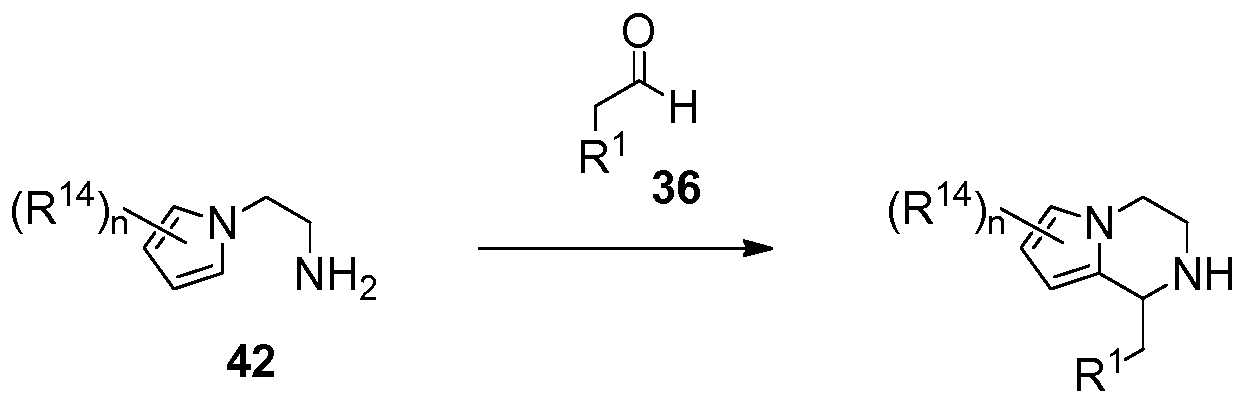
Structure 1
Scheme 10
In case Structure 1 represents a 1 ,2,3,4-tetrahydropyrrolo[1 ,2-a]pyrazine, compounds of Structure 1 may be prepared in analogy to the procedure described in WO2009090054 and as depicted in Scheme 10. An amine of Structure 42 undergoes ring closure by reaction with an aldehyde of Structure 36 in a solvent such as MeOH in the presence of a base like aq. NaOH. Reaction times can vary between 1 h and 5 days.
General process for the preparation of Acids of Structure 2

Structure 2
Scheme 1 1
Acids of Structure 2 are either commercially available or prepared as depicted in Scheme 1 1 . A commercially available or well known indole derivative of Structure 43 may be alkylated on nitrogen by initial deprotonation with a base like sodium hydride in a solvent such as DMF or THF followed by reaction with an alkyl halide like methyl iodide. Formylation at the indole-3- position using Duff conditions (hexamethylenetetramine in TFA under reflux) followed by oxidation of the aldehyde using sodium chlorite under buffered conditions in the presence of a chlorine scavenger like 2-methyl-2-butene in a solvent mixture like THF/fbutanol gives an
acid of Structure 2. Alternatively, a commercially available ester of Structure 44 can be N- alkylated in the same way as described above followed by hydrolysis of the ester function with aq. NaOH in MeOH to give an acid of Structure 2.
Generally, bi-(hetero-)aryl-like structures as present in certain groups R1 can be synthesised using well established Suzuki chemistry in analogy to scheme 12.

Scheme 12: Synthesis of bi-(hetero-)aryl like structures; X is Br, I
Reaction of commercially available (hetero-)aryl-boronic acid derivatives (e.g. carboxylic acids or esters thereof) with commercially available (hetero-)aryl-bromides or (hetero-)aryl- iodides (or analogues thereof, such as chlorides, trifluoromethanesolfonates) in presence of a metal catalyst catalyst such as Pd(PPh3)4 or equivalent and a base such as Na2C03 under heating in a solvent such as toluene, dioxane, THF provides the corresponding bi-(hetero-)aryl like structures which can be used directly or after generally known functional group transformations in the schemes 1 to 1 1 above.
Whenever the compounds of formula (I) are obtained in the form of mixtures of enantiomers, the enantiomers can be separated using methods known to the one skilled in the art: e.g. by formation and separation of diastereomeric salts or by HPLC over a chiral stationary phase such a Daicel ChiralCel OD-H (5-10 μηη) column, a Daicel ChiralPak IC (5 μηη) column, or a Daicel ChiralPak IA (5-10 μηη) or AD-H (5 μηη) column. Typical conditions of chiral HPLC are an isocratic mixture of eluent A (heptanes or CH3CN) and eluent B (EtOH , MeOH, DCM ot tBME in presence or absence of an amine such as TEA or DEA), at a flow rate of 0.8 to 150 mL/min.
Experimental part
l-Chemistry
All temperatures are stated in °C. Commercially available starting materials were used as received without further purification. Unless otherwise specified, all reactions were carried out in oven-dried glassware under an atmosphere of nitrogen. Compounds were purified by FC or by prep. HPLC. Compounds described in the invention are characterized by LC-MS data (retention time tR is given in min.; molecular weight obtained from the mass spectrum is given in g/mol) using the conditions listed below. Racemates can be separated into their
enantiomers by prep. HPLC (column: ChiralPaK AD 20x250 mm, 5 μηι, 15% EtOH in hexane).
LC-MS with acidic conditions
Method A: Agilent 1 100 series with mass spectrometry detection (MS: Finnigan single quadrupole). Column: Zorbax SB-aq (3.5 μηη, 4.6 x 50 mm). Conditions: MeCN [eluent A]; water + 0.04% TFA [eluent B]. Gradient: 95% B→ 5% B over 1 .5 min. (flow: 4.5 mL/min.). Detection: UV/Vis + MS.
Method B: Agilent 1 100 series with mass spectrometry detection (MS: Finnigan single quadrupole). Column: Waters XBridge C18 (5 μηη, 4.6 x 50 mm). Conditions: MeCN [eluent A]; water + 0.04% TFA [eluent B]. Gradient: 95% B → 5% B over 1 .5 min. (flow: 4.5 mL/min.). Detection: UV/Vis + MS.
LC-MS with basic conditions
Method C: Agilent 1 100 series with mass spectrometry detection (MS: Finnigan single quadrupole). Column: Zorbax Extend C18 (5 μηη, 4.6 x 50 mm). Conditions: MeCN [eluent A]; 13 mmol/L NH3 in water [eluent B]. Gradient: 95% B → 5% B over 1.5 min. (flow: 4.5 mL/min.). Detection: UV/Vis + MS.
Method D: Agilent 1 100 series with mass spectrometry detection (MS: Finnigan single quadrupole). Column: Waters XBridge C18 (5 μηη, 4.6 x 50 mm). Conditions: MeCN [eluent A]; 13 mmol/L NH3 in water [eluent B]. Gradient: 95% B→ 5% B over 1.5 min. (flow: 4.5 mL/min.). Detection: UV/Vis + MS.
Abbreviations (as used herein or in the description above):
acac acetylacetonato
aq. aqueous
atm atmosphere
BSA bovine serum albumin
Boc Butyloxycarbonyl
d days
DCC dicyclohexyl carbodiimide
DCM dichloromethane
DIBAL diisobutylaluminium hydride
DIPEA diisopropyl-ethylamine, Hijnig's
DMA dimethylacetamide
DMF dimethylformamide
DMSO dimethylsulfoxide
dppf 1 ,1 '-bis(diphenylphosphino)ferrocene
EDC N-(3-dimethylaminopropyl)-N'-ethyl-carbodiimide
eq. equivalent(s)
Et ethyl
EtOAc ethyl acetate
Ex. example(s)
FC flash chromatography on Si02
h hour(s)
HBTU 0-(benzotriazol-1 -yl)-N,N,N',N'-tetramethyluronium
hexafluorophosphate
HPLC high performance liquid chromatography
HV high vacuum conditions
'Bu isobutyl
'Pr isopropyl
LC-MS liquid chromatography - mass spectrometry
Lit. literature
Me methyl
MeCN acetonitrile
MeOH methanol
MTBE methyl-ferfbutyl ether
min minute(s)
NaOAc sodium acetate
"BuLi n-butyl-lithium
NMP N-methylpyrrolidin-2-one
"Pr n-propyl
OAc acetate
Ph phenyl
PyBOP benzotriazol-1 -yl-oxy-tris-pyrrolidino-phosphonium- hexafluoro-phosphate
prep. preparative
rac racemic
RT room temperature
s second(s)
sat. Saturated
soln. Solution
TBTU 2-(1 H-benzotriazole-1-yl)-1 ,2,3,3-tetramethyluronium tetrafluoroborate
TFA trifluoroacetic acid
TFAA trifluoroacetic anhydride
THF tetrahydrofuran
TLC thin layer chromatography
TMS trimethylsilyl
tR retention time
The following examples illustrate the preparation of compounds of the invention but do not at all limit the scope thereof.
General method A for the synthesis of 1 ,2,3,4-tetrahydroisoquinolines of Structure 1
Listed in Table 1 below are 1 ,2,3,4-tetrahydroisoquinolines of Structure 1 , prepared via Bischler-Napieralski cyclisation of the corresponding amide followed by imine reduction according to the procedure described in WO2004/085403.
Table 1
Tetrahydroisoquinoline of Structure 1 fR [min] MS-data
LC-MS / m/z Method [M+H]+ rac-6J-Dimethoxy-1-(3-methoxy-benzyl)-1 ,2,3,4-tetrahydro- 0.81 / C 314.23 isoquinoline.HCI
rac-1-Benzo[1 ,3]dioxol-5-ylmethyl-6,7-dimethoxy-1 ,2,3,4-tetrahydro- 0.79 / C 328.18 isoquinoline.HCI
rac-1-Benzyl-6-methoxy-1 ,2,3,4-tetrahydro-isoquinoline HCI 0.89 / C 254.19 rac-1-(4-Chloro-benzyl)-6,7-dimethoxy- ,2,3,4-tetrahydro-isoquinoline 0.87 / C (35CI) 318.17 rac-6J-Dimethoxy-1-(4-methoxy-benzyl)-1 ,2,3,4-tetrahydro- 0.80 / C 314.23 isoquinoline.HCI
rac-6J-Dimethoxy-1-(3,4,5-trimethoxy-benzyl)-1 ,2,3,4-tetrahydro- 0.75 / C 374.22 isoquinoline.HCI
rac-1-(4-Fluoro-benzyl)-6,7-dimethoxy-1 ,2,3,4-tetrahydro-isoquinoline.HCI 0.82 / C 302.17 rac-6,7-Dimethoxy-1-naphthalen-2-ylmethyl-1,2,3,4-tetrahydro-isoquinoline 0.91 / C 334.22 rac-1-(2,5-Dimethoxy-benzyl)-6J-dimethoxy-1 ,2,3,4-tetrahydro- 0.82 / C 344.20 isoquinoline.HCI
rac-1-(2,5-Dimethoxy-benzyl)-5,8-dimethoxy-1 ,2,3,4-tetrahydro- 0.92 / C 344.22 isoquinoline.HCI
rac-1-(3-Fluoro-4-methoxy-benzyl)-6J-dimethoxy-1 ,2,3,4-tetrahydro- 0.80 / C 332.18 isoquinoline.HCI
General method B for the synthesis of 1 ,2,3,4-tetrahydroisoquinolines of Structure 1
Step 1 : /V-Bromosuccinimide (9.89 g, 55.0 mmol, 1 .1 eq.) was added cautiously and portionwise over 20 min at RT to a soln. of 1 ,2,3,4-tetrahydroisoquinoline (6.34 mL, 50.0 mmol, 1.0 eq.) in DCM (130 mL) under argon. After complete addition the reaction mixture was stirred for 2h after which 5M aq. NaOH (30 mL) was added and the mixture was stirred for 2h. The organic layer was separated and washed with water (1x) before being extracted with 2M aq. HCI (2x) and subsequently discarded. The combined acidic aq. extracts were re- basified with 5M aq. NaOH and then re-extracted with DCM (3x). The combined organic extracts were dried over Na2S04, filtered and evaporated in vacuo to give 3,4- dihydroisoquinoline as an orange oil that was used directly in Step 2. LC-MS C: tR = 0.72 min; [M+H]+ = 132.18.
Step 2: The appropriately substituted benzylmagnesium chloride as a soln. in THF (1.14 mmol, 1 .5 eq.) was added dropwise to a 5°C soln. of 3,4-dihydroisoquinoline from above (0.76 mmol) in THF (3 mL) under argon and after complete addition the reaction mixture was stirred for 1.5h. The reaction was quenched with sat. aq. NH4CI, diluted with H20 and extracted with DCM (3x). The combined organic extracts were dried over Na2S04, filtered and evaporated in vacuo to give the crude product that was purified by FC (eluent: 2.5% -> 10% MeOH in DCM).
Listed in Table 2 below are 1 ,2,3,4-tetrahydroisoquinolines of Structure 1 , prepared according to the above procedure.
Table 2

The title compound was prepared starting from 1 ,7-naphthyridine according to the procedure described in WO2009038812. LC-MS C: tR = 0.67 min; [M+H]+ = 285.18.
2-Thiophen-3-yl-ethylamine hydrochloride.
A soln. of 3-thiopheneacetonitrile (18.44 g, 0.15 mol) in THF (245 mL) was added dropwise to a RT soln. of 1 M borane.THF complex (300 mL, 0.3 mol) under argon and the resulting mixture was heated to reflux for 3h followed by stirring at RT overnight. The reaction mixture was cautiously quenched with MeOH and subsequently concentrated in vacuo. The residue was dissolved in MeOH (150 mL) and 4M HCI in dioxane (105 mL, 2.8 eq.) was added cautiously under vigorous stirring and the mixture was stirred for 30 min. The soln. was evaporated in vacuo and the residue was re-dissolved in MeOH and re-evaporated. This dissolution and evaporation procedure was repeated a further two times to give the crude product as its HCI salt that was suspended in 3:7 'PrOH:EtOAc and stirred for 15 min. The suspension was filtered and the residue was dried in vacuo to give the title compound as a white solid (20.73 g). LC-MS A: tR = 0.33 min; [M+H+MeCN]+ = 169.06.
General method C for the synthesis of substituted 2-thiophen-3-yl-ethylamines 13. Step 1 : Molecular sieves 4A (-10 wt%), butylamine (4.8 mmol, 0.12 eq.) and acetic acid (8 mmol, 0.20 eq.) were added to a soln. of the substituted thiophene-3-carbaldehyde 11 (40.00 mmol, 1 eq.) in nitromethane (23 mL) and the resulting mixture was heated to 95°C for 30 min. The reaction mixture was transferred to a new flask to remove the molecular sieves and the solvent was removed in vacuo. The residue was purified by FC (eluent: Hept/EtOAc) to furnish the desired nitro olefin 12.
Step 2: H2S04 (2.87 mL) was added dropwise to a stirred suspension of LiAIH4 (4.30 g, 108 mmol, 4.46 eq.) in THF (162 mL) under ice-cooling. After stirring for 20 min a soln. of the nitro olefin 12 (24 mmol, 1.0 eq.) in THF (17 mL) was added dropwise over 20 min. After an additional 10 min the cooling bath was removed and the mixture was heated to a gentle reflux for 5 min. The reaction mixture was then cooled to 0°C and carefully quenched by the dropwise addition of 'PrOH (18 mL), followed by 2M aq. NaOH (13 mL). The resulting suspension was filtered and the residue was rinsed with THF. The filtrate was concentrated in vacuo to give the desired substituted 2-thiophen-3-yl-ethylamine as its free base.
The free amine was dissolved in Et20 (88 mL) containing 'PrOH (3 mL) and acidified with 2M HCI in Et20 soln. (46 mL). The resulting suspension was filtered and the white solid residue was rinsed with Et20 and dried under high vacuum to afford the desired 2-thiophen-3-yl- ethylamine salt that was used further without purification.
Listed in Table 3 below are substituted 2-thiophen-3-yl-ethylamines 13 and substituted 2- thiophen-3-yl-ethylamine hydrochlorides, prepared according to the above mentioned method using the corresponding substituted thiophene-3-carbaldehyde 11 as starting material.
Table 3

(2,3-Dihydro-benzo[1 ,4]dioxin-5-yl)-acetic acid
The title compound was prepared in 3 steps starting from (2,3-dihydro-1 ,4-benzodioxin-5- yl)methanol as described in US2002/0032205, Example 6. LC-MS B: tR = 0.60 min; [M+H+MeCN]+ = 236.36.
Benzo[1 ,3]dioxol-4-yl -acetic acid
The title compound was prepared in 3 steps starting from 1 ,3-benzodioxol-4-ylmethanol as described above for (2,3-dihydro-benzo[1 ,4]dioxin-5-yl)-acetic acid. LC-MS B: tR = 0.60 min; [M+H+MeCN]+ = 222.09.
General method D for the synthesis of 4,5,6,7-tetrahydro-thieno[2,3-c]pyridines of Structure 1
Step 1 : TBTU (8.63 g, 26.88 mmol) was added to a RT soln. of the required arylacetic acid 4 (24.44 mmol 1.0 eq.) and DIPEA (6.3 mL, 36.67 mmol) in DMF (10 mL). After stirring for 5 min a soln. of the 2-thiophen-3-yl-ethylamine 13 or 2-thiophen-3-yl-ethylamine.HCI (24.44 mmol) and DIPEA (6.3 mL, 36.67 mmol) in DMF (10 mL) was added and the resulting mixture was stirred for 16h. The reaction mixture was diluted with MTBE and washed successively with 1 M aq. NaOH (1 x), 1 M aq. HCI (1 x) and H20 (3x). The organic layer was dried over Na2S04, filtered and evapotated in vacuo to give the crude product that was either triturated with Et20 or purified by FC (eluent: Hexane/EtOAc) to give the corresponding amide 14.
Step 2: POCI3 (4.88 mL, 52.39 mmol) was added to a RT soln. of the amide from above (10.48 mmol 1 .0 eq.) in MeCN (180 mL) and the resulting mixture was heated to 80°C and stirred for 2h. The volatiles were removed in vacuo and the residue was dissolved in MeOH and re-evaporated (2x). The residue was re-dissolved in MeOH and cooled to 0°C before NaBH4 (1.27 g, 33.53 mmol) was added portionwise. After complete addition the reaction mixture was stirred for 10 min before being concentrated in vacuo and the residue was partitioned between H20 and EtOAc. The phases were separated and the aq. phase was re- extracted with EtOAc (2x). The combined organic extracts were washed with brine, dried
over Na2S04, filtered and evaporated in vacuo to give the cyclic amine product that was used further without purification.
Listed in Table 4 below are 4,5,6,7-tetrahydro-thieno[2,3-c]pyridines of Structure 1 , prepared according to the above procedure.
Table 4
Tetrahydro-thieno[2,3-c]pyridine 1 i [min] MS-data m/z
LC-MS / [M+H]+ Method
rac-7-Naphthalen-2-ylmethyl-4,5,6,7-tetrahydro-thieno[2,3-c]pyridine 0.98 / C 280.16 rac-7-(3,4-Dimethoxy-benzyl)-4,5,6J-tetrahydro-thieno[2,3-c]pyridine 0.81 / C 290.18 rac-7-(4-Trifluoromethyl-benzyl)-4,5,6J-tetrahydro-thieno[2,3-c]pyridine 0.96 / C 297.88 rac-7-Benzyl-4,5,6J-tetrahydro-thieno[2,3-c]pyridine 0.90 / C 230.19 rac-7-Naphthalen-1-ylmethyl-4,5,6,7-tetrahydro-thieno[2,3-c]pyridine 0.99 / C 280.19 rac-3-Bromo-7-(3,4-dimethoxy-benzyl)-4,5,6J-tetrahydro-thieno[2,3- 0.99 / C 368.0 c]pyridine
rac-7-(4-Methoxy-benzyl)-4,5,6,7-tetrahydro-thieno[2,3-c]pyridine 0.87 / C 260.14 rac-7-(2,3-Dimethoxy-benzyl)-4,5,6J-tetrahydro-thieno[2,3-c]pyridine 0.87 / C 290.15 rac-7-(3-Methoxy-benzyl)-4,5,6,7-tetrahydro-thieno[2,3-c]pyridine 0.87 / C 260.08 rac-7-(3,5-Dimethoxy-benzyl)-4,5,6J-tetrahydro-thieno[2,3-c]pyridine 0.87 / C 290.16 rac-7-(3,4-Dichloro-benzyl)-4,5,6J-tetrahydro-thieno[2,3-c]pyridine 0.99 / C 297.81 rac-7-(2,3-Dihydro-benzo[1 ,4]dioxin-6-ylmethyl)-4,5,6,7-tetrahydro- 0.85 / C 288.14 thieno[2,3-c]pyridine
rac-7-(4-Trifluoromethoxy-benzyl)-4,5,6,7-tetrahydro-thieno[2,3-c]pyridine 0.97 / C 314.11 rac-7-(2,3-Dihydro-benzo[1 ,4]dioxin-5-ylmethyl)-4,5,6J-tetrahydro- 0.87 / C 288.13 thieno[2,3-c]pyridine
rac-7-Benzo[1 ,3]dioxol-4-ylmethyl-4,5,6J-tetrahydro-thieno[2,3-c]pyridine 0.87 / C 274.11 rac-7-Benzo[1 ,3]dioxol-5-ylmethyl-4,5,6J-tetrahydro-thieno[2,3-c]pyridine 0.87 / C 274.11 rac-7-(2,4-Dichloro-benzyl)-4,5,6J-tetrahydro-thieno[2,3-c]pyridine 1.03 / C 297.82 rac-7-Pyridin-2-ylmethyl-4,5,6J-tetrahydro-thieno[2,3-c]pyridine Broad peak / C 231.19 rac-7-(3-Trifluoromethyl-benzyl)-4,5,6J-tetrahydro-thieno[2,3-c]pyridine 0.95 / C 297.88 rac-7-(2,6-Dichloro-benzyl)-4,5,6J-tetrahydro-thieno[2,3-c]pyridine 1.02 / C 297.81 rac-7-(1 H-lndol-3-ylmethyl)-4,5,6,7-tetrahydro-thieno[2,3-c]pyridine 0.84 / C 269.14 rac-7-(1-Methyl-1 H-indol-3-ylmethyl)-4,5,6,7-tetrahydro-thieno[2,3- 0.92 / C 283.16 c]pyridine
rac-7-(1 H-Benzoimidazol-2-ylmethyl)-4,5,6J-tetrahydro-thieno[2,3- 0.80 / C 270.15 c]pyridine
rac-7-(1 H-lndazol-3-ylmethyl)-4,5,6J-tetrahydro-thieno[2,3-c]pyridine 0.78 / C 270.14 rac-7-(2-Methyl-thiazol-4-ylmethyl)-4,5,6,7-tetrahydro-thieno[2,3-c]pyridine 0.77 / C 251.12 rac-8-(4,5,6J-Tetrahydro-thieno[2,3-c]pyridin-7-ylmethyl)-quinoline 0.87 / C 281.1 rac-7-(4-Benzyloxy-3-methoxy-benzyl)-4,5,6,7-tetrahydro-thieno[2,3- 0.96 / C 366.16 c]pyridine
rac-7-(3-lodo-benzyl)-4,5,6,7-tetrahydro-thieno[2,3-c]pyridine 1.00 / C 356.03 rac-7-(4-lodo-benzyl)-4,5,6,7-tetrahydro-thieno[2,3-c]pyridine 0.99 / C 356.0 rac-6-(4,5,6J-Tetrahydro-thieno[2,3-c]pyridin-7-ylmethyl)-quinoline 0.78 / C 281.11 rac-7-(4,5,6J-Tetrahydro-thieno[2,3-c]pyridin-7-ylmethyl)-quinoline 0.79 / C 281.13 rac-2-Methoxy -(4,5,6J-tetrahydro-thieno[2,3-c]pyridin-7-ylmethyl)-phenol 0.73 / C 276.08 rac-2-Methoxy-5-(4,5,6J-tetrahydro-thieno[2,3-c]pyridin-7-ylmethyl)-phenol 0.74 / C 276.13 rac-7-(3,4-Dimethoxy-benzyl)-2,3-dimethyl-4,5,6,7-tetrahydro-thieno[2,3- 0.90 / C 318.15 c]pyridine
rac-7-(3,4-Dimethoxy-benzyl)-2-methyl-4,5,6,7-tetrahydro-thieno[2,3- 0.86 / C 304.15 c]pyridine
rac-7-(6-Chloro-pyndin-3-ylmethyl)-4,5,6,7-tetrahydro-thieno[2,3-c]pyridine 0.80 / C 306.02 rac-2-(4,5,6,7-Tetrahydro-thieno[2,3-c]pyridin-7-ylmethyl)-benzonitrile 0.84 / C 255.14 rac-3-(4,5,6,7-Tetrahydro-thieno[2,3-c]pyridin-7-ylmethyl)-benzonitrile 0.84 / C 255.15 rac-4-(4,5,6,7-Tetrahydro-thieno[2,3-c]pyndin-7-ylmethyl)-benzonitrile 0.84 / C 255.12 rac-7-Pyridin-3-ylmethyl-4,5,6J-tetrahydro-thieno[2,3-c]pyridine 0.73 / C 231.2 rac-7-(6-Chloro-pyndin-2-ylmethyl)-4,5,6,7-tetrahydro-thieno[2,3-c]pyridine 0.83 / C 265.05 rac-7-(3,4-Difluoro-benzyl)-4,5,6J-tetrahydro-thieno[2,3-c]pyridine 0.91 / C 265.94 rac-7-(2-Chloro-benzyl)-4,5,6,7-tetrahydro-thieno[2,3-c]pyridine 0.95 / C 264.12 rac-7-(3-Chloro-benzyl)-4,5,6,7-tetrahydro-thieno[2,3-c]pyridine 0.96 / C 264.06 rac-7-(4-[1 ,2,3]Triazol-2-yl-benzyl)-4,5,6,7-tetrahydro-thieno[2,3-c]pyridine
hydrochloride and rac-7-(4-[1 ,2,3]triazol-1 -yl-benzyl)-4,5,6,7-tetrahydro-thieno[2,3- c]pyridine hydrochloride
Step 1 : A soln. of Boc20 (227 mg, 1 .04 mmol) in DCM (5 mL) was added dropwise to a RT soln. of rac-7-(4-iodo-benzyl)-4,5,6,7-tetrahydro-thieno[2,3-c]pyridine (363 mg, 1 .02 mmol) and Et3N (0.29 mL, 2.1 mmol) in DCM (15 mL) and the reaction mixture was stirred for 30 min. The reaction was quenched by the addition of 1 M aq. citric acid (10 mL) and the mixture was stirred vigorously for 10 min. The layers were separated and the aq. layer was re-
extracted with DCM (2x). The combined organic layers were washed with water, dried over Na2S04, filtered and evaporated in vacuo to give the Boc-protected product that was used directly in the next step below. LC-MS C: tR = 1 .15 min; no ionisation.
Step 2: 1 H-1 ,2,3-triazole (140 mg, 2 mmol), Cs2C03 (658 mg, 2 mmol), Cul (9.6 mg, 0.05 mmol) and rac. frans-/V,/V-diaminomethylcyclohexane (29 mg, 2 mmol) were added to a RT soln. of rac-7-(4-iodo-benzyl)-4,7-dihydro-5H-thieno[2,3-c]pyridine-6-carboxylic acid tert-butyl ester (460 mg, 1 mmol) in DMF (4 mL) under argon and the resulting mixture was heated to 120°C for 17h. The mixture was cooled to RT and partitioned between water and EtOAc. The layers were separated and the aq. phase was re-extracted with EtOAc (2x). The combined organic layers were washed with water (2x), dried over Na2S04, filtered and evaporated in vacuo to give the crude product that was purified by FC (eluent: 100% DCM -> 99:1 DCM:MeOH) to give rac-7-(4-[1 ,2,3]triazol-2-yl-benzyl)-4,7-dihydro-5H-thieno[2,3-c]pyridine- 6-carboxylic acid tert-butyl ester (167 mg). LC-MS C: tR = 1 .07 min; [M+H]+ = 397.14. Further elution afforded rac-7-(4-[1 ,2,3]triazol-1-yl-benzyl)-4,7-dihydro-5H-thieno[2,3-c]pyridine-6- carboxylic acid tert-butyl ester (1 16 mg). LC-MS C: tR = 0.94 min; [M+H]+ = 397.1 1 .
Step 3a: 4M HCI in dioxane (2 mL, 19 eq.) was added to a RT soln. of rac-7-(4-[1 ,2,3]triazol- 2-yl-benzyl)-4,7-dihydro-5H-thieno[2,3-c]pyridine-6-carboxylic acid tert-butyl ester (167 mg, 0.42 mmol) in dioxane (1 mL) under argon and the resulting mixture was stirred for 1 h after which it appeared as a white suspension. The product was collected by filtration washing with Et20 and dried in vacuo to give the title compound as a white solid (137 mg). LC-MS B: tR = 0.50 min; [M+H]+ = 297.22.
Step 3b: Boc-deprotection of rac-7-(4-[1 ,2,3]triazol-1 -yl-benzyl)-4,7-dihydro-5H-thieno[2,3- c]pyridine-6-carboxylic acid tert-butyl ester as described above gave the 2nd title compound as a beige solid (86 mg). LC-MS B: tR = 0.42 min; [M+H]+ = 297.07.
rac-7-(3-[1 ,2,3]Triazol-2-yl-benzyl)-4,5,6,7-tetrahydro-thieno[2,3-c]pyridine
hydrochloride and rac-7-(3-[1 ,2,3]triazol-1 -yl-benzyl)-4,5,6,7-tetrahydro-thieno[2,3- c]pyridine hydrochloride
The title compounds were prepared in analogy to rac-7-(4-[1 ,2,3]triazol-2-yl-benzyl)-4,5,6,7- tetrahydro-thieno[2,3-c]pyridine hydrochloride and rac-7-(4-[1 ,2,3]triazol-1-yl-benzyl)-4,5,6,7- tetrahydro-thieno[2,3-c]pyridine hydrochloride starting with rac-7-(3-iodo-benzyl)-4, 5,6,7- tetrahydro-thieno[2,3-c]pyridine. LC-MS B: tR = 0.50 min; [M+H]+ = 297.12 and tR = 0.43 min; [M+H]+ = 297.27 respectively.
rac-7-(4-Cyclopropoxy-3-methoxy-benzyl)-4,5,6,7-tetrahydro-thieno[2,3-c]pyridine hydrochloride
Step 1 : Boc-protection of rac-2-methoxy-4-(4,5,6,7-tetrahydro-thieno[2,3-c]pyridin-7- ylmethyl)-phenol as described above gave rac-7-(4-hydroxy-3-methoxy-benzyl)-4,7-dihydro- 5H-thieno[2,3-c]pyridine-6-carboxylic acid tert-butyl ester. LC-MS C: tR = 0.94 min; [M+H]+ = 376.08.
Step 2: Cu(OAc)2 (167 mg, 0.92 mmol) was stirred in DCM (6 mL) under an air atmosphere for 10 min before vinylboronic anhydride. pyridine complex (147 mg, 0.61 mmol), rac-7-(4- hydroxy-3-methoxy-benzyl)-4,7-dihydro-5H-thieno[2,3-c]pyridine-6-carboxylic acid tert-butyl ester (345 mg, 0.92 mmol) and pyridine (0.75 mL, 9.19 mmol) were added and the mixture was stirred at RT overnight. The reaction mixture was filtered through a pad of celite rinsing with additional DCM. The filtrate was evaporated in vacuo to give rac-7-(3-methoxy-4- vinyloxy-benzyl)-4,7-dihydro-5H-thieno[2,3-c]pyridine-6-carboxylic acid tert-butyl ester (241 mg) as a yellow oil that was used further without purification. LC-MS C: tR = 1.06 min; [M+H]+ = 402.04.
Step 3: A soln. of TFA (0.1 1 mL, 1 .47 mmol) in DCM (0.75 mL) was added to a 0°C soln. of Et2Zn (1 .47 mL, 2 eq.) 1 M soln. in hexanes in DCM (1.5 mL) under argon and the resulting mixture was stirred for 20 min before a soln. of CH2I2 (0.12 mL, 1 .47 mmol) in DCM (0.75 mL) was added. After a further 20 min a soln. of rac-7-(3-methoxy-4-vinyloxy-benzyl)-4,7-dihydro- 5H-thieno[2,3-c]pyridine-6-carboxylic acid tert-butyl ester (295 mg, 0.74 mmol) in DCM (1 mL) was added and the ice bath was removed. The reaction mixture was stirred for 30 min at RT before being quenched with sat. aq. NaHC03 soln. and stirred for 10 min. The solids were removed by filtration through a celite pad rinsing with DCM and the layers were separated. The organic layer was washed with water (1 x), dried over Na2S04, filtered and evaporated in vacuo to give crude rac-7-(4-cyclopropoxy-3-methoxy-benzyl)-4,7-dihydro-5H- thieno[2,3-c]pyridine-6-carboxylic acid tert-butyl ester that was purified by prep. HPLC (column: Waters X-bridge, 30x75 mm, 10 urn, UV/MS, basic conditions) LC-MS C: tR = 1 .05 min; [M+H]+ = 416.06.
Step 4: Boc-deprotection of rac-7-(4-cyclopropoxy-3-methoxy-benzyl)-4,7-dihydro-5H- thieno[2,3-c]pyridine-6-carboxylic acid tert-butyl ester as described above gave the title compound as an orange solid (100 mg). LC-MS C: tR = 0.87 min; No ionisation.
rac-2-[2-Methoxy-4-(4,5,6,7-tetrahydro-thieno[2,3-c]pyridin-7-ylmethyl)-phenoxy]- ethanol hydrochloride
Step 1 : 2-Chloroethanol (150 μΙ_, 2.25 mmol) was added to a mixture of rac-7-(4-hydroxy-3- methoxy-benzyl)-4,7-dihydro-5H-thieno[2,3-c]pyridine-6-carboxylic acid tert-butyl ester (375 mg, 1 .0 mmol), K2C03 (221 mg, 1 .60 mmol) and Kl (1 mg) in DMSO (5 mL) and the reaction mixture was heated to 85°C and stirred for 3h. The reaction mixture was concentrated in vacuo and the residue was diluted with MTBE (30 mL) and washed with water (4x5 mL). The organic layer was dried over Na2S04, filtered and evaporated in vacuo to give crude tert-butyl rac-7-(4-(2-hydroxyethoxy)-3-methoxybenzyl)-4,5-dihydrothieno[2,3-c]pyridine-6(7H)- carboxylate that was purified by prep. HPLC (column: Waters X-bridge, 30x75 mm, 10 urn, UV/MS, basic conditions) LC-MS C: tR = 0.90 min; [M+H]+ = 420.04.
Step 2: Boc-deprotection of rac-7-(4-(2-hydroxyethoxy)-3-methoxybenzyl)-4,5- dihydrothieno[2,3-c]pyridine-6(7H)-carboxylate as described above gave the title compound as a white solid (95 mg). LC-MS C: tR = 0.71 min; [M+H]+ = 320.12.
rac-2-Bromo-7-(3,4-dimethoxy-benzyl)-4,5,6,7-tetrahydro-thieno[2,3-c]pyridine
Step 1 : Boc-protection of rac-7-(3,4-dimethoxy-benzyl)-4,5,6,7-tetrahydro-thieno[2,3- c]pyridine as described above gave rac-7-(3,4-dimethoxy-benzyl)-4,7-dihydro-5H-thieno[2,3- c]pyridine-6-carboxylic acid tert-butyl ester. LC-MS C: tR = 1 .01 min; [M+H]+ = 390.1.
Step 2: A soln. of NBS (653 mg, 3.67 mmol) in MeCN (10 mL) was added over a period of 5 min to a RT soln. of rac-7-(3,4-dimethoxy-benzyl)-4,7-dihydro-5H-thieno[2,3-c]pyridine-6- carboxylic acid tert-butyl ester (1 .3 g, 3.34 mmol) in MeCN (40 mL). The reaction mixture was heated to 75°C after which the volatiles were removed in vacuo and the residue was re- dissloved in MeCN and purified by prep. HPLC (column: Waters X-bridge, 30x75 mm, 10 urn, UV/MS, basic conditions) to give a 1 :1 inseparable mixture of rac-2-bromo-7-(3,4-dimethoxy- benzyl)-4,7-dihydro-5H-thieno[2,3-c]pyridine-6-carboxylic acid tert-butyl ester and rac-7-(2- bromo-4,5-dimethoxy-benzyl)-4,7-dihydro-5H-thieno[2,3-c]pyridine-6-carboxylic acid tert- butyl ester (0.55 g). LC-MS C: tR = 1 .07 and 1 .09 min; [M(79Br)+H]+ = 41 1.83.
Step 3: TFA (0.53 mL, 6.9 mmol) was added to a RT soln. of the 1 :1 mixture of regioisomers from above (0.54 g, 1.15 mmol) in DCM (5 mL). After stirring for 2h the volatiles were removed in vacuo and the residue was partitioned between EtOAc and sat. aq. NaHC03 soln. The phases were separated and the aq. phase was re-extracted with EtOAC (2x). The combined organic layers were washed with water, dried over Na2S04, filtered and evaporated in vacuo to give a 1 :1 inseparable mixture of the title compound and rac-7-(2-
bromo-4,5-dimethoxy-benzyl)-4,5,6,7-tetrahydro-thieno[2,3-c]pyridine as a brown oil (402 mg). LC-MS C: tR = 0.90 min; [M(79Br)+H]+ = 368.00.
rac-5-(4,5,67-Tetrahydro-thieno[2,3-c]pyridin-7-ylmethyl)^yridine-2-carbonitrile hydrochloride
Step 1 : Boc-protection of rac-7-(6-chloro-pyridin-3-ylmethyl)-4,5,6,7-tetrahydro-thieno[2,3- c]pyridine as described above gave rac-7-(6-chloro-pyridin-3-ylmethyl)-4,7-dihydro-5H- thieno[2,3-c]pyridine-6-carboxylic acid tert-butyl ester. LC-MS D: tR = 0.99 min; [M(35CI)+H]+ = 365.15.
Step 2: A mixture of Pd(ll) trifluoroacetate (41 mg, 0.12 mmol), zinc powder (34 mg, 0.52 mmol), racemic-2-(di-t-butylphosphino)-1 ,1 '-binaphtyl (96 mg, 0.24 mmol), rac-7-(6-chloro- pyridin-3-ylmethyl)-4,7-dihydro-5H-thieno[2,3-c]pyridine-6-carboxylic acid tert-butyl ester (1 .0 g, 2.74 mmol) and Zn(CN)2 (180 mg, 1.54 mmol) in DMA (15 ml) was heated to 95°C for 2.5h. The reaction mixture was cooled to RT and quenched into a 1 :1 mixture of brine and ice-water and the resulting mixture was extracted with EtOAc (3x). The combined organic extracts were dried over Na2S04, filtered and evaporated in vacuo to give the crude product that was purified by FC (eluent: 1 :1 hexane:EtOAc) to give rac-7-(6-cyano-pyridin-3- ylmethyl)-4,7-dihydro-5H-thieno[2,3-c]pyridine-6-carboxylic acid tert-butyl ester as a white solid (0.69 g) LC-MS D: tR = 0.94 min; [M+H+MeCN]+ = 397.22.
Step 3: Boc-deprotection of rac-7-(6-cyano-pyridin-3-ylmethyl)-4,7-dihydro-5H-thieno[2,3- c]pyridine-6-carboxylic acid tert-butyl ester using 4M HCI in dioxane as described above gave the title compound as a white solid (0.61 g). LC-MS D: tR = 0.77 min; [M+H+MeCN]+ = 297.06.
rac-7-(6-Methyl-pyridin-3-ylmethyl)-4,5,6,7-tetrahydro-thieno[2,3-c]pyridine
dihydrochloride
Step 1 : Me2Zn 1.2M soln. in toluene (4.62 ml, 5.54 mmol) was added dropwise to a RT soln. of rac-7-(6-chloro-pyridin-3-ylmethyl)-4,7-dihydro-5H-thieno[2,3-c]pyridine-6-carboxylic acid tert-butyl ester (1 .0 g, 2.74 mmol), and [1 ,1 '- bis(diphenylphosphino)ferrocene]dichloropalladium(ll) complex with CH2CI2 (224 mg, 0.27 mmol) in dioxane (20 mL) and the resulting mixture was stirred overnight. The solvent was evaporated in vacuo and the residue was partitioned between water and EtOAc. The phases were separated and the aq. phase was re-extracted with EtOAc (2x). The combined organic extracts were dried over Na2S04, filtered and evaporated in vacuo to give the crude product that was purified by FC (eluent: 1 :1 hexane:EtOAc) to give rac-7-(6-methyl-pyridin-3-
ylmethyl)-4,7-dihydro-5H-thieno[2,3-c]pyridine-6-carboxylic acid tert-butyl ester as a white solid (0.74 g) LC-MS D: tR = 0.92 min; [M+H]+ = 345.22.
Step 2: Boc-deprotection of rac-7-(6-methyl-pyridin-3-ylmethyl)-4,7-dihydro-5H-thieno[2,3- c]pyridine-6-carboxylic acid tert-butyl ester using 4M HCI in dioxane as described above gave the title compound as a white solid (0.61 g). LC-MS D: tR = 0.73 min; [M+H]+ = 245.19. rac-7-(6-Ethyl^yridin-3-ylmethyl)-4,5,6,7-tetrahydro-thieno[2,3-c]pyridine
dihydrochloride
The title compound was prepared in analogy to rac-7-(6-methyl-pyridin-3-ylmethyl)-4, 5,6,7- tetrahydro-thieno[2,3-c]pyridine dihydrochloride using Et2Zn 1 M soln. in hexane. LC-MS D: tR = 0.78 min; [M+H]+ = 258.97. rac-7-(3-Pyrimidin-2-yl-benzyl)-4,5,6,7-tetrahydro-thieno[2,3-c]pyridine hydrochloride Step 1 : A mixture of rac-7-(3-iodo-benzyl)-4,7-dihydro-5H-thieno[2,3-c]pyridine-6-carboxylic acid tert-butyl ester (243 mg, 0.53 mmol) and Et3N (0.22 mL, 1.60 mmol) in 2- methyltetrahydrofuran (1 .5 mL) was degassed with N2 for 1 min. 4,4,5,5-Tetramethyl-1 ,3,2- dioxaborolane (1 16 μί, 0.80 mmol) was added dropwise and the mixture was further degassed for 30s before tri-o-tolylphosphine (8 mg, 0.03 mmol) followed by Pd(OAc)2 (3 mg, 0.01 mmol) were added. The reaction mixture was heated to 75°C for 20h after which it was cooled in an ice-bath and quenched with sat. aq. NH4CI soln. (5 mL). The reaction mixture was diluted with water (5 mL) and MTBE (20 mL) and filtered through a pad of celite rinsing with additional MTBE. The layers from the filtrate were separated and the aq. layer was re- extracted with MTBE (2x). The combined organic layers were washed with brine, dried over MgS04, filtered and evaporated in vacuo to give rac-7-[3-(4,4,5,5-tetramethyl- [1 ,3,2]dioxaborolan-2-yl)-benzyl]-4,7-dihydro-5H-thieno[2,3-c]pyridine-6-carboxylic acid tert- butyl ester as an orange solid (0.25 g) that was used further without purification. LC-MS D: tR = 1 .15 min; [M+H]+ = 456.22.
Step 2: A mixture of rac-7-[3-(4,4,5,5-tetramethyl-[1 ,3,2]dioxaborolan-2-yl)-benzyl]-4,7- dihydro-5H-thieno[2,3-c]pyridine-6-carboxylic acid tert-butyl ester (0.25 g, 0.55 mmol), 2- chloropyrimidine (75 mg, 0.66 mmol), 2M aq. Na2C03 (3.3 mL) and 2-methyltetrahydrofuran (4.7 mL) was degassed with N2 for 20s. PdCI2(dppf).DCM (18 mg, 0.02 mmol) was added and the reaction mixture was heated to 75°C for 22h. The reaction mixture was diluted with water (5 mL) and MTBE (20 mL) and filtered through a pad of celite rinsing with additional MTBE. The layers from the filtrate were separated and the aq. layer was re-extracted with MTBE (2x). The combined organic layers were washed with brine, dried over MgS04, filtered and evaporated in vacuo to give the crude product that was purified by prep. HPLC (column:
Waters X-bridge, 30x75 mm, 10 urn, UV/MS, basic conditions) to give rac-7-(3-pyrimidin-2-yl- benzyl)-4,7-dihydro-5H-thieno[2,3-c]pyridine-6-carboxylic acid tert-butyl ester as an orange solid (38 mg). LC-MS Basic: tR = 1 .04 min; [M+H]+ = 408.17.
Step 3: Boc-deprotection of rac-7-(3-pyrimidin-2-yl-benzyl)-4,7-dihydro-5H-thieno[2,3- c]pyridine-6-carboxylic acid tert-butyl ester using 4M HCI in dioxane as described above gave the title compound as a white solid (32 mg). LC-MS D: tR = 0.84 min; [M+H]+ = 308.17. rac-7-(3-Pyrazol-1 -yl-benzyl)-4,5,6,7-tetrahydro-thieno[2,3-c]pyridine hydrochloride Step 1 : A mixture of Fe(acac)3 (70 mg, 0.2 mmol), CuO (5 mg, 0.07 mmol), 1 H-pyrazole (67 mg, 1.0 mmol), Cs2C03 (429 mg, 1 .32 mmol) and rac-7-(3-iodo-benzyl)-4,7-dihydro-5H- thieno[2,3-c]pyridine-6-carboxylic acid tert-butyl ester (300 mg, 0.66 mmol) in DMF (2 mL) was heated to 90°C for 20h. The reaction mixture was cooled to RT, filtered through a cotton wool plug and directly purified by prep. HPLC (column: Waters X-bridge, 30x75 mm, 10 urn, UV/MS, basic conditions) to give rac-7-(3-pyrazol-1 -yl-benzyl)-4,7-dihydro-5H-thieno[2,3- c]pyridine-6-carboxylic acid tert-butyl ester as a white solid (10 mg). LC-MS D: tR = 1.03 min; [M+H]+ = 396.18.
Step 2: Boc-deprotection of rac-7-(3-pyrazol-1 -yl-benzyl)-4,7-dihydro-5H-thieno[2,3- c]pyridine-6-carboxylic acid tert-butyl ester using 4M HCI in dioxane as described above gave the title compound as a white solid (8 mg). LC-MS D: tR = 0.85 min; [M+H]+ = 296.19. rac-7-(3-[1 ,2,4]Triazol-1 -yl-benzyl)-4,5,6,7-tetrahydro-thieno[2,3-c]pyridine
hydrochloride
The title compound was prepared in analogy to rac-7-(3-pyrazol-1 -yl-benzyl)-4, 5,6,7- tetrahydro-thieno[2,3-c]pyridine hydrochloride using 1 ,2,4-triazole. LC-MS D: tR = 0.77 min; [M+H]+ = 297.1.
General method E for the synthesis of 4,5,6,7-tetrahydro-thieno[3,2-c]pyridines of Structure 1
rac-4-Naphthalen-1 -ylmethyl-4,5,6,7-tetrahydro-thieno[3,2-c]pyridine
Step 1 : TBTU (2.17 g, 6.77 mmol) was added to a soln. of 2-thiopheneethylamine (0.78 g, 6.16 mmol), 1-naphthylacetic acid (1 .15 g, 6.16 mmol) and DIPEA (2.64 mL, 15.39 mmol) in DMF (10 mL) and the resulting mixture was stirred for 10 min. The reaction mixture was diluted with MTBE and washed successively with 1 M aq. NaOH (1x), 1 M aq. HCI (1x) and H20 (3x). The organic layer was dried over Na2S04, filtered and evapotated in vacuo to give the crude product that was triturated with Et20 to give 2-naphthalen-1-yl-N-(2-thiophen-2-yl- ethyl)-acetamide as a beige solid (1.55 g). LC-MS A: tR = 0.71 min; [M+H+MeCN]+ = 337.22.
Step 2: POCI3 (2.41 mL, 25.90 mmol) was added to a RT soln. of the amide from above (1.53 g, 5.18 mmol) in MeCN (90 mL) and the resulting mixture was heated to 80°C and stirred for 2h. The volatiles were removed in vacuo and the residue was dissolved in MeOH and re-evaporated (2x). The residue was re-dissolved in MeOH (20 mL) and cooled to 0°C before NaBH4 (0.63 g, 16.57 mmol) was added portionwise. After complete addition the reaction mixture was stirred for 10 min before being concentrated in vacuo and the residue was partitioned between water and EtOAc. The phases were separated and the aq. phase was re-extracted with EtOAc (2x). The combined organic extracts were washed with brine, dried over Na2S04, filtered and evaporated in vacuo to give the title compound (1 .48 g) that was used further without purification. LC-MS C: tR = 0.98 min; [M+H]+ = 280.18.
General method F for the synthesis of 4,5,6, 7-tetrahydro-thieno[3,4-c]pyridines of Structure 1
rac-4-(3,4-Dimethoxy-benzyl)-1 -methyl-4,5,6,7-tetrahydro-thieno[3,4-c]pyridine
Step 1 : 1 M Borane.THF complex (103 mL, 0.1 mol) was added dropwise to a RT soln. of 2- methylthiophene-3-carboxylic acid (5.0 g, 35.4 mmol) in THF (60 mL) under argon and the resulting mixture was stirred for 2h. The reaction mixture was cautiously quenched with MeOH and subsequently concentrated in vacuo. The residue was purified by FC (eluent: 8:1 - >5:1 hexane:EtOAc) to give (2-methyl-thiophen-3-yl)-methanol as a colourless oil (4.17 g). 1H NMR (CDCIs) δΗ: 7.04 (m, 2 H), 4.63 (d, J = 5.2 Hz, 2 H), 2.48 (s, 3 H), 1.49 (t, J = 5.3 Hz, 1 H).
Step 2: Mn02 (44.59 g, 0.51 mol) was added portionwise to a RT soln. of (2-methyl- thiophen-3-yl)-methanol (4.17 g, 32.53 mmol) in DCM (350 mL) and the resulting mixture was stirred for 18h. The reaction mixture was filtered through a pad of celite rinsing with additional DCM. The filtrate was evapotated in vacuo to give 2-methyl-thiophene-3- carbaldehyde as a yellow liquid (3.66 g). LC-MS C: tR = 0.73 min; No ionisation, 1H NMR (CDCI3) δΗ: 10.05 (m, 1 H), 7.41 (m, 1 H), 7.10 (m, 1 H), 2.79 (m, 3 H).
Step 3: Molecular sieves 4A (-10 wt%), butylamine (0.34 mL, 3.41 mmol) and acetic acid (0.34 mL, 5.91 mmol) were added to a soln. of 2-methyl-thiophene-3-carbaldehyde (3.65 g, 28.9 mmol) in nitromethane (16 mL) and the resulting mixture was heated to 95°C for 30 min. The reaction mixture was transferred to a new flask to remove the molecular sieves and the solvent was removed in vacuo. The residue was purified by FC (eluent: DCM) to furnish 2- methyl-3-(£-2-nitrovinyl)thiophene as an orange solid (4.55 g). LC-MS B: tR = 0.74 min; No ionisation, 1H NMR (CDCI3) δΗ: 8.06 (m, 1 H), 7.46 (m, 1 H), 7.14 (m, 2 H), 2.64 (m, 3 H).
Step 4: H2S04 (3.2 mL) was added dropwise to a stirred suspension of LiAIH4 (4.56 g, 120 mmol) in THF (170 mL) under ice-cooling. After stirring for 20 min a soln. of 2-methyl-3-(£-2- nitrovinyl)thiophene (4.55 g, 26.9 mmol) in THF (20 mL) was added dropwise over 20 min. After an additional 10 min the cooling bath was removed and the mixture was heated to a gentle reflux for 5 min. The reaction mixture was then cooled to 0°C and carefully quenched by the dropwise addition of 'PrOH (20 mL), followed by 2M aq. NaOH (14 mL). The resulting suspension was filtered and the residue was rinsed with THF. The filtrate was concentrated in vacuo and then re-dissolved in Et20 (100 mL) containing 1 % 'PrOH. An excess of 2M HCI in Et20 was added and the mixture was stirred for 30 min before being filtered to give 2-(2- methyl-thiophen-3-yl)-ethylamine hydrochloride as a white solid (2.82 g). LC-MS B: tR = 0.37 min; [M+H]+ = 142.24.
Step 5: TBTU (735 mg, 2.29 mmol) was added to a RT soln. of 3,4-dimethoxyphenylacetic acid (409 mg, 2.08 mmol) and DIPEA (0.45 mL, 2.6 mmol) in DMF (3 mL). After stirring for 5 min a soln. of 2-(2-methyl-thiophen-3-yl)-ethylamine hydrochloride (370 mg, 2.08 mmol) and DIPEA (0.45 mL, 2.6 mmol) in DMF (1.5 mL) was added and the resulting mixture was stirred for 30 min. The reaction mixture was diluted with MTBE and washed successively with 1 M aq. NaOH (1x), 1 M aq. HCI (1x) and H20 (3x). The organic layer was dried over Na2S04, filtered and evapotated in vacuo to give the crude product that was filtered through a silica plug eluting with TBME to give 2-(3,4-dimethoxyphenyl)-/V-[2-(2-methyl-thiophen-3-yl)- ethyl]acetamide as a yellow oil (569 mg). LC-MS C: tR = 0.77 min; [M+H]+ = 320.17.
Step 6: POCI3 (0.75 mL, 8.1 mmol) was added to a RT soln. of 2-(3,4-dimethoxy-phenyl)-N- [2-(2-methyl-thiophen-3-yl)-ethyl]-acetamide (517 mg, 1.62 mmol) in MeCN (25 mL) and the resulting mixture was heated to 80°C and stirred for 2h. The volatiles were removed in vacuo and the residue was dissolved in MeOH and re-evaporated (2x). The residue was re- dissolved in MeOH (5 mL) and cooled to 0°C before NaBH4 (196 mg, 5.18 mmol) was added portionwise. After complete addition the reaction mixture was stirred for 10 min before being concentrated in vacuo and the residue was partitioned between water and EtOAc. The phases were separated and the aq. phase was re-extracted with EtOAc (2x). The combined organic extracts were washed with brine, dried over Na2S04, filtered and evaporated in vacuo to give the title compound as an orange solid (212 mg) that was used further without purification. LC-MS C: tR = 0.86 min; [M+H]+ = 304.16.
rac-4-(3,4-Dimethoxy-benzyl)-1 ,3-dimethyl -4,5,6, 7-tetrahydro-thieno[3,4-c]pyridine
The title compound was prepared in analogy to rac-4-(3,4-dimethoxy-benzyl)-1-methyl- 4,5,6,7-tetrahydro-thieno[3,4-c]pyridine in 4 steps starting from 2,5-dimethylthiophene-3- carboxaldehyde. LC-MS C: tR = 0.92 min; [M+H]+ = 318.19.
rac-1 -Bromo-4-(3,4-dimethoxy-benzyl)-4,5,6,7-tetrahydro-thieno[3,4-c]pyridine
Step 1 : A soln. of Br2 (0.93 mL, 18 mmol) in AcOH (5 ml.) was added over 10 min to a 0°C soln. of 2-thiophen-3-yl-ethylamine hydrochloride (2.95 g, 18 mmol) in AcOH (10 mL). The resulting suspension was warmed to RT and stirred for 5 min. The reaction mixture was basified with 5M aq. NaOH soln. under ice-cooling and then extracted with MTBE (3x). The combined organic extracts were washed with water (2x) and then extracted with 1 M aq. HCI (2x). The combined acidic aq. extracts were back extracted once with MTBE and then re- basified with 2M aq. NaOH soln. and finally re-extracted with MTBE (3x). The combined MTBE extracts were dried over Na2S04, filtered and evaporated in vacuo to give 2-(2-bromo- thiophen-3-yl)ethylamine as an orange oil (2.89 g). 1H NMR (CDCI3) δΗ: 7.24 (m, 1 H), 6.85 (m, 1 H), 2.96 (m, 2 H), 2.75 (t, J = 6.8 Hz, 2 H), 1 .27 (d, J = 0.8 Hz, 2 H).
Step 2: TBTU (4.9 g, 15.26 mmol) was added to a RT soln. of 3,4-dimethoxyphenylacetic acid (2.72 g, 13.88 mmol) and DIPEA (3.56 mL, 15.26 mmol) in DMF (20 mL). After stirring for 5 min a soln. of 2-(2-bromo-thiophen-3-yl)-ethylamine (2.86 g, 2.08 mmol) and DIPEA (0.45 mL, 2.6 mmol) in DMF (1.5 mL) was added and the resulting mixture was stirred for 6 h. The reaction mixture was diluted with MTBE and washed successively with 1 M aq. NaOH (1x), 1 M aq. HCI (1x) and H20 (3x). The organic layer was dried over Na2S04, filtered and evapotated in vacuo to give the crude product that was filtered through a silica plug eluting with TBME to give A/-[2-(2-bromo-thiophen-3-yl)-ethyl]-2-(3,4-dimethoxyphenyl)acetamide as a beige solid (3.47 g). LC-MS C: tR = 0.79 min; [M(79Br)+H]+ = 383.93.
Step 3: A soln. of Tf20 (4.84 mL, 28.75 mmol) in DCM (25 mL) was added dropwise over 60 min to a 0°C soln. of A/-[2-(2-bromo-thiophen-3-yl)-ethyl]-2-(3,4-dimethoxyphenyl)acetamide (2.21 g, 5.75 mmol) and DMAP (2.1 1 g, 17.25 mmol) in DCM (150 mL). The reaction mixture was stirred for 2h before the cooling bath was removed and stirring was continued overnight. The reaction mixture was cooled to 0°C and carefully quenched with sat. aq. Na2C03 soln. The layers were separated and the organic layer was washed with water (2x) and 0.5M aq. HCI. The organic layer was dried over Na2S04, filtered and evaporated in vacuo and the residue was dissolved in MeCN and purified by prep. HPLC (column: Waters X-bridge, 30x75 mm, 10 urn, UV/MS, basic conditions) to give the imine intermediate (300 mg). This intermediate was dissolved in MeOH (5 mL) and cooled to 0°C before NaBH4 (696 mg, 18.4 mmol) was added portionwise. After complete addition the reaction mixture was stirred for 20 min before being concentrated in vacuo and the residue was partitioned between water and EtOAc. The phases were separated and the aq. phase was re-extracted with EtOAc (2x). The combined organic extracts were washed with brine, dried over Na2S04, filtered and
evaporated in vacuo to give the title compound as an orange solid (281 mg) that was used further without purification. LC-MS C: tR = 0.91 min; [M(79Br)+H]+ = 367.95.
General method G for the synthesis of 4,5,6,7-tetrahydropyrazolo[3,4-c]pyridines of Structure 1
rac-7-(1 -Methyl-4,5,6,7-tetrahydro-1 H-pyrazolo[3,4-c]pyridin-7-ylmethyl)quinoline and rac-7-(2-Methyl-4,5,6,7-tetrahydro-2H-pyrazolo[3,4-c]pyridin-7-ylmethyl)quinoline Step 1 : A soln. of 2-(1-methyl-1 H-pyrazol-4-yl)ethan-1 -amine (500 mg, 3.99 mmol) and DIPEA (1 .03 ml_, 5.99 mmol) in DMF (2 ml.) was added to a RT soln. of 7-quinolineacetic acid (748 mg, 3.99 mmol), DIPEA (1 .03 ml_, 5.99 mmol) and TBTU (1 .35 g, 4.194 mmol) in DMF (2 ml.) and the resulting mixture was stirred for 48h. Water was added (5 ml.) and the mixture was basified with sat. aq. NaHC03 soln. and extracted with EtOAc (3x). The combined organic extracts were dried over Na2S04, filtered and evaporated in vacuo to give the crude product that was purified by prep. HPLC (column: Waters X-bridge, 30x75 mm, 10 urn, UV/MS, basic conditions) to give N-[2-(1 -methyl-1 H-pyrazol-4-yl)-ethyl]-2-quinolin-7-yl- acetamide as a light yellow oil (235 mg). LC-MS D: tR = 0.61 min; [M+H]+ = 295.19.
Step 2: POCI3 (372 uL, 3.99 mmol) was added to a soln. of N-[2-(1-methyl-1 H-pyrazol-4-yl)- ethyl]-2-quinolin-7-yl-acetamide (235 mg, 0.80 mmol) in MeCN (10 mL) and the resulting mixture was heated to 80°C and stirred overnight. The volatiles were removed in vacuo and the residue was dissolved in MeOH and re-evaporated (2x). The residue was re-dissolved in MeOH (10 mL) and cooled to 0°C before NaBH4 (97 mg, 2.56 mmol) was added portionwise. After complete addition the reaction mixture was stirred for 10 min before being concentrated in vacuo and the residue was partitioned between water and EtOAc. The phases were separated and the aq. phase was re-extracted with EtOAc (2x). The combined organic extracts were washed with brine, dried over Na2S04, filtered and evaporated in vacuo to give approximately a 1 :5 inseparable mixture of the title compounds respectively as a brown oil (164 mg) that was used further without purification. LC-MS D: tR = 0.65 min; [M+H]+ = 279.18. rac-7-(3,4-Dimethoxy-benzyl)-1 -methyl-4,5,6,7-tetrahydro-1 H-pyrazolo[3,4-c]pyridine and rac-7-(3,4-Dimethoxy-benzyl)-2-methyl-4,5,6,7-tetrahydro-2H-pyrazolo[3,4- c]pyridine
The title compounds were prepared in analogy to rac-7-(1-methyl-4,5,6,7-tetrahydro-1 H- pyrazolo[3,4-c]pyridin-7-ylmethyl)quinoline and rac-7-(2-methyl-4,5,6,7-tetrahydro-2H- pyrazolo[3,4-c]pyridin-7-ylmethyl)quinoline starting from 3,4-dimethoxyphenylacetic acid. LC- MS D: tR = 0.65 min; [M+H]+ = 288.19.
General method H for the synthesis of 4,5,6,7-tetrahydropyrazolo[4,3-c]pyridines of Structure 1
2-(1 -Ethyl-3-methyl-1 H-pyrazol-5-yl)ethanamine and 2-(1 ,3-Dimethyl-1 H-pyrazol-5- yl)ethanamine
The title compounds were prepared as described in WO2007/122591 . LC-MS A: tR = 0.22 min; [M+H]+ = 154.34 and LC-MS D: tR = 0.54 min; [M+H]+ = 140.19 respectively.
4,5,6,7-Tetrahydropyrazolo[4,3-c]pyridines of Structure 1 were prepared in analogy to 4,5,6,7-tetrahydropyrazolo[3,4-c]pyridines of Structure 1 via initial amide coupling of the appropriate aryl acetic acid and the required substituted pyrazoleethanamine followed by Bischler-Napieralski cyclisation and reduction.
Listed in Table 5 below are 4,5,6,7-tetrahydropyrazolo[4,3-c]pyridines of Structure 1 , prepared according to the above procedure.
Table 5

Structure 1
rac-4-Naphthalen-1 -ylmethyl-4,5,6,7-tetrahydro-thiazolo[5,4-c]pyridin-2-ylamine
Step 1 : DIBAL 1 .7M in toluene (18 mL, 26.9 mmol) was added dropwise to a -78°C soln. of 1-naphthylacetic acid ethyl ester (3.0 g, 14.0 mmol) in toluene (60 mL) and the resulting mixture was stirred for 1 h. The reaction was quenched by the addition of MeOH and the mixture was warmed to 10°C before a soln. of potassium sodium tartrate (18 g in 30 mL H20) was added slowly. The biphasic mixture was stirred for 2h before the layers were separated. The toluene layer was dried over Na2S04, filtered and evaporated in vacuo to give 1- naphthaleneacetaldehyde as a yellow oil (2.12 g) that was used directly in the next step. LC- MS C: tR = 0.87 min; No ionisation.
Step 2: A soln. of 1 -naphthaleneacetaldehyde (2.12 g, 8.72 mmol) in MeOH (20 ml.) was added in one portion to a soln. of 4-(2-aminoethyl)thiazol-2-amine in 2M aq. NaOH (20 ml.) and MeOH (30 ml.) and the resulting mixture was heated to 80°C for 2h. The reaction mixture was concentrated in vacuo and the remaining aq. phase was acidified with 2M aq. HCI and extracted with DCM (3x). These organic extracts were discarded and the aq. layer was re-basified with 5M aq. NaOH and re-extracted with "BuOH (3x). The combined organic extracts were dried over Na2S04, filtered and evaporated in vacuo to give the title compound as an orange solid (1 .0 g). LC-MS C: tR = 0.74 min; [M+H]+ = 296.1 .
rac-4-Naphthalen-1 -ylmethyl-4,5,6,7-tetrahydro-thiazolo[5,4-c]pyridine
Step 1 : A soln. of Boc20 (712 mg, 3.26 mmol) in DCM (10 ml.) was added to a RT suspension of rac-4-naphthalen-1 -ylmethyl-4,5,6,7-tetrahydro-thiazolo[5,4-c]pyridin-2- ylamine (900 mg, 3.2 mmol) and Et3N (0.47 mL, 3.36 mmol) in DCM (10 ml.) and the resulting mixture was stirred for 6h. The DCM was evaporated in vacuo and the residue was partitioned between EtOAc and H20. The layers were separated and the organic layer was washed once with H20, dried over Na2S04, filtered and evaporated in vacuo to give rac-2- amino-4-naphthalen-1-ylmethyl-6,7-dihydro-4H-thiazolo[5,4-c]pyridine-5-carboxylic acid tert- butyl ester as an orange solid (1.15 g). LC-MS C: tR = 0.93 min; [M+H]+ = 396.1.
Step 2: A soln. of rac-2-amino-4-naphthalen-1-ylmethyl-6,7-dihydro-4H-thiazolo[5,4- c]pyridine-5-carboxylic acid tert-butyl ester (1 .14 g, 2.88 mmol) in DMF (9 mL) was added over 5 min to a rapidly stirred 65°C soln. of 'butyl nitrite (0.51 mL, 4.32 mmol) in DMF (6 mL) and the resulting mixture was stirred for 40 min. The reaction mixture was cooled to RT and acidified with 2M aq. HCI (4.5 mL) and stirred for a further 5 min. The mixture was basified with 2M aq. NaOH (4.6 mL), diluted with H20 (50 mL) and extracted with EtOAc (3x30 mL). The combined organic extracts were washed with H20 (3x20 mL), dried over Na2S04, filtered and evaporated in vacuo to give the Boc-protected intermediate that was subsequently dissolved in 4M HCI in dioxane (8 mL) and stirred for 40 min. The reaction mixture was evaporated in vacuo and the residue was partitioned between H20 and EtOAc and filtered through a pad of celite. The layers were separated and the aq. phase was basified with 2M aq. NaOH and extracted with EtOAc (3x). The combined organic extracts were dried over Na2S04, filtered and evaporated in vacuo to give the title compound as a brown solid (0.44 g) that was used further without purification. LC-MS C: tR = 0.82 min; No ionisation.
General method J for the synthesis of 5,6,7,8-tetrahydro-imidazo[1 ,2-a]pyrazines of Structure 1
rac-8-(3,4-Dimethoxy-benzyl)-5,6,7,8-tetrahydro-imidazo[1 ,2-a]pyrazine hydrochloride Step 1 : Borane.THF complex 1 M soln. in THF (55 mL, 55 mmol) was added dropwise to a 0°C suspension of L-3,4-dimethoxyphenyl alanine (5.0 g, 22.2 mmol) in THF (15 mL) and the resulting mixture was heated to 60°C and stirred overnight. The reaction mixture was cooled to 0°C and quenched with MeOH and stirred for 30 min. The volatiles were removed in vacuo and the residue was partitioned between DCM and 2M aq. HCI and stirred for a further 5h. The layers were separated and the aq. layer was basified with 2M NaOH and extracted with DCM (3x). The combined organic layers were washed with brine, dried over Na2S04, filtered and evaporated in vacuo to give (S)-2-amino-3-(3,4-dimethoxyphenyl)propan-1 -ol as a colourless oil (2.54 g) that was used further without purification. LC-MS D: tR = 0.57 min; [M+H+MeCN]+ = 253.17.
Step 2: A soln. of Boc20 (2.88 g, 13 mmol) in DCM (20 mL) was added dropwise to a 0°C suspension of (S)-2-amino-3-(3,4-dimethoxyphenyl)propan-1 -ol (2.54 g, 12 mmol) and Et3N (2.01 mL, 14 mmol) in DCM (30 mL) under argon and after complete addition the resulting cream suspension was warmed to RT and stirred overnight. The reaction mixture was washed successively with 1 M aq. citric acid (20 mL), brine and the organic layer was dried over Na2S04, filtered and evaporated in vacuo to give [(S)-2-(3,4-dimethoxy-phenyl)-1- hydroxymethyl-ethyl]carbamic acid tert-butyl ester as a light yellow solid (3.88 g) that was used further without purification. LC-MS D: tR = 0.74 min; [M+H-Me]+ = 297.1 .
Step 3: DMSO (1 .08 mL, 15.15 mmol) was added dropwise to a -60°C soln. of oxalyl chloride (0.69 mL, 8.26 mmol) in DCM (16 ml) and the resulting mixture was stirred for 15 min before a soln. of [(S)-2-(3,4-dimethoxy-phenyl)-1 -hydroxymethyl-ethyl]carbamic acid tert- butyl ester (2.14 g, 6.89 mmol) in DCM (8 mL) was added. After stirring for 3h DIPEA (5.9 mL, 34.43 mmol) was added and the reaction mixture was warmed to RT. The reaction mixture was poured into H20 and extracted with DCM (2x). The combined organic layers were washed with 1 M aq. citric acid, brine, dried over and Na2S04, filtered and evaporated in vacuo to give the crude aldehyde as a light yellow oil that was purified by FC (eluent: 95:5 DCM:MeOH) to furnish [(S)-2-(3,4-dimethoxy-phenyl)-1 -formyl-ethyl]-carbamic acid tert-butyl ester as a colourless oil (0.89 g). LC-MS D: tR = 0.70-0.82 min; [M+H]+ = 310.2.
Step 4: A mixture of [(S)-2-(3,4-dimethoxy-phenyl)-1 -formyl-ethyl]-carbamic acid tert-butyl ester (994 mg, 3.21 mmol), 40% aq. glyoxal soln. (0.73 mL, 6.43 mmol) and 25% aq. NH4OH soln. (1 .21 mL, 16.07 mmol) were dissolved in MeOH (20 mL) at RT and stirred overnight. The MeOH was evaporated in vacuo and the remaining residue further dried under high
vacuum to give [rac-2-(3,4-dimethoxy-phenyl)-1 -(1 H-imidazol-2-yl)-ethyl]-carbamic acid tert- butyl ester as a light yellow oil (1 .23 g) that was used further without purification. LC-MS D: tR = 0.74 min; [M+H]+ = 348.17.
Step 5: [rac-2-(3,4-Dimethoxy-phenyl)-1 -(1 H-imidazol-2-yl)-ethyl]-carbamic acid tert-butyl ester (1 .03 g, 2.95 mmol) and K2C03 (531 mg, 3.84 mmol) were added to a RT soln. of bromoacetic acid methylester (0.54 mL, 5.91 mmol) in DMF (10 mL) and the resulting suspension was stirred overnight. The reaction mixture was poured into H20 and extracted with EtOAc (4x). The combined organic extracts were dried over Na2S04, filtered and evaporated in vacuo to give the crude product as a brown oil which was purified by chromatography (Si02, eluent: 95:5 DCM:MeOH) to give {2-[rac-1-tert-butoxycarbonylamino- 2-(3,4-dimethoxy-phenyl)-ethyl]-imidazol-1-yl}-acetic acid methyl ester as a light yellow solid (202 mg). LC-MS D: tR = 0.77 min; [M+H]+ = 420.15.
Step 6: 4M HCI in dioxane (2.41 mL, 9.63 mmol) was added dropwise to a 0°C soln. of {2- [rac-1 -tert-butoxycarbonylamino-2-(3,4-dimethoxy-phenyl)-ethyl]-imidazol-1 -yl}-acetic acid methyl ester (202 mg, 0.48 mmol) in DCM (10 mL) and the resulting mixture was warmed to RT and stirred overnight. The reaction mixture was concentrated in vacuo and the residue was re-dissolved in DCM (10 mL) before Et3N (270 μί, 1 .93 mmol) was added. The mixture was heated to 40°C for 4h and subsequently stirred at RT overnight. The reaction mixture was poured into H20 and extracted with DCM (3x). The combined organic extracts were dried over Na2S04, filtered and evaporated in vacuo to give rac-8-(3,4-dimethoxy-benzyl)- 7,8-dihydro-imidazo[1 ,2-a]pyrazin-6-one as a light cream solid (150 mg) that was used further without purification. LC-MS D: tR = 0.56 min; [M+H]+ = 288.15.
Step 7: Borane.THF complex 1 M soln. in THF (1 .31 mL, 1.31 mmol) was added dropwise to a 0°C soln. of rac-8-(3,4-dimethoxy-benzyl)-7,8-dihydro-imidazo[1 ,2-a]pyrazin-6-one (94 mg, 0.33 mmol) in THF (3 mL) and the resulting mixture was warmed to RT and stirred overnight. The reaction mixture was cooled to 0°C and quenched with MeOH (3 mL) before being concentrated in vacuo. The residue was re-dissolved in MeOH (3 mL) before 4M HCI in dioxane (0.33 mL, 1.31 mmol) was added slowly. The mixture was stirred for 30 min after which it was evaporated, re-dissolved in MeOH and again evaporated in vacuo to give the title compound as a white solid (98 mg). LC-MS B: tR = 0.45 min; [M+H]+ = 274.04.
General method K for the synthesis of lndole-3-Carboxylic Acids 2
Step 1 : NaH (0.54 g, 14 mmol) was added portionwise to a 0°C soln. of methyl indole-3- carboxylate (2.0 g, 1 1 mmol) in DMF (20 mL) under argon and the resulting mixture was warmed to RT and stirred for 15 min before being cooled back to 0°C. The alkyl halide (12.6
mmol, 1.15 eq.) was added dropwise and the reaction mixture was stirred for 5 min before being warmed to RT and stirred overnight. The reaction mixture was quenched into ice water and extracted with DCM (3x). The combined organic extracts were washed with brine, dried over Na2S04, filtered and evaporated in vacuo to give the crude product that was used directly in Step 2.
Step 2: 2M aq. NaOH soln. (15 ml.) was added to a RT soln. of the crude ester from above (1 1 mmol) in MeOH (30 ml.) and the resulting mixture was heated to reflux for 2h. The MeOH was evaporated in vacuo and the remaining aq. layer was extracted once with DCM. This organic extract was discarded and the aq. phase was acidified with 2M aq. HCI to precipitate the acid product. The product was collected by filtration washing with H20 and dried in a vacuum oven at 40°C overnight.
Listed in Table 6 below are carboxylic acids of Structure 2, prepared according to the above- mentioned method K, using methyl indole-3-carboxylate as starting material.
Table 6

Listed in Table 7 below are carboxylic acids of Structure 2, prepared according to the above- mentioned method K, using the corresponding substituted methyl or ethyl indole-3- carboxylate or 1 H-pyrrolopyridine-3-carboxylic acid methyl ester as starting material.
Table 7
Carboxylic Acid 2 fR [min] MS-data m/z
LC-MS / Method [M+H]+
6-Fluoro-1 ,2-dimethyl-1 H-indole-3-carboxylic acid 0.84 / A 207.91
1-Ethyl-6-fluoro-2-methyl-1 H-indole-3-carboxylic acid 0.88 / A 221.95
1-Methyl-1 H-pyrrolo[2,3-b]pyridine-3-carboxylic acid 0.65 / A 177.02
1-Ethyl-1 H-pyrrolo[2,3-b]pyridine-3-carboxylic acid 0.69 / A 191.01
General method L for the synthesis of lndole-3-Carboxylic Acids 2
Step 1 : NaH (0.74 mmol) was added in one portion to a 0°C soln. of the appropriately substituted 1 H-indole-3-carbaldehyde (0.61 mmol) in DMF (5 mL) under argon and the resulting mixture was warmed to RT and stirred for 15 min before being cooled back to 0°C. The alkyl halide (0.67 mmol, 1.1 eq.) was added dropwise and the reaction mixture was stirred for 5 min before being warmed to RT and stirred for 30 min. The reaction mixture was quenched into ice water and extracted with DCM (3X). The combined organic extracts were washed with brine, dried over Na2S04, filtered and evaporated in vacuo to give the crude product that was used directly in Step 2.
Step 2: 2-Methyl-2-butene 2M soln. in THF (7.0 mmol) was added in one portion to a RT soln. of the crude aldehyde from above (0.61 mmol) in THF (10 mL) and fbutanol (2.8 mL) followed by a soln. of sodium chlorite (1 .83 mmol) and sodium dihydrogen phosphate dihydrate (2.75 mmol) in H20 (2.5 mL). The resulting colourless soln. was stirred at RT for 14h. Additional sodium chlorite (1 .53 mmol) and sodium dihydrogen phosphate dihydrate (1 .83 mmol) in H20 (4 mL) were added and stirring was continued for 24h after which the reaction mixture was extracted with DCM (2x). The combined organic extracts were washed with 2M aq. NaOH soln. (5 mL) and after separation the aq. layer was acidified with 2M aq. HCI to precipitate the acid product that was collected by filtration and dried in a vacuum oven at 40°C overnight.
Listed in Table 8 below are carboxylic acids of Structure 2, prepared according to the above- mentioned method L, using the corresponding substituted 1 H-indole-3-carbaldehyde as starting material.
Table 8
Carboxylic Acid 2 * [min] MS-data m/z
LC-MS / Method [M+H]+
4-Fluoro-1-methyl-1 H-indole-3-carboxylic acid 0.75 / A 193.98
1-Ethyl-4-fluoro-1 H-indole-3-carboxylic acid 0.80 / A 208.00
5-Fluoro-1-methyl-1 H-indole-3-carboxylic acid 0.80 / A 193.93
1-Ethyl-5-fluoro-1 H-indole-3-carboxylic acid 0.84 / A 207.94
6-Fluoro-1 -methyl-1 H-indole-3-carboxylic acid 0.81 / A 234.94 (MeCN adduct)
1-Ethyl-6-fluoro-1 H-indole-3-carboxylic acid 0.85 / A 207.94
7-Fluoro-1 -methyl-1 H-indole-3-carboxylic acid 0.81 / A 235.03 (MeCN adduct)
1-Ethyl-7-fluoro-1 H-indole-3-carboxylic acid 0.86 / A 249.03 (MeCN adduct)
1 ,4-Dimethyl-1 H-indole-3-carboxylic acid 0.82 / A 190.00
1 ,5-Dimethyl-1 H-indole-3-carboxylic acid 0.82 / A No ionisation
1 -Ethyl-5-methyl-1 H-indole-3-carboxylic acid 0.86 / A 204.02
1 ,6-Dimethyl-1 H-indole-3-carboxylic acid 0.82 / A No ionisation
1-Ethyl-4-methoxy-1 H-indole-3-carboxylic acid 0.85 / A 220.01
5-Methoxy-1 -methyl-1 H-indole-3-carboxylic acid 0.77 / A 205.98
1-Ethyl-5-methoxy-1 H-indole-3-carboxylic acid 0.81 / A 220.02
5-Chloro-1 -methyl-1 H-indole-3-carboxylic acid 0.84 / A 250.97 (35CI+MeCN)
5-Chloro-1-ethyl-1 H-indole-3-carboxylic acid 0.88 / A 265.03 (35CI+MeCN)
6-Chloro-1 -methyl-1 H-indole-3-carboxylic acid 0.85 / A 250.99 (35CI+MeCN)
6-Chloro-1 -ethyl-1 H-indole-3-carboxylic acid 0.99 / A 264.99 (35CI+MeCN)
1 -Cyclopropyl-1 H-indole-3-carboxylic acid
The title compound was prepared from methyl indole-3-carboxylate following the conditions described by Tsuritani et al. in Org. Lett. 2008, 10, 1653-1655., followed by hydrolysis of the ester with 2M aq. NaOH soln. as described above. LC-MS A: tR = 0.85 min; [M+H]+ = 201 .99.
1 -Cyclopropyl-4-fluoro-1 H-indole-3-carboxylic acid
The title compound was prepared from 4-fluoro-1 H-indole-3-carbaldehyde following the conditions described by Tsuritani et al. in Org. Lett. 2008, 10, 1653-1655., followed by oxidation of the aldehyde with sodium chlorite as described above. LC-MS B: tR = 0.63 min; [M+H]+ = 220.3.
Listed in Table 9 below are carboxylic acids of Structure 2, prepared from the corresponding 1 H-pyrrolopyridine according to the procedure described by Giordanetto et al. in Bioorg. Med. Chem. Lett. 2007, 17, 4232-4241 ., followed by oxidation of the aldehyde with sodium chlorite as described above.
Table 9
Carboxylic Acid 2 fR [min] MS-data m/z
LC-MS / Method [M+H]+
1 -Methyl-1 H-pyrrolo[3,2-b]pyridine-3-carboxylic acid 0.56 / A 177.01
1-Ethyl-1 H-pyrrolo[3,2-b]pyridine-3-carboxylic acid 0.46 / A 191.18
1-Methyl-1 H-pyrrolo[3,2-c]pyridine-3-carboxylic acid 0.29 I B 177.43
1-Ethyl-1 H-pyrrolo[3,2-c]pyridine-3-carboxylic acid 0.38 I B 191.20
1-Methyl-1 H-pyrrolo[2,3-c]pyridine-3-carboxylic acid 0.28 I B 177.24
1-Ethyl-1 H-pyrrolo[2,3-c]pyridine-3-carboxylic acid 0.36 I B 191.29
General method M for the synthesis of example compounds of Formula (I)
TBTU (34 mg, 0.1 1 mmol) was added to a RT soln. of the required acid 2 (0.1 mmol) and DIPEA (25 μΙ_, 0.15 mmol) in DMF (0.5 mL) and after stirring for 5 min a soln. of the required amine 1 as its free base or HCI salt (0.1 mmol) and DIPEA (25 μΙ_, 0.15 mmol) in DMF (0.5 mL) was added. The resulting mixture was stirred for up to 4d before being purified directly by prep. HPLC (column: Waters X-bridge, 30x75 mm, 10 urn, UV/MS, basic conditions) to furnish the desired product.
Listed in Table 10 below are example compounds, prepared according to the above- mentioned method M, from the corresponding amine 1 , either readily available or prepared as described above and the corresponding indole carboxylic acid 2, either readily available or prepared as described above.
Table 10
Example Compound of Formula (I) * [min] MS-data m/z No. LC-MS / [M+H]+
Method
1 rac-(7-Benzyl-4,7-dihydro-5H-thieno[2,3-c]pyridin-6-yl)-(1- 1.0 387.15 methyl-1 H-indol-3-yl)-methanone D
2 rac-(7-Benzyl-4,7-dihydro-5H-thieno[2,3-c]pyridin-6-yl)-(1-ethyl- 1.02 401.13 1 H-indol-3-yl)-methanone D
3 rac-(7-Benzyl-4,7-dihydro-5H-thieno[2,3-c]pyridin-6-yl)-(1 ,2- 1.02 401.15 dimethyl- H-indol-3-yl)-methanone D
4 rac-(1-Methyl-1 H-indol-3-yl)-(7-naphthalen-1-ylmethyl-4,7- 1.04 437.16 dihydro-5H-thieno[2,3-c]pyridin-6-yl)-methanone D
5 rac-(1 -Ethyl-1 H-indol-3-yl)-(7-naphthalen-1 -ylmethyl-4,7- 1.07 451.15 dihydro-5H-thieno[2,3-c]pyridin-6-yl)-methanone D
6 rac-(1 ,2-Dimethyl-1 H-indol-3-yl)-(7-naphthalen-1-ylmethyl-4,7- 1.05 451.15 dihydro-5H-thieno[2,3-c]pyridin-6-yl)-methanone D
rao(1 -Methyl-1 H-indol-3-yl)-(7-naphthalen-2-ylmethyl-4,7- 1.04 437.09 dihydro-5H-thieno[2,3-c]pyridin-6-yl)-methanone C
rac-(1 -Ethyl-1 H-indol-3-yl)-(7-naphthalen-2-ylmethyl-4,7- 1.06 451.14 dihydro-5H-thieno[2,3-c]pyridin-6-yl)-methanone c
rac-(1 ,2-Dimethyl-1 H-indol-3-yl)-(7-naphthalen-2-ylmethyl-4,7- 1.06 451.12 dihydro-5H-thieno[2,3-c]pyridin-6-yl)-methanone c
rac-[7-(3,4-Dimethoxy-benzyl)-4,7-dihydro-5H-thieno[2,3- 0.92 447.12 c]pyridin-6-yl]-(1-methyl-1 H-indol-3-yl)-methanone C
rac-[7-(3,4-Dimethoxy-benzyl)-4,7-dihydro-5H-thieno[2,3- 0.96 461.12 c]pyridin-6-yl]-(1 -ethyl-1 H-indol-3-yl)-methanone D
rac-[7-(3,4-Dimethoxy-benzyl)-4,7-dihydro-5H-thieno[2,3- 0.93 461.14 c]pyridin-6-yl]-(1 ,2-dimethyl-1 H-indol-3-yl)-methanone C
rac-(1-Methyl-1 H-indol-3-yl)-[7-(4-trifluoromethyl-benzyl)-4,7- 1.02 455.08 dihydro-5H-thieno[2,3-c]pyridin-6-yl]-methanone c
rac-(1-Ethyl-1 H-indol-3-yl)-[7-(4-trifluoromethyl-benzyl)-4,7- 1.04 469.15 dihydro-5H-thieno[2,3-c]pyridin-6-yl]-methanone c
rac-(1 ,2-Dimethyl-1 H-indol-3-yl)-[7-(4-trifluoromethyl-benzyl)- 1.04 469.06 4,7-dihydro-5H-thieno[2,3-c]pyridin-6-yl]-methanone c
rac-[1-(3,4-Dimethoxy-benzyl)-6,7-dimethoxy-3,4-dihydro-1 H- 0.88 501.21 isoquinolin-2-yl]-(1 -methyl-1 H-indol-3-yl)-methanone D
a [(R)-1 -(3,4-Dimethoxy-benzyl)-6,7-dimethoxy-3,4-dihydro-1 H- 0.88 501.19 isoquinolin-2-yl]-(1 -methyl-1 H-indol-3-yl)-methanone D
b [(S)-1-(3,4-Dimethoxy-benzyl)-6,7-dimethoxy-3,4-dihydro-1 H- 0.88 501.18 isoquinolin-2-yl]-(1 -methyl-1 H-indol-3-yl)-methanone D
rac-(6,7-Dimethoxy-1-naphthalen-2-ylmethyl-3,4-dihydro-1 H- 0.99 491.18 isoq u inol i n-2-yl)-( 1 -methyl-1 H-indol-3-yl)-methanone D
rac-(1-Benzyl-6-methoxy-3,4-dihydro-1 H-isoquinolin-2-yl)-(1- 0.99 411.18 methyl-1 H-indol-3-yl)-methanone D
rac-[6J-Dimethoxy-1-(3-methoxy-benzyl)-3,4-dihydro-1 H- 0.93 471.19 isoquinolin-2-yl]-(1 -methyl-1 H-indol-3-yl)-methanone D
rac-[6J-Dimethoxy-1-(4-methoxy-benzyl)-3,4-dihydro-1 H- 0.92 471.2 isoquinolin-2-yl]-(1 -methyl-1 H-indol-3-yl)-methanone D
rac-[1-(2,5-Dimethoxy-benzyl)-6,7-dimethoxy-3,4-dihydro-1 H- 0.92 501.25 isoquinolin-2-yl]-(1 -methyl-1 H-indol-3-yl)-methanone D
rac-(1-Benzo[1 ,3]dioxol-5-ylmethyl-6,7-dimethoxy-3,4-dihydro- 0.92 485.16 1 H-isoquinolin-2-yl)-(1-methyl-1 H-indol-3-yl)-methanone D
rac-[1-(4-Fluoro-benzyl)-6,7-dimethoxy-3,4-dihydro-1 H- 0.94 459.08 isoquinolin-2-yl]-(1-methyl-1 H-indol-3-yl)-methanone D
rac-[6,7-Dimethoxy-1-(3,4,5-trimethoxy-benzyl)-3,4-dihydro-1 H- 0.88 531.16 isoquinolin-2-yl]-(1-methyl-1 H-indol-3-yl)-methanone D
rac-[1-(3-Fluoro-4-methoxy-benzyl)-6J-dimethoxy-3,4-dihydro- 0.92 489.08 1 H-isoquinolin-2-yl]-(1 -methyl-1 H-indol-3-yl)-methanone D
rac-[1-(4-Chloro-benzyl)-6,7-dimethoxy-3,4-dihydro-1 H- 0.98 (35CI) 475.17 isoquinolin-2-yl]-(1 -methyl-1 H-indol-3-yl)-methanone D
rac-[1-(2,5-Dimethoxy-benzyl)-5,8-dimethoxy-3,4-dihydro-1 H- 1.0 501.19 isoquinolin-2-yl]-(1 -methyl-1 H-indol-3-yl)-methanone D
rac-[1-(3,4-Dimethoxy-benzyl)-6,7-dimethoxy-3,4-dihydro-1 H- 0.91 515.2 isoquinolin-2-yl]-(1-ethyl-1 H-indol-3-yl)-methanone D
a [(R)-1 -(3,4-Dimethoxy-benzyl)-6,7-dimethoxy-3,4-dihydro-1 H- 0.91 515.15 isoquinolin-2-yl]-(1-ethyl-1 H-indol-3-yl)-methanone D
b [(S)-1-(3,4-Dimethoxy-benzyl)-6,7-dimethoxy-3,4-dihydro-1 H- 0.91 515.19 isoquinolin-2-yl]-(1-ethyl-1 H-indol-3-yl)-methanone D
rac-(6,7-Dimethoxy-1-naphthalen-2-ylmethyl-3,4-dihydro-1 H- 1.02 505.19 isoquinolin-2-yl)-(1-ethyl-1 H-indol-3-yl)-methanone D
rac-(1-Benzyl-6-methoxy-3,4-dihydro-1 H-isoquinolin-2-yl)-(1- 1.01 425.04 ethyl-1 H-indol-3-yl)-methanone D
rac-[6J-Dimethoxy-1-(3-methoxy-benzyl)-3,4-dihydro-1 H- 0.96 485.2 isoquinolin-2-yl]-(1-ethyl-1 H-indol-3-yl)-methanone D
rac-[6J-Dimethoxy-1-(4-methoxy-benzyl)-3,4-dihydro-1 H- 0.95 485.21 isoquinolin-2-yl]-(1-ethyl-1 H-indol-3-yl)-methanone D
rac-[1-(2,5-Dimethoxy-benzyl)-6,7-dimethoxy-3,4-dihydro-1 H- 0.95 515.2 isoquinolin-2-yl]-(1-ethyl-1 H-indol-3-yl)-methanone D
rac-(1-Benzo[1 ,3]dioxol-5-ylmethyl-6,7-dimethoxy-3,4-dihydro- 0.94 499.19 1 H- isoqui nol in-2-yl)-( 1 -ethyl- 1 H-indol-3-yl)-methanone D
rac-(1-Ethyl-1 H-indol-3-yl)-[1-(4-fluoro-benzyl)-6,7-dimethoxy- 0.96 473.17 3,4-dihydro-1 H-isoquinolin-2-yl]-methanone D
rac-[6,7-Dimethoxy-1-(3,4,5-trimethoxy-benzyl)-3,4-dihydro-1 H- 0.91 545.19 isoquinolin-2-yl]-(1-ethyl-1 H-indol-3-yl)-methanone D
rac-(1-Ethyl-1 H-indol-3-yl)-[1-(3-fluoro-4-methoxy-benzyl)-6,7- 0.95 503.19 dimethoxy-3,4-dihydro-1 H-isoquinolin-2-yl]-methanone D
rac-[1-(4-Chloro-benzyl)-6,7-dimethoxy-3,4-dihydro-1 H- 1.0 (35CI) 488.99 isoquinolin-2-yl]-(1-ethyl-1 H-indol-3-yl)-methanone D
rac-[1-(2,5-Dimethoxy-benzyl)-5,8-dimethoxy-3,4-dihydro-1 H- 1.03 515.2 isoquinolin-2-yl]-(1-ethyl-1 H-indol-3-yl)-methanone D
rac-(1 H-lndol-3-yl)-(7-naphthalen-1-ylmethyl-4,7-dihydro-5H- 0.99 423.05 thieno[2,3-c]pyridin-6-yl)-methanone D
rac-(1-Ethyl-3-methyl-4-naphthalen-2-ylmethyl-1 ,4,6,7- 0.93 463.08 tetrahydro-pyrazolo[4,3-c]pyridin-5-yl)-(1-methyl-1 H-indol-3-yl)- D
methanone
rac-[1 -Ethyl-3-methyl-4-(4-trifluoromethyl-benzyl)-1 ,4,6,7- 0.93 481.15 tetrahydro-pyrazolo[4,3-c]pyridin-5-yl]-(1-methyl-1 H-indol-3-yl)- D
methanone
rac-(1-Ethyl-1 H-indol-3-yl)-(1-ethyl-3-methyl-4-naphthalen-2- 0.95 477.16 ylmethyl-1 ,4,6,7-tetrahydro-pyrazolo[4,3-c]pyridin-5-yl)- D
methanone
rac-(1-Ethyl-1 H-indol-3-yl)-[1-ethyl-3-methyl-4-(4-trifluoromethyl- 0.95 494.96 benzyl)-1 ,4,6,7-tetrahydro-pyrazolo[4,3-c]pyridin-5-yl]- D
methanone
rac-(1 -Methyl-1 H-indol-3-yl)-(1 -naphthalen-1 -ylmethyl-3,4- 1.03 431.13 dihydro-1 H-isoquinolin-2-yl)-methanone C
rac-(1 -Ethyl-1 H-indol-3-yl)-(1 -naphthalen-1 -ylmethyl-3,4- 1.06 445.14 dihydro-1 H-isoquinolin-2-yl)-methanone c
rao(1 -Methyl-1 H-indol-3-yl)-(4-naphthalen-1 -ylmethyl-6,7- 1.03 437.07 dihydro-4H-thieno[3,2-c]pyridin-5-yl)-methanone c
rac-(1 -Ethyl-1 H-indol-3-yl)-(4-naphthalen-1 -ylmethyl-6,7- 1.06 451.10 dihydro-4H-thieno[3,2-c]pyridin-5-yl)-methanone c
rac-(2-Am i no-4- naphthalen-1-yl methyl -6 , 7-d i hyd ro-4 H- 0.83 453.08 thiazolo[5,4-c]pyridin-5-yl)-(1-methyl-1 H-indol-3-yl)-methanone C
rac-(2-Am i no-4- naphthalen-1-yl methyl -6 , 7-d i hyd ro-4 H- 0.87 467.09 thiazolo[5,4-c]pyridin-5-yl)-(1-ethyl-1 H-indol-3-yl)-methanone C
rao(1 -Methyl-1 H-indol-3-yl)-(4-naphthalen-1 -ylmethyl-6,7- 0.92 438.05 dihydro-4H-thiazolo[5,4-c]pyridin-5-yl)-methanone C
rac-(1 -Ethyl-1 H-indol-3-yl)-(4-naphthalen-1 -ylmethyl-6,7- 0.96 452.08 dihydro-4H-thiazolo[5,4-c]pyridin-5-yl)-methanone C
rac-[3-Bromo-7-(3,4-dimethoxy-benzyl)-4,7-dihydro-5H- 0.99 (79Br) 524.99 thieno[2,3-c]pyridin-6-yl]-(1-methyl-1 H-indol-3-yl)-methanone C
rac-[3-Bromo-7-(3,4-dimethoxy-benzyl)-4,7-dihydro-5H- 1.03 (81 Br) 540.96 thieno[2,3-c]pyridin-6-yl]-(1 -ethyl-1 H-indol-3-yl)-methanone D
rac-[2-Bromo-7-(3,4-dimethoxy-benzyl)-4,7-dihydro-5H- 1.02 (79Br) 538.98 thieno[2,3-c]pyridin-6-yl]-(1 -ethyl-1 H-indol-3-yl)-methanone C
rac-[3-Bromo-7-(3,4-dimethoxy-benzyl)-4,7-dihydro-5H- 1.05 (79Br) 552.79 thieno[2,3-c]pyridin-6-yl]-(1-isopropyl-1 H-indol-3-yl)-methanone D
rac-[3-Bromo-7-(3,4-dimethoxy-benzyl)-4,7-dihydro-5H- 1.08 (81 Br) 568.96 thieno[2,3-c]pyridin-6-yl]-(1-isobutyl-1 H-indol-3-yl)-methanone D
rac-[3-Bromo-7-(3,4-dimethoxy-benzyl)-4,7-dihydro-5H- 1.01 (81 Br) 544.99 thieno[2,3-c]pyridin-6-yl]-(6-fluoro-1-methyl-1 H-indol-3-yl)- D
methanone
rac-[3-Bromo-7-(3,4-dimethoxy-benzyl)-4,7-dihydro-5H- 1.04 (81 Br) 558.87 thieno[2,3-c]pyridin-6-yl]-(1-ethyl-6-fluoro-1 H-indol-3-yl)- D
methanone
rac-[3-Bromo-7-(3,4-dimethoxy-benzyl)-4,7-dihydro-5H- 1.0 (81 Br) 544.86 thieno[2,3-c]pyridin-6-yl]-(5-fluoro-1-methyl-1 H-indol-3-yl)- D
methanone
rac-[3-Bromo-7-(3,4-dimethoxy-benzyl)-4,7-dihydro-5H- 1.03 (79Br) 556.91 thieno[2,3-c]pyridin-6-yl]-(1-ethyl-5-fluoro-1 H-indol-3-yl)- D
methanone
rac-[3-Bromo-7-(3,4-dimethoxy-benzyl)-4,7-dihydro-5H- 1.02 (81 Br) 558.67 thieno[2,3-c]pyridin-6-yl]-(6-fluoro-1 ,2-dimethyl-1 H-indol-3-yl)- D
methanone
rac-[3-Bromo-7-(3,4-dimethoxy-benzyl)-4,7-dihydro-5H- 1.04 (81Br) 572.9 thieno[2,3-c]pyridin-6-yl]-(1-ethyl-6-fluoro-2-methyl-1 H-indol-3- D
yl)-methanone
rac-[3-Bromo-7-(3,4-dimethoxy-benzyl)-4,7-dihydro-5H- 1.05 ( 9Br) 550.93 thieno[2,3-c]pyridin-6-yl]-(1 -cyclopropyl-1 H-indol-3-yl)- D
methanone
rac-[3-Bromo-7-(3,4-dimethoxy-benzyl)-4,7-dihydro-5H- 1.06 (81 Br) 554.76 thieno[2,3-c]pyridin-6-yl]-(1-propyl-1 H-indol-3-yl)-methanone D
rac-[3-Bromo-7-(3,4-dimethoxy-benzyl)-4,7-dihydro-5H- 1.09 ( 9Br) 566.89 thieno[2,3-c]pyridin-6-yl]-(1-butyl-1 H-indol-3-yl)-methanone D
rac-[3-Bromo-7-(3,4-dimethoxy-benzyl)-4,7-dihydro-5H- 1.01 (79Br) 570.91 thieno[2,3-c]pyridin-6-yl]-[1-(2-methoxy-ethyl)-1 H-indol-3-yl]- D
methanone
rac-[3-Bromo-7-(3,4-dimethoxy-benzyl)-4,7-dihydro-5H- 0.99 (79Br) 581.99 thieno[2,3-c]pyridin-6-yl]-[1-(2-dimethylamino-ethyl)-1 H-indol-3- D
yl]-methanone
rac-[3-Bromo-7-(3,4-dimethoxy-benzyl)-4,7-dihydro-5H- 1.04 (79Br, 35CI) thieno[2,3-c]pyridin-6-yl]-(5-chloro-1 -methyl-1 H-indol-3-yl)- D 558.84 methanone
rac-[3-Bromo-7-(3,4-dimethoxy-benzyl)-4,7-dihydro-5H- 1.07 ( 9Br, 35CI) thieno[2,3-c]pyridin-6-yl]-(5-chloro-1-ethyl-1 H-indol-3-yl)- D 572.82 methanone
rac-[3-Bromo-7-(3,4-dimethoxy-benzyl)-4,7-dihydro-5H- 0.98 ( 9Br) 554.81 thieno[2,3-c]pyridin-6-yl]-(5-methoxy-1-methyl-1 H-indol-3-yl)- D
methanone
rac-[3-Bromo-7-(3,4-dimethoxy-benzyl)-4,7-dihydro-5H- 1.01 (81 Br) 570.86 thieno[2,3-c]pyridin-6-yl]-(1 -ethyl-5-methoxy-1 H-indol-3-yl)- D
methanone
rac-[3-Bromo-7-(3,4-dimethoxy-benzyl)-4,7-dihydro-5H- 1.01 (81 Br) 570.94 thieno[2,3-c]pyridin-6-yl]-(1 -ethyl-4-methoxy-1 H-indol-3-yl)- D
methanone
rac-[3-Bromo-7-(3,4-dimethoxy-benzyl)-4,7-dihydro-5H- 1.03 (81 Br) 544.86 thieno[2,3-c]pyridin-6-yl]-(7-fluoro-1 -methyl-1 H-indol-3-yl)- D
methanone
rac-[3-Bromo-7-(3,4-dimethoxy-benzyl)-4,7-dihydro-5H- 1.06 (81 Br) 558.96 thieno[2,3-c]pyridin-6-yl]-(1-ethyl-7-fluoro-1 H-indol-3-yl)- D
methanone
rac-[3-Bromo-7-(3,4-dimethoxy-benzyl)-4,7-dihydro-5H- 0.99 (81 Br) 544.93 thieno[2,3-c]pyridin-6-yl]-(4-fluoro-1 -methyl-1 H-indol-3-yl)- D
methanone
rac-[3-Bromo-7-(3,4-dimethoxy-benzyl)-4,7-dihydro-5H- 1.02 ( 9Br) 556.93 thieno[2,3-c]pyridin-6-yl]-(1-ethyl-4-fluoro-1 H-indol-3-yl)- D
methanone
78 rac-[3-Bromo-7-(3,4-dimethoxy-benzyl)-4,7-dihydro-5H- 1.04 ( 9Br) 538.93 thieno[2,3-c]pyridin-6-yl]-(1 ,6-dimethyl-1 H-indol-3-yl)- D
methanone
79 rac-[3-Bromo-7-(3,4-dimethoxy-benzyl)-4,7-dihydro-5H- 1.03 (81 Br) 540.97 thieno[2,3-c]pyridin-6-yl]-(1 ,5-dimethyl-1 H-indol-3-yl)- D
methanone
80 rac-[3-Bromo-7-(3,4-dimethoxy-benzyl)-4,7-dihydro-5H- 1.05 (81 Br) 554.77 thieno[2,3-c]pyridin-6-yl]-(1 -ethyl-5-methyl-1 H-indol-3-yl)- D
methanone
81 rac-[3-Bromo-7-(3,4-dimethoxy-benzyl)-4,7-dihydro-5H- 1.02 (81 Br) 540.92 thieno[2,3-c]pyridin-6-yl]-(1 ,4-dimethyl-1 H-indol-3-yl)- D
methanone
82 rac-[3-Bromo-7-(3,4-dimethoxy-benzyl)-4,7-dihydro-5H- 0.99 (81Br) 570.9 thieno[2,3-c]pyridin-6-yl]-(5-methoxy-1 ,2-dimethyl-1 H-indol-3- D
yl)-methanone
83 rac-[3-Bromo-7-(3,4-dimethoxy-benzyl)-4,7-dihydro-5H- 0.96 (79Br) 510.92 thieno[2,3-c]pyridin-6-yl]-(1 H-indol-3-yl)-methanone D
84 rac-[3-Bromo-7-(3,4-dimethoxy-benzyl)-4,7-dihydro-5H- 0.88 (79Br) 511.88 thieno[2,3-c]pyridin-6-yl]-(1 H-pyrrolo[2,3-b]pyridin-3-yl)- D
methanone
85 rac-[3-Bromo-7-(3,4-dimethoxy-benzyl)-4,7-dihydro-5H- 1.02 (79Br) 538.95 thieno[2,3-c]pyridin-6-yl]-(1 ,2-dimethyl-1 H-indol-3-yl)- D
methanone
86 rac-[7-(4-Benzyloxy-3-methoxy-benzyl)-4,7-dihydro-5H- 1.04 537.05 thieno[2,3-c]pyridin-6-yl]-(1-ethyl-1 H-indol-3-yl)-methanone C
87 rac-[7-(2,4-Dichloro-benzyl)-4J-dihydro-5H-thieno[2,3-c]pyridin- 1.06 (35CI) 454.93 6-yl]-(1 -methyl-1 H-indol-3-yl)-methanone c
88 rac-( 1 -Methyl- 1 H-i ndol-3-yl)-(7-py rid in-2-yl methyl-4, 7-d i hyd ro- 0.84 388.08 5H-thieno[2,3-c]pyridin-6-yl)-methanone C
89 rac-(1-Methyl-1 H-indol-3-yl)-[7-(3-trifluoromethyl-benzyl)-4,7- 1.01 455.02 dihydro-5H-thieno[2,3-c]pyridin-6-yl]-methanone c
90 rac-[7-(2,6-Dichloro-benzyl)-4,7-dihydro-5H-thieno[2,3-c]pyridin- 1.05 (35CI) 454.93 6-yl]-(1 -methyl-1 H-indol-3-yl)-methanone c
91 rac-[7-(1 H-lndol-3-ylmethyl)-4,7-dihydro-5H-thieno[2,3-c]pyridin- 0.93 425.89 6-yl]-(1 -methyl-1 H-indol-3-yl)-methanone C
92 rac-(1 -Methyl-1 H-indol-3-yl)-[7-(1 -methyl-1 H-indol-3-ylmethyl)- 0.99 440.03 4,7-dihydro-5H-thieno[2,3-c]pyridin-6-yl]-methanone C
93 rac-[7-(1 H-Benzoimidazol-2-ylmethyl)-4,7-dihydro-5H- 0.81 426.76 thieno[2,3-c]pyridin-6-yl]-(1 -methyl-1 H-indol-3-yl)-methanone c
94 rac-[7-(1 H-lndazol-3-ylmethyl)-4,7-dihydro-5H-thieno[2,3- 0.87 426.84 c]pyridin-6-yl]-(1-methyl-1 H-indol-3-yl)-methanone C
95 rac-(1 -Methyl-1 H-indol-3-yl)-[7-(2-methyl-thiazol-4-ylmethyl)- 0.88 408.04
4,7-dihydro-5H-thieno[2,3-c]pyridin-6-yl]-methanone C
96 rac-(1-Methyl-1 H-indol-3-yl)-(7-quinolin-8-ylmethyl-4,7-dihydro- 0.96 438.05 5H-thieno[2,3-c]pyridin-6-yl)-methanone C
97 rac-[7-(4-Benzyloxy-3-methoxy-benzyl)-4,7-dihydro-5H- 1.02 522.95 thieno[2,3-c]pyridin-6-yl]-(1 -methyl-1 H-indol-3-yl)-methanone c
98 rac-[7-(2,4-Dichloro-benzyl)-4J-dihydro-5H-thieno[2,3-c]pyridin- 1.08 468.98 6-yl]-(1 -ethyl-1 H-indol-3-yl)-methanone c
99 rac-(1-Ethyl-1 H-indol-3-yl)-(7-pyridin-2-ylmethyl-4,7-dihydro-5H- 0.88 402.08 thieno[2,3-c]pyridin-6-yl)-methanone C
100 rac-(1 -Ethyl-1 H-indol-3-yl)-[7-(3-trifluoromethyl-benzyl)-4,7- 1.04 469.02 dihydro-5H-thieno[2,3-c]pyridin-6-yl]-methanone c
101 rac-[7-(2,6-Dichloro-benzyl)-4J-dihydro-5H-thieno[2,3-c]pyridin- 1.08 No ionisation 6-yl]-(1 -ethyl-1 H-indol-3-yl)-methanone c
102 rac-(1 -Ethyl-1 H-indol-3-yl)-[7-(1 H-indol-3-ylmethyl)-4,7-dihydro- 0.96 440.08 5H-thieno[2,3-c]pyridin-6-yl]-methanone C
103 rac-(1 -Ethyl-1 H-indol-3-yl)-[7-(1 -methyl-1 H-indol-3-ylmethyl)- 1.02 454.07
4,7-dihydro-5H-thieno[2,3-c]pyridin-6-yl]-methanone c
104 rac-(1 -Ethyl-1 H-indol-3-yl)-[7-(1 H-indazol-3-ylmethyl)-4,7- 0.90 441.06 dihydro-5H-thieno[2,3-c]pyridin-6-yl]-methanone c
105 rac-(1-Ethyl-1 H-indol-3-yl)-[7-(2-methyl-thiazol-4-ylmethyl)-4,7- 0.92 422.01 dihydro-5H-thieno[2,3-c]pyridin-6-yl]-methanone C
106 rac-(1-Ethyl-1 H-indol-3-yl)-(7-quinolin-8-yl methyl-4,7-dihydro- 0.99 452.05 5H-thieno[2,3-c]pyridin-6-yl)-methanone C
107 rac-[7-(4-Methoxy-benzyl)-4,7-dihydro-5H-thieno[2,3-c]pyridin- 0.97 417.05 6-yl]-(1 -methyl-1 H-indol-3-yl)-methanone D
108 rac-[7-(2,3-Dimethoxy-benzyl)-4,7-dihydro-5H-thieno[2,3- 0.97 447.05 c]pyridin-6-yl]-(1-methyl-1 H-indol-3-yl)-methanone D
109 rac-[7-(3-Methoxy-benzyl)-4J-dihydro-5H-thieno[2,3-c]pyridin- 0.97 417.04 6-yl]-(1-methyl-1 H-indol-3-yl)-methanone D
110 rac-[7-(3,5-Dimethoxy-benzyl)-4,7-dihydro-5H-thieno[2,3- 0.96 447.06 c]pyridin-6-yl]-(1-methyl-1 H-indol-3-yl)-methanone D
111 rac-[7-(3,4-Dichloro-benzyl)-4J-dihydro-5H-thieno[2,3-c]pyridin- 1.04 (35CI) 454.96 6-yl]-(1-methyl-1 H-indol-3-yl)-methanone D
112 rac-[7-(2,3-Di hydro-benzo[1 ,4]d ioxi n-6-yl methyl)-4,7-d ihyd ro- 0.95 445.03
5H-thieno[2,3-c]pyridin-6-yl]-(1-methyl-1 H-indol-3-yl)- D
methanone
113 rac-(1-Methyl-1 H-indol-3-yl)-[7-(4-trifluoromethoxy-benzyl)-4,7- 1.03 471.01 dihydro-5H-thieno[2,3-c]pyridin-6-yl]-methanone D
114 rac-[7-(2,3-Di hydro-benzo[1 ,4]d ioxi n-5-yl methyl)-4,7-d ihyd ro- 0.95 445.03
5H-thieno[2,3-c]pyridin-6-yl]-(1-methyl-1 H-indol-3-yl)- D
methanone
115 rac-(7-Benzo[1 ,3]dioxol-4-ylmethyl-4,7-dihydro-5H-thieno[2,3- 0.96 431.02 c]pyridin-6-yl)-(1 -methyl-1 H-indol-3-yl)-methanone D
116 rac-(7-Benzo[1 ,3]dioxol-5-ylmethyl-4,7-dihydro-5H-thieno[2,3- 0.95 431.02 c]pyridin-6-yl)-(1 -methyl-1 H-indol-3-yl)-methanone D
117 rac-[4-(3,4-Dimethoxy-benzyl)-1-ethyl-3-methyl-1 , 4,6,7- 0.79 473.14 tetrahydro-pyrazolo[4,3-c]pyridin-5-yl]-(1-methyl-1 H-indol-3-yl)- D
methanone
118 rac-(1 -Ethyl-1 H-indol-3-yl)-[7-(4-methoxy-benzyl)-4,7-dihydro- 0.99 431.06 5H-thieno[2,3-c]pyridin-6-yl]-methanone D
119 rac-[7-(2,3-Dimethoxy-benzyl) ,7-dihydro-5H-thieno[2,3- 0.99 461.06 c]pyridin-6-yl]-(1 -ethyl-1 H-indol-3-yl)-methanone D
120 rac-(1 -Ethyl-1 H-indol-3-yl)-[7-(3-methoxy-benzyl)-4,7-dihydro- 1.0 431.07 5H-thieno[2,3-c]pyridin-6-yl]-methanone D
121 rac-[7-(3,5-Dimethoxy-benzyl)-4,7-dihydro-5H-thieno[2,3- 0.99 461.07 c]pyridin-6-yl]-(1 -ethyl-1 H-indol-3-yl)-methanone D
122 rac-[7-(3,4-Dichloro-benzyl)-4J-dihydro-5H-thieno[2,3-c]pyridin- 1.06 (35CI) 468.99 6-yl]-(1 -ethyl-1 H-indol-3-yl)-methanone D
123 rac-[7-(2,3-Di hydro-benzo[1 ,4]d ioxi n-6-yl methyl)-4,7-d ihyd ro- 0.98 458.92 5H-thieno[2,3-c]pyridin-6-yl]-(1-ethyl-1 H-indol-3-yl)-methanone D
124 rac-(1 -Ethyl-1 H-indol-3-yl)-[7-(4-trifluoromethoxy-benzyl)-4,7- 1.05 485.04 dihydro-5H-thieno[2,3-c]pyridin-6-yl]-methanone D
125 rac-[7-(2,3-Di hydro-benzo[1 ,4]d ioxi n-5-yl methyl)-4,7-d ihyd ro- 0.98 458.93 5H-thieno[2,3-c]pyridin-6-yl]-(1-ethyl-1 H-indol-3-yl)-methanone D
126 rac-(7-Benzo[1 ,3]dioxol-4-ylmethyl-4,7-dihydro-5H-thieno[2,3- 0.99 445.03 c]pyridin-6-yl)-(1-ethyl-1 H-indol-3-yl)-methanone D
127 rac-(7-Benzo[1 ,3]dioxol-5-ylmethyl-4,7-dihydro-5H-thieno[2,3- 0.98 445.04 c]pyridin-6-yl)-(1-ethyl-1 H-indol-3-yl)-methanone D
128 rac-[4-(3,4-Dimethoxy-benzyl)-1-ethyl-3-methyl-1 , 4,6,7- 0.82 487.16 tetrahydro-pyrazolo[4,3-c]pyridin-5-yl]-(1-ethyl-1 H-indol-3-yl)- D
methanone
129 rac-(1-Ethyl-1 H-indol-3-yl)-[7-(4-hydroxy-3-methoxy-benzyl)-4,7- 0.89 447.04 dihydro-5H-thieno[2,3-c]pyridin-6-yl]-methanone D
130 rac-(1-Ethyl-1 H-indol-3-yl)-{7-[4-(2-hydroxy-ethoxy)-3-methoxy- 0.85 490.91 benzyl]-4,7-dihydro-5H-thieno[2,3-c]pyndin-6-yl}-methanone C
131 rac-[1-Bromo-4-(3,4-dimethoxy-benzyl)-6,7-dihydro-4H- 1.02 (79Br) 538.94 thieno[3,4-c]pyridin-5-yl]-(1 -ethyl-1 H-indol-3-yl)-methanone c
132 rac-(1-Methyl-1 H-indol-3-yl)-(7-quinolin-6-ylmethyl-4,7-dihydro- 0.89 438.02 5H-thieno[2,3-c]pyridin-6-yl)-methanone D
133 rac-(1-Ethyl-1 H-indol-3-yl)-(7-quinolin-6-yl methyl-4,7-dihydro- 0.92 452.02 5H-thieno[2,3-c]pyridin-6-yl)-methanone D
134 rac-(1-Methyl-1 H-indol-3-yl)-(7-quinolin-7-ylmethyl-4,7-dihydro- 0.89 438.02 5H-thieno[2,3-c]pyridin-6-yl)-methanone D
135 rac-(1-Ethyl-1 H-indol-3-yl)-(7-quinolin-7-yl methyl-4,7-dihydro- 0.92 452.0 5H-thieno[2,3-c]pyridin-6-yl)-methanone D
136 rac-[1-(3-Methyl-benzyl)-3,4-dihydro-1 H-isoquinolin-2-yl]-(1- 1.01 394.98 methyl-1 H-indol-3-yl)-methanone D
137 rac-(1 -Ethyl-1 H-indol-3-yl)-[1-(3-methyl-benzyl)-3,4-dihydro-1 H- 1.04 409.19 isoquinolin-2-yl]-methanone D
138 rac-(1-Cyclopropyl-1 H-indol-3-yl)-[1-(3,4-dimethoxy-benzyl)-3,4- 0.97 467.06 dihydro-1 H-isoquinolin-2-yl]-methanone D
139 rac-[1-(3,4-Dimethoxy-benzyl)-3,4-dihydro-1 H-isoquinolin-2-yl]- 0.96 455.04 (1-ethyl-1 H-indol-3-yl)-methanone D
140 rac-[7-(3,4-Dimethoxy-benzyl)-4,7-dihydro-5H-thieno[2,3- 0.94 479.1 c]pyridin-6-yl]-(1-ethyl-4-fluoro-1 H-indol-3-yl)-methanone D
141 rac-[7-(3,4-Dimethoxy-benzyl)-4,7-dihydro-5H-thieno[2,3- 0.93 465.03 c]pyridin-6-yl]-(5-fluoro-1-methyl-1 H-indol-3-yl)-methanone D
142 rac-(6-Chloro-1-ethyl-1 H-indol-3-yl)-[7-(3,4-dimethoxy-benzyl)- 1.0 (35CI) 494.99 4,7-dihydro-5H-thieno[2,3-c]pyridin-6-yl]-methanone D
143 rac-(6-Chloro-1 -methyl-1 H-indol-3-yl)-[7-(3,4-dimethoxy- 0.97 (35CI) 481.01 benzyl)-4,7-dihydro-5H-thieno[2,3-c]pyridin-6-yl]-methanone D
144 rac-[7-(3,4-Dimethoxy-benzyl)-4,7-dihydro-5H-thieno[2,3- 0.84 448.05 c] py ri d i n -6-y I ]-( 1 -methyl-1 H-pyrrolo[2,3-b]pyridin-3-yl)- D
methanone
145 rac-[7-(3,4-Dimethoxy-benzyl)-4,7-dihydro-5H-thieno[2,3- 0.92 479.03 c]pyridin-6-yl]-[1-(2-fluoro-ethyl)-1 H-indol-3-yl]-methanone D
146 rac-(1-Cyclopropyl-1 H-indol-3-yl)-[7-(3,4-dimethoxy-benzyl)-4,7- 0.97 473.04 dihydro-5H-thieno[2,3-c]pyridin-6-yl]-methanone D
147 rac-[7-(3,4-Dimethoxy-benzyl)-4,7-dihydro-5H-thieno[2,3- 0.93 490.93 c]pyridin-6-yl]-[1-(2-methoxy-ethyl)-1 H-indol-3-yl]-methanone D
148 rac-[7-(3,4-Dimethoxy-benzyl)-4,7-dihydro-5H-thieno[2,3- 0.86 477.0 c]pyridin-6-yl]-[1-(2-hydroxy-ethyl)-1 H-indol-3-yl]-methanone D
149 rac-[7-(3,4-Dimethoxy-benzyl)-4,7-dihydro-5H-thieno[2,3- 0.87 462.03 c]pyridin-6-yl]-(1-ethyl-1 H-pyrrolo[2,3-b]pyridin-3-yl)-methanone D
150 rac-(1-Ethyl-1 H-indol-3-yl)-[7-(3-hydroxy-4-methoxy-benzyl)-4,7- 0.91 447.04 dihydro-5H-thieno[2,3-c]pyridin-6-yl]-methanone C
151 rac-[4-(3,4-Dimethoxy-benzyl)-1-methyl-6,7-dihydro-4H- 0.98 475.08 thieno[3,4-c]pyridin-5-yl]-(1 -ethyl-1 H-indol-3-yl)-methanone D
152 rac-{7-[4-(2-Hyd roxy-ethoxy)-3-methoxy-benzyl]-4, 7-d i hyd ro- 0.77 478.07
5H-thieno[2,3-c]pyridin-6-yl}-(1-methyl-1 H-pyrrolo[2,3-b]pyridin- D
3-yl)-methanone
153 rac-{7-[4-(2-Hyd roxy-ethoxy)-3-methoxy-benzyl]-4, 7-d i hyd ro- 0.74 478.05
5H-thieno[2,3-c]pyridin-6-yl}-(1-methyl-1 H-pyrrolo[2,3-c]pyridin- D
3-yl)-methanone
154 rac-{7-[4-(2-Hyd roxy-ethoxy)-3-methoxy-benzyl]-4, 7-d i hyd ro- 0.74 478.06
5H-thieno[2,3-c]pyridin-6-yl}-(1-methyl-1 H-pyrrolo[3,2-c]pyridin- D
3-yl)-methanone
155 rac-{7-[4-(2-Hyd roxy-ethoxy)-3-methoxy-benzyl]-4, 7-d i hyd ro- 0.77 478.06
5H-thieno[2,3-c]pyridin-6-yl}-(1-methyl-1 H-pyrrolo[3,2-b]pyridin- D
3-yl)-methanone
156 rac-(1-Ethyl-1 H-pyrrolo[2,3-b]pyridin-3-yl)-{7-[4-(2-hydroxy- 0.80 492.07 ethoxy)-3-methoxy-benzyl]-4,7-dihydro-5H-thieno[2,3-c]pyridin- D
6-yl}-methanone
157 rac-(1-Ethyl-1 H-pyrrolo[2,3-c]pyridin-3-yl)-{7-[4-(2-hydroxy- 0.76 492.06 ethoxy)-3-methoxy-benzyl]-4,7-dihydro-5H-thieno[2,3-c]pyridin- D
6-yl}-methanone
158 rac-(1-Ethyl-1 H-pyrrolo[3,2-c]pyridin-3-yl)-{7-[4-(2-hydroxy- 0.76 492.05 ethoxy)-3-methoxy-benzyl]-4,7-dihydro-5H-thieno[2,3-c]pyridin- D
6-yl}-methanone
159 rac-(1-Ethyl-1 H-pyrrolo[3,2-b]pyridin-3-yl)-{7-[4-(2-hydroxy- 0.79 492.08 ethoxy)-3-methoxy-benzyl]-4,7-dihydro-5H-thieno[2,3-c]pyridin- D
6-yl}-methanone
160 rac-[7-(3,4-Dimethoxy-benzyl)-2,3-dimethyl-4,7-dihydro-5H- 0.99 475.07 thieno[2,3-c]pyridin-6-yl]-(1-methyl-1 H-indol-3-yl)-methanone D
161 rac-[7-(3,4-Dimethoxy-benzyl)-2,3-dimethyl-4,7-dihydro-5H- 1.02 488.9 thieno[2,3-c]pyridin-6-yl]-(1-ethyl-1 H-indol-3-yl)-methanone D
162 rac-[8-(3,4-Dimethoxy-benzyl)-5,8-dihydro-6H-[1 ,7]naphthyridin- 0.83 456.17 7-yl]-(1 -ethyl-1 H-indol-3-yl)-methanone C
163 rac-[7-(3,4-Dimethoxy-benzyl)-2-methyl-4J-dihydro-5H- 0.87 462.07 thieno[2,3-c]pyridin-6-yl]-(1-methyl-1 H-pyrrolo[3,2-b]pyridin-3- D
yl)-methanone
164 rac-[7-(3,4-Dimethoxy-benzyl)-2-methyl-4J-dihydro-5H- 0.96 479.11 thieno[2,3-c]pyridin-6-yl]-(5-fluoro-1-methyl-1 H-indol-3-yl)- D
methanone
165 rac-(1-Cyclopropyl-4-fluoro-1 H-indol-3-yl)-[7-(3,4-dimethoxy- 0.99 505.08 benzyl)-2-methyl-4,7-dihydro-5H-thieno[2,3-c]pyridin-6-yl]- D
methanone
166 rac-[7-(3,4-Dimethoxy-benzyl)-2-methyl-4J-dihydro-5H- 0.89 491.02 thieno[2,3-c]pyridin-6-yl]-[1-(2-hydroxy-ethyl)-1 H-indol-3-yl]- D
methanone
167 rac-[4-(3,4-Dimethoxy-benzyl)-1 ,3-dimethyl-6,7-dihydro-4H- 0.99 493.12 thieno[3,4-c]pyridin-5-yl]-(5-fluoro-1-methyl-1 H-indol-3-yl)- D
methanone
168 rac-(1-Cyclopropyl-4-fluoro-1 H-indol-3-yl)-[4-(3,4-dimethoxy- 1.01 519.08 benzyl)-1 ,3-dimethyl-6,7-dihydro-4H-thieno[3,4-c]pyridin-5-yl]- D
methanone
169 rac-[4-(3,4-Dimethoxy-benzyl)-1 ,3-dimethyl-6,7-dihydro-4H- 0.92 505.11 thieno[3,4-c]pyridin-5-yl]-[1-(2-hydroxy-ethyl)-1 H-indol-3-yl]- D
methanone
170 rac-[4-(3,4-Dimethoxy-benzyl)-1-methyl-6,7-dihydro-4H- 0.87 462.1 thieno[3,4-c]pyridin-5-yl]-(1-methyl-1 H-pyrrolo[3,2-b]pyridin-3- D
yl)-methanone
171 rac-[4-(3,4-Dimethoxy-benzyl)-1-methyl-6,7-dihydro-4H- 0.96 479.11 thieno[3,4-c]pyridin-5-yl]-(5-fluoro-1-methyl-1 H-indol-3-yl)- D
methanone
172 rac-(1-Cyclopropyl-4-fluoro-1 H-indol-3-yl)-[4-(3,4-dimethoxy- 0.98 505.1 benzyl)-1-methyl-6,7-dihydro-4H-thieno[3,4-c]pyridin-5-yl]- D
methanone
173 rac-[4-(3,4-Dimethoxy-benzyl)-1-methyl-6,7-dihydro-4H- 0.89 491.04 thieno[3,4-c]pyridin-5-yl]-[1-(2-hydroxy-ethyl)-1 H-indol-3-yl]- D
methanone
174 rac-[7-(4-Cyclopropoxy-3-methoxy-benzyl)-4J-dihydro-5H- 0.97 473.1 thieno[2,3-c]pyridin-6-yl]-(1-methyl-1 H-indol-3-yl)-methanone D
175 rac-[7-(4-Cyclopropoxy-3-methoxy-benzyl)-4J-dihydro-5H- 0.99 487.13 thieno[2,3-c]pyridin-6-yl]-(1-ethyl-1 H-indol-3-yl)-methanone D
176 rac-[4-(3,4-Dimethoxy-benzyl)-1 ,3-dimethyl-6,7-dihydro-4H- 0.90 476.13 thieno[3,4-c]pyridin-5-yl]-(1-methyl-1 H-pyrrolo[3,2-b]pyridin-3- D
yl)-methanone
177 rac-(1 ,3-Dimethyl-4-quinolin-7-ylmethyl-1 ,4,6,7-tetrahydro- 0.75 450.11 pyrazolo[4,3-c]pyridin-5-yl)-(1-methyl-1 H-indol-3-yl)-methanone D
178# rac-(1-Methyl-1 H-indol-3-yl)-(1-methyl-7-quinolin-7-ylmethyl- 0.76 436.11 1 ,4,5,7-tetrahydro-pyrazolo[3,4-c]pyridin-6-yl)-methanone D
179# rac-(1-Methyl-1 H-indol-3-yl)-(2-methyl-7-quinolin-7-ylmethyl- 0.76 436.13 2,4,5,7-tetrahydro-pyrazolo[3,4-c]pyridin-6-yl)-methanone D
180 rac-8-(3,4-Dimethoxy-benzyl)-5,6-dihydro-8H-imidazo[1 ,2- 0.77 445.14 a]pyrazin-7-yl]-(1 -ethyl-1 H-indol-3-yl)-methanone D
181 rac-(1-Ethyl-1 H-indol-3-yl)-[7-(4-[1 ,2,3]triazol-2-yl-benzyl)-4,7- 1.0 468.1 dihydro-5H-thieno[2,3-c]pyridin-6-yl]-methanone c
182 rac-(1 -Ethyl-1 H-indol-3-yl)-[7-(4-[1 ,2,3]triazol-1 -yl-benzyl)-4,7- 0.90 468.09 dihydro-5H-thieno[2,3-c]pyridin-6-yl]-methanone C
183 rac-(1 -Ethyl-1 H-indol-3-yl)-[7-(3-[1 ,2,3]triazol-2-yl-benzyl)-4J- 1.0 468.08 dihydro-5H-thieno[2,3-c]pyridin-6-yl]-methanone c
184 rac-(1 -Ethyl-1 H-indol-3-yl)-[7-(3-[1 ,2,3]triazol-1 -yl-benzyl)-4,7- 0.9 468.10 dihydro-5H-thieno[2,3-c]pyridin-6-yl]-methanone c
185 rac-(1-Methyl-1 H-indol-3-yl)-[7-(4-[1 ,2,3]triazol-2-yl-benzyl)-4J- 0.98 454.05 dihydro-5H-thieno[2,3-c]pyridin-6-yl]-methanone C
186 rac-(1 -Methyl-1 H-indol-3-yl)-[7-(4-[1 ,2,3]triazol-1 -yl-benzyl)-4,7- 0.87 454.09 dihydro-5H-thieno[2,3-c]pyridin-6-yl]-methanone C
187 rac-[7-(3,4-Dimethoxy-benzyl)-1 -methyl-1 ,4, 5,7-tetrahydro- 0.82 459.07 pyrazolo[3,4-c]pyridin-6-yl]-(1-ethyl-1 H-indol-3-yl)-methanone D
188 rac-2-[6-(1 -Ethyl-1 H-indole-3-carbonyl)-4,5,6,7-tetrahydro- 0.94 425.91 thieno[2,3-c]pyridin-7-ylmethyl]-benzonitrile C
189 rac-3-[6-(1 -Ethyl-1 H-indole-3-carbonyl)-4,5,6,7-tetrahydro- 0.95 425.92 thieno[2,3-c]pyridin-7-ylmethyl]-benzonitrile C
190 rac-4-[6-(1 -Ethyl-1 H-indole-3-carbonyl)-4,5,6,7-tetrahydro- 0.95 425.9 thieno[2,3-c]pyridin-7-ylmethyl]-benzonitrile C
191 rac-(1-Ethyl-1 H-indol-3-yl)-(7-pyridin-3-ylmethyl-4,7-dihydro-5H- 0.84 402.19 thieno[2,3-c]pyridin-6-yl)-methanone C
192 rac-[7-(6-Chloro-pyridin-2-ylmethyl)-4,7-dihydro-5H-thieno[2,3- 0.96 (35CI) 436.1 c]pyridin-6-yl]-(1 -ethyl-1 H-indol-3-yl)-methanone C
193 rac-[7-(3,4-Difluoro-benzyl)-4,7-dihydro-5H-thieno[2,3-c]pyridin- 1.0 437.18 6-yl]-(1 -ethyl-1 H-indol-3-yl)-methanone c
194 rac-[7-(2-Chloro-benzyl)-4,7-dihydro-5H-thieno[2,3-c]pyridin-6- 1.02 (35CI) 435.1 yl]-(1 -ethyl-1 H-indol-3-yl)-methanone c
195 rac-[7-(3-Chloro-benzyl)-4,7-dihydro-5H-thieno[2,3-c]pyridin-6- 1.03 (35CI) 435.11 yl]-(1 -ethyl-1 H-indol-3-yl)-methanone c
196 rac-2-[6-(1 -Methyl-1 H-indole-3-carbonyl)-4,5,6,7-tetrahydro- 0.91 412.15 thieno[2,3-c]pyridin-7-ylmethyl]-benzonitrile c
197 rac-3-[6-(1 -Methyl-1 H-indole-3-carbonyl)-4,5,6,7-tetrahydro- 0.92 412.14 thieno[2,3-c]pyridin-7-ylmethyl]-benzonitrile C
198 rac-4-[6-(1 -Methyl-1 H-indole-3-carbonyl)-4,5,6,7-tetrahydro- 0.92 412.13 thieno[2,3-c]pyridin-7-ylmethyl]-benzonitrile C
199 rac-( 1 -Methyl- 1 H-i ndol-3-yl)-(7-py rid in-3-yl methyl-4, 7-d i hyd ro- 0.81 388.17 5H-thieno[2,3-c]pyridin-6-yl)-methanone C
200 rac-[7-(6-Chloro-pyridin-2-ylmethyl)-4,7-dihydro-5H-thieno[2,3- 0.92 (35CI) 422.09 c]pyridin-6-yl]-(1-methyl-1 H-indol-3-yl)-methanone C
201 rac-[7-(3,4-Difluoro-benzyl)-4,7-dihydro-5H-thieno[2,3-c]pyridin- 0.97 423.11 6-yl]-(1 -methyl-1 H-indol-3-yl)-methanone C
202 rac-[7-(2-Chloro-benzyl)-4,7-dihydro-5H-thieno[2,3-c]pyridin-6- 0.99 (35CI) 421.11 yl]-(1 -methyl-1 H-indol-3-yl)-methanone C
203 rac-[7-(3-Chloro-benzyl)-4,7-dihydro-5H-thieno[2,3-c]pyridin-6- 1.01 (35CI) 421.1 yl]-(1 -methyl-1 H-indol-3-yl)-methanone c
204 rac-(1 -Methyl-1 H-indol-3-yl)-[7-(3-pyrimidin-2-yl-benzyl)-4,7- 0.95 465.19 dihydro-5H-thieno[2,3-c]pyridin-6-yl]-methanone c
205 rac-(1-Ethyl-1 H-indol-3-yl)-[7-(3-pyrimidin-2-yl-benzyl)-4,7- 0.98 479.17 dihydro-5H-thieno[2,3-c]pyridin-6-yl]-methanone C
206 rao(1 -Methyl-1 H-indol-3-yl)-[7-(3-pyrazol-1 -yl-benzyl)-4,7- 0.95 453.3 dihydro-5H-thieno[2,3-c]pyridin-6-yl]-methanone C
207 rac-(1 -Methyl-1 H-indol-3-yl)-[7-(3-[1 ,2,4]triazol-1 -yl-benzyl)-4,7- 0.87 454.15 dihydro-5H-thieno[2,3-c]pyridin-6-yl]-methanone C
208 rac-(1 -Ethyl-1 H-indol-3-yl)-[7-(3-[1 ,2,4]triazol-1 -yl-benzyl)-4,7- 0.90 468.18 dihydro-5H-thieno[2,3-c]pyridin-6-yl]-methanone c
209 rac-5-[6-(1 -Methyl-1 H-indole-3-carbonyl)-4,5,6,7-tetrahydro- 0.88 413.18 thieno[2,3-c]pyridin-7-ylmethyl]-pyridine-2-carbonitrile D
210 rac-(1-Methyl-1 H-indol-3-yl)-[7-(6-methyl-pyridin-3-ylmethyl)- 0.86 402.23 4,7-dihydro-5H-thieno[2,3-c]pyridin-6-yl]-methanone D
211 rac-[7-(6-Ethyl-pyridin-3-ylmethyl)-4,7-dihydro-5H-thieno[2,3- 0.89 416.21 c]pyridin-6-yl]-(1-methyl-1 H-indol-3-yl)-methanone D
212 rac-5-[6-(1 -Ethyl-1 H-indole-3-carbonyl)-4,5,6,7-tetrahydro- 0.91 427.11 thieno[2,3-c]pyridin-7-ylmethyl]-pyridine-2-carbonitrile D
213 rac-(1-Ethyl-1 H-indol-3-yl)-[7-(6-methyl-pyridin-3-ylmethyl)-4,7- 0.89 416.24 dihydro-5H-thieno[2,3-c]pyridin-6-yl]-methanone D
214 rac-(1-Ethyl-1 H-indol-3-yl)-[7-(6-ethyl-pyridin-3-ylmethyl)-4,7- 0.93 430.21 dihydro-5H-thieno[2,3-c]pyridin-6-yl]-methanone D
#Regioisomer separated by prep. HPLC
Example 215
rac-[7-(3,4-Dimethoxy-benzyl)-2-methoxy-47-dihydro-5H-thieno[2,3-c]pyridin-6-yl]-(1 - ethyl-1 H-indol-3-yl)-methanone
NaOMe -5.4M in MeOH (14 μί, 0.08 mmol) was added to a mixture of Example 55 (27 mg, 0.05 mmol) and CuBr (1 mg) in NMP (0.5 ml.) and the reaction mixture was heated to 1 10°C for 1 h. The reaction was quenched with H20, filtered and purified directly by prep. HPLC (column: Waters X-bridge, 19x30 mm, 10 urn, UV/MS, basic conditions) to give the title compound as a white solid (5 mg). LC-MS C: tR = 0.94 min; [M-OMe]+ = 458.94.
Example 216
rac-[7-(3,4-Dimethoxy-benzyl)-3-methoxy-4,7-dihydro-5H-thieno[2,3-c]pyridin-6-yl]-(1 - ethyl-1 H-indol-3-yl)-methanone
The title compound was prepared from Example 54 following the procedure as described for Example 215. LC-MS C: tR = 0.95 min; [M+H]+ = 490.88.
Example 217
rac-[7-(3,4-Dimethoxy-benzyl)-2-ethoxy-4,7-dihydro-5H-thieno[2,3-c]pyridin-6-yl]-(1 - ethyl-1 H-indol-3-yl)-methanone
The title compound was prepared from Example 55 and NaOEt following the procedure as described for Example 215. LC-MS C: tR = 0.98 min; [M-OEt]+ = 458.96.
Example 218
rac-[7-(3,4-Dimethoxy-benzyl)-3-ethoxy-4,7-dihydro-5H-thieno[2,3-c]pyridin-6-yl]-(1 - ethyl-1 H-indol-3-yl)-methanone
The title compound was prepared from Example 54 and NaOEt following the procedure as described for Example 215. LC-MS C: tR = 0.99 min; [M+H]+ = 505.08.
Example 219
rac-[7-(4-Ethoxy-3-methoxy-benzyl)-4,7-dihydro-5H-thieno[2,3-c]pyridin-6-yl]-(1 -ethyl- 1 H-indol-3-yl)-methanone
Etl (4 μί, 0.05 mmol) was added to a mixture of Example 129 (10 mg, 0.02 mmol) and K2C03 (5 mg, 0.03 mmol) in acetone (0.5 mL) and the resulting mixture was heated to 50°C for 20h. The reaction was quenched with H20, filtered and purified directly by prep. HPLC (column: Waters X-bridge, 19x30 mm, 10 urn, UV/MS, basic conditions) to give the title compound as a white solid (5 mg). LC-MS C: tR = 0.98 min; [M+H]+ = 475.04.
Example 220
rac-(1 -Ethyl-1 H-indol-3-yl)-{7-[3-methoxy-4-(2,2,2-trifluoro-ethoxy)-benzyl]-4 -dihydro- 5H-thieno[2,3-c]pyridin-6-yl}-methanone
The title compound was prepared from Example 129 and 2,2,2-trifluoroethyl trifluoromethanesulphonate following the procedure as described for Example 219. LC-MS C: tR = 1.01 min; [M+H]+ = 529.08.
Example 221
rac-{7-[4-(2-Dimethylamino-ethoxy)-3-methoxy-benzyl]-4,7-dihydro-5H-thieno[2,3- c]pyridin-6-yl}-(1 -ethyl-1 H-indol-3-yl)-methanone
The title compound was prepared from Example 129 and 2-chloro-/V,/V-dimethylethylamin e.HCI following the procedure as described for Example 219. LC-MS C: tR = 0.94 min; [M+H]+ = 518.07.
Example 222
rac-(1 -Ethyl-1 H-indol-3-yl)-[7-(3-methoxy-4-propoxy-benzyl)-4,7-dihydro-5H-thieno[2,3- c]pyridin-6-yl]-methanone
The title compound was prepared from Example 129 and "Prl following the procedure as described for Example 219. LC-MS C: tR = 1 .03 min; [M+H]+ = 488.92.
Example 223
rac-(1 -Ethyl-1 H-indol-3-yl)-[7-(4-isopropoxy -3 -methoxy-benzyl)-4,7-dihydro-5H- thieno[2,3-c]pyridin-6-yl]-methanone
The title compound was prepared from Example 129 and 'Prl following the procedure as described for Example 219. LC-MS C: tR = 1 .02 min; [M+H]+ = 488.9.
Example 224
rac-{4-[6-(1 -Ethyl-1 H-indole-3-carbonyl)-4,5,6,7-tetrahydro-thieno[2,3-c]pyridin-7- ylmethyl]-2-methoxy-phenoxy}-acetic acid methyl ester
The title compound was prepared from Example 129 and methyl bromoacetate following the procedure as described for Example 219. LC-MS C: tR = 0.93 min; [M+H]+ = 519.0.
Example 225
rac-(1 -Ethyl-1 H-indol-3-yl)-[7-(3-methoxy-4-trifluoromethoxy-benzyl)-4,7-dihydro-5H- thieno[2,3-c]pyridin-6-yl]-methanone
A mixture of Example 129 (14 mg, 0.03 mmol) and K2C03 (5 mg, 0.03 mmol) in DMF (0.5 mL) was heated to 50°C for 5 min before 5-(trifluoromethyl)dibenzothiophenium tnfluoromethanesulfonate (14 mg, 0.03 mmol) was added and the reaction mixture was stirred for 18h. The reaction mixture was diluted with DMF (0.5 mL), filtered and purified
directly by prep. HPLC (column: Waters X-bridge, 19x30 mm, 10 urn, UV/MS, basic conditions) to give the title compound as a beige solid (1.3 mg). LC-MS C: tR = 1.05 min; [M+H]+ = 514.88.
Example 226
rac-{4-[6-(1 -Ethyl-1 H-indole-3-carbonyl)-4,5,6 -tetrahydro-thieno[2,3-c]pyridin-7- ylmethyl]-2-methoxy-phenoxy}-acetic acid
2M aq. NaOH (0.5 mL) was added to a RT soln. of Example 224 (5 mg, 0.01 mmol) in EtOH (0.5 mL) and the resulting mixture was stirred for 1 h. The reaction mixture was diluted with DMF (0.5 mL), filtered and purified directly by prep. HPLC (column: Waters X-bridge, 19x30 mm, 10 urn, UV/MS, basic conditions) to give the title compound as a white solid (4 mg). LC- MS C: tR = 0.58 min; [M+H]+ = 505.04.
Example 227
rac-[7-(3,4-Dimethoxy-benzyl)-2-ethynyl-4 -dihydro-5H-thieno[2,3-c]pyridin-6-yl]-(1 - ethyl-1 H-indol-3-yl)-methanone
A mixture of Example 55 (32 mg, 0.06 mmol), Cul (0.5 mg) and Et3N (0.62 mL) in THF (1 mL) was degassed with N2 for 30s before Pd(PPh3)2Cl2 (1 mg) was added. The reaction mixture was stirred for 1 min before TMS-ethyne (16 μί, 0.12 mmol) was added and the mixture was heated to 80°C for 30 min. The reaction mixture was filtered through a cotton wool plug and concentrated in vacuo. The residue was re-dissolved in MeOH (2 mL) and 2M aq. K2C03 (0.5 mL) was added and the mixture was stirred at RT for 20 min. The MeOH was evaporated in vacuo and the residue was dissolved in DMF (0.5 mL), filtered and purified directly by prep. HPLC (column: Waters X-bridge, 19x30 mm, 10 urn, UV/MS, basic conditions) to give the title compound as a white solid (14 mg). LC-MS C: tR = 0.96 min; [M+H]+ = 484.99.
Example 228
rac-[7-(3,4-Dimethoxy-benzyl)-3-ethynyl-4 -dihydro-5H-thieno[2,3-c]pyridin-6-yl]-(1 - ethyl-1 H-indol-3-yl)-methanone
The title compound was prepared from Example 54 following the procedure as described for Example 227. LC-MS C: tR = 0.96 min; [M+H]+ = 485.02.
Example 229
rac-[7-(3,4-Dimethoxy^enzyl)-2-ethyl-4 -dihy^
1 H-indol-3-yl)-methanone
A RT soln. of Example 227 (13 mg, 0.03 mmol) in EtOH (0.5 mL) was degassed with N2 for 30s before 10% dry Pd/C (5 mg) was added. The N2 atmosphere was replaced with H2 and the reaction mixture was stirred for 18h. The mixture was diluted with EtOH (3 mL) and
filtered before being concentrated in vacuo. The residue was re-dissolved in DMF (0.5 mL) and purified directly by prep. HPLC (column: Waters X-bridge, 19x30 mm, 10 urn, UV/MS, basic conditions) to give the title compound as a white solid (7 mg). LC-MS C: tR = 1 .03 min; [M+H]+ = 488.89.
Example 230
rac-[3-Chloro-7-(3,4-dimethoxy-benzyl)-4 -dihydro-5H-thieno[2,3-c]pyridin-6-yl]-(1 - ethyl-1 H-indol-3-yl)-methanone
A mixture of Example 54 (18 mg, 0.03 mmol) and CuCI (5 mg, 0.05 mmol) in DMF (0.5 mL) was heated to 120°C for 18h. The reaction mixture was diluted with DMF (0.5 mL), filtered and purified directly by prep. HPLC (column: Waters X-bridge, 19x30 mm, 10 urn, UV/MS, basic conditions) to give the title compound as a white solid (10 mg). LC-MS C: tR = 1.0 min; [M(35CI)+H]+ = 494.97.
Example 231
rac-7-(3,4-Dimethoxy-benzyl)-6-(1 -ethyl-1 H-indole-3-carbonyl)-4,5,6,7-tetrahydro- thieno[2,3-c]pyridine-3-carbonitrile
A mixture of Example 54 (18 mg, 0.03 mmol) and CuCN (4.5 mg, 0.05 mmol) in DMF (0.5 mL) was heated to 120°C for 22h. The reaction mixture was diluted with DMF (0.5 mL), filtered and purified directly by prep. HPLC (column: Waters X-bridge, 19x30 mm, 10 urn, UV/MS, basic conditions) to give the title compound as a white solid (5 mg). LC-MS C: tR = 0.91 min; [M(35CI)+H]+ = 486.04.
Example 232
rac-[7-(3,4-Dimethoxy^enzyl)-3-ethyl-4 -dihydro-5H-thieno[2,3-c]pyridin-6-yl]-(1 -ethyl- 1 H-indol-3-yl)-methanone
A RT mixture of Example 54 (21 mg, 0.04 mmol), ethylboronic acid (5.8 mg, 0.08 mmol), Pd(dppf)CI2.DCM (3.2 mg, 0.004 mmol) and Cs2C03 (26 mg, 0.08 mmol) in THF (0.5 mL) was degassed with N2 for 30s before being heated to 75°C for 17h. The reaction mixture was diluted with DMF (0.5 mL), filtered and purified directly by prep. HPLC (column: Waters X- bridge, 19x30 mm, 10 urn, UV/MS, basic conditions) to give the title compound as a white solid (9 mg). LC-MS C: tR = 1.02 min; [M(35CI)+H]+ = 488.9.
Example 233
rac-[7-(3,4-Dimethoxy-benzyl)-3-methyl-4 -dihydro-5H-thieno[2,3-c]pyridin-6-yl]-(1 ^ ethyl-1 H-indol-3-yl)-methanone
The title compound was prepared from Example 54 and potassium methyltrifluoroborate following the procedure as described for Example 232. LC-MS C: tR = 0.98 min; [M+H]+ = 475.07.
Example 234
rac-[2-Chloro-7-(3,4-dimethoxy-benzyl)-4,7-dihydro-5H-thieno[2,3-c]pyridin-6-yl]-(1 - ethyl-1 H-indol-3-yl)-methanone
The title compound was prepared from Example 55 following the procedure as described for Example 230. LC-MS C: tR = 1.02 min; [M(35CI)+H]+ = 494.99.
Example 235
rac-7-(3,4-Dimethoxy-benzyl)-6-(1 -ethyl-1 H-indole-3 -carbonyl)-4, 5,6,7-tetrahydro- thieno[2,3-c]pyridine-2-carbonitrile
The title compound was prepared from Example 55 following the procedure as described for Example 231. LC-MS C: tR = 0.92 min; [M+H]+ = 486.04.
Example 236
rac-[7-(3,4-Dimethoxy-benzyl)-2-methyl-4,7-dihydro-5H-thieno[2,3-c]pyridin-6-yl]-(1 - ethyl-1 H-indol-3-yl)-methanone
The title compound was prepared from Example 55 following the procedure as described for Example 233. LC-MS C: tR = 0.99 min; [M+H]+ = 475.07.
Example 237
rac-Trifluoro-methanesulfonic acid 4-[6-(1 -ethyl-1 H-indole-3-carbonyl)-4,5,6,7- tetrahydro-thieno[2,3-c]pyridin-7-ylmethyl]-2-methoxy-phenyl ester
4-Nitrophenyl trifluoromethanesulfonate (200 mg, 0.74 mmol) and K2C03 (204 mg, 1 .47 mmol) were added to a RT soln. of Example 129 (329 mg, 0.74 mmol) in DMF (5 mL) and the resulting mixture was stirred for 20h. The reaction was quenched with water (20 mL) and extracted with EtOAc (3x). The combined organic layers were washed with 0.5M aq. NaOH, H20, dried over Na2S04, filtered and evaporated in vacuo to give the title compound as a yellow oil (292 mg). LC-MS C: tR = 1 .05 min; [M+H]+ = 578.88.
Example 238
rac-Trifluoro-methanesulfonic acid 5-[6-(1 -ethyl-1 H-indole-3-carbonyl)-4,5,6,7- tetrahydro-thieno[2,3-c]pyridin-7-ylmethyl]-2-methoxy-phenyl ester
The title compound was prepared from Example 150 following the procedure as described for Example 237. LC-MS C: tR = 1.04 min; [M+H]+ = 578.94.
Example 239
rac-[7-(3-Ethoxy-4-methoxy-benzyl)-47-dihydro-5H-thieno[2,3-c]pyridin-6-yl]-(1 -ethyl- 1 H-indol-3-yl)-methanone
The title compound was prepared from Example 150 following the procedure as described for Example 219. LC-MS C: tR = 0.98 min; [M+H]+ = 475.06.
Example 240
rac-(1 -Ethyl-1 H-indol-3-yl)-{7-[4-methoxy-3-(2,2,2-trifluoro-ethoxy)-benzyl]-4,7-dihydro- 5H-thieno[2,3-c]pyridin-6-yl}-methanone
The title compound was prepared from Example 150 following the procedure as described for Example 220. LC-MS C: tR = 1.01 min; [M+H]+ = 529.02.
Example 241
rac-(1 -Ethyl-1 H-indol-3-yl)-{7-[3-(2-hydroxy-ethoxy)-4-methoxy-benzyl]-4,7-dihydro-5H- thieno[2,3-c]pyridin-6-yl}-methanone
The title compound was prepared from Example 150 and 2-chloroethanol following the procedure as described for Example 221 . LC-MS C: tR = 0.86 min; [M+H]+ = 490.89.
Example 242
rac-{7-[3-(2-Dimethylamino-ethoxy)-4-methoxy-benzyl]-4,7-dihydro-5H-thieno[2,3- c]pyridin-6-yl}-(1 -ethyl-1 H-indol-3-yl)-methanone
The title compound was prepared from Example 150 following the procedure as described for Example 221 . LC-MS C: tR = 0.94 min; [M+H]+ = 518.1 .
Example 243
rac-(1 -Ethyl-1 H-indol-3-yl)-[7-(4-methoxy-3-propoxy-benzyl)-4,7-dihydro-5H-thieno[2,3- c]pyridin-6-yl]-methanone
The title compound was prepared from Example 150 following the procedure as described for Example 222. LC-MS C: tR = 1.02 min; [M+H]+ = 488.91.
Example 244
rac-(1 -Ethyl-1 H-indol-3-yl)-[7-(3-isopropoxy-4-methoxy-benzyl)-4,7-dihydro-5H- thieno[2,3-c]pyridin-6-yl]-methanone
The title compound was prepared from Example 150 following the procedure as described for Example 223. LC-MS C: tR = 1.01 min; [M+H]+ = 488.97.
Example 245
rac-{5-[6-(1 -Ethyl-1 H-indole-3-carbonyl)-4,5,6,7-tetrahydro-thieno[2,3-c]pyridin-7- ylmethyl]-2-methoxy-phenoxy}-acetic acid methyl ester
The title compound was prepared from Example 150 following the procedure as described for Example 224. LC-MS C: tR = 0.93 min; [M+H]+ = 519.04.
Example 246
rac-4-(3,4-Dimethoxy-benzyl)-5-(1 -ethyl-1 H-indole-3-carbonyl)-4,5,6,7-tetrahydro- thieno[3,4-c]pyridine-1 -carbonitrile
The title compound was prepared from Example 131 following the procedure as described for Example 231 . LC-MS C: tR = 0.92 min; [M+H]+ = 486.02.
Example 247
rac-[1 -Chloro-4-(3,4-dimethoxy-benzyl)-6 -dihydro-4H-thieno[3,4-c]pyridin-5-yl]-(1 - ethyl-1 H-indol-3-yl)-methanone
The title compound was prepared from Example 131 following the procedure as described for Example 230. LC-MS C: tR = 1.02 min; [M(35CI)+H]+ = 495.06.
Example 248
rac-5-[6-(1 -Ethyl-1 H-indole-3-carbonyl)-4,5,67-tetrahydro-thieno[2,3-c]pyridin-7- yl methyl] -2-methoxy-benzonitri le
ZnCN2 (5 mg, 0.045 mmol) and Pd(PPh3)4 (2 mg) were added to a RT soln. of Example 238 (24 mg, 0.04 mmol) in DMF (0.5 mL) and the resulting mixture was heated to 1 10°C for 18h. The reaction mixture was diluted with DMF (0.5 mL), filtered and purified directly by prep. HPLC (column: Waters X-bridge, 19x30 mm, 10 urn, UV/MS, basic conditions) to give the title compound as a white solid (2 mg). LC-MS C: tR = 0.95 min; [M+H]+ = 456.04.
Example 249
rac-(1 -Ethyl-1 H-indol-3-yl)-[7-(4-ethyl-3-methoxy-benzyl)-4,7-dihydro-5H-thieno[2,3- c]pyridin-6-yl]-methanone
Et2Zn (80 μί, 0.08 mmol) was added to a RT mixture of Example 237 (23 mg, 0.04 mmol) and Pd(dppf)CI2.DCM (3.2 mg, 0.004 mmol) in dioxane (1 mL) and the reaction mixture was heated to 1 10°C for 4h. The reaction mixture was diluted with DMF (0.5 mL), filtered and
purified directly by prep. HPLC (column: Waters X-bridge, 19x30 mm, 10 um, UV/MS, basic conditions) to give the title compound as a white solid (10 mg). LC-MS C: tR = 1.08 min; [M+H]+ = 458.95.
Example 250
rac-[7-(3,4-Dimethoxy-benzyl)-3-trifluoromethyl-4 -dihydro-5H-thieno[2,3-c]pyridin-6^ yl]-(1 -ethyl-1 H-indol-3-yl)-methanone
Step 1 : rac-frans-/V,/\/'-dimethyl-1 ,2-cyclohexanediamine (1 mg) was added to a mixture of Example 54 (27 mg, 0.05 mmol), Cul (0.5 mg) and Nal (15 mg, 0.1 mmol) in dioxane (0.5 mL) and the resulting mixture was heated to 1 10°C for 36h. The reaction mixture was diluted with DMF (0.5 mL), filtered and purified directly by prep. HPLC (column: Waters X-bridge, 19x30 mm, 10 um, UV/MS, basic conditions) to give rac-[7-(3,4-dimethoxy-benzyl)-3-iodo- 4,7-dihydro-5H-thieno[2,3-c]pyridin-6-yl]-(1-ethyl-1 H-indol-3-yl)methanone as a white solid (19 mg). LC-MS C: tR = 1 .03 min; [M+H]+ = 586.76.
Step 2: A soln. of methyl chlorodifluoroacetate (9 mg, 0.06 mmol) in DMF (250 μί) was added dropwise to a 120°C mixture of rac-[7-(3,4-dimethoxy-benzyl)-3-iodo-4,7-dihydro-5H- thieno[2,3-c]pyridin-6-yl]-(1 -ethyl-1 H-indol-3-yl)methanone (18 mg, 0.03 mmol), Cul (9 mg, 0.05 mmol) and KF (3 mg, 0.05 mmol) in DMF (350 μί) and the resulting mixture was heated for 20h. The reaction mixture was diluted with DMF (0.5 mL), filtered and purified directly by prep. HPLC (column: Waters X-bridge, 19x30 mm, 10 um, UV/MS, basic conditions) to give the title compound as a beige solid (3 mg). LC-MS C: tR = 1.0 min; [M+H]+ = 529.05.
Example 251
rac-(1 -Ethyl-1 H-indol-3-yl)-[7-(3-methoxy-4-methyl-benzyl)-4,7-dihydro-5H-thieno[2,3- c]pyridin-6-yl]-methanone
The title compound was prepared from Example 237 and Me2Zn following the procedure as described for Example 249. LC-MS C: tR = 1 .04 min; [M+H]+ = 445.07.
Example 252
rac-(1 -Ethyl-1 H-indol-3-yl)-[7-(3-ethyl-4-methoxy-benzyl)-4,7-dihydro-5H-thieno[2,3- c]pyridin-6-yl]-methanone
The title compound was prepared from Example 238 following the procedure as described for Example 249. LC-MS C: tR = 1.07 min; [M+H]+ = 458.96.
Example 253
rac-(1 -Ethyl-1 H-indol-3-yl)-[7-(4-methoxy-3-methyl-benzyl)-4,7-dihydro-5H-thieno[2,3- c]pyridin-6-yl]-methanone
The title compound was prepared from Example 238 and Me2Zn following the procedure as described for Example 249. LC-MS C: tR = 1 .04 min; [M+H]+ = 445.07.
Example 254
rac-[7-(3,4-Dimethoxy-benzyl)-3-[1 ,2,3]triazol-2-yl-4 -dihydro-5H-thieno[2,3-c]pyridin- 6-yl]-(1 -ethyl-1 H-indol-3-yl)-methanone
A mixture of Example 54 (14 mg, 0.026 mmol), 1 H-1 ,2,3-triazole (3 μΙ_, 0.05 mmol), Cs2C03 (17 mg, 0.05 mmol), Cul (1 mg) and rac-frans-/V,/\/'-dimethyl-1 ,2-cyclohexanediamine (1 mg) in DMF (1 ml.) was heated to 120°C for 18h. The reaction mixture was diluted with DMF (0.5 ml_), filtered and purified directly by prep. HPLC (column: Waters X-bridge, 19x30 mm, 10 urn, UV/MS, basic conditions) to give the title compound as a beige solid (1 mg). LC-MS C: tR = 0.85 min; [M+H]+ = 528.0. Note: Although the asymmetric triazole regioisomer was also formed it was not isolated.
Example 255
rac-[7-(3-Cyclopropoxy-4-methoxy-benzyl)-4,7-dihydro-5H-thieno[2,3-c]pyridin-6-yl]-(1 - ethyl-1 H-indol-3-yl)-methanone
Step 1 : Cu(OAc)2 (20 mg, 0.1 1 mmol) was stirred in DCM (2 ml.) under an air atmosphere for 10 min before vinylboronic anhydride. pyridine complex (18 mg, 0.075 mmol), Example 150 (50 mg, 0.1 1 mmol) and pyridine (93 μΙ_, 0.09 mmol) were added and the mixture was stirred at RT overnight. The reaction mixture was filtered through a pad of celite rinsing with additional DCM. The filtrate was evaporated in vacuo and the residue was re-dissolved in DMF (0.5 ml.) and purified directly by prep. HPLC (column: Waters X-bridge, 30x75 mm, 10 urn, UV/MS, basic conditions) to give rac-(1 -ethyl-1 H-indol-3-yl)-[7-(4-methoxy-3-vinyloxy- benzyl)-4,7-dihydro-5H-thieno[2,3-c]pyridin-6-yl]-methanone as a yellow oil (26 mg). LC-MS C: tR = 0.99 min; [M+H]+ = 473.1 1 .
Step 2: A soln. of TFA (8 μΙ_, 0.1 1 mmol) in DCM (200 μΙ_) was added to a 0°C soln. of Et2Zn (1 10 μί, 2 eq.) 1 M soln. in hexanes in DCM (150 μί) under argon and the resulting mixture was stirred for 20 min before a soln. of CH2I2 (9 μ\-, 0.1 1 mmol) in DCM (150 μί) was added. After a further 20 min a soln. of rac-(1 -ethyl-1 H-indol-3-yl)-[7-(4-methoxy-3-vinyloxy-benzyl)- 4,7-dihydro-5H-thieno[2,3-c]pyridin-6-yl]-methanone (26 mg, 0.055 mmol) in DCM (250 μΙ_) was added and the ice bath was removed. The reaction mixture was stirred for 30 min at RT before being quenched with sat. aq. NaHC03 soln. and stirred for 10 min. The solids were
removed by filtration through a celite pad rinsing with DCM and the two layers were separated. The organic layer was washed with water (1 x), dried over Na2S04, filtered and evaporated in vacuo. The residue was re-dissolved in DMF (0.5 mL) and purified directly by prep. HPLC (column: Waters X-bridge, 19x30 mm, 10 urn, UV/MS, basic conditions) to give the title compound as a yellow solid (6 mg). LC-MS C: tR = 0.99 min; [M+H]+ = 487.14.
Example 256
rac-(1 -Ethyl-1 H-indol-3-yl)-[7-(3-[1 ,2,4]oxadiazol-3-yl-benzyl)-4,7-dihydro-5H-thieno[2,3- c]pyridin-6-yl]-methanone
NH2OH (33 μΙ_, -50% in H20) was added to a soln. of Example 189 (1 1 mg, 0.025 mmol) in EtOH (0.5 mL) and the resulting mixture was stirred at RT for 18h. The volatiles were removed in vacuo and the residue was re-dissolved in trimethyl orthoformate (0.5 mL) before BF3.Et20 (3 μί) was added and the mixture was heated to 60°C for 1 h in an Emrys Optimiser microwave reactor. The volatiles were removed in vacuo and the residue was dissolved in MeCN (1 mL) and purified directly by prep. HPLC (column: Waters X-bridge, 19x30 mm, 10 urn, UV/MS, basic conditions) to give the title compound as a yellow solid (1 mg). LC-MS D: tR = 0.96 min; [M+H]+ = 469.16.
Example 257
rac-6-[6-(1 -Ethyl-1 H-indole-3-carbonyl)-4,5,6,7-tetrahydro-thieno[2,3-c]pyridin-7- ylmethyl]-pyridine-2-carbonitrile
A mixture of Example 192 (22 mg, 0.05 mmol), Pd(TFA)2 (1 mg), Zn powder (1 mg), racemic- 2-(di-t-butylphosphino)-1 ,1 '-binaphtyl (2 mg) and Zn(CN)2 (3.5 mg, 0.03 mmol) in DMA (0.5 mL) was heated to 95°C for 75 min. The reaction mixture was cooled to RT, diluted with DMF (0.5 mL), filtered and purified directly by prep. HPLC (column: Waters X-bridge, 19x30 mm, 10 urn, UV/MS, basic conditions) to give the title compound as a white solid (16 mg). LC-MS D: tR = 0.92 min; [M+H]+ = 427.13.
Example 258
rac-6-[6-(1 -Methyl-1 H-indole-3-carbonyl)-4,5,6,7-tetrahydro-thieno[2,3-c]pyridin-7- ylmethyl]-pyridine-2-carbonitrile
The title compound was prepared from Example 200 following the procedure as described for Example 257. LC-MS D: tR = 0.89 min; [M+H]+ = 413.17.
Example 259
rac-(1 -Ethyl-1 H-indol-3-yl)-[7-(6-methoxy^yridin-2-ylmethyl)-4 -dihydro-5H-thi c]pyridin-6-yl]-methanone
NaOMe -5.4M in MeOH (50 μΙ_) was added to a soln. of Example 192 (22 mg, 0.05 mmol) in 1 :1 MeOH:dioxane (0.5 mL) and the resulting mixture was heated to 70°C for 48h. The reaction mixture was cooled to RT, diluted with DMF (0.5 mL), filtered and purified directly by prep. HPLC (column: Waters X-bridge, 19x30 mm, 10 um, UV/MS, basic conditions) to give the title compound as a white solid (16 mg). LC-MS D: tR = 0.98 min; [M+H]+ = 432.18.
Example 260
rac-[7-(6-Methoxy^yridin-2-ylmethyl)-4 -dihydro-5H-thieno[2,3-c]pyridin-6-yl]-(1 - methyl-1 H-indol-3-yl)-methanone
The title compound was prepared from Example 200 following the procedure as described for Example 259. LC-MS D: tR = 0.95 min; [M+H]+ = 418.2.
Example 261
rac-(1 -Methyl-1 H-indol-3-yl)-[7-(3-[1 ,2,4]oxadiazol-3-yl-benzyl)-4,7-dihydro-5H- thieno[2,3-c]pyridin-6-yl]-methanone
The title compound was prepared from Example 197 following the procedure as described for Example 257. LC-MS D: tR = 0.89 min; [M+H]+ = 413.17.
Example 262: rac-3-[6-(1 -Methyl-1 H-indole-3-carbonyl)-4,5,6,7-tetrahydro-thieno[2,3- c]pyridin-7-ylmethyl]-benzamide and
Example 263: rac-3-[6-(1 -Methyl-1 H-indole-3-carbonyl)-4,5,6,7-tetrahydro-thieno[2,3- c]pyridin-7-ylmethyl]-benzoic acid
2M aq. NaOH (0.24 mL, 0.48 mmol) was added to a RT soln. of Example 197 (50 mg, 0.12 mmol) in dioxane (1 mL) and the resulting mixture was heated to 95°C for 24h. The reaction was monitored by LCMS and stopped after complete consumption of nitrile starting material. The reaction mixture was neutralized with 4M HCI in dioxane and evaporated in vacuo. The residue was dissolved in DMF (1 mL), filtered and purified directly by prep. HPLC (column: Waters X-bridge, 30x75 mm, 10 um, UV/MS, basic conditions) to give both title compounds as white solids (24 mg and 16 mg). LC-MS D: tR = 0.82 min; [M+H]+ = 430.15 and tR = 0.6 min; [M+H]+ = 417.14 respectively.
Example 264: rac-3-[6-(1 -Ethyl-1 H-indole-3-carbonyl)-4,5,6,7-tetrahydro-thieno[2,3- c]pyridin-7-ylmethyl]-benzamide and
Example 265: rac-3-[6-(1 -Ethyl-1 H-indole-3-carbonyl)-4,5,6,7-tetrahydro-thieno[2,3- c]pyridin-7-ylmethyl]-benzoic acid
The title compounds were prepared from Example 189 following the procedure as described for Examples 262 and 263. LC-MS D: tR = 0.85 min; [M+H]+ = 444.19 and tR = 0.63 min; [M+H]+ = 445.14 respectively.
Example 266
rac-[7-(6-Methoxy-pyridin-3-ylmethyl)-4 -dihydro-5H-thieno[2,3-c]pyridin-6-yl]-(1 - methyl-1 H-indol-3-yl)-methanone
The title compound was prepared from (7-((6-chloropyridin-3-yl)methyl)-4,5- dihydrothieno[2,3-c]pyridin-6(7H)-yl)(1 -methyl-1 H-indol-3-yl)methanone following the procedure as described for Example 259. LC-MS D: tR = 0.91 min; [M+H]+ = 418.19.
Example 267
rac-(1 -Ethyl-1 H-indol-3-yl)-[7-(6-methoxy-pyridin-3-ylmethyl)-4,7-dihydro-5H-thieno[2,3- c]pyridin-6-yl]-methanone
The title compound was prepared from (7-((6-chloropyridin-3-yl)methyl)-4,5- dihydrothieno[2,3-c]pyridin-6(7H)-yl)(1 -ethyl-1 H-indol-3-yl)methanone following the procedure as described for Example 259. LC-MS D: tR = 0.95 min; [M+H]+ = 432.21 .
//. Biological Assays
Antagonistic activities on both orexin receptors have been measured for each example compound using the following procedure:
In vitro assay: Intracellular calcium measurements:
Chinese hamster ovary (CHO) cells expressing the human orexin-1 receptor and the human orexin-2 receptor, respectively, are grown in culture medium (Ham F-12 with L-Glutamine) containing 300 μg/ml G418, 100 U/ml penicillin, 100 μg/ml streptomycin and 10 % heat inactivated fetal calf serum (FCS). The cells are seeded at 20Ό00 cells / well into 384-well black clear bottom sterile plates (Greiner). The seeded plates are incubated overnight at 37°C in 5% C02.
Human orexin-A as an agonist is prepared as 1 mM stock soln. in MeOH: water (1 :1 ), diluted in HBSS containing 0.1 % bovine serum albumin (BSA), NaHC03: 0.375g/l and 20 mM HEPES for use in the assay at a final concentration of 3 nM.
Antagonists are prepared as 10 mM stock soln. in DMSO, then diluted in 384-well plates using DMSO followed by a transfer of the dilutions into in HBSS containing 0.1 % bovine serum albumin (BSA), NaHC03: 0.375g/l and 20 mM HEPES. On the day of the assay, 50 μΙ of staining buffer (HBSS containing 1 % FCS, 20 mM HEPES, NaHC03: 0.375g/l, 5 mM probenecid (Sigma) and 3 μΜ of the fluorescent calcium indicator fluo-4 AM (1 mM stock soln. in DMSO, containing 10% pluronic) is added to each well. The 384-well cell-plates are incubated for 50 min at 37° C in 5% C02 followed by equilibration at RT for 30 min before measurement.
Within the Fluorescent Imaging Plate Reader (FLIPR Tetra, Molecular Devices), antagonists are added to the plate in a volume of 10 μΙ/well, incubated for 10 min or (where explicitly indicated) for 120 min and finally 10 μΙ/well of agonist is added. Fluorescence is measured for each well at 1 second intervals, and the height of each fluorescence peak is compared to the height of the fluorescence peak induced by 3 nM orexin-A with vehicle in place of antagonist. The IC50 value (the concentration of compound needed to inhibit 50 % of the agonistic response) is determined and may be normalized using the obtained IC50 value of a on-plate reference compound. Optimized conditions were achieved by adjustment of pipetting speed and cell splitting regime. The calculated IC50 values may fluctuate depending on the daily cellular assay performance. Fluctuations of this kind are known to those skilled in the art. In the case where IC50 values have been determined several times for the same compound, the geometric mean has been given. Antagonistic activities of example compounds are displayed in Table 1 1 .
Table 11.
ICso ICso ICso ICso ICso ICso
Example OX1 OX2 Example OX1 OX2 Example OX1 OX2
[nM] [nM] [nM] [nM] [nM] [nM]
1 2744 30 89 1750 87 179 1287 75
2 2340 52 90 2890 275 180 298 38
3 4637 53 91 346 14 181 160 37
4 98 47 92 43 1 1 182 165 22
5 1 18 75 93 144 8 183 25 30
6 98 144 94 319 22 184 22 24
7 103 64 95 1980 62 185 236 28
8 184 95 96 36 5 186 154 15
9 90 1 19 97 1530 43 187 99 62
ICso ICso ICso ICso ICso ICso
Example 0X1 0X2 Example 0X1 0X2 Example 0X1 0X2
[nM] [nM] [nM] [nM] [nM] [nM]
10 81 20 98 3630 37 188 264 20
11 30 14 99 1340 41 189 68 6
12 171 81 100 2680 94 190 146 26
13 1323 168 101 >6090 217 191 165 1 1
14 1522 787 102 310 34 192 39 3
15 4056 437 103 106 27 193 290 55
16a 666 31 104 278 35 194 188 24
16b 1 180 184 105 1 130 45 195 657 33
17 533 85 106 50 8 196 275 12
18 1064 24 107 345 13 197 46 2
19 845 19 108 571 15 198 132 15
20 829 59 109 228 6 199 270 8
21 1852 122 110 60 8 200 47 3
22 354 23 111 2140 30 201 324 14
23 1806 198 112 143 12 202 198 18
24 1529 92 113 2430 80 203 302 21
25 952 917 114 81 17 204 5 8
26 2782 130 115 79 7 205 8 10
27 355 378 116 215 20 206 6 7
28a 480 26 117 621 250 207 35 6
28b 1 105 265 118 1 12 32 208 50 7
29 868 74 119 124 18 209 >566* 16*
30 1624 27 120 264 10 210 459* 9*
31 889 21 121 54 13 21 1 212* 17*
32 763 47 122 1770 65 212 406* 31 *
33 1626 164 123 84 20 213 293* 23*
34 632 51 124 4420 208 214 106* 19*
35 3318 72 125 143 29 215 64 10
36 900 71 126 67 10 216 35 14
37 1693 613 127 87 35 217 90 10
38 5389 46 128 1 120 219 218 69 13
ICso ICso ICso ICso ICso ICso
Example 0X1 0X2 Example 0X1 0X2 Example 0X1 0X2
[nM] [nM] [nM] [nM] [nM] [nM]
39 3621 812 129 109 9 219 15 1 1
40 130 48 130 9 8 220 66 22
41 46 100 131 73 27 221 1730 139
42 500 400 132 25 12 222 48 18
43 238 68 133 29 10 223 28 18
44 1278 855 134 19 7 224 41 14
45 261 20 135 30 19 225 556 178
46 203 48 136 721 98 226 684 120
47 398 65 137 1010 120 227 31 25
48 607 83 138 27 16 228 64 22
49 394 33 139 21 17 229 54 46
50 314 39 140 13 16 230 32 21
51 494 76 141 22 18 231 29 16
52 469 102 142 1 180 121 232 33 29
53 34 23 143 822 1 16 233 21 17
54 31 23 144 71 13 234 66 55
55 82 106 145 12 12 235 1 14 23
56 48 158 146 15 23 236 33 27
57 518 196 147 27 1 1 237 179 108
58 356 1 18 148 15 10 238 58 161
59 243 157 149 96 14 239 7 13
60 69 47 150 74 15 240 16 22
61 80 1 19 151 16 9 241 23 14
62 679 309 152 93 19 242 1270 797
63 1949 592 153 1930 67 243 13 19
64 42 77 154 1700 95 244 23 16
65 86 91 155 62 17 245 94 14
66 164 188 156 92 20 246 75 21
67 61 36 157 1420 61 247 70 31
68 245 217 158 607 21 248 38 1 1
69 343 195 159 82 20 249 79 1 16
ICso ICso ICso ICso ICso ICso
Example 0X1 0X2 Example 0X1 0X2 Example 0X1 0X2
[nM] [nM] [nM] [nM] [nM] [nM]
70 302 234 160 70 251 250 98 147
71 146 256 161 75 247 251 43 65
72 47 483 162 7 13 252 72 128
73 181 516 163 184 16 253 58 93
74 100 202 164 66 67 254 14 21
75 273 430 165 268 33 255 14 20
76 123 47 166 35 45 256 30 7
77 77 60 167 188 47 257 106 3
78 12090 418 168 162 23 258 67 2
79 176 196 169 58 94 259 33 2
80 267 31 1 170 173 18 260 33 2
81 597 2768 171 48 30 261 1 1 4
82 190 250 172 65 21 262 127* 5*
83 45 60 173 18 14 263 3348* 565*
84 38 22 174 28 15 264 190* 7*
85 127 175 175 27 17 265 2832* 413*
86 5820 59 176 44 57 266 148* 8*
87 3750 44 177 1374 1 1 1 267 120* 1 1 *
88 910 52 178 1608 101
* IC50 values measured using a compound incubation time of 120 min.
Claims
1. A compound of formula (I)

Formula (I)
wherein
Z represents a carbon atom or a nitrogen atom and Y represents a carbon atom; and ring A together with the atoms Z and Y represents a 5- or 6-membered aromatic ring;
wherein, in case Z represents a carbon atom, said ring A is a benzene, a pyridine, a thiophene, a pyrazole, or a thiazole ring;
or, in case Z represents a nitrogen atom, said ring A is an imidazole or a pyrrole ring;
wherein said rings A independently are unsubstituted or substituted with one or two substituents independently selected from the group consisting of (C1-4)alkyl, (C1-4)alkoxy, (C2-4)alkinyl, halogen, cyano, (Ci-3)fluoroalkyl, (Ci-3)fluoroalkoxy; (C3-6)cycloalkyl, 5- membered heteroaryl, and amino;
R1 represents aryl or heteroaryl, wherein the aryl or heteroaryl independently is:
• unsubstituted, or mono-, di-, or tri-substituted, wherein the substituents are independently selected from the group consisting of:
o (Ci-4)alkyl, (Ci-4)alkoxy, (C3-6)cycloalkyl, halogen, cyano, hydroxy, (Ci-3)fluoroalkyl, (Ci-3)fluoroalkoxy, (Ci-3)fluoroalkyl-sulfonyloxy, (Ci-4)alkyl- sulfonyl, (C3-6)cycloalkyl-oxy, (Ci-4)alkoxy-(C2-4)alkoxy, hydroxy-(C2-4)alkoxy, R4R5N-(C2-4)alkoxy, R6-CO-, R7-CO-(Ci-4)alkoxy;
o phenyl or 5- or 6-membered heteroaryl, wherein said phenyl or 5- or 6- membered heteroaryl is independently unsubstituted, or mono-, di-, or tri- substituted, wherein the substituents are independently selected from the group consisting of (C1-4)alkyl, (C1-4)alkoxy, halogen, cyano, (C1-3)fluoroalkyl, and (C1-3)fluoroalkoxy; and
o phenyl-(C1-4)alkoxy or 5- or 6-membered heteroaryl-(C1-4)alkoxy, wherein said phenyl-(C1-4)alkoxy or 5- or 6-membered heteroaryl-(C1-4)alkoxy is independently unsubstituted, or mono-, di-, or tri-substituted, wherein the substituents are independently selected from the group consisting of (Ci-4)alkyl, (Ci-4)alkoxy, halogen, cyano, (Ci-3)fluoroalkyl, and (Ci-3)fluoroalkoxy;
with the proviso:
■ that at maximum one substituent selected from phenyl, 5- or 6- membered heteroaryl, phenyl-(Ci-4)alkoxy, and 5- or 6-membered heteroaryl-(Ci-4)alkoxy is present; and that, if present, said substituent is attached in a position other than the ortho-position;
• or said aryl or heteroaryl is fused to a non-aromatic 5- or 6-membered ring, wherein said ring optionally contains one or two heteroatoms independently selected from oxygen and nitrogen; wherein said ring is optionally substituted with one or two substituents independently selected from (C1-3)alkyl, oxo, and halogen;
R2 represents hydrogen, (C1-6)alkyl, (C3-6)cycloalkyl, (C1-4)alkoxy-(C2-4)alkyl, hydroxy- (C2-4)alkyl, R8R9N-(C2-4)alkyl, or (C1-4)fluoroalkyl;
R3 represents hydrogen or methyl;
one of U, V, W, and X represents CR10 or N, and the remaining represent CH; wherein
• R10 represents hydrogen, fluorine, chlorine, methyl, or methoxy;
R4 and R5 independently represent hydrogen or (Ci-4)alkyl;
R6 represents hydroxy or amino;
R7 represents hydroxy or (Ci-4)alkoxy;
R8 and R9 independently represent hydrogen or (Ci-4)alkyl;
or a salt thereof.
2. A compound according to claim 1 ; wherein the fragment:

is a group selected from the group consisting of 1 ,2,3,4-tetrahydro-isoquinoline, 5,6,7,8- tetrahydro-[1 ,7]naphthyridine, 4,5,6,7-tetrahydro-thieno[2,3-c]pyridine, 4,5,6,7-tetrahydro- thieno[3,4-c]pyridine, 4,5,6,7-tetrahydro-thieno[3,2-c]pyridine, 4,5,6,7-tetrahydro-1 H- pyrazolo[3,4-c]pyridine, 4,5,6,7-tetrahydro-1 H-pyrazolo[4,3-c]pyridine, 4,5,6,7-tetrahydro- thiazolo[5,4-c]pyridine, and 5,6,7,8-tetrahydro-imidazo[1 ,2-a]pyrazine; wherein said groups independently are unsubstituted or substituted in ring A with one or two substituents independently selected from the group consisting of (Ci-4)alkyl, (Ci-4)alkoxy, (C2-4)alkinyl, halogen, cyano, (Ci-3)fluoroalkyl, (Ci-3)fluoroalkoxy; (C3-6)cycloalkyl, 5-membered heteroaryl, and amino;
or a salt thereof.
3. A compound according to claim 1 or 2; wherein
• R1 represents aryl or heteroaryl, wherein the aryl or heteroaryl independently is unsubstituted, or mono-, di-, or tri-substituted; wherein
o the substituents are independently selected from the group consisting of (Ci-4)alkyl, (Ci-4)alkoxy, (C3-6)cycloalkyl, halogen, cyano, hydroxy, (Ci-3)fluoroalkyl, (Ci-3)fluoroalkoxy, (Ci-3)fluoroalkyl-sulfonyloxy, (Ci-4)alkyl- sulfonyl, (C3-6)cycloalkyl-oxy, (C1-4)alkoxy-(C2-4)alkoxy, hydroxy-(C2-4)alkoxy, R4R5N-(C2-4)alkoxy, R6-CO-, R7-CO-(C1-4)alkoxy;
• or R1 represents phenyl or 5- or 6-membered heteroaryl, wherein the phenyl or 5- or 6-membered heteroaryl independently is mono-, di-, or tri-substituted; wherein
o one of said substituents is attached in a position other than the ortho-position; wherein said substituent is:
■ phenyl or 5- or 6-membered heteroaryl, wherein said phenyl or 5- or 6- membered heteroaryl is independently unsubstituted, or mono-, di-, or tri-substituted, wherein the substituents are independently selected from the group consisting of (Ci-4)alkyl, (Ci-4)alkoxy, halogen, cyano, (Ci-3)fluoroalkyl, and (Ci-3)fluoroalkoxy; or
■ phenyl-(Ci-4)alkoxy or 5- or 6-membered heteroaryl-(Ci-4)alkoxy, wherein said phenyl-(Ci-4)alkoxy or 5- or 6-membered heteroaryl- (Ci-4)alkoxy is independently unsubstituted, or mono-, di-, or tri- substituted, wherein the substituents are independently selected from the group consisting of (Ci-4)alkyl, (Ci-4)alkoxy, halogen, cyano, (C1-3)fluoroalkyl, and (C1-3)fluoroalkoxy;
o and the other of said substituents, if present, is/are independently selected from the group consisting of (C1-4)alkyl, (C1-4)alkoxy, halogen, cyano, (C1-3)fluoroalkyl, and (C1-3)fluoroalkoxy;
• or R1 represents phenyl or 5- or 6-membered heteroaryl, wherein said phenyl or 5- or 6-membered heteroaryl is fused to a non-aromatic 5- or 6-membered ring, wherein said ring optionally contains one or two heteroatoms independently selected from oxygen and nitrogen; wherein said ring is optionally substituted with one or two substituents independently selected from (Ci-3)alkyl, oxo, and halogen; or a salt thereof.
4. A compound according to any one of claims 1 to 3; wherein
• R1 represents aryl or heteroaryl, wherein the aryl or heteroaryl independently is unsubstituted, or mono-, di-, or tri-substituted; wherein
o the substituents are independently selected from the group consisting of (Ci-4)alkyl, (Ci-4)alkoxy, halogen, cyano, hydroxy, (Ci-3)fluoroalkyl, (Ci-3)fluoroalkoxy, (Ci-3)fluoroalkyl-sulfonyloxy, (C3-6)cycloalkyl-oxy, hydroxy- (C2-4)alkoxy, R4R5N-(C2-4)alkoxy, R6-CO-, and R7-CO-(Ci-4)alkoxy;
• or R1 represents phenyl or 6-membered heteroaryl, wherein the phenyl or 6- membered heteroaryl independently is mono-, or di-substituted; wherein
o one of said substituents is attached in a position other than the ortho-position; wherein said substituent is:
■ phenyl or 5- or 6-membered heteroaryl, wherein said phenyl or 5- or 6- membered heteroaryl is independently unsubstituted, or mono-, di-, or tri-substituted, wherein the substituents are independently selected from the group consisting of (Ci-4)alkyl, (Ci-4)alkoxy, halogen, cyano, (Ci-3)fluoroalkyl, and (Ci-3)fluoroalkoxy;
o and the other of said substituents, if present, is independently selected from the group consisting of (Ci-4)alkyl, (Ci-4)alkoxy, halogen, cyano, (Ci-3)fluoroalkyl, and (Ci-3)fluoroalkoxy;
• or R1 represents a benzodioxinyl, or a benzodioxolyl group;
or a salt thereof.
5. A compound according to any one of claims 1 to 4; wherein
• R1 represents a phenyl, or a pyridinyl group wherein said group independently is unsubstituted or mono-, di-, or tri-substituted; wherein
o the substituents are independently selected from the group consisting of (C1-4)alkyl, (C1-4)alkoxy, halogen, cyano, (C1-3)fluoroalkyl, (C1-3)fluoroalkoxy, and hydroxy-(C2-4)alkoxy;
• or R1 represents phenyl which is mono-, or di-substituted; wherein
o one of said substituents is attached in a position other than the ortho-position; wherein said substituent is:
■ phenyl or 5- or 6-membered heteroaryl, wherein said phenyl or 5- or 6- membered heteroaryl is independently unsubstituted, or mono-, di-, or tri-substituted, wherein the substituents are independently selected from the group consisting of (Ci-4)alkyl, (Ci-4)alkoxy, halogen, cyano,
(Ci-3)fluoroalkyl, and (Ci-3)fluoroalkoxy;
o and the other of said substituents, if present, is independently selected from the group consisting of (Ci-4)alkyl, (Ci-4)alkoxy, halogen, cyano, (Ci-3)fluoroalkyl, and (Ci-3)fluoroalkoxy;
or a salt thereof.
6. A compound according to any one of claims 1 to 5; wherein R2 represents hydrogen, (Ci-6)alkyl, (C3-6)cycloalkyl, hydroxy-(C2-4)alkyl, or (Ci-4)fluoroalkyl
or a salt thereof.
7. A compound according to any one of claims 1 to 6; wherein R3 represents hydrogen or a salt thereof.
8. A compound according to any one of claims 1 to 7; wherein one of U, V, W, and X represents CR10, and the remaining represent CH; wherein R10 represents hydrogen, fluorine, chlorine, methyl, or methoxy;
or a salt thereof.
9. A compound according to any one of claims 1 to 8; wherein U or X represents N, and the remaining of U, V, W, and X represent CH;
or a salt thereof.
10. A compound according to claim 1 selected from the group consisting of:
(7-Benzyl-4,7-dihydro-5H-thieno[2,3-c]pyridin-6-yl)-(1-methyl-1 H-indol-3-yl)-methanone;
(7-Benzyl-4,7-dihydro-5H-thieno[2,3-c]pyridin-6-yl)-(1-ethyl-1 H-indol-3-yl)-methanone;
(7-Benzyl-4,7-dihydro-5H-thieno[2,3-c]pyridin-6-yl)-(1 ,2-dimethyl-1 H-indol-3-yl)-methanone;
(1-Methyl-1 H-indol-3-yl)-(7-naphthalen-1-ylmethyl-4,7-dihydro-5H-thieno[2,3-c]pyridin-6-yl)-m
(1-Ethyl-1 H-indol-3-yl)-(7-naphthalen-1-ylmethyl-4,7-dihydro-5H-thieno[2,3-c]pyridin-6-yl)-m
(1 ,2-Dimethyl-1 H-indol-3-yl)-(7-naphthalen-1-ylmethyl-4,7-dihydro-5H-thieno[2,3-c]pyridin-6-yl)-metr^
(1-Methyl-1 H-indol-3-yl)-(7-naphthalen-2-ylmethyl-4,7-dihydro-5H-thieno[2,3-c]pyridin-6-yl)-methanone;
(1-Ethyl-1 H-indol-3-yl)-(7-naphthalen-2-ylmethyl-4,7-dihydro-5H-thieno[2,3-c]pyridin-6-yl)-m
(1 ,2-Dimethyl-1 H-indol-3-yl)-(7-naphthalen-2-ylmethyl-4,7-dihydro-5H-thieno[2,3-c]pyridin-6-yl)-meth
[7-(3,4-Dimethoxy-benzyl)-4,7-dihydro-5H-thieno[2,3-c]pyridin-6-yl]-(1-methyl-1 H-indol-3-yl)-methanone;
[7-(3,4-Dimethoxy-benzyl)-4,7-dihydro-5H-thieno[2,3-c]pyridin-6-yl]-(1-ethyl-1 H-indol-3-yl)-methanone;
[7-(3,4-Dimethoxy-benzyl)-4,7-dihydro-5H-thieno[2,3-c]pyridin-6-yl]-(1 ,2-dimethyl-1 H-indol-3-yl)-methanone; (1-Methyl-1 H-indol-3-yl)-[7-(4-trifluoromethyl-benzyl)-4,7-dihydro-5H-thieno[2,3-c]pyridin-6-yl]-meth [(R)-1-(3,4-Dimethoxy-benzyl)-6,7-dimethoxy-3,4-dihydro-1 H-isoquinolin-2-yl]-(1-methyl-1 H-indol-3-yl)- methanone;
[(S)-1-(3,4-Dimethoxy-benzyl)-6,7-dimethoxy-3,4-dihydro-1 H-isoquinolin-2-yl]-(1-methyl-1 H-indol-3-yl)- methanone;
(6,7-Dimethoxy-1-naphthalen-2-ylmethyl-3,4-dihydro-1 H-isoquinolin-2-yl)-(1-methyl-1 H-indol-3-yl)-methanone; (1 -Benzyl-6-methoxy-3,4-dihydro-1 H-isoquinolin-2-yl)-(1 -methyl-1 H-indol-3-yl)-methanone;
[6,7-Dimethoxy-1-(3-methoxy-benzyl)-3,4-dihydro-1 H-isoquinolin-2-yl]-(1-methyl-1 H-indol-3-yl)-methanone;
[6,7-Dimethoxy-1-(4-methoxy-benzyl)-3,4-dihydro-1 H-isoquinolin-2-yl]-(1-methyl-1 H-indol-3-yl)-methanone;
[1-(2,5-Dimethoxy-benzyl)-6,7-dimethoxy-3,4-dihydro-1 H-isoquinolin-2-yl]-(1-methyl-1 H-indol-3-yl)-methanone; (1-Benzo[1 ,3]dioxol-5-ylmethyl-6,7-dimethoxy-3,4-dihydro-1 H-isoquinolin-2-yl)-(1-methyl-1 H-indol-3-yl)- methanone;
[1-(4-Fluoro-benzyl)-6,7-dimethoxy-3,4-dihydro-1 H-isoquinolin-2-yl]-(1-methyl-1 H-indol-3-yl)-methanone;
[6,7-Dimethoxy-1-(3,4,5-trimethoxy-benzyl)-3,4-dihydro-1 H-isoquinolin-2-yl]-(1-methyl-1 H-indol-3-yl)-methanone;
[1-(4-Chloro-benzyl)-6,7-dimethoxy-3,4-dihydro-1 H-isoquinolin-2-yl]-(1-methyl-1 H-indol-3-yl)-methanone;
[(R)-1-(3,4-Dimethoxy-benzyl)-6,7-dimethoxy-3,4-dihydro-1 H-isoquinolin-2-yl]-(1-ethyl-1 H-indol-3-yl)-methanone; (6,7-Dimethoxy-1-naphthalen-2-ylmethyl-3,4-dihydro-1 H-isoquinolin-2-yl)-(1-ethyl-1 H-indol-3-yl)-methanone; (1 -Benzyl-6-methoxy-3,4-dihydro-1 H-isoquinolin-2-yl)-(1 -ethyl-1 H-indol-3-yl)-methanone;
[6,7-Dimethoxy-1-(3-methoxy-benzyl)-3,4-dihydro-1 H-isoquinolin-2-yl]-(1-ethyl-1 H-indol-3-yl)-methanone;
[6,7-Dimethoxy-1-(4-methoxy-benzyl)-3,4-dihydro-1 H-isoquinolin-2-yl]-(1-ethyl-1 H-indol-3-yl)-methanone;
[1-(2,5-Dimethoxy-benzyl)-6,7-dimethoxy-3,4-dihydro-1 H-isoquinolin-2-yl]-(1-ethyl-1 H-indol-3-yl)-methanone; (1-Benzo[1 ,3]dioxol-5-ylmethyl-6,7-dimethoxy-3,4-dihydro-1 H-isoquinolin-2-yl)-(1-ethyl-1 H-indol-3-yl)-methanone; (1-Ethyl-1 H-indol-3-yl)-[1-(4-fluoro-benzyl)-6,7-dimethoxy-3,4-dihydro-1 H-isoquinolin-2-yl]-methanone;
[6,7-Dimethoxy-1-(3,4,5-trimethoxy-benzyl)-3,4-dihydro-1 H-isoquinolin-2-yl]-(1-ethyl-1H-indol-3-yl)-methanone;
[1-(4-Chloro-benzyl)-6,7-dimethoxy-3,4-dihydro-1 H-isoquinolin-2-yl]-(1-ethyl-1 H-indol-3-yl)-methanone;
(1 H-lndol-3-yl)-(7-naphthalen-1-ylmethyl-4,7-dihydro-5H-thieno[2,3-c]pyridin-6-yl)-methanone;
(1-Ethyl-3-methyl-4-naphthalen-2-ylmethyl-1 ,4,6,7-tetrahydro-pyrazolo[4,3-c]pyridin-5-yl)-(1-methyl-1 H-indol-3-yl)- methanone;
(1-Ethyl-1 H-indol-3-yl)-(1-ethyl-3-methyl-4-naphthalen-2-ylmethyl-1 ,4,6,7-tetrahydro-pyrazolo[4,3-c]pyridin-5-yl)- methanone;
(1-Methyl-1 H-indol-3-yl)-(1-naphthalen-1-ylmethyl-3,4-dihydro-1 H-isoquinolin-2-yl)-methanone;
(1 -Ethyl-1 H-indol-3-yl)-(1 -naphthalen-1 -yl methyl-3,4-dihydro-1 H-isoquinolin-2-yl)-methanone;
(1-Methyl-1 H-indol-3-yl)-(4-naphthalen-1-ylmethyl-6 -dihydro-4H-thieno[3,2-c]pyridin-5-yl)-methanon
(1-Ethyl-1H-indol-3-yl)-(4-naphthalen-1-ylmethyl-6J-dihydro H hieno[3,2-c]pyrid
(2-Amino-4-naphthalen-1-ylmethyl-6 -dihydro-4H-thiazolo[5,4-c]pyridin-5-yl)-(1-methyl-1H
methanone;
(2-Amino-4-naphthalen-1-ylmethyl-6,7-dihydro-4H-thiazolo[5,4-c]pyridin-5-yl)-(1-ethyl-1 H-indol-3-yl)-methanone; 1-Methyl-1 H-indol-3-yl)-(4-naphthalen-1-yl methyl-6,7-dihydro- H-thiazolo[5,4-c]pyridin-5-yl)-methanone;
1-Ethyl-1H-indol-3-yl)-(4-naphthalen-1-yl methyl-6,7-dihydro-4H-thiazolo[5,4-c]pyridin-5-yl)-methanone;
[3-Bromo-7-(3,4-dimethoxy-benzyl 4,7-dihydro-5H-thieno[2,3-c pyridin-6-yl 1 -methyl-1 H-indol-3-yl)-methanone;
[3-Bromo-7-(3,4-dimethoxy-benzyl 4,7-dihydro-5H-thieno[2,3-c pyridin-6-yl 1 -ethyl-1 H-indol-3-yl)-methanone;
[2-Bromo-7-(3,4-dimethoxy-benzyl 4,7-dihydro-5H-thieno[2,3-c pyridin-6-yl 1 -ethyl-1 H-indol-3-yl)-methanone;
[3-Bromo-7-(3,4-dimethoxy-benzyl 4,7-dihydro-5H-thieno[2,3-c pyridin-6-yl 1-isopropyl-1 H-indol-3-yl)- methanone;
[3-Bromo-7-(3,4-dimethoxy-benzyl 4,7-dihydro-5H-thieno[2,3-c pyridin-6-yl 1-isobutyl-1 H-indol-3-yl)- methanone;
[3-Bromo-7-(3,4-dimethoxy-benzyl 4,7-dihydro-5H-thieno[2,3-c pyridin-6-yl 6-fluoro-1-methyl-1 H-indol-3-yl)- methanone;
[3-Bromo-7-(3,4-dimethoxy-benzyl 4,7-dihydro-5H-thieno[2,3-c pyridin-6-yl 1-ethyl-6-fluoro-1 H-indol-3-yl)- methanone;
[3-Bromo-7-(3,4-dimethoxy-benzyl 4,7-dihydro-5H-thieno[2,3-c pyridin-6-yl 5-fluoro-1 -methyl-1 H-indol-3-yl)- methanone;
[3-Bromo-7-(3,4-dimethoxy-benzyl 4,7-dihydro-5H-thieno[2,3-c pyridin-6-yl 1-ethyl-5-fluoro-1 H-indol-3-yl)- methanone;
[3-Bromo-7-(3,4-dimethoxy-benzyl 4,7-dihydro-5H-thieno[2,3-c pyridin-6-yl 1-cyclopropyl-1 H-indol-3-yl)- methanone;
[3-Bromo-7-(3,4-dimethoxy-benzyl 4,7-dihydro-5H-thieno[2,3-c pyridin-6-yl 1 -propyl-1 H-indol-3-yl)-methanone;
[3-Bromo-7-(3,4-dimethoxy-benzyl 4,7-dihydro-5H-thieno[2,3-c pyridin-6-yl 1 -butyl-1 H-indol-3-yl)-methanone;
[3-Bromo-7-(3,4-dimethoxy-benzyl 4,7-dihydro-5H-thieno[2,3-c pyridin-6-yl 1 -(2-methoxy-ethyl)-1 H-indol-3-yl]- methanone;
[3-Bromo-7-(3,4-dimethoxy-benzyl 4,7-dihydro-5H-thieno[2,3-c pyridin-6-yl 1-(2-dimethylamino-ethyl)-1H-indol- 3-yl]-methanone;
[3-Bromo-7-(3,4-dimethoxy-benzyl 4,7-dihydro-5H-thieno[2,3-c pyridin-6-yl 5-chloro-1 -methyl-1 H-indol-3-yl)- methanone;
[3-Bromo-7-(3,4-dimethoxy-benzyl 4,7-dihydro-5H-thieno[2,3-c pyridin-6-yl 5-chloro-1 -ethyl-1 H-indol-3-yl)- methanone;
[3-Bromo-7-(3,4-dimethoxy-benzyl 4,7-dihydro-5H-thieno[2,3-c pyridin-6-yl 5-methoxy-1 -methyl-1 H-indol-3-yl)- methanone;
[3-Bromo-7-(3,4-dimethoxy-benzyl 4,7-dihydro-5H-thieno[2,3-c pyridin-6-yl 1 -ethyl-5-methoxy-1 H-indol-3-yl)- methanone;
[3-Bromo-7-(3,4-dimethoxy-benzyl 4,7-dihydro-5H-thieno[2,3-c pyridin-6-yl 1 -ethyl-4-methoxy-1 H-indol-3-yl)- methanone; [3-Bromo-7-(3,4-dimethoxy-benzyl)-4 -dihydro-5H-thieno[2,3-c]pyridin-6-yl]-(7-fluoro-1-m
methanone;
[3-Bromo-7-(3,4-dimethoxy-benzyl)^,7-dihydro-5H-thieno[2,3-c]pyridin-6-yl]-(4-fluoro-1-m
methanone;
[3-Bromo-7-(3,4-dimethoxy-benzyl)-4,7-dihydro-5H-thieno[2,3-c]pyridin-6-yl]-(1-ethyl-4-fluoro-1 H-indol-3-yl)- methanone;
[3-Bromo-7-(3,4-dirnethoxy-benzyl)-4,7-dihydro-5H-thieno[2,3-c]pyndin-6-yl]-(1 ,5-dimethyl-1 H-indol-3-yl)- methanone;
[3-Bromo-7-(3,4-dimethoxy-benzyl)^ -dihydro-5H-thieno[2,3-c]pyridin-6-yl]-(5-methoxy-1 ,2-di
yl)-methanone;
[3-Bromo-7-(3,4-dirnethoxy-benzyl)-4,7-dihydro-5H-thieno[2,3-c]pyridin-6-yl]-(1 H-indol-3-yl)-methanone;
[3-Bromo-7-(3,4-diiTiethoxy-benzyl)-4,7-dihydro-5H-thieno[2,3-c]pyridiri-6-yl]-(1 H-pyrrolo[2,3-b]pyridin-3-yl)- methanone;
[3-Bromo-7-(3,4-dimethoxy-benzyl)-4,7-dihydro-5H-thieno[2,3-c]pyridin-6-yl]-(1 ,2-dime
methanone;
[7-(4-Benzyloxy-3-methoxy-benzyl)-4,7-dihydro-5H-thieno[2,3-c]pyridin-6-yl]-(1-ethyl-1 H-indol-3-yl)-methanone;
[7-(2,4-Dichloro-benzyl)-4,7-dihydro-5H-thieno[2,3-c]pyridin-6-yl]-(1-methyl-1 H-indol-3-yl)-methanone;
(1-Methyl-1 H-indol-3-yl)-(7-pyridin-2-ylmethyl-4,7-dihydro-5H-thieno[2,3-c]pyridin-6-yl)-methanone;
(1-Methyl-1 H-indol-3-yl)-[7-(3-trifluoromethyl-benzyl)-4,7-dihydro-5H-thieno[2,3-c]pyridin-6-yl]-methanon
[7-(1 H-lndol-3-ylmethyl)-4,7-dihydro-5H-thieno[2,3-c]pyridin-6-yl]-(1-methyl-1 H-indol-3-yl)-methanone;
(1-Methyl-1 H-indol-3-yl)-[7-(1-methyl-1 H-indol-3-ylmethyl)-4,7-dihydro-5H-thieno[2,3-c]pyridin-6-yl]-methanone;
[7-(1 H-Benzoimidazol-2-ylmethyl)-4,7-dihydro-5H-thieno[2,3-c]pyridin-6-yl]-(1-meth
[7-(1 H-lndazol-3-ylmethyl)-4,7-dihydro-5H-thieno[2,3-c]pyridin-6-yl]-(1-methyl-1 H-indol-3-yl)-methanone;
(1-Methyl-1 H-indol-3-yl)-[7-(2-methyl-thiazol-4-ylmethyl)-4,7-dihydro-5H-thieno[2,3-c]pyridin-6-yl]-me
(1-Methyl-1 H-indol-3-yl)-(7-quinolin-8-ylmethyl-4,7-dihydro-5H-thieno[2,3-c]pyridin-6-yl)-methanone;
[7-(4-Benzyloxy-3-methoxy-benzyl)-4,7-dihydro-5H-thieno[2,3-c]pyndin-6-yl]-(1-methyl-1 H-indol-3-yl)-methanone;
[7-(2,4-Dichloro-benzyl)-4,7-dihydro-5H-thieno[2,3-c]pyridin-6-yl]-(1-ethyl-1 H-indol-3-yl)-methanone;
(1-Ethyl-1 H-indol-3-yl)-(7-pyridin-2-ylmethyl-4,7-dihydro-5H-thieno[2,3-c]pyridin-6-yl)-methan
(1-Ethyl-1 H-indol-3-yl)-[7-(3-trifluoromethyl-benzyl)-4,7-dihydro-5H-thieno[2,3-c]pyridin-6-yl]-methanon
[7-(2,6-Dichloro-benzyl)-4,7-dihydro-5H-thieno[2,3-c]pyridin-6-yl]-(1-ethyl-1 H-indol-3-yl)-methanone;
(1 thyl-1H-indol-3-yl)-[7-(1 H-indol-3-ylmethyl) J-dihydro-5H hieno[2,3-c]pyridin
(1-Ethyl-1 H-indol-3-yl)-[7-(1-methyl-1 H-indol-3-ylmethyl)-4,7-dihydro-5H-thieno[2,3-c]
(1-Ethyl-1H-indol-3-yl)-[7-(1 H-indazol-3-ylmethyl)-4,7-dihydro-5H-thieno[2,3-c]pyridin-^^
(1-Ethyl-1H-indol-3-yl)-[7-(2-methyl-thiazol-4-ylmethyl)-4,7-dihydro-5H-thieno[2,3-c]pyridin-6-^
(1-Ethyl-1H-indol-3-yl)-(7-quinolin-8-ylmethyl J-dihydro-5H hieno[2,3-c]pyridin-6-yl)-methanone;
[7-(4-Methoxy-benzyl)-4,7-dihydro-5H-thieno[2,3-c]pyndin-6-yl]-(1-methyl-1 H-indol-3-yl)-methanone; [7-(2,3-Dimethoxy-benzyl)-4,7-dihydro-5H-thieno[2,3-c]pyridin-6-yl]-(1-methyl-1H-indol-3-yl)
[7-(3-Methoxy-benzyl)-4,7-dihydro-5H-thieno[2,3-c]pyridin-6-yl]-(1-methyl-1 H-indol-3-yl)-methanone;
[7-(3,5-Dimethoxy-benzyl)-4,7-dihydro-5H-thieno[2,3-c]pyridin-6-yl]-(1-methyl-1H-indol-3-yl)-me
[7-(3,4-Dichloro-benzyl)-4,7-dihydro-5H-thieno[2,3-c]pyridin-6-yl]-(1-methyl-1 H-indol-3-yl)-methanone;
[7-(2,3-Dihydro-benzo[1 ,4]dioxin-6-ylmethyl)-47-dihydro-5H-thieno[2,3-c]pyridin-6-yl]- methanone;
(1-Methyl-1 H-indol-3-yl)-[7-(4-trifluoromethoxy-benzyl)-4,7-dihydro-5H-thieno[2,3-c]pyridin-6-yl]-methanon
[7-(2,3-Dihydro-benzo[1 ,4]dioxin-5-ylmethyl) J-dihydro-5H-thieno[2,3-c]pyri^
methanone;
(7-Benzo[1 ,3]dioxol-4-ylrnethyl-4,7-dihydro-5H-thieno[2,3-c]pyndin-6-yl)-(1-methyl-1 H-indol-3-yl)-methanone; (7-Benzo[1 ,3]dioxol-5-ylmethyl-4,7-dihydro-5H-thieno[2,3-c]pyridin-6-yl)-(1-methyl-1 H-indol-3-yl)-methanone;
[4-(3,4-Dimethoxy-benzyl)-1-ethyl-3-methyl-1 ,4,6,7-tetrahydro-pyrazolo[4,3-c]pyndin-5-yl]-(1-methyl-1 H-indol-3- yl)-methanone;
(1-Ethyl-1H-indol-3-yl)-[7-(4-methoxy-benzyl)-4,7-dihydro-5H-thieno[2,3-c]pyridin-6-yl]-methanone
[7-(2,3-Dimethoxy-benzyl)-4,7-dihydro-5H-thieno[2,3-c]pyridin-6-yl]-(1-ethyl-1 H-indol-3-yl)-methanone;
(1-Ethyl-1H-indol-3-yl)-[7-(3-methoxy-benzyl)-4,7-dihydro-5H-thieno[2,3-c]pyridin-6-yl]-methanone;
[7-(3,5-Dimethoxy-benzyl)-4,7-dihydro-5H-thieno[2,3-c]pyridin-6-yl]-(1-ethyl-1 H-indol-3-yl)-methanone;
[7-(3,4-Dichloro-benzyl)-4,7-dihydro-5H-thieno[2,3-c]pyridin-6-yl]-(1-ethyl-1 H-indol-3-yl)-methanone;
[7-(2,3-Dihydro-benzo[1 ,4]dioxin-6-ylmethyl)-47-dihydro-5H-thieno[2,3-c]pyridin-6^
methanone;
(1-Ethyl-1H-indol-3-yl)-[7-(4-trifluoromethoxy-benzyl)-4,7-dihydro-5H-thieno[2,3-c]pyridin-6-yl]-met
[7-(2,3-Dihydro-benzo[1 ,4]dioxin-5-ylmethyl) J-dihydro-5H-thieno[2,3-c]pyridin-6-y
methanone;
(7-Benzo[1 ,3]dioxol-4-ylmethyl-4,7-dihydro-5H-thieno[2,3-c]pyridin-6-yl)-(1-ethyl-1 H-indol-3-yl)-methanone; (7-Benzo[1 ,3]dioxol-5-ylmethyl-4,7-dihydro-5H-thieno[2,3-c]pyridin-6-yl)-(1-ethyl-1 H-indol-3-yl)-methanone;
[4-(3,4-Dimethoxy-benzyl)-1-ethyl-3-methyl-1 ,4,6,7-tetrahydro-pyrazolo[4,3-c]pyridin-5-yl]-(1-ethyl-1 H-indol-3-yl)- methanone;
(1-Ethyl-1H-indol-3-yl)-[7-(4-hydroxy-3-methoxy-benzyl)-4,7-dihydro-5H-thieno[2,3-c]pyridin-6-yl]-meth
(1-Ethyl-1H-indol-3-yl)-{7-[4-(2-hydroxy-ethoxy)-3-methoxy-benzyl]-4,7-dihydro-5H-thieno[2,3-c]pyridin-6 methanone;
[1-Bromo-4-(3,4-dimethoxy-benzyl)-6,7-dihydro-4H-thieno[3,4-c]pyridin-5-yl]-(1-ethyl-1 H-indol-3-yl)-methanone; (1-Methyl-1 H-indol-3-yl)-(7-quinolin-6-ylmethyl-4,7-dihydro-5H-thieno[2,3-c]pyridin-6-yl)-methanone;
(1-Ethyl-1H-indol-3-yl)-(7-quinolin-6-ylmethyl J-dihydro-5H hieno[2,3-c]pyridin-6-yl)-methanone;
(1-Methyl-1 H-indol-3-yl)-(7-quinolin-7-ylmethyl-4,7-dihydro-5H-thieno[2,3-c]pyridin-6-yl)-methanone;
(1-Ethyl-1H-indol-3-yl)-(7-quinolin -ylmethyl J-dihydro-5H hieno[2,3-c]pyridin-6-yl)-methanone;
[1-(3-Methyl-benzyl)-3,4-dihydro-1 H-isoquinolin-2-yl]-(1-methyl-1 H-indol-3-yl)-methanone; (1-Ethyl-1 H-indol-3-yl)-[1-(3-methyl-benzyl)-3,4-dihydro-1 H-isoquinolin-2-yl]-methanone;
(1 -Cyclopropyl-1 H-indol-3-yl)-[1 -(3,4-dimethoxy-benzyl)-3,4-dihydro-1 H-isoquinolin-2-yl]-methanone;
[1 -(3,4-Dimethoxy-benzyl)-3,4-dihydro-1 H-isoquinolin-2-yl]-(1 -ethyl-1 H-indol-3-yl)-methanone;
[7-(3,4-Dimethoxy-benzyl)-4,7-dihydro-5H-thieno[2,3-c]pyridin-6-yl]-(1-ethyl-4-fluoro-1H-indol-3-y^
[7-(3,4-Dimethoxy-benzyl)-4,7-dihydro-5H-thieno[2,3-c]pyndin-6-yl]-(5-fluoro-1-methyl-1 H-indol-3-yl)-methanone;
(6-Chloro-1-ethyl-1 H-indol-3-yl)-[7-(3,4-dimethoxy-benzyl)-4 -dihydro-5H-thieno[2,3-c]pyridin-6-yl]-methanone;
(6-Chloro-1-methyl-1H-indol-3-yl)-[7-(3,4-dimethoxy-benzyl)-4,7-dihydro-5H-thieno[2,3-c]pyridin-6-^
[7-(3^-Dimethoxy-benzyl)-4,7-dihydro-5H-thieno[2,3-c]pyridin-6-yl]-(1-methyl-1 H-pyrrolo[2,3-b]pyridin-3-yl)- methanone;
[7-(3,4-Dimethoxy-benzyl)-4,7-dihydro-5H-thieno[2,3-c]pyndin-6-yl]-[1-(2-fluoro-ethyl)-1 H-indol-3-yl]-methanone;
(1-Cyclopropyl-1H-indol-3-yl)-[7-(3,4-dimethoxy-benzyl)-4,7-dihydro-5H-thieno[2,3-c]pyridin-6-yl]-me-
[7-(3,4-Dimethoxy-benzyl)-47-dihydro-5H-thieno[2,3-c]pyridin-6-yl]-[1-(2-methoxy-ethyl)-1 H
methanone;
[7-(3^-Dimethoxy-benzyl) J-dihydro-5H-thieno[2,3-c]pyridin-6-yl]-[1-(2-hyd
methanone;
[7-(3,4-Dimethoxy-benzyl)-4J-dihydro-5H-thieno[2,3-c]pyridin-6-yl]-(1-ethyl-1 H-pyrrolo[2,^
methanone;
(1-Ethyl-1H-indol-3-yl)-[7-(3-hydroxy-4-methoxy-benzyl)-4,7-dihydro-5H-thieno[2,3-c]pyridin-6-yl]-met
[4-(3^-Dimethoxy-benzyl)-1-methyl-6,7-dihydro-4H-thieno[3,4-c]pyridin-5-yl]-(1-ethyl-1 H-indol-3-yl)-methanone; {7-[4-(2-Hydroxy-ethoxy)-3-methoxy-benzyl]-4 -dihydro-5H-thieno[2,3-c]pyridin-6-yl}-(1-methyl-1H-pyrro b] pyridin-3-yl)-methanone;
{7-[4-(2-Hydroxy-ethoxy)-3-methoxy-benzyl]-4 -dihydro-5H-thieno[2,3-c]pyridin-6-yl}-(1-methyl-1H-pyTO c] pyridin-3-yl)-methanone;
{7-[4-(2-Hydroxy-ethoxy)-3-methoxy-benzyl]-4 -dihydro-5H-thieno[2,3-c]pyridin-6-yl}-(1-methyl-1H-pyTO c]pyridin-3-yl)-methanone;
{7-[4-(2-Hydroxy-ethoxy)-3-methoxy-benzyl]-4 -dihydro-5H-thieno[2,3-c]pyridin-6-yl}-(1-methyl-1H-pyTO b] pyridin-3-yl)-methanone;
(1-Ethyl-1H-pyrrolo[2,3-b]pyridin-3-yl)-{7-[4-(2-hydroxy-ethoxy)-3-methoxy-benzyl]-4,7-dihydro-5
c] pyridin-6-yl}-methanone;
(1-Ethyl-1H-pyrrolo[2,3-c]pyridin-3-yl)-{7-[4-(2-hydroxy-ethoxy)-3-methoxy-benzylHJ-dihydro-5H
c]pyridin-6-yl}-methanone;
(1-Ethyl-1H-pyrrolo[3,2-c]pyridin-3-yl)-{7-[4-(2-hydroxy-ethoxy)-3-methoxy-benzyl]-4 -dihydro-5H-thieno[2 c]pyridin-6-yl}-methanone;
(1-Ethyl-1H-pyrrolo[3,2-b]pyridin-3-yl)-{7-[4-(2-hydroxy-ethoxy)-3-methoxy-benzyl]-4,7-dihydro-5
c]pyridin-6-yl}-methanone; [7-(3,4-Dimethoxy-benzyl)-2,3-dimethyl-47-dihydro-5H-thieno[2,3-c]pyridin-6^
methanone;
[7-(3,4-Dimethoxy-benzyl)-2,3-dimethyl-47-dihydro-5H-thieno[2,3-c]pyridin-6-yl]-(1-ethy^
methanone;
[8-(3,4-Dimethoxy-benzyl)-5,8-dihydro-6H-[1 ,7]naphthyridin-7-yl]-(1-ethyl-1 H-indol-3-yl)-methanone;
[7-(3,4-Dimethoxy-benzyl)-2-methyl-4 -dihydro-5H-thieno[2,3-c]pyridin-6-yl]-(1-rnethyl-1 H-pyrrolo[3,2-b]pyridin-3- yl)-methanone;
[7-(3,4-Dimethoxy-benzyl)-2-methyl-4J-dihydro-5H-thieno[2,3-c]pyridin-6-yl]-(5-fluor^^
methanone;
(1-Cyclopropyl-4-fluoro-1 H-indol-3-yl)-[7-(3,4-dimethoxy-benzyl)-2-methyl-4,7-dihydro-5H-thieno[2,3-c]pyridin-6- yl]-methanone;
[7-(3,4-Dimethoxy-benzyl)-2-methyl-4J-dihydro-5H-thieno[2,3-c]pyridin-6-yl]-[1-(2-hydro^
methanone;
[4-(3,4-Dimethoxy-benzyl)-1 ,3-dimethyl-6,7-dihydro-4H-thieno[3,4-c]pyridin-5-yl]-(5-fluoro-1-rnethyl-1 H-indol-3-yl)- methanone;
(1-Cyclopropyl-4-fluoro-1 H-indol-3-yl)-[4-(3^-dimethoxy-benzyl)-1 ,3-dimethyl-6,7-dihydro-4H-thieno[3,4-c]pyridin- 5-yl]-methanone;
[4-(3,4-Dimethoxy-benzyl)-1 ,3-dimethyl-6,7-dihydro-4H-thieno[3^-c]pyridin-5-yl]-[1-(2-h
yl]-methanone;
[4-(3,4-Dimethoxy-benzyl)-1-methyl-6 -dihydro-4H-thieno[3,4-c]pyridin-5-yl]-(1-rnethyl-1 H-pyrrolo[3,2-b]pyridin-3- yl)-methanone;
[4-(3,4-Dimethoxy-benzyl)-1-methyl-6 -dihydro-4H-thieno[3,4-c]pyridin-5-yl]-(5-fluoro-1-methyl-1 H-indol-3-yl)- methanone;
(1-Cyclopropyl-4-fluoro-1 H-indol-3-yl)-[4-(3^-dimethoxy-benzyl)-1-methyl-6,7-dihydro-4H-thieno[3,4-c]pyridin-5- yl]-methanone;
[4-(3,4-Dimethoxy-benzyl)-1-methyl-6J-dihydro-4H-thieno[3,4-c]pyridin-5-yl]-[1-(2-hyd
methanone;
[7-(4-Cyclopropoxy-3-methoxy-benzyl)-4 -dihydro-5H-thieno[2,3-c]pyridin-6-yl]-(1-methyl-1 H-indol-3-yl)- methanone;
[7-(4-Cyclopropoxy-3-methoxy-benzyl)-4 -dihydro-5H-thieno[2,3-c]pyridin-6-yl]-(1-ethyl-1H-indol-3-yl)- methanone;
[4-(3,4-Dimethoxy-benzyl)-1 ,3-dimethyl-6,7-dihydro-4H-thieno[3,4-c]pyridin-5-yl]-(1-m
b]pyridin-3-yl)-methanone;
(1 ,3-Dimethyl-4-quinolin-7-ylmethyl-1 ,4,6,7-tetrahydro-pyrazolo[4,3-c]pyridin-5-yl)-(1-methyl-1 H-indol-3-yl)- methanone; (1-Methyl-1 H-indol-3-yl)-(1-methyl-7-quinolin-7-ylmethyl-1 ,4,5,7-tetrahydro-pyrazolo[3,4-c]pyridin-6-yl)- methanone;
(1-Methyl-1 H-indol-3-yl)-(2-methyl-7-quinolin-7-ylmethyl-2,4,5,7-tetrahydro-pyrazolo[3,4-c]pyridin-6-yl)- methanone;
[(S)-8-(3,4-Dimethoxy-benzyl)-5,6-dihydro-8H-imidazo[1 ,2-a]pyrazin-7-yl]-(1-ethyl-1 H-indol-3-yl)-methanone;
(1-Ethyl-1H-indol-3-yl)-[7-(4-[1 ,2,3]triazol-2-yl-benzyl)-4,7-dihydro-5H-thieno[2,3-c]pyridin
(1 -Ethyl-1 H-indol-3-yl)-[7-(4-[1 ,2,3]triazol-1 -yl-benzyl)-4,7-dihydro-5H-thieno[2,3-c]pyridin-6-yl]-methanone;
(1-Ethyl-1H-indol-3-yl)-[7-(3-[1 ,2,3]triazol-2-yl-benzyl)-4,7-dihydro-5H-thieno[2,3-c]pyridin-6
(1 -Ethyl-1 H-indol-3-yl)-[7-(3-[1 ,2,3]triazol-1 -yl-benzyl)-4,7-dihydro-5H-thieno[2,3-c]pyridin-6-yl]-methanone;
(1-Methyl-1 H-indol-3-yl)-[7-(4-[1 ,2,3]triazol-2-yl-benzyl)-4,7-dihydro-5H-thieno[2,3-c]pyridi
(1-Methyl-1 H-indol-3-yl)-[7-(4-[1 ,2,3]triazol-1-yl-benzyl)-4,7-dihydro-5H-thieno[2,3-c]pyridi
[7-(3,4-Dimethoxy-benzyl)-1-methyl-1,4,5,7-tetrahydro-pyrazolo[3,4-c]pyridin-6-yl]-(1-ethyl-1 H-indol-3-yl)- methanone;
2- [6-(1-Ethyl-1 H-indole-3-carbonyl)-4,5,6,7-tetrahydro-thieno[2,3-c]pyridin-7-ylmethyl]-benzonitrile;
3- [6-(1-Ethyl-1 H-indole-3-carbonyl)-4,5,6,7-tetrahydro-thieno[2,3-c]pyridin-7-ylmethyl]-benzonitrile;
4- [6-(1-Ethyl-1 H-indole-3-carbonyl)-4,5,6,7-tetrahydro-thieno[2,3-c]pyridin-7-ylmethyl]-benzonitrile;
(1-Ethyl-1 H-indol-3-yl)-(7-pyridin-3-ylmethyl-4,7-dihydro-5H-thieno[2,3-c]pyridin-6-yl)-methanone;
[7-(6-Chloro-pyridin-2-yliTiethyl)-4,7-dihydro-5H-thieno[2,3-c]pyndin-6-yl]-(1-ethyl-1 H-indol-3-yl)-methanone;
[7-(3,4-Difluoro-benzyl)-4,7-dihydro-5H-thieno[2,3-c]pyridin-6-yl]-(1-ethyl-1 H-indol-3-yl)-methanone;
[7-(2-Chloro-benzyl) J-dihydro-5H-thieno[2,3-c]pyridin-6-yl]-(1-ethyl-1 H-in
[7-(3-Chloro-benzyl)-4,7-dihydro-5H-thieno[2,3-c]pyridin-6-yl]-(1-ethyl-1 H-indol-3-yl)-methanone;
2- [6-(1-Methyl-1 H-indole-3-carbonyl)-4,5,6,7-tetrahydro-thieno[2,3-c]pyridin-7-ylmethyl]-benzonitrile;
3- [6-(1-Methyl-1 H-indole-3-carbonyl)-4,5,6,7-tetrahydro-thieno[2,3-c]pyridin-7-ylmethyl]-benzonitrile;
4- [6-(1-Methyl-1 H-indole-3-carbonyl)-4,5,6,7-tetrahydro-thieno[2,3-c]pyridin-7-ylmethyl]-benzonitrile;
(1-Methyl-1 H-indol-3-yl)-(7-pyridin-3-ylmethyl-4,7-dihydro-5H-thieno[2,3-c]pyridin-6-yl)-methanone;
[7-(6-Chloro-pyridin-2-ylmethyl)-4 -dihydro-5H-thieno[2,3-c]pyndin-6-yl]-(1-methyl-1 H-indol-3-yl)-methanone;
[7-(3,4-Difluoro-benzyl)-4,7-dihydro-5H-thieno[2,3-c]pyridin-6-yl]-(1-methyl-1 H-indol-3-yl)-methanone;
[7-(2-Chloro-benzyl)-4,7-dihydro-5H-thieno[2,3-c]pyridin-6-yl]-(1-methyl-1 H-indol-3-yl)-methanone;
[7-(3-Chloro-benzyl)-4,7-dihydro-5H-thieno[2,3-c]pyridin-6-yl]-(1-methyl-1 H-indol-3-yl)-methanone;
(1-Methyl-1 H-indol-3-yl)-[7-(3-pyrimidin-2-yl-benzyl)-4,7-dihydro-5H-thieno[2,3-c]pyridin-6-yl]-methan
(1 -Ethyl-1 H-indol-3-yl)-[7-(3-pyrimidin-2-yl-b^
(1-Methyl-1 H-indol-3-yl)-[7-(3-pyrazol-1-yl-benzyl)-4,7-dihydro-5H-thieno[2,3-c]pyridin-6-yl]-methanone;
(1-Methyl-1 H-indol-3-yl)-[7-(3-[1 ,2,4]triazol-1-yl-benzyl)-4,7-dihydro-5H-thieno[2,3-c]pyridin^
(1 -Ethyl-1 H-indol-3-yl)-[7-(3-[1 ,2,4]triazol-1 -yl-benzyl)-4,7-dihydro-5H-thieno[2,3-c]pyridin-6-yl]-methanone;
5- [6-(1-Methyl-1 H-indole-3-carbonyl)-4,5,6,7-tetrahydro-thieno[2,3-c]pyridin-7-ylmethyl]-pyndine-2-carbonitrile; (1-Methyl-1 H-indol-3-yl)-[7-(6-methyl-pyridin-3-ylmethyl)-4,7-dihydro-5H-thieno[2,3-c]pyridin-6-yl]-methan [7-(6-Ethyl-pyridin-3-ylmethyl)-4,7-dihydro-5H-thieno[2,3-c]pyridin-6-yl]-(1-rnethyl-1 H-indol-3-yl)-methanone; 5-[6-(1-Ethyl-1 H-indole-3-carbonyl)-4,5,6,7-tetrahydro-thieno[2,3-c]pyridin-7-ylmethyl]-pyridine-2-carbonitrile; (1-Ethyl-1 H-indol-3-yl)-[7-(6-methyl-pyridin-3-ylmethyl)-4,7-dihydro-5H-thieno[2,3-c]pyridin-6-^
(1-Ethyl-1 H-indol-3-yl)-[7-(6-ethyl-pyridin-3-ylmethyl)-4,7-dihydro-5H-thieno[2,3-c]pyridin-6-yl]-m
[7-(3,4-Dimethoxy-benzyl)-2-methoxy-4 -dihydro-5H-thieno[2,3-c]pyridin-6-yl]-(1-ethyl-1 H-in
[7-(3,4-Dimethoxy-benzyl)-3-methoxy-4 -dihydro-5H-thieno[2,3-c]pyridin-6-yl]-(1-ethyl-1 H-indol-3-^
[7-(3,4-Dimethoxy-benzyl)-2-ethoxy-4,7-dihydro-5H-thieno[2,3-c]pyridin-6-yl]-(1-ethyl-1 H-indol-3-yl)-methanone;
[7-(3,4-Dimethoxy-benzyl)-3-ethoxy-4,7-dihydro-5H-thieno[2,3-c]pyridin-6-yl]-(1-ethyl-1 H-indol-3-yl)-methanone;
[7-(4-Ethoxy-3-methoxy-benzyl)-4,7-dihydro-5H-thieno[2,3-c]pyridin-6-yl]-(1-ethyl-1 H-indol-3-yl)-methanone; (1-Ethyl-1H-indol-3-yl)-{7-[3-methoxy-4-(2,2,2-trifluoro-ethoxy)-benzyl]-4J-dihydro-5H-thi
methanone;
{7-[4-(2-Dimethylamino-ethoxy)-3-methox
yl)-methanone;
(1-Ethyl-1 H-indol-3-yl)-[7-(3-methoxy-4-propoxy-benzyl)-4 J-dihydro-5H-thieno[2,3-c]pyridin-6-yl]-methanone^ (1-Ethyl-1H-indol-3-yl)-[7-(4-isopropoxy-3-methoxy-benzyl)-4,7-dihydro-5H-thieno[2,3-c]pyridin-6-yl]-m
{4-[6-(1-Ethyl-1 H-indole-3-carbonyl)-4,5,6,7-tetrahydro-thieno[2,3-c]pyridin-7-ylmethyl]-2-methoxy-phenoxy}- acetic acid methyl ester;
(1-Ethyl-1H-indol-3-yl)-[7-(3-methoxy-4-trifluoromethoxy-benzyl)-4,7-dihydro-5H-thieno[2,^
methanone;
{4-[6-(1-Ethyl-1 H-indole-3-carbonyl)-4,5,6,7-tetrahydro-thieno[2,3-c]pyridin-7-ylmethyl]-2-methoxy-phen acetic acid;
[7-(3,4-Dimethoxy-benzyl)-2-ethynyl-4 -dihydro-5H-thieno[2,3-c]pyridin-6-yl]-(1-ethyl-1 H-indol-3-yl)-methanone;
[7-(3,4-Dimethoxy-benzyl)-3-ethynyl-4 -dihydro-5H-thieno[2,3-c]pyridin-6-yl]-(1-ethyl-1 H-indol-3-yl)-methanone;
[7-(3,4-Dimethoxy-benzyl)-2-ethyl-4,7-dihydro-5H-thieno[2,3-c]pyridin-6-yl]-(1-ethyl-1 H-indol-3-yl)-methanone;
[3-Chloro-7-(3^-dimethoxy-benzyl)-4,7-dihydro-5H-thieno[2,3-c]pyridin-6-yl]-(1-ethyl-1 H-indol-3-yl)-methanone; 7-(3,4-Dimethoxy-benzyl)-6-(1-ethyl-1 H-indole-3-carbonyl)-4,5,6,7-tetrahydro-thieno[2,3-c]pyridine-3-carbonitrile;
[7-(3,4-Dimethoxy-benzyl)-3-ethyl-4,7-dihydro-5H-thieno[2,3-c]pyridin-6-yl]-(1-ethyl-1 H-indol-3-yl)-methanone;
[7-(3,4-Dimethoxy-benzyl)-3-methyl-4,7-dihydro-5H-thieno[2,3-c]pyridin-6-yl]-(1-ethyl-1 H-indol-3-yl)-methanone;
[2-Chloro-7-(3^-dimethoxy-benzyl)-4,7-dihydro-5H-thieno[2,3-c]pyridin-6-yl]-(1-ethyl-1 H-indol-3-yl)-methanone; 7-(3,4-Dimethoxy-benzyl)-6-(1-ethyl-1 H-indole-3-carbonyl)-4,5,6,7-tetrahydro-thieno[2,3-c]pyridine-2-carbonitrile;
[7-(3,4-Dimethoxy-benzyl)-2-methyl-4,7-dihydro-5H-thieno[2,3-c]pyridin-6-yl]-(1-ethyl-1 H-indol-3-yl)-methanone; Trifluoro-methanesulfonic acid 4-[6-(1-ethyl-1 H-indole-3-carbonyl)-4,5,6J-tetrahydro-thieno[2,3-c]pyridin-7- ylmethyl]-2-methoxy-phenyl ester;
Trifluoro-methanesulfonic acid 5-[6-(1-ethyl-1 H-indole-3-carbonyl)-4,5,6,7-tetrahydro-thieno[2,3-c]pyridin-7- ylmethyl]-2-methoxy-phenyl ester;
[7-(3-Ethoxy -methoxy-benzyl) J-dihydro-5H-thieno[2,3-c]pyridin-6-yl]-(1-ethyl-1 H-indol-3-yl)-methanone; (1-Ethyl-1H-indol-3-yl)-{7-[4-methoxy-3-(2,2,2-trifluoro-ethoxy)-benzyl]-4,7-dihydro-5H-thi
methanone;
(1-Ethyl-1H-indol-3-yl)-{7-[3-(2-hydroxy-ethoxy)-4-methoxy-benzyl]-4J-dihydro-5H-thieno[2,3-c]
methanone;
(1-Ethyl-1 H-indol-3-yl)-[7-(4-methoxy-3-propoxy-benzyl)-4 -dihydro-5H-thieno[2,3-c]pyridin-6-yl]-methanone; (1-Ethyl-1H-indol-3-yl)-[7-(3-isopropoxy-4-methoxy-benzyl)-4,7-dihydro-5H-thieno[2,3-c]pyridin-6-yl]-m
{5-[6-(1-Ethyl-1 H-indole-3-carbonyl)-4,5,6,7-tetrahydro-thieno[2,3-c]pyridin-7-ylmethyl]-2-methoxy-phenoxy}- acetic acid methyl ester;
4- (3,4-Dimethoxy-benzyl)-5-(1-ethyl-1 H-indole-3-carbonyl)-4,5,6,7-tetrahydro-thieno[3,4-c]pyridine-1-carbonitrile;
[1-Chloro-4-(3^-dimethoxy-benzyl)-6,7-dihydro-4H-thieno[3,4-c]pyridin-5-yl]-(1-ethyl-1 H-indol-3-yl)-methanone;
5- [6-(1-Ethyl-1 H-indole-3-carbonyl)-4,5,6 -tetrahydro-thieno[2,3-c]pyridin-7-ylmethyl]-2-methoxy-benzo (1-Ethyl-1H-indol-3-yl)-[7-(4-ethyl-3-methoxy-benzyl)-4 -dihydro-5H-thieno[2,3-c]pyridin-6-yl]-m
[7-(3,4-Dimethoxy-benzyl)-3-trifluoromethyl-4 -dihydro-5H-thieno[2,3-c]pyridin
methanone;
(1-Ethyl-1 H-indol-3-yl)-[7-(3-methoxy-4-methyl-benzyl)-4,7-dihydro-5H-thieno[2,3-c]pyridin-6-yl]-m
(1-Ethyl-1H-indol-3-yl)-[7-(3-ethyl -methoxy-benzyl) J-dihydro-5H hieno[2,3-c]pyridin-6-yl]-methanone;
(1-Ethyl-1 H-indol-3-yl)-[7-(4-methoxy-3-methyl-benzyl)-4,7-dihydro-5H-thieno[2,3-c]pyridin-6-yl]-m
[7-(3,4-Dimethoxy-benzyl)-3-[1 ,2,3]tnazol-2-yl-4,7-dihydro-5H-thieno[2,3-c]pyridin-6-yl]-^
methanone;
[7-(3-Cyclopropoxy -methoxy-benzyl) J-dihydro-5H hieno[2,3-c]pyridin-6-yl]-(1-ethyl-1H-indol-3-yl)- methanone;
(1-Ethyl-1H-indol-3-yl)-[7-(3-[1 ,2,4]oxadiazol-3-yl-benzyl)-4,7-dihydro-5H-thieno[2,3-c]pyridin
6- [6-(1-Ethyl-1 H-indole-3-carbonyl)-4,5,6,7-tetrahydro-thieno[2,3-c]pyridin-7-ylmethyl]-pyridine-2-carboni 6-[6-(1-Methyl-1 H-indole-3-carbonyl)-4,5,6,7-tetrahydro-thieno[2,3-c]pyridin-7-ylmethyl]-pyridine-2-carbon (1-Ethyl-1 H-indol-3-yl)-[7-(6-methoxy-pyridin-2-ylm^
[7-(6-Methoxy-pyridin-2-ylmethyl) J-dihydro-5H-thieno[2,3-c]pyridin-6-yl]-(1-methyl-1 H-indo
(1-Methyl-1 H-indol-3-yl)-[7-(3-[1 ,2,4]oxadiazol-3-yl-benzyl)-4,7-dihydro-5H-thieno[2,3-c]py
3-[6-(1-Methyl-1 H-indole-3-carbonyl)-4,5,6,7-tetrahydro-thieno[2,3-c]pyridin-7-ylmethyl]-benzamide;
3-[6-(1-Ethyl-1 H-indole-3-carbonyl)-4,5,6,7-tetrahydro-thieno[2,3-c]pyridin-7-ylmethyl]-benzamide;
[7-(6-Methoxy-pyridin-3-ylmethyl)-4,7-dihydro-5H-thieno[2,3-c]pyridin-6-yl]-(1-methyl^ H-indol-3-yl)-methanone; and
(1-Ethyl-1 H-indol-3-yl)-[7-(6-methoxy-pyridin-3-ylm^
or a salt thereof.
11. A pharmaceutical composition containing, as active principle, one or more compounds according to any one of claims 1 to 10, or a pharmaceutically acceptable salt thereof, and at least one pharmaceutically acceptable carrier.
12. A compound according to any one of claims 1 to 10, or a pharmaceutically acceptable salt thereof, for use as a medicament.
13. A compound according to any one of claims 1 to 10, or a pharmaceutically acceptable salt thereof, for the prevention or treatment of diseases selected from the group consisting of all types of sleep disorders, of stress-related syndromes, of addictions, of cognitive dysfunctions in the healthy population and in psychiatric and neurologic disorders, of eating or drinking disorders.
14. A compound according to any one of claims 1 to 10, or a pharmaceutically acceptable salt thereof, for use in the preparation of a medicament for the prevention or treatment of diseases selected from the group consisting of all types of sleep disorders, of stress-related syndromes, of addictions, of cognitive dysfunctions in the healthy population and in psychiatric and neurologic disorders, of eating or drinking disorders.
Applications Claiming Priority (2)
| Application Number | Priority Date | Filing Date | Title |
|---|---|---|---|
| IB2011050699 | 2011-02-21 | ||
| IBPCT/IB2011/050699 | 2011-02-21 |
Publications (1)
| Publication Number | Publication Date |
|---|---|
| WO2012114252A1 true WO2012114252A1 (en) | 2012-08-30 |
Family
ID=45809357
Family Applications (1)
| Application Number | Title | Priority Date | Filing Date |
|---|---|---|---|
| PCT/IB2012/050759 Ceased WO2012114252A1 (en) | 2011-02-21 | 2012-02-20 | Novel indole and pyrrolopyridine amides |
Country Status (1)
| Country | Link |
|---|---|
| WO (1) | WO2012114252A1 (en) |
Cited By (13)
| Publication number | Priority date | Publication date | Assignee | Title |
|---|---|---|---|---|
| US9440982B2 (en) | 2012-02-07 | 2016-09-13 | Eolas Therapeutics, Inc. | Substituted prolines/piperidines as orexin receptor antagonists |
| US9499517B2 (en) | 2012-02-07 | 2016-11-22 | Eolas Therapeutics, Inc. | Substituted prolines / piperidines as orexin receptor antagonists |
| CN106986859A (en) * | 2016-01-20 | 2017-07-28 | 广东东阳光药业有限公司 | Indole derivatives and application thereof |
| US10196383B2 (en) | 2015-07-17 | 2019-02-05 | Sunshine Lake Pharma Co., Ltd. | Substituted quinazoline compounds and preparation and uses thereof |
| US10221170B2 (en) | 2014-08-13 | 2019-03-05 | Eolas Therapeutics, Inc. | Difluoropyrrolidines as orexin receptor modulators |
| CN111527087A (en) * | 2017-11-02 | 2020-08-11 | 艾库里斯有限及两合公司 | Novel highly active pyrazolo-piperidine substituted indole-2-carboxamides with anti-hepatitis B virus (HBV) activity |
| US10894789B2 (en) | 2016-02-12 | 2021-01-19 | Astrazeneca Ab | Halo-substituted piperidines as orexin receptor modulators |
| CN114478213A (en) * | 2020-10-23 | 2022-05-13 | 广州一品红制药有限公司 | Method for preparing eptazocine intermediate by using microchannel device |
| WO2023067628A1 (en) | 2021-10-20 | 2023-04-27 | Council Of Scientific And Industrial Research An Indian Registered Body Incorporated Under The Regn. Of Soc. Act (Act Xxi Of 1860) | A method for the preparation of indole-3-carboxylic acid derivatives |
| US12043623B2 (en) | 2015-11-20 | 2024-07-23 | Forma Therapeutics, Inc. | Purinones as ubiquitin-specific protease 1 inhibitors |
| JP2024528614A (en) * | 2021-07-21 | 2024-07-30 | スベレント セラピューティクス, インク. | Nitrile sumo inhibitors and uses thereof |
| US12083114B2 (en) | 2018-12-19 | 2024-09-10 | Disarm Therapeutics, Inc. | Inhibitors of SARM1 in combination with neuro-protective agents |
| US12448374B2 (en) | 2018-06-07 | 2025-10-21 | Disarm Therapeutics, Inc. | Inhibitors of SARM1 |
Citations (11)
| Publication number | Priority date | Publication date | Assignee | Title |
|---|---|---|---|---|
| US20020032205A1 (en) | 1998-12-08 | 2002-03-14 | H. Lundbeck A/S | Benzofuran derivatives, their preparation and use |
| WO2004085403A1 (en) | 2003-03-26 | 2004-10-07 | Actelion Pharmaceuticals Ltd | Tetrahydroisoquinolyl acetamide derivatives for use as orexin receptor antagonists |
| WO2005118548A1 (en) | 2004-03-01 | 2005-12-15 | Actelion Pharmaceuticals Ltd | Substituted 1,2,3,4-tetrahydroisoquinoline derivatives |
| WO2007105177A1 (en) | 2006-03-15 | 2007-09-20 | Actelion Pharmaceuticals Ltd | Tetrahydroisoquinoline derivatives to enhance memory function |
| WO2007122591A2 (en) | 2006-04-26 | 2007-11-01 | Actelion Pharmaceuticals Ltd | Pyrazolo-tetrahydro pyridine derivatives as orexin receptor antagonists |
| US20080071084A1 (en) | 2006-06-07 | 2008-03-20 | Andreas Meudt | Method for preparing alkyl ethers and aryl ethers |
| WO2008147518A1 (en) * | 2007-05-23 | 2008-12-04 | Merck & Co., Inc. | Pyridyl piperidine orexin receptor antagonists |
| WO2009038812A1 (en) | 2007-09-20 | 2009-03-26 | Amgen Inc. | Condensed piperidine derivatives useful as vanilloid receptor ligands |
| WO2009047723A2 (en) | 2007-10-10 | 2009-04-16 | Actelion Pharmaceuticals Ltd | Tetrahydroquinoline derivatives for treating post-traumatic stress disorders |
| WO2009090054A1 (en) | 2008-01-17 | 2009-07-23 | Grünenthal GmbH | Substituted sulfonamide derivatives |
| EP2402322A1 (en) | 2010-07-02 | 2012-01-04 | Actelion Pharmaceuticals Ltd. | 1,2,3,4-tetrahydroisoquinoline derivative and its use as orexin receptor antagonist |
-
2012
- 2012-02-20 WO PCT/IB2012/050759 patent/WO2012114252A1/en not_active Ceased
Patent Citations (11)
| Publication number | Priority date | Publication date | Assignee | Title |
|---|---|---|---|---|
| US20020032205A1 (en) | 1998-12-08 | 2002-03-14 | H. Lundbeck A/S | Benzofuran derivatives, their preparation and use |
| WO2004085403A1 (en) | 2003-03-26 | 2004-10-07 | Actelion Pharmaceuticals Ltd | Tetrahydroisoquinolyl acetamide derivatives for use as orexin receptor antagonists |
| WO2005118548A1 (en) | 2004-03-01 | 2005-12-15 | Actelion Pharmaceuticals Ltd | Substituted 1,2,3,4-tetrahydroisoquinoline derivatives |
| WO2007105177A1 (en) | 2006-03-15 | 2007-09-20 | Actelion Pharmaceuticals Ltd | Tetrahydroisoquinoline derivatives to enhance memory function |
| WO2007122591A2 (en) | 2006-04-26 | 2007-11-01 | Actelion Pharmaceuticals Ltd | Pyrazolo-tetrahydro pyridine derivatives as orexin receptor antagonists |
| US20080071084A1 (en) | 2006-06-07 | 2008-03-20 | Andreas Meudt | Method for preparing alkyl ethers and aryl ethers |
| WO2008147518A1 (en) * | 2007-05-23 | 2008-12-04 | Merck & Co., Inc. | Pyridyl piperidine orexin receptor antagonists |
| WO2009038812A1 (en) | 2007-09-20 | 2009-03-26 | Amgen Inc. | Condensed piperidine derivatives useful as vanilloid receptor ligands |
| WO2009047723A2 (en) | 2007-10-10 | 2009-04-16 | Actelion Pharmaceuticals Ltd | Tetrahydroquinoline derivatives for treating post-traumatic stress disorders |
| WO2009090054A1 (en) | 2008-01-17 | 2009-07-23 | Grünenthal GmbH | Substituted sulfonamide derivatives |
| EP2402322A1 (en) | 2010-07-02 | 2012-01-04 | Actelion Pharmaceuticals Ltd. | 1,2,3,4-tetrahydroisoquinoline derivative and its use as orexin receptor antagonist |
Non-Patent Citations (17)
| Title |
|---|
| "Salt selection for basic drugs", INT. J. PHARM., vol. 33, 1986, pages 201 - 217 |
| CHEMELLI R.M. ET AL., CELL, vol. 98, 1999, pages 437 - 451 |
| CHROUSOS, GP; GOLD, PW: "The concepts of stress and stress system disorders. Overview of physical and behavioral homeostasis", JAMA, vol. 267, no. 9, 1992, pages 1244 - 1252, XP008107020, DOI: doi:10.1001/jama.267.9.1244 |
| F. JENCK ET AL., NATURE MEDICINE, vol. 13, 2007, pages 150 - 155 |
| FURLONG, TM; VIANNA, DM; LIU, L; CARRIVE, P: "Hypocretin/orexin contributes to the expression of some but not all forms of stress and arousal", EUR J NEUROSCI, vol. 30, no. 8, 2009, pages 1603 - 1614 |
| GIORDANETTO ET AL., BIOORG. MED. CHEM. LETT., vol. 17, 2007, pages 4232 - 4241 |
| JE KANG ET AL.: "Amyloid-beta dynamics are regulated by orexin and the sleep-wake cycle", SCIENCE, vol. 326, no. 5955, 2009, pages 1005 - 1007 |
| KURU, M; UETA, Y; SERINO, R; NAKAZATO, M; YAMAMOTO, Y; SHIBUYA; YAMASHITA, H: "Centrally administered orexin/hypocretin activates HPA axis in rats", NEUROREPORT, vol. 11, no. 9, 2000, pages 1977 - 1980 |
| MAJZOUB, JA: "Corticotropin-releasing hormone physiology", EUROPEAN JOURNAL OF ENDOCRINOLOGY, vol. 155, no. 1, 2006, pages S71 - S76 |
| MJ PRUD'HOMME ET AL.: "Nutritional status modulates behavioural and olfactory bulb Fos responses to isoamyl acetate or food odour in rats: roles of orexins and leptin", NEUROSCIENCE, vol. 162, no. 4, 2009, pages 1287 - 12981, XP026436806 |
| NOLLET ET AL., NEUROPHARM, vol. 61, no. 1-2, 2011, pages 336 - 46 |
| REMINGTON: "The Science and Practice of Pharmacy", 2005, LIPPINCOTT WILLIAMS & WILKINS, article "Pharmaceutical Manufacturing" |
| S. L. BORGLAND ET AL., NEURON, vol. 49, 2006, pages 589 - 601 |
| SAKURAI T. ET AL., CELL, vol. 92, 1998, pages 573 - 585 |
| SUTCLIFFE, JG; DE LECEA, L: "The hypocretins: setting the arousal threshold", NAT REV NEUROSCI, vol. 3, no. 5, 2002, pages 339 - 349 |
| TSURITANI ET AL., ORG. LETT., vol. 10, 2008, pages 1653 - 1655 |
| ZHENG ET AL., J. MED. CHEM., vol. 42, 1999, pages 2287 - 2294 |
Cited By (19)
| Publication number | Priority date | Publication date | Assignee | Title |
|---|---|---|---|---|
| US9440982B2 (en) | 2012-02-07 | 2016-09-13 | Eolas Therapeutics, Inc. | Substituted prolines/piperidines as orexin receptor antagonists |
| US9499517B2 (en) | 2012-02-07 | 2016-11-22 | Eolas Therapeutics, Inc. | Substituted prolines / piperidines as orexin receptor antagonists |
| US9896452B2 (en) | 2012-02-07 | 2018-02-20 | Eolas Therapeutics, Inc. | Substituted prolines/piperidines as orexin receptor antagonists |
| US10221170B2 (en) | 2014-08-13 | 2019-03-05 | Eolas Therapeutics, Inc. | Difluoropyrrolidines as orexin receptor modulators |
| US10196383B2 (en) | 2015-07-17 | 2019-02-05 | Sunshine Lake Pharma Co., Ltd. | Substituted quinazoline compounds and preparation and uses thereof |
| US12043623B2 (en) | 2015-11-20 | 2024-07-23 | Forma Therapeutics, Inc. | Purinones as ubiquitin-specific protease 1 inhibitors |
| CN106986859A (en) * | 2016-01-20 | 2017-07-28 | 广东东阳光药业有限公司 | Indole derivatives and application thereof |
| CN106986859B (en) * | 2016-01-20 | 2020-02-11 | 广东东阳光药业有限公司 | Indole derivatives and uses thereof |
| US10894789B2 (en) | 2016-02-12 | 2021-01-19 | Astrazeneca Ab | Halo-substituted piperidines as orexin receptor modulators |
| US11434236B2 (en) | 2016-02-12 | 2022-09-06 | Astrazeneca Ab | Halo-substituted piperidines as orexin receptor modulators |
| US12084437B2 (en) | 2016-02-12 | 2024-09-10 | Astrazeneca Ab | Halo-substituted piperidines as orexin receptor modulators |
| CN111527087A (en) * | 2017-11-02 | 2020-08-11 | 艾库里斯有限及两合公司 | Novel highly active pyrazolo-piperidine substituted indole-2-carboxamides with anti-hepatitis B virus (HBV) activity |
| US12448374B2 (en) | 2018-06-07 | 2025-10-21 | Disarm Therapeutics, Inc. | Inhibitors of SARM1 |
| US12083114B2 (en) | 2018-12-19 | 2024-09-10 | Disarm Therapeutics, Inc. | Inhibitors of SARM1 in combination with neuro-protective agents |
| CN114478213A (en) * | 2020-10-23 | 2022-05-13 | 广州一品红制药有限公司 | Method for preparing eptazocine intermediate by using microchannel device |
| CN114478213B (en) * | 2020-10-23 | 2023-12-08 | 广州一品红制药有限公司 | A method for preparing etazocine intermediate using microchannel device |
| JP2024528614A (en) * | 2021-07-21 | 2024-07-30 | スベレント セラピューティクス, インク. | Nitrile sumo inhibitors and uses thereof |
| US12612414B2 (en) | 2021-07-21 | 2026-04-28 | Cit Therapeutics, Inc. | Nitrile SUMO inhibitors and uses thereof |
| WO2023067628A1 (en) | 2021-10-20 | 2023-04-27 | Council Of Scientific And Industrial Research An Indian Registered Body Incorporated Under The Regn. Of Soc. Act (Act Xxi Of 1860) | A method for the preparation of indole-3-carboxylic acid derivatives |
Similar Documents
| Publication | Publication Date | Title |
|---|---|---|
| WO2012114252A1 (en) | Novel indole and pyrrolopyridine amides | |
| KR101286323B1 (en) | Spiro-oxindole compounds and their use as therapeutic agents | |
| CN109721620B (en) | HPK1 inhibitors and uses thereof | |
| KR101878888B1 (en) | Novel nk-3 receptor selective antagonist compounds, pharmaceutical composition and methods for use in nk-3 receptors mediated disorders | |
| TWI687419B (en) | Imidazopyridines and imidazopyrazines as LSD1 inhibitors | |
| EP4010335A1 (en) | Shp2 inhibitors | |
| AU2013273222B2 (en) | Benzimidazole-proline derivatives | |
| WO2009095253A1 (en) | 6-halo-pyrazolo[1, 5-a]pyridines, a process for their preparation and their use as metabotropic glutamate receptor (mglur) modulators | |
| TW201726675A (en) | 6,7-dihydro-5H-pyrrolo[3,4-b]pyridin-5-one allosteric modulators of the M4 muscarinic acetylcholine receptor | |
| WO2013050938A1 (en) | 3,7-diazabicyclo[3.3.1]nonane and 9-oxa-3,7-diazabicyclo[3.3.1]nonane derivatives | |
| US11667624B2 (en) | Indole compounds as androgen receptor modulators | |
| EP2346832A1 (en) | Tricyclic compounds as glutamate receptor modulators | |
| TW201109327A (en) | Heterocyclic compound | |
| WO2012085852A1 (en) | 3,8-diaza-bicyclo[4.2.0]oct-8-yl amides | |
| WO2022167682A1 (en) | Azabicyclic shp2 inhibitors | |
| CA3213439A1 (en) | (s)-1-(5-((pyridin-3-yl)thio)pyrazin-2-yl)-4'h,6'h-spiro[piperidine-4,5'-pyrrolo [1,2-b]pyrazol]-4'-amine derivatives and similar compounds as shp2 inhibitors for the treatment of e.g. cance | |
| WO2023074847A1 (en) | Novel spiro compound | |
| AU2006273692B2 (en) | 1,4-Dihydropyridine-fused heterocycles, process for preparing the same, use and compositions containing them | |
| ES2539382T3 (en) | Tricyclic derivatives and their pharmaceutical use and compositions | |
| KR20230015404A (en) | Competitive and non-competitive inhibitors of the muscarinic acetylcholine receptor M5 | |
| TWI422589B (en) | Compounds | |
| WO2025101780A1 (en) | Pharmacological correctors of rhodopsin and uses thereof | |
| JP2025534368A (en) | Azole derivatives as SHP2 inhibitors | |
| CN120936610A (en) | 1, 6-Naphthyridine derivatives as modulators of the muscarinic acetylcholine receptor M4 positive allosteric, useful in the treatment of neurological and psychiatric disorders | |
| HK1174919B (en) | Tricyclic derivatives and their pharmaceutical use and compositions |
Legal Events
| Date | Code | Title | Description |
|---|---|---|---|
| 121 | Ep: the epo has been informed by wipo that ep was designated in this application |
Ref document number: 12707385 Country of ref document: EP Kind code of ref document: A1 |
|
| NENP | Non-entry into the national phase |
Ref country code: DE |
|
| 122 | Ep: pct application non-entry in european phase |
Ref document number: 12707385 Country of ref document: EP Kind code of ref document: A1 |