WO2012113920A1 - Arylsulfone derivatives with activity against human betaherpesviruses - Google Patents
Arylsulfone derivatives with activity against human betaherpesviruses Download PDFInfo
- Publication number
- WO2012113920A1 WO2012113920A1 PCT/EP2012/053184 EP2012053184W WO2012113920A1 WO 2012113920 A1 WO2012113920 A1 WO 2012113920A1 EP 2012053184 W EP2012053184 W EP 2012053184W WO 2012113920 A1 WO2012113920 A1 WO 2012113920A1
- Authority
- WO
- WIPO (PCT)
- Prior art keywords
- cyano
- alkyl
- thiazine
- dihydrobenzo
- dioxide
- Prior art date
- Legal status (The legal status is an assumption and is not a legal conclusion. Google has not performed a legal analysis and makes no representation as to the accuracy of the status listed.)
- Ceased
Links
- 0 *Nc1ccccc1S(CC#N)(=O)=O Chemical compound *Nc1ccccc1S(CC#N)(=O)=O 0.000 description 4
- LZUKXDQKLIIKCH-UHFFFAOYSA-N C=S(CC#N)(c1ccccc1F)=O Chemical compound C=S(CC#N)(c1ccccc1F)=O LZUKXDQKLIIKCH-UHFFFAOYSA-N 0.000 description 1
Classifications
-
- C—CHEMISTRY; METALLURGY
- C07—ORGANIC CHEMISTRY
- C07D—HETEROCYCLIC COMPOUNDS
- C07D279/00—Heterocyclic compounds containing six-membered rings having one nitrogen atom and one sulfur atom as the only ring hetero atoms
- C07D279/10—1,4-Thiazines; Hydrogenated 1,4-thiazines
- C07D279/14—1,4-Thiazines; Hydrogenated 1,4-thiazines condensed with carbocyclic rings or ring systems
- C07D279/16—1,4-Thiazines; Hydrogenated 1,4-thiazines condensed with carbocyclic rings or ring systems condensed with one six-membered ring
-
- A—HUMAN NECESSITIES
- A61—MEDICAL OR VETERINARY SCIENCE; HYGIENE
- A61K—PREPARATIONS FOR MEDICAL, DENTAL OR TOILETRY PURPOSES
- A61K31/00—Medicinal preparations containing organic active ingredients
- A61K31/33—Heterocyclic compounds
- A61K31/395—Heterocyclic compounds having nitrogen as a ring hetero atom, e.g. guanethidine or rifamycins
- A61K31/54—Heterocyclic compounds having nitrogen as a ring hetero atom, e.g. guanethidine or rifamycins having six-membered rings with at least one nitrogen and one sulfur as the ring hetero atoms, e.g. sulthiame
- A61K31/5415—Heterocyclic compounds having nitrogen as a ring hetero atom, e.g. guanethidine or rifamycins having six-membered rings with at least one nitrogen and one sulfur as the ring hetero atoms, e.g. sulthiame ortho- or peri-condensed with carbocyclic ring systems, e.g. phenothiazine, chlorpromazine, piroxicam
-
- A—HUMAN NECESSITIES
- A61—MEDICAL OR VETERINARY SCIENCE; HYGIENE
- A61K—PREPARATIONS FOR MEDICAL, DENTAL OR TOILETRY PURPOSES
- A61K45/00—Medicinal preparations containing active ingredients not provided for in groups A61K31/00 - A61K41/00
- A61K45/06—Mixtures of active ingredients without chemical characterisation, e.g. antiphlogistics and cardiaca
-
- A—HUMAN NECESSITIES
- A61—MEDICAL OR VETERINARY SCIENCE; HYGIENE
- A61P—SPECIFIC THERAPEUTIC ACTIVITY OF CHEMICAL COMPOUNDS OR MEDICINAL PREPARATIONS
- A61P31/00—Antiinfectives, i.e. antibiotics, antiseptics, chemotherapeutics
- A61P31/12—Antivirals
-
- A—HUMAN NECESSITIES
- A61—MEDICAL OR VETERINARY SCIENCE; HYGIENE
- A61P—SPECIFIC THERAPEUTIC ACTIVITY OF CHEMICAL COMPOUNDS OR MEDICINAL PREPARATIONS
- A61P31/00—Antiinfectives, i.e. antibiotics, antiseptics, chemotherapeutics
- A61P31/12—Antivirals
- A61P31/20—Antivirals for DNA viruses
- A61P31/22—Antivirals for DNA viruses for herpes viruses
-
- A—HUMAN NECESSITIES
- A61—MEDICAL OR VETERINARY SCIENCE; HYGIENE
- A61P—SPECIFIC THERAPEUTIC ACTIVITY OF CHEMICAL COMPOUNDS OR MEDICINAL PREPARATIONS
- A61P35/00—Antineoplastic agents
-
- Y—GENERAL TAGGING OF NEW TECHNOLOGICAL DEVELOPMENTS; GENERAL TAGGING OF CROSS-SECTIONAL TECHNOLOGIES SPANNING OVER SEVERAL SECTIONS OF THE IPC; TECHNICAL SUBJECTS COVERED BY FORMER USPC CROSS-REFERENCE ART COLLECTIONS [XRACs] AND DIGESTS
- Y02—TECHNOLOGIES OR APPLICATIONS FOR MITIGATION OR ADAPTATION AGAINST CLIMATE CHANGE
- Y02A—TECHNOLOGIES FOR ADAPTATION TO CLIMATE CHANGE
- Y02A50/00—TECHNOLOGIES FOR ADAPTATION TO CLIMATE CHANGE in human health protection, e.g. against extreme weather
- Y02A50/30—Against vector-borne diseases, e.g. mosquito-borne, fly-borne, tick-borne or waterborne diseases whose impact is exacerbated by climate change
Definitions
- the present invention relates to compounds and compositions containing said compounds having antiviral activity, specifically having antiherpes activity, more specifically having activity against betaherpesviruses.
- the invention also provides processes for the preparation of the disclosed compounds and compositions and methods of using them, for instance as a medicine.
- the Herpesviridae developed over millions of years of evolution and are very widespread in nature. Members of this family have been detected in humans, nonhumanoid primates and most other mammals and vertebrates.
- the herpesviruses are enveloped, double-stranded DNA viruses.
- a remarkable property of the viruses is their ability to develop a life-long latency in the infected host and to reactivate, and induce recurrent infections, more or less frequently from the pool of latently infected cells in the event of endogenous or external stimuli.
- herpesviruses Eight human herpesviruses (HHV-1 to HHV-8) have been described to date.
- the herpesviruses have been divided on the basis of similar biological properties into 3 subfamilies, namely a (HHV-1 to 3), ⁇ (HHV-5 to 7), and ⁇ (HHV-4 and HHV-8) herpesviruses.
- HHV-6 includes two types: HHV-6-A and HHV-6-B.
- the herpes virus genomes have been sequenced and high sequence homologies have been identified on comparison of the genomes. This relates in particular to the genes encoding the helicase-primase complex; this means that the replication machinery is highly conserved among herpes viruses but can clearly be distinguished from the host's DNA replication on comparison with eukaryotic genes.
- herpesvirus helicase-primase enzyme complex The function of the herpesvirus helicase-primase enzyme complex in the replication cycle and its suitability as target for an efficient antiviral (chemo)therapy of a herpes viral infection have been published
- WO2006082821 (EP1857108 B l) published on 10 August 2006 describes combinations of helicase-primase inhibitors and polymerase inhibitors for the prevention and treatment of herpesvirus-related disease.
- WO2002020014 published on 14 March 2002 discloses helicase-primase inhibitors for the treatment and prophylaxis of disorders caused by herpes viruses, such as diseases caused by herpes simplex virus.
- WO2001007027 published on 1 februari 2001 describes pyrimidine derivative inhibitors of hepatitis C virus helicase.
- an active substance which simultaneously inhibits two essential targets in the reproduction cycle of a pathogen may display an enhanced therapeutic effect.
- This enhancement of effect is based on cumulative inhibitory effects as have been shown in the past for the analogous case of combination therapy, which is frequently superior to the monotherapy (one-molecule chemotherapy) in which the active substance in the therapeutic composition usually modulates only one relevant binding cavity of a protein or a subunit of a protein complex. If the active substance binds in the region of the contact site of two targets, frequently stronger binding may be found. The better binding properties and/or the cumulative inhibitory effects result in a superior therapeutic action.
- HCMV reactivation in solid organ recipients can be enhanced by the other two betaherpesviruses HHV-6 and human herpesvirus 7 (HHV-7), antiviral drugs with activity against all three betaherpesviruses are to be preferred.
- antiviral drugs with activity against all three betaherpesviruses are to be preferred.
- long-term administration of ganciclovir or foscarnet can lead to severe toxicity or emergence of drug-resistant virus strains.
- the present arylsulfone derivatives have the features and properties listed hereinafter and inhibit the herpes virus helicase-primase complex. They show antiviral and antiherpes activity more specifically against the betaherpesviruses HCMV and HHV- 6. Their alternative mechanism of action excludes the possibility of cross-resistance with the existing therapeutics ganciclovir and foscarnet, which inhibit the viral polymerase.
- R 1 is independently selected from hydrogen, hydroxy, halo, nitro, cyano, trihaloCi. 6 alkyl, C 1-6 alkyl, Ci- 6 alkyloxy, C 3 -iocycloalkyl, aryl or benzyl;
- R 2 is independently selected from hydrogen, hydroxy, halo, nitro, cyano, trihaloCi. 6 alkyl, C 1-6 alkyl, Ci- 6 alkyloxy, C 3 -iocycloalkyl, aryl or benzyl;
- each R 7 is independently selected from hydrogen, hydroxy, C 1-6 alkyl, C 1-6 alkoxy, amino, mono- or diCi- 6 alkylamino or aryl;
- R 4 is independently selected from hydrogen, hydroxy, halo, nitro, cyano, trihaloCi. 6 alkyl, Ci- 6 alkyl, Ci- 6 alkyloxy, C 3 -iocycloalkyl, aryl, heteroaryl -0-aryl, or benzyl; wherein when R 2 is -H and R 3 is -CN, then R 4 is not -CI, -Br, -Me or -OMe
- R 5 is independently selected from hydrogen, hydroxy, halo, nitro, cyano, trihaloCi. 6 alkyl, C 1-6 alkyl, Ci- 6 alkyloxy, C 3 -iocycloalkyl, aryl or benzyl;
- R 6 is independently selected from hydrogen, hydroxy, halo, nitro, cyano, trihaloCi. 6 alkyl, Ci- 6 alkyl, Ci- 6 alkyloxy, C3-iocycloalkyl, aryl, heteroaryl, -0-aryl or benzyl;
- R 6 is not -OMe each Ci- 6 alkyl, aryl, benzyl or heteroaryl is optionally substituted with one, two or three substituent independently selected from hydroxy, halo, nitro, cyano, C 3- l ocycloalkyl or phenyl or benzyl, trihaloCi- 6 alkyloxy, trihaloCi- 6 alkyl, Ci- 6 alkyloxy, Ci -6 alkyl, - H-CO-Ci -6 alkyl;
- R 1 is independently selected from hydrogen, Ci- 6 alkyl, C 3- iocycloalkyl, or benzyl
- R 2 is independently selected from hydrogen, halo, Ci- 6 alkyl, aryl or benzyl;
- R 4 is independently selected from hydrogen, hydroxy, halo, nitro, cyano, trihaloCi.
- Ci- 6 alkyl Ci- 6 alkyl, Ci- 6 alkyloxy, C 3- iocycloalkyl, aryl, heteroaryl -0-aryl, or benzyl;
- R 4 is not -CI, -Br, -Me or -OMe
- R 5 is independently selected from hydrogen, halo, Ci- 6 alkyloxy
- R 6 is independently selected from hydrogen, halo, aryl, heteroaryl, -0-aryl;
- each Ci- 6 alkyl, aryl, benzyl or heteroaryl is optionally substituted with one, two or three substituent independently selected from hydroxy, halo, nitro, cyano,
- R 1 is independently selected from hydrogen, hydroxy, halo, nitro, cyano, trihaloCi- 6 alkyl, Ci_6 alkyl, Ci- 6 alkyloxy, C 3- iocycloalkyl, aryl or benzyl;
- R 2 is independently selected from hydrogen, hydroxy, halo, nitro, cyano, trihaloCi- 6 alkyl, Ci_6 alkyl, Ci- 6 alkyloxy, C 3- iocycloalkyl, aryl or benzyl;
- each R 7 is independently selected from hydrogen, hydroxy, C 1-6 alkyl, C 1-6 alkoxy, amino, mono- or diCi- 6 alkylamino or aryl;
- R 4 is independently selected from hydrogen, hydroxy, halo, nitro, cyano, trihaloCi- 6 alkyl, Ci- 6 alkyl, Ci- 6 alkyloxy, C 3 -iocycloalkyl, aryl, heteroaryl -O-aiyl, or benzyl;
- R 5 is independently selected from hydrogen, hydroxy, halo, nitro, cyano, trihaloCi- 6 alkyl, C 1-6 alkyl, Ci- 6 alkyloxy, C 3 -iocycloalkyl, aryl or benzyl;
- R 6 is independently selected from hydrogen, hydroxy, halo, nitro, cyano, trihaloCi- 6 alkyl, Ci- 6 alkyl, Ci- 6 alkyloxy, C 3 -iocycloalkyl, aryl, heteroaryl, -O-aiyl or benzyl;
- R 6 is not -OMe each Ci- 6 alkyl, aryl, benzyl or heteroaryl is optionally substituted with one, two or three substituent independently selected from hydroxy, halo, nitro, cyano, C 3- l ocycloalkyl or phenyl or benzyl, trihaloCi- 6 alkyloxy, trihaloCi- 6 alkyl, Ci_ ealkyloxy, Ci -6 alkyl, - H-CO-Ci -6 alkyl; provided that at least one of R 4 and R 6 is not -H; and
- R 1 is independently selected from hydrogen, C 1-6 alkyl, C 3- iocycloalkyl, or benzyl;
- R 2 is independently selected from hydrogen, halo, C 1-6 alkyl, aryl or benzyl;
- R 4 is independently selected from hydrogen, hydroxy, halo, nitro, cyano, trihaloCi. 6alkyl, Ci- 6 alkyl, Ci- 6 alkyloxy, C3-iocycloalkyl, aryl, heteroaryl -0-aryl, or benzyl;
- R 5 is independently selected from hydrogen, halo, Ci- 6 alkyloxy
- R 6 is independently selected from hydrogen, halo, aryl, heteroaryl, -0-aryl; each Ci- 6 alkyl, aryl, benzyl or heteroaryl is optionally substituted with one, two or three substituent independently selected from hydroxy, halo, nitro, cyano, C 3- l ocycloalkyl or phenyl or benzyl, trihaloCi- 6 alkyloxy, trihaloCi- 6 alkyl, Ci_ 6alkyloxy, Ci -6 alkyl, - H-CO-Ci -6 alkyl; provided that at least one of R 4 and R 6 is not -H; and
- the present invention provides a compound of formula (I) a tautomer, a pharmaceutically acceptable salt, or a solvate of said compound or tautomer thereof, wherein said compound is selected from the list consisting of:
- the present invention provides the compounds as defined herein for use as a medicament; in particular when said compound is of formula (I),
- R 1 is independently selected from hydrogen, hydroxy, halo, nitro, cyano, trihaloCi. 6 alkyl, C 1-6 alkyl, Ci-6alkyloxy, C 3-10 cycloalkyl, aryl or benzyl;
- R 2 is independently selected from hydrogen, hydroxy, halo, nitro, cyano, trihaloCi. 6 alkyl, C 1-6 alkyl, Ci-6alkyloxy, C 3-10 cycloalkyl, aryl or benzyl;
- R 4 is independently selected from hydrogen, hydroxy, halo, nitro, cyano, trihaloCi. 6 alkyl, Ci- 6 alkyl, Ci- 6 alkyloxy, C 3 -iocycloalkyl, aryl, heteroaryl -O-aiyl, or benzyl; wherein when R 2 is -H, R 3 is -CN, and R 6 is -H, then R 4 is not -CI
- R 5 is independently selected from hydrogen, hydroxy, halo, nitro, cyano, trihaloCi. 6 alkyl, C 1-6 alkyl, Ci- 6 alkyloxy, C 3 -iocycloalkyl, aryl or benzyl;
- R 6 is independently selected from hydrogen, hydroxy, halo, nitro, cyano, trihaloCi. 6 alkyl, Ci- 6 alkyl, Ci- 6 alkyloxy, C 3 -iocycloalkyl, aryl, heteroaryl, -O-aiyl or benzyl;
- R 6 is not -OMe each Ci- 6 alkyl, aryl, benzyl or heteroaryl is optionally substituted with one, two or three substituent independently selected from hydroxy, halo, nitro, cyano, C 3- l ocycloalkyl or phenyl or benzyl, trihaloCi- 6 alkyloxy, trihaloCi- 6 alkyl, Ci- 6 alkyloxy, Ci -6 alkyl, -NH-CO-Ci -6 alkyl;
- the present invention provides the compounds of formula (I) for use as a medicine; wherein
- R 1 is independently selected from hydrogen, C 1-6 alkyl, C 3-10 cycloalkyl, or benzyl;
- R 2 is independently selected from hydrogen, halo, C 1-6 alkyl, aryl or benzyl;
- R 4 is independently selected from hydrogen, hydroxy, halo, nitro, cyano, trihaloCi. 6alkyl, Ci- 6 alkyl, Ci- 6 alkyloxy, C 3- iocycloalkyl, aryl, heteroaryl -O-aiyl, or benzyl; wherein when R 2 is -H, R 3 is -CN, and R 6 is -H, then R 4 is not -CI
- R 5 is independently selected from hydrogen, halo, Ci- 6 alkyloxy
- R 6 is independently selected from hydrogen, halo, aryl, heteroaryl, -O-aiyl; each Ci- 6 alkyl, aryl, benzyl or heteroaryl is optionally substituted with one, two or three substituent independently selected from hydroxy, halo, nitro, cyano, C 3- l ocycloalkyl or phenyl or benzyl, trihaloCi- 6 alkyloxy, trihaloCi- 6 alkyl, Ci_ ealkyloxy, Ci -6 alkyl, - H-CO-Ci -6 alkyl;
- R 4 and R 6 are not -H.
- the present invention provides a compound of formula (I), a tautomer, a pharmaceutically acceptable salt, or a solvate of said compound or tautomer thereof; for use as a medicament; wherein said compound is selected from the list consisting of:
- the present invention provides the use of a compound according to formula (I) in the manufacture of a medicament
- R 1 is independently selected from hydrogen, hydroxy, halo, nitro, cyano, trihaloCi. 6 alkyl, C 1-6 alkyl, Ci- 6 alkyloxy, C 3 -iocycloalkyl, aryl or benzyl;
- R 2 is independently selected from hydrogen, hydroxy, halo, nitro, cyano, trihaloCi. 6 alkyl, C 1-6 alkyl, Ci- 6 alkyloxy, C 3 -iocycloalkyl, aryl or benzyl;
- each R 7 is independently selected from hydrogen, hydroxy, C 1-6 alkyl, C 1-6 alkoxy, amino, mono- or diCi- 6 alkylamino or aryl;
- R 4 is independently selected from hydrogen, hydroxy, halo, nitro, cyano, trihaloCi. 6 alkyl, Ci- 6 alkyl, Ci- 6 alkyloxy, C 3 -iocycloalkyl, aryl, heteroaryl -0-aryl, or benzyl;
- R 5 is independently selected from hydrogen, hydroxy, halo, nitro, cyano, trihaloCi. 6 alkyl, C 1-6 alkyl, Ci- 6 alkyloxy, C 3-10 cycloalkyl, aryl or benzyl;
- R 6 is independently selected from hydrogen, hydroxy, halo, nitro, cyano, trihaloCi. 6 alkyl, Ci- 6 alkyl, Ci- 6 alkyloxy, C 3 -iocycloalkyl, aryl, heteroaryl, -0-aryl or benzyl;
- each Ci- 6 alkyl, aryl, benzyl or heteroaryl is optionally substituted with one, two or three substituent independently selected from hydroxy, halo, nitro, cyano, C3- l ocycloalkyl or phenyl or benzyl, trihaloCi- 6 alkyloxy, trihaloCi- 6 alkyl, Ci- 6 alkyloxy, Ci -6 alkyl, - H-CO-Ci -6 alkyl; provided that at least one of R 4 and R 6 is not -H; and wherein said compound is not:
- R 1 is independently selected from hydrogen, Ci- 6 alkyl, C 3 -iocycloalkyl, or benzyl
- R 2 is independently selected from hydrogen, halo, C 1-6 alkyl, aryl or benzyl;
- R 4 is independently selected from hydrogen, hydroxy, halo, nitro, cyano, trihaloCi.
- Ci- 6 alkyl Ci- 6 alkyl, Ci- 6 alkyloxy, C 3 -iocycloalkyl, aryl, heteroaryl -O-aiyl, or benzyl;
- R 5 is independently selected from hydrogen, halo, Ci- 6 alkyloxy
- R 6 is independently selected from hydrogen, halo, aryl, heteroaryl, -O-aiyl; each Ci- 6 alkyl, aryl, benzyl or heteroaryl is optionally substituted with one, two or three substituent independently selected from hydroxy, halo, nitro, cyano, C 3- l ocycloalkyl or phenyl or benzyl, trihaloCi- 6 alkyloxy, trihaloCi- 6 alkyl, Ci_ ealkyloxy, Ci -6 alkyl, - H-CO-Ci -6 alkyl; provided that at least one of R 4 and R 6 is not -H; and
- the compounds of formula (I) in its different embodiments as provided and defined herein for use in the treatment of viral infections or cancer. Including their use in the manufacture of a medicament for the treatment of viral infections or cancer, as well as their use in a method of treating viral infections or cancer, including administering to a person in need thereof a therapeutic amount of a compound according to the present invention.
- the viral infection includes but is not limited to a herpes infection, in particular cytomegalovirus or human herpes six virus.
- RNA viruses such as members of the Paramyxoviridae (e.g. respiratory syncytial virus); the Bunyaviridae (e.g. Punta Toro virus and hemorrhagic fever viruses) and the Rhabdoviridae (e.g. vesicular stomatitis virus and rabies virus).
- Paramyxoviridae e.g. respiratory syncytial virus
- Bunyaviridae e.g. Punta Toro virus and hemorrhagic fever viruses
- Rhabdoviridae e.g. vesicular stomatitis virus and rabies virus.
- helicase containing viruses such as members of the: Papillomaviridae; Polyomaviridae (such as Simian virus 40); alphaviruses; Togaviridae (such as rubella virus); Coronaviridae (such as SARS); Flaviviridae (such as hepatitis C virus); Poxviridae; Picornaviridae (such as poliovirus, Coxsackievirus, hepatitis A virus and rhinovirus).
- viruses such as members of the: Papillomaviridae; Polyomaviridae (such as Simian virus 40); alphaviruses; Togaviridae (such as rubella virus); Coronaviridae (such as SARS); Flaviviridae (such as hepatitis C virus); Poxviridae; Picornaviridae (such as poliovirus, Coxsackievirus, hepatitis A virus and rhinovirus).
- the present invention further provides;
- a pharmaceutical composition comprising an effective amount of a compound according to the invention, and a pharmaceutically acceptable carrier; optionally further comprising a therapeutically effective amount of a viral treatment agent selected from the group consisting of: an antiviral agent, an anti-infective agent, and an immunomodulator.
- a process for preparing a pharmaceutical composition wherein a therapeutically effective amount of a compound according to the invention is intimately mixed with a pharmaceutically acceptable carrier;
- the present invention provides a process for making a compound as claimed herein, comprising the reaction of an appropriate aryl fluoride with an appropriate alkylamine by a nucleophilic aromatic substitution reaction, yielding an ortho- (alkylamino)sulfone;
- Fig. 1 Location of the arylsulfone-associated resistance mutation (I318M) in the HHV-6 U77-encoded helicase protein.
- the Ile-318 residue which is mutated to Met- 318 in the arylsulfone-resistant HHV-6 mutant (MUT) virus, , is marked in grey.
- the relevant part of the HHV-6 U77 helicase was aligned (using Clustal W 2.0.12 software) with the corresponding regions of the CMV UL105 helicase and the HSV-1 UL5 helicase.
- Motif IV which has a critical role in helicase activity is indicated in a black box.
- the dashed box indicates the a-helical stretch in the HSV-1 UL5 helicase that contains reported resistance mutations (at the positions shown in bold) to HSV helicase inhibitors [Kleymann, 2002]. Identical residues are indicated by an asterisk (*) symbol.
- the : and . symbols represent strong and weak functional similarities, respectively.
- R 1 is independently selected from hydrogen, hydroxy, halo, nitro, cyano, trihaloCi. 6 alkyl, C 1-6 alkyl, Ci- 6 alkyloxy, C 3 -iocycloalkyl, aryl or benzyl;
- R 2 is independently selected from hydrogen, hydroxy, halo, nitro, cyano, trihaloCi. 6 alkyl, C 1-6 alkyl, Ci- 6 alkyloxy, C 3 -iocycloalkyl, aryl or benzyl;
- each R 7 is independently selected from hydrogen, hydroxy, C 1-6 alkyl, C 1-6 alkoxy, amino, mono- or diCi- 6 alkylamino or aryl;
- R 4 is independently selected from hydrogen, hydroxy, halo, nitro, cyano, trihaloCi. 6 alkyl, Ci- 6 alkyl, Ci- 6 alkyloxy, C3-iocycloalkyl, aryl, heteroaryl -O-aiyl, or benzyl;
- R 5 is independently selected from hydrogen, hydroxy, halo, nitro, cyano, trihaloCi. 6 alkyl, C 1-6 alkyl, Ci-6alkyloxy, C3-iocycloalkyl, aryl or benzyl;
- R 6 is independently selected from hydrogen, hydroxy, halo, nitro, cyano, trihaloCi. 6 alkyl, Ci- 6 alkyl, Ci- 6 alkyloxy, C3-iocycloalkyl, aryl, heteroaryl, -O-aiyl or benzyl; each Ci-6alkyl, aryl, benzyl or heteroaryl is optionally substituted with one, two or three substituent independently selected from hydroxy, halo, nitro, cyano, C 3- l ocycloalkyl or phenyl or benzyl, trihaloCi- 6 alkyloxy, trihaloCi- 6 alkyl, Ci- 6 alkyloxy, Ci -6 alkyl, - H-CO-Ci -6 alkyl;
- R 4 and R 6 are not -H.
- a group of interesting compounds are those compounds of formula (I) wherein when R 2 is -H and R 3 is -CN, then R 4 is not halo or -Me; in particular then R 4 is not -CI or -Me; more in particular then R 4 is not -CI.
- Another group of interesting compounds are those compounds of formula (I) wherein when R 2 is -H and R 3 is -CN, then R 4 is not -Br or -Me; more in particular then R 4 is not -Br.
- R 4 is not -Me, -CI or -Br; in particular then R 4 is not -CI or -Br.
- Another group of interesting compounds are those compounds of formula (I) wherein when R 2 is -H and R 3 is -CN, then R 4 is not - Me or -OMe; in particumar then R 4 is not -Ome.
- An interesting group of the compounds of formula (I) as defined hereinbefore, relates to arylsulfones and derivatives or analogues thereof, corresponding to the formula (la),
- R 1 is independently selected from hydrogen, hydroxy, halo, nitro, cyano, trihaloCi. 6 alkyl, C 1-6 alkyl, Ci- 6 alkyloxy, C 3 -iocycloalkyl, aryl or benzyl;
- R 2 is independently selected from hydroxy, halo, nitro, cyano, trihaloC i- 6 alkyl, C 1-6 alkyl, Ci- 6 alkyloxy, C 3 -iocycloalkyl, aryl or benzyl;
- each R 7 is independently selected from hydrogen, hydroxy, C 1-6 alkyl, C 1-6 alkoxy, amino, mono- or diCi- 6 alkylamino or aryl;
- R 4 is independently selected from hydrogen, hydroxy, halo, nitro, cyano, trihaloCi. 6 alkyl, Ci- 6 alkyl, Ci- 6 alkyloxy, C 3 -iocycloalkyl, aryl, heteroaryl or benzyl;
- R 5 is independently selected from from hydrogen, hydroxy, halo, nitro, cyano, trihaloCi- 6 alkyl, C 1-6 alkyl, Ci- 6 alkyloxy, C 3-10 cycloalkyl, aryl or benzyl;
- R 6 is independently selected from hydrogen, hydroxy, halo, nitro, cyano, trihaloCi. 6 alkyl, Ci- 6 alkyl, Ci- 6 alkyloxy, C 3 -iocycloalkyl, aryl, heteroaryl or benzyl; each Ci- 6 alkyl, aryl or heteroaryl in the above definitions is optionally substituted with one, two or three substituents independently selected from hydroxy, halo, nitro, cyano, C 3 -iocycloalkyl or phenyl.
- R 1 is independently selected from hydrogen, hydroxy, halo, nitro, cyano,
- R 2 is independently selected from hydroxy, halo, nitro, cyano, trihaloCi- 6 alkyl, C 1-6 alkyl, Ci- 6 alkyloxy, phenyl or benzyl;
- R 7 is independently selected from hydrogen, hydroxy, Ci- 6 alkyl, Ci- 6 alkoxy, amino, mono- or diCi- 6 alkylamino or phenyl;
- R 4 is independently selected from hydroxy, halo, nitro, cyano, trihaloCi- 6 alkyl, Ci- 6 alkyl, Ci- 6 alkyloxy, C 3 -iocycloalkyl, aryl, heteroaryl or benzyl;
- R 5 is independently selected from hydrogen, hydroxy, nitro, cyano,
- R 6 is independently selected from hydrogen, hydroxy, halo, nitro, cyano,
- each Ci- 6 alkyl, aryl, benzyl or heteroaryl is optionally substituted with one, two or three substituent independently selected from hydroxy, halo, phenyl or benzyl.
- R 1 is hydrogen
- R 2 is independently selected from halo, C 1-6 alkyl, or benzyl;
- R 3 is cyano
- R 4 is halo
- R 5 is hydrogen
- R 6 is hydrogen
- each Ci- 6 alkyl, phenyl or benzyl is optionally substituted with one, two or three substituent independently selected from hydroxy, halo, phenyl or benzyl.
- Preferred compounds are those compounds, those interesting compounds and those further interesting compounds of formula (la) wherein
- R 4 is halo
- More preferred compounds are those compounds, those interesting compounds, those further interesting compounds and those preferred compounds of formula (la) wherein
- R 2 is benzyl
- R 1 is independently selected from hydrogen, hydroxy, halo, nitro, cyano, trihaloCi. 6 alkyl, C 1-6 alkyl, Ci- 6 alkyloxy, C 3 -iocycloalkyl, aryl or benzyl;
- each R 7 is independently selected from hydrogen, hydroxy, C 1-6 alkyl, C 1-6 alkoxy, amino, mono- or diCi- 6 alkylamino or aryl; when R 3 is cyano and R 6 is hydrogen then
- R 4 is selected from hydroxy, nitro, cyano, trihaloCi- 6 alkyl, C 3 -iocycloalkyl, aryl, heteroaryl or benzyl; or when R 6 is selected from hydroxy, 3-chloro, fluoro, bromo, iodo, nitro, cyano, trihaloCi- 6 alkyl, Ci- 6 alkyl, Ci- 6 alkyloxy, C 3 -iocycloalkyl, aryl, heteroaryl or benzyl then
- R 4 is selected from hydrogen, hydroxy, halo, nitro, cyano, trihaloCi- 6 alkyl, Ci- 6 alkyl, Ci- 6 alkyloxy, C 3 -iocycloalkyl, aryl, heteroaryl or benzyl;
- R 5 is independently selected from hydrogen, hydroxy, halo, nitro, cyano, trihaloCi. 6 alkyl, C 1-6 alkyl, Ci- 6 alkyloxy, C 3-10 cycloalkyl, aryl or benzyl; each Ci- 6 alkyl, aryl, benzyl or heteroaryl is optionally substituted with one, two or three substituent independently selected from hydroxy, halo, nitro, cyano, C 3- l ocycloalkyl or phenyl.
- R 1 is independently selected from hydrogen, hydroxy, halo, nitro, cyano,
- R 4 is independently selected from hydrogen, hydroxy, halo, nitro, cyano, trihaloCi- 6 alkyl, Ci- 6 alkyl, Ci- 6 alkyloxy, C 3 -iocycloalkyl, aryl, heteroaryl or benzyl;
- R 5 is independently selected from hydrogen, hydroxy, nitro, cyano,
- R 6 is independently selected from hydrogen, hydroxy, 3-chloro, fluoro, bromo, iodo, nitro, cyano, trihaloCi- 6 alkyl, Ci- 6 alkyl, Ci- 6 alkyloxy, C 3 -iocycloalkyl, aryl, heteroaryl or benzyl;
- each R 7 is independently selected from hydroxy, C 1-6 alkyl, C 1-6 alkoxy, amino, mono- or diCi- 6 alkylamino or aryl;
- each Ci- 6 alkyl, aryl, or heteroaryl is optionally substituted with one, two or three substituent independently selected from hydroxy, C 3 -iocycloalkyl or phenyl.
- R 1 is independently selected from hydroxy, halo, nitro, cyano,
- R 3 is cyano
- R 4 is independently selected from hydroxy, halo, nitro, cyano, trihaloCi- 6 alkyl, Ci- 6 alkyl, Ci- 6 alkyloxy, C 3 -iocycloalkyl, aryl, heteroaryl or benzyl;
- R 5 is independently selected from hydroxy, halo, nitro, cyano, trihaloCi- 6 alkyl, C 1-6 alkyl, Ci- 6 alkyloxy, C 3-10 cycloalkyl, aryl or benzyl;
- R 6 is independently selected from hydrogen, hydroxy, nitro, cyano, trihaloCi- 6 alkyl, Ci- 6 alkyl, Ci- 6 alkyloxy, C 3-10 cycloalkyl, aryl, heteroaryl or benzyl.
- More interesting compounds are those compounds, those interesting compounds and those other interesting compounds of formula (lb), wherein one or more of the following restrictions apply:
- R 1 is independently selected from hydrogen or substituted benzyl
- R 4 when R 3 is cyano and R 6 is hydrogen then R 4 is selected from hydroxy, nitro, cyano, trihaloCi- 6 alkyl, or aryl; d) when R 6 is 3-chloro then R 4 is halo;
- R 5 is hydrogen.
- Preferred compounds are those compounds of formula (I) wherein
- R 1 is independently selected from hydrogen or substituted benzyl;
- R 5 is hydrogen.
- More preferred compounds are those compounds of formula (lb) wherein
- R 4 is halo or trihaloCi- 6 alkyl.
- the invention relates to the compounds of formula (I), (la) or (lb) for use as a medicine, more particularly as antiviral compounds, in particular antiherpes compounds, even more particularly as compounds active against beta herpesviruses.
- the present invention demonstrates that the compounds inhibit the replication of herpes viruses more in particular betaherpes viruses. Therefore, these compounds constitute a new potent class of anti-viral agents that can be used in the treatment and prevention of viral infections in animals, mammals and humans, more specifically for the treatment and prevention of herpes infections, even more specifically betaherpes infections, most particular human cytomegalovirus (HCMV), human herpes simplex virus 6 (HHV-6) and/or human herpes simplex virus 7 (HHV- 7).
- HCMV human cytomegalovirus
- HHV-6 human herpes simplex virus 6
- HHV- 7 human herpes simplex virus 7
- the invention further relates to the use of said compounds in the manufacture of a medicament useful for the treatment of subjects suffering from betaherpes virus infection, as well as for treatment of other viral infections or treatment of tumours or cancers.
- a further aspect of the invention provides for a method of treatment or prevention of a viral infection in an animal, comprising administering to the animal or subjects in need of such treatment a therapeutically effective amount of a compound of the invention.
- the invention also relates to the particular, more particular, interesting, other interesting, more interesting, preferred, more preferred and most preferred compounds of formula (I), (la) or (lb) as defined above for use in a method of treatment of a viral infections; in one embodiment and further to the embodiments already provided hereinbefore to: A compound for use in treatment of viral infections wherein the compound is of formula (lb), a tautomer, a pharmaceutically acceptable salt, or a solvate of said compound or tautomer thereof,
- R 1 is independently selected from hydrogen, hydroxy, halo, nitro, cyano, trihaloCi. 6 alkyl, C 1-6 alkyl, Ci- 6 alkyloxy, C 3 -iocycloalkyl, aryl or benzyl;
- each R 7 is independently selected from hydrogen, hydroxy, C 1-6 alkyl, C 1-6 alkoxy, amino, mono- or diCi- 6 alkylamino or aryl; when R 3 is cyano and R 6 is hydrogen then
- R 4 is selected from hydroxy, bromo, nitro, cyano, trihaloCi- 6 alkyl, Ci- 6 alkyl,
- R 4 is selected from hydrogen, hydroxy, halo, nitro, cyano, trihaloCi- 6 alkyl, Ci- 6 alkyl, Ci- 6 alkyloxy, C 3 -iocycloalkyl, aryl, heteroaryl or benzyl;
- R 5 is independently selected from hydrogen, hydroxy, halo, nitro, cyano, trihaloCi. 6 alkyl, C 1-6 alkyl, Ci- 6 alkyloxy, C 3-10 cycloalkyl, aryl or benzyl; each Ci- 6 alkyl, aryl, benzyl or heteroaryl in the above definitions is optionally substituted with one, two or three substituent independently selected from hydroxy, halo, nitro, cyano, C3-iocycloalkyl or phenyl.
- the invention also relates to a pharmaceutical composition
- a pharmaceutical composition comprising an effective amount of a compound of formula (I), (la) or (lb) and a pharmaceutically acceptable carrier. It further relates to a process for preparing such a pharmaceutical composition wherein a therapeutically effective amount of a compound of the invention is intimately mixed with a pharmaceutically acceptable carrier.
- the invention also relates to the use of the compounds of the formula (I), (la) or (lb) as a pharmaceutically active ingredient, for instance for the manufacture of a pharmaceutical composition having antiviral activity, preferably betaherpes antiviral activity.
- the present invention further relates to a method of treatment of a viral infection, preferably a beta herpes virus infection in an animal, more preferably a beta herpes virus infection in a mammal, including a human, comprising administering to the animal in need of such treatment, a pharmaceutical composition comprising the compound of formula (I), (la) or (lb) as an active ingredient, preferably in admixture with at least a pharmaceutically acceptable carrier.
- a viral infection preferably a beta herpes virus infection in an animal, more preferably a beta herpes virus infection in a mammal, including a human
- a pharmaceutical composition comprising the compound of formula (I), (la) or (lb) as an active ingredient, preferably in admixture with at least a pharmaceutically acceptable carrier.
- the compounds of the invention inhibit viral helicase, viral primase or viral helicase-primase.
- the compounds of the invention have the ability to inhibit the DNA-dependent NTPase activity of the helicase-primase.
- the invention further relates to methods for the preparation of compounds of formula (I), (la) or (lb).
- the present invention also relates to a pharmaceutical composition according to the invention further comprising a therapeutically effective amount of a viral treatment agent selected from the group consisting of: an antiviral agent; an anti-infective agent; and an immunomodulator.
- a viral treatment agent selected from the group consisting of: an antiviral agent; an anti-infective agent; and an immunomodulator.
- the invention also relates to the compounds of the invention according to formula (I), (la) or (lb) being used for inhibition of the proliferation of other viruses than betaherpesviruses, preferably other DNA viruses such as: alphaherpesviruses [herpes simplex virus type 1 and type 2, and varicella zoster virus (VZV)] and adenoviruses; RNA viruses, such as members of the Paramyxoviridae (e.g. respiratory syncytial virus); the Bunyaviridae (e.g. Punta Toro virus and hemorrhagic fever viruses) and the Rhabdoviridae (e.g.
- vesicular stomatitis virus and rabies virus or helicase containing viruses such as members of the: Papillomaviridae; Polyomaviridae (such as Simian virus 40); alphaviruses; Togaviridae (such as rubella virus); Coronaviridae (such as SARS); Flaviviridae (such as hepatitis C virus); Poxviridae; Picornaviridae (such as poliovirus, Coxsackievirus, hepatitis A virus and rhinovirus) [Kwong, 2005].
- the invention relates to the compounds of formula (I), (la) or (lb) being useful as agents having biological activity (preferably antiviral or antitumoral activity) or as diagnostic agents.
- biological activity preferably antiviral or antitumoral activity
- diagnostic agents preferably antiviral or antitumoral activity
- Any of the uses mentioned with respect to the present invention may be restricted to a non-medical use, a non-therapeutic use, a non-diagnostic use, or exclusively an in vitro use, or a use related to cells remote from an animal.
- the number of carbon atoms represents the maximum number of carbon atoms generally optimally present in the substituent or linker; it is understood that where otherwise indicated in the present application, the number of carbon atoms represents the optimal maximum number of carbon atoms for that particular substituent or linker.
- Ci-6alkyl refers to a saturated or unsaturated, straight or branched chain hydrocarbon containing from 1 to 6 carbon atoms.
- Representative examples of Ci_ 6 alkyl include, but are not limited to methyl, ethyl, n-propyl, iso-propyl, n-butyl, sec- butyl, iso-butyl, tert-butyl, n-pentyl, isopentyl, neopentyl, n-hexyl, and the like.
- C 1-6 alkoxy refers to substituents wherein a C 1-6 alkyl radical, is attached to an oxygen atom through a single bond, such as but not limited to methoxy, ethoxy, propoxy, butoxy, and the like.
- halo means any atom selected from the group consisting of fluorine (F), chlorine (CI), bromine (Br) and iodine (I).
- C3-iocycloalkyl means a monocyclic saturated hydrocarbon monovalent radical having from 3 to 10 carbon atoms, such as for instance cyclopropyl, cyclobutyl, cyclopentyl, cyclohexyl, cycloheptyl, cyclooctyl and the like.
- aryl means phenyl and naphthyl.
- heteroaryl means a mono- or bicyclic heterocyclic ring system.
- monocyclic heterocyclic ring system refers to any 5 or 6 member ring containing 1, 2, 3, or 4 heteroatoms independently selected from the group consisting of: O, N, and S.
- the 5 member ring has from 0 to 2 double bonds, and the 6 member ring has from 0-3 double bonds.
- monocyclic ring systems include, but are not limited to, azetidine, azepine, aziridine, diazepine, 1,3-dioxolane, dioxane, dithiane, furan, imidazole, imidazoline, imidazolidine, isothiazole, isothiazoline, isothiazolidine, isoxazole, isoxazoline, isoxazolidine, morpholine, oxadiazole, oxadiazoline, oxadiazolidine, oxazole, oxazoline, oxazolidine, piperazine, piperidine, pyran, pyrazine, pyrazole, pyrazoline, pyrazolidine, pyridine, pyrimidine, pyridazine, pyrrole, pyrroline, pyrrolidine, tetrahydrofuran, tetrahydrothiophene, tetrazine,
- bicyclic heterocyclic ring system refers to any of the above monocyclic ring systems fused to an aryl group as defined herein, a cycloalkyl group as defined herein, or another monocyclic ring system as defined herein.
- bicyclic ring systems include but are not limited to, for example, benzimidazole, benzothiazole, benzothiadiazole, benzothiazine, benzothiophene, benzoxadiazole, benzoxazole, benzofuran, benzopyran, benzothiopyran, benzodioxane, 1,3- benzodioxane, cinnoline, indazole, indole, indoline, indolizine, naphthyridine, isobenzofuran, isobenzothiophene, isoindole, isoindoline, isoquinoline, phthalazine, pyranopyridine, quinoline, quinolizine, quinoxaline, quinazoline, tetrahydroisoquinoline, tetrahydroquinoline, thiopyranopyridine, and the like.
- herpes used in the context of this invention includes all viruses of the family of Herpesviridae and encompasses in particular the herpesviruses which code for helicase-primase protein complexes. This applies in particular to proteins which are homologous in relation to the protein components of the helicase-primase complexes of the alpha-, beta-, and gamma-herpes viruses. Any substituent designation that is found in more than one site in a compound of this invention shall be independently selected unless otherwise indicated.
- the herpesvirus helicase-primase complex consists of three viral proteins, which act together to unwind double-stranded viral DNA and generate primers for DNA synthesis by the viral DNA polymerase.
- helicase-primase refers to the helicase-primase enzyme complex which is necessary for replication of viral DNA.
- this enzyme complex consists of the proteins of the UL5, UL8 and UL52 genes or at least the (necessary or essential) UL5 and UL52 gene products; in case of HHV-6, this enzyme complex consists of the proteins of the U43, U74 and U77 genes or at least U43 and U77 gene products; in case of CMV, the helicase-primase complex contains the UL105, UL70 and UL102 gene products or at least the UL105 and UL70 gene products; for other members of the herpes family, reference is herewith made to the corresponding homologues.
- helicase designates the subunit of the helicase-primase complex which is involved in unwinding of the viral DNA duplex, using the energy provided by DNA- stimulated NTP hydrolysis.
- the helicase is the UL5 gene product; in the case of HHV-6 this is the U77 gene product; in the case of CMV the helicase is the UL105 gene product; in the case of other members of the herpes family, reference will be made to the corresponding homologues.
- primase designates the subunit of the helicase-primase complex which contains the primase active center.
- this is the UL52 gene product; in case of human herpes six virus this is the U43 gene product; for CMV, it is the UL70 gene product; in the case of other members of the herpes family, reference is herewith made to the corresponding homologues.
- Substituents optionally are designated with or without bonds. Regardless of bond indications, if a substituent is polyvalent (based on its position in the structure referred to), then any and all possible orientations of the substituent are intended.
- the compounds of the invention optionally are bound covalently to an insoluble matrix and used for affinity chromatography separations, depending on the nature of the groups of the compounds, for example compounds with aryl are useful in hydrophobic affinity separations.
- Another embodiment of the present invention is a process for preparing compounds of formula (I).
- the compounds according to this invention can be readily prepared according to the following reaction scheme and examples, or modifications thereof, using readily available starting materials and reagents. In the reactions below, it is possible to make use of variants which are themselves known to those of ordinary skill in this art, but are not mentioned in greater detail. Furthermore, other methods for preparing compounds of the invention will be readily apparent to the person of ordinary skill in the art in light of the following reaction scheme and examples. Abbreviations used in the instant specification, particularly the Scheme and
- arylsulfone derivatives of formula (I) can generally be prepared according to the following reaction schemes.
- Scheme 1A illustrates the synthesis of arylsulfone derivatives starting with an aldol condensation reaction of an nitrophenyl derivative similar to Intermediate 1 in the examples hereinafter, with a substituted benzaldehyde to yield an acrylonitnle compound.
- R3 CN
- the bicyclic sulfones can then be alkylated, benzylated or fluorinated at the R2 position, using an appropriate reagent such as but not limited to, an alkylating, halogenating agent (e.g. N-fluorobenzenesulfonimide) or a benzylating agent (e.g. benzyl chloride) yields all compounds as defined herein.
- an alkylating, halogenating agent e.g. N-fluorobenzenesulfonimide
- a benzylating agent e.g. benzyl chloride
- An appropriate alkylating reagent can be, but is not limited to, iodoethane, iodopropane or dimethyl sulfate.
- the reaction can be performed in a suitable solvent such as, but not limited to, tetrahydrofuran, dimethylformamide or a mixture of both.
- Scheme IB illustrates an alternative synthetic route to the arylsulfone derivatives which involves reduction of an nitrophenyl derivative similar to Intermediate 1 in the examples hereinafter, to the amine, followed by an aldol cyclization reaction of the amine with a benzaldehyde. This represents a more direct synthetic route to the bicyclic arylsulfones.
- Scheme 1C illustrates a synthetic route to arylsulfone derivatives containing an alkyl group at the Rl position. The route begins with substitution of an aryl fluoride with an alkylamine by a nucleophilic aromatic substitution reaction.
- R2 can then be converted to an alkyl, benzyl or fluoro group by an alkylation, benzylation or fluorination reaction.
- the compounds of the invention may exist in many different protonation states, depending on, among other things, the pH of their environment. While the structural formulae provided herein depict the compounds in only one of several possible protonation states, it will be understood that these structures are illustrative only, and that the invention is not limited to any particular protonation state, any and all protonated forms of the compounds are intended to fall within the scope of the invention.
- pharmaceutically acceptable salts as used herein means the therapeutically active non-toxic salt forms which the compounds according to the formulas of the application like (I) are able to form.
- the compounds of this invention optionally comprise salts of the compounds herein, especially pharmaceutically acceptable non-toxic salts containing, for example, Na + , Li + , K + , Ca 2+ and Mg 2+ .
- Such salts may include those derived by combination of appropriate cations such as alkali and alkaline earth metal ions or ammonium and quaternary amino ions with an acid anion moiety, typically a carboxylic acid.
- the compounds of the invention may bear multiple positive or negative charges. The net charge of the compounds of the invention may be either positive or negative. Any associated counter ions are typically dictated by the synthesis and/or isolation methods by which the compounds are obtained.
- Typical counter ions include, but are not limited to ammonium, sodium, potassium, lithium, halides, acetate, trifluoroacetate, etc., and mixtures thereof. It will be understood that the identity of any associated counter ion is not a critical feature of the invention, and that the invention encompasses the compounds in association with any type of counter ion. Moreover, as the compounds can exist in a variety of different forms, the invention is intended to encompass not only forms of the compounds that are in association with counter ions (e.g., dry salts), but also forms that are not in association with counter ions (e.g., aqueous or organic solutions). Metal salts typically are prepared by reacting the metal hydroxide with a compound of this invention.
- metal salts which are prepared in this way are salts containing Li + , Na + , and K + .
- a less soluble metal salt can be precipitated from the solution of a more soluble salt by addition of the suitable metal compound.
- salts may be formed from acid addition of certain organic and inorganic acids to basic centers, typically amines, or to acidic groups. Examples of such appropriate acids include, for instance, inorganic acids such as hydrohalic acids, e.g.
- hydrochloric or hydrobromic acid sulfuric acid, nitric acid, phosphoric acid and the like; or organic acids such as, for example, acetic, propanoic, hydroxyacetic, 2-hydroxypropanoic, 2-oxopropanoic, lactic, pyruvic, oxalic (i.e. ethanedioic), malonic, succinic (i.e. butanedioic acid), maleic, fumaric, malic, tartaric, citric, methanesulfonic, ethanesulfonic, benzenesulfonic, p-toluenesulfonic, cyclohexanesulfamic, salicylic (i.e.
- compositions herein comprise compounds of the invention in their unionized, as well as zwitterionic form, and combinations with stoichiometric amounts of water as in hydrates.
- the salts of the parental compounds with one or more amino acids are included within the scope of this invention.
- the amino acid typically is one bearing a side chain with a basic or acidic group, e.g., lysine, arginine or glutamic acid, or a neutral group such as glycine, serine, threonine, alanine, isoleucine, or leucine.
- the compounds of the invention also include physiologically acceptable salts thereof.
- physiologically acceptable salts of the compounds of the invention include salts derived from an appropriate base, such as an alkali metal (for example, sodium), an alkaline earth (for example, magnesium), ammonium and NX 4 + (wherein X is C1-C4 alkyl).
- Physiologically acceptable salts of an hydrogen atom or an amino group include salts of organic carboxylic acids such as acetic, benzoic, lactic, fumaric, tartaric, maleic, malonic, malic, isethionic, lactobionic and succinic acids; organic sulfonic acids, such as methanesulfonic, ethanesulfonic, benzenesulfonic and p- toluenesulfonic acids; and inorganic acids, such as hydrochloric, sulfuric, phosphoric and sulfamic acids.
- organic carboxylic acids such as acetic, benzoic, lactic, fumaric, tartaric, maleic, malonic, malic, isethionic, lactobionic and succinic acids
- organic sulfonic acids such as methanesulfonic, ethanesulfonic, benzenesulfonic and p- toluenesulfonic acids
- Physiologically acceptable salts of a compound containing a hydroxy group include the anion of said compound in combination with a suitable cation such as Na + and NX 4 + (wherein X typically is independently selected from H or a C 1-4 alkyl group).
- a suitable cation such as Na + and NX 4 + (wherein X typically is independently selected from H or a C 1-4 alkyl group).
- salts of acids or bases which are not physiologically acceptable may also find use, for example, in the preparation or purification of a physiologically acceptable compound. All salts, whether or not derived form a physiologically acceptable acid or base, are within the scope of the present invention.
- enantiomer means each individual optically active form of a compound of the invention, having an optical purity or enantiomeric excess (as determined by methods standard in the art) of at least 80% (i.e. at least 90% of one enantiomer and at most 10% of the other enantiomer), preferably at least 90% and more preferably at least 98%.
- isomers as used herein means all possible isomeric forms, including tautomeric and stereochemical forms, which the compounds of formula (I) may possess, but not including position isomers.
- the structures shown herein exemplify only one tautomeric or resonance form of the compounds, but the corresponding alternative configurations are contemplated as well.
- the compounds of the present invention may also occur as tautomers thereof,
- stereogenic centers may have either the R- or S-configuration, and multiple bonds may have either cis- or trans-configuration.
- stereoisomerically pure or “chirally pure” relates to compounds having a stereoisomeric excess of at least about 80% (i.e. at least 90% of one isomer and at most 10% of the other possible isomers), preferably at least 90%, more preferably at least 94% and most preferably at least 97%.
- enantiomerically pure and “diastereomerically pure” should be understood in a similar way, having regard to the enantiomeric excess, respectively the diastereomeric excess, of the mixture in question.
- stereoisomers Separation of stereoisomers is accomplished by standard methods known to those in the art.
- One enantiomer of a compound of the invention can be separated substantially free of its opposing enantiomer by a method such as formation of diastereomers using optically active resolving agents ("Stereochemistry of Carbon Compounds," (1962) by E. L. Eliel, McGraw Hill; Lochmuller, C. H., (1975) J. Chromatogr., 113 :(3) 283- 302).
- Separation of isomers in a mixture can be accomplished by any suitable method, including: (1) formation of ionic, diastereomeric salts with chiral compounds and separation by fractional crystallization or other methods, (2) formation of diastereomeric compounds with chiral derivatizing reagents, separation of the diastereomers, and conversion to the pure enantiomers, or (3) enantiomers can be separated directly under chiral conditions.
- diastereomeric salts can be formed by reaction of enantiomerically pure chiral bases such as brucine, quinine, ephedrine, strychnine, a-methyl- -phenylethylamine (amphetamine), and the like with asymmetric compounds bearing acidic functionality, such as carboxylic acid and sulfonic acid.
- the diastereomeric salts may be induced to separate by fractional crystallization or ionic chromatography.
- addition of chiral carboxylic or sulfonic acids such as camphorsulfonic acid, tartaric acid, mandelic acid, or lactic acid can result in formation of the diastereomeric salts.
- the substrate to be resolved may be reacted with one enantiomer of a chiral compound to form a diastereomeric pair
- a diastereomeric pair Eliel, E. and Wilen, S. (1994) Stereochemistry of Organic Compounds, John Wiley & Sons, Inc., p. 322).
- Diastereomeric compounds can be formed by reacting asymmetric compounds with enantiomerically pure chiral derivatizing reagents, such as methyl derivatives, followed by separation of the diastereomers and hydrolysis to yield the free, enantiomerically enriched compounds of the invention.
- a method of determining optical purity involves making chiral esters, such as a methyl ester or Mosher ester, a-methoxy-a-(trifluoromethyl)phenyl acetate (Jacob III. (1982) J. Org. Chem. 47:4165), of the racemic mixture, and analyzing the NMR spectrum for the presence of the two atropisomeric diastereomers.
- Stable diastereomers can be separated and isolated by normal- and reverse-phase chromatography following methods for separation of atropisomeric naphthyl- isoquinolines (Hoye, T., WO 96/15111).
- a racemic mixture of two asymmetric enantiomers is separated by chromatography using a chiral stationary phase.
- Suitable chiral stationary phases are, for example, polysaccharides, in particular cellulose or amylose derivatives.
- Commercially available polysaccharide based chiral stationary phases are ChiralCelTM CA, OA, OB5, OC5, OD, OF, OG, OJ and OK, and ChiralpakTM AD, AS, OP(+) and OT(+).
- Appropriate eluents or mobile phases for use in combination with said polysaccharide chiral stationary phases are hexane and the like, modified with an alcohol such as ethanol, isopropanol and the like.
- (la) or (lb) are used herein in accordance with Chemical Abstracts nomenclature and include reference to the position of the substituents on a ring moiety.
- the absolute stereochemical configuration of the compounds according to the formulas of the application like (I), (la) or (lb) may easily be determined by those skilled in the art while using well-known methods such as, for example, X-ray diffraction or MR.
- the compounds of the invention are employed for the treatment or prophylaxis of viral infections, particularly by the betaherpesviruses cytomegalovirus of human herpes six virus.
- RNA viruses such as members of the Paramyxoviridae (e.g. respiratory syncytial virus); the Bunyaviridae (e.g. Punta Toro virus and hemorrhagic fever viruses) and the Rhabdoviridae (e.g. vesicular stomatitis virus and rabies virus).
- Paramyxoviridae e.g. respiratory syncytial virus
- Bunyaviridae e.g. Punta Toro virus and hemorrhagic fever viruses
- Rhabdoviridae e.g. vesicular stomatitis virus and rabies virus.
- helicase containing viruses such as members of the: Papillomaviridae; Polyomaviridae (such as Simian virus 40); alphaviruses; Togaviridae (such as rubella virus); Coronaviridae (such as SARS); Flaviviridae (such as hepatitis C virus); Poxviridae; Picornaviridae (such as poliovirus, Coxsackievirus, hepatitis A virus and rhinovirus).
- viruses such as members of the: Papillomaviridae; Polyomaviridae (such as Simian virus 40); alphaviruses; Togaviridae (such as rubella virus); Coronaviridae (such as SARS); Flaviviridae (such as hepatitis C virus); Poxviridae; Picornaviridae (such as poliovirus, Coxsackievirus, hepatitis A virus and rhinovirus).
- the active ingredients of the compound(s) may be administered to the animal / subject (including a human) to be treated by any means well known in the art, i.e. orally, intranasally, subcutaneously, intramuscularly, intradermally, intravenously, intra-arterially, parenterally or by catheterization.
- the therapeutically effective amount of the preparation of the compound(s), especially for the treatment of viral infections in humans and other mammals preferably is a viral enzyme inhibiting amount. More preferably, it is a viral replication inhibiting amount or a helicase-primase enzyme inhibiting amount of the derivative(s) of formula (I), (la) or (lb) as defined herein corresponds to an amount which ensures a plasma level of between ⁇ g/ml and 100 mg/ml, optionally of 10 mg/ml. This can be achieved by administration of a dosage of in the range of 0.001 mg to 20 mg, in particular 0.01 mg to 5 mg, more in particular O. lmg to 1 mg per day per kg bodyweight for humans. Depending upon the pathologic condition to be treated and the patient's condition, the said effective amount may be divided into several sub-units per day or may be administered at more than one day intervals.
- the compounds according to the invention are thus useful active compounds for the treatment and prophylaxis of disorders caused by herpes viruses, in particular betaherpes viruses.
- herpes viruses in particular betaherpes viruses.
- indication areas which may be mentioned are:
- the present invention further relates to a method for preventing or treating a viral infection in a subject or patient by administering to the patient in need thereof a therapeutically effective amount of a compound of formula (I), (la) or (lb).
- the therapeutically effective amount of the preparation of the compound(s), especially for the treatment of viral infections in humans and other animals preferably is a helicase/primase enzyme inhibiting amount. More preferably, it is a viral replication inhibiting amount or a helicase-primase enzyme complex inhibiting amount of the derivative(s) of the formulas as defined herein.
- Suitable dosage is usually in the range of 0.001 mg to 20 mg, in particular 0.01 mg to 5 mg, more in particular O.
- the said effective amount may be divided into several sub-units per day or may be administered at more than one day intervals.
- the evaluation of a synergistic effect in a drug combination may be made by analyzing the quantification of the interactions between individual drugs, using the median effect principle described by Chou et al. in Adv. Enzyme Reg. (1984) 22:27.
- Synergistic activity of the pharmaceutical compositions or combined preparations of this invention against viral infection may also be readily determined by means of one or more tests such as, but not limited to, the isobologram method, as previously described by Elion et al. in J. Biol. Chem. (1954) 208:477-488 and by Baba et al. in Antimicrob. Agents Chemother. (1984) 25:515-517.
- This principle may be applied to a combination of different antiviral drugs of the invention or to a combination of the antiviral drugs of the invention with other drugs that exhibit anti-infective or immunosuppressing activity.
- the pharmaceutical composition or combined preparation with synergistic activity against viral infection may contain the compounds of the present invention over a broad content range depending on the contemplated use and the expected effect of the preparation.
- the content of the compounds of formula (I), (la) or (lb) of the combined preparation is within the range of 0.1 to 99.9% by weight, preferably from 1 to 99% by weight, more preferably from 5 to 95% by weight.
- the compounds of the invention may be employed in combination with other therapeutic agents for the treatment or prophylaxis of herpes virus infections, in particular beta herpes virus infections.
- the active ingredients may be administered to the animal/subject (including a human) to be treated by any means well known in the art, i.e. orally, intranasally, subcutaneously, intramuscularly, intradermally, intravenously, intra-arterially, parenterally or by catheterization.
- the therapeutically effective amount of the combined preparation especially for the treatment of viral infections in humans and other mammals, particularly is a helicase-primase enzyme inhibiting amount.
- Ingredients may be administered simultaneously but it is also beneficial to administer them separately or sequentially, for instance within a relatively short period of time (e.g. within about 24 hours) in order to achieve their synergistic activity in the body to be treated.
- the invention also relates to the compounds and compositions of the invention, for inhibition of the proliferation of other viruses than beta herpes viruses, preferably other DNA viruses such as: alphaherpesviruses [herpes simplex virus type 1 and type 2, and varicella zoster virus (VZV)] and adenoviruses; RNA viruses, such as members of the Paramyxoviridae (e.g. respiratory syncytial virus); the Bunyaviridae (e.g. Punta Toro virus and hemorrhagic fever viruses) and the Rhabdoviridae (e.g.
- alphaherpesviruses [herpes simplex virus type 1 and type 2, and varicella zoster virus (VZV)] and adenoviruses
- RNA viruses such as members of the Paramyxoviridae (e.g. respiratory syncytial virus); the Bunyaviridae (e.g. Punta Toro virus and hemorrhagic fever viruses)
- viruses such as members of the: Papillomaviridae; Polyomaviridae (such as Simian virus 40); alphaviruses; Togaviridae (such as rubella virus); Coronaviridae (such as SARS); Flaviviridae (such as hepatitis C virus); Poxviridae; Picornaviridae (such as poliovirus, Coxsackievirus, hepatitis A virus and rhinovirus); in particular papilloma viruses; polyomaviruses such as Simian virus 40; alphaviruses; Rubella virus; coronaviruses such as SARS; flaviviruses; hepatitis C virus; poxviruses; picornaviruses such as poliovirus, Coxsackievirus, hepatitis A virus and rhinovirus
- the present invention further provides veterinary compositions comprising at least one active ingredient as above defined together with a veterinary carrier therefore.
- Veterinary carriers are materials useful for the purpose of administering the composition and may be solid, liquid or gaseous materials which are otherwise inert or acceptable in the veterinary art and are compatible with the active ingredient. These veterinary compositions may be administered orally, parenterally or by any other desired route. More generally, the invention relates to the compounds of formula (I), (la) or (lb) being useful as agents having biological activity (particularly antiviral activity) or as diagnostic agents. Any of the uses mentioned with respect to the present invention may be restricted to a non-medical use, a non-therapeutic use, a non-diagnostic use, or exclusively an in vitro use, or a use related to cells remote from an animal.
- compositions of the invention may be formulated with conventional carriers and excipients, which will be selected in accord with ordinary practice. Tablets will contain excipients, glidants, fillers, binders and the like. Aqueous formulations are prepared in sterile form, and when intended for delivery by other than oral administration generally will be isotonic. Formulations optionally contain excipients such as those set forth in the "Handbook of Pharmaceutical Excipients" (1986) and include ascorbic acid and other antioxidants, chelating agents such as EDTA, carbohydrates such as dextrin, hydroxyalkylcellulose, hydroxyalkylmethylcellulose, stearic acid and the like.
- the term "pharmaceutically acceptable carrier” as used herein means any material or substance with which the active ingredient is formulated in order to facilitate its application or dissemination to the locus to be treated, for instance by dissolving, dispersing or diffusing the said composition, and/or to facilitate its storage, transport or handling without impairing its effectiveness.
- the pharmaceutically acceptable carrier may be a solid or a liquid or a gas which has been compressed to form a liquid, i.e. the compositions of this invention can suitably be used as concentrates, emulsions, solutions, granulates, dusts, sprays, aerosols, suspensions, ointments, creams, tablets, pellets or powders.
- Suitable pharmaceutical carriers for use in the said pharmaceutical compositions and their formulation are well known to those skilled in the art, and there is no particular restriction to their selection within the present invention. They may also include additives such as wetting agents, dispersing agents, stickers, adhesives, emulsifying agents, solvents, coatings, antibacterial and antifungal agents (for example phenol, sorbic acid, chlorobutanol), isotonic agents (such as sugars or sodium chloride) and the like, provided the same are consistent with pharmaceutical practice, i.e. carriers and additives which do not create permanent damage to mammals.
- additives such as wetting agents, dispersing agents, stickers, adhesives, emulsifying agents, solvents, coatings, antibacterial and antifungal agents (for example phenol, sorbic acid, chlorobutanol), isotonic agents (such as sugars or sodium chloride) and the like, provided the same are consistent with pharmaceutical practice, i.e. carriers and additives which do not create permanent damage to mammals.
- compositions of the present invention may be prepared in any known manner, for instance by homogeneously mixing, coating and/or grinding the active ingredients, in a one-step or multi-steps procedure, with the selected carrier material and, where appropriate, the other additives such as surface-active agents may also be prepared by inicronisation, for instance in view to obtain them in the form of microspheres usually having a diameter of about 1 to 10 gm, namely for the manufacture of microcapsules for controlled or sustained release of the active ingredients.
- Suitable surface-active agents also known as emulgent or emulsifier, to be used in the pharmaceutical compositions of the present invention are non-ionic, cationic and/or anionic materials having good emulsifying, dispersing and/or wetting properties.
- Suitable anionic surfactants include both water-soluble soaps and water-soluble synthetic surface-active agents.
- Suitable soaps are alkaline or alkaline-earth metal salts, unsubstituted or substituted ammonium salts of higher fatty acids (C 10 - 22 ), e.g. the sodium or potassium salts of oleic or stearic acid, or of natural fatty acid mixtures obtainable form coconut oil or tallow oil.
- Synthetic surfactants include sodium or calcium salts of polyacrylic acids; fatty sulphonates and sulphates; sulphonated benzimidazole derivatives and alkylarylsulphonates.
- Fatty sulphonates or sulphates are usually in the form of alkaline or alkaline-earth metal salts, unsubstituted ammonium salts or ammonium salts substituted with an alkyl or acyl radical having from 8 to 22 carbon atoms, e.g.
- Suitable sulphonated benzimidazole derivatives preferably contain 8 to 22 carbon atoms.
- alkylarylsulphonates are the sodium, calcium or alcanolamine salts of dodecylbenzene sulphonic acid or dibutyl-naphtalenesulphonic acid or a naphtalene-sulphonic acid/forrnaldehyde condensation product.
- corresponding phosphates e.g. salts of phosphoric acid ester and an adduct of p-nonylphenol with ethylene and/or propylene oxide, or phospholipids.
- Suitable phospholipids for this purpose are the natural (originating from animal or plant cells) or synthetic phospholipids of the cephalin or lecithin type such as e.g.
- phosphatidylethanolamine phosphatidylserine, phosphatidylglycerine, lysolecithin, cardiolipin, dioctanylphosphatidyl-choline, dipalmitoylphoshatidyl -choline and their mixtures.
- Suitable non-ionic surfactants include polyethoxylated and polypropoxylated derivatives of alkylphenols, fatty alcohols, fatty acids, aliphatic amines or amides containing at least 12 carbon atoms in the molecule, alkylarenesulphonates and dialkylsulphosuccinates, such as polyglycol ether derivatives of aliphatic and cycloaliphatic alcohols, saturated and unsaturated fatty acids and alkylphenols, said derivatives preferably containing 3 to 10 glycol ether groups and 8 to 20 carbon atoms in the (aliphatic) hydrocarbon moiety and 6 to 18 carbon atoms in the alkyl moiety of the alkylphenol.
- non-ionic surfactants are water-soluble adducts of polyethylene oxide with poylypropylene glycol, ethylenediaminopolypropylene glycol containing 1 to 10 carbon atoms in the alkyl chain, which adducts contain 20 to 250 ethyleneglycol ether groups and/or 10 to 100 propyleneglycol ether groups.
- Such compounds usually contain from 1 to 5 ethyleneglycol units per propyleneglycol unit.
- non-ionic surfactants are nonylphenol polyethoxyethanol, castor oil polyglycolic ethers, polypropylene/polyethylene oxide adducts, tributylphenoxypolyethoxyethanol, polyethyleneglycol and octylphenoxypolyethoxyethanol.
- Fatty acid esters of polyethylene sorbitan such as polyoxyethylene sorbitan trioleate
- glycerol glycerol
- sorbitan sucrose and pentaerythritol are also suitable non-ionic surfactants.
- Suitable cationic surfactants include quaternary ammonium salts, particularly halides, having 4 hydrocarbon radicals optionally substituted with halo, phenyl, substituted phenyl or hydroxy; for instance quaternary ammonium salts containing as N- substituent at least one C8-C22 alkyl radical (e.g. cetyl, lauryl, palmityl, myristyl, oleyl and the like) and, as further substituents, unsubstituted or halogenated lower alkyl, benzyl and/or hydroxy-lower alkyl radicals.
- C8-C22 alkyl radical e.g. cetyl, lauryl, palmityl, myristyl, oleyl and the like
- Compounds of the invention and their physiologically acceptable salts may be administered by any route appropriate to the condition to be treated, suitable routes including oral, rectal, nasal, topical (including ocular, buccal and sublingual), vaginal and parenteral (including subcutaneous, intramuscular, intravenous, intradermal, intrathecal and epidural).
- suitable routes including oral, rectal, nasal, topical (including ocular, buccal and sublingual), vaginal and parenteral (including subcutaneous, intramuscular, intravenous, intradermal, intrathecal and epidural).
- the preferred route of administration may vary with for example the condition of the recipient.
- the formulations both for veterinary and for human use, of the present invention comprise at least one active ingredient, as above described, together with one or more pharmaceutically acceptable carriers therefore and optionally other therapeutic ingredients.
- the carrier(s) optimally are "acceptable” in the sense of being compatible with the other ingredients of the formulation and not deleterious to the recipient thereof.
- the formulations include those suitable for oral, rectal, nasal, topical (including buccal and sublingual), vaginal or parenteral (including subcutaneous, intramuscular, intravenous, intradermal, intrathecal and epidural) administration.
- the formulations may conveniently be presented in unit dosage form and may be prepared by any of the methods well known in the art of pharmacy.
- Such methods include the step of bringing into association the active ingredient with the carrier which constitutes one or more accessory ingredients.
- the formulations are prepared by uniformly and intimately bringing into association the active ingredient with liquid carriers or finely divided solid carriers or both, and then, if necessary, shaping the product.
- Formulations of the present invention suitable for oral administration may be presented as discrete units such as capsules, cachets or tablets each containing a predetermined amount of the active ingredient; as a powder or granules; as solution or a suspension in an aqueous liquid or a non-aqueous liquid; or as an oil-in-water liquid emulsion or a water-in-oil liquid emulsion.
- the active ingredient may also be presented as a bolus, electuary or paste.
- a tablet may be made by compression or molding, optionally with one or more accessory ingredients.
- Compressed tablets may be prepared by compressing in a suitable machine the active ingredient in a free-flowing form such as a powder or granules, optionally mixed with a binder, lubricant, inert diluent, preservative, surface active or dispersing agent.
- Molded tablets may be made by molding in a suitable machine a mixture of the powdered compound moistened with an inert liquid diluent.
- the tablets may optionally be coated or scored and may be formulated so as to provide slow or controlled release of the active ingredient therein.
- For infections of the eye or other external tissues e.g.
- the formulations are optionally applied as a topical ointment or cream containing the active ingredient(s) in an amount of, for example, 0.075 to 20% w/w (including active ingredient(s) in a range between 0.1% and 20% in increments of 0.1% w/w such as 0.6% w/w, 0.7% w/w, etc), preferably 0.2 to 15% w/w and most preferably 0.5 to 10% w/w.
- the active ingredients may be employed with either a paraffinic or a water-miscible ointment base.
- the active ingredients may be formulated in a cream with an oil-in-water cream base.
- the aqueous phase of the cream base may include, for example, at least 30% w/w of a polyhydric alcohol, i.e. an alcohol having two or more hydroxyl groups such as propylene glycol, butane 1,3-diol, mannitol, sorbitol, glycerol and polyethylene glycol (including PEG400) and mixtures thereof.
- the topical formulations may desirably include a compound which enhances absorption or penetration of the active ingredient through the skin or other affected areas. Examples of such dermal penetration enhancers include dimethyl sulfoxide and related analogs.
- the oily phase of the emulsions of this invention may be constituted from known ingredients in a known manner. While the phase may comprise merely an emulsifier (otherwise known as an emulgent), it desirably comprises a mixture of at least one emulsifier with a fat or an oil or with both a fat and an oil. Optionally, a hydrophilic emulsifier is included together with a lipophilic emulsifier which acts as a stabilizer. It is also preferred to include both an oil and a fat.
- the emulsifier(s) with or without stabilizer(s) make up the so-called emulsifying wax
- the wax together with the oil and fat make up the so-called emulsifying ointment base which forms the oily dispersed phase of the cream formulations.
- oils or fats for the formulation is based on achieving the desired cosmetic properties, since the solubility of the active compound in most oils likely to be used in pharmaceutical emulsion formulations is very low.
- the cream should optionally be a non-greasy, non-staining and washable product with suitable consistency to avoid leakage from tubes or other containers.
- Straight or branched chain, mono- or dibasic alkyl esters such as di-isoadipate, isocetyl stearate, propylene glycol diester of coconut fatty acids, isopropyl myristate, decyl oleate, isopropyl palmitate, butyl stearate, 2-ethylhexyl palmitate or a blend of branched chain esters known as Crodamol CAP may be used, the last three being preferred esters. These may be used alone or in combination depending on the properties required. Alternatively, high melting point lipids such as white soft paraffin and/or liquid paraffin or other mineral oils can be used.
- Formulations suitable for topical administration to the eye also include eye drops wherein the active ingredient is dissolved or suspended in a suitable carrier, especially an aqueous solvent for the active ingredient.
- the active ingredient is optionally present in such formulations in a concentration of 0.5 to 20%, advantageously 0.5 to 10% particularly about 1.5% w/w.
- Formulations suitable for topical administration in the mouth include lozenges comprising the active ingredient in a flavored basis, usually sucrose and acacia or tragacanth; pastilles comprising the active ingredient in an inert basis such as gelatin and glycerin, or sucrose and acacia; and mouthwashes comprising the active ingredient in a suitable liquid carrier.
- Formulations for rectal administration may be presented as a suppository with a suitable base comprising for example cocoa butter or a salicylate.
- Formulations suitable for nasal administration wherein the carrier is a solid include a coarse powder having a particle size for example in the range 20 to 500 microns (including particle sizes in a range between 20 and 500 microns in increments of 5 microns such as 30 microns, 35 microns, etc), which is administered in the manner in which snuff is taken, i.e. by rapid inhalation through the nasal passage from a container of the powder held close up to the nose.
- Suitable formulations wherein the carrier is a liquid, for administration as for example a nasal spray or as nasal drops include aqueous or oily solutions of the active ingredient.
- Formulations suitable for aerosol administration may be prepared according to conventional methods and may be delivered with other therapeutic agents.
- Formulations suitable for vaginal administration may be presented as pessaries, tampons, creams, gels, pastes, foams or spray formulations containing in addition to the active ingredient such carriers as are known in the art to be appropriate.
- Formulations suitable for parenteral administration include aqueous and non-aqueous sterile injection solutions which may contain anti-oxidants, buffers, bacteriostats and solutes which render the formulation isotonic with the blood of the intended recipient; and aqueous and non-aqueous sterile suspensions which may include suspending agents and thickening agents.
- the formulations may be presented in unit-dose or multi-dose containers, for example sealed ampoules and vials, and may be stored in a freeze-dried (lyophilized) condition requiring only the addition of the sterile liquid carrier, for example water for injections, immediately prior to use.
- Extemporaneous injection solutions and suspensions may be prepared from sterile powders, granules and tablets of the kind previously described.
- Preferred unit dosage formulations are those containing a daily dose or unit daily sub- dose, as herein above recited, or an appropriate fraction thereof, of an active ingredient.
- formulations of this invention may include other agents conventional in the art having regard to the type of formulation in question, for example those suitable for oral administration may include flavoring agents.
- Controlled release formulations adapted for oral administration in which discrete units comprising one or more compounds of the invention can be prepared according to conventional methods. Additional ingredients may be included in order to control the duration of action of the active ingredient in the composition.
- Control release compositions may thus be achieved by selecting appropriate polymer carriers such as for example polyesters, polyamino acids, polyvinyl pyrrolidone, ethylene-vinyl acetate copolymers, methylcellulose, carboxymethylcellulose, protamine sulfate and the like.
- the rate of drug release and duration of action may also be controlled by incorporating the active ingredient into particles, e.g. microcapsules, of a polymeric substance such as hydrogels, polylactic acid, hydroxymethylcellulose, polyniethyl methacrylate and the other above-described polymers.
- Such methods include colloid drug delivery systems like liposomes, microspheres, microemulsions, nanoparticles, nanocapsules and so on.
- the pharmaceutical composition may require protective coatings.
- Pharmaceutical forms suitable for injectionable use include sterile aqueous solutions or dispersions and sterile powders for the extemporaneous preparation thereof.
- Typical carriers for this purpose therefore include biocompatible aqueous buffers, ethanol, glycerol, propylene glycol, polyethylene glycol and the like and mixtures thereof.
- each active ingredient may therefore be formulated in a way suitable for an administration route different from that of the other ingredient, e.g. one of them may be in the form of an oral or parenteral formulation whereas the other is in the form of an ampoule for intravenous injection or an aerosol.
- Intermediate 2 was prepared according to a literature procedure (Ind. J. Chem. 1972, 10, 917) by reaction of intermediate 1 with 4-chlorobenzaldehyde in the presence of ammonium acetate and was obtained as an off-white crystalline solid, mp 158-159 °C (2-PrOH); lit. mp 159-160 °C (AcOH/water).
- Al-c intermediate 3 3-(4-Chlorophenyl)-2-cyano-3,4-dihydrobenzo[bl-l,4-thiazine -Dioxide (CES-II-87)
- the product was recrystallized from a mixture of hexanes/EtOAc. A minimum amount of hot EtOAc was added to dissolve the product, then, hot hexanes were added until the solution became slightly cloudy. The solution was allowed to cool to room-temperature and placed in the refrigerator overnight. The next day, white, needle-like crystals of intermediate 5 were found, mp 95-97 °C. Yield: 0.20 g, 13%.
- A4-4 intermediate 6 3-(4-Bromophenyl)-2-(2-nitrobenzenesulfonyl)acrylonitrile
- Example compound names are as follows: DG-I-46 [2-Cyano-3-(4-fluorophenyl)-3,4- dihydrobenzo[b]- 1 ,4-thiazine 1 , 1 -Dioxide]; RP-I- 103 [2-Cyano-3-(4-iodophenyl)- 3,4-dihydrobenzo[b]- 1 ,4-thiazine 1 , 1 -Dioxide]; DG-I-30 [2-Cyano-3-(4-biphenyl)- 3,4-dihydrobenzo[b]-l,4-thiazine 1, 1-Dioxide]; DG-I-50 3-(3-Chlorophenyl)-2- cyano-3,4-dihydrobenzo[b]-l,4-thiazine 1, 1-Dioxide; DG-I-54 3-(2-Chlorophenyl)-2- cyano-3,4-d
- Example compounds names are as follows: DG-I- 52 [2-Carboxamido-3 -(4-chlorophenyl )-3 ,4-dihydrobenzo[b]- 1 ,4-thiazine 1 , 1 - Dioxide]; DG-l-43c [2-Carboxamido-3-(4-bromophenyl )-3,4-dihydrobenzo[b]- 1 ,4- thiazine 1, 1 -Dioxide].
- This novel route involves reaction of an Intermediate 4 with an aldehyde in the presence of a base such as, but not limited to, ammonium acetate, pyrrolidine, or piperidine using a solvent such as, but not limited, to Ethanol (EtOH) or 2-Propanol (2-PrOH) to provide the bicyclic sulfone directly and without the need to prepare intermediates of type 2 as shown in Example Al .
- a base such as, but not limited to, ammonium acetate, pyrrolidine, or piperidine
- a solvent such as, but not limited, to Ethanol (EtOH) or 2-Propanol (2-PrOH)
- the product was recrystalized by dissolving it in hot methanol (40 mL) and using water (20 mL) to precipitate it back out, after a couple of days giving a fine orange solid, mp 251-252 °C. Yield: 64 mg (15%).
- l-Amino-2-(cyanomethylsulfonyl)benzene (2.4 mmol, 470 mg) was mixed with (2.4 mmol, 314 mg) of 4-cyanobenzaldehyde and (2.6 mmol, 203 mg) of NHtOAc and was dissolved in ethanol (-10 mL) and refluxed for 2 hrs. After the reflux, water was added to precipitate the solution, since not much product originally precipitated out, the solution was allowed to sit for two days to produce more product. The precipitate from the solution was then suction filtered (189.9 mg, 26 % yield) and had white/ yellow color to it.
- the precipitate was recrystalized by dissolving it in hot methanol (15 mL) and allowing the solution to sit overnight. The recrystalized product was then collected by suction filtration to yield fine white crystals, mp 227-228 °C. Yield: 86 mg (12%).
- the product was recrystallized from a mixture of hexanes/EtOAc. A minimum amount of hot EtOAc was added to dissolve the product, then, hot hexanes were added until the solution became slightly cloudy. The solution was allowed to cool to room-temperature and placed in the refridgerator overnight. The next day, white, needle-like crystals of GS-I-61 were found, mp 95-97 °C. Yield: 0.20 g, 13%.
- intermediate 3 from Example Al
- alkylating or fluorinating reagent in the presence of a base such as, but not limited to, potassium tert-butoxide.
- HHV-6-infected human T- lymphoblast cell lines (HSB-2 for HHV-6A, strain GS; MOLT-3 for HHV-6B, strain Z29). The detailed procedures for cell culture of the lymphoblast cells, preparation of virus stock, and antiviral evaluation have been published elsewhere [De Bolle, 2004]. The assays were performed in 96-well plates containing serial dilutions of the test compounds. Foscarnet was included as reference compound.
- HSB-2 or MOLT-3 cells were infected with HHV-6 (100 CCID 50 (50% cell culture infective dose) per 10 6 cells), and incubated at a density of 0.8 x 10 6 cells per ml.
- Antiviral activity was expressed as the EC 50 value, defined as the compound concentration that produced 50% inhibition of HHV-6 replication, as determined by CPE or PCR assay.
- the cytotoxicity of the compounds was determined by microscopy, and expressed as the MCC (minimum cytotoxic concentration) value, or the compound concentration that caused minimal alterations in cell morphology. Alternatively, cytotoxicity was assessed by cell counting, and expressed as the IC 50 value, or the compound concentration that caused 50% inhibition of cell proliferation.
- the compounds were evaluated for anti-HHV-6A (strain GS) activity in primary human cord blood lymphocytes, as described by De Bolle [2004].
- HEL hyman embryonic lung
- MCMV murine cytomegalovirus
- the virus was added at 100 PFU (plaque forming units) per well to 96-well plates containing confluent cultures of HEL cells. Unadsorbed virus was removed after 2 hr incubation, and replaced by serial dilutions of the test compounds.
- CPE cytopathic effect
- Foscamet 7.3 >400 6.4 >400 5.2 >400EC 50 50% effective concentration, or compound concentration producing 50% inhibition of virus replication, as determined by microscopic scoring of the virus-induced cytopathic effect.
- MCC minimum cytotoxic concentration,or compound concentration
- HEL human embryonic lung
- HCMV human CMV
- MCMV murine C127 fibroblasts infected with murine CMV
- EC 50 effective concentration required to reduce virus plaque formation by 50%.
- Virus input was 100 plaque forming units (PFU).
- MCC mimmum cytotoxic concentration that causes a microscopically detectable alteration of cell morphology.
- C CC 50 cytotoxic concentration required to reduce cell growth by 50%.
- NA not active at subtoxic concentrations or the highest concentration tested (100 ⁇ ).
- Cl-c Antiviral Activity against a broad range of RNA- and DNA-viruses. The procedures for determining the activity against HHV-6 and human and murine CMV are explained above. In addition, the compounds were evaluated against a broad range of viruses: herpes simplex virus type 1 (HSV-1) strain Kos, thymidine kinase- deficient (TK " ) HSV-1 Kos strain resistant to ACV (ACV r ), herpes simplex virus type 2 (HSV-2) strains Lyons and G, varicella zoster virus (VZV) strain Oka, TK " VZV strain 07-1, a clinical isolate of adenovirus type 2 (Ad2), vaccinia virus Lederle strain, respiratory syncitial virus (RSV) strain Long, vesicular stomatitis virus (VSV), Coxsackie B4, Parainfluenza 3, Reovirus-1, Sindbis virus, Punta Toro virus, or feline coronavirus (feline infectious
- the antiviral assays were based on inhibition of virus-induced cytopathogenicity or plaque formation in human embryonic lung (HEL) fibroblasts, African green monkey cells (Vero), human epithelial cells (HeLa) or Crandell-Reese feline kidney (CRFK) cells according to previously established procedures [De Clercq 1980; De Clercq 1987; Balzarini 2006; Solaroli 2008].
- Confluent cell cultures in microtiter 96-well plates were inoculated with 100 CCID 50 of virus (1CCID50 being the virus dose to infect 50% of the cell cultures) or with 20 plaque forming units (PFU). After 1-2 h adsorption period, residual virus was removed, and the cell cultures were incubated in the presence of varying concentrations of the test compounds. Viral cytopathicity or plaque formation (VZV) was recorded by microscopy as soon as it reached completion in the control virus- infected cell cultures that were not treated with the test compounds. Antiviral activity was expressed as the EC 50 or concentration required to reduce virus-induced cytopathogenicity or viral plaque formation by 50%. For feline coronavirus and feline herpesvirus, the cytopathogenicity was determined by the the colorimetric formazan (MTS)-based cell viability test.
- MTS colorimetric formazan
- the cytotoxicity of the compounds was determined by microscopy, and expressed as the MCC (minimum cytotoxic concentration) value, or the compound concentration that caused minimal alterations in cell morphology.
- MCC minimum cytotoxic concentration
- the cytotoxicity was determined by the formazan (MTS)- based cell viability test, and expressed as the CC 50 value, or compound concentration reducing cell viability by 50%
- MCS formazan
- Ganciclovir 0.032 0.096 12 >100 >100 EC 50 50% effective concentration, or compound concentration producing 50% inhibition of replication, as determined by microscopic scoring of the virus-induced cytopathic effect.
- MCC minimum cytotoxic concentration, or compound concentration producing minimal alterations in cell morphology, as determined by microscopy.
- VV vaccinia virus
- Ad-2 human adenovirus type 2
- NA not active at subtoxic concentrations or the highest concentration tested (100 ⁇ ).
- TABLE IV Antiviral activity of arylsulfone compounds against a range of RNA-viruses evaluated in HeLa, Vero, or CRFK cells.
- EC 50 50% effective concentration, or compound concentration producing 50% inhibition of virus replication
- MCC minimum cytotoxic concentration, or compound concentration producing minimal alterations in cell morphology, as determined by microscopy.
- CRFK cells Crandell-Rees Feline Kidney cells.
- NA not active at subtoxic concentrations or the highest concentration tested (100 ⁇ ).
- EC 50 50% effective concentration producing 50% inhibition of virus replication
- EXAMPLE C2 SELECTION AND ANTIVIRAL SENSITIVITY OF ARYLSULFONE-RESISTANT VIRUS
- HHV-6A strain GS
- test compound strain GS
- infected cells showing ⁇ 75% CPE were concentrated by centrifugation, and mixed with uninfected HSB-2 cells and test compound at the appropriate concentration. This virus passage was repeated at weekly intervals until a test compound concentration of 80 ⁇ was obtained.
- a control virus was included which underwent the same passages in the absence of compound.
- DNA sequencing was performed on a total DNA extract prepared from HSB-2 cells which were infected with the compound-resistant viruses (#1 or #2), or control virus.
- sequenced genes encoded one of the following proteins: the catalytic subunit of HHV-6 DNA polymerase (U38) and its accessory protein U27; the HHV-6 U43-U74-U77 helicase- primase complex and the U69 protein kinase.
- Both compound-resistant viruses (#1 and #2) contained the same isoleucine-to-methionine substitution at position 318 of the HHV-6 U77 protein.
- a mutant virus was obtained when the compound used during the selectionprocedure was an arylsulfone derivative with a hydrogen at the R 2 position.
- This resistant virus was an HHV-6A U77-I318M mutant.
- Several arylsulfone compounds were evaluated for anti -HHV-6 activity against wild- type (WT) virus versus U77-I318M mutant virus (Table VI). While foscarnet was equally active against both WT and mutant virus, the arylsulfone compounds DG-I- 66, CES-II-95, DG-I-43, DG-I-60 and ZMR-I-24 were active against WT but inactive against the U77-I318M mutant. This demonstrates that this region of the HHV-6 U77 helicase is critically involved in the activity of the arylsulfone derivatives.
Landscapes
- Health & Medical Sciences (AREA)
- Life Sciences & Earth Sciences (AREA)
- Chemical & Material Sciences (AREA)
- Organic Chemistry (AREA)
- Medicinal Chemistry (AREA)
- Veterinary Medicine (AREA)
- Public Health (AREA)
- General Health & Medical Sciences (AREA)
- Animal Behavior & Ethology (AREA)
- Pharmacology & Pharmacy (AREA)
- Virology (AREA)
- General Chemical & Material Sciences (AREA)
- Nuclear Medicine, Radiotherapy & Molecular Imaging (AREA)
- Chemical Kinetics & Catalysis (AREA)
- Oncology (AREA)
- Communicable Diseases (AREA)
- Epidemiology (AREA)
- Molecular Biology (AREA)
- Biotechnology (AREA)
- Engineering & Computer Science (AREA)
- Pharmaceuticals Containing Other Organic And Inorganic Compounds (AREA)
Abstract
The present invention relates to compounds and compositions having antiviral activity, in particular antiherpes activity, more in particular antibetaherpes activity. The compound of the invention is of formula (I), or a tautomer thereof, or a pharmaceutically acceptable salt or solvate of said compound or tautomer thereof, wherein R1, R2, R3, R4, R5 and R6 have defined meanings.
Description
ARYLSULFONE DERIVATIVES WITH ACTIVITY AGAINST HUMAN BETAHERPESVIRUSES
FIELD OF THE INVENTION
The present invention relates to compounds and compositions containing said compounds having antiviral activity, specifically having antiherpes activity, more specifically having activity against betaherpesviruses. The invention also provides processes for the preparation of the disclosed compounds and compositions and methods of using them, for instance as a medicine.
BACKGROUND OF THE INVENTION
The Herpesviridae developed over millions of years of evolution and are very widespread in nature. Members of this family have been detected in humans, nonhumanoid primates and most other mammals and vertebrates. The herpesviruses are enveloped, double-stranded DNA viruses. A remarkable property of the viruses is their ability to develop a life-long latency in the infected host and to reactivate, and induce recurrent infections, more or less frequently from the pool of latently infected cells in the event of endogenous or external stimuli.
Eight human herpesviruses (HHV-1 to HHV-8) have been described to date. The herpesviruses have been divided on the basis of similar biological properties into 3 subfamilies, namely a (HHV-1 to 3), β (HHV-5 to 7), and γ (HHV-4 and HHV-8) herpesviruses. Trivial names have been derived on the basis of the clinical symptoms of the pathological state or simply for historical reasons as follows: herpes simplex virus 1 and 2 (HSV-1 and-2 cause herpes labialis and genitalis) also represent HHV-1 and 2; varicella zoster virus (VZV causes chickenpox and shingles) is used synonymously with HHV-3; and Epstein-Barr virus (EBV) and cytomegalovirus (HCMV) are used synonymously with the designation HHV-4 and 5, respectively. HHV-6 includes two types: HHV-6-A and HHV-6-B.
The herpes virus genomes have been sequenced and high sequence homologies have been identified on comparison of the genomes. This relates in particular to the genes encoding the helicase-primase complex; this means that the replication machinery is highly conserved among herpes viruses but can clearly be distinguished from the host's DNA replication on comparison with eukaryotic genes.
The function of the herpesvirus helicase-primase enzyme complex in the replication cycle and its suitability as target for an efficient antiviral (chemo)therapy of a herpes viral infection have been published
WO2006082821 (EP1857108 B l) published on 10 August 2006 describes combinations of helicase-primase inhibitors and polymerase inhibitors for the prevention and treatment of herpesvirus-related disease.
WO2002020014 published on 14 March 2002 discloses helicase-primase inhibitors for the treatment and prophylaxis of disorders caused by herpes viruses, such as diseases caused by herpes simplex virus.
WO2001007027 published on 1 februari 2001 describes pyrimidine derivative inhibitors of hepatitis C virus helicase.
US6458959 granted on 10 October 2000, US6348477 granted on 8 December 1999, and US6288091 granted on 30 July 1999 report thiazolyl-phenyl-amide derivatives used to inhibit herpes virus replication and treat herpes virus infections.
Naesens et al. (Antiviral Research 72 (2006) 60-67) describes antiviral properties of certain arylsulfone derivatives.
In the area of anti-infective research, an active substance which simultaneously inhibits two essential targets in the reproduction cycle of a pathogen may display an enhanced therapeutic effect. This enhancement of effect is based on cumulative inhibitory effects as have been shown in the past for the analogous case of combination therapy, which is frequently superior to the monotherapy (one-molecule chemotherapy) in which the active substance in the therapeutic composition usually modulates only one relevant binding cavity of a protein or a subunit of a protein complex. If the active substance binds in the region of the contact site of two targets, frequently stronger binding may be found. The better binding properties and/or the cumulative inhibitory effects result in a superior therapeutic action.
Today, the therapy of life-threatening manifestations of betaherpesvirus reactivation in immunocompromised patients, such as transplant recipients undergoing immunosuppressive therapy, remains a real challenge. At the moment ganciclovir (GCV) and, to a lesser extent, foscarnet are the standard drugs for preemptive therapy of human cytomegalovirus (HCMV) infections in transplant recipients. However, the value of ganciclovir or foscarnet treatment in transplant recipients showing clinical signs from human herpesvirus 6 (HHV-6) reactivation remains to be fully established. Since HCMV reactivation in solid organ recipients can be enhanced by the other two betaherpesviruses HHV-6 and human herpesvirus 7 (HHV-7), antiviral drugs with activity against all three betaherpesviruses are to be preferred. Furthermore, long-term administration of ganciclovir or foscarnet can lead to severe toxicity or emergence of drug-resistant virus strains.
Therefore, there is a strong need for new antiherpetic drugs (preferably with non- nucleoside structure) that combine efficacy and safety with a novel mechanism of action. The present arylsulfone derivatives have the features and properties listed hereinafter and inhibit the herpes virus helicase-primase complex. They show antiviral and antiherpes activity more specifically against the betaherpesviruses HCMV and HHV- 6. Their alternative mechanism of action excludes the possibility of cross-resistance with the existing therapeutics ganciclovir and foscarnet, which inhibit the viral polymerase.
SUMMARY OF THE INVENTION
It is an object of the present invention to provide a compound of formula (I),

R1 is independently selected from hydrogen, hydroxy, halo, nitro, cyano, trihaloCi. 6alkyl, C1-6 alkyl, Ci-6alkyloxy, C3-iocycloalkyl, aryl or benzyl;
R2 is independently selected from hydrogen, hydroxy, halo, nitro, cyano, trihaloCi. 6alkyl, C1-6 alkyl, Ci-6alkyloxy, C3-iocycloalkyl, aryl or benzyl;
R3 is independently selected from cyano or C(=0)R7;
each R7 is independently selected from hydrogen, hydroxy, C1-6 alkyl, C1-6 alkoxy, amino, mono- or diCi-6alkylamino or aryl;
R4 is independently selected from hydrogen, hydroxy, halo, nitro, cyano, trihaloCi. 6alkyl, Ci-6alkyl, Ci-6alkyloxy, C3-iocycloalkyl, aryl, heteroaryl -0-aryl, or benzyl; wherein when R2 is -H and R3 is -CN, then R4 is not -CI, -Br, -Me or -OMe
R5 is independently selected from hydrogen, hydroxy, halo, nitro, cyano, trihaloCi. 6alkyl, C1-6 alkyl, Ci-6alkyloxy, C3-iocycloalkyl, aryl or benzyl;
R6 is independently selected from hydrogen, hydroxy, halo, nitro, cyano, trihaloCi. 6alkyl, Ci-6alkyl, Ci-6alkyloxy, C3-iocycloalkyl, aryl, heteroaryl, -0-aryl or benzyl;
Wherein when R2 is -H, R3 is -CN, and R4 is -H, then R6 is not -OMe
each Ci-6alkyl, aryl, benzyl or heteroaryl is optionally substituted with one, two or three substituent independently selected from hydroxy, halo, nitro, cyano, C3- locycloalkyl or phenyl or benzyl, trihaloCi-6alkyloxy, trihaloCi-6alkyl, Ci-6alkyloxy, Ci-6alkyl, - H-CO-Ci-6alkyl;
provided that at least one of R4 and R6 is not -H
An interesting group of compounds are those compounds of fomula (I)
wherein
R1 is independently selected from hydrogen, Ci-6 alkyl, C3-iocycloalkyl, or benzyl; R2 is independently selected from hydrogen, halo, Ci-6 alkyl, aryl or benzyl;
R3 is independently selected from cyano or C(=0)NH2;
R4 is independently selected from hydrogen, hydroxy, halo, nitro, cyano, trihaloCi.
6alkyl, Ci-6alkyl, Ci-6alkyloxy, C3-iocycloalkyl, aryl, heteroaryl -0-aryl, or benzyl;
wherein when R2 is -H and R3 is -CN, then R4 is not -CI, -Br, -Me or -OMe R5 is independently selected from hydrogen, halo, Ci-6alkyloxy;
R6 is independently selected from hydrogen, halo, aryl, heteroaryl, -0-aryl;
each Ci-6alkyl, aryl, benzyl or heteroaryl is optionally substituted with one, two or three substituent independently selected from hydroxy, halo, nitro, cyano,
C3-iocycloalkyl or phenyl or benzyl, trihaloCi-6alkyloxy, trihaloCi-6alkyl, Ci_ ealkyloxy, Ci-6alkyl, - H-CO-Ci-6alkyl;
provided that at least one of R4 and R6 is not -H
It is also an object of the present invention to provide a compound of formula (I), a tautomer, a pharmaceutically acceptable salt, or a solvate of said compound or tautomer thereof, wherein;
R1 is independently selected from hydrogen, hydroxy, halo, nitro, cyano, trihaloCi-6alkyl, Ci_6 alkyl, Ci-6alkyloxy, C3-iocycloalkyl, aryl or benzyl;
R2 is independently selected from hydrogen, hydroxy, halo, nitro, cyano, trihaloCi-6alkyl, Ci_6 alkyl, Ci-6alkyloxy, C3-iocycloalkyl, aryl or benzyl;
R3 is independently selected from cyano or C(=0)R7;
each R7 is independently selected from hydrogen, hydroxy, C1-6 alkyl, C1-6 alkoxy, amino, mono- or diCi-6alkylamino or aryl;
R4 is independently selected from hydrogen, hydroxy, halo, nitro, cyano, trihaloCi-6alkyl, Ci-6alkyl, Ci-6alkyloxy, C3-iocycloalkyl, aryl, heteroaryl -O-aiyl, or benzyl;
R5 is independently selected from hydrogen, hydroxy, halo, nitro, cyano, trihaloCi-6alkyl, C1-6 alkyl, Ci-6alkyloxy, C3-iocycloalkyl, aryl or benzyl;
R6 is independently selected from hydrogen, hydroxy, halo, nitro, cyano, trihaloCi-6alkyl, Ci-6alkyl, Ci-6alkyloxy, C3-iocycloalkyl, aryl, heteroaryl, -O-aiyl or benzyl;
Wherein when R2 is -H, R3 is -CN, and R4 is -H, then R6 is not -OMe each Ci-6alkyl, aryl, benzyl or heteroaryl is optionally substituted with one, two or three substituent independently selected from hydroxy, halo, nitro, cyano, C3- locycloalkyl or phenyl or benzyl, trihaloCi-6alkyloxy, trihaloCi-6alkyl, Ci_ ealkyloxy, Ci-6alkyl, - H-CO-Ci-6alkyl; provided that at least one of R4 and R6 is not -H; and
wherein said compound is not:
3-(4-Chlorophenyl)-2-cyano-3,4-dihydrobenzo[b]-l,4-thiazine 1, 1-Dioxide;
3-(4-Bromophenyl)-2-cyano-3,4-dihydrobenzo[b]-l,4-thiazine 1, 1-Dioxide;
2-Cyano-3-(4-methylphenyl)-3,4-dihydrobenzo[b]-l,4-thiazine 1, 1-Dioxide;
2-Cyano-3-(4-methoxyphenyl)-3,4-dihydrobenzo[b]-l,4-thiazine 1, 1-Dioxide; or 3 -(2,4-Dichlorophenyl)-2-cyano-3 ,4-dihydrobenzo[b]- 1 ,4-thiazine 1 , 1 -Dioxide;
An interesting group within the aforementioned embodiment, are those compounds of formula (I), wherein
R1 is independently selected from hydrogen, C1-6 alkyl, C3-iocycloalkyl, or benzyl; R2 is independently selected from hydrogen, halo, C1-6 alkyl, aryl or benzyl;
R3 is independently selected from cyano or C(=0)NH2;
R4 is independently selected from hydrogen, hydroxy, halo, nitro, cyano, trihaloCi. 6alkyl, Ci-6alkyl, Ci-6alkyloxy, C3-iocycloalkyl, aryl, heteroaryl -0-aryl, or benzyl;
R5 is independently selected from hydrogen, halo, Ci-6alkyloxy;
R6 is independently selected from hydrogen, halo, aryl, heteroaryl, -0-aryl; each Ci-6alkyl, aryl, benzyl or heteroaryl is optionally substituted with one, two or three substituent independently selected from hydroxy, halo, nitro, cyano, C3- locycloalkyl or phenyl or benzyl, trihaloCi-6alkyloxy, trihaloCi-6alkyl, Ci_ 6alkyloxy, Ci-6alkyl, - H-CO-Ci-6alkyl; provided that at least one of R4 and R6 is not -H; and
wherein said compound is not:
3-(4-Chlorophenyl)-2-cyano-3,4-dihydrobenzo[b]-l,4-thiazine 1, 1-Dioxide;
3-(4-Bromophenyl)-2-cyano-3,4-dihydrobenzo[b]-l,4-thiazine 1, 1-Dioxide; 2- Cyano-3 -(4-methylphenyl)-3 ,4-dihydrobenzo[b]- 1 ,4-thiazine 1 , 1 -Dioxide;
2-Cyano-3-(4-methoxyphenyl)-3,4-dihydrobenzo[b]-l,4-thiazine 1, 1-Dioxide; or 3 -(2,4-Dichlorophenyl)-2-cyano-3 ,4-dihydrobenzo[b]- 1 ,4-thiazine 1 , 1 -Dioxide;
In a particular embodiment the present invention provides a compound of formula (I) a tautomer, a pharmaceutically acceptable salt, or a solvate of said compound or tautomer thereof, wherein said compound is selected from the list consisting of:
2-Benzyl-3 -(4-Chlorophenyl)-2-cyano-3 ,4-dihydrobenzo[b]- 1 ,4-thiazine 1, 1- Dioxide;
2- (4-Chlorobenzyl-3-(4-Chlorophenyl)-2-cyano-3,4-dihydrobenzo[b]-l,4-thiazine 1,1-Dioxide;
3- (4-Chlorophenyl)-2-(3-fluorobenzyl~2-cyano-3,4-dihydrobenzo[b]-l,4-thiazine 1,1-Dioxide;
- 3-(4-Chlorophenyl)-2-(2-fluorobenzyl~2-cyano-3,4-dihydrobenzo[b]-l,4-thiazine 1,1-Dioxide;
3-(4-Chlorophenyl)-2-(4-fluorobenzyl~2-cyano-3,4-dihydrobenzo[b]-l,4-thiazine 1,1-Dioxide;
3-(4-Chlorophenyl)-2-cyano-2-(4-trifluoromethylbenzyl-3,4-dihydrobenzo[b]- 1,4-thiazine 1,1 -Dioxide;
3-(4-Chlorophenyl)-2-cyano-2-(4-methoxybenzyl)-3,4-dihydrobenzo[b]-l,4- thiazine 1,1 -Dioxide;
3 -(4-Chlorophenyl)-2-cyano-2-(2-naphthylmethyl)-3,4-dihydrobenzo[b]- 1,4- thiazine 1,1 -Dioxide;
2-(2-Chlorobenzyl-3-(4-Chlorophenyl)-2-cyano-3,4-dihydrobenzo[b]- 1,4-thiazine 1,1 -Dioxide;
2- (3-Chlorobenzyl-3-(4-Chlorophenyl)-2-cyano-3,4-dihydrobenzo[b]- 1,4-thiazine 1,1 -Dioxide;
3- (4-Chlorophenyl)-2-(4-cyanobenzyl)-2-cyano-3,4-dihydrobenzo[b]-l,4-thiazine 1,1 -Dioxide;
2- (4-Acetamidobenzyl-3-(4-chlorophenyl)-2-cyano-3,4-dihydrobenzo[b]- 1,4- thiazine 1,1 -Dioxide;
3- (4-Chlorophenyl)-2-cyano-2-(3-methoxybenzyl)-3,4-dihydrobenzo[b]-l,4- thiazine 1,1 -Dioxide;
3-(3-Chlorophenyl)-2-cyano-3,4-dihydrobenzo[b]-l,4-thiazine 1,1-Dioxide; 3 -(2-Chlorophenyl)-2-cyano-3 ,4-dihydrobenzo[b]- 1 ,4-thiazine 1 , 1 -Dioxide; 2-Cyano-4-cyclopropyl-3 -(4-chlorophenyl)-3 ,4-dihydrobenzo[b]- 1 ,4-thiazine 1, 1- Dioxide;
2- Cyano-4-(4-chlorobenzyl)-3-(4-chlorophenyl)-3,4-dihydrobenzo[b]- 1,4- thiazine 1,1-Dioxide;
3- (4-Chlorophenyl)-2-cyano-2-(3-fluoro-4-methoxybenzyl)-3,4-dihydrobenzo[b]- 1,4-thiazine 1,1-Dioxide;
3-(4-Chlorophenyl)-2-cyano-2-(4-trifluoromethoxybenzyl-3,4-dihydrobenzo[b]- 1,4-thiazine 1,1-Dioxide;
3-(4-Chlorophenyl)-2-cyano-2-(3,5-difluorobenzyl)-3,4-dihydrobenzo[b]-l,4- thiazine 1,1-Dioxide;
2- Benzyl-3-(4-bromophenyl)-2-cyano-3,4-dihydrobenzo[b]-l,4-thiazine 1, 1- Dioxide;
3- (4-Bromophenyl)-2-cyano-2-(4-methoxybenzyl)-3,4-dihydrobenzo[b]-l,4- thiazine 1,1-Dioxide;
3-(4-Chlorophenyl)-2-cyano-2-fluoro-3,4-dihydrobenzo[b]-l,4-thiazine 1, 1- Dioxide;
3-(4-Chlorophenyl)-2-cyano-2-methyl-3,4-dihydrobenzo[b][l,4]thiazine 1, 1- Dioxide;
- 3-(4-Chlorophenyl)-2-cyano-2-ethyl-3,4-dihydrobenzo[b]-[l,4]-thiazine 1, 1- Dioxide;
3-(4-Chlorophenyl)-2-cyano-2-isopropyl-3,4-dihydrobenzo[b]-[l,4]-thiazine 1, 1- Dioxide; or
2-Carboxamido-3-(4-chlorophenyl)-3,4-dihydrobenzo[b]-l,4-thiazine 1, 1- Dioxide.
In another aspect, the present invention provides the compounds as defined herein for use as a medicament; in particular when said compound is of formula (I),

R1 is independently selected from hydrogen, hydroxy, halo, nitro, cyano, trihaloCi. 6alkyl, C1-6 alkyl, Ci-6alkyloxy, C3-10cycloalkyl, aryl or benzyl;
R2 is independently selected from hydrogen, hydroxy, halo, nitro, cyano, trihaloCi. 6alkyl, C1-6 alkyl, Ci-6alkyloxy, C3-10cycloalkyl, aryl or benzyl;
R3 is independently selected from cyano or C(=0)R7;
each R is independently selected from hydrogen, hydroxy, C1-6 alkyl, C1-6 alkoxy, amino, mono- or diCi-6alkylamino or aryl;
R4 is independently selected from hydrogen, hydroxy, halo, nitro, cyano, trihaloCi. 6alkyl, Ci-6alkyl, Ci-6alkyloxy, C3-iocycloalkyl, aryl, heteroaryl -O-aiyl, or benzyl; wherein when R2 is -H, R3 is -CN, and R6 is -H, then R4 is not -CI
R5 is independently selected from hydrogen, hydroxy, halo, nitro, cyano, trihaloCi. 6alkyl, C1-6 alkyl, Ci-6alkyloxy, C3-iocycloalkyl, aryl or benzyl;
R6 is independently selected from hydrogen, hydroxy, halo, nitro, cyano, trihaloCi. 6alkyl, Ci-6alkyl, Ci-6alkyloxy, C3-iocycloalkyl, aryl, heteroaryl, -O-aiyl or benzyl;
Wherein when R2 is -H, R3 is -CN, and R4 is -H, then R6 is not -OMe each Ci-6alkyl, aryl, benzyl or heteroaryl is optionally substituted with one, two or three substituent independently selected from hydroxy, halo, nitro, cyano, C3- locycloalkyl or phenyl or benzyl, trihaloCi-6alkyloxy, trihaloCi-6alkyl, Ci-6alkyloxy, Ci-6alkyl, -NH-CO-Ci-6alkyl;
provided that at least one of R4 and R6 is not -H
In a more particular embodiment the present invention provides the compounds of formula (I) for use as a medicine; wherein
R1 is independently selected from hydrogen, C1-6 alkyl, C3-10cycloalkyl, or benzyl; R2 is independently selected from hydrogen, halo, C1-6 alkyl, aryl or benzyl;
R3 is independently selected from cyano or C(=0)NH2;
R4 is independently selected from hydrogen, hydroxy, halo, nitro, cyano, trihaloCi. 6alkyl, Ci-6alkyl, Ci-6alkyloxy, C3-iocycloalkyl, aryl, heteroaryl -O-aiyl, or benzyl; wherein when R2 is -H, R3 is -CN, and R6 is -H, then R4 is not -CI
R5 is independently selected from hydrogen, halo, Ci-6alkyloxy;
R6 is independently selected from hydrogen, halo, aryl, heteroaryl, -O-aiyl; each Ci-6alkyl, aryl, benzyl or heteroaryl is optionally substituted with one, two or three substituent independently selected from hydroxy, halo, nitro, cyano, C3-
locycloalkyl or phenyl or benzyl, trihaloCi-6alkyloxy, trihaloCi-6alkyl, Ci_ ealkyloxy, Ci-6alkyl, - H-CO-Ci-6alkyl;
provided that at least one of R4 and R6 is not -H.
In an even further embodiment the present invention provides a compound of formula (I), a tautomer, a pharmaceutically acceptable salt, or a solvate of said compound or tautomer thereof; for use as a medicament; wherein said compound is selected from the list consisting of:
- 2-Benzyl-3-(4-Chlorophenyl)-2-cyano-3,4-dihydrobenzo[b]-l,4-thiazine 1, 1- Dioxide;
2- (4-Chlorobenzyl-3-(4-Chlorophenyl)-2-cyano-3,4-dihydrobenzo[b]-l,4-thiazine 1,1 -Dioxide;
3- (4-Chlorophenyl)-2-(3-fluorobenzyl~2-cyano-3,4-dihydrobenzo[b]-l,4-thiazine 1,1 -Dioxide;
3-(4-Chlorophenyl)-2-(2-fluorobenzyl~2-cyano-3,4-dihydrobenzo[b]-l,4-thiazine 1,1 -Dioxide;
3-(4-Chlorophenyl)-2-(4-fluorobenzyl~2-cyano-3,4-dihydrobenzo[b]-l,4-thiazine 1,1 -Dioxide;
- 3-(4-Chlorophenyl)-2-cyano-2-(4-trifluoromethylbenzyl-3,4-dihydrobenzo[b]- 1,4-thiazine 1,1 -Dioxide;
3-(4-Chlorophenyl)-2-cyano-2-(4-methoxybenzyl)-3,4-dihydrobenzo[b]-l,4- thiazine 1,1 -Dioxide;
3-(4-Chlorophenyl)-2-cyano-2-(2-naphthylmethyl)-3,4-dihydrobenzo[b]-l,4- thiazine 1,1 -Dioxide;
2-(2-Chlorobenzyl-3-(4-Chlorophenyl)-2-cyano-3,4-dihydrobenzo[b]-l,4-thiazine 1,1 -Dioxide;
2-(3-Chlorobenzyl-3-(4-Chlorophenyl)-2-cyano-3,4-dihydrobenzo[b]-l,4-thiazine 1,1 -Dioxide;
- 3-(4-Chlorophenyl)-2-(4-cyanobenzyl)-2-cyano-3,4-dihydrobenzo[b]-l,4-thiazine 1,1 -Dioxide;
2-(4-Acetamidobenzyl-3-(4-chlorophenyl)-2-cyano-3,4-dihydrobenzo[b]-l,4- thiazine 1,1 -Dioxide;
3-(4-Chlorophenyl)-2-cyano-2-(3-methoxybenzyl)-3,4-dihydrobenzo[b]-l,4- thiazine 1,1 -Dioxide;
3-(3-Chlorophenyl)-2-cyano-3,4-dihydrobenzo[b]-l,4-thiazine 1,1-Dioxide; 3 -(2-Chlorophenyl)-2-cyano-3 ,4-dihydrobenzo[b]- 1 ,4-thiazine 1 , 1 -Dioxide; - 2-Cyano-4-cyclopropyl-3-(4-chlorophenyl)-3,4-dihydrobenzo[b]-l,4-thiazine 1, 1- Dioxide;
2- Cyano-4-(4-chlorobenzyl)-3-(4-chlorophenyl)-3,4-dihydrobenzo[b]-l,4- thiazine 1,1-Dioxide;
3- (4-Chlorophenyl)-2-cyano-2-(3-fluoro-4-methoxybenzyl)-3,4-dihydrobenzo[b]- 1,4-thiazine 1,1-Dioxide;
3-(4-Chlorophenyl)-2-cyano-2-(4-trifluoromethoxybenzyl-3,4-dihydrobenzo[b]- 1,4-thiazine 1,1-Dioxide;
3-(4-Chlorophenyl)-2-cyano-2-(3,5-difluorobenzyl)-3,4-dihydrobenzo[b]-l,4- thiazine 1,1-Dioxide;
- 2-Benzyl-3-(4-bromophenyl)-2-cyano-3,4-dihydrobenzo[b]-l,4-thiazine 1, 1- Dioxide;
3-(4-Bromophenyl)-2-cyano-2-(4-methoxybenzyl)-3,4-dihydrobenzo[b]-l,4- thiazine 1,1-Dioxide;
3-(4-Chlorophenyl)-2-cyano-2-fluoro-3,4-dihydrobenzo[b]-l,4-thiazine 1, 1- Dioxide;
3-(4-Chlorophenyl)-2-cyano-2-methyl-3,4-dihydrobenzo[b][l,4]thiazine 1, 1- Dioxide;
3 -(4-Chlorophenyl)-2-cyano-2-ethyl-3 ,4-dihydrobenzo[b]-[ 1 ,4]-thiazine 1, 1- Dioxide;
- 3-(4-Chlorophenyl)-2-cyano-2-isopropyl-3,4-dihydrobenzo[b]-[l,4]-thiazine 1, 1- Dioxide; or
2-Carboxamido-3-(4-chlorophenyl)-3,4-dihydrobenzo[b]-l,4-thiazine 1, 1- Dioxide.
In another aspect the present invention provides the use of a compound according to formula (I) in the manufacture of a medicament,

R1 is independently selected from hydrogen, hydroxy, halo, nitro, cyano, trihaloCi. 6alkyl, C1-6 alkyl, Ci-6alkyloxy, C3-iocycloalkyl, aryl or benzyl;
R2 is independently selected from hydrogen, hydroxy, halo, nitro, cyano, trihaloCi. 6alkyl, C1-6 alkyl, Ci-6alkyloxy, C3-iocycloalkyl, aryl or benzyl;
R3 is independently selected from cyano or C(=0)R7;
each R7 is independently selected from hydrogen, hydroxy, C1-6 alkyl, C1-6 alkoxy, amino, mono- or diCi-6alkylamino or aryl;
R4 is independently selected from hydrogen, hydroxy, halo, nitro, cyano, trihaloCi. 6alkyl, Ci-6alkyl, Ci-6alkyloxy, C3-iocycloalkyl, aryl, heteroaryl -0-aryl, or benzyl; R5 is independently selected from hydrogen, hydroxy, halo, nitro, cyano, trihaloCi. 6alkyl, C1-6 alkyl, Ci-6alkyloxy, C3-10cycloalkyl, aryl or benzyl;
R6 is independently selected from hydrogen, hydroxy, halo, nitro, cyano, trihaloCi. 6alkyl, Ci-6alkyl, Ci-6alkyloxy, C3-iocycloalkyl, aryl, heteroaryl, -0-aryl or benzyl;
Wherein when R2 is -H, R3 is -CN, and R4 is -H, then R6 is not -OMe each Ci-6alkyl, aryl, benzyl or heteroaryl is optionally substituted with one, two or three substituent independently selected from hydroxy, halo, nitro, cyano, C3- locycloalkyl or phenyl or benzyl, trihaloCi-6alkyloxy, trihaloCi-6alkyl, Ci-6alkyloxy, Ci-6alkyl, - H-CO-Ci-6alkyl; provided that at least one of R4 and R6 is not -H; and
wherein said compound is not:
3 -(4-Chlorophenyl)-2-cyano-3 ,4-dihydrobenzo[b]- 1 ,4-thiazine 1 , 1 -Dioxide;
Within the aforementioned embodiment to the use of the compounds of the present invention in the manufacture of a medicament, and interesting group consists of those compounds of formula (I),
wherein
R1 is independently selected from hydrogen, Ci-6 alkyl, C3-iocycloalkyl, or benzyl; R2 is independently selected from hydrogen, halo, C1-6 alkyl, aryl or benzyl;
R3 is independently selected from cyano or C(=0)NH2;
R4 is independently selected from hydrogen, hydroxy, halo, nitro, cyano, trihaloCi.
6alkyl, Ci-6alkyl, Ci-6alkyloxy, C3-iocycloalkyl, aryl, heteroaryl -O-aiyl, or benzyl;
R5 is independently selected from hydrogen, halo, Ci-6alkyloxy;
R6 is independently selected from hydrogen, halo, aryl, heteroaryl, -O-aiyl; each Ci-6alkyl, aryl, benzyl or heteroaryl is optionally substituted with one, two or three substituent independently selected from hydroxy, halo, nitro, cyano, C3- locycloalkyl or phenyl or benzyl, trihaloCi-6alkyloxy, trihaloCi-6alkyl, Ci_ ealkyloxy, Ci-6alkyl, - H-CO-Ci-6alkyl; provided that at least one of R4 and R6 is not -H; and
wherein said compound is not:
3 -(4-Chlorophenyl)-2-cyano-3 ,4-dihydrobenzo[b]- 1 ,4-thiazine 1 , 1 -Dioxide;
It is also an object of the present invention to provide the compounds of formula (I) in its different embodiments as provided and defined herein for use in the treatment of viral infections or cancer. Including their use in the manufacture of a medicament for the treatment of viral infections or cancer, as well as their use in a method of treating viral infections or cancer, including administering to a person in need thereof a therapeutic amount of a compound according to the present invention.
In the foregoing, the viral infection includes but is not limited to a herpes infection, in particular cytomegalovirus or human herpes six virus. It also includes the antiviral application for other DNA viruses such as: alphaherpesviruses [herpes simplex virus type 1 and type 2, and varicella zoster virus (VZV)] and adenoviruses. Also included are RNA viruses, such as members of the Paramyxoviridae (e.g. respiratory syncytial virus); the Bunyaviridae (e.g. Punta Toro virus and hemorrhagic fever viruses) and the Rhabdoviridae (e.g. vesicular stomatitis virus and rabies virus). Also included is the antiviral application for the inhibition of helicase containing viruses such as members of the: Papillomaviridae; Polyomaviridae (such as Simian virus 40); alphaviruses; Togaviridae (such as rubella virus); Coronaviridae (such as SARS); Flaviviridae (such as hepatitis C virus); Poxviridae; Picornaviridae (such as poliovirus, Coxsackievirus, hepatitis A virus and rhinovirus). As will become evident from the further description hereinafter, the present invention further provides;
A pharmaceutical composition comprising an effective amount of a compound according to the invention, and a pharmaceutically acceptable carrier; optionally further comprising a therapeutically effective amount of a viral treatment agent selected from the group consisting of: an antiviral agent, an anti-infective agent, and an immunomodulator.
A process for preparing a pharmaceutical composition wherein a therapeutically effective amount of a compound according to the invention is intimately mixed with a pharmaceutically acceptable carrier;
- A compound according to the invention for use as an inhibitor of viral helicase, viral primase or viral helicase-primase, or use of a compound according to the invention as an inhibitor of viral helicase, viral primase or viral helicase-primase. In a further object, the present invention provides a process for making a compound as claimed herein, comprising
the reaction of an appropriate aryl fluoride with an appropriate alkylamine by a nucleophilic aromatic substitution reaction, yielding an ortho- (alkylamino)sulfone;


- further concerting the R2 of the thus obtained compounds with an alkylating, benzylating or fluorinating reagent under appropriate reaction conditions, e.g. in the presence of potassium tert-butoxide, to yield final compounds according to the invention

(with R2 = H and R3 = cyano) (with R2 = alkyl, benzyl or fluoro and R3 = cyano)
BRIEF DESCRIPTION OP THE FIGURES
Fig. 1. Location of the arylsulfone-associated resistance mutation (I318M) in the HHV-6 U77-encoded helicase protein. The Ile-318 residue, which is mutated to Met- 318 in the arylsulfone-resistant HHV-6 mutant (MUT) virus, , is marked in grey. The relevant part of the HHV-6 U77 helicase was aligned (using Clustal W 2.0.12
software) with the corresponding regions of the CMV UL105 helicase and the HSV-1 UL5 helicase. Motif IV, which has a critical role in helicase activity is indicated in a black box. The dashed box indicates the a-helical stretch in the HSV-1 UL5 helicase that contains reported resistance mutations (at the positions shown in bold) to HSV helicase inhibitors [Kleymann, 2002]. Identical residues are indicated by an asterisk (*) symbol. The : and . symbols represent strong and weak functional similarities, respectively.
DETAILED DESCRIPTION OF THE INVENTION
It is an object of the present invention to provide a compound of formula

R1 is independently selected from hydrogen, hydroxy, halo, nitro, cyano, trihaloCi. 6alkyl, C1-6 alkyl, Ci-6alkyloxy, C3-iocycloalkyl, aryl or benzyl;
R2 is independently selected from hydrogen, hydroxy, halo, nitro, cyano, trihaloCi. 6alkyl, C1-6 alkyl, Ci-6alkyloxy, C3-iocycloalkyl, aryl or benzyl;
R3 is independently selected from cyano or C(=0)R7;
each R7 is independently selected from hydrogen, hydroxy, C1-6 alkyl, C1-6 alkoxy, amino, mono- or diCi-6alkylamino or aryl;
R4 is independently selected from hydrogen, hydroxy, halo, nitro, cyano, trihaloCi. 6alkyl, Ci-6alkyl, Ci-6alkyloxy, C3-iocycloalkyl, aryl, heteroaryl -O-aiyl, or benzyl;
R5 is independently selected from hydrogen, hydroxy, halo, nitro, cyano, trihaloCi. 6alkyl, C1-6 alkyl, Ci-6alkyloxy, C3-iocycloalkyl, aryl or benzyl;
R6 is independently selected from hydrogen, hydroxy, halo, nitro, cyano, trihaloCi. 6alkyl, Ci-6alkyl, Ci-6alkyloxy, C3-iocycloalkyl, aryl, heteroaryl, -O-aiyl or benzyl; each Ci-6alkyl, aryl, benzyl or heteroaryl is optionally substituted with one, two or three substituent independently selected from hydroxy, halo, nitro, cyano, C3- locycloalkyl or phenyl or benzyl, trihaloCi-6alkyloxy, trihaloCi-6alkyl, Ci-6alkyloxy, Ci-6alkyl, - H-CO-Ci-6alkyl;
provided that at least one of R4 and R6 is not -H.
A group of interesting compounds are those compounds of formula (I) wherein when R2 is -H and R3 is -CN, then R4 is not halo or -Me; in particular then R4 is not -CI or -Me; more in particular then R4 is not -CI. Another group of interesting compounds are those compounds of formula (I) wherein when R2 is -H and R3 is -CN, then R4 is not -Br or -Me; more in particular then R4 is not -Br.
Another group of interesting compounds are those compounds of formula (I) wherein when R2 is -H and R3 is -CN, then R4 is not -Me, -CI or -Br; in particular then R4 is not -CI or -Br.
Another group of interesting compounds are those compounds of formula (I) wherein when R2 is -H and R3 is -CN, then R4 is not - Me or -OMe; in particumar then R4 is not -Ome.
An interesting group of the compounds of formula (I) as defined hereinbefore, relates to arylsulfones and derivatives or analogues thereof, corresponding to the formula (la),

a tautomer, a pharmaceutically acceptable salt, or a solvate of said compound or tautomer thereof, wherein
R1 is independently selected from hydrogen, hydroxy, halo, nitro, cyano, trihaloCi. 6alkyl, C1-6 alkyl, Ci-6alkyloxy, C3-iocycloalkyl, aryl or benzyl;
R2 is independently selected from hydroxy, halo, nitro, cyano, trihaloC i-6alkyl, C1-6 alkyl, Ci-6alkyloxy, C3-iocycloalkyl, aryl or benzyl;
R3 is independently selected from cyano or C(=0)R7;
each R7 is independently selected from hydrogen, hydroxy, C1-6 alkyl, C1-6 alkoxy, amino, mono- or diCi-6alkylamino or aryl;
R4 is independently selected from hydrogen, hydroxy, halo, nitro, cyano, trihaloCi. 6alkyl, Ci-6alkyl, Ci-6alkyloxy, C3-iocycloalkyl, aryl, heteroaryl or benzyl;
R5 is independently selected from from hydrogen, hydroxy, halo, nitro, cyano, trihaloCi-6alkyl, C1-6 alkyl, Ci-6alkyloxy, C3-10cycloalkyl, aryl or benzyl;
R6 is independently selected from hydrogen, hydroxy, halo, nitro, cyano, trihaloCi. 6alkyl, Ci-6alkyl, Ci-6alkyloxy, C3-iocycloalkyl, aryl, heteroaryl or benzyl;
each Ci-6alkyl, aryl or heteroaryl in the above definitions is optionally substituted with one, two or three substituents independently selected from hydroxy, halo, nitro, cyano, C3-iocycloalkyl or phenyl.
Interesting compounds are those compounds of formula (la) wherein one or more of the following restrictions apply:
a) R1 is independently selected from hydrogen, hydroxy, halo, nitro, cyano,
trihaloCi-6alkyl, Ci-6alkyloxy, or aryl;
b) R2 is independently selected from hydroxy, halo, nitro, cyano, trihaloCi-6alkyl, C1-6 alkyl, Ci-6alkyloxy, phenyl or benzyl;
c) R3 is independently selected from C(=0)R7;
d) R7 is independently selected from hydrogen, hydroxy, Ci-6alkyl, Ci-6alkoxy, amino, mono- or diCi-6alkylamino or phenyl;
e) R4 is independently selected from hydroxy, halo, nitro, cyano, trihaloCi-6alkyl, Ci-6alkyl, Ci-6alkyloxy, C3-iocycloalkyl, aryl, heteroaryl or benzyl;
f) R5 is independently selected from hydrogen, hydroxy, nitro, cyano,
trihaloCi-6alkyl, C1-6 alkyl, C3-iocycloalkyl, aryl or benzyl; or
g) R6 is independently selected from hydrogen, hydroxy, halo, nitro, cyano,
trihaloCi-6alkyl, Ci-6alkyl, Ci-6alkyloxy, C3-iocycloalkyl, aryl, heteroaryl or benzyl: h) each Ci-6alkyl, aryl, benzyl or heteroaryl is optionally substituted with one, two or three substituent independently selected from hydroxy, halo, phenyl or benzyl.
Further interesting compounds are those compounds and those interesting compounds of formula (la) wherein one or more of the following restrictions apply:
a) R1 is hydrogen;
b) R2 is independently selected from halo, C1-6 alkyl, or benzyl;
c) R3 is cyano;
d) R4 is halo;
e) R5 is hydrogen;
f) R6 is hydrogen; or
g) each Ci-6alkyl, phenyl or benzyl is optionally substituted with one, two or three substituent independently selected from hydroxy, halo, phenyl or benzyl.
Preferred compounds are those compounds, those interesting compounds and those further interesting compounds of formula (la) wherein
R4 is halo.
More preferred compounds are those compounds, those interesting compounds, those further interesting compounds and those preferred compounds of formula (la) wherein
R2 is benzyl.
The most preferred compounds of formula (la) are selected from
2- Benzyl-3-(4-Chlorophenyl)-2-cyano-3,4-dihydrobenzo[b]-l,4-thiazine 1, 1 -Dioxide (CES-X-3),
3 -(4-Chlorophenyl)-2-cyano-2-fluoro-3 ,4-dihydrobenzo[b]- 1 ,4-thiazine 1 , 1 -Dioxide (ZMR-I-13),
3- (4-Chlorophenyl)-2-cyano-2-ethyl-3,4-dihydrobenzo[b]-[l,4]-thiazine 1, 1-Dioxide (ZMR-I-24),
3-(4-Chlorophenyl)-2-cyano-2-isopropyl-3,4-dihydrobenzo[b]-[l,4]-thiazine 1, 1- Dioxide (ZMR-I-34),
3-(4-Chlorophenyl)-2-cyano-2-methyl-3,4-dihydrobenzo[b][l,4]thiazine 1, 1-Dioxide (ZMR-I-40).
Another interesting group of compounds of formula (I) as defined hereinbefore, relates to arylsulfones and derivatives or analogues thereof, corresponding to the formula (lb),

1 (lb)
a tautomer, a pharmaceutically acceptable salt, or a solvate of said compound or tautomer thereof, wherein
R1 is independently selected from hydrogen, hydroxy, halo, nitro, cyano, trihaloCi. 6alkyl, C1-6 alkyl, Ci-6alkyloxy, C3-iocycloalkyl, aryl or benzyl;
R3 is independently selected from cyano or C(=0)R7;
each R7 is independently selected from hydrogen, hydroxy, C1-6 alkyl, C1-6 alkoxy, amino, mono- or diCi-6alkylamino or aryl; when R3 is cyano and R6 is hydrogen then
R4 is selected from hydroxy, nitro, cyano, trihaloCi-6alkyl, C3-iocycloalkyl, aryl, heteroaryl or benzyl; or when R6 is selected from hydroxy, 3-chloro, fluoro, bromo, iodo, nitro, cyano, trihaloCi-6alkyl, Ci-6alkyl, Ci-6alkyloxy, C3-iocycloalkyl, aryl, heteroaryl or benzyl then
R4 is selected from hydrogen, hydroxy, halo, nitro, cyano, trihaloCi-6alkyl, Ci-6alkyl, Ci-6alkyloxy, C3-iocycloalkyl, aryl, heteroaryl or benzyl;
R5 is independently selected from hydrogen, hydroxy, halo, nitro, cyano, trihaloCi. 6alkyl, C1-6 alkyl, Ci-6alkyloxy, C3-10cycloalkyl, aryl or benzyl; each Ci-6alkyl, aryl, benzyl or heteroaryl is optionally substituted with one, two or three substituent independently selected from hydroxy, halo, nitro, cyano, C3- locycloalkyl or phenyl.
Interesting compounds are those compounds of formula (lb) wherein one or more of the following restrictions apply:
a) R1 is independently selected from hydrogen, hydroxy, halo, nitro, cyano,
trihaloCi-6alkyl, Ci-6alkyloxy, C3-iocycloalkyl or aryl;
b) R3 is selected from C(=0)R7;
c) R4 is independently selected from hydrogen, hydroxy, halo, nitro, cyano, trihaloCi-6alkyl, Ci-6alkyl, Ci-6alkyloxy, C3-iocycloalkyl, aryl, heteroaryl or benzyl;
d) R5 is independently selected from hydrogen, hydroxy, nitro, cyano,
trihaloCi-6alkyl, C1-6 alkyl, C3-iocycloalkyl, aryl or benzyl;
e) R6 is independently selected from hydrogen, hydroxy, 3-chloro, fluoro, bromo, iodo, nitro, cyano, trihaloCi-6alkyl, Ci-6alkyl, Ci-6alkyloxy, C3-iocycloalkyl, aryl, heteroaryl or benzyl;
f) each R7 is independently selected from hydroxy, C1-6 alkyl, C1-6 alkoxy, amino, mono- or diCi-6alkylamino or aryl;
g) each Ci-6alkyl, aryl, or heteroaryl is optionally substituted with one, two or three substituent independently selected from hydroxy, C3-iocycloalkyl or phenyl.
Other interesting compounds are those compounds and those interesting compounds of formula (lb) wherein one or more of the following restrictions apply: a) R1 is independently selected from hydroxy, halo, nitro, cyano,
trihaloCi-6alkyl, Ci-6alkyloxy, C3-iocycloalkyl or aryl;
b) R3 is cyano
c) R4 is independently selected from hydroxy, halo, nitro, cyano, trihaloCi-6alkyl, Ci-6alkyl, Ci-6alkyloxy, C3-iocycloalkyl, aryl, heteroaryl or benzyl;
d) R5 is independently selected from hydroxy, halo, nitro, cyano, trihaloCi-6alkyl, C1-6 alkyl, Ci-6alkyloxy, C3-10cycloalkyl, aryl or benzyl;
e) R6 is independently selected from hydrogen, hydroxy, nitro, cyano, trihaloCi-6alkyl, Ci-6alkyl, Ci-6alkyloxy, C3-10cycloalkyl, aryl, heteroaryl or benzyl.
More interesting compounds are those compounds, those interesting compounds and those other interesting compounds of formula (lb), wherein one or more of the following restrictions apply:
a) R1 is independently selected from hydrogen or substituted benzyl;
b) R3 is independently selected from cyano or C(=0)R7;
c) when R3 is cyano and R6 is hydrogen then R4 is selected from hydroxy, nitro, cyano, trihaloCi-6alkyl, or aryl;
d) when R6 is 3-chloro then R4 is halo;
e) R5 is hydrogen.
Preferred compounds are those compounds of formula (I) wherein
R1 is independently selected from hydrogen or substituted benzyl; R3 is independently selected from cyano or C(=0)R7; when R3 is cyano and R6 is hydrogen then R4 is selected from hydroxy, nitro, cyano, trihaloCi-6alkyl, or aryl; when R6 is 3-chloro then R4 is halo; and R5 is hydrogen.
More preferred compounds are those compounds of formula (lb) wherein
R4 is halo or trihaloCi-6alkyl.
Most preferred compounds are the following compounds of formula (lb)
- 3-(4-Bromophenyl)-2-cyano-3,4-dihydrobenzo[b]-l,4-thiazine 1, 1-Dioxide (DG-I-
43);
- 2-Cyano-3-(4-fluorophenyl)-3,4-dihydrobenzo[b]-l,4-thiazine 1,1-Dioxide (DG-I-
46);
- 3-(4-Biphenyl)-2-cyano-3,4-dihydrobenzo[b]-l,4-thiazine 1, 1-Dioxide (DG-I-30);
- 2-Cyano-3-(4-methoxyphenyl)-3,4-dihydrobenzo[b]-l,4-thiazine 1, 1-Dioxide (DG-
1-56);
- 2-Cyano-3-(4-hydroxyphenyl)-3,4-dihydrobenzo[b]-l,4-thiazine 1,1-Dioxide (DG-I-
58);
- 3-(2,4-Dichlorophenyl)-2-cyano-3,4-dihydrobenzo[b]-l,4-thiazine 1, 1-Dioxide (DG-
1-48);
- 3-(3,4-Dichlorophenyl)-2-cyano-3,4-dihydrobenzo[b]-l,4-thiazine 1, 1-Dioxide (DG-
1-60);
- 2-Cyano-3-(4-trifluorophenyl)-3,4-dihydrobenzo[b]-l,4-thiazine 1,1-Dioxide (JB-I-
14);
- 3 -(4-Bromophenyl)-2-carboxamido-3 ,4-dihydrobenzo[b]- 1 ,4-thiazine 1 , 1 -Dioxide
(DG-I-43c);
- 2-Carboxamido)-3-(4-chlorophenyl)-3,4-dihydrobenzo[b]-l,4-thiazine 1, 1-Dioxide
(DG-I-52);
- 3-(4-Nitrophenyl)-2-cyano-3,4-dihydrobenzo[b]-l,4-thiazine 1,1 -Dioxide (PDW-I-
41) ;
- 2-Cyano-3-(4-Cyanophenyl)-3,4-dihydrobenzo[b]-l,4-thiazine 1,1 -Dioxide (PDW-I-
42) ;
- 4-(4-Chlorobenzyl)-3-(4-Chlorophenyl)-2-cyano-3,4-dihydrobenzo[b]-l,4-thiazine 1, 1 -Dioxide (GS-I-65).
According to a further aspect, the invention relates to the compounds of formula (I), (la) or (lb) for use as a medicine, more particularly as antiviral compounds, in particular antiherpes compounds, even more particularly as compounds active against beta herpesviruses. The present invention demonstrates that the compounds inhibit the replication of herpes viruses more in particular betaherpes viruses. Therefore, these compounds constitute a new potent class of anti-viral agents that can be used in the treatment and prevention of viral infections in animals, mammals and humans, more specifically for the treatment and prevention of herpes infections, even more specifically betaherpes infections, most particular human cytomegalovirus (HCMV), human herpes simplex virus 6 (HHV-6) and/or human herpes simplex virus 7 (HHV- 7).
The invention further relates to the use of said compounds in the manufacture of a medicament useful for the treatment of subjects suffering from betaherpes virus infection, as well as for treatment of other viral infections or treatment of tumours or cancers. A further aspect of the invention provides for a method of treatment or prevention of a viral infection in an animal, comprising administering to the animal or subjects in need of such treatment a therapeutically effective amount of a compound of the invention. Hence the invention also relates to the particular, more particular, interesting, other interesting, more interesting, preferred, more preferred and most preferred compounds of formula (I), (la) or (lb) as defined above for use in a method of treatment of a viral infections; in one embodiment and further to the embodiments already provided hereinbefore to:
A compound for use in treatment of viral infections wherein the compound is of formula (lb), a tautomer, a pharmaceutically acceptable salt, or a solvate of said compound or tautomer thereof,
wherein
R1 is independently selected from hydrogen, hydroxy, halo, nitro, cyano, trihaloCi. 6alkyl, C1-6 alkyl, Ci-6alkyloxy, C3-iocycloalkyl, aryl or benzyl;
R3 is independently selected from cyano or C(=0)R7;
each R7 is independently selected from hydrogen, hydroxy, C1-6 alkyl, C1-6 alkoxy, amino, mono- or diCi-6alkylamino or aryl; when R3 is cyano and R6 is hydrogen then
R4 is selected from hydroxy, bromo, nitro, cyano, trihaloCi-6alkyl, Ci-6alkyl,
Ci-6alkyloxy, C3-iocycloalkyl, aryl, heteroaryl or benzyl; or when R6 is selected from hydroxy, halo, nitro, cyano, trihaloCi-6alkyl, Ci-6alkyl, Ci_ 6alkyloxy, C3-iocycloalkyl, aryl, heteroaryl or benzyl then
R4 is selected from hydrogen, hydroxy, halo, nitro, cyano, trihaloCi-6alkyl, Ci-6alkyl, Ci-6alkyloxy, C3-iocycloalkyl, aryl, heteroaryl or benzyl;
R5 is independently selected from hydrogen, hydroxy, halo, nitro, cyano, trihaloCi. 6alkyl, C1-6 alkyl, Ci-6alkyloxy, C3-10cycloalkyl, aryl or benzyl; each Ci-6alkyl, aryl, benzyl or heteroaryl in the above definitions is optionally substituted with one, two or three substituent independently selected from hydroxy, halo, nitro, cyano, C3-iocycloalkyl or phenyl.
The invention also relates to a pharmaceutical composition comprising an effective amount of a compound of formula (I), (la) or (lb) and a pharmaceutically acceptable carrier. It further relates to a process for preparing such a pharmaceutical composition wherein a therapeutically effective amount of a compound of the invention is intimately mixed with a pharmaceutically acceptable carrier. Hence, the invention also relates to the use of the compounds of the formula (I), (la) or (lb) as a
pharmaceutically active ingredient, for instance for the manufacture of a pharmaceutical composition having antiviral activity, preferably betaherpes antiviral activity. The present invention further relates to a method of treatment of a viral infection, preferably a beta herpes virus infection in an animal, more preferably a beta herpes virus infection in a mammal, including a human, comprising administering to the animal in need of such treatment, a pharmaceutical composition comprising the compound of formula (I), (la) or (lb) as an active ingredient, preferably in admixture with at least a pharmaceutically acceptable carrier.
In another embodiment, the compounds of the invention inhibit viral helicase, viral primase or viral helicase-primase.
In another embodiment, the compounds of the invention have the ability to inhibit the DNA-dependent NTPase activity of the helicase-primase.
The invention further relates to methods for the preparation of compounds of formula (I), (la) or (lb).
The present invention also relates to a pharmaceutical composition according to the invention further comprising a therapeutically effective amount of a viral treatment agent selected from the group consisting of: an antiviral agent; an anti-infective agent; and an immunomodulator.
The invention also relates to the compounds of the invention according to formula (I), (la) or (lb) being used for inhibition of the proliferation of other viruses than betaherpesviruses, preferably other DNA viruses such as: alphaherpesviruses [herpes simplex virus type 1 and type 2, and varicella zoster virus (VZV)] and adenoviruses; RNA viruses, such as members of the Paramyxoviridae (e.g. respiratory syncytial virus); the Bunyaviridae (e.g. Punta Toro virus and hemorrhagic fever viruses) and the Rhabdoviridae (e.g. vesicular stomatitis virus and rabies virus); or helicase containing viruses such as members of the: Papillomaviridae; Polyomaviridae (such as Simian virus 40); alphaviruses; Togaviridae (such as rubella virus); Coronaviridae (such as SARS); Flaviviridae (such as hepatitis C virus); Poxviridae; Picornaviridae (such as poliovirus, Coxsackievirus, hepatitis A virus and rhinovirus) [Kwong, 2005].
More generally, the invention relates to the compounds of formula (I), (la) or (lb) being useful as agents having biological activity (preferably antiviral or antitumoral activity) or as diagnostic agents. Any of the uses mentioned with respect to the present invention may be restricted to a non-medical use, a non-therapeutic use, a non-diagnostic use, or exclusively an in vitro use, or a use related to cells remote from an animal.
Definitions
In each of the following definitions, the number of carbon atoms represents the maximum number of carbon atoms generally optimally present in the substituent or linker; it is understood that where otherwise indicated in the present application, the number of carbon atoms represents the optimal maximum number of carbon atoms for that particular substituent or linker.
The term "Ci-6alkyl" refers to a saturated or unsaturated, straight or branched chain hydrocarbon containing from 1 to 6 carbon atoms. Representative examples of Ci_ 6alkyl include, but are not limited to methyl, ethyl, n-propyl, iso-propyl, n-butyl, sec- butyl, iso-butyl, tert-butyl, n-pentyl, isopentyl, neopentyl, n-hexyl, and the like.
The term "C1-6 alkoxy", refers to substituents wherein a C1-6 alkyl radical, is attached to an oxygen atom through a single bond, such as but not limited to methoxy, ethoxy, propoxy, butoxy, and the like. The term "halo" means any atom selected from the group consisting of fluorine (F), chlorine (CI), bromine (Br) and iodine (I).
The term "C3-iocycloalkyl" means a monocyclic saturated hydrocarbon monovalent radical having from 3 to 10 carbon atoms, such as for instance cyclopropyl, cyclobutyl, cyclopentyl, cyclohexyl, cycloheptyl, cyclooctyl and the like.
The term "aryl" means phenyl and naphthyl.
The term "heteroaryl" means a mono- or bicyclic heterocyclic ring system.
The term "monocyclic heterocyclic ring system" refers to any 5 or 6 member ring containing 1, 2, 3, or 4 heteroatoms independently selected from the group consisting of: O, N, and S. The 5 member ring has from 0 to 2 double bonds, and the 6 member ring has from 0-3 double bonds. Representative examples of monocyclic ring systems include, but are not limited to, azetidine, azepine, aziridine, diazepine, 1,3-dioxolane, dioxane, dithiane, furan, imidazole, imidazoline, imidazolidine, isothiazole, isothiazoline, isothiazolidine, isoxazole, isoxazoline, isoxazolidine, morpholine, oxadiazole, oxadiazoline, oxadiazolidine, oxazole, oxazoline, oxazolidine, piperazine, piperidine, pyran, pyrazine, pyrazole, pyrazoline, pyrazolidine, pyridine, pyrimidine, pyridazine, pyrrole, pyrroline, pyrrolidine, tetrahydrofuran, tetrahydrothiophene, tetrazine, tetrazole, thiadiazole, thiadiazoline, thiadiazolidine, thiazine, thiazole, thiazoline, thiazolidine, thiophene, thiomorpholine, thiomorpholine sulfone, sulfoxide, thiopyran, triazine, triazole, trithiane, and the like.
The term "bicyclic heterocyclic ring system" refers to any of the above monocyclic ring systems fused to an aryl group as defined herein, a cycloalkyl group as defined herein, or another monocyclic ring system as defined herein. Representative examples of bicyclic ring systems include but are not limited to, for example, benzimidazole, benzothiazole, benzothiadiazole, benzothiazine, benzothiophene, benzoxadiazole, benzoxazole, benzofuran, benzopyran, benzothiopyran, benzodioxane, 1,3- benzodioxane, cinnoline, indazole, indole, indoline, indolizine, naphthyridine, isobenzofuran, isobenzothiophene, isoindole, isoindoline, isoquinoline, phthalazine, pyranopyridine, quinoline, quinolizine, quinoxaline, quinazoline, tetrahydroisoquinoline, tetrahydroquinoline, thiopyranopyridine, and the like.
The term "herpes" used in the context of this invention includes all viruses of the family of Herpesviridae and encompasses in particular the herpesviruses which code for helicase-primase protein complexes. This applies in particular to proteins which are homologous in relation to the protein components of the helicase-primase complexes of the alpha-, beta-, and gamma-herpes viruses.
Any substituent designation that is found in more than one site in a compound of this invention shall be independently selected unless otherwise indicated. The herpesvirus helicase-primase complex consists of three viral proteins, which act together to unwind double-stranded viral DNA and generate primers for DNA synthesis by the viral DNA polymerase. The term helicase-primase refers to the helicase-primase enzyme complex which is necessary for replication of viral DNA. In the case of herpes simplex viruses, this enzyme complex consists of the proteins of the UL5, UL8 and UL52 genes or at least the (necessary or essential) UL5 and UL52 gene products; in case of HHV-6, this enzyme complex consists of the proteins of the U43, U74 and U77 genes or at least U43 and U77 gene products; in case of CMV, the helicase-primase complex contains the UL105, UL70 and UL102 gene products or at least the UL105 and UL70 gene products; for other members of the herpes family, reference is herewith made to the corresponding homologues.
The term helicase designates the subunit of the helicase-primase complex which is involved in unwinding of the viral DNA duplex, using the energy provided by DNA- stimulated NTP hydrolysis. In the case of the herpes simplex viruses, the helicase is the UL5 gene product; in the case of HHV-6 this is the U77 gene product; in the case of CMV the helicase is the UL105 gene product; in the case of other members of the herpes family, reference will be made to the corresponding homologues.
The term primase designates the subunit of the helicase-primase complex which contains the primase active center. In the case of herpes simplex viruses this is the UL52 gene product; in case of human herpes six virus this is the U43 gene product; for CMV, it is the UL70 gene product; in the case of other members of the herpes family, reference is herewith made to the corresponding homologues.
Substituents optionally are designated with or without bonds. Regardless of bond indications, if a substituent is polyvalent (based on its position in the structure referred to), then any and all possible orientations of the substituent are intended.
The compounds of the invention optionally are bound covalently to an insoluble matrix and used for affinity chromatography separations, depending on the nature of the groups of the compounds, for example compounds with aryl are useful in hydrophobic affinity separations.
Another embodiment of the present invention is a process for preparing compounds of formula (I). The compounds according to this invention can be readily prepared according to the following reaction scheme and examples, or modifications thereof, using readily available starting materials and reagents. In the reactions below, it is possible to make use of variants which are themselves known to those of ordinary skill in this art, but are not mentioned in greater detail. Furthermore, other methods for preparing compounds of the invention will be readily apparent to the person of ordinary skill in the art in light of the following reaction scheme and examples. Abbreviations used in the instant specification, particularly the Scheme and
Examples, include the following: AcOH = acetic acid, Bn = benzyl, DMF = dimethylformamide, DMSO = dimethylsulfoxide, KOtBu = potassium tertbutoxide, H4OH = ammonium acetate, MR = nuclear magnetic resonance, rt = room temperature, THF = tetrahydrofuran, TLC = thin layer chromatography.
The arylsulfone derivatives of formula (I) can generally be prepared according to the following reaction schemes.
Scheme 1A.

( with Rl = H and R2 = alkyl, benzyl, or fluoro
Scheme 1A illustrates the synthesis of arylsulfone derivatives starting with an aldol condensation reaction of an nitrophenyl derivative similar to Intermediate 1 in the examples hereinafter, with a substituted benzaldehyde to yield an acrylonitnle compound. The acrylonitnle compound is then reductively cyclized to the arylsulfone derivatives containing R3 = CN or R3 = carboxamido (CO H2), depending on reaction conditions. For example when using an iron-mediated reduction reaction, short reaction times, e.g. for about 30 minutes at about 100°C, will result in the derivatives with R3 = CN, and longer reaction times, e.g. for about 3 hours at 120°C, will result in the derivatives with R3 = carboxamido.
The bicyclic sulfones can then be alkylated, benzylated or fluorinated at the R2 position, using an appropriate reagent such as but not limited to, an alkylating, halogenating agent (e.g. N-fluorobenzenesulfonimide) or a benzylating agent (e.g. benzyl chloride) yields all compounds as defined herein. The reaction can be performed in the presence of a suitable base, such as but not limited to, potassium tertbutoxide. An appropriate alkylating reagent can be, but is not limited to, iodoethane, iodopropane or dimethyl sulfate. The reaction can be performed in a suitable solvent such as, but not limited to, tetrahydrofuran, dimethylformamide or a mixture of both.
Scheme IB.

(with R2 = H and R3 = cyano)
Scheme IB illustrates an alternative synthetic route to the arylsulfone derivatives which involves reduction of an nitrophenyl derivative similar to Intermediate 1 in the examples hereinafter, to the amine, followed by an aldol cyclization reaction of the amine with a benzaldehyde. This represents a more direct synthetic route to the bicyclic arylsulfones.
Scheme 1C illustrates a synthetic route to arylsulfone derivatives containing an alkyl group at the Rl position. The route begins with substitution of an aryl fluoride with an alkylamine by a nucleophilic aromatic substitution reaction. The resulting ortho- (alkylamino)sulfone is then reacted with a benzaldehyde in an aldol cyclization reaction to yield the arylsulfone bicyclic compounds with Rl = alkyl and R3 = CN.
R2 can then be converted to an alkyl, benzyl or fluoro group by an alkylation, benzylation or fluorination reaction.
Scheme 1C.

(with Rl = alkyl, R2 = alkyl and R3 = cyano) (with Rl = alkyl, R2 = H and R3 = cyano)
Those of skill in the art will also recognize that the compounds of the invention may exist in many different protonation states, depending on, among other things, the pH of their environment. While the structural formulae provided herein depict the compounds in only one of several possible protonation states, it will be understood that these structures are illustrative only, and that the invention is not limited to any particular protonation state, any and all protonated forms of the compounds are intended to fall within the scope of the invention.
The term "pharmaceutically acceptable salts" as used herein means the therapeutically active non-toxic salt forms which the compounds according to the formulas of the application like (I) are able to form. Therefore, the compounds of this invention optionally comprise salts of the compounds herein, especially pharmaceutically acceptable non-toxic salts containing, for example, Na+, Li+, K+, Ca2+ and Mg2+. Such salts may include those derived by combination of appropriate cations such as alkali and alkaline earth metal ions or ammonium and quaternary amino ions with an acid anion moiety, typically a carboxylic acid. The compounds of the invention may bear multiple positive or negative charges. The net charge of the compounds of the invention may be either positive or negative. Any associated counter ions are typically dictated by the synthesis and/or isolation methods by which the compounds are obtained. Typical counter ions include, but are not limited to ammonium, sodium, potassium, lithium, halides, acetate, trifluoroacetate, etc., and mixtures thereof. It will be understood that the identity of any associated counter ion is not a critical feature of the invention, and that the invention encompasses the compounds in association with any type of counter ion. Moreover, as the compounds can exist in a variety of different forms, the invention is intended to encompass not only forms of the compounds that are in association with counter ions (e.g., dry salts), but also forms that are not in association with counter ions (e.g., aqueous or organic solutions). Metal salts typically are prepared by reacting the metal hydroxide with a compound of this invention. Examples of metal salts which are prepared in this way are salts containing Li+, Na+, and K+. A less soluble metal salt can be precipitated from the solution of a more soluble salt by addition of the suitable metal compound. In addition, salts may be formed from acid addition of certain organic and inorganic acids to basic centers, typically amines, or to acidic groups. Examples of such appropriate acids include, for instance, inorganic acids such as hydrohalic acids, e.g. hydrochloric or hydrobromic acid, sulfuric acid, nitric acid, phosphoric acid and the like; or organic acids such as, for example, acetic, propanoic, hydroxyacetic, 2-hydroxypropanoic, 2-oxopropanoic, lactic, pyruvic, oxalic (i.e. ethanedioic), malonic, succinic (i.e. butanedioic acid), maleic, fumaric, malic, tartaric, citric, methanesulfonic, ethanesulfonic, benzenesulfonic, p-toluenesulfonic, cyclohexanesulfamic, salicylic (i.e. 2- hydroxybenzoic), p-aminosalicylic and the like. Furthermore, this term also includes the solvates which the compounds according to the formulas of the application like (I)
as well as their salts are able to form, such as for example hydrates, alcoholates and the like. Finally, it is to be understood that the compositions herein comprise compounds of the invention in their unionized, as well as zwitterionic form, and combinations with stoichiometric amounts of water as in hydrates.
Also included within the scope of this invention are the salts of the parental compounds with one or more amino acids, especially the naturally-occurring amino acids found as protein components. The amino acid typically is one bearing a side chain with a basic or acidic group, e.g., lysine, arginine or glutamic acid, or a neutral group such as glycine, serine, threonine, alanine, isoleucine, or leucine.
The compounds of the invention also include physiologically acceptable salts thereof. Examples of physiologically acceptable salts of the compounds of the invention include salts derived from an appropriate base, such as an alkali metal (for example, sodium), an alkaline earth (for example, magnesium), ammonium and NX4 + (wherein X is C1-C4 alkyl). Physiologically acceptable salts of an hydrogen atom or an amino group include salts of organic carboxylic acids such as acetic, benzoic, lactic, fumaric, tartaric, maleic, malonic, malic, isethionic, lactobionic and succinic acids; organic sulfonic acids, such as methanesulfonic, ethanesulfonic, benzenesulfonic and p- toluenesulfonic acids; and inorganic acids, such as hydrochloric, sulfuric, phosphoric and sulfamic acids. Physiologically acceptable salts of a compound containing a hydroxy group include the anion of said compound in combination with a suitable cation such as Na+ and NX4 + (wherein X typically is independently selected from H or a C1-4 alkyl group). However, salts of acids or bases which are not physiologically acceptable may also find use, for example, in the preparation or purification of a physiologically acceptable compound. All salts, whether or not derived form a physiologically acceptable acid or base, are within the scope of the present invention.
As used herein and unless otherwise stated, the term "enantiomer" means each individual optically active form of a compound of the invention, having an optical purity or enantiomeric excess (as determined by methods standard in the art) of at least 80% (i.e. at least 90% of one enantiomer and at most 10% of the other enantiomer), preferably at least 90% and more preferably at least 98%.
The term "isomers" as used herein means all possible isomeric forms, including tautomeric and stereochemical forms, which the compounds of formula (I) may
possess, but not including position isomers. Typically, the structures shown herein exemplify only one tautomeric or resonance form of the compounds, but the corresponding alternative configurations are contemplated as well. The compounds of the present invention may also occur as tautomers thereof,
It is understood that the present invention includes all tautomers of arylsulfone compounds of Formula (I), both single and in mixtures.
Unless otherwise stated, the chemical designation of compounds denotes the mixture of all possible stereochemically isomeric forms, said mixtures containing all diastereomers and enantiomers (since the compounds according to the formulas of the application like (I) may have at least one chiral center) of the basic molecular structure, as well as the stereochemically pure or enriched compounds. More particularly, stereogenic centers may have either the R- or S-configuration, and multiple bonds may have either cis- or trans-configuration.
Pure isomeric forms of the said compounds are defined as isomers substantially free of other enantiomeric or diastereomeric forms of the same basic molecular structure. In particular, the term "stereoisomerically pure" or "chirally pure" relates to compounds having a stereoisomeric excess of at least about 80% (i.e. at least 90% of one isomer and at most 10% of the other possible isomers), preferably at least 90%, more preferably at least 94% and most preferably at least 97%. The terms "enantiomerically pure" and "diastereomerically pure" should be understood in a similar way, having regard to the enantiomeric excess, respectively the diastereomeric excess, of the mixture in question.
Separation of stereoisomers is accomplished by standard methods known to those in the art. One enantiomer of a compound of the invention can be separated substantially free of its opposing enantiomer by a method such as formation of diastereomers using optically active resolving agents ("Stereochemistry of Carbon Compounds," (1962) by E. L. Eliel, McGraw Hill; Lochmuller, C. H., (1975) J. Chromatogr., 113 :(3) 283- 302). Separation of isomers in a mixture can be accomplished by any suitable method, including: (1) formation of ionic, diastereomeric salts with chiral compounds and separation by fractional crystallization or other methods, (2) formation of diastereomeric compounds with chiral derivatizing reagents, separation of the
diastereomers, and conversion to the pure enantiomers, or (3) enantiomers can be separated directly under chiral conditions. Under method (1), diastereomeric salts can be formed by reaction of enantiomerically pure chiral bases such as brucine, quinine, ephedrine, strychnine, a-methyl- -phenylethylamine (amphetamine), and the like with asymmetric compounds bearing acidic functionality, such as carboxylic acid and sulfonic acid. The diastereomeric salts may be induced to separate by fractional crystallization or ionic chromatography. For separation of the optical isomers of amino compounds, addition of chiral carboxylic or sulfonic acids, such as camphorsulfonic acid, tartaric acid, mandelic acid, or lactic acid can result in formation of the diastereomeric salts. Alternatively, by method (2), the substrate to be resolved may be reacted with one enantiomer of a chiral compound to form a diastereomeric pair (Eliel, E. and Wilen, S. (1994) Stereochemistry of Organic Compounds, John Wiley & Sons, Inc., p. 322). Diastereomeric compounds can be formed by reacting asymmetric compounds with enantiomerically pure chiral derivatizing reagents, such as methyl derivatives, followed by separation of the diastereomers and hydrolysis to yield the free, enantiomerically enriched compounds of the invention. A method of determining optical purity involves making chiral esters, such as a methyl ester or Mosher ester, a-methoxy-a-(trifluoromethyl)phenyl acetate (Jacob III. (1982) J. Org. Chem. 47:4165), of the racemic mixture, and analyzing the NMR spectrum for the presence of the two atropisomeric diastereomers. Stable diastereomers can be separated and isolated by normal- and reverse-phase chromatography following methods for separation of atropisomeric naphthyl- isoquinolines (Hoye, T., WO 96/15111). Under method (3), a racemic mixture of two asymmetric enantiomers is separated by chromatography using a chiral stationary phase. Suitable chiral stationary phases are, for example, polysaccharides, in particular cellulose or amylose derivatives. Commercially available polysaccharide based chiral stationary phases are ChiralCel™ CA, OA, OB5, OC5, OD, OF, OG, OJ and OK, and ChiralpakTM AD, AS, OP(+) and OT(+). Appropriate eluents or mobile phases for use in combination with said polysaccharide chiral stationary phases are hexane and the like, modified with an alcohol such as ethanol, isopropanol and the like. ("Chiral Liquid Chromatography" (1989) W. J. Lough, Ed. Chapman and Hall, New York; Okamoto, (1990) "Optical resolution of dihydropyridine enantiomers by
High-performance liquid chromatography using phenylcarbamates of polysaccharides as a chiral stationary phase", J. of Chromatogr. 513 :375-378).
The terms , (la) or (lb) are used herein in accordance with Chemical Abstracts nomenclature and include reference to the position of the substituents on a ring moiety. The absolute stereochemical configuration of the compounds according to the formulas of the application like (I), (la) or (lb) may easily be determined by those skilled in the art while using well-known methods such as, for example, X-ray diffraction or MR. The compounds of the invention are employed for the treatment or prophylaxis of viral infections, particularly by the betaherpesviruses cytomegalovirus of human herpes six virus. It also includes other DNA viruses such as: alphaherpesviruses [herpes simplex virus type 1 and type 2, and varicella zoster virus (VZV)] and adenoviruses. Also included are RNA viruses, such as members of the Paramyxoviridae (e.g. respiratory syncytial virus); the Bunyaviridae (e.g. Punta Toro virus and hemorrhagic fever viruses) and the Rhabdoviridae (e.g. vesicular stomatitis virus and rabies virus). It also includes the antiviral application for the inhibition of helicase containing viruses such as members of the: Papillomaviridae; Polyomaviridae (such as Simian virus 40); alphaviruses; Togaviridae (such as rubella virus); Coronaviridae (such as SARS); Flaviviridae (such as hepatitis C virus); Poxviridae; Picornaviridae (such as poliovirus, Coxsackievirus, hepatitis A virus and rhinovirus). When using one or more compounds of formula (I), (la) or (lb) as defined herein:
- the active ingredients of the compound(s) may be administered to the animal / subject (including a human) to be treated by any means well known in the art, i.e. orally, intranasally, subcutaneously, intramuscularly, intradermally, intravenously, intra-arterially, parenterally or by catheterization.
- the therapeutically effective amount of the preparation of the compound(s), especially for the treatment of viral infections in humans and other mammals, preferably is a viral enzyme inhibiting amount. More preferably, it is a viral replication inhibiting amount or a helicase-primase enzyme inhibiting amount of the derivative(s) of formula (I), (la) or (lb) as defined herein corresponds to an amount which ensures a plasma level of between ^g/ml and 100 mg/ml,
optionally of 10 mg/ml. This can be achieved by administration of a dosage of in the range of 0.001 mg to 20 mg, in particular 0.01 mg to 5 mg, more in particular O. lmg to 1 mg per day per kg bodyweight for humans. Depending upon the pathologic condition to be treated and the patient's condition, the said effective amount may be divided into several sub-units per day or may be administered at more than one day intervals.
The compounds according to the invention are thus useful active compounds for the treatment and prophylaxis of disorders caused by herpes viruses, in particular betaherpes viruses. Examples of indication areas which may be mentioned are:
1) Treatment and prophylaxis of cytomegalovirus infections, in particular in transplant patients undergoing immunosuppressive therapy, or patients with an inherited or acquired immunodeficiency (eg. HIV-infected individuals);
2) Treatment and prophylaxis of HHV-6 infections, in particular in transplant patients undergoing immunosuppressive therapy, or patients with an inherited or acquired immunodeficiency (eg. HIV-infected individuals);
3) Treatment and prophylaxis of betaherpesvirus infections in newborn children and infants,
4) Treatment and prophylaxis of betaherpes infections in immunocompetent individuals
The present invention further relates to a method for preventing or treating a viral infection in a subject or patient by administering to the patient in need thereof a therapeutically effective amount of a compound of formula (I), (la) or (lb). The therapeutically effective amount of the preparation of the compound(s), especially for the treatment of viral infections in humans and other animals, preferably is a helicase/primase enzyme inhibiting amount. More preferably, it is a viral replication inhibiting amount or a helicase-primase enzyme complex inhibiting amount of the derivative(s) of the formulas as defined herein. Suitable dosage is usually in the range of 0.001 mg to 20 mg, in particular 0.01 mg to 5 mg, more in particular O. lmg to 1 mg per day per kg bodyweight for humans. Depending upon the pathologic condition to be treated and the patient's condition, the said effective amount may be divided into several sub-units per day or may be administered at more than one day intervals.
As is conventional in the art, the evaluation of a synergistic effect in a drug combination may be made by analyzing the quantification of the interactions between individual drugs, using the median effect principle described by Chou et al. in Adv. Enzyme Reg. (1984) 22:27.
Synergistic activity of the pharmaceutical compositions or combined preparations of this invention against viral infection may also be readily determined by means of one or more tests such as, but not limited to, the isobologram method, as previously described by Elion et al. in J. Biol. Chem. (1954) 208:477-488 and by Baba et al. in Antimicrob. Agents Chemother. (1984) 25:515-517.
This principle may be applied to a combination of different antiviral drugs of the invention or to a combination of the antiviral drugs of the invention with other drugs that exhibit anti-infective or immunosuppressing activity.
The pharmaceutical composition or combined preparation with synergistic activity against viral infection according to this invention may contain the compounds of the present invention over a broad content range depending on the contemplated use and the expected effect of the preparation. Generally, the content of the compounds of formula (I), (la) or (lb) of the combined preparation is within the range of 0.1 to 99.9% by weight, preferably from 1 to 99% by weight, more preferably from 5 to 95% by weight. According to a particular embodiment of the invention, the compounds of the invention may be employed in combination with other therapeutic agents for the treatment or prophylaxis of herpes virus infections, in particular beta herpes virus infections. When using a combined preparation:
- the active ingredients may be administered to the animal/subject (including a human) to be treated by any means well known in the art, i.e. orally, intranasally,
subcutaneously, intramuscularly, intradermally, intravenously, intra-arterially, parenterally or by catheterization.
- the therapeutically effective amount of the combined preparation, especially for the treatment of viral infections in humans and other mammals, particularly is a helicase-primase enzyme inhibiting amount.
Ingredients may be administered simultaneously but it is also beneficial to administer them separately or sequentially, for instance within a relatively short period of time (e.g. within about 24 hours) in order to achieve their synergistic activity in the body to be treated.
The invention also relates to the compounds and compositions of the invention, for inhibition of the proliferation of other viruses than beta herpes viruses, preferably other DNA viruses such as: alphaherpesviruses [herpes simplex virus type 1 and type 2, and varicella zoster virus (VZV)] and adenoviruses; RNA viruses, such as members of the Paramyxoviridae (e.g. respiratory syncytial virus); the Bunyaviridae (e.g. Punta Toro virus and hemorrhagic fever viruses) and the Rhabdoviridae (e.g. vesicular stomatitis virus and rabies virus); or helicase containing viruses such as members of the: Papillomaviridae; Polyomaviridae (such as Simian virus 40); alphaviruses; Togaviridae (such as rubella virus); Coronaviridae (such as SARS); Flaviviridae (such as hepatitis C virus); Poxviridae; Picornaviridae (such as poliovirus, Coxsackievirus, hepatitis A virus and rhinovirus); in particular papilloma viruses; polyomaviruses such as Simian virus 40; alphaviruses; Rubella virus; coronaviruses such as SARS; flaviviruses; hepatitis C virus; poxviruses; picornaviruses such as poliovirus, Coxsackievirus, hepatitis A virus and rhinovirus
The present invention further provides veterinary compositions comprising at least one active ingredient as above defined together with a veterinary carrier therefore. Veterinary carriers are materials useful for the purpose of administering the composition and may be solid, liquid or gaseous materials which are otherwise inert or acceptable in the veterinary art and are compatible with the active ingredient. These veterinary compositions may be administered orally, parenterally or by any other desired route.
More generally, the invention relates to the compounds of formula (I), (la) or (lb) being useful as agents having biological activity (particularly antiviral activity) or as diagnostic agents. Any of the uses mentioned with respect to the present invention may be restricted to a non-medical use, a non-therapeutic use, a non-diagnostic use, or exclusively an in vitro use, or a use related to cells remote from an animal.
The compounds and compositions of the invention may be formulated with conventional carriers and excipients, which will be selected in accord with ordinary practice. Tablets will contain excipients, glidants, fillers, binders and the like. Aqueous formulations are prepared in sterile form, and when intended for delivery by other than oral administration generally will be isotonic. Formulations optionally contain excipients such as those set forth in the "Handbook of Pharmaceutical Excipients" (1986) and include ascorbic acid and other antioxidants, chelating agents such as EDTA, carbohydrates such as dextrin, hydroxyalkylcellulose, hydroxyalkylmethylcellulose, stearic acid and the like.
Subsequently, the term "pharmaceutically acceptable carrier" as used herein means any material or substance with which the active ingredient is formulated in order to facilitate its application or dissemination to the locus to be treated, for instance by dissolving, dispersing or diffusing the said composition, and/or to facilitate its storage, transport or handling without impairing its effectiveness. The pharmaceutically acceptable carrier may be a solid or a liquid or a gas which has been compressed to form a liquid, i.e. the compositions of this invention can suitably be used as concentrates, emulsions, solutions, granulates, dusts, sprays, aerosols, suspensions, ointments, creams, tablets, pellets or powders.
Suitable pharmaceutical carriers for use in the said pharmaceutical compositions and their formulation are well known to those skilled in the art, and there is no particular restriction to their selection within the present invention. They may also include additives such as wetting agents, dispersing agents, stickers, adhesives, emulsifying agents, solvents, coatings, antibacterial and antifungal agents (for example phenol, sorbic acid, chlorobutanol), isotonic agents (such as sugars or sodium chloride) and the like, provided the same are consistent with pharmaceutical practice, i.e. carriers and additives which do not create permanent damage to mammals. The
pharmaceutical compositions of the present invention may be prepared in any known manner, for instance by homogeneously mixing, coating and/or grinding the active ingredients, in a one-step or multi-steps procedure, with the selected carrier material and, where appropriate, the other additives such as surface-active agents may also be prepared by inicronisation, for instance in view to obtain them in the form of microspheres usually having a diameter of about 1 to 10 gm, namely for the manufacture of microcapsules for controlled or sustained release of the active ingredients.
Suitable surface-active agents, also known as emulgent or emulsifier, to be used in the pharmaceutical compositions of the present invention are non-ionic, cationic and/or anionic materials having good emulsifying, dispersing and/or wetting properties. Suitable anionic surfactants include both water-soluble soaps and water-soluble synthetic surface-active agents. Suitable soaps are alkaline or alkaline-earth metal salts, unsubstituted or substituted ammonium salts of higher fatty acids (C10-22), e.g. the sodium or potassium salts of oleic or stearic acid, or of natural fatty acid mixtures obtainable form coconut oil or tallow oil. Synthetic surfactants include sodium or calcium salts of polyacrylic acids; fatty sulphonates and sulphates; sulphonated benzimidazole derivatives and alkylarylsulphonates. Fatty sulphonates or sulphates are usually in the form of alkaline or alkaline-earth metal salts, unsubstituted ammonium salts or ammonium salts substituted with an alkyl or acyl radical having from 8 to 22 carbon atoms, e.g. the sodium or calcium salt of lignosulphonic acid or dodecylsulphonic acid or a mixture of fatty alcohol sulphates obtained from natural fatty acids, alkaline or alkaline-earth metal salts of sulphuric or sulphonic acid esters (such as sodium lauryl sulphate) and sulphonic acids of fatty alcohol/ethylene oxide adducts. Suitable sulphonated benzimidazole derivatives preferably contain 8 to 22 carbon atoms. Examples of alkylarylsulphonates are the sodium, calcium or alcanolamine salts of dodecylbenzene sulphonic acid or dibutyl-naphtalenesulphonic acid or a naphtalene-sulphonic acid/forrnaldehyde condensation product. Also suitable are the corresponding phosphates, e.g. salts of phosphoric acid ester and an adduct of p-nonylphenol with ethylene and/or propylene oxide, or phospholipids. Suitable phospholipids for this purpose are the natural (originating from animal or plant cells) or synthetic phospholipids of the cephalin or lecithin type such as e.g. phosphatidylethanolamine, phosphatidylserine, phosphatidylglycerine, lysolecithin,
cardiolipin, dioctanylphosphatidyl-choline, dipalmitoylphoshatidyl -choline and their mixtures.
Suitable non-ionic surfactants include polyethoxylated and polypropoxylated derivatives of alkylphenols, fatty alcohols, fatty acids, aliphatic amines or amides containing at least 12 carbon atoms in the molecule, alkylarenesulphonates and dialkylsulphosuccinates, such as polyglycol ether derivatives of aliphatic and cycloaliphatic alcohols, saturated and unsaturated fatty acids and alkylphenols, said derivatives preferably containing 3 to 10 glycol ether groups and 8 to 20 carbon atoms in the (aliphatic) hydrocarbon moiety and 6 to 18 carbon atoms in the alkyl moiety of the alkylphenol. Further suitable non-ionic surfactants are water-soluble adducts of polyethylene oxide with poylypropylene glycol, ethylenediaminopolypropylene glycol containing 1 to 10 carbon atoms in the alkyl chain, which adducts contain 20 to 250 ethyleneglycol ether groups and/or 10 to 100 propyleneglycol ether groups. Such compounds usually contain from 1 to 5 ethyleneglycol units per propyleneglycol unit. Representative examples of non-ionic surfactants are nonylphenol polyethoxyethanol, castor oil polyglycolic ethers, polypropylene/polyethylene oxide adducts, tributylphenoxypolyethoxyethanol, polyethyleneglycol and octylphenoxypolyethoxyethanol. Fatty acid esters of polyethylene sorbitan (such as polyoxyethylene sorbitan trioleate), glycerol, sorbitan, sucrose and pentaerythritol are also suitable non-ionic surfactants.
Suitable cationic surfactants include quaternary ammonium salts, particularly halides, having 4 hydrocarbon radicals optionally substituted with halo, phenyl, substituted phenyl or hydroxy; for instance quaternary ammonium salts containing as N- substituent at least one C8-C22 alkyl radical (e.g. cetyl, lauryl, palmityl, myristyl, oleyl and the like) and, as further substituents, unsubstituted or halogenated lower alkyl, benzyl and/or hydroxy-lower alkyl radicals.
A more detailed description of surface-active agents suitable for this purpose may be found for instance in "McCutcheon's Detergents and Emulsifiers Annual" (MC Publishing Crop., Ridgewood, New Jersey, 1981), "Tensid-Taschenbucw1, 2 d ed. (Hanser Verlag, Vienna, 1981) and "Encyclopaedia of Surfactants, (Chemical Publishing Co., New York, 1981).
Compounds of the invention and their physiologically acceptable salts (hereafter collectively referred to as the active ingredients) may be administered by any route appropriate to the condition to be treated, suitable routes including oral, rectal, nasal, topical (including ocular, buccal and sublingual), vaginal and parenteral (including subcutaneous, intramuscular, intravenous, intradermal, intrathecal and epidural). The preferred route of administration may vary with for example the condition of the recipient.
While it is possible for the active ingredients to be administered alone it is preferable to present them as pharmaceutical formulations. The formulations, both for veterinary and for human use, of the present invention comprise at least one active ingredient, as above described, together with one or more pharmaceutically acceptable carriers therefore and optionally other therapeutic ingredients. The carrier(s) optimally are "acceptable" in the sense of being compatible with the other ingredients of the formulation and not deleterious to the recipient thereof. The formulations include those suitable for oral, rectal, nasal, topical (including buccal and sublingual), vaginal or parenteral (including subcutaneous, intramuscular, intravenous, intradermal, intrathecal and epidural) administration. The formulations may conveniently be presented in unit dosage form and may be prepared by any of the methods well known in the art of pharmacy. Such methods include the step of bringing into association the active ingredient with the carrier which constitutes one or more accessory ingredients. In general the formulations are prepared by uniformly and intimately bringing into association the active ingredient with liquid carriers or finely divided solid carriers or both, and then, if necessary, shaping the product.
Formulations of the present invention suitable for oral administration may be presented as discrete units such as capsules, cachets or tablets each containing a predetermined amount of the active ingredient; as a powder or granules; as solution or a suspension in an aqueous liquid or a non-aqueous liquid; or as an oil-in-water liquid emulsion or a water-in-oil liquid emulsion. The active ingredient may also be presented as a bolus, electuary or paste.
A tablet may be made by compression or molding, optionally with one or more accessory ingredients. Compressed tablets may be prepared by compressing in a suitable machine the active ingredient in a free-flowing form such as a powder or granules, optionally mixed with a binder, lubricant, inert diluent, preservative, surface
active or dispersing agent. Molded tablets may be made by molding in a suitable machine a mixture of the powdered compound moistened with an inert liquid diluent. The tablets may optionally be coated or scored and may be formulated so as to provide slow or controlled release of the active ingredient therein. For infections of the eye or other external tissues e.g. mouth and skin, the formulations are optionally applied as a topical ointment or cream containing the active ingredient(s) in an amount of, for example, 0.075 to 20% w/w (including active ingredient(s) in a range between 0.1% and 20% in increments of 0.1% w/w such as 0.6% w/w, 0.7% w/w, etc), preferably 0.2 to 15% w/w and most preferably 0.5 to 10% w/w. When formulated in an ointment, the active ingredients may be employed with either a paraffinic or a water-miscible ointment base. Alternatively, the active ingredients may be formulated in a cream with an oil-in-water cream base. If desired, the aqueous phase of the cream base may include, for example, at least 30% w/w of a polyhydric alcohol, i.e. an alcohol having two or more hydroxyl groups such as propylene glycol, butane 1,3-diol, mannitol, sorbitol, glycerol and polyethylene glycol (including PEG400) and mixtures thereof. The topical formulations may desirably include a compound which enhances absorption or penetration of the active ingredient through the skin or other affected areas. Examples of such dermal penetration enhancers include dimethyl sulfoxide and related analogs.
The oily phase of the emulsions of this invention may be constituted from known ingredients in a known manner. While the phase may comprise merely an emulsifier (otherwise known as an emulgent), it desirably comprises a mixture of at least one emulsifier with a fat or an oil or with both a fat and an oil. Optionally, a hydrophilic emulsifier is included together with a lipophilic emulsifier which acts as a stabilizer. It is also preferred to include both an oil and a fat. Together, the emulsifier(s) with or without stabilizer(s) make up the so-called emulsifying wax, and the wax together with the oil and fat make up the so-called emulsifying ointment base which forms the oily dispersed phase of the cream formulations.
The choice of suitable oils or fats for the formulation is based on achieving the desired cosmetic properties, since the solubility of the active compound in most oils likely to be used in pharmaceutical emulsion formulations is very low. Thus the cream should optionally be a non-greasy, non-staining and washable product with suitable consistency to avoid leakage from tubes or other containers. Straight or branched
chain, mono- or dibasic alkyl esters such as di-isoadipate, isocetyl stearate, propylene glycol diester of coconut fatty acids, isopropyl myristate, decyl oleate, isopropyl palmitate, butyl stearate, 2-ethylhexyl palmitate or a blend of branched chain esters known as Crodamol CAP may be used, the last three being preferred esters. These may be used alone or in combination depending on the properties required. Alternatively, high melting point lipids such as white soft paraffin and/or liquid paraffin or other mineral oils can be used.
Formulations suitable for topical administration to the eye also include eye drops wherein the active ingredient is dissolved or suspended in a suitable carrier, especially an aqueous solvent for the active ingredient. The active ingredient is optionally present in such formulations in a concentration of 0.5 to 20%, advantageously 0.5 to 10% particularly about 1.5% w/w. Formulations suitable for topical administration in the mouth include lozenges comprising the active ingredient in a flavored basis, usually sucrose and acacia or tragacanth; pastilles comprising the active ingredient in an inert basis such as gelatin and glycerin, or sucrose and acacia; and mouthwashes comprising the active ingredient in a suitable liquid carrier.
Formulations for rectal administration may be presented as a suppository with a suitable base comprising for example cocoa butter or a salicylate. Formulations suitable for nasal administration wherein the carrier is a solid include a coarse powder having a particle size for example in the range 20 to 500 microns (including particle sizes in a range between 20 and 500 microns in increments of 5 microns such as 30 microns, 35 microns, etc), which is administered in the manner in which snuff is taken, i.e. by rapid inhalation through the nasal passage from a container of the powder held close up to the nose. Suitable formulations wherein the carrier is a liquid, for administration as for example a nasal spray or as nasal drops, include aqueous or oily solutions of the active ingredient. Formulations suitable for aerosol administration may be prepared according to conventional methods and may be delivered with other therapeutic agents.
Formulations suitable for vaginal administration may be presented as pessaries, tampons, creams, gels, pastes, foams or spray formulations containing in addition to the active ingredient such carriers as are known in the art to be appropriate.
Formulations suitable for parenteral administration include aqueous and non-aqueous sterile injection solutions which may contain anti-oxidants, buffers, bacteriostats and
solutes which render the formulation isotonic with the blood of the intended recipient; and aqueous and non-aqueous sterile suspensions which may include suspending agents and thickening agents. The formulations may be presented in unit-dose or multi-dose containers, for example sealed ampoules and vials, and may be stored in a freeze-dried (lyophilized) condition requiring only the addition of the sterile liquid carrier, for example water for injections, immediately prior to use. Extemporaneous injection solutions and suspensions may be prepared from sterile powders, granules and tablets of the kind previously described.
Preferred unit dosage formulations are those containing a daily dose or unit daily sub- dose, as herein above recited, or an appropriate fraction thereof, of an active ingredient.
It should be understood that in addition to the ingredients particularly mentioned above the formulations of this invention may include other agents conventional in the art having regard to the type of formulation in question, for example those suitable for oral administration may include flavoring agents.
Compounds of the invention can be used to provide controlled release pharmaceutical formulations containing as active ingredient one or more compounds of the invention ("controlled release formulations") in which the release of the active ingredient can be controlled and regulated to allow less frequency dosing or to improve the pharmacokinetic or toxicity profile of a given invention compound. Controlled release formulations adapted for oral administration in which discrete units comprising one or more compounds of the invention can be prepared according to conventional methods. Additional ingredients may be included in order to control the duration of action of the active ingredient in the composition. Control release compositions may thus be achieved by selecting appropriate polymer carriers such as for example polyesters, polyamino acids, polyvinyl pyrrolidone, ethylene-vinyl acetate copolymers, methylcellulose, carboxymethylcellulose, protamine sulfate and the like. The rate of drug release and duration of action may also be controlled by incorporating the active ingredient into particles, e.g. microcapsules, of a polymeric substance such as hydrogels, polylactic acid, hydroxymethylcellulose, polyniethyl methacrylate and the other above-described polymers. Such methods include colloid drug delivery systems like liposomes, microspheres, microemulsions, nanoparticles, nanocapsules and so on.
Depending on the route of administration, the pharmaceutical composition may require protective coatings. Pharmaceutical forms suitable for injectionable use include sterile aqueous solutions or dispersions and sterile powders for the extemporaneous preparation thereof. Typical carriers for this purpose therefore include biocompatible aqueous buffers, ethanol, glycerol, propylene glycol, polyethylene glycol and the like and mixtures thereof.
In view of the fact that, when several active ingredients are used in combination, they do not necessarily bring out their joint therapeutic effect directly at the same time in the animal to be treated, the corresponding composition may also be in the form of a medical kit or package containing the two ingredients in separate but adjacent repositories or compartments. In the latter context, each active ingredient may therefore be formulated in a way suitable for an administration route different from that of the other ingredient, e.g. one of them may be in the form of an oral or parenteral formulation whereas the other is in the form of an ampoule for intravenous injection or an aerosol.
Examples
The following examples are provided for the purpose of illustrating the present invention and should in no way be interpreted as limiting the scope thereof.
A INTERMEDIATES EXAMPLE Al
-a intermediate 1 : (2-Nitrophenylsulfonyl)acetonitrile

Intermediate 1 was prepared according to a literature procedure (J. Heterocyclic Chem. 1999, 36, 659), mp 116-117 °C; lit. mp 119 °C.
-b intermediate 2: 3-(4-Chlorophenyl)-2-(2-nitrobenzenesulfonyl)acrylonitrile

Intermediate 2 was prepared according to a literature procedure (Ind. J. Chem. 1972, 10, 917) by reaction of intermediate 1 with 4-chlorobenzaldehyde in the presence of ammonium acetate and was obtained as an off-white crystalline solid, mp 158-159 °C (2-PrOH); lit. mp 159-160 °C (AcOH/water). IR (cm"1): 3102, 3029, 2219, 1586, 1537, 1359, 1345, 1159, 1120, 1017, 831, 779, 729, 680.
Al-c intermediate 3 : 3-(4-Chlorophenyl)-2-cyano-3,4-dihydrobenzo[bl-l,4-thiazine -Dioxide (CES-II-87)

Intermediate 3 was prepared according to a literature procedure (Ind. J. Chem. 1972, 10, 917, and Antiviral Research 72, 2006, 60-67) by reaction of intermediate 2 with iron in acetic acid to give the product as a white powder, mp 236-241 °C (EtOH); lit. mp 227-228 °C (acetone/water). IR (cm"1): 3389, 2934, 2248 (weak), 1602, 1485, 1319, 1153, 1132, 1017, 797, 757, 710.
EXAMPLE A2
A2-a intermediate 4: l-Amino- -(cyanomethylsulfonyl)benzene

EXAMPLE A3
A3-a intermediate 5: [2-(4-Chlorobenzylamino)phenylsulfonyllacetonitrile
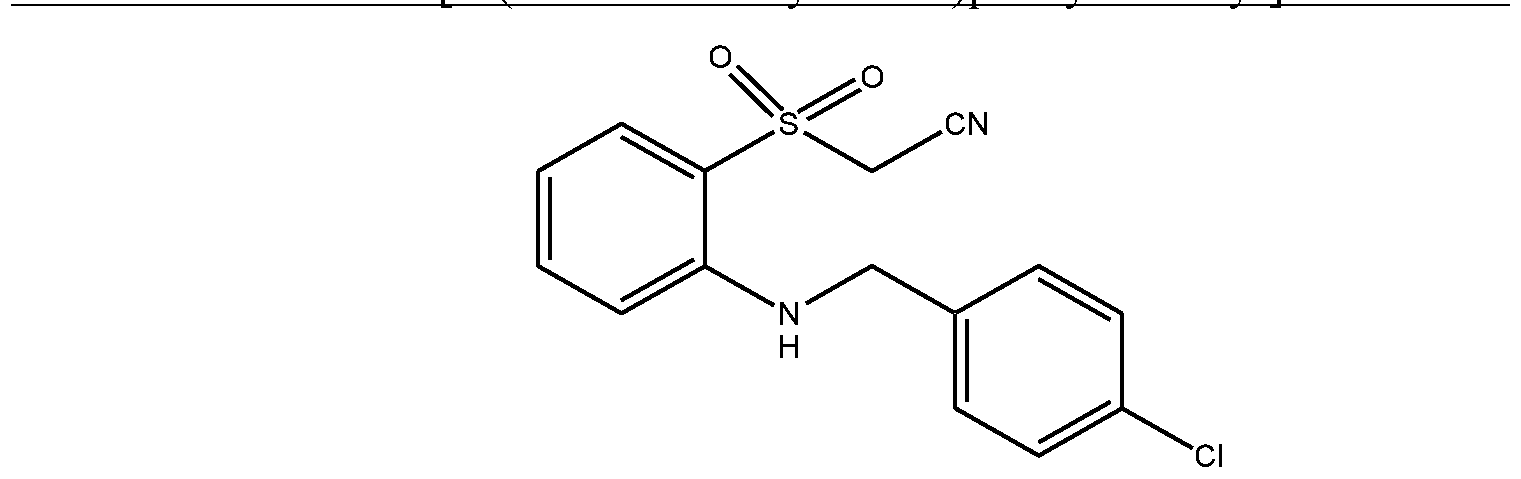
To a 50 mL round bottom flask was added (2-fluorophenylsulfonyl)acetonitrile (1.0 g, 5 mmol) and 4-chlorobenzylamine (2.12 g, 15 mmol) in 1,4 dioxane (1-2 mL). The mixture was heated under nitrogen at 70-80 °C for^3 hours. Upon removing from heat, the reaction mixture appeared reddish-brown. An extraction was performed using EtOAc and water. Next, column chromatography was performed using Hexanes:EtOAc (10: 1) as eluent. The resulting pure fractions were concentrated, yielding a greenish oil. Yield: 0.54 g, 33%. The product was recrystallized from a mixture of hexanes/EtOAc. A minimum amount of hot EtOAc was added to dissolve the product, then, hot hexanes were added until the solution became slightly cloudy. The solution was allowed to cool to room-temperature and placed in the refrigerator overnight. The next day, white, needle-like crystals of intermediate 5 were found, mp 95-97 °C. Yield: 0.20 g, 13%. 1H NMR (DMSO): 4.48 (d, J = 5.8 Hz, 2H), 5.11 (s, 2H), 6.71-6.79 (m, 2H), 6.87 (t, NH), 7.39 (apparent singlet, 4H), 7.36-7.45 (m, 1H), 7.64 (dd, J = 8.2 and 1.5 Hz, 1H). 13C NMR (DMSO): 43.7, 45.3, 112.2, 113.3, 115.8, 117.3, 128.5, 128.9, 130.8, 131.5, 136.7, 137.8, 146.7. IR (cm"1): 3395, 2976, 2924, 2255, 1599, 1567, 1518, 1465, 1329, 1302, 1139, 1090, 820, 738. MS (EI): 320 m/z (M+).
EXAMPLE A4
A4-4 intermediate 6: 3-(4-Bromophenyl)-2-(2-nitrobenzenesulfonyl)acrylonitrile

Intermediate 6 was prepared according to a literature procedure (Ind. J. Chem. 1972, 10, 917) by reaction of intermediate 1 with 4-bromobenzaldehyde in the presence of ammonium acetate and was obtained as an off-white crystalline solid mp 178-179 °C (AcOH/water); lit. mp 174-175 °C (AcOH/water). JR (cm"1): 3098, 2216, 1597, 1579, 1539, 1342, 1121, 1009, 829, 814, 779, 741, 729, 705, 658.
EXAMPLE Bl

Synthesis of DG-I-46 and analogues: These compounds were prepared according to a general literature procedure (Ind. J. Chem. 1972, 10, 9 1 7) by heating the appropriate acrylonitrile (2 ) with a reducing agent, such as iron metal, in acetic acid solvent for 30 minutes at 100 °C. The precipitated product was then recrystall ized from an appropriate solvent. Melting points and yields are given in Table 1 below. Example compound names are as follows: DG-I-46 [2-Cyano-3-(4-fluorophenyl)-3,4- dihydrobenzo[b]- 1 ,4-thiazine 1 , 1 -Dioxide]; RP-I- 103 [2-Cyano-3-(4-iodophenyl)- 3,4-dihydrobenzo[b]- 1 ,4-thiazine 1 , 1 -Dioxide]; DG-I-30 [2-Cyano-3-(4-biphenyl)- 3,4-dihydrobenzo[b]-l,4-thiazine 1, 1-Dioxide]; DG-I-50 3-(3-Chlorophenyl)-2- cyano-3,4-dihydrobenzo[b]-l,4-thiazine 1, 1-Dioxide; DG-I-54 3-(2-Chlorophenyl)-2- cyano-3,4-dihydrobenzo[b]- 1 ,4-thiazine 1 , 1 -Dioxide; DG-I-56 [2-Cyano-3-(4- methoxyphenyl )-3,4-dihydrobenzo[b]- 1 ,4-thiazine 1 , 1 -Dioxide]; DG-I-58 [2-Cyano- 3-(4-hydroxyphenyl)-3,4-dihydrobenzo[b]-l,4-thiazine 1, 1-Dioxide]; DG-I-48 [3- (2,4-Dichlorophenyl)-2-cyano-3 ,4-dihydrobenzo[b]- 1 ,4-thiazine 1 , 1 -Dioxide]; DG-I- 60 [3-(3,4-Dichlorophenyl)-2-cyano-3,4-dihydrobenzo[b]-l,4-thiazine 1 , 1 -Dioxide]; JB-I-14 [2-Cyano-3-(4-trifluoromethoxyphenyl)-3,4-dihydrobenzo[b]-l,4-thiazine 1 , 1 -Dioxide]; SOA-I-42 [2-Cyano-3-(3-biphenyl )-3,4-dihydrobenzo[b]- 1 ,4-thiazine 1 , 1 -Dioxide]; SOA-I-49 [2-Cyano-3-(3-phenoxyphenyl )-3,4-dihydrobenzo[b]- 1 ,4- thiazine 1 , 1 -Dioxide]; SOA-I-52 [2-Cyano-3-(4-phenoxyphenyl)-3,4- dihydrobenzo[b]-l,4-thiazine 1, 1-Dioxide].
Synthesis of DG-I-52, DG-I-43c and analogues: These carboxamides were obtained by heating the appropriate acrylonitrile ( Intermediate 2) with a reducing
agent, such as iron, in acetic acid solvent for 3 hours at 120 °C. The precipitated product was then recrystallized from an appropriate solvent. Melting points and yields are giv en in Table I below. Example compounds names are as follows: DG-I- 52 [2-Carboxamido-3 -(4-chlorophenyl )-3 ,4-dihydrobenzo[b]- 1 ,4-thiazine 1 , 1 - Dioxide]; DG-l-43c [2-Carboxamido-3-(4-bromophenyl )-3,4-dihydrobenzo[b]- 1 ,4- thiazine 1, 1 -Dioxide].
Table 2. Melting points, recrystallization solvents and yields for analogues shown in
Scheme 2. For examples given in Table 2: R1=R2=R5=H.
Recrystallization
Compound R3 R4 R6 Mp (°C) Solvent % Yield
DG-l-46 CN F H 210-212 Methanol 47%
RP-l-103 CN 1 (iodo) H 265-266 Methanol 27%
DG-l-30 CN phenyl H 237-239 Methanol 35%
DG-l-50 CN H 3-CI 212-213 Aq. Ethanol 38%
DG-l-54 CN H 2-CI 121 -123 Aq. Acetic Acid 24%
DG-l-56 CN OMe H 226-228 Aq. Methanol 49%
DG-l-58 CN OH H 234-236 Aq. Acetic Acid 49%
DG-l-48 CN CI 2-CI 243-244 Ethanol 34%
DG-l-60 CN CI 3-CI 239-240 Aq. Methanol 37%
JB-l-14 CN CF3 H 198-200 Aq. Methanol 38%
CN 3-
SOA-l-42 H 245-246 Methanol/water 37% phenyl
CN 3-
SOA-l-49 H 218-219 Methanol/water 18% phenoxy
SOA-l-52 CN phenoxy H 209-21 1 Methanol/water 58%
DG-l-52 CONH2 CI H 240-242 Toluene 17%
DG-I-43C CONH2 Br H 225-227 Toluene 14%
EXAMPLE B2
Synthesis of 3-(4-Nitrophenyl)-2-cyano-3,4-dihydrobenzo[b]-l,4-thiazine 1, 1-Dioxide (PDW-I-41) and of 2-Cyano-3-(4-Cyanophenyl)-3,4-dihydrobenzo[b]-l,4-thiazine 1, 1-Dioxide (PDW-I-42).
These compounds were prepared by a novel route that is alternative to the route/method shown in Example Al . This novel route involves reaction of an Intermediate 4 with an aldehyde in the presence of a base such as, but not limited to, ammonium acetate, pyrrolidine, or piperidine using a solvent such as, but not limited, to Ethanol (EtOH) or 2-Propanol (2-PrOH) to provide the bicyclic sulfone directly and without the need to prepare intermediates of type 2 as shown in Example Al .

PDW-I-42 R = CN
Representative Procedures
3-(4-Nitrophenyl)-2-cyano-3,4-dihydrobenzo[b]-l,4-thiazine 1,1-Dioxide (PDW-I- 41):
A mixture of l-amino-2-(cyanomethylsulfonyl)benzene (Intermediate 4) (227 mg, 1.16 mmol), 4-nitrobenzaldehyde (174.8 mg, 1.16 mmol) and H4OAc (98 mg, 1.27 mmol) was dissolved in ethanol (10 mL) and heated at reflux for 2 hours. Water was added to the clear, dark orange reaction to precipitate out the product. The resulting precipitate was collected and rinsed with water to give a dark orange solid, mp 242- 243°C, (164 mg, 43.2 % yield). The product was recrystalized by dissolving it in hot methanol (40 mL) and using water (20 mL) to precipitate it back out, after a couple of
days giving a fine orange solid, mp 251-252 °C. Yield: 64 mg (15%). 1H NMR (DMSO): 5.39-5.43 (d, J=10.4 Hz, IH), 5.51-5.52 (d, J=2.68 Hz, IH), 5.94-5.95 (d, J=2.65, IH), 6.12-6.15 (d, J=10.36 Hz, IH), 6.88-6.97 (m, IH), 7.09-7.11 (d, J=8.51 Hz, IH), 7.48-7.49 (m, IH), 7.66-7.70 (m, IH), 7.89-7.96 (m, 3H), 8.33-8.40 (t, 2H). IR ^m"1): 3365, 2934, 2230, 1599, 1580, 1519, 1505, 1488, 1347, 1306, 1252, 1206, 1185, 1165, 1150, 1127, 1071, 1014, 967, 943, 922, 871, 858, 827, 797, 751, 736, 701, 688, 671.
2-Cyano-3-(4-Cyanophenyl)-3,4-dihydrobenzo[b]-l,4-thiazine 1,1-Dioxide (PDW-I-42):
l-Amino-2-(cyanomethylsulfonyl)benzene (2.4 mmol, 470 mg) was mixed with (2.4 mmol, 314 mg) of 4-cyanobenzaldehyde and (2.6 mmol, 203 mg) of NHtOAc and was dissolved in ethanol (-10 mL) and refluxed for 2 hrs. After the reflux, water was added to precipitate the solution, since not much product originally precipitated out, the solution was allowed to sit for two days to produce more product. The precipitate from the solution was then suction filtered (189.9 mg, 26 % yield) and had white/ yellow color to it. The precipitate was recrystalized by dissolving it in hot methanol (15 mL) and allowing the solution to sit overnight. The recrystalized product was then collected by suction filtration to yield fine white crystals, mp 227-228 °C. Yield: 86 mg (12%). 1H NMR (DMSO): 7.98-8.04 (t, 2H), 7.8.0-7.88 (m, 3H), 7.65-7.66 (dd, IH), 7.48 (m, IH), 7.10-7.07 (d, J=8.6 Hz, NH), 6.96-6.87 (m, IH), 6.12-6.08 (d, J=10.5 Hz, IH), 5.89-5.90 (d, J=2.36 Hz, IH), 5.45-544 (d, J=2.53 Hz, IH), 5.3-5.33 (d, J=10.6 Hz, IH). IR (cm"1): 3365, 3096, 2924, 2229, 1601, 1505, 1482, 1417, 1546, 1313, 1250, 1221, 1203, 1187, 1177, 1149, 1124, 1068, 1021, 978, 967, 914, 857, 830, 814, 748, 715, 683.
EXAMPLE B3
Compounds of type GS-I-61 were prepared by reaction of (2- fluorophenylsulfonyl)acetonitrile (4) with an alkylamine, such as 4-
Chlorobenzylamine, in 1,4-dioxane solvent as described by the representative procedure below.
Synthesis of [2-(4-Chlorobenzylamino)phenylsulfonyl]acetonitrile (GS-I-61)

To a 50 mL round bottom flask was added (2-fluorophenylsulfonyl)acetonitrile (4) (1.0 g, 5 mmol) and 4-chlorobenzylamine (2.12 g, 15 mmol) in 1,4 dioxane (1-2 mL). The mixture was heated under nitrogen at 70-80 °C for 3 hours. Upon removing from heat, the reaction mixture appeared reddish-brown. An extraction was performed using EtOAc and water. Next, column chromatography was performed using Hexanes:EtOAc (10: 1) as eluent. The resulting pure fractions were concentrated, yielding a greenish oil. Yield: 0.54 g, 33%. The product was recrystallized from a mixture of hexanes/EtOAc. A minimum amount of hot EtOAc was added to dissolve the product, then, hot hexanes were added until the solution became slightly cloudy. The solution was allowed to cool to room-temperature and placed in the refridgerator overnight. The next day, white, needle-like crystals of GS-I-61 were found, mp 95-97 °C. Yield: 0.20 g, 13%. 1H NMR (DMSO): 4.48 (d, J = 5.8 Hz, 2H), 5.11 (s, 2H), 6.71-6.79 (m, 2H), 6.87 (t, NH), 7.39 (apparent singlet, 4H), 7.36-7.45 (m, 1H), 7.64 (dd, J = 8.2 and 1.5 Hz, 1H). 13C NMR (DMSO): 43.7, 45.3, 112.2, 113.3, 115.8, 117.3, 128.5, 128.9, 130.8, 131.5, 136.7, 137.8, 146.7. IR (cm"1): 3395, 2976, 2924, 2255, 1599, 1567, 1518, 1465, 1329, 1302, 1139, 1090, 820, 738. MS (EI): 320 m/z (M+).
EXAMPLE B4
Preparation of N- Substituted Derivatives. Compounds of type DG-I-46, except with an alkyl group located on the ring nitrogen, were prepared according to the following representative procedure which involved reaction of an intermediate such as GS-I-61 with an aldehyde in the presence of a base such as, but not limited to, ammonium acetate, pyrrolidine, or piperidine. The following procedure is representative.
4-(4-Chlorobenzyl)-3-(4-Chlorophenyl)-2-cyano-3,4-dihydrobenzo[bl-l,4-thiazine 1 J -Dioxide (GS-I-65)

To a 50 mL round bottle flask was added compound GS-I-61 (0.54 g, 1.7 mmol), 4- chlorobenzaldehyde (0.24 g, 1.7 mmol), and NH4OAc (0.26 g, 3.4 mmol) in EtOH (~7 mL). The mixture was refluxed for 24 hours. Upon removing from heat, the mixture appeared yellowish, with a significant amount of yellow precipitate. The precipitate was collected using suction filtration. *Note: The yellow precipitate is the uncyclized version of the final product, in which the Michael Addition has not occurred. This compound was refluxed in EtOH with a small amount of H4OAc overnight to produce more of the cyclized version of the final product. The original reaction mixture and the yellow precipitate reaction mixture were then combined, and an extraction was performed using EtOAc/W ater. Next, column chromatography was performed using 20: 1 (Hexane:EtOAc) as eluent. The column fractions containing product were combined and evaporated. As the volume of solvent became low, the product began to precipitate as a yellowish powder. The solvent was not completely evaporated in order to allow the product to more easily be removed from the flask. Compound 13 was collected using suction filtration, mp 78-81 °C. Yield: 0.07 g, 10%. IR (cm_1): 2927, 1598, 1490, 1327, 1164, 751. 1H NMR (DMSO) (7:3 mixture of diastereomers): 4.13 (d, J=17.6 Hz, minor diastereomer), 4.25 (d, J=17.2 Hz, major diastereomer), 4.83 (d, J=17.3 Hz, major diastereomer), 4.87 (d, J=17.2 Hz, minor diastereomer), 5.63 (d, J=4.4 Hz, minor diastereomer), 5.79 (d, J=7.0 Hz, major diastereomer), 6.22 (d, J=7.0 Hz, major diastereomer), 6.25 (d, J=4.7 Hz, minor diastereomer), 6.96 (m), 7.29-7.34 (m), 7.37-7.53 (m), 7.70-7.75 (m). MS (EI): 442, 444 m/z (M+, M+ + 2).
4-(4-Chlorobenzyl)-3-(4-Chlorophenyl)-2-cyano-3,4-dihydrobenzo[bl-l,4-thiazine
1, 1 -Dioxide (GS-I-59) was also prepared by this method.
EXAMPLE B5
Preparation of C-Substituted Derivatives. Compounds of type DG-I-46, except with an alkyl group located on the ring carbon that is located adjacent to the sulfone (S02) group, such as compound CES-X-3, were prepared according to scheme 3 below, with the following representative procedure which involved reaction of an
intermediate such as intermediate 3 (from Example Al) with an alkylating or fluorinating reagent in the presence of a base such as, but not limited to, potassium tert-butoxide.
2-Benzyl-3-(4-Chlorophenyl)-2-cyano-3,4-dihydrobenzo[b]-l,4-thiazine 1,1- Dioxide (CES-X-3) (Representative Procedure):
Intermediate 3 (from Example Al) (0.318 g, 1.0 mmol) was dissolved in 5 mL of tetrahydrofuran (THF). Potassium tert-butoxide (0.13 g, 1.15 mmol) was added, followed by benzyl chloride (0.14 g, 1.10 mmol). Next, 0.5 mL of
dimethylformamide (DMF) was added and the solution was stirred overnight at room temperature. Addition of water then gave an oily solid which, after stirring, was filtered by suction and air dried. The crude product was recrystallized from
EtOAc/Hexanes to give a tan solid (0.22 g, 54%). A second recrystallization from MeOH gave near white crystals, mp 195-197 °C. IR (cm"1): 3406 (strong), 3028, 2238 (weak), 1594, 1483, 1317, 1145, 1093, 1017, 829, 757, 700, 693. 1H-NMR (DMSO-d6): 2.66 (d, J=14.6 Hz, 1H), 3.50 (d, J=14.6 Hz), 1H), 5.13 (s, 1H), 6.87 (m, 1H), 6.97-7.02 (m, 2H), 7.19-7.22 (m, 3H), 7.44 (t, 1H), 7.59-7.63 (m, 3H), 7.74-7.81 (m, 3H). 13C-NMR (DMSO-d6): 33.0, 61.5, 62.3, 114.3, 116.8, 117.8, 118.5, 124.4, 127.6, 128.0, 129.1, 130.4, 131.1, 132.9, 133.6, 134.7, 134.8, 143.5. MS (EI): m/z 408 (M+).
Scheme 3. Preparation of C-Substituted Derivatives.

The following compounds were prepared similarly to CES-X-3 using a similar method and an appropriately substituted benzyl chloride (or bromide): ZMR-I-3 [2- (4-Chlorobenzyl-3-(4-Chlorophenyl)-2-cyano-3,4-dihydrobenzo[b]-l,4-thiazine 1, 1- Dioxide]; RP-I-15 [3-(4-Chlorophenyl)-2-(3-fluorobenzyl--2-cyano-3,4- dihydrobenzo[b]-l,4-thiazine 1,1-Dioxide]; RP-I-27 [3-(4-Chlorophenyl)-2-(2- fluorobenzyl~2-cyano-3,4-dihydrobenzo[b]-l,4-thiazine 1,1-Dioxide]; RP-I-37 [3-(4- Chlorophenyl)-2-(4-fluorobenzyl~2-cyano-3 ,4-dihydrobenzo[b]- 1 ,4-thiazine 1,1- Dioxide]; RP-I-39 [3-(4-Chlorophenyl)-2-cyano-2-(4-trifluoromethylbenzyl-3,4- dihydrobenzo[b]-l,4-thiazine 1,1-Dioxide]; RP-I-41 [3-(4-Chlorophenyl)-2-cyano-2- (4-methoxybenzyl)-3,4-dihydrobenzo[b]-l,4-thiazine 1,1-Dioxide]; ZMR-I-36 3-(4- Chlorophenyl)-2-cyano-2-(2-naphthylmethyl)-3,4-dihydrobenzo[b]-l,4-thiazine 1, 1-
Dioxide]; RP-I-65 [2-(2-Chlorobenzyl-3-(4-Chlorophenyl)-2-cyano-3,4- dihydrobenzo[b]-l,4-thiazine 1,1-Dioxide]; RP-I-69 [2-(3-Chlorobenzyl-3-(4- Chlorophenyl)-2-cyano-3,4-dihydrobenzo[b]-l,4-thiazine 1,1-Dioxide]; RP-I-59 [3- (4-Chlorophenyl)-2-(4-cyanobenzyl)-2-cyano-3,4-dihydrobenzo[b]-l,4-thiazine 1, 1- Dioxide]; RP-I-71 [2-(4-Acetamidobenzyl-3-(4-chlorophenyl)-2-cyano-3,4- dihydrobenzo[b]-l,4-thiazine 1,1-Dioxide]; RP-I-83 [3-(4-Chlorophenyl)-2-cyano-2- (3-methoxybenzyl)-3,4-dihydrobenzo[b]-l,4-thiazine 1,1-Dioxide]; RP-I-55 41 [3-(4- Chlorophenyl)-2-cyano-2-(3-fluoro-4-methoxybenzyl)-3,4-dihydrobenzo[b]-l,4- thiazine 1,1-Dioxide]; RP-I-99 [3-(4-Chlorophenyl)-2-cyano-2-(4- trifluoromethoxybenzyl-3,4-dihydrobenzo[b]-l,4-thiazine 1,1-Dioxide]; RP-I-105 [3- (4-Chlorophenyl)-2-cyano-2-(3,5-difluorobenzyl)-3,4-dihydrobenzo[b]-l,4-thiazine 1, 1-Dioxide]; RP-I-79 [2-Benzyl-3-(4-bromophenyl)-2-cyano-3,4-dihydrobenzo[b]- 1,4-thiazine 1,1-Dioxide]; RP-I-87 [3-(4-Bromophenyl)-2-cyano-2-(4- methoxybenzyl)-3,4-dihydrobenzo[b]-l,4-thiazine 1,1-Dioxide. Melting points, reciystallization solvents and yields for these compounds are given below in Table 2.
Table 3. Melting points, reciystallization solvents and yields for example analogues in
Scheme 3. For examples given in Table 3 : R1=R5=R6=H. Bn = Benzyl
Recrystallization
Compound R2 R3 R4 Mp (°C) Solvent % Yield
ZMR-l-3 4-CIBn CN CI 241 -243 EtOAc/Hexanes 45%
RP-l-15 3-FBn CN CI 195-198 Methanol 48%
RP-l-27 2-FBn CN CI 172-173 Methanol 37%
RP-l-37 4-FBn CN CI 200-201 Methanol 37%
RP-l-39 4-CF3Bn CN CI 241 -243 Methanol 17%
RP-l-41 4-OMeBn CN CI 207-208 Methanol 43%
2- CN CI EtOAc/
ZMR-l-36 252-253 7%
N a pthyl methyl Hexanes
RP-I-65 2-CIBn CN CI 240-241 Methanol 15%
RP-I-69 3-CIBn CN CI 221 -222 Methanol 48%
RP-I-59 4-CNBn CN CI 265-267 Methanol 46%
Recrystallization
Compound R2 R3 R4 Mp (°C) Solvent % Yield
4- CN CI
RP-l-71 261 -262 Methanol/water 29%
NHCOCH3Bn
RP-l-83 3-OMeBn CN CI 172 Methanol 46%
RP-l-55 3-F,4-OMeBn CN CI 227-228 Methanol 36%
RP-l-99 4-OCF3Bn CN CI 204-206 Methanol 7%
RP-l-105 3,5-diFBn CN CI 239-241 Methanol 51 %
RP-l-79 Bn CN Br 202-204 Methanol/water 32%
RP-l-87 4-OMeBn CN Br 204-205 Methanol 38%
Example Procedures are as follows:
3-(4-Chlorophenyl)-2-cyano-2-fluoro-3,4-dihydrobenzo[b]-l,4-thiazine 1,1- Dioxide (ZMR-I-13):
Intermediate 3 (from Example Al) (0.47 g, 1.49 mmol) was dissolved in 8 mL THF. Potassium tert-butoxide (0.19 g) was added, followed by 0.53 g (1.69 mmol) of N- fluorobenzenesulfonimide ( FSI). Next, 0.75 mL dimethylformamide (DMF) was added and the solution was then allowed to stir overnight at room temperature.
Addition of water and ice to the yellow reaction mixture then gave an oil which solidified upon scratching the flask with a glass rod. The solid product was collected by suction and recrystallized from a small amount of methanol to give colorless crystals (24% yield), mp 213-215 °C. IR (cm"1): 3379 (strong), 3088, 3058, 2866, 2248 (weak), 1599, 1499, 1487, 1333, 1160, 832, 760, 748, 713, 695. 1H-NMR
(DMSO-d6): 5.59 (d, J=7.4 Hz, IH), 6.99 (t, IH), 7.12 (d, J=8.5 Hz, IH), 7.53-7.80 (m, 7H), 8.14 (d, J=3.2 Hz, IH). 13C-NMR (DMSO-d6): 60.0 (d, J=25 Hz), 95.0 (d, J=223 Hz), 110.5 (d, J=32 Hz), 116.7 (d, J=l . l Hz), 117.4, 118.8, 124.7 (d, J=l . l Hz), 129.0, 130.7, 131.0 (d, J=0.9 Hz), 135.2, 135.9, 144.0 (d, J=0.8 Hz). 19F-NMR
(DMSO, with C6F6 as internal standard): -11.32 (dd, J = 7.33, 2.8 Hz) (the dd
becomes a simple doublet when D20 is added). MS (EI): m/z 336.
3-(4-Chlorophenyl)-2-cyano-2-ethyl-3,4-dihydrobenzo[b]-[l,4]-thiazine 1,1- Dioxide (ZMR-I-24):
Intermediate 3 (from Example Al) (0.56 g, 1.76 mmol) was dissolved in 17.5 mL THF. To this solution was added potassium tert-butoxide (0.215 g, 1.92 mmol), followed by iodoethane (0.309 g, 1.98 mmol). Next, 45 drops of DMF was added turning the reaction green. The reaction was allowed to stir overnight at room temperature. Next, 5 mL of water and ice was added to the reaction mixture. After sitting overnight, the solution was heated with stirring to remove the remaining THF. Once the THF was removed, solid formed immediately. The suspension was allowed to cool and the solid was collected by suction. Recrystallization from MeOH gave colorless crystals (0.28 g, 46%), mp 223-227 °C. JK (cm"1): 3367 (strong), 3069, 2985, 2881, 2240 (weak), 1603, 1505, 1487, 1313, 1149, 772, 742, 713, 690. 1H- NMR (DMSO-d6): 0.86 (t, 3H), 1.41-1.53 (m, 1H), 2.13-2.25 (m,lH), 4.99 (s, lH), 6.88 (t, 1H), 7.02 (d, 1H, J=8.5 Hz), 7.45 (m, 1H), 7.60-7.76 (m, 6H). 13C-NMR (DMSO-d6): 9.8, 21.4, 61.1, 62.0, 114.4, 116.8, 117.8, 118.5, 124.3, 129.0, 130.9, 133.7, 134.7, 134.7, 143.6. MS (EI): m/z 346.
3-(4-Chlorophenyl)-2-cyano-2-isopropyl-3,4-dihydrobenzo[b]-[l,4]-thiazine 1,1- Dioxide (ZMR-I-34)
Intermediate 3 (from Example Al) (0.3590 g, 1.13 mmol) was dissolved in 4 mL
THF. To the solution was added potassium tert-butoxide (0.1688 g, 1.50 mmol) and 2-iodopropane (0.3250 g, 1.91 mmol). Approximately 0.6mL of DMF was added turning the reaction green. The reaction was allowed to stir overnight at room temperature. TLC (3 : 1 hexanes in ethyl acetate) analysis showed the reaction was complete. About 5 mL of water and ice was added to the reaction mixture and a dark red/brown oil formed. After stirring and heating, solid began to form. The solution was allowed to cool and the solid was collected by suction. Recrystallization from MeOH gave colorless crystals (0.166 g, 41%), mp 207-208 °C. IR (cm"1): 3357 (strong), 2991, 2977, 2943, 2888, 2241 (weak), 1600, 1511, 1486, 1303, 1149, 1093, 1013, 826, 754. 1H-NMR (DMSO-d6): 1.29 (d, 6H), 2.10 (m, 1H), 5.35 (s, 1H), 6.82- 6.87 (m, 1H), 6.99 (d, J=8.4 Hz, 1H), 7.39-7.45 (m, 1H), 7.61-7.66 (m, 4H), 7.78 (d, J=8.6 Hz, 2H). 13C-NMR (DMSO-d6): 18.3, 19.8, 31.1, 59.4, 64.2, 115.3, 116.5, 117.3, 119.9, 123.7, 129.1, 130.8, 134.3, 134.6, 134.7, 143.5. MS (EI): m/z 360.
3-(4-Chlorophenyl)-2-cyano-2-methyl-3,4-dihydrobenzo[b][l,4]thiazine 1,1- Dioxide (ZMR-I-40):
Intermediate 3 (from Example Al) (0.3873 g, 1.22 mmol) was dissolved in 5.5 mL THF. To the solution was added potassium tert-butoxide (0.1967 g, 1.75 mmol), followed by dimethyl sulfate (0.307 g, 2.43 mmol). Approximately 40 drops of DMF were then added. The reaction was allowed to stir overnight at room temperature. TLC (3 : 1 hexanes in ethyl acetate) analysis showed the reaction was complete. About 5 mL of water was then added to produce an oil which solidified upon addition of ice. The solid was collected by suction and recrystallized twice from EtOH to give a white fluffy solid (0.081 g, 20%), mp 229-231 °C. IR (cm"1): 3363 (strong), 3093, 2989, 2876, 2242 (weak), 1602, 1505, 1485, 1321, 1313, 1152, 1087, 1012, 851, 838, 742, 715. 1H- MR (DMSO): 1.41 (s, 3H), 4.99 (s, 1H), 6.88-6.91 (t, 1H), 7.04 (d, J=8.5 Hz, 1H), 7.46 (m, 1H), 7.60-7.72 (m, 5H), 7.82 (s, 1H). 13C- MR (DMSO): 12.3, 57.0, 60.9, 115.4, 116.9, 117.3, 117.7, 124.4, 128.9, 130.5, 133.4, 134.6, 134.9, 143.8. MS (EI): /// _- 332.
C BIOLOGICAL EXAMPLES
CI: ANTIVIRAL ASSAYS
CI -a: Antiviral activity against HHV-6 was established in HHV-6-infected human T- lymphoblast cell lines (HSB-2 for HHV-6A, strain GS; MOLT-3 for HHV-6B, strain Z29). The detailed procedures for cell culture of the lymphoblast cells, preparation of virus stock, and antiviral evaluation have been published elsewhere [De Bolle, 2004]. The assays were performed in 96-well plates containing serial dilutions of the test compounds. Foscarnet was included as reference compound. HSB-2 or MOLT-3 cells were infected with HHV-6 (100 CCID50 (50% cell culture infective dose) per 106 cells), and incubated at a density of 0.8 x 10⁶ cells per ml. Then, 4- to 5-fold serial dilutions of the compounds were added. Cultures were subcultivated every 3 to 4 days by two-fold dilution with medium containing fresh compound. The cytopathic effect (CPE) was scored 10-12 days post infection (p.i.), when virus growth reached its maximum. Alternatively, total DNA extracts of the infected cells were prepared for
real-time PCR quantitation of HHV-6 DNA [Naesens, 2006]. The PCR standard curves were constructed from serial dilutions of a home-made plasmid containing an HHV-6 U67 DNA fragment. The primers delineated a 258-bp fragment within the HHV-6 U67 gene, and PCR quantitation was by the SYBR® Green method.
Antiviral activity was expressed as the EC50 value, defined as the compound concentration that produced 50% inhibition of HHV-6 replication, as determined by CPE or PCR assay. The cytotoxicity of the compounds was determined by microscopy, and expressed as the MCC (minimum cytotoxic concentration) value, or the compound concentration that caused minimal alterations in cell morphology. Alternatively, cytotoxicity was assessed by cell counting, and expressed as the IC50 value, or the compound concentration that caused 50% inhibition of cell proliferation.
In some experiments, the compounds were evaluated for anti-HHV-6A (strain GS) activity in primary human cord blood lymphocytes, as described by De Bolle [2004].
Results on anti-HHV-6 activity are shown in TABLE I.
Cl-b: Antiviral activity against human cytomegalovirus (HCMV) and murine cytomegalovirus (MCMV): was determined in hyman embryonic lung (HEL) fibroblast cells infected with HCMV (strain AD-169 or Davis) or murine 127 fibroblast cells infected with MCMV. The virus was added at 100 PFU (plaque forming units) per well to 96-well plates containing confluent cultures of HEL cells. Unadsorbed virus was removed after 2 hr incubation, and replaced by serial dilutions of the test compounds. After 7 days incubation, the cytopathic effect (CPE) was scored by microscopic evaluation, from which the 50% antivirally effective concentration (EC50) was calculated. The cytotoxic effect of the compounds on HEL or 127 cells was determined by microscopy or cell counting, similar as described above for the HHV-6 assays. Results on anti-CMV activity are shown in TABLE II
TABLE I.
Antiviral activity of arylsulfone compounds against HHV-6
HHV-6A-infected
HHV-6A-infected HHV-6B-infected cord blood
Compound
HSB-2 cells MOLT-3 cells lymphocytes
EC5oa MCCb EC5oa MCCb EC50 a MCCb
ZMR-I-13 2.3 10 NA 2
CES-X-3 2.4 13 2.4 13
DG-I-43 3.6 200 3.4 300 3.2 >200
RP-I-15 3.8 32
JB-I-14 4.5 44 2.3 33
DG-I-60 4.6 50 3.4 50
ZMR-I-40 4.7 32 3.3 13
ZMR-I-24 6.8 >200 5.3 >200
SOA-I-52 7.5 32 NA 80
RP-I-37 8.1 80
RP-I-41 8.1 >200
RP-I-103 8.1 80 nd nd
SOA-I-49 8.3 32.0 NA 32
GS-I-65 8.8 22 11 32
RP-I-79 9.4 80 NA 80
RP-I-105 9.4 32 nd nd
ZMR-I-34 9.9 32 5.4 32
RP-I-27 10 80
DG-I-30 13 80 3.4 50
RP-I-59 13 >200 NA >200
DG-I-52 13 300 4.6 300
DG-I-43c 13 300 4 300
PDW-I-41 14 13 3 13
RP-I-83 16 >200 20 >200
DG-I-46 18 300 20 300
DG-I-48 18 300 5.9 300
RP-I-71 19 >200 8.1 80
RP-I-69 20 80 NA >200
DG-I-56 22 300 24 300
DG-I-58 28 300 12 300
PDW-I-42 41 200 14 80
SOA-I-42 NA 32 NA 80
DG-I-50 NA 50 NA 50
DG-I-54 NA >50 NA 50
PMJ-29B NA >200 NA >200
PMJ-18 NA 110 NA 200
JB-I-16 NA 44 NA 44
JB-I-72 NA 44 NA 50
HS-I- 12 NA 33 NA 33
EJM-I- 15 NA >200 NA >200
ZMR-I-3 NA >200 NA >200
RP-I-39 NA >200
ZMR-I-36 NA >200
RP-I-65 NA >200 NA 200
RP-I-55 NA >200 NA >200
RP-I-87 NA >200 NA >200
GS-I-59 NA 32 NA 32
GS-I-79 NA 80 NA 80
RP-I-99 NA >200 nd nd
Foscamet 7.3 >400 6.4 >400 5.2 >400EC50 : 50% effective concentration, or compound concentration producing 50% inhibition of virus replication, as determined by microscopic scoring of the virus-induced cytopathic effect. MCC: minimum cytotoxic concentration,or compound concentration
producing mimmal alterations in cell morphology, as determined by microscopy.
NA: not active at subtoxic concentrations or the highest concentration tested
(usually 200 μΜ; exceptionally 50 μΜ).
nd: not done.
TABLE II.
Antiviral activity of arylsulfone compounds against human and murine cytomegalovirus
C127 cells infected
Compound HEL cells infected with HCMV with MCMV
Antiviral EC50 Cytotoxicity Antiviral Cytotoxicity for HCMV3 ECso for MCC AD-169 Davis MCC CC50 C MCMV
RP-I-105 3.4 3.5 20
DG-I-30 7.9 7.5 >100 48 12.2 >100
CES-X-3 7.9 4.7 187 31 23 245
SOA-I-52 8.9 11 20 40 8.9 100
GS-I-65 10 13 72 70
RP-I-15 11 9 >100 13
RP-I-79 12 12 >100 >100 NA >100
DG-I-56 37 56 >100 >100
PDW-I-41 NA 4 20 67
RP-I-27 NA 9 100 20
DG-I-43 NA NA >100 100 NA 100
DG-I-46 NA NA >100 >100
JB-I-14 NA NA 100 20
PDW-I-42 NA NA >100 >100
SOA-I-42 NA NA 20 8.9 100
SOA-I-49 NA NA 20 NA 20
DG-I-58 NA NA >100 >100
DG-I-50 NA NA >100 66
DG-I-54 NA NA 100 48
DG-I-48 NA NA >100 34
DG-I-60 NA NA 100 32
PMJ-29B NA NA 300 158
PMJ-18 NA NA 300 128
JB-I-16 NA NA 20 12
JB-I-72 NA NA 100 17
HS-I-12 NA NA 20 20
EJM-I-15 NA NA >100 >100 NA >100
ZMR-I-3 NA NA 45 41
RP-I-37 NA NA 100 15
RP-I-39 NA NA 100 34
RP-I-41 NA NA >100 82
ZMR-I-36 NA NA 100 >100
C127 cells infected
Compound HEL cells infected with HCMV with MCMV
Antiviral EC50 Cytotoxicity Antiviral Cytotoxicity for HCMV3 EC50 for MCC AD-169 Davis MCC CC50 C MCMV
RP-I-65 NA NA 100 NA 20
RP-I-69 NA NA 100 NA 100
RP-I-59 NA NA 100 NA >100
RP-I-71 NA NA 20 100 >100
RP-I-83 NA NA 100 NA >100
RP-I-55 NA NA 100 NA >100
RP-I-87 NA NA >100 NA >100
ZMR-I-13 NA NA 300 68
ZMR-I-40 NA NA >100 100
ZMR-I-24 NA NA >100 >100 NA 100
ZMR-I-34 NA NA >100 26
DG-I-52 NA NA >100 >100
DG-I-43C NA NA >100 100 NA >100
GS-I-59 NA NA 245 95
GS-I-79 NA NA 279 84
RP-I-103 NA NA >100
RP-I-99 NA NA >100
Ganciclovir 6.5 6.5 >1575 219 1.1 >150
Assays performed in human embryonic lung (HEL) fibroblasts infected with human CMV (HCMV) or in murine C127 fibroblasts infected with murine CMV (MCMV).
EC50: effective concentration required to reduce virus plaque formation by 50%.
Virus input was 100 plaque forming units (PFU).
MCC: mimmum cytotoxic concentration that causes a microscopically detectable alteration of cell morphology.
CCC50: cytotoxic concentration required to reduce cell growth by 50%.
NA: not active at subtoxic concentrations or the highest concentration tested (100 μΜ).
Cl-c: Antiviral Activity against a broad range of RNA- and DNA-viruses. The procedures for determining the activity against HHV-6 and human and murine CMV are explained above. In addition, the compounds were evaluated against a broad range of viruses: herpes simplex virus type 1 (HSV-1) strain Kos, thymidine kinase- deficient (TK") HSV-1 Kos strain resistant to ACV (ACVr), herpes simplex virus type 2 (HSV-2) strains Lyons and G, varicella zoster virus (VZV) strain Oka, TK" VZV strain 07-1, a clinical isolate of adenovirus type 2 (Ad2), vaccinia virus Lederle strain, respiratory syncitial virus (RSV) strain Long, vesicular stomatitis virus (VSV), Coxsackie B4, Parainfluenza 3, Reovirus-1, Sindbis virus, Punta Toro virus, or feline coronavirus (feline infectious peritonitis virus; FIPV; strain 79-11146).
The antiviral assays were based on inhibition of virus-induced cytopathogenicity or plaque formation in human embryonic lung (HEL) fibroblasts, African green monkey cells (Vero), human epithelial cells (HeLa) or Crandell-Reese feline kidney (CRFK) cells according to previously established procedures [De Clercq 1980; De Clercq 1987; Balzarini 2006; Solaroli 2008].
Confluent cell cultures in microtiter 96-well plates were inoculated with 100 CCID50 of virus (1CCID50 being the virus dose to infect 50% of the cell cultures) or with 20 plaque forming units (PFU). After 1-2 h adsorption period, residual virus was removed, and the cell cultures were incubated in the presence of varying concentrations of the test compounds. Viral cytopathicity or plaque formation (VZV) was recorded by microscopy as soon as it reached completion in the control virus- infected cell cultures that were not treated with the test compounds. Antiviral activity was expressed as the EC50 or concentration required to reduce virus-induced cytopathogenicity or viral plaque formation by 50%. For feline coronavirus and feline herpesvirus, the cytopathogenicity was determined by the the colorimetric formazan (MTS)-based cell viability test.
The cytotoxicity of the compounds was determined by microscopy, and expressed as the MCC (minimum cytotoxic concentration) value, or the compound concentration that caused minimal alterations in cell morphology. For the assays determined in CRFK cells, the cytotoxicity was determined by the formazan (MTS)- based cell viability test, and expressed as the CC50 value, or compound concentration reducing cell viability by 50%
The antiviral activity results are shown in Table III (anti-DNA virus activity) and Table IV (anti-RNA virus activity).
In Table V, an overview is given of the cross-target antiviral activity of selected arylsulfone compounds.
TABLE III.
Antiviral activity of arylsulfone compounds against a range of
human DNA-viruses evaluated in human embryonic lung (HEL) fibroblast cells
Compound Antiviral EC50 a (μΜ) for Cytotoxicity
VZV/TK+ VZV/TK . HSV-1/ HSV-1/
HSV-2
OKA 07-1 TK+ TK- vv Ad-2 MCC" CC5oc
RP-I-71 0.64 1.0 NA NA NA NA >20 77
RP-I-83 2.7 33 NA NA NA NA >100 >100
CES-X-3 3.6 34 NA NA NA NA NA >245 61
RP-I-69 4.6 16 NA NA NA NA 100 29
HS-I-12 12 NA NA NA NA NA >20 20
RP-I-87 12 29 NA NA NA NA >100 >100
RP-I-79 13 34 NA NA NA NA >100
PDW-I-41 14 23 NA NA NA NA >100 73
JB-I-14 20 13 NA NA NA NA 100 20
RP-I-55 20 NA NA NA NA NA >100 >100
DG-I-50 40 46 NA NA NA NA >100 66
DG-I-54 48 72 NA NA 100 100 >100 49
GS-I-65 51 35 NA NA NA NA 16 >245 97
ZMR-I-13 59 NA NA NA NA NA 11 297 68
DG-I-60 NA NA NA NA NA 20 100 32
Brivudin 0.033 360 0.08 10 50 6 >1201 75
Acyclovir 3.1 110 0.16 0.24 150 >250 1778 978
Ganciclovir 0.032 0.096 12 >100 >100 EC50 : 50% effective concentration, or compound concentration producing 50% inhibition of replication, as determined by microscopic scoring of the virus-induced cytopathic effect.
MCC: minimum cytotoxic concentration, or compound concentration producing minimal alterations in cell morphology, as determined by microscopy.
VV: vaccinia virus; Ad-2: human adenovirus type 2
NA: not active at subtoxic concentrations or the highest concentration tested (100 μΜ).
TABLE IV. Antiviral activity of arylsulfone compounds against a range of RNA-viruses evaluated in HeLa, Vero, or CRFK cells.
Activity determined in HeLa cells Activity determined in Vero cells Activity in CRFK cells
EC50 (μΜ) EC50 (μΜ) EC50 (μΜ) for Minimum EC50 (μΜ) EC50 (μΜ) EC50 (μΜ) Minimum EC50 (μΜ) 50% cytotoxic
Compound for vesicular for Coxsackie respiratory cytotoxic for for Coxsackie for Punta cytotoxic for feline concentration stomatitis virus B4 syncytial concentration Sindbis virus B4 Toro virus concentration corona (in μΜ) virus virus (MCC in μΜ) virus (MCC in μΜ) virus
DG-I-46 NA NA NA >100 NA 60 NA >100
DG-I-30 NA NA 12 100 NA NA NA 20
DG-I-58 NA NA NA >100 NA 60 NA >100
DG-I-50 NA NA NA 20 NA NA 12 >20
DG-I-54 NA NA NA 100 NA NA 20 100
DG-I-48 NA NA NA 100 NA NA 4 20
CES-X-3 6.5 15 NA 100 NA NA NA >4
RP-I-59 NA NA NA >20 NA NA NA >100 36 >100
RP-I-71 NA NA NA >20 NA NA NA 100 36 >100
RP-I-83 NA NA NA >100 NA NA NA >100 40 >100
GS-I-59 0.7 NA NA 20 NA NA NA 100
GS-I-65 0.5 NA NA 20 NA NA NA 100
GS-I-79 2 NA NA 20 NA NA NA 100
Ribavirin 25 130 10 >250 NA NA 141 >250
EC50 : 50% effective concentration, or compound concentration producing 50% inhibition of virus replication,
as determined by microscopic scoring of the virus-induced cytopathic effect.
MCC: minimum cytotoxic concentration, or compound concentration producing minimal alterations in cell morphology, as determined by microscopy.
CRFK cells: Crandell-Rees Feline Kidney cells.
NA: not active at subtoxic concentrations or the highest concentration tested (100 μΜ).
TABLE V.
Overview of the antiviral activity spectrum of selected arylsulfone compounds
Antiviral ECsc (μΜ) against
herpesviruses other viruses
Compound
Punta feline
HHV-6A CMV vzv Toro virus coronavirus
JB-I-14 4.5 20
PDW-I-41 14 14
RP-I-105 9.4 3.4
DG-I-30 13 7.7
SOA-I-52 7.5 8.9
DG-I-56 22 37
DG-I-50 40 12
DG-I-54 48 20
DG-I-48 18 4
CES-X-3 2.4 7.9 3.6 6.5
RP-I-15 3.8 11
RP-I-71 19 0.6 36
RP-I-83 16 3 40
RP-I-79 9.4 12 13
ZMR-I-13 2.3 59
GS-I-65 8.8 10 51 0.5
EC50 : 50% effective concentration producing 50% inhibition of virus replication,
as determined by microscopic scoring of the virus-induced cytopathic effect.
EXAMPLE C2: SELECTION AND ANTIVIRAL SENSITIVITY OF ARYLSULFONE-RESISTANT VIRUS
HHV-6A (strain GS) was serially passed in the presence of test compound, starting at a concentration of 2 μΜ, with ~2-fold concentration increments per passage. To pass the virus, the infected cells showing ~75% CPE were concentrated by centrifugation, and mixed with uninfected HSB-2 cells and test compound at the appropriate concentration. This virus passage was repeated at weekly intervals until a test compound concentration of 80 μΜ was obtained. Throughout the experiment, a control virus was included which underwent the same passages in the absence of compound.
To identify the mutation(s) selected for by test compound, DNA sequencing was performed on a total DNA extract prepared from HSB-2 cells which were infected with the compound-resistant viruses (#1 or #2), or control virus. The sequenced genes encoded one of the following proteins: the catalytic subunit of HHV-6 DNA polymerase (U38) and its accessory protein U27; the HHV-6 U43-U74-U77 helicase- primase complex and the U69 protein kinase. Both compound-resistant viruses (#1 and #2) contained the same isoleucine-to-methionine substitution at position 318 of the HHV-6 U77 protein.
In order to determine the antiviral sensitivity of the mutant virus, an antiviral experiment was performed in HSB-2 cells infected with wild-type GS virus or mutant virus (see CI -a).
With the above described selection procedure a mutant virus was obtained when the compound used during the selectionprocedure was an arylsulfone derivative with a hydrogen at the R2 position. This resistant virus was an HHV-6A U77-I318M mutant. Several arylsulfone compounds were evaluated for anti -HHV-6 activity against wild- type (WT) virus versus U77-I318M mutant virus (Table VI). While foscarnet was equally active against both WT and mutant virus, the arylsulfone compounds DG-I- 66, CES-II-95, DG-I-43, DG-I-60 and ZMR-I-24 were active against WT but inactive against the U77-I318M mutant. This demonstrates that this region of the HHV-6 U77 helicase is critically involved in the activity of the arylsulfone derivatives.
TABLE VI.
The I318M substitution in the HHV-6A/U77 helicase protein
results in arylsulfone cross-resistance
Compound Antiviral EC50 a (μΜ)
HHV-6 A/WT HHV-6A/U77-I318M
CES-II-95 8.4 >200
DG-I-43 5.4 >200
DG-I-60 9.4 >200
ZMR-I-24 24 >200
Foscarnet 11 14
Cidofovir 16 13
EC50: compound concentration producing 50% inhibition of virus replication,
determined by microscopic scoring of virus-induced cytopathogenicity.
Experiments were performed in HSB-2 cells infected with HHV-6A (GS),
using wild-type (WT) strain, or the mutant virus carrying the 1318M change in the U77 helicase protein.
REFERENCES
- Balzarini J, Keyaerts E, Vijgen L, Egberink H, De Clercq E, Van Ranst M, Printsevskaya SS, Olsufyeva EN, Solovieva SS, Preobrazhenskaya MN. Inhibition of feline (FIPV) and human (SARS) coronavirus by semisynthetic derivatives of glycopeptide antibiotics. Antiviral Res. 2006, 72, 20-33.
-De Bolle L, Andrei G, Snoeck R, Zhang Y, Van Lommel A, Otto M, Bousseau A, Roy C, De Clercq E, Naesens L. Potent, selective and cell-mediated inhibition of human herpesvirus 6 at an early stage of viral replication by the non-nucleoside compound CMV423. Biochem Pharmacol. 2004, 67(2):325-36.
-De Bolle L, Naesens L, De Clercq E. Update on human herpesvirus 6 biology, clinical features, and therapy. Clin Microbiol Rev. 2005, 18(l):217-45.
- De Clercq E, Descamps J, Verhelst G, Walker RT, Jones AS, Torrence PF, Shugar D. Comparative efficacy of antiherpes drugs against different strains of herpes simplex virus. J. Infect. Dis. 1980, 141, 563-574.
- De Clercq E, Sakuma T, Baba M, Pauwels R, Balzarini J, Rosenberg I, Holy A. Antiviral activity of phosphonomethoxyalkyl derivatives of purine and pyrimidines. Antiviral Res. 1987, 8, 261-272. - Kleymann G, Fischer R et al. New helicase-primase inhibitors as drug candidates for the treatment of herpes simplex disease. Nature Med. 2002, 8, 392-398.
- Kwong AD, Rao BG, Jeang, K-T. Viral and cellular RNA helicases as antiviral targets. Nature Rev. Drug. Discov. 2005, 4, 845-853.
-Naesens L, Bonnafous P, Agut H, De Clercq E. Antiviral activity of diverse classes of broad-acting agents and natural compounds in HHV-6-infected lymphoblasts. J Clin Virol. 2006, 37 Suppl l :S69-75.
- Solaroli N, Johansson M, Persoons L, Balzarini J, Karlsson A. Substrate specificity of feline and canine herpesvirus thymidine kinase. Antiviral Res. 2008, 79, 128-132.
-Zhang Y, Schols D, De Clercq E. Selective activity of various antiviral compounds against HHV-7 infection. Antiviral Res. 1999, 43 :23-35.
Claims
1 . A compound of formula (I),

R1 is independently selected from hydrogen, hydroxy, halo, nitro, cyano, trihaloCi. 6alkyl, C1-6 alkyl, Ci-6alkyloxy, C3-iocycloalkyl, aryl or benzyl;
R2 is independently selected from hydrogen, hydroxy, halo, nitro, cyano, trihaloCi. 6alkyl, C1-6 alkyl, Ci-6alkyloxy, C3-iocycloalkyl, aryl or benzyl;
R3 is independently selected from cyano or C(=0)R7;
each R7 is independently selected from hydrogen, hydroxy, C1-6 alkyl, C1-6 alkoxy, amino, mono- or diCi-6alkylamino or aryl;
R4 is independently selected from hydrogen, hydroxy, halo, nitro, cyano, trihaloCi. 6alkyl, Ci-6alkyl, Ci-6alkyloxy, C3-iocycloalkyl, aryl, heteroaryl -0-aryl, or benzyl; wherein when R2 is -H and R3 is -CN, then R4 is not -CI, -Br, -Me or -OMe
R5 is independently selected from hydrogen, hydroxy, halo, nitro, cyano, trihaloCi. 6alkyl, C1-6 alkyl, Ci-6alkyloxy, C3-iocycloalkyl, aryl or benzyl;
R6 is independently selected from hydrogen, hydroxy, halo, nitro, cyano, trihaloCi. 6alkyl, Ci-6alkyl, Ci-6alkyloxy, C3-iocycloalkyl, aryl, heteroaryl, -0-aryl or benzyl;
Wherein when R2 is -H, R3 is -CN, and R4 is -H, then R6 is not -OMe each Ci-6alkyl, aryl, benzyl or heteroaryl is optionally substituted with one, two or three substituent independently selected from hydroxy, halo, nitro, cyano, C3- locycloalkyl or phenyl or benzyl, trihaloCi-6alkyloxy, trihaloCi-6alkyl, Ci-6alkyloxy, Ci-6alkyl, - H-CO-Ci-6alkyl;
provided that at least one of R4 and R6 is not -H
2. A compound according to claim 1; wherein
R1 is independently selected from hydrogen, Ci-6 alkyl, C3-iocycloalkyl, or benzyl; R2 is independently selected from hydrogen, halo, Ci-6 alkyl, aryl or benzyl; R3 is independently selected from cyano or C(=0)NH2;
R4 is independently selected from hydrogen, hydroxy, halo, nitro, cyano, trihaloCi. 6alkyl, Ci-6alkyl, Ci-6alkyloxy, C3-iocycloalkyl, aryl, heteroaryl -0-aryl, or benzyl; wherein when R2 is -H and R3 is -CN, then R4 is not -CI, -Br, -Me or -OMe R5 is independently selected from hydrogen, halo, Ci-6alkyloxy;
R6 is independently selected from hydrogen, halo, aryl, heteroaryl, -0-aryl;
each Ci-6alkyl, aryl, benzyl or heteroaryl is optionally substituted with one, two or three substituent independently selected from hydroxy, halo, nitro, cyano, C3- locycloalkyl or phenyl or benzyl, trihaloCi-6alkyloxy, trihaloCi-6alkyl, Ci-6alkyloxy, Ci-6alkyl, - H-CO-Ci-6alkyl;
provided that at least one of R4 and R6 is not -H
3. A compound of formula (I), a tautomer, a pharmaceutically acceptable salt, or a solvate of said compound or tautomer thereof, wherein
R1 is independently selected from hydrogen, hydroxy, halo, nitro, cyano, trihaloCi. 6alkyl, Ci_6 alkyl, Ci-6alkyloxy, C3-iocycloalkyl, aryl or benzyl;
R2 is independently selected from hydrogen, hydroxy, halo, nitro, cyano, trihaloCi. 6alkyl, Ci_6 alkyl, Ci-6alkyloxy, C3-iocycloalkyl, aryl or benzyl;
R3 is independently selected from cyano or C(=0)R7; each R is independently selected from hydrogen, hydroxy, C1-6 alkyl, C1-6 alkoxy, amino, mono- or diCi-6alkylamino or aryl;
R4 is independently selected from hydrogen, hydroxy, halo, nitro, cyano, trihaloCi. 6alkyl, Ci-6alkyl, Ci-6alkyloxy, C3-iocycloalkyl, aryl, heteroaryl -0-aryl, or benzyl; R5 is independently selected from hydrogen, hydroxy, halo, nitro, cyano, trihaloCi. 6alkyl, C1-6 alkyl, Ci-6alkyloxy, C3-iocycloalkyl, aryl or benzyl;
R6 is independently selected from hydrogen, hydroxy, halo, nitro, cyano, trihaloCi. 6alkyl, Ci-6alkyl, Ci-6alkyloxy, C3-iocycloalkyl, aryl, heteroaryl, -0-aryl or benzyl;
Wherein when R2 is -H, R3 is -CN, and R4 is -H, then R6 is not -OMe each Ci-6alkyl, aryl, benzyl or heteroaryl is optionally substituted with one, two or three substituent independently selected from hydroxy, halo, nitro, cyano, C3- locycloalkyl or phenyl or benzyl, trihaloCi-6alkyloxy, trihaloCi-6alkyl, Ci-6alkyloxy, Ci-6alkyl, - H-CO-Ci-6alkyl;
provided that at least one of R4 and R6 is not -H; and
wherein said compound is not:
3 -(4-Chlorophenyl)-2-cyano-3 ,4-dihydrobenzo[b]- 1 ,4-thiazine 1 , 1 -Dioxide;
3 -(4-Bromophenyl)-2-cyano-3 ,4-dihydrobenzo[b]- 1 ,4-thiazine 1 , 1 -Dioxide;
2-Cyano-3-(4-methylphenyl)-3,4-dihydrobenzo[b]-l,4-thiazine 1, 1-Dioxide;
2-Cyano-3-(4-methoxyphenyl)-3,4-dihydrobenzo[b]-l,4-thiazine 1, 1-Dioxide; or 3-(2,4-Dichlorophenyl)-2-cyano-3,4-dihydrobenzo[b]-l,4-thiazine 1, 1-Dioxide;
4. A compound according to claim 3, wherein
R1 is independently selected from hydrogen, C1-6 alkyl, C3-10cycloalkyl, or benzyl; R2 is independently selected from hydrogen, halo, C1-6 alkyl, aryl or benzyl;
R3 is independently selected from cyano or C(=0)NH2;
R4 is independently selected from hydrogen, hydroxy, halo, nitro, cyano, trihaloCi. 6alkyl, Ci-6alkyl, Ci-6alkyloxy, C3-iocycloalkyl, aryl, heteroaryl -0-aryl, or benzyl; R5 is independently selected from hydrogen, halo, Ci-6alkyloxy;
R6 is independently selected from hydrogen, halo, aryl, heteroaryl, -O-aiyl; each Ci-6alkyl, aryl, benzyl or heteroaryl is optionally substituted with one, two or three substituent independently selected from hydroxy, halo, nitro, cyano, C3- locycloalkyl or phenyl or benzyl, trihaloCi-6alkyloxy, trihaloCi-6alkyl, Ci-6alkyloxy, Ci-6alkyl, - H-CO-Ci-6alkyl;
provided that at least one of R4 and R6 is not -H; and
wherein said compound is not:
3 -(4-Chlorophenyl)-2-cyano-3 ,4-dihydrobenzo[b]- 1 ,4-thiazine 1 , 1 -Dioxide;
3-(4-Bromophenyl)-2-cyano-3,4-dihydrobenzo[b]-l,4-thiazine 1,1 -Dioxide; 2-Cyano- 3-(4-methylphenyl)-3,4-dihydrobenzo[b]-l,4-thiazine 1, 1 -Dioxide;
2-Cyano-3-(4-methoxyphenyl)-3,4-dihydrobenzo[b]-l,4-thiazine 1, 1-Dioxide; or 3-(2,4-Dichlorophenyl)-2-cyano-3,4-dihydrobenzo[b]-l,4-thiazine 1, 1-Dioxide;
5. A compound of formula (I) a tautomer, a pharmaceutically acceptable salt, or a solvate of said compound or tautomer thereof, wherein said compound is selected from the list consisting of:
2-Benzyl-3 -(4-Chlorophenyl)-2-cyano-3 ,4-dihydrobenzo[b]- 1 ,4-thiazine 1, 1-
Dioxide;
2- (4-Chlorobenzyl-3-(4-Chlorophenyl)-2-cyano-3,4-dihydrobenzo[b]-l,4- thiazine 1,1-Dioxide;
3- (4-Chlorophenyl)-2-(3-fluorobenzyl~2-cyano-3,4-dihydrobenzo[b]-l,4- thiazine 1,1-Dioxide;
3-(4-Chlorophenyl)-2-(2-fluorobenzyl~2-cyano-3,4-dihydrobenzo[b]-l,4- thiazine 1,1-Dioxide;
3-(4-Chlorophenyl)-2-(4-fluorobenzyl~2-cyano-3,4-dihydrobenzo[b]-l,4- thiazine 1,1-Dioxide;
3-(4-Chlorophenyl)-2-cyano-2-(4-trifluoromethylbenzyl-3,4-dihydrobenzo[b]- 1,4-thiazine 1,1-Dioxide;
3-(4-Chlorophenyl)-2-cyano-2-(4-methoxybenzyl)-3,4-dihydrobenzo[b]-l,4- thiazine 1,1-Dioxide;
3-(4-Chlorophenyl)-2-cyano-2-(2-naphthylmethyl)-3,4-dihydrobenzo[b]-l,4- thiazine 1,1-Dioxide; - 2-(2-Chlorobenzyl-3-(4-Chlorophenyl)-2-cyano-3,4-dihydrobenzo[b]-l,4- thiazine 1,1 -Dioxide;
2- (3-Chlorobenzyl-3-(4-Chlorophenyl)-2-cyano-3,4-dihydrobenzo[b]-l,4- thiazine 1,1 -Dioxide;
3- (4-Chlorophenyl)-2-(4-cyanobenzyl)-2-cyano-3,4-dihydrobenzo[b]-l,4- thiazine 1,1 -Dioxide;
2- (4-Acetamidobenzyl-3-(4-chlorophenyl)-2-cyano-3,4-dihydrobenzo[b]-l,4- thiazine 1,1 -Dioxide;
3- (4-Chlorophenyl)-2-cyano-2-(3-methoxybenzyl)-3,4-dihydrobenzo[b]-l,4- thiazine 1,1 -Dioxide;
3-(3-Chlorophenyl)-2-cyano-3,4-dihydrobenzo[b]-l,4-thiazine 1,1 -Dioxide; 3 -(2-Chlorophenyl)-2-cyano-3 ,4-dihydrobenzo[b]- 1 ,4-thiazine 1 , 1 -Dioxide; 2-Cyano-4-cyclopropyl-3-(4-chlorophenyl)-3,4-dihydrobenzo[b]-l,4-thiazine 1, 1 -Dioxide;
2- Cyano-4-(4-chlorobenzyl)-3-(4-chlorophenyl)-3,4-dihydrobenzo[b]-l,4- thiazine 1,1 -Dioxide;
3- (4-Chlorophenyl)-2-cyano-2-(3-fluoro-4-methoxybenzyl)-3,4- dihydrobenzo[b]- 1 ,4-thiazine 1 , 1 -Dioxide;
3-(4-Chlorophenyl)-2-cyano-2-(4-trifluoromethoxybenzyl-3,4- dihydrobenzo[b]- 1 ,4-thiazine 1 , 1 -Dioxide;
3-(4-Chlorophenyl)-2-cyano-2-(3,5-difluorobenzyl)-3,4-dihydrobenzo[b]-l,4- thiazine 1,1 -Dioxide;
2- Benzyl-3 -(4-bromophenyl)-2-cyano-3 ,4-dihydrobenzo[b]- 1 ,4-thiazine 1, 1- Dioxide;
3- (4-Bromophenyl)-2-cyano-2-(4-methoxybenzyl)-3,4-dihydrobenzo[b]-l,4- thiazine 1,1 -Dioxide;
3 -(4-Chlorophenyl)-2-cyano-2-fluoro-3 ,4-dihydrobenzo[b]- 1 ,4-thiazine 1, 1- Dioxide;
3-(4-Chlorophenyl)-2-cyano-2-methyl-3,4-dihydrobenzo[b][l,4]thiazine 1, 1- Dioxide;
3 -(4-Chlorophenyl)-2-cyano-2-ethyl-3 ,4-dihydrobenzo[b]-[ 1 ,4]-thiazine 1, 1- Dioxide; 3-(4-Chlorophenyl)-2-cyano-2-isopropyl-3,4-dihydrobenzo[b]-[l,4]-thiazine 1, 1 -Dioxide; or
2-Carboxamido-3 -(4-chlorophenyl)-3 ,4-dihydrobenzo[b]- 1 ,4-thiazine 1, 1- Di oxide.
6. A compound for use as a medicament, wherein said compound is of formula (I),

R1 is independently selected from hydrogen, hydroxy, halo, nitro, cyano, trihaloCi. 6alkyl, C1-6 alkyl, Ci-6alkyloxy, C3-iocycloalkyl, aryl or benzyl;
R2 is independently selected from hydrogen, hydroxy, halo, nitro, cyano, trihaloCi. 6alkyl, C1-6 alkyl, Ci-6alkyloxy, C3-iocycloalkyl, aryl or benzyl;
R3 is independently selected from cyano or C(=0)R7;
each R7 is independently selected from hydrogen, hydroxy, C1-6 alkyl, C1-6 alkoxy, amino, mono- or diCi-6alkylamino or aryl;
R4 is independently selected from hydrogen, hydroxy, halo, nitro, cyano, trihaloCi. 6alkyl, Ci-6alkyl, Ci-6alkyloxy, C3-iocycloalkyl, aryl, heteroaryl -0-aryl, or benzyl; wherein when R2 is -H, R3 is -CN, and R6 is -H, then R4 is not -CI
R5 is independently selected from hydrogen, hydroxy, halo, nitro, cyano, trihaloCi. 6alkyl, C1-6 alkyl, Ci-6alkyloxy, C3-10cycloalkyl, aryl or benzyl;
R6 is independently selected from hydrogen, hydroxy, halo, nitro, cyano, trihaloCi. 6alkyl, Ci-6alkyl, Ci-6alkyloxy, C3-iocycloalkyl, aryl, heteroaryl, -0-aryl or benzyl;
Wherein when R2 is -H, R3 is -CN, and R4 is -H, then R6 is not -OMe each Ci-6alkyl, aryl, benzyl or heteroaryl is optionally substituted with one, two or three substituent independently selected from hydroxy, halo, nitro, cyano, C3- locycloalkyl or phenyl or benzyl, trihaloCi-6alkyloxy, trihaloCi-6alkyl, Ci-6alkyloxy, Ci-6alkyl, - H-CO-Ci-6alkyl;
provided that at least one of R4 and R6 is not -H
7. A compound according to claim 6 for use as a medicament, wherein
R1 is independently selected from hydrogen, Ci-6 alkyl, C3-iocycloalkyl, or benzyl; R2 is independently selected from hydrogen, halo, Ci-6 alkyl, aryl or benzyl;
R3 is independently selected from cyano or C(=0)NH2;
R4 is independently selected from hydrogen, hydroxy, halo, nitro, cyano, trihaloCi.
6alkyl, Ci-6alkyl, Ci-6alkyloxy, C3-iocycloalkyl, aryl, heteroaryl -O-aiyl, or benzyl; wherein when R2 is -H, R3 is -CN, and R6 is -H, then R4 is not -CI
R5 is independently selected from hydrogen, halo, Ci-6alkyloxy;
R6 is independently selected from hydrogen, halo, aryl, heteroaryl, -O-aiyl;
each Ci-6alkyl, aryl, benzyl or heteroaryl is optionally substituted with one, two or three substituent independently selected from hydroxy, halo, nitro, cyano, C3- locycloalkyl or phenyl or benzyl, trihaloCi-6alkyloxy, trihaloCi-6alkyl, Ci-6alkyloxy, Ci-6alkyl, - H-CO-Ci-6alky;
provided that at least one of R4 and R6 is not -H
8. A compound of formula (I), a tautomer, a pharmaceutically acceptable salt, or a solvate of said compound or tautomer thereof; for use as a medicament; wherein said compound is selected from the list consisting of:
2-Benzyl-3 -(4-Chlorophenyl)-2-cyano-3 ,4-dihydrobenzo[b]- 1 ,4-thiazine 1, 1-
Dioxide;
2- (4-Chlorobenzyl-3-(4-Chlorophenyl)-2-cyano-3,4-dihydrobenzo[b]-l,4- thiazine 1,1 -Dioxide;
- 3-(4-Chlorophenyl)-2-(3-fluorobenzyl~2-cyano-3,4-dihydrobenzo[b]-l,4- thiazine 1,1 -Dioxide;
3- (4-Chlorophenyl)-2-(2-fluorobenzyl~2-cyano-3,4-dihydrobenzo[b]-l,4- thiazine 1,1 -Dioxide; 3-(4-Chlorophenyl)-2-(4-fluorobenzyl~2-cyano-3,4-dihydrobenzo[b]-l,4- thiazine 1,1 -Dioxide;
3-(4-Chlorophenyl)-2-cyano-2-(4-trifluoromethylbenzyl-3,4-dihydrobenzo[b]- 1,4-thiazine 1,1 -Dioxide;
3-(4-Chlorophenyl)-2-cyano-2-(4-methoxybenzyl)-3,4-dihydrobenzo[b]-l,4- thiazine 1,1 -Dioxide;
3-(4-Chlorophenyl)-2-cyano-2-(2-naphthylmethyl)-3,4-dihydrobenzo[b]-l,4- thiazine 1,1 -Dioxide;
2-(2-Chlorobenzyl-3-(4-Chlorophenyl)-2-cyano-3,4-dihydrobenzo[b]-l,4- thiazine 1,1 -Dioxide;
2- (3-Chlorobenzyl-3-(4-Chlorophenyl)-2-cyano-3,4-dihydrobenzo[b]-l,4- thiazine 1,1 -Dioxide;
3- (4-Chlorophenyl)-2-(4-cyanobenzyl)-2-cyano-3,4-dihydrobenzo[b]-l,4- thiazine 1,1 -Dioxide;
2- (4-Acetamidobenzyl-3-(4-chlorophenyl)-2-cyano-3,4-dihydrobenzo[b]-l,4- thiazine 1,1 -Dioxide;
3- (4-Chlorophenyl)-2-cyano-2-(3-methoxybenzyl)-3,4-dihydrobenzo[b]-l,4- thiazine 1,1 -Dioxide;
3-(3-Chlorophenyl)-2-cyano-3,4-dihydrobenzo[b]-l,4-thiazine 1,1 -Dioxide; 3 -(2-Chlorophenyl)-2-cyano-3 ,4-dihydrobenzo[b]- 1 ,4-thiazine 1 , 1 -Dioxide; 2-Cyano-4-cyclopropyl-3-(4-chlorophenyl)-3,4-dihydrobenzo[b]-l,4-thiazine 1, 1 -Dioxide;
2- Cyano-4-(4-chlorobenzyl)-3-(4-chlorophenyl)-3,4-dihydrobenzo[b]-l,4- thiazine 1,1 -Dioxide;
3- (4-Chlorophenyl)-2-cyano-2-(3-fluoro-4-methoxybenzyl)-3,4- dihydrobenzo[b]- 1 ,4-thiazine 1 , 1 -Dioxide;
3-(4-Chlorophenyl)-2-cyano-2-(4-trifluoromethoxybenzyl-3,4- dihydrobenzo[b]- 1 ,4-thiazine 1 , 1 -Dioxide;
3-(4-Chlorophenyl)-2-cyano-2-(3,5-difluorobenzyl)-3,4-dihydrobenzo[b]-l,4- thiazine 1,1 -Dioxide;
2-Benzyl-3 -(4-bromophenyl)-2-cyano-3 ,4-dihydrobenzo[b]- 1 ,4-thiazine 1, 1- Dioxide; 3-(4-Bromophenyl)-2-cyano-2-(4-methoxybenzyl)-3,4-dihydrobenzo[b]-l,4- thiazine 1,1 -Dioxide;
3 -(4-Chlorophenyl)-2-cyano-2-fluoro-3 ,4-dihydrobenzo[b]- 1 ,4-thiazine 1, 1- Dioxide;
3-(4-Chlorophenyl)-2-cyano-2-methyl-3,4-dihydrobenzo[b][l,4]thiazine 1, 1- Dioxide;
3 -(4-Chlorophenyl)-2-cyano-2-ethyl-3 ,4-dihydrobenzo[b]-[ 1 ,4]-thiazine 1, 1- Dioxide;
3-(4-Chlorophenyl)-2-cyano-2-isopropyl-3,4-dihydrobenzo[b]-[l,4]-thiazine 1, 1 -Dioxide; or
2-Carboxamido-3 -(4-chlorophenyl)-3 ,4-dihydrobenzo[b]- 1 ,4-thiazine 1, 1- Di oxide.
9. Use of a compound according to formula (I) in the manufacture of a medicament,

R1 is independently selected from hydrogen, hydroxy, halo, nitro, cyano, trihaloCi. 6alkyl, Ci_6 alkyl, Ci-6alkyloxy, C3-iocycloalkyl, aryl or benzyl;
R2 is independently selected from hydrogen, hydroxy, halo, nitro, cyano, trihaloCi. 6alkyl, Ci_6 alkyl, Ci-6alkyloxy, C3-iocycloalkyl, aryl or benzyl;
R3 is independently selected from cyano or C(=0)R7;
each R7 is independently selected from hydrogen, hydroxy, Ci-6 alkyl, Ci_6 alkoxy, amino, mono- or diCi-6alkylamino or aryl; R4 is independently selected from hydrogen, hydroxy, halo, nitro, cyano, trihaloCi. 6alkyl, Ci-6alkyl, Ci-6alkyloxy, C3-iocycloalkyl, aryl, heteroaryl -O-aiyl, or benzyl;
R5 is independently selected from hydrogen, hydroxy, halo, nitro, cyano, trihaloCi. 6alkyl, C1-6 alkyl, Ci-6alkyloxy, C3-iocycloalkyl, aryl or benzyl;
R6 is independently selected from hydrogen, hydroxy, halo, nitro, cyano, trihaloCi. 6alkyl, Ci-6alkyl, Ci-6alkyloxy, C3-iocycloalkyl, aryl, heteroaryl, -O-aiyl or benzyl;
Wherein when R2 is -H, R3 is -CN, and R4 is -H, then R6 is not -OMe each Ci-6alkyl, aryl, benzyl or heteroaryl is optionally substituted with one, two or three substituent independently selected from hydroxy, halo, nitro, cyano, C3- locycloalkyl or phenyl or benzyl, trihaloCi-6alkyloxy, trihaloCi-6alkyl, Ci-6alkyloxy, Ci-6alkyl, - H-CO-Ci-6alkyl;
provided that at least one of R4 and R6 is not -H; and
wherein said compound is not:
3 -(4-Chlorophenyl)-2-cyano-3 ,4-dihydrobenzo[b]- 1 ,4-thiazine 1 , 1 -Dioxide;
10. Use of a compound according to claim 9 for the manufacture of a medicament, wherein
R1 is independently selected from hydrogen, C1-6 alkyl, C3-iocycloalkyl, or benzyl; R2 is independently selected from hydrogen, halo, C1-6 alkyl, aryl or benzyl;
R3 is independently selected from cyano or C(=0)NH2;
R4 is independently selected from hydrogen, hydroxy, halo, nitro, cyano, trihaloCi.
6alkyl, Ci-6alkyl, Ci-6alkyloxy, C3-iocycloalkyl, aryl, heteroaryl -O-aiyl, or benzyl;
R5 is independently selected from hydrogen, halo, Ci-6alkyloxy;
R6 is independently selected from hydrogen, halo, aryl, heteroaryl, -O-aiyl;
each Ci-6alkyl, aryl, benzyl or heteroaryl is optionally substituted with one, two or three substituent independently selected from hydroxy, halo, nitro, cyano, C3- locycloalkyl or phenyl or benzyl, trihaloCi-6alkyloxy, trihaloCi-6alkyl, Ci-6alkyloxy,
Ci-6alkyl, - H-CO-Ci-6alkyl;
provided that at least one of R4 and R6 is not -H; and
wherein said compound is not:
3 -(4-Chlorophenyl)-2-cyano-3 ,4-dihydrobenzo[b]- 1 ,4-thiazine 1 , 1 -Dioxide;
11. A compound for use according to anyone of claims 6-8 for use in the treatment of viral infections or cancer.
12. Use of a compound according to anyone of claims 9-10 in the manufacture of a medicament for the treatment of viral infections or cancer.
13. A compound for use according to anyone of claims 6-8, or use of a compound according to anyone of claims 9-10, wherein the viral infection is caused by: a betaherpesvirus (in particular cytomegalovirus or human herpes six virus); another DNA-virus (in particular varicella zoster virus); a member of the Paramyxoviridae (e.g. respiratory syncytial virus); the Bunyaviridae (e.g. Punta Toro virus and hemorrhagic fever viruses) or the Rhabdoviridae (e.g. vesicular stomatitis virus and rabies virus); or a helicase containing virus such as a member of the: Papillomaviridae; Polyomaviridae (such as Simian virus 40); alphaviruses; Togaviridae (such as rubella virus); Coronaviridae (such as SARS); Flaviviridae (such as hepatitis C virus); Poxviridae; or Picornaviridae (such as poliovirus, Coxsackievirus, hepatitis A virus and rhinovirus); in particular papilloma viruses; polyomaviruses such as Simian virus 40; alphaviruses; Rubella virus; coronaviruses such as SARS; flaviviruses; hepatitis C virus; poxviruses; picornaviruses such as poliovirus, Coxsackievirus, hepatitis A virus and rhinovirus; in particular a herpes infection, more in particular cytomegalovirus or human herpes six virus.
14. A pharmaceutical composition comprising an effective amount of a compound as claimed in any of claims 1 to 5, and a pharmaceutically acceptable carrier.
15. A process for preparing a pharmaceutical composition as claimed in claim 14 wherein a therapeutically effective amount of a compound as claimed in any of claims 1 to 5 is intimately mixed with a pharmaceutically acceptable carrier.
16. The pharmaceutical composition as claimed in claim 14, further comprising a therapeutically effective amount of a viral treatment agent selected from the group consisting of: an antiviral agent, an anti-infective agent, and an immunomodulator.
17. A compound for use according to anyone of claims 6-8, or use of a compound according to anyone of claims 9-10, wherein the compound inhibits viral helicase, viral primase or viral helicase-primase.
18. A process for making a compound as claimed in any of claims 1 to 5 comprising - the reaction of an appropriate aryl fluoride with an appropriate alkylamine by a nucleophilic aromatic substitution reaction, yielding an ortho-
(alkylamino)sulfone;


- further concerting the R2 of the thus obtained compounds with an alkylating, benzylating or fluorinating reagent under appropriate reaction conditions, e.g. in the presence of potassium tert-butoxide, to yield final compounds according to the invention

(with R2 = H and R3 = cyano) (with R2 = alkyl, benzyl or fluoro and R3 = cyano)
Applications Claiming Priority (4)
| Application Number | Priority Date | Filing Date | Title |
|---|---|---|---|
| US201161463998P | 2011-02-24 | 2011-02-24 | |
| US201161463991P | 2011-02-24 | 2011-02-24 | |
| US61/463,998 | 2011-02-24 | ||
| US61/463,991 | 2011-02-24 |
Publications (1)
| Publication Number | Publication Date |
|---|---|
| WO2012113920A1 true WO2012113920A1 (en) | 2012-08-30 |
Family
ID=45811475
Family Applications (1)
| Application Number | Title | Priority Date | Filing Date |
|---|---|---|---|
| PCT/EP2012/053184 Ceased WO2012113920A1 (en) | 2011-02-24 | 2012-02-24 | Arylsulfone derivatives with activity against human betaherpesviruses |
Country Status (1)
| Country | Link |
|---|---|
| WO (1) | WO2012113920A1 (en) |
Citations (6)
| Publication number | Priority date | Publication date | Assignee | Title |
|---|---|---|---|---|
| WO1996015111A1 (en) | 1994-11-15 | 1996-05-23 | Regents Of The University Of Minnesota | Method and intermediates for the synthesis of korupensamines |
| WO2001007027A2 (en) | 1999-07-22 | 2001-02-01 | Vertex Pharmaceuticals Incorporated | Pyrimidine derivatives for the treatment of viral diseases |
| US6288091B1 (en) | 1995-12-29 | 2001-09-11 | Boehringer Ingelheim Ltd. | Antiherpes virus compounds and methods for their preparation and use |
| US6348477B1 (en) | 1995-12-29 | 2002-02-19 | Boehringer Ingelheim(Canada) Ltd. | Anti-herpesvirus compounds and methods for identifying, making and using same |
| WO2002020014A1 (en) | 2000-09-07 | 2002-03-14 | Bayer Aktiengesellschaft | Incompetitive inhibitors of helicase primase |
| WO2006082821A1 (en) | 2005-02-02 | 2006-08-10 | Astellas Pharma Inc. | Preventive or therapeutic agent for herpesvirus-related disease |
-
2012
- 2012-02-24 WO PCT/EP2012/053184 patent/WO2012113920A1/en not_active Ceased
Patent Citations (8)
| Publication number | Priority date | Publication date | Assignee | Title |
|---|---|---|---|---|
| WO1996015111A1 (en) | 1994-11-15 | 1996-05-23 | Regents Of The University Of Minnesota | Method and intermediates for the synthesis of korupensamines |
| US6288091B1 (en) | 1995-12-29 | 2001-09-11 | Boehringer Ingelheim Ltd. | Antiherpes virus compounds and methods for their preparation and use |
| US6348477B1 (en) | 1995-12-29 | 2002-02-19 | Boehringer Ingelheim(Canada) Ltd. | Anti-herpesvirus compounds and methods for identifying, making and using same |
| US6458959B1 (en) | 1995-12-29 | 2002-10-01 | Boehringer Ingelheim Pharmaceuticals, Inc. | Anti-herpesvirus compounds and methods for identifying, making and using same |
| WO2001007027A2 (en) | 1999-07-22 | 2001-02-01 | Vertex Pharmaceuticals Incorporated | Pyrimidine derivatives for the treatment of viral diseases |
| WO2002020014A1 (en) | 2000-09-07 | 2002-03-14 | Bayer Aktiengesellschaft | Incompetitive inhibitors of helicase primase |
| WO2006082821A1 (en) | 2005-02-02 | 2006-08-10 | Astellas Pharma Inc. | Preventive or therapeutic agent for herpesvirus-related disease |
| EP1857108B1 (en) | 2005-02-02 | 2010-12-08 | Astellas Pharma Inc. | Preventive or therapeutic agent for herpesvirus-related disease |
Non-Patent Citations (29)
| Title |
|---|
| "Chiral Liquid Chromatography", 1989, CHAPMAN AND HALL |
| "Encyclopaedia of Surfactants", 1981, CHEMICAL PUBLISHING CO. |
| "Handbook of Pharmaceutical Excipients", 1986 |
| "McCutcheon's Detergents and Emulsifiers Annual", 1981, MC PUBLISHING CROP. |
| "Tensid-Taschenbucw", 1981, HANSER VERLAG |
| ANTIVIRAL RESEARCH, vol. 72, 2006, pages 60 - 67 |
| BABA ET AL., ANTIMICROB. AGENTS CHEMOTHER., vol. 25, 1984, pages 515 - 517 |
| BALIAH V ET AL: "Synthesis of some benzothiamorpholine-I,I-dioxides", INDIAN JOURNAL OF CHEMISTRY : IJC, COUNCIL OF SCIENTIFIC AND INDUSTRIAL RESEARCH, IN, vol. 10, 1 September 1972 (1972-09-01), pages 917 - 918, XP009159415, ISSN: 0019-5103 * |
| BALZARINI J; KEYAERTS E; VIJGEN L; EGBERINK H; DE CLERCQ E; VAN RANST M; PRINTSEVSKAYA SS; OLSUFYEVA EN; SOLOVIEVA SS; PREOBRAZHEN: "Inhibition of feline (FIPV) and human (SARS) coronavirus by semisynthetic derivatives of glycopeptide antibiotics", ANTIVIRAL RES., vol. 72, 2006, pages 20 - 33, XP025031355, DOI: doi:10.1016/j.antiviral.2006.03.005 |
| CHOU ET AL., ADV. ENZYME REG., vol. 22, 1984, pages 27 |
| DE BOLLE L; ANDREI G; SNOECK R; ZHANG Y; VAN LOMMEL A; OTTO M; BOUSSEAU A; ROY C; DE CLERCQ E; NAESENS L: "Potent, selective and cell-mediated inhibition of human herpesvirus 6 at an early stage of viral replication by the non-nucleoside compound CMV423", BIOCHEM PHARMACOL., vol. 67, no. 2, 2004, pages 325 - 36, XP002554730, DOI: doi:10.1016/j.bcp.2003.08.042 |
| DE BOLLE L; NAESENS L; DE CLERCQ E: "Update on human herpesvirus 6 biology, clinical features, and therapy", CLIN MICROBIOL REV., vol. 18, no. 1, 2005, pages 217 - 45 |
| DE CLERCQ E; DESCAMPS J; VERHELST G; WALKER RT; JONES AS; TORRENCE PF; SHUGAR D: "Comparative efficacy of antiherpes drugs against different strains of herpes simplex virus", J. INFECT. DIS., vol. 141, 1980, pages 563 - 574 |
| DE CLERCQ E; SAKUMA T; BABA M; PAUWELS R; BALZARINI J; ROSENBERG I; HOLY A: "Antiviral activity of phosphonomethoxyalkyl derivatives of purine and pyrimidines", ANTIVIRAL RES., vol. 8, 1987, pages 261 - 272 |
| E. L. ELIEL; MCGRAW HILL; LOCHMULLER, C. H.: "Stereochemistry of Carbon Compounds", J. CHROMATOGR., vol. 113, no. 3, 1975, pages 283 - 302 |
| ELIEL, E.; WILEN, S.: "Stereochemistry of Organic Compounds", 1994, JOHN WILEY & SONS, INC., pages: 322 |
| ELION ET AL., J BIOL. CHEM., vol. 208, 1954, pages 477 - 488 |
| IND. J. CHEM., vol. 10, 1972, pages 917 |
| J. HETEROCYCLIC CHEM., vol. 36, 1999, pages 659 |
| JACOB III, J. ORG. CHEM., vol. 47, 1982, pages 4165 |
| KLEYMANN G; FISCHER R ET AL.: "New helicase-primase inhibitors as drug candidates for the treatment of herpes simplex disease", NATURE MED., vol. 8, 2002, pages 392 - 398, XP001105918, DOI: doi:10.1038/nm0402-392 |
| KWONG AD; RAO BG; JEANG, K-T: "Viral and cellular RNA helicases as antiviral targets", NATURE REV. DRUG. DISCOV., vol. 4, 2005, pages 845 - 853, XP008056947, DOI: doi:10.1038/nrd1853 |
| MANGAT RAI ET AL: "A novel synthesis of benzothiazines from benzalanilines", CHEMISTRY & INDUSTRY, SOCIETY OF CHEMICAL INDUSTRY. LONDON, GB, 6 January 1979 (1979-01-06), pages 26, XP009159434, ISSN: 0009-3068 * |
| NAESENS ET AL., ANTIVIRAL RESEARCH, vol. 72, 2006, pages 60 - 67 |
| NAESENS L ET AL: "Antiviral properties of new arylsulfone derivatives with activity against human betaherpesviruses", ANTIVIRAL RESEARCH, ELSEVIER BV, NL, vol. 72, no. 1, 1 October 2006 (2006-10-01), pages 60 - 67, XP027893443, ISSN: 0166-3542, [retrieved on 20061001] * |
| NAESENS L; BONNAFOUS P; AGUT H; DE CLERCQ E: "Antiviral activity of diverse classes of broad-acting agents and natural compounds in HHV-6-infected lymphoblasts", J CLIN VIROL., vol. 37, no. 1, 2006, pages 69 - 75 |
| OKAMOTO: "Optical resolution of dihydropyridine enantiomers by High-performance liquid chromatography using phenylcarbamates of polysaccharides as a chiral stationary phase", J. OF CHROMATOGR., vol. 513, 1990, pages 375 - 378, XP026488183, DOI: doi:10.1016/S0021-9673(01)89459-0 |
| SOLAROLI N; JOHANSSON M; PERSOONS L; BALZARINI J; KARLSSON A: "Substrate specificity of feline and canine herpesvirus thymidine kinase", ANTIVIRAL RES., vol. 79, 2008, pages 128 - 132, XP022672957, DOI: doi:10.1016/j.antiviral.2008.03.003 |
| ZHANG Y; SCHOLS D; DE CLERCQ E: "Selective activity of various antiviral compounds against HHV-7 infection", ANTIVIRAL RES., vol. 43, 1999, pages 23 - 35, XP000987031, DOI: doi:10.1016/S0166-3542(99)00031-5 |
Similar Documents
| Publication | Publication Date | Title |
|---|---|---|
| AU2018331172B2 (en) | Influenza virus replication inhibitor and use thereof | |
| ES2381890T3 (en) | Imidazo [4,5-c] pyridine compound and antiviral treatment methods | |
| JP7030656B2 (en) | A pharmaceutical composition comprising a PDE4 inhibitor and a PI3δ inhibitor or a dual PI3δ-γ kinase inhibitor. | |
| AU2003243846B2 (en) | Viral inhibitors | |
| EP1385847B1 (en) | Pyrazolo[1,5-a]pyridine derivatives | |
| AU2015373996A1 (en) | Derivatives and methods of treating hepatitis B infections | |
| WO2014070979A1 (en) | Inhibitors of cytomegalovirus | |
| WO2012113920A1 (en) | Arylsulfone derivatives with activity against human betaherpesviruses | |
| CN101538267B (en) | Imidazo[4,5-c]pyridine compounds and methods of antiviral therapy | |
| WO2025184690A1 (en) | Compounds for the treatment of viruses | |
| WO2025227145A1 (en) | Benzamide compounds for treatment of herpes viruses | |
| WO2025012425A1 (en) | Tromethamine salt of 4-chloro-5-[4-(2,6-dichlorophenyl)sulfonylpiperazin-1-yl]-1-benzofuran-2-carboxylic acid and various forms thereof | |
| CN116836173A (en) | Iminoacyl hydrazides, compositions containing same and uses thereof | |
| WO2007071199A1 (en) | 2,4-disubstituted amido-6-substituted-[1,3,5]triazine or 1,3-pyrimidine compounds, their processes for preparation, their pharmaceutical compositions and uses thereof | |
| HK1092793B (en) | Imidazo[4,5-c]pyridine compounds and methods of antiviral treatment |
Legal Events
| Date | Code | Title | Description |
|---|---|---|---|
| 121 | Ep: the epo has been informed by wipo that ep was designated in this application |
Ref document number: 12707725 Country of ref document: EP Kind code of ref document: A1 |
|
| NENP | Non-entry into the national phase |
Ref country code: DE |
|
| 122 | Ep: pct application non-entry in european phase |
Ref document number: 12707725 Country of ref document: EP Kind code of ref document: A1 |