WO2012109510A1 - Processes for preparing quinoline compounds and pharmaceutical compositions containing such compounds - Google Patents
Processes for preparing quinoline compounds and pharmaceutical compositions containing such compounds Download PDFInfo
- Publication number
- WO2012109510A1 WO2012109510A1 PCT/US2012/024591 US2012024591W WO2012109510A1 WO 2012109510 A1 WO2012109510 A1 WO 2012109510A1 US 2012024591 W US2012024591 W US 2012024591W WO 2012109510 A1 WO2012109510 A1 WO 2012109510A1
- Authority
- WO
- WIPO (PCT)
- Prior art keywords
- compound
- dimethoxy
- quinoline
- ppm
- admixed
- Prior art date
- Legal status (The legal status is an assumption and is not a legal conclusion. Google has not performed a legal analysis and makes no representation as to the accuracy of the status listed.)
- Ceased
Links
- 0 *=C(C1(CC1)C(O)=O)Nc(cc1)ccc1F Chemical compound *=C(C1(CC1)C(O)=O)Nc(cc1)ccc1F 0.000 description 1
- ONIQOQHATWINJY-UHFFFAOYSA-N COc(c(OC)cc1ncc2)cc1c2Oc(cc1)ccc1NC(C1(CC1)C(Nc(cc1)ccc1F)=O)=O Chemical compound COc(c(OC)cc1ncc2)cc1c2Oc(cc1)ccc1NC(C1(CC1)C(Nc(cc1)ccc1F)=O)=O ONIQOQHATWINJY-UHFFFAOYSA-N 0.000 description 1
Classifications
-
- A—HUMAN NECESSITIES
- A61—MEDICAL OR VETERINARY SCIENCE; HYGIENE
- A61P—SPECIFIC THERAPEUTIC ACTIVITY OF CHEMICAL COMPOUNDS OR MEDICINAL PREPARATIONS
- A61P35/00—Antineoplastic agents
-
- A—HUMAN NECESSITIES
- A61—MEDICAL OR VETERINARY SCIENCE; HYGIENE
- A61K—PREPARATIONS FOR MEDICAL, DENTAL OR TOILETRY PURPOSES
- A61K31/00—Medicinal preparations containing organic active ingredients
- A61K31/33—Heterocyclic compounds
- A61K31/395—Heterocyclic compounds having nitrogen as a ring hetero atom, e.g. guanethidine or rifamycins
- A61K31/435—Heterocyclic compounds having nitrogen as a ring hetero atom, e.g. guanethidine or rifamycins having six-membered rings with one nitrogen as the only ring hetero atom
- A61K31/47—Quinolines; Isoquinolines
-
- C—CHEMISTRY; METALLURGY
- C07—ORGANIC CHEMISTRY
- C07D—HETEROCYCLIC COMPOUNDS
- C07D215/00—Heterocyclic compounds containing quinoline or hydrogenated quinoline ring systems
- C07D215/02—Heterocyclic compounds containing quinoline or hydrogenated quinoline ring systems having no bond between the ring nitrogen atom and a non-ring member or having only hydrogen atoms or carbon atoms directly attached to the ring nitrogen atom
- C07D215/16—Heterocyclic compounds containing quinoline or hydrogenated quinoline ring systems having no bond between the ring nitrogen atom and a non-ring member or having only hydrogen atoms or carbon atoms directly attached to the ring nitrogen atom with hetero atoms or with carbon atoms having three bonds to hetero atoms with at the most one bond to halogen, e.g. ester or nitrile radicals, directly attached to ring carbon atoms
- C07D215/20—Oxygen atoms
- C07D215/22—Oxygen atoms attached in position 2 or 4
-
- C—CHEMISTRY; METALLURGY
- C07—ORGANIC CHEMISTRY
- C07D—HETEROCYCLIC COMPOUNDS
- C07D215/00—Heterocyclic compounds containing quinoline or hydrogenated quinoline ring systems
- C07D215/02—Heterocyclic compounds containing quinoline or hydrogenated quinoline ring systems having no bond between the ring nitrogen atom and a non-ring member or having only hydrogen atoms or carbon atoms directly attached to the ring nitrogen atom
- C07D215/16—Heterocyclic compounds containing quinoline or hydrogenated quinoline ring systems having no bond between the ring nitrogen atom and a non-ring member or having only hydrogen atoms or carbon atoms directly attached to the ring nitrogen atom with hetero atoms or with carbon atoms having three bonds to hetero atoms with at the most one bond to halogen, e.g. ester or nitrile radicals, directly attached to ring carbon atoms
- C07D215/20—Oxygen atoms
- C07D215/22—Oxygen atoms attached in position 2 or 4
- C07D215/233—Oxygen atoms attached in position 2 or 4 only one oxygen atom which is attached in position 4
Definitions
- This disclosure relates to processes for preparing compounds useful for modulating protein kinase enzymatic activity. More specifically, this disclosure relates to processes for preparing quinolines that are useful for modulating cellular activities such as proliferation, differentiation, programmed cell death, migration, and chemo-invasion and to pharmaceutical compositions containing such compounds.
- Protein kinase signal transduction is of particular relevance in, for example, renal, gastric, head and neck, lung, breast, prostate, and colorectal cancers; hepatocellular carcinoma; as well as in the growth and proliferation of brain tumor cells.
- Protein kinases can be categorized as receptor type or non-receptor type.
- Receptor-type tyrosine kinases are comprised of a large number of transmembrane receptors with diverse biological activity.
- receptor-type tyrosine kinases see Plowman et al., DN&P 7(6): 334-339, 1994.
- protein kinases and their ligands play critical roles in various cellular activities, deregulation of protein kinase enzymatic activity can lead to altered cellular properties, such as uncontrolled cell growth associated with cancer.
- altered kinase signaling is implicated in numerous other pathological diseases, including, for example, immunological disorders, cardiovascular diseases, inflammatory diseases, and degenerative diseases.
- protein kinases are attractive targets for small molecule drug discovery.
- Particularly attractive targets for small-molecule modulation with respect to antiangiogenic and antiproliferative activity include receptor type tyrosine kinases c-Met, KDR, c-Kit, Axl, flt-3, and flt-4.
- the kinase c-Met is the prototypic member of a subfamily of heterodimeric receptor tyrosine kinases (RTKs) which include Met, Ron, and Sea.
- the endogenous ligand for c-Met is the hepatocyte growth factor (HGF), a potent inducer of angiogenesis. Binding of HGF to c-Met induces activation of the receptor via autophosphorylation, resulting in an increase of receptor dependent signaling, which promotes cell growth and invasion.
- Anti- HGF antibodies or HGF antagonists have been shown to inhibit tumor metastasis in vivo (See: Maulik et al Cytokine & Growth Factor Reviews 2002 13, 41-59).
- EGF epidermal growth factor
- VEGF vascular endothelial growth factor
- ephrin signal transduction will prevent cell proliferation and angiogenesis, two key cellular processes needed for tumor growth and survival.
- Kinase KDR refers to kinase insert domain receptor tyrosine kinase
- flt-4 farnesoid-like tyrosine kinase-4
- Inhibition of EGF, VEGF, and ephrin signal transduction will prevent cell proliferation and angiogenesis, two key cellular processes needed for tumor growth and survival (Matter A. Drug Disc. Technol.
- EGF and VEGF receptors are desirable targets for small molecule inhibition. All members of the VEGF family stimulate cellular responses by binding to tyrosine kinase receptors (the VEGFRs) on the cell surface, causing them to dimerize and become activated through transphosphorylation.
- the VEGF receptors have an extracellular portion with immunoglobulin-like domains, a single transmembrane spanning region, and an intracellular portion containing a split tyrosine-kinase domain.
- VEGF binds to VEGFR-1 and VEGFR-2. VEGFR-2 is known to mediate almost all of the known cellular responses to VEGF.
- Kinase c-Kit also called stem cell factor receptor or steel factor receptor
- RTK type 3 receptor tyrosine kinase
- Overexpression of c-Kit and c-Kit ligand has been described in variety of human diseases, including human gastrointestinal stromal tumors, mastocytosis, germ cell tumors, acute myeloid leukemia (AML), NK lymphoma, small-cell lung cancer, neuroblastomas, gynecological tumors, and colon carcinoma.
- elevated expression of c-Kit may also relate to the development of neoplasia associated with neurofibromatosis type 1 (NF-1), mesenchymal tumors GISTs, and mast cell disease, as well as other disorders associated with activated c-Kit.
- NF-1 neurofibromatosis type 1
- GISTs mesenchymal tumors GISTs
- mast cell disease as well as other disorders associated with activated c-Kit.
- Kinase Flt-3 (fins-like tyrosine kinase-3) is constitutively activated via mutation, either in the juxtamembrane region or in the activation loop of the kinase domain, in a large proportion of patients with AML (Reilly, Leuk. Lymphoma, 2003, 44: 1-7).
- Small-molecule compounds that specifically inhibit, regulate, and/or modulate the signal transduction of kinases, such as c-Met, VEGFR2, KDR, c-Kit, Axl, flt-3, and flt-4 described above, are particularly desirable as a means to treat or prevent disease states associated with abnormal cell proliferation and angiogenesis.
- kinases such as c-Met, VEGFR2, KDR, c-Kit, Axl, flt-3, and flt-4 described above.
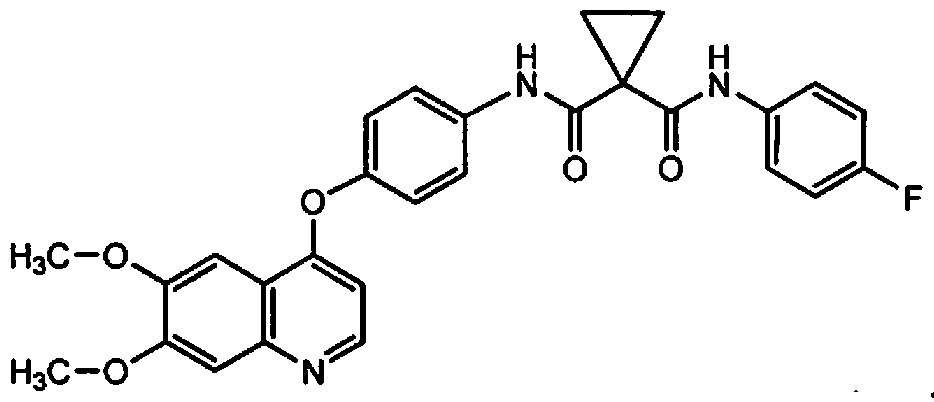
- One such small-molecule is compound IA, whic
- WO2005/030140 describes the synthesis of compound IA (Table 2, Compound 12, Example 48) and also discloses the therapeutic activity of this molecule to inhibit, regulate, and/or modulate the signal transduction of kinases (Assays, Table 4, entry 289), the entire contents of which is incorporated herein by reference.
- the pharmaceutical composition can be equally important to its development.
- the drug developer endeavors to discover a pharmaceutical composition that possesses desirable properties, such as satisfactory water-solubility (including rate of dissolution), storage stability, hygroscopicity, and reproducibility, all of which can impact the processability, manufacture, and/or bioavailability of the drug.
- the disclosure relates to processes for preparing a compound of formula I:
- X 1 is H, Br, CI, or F
- X 2 is H, Br, CI, or F
- nl 1-2;
- n2 is 1-2.
- the compounds of formula I are useful as protein kinase modulators, and they inhibit various protein kinases including Ret and c-Met.
- the disclosure provides a process for preparing compound IB:
- the disclosure provides compound I, IA, or IB admixed with
- compositions containing the compound of formula I, compound IA, or compound IB for oral administration are provided.
- the disclosure provides a pharmaceutical tablet composition according to Table 1.
- the disclosure provides a pharmaceutical tablet composition according to Table 2.
- the disclosure provides a pharmaceutical tablet composition according to Table 2A.
- Table 2A Table 2A
- the disclosure provides a pharmaceutical capsule composition according to Table 3.
- the disclosure provides a pharmaceutical capsule composition according to Table 4.
- the disclosure provides a pharmaceutical capsule composition according to Table 5, wherein the IB weight equivalents are provided.
- Table s the IB weight equivalents are provided.
- the disclosure provides a pharmaceutical capsule composition according to Table 6, wherein the IB weight equivalents are provided.
- the invention is directed to a pharmaceutical composition
- a pharmaceutical composition comprising compound I, IA, or IB admixed with less than 100 ppm 6,7-dimethoxy-quinoline-
- can is used in a non-limiting sense and in contradistinction to the word “must.”
- a certain element is described as “can” having a specified identity, which is meant to convey that the subject element is permitted to have that identity according to the invention but is not required to have it.
- “Pharmaceutically acceptable salts” include acid addition salts.
- “Pharmaceutically acceptable acid addition salt” refers to those salts that retain the biological effectiveness of the free bases and that are not biologically or otherwise undesirable, formed with inorganic acids such as hydrochloric acid, hydrobromic acid, sulfuric acid, nitric acid, phosphoric acid, and the like, or mixtures thereof, as well as organic acids such as acetic acid, trifluoroacetic acid, propionic acid, glycolic acid, pyruvic acid, oxalic acid, maleic acid, malonic acid, succinic acid, fumaric acid, tartaric acid, citric acid, benzoic acid, cinnamic acid, mandelic acid, methanesulfonic acid, ethanesulfonic acid, p- toluenesulfonic acid, salicylic acid, and the like, or mixtures thereof.
- inorganic acids such as hydrochloric acid, hydrobromic acid, sulfuric acid, nitric acid, phosphoric acid, and the like, or mixtures
- Aspect ( 1 ) of the invention relates to a process of preparing a compound of formula I:
- X 1 is H, Br, CI, or F
- X 2 is H, Br, CI, or F
- nl 1-2;
- n2 is 1-2;
- Non-limiting examples of suitable reaction conditions include using basic conditions.
- suitable basic conditions that can be used in Aspect (1) include the use of inorganic bases, such as aqueous KOH, NaOH, K 2 C0 3 , Na 2 C03, K3PO4, Na 3 P0 4 , K 2 HP0 4 , Na 2 HP0 4 , and the like, or mixtures thereof.
- suitable reaction conditions include using suitable solvents.
- suitable solvents that can be used include water miscible solvents, such as THF, acetone, ethanol, and the like, or mixtures thereof.
- suitable reaction conditions include using suitable temperatures.
- Suitable temperatures that may be used for the reaction include a temperature at a range from about 10 °C to about 30 °C, or alternatively, at a range from about 15 °C to about 28 °C, or alternatively, at a range from about 20 °C to about 25 °C.
- the product formed by the reaction is in the free base form, and this free base form may be converted into a pharmaceutically acceptable salt thereof by processes known in the art.
- the compound of formula I can be converted to the L-malate salt by the addition of L-malic acid and a suitable solvent.
- ⁇ ' is CI or F.
- X 2 is Cl or F.
- X 1 is H.
- X 2 is H.
- n2 is 2.
- All compounds of formula I for Aspect (1) disclosed above include any of the disclosed alternative embodiments in Part A for each of X , X , nl or n2, in combination with any other of the disclosed alternative embodiments in Part A for each of X 1 , X 2 , nl, or n2, as well as a pharmaceutically acceptable salt of any such combination.
- nl and n2 are each 1.
- nl and n2 are each 2.
- nl is 1 ; and n2 is 2.
- nl is 2 and n2 is 1.
- X 1 is H; and X 2 is F.
- X 1 is F; and X 2 is H.
- X 1 and X 2 are each H.
- X 1 and X 2 are each F.
- X 1 is CI; and X 2 is H.
- X 1 is H; and X 2 is CI.
- X 1 and X 2 are each CI.
- X 1 is CI; and X 2 is F.
- X 1 is F; and X 2 is CI.
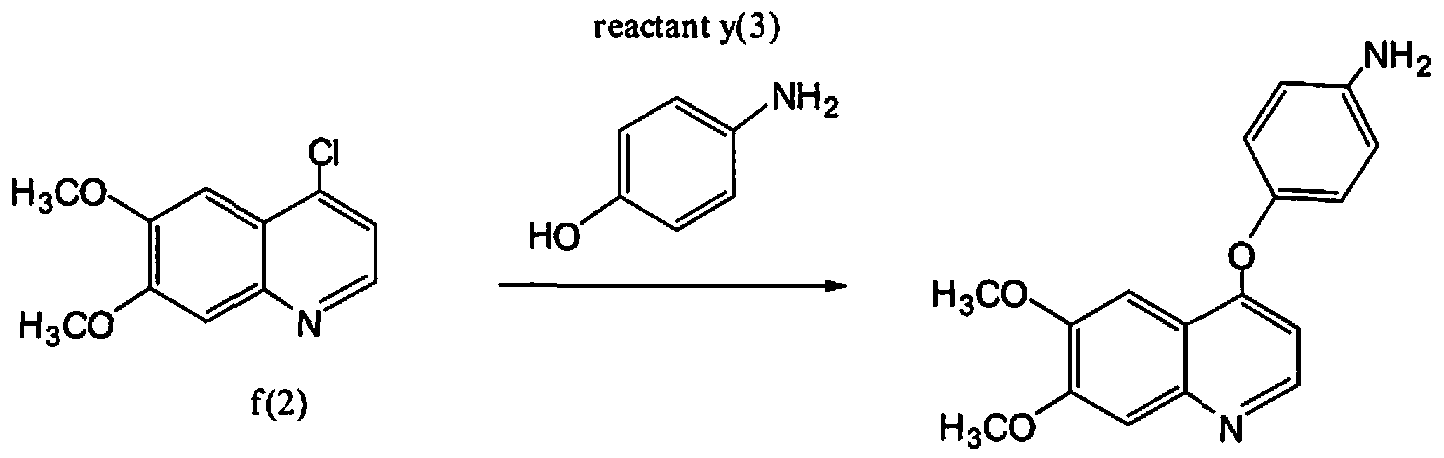
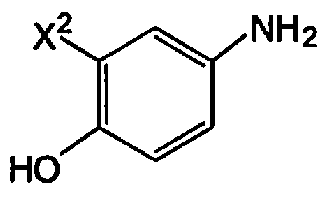
- the compound of formula g(l) can be made by reac
- LG represents a leaving group
- each of X 2 , and n2 are as defined in Aspect (1), or as in any of the embodiments of Aspect (1) Part A.
- a non-limiting example of a leaving group includes a halo group such as CI, Br, or F.
- Various compounds of reactant y(l) are commercially available, such as 2-fluoro-4-aminophenol and 4-aminophenol. Also, the skilled artisan would be able to make any variation of reactant y(l) using commercially available starting materials and by using known techniques to modify these commercially available starting materials to yield various compounds within the scope of reactant y(l).
- the reaction in this embodiment is advantageously carried out under suitable reaction conditions.
- suitable reaction conditions include using suitable solvents such as polar solvents.
- suitable solvents such as polar solvents.
- suitable solvents such as polar solvents.
- suitable solvents such as polar solvents.
- polar solvents that can be used include tetrahydrofuran (THF), dimethylacetamide (DMA), dimethylsulfoxide (DMSO), dimethylformamide (DMF), ethyl acetate, N-methyl pyrrolidone (NMP), propylene carbonate, and the like, or mixtures thereof.
- the polar solvent is dimethylacetamide (DMA).
- the polar solvent is dimethylsulfoxide (DMSO).
- the polar solvent is dimethylformamide (DMF).
- the polar solvent is ethyl acetate. In another embodiment, the polar solvent is N-methyl pyrrolidone (NMP). In another embodiment, the polar solvent is propylene carbonate. In another embodiment, the solvent is a mixture of solvents, such as a mixture comprising THF and DMA. [0066]
- the reactants f(l) and y(l) can be added together at a temperature ranging from about 10 °C to about 30 °C, or alternatively, from about 15 °C to about 28 °C, or alternatively, from about 20 °C to about 25 °C.
- the mixture is then heated to a temperature ranging from about 80 °C to about 125 °C, or alternatively, from about 95 °C to about 110 °C, or alternatively, from about 100 °C to about 105 °C, and the selected temperature is maintained until the reaction is complete.
- Suitable reaction conditions in this step of Aspect (1) include the use of a suitable base, such as a metal hydroxide or a non-nucleophilic base.
- a suitable base such as a metal hydroxide or a non-nucleophilic base.
- metal hydroxides include sodium hydroxide or potassium hydroxide.
- non-nucleophilic bases that can be used include lithium
- the base is sodium tert-butoxide or sodium tert-pentoxide.
- the base is sodium tert-pentoxide.
- the sodium tert-pentoxide is commercially available as 35 weight percent solution of base in tetrahydrofuran, or as a 95 weight percent solid reagent.
- the sodium tert-pentoxide is a 95 weight percent solid.
- the amount of molar equivalents of amino phenol that are used exceeds the molar equivalents of base that are used. In one embodiment, 1.1 to 2 molar equivalents of amino phenol are used relative to the molar equivalents of base that are used.
- the reaction mixture can be cooled to a temperature ranging from about 10 °C to about 25 °C.
- Precooled water can be charged at a rate to maintain a temperature that ranges from about 5 °C to about 35 °C.
- the precooled water can be charged at a rate to maintain a temperature that ranges from about 10 °C to about 25 °C.
- the precooled water can be at a temperature ranging from about 0 °C to about 10 °C.
- the precooled water can be at a temperature ranging from about 2 °C to about 7 °C.
- the precipitate can be collected by filtration under standard conditions and purified by standard purification techniques.
- the compound of formula f(l) can be made by converting a compound of formula e(l) to the compound of formula f(l):
- LG represents a leaving group.
- leaving groups that can be used include halo groups (e.g., CI, Br, or F) that can be added by halogenating agents.
- halogenating agents that can be used include chlorinating agents, such as SOCl 2 , SO2CI2, COCI2, PCI5, POCI3, and the like.
- reaction is advantageously carried out under suitable reaction conditions.
- suitable reaction conditions in Part D of Aspect (1) include the use of suitable solvents.
- suitable solvents that can be used during the halogenation of the compound of formula e(l) include a polar, aprotic solvent, such as
- the chlorination can be carried out using POCI3 in acetonitrile, COCI2 in DMF, or SOCI2 in DMF.
- the addition of the chlorination agent is advantageously carried out at a temperature ranging from about 60 °C to about 90 °C.
- the addition of the chlorination agent can be carried out at a temperature ranging from about 70 °C to about 85 °C.
- the addition of the chlorination agent can be carried out at a temperature ranging from about 74 °C to about 80 °C.
- the product can then be collected by filtration and purified using standard techniques.
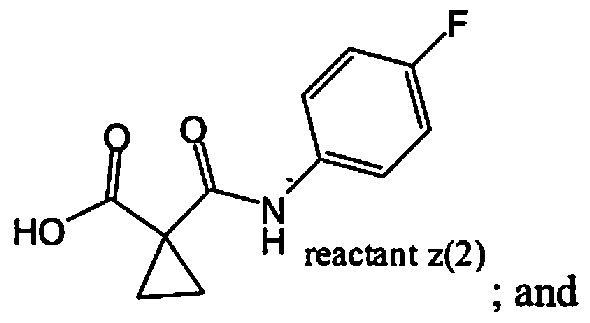
- reactant z( 1) can be made by reacting reactant z(la) with
- the reaction is advantageously carried out under suitable reaction conditions.
- suitable reaction conditions include using a chlorinating agent such as POCI3, oxalyl chloride, and the like.
- oxalyl chloride is used as a chlorinating agent.
- suitable reaction conditions include carrying out the reaction at a temperature in the range from about 0 °C to about 25 °C, or alternatively at a temperature in the range from about 5 °C to about 20 °C.
- suitable reaction conditions include carrying out the reaction in a suitable solvent.
- Non- limiting examples of suitable solvents that can be used include polar aprotic solvents, such as halogenated hydrocarbons (e.g., dichloromethane and chloroform), ethers (e.g., Et 2 0), dioxane, tetrahydrofuran (THF) containing catalytic DMF, and the like, or mixtures thereof.
- polar aprotic solvents such as halogenated hydrocarbons (e.g., dichloromethane and chloroform), ethers (e.g., Et 2 0), dioxane, tetrahydrofuran (THF) containing catalytic DMF, and the like, or mixtures thereof.
- polar aprotic solvents such as halogenated hydrocarbons (e.g., dichloromethane and chloroform), ethers (e.g., Et 2 0), dioxane, tetrahydrofuran (THF) containing catalytic D
- the compound of formula I is a compound of formula IA-1:
- X 1 is H, CI, Br, or F
- X 2 is H, CI, Br, or F.
- Compound IA can be in the free base form or it can converted to a pharmaceutically acceptable salt thereof. Accordingly, compound IA can be converted to its L-malate salt by the addition of L-malic acid and a suitable solvent.
- the compound of formula f l) is compound f(2):
- X 2 is hydrogen or fluoro
- the reaction employs a non-nucleophilic base.
- the non-nucelophilic base is an alkali metal alkoxide; and the reaction is carried out in a polar solvent.
- the alkali metal alkoxide is sodium tert-butoxide, and the polar solvent is DMA.
- the compound of formula f( 1 ) is compound f(2):
- X 2 is hydrogen or fluoro
- the compound of formula g(l) is compound g(3):
- the reaction is carried out in the presence of an inorganic base.
- the inorganic base is K2CO3, and the solvent employed in this reaction is a combination of THF and 3 ⁇ 40.
- X 1 and X 2 for each of formula g(l) and reactant z(l) are each selected from CI or F.
- X 1 and X 2 for each of formula g(2), and reactant z(l) are both F.
- the compound of formula f(2),or a pharmaceutically acceptable salt thereof can be made by converting the compound of formula e(2) to a compound of formula f(2) with a chlorinating agent in a suitable solvent:
- the compound of formula f(2) can be in its free base form or converted to a pharmaceutically acceptable salt thereof.
- the reaction conditions that can be used in this aspect include any of the reaction conditions disclosed in Part E of Aspect (1).
- Aspect (2) of the disclosure relates to a process of preparing compound g(2):
- reaction conditions that can be used in this aspect include any of the reaction conditions disclosed in Part C of Aspect (1).
- Alternative reaction conditions that can be used in this aspect include any of the reaction conditions disclosed in Parts C and D of Aspect (1).
- the invention provides a process for preparing compound IB:
- compound IA is admixed with a sufficient amount of L-malic acid in a methylethyl ketone (ME )/water (1:1) mixture.
- L-malic acid is added as a solution in water to a mixture of compound IA in methyl ethyl ketone.
- the amount of L-malic is greater than 1 molar equivalent relative to compound IA.
- the mixture of compound IA and L-malic acid in MEK water is heated at about 40-70 °C, and preferably at about 50-60 °C, and more preferably at about 55-60 °C with agitation, such as by stirring or the like, for about 1 to about 5 hours.
- the mixture is optionally clarified by filtering to give a clear solution.
- the resulting clear solution is then vacuum distilled from 1 to about 5 times at 150 to 200 mm Hg and a maximum jacket temperature of 55 °C to provide the desired crystalline compound of IB.
- L-malic acid is charged as a solution in water to compound IA. Generally the amount of L-malic is greater than 1 molar equivalent relative to compound IA.
- the mixture of compound IA and L-malic acid in MEK/water is heated at about 40-70 °C, and preferably at about 50-60 °C, and more preferably at about 55-60 °C with agitation, such as by stirring or the like, for about 1 to about 5 hours.
- the mixture is optionally clarified by filtering to give a clear solution which is at a temperature of about 30-40 °C, and more preferably at a temperature of about 33-37 °C. This clear solution is optionally seeded to facilitate crystallization.
- the resulting mixture is vacuum distilled as provided above.
- compound IB is in the N-1 form. In another embodiment, compound IB is in the N-2 form. In another embodiment, compound IB is a mixture of the N-1 form and the N-2 form. Processes for preparing the N-1 and N-2 forms of compound IB are disclosed in WO 2010/083414 (PCT7US2010021194), the entire contents of which are incorporated herein by reference.
- the disclosure relates to compound IA or IB admixed with 100 ppm or less of 6,7-dimethoxy-quinoline-4-ol.
- the compound is admixed with 50 ppm or less of 6,7-dimethoxy-quinoline-4-ol.
- the compound is admixed with 25 ppm or less of 6,7-dimethoxy-quinoline-4-ol.
- the compound is admixed with 10 ppm or less of 6,7-dimethoxy-quinoline-4-ol.
- the compound is admixed with 5 ppm or less of 6,7-dimethoxy- quinoline-4-ol.
- the compound is admixed with 2.5 ppm or less of 6,7-dimethoxy-quinoline-4-ol.
- the disclosure relates to compound IA admixed with 100 ppm or less of 6,7-dimethoxy-quinoline-4-ol.
- the compound is admixed with 50 ppm or less of 6,7-dimethoxy-quinoline-4-ol.
- the compound is admixed with 25 ppm or less of 6,7-dimethoxy-quinoline-4-ol.
- the compound is admixed with 10 ppm or less of 6,7-dimethoxy-quinoline-4-ol.
- the compound is admixed with 5 ppm or less of 6,7-dimethoxy-quinoline-4-ol.
- the compound is admixed with 2.5 ppm or less of 6,7-dimethoxy- quinoline-4-ol.
- the disclosure relates to compound IB admixed with 100 ppm or less of 6,7-dimethoxy-quinoline-4-ol.
- the compound is admixed with 50 ppm or less of 6,7-dimethoxy-quinoIine-4-ol.
- the compound is admixed with 25 ppm or less of 6,7-dimethoxy-quinoline-4-ol.
- the compound is admixed with 10 ppm or less of 6,7-dimethoxy-quinoline-4-ol.
- the compound is admixed with 5 ppm or less of 6,7-dimethoxy-quinoline-4-ol.
- the compound is admixed with 2.5 ppm or less of 6,7-dimethoxy- quinoline-4-ol.
- the disclosure relates to compound IB in the N-l form admixed with 100 ppm or less of 6,7-dimethoxy-quinoIine-4-ol.
- the compound is admixed with 50 ppm or less of 6,7-dimethoxy-quinoline-4-ol.
- the compound is admixed with 25 ppm or less of 6,7-dimethoxy-quinoline-4-ol.
- the compound is admixed with 10 ppm or less of 6,7-dimethoxy- quinoline-4-ol.
- the compound is admixed with 5 ppm or less of 6,7- dimethoxy-quinoline-4-ol.
- the compound is admixed with 2.5 ppm or less of 6,7-dimethoxy-quinoline-4-ol.
- the disclosure relates to compound IB in the N-2 form admixed with 100 ppm or less of 6,7-dimethoxy-quinoline-4-ol.
- the compound is admixed with 50 ppm or less of 6,7-dimethoxy-quinoline-4-ol.
- the compound is admixed with 25 ppm or less of 6,7-dimethoxy-quinoline-4-ol.
- the compound is admixed with 10 ppm or less of 6,7-dimethoxy- quinoline-4-ol.
- the compound is admixed with 5 ppm or less of 6,7- dimethoxy-quinoline-4-ol. In another embodiment, the compound is admixed with 2.5 ppm or less of 6,7-dimethoxy-quinoline-4-ol.
- the disclosure relates to compound IB as a mixture of the N-l form and the N-2 form admixed with 100 ppm or less of 6,7-dimethoxy-quinoline-4-ol.
- the compound is admixed with 50 ppm or less of 6,7-dimethoxy- quinoline-4-ol.
- the compound is admixed with 25 ppm or less of 6,7-dimethoxy-quinoline-4-ol.
- the compound is admixed with 10 ppm or less of 6,7-dimethoxy-quinoline-4-ol.
- the compound is admixed with 5 ppm or less of 6,7-dimethoxy-quinoline-4-ol. In another embodiment, the compound is admixed with 2.5 ppm or less of 6,7-dimethoxy-quinoline-4-ol.
- the disclosure relates to a pharmaceutical composition
- a pharmaceutical composition comprising Compound I, IA, or IB.
- Various carriers used in formulating pharmaceutically acceptable compositions and known techniques for their bulk preparation and subsequent production into unit dosage forms are employed to make the pharmaceutical compositions disclosed herein and are described in Remington: The Science and Practice of Pharmacy, 21st edition, 2005, ed. D. B. Troy, Lippincott Williams & Wilkins, Philadelphia, and
- the amount of carriers and excipients used in a composition can be varied proportionally according to the amount of active ingredient used (that is,
- the pharmaceutical composition is a tablet.
- the pharmaceutical composition is a capsule.
- the pharmaceutical composition comprises Compound
- the pharmaceutical composition comprises Compound IB.
- the pharmaceutical composition comprises Compound IB. as the N-l polymorph.
- the pharmaceutical composition comprises Compound IB as the N-2 polymorph.
- the pharmaceutical composition comprises Compound IB as a mixture of the N-l form and the N-2 form.
- the disclosure relates to a pharmaceutical composition
- a pharmaceutical composition comprising Compound IA or IB; one or more fillers; one or more disintergrants; one or more glidants; and one or more lubricants.
- the filler comprises microcrystalline cellulose.
- the disintegrant comprises croscarmellose sodium.
- the disintegrant comprises croscarmellose sodium and sodium starch glycolate.
- the glidant comprises fumed silica.
- the lubricant comprises stearic acid.
- the disclosure relates to a pharmaceutical composition
- a pharmaceutical composition comprismg Compound IA or IB; microcrystalline cellulose; lactose; hydroxypropyl cellulose; croscarmellose sodium; colloidal silicon dioxide; and magnesium stearate.
- the disclosure relates to a pharmaceutical composition
- a pharmaceutical composition comprising Compound IA or IB; microcrystalline cellulose; hydroxypropyl cellulose; a surfactant; croscarmellose sodium; colloidal silicon dioxide; and magnesium stearate.
- the disclosure relates to a pharmaceutical composition
- a pharmaceutical composition comprising Compound IA or IB; microcrystalline cellulose; croscarmellose sodium; fumed silica; and stearic acid.
- the disclosure relates to a pharmaceutical composition
- a pharmaceutical composition comprising Compound IA or IB; microcrystalline cellulose; anhydrous lactose;
- hydroxypropyl cellulose croscarmellose sodium
- silicon dioxide hydroxypropyl cellulose
- magnesium stearate magnesium stearate
- the disclosure relates to a pharmaceutical composition
- a pharmaceutical composition comprising Compound IA or IB; microcrystalline cellulose; anhydrous lactose;
- hydroxypropyl cellulose a surfactant
- croscarmellose sodium a surfactant
- silicon dioxide a surfactant
- magnesium stearate a surfactant
- the disclosure provides a pharmaceutical composition according to Tables 1, 2, 2A, 3, 4, 5, and 6 as provided above.
- the compositions are prepared according to methods available to the skilled artisan.
- the Tablet formulations are prepared by combining, blending, and compacting the components of the tablet compositions.
- the capsule compositions are prepared by combining and blending the components and then placing the blend in a gelatin capsule.
- the 25 mg capsules (Table 3, 10 percent drug load formulation) are prepared as follows.
- the drug substance is delumped through a mill.
- the delumped drug substance is then co-screened with an equal volume Prosolv HD90.
- the excipients, except for stearic acid, are screened and charged to a blender along with the co-screened drug substance.
- the mixture is blended in a V-Blender. This process is repeated to manufacture a second sublot of unlubricated blend.
- the two sublots are then combined together in a V-blender and lubricated with stearic acid which has been co-screened with an equal volume of unlubricated blend.
- the final blend is then encapsulated into opaque, size 1 gelatin capsules using an automated capsule filling machine.
- the capsules are then weight sorted through an automatic weight sorter.
- the 100-mg capsules (Table 4, 50% drug load formulation) are manufactured in two equal sublots of 5 kg of blend which are combined prior to lubricant blend
- the drug substance is delumped through a mill.
- the excipients, except for stearic acid, are screened and charged to the mixer along with the delumped drug substance.
- the mixture is blended with a high shear mixer.
- the process is repeated to manufacture a second sublot of unlubricated blend.
- the final blend is then encapsulated into Swedish oraopaque, size 1 gelatin capsules using an automated capsule filling machine.
- the capsuare then weight sorted through an automatic weight sorter.
- the disclosure relates to a pharmaceutical composition
- a pharmaceutical composition comprising a compound of Formula IA or IB and a pharmaceutically acceptable carrier admixed with less than 100 ppm of 6,7-dimethoxy-quinoline-4-ol. 6,7-dimethoxy-quinoline-
- the pharmaceutical composition as defined in any of the previous embodiments is admixed with 100 ppm 6,7-dimethoxy-quinoline-4-ol.
- the pharmaceutical composition as defined in any of the previous embodiments is admixed with 50 ppm 6,7-dimethoxy-quinoline-4-ol.
- the pharmaceutical composition as defined in any of the previous embodiments is admixed with 25 ppm 6,7-dimethoxy-quinoline-4-ol.
- the pharmaceutical composition as defined in any of the previous embodiments is admixed with 15 ppm 6,7-dimethoxy-quinoline-4-ol.
- the pharmaceutical composition as defined in any of the previous embodiments is admixed with 10 ppm 6,7-dimethoxy-quinoline-4-ol.
- the pharmaceutical composition as defined in any of the previous embodiments is admixed with 5 ppm 6,7-dimethoxy-quinoline-4-ol.
- the pharmaceutical composition as defined in any of the previous embodiments is admixed with 2.5 ppm 6,7-dimethoxy-quinoline-4-ol.
- the disclosure relates to a pharmaceutical composition
- a pharmaceutical composition comprising Compound IA or IB; one or more fillers; one or more disintergrants; one or more glidants; and one or more lubricants admixed with 100 ppm or less 6,7-dimethoxy-quinoline-
- the filler comprises microcrystalline cellulose.
- the disintegrant comprises croscarmellose sodium.
- the disintegrant comprises croscarmellose sodium and sodium starch glycolate.
- the glidant comprises fumed silica.
- the lubricant comprises stearic acid.
- the disclosure relates to a pharmaceutical composition
- a pharmaceutical composition comprising Compound IA or IB; microcrystalline cellulose; croscarmellose sodium; fumed silica; and stearic acid; admixed with 100 ppm or less of 6,7-dimethoxy-quinoline-4-ol.
- the composition is admixed with 50 ppm or less of 6,7- dimethoxy-quinoline-4-ol.
- the composition is admixed with 25 ppm or less of 6,7-dimethoxy-quinoline-4-ol.
- the composition is admixed with 10 ppm or less of 6,7-dimethoxy- quinoline-4-ol. In another embodiment of this embodiment, the composition is admixed with 5 ppm or less of 6,7-dimethoxy-quinoline-4-ol. In another embodiment of this embodiment, the composition is admixed with 2.5 ppm or less of 6,7-dimethoxy-quinoline-4-ol.
- the disclosure relates to a pharmaceutical composition
- a pharmaceutical composition comprising Compound IA or IB; microcrystalline cellulose; anhydrous lactose;
- the composition is admixed with 100 ppm or less of 6,7-dimethoxy-quinoline-4-ol.
- the composition is admixed with 50 ppm or less of 6,7- dimethoxy-quinoline-4-ol.
- the composition is admixed with 25 ppm or less of 6,7-dimethoxy-quinoline-4-ol.
- the composition is admixed with 10 ppm or less of 6,7-dimethoxy- quinoline-4-ol.
- the composition is admixed with 5 ppm or less of 6,7-dimethoxy-quinoline-4-ol. In another embodiment of this embodiment, the composition is admixed with 2.5 ppm or less of 6,7-dimethoxy-quinoline-4-ol.
- the disclosure relates to a pharmaceutical composition
- a pharmaceutical composition comprising Compound IA or IB; microcrystalline cellulose; croscarmellose sodium; fumed silica; and stearic acid; ; admixed with 100 ppm or less of 6,7-dimethoxy-quinoline-4-ol.
- the composition is admixed with 50 ppm or less of 6,7- dimethoxy-quinoline-4-ol.
- the composition is admixed with 25 ppm or less of 6,7-dimethoxy-quinoline-4-ol.
- the composition is admixed with 10 ppm or less of 6,7-dimethoxy- quinoline-4-ol. In another embodiment of this embodiment, the composition is admixed with 5 ppm or less of 6,7-dimethoxy-quinoline-4-ol. In another embodiment of this embodiment, the composition is admixed with 2.5 ppm or less of 6,7-dimethoxy-quinoline-4-ol.
- a reactor was charged sequentially with 6,7-dimethoxy-quinoline-4-ol (47.0 kg) and acetonitrile (318.8 kg). The resulting mixture was heated to approximately 60 °C, and phosphorus oxychloride (POCI3, 130.6 kg) was added. After the addition of POCI3, the temperature of the reaction mixture was raised to approximately 77 °C. The reaction was deemed complete (approximately 13 hours) when less than 3% of the starting material remained (in-process high-performance liquid chromatography [HPLC] analysis). The reaction mixture was cooled to approximately 2 - 7 °C and then quenched into a chilled solution of dichloromethane (DCM, 482.8 kg), 26 % NH 4 OH (251.3 kg), and water (900 L).
- DCM dichloromethane
- the resulting mixture was warmed to approximately 20 - 25 °C, and phases were separated.
- the organic phase was filtered through a bed of AW hyflo super-cel NF (Celite; 5.4 kg) and the filter bed was washed with DCM (118.9 kg).
- the combined organic phase was washed with brine (282.9 kg) and mixed with water (120 L).
- the phases were separated and the organic phase was concentrated by vacuum distillation with the removal of solvent
- Triethylamine (19.5 kg) was added to a cooled (approximately 5 C) solution of cyclopropane- 1,1-dicarboxylic acid (24.7 kg) in THF (89.6 kg) at a rate such that the batch temperature did not exceed 5 °C.
- the solution was stirred for approximately 1.3 hours, and then thionyl chloride (23.1 kg) was added, keeping the batch temperature below 10 °C. When the addition was complete, the solution was stirred for approximately 4 h keeping temperature below 10 °C.
- a solution of 4-fluoroaniline (18.0 kg) in THF (33.1 kg) was then added at a rate such that the batch temperature did not exceed 10 °C.
- Oxalyl chloride (12.6 kg) was added to a solution of l-(4-fluoro- phenylcarbamoyl)-cyclopropanecarboxylic acid (22.8 kg) in a mixture of THF (96.1 kg) and N, N-dimethylformamide (DMF; 0.23 kg) at a rate such that the batch temperature did not exceed 25 °C. This solution was used in the next step without further processing.
- a reactor was charged with l-(4-fluoro-phenylcarbamoyl)- cyclopropanecarboxylic acid (35 kg), 344 g DMF, and 175kg THF.
- the reaction mixture was adjusted to 12-17 °C and then to the reaction mixture was charged 19.9 kg of oxalyl chloride over a period of 1 hour.
- the reaction mixture was left stirring at 12-17 °C for 3 to 8 hours. This solution was used in the next step without further processing.
- the product was recovered by filtration, washed with a pre-made solution of THF (68.6 kg) and water (256 L), and dried first on a filter under nitrogen at approximately 25 °C and then at approximately 45 °C under vacuum to afford the title compound (41.0 kg, 38.1 kg, calculated based on LOD).
- a reactor was charged with 4-(6,7-dimethoxy-quinoline-4-yloxy)-phenylamine (35.7 kg, 1 equivalent), followed by 412.9 kg THF.
- To the reaction mixture was charged a solution of 48.3 2CO3 in 169 kg water.
- the acid chloride solution of described in the Alternative Preparation of l-(4-Fluoro-phenylcarbamoyl)-cvclopropanecarbonyl chloride above was transferred to the reactor containing 4-(6,7-dimethoxy-quinoline-4-yloxy)- phenylamine while maintaining the temperature between 20-30 °C over a rninimum of two hours.
- the reaction mixture was stirred at 20-25 °C for a minimum of three hours.
- reaction temperature was then adjusted to 30-25 °C and the mixture was agitated. The agitation was stopped and the phases of the mixture were allowed to separate. The lower aqueous phase was removed and discarded. To the remaining upper organic phase was added 804 kg water. The reaction was left stirring at 15-25 °C for a minimum of 16 hours.
- the product precipitated The product was filtered and washed with a mixture of 179 kg water and 157.9 THF in two portions. The crude product was dried under a vacuum for at least two hours. The dried product was then taken up in 285.1 kg THF. The resulting suspension was transferred to reaction vessel and agitated until the suspension became a clear (dissolved) solution, which required heating to 30-35 °C for approximately 30 minutes. 456 kg water was then added to the solution, as well as 20 kg SDAG-1 ethanol (ethanol denatured with methanol over two hours. The mixture was agitated at 15-25 °C for at least 16 hours. The product was filtered and washed with a mixture of 143 kg water and 126.7 THF in two portions. The product was dried at a maximum temperature set point of 40 °C.
- reaction temperature during acid chloride formation was adjusted to 10-15 °C.
- the recrystallization temperature was changed from 15-25 °C to 45-50 °C for 1 hour and then cooled to 15-25 °C over 2 hours.
- a solution was prepared by adding tetrahydrofuran (12 mL/g-bulk-LR (limiting reagent); 1.20 L) and N-(4- ⁇ [6,7-bis(methyloxy)-quinolin-4-yl]oxy ⁇ phenyl)-N'-(4- fluorophenyl)cyclopropane-l,l-dicarboxamide, (100 g; 1.00 equiv; 100.00 g) and (L)-malic acid (1.2 equiv (molar); 32.08 g) to a 1 L reactor. Water (0.5317 mL g-bulk-LR; 53.17 mL) was added and the solution was heated to 60 °C and maintained at that temperature for one hour until the solids were fully dissolved. The solution was passed through a Polish Filter.
- a solution was prepared with 190 mL tetrahydrofuran (110 mL), methyl isobutyl ketone, and 29 mL water. Next, 20 mL of this solution were transferred into an amber bottle, and then saturated by adding N-(4- ⁇ [6,7-bis(methyloxy)-quinolin-4-yl]oxy ⁇ phenyl)-N'-(4- fluorophenyl)cycIopropane-l,l-dicarboxamide, (L)-malate until a thick slurry formed, and aging for at least 2 hours with stirring at room temperature. The solids were removed by filtration through a Buchner funnel, rendering a clear saturated solution.
- a powder blend was made with known amounts of two batches of compound IB: (1) 300 mg of batch 1, which contained approximately 41% compound IB, Form N-l and 59% compound IB, Form N-2 by Raman spectroscopy analysis, and (2) 200 mg of batch 2, which had a XPRD pattern similar to compound IB, Form N-2.
- a solution was prepared by combining 20 ml of acetone and 300 mg of compound IA (N-(4- ⁇ [6,7-bis(methyloxy)quinolin-4-yI]oxy ⁇ phenyI)-N'-(4-fluorophenyl)cyclopropane- 1,1-dicarboxamide) in a 25ml screw capped vial.
- compound IA N-(4- ⁇ [6,7-bis(methyloxy)quinolin-4-yI]oxy ⁇ phenyI)-N'-(4-fluorophenyl)cyclopropane- 1,1-dicarboxamide
- 0.758ml of a 0.79M (L)-malic acid stock solution was added to the vial with magnetic stirring.
- the solution was then left stirring for 24 hours at ambient temperature.
- the sample was then suction filtered with 0.45 ⁇ PTFE filter cartridge and dried in vacuo at ambient temperature overnight.
- Bottle A4 was repackaged in a blister pack after being stored in bottles for 3 months.
- Table 7B Stability of 25 Mg Capsules (Table 3)
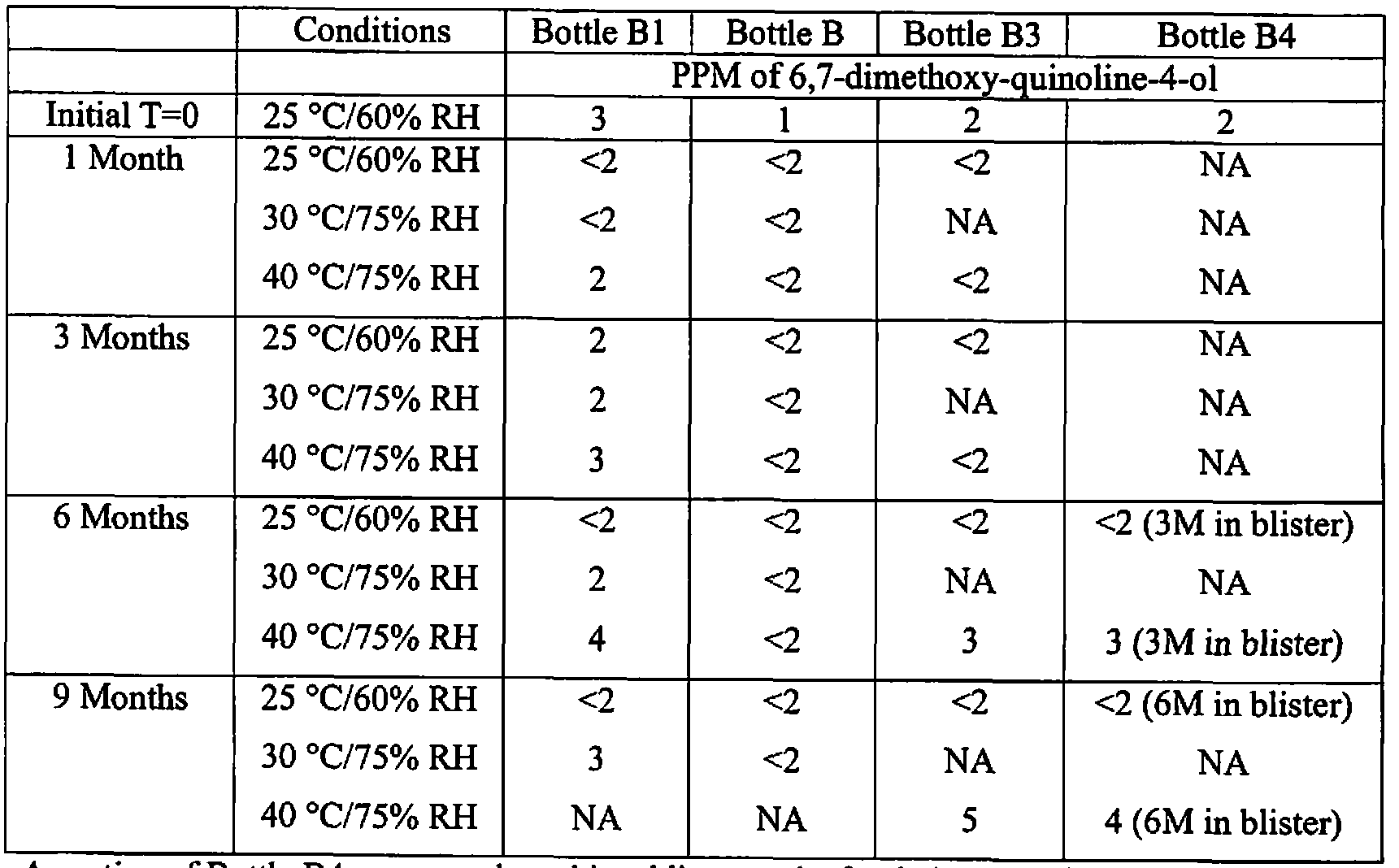
- Bottle B4 was repackaged in a blister pack after being stored in bottles for 3 months.
- Table 8A Stability of 100 Mg Capsules (Table 4)
- Table 8B Stability of 100 Mg Capsules (Table 4)
Landscapes
- Chemical & Material Sciences (AREA)
- Health & Medical Sciences (AREA)
- Organic Chemistry (AREA)
- Medicinal Chemistry (AREA)
- Pharmacology & Pharmacy (AREA)
- Life Sciences & Earth Sciences (AREA)
- Animal Behavior & Ethology (AREA)
- General Health & Medical Sciences (AREA)
- Public Health (AREA)
- Veterinary Medicine (AREA)
- Epidemiology (AREA)
- Chemical Kinetics & Catalysis (AREA)
- General Chemical & Material Sciences (AREA)
- Nuclear Medicine, Radiotherapy & Molecular Imaging (AREA)
- Pharmaceuticals Containing Other Organic And Inorganic Compounds (AREA)
- Quinoline Compounds (AREA)
- Medicinal Preparation (AREA)
- Plural Heterocyclic Compounds (AREA)
Abstract
Description








Claims






Priority Applications (39)
| Application Number | Priority Date | Filing Date | Title |
|---|---|---|---|
| CA2826751A CA2826751C (en) | 2011-02-10 | 2012-02-10 | Processes for preparing quinoline compounds and pharmaceutical compositions containing such compounds |
| KR1020217002055A KR20210010671A (en) | 2011-02-10 | 2012-02-10 | Processes for preparing quinoline compounds and pharmaceutical compositions containing such compounds |
| KR1020217038913A KR20210147117A (en) | 2011-02-10 | 2012-02-10 | Processes for preparing quinoline compounds and pharmaceutical compositions containing such compounds |
| KR1020197012256A KR20190049907A (en) | 2011-02-10 | 2012-02-10 | Processes for preparing quinoline compounds and pharmaceutical compositions containing such compounds |
| KR1020237038819A KR20230158644A (en) | 2011-02-10 | 2012-02-10 | Processes for preparing quinoline compounds and pharmaceutical compositions containing such compounds |
| NZ614130A NZ614130B2 (en) | 2011-02-10 | 2012-02-10 | Processes for preparing quinoline compounds and pharmaceutical compositions containing such compounds |
| MX2017012701A MX390726B (en) | 2011-02-10 | 2012-02-10 | PROCESSES FOR PREPARING QUINOLINE COMPOUNDS AND PHARMACEUTICAL COMPOSITIONS CONTAINING SUCH COMPOUNDS. |
| PL12704492T PL2673262T3 (en) | 2011-02-10 | 2012-02-10 | Processes for preparing quinoline compounds and pharmaceutical compositions containing such compounds |
| KR1020207007647A KR20200031711A (en) | 2011-02-10 | 2012-02-10 | Processes for preparing quinoline compounds and pharmaceutical compositions containing such compounds |
| JP2013553580A JP2014505109A (en) | 2011-02-10 | 2012-02-10 | Quinoline compounds and methods for preparing pharmaceutical compositions containing such compounds |
| AU2012214322A AU2012214322B2 (en) | 2011-02-10 | 2012-02-10 | Processes for preparing quinoline compounds and pharmaceutical compositions containing such compounds |
| MX2013009116A MX2013009116A (en) | 2011-02-10 | 2012-02-10 | Processes for preparing quinoline compounds and pharmaceutical compositions containing such compounds. |
| EP21205831.7A EP4019498A1 (en) | 2011-02-10 | 2012-02-10 | Processes for preparing quinoline compounds and pharmaceutical compositions containing such compounds |
| EP12704492.3A EP2673262B1 (en) | 2011-02-10 | 2012-02-10 | Processes for preparing quinoline compounds and pharmaceutical compositions containing such compounds |
| BR112013020362A BR112013020362A2 (en) | 2011-02-10 | 2012-02-10 | processes for the preparation of quinoline compounds, compounds and pharmaceutical combinations containing them |
| CN201280017723.1A CN103459373B (en) | 2011-02-10 | 2012-02-10 | Prepare the method for quinoline compound and the pharmaceutical composition containing the compound |
| EA201391145A EA033513B1 (en) | 2011-02-10 | 2012-02-10 | Processes for preparing quinoline compounds and pharmaceutical compositions containing such compounds |
| KR1020247039112A KR20240170977A (en) | 2011-02-10 | 2012-02-10 | Processes for preparing quinoline compounds and pharmaceutical compositions containing such compounds |
| DK12704492.3T DK2673262T3 (en) | 2011-02-10 | 2012-02-10 | Processes for the preparation of quinoline compounds and pharmaceutical compositions containing such compounds |
| US13/984,559 US9717720B2 (en) | 2011-02-10 | 2012-02-10 | Processes for preparing quinoline compounds and pharmaceutical compositions containing such compounds |
| KR1020137023174A KR102030447B1 (en) | 2011-02-10 | 2012-02-10 | Processes for preparing quinoline compounds and pharmaceutical compositions containing such compounds |
| ES12704492T ES2905571T3 (en) | 2011-02-10 | 2012-02-10 | Processes for the preparation of quinoline compounds and pharmaceutical compositions containing said compounds |
| IL227848A IL227848B (en) | 2011-02-10 | 2013-08-07 | Processes for preparting quinoline compounds and pharmaceutical compositions containing such compounds |
| ZA2013/06072A ZA201306072B (en) | 2011-02-10 | 2013-08-13 | Processes for preparing quinoline compounds and pharmaceutical compositions containing such compounds |
| US15/348,716 US10123999B2 (en) | 2011-02-10 | 2016-11-10 | Processes for preparing quinoline compounds and pharmaceutical compositions containing such compounds |
| AU2017204877A AU2017204877A1 (en) | 2011-02-10 | 2017-07-14 | Processes for preparing quinoline compounds and pharmaceutical compositions containing such compounds |
| US16/151,653 US10543206B2 (en) | 2011-02-10 | 2018-10-04 | Processes for preparing quinoline compounds and pharmaceutical compositions containing such compounds |
| AU2019203745A AU2019203745B2 (en) | 2011-02-10 | 2019-05-29 | Processes for preparing quinoline compounds and pharmaceutical compositions containing such compounds |
| US16/706,323 US20200108059A1 (en) | 2011-02-10 | 2019-12-06 | Processes for Preparing Quinoline Compounds and Pharmaceutical Compositions Containing Such Compounds |
| AU2020273307A AU2020273307A1 (en) | 2011-02-10 | 2020-11-19 | Processes for preparing quinoline compounds and pharmaceutical compositions containing such compounds |
| US17/152,394 US20210154185A1 (en) | 2011-02-10 | 2021-01-19 | Processes for Preparing Quinoline Compounds and Pharmaceutical Compositions Containing Such Compounds |
| US17/170,275 US11298349B2 (en) | 2011-02-10 | 2021-02-08 | Processes for preparing quinoline compounds and pharmaceutical compositions containing such compounds |
| US17/497,201 US20220023284A1 (en) | 2011-02-10 | 2021-10-08 | Processes for Preparing Quinoline Compounds and Pharmaceutical Compositions Containing Such Compounds |
| US17/679,634 US20220175757A1 (en) | 2011-02-10 | 2022-02-24 | Processes for Preparing Quinoline Compounds and Pharmaceutical Compositions Containing Such Compounds |
| AU2022246429A AU2022246429A1 (en) | 2011-02-10 | 2022-10-06 | Processes for preparing quinoline compounds and pharmaceutical compositions containing such compounds |
| US18/436,836 US12128039B2 (en) | 2011-02-10 | 2024-02-08 | Processes for preparing quinoline compounds and pharmaceutical compositions containing such compounds |
| AU2024205231A AU2024205231A1 (en) | 2011-02-10 | 2024-07-31 | Processes for preparing quinoline compounds and pharmaceutical compositions containing such compounds |
| US18/899,774 US20250017916A1 (en) | 2011-02-10 | 2024-09-27 | Processes for Preparing Quinoline Compounds and Pharmaceutical Compositions Containing Such Compounds |
| US19/202,778 US20250262200A1 (en) | 2011-02-10 | 2025-05-08 | Processes for preparing quinoline compounds and pharmaceutical compositions containing such compounds |
Applications Claiming Priority (4)
| Application Number | Priority Date | Filing Date | Title |
|---|---|---|---|
| US201161441520P | 2011-02-10 | 2011-02-10 | |
| US201161441527P | 2011-02-10 | 2011-02-10 | |
| US61/441,527 | 2011-02-10 | ||
| US61/441,520 | 2011-02-10 |
Related Child Applications (3)
| Application Number | Title | Priority Date | Filing Date |
|---|---|---|---|
| US13/984,559 A-371-Of-International US9717720B2 (en) | 2011-02-10 | 2012-02-10 | Processes for preparing quinoline compounds and pharmaceutical compositions containing such compounds |
| US15/348,716 Division US10123999B2 (en) | 2011-02-10 | 2016-11-10 | Processes for preparing quinoline compounds and pharmaceutical compositions containing such compounds |
| US15/348,716 Continuation US10123999B2 (en) | 2011-02-10 | 2016-11-10 | Processes for preparing quinoline compounds and pharmaceutical compositions containing such compounds |
Publications (1)
| Publication Number | Publication Date |
|---|---|
| WO2012109510A1 true WO2012109510A1 (en) | 2012-08-16 |
Family
ID=45615082
Family Applications (1)
| Application Number | Title | Priority Date | Filing Date |
|---|---|---|---|
| PCT/US2012/024591 Ceased WO2012109510A1 (en) | 2011-02-10 | 2012-02-10 | Processes for preparing quinoline compounds and pharmaceutical compositions containing such compounds |
Country Status (21)
| Country | Link |
|---|---|
| US (11) | US9717720B2 (en) |
| EP (2) | EP2673262B1 (en) |
| JP (2) | JP2014505109A (en) |
| KR (7) | KR20210147117A (en) |
| CN (1) | CN103459373B (en) |
| AR (1) | AR085155A1 (en) |
| AU (6) | AU2012214322B2 (en) |
| BR (1) | BR112013020362A2 (en) |
| CA (1) | CA2826751C (en) |
| DK (1) | DK2673262T3 (en) |
| EA (1) | EA033513B1 (en) |
| ES (1) | ES2905571T3 (en) |
| GE (3) | GEP20217235B (en) |
| HU (1) | HUE057574T2 (en) |
| IL (1) | IL227848B (en) |
| MX (2) | MX390726B (en) |
| PL (1) | PL2673262T3 (en) |
| PT (1) | PT2673262T (en) |
| TW (2) | TWI640509B (en) |
| WO (1) | WO2012109510A1 (en) |
| ZA (1) | ZA201306072B (en) |
Cited By (8)
| Publication number | Priority date | Publication date | Assignee | Title |
|---|---|---|---|---|
| CN103664776A (en) * | 2012-09-26 | 2014-03-26 | 正大天晴药业集团股份有限公司 | Preparation method for tyrosine kinase inhibitor and midbody thereof |
| WO2015123639A1 (en) | 2014-02-14 | 2015-08-20 | Exelixis, Inc. | Crystalline solid forms of n-{4-[(6,7-dimethoxyquinolin-4-yl)oxy]phenyl}-n'-(4-fluorophenyl) cyclopropane-1, 1-dicarboxamide, processes for making, and methods of use |
| WO2018064191A1 (en) | 2016-09-27 | 2018-04-05 | The Usa Of America, As Represented By The Secretary, Department Of Health & Human Services | Method of treating urothelial carcinoma and other genitourinary malignancies using n-(4-(6,7-dimethoxyquinolin-4-yloxy)-phenyl)-n'(4-fluorophenyl)cyclopropane-1,1-dicarboxamide |
| WO2018218233A1 (en) | 2017-05-26 | 2018-11-29 | Exelixis, Inc. | Crystalline solid forms of salts of n-{4-[(6,7-dimethoxyquinolin-4-yl) oxy]phenyl}-n'-(4-fluorphenyl) cyclopropane-1,1-dicarboxamide, processes for making, and methods of use |
| US10166225B2 (en) | 2011-09-22 | 2019-01-01 | Exelixis, Inc. | Method for treating osteoporosis |
| US10543206B2 (en) | 2011-02-10 | 2020-01-28 | Exelixis, Inc. | Processes for preparing quinoline compounds and pharmaceutical compositions containing such compounds |
| WO2020154610A1 (en) | 2019-01-25 | 2020-07-30 | Exelixis, Inc. | Compounds for the treatment of kinase-dependent disorders |
| WO2024110606A1 (en) | 2022-11-25 | 2024-05-30 | Synthon B.V. | A process for preparation of cabozantinib or tivozanib |
Families Citing this family (20)
| Publication number | Priority date | Publication date | Assignee | Title |
|---|---|---|---|---|
| EA038195B1 (en) | 2009-01-16 | 2021-07-22 | Экселиксис, Инк. | SMALL SALT N- (4 - {[6,7-BIS- (METHYLOXY) QUINOLIN-4-YL] OXY} PHENYL) -N '- (4-FLUOROPHENYL) CYCLOPROPAN-1,1-DICARBOXAMIDE AND ITS USE FOR CANCER TREATMENT KIDNEY AND LIVER |
| WO2012009722A1 (en) | 2010-07-16 | 2012-01-19 | Exelixis, Inc. | C-met modulator pharmaceutical compositions |
| DK2621481T4 (en) | 2010-09-27 | 2023-01-09 | Exelixis Inc | Dual inhibitors of MET and VEGF for the treatment of castration-resistant prostate cancer and osteoblastic bone metastases |
| US20120252840A1 (en) | 2011-04-04 | 2012-10-04 | Exelixis, Inc. | Method of Treating Cancer |
| TWI610918B (en) | 2011-05-02 | 2018-01-11 | 艾克塞里克斯公司 | Method of treating cancer and bone cancer pain |
| EP2768796B1 (en) | 2011-10-20 | 2019-11-20 | Exelixis, Inc. | Process for preparing quinoline derivatives |
| WO2013166296A1 (en) | 2012-05-02 | 2013-11-07 | Exelixis, Inc. | A dual met - vegf modulator for treating osteolytic bone metastases |
| CA2907334C (en) | 2013-03-15 | 2021-12-07 | Exelixis, Inc. | Metabolites of n-(4-{[6,7-bis(methyloxy)quinolin-4-yl]oxy}phenyl)-n'-(4-fluorophenyl)cyclopropane-1,1-dicarboxamide |
| US11564915B2 (en) | 2013-04-04 | 2023-01-31 | Exelixis, Inc. | Cabozantinib dosage form and use in the treatment of cancer |
| CN103751140A (en) * | 2014-01-15 | 2014-04-30 | 青岛市肿瘤医院 | Cabozantinib dispersible tablets and preparation method thereof |
| US10159666B2 (en) | 2014-03-17 | 2018-12-25 | Exelixis, Inc. | Dosing of cabozantinib formulations |
| CN104788372B (en) * | 2014-07-25 | 2018-01-30 | 上海圣考医药科技有限公司 | A kind of deuterated card is rich to replace Buddhist nun's derivative, its preparation method, application and its intermediate |
| CN106715397B (en) | 2014-07-31 | 2021-07-23 | 埃克塞里艾克西斯公司 | Method for preparing fluoro-18 labeled cabozantinib and analogs thereof |
| BR112017002318A2 (en) | 2014-08-05 | 2018-07-17 | Exelixis, Inc. | drug combinations to treat multiple myeloma. |
| CN105503717A (en) * | 2014-09-24 | 2016-04-20 | 江苏奥赛康药业股份有限公司 | Cabozantinib malate compound and medicine composition therewith |
| CN109069499A (en) | 2016-04-15 | 2018-12-21 | 埃克塞里艾克西斯公司 | Use N- (4- (6,7- dimethoxy-quinoline -4- base oxygroup) phenyl)-N '-(4- fluorophenyl) cyclopropane -1,1- diformamide, the method for (2S)-hydroxysuccinic acid salts for treating clear-cell carcinoma |
| GEAP202415420A (en) | 2018-01-26 | 2024-12-25 | Exelixis Inc | Compounds for the treatment of kinase-dependent disorders |
| CN120305263A (en) | 2018-06-15 | 2025-07-15 | 汉达癌症医药责任有限公司 | Use of salts of cabozantinib in preparing dosage forms for treating cancer |
| AU2024215796A1 (en) | 2023-01-31 | 2025-05-15 | Handa Oncology, Llc | Improved cabozantinib compositions and methods of use |
| CN116333534B (en) * | 2023-04-04 | 2023-11-17 | 清远拜克家居有限公司 | Aging-resistant water-based paint for wood boards and preparation method thereof |
Citations (2)
| Publication number | Priority date | Publication date | Assignee | Title |
|---|---|---|---|---|
| WO2005030140A2 (en) | 2003-09-26 | 2005-04-07 | Exelixis, Inc. | C-met modulators and methods of use |
| WO2010083414A1 (en) | 2009-01-16 | 2010-07-22 | Exelixis, Inc. | Malate salt of n- (4- { [ 6, 7-bis (methyloxy) quin0lin-4-yl] oxy}phenyl-n' - (4 -fluorophenyl) cyclopropane-1-dicarboxamide, and crystalline forms therof for the treatment of cancer |
Family Cites Families (43)
| Publication number | Priority date | Publication date | Assignee | Title |
|---|---|---|---|---|
| US5358941A (en) | 1992-12-02 | 1994-10-25 | Merck & Co., Inc. | Dry mix formulation for bisphosphonic acids with lactose |
| DE69733752T2 (en) | 1996-05-20 | 2006-06-01 | G.D. Searle Llc, Chicago | DRUGS CONTAINING OXAPROCINE SODIUM SALT, CALIUM SALT, OR TRIS (HYDROXYMETHYL) AMINOMETHANE SALT |
| CA2361057C (en) * | 1999-01-22 | 2010-04-06 | Kazuo Kubo | Quinoline derivatives and quinazoline derivatives |
| WO2003074497A1 (en) | 2002-03-01 | 2003-09-12 | Pintex Pharmaceutical, Inc. | Pin1-modulating compounds and methods of use thereof |
| JP3763414B2 (en) | 2002-10-21 | 2006-04-05 | 麒麟麦酒株式会社 | Crystal form of N- {2-chloro-4-[(6,7-dimethoxy-4-quinolyl) oxy] phenyl} -N '-(5-methyl-3-isoxazolyl) urea salt |
| TWI347940B (en) | 2003-11-07 | 2011-09-01 | Novartis Ag | Methods for synthesizing quinolinone compounds |
| KR100839554B1 (en) | 2003-12-25 | 2008-06-20 | 에자이 알앤드디 매니지먼트 가부시키가이샤 | Determination of salts of 4- (3-chloro-4- (cyclopropylaminocarbonyl) aminophenoxy) -7-methoxy-6-quinolinecarboxamide or solvates thereof and preparation method thereof |
| WO2006014325A2 (en) | 2004-07-02 | 2006-02-09 | Exelixis, Inc. | C-met modulators and method of use |
| JP2008537748A (en) | 2005-04-06 | 2008-09-25 | エクセリクシス、インコーポレイテッド | c-Met Modulator and Method of Use |
| TWI392681B (en) | 2006-04-06 | 2013-04-11 | Daiichi Sankyo Co Ltd | Prasugrel with high purity and a method for preparing its acid addition salt |
| US20080004273A1 (en) | 2006-05-30 | 2008-01-03 | Stephane Raeppel | Inhibitors of protein tyrosine kinase activity |
| ES2703723T3 (en) | 2006-12-14 | 2019-03-12 | Exelixis Inc | Methods for using MEK inhibitors |
| UY31800A (en) | 2008-05-05 | 2009-11-10 | Smithkline Beckman Corp | CANCER TREATMENT METHOD USING A CMET AND AXL INHIBITOR AND AN ERBB INHIBITOR |
| WO2009136663A1 (en) * | 2008-05-08 | 2009-11-12 | Takeda Pharmaceutical Company Limited | Fused heterocyclic derivatives and use thereof |
| AR075084A1 (en) | 2008-09-26 | 2011-03-09 | Smithkline Beecham Corp | PREPARATION METHOD OF QUINOLINIL -OXIDIFENIL - CYCLOPROPANODICARBOXAMIDS AND CORRESPONDING INTERMEDIARIES |
| CA2743416A1 (en) | 2008-11-13 | 2010-05-20 | Exelixis Inc. | Methods of preparing quinoline derivatives |
| EP2367795A1 (en) | 2008-12-04 | 2011-09-28 | Exelixis, Inc. | Methods of preparing quinoline derivatives |
| WO2010113183A2 (en) | 2009-04-03 | 2010-10-07 | Msn Laboratories Limited | Process for the preparation of 1-[[[3-[2-(dimethylamino)ethyl]-1h-indol-5-yl]methyl]sulfonyl] pyrrolidine and its pharmaceutically acceptable salts |
| EP2454238A1 (en) | 2009-07-17 | 2012-05-23 | Exelixis, Inc. | Crystalline forms of n-[3-fluoro-4-({6-(methyloxy)-7-[(3-morpholin-4-ylpropyl)oxy]-quinolin-4-yl}oxy)phenyl]-n'-(4-fluorophenyl)cyclopropane-1, 1-dicarboxamide |
| UA108618C2 (en) | 2009-08-07 | 2015-05-25 | APPLICATION OF C-MET-MODULATORS IN COMBINATION WITH THEMOSOLOMID AND / OR RADIATION THERAPY FOR CANCER TREATMENT | |
| EP2475390A4 (en) | 2009-09-09 | 2014-01-01 | Quintiles Transnat Corp | Methods and compositions for the treatment of receptor tyrosine kinase mediated diseases or disorders |
| EP2545038A1 (en) | 2010-03-12 | 2013-01-16 | Exelixis, Inc. | Hydrated crystalline forms of n-[3-fluoro-4-({6-(methyloxy)-7-[(3-morpholin-4-ylpropyl)oxy]-quinolin-4-yl}oxy)phenyl]-n'-(4-fluorophenyl)cyclopropane-1,1-dicarboxamide |
| US20120070368A1 (en) | 2010-04-16 | 2012-03-22 | Exelixis, Inc. | Methods of Using C-Met Modulators |
| US20140186407A9 (en) | 2010-07-16 | 2014-07-03 | Exelixis Inc. | C-Met Modulator Pharmaceutical Compositions |
| WO2012009722A1 (en) | 2010-07-16 | 2012-01-19 | Exelixis, Inc. | C-met modulator pharmaceutical compositions |
| JP2013540759A (en) | 2010-09-27 | 2013-11-07 | エクセリクシス, インク. | Dual inhibitors of MET and VEGF for the treatment of castration resistant prostate cancer and osteoblastic metastases |
| DK2621481T4 (en) | 2010-09-27 | 2023-01-09 | Exelixis Inc | Dual inhibitors of MET and VEGF for the treatment of castration-resistant prostate cancer and osteoblastic bone metastases |
| CN103391773A (en) | 2010-09-27 | 2013-11-13 | 埃克塞里艾克西斯公司 | Dual inhibitors of met and vegf for the treatment of castration resistant prostate cancer and osteoblastic bone metastases |
| JP2013543011A (en) | 2010-11-22 | 2013-11-28 | グラクソスミスクライン、インテレクチュアル、プロパティー、ナンバー2、リミテッド | Cancer treatment |
| TWI640509B (en) | 2011-02-10 | 2018-11-11 | 艾克塞里克斯公司 | Processes for preparing quinoline compounds and pharmaceutical compositions containing such compounds |
| US20120252840A1 (en) | 2011-04-04 | 2012-10-04 | Exelixis, Inc. | Method of Treating Cancer |
| TWI610918B (en) | 2011-05-02 | 2018-01-11 | 艾克塞里克斯公司 | Method of treating cancer and bone cancer pain |
| TW201306842A (en) | 2011-06-15 | 2013-02-16 | Exelixis Inc | Combination therapies for treating hematologic malignancies using pyridopyrimidinone inhibitors of PI3K/MTOR with bendamustine and/or rituximab |
| GEP201606523B (en) | 2011-09-22 | 2016-08-10 | Exelixis Inc | Method for treating osteoporosis |
| EP2768796B1 (en) | 2011-10-20 | 2019-11-20 | Exelixis, Inc. | Process for preparing quinoline derivatives |
| EP2776033A1 (en) | 2011-11-08 | 2014-09-17 | Exelixis, Inc. | Dual inhibitor of met and vegf for treating cancer |
| WO2013166296A1 (en) | 2012-05-02 | 2013-11-07 | Exelixis, Inc. | A dual met - vegf modulator for treating osteolytic bone metastases |
| EP2892532B1 (en) | 2012-09-07 | 2019-02-13 | Exelixis, Inc. | Inhibitors of met, vegfr and ret for use in the treatment of lung adenocarcinoma |
| US20140221372A1 (en) | 2013-02-06 | 2014-08-07 | GlaxoSmithKline Intellectual Property (NO 2.) Limited | Method of administration and treatment |
| CA2907334C (en) | 2013-03-15 | 2021-12-07 | Exelixis, Inc. | Metabolites of n-(4-{[6,7-bis(methyloxy)quinolin-4-yl]oxy}phenyl)-n'-(4-fluorophenyl)cyclopropane-1,1-dicarboxamide |
| KR20150138268A (en) | 2013-04-04 | 2015-12-09 | 엑셀리시스, 인코포레이티드 | Drug combinations to treat cancer |
| US10159666B2 (en) | 2014-03-17 | 2018-12-25 | Exelixis, Inc. | Dosing of cabozantinib formulations |
| AU2018279834B2 (en) * | 2017-06-09 | 2024-05-23 | Exelixis, Inc. | Liquid dosage forms to treat cancer |
-
2012
- 2012-02-10 TW TW105117666A patent/TWI640509B/en active
- 2012-02-10 DK DK12704492.3T patent/DK2673262T3/en active
- 2012-02-10 HU HUE12704492A patent/HUE057574T2/en unknown
- 2012-02-10 MX MX2017012701A patent/MX390726B/en unknown
- 2012-02-10 GE GEAP201213221A patent/GEP20217235B/en unknown
- 2012-02-10 KR KR1020217038913A patent/KR20210147117A/en not_active Ceased
- 2012-02-10 JP JP2013553580A patent/JP2014505109A/en active Pending
- 2012-02-10 KR KR1020217002055A patent/KR20210010671A/en not_active Ceased
- 2012-02-10 KR KR1020137023174A patent/KR102030447B1/en active Active
- 2012-02-10 AU AU2012214322A patent/AU2012214322B2/en active Active
- 2012-02-10 WO PCT/US2012/024591 patent/WO2012109510A1/en not_active Ceased
- 2012-02-10 GE GEAP202413811A patent/GEAP202413811A/en unknown
- 2012-02-10 MX MX2013009116A patent/MX2013009116A/en unknown
- 2012-02-10 CA CA2826751A patent/CA2826751C/en active Active
- 2012-02-10 BR BR112013020362A patent/BR112013020362A2/en not_active Application Discontinuation
- 2012-02-10 EP EP12704492.3A patent/EP2673262B1/en not_active Revoked
- 2012-02-10 KR KR1020247039112A patent/KR20240170977A/en active Pending
- 2012-02-10 PT PT127044923T patent/PT2673262T/en unknown
- 2012-02-10 CN CN201280017723.1A patent/CN103459373B/en active Active
- 2012-02-10 KR KR1020237038819A patent/KR20230158644A/en not_active Ceased
- 2012-02-10 US US13/984,559 patent/US9717720B2/en active Active
- 2012-02-10 EA EA201391145A patent/EA033513B1/en not_active IP Right Cessation
- 2012-02-10 PL PL12704492T patent/PL2673262T3/en unknown
- 2012-02-10 TW TW101104440A patent/TW201309650A/en unknown
- 2012-02-10 ES ES12704492T patent/ES2905571T3/en active Active
- 2012-02-10 KR KR1020207007647A patent/KR20200031711A/en not_active Ceased
- 2012-02-10 KR KR1020197012256A patent/KR20190049907A/en not_active Ceased
- 2012-02-10 GE GEAP201213811A patent/GEP20247677B/en unknown
- 2012-02-10 EP EP21205831.7A patent/EP4019498A1/en active Pending
- 2012-02-10 AR ARP120100446A patent/AR085155A1/en not_active Application Discontinuation
-
2013
- 2013-08-07 IL IL227848A patent/IL227848B/en active IP Right Grant
- 2013-08-13 ZA ZA2013/06072A patent/ZA201306072B/en unknown
-
2016
- 2016-05-10 JP JP2016094411A patent/JP6513598B2/en active Active
- 2016-11-10 US US15/348,716 patent/US10123999B2/en active Active
-
2017
- 2017-07-14 AU AU2017204877A patent/AU2017204877A1/en not_active Abandoned
-
2018
- 2018-10-04 US US16/151,653 patent/US10543206B2/en active Active
-
2019
- 2019-05-29 AU AU2019203745A patent/AU2019203745B2/en active Active
- 2019-12-06 US US16/706,323 patent/US20200108059A1/en not_active Abandoned
-
2020
- 2020-11-19 AU AU2020273307A patent/AU2020273307A1/en not_active Abandoned
-
2021
- 2021-01-19 US US17/152,394 patent/US20210154185A1/en not_active Abandoned
- 2021-02-08 US US17/170,275 patent/US11298349B2/en active Active
- 2021-10-08 US US17/497,201 patent/US20220023284A1/en not_active Abandoned
-
2022
- 2022-02-24 US US17/679,634 patent/US20220175757A1/en not_active Abandoned
- 2022-10-06 AU AU2022246429A patent/AU2022246429A1/en not_active Abandoned
-
2024
- 2024-02-08 US US18/436,836 patent/US12128039B2/en active Active
- 2024-07-31 AU AU2024205231A patent/AU2024205231A1/en active Pending
- 2024-09-27 US US18/899,774 patent/US20250017916A1/en not_active Abandoned
-
2025
- 2025-05-08 US US19/202,778 patent/US20250262200A1/en active Pending
Patent Citations (2)
| Publication number | Priority date | Publication date | Assignee | Title |
|---|---|---|---|---|
| WO2005030140A2 (en) | 2003-09-26 | 2005-04-07 | Exelixis, Inc. | C-met modulators and methods of use |
| WO2010083414A1 (en) | 2009-01-16 | 2010-07-22 | Exelixis, Inc. | Malate salt of n- (4- { [ 6, 7-bis (methyloxy) quin0lin-4-yl] oxy}phenyl-n' - (4 -fluorophenyl) cyclopropane-1-dicarboxamide, and crystalline forms therof for the treatment of cancer |
Non-Patent Citations (8)
| Title |
|---|
| D. B. TROY,: "Remington: The Science and Practice of Pharmacy, 21st edition,", 2005, LIPPINCOTT WILLIAMS & WILKINS |
| FUNAKOSHI ET AL., CLINICA CHIMICA ACTA, 2003, pages 1 - 23 |
| J. SWARBRICK AND J. C. BOYLAN: "Encyclopedia of Pharmaceutical Technology", 1988, MARCEL DEKKER |
| LONGATI ET AL., CURR DRUG TARGETS, vol. 2, 2001, pages 41 - 55 |
| MATTER A., DRUG DISC. TECHNOL., vol. 6, 2001, pages 1005 - 1024 |
| MAULIK ET AL., CYTOKINE & GROWTH FACTOR REVIEWS, vol. 13, 2002, pages 41 - 59 |
| PLOWMAN ET AL., DN&P, vol. 7, no. 6, 1994, pages 334 - 339 |
| REILLY, LEUK. LYMPHOMA, vol. 44, 2003, pages 1 - 7 |
Cited By (12)
| Publication number | Priority date | Publication date | Assignee | Title |
|---|---|---|---|---|
| US10543206B2 (en) | 2011-02-10 | 2020-01-28 | Exelixis, Inc. | Processes for preparing quinoline compounds and pharmaceutical compositions containing such compounds |
| US11298349B2 (en) | 2011-02-10 | 2022-04-12 | Exelixis, Inc. | Processes for preparing quinoline compounds and pharmaceutical compositions containing such compounds |
| US12128039B2 (en) | 2011-02-10 | 2024-10-29 | Exelixis, Inc. | Processes for preparing quinoline compounds and pharmaceutical compositions containing such compounds |
| US10166225B2 (en) | 2011-09-22 | 2019-01-01 | Exelixis, Inc. | Method for treating osteoporosis |
| CN103664776A (en) * | 2012-09-26 | 2014-03-26 | 正大天晴药业集团股份有限公司 | Preparation method for tyrosine kinase inhibitor and midbody thereof |
| CN103664776B (en) * | 2012-09-26 | 2016-05-04 | 正大天晴药业集团股份有限公司 | The preparation method of a kind of tyrosine kinase inhibitor and intermediate thereof |
| WO2015123639A1 (en) | 2014-02-14 | 2015-08-20 | Exelixis, Inc. | Crystalline solid forms of n-{4-[(6,7-dimethoxyquinolin-4-yl)oxy]phenyl}-n'-(4-fluorophenyl) cyclopropane-1, 1-dicarboxamide, processes for making, and methods of use |
| EP3738952A1 (en) | 2014-02-14 | 2020-11-18 | Exelixis, Inc. | Crystalline solid forms of n-{4-[(6,7-dimethoxyquinolin-4-yl)oxy]phenyl}-n'-(4-fluorophenyl) cyclopropane-1,1-dicarboxamide, processes for making, and methods of use |
| WO2018064191A1 (en) | 2016-09-27 | 2018-04-05 | The Usa Of America, As Represented By The Secretary, Department Of Health & Human Services | Method of treating urothelial carcinoma and other genitourinary malignancies using n-(4-(6,7-dimethoxyquinolin-4-yloxy)-phenyl)-n'(4-fluorophenyl)cyclopropane-1,1-dicarboxamide |
| WO2018218233A1 (en) | 2017-05-26 | 2018-11-29 | Exelixis, Inc. | Crystalline solid forms of salts of n-{4-[(6,7-dimethoxyquinolin-4-yl) oxy]phenyl}-n'-(4-fluorphenyl) cyclopropane-1,1-dicarboxamide, processes for making, and methods of use |
| WO2020154610A1 (en) | 2019-01-25 | 2020-07-30 | Exelixis, Inc. | Compounds for the treatment of kinase-dependent disorders |
| WO2024110606A1 (en) | 2022-11-25 | 2024-05-30 | Synthon B.V. | A process for preparation of cabozantinib or tivozanib |
Also Published As
Similar Documents
| Publication | Publication Date | Title |
|---|---|---|
| US12128039B2 (en) | Processes for preparing quinoline compounds and pharmaceutical compositions containing such compounds | |
| HK40075636A (en) | Processes for preparing quinoline compounds and pharmaceutical compositions containing such compounds | |
| NZ614130B2 (en) | Processes for preparing quinoline compounds and pharmaceutical compositions containing such compounds | |
| NZ712808B2 (en) | Processes for preparing quinoline compounds and pharmaceutical compositions containing such compounds | |
| HK1192545B (en) | Processes for preparing quinoline compounds and pharmaceutical compositions containing such compounds |
Legal Events
| Date | Code | Title | Description |
|---|---|---|---|
| 121 | Ep: the epo has been informed by wipo that ep was designated in this application |
Ref document number: 12704492 Country of ref document: EP Kind code of ref document: A1 |
|
| ENP | Entry into the national phase |
Ref document number: 2826751 Country of ref document: CA Ref document number: 2013553580 Country of ref document: JP Kind code of ref document: A |
|
| WWE | Wipo information: entry into national phase |
Ref document number: MX/A/2013/009116 Country of ref document: MX |
|
| NENP | Non-entry into the national phase |
Ref country code: DE |
|
| ENP | Entry into the national phase |
Ref document number: 2012214322 Country of ref document: AU Date of ref document: 20120210 Kind code of ref document: A |
|
| ENP | Entry into the national phase |
Ref document number: 20137023174 Country of ref document: KR Kind code of ref document: A |
|
| WWE | Wipo information: entry into national phase |
Ref document number: 201391145 Country of ref document: EA |
|
| WWE | Wipo information: entry into national phase |
Ref document number: A201310850 Country of ref document: UA |
|
| WWE | Wipo information: entry into national phase |
Ref document number: 13221 Country of ref document: GE Ref document number: 2012704492 Country of ref document: EP |
|
| REG | Reference to national code |
Ref country code: BR Ref legal event code: B01A Ref document number: 112013020362 Country of ref document: BR |
|
| WWE | Wipo information: entry into national phase |
Ref document number: 13984559 Country of ref document: US |
|
| WWE | Wipo information: entry into national phase |
Ref document number: 13811 Country of ref document: GE |
|
| REG | Reference to national code |
Ref country code: BR Ref legal event code: B01E Ref document number: 112013020362 Country of ref document: BR |
|
| ENP | Entry into the national phase |
Ref document number: 112013020362 Country of ref document: BR Kind code of ref document: A2 Effective date: 20130809 |