WO2012109389A2 - Palladium nanowires and methods of preparation - Google Patents
Palladium nanowires and methods of preparation Download PDFInfo
- Publication number
- WO2012109389A2 WO2012109389A2 PCT/US2012/024378 US2012024378W WO2012109389A2 WO 2012109389 A2 WO2012109389 A2 WO 2012109389A2 US 2012024378 W US2012024378 W US 2012024378W WO 2012109389 A2 WO2012109389 A2 WO 2012109389A2
- Authority
- WO
- WIPO (PCT)
- Prior art keywords
- palladium
- nanowire
- dipalladium
- complexes
- atoms
- Prior art date
- Legal status (The legal status is an assumption and is not a legal conclusion. Google has not performed a legal analysis and makes no representation as to the accuracy of the status listed.)
- Ceased
Links
- 0 CCCC(C=C1)=C(C)C(C(CC)=C2)C1=CC2=* Chemical compound CCCC(C=C1)=C(C)C(C(CC)=C2)C1=CC2=* 0.000 description 4
- LETYIFNDQBJGPJ-UHFFFAOYSA-N CCC1(C)CCCC1 Chemical compound CCC1(C)CCCC1 LETYIFNDQBJGPJ-UHFFFAOYSA-N 0.000 description 1
- YXFVVABEGXRONW-UHFFFAOYSA-N Cc1ccccc1 Chemical compound Cc1ccccc1 YXFVVABEGXRONW-UHFFFAOYSA-N 0.000 description 1
Classifications
-
- B—PERFORMING OPERATIONS; TRANSPORTING
- B82—NANOTECHNOLOGY
- B82Y—SPECIFIC USES OR APPLICATIONS OF NANOSTRUCTURES; MEASUREMENT OR ANALYSIS OF NANOSTRUCTURES; MANUFACTURE OR TREATMENT OF NANOSTRUCTURES
- B82Y30/00—Nanotechnology for materials or surface science, e.g. nanocomposites
-
- B—PERFORMING OPERATIONS; TRANSPORTING
- B82—NANOTECHNOLOGY
- B82Y—SPECIFIC USES OR APPLICATIONS OF NANOSTRUCTURES; MEASUREMENT OR ANALYSIS OF NANOSTRUCTURES; MANUFACTURE OR TREATMENT OF NANOSTRUCTURES
- B82Y40/00—Manufacture or treatment of nanostructures
-
- C—CHEMISTRY; METALLURGY
- C07—ORGANIC CHEMISTRY
- C07F—ACYCLIC, CARBOCYCLIC OR HETEROCYCLIC COMPOUNDS CONTAINING ELEMENTS OTHER THAN CARBON, HYDROGEN, HALOGEN, OXYGEN, NITROGEN, SULFUR, SELENIUM OR TELLURIUM
- C07F15/00—Compounds containing elements of Groups 8, 9, 10 or 18 of the Periodic Table
- C07F15/0006—Compounds containing elements of Groups 8, 9, 10 or 18 of the Periodic Table compounds of the platinum group
- C07F15/006—Palladium compounds
Definitions
- Palladium nanowires are typically prepared in a solution containing
- nanowires are made from a metal, such as platinum.
- Various polymers may be attached to the wires, allowing them to exhibit a greater degree of solubility or stability.
- Described herein are embodiments of one-dimensional molecular wires supported by Pd-Pd bonds, whose thin-film conductive properties can be altered by controlled molecular changes.
- Wires based on Pd 3+ may provide for semiconducting films with modifiable bandgap, whereas wires based on Pd 2 5+ may provide for films that display metallic conductivity above 200 K: a metallic state has not previously been reported for any polymer composed of 1-D metal wires.
- the wires may be infinite in the solid state and maintain 1-D structures in solution with lengths of up to 750 nm. Solution stability enables thin film coating, which may be important for device fabrication using molecular wires.
- a one-dimensional palladium nanowire is provided.
- the nanowire includes a plurality of dipalladium complexes bonded to one another in a linear arrangement.
- Palladium nanowires may be useful in a variety of suitable applications.
- palladium nanowires may be used in dye-sensitized solar cells, providing for an increased efficiency in the solar cells by absorbing light from a wider portion of the solar spectrum than that absorbed in conventional solar cells.
- Palladium nanowires that exhibit semiconducting properties could serve as a potential replacement for dye components of current dye-sensitized solar cells.
- palladium nanowires possess other useful features such as solution processibility, a capability for ink-jet printing, and a modifiable bandgap which is useful for optimizing photovoltaic devices.
- Figure 1 depicts synthesis and structure of a palladium wire in accordance with some embodiments;
- Figure 2 illustrates UV-vis/NIR absorpotion spectra of palladium wires;
- Figure 3 shows temperature-dependent thin-film conductivity of palladium wires in accordance with some embodiments
- Figure 5 depicts a Berry Plot obtained from SLS measurements of some palladium wires
- Figure 6 shows a DLS measurement of palladium wires in accordance with some embodiments
- Figure 7 depicts a Berry Plot obtained from SLS measurements of some palladium wires
- Figure 8 depicts a conductance vs. temperature plot of a palladium wire in accordance with some embodiments
- Figures 9 and 10 show graphs that depict calculation of bandgap in accordance with some embodiments.
- Figure 11 depicts a conductance vs. temperature plot of another palladium wire in accordance with some embodiments.
- Figures 12-14 show graphs that depict calculation of bandgap in accordance with some embodiments
- Figure 15 depicts a conductance vs. temperature plot of a further palladium wire in accordance with some embodiments
- Figure 16 depicts the structure of an example of a palladium wire in accordance with some embodiments.
- Figure 17 depicts the structure of another example of a palladium wire in accordance with some embodiments.
- Figure 18 illustrates a unit cell diagram of an embodiment of a palladium wire
- Figure 19 illustrates another unit cell diagram of the palladium wire of Figure 18;
- Figure 20 illustrates a further unit cell diagram of the palladium wire of Figure 18;
- Figure 21 depicts a palladium wire in accordance with some embodiments.
- Figure 22 depicts a palladium wire in accordance with some embodiments
- Figure 23 depicts the structure of an example of a palladium wire in accordance with some embodiments
- Figure 24 depicts another view of the structure of an example of a palladium wire in accordance with some embodiments.
- Figure 25 shows a perspective view of dimeric unit in accordance with some embodiments.
- Figures 27-40 are NMR spectra of examples of palladium wires
- Figure 67 depicts an example of electrochemical data of examples of palladium wires
- Figure 72-75 show molecular orbital diagram for Pd-Pd bonding
- Figure 79 shows a Berry Plot for examples of palladium nanowires
- Figures 85 A and 85B show I/V curves for examples of palladium nanowires;
- Figures 86-90 and 92 show conductance vs. temperature plot and calculations of bandgap for examples of palladium nanowires;
- the level of conductivity in a palladium nanowire may vary in accordance with the elements that make up the nanowire.
- various functional groups and/or ligands may be attached to dipalladium complexes (e.g., to palladium atoms) of a palladium nanowire, contributing to the overall level of conductivity in the nanowire.
- the level of conductivity in a palladium nanowire may be affected by the presence of functional groups attached to dipalladium complexes that exhibit various degrees of electronegativity.
- the level of oxidation in palladium atoms chained along in a linear arrangement may also contribute to the level of conductivity in a palladium nanowire.
- Any suitable solvent may be used for preparing the palladium nanowire to include dipalladium complexes.
- CH 2 C1 2 is used as a solvent.
- Other suitable halogenated solvents may be used, such as CHC1 3 , CC1 4 , CH 3 C1, CF 4 , CHF 3 , CH 2 F 2 , or CH 3 F; or, alternatively, any suitable non-halogenated solvent.
- the solvent may include other chemical species, such as ions or other small particles.
- the solvent may include a suitable anion, such as a fluoride counteranion.
- the distance between palladium atoms of separate but neighboring dipalladium complexes may be greater than the distance between palladium atoms within the same dipalladium complex.
- the average distance between two palladium atoms of separate but neighboring dipalladium complexes within a nanowire ranges between about
- the average distance between two palladium atoms of separate but neighboring dipalladium complexes within a nanowire alternates between a larger distance and a smaller distances, for example, alternating between about 2.97 A and about 2.98 A.
- a is 0 or an integer selected from 1 to 3, inclusive;
- x is 0 or an integer selected from 1 to 3, inclusive;
- y is 0 or an integer selected from 1 to 2, inclusive;
- Complexes described herein can comprise one or more asymmetric centers, and thus can exist in various isomeric forms, e.g., enantiomers and/or diastereomers.
- the ligands and/or complexes described herein can be in the form of an individual enantiomer, diastereomer or geometric isomer, or can be in the form of a mixture of stereoisomers, including racemic mixtures and mixtures enriched in one or more
- alkyl refers to a radical of a straight-chain or branched saturated hydrocarbon group having from 1 to 10 carbon atoms (“C ⁇ o alkyl”). In some embodiments, an alkyl group has 1 to 9 carbon atoms ("Q-9 alkyl”). In some embodiments, an alkyl group has 1 to 8 carbon atoms ("Q-8 alkyl”). In some embodiments, an alkyl group has 1 to 7 carbon atoms (“Ci_7 alkyl”). In some embodiments, an alkyl group has 1 to 6 carbon atoms (“Ci_6 alkyl”). In some embodiments, an alkyl group has 1 to 5 carbon atoms (“Ci_5 alkyl”).
- an alkyl group has 1 to 4 carbon atoms ("C ⁇ alkyl”). In some embodiments, an alkyl group has 1 to 3 carbon atoms (“Ci_ 3 alkyl”). In some embodiments, an alkyl group has 1 to 2 carbon atoms (“Ci_ 2 alkyl”). In some embodiments, an alkyl group has 1 carbon atom (“Ci alkyl”). In some embodiments, an alkyl group has 2 to 6 carbon atoms (“C 2 -6 alkyl”).
- Ci_6 alkyl groups include methyl (CO, ethyl (C 2 ), n-propyl (C 3 ), isopropyl (C 3 ), n-butyl (C 4 ), tert-butyl (C 4 ), sec-butyl (C 4 ), iso-butyl (C 4 ), n- pentyl (C 5 ), 3-pentanyl (C 5 ), amyl (C 5 ), neopentyl (C 5 ), 3-methyl-2-butanyl (C 5 ), tertiary amyl (C 5 ), and n-hexyl (C 6 ).
- alkyl groups include n-heptyl (C 7 ), n- octyl (Cg) and the like. Unless otherwise specified, each instance of an alkyl group is independently unsubstituted (an "unsubstituted alkyl") or substituted (a "substituted alkyl") with one or more substituents. In certain embodiments, the alkyl group is an unsubstituted Ci_io alkyl (e.g., -CH 3 ). In certain embodiments, the alkyl group is a substituted Cno alkyl.
- Perhaloalkyl is a substituted alkyl group as defined herein wherein all of the hydrogen atoms are independently replaced by a halogen, e.g., fluoro, bromo, chloro, or iodo.
- the alkyl moiety has 1 to 8 carbon atoms ("Ci_8 perhaloalkyl”).
- the alkyl moiety has 1 to 6 carbon atoms (“Ci_6 perhaloalkyl”).
- the alkyl moiety has 1 to 4 carbon atoms ("Ci ⁇ perhaloalkyl").
- the alkyl moiety has 1 to 3 carbon atoms ("Ci_ 3 perhaloalkyl”). In some embodiments, the alkyl moiety has 1 to 2 carbon atoms ("Ci_ 2 perhaloalkyl”). In some embodiments, all of the hydrogen atoms are replaced with fluoro. In some embodiments, all of the hydrogen atoms are replaced with chloro. Examples of perhaloalkyl groups include - CF 3 , -CF 2 CF 3 , -CF 2 CF 2 CF 3 , -CC1 3 , -CFC1 2 , -CF 2 C1, and the like.
- alkenyl refers to a radical of a straight-chain or branched hydrocarbon group having from 2 to 10 carbon atoms and one or more carbon-carbon double bonds (“C 2 _io alkenyl”). In some embodiments, an alkenyl group has 2 to 9 carbon atoms (“C 2 _9 alkenyl”). In some embodiments, an alkenyl group has 2 to 8 carbon atoms ("C 2 _g alkenyl”). In some embodiments, an alkenyl group has 2 to 7 carbon atoms (“C 2 _7 alkenyl”). In some embodiments, an alkenyl group has 2 to 6 carbon atoms (“C 2 _6 alkenyl”).
- an alkenyl group has 2 to 5 carbon atoms ("C 2 _ 5 alkenyl”). In some embodiments, an alkenyl group has 2 to 4 carbon atoms ("C 2 _ alkenyl”). In some embodiments, an alkenyl group has 2 to 3 carbon atoms ("C 2 -3 alkenyl”). In some embodiments, an alkenyl group has 2 carbon atoms ("C 2 alkenyl”).
- the one or more carbon-carbon double bonds can be internal (such as in 2-butenyl) or terminal (such as in 1- butenyl).
- Examples of C 2 - alkenyl groups include ethenyl (C 2 ), 1-propenyl (C 3 ), 2-propenyl (C 3 ), 1-butenyl (C 4 ), 2-butenyl (C 4 ), butadienyl (C 4 ), and the like.
- Examples of C 2 -6 alkenyl groups include the aforementioned C 2 - alkenyl groups as well as pentenyl (C 5 ), pentadienyl (C 5 ), hexenyl (C 6 ), and the like. Additional examples of alkenyl include heptenyl (C 7 ), octenyl (Cg), octatrienyl (Cg), and the like.
- an alkynyl group has 2 to 6 carbon atoms ("C 2 -6 alkynyl”). In some embodiments, an alkynyl group has 2 to 5 carbon atoms (“C 2 _5 alkynyl”). In some
- an alkynyl group has 2 to 4 carbon atoms ("C 2 ⁇ alkynyl”). In some embodiments, an alkynyl group has 2 to 3 carbon atoms ("C 2 - 3 alkynyl”). In some embodiments, an alkynyl group has 2 carbon atoms ("C 2 alkynyl”).
- the one or more carbon- carbon triple bonds can be internal (such as in 2-butynyl) or terminal (such as in 1-butynyl).
- Examples of C 2 - alkynyl groups include, without limitation, ethynyl (C 2 ), 1-propynyl (C 3 ), 2-propynyl (C 3 ), 1-butynyl (C 4 ), 2-butynyl (C 4 ), and the like.
- Examples of C 2 -6 alkenyl groups include the aforementioned C 2 - alkynyl groups as well as pentynyl (C 5 ), hexynyl (C 6 ), and the like. Additional examples of alkynyl include heptynyl (C 7 ), octynyl (Cg), and the like.
- each instance of an alkynyl group is independently unsubstituted (an "unsubstituted alkynyl") or substituted (a "substituted alkynyl") with one or more substituents.
- the alkynyl group is an unsubstituted C 2 - 10 alkynyl. In certain embodiments, the alkynyl group is a substituted C 2 _ 10 alkynyl.
- carbocyclyl refers to a radical of a non-aromatic cyclic hydrocarbon group having from 3 to 10 ring carbon atoms ("C ⁇ o carbocyclyl") and zero heteroatoms in the non-aromatic ring system.
- a carbocyclyl group has 3 to 8 ring carbon atoms ("C 3 _ 8 carbocyclyl”).
- a carbocyclyl group has 3 to 6 ring carbon atoms ("C 3 _6 carbocyclyl”).
- a carbocyclyl group has 3 to 6 ring carbon atoms ("C 3 _6 carbocyclyl”).
- a carbocyclyl group has 3 to 6 ring carbon atoms ("C 3 _6 carbocyclyl”).
- C 3 _ 8 carbocyclyl groups as well as cyclononyl (C 9 ), cyclononenyl (C 9 ), cyclodecyl (C 10 ), cyclodecenyl (C 10 ), octahydro-lH-indenyl (C 9 ), decahydronaphthalenyl (Cio), spiro[4.5]decanyl (C 10 ), and the like.
- “carbocyclyl” is a monocyclic, saturated carbocyclyl group having from 3 to 10 ring carbon atoms ("C 3 _io cycloalkyl”). In some embodiments, a cycloalkyl group has 3 to 8 ring carbon atoms ("C 3 _ 8 cycloalkyl”). In some embodiments, a cycloalkyl group has 3 to 6 ring carbon atoms ("C 3 _6 cycloalkyl”). In some embodiments, a cycloalkyl group has 5 to 6 ring carbon atoms ("Cs_6 cycloalkyl").
- C 3 _8 cycloalkyl groups include the aforementioned C 3 _ 6 cycloalkyl groups as well as cycloheptyl (C 7 ) and cyclooctyl (Cg). Unless otherwise specified, each instance of a cycloalkyl group is independently unsubstituted (an
- Heterocyclyl also includes ring systems wherein the heterocyclyl ring, as defined above, is fused with one or more carbocyclyl groups wherein the point of attachment is either on the carbocyclyl or heterocyclyl ring, or ring systems wherein the heterocyclyl ring, as defined above, is fused with one or more aryl or heteroaryl groups, wherein the point of attachment is on the heterocyclyl ring, and in such instances, the number of ring members continue to designate the number of ring members in the heterocyclyl ring system.
- Exemplary 7-membered heterocyclyl groups containing 1 heteroatom include, without limitation, azepanyl, oxepanyl and thiepanyl.
- Exemplary 8-membered heterocyclyl groups containing 1 heteroatom include, without limitation, azocanyl, oxecanyl and thiocanyl.
- Exemplary bicyclic heterocyclyl groups include, without limitation, indolinyl, isoindolinyl, dihydrobenzofuranyl, dihydrobenzothienyl, tetrahydrobenzothienyl, tetrahydrobenzofuranyl, tetrahydroindolyl, tetrahydroquinolinyl, tetrahydroisoquinolinyl, decahydroquinolinyl, decahydroisoquinolinyl, octahydrochromenyl, octahydroisochromenyl,
- decahydronaphthyridinyl decahydro-l,8-naphthyridinyl, octahydropyrrolo[3,2-b]pyrrole, indolinyl, phthalimidyl, naphthalimidyl, chromanyl, chromenyl, lH-benzo[e] [l,4]diazepinyl, l,4,5,7-tetrahydropyrano[3,4-b]pyrrolyl, 5,6-dihydro-4H-furo[3,2-b]pyrrolyl, 6,7-dihydro- 5H-furo [3 ,2-b]pyranyl, 5 ,7-dihydro-4H-thieno [2,3-c]pyranyl, 2,3-dihydro- 1 H- pyrrolo[2,3-b]pyridinyl, 2,3-dihydrofuro[2,3-b]pyridinyl, 4,5
- a heteroaryl group is a 5-10 membered aromatic ring system having ring carbon atoms and 1-4 ring heteroatoms provided in the aromatic ring system, wherein each heteroatom is independently selected from nitrogen, oxygen, and sulfur ("5-10 membered heteroaryl").
- a heteroaryl group is a 5-8 membered aromatic ring system having ring carbon atoms and 1-4 ring heteroatoms provided in the aromatic ring system, wherein each heteroatom is independently selected from nitrogen, oxygen, and sulfur ("5-8 membered heteroaryl").
- 6- membered heteroaryl groups containing 3 or 4 heteroatoms include, without limitation, triazinyl and tetrazinyl, respectively.
- Exemplary 7-membered heteroaryl groups containing 1 heteroatom include, without limitation, azepinyl, oxepinyl, and thiepinyl.
- Alkyl, alkenyl, alkynyl, carbocyclyl, heterocyclyl, aryl and heteroaryl referred to without the prefix “divalent,” describe a monoradical of alkyl, alkenyl, alkynyl, carbocyclyl, heterocyclyl, aryl, or heteroaryl, respectively, and as defined herein, wherein the monoradical is attached to another group by only one single bond.
- Alkyl, alkenyl, alkynyl, carbocyclyl, heterocyclyl, aryl, and heteroaryl groups, as defined herein, are optionally substituted (e.g., "substituted” or “unsubstituted” alkyl, "substituted” or “unsubstituted” alkenyl, "substituted” or “unsubstituted” alkynyl,
- Figure 3 shows temperature-dependent thin-film conductivity of 1-D Pd wires 2 and 4.
- a Plot of conductance (nS) versus temperature (K) for Pd(III) wire 2, which behaves as a semiconductor. Bandgap is calculated to be 0.9 eV.
- b Plot of conductance (nS) versus temperature (K) for Pd(2.5) wire 4, which behaves as a metallic conductor. Data points were obtained from linear fitting of V curves at each temperature.
- Theta range for data collection 1.27 to 27.50°.
Landscapes
- Chemical & Material Sciences (AREA)
- Engineering & Computer Science (AREA)
- Nanotechnology (AREA)
- Organic Chemistry (AREA)
- Physics & Mathematics (AREA)
- Condensed Matter Physics & Semiconductors (AREA)
- General Physics & Mathematics (AREA)
- Crystallography & Structural Chemistry (AREA)
- Manufacturing & Machinery (AREA)
- Composite Materials (AREA)
- Materials Engineering (AREA)
- Powder Metallurgy (AREA)
- Manufacture Of Metal Powder And Suspensions Thereof (AREA)
- Catalysts (AREA)
Abstract
A one-dimensional palladium nanowire is provided. The nanowire includes a plurality of dipalladium complexes bonded to one another in a linear arrangement. In preparing the palladium nanowires, dipalladium complexes may be subject to an oxidizing treatment with an oxidizing agent in the presence of a solvent. From the step of oxidizing, bonds are formed between dipalladium complexes, resulting in the formation of a one-dimensional palladium nanowire. Depending on the process of preparing the palladium nanowire and components of the palladium nanowire itself, the nanowire may be tuned to exhibit varying levels of conductivity. In some cases, palladium nanowires are prepared based on metal (e.g., platinum). Various polymers may be attached to palladium nanowires, providing for enhanced solubility and stability.
Description
PALLADIUM NANO WIRES AND METHODS OF PREPARATION
RELATED APPLICATIONS
[0001] The present application claims priority under 35 U.S.C. § 119(e) to U.S.
provisional application, U.S. S.N. 61/440,739, filed February 8, 2011, which is incorporated herein by reference.
BACKGROUND
[0002] One-dimensional wires are materials of interest due to their optical and electronic anisotropy, and have potential utility in devices such as photovoltaic cells and molecular sensors. However, there are few examples of well-defined 1-D wires that allow for rational variation of conductivity.
SUMMARY
[0003] Aspects discussed herein relate to a one-dimensional palladium nanowire that includes a plurality of dipalladium complexes that are bonded to one another in a linear arrangement. Palladium nanowires are typically prepared in a solution containing
dipalladium complexes and a suitable solvent. In some embodiments, a palladium nanowire is prepared by subjecting a solution having a solvent and a plurality of dipalladium
complexes to an appropriate processing treatment. Palladium atoms within the dipalladium complexes are oxidized by a suitable oxidizing agent. From the oxidizing step, bonds are formed between dipalladium complexes, resulting in a one-dimensional palladium nanowire.
[0004] In some embodiments, nanowires are made from a metal, such as platinum. Various polymers may be attached to the wires, allowing them to exhibit a greater degree of solubility or stability. Described herein are embodiments of one-dimensional molecular wires supported by Pd-Pd bonds, whose thin-film conductive properties can be altered by controlled molecular changes. Wires based on Pd3+ may provide for semiconducting films with modifiable bandgap, whereas wires based on Pd2 5+ may provide for films that display metallic conductivity above 200 K: a metallic state has not previously been reported for any polymer composed of 1-D metal wires. The wires may be infinite in the solid state and maintain 1-D structures in solution with lengths of up to 750 nm. Solution stability enables thin film coating, which may be important for device fabrication using molecular wires.
[0005] In one aspect, a one-dimensional palladium nanowire is provided. The nanowire includes a plurality of dipalladium complexes bonded to one another in a linear arrangement. In some embodiments the one-dimensional palladium nanowire includes at least two dipalladium complexes, at least two dipalladium complexes, at least five dipalladium complexes, at least ten dipalladium complexes, at least twenty dipalladium complexes, at least one hundred dipalladium complexes, at least one thousand dipalladium complexes, at least one hundred thousand dipalladium complexes, at least one million dipalladium complexes, or more dipalladium complexes, bonded to one another in a linear arrangement.
[0006] In another illustrative embodiment, a method of preparing an inventive palladium nanowire is provided. The method includes providing a solution of dipalladium complexes in a solvent; oxidizing the palladium atoms of each of the dipalladium complexes with an oxidizing agent; and forming a one-dimensional palladium nanowire from the dipalladium complexes contained in the solvent.
[0007] Palladium nanowires may be useful in a variety of suitable applications. In some cases, palladium nanowires may be used in dye-sensitized solar cells, providing for an increased efficiency in the solar cells by absorbing light from a wider portion of the solar spectrum than that absorbed in conventional solar cells. Palladium nanowires that exhibit semiconducting properties could serve as a potential replacement for dye components of current dye-sensitized solar cells. In addition to absorbing strongly throughout the solar spectrum, including the near-IR region, palladium nanowires possess other useful features such as solution processibility, a capability for ink-jet printing, and a modifiable bandgap which is useful for optimizing photovoltaic devices.
[0008] Various embodiments of the present invention provide certain advantages. Not all embodiments of the invention share the same advantages and those that do may not share them under all circumstances.
[0009] Further features and advantages of the present invention, as well as the structure of various embodiments of the present invention are described in detail below with reference to the accompanying drawings.
BRIEF DESCRIPTION OF THE FIGURES
[0010] Figure 1 depicts synthesis and structure of a palladium wire in accordance with some embodiments;
[0011] Figure 2 illustrates UV-vis/NIR absorpotion spectra of palladium wires;
[0012] Figure 3 shows temperature-dependent thin-film conductivity of palladium wires in accordance with some embodiments;
[0013] Figure 4 shows a DLS measurement of palladium wires in accordance with some embodiments;;
[0014] Figure 5 depicts a Berry Plot obtained from SLS measurements of some palladium wires;
[0015] Figure 6 shows a DLS measurement of palladium wires in accordance with some embodiments;
[0016] Figure 7 depicts a Berry Plot obtained from SLS measurements of some palladium wires;
[0017] Figure 8 depicts a conductance vs. temperature plot of a palladium wire in accordance with some embodiments;
[0018] Figures 9 and 10 show graphs that depict calculation of bandgap in accordance with some embodiments;
[0019] Figure 11 depicts a conductance vs. temperature plot of another palladium wire in accordance with some embodiments;
[0020] Figures 12-14 show graphs that depict calculation of bandgap in accordance with some embodiments;
[0021] Figure 15 depicts a conductance vs. temperature plot of a further palladium wire in accordance with some embodiments;
[0022] Figure 16 depicts the structure of an example of a palladium wire in accordance with some embodiments;
[0023] Figure 17 depicts the structure of another example of a palladium wire in accordance with some embodiments;
[0024] Figure 18 illustrates a unit cell diagram of an embodiment of a palladium wire;
[0025] Figure 19 illustrates another unit cell diagram of the palladium wire of Figure 18;
[0026] Figure 20 illustrates a further unit cell diagram of the palladium wire of Figure 18;
[0027] Figure 21 depicts a palladium wire in accordance with some embodiments;
[0028] Figure 22 depicts a palladium wire in accordance with some embodiments;
[0029] Figure 23 depicts the structure of an example of a palladium wire in accordance with some embodiments;
[0030] Figure 24 depicts another view of the structure of an example of a palladium wire in accordance with some embodiments;
[0031] Figure 25 shows a perspective view of dimeric unit in accordance with some embodiments;
[0032] Figure 26 illustrates a three-dimensional supramolecular architecture of a palladium wire in accordance with some embodiments;
[0033] Figures 27-40 are NMR spectra of examples of palladium wires;
[0034] Figures 41-45 are EPR data of examples of palladium wires;
[0035] Figures 46-66 are UV-vis/NIR data and molar absorptivity determinations of examples of palladium wires;
[0036] Figure 67 depicts an example of electrochemical data of examples of palladium wires;
[0037] Figure 68 depicts synthesis of a palladium wire in accordance with some embodiments;
[0038] Figure 69 shows the structure of a palladium wire in accordance with some embodiments;
[0039] Figure 70 shows UV-vis/NIR absorption spectra of examples of palladium wires;
[0040] Figure 71 depicts temperature-dependent thin-film conductivity of 1-D Pd wires;
[0041] Figure 72-75 show molecular orbital diagram for Pd-Pd bonding;
[0042] Figure 76 shows DLS measurements for examples of palladium nanowires;
[0043] Figure 77 shows a Berry Plot for examples of palladium nanowires;
[0044] Figure 78 shows DLS measurements for examples of palladium nanowires;
[0045] Figure 79 shows a Berry Plot for examples of palladium nanowires;
[0046] Figures 80A and 80B show I/V curves for examples of palladium nanowires;
[0047] Figures 81-85 conductance vs. temperature plot and calculations of bandgap for examples of palladium nanowires;
[0048] Figures 85 A and 85B show I/V curves for examples of palladium nanowires;
[0049] Figures 86-90 and 92 show conductance vs. temperature plot and calculations of bandgap for examples of palladium nanowires;
[0050] Figures 91 A and 91B show W curves for examples of palladium nanowires;.
[0051] Figures 93-97 and 99-103 depict molecular structures of palladium nanowires in accordance with some embodiments;
[0052] Figure 98 depicts an example of a palladium wire;
[0053] Figures 104 and 105 depict crystals of examples in accordance with some embodiments;
[0054] Figure 106 illustrates temperature dependence of Pd-Pd distances for examples of palladium wires;
[0055] Figures 107-122 are NMR spectra of examples of palladium wires;
[0056] Figures 123-132 are EPR data of examples of palladium wires;
[0057] Figures 133-156 are UV-vis/NIR data, molar absorptivity determinations and diffuse reflectance spectra of examples of palladium wires;
[0058] Figure 157 depicts an example of electrochemical data of examples of palladium wires; and
[0059] Figures 158-161 illustrate structures of examples of palladium wires in accordance with some embodiments;
DETAILED DESCRIPTION OF THE INVENTION
[0060] The present disclosure generally relates to forming a one-dimensional palladium nanowire having a plurality of dipalladium complexes bonded to one another in a linear arrangement. Dipalladium complexes are bonded with one another in the presence of an appropriate solvent to form the one-dimensional palladium nanowire. A dipalladium complex includes a molecular structure having two palladium atoms bridged by two separate acetate groups, each palladium atom also being bound to a triple ringed structure at a position relative to the palladium atom opposite the acetate bridge groups. In various embodiments, a solution is provided for use in preparing the palladium nanowire, where the solution contains a suitable solvent and a plurality of dipalladium complexes. An appropriate oxidizing agent such as a halogen ion (e.g. , fluoride) is used to oxidize palladium atoms within the dipalladium complexes. As the palladium atoms are oxidized, dipalladium complexes form bonds with one another, resulting in a one-dimensional palladium nanowire.
[0061] One-dimensional palladium nanowires described herein may have varying degrees of conductivity. In some embodiments, one-dimensional palladium nanowires produced by methods described herein exhibit a level of conductivity consistent with semiconductors. Alternatively, for some embodiments, one-dimensional palladium nanowires described exhibit a level of conductivity consistent with metallic conductors. Indeed, palladium nanowires may be prepared with a desired level of conductivity. For example, palladium nanowires may exhibit a conductance of greater than 2 nS, greater than 5 nS, greater than 10 nS, greater than 20 nS, greater than 50 nS, or greater than 80 nS. In some cases, palladium nanowires having palladium (ΠΙ) atoms may exhibit a conductivity consistent with semiconductors (e.g., having a conductivity between 0 nS and about 10 nS at temperatures ranging from about 230 K to about 280 K). In other cases, palladium nanowires having palladium (2.5) atoms may exhibit a conductivity consistent with metallic conductors (e.g., having a conductivity between 10 nS and about 90 nS at temperatures between about 230 K and about 280 K).
[0062] The level of conductivity in a palladium nanowire may vary in accordance with the elements that make up the nanowire. In some embodiments, various functional groups and/or ligands may be attached to dipalladium complexes (e.g., to palladium atoms) of a palladium nanowire, contributing to the overall level of conductivity in the nanowire. For example, the level of conductivity in a palladium nanowire may be affected by the presence of functional groups attached to dipalladium complexes that exhibit various degrees of electronegativity. Or, the level of oxidation in palladium atoms chained along in a linear arrangement may also contribute to the level of conductivity in a palladium nanowire. The method from which the palladium nanowire is prepared may also affect the overall conductivity of the nanowire. As such, the oxidizing agent used to form bonds between dipalladium complexes may vary or be used in a particular amount so as to adjust the level of conductivity in the nanowire. For example, using 0.5 equivalents of XeF2 as an oxidizing agent to oxidize palladium (Π) atoms in a dipalladium complex to palladium (2.5) atoms may give rise to a nanowire having conductive properties; however, using 1.0 equivalent of XeF2 as an oxidizing agent to oxidize palladium (Π) atoms in a dipalladium complex to palladium (ΙΠ) atoms may give rise to a nanowire with semiconductive properties.
[0063] Any suitable solvent may be used for preparing the palladium nanowire to include dipalladium complexes. In some embodiments, and without limitation, CH2C12 is used as a solvent. Other suitable halogenated solvents may be used, such as CHC13, CC14, CH3C1,
CF4, CHF3, CH2F2, or CH3F; or, alternatively, any suitable non-halogenated solvent. The solvent may include other chemical species, such as ions or other small particles. For instance, the solvent may include a suitable anion, such as a fluoride counteranion. In some embodiments, fluoride couteranions contained within the solvent includes a ratio of one fluoride counteranion per two palladium atoms within the plurality of dipalladium complexes. However, other anions may be provided, such as, for example, chloride, bromide, iodide, oxygen, boron tetrafluoride, etc. Any suitable chemical species having high electronegativity may also be included within the solvent.
[0064] Any suitable oxidizing agent may be used for oxidizing palladium atoms within dipalladium complexes. For example, a suitable oxidizing agent may be XeF2. However, it would be appreciated by one of skill in the art that any appropriate oxidizing agent may be used. In some embodiments, dipalladium complexes are treated with one equivalent of the oxidizing agent {e.g., XeF2). In some embodiments, dipalladium complexes are treated with 0.5 equivalents of the oxidizing agent {e.g., XeF2). Prior to bonding with other dipalladium complexes and incorporation into a nanowire, a number of palladium atoms in each dipalladium complex may have an appropriate oxidation state. For example, prior to the step of oxidizing, single dipalladium complexes that are precursors to the palladium nanowire may include one or more palladium (II) atoms, or palladium atoms having a suitably different level of oxidation.
[0065] During the step of oxidation, the solvent may be maintained at any suitable temperature for creation of the nanowire. For example, the temperature of the solvent may be about -50 °C while palladium atoms are oxidized. However, it can be appreciated that for some instances, bonding between dipalladium complexes to form a palladium nanowire might not include a step of oxidation.
[0066] Dipalladium complexes within the nanowire may include palladium atoms having any suitable level of oxidation. In some embodiments, dipalladium complexes in the nanowire include palladium (III) atoms, palladium (2.5) atoms or palladium atoms having any other appropriate oxidation state with a non-integer valence number {e..g., a valence of 2.3, a valence of 1.5, etc).
[0067] Palladium nanowires described herein may include any number of dipalladium complexes, for example, more than two dipalladium complexes, more than three dipalladium complexes, or more than ten dipalladium complexes. Indeed, one-dimensional palladium nanowires described herein may comprise a chain of at least two dipalladium complexes, at
least five dipalladium complexes, at least ten dipalladium complexes, at least twenty dipalladium complexes, at least one hundred dipalladium complexes, at least one thousand dipalladium complexes, at least one hundred thousand dipalladium complexes, at least one million dipalladium complexes, or more dipalladium complexes, or more dipalladium complexes, linked together in a linear arrangement. In some embodiments, palladium nanowires include chemical structures other than dipalladium complexes.
[0068] The distance between palladium atoms within a dipalladium complex and/or between dipalladium complexes may vary. In some embodiments, the average distance between two palladium atoms that are both included within a dipalladium complex, or between two palladium atoms included within separate dipalladium complexes, is less than about 3 A, or ranging between about 2.50 A and about 2.9 A. For example, an average distance between two palladium atoms within a dipalladium complex ranges between about
2.7 A and about 2.9 A, or in some cases, is about 2.72 A (e.g., 2.7206 A). Though, prior to incorporation in a nanowire, an average distance between two palladium atoms within a dipalladium complex precursor to a nanowire ranges between about 2.8 A and about 3 A, or in some cases, is about 2.84 A (e.g., 2.8419 A). Thus, in some cases, when dipalladium complexes are incorporated within a nanowire, the distance between palladium atoms within the dipalladium complex decreases.
[0069] Furthermore, the distance between palladium atoms of separate but neighboring dipalladium complexes may be greater than the distance between palladium atoms within the same dipalladium complex. For example, the average distance between two palladium atoms of separate but neighboring dipalladium complexes within a nanowire ranges between about
2.95 A and about 2.99 A, or in some cases, is about 2.97 A (e.g., 2.9718 A), or may be about
2.98 A (e.g., 2.9823 A). In some instances, the average distance between two palladium atoms of separate but neighboring dipalladium complexes within a nanowire alternates between a larger distance and a smaller distances, for example, alternating between about 2.97 A and about 2.98 A.
[0070] In some cases, in a palladium nanowire, palladium atoms bonded together and included within a single dipalladium complex are chemically supported by acetate bridges. However, in a palladium nanowire, palladium atoms bonded together between separate dipalladium complexes might not have chemical bridges between the palladium atoms to support the Pd-Pd bond.
[0071] Palladium nanowires described herein may be used for any appropriate application. For example, palladium nanowires may be incorporated in solar cells.
Conventional dye-sensitized solar cells use Ru-based dyes adsorbed onto semiconducting Ti02 nanoparticles as a light harvesting system. However, such systems may be limited in efficiency due to incomplete utilization of the solar spectrum (particularly in the near-IR regime) and inefficient electron transfer from the excited dye to the Ti02. Palladium nanowires described herein, on the other hand, absorb strongly throughout the solar spectrum, including the near-IR region. As such, palladium nanowires may assist in overcoming issues of inefficient electron transfer from a dye to a semiconductor by providing a single component that serves both functions of absorbing light and conducting electrons; thus, eliminating intermolecular electron transfer between a sensitizing dye and a different semiconductor. Semiconducting palladium (III) wires could replace Ti02/Ru-dye
components of current dye- sensitized solar cells. Palladium nanowires also have features that are useful for solar cell production, such as solution processibility, ink-jet printing capability, and a modifiable bandgap.
[0072] Provided below is a palladium nanowire comprising a repeating linear array of dipalladium complexes represented by the Formula (I):

(I)
wherein:
Rla and Rlb are independently selected from the group consisting of optionally substituted alkyl, optionally substituted alkenyl, optionally substituted alkynyl, optionally substituted carbocyclyl, optionally substituted heterocyclyl, optionally substituted aryl and optionally substituted heteroaryl,
or Rla and R2a are joined by a divalent group selected from optionally substituted divalent alkyl, optionally substituted divalent alkenyl, optionally substituted divalent alkynyl, optionally substituted divalent carbocyclyl, optionally substituted divalent heterocyclyl, optionally substituted divalent aryl and optionally substituted divalent heteroaryl;
each instance of R2a, R3a, R4a, R2b, R3b, and R4b is independently selected from the group consisting of -CN, -N02, -N3, -N2, -S02H, -S03H, halo, hydroxyl, substituted hydroxyl, thiol, substituted thiol, amino, substituted amino, sulfonyl, sulfinyl, carbonyl, silyl, boronyl, phosphino, phosphono, phosphoramido, optionally substituted alkyl, optionally substituted alkenyl, optionally substituted alkynyl, optionally substituted carbocyclyl, optionally substituted heterocyclyl, optionally substituted aryl and optionally substituted heteroaryl;
wherein:
a is 0 or an integer selected from 1 to 3, inclusive;
b is 0 or an integer selected from 1 to 2, inclusive;
c is 0 or an integer selected from 1 to 3, inclusive;
x is 0 or an integer selected from 1 to 3, inclusive;
y is 0 or an integer selected from 1 to 2, inclusive; and
z is 0 or an integer selected from 1 to 3, inclusive.
[0073] In certain embodiments, each of a, b, c, x, y, and z is 0. For example, in certain embodiments, the compound of Formula (I) is of the Formula:

[0074] In certain embodiments, Rla and Rlb are optionally substituted alkyl (e.g. , methyl, ethyl, propyl, isopropyl). For example, in certain embodiments, the compound of Formula (I) is of the Formula:

[0075] In certain embodiments, the palladium nanowire is provided from a compound of the Formula (II):

wherein Rla, R2a, R3a, R4a, Rlb, R2b, R3b, R4b, a, b, c, x, y, and z are as defined herein.

Rla, R2a, R3a, R4a, Rlb, R2b, R3b, R4b, a, b, c, x, y, and z are as defined herein, n represents the number of repeat units of the dipalladium complex (e.g., from an integer of 1 and 10 million, inclusive);
and X- is a counterion. Exemplary counterions include halide ions (e.g., F , CT, Br ,
Γ), BF4 , N03 , C104 , OH , H2P04 , and HS04 . In certain embodiments, X is F . In certain embodiments, X is BF4 .
Definitions
[0076] Definitions of specific functional groups and chemical terms are described in more detail below. The chemical elements are identified in accordance with the Periodic
Table of the Elements, CAS version, Handbook of Chemistry and Physics, 75 Ed., inside cover, and specific functional groups are generally defined as described therein.
Additionally, general principles of organic chemistry, as well as specific functional moieties and reactivity, are described in Organic Chemistry, Thomas Sorrell, University Science Books, Sausalito, 1999; Smith and March March's Advanced Organic Chemistry, 5th Edition, John Wiley & Sons, Inc., New York, 2001; Larock, Comprehensive Organic
Transformations, VCH Publishers, Inc., New York, 1989; and Carruthers, Some Modern
Methods of Organic Synthesis, 3 rd Edition, Cambridge University Press, Cambridge, 1987; each of which is incorporated herein by reference.
[0077] Complexes described herein can comprise one or more asymmetric centers, and thus can exist in various isomeric forms, e.g., enantiomers and/or diastereomers. For example, the ligands and/or complexes described herein can be in the form of an individual enantiomer, diastereomer or geometric isomer, or can be in the form of a mixture of stereoisomers, including racemic mixtures and mixtures enriched in one or more
stereoisomer. Isomers can be isolated from mixtures by methods known to those skilled in the art, including chiral high pressure liquid chromatography (HPLC) and the formation and crystallization of chiral salts; or preferred isomers can be prepared by asymmetric syntheses. See, for example, Jacques et al. , Enantiomers, Racemates and Resolutions (Wiley
Interscience, New York, 1981); Wilen et al., Tetrahedron 33:2725 (1977); Eliel, E.L.
Stereochemistry of Carbon Compounds (McGraw-Hill, NY, 1962); and Wilen, S.H. Tables of Resolving Agents and Optical Resolutions p. 268 (E.L. Eliel, Ed., Univ. of Notre Dame Press, Notre Dame, IN 1972). The invention additionally encompasses ligands and complexes as individual isomers substantially free of other isomers, and alternatively, as mixtures of various isomers.
[0078] When a range of values is listed, it is intended to encompass each value and subrange within the range. For example "Ci_6 alkyl" is intended to encompass, C1; C2, C3, C4,
C5, C6, Ci_6, Ci_5, C^, Ci_3, Ci_2, C2-6, C2_5, C2- , C2_3, C3_6, C3_5, C3^, G 5, C4_5, and C5_6 alkyl.
[0079] As used herein, "alkyl" refers to a radical of a straight-chain or branched saturated hydrocarbon group having from 1 to 10 carbon atoms ("C^o alkyl"). In some embodiments, an alkyl group has 1 to 9 carbon atoms ("Q-9 alkyl"). In some embodiments, an alkyl group has 1 to 8 carbon atoms ("Q-8 alkyl"). In some embodiments, an alkyl group
has 1 to 7 carbon atoms ("Ci_7 alkyl"). In some embodiments, an alkyl group has 1 to 6 carbon atoms ("Ci_6 alkyl"). In some embodiments, an alkyl group has 1 to 5 carbon atoms ("Ci_5 alkyl"). In some embodiments, an alkyl group has 1 to 4 carbon atoms ("C^ alkyl"). In some embodiments, an alkyl group has 1 to 3 carbon atoms ("Ci_3 alkyl"). In some embodiments, an alkyl group has 1 to 2 carbon atoms ("Ci_2 alkyl"). In some embodiments, an alkyl group has 1 carbon atom ("Ci alkyl"). In some embodiments, an alkyl group has 2 to 6 carbon atoms ("C2-6 alkyl"). Examples of Ci_6 alkyl groups include methyl (CO, ethyl (C2), n-propyl (C3), isopropyl (C3), n-butyl (C4), tert-butyl (C4), sec-butyl (C4), iso-butyl (C4), n- pentyl (C5), 3-pentanyl (C5), amyl (C5), neopentyl (C5), 3-methyl-2-butanyl (C5), tertiary amyl (C5), and n-hexyl (C6). Additional examples of alkyl groups include n-heptyl (C7), n- octyl (Cg) and the like. Unless otherwise specified, each instance of an alkyl group is independently unsubstituted (an "unsubstituted alkyl") or substituted (a "substituted alkyl") with one or more substituents. In certain embodiments, the alkyl group is an unsubstituted Ci_io alkyl (e.g., -CH3). In certain embodiments, the alkyl group is a substituted Cno alkyl.
[0080] "Perhaloalkyl" is a substituted alkyl group as defined herein wherein all of the hydrogen atoms are independently replaced by a halogen, e.g., fluoro, bromo, chloro, or iodo. In some embodiments, the alkyl moiety has 1 to 8 carbon atoms ("Ci_8 perhaloalkyl"). In some embodiments, the alkyl moiety has 1 to 6 carbon atoms ("Ci_6 perhaloalkyl"). In some embodiments, the alkyl moiety has 1 to 4 carbon atoms ("Ci^ perhaloalkyl"). In some embodiments, the alkyl moiety has 1 to 3 carbon atoms ("Ci_3 perhaloalkyl"). In some embodiments, the alkyl moiety has 1 to 2 carbon atoms ("Ci_2 perhaloalkyl"). In some embodiments, all of the hydrogen atoms are replaced with fluoro. In some embodiments, all of the hydrogen atoms are replaced with chloro. Examples of perhaloalkyl groups include - CF3, -CF2CF3, -CF2CF2CF3, -CC13, -CFC12, -CF2C1, and the like.
[0081] As used herein, "alkenyl" refers to a radical of a straight-chain or branched hydrocarbon group having from 2 to 10 carbon atoms and one or more carbon-carbon double bonds ("C2_io alkenyl"). In some embodiments, an alkenyl group has 2 to 9 carbon atoms ("C2_9 alkenyl"). In some embodiments, an alkenyl group has 2 to 8 carbon atoms ("C2_g alkenyl"). In some embodiments, an alkenyl group has 2 to 7 carbon atoms ("C2_7 alkenyl"). In some embodiments, an alkenyl group has 2 to 6 carbon atoms ("C2_6 alkenyl"). In some embodiments, an alkenyl group has 2 to 5 carbon atoms ("C2_5 alkenyl"). In some embodiments, an alkenyl group has 2 to 4 carbon atoms ("C2_ alkenyl"). In some
embodiments, an alkenyl group has 2 to 3 carbon atoms ("C2-3 alkenyl"). In some embodiments, an alkenyl group has 2 carbon atoms ("C2 alkenyl"). The one or more carbon-carbon double bonds can be internal (such as in 2-butenyl) or terminal (such as in 1- butenyl). Examples of C2- alkenyl groups include ethenyl (C2), 1-propenyl (C3), 2-propenyl (C3), 1-butenyl (C4), 2-butenyl (C4), butadienyl (C4), and the like. Examples of C2-6 alkenyl groups include the aforementioned C2- alkenyl groups as well as pentenyl (C5), pentadienyl (C5), hexenyl (C6), and the like. Additional examples of alkenyl include heptenyl (C7), octenyl (Cg), octatrienyl (Cg), and the like. Unless otherwise specified, each instance of an alkenyl group is independently unsubstituted (an "unsubstituted alkenyl") or substituted (a "substituted alkenyl") with one or more substituents. In certain embodiments, the alkenyl group is an unsubstituted C2_10 alkenyl. In certain embodiments, the alkenyl group is a substituted C2_10 alkenyl.
[0082] As used herein, "alkynyl" refers to a radical of a straight-chain or branched hydrocarbon group having from 2 to 10 carbon atoms and one or more carbon-carbon triple bonds ("C2-10 alkynyl"). In some embodiments, an alkynyl group has 2 to 9 carbon atoms ("C2-9 alkynyl"). In some embodiments, an alkynyl group has 2 to 8 carbon atoms ("C2-g alkynyl"). In some embodiments, an alkynyl group has 2 to 7 carbon atoms ("C2_7 alkynyl"). In some embodiments, an alkynyl group has 2 to 6 carbon atoms ("C2-6 alkynyl"). In some embodiments, an alkynyl group has 2 to 5 carbon atoms ("C2_5 alkynyl"). In some
embodiments, an alkynyl group has 2 to 4 carbon atoms ("C2^ alkynyl"). In some embodiments, an alkynyl group has 2 to 3 carbon atoms ("C2-3 alkynyl"). In some embodiments, an alkynyl group has 2 carbon atoms ("C2 alkynyl"). The one or more carbon- carbon triple bonds can be internal (such as in 2-butynyl) or terminal (such as in 1-butynyl). Examples of C2- alkynyl groups include, without limitation, ethynyl (C2), 1-propynyl (C3), 2-propynyl (C3), 1-butynyl (C4), 2-butynyl (C4), and the like. Examples of C2-6 alkenyl groups include the aforementioned C2- alkynyl groups as well as pentynyl (C5), hexynyl (C6), and the like. Additional examples of alkynyl include heptynyl (C7), octynyl (Cg), and the like. Unless otherwise specified, each instance of an alkynyl group is independently unsubstituted (an "unsubstituted alkynyl") or substituted (a "substituted alkynyl") with one or more substituents. In certain embodiments, the alkynyl group is an unsubstituted C2-10 alkynyl. In certain embodiments, the alkynyl group is a substituted C2_10 alkynyl.
[0083] As used herein, "carbocyclyl" refers to a radical of a non-aromatic cyclic hydrocarbon group having from 3 to 10 ring carbon atoms ("C^o carbocyclyl") and zero heteroatoms in the non-aromatic ring system. In some embodiments, a carbocyclyl group has 3 to 8 ring carbon atoms ("C3_8 carbocyclyl"). In some embodiments, a carbocyclyl group has 3 to 6 ring carbon atoms ("C3_6 carbocyclyl"). In some embodiments, a carbocyclyl group has 3 to 6 ring carbon atoms ("C3_6 carbocyclyl"). In some embodiments, a
carbocyclyl group has 5 to 10 ring carbon atoms ("Cs-io carbocyclyl"). Exemplary C3_6 carbocyclyl groups include, without limitation, cyclopropyl (C3), cyclopropenyl (C3), cyclobutyl (C4), cyclobutenyl (C4), cyclopentyl (C5), cyclopentenyl (C5), cyclohexyl (C6), cyclohexenyl (C6), cyclohexadienyl (C6), and the like. Exemplary C3_8 carbocyclyl groups include, without limitation, the aforementioned C3_6 carbocyclyl groups as well as cycloheptyl (C7), cycloheptenyl (C7), cycloheptadienyl (C7), cycloheptatrienyl (C7), cyclooctyl (C8), cyclooctenyl (C8), bicyclo[2.2.1]heptanyl (C7), bicyclo[2.2.2]octanyl (C8), and the like. Exemplary C3_10 carbocyclyl groups include, without limitation, the
aforementioned C3_8 carbocyclyl groups as well as cyclononyl (C9), cyclononenyl (C9), cyclodecyl (C10), cyclodecenyl (C10), octahydro-lH-indenyl (C9), decahydronaphthalenyl (Cio), spiro[4.5]decanyl (C10), and the like. As the foregoing examples illustrate, in certain embodiments, the carbocyclyl group is either monocyclic ("monocyclic carbocyclyl") or polycyclic (e.g., containing a fused, bridged or spiro ring system such as a bicyclic system ("bicyclic carbocyclyl") or tricyclic system ("tricyclic carbocyclyl")) and can be saturated or can contain one or more carbon-carbon double or triple bonds. "Carbocyclyl" also includes ring systems wherein the carbocyclyl ring, as defined above, is fused with one or more aryl or heteroaryl groups wherein the point of attachment is on the carbocyclyl ring, and in such instances, the number of carbons continue to designate the number of carbons in the carbocyclic ring system. Unless otherwise specified, each instance of a carbocyclyl group is independently unsubstituted (an "unsubstituted carbocyclyl") or substituted (a "substituted carbocyclyl") with one or more substituents. In certain embodiments, the carbocyclyl group is an unsubstituted C3_io carbocyclyl. In certain embodiments, the carbocyclyl group is a substituted C3_10 carbocyclyl.
[0084] In some embodiments, "carbocyclyl" is a monocyclic, saturated carbocyclyl group having from 3 to 10 ring carbon atoms ("C3_io cycloalkyl"). In some embodiments, a cycloalkyl group has 3 to 8 ring carbon atoms ("C3_8 cycloalkyl"). In some embodiments, a
cycloalkyl group has 3 to 6 ring carbon atoms ("C3_6 cycloalkyl"). In some embodiments, a cycloalkyl group has 5 to 6 ring carbon atoms ("Cs_6 cycloalkyl"). In some embodiments, a cycloalkyl group has 5 to 10 ring carbon atoms ("Cs-io cycloalkyl"). Examples of C5_6 cycloalkyl groups include cyclopentyl (C5) and cyclohexyl (C5). Examples of C3_6 cycloalkyl groups include the aforementioned C5_6 cycloalkyl groups as well as cyclopropyl (C3) and cyclobutyl (C4). Examples of C3_8 cycloalkyl groups include the aforementioned C3_6 cycloalkyl groups as well as cycloheptyl (C7) and cyclooctyl (Cg). Unless otherwise specified, each instance of a cycloalkyl group is independently unsubstituted (an
"unsubstituted cycloalkyl") or substituted (a "substituted cycloalkyl") with one or more substituents. In certain embodiments, the cycloalkyl group is an unsubstituted C3_10
cycloalkyl. In certain embodiments, the cycloalkyl group is a substituted C3_io cycloalkyl.
[0085] As used herein, "heterocyclyl" refers to a radical of a 3- to 14-membered non- aromatic ring system having ring carbon atoms and 1 to 4 ring heteroatoms, wherein each heteroatom is independently selected from nitrogen, oxygen, and sulfur ("3-14 membered heterocyclyl"). In heterocyclyl groups that contain one or more nitrogen atoms, the point of attachment can be a carbon or nitrogen atom, as valency permits. A heterocyclyl group can either be monocyclic ("monocyclic heterocyclyl") or polycyclic (e.g., a fused, bridged or spiro ring system such as a bicyclic system ("bicyclic heterocyclyl") or tricyclic system ("tricyclic heterocyclyl")), and can be saturated or can contain one or more carbon-carbon double or triple bonds. Heterocyclyl polycyclic ring systems can include one or more heteroatoms in one or both rings. "Heterocyclyl" also includes ring systems wherein the heterocyclyl ring, as defined above, is fused with one or more carbocyclyl groups wherein the point of attachment is either on the carbocyclyl or heterocyclyl ring, or ring systems wherein the heterocyclyl ring, as defined above, is fused with one or more aryl or heteroaryl groups, wherein the point of attachment is on the heterocyclyl ring, and in such instances, the number of ring members continue to designate the number of ring members in the heterocyclyl ring system. Unless otherwise specified, each instance of heterocyclyl is independently unsubstituted (an "unsubstituted heterocyclyl") or substituted (a "substituted heterocyclyl") with one or more substituents. In certain embodiments, the heterocyclyl group is an unsubstituted 3-14 membered heterocyclyl. In certain embodiments, the heterocyclyl group is a substituted 3-14 membered heterocyclyl.
[0086] In some embodiments, a heterocyclyl group is a 5-10 membered non-aromatic ring system having ring carbon atoms and 1-4 ring heteroatoms, wherein each heteroatom is independently selected from nitrogen, oxygen, and sulfur ("5-10 membered heterocyclyl"). In some embodiments, a heterocyclyl group is a 5-8 membered non-aromatic ring system having ring carbon atoms and 1-4 ring heteroatoms, wherein each heteroatom is
independently selected from nitrogen, oxygen, and sulfur ("5-8 membered heterocyclyl"). In some embodiments, a heterocyclyl group is a 5-6 membered non-aromatic ring system having ring carbon atoms and 1-4 ring heteroatoms, wherein each heteroatom is
independently selected from nitrogen, oxygen, and sulfur ("5-6 membered heterocyclyl"). In some embodiments, the 5-6 membered heterocyclyl has 1-3 ring heteroatoms selected from nitrogen, oxygen, and sulfur. In some embodiments, the 5-6 membered heterocyclyl has 1-2 ring heteroatoms selected from nitrogen, oxygen, and sulfur. In some embodiments, the 5-6 membered heterocyclyl has 1 ring heteroatom selected from nitrogen, oxygen, and sulfur.
[0087] Exemplary 3-membered heterocyclyl groups containing 1 heteroatom include, without limitation, azirdinyl, oxiranyl, thiorenyl. Exemplary 4-membered heterocyclyl groups containing 1 heteroatom include, without limitation, azetidinyl, oxetanyl and thietanyl. Exemplary 5-membered heterocyclyl groups containing 1 heteroatom include, without limitation, tetrahydrofuranyl, dihydrofuranyl, tetrahydrothiophenyl,
dihydrothiophenyl, pyrrolidinyl, dihydropyrrolyl and pyrrolyl-2,5-dione. Exemplary 5- membered heterocyclyl groups containing 2 heteroatoms include, without limitation, dioxolanyl, oxathiolanyl and dithiolanyl. Exemplary 5-membered heterocyclyl groups containing 3 heteroatoms include, without limitation, triazolinyl, oxadiazolinyl, and thiadiazolinyl. Exemplary 6-membered heterocyclyl groups containing 1 heteroatom include, without limitation, piperidinyl, tetrahydropyranyl, dihydropyridinyl, and thianyl. Exemplary 6-membered heterocyclyl groups containing 2 heteroatoms include, without limitation, piperazinyl, morpholinyl, dithianyl, dioxanyl. Exemplary 6-membered heterocyclyl groups containing 2 heteroatoms include, without limitation, triazinanyl.
Exemplary 7-membered heterocyclyl groups containing 1 heteroatom include, without limitation, azepanyl, oxepanyl and thiepanyl. Exemplary 8-membered heterocyclyl groups containing 1 heteroatom include, without limitation, azocanyl, oxecanyl and thiocanyl.
Exemplary bicyclic heterocyclyl groups include, without limitation, indolinyl, isoindolinyl, dihydrobenzofuranyl, dihydrobenzothienyl, tetrahydrobenzothienyl, tetrahydrobenzofuranyl,
tetrahydroindolyl, tetrahydroquinolinyl, tetrahydroisoquinolinyl, decahydroquinolinyl, decahydroisoquinolinyl, octahydrochromenyl, octahydroisochromenyl,
decahydronaphthyridinyl, decahydro-l,8-naphthyridinyl, octahydropyrrolo[3,2-b]pyrrole, indolinyl, phthalimidyl, naphthalimidyl, chromanyl, chromenyl, lH-benzo[e] [l,4]diazepinyl, l,4,5,7-tetrahydropyrano[3,4-b]pyrrolyl, 5,6-dihydro-4H-furo[3,2-b]pyrrolyl, 6,7-dihydro- 5H-furo [3 ,2-b]pyranyl, 5 ,7-dihydro-4H-thieno [2,3-c]pyranyl, 2,3-dihydro- 1 H- pyrrolo[2,3-b]pyridinyl, 2,3-dihydrofuro[2,3-b]pyridinyl, 4,5,6,7-tetrahydro-lH-pyrrolo- [2,3-b]pyridinyl, 4,5,6,7-tetrahydrofuro[3,2-c]pyridinyl, 4,5,6,7-tetrahydrothieno[3,2- b]pyridinyl, l,2,3,4-tetrahydro-l,6-naphthyridinyl, and the like.
[0088] As used herein, "aryl" refers to a radical of a monocyclic or polycyclic (e.g., bicyclic or tricyclic) 4n+2 aromatic ring system (e.g., having 6, 10, or 14 electrons shared in a cyclic array) having 6-14 ring carbon atoms and zero heteroatoms provided in the aromatic ring system ("C6-i4 aryl"). In some embodiments, an aryl group has 6 ring carbon atoms ("C6 aryl"; e.g., phenyl). In some embodiments, an aryl group has 10 ring carbon atoms ("Cio aryl"; e.g., naphthyl such as 1-naphthyl and 2-naphthyl). In some
embodiments, an aryl group has 14 ring carbon atoms ("C14 aryl"; e.g., anthracyl). "Aryl" also includes ring systems wherein the aryl ring, as defined above, is fused with one or more carbocyclyl or heterocyclyl groups wherein the radical or point of attachment is on the aryl ring, and in such instances, the number of carbon atoms continue to designate the number of carbon atoms in the aryl ring system. Unless otherwise specified, each instance of an aryl group is independently unsubstituted (an "unsubstituted aryl") or substituted (a "substituted aryl") with one or more substituents. In certain embodiments, the aryl group is an
unsubstituted C6-i4 aryl. In certain embodiments, the aryl group is a substituted C6-i4 aryl.
[0089] "Aralkyl" is a subset of "alkyl" and refers to an alkyl group, as defined herein, substituted by an aryl group, as defined herein, wherein the point of attachment is on the alkyl moiety.
[0090] As used herein, "heteroaryl" refers to a radical of a 5-14 membered monocyclic or polycyclic (e.g., bicyclic or tricyclic) 4n+2 aromatic ring system (e.g., having 6, 10, or 14 electrons shared in a cyclic array) having ring carbon atoms and 1-4 ring heteroatoms provided in the aromatic ring system, wherein each heteroatom is independently selected from nitrogen, oxygen and sulfur ("5-14 membered heteroaryl"). In heteroaryl groups that contain one or more nitrogen atoms, the point of attachment can be a carbon or nitrogen
atom, as valency permits. Heteroaryl polycyclic ring systems can include one or more heteroatoms in one or both rings. "Heteroaryl" includes ring systems wherein the heteroaryl ring, as defined above, is fused with one or more carbocyclyl or heterocyclyl groups wherein the point of attachment is on the heteroaryl ring, and in such instances, the number of ring members continue to designate the number of ring members in the heteroaryl ring system. "Heteroaryl" also includes ring systems wherein the heteroaryl ring, as defined above, is fused with one or more aryl groups wherein the point of attachment is either on the aryl or heteroaryl ring, and in such instances, the number of ring members designates the number of ring members in the fused polycyclic (aryl/heteroaryl) ring system. Polycyclic heteroaryl groups wherein one ring does not contain a heteroatom (e.g., indolyl, quinolinyl, carbazolyl, and the like) the point of attachment can be on either ring, i.e., either the ring bearing a heteroatom (e.g., 2-indolyl) or the ring that does not contain a heteroatom (e.g., 5-indolyl).
[0091] In some embodiments, a heteroaryl group is a 5-10 membered aromatic ring system having ring carbon atoms and 1-4 ring heteroatoms provided in the aromatic ring system, wherein each heteroatom is independently selected from nitrogen, oxygen, and sulfur ("5-10 membered heteroaryl"). In some embodiments, a heteroaryl group is a 5-8 membered aromatic ring system having ring carbon atoms and 1-4 ring heteroatoms provided in the aromatic ring system, wherein each heteroatom is independently selected from nitrogen, oxygen, and sulfur ("5-8 membered heteroaryl"). In some embodiments, a heteroaryl group is a 5-6 membered aromatic ring system having ring carbon atoms and 1-4 ring heteroatoms provided in the aromatic ring system, wherein each heteroatom is independently selected from nitrogen, oxygen, and sulfur ("5-6 membered heteroaryl"). In some embodiments, the 5-6 membered heteroaryl has 1-3 ring heteroatoms selected from nitrogen, oxygen, and sulfur. In some embodiments, the 5-6 membered heteroaryl has 1-2 ring heteroatoms selected from nitrogen, oxygen, and sulfur. In some embodiments, the 5-6 membered heteroaryl has 1 ring heteroatom selected from nitrogen, oxygen, and sulfur. Unless otherwise specified, each instance of a heteroaryl group is independently unsubstituted (an "unsubstituted heteroaryl") or substituted (a "substituted heteroaryl") with one or more substituents. In certain embodiments, the heteroaryl group is an unsubstituted 5-14 membered heteroaryl. In certain embodiments, the heteroaryl group is a substituted 5-14 membered heteroaryl.
[0092] Exemplary 5-membered heteroaryl groups containing 1 heteroatom include, without limitation, pyrrolyl, furanyl and thiophenyl. Exemplary 5-membered heteroaryl groups containing 2 heteroatoms include, without limitation, imidazolyl, pyrazolyl, oxazolyl, isoxazolyl, thiazolyl, and isothiazolyl. Exemplary 5-membered heteroaryl groups containing 3 heteroatoms include, without limitation, triazolyl, oxadiazolyl, and thiadiazolyl. Exemplary
5- membered heteroaryl groups containing 4 heteroatoms include, without limitation, tetrazolyl. Exemplary 6-membered heteroaryl groups containing 1 heteroatom include, without limitation, pyridinyl. Exemplary 6-membered heteroaryl groups containing 2 heteroatoms include, without limitation, pyridazinyl, pyrimidinyl, and pyrazinyl. Exemplary
6- membered heteroaryl groups containing 3 or 4 heteroatoms include, without limitation, triazinyl and tetrazinyl, respectively. Exemplary 7-membered heteroaryl groups containing 1 heteroatom include, without limitation, azepinyl, oxepinyl, and thiepinyl. Exemplary 5,6- bicyclic heteroaryl groups include, without limitation, indolyl, isoindolyl, indazolyl, benzotriazolyl, benzothiophenyl, isobenzothiophenyl, benzofuranyl, benzoisofuranyl, benzimidazolyl, benzoxazolyl, benzisoxazolyl, benzoxadiazolyl, benzthiazolyl,
benzisothiazolyl, benzthiadiazolyl, indolizinyl, and purinyl. Exemplary 6,6-bicyclic heteroaryl groups include, without limitation, naphthyridinyl, pteridinyl, quinolinyl, isoquinolinyl, cinnolinyl, quinoxalinyl, phthalazinyl, and quinazolinyl. Exemplary tricyclic heteroaryl groups include, without limitation, phenanthridinyl, dibenzofuranyl, carbazolyl, acridinyl, phenothiazinyl, phenoxazinyl and phenazinyl.
[0093] "Heteroaralkyl" is a subset of "alkyl" and refers to an alkyl group, as defined herein, substituted by a heteroaryl group, as defined herein, wherein the point of attachment is on the alkyl moiety.
[0094] As used herein, the term "partially unsaturated" refers to a ring moiety that includes at least one double or triple bond. The term "partially unsaturated" is intended to encompass rings having multiple sites of unsaturation, but is not intended to include aromatic groups (e.g., aryl or heteroaryl moieties) as herein defined.
[0095] As used herein, a "bond" refers to a single bond, a double bond or a triple bond. As used herein a "direct bond" or "covalent bond" refers to a single bond joining two groups.
[0096] Alkyl, alkenyl, alkynyl, carbocyclyl, heterocyclyl, aryl and heteroaryl, referred to without the prefix "divalent," describe a monoradical of alkyl, alkenyl, alkynyl, carbocyclyl,
heterocyclyl, aryl, or heteroaryl, respectively, and as defined herein, wherein the monoradical is attached to another group by only one single bond.
[0097] "Divalent" used as a prefix, such as divalent alkyl, divalent alkenyl, divalent alkynyl, divalent carbocyclyl, divalent heterocyclyl, divalent aryl and divalent heteroaryl groups, describe a diradical of alkyl, alkenyl, alkynyl, carbocyclyl, heterocyclyl, aryl, or heteroaryl, respectively, and as defined herein, wherein the diradical is attached to one or two groups by two single bonds.
[0098] Alkyl, alkenyl, alkynyl, carbocyclyl, heterocyclyl, aryl, and heteroaryl groups, as defined herein, are optionally substituted (e.g., "substituted" or "unsubstituted" alkyl, "substituted" or "unsubstituted" alkenyl, "substituted" or "unsubstituted" alkynyl,
"substituted" or "unsubstituted" carbocyclyl, "substituted" or "unsubstituted" heterocyclyl, "substituted" or "unsubstituted" aryl or "substituted" or "unsubstituted" heteroaryl group). In general, the term "substituted", whether preceded by the term "optionally" or not, means that at least one hydrogen present on a group (e.g., a carbon or nitrogen atom) is replaced with a permissible substituent, e.g., a substituent which upon substitution results in a stable compound, e.g., a compound which does not spontaneously undergo transformation such as by rearrangement, cyclization, elimination, or other reaction. Unless otherwise indicated, a "substituted" group has a substituent at one or more substitutable positions of the group, and when more than one position in any given structure is substituted, the substituent is either the same or different at each position. The term "substituted" is contemplated to include substitution with all permissible substituents of organic compounds, any of the substituents described herein that results in the formation of a stable compound. The present invention contemplates any and all such combinations in order to arrive at a stable compound. For purposes of this invention, heteroatoms such as nitrogen may have hydrogen substituents and/or any suitable substituent as described herein which satisfy the valencies of the heteroatoms and results in the formation of a stable moiety.
[0099] Exemplary carbon atom substituents include, but are not limited to, halogen, - CN, -N02, -N3, -S02H, -S03H, -OH, -OR^, -ON(Rbb)2, -N(Rbb)2, -N(Rbb)3 +X , - N(ORcc)Rbb, -SH, -SR^, -SSRCC, -C(=0)Raa, -C02H, -CHO, -C(ORcc)2, -CChR^, - OC(=0)Raa, -OCOaR^, -C(=0)N(Rbb)2, -OC(=0)N(Rbb)2, -NRbbC(=0)Raa, -NR^COaR^, - NRbbC(=0)N(Rbb)2, -C(=NRbb)Raa, -C(=NRbb)ORaa, -OC(=NRbb)Raa, -OC(=NRbb)ORaa, - C(=NRbb)N(Rbb)2, -OC(=NRbb)N(Rbb)2, -NRbbC(=NRbb)N(Rbb)2, -C(=0)NRbbS02Raa, -
NRbbS02Raa, -S02N(Rbb)2, -S02Raa, -SChOR^, -OSOaR^, -S(=0)Raa, -OS(=0)Raa, - Si(Raa)3, -OSi(Raa)3 -C(=S)N(Rbb)2, -C(=0)SRaa, -C(=S)SRaa, -SC(=S)SRaa, -SC(=0)SRaa, -OC(=0)SRaa, -SC(=0)ORaa, -SC(=0)Raa, -P(=0)2Raa, -OP(=0)2Raa, -P(=0)(Raa)2, - OP(=0)(Raa)2, -OP(=0)(ORcc)2, -P(=0)2N(Rbb)2, -OP(=0)2N(Rbb)2, -P(=0)(NRbb)2, - OP(=0)(NRbb)2, -NRbbP(=0)(ORcc)2, -NRbbP(=0)(NRbb)2, -P(RCC)2, -P(RCC)3, -OP(Rcc)2, - OP(Rcc)3, -B(Raa)2, -B(ORcc)2, -BR^OR"), Ci_i0 alkyl, Ci_i0 perhaloalkyl, C2-10 alkenyl, C2_io alkynyl, C3_14 carbocyclyl, 3-14 membered heterocyclyl, C6-i4 aryl, and 5-14 membered heteroaryl, wherein each alkyl, alkenyl, alkynyl, carbocyclyl, heterocyclyl, aryl, and heteroaryl is independently substituted with 0, 1, 2, 3, 4, or 5 Rdd groups;
or two geminal hydrogens on a carbon atom are replaced with the group =0, =S, =NN(Rbb)2, =NNRbbC(=0)Raa, =NNRbbC(=0)ORaa, =NNRbbS(=0)2Raa, =NRbb, or =NORcc;
each instance of R^ is, independently, selected from C^o alkyl, C^o perhaloalkyl, C2_io alkenyl, C2_10 alkynyl, C3_10 carbocyclyl, 3-14 membered heterocyclyl, Ce_14 aryl, and 5-14 membered heteroaryl, or two R^ groups are joined to form a 3-14 membered heterocyclyl or 5-14 membered heteroaryl ring, wherein each alkyl, alkenyl, alkynyl, carbocyclyl, heterocyclyl, aryl, and heteroaryl is independently substituted with 0, 1, 2, 3, 4, or 5 Rdd groups;
each instance of Rbb is, independently, selected from hydrogen, -OH, -OR3*, -N(RCC)2, -CN, -C(=0)Raa, -C(=0)N(Rcc)2, -COrfC", -SO^, -C(=NRcc)ORaa, -C(=NRCC)N(RCC)2, - S02N(Rcc)2, -S02Rcc, -S02ORcc, -SOR^, -C(=S)N(RCC)2, -C(=0)SRcc, -C(=S)SRCC, - P(=0)2Raa, -P(=0)(Raa)2, -P(=0)2N(Rcc)2, -P(=0)(NRcc)2, Cno alkyl, Cno perhaloalkyl, C2 10 alkenyl, C2_10 alkynyl, C3_10 carbocyclyl, 3-14 membered heterocyclyl, Ce_14 aryl, and 5- 14 membered heteroaryl, or two Rbb groups are joined to form a 3-14 membered heterocyclyl or 5-14 membered heteroaryl ring, wherein each alkyl, alkenyl, alkynyl, carbocyclyl, heterocyclyl, aryl, and heteroaryl is independently substituted with 0, 1, 2, 3, 4, or 5 Rdd groups;
each instance of Rcc is, independently, selected from hydrogen, C^o alkyl, C^o
perhaloalkyl, C2_io alkenyl, C2_io alkynyl, C3_io carbocyclyl, 3-14 membered heterocyclyl, C6-i4 aryl, and 5-14 membered heteroaryl, or two Rcc groups are joined to form a 3-14 membered heterocyclyl or 5-14 membered heteroaryl ring, wherein each alkyl, alkenyl, alkynyl, carbocyclyl, heterocyclyl, aryl, and heteroaryl is independently substituted with 0, 1, 2, 3, 4, or 5 Rdd groups;
each instance of R is, independently, selected from halogen, -CN, -N02, -N3, -S02H, - S03H, -OH, -ORee, -ON(Rff)2, -N(Rff)2, -N(Rff)3 +X , -N(ORee)Rff, -SH, -SRee, -SSRee, - C(=0)Ree, -C02H, -C02Ree, -OC(=0)Ree, -OC02Ree, -C(=0)N(Rff)2, -OC(=0)N(Rff)2, - NRffC(=0)Ree, -NRffC02Ree, -NRffC(=0)N(Rff)2, -C(=NRff)ORee, -OC(=NRff)Ree, - OC(=NRff)ORee, -C(=NRff)N(Rff)2, -OC(=NRff)N(Rff)2, -NRffC(=NRff)N(Rff)2,-NRffS02Ree, -S02N(Rff)2, -S02Ree, -S02ORee, -OS02Ree, -S(=0)Ree, -Si(Ree)3, -OSi(Ree)3, - C(=S)N(Rff)2, -C(=0)SRee, -C(=S)SRee, -SC(=S)SRee, -P(=0)2Ree, -P(=0)(Ree)2, - OP(=0)(Ree)2, -OP(=0)(ORee)2, Ci_6 alkyl, Ci_6 perhaloalkyl, C2_6 alkenyl, C2_6 alkynyl, C3 10 carbocyclyl, 3-10 membered heterocyclyl, C6-io aryl, 5-10 membered heteroaryl, wherein each alkyl, alkenyl, alkynyl, carbocyclyl, heterocyclyl, aryl, and heteroaryl is independently substituted with 0, 1, 2, 3, 4, or 5 Rgg groups, or two geminal Rdd substituents can be joined to form =0 or =S;
each instance of Ree is, independently, selected from d_6 alkyl, d_6 perhaloalkyl, C2_6 alkenyl, C2_6 alkynyl, C3_10 carbocyclyl, C6-io aryl, 3-10 membered heterocyclyl, and 3-10 membered heteroaryl, wherein each alkyl, alkenyl, alkynyl, carbocyclyl, heterocyclyl, aryl, and heteroaryl is independently substituted with 0, 1, 2, 3, 4, or 5 Rgg groups;
each instance of R ff is, independently, selected from hydrogen, d_6 alkyl, d_6 perhaloalkyl, C2_6 alkenyl, C2_6 alkynyl, C3_10 carbocyclyl, 3-10 membered heterocyclyl, ds-io aryl and 5-
10 membered heteroaryl, or two R ff groups are joined to form a 3-14 membered heterocyclyl or 5-14 membered heteroaryl ring, wherein each alkyl, alkenyl, alkynyl, carbocyclyl, heterocyclyl, aryl, and heteroaryl is independently substituted with 0, 1, 2, 3, 4, or 5 Rgg groups; and
each instance of Rgg is, independently, halogen, -CN, -N02, -N3, -S02H, -S03H, -OH, - Od_6 alkyl, -ON(C^ alkyl)2, -N(d_6 alkyl)2, -N(C^ alkyl)3 +X- -NH(d_6 alkyl)2 +X- - NH2(d_6 alkyl) +X~ -NH3 +X , -N(Od_6 alkyl)(Ci_6 alkyl), -N(OH)(Ci_6 alkyl), -NH(OH), -SH, -SCi_6 alkyl, -SS(d_6 alkyl), -C(=0)(Ci_6 alkyl), -C02H, -C02(d^ alkyl), - OC(=0)(Ci_6 alkyl), -OC02(d 6 alkyl), -C(=0)NH2, -C(=0)N(d_6 alkyl)2, - OC(=0)NH(Ci_6 alkyl), -NHC(=0)( Ci_e alkyl), -N(Ci_e alkyl)C(=0)( Ci_6 alkyl), - NHC02(Ci_6 alkyl), -NHC(=0)N(d_6 alkyl)2, -NHC(=0)NH(Ci_6 alkyl), -NHC(=0)NH2, -C(=NH)0(Ci_6 alkyl) ,-OC(=NH)(Ci_6 alkyl), -OC(=NH)OCi_6 alkyl, -C(=NH)N(Ci_6 alkyl)2, -C(=NH)NH(Ci_6 alkyl), -C(=NH)NH2, -OC(=NH)N(Ci_6 alkyl)2, - OC(NH)NH(Ci^, alkyl), -OC(NH)NH2, -NHC(NH)N(Ci_6 alkyl)2, -NHC(=NH)NH2, -
NHS02(Ci_6 alkyl), -S02N(Ci_6 alkyl)2, -S02NH(Ci 6 alkyl), -S02NH2,-S02Ci 6 alkyl, - S02OCi^ alkyl, -OS02d 6 alkyl, -S0Ci_6 alkyl, -Si(Ci_6 alkyl)3, -OSi(d_6 alkyl)3 - C(=S)N(Ci_6 alkyl)2, C(=S)NH(d_6 alkyl), C(=S)NH2, -C(=0)S(C^ alkyl), -C(=S)SC^ alkyl, -SC(=S)Sd_6 alkyl, -P(=0)2(C^ alkyl), -P(=0)(d_6 alkyl)2, -OP(=0)(d 6 alkyl)2, - OP(=0)(OCi_6 alkyl)2, d_6 alkyl, d_6 perhaloalkyl, C2_6 alkenyl, C2_6 alkynyl, , C3_10 carbocyclyl, C6-io aryl, 3-10 membered heterocyclyl, 5-10 membered heteroaryl; or two geminal Rgg substituents can be joined to form =0 or =S;
wherein X is a counterion.
[00100] As used herein, the term "hydroxyl" or "hydroxy" refers to the group -OH. The term "substituted hydroxyl" or "substituted hydroxyl," by extension, refers to a hydroxyl group wherein the oxygen atom is substituted with a group other than hydrogen, and includes groups selected from -OR^, -ON(Rbb)2, -OC(=0)SRaa, -OC(=0)Raa, -OCO^, - OC(=0)N(Rbb)2, -OC(=NRbb)Raa, -OC(=NRbb)ORaa, -OC(=NRbb)N(Rbb)2, -OS(=0)Raa, - OSOaR^, -OSi(Raa)3, -OP(Rcc)2, -OP(Rcc)3, -OP(=0)2Raa, -OP(=0)(Raa)2, -OP(=0)(ORcc)2, -OP(=0)2N(Rbb)2, and -OP(=0)(NRbb)2, wherein Raa, Rbb, and Rcc are as defined herein.
[00101] As used herein, the term "thiol" or "thio" refers to the group -SH. The term "substituted thiol" or "substituted thio," by extension, refers to a thiol group wherein the sulfur atom is substituted with a group other than hydrogen, and includes groups selected from -SRaa, -S=SRCC, -SC(=S)SRaa, -SC(=0)SRaa, -SC(=0)ORaa, and -SC(=0)Raa, wherein R^ and Rcc are as defined herein.
[00102] As used herein, the term, "amino" refers to the group -NH2.
[00103] As used herein, the term "substituted amino" refers to a mono substituted amino, a disubstituted amino, or a trisubstituted amino group, as defined herein.
[00104] As used herein, the term "mono substituted amino" refers to an amino group wherein the nitrogen atom is substituted with one hydrogen and one group other than hydrogen, and includes groups selected from -NH(Rbb), -NHC(=0)Raa, -NHC02Raa, -
NHC(=0)N(Rbb)2, -NHC(=NRbb)N(Rbb)2, -NHSO^, -NHP(=0)(ORcc)2, and -
NHP(=0)(NRbb)2, wherein R^, Rbb and Rcc are as defined herein, and wherein Rbb of the group -NH(Rbb) is not hydrogen.
[00105] As used herein, the term "disubstituted amino" refers to an amino group wherein the nitrogen atom is substituted with two groups other than hydrogen, and includes groups selected from -N(Rbb)2, -NRbb C(=0)Raa, -NR^CO^, -NRbbC(=0)N(Rbb)2, -
NR C(=NR )N(R )2, -NR S02Raa, -NR P(=0)(ORcc)2, and -NR P(=0)(NR )2, wherein R3 , Rbb, and Rcc are as defined herein, with the proviso that the nitrogen atom directly attached to the parent molecule is not substituted with hydrogen.
[00106] As used herein, the term "trisubstituted amino" refers to an amino group wherein the nitrogen atom is substituted with three groups, and includes groups selected from - N(Rbb)3 and -N(Rbb)3 +X~, wherein Rbb and X" are as defined herein.
[00107] As used herein, the term "sulfonyl" refers to a group selected from -S02N(Rbb)2, -S02Raa, and -SOaOR^, wherein R^ and Rbb are as defined herein.
[00108] As used herein, the term "sulfinyl" refers to the group -S(=0)Raa, wherein R^ is as defined herein.
[00109] As used herein, the term "carbonyl" refers a group wherein the carbon directly attached to the parent molecule is sp hybridized, and is substituted with an oxygen, nitrogen or sulfur atom, e.g., a group selected from ketones (-C(=0)Raa), carboxylic acids (-C02H), aldehydes (-CHO), esters (-COaR^, -C(=0)SRaa, -C(=S)SRaa), amides (-C(=0)N(Rbb)2, - C(=0)NRbbS02Raa, -C(=S)N(Rbb)2), and imines (-C(=NRbb)Raa, -C(=NRbb)ORaa), - C(=NRbb)N(Rbb)2), wherein Raa and Rbb are as defined herein.
[00110] As used herein, the term "silyl" refers to the group -Si(Raa)3, wherein Raa is as defined herein.
[00111] As used herein, the term "boronyl" refers to boranes, boronic acids, boronic esters, borinic acids, and borinic esters, e.g., boronyl groups of the formula -B(Raa)2, - B(ORcc)2, and -BR^OR^), wherein R^ and Rcc are as defined herein.
[00112] As used herein, the term "phosphino" refers to the group -P(RCC)3, wherein Rcc is as defined herein. An exemplary phosphino group is triphenylphosphine.
[00113] As used herein, the term "phosphono" refers to the group -0(P=0)(ORcc)Raa, wherein R^ and Rcc are as defined herein.
[00114] As used herein, the term "phosphoramido" refers to the group -0(P=0)(NRbb)2, wherein each Rbb is as defined herein.
[00115] As used herein, the term "halo" or "halogen" refers to fluorine (fluoro, -F), chlorine (chloro, -CI), bromine (bromo, -Br), or iodine (iodo, -I).
[00116] As used herein, a "counterion" is a negatively charged group associated with a positively charged quarternary amine in order to maintain electronic neutrality. Exemplary counterions include halide ions (e.g., F , CT, Br~, Γ), BF4 , N03 , C104 , OH~, H2P04 ,
HSO4 , sulfonate ions (e.g., methansulfonate, trifluoromethanesulfonate, p-toluenesulfonate, benzenesulfonate, 10-camphor sulfonate, naphthalene-2-sulfonate, naphthalene-l-sulfonic acid-5-sulfonate, ethan-l-sulfonic acid-2-sulfonate, and the like), and carboxylate ions (e.g., acetate, ethanoate, propanoate, benzoate, glycerate, lactate, tartrate, glycolate, and the like).
[00117] Nitrogen atoms can be substituted or unsubstituted as valency permits, and include primary, secondary, tertiary, and quarternary nitrogen atoms. Exemplary nitrogen atom substitutents include, but are not limited to, hydrogen, -OH, -OR^, -N(RCC)2, -CN, - C(=0)Raa, -C(=0)N(Rcc)2, -COaR^, -S02Raa, -C(=NRbb)Raa, -C(=NRcc)ORaa, - C(=NRCC)N(RCC)2, -S02N(Rcc)2, -S02Rcc, -S02ORcc, -SORaa, -C(=S)N(RCC)2, -C(=0)SRcc, - C(=S)SRCC, -P(=0)2Raa, -P(=0)(Raa)2, -P(=0)2N(Rcc)2, -P(=0)(NRcc)2, C,_10 alkyl, CH0 perhaloalkyl, C2_io alkenyl, C2_io alkynyl, C3_io carbocyclyl, 3-14 membered heterocyclyl, C6-14 aryl, and 5-14 membered heteroaryl, or two Rcc groups attached to an N atom are joined to form a 3-14 membered heterocyclyl or 5-14 membered heteroaryl ring, wherein each alkyl, alkenyl, alkynyl, carbocyclyl, heterocyclyl, aryl, and heteroaryl is independently substituted with 0, 1, 2, 3, 4, or 5 Rdd groups, and wherein R^, Rbb, Rcc and Rdd are as defined above.
[00118] In certain embodiments, the substituent present on the nitrogen atom is an amino protecting group. Amino protecting groups include, but are not limited to, -OH, -ORaa, - N(RCC)2, -C(=0)Raa, -C(=0)N(Rcc)2, -CO^, -SO^, -C(=NRcc)Raa, -C(=NRcc)ORaa, - C(=NRCC)N(RCC)2, -S02N(Rcc)2, -S02Rcc, -S02ORcc, -SORaa, -C(=S)N(RCC)2, -C(=0)SRcc, - C(=S)SRCC, Ci-io alkyl (e.g., aralkyl, heteroaralkyl), C2_10 alkenyl, C2_10 alkynyl, C3-10 carbocyclyl, 3-14 membered heterocyclyl, C6-i4 aryl, and 5-14 membered heteroaryl groups, wherein each alkyl, alkenyl, alkynyl, carbocyclyl, heterocyclyl, aralkyl, aryl, and heteroaryl is independently substituted with 0, 1, 2, 3, 4, or 5 Rdd groups, and wherein Raa, Rbb, Rcc and Rdd are as defined herein. Amino protecting groups are well known in the art and include those described in detail in Protecting Groups in Organic Synthesis, T. W. Greene and P. G. M.
3rd
Wuts, edition, John Wiley & Sons, 1999, incorporated herein by reference.
[00119] For example, amino protecting groups such as amide groups (e.g., -C(=0)Raa) include, but are not limited to, formamide, acetamide, chloroacetamide, trichloroacetamide, trifluoroacetamide, phenylacetamide, 3-phenylpropanamide, picolinamide, 3- pyridylcarboxamide, N-benzoylphenylalanyl derivative, benzamide, p-phenylbenzamide, o-
nitophenylacetamide, o-nitrophenoxyacetamide, acetoacetamide, (Ν'- dithiobenzyloxycarbonylamino)acetamide, 3-(p-hydroxyphenyl)propanamide, 3-(o- nitrophenyl)propanamide, 2-methyl-2-(o-nitrophenoxy)propanamide, 2-methyl-2-(o- phenylazophenoxy)propanamide, 4-chlorobutanamide, 3-methyl-3-nitrobutanamide, o- nitrocinnamide, N-acetylmethionine derivative, o-nitrobenzamide and o- (benzoyloxymethyl)benzamide.
[00120] Amino protecting groups such as carbamate groups {e.g., -C(=0)ORaa) include, but are not limited to, methyl carbamate, ethyl carbamante, 9-fluorenylmethyl carbamate (Fmoc), 9-(2-sulfo)fluorenylmethyl carbamate, 9-(2,7-dibromo)fluoroenylmethyl carbamate, 2,7-di-i-butyl-[9-( 10,10-dioxo-l 0, 10,10,10-tetrahydrothioxanthyl)]methyl carbamate (DBD-Tmoc), 4-methoxyphenacyl carbamate (Phenoc), 2,2,2-trichloroethyl carbamate (Troc), 2-trimethylsilylethyl carbamate (Teoc), 2-phenylethyl carbamate (hZ), 1- (l-adamantyl)-l-methylethyl carbamate (Adpoc), l,l-dimethyl-2-haloethyl carbamate, l,l-dimethyl-2,2-dibromoethyl carbamate (DB-i-BOC), l,l-dimethyl-2,2,2-trichloroethyl carbamate (TCBOC), l-methyl-l-(4-biphenylyl)ethyl carbamate (Bpoc), 1— (3,5— di— i— butylphenyl)-l-methylethyl carbamate (i-Bumeoc), 2-(2'- and 4'-pyridyl)ethyl carbamate (Pyoc), 2-(N,N-dicyclohexylcarboxamido)ethyl carbamate, i-butyl carbamate (BOC), 1- adamantyl carbamate (Adoc), vinyl carbamate (Voc), allyl carbamate (Alloc), 1- isopropylallyl carbamate (Ipaoc), cinnamyl carbamate (Coc), 4-nitrocinnamyl carbamate (Noc), 8-quinolyl carbamate, N-hydroxypiperidinyl carbamate, alkyldithio carbamate, benzyl carbamate (Cbz), p-methoxybenzyl carbamate (Moz), /?-nitobenzyl carbamate, p- bromobenzyl carbamate, p-chlorobenzyl carbamate, 2,4-dichlorobenzyl carbamate, 4- methylsulfinylbenzyl carbamate (Msz), 9-anthrylmethyl carbamate, diphenylmethyl carbamate, 2-methylthioethyl carbamate, 2-methylsulfonylethyl carbamate, 2-(p- toluenesulfonyl)ethyl carbamate, [2-(l,3-dithianyl)]methyl carbamate (Dmoc), 4- methylthiophenyl carbamate (Mtpc), 2,4-dimethylthiophenyl carbamate (Bmpc), 2- phosphonioethyl carbamate (Peoc), 2-triphenylphosphonioisopropyl carbamate (Ppoc), 1,1- dimethyl-2-cyanoethyl carbamate, m-chloro-p-acyloxybenzyl carbamate, p- (dihydroxyboryl)benzyl carbamate, 5-benzisoxazolylmethyl carbamate, 2-(trifluoromethyl)- 6-chromonylmethyl carbamate (Tcroc), m-nitrophenyl carbamate, 3,5-dimethoxybenzyl carbamate, o-nitrobenzyl carbamate, 3,4-dimethoxy-6-nitrobenzyl carbamate, phenyl(o- nitrophenyl)methyl carbamate, i-amyl carbamate, 5-benzyl thiocarbamate, p-cyanobenzyl
carbamate, cyclobutyl carbamate, cyclohexyl carbamate, cyclopentyl carbamate, cyclopropylmethyl carbamate, p-decyloxybenzyl carbamate, 2,2-dimethoxycarbonylvinyl carbamate, o-(N,N-dimethylcarboxamido)benzyl carbamate, l,l-dimethyl-3-(N,N- dimethylcarboxamido)propyl carbamate, 1,1-dimethylpropynyl carbamate, di(2- pyridyl)methyl carbamate, 2-furanylmethyl carbamate, 2-iodoethyl carbamate, isoborynl carbamate, isobutyl carbamate, isonicotinyl carbamate, p-(p '-methoxyphenylazo)benzyl carbamate, 1-methylcyclobutyl carbamate, 1-methylcyclohexyl carbamate, 1-methyl-l- cyclopropylmethyl carbamate, l-methyl-l-(3,5-dimethoxyphenyl)ethyl carbamate, 1- methyl-l-(p-phenylazophenyl)ethyl carbamate, 1 -methyl- 1-phenylethyl carbamate, 1- methyl-l-(4-pyridyl)ethyl carbamate, phenyl carbamate, /?-(phenylazo)benzyl carbamate, 2,4,6-tri-i-butylphenyl carbamate, 4-(trimethylammonium)benzyl carbamate, and 2,4,6- trimethylbenzyl carbamate.
[00121] Amino protecting groups such as sulfonamide groups (e.g., -S(=0)2Raa) include, but are not limited to, p-toluenesulfonamide (Ts), benzenesulfonamide, 2,3,6,-trimethyl-4- methoxybenzenesulfonamide (Mtr), 2,4,6-trimethoxybenzenesulfonamide (Mtb), 2,6- dimethyl-4-methoxybenzenesulfonamide (Pme), 2,3,5, 6-tetramethyl-4- methoxybenzenesulfonamide (Mte), 4-methoxybenzenesulfonamide (Mbs), 2,4,6- trimethylbenzenesulfonamide (Mts), 2,6-dimethoxy-4-methylbenzenesulfonamide (iMds), 2,2,5,7, 8-pentamethylchroman-6-sulfonamide (Pmc), methanesulfonamide (Ms), β- trimethylsilylethanesulfonamide (SES), 9-anthracenesulfonamide, 4-(4',8'- dimethoxynaphthylmethyl)benzenesulfonamide (DNMBS), benzylsulfonamide,
trifluoromethylsulfonamide, and phenacylsulfonamide.
[00122] Other amino protecting groups include, but are not limited to, phenothiazinyl- (lO)-carbonyl derivative, N'-p-toluenesulfonylaminocarbonyl derivative, N'- phenylaminothiocarbonyl derivative, N-benzoylphenylalanyl derivative, N-acetylmethionine derivative, 4,5-diphenyl-3-oxazolin-2-one, N-phthalimide, N-dithiasuccinimide (Dts), N- 2,3-diphenylmaleimide, N-2,5-dimethylpyrrole, N- 1,1, 4,4- tetramethyldisilylazacyclopentane adduct (STABASE), 5-substituted l,3-dimethyl-l,3,5- triazacyclohexan-2-one, 5-substituted l,3-dibenzyl-l,3,5-triazacyclohexan-2-one, 1- substituted 3,5-dinitro-4-pyridone, N-methylamine, N-allylamine, N-[2- (trimethylsilyl)ethoxy]methylamine (SEM), N-3-acetoxypropylamine, N-(l-isopropyl-4- nitro-2-oxo-3-pyroolin-3-yl)amine, quaternary ammonium salts, N-benzylamine, N-di(4-
methoxyphenyl)methylamine, N-5-dibenzosuberylamine, N-triphenylmethylamine (Tr), N- [(4-methoxyphenyl)diphenylmethyl] amine (MMTr), N-9-phenylfluorenylamine (PhF), N- 2,7-dichloro-9-fluorenylmethyleneamine, N-ferrocenylmethylamino (Fcm), N-2- picolylamino N'-oxide, N-l,l-dimethylthiomethyleneamine, N-benzylideneamine, N-p- methoxybenzylideneamine, N-diphenylmethyleneamine, N-[(2- pyridyl)mesityl]methyleneamine, N-(N',N'-dimethylaminomethylene)amine, Ν,Ν'- isopropylidenediamine, N-p-nitrobenzylideneamine, N-salicylideneamine, N-5- chlorosalicylideneamine, N-(5-chloro-2-hydroxyphenyl)phenylmethyleneamine, N- cyclohexylideneamine, N-(5,5-dimethyl-3-oxo-l-cyclohexenyl)amine, N-borane derivative, N-diphenylborinic acid derivative, N-[phenyl(pentacarbonylchromium- or tungsten)carbonyl] amine, N-copper chelate, N-zinc chelate, N-nitroamine, N-nitrosoamine, amine N-oxide, diphenylphosphinamide (Dpp), dimethylthiophosphinamide (Mpt), diphenylthiophosphinamide (Ppt), dialkyl phosphoramidates, dibenzyl phosphoramidate, diphenyl phosphoramidate, benzenesulfenamide, o-nitrobenzenesulfenamide (Nps), 2,4- dinitrobenzenesulfenamide, pentachlorobenzenesulfenamide, 2-nitro-4- methoxybenzenesulfenamide, triphenylmethylsulfenamide, and 3-nitropyridinesulfenamide (Npys).
[00123] These and other exemplary substituents are described in more detail in the Detailed Description, the Examples and in the claims. The invention is not intended to be limited in any manner by the above exemplary listing of substituents.
EXAMPLES
[00124] The following examples are provided only as illustrative embodiments of the present invention and are meant to be non-limiting. As follows, one-dimensional nanowires with various conductivity characteristics may be prepared using suitable methods described below. For example, palladium nanowires and appropriate methods of preparation may be provided.
Example: Conductive One-Dimensional Molecular Wires
[00125] One-dimensional metal wires are predicted to display valuable properties, including room-temperature superconductivity 1 ' 2. Molecular wires are useful materials in
devices such as photovoltaic cells, and materials with modifiable conductive properties are of particular value3'4. Herein is described the synthesis and conductive properties of palladium- based molecular wires with a backbone constituted solely of metal-metal bonds. The wires are infinite 1-D chains in the solid state, organized by unsupported Pd-Pd bonds. Their conductive properties can be altered through controlled variation of the Pd oxidation state: molecular wires based on Pd2 5+ are metallic conductors, and wires based on Pd3+ are semiconductors. The bandgap of the semiconducting Pd3+ wires can be adjusted by chemical modification, and correlates to wire length in solution. Due to the unsupported Pd-Pd bonds, the wires maintain a 1-D polymeric structure in solution, with lengths of up to 700 nm, corresponding to more than 1000 Pd atoms. Solution stability of the reported Pd wires makes them amenable to thin film coating, which is used for device fabrication3'5'6.
[00126] One-dimensional chains of metal atoms have long been of interest in both chemistry and physics, and inorganic chemists have studied 1-D coordination complexes with metal-metal interactions since the early 20th century. Interest in synthesizing 1-D metal chains has been sustained by the useful properties they are predicted to display. For example, theory developed by Little and Collman in the 1960s and 1970s predicts that 1-D metal wires may exhibit superconductivity at or above room temperature 1 ' 2. Interest in 1-D metal chains has increased recently due to their potential use in applications such as light-emitting diodes, photovoltaic cells, and molecular sensors 3 5 6 7 8 9 Solution- stable 1-D molecular wires would be of particular value for such applications, because solution processibility is required for device fabrication3'6. But few examples of 1-D metal chains supported by metal-metal bonds have been reported, and therefore little is known about their conductive properties.
[00127] Most known 1-D metal chains are either mixed-valence oligomers such as the comprehensively studied platinum blues10'11'12'13'14 , or closed-shell 1-D stacks organized by metallophilic interactions but lacking formal metal-metal bonds15'16. In the solid state, there are a few examples of infinite 1-D chains supported by metal-metal bonds, one of the oldest being the family of partially-oxidized tetracyanoplatinates— Krogmann salts— formed by bulk oxidation of crystalline samples of Pt(II) complexes 17. More recently, several 1-D rhodium (Rh) chains with metal-metal bonds have been reported, synthesized primarily by electrolytic reduction of Rh(II) precursors 18 ' 19 ' 20 ' 21 ' 22. These mixed- valence 7 18
(d -a ) Rh wires display infinite 1-D chain structures in the solid state, and exhibit semiconductivity in each case in which the conductive properties have been measured.
[00128] Figure 1 illustrates the synthesis and structure of a 1-D Pd(III) wire, a, Synthesis of Pd(III) wire 2, accomplished in 97% yield on gram-scale by self-assembly of Pd(II) complex 1 upon oxidation with XeF2. b, X-ray structure of a segment of an infinite chain of 2, showing unsupported Pd-Pd bonds, c, X-ray structure of 2 viewed down the Pd-Pd axis, showing colinear columns of infinite Pd chains, with disordered CH2C12 solvent in the channels between columns. (Hydrogen atoms and fluoride counteranions not shown in lb and lc).
[00129] In this example, a rapid, high-yielding, scalable, solution-phase synthesis of 1-D Pd molecular wires by self-assembly of dinuclear Pd(II) complexes upon oxidation is described. Since 2009, our lab has investigated the previously unknown role of
23 24 25 26
dipalladium(III) complexes in catalysis ' ' ' . Our interest in utilizing metal-metal bonding to reduce activation barriers in catalysis has led us to investigate the oxidation of dinuclear Pd(II) complexes under various conditions. Oxidation of dipalladium(II) complex 1 in the presence of fluoride anions gives solution- stable 1-D polymers with a backbone of metal-metal bonds, formed by self-assembly of dipalladium subunits. Treatment of a solution of 1 in CH2C12 at -50 °C with 1.0 equivalent of XeF2 led to an immediate color change from pale yellow to dark red (Fig. la). Crystallization afforded thermally sensitive, dark red needles of 2, as infinite chains of cationic Pd(III) nuclei with non-coordinated fluoride anions (Fig. lb). The acetate-bridged Pd-Pd distance is contracted by 0.12 A as compared to 1, indicating oxidation of Pd(II) to Pd(III) with concurrent metal-metal bond formation. The short unbridged Pd-Pd distances (average 2.977 A) are consistent with unsupported Pd-Pd bonds. In the crystal packing of 2, adjacent polycationic wire strands are collinear, and the voids between the chains are occupied by disordered fluoride counteranions and solvent (Fig. lc). Organometallic complexes of Pd(III) are uncommon, and Pd has not previously been observed to form 1-D complexes with unsupported metal-metal bonds in any oxidation state. Additionally, 2 is the first 1-D metal wire with all metal atoms in a d7 configuration— all previous examples of 1-D chains with metal-metal bonds are mixed- valence d7-c systems. Molecular wires with an all-d7 configuration have been postulated to exhibit unique conductive properties, but have not previously been synthesized15.
[00130] Pd(III) wire 2 is soluble in CH2C12, and spectroscopic methods, including 1H and 19F nuclear magnetic resonance (NMR), electron paramagnetic resonance (EPR), and ultraviolet-visible/near-infrared (UV-vis/NIR) spectroscopy are consistent with solution-
stable extended chain structures. Static and dynamic light scattering (SLS/DLS) measurements show that 2 exists as an extended rod-like molecule in solution with an average calculated length of 250 nm, corresponding to greater than 400 Pd atoms per wire (see Supporting Information). A molecular wire that retains its 1-D polymeric structure in solution is valuable for the construction of devices with molecular wires3'5'6. The solution stability of 2 allowed us to assess conductivity by standard four-point probe measurements of a thin film of 2. Pd(III) wire 2 behaves as a semiconductor, displaying increasing
conductance with increasing temperature. A bandgap of 1.0 eV was calculated from linear fitting of ln(conductance) versus 1 /temperature.
[00131] Figure 2 depicts UV-vis/NIR absorption spectra of Pd(III) wires. UV-vis/NIR absorption specta of Pd(III) wires 2 and 3 at identical concentrations with respect to Pd, displaying a red shift of 127 nm when fluoride counteranions are replaced by weakly- coordinating BF4 anions. The lowered eneregy of absorption is consistent with thin-film conductivity measurements, which show that the bandgap in 3 is lowered 0.3 eV as compared to 2. (2, R=Me; 3, R=w-C5Hn).
[00132] The bandgap obtained from thin-film conductivity measurements is consistent with UV-vis/NIR absorbance spectra of dilute solutions of 2 (Fig. 2). In contrast to discrete Pd(III) dimers, which do not absorb in the NIR region23'24, Pd(III) wire 2 exhibits a broad NIR absorbance centered around 1000 nm. The absorption is consistent with solution- stable extended metal chains, in which the metal atoms are in electronic communication through metal-metal bonds27'28. The NIR absorbance in 2 displays a concentration-dependent red shift that, along with SLS/DLS measurements, indicates increasing chain length in solution with increasing concentration. With increasing chain length, bandgap decreases, which results in a red shift of the observed absorption 27 ' 28 ' 29. We increased chain length by replacement of the fluoride counteranions in 2 with more weakly-coordinating
tetrafluoroborate (BF4 ~) ions to give Pd(III) wire 3. Solutions of 3 are deep blue in color, and SLS/DLS measurements show an average chain length in solution of 700 nm (450 nm longer than for 2). The increase in chain length causes decreased solubility in CH2CI2; however, replacement of bridging acetate ligands with hexanoate bridges affords improved solubility. The NIR absorbance observed for 3 is red-shifted by 127 nm as compared to 2 at identical concentrations with respect to Pd (Fig. 2). Thin-film conductivity measurements confirm that 3 is a semiconductor with a bandgap of 0.7 eV— 0.3 eV lower in energy than 2— consistent
with the observed red-shift in NIR absorbance. The ability to modify bandgap in semiconductors is valuable for applications such as photovoltaic devices4.
[00133] Figure 3 shows temperature-dependent thin-film conductivity of 1-D Pd wires 2 and 4. a, Plot of conductance (nS) versus temperature (K) for Pd(III) wire 2, which behaves as a semiconductor. Bandgap is calculated to be 0.9 eV. b, Plot of conductance (nS) versus temperature (K) for Pd(2.5) wire 4, which behaves as a metallic conductor. Data points were obtained from linear fitting of V curves at each temperature.
[00134] The change in bandgap from 2 to 3 demonstrates that controlled molecular changes can influence the conductive properties of 1-D Pd wires. In addition to adjustment of bandgap through counteranion substitution, modification of the molecular wire's electronic structure was effected through variation in Pd oxidation state. Decreasing the average Pd oxidation state to +2.5 resulted in a 1-D metal wire that exhibits metallic conductivity.
Pd(2.5) wire 4 was prepared by treatment of 1 with 0.5 equivalents of XeF2 under identical conditions used for the preparation of 2. Only two other complexes containing Pd(2.5) have been reported, both of which exist as discrete dinuclear complexes30'31. Crystals of 4 are dark red needles that can exceed 1 cm in length, and X-ray crystallographic analysis shows an infinite 1-D chain structure analogous to 2, with one fluoride counteranion per every two Pd nuclei. The acetate-bridged Pd-Pd distance in 4 is 0.02 A shorter than in 2, while the unbridged distances are an average of 0.04 A shorter in 4. The shorter Pd-Pd distances may be accounted for by a decrease in coulombic repulsion between Pd centers in 4 as compared to 230. Thin-film conductivity measurements of Pd(2.5) wire 3 show metallic conductivity, in contrast to the semiconducting Pd(III) wire 2 (Fig. 3): while 2 would be expected to have a filled valence band ( band) and an empty conduction band ( * band) due to the all-J configuration of the Pd centers, 4 should have a partially-filled conduction band. Pd(2.5) wire 4 is the first reported example of a molecular 1-D metal wire that is a metallic conductor.
[00135] Materials and Methods
[00136] Reactions were carried out under ambient atmosphere unless otherwise noted. Anhydrous solvents were obtained either by filtration through drying columns1 (ether,
1 Pangborn, A. B.; Giardello, M. A.; Grubbs, R. H.; Rosen, R. K.; Timmers, F. J.
CH2CI2) on an mBraun system or by distillation over sodium (ether, pentane). Purified compounds were further dried under high vacuum (0.01-0.05 Torr). Yields refer to purified and spectroscopically pure compounds. NMR spectra were recorded on either a Varian Unity/Inova 500 spectrometer operating at 500 MHz and 125 MHz for 1H and 13C acquisitions, respectively, or a Varian Mercury 400 spectrometer operating at 400 HMz, 375 MHz, and 80 MHz for 1H, 19F, and 29Si acquisitions, respectively. Chemical shifts are reported in ppm with the solvent resonance as the internal standard. Data is reported as follows: s = singlet, br = broad, d = doublet, t = triplet, q = quartet, quin = quintet, m = multiplet; coupling constants in Hz; integration. EPR spectra were recorded on a Bruker ESP300E spectrometer operating at X-band frequency (9 GHz). High-resolution mass spectra were obtained on Jeol AX-505 or SX-102 spectrometers at the Harvard University Mass Spectrometry Facilities. UV-vis/NIR spectra were measured on a Perkin Elmer Lambda 750 spectrophotometer, fitted with an integrating sphere for diffuse reflectance measurements. Pd(OAc)2 was purchased from Strem. XeF2 was purchased from Matrix Scientific. Benzo[/z]quinoline was obtained from TCI America. Trimethylsilyl chloride and boron trifluoride etherate were obtained from Alfa Aesar and distilled before use. All other chemicals were used without purification.
[00137] Experimental Data
[00138] Experimental Procedures and Compound Characterization [00139] Benzorhlquinolinyl Palladium Acetate Dimer (1)

[00140] To benzo[¾quinoline (1.00 g, 5.58 mmol, 1.00 equiv) in MeOH (75 mL) at 23 °C is added Pd(OAc)2 (1.25 g, 5.58 mmol, 1.00 equiv). After eight hours, the precipitate is isolated by filtration and washed sequentially with MeOH (50 mL) and Et20 (50 mL) to
Organometallics 1996, 15, 518.
afford 1.68 g of the title compound as a yellow solid (88% yield).
[00141] 1H-NMR (500 MHz, CDC13, 23 °C, δ): 7.82 (dd, J = 5.0 Hz, 1.1 Hz, 2H), 7.44 (dd, J = 8.0 Hz, 1.1 Hz, 2H), 7.25-7.20 (m, 6H), 7.09 (dd, J = 6.9 Hz, 1.1 Hz, 2H), 6.99 (d, J = 8.7 Hz, 2H), 6.48 (dd, J = 8.0 Hz, 5.0 Hz, 2H), 2.38 (s, 6H). 13C-NMR (125 MHz, CDC13, 23 °C, δ): 182.25, 152.92, 148.60, 148.52, 139.74, 135.00, 132.18, 128.71, 127.59, 127.42, 124.70, 122.62, 121.81, 119.51, 24.92. These spectroscopic data correspond to the reported data in reference 2. UV-VIS Spectroscopy (CH2C12, 23 °C): 425 nm (ε = 2.00 x 10³ M"1 cm" x); 376 nm (ε = 4.30 x 10³ M"1 cm"1); 346 nm (ε = 4.18 x 10³ M"1 cm"1). Mass Spectrometry: LRMS-APCI (m/z): 686.0 [C30H22N2O4Pd2 +] . Cyclic Voltammagram included in
Electrochemical Data Section. X-ray data included in X-Ray Data Analysis section.
[00142] Palladium(III) Fluoride Wire (2)

2
[00143] All manipulations are carried out in a dry box under a N2 atmosphere.
Benzo[/z]quinolinyl palladium acetate dimer (1) (21 mg, 3.1 x 10"5 mol, 1.0 equiv) is dissolved in 1.0 mL CH2C12 at -50 °C. XeF2 (5.3 mg, 3.1 x 10"5 mol, 1.0 equiv) is added as a solid in one portion. The yellow solution immediately becomes a dark red-brown suspension. After stirring for five minutes at -50 °C, solvent was removed in vacuo. The residue was washed with Et20 (1.0 mL) at -50 °C. The Et20 was decanted, and the residue dried under vaccuum to afford 22 mg of the title compound (97% yield) as a dark red solid.
[00144] Gram-Scale Preparation
[00145] Benzo[/z]quinolinyl palladium acetate dimer (1.00 g, 1.46 mmol, 1.00 equiv) is dissolved in 25 mL CH2C12 at -50 °C. XeF2 (247 mg, 1.46 mmol, 1.00 equiv) is added as a solid in five equal portions over 10 minutes. After stirring for 10 minutes at -50 °C, pre-
cooled pentane (25 mL, -50 °C) was added to the reaction dropwise over 15 minutes. The resulting dark red precipitate is isolated by vacuum filtration to afford 1.02 g of the title compound (97% yield) as a dark red solid.
[00146] 1H-NMR (500 MHz, CD2C12, -10 °C, δ): 7.87 (d, J = 5.1 Hz, 2H), 7.71 (d, J = 7.7 Hz, 2H), 7.47-7.40 (m, 4H), 7.35 (d, J = 8.4 Hz, 2H), 7.27 (d, J = 7.0 Hz, 2H), 7.15 (d, J = 8.8 Hz, 2H), 6.86 (dd, J = 4.8 Hz, J = 4.8 Hz, 2H), 2.72 (s, 6H). 19F-NMR (375 MHz, CD2C12, -10 °C, δ): -170.4 (br s, h1/2 = 317.8 Hz). UV-VIS Spectroscopy (CH2C12, 0 °C): 990 nm (absorbance at this wavelength is non-linear with concentration; see 'UV-vis Data' section for details); 375 nm (ε = 4.05 x 10 3 M -"1 cm -"1 ). Thermal instability prevented both mass spectral as well as elemental analysis from being obtained. 13 C NMR signals were not observed due to signal broadness. X-ray data included in X-Ray Data Analysis section.
[00147] Crystallization of Palladium(III) Fluoride Wire (2)
[00148] Single crystals of 2 have been obtained using two different sets of conditions.
[00149] Crystallization is Plastic Vessel:
[00150] At -50 °C, a solution of approximately 20 mg of 2 in 1.0 mL CH2C12 is prepared according to the procedure described above. The solution is filtered through glass wool into 2.0 mL plastic vials at -50 °C. Pre-cooled pentane (-50 °C) is carefully layered on top of the solution containing 2. The vials are stored in a freezer at -35 °C until crystals are observed. X-ray crystallographic analysis of crystals of 2 is reported in 'X-Ray Crystallographic Analysis' section. Redissolved crystalline material provided 1H and 19F NMR spectra which were indistinguishable from freshly prepared samples of 2.
[00151] Crystallization in Glass Vessel:
[00152] At -50 °C, a solution of approximately 20 mg of 2 in 1.0 mL CH2C12 is prepared according to the procedure described above. The solution is filtered through glass wool into 4.0 mL glass vials -50 °C. Pre-cooled pentane (-50 °C) is carefully layered on top of the solution containing 2. The vials are stored in a freezer at -35 °C until crystals are observed. X-ray crystallographic analysis of crystals of 2 obtained under these conditions provides a structure identical to that measured using crystals obtained from plastic vessels (reported in 'X-Ray Crystallographic Analysis' section). Redissolved crystalline material provided a 1H NMR spectrum indistinguishable from a freshly prepared sample of 2, however, no 19F NMR resonance at -170 ppm was observed. Treatment of a solution prepared by redissolving
crystalline 2 (obtained by crystallization in glass) with an excess of tetrabutylammonium triphenyldifluoro silicate (TBAT), led to the observation of a 19F NMR signal at -170 ppm.
[00153] Reaction of 2 with TMSC1
[00154] Determination of Yield of TMSF

(96%)
[00155] Benzo[/z]quinolinyl palladium acetate dimer (21.4 mg, 3.11 x 10"5 mol, 1.00 equiv) is dissolved in 1.0 mL CH2C12 at -50 °C. XeF2 (5.3 mg, 3.11 x 10"5 mol, 1.00 equiv) is added as a solid in one portion. The yellow solution immediately becomes a dark red-brown suspension. After 10 minutes, TMSC1 (8.1 μί, 6.38 x 10"5 mol, 2.05 equiv) is added in one portion. The reaction is stirred for an additional 10 minutes before l-fluoro-3-nitrobenzene (3.0 μί, 2.82 x 10"5 mol, 0.90 equiv) as a standard to allow the yield of TMSF to be determined (96% yield) by 19F NMR with delay set to 60 s. 19F spectrum used in this determination can be found in the 'Spectroscopic Data' section.
[00156] TMSF: 1H-NMR (400 MHz, CD2C12, 23 °C, δ): 0.21 (d, J = 8.8 Hz, 9H). 19 F- NMR (375 MHz, CD2C12, 23 °C, δ): -160.27. 29Si-NMR (80 MHz, CD2C12, 23 °C, δ) 31.34 (d, J = 273 Hz).
[00157] Determination of Yield of SI
[00158] Benzo[/z]quinolinyl palladium acetate dimer (71.4 mg, 1.04 x 10"4 mol, 1.00 equiv) is dissolved in 1.5 mL CH2C12 at -50 °C. XeF2 (17.6 mg, 1.04 x 10"4 mol, 1.00 equiv) is added as a solid in one portion. After 10 minutes, TMSC1 (27.0 μί, 2.13 x 10"4 mol, 2.05 equiv) is added in one portion. The reaction is stirred for an additional 10 minutes before all volatiles are removed in vacuo at -50 °C. The residue is triturated with 3 mL Et20 at -50 °C. The residue is dried under vaccuum to afford 75.4 mg of the title compound (96% yield). Spectroscopic data were in agreement with an authentic sample, prepared independently below.
[00159] Observation of both TMSF and SI in 96% yield confirms the average Pd oxidation state of +III in 2.
[00160] Iodobenzene Dichloride (S2) 2, 3

[00161] To iodobenzene (5.44 g, 26.7 mmol, 1.00 equiv) in CHC13 (30 mL) at 0 °C is bubbled Cl2 vigourously for one hour after which time a thick slurry is observed. The solid is isolated by filtration and washed with hexanes (20 mL) to afford 6.60 g of the title compound as a pale yellow solid (90% yield).
[00162] 1H-NMR (500 MHz, CDC13, 23 °C, δ): 8.19 (dd, J = 8.2 Hz, 1.3 Hz, 2H), 7.60 (tt, J = 6.7 Hz, J = 0.9 Hz, 1H), 7.48 (td, J = 1.3 Hz, J = 1.4 Hz, 2H). 13C-NMR (125 MHz, CDCI3, 23 °C, ): 133.79, 132.08, 131.55, 125.30. Mass Spectrometry: LRMS-FIA (m/z): 238.91 [CeHsClL]. These spectroscopic data are consistent with those reported in reference 4.
[00163] rPd(bhq)Cl(OAc)lz (SI)

[00164] To benzo[/z]quinolinyl palladium acetate dimer (1) (72.0 mg, 0.105 mmol, 1.00 equiv) in CH2C12 (2.5 mL) at -50°C is added PhICl2 (28.8 mg, 0.105 mmol, 1.00 equiv.). The pale yellow solution becomes to dark red-brown immediately upon addition. After stirring at -50°C for 10 minutes, solvent was removed in vacuo. The residue was washed with cold Et20 (-50°C) three times. The remaining solid was dried under vacuum to afford 73.1 mg of the title compound as a dark red solid (92% yield.). X-ray quality crystals were obtained by layering a concentrated CH2C12 solution with pentane at -35°C.
2 Taylor, R.T.; Stevenson, T.A. Tet. Lett. 1988, 29, 2033-2036.
3 Barton, D.H.R.; Jaszberenyi, J.C.; LePmann, K.; Timar, T. Tetrahedron. 1992, 48, 8881-
[00165] When the 1H NMR spectrum is obtained at -10 °C , fluxional acetate exchange with chloride leads to two distinct acetate signals (at 2.70 and 1.58 ppm, respectively). 1H- NMR (500 MHz, CD2C12, -10 °C, δ): 7.83 (d, J = 4.3 Hz, 2H), 7.71 (d, J = 7.8 Hz, 2H), 7.49 (dd, J = 1.3 Hz, J = 7.3 Hz, 2H), 7.42 (d, J = 1.3 Hz, 2H), 7.37 (d, J = 8.8 Hz, 2H), 7.22 (d, J = 7.8 Hz, 2H), 7.18 (d, J = 8.8 Hz, 2H), 6.85 (dd, J = 6.5 Hz, J = 6.5 Hz, 2H), 2.70 (s, 4H), 1.58 (s, 2H). When the 1H NMR spectrum is obtained at -50 °C , fluxional acetate exchange with chloride has not occurred and thus only one acetate signal (bridging position; 2.69 ppm) is observed. 1H-NMR (500 MHz, CD2C12, -50 °C, δ): 7.71 (bs, 2H), 7.58 (d, J = 7.8 Hz, 2H), 7.45 (dd, J = 1.3 Hz, J = 7.3 Hz, 2H), 7.35 (d, J = 7.8 Hz, 2H), 7.22 (d, J = 8.8 Hz, 2H), 7.18 (d, J = 7.8 Hz, 2H), 7.03 (d, J = 8.3 Hz, 2H), 6.71 (bs, 2H), 2.69 (s, 6H). UV-VIS
Spectroscopy (CH2C12, 0 °C): 582 nm (ε = 2.99 x 10³ M"1 cm"1); 491 nm (ε = 7.39 x 10³ M"1 cm"1); 417 nm (ε = 2.61 x 10⁴ M"1 cm"1); 270 nm (ε = 3.69 x 10⁴ M"1 cm"1). X-ray data included in X-Ray Data Analysis Section. Thermal instability prevented both mass spectral as well as elemental analysis from being obtained. 13 C NMR could not be obtained due to low solubility of 2 at temperatures at which 2 is stable.
[00166] Palladium(2.5) Fluoride Wire (4)

[00167] All manipulations were carried out in a dry box under a N2 atmosphere.
Benzo[/z]quinolinyl palladium acetate dimer (1) (20. mg, 2.9 x 10"5 mol, 1.0 equiv) was dissolved in 1.0 mL CH2C12 at -50 °C. XeF2 (2.5 mg, 1.5 x 10"5 mol, 0.50 equiv) was added as a solid in one portion. The yellow solution immediately became dark red-brown. After stirring for five minutes at -50 °C, solvent was removed in vacuo. The residue was triturated with pentane (2 x 1 mL) at -50 °C. The pentane was decanted, and the residue dried under
8890.
vaccuum to afford 19 mg of the title compound (93% yield) as a dark red-brown solid.
[00168] NMR Spectroscopy: 1H NMR (400 MHz, CD2C12, -25 °C, δ): 7.85 (d, J = 5.9 Hz, 2H), 7.73 (d, J = 8.8 Hz, 2H), 7.47-7.17 (m, 10H), 6.85 (br, 2H), 2.71 (s, 6H). 19F NMR (375 MHz, CD2C12, -25 °C, δ): -213.2 (br s, h1/2 = 440 Hz). UV-Vis Spectroscopy (CH2C12, 0 °C): 991 nm (absorbance at this wavelength is non-linear with concentration; see 'UV-Vis Data' section for details); 374 nm (ε = 2.29 x 10³ M' 1); 345 nm (ε = 2.27 x 10³ M' 1). Thermal instability prevented both mass spectral as well as elemental analysis from being obtained. 13 C NMR signals were not observed due to signal broadness. X-ray data included in the 'X-Ray Crystallographic Analysis' section.
[00169] Crystallization of Palladium(2.5) Fluoride Wire (4)
[00170] At -50 °C, 0.5 mL of a 10 mg/mL solution of4 in CH2C12 was filtered through glass wool into a 2.0 mL plastic vial. Pentane (1.5 mL, pre-cooled to -50 °C) was carefully layered on top of the solution containing 4. The vial was stored at -35 °C for 24 hours, at which point long, red needle crystals were observed. X-ray crystallographic analysis of these crystals is reported in the 'X-Ray Crystallographic Analysis' section. Redissolved crystals obtained by this method displayed 1H and 19F NMR spectra identical to freshly prepared 4 (see above).
[00171] Reaction of 4 with TMSCI
[00172] Determination of Yield of TMSF
o Pd)

[00173] Crystals of 4 were prepared as described above, isolated, washed with cold pentane, and then dried under high vacuum at -50 °C to give 18 mg of single crystals of4. The crystalline material was taken up in 1 mL CH2C12 (pre-cooled to -50 °C), and then TMSCI (6.5 μί, 5.1 x 10"5 mol, 1.0 equiv. per Pd) was added in one portion. The reaction was stirred for 10 minutes before l-fluoro-3 -nitrobenzene (5.0 μί, 4.7 x 10"5 mol, 0.92 equiv.
per Pd) was added as an internal standard to allow the yield of TMSF to be determined (48% yield with respect to Pd) by 19F NMR with delay set to 60 s. 19F spectrum used in this determination can be found in the 'Spectroscopic Data' section.
[00174] TMSF: 19 F-NMR (375 MHz, CD2C12, 23 °C, δ): -160.27.
[00175] The observation of TMSF in 48% yield confirms the average Pd oxidation state of +2.5 in 4, and is consistent with x-ray crystallographic analysis which finds a Pd:F ratio of 2: 1 in single crystals of 4 (see X-Ray Data Analysis section).
[001

[00177] To Na2PdCl4 (1.00 g, 3.40 mmol, 1.00 equiv) in MeOH (40 mL) at 23 °C was added benzo[/z]quinoline (609 mg, 3.40 mmol, 1.00 equiv). After stirring for three hours, the tan solids were isolated by filtration, washed sequentially with H20 (50 mL) and MeOH (50 mL), and dried under a stream of air to give 1.03 g of the title compound (94% yield).
[00178] NMR Spectroscopy : 1H NMR (500 MHz, DMSO- d6, 23 °C, δ): 9.44 (d, J = 4.5 Hz, 1H), 8.72 (br), 8.67 (d, J = 7.5 Hz, 1H), 8.61 (br), 8.22 (d, J = 7.0 Hz, 1H), 7.91 (d, J = 9.0 Hz, 1H), 7.86-7.74 (m, 3H), 7.73 (br), 7.60 (br), 7.53 (dd, J = 7.5 Hz, J = 7.0, 1H), 7.38 (br). 13C NMR (125 MHz, DMSO-J6, 23 °C, δ): 153.9, 152.2, 150.7, 150.6, 148.0, 141.7, 139.9, 134.4, 130.8, 129.6, 129.4, 127.5, 125.1, 124.4, 123.0, 122.9. Note: The 1H and 13C NMR spectra are more complicated than would be expected from structure S3, probably due to the presence of solvated adducts. The title compound is not soluble in non-coordinating solvents.
[00179] Silver Hexanoate (S4)

[00180] Hexanoic acid (2.00 mL, 16.0 mmol, 1.00 equiv) was added to a 1.0 M aqueous
ammonia solution (16.0 mL). To this mixture was added a solution of AgN03 (2.71 g, 16.0 mmol, 1.00 equiv) in H20 (20 mL) with vigorous stirring, causing the formation of a white precipitate. The precipitate was isolated by filtration, washed with H20 (50 mL), and dried under vacuum to give 2.52 g of the title compound as a white solid (71% yield). The crude product was stored in the dark and used without further purification.
[00181] Benzoyl quinorinyl Palladium Hexanoate Dimer (S5)

[00182] To benzo[/z]quinolinyl palladium chloride dimer (S3) (100. mg, 0.156 mmol, 1.00 equiv) in CH2C12 (8 mL) at 23 °C was added silver hexanoate (S4) (175 mg, 0.781 mmol, 5.00 equiv). After stirring for two hours, the reaction mixture was filtered through a short pad of celite, and the filtrate was concentrated in vacuo to give a thick yellow oil. Trituration with Et20 (2 x 2 mL) gave 127 mg of the title compound (98% yield) as a bright yellow solid.
[00183] NMR Spectroscopy : 1H NMR (500 MHz, CDC13, 23 °C, δ): 7.81 (d, J = 4.9 Hz, 2H), 7.44 (d, J = 7.8 Hz, 2H), 7.23 (d, J = 4.9 Hz, 4H), 7.20 (t, J = 6.8 Hz, 2H), 7.08 (d, J = 6.8 Hz, 2H), 6.98 (d, J = 8.8 Hz, 2H), 6.46 (dd, J = 7.8 Hz, J = 4.9 Hz, 2H), 2.58 (t, J = 1.3 Hz, 4H), 1.85 (m, 4H), 1.50-1.39 (m, 8H), 0.99 (t, J = 1.3 Hz, 6H). 13C NMR (125 MHz, CDC13, 23 °C, δ): 184.8, 153.0, 148.7, 148.6, 139.8, 134.9, 132.2, 128.7, 127.5, 127.4, 124.7, 122.6, 121.7, 119.5, 38.3, 31.8, 26.5, 22.6, 14.2. Mass Spectrometry: HRMS-FIA (m/z): Calcd for [], xx. Found, xx
[00184] Palladium(III) Tetrafluoroborate Wire (3)

[00185] All manipulations were carried out in a dry box under a N2 atmosphere.
Benzo[/z]quinolinyl palladium hexanoate dimer (S5) (20. mg, 2.4 x 10"5 mol, 1.0 equiv) was dissolved in 2.0 mL CH2C12 at -50 °C. XeF2 (4.1 mg, 2.4 x 10"5 mol, 1.0 equiv) was added as a solid in one portion. The yellow solution immediately became dark red-brown. After stirring for five minutes at -50 °C, BF »OEt2 (6.1 μί, 4.8 x 10"5 mol, 2.0 equiv) was added in one portion. The reaction was stirred for one hour, at which point the solution color was deep blue. The reaction mixture was then placed under high vacuum at -50 °C for several hours to remove residual Et20, giving 24 mg of the title compound as a dark blue solid (>99 yield).
[00186] NMR Spectroscopy: 1H NMR (400 MHz, CD2C12 -25 °C, δ): 7.70-6.00 (br), 1.90- 0.60 (br). 19F NMR (375 MHz, CD2C12, -25 °C, δ): -152 (s). UV-Vis Spectroscopy (CH2C12, 0 °C): 1043-1133 nm Kn^ for this absorbance exhibits a strong concentration-dependent red shift; see 'UV-Vis Data' section for details); 470 nm (ε = 7.74 x 10² M^cm"1); 384 nm (ε = 3.24 x 10³ M' 1); 367 nm (ε = 3.34 x 10³ M' 1). Thermal instability prevented both mass spectral as well as elemental analysis from being obtained. 13 C NMR signals were not observed due to signal broadness.
[001

[00188] All manipulations were carried out in a dry box under a N2 atmosphere. To 10 mg of 3 in 1 mL CD2C12 at -50 °C was added "Bu4NCl (6.7 mg, 2.4 x 10"5 mol, 2.0 equiv) as
a solid in one portion. The dark blue solution quickly became dark red-brown. Pd(III) dichloride (S6) was observed, and spectroscopic data of the crude reaction mixture were in agreement with an authentic sample of S6, prepared independently below.
[00189] Observation of S6 as the reaction product confirms the average Pd oxidation state as +III in complex 3.
[00190] Benzor/zlquinolinyl Palladium(III) Chloride Dimer (S6)

[00191] All manipulations were carried out in a dry box under a N2 atmosphere.
Benzo[/z]quinolinyl palladium hexanoate dimer (S5) (10. mg, 1.2 x 10"5 mol, 1.0 equiv) was dissolved in 1.0 mL CH2C12 at 50 °C. XeF2 (2.1 mg, 1.2 x 10"5 mol, 1.0 equiv) was added as a solid in one portion. The yellow solution immediately became dark red-brown. After stirring for five minutes at -50 °C, TMSC1 was added as a 10% v/v solution in CH2C12 (32 μί, 2.4 x 10"5 mol, 2.0 equiv), and the reaction was stirred an additional five minutes.
Concentration of the reaction mixture in vacuo afforded 10.3 mg of the title compound as a dark red solid (95% yield).
[00192] NMR Spectroscopy: 1H NMR (500 MHz, CD2C12, -30 °C, δ): 7.71 (d, J = 5.5 Hz, 2H), 7.59 (d, J = 8.5 Hz, 2H), 7.42 (t, J = 8.0 Hz, 2H), 7.33 (d, J = 8.0 Hz, 2H), 7.23 (d, J = 8.5 Hz, 2H), 7.14 (d, J = 1.5 Hz, 2H), 7.04 (d, J = 9.0 Hz, 2H), 6.74 (dd, J = 1.5 Hz, J = 5.5 Hz, 2H), 2.87 (t, J = 7.8 Hz, 4H), 1.97 (m, 4H), 1.48 (m, 8H), 0.99 (t, J = 6.8 Hz, 6H). 13C NMR (125 MHz, CD2C12, -30 °C, δ): 190.7, 155.4, 148.8, 148.6, 137.0, 135.9, 133.8, 131.0, 128.2, 127.0, 126.3, 124.75. 124.66, 122.4, 38.7, 32.2, 26.6, 23.0, 14.5. UV-Vis Spectroscopy (CH2C12, 0 °C): 582 nm (ε = 8.14 x 10² M' 1); 413 nm (ε = 7.48 x 10³ M' 1). Thermal instability prevented both mass spectral as well as elemental analysis from being obtained.
[00193] Light Scattering Measurements on Pd molecular wires
[00194] DLS and SLS measurements led to RH and RG values of respectively 57 and 97 nm for the Pd(III) wires with F" as a counteranion, and 120 and 220 nm for the BF4 ~
counterpart. The corresponding RG RH ratios are 1.70 and 1.83 which are both consistent with the theoretical value for rod- like structures (1.732). The average calculated lengths of these structures are 250 nm (2) and 700 nm (4) in solution in dichloromethane, indicating -400 and -1200 Pd-long respectively. The calculated second Virial coefficients A2 are negative in both cases, indicative of auto-associative systems, and consistent with macromolecules prone to crystallization in dichloromethane.
[00195] Dynamic Light Scattering (DLS) and Static Light Scattering (SLS).DLS and SLS experiments were performed using an ALV laser goniometer, which consisted of a 35 mW HeNe linear polarized laser with a wavelength of 632.8 nm and an ALV-5000/EPP Multiple Tau digital correlator with 125 ns initial sampling time. Samples were kept at constant temperature (3°C) during all the experiments. The accessible scattering angle range is from 30° up to 150°. However, most of the dynamic measurements were carried out at 90°.
Aliquots of the samples (2 mL in a 10 mm diameter cylindrical glass cells) were immersed in a filtered toluene bath. The data acquisition was done with the ALV-Correlator Control software, and the counting time for dynamic was fixed for each sample at 120 s. To perform light scattering in static mode, the differential refractive index increment dn/dc of the Pd molecular wires was measured over a concentration range of 0.1-1 mg/mL by means of a differential refractometer (Optilab® T-rEX) operating at a wavelength of 658 nm and at 3 °C. A dn/dc value of 0.1 mL/g was obtained.
[00196] Pd(III) molecular wires with acetate bridging ligands and F" as counteranions (2):
[00197] Figure 4 shows a DLS measurement at 90° for a concentration of 0.3 mg/mL in 2. Figure 5 depicts a Berry Plot obtained from SLS measurements between 30 and 150° for 2 with a concentration range from 0.1 to 0.3 mg/mL.
[00198] Pd(III) molecular wires with hexanoate bridging ligands and BF4 ~ as
counteranions (3):
[00199] Figure 6 shows a DLS measurement at 90° for a concentration of 0.15 mg/mL in 3. Figure 7 depicts a Berry Plot obtained from SLS measurements between 30 and 150° for 3 with a concentration range from 0.04 to 0.2 mg/mL.
[00200] Thin-film Conductivity Measurements
[00201] General procedure for conductivity measurements
[00202] Four-Point Probe Device Fabrication:
[00203] Four lmm-long, 320 μιη wide probes with 40 μιη spacing were defined on top of 600nm Si02 coated Si wafer by electron-beam lithography. 95 nm thick Au with 5nm Cr adhesion layer was thermally evaporated to form the metal probes. Four probes were wire- bonded to a home-made print-circuit board which was connected to the electrical
measurement system.
[00204] Measurement Instruments:
[00205] DAQ: PCI-MIO-16XE-10 (AD/DA Card) + BNC-2090 Adaptor (the BNC connector) from National Instrument
[00206] Current Amplifier: DL 1211 from DL Instruments
[00207] Voltage Amplifier: SR560 low-noise voltage preamplifier from Stanford
Research
[00208] Measurement Procedure:
[00209] All manipulations were carried out in a dry box under a N2 atmosphere. The four- point probe device was cooled to -50 °C, and then a thin film of each sample was applied by iterative 2 μL· additions of a 10 mg/mL CH2C12 solution of the Pd wires (pre-cooled to -50 °C), until sufficient contact with the electrodes was achived (generally ~5 additions). After application of each 2 μL· drop, the solvent was evaporated by passing a N2 stream over the device to give the thin film. Temperature-dependent conductivity measurements were conducted starting at low temperature, and taking repeated measurements as the sample warmed, monitoring the device temperature using a digital temperature probe.
[00210] Conductance values were obtained by linear fitting of V curves at each temperature. Measurements were conducted in duplicate or triplicate - a representative data set for each compound is shown below. Resistivity values for the Pd wires could not be calculated: thermal instability of the samples prevented accurate measurements of film thickness.
[00211] For bandgap calculation of Pd(III) wires 2 and 3, values were averaged from multiple runs. Full data from every run is not shown, but the set of ln(conductance) vs.
1/Temp curves from which the average bandgap was calculated are included.
[00212] Pd(III Fluoride Wire (2)
[00213] Figure 8 depicts a representative conductance vs. temperature plot. Figures 9 and 10 show graphs that depict calculation of bandgap based on the following:
Bandgap (Eg):
slope = -Eg/(2kB)
Eg= 1.1 eV
[00214]
Bandgap (Eg):
slope = -Eg/(2kB)
Eg= 0.83 eV
[00215]
[00216]
[00217] Average calculated bandgap: 0.97 eV
[00218] Pd(III Tetrafluoroborate Wire (3)
[00219] Figure 11 depicts a representative conductance vs. temperature plot. Figures 12- 14 show graphs that depict calculation of bandgap based on the following:
Bandgap (Eg):
slope = -Eg/(2kB)
Eg= 0.54 eV
[00220]
Bandgap (Eg):
slope = -Eg/(2kB)
Eg= 0.84 eV
[00221]
Bandgap (Eg):
slope = -Eg/(2kB)
Eg= 0.74 eV
[00222]
[00223] Average calculated bandgap: 0.71 eV
[00224] Pd(2.5) Fluoride Wire (4)
[00225] Figure 15 shows a representative conductance vs. temperature plot. The bbservations of decreasing conductance with increasing temperature is indicative of a metallic conductor.
[00226] X-ray Crystallographic Analysis
[00227] Benzor/zlquinolinyl Palladium Acetate Dimer (1) (CCDC 705005)
[00228] Experimental
[00229] The compound was crystallized from a dichloromethane / pentane solution as yellow needles. A crystal 0.250 mm x 0.100 mm x 0.075 mm in size was selected, mounted on a nylon loop with Paratone-N oil, and transferred to a Bruker SMART APEX
diffractometer equipped with an Oxford Cryosystems 600 Series Cryostream Cooler and Mo Ka radiation (λ = 0.71073 A). A total of 3840 frames were collected at 193 (2) K to 9max = 27.5° with an oscillation range of 0.37frame, and an exposure time of 10 s/frame using SMART software. (Bruker AXS, 2001a) Unit cell refinement on all observed reflections, and data reduction with corrections for Lp and decay were performed using SAINT. (Bruker AXS, 2006) Scaling and a multi-scan absorption correction were done using SADABS.
(Bruker AXS, 2004) The minimum and maximum transmission factors were 0.7132 and 0.8990, respectively. A total of 51012 reflections were collected, 3144 were unique (Rint = 0.0453), and 3033 had / > 2σ(7). Systematic absences were consistent with the compound having crystallized in the orthorhombic space group Pmn2i or Pmmn. The observed mean IE -II value was 0.786 (versus the expectation values of 0.968 and 0.736 for centric and noncentric data, respectively). The E statistics and figures of merit were ascertained to be unreliable due to the presence of two palladium atoms in the asymmetric unit and the presence of twinning. The centro symmetric space group Pmmn (No. 59) was selected, and confirmed to be the correct choice by successful refinement of the structure.
[00230] The structure was solved by direct methods and refined by full-matrix least- squares on F using SHELXTL. (Bruker AXS, 2001b) The asymmetric unit was found to contain two quarter-molecules of (Acetato) (10-benzo[/z]quinolinato)palladium(II) dimer, i.e., there are four dimers in the unit cell, each with crystallographic mm2 symmetry, and located at Wyckoff positions 2a and 2b. Since the ligating atoms of the 10-benzo[/z]quinolinato ligands are required by symmetry to be compositionally disordered, the N(l) and C(l) atoms were assigned site occupancy factors of 0.5 and their coordinates were refined to the same values. The N(l') and C(l') atoms were treated similarly. All of the nonhydrogen atoms were refined with anisotropic displacement coefficients. The hydrogen atoms were assigned isotropic displacement coefficients U(H) = 1.2[/(C) or 1.5£/(Cmethyi), and their coordinates
were allowed to ride on their respective carbons. This model refined to R(F) = 0.2773, at which point it was obvious that the data were twinned. A Platon/TwinRotMat test indicated 50:50 twinning about [1-10]. (Spek, 2003) Inclusion of the twin law (0-10, -100, 00-1) in all subsequent cycles of least-squares led to a dramatic lowering of R(F) from 0.28 to under 0.03. The refinement converged to R(F) = 0.0282, wR(F2) = 0.0701, and S = 1.120 for 3033 reflections with / > 2σ(7), and R(F) = 0.0297, wR(F2) = 0.0713, and S = 1.120 for 3144 unique reflections and 183 parameters. The maximum ΙΔ/σΙ in the final cycle of least- squares was 0.001, and the residual peaks on the final difference-Fourier map ranged from -0.487 to 1.091 eA" . Scattering factors were taken from the International Tables for Crystallography, Volume C. (Maslen et al , 1992, and Creagh & McAuley, 1992)
[00231] References
[00232] Bruker AXS (2001). SHELXTL v6.12. Bruker Analytical X-ray Systems Inc., Madison, Wisconsin, USA.
[00233] Bruker AXS (2004). SADABS. Bruker Analytical X-ray Systems Inc., Madison, Wisconsin, USA.
[00234] Bruker AXS (2006a). APEX2 v2.1-0. Bruker Analytical X-ray Systems Inc., Madison, Wisconsin, USA.
[00235] Bruker AXS (2006b). SAINT V7.34A. Bruker Analytical X-ray Systems Inc., Madison, Wisconsin, USA.
[00236] Creagh, D. C. & McAuley, W. J. (1992). International Tables for
Crystallography: Mathematical, Physical and Chemical Tables, Vol C, edited by A. J. C. Wilson, pp. 206-222. Dordrecht, The Netherlands: Kluwer.
[00237] Maslen, E. N., Fox, A. G. & O'Keefe, M. A. (1992). International Tables for Crystallography: Mathematical, Physical and Chemical Tables, Vol C, edited by A. J. C. Wilson, pp. 476-516. Dordrecht, The Netherlands: Kluwer.
[00238] Pv(F) = Rl =∑ IIFol-IFcll /∑IFol, wR(F2) = wR2 = [∑ w (Fo2-Fc2)2 /∑ w (Fo2)2 ] 1/2, and S = Goodness-of-fit on F2 = [∑ w (Fo2-Fc2)2 / (n-p) ] 1/2, where n is the number of reflections and p is the number of parameters refined.
[00239] Figure 16 depicts the x-ray structure of 1 with hydrogens and with the atom labeling scheme employed. The nonhydrogen atoms are depicted with 50% probability ellipsoids.
Table 1. Crystal data and structure refinement for 1.
Identification code 1 (CCDC 705005)
Empirical formula C30 H22 N2 04 Pd2
Formula weight 687.30
Temperature 193(2) K
Wavelength 0.71073 A
Crystal system Orthorhombic
Space group Pmmn
Unit cell dimensions a = 16.039(2) A a= 90°.
b = 16.038(2) A β= 90°. c = 9.9156(13) A γ = 90°.
Volume 2550.6(6) A3
Z 4
Density (calculated) 1.790 Mg/m3
Absorption coefficient 1.450 mm-1
F(000) 1360
Crystal size 0.25 x 0.10 x 0.08 mm3
Theta range for data collection 1.27 to 27.50°.
Index ranges -20<=h<=20, -20<=k<=20, -12<=1<=12 Reflections collected 51012
Independent reflections 3144 [R(int) = 0.0453]
Completeness to theta = 27.50° 100.0 %
Max. and min. transmission 0.8990 and 0.7132
Refinement method Full-matrix least- squares on F^
Data / restraints / parameters 3144 / 0 / 183
Goodness-of-fit on 1.120
Final R indices [I>2sigma(I)] Rl = 0.0282, wR2 = 0.0701
R indices (all data) Rl = 0.0297, wR2 = 0.0713
Largest diff . peak and hole 1.091 and -0.487 e.A"3
[00241] (Acetato (10-benzorhlquinolinato -chloropalladium(III Dimer (SI) (CCDC 705506)
[00242] Experimental
[00243] The compound was crystallized from a dichloromethane / pentane solution at -35 °C as orange prisms. A crystal 0.03 mm x 0.03 mm x 0.15 mm in size was selected, mounted on a nylon loop with Paratone-N oil, and transferred to a Bruker SMART APEX II diffractometer equipped with an Oxford Cryosystems 700 Series Cryostream Cooler and Mo Ka radiation (λ = 0.71073 A). A total of 2762 frames were collected at 193 (2) K to 9max = 25.00° with an oscillation range of 0.57frame, and an exposure time of 20 s/frame using the APEX2 suite of software. (Bruker AXS, 2006a) Data were collected to 9max = 25.00° rather than the routine value of 9max = 27.50° because the crystal examined did not exhibit usable diffraction beyond 25.00°. Unit cell refinement on all observed reflections, and data reduction with corrections for Lp and decay were performed using SAINT. (Bruker AXS, 2006b) Scaling and a numerical absorption correction were done using SADABS. (Bruker AXS, 2004) The minimum and maximum transmission factors were 0.7430 and 0.9395, respectively. A total of 37194 reflections were collected, 3313 were unique (Rint = 0.0770), and 2701 had / > 2σ(7). Systematic absences were consistent with the compound having crystallized in the monoclinic space group Cc or C2/c. The latter centro symmetric space group C2/c (No. 15) was selected based on an observed mean \E -II value of 0.927 (versus the expectation values of 0.968 and 0.736 for centric and noncentric data, respectively).
[00244] The structure was solved by direct methods and refined by full-matrix least- squares on F using SHELXTL. (Bruker AXS, 2001) The asymmetric unit was found to contain a half molecule of the desired (acetato)(10-benzo[/z]quinolinato)chloropalladium(III) dimer plus a disordered iodobenzene molecule, and an even more severely disordered solvent molecule that we believe to be dichloromethane. The palladium(III) dimer resides on Wyckoff position 4e and possesses crystallographically imposed two-fold symmetry. To the best of our knowledge, based on various models and occupancy tests, the chemical formulation for the compound is [Pd(C2H302)(C13H8N)Cl]2 · C6H5I · CH2C12.
[00245] All of the nonhydrogen atoms were refined with anisotropic displacement coefficients. The hydrogen atoms were assigned isotropic displacement coefficients U(H) = 1.2[/(C) or 1.5t/(Cmethyi), and their coordinates were allowed to ride on their respective
carbons. The disordered iodobenzene molecule was treated with a two- site model [1(1), C(13), C(14), C(15), C(16), C(17), C(18)] and [1(1*), C(13*), C(14*), C(15*), C(16*), C(17*), C(18*)] with refined site occupancy factors of 0.466 (3) and 0.034 (3), respectively. That two-site model also included rigid bond, similar Uy, common plane, and distance restraints. The benzene rings were treated as idealized regular hexagons with C-C = 1.39 A. Attempts to model the dichloromethane were without success. The best discrete-atom model for the disordered dichloromethane converged to wR(F ) = 0.0860. However, due to nonsensical bond distances and angles, and unjustifiable occupancy factors, that discrete- atom model for the dichloromethane was ultimately abandoned in favor of the solvent-free model contained in this CIF file. The dichloromethane contributions to the intensity data were removed by the Squeeze/Bypass procedure (van der Sluis & Spek, 1990) implemented in Platon (Spek, 2003). The refinement converged to R(F) = 0.0336, wR(F2) = 0.0761, and S = 1.075 for 2701 reflections with / > 2σ(7), and R(F) = 0.0491, wR(F2) = 0.0804, and S = 1.075 for 3313 unique reflections, 285 parameters, and 246 restraints. The maximum ΙΔ/σΙ in the final cycle of least-squares was 0.001, and the residual peaks on the final difference- Fourier map ranged from -0.816 to 0.355 eA" . Scattering factors were taken from the International Tables for Crystallography, Volume C. (Maslen et ah, 1992, and Creagh & McAuley, 1992)
[00246] References
[00247] Bruker AXS (2001). SHELXTL v6.12. Bruker Analytical X-ray Systems Inc., Madison, Wisconsin, USA.
[00248] Bruker AXS (2004). SADABS. Bruker Analytical X-ray Systems Inc., Madison, Wisconsin, USA.
[00249] Bruker AXS (2006a). APEX2 v2.1-0. Bruker Analytical X-ray Systems Inc., Madison, Wisconsin, USA.
[00250] Bruker AXS (2006b). SAINT V7.34A. Bruker Analytical X-ray Systems Inc., Madison, Wisconsin, USA.
[00251] Creagh, D. C. & McAuley, W. J. (1992). International Tables for
Crystallography: Mathematical, Physical and Chemical Tables, Vol C, edited by A. J. C. Wilson, pp. 206-222. Dordrecht, The Netherlands: Kluwer.
[00252] Maslen, E. N., Fox, A. G. & O'Keefe, M. A. (1992). International Tables for Crystallography: Mathematical, Physical and Chemical Tables, Vol C, edited by A. J. C.
Wilson, pp. 476-516. Dordrecht, The Netherlands: Kluwer.
[00253] Spek, A. L. (2003). Journal of Applied Crystallography, 36, 7-13.
[00254] Van der Sluis, P. & Spek, A. L. (1990). Acta Crystallographies Section A, 46,
194-201.
[00255] R(F) = Rl =∑ IIFol-IFcll /∑IFol, wR(F2) = wR2 = [∑ w (Fo2-Fc2)2 /∑ w (Fo2)2 ] 1/2, and S = Goodness-of-fit on F2 = [∑ w (Fo2-Fc2)2 / (n-p) ] 1/2, where n is the number of reflections and p is the number of parameters refined.
[00256] Figure 17 depicts the structure of the palladium(III) dimer in SI with hydrogens and atom labels. The nonhydrogen atoms are depicted with 50% probability ellipsoids. Figure 18 illustrates a unit cell diagram for SI viewed down the crystallographic a-axis. Hydrogens have been removed for clarity. The dichloromethane contributions were squeezed out of the intensity data. Their locations are inferred by voids in the unit cell plots. Figure 19 shows a unit cell diagram for SI viewed down the crystallographic b-axis. Hydrogens have been removed for clarity. The dichloromethane contributions were squeezed out of the intensity data. Their locations are inferred by voids in the unit cell plots. Figure 20 depicts a unit cell diagram for SI viewed down the crystallographic c-axis. Hydrogens have been removed for clarity. The dichloromethane contributions were squeezed out of the intensity data. Their locations are inferred by voids in the unit cell plots.
[00257] Table 2. Crystal data and structure refinement for SI.
Identification code SI (CCDC 705006)
Formula C37 H29 C14 I N2 04 Pd2
Formula weight 1047.12
Temperature 193(2) K
Wavelength 0.71073 A
Crystal system Monoclinic
Space group C2/c (No. 15)
Unit cell dimensions a = 16.7605(5) A a= 90°
b = 17.7508(5) A β= 117.053(2)°
c = 14.1762(4) A γ = 90°
Volume 3756.13(19) A3
Z 4
Density (calculated) 1.852 Mg/m3
Absorption coefficient 2.106 mm-1
F(000) 2040
Crystal size 0.15 x 0.03 x 0.03 mm3
Theta range for data collection 1.78 to 25.00°
Index ranges -19<=h<=19, -21<=k<=21, -16<=1<=16
Reflections collected 37194
Independent reflections 3313 [R(int) = 0.0770]
Completeness to theta = 25.00° 100.0 %
Absorption correction Numerical
Max. and min. transmission 0.9395 and 0.7430
Refinement method Full-matrix least- squares on F^
Data / restraints / parameters 3313 / 246 / 285
Goodness-of-fit on 1.075
Final R indices [I>2sigma(I)] Rl = 0.0336, wR2 = 0.0761
R indices (all data) Rl = 0.0491, wR2 = 0.0804
Largest diff . peak and hole 0.355 and -0.816 e.A"3
[00258] Pd(III) Wire (2)
[00259] Crystallographic Details. Low temperature diffraction data were collected on a Siemens Platform three-circle diffractometer coupled to a Bruker-AXS Smart Apex CCD
o
detector with graphite-monochromated Mo Ka radiation (λ = 0.71073 A), performing φ- and o scans. The structure was solved by direct methods using SHELXS 4 and refined against F 2 on all data by full-matrix least squares with SHELXL-975, following established refinement
4 Sheldrick, G. M. Acta Cryst. 1990, A46, 467-473.
5 Sheldrick, G. M. Acta Cryst. 2008, A64, 112-122.
strategies6. All non-hydrogen atoms were refined anisotropically. All hydrogen atoms were included in the model at geometrically calculated positions and refined using a riding model. The isotropic displacement parameters of all hydrogen atoms were fixed to 1.2 times the U value of the atoms they are linked to (1.5 times for methyl groups). Compound 2 crystallizes in the monoclinic space group P2\lc with one molecule of 2 and 2.5 disordered solvent molecules per asymmetric unit. The packing of the molecules follows an ABBA pattern and gives rise to infinite, parallel, one-dimensional (Pd)∞ chains, propagating along the crystallographic a-axis.
[00260] The solvent disorder is unusually complex and consists of a dichloromethane molecule disordered over two positions, a second dichloromethane molecule disordered over four positions and a third dichloromethane molecule disordered over four positions involving a crystallographic inversion center, thus making two of these four positions
crystallographically dependent of the other two. This model corresponds to 2.5
crystallographically independent solvent molecules, and, in turn, results in a non-integer number for carbon in the empirical formula. The asymmetric unit contains 16 distinct chlorine positions with occupancies between 0.037(2) and 0.782(3), distributed over a
° 3 °
volume of about 250 A (two voids of 500 A per unit cell, grouped around two
crystallographic inversion centers). Similarity restraints on 1-2 and 1-3 distances and displacement parameters as well as rigid bond restraints for anisotropic displacement parameters were applied to all non-hydrogen atoms of the solvent molecules.
[00261] The fluoride counter ions expected in 2 could not be located in the crystal structure. However, the delocalized electron density of highly disordered, chlorine containing solvent molecules could easily obliterate the comparatively weak peaks in the difference Fourier synthesis, which would be caused by disordered fluoride ions. Therefore the findings of the crystal structure do not contradict the presence of fluoride counter ions in the interstitial spaces of the columns, especially as this is strongly suggested by all other analytical methods.
[00262] Figure 23 depicts crystallographic packing of 2. Projection along the c axis, showing the ABBA-type packing along the crystallographic a-axis, giving rise to indefinite, parallel Pd-chains. Also displayed is the disordered solvent (dichloromethane) filling in the
6 Miiller, P. Crystallography Reviews 2009, 15, 57-83.
voids between the chains; hydrogen atoms have been omitted for clarity. Selected bond lengths: Pdl-Pd2: 2.7206(4) A; Pdl-PdlA: 2.9718(6) A; Pd2-Pd2B: 2.9823(6) A. Symmetry transformations used to generate equivalent atoms: -x,-y+l,-z for PdlA and -x+l,-y+l,-z for Pd2B (see also Table 5).
[00263] Figure 24 depicts crystallographic packing of 2 in projection along the crystallographic a-axis showing the spacing between Pd-chains, filled with disordered dichloromethane (hydrogen atoms omitted for clarity).
[00264] Table 3. Crystal data and ure refinement for Compound 2.
Identification code 2 (CCDC XX)
Empirical formula C32.50 H27 C15 N2 04 Pd2
Formula weight 899.61
Temperature 100(2) K
Wavelength 0.71073 A
Crystal system Monoclinic
Space group P2(l)/c
Unit cell dimensions a = 11.3484(13) A a= 90°.
b = 16.5864(19) A β= 97.391(2)°.
c = 17.370(2) A γ = 90°.
Volume 3242.3(6) A3
Z 4
Density (calculated) 1.843 Mg/m3
Absorption coefficient 1.563 mm"l
F(000) 1780
Crystal size 0.47 x 0.08 x 0.05 mm3
Theta range for data collection 1.70 to 29.89°.
Index ranges -15<=h<=15, -23<=k<=23, -24<=1<=24
Reflections collected 84448
Independent reflections 9364 [Pv(int) = 0.0609]
Completeness to theta = 29.89° 100.0 %
Absorption correction Semi-empirical from equivalents
Max. and min. transmission 0.9259 and 0.5270
Refinement method Full-matrix least- squares on F^
Data / restraints / parameters 9364 / 595 / 555
Goodness-of-fit on 1.042
Final R indices [I>2sigma(I)] Rl = 0.0361, wR2 = 0.0791
R indices (all data) Rl = 0.0625, wR2 = 0.0916
Largest diff. peak and hole 0.828 and -1.012 e.A-3
[00265] Table 4. Atomic coordinates ( x 10^) and equivalent isotropic displacement parameters (A2x 103) for Compound 2. U(eq) is defined as one third of the trace of the orthogonalized U¾ tensor.
U(eq)
Pd(l) 1311(1) 5093(1) 65(1) 14(1)
Pd(2) 3686(1) 5078(1) -28(1) 14(1)
N(l) 1361(2) 4174(2) 829(2) 17(1)
N(2) 3734(2) 3941(2) -440(2) 18(1)
C(l) 1138(3) 3435(2) 481(2) 17(1)
C(2) 851(3) 3465(2) -343(2) 17(1)
C(3) 846(3) 4232(2) -698(2) 18(1)
C(4) 568(3) 4274(2) -1495(2) 21(1)
C(5) 293(3) 3562(2) -1924(2) 25(1)
C(6) 295(3) 2818(2) -1572(2) 26(1)
C(7) 580(3) 2750(2) -760(2) 22(1)
C(8) 604(3) 2004(2) -330(2) 29(1)
C(9) 897(3) 1986(2) 455(2) 28(1)
C(10) 1178(3) 2713(2) 896(2) 21(1)
C(ll) 1473(3) 2761(2) 1705(2) 23(1)
C(12) 1681(3) 3506(2) 2052(2) 24(1)
C(13) 1624(3) 4203(2) 1600(2) 19(1)
C(21) 4032(3) 3379(2) 125(2) 18(1)
C(22) 4289(3) 3692(2) 889(2) 18(1)
C(23) 4204(3) 4539(2) 977(2) 18(1)
C(24) 4439(3) 4857(2) 1712(2) 21(1)
C(25) 4744(3) 4344(2) 2351(2) 24(1)
C(26) 4839(3) 3523(2) 2264(2) 26(1)
C(27) 4615(3) 3171(2) 1519(2) 23(1)
C(28) 4676(3) 2319(2) 1349(2) 27(1)
C(29) 4430(3) 2023(2) 616(2) 27(1)
C(30) 4101(3) 2547(2) -30(2) 22(1)
C(31) 3840(3) 2307(2) -814(2) 25(1)
C(32) 3546(3) 2884(2) -1378(2) 24(1)
C(33) 3489(3) 3699(2) -1181(2) 21(1)
0(1) 3662(2) 6193(1) 467(1) 20(1)
0(2) 1904(2) 5997(1) 913(1) 22(1)
C(41) 2819(3) 6405(2) 847(2) 21(1)
C(42) 2955(4) 7211(2) 1243(3) 37(1)
0(3) 3030(2) 5645(1) -1122(1) 21(1)
0(4) 1265(2) 5979(1) -751(1) 22(1)
C(51) 2103(3) 6068(2) -1161(2) 23(1)
C(52) 1951(4) 6758(3) -1739(3) 42(1)
C(1S) 2469(4) -251(3) 1838(3) 35(1)
C1(1S) 894(1) -288(1) 1630(1) 42(1)
C1(2S) 3000(1) 737(1) 1749(1) 32(1)
C(1T) 2662(18) 142(10) 974(9) 43(3)
C1(1T) 2500(6) 502(4) 1910(3) 42(1)
C1(2T) 1842(6) -755(4) 767(4) 62(2)
C(1U) -3009(10) 537(6) 1065(7) 48(2)
C1(1U) -2584(13) 934(8) 1974(5) 42(2)
C1(2U) -2194(4) -315(2) 860(3) 88(2)
C(1V) -2330(20) 665(19) 1063(13) 51(3)
C1(1V) -958(8) 151(5) 1156(7) 78(4)
C1(2V) -2610(30) 1016(19) 1977(15) 41(5)
C(1W) -2757(15) 860(12) 907(9) 50(3)
C1(1W) -1630(5) 393(6) 459(4) 98(3)
C1(2W) -2351(17) 967(17) 1912(9) 52(3)
C(1X) -1290(130) 150(20) 460(80) 42(4)
C1(1X) -1580(30) 1187(17) 585(17) 42(4)
C1(2X) -2070(50) -400(20) 1100(30) 42(4)
C(1Y) 3521(19) -113(13) 238(16) 88(4)
C1(1Y) 4784(13) 162(7) -220(6) 94(4)
C1(2Y) 3973(13) -1020(7) 737(7) 81(3)
C(1Z) 4880(50) -721(14) -215(15) 174(9)
C1(1Z) 4940(20) 298(13) -527(10) 208(8)
C1(2Z) 4478(10) -711(8) 745(5) 78(3)
[00266] Table 5. Bond lengths [A] and angles [°] for Compound 2.
Pd(l)-C(3) 1.973(3)
Pd(l)-N(l) 2.017(3)
Pd(l)-0(4) 2.037(2)
Pd(l)-0(2) 2.149(2)
Pd(l)-Pd(2) 2.7206(4)
Pd(l)-Pd(l)#l 2.9718(6)
Pd(2)-C(23) 1.982(3)
Pd(2)-N(2) 2.020(3)
Pd(2)-0(1) 2.041(2)
Pd(2)-0(3) 2.165(2)
Pd(2)-Pd(2)#2 2.9823(6)
N(l)-C(13) 1.335(4)
N(l)-C(l) 1.376(4)
N(2)-C(33) 1.343(4)
N(2)-C(21) 1.363(4)
C(l)-C(10) 1.396(4)
C(l)-C(2) 1.427(4)
C(2)-C(7) 1.402(4)
C(2)-C(3) 1.414(4)
C(3)-C(4) 1.383(4)
C(4)-C(5) 1.409(5)
C(4)-H(4) 0.9500
C(5)-C(6) 1.376(5)
C(5)-H(5) 0.9500
C(6)-C(7) 1.411(5)
C(6)-H(6) 0.9500
C(7)-C(8) 1.443(5)
C(8)-C(9) 1.362(5)
C(8)-H(8) 0.9500
C(9)-C(10) 1.442(5)
C(9)-H(9) 0.9500
C(10)-C(ll) 1.405(5)
C(ll)-C(12) 1.381(5)
C(ll)-H(ll) 0.9500
C(12)-C(13) 1.394(5)
C(12)-H(12) 0.9500
C(13)-H(13) 0.9500
C(21)-C(30) 1.409(5)
C(21)-C(22) 1.420(5)
C(22)-C(27) 1.407(5)
C(22)-C(23) 1.417(5)
C(23)-C(24) 1.376(4)
C(24)-C(25) 1.406(5)
C(24)-H(24) 0.9500
C(25)-C(26) 1.375(5)
C(25)-H(25) 0.9500
C(26)-C(27) 1.414(5)
C(26)-H(26) 0.9500
C(27)-C(28) 1.447(5)
C(28)-C(29) 1.359(5)
C(28)-H(28) 0.9500
C(29)-C(30) 1.431(5)
C(29)-H(29) 0.9500
C(30)-C(31) 1.414(5)
C(31)-C(32) 1.379(5)
C(31)-H(31) 0.9500
C(32)-C(33) 1.399(5)
C(32)-H(32) 0.9500
C(33)-H(33) 0.9500
0(1)-C(41) 1.279(4)
0(2)-C(41) 1.256(4)
C(41)-C(42) 1.503(5)
C(42)-H(42A) 0.9800
C(42)-H(42B) 0.9800
C(42)-H(42C) 0.9800
0(3)-C(51) 1.259(4)
0(4)-C(51) 1.268(4)
C(51)-C(52) 1.517(5)
C(52)-H(52A) 0.9800
C(52)-H(52B) 0.9800
C(52)-H(52C) 0.9800
C(1S)-C1(2S) 1.759(5)
C( 1S)-C1(1S) 1.778(5)
C(1S)-H(1S1) 0.9900
C(1S)-H(1S2) 0.9900
C(1T)-C1(1T) 1.763(12)
C(1T)-C1(2T) 1.767(12)
C(1T)-H(1T1) 0.9900
C(1T)-H(1T2) 0.9900
C(1U)-C1(1U) 1.721(10)
C(1U)-C1(2U) 1.751(9)
C(1U)-H(1U1) 0.9900
C(1U)-H(1U2) 0.9900
C(1V)-C1(2V) 1.758(14)
C(1V)-C1(1V) 1.763(14)
C(1V)-H(1V1) 0.9900
C(1V)-H(1V2) 0.9900
C(1W)-C1(2W) 1.756(13)
C(1W)-C1(1W) 1.759(13)
C(1W)-H(1W1) 0.9900
C(1W)-H(1W2) 0.9900
C(1X)-C1(1X) 1.766(16)
C(1X)-C1(2X) 1.771(16)
C(1X)-H(1X1) 0.9900
C(1X)-H(1X2) 0.9900
C(1Y)-C1(2Y) 1.778(14)
C(1Y)-C1(1Y) 1.785(14)
C(1Y)-H(1Y1) 0.9900
C(1Y)-H(1Y2) 0.9900
C(1Z)-C1(1Z) 1.778(15)
C(1Z)-C1(2Z) 1.785(14)
C(1Z)-H(1Z1) 0.9900
C(1Z)-H(1Z2) 0.9900
C(3)-Pd(l)-N(l) 82.94(12) C(3)-Pd(l)-0(4) 94.27(12) N(l)-Pd(l)-0(4) 177.07(10) C(3)-Pd(l)-0(2) 176.98(11)
N(l)-Pd(l)-0(2) 95.51(10)
0(4)-Pd(l)-0(2) 87 .23(10)
C(3)-Pd(l)-Pd(2) 97 .78(9)
N(l)-Pd(l)-Pd(2) 95 .03(7)
0(4)-Pd(l)-Pd(2) 84 .43(6)
0(2)-Pd(l)-Pd(2) 79 •74(6)
C(3)-Pd(l)-Pd(l)#l 72, .24(9)
N(l)-Pd(l)-Pd(l)#l 85 .08(7)
0(4)-Pd(l)-Pd(l)#l 94 .95(6)
0(2)-Pd(l)-Pd(l)#l 110 •27(6)
Pd(2)-Pd(l)-Pd(l)#l 169 .949(14)
C(23)-Pd(2)-N(2) 82, .65(13)
C(23)-Pd(2)-0(1) 93 .20(12)
N(2)-Pd(2)-0(1) 175 .82(10)
C(23)-Pd(2)-0(3) 177 .12(11)
N(2)-Pd(2)-0(3) 96 .72(10)
0(l)-Pd(2)-0(3) 87 .40(9)
C(23)-Pd(2)-Pd(l) 97 .83(9)
N(2)-Pd(2)-Pd(l) 95 .82(7)
0(1)-Pd(2)-Pd(l) 84 .22(6)
0(3)-Pd(2)-Pd(l) 79 .43(6)
C(23)-Pd(2)-Pd(2)#2 75, •52(9)
N(2)-Pd(2)-Pd(2)#2 81 .87(7)
0(1)-Pd(2)-Pd(2)#2 97 .61(6)
0(3)-Pd(2)-Pd(2)#2 107 .20(6)
Pd(l)-Pd(2)-Pd(2)#2 173 .152(14)
C(13)-N(l)-C(l) 118 •5(3)
C(13)-N(l)-Pd(l) 128 • 1(2)
C(l)-N(l)-Pd(l) 113 •3(2)
C(33)-N(2)-C(21) 119 •2(3)
C(33)-N(2)-Pd(2) 127, •3(2)
C(21)-N(2)-Pd(2) 113 •5(2)
N(i:-C(l)-C(10) 1231(3)
N -C(l)-C(2) 114 6(3)
C( ;io)-c(i)-c(2) 122 4(3)
C( 7) -C(2)-C(3) 123 2(3)
C( 7) -C(2)-C(l) 119 7(3)
C( :3) -C(2)-C(l) 117 1(3)
C( '4) -C(3)-C(2) 118 0(3)
C( '4) -C(3)-Pd(l) 130 0(3)
C( '2) -C(3)-Pd(l) 111 9(2)
C( :3) -C(4)-C(5) 119 6(3)
C( :3) -C(4)-H(4) 120 2
C( :5) -C(4)-H(4) 120 2
C( :6) -C(5)-C(4) 121 9(3)
C( :6) -C(5)-H(5) 119 0
C( '4) -C(5)-H(5) 119 0
C( -C(6)-C(7) 120 2(3)
C( -C(6)-H(6) 119 9
C( 7) -C(6)-H(6) 119 9
C( '2) -C(7)-C(6) 117 1(3)
C( '2) -C(7)-C(8) 118 0(3)
C( :6) -C(7)-C(8) 124 9(3)
C( y) -C(8)-C(7) 121 5(3)
C( y) -C(8)-H(8) 119 2
C( 7) -C(8)-H(8) 119 2
C( -C(9)-C(10) 121 4(3)
C( -C(9)-H(9) 119 3
C( ;iO)-C(9)-H(9) 119 3
C( '1) -C(10)-C(ll) 117 1(3)
C( '1) -C(10)-C(9) 117 0(3)
C( L)-C(10)-C(9) 125 9(3)
C( ;i2)-c(ii)-c(io) 119 5(3)
C( ;i2)-C(ll)-H(ll) 120 3
C(10)-C(ll)-H(ll) 120.3
C(ll)-C(12)-C(13) 120.2(3)
C(ll)-C(12)-H(12) 119.9
C(13)-C(12)-H(12) 119.9
N(l)-C(13)-C(12) 121.5(3)
N(l)-C(13)-H(13) 119.2
C(12)-C(13)-H(13) 119.2
N(2)-C(21)-C(30) 123.2(3)
N(2)-C(21)-C(22) 115.1(3)
C(30)-C(21)-C(22) 121.8(3)
C(27)-C(22)-C(23) 122.7(3)
C(27)-C(22)-C(21) 120.2(3)
C(23)-C(22)-C(21) 117.1(3)
C(24)-C(23)-C(22) 118.2(3)
C(24)-C(23)-Pd(2) 130.1(3)
C(22)-C(23)-Pd(2) 111.6(2)
C(23)-C(24)-C(25) 119.9(3)
C(23)-C(24)-H(24) 120.0
C(25)-C(24)-H(24) 120.0
C(26)-C(25)-C(24) 121.8(3)
C(26)-C(25)-H(25) 119.1
C(24)-C(25)-H(25) 119.1
C(25)-C(26)-C(27) 120.2(3)
C(25)-C(26)-H(26) 119.9
C(27)-C(26)-H(26) 119.9
C(22)-C(27)-C(26) 117.1(3)
C(22)-C(27)-C(28) 117.2(3)
C(26)-C(27)-C(28) 125.7(3)
C(29)-C(28)-C(27) 122.3(3)
C(29)-C(28)-H(28) 118.9
C(27)-C(28)-H(28) 118.9
C(28)-C(29)-C(30) 121.1(3)
C(28)-C(29)-H(29) 119.5
C(30)-C(29)-H(29) 119.5
C(21)-C(30)-C(31) 116.7(3)
C(21)-C(30)-C(29) 117.5(3)
C(31)-C(30)-C(29) 125.8(3)
C(32)-C(31)-C(30) 119.3(3)
C(32)-C(31)-H(31) 120.3
C(30)-C(31)-H(31) 120.3
C(31)-C(32)-C(33) 120.8(3)
C(31)-C(32)-H(32) 119.6
C(33)-C(32)-H(32) 119.6
N(2)-C(33)-C(32) 120.8(3)
N(2)-C(33)-H(33) 119.6
C(32)-C(33)-H(33) 119.6
C(41)-0(1)-Pd(2) 121.2(2)
C(41)-0(2)-Pd(l) 120.2(2)
0(2)-C(41)-0(l) 125.5(3)
0(2)-C(41)-C(42) 118.3(3)
0(1)-C(41)-C(42) 116.2(3)
C(41)-C(42)-H(42A) 109.5
C(41)-C(42)-H(42B) 109.5
H(42A)-C(42)-H(42B) 109.5
C(41)-C(42)-H(42C) 109.5
H(42A)-C(42)-H(42C) 109.5
H(42B)-C(42)-H(42C) 109.5
C(51)-0(3)-Pd(2) 118.7(2)
C(51)-0(4)-Pd(l) 121.4(2)
0(3)-C(51)-0(4) 125.9(3)
0(3)-C(51)-C(52) 118.6(3)
0(4)-C(51)-C(52) 115.5(3)
C(51)-C(52)-H(52A) 109.5
C(51)-C(52)-H(52B) 109.5
H(52A)-C(52)-H(52B) 109.5
C(51)-C(52)-H(52C) 109.5
H(52A)-C(52)-H(52C) 109.5
H(52B)-C(52)-H(52C) 109.5
C1(2S)-C(1S)-C1(1S) 111.2(3)
C1(2S)-C(1S)-H(1S1) 109.4
C1(1S)-C(1S)-H(1S1) 109.4
C1(2S)-C(1S)-H(1S2) 109.4
C1(1S)-C(1S)-H(1S2) 109.4
H(1S1)-C(1S)-H(1S2) 108.0
C1(1T)-C(1T)-C1(2T) 111.0(9)
C1(1T)-C(1T)-H(1T1) 109.4
C1(2T)-C(1T)-H(1T1) 109.4
C1(1T)-C(1T)-H(1T2) 109.4
C1(2T)-C(1T)-H(1T2) 109.4
H(1T1)-C(1T)-H(1T2) 108.0
C1(1U)-C(1U)-C1(2U) 113.8(7)
C1(1U)-C(1U)-H(1U1) 108.8
C1(2U)-C(1U)-H(1U1) 108.8
C1(1U)-C(1U)-H(1U2) 108.8
C1(2U)-C(1U)-H(1U2) 108.8
H(1U1)-C(1U)-H(1U2) 107.7
C1(2V)-C(1V)-C1(1V) 109.8(12)
C1(2V)-C(1V)-H(1V1) 109.7
C1(1V)-C(1V)-H(1V1) 109.7
C1(2V)-C(1V)-H(1V2) 109.7
C1(1V)-C(1V)-H(1V2) 109.7
H(1V1)-C(1V)-H(1V2) 108.2
C1(2W)-C(1W)-C1(1W) 111.8(10)
C1(2W)-C(1W)-H(1W1) 109.3
C1(1W)-C(1W)-H(1W1) 109.3
C1(2W)-C(1W)-H(1W2) 109.3
C1(1W)-C(1W)-H(1W2) 109.3
H(1W1)-C(1W)-H(1W2) 107.9
C1(1X)-C(1X)-C1(2X) 108.1(13)
C1(1X)-C(1X)-H(1X1) 110.1
C1(2X)-C(1X)-H(1X1) 110.1
C1(1X)-C(1X)-H(1X2) 110.1
C1(2X)-C(1X)-H(1X2) 110.1
H(1X1)-C(1X)-H(1X2) 108.4
C1(2Y)-C(1Y)-C1(1Y) 103.6(10)
C1(2Y)-C(1Y)-H(1Y1) 111.0
C1(1Y)-C(1Y)-H(1Y1) 111.0
C1(2Y)-C(1Y)-H(1Y2) 111.0
C1(1Y)-C(1Y)-H(1Y2) 111.0
H(1Y1)-C(1Y)-H(1Y2) 109.0
C1(1Z)-C(1Z)-C1(2Z) 107.4(12)
C1(1Z)-C(1Z)-H(1Z1) 110.2
C1(2Z)-C(1Z)-H(1Z1) 110.2
C1(1Z)-C(1Z)-H(1Z2) 110.2
C1(2Z)-C(1Z)-H(1Z2) 110.2
H(1Z1)-C(1Z)-H(1Z2) 108.5
Symmetry transformations used to generate equivalent atoms:
#1 -x,-y+l,-z #2 -x+l,-y+l,-z
[00267] Table 6. Anisotropic displacement parameters (A2x 103) for Compound 2. The anisotropic displacement factor exponent takes the form: -2π2[ h2 a*2ljll + ... + 2 h k a* b* Ul2 ]
u22 u33 u23 u13
Pd(l) 9(1) 16(1) 17(1) 2(1) 2(1) 0(1)
Pd(2) 9(1) 17(1) 16(1) 1(1) 2(1) 0(1)
N(l) 12(1) 20(1) 19(1) 2(1) 3(1) 0(1)
N(2) 10(1) 22(1) 23(1) 0(1) 2(1) -2(1)
C(l) 9(1) 20(1) 21(2) -1(1) 1(1) 0(1)
C(2) 10(1) 20(2) 20(2) -2(1) 2(1) -1(1)
C(3) 12(2) 21(2) 20(2) 0(1) 3(1) 1(1)
C(4) 16(2) 26(2) 20(2) 1(1) 5(1) 3(1)
C(5) 16(2) 37(2) 20(2) -4(1) 3(1) 5(1)
C(6) 17(2) 34(2) 27(2) -12(2) -1(1) 2(1)
C(7) 16(2) 22(2) 28(2) -5(1) 2(1) 0(1)
C(8) 25(2) 21(2) 41(2) -5(2) -2(2) 0(1)
C(9) 27(2) 17(2) 38(2) 1(1) 1(2) -1(1)
C(10) 15(2) 21(2) 27(2) 1(1) 2(1) -1(1)
C(ll) 18(2) 25(2) 27(2) 8(1) 4(1) 1(1)
C(12) 16(2) 33(2) 21(2) 4(1) 2(1) 1(1)
C(13) 10(1) 25(2) 21(2) -2(1) 2(1) -1(1)
C(21) 10(1) 20(2) 24(2) 3(1) 4(1) 2(1)
C(22) 9(1) 24(2) 22(2) 4(1) 1(1) 2(1)
C(23) 9(1) 26(2) 20(2) 4(1) 3(1) -1(1)
C(24) 12(2) 28(2) 22(2) -2(1) 2(1) -2(1)
C(25) 13(2) 41(2) 17(2) 1(1) 1(1) -2(1)
C(26) 13(2) 40(2) 23(2) 9(2) 0(1) 0(1)
C(27) 12(2) 30(2) 27(2) 6(1) 5(1) 1(1)
C(28) 21(2) 27(2) 33(2) 11(2) 5(2) 4(1)
C(29) 22(2) 19(2) 42(2) 6(2) 8(2) 4(1)
C(30) 14(2) 21(2) 33(2) 3(1) 5(1) 0(1)
C(31) 18(2) 23(2) 35(2) -4(2) 6(1) -1(1)
C(32) 19(2) 29(2) 24(2) -6(1) 3(1) -2(1)
C(33) 13(2) 26(2) 23(2) -1(1) 3(1) 0(1)
0(1) 14(1) 22(1) 27(1) -4(1) 5(1) -1(1)
0(2) 14(1) 24(1) 28(1) -4(1) 6(1) -3(1)
C(41) 18(2) 20(2) 24(2) -2(1) -1(1) 0(1)
C(42) 29(2) 31(2) 52(3) -20(2) 16(2) -9(2)
0(3) 15(1) 27(1) 21(1) 5(1) 4(1) 0(1)
0(4) 13(1) 23(1) 32(1) 11(1) 6(1) 2(1)
C(51) 17(2) 27(2) 25(2) 8(1) 1(1) -3(1)
C(52) 26(2) 51(3) 51(3) 31(2) 10(2) 6(2)
C(1S) 31(2) 26(2) 45(3) 3(2) -4(2) -2(2)
C1(1S) 29(1) 51(1) 44(1) -13(1) -2(1) -8(1)
C1(2S) 34(1) 26(1) 35(1) 3(1) 2(1) -2(1)
C(1T) 47(7) 43(5) 38(5) -7(5) 5(6) -4(5)
C1(1T) 46(4) 49(3) 29(2) -1(2) -5(2) 11(3)
C1(2T) 78(5) 52(3) 60(4) -16(3) 24(3) -24(3)
C(1U) 41(5) 37(5) 62(4) -5(4) -6(4) 10(4)
C1(1U) 41(5) 42(3) 43(2) 19(2) -2(3) -4(3)
C1(2U) 44(2) 50(2) 168(5) -34(2) 9(3) 10(1)
C(1V) 52(6) 48(6) 54(5) 4(6) 10(6) -7(5)
C1(1V) 60(5) 47(4) 131(9) -31(5) 31(5) -4(3)
C1(2V) 35(10) 27(6) 59(7) -10(6) -4(7) -5(7)
C(1W) 47(6) 48(7) 52(5) 7(6) -5(4) 2(5)
C1(1W) 46(3) 151(7) 97(4) -1(4) 17(3) 16(4)
C1(2W) 38(7) 54(6) 56(4) 12(5) -23(3) -15(5)
C(1X) 41(7) 46(7) 44(7) 18(6) 25(6) -5(6)
C1(1X) 41(7) 46(7) 44(7) 18(6) 25(6) -5(6)
C1(2X) 41(7) 46(7) 44(7) 18(6) 25(6) -5(6)
C(1Y) 91(9) 84(8) 84(9) 1(7) -9(7) 2(8)
C1(1Y) 142(8) 85(7) 54(6) 0(4) 4(5) -35(6)
C1(2Y) 92(8) 79(6) 73(5) 5(4) 19(5) -4(5)
C(1Z) 240(20) 215(17) 78(13) 19(17) 51(16) -10(20)
C1(1Z) 280(19) 232(15) 110(12) 54(10) 20(12) -6(14)
C1(2Z) 69(6) 97(7) 65(4) -16(5) 3(4) 32(5)
[00268] Table 7. Hydrogen coordinates ( x lO^) and isotropic displacement parameters (A2x 10 3) for Compound 2.
x y z U(eq)
H(4) 562 4779 -1753 25
H(5) 100 3596 -2471 30
H(6) 104 2349 -1877 32
H(8) 411 1515 -601 35
H(9) 917 1483 719 33
H(ll) 1529 2285 2012 28
H(12) 1864 3543 2600 28
H(13) 1776 4711 1846 22
H(24) 4395 5423 1788 25
H(25) 4888 4570 2857 29
H(26) 5056 3192 2706 31
H(28) 4895 1953 1764 32
H(29) 4478 1459 531 33
H(31) 3868 1754 -952 30
H(32) 3379 2725 -1906 29
H(33) 3276 4087 -1576 25
H(42A) 3445 7563 961 55
H(42B) 3339 7141 1777 55
H(42C) 2170 7456 1249 55
H(52A) 2720 7022 -1759 63
H(52B) 1386 7150 -1577 63
H(52C) 1650 6549 -2254 63
H(1S1) 2714 -448 2372 42
H(1S2) 2826 -610 1475 42
H(1T1) 3512 38 940 51
H(1T2) 2382 558 584 51
H(1U1) -2917 957 672 58
H(1U2) -3861 392 1019 58
H(1V1) -2307 1126 703 61
H(1V2) -2974 297 845 61
H(1W1) -2927 1399 673 60
H(1W2) -3492 535 811 60
H(1X1) -424 47 578 50
H(1X2) - 1551 -11 -81 50
H(1Y1) 3332 310 605 106
H(1Y2) 2817 -205 - 151 106
H(1Z1) 5670 -979 -216 208
H(1Z2) 4291 - 1027 -567 208
[00269] Palladium(2.5) Wire (4)
[00270] Crystallographic Details: A crystal mounted on a diffractometer was collected data at 100 K. The intensities of the reflections were collected by means of a Bruker APEX
II CCD diffractometer (MoKa radiation, λ=0.71073 A), and equipped with an Oxford Cryosystems nitrogen flow apparatus. The collection method involved 0.5° scans in <yat 28° in 2Θ. Data integration down to 0.76 A resolution was carried out using SAINT V7.46 A (Bruker diffractometer, 2009) with reflection spot size optimisation. Absorption corrections were made with the program SADABS (Bruker diffractometer, 2009). The structure was solved by the direct methods procedure and refined by least- squares methods again using SHELXS-97 and SHELXL-97 (Sheldrick, 2008). Non-hydrogen atoms were refined anisotropically, and hydrogen atoms were allowed to ride on the respective atoms. Crystal data as well as details of data collection and refinement are summarized in Table 3 ,
geometric parameters are shown in Table 4, and hydrogen-bond parameters are shown in Table 5. The Ortep plots produced with SHELXL-97 program, and the other drawings were produced with Accelrys DS Visualizer 2.0 (Accelrys, 2007).
[00271] Figure 25 shows a perspective view of dimeric unit showing 50% probability displacement ellipsoids, with one fluoride counteranion and two disordered CH2CI2 solvent molecules present for every two palladium atoms (the disorder has been omitted for clarity). Figure 26 illustrates a three-dimensional supramolecular architecture viewed along the a-axis direction (the disorder has been omitted for clarity).
[00272] Table 7. Experimental details


[00273] Computer programs: APEX2 v2009.3.0 (Bruker-AXS, 2009), SAINT 7.46A (Bruker-AXS, 2009), SHELXS97 (Sheldrick, 2008), SHELXL97 (Sheldrick, 2008), Bruker SHELXTL.
[00274] Table 8. Selected geometric parameters (A, °)


Pd2— Pdl— Pdl1 174.65 (2) C25— C20— C21 117.5 (5)
C24— Pd2— N2 82.85 (19) C25— C20— C19 117.7 (5)
C24— Pd2— 04 93.50 (18) C21— C20— C19 124.8 (5)
N2— Pd2— 04 176.19 (15) C22— C21— C20 120.3 (5)
C24— Pd2— 02 177.19 (16) C22— C21— H21 119.8
N2— Pd2— 02 95.45 (15) C20— C21— H21 119.8
04— Pd2— 02 88.16 (15) C21— C22— C23 121.7 (5)
C24— Pd2— Pdl 98.24 (13) C21— C22— H22 119.2
N2— Pd2— Pdl 94.52 (10) C23— C22— H22 119.2
04— Pd2— Pdl 84.89 (9) C24— C23— C22 119.6 (5)
02— Pd2— Pdl 79.64 (9) C24— C23— H23 120.2
C24— Pd2— Pd2" 73.45 (13) C22— C23— H23 120.2
N2— Pd2— Pd2" 84.53 (10) C23— C24— C25 118.4 (5)
04— Pd2— Pd2" 95.51 (9) C23— C24— Pd2 129.9 (4)
02— Pd2— Pd2" 108.67 (9) C25— C24— Pd2 111.7 (3)
Pdl— Pd2— Pd2" 171.68 (2) C20— C25— C24 122.5 (4)
C26— 01— Pdl 121.0 (3) C20— C25— C27 120.7 (5)
C26— 02— Pd2 120.8 (3) C24— C25— C27 116.8 (4)
C29— 03— Pdl 120.1 (3) 02— C26— 01 125.8 (5)
C29— 04— Pd2 120.8 (3) 02— C26— C28 118.1 (4)
CI— Nl— C13 119.2 (4) 01— C26— C28 116.1 (4)
CI— Nl— Pdl 127.5 (3) N2— C27— C17 122.7 (4)
C13— Nl— Pdl 113.3 (3) N2— C27— C25 115.8 (4)
C14— N2— C27 119.3 (4) C17— C27— C25 121.4 (4)
C14— N2— Pd2 128.0 (3) C26— C28— H28A 109.5
C27— N2— Pd2 112.7 (3) C26— C28— H28B 109.5
Nl— CI— C2 121.1 (5) H28A— C28— H28B 109.5
Nl— CI— HI 119.4 C26— C28— H28C 109.5
C2— CI— HI 119.4 H28A— C28— H28C 109.5
C3— C2— CI 120.7 (5) H28B— C28— H28C 109.5
C3— C2— H2 119.7 03— C29— 04 126.2 (5)
CI— C2— H2 119.7 03— C29— C30' 123.0 (10)
C2— C3— C4 119.0 (5) 04— C29— C30' 109.5 (10)
C2— C3— H3 120.5 03— C29— C30 115.0 (7)
C4— C3— H3 120.5 04— C29— C30 118.2 (7)
 Nl— Pdl— Pd2— 21.62 (19) CIO— Cll— C12— -179.3 (4)
01— Pdl— Pd2— -162.59 (18) Pdl— Cll— C12— -2.2 (5)
03— Pdl— Pd2— -73.49 (18) CI— Nl— C13— C4 0.2 (6)
Cll— Pdl— Pd2— 21.63 (19) Pdl— Nl— C13— -179.2 (4)
Nl— Pdl— Pd2— -61.79 (16) CI— Nl— C13— -179.7 (4)
01— Pdl— Pd2— 114.01 (15) Pdl— Nl— C13— 0.9 (5)
03— Pdl— Pd2— -156.90 (15) C3— C4— C 13— N 1 -0.3 (7)
Cll— Pdl— Pd2— -162.15 (18) C5— C4— C13— Nl -179.3 (4)
Nl— Pdl— Pd2— 114.43 (16) C3— C4— C13— 179.6 (4)
01— Pdl— Pd2— -69.77 (15) C5— C4— C13— 0.6 (7)
03— Pdl— Pd2— 19.32 (15) C7— C12— C13— -179.9 (4)
Cll— Pdl— Pd2— -73.09 (17) Cll— C12— C13— 0.9 (6)
Nl— Pdl— Pd2— -156.52 (15) C7— C12— C13— 0.1 (7)
01— Pdl— Pd2— 19.28 (14) Cll— C12— C13— -179.0 (4)
03— Pdl— Pd2— 108.37 (14) C27— N2— C14— -0.9 (6)
Cll— Pdl— 01— 77.5 (4) Pd2— N2— C 14— 176.4 (3)
03— Pdl— 01— -100.2 (4) N2— C 14— C 15— 0.3 (7)
Pd2— Pdl— 01— -20.8 (4) C14— C15— C16— 0.9 (7)
N2— Pd2— 02— -120.6 (4) C15— C16— C17— -1.5 (7)
04— Pd2— 02— 58.2 (4) C15— C16— C17— 177.6 (5)
Pdl— Pd2— 02— -27.0 (4) C16— C17— C18— -179.9 (5)
Nl— Pdl— 03— -122.8 (4) C27— C17— C18— -0.8 (7)
01— Pdl— 03— 56.6 (4) C17— C18— C19— 0.3 (8)
Pd2— Pdl— 03— -28.1 (4) C18— C19— C20— 0.3 (7)
C24— Pd2— 04— 78.4 (4) C18— C19— C20— 179.0 (5)
02— Pd2— 04— -99.3 (4) C25— C20— C21— -0.5 (7)
Pdl— Pd2— 04— -19.6 (4) C19— C20— C21— -179.2 (5)
Cll— Pdl— Nl— 179.0 (4) C20— C21— C22— -0.1 (8)
03— Pdl— Nl— CI -3.3 (4) C21— C22— C23— 0.2 (7)
Pd2— Pdl— Nl— -83.2 (4) C22— C23— C24— 0.3 (7)
Cll— Pdl— Nl— -1.7 (3) C22— C23— C24— -178.6 (4)
03— Pdl— Nl— 176.0 (3) N2— Pd2— C24— -178.3 (5)
Pd2— Pdl— Nl— 96.2 (3) 04— Pd2— C24— 2.8 (4)
C24— Pd2— N2— 179.1 (4) Pdl— Pd2— C24— 88.2 (4)
02— Pd2— N2— -3.1 (4) Pd2u— Pd2— C24— -91.9 (4)
Pdl— Pd2— N2— -83.2 (4) N2— Pd2— C24— 2.8 (3)
C24— Pd2— N2— -3.5 (3) 04— Pd2— C24— -176.1 (3)
02— Pd2— N2— 174.2 (3) Pdl— Pd2— C24— -90.8 (3)
Pdl— Pd2— N2— 94.2 (3) Pd2u— Pd2— C24— 89.2 (3)
CI 3— Nl— CI— C2 0.3 (7) C21— C20— C25— 1.0 (7)
Pdl— Nl— CI— C2 179.6 (3) CI 9— C20— C25— 179.8 (4)
Nl— CI— C2— C3 -0.8 (7) C21— C20— C25— -179.1 (4)
CI— C2— C3— C4 0.7 (7) CI 9— C20— C25— -0.3 (7)
C2— C3— C4— C13 -0.1 (7) C23— C24— C25— -0.9 (7)
C2— C3— C4— C5 178.7 (5) Pd2— C24— C25— 178.2 (4)
C3— C4— C5— C6 -179.5 (5) C23— C24— C25— 179.2 (4)
CI 3— C4— C5— C6 -0.7 (7) Pd2— C24— C25— -1.7 (5)
C4— C5— C6— C7 0.0 (8) Pd2— 02— C26— 21.1 (7)
C5— C6— C7— C12 0.8 (7) Pd2— 02— C26— -159.2 (4)
C5— C6— C7— C8 -179.9 (5) Pdl— 01— C26— 5.9 (7)
C12— C7— C8— C9 -0.3 (7) Pdl— 01— C26— -173.7 (4)
C6— C7— C8— C9 -179.6 (5) C14— N2— C27— 0.2 (6)
C7— C8— C9— CIO 1.2 (7) Pd2— N2— C27— -177.4 (3)
C8— C9— CIO— -0.8 (7) C14— N2— C27— -178.8 (4)
C9— CIO— Cll— -0.5 (7) Pd2— N2— C27— 3.6 (5)
C9— CIO— Cll— -177.0 (3) C16— C17— C27— 0.9 (7)
Nl— Pdl— CH178.7 (5) C18— C17— C27— -178.2 (4)
OI— Pdl— Cll— -0.8 (4) C16— C17— C27— 179.9 (4)
Pd2— Pdl— Cll- 84.0 (4) C18— C17— C27— 0.8 (7)
Pdl1— Pdl— Cll- -96.5 (4) C20— C25— C27— 178.9 (4)
Nl— Pdl— Cll— 2.1 (3) C24— C25— C27— -1.3 (6)
01— Pdl— Cll— -177.5 (3) C20— C25— C27— -0.2 (7)
Pd2— Pdl— Cll- -92.7 (3) C24— C25— C27— 179.7 (4)
Pdl1— Pdl— Cll- 86.8 (3) Pdl— 03— C29— 23.8 (7)
CS— C7—C 12— 179.8 (4) Pdl— 03— C29— -141.8 (12)
C6— C7— C12— -0.8 (7) Pdl— 03— C29— -165.1 (8)
C8— C7— C12— -1.1 (V) Pd2— 04— C29— 3.1 (8)
C6— C7— C12— 178.3 (4) Pd2— 04— C29— 170.3 (11)
CIO— Cll— C12— 1.5 (7) Pd2— 04— C29— -167.7 (9)
Symmetry code(s): (i) -x, -y+l, -z; (ii) -x-l, -y+l, -z.
[00275] NMR Data
[00276] Figure 27 shows 1H NMR of 1. CDC13, 500 MHz, 23 °C. Figure 28 shows 13C NMR of 1. CDC13, 125 MHz, 23 °C. Figure 29 shows 1H NMR of 2. CD2C12, 400 MHz, -25 °C. Figure 30 shows 19F NMR of 2. CD2C12, 375 MHz, -25 °C. Figure 31 shows 19F NMR of TMSF. CD2C12, 375 MHz, 23 °C. Figure 32 shows 19F NMR of reaction of 2 with TMSC1, with internal standard. CD2C12, 375 MHz, 23 °C, delay set to 60 s. Figure 33 shows 1H NMR of SI. CD2C12, 500 MHz, -10 °C. Figure 34 depicts 1H NMR of 4. CD2C12, 400 MHz, -25 °C. Figure 35 depicts 19F NMR of 4. CD2C12, 375 MHz, -25 °C. Figure 36 shows 19F NMR of reaction of 4 with TMSC1, with internal standard (0.92 equiv with respect to Pd). CD2C12, 375 MHz, 23 °C, delay set to 60 s. Figure 37 depicts 1H NMR of S5. CDC13, 500 MHz, 23 °C. Figure 38 shows 13C NMR of S5. CDC13, 125 MHz, 23 °C. Figure 39 depicts 1H NMR of S6. CD2C12, 500 MHz, -30 °C. Figure 40 depicts 13C NMR of S6. CD2C12, 125 MHz, -30 °C.
[00277] EPR Data
[00278] Figure 41 shows an example of an EPR Spectrum of 2. Frozen CH2C12 solution, 77 K. Figure 42 shows an example of an EPR Spectrum of 2. Single Crystals, 77 K. Figure 43 shows an example of an EPR Spectrum of 3. Frozen CH2C12 solution, 77 K. Figure 44 depicts an example of an EPR Spectrum of 4. Frozen CH2C12 solution, 77 K. Figure 45 depicts an example of an EPR Spectrum of 4. Single Crystals, 77 K.
[00279] UV-vis/NIR Data
[00280] Figure 46 shows an example of a UV-vis Spectrum of 1. Figure 47-48 depict an example of Molar Absorptivity Determinations.
[00281] Figure 49 shows an example of a UV-vis/NIR Spectrum of SI. Figures 50-51 depict an example of Molar Absorptivity Determinations.
[00282] Figure 52 shows an example of a UV-vis/NIR Spectrum of 2. Figures 53-55 depict an example of Molar Absorptivity Determinations. Absorbances at 464 and 1021 nm are non-linear with concentration. A curved absorbance vs. concentration plot is consistent with the formation of increasingly large aggregates upon increased solution concentration.
[00283] Figure 56 depicts an example of a UV-vis/NIR Spectrum of 4. Figures 57-59 depict an example of Molar Absorptivity Determinations. Absorbance at 991 nm is nonlinear with concentration. A curved absorbance vs. concentration plot is consistent with the
formation of increasingly large aggregates upon increased solution concentration.
[00284] Figure 60 shows an example of a UV-vis/NIR Spectrum of 3. Figures 61-63 depict an example of Molar Absorptivity Determinations. The broad NIR absorbance exhibits a concentration-dependent red shift from 1043 nm at 2.1 x 10"5 M (in Pd) to 1133 nm at 2.1 x 10"4 M. This behavior is consistent with the formation of increasingly large aggregates upon increased solution concentration.
[00285] Figure 64 shows an example of a UV-vis Spectrum of S6. Figures 65-66 depict an example of Molar Absorptivity Determinations.
[00286] Electrochemical Data
[00287] Figure 67 depicts an example of electrochemical data of a Benzo[/z]quinolinyl Palladium Acetate Dimer (1). The CV of 1 was obtained from a 1 mM solution of 1 in THF with a glassy carbon working electrode. NBu4 PF6 (3.0 M) was used as the electrolyte. The CV was obtained at a scan rate of 0.1 V/s against Ag/AgCl and was confirmed versus added ferrocene.
[00288] The oxidation wave at 420 mV (vs Fc/Fc+) is due to the Pd(II)-Pd(II) to Pd(II)- Pd(III) redox couple while the oxidation wave at 720 mV (vs. Fc/Fc+) is due to the Pd(II)- Pd(III) to Pd(III)-Pd(III) redox couple.
[00289] References
1 Little, W. Possibility of synthesizing an organic superconductor. Phys. Rev. 134,
1416-1424 (1964).
Collman, J. P. Panel Discussion: The Challenge of Superconductivity to Organic Chemistry. /. Polym. Set, Part C 29, 136 (1970).
3 Habas, S. E., Piatt, H. A. A., van Hest, M. F. A. M. & Ginley, D. S. Low-Cost
Inorganic Solar Cells: From Ink to Printed Device. Chem. Rev. 110, 6571-6594 (2010).
4 Roncali, J. Synthetic Principles for Bandgap Control in Linear π-Conjugated Systems.
Chem. Rev. 97, 173-205 (1997).
5 Frampton, M. J. & Anderson, H. L. Insulated Molecular Wires. Angew. Chem. Int. Ed.
46, 1028-1064 (2007).
Cheng, Y.-J., Yang, S.-H. & Hsu, C.-S. Synthesis of Conjugated Polymers for Organic Solar Cell Applications. Chem. Rev. 109, 5868-5923 (2009).
Swager, T. The Molecular Wire Approach to Sensory Signal Amplification. Acc. Chem. Res. 31, 201-207 (1998).
Carroll, R. & Gorman, C. The genesis of molecular electronics. Angew. Chem. Int. Ed. 41, 4378-4400 (2002).
Schmid, G. & Simon, U. Gold nanoparticles: assembly and electrical properties in 1-3 dimensions. Chem. Commun., 697 (2005).
Barton, J., Rabinowitz, H., Szalda, D. & Lippard, S. Synthesis and crystal structure of cis-diammineplatinum .alpha.-pyridone blue. /. Am. Chem. Soc. 99, 2827-2829 (1977).
Lippard, S. New chemistry of an old molecule: cis-[Pt(NH3)2Cl2]. Science 218, 1075- 1082 (1982).
Lippert, B. Impact of Cisplatin on the recent development of Pt coordination chemistry: a case study. Coord. Chem. Rev. 182, 263-295 (1999).
Sigal, I. S. & Gray, H. B. Characterization of Cationic Rhodium Isocyanide
Oligomers in Aqueous Solutions. /. Am. Chem. Soc. 203, 2220-2225 (1981).
Tejel, C. et al. Discrete Mixed- Valence Metal Chains: Iridium Pyridonate Blues. Angew. Chem. Int. Ed. 40, 4084-4086 (2001).
Miller, J. S. & Epstein, A. J. One-Dimensional Inorganic Complexes. Prog. Inorg. Chem. 20, 1-151 (1976).
Masciocchi, N., Sironi, A., Chardon-Noblat, S. & Deronzier, A. X-ray Powder Diffraction Study of Organometallic Polymers: [Ru(L)(CO)2)]n (L = 2,2'-Bipyridine or 1,10-Phenanthroline). Organometallics 21, 4009-4012 (2002).
Krogmann, K. Planar Complexes Containing Metal-Metal Bonds. Angew. Chem. Int. Ed. 8, 35-42 (1969).
Finniss, G. M., Canadell, E., Campana, C. & Dunbar, K. R. Unprecedented
Conversion of a Compound with Metal-Metal Bonding into a Solvated Molecular Wire. Angew. Chem. Int. Ed. 35, 2772-2774 (1996).
Cotton, F., Dikarev, E. & Petrukhina, M. Studies of
tetrakis(trifluoroacetate)dirhodium Part 4. Solventless synthesis of
Ph2(02CCF3)2(CO)4 combined with Ph2(02CCF3)4, a compound with infinite chains of rhodium atoms. Journal of Organometallic Chemistry 596, 130-135 (2000).
Cotton, F., Dikarev, E. & Petrukhina, M. cis-Di^-trifluoroacetate)dirhodium tetracarbonyl: structure and chemistry. J. Chem. Soc, Dalton Trans., 4241-4243 (2000).
Lafolet, F. et al. Electrochemical fabrication and characterization of thin films of redox-active molecular wires based on extended Rh-Rh bonded chains. Dalton.
Trans., 2149-2156 (2008).
Pruchnik, F. P. et al. Rhodium wires based on binuclear acetate-bridged complexes. Inorg. Chem. Commun. 4, 19-22 (2001).
Powers, D. C. & Ritter, T. Bimetallic Pd(III) complexes in palladium-catalysed carbon-heteroatom bond formation. Nature Chem. 1, 302-309 (2009).
Powers, D. C, Geibel, M. A. L., Klein, J. E. M. N. & Ritter, T. Bimetallic Palladium Catalysis: Direct Observation of Pd(III)-Pd(III) Intermediates. /. Am. Chem. Soc. 131, 17050-17051 (2009).
Powers, D. C, Benitez, D., Tkatchouk, E., Goddard, W. A. & Ritter, T. Bimetallic Reductive Elimination from Dinuclear Pd(III) Complexes. /. Am. Chem. Soc. 132, 14092-14103 (2010).
Powers, D. C, Xiao, D. Y., Geibel, M. A. L. & Ritter, T. On the Mechanism of Palladium-Catalyzed Aromatic C-H Oxidation. /. Am. Chem. Soc. 132, 14530-14536 (2010).
Matsumoto, K. et al. Syntheses, crystal structures, and electronic, ESR, and x-ray photoelectron spectra of acetamidate- and 2-fluoroacetamidate-bridged mixed-valent octanuclear platinum blues. J. Am. Chem. Soc. 114, 8110-8118 (1992).
O'Halloran, T., Roberts, M. & Lippard, S. Correlation between metal-metal distances and optical spectroscopy in the platinum blues: synthesis, crystal structure, and electronic spectrum of ethylenediamine platinum .alpha.-pyridone blue. /. Am. Chem. Soc. 106, 6427-6428 (1984).
Nocera, D. G. Chemistry of Multielectron Excited States. Acc. Chem. Res. 28, 209- 217 (1995).
Berry, J. et al. A Fractional Bond Order of 1/2 in Pd2 5+-Formamidinate Species; The Value of Very High-Field EPR Spectra. /. Am. Chem. Soc. 129, 1393-1401 (2007).
Cotton, F. A., Matusz, M., Poli, R. & Feng, X. Dinuclear Formamidinato Complexes of Nickel and Palladium. J. Am. Chem. Soc. 110, 1144-1154 (1988).
[00290] In further aspects of the present disclosure, the first examples are described of one-dimensional molecular wires supported by Pd-Pd bonds, whose thin-film conductive properties can be altered by controlled molecular changes. Wires based on Pd3+ give semiconducting films with modifiable bandgap, whereas wires based on Pd25+ give films that display metallic conductivity above 200 K: a metallic state has not previously been reported for any polymer composed of 1-D metal wires. The wires are infinite in the solid state and maintain 1-D structures in solution with lengths of up to 750 nm. Solution stability enables thin film coating, a requisite for device fabrication using molecular wires.
[00291] One-dimensional chains of metal atoms are of interest in both chemistry and physics. Most known 1-D metal chains are either mixed- valence oligomers such as the comprehensively studied platinum blues 2-"7 , or closed-shell 1-D stacks organized by metallophilic interactions that are typically not considered formal metal-metal bonds 8 ' 9. There are a few examples of infinite 1-D chains in the solid state with metal-metal bonds, such as the family of partially- oxidized tetracyanoplatinates— Krogmann salts— formed by bulk oxidation of crystalline samples of Pt(II) complexes10. Several 1-D rhodium (Rh) chains with metal-metal bonds are possible, synthesized primarily by electrolytic reduction of Rh(II) complexes 11-"15. These mixed-valence (d 7 -a i8) Rh wires display infinite 1-D chain structures in the solid state, and exhibit semiconductivity in each case in which the crystal conductive properties have been measured.
[00292] Interest in synthesizing 1-D metal chains has been sustained by the unique and useful properties that they display due to their high anisotropy. For example, 1-D wires are useful in applications such as light-emitting diodes, photovoltaic cells, and molecular sensors16"20. Aspects herein relate to polymers based on 1-D metal wires that allow for rational control over conductivity. The development of new 1-D metal chain complexes that offer control over conductive properties is necessary for making progress towards the use of 1-D metal wires in device fabrication. In some embodiments of the present disclosure, a rapid, high-yielding, scalable, solution-phase synthesis of 1-D Pd molecular wires by self- assembly of dinuclear Pd(II) complexes upon oxidation is presented. We propose that rational molecular modifications of the 1-D metal wires result in the observed changes of thin
film conductivity. In some embodiments, 1-D wires discussed herein are attached to a suitable polymer, resulting in enhanced solubility and/or stability of the wire. Such wires may be formed of palladium bonds, metal bonds, or any other suitable bonding. Any appropriate polymer may be attached or functionalized to the 1-D wire. Some polymers include, for example, poly(dienes), poly(alkenes), poly(acrylics), poly(methacrylics), poly(vinyl ethers), poly(vinyl thioethers), poly(vinyl alcohols), poly(vinyl ketones), poly(vinyl halides), poly(vinyl nitrites), poly(vinyl esters), poly(styrenes), poly(arylenes), poly(oxides), poly(carbonates), poly(esters), poly(anhydrides), poly(urethanes),
poly(sulfonates), poly(siloxanes), poly(sulfides), poly(thioesters), poly(sulfones),
poly(sulfonamides), poly(amides), poly(ureas), poly(phosphazenes), poly(silanes), poly(silazanes), poly(furan tetracarboxylic acid diimides), poly(benzoxazoles),
poly(oxadiazoles), poly(benzothiazinophenothiazines), poly(benzothiazoles),
poly(pyrazinoquinoxalines), poly(pyromenitimides), poly(quinoxalines),
poly(benzimidazoles), poly(oxindoles), poly(oxoisoindolines), poly(dioxoisoindolines), poly(triazines), poly(pyridazines), poly(piperazines), poly(pyridines), poly(piperidines), poly(triazoles), poly(pyrazoles), poly(pyrrolidines), poly(carboranes),
poly(oxabicyclononanes), poly(dibenzofurans), poly(phthalides), poly(acetals),
poly(anhydrides), (poly(anilines), poly(thiophenes), poly(pyrroles), poly(acetylenes).
[00293] Results
[00294] Organopalladium(III) complexes featuring Pd-Pd bonds may be possible. Disclosed herein includes the synthesis of dipalladium(III) complexes by oxidation of dipalladium(II) complexes (1→ 2), and their ability to undergo facile carbon-heteroatom reductive elimination (Fig. 68a). metal-metal bonding is utilized to reduce activation barriers in catalysis led us to investigate carbon-fluorine bond formation from dipalladium(III) fluoride complexes such as 3. Unexpectedly, when targeting 3, we observed the self- assembly of solution- stable 1-D polymers with a backbone of metal-metal bonds. Treatment of a solution of 1 in CH2CI2 at -50 °C with 1.0 equivalents of XeF2 led to an immediate color change from pale yellow to dark red (Fig. 68b). Crystallization afforded thermally sensitive, dark red needles of 5, as infinite chains of cationic Pd(III) nuclei with non-coordinated fluoride anions (Fig. 69a). In the crystal packing of 5, adjacent polycationic wire strands are collinear, and the voids between the chains are occupied by disordered fluoride counteranions and solvent (Fig. 69b). Due to the high level of disorder in the voids, the fluoride anions
were not located in the crystal structure of 5. Therefore, the presence of fluoride in a 1: 1 Pd:F ratio was established chemically by treatment of 5 with TMSC1: both TMSF and Pd(III) dichloride 2 were observed in 97% yield, confirming the assigned molecular formula and the Pd(III) oxidation state in 5. Crystals of Pd(III) difluoride 3 were isolated alongside crystals of 5, but redissolved crystals of both 5 and 3 display identical solution spectral features that indicate extended chain structures. Thermal decomposition of solutions of 5 did not provide observable C-F reductive elimination. The data suggests that fluoride coordination to Pd in 5 is reversible, and disfavored in solution.
[00295] The acetate-bridged Pd-Pd distance in 5 is 2.72 A (0.12 A shorter as compared to 1), as expected for oxidation of Pd(II) to Pd(III) with concurrent metal-metal bond formation 24. The short interdimer Pd-Pd distances (average 2.98 A ° ) are consistent with unbridged Pd-Pd bonds. Molecular orbital considerations and DFT calculations suggest that the chain structures are supported by Pd-Pd bonds involving symmetry- allowed mixing of 5pz and 4d72 orbitals on Pd(III), as previously described for attractive metal-metal interactions in Pd(II) and Rh(I) complexes (see Supplementary Figures S1-S4) 25. Palladium has not previously been observed to form 1-D complexes with unsupported metal-metal bonds in any oxidation state; additionally, 5 is the first 1-D metal wire with all metal atoms in a d 7 configuration. Molecular wires with an all-J 7 configuration have been postulated to exhibit unique conductive properties . All previous examples of 1-D chains supported by metal-metal bonding interactions are mixed-valence d7-d8 systems or closed-shell d8 chains.
[00296] Pd(III) wire 5 is soluble in CH2CI2 and spectroscopic methods, including 1H and 19F nuclear magnetic resonance (NMR), electron paramagnetic resonance (EPR), and ultraviolet-visible/near-infrared (UV-vis/NIR) spectroscopy are consistent with solution- stable extended chain structures. Static and dynamic light scattering (SLS/DLS) measurements show that 5 exists as extended rod-like structures in solution with an average calculated length of 350 nm, corresponding to greater than 600 Pd atoms per wire (Supplementary Figures S5-S6). UV-vis/NIR absorption spectra of dilute solutions of 5 show a NIR absorption centered around 1000 nm (Fig. 70). The absorption is consistent with solution- stable extended metal chains, in which the metal atoms are in electronic communication through metal-metal bonds26'27. In contrast, discrete Pd(III) dimers such as 2 do not absorb in the NIR region 24. The NIR absorption in 5 displays a concentration- dependent red shift that indicates longer chain lengths in solution at higher concentrations26"
, which is also supported by the SLS/DLS measurements. In longer chains, optical bandgap decreases, which results in a red shift of the observed absorption. Treatment of dipalladium(II) complex 6 (an analog of complex 1, with bridging hexanoate ligands instead of bridging acetate ligands to increase solubility) with 1.0 equivalents of XeF2 followed by 2.0 equivalents of BF »OEt2 gave Pd(III) wire 7, with weakly-coordinating tetrafluoroborate (BF4 ~) anions. Solutions of 7 are deep blue in color, and the NIR absorption observed for 7 is red- shifted by 127 nm as compared to 5 at identical concentrations with respect to Pd, indicating increased chain length (Fig. 70). SLS/DLS measurements show an average chain length in solution of 750 nm (400 nm longer than for 5), corresponding to approximately 1,300 Pd per wire (Supplementary Figures 76-77). The longest solution-stable metal chain with assigned length that has previously been reported contains 12 metal atoms6.
[00297] A molecular wire that retains its 1-D polymeric structure in solution can be valuable for the construction of devices with molecular wires 17 ' 19 ' 22 , but most reported examples of 1-D metal chains supported by metal-metal bonds have been synthesized and studied exclusively in the solid state. To demonstrate the capability for solution processing, we used drop casting to assess thin film conductivity by four-point probe measurements. Films deposited from a solution of Pd(III) wire 5 behave as a semiconductor, displaying increasing conductance with increasing temperature in the range of 150-280 K. A bandgap of 1 eV was calculated from linear fitting of ln(conductance) versus 1/temperature (Figure 71a). By comparison, a film of dipalladium(III) complex 2 behaved as an insulator across the measured temperature range. For Pd(III) wire 7, with BF4 counteranions, thin-film conductivity measurements show a bandgap of 0.7 eV— 0.3 eV lower in energy than the bandgap measured for 5 (Supplementary Figures 87-89). The lower electrical bandgap for thin films of 7 as compared to 5 is consistent with the observed red shift in NIR absorption (Fig. 70). The ability to modify bandgap in semiconducting polymers is valuable for applications such as photovoltaic devices 22.
[00298] The change in bandgap from 5 to 7 demonstrates that controlled molecular changes can influence the conductive properties of polymer films of 1-D Pd wires. In addition to adjustment of bandgap through counteranion substitution, modification of electronic properties was effected through variation in Pd oxidation state. Pd(2.5) wire 8 was prepared by treatment of 1 with 0.5 equivalents of XeF2 under identical conditions used for the preparation of 5. Only two other complexes containing Pd(2.5) have been reported, both
of which exist as discrete dinuclear complexes ' . Crystals of 8 are dark red needles that can exceed 1 cm in length, and X-ray crystallographic analysis shows an infinite 1-D chain structure analogous to 5, with one fluoride counteranion per every two Pd nuclei. At 100 K, the acetate -bridged Pd-Pd distance in 8 is 0.02 A shorter than in 5, while the unbridged distances are on average 0.04 A shorter in 8. The shorter Pd-Pd distances may be accounted for by a decrease in coulombic repulsion between Pd centers in 8 as compared to 529.
[00299] In contrast to semiconducting films of Pd(III) wire 5 (Fig. 71 A), thin-film conductivity measurements of Pd(2.5) wire 8 show that a metal to insulator transition occurs around 200 K (Fig. 7 IB). A metallic state has not previously been observed for any polymer composed of 1-D metal wires. Because the supramolecular structure within the thin film of 8 is not known, the cause of the metal to insulator transition cannot presently be assigned. One-dimensional conductors are subject to Peierls distortion, in which the conductive electrons are no longer delocalized at low temperature, causing insulating behavior 31. Variable temperature X-ray analysis of crystals of 8 did not show an apparent structural transition in the range of 100 to 250 K (Supplementary Figure 106). Conductivity measurements of single crystals of 8 have thus far been unsuccessful due to crystal decomposition during electrode attachment; but, measurements of single crystals or single molecules could be informative to understand the effect of Pd oxidation state and molecular structure on wire conductivity.
[00300] Despite much interest in the use of 1-D metal wires in devices, there has been a lack of access to 1-D metal wires that allow for solution processing, or for rational control over conductive properties. Here we have reported the first examples of 1-D Pd wires, which maintain lengths of up to 750 nm in solution due to metal-metal bonds. Thin films cast from solutions of Pd wires display conductive properties that can be modified by molecular changes: films of Pd(III)-based molecular wires are semiconductors with adjustable bandgap, while films of the Pd(2.5)-based wire display metallic conductivity above 200 K. Conductivity measurements of single crystals or single molecules could provide insight into the fundamental question of how molecular changes may be used to control the conductive properties of 1-D metal wires.
[00301] Methods
[00302] All manipulations were carried out in a dry box under a N2 atmosphere. Anhydrous solvents were obtained either by filtration through drying columns (CH2C12) or by
distillation over sodium (Et20, pentane).
[00303] Synthesis of Pd(III) Wire 5. Benzo[/z]quinolinyl palladium acetate dimer (1) (1.00 g, 1.46 mmol, 1.00 equiv) was dissolved in 25 mL CH2C12 at -50 °C. XeF2 (247 mg, 1.46 mmol, 1.00 equiv) was added as a solid in five equal portions over 10 minutes. After stirring for 10 minutes at -50 °C, pre-cooled pentane (25 mL, -50 °C) was added dropwise to the reaction over 15 minutes. The resulting dark red precipitate was isolated by vacuum filtration to afford 1.02 g of 5 (97% yield) as a dark red solid. Red needle crystals of X-ray quality were obtained by layering a 20 mg/mL CH2C12 solution of 5 with pentane at -35 °C.
[00304] Thin-film Conductivity Measurements. The four-point probe device was cooled to -50 °C, and then a thin film of each sample was applied by iterative 2 μL· additions of a 10 mg/mL CH2C12 solution of the Pd wires (pre-cooled to -50 °C), until sufficient contact with the electrodes was achieved. After application of each drop, the solvent was evaporated by passing a light N2 stream over the device to give the thin film. Temperature-dependent conductivity measurements were performed starting at low temperature, and taking repeated measurements as the sample warmed, monitoring the device temperature using a digital temperature probe.
[00305] References
1 Bera, J. K. & Dunbar, K. R. Chain compounds based on transition metal backbones: new life for an old topic. Angew. Chem. Int. Ed. 41, 4453-4457 (2002).
2 Hofmann, K. A. & Bugge, G. Platinblau. Chem. Ber. 41, 312-314 (1908).
Barton, J., Rabinowitz, H., Szalda, D. & Lippard, S. Synthesis and crystal structure of cis-diammineplatinum .alpha.-pyridone blue. /. Am. Chem. Soc. 99, 2827-2829 (1977).
4 Lippard, S. New chemistry of an old molecule: cis-[Pt(NH3)2Cl2]. Science 218, 1075- 1082 (1982).
5 Lippert, B. Impact of Cisplatin on the recent development of Pt coordination chemistry: a case study. Coord. Chem. Rev. 182, 263-295 (1999).
6 Sigal, I. S. & Gray, H. B. Characterization of cationic rhodium isocyanide oligomers in aqueous solutions. /. Am. Chem. Soc. 203, 2220-2225 (1981).
Tejel, C. et al. Discrete mixed-valence metal chains: iridium pyridonate blues. Angew. Chem. Int. Ed. 40, 4084-4086 (2001).
Miller, J. S. & Epstein, A. J. One-dimensional inorganic complexes. Prog. Inorg. Chem. 20, 1-151 (1976).
Masciocchi, N., Sironi, A., Chardon-Noblat, S. & Deronzier, A. X-ray powder diffraction study of organometallic polymers: [Ru(L)(CO)2)]n (L = 2,2'-bipyridine or 1,10-phenanthroline). Organometallics 21, 4009-4012 (2002).
Krogmann, K. Planar complexes containing metal-metal bonds. Angew. Chem. Int. Ed. 8, 35-42 (1969).
Finniss, G. M., Canadell, E., Campana, C. & Dunbar, K. R. Unprecedented conversion of a compound with metal-metal bonding into a solvated molecular wire. Angew. Chem. Int. Ed. 35, 2772-2774 (1996).
Cotton, F., Dikarev, E. & Petrukhina, M. Studies of tetrakis(trifluoroacetate)dirhodium Part 4. Solventless synthesis of Rh2(02CCF3)2(CO)4 combined with Rh2(02CCF3)4, a compound with infinite chains of rhodium atoms. /. Organomet. Chem. 596, 130-135 (2000).
Cotton, F., Dikarev, E. & Petrukhina, M. cis-Di^-trifluoroacetate)dirhodium tetracarbonyl: structure and chemistry. /. Chem. Soc, Dalton Trans., 4241-4243 (2000).
Lafolet, F. et al. Electrochemical fabrication and characterization of thin films of redox-active molecular wires based on extended Rh-Rh bonded chains. Dalton. Trans., 2149-2156 (2008).
Pruchnik, F. P. et al. Rhodium wires based on binuclear acetate-bridged complexes. Inorg. Chem. Commun. 4, 19-22 (2001).
Swager, T. The molecular wire approach to sensory signal amplification. Acc. Chem. Res. 31, 201-207 (1998).
Frampton, M. J. & Anderson, H. L. Insulated molecular wires. Angew. Chem. Int. Ed. 46, 1028-1064 (2007).
Cheng, Y.-J., Yang, S.-H. & Hsu, C.-S. Synthesis of conjugated polymers for organic solar cell applications. Chem. Rev. 109, 5868-5923 (2009).
Habas, S. E., Piatt, H. A. A., van Hest, M. F. A. M. & Ginley, D. S. Low-cost inorganic solar cells: from ink to printed device. Chem. Rev. 110, 6571-6594 (2010). Carroll, R. & Gorman, C. The genesis of molecular electronics. Angew. Chem. Int. Ed. 41, 4378-4400 (2002).
Georgiev, V. P & McGrady, J. E. Influence of low-symmetry distortions on electron transport through metal atom chains: When is a molecular wire really "broken"? /. Am. Chem. Soc. 133, 12590-12599 (2011).
Roncali, J. Synthetic principles for bandgap control in linear π-conjugated systems. Chem. Rev. 97, 173-205 (1997).
Jang, K. et al. One-dimensional organometallic molecular wires via assembly of Rh(CO)2Cl(amine): chemical control of interchain distances and optical properties. /. Am. Chem. Soc. 131, 12046-12047 (2009).
Powers, D. C. & Ritter, T. Bimetallic Pd(III) complexes in palladium-catalysed carbon-heteroam bond formation. Nature Chem. 1, 302-309 (2009).
Bercaw, J. E. et al. Electronic structures of Pd11 dimers. Inorg. Chem. 49, 1801-1810
(2010).
Matsumoto, K. et al. Syntheses, crystal structures, and electronic, ESR, and x-ray photoelectron spectra of acetamidate- and 2-fluoroacetamidate-bridged mixed-valent octanuclear platinum blues. J. Am. Chem. Soc. 114, 8110-8118 (1992).
O'Halloran, T., Roberts, M. & Lippard, S. Correlation between metal-metal distances and optical spectroscopy in the platinum blues: synthesis, crystal structure, and electronic spectrum of ethylenediamine platinum .alpha.-pyridone blue. /. Am. Chem. Soc. 106, 6427-6428 (1984).
Nocera, D. G. Chemistry of multielectron excited states. Acc. Chem. Res. 28, 209-217 (1995).
Berry, J. et al. A fractional bond order of 1/2 in Pd2 5+-formamidinate species; the value of very high-field EPR spectra. /. Am. Chem. Soc. 129, 1393-1401 (2007).
Cotton, F. A., Matusz, M., Poli, R. & Feng, X. Dinuclear formamidinato complexes of nickel and palladium. /. Am. Chem. Soc. 110, 1144-1154 (1988).
R. E. Peierls, Quantum Theory of Solids. (Oxford University Press, London, 1955).
[00306] Figure 68 depicts synthesis of a palladium(III) wire with Pd-Pd bonds, a, Two- electron oxidation of dimeric palladium(II) complex 1 to give dipalladium(III) dichloride 2, and subsequent carbon-chlorine reductive elimination, was reported by our lab in 2009. Carbon-fluorine reductive elimination from the analogous dipalladium(III) difluoride complex 3 was not observed, b, Oxidation of 1 with XeF2 results in the self-assembly of a 1-
D chain of Pd(III) atoms with dissociated fluoride counteranions (5), supported by Pd-Pd bonding.
[00307] Figure 69 shows X-ray crystal structure of 1-D Pd(III) wire 5. a, X-ray structure of a segment of an infinite chain of 5, showing unsupported Pd-Pd bonds, b, X-ray structure of 5 viewed down the Pd-Pd axis, showing collinear columns of infinite Pd chains, with disordered CH2CI2 in the channels between columns. (Hydrogen atoms and fluoride counteranions not shown).
[00308] Figure 70 shows UV-vis/NIR absorption spectra of Pd(III) wires. UV-vis/NIR absorption spectra of Pd(III) wires 5 and 7 at identical concentrations with respect to Pd, displaying a red shift of 127 nm when fluoride counteranions are replaced by weakly- coordinating BF4 anions. (5, R=Me; 7, R^-CsHn).
[00309] Figure 71 shows temperature-dependent thin-film conductivity of 1-D Pd wires 5 and 8. a, Plot of In [conductance] (pS) versus inverse temperature (1000/K) for a film of Pd(III) wire 5, which behaves as a semiconductor. Bandgap is calculated to be 1 eV. b, Plot of conductance (nS) versus temperature (K) for a film of Pd(2.5) wire 8, which displays a metal to insulator transition at 200 K. Data points were obtained from linear fitting of V curves at each temperature (Figures 80 and 91).
Materials and Methods
In these examples, reactions were carried out under ambient atmosphere. Anhydrous solvents were obtained either by filtration through drying columns (ether, CH2CI2) on an mBraun system or by distillation over sodium (ether, pentane). Purified compounds were further dried under high vacuum (0.01-0.05 Torr). Yields refer to purified and spectroscopically pure compounds. NMR spectra were recorded on either a Varian Unity/Inova 500 spectrometer operating at 500 MHz and 125 MHz for 1H and 13C acquisitions, respectively, or a Varian Mercury 400 spectrometer operating at 400 HMz, 375 MHz, and 80 MHz for 1H, 19F, and 29Si acquisitions, respectively. Chemical shifts are reported in ppm with the solvent resonance as the internal standard. The following solvent
7
Pangborn, A. B.; Giardello, M. A.; Grubbs, R. H.; Rosen, R. K.; Timmers, F. J.
Organometallics 1996, 15, 518.
chemical shifts were used as reference values 80 (ppm): CDC13 = 7.26 ( 1 H), 77.16 (113JC); CD2C12 = 5.32 (1H), 53.84 (13C). Data is reported as follows: s = singlet, br = broad, d = doublet, t = triplet, q = quartet, quin = quintet, m = multiplet; coupling constants in Hz; integration. EPR spectra were recorded on a Bruker ElexSys E500 EPR spectrometer operating at X-band frequency (9 GHz). High-resolution mass spectra were obtained on Jeol AX-505 or SX-102 spectrometers at the Harvard University Mass Spectrometry Facilities. UV-vis/NIR spectra were measured on a Perkin Elmer Lambda 750 spectrophotometer, fitted with an integrating sphere for diffuse reflectance measurements. Pd(OAc)2 was purchased from Strem. XeF2 was purchased from Matrix Scientific. Benzo[/z]quinoline was obtained from TCI America. Trimethylsilyl chloride and boron trifluoride etherate were obtained from Alfa Aesar and distilled before use. Other chemicals were used without purification.
Experimental Data
Experimental Procedures and Compound Characterization
Benzo[¾]quinolinyl Palladium Acetate Dimer (l)9

To benzo[¾ quinoline (1.00 g, 5.58 mmol, 1.00 equiv) in MeOH (75 mL) at 23 °C was added Pd(OAc)2 (1.25 g, 5.58 mmol, 1.00 equiv). After eight hours, the precipitate was isolated by filtration and washed sequentially with MeOH (50 mL) and Et20 (50 mL) to afford 1.68 g of the title compound as a yellow solid (88% yield).
NMR spectroscopy: 1H-NMR (500 MHz, CDC13, 23 °C, δ): 7.82 (dd, J = 5.0 Hz, 1.1 Hz, 2H), 7.44 (dd, J = 8.0 Hz, 1.1 Hz, 2H), 7.25-7.20 (m, 6H), 7.09 (dd, J = 6.9 Hz, 1.1 Hz, 2H), 6.99 (d, J = 8.7 Hz, 2H), 6.48 (dd, J = 8.0 Hz, 5.0 Hz, 2H), 2.38 (s, 6H). 13C-NMR (125 MHz, CDC13, 23 °C, δ): 182.25, 152.92, 148.60, 148.52, 139.74, 135.00, 132.18, 128.71, 127.59, 127.42, 124.70, 122.62, 121.81, 119.51, 24.92. These spectroscopic data correspond to the reported data in reference 3. UV-VIS Spectroscopy (CH2C12, 23 °C): 377 nm (ε = 2.39
8 Fulmer, G. R.; Miller, A. J. M.; Sherden, N. H.; Gottlieb, H. E.; Nudelman, A.; Stoltz, B. M.; Bercaw, J. E.; Goldberg, K. I. Organometallics 2010, 29, 2176-2179.
9 Dick, A. R., Hull , K. L. & Sanford, M. S. /. Am. Chem. Soc. 2004, 126, 2300-2301.
x 103 M"1 cm"1); 346 nm (ε = 2.30 x 10³ M"1 cm"1). Mass Spectrometry: LRMS-APCI (m/z): calcd for [C3oH22N204Pd2 +]: 687.97; found: 686.0. Cyclic Voltammagram included in Electrochemical Data Section. X-ray data included in X-Ray Data Analysis section.
Iodobenzene Dichloride (SI)10 11

To iodobenzene (5.44 g, 26.7 mmol, 1.00 equiv) in CHC13 (30 mL) at 0 °C was bubbled CI2 vigorously for one hour after which time a thick slurry was observed. The solid was isolated by filtration and washed with hexanes (20 mL) to afford 6.60 g of the title compound as a pale yellow solid (90% yield).
NMR Spectroscopy: 1H-NMR (500 MHz, CDC13, 23 °C, δ): 8.19 (dd, J = 8.2 Hz, 1.3 Hz, 2H), 7.60 (tt, J = 6.7 Hz, J = 0.9 Hz, 1H), 7.48 (td, J = 7.3 Hz, J = 1.4 Hz, 2H). 13C- NMR (125 MHz, CDC13, 23 °C, δ): 133.79, 132.08, 131.55, 125.30. Mass Spectrometry: LRMS-FIA (m/z): calcd for [C6H5Clf ]: 238.91; found: 238.91. These spectroscopic data are consistent with those reported in reference 5.
[Pd(bhq)Cl(OAc)]2 (2)

To benzo[/z]quinolinyl palladium acetate dimer (1) (72.0 mg, 0.105 mmol, 1.00 equiv) in CH2C12 (2.5 mL) at -50°C was added PhICl2 (28.8 mg, 0.105 mmol, 1.00 equiv.). The pale
1U Taylor, R.T.; Stevenson, T. A. Tet. Lett. 1988, 29, 2033-2036.
11 Barton, D.H.R.; Jaszberenyi, J.C.; LePmann, K.; Timar, T. Tetrahedron. 1992, 48, 8881- 8890.
yellow solution became dark red-brown immediately upon addition. After stirring at -50°C for 10 minutes, solvent was removed in vacuo. The residue was washed with cold Et20 (- 50°C) three times. The remaining solid was dried under vacuum to afford 73.1 mg of the title compound as a dark red solid (92% yield.). X-ray quality crystals were obtained after 24 hours by layering a concentrated CH2C12 solution with pentane at -35°C.
NMR Spectroscopy: When the 1H NMR spectrum is obtained at -10 °C , fluxional acetate exchange with chloride leads to two distinct acetate signals (at 2.70 and 1.58 ppm, respectively). 1H-NMR (500 MHz, CD2C12, -10 °C, δ): 7.83 (d, J = 4.3 Hz, 2H), 7.71 (d, J = 7.8 Hz, 2H), 7.49 (dd, J = 7.3 Hz, J = 7.3 Hz, 2H), 7.42 (d, J = 7.3 Hz, 2H), 7.37 (d, J = 8.8 Hz, 2H), 7.22 (d, J = 7.8 Hz, 2H), 7.18 (d, J = 8.8 Hz, 2H), 6.85 (dd, J = 6.5 Hz, J = 6.5 Hz, 2H), 2.70 (s, 4H), 1.58 (s, 2H). When the 1H NMR spectrum is obtained at -50 °C , fluxional acetate exchange with chloride has not occurred and thus only one acetate signal (bridging position; 2.69 ppm) is observed. 1H-NMR (500 MHz, CD2C12, -50 °C, δ): 7.71 (bs, 2H), 7.58 (d, J = 7.8 Hz, 2H), 7.45 (dd, J = 7.3 Hz, J = 1.3 Hz, 2H), 7.35 (d, J = 7.8 Hz, 2H), 7.22 (d, J = 8.8 Hz, 2H), 7.18 (d, J = 7.8 Hz, 2H), 7.03 (d, J = 8.3 Hz, 2H), 6.71 (bs, 2H), 2.69 (s, 6H). UV-VIS Spectroscopy (CH2C12, 0 °C): 583 nm (ε = 1.12 x 10³ M"1 cm"1); 415 nm (ε = 9.70 x
3 1 1
10J M cm" ). X-ray data included in X-Ray Data Analysis Section. Thermal instability prevented both meaningful mass spectrometry as well as elemental analysis from being
13
obtained. C NMR could not be obtained due to low solubility of 2 at temperatures at which 2 is stable.
Palladium(III) Fluoride Wire (5)

Manipulations were carried out in a dry box under a N2 atmosphere. Benzo[/z]quinolinyl palladium acetate dimer (1) (21 mg, 3.1 x 10"5 mol, 1.0 equiv) was
dissolved in 1.0 mL CH2Cl2 at -50 °C. XeF2 (5.3 mg, 3.1 x 10"5 mol, 1.0 equiv) was added as a solid in one portion. The yellow solution immediately became a dark red-brown suspension. After stirring for five minutes at -50 °C, solvent was removed in vacuo at -50 °C. The residue was washed with Et20 (1.0 mL) at -50 °C. The Et20 was decanted, and the residue dried under vaccuum at -50 °C to afford 22 mg of the title compound (97% yield) as a dark red solid.
Gram- Scale Preparation
Benzo[/z]quinolinyl palladium acetate dimer (1.00 g, 1.46 mmol, 1.00 equiv) was dissolved in 25 mL CH2Cl2 at -50 °C. XeF2 (247 mg, 1.46 mmol, 1.00 equiv) was added as a solid in five equal portions over 10 minutes. After stirring for 10 minutes at -50 °C, pre- cooled pentane (25 mL, -50 °C) was added to the reaction dropwise over 15 minutes. The resulting dark red precipitate was isolated by vacuum filtration to afford 1.02 g of the title compound (97% yield) as a dark red solid.
NMR Spectroscopy: 1H-NMR (500 MHz, CD2C12, -10 °C, δ): 7.87 (d, J = 5.1 Hz, 2H), 7.71 (d, J = 7.7 Hz, 2H), 7.47-7.40 (m, 4H), 7.35 (d, J = 8.4 Hz, 2H), 7.27 (d, J = 7.0 Hz, 2H), 7.15 (d, J = 8.8 Hz, 2H), 6.86 (dd, J = 4.8 Hz, J = 4.8 Hz, 2H), 2.72 (s, 6H). 19F- NMR (375 MHz, CD2C12, -10 °C, δ): -170.4 (br s, hi/2 = 317.8 Hz). UV-VIS Spectroscopy (CH2C12, 0 °C): 1021 nm (absorbance at this wavelength is non-linear with concentration; see 'UV-vis Data' section for details); 464 nm (absorbance at this wavelength is non-linear with concentration; see 'UV-vis Data' section for details); 376 nm (ε = 2.47 x 10 3 M -"1 cm -"1 ). Thermal instability prevented both meaningful mass spectrometry as well as elemental analysis from being obtained. 13 C NMR signals were not observed due to signal broadness. X-ray data included in X-Ray Data Analysis section.
Crystallization of Palladium(III) Fluoride Wire (5)
Single crystals of 5 have been obtained using both plastic and glass crystallization vessels, due to the possibility of the fluoride anions in 5 reacting with borosilicate glass. Crystallization is Plastic Vessel:
At -50 °C, a solution of approximately 20 mg of 5 in 1.0 mL CH2C12 was prepared according to the procedure described above. The solution was filtered through glass wool into two 2.0 mL plastic vials at -50 °C. Pre-cooled pentane (-50 °C) was carefully layered
on top of the solution containing 5. The vials were stored in a freezer at -35 °C for 24 hours, at which point red needle crystals were observed. X-ray crystallographic analysis of crystals of 5 is reported in 'X-Ray Crystallographic Analysis' section. Redissolved crystalline material of 5 afforded 1H and 19F NMR spectra that were indistinguishable from freshly prepared samples of 5.
When solutions of 5 were crystallized in plastic vials, red block crystals we also observed alongside the needle crystals of 5. X-ray analysis of these blocks revealed dipalladium(III) difluoride compound 3, as detailed in the 'X-ray Crystallographic Analysis' section. Redissolved crystals of 3 displayed solution state spectral data that was consistent with the presence of 5, rather than 3, in solution.
Crystallization in Glass Vessel:
At -50 °C, a solution of approximately 20 mg of 5 in 1.0 mL CH2CI2 was prepared according to the procedure described above. The solution was filtered through glass wool into two 4.0 mL glass vials -50 °C. Pre-cooled pentane (-50 °C) was carefully layered on top of the solution containing 5. The vials were stored in a freezer at -35 °C for 24 hours, at which point crystals were observed. X-ray crystallographic analysis of crystals of 5 obtained under these conditions provided a structure identical to that measured using crystals obtained from plastic vessels (reported in 'X-Ray Crystallographic Analysis' section). Redissolved crystalline material provided a 1H NMR spectrum indistinguishable from a freshly prepared sample of 5; however, no 19F NMR resonance at -170 ppm was observed. Treatment of a solution prepared by redissolving crystalline 5 (obtained by crystallization in glass) with an excess of tetrabutylammonium triphenyldifluoro silicate (TBAT), 12 led to the observation of a 19F NMR signal at -170 ppm. This suggests that the fluoride anions in 5 react slowly with borosilicate glass, but the polycationic wire structure of 5 remains intact. We were not able to identify the new counteranion in the product of this reaction.
Pilcher, A.S.; Ammon, H.L.; DeShong, P. J. Am. Chem. Soc. 1995, 117, 5166-5167.
Reaction of 5 with TMSC1

(96%)
Determination of Yield of TMSF
Benzo[/z]quinolinyl palladium acetate dimer (21 mg, 3.1 x 10~5 mol, 1.0 equiv) was dissolved in 1.0 mL CH2Cl2 at -50 °C. XeF2 (5.3 mg, 3.1 x 10"5 mol, 1.0 equiv) was added as a solid in one portion. The yellow solution immediately became a dark red-brown suspension. After 10 minutes, TMSC1 (8.1 μί, 6.4 x 10"5 mol, 2.1 equiv) was added in one portion. The reaction was stirred for an additional 10 minutes before l-fluoro-3-nitrobenzene (3.0 μί, 2.8 x 10"5 mol, 0.90 equiv) was added as a standard to allow the yield of TMSF to be determined (96% yield) by 19F NMR with relaxation delay set to 60 s. 19F spectrum used in this determination can be found in the 'Spectroscopic Data' section.
NMR Spectroscopy for TMSF: 1H-NMR (400 MHz, CD2C12, 23 °C, δ): 0.21 (d, J = 8.8 Hz, 9H). 19 F-NMR (375 MHz, CD2C12, 23 °C, δ): -160.3. 29Si-NMR (80 MHz, CD2C12, 23 °C, δ) 31.3 (d, J = 273 Hz).
Determination of Yield of 2
Benzo[/z]quinolinyl palladium acetate dimer (71.4 mg, 1.04 x 10"4 mol, 1.00 equiv) was dissolved in 1.5 mL CH2C12 at -50 °C. XeF2 (17.6 mg, 1.04 x 10"4 mol, 1.00 equiv) was added as a solid in one portion. After 10 minutes, TMSC1 (27.0 μί, 2.13 x 10"4 mol, 2.05 equiv) was added in one portion. The reaction was stirred for an additional 10 minutes before all volatiles were removed in vacuo at -50 °C. The residue was triturated with 3 mL Et20 at -50 °C. The residue was dried under vaccuum to afford 75.4 mg of the title compound (96% yield). Spectroscopic data were in agreement with an authentic sample of 2, the preparation of which is described below.
Observation of both TMSF and 2 in 96% yield confirms the average Pd oxidation state of +III in 5.
Benzo[¾]quinolinyl Pall

To Na2PdCl4 (1.00 g, 3.40 mmol, 1.00 equiv) in MeOH (40 mL) at 23 °C was added benzo[/z]quinoline (609 mg, 3.40 mmol, 1.00 equiv). After stirring for three hours, the tan solids were isolated by filtration, washed sequentially with H20 (50 mL) and MeOH (50 mL), and dried under a stream of air to give 1.03 g of the title compound (94% yield).
NMR Spectroscopy: 1H NMR (500 MHz, DMSO-J6, 23 °C, δ): 9.44 (d, J = 4.5 Hz, 1H), 8.72 (br), 8.67 (d, J = 7.5 Hz, 1H), 8.61 (br), 8.22 (d, J = 7.0 Hz, 1H), 7.91 (d, J = 9.0 Hz, 1H), 7.86-7.74 (m, 3H), 7.73 (br), 7.60 (br), 7.53 (dd, J = 1.5 Hz, J = 1.0, 1H), 7.38 (br). 13C NMR (125 MHz, DMSO-J6, 23 °C, δ): 153.9, 152.2, 150.7, 150.6, 148.0, 141.7, 139.9, 134.4, 130.8, 129.6, 129.4, 127.5, 125.1, 124.4, 123.0, 122.9. Note: The 1H and 13C NMR spectra are more complicated than would be expected from structure S2, probably due to the presence of solvated adducts. The title compound is not soluble in non-coordinating solvents.
Silver Hexanoate (S3)

Hexanoic acid (2.00 mL, 16.0 mmol, 1.00 equiv) was added to a 1.0 M aqueous ammonia solution (16.0 mL). To this mixture was added a solution of AgN03 (2.71 g, 16.0 mmol, 1.00 equiv) in H20 (20 mL) with vigorous stirring, causing the formation of a white precipitate. The precipitate was isolated by filtration, washed with H20 (50 mL), and dried under vacuum to give 2.52 g of the title compound as a white solid (71% yield). The crude product was stored in the dark and used without further purification.
Hartwell, G. E.; Lawrence, R. V.; Smas, M. J. J. Chem. Soc. Chem. Comm. 1970, 912.
Benzo[¾]quinolinyl Palladium Hexanoate Dimer (6)

To benzo[/z]quinolinyl palladium chloride dimer (S2) (100. mg, 0.156 mmol, 1.00 equiv) in CH2CI2 (8 mL) at 23 °C was added silver hexanoate (S3) (175 mg, 0.781 mmol, 5.00 equiv). After stirring for two hours, the reaction mixture was filtered through a short pad of celite, and the filtrate was concentrated in vacuo to give a thick yellow oil. Trituration with Et20 (2 x 2 mL) gave 127 mg of the title compound (98% yield) as a bright yellow solid.
NMR Spectroscopy: 1H NMR (500 MHz, CDC13, 23 °C, δ): 7.81 (d, J = 4.9 Hz, 2H), 7.44 (d, J = 7.8 Hz, 2H), 7.23 (d, J = 4.9 Hz, 4H), 7.20 (t, J = 6.8 Hz, 2H), 7.08 (d, J = 6.8 Hz, 2H), 6.98 (d, J = 8.8 Hz, 2H), 6.46 (dd, J = 7.8 Hz, J = 4.9 Hz, 2H), 2.58 (t, J = 7.3 Hz, 4H), 1.85 (m, 4H), 1.50-1.39 (m, 8H), 0.99 (t, J = 7.3 Hz, 6H). 13C NMR (125 MHz, CDC13, 23 °C, δ): 184.8, 153.0, 148.7, 148.6, 139.8, 134.9, 132.2, 128.7, 127.5, 127.4, 124.7, 122.6, 121.7, 119.5, 38.3, 31.8, 26.5, 22.6, 14.2. Anal: calcd for C38H38N204Pd2'H20: C, 55.82; H, 4.93; N, 3.43; found: C, 55.80; H, 4.63; N, 3.51.
Palladium(III) Tetrafluoroborate Wire (7)

All manipulations were carried out in a dry box under a N2 atmosphere. Benzo[/z]quinolinyl palladium hexanoate dimer (6) (20. mg, 2.4 x 10"5 mol, 1.0 equiv) was dissolved in 2.0 mL CH2Cl2 at -50 °C. XeF2 (4.1 mg, 2.4 x 10"5 mol, 1.0 equiv) was added as a solid in one portion. The yellow solution immediately became dark red-brown. After
stirring for five minutes at -50 °C, BF »OEt2 (6.1 μί, 4.8 x 10"5 mol, 2.0 equiv) was added in one portion. The reaction was stirred for one hour, at which point the solution color was deep blue. The reaction mixture was then placed under high vacuum at -50 °C for several hours, giving 24 mg of the title compound as a dark blue solid (>99 yield).
NMR Spectroscopy: 1H NMR (400 MHz, CD2C12 -25 °C, δ): 7.70-5.65 (br m), 2.64- 1.91 (br), 1.65-0.57 (br m). 19F NMR (375 MHz, CD2C12, -25 °C, δ): -152.4 (s). UV-Vis Spectroscopy (CH2C12, 0 °C): 1043-1133 nm (kmiiX for this absorbance exhibits a strong concentration-dependent red shift; see 'UV-Vis Data' section for details); 470 nm (ε = 7.74 x 10² M' 1); 384 nm (ε = 3.24 x 10³ M' 1); 367 nm (ε = 3.34 x 10³ M' 1). Thermal instability prevented both meaningful mass spectrometry as well as elemental analysis from being obtained. 13 C NMR signals were not observed due to signal broadness.
Reaction of 7 with "Bu4NCl

Manipulations were carried out in a dry box under a N2 atmosphere. To 10 mg of 3 (pre-prepared, as described above) in 1 mL CD2C12 at -50 °C was added "Bu4NCl (6.7 mg, 2.4 x 10"5 mol, 2.0 equiv) as a solid in one portion. The dark blue solution quickly became dark red-brown. Pd(III) dichloride (S4) was observed, and spectroscopic data of the crude reaction mixture were in agreement with an authentic sample of S4, the preparation of which is described below.
Observation of S4 as the reaction product confirms the average Pd oxidation state of +III in complex 7.
Benzo[¾]quinolinyl Palladium(III) Chloride Dimer (S4)

Manipulations were carried out in a dry box under a N2 atmosphere. Benzo[/z]quinolinyl palladium hexanoate dimer (6) (10. mg, 1.2 x 10"5 mol, 1.0 equiv) was dissolved in 1.0 mL CH2Cl2 at -50 °C. XeF2 (2.1 mg, 1.2 x 10"5 mol, 1.0 equiv) was added as a solid in one portion. The yellow solution immediately became dark red-brown. After stirring for five minutes at -50 °C, TMSCI was added as a 10% v/v solution in CH2C12 (32 μί, 2.4 x 10"5 mol, 2.0 equiv), and the reaction mixture was stirred an additional five minutes. Concentration of the reaction mixture in vacuo afforded 10.3 mg of the title compound as a dark red solid (95% yield).
NMR Spectroscopy: 1H NMR (500 MHz, CD2C12, -30 °C, δ): 7.71 (d, J = 5.5 Hz, 2H), 7.59 (d, J = 8.5 Hz, 2H), 7.42 (t, J = 8.0 Hz, 2H), 7.33 (d, J = 8.0 Hz, 2H), 7.23 (d, J = 8.5 Hz, 2H), 7.14 (d, J = 7.5 Hz, 2H), 7.04 (d, J = 9.0 Hz, 2H), 6.74 (dd, J = 7.5 Hz, J = 5.5 Hz, 2H), 2.87 (t, J = 7.8 Hz, 4H), 1.97 (m, 4H), 1.48 (m, 8H), 0.99 (t, J = 6.8 Hz, 6H). 13C NMR (125 MHz, CD2C12, -30 °C, δ): 190.7, 155.4, 148.8, 148.6, 137.0, 135.9, 133.8, 131.0, 128.2, 127.0, 126.3, 124.75. 124.66, 122.4, 38.7, 32.2, 26.6, 23.0, 14.5. UV-Vis Spectroscopy (CH2C12, 0 °C): 582 nm (ε = 8.14 x 10² M' 1); 413 nm (ε = 7.58 x 10³ M' 1). Thermal instability prevented both meaningful mass spectrometry as well as elemental analysis from being obtained.
Note: Aside from increased solubility in CH2C12, the replacement of acetate bridging ligands with hexanoate bridging ligands does not affect any pertinent properties of the resulting Pd complexes. As evidence, please see the UV-vis/NIR spectra of Pd(III) dichlorides 2 and S4, found in the UV-vis Data section.
Palladium(2.5) Fluoride Wire (8)

Manipulations were carried out in a dry box under a N2 atmosphere. Benzo[/z]quinolinyl palladium acetate dimer (1) (20. mg, 2.9 x 10"5 mol, 1.0 equiv) was dissolved in 1.0 mL CH2Cl2 at -50 °C. XeF2 (2.5 mg, 1.5 x 10"5 mol, 0.50 equiv) was added as a solid in one portion. The yellow solution immediately became dark red-brown. After stirring for five minutes at -50 °C, solvent was removed in vacuo. The residue was triturated with pentane (2 x 1 mL) at -50 °C. The pentane was decanted, and the residue dried under vaccuum to afford 19 mg of the title compound (93% yield) as a dark red-brown solid.
NMR Spectroscopy: 1H NMR (400 MHz, CD2C12, -25 °C, δ): 7.85 (d, J = 5.9 Hz, 2H), 7.73 (d, J = 8.8 Hz, 2H), 7.47-7.17 (m, 10H), 6.85 (br, 2H), 2.71 (s, 6H). 19F NMR (375 MHz, CD2C12, -25 °C, δ): -213.2 (br s, h1/2 = 440 Hz). UV-Vis Spectroscopy (CH2C12, 0 °C): 991 nm (absorbance at this wavelength is non-linear with concentration; see 'UV-Vis Data' section for details); 374 nm (ε = 2.29 x 10³ M' 1); 345 nm (ε = 2.27 x 10³ M' 1). Thermal instability prevented both meaningful mass spectrometry as well as elemental analysis from being obtained. 13 C NMR signals were not observed due to signal broadness. X-ray data included in the 'X-Ray Crystallographic Analysis' section.
Crystallization of Palladium(2.5) Fluoride Wire (8)
At -50 °C, 0.5 mL of a 10 mg/mL solution of 8 in CH2C12 was filtered through glass wool into a 2.0 mL plastic vial. Pentane (1.5 mL, pre-cooled to -50 °C) was carefully layered on top of the solution containing 8. The vial was stored at -35 °C for 24 hours, at which point long, red needle crystals were observed. X-ray crystallographic analysis of these crystals is reported in the 'X-Ray Crystallographic Analysis' section. Redissolved crystals obtained by this method displayed 1H and 19F NMR spectra identical to freshly prepared 8 (see above).
Reaction of 8 with TMSC1
Pd)

Determination of Yield of TMSF
Crystals of 8 were prepared as described above, isolated, washed with cold pentane, and then dried under high vacuum at -50 °C to give 18 mg of single crystals of 8. The crystalline material was redissolved in 1 mL CH2CI2 (pre-cooled to -50 °C), and then TMSCI (6.5 μί, 5.1 x 10"5 mol, 1.0 equiv. per Pd) was added in one portion. The reaction was stirred for 10 minutes before l-fluoro-3-nitrobenzene (5.0 μί, 4.7 x 10"5 mol, 0.92 equiv. per Pd) was added as an internal standard to allow the yield of TMSF to be determined (48% yield with respect to Pd) by 19F NMR with relaxation delay set to 60 s. 19F spectrum used in this determination can be found in the 'Spectroscopic Data' section.
TMSF: 19 F-NMR (375 MHz, CD2C12, 23 °C, δ): -160.3
The observation of TMSF in 48% yield confirms the average Pd oxidation state of +2.5 in 8, and is consistent with X-ray crystallographic analysis which finds a Pd:F ratio of 2: 1 in single crystals of 8 (see X-Ray Data Analysis section).
Discussion of Pd-Pd bonding in Pd(III) Wires
In dipalladium complexes such as Pd(II) dimer 1 and dipalladium(III) dichloride 2, the Pd-Pd bonding interactions can be described by the simplified molecular orbital (MO) diagram shown in Fig. SI 14. Oxidation of 1 by PhICl2 to give 2 removes two electrons from the Pd-Pd σ* antibonding orbital (HOMO), resulting in a Pd-Pd single bond in 2.
Figure 72 depicts molecular orbital diagram for dipalladium complexes. For 1-D chains based on Pd(III) dimers, the primary interaction will be along the z-axis, via the Pd Jz2-based MOs - in this case the σ and σ* orbitals of the dimeric units. A simplified MO description involving only dz2 -based Pd orbitals is shown in Fig. S2A, for the interaction of two dipalladium(III) units to form a tetrameric chain. Both the bonding (Ψ and antibonding
14 Cotton, F. A.; Gu, J.; Murillo, C. A.; Timmons, D. J. /. Am. Chem. Soc. 1998, 120, 13280- 13281.
(Ψ2) orbitals formed by interaction of the σ MOs will be fully occupied, which does not result in a net bonding interaction between the two dimeric units. However, symmetry- allowed mixing of d orbitals with vacant, higher-lying p and s orbitals on the metals can play a role in metal-metal bonding interactions. Metal-metal bonding through dz2/p s hybridization is proposed to occur in dipalladium(II) complexes such as l15, as well as Rh(I) oligomeric chains16. This orbital hybridization may serve to stabilize the unsupported Pd-Pd bonds in the 1-D Pd(III) wires (5 and 7) described in this work. The Ψ2 (antibonding) orbital mixes with the 5pz orbitals on the Pd atoms to a greater extent than the bonding Ψ1 orbital, due to a closer match in orbital energies. The overall effect is an increase in the bonding interaction between dimeric units relative to the antibonding interaction, stabilizing the unsupported Pd-Pd bonds along the 1-D chain.
Figure 73 shows: A, Qualitative molecular orbital diagram for Pd-Pd bonding in a Pd(III) tetrameric chain. B, Symmetry- allowed mixing with Pd 5p orbital, resulting in a net Pd-Pd bonding interaction.
We sought to computationally address the Pd-Pd bonding in 5. We performed single- point calculations on a tetrapalladium(III) chain (S5), whose atomic coordinates were obtained from truncating the crystal structure of 5. The tetrameric chain was terminated with apical chloride ligands: the Pd-Cl distance was fixed based on the length observed in the crystal structure of 2.
Figure 74 shows Pd-Pd bonding orbitals and percent contribution of Pd atomic orbitals for the tetrameric Pd(III) model complex S5. The calculated energies of the 4dz2- based Pd-Pd σ bonding MOs are shown in Fig. 74. The inability to compute geometry- optimized structures prevented us from performing a fragment analysis to assess the composition of the Pd-Pd bonding MOs9. To provide a rough estimate of the MO
compositions, a Mulliken population analysis was performed. From this analysis, the contributions of Pd d, s, and p orbitals are given for each MO in Fig. 74. The relative contributions of d and p orbitals in MO 278 (19% d, 19% p) versus MO 214 (26% d, 10 % p) are consistent with the qualitative picture in Fig. 73B, suggesting that Pd-Pd bonding along
13 Bercaw, J. E.; et al. Inorg. Chem. 2010, 49, 1801-1810.
16 Rice, S.; Milder, S.; Gray, H.; Goldbeck, R.; Kliger, D. Coord. Chem. Rev. 1982, 43, 349- 354.
the 1-D Pd(III) chain is stabilized at least in part by mixing of the 4dz2 and 5pz orbitals on Pd. In order to compare the unsupported Pd-Pd bonds in Pd(III) wires 5 and 7 with the metallophillic interactions proposed for Pd(II) complexes, we also calculated cationic Pd(II) complex S6, which exists as a discrete tetramer in the solid state 17. Single-point calculation of S6 was carried out using atomic coordinates from the published crystal structure (CCDC 266460, counteranions omitted from the calculation).
Figure 75 decpits Pd-Pd bonding orbitals and percent contribution of Pd atomic orbitals for the tetremeric Pd(II) complex S6. The structure of S6, Pd-Pd bonding MOs, and percent contribution of Pd atomic orbitals (obtained from Mulliken population analysis), are shown in Fig. 75. From the lower overall s and p contributions to the Pd-Pd bonding MOs in S6, we suggest that the extended, unsupported metal-metal bonding observed for 5 and 7 in both the solid state and solution is due to a larger mixing of Pd s and p orbitals into the debased Pd-Pd bonding MOs.
Density functional theory (DFT) calculations were performed using Gaussian09 1i8O at the Odyssey cluster at Harvard University. Single-point calculations were carried out using the atomic coordinates from the crystal structures of 2, 5, and S6. The unrestricted wave function was used for the singlet ground state. BS I includes SDD quasirelativistic pseudopotentials on Pd (28) and CI (10) with basis sets (Pd: (8s7p6d)/[6s5p3d]19; CI:
Borriello, C, R.Centore, R., GRoviello, G. Inorg.Chem.Commun. 2005, 8, 755.
18 Frisch, M. J.; Trucks, G. W.; Schlegel, H. B.; Scuseria, G. E.; Robb, M. A.; Cheeseman, J. R.; Scalmani, G; Barone, V.; Mennucci, B.; Petersson, G. A.; Nakatsuji, H.; Caricato, M.; Li, X.; Hratchian, H. P.; Izmaylov, A. F; Bloino, J.; Zheng, G; Sonnenberg, J. L.; Hada, M.; Ehara, M.; Toyota, K.; Fukuda, R.; Hasegawa, J.; Ishida, M.; Nakajima, T.; Honda, Y.; Kitao, O.; Nakai, H.; Vreven, T.; , J. A. Montgomery, J.; Peralta, J. E.; Ogliaro, F; Bearpark, M.; Heyd; J. J. Brothers, E.; Kudin, K. N.; Staroverov, V. N.; Normand; J. Raghavachari, K.; Rendell, A.; Burant, J. C; Iyengar, S. S.; Cossi, J. M.; Rega, N.; Millam, J. M.; Klene, M.; Knox, J. E.; Cross, J. B.; Bakken, V.; Adam, C; Jaramillo, J.; Gomperts, R.; Stratmann, R. E.; Yazyev, O.; Austin, A. J.; Cammi, R.; Pomelli, C; Ochterski, J. W.; Martin, R. L.;
Morokuma, K.; Zakrzewski, V. G; Voth, G. A.; Salvador, P.; Dannenberg, J. J.; Dapprich, S.; Daniels; A. D. Farkas, O.; Foresman, J. B.; Ortiz, J. V.; Cioslowski; J. Fox, D. J. Gaussian 09, Revision A.02; Gaussian, Inc.: Wallingford CT, 2009.
19 (a) Andrae, D.; Haussermann, U.; Dolg, M.; Stoll, H.; Preuss, H. Theor. Chim. Acta 1990, 77, 123-141. (b) Andrae, D.; Haussermann, U.; Dolg, M.; Stoll, H.; Preuss, H. Theor. Chim. Acta 1991, 78, 247-266.
(4s5p)/[2s3pO extended by polarization functions (Pd: f, 1.472Z1; CI: d, 0.640/z), and 6-
31G(d,pr 23 on H, C, N. Molecular orbitals were generated using an isosurface value of 0.03 with B3PW91/BS I. Relative contributions of Pd atomic orbitals to the molecular orbitals were determined via the orbital coefficients from a Mulliken population analysis carried out using Gaussian09. Molecular orbital pictures were generated using GaussView5. 24
Light Scattering Measurements
Dynamic Light Scattering (DLS) and Static Light Scattering (SLS) experiments were performed using an ALV laser goniometer, which consisted of a 35 mW HeNe linear polarized laser with a wavelength of 632.8 nm and an ALV-5000/EPP Multiple Tau digital correlator with 125 ns initial sampling time. Samples were kept at constant temperature (3 °C) during all the experiments. The accessible scattering angle range was 30° to 150°, and the dynamic measurements were carried out at 90°. Aliquots of the samples (2 mL in a 10 mm diameter cylindrical glass cell) were immersed in a filtered toluene bath. The data acquisition was done with the ALV-Correlator Control software 25 , and the counting time for dynamic measurements was fixed for each sample at 120 s. CONTIN fits were used to obtain the hydrodynamic radius (RH) values from the relaxation curves of decay time . For analysis of SLS data, the differential refractive index increment dn/dc of the Pd molecular wires was measured over a concentration range of 0.1-1 mg/mL by means of a differential refractometer (Optilab T-rEX) operating at a wavelength of 658 nm and at 3 °C. Values of 0.114 and 0.128 mL/g for dn/dc were obtained for 5 and 7 respectively. The ALVstat software was used to fit and plot the data obtained from light scattering and to access the gyration radius (RG), second Virial coefficient (A2) and average molar mass in weight (Mw). u Bergner, A.; Dolg, M.; Kiichle, W.; Stoll, H.; Preuss, H. Mol. Phys. 1993, 30, 1431-1441.
21 Ehlers, A. W.; Bohme, M.; Dapprich, S.; Gobbi, A.; Hollwarth, A.; Jonas, V; Kohler, K. E; Stegmann, R.; Veldkamp, A.; Frenking, G. Chem. Phys. Lett. 1993, 208, 111-114.
22 Hollwarth, A.; Bohme, M.; Dapprich, S.; Ehlers, A. W.; Gobbi, A.; Jonas, V; Kohler, K. F; Stegmann, R.; Veldkamp, A.; Frenking, G. Chem. Phys. Lett. 1993, 208, 237-240.
23 Hariharan, P. C; Pople, J. A. Theor. Chim. Acta 1973, 28, 213-222.
24 Dennington, R., II; Keith, T. A.; Millam, J. M. GaussView, Version 5.0.8; Semichem, Inc.
25 Sanson, C; Schatz, C; Le Meins, J.-F.; Brulet, A.; Soum, A.; Lecommandoux, S.
Langmuir 2009, 26, 2751-2760
DLS and SLS measurements led to hydrodynamic radius (RH) and gyration radius (RG) values of 63 and 107 nm respectively for Pd(III) fluoride wire (5), and 123 and 221 nm respectively for Pd(III) tetrafluoroborate wire (7). The corresponding RG RH ratios are 1.70 (5) and 1.80 (7) which are both consistent with the theoretical value for rod- like structures (1.732)26. The average calculated lengths of these structures are 350 nm (5) and 750 nm (7) in solution in dichloromethane, indicating approximately 600 (5) and 1300 (7) Pd atoms in length based on the average Pd-Pd bond length obtained from the x-ray crystal structure of 5
(2.85 A, see X-ray Crystallographic Analysis section). The calculated second Virial coefficients A2 are negative in both cases, indicative of auto-associative systems, and
27 consistent with macromolecules prone to crystallization in dichloromethane . The correlation between molar mass and the object length obtained by SLS suggests the possibility that individual wire strands associate in solution to form bundles. To a first approximation, based on average length and assuming simple bundles with perfect overlap of the strands, aggregation numbers of 19 (5) and 26 (7) can be calculated.
As a control, measurements were also performed with dipalladium(II) complex 1 and the discrete dipalladium(III) complex 2. Both of these dipalladium complexes showed no scattering under the experimental conditions.
Berry Plot11:
The basic relationship used to obtain the molar mass and RG radius for dilute solutions is the equation:
= Mw x P(0) - 2A2MW 2 x P2 (0) x c + ·· ·
Kc
where R0 is the Rayleigh ratio, which is directly proportional to the ratio between the scattered intensity at angle Θ and the incident intensity. K is an optical constant, c the concentration (in weight) of the scattering species, Mw the weight average molar mass, A2 the second Virial coefficient, and Ρ(θ) the particle scattering function. In the following calculations, the concentration is assumed to be sufficiently low to neglect the terms containing the higher Virial coefficients.
Ruggiero, A. et al. Proc. Natl. Acad. Sci. 2010, 107, 12369-12374.
Zhang, W. et al. Macromolecules 2004, 37, 2924-2929

Κ is the optical constant, ο is the wavelength of the laser used for LS, n0 is the solvent refractive index for the analyzed sample, and λ = λο/η0. NA is the Avogadro constant and dn/dc is the variation of the refractive index of the sample with concentration.
For the Berry method, the square root of the expression used in the Zimm method11,
(Kc/R0) 1/2 is plotted on the ordinate to represent the variation of the scattered intensity as a function of the angle and factoring the concentration of the samples 28. The Berry method is recommended for large objects in solution which have a tendency to aggregate. Its overall accuracy is higher than both Debye's and Zimm's when objects with RH > 50 nm are considered.
The function becomes, in the case of the Berry method:
The interc

which simplifies to 8π2<Ι ο>2/(3π2Μ1/2) at sin2(0/2) = 0.
However, at higher Θ, and when the scattering objects have dimensions approaching the wavelength of analysis (λ), the correction factor Ρ(θ) has to be used.
In the case of rod-like structures:
Ρ(θ) = ^ x [x x sin(2x) - 1 + cos(x)] with x2 = 12q2RG 2
This correction factor is implemented in the ALVstat software used to fit and plot the data obtained from static light scattering 8 ' 11.
s Andersson, M.; Wittgren, B.; Wahlund, K.-G. Anal. Chem. 2003, 75, 4279-4291 [and references herein] . no
Pd(III) Fluoride Wire (5)
Figure 76 shows the DLS measurement at 90° for a concentration of 0.3 mg/mL in 5.
(I is normalized intensity, and RH is hydrodynamic radius). Figure 77 shows a Berry Plot obtained from SLS measurements between 30 and 150° for 5 with a concentration range from 0.1 to 0.3 mg/mL. The extrapolation of the Berry plot at θ=0 and c=0 gives a molar mass of 4.2xl06 g/mol, a RG of 107 nm and a second Virial coefficient (A2) of -2.3xlO~7mol«L/g2.
Pd(III) Tetrafluoroborate Wire (7)
Figure 78 shows a DLS measurement at 90° for a concentration of 0.15 mg/mL in 7.
(I is normalized intensity, and RH is hydrodynamic radius). Figure 79 depicts a Berry Plot obtained from SLS measurements between 30 and 150° for 7 with a concentration range from 0.04 to 0.2 mg/mL. The extrapolation of the Berry plot at θ=0 and c=0 gives a molar mass of 16.7xl06 g/mol, a RG of 221 nm and a second Virial coefficient (A2) of -1.5x10 7mol»L/g2.
Thin-film Conductivity Measurements
Details of Device Fabrication and Measurement Setup
Four lmm-long, 320 μιη wide probes with 40 μιη spacing were defined on top of 600nm Si02 coated Si wafer by electron-beam lithography. 95 nm thick Au with 5nm Cr adhesion layer was thermally evaporated to form the metal probes. Four probes were wire- bonded to a home-made print-circuit board. The four-point-probe device was connected to the electrical measurement system, which consisted of the following components:
DAQ: PCI-MIO-16XE-10 (AD/DA Card) + BNC-2090 Adaptor (the BNC connector) from National Instrument
Current Amplifier: DL1211 from DL Instruments
Voltage Amplifier: SR560 low-noise voltage preamplifier from Stanford Research
Measurement Procedure
Manipulations were carried out in a dry box under a N2 atmosphere. The four-point probe device was cooled to -50 °C, and then a thin film of each sample was applied by iterative 2 μL· additions of a 10 mg/mL CH2C12 solution of the Pd wires (pre-cooled to -50 °C), until sufficient contact with the electrodes was achieved (generally ~5 additions). After
application of each 2 μΙ_, drop, the solvent was evaporated by passing a light N2 stream over the device to give the thin film. Temperature-dependent conductivity measurements were performed starting at low temperature, and taking repeated measurements as the sample warmed, monitoring the device temperature using a digital temperature probe. For measurements below -50 °C, it was important to cool slowly to avoid cracking of the films. Conductance values were obtained by linear fitting of FV curves at each temperature. Measurements were conducted in duplicate or triplicate - a representative data set for each compound is shown below. Resistivity values for the Pd wires could not be calculated because thermal instability of the samples prevented accurate measurements of film thickness.
For bandgap calculation of Pd(III) wires 5 and 7, values were averaged from multiple runs. The set of ln(conductance) vs. 1/Temp curves from which the average bandgap was calculated are included in the "Calculation of bandgap" section. Below -50 °C, both 5 and 7 showed no conductivity, and bandgap was calcluated from the region that displayed activated behavior.
As a control, measurements were also performed on thin films of dipalladium(II) complex 1 and the discrete dipalladium(III) complex 2. Both of these dipalladium complexes behaved as insulators under the experimental conditions.
Pd(III) Fluoride Wire (5)
Figures 80A and 80B show a representative set of FV curves for 5, with linear fitting to obtain conductance values.
Table 9. Tabulated conductance vs. temperature data for 5, from the FV curves shown in Figures 80A-80B.
T (K) Conductance (nS)
273 11.1
271 10.6
269 9.77
267 8.88
265 8.20
263 7.24
261 6.41
259 5.23
256 4.11
253 3.15
250 2.93
247 2.14
244 1.59
241 1.18
238 0.913
234 0.662
Figure 81 shows conductance vs. temperature plot for 5, using the data tabulated in Table 9 (A plot using a separate data set can be seen in Figure 3a).
Calculation of bandgap:
Figure 82 shows calculation of bandgap for 5, run 1. Where the slope is given by -Eg/(2kb), Eg = 1.1 eV. Figure 83 shows calculation of bandgap for 5, run 2. Eg = 0.83 eV. Figure 84 shows a conductance versus temperature plot for 5, showing zero condutance below 230 K. Average calculated bandgap: 0.97 eV
Pd(III) Tetrafluoroborate Wire (7)
Figures 85A and 85B show a representative set of FV curves for 7, with linear fitting to obtain conductance values.
Table 10. Tabulated conductance vs. temperature data for 7, from the FV curves shown in Figure 98.
T (K) Conductance (nS)
278 79.3
275 66.9
272 57.2
269 49.0
266 41.9
263 36.4
259 29.5
256 25.4
253 21.8
249 18.2
246 15.6
243 13.53
239 11.4
236 10.0
233 9.27
Figure 86 shows conductance vs. temperature plot for 7, using the data tabulated in Table 10. Figure 87 shows calculation of bandgap for 7, run 1. Figure 88 shows calculation of bandgap for 7, run 2. Figure 89 shows calculation of bandgap for 7, run 3. Figure 90 shows conductance versus temperature plot for 7, showing zero condutance below 230 K.
Average calculated bandgap: 0.71 eV
Bandgap (Eg):
slope = -Eg/(2kB)
Eg= 0.74 eV
Pd(2.5) Fluoride Wire (8)
Figures 91 A and 9 IB show representative set of FV curves for 8, with linear fitting to obtain conductance values.
Table 11. Tabulated conductance vs. temperature data for 8, from the FV curves shown in Figure 89.
T (K) Conductance (nS)
258 51.7
253 50.8
248 52.9
243 55.9
238 66
233 77.5
228 87.1
223 97.3
213 111
203 126
193 118
183 52
171 8.1
158 1.33
Figure 92 shows conductance vs. temperature plot for 8, using the data tabulated in Table 11. X-ray Crystallographic Analysis
Benzo[¾]quinolinyl Palladium Acetate Dimer (1) (CCDC 705005)
Experimental
The compound was crystallized from a dichloromethane / pentane solution as yellow needles. A crystal 0.250 mm x 0.100 mm x 0.075 mm in size was selected, mounted on a nylon loop with Paratone-N oil, and transferred to a Bruker SMART APEX diffractometer equipped with an Oxford Cryosystems 600 Series Cryostream Cooler and Mo Ka radiation (λ = 0.71073 A). A total of 3840 frames were collected at 193 (2) K to 9max = 27.5° with an oscillation range of 0.37frame, and an exposure time of 10 s/frame using SMART software. (Bruker AXS, 2001a) Unit cell refinement on all observed reflections, and data reduction with corrections for Lp and decay were performed using SAINT. (Bruker AXS, 2006) Scaling and a multi-scan absorption correction were done using SADABS. (Bruker AXS, 2004) The minimum and maximum transmission factors were 0.7132 and 0.8990, respectively. A total of 51012 reflections were collected, 3144 were unique (Rint = 0.0453), and 3033 had / > 2σ(7). Systematic absences were consistent with the compound having crystallized in the orthorhombic space group Pmn2i or Pmmn. The observed mean IE -II value was 0.786 (versus the expectation values of 0.968 and 0.736 for centric and noncentric data, respectively). The E statistics and figures of merit were ascertained to be unreliable due to the presence of two palladium atoms in the asymmetric unit and the presence of twinning. The centrosymmetric space group Pmmn (No. 59) was selected, and confirmed to be the correct choice by successful refinement of the structure.
The structure was solved by direct methods and refined by full-matrix least-squares
on F using SHELXTL. (Bruker AXS, 2001b) The asymmetric unit was found to contain two quarter-molecules of (Acetato) (10-benzo[/z]quinolinato)palladium(II) dimer, i.e., there are four dimers in the unit cell, each with crystallographic mm2 symmetry, and located at Wyckoff positions 2a and 2b. Since the ligating atoms of the 10-benzo[/z]quinolinato ligands are required by symmetry to be compositionally disordered, the N(l) and C(l) atoms were assigned site occupancy factors of 0.5 and their coordinates were refined to the same values. The N(l') and C(l') atoms were treated similarly. All of the nonhydrogen atoms were refined with anisotropic displacement coefficients. The hydrogen atoms were assigned isotropic displacement coefficients U(H) = 1.2[/(C) or 1.5£/(Cmethyi), and their coordinates were allowed to ride on their respective carbons. This model refined to R(F) = 0.2773, at which point it was obvious that the data were twinned. A Platon/TwinRotMat test indicated 50:50 twinning about [1-10]. (Spek, 2003) Inclusion of the twin law (0-10, -100, 00-1) in all subsequent cycles of least-squares led to a dramatic lowering of R(F) from 0.28 to under 0.03. The refinement converged to R(F) = 0.0282, wR(F2) = 0.0701, and S = 1.120 for 3033 reflections with / > 2σ(7), and R(F) = 0.0297, wR(F2) = 0.0713, and S = 1.120 for 3144 unique reflections and 183 parameters. The maximum ΙΔ/σΙ in the final cycle of least-squares was 0.001, and the residual peaks on the final difference-Fourier map ranged from -0.487 to 1.091 eA" . Scattering factors were taken from the International Tables for Crystallography, Volume C. (Maslen et al, 1992, and Creagh & McAuley, 1992)
References
Bruker AXS (2001). SHELXTL v6.12. Bruker Analytical X-ray Systems Inc., Madison, Wisconsin, USA.
Bruker AXS (2004). SADABS. Bruker Analytical X-ray Systems Inc., Madison, Wisconsin, USA.
Bruker AXS (2006a). APEX2 v2.1-0. Bruker Analytical X-ray Systems Inc., Madison, Wisconsin, USA.
Bruker AXS (2006b). SAINT V7.34A. Bruker Analytical X-ray Systems Inc., Madison, Wisconsin, USA.
Creagh, D. C. & McAuley, W. J. (1992). International Tables for Crystallography: Mathematical, Physical and Chemical Tables, Vol C, edited by A. J. C. Wilson, pp. 206-222. Dordrecht, The Netherlands: Kluwer.
Maslen, E. N., Fox, A. G. & O'Keefe, M. A. (1992). International Tables for
Crystallography: Mathematical, Physical and Chemical Tables, Vol C, edited by A. J. C. Wilson, pp. 476-516. Dordrecht, The Netherlands: Kluwer.
R(F) = Rl =∑ IIFol-IFcll /∑IFol, wR(F2) = wR2 = [∑ w (Fo2-Fc2)2 /∑ w (Fo2)2 ] l/2, and S = Goodness-of-fit on F2 = [∑ w (Fo2-Fc2)2 / (n-p) ] 1/2, where n is the number of reflections and p is the number of parameters refined.
Figure 93 depicts the x-ray structure of 1 with hydrogens and with the atom labeling scheme employed. The nonhydrogen atoms are depicted with 50% probability ellipsoids.
Table 12. Crystal data and structure refinement for 1.
Identification code 1 (CCDC 705005)
Empirical formula C30 H22 N2 04 Pd2
Formula weight 687.30
Temperature 193(2) K
Wavelength 0.71073 A
Crystal system Orthorhombic
Space group Pmmn
Unit cell dimensions a = 16.039(2) A cc= 90°.
b = 16.038(2) A β= 90°.
c = 9.9156(13) A γ= 90°.
Volume 2550.6(6) A3
Z 4
Density (calculated) 1.790 Mg/m3
Absorption coefficient 1.450 mm" 1
F(000) 1360
Crystal size 0.25 x 0.10 x 0.08 mm3
Theta range for data collection 1.27 to 27.50°.
Index ranges -20<=h<=20, -20<=k<=20, -12<=1<=12
Reflections collected 51012
Independent reflections 3144 [R(int) = 0.0453]
Completeness to theta = 27. 100.0 %
Max. and min. transmission 0.8990 and 0.7132
Refinement method Full-matrix least- squares
Data / restraints / parameters 3144 / 0 / 183
Goodness-of-fit on F2 1.120
Final R indices [I>2sigma(I)] Rl = 0.0282, wR2 = 0.0701
R indices (all data) Rl = 0.0297, wR2
Largest diff. peak and hole 1.091 and -0.487
(Acetato)(10-benzo[h]quinolinato)-chloropalladium(III) Dimer (2) (CCDC 705506) Experimental
The compound was crystallized from a dichloromethane / pentane solution at -35 °C as orange prisms. A crystal 0.03 mm x 0.03 mm x 0.15 mm in size was selected, mounted on a nylon loop with Paratone-N oil, and transferred to a Bruker SMART APEX II diffractometer equipped with an Oxford Cryosystems 700 Series Cryostream Cooler and Mo Ka radiation (λ = 0.71073 A). A total of 2762 frames were collected at 193 (2) K to 9max = 25.00° with an oscillation range of 0.57frame, and an exposure time of 20 s/frame using the APEX2 suite of software. (Bruker AXS, 2006a) Data were collected to 9max = 25.00° rather than the routine value of 9max = 27.50° because the crystal examined did not exhibit usable diffraction beyond 25.00°. Unit cell refinement on all observed reflections, and data reduction with corrections for Lp and decay were performed using SAINT. (Bruker AXS, 2006b) Scaling and a numerical absorption correction were done using SADABS. (Bruker AXS, 2004) The minimum and maximum transmission factors were 0.7430 and 0.9395, respectively. A total of 37194 reflections were collected, 3313 were unique (Rint = 0.0770), and 2701 had / > 2σ(7). Systematic absences were consistent with the compound having crystallized in the monoclinic space group Cc or C2/c. The latter centro symmetric space group C2/c (No. 15) was selected based on an observed mean \E -II value of 0.927 (versus the expectation values of 0.968 and 0.736 for centric and noncentric data, respectively).
The structure was solved by direct methods and refined by full-matrix least-squares on F using SHELXTL. (Bruker AXS, 2001) The asymmetric unit was found to contain a half
molecule of the desired (acetato)(10-benzo[/z]quinolinato)chloropalladium(III) dimer plus a disordered iodobenzene molecule, and an even more severely disordered solvent molecule that we believe to be dichloromethane. The palladium(III) dimer resides on Wyckoff position 4e and possesses crystallographically imposed two-fold symmetry To the best of our knowledge, based on various models and occupancy tests, the chemical formulation for the compound is [Pd(C2H302)(C13H8N)Cl]2 · C6H5I · CH2C12.
All of the nonhydrogen atoms were refined with anisotropic displacement coefficients. The hydrogen atoms were assigned isotropic displacement coefficients U(H) = 1.2[/(C) or 1.5t/(Cmethyi), and their coordinates were allowed to ride on their respective carbons. The disordered iodobenzene molecule was treated with a two-site model [1(1), C(13), C(14), C(15), C(16), C(17), C(18)] and [1(1*), C(13*), C(14*), C(15*), C(16*), C(17*), C(18*)] with refined site occupancy factors of 0.466 (3) and 0.034 (3), respectively. That two-site model also included rigid bond, similar Uy, common plane, and distance restraints. The benzene rings were treated as idealized regular hexagons with C-C = 1.39 A. Attempts to model the dichloromethane were without success. The best discrete-atom model for the disordered dichloromethane converged to wR(F ) = 0.0860. However, due to nonsensical bond distances and angles, and unjustifiable occupancy factors, that discrete- atom model for the dichloromethane was ultimately abandoned in favor of the solvent-free model contained in this CIF file. The dichloromethane contributions to the intensity data were removed by the Squeeze/Bypass procedure (van der Sluis & Spek, 1990) implemented in Platon (Spek, 2003). The refinement converged to R(F) = 0.0336, wR(F2) = 0.0761, and S = 1.075 for 2701 reflections with / > 2σ(7), and R(F) = 0.0491, wR(F2) = 0.0804, and S = 1.075 for 3313 unique reflections, 285 parameters, and 246 restraints. The maximum ΙΔ/σΙ in the final cycle of least-squares was 0.001, and the residual peaks on the final difference- Fourier map ranged from -0.816 to 0.355 eA" . Scattering factors were taken from the International Tables for Crystallography, Volume C. (Maslen et ah , 1992, and Creagh & McAuley, 1992)
References
Bruker AXS (2001). SHELXTL v6.12. Bruker Analytical X-ray Systems Inc., Madison, Wisconsin, USA.
Bruker AXS (2004). SADABS. Bruker Analytical X-ray Systems Inc., Madison, Wisconsin, USA.
Bruker AXS (2006a). APEX2 v2.1-0. Bruker Analytical X-ray Systems Inc., Madison, Wisconsin, USA.
Bruker AXS (2006b). SAINT V7.34A. Bruker Analytical X-ray Systems Inc., Madison, Wisconsin, USA.
Creagh, D. C. & McAuley, W. J. (1992). International Tables for Crystallography: Mathematical, Physical and Chemical Tables, Vol C, edited by A. J. C. Wilson, pp. 206-222. Dordrecht, The Netherlands: Kluwer.
Maslen, E. N., Fox, A. G. & O'Keefe, M. A. (1992). International Tables for Crystallography: Mathematical, Physical and Chemical Tables, Vol C, edited by A. J. C. Wilson, pp. 476-516. Dordrecht, The Netherlands: Kluwer.
Spek, A. L. (2003). Journal of Applied Crystallography, 36, 7-13.
Van der Sluis, P. & Spek, A. L. (1990). Acta Crystallographies Section A, 46, 194-201. R(F) = Rl =∑ IIFol-IFcll /∑IFol, wR(F2) = wR2 = [∑ w (Fo2-Fc2)2 /∑ w (Fo2)2 ] l/2, and S = Goodness-of-fit on F2 = [∑ w (Fo2-Fc2)2 / (n-p) ] 1/2, where n is the number of reflections and p is the number of parameters refined.
Figure 94 shows the structure of the palladium(III) dimer in 2 with hydrogens and atom labels. The nonhydrogen atoms are depicted with 50% probability ellipsoids. Figure 95 shows a unit cell diagram for 2 viewed down the crystallographic a-axis. Hydrogens have been removed for clarity. The dichloromethane contributions were squeezed out of the intensity data. Their locations are inferred by voids in the unit cell plots. Figure 96 depicts a unit cell diagram for 2 viewed down the crystallographic b-axis. Hydrogens have been removed for clarity. The dichloromethane contributions were squeezed out of the intensity data. Their locations are inferred by voids in the unit cell plots. Figure 97 shows a unit cell diagram for 2 viewed down the crystallographic c-axis. Hydrogens have been removed for clarity. The dichloromethane contributions were squeezed out of the intensity data. Their locations are inferred by voids in the unit cell plots.
Table 13. Crystal data and structure refinement for 2.
Identification code 2 (CCDC 705006)
Formula C37 H29 C14 I N2 04 Pd2
Formula weight 1047.12
Temperature 193(2) K
Wavelength 0.71073 A
Crystal system Monoclinic
Space group C2/c (No. 15)
Unit cell dimensions a = 16.7605(5) A oc= 90°
b = 17.7508(5) A β= 117.053(2)° c = 14.1762(4) A γ= 90°
Volume 3756.13(19) A3
Z 4
Density (calculated) 1.852 Mg/m3
Absorption coefficient 2.106 mm-1
F(000) 2040
Crystal size 0.15 x 0.03 x 0.03 mm3
Theta range for data collection 1.78 to 25.00°
Index ranges -19<=h<=19, -21<=k<=21, -16<=1<=16
Reflections collected 37194
Independent reflections 3313 [R(int) = 0.0770]
Completeness to theta = 25.00° 100.0 %
Absorption correction Numerical
Max. and min. transmission 0.9395 and 0.7430
Refinement method Full-matrix least- squares on F^
Data / restraints / parameters 3313 / 246 / 285
Goodness-of-fit on F^ 1.075
Final R indices [I>2sigma(I)] Rl = 0.0336, wR2 = 0.0761
R indices (all data) Rl = 0.0491, wR2 = 0.0804
Largest diff. peak and hole 0.355 and -0.816 e.A"3
(Acetato)(10-benzo[h]quinolinato)-fluoropalladium(III) Dimer (3) (CCDC 841653)
A red, block-shaped crystal 0.29 x 0.28 x 0.13 mm in size was selected, mounted on a
nylon loop with Paratone-N oil, and transferred to a Bruker APEX II CCD diffractometer
(MoKa radiation, λ=0.71073 A) equipped with an Oxford Cryosystems nitrogen flow apparatus. The sample was held at 100 K throughout the experiment. The collection method involved 0.5° scans in coat 28° in 2Θ. Data integration down to 0.78 A resolution was carried out using SAINT V7.46 A (Bruker diffractometer, 2009) with reflection spot size optimisation. Absorption corrections were made with the program SADABS (Bruker diffractometer, 2009). The structure was solved by the direct methods procedure and refined by least-squares methods again F2 using SHELXS-97 and SHELXL-97 (Sheldrick, 2008). Non-hydrogen atoms were refined anisotropically, and hydrogen atoms were allowed to ride on the respective atoms. Three disordered dichloromethane solvent molecules were present per Pd dimer, their intensity data were removed by the Squeeze/Bypass procedure (van der Sluis & Spek, 1990) implemented in Platon (Spek, 2003). Crystal data, geometric parameters as well as details of data collection and refinement are summarized in the tables. Figure 99 shows a view of a single molecule of 3, with elipsoids drawn at 50% probability.
Table 14. Experimental details


Computer programs: APEX2 v2009.3.0 (Bruker- AXS, 2009), SAINT ΊΛ6Α (Bruker- AXS, 2009), SHELXS97 (Sheldrick, 2008), SHELXL97 (Sheldrick, 2008), Bruker SHELXTL (Sheldrick, 2008).
Table 15. Selected geometric parameters (A, °)


Crystallographic Details. Low temperature diffraction data were collected on a Siemens Platform three-circle diffractometer coupled to a Bruker-AXS Smart Apex CCD
o
detector with graphite-monochromated Mo Ka radiation (λ = 0.71073 A), performing φ- and o scans. The structure was solved by direct methods using SHELXS 2^9 and refined against F 2 on all data by full-matrix least squares with SHELXL-97 30 , following established refinement strategies 31. All non-hydrogen atoms were refined anisotropically. All hydrogen atoms were included in the model at geometrically calculated positions and refined using a riding model. The isotropic displacement parameters of all hydrogen atoms were fixed to 1.2 times the U value of the atoms they are linked to (1.5 times for methyl groups). Compound 5 crystallizes in the monoclinic space group P2\lc with one molecule of 5 and 2.5 disordered solvent molecules per asymmetric unit. The packing of the molecules follows an ABBA pattern and gives rise to infinite, parallel, one-dimensional (Pd)∞ chains, propagating along the crystallographic a-axis.
The solvent disorder is unusually complex and consists of a dichloromethane molecule disordered over two positions, a second dichloromethane molecule disordered over four positions and a third dichloromethane molecule disordered over four positions involving a crystallographic inversion center, thus making two of these four positions crystallographically dependent of the other two. This model corresponds to 2.5 crystallographically independent solvent molecules, and, in turn, results in a non-integer number for carbon in the empirical formula. The asymmetric unit contains 16 distinct chlorine positions with occupancies between 0.037(2) and 0.782(3), distributed over a
° 3 °
volume of about 250 A (two voids of 500 A per unit cell, grouped around two crystallographic inversion centers). Similarity restraints on 1-2 and 1-3 distances and displacement parameters as well as rigid bond restraints for anisotropic displacement parameters were applied to all non-hydrogen atoms of the solvent molecules.
The fluoride counter ions expected in 5 could not be located in the crystal structure. However, the delocalized electron density of highly disordered, chlorine containing solvent y Sheldrick, G. M. Acta Cryst. 1990, A46, 467-473.
30 Sheldrick, G. M. Acta Cryst. 2008, A64, 112-122.
31 Miiller, P. Crystallography Reviews 2009, 15, 57-83.
molecules could easily obliterate the comparatively weak peaks in the difference Fourier synthesis, which would be caused by disordered fluoride ions. Therefore the findings of the crystal structure do not contradict the presence of fluoride counter ions in the interstitial spaces of the columns, because fluoride presence was established by NMR spectroscopy.
Figure 100 illustrates crystallographic packing of 5. Projection along the c axis, showing the ABBA-type packing along the crystallographic a-axis, giving rise to indefinite, parallel Pd-chains. Also displayed is the disordered solvent (dichloromethane) filling in the voids between the chains; hydrogen atoms have been omitted for clarity. Selected bond lengths: Pdl-Pd2: 2.7206(4) A; Pdl-PdlA: 2.9718(6) A; Pd2-Pd2B: 2.9823(6) A. Symmetry transformations used to generate equivalent atoms: -x,-y+l,-z for PdlA and -x+l,-y+l,-z for Pd2B.
Figure 101 illustrates crystallographic packing of 5 in projection along the crystallographic a-axis showing the spacing between Pd-chains, filled with disordered dichloromethane (hydrogen atoms omitted for clarity).
Table 16. Crystal data and structure refinement for Compound 5.
Identification code
Empirical formula C32.50 H27 C15 N2 04 Pd2
Formula weight 899.61
Temperature 100(2) K
Wavelength 0.71073 A
Crystal system Monoclinic
Space group P2(l)/c
Unit cell dimensions a = 11.3484(13) A cc= 90°.
b = 16.5864(19) A β= 97.391(2)c c = 17.370(2) A γ= 90°.
Volume 3242.3(6) A3
Z 4
Density (calculated) 1.843 Mg/m3
Absorption coefficient 1.563 mm"l
F(000) 1780
Crystal size 0.47 x 0.08 x 0.05 mm3
Theta range for data collection 1.70 to 29.89°.
Index ranges -15<=h<=15, -23<=k<=23, -24<=1<=24 Reflections collected 84448
Independent reflections 9364 [R(int) = 0.0609]
Completeness to theta = 29.89° 100.0 %
Absorption correction Semi-empirical from equivalents Max. and min. transmission 0.9259 and 0.5270
Refinement method Full-matrix least- squares on F^
Data / restraints / parameters 9364 / 595 / 555
Goodness-of-fit on 1.042
Final R indices [I>2sigma(I)] Rl = 0.0361, wR2 = 0.0791
R indices (all data) Rl = 0.0625, wR2 = 0.0916
Largest diff. peak and hole 0.828 and -1.012 e.A-3
Table 17. Bond lengths [A] and angles [°] for Compound 5.
Pd(l)-C(3) 1.973(3)
Pd(l)-N(l) 2.017(3)
Pd(l)-0(4) 2.037(2)
Pd(l)-0(2) 2.149(2)
Pd(l)-Pd(2) 2.7206(4)
Pd(l)-Pd(l)#l 2.9718(6)
Pd(2)-C(23) 1.982(3)
Pd(2)-N(2) 2.020(3)
Pd(2)-0(1) 2.041(2)
Pd(2)-0(3) 2.165(2)
Pd(2)-Pd(2)#2 2.9823(6)
N(l)-C(13) 1.335(4)
N(l)-C(l) 1.376(4)
N(2)-C(33) 1.343(4)
N(2)-C(21) 1.363(4)
C(l)-C(10) 1.396(4)
C(l)-C(2) 1.427(4)
C(2)-C(7) 1.402(4)
C(2)-C(3) 1.414(4)
C(3)-C(4) 1.383(4)
C(4)-C(5) 1.409(5)
C(4)-H(4) 0.9500
C(5)-C(6) 1.376(5)
C(5)-H(5) 0.9500
C(6)-C(7) 1.411(5)
C(6)-H(6) 0.9500
C(7)-C(8) 1.443(5)
C(8)-C(9) 1.362(5)
C(8)-H(8) 0.9500
C(9)-C(10) 1.442(5)
C(9)-H(9) 0.9500
C(10)-C(ll) 1.405(5)
C(ll)-C(12) 1.381(5)
C(ll)-H(ll) 0.9500
C(12)-C(13) 1.394(5)
C(12)-H(12) 0.9500
C(13)-H(13) 0.9500
C(21)-C(30) 1.409(5)
C(21)-C(22) 1.420(5)
C(22)-C(27) 1.407(5)
C(22)-C(23) 1.417(5)
C(23)-C(24) 1.376(4)
C(24)-C(25) 1.406(5)
C(24)-H(24) 0.9500
C(25)-C(26) 1.375(5)
C(25)-H(25) 0.9500
C(26)-C(27) 1.414(5)
C(26)-H(26) 0.9500
C(27)-C(28) 1.447(5)
C(28)-C(29) 1.359(5)
C(28)-H(28) 0.9500
C(29)-C(30) 1.431(5)
C(29)-H(29) 0.9500
C(30)-C(31) 1.414(5)
C(31)-C(32) 1.379(5)
C(31)-H(31) 0.9500
C(32)-C(33) 1.399(5)
C(32)-H(32) 0.9500
C(33)-H(33) 0.9500
0(1)-C(41) 1.279(4)
0(2)-C(41) 1.256(4)
C(41)-C(42) 1.503(5)
C(42)-H(42A) 0.9800
C(42)-H(42B) 0.9800
C(42)-H(42C) 0.9800
0(3)-C(51) 1.259(4)
0(4)-C(51) 1.268(4)
C(51)-C(52) 1.517(5)
C(52)-H(52A) 0.9800
C(52)-H(52B) 0.9800
C(52)-H(52C) 0.9800
C(1S)-C1(2S) 1.759(5)
C(1S)-C1(1S) 1.778(5)
C(1S)-H(1S1) 0.9900
C( 1S)-H(1S2) 0.9900
C(1T)-C1(1T) 1.763(12)
C(1T)-C1(2T) 1.767(12)
C(1T)-H(1T1) 0.9900
C(1T)-H(1T2) 0.9900
C(1U)-C1(1U) 1.721(10)
C(1U)-C1(2U) 1.751(9)
C(1U)-H(1U1) 0.9900
C(1U)-H(1U2) 0.9900
C(1V)-C1(2V) 1.758(14)
C(1V)-C1(1V) 1.763(14)
C(1V)-H(1V1) 0.9900
C(1V)-H(1V2) 0.9900
C(1W)-C1(2W) 1.756(13)
C(1W)-C1(1W) 1.759(13)
C(1W)-H(1W1) 0.9900
C(1W)-H(1W2) 0.9900
C(1X)-C1(1X) 1.766(16)
C(1X)-C1(2X) 1.771(16)
C(1X)-H(1X1) 0.9900
C(1X)-H(1X2) 0.9900
C(1Y)-C1(2Y) 1.778(14)
C(1Y)-C1(1Y) 1.785(14)
C(1Y)-H(1Y1) 0.9900
C(1Y)-H(1Y2) 0.9900
C(1Z)-C1(1Z) 1.778(15)
C(1Z)-C1(2Z) 1.785(14)
C(1Z)-H(1Z1) 0.9900
C(1Z)-H(1Z2) 0.9900
C(3)-Pd(l)-N(l) 82.94(12) C(3)-Pd(l)-0(4) 94.27(12) N(l)-Pd(l)-0(4) 177.07(10) C(3)-Pd(l)-0(2) 176.98(11) N(l)-Pd(l)-0(2) 95.51(10) 0(4)-Pd(l)-0(2) 87.23(10)
C(3)-Pd(l)-Pd(2) 97.78(9)
N(l)-Pd(l)-Pd(2) 95 .03(7)
0(4)-Pd(l)-Pd(2) 84 .43(6)
0(2)-Pd(l)-Pd(2) 79 •74(6)
C(3)-Pd(l)-Pd(l)#l 72, .24(9)
N(l)-Pd(l)-Pd(l)#l 85 .08(7)
0(4)-Pd(l)-Pd(l)#l 94 .95(6)
0(2)-Pd(l)-Pd(l)#l 110 •27(6)
Pd(2)-Pd(l)-Pd(l)#l 169 .949(14)
C(23)-Pd(2)-N(2) 82, .65(13)
C(23)-Pd(2)-0(1) 93 .20(12)
N(2)-Pd(2)-0(1) 175 .82(10)
C(23)-Pd(2)-0(3) 177 .12(11)
N(2)-Pd(2)-0(3) 96 .72(10)
0(l)-Pd(2)-0(3) 87 .40(9)
C(23)-Pd(2)-Pd(l) 97 .83(9)
N(2)-Pd(2)-Pd(l) 95 .82(7)
0(1)-Pd(2)-Pd(l) 84 .22(6)
0(3)-Pd(2)-Pd(l) 79 .43(6)
C(23)-Pd(2)-Pd(2)#2 75, •52(9)
N(2)-Pd(2)-Pd(2)#2 81 .87(7)
0(1)-Pd(2)-Pd(2)#2 97 .61(6)
0(3)-Pd(2)-Pd(2)#2 107 .20(6)
Pd(l)-Pd(2)-Pd(2)#2 173 .152(14)
C(13)-N(l)-C(l) 118 •5(3)
C(13)-N(l)-Pd(l) 128 • 1(2)
C(l)-N(l)-Pd(l) 113 •3(2)
C(33)-N(2)-C(21) 119 •2(3)
C(33)-N(2)-Pd(2) 127, •3(2)
C(21)-N(2)-Pd(2) 113 •5(2)
N(l)-C(l)-C(10) 123 • 1(3)
N(l)-C(l)-C(2) 114 •6(3)
C(10)-C(l)-C(2) 122.4(3)
C(7)-C(2)-C(3) 123.2(3)
C(7)-C(2)-C(l) 119.7(3)
C(3)-C(2)-C(l) 117.1(3)
C(4)-C(3)-C(2) 118.0(3)
C(4)-C(3)-Pd(l) 130.0(3)
C(2)-C(3)-Pd(l) 111.9(2)
C(3)-C(4)-C(5) 119.6(3)
C(3)-C(4)-H(4) 120.2
C(5)-C(4)-H(4) 120.2
C(6)-C(5)-C(4) 121.9(3)
C(6)-C(5)-H(5) 119.0
C(4)-C(5)-H(5) 119.0
C(5)-C(6)-C(7) 120.2(3)
C(5)-C(6)-H(6) 119.9
C(7)-C(6)-H(6) 119.9
C(2)-C(7)-C(6) 117.1(3)
C(2)-C(7)-C(8) 118.0(3)
C(6)-C(7)-C(8) 124.9(3)
C(9)-C(8)-C(7) 121.5(3)
C(9)-C(8)-H(8) 119.2
C(7)-C(8)-H(8) 119.2
C(8)-C(9)-C(10) 121.4(3)
C(8)-C(9)-H(9) 119.3
C(10)-C(9)-H(9) 119.3
C(l)-C(10)-C(ll) 117.1(3)
C(l)-C(10)-C(9) 117.0(3)
C(ll)-C(10)-C(9) 125.9(3)
C(12)-C(ll)-C(10) 119.5(3)
C(12)-C(ll)-H(ll) 120.3
C(10)-C(ll)-H(ll) 120.3
C(ll)-C(12)-C(13) 120.2(3)
C(ll)-C(12)-H(12) 119.9
C(13)-C(12)-H(12) 119.9
N(l)-C(13)-C(12) 121.5(3)
N(l)-C(13)-H(13) 119.2
C(12)-C(13)-H(13) 119.2
N(2)-C(21)-C(30) 123.2(3)
N(2)-C(21)-C(22) 115.1(3)
C(30)-C(21)-C(22) 121.8(3)
C(27)-C(22)-C(23) 122.7(3)
C(27)-C(22)-C(21) 120.2(3)
C(23)-C(22)-C(21) 117.1(3)
C(24)-C(23)-C(22) 118.2(3)
C(24)-C(23)-Pd(2) 130.1(3)
C(22)-C(23)-Pd(2) 111.6(2)
C(23)-C(24)-C(25) 119.9(3)
C(23)-C(24)-H(24) 120.0
C(25)-C(24)-H(24) 120.0
C(26)-C(25)-C(24) 121.8(3)
C(26)-C(25)-H(25) 119.1
C(24)-C(25)-H(25) 119.1
C(25)-C(26)-C(27) 120.2(3)
C(25)-C(26)-H(26) 119.9
C(27)-C(26)-H(26) 119.9
C(22)-C(27)-C(26) 117.1(3)
C(22)-C(27)-C(28) 117.2(3)
C(26)-C(27)-C(28) 125.7(3)
C(29)-C(28)-C(27) 122.3(3)
C(29)-C(28)-H(28) 118.9
C(27)-C(28)-H(28) 118.9
C(28)-C(29)-C(30) 121.1(3)
C(28)-C(29)-H(29) 119.5
C(30)-C(29)-H(29) 119.5
C(21)-C(30)-C(31) 116•7(3)
C(21)-C(30)-C(29) 117 •5(3)
C(31)-C(30)-C(29) 125 •8(3)
C(32)-C(31)-C(30) 119 •3(3)
C(32)-C(31)-H(31) 120 .3
C(30)-C(31)-H(31) 120 .3
C(31)-C(32)-C(33) 120 •8(3)
C(31)-C(32)-H(32) 119 .6
C(33)-C(32)-H(32) 119 .6
N(2)-C(33)-C(32) 120 •8(3)
N(2)-C(33)-H(33) 119 .6
C(32)-C(33)-H(33) 119 .6
C(41)-0(1)-Pd(2) 121 •2(2)
C(41)-0(2)-Pd(l) 120 •2(2)
0(2)-C(41)-0(l) 125 •5(3)
0(2)-C(41)-C(42) 118 •3(3)
0(1)-C(41)-C(42) 116 •2(3)
C(41)-C(42)-H(42A) 109 .5
C(41)-C(42)-H(42B) 109 .5
H(42A)-C(42)-H(42B) 109 .5
C(41)-C(42)-H(42C) 109 .5
H(42A)-C(42)-H(42C) 109 .5
H(42B)-C(42)-H(42C) 109 .5
C(51)-0(3)-Pd(2) 118 •7(2)
C(51)-0(4)-Pd(l) 121 •4(2)
0(3)-C(51)-0(4) 125 •9(3)
0(3)-C(51)-C(52) 118 •6(3)
0(4)-C(51)-C(52) 115 •5(3)
C(51)-C(52)-H(52A) 109 .5
C(51)-C(52)-H(52B) 109 .5
H(52A)-C(52)-H(52B) 109 .5
C(51)-C(52)-H(52C) 109 .5
H(52A)-C(52)-H(52C) 109.5
H(52B)-C(52)-H(52C) 109.5
C1(2S)-C(1S)-C1(1S) 111.2(3)
C1(2S)-C(1S)-H(1S1) 109.4
C1(1S)-C(1S)-H(1S1) 109.4
C1(2S)-C(1S)-H(1S2) 109.4
C1(1S)-C(1S)-H(1S2) 109.4
H(1S1)-C(1S)-H(1S2) 108.0
C1(1T)-C(1T)-C1(2T) 111.0(9)
C1(1T)-C(1T)-H(1T1) 109.4
C1(2T)-C(1T)-H(1T1) 109.4
C1(1T)-C(1T)-H(1T2) 109.4
C1(2T)-C(1T)-H(1T2) 109.4
H(1T1)-C(1T)-H(1T2) 108.0
C1(1U)-C(1U)-C1(2U) 113.8(7)
C1(1U)-C(1U)-H(1U1) 108.8
C1(2U)-C(1U)-H(1U1) 108.8
C1(1U)-C(1U)-H(1U2) 108.8
C1(2U)-C(1U)-H(1U2) 108.8
H(1U1)-C(1U)-H(1U2) 107.7
C1(2V)-C(1V)-C1(1V) 109.8(12)
C1(2V)-C(1V)-H(1V1) 109.7
C1(1V)-C(1V)-H(1V1) 109.7
C1(2V)-C(1V)-H(1V2) 109.7
C1(1V)-C(1V)-H(1V2) 109.7
H(1V1)-C(1V)-H(1V2) 108.2
C1(2W)-C(1W)-C1(1W) 111.8(10)
C1(2W)-C(1W)-H(1W1) 109.3
C1(1W)-C(1W)-H(1W1) 109.3
C1(2W)-C(1W)-H(1W2) 109.3
C1(1W)-C(1W)-H(1W2) 109.3
H(1W1)-C(1W)-H(1W2) 107.9
C1(1X)-C(1X)-C1(2X) 108.1(13)
C1(1X)-C(1X)-H(1X1) 110.1
C1(2X)-C(1X)-H(1X1) 110.1
C1(1X)-C(1X)-H(1X2) 110.1
C1(2X)-C(1X)-H(1X2) 110.1
H(1X1)-C(1X)-H(1X2) 108.4
C1(2Y)-C(1Y)-C1(1Y) 103.6(10)
C1(2Y)-C(1Y)-H(1Y1) 111.0
C1(1Y)-C(1Y)-H(1Y1) 111.0
C1(2Y)-C(1Y)-H(1Y2) 111.0
C1(1Y)-C(1Y)-H(1Y2) 111.0
H(1Y1)-C(1Y)-H(1Y2) 109.0
C1(1Z)-C(1Z)-C1(2Z) 107.4(12)
C1(1Z)-C(1Z)-H(1Z1) 110.2
C1(2Z)-C(1Z)-H(1Z1) 110.2
C1(1Z)-C(1Z)-H(1Z2) 110.2
C1(2Z)-C(1Z)-H(1Z2) 110.2
H(1Z1)-C(1Z)-H(1Z2) 108.5
Symmetry transformations used to generate equivalent atoms:
#1 -x,-y+l,-z #2 -x+l,-y+l,-z
Palladium(2.5) Fluoride Wire (8) (CCDC 846179)
Crystallographic Details: A crystal mounted on a diffractometer was collected data at 100 K. The intensities of the reflections were collected by means of a Bruker APEX II
CCD diffractometer (Μθκα radiation, λ=0.71073 A), and equipped with an Oxford Cryosystems nitrogen flow apparatus. The collection method involved 0.5° scans in <y at 28° in 2 Θ. Data integration down to 0.76 A resolution was carried out using SAINT V7.46 A (Bruker diffractometer, 2009) with reflection spot size optimisation. Absorption corrections were made with the program SADABS (Bruker diffractometer, 2009). The structure was solved by the direct methods procedure and refined by least- squares methods again using SHELXS-97 and SHELXL-97 (Sheldrick, 2008). Non-hydrogen atoms were refined
anisotropically, and hydrogen atoms were allowed to ride on the respective atoms. Crystal data as well as details of data collection and refinement are summarized in Table 1, geometric parameters are shown in Table 2, and hydrogen-bond parameters are shown in Table 3. The Ortep plots produced with SHELXL-97 program, and the other drawings were produced with Accelrys DS Visualizer 2.0 (Accelrys, 2007).
Figure 102 illustrates a perspective view of dimeric unit showing 50% probability displacement ellipsoids, with one fluoride counteranion and two disordered CH2CI2 solvent molecules present for every two palladium atoms (the disorder has been omitted for clarity). Figure 103 illustrates a three-dimensional supramolecular architecture viewed along the a- axis direction (the disorder has been omitted for clarity).
Table 18. Experimental details


Apmax, Apmin (e A"3) 1.83, -1.14
Computer programs: APEX2 v2009.3.0 (Bruker-AXS, 2009), SAINT 7.46A (Bruker-AXS, 2009), SHELXS97 (Sheldrick, 2008), SHELXL97 (Sheldrick, 2008), Bruker SHELXTL.
Table 19. Selected geometric parameters (A, °)


Cll— Pdl— Pdl1 76.20 (13) C17— C18— H18 119.1
Nl— Pdl— Pdl1 83.22 (10) CI 8— CI 9— C20 121.4 (5)
01— Pdl— Pdl1 96.23 (9) C18— C19— H19 119.3
03— Pdl— Pdl1 105.98 (9) C20— CI 9— H19 119.3
Pd2— Pdl— Pdl1 174.65 (2) C25— C20— C21 117.5 (5)
C24— Pd2— N2 82.85 (19) C25— C20— C19 117.7 (5)
C24— Pd2— 04 93.50 (18) C21— C20— C19 124.8 (5)
N2— Pd2— 04 176.19 (15) C22— C21— C20 120.3 (5)
C24— Pd2— 02 177.19 (16) C22— C21— H21 119.8
N2— Pd2— 02 95.45 (15) C20— C21— H21 119.8
04— Pd2— 02 88.16 (15) C21— C22— C23 121.7 (5)
C24— Pd2— Pdl 98.24 (13) C21— C22— H22 119.2
N2— Pd2— Pdl 94.52 (10) C23— C22— H22 119.2
04— Pd2— Pdl 84.89 (9) C24— C23— C22 119.6 (5)
02— Pd2— Pdl 79.64 (9) C24— C23— H23 120.2
C24— Pd2— Pd2" 73.45 (13) C22— C23— H23 120.2
N2— Pd2— Pd2" 84.53 (10) C23— C24— C25 118.4 (5)
04— Pd2— Pd2" 95.51 (9) C23— C24— Pd2 129.9 (4)
02— Pd2— Pd2" 108.67 (9) C25— C24— Pd2 111.7 (3)
Pdl— Pd2— Pd2" 171.68 (2) C20— C25— C24 122.5 (4)
C26— 01— Pdl 121.0 (3) C20— C25— C27 120.7 (5)
C26— 02— Pd2 120.8 (3) C24— C25— C27 116.8 (4)
C29— 03— Pdl 120.1 (3) 02— C26— 01 125.8 (5)
C29— 04— Pd2 120.8 (3) 02— C26— C28 118.1 (4)
CI— Nl— C13 119.2 (4) 01— C26— C28 116.1 (4)
CI— Nl— Pdl 127.5 (3) N2— C27— C17 122.7 (4)
C13— Nl— Pdl 113.3 (3) N2— C27— C25 115.8 (4)
C14— N2— C27 119.3 (4) C17— C27— C25 121.4 (4)
C14— N2— Pd2 128.0 (3) C26— C28— H28A 109.5
C27— N2— Pd2 112.7 (3) C26— C28— H28B 109.5
Nl— CI— C2 121.1 (5) H28A— C28— H28B 109.5
Nl— CI— HI 119.4 C26— C28— H28C 109.5
C2— CI— HI 119.4 H28A— C28— H28C 109.5
C3— C2— CI 120.7 (5) H28B— C28— H28C 109.5
C3— C2— H2 119.7 03— C29— 04 126.2 (5)
CI— C2— H2 119.7 03— C29— C30' 123.0 (10)
C2— C3— C4 119.0 (5) 04— C29— C30' 109.5 (10)
C2— C3— H3 120.5 03— C29— C30 115.0 (7)
C4— C3— H3 120.5 04— C29— C30 118.2 (7)
C3— C4— C13 117.7 (5) C29— C30— H30A 109.5
C3— C4— C5 125.6 (5) C29— C30— H30B 109.5
CI 3— C4— C5 116.7 (5) C29— C30— H30F 109.5
C6— C5— C4 120.6 (5) C29— C30'— H30E 109.5
C6— C5— H5 119.7 C29— C30'— H30D 109.5
C4— C5— H5 119.7 H30E— C30'— 109.5
C5— C6— C7 122.8 (5) C29— C30'— H30C 109.5
C5— C6— H6 118.6 H30E— C30'— H30C 109.5
C7— C6— H6 118.6 H30D— C30'— 109.5
C12— C7— C8 117.4 (5) Cll— CIS— C12 110.7 (5)
C12— C7— C6 117.0 (5) Cll— CIS— HI SD 109.5
C8— C7— C6 125.6 (5) C12— CIS— H1SD 109.5
C9— C8— C7 119.8 (5) Cll— CIS— H ISC 109.5
C9— C8— H8 120.1 C12— CIS— H1SC 109.5
C7— C8— H8 120.1 H1SD— CIS— 108.1
C8— C9— CIO 122.4 (5) Cll'— CIS'— C12' 109.9 (8)
C8— C9— H9 118.8 Cll'— CIS— HIS A 109.7
CIO— C9— H9 118.8 C12'— CIS'— H1SA 109.7
Cll— CIO— C9 119.6 (5) Cll'— CIS— HI SB 109.7
Cll— CIO— H10 120.2 C12'— CIS'— HI SB 109.7
C9— CIO— H10 120.2 H1SA— CIS'— 108.2
CIO— Cll— C12 118.4 (5) C13— C2S— C14 106.4 (6)
CIO— Cll— Pdl 130.0 (4) C13— C2S— H2SD 110.5
C12— Cll— Pdl 111.5 (3) C14— C2S— H2SD 110.5
C7— C12— C13 120.3 (5) C13— C2S— H2SC 110.5
C7— C12— Cll 122.4 (5) C14— C2S— H2SC 110.5
C13— C12— Cll 117.3 (4) H2SD— C2S— 108.6
Nl— CI 3— C4 122.2 (5) C13— C2S'— C14' 98.7 (13)
Nl— C13— C12 115.2 (4) C13— C2S'— H2SE 112.0
C4— C13— C12 122.6 (5) C14'— C2S'— H2SE 112.0
N2— C14— C15 121.3 (5) C13— C2S'— H2SB 112.0
N2— C14— H14 119.4 C14'— C2S'— H2SB 112.0
 Pd2— Pdl— Nl— 96.2 (3) 04— Pd2— C24— 2.8 (4)
C24— Pd2— N2— 179.1 (4) Pdl— Pd2— C24— 88.2 (4)
02— Pd2— N2— -3.1 (4) Pd2u— Pd2— C24— -91.9 (4)
Pdl— Pd2— N2— -83.2 (4) N2— Pd2— C24— 2.8 (3)
C24— Pd2— N2— -3.5 (3) 04— Pd2— C24— -176.1 (3)
02— Pd2— N2— 174.2 (3) Pdl— Pd2— C24— -90.8 (3)
Pdl— Pd2— N2— 94.2 (3) Pd2u— Pd2— C24— 89.2 (3)
CI 3— Nl— CI— C2 0.3 (7) C21— C20— C25— 1.0 (7)
Pdl— Nl— CI— C2 179.6 (3) CI 9— C20— C25— 179.8 (4)
Nl— CI— C2— C3 -0.8 (7) C21— C20— C25— -179.1 (4)
CI— C2— C3— C4 0.7 (7) CI 9— C20— C25— -0.3 (7)
C2— C3— C4— C13 -0.1 (7) C23— C24— C25— -0.9 (7)
C2— C3— C4— C5 178.7 (5) Pd2— C24— C25— 178.2 (4)
C3— C4— C5— C6 -179.5 (5) C23— C24— C25— 179.2 (4)
CI 3— C4— C5— C6 -0.7 (7) Pd2— C24— C25— -1.7 (5)
C4— C5— C6— C7 0.0 (8) Pd2— 02— C26— 21.1 (7)
C5— C6— C7— C12 0.8 (7) Pd2— 02— C26— -159.2 (4)
C5— C6— C7— C8 -179.9 (5) Pdl— 01— C26— 5.9 (7)
C12— C7— C8— C9 -0.3 (7) Pdl— 01— C26— -173.7 (4)
C6— C7— C8— C9 -179.6 (5) C14— N2— C27— 0.2 (6)
C7— C8— C9— CIO 1.2 (7) Pd2— N2— C27— -177.4 (3)
C8— C9— CIO— -0.8 (7) C14— N2— C27— -178.8 (4)
C9— CIO— Cll— -0.5 (7) Pd2— N2— C27— 3.6 (5)
C9— CIO— Cll— -177.0 (3) C16— C17— C27— 0.9 (7)
Nl— Pdl— CH178.7 (5) C18— C17— C27— -178.2 (4)
OI— Pdl— Cll— -0.8 (4) C16— C17— C27— 179.9 (4)
Pd2— Pdl— Cll- 84.0 (4) C18— C17— C27— 0.8 (7)
Pdl1— Pdl— Cll- -96.5 (4) C20— C25— C27— 178.9 (4)
Nl— Pdl— Cll— 2.1 (3) C24— C25— C27— -1.3 (6)
01— Pdl— Cll— -177.5 (3) C20— C25— C27— -0.2 (7)
Pd2— Pdl— Cll- -92.7 (3) C24— C25— C27— 179.7 (4)
Pdl1— Pdl— Cll- 86.8 (3) Pdl— 03— C29— 23.8 (7)
CS— C7—C 12— 179.8 (4) Pdl— 03— C29— -141.8 (12)
C6— C7— C12— -0.8 (7) Pdl— 03— C29— -165.1 (8)
C8— C7— C12— -1.1 (V) Pd2— 04— C29— 3.1 (8)
C6— C7— C12— 178.3 (4) Pd2— 04— C29— 170.3 (11)
CIO— Cll— C12— 1.5 (7) Pd2— 04— C29— -167.7 (9)
Symmetry code(s): (i) -x, -y+l, -z\ (ii) -x-l, -y+l, -z.
Crystal Face Indexing of 8
A crystal 2 x 0.05 x 0.05 mm in size was selected, mounted on a nylon loop with Paratone-N oil, and transferred to a Bruker APEX II CCD diffractometer (MoKa radiation, λ=0.71073 A) equipped with an Oxford Cryosystems nitrogen flow apparatus. The sample was held at 100 K during the experiment. After unit cell determination (see Table above for unit cell parameters of 8), crystal face indexing was carried out using the face indexing utility included in the Bruker AXS APEX II program suite. The hkl indices of the crystal faces can be seen in Fig. 105 below, and demonstrate that the needle axis of the crystal corresponds to the crystallographic a axis, which is the Pd-Pd wire axis.
Figure 104 shows a single crystal of 8 used for face indexing. Figure 105 shows hkl indices determined for the crystal faces of 8.
References:
Bruker AXS APEX II. Bruker AXS, Madison, Wisconsin, 2009.
G. M. Sheldrick, Acta Cryst. 2008, A64, 112-122.
A. D. Rae; A. B. Blake, Acta Cryst. 1966, 26», 586.
Variable Temperature X-ray Study of 8
In order to monitor the effect of temperature on the Pd-Pd distances of 8, structure refinement was carried out on data collected at 30 K intervals from 100 to 250 K. A crystal 0.40 x 0.05 x 0.05 mm in size was selected, mounted on a nylon loop with Paratone-N oil, and transferred to a Bruker APEX II CCD diffractometer (MoKa radiation, λ=0.71073 A) equipped with an Oxford Cryosystems nitrogen flow apparatus. At each temperature, the collection method involved 0.5° scans in ω at 28° in 2Θ. Data integration down to 0.78 A resolution was carried out using SAINT V7.46 A (Bruker diffractometer, 2009) with reflection spot size optimisation. Absorption corrections were made with the program SADABS (Bruker diffractometer, 2009). The structure was solved by the direct methods procedure and refined by least-squares methods again F using SHELXS-97 and SHELXL-97 (Sheldrick, 2008). Non-hydrogen atoms were refined anisotropically, and hydrogen atoms were allowed to ride on the respective atoms. For ease of analysis, the dichloromethane and
fluroride anion contributions to the intensity data were removed by the Squeeze/Bypass procedure (van der Sluis & Spek, 1990) implemented in Platon (Spek, 2003). A model for the disordered solvent and fluoride anions was refined only for the data collected at 100 K (see above for full details). Included below is the data regarding the Pd-Pd distances as a function of temperature. CIF files for the structures refined at each temperature are also included as a separate supporting information document.
Table 20. Temperature dependence of Pd-Pd distances for Pd(2.5) wire 8
Pd-Pd
Pd-Pd (unbridsedl) Pd-Pd
T (K) (bridged) (A) A ( l (unbridsed2) (A)
100 2.701 2.930 2.953
130 2.718 2.971 2.974
160 2.722 2.975 2.980
190 2.725 2.979 2.986
220 2.727 2.981 2.989
250 2.731 2.982 2.995
Figure 106 shows temperature dependence of Pd-Pd distances for Pd(2.5) wire 8.
NMR Data
Figure 107 shows an example of a 1H NMR of 1. CDC13, 500 MHz, 23 °C. Figure 108 shows an example of a 13C NMR of 1. CDC13, 125 MHz, 23 °C. Figure 109 shows an example of a 1H NMR of 2. CD2C12, 500 MHz, -10 °C. Figure 110 shows an example of a 1H NMR of 5. CD2C12, 400 MHz, -10 °C. Figure 111 shows an example of a 19F NMR of 5. CD2C12, 375 MHz, -10 °C. Figure 112 shows an example of a 19F NMR of TMSF CD2C12, 375 MHz, 23 °C. Figure 113 shows an example of a 19F NMR of reaction of 5 with TMSC1, with internal standard. CD2C12, 375 MHz, 23 °C, relaxation delay set to 60 s. Figure 114 shows an example of a 1H NMR of 6. CDC13, 500 MHz, 23 °C. Figure 115 shows an example of a 13C NMR of 6. CDC13, 125 MHz, 23 °C. Figure 116 shows an example of a 1H NMR of 7. CD2C12, 400 MHz, -25 °C. Figure 117 shows an example of a 19F NMR of 7. CD2C12, 375 MHz, -25 °C. Figure 118 shows an example of a 1H NMR of S4. CD2C12, 500
MHz, -30 °C. Figure 119 shows an example of a 1JC NMR of S4. CD2C12, 125 MHz, -30 °C. Figure 120 shows an example of a 1H NMR of 8. CD2C12, 400 MHz, -25 °C. Figure 121 shows an example of a 19F NMR of 8. CD2C12, 375 MHz, -25 °C. Figure 122 shows an example of a 19F NMR of reaction of 8 with TMSC1, with internal standard (0.92 equiv with respect to Pd). CD2C12, 375 MHz, 23 °C, relaxation delay set to 60 s.
EPR Data
Figure 123 shows an example of an EPR Spectrum of 5. Frozen CH2C12 solution, 77 K. Figure 124 shows an example of an EPR Spectrum of 5. Single Crystals, 77 K. Figure 125 shows an example of an EPR Spectrum of 5. Frozen CH2C12 solution, 3 K. Figure 126 shows an example of an EPR Spectrum of 5. Single Crystals, 3 K. Figure 127 shows an example of an EPR Spectrum of 7. Frozen CH2C12 solution, 77 K. Figure 128 shows an example of an EPR Spectrum of 7. Frozen CH2C12 solution, 3 K. Figure 129 shows an example of an EPR Spectrum of 8. Frozen CH2C12 solution, 77 K. Figure 130 shows an example of an EPR Spectrum of 8. Single Crystals, 77 K. Figure 131 shows an example of an EPR Spectrum of 8. Frozen CH2C12 solution, 3 K. Figure 132 shows an example of an EPR Spectrum of 8. Single Crystals, 3 K.
The overlayed spectra are of the same sample, rotated 90° with respect to each other in the sample cavity, indicating that the small, sharp features are due to the imperfect statistical distribution of cystals in the sample.
As a note, the solution EPR spectra of Pd(2.5) wire 8 and Pd(III) wire 5 are very similar at 77 K, which is unexpected based on their respective electronic structures. We speculate that, in solutions of 8, there may a rapid electronic equilibrium between Pd(2.5), Pd(III), and Pd(II) species. This is also consistent with the broad near-IR absorption observed for solutions of both 8 and 5 (see UV-vis/NIR Data section below).
By comparison, dipalladium(II) complex 1 and dipalladium(III) dichloride 2 are EPR silent.
For EPR spectra of mixed- valence (d7-c ) 1-D metal chains see:
Matsumoto, K. et al. J. Am. Chem. Soc. 114, 8110-8118 (1992).
M. Prater et al. J. Am. Chem. Soc. 121, 8005 (1999).
For EPR spectra of discrete dipalladium(2.5) complexes see:
J. Berry et al. J. Am. Chem. Soc. 129, 1393 (2007).
F. A. Cotton, M. Matusz, R. Poli, X. Feng, J. Am. Chem. Soc. 110, 1144 (1988).
UV-vis/NIR Data
As a general note, all concentrations used in molar absorptivity determinations are molarity with respect to Pd. This is to facilitate comparison between species in which the aggregation state, and thus molecular weight, changes as a function of concentration (complexes 5, 7, and 8).
Figure 133 illustrates a UV-vis Spectrum of 1 (CH2C12, 23 °C). Figures 134 and 135 show Molar Absorptivity Determinations. Figure 136 shows a UV-vis/NIR Spectrum of 2 (CH2C12, 0 °C). Figures 137 and 138 show Molar Absorptivity Determinations. Figure 139 shows a UV-vis/NIR Spectrum of 5 (CH2C12, 0 °C). Figures 140-142 show Molar Absorptivity Determinations. Absorbances at 464 and 1021 nm are non-linear with concentration. A curved absorbance vs. concentration plot is consistent with the formation of increasingly large aggregates upon increased solution concentration.
Diffuse Reflectance Spectrum of 5 (Powdered Single Crystals)
Figure 143 shows a Diffuse reflectance spectrum of 5, collected in specular excluded mode on powdered single crystals. Figure 144 shows an example of a UV-vis/NIR Spectrum of 7 (CH2C12, 0 °C). Figures 145-147 show Molar Absorptivity Determinations. The broad NIR absorbance exhibits a concentration-dependent red shift from 1043 nm at 2.1 x 10"5 M (in Pd) to 1133 nm at 2.1 x 10"4 M, as shown in Figure 148. This behavior is consistent with the formation of increasingly large aggregates upon increased solution concentration. Figure 149 shows an example of a UV-vis/NIR Spectrum of S4 (CH2C12, 0 °C). Figures 150 and 151 show Molar Absorptivity Determinations. Figure 152 shows an example of UV-vis/NIR Spectrum of 8 (CH2C12, 0 °C). Figures 153-155 show Molar Absorptivity Determinations. Absorbance at 991 nm is non-linear with concentration. A curved absorbance vs.
concentration plot is consistent with the formation of increasingly large aggregates upon increased solution concentration. As a note, the absorbance at 991 nm does not red-shift as concentration is increased, in contrast to the near-IR absorbance observed for Pd(III) wires 5 and 7.
Diffuse Reflectance Spectrum of 8 (Powdered Single Crystals)
Figure 156 shows a Diffuse reflectance spectrum of 8, collected in specular excluded mode on powdered single crystals.
Electrochemical Data
Benzo[¾]quinolinyl Palladium Acetate Dimer (1)
Figure 157 depicts electrochemical data of a Benzo[/z]quinolinyl Palladium Acetate Dimer (1). The CV of 1 was obtained from a 1 mM solution of 1 in THF with a glassy carbon working electrode. NBu4 PF6 (3.0 M) was used as the electrolyte. The CV was obtained at a scan rate of 0.1 V/s against Ag/AgCl and was confirmed versus added ferrocene. The oxidation wave at 420 mV (vs Fc/Fc+) is due to the Pd(II)-Pd(II) to Pd(II)-Pd(III) redox couple while the oxidation wave at 720 mV (vs. Fc/Fc+) is due to the Pd(II)-Pd(III) to Pd(III)-Pd(III) redox couple.
Electrochemical data reported for other dipalladium(II) species that can be oxidized to dipalladium(III) complexes frequently display only one reversible oxidation wave, with the second wave being irreversible (see J. Am. Chem. Soc. 2011, 133, 1760-1762). We speculate that the reason 1 displays two reversible oxidation waves may be formation of oxidized Pd chain complexes analogous to 5 and 7 upon electrochemical oxidation of 1 in the presence of non-coordinating anions such as PF6 .
7-Nitrobenzo[¾ ] quinoline

Benzo[/z]quinoline (5.00 g, 27.9 mmol, 1.00 equiv) was dissolved in cone. H2S04 (10 mL) at 23 °C. The reaction mixture was cooled to 0 °C and a mixture of cone. H2S04 (3.3 mL) and HNO3 (5.3 mL) (prepared with cooling) was added dropwise over 20 min. The reaction mixture was stirred at 0 °C for 15 min and was subsequently poured onto water (300 mL) with vigorous stirring, causing the precipitation of yellow solids. The precipitate was filtered, dried and purified by chromatography on silica gel eluting with a gradient from CH2Cl2/hexanes 1: 1 (v/v) to 100% CH2C12, affording 1.88 g of the title compound as a pale
yellow solid (30% yield).
R/ = O.xx (CH2C12). NMR Spectroscopy: 1H NMR (500 MHz, CDC13 25 °C, δ): 9.65 (d, J = 8.0 Hz, 1H), 9.03 (dd, J = 4.5 Hz, J = 2.0 Hz, 1H), 8.43 (d, J = 9.5 Hz, 1H), 8.32 (dd, J = 1.5 Hz, J = 1.0 Hz, 1H), 8.21 (dd, J = 8.0 Hz, J = 1.5 Hz, 1H), 7.88 (d, J = 9.0 Hz, 1H), 7.77 (dd, J = 8.0 Hz, J = 8.0 Hz, 1H), 7.61 (dd, J = 8.0 Hz, J = 4.5 Hz, 1H). 13C NMR (125 MHz, CDCI3, 25 °C, δ): 149.9, 146.9, 145.3, 135.9, 132.9, 130.4, 129.0, 125.9, 125.6, 125.6, 125.1, 123.0, 121.3. Mass Spectrometry: HRMS-FIA (m/z): Calcd for [C13H8N202 + H], 225.06585. Found, 225.06650.32
7-Aminobenzo[¾]quinoline

To 7-nitrobenzo[/z]quinoline (S5) (810 mg, 3.61 mmol, 1.00 equiv) in EtOAc (36 mL) at 23 °C was added 10% Pd/C (361 mg). H2 gas (1 atm) was introduced using a balloon and the reaction mixture was stirred for 1.0 hr at 23 °C, at which point TLC showed complete consumption of starting material. The reaction mixture was filtered through a pad of celite and the filtrate was concentrated to afford 628 mg of the title compound as a brown solid (89% yield).
R/ = O.xx (CH2CI2). NMR Spectroscopy: 1H NMR (500 MHz, CDC13, 23 °C, δ) : 8.99 (dd, J =4.0 Hz, J = 1.5 Hz, 1H), 8.79 (d, J = 8.5 Hz, 1H), 8.13 (dd, J = 8.0 Hz, 1.5 Hz, 1H), 7.82 (d, J = 9.0 Hz, 1H), 7.62 (d, J = 9.5 Hz, 1H), 7.54 (dd, J = 7.5 Hz, J = 7.5 Hz, 1H), 7.49 (dd, J = 8.0 Hz, J = 4.5 Hz, 1H), 7.02 (dd, J = 7.5 Hz, J = 1.0 Hz, 1H), 4.19 (br s, 2H). 13C NMR (125 MHz, CDC13, 25 °C, δ): 146.8, 146.7, 142.4, 135.7, 132.5, 127.5, 126.1, 124.0, 122.4, 121.7, 120.5, 115.3, 113.5. Mass Spectrometry: HRMS-FIA (m/z): Calcd for [C13HioN2 + H], 195.09222. Found, 195.09235.
Barltrop, J. A.; MacPhee, K. E. J. Chem. Soc. 1952, 638-642.
7- Chlorobenzo[¾ ] quinoline

7-aminobenzo[/z]quinoline (S6) (188 mg, 0.968 mmol, 1.00 equiv) was dissolved in 2N HCI (5.6 mL) at 0 °C. To the reaction mixture was added a solution of NaN02 (80.1 mg, 1.16 mmol, 1.20 equiv) in H20 (1.5 mL) dropwise. The reaction mixture was stirred for 30 min at 0 °C and a solution of CuCI (95.8 mg, 0.968 mmol, 1.00 equiv) in cone. HCI (2.4 mL) was added dropwise over 2 min. The reaction mixture was allowed to slowly warm to 23 °C with further stirring for three hours before saturated aqueous NaHC03 (-15 mL) was added to adjust pH to -7. To the reaction mixture was added CH2C12 (20 mL) and the phases were separated. The aqueous layer was extracted with CH2C12 (2 x 20 mL). The combined organic phases were washed with brine (20 mL) and dried (Na2S04). The filtrate was concentrated in vacuo and the residue was purified by chromatography on silica gel eluting with CH2Cl2/hexanes 2: 1 (v/v) to afford 81.0 mg of the title compound as a pale-yellow solid (39% yield).
R/ = 0.79 (CH2C12). NMR Spectroscopy: 1H NMR (500 MHz, CDC13 25 °C, δ): 9.26 (d, J = 8.5 Hz, 1H), 9.02 (dd, J = 4.5 Hz, J = 2.0 Hz, 1H), 8.27 (d, J = 9.5 Hz, 1H), 8.19 (dd, J = 8.0 Hz, J = 2.0 Hz, 1H), 7.79-7.76 (m, 2H), 7.64 (dd, J = 8.5 Hz, J = 8.5 Hz, 1H), 7.55 (dd, J = 8.0 Hz, J = 4.5 Hz, 1H). 13C NMR (125 MHz, CDC13, 25 °C, δ): 149.3, 146.1, 135.9, 133.1, 131.9, 130.8, 128.6, 127.0, 126.5, 126.2, 123.4, 123.4, 122.3. Mass Spectrometry: HRMS-FIA (m/z): Calcd for [C13H8C1N + H], 214.04235. Found, 214.04200.
7-Chlorobenzo[¾]quinolinyl Palladium Acetate Dimer

7-chlorobenzo[/z]quinoline (S7) (29.4 mg, 0.138 mmol, 1.00 equiv) and Pd(OAc)2
(30.9 mg, 0.138 mmol, 1.00 equiv) were taken up in acetic acid (1.5 mL). The reaction mixture was heated to 100 °C with stirring for 15 minutes, cooled to 23 °C, and the solvent was removed in vacuo. The resulting residue was triturated with Et20 (2 x 1 mL) and then dried under vacuum to give 47.0 mg of the title compound as a tan solid (90% yield).
[(7-Cl-bhq)Pd(

All manipulations were carried out in a dry box under a N2 atmosphere. 7- chlorobenzo[/z]quinolinyl palladium acetate dimer (8.0 mg, 1.1 x 10"5 mol, 1.0 equiv) was dissolved in 1.0 mL CH2Cl2 at -50 °C. XeF2 (1.8 mg, 1.1 x 10"5 mol, 1.0 equiv) was added as a solid in one portion. The yellow solution immediately became deep red. After stirring for five minutes at -50 °C, solvent was removed in vacuo. The residue was triturated with pentane (2 x 1.0 mL) at -50 °C. The pentane was decanted, and the residue dried under vaccuum to afford the title compound as a dark red-brown solid.
NMR Spectroscopy: 1H NMR (400 MHz, CD2C12 -25 °C, δ): 7.98 (d, J = 4.4 Hz, 2H), 7.91 (d, J = 8.1 Hz, 2H), 7.63 (d, J = 9.5 Hz, 2H), 7.46 (d, J = 8.1 Hz, 2H), 7.32 (d, J = 8.8 Hz, 2H), 7.15 (d, J = 8.8 Hz, 2H), 7.09 (t, J = 6.2 Hz, 2H), 2.71 (s, 6H). 19F NMR (375 MHz, CD2C12, -25 °C, δ): 210.8 (br s).
Crystallization of [(7-Cl-bhq)Pd(OAc)F]2
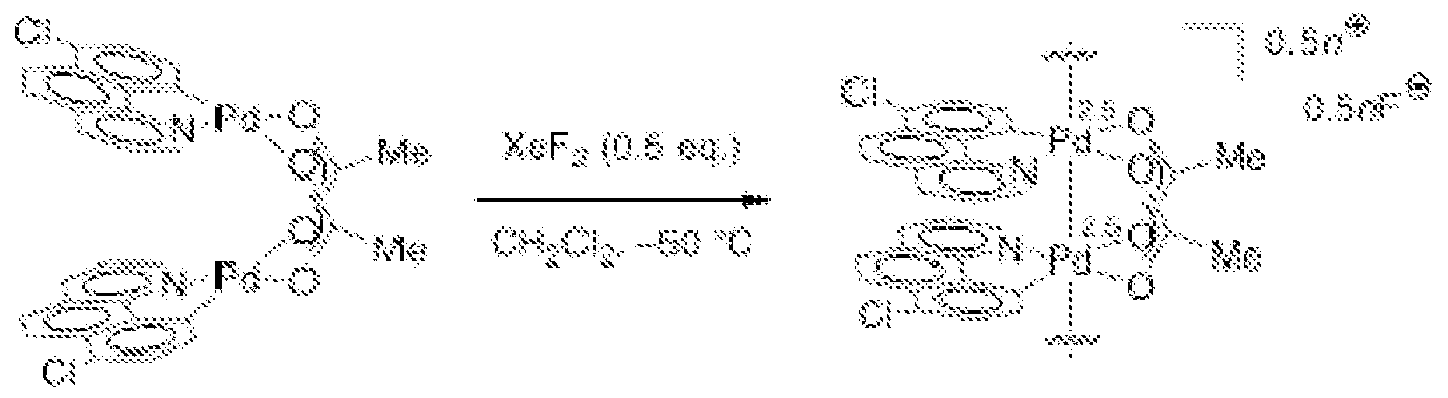
At -50 °C, 0.5 mL of a 10 mg/mL solution of 5 in CH2C12 was filtered through glass wool into a 2.0 mL plastic vial. Pentane (1.5 mL, pre-cooled to -50 °C) was carefully layered
on top of the solution. The vial was stored at -35 °C for 24 hours, at which point dark crystals were observed.
[(7-Cl-bhq)Pd2 5(OAc)]2(F) Wire
All manipulations were carried out in a dry box under a N2 atmosphere. 7- chlorobenzo[/z]quinolinyl palladium acetate dimer (8.0 mg, 1.1 x 10"5 mol, 1.0 equiv) was dissolved in 1.0 mL CH2Cl2 at -50 °C. XeF2 (0.9 mg, 5.5 x 10"6 mol, 0.50 equiv) was added as a solid in one portion. The yellow solution immediately became deep red. After stirring for five minutes at -50 °C, the solution was filtered through glass wool into a 2.0 mL plastic vial. Pentane (1.0 mL, pre-cooled to -50 °C) was carefully layered on top of the solution. The vial was stored at -35 °C for 24 hours, at which point red needle crystals of the title compound were observed. The structure, shown in Figure 158, was confirmed by X-ray crystallographic analysis.
[(bhq)Pd(OAc)]n(F)2/3„(PF6)1/3„Wire

All manipulations were carried out in a dry box under a N2 atmosphere. In glass tubes, a 10 mg/mL solution of Pd(III)F Wire at -50 °C was layered with a small amount of benzene, which was allowed to freeze into a solid wafer. On top of the frozen benzene was layered an 8 mg/mL solution of AgPF6 in Et20, pre-cooled to -50 °C (optimal results were obtained when the ratio of solutions of wire:AgPF6 was approximately 1:5). The vial was stored at -35 °C for three days, at which point dark blue needle crystals were observed. X-ray crystallographic analysis of these crystals revealed infinite Pd(III) chains with F and PF6 counteranions in a 2: 1 ratio. Crystals of the title compound were insoluble in fresh CDC13 or CD2C12. The structure is shown in Figure 159.
Extension of methodology to Platinum Wires
[Pt(phpy)Cl(OAc)]2

Based on a literature procedure (J. Am. Chem. Soc. 2010, 132, 10689-10691). The following manipulations were performed under a dry N2 atmosphere using standard Schlenk technique. In a flame-dried 25 mL round-bottom flask, PtCl2(dmso)2 (100. mg, 0.237 mmol, 1.00 equiv) was dissolved in dry, degassed acetic acid (5.00 mL). To the reaction mixture was added 2-phenylpyridine (33.8 μί, 0.237 mmol, 1.00 equiv) via syringe. The reaction mixture was heated to reflux for 12 hours, then cooled to room temperature and stirred for an additional 4 hours, at which point orange solids were observed. The supernatant was decanted, and the orange solids were sequentially washed with H20, MeOH, and Et20 (2 x 2 mL each). After drying under high vacuum the title compound was obtained (51.8 mg, 49 %) as a bright orange solid. X-ray quality crystals were obtained by slow evaporation of a MeOH/Et20 solution, or by layering a CH2C12 solution with pentane at room temperature. NMR Spectroscopy: 1H NMR (500 MHz, CD2C12 25 °C, δ): 7.85 (d, 2H), 7.54 (t, 2H), 7.23 (d, 2H), 7.03-6.86 (m, 8H), 6.73 (t, 2H), 2.64 (s, 6H).
Pt(III) Acetonate Tetramer

Under air, [Pt(phpy)Cl(OAc)]2 (7.2 mg, 1.0 equiv) and silver hexafluorophosphate (4.2 mg, 2.0 equiv) were taken up in acetone (0.70 mL). The reaction mixture was stirred for
2 hours, and then filtered through celite. In glass tubes, the reaction mixture was carefully layered with Et20 and allowed to stand overnight, at which point crystals were observed. X- ray crystallographic analysis shown in Figure 160 depicts the title compound (disordered acetone solvent molecules and counteranions omitted for clarity).
[Pt(phpy)(OAc)2]2

Under air, [Pt(phpy)Cl(OAc)]2 (25 mg, 0.028 mmol, 1.0 equiv) and silver acetate (9.4 mg, 0.056 mmol, 2.0 equiv) were combined in CH2C12 (3 mL). The reaction mixture was stirred for 12 hours, and then filtered over celite. The resulting solution was concentrated under vacuum. After drying under high vacuum the title compound was obtained (16 mg, 63%) as a bright orange solid.
NMR Spectroscopy: 1H NMR (500 MHz, CD2C12 25 °C, δ): 7.92 (d, 2H), 7.46 (t, 2H), 7.14 (d, 2H), 7.00-6.89 (m, 8H), 6.53 (t, 2H), 2.63 (s, 6H), 1.57 (s, 6 H).
Pt(III) Wire

Under air, [Pt(phpy)(OAc)2]2 (8.0 mg, 0.0086 mmol, 1.0 equiv) was suspended in dry MeCN (0.80 mL). HBF4 (2.5 μί, 0.017 mmol, 2.0 equiv, as a 50% w/v solution in Et20) was added via syringe. The suspended solids immediately solubilized. The reaction mixture was stirred for 2 hours and then concentrated under high vacuum. The resulting solids were taken up in CD3CN, and 1H NMR showed disappearance of the peak corresponding to the apical acetate ligand (1.57 ppm for the starting material, see above). The CD3CN solution was filtered over celite and then carefully layered with Et20 and left to stand for 24 hours, at which point crystals were observed.
Polymer-Functionalized Pt(III) Wire
[Pt(phpy)Cl(OAc)]2 (18 mg, 0.021 mmol, 1.0 equiv) was dissolved in dry CH2C12 (4.0 mL). AgPF6 (10 mg, 0.041 mmol, 2.0 equiv) was added, followed by polyethylene glycol dicarboxylic acid (600 MW, 3.1 μί, 0.0021 mmol, 0.10 equiv). The reaction mixture was stirred for several hours, and changed from pale orange to deep purple in color. A new near- IR absorbance at 980 nm, assigned to a metal-metal charge transfer in an extended Pt chain complex, was observed. The resulting purple solution is indefinitely stable under air at room temperature.
A possible mechanism of stabilization is anchoring of the polymer to the Pt chains via the terminal carboxylate groups, and insulation of the 1-D metal chains by polymer wrapping, illustrated in Figure 161.

Having thus described several aspects of at least one embodiment of this invention, it is to be appreciated that various alterations, modifications, and improvements will readily occur to those skilled in the art. Such alterations, modifications, and improvements are intended to be part of this disclosure and are intended to be within the scope of the invention. Accordingly, the foregoing description and drawings are by way of example only.
What is claimed is:
Claims
1. A one-dimensional palladium nanowire comprising a plurality of dipalladium complexes bonded to one another in a linear arrangement.
2. The nanowire of claim 1, wherein the plurality of dipalladium complexes comprises a plurality of palladium (ΙΠ) atoms.
3. The nanowire of claim 1, wherein the plurality of dipalladium complexes comprises a plurality of palladium (2.5) atoms.
4. The nanowire of claim 1, wherein the plurality of dipalladium complexes comprises at least three dipalladium complexes.
5. The nanowire of claim 1, wherein the plurality of dipalladium complexes is arranged in a linear chain comprising between three dipalladium complexes and one million dipalladium complexes.
6. A nanowire composition comprising the nanowire of claim 1 and a solvent.
7. The nanowire composition of claim 6, wherein the solvent is CH2C12.
8. The nanowire composition of claim 6, further comprising at least one fluoride
counteranion.
9. The nanowire composition of claim 8, wherein an amount of fluoride couteranions is one fluoride counteranion per two palladium atoms.
10. The nanowire of claim 1, wherein the average distance between two palladium atoms of a dipalladium complex is less than about 3 A.
11. The nanowire of claim 10, wherein the average distance between the two palladium atoms of a dipalladium complex is about 2.72 A.
12. The nanowire of claim 1, wherein the average distance between two palladium atoms of separate dipalladium complexes ranges from about 2.95 A to about 2.99 A.
13. The nanowire of claim 12, wherein the average distance between two palladium atoms of separate dipalladium complexes is about 2.97 A or about 2.98 A.
14. The nanowire of claim 1, wherein the one-dimensional palladium nanowire exhibits a conductivity consistent with a semiconductor.
15. The nanowire of claim 14, wherein the conductivity of the one-dimensional palladium nanowire ranges from about 0 nS to about 10 nS.
16. The nanowire of claim 1, wherein the one-dimensional palladium nanowire exhibits a conductivity consistent with a metallic conductor.
17. The nanowire of claim 16, wherein the conductivity of the one-dimensional palladium nanowire ranges from about 10 nS to about 90 nS.
18. The nanowire of claim 1, wherein the one-dimensional palladium nanowire has a chemical structure comprising repeating units of Formula (I) as represented below:

19. A method of using the one-dimensional palladium nanowire of claim 1, comprising: incorporating the palladium nanowire within an electrical device having a first electrode and a second electrode; and
conducting electrons through the palladium nanowire in a direction from the first electrode toward the second electrode.
20. The method of claim 19, further comprising absorbing light with the palladium nanowire to provide energy for the conducting electrons.
21. An electrode connected to the one-dimensional palladium nanowire of claim 1.
22. A solar cell incorporating the one-dimensional palladium nanowire of claim 1.
23. A method of preparing a nanowire, comprising:
providing a solution including a plurality of dipalladium complexes in a solvent;
oxidizing a plurality of palladium atoms within each of the dipalladium complexes with an oxidizing agent; and
forming a one-dimensional palladium nanowire from the plurality of dipalladium complexes.
24. The method of claim 23, wherein the solvent comprises a halogenated solvent such as CH2C12, CHC13, CCI4, CH3CI, CF4, CHF3, CH2F2, or CH3F.
25. The method of claim 23, wherein the oxidizing agent comprises XeF2.
26. The method of claim 25, wherein oxidizing a plurality of palladium atoms comprises treating the dipalladium complexes with one equivalent of XeF2.
27. The method of claim 25, wherein oxidizing a plurality of palladium atoms comprises treating the dipalladium complexes with 0.5 equivalents of XeF2.
28. The method of claim 23, wherein oxidizing a plurality of palladium atoms comprises maintaining a temperature ranging from about -75 °C to about -25 °C in the solvent.
29. The method of claim 28, wherein oxidizing a plurality of palladium atoms comprises maintaining a temperature ranging from about -40 °C to about -60 °C in the solvent.
30. The method of claim 23, wherein each of the plurality of palladium atoms comprises a palladium (Π) atom prior to the step of oxidizing.
31. The method of claim 23, wherein the step of oxidizing a plurality of palladium atoms comprises forming a plurality of palladium (ΠΙ) atoms.
32. The method of claim 23, wherein the step of oxidizing a plurality of palladium atoms comprises forming a plurality of palladium (2.5) atoms.
33. The method of claim 23, wherein the step of forming a one-dimensional palladium nanowire comprises forming a nanowire having a conductivity consistent with a semiconductor.
34. The method of claim 23, wherein the step of forming a one-dimensional palladium nanowire comprises forming a nanowire having a conductivity consistent with a metallic conductor.
35. The method of claim 23, wherein forming the one-dimensional palladium nanowire comprises forming a as represented below:

Applications Claiming Priority (2)
| Application Number | Priority Date | Filing Date | Title |
|---|---|---|---|
| US201161440739P | 2011-02-08 | 2011-02-08 | |
| US61/440,739 | 2011-02-08 |
Publications (2)
| Publication Number | Publication Date |
|---|---|
| WO2012109389A2 true WO2012109389A2 (en) | 2012-08-16 |
| WO2012109389A3 WO2012109389A3 (en) | 2012-11-08 |
Family
ID=46639197
Family Applications (1)
| Application Number | Title | Priority Date | Filing Date |
|---|---|---|---|
| PCT/US2012/024378 Ceased WO2012109389A2 (en) | 2011-02-08 | 2012-02-08 | Palladium nanowires and methods of preparation |
Country Status (1)
| Country | Link |
|---|---|
| WO (1) | WO2012109389A2 (en) |
Cited By (2)
| Publication number | Priority date | Publication date | Assignee | Title |
|---|---|---|---|---|
| US9117652B2 (en) | 2013-06-18 | 2015-08-25 | International Business Machines Corporation | Nanoporous structures by reactive ion etching |
| KR20220121283A (en) * | 2021-02-24 | 2022-09-01 | 엘티소재주식회사 | Heterocyclic compound, organic light emitting device comprising same, manufacturing method of same and composition for organic layer of organic light emitting device |
Family Cites Families (2)
| Publication number | Priority date | Publication date | Assignee | Title |
|---|---|---|---|---|
| US6843902B1 (en) * | 2001-07-20 | 2005-01-18 | The Regents Of The University Of California | Methods for fabricating metal nanowires |
| KR20090117881A (en) * | 2007-01-30 | 2009-11-13 | 솔라스타, 인코포레이티드 | How to manufacture photovoltaic cells and photovoltaic cells |
-
2012
- 2012-02-08 WO PCT/US2012/024378 patent/WO2012109389A2/en not_active Ceased
Cited By (4)
| Publication number | Priority date | Publication date | Assignee | Title |
|---|---|---|---|---|
| US9117652B2 (en) | 2013-06-18 | 2015-08-25 | International Business Machines Corporation | Nanoporous structures by reactive ion etching |
| US9977002B2 (en) | 2013-06-18 | 2018-05-22 | Globalfoundries Inc. | Nanoporous structures by reactive ion etching |
| KR20220121283A (en) * | 2021-02-24 | 2022-09-01 | 엘티소재주식회사 | Heterocyclic compound, organic light emitting device comprising same, manufacturing method of same and composition for organic layer of organic light emitting device |
| KR102726601B1 (en) * | 2021-02-24 | 2024-11-08 | 엘티소재주식회사 | Heterocyclic compound, organic light emitting device comprising same, manufacturing method of same and composition for organic layer of organic light emitting device |
Also Published As
| Publication number | Publication date |
|---|---|
| WO2012109389A3 (en) | 2012-11-08 |
Similar Documents
| Publication | Publication Date | Title |
|---|---|---|
| Leung et al. | Self-assembly of alkynylplatinum (II) terpyridine amphiphiles into nanostructures via steric control and metal–metal interactions | |
| Prokopchuk et al. | Catalytic N2 reduction to silylamines and thermodynamics of N2 binding at square planar Fe | |
| Kira | An isolable dialkylsilylene and its derivatives. A step toward comprehension of heavy unsaturated bonds | |
| Sekiya et al. | Anion-directed formation and degradation of an interlocked metallohelicate | |
| Kayahara et al. | Selective synthesis and crystal structure of [10] cycloparaphenylene | |
| Sahara et al. | Duality of Reactivity of a Biradicaloid Compound with an o-Quinodimethane Scaffold | |
| Machan et al. | One-pot synthesis of an Fe (II) bis-terpyridine complex with allosterically regulated electronic properties | |
| Dey et al. | Syn–anti conformational switching in an ethane-bridged Co (ii) bisporphyrin induced by external stimuli: effects of inter-macrocyclic interactions, axial ligation and chemical and electrochemical oxidations | |
| Kokatam et al. | Molecular and electronic structure of square-planar gold complexes containing two 1, 2-di (4-tert-butylphenyl) ethylene-1, 2-dithiolato ligands:[Au (2L) 2] 1+/0/1-/2-. A combined experimental and computational study | |
| Hickey et al. | A bidentate carbene ligand stabilizes a low-coordinate iron (0) carbonyl complex | |
| Kawano et al. | Structure analysis of a transient triplet carbene trapped in a crystal | |
| Márquez et al. | Copper (I) Complexes of Zwitterionic Imidazolium-2-Amidinates, a Promising Class of Electroneutral, Amidinate-Type Ligands | |
| Ershova et al. | Tetrahedral nickel (II) and cobalt (II) bis-o-iminobenzosemiquinonates | |
| Watanabe et al. | Coordination‐Driven Dimerization of Zinc Chlorophyll Derivatives Possessing a Dialkylamino Group | |
| Yu et al. | Facile access to uranium and thorium phosphaethynolate complexes supported by tren: experimental and theoretical study | |
| Gallagher et al. | Low-valent ruthenium complexes of the non-innocent 2, 6-bis (imino) pyridine ligand | |
| Kohn et al. | Synthesis of polyynes using dicobalt masking groups | |
| Huang et al. | One-dimensional chains of paddlewheel-type dichromium (II, II) tetraacetate complexes: study of electronic structure influenced by σ-and π-donation of axial linkers | |
| Matsuo et al. | Selective and High‐Yield Synthesis of Oblate Superatom [PdAu8 (PPh3) 8] 2+ | |
| Ohki et al. | Cubane‐Type [Mo3S4M] Clusters with First‐Row Groups 4–10 Transition‐Metal Halides Supported by C5Me5 Ligands on Molybdenum | |
| Filatre-Furcate et al. | Single-component conductors: A sturdy electronic structure generated by bulky substituents | |
| Burcher et al. | Straightforward access to stable, 16-valence-electron phosphine-stabilized Fe0 Olefin complexes and their reactivity | |
| Rey Planells et al. | Ring strain energies of three-membered homoatomic inorganic rings El3 and diheterotetreliranes El2Tt (Tt= C, Si, Ge): Accurate versus additive approaches | |
| Quiroz et al. | Cooperative redox and spin activity from three redox congeners of sulfur-bridged iron nitrosyl and nickel dithiolene complexes | |
| Konarev et al. | Anionic coordination complexes of C 60 and C 70 with cyclopentadienyl and pentamethylcyclopentadienyl molybdenum dicarbonyl |
Legal Events
| Date | Code | Title | Description |
|---|---|---|---|
| 121 | Ep: the epo has been informed by wipo that ep was designated in this application |
Ref document number: 12744233 Country of ref document: EP Kind code of ref document: A2 |
|
| NENP | Non-entry into the national phase |
Ref country code: DE |
|
| 122 | Ep: pct application non-entry in european phase |
Ref document number: 12744233 Country of ref document: EP Kind code of ref document: A2 |