WO2012108297A1 - Ras部分ポリペプチド含有水溶液及びRas機能阻害剤のスクリーニング方法 - Google Patents
Ras部分ポリペプチド含有水溶液及びRas機能阻害剤のスクリーニング方法 Download PDFInfo
- Publication number
- WO2012108297A1 WO2012108297A1 PCT/JP2012/052078 JP2012052078W WO2012108297A1 WO 2012108297 A1 WO2012108297 A1 WO 2012108297A1 JP 2012052078 W JP2012052078 W JP 2012052078W WO 2012108297 A1 WO2012108297 A1 WO 2012108297A1
- Authority
- WO
- WIPO (PCT)
- Prior art keywords
- ras
- amino acid
- polypeptide
- acid sequence
- substance
- Prior art date
- Legal status (The legal status is an assumption and is not a legal conclusion. Google has not performed a legal analysis and makes no representation as to the accuracy of the status listed.)
- Ceased
Links
Images


Classifications
-
- C—CHEMISTRY; METALLURGY
- C07—ORGANIC CHEMISTRY
- C07K—PEPTIDES
- C07K14/00—Peptides having more than 20 amino acids; Gastrins; Somatostatins; Melanotropins; Derivatives thereof
- C07K14/435—Peptides having more than 20 amino acids; Gastrins; Somatostatins; Melanotropins; Derivatives thereof from animals; from humans
- C07K14/46—Peptides having more than 20 amino acids; Gastrins; Somatostatins; Melanotropins; Derivatives thereof from animals; from humans from vertebrates
- C07K14/47—Peptides having more than 20 amino acids; Gastrins; Somatostatins; Melanotropins; Derivatives thereof from animals; from humans from vertebrates from mammals
- C07K14/4701—Peptides having more than 20 amino acids; Gastrins; Somatostatins; Melanotropins; Derivatives thereof from animals; from humans from vertebrates from mammals not used
- C07K14/4722—G-proteins
-
- A—HUMAN NECESSITIES
- A61—MEDICAL OR VETERINARY SCIENCE; HYGIENE
- A61P—SPECIFIC THERAPEUTIC ACTIVITY OF CHEMICAL COMPOUNDS OR MEDICINAL PREPARATIONS
- A61P35/00—Antineoplastic agents
-
- A—HUMAN NECESSITIES
- A61—MEDICAL OR VETERINARY SCIENCE; HYGIENE
- A61P—SPECIFIC THERAPEUTIC ACTIVITY OF CHEMICAL COMPOUNDS OR MEDICINAL PREPARATIONS
- A61P43/00—Drugs for specific purposes, not provided for in groups A61P1/00-A61P41/00
-
- C—CHEMISTRY; METALLURGY
- C07—ORGANIC CHEMISTRY
- C07C—ACYCLIC OR CARBOCYCLIC COMPOUNDS
- C07C337/00—Derivatives of thiocarbonic acids containing functional groups covered by groups C07C333/00 or C07C335/00 in which at least one nitrogen atom of these functional groups is further bound to another nitrogen atom not being part of a nitro or nitroso group
- C07C337/02—Compounds containing any of the groups, e.g. thiocarbazates
-
- C—CHEMISTRY; METALLURGY
- C07—ORGANIC CHEMISTRY
- C07K—PEPTIDES
- C07K14/00—Peptides having more than 20 amino acids; Gastrins; Somatostatins; Melanotropins; Derivatives thereof
- C07K14/82—Translation products from oncogenes
-
- G—PHYSICS
- G01—MEASURING; TESTING
- G01N—INVESTIGATING OR ANALYSING MATERIALS BY DETERMINING THEIR CHEMICAL OR PHYSICAL PROPERTIES
- G01N33/00—Investigating or analysing materials by specific methods not covered by groups G01N1/00 - G01N31/00
- G01N33/48—Biological material, e.g. blood, urine; Haemocytometers
- G01N33/50—Chemical analysis of biological material, e.g. blood, urine; Testing involving biospecific ligand binding methods; Immunological testing
- G01N33/53—Immunoassay; Biospecific binding assay; Materials therefor
- G01N33/573—Immunoassay; Biospecific binding assay; Materials therefor for enzymes or isoenzymes
-
- G—PHYSICS
- G01—MEASURING; TESTING
- G01N—INVESTIGATING OR ANALYSING MATERIALS BY DETERMINING THEIR CHEMICAL OR PHYSICAL PROPERTIES
- G01N33/00—Investigating or analysing materials by specific methods not covered by groups G01N1/00 - G01N31/00
- G01N33/48—Biological material, e.g. blood, urine; Haemocytometers
- G01N33/50—Chemical analysis of biological material, e.g. blood, urine; Testing involving biospecific ligand binding methods; Immunological testing
- G01N33/68—Chemical analysis of biological material, e.g. blood, urine; Testing involving biospecific ligand binding methods; Immunological testing involving proteins, peptides or amino acids
- G01N33/6893—Chemical analysis of biological material, e.g. blood, urine; Testing involving biospecific ligand binding methods; Immunological testing involving proteins, peptides or amino acids related to diseases not provided for elsewhere
-
- G—PHYSICS
- G01—MEASURING; TESTING
- G01R—MEASURING ELECTRIC VARIABLES; MEASURING MAGNETIC VARIABLES
- G01R33/00—Arrangements or instruments for measuring magnetic variables
- G01R33/20—Arrangements or instruments for measuring magnetic variables involving magnetic resonance
- G01R33/44—Arrangements or instruments for measuring magnetic variables involving magnetic resonance using nuclear magnetic resonance [NMR]
- G01R33/46—NMR spectroscopy
- G01R33/465—NMR spectroscopy applied to biological material, e.g. in vitro testing
-
- C—CHEMISTRY; METALLURGY
- C07—ORGANIC CHEMISTRY
- C07K—PEPTIDES
- C07K2299/00—Coordinates from 3D structures of peptides, e.g. proteins or enzymes
-
- G—PHYSICS
- G01—MEASURING; TESTING
- G01N—INVESTIGATING OR ANALYSING MATERIALS BY DETERMINING THEIR CHEMICAL OR PHYSICAL PROPERTIES
- G01N2333/00—Assays involving biological materials from specific organisms or of a specific nature
- G01N2333/82—Translation products from oncogenes
-
- G—PHYSICS
- G01—MEASURING; TESTING
- G01N—INVESTIGATING OR ANALYSING MATERIALS BY DETERMINING THEIR CHEMICAL OR PHYSICAL PROPERTIES
- G01N24/00—Investigating or analyzing materials by the use of nuclear magnetic resonance, electron paramagnetic resonance or other spin effects
- G01N24/08—Investigating or analyzing materials by the use of nuclear magnetic resonance, electron paramagnetic resonance or other spin effects by using nuclear magnetic resonance
-
- G—PHYSICS
- G01—MEASURING; TESTING
- G01N—INVESTIGATING OR ANALYSING MATERIALS BY DETERMINING THEIR CHEMICAL OR PHYSICAL PROPERTIES
- G01N2500/00—Screening for compounds of potential therapeutic value
- G01N2500/04—Screening involving studying the effect of compounds C directly on molecule A (e.g. C are potential ligands for a receptor A, or potential substrates for an enzyme A)
Definitions
- the present invention relates to a screening method for selecting more effective Ras function inhibitory substances, characterized by using nuclear magnetic resonance (NMR) information. More specifically, the present invention relates to a method for screening a substance that inhibits Ras function using the three-dimensional structure information by NMR of a Ras polypeptide having a three-dimensional structure having a pocket on the molecular surface in Ras.
- NMR nuclear magnetic resonance
- Ras a ras oncogene product
- Ras is a low molecular weight G protein.
- H-Ras In mammals, there are three Ras isoforms: H-Ras, N-Ras, and K-Ras.
- homologues such as M-Ras and Rap having similar amino acid sequences exist in Ras, and the Ras family is formed including these.
- Ras In human cancer, Ras is a good molecular target for the development of anticancer drugs, because constant activation of Ras function by mutation of any of H-Ras, N-Ras, and K-Ras is frequently observed. It is thought that there is.
- Ras controls signal transduction while going back and forth between an active GTP-bound Ras (Ras-GTP) and an inactive GDP-bound Ras (Ras-GDP).
- a ligand extracellular signal
- Ras-GTP binds to a receptor on the cell membrane
- GDP in Ras-GDP is converted to GTP and activated, and Ras-GTP binds to the target molecule.
- Ras-GTP returns to Ras-GDP by the action of a factor (GTPase-activating protein: GAP) that promotes GTP hydrolysis (GTPase) activity inherent in Ras, and is inactivated until the next signal is received.
- GAP GTPase-activating protein
- Ras mutation active mutation reduces the intrinsic GTP hydrolyzing ability of Ras and is no longer subject to GTP hydrolysis promoting action by GAP. It is estimated that cancer increases because the cell occupying ratio continues to transmit a signal of cell proliferation continuously.
- Ras-GTP a GTP-linked type
- state 1 and state 2 Two types of interconvertible three-dimensional structures
- state 2 is a true active form that can bind to the target protein and perform signal transduction
- state 1 is an inactive form that cannot bind to the target protein.
- the three-dimensional structure of state 2 has been elucidated by X-ray crystal structure analysis and NMR analysis.
- Non-patent Document 1 Although the elucidation of the three-dimensional structure of state 1 of H-Ras-GTP has been attempted, it has not yet been fully elucidated. X-ray crystal structure analysis has been performed on H-Ras T35S (1-189 amino acid residues) which is a mutant H-Ras (Non-patent Document 1). However, the three-dimensional structure of state 1 disclosed in Non-Patent Document 1 lacks the electron density of the main chain of a plurality of amino acid residues and cannot be said to be a complete three-dimensional structure. Such a defective site is a site contained in two switch regions (switch I, II) that are important for Ras to recognize and activate the target protein.
- switch I, II switch regions
- Non-patent Document 2 X-ray crystal structure analysis of state-type 1 of wild-type M-Ras-GTP has been conducted (PDB ID: 1X1S) (Non-patent Document 2).
- PDB ID: 1X1S X-ray crystal structure analysis of state-type 1 of wild-type M-Ras-GTP.
- Non-Patent Document 3 As a result of the X-ray crystal structure analysis of the mutant H-Ras H-Ras T35S (1-166 amino acid residue) under conditions different from Non-Patent Document 1 (Non-Patent Document 3), two types of The three-dimensional structure of state 1 (form 1, 2) has been determined. Form 2 lacked the electron density of the main chain of multiple amino acid residues of switch ⁇ ⁇ II and could not be said to be a complete three-dimensional structure, but for form 1, a complete state 1 structure with a clear electron density of the whole peptide Met. However, the specific amino acid residue information relating to the drug binding region was still unclear for form 1.
- Ras function inhibitors are promising anticancer drugs, amino acid residues related to the drug binding region on the state 1 structure of Ras-GTP, which can be used in computer docking simulations to develop Ras function inhibitors Information is eager. In addition, there is an eager desire for three-dimensional structure information for constructing the most suitable lead compound based on a seed compound having a Ras function inhibitory action.
- An object of the present invention is to provide a method for screening for a substance that inhibits Ras function. Another object of the present invention is to provide an amino acid residue at a site important for interaction with a Ras function-inhibiting substance.
- the inventors of the present invention have made extensive studies to solve the above-mentioned problems, and have provided three-dimensional structure information by NMR of Ras polypeptide and three-dimensional structure by NMR of a complex of a seed compound and Ras polypeptide effective as a Ras function inhibitor.
- a site important for the interaction between the Ras polypeptide and the Ras function inhibitor was confirmed, and the present invention was completed.
- the inventors have found that compounds can be selected, and have completed the present invention relating to a method for screening for a Ras function inhibitor.
- a screening method for a substance that inhibits Ras function comprising the following steps: 1) A step of obtaining an NMR signal of a Ras partial polypeptide consisting of the amino acid sequence shown in SEQ ID NO: 1 or an amino acid sequence in which 1 to 3 amino acids are substituted, deleted or added from the amino acid sequence shown in SEQ ID NO: 1; 2) A step of bringing the Ras function inhibition candidate substance (a) into contact with the Ras partial polypeptide described in 1) above and obtaining an NMR signal of the resulting complex; 3) Analyzing the difference between the NMR signal obtained in the above step 1) and the NMR signal obtained in the step 2), the Ras function inhibiting substance (A) which is a derivative of the Ras function inhibiting candidate substance (a) ).
- the amino acid sequence shown in SEQ ID NO: 1 As a reference, the fifth lysine (K), the 37th glutamic acid (E), the 38th aspartic acid (D), the 39th serine (S), the 56th leucine (L ), 63rd glutamic acid (E), 64th tyrosine (Y), 66th alanine (A), 67th methionine (M), 70th glutamine (Q), 71st A substance capable of interacting with at least three amino acid residues selected from tyrosine (Y), 73rd arginine (R), and 74th threonine (T).
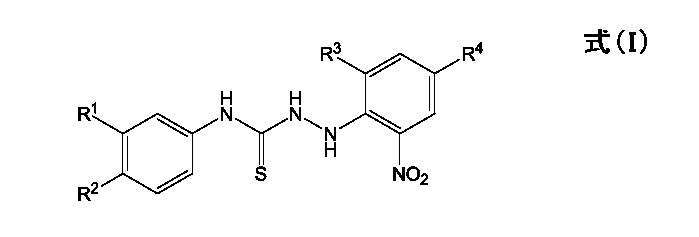
- a Ras function inhibitor comprising, as an active ingredient, a Ras function inhibition candidate substance (a) represented by the following general formula (I):
- R 1 , R 2 , R 3 and R 4 are independently selected from the group consisting of a hydrogen atom, a halogen group, a lower alkyl group, a nitro group, or a trifluoromethyl group.
- R 1 , R 2 , R 3 and R 4 are independently selected from the group consisting of a hydrogen atom, a halogen group, a lower alkyl group, a nitro group, or a trifluoromethyl group.
- a Ras partial polypeptide consisting of the amino acid sequence shown in SEQ ID NO: 1, or an amino acid sequence in which 1 to 3 amino acids are substituted, deleted or added from the amino acid sequence shown in SEQ ID NO: 1, and the following general formula (I): The complex with the Ras function inhibition candidate substance (a) represented.
- R 1 , R 2 , R 3 and R 4 are independently selected from the group consisting of a hydrogen atom, a halogen group, a lower alkyl group, a nitro group, or a trifluoromethyl group.
- the Ras partial polypeptide is a polypeptide consisting of an amino acid sequence in which the 35th threonine is substituted with serine in the amino acid sequence shown in SEQ ID NO: 1.
- the complex according to item 7 or 8 specified by an NMR signal. 10.
- aqueous solution comprising a Ras partial polypeptide consisting of the amino acid sequence shown in SEQ ID NO: 1 or an amino acid sequence in which 1 to 3 amino acids are substituted, deleted or added from the amino acid sequence shown in SEQ ID NO: 1, Ras partial polypeptide-containing aqueous solution characterized in that the three-dimensional structure of the Ras partial polypeptide is the following 1) and 2): 1) The three-dimensional structure of the Ras partial polypeptide consists of a three-dimensional structure having a pocket capable of binding to a specific substance; 2) When the specific substance is based on the amino acid sequence shown in SEQ ID NO: 1 in the Ras partial polypeptide, the fifth lysine (K), the 37th glutamic acid (E), the 38th Aspartic acid (D), 39th serine (S), 56th leucine (L), 63rd glutamic acid (E), 64th tyrosine (Y), 66th alanine (A ), 67th methionine (M), 70th glutamine (Q),
- a substance capable of interacting with at least three or more amino acid residues 11.
- 12 12.
- the Ras polypeptide could provide an amino acid residue at a site important for interaction with a Ras function inhibitor. Furthermore, by confirming the difference between the three-dimensional structure information by NMR of the Ras polypeptide and the three-dimensional structure information by NMR of the complex of the Ras polypeptide and the seed compound, it is possible to determine substituents and metabolic factors with high possibility of toxic expression.
- a novel derivative can be designed and synthesized by substituting a chemically unstable chemical structure with a biological equivalent, and lead compounds that are more effective than the seed compound can be selected. By such a screening method, a lead compound having a more effective substituent can be constructed as a Ras function inhibitor based on a specific seed compound.
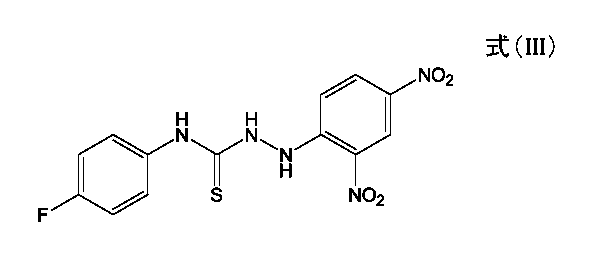
- FIG. 3 is a view showing amino acid residues that can interact with compound (III) in a Ras partial polypeptide.
- the present invention relates to a screening method for selecting a more effective Ras function inhibitor from a seed compound, characterized by using NMR information. More specifically, the present invention relates to a method for screening a substance that inhibits Ras function using the three-dimensional structure information by NMR of a Ras polypeptide having a three-dimensional structure having a pocket on the molecular surface in Ras.
- the “candidate substance” may be either known or novel, and there is no particular limitation on the structure, origin, physical properties, etc., and natural compounds, synthetic compounds, polymer compounds, low molecular compounds, peptides, Any of the nucleic acid analogs may be used.
- a known program may be used to coordinate the three-dimensional structure of the candidate substance.
- CORINA http://www2.chemie.uni-er GmbH.de/software /corina/index.html
- Concord http://www.tripos.com/sciTech/inSilicoDisc/chemInfo/concord.html
- Converter http://www.tripos.com/sciTech/inSilicoDisc/chemInfo/concord.html
- Converter or COFIMA (http://www.bpc.uni-frankfurt.de/ guentert / wiki / index.php / Software) etc.
- COFIMA http://www.bpc.uni-frankfurt.de/ guentert / wiki / index.php / Software
- CYANA http://www.las.jp/products/s08_cyana/index.html
- CNS http://cns.csb.yale.edu/v1.1/
- Ras function inhibition candidate substance (a) refers to a substance having Ras function inhibition action selected from the above candidate substances by primary screening, that is, a seed compound having Ras function inhibition action.
- Ras function inhibitory substance (A) a derivative selected based on the information of the Ras function inhibition candidate substance (a), that is, a lead optimized from the Ras function inhibition candidate substance (a). Means a compound.
- Ras function inhibitor (A) screening method One embodiment of the screening method for the Ras function inhibitor (A) of the present invention includes a screening method including the following steps. 1) obtaining an NMR signal of the Ras partial polypeptide; 2) A step of bringing the Ras function inhibition candidate substance (a) into contact with the Ras partial polypeptide described in 1) above and obtaining an NMR signal of the resulting complex; 3) A step of analyzing the difference between the NMR signal obtained in the step 1) and the NMR signal obtained in the step 2) and selecting a derivative of the Ras function inhibition candidate substance (a).
- the Ras partial polypeptide of the present invention is preferably a mutant Ras partial polypeptide in which a mutation that forms a three-dimensional structure having a pocket on the molecular surface is introduced into the partial polypeptide of the Ras protein.
- a mutation that forms a three-dimensional structure having a pocket on the molecular surface is introduced into the partial polypeptide of the Ras protein.
- it is necessary to be a Ras partial polypeptide to which GTP or a GTP analog is bound that is, a GTP-linked Ras partial polypeptide.
- GTP analogs have a GTP-like skeletal structure, include those that have been chemically modified and those that have formed salts, and can bind to the GTP binding site.
- the crystal, X-ray crystal structure analysis result and NMR signal obtained for the Ras partial polypeptide are all GTP-linked Ras partial polypeptide (hereinafter also referred to as “Ras-GTP”), or Ras. It means that it is obtained from a complex of a function inhibiting candidate substance (a) and Ras-GTP.
- the pocket on the molecular surface of Ras is not present on the molecular surface of the GDP-binding Ras partial polypeptide (hereinafter also referred to as “Ras-GDP”) and is known to exist in Ras-GTP. Yes.
- the pocket is surrounded by a region called a switch region (including a switch I region and a switch II region) in the amino acid sequence of Ras.
- the switch region is defined as two regions whose conformation changes greatly between the GDP-bound Ras partial polypeptide and the GTP-bound Ras partial polypeptide, and is an important region for Ras to recognize and activate the target molecule. GTP binds to this neighborhood.
- the Ras partial polypeptide of the present invention constituting Ras-GTP is specifically a polypeptide consisting of the following amino acid sequence of SEQ ID NO: 1 (positions 1 to 166 of H-Ras), or SEQ ID NO: 1.
- a mutant H-Ras partial polypeptide consisting of an amino acid sequence in which 1 to 3 amino acids are substituted, deleted or added from the amino acid sequence.
- H-Ras (1-166 amino acid residues): MTEYKLVVVGAGGVGKSALTIQLIQNHFVDEYDPTIEDSYRKQVVIDGETCLLDILDTAGQEEYSAMRDQYMRTGEGFLCVFAINNTKSFEDIHQYREQIKRVKDSDDVPMVLVGNKCDLAARTVESRQAQDLARSYGIPYIETSAKTRQRVEDAFYTLVREIH
- the Ras partial polypeptide consisting of an amino acid sequence in which 1 to 3 amino acids are substituted, deleted or added from the amino acid sequence shown in SEQ ID NO: 1 refers to the 27th to 43rd amino acids in the amino acid sequence shown in SEQ ID NO: 1.
- the mutation is a substitution of the 31st and / or 35th amino acid, particularly preferably a substitution of the 35th threonine.
- the 35th threonine is preferably substituted with serine.
- H-Ras T35S mutant H-Ras polypeptide in which the 35th threonine is substituted with serine.
- the Ras partial polypeptide of the present invention is used in the meaning including H-RasRaT35S.
- Amino acid mutations in a polypeptide can be introduced by site-directed mutagenesis methods well known to those skilled in the art, or may be introduced using a kit (eg QuikChange TM Site-Directed Mutagenesis Kit (STRATAGENE)). Such).
- DNA fragments encoding amino acid mutations can be introduced and replaced using genetic engineering techniques well known to those skilled in the art.
- a mutant Ras polypeptide can be prepared by combining PCR reaction, restriction enzyme reaction, ligation reaction and the like.
- DNA corresponding to 1-166 amino acid residues by normal PCR using H-Ras T35S (pBR322H-Ras T35S (1-189 amino acid residues)) subcloned into vector pBR322 as a template
- the fragment can be amplified and cloned into pGEX-6p-1 to create H-Ras T35S.
- the Ras function inhibition candidate substance (a) used in the screening method for the Ras function inhibitory substance (A) of the present invention can be selected from the candidate substances by the following method.
- the amino acid sequence shown in SEQ ID NO: 1 when the amino acid sequence shown in SEQ ID NO: 1 is used as a reference, among the amino acid sequence shown in SEQ ID NO: 1, the fifth lysine (K) and the 37th glutamic acid (E ), 38th aspartic acid (D), 39th serine (S), 56th leucine (L), 63rd glutamic acid (E), 64th tyrosine (Y), 66th Th alanine (A), 67 th methionine (M), 70 th glutamine (Q), 71 st tyrosine (Y), 73 th arginine (R), and 74 th threonine ( By selecting a substance capable of interacting with at least three or more amino acid residues selected from any of T) from candidate substances.
- the present invention also extends to a method for screening the candidate substance for inhibiting Ras function (a) by selecting a substance capable of interacting with the specific amino acid residue described above.
- interaction means that force acts between Ras protein and a specific substance, for example, Ras function inhibition candidate substance (a).
- the interaction includes hydrophilic interaction (eg, hydrogen bond, salt bridge), hydrophobic interaction (eg, hydrophobic bond), electrostatic interaction, van der Waals interaction, etc., preferably hydrogen bond It is done.
- the Ras function inhibition candidate substance (a) can be screened by a method including the following steps. 1) The 5th lysine (K), the 37th glutamic acid (E), the 38th aspartic acid (when the amino acid sequence shown in SEQ ID NO: 1 is used as a reference in the Ras partial polypeptide of the present invention.
- the Ras function inhibition candidate substance (a) is based on the amino acid sequence shown in SEQ ID NO: 1, and on the basis of the amino acid sequence shown in SEQ ID NO: 1, the fifth lysine (K), 37th glutamic acid (E), 38th aspartic acid (D), 39th serine (S), 56th leucine (L), 63rd glutamic acid (E), 64th Tyrosine (Y), 66th alanine (A), 67th methionine (M), 70th glutamine (Q), 71st tyrosine (Y), 73rd arginine (R), And screening by screening for substances that can interact with at least 3 or more, preferably 4 or more, and most preferably 6 amino acid residues selected from the 74th threonine (T).
- the screening is performed by selecting a substance capable of interacting with at least 3 or more, preferably 4 or more, and most preferably 6 amino acid residues selected.
- the amino acid residues constituting the pocket present on the molecular surface of the Ras partial polypeptide are at least the fifth lysine and the 56th position when the amino acid sequence shown in SEQ ID NO: 1 is used as a reference.
- the Ras function inhibition candidate substance (a) exerts a Ras function inhibition action by interacting with an amino acid residue present in a pocket site present on the molecular surface of the Ras partial polypeptide.
- the Ras function inhibition candidate substance (a) used in the screening method for the Ras function inhibitory substance (A) of the present invention is not limited to the above method, but by a method known per se or any method developed in the future. Can be sorted.
- An example of a method for selecting a candidate substance for inhibiting Ras function (a) is a method using X-ray crystal structure analysis of a Ras partial polypeptide. Specifically, three-dimensional structure information including a pocket of Ras partial polypeptide is obtained by X-ray crystal structure analysis, and a candidate substance for Ras function inhibition (a) is designed or selected based on the three-dimensional structure information. Can do. In order to analyze the X-ray crystal structure of the Ras partial polypeptide, it is necessary to obtain a cocrystal of the Ras partial polypeptide and GTP or a GTP analog, that is, a Ras-GTP cocrystal as described above.
- a Ras function inhibition candidate substance (a) that binds to the pocket of the Ras partial polypeptide can be designed or selected.
- the Ras function inhibition candidate substance (a) may be brought into contact with the Ras or Ras partial polypeptide.
- the Ras partial polypeptide for co-crystallization of Ras-GTP is not limited as long as it is included in the Ras family.
- Three Ras isoforms, H-Ras, N-Ras, and K-Ras, and M- It may be a homologue such as Ras or Rap.
- the Ras protein is not particularly limited as long as it is derived from a mammal, and examples thereof include those derived from humans, cows and pigs.
- Ras includes H-Ras and M-Ras.
- the most suitable Ras partial polypeptide for obtaining the three-dimensional structure information including the Ras pocket includes a mutant Ras polypeptide, that is, H-Ras T35S.
- GTP analogs include guanosine 5 '-( ⁇ -thio) -triphosphate (GTP ⁇ S) and (guanosine 5'-[ ⁇ , ⁇ -imido] triphosphate (Gpp (NH) p), but Gpp ( NH) p is preferable, and Gpp (NH) p can be purchased from CALBIOCHEM, for example.
- the co-crystal of the present invention can be produced by the following method.
- a Ras-GTP solution is prepared.
- the Ras partial polypeptide of Ras-GTP is preferably a mutant H-Ras polypeptide, that is, H-Ras T35S.
- Ras-GTP is present in a solution consisting of buffer, salt, reducing agent and the like.
- the buffer, salt, and reducing agent may be any as long as they do not affect the three-dimensional structure of the Ras polypeptide.
- the buffer is 1 to 500 ⁇ mM Na-HEPES, phosphoric acid.
- the Ras partial polypeptide solution may contain dimethyl sulfoxide (DMSO).
- the solution containing the Ras partial polypeptide has a pH of 4 to 11, preferably a pH of 6 to 9.
- Such a polypeptide solution may be used for crystallization as it is, or may be further used for crystallization by adding a preservative, a stabilizer, a surfactant or the like as necessary.
- a general protein crystallization method such as a vapor diffusion method, a batch method, or a dialysis method can be used.
- a general protein crystallization method such as a vapor diffusion method, a batch method, or a dialysis method.
- it is important to determine physical and chemical factors such as protein concentration, salt concentration, pH, type of precipitant, and temperature.
- the vapor diffusion method is a method in which a droplet of a protein solution containing a precipitating agent is placed in a container containing a buffer solution (external solution) containing a higher concentration precipitating agent, and is allowed to stand after sealing.
- a buffer solution external solution
- the hanging drop method is a method in which a small droplet of a protein solution is placed on a cover glass, and the cover glass is inverted and sealed in a reservoir.
- the sitting drop method is a method in which a suitable droplet stage is placed inside the reservoir, a small drop of the protein solution is placed on the droplet stage, and the reservoir is sealed with a cover glass or the like.
- the solution in the reservoir contains a precipitant. If appropriate, a small amount of a precipitating agent may be contained in the protein droplet.
- the reservoir solution used in the vapor diffusion method is a solution composed of a buffer solution, a precipitant, a salt, and the like. Any buffer, precipitating agent, and salt may be used as long as they can efficiently produce crystals.
- the buffer is pH 4-9, 1-500 MmM Na-HEPES, phosphoric acid.
- Precipitating agents such as sodium, potassium phosphate, Tris-HCl, sodium acetate, citric acid, etc.
- Precipitating agents have a molecular weight of 400-10000, 1-50% by volume polyethylene glycol (PEG), 0.2-3M ammonium sulfate, 1-20 volumes
- PEG polyethylene glycol
- Examples of the salt include 0.05% to 0.3% sodium chloride, lithium chloride, magnesium chloride and the like, such as% MPD (methylpentanediol) and 5 to 10% by volume isopropanol.
- the components of the reservoir solution are not limited to the above.
- Electron density data can be obtained by crystal structure analysis using X-ray diffraction using crystals.
- An electron density diagram can be created from the electron density data.
- Ras-specific Ras function inhibition from a large number of candidate substances by selecting compounds that can affect pockets on the molecular surface of Ras partial polypeptides and compounds with structures that can fill the pockets by calculation
- the candidate substance (a) can be efficiently selected.
- the atomic coordinates representing the three-dimensional structure having the pocket and the atomic coordinates representing the three-dimensional structure of any candidate substance are matched on a computer.
- the fitness state is quantified by using, for example, an empirical scoring function as an index, and the binding ability of the candidate substance to the pocket of the Ras partial polypeptide is evaluated.
- the atomic coordinates having the pocket of the Ras partial polypeptide the entire atomic coordinates of the Ras partial polypeptide, derivatives thereof including the pocket, and a part thereof can be used.
- a program comprising means for calculating molecular structural energy based on molecular coordinates and means for calculating free energy in consideration of solvent molecules such as water molecules.
- InsightII and QUANTA which are computer programs commercially available from Accelrys are suitable for use in the screening method of the present invention, but those used in the present invention are not limited to these programs.
- the process of superimposing the atomic coordinates of the candidate substance and the atomic coordinates having the pocket of the Ras partial polypeptide on the same coordinate system and evaluating the compatibility state of both can be operated using the commercial package software as described above and the software.
- the computer system includes, for example, a storage unit that stores a structural formula of a compound, a unit that coordinates a three-dimensional structure of a compound, a storage unit that stores atomic coordinates of a compound, a storage unit that stores atomic coordinates of Ras, and an evaluation result.
- Various means necessary for operating the target software such as storage means for storing, means for displaying the contents of each storage means, input means such as a keyboard, display means such as a display, and central processing unit, are appropriately included.
- any software that can dock a ligand to a protein on a computer may be used.
- DOCK DOCK
- FlexX Tripos
- LigandFit Accelrys
- Ludi Acelrys
- interactive display using molecular display software such as Insight II is also possible.
- the free energy calculation value of the whole complex empirical scoring function, evaluation of shape complementarity, etc. can be arbitrarily selected and used. Can do. This indicator makes it possible to objectively evaluate the quality of the bond
- Ras function inhibition candidate substance (a) examples of the Ras function inhibition candidate substance (a) of the present invention include compounds represented by the following general formula (I).
- R 1 , R 2 , R 3 and R 4 are independently selected from the group consisting of a hydrogen atom, a halogen group, a lower alkyl group (1 to 6 carbon atoms), a nitro group, or a trifluoromethyl group.
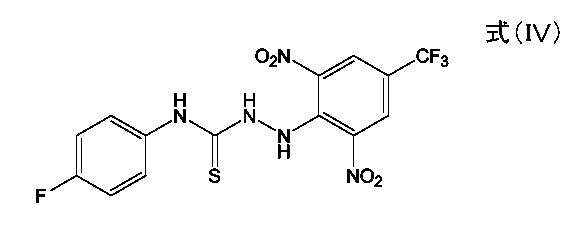
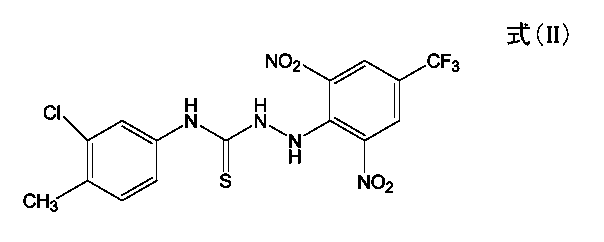
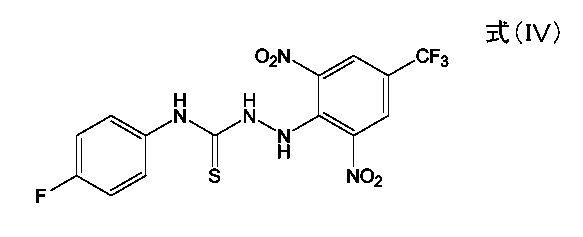
- Specific examples of the compound represented by the general formula (I) include compounds represented by the following formulas (II) to (IV) (compounds (II) to (IV)).
- the NMR signal of the Ras partial polypeptide, and the NMR of the complex obtained by contacting the Ras function inhibitor candidate substance (a) with the Ras partial polypeptide obtained by contacting the Ras function inhibitor candidate substance (a) with the Ras partial polypeptide.
- the difference from the signal can be analyzed as follows.
- NMR measurement of Ras partial polypeptide in aqueous solution NMR signal (1) obtained from Ras partial polypeptide, and complex obtained by contacting Ras function inhibiting candidate substance (a) with Ras partial polypeptide
- the NMR measurement can be carried out by comparing the NMR signals of the NMR signal (2) obtained from the complex.
- the Ras function inhibitor candidate substance (a ) May interact with the Ras partial polypeptide.
- the aqueous solution may contain an organic solvent.
- the interaction means that a force works between Ras protein and a specific substance, for example, Ras function inhibition candidate substance (a).
- the interaction include hydrophilic interaction (for example, hydrogen bond, salt bridge), hydrophobic interaction (for example, hydrophobic bond), electrostatic interaction, van der Waals interaction, and the like.
- hydrophilic interaction for example, hydrogen bond, salt bridge
- hydrophobic interaction for example, hydrophobic bond
- electrostatic interaction van der Waals interaction
- van der Waals interaction and the like.
- CCP4 program suit (Collaborative Computational Project Number # 4. (1994)) from information based on nuclear overhauser effect (NOE) through space and 3D structure model obtained based on NMR signal ) Acta Crystallogr.
- a program called CONTACT can be used to identify interacting amino residues, or can be judged by visual information.
- the three-dimensional structure model for the Ras partial polypeptide can refer to FIG. 1, and the three-dimensional structure model for the complex of the Ras function inhibiting candidate substance (a) and the Ras partial polypeptide can refer to FIG. be able to.
- structural fluctuations related to protein function are observed due to the nature of the protein, structural fluctuations are also observed for the Ras partial polypeptide and the complex of Ras partial polypeptide and Ras function inhibitor candidate substance (a). 1 to 3 also show structural changes due to fluctuations.
- the Ras for forming a more stable complex on the complex model by visual observation or using docking simulation software
- the structural modification of the compound with respect to the function inhibiting candidate substance (a) can be performed. Further, in the structure of the structure-modified compound modified with respect to the Ras function inhibiting candidate substance (a), a substituent having high possibility of toxic expression or a metabolically unstable chemical structure is replaced with a biological equivalent. In this way, a novel derivative having higher activity and lower toxicity can be designed and synthesized, and a Ras function inhibitor (A) that can be a lead compound can be derived.
- the Ras function inhibitory substance (A) selected by using such simulation can be further verified for activity and toxicity by wet assay using in vitro or in vivo.
- the amino acid with which the Ras function inhibitor candidate substance (a) interacts with the Ras partial polypeptide Residues can also be specified.
- SEQ ID NO: 1 the 5th lysine (K) and the 37th glutamic acid (E ), 38th aspartic acid (D), 39th serine (S), 56th leucine (L), 63rd glutamic acid (E), 64th tyrosine (Y), 66th Th alanine (A), 67 th methionine (M), 70 th glutamine (Q), 71 st tyrosine (Y), 73 th arginine (R), and 74 th threonine ( T), at least the fifth lysine, the 56th leucine, the 67th methionine, the 70th Th glutamine, 71 th tyrosine, and 74 th threonine.
- the NMR measurement of the present invention is carried out by measuring the complex of Ras partial polypeptide and Ras function inhibiting candidate substance (a) in an aqueous solution containing DMSO (10-30%) at 3 to 10 ° C., preferably 5 ⁇ 1 ° C. Can be measured.
- DMSO aqueous solution containing DMSO
- homonuclear multidimensional NMR measurement or heteronuclear multidimensional NMR measurement is preferably used.
- it can be performed by an NMR measurement method called 1 H- 15 NHSQC.
- Such a measurement is a technique known to those skilled in the art.
- 1 H- 15 NHSQC is a correlation spectrum between hydrogen atoms and nitrogen atoms in peptide bonds in proteins, that is, a 1 H- 15 N correlation spectrum, and is derived from a 1 H- 15 N signal derived from the main chain. Information on individual residues can be obtained.
- Such an NMR measurement method enables a three-dimensional structure analysis of a target polymer substance such as a protein, and enables a protein interaction analysis.
- a fusion polypeptide to which a purification tag is added can be prepared.
- the fusion polypeptide can be efficiently produced by affinity chromatography using the ligand as a carrier. Can be purified.
- 6X histidine tag, FLAG tag, GST (glutathione S-transferase) tag, maltose binding protein, protein A and the like are used as purification tags.
- the fusion polypeptide is cleaved to obtain only the target polypeptide. It can be recovered.
- the Ras function-inhibiting substance (A) obtained by the screening method of the present invention is considered to have an action for treating and preventing various diseases that may occur due to an abnormal function of Ras, such as an anticancer action. Therefore, it can be used as a therapeutic drug for tumors such as a medicament containing the Ras function inhibitor (A) of the present invention as an active ingredient, for example, an anticancer agent.
- the antitumor effect of the Ras function inhibitory substance (A) of the present invention is determined by culturing cancer cells in the presence of the Ras function inhibitory substance (A) and examining whether the canceration trait is suppressed, or a tumor bearing model This can be done using animals.
- Ras function inhibition candidate substance (a) As the Ras function inhibition candidate substance (a) of the present invention, compounds represented by the following formulas (II) to (IV) (compound (II), compound ( III) and compound (IV)) were obtained by in silico screening from the three-dimensional structure information of X-ray structural analysis. Specifically, compound (II) is obtained by screening by docking simulation (MMPB-SA method), and compound (III) and compound (IV) are searched for analogs of compound (II) (Tanimoto coefficient as an index). ) In silico screening. These compounds were identified through biochemical and cytological activity verification tests shown in Experimental Examples 1 and 2 below.
- Example 1 Biochemical Activity Verification Test
- the Ras-Raf binding inhibitory activity of compound (II), compound (III) and compound (IV) obtained in Example 1 was confirmed by a biochemical activity verification test. It was confirmed.
- a human H-Ras polypeptide (1-166 amino acid residues) was used as Ras, and a GTP analog (GTP ⁇ S (Roche Diagnotics)) was used as GTP.
- GTP ⁇ S Roche Diagnotics
- human c-Raf-1 51-130 amino acid residues
- Raf was used as Raf which is a target protein of Ras.
- Example 2 Cytological activity verification test
- the compound (II), the compound (III) and the compound (IV) obtained in Example 1 were confirmed to be anchorage-independent by the cytological activity verification test.
- the cell growth inhibitory activity was confirmed.
- the colony formation inhibitory activity (anchorage-independent cell growth inhibitory activity) of the compound was evaluated. As a result, these compounds were confirmed to have an inhibitory effect on colony formation for each cell and interacted with the above three types of Ras (FIG. 5).
- Example 2 Measured NMR data of complex of Ras and compound (III)
- measured NMR data of a complex of Ras and compound (III) are shown.
- H-Ras T35S (1-166 amino acid residue) which is a mutant H-Ras was used as Ras
- a GTP analog Gpp (NH) p: CALBIOCHEM
- Ras-GTP was prepared by dissolving 3.6 mg of Ras and 1.1 mg of GTP in 1 mL of neutral pH buffer. Next, 3.6 mg of Ras-GTP was dissolved in 0.16 mL of a deuterated buffer solution (pH 6.8) to prepare a Ras-GTP solution. Compound (III) 0.3 mg was dissolved in deuterated DMSO (dimethyl sulfoxide) 0.04 mL to prepare a compound (III) solution. The Ras-GTP solution and the compound (III) solution were mixed, and a complex of Ras-GTP and compound (III) was prepared under conditions of 20% DMSO and 5 ° C.
- KOB316 means the compound (III).
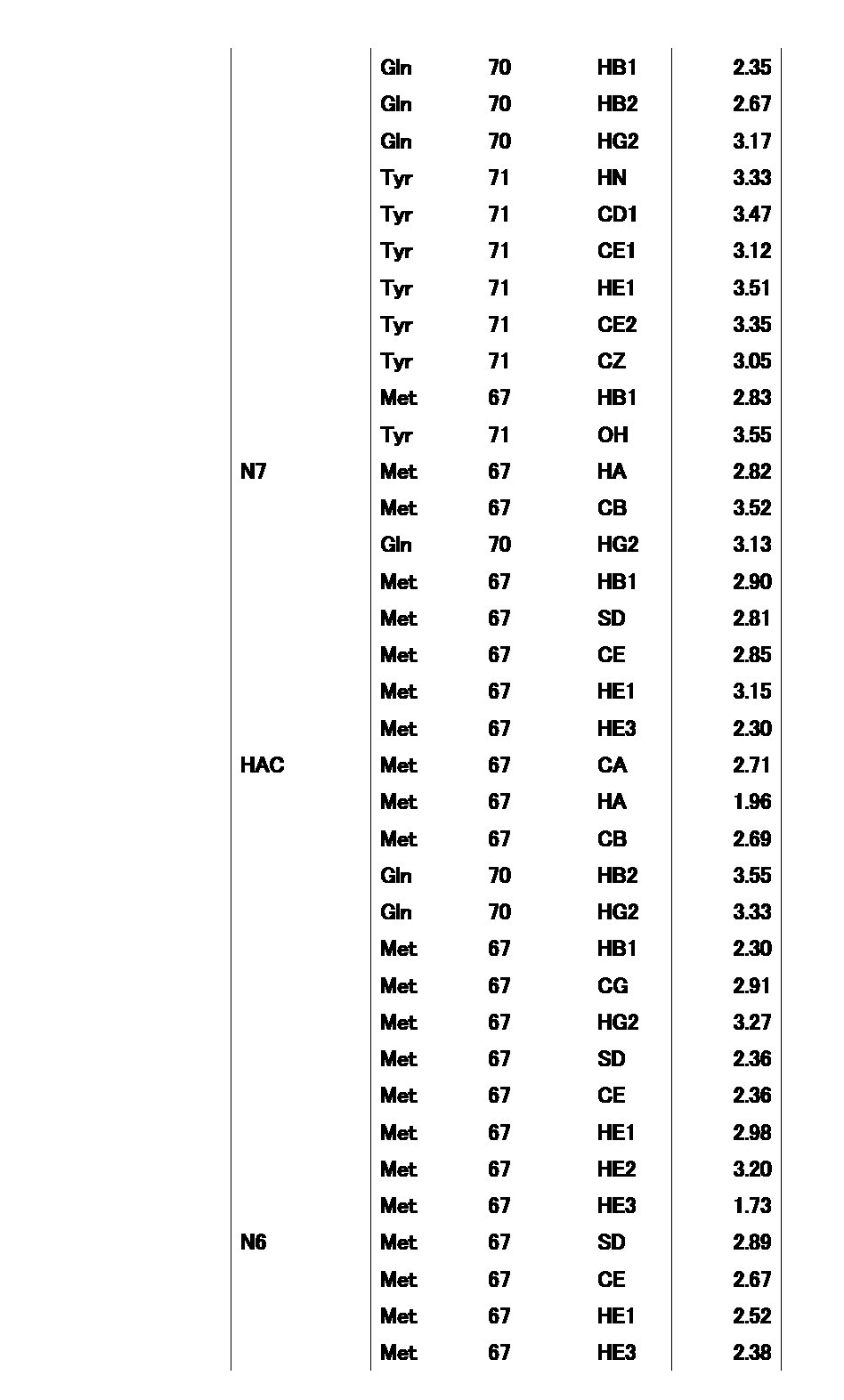
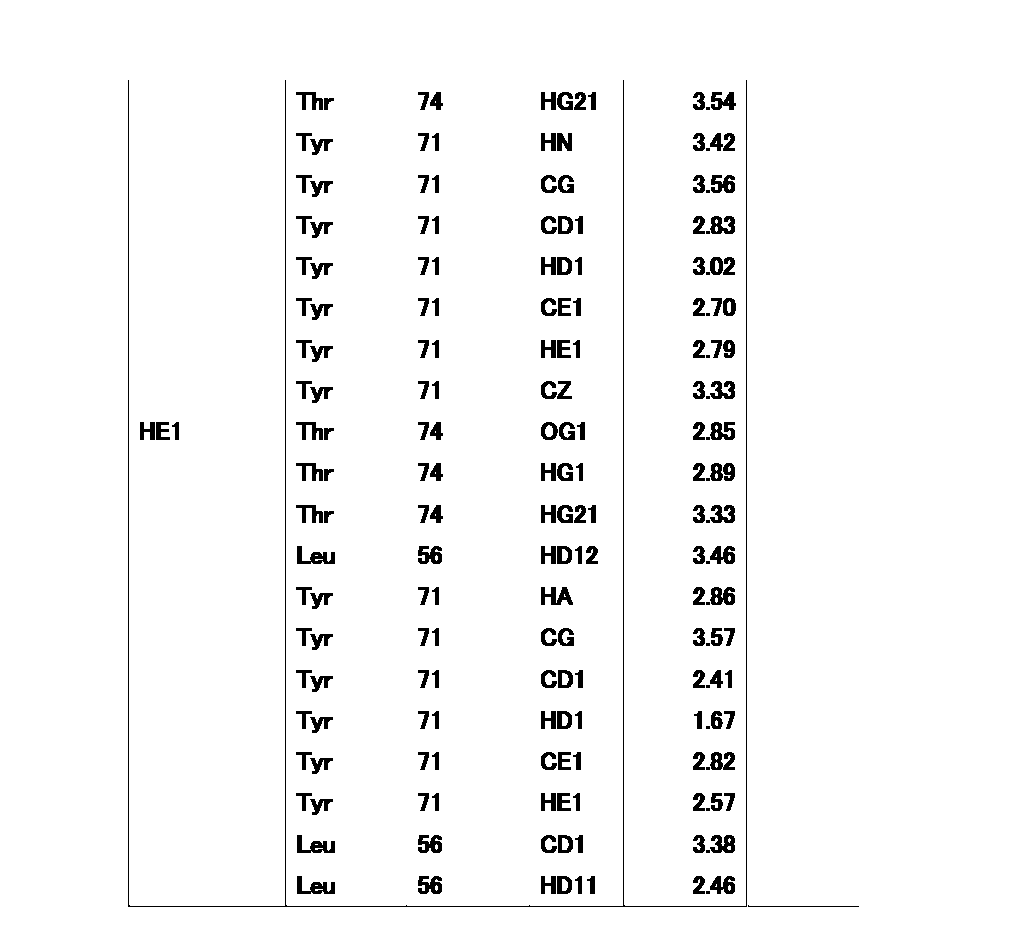
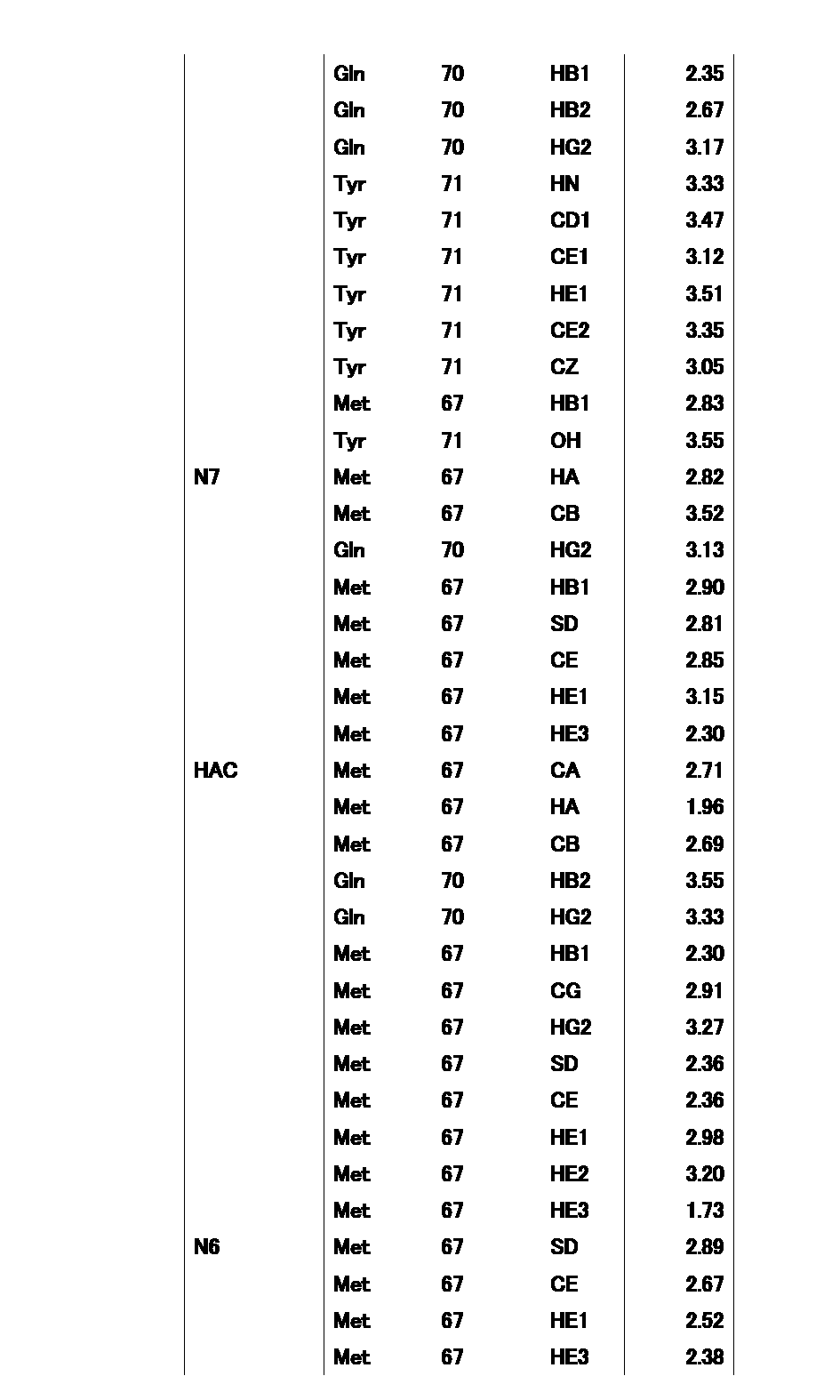
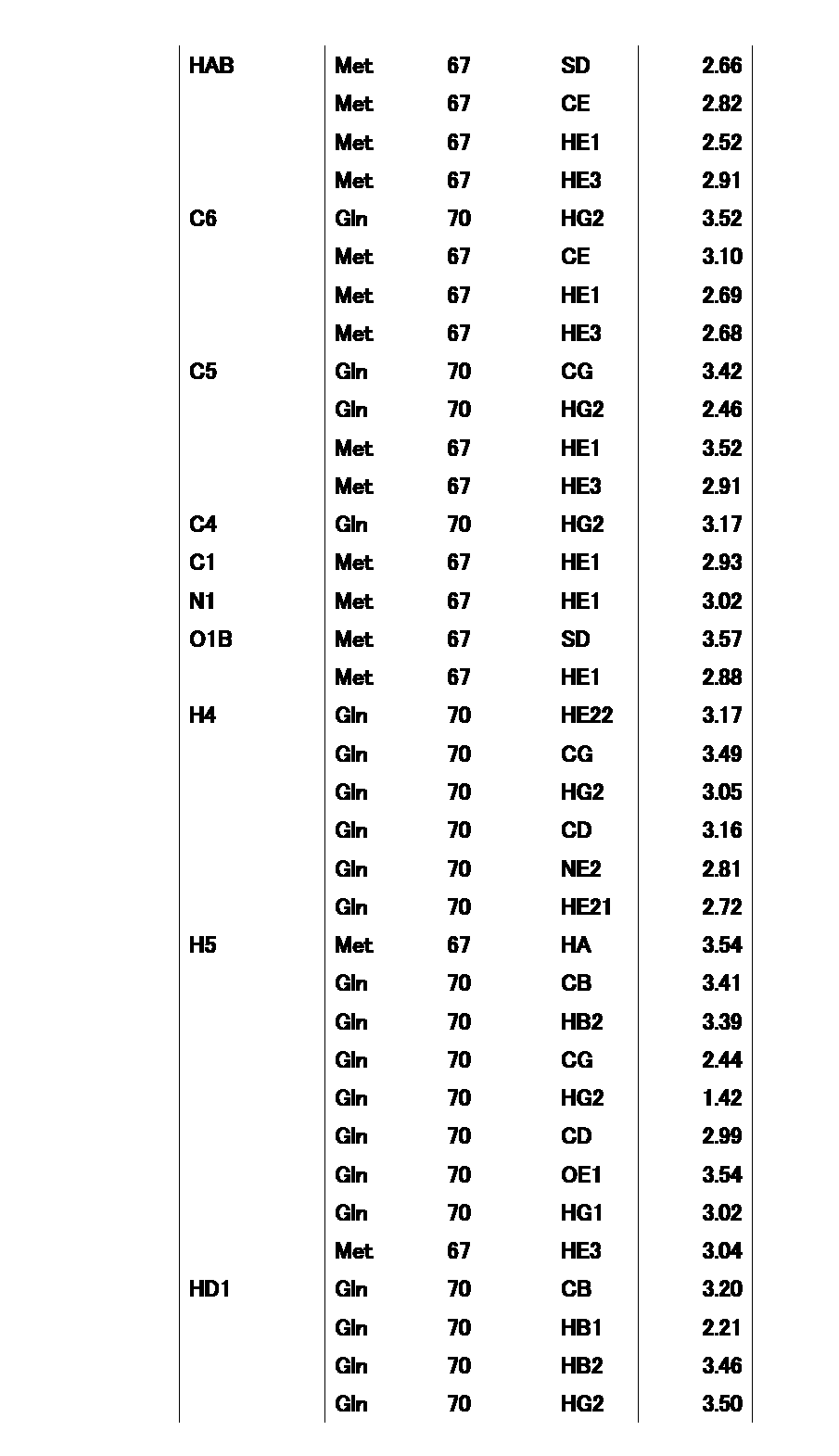
- Example 3 Distance information of amino acids adjacent to Ras and compound (III) Regarding a complex of Ras-GTP and compound (III) prepared by the same method as in Example 2, it is close to Ras and compound (III). Amino acid distance information (NOE information) was confirmed.
- the complex of Ras-GTP and compound (III) was subjected to NMR analysis by 13 C-separated NOESY-HSQC spectrum in the same manner as in Example 2. Since the integrated intensity of cross peaks in 13 C-separated NOESY-HSQC depends on the distance between hydrogen, it can be converted into distance information between compound (III) and Ras-GTP.
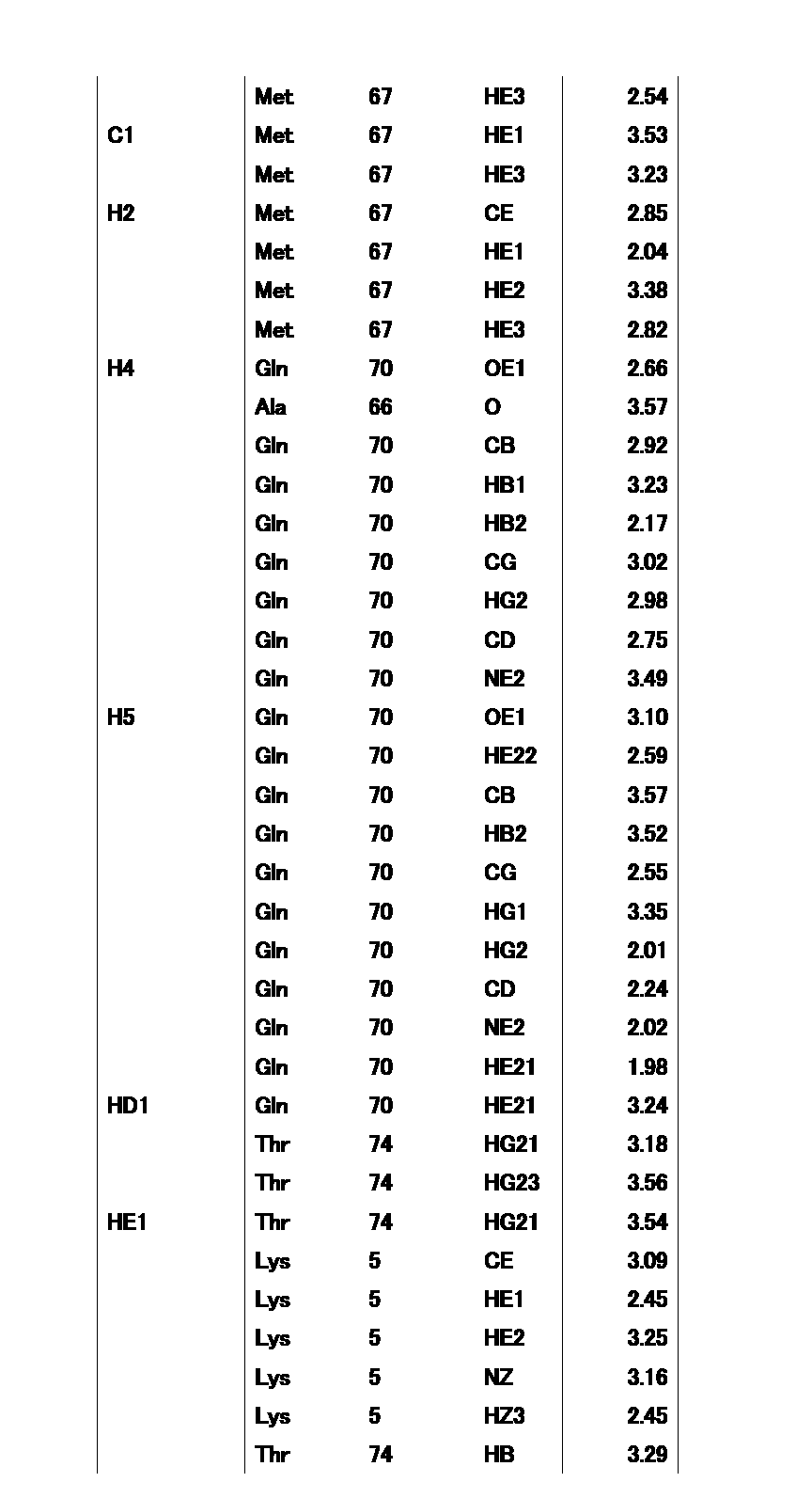
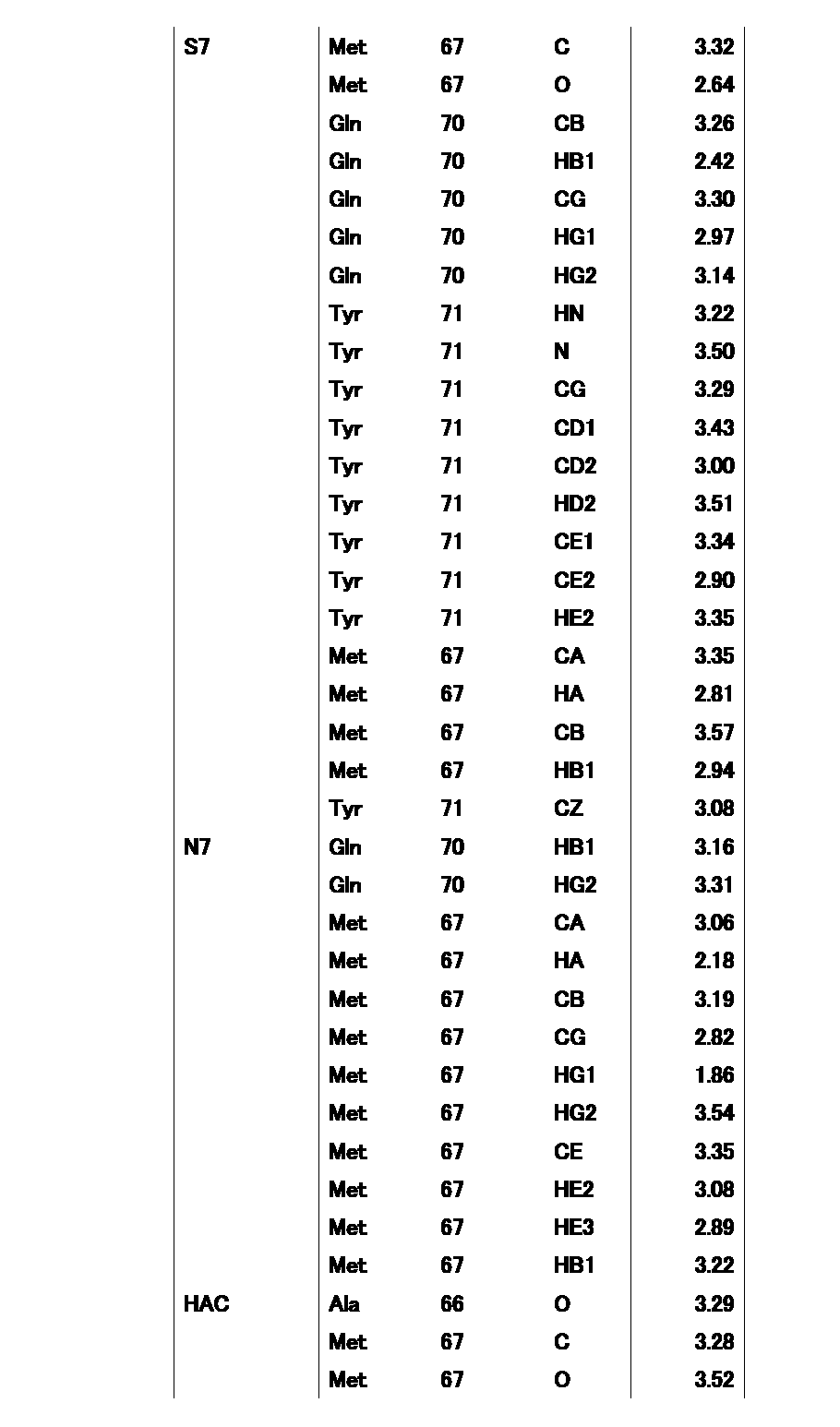
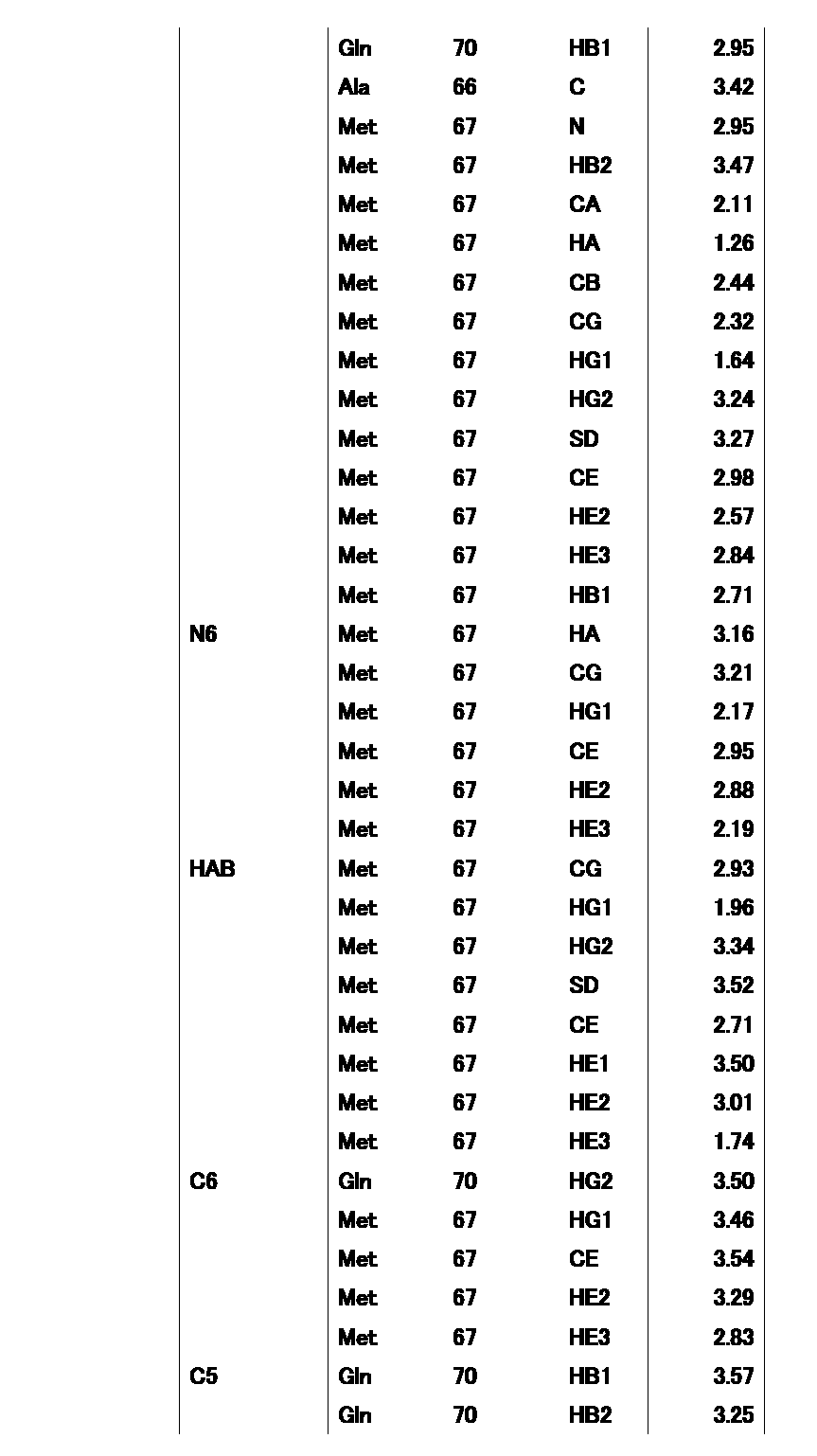
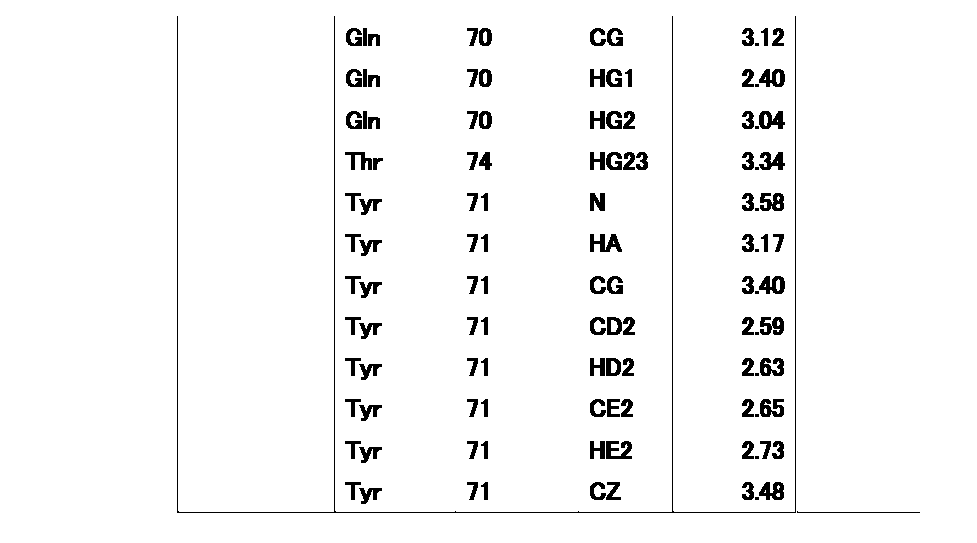
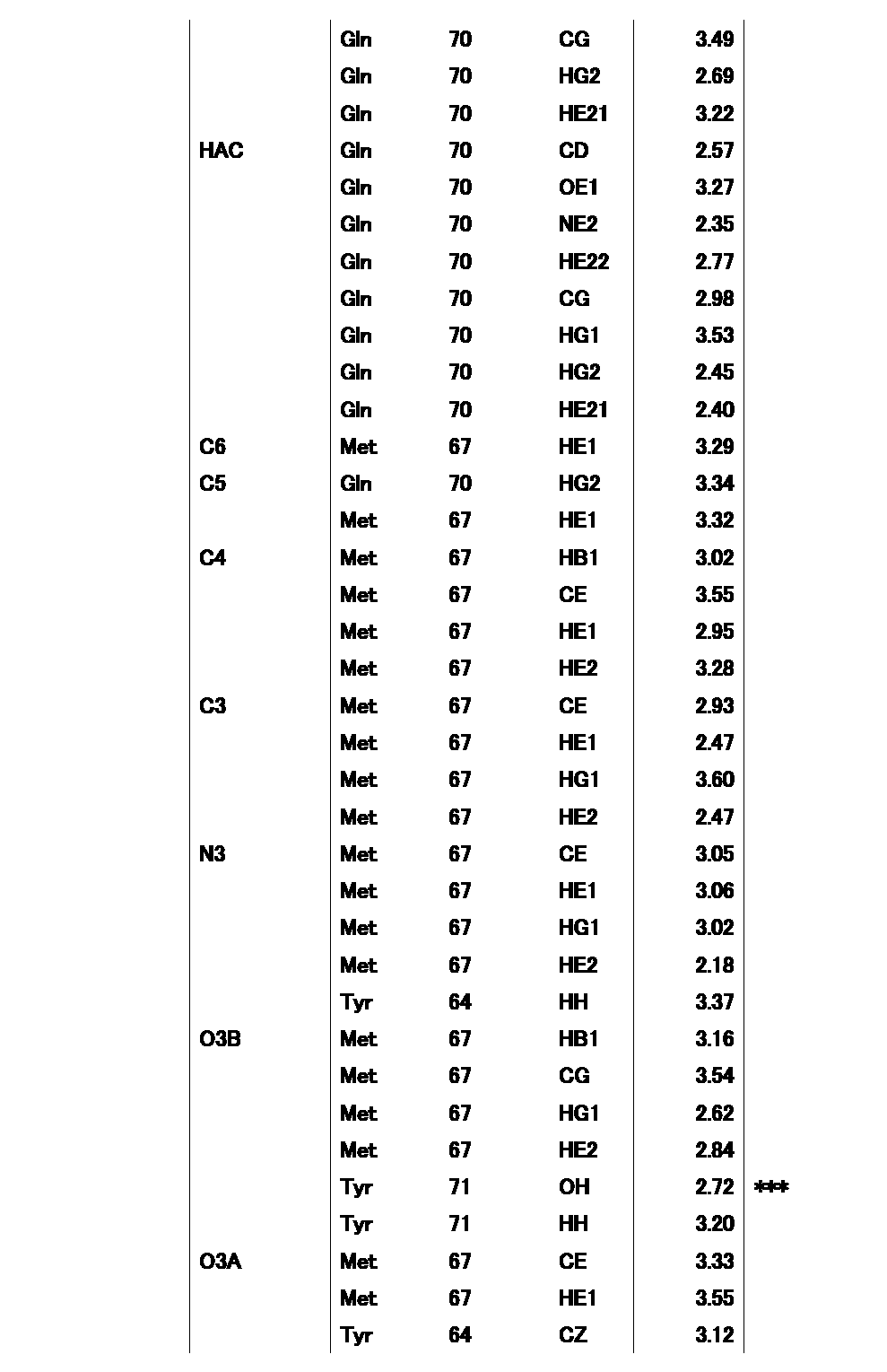
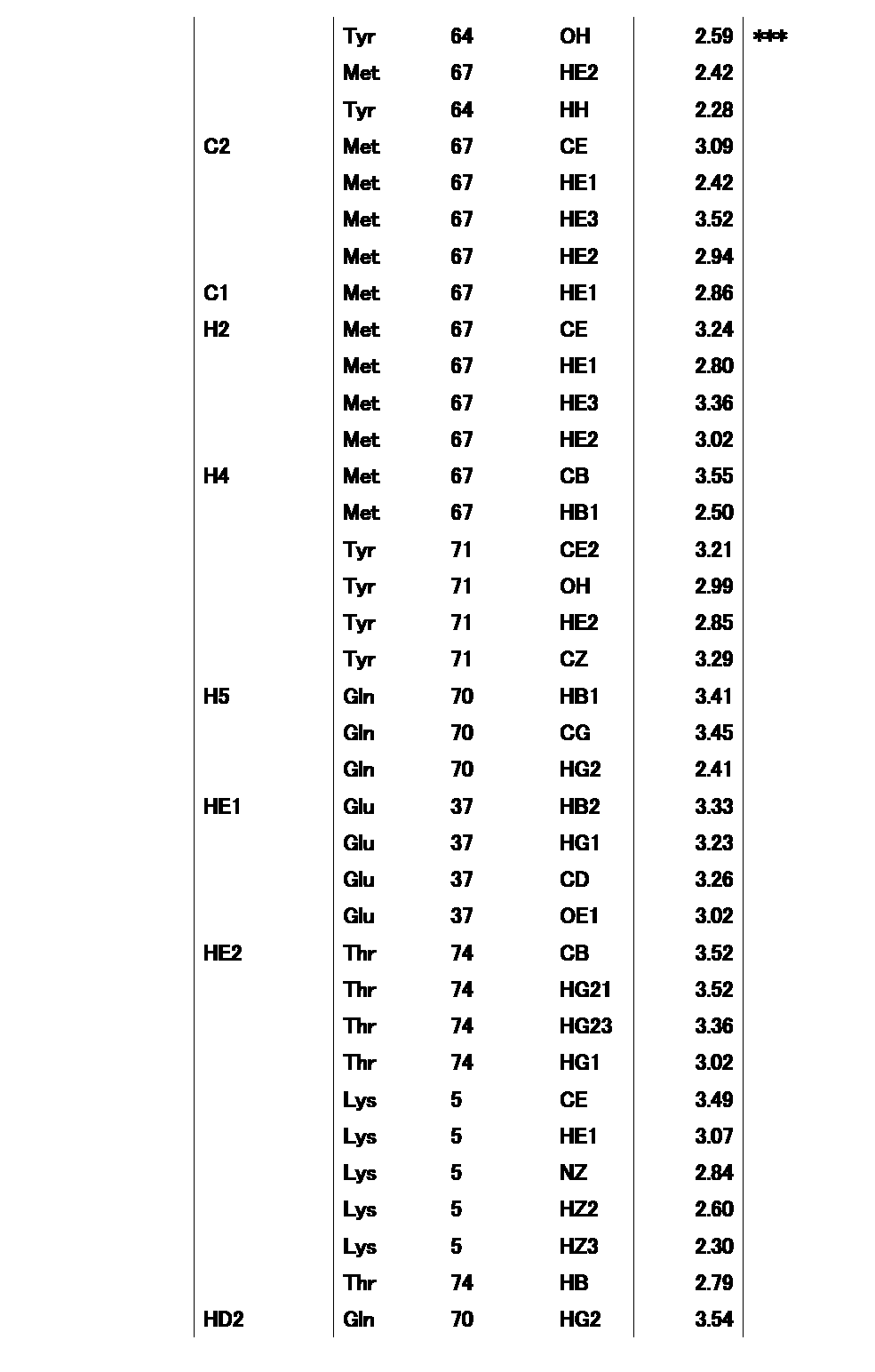
- Table 1 shows the distance information of Ras amino acids adjacent to compound (III) obtained based on each cross peak.
- a plurality of distance information for one amino acid means that there are several hydrogen nuclides in each amino acid and corresponding distance information exists for each of them.
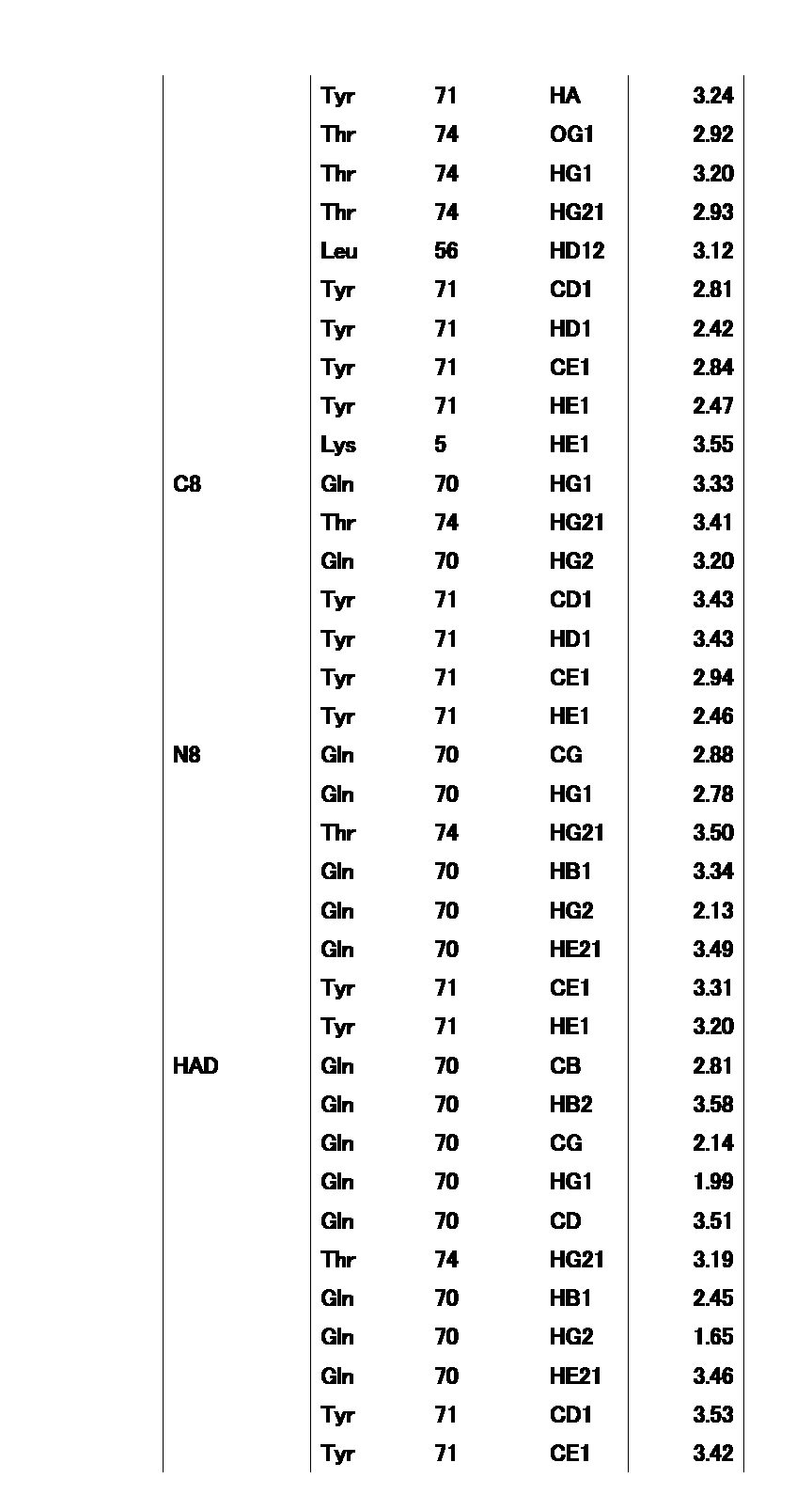
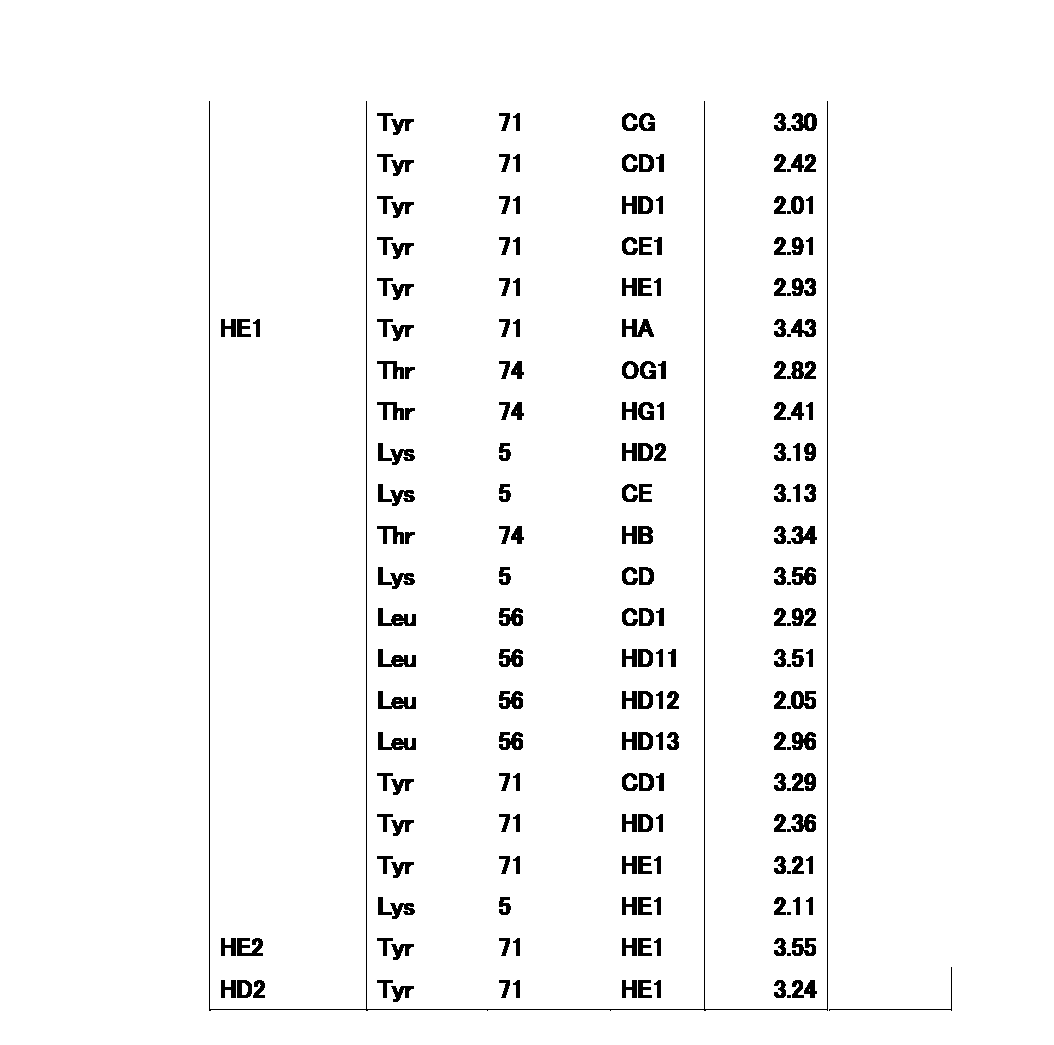
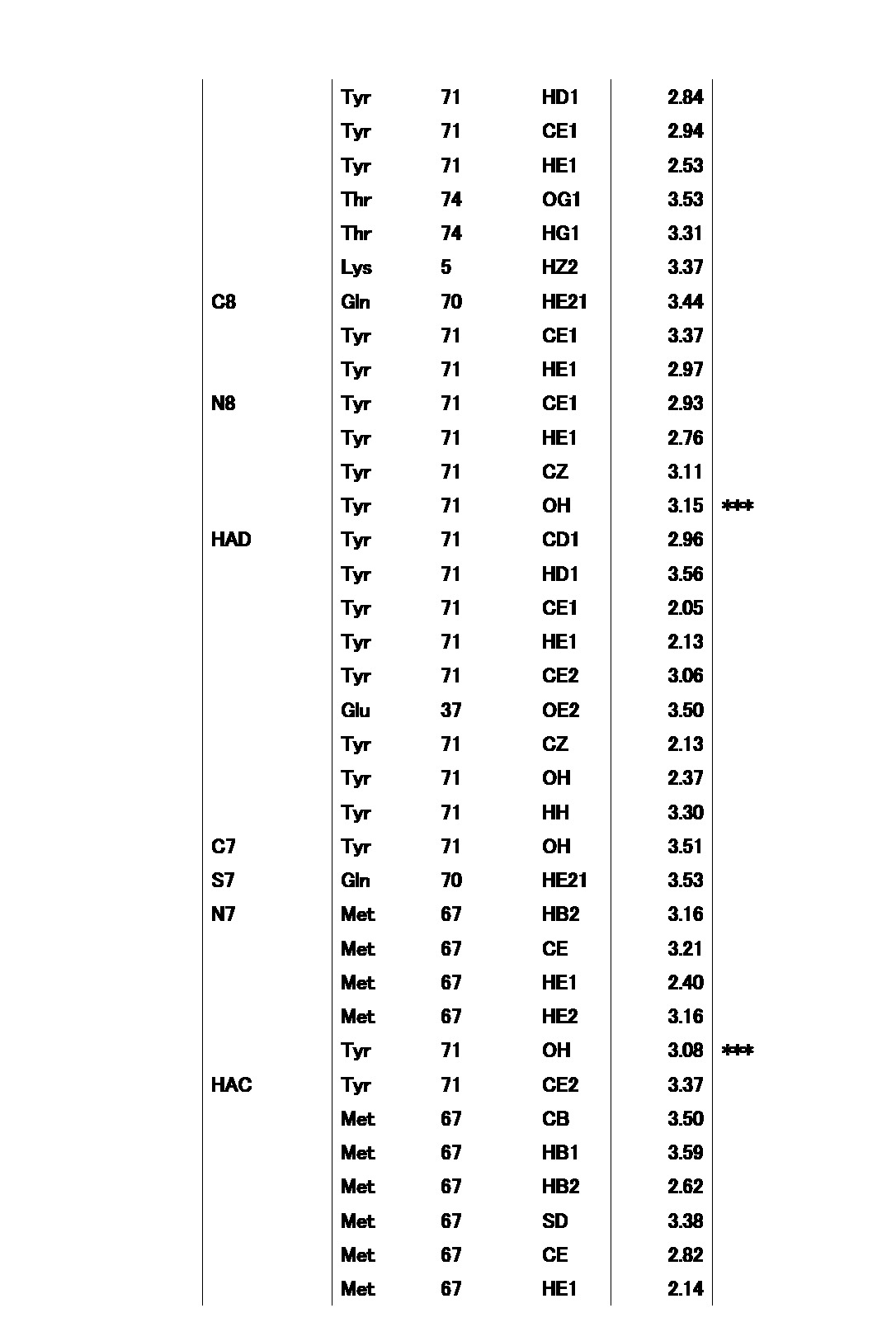
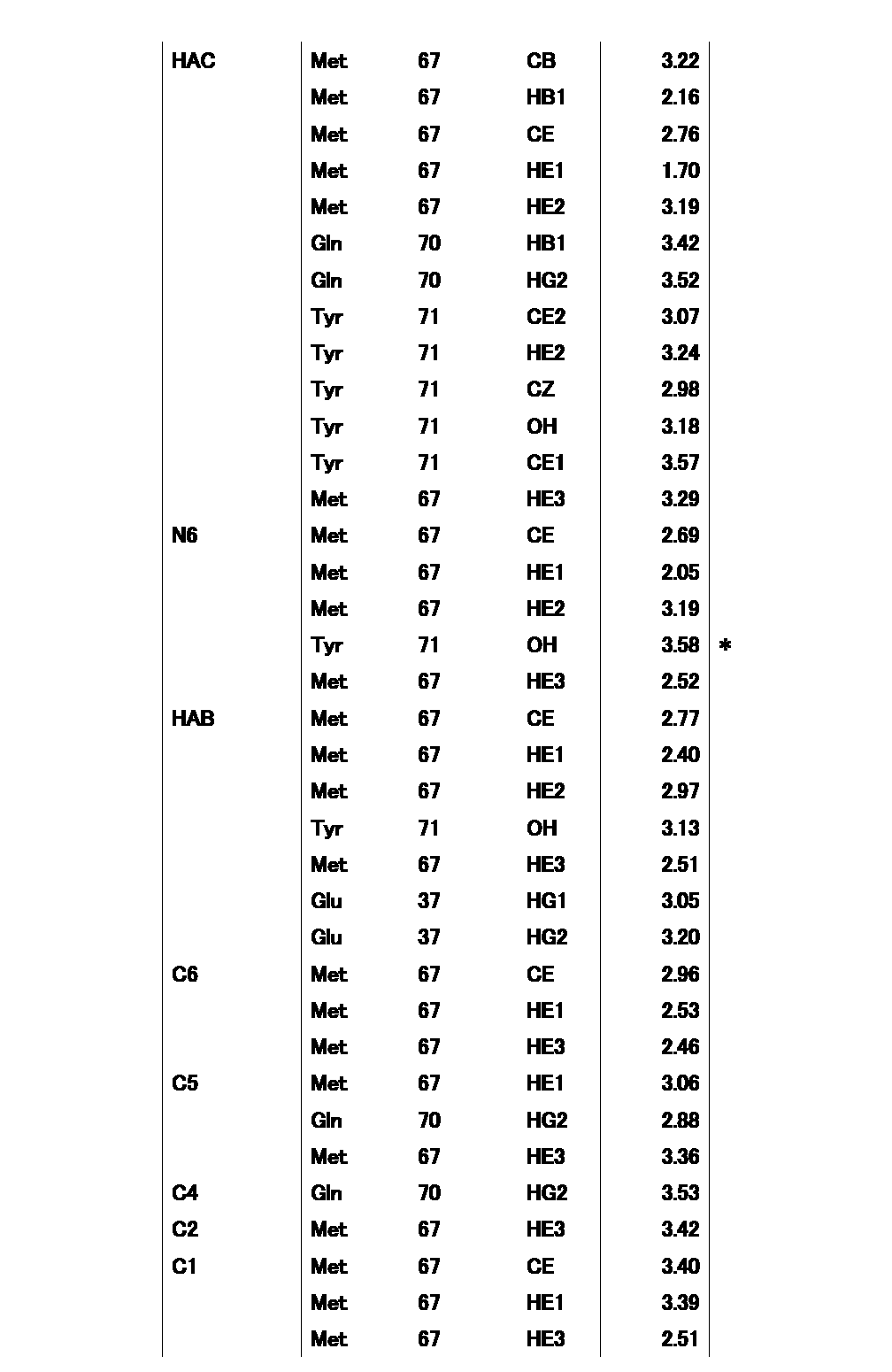
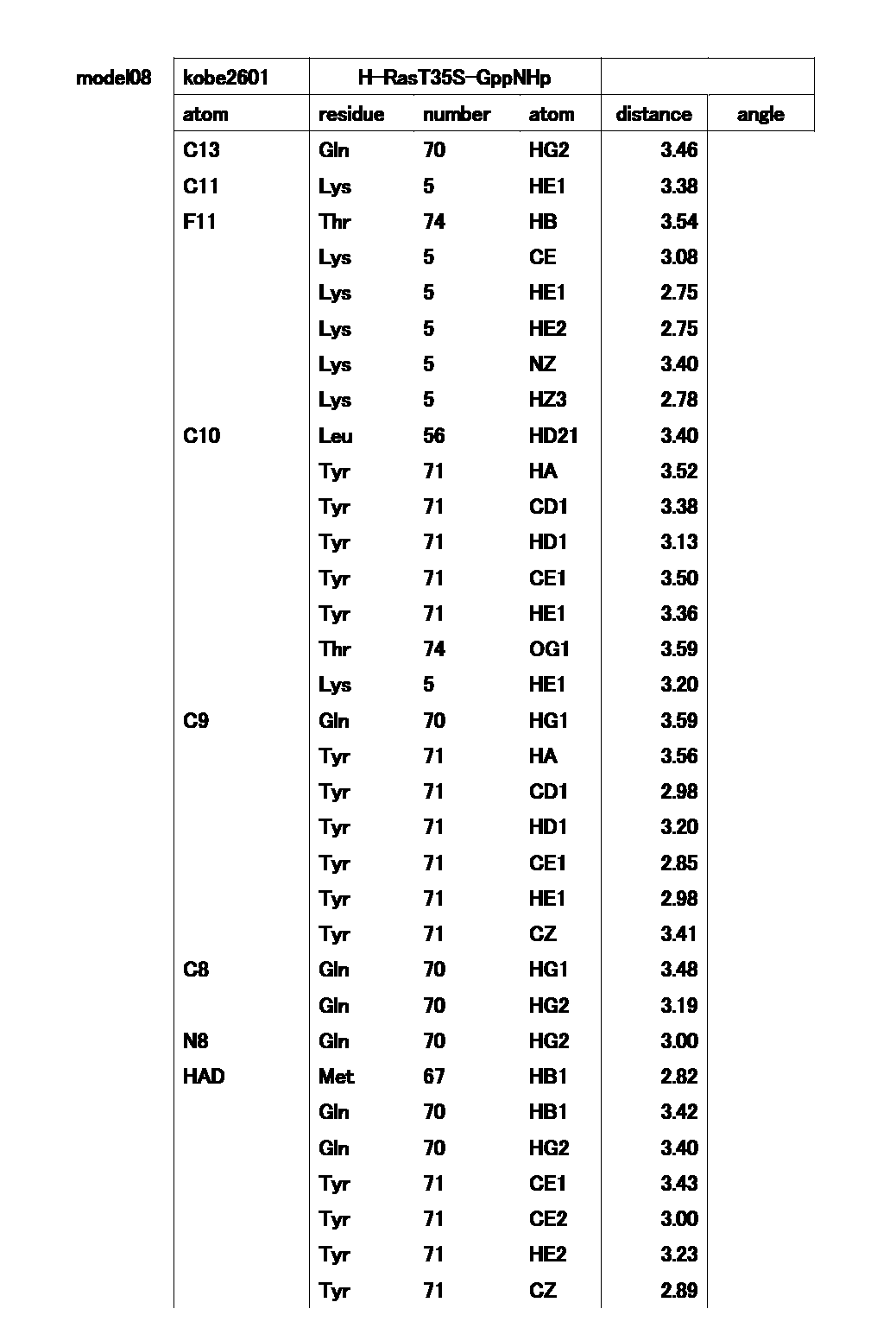
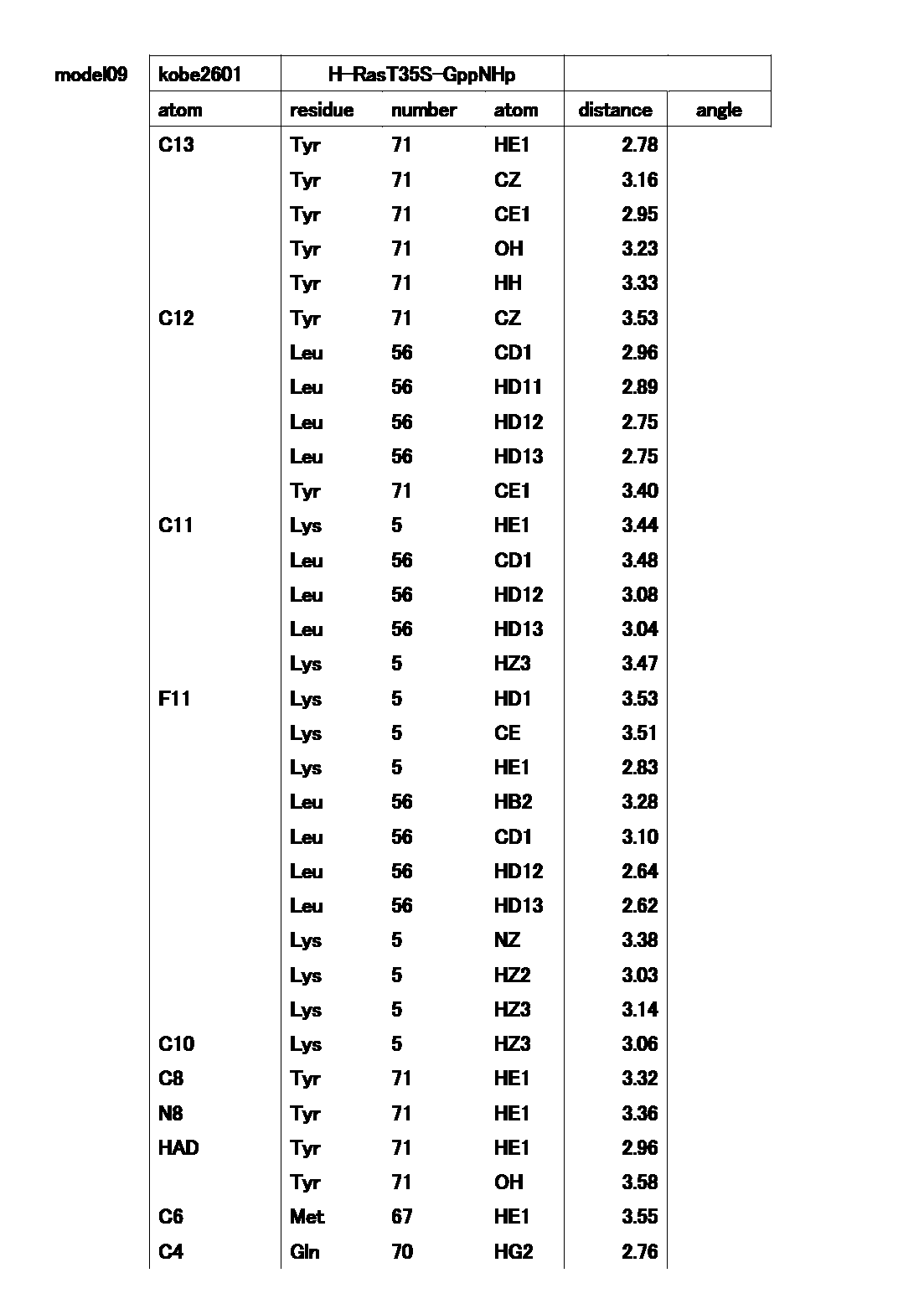
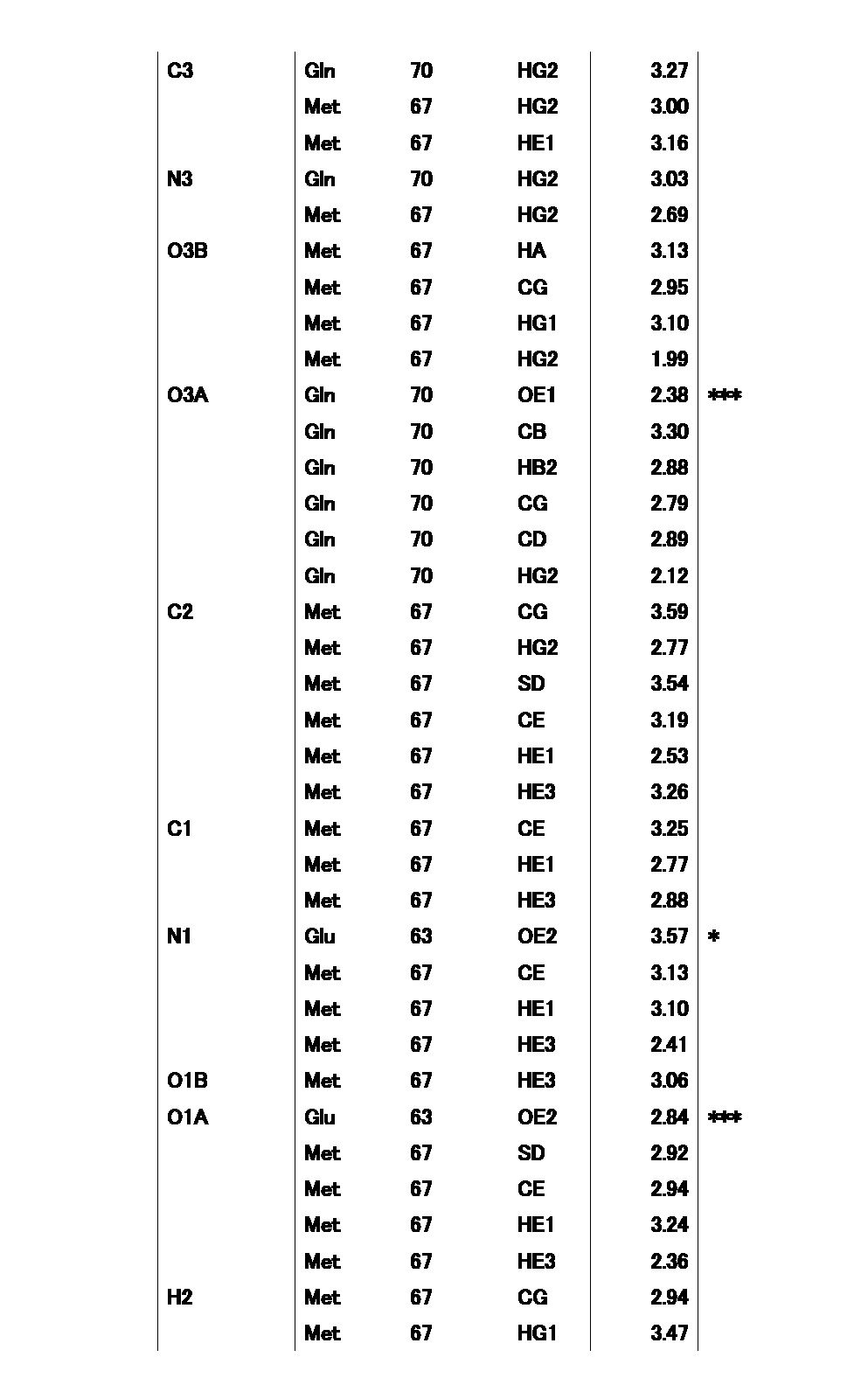
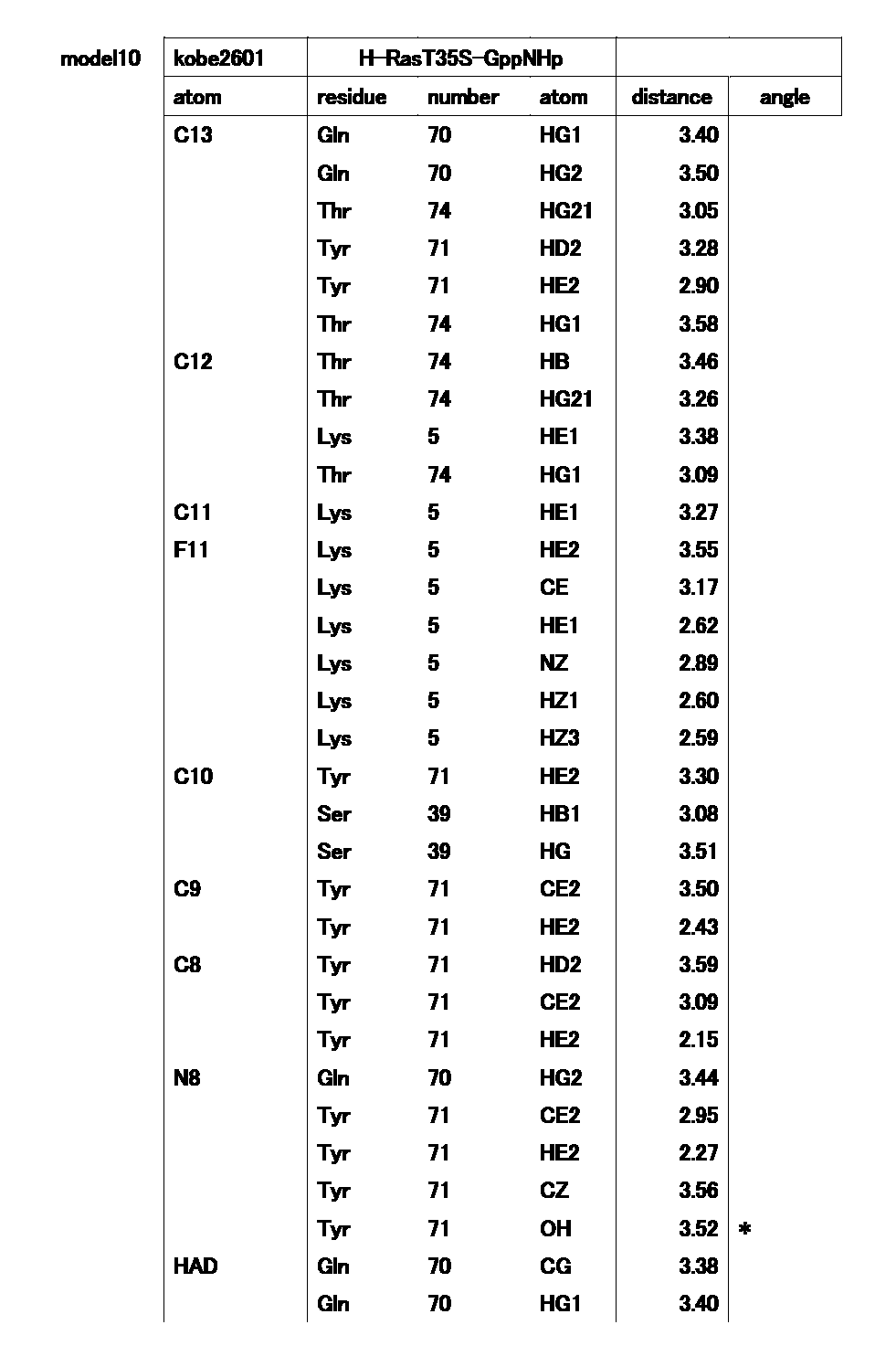
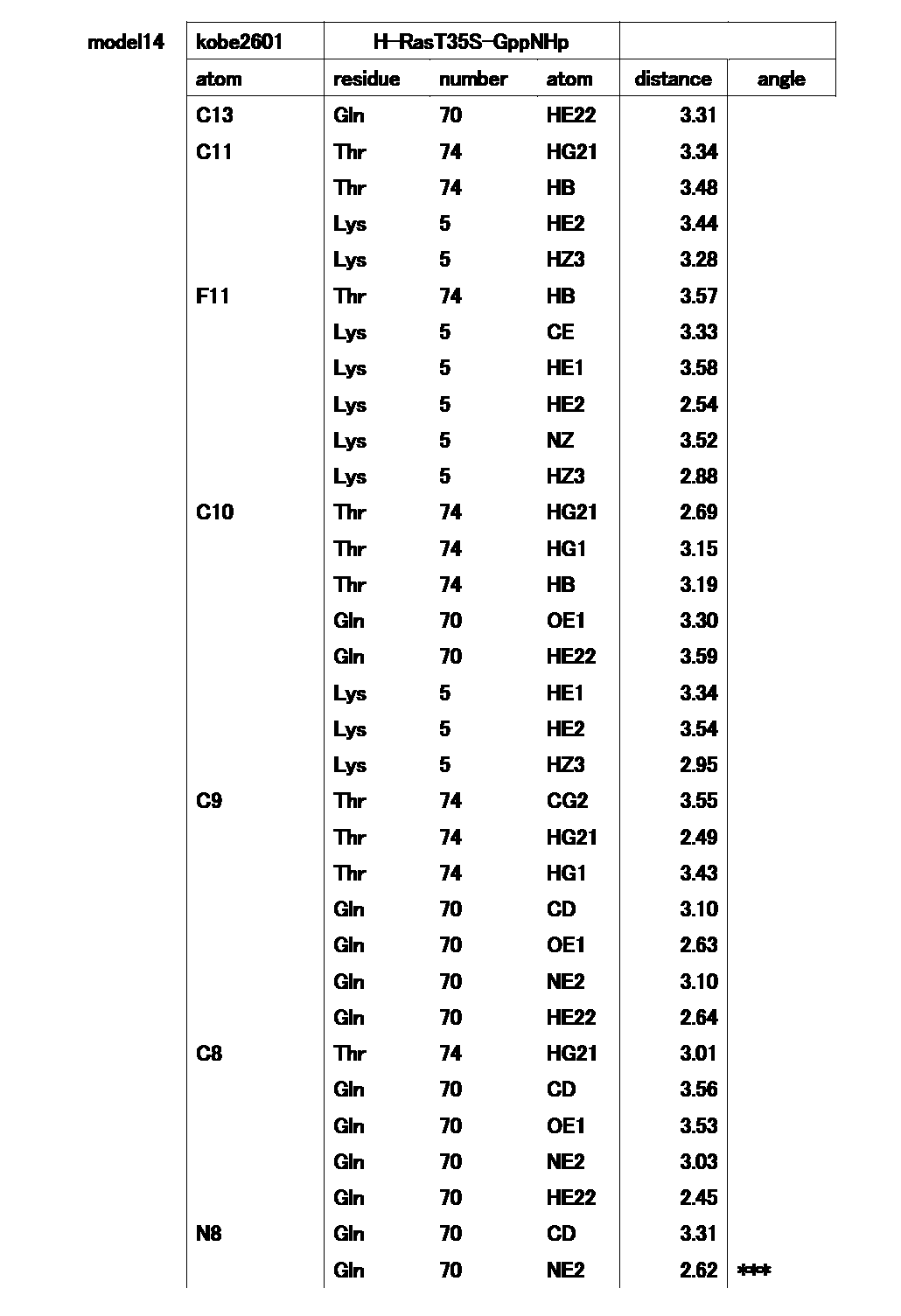
- Example 4 Distance information of amino acids adjacent to Ras and compound (III) Regarding the complex of Ras-GTP prepared by the same method as in Example 2 and compound (III) (kobe2601), 15 types of complexes Based on the NMR structure, the calculation was performed with the program CONTACT in the CCP4 program suit (Collaborative Computational Project Number 4. (1994) Acta Crystallogr. D 50, 760-763). As a result, a residue group (1) in which interaction with the compound (III) has been confirmed and a residue group (2) selected so as to fill the pocket gap are shown below.
- a derivative of the Ras function inhibition candidate substance (a) It is possible to efficiently estimate the structure of the Ras function inhibitor (A). In other words, in the structure of the structure-modified compound modified with respect to the Ras function-inhibiting candidate substance (a), a substituent having a high possibility of toxic expression or a metabolically unstable chemical structure is replaced with a biological equivalent. Thus, a new derivative can be designed and synthesized, and a Ras function inhibitor (A) that can be a lead compound can be derived.
- the obtained Ras function-inhibiting substance (A) is considered to have a therapeutic / preventive action for various diseases that may occur due to an abnormal function of Ras, such as an anticancer action. Therefore, it can be used as a therapeutic drug for tumors such as a medicament containing the Ras function inhibitor (A) of the present invention as an active ingredient, for example, an anticancer agent.
Landscapes
- Health & Medical Sciences (AREA)
- Life Sciences & Earth Sciences (AREA)
- Chemical & Material Sciences (AREA)
- Organic Chemistry (AREA)
- Molecular Biology (AREA)
- Engineering & Computer Science (AREA)
- General Health & Medical Sciences (AREA)
- Physics & Mathematics (AREA)
- Medicinal Chemistry (AREA)
- Immunology (AREA)
- Biochemistry (AREA)
- Biomedical Technology (AREA)
- Hematology (AREA)
- Urology & Nephrology (AREA)
- Proteomics, Peptides & Aminoacids (AREA)
- General Physics & Mathematics (AREA)
- Genetics & Genomics (AREA)
- Biophysics (AREA)
- Gastroenterology & Hepatology (AREA)
- Biotechnology (AREA)
- Cell Biology (AREA)
- Pathology (AREA)
- Analytical Chemistry (AREA)
- Food Science & Technology (AREA)
- Microbiology (AREA)
- Toxicology (AREA)
- Zoology (AREA)
- Animal Behavior & Ethology (AREA)
- Pharmacology & Pharmacy (AREA)
- High Energy & Nuclear Physics (AREA)
- Spectroscopy & Molecular Physics (AREA)
- Veterinary Medicine (AREA)
- Public Health (AREA)
- Oncology (AREA)
- Condensed Matter Physics & Semiconductors (AREA)
- Nuclear Medicine, Radiotherapy & Molecular Imaging (AREA)
- General Chemical & Material Sciences (AREA)
- Chemical Kinetics & Catalysis (AREA)
- Bioinformatics & Cheminformatics (AREA)
- Peptides Or Proteins (AREA)
Abstract
Description
1.以下の工程を含む、Ras機能阻害物質(A)のスクリーニング方法:
1)配列番号1に示すアミノ酸配列、又は配列番号1に示すアミノ酸配列から1~3個のアミノ酸が置換、欠失若しくは付加されたアミノ酸配列からなるRas部分ポリペプチドのNMRシグナルを得る工程;
2)Ras機能阻害候補物質(a)を、上記1)に記載のRas部分ポリペプチドと接触させ、得られた複合体についてのNMRシグナルを得る工程;
3)上記1)の工程で得られたNMRシグナルと、2)の工程で得られたNMRシグナルとの違いを解析し、Ras機能阻害候補物質(a)の誘導体であるRas機能阻害物質(A)を選別する工程。
2.配列番号1に示すアミノ酸配列、又は配列番号1に示すアミノ酸配列から1~3個のアミノ酸が置換、欠失若しくは付加されたアミノ酸配列からなるRas部分ポリペプチドにおいて、配列番号1に示すアミノ酸配列を基準とした場合に、第5番目のリジン(K)、第37番目のグルタミン酸(E)、第38番目のアスパラギン酸(D)、第39番目のセリン(S)、第56番目のロイシン(L)、第63番目のグルタミン酸(E)、第64番目のチロシン(Y)、第66番目のアラニン(A)、第67番目のメチオニン(M)、第70番目のグルタミン(Q)、第71番目のチロシン(Y)、第73番目のアルギニン(R)、及び第74番目のトレオニン(T)から選択される少なくとも3個以上のアミノ酸残基と相互作用しうる物質を選別することを特徴とする、Ras機能阻害候補物質(a)のスクリーニング方法。
3.以下の工程を含む、前項2に記載のRas機能阻害候補物質(a)のスクリーニング方法:
1)前項2に記載の部分ポリペプチドのうち、第5番目のリジン(K)、第37番目のグルタミン酸(E)、第38番目のアスパラギン酸(D)、第39番目のセリン(S)、第56番目のロイシン(L)、第63番目のグルタミン酸(E)、第64番目のチロシン(Y)、第66番目のアラニン(A)、第67番目のメチオニン(M)、第70番目のグルタミン(Q)、第71番目のチロシン(Y)、第73番目のアルギニン(R)、及び第74番目のトレオニン(T)から選択される少なくとも3個以上のアミノ酸残基をNMR測定可能な同位体で標識したポリペプチドを作製し、当該標識ポリペプチドについてのNMRシグナルを得る工程;
2)候補物質を、1)の工程で作製した標識ポリペプチドと接触させて、候補物質と標識ポリペプチドとの複合体についてのNMRシグナルを得る工程;
3)上記1)の工程で得られたNMRシグナルと2)の工程で得られたNMRシグナルとの違いに基づいて、標識ポリペプチドと相互作用しうる物質を、Ras機能阻害候補物質(a)として選別する工程。
4.Ras部分ポリペプチドが、配列番号1に示すアミノ酸配列のうち、35番目のトレオニンがセリンに置換されているアミノ酸配列からなるポリペプチドである、前項1に記載のRas機能阻害物質(A)又は前項2~3のいずれか1に記載のRas機能阻害候補物質(a)のスクリーニング方法。
5.Ras機能阻害候補物質(a)が、以下の一般式(I)で表される、前項1に記載のRas機能阻害物質(A)のスクリーニング方法。
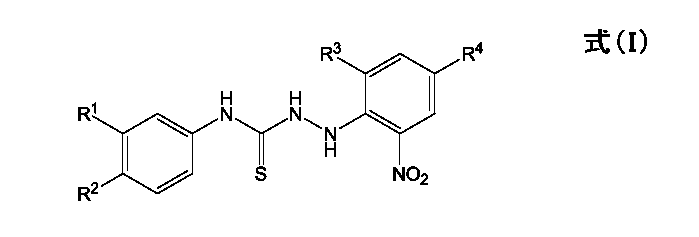
6.以下の一般式(I)で表されるRas機能阻害候補物質(a)を有効成分とするRas機能阻害剤。

7.配列番号1に示すアミノ酸配列、又は配列番号1に示すアミノ酸配列から1~3個のアミノ酸が置換、欠失若しくは付加されたアミノ酸配列からなるRas部分ポリペプチドと、以下の一般式(I)で表されるRas機能阻害候補物質(a)との複合体。
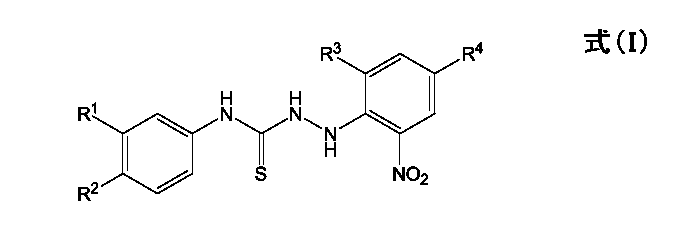
8.Ras部分ポリペプチドが、配列番号1に示すアミノ酸配列のうち、35番目のトレオニンがセリンに置換されているアミノ酸配列からなるポリペプチドである、前項7に記載の複合体。
9.NMRシグナルにより特定される前項7又は8に記載の複合体。
10.配列番号1に示すアミノ酸配列、又は配列番号1に示すアミノ酸配列から1~3個のアミノ酸が置換、欠失若しくは付加されたアミノ酸配列からなるRas部分ポリペプチドを含む水溶液であって、
当該Ras部分ポリペプチドの立体構造が、以下の1)及び2)であること特徴とするRas部分ポリペプチド含有水溶液:
1)当該Ras部分ポリペプチドの立体構造が、特定の物質と結合しうるポケットを有する立体構造からなり;
2)当該特定の物質が、当該Ras部分ポリペプチドにおいて、配列番号1に示すアミノ酸配列を基準とした場合に、第5番目のリジン(K)、第37番目のグルタミン酸(E)、第38番目のアスパラギン酸(D)、第39番目のセリン(S)、第56番目のロイシン(L)、第63番目のグルタミン酸(E)、第64番目のチロシン(Y)、第66番目のアラニン(A)、第67番目のメチオニン(M)、第70番目のグルタミン(Q)、第71番目のチロシン(Y)、第73番目のアルギニン(R)、及び第74番目のトレオニン(T)から選択される少なくとも3個以上のアミノ酸残基と相互作用しうる物質である。
11.Ras部分ポリペプチドが、配列番号1に示すアミノ酸配列のうち、35番目のトレオニンがセリンに置換されているアミノ酸配列からなるポリペプチドである、前項10に記載のRas部分ポリペプチド含有水溶液。
12.特定の物質が、一般式(I)に示されるRas機能阻害剤(a)であることを特徴とする、前項10又は11に記載のRas部分ポリペプチド含有水溶液。
本発明のRas機能阻害物質(A)のスクリーニング方法の一態様として、以下の工程を含むスクリーニング方法が挙げられる。
1)Ras部分ポリペプチドのNMRシグナルを得る工程;
2)Ras機能阻害候補物質(a)を、上記1)に記載のRas部分ポリペプチドと接触させ、得られた複合体についてのNMRシグナルを得る工程;
3)上記1)の工程で得られたNMRシグナルと、2)の工程で得られたNMRシグナルとの違いを解析し、Ras機能阻害候補物質(a)の誘導体を選別する工程。
MTEYKLVVVGAGGVGKSALTIQLIQNHFVDEYDPTIEDSYRKQVVIDGETCLLDILDTAGQEEYSAMRDQYMRTGEGFLCVFAINNTKSFEDIHQYREQIKRVKDSDDVPMVLVGNKCDLAARTVESRQAQDLARSYGIPYIETSAKTRQGVEDAFYTLVREIRQH
本発明のRas部分ポリペプチドのうち、配列番号1に示すアミノ酸配列を基準とした場合に、配列番号1に示すアミノ酸配列のうち、第5番目のリジン(K)、第37番目のグルタミン酸(E)、第38番目のアスパラギン酸(D)、第39番目のセリン(S)、第56番目のロイシン(L)、第63番目のグルタミン酸(E)、第64番目のチロシン(Y)、第66番目のアラニン(A)、第67番目のメチオニン(M)、第70番目のグルタミン(Q)、第71番目のチロシン(Y)、第73番目のアルギニン(R)、及び第74番目のトレオニン(T)のいずれかから選択される少なくとも3個以上のアミノ酸残基と相互作用しうる物質を、候補物質から選別することによる。好ましくは、配列番号1に示すアミノ酸配列のうち、第5番目のリジン、第56番目のロイシン、第67番目のメチオニン、第70番目のグルタミン、第71番目のチロシン、及び第74番目のトレオニンから選択される少なくとも3個以上のアミノ酸残基と相互作用しうる物質を、候補物質から選別することによる。
1)本発明のRas部分ポリペプチドのうち配列番号1に示すアミノ酸配列を基準とした場合に、第5番目のリジン(K)、第37番目のグルタミン酸(E)、第38番目のアスパラギン酸(D)、第39番目のセリン(S)、第56番目のロイシン(L)、第63番目のグルタミン酸(E)、第64番目のチロシン(Y)、第66番目のアラニン(A)、第67番目のメチオニン(M)、第70番目のグルタミン(Q)、第71番目のチロシン(Y)、第73番目のアルギニン(R)、及び第74番目のトレオニン(T)から選択される少なくとも3個以上、好ましくは、配列番号1に示すアミノ酸配列のうち、第5番目のリジン、第56番目のロイシン、第67番目のメチオニン、第70番目のグルタミン、第71番目のチロシン、及び第74番目のトレオニンから選択される少なくとも3個以上のアミノ酸残基をNMR測定可能な同位体で標識したポリペプチドを作製し、当該標識ポリペプチドについてのNMRシグナルを得る工程;
2)候補物質を、1)の工程で作製した標識ポリペプチドと接触させて、候補物質と標識ポリペプチドとの複合体についてのNMRシグナルを得る工程;
3)上記1)の工程で得られたNMRシグナルと2)の工程で得られたNMRシグナルとの違いに基づいて、標識ポリペプチドと相互作用しうるRas機能阻害候補物質(a)を選別する工程。
上記において、NMR測定可能な同位体で標識するアミノ酸残基数は4個以上、より好ましくは6個以上である。
本発明のRas機能阻害候補物質(a)として、以下の一般式(I)に示す化合物が挙げられる。

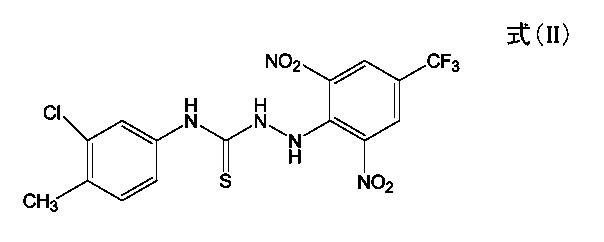
本発明のRas機能阻害物質のスクリーニング方法を行うに際し、Ras部分ポリペプチドについてのNMRシグナル、並びに、Ras機能阻害候補物質(a)とRas部分ポリペプチドと接触させ、得られた複合体についてのNMRシグナルとの違いは、以下のようにして解析することができる。
本発明のRas機能阻害候補物質(a)として、以下の式(II)~(IV)に示す化合物(各々、化合物(II)、化合物(III)、化合物(IV))をX線構造解析の立体構造情報から、インシリコ(in silico)スクリーニングにより得た。具体的には、化合物(II)はドッキングシミュレーション(MMPB-SA法)によりスクリーニングして得られ、化合物(III)及び化合物(IV)は、化合物(II)の類縁体探索(Tanimoto係数を指標に)でインシリコスクリーニングし、得られた。これらの化合物は、下記実験例1及び2に示す生化学・細胞学的活性検証試験を通じて同定した。

本実験例では、生化学活性検証試験により、実施例1で得た化合物(II)、化合物(III)及び化合物(IV)について、Ras-Raf結合阻害活性を確認した。本実験例において、RasとしてヒトH-Rasポリペプチド(1-166アミノ酸残基)を用い、GTPとしてGTPアナログ(GTPγ S(Roche Diagnotics))を用いた。また、Rasの標的蛋白質であるRafとして、ヒトc-Raf-1(51-130アミノ酸残基)を用いた。
Rasの標的蛋白質であるRafとGST(グルタチオンS-トランスフェラーゼ)との融合蛋白質を、GST融合蛋白質発現用ベクター(pGEX-6P-1 vector (GE Healthcare))を用いて大腸菌で発現させた。発現したGST-Raf融合蛋白質を精製用アフィニティー担体(glutathione Sepharose 4B:レジン (GE Healthcare))に固定した。
2)Ras放射性ラベル体
GST融合蛋白質切断用プロテアーゼ(PreScission protease (GE Healthcare))を用いてGSTタグを切断したRasに、GTPアナログの一つであるGTPγ[35S](Perkin Elmer)を付加し、Ras放射性ラベル体を作製した。
3)Ras-Raf結合阻害活性の測定
上記1)でレジンに固定したGST-Raf融合蛋白質と2)のRas放射性ラベル体を、10% DMSOに可溶化した種々の濃度の化合物(化合物(II)、化合物(III)又は化合物(IV))存在下でインキュベートし、RasとRafとの結合反応を促した。反応液中のレジンを洗浄後、グルタチオンの添加によりGST-Raf融合蛋白質とRas放射性ラベル体との複合体を溶出した。溶出液の放射活性をシンチレーションカウンティングすることにより、RasとRafとの結合活性を測定し、各種化合物によるRas-Raf結合阻害活性を評価した。その結果、これらの化合物はRasに相互作用することが確認された(図4)。
本実験例では、細胞学的活性検証試験により、実施例1で得た化合物(II)、化合物(III)及び化合物(IV)について、足場非依存性細胞増殖阻害活性を確認した。
本実施例では、Rasと化合物(III)との複合体についてNMRの実測データを示す。本実施例では、Rasとして変異型H-RasであるH-Ras T35S(1-166アミノ酸残基)を用い、GTPとしてGTPアナログ(Gpp(NH)p:CALBIOCHEM社)を用いた。以下の実施例でも同様である。
NMRによりRasのポケットを含む立体構造情報を取得するために、まず初めにRasを含むRas-GTPを作製することが必要である。Ras 3.6mgとGTP 1.1mgをpH中性の緩衝液1 mLに溶解し、Ras-GTPを作製した。次に、Ras-GTP 3.6mgを重水素化された緩衝溶液(pH6.8)0.16mLに溶解し、Ras-GTP溶液を調製した。化合物(III) 0.3 mgを重水素化されたDMSO(ジメチルスルホキシド)0.04 mLに溶解し、化合物(III)溶液を調製した。前記Ras-GTP溶液と化合物(III)溶液を混合し、20%DMSO、5℃条件でRas-GTPと化合物(III)の複合体を作製した。
Ras-GTPと化合物(III)の複合体について、13C-separeted NOESY-HSQCスペクトルによるNMR解析を行った。13C-separated NOESY-HSQCスペクトルでは、化合物(III)及びRas-GTPに由来する特定の水素同士が空間的に接近していると、両者の化学シフトが交差する位置にピークを生じる。スペクトルは炭素の化学シフトによって分離されている為、交差ピークを与える水素がどのアミノ酸あるいは原子団に由来しているかを帰属する事が可能である。従って、本方法によると、Ras-GTPと化合物(III)との間の相互作用を直接的にかつ原子レベルで示す事ができる。図6では化合物(III)に由来する水素と、Ras-GTP中のRas部分のポリペプチドにおける第5番目のリジン、第56番目のロイシン、第67番目のメチオニン、及び第74番目のトレオニンの側鎖に由来する水素との間に出現した交差ピークを示した。なお、図6中KOB316は化合物(III)を意味する。
実施例2と同手法により作製したRas-GTPと化合物(III)との複合体に関し、Rasと化合物(III)に近接するアミノ酸の距離情報(NOE情報)を確認した。Ras-GTPと化合物(III)との複合体について、実施例2と同様に13C-separated NOESY-HSQCスペクトルによるNMR解析を行った。13C-separated NOESY-HSQCにおける交差ピークの積分強度は水素間の距離に依存するため、化合物(III)とRas-GTPの間の距離情報に変換する事が可能である。各々の交差ピークを基にして得られた、化合物(III)に近接するRasのアミノ酸の距離情報を表1に示した。具体的には、Ras-GTP中のRasにおける第5番目のリジン、第56番目のロイシン、第67番目のメチオニン、第70番目のグルタミン、第71番目のチロシン、及び第74番目のトレオニンから選択されるアミノ酸残基の側鎖に由来する水素原子と化合物(III)の特定の水素原子との距離情報を示した。1種のアミノ酸に対して、複数の距離情報が認められるのは、各アミノ酸の中に幾つかの水素核種が存在し、その各々に対して相当する距離情報が存在する事を意味する。

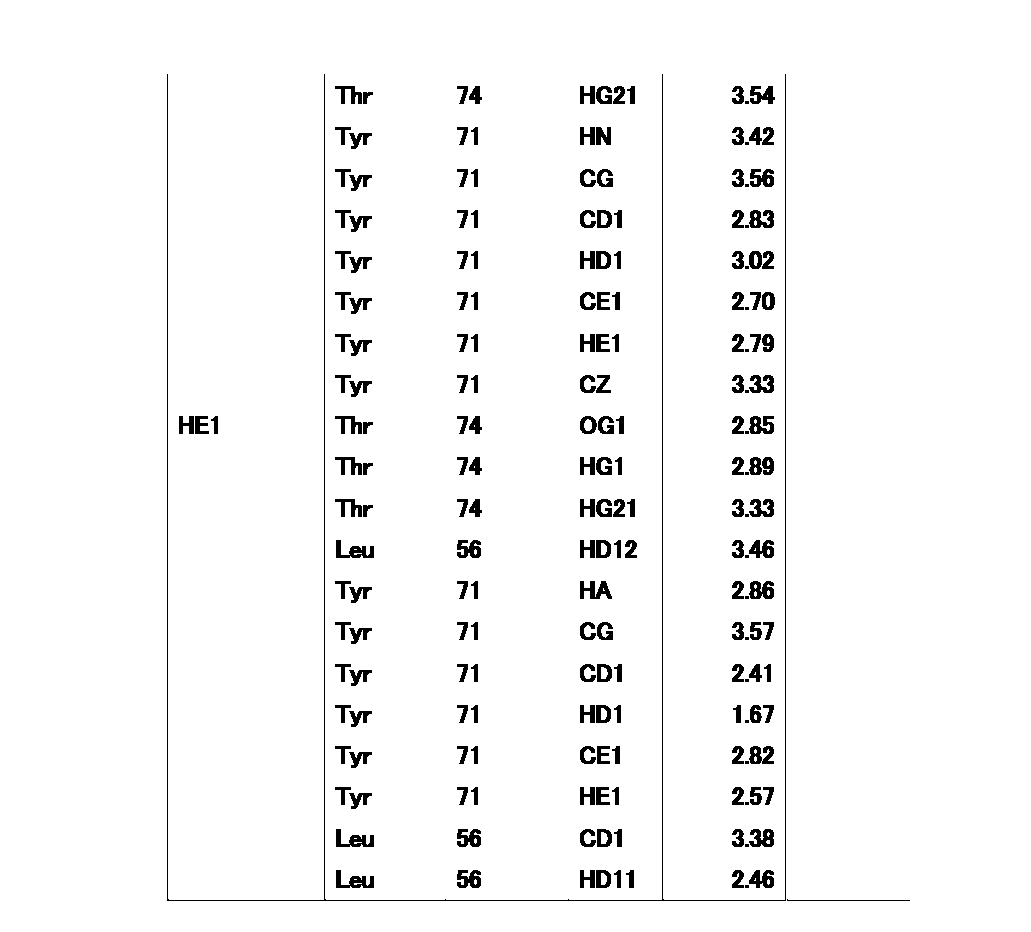
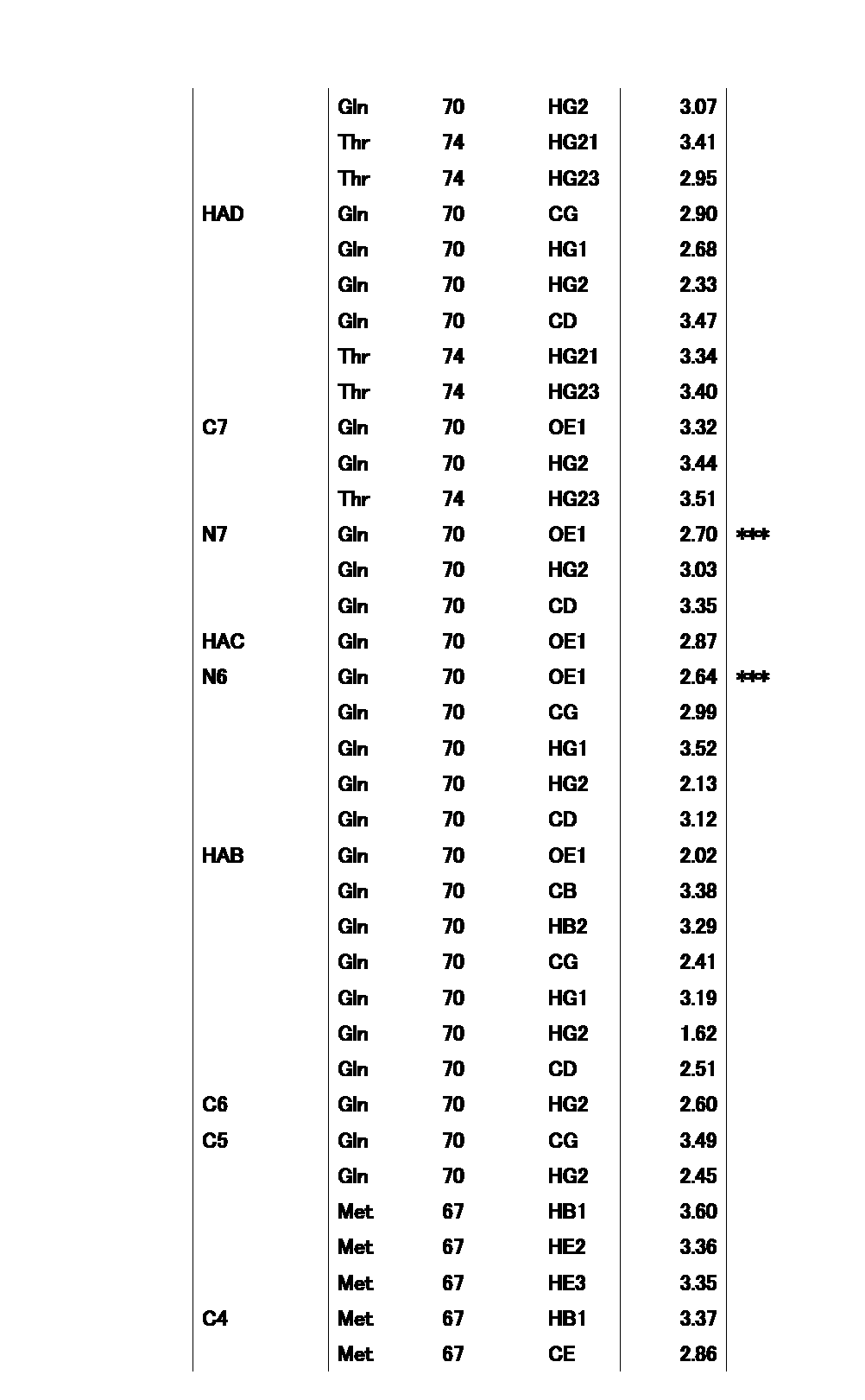
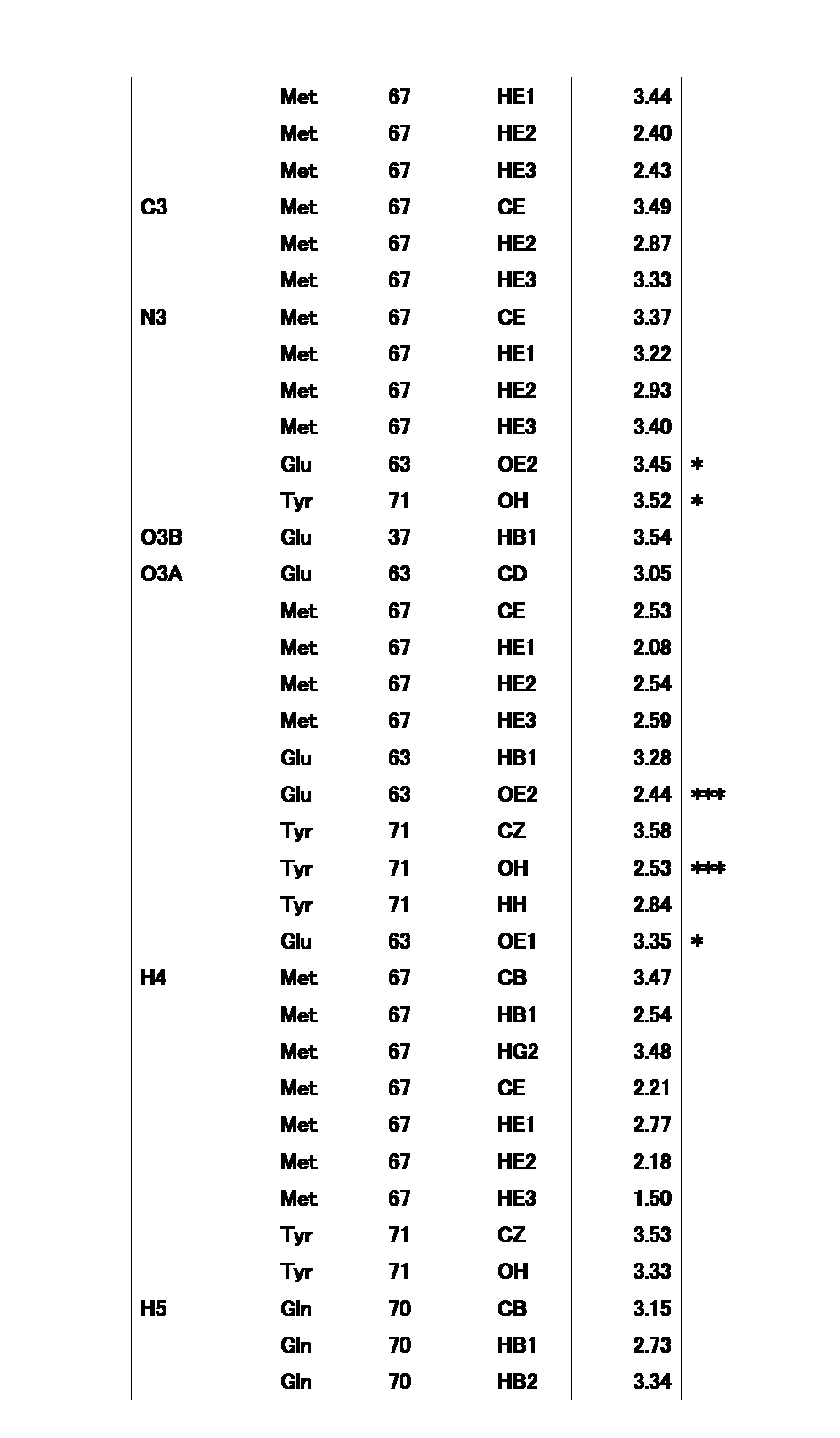
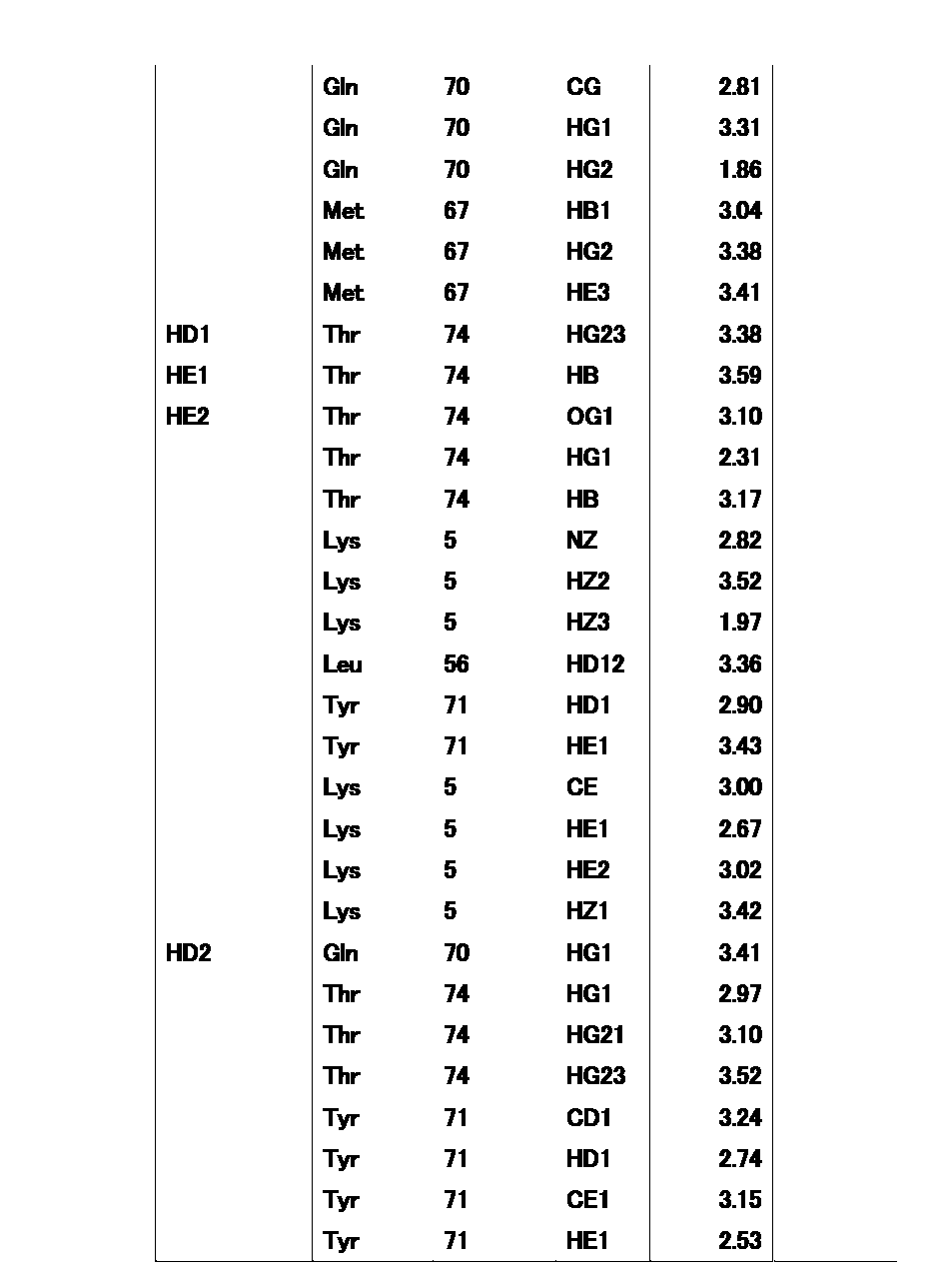
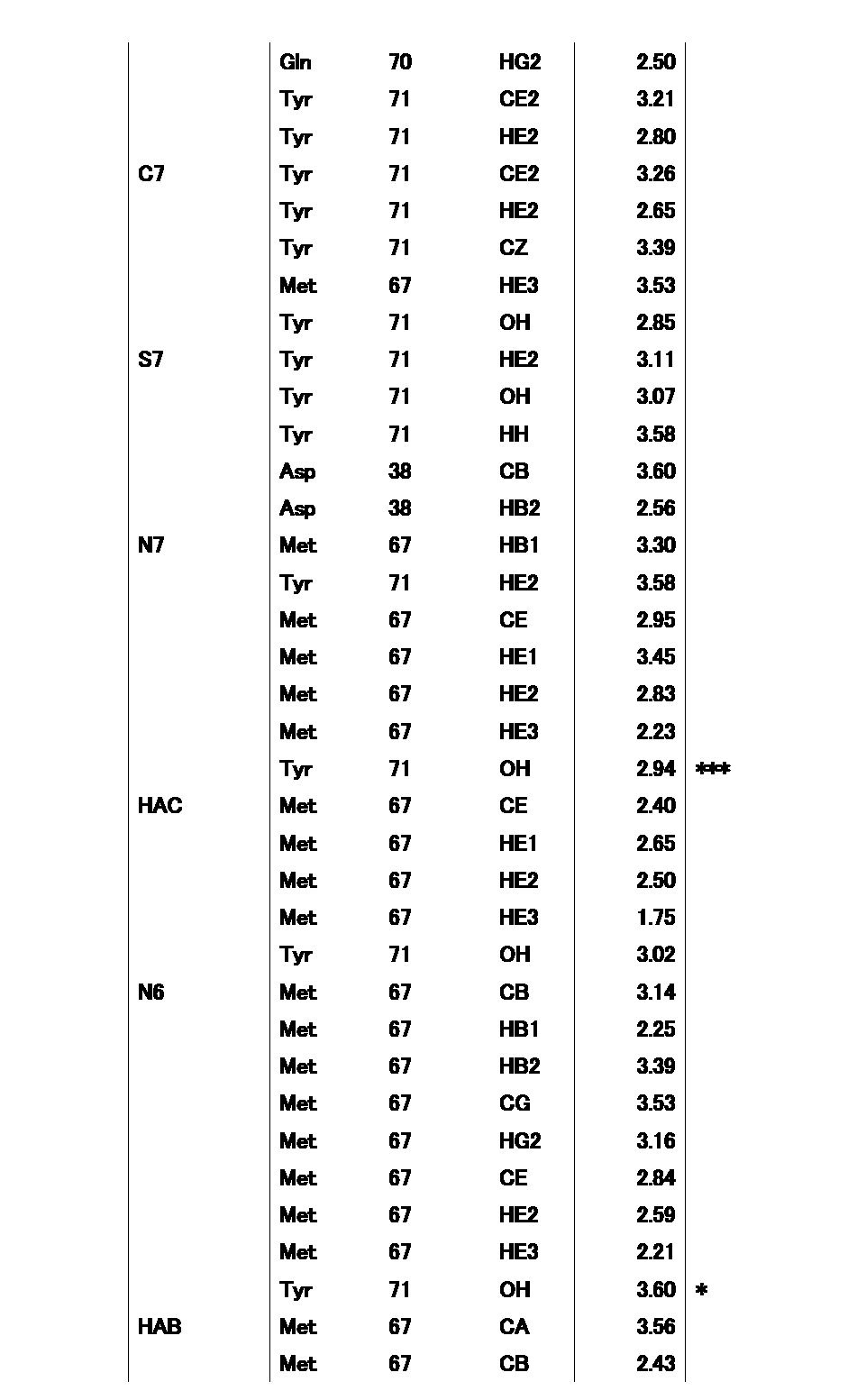
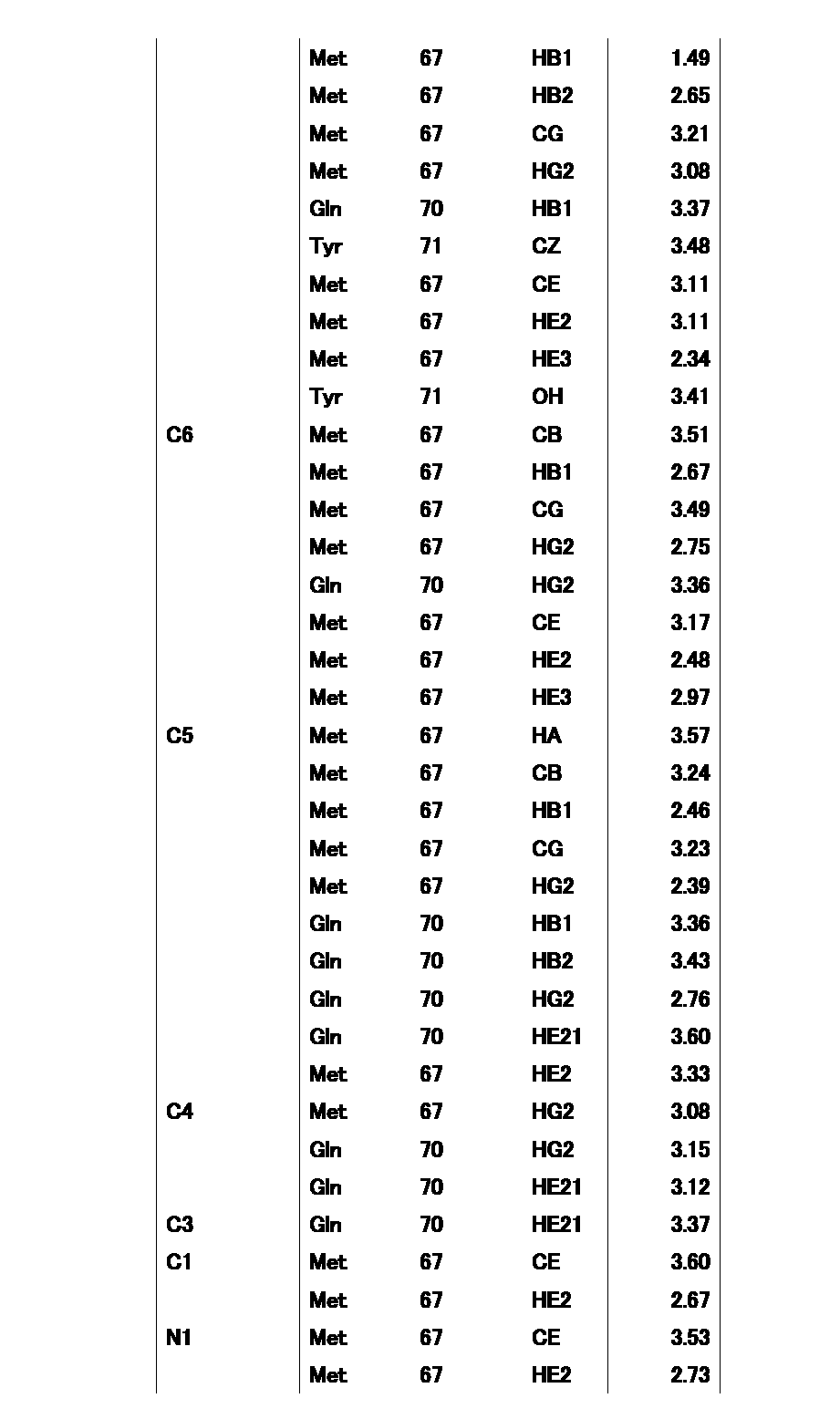
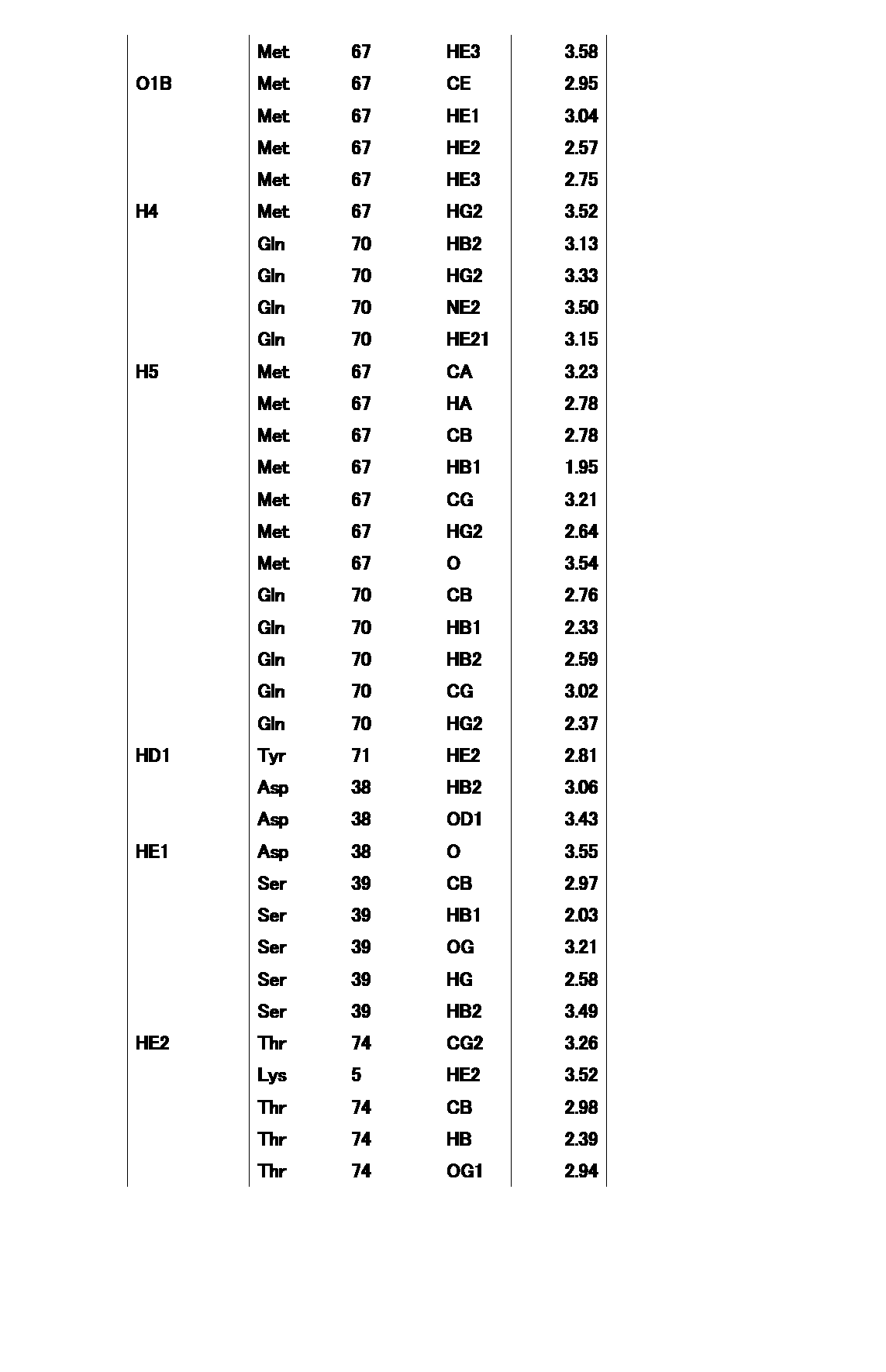
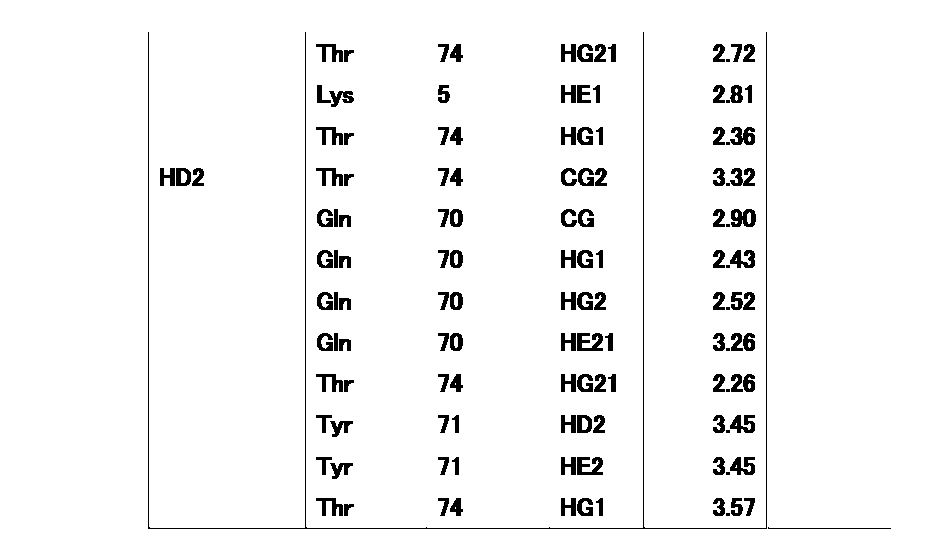
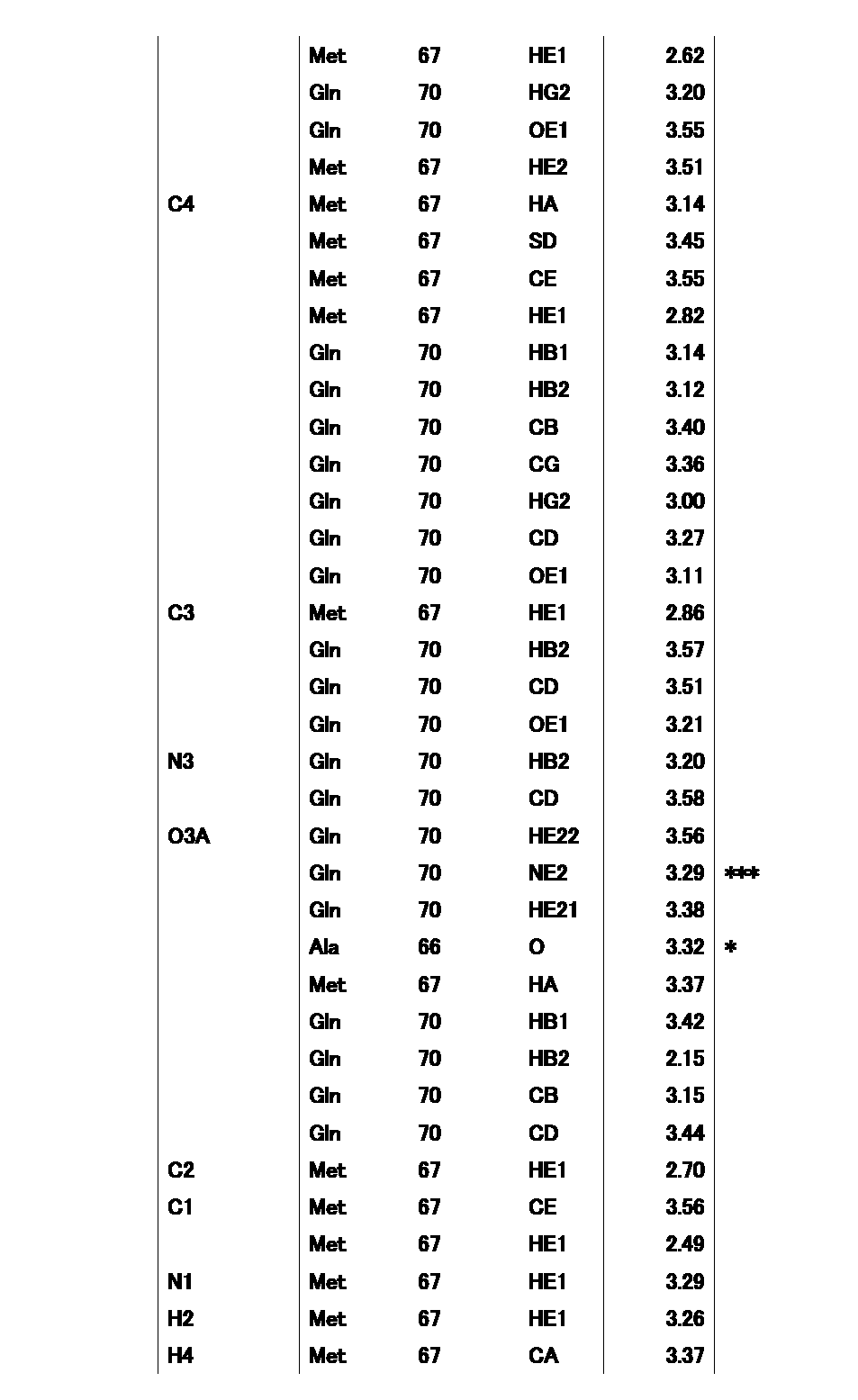
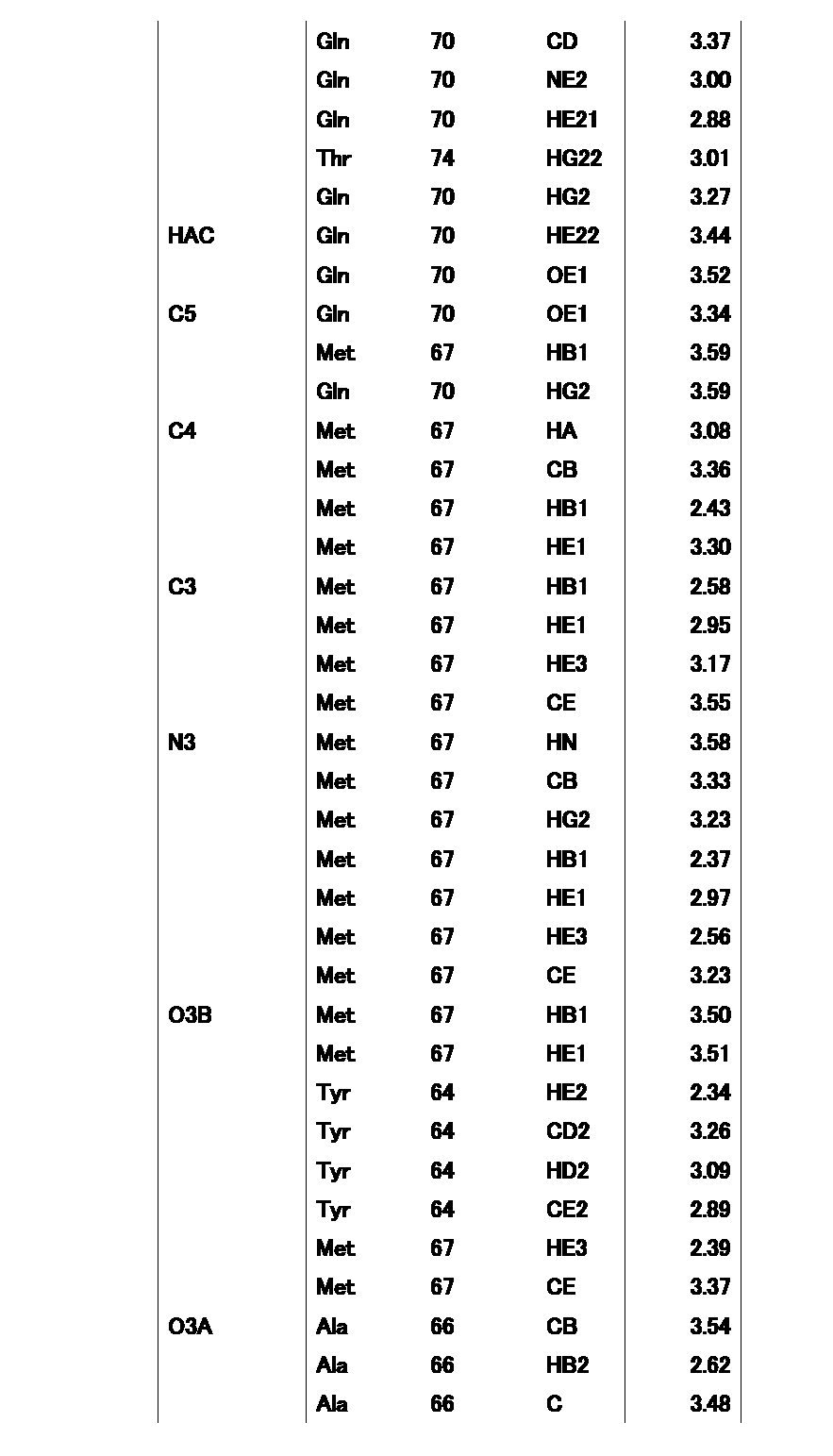
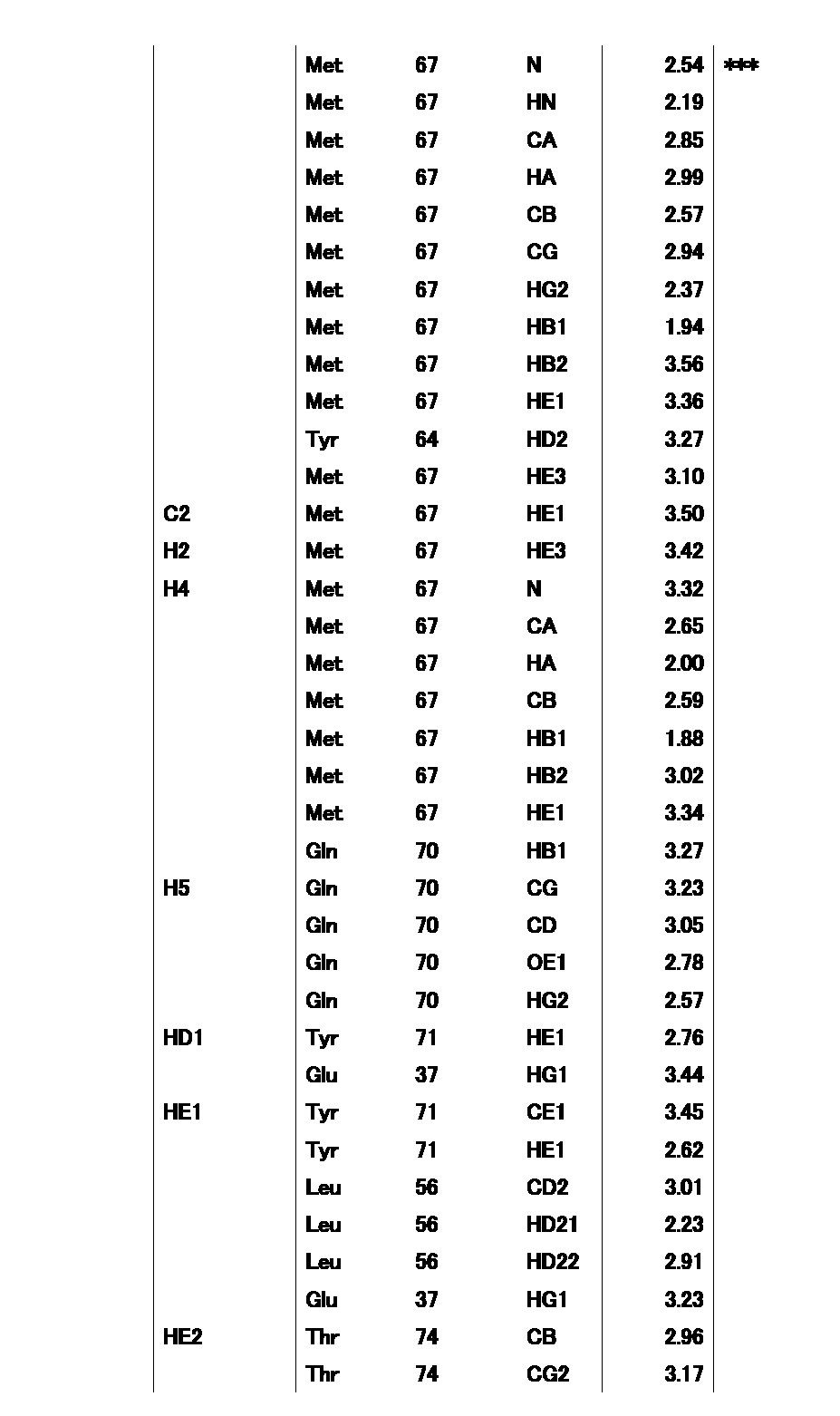
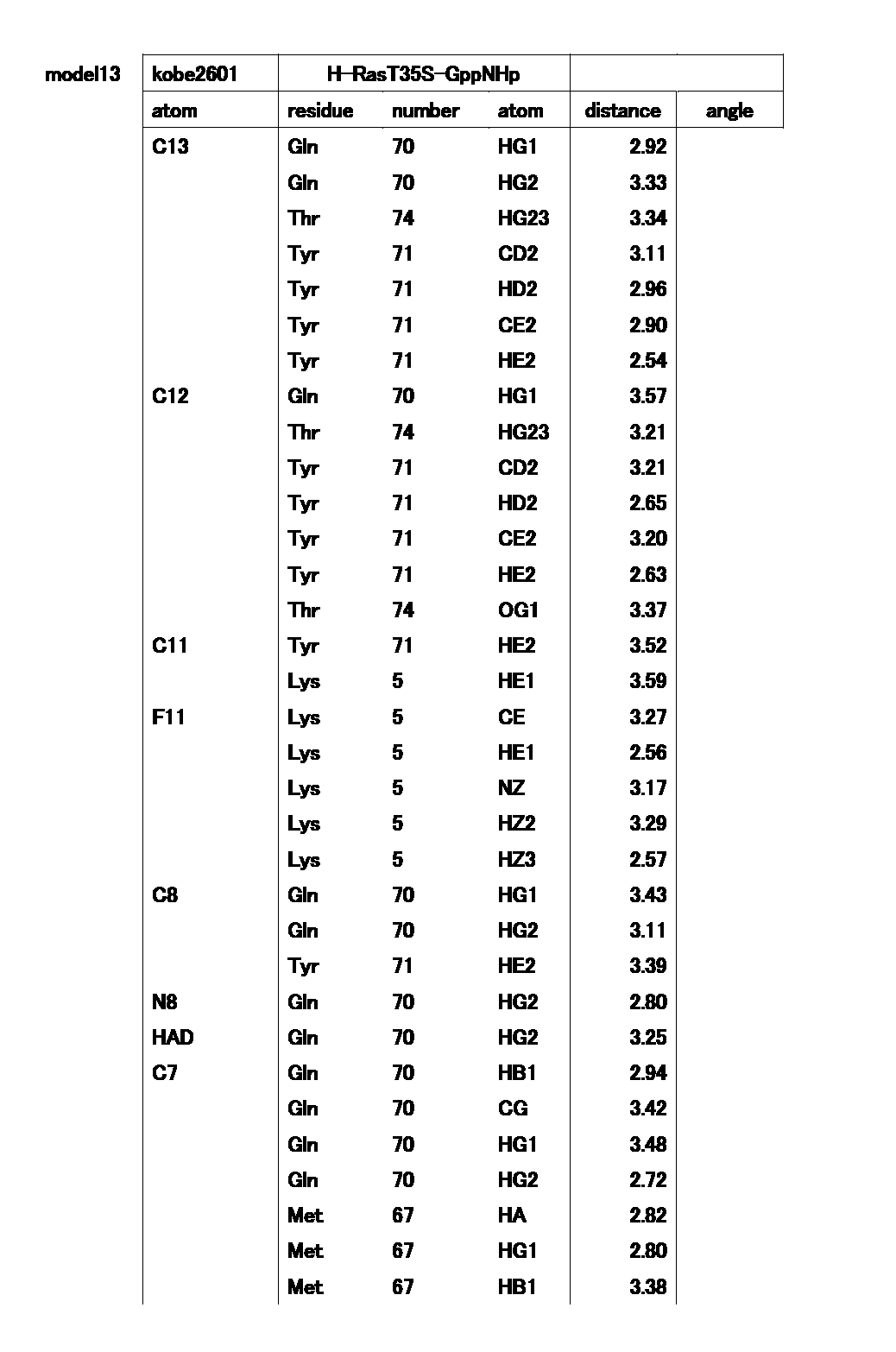
実施例2と同手法により作製したRas-GTPと、化合物(III)(kobe2601)との複合体に関し、15種類の複合体のNMR構造に基づき、CCP4 program suit(Collaborative Computational Project Number 4. (1994) Acta Crystallogr. D 50, 760-763)にあるCONTACTというプログラムで計算を行った。その結果、化合物(III)との相互作用が確認できた残基群(1)及びポケットの隙間を埋める形で選んだ残基群(2)を以下に示す。配列番号1に示すアミノ酸配列を基準とした場合、(1)第5番目のリジン(K)、第37番目のグルタミン酸(E)、第38番目のアスパラギン酸(D)、第39番目のセリン(S)、第56番目のロイシン(L)、第63番目のグルタミン酸(E)、第64番目のチロシン(Y)、第66番目のアラニン(A)、第67番目のメチオニン(M)、第70番目のグルタミン(Q)、第71番目のチロシン(Y)、第73番目のアルギニン(R)、及び第74番目のトレオニン(T)であり、(2)は、第6番目のロイシン(L)、第7番目のバリン(V)、第36番目のイソロイシン(I)、第41番目のアルギニン(R)、第54番目のアスパラギン酸(D)、第55番目のイソロイシン(I)、第57番目のアスパラギン酸(D)、第58番目のトレオニン(T)、第59番目のアラニン(A)、第65番目のセリン(S)、第75番目のグリシン(G)である。以下、15種類の複合体モデルについて、算出されたCONTACT情報を、表2~表16に示す。




























Claims (12)
- 以下の工程を含む、Ras機能阻害物質(A)のスクリーニング方法:
1)配列番号1に示すアミノ酸配列、又は配列番号1に示すアミノ酸配列から1~3個のアミノ酸が置換、欠失若しくは付加されたアミノ酸配列からなるRas部分ポリペプチドのNMRシグナルを得る工程;
2)Ras機能阻害候補物質(a)を、上記1)に記載のRas部分ポリペプチドと接触させ、得られた複合体についてのNMRシグナルを得る工程;
3)上記1)の工程で得られたNMRシグナルと、2)の工程で得られたNMRシグナルとの違いを解析し、Ras機能阻害候補物質(a)の誘導体であるRas機能阻害物質(A)を選別する工程。 - 配列番号1に示すアミノ酸配列、又は配列番号1に示すアミノ酸配列から1~3個のアミノ酸が置換、欠失若しくは付加されたアミノ酸配列からなるRas部分ポリペプチドにおいて、配列番号1に示すアミノ酸配列を基準とした場合に、第5番目のリジン(K)、第37番目のグルタミン酸(E)、第38番目のアスパラギン酸(D)、第39番目のセリン(S)、第56番目のロイシン(L)、第63番目のグルタミン酸(E)、第64番目のチロシン(Y)、第66番目のアラニン(A)、第67番目のメチオニン(M)、第70番目のグルタミン(Q)、第71番目のチロシン(Y)、第73番目のアルギニン(R)、及び第74番目のトレオニン(T)から選択される少なくとも3個以上のアミノ酸残基と相互作用しうる物質を選別することを特徴とする、Ras機能阻害候補物質(a)のスクリーニング方法。
- 以下の工程を含む、請求項2に記載のRas機能阻害候補物質(a)のスクリーニング方法:
1)請求項2に記載の部分ポリペプチドのうち、第5番目のリジン(K)、第37番目のグルタミン酸(E)、第38番目のアスパラギン酸(D)、第39番目のセリン(S)、第56番目のロイシン(L)、第63番目のグルタミン酸(E)、第64番目のチロシン(Y)、第66番目のアラニン(A)、第67番目のメチオニン(M)、第70番目のグルタミン(Q)、第71番目のチロシン(Y)、第73番目のアルギニン(R)、及び第74番目のトレオニン(T)から選択される少なくとも3個以上のアミノ酸残基をNMR測定可能な同位体で標識したポリペプチドを作製し、当該標識ポリペプチドについてのNMRシグナルを得る工程;
2)候補物質を、1)の工程で作製した標識ポリペプチドと接触させて、候補物質と標識ポリペプチドとの複合体についてのNMRシグナルを得る工程;
3)上記1)の工程で得られたNMRシグナルと2)の工程で得られたNMRシグナルとの違いに基づいて、標識ポリペプチドと相互作用しうる物質を、Ras機能阻害候補物質(a)として選別する工程。 - Ras部分ポリペプチドが、配列番号1に示すアミノ酸配列のうち、35番目のトレオニンがセリンに置換されているアミノ酸配列からなるポリペプチドである、請求項1に記載のRas機能阻害物質(A)又は請求項2~3のいずれか1に記載のRas機能阻害候補物質(a)のスクリーニング方法。
- Ras機能阻害候補物質(a)が、以下の一般式(I)で表される、請求項1に記載のRas機能阻害物質(A)のスクリーニング方法。

- 以下の一般式(I)で表されるRas機能阻害候補物質(a)を有効成分とするRas機能阻害剤。
- 配列番号1に示すアミノ酸配列、又は配列番号1に示すアミノ酸配列から1~3個のアミノ酸が置換、欠失若しくは付加されたアミノ酸配列からなるRas部分ポリペプチドと、以下の一般式(I)で表されるRas機能阻害候補物質(a)との複合体。

- Ras部分ポリペプチドが、配列番号1に示すアミノ酸配列のうち、35番目のトレオニンがセリンに置換されているアミノ酸配列からなるポリペプチドである、請求項7に記載の複合体。
- NMRシグナルにより特定される請求項7又は8に記載の複合体。
- 配列番号1に示すアミノ酸配列、又は配列番号1に示すアミノ酸配列から1~3個のアミノ酸が置換、欠失若しくは付加されたアミノ酸配列からなるRas部分ポリペプチドを含む水溶液であって、
当該Ras部分ポリペプチドの立体構造が、以下の1)及び2)であること特徴とするRas部分ポリペプチド含有水溶液:
1)当該Ras部分ポリペプチドの立体構造が、特定の物質と結合しうるポケットを有する立体構造からなり;
2)当該特定の物質が、当該Ras部分ポリペプチドにおいて、配列番号1に示すアミノ酸配列を基準とした場合に、第5番目のリジン(K)、第37番目のグルタミン酸(E)、第38番目のアスパラギン酸(D)、第39番目のセリン(S)、第56番目のロイシン(L)、第63番目のグルタミン酸(E)、第64番目のチロシン(Y)、第66番目のアラニン(A)、第67番目のメチオニン(M)、第70番目のグルタミン(Q)、第71番目のチロシン(Y)、第73番目のアルギニン(R)、及び第74番目のトレオニン(T)から選択される少なくとも3個以上のアミノ酸残基と相互作用しうる物質である。 - Ras部分ポリペプチドが、配列番号1に示すアミノ酸配列のうち、35番目のトレオニンがセリンに置換されているアミノ酸配列からなるポリペプチドである、請求項10に記載のRas部分ポリペプチド含有水溶液。
- 特定の物質が、一般式(I)に示されるRas機能阻害剤(a)であることを特徴とする、請求項10又は11に記載のRas部分ポリペプチド含有水溶液。
Priority Applications (2)
| Application Number | Priority Date | Filing Date | Title |
|---|---|---|---|
| US13/984,027 US20140024123A1 (en) | 2011-02-07 | 2012-01-31 | Aqueous Solution Containing Partial Ras Polypeptide and Method for Screening Inhibitor of Ras Function |
| JP2012556832A JPWO2012108297A1 (ja) | 2011-02-07 | 2012-01-31 | Ras部分ポリペプチド含有水溶液及びRas機能阻害剤のスクリーニング方法 |
Applications Claiming Priority (2)
| Application Number | Priority Date | Filing Date | Title |
|---|---|---|---|
| JP2011023695 | 2011-02-07 | ||
| JP2011-023695 | 2011-02-07 |
Publications (1)
| Publication Number | Publication Date |
|---|---|
| WO2012108297A1 true WO2012108297A1 (ja) | 2012-08-16 |
Family
ID=46638513
Family Applications (1)
| Application Number | Title | Priority Date | Filing Date |
|---|---|---|---|
| PCT/JP2012/052078 Ceased WO2012108297A1 (ja) | 2011-02-07 | 2012-01-31 | Ras部分ポリペプチド含有水溶液及びRas機能阻害剤のスクリーニング方法 |
Country Status (3)
| Country | Link |
|---|---|
| US (1) | US20140024123A1 (ja) |
| JP (1) | JPWO2012108297A1 (ja) |
| WO (1) | WO2012108297A1 (ja) |
Cited By (1)
| Publication number | Priority date | Publication date | Assignee | Title |
|---|---|---|---|---|
| WO2021172326A1 (en) * | 2020-02-24 | 2021-09-02 | Takeda Pharmaceutical Company Limited | Determination of modification degree of therapeutic proteins using 1h-nmr spectroscopy |
Families Citing this family (1)
| Publication number | Priority date | Publication date | Assignee | Title |
|---|---|---|---|---|
| WO2016176338A1 (en) * | 2015-04-30 | 2016-11-03 | The Trustees Of Columbia University In The City Of New York | Small molecule ras ligands |
Citations (3)
| Publication number | Priority date | Publication date | Assignee | Title |
|---|---|---|---|---|
| JPH11513498A (ja) * | 1995-11-14 | 1999-11-16 | アボツト・ラボラトリーズ | 生体分子の標的用リガンドを同定するための核磁気共鳴の使用 |
| JP2010169694A (ja) * | 2003-11-28 | 2010-08-05 | Hitachi Ltd | 核磁気共鳴法を用いた、標的タンパク質のアゴニストおよびアンタゴニストの同定方法、およびこの方法に用いるプログラム |
| WO2011007773A1 (ja) * | 2009-07-14 | 2011-01-20 | 国立大学法人神戸大学 | 変異型Rasポリペプチドの結晶 |
-
2012
- 2012-01-31 WO PCT/JP2012/052078 patent/WO2012108297A1/ja not_active Ceased
- 2012-01-31 US US13/984,027 patent/US20140024123A1/en not_active Abandoned
- 2012-01-31 JP JP2012556832A patent/JPWO2012108297A1/ja active Pending
Patent Citations (3)
| Publication number | Priority date | Publication date | Assignee | Title |
|---|---|---|---|---|
| JPH11513498A (ja) * | 1995-11-14 | 1999-11-16 | アボツト・ラボラトリーズ | 生体分子の標的用リガンドを同定するための核磁気共鳴の使用 |
| JP2010169694A (ja) * | 2003-11-28 | 2010-08-05 | Hitachi Ltd | 核磁気共鳴法を用いた、標的タンパク質のアゴニストおよびアンタゴニストの同定方法、およびこの方法に用いるプログラム |
| WO2011007773A1 (ja) * | 2009-07-14 | 2011-01-20 | 国立大学法人神戸大学 | 変異型Rasポリペプチドの結晶 |
Non-Patent Citations (1)
| Title |
|---|
| SHIMA F ET AL.: "Structural Basis for Conformational Dynamics of GTP-bou Ras Protein", J BIOL CHEM, vol. 285, no. 29, 16 July 2010 (2010-07-16), pages 22696 - 22705 * |
Cited By (4)
| Publication number | Priority date | Publication date | Assignee | Title |
|---|---|---|---|---|
| WO2021172326A1 (en) * | 2020-02-24 | 2021-09-02 | Takeda Pharmaceutical Company Limited | Determination of modification degree of therapeutic proteins using 1h-nmr spectroscopy |
| JP2023515515A (ja) * | 2020-02-24 | 2023-04-13 | 武田薬品工業株式会社 | 1h-nmr分光法を使用した治療用タンパク質の修飾度の決定方法 |
| JP7684982B2 (ja) | 2020-02-24 | 2025-05-28 | 武田薬品工業株式会社 | 1h-nmr分光法を使用した治療用タンパク質の修飾度の決定方法 |
| US12553842B2 (en) | 2020-02-24 | 2026-02-17 | Takeda Pharmaceutical Company Limited | Determination of modification degree of therapeutic proteins using 1H-NMR spectroscopy |
Also Published As
| Publication number | Publication date |
|---|---|
| JPWO2012108297A1 (ja) | 2014-07-03 |
| US20140024123A1 (en) | 2014-01-23 |
Similar Documents
| Publication | Publication Date | Title |
|---|---|---|
| Dixon et al. | Predicting the structural basis of targeted protein degradation by integrating molecular dynamics simulations with structural mass spectrometry | |
| Oxley et al. | An integrin phosphorylation switch: the effect of β3 integrin tail phosphorylation on Dok1 and talin binding | |
| des Georges et al. | Structural basis for gating and activation of RyR1 | |
| Pappa et al. | Crystal structure of the C2 domain from protein kinase C-δ | |
| Carafoli et al. | Crystallographic insight into collagen recognition by discoidin domain receptor 2 | |
| Bogomolovas et al. | Titin kinase ubiquitination aligns autophagy receptors with mechanical signals in the sarcomere | |
| Kumar et al. | Short linear sequence motif LxxPTPh targets diverse proteins to growing microtubule ends | |
| Huang et al. | Structural basis for the activation of platelet integrin αIIbβ3 by calcium-and integrin-binding protein 1 | |
| Liu et al. | The structure of the Tiam1 PDZ domain/phospho-syndecan1 complex reveals a ligand conformation that modulates protein dynamics | |
| Duffy et al. | Discovery of a new chemical series of BRD4 (1) inhibitors using protein-ligand docking and structure-guided design | |
| Piazza et al. | Structural studies of a complex between endothelial nitric oxide synthase and calmodulin at physiological calcium concentration | |
| Huang et al. | Symmetry and asymmetry of the RING–RING dimer of Rad18 | |
| de Barros et al. | Structural and calorimetric studies demonstrate that xeroderma pigmentosum type G (XPG) can be imported to the nucleus by a classical nuclear import pathway via a monopartite NLS sequence | |
| Brosey et al. | NADH-bound AIF activates the mitochondrial CHCHD4/MIA40 chaperone by a substrate-mimicry mechanism | |
| Yu et al. | The Crystal Structure of Calmodulin Bound to the Cardiac Ryanodine Receptor (RyR2) at Residues Phe4246–Val4271 Reveals a Fifth Calcium Binding Site | |
| US20110166032A1 (en) | Design and Use of Sortilin Specific Molecular Imaging Ligands | |
| Lorenz et al. | Structural analysis of the interactions between paxillin LD motifs and α-parvin | |
| Yip et al. | Small molecules antagonise the MIA-Fibronectin interaction in malignant melanoma | |
| Chua et al. | Structure and binding interface of the cytosolic tails of αXβ2 integrin | |
| Satoh et al. | Crystal structures of inhibitor complexes of human T-cell leukemia virus (HTLV-1) protease | |
| US20040197893A1 (en) | HDM2-inhibitor complexes and uses thereof | |
| JPWO2012108297A1 (ja) | Ras部分ポリペプチド含有水溶液及びRas機能阻害剤のスクリーニング方法 | |
| Huang et al. | Solution structures of Ca2+-CIB1 and Mg2+-CIB1 and their interactions with the platelet integrin αIIb cytoplasmic domain | |
| Banasik et al. | Structural dynamics of the TPR domain of the peroxisomal cargo receptor Pex5 in Trypanosoma | |
| Guttman et al. | The structure, dynamics, and binding of the LA45 module pair of the low-density lipoprotein receptor suggest an important role for LA4 in ligand release |
Legal Events
| Date | Code | Title | Description |
|---|---|---|---|
| 121 | Ep: the epo has been informed by wipo that ep was designated in this application |
Ref document number: 12745257 Country of ref document: EP Kind code of ref document: A1 |
|
| ENP | Entry into the national phase |
Ref document number: 2012556832 Country of ref document: JP Kind code of ref document: A |
|
| NENP | Non-entry into the national phase |
Ref country code: DE |
|
| WWE | Wipo information: entry into national phase |
Ref document number: 13984027 Country of ref document: US |
|
| 122 | Ep: pct application non-entry in european phase |
Ref document number: 12745257 Country of ref document: EP Kind code of ref document: A1 |