C-28 AMINES OF C-3 MODIFIED BETULINIC ACID DERIVATIVES AS HIV
MATURATION INHIBITORS
CROSS REFERENCE TO RELATED APPLICATIONS
This non-provisional application claims the benefit of U.S. Provisional Application Serial Number 61/ 437,870 filed January 31, 201 1.
FIELD OF THE INVENTION
The present invention relates to novel compounds useful against HIV, and more particularly, to compounds derived from betulinic acid and other structurally related compounds which are useful as HIV maturation inhibitors, and to
pharmaceutical compositions containing same, as well as to methods for their preparation.
BACKGROUND OF THE INVENTION
HrV-1 (human immunodeficiency virus -1) infection remains a major medical problem, with an estimated 45 million people infected worldwide at the end of 2007. The number of cases of HIV and AIDS (acquired immunodeficiency syndrome) has risen rapidly. In 2005, approximately 5.0 million new infections were reported, and 3.1 million people died from AIDS. Currently available drugs for the treatment of HIV include nucleoside reverse transcriptase (RT) inhibitors or approved single pill combinations: zidovudine (or AZT or Retrovir®), didanosine (or Videx®), stavudine (or Zerit®), lamivudine (or 3TC or Epivir®), zalcitabine (or DDC or Hivid®), abacavir succinate (or Ziagen®), Tenofovir disoproxil fumarate salt (or Viread®), emtricitabine (or FTC - Emtriva®), Combivir® (contains -3TC plus AZT), Trizivir® (contains abacavir, lamivudine, and zidovudine), Epzicom® (contains abacavir and lamivudine), Truvada® (contains Viread® and Emtriva®); non-nucleoside reverse transcriptase inhibitors: nevirapine (or Viramune®), delavirdine (or Rescriptor®) and efavirenz (or Sustiva®), Atripla® (Truvada® + Sustiva®), and etravirine, and peptidomimetic protease inhibitors or approved formulations: saquinavir, indinavir, ritonavir,
nelfinavir, amprenavir, lopinavir, KaletraR(lopinavir and Ritonavir), darunavir, atazanavir (Reyataz ) and tipranavir (Aptivus ), and integrase inhibitors such as
® ® raltegravir (Isentress ), and entry inhibitors such as enfuvirtide (T-20) (Fuzeon ) and maraviroc (Selzentry®).
Each of these drugs can only transiently restrain viral replication if used alone. However, when used in combination, these drugs have a profound effect on viremia and disease progression. In fact, significant reductions in death rates among AIDS patients have been recently documented as a consequence of the widespread application of combination therapy. However, despite these impressive results, 30 to 50% of patients may ultimately fail combination drug therapies. Insufficient drug potency, non-compliance, restricted tissue penetration and drug-specific limitations within certain cell types (e.g. most nucleoside analogs cannot be phosphorylated in resting cells) may account for the incomplete suppression of sensitive viruses.
Furthermore, the high replication rate and rapid turnover of HIV- 1 combined with the frequent incorporation of mutations, leads to the appearance of drug-resistant variants and treatment failures when sub-optimal drug concentrations are present. Therefore, novel anti-HIV agents exhibiting distinct resistance patterns, and favorable pharmacokinetic as well as safety profiles are needed to provide more treatment options. Improved HIV fusion inhibitors and HIV entry coreceptor antagonists are two examples of new classes of anti-HIV agents further being studied by a number of investigators.
HIV attachment inhibitors are a further subclass of antiviral compounds that bind to the HIV surface glycoprotein gpl20, and interfere with the interaction between the surface protein gpl20 and the host cell receptor CD4. Thus, they prevent HIV from attaching to the human CD4 T-cell, and block HIV replication in the first stage of the HIV life cycle. The properties of HIV attachment inhibitors have been improved in an effort to obtain compounds with maximized utility and efficacy as antiviral agents. In particular, US 7,354, 924 and US 2005/0209246 are illustrative of HIV attachment inhibitors.
Another emerging class of HIV treatment compounds are called HIV maturation inhibitors. Maturation is the last of as many as 10 or more steps in HIV replication or the HIV life cycle, in which HIV becomes infectious as a consequence of several HIV protease-mediated cleavage events in the gag protein that ultimately results in release of the capsid (CA) protein. Maturation inhibitors prevent the HIV capsid from properly assembling and maturing, from forming a protective outer coat, or from emerging from human cells. Instead, non-infectious viruses are produced, preventing subsequent cycles of HIV infection. Certain derivatives of betulinic acid have now been shown to exhibit potent anti-HIV activity as HIV maturation inhibitors. For example, US 7,365,221 discloses monoacylated betulin and dihydrobetuline derivatives, and their use as anti-HIV agents. As discussed in the '221 reference, esterification of betulinic acid (1) with certain substituted acyl groups, such as 3',3'-dimethylglutaryl and 3',3'- dimethylsuccinyl groups produced derivatives having enhanced activity (Kashiwada, Y., et al, J. Med. Chem. 39: 1016-1017 (1996)). Acylated betulinic acid and dihydrobetulinic acid derivatives that are potent anti-HIV agents are also described in U.S. Pat. No. 5,679,828. Esterification of the hydroxyl in the 3 carbon of betulin with succinic acid also produced a compound capable of inhibiting HIV-1 activity (Pokrovskii, A. G., et al, Gos. Nauchnyi Tsentr Virusol. Biotekhnol. "Vector" 9:485- 491 (2001)).
Other references to the use of treating HIV infection with compounds derived from betulinic acid include US 2005/0239748 and US 2008/0207573, as well as WO 2006/053255, WO2009/100532, and WO 2011/007230.
One HIV maturation compound that has been in development has been identified as Bevirimat or PA-457, with the chemical formula of C36H5606 and the IUPAC name of 3β- (3-carboxy-3-methyl-butanoyloxy) lup-20(29)-en-28-oic acid.
Reference is also made herein to the applications by Bristol-Myers Squibb entitled "MODIFIED C-3 BETULINIC ACID DERIVATIVES AS HIV
MATURATION INHIBITORS" USSN 13/151,706 filed on June 2, 2011 and "C-28
AMIDES OF MODIFIED C-3 BETULI IC ACID DERIVATIVES AS HIV
MATURATION INHIBITORS" USSN 13/151,722, filed on June 2, 201 1.
What is now needed in the art are new compounds which are useful as HIV maturation inhibitors, as well as new pharmaceutical compositions containing these compounds.
SUMMARY OF THE INVENTION The present invention provides compounds of Formulas I, II, and III below, including pharmaceutically acceptable salts thereof, their pharmaceutical formulations, and their use in patients suffering from or susceptible to a virus such as HIV. The compounds of Formulas I - III are effective antiviral agents, particularly as inhibitors of HIV. They are useful for the treatment of HIV and AIDS.
One embodiment of the present invention is directed to a compound, including pharmaceutically acceptable salts thereof, which is selected from the group of: a compound of formula I
Formula I a compound of formula II
a compound of formula III
Formula III
wherein Ri is isopropenyl or isopropyl;
J and E are independently -H or -CH3 and E is absent when the double bond is present;
X is a phenyl or heteroaryl ring substituted with A, wherein A is at least one member selected from the group of -H, -halo, -hydroxyl, -Ci_6 alkyl, -Ci_6 alkoxy, and - COOR2;
R2 is -H, -Ci-6 alkyl, -alkylsubstituted C e alkyl or -arylsubstituted C e alkyl; Y is selected from the group of -COOR2, -C(0)NR2S02R3, - C(0)NHS02NR2R2, - NR2S02R2, -S02NR2R2, -C3-6 cycloalkyl-COOR2, -C1-6 alkenyl-COOR2, -C1-6 alkynyl-COOR2, -C1-6 alkyl-COOR2, -NHC(0)(CH2)n-COOR2, -S02NR2C(0)R2, -tetrazole, and -CONHOH, wherein n=l-6; R3 is -Ci-6 alkyl or alkylsubstituted Ci_6 alkyl;
R4 IS selected from the group of H, -C e alkyl, -C3-6 cycloalkyl, -Ci_6 substituted alkyl, -Ci-6 alkyl-heteroaryl, -C e alkyl-substitutedheteroaryl, -Ci_6 alkyl- RgR?, - C e alkyl- CONR8R9, - C3-6 cycloalkyl-CONR8R9, -C3-6 cycloalkyl-(CH2) i-3-NR6R7, -(CH2) 1-3- C3-6 cycloalkyl-NRsR?; -(CH2) !_3-C3-6 cycloalkyl-(CH2)1_3-NR6R7; -C1-6 alkyl-Qi, C3-6 cycloalkyl-Qi, -CORi0,-SO2R3 and -S02NR2R2;
Qi = -hydroxy, -COOR
2, -halo, -S0
2R
a;
;
Rb= -H, -Ci_6 alkyl, -COR3, -S02R3, -SONR3R3 can also be selected from the group of
R5 is selected from the group of -H, -Ci_6 alkyl, -C3-6 cycloalkyl, -Ci_6 alkylsubstituted alkyl, -CORi
0,-SO
2R
3 and -S0
2NR
2R
2; with the proviso that only one of R4 or R
5 can be selected from the group of -COR
10,- S0
2R
3 and -S0
2NR
2R
2; or R4 and R5 are taken together with the adjacent N to form a cycle such as
Rio is selected from the group of -H, -Ci-6 alkyl, -Ci-6 alkyl-NReR?, -NRnRi2, -OR] -Ci-6 alkyl-Q2, -C3-6 cycloalkyl-Q2, aryl-Q2, wherein n =1-6, wherein Q2 = hydroxy, -COOR2, -halo, S02Ra, -CONHS02R3, -CONHS02NR2R2;
Rio can also be selected from the group of:
Re and R7 are independently selected from the group of -H, -Ci_6 alkyl, -Ci_6 substituted alkyl, aryl, heteroaryl, substituted aryl, substituted heteroaryl, and -Ci_6 alkyl-Qi,
or R6 and R7 are taken together with the adjacent N to form a cycle selected from the group of
d_
6 alkyl, NR
2R
2, -COOR
3;
Rs and R9 are independently selected from the group of -H, -Ci_6 alkyl, -C3-6 cycloalkyl, -Ci_6 substituted alkyl, -Ci_6 alkyl-heteroaryl, -Ci_6 alkyl- substitutedheteroaryl, -C1-6 alkyl-NR2R2, -C1-6 alkyl-CONR2R2, -Ci_6 alkyl-Qi, cycloalkyl-Qi, or R8 and R9 can also be independently selected from the group of
and Rii and R12 are independently selected from the group of -H, -C e alkyl, -C3-6 cycloalkyl, and -Ci_6 alkylsubstituted alkyl;
or R11 and R12 are taken together with the adjacent N to form a cycle selected from the group of
Ri3 is selected from the group of-H, -C e alkyl, -C e alkylsubstituted alkyl, and -Ci_6 alkyl NR14R15, wherein
Ri
4 and R15 are independently selected from the group of-H, -Ci_6 alkyl, and -Ci_6 alkylsubstituted alkyl, or R14 and R15 are taken together with the adjacent N to form a cycle selected from the group of
In a further embodiment, there is provided a method for treating mammals infected with a virus, especially wherein said virus is HIV, comprising administering to said mammal an antiviral effective amount of a compound which is selected from the group of compounds of Formulas I, II, III above, and one or more
pharmaceutically acceptable carriers, excipients or diluents. Optionally, the compound of Formulas I, II, and/or III can be administered in combination with an antiviral effective amount of another- AIDS treatment agent selected from the group consisting of: (a) an AIDS antiviral agent; (b) an anti-infective agent; (c) an immunomodulator; and (d) other HIV entry inhibitors.
Another embodiment of the present invention is a pharmaceutical composition comprising an antiviral effective amount of a compound which is selected from the group of compounds of Formulas I, II, and III, and one or more pharmaceutically acceptable carriers, excipients, and diluents; and optionally in combination with an antiviral effective amount of another AIDS treatment agent selected from the group consisting of: (a) an AIDS antiviral agent; (b) an anti-infective agent; (c) an immunomodulator; and (d) other HIV entry inhibitors.
In another embodiment of the invention there is provided one or more methods for making the compounds of Formulas I, II, and III.
Also provided herein are intermediate compounds useful in making the compounds of Formulas I, II, and III.
The present invention is directed to these, as well as other important ends, hereinafter described. DETAILED DESCRIPTION OF THE EMBODIMENTS
Since the compounds of the present invention may possess asymmetric centers and therefore occur as mixtures of diastereomers and enantiomers, the present disclosure includes the individual diastereoisomeric and enantiomeric forms of the compounds of Formulas I, II and III in addition to the mixtures thereof.
Definitions
Unless otherwise specifically set forth elsewhere in the application, one or more of the following terms may be used herein, and shall have the following meanings:
"H" refers to hydrogen, including its isotopes, such as deuterium.
The term "Cl _6 alkyl" as used herein and in the claims (unless specified otherwise) mean straight or branched chain alkyl groups such as methyl, ethyl, propyl, isopropyl, butyl, isobutyl, t-butyl, amyl, hexyl and the like.
"Cj -C4 fluoroalkyl" refers to F-substituted Cx -C4 alkyl wherein at least one H atom is substituted with F atom, and each H atom can be independently substituted by F atom;
"Halogen" refers to chlorine, bromine, iodine or fluorine.
An "aryl" or "Ar" group refers to an all carbon monocyclic or fused-ring polycyclic (i.e., rings which share adjacent pairs of carbon atoms) groups having a completely conjugated pi-electron system. Examples, without limitation, of aryl groups are phenyl, napthalenyl and anthracenyl. The aryl group may be substituted or unsubstituted. When substituted the substituted group(s) is preferably one or more selected from alkyl, cycloalkyl, aryl, heteroaryl, heteroalicyclic, hydroxy, alkoxy, aryloxy, heteroaryloxy, heteroalicycloxy, thiohydroxy, thioaryloxy,
thioheteroaryloxy, thioheteroalicycloxy, cyano, halogen, nitro, carbonyl, O-carbamyl, N-carbamyl, C-amido, N-amido, C-carboxy, O-carboxy, sulfinyl, sulfonyl, sulfonamido, trihalomethyl, ureido, amino and -NRxRy, wherein Rx and Ry are
independently selected from the group consisting of hydrogen, alkyl, cycloalkyl, aryl, carbonyl, C-carboxy, sulfonyl, trihalomethyl, and, combined, a five- or six-member heteroalicyclic ring. As used herein, a "heteroaryl" group refers to a monocyclic or fused ring (i.e., rings which share an adjacent pair of atoms) group having in the ring(s) one or more atoms selected from the group consisting of nitrogen, oxygen and sulfur and, in addition, having a completely conjugated pi-electron system. Unless otherwise indicated, the heteroaryl group may be attached at either a carbon or nitrogen atom within the heteroaryl group. It should be noted that the term heteroaryl is intended to encompass an N-oxide of the parent heteroaryl if such an N-oxide is chemically feasible as is known in the art. Examples, without limitation, of heteroaryl groups are furyl, thienyl, benzothienyl, thiazolyl, imidazolyl, oxazolyl, oxadiazolyl, thiadiazolyl, benzothiazolyl, triazolyl, tetrazolyl, isoxazolyl, isothiazolyl, pyrrolyl, pyranyl, tetrahydropyranyl, pyrazolyl, pyridyl, pyrimidinyl, quinolinyl, isoquinolinyl, purinyl, carbazolyl, benzoxazolyl, benzimidazolyl, indolyl, isoindolyl, pyrazinyl. diazinyl, pyrazine, triazinyl, tetrazinyl, and tetrazolyl. When substituted the substituted group(s) is preferably one or more selected from alkyl, cycloalkyl, aryl, heteroaryl, heteroalicyclic, hydroxy, alkoxy, aryloxy, heteroaryloxy, heteroalicycloxy, thioalkoxy, thiohydroxy, thioaryloxy, thioheteroaryloxy, thioheteroalicycloxy, cyano, halogen, nitro, carbonyl, O-carbamyl, N-carbamyl, C-amido, N-amido, C-carboxy, O- carboxy, sulfinyl, sulfonyl, sulfonamido, trihalomethyl, ureido, amino, and -NRxRy, wherein Rx and Ry are as defined above. As used herein, a "heteroalicyclic" group refers to a monocyclic or fused ring group having in the ring(s) one or more atoms selected from the group consisting of nitrogen, oxygen and sulfur. Rings are selected from those which provide stable arrangements of bonds and are not intended to encompass systems which would not exist. The rings may also have one or more double bonds. However, the rings do not have a completely conjugated pi-electron system. Examples, without limitation, of heteroalicyclic groups are azetidinyl, piperidyl, piperazinyl, imidazolinyl, thiazolidinyl, 3-pyrrolidin-l-yl, morpholinyl, thiomorpholinyl and tetrahydropyranyl. When substituted the substituted group(s) is preferably one or more selected from alkyl, cycloalkyl, aryl, heteroaryl, heteroalicyclic, hydroxy, alkoxy, aryloxy,
heteroaryloxy, heteroalicycloxy, thiohydroxy, thioalkoxy, thioaryloxy,
thioheteroaryloxy, thioheteroalicycloxy, cyano, halogen, nitro, carbonyl, thiocarbonyl, O-carbamyl, N-carbamyl, O-thiocarbamyl, N-thiocarbamyl, C-amido, C-thioamido, N-amido, C-carboxy, O-carboxy, sulfinyl, sulfonyl, sulfonamido,
trihalomethanesulfonamido, trihalomethanesulfonyl, silyl, guanyl, guanidino, ureido, phosphonyl, amino and -NRxRy, wherein Rx and Ry are as defined above.
An "alkyl" group refers to a saturated aliphatic hydrocarbon including straight chain and branched chain groups. Preferably, the alkyl group has 1 to 20 carbon atoms (whenever a numerical range; e.g., "1-20", is stated herein, it means that the group, in this case the alkyl group may contain 1 carbon atom, 2 carbon atoms, 3 carbon atoms, etc. up to and including 20 carbon atoms). More preferably, it is a medium size alkyl having 1 to 10 carbon atoms. Most preferably, it is a lower alkyl having 1 to 4 carbon atoms. The alkyl group may be substituted or unsubstituted. When substituted, the substituent group(s) is preferably one or more individually selected from trihaloalkyl, cycloalkyl, aryl, heteroaryl, heteroalicyclic, hydroxy, alkoxy, aryloxy, heteroaryloxy, heteroalicycloxy, thiohydroxy, thioalkoxy, thioaryloxy, thioheteroaryloxy, thioheteroalicycloxy, cyano, halo, nitro, carbonyl, thiocarbonyl, O-carbamyl, N-carbamyl, O-thiocarbamyl, N-thiocarbamyl, C-amido, C-thioamido, N-amido, C-carboxy, O-carboxy, sulfinyl, sulfonyl, sulfonamido, trihalomethanesulfonamido, trihalomethanesulfonyl, and combined, a five- or six- member heteroalicyclic ring.
A "cycloalkyl" group refers to an all-carbon monocyclic or fused ring (i.e., rings which share and adjacent pair of carbon atoms) group wherein one or more rings does not have a completely conjugated pi-electron system. Examples, without limitation, of cycloalkyl groups are cyclopropane, cyclobutane, cyclopentane, cyclopentene, cyclohexane, cyclohexene, cycloheptane, cycloheptene and
adamantane. A cycloalkyl group may be substituted or unsubstituted. When substituted, the substituent group(s) is preferably one or more individually selected from alkyl, aryl, heteroaryl, heteroalicyclic, hydroxy, alkoxy, aryloxy, heteroaryloxy, heteroalicycloxy, thiohydroxy, thioalkoxy, thioaryloxy, thioheteroaryloxy, thioheteroalicycloxy, cyano, halo, nitro, carbonyl, thiocarbonyl, O-carbamyl, N- carbamyl, O-thiocarbamyl, N-thiocarbamyl, C-amido, C-thioamido, N-amido, C-
carboxy, O-carboxy, sulfinyl, sulfonyl, sulfonamido, trihalo- methanesulfonamido, trihalomethanesulfonyl, silyl, amidino, guanidino, ureido, phosphonyl, amino and - NRxRy with Rx and Ry as defined above. An "alkenyl" group refers to an alkyl group, as defined herein, having at least two carbon atoms and at least one carbon-carbon double bond.
An "alkynyl" group refers to an alkyl group, as defined herein, having at least two carbon atoms and at least one carbon-carbon triple bond.
A "hydroxy" group refers to an -OH group.
An "alkoxy" group refers to both an -O-alkyl and an -O-cycloalkyl group as defined herein.
An "aryloxy" group refers to both an -O-aryl and an -O-heteroaryl group, as defined herein.
A "heteroaryloxy" group refers to a heteroaryl-O- group with heteroaryl as defined herein.
A "heteroalicycloxy" group refers to a heteroalicyclic-O- group with heteroalicyclic as defined herein. A "thiohydroxy" group refers to an -SH group.
A "thioalkoxy" group refers to both an S-alkyl and an -S-cycloalkyl group, as defined herein. A "thioaryloxy" group refers to both an -S-aryl and an -S-heteroaryl group, as defined herein.
A "thioheteroaryloxy" group refers to a heteroaryl-S- group with heteroaryl as defined herein.
A "thioheteroalicycloxy" group refers to a heteroalicyclic-S- group with heteroalicyclic as defined herein. A "carbonyl" group refers to a -C(=0)-R" group, where R" is selected from the group consisting of hydrogen, alkyl, alkenyl, alkynyl, cycloalkyl, aryl, heteroaryl (bonded through a ring carbon) and heteroalicyclic (bonded through a ring carbon), as each is defined herein. An "aldehyde" group refers to a carbonyl group where R" is hydrogen.
A "thiocarbonyl" group refers to a -C(=S)-R" group, with R" as defined herein. A "Keto" group refers to a -CC(=0)C- group wherein the carbon on either or both sides of the C=0 may be alkyl, cycloalkyl, aryl or a carbon of a heteroaryl or heteroalicyclic group.
A "trihalomethanecarbonyl" group refers to a Z3CC(=0)- group with said Z being a halogen.
A "C-carboxy" group refers to a -C(=0)0-R" groups, with R" as defined herein. An "O-carboxy" group refers to a R"C(-0)0-group, with R" as defined herein.
A "carboxylic acid" group refers to a C-carboxy group in which R" is hydrogen. A "trihalomethyl" group refers to a -C¾, group wherein Z is a halogen group as defined herein.
A "trihalomethanesulfonyl" group refers to an Z
3CS(=0)
2- groups with Z as defined above.
A "trihalomethanesulfonamido" group refers to a
group with Z as defined above and R
x being H or (Ci-6)alkyl.
A "sulfinyl" group refers to a -S(=0)-R" group, with R" being (Ci_6)alkyl.
A "sulfonyl" group refers to a -S(=0)2R" group with R" being (Ci_6)alkyl.
A "S-sulfonamido" group refers to a -S(=0)2NRxRY, with Rx and RY independently being H or (Ci-6)alkyl.
A "N-Sulfonamido" group refers to a R"S(=0)2NRx- group, with Rx being H or (d^alkyl. A "O-carbamyl" group refers to a -OC(=0)NRxRy group, with Rx and RY independently being H or (Ci_6)alkyl.
A "N-carbamyl" group refers to a RxOC(=0)NRy group, with Rx and Ry independently being H or (Ci_6)alkyl.
A "O-thiocarbamyl" group refers to a -OC(=S)NRxRy group, with Rx and Ry independently being H or (Ci_6)alkyl.
A "N-thiocarbamyl" group refers to a RxOC(=S)NRy- group, with Rx and Ry independently being H or (Ci-6)alkyl.
An "amino" group refers to an -NH2 group.
A "C-amido" group refers to a -C(=0)NRxRy group, with Rx and Ry independently being H or (Ci-6)alkyl.
A "C-thioamido" group refers to a -C(=S)NRxRy group, with Rx and Ry independently being H or (Ci_6)alkyl.
A "N-amido" group refers to a RxC(=0)NRy- group, with Rx and Ry independently being H or (Ci_6)alkyl.
An "ureido" group refers to a -NRxC(=0)NRyRy2 group, with Rx, Ry, and Ry2 independently being H or (Ci_6)alkyl.
A "guanidino" group refers to a -RxNC(=N)NRyRy2 group, with Rx, Ry, and Ry2 independently being H or (Ci_6)alkyl. A "amidino" group refers to a RxRyNC(=N)- group, with Rx and Ry independently being H or (Ci_6)alkyl.
A "cyano" group refers to a -CN group. A "silyl" group refers to a -Si(R")3, with R" being (Ci_6)alkyl or phenyl.
A "phosphonyl" group refers to a P(=0)(ORx)2 with Rx being (Ci_6)alkyl.
A "hydrazino" group refers to a -NR
xNR
yR
y2 group, with R
x, R
y, and R
y2 independently being H or (Ci-6)alkyl. "4, 5, or 6 membered ring cyclic N-lactam" group refers to
Any two adjacent R groups may combine to form an additional aryl, cycloalkyl, heteroaryl or heterocyclic ring fused to the ring initially bearing those R groups.
It is known in the art that nitrogen atoms in heteroaryl systems can be "participating in a heteroaryl ring double bond", and this refers to the form of double bonds in the two tautomeric structures which comprise five-member ring heteroaryl groups. This dictates whether nitrogens can be substituted as well understood by
chemists in the art. The disclosure and claims of the present disclosure are based on the known general principles of chemical bonding. It is understood that the claims do not encompass structures known to be unstable or not able to exist based on the literature.
Pharmaceutically acceptable salts and prodrugs of compounds disclosed herein are within the scope of the invention. The term "pharmaceutically acceptable salt" as used herein and in the claims is intended to include nontoxic base addition salts. Suitable salts include those derived from organic and inorganic acids such as, without limitation, hydrochloric acid, hydrobromic acid, phosphoric acid, sulfuric acid, methanesulfonic acid, acetic acid, tartaric acid, lactic acid, sulfinic acid, citric acid, maleic acid, fumaric acid, sorbic acid, aconitic acid, salicylic acid, phthalic acid, and the like. The term "pharmaceutically acceptable salt" as used herein is also intended to include salts of acidic groups, such as a carboxylate, with such counterions as ammonium, alkali metal salts, particularly sodium or potassium, alkaline earth metal salts, particularly calcium or magnesium, and salts with suitable organic bases such as lower alkylamines (methylamine, ethylamine, cyclohexylamine, and the like) or with substituted lower alkylamines (e.g. hydroxy 1-substituted alkylamines such as diethanolamine, triethanolamine or tris(hydroxymethyl)- aminomethane), or with bases such as piperidine or morpholine.
As stated above, the compounds of the invention also include "prodrugs". The term "prodrug" as used herein encompasses both the term "prodrug esters" and the term "prodrug ethers". The term "prodrug esters" as employed herein includes esters and carbonates formed by reacting one or more hydroxyls of compounds of Formula I with either alkyl, alkoxy, or aryl substituted acylating agents or phosphorylating agent employing procedures known to those skilled in the art to generate acetates, pivalates, methylcarbonates, benzoates, amino acid esters, phosphates, half acid esters such as malonates, succinates or glutarates, and the like. In certain embodiments, amino acid esters may be especially preferred.
Examples of such prodrug esters include
The term "prodrug ethers" include both phosphate acetals and O-glucosides. Representative examples of such prodrug ethers include
As set forth above, the invention is directed to a compound, including pharmaceutically acceptable salts thereof, which is selected from the group of: a compound of formula I
Formula I a compound of formula II
a compound of formula III
Formula III wherein Ri is isopropenyl or isopropyl;
J and E are independently -H or -C¾ and E is absent when the double bond is present;
X is a phenyl or heteroaryl ring substituted with A, wherein A is at least one member selected from the group of -H, -halo, -hydroxyl, -Ci_6 alkyl, -Ci_6 alkoxy, and - COOR2;
R2 is -H, -Ci-6 alkyl or -alkylsubstituted Ci_6 alkyl or -arylsubstituted Ci_6 alkyl; Y is selected from the group of -COOR2, -C(0)NR2S02R3, - C(0)NHS02NR2R2, - NR2S02R2, -S02NR2R2, -C3-6 cycloalkyl-COOR2, -C1-6 alkenyl-COOR2, -C1-6 alkynyl-COOR2, -C1-6 alkyl-COOR2, -NHC(0)(CH2)n-COOR2, -S02NR2C(0)R2, -tetrazole, and -CONHOH, wherein n=l-6; R3 is -Ci-6 alkyl or alkylsubstituted Ci_6 alkyl;
R4 IS selected from the group of H, -C e alkyl, -C3-6 cycloalkyl, -Ci_6 substituted alkyl, -Ci-6 alkyl-heteroaryl, -C e alkyl-substitutedheteroaryl, -Ci_6 alkyl- RgR?, - C e alkyl- CONR8R9, - C3-6 cycloalkyl-CONR8R9, -C3-6 cycloalkyl-(CH2) i-3-NR6R7, -(CH2) 1-3- C3-6 cycloalkyl-NRsR?; -(CH2) !_3-C3-6 cycloalkyl-(CH2)1_3-NR6R7; -C1-6 alkyl-Qi, C3-6 cycloalkyl-Qi, -CORi0,-SO2R3 and -S02NR2R2;
Qi = -hydroxy, -COOR2, -halo, -S02Ra;
— N N-Rb
Ra= d_6 alkyl, NR2R2, ;
Rb= -H, -Ci_6 alkyl, -COR3, -S02R3, -SONR3R3;
R5 is selected from the group of -H, -Ci_6 alkyl, -C
3_6 cycloalkyl, -Ci_6 alkylsubstituted alkyl, -CORi
0,-SO
2R
3 and -S0
2NR
2R
2; with the proviso that only one of R4 or R
5 can be selected from the group of -COR
10,- S0
2R
3 and -S0
2NR
2R
2: or R4 and R5 are taken together with the adjacent N to form a cycle such as
Rio is selected from the group of -H, -Ci_6 alkyl, -Ci_6 alkyl- RgR?, -NRnRi2, -ORi3 -Ci-6 alkyl-Q2, -C3-6 cycloalkyl-Q2, aryl-Q2, wherein n =1-6, wherein Q2 = hydroxy, -COOR2, -halo, S02Ra, -CONHS02R3, -CONHS02NR2R2;
Rio can also be selected from the group of:
Re and R7 are independently selected from the group of -H, -Ci_6 alkyl, -Ci_6 substituted alkyl, aryl, heteroaryl, substituted aryl, substituted heteroaryl, and -Ci_6 alkyl-Q
or R6 and R7 are taken together with the adjacent N to form a cycle selected from the group of
Ci_6 alkyl, NR
2R
2, -COOR
3;
Rs and R9 are independently selected from the group of -H, -Ci-6 alkyl, -C3-6 cycloalkyl, -Ci_6 substituted alkyl, -Ci_6 alkyl-heteroaryl, -Ci_6 alkyl- substitutedheteroaryl, -C1-6 alkyl-NR2R2, -C1-6 alkyl-CONR2R2, -Ci_6 alkyl-Qi, C3-6 cycloalkyl-Qi, or R8 and R9 can also be independently selected from the group of
or Rs and R9 are taken together with the adjacent N to form a cycle selected from the group of:
and R11 and R12 are independently selected from the group of -H, -Ci_6 alkyl, -C3-6 cycloalkyl, and -Ci_6 alkylsubstituted alkyl;
or R11 and R12 are taken together with the adjacent N to form a cycle selected from the group of
Ri3 is selected from the group of-H, -Ci_6 alkyl, -Ci_6 alkylsubstituted alkyl, and -Ci_6 alkyl NR14R15, wherein
Ri
4 and R15 are independently selected from the group of-H, -Ci_6 alkyl, and -Ci_6 alkylsubstituted alkyl, or R14 and R15 are taken together with the adjacent N to form a cycle selected from the group of
More preferred compounds include those which are encompassed by Formula I. Of these, those wherein X is a phenyl ring are even more preferred. Even more preferred are compounds of Formula I wherein X is a phenyl ring and Y is in the para position.
Also preferred are compounds of Formula I wherein A is at least one member selected from the group of -H, -OH, -halo, -C1-3 alkyl, and -C1-3 alkoxy, wherein -halo is selected from the group of -CI, -F and -Br, with -F being more preferred. Also preferred are compounds of Formula I wherein Y is -COOR2, and more preferably -COOH.
In another preferred embodiment there is provided a compound of Formula la below wherein X is a phenyl ring and Y is -COOH in the para position:
In this embodiment, it is also preferred that A is at least one member selected from the group of -H, -halo, -OH, -C1-3 alkyl and -C1-3 alkoxy. It is particularly preferred that A is at least one member selected from the group of -H, -fluoro, -chloro, -OH, - methyl and -methoxy.
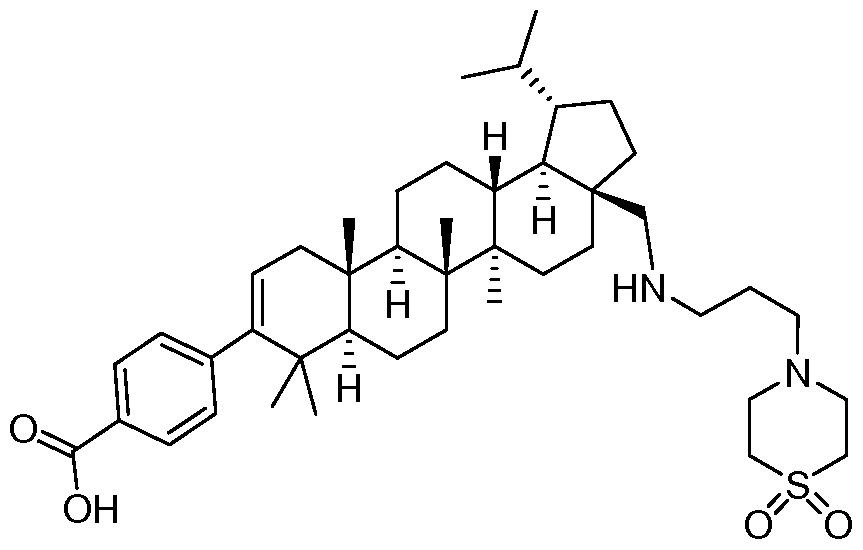
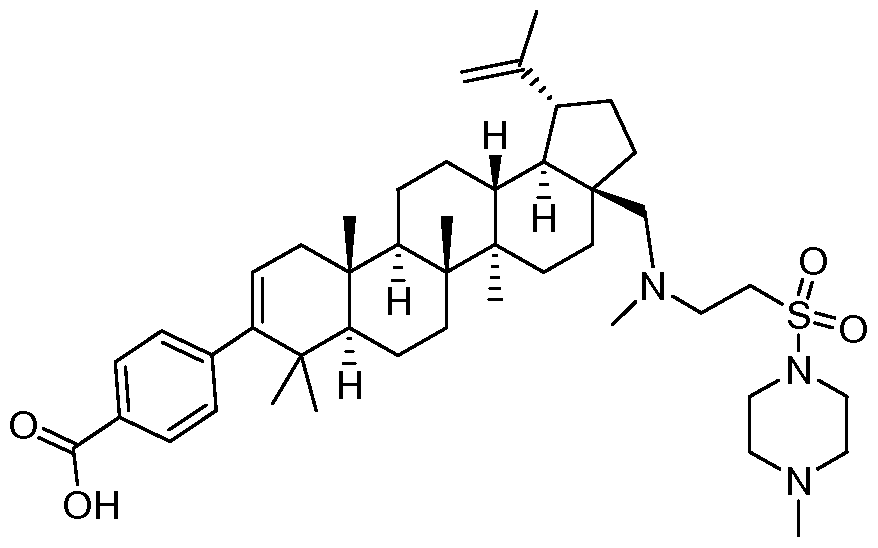
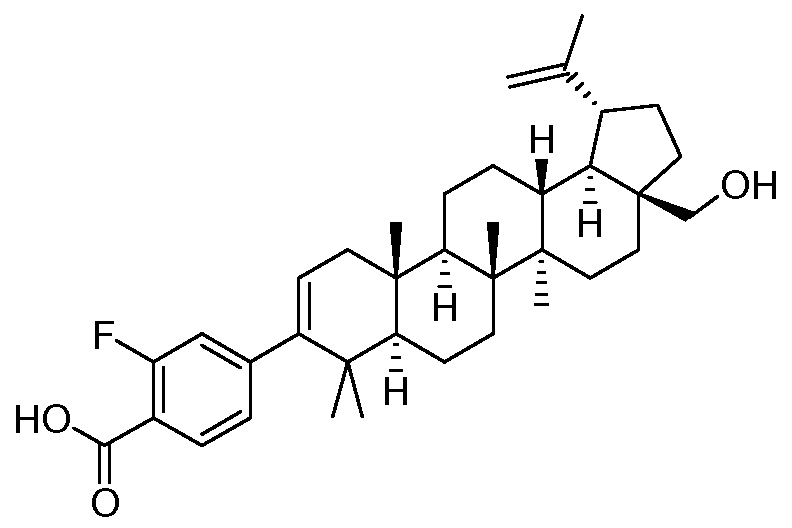
Other compounds which are preferred as part of the invention include the following:
-24-
-25 -
-26-
-27 -
-28 -
-29 -
The compounds of the present invention, according to all the various embodiments described above, may be administered orally, parenterally (including subcutaneous injections, intravenous, intramuscular, intrastemal injection or infusion techniques), by inhalation spray, or rectally, and by other means, in dosage unit formulations containing non-toxic pharmaceutically acceptable carriers, excipients and diluents available to the skilled artisan. One or more adjuvants may also be included.
Thus, in accordance with the present invention, there is further provided a method of treatment, and a pharmaceutical composition, for treating viral infections such as HIV infection and AIDS. The treatment involves administering to a patient need of such treatment a pharmaceutical composition which contains an antiviral
effective amount of one or more of the compounds of Formulas I, II, and/or III, together with one or more pharmaceutically acceptable carriers, excipients or diluents. As used herein, the term "antiviral effective amount" means the total amount of each active component of the composition and method that is sufficient to show a meaningful patient benefit, i.e., inhibiting, ameliorating, or healing of acute conditions characterized by inhibition of the HIV infection. When applied to an individual active ingredient, administered alone, the term refers to that ingredient alone. When applied to a combination, the term refers to combined amounts of the active ingredients that result in the therapeutic effect, whether administered in combination, serially or simultaneously. The terms "treat, treating, treatment" as used herein and in the claims means preventing, ameliorating or healing diseases associated with HIV infection.
The pharmaceutical compositions of the invention may be in the form of orally administrable suspensions or tablets; as well as nasal sprays, sterile injectable preparations, for example, as sterile injectable aqueous or oleaginous suspensions or suppositories. Pharmaceutically acceptable carriers, excipients or diluents may be utilized in the pharmaceutical compositions, and are those utilized in the art of pharmaceutical preparations. When administered orally as a suspension, these compositions are prepared according to techniques typically known in the art of pharmaceutical formulation and may contain microcrystalline cellulose for imparting bulk, alginic acid or sodium alginate as a suspending agent, methylcellulose as a viscosity enhancer, and sweeteners/flavoring agents known in the art. As immediate release tablets, these compositions may contain microcrystalline cellulose, dicalcium phosphate, starch, magnesium stearate and lactose and/or other excipients, binders, extenders, disintegrants, diluents, and lubricants known in the art.
The injectable solutions or suspensions may be formulated according to known art, using suitable non-toxic, parenterally acceptable diluents or solvents, such as mannitol, 1,3-butanediol, water, Ringer's solution or isotonic sodium chloride solution, or suitable dispersing or wetting and suspending agents, such as sterile, bland, fixed oils, including synthetic mono- or diglycerides, and fatty acids, including oleic acid.
The compounds herein set forth can be administered orally to humans in a dosage range of about 1 to 100 mg/kg body weight in divided doses, usually over an extended period, such as days, weeks, months, or even years. One preferred dosage range is about 1 to 10 mg/kg body weight orally in divided doses. Another preferred dosage range is about 1 to 20 mg/kg body weight in divided doses. It will be understood, however, that the specific dose level and frequency of dosage for any particular patient may be varied and will depend upon a variety of factors including the activity of the specific compound employed, the metabolic stability and length of action of that compound, the age, body weight, general health, sex, diet, mode and time of administration, rate of excretion, drug combination, the severity of the particular condition, and the host undergoing therapy.
Also contemplated herein are combinations of the compounds of Formulas I, II, and /or III herein set forth, together with one or more other agents useful in the treatment of AIDS. For example, the compounds of this disclosure may be effectively administered, whether at periods of pre-exposure and/or post-exposure, in combination with effective amounts of the AIDS antivirals, immunomodulators, antiinfectives, or vaccines, such as those in the following non-limiting table:
ANTIVIRALS
Drug Name Manufacturer Indication
097 Hoechst/Bayer HIV infection,
AIDS, ARC
(non-nucleoside reverse transcriptase (RT)
inhibitor)
Amprenavir Glaxo Wellcome HIV infection,
141 W94 AIDS, ARC
GW 141 (protease inhibitor)
Abacavir (1592U89) Glaxo Wellcome HIV infection,
GW 1592 AIDS, ARC
(RT inhibitor)
Acemannan Carrington Labs ARC
(Irving, TX) Acyclovir Burroughs Wellcome HIV infection, AIDS,
ARC
AD-439 Tanox Biosystems HIV infection, AIDS,
ARC
AD-519 Tanox Biosystems HIV infection, AIDS,
ARC
Adefovir dipivoxil Gilead Sciences HIV infection AL-721 Ethigen ARC, PGL
(Los Angeles, CA) HIV positive, AIDS
Alpha Interferon Glaxo Wellcome Kaposi's sarcoma,
HIV in combination w/Retrovir
Ansamycin Adria Laboratories ARC
LM 427 (Dublin, OH)
Erbamont
(Stamford, CT)
Antibody which Advanced Biotherapy AIDS, ARC
Neutralizes pH Concepts
Labile alpha aberrant (Rockville, MD)
Interferon
AR177 Aronex Pharm HIV infection, AIDS,
ARC Beta-fluoro-ddA Nat'l Cancer Institute AIDS-associated diseases
BMS-234475 Bristol-Myers Squibb/ HIV infection, (CGP-61755) Novartis AIDS, ARC
(protease inhibitor)
CI-1012 Warner-Lambert HIV-1 infection
Cidofovir Gilead Science CMV retinitis,
herpes, papillomavirus
Curdlan sulfate AJI Pharma USA HIV infection
Cytomegalovirus Medlmmune CMV retinitis
Immune globin
Cytovene Syntex Sight threatening Ganciclovir CMV
peripheral CMV retinitis
Darunavir Tibotec- J & J HIV infection, AIDS, ARC
(protease inhibitor)
Delaviridine Pharmacia-Upj ohn HIV infection,
AIDS, ARC
(RT inhibitor)
Dextran Sulfate Ueno Fine Chem. AIDS, ARC, HIV
Ind. Ltd. (Osaka, positive
Japan) asymptomatic
ddC Hoffman-La Roche HIV infection, AIDS,
Dideoxycytidine ARC ddl Bristol-Myers Squibb HIV infection, AIDS,
Dideoxyinosine ARC; combination
with AZT/d4T
DMP-450 AVID HIV infection,
(Camden, NJ) AIDS, ARC
(protease inhibitor)
Efavirenz Bristol Myers Squibb HIV infection,
(DMP 266, Sustiva®) AIDS, ARC
(-)6-Chloro-4-(S)- (non-nucleoside RT cyclopropylethynyl- inhibitor)
4(S)-trifluoro- methyl- 1 ,4-dihydro- 2H-3, 1 -benzoxazin- 2-one, STOCRI E EL10 Elan Corp, PLC HIV infection
(Gainesville, GA)
Etravirine Tibotec/ J & J HIV infection, AIDS, ARC
(non-nucleoside reverse transcriptase inhibitor)
Famciclovir Smith Kline herpes zoster,
herpes simplex
GS 840 Gilead HIV infection,
AIDS, ARC
(reverse transcriptase inhibitor)
HBY097 Hoechst Marion HIV infection,
Roussel AIDS, ARC
(non-nucleoside reverse transcriptase inhibitor)
Hypericin VIMRx Pharm. HIV infection, AIDS,
ARC
Recombinant Human Triton Biosciences AIDS, Kaposi's
Interferon Beta (Almeda, CA) sarcoma, ARC
Interferon alfa-n3 Interferon Sciences ARC, AIDS Indinavir Merck HIV infection, AIDS,
ARC, asymptomatic HIV positive, also in combination with AZT/ddl/ddC
ISIS 2922 ISIS Pharmaceuticals CMV retinitis
KNI-272 Nat'l Cancer Institute HrV-assoc. diseases
Lamivudine, 3TC Glaxo Wellcome HIV infection,
AIDS, ARC
(reverse
transcriptase
inhibitor); also with AZT
Lobucavir Bristol-Myers Squibb CMV infection
Nelfinavir Agouron HLV infection,
Pharmaceuticals AIDS, ARC
(protease inhibitor)
Nevirapine Boeheringer HLV infection,
Ingleheim AIDS, ARC
(RT inhibitor)
Novapren Novaferon Labs, Inc. HIV inhibitor
(Akron, OH)
Peptide T Peninsula Labs AIDS
Octapeptide (Belmont, CA)
Sequence
Trisodium Astra Pharm. CMV retinitis, HIV Phosphonoformate Products, Inc. infection, other CMV infections
PNU- 140690 Pharmacia Upjohn HLV infection,
AIDS, ARC
(protease inhibitor)
Probucol Vyrex HLV infection, AIDS RBC-CD4 Sheffield Med. HLV infection,
Tech (Houston, TX) AIDS, ARC
Ritonavir Abbott HLV infection,
AIDS, ARC
(protease inhibitor) Saquinavir Hoffmann- HLV infection,
LaRoche AIDS, ARC
(protease inhibitor)
Stavudine; d4T Bristol-Myers Squibb HLV infection, AIDS,
Didehydrodeoxy- ARC
Thymidine
Tipranavir Boehringer Ingelheim HLV infection, AIDS, ARC
(protease inhibitor)
Valaciclovir Glaxo Wellcome Genital HSV & CMV infections
Virazole Viratek/ICN asymptomatic HIV Ribavirin (Costa Mesa, CA) positive, LAS, ARC
VX-478 Vertex HIV infection, AIDS,
ARC Zalcitabine Hoffmann-LaRoche HIV infection, AIDS,
ARC, with AZT
Zidovudine; AZT Glaxo Wellcome HIV infection, AIDS,
ARC, Kaposi's sarcoma, in combination with other therapies
Tenofovir disoproxil, HIV infection, fumarate salt (Viread®) AIDS,
(reverse transcriptase inhibitor)
Emtriva R (Emtricitabine) Gilead HIV infection, (FTC) AIDS,
(reverse transcriptase inhibitor)
Combivir GSK HIV infection,
AIDS,
(reverse transcriptase inhibitor)
Abacavir succinate GSK HIV infection, (or Ziagen®) AIDS,
(reverse transcriptase inhibitor)
Reyataz Bristol-Myers Squibb HIV infection
(or atazanavir) AIDs, protease
inhibitor
®
Fuzeon Roche / Trimeris HIV infection
(Enfuvirtide or T-20) AIDs, viral Fusion inhibitor
Lexiva GSK/Vertex HIV infection
(or Fosamprenavir calcium) AIDs, viral protease
inhibitor
Selzentry
Maraviroc; (UK 427857) Pfizer HIV infection
AIDs, (CCR5 antagonist, in development)
Trizivir GSK HIV infection
AIDs, (three drug combination)
Sch-417690 (vicriviroc) Schering-Plough HIV infection
AIDs, (CCR5 antagonist, in development)
TAK-652 Takeda HIV infection
AIDs, (CCR5 antagonist, in development)
GSK 873140 GSK/ONO HIV infection
(ONO-4128) AIDs, (CCR5 antagonist, in development)
Integrase Inhibitor Merck HIV infection
MK-0518 AIDs
Raltegravir
Truvada Gilead Combination of Tenofovir disoproxil fumarate salt (Viread®) and Emtriva° (Emtricitabine)
Integrase Inhibitor Gilead/Japan Tobacco HIV Infection
GS917/JTK-303 AIDs
Elvitegravir in development
Triple drug combination Gilead/Bristol-Myers Squibb Combination of Tenofovir
®
Atripla disoproxil fumarate salt
(Viread®), Emtriva* (Emtricitabine), and
Sustiva (Efavirenz)
Festinavir Oncolys BioPharma HIV infection
4'-ethynyl-d4T BMS AIDs
in development
CMX-157 Chimerix HIV infection
Lipid conjugate of AIDs
nucleotide tenofovir
GSK1349572 GSK HIV infection Integrase inhibitor AIDs
IMMUNOMODULATORS
Drug Name Manufacturer Indication AS-101 Wyeth-Ayerst AIDS Bropirimine Pharmacia Upjohn Advanced AIDS Acemannan Carrington Labs, Inc. AIDS, ARC
(Irving, TX)
CL246,738 Wyeth AIDS, Kaposi's
Lederle Labs sarcoma
FP-21399 Fuki ImmunoPharm Blocks HIV fusion with CD4+ cells Gamma Interferon Genentech ARC, in combination w/TNF (tumor necrosis factor)
Granulocyte Genetics Institute AIDS
Macrophage Colony Sandoz
Stimulating Factor
Granulocyte Hoechst-Roussel AIDS
Macrophage Colony Immunex
Stimulating Factor
Granulocyte Schering-Plough AIDS,
Macrophage Colony combination Stimulating Factor w/AZT
HIV Core Particle Rorer Seropositive HIV
Immunostimulant
IL-2 Cetus AIDS, in combination
Interleukin-2 w/AZT
IL-2 Hoffman-LaRoche AIDS, ARC, HIV, in
Interleukin-2 Immunex combination w/AZT IL-2 Chiron AIDS, increase in
Interleukin-2 CD4 cell counts (aldeslukin)
Immune Globulin Cutter Biological Pediatric AIDS, in
Intravenous (Berkeley, CA) combination w/AZT
(human)
IMREG-1 Imreg AIDS, Kaposi's
(New Orleans, LA) sarcoma, ARC, PGL
IMREG-2 Imreg AIDS, Kaposi's
(New Orleans, LA) sarcoma, ARC, PGL
Imuthiol Diethyl Merieux Institute AIDS, ARC
Dithio Carbamate
Alpha-2 Schering Plough Kaposi's sarcoma Interferon w/AZT, AIDS
Methionine- TNI Pharmaceutical AIDS, ARC
Enkephalin (Chicago, IL)
MTP-PE Ciba-Geigy Corp. Kaposi's sarcoma
Muramyl-Tripeptide
Granulocyte Amgen AIDS, in combination Colony Stimulating w/AZT
Factor
Remune Immune Response Immunotherapeutic
Corp. rCD4 Genentech AIDS, ARC
Recombinant
Soluble Human CD4
rCD4-IgG AIDS, ARC hybrids
Recombinant AIDS, ARC
Soluble Human CD4
Interferon Hoffman-La Roche Kaposi's sarcoma Alfa 2a AIDS, ARC,
in combination w/AZT
SK&F 106528 Smith Kline HIV infection Soluble T4
Thymopentin Immunobiology HIV infection
Research Institute
(Annandale, NJ)
Tumor Necrosis Genentech ARC, in combination Factor; TNF w/gamma Interferon
ANTI-INFECTIVES
Drug Name Manufacturer Indication
Clindamycin Pharmacia Upjohn PCP
Primaquine
Fluconazole Pfizer Cryptococcal
meningitis, candidiasis
Pastille Squibb Corp. Prevention of
Nystatin Pastille oral candidiasis
Ornidyl Merrell Dow PCP
Eflornithine
Pentamidine LyphoMed PCP treatment Isethionate (IM & IV) (Rosemont, IL) Trimethoprim Antibacterial
Trimethoprim/ sulfa Antibacterial
Piritrexim Burroughs Wellcome PCP treatment
Pentamidine Fisons Corporation PCP prophylaxis
Isethionate for
Inhalation
Spiramycin Rhone-Poulenc Cryptosporidia!
diarrhea
Intraconazole- Janssen-Pharm. Histoplasmosis;
R51211 cryptococcal
meningitis Trimetrexate Warner-Lambert PCP
Daunorubicin NeXstar, Sequus Kaposi's sarcoma
Recombinant Human Ortho Pharm. Corp. Severe anemia
Erythropoietin assoc. with AZT
therapy
Recombinant Human AIDS-related
Growth Hormone wasting, cachexia
Megestrol Acetate Bristol-Myers Squibb Treatment of
anorexia assoc.
W/AIDS Testosterone Alza, Smith Kline AIDS-related wasting
Total Enteral Norwich Eaton Diarrhea and
Nutrition Pharmaceuticals malabsorption
related to AIDS
Additionally, the compounds of the disclosure herein set forth may be used in combination with HIV entry inhibitors. Examples of such HIV entry inhibitors are discussed in DRUGS OF THE FUTURE 1999, 24(12), pp. 1355-1362; CELL, Vol. 9, pp. 243-246, Oct. 29, 1999; and DRUG DISCOVERY TODAY, Vol. 5, No. 5, May 2000, pp. 183-194 and Inhibitors of the entry of HIV into host cells. Meanwell,
Nicholas A.; Kadow, John F. Current Opinion in Drug Discovery & Development (2003), 6(4), 451-461. Specifically the compounds can be utilized in combination with attachment inhibitors, fusion inhibitors, and chemokine receptor antagonists aimed at either the CCR5 or CXCR4 coreceptor. HIV attachment inhibitors are also set forth in US 7,354,924 and US 2005/0209246.
It will be understood that the scope of combinations of the compounds of this application with AIDS antivirals, immunomodulators, anti-infectives, HIV entry inhibitors or vaccines is not limited to the list in the above Table but includes, in principle, any combination with any pharmaceutical composition useful for the treatment of AIDS.
Preferred combinations are simultaneous or alternating treatments with a compound of the present disclosure and an inhibitor of HIV protease and/or a non- nucleoside inhibitor of HIV reverse transcriptase. An optional fourth component in the combination is a nucleoside inhibitor of HIV reverse transcriptase, such as AZT, 3TC, ddC or ddl. A preferred inhibitor of HIV protease is Reyataz® (active ingredient Atazanavir). Typically a dose of 300 to 600mg is administered once a day. This may be co-administered with a low dose of Ritonavir (50 to 500mgs). Another preferred inhibitor of HIV protease is Kaletra®. Another useful inhibitor of HIV protease is indinavir, which is the sulfate salt of N-(2(R)-hydroxy-l-(S)-indanyl)-2(R)- phenylmethyl-4-(S)-hydroxy-5-(l-(4-(3-pyridyl-methyl)-2(S)-N'-(t- butylcarboxamido)-piperazinyl))-pentaneamide ethanolate, and is synthesized according to U.S. 5,413,999. Indinavir is generally administered at a dosage of 800 mg three times a day. Other preferred protease inhibitors are nelfinavir and ritonavir. Another preferred inhibitor of HIV protease is saquinavir which is administered in a dosage of 600 or 1200 mg tid. Preferred non-nucleoside inhibitors of HIV reverse transcriptase include efavirenz. These combinations may have unexpected effects on limiting the spread and degree of infection of HIV. Preferred combinations include those with the following (1) indinavir with efavirenz, and, optionally, AZT and/or 3TC and/or ddl and/or ddC; (2) indinavir, and any of AZT and/or ddl and/or ddC and/or 3TC, in particular, indinavir and AZT and 3TC; (3) stavudine and 3TC and/or zidovudine; (4) tenofovir disoproxil fumarate salt and emtricitabine.
In such combinations the compound of the present invention and other active agents may be administered separately or in conjunction. In addition, the administration of one element may be prior to, concurrent to, or subsequent to the administration of other agent(s).
GENERAL CHEMISTRY (METHODS OF SYNTHESIS)
The present invention comprises compounds of Formulas I, II, and III, their pharmaceutical formulations, and their use in patients suffering from or susceptible to HIV infection. The compounds of Formulas I, II, and III also include
pharmaceutically acceptable salts thereof. General procedures to construct compounds of Formulas I, II, and III and intermediates useful for their synthesis are described in the following Schemes (after the Abbreviations). Abbreviations
One or more of the following abbreviations, most of which are conventional abbreviations well known to those skilled in the art, may be used throughout the description of the disclosure and the examples:
BZ2O = benzoic anhydride
TBTU = 0-(benzotriazol- 1 -yl)-N,N,N',N'-tetramethyluronium tetrafluoroborate HATU = 2-(lH-7-azabenzotriazol-l-yl)-l, l,3,3-tetramethyluronium
hexafluorophosphate methanaminium
DCE = dichloroethane
DCM = dichloromethane
CDI = carbonyl diimidazole
prep. HPLC = preparative high performance liquid chromatography
rt = room temperature
DIPEA = diisopropylethylamine
DMAP = 4-dimethylaminopyridine DMSO = dimethylsulfoxide
THF = tetrahydrofuran
KHMDS = potassium bis(trimethylsilyl)amide min = minute(s)
h = hour(s)
sat. = saturated
TEA = triethylamine
EtOAc = ethyl acetate
TFA = trifluoroacetic acid
PCC = pyridinium chlorochromate
TLC = thin layer chromatography
Tf2NPh = (trifluoromethylsulfonyl)methanesulfonamide dioxane = 1,4-dioxane
PG = protective group
atm = atmosphere(s)
mol = mole(s)
mmol= milimole(s)
mg = milligram(s)
μg = microgram(s)
μΐ = microliter(s)
μηι= micrometer(s)
mm= millimeter(s)
HOAc= acetic acid
MeOH= methanol
DMF= N,N-dimethylformamide
TBAF= tetrabutylammonium fluoride
The terms "C-3" and "C-28" refer to certain positions of a triterpene core as numbered in accordance with IUPAC rules (positions depicted below with respect to an illustrative triterpene: betulin):
The same numbering is maintained when referring to the compound series in schemes and general descriptions of methods.
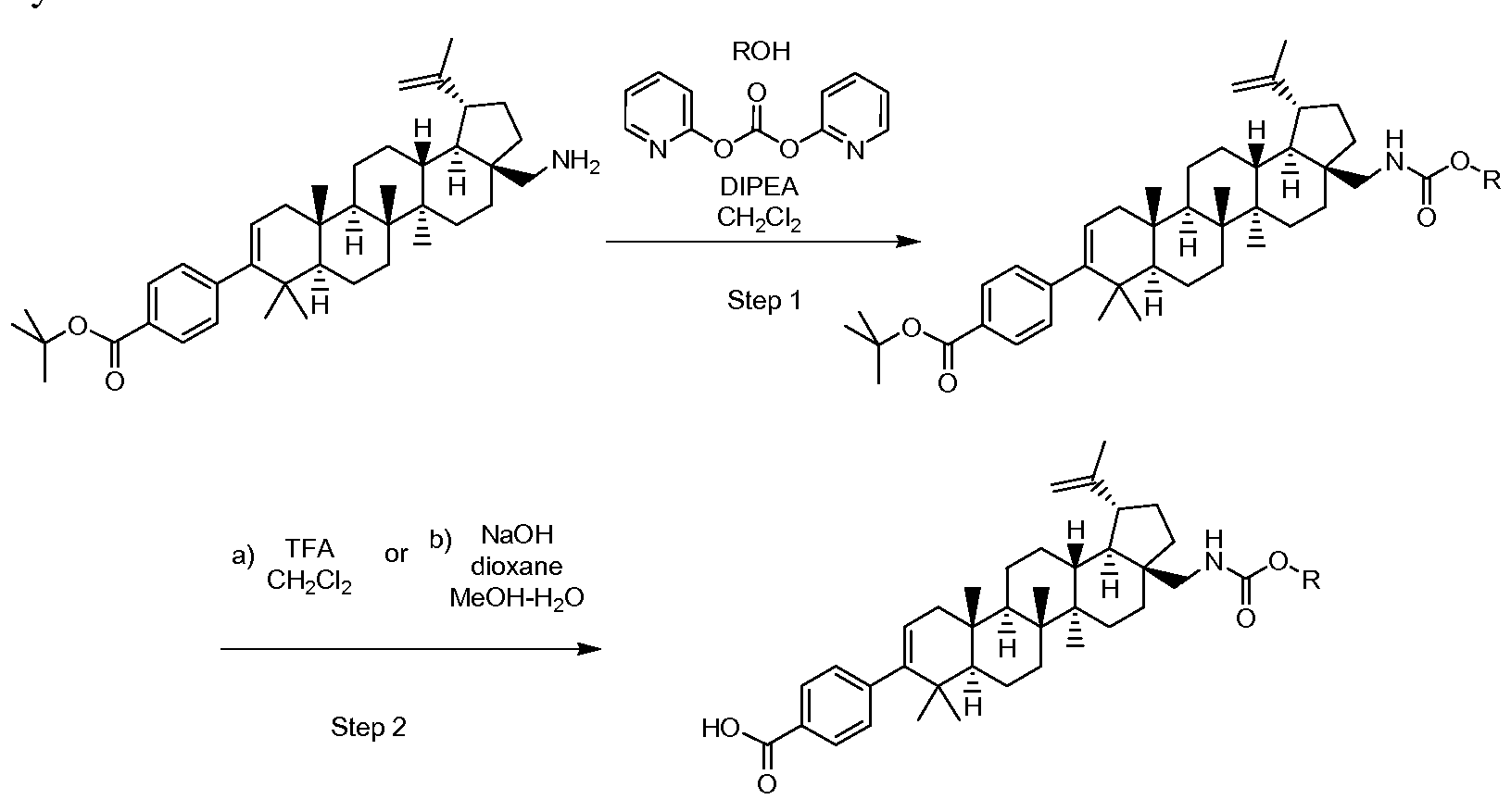
C-28 revesed carbamates
Preparation of Compounds of Formulas I, II, and III General Chemistry Schemes:
Preparation of Compounds of Formulas I, II and III General Chemistry Schemes:
Compounds of Formula I can be prepared from commercially available (Aldrich, others) betulinic acid and betulin by chemistry described in the following schemes. Compounds of Formula II and III are described thereafter.
General reaction schemes are set forth as follows:
Scheme 1
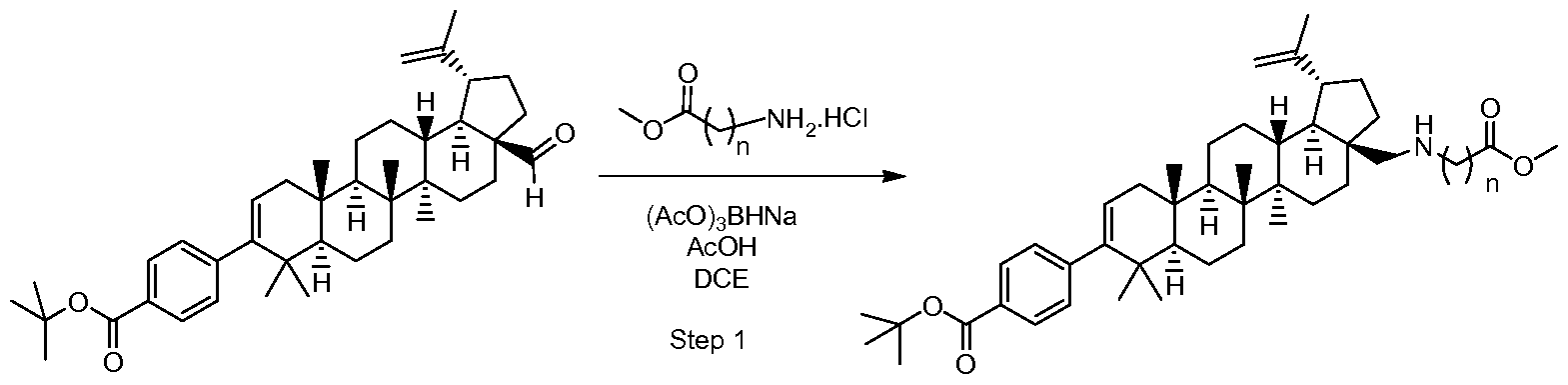
The hydroxyl group in the C-28 position of betulin can be protected with a suitable hydroxyl-protective group. Standard oxidation (i.e. PCC, Dess-Martin) of the C-3 hydroxyl group produces the C-3 ketone which is then converted into the triflate using conditions know to those skilled in the art. Palladium catalyzed cross coupling with boronic acid (Stille coupling using stannanes can also be used) afforded the corresponding C-3 modified betulin derivatives. Deprotection of the hydroxyl group in the C-28 position followed by oxidation under standard conditions (i.e. PCC) affords the corresponding aldehyde. Standard reductive amination of this aldehyde with amines using sodium triacetoxyborohydride (sodium cyanoborohydride can also
be used) followed by deprotection of the carboxylic acid affords the desired C-28 amines.
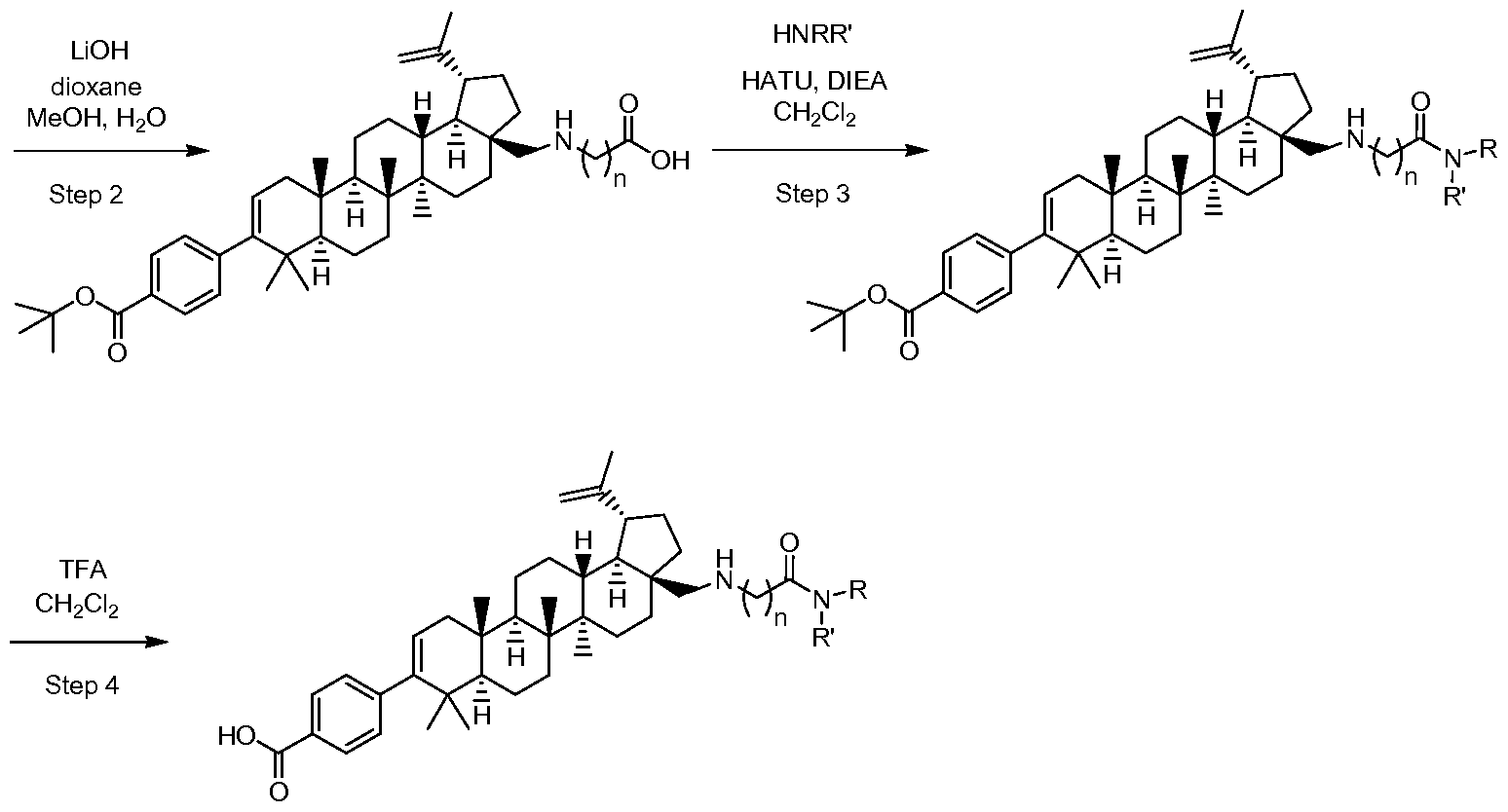
Alternatively, some of the C-28 tertiary amines can be prepared as describe in scheme 2: First, reductive amination of C-28 aldehyde with a primary amine generates a C-28 secondary amine. Deprotection of the carboxylic acid followed by reductive amination under standard conditions of the C-28 secondary amine with an aldehyde of a dialkylacetal affords the desired C-28 tertiary amine.
Scheme 3
Alternatively, the C-28 amines can be prepared by converting the C-28 aldehyde in the corresponding oxime by treatment with hydroxylamine under standard conditions. Reduction of the hydroxyl amine using sodium cyanoborohydride in the presence of titanium trichloride afforded the C-28 primary amine which can be further derivatized using methods known to those skilled in the art to provide the desired final products.
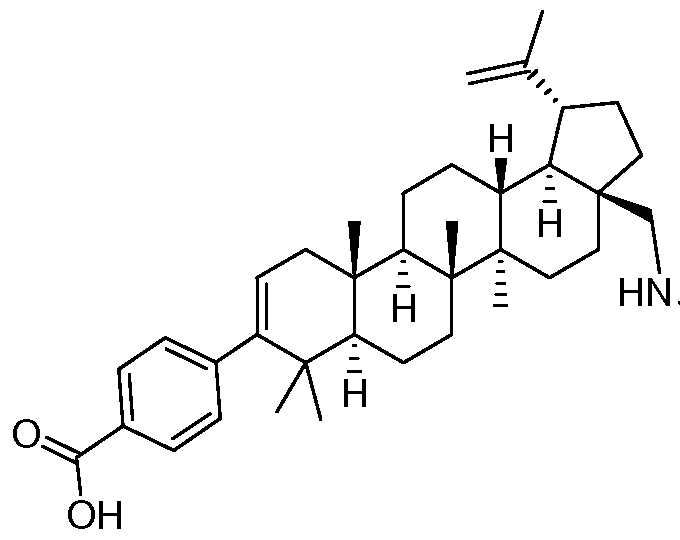
Some of the C-28 amines can be prepared as described in scheme 4: Reductive amination under standard conditions of the C-28 aldehyde in the presence of 2,2- diethoxyethanamine followed by ketal hydrolysis generates a the C-28 amine carrying an aldehyde which can also be submitted to reductive amination under standard conditions. Deprotection of the carboxylic acid produces the desired C-28 amine.
Substituents R4, R5, R6 and R7 may contain functional groups (i.e. COOH, COOR, OH, NHR) that can be further modified by methods know to those skilled in the art.
The modification can be carried out before or after the final deprotection of the carboxylic acid is performed depending on the nature of the functional group
Alternatively, when R4, R5, ¾ and/or R7 are H, the corresponding amine can be further modified (for example by alkylation, acylation, Michael addition, etc.) by methods known to those skilled in the art. Saturation of the isopropenyl group can accomplished by hydrogenation under standard conditions of the final products.
The benzoic acid can be further modified by methods known to those skilled in the art. An example of such modifications is shown in scheme 5 : A suitable protective group is installed under standard conditions to mask the free NH in the C-28 position. Then, treatment of the carboxylic acid with the corresponding nucleophile, for example a sulfonyl amide or urea in the presence of a coupling reagent and a base followed by removal of the C-28 amine protective group affords the desired final product.
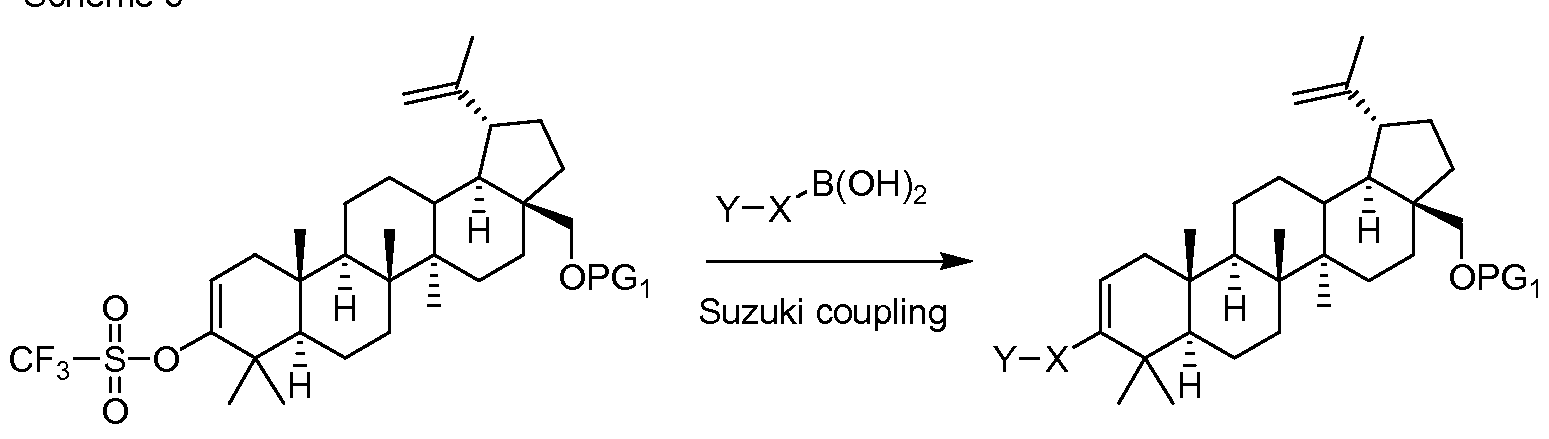
Compounds of formula I where the modification in the C-3 position is other than benzoic acid can be prepared by selecting the corresponding boronic acid in the palladium cross coupling step shown in scheme 1 (scheme 6) and then using the chemistry methods described in the above schemes.
Scheme 6
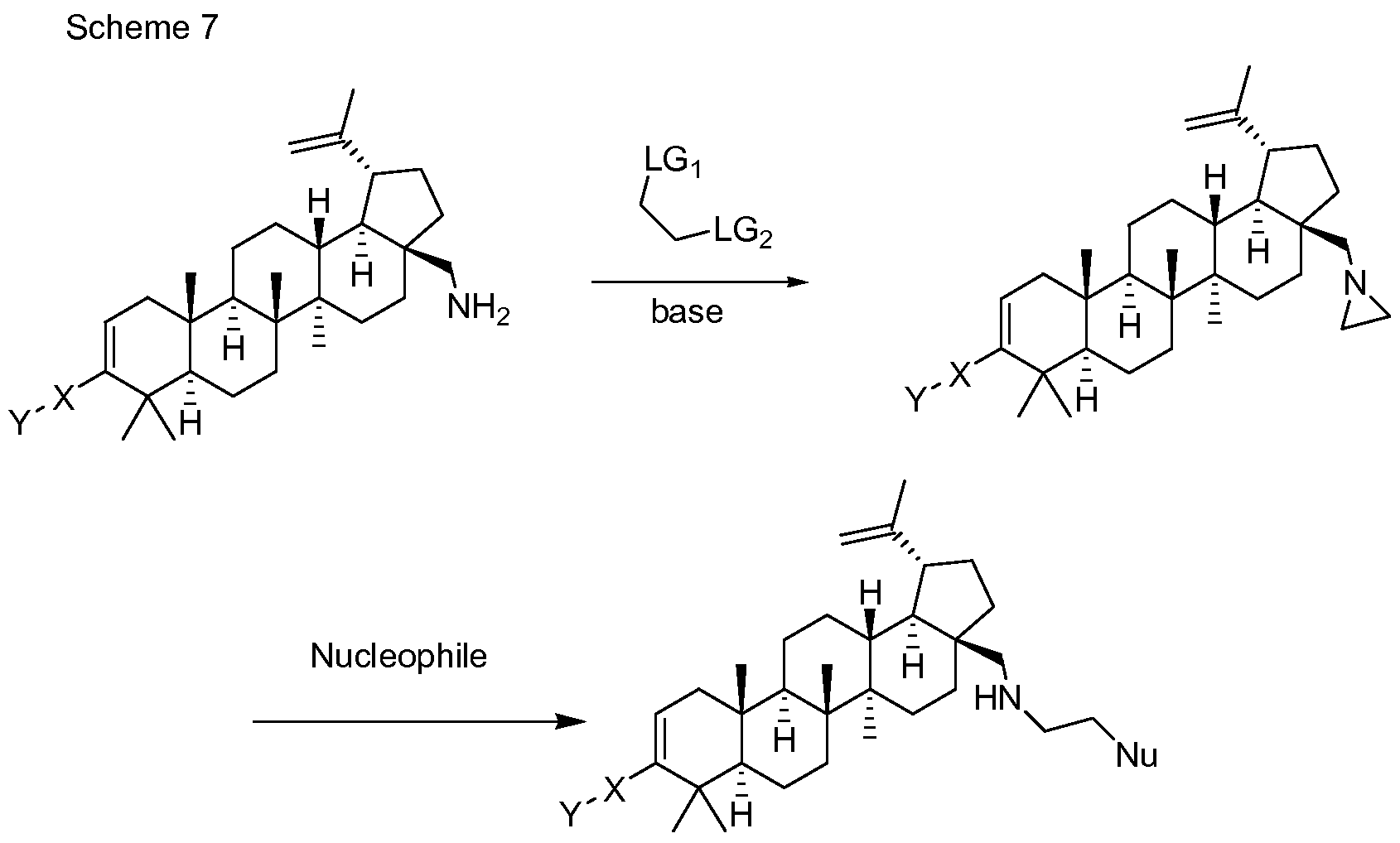
Alternatively, compounds of formula I can be prepared using the method described below in scheme 7. The C-28 primary amine can be treated in the presence of base with 1,2-disubstituted ethane where the substituents are two leaving groups (i.e, tosylate, mesylate, Br, CI, I), to form the C-28 aziridine. Opening of the aziridine with a nucleophile can be achieve with or without heat to produce the corresponding secondary C-28 amine which can be further modified.
Compounds of formula II can be prepared using the chemistry methods described above for compounds of formula I, with one extra step which consist on the saturation of the double bonds as shown below in scheme 8:
Compound of formula III can be prepared in the same manner described above for compounds of formula I and II using oleanoic or ursolic acid as starting materials instead of betulin.
EXAMPLES
The following examples illustrate typical syntheses of the compounds of Formulas I, II and III as described generally above. These examples are illustrative only and are not intended to limit the disclosure in any way. The reagents and starting materials are readily available to one of ordinary skill in the art.
Chemistry
Typical Procedures and Characterization of Selected Examples:
Unless otherwise stated, solvents and reagents were used directly as obtained from commercial sources, and reactions were performed under a nitrogen atmosphere.
Flash chromatography was conducted on Silica gel 60 (0.040-0.063 particle size; EM Science supply). XH NMR spectra were recorded on Bruker DRX-500f at 500 MHz (or Bruker AV 400 MHz, Bruker DPX-300B or Varian Gemini 300 at 300 MHz as stated). The chemical shifts were reported in ppm on the δ scale relative to 8TMS = 0. The following internal references were used for the residual protons in the following solvents: CDC13 (δΗ 7.26), CD3OD (δΗ 3.30), Acetic-d4 (Acetic Acid d4) (δΗ 11.6, 2.07), DMSO mix or DMS0-D6_CDC13 ((H 2.50 and 8.25) (ratio
75%:25%), and DMSO-D6 (5H 2.50). Standard acronyms were employed to describe the multiplicity patterns: s (singlet), br. s (broad singlet), d (doublet), t (triplet), q (quartet), m (multiplet), b (broad), app (apparent). The coupling constant (J) is in
Hertz. All Liquid Chromatography (LC) data were recorded on a Shimadzu LC-10AS liquid chromatograph using a SPD-10AV UV-Vis detector with Mass Spectrometry (MS) data determined using a Micromass Platform for LC in electrospray mode. LC/MS methods Method 1
Start % B = 20, final % B = 100 over 1 min gradient
Flow Rate = 4 ml/min
Wavelength = 254
Solvent A = 10% MeOH - 90% Water - 0.1% TFA
Solvent B = 90% MeOH - 10% Water - 0.1% TFA
Column 3 = Xbridge Phenyl 4.6 x 50 mm S5 Method 2
Start % B = 30, final % B = 100 over 1 min gradient
Flow Rate = 0.8 ml/min
Wavelength = 220
Solvent A = 10% Methanol/ 90% Water/ 0.1% TFA
Solvent B = 90% Methanol/ 10% Water/ 0.1% TFA
Column 3 = Xbridge Phenyl 2.1 x 50 mm 2.5μιη
Method 3
Start % B = 20, final % B = 100 over 2 min gradient
Flow Rate = 0.8 ml/min
Wavelength = 254
Solvent A = 10% Methanol/ 90% Water/ 0.1% TFA
Solvent B = 90% Methanol/ 10% Water /0.1% TFA
Column 3 = Xbridge Phenyl 2.1 x 50 mm 2.5 μιη
Method 4
Start %B = 0, final %B = 100 over 2 minute gradient
Flow Rate = 4 ml/min
Wavelength = 220
Solvent A = 95% Water/ 5% Methanol/ 10 mM Ammonium Acetate Solvent B = 5% Water/ 95% Methanol/ 10 mM Ammonium Acetate Column = PHENOMENEX- LUNA 3.0 x 50 mm
Method 5
Start %B = 0, final % B = 100 over 2 minute gradient
Flow Rate = 4 ml/min
Wavelength = 220
Solvent A = 95% Water/ 5% methanol/ 10 mM Ammonium Acetate Solvent B = 5% Water/ 95% methanol/ 10 mM Ammonium Acetate Column = Xbridge 4.6 x 50 mm 5μ C18
Method 6
Start %B = 40, final % B = 100 over 2 minute gradient
Flow Rate = 1 ml/min
Wavelength = 220
Solvent A = 95% Water/ 5% methanol/ 10 mM Ammonium Acetate Solvent B = 5% Water/ 95% methanol/ 10 mM Ammonium Acetate Column = PHENOMENEX- LUNA CI 8, 2.0 x 30, μιη
Method 7
Start %B = 0, final % B = 100 over 2 minute gradient
Flow Rate = 5 ml/min
Wavelength = 220
Solvent A = 95% Water/ 5% methanol/ 10 mM TFA
Solvent B = 5% Water/ 95% methanol/ 10 mM TFA
Column = PHENOMENEX- LUNA 3.0 x 50 mm S 10
Method 8
Start%B = 0, Final%B = 100 over 2 minute gradient, hold at 100%B
Flow Rate = 1 mL / min
Wavelength = 220 nm
Solvent A = 95% water, 5% methanol, 10 mM ammonium acetate
Solvent B = 5% water, 95% methanol, 10 mM ammonium acetate
Column = Phenomenex LUNA C18, 2.0 x 30 mm, 3 μιη Method 9
Start%B = 0%, Final%B = 100 over 2 minute gradient, hold at 100%B
Flow Rate = 1.0 mL / min
Wavelength = 220 nm
Solvent A = 90% water, 10% methanol, 0.1% TFA
Solvent B = 10% water, 90% methanol, 0.1% TFA
Column = phenomenex-luna , 2.0 x 30 mm, 3.0 μιη
Preparation of compounds
Preparation of tert-butyl 4-((lR,3aS,5aR,5bR,7aR, 1 laS, 1 IbR, 13aR, 13bR)-3a-formyl- 5a,5b,8,8, 11 a-pentamethyl- 1 -(prop- 1 -en-2-yl)-
2,3,3a,4,5,5a,5b,6,7,7a,8,l 1 , 11 a, 1 lb,12,13,13a,13b-octadecahydro-lH-cyclopenta[a]chrysen-9- yl)benzoate.
Step 1. Preparation of ((lR,3aS,5aR,5bR,7aR,9S,l laR,l lbR,13aR,13bR)-9-hydroxy- 5a,5b,8,8,l la-pentamethyl-l-(prop-l-en-2-yl)icosahydro-lH-cyclopenta[a]chrysen- 3a-yl)methyl benzoate.
A suspension of (lR,3aS,5aR,5bR,7aR,9S,l laR,l lbR,13aR,13bR)-3a- (hydroxymethyl)-5a,5b,8,8, 11 a-pentamethyl- 1 -(prop- 1 -en-2-yl)icosahydro- 1 H- cyclopenta[a]chrysen-9-ol (10 g, 22.59 mmol) and DMAP (0.552 g, 4.52 mmol) in pyridine (100 ml) was heated to 50 °C. Upon heating all solids dissolved. To the solution was added benzoic anhydride (7.66 g, 33.9 mmol) portion wise (4 portions) over 1 h, each time rinsing the sides of the flask with 5 ml of pyridine. The clear, colorless solution was stirred at 50 °C for 4 h then was cooled to rt and concentrated under reduced pressure. The thick amber residue was diluted with sat. NaHCC (200
ml) and was extracted with dichloromethane (3 x 150 ml). The combined organic layers were dried with Na2S04, the drying agent was removed by filtration and the filtrate was concentrated under reduced pressure. The residue was purified by flash chromatography using a 0-25% EtOAc in hexanes gradient to afford the title compound as a white foam (8.6 g, 15.73 mmol, 69.6 % yield). XH NMR (500 MHz, CHLOROFORM-d) δ ppm 8.05 (d, J=7.02 Hz, 2 H),7.55 (t, J=7.32 Hz, 1 H), 7.44 (t, J=7.63 Hz, 2 H), 4.71 (s, 1 H), 4.60 (s, 1 H), 4.51 (d, J=10.99 Hz, 1 H), 4.09 (d, J=10.99 Hz, 1 H), 3.15 - 3.21 (m, 1 H), 2.52 (td, J=10.99, 5.80 Hz, 1 H), 1.89 - 2.08 (m, 3 H), 1.70 (s, 3 H), 1.06 (s, 3 H), 1.00 (s, 3 H), 0.96 (s, 3 H), 0.83 (s, 3 H), 0.75 (s, 3 H), 0.63 - 1.81 (m, 21 H).
Step 2. Preparation of ((lR,3aS,5aR,5bR,7aR, l laR, l lbR, 13aR, 13bR)-5a,5b,8,8, l la- pentamethyl-9-oxo-l-(prop-l-en-2-yl)icosahydro-lH-cyclopenta[a]chrysen-3a- yl)methyl benzoate.
To a solution of ((lR,3aS,5aR,5bR,7aR,9S, l laR, l lbR,13aR, 13bR)-9- hydroxy-5a,5b,8,8, 11 a-pentamethyl- 1 -(prop- 1 -en-2-yl)icosahydro- 1 H- cyclopenta[a]chrysen-3a-yl)methyl benzoate (8.6 g, 15.73 mmol) in CH2CI2 (100 ml) was added PCC (5.09 g, 23.59 mmol). After 7.25 h of stirring at rt, the mixture was filtered through a pad of celite and silica gel and was washed with dichloromethane then with 1 : 1 EtOAc:hexanes. The filtrate was concentrated under reduced pressure to give the title compound as a white foam (8.26 g, 15.16 mmol, 96 % yield). XH
NMR (500 MHz, CHLOROFORM-d) δ ppm 8.05 (d, J=7.32 Hz, 2 H),7.56 (t, J=7.48 Hz, 1 H), 7.44 (t, J=7.63 Hz, 2 H), 4.72 (s, 1 H), 4.61 (s, 1 H), 4.52 (d, J=10.99 Hz, 1 H), 4.09 (d, J=1 1.29 Hz, 1 H), 2.45 - 2.58 (m, 2 H), 2.34 - 2.43 (m, 1 H), 1.86 - 2.10 (m, 4 H), 1.70 (s, 3 H), 1.10 (s, 3 H), 1.06 (s, 3 H), 1.04 - 1.82 (m, 18 H), 1.02 (s, 3 H), 1.01 (s, 3 H), 0.94 (s, 3 H).
Step 3. Preparation of ((lR,3aS,5aR,5bR,7aR,l laR,l lbR,13aR,13bR)-5a,5b,8,8,l la- pentamethyl- 1 -(prop- 1 -en-2-yl)-9-(trifluoromethylsulfonyloxy)- 2,3,3a,4,5,5a,5b,6,7,7a,8,l l,l la,l lb,12,13,13a,13b-octadecahydro-lH- cyclopenta[a]chryse -3a-yl)methyl benzoate.
A solution of ((lR,3aS,5aR,5bR,7aR, 11 aR, 1 IbR, 13aR, 13bR)-5a,5b,8,8, 11 a- pentamethyl-9-oxo-l-(prop-l-en-2-yl)icosahydro-lH-cyclopenta[a]chrysen-3a- yl)methyl benzoate (10.1 g, 18.54 mmol) in THF (100 ml) was cooled to -78 °C. To the solution was added KHMDS (0.5M in toluene) (74.2 ml, 37.1 mmol). The mixture was stirred for 15 minutes at -78 °C and a solution of N-Phenyl- bis(trifluoromethanesulfonimide) (7.29 g, 20.4 mmol) in THF (20 ml) and toluene (20 ml) was added via cannula. The mixture was stirred for 3.5 h at -78 °C. TLC indicated a trace of starting material was still present so an additional 0.7 g of N-phenyl- bis(trifluoromethanesulfonimide) was added to the mixture and stirring continued at - 78 °C for 1 h. TLC indicated the reaction was complete. The mixture was diluted with water (75 ml) and extracted with ethyl acetate (3 x 75 ml). The combined organic layers were dried with MgSC^. The drying agent was removed by filtration and the filtrate was concentrated under reduced pressure. The residue was purified flash chromatography using 0-20% toluene in hexanes gradient, then 20% toluene in hexanes, followed by a 10-15% EtOAc in hexanes to afford the title compound as a white foam (9.85 g, 14.55 mmol, 78 % yield). 'H NMR (400 MHz, CHLOROFORM- i/) 8 ppm 0.94 (s, 3 H), 1.03 (s, 3 H), 1.04 (s, 3 H), 1.10 - 1.86 (m, 18 H), 1.12 (s, 3 H), 1.14 (s, 3 H), 1.73 (s, 3 H), 1.92 - 2.13 (m, 3 H), 2.18 (dd, J=17.07, 6.78 Hz, 1 H), 2.55 (td, J=l l. l l, 5.90 Hz, 1 H), 4.12 (d, J=l 1.04 Hz, 1 H), 4.55 (dd, J=11.04, 1.25 Hz, 1 H), 4.64 (s, 1 H), 4.75 (d, J=2.01 Hz, 1 H), 5.58 (dd, J=6.65, 1.88 Hz, 1 H), 7.43 - 7.49 (m, 2 H), 7.55 - 7.60 (m, 1 H), 8.05 - 8.09 (m, 2 H).
Step 4. Preparation of tert-butyl 4-((lR,3aS,5aR,5bR,7aR,l laS,l lbR,13aR,13bR)-3a- (benzoyloxymethyl)-5a,5b,8, 8,11 a-pentamethyl-1 -(prop- l-en-2-yl)-
2,3,3a,4,5,5a,5b,6,7,7a,8, l 1, 1 la, l lb, 12, 13, 13a, 13b-octadecahydi cyclopenta[a]chrysen-9-yl)benzoate.
The title compound was prepared via Suzuki coupling as follows:
To a solution of ((lR,3aS,5aR,5bR,7aR, l laR, l lbR, 13aR, 13bR)-
5a,5b,8,8, 1 1 a-pentamethyl- 1 -(prop- 1 -en-2-yl)-9-(trifluoromethylsulfonyloxy)- 2,3,3a,4,5,5a,5b,6,7,7a,8, l l, l la, l lb, 12, 13, 13a, 13b-octadecahydro-lH- cyclopenta[a]chrysen-3a-yl)methyl benzoate (9.85 g, 14.55 mmol) in 1,4-dioxane (50 ml) was added 2-propanol (50.0 ml), water (20 ml), sodium carbonate monohydrate (5.41 g, 43.7 mmol), 4-tert-butoxycarbonylphenylboronic acid (4.85 g, 21.83 mmol), and tetrakis(triphenylphospine)palladium(0) (0.504 g, 0.437 mmol). Potassium carbonate and potassium phosphate can also be used instead of sodium carbonate monohydrate. The sides of the flask were rinsed with an additional 20 ml of dioxane and the mixture was attached to a reflux condenser, was flushed with 2 and was heated to reflux. Upon heating, the solids in the mixture dissolved completely. The solution was heated at reflux for 3.5 h, was cooled to rt and was diluted with 200 ml of water. The mixture was extracted with ethyl acetate (3 x 150 ml) and the combined organic layers were dried with a2S04. The drying agent was removed by filtration and the filtrate was concentrated under reduced pressure. The residue purified by flash chromatography using a 0-15% EtOAc in hexanes gradient to afford the title compound as a white foam (9.5 g , -83% pure based on lH NMR integrations). The product was used in the next step with no additional purification.
Step 5. Preparation of tert-butyl 4-((lR,3aS,5aR,5bR,7aR,l laS, l lbR, 13aR, 13bR)-3a- (hydroxymethyl)-5a,5b,8,8, 11 a-pentamethyl- 1 -(prop- 1 -en-2-yl)-
2,3,3a,4,5,5a,5b,6,7,7a,8, l l, l la, l lb, 12, 13, 13a, 13b-octadecahydro-lH- cyclopenta[a]chrysen-9-yl)benzoate.
To a solution of tert-butyl 4-((lR,3aS,5aR,5bR,7aR, l laS,l lbR, 13aR, 13bR)-3a- (benzoyloxymethyl)-5a,5b,8,8,l lapentamethyl-l-(prop-l-en-2-yl)- 2,3,3a,4,5,5a,5b,6,7,7a,8, l l, l la, l lb, 12, 13, 13a, 13b-octadecahydro-lH-cyclopenta[ a]chrysen-9-yl)benzoate (9.5 g, 13.47 mmol) in dioxane (200 ml) was added water (25 ml) and lithium hydroxide monohydrate (1.696 g, 40.4 mmol). The mixture was heated to 75 °C. Initially solids were apparent in the mixture, but after 2 h of heating, all solids had dissolved. After 23.5 h of heating, solids were again apparent in the mixture. The mixture was cooled to rt and 250 ml of water were added. The solids that had formed were collected by filtration and were washed with water. The solids were dissolved in ether and dichloromethane and were dried with MgS0
4. The drying agent was removed by filtration and the filtrate was concentrated under reduced pressure to afford the title compound as a white foam (5.6 g, 9.32mmol, 64 % yield for two steps.
XH NMR (500 MHz, CHLOROFORM-d) δ ppm 7.87 (2 H, d, J=8.2 Hz), 7.16 (2 H, d, J=7.9 Hz), 5.26 (1 H, dd, J=6.3, 1.7 Hz), 4.69 (1 H, d, J=2.1 Hz), 4.58 (1 H, s), 3.82 (1 H, d, J=9.8 Hz), 3.35 (1 H, d, J=10.7 Hz), 2.40 (1 H, td, J=11.0, 5.8 Hz), 2.09 (1 H, dd, J=17.1, 6.1 Hz), 1.69 (3 H, s), 1.58 (9 H, s), 1.08 (3 H, s), 1.01 (3 H, s), 0.97 (3 H, s), 0.91 (6 H, s), 0.83 - 2.03 (21 H, m). Step 6. Preparation of tert-butyl 4-((lR,3aS,5aR,5bR,7aR,l laS, l lbR, 13aR, 13bR)-3a- formyl-5a,5b,8,8, 11 a-pentamethyl- l-(prop-l -en-2-yl)- 2,3,3a,4,5,5a,5b,6,7,7a,8, l l, l la, l lb, 12, 13, 13a, 13b-octadecahydro-lH- cyclopenta[a]chrysen-9-yl)benzoate.
To a solution of tert-butyl 4-((lR,3aS,5aR,5bR,7aR,l laS,l lbR,13aR,13bR)-3a- (hydroxymethyl)-5a,5b,8,8,lla-pentamethyl-l-(prop-l-en-2-yl)- 2,3,3a,4,5,5a,5b,6,7,7a,8,ll,lla,llb,12,13,13a,13b-octadecahydro-lH- cyclopenta[a]chrysen-9-yl)benzoate (5.6 g, 9.32 mmol) in dichloromethane (100 ml) was added PCC (3.01 g, 13.98 mmol). The mixture was stirred at rt for 6.5 h then was filtered through a pad of celite and silica gel which was washed with
dichloromethane then 1 : 1 ethyl acetate:hexanes. The filtrate was concentrated under reduced pressure and the residue was purified by flash chromatography using a 0-10% EtOAc in hexanes gradient to afford the title compound as a white solid (4.49 g, 7.50 mmol, 80 % yield). XH NMR (500 MHz, CHLOROFORM-d) δ ppm 9.68 (1 H, d, J=1.5 Hz), 7.87 (2 H, d, J=8.2 Hz), 7.16 (2 H, d, J=8.2 Hz), 5.26 (1 H, dd, J=6.4, 1.8 Hz), 4.76 (1 H, d, J=1.8 Hz), 4.63 (1 H, s), 2.88 (1 H, td, J=ll.l, 5.8 Hz), 2.02 - 2.15 (3 H, m), 1.70 (3 H, s), 1.58 (9 H, s), 1.00 (3 H, s), 0.97 (3 H, s), 0.97 (3 H, s), 0.91 (6 H, s), 0.83 - 1.94 (19 H, m).
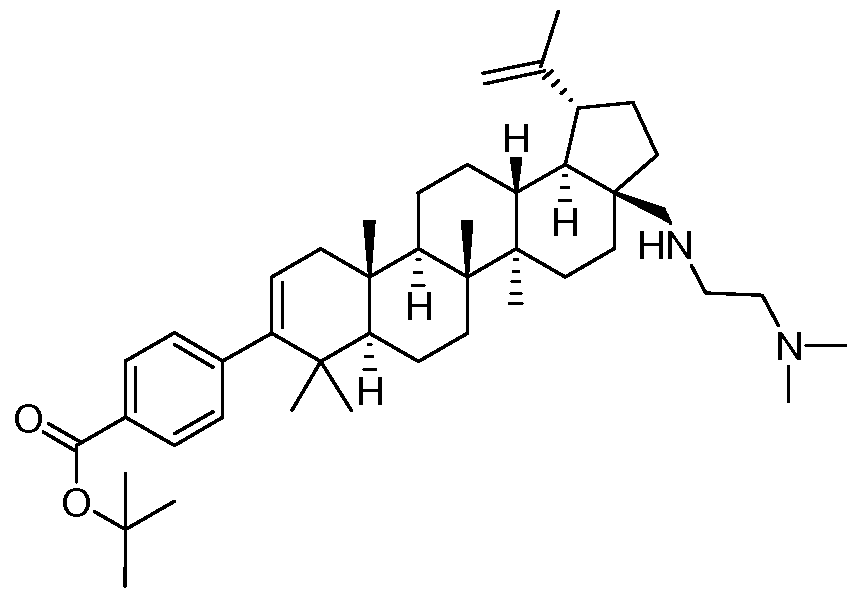
Preparation of tert-butyl 4-((lR,3aS,5aR,5bR,7aR,l laS,l lbR,13aR,13bR)-3a-((2- (dimethylamino)ethylamino)methyl)-5a,5b,8,8, 11 a-pentamethyl- 1 -(prop- 1 -en-2-yl)- 2,3,3a,4,5,5a,5b,6,7,7a,8,ll,lla,llb,12,13,13a,13b-octadecahydro-lH- cyclopenta[a]chryse -9-yl)benzoate.
A mixture of tert-butyl 4-((lR,3aS,5aR,5bR,7aR,l laS,l lbR,13aR,13bR)-3a-formyl- 5a,5b,8,8, 11 a-pentamethyl- 1 -(prop- 1 -en-2-yl)-
2,3,3a,4,5,5a,5b,6,7,7a,8,ll,lla,llb,12,13,13a,13b-octadecahydro-lH- cyclopenta[a]chrysen-9-yl)benzoate (59 mg, 0.099 mmol), Nl,Nl-dimethylethane- 1,2-diamine (0.13 ml, 1.2 mmol), sodium triacetoxyborohydride (104 mg, 0.493 mmol) and AcOH (0.023 ml, 0.394 mmol) in DCE (3ml) was stirred at rt for 12 h. The solvent was removed in vacuo. LCMS showed desired product and some imine not reduced yet. The residue was redissolved in DCE (3 ml) and treated again with sodium triacetoxyborohydride (104 mg, 0.493 mmol) and AcOH (0.023 ml, 0.394 mmol) at rt for 48 h. Solvent removed in vacuo and the residue redissolved in methylene chloride and purified by silica gel column (0-10% MeOH/CH2Ci2) to afford the title compound as a white solid (65mg, 98 % yield). XH NMR (400 MHz, CHLOROFORM-d) δ ppm 7.90 (d, J=8.3 Hz, 2 H), 7.19 (d, J=8.5 Hz, 2 H), 5.30 (dd, J=6.1, 1.6 Hz, 1 H), 4.72 (d, J=1.5 Hz, 1 H), 4.63 (s, 1 H), 3.17-2.95 (m, 3 H), 2.72 (t, J=5.9 Hz, 2 H), 2.54 (d, J=12.3 Hz, 1 H), 2.48 - 2.41 (m, 1 H), 2.40 (s, 6 H), 2.21 - 1.10 (m, 22 H), 1.72 (s, 3 H), 1.61 (s, 9 H), 1.12 (s, 3 H), 1.03 (s, 3 H), 1.00 (s, 3 H), 0.95 (s, 6 H).
EXAMPLE 1. Preparation of 4-((lR,3aS,5aR,5bR,7aR,llaS,llbR,13aR,13bR)-3a- ((2-(dimethylamino)ethylamino)methyl)-5a,5b,8,8, 11 a-pentamethyl- 1 -(prop- 1 -en-2- yl)-2,3,3a,4,5,5a,5b,6,7,7a,8,ll,lla,llb,12,13,13a,13b-octadecahydro-lH- cyclopenta[a]chryse -9-yl)benzoic acid.
A solution of tert-butyl 4-((lR,3aS,5aR,5bR,7aR,llaS,llbR,13aR,13bR)-3a-((2- (dimethylamino)ethylamino)methyl)-5a,5b,8,8, 11 a-pentamethyl- 1 -(prop- 1 -en-2-yl)- 2,3,3a,4,5,5a,5b,6,7,7a,8,ll,lla,llb,12,13,13a,13b-octadecahydro-lH- cyclopenta[a]chrysen-9-yl)benzoate (59 mg, 0.088 mmol) in DCM (2 ml) was treated with TFA (0.6 ml, 7.6 mmol) and the mixture was stirred at rt for 12 h. The solvent
was removed in vacuo to provide the title compound as a white solid (40 mg, 0.065 mmol, 74.0 % yield). LCMS: m/e 615.7 (M+H)+, 2.00 min (method 7). XH NMR (400 MHz, MeOD) δ ppm 7.94 (d, J=8.3 Hz, 2 H), 7.24 (d, J=8.0 Hz, 2 H), 5.33 (d, J=4.8 Hz, 1 H), 4.78 (s, 1 H), 4.67 (s, 1 H), 3.73 - 3.42 (m, 4 H), 3.33 (m, 1 H), 2.99 - 2.94 (m, 1 H), 2.93 (s, 6 H), 2.53 (td, J=10.6, 5.6 Hz, 1 H), 2.99 - 1.29 (m, 2 H), 1.98 - 1.22 (m, 20 H), 1.76 (s, 3 H), 1.20 (s, 3 H), 1.10 (s, 3 H), 1.06 (s, 3 H), 0.99 (s, 3 H), 0.98 (s, 3 H).
Preparation of tert-butyl 4-((lR,3aS,5aR,5bR,7aR,l laS,l lbR,13aR,13bR)- 5a,5b,8,8,l la-pentamethyl-3a-((3-morpholinopropylamino)methyl)-l-(prop-l-en-2- yl)-2,3,3a,4,5,5a,5b,6,7,7a,8,l l,l la,l lb,12,13,13a,13b-octadecahydro-lH- cyclopenta[a]chrysen-9-yl)benzoate.
To a solution of ter/-butyl 4-((lR,3aS,5aR,5bR,7aR,l laS,l lbR,13aR,13bR)-3a- formyl-5a,5b,8,8,l la-pentamethyl-l-(prop-l-en-2-yl)-
2,3,3a,4,5,5a,5b,6,7,7a,8,l l,l la,l lb,12,13,13a,13b-octadecahydro-lH- cyclopenta[a]chrysen-9-yl)benzoate (0.1 g, 0.167 mmol) in DCE (2 ml) was added acetic acid (1M in DCM) (0.167 ml, 0.167 mmol) and N-(3-Aminopropyl)morpholine (0.029 ml, 0.200 mmol). The mixture was stirred for 15 minutes at rt and sodium triacetoxyborohydride (0.071 g, 0.334 mmol) was added. The mixture was stirred at rt for 1.5 h and an additional 0.1 g of sodium triacetoxyborohydride was added. The mixture was stirred overnight at rt then was quenched with 7 ml of sat. NaHC(¾. The mixture was extracted with dichloromethane (3 x 7 ml) and the combined organic layers were dried with a2S04. The drying agent was removed by filtration and the filtrate was concentrated under reduced pressure. The mixture was purified by flash chromatography using a 0-10% MeOH in dichloromethane gradient. The fractions containing the expected product were combined and concentrated under reduced
pressure to give the title compound as a white foam (69 mg, 0.095 mmol, 56.8 % yield). LCMS: m/e 727.5 (M+H)+, 2.81 min (method 6).
EXAMPLE 2. Preparation of 4-((lR,3aS,5aR,5bR,7aR,llaS,llbR,13aR,13bR)- 5a,5b,8,8,l la-pentamethyl-3a-((3-morpholinopropylamino)methyl)-l-(prop-l-en-2- yl)-2,3,3a,4,5,5a,5b,6,7,7a,8,ll,lla,llb,12,13,13a,13b-octadecahydro-lH- cyclopenta[a]chrysen-9-yl)benzoic acid.
To a solution of tert-butyl 4-((lR,3aS,5aR,5bR,7aR,llaS,llbR,13aR,13bR)- 5a,5b,8,8,l la-pentamethyl-3a-((3-morpholinopropylamino)methyl)-l-(prop-l-en-2- yl)-2,3,3a,4,5,5a,5b,6,7,7a,8,ll,lla,llb,12,13,13a,13b-octadecahydro-lH- cyclopenta[a]chrysen-9-yl)benzoate (69 mg, 0.095 mmol) in DCM (1 ml) was added TFA (0.4 ml, 5.19 mmol). The mixture was stirred at rt for 3 h then was concentrated under reduced pressure. The residue was purified by prep. HPLC. The fractions containing the expected product were combined and concentrated under reduced pressure to afford the title compound (36 mg, 0.054 mmol, 56.5 % yield) as a white foam. LCMS: m/e 671.5 (M+H)+, 2.17 min (method 6). XH NMR (400 MHz, CHLOROFORM-d) δ ppm 7.94 (d, J=8.03 Hz, 2 H),7.15 (d, J=8.03 Hz, 2 H), 5.29 (d, J=4.52 Hz, 1 H), 4.71 (br. s., 1 H), 4.62 (br. s., 1 H), 3.73 (br. s., 4 H), 3.09 - 3.26 (m, 3 H), 2.65 (d, J=12.30 Hz, 1 H), 2.56 (br. s., 6 H), 2.42 (br. s., 1 H), 1.69 (s, 3 H), 1.07 (s, 3 H), 1.05 - 2.14 (m, 24 H), 1.00 (s, 3 H), 0.97 (s, 3 H), 0.93 (br. s., 3 H), 0.93 (br. s., 3 H).
Preparation of tert-butyl 4-((lR,3aS,5aR,5bR,7aR,l laS,l lbR,13aR,13bR)-3a-(((l- ethylpyrrolidin-2-yl)methylamino)methyl)-5a,5b,8,8, 11 a-pentamethyl-1 -(prop- 1 -en-2- yl)-2,3,3a,4,5,5a,5b,6,7,7a,8,ll,lla,llb,12,13,13a,13b-octadecahydro-lH- cyclopenta[a]chrysen-9-yl)benzoate.
To a solution of tert-butyl 4-((lR,3aS,5aR,5bR,7aR, l laS,l lbR, 13aR, 13bR)-3a- formyl-5a,5b,8,8, 11 a-pentamethyl- l-(prop-l -en-2-yl)- 2,3,3a,4,5,5a,5b,6,7,7a,8, l l, l la, l lb, 12, 13, 13a, 13b-octadecahydro-lH- cyclopenta[a]chrysen-9-yl)benzoate (0.1 g, 0.167 mmol) in DCE (2 ml) was added acetic acid (1M in DCM) (0.167 ml, 0.167 mmol) and 2-(aminomethyl)-l- ethylpyrrolidine (0.029 ml, 0.200 mmol). The mixture was stirred for 15 minutes at rt and sodium triacetoxyborohydride (0.071 g, 0.334 mmol) was added. The mixture was stirred at rt for 1.5 h then an additional 0.1 g of sodium triacetoxyborohydride was added and the mixture was stirred at rt overnight. After 24 h of stirring, some starting material still remained by TLC. To the mixture was added acetic acid (1M in DCM) (0.167 ml, 0.167 mmol), 2-(aminomethyl)-l -ethylpyrrolidine (0.029 ml, 0.200 mmol), and sodium triacetoxyborohydride (0.071 g, 0.334 mmol). The mixture was stirred at rt for an additional 19 h then was diluted with 7 ml of sat. aHC03. The mixture was extracted with dichloromethane (3 x 7 ml) and the combined organic layers were dried with a2S04. The drying agent was removed by filtration and the filtrate was concentrated under reduced pressure. The mixture was purified by flash chromatography using a 0-10% MeOH in dichloromethane gradient. Two products were isolated as white foams. LC/MS indicated the same mass for both, with different retention times. lH NMR confirmed that two diastereomers were isolated. 44 mg of diastereomer 1 (less polar spot by TLC) was isolated while 55 mg of diastereomer 2 (more polar spot) was isolated. Diastereomer 1 : LCMS: m/e 711.4 (M+H)+, 3.34 min (method 6). Diastereomer 2: LCMS: m/e 71 1.6 (M+H)+, 3.27 min (method 6).
EXAMPLE 3 (diastereomer 1) and EXAMPLE 4 (diastereomer 2). Preparation of 4- ((lR,3aS,5aR,5bR,7aR, l laS, l lbR, 13aR, 13bR)-3a-(((l-ethylpyrrolidin-2- yl)methylamino)methyl)-5a,5b,8,8, 1 1 a-pentamethyl- 1 -(prop- 1 -en-2-yl)-
2,3,3a,4,5,5a,5b,6,7,7a,8, l l, l la, l lb, 12, 13, 13a, 13b-octadecahydro-lH- cyclopenta[a]chrysen- -yl)benzoic acid.
Example 3 Example 4 Two reactions were set up in separate vessels: To a solution of each the
diastereomers isolated above (0.044 g of isomer 1 (less polar spot)), (0.044g of isomer 2 (more polar spot)) in DCM (1 ml) was added TFA (0.4 ml, 5.19 mmol). The mixtures were stirred at rt for 3 h then were concentrated under reduced pressure. The residues were purified by prep. HPLC. The fractions containing the expected products were concentrated under reduced pressure to give diastereomer 1 (31 mg, 0.047 mmol) and diastereomer 2 (37 mg, 0.056 mmol) as off-white foams.
Diastereomer 1 : LCMS: m e 653.5 (M-H) , 2.29 min (method 6). 1H NMR (400 MHz, CHLOROFORM-d) δ ppm 7.96 (d, J=8.03 Hz, 2 H), 7.1 1 - 7.16 (m, 2 H), 5.31 (d, J=6.27 Hz, 1 H), 4.71 (br. s., 1 H), 4.60 (s, 1 H), 3.80 - 3.90 (m, 1 H), 2.32 - 3.45 (m, 9 H), 1.70 (s, 3 H), 1.17 (d, J=13.30 Hz, 3 H), 1.01 (br. s., 6 H), 0.99 - 2.19 (m, 29 H), 0.97 (s, 3 H), 0.90 (d, J=5.27 Hz, 3 H). Diastereomer 2: LCMS: m/e 653.5 (M- H)", 2.30 min (method 6). XH NMR (400 MHz, CHLOROFORM-d) δ ppm 7.96 (d, J=8.03 Hz, 2 H). 7.09 - 7.18 (m, 2 H), 5.31 (d, J=6.02 Hz, 1 H), 4.71 (br. s., 1 H), 4.60 (br. s., 1 H), 3.77 - 3.92 (m, 1 H), 2.31 - 3.44 (m, 9 H), 1.70 (s, 3 H), 1.17 (d, J=12.05 Hz, 3 H), 1.01 (s, 6 H), 0.99 - 2.20 (m, 29 H), 0.97 (s, 3 H), 0.90 (d, J=5.02 Hz, 3 H).
Preparation of 4-((lR,3aS,5aR,5bR,7aR, l laS, l lbR, 13aR, 13bR)-5a,5b,8,8,l la- pentamethyl- 1 -(prop- 1 -en-2-yl)-3 a-((2-(pyridin-2-yl)ethylamino)methyl)- 2,3,3a,4,5,5a,5b,6,7,7a,8, l l, l la, l lb, 12, 13, 13a, 13b-octadecahydro-lH- cyclopenta[a]chrysen-9-yl)benzoic acid.
To a solution of tert-butyl 4-((lR,3aS,5aR,5bR,7aR,l laS,l lbR,13aR,13bR)-3a- formyl-5a,5b,8,8, 11 a-pentamethyl- 1 -(prop- 1 -en-2-yl)- 2,3,3a,4,5,5a,5b,6,7,7a,8,l l,l la,l lb,12,13,13a,13b-octadecahydro-lH- cyclopenta[a]chrysen-9-yl)benzoate (0.1 g, 0.167 mmol) in DCE (2 ml) was added acetic acid (1M in DCM) (0.167 ml, 0.167 mmol) and 2-(2-pyridyl)ethylamine (0.024 ml, 0.200 mmol). The mixture was stirred for 15 minutes at rt and sodium triacetoxyborohydride (0.071 g, 0.334 mmol) was added. The mixture was stirred at rt for 1.5 h then an additional 0.1 g of sodium triacetoxyborohydride was added to the mixture and it was stirred for 23 h. To the mixture was added additional acetic acid (1M in DCM) (0.167 ml, 0.167 mmol), 2-(2-pyridyl)ethylamine (0.024 ml, 0.200 mmol), and sodium triacetoxyborohydride (0.071 g, 0.334 mmol). The mixture was stirred at rt for an additional 19 h, was diluted with 7 ml of sat. aHC03 and was extracted with dichloromethane (3 x 7 ml). The combined organic layers were dried with a2S04, the drying agent was removed by filtration and the filtrate was concentrated under reduced pressure. The mixture was purified by flash
chromatography using a 0-10% MeOH in dichloromethane gradient. The fractions containing the expected product were combined and concentrated under reduced pressure to afford the title compound. LCMS: m/e 705.4 (M+H)+, 2.90 min (method 6).
EXAMPLE 5. Preparation of 4-((lR,3aS,5aR,5bR,7aR,l laS,l lbR,13aR,13bR)- 5a,5b,8,8, 11 a-pentamethyl- 1 -(prop- 1 -en-2-yl)-3 a-((2-(pyridin-2- yl)ethylamino)methyl)-2,3,3a,4,5,5a,5b,6,7,7a,8,l 1,1 la, 1 lb, 12, 13,13a, 13b- octadecahydro-lH-cyclopenta[a]chrysen-9-yl)benzoic acid.
To a solution of tert-butyl 4-((lR,3aS,5aR,5bR,7aR, l laS, l lbR, 13aR, 13bR)- 5a,5b,8,8, 1 1 a-pentamethyl- 1 -(prop- 1 -en-2-yl)-3 a-((2-(pyridin-2- yl)ethylamino)methyl)-2,3,3a,4,5,5a,5b,6,7,7a,8, l 1, 1 la, 1 lb, 12, 13, 13a, 13b- octadecahydro-lH-cyclopenta[a]chrysen-9-yl)benzoate (0.119 g, 0.127 mmol) in DCM (1 ml) was added TFA (0.4 ml, 5.19 mmol). The mixture was stirred at rt for 3.5 h and the mixture was concentrated under reduced pressure. The residue was purified by prep. HPLC. The fractions containing the expected product were combined and concentrated under reduced pressure to give the title compound as a light-yellow foam (61 mg, 0.094 mmol, 74.3 % yield). LCMS: m/e 647.4 (M-H)",
2.20 min (method 6). XH NMR (400 MHz, CHLOROFORM-d) δ ppm 8.42 - 8.48 (m, 1 H),7.95 (d, J=8.28 Hz, 2 H), 7.65 (td, J=7.65, 1.76 Hz, 1 H), 7.17 - 7.24 (m, 2 H), 7.14 (d, J=8.03 Hz, 2 H), 5.29 (d, J=4.52 Hz, 1 H), 4.71 (br. s., 1 H), 4.61 (br. s., 1 H), 3.45 - 3.59 (m, 2 H), 3.18 - 3.32 (m, 3 H), 2.74 (d, J=12.30 Hz, 1 H), 2.45 (br. s., 1 H), 1.70 (s, 3 H), 1.05 (s, 3 H), 1.01 (s, 3 H), 0.98 - 2.13 (m, 24 H), 0.96 (s, 3 H), 0.94 (br. s., 3 H), 0.92 (br. s., 3 H).
Preparation of tert-butyl 4-((lR,3aS,5aR,5bR,7aR, l laS, l lbR, 13aR, 13bR)-3a-((2- hydroxyethylamino)methyl)-5a,5b,8,8, l 1 a-pentamethyl- 1 -(prop- l-en-2-yl)- 2,3,3a,4,5,5a,5b,6,7,7a,8, l l, l la, l lb, 12, 13, 13a, 13b-octadecahydro-lH- cyclopenta[a]chrysen-9-yl)benzoate.
To a solution of tert-butyl 4-((lR,3aS,5aR,5bR,7aR,l laS.l lbR,13aR,13bR)-3a- formyl-5a,5b,8,8, 11 a-pentamethyl- 1 -(prop- 1 -en-2-y 1)- 2,3,3a,4,5,5a,5b,6,7,7a,8,l l,l la,l lb,12,13,13a,13b-octadecahydro-lH- cyclopenta[a]chrysen-9-yl)benzoate (0.1 g, 0.167 mmol) in DCE (2 ml) was added acetic acid (0.019 ml, 0.334 mmol) and 3-(dimethylamino)propylamine (0.084 ml, 0.668 mmol). To the mixture was added sodium triacetoxyborohydride (0.177 g, 0.835 mmol) and it was stirred at rt for 72 h. After 72h of stirring, the reaction was diluted with 7 ml of sat. aHC03 was extracted with dichloromethane (3 x 7 ml) and the combined organic layers were dried with Na2S04. The drying agent was removed by filtration and the filtrate was concentrated under reduced pressure to give the expected product, tert-butyl 4-((lR,3aS,5aR,5bR,7aR,l laS,l lbR,13aR,13bR)-3a-((3- (dimethylamino)propylamino)methyl)-5a,5b,8, 8, 11 a-pentamethyl- 1 -(prop- 1 -en-2-yl)- 2,3,3a,4,5,5a,5b,6,7,7a,8,l l,l la,l lb,12,13,13a,13b-octadecahydro-lH- cyclopenta[a]chrysen-9-yl)benzoate. The crude product was used in the next step with no additional purification. LCMS: m/e 685.6 (M-H)~, 2.92 min (method 6).
EXAMPLE 6. Preparation of 4-((lR,3aS,5aR,5bR,7aR,l laS,l lbR,13aR,13bR)-3a- ((3-(dimethylamino)propylamino)methyl)-5a,5b,8,8, 11 a-pentamethyl- l-(prop-l-en-2- yl)-2,3,3a,4,5,5a,5b,6,7,7a,8,l l,l la,l lb,12,13,13a,13b-octadecahydro-lH- cyclopenta[a]chrysen-9-yl)benzoic acid.
To a solution of tert-butyl 4-((lR,3aS,5aR,5bR,7aR,l laS,l lbR,13aR,13bR)-3a-((3- (dimethylamino)propylamino)methyl)-5a,5b,8,8, 11 a-pentamethyl- 1 -(prop- 1 -en-2-yl)- 2,3,3a,4,5,5a,5b,6,7,7a,8,l l,l la,l lb,12,13,13a,13b-octadecahydro-lH- cyclopenta[a]chrysen-9-yl)benzoate (114 mg, 0.167 mmol) in DCM (1 ml) was added TFA (0.4 ml, 5.19 mmol). The mixture was stirred at rt for 5 h and was concentrated under reduced pressure. The residue was purified by prep HPLC. The fractions containing the expected product were combined and concentrated under reduced pressure to afford the title compound as a white solid (77 mg, 0.122 mmol, 73.3 % yield). LCMS: m/e 629.6 (M-H)~, 2.22 min (method 6). ¾ NMR (500 MHz, Acetic acid) δ ppm 8.03 (d, J=8.24 Hz, 2 H)7.30 (d, J=8.24 Hz, 2 H), 5.37 (d, J=4.58 Hz, 1 H), 4.79 (s, 1 H), 4.68 (s, 1 H), 3.32 - 3.44 (m, 3 H), 3.25 - 3.32 (m, 2 H), 2.96 (d, .7=13.12 Hz, 1 H), 2.89 - 2.94 (m, 6 H), 2.49 - 2.58 (m, 1 H), 2.30 - 2.38 (m, J=8.09, 7.86, 7.74, 7.74 Hz, 2 H), 1.75 (s, 3 H), 1.19 (s, 3 H), 1.13 - 2.23 (m, 22 H), 1.09 (s, 3 H), 1.08 (s, 3 H), 1.02 (s, 3 H), 1.00 (s, 3 H).
Preparation of tert-butyl 4-((lR,3aS,5aR,5bR,7aR,l laS,l lbR,13aR,13bR)-3a-((2- acetamidoethylamino)methyl)-5a,5b,8,8,l 1 a-pentamethyl- l-(prop-l -en-2-yl)- 2,3,3a,4,5,5a,5b,6,7,7a,8,l l,l la,l lb,12,13,13a,13b-octadecahydro-lH- cyclopenta[a]chrys -9-yl)benzoate.
To a solution of tert-butyl 4-((lR,3aS,5aR,5bR,7aR,l laS,l lbR,13aR,13bR)-3a- formyl-5a,5b,8,8, 11 a-pentamethyl- l-(prop-l -en-2-yl)- 2,3,3a,4,5,5a,5b,6,7,7a,8,ll,lla,llb,12,13,13a,13b-octadecahydro-lH- cyclopenta[a]chrysen-9-yl)benzoate (0.1 g, 0.167 mmol) in DCE (2 ml) was added acetic acid (0.019 ml, 0.334 mmol) and N-acetylethylenediamine (0.048 ml, 0.501 mmol). The mixture was stirred for 2 h at rt then to the mixture was added sodium triacetoxyborohydride (0.177 g, 0.835 mmol). The mixture was stirred at rt for 3 days then was diluted with 7 ml of sat. aHC0
3 and was extracted with dichloromethane (3x7 ml). The combined organic layers were dried with a
2S04, the drying agent was removed by filtration, and the filtrate was concentrated under reduced pressure. The crude material was used in the next step with no additional purification. LCMS: m/e 685.4 (M+H)
+, 3.86 min (method 6).
EXAMPLE 7. Preparation of 4-((lR,3aS,5aR,5bR,7aR,llaS,llbR,13aR,13bR)-3a ((2-acetamidoethylamino)methyl)-5a,5b,8,8, 11 a-pentamethyl- 1 -(prop- 1 -en-2-yl)- 2,3,3a,4,5,5a,5b,6,7,7a,8,ll,lla,llb,12,13,13a,13b-octadecahydro-lH- cyclopenta[a]chrysen-9- lbenzoic acid.
To a solution of tert-butyl 4-((lR,3aS,5aR,5bR,7aR,l laS,l lbR,13aR,13bR)-3a-((2- acetamidoethylamino)methyl)-5a,5b,8,8,l 1 a-pentamethyl- l-(prop-l -en-2-yl)- 2,3,3a,4,5,5a,5b,6,7,7a,8,ll,lla,llb,12,13,13a,13b-octadecahydro-lH- cyclopenta[a]chrysen-9-yl)benzoate (114 mg, 0.167 mmol) in DCM (1 ml) was added TFA (0.4 ml, 5.19 mmol). The mixture was stirred at rt for 3.5 h then was concentrated under reduced pressure. The residue was dissolved in dioxane and MeOH and was purified by pre. HPLC. The fractions containing the expected product were combined and concentrated under reduced pressure to afford the title compound as an off-white solid (40.7 mg, 0.065 mmol, 38.8 % yield). LCMS: m/e 629.5 (M+H)+, 2.17 min (method 6). XH NMR (500 MHz, Acetic) δ ppm 8.03 (d,
J=8.24 Hz, 2 H),7.30 (d, J=8.24 Hz, 2 H), 5.37 (d, J=4.58 Hz, 1 H), 4.79 (s, 1 H), 4.68 (s, 1 H), 3.61 - 3.70 (m, 2 H), 3.40 - 3.53 (m, 2 H), 3.37 (d, J=13.12 Hz, 1 H), 2.98 (d, J=12.82 Hz, 1 H), 2.49 - 2.57 (m, 1 H), 2.09 (s, 3 H), 1.75 (s, 3 H), 1.19 (s, 3 H), 1.14 - 2.24 (m, 22 H), 1.10 (s, 3 H), 1.07 (s, 3 H), 1.02 (s, 3 H), 1.00 (s, 3 H).
Preparation of tert-butyl 4-(2-(((lR,3aS,5aR,5bR,7aR,l laS,l lbR,13aR,13bR)-9-(4- (tert-butoxycarbonyl)phenyl)-5a,5b,8,8, 11 a-pentamethyl- 1 -(prop- 1 -en-2-yl)- 2,3,3a,4,5,5a,5b,6,7,7a,8,l l,l la,l lb,12,13,13a,13b-octadecahydro-lH- cyclopenta[a]chrysen-3a-yl)methylamino)ethyl)piperazine-l-carboxylate.
To a solution of tert-butyl 4-((lR,3aS,5aR,5bR,7aR,l laS,l lbR,13aR,13bR)-3a- formyl-5a,5b,8,8, 11 a-pentamethyl- 1 -(prop- 1 -en-2-y 1)- 2,3,3a,4,5,5a,5b,6,7,7a,8,l l,l la,l lb,12,13,13a,13b-octadecahydro-lH- cyclopenta[a]chrysen-9-yl)benzoate (0.1 g, 0.167 mmol) in DCE (2 ml) was added acetic acid (0.019 ml, 0.334 mmol) and 4-N-(2-Aminoethyl)-l-N-Boc-piperazine (0.077 g, 0.334 mmol). The mixture was stirred at rt for 2 h then to the mixture was added sodium triacetoxyborohydride (0.177 g, 0.835 mmol). The mixture was stirred for 3 days at rt then was diluted with 7 ml of sat. aHC03 and was extracted with dichloromethane (3 x 7 ml). The combined organic layers were dried with a2S04. The drying agent was removed by filtration and the filtrate was concentrated under reduced pressure. The crude product was used in the next step without further purification. LCMS: m/e 812.3 (M+H)+, 3.30 min (method 6).
EXAMPLE 8. Preparation of 4-((lR,3aS,5aR,5bR,7aR,l laS,l lbR,13aR,13bR)- 5a,5b,8,8, 11 a-pentamethyl-3 a-((2-(piperazin- 1 -yl)ethylamino)methyl)- 1 -(prop- 1 -en- 2-yl)-2,3,3a,4,5,5a,5b,6,7,7a,8,l l,l la,l lb,12,13,13a,13b-octadecahydro-lH- cyclopenta[a]chrysen-9-yl)benzoic acid.
To a solution of tert-butyl 4-(2-(((lR,3aS,5aR,5bR,7aR, l laS, l lbR, 13aR, 13bR)-9-(4- (tert-butoxycarbonyl)phenyl)-5a,5b,8,8, 1 1 a-pentamethyl- 1 -(prop- 1 -en-2-yl)- 2,3,3a,4,5,5a,5b,6,7,7a,8, l l, l la, l lb, 12, 13, 13a, 13b-octadecahydro-lH- cyclopenta[a]chrysen-3a-yl)methylamino)ethyl)piperazine-l-carboxylate (136 mg, 0.167 mmol) in DCM (1 ml) was added TFA (0.4 ml, 5.19 mmol). The mixture was stirred at rt for 5 h then was concentrated under reduced pressure. The residue was dissolved in dioxane and MeOH and was purified by prep. HPLC. The fractions containing the expected product were combined and concentrated under reduced pressure. HPLC showed some impurities were still present, so the reaction was repurified by prep. HPLC. The fractions were concentrated under reduced pressure to give the title compound as a white solid (18 mg, 0.027 mmol, 16.43 % yield). LCMS: m/e 656.6 (M+H)+, 2.24 min (method 6). ¾ NMR (500 MHz, Acetic) δ ppm 8.03 (d, J=8.24 Hz, 2 H),7.30 (d, J=8.24 Hz, 2 H), 5.37 (d, J=4.58 Hz, 1 H), 4.79 (s, 1 H), 4.68 (s, 1 H), 3.50 - 3.67 (m, 6 H), 3.40 (d, J=12.82 Hz, 1 H), 3.22 - 3.29 (m, 6 H), 2.99 (d, .7=13.12 Hz, 1 H), 2.49 - 2.58 (m, 1 H), 1.76 (s, 3 H), 1.19 (s, 3 H), 1.16 - 2.23 (m, 22 H), 1.10 (s, 3 H), 1.08 (s, 3 H), 1.02 (s, 3 H), 1.00 (s, 3 H).
Preparation of tert-butyl 4-((lR,3aS,5aR,5bR,7aR, l laS, l lbR, 13aR, 13bR)- 5a,5b,8,8,l la-pentamethyl-3a-((2-(piperidin-l-yl)ethylamino)methyl)-l-(prop-l-en-2- yl)-2,3,3a,4,5,5a,5b,6,7,7a,8, l l,l la, l lb, 12, 13, 13a, 13b-octadecahydro-lH- cyclopenta[a]chrysen-9-yl)benzoate.
To a solution of tert-butyl 4-((lR,3aS,5aR,5bR,7aR,l laS.l lbR,13aR,13bR)-3a- formyl-5a,5b,8,8, 11 a-pentamethyl- 1 -(prop- 1 -en-2 -yl)- 2,3,3a,4,5,5a,5b,6,7,7a,8,l l,l la,l lb,12,13,13a,13b-octadecahydro-lH- cyclopenta[a]chrysen-9-yl)benzoate (0.1 g, 0.167 mmol) in DCE (2 ml) was added acetic acid (0.019 ml, 0.334 mmol) and N-(2-aminoethyl)piperidine (0.048 ml, 0.334 mmol). The mixture was stirred at rt for 2 h then sodium triacetoxyborohydride (0.177 g, 0.835 mmol) was added. The mixture was stirred at rt for three days then was diluted with 7 ml of sat. aHC03 and was extracted with dichloromethane (3 x 7 ml). The combined organic layers were dried with a2S04. The drying agent was removed by filtration and the filtrate was concentrated under reduced pressure. The crude product was used in the next step with no additional purification. LCMS: m/e 711.2 (M+H)+, 3.32 min (method 6). EXAMPLE 9. Preparation of 4-((lR,3aS,5aR,5bR,7aR,l laS,l lbR,13aR,13bR)-
5a,5b,8,8,l la-pentamethyl-3a-((2-(piperidin-l-yl)ethylamino)methyl)-l-(prop-l-en-2- yl)-2,3,3a,4,5,5a,5b,6,7,7a,8,l l,l la,l lb,12,13,13a,13b-octadecahydro-lH- cyclopenta[a]chry
To a solution of tert-butyl 4-((lR,3aS,5aR,5bR,7aR,l laS,l lbR,13aR,13bR)-
5a,5b,8,8,l la-pentamethyl-3a-((2-(piperidin-l-yl)ethylamino)methyl)-l-(prop-l-en-2-
yl)-2,3,3a,4,5,5a,5b,6,7,7a,8,l l,l la,l lb,12,13,13a,13b-octadecahydro-lH- cyclopenta[a]chrysen-9-yl)benzoate (119 mg, 0.167 mmol) in DCM (1 ml) was added TFA (0.4 ml, 5.19 mmol). The mixture was stirred at rt for 6 h then was concentrated under reduced pressure. The residue was dissolved in dioxane and MeOH and was purified by prep HPLC. The fractions containing the expected product were combined and concentrated under reduced pressure. The residue was dissolved in dioxane and methanol and the mixture was heated with a heat gun to reflux. Water was slowly added until the mixture was slightly cloudy. The mixture was allowed to cool to rt and then was refrigerated overnight. The solids that formed were collected by filtration and were washed with water to afford the title compound as a light- yellow solid (57 mg, 0.087 mmol, 52.1 % yield). LCMS: m/e 655.6 (M+H)+, 2.28 min (method 6). 1H NMR (400 MHz, Acetic Acid d4) δ ppm 7.99 (d, J=8.28 Hz, 2 H), 7.25 (d, J=8.28 Hz, 2 H), 5.32 (d, J=4.52 Hz, 1 H), 4.75 (s, 1 H), 4.63 (s, 1 H), 3.72 (s, 2 H), 3.56 - 3.66 (m, 2 H), 3.33 (d, J=12.80 Hz, 1 H), 2.98 (d, J=12.80 Hz, 1 H), 2.48 (br. s., 1 H), 1.71 (s, 3 H), 1.14 (s, 3 H), 1.09 - 2.22 (m, 32 H), 1.05 (s, 3 H), 1.03 (s, 3 H), 0.97 (s, 3 H), 0.96 (s, 3 H).
Preparation of tert-butyl 4-((lR,3aS,5aR,5bR,7aR,l laS,l lbR,13aR,13bR)-3a-((2- (dimethylamino)-2-(pyridin-3-yl)ethylamino)methyl)-5a,5b,8,8,l la-pentamethyl-1- (prop-l-en-2-yl)-2,3,3a,4,5,5a,5b,6,7,7a,8,l l,l la,l lb,12,13,13a,13b-octadecahydro- lH-cyclopenta[a]chrysen-9-yl)benzoate.
To a solution of ter/-butyl 4-((lR,3aS,5aR,5bR,7aR,l laS,l lbR,13aR,13bR)-3a- formyl-5a,5b,8,8, 11 a-pentamethyl- l-(prop-l -en-2-yl)- 2,3,3a,4,5,5a,5b,6,7,7a,8,l l,l la,l lb,12,13,13a,13b-octadecahydro-lH- cyclopenta[a]chrysen-9-yl)benzoate (0.1 g, 0.167 mmol) in DCE (2 ml) was added acetic acid (0.019 ml, 0.334 mmol) and (2-Amino-l-(3-pyridyl)ethyl)dimethylamine
(0.055 g, 0.334 mmol). The mixture was stirred at rt for 2 h then sodium
triacetoxyborohydride (0.177 g, 0.835 mmol) was added and it was stirred at rt for three days. The mixture was diluted with 7 ml of sat. aHC03 and was extracted with dichloromethane (3 x 7 ml). The combined organic layers were dried with a2S04. The drying agent was removed by filtration and the filtrate was concentrated under reduced pressure. The crude product was used in the next step with no additional purification. LCMS: m/e 748.3 (M+H)+, 3.47 min (method 6).
EXAMPLE 10. Preparation of 4-((lR,3aS,5aR,5bR,7aR,l laS,l lbR,13aR,13bR)-3a- ((2-(dimethylamino)-2-(pyridin-3-yl)ethylamino)methyl)-5a,5b,8,8,l la-pentamethyl- 1 -(prop- 1 -en-2-yl)-2,3,3 a,4,5,5a,5b,6,7,7a,8, 11 , 11 a, 1 lb, 12, 13, 13 a, 13b- octadecahydro-lH-cyclopenta[a]chrysen-9-yl)benzoic acid.
To a solution of iert-but l 4-((lR,3aS,5aR,5bR,7aR,l laS,l lbR,13aR,13bR)-3a-((2- (dimethylamino)-2-(pyridin-3 -yl)ethylamino)methyl)-5a,5b,8,8, 11 a-pentamethyl- 1 - (prop-l-en-2-yl)-2,3,3a,4,5,5a,5b,6,7,7a,8,l l,l la,l lb,12,13,13a,13b-octadecahydro- lH-cyclopenta[a]chrysen-9-yl)benzoate (125 mg, 0.167 mmol) in DCM (1 ml) was added TFA (0.4 ml, 5.19 mmol). The mixture was stirred at rt for 4.5 h then was concentrated under reduced pressure. The residue was dissolved in dioxane and MeOH and was purified by prep HPLC. The fractions containing the expected product were combined and concentrated under reduced pressure. Impurities were still present so the residue was purified again by prep HPLC. The fractions containing the expected product were combined and concentrated under reduced pressure to give the title compound as an off-white solid (16 mg, 13.8%). LCMS: m e
692.5 (M+H)+, 2.30 min (method 6). XH NMR (500 MHz, Acetic Acid) δ ppm 8.83 8.98 (m, 2 H), 8.27 - 8.42 (m, 1 H), 7.99 - 8.11 (m, 2 H), 7.71 - 7.84 (m, 1 H), 7.27 7.35 (m, 2 H), 5.33 - 5.42 (m, 1 H), 5.22 - 5.30 (m, 1 H), 4.79 (d, J=14.34 Hz, 1 H),
4.67 (d, J=12.82 Hz, 1 H), 4.21 - 4.38 (m, 2 H), 3.34 - 3.52 (m, 1 H), 2.97 - 3.15 (m, 1 H), 2.83 (br. s., 3 H), 2.82 (br. s., 3 H), 2.43 - 2.58 (m, 1 H), 0.88 - 2.23 (m, 40 H).
Preparation of tert-butyl 4-((lR,3S,5aR,5bR,7aR,l laS,l lbR,13aR,13bR)- 5a,5b,8,8, 11 a-pentamethyl-3 a-((2-(4-methylpiperazin- 1 -yl)ethylamino)methyl)- 1 - (prop-l-en-2-yl)-2,3,3a,4,5,5a,5b,6,7,7a,8,l l,l la,l lb,12,13,13a,13b-octadecahydro- lH-cyclopenta[a]chrysen-9-yl)benzoate.
To a solution of tert-butyl 4-((lR,3aS,5aR,5bR,7aR,l laS.l lbR,13aR,13bR)-3a- formyl-5a,5b,8,8,l la-pentamethyl-l-(prop-l-en-2-yl)-
2,3,3a,4,5,5a,5b,6,7,7a,8,l l,l la,l lb,12,13,13a,13b-octadecahydro-lH- cyclopenta[a]chrysen-9-yl)benzoate (0.1 g, 0.167 mmo) in DCE (2 ml) was added acetic acid (0.019 ml, 0.334 mmol) and 2-(4-methyl-piperazin-l-yl)-ethylamine (0.048 g, 0.334 mmol). The mixture was stirred at rt for 2 h, then sodium
triacetoxyborohydride (0.177 g, 0.835 mmol) was added and it was stirred at rt for 3 days. The mixture was diluted with 7 ml of sat. aHC03 and was extracted with dichloromethane (3 x 7 ml). The combined organic layers were dried with a2S04. The drying agent was removed by filtration and the filtrate was concentrated under reduced pressure. The crude product was used in the next with no additional purification. LCMS: m/e 726.5 (M+H)+, 3.07 min (method 6).
EXAMPLE 11. Preparation of 4-((lR,3aS,5aR,5bR,7aR,l laS,lbR,13aR,13bR)- 5a,5b,8,8, 11 a-pentamethyl-3 a-((2-(4-methylpiperazin- 1 -yl)ethylamino)methyl)- 1 - (prop-l-en-2-yl)-2,3,3a,4,5,5a,5b,6,7,7a,8,l l,l la,l lb,12,13,13a,13b-octadecahydi lH-cyclopenta[a]chrysen-9-yl)benzoic acid.
To a solution of tert-butyl 4-((lR,3aS,5aR,5bR,7aR,l laS,l lbR,13aR,13bR)- 5a,5b,8,8, 11 a-pentamethyl-3 a-((2-(4-methylpiperazin- 1 -yl)ethylamino)methyl)- 1 - (prop-l-en-2-yl)-2,3,3a,4,5,5a,5b,6,7,7a,8,l l,l la,l lb,12,13,13a,13b-octadecahydro- lH-cyclopenta[a]chrysen-9-yl)benzoate (0.121 g, 0.167 mmol) in DCM (1 ml) was added TFA (0.4 ml, 5.19 mmol). The mixture was stirred at rt for 5.5 h, then was concentrated under reduced pressure. The residue was dissolved in dioxane and MeOH and was purified twice by prep. HPLC to afford the title compound as a white solid (0.044 g, 0.066 mmol, 39.3 % yield). LCMS: m/e 670.6 (M+H)+, 2.23 min (method 6). ¾ NMR (500 MHz, Acetic acid) δ ppm 8.03 (d, J=8.24 Hz, 2 H), 7.30 (d, J=8.55 Hz, 2 H), 5.37 (d, J=4.58 Hz, 1 H), 4.79 (s, 1 H), 4.68 (s, 1 H), 3.43 - 3.66 (m, 6 H), 3.40 (d, J=13.43 Hz, 1 H), 3.17 - 3.31 (m, 6 H), 2.98 (d, J=12.82 Hz, 1 H), 2.92 (s, 3 H), 2.47 - 2.57 (m, 1 H), 1.75 (s, 3 H), 1.18 (s, 3 H), 1.15 - 2.23 (m, 22 H), 1.10 (s, 3 H), 1.08 (s, 3 H), 1.02 (s, 3 H), 1.00 (s, 3 H).
EXAMPLE 12. Preparation of 4-((lR,3aS,5aR,5bR,7aR,l laS,l lbR,13aR,13bR)-3a- ((2-carboxy-N-(2-(dimethylamino)ethyl)acetamido)methyl)-5a,5b,8,8, 11a- pentamethyl-l-(prop-l-en-2-yl)-2,3,3a,4,5,5a,5b,6,7,7a,8,l l,l la,l lb, 12,13, 13a,13b- octadecahydro-lH-cyclopenta[a]chrysen-9-yl)benzoic acid
Step 1: Preparation of tert-butyl 4-((lR,3aS,5aR,5bR,7aR,l laS,l lbR,13aR,13bR)-3a- ((3-tert-butoxy-N-(2-(dimethylamino)ethyl)-3-oxopropanamido)methyl)- 5a,5b,8,8, 11 a-pentamethyl- 1 -(prop- 1 -en-2-yl)-
2,3,3a,4,5,5a,5b,6,7,7a,8,l l,l la,l lb,12,13,13a,13b-octadecahydro-lH- cyclopenta[a]chrysen-9-yl)benzoate
To a solution of tert-butyl 4-((lR,3aS,5aR,5bR,7aR,l laS,l lbR,13aR,13bR)-3a-((2- (dimethylamino)ethylamino)methyl)-5a,5b,8,8, 11 a-pentamethyl- 1 -(prop- 1 -en-2-yl)- 2,3,3a,4,5,5a,5b,6,7,7a,8,l l,l la,l lb,12,13,13a,13b-octadecahydro-lH- cyclopenta[a]chrysen-9-yl)benzoate (27 mg, 0.040 mmol) in DCE (2 ml) was added Hunig's base (0.021 ml, 0.121 mmol), DMAP (1 mg, 8.19 μιηοΐ), Mono-tert-butyl malonate (0.012 ml, 0.080 mmol), and 0-benzotriazol-l-yl-N,N,N',N'-tetra- methyluronium tetrafluoroborate (19.38 mg, 0.060 mmol). The mixture was stirred at rt. After 5 h of stirring, the mixture was loaded directly onto a silica gel column and was purified using a 0-5% MeOH in dichloromethane gradient to afford tert-butyl 4- ((lR,3aS,5aR,5bR,7aR, 1 laS, 1 IbR, 13aR, 13bR)-3a-((3-tert-butoxy-N-(2- (dimethylamino)ethyl)-3-oxopropanamido)methyl)-5a,5b,8,8,l 1 a-pentamethyl- 1 - (prop-l-en-2-yl)-2,3,3a,4,5,5a,5b,6,7,7a,8,l l,l la,l lb,12,13,13a,13b-octadecahydro- lH-cyclopenta[a]chrysen-9-yl)benzoate as a white foam (31.8 mg, 0.039 mmol, 97 % yield). LCMS: m/e 813.4 (M-H)~, 3.46 min (method 6).
Step 2: Carboxylic acids deprotection.
To a solution of tert-butyl 4-((lR,3aS,5aR,5bR,7aR,l laS,l lbR,13aR,13bR)-3a-((3- tert-butoxy-N-(2-(dimethylamino)ethyl)-3-oxopropanamido)methyl)-5a,5b,8,8, 11a- pentamethyl-l-(prop-l-en-2-yl)-2,3,3a,4,5,5a,5b,6,7,7a,8,l l,l la,l lb, 12,13, 13a,13b- octadecahydro-lH-cyclopenta[a]chrysen-9-yl)benzoate (31 mg, 0.038 mmol) in dichloromethane (1 ml) was added TFA (0.25 ml, 3.24 mmol). The mixture was stirred at rt for 3 h then was concentrated under reduced pressure. The residue was purified by prep HPLC. The fractions containing the expected product were combined and concentrated under reduced pressure to afford 4- ((lR,3aS,5aR,5bR,7aR,l laS,l lbR,13aR,13bR)-3a-((2-carboxy-N-(2- (dimethylamino)ethyl)acetamido)methyl)-5a,5b,8,8,l 1 a-pentamethyl- 1 -(prop- 1 -en-2- yl)-2,3,3a,4,5,5a,5b,6,7,7a,8,l l,l la,l lb,12,13,13a,13b-octadecahydro-lH-
cyclopenta[a]chrysen-9-yl)benzoic acid as a white solid (15 mg, 0.021 mmol, 56.1 % yield). LCMS: m/e 701.5 (M+H)+, 2.11 min (method 6). XH NMR (500 MHz, Acetic acid-d3 acid-d) δ ppm 8.04 (d, J=8.24 Hz, 2 H), 7.31 (d, J=8.24 Hz, 2 H), 5.38 (d,
J=5.19 Hz, 1 H), 4.85 (d, J=16.17 Hz, 1 H), 4.69 (d, J=15.56 Hz, 1 H), 3.86 - 4.13 (m, 2 H), 2.97 - 3.82 (m, 6 H), 2.62 - 2.73 (m, 1 H), 2.13 - 2.24 (m, 2 H), 1.06 - 1.92 (m, 38 H), 1.03 (s, 3 H), 1.01 (s, 3 H).
EXAMPLE 13. Preparation of 4-((lR,3aS,5aR,5bR,7aR, l laS, l lbR, 13aR, 13bR)-3a- ((3-carboxy-N-(2-(dimethylamino)ethyl)propanamido)methyl)-5a,5b,8,8, 11a- pentamethyl-l-(prop-l-en-2-yl)-2,3,3a,4,5,5a,5b,6,7,7a,8, l l, l la,l lb, 12, 13, 13a,13b- octadecahydro-lH-cyclopenta[a]chrysen-9-yl)benzoic acid.
Step 1. Preparation of tert-butyl 4-((lR,3aS,5aR,5bR,7aR, l laS, l lbR,13aR,13bR)-3a- ((N-(2-(dimethylamino)ethyl)-4-methoxy-4-oxobutanamido)methyl)-5a,5b,8,8, 11a- pentamethyl-l-(prop-l-en-2-yl)-2,3,3a,4,5,5a,5b,6,7,7a,8, l l, l la,l lb, 12, 13, 13a,13b- octadecahydro-lH-cyclopenta[a]chrysen-9-yl)benzoate.
To a solution of tert-butyl 4-((lR,3aS,5aR,5bR,7aR,l laS, l lbR, 13aR, 13bR)-3a-((2- (dimethylamino)ethylamino)methyl)-5a,5b,8,8, 1 1 a-pentamethyl- 1 -(prop- 1 -en-2-yl)- 2,3,3a,4,5,5a,5b,6,7,7a,8, l l, l la, l lb, 12, 13, 13a, 13b-octadecahydro-lH- cyclopenta[a]chrysen-9-yl)benzoate (48 mg, 0.072 mmol) in DCE (2 ml) was added Hunig's base (0.037 ml, 0.215 mmol), 3-carbomethoxypropionyl chloride (21.54 mg,
0.143 mmol), and DMAP (1 mg, 8.19 μιηοΐ). The mixture was stirred at rt for 5 h then was loaded directly onto a silica gel column and was purified using a 0-5% MeOH in dichloromethane gradient to afford tert-butyl 4-
(( 1R,3 aS,5aR,5bR,7aR, 11 aS, 1 IbR, 13aR, 13bR)-3 a-((N-(2-(dimethylamino)ethyl)-4- methoxy-4-oxobutanamido)methyl)-5a,5b,8,8,lla-pentamethyl-l-(prop-l-en-2-yl)- 2,3,3a,4,5,5a,5b,6,7,7a,8,ll,lla,llb,12,13,13a,13b-octadecahydro-lH- cyclopenta[a]chrysen-9-yl)benzoate as a white foam (53.8 mg, 0.051 mmol, 71.8 % yield). LCMS: m/e 785.6 (M+H)+, 3.21 min (method 6). Step 2. Preparation of 4-((((lR,3aS,5aR,5bR,7aR,l laS,l lbR,13aR,13bR)-9-(4-(tert- butoxycarbonyl)phenyl)-5a,5b,8,8, 11 a-pentamethyl- 1 -(prop- l-en-2-yl)- 2,3,3a,4,5,5a,5b,6,7,7a,8,ll,lla,llb,12,13,13a,13b-octadecahydro-lH- cyclopenta[a]chrysen-3a-yl)methyl)(2-(dimethylamino)ethyl)amino)-4-oxobutanoic acid.
To a solution of tert-butyl 4-((lR,3aS,5aR,5bR,7aR,l laS,l lbR,13aR,13bR)-3a-((N- (2-(dimethylamino)ethyl)-4-methoxy-4-oxobutanamido)methyl)-5a,5b,8,8, 11a- pentamethyl-l-(prop-l-en-2-yl)-2,3,3a,4,5,5a,5b,6,7,7a,8,ll,lla,l lb, 12,13, 13a,13b- octadecahydro-lH-cyclopenta[a]chrysen-9-yl)benzoate (53 mg, 0.068 mmol) in 1,4- dioxane (1 ml) was added NaOH (0.338 ml, 0.338 mmol). The mixture was heated to 75 °C for 3 h. The mixture was cooled to rt and was quenched with IN HC1 (3 ml) and extracted with dichloromethane (3x7 ml). The combined organic layers were dried with Na2S04, were filtered, and concentrated under reduced pressure. The crude product was used in the next step with no additional purification. LCMS: m/e 771.6 (M+H)+, 2.70 min (method 6).
Step 3. Deprotection of the benzoic acid.
To a solution of 4-((((lR,3aS,5aR,5bR,7aR,l laS,l lbR,13aR,13bR)-9-(4-(tert- butoxycarbonyl)phenyl)-5a,5b,8,8, 11 a-pentamethyl- 1 -(prop- l-en-2-yl)- 2,3,3a,4,5,5a,5b,6,7,7a,8,ll,lla,llb,12,13,13a,13b-octadecahydro-lH- cyclopenta[a]chrysen-3a-yl)methyl)(2-(dimethylamino)ethyl)amino)-4-oxobutanoic acid (47 mg, 0.061 mmol) in DCM (1 ml) was added TFA (0.25 ml, 3.24 mmol). The mixture was stirred at rt. After 1.75 h, The mixture was concentrated under reduced pressure, was diluted with dioxane and MeOH and was purified by prep HPLC to
afford 4-((lR,3aS,5aR,5bR,7aR,l laS,l lbR,13aR,13bR)-3a-((3-carboxy-N-(2- (dimethylamino)ethyl)propanamido)methyl)-5a,5b,8,8, 11 a-pentamethyl- 1 -(prop- 1 -en- 2-yl)-2,3,3a,4,5,5a,5b,6,7,7a,8,l l,l la,l lb,12,13,13a,13b-octadecahydro-lH- cyclopenta[a]chrysen-9-yl)benzoic acid as a white solid (25 mg, 0.035 mmol, 57.4 % yield. LCMS: m/e 715.4 (M+H)+, 2.16 min (method 6).
General procedure for the preparation of C28 amines
Step 1: Preparation of C28 amines
A suspension of tert-butyl 4-((lR,3aS,5aR,5bR,7aR,l laS,l lbR,13aR,13bR)-3a- formyl-5a,5b,8,8, 11 a-pentamethyl- 1 -(prop- 1 -en-2-y 1)- 2,3,3a,4,5,5a,5b,6,7,7a,8,l l,l la,l lb,12,13,13a,13b-octadecahydro-lH- cyclopenta[a]chrysen-9-yl)benzoate (1 eq.), the corresponding amine (2 eq.) and acetic acid (2 - 5 eq.) in DCE (2 ml) was stirred at rt for 30 min. Sodium
triacetoxyborohydride (5 eq.) was added. The resulting mixture was stirred at rt for 18 - 72 h. The reaction mixture was diluted with 5 ml of saturated sodium carbonate and extracted with DCM (3 x 10 ml). The combined organic layers were dried over sodium sulfate, filtered and concentrated in vacuo. The crude product was purified by Biotage flash chromatography or was used directly in the next step without further purification.
Step 2: Preparation of benzoic acids by hydrolysis of corresponding tert-butylesters
To a solution of the corresponding C28 amine from Step 1 in DCM (2 ml) was added TFA (0.5 ml). The mixture was stirred at rt for 1 - 2 h. The reaction mixture was concentrated in vacuo. The crude product was purified by prep. HPLC to afford the desired benzoic acid.
Step 3 : Reductive amination to form tertiary amines To a solution of the material from Step 2 (1 eq.) in methanol (2 ml) was added the corresponding aldehyde or ketal (2 eq.) followed by acetic acid (1 eq). The resulting solution was stirred at rt for 10 min. Sodium triacetoxyhydroborate (3 eq.) was added and the resulting suspension was stirred at rt for 2 - 48 h. The reaction mixture was quenched by sodium bicarbonate solution and extracted with DCM (3 x 10 ml). The organic layer were combined and dried over sodium sulfate. The residue was purified by prep. HPLC to afford the desired product.
EXAMPLE 14. Preparation of 4-((lR,3aS,5aR,5bR,7aR,l laS, l lbR, 13aR, 13bR)- 5a,5b, 8, 8, 1 1 a-pentamethyl- 1 -(prop- 1 -en-2-yl)-3 a-((3 -( 1 -dioxo- thiomorpholino)propylamino)methyl)-
2,3,3a,4,5,5a,5b,6,7,7a,8, l l, l la, l lb, 12, 13, 13a, 13b-octadecahydro-lH- cyclopenta[a]chryse -9-yl)benzoic acid.
The title compound was prepared following the general procedures described above for the C28 amine formation and hydrolysis using 4-(3-aminopropyl) thiomorpholine 1, 1 -dioxide as the reactant amine. The product was isolated as a white solid (56 mg, 57.5 %). LCMS: m/e 719.5 (MH+), 2.60 min (method 1). XH NMR (400 MHz, MeOD)
δ ppm 7.90 (2 H, d, J=8.6 Hz), 7.20 (2 H, d, J=8.6 Hz), 5.20 - 5.34 (1 H, m), 4.73 (1 H, s), 4.62 (1 H, s), 3.44 - 3.58 (4 H, m), 3.39 (4 H, d, J=4.8 Hz), 3.12 - 3.26 (3 H, m), 3.08 (2 H, t, J=7.2 Hz), 2.78 - 2.91 (1 H, m), 2.39 - 2.58 (1 H, m), 2.07 - 2.19 (3 H, m), 1.97 - 2.08 (1 H, m), 1.64 - 1.88 (10 H, m), 1.39 - 1.63 (8 H, m), 1.18 - 1.38 (5 H, m), 1.15 (3 H, s), 1.05 (3 H, s), 1.02 (3 H, s), 0.95 (3 H, s), 0.87 - 0.94 (3 H, s).
EXAMPLE 15. Preparation of 4-((lR,3aS,5aR,5bR,7aR,l laS, l lbR, 13aR, 13bR)- 5 a,5b, 8, 8, 1 1 a-pentamethyl- 1 -(prop- 1 -en-2-yl)-3 a-((3 -( 1 -dioxo- thiomorpholino)propylamino)methyl)- 2,3,3a,4,5,5a,5b,6,7,7a,8, l l, l la, l lb, 12, 13, 13a, 13b-octadecahydro-lH- cyclopenta[a]chryse -9-yl)benzoic acid.
The title compound was prepared following the general procedures described above for the C28 amine formation, hydrolysis and tertiary amine formation using 4-(3- aminopropyl) thiomorpholine 1, 1 -dioxide as the reactant amine and formaldehyde as reactant aldehyde. The product was isolated as a white solid (10 mg, 46.6 %). LCMS: m/e 733.6 (MH+), 2.56 min (method 3). XH NMR (400 MHz, MeOD) δ ppm 7.94 (m, J=8.5 Hz, 2 H), 7.24 (m, J=8.5 Hz, 2 H), 5.26 - 5.41 (m, 1 H), 4.80 (d, J=1.5 Hz, 1 H), 4.69 (s, 1 H), 3.23 - 3.46 (m, 12 H), 3.03 (s, 3 H), 2.91 (t, J=6.9 Hz, 2 H), 2.56 (br. s., 1 H), 2.08 - 2.31 (m, 2 H), 1.98 - 2.08 (m, 1 H), 1.70 - 1.95 (m, 10 H), 1.47 - 1.70 (m, 9 H), 1.43 (d, J=10.0 Hz, 1 H), 1.28 - 1.41 (m, 3 H), 1.15 - 1.23 (m, 4 H), 1.12 (s, 3 H), 1.05 (s, 3 H), 0.99 (s, 3 H), 0.97 (s, 3 H).
EXAMPLE 16. Preparation of 4-((lR,3aS,5aR,5bR,7aR,l laS, l lbR, 13aR, 13bR)- 5a,5b,8,8,l la-pentamethyl-l-(prop-l-en-2-yl)-3a-((3-(l-dioxo- thiomorpholino)propylamino)methyl)-
2,3,3a,4,5,5a,5b,6,7,7a,8,l 1,1 la,llb,12,13,13a,13b-octadecahydi cyclopenta[a]chryse -9-yl)benzoic acid.
To a solution of 4-((lR,3aS,5aR,5bR,7aR,llaS,llbR,13aR,13bR)-5a,5b,8,8,lla- pentamethyl- 1 -(prop- 1 -en-2-yl)-3 a-((3 -( 1 -dioxo- thiomorpholino)propylamino)methyl)-
2,3,3a,4,5,5a,5b,6,7,7a,8,ll,lla,llb,12,13,13a,13b-octadecahydro-lH- cyclopenta[a]chrysen-9-yl)benzoic acid (10 mg, 0,014 mmole) in (¾(¾ (0.5 ml) was added dihydrofuran-2,5-dione (4.18 mg, 0.042 mmol) followed by DMAP (1.953 mg, 0.014 mmol) and DIPEA (2.429 μί, 0.014 mmol) . The mixture was stirred at rt for 18 hours. The solvent was removed in vacuo and the resulting residue was purified by prep. HPLC to afford the title compound as a white solid (10 mg, 83 %). LCMS: m/e 819.3 (MH+), 2.45 min (method 3). XH NMR (400 MHz, MeOD) δ ppm 7.94 (m, J=8.3 Hz, 2 H), 7.24 (m, J=8.5 Hz, 2 H), 5.33 (d, J=6.3 Hz, 1 H), 4.75 (s, 1H), 4.63 (s, 1H), 3.82 (br. s., 2 H), 3.48 - 3.73 (m, 6 H), 3.44 (br. s., 3 H), 3.20 - 3.31 (m, 2 H), 3.03 - 3.20 (m, 1 H), 2.56 - 2.80 (m, 5 H), 2.08 (br. s., 4 H), 1.75 (d, J=l 1.3 Hz, 8 H), 1.57 (d, J=2.0 Hz, 5 H), 1.48 (br. s., 2 H), 1.24 - 1.45 (m, 5 H), 1.22 (s, 4 H), 1.11 - 1.16 (m, 2 H), 1.02- 1.11 (m, 6 H), 0.88- 1.02 (m, 6 H).
EXAMPLE 17. Preparation of 4-((lR,3aS,5aR,5bR,7aR,l laS,l lbR,13aR,13bR)- 5a,5b, 8, 8, 11 a-pentamethyl- 1 -(prop- 1 -en-2-yl)-3 a-((3 -( 1 -dioxo- thiomorpholino)propylamino)methyl)-
2,3,3a,4,5,5a,5b,6,7,7a,8,ll,lla,llb,12,13,13a,13b-octadecahydro-lH- cyclopenta[a]chrysen-9-yl)benzoic acid.
Step 1. N-Acetylation
To a solution of tert-butyl 4-((lR,3aS,5aR,5bR,7aR,l laS,l lbR,13aR,13bR)-3a-(((3- (1,1 -dioxido-4-thiomorpholinyl)propyl)amino)methyl)-l -isopropenyl-5a,5b,8,8, 11a- pentamethyl-2,3,3a,4,5,5a,5b,6,7,7a,8,l l,l la,l lb,12,13,13a,13b-octadecahydro-lH- cyclopenta[a]chrysen-9-yl)benzoate (50 mg, 0,065 mmole) in (¾(¾ (5 ml) was added acetic anhydride (6.58 mg, 0.065 mmol) followed by DMAP (9.06 mg, 0.065 mmol) and DIPEA (11 μΐ^, 0.065 mmol). The mixture was stirred for 18 hours at room temperature. The solvent was removed in vacuo and the resulting residue was used as it without further purification. LCMS: m/e 817.3 (MH+), 2.75 min (method 3).
Step 2. Saponification of the benzoate ester To a solution of material from Step 1 (6 mg, 7.34 μιηοΐ) in dioxane (1 ml) and MeOH (5 ml) sodium hydroxide (5.87 mg, 0.147 mmol) (powder) was added, followed by 5 drops of water. The resulting solution was stirred at 70 °C for 12 h. The solvent was removed in vacuo and the resulting residue was purified by prep. HPLC. The product was isolated as a white solid (6 mg, 100 %). LCMS: m/e 761.3 (MH+), 2.51 min (method 3). XH NMR (400 MHz, MeOD) δ ppm 7.94 (m, J=8.3 Hz, 2 H), 7.26 (m, 2 H), 5.22 - 5.44 (m, 1 H), 4.76 (s, 1H), 4.63 (s, 1H), 3.82 (br. s., 2 H), 3.59 - 3.68 (m, 3
H), 3.51 -3.59 (m, 2 H), 3.40-3.51 (m, 4 H), 3.23 - 3.31 (m, 2 H), 3.02 - 3.16 (m, 1 H), 2.57 - 2.73 (m, 1 H), 2.12 - 2.22 (m, 4 H), 1.97 - 2.12 (m, 3 H), 1.85 (d, J=12.3 Hz, 2 H), 1.65 - 1.80 (m, 6 H), 1.58 (d, J=16.6 Hz, 4 H), 1.45 - 1.54 (m, 3 H), 1.26 - 1.45 (m,4H), 1.21 (s, 4 H), 1.11 - 1.19 (m, 3 H), 1.01 - 1.11 (m, 6 H), 0.92-1.01 (m, 6H).
EXAMPLE 18. Preparation of 4-((lR,3aS,5aR,5bR,7aR,llaS,llbR,13aR,13bR)- 5a,5b,8,8,l la-pentamethyl-3a-((3-(methyl( henyl)amino)propylamino)methyl)-l- (prop-l-en-2-yl)-2,3,3a,4,5,5a,5b,6,7,7a,8,ll,lla,llb,12,13,13a,13b-octadecahydro- lH-cyclopenta[a]chrysen-9-yl)benzoic acid.
The title compound was prepared following the general procedures described above for the C28 amine formation and hydrolysis using Nl-methyl-Nl-phenylpropane-1,3- diamine as the reactant amine. The product was isolated as a white solid (7 mg, 14.4 %). LCMS: m/e 691.7 (MH+), 2.71 min (method 1). XH NMR (500 MHz,
CHLOROFORM-d) δ ppm 7.97 (2 H, d, J=7.9 Hz), 7.16 - 7.27 (4 H, m), 6.65 - 6.84 (3 H, m), 5.23 - 5.37 (1 H, m), 4.70 (1 H, br. s.), 4.61 (1 H, br. s.), 3.30 - 3.48 (2 H, m), 2.95 - 3.03 (4 H, m), 2.93 (3 H, s), 2.41 - 2.53 (1 H, m), 2.00 - 2.14 (2 H, m), 1.89 - 2.00 (4 H, m), 1.73 - 1.89 (7 H, m), 1.64 - 1.73 (2 H, m), 1.60 (2 H, br. s.), 1.52 - 1.58 (2 H, m), 1.46 - 1.52 (2 H, m), 1.44 (2 H, d,J=10.1 Hz), 1.18 - 1.33 (2 H, m), 1.03 - 1.12 (3 H, m), 1.02 (2 H, br. s.), 0.98 - 1.01 (6 H, m), 0.87 - 0.98 (6 H, m).
EXAMPLE 19. Preparation of 4-((lR,3aS,5aR,5bR,7aR,l laS,l lbR,13aR,13bR)- 5a,5b,8,8, 1 la-pentamethyl-3a-((3-(methylamino)propylamino)methyl)- 1 -(prop- 1 -en- 2-yl)-2,3,3a,4,5,5a,5b,6,7,7a,8,ll,lla,llb,12,13,13a,13b-octadecahydro-lH- cyclopenta[a]chrysen-9-yl)benzoic acid.
The title compound was prepared following the general procedures described above for the C28 amine formation and hydrolysis using tert-butyl 3-aminopropyl (methyl) carbamate as the reactant amine. The product was isolated as a white solid (26 mg, 51.6 %). LCMS: m/e 615.5 (MH+), 2.50 min (method 1). XH NMR (500 MHz, Acetic Acid-d) δ ppm 8.03 (2 H, d, J=8.2 Hz), 7.29 (2 H, d, J=8.2 Hz), 5.36 (1 H, d, J=4.6 Hz), 4.79 (1 H, s), 4.67 (1 H, s), 3.36 - 3.43 (1 H, m), 3.27 - 3.36 (2 H, m), 3.21 (2 H, t, J=7.5 Hz), 2.94 (1 H, d, J=12.8 Hz), 2.78 (3 H, s), 2.48 - 2.56 (1 H, m), 2.24 - 2.38 (2 H, m), 2.13 - 2.24 (2 H, m), 2.00 - 2.13 (5 H, m), 1.85 - 2.00 (3 H, m), 1.68 - 1.85 (6 H, m), 1.58 - 1.68 (2 H, m), 1.41 - 1.58 (3 H, m), 1.23 - 1.41 (2 H, m), 1.12 - 1.23 (5 H, m), 1.09 (3 H, s), 1.07 (3 H, s), 1.01 (3 H, s), 1.00 (3 H, s).
EXAMPLE 20. Preparation of 4-((lR,3aS,5aR,5bR,7aR, l laS, l lbR, 13aR, 13bR)-3a- ((2-( 1 H-imidazol- 1 -yl)ethylamino)methyl)-5a,5b, 8, 8, 1 1 a-pentamethyl- 1 -(prop- 1 -en- 2-yl)-2,3,3a,4,5,5a,5b,6,7,7a,8,l l, l la, l lb, 12, 13, 13a, 13b-octadecahydro-lH- cyclopenta[a]chrys -9-yl)benzoic acid.
The title compound was prepared following the general procedures described above for the C28 amine formation and hydrolysis using 2-(lH-imidazol-l-yl)ethanamine as the reactant amine. The product was isolated as a white solid (15 mg, 51.7 %). LCMS: m/e 638.6 (MH+), 2.49 min (method 1). XH NMR (500 MHz, MeOD) δ ppm 9.03 (1 H, s), 7.94 (2 H, d, J=8.2 Hz), 7.73 (1 H, d, J=1.5 Hz), 7.65 (1 H, d, J=1.5 Hz), 7.24
(2 H, d, J=8.2 Hz), 5.25 - 5.36 (1 H, m), 4.77 (1 H, s), 4.74 (2 H, t, J=6.7 Hz), 4.66 (1
H, s), 3.63 - 3.79 (2 H, m), 3.36 (1H, m), 2.95 (1 H, d, J=12.8 Hz), 2.52 (1 H, dt, J=10.8, 5.5 Hz), 2.12 - 2.27 (1 H, m), 1.98 - 2.12 (1 H, m), 1.83 - 1.98 (2 H, m), 1.78 -
I.83 (2 H, m), 1.70 - 1.78 (6 H, m), 1.45 - 1.64 (6 H, m), 1.35 (2 H, dd, J=1 1.3, 8.2 Hz), 1.26 - 1.32 (2 H, m), 1.22 (1 H, d, J=2.7 Hz), 1.18 (5 H, s), 1.09 (3 H, s), 1.05 (3 H, s), 0.99 (3 H, s), 0.97 (3 H, s).
EXAMPLE 21. Preparation of 4-((lR,3aS,5aR,5bR,7aR, l laS, l lbR, 13aR, 13bR)-3a- ((2-(diethylamino)ethylamino)methyl)-5a,5b,8,8, l la-pentamethyl-l-( rop-l-en-2-yl)- 2,3,3a,4,5,5a,5b,6,7,7a,8, l l, l la, l lb, 12, 13, 13a, 13b-octadecahydro-lH- cyclopenta[a]chrys -9-yl)benzoic acid.
The title compound was prepared following the general procedures described above for the C28 amine formation and hydrolysis using Nl,Nl-diethylethane-l,2-diamine as the reactant amine. The product was isolated as a white solid (27 mg, 86.0 %). LCMS: m/e 643.6 (MH+), 2.52 min (method 1). XH NMR (500 MHz, MeOD) δ ppm 7.89 (2 H, m, J=7.6 Hz), 7.16 (2 H, m, J=7.9 Hz), 5.30 (1 H, d, J=4.6 Hz), 4.75 (1 H, br. s.), 4.63 (1 H, br. s.), 3.04 - 3.23 (5 H, m), 2.88 - 3.02 (4 H, m), 2.69 (1 H, d, J=11.9 Hz), 2.51 (1 H, d, J=5.5 Hz), 2.15 (1 H, dd, J=17.1, 6.1 Hz), 2.09 (1 H, br. s.), 1.93 - 2.00 (6 H, m), 1.83 - 1.93 (2 H, m), 1.79 (2 H, br. s.), 1.73 (4 H, br. s.), 1.42 - 1.59 (5 H, m), 1.26 (2 H, br. s.), 1.22 (6 H, t, J=7.2 Hz), 1.16 (5 H, br. s.), 1.06 (3 H, br. s.), 1.04 (3 H, br. s.), 0.88 - 1.01 (6 H, m).
EXAMPLE 22. Preparation of 4-((lR,3aS,5aR,5bR,7aR,l laS, l lbR, 13aR, 13bR)- 5a,5b,8,8, 1 la-pentamethyl-3a-((3-(methylamino)propylamino)methyl)- 1 -(prop- 1 - 2-yl)-2,3,3a,4,5,5a,5b,6,7,7a,8, l l, l la, l lb, 12, 13, 13a, 13b-octadecahydro-lH- cyclopenta[a]chrysen-9-yl)benzoic acid.
The title compound was prepared following the general procedures described above for the C28 amine formation and hydrolysis using 3-(2-methyl-lH-imidazol-l-yl) propan-1 -amine as the reactant amine. The product was isolated as a white solid (40 mg, 66.5 %). LCMS: m/e 666.5 (MH+), 2.48 min (method 1). XH NMR (400 MHz, MeOD) δ ppm 7.90 (2 H, d, J=8.6 Hz), 7.52 (1 H, d, J=2.3 Hz), 7.44 (1 H, d, J=2.0 Hz), 7.20 (2 H, d, J=8.3 Hz), 5.27 (1 H, d, J=4.8 Hz), 4.72 (1 H, s), 4.61 (1 H, s), 4.25 (2 H, t, J=7.2 Hz), 3.11 - 3.26 (3 H, m), 2.79 - 2.92 (1 H, m), 2.65 (3 H, s), 2.39 - 2.58 (1 H, m), 2.30 (2 H, dq, J=7.9, 7.7 Hz), 2.12 (1 H, dd, J=17.2, 6.4 Hz), 1.93 - 2.08 (1 H, m), 1.76 - 1.93 (2 H, m), 1.63 - 1.76 (8 H, m), 1.57 (1 H, br. s.), 1.54 (1 H, d, J=7.6 Hz), 1.38 - 1.52 (6 H, m), 1.29 - 1.38 (1 H, m), 1.22 - 1.29 (2 H, m), 1.19 (1 H, br. s.), 1.07 - 1.16 (4 H, m), 1.04 (3 H, s), 1.02 (3 H, s), 0.96 (3 H, s), 0.90 (3 H, s).
EXAMPLE 23. Preparation of 4-((lR,3aS,5aR,5bR,7aR,l laS, l lbR, 13aR, 13bR)- 5a,5b, 8, 8, 1 1 a-pentamethyl-3 a-((3 -(3 -oxopiperazin- 1 -yl)propylamino)methyl)- 1 - (prop-l-en-2-yl)-2,3,3a,4,5,5a,5b,6,7,7a,8,l 1,1 la, l lb, 12,13, 13a, 13b-octadecahydro- lH-cyclopenta[a]chrysen-9-yl)benzoic acid.
The title compound was prepared following the general procedures described above for the C28 amine formation and hydrolysis using 4-(3-aminopropyl)piperazin-2-one as the reactant amine. The product was isolated as a white solid (55 mg, 80 %).
LCMS: m/e 684.5 (MH+), 2.53 min (method 1). XH NMR (400 MHz, MeOD) δ ppm 7.91 (2 H, d, J=3.3 Hz), 7.21 (2 H, d, J=2.8 Hz), 5.28 (1 H, br. s.), 4.74 (1 H, br. s.), 4.63 (1 H, br. s.), 3.93 (2 H, br. s.), 3.52 - 3.69 (4 H, m), 3.3 (2h, m), 3.04 - 3.27 (3 H, m), 2.78 - 2.97 (1 H, m), 2.41 - 2.63 (1 H, m), 2.21 - 2.38 (2 H, m), 1.97 - 2.21 (2 H, m), 1.8 (2H, m), 1.71 (8 H, br. s.), 1.51 (8 H, br. s.), 1.25 (2H, m), 1.15 (5 H, br. s.), 1.03 (7 H, d, J=13.8 Hz), 0.85 - 0.99 (6 H, m).
EXAMPLE 24. Preparation of 4-((lR,3aS,5aR,5bR,7aR, l laS, l lbR, 13aR, 13bR)-3a- ((2-(bis(2-hydroxyethyl)amino)ethylamino)methyl)-5a,5b,8,8, l la-pentamethyl-l- (prop-l-en-2-yl)-2,3,3a,4,5,5a,5b,6,7,7a,8, l l, l la, l lb, 12, 13, 13a, 13b-octadecahydro- lH-cyclopenta[a]chrysen-9-yl)benzoic acid.
The title compound was prepared following the general procedures described above for the C28 amine formation and hydrolysis using 2,2'-(2- aminoethylazanediyl)diethanol as the reactant amine. The product was isolated as a white solid (19 mg, 40.7 %). LCMS: m/e 675.6 (MH+), 2.51 min (Method 1). XH NMR (400 MHz, MeOD) δ ppm 7.90 (d, J=8.3 Hz, 2 H), 7.20 (d, J=8.3 Hz, 2 H), 5.18 - 5.37 (m, 1 H), 4.74 (s, 1 H), 4.62 (s, 1 H), 3.79 - 3.95 (m, 4 H), 3.45 - 3.66 (m, 4 H), 3.20-3.35 (m, 5H), 2.78 - 3.00 (m, 1 H), 2.39 - 2.59 (m, 1 H), 2.13 (dd, J=17.0, 6.4 Hz, 1 H), 2.04 (d, J=8.6 Hz, 1 H), 1.78 - 1.92 (m, 2 H), 1.63 - 1.78 (m, 8 H), 1.55 (d, J=6.5 Hz, 2 H), 1.40 - 1.53 (m, 6 H), 1.22 - 1.40 (m, 4 H), 1.09 - 1.19 (m, 4 H), 1.05 (s, 3 H), 1.02 (s, 3 H), 0.95 (s, 3 H), 0.93 (s, 3 H).
EXAMPLE 25. Preparation of 4-((lR,3aS,5aR,5bR,7aR, l laS, l lbR, 13aR, 13bR)-3a ((2-(lH-imidazol-4-yl)ethylamino)methyl)-5a,5b,8,8, l la-pentamethyl-l-(prop-l-en 2-yl)-2,3,3a,4,5,5a,5b,6,7,7a,8, l l, l la, l lb, 12, 13, 13a, 13b-octadecahydro-lH- cyclopenta[a]chrysen-9-yl)benzoic acid.
The title compound was prepared following the general procedures described above for the C28 amine formation and hydrolysis using 2-(lH-imidazol-4-yl) ethanamine as the reactant amine. The product was isolated as a white solid (40 mg, 63.4 %). LCMS: m/e 638.5 (MH+), 2.48 min (method 1). XH NMR (400 MHz, MeOD) δ ppm 8.86 (d, J=1.3 Hz, 1 H), 7.90 (d, J=8.3 Hz, 2 H), 7.45 (s, 1 H), 7.20 (d, J=8.3 Hz, 2 H), 5.16 - 5.33 (m, 1 H), 4.74 (s, 1 H), 4.63 (s, 1 H), 3.36 - 3.53 (m, 2 H), 3.16 - 3.26 (m, 3 H), 2.90 (d, J=12.8 Hz, 1 H), 2.40 - 2.59 (m, 1 H), 2.08 - 2.20 (m, 1 H), 1.98 - 2.08 (m, 1 H), 1.79 - 1.91 (m, 2 H), 1.62 - 1.79 (m, 7 H), 1.53 - 1.62 (m, 3 H), 1.41 - 1.53 (m, 5 H), 1.23 - 1.41 (m, 4 H), 1.09 - 1.23 (m, 5 H), 1.06 (s, 3 H), 1.02 (s, 3 H), 0.95 (s, 3 H), 0.93 (s, 3 H).
EXAMPLE 26. Preparation of 4-((lR,3aS,5aR,5bR,7aR, l laS, l lbR, 13aR, 13bR)-3a- ((2-((2-hydroxyethyl)(methyl)amino)ethylamino)methyl)-5a,5b,8,8, l la-pentamethyl- l-(prop-l-en-2-yl)-2,3,3a,4,5,5a,5b,6,7,7a,8, l l, l la, l lb, 12, 13, 13a, 13b- octadecahydro-l -cyclopenta[a]chrysen-9-yl)benzoic acid.
The title compound was prepared following the general procedures described above for the C28 amine formation and hydrolysis using 2-((2- aminoethyl)(methyl)amino)ethanol as the reactant amine. The product was isolated as a white solid (21 mg, 45.7 %). LCMS: m/e 645.5 (MH+), 2.49 min (method 1). XH NMR (400 MHz, MeOD) δ ppm 7.90 (m, J=8.3 Hz, 2 H), 7.20 (m, J=8.3 Hz, 2 H),
5.21 - 5.34 (m, 1 H), 4.74 (s, 1 H), 4.63 (s, 1 H), 3.82 - 3.97 (m, 2 H), 3.50 - 3.75 (m, 4 H), 3.30 - 3.43 (m, 3 H), 2.98 (s, 3 H), 2.93 (d, J=12.8 Hz, 1 H), 2.49 (td, J=10.6, 5.8 Hz, 1 H), 2.08 - 2.20 (m, 2 H), 1.79 - 1.93 (m, 2 H), 1.64 - 1.79 (m, 8 H), 1.40 - 1.64 (m, 8 H), 1.23 - 1.40 (m, 4 H), 1.13 - 1.23 (m, 4 H), 1.05 (s, 3 H), 1.02 (s, 3 H), 0.95 (s, 3 H), 0.93 (s, 3 H).
EXAMPLE 27. Preparation of 4-((lR,3aS,5aR,5bR,7aR, l laS, l lbR, 13aR, 13bR)-3a- ((4-tert-butoxy-4-oxobutylamino)methyl)-5a,5b,8,8, 1 la-pentamethyl- 1 -(prop- 1 -en-2- yl)-2,3,3a,4,5,5a,5b,6,7,7a,8, l l, l la, l lb, 12, 13, 13a,13b-octadecahydro-lH- cyclopenta[a]chrysen-9-yl)benzoic acid.
The title compound was prepared following the general procedures described above for the C28 amine formation and hydrolysis using tert-butyl 4-aminobutanoate hydrochloride as the reactant amine. The product was isolated as a white solid (2 mg, 3.62 %). LCMS: m/e 689.5 (MH+), 2.96 min (method 1). XH NMR (400 MHz,
CHLOROFORM-d) δ ppm 7.90 (m, J=8.3 Hz, 2 H), 7.19 (m, J=8.1 Hz, 2 H), 5.29 (d, J=4.3 Hz, 1 H), 4.65 (s, 1 H), 3.21 (s, 2 H), 2.85 (d, J=4.5 Hz, 1 H), 2.53 - 2.78 (m, 1 H), 2.28 - 2.45 (m, 1 H), 2.02 - 2.19 (m, 2 H), 1.80 - 2.02 (m, 2 H), 1.72 (s, 8 H), 1.61 (s, 9 H), 1.46 - 1.54 (m, 4 H), 1.43 (d, J=7.1 Hz, 5 H), 1.18 - 1.36 (m, 6 H), 1.07 - 1.18 (m, 6 H), 1.03 (s, 3 H), 1.00 (s, 3 H), 0.76 - 0.97 (m, 6 H).
EXAMPLE 28. Preparation of 4-((lR,3aS,5aR,5bR,7aR, l laS, l lbR, 13aR, 13bR)-3a- ((3-carboxypropylamino)methyl)-5a,5b,8,8, l la-pentamethyl-l-(prop-l-en-2-yl)- 2,3,3a,4,5,5a,5b,6,7,7a,8, l l, l la, l lb, 12, 13, 13a, 13b-octadecahydro-lH- cyclopenta[a]chrysen-9-yl)benzoic acid.
The title compound was prepared following the general procedures described above for the C28 amine formation and hydrolysis using tert-butyl 4-aminobutanoate hydrochloride as the reactant amine. The product was isolated as a white solid (2 mg, 3.62 %). LCMS: m/e 630.5 (MH+), 2.59 min (method 1). XH NMR (400 MHz, acetonitrile-di) δ ppm 7.93 (d, J=8.3 Hz, 2 H), 7.23 (d, J=8.3 Hz, 2 H), 5.25 - 5.36 (m, 1 H), 4.77 (s, 1 H), 4.66 (s, 1 H), 3.21 - 3.49 (m, 1 H), 3.16 (t, J=7.7 Hz, 2 H), 2.87 (d, J=12.8 Hz, 1 H), 2.43 - 2.60 (m, 3 H), 2.12 - 2.26 (m, 1 H), 1.92 - 2.12 (m, 3 H), 1.66 - 1.90 (m, 8 H), 1.59 (d, J=6.0 Hz, 2 H), 1.46 - 1.57 (m, 6 H), 1.33 - 1.34 (m, 2 H), 1.28 (d, J=15.4 Hz, 4 H), 1.19 (s, 4 H), 1.09 (s, 3 H), 1.05 (s, 3 H), 0.98 (s, 3 H), 0.96 (s, 3 H).
EXAMPLE 29. Preparation of 4-((lR,3aS,5aR,5bR,7aR,l laS,l lbR,13aR,13bR)- 5a,5b,8,8,l la-pentamethyl-3a-((2-oxopyrrolidin-l-yl)methyl)-l-(prop-l-en-2-yl)- 2,3,3a,4,5,5a,5b,6,7,7a,8,l l,l la,l lb,12,13,13a,13b-octadecahydro-lH- cyclopenta[a]chrysen- -yl)benzoic acid.
The title compound was prepared following the general procedures described above for the C28 amine formation and hydrolysis using tert-butyl 4-aminobutanoate hydrochloride as the reactant amine. The product was isolated as a white solid (3 mg, 6.28 %). LCMS: m/e 612.4 (MH+), 3.18 min (method 1). XH NMR (400 MHz, MeOD) δ ppm 7.88 (m, J=8.3 Hz, 2 H), 7.17 (m, J=8.3 Hz, 2 H), 5.14 - 5.31 (m, 1 H), 4.69 (s,
1 H), 4.56 (s, 1 H), 3.36 - 3.58 (m, 3 H), 3.13 (d, J=14.4 Hz, 1 H), 2.46 - 2.61 (m, 1 H), 2.34 (t, J=8.2 Hz, 2 H), 2.00 - 2.19 (m, 4 H), 1.97 (s, 1 H), 1.58 - 1.75 (m, 8 H), 1.47 (br. s., 7 H), 1.30 (d, J=7.1 Hz, 3 H), 1.24 (s, 4 H), 1.14 (s, 3 H), 1.00 (s, 3 H), 0.98 (s, 3 H), 0.92 (s, 3 H), 0.91 (s, 3 H).
EXAMPLE 30. Preparation of 4-((lR,3aS,5aR,5bR,7aR, l laS, l lbR, 13aR, 13bR)-3a- ((2-methoxy-2-oxoethylamino)methyl)-5a,5b,8,8, 1 1 a-pentamethyl- 1 -(prop- 1 -en-2- yl)-2,3,3a,4,5,5a,5b,6,7,7a,8, l l, l la, l lb, 12, 13, 13a,13b-octadecahydro-lH- cyclopenta[a]chrysen- -yl)benzoic acid.
The title compound was prepared following the general procedures described above for the C28 amine formation and hydrolysis using methyl 2-aminoacetate
hydrochloride as the reactant amine. The product was isolated as a white solid (27 mg, 45.9 %). LCMS: m/e 616.5 (MH+), 2.14 min (method 3). XH NMR (400 MHz, MeOD) δ ppm 7.90 (d, J=8.3 Hz, 2 H), 7.20 (d, J=8.3 Hz, 2 H), 5.20 - 5.33 (m, 1 H), 4.72 (s, 1 H), 4.62 (s, 1 H), 4.05 (d, J=3.8 Hz, 2 H), 3.86 (s, 3 H), 3.33 - 3.45 (m, 1 H), 2.89 (d, J=12.6 Hz, 1 H), 2.45 (td, J=10.8, 5.7 Hz, 1 H), 1.93 - 2.18 (m, 2 H), 1.77 - 1.93 (m, 3 H), 1.63 - 1.77 (m, 7 H), 1.39 - 1.63 (m, 8 H), 1.18 - 1.39 (m, 5 H), 1.15 (s, 3 H), 1.06 (s, 3 H), 1.00 (s, 3 H), 0.95 (s, 3 H), 0.93 (s, 3 H).
EXAMPLE 31. Preparation of 4-((lR,3aS,5aR,5bR,7aR, l laS, l lbR, 13aR, 13bR)-3a- ((carboxymethylamino)methyl)-5a,5b,8, 8, 1 1 a-pentamethyl- 1 -(prop- 1 -en-2 -yl)- 2,3,3a,4,5,5a,5b,6,7,7a,8, l l, l la, l lb, 12, 13, 13a, 13b-octadecahydro-lH- cyclopenta[a]chrysen-9-yl)benzoic acid.
The title compound was prepared following the procedures described below:
To the solution of 4-((lR,3aS,5aR,5bR,7aR, l laS, l lbR,13aR, 13bR)-3a-((2-methoxy- 2-oxoethylamino)methyl)-5a,5b,8,8, l la-pentamethyl-l-(prop-l-en-2-yl)- 2,3,3a,4,5,5a,5b,6,7,7a,8, l l, l la, l lb, 12, 13, 13a, 13b-octadecahydro-lH- cyclopenta[a]chrysen-9-yl)benzoic acid (50 mg, 0.081 mmol) in dioxane (2 ml) sodium hydroxide (0.162 ml, 0.162 mmol) was added. The resulting mixture was stirred at 70 °C for 2 h. The solvent was evaporated and the residue was purified by prep. HPLC to afford the title compound as a white solid (18 mg, 35 %). LCMS: m/e 602.4 (MH+), 2.32 min (method 3). XH NMR (400 MHz, MeOD) δ ppm 7.90 (d, J=8.3 Hz, 2 H), 7.20 (d, J=8.3 Hz, 2 H), 5.18 - 5.40 (m, 1 H), 4.73 (s, 1 H), 4.62 (br. s., 1 H), 3.96 (d, J=5.0 Hz, 2 H), 2.78 - 2.94 (m, 1 H), 2.37 - 2.60 (m, 1 H), 2.10 (s, 2 H), 1.78 - 1.92 (m, 3 H), 1.62 - 1.78 (m, 6 H), 1.38 - 1.61 (m, 8 H), 1.16 - 1.38 (m, 6 H), 1.11 - 1.16 (m, 4 H), 1.07 (s, 3 H), 1.01 (s, 3 H), 0.95 (s, 3 H), 0.93 (s, 3 H).
EXAMPLE 32. Preparation of 4-((lR,3aS,5aR,5bR,7aR, l laS, l lbR, 13aR, 13bR)-3a- ((2-methoxy-2-oxoethylamino)methyl)-5a,5b,8,8, l la-pentamethyl-l-(prop-l-en-2- yl)-2,3,3a,4,5,5a,5b,6,7,7a,8, l l, l la, l lb, 12, 13, 13a,13b-octadecahydro-lH- cyclopenta[a]chrysen-9-yl)benzoic acid.
The title compound was prepared following the general procedures described above for the C28 amine formation and hydrolysis using methyl 2-aminoacetate
hydrochloride as the reactant amine. The product was isolated as a white solid (34 mg, 58.1 %). LCMS: m/e 704.5 (MH+), 2.27 min (method 3). XH NMR (400 MHz, MeOD) δ ppm 7.90 (d, J=8.3 Hz, 2 H), 7.20 (d, J=8.1 Hz, 2 H), 5.19 - 5.36 (m, 1 H), 4.74 (s, 1 H), 4.63 (s, 1 H), 3.18 - 3.35 (m, 5 H), 3.12 (br. s., 6 H), 2.89 - 3.01 (m, 2 H), 2.86 (d, J=13.8 Hz, 1 H), 2.41 - 2.61 (m, 1 H), 2.12 (dd, J=17.1, 6.3 Hz, 1 H), 1.93 - 2.07 (m, 1 H), 1.64 - 1.88 (m, 10 H), 1.41 - 1.62 (m, 8 H), 1.18 - 1.41 (m, 5 H), 1.15 (s, 3 H), 1.06 (s, 3 H), 1.02 (s, 3 H), 0.95 (s, 3 H), 0.93 (s, 3 H).
EXAMPLE 33. Preparation of 4-((lR,3aS,5aR,5bR,7aR, l laS, l lbR, 13aR, 13bR)-3a- ((2-methoxy-2-oxoethylamino)methyl)-5a,5b,8,8, l la-pentamethyl-l-(prop-l-en-2- yl)-2,3,3a,4,5,5a,5b,6,7,7a,8, l l,l la, l lb, 12, 13, 13a, 13b-octadecahydro-lH- cyclopenta[a]chrysen-9-yl)benzoic acid.
The title compound was prepared following the general procedures described above for the C28 amine formation, hydrolysis and tertiary amine formation using 4-(3- aminoethyl) thiomorpholine 1, 1 -dioxide as the reactant amine and formaldehyde as reactant aldehyde. The product was isolated as a white solid (10 mg, 46.6 %). LCMS m/e 719.7 (MH+), 2.56 min (method 3). XH NMR (400 MHz, MeOD) δ ppm 7.94 (m, 2 H), 7.25 (m, 2 H), 5.24 - 5.40 (m, 1 H), 4.80 (d, J=1.5 Hz, 1 H), 4.69 (s, 1 H), 3.37 3.56 (m, 3 H), 3.16 (d, J=8.3 Hz, 9 H), 3.05 - 3.1 1 (m, 3 H), 2.86 - 3.05 (m, 2 H), 2.56 (td, J=l l . l, 5.4 Hz, 1 H), 2.17 (dd, J=17.1, 6.3 Hz, 1 H), 2.01 (br. s., 2 H), 1.69 - 1.93 (m, 9 H), 1.44 - 1.69 (m, 9 H), 1.25 - 1.42 (m, 3 H), 1.13 - 1.25 (m, 4 H), 1.12 (s, 3 H), 1.05 (s, 3 H), 0.99 (s, 3 H), 0.98 (s, 3 H). EXAMPLE 34. Preparation of 4-((lR,3aS,5aR,5bR,7aR,l laS, l lbR, 13aR, 13bR)-
5a,5b,8,8,l la-pentamethyl-3a-((2-(2-oxopyrrolidin-l-yl)ethylamino)methyl)-l-(prop- l-en-2-yl)-2,3,3a,4,5,5a,5b,6,7,7a,8, l l, l la, l lb, 12, 13,13a, 13b-octadecahydro-lH- cyclopenta[a]chrysen-9-yl)benzoic acid.
The title compound was prepared following the general procedures described above for the C28 amine formation and hydrolysis using l-(2-aminoethyl)pyrrolidin-2-one as the reactant amine. The product was isolated as a white solid (34 mg, 63.8 %). LCMS: m/e 655.5 (MH+), 2.33 min (method 3). XH NMR (400 MHz, MeOD) δ ppm 7.90 (m, J=8.3 Hz, 2 H), 7.20 (m, J=8.3 Hz, 2 H), 5.22 - 5.34 (m, 1 H), 4.74 (d, J=1.8 Hz, 1 H), 4.62 (s, 1 H), 3.57 - 3.71 (m, 2 H), 3.53 (t, J=7.2 Hz, 2 H), 3.27 - 3.35 (m, 2 H), 3.25 (d, J=12.8 Hz, 1 H), 2.92 (d, J=13.1 Hz, 1 H), 2.50 (td, J=10.6, 5.7 Hz, 1 H), 2.42 (t, J=8.2 Hz, 2 H), 1.97 - 2.18 (m, 4 H), 1.62 - 1.87 (m, 10 H), 1.41 - 1.62 (m, 8 H), 1.20 - 1.41 (m, 4 H), 1.13 - 1.20 (m, 4 H), 1.06 (s, 3 H), 1.02 (s, 3 H), 0.95 (s, 3 H), 0.93 (s, 3 H).
EXAMPLE 35. Preparation of 4-((lR,3aS,5aR,5bR,7aR,l laS, l lbR, 13aR, 13bR)- 5a,5b,8,8,l 1 a-pentamethyl- 1 -(prop- l-en-2-yl)-3 a-((4-sulfamoylbenzylamino)methyl)- 2,3,3a,4,5,5a,5b,6,7,7a,8, l l, l la, l lb, 12, 13, 13a, 13b-octadecahydro-lH- cyclopenta[a]chrysen-9-yl)benzoic acid.
The title compound was prepared following the general procedures described above for the C28 amine formation and hydrolysis using 4-
(aminomethyl)benzenesulfonamide as the reactant amine. The product was isolated as a white solid (14 mg, 26.1 %). LCMS: m/e 713.4 (MH+), 2.30 min (method 3). XH NMR (400 MHz, MeOD) δ ppm 7.97 - 8.08 (m, 2 H), 7.90 (m, J=8.3 Hz, 2 H), 7.74
(m, J=8.3 Hz, 2 H), 7.19 (d, J=8.3 Hz, 2 H), 5.15 - 5.35 (m, 1 H), 4.71 (s, 1 H), 4.60 (s, 1 H), 4.41 - 4.54 (m, 1 H), 4.29 (d, J=13.3 Hz, 1 H), 2.95 - 3.12 (m, 1 H), 2.83 (d, J=12.8 Hz, 1 H), 2.41 (td, J=l l. l, 5.4 Hz, 1 H), 2.09 (dd, J=17.1, 6.3 Hz, 1 H), 1.78 - 1.99 (m, 1 H), 1.57 - 1.77 (m, 8 H), 1.30 - 1.54 (m, 9 H), 1.18 - 1.29 (m, 3 H), 1.03 - 1.16 (m, 2 H), 1.01 (br. s., 1 H), 0.98 (s, 6 H), 0.94 (s, 3 H), 0.91 (s, 3 H), 0.78 (s, 3 H).
EXAMPLE 36. Preparation of 4-((lR,3aS,5aR,5bR,7aR,l laS, l lbR, 13aR, 13bR)- 5a,5b, 8, 8, 1 1 a-pentamethyl- 1 -(prop- 1 -en-2-yl)-3 a-((4- sulfamoylphenethylamino)methyl)-
2,3,3a,4,5,5a,5b,6,7,7a,8, l l, l la, l lb, 12, 13, 13a, 13b-octadecahydro-lH- cyclopenta[a]chrysen-9-yl)benzoic acid.
The title compound was prepared following the general procedures described above for the C28 amine formation and hydrolysis using 4-(2- aminoethyl)benzenesulfonamide as the reactant amine. The product was isolated as a white solid (18 mg, 33.5 %). LCMS: m/e 727.4 (MH+), 2.30 min (method 3). XH NMR (400 MHz, MeOD) δ ppm 7.82 - 7.94 (m, 4 H), 7.48 (d, J=8.3 Hz, 2 H), 7.20 (d, J=8.3 Hz, 2 H), 5.28 (d, J=4.8 Hz, 1 H), 4.74 (s, 1 H), 4.63 (s, 1 H), 3.31 - 3.39 (m, 2 H), 3.27 - 3.29 (m, 1 H), 3.09 - 3.19 (m, 2 H), 2.82 - 2.92 (m, 1 H), 2.49 (td, J=10.6, 5.9 Hz, 1 H), 2.09 - 2.20 (m, 1 H), 1.97 - 2.09 (m, 1 H), 1.78 - 1.89 (m, 2 H), 1.63 - 1.78 (m, 8 H), 1.40 - 1.62 (m, 8 H), 1.18 - 1.40 (m, 5 H), 1.15 (s, 3 H), 1.06 (s, 3 H), 1.02 (s, 3 H), 0.95 (s, 3 H), 0.90 (s, 3 H). EXAMPLE 37. Preparation of 4-((lR,3aS,5aR,5bR,7aR,l laS, l lbR, 13aR, 13bR)- 5a,5b, 8, 8, 1 1 a-pentamethyl- 1 -(prop- 1 -en-2-yl)-3 a-((3 -( 1 -dioxo- thiomorpholino)propylamino)methyl)-
2,3,3a,4,5,5a,5b,6,7,7a,8,l 1,1 la,llb,12,13,13a,13b-octadecahydi cyclopenta[a]chryse -9-yl)benzoic acid.
To a solution of 4-((lR,3aS,5aR,5bR,7aR,llaS,llbR,13aR,13bR)-5a,5b,8,8,lla- pentamethyl- 1 -(prop- 1 -en-2-yl)-3 a-((3 -( 1 -dioxo- thiomorpholino)propylamino)methyl)-
2,3,3a,4,5,5a,5b,6,7,7a,8,ll,lla,llb,12,13,13a,13b-octadecahydro-lH- cyclopenta[a]chrysen-9-yl)benzoic acid (50 mg, 0.070 mmol) in MeOH (15 ml) and acetic acid (5.00 ml) was added palladium on carbon (15 mg, 0.141 mmol). The reaction was conducted in a Parr shaker at 40 psi at rt for 16 h. A 30% conversion was observed. The solvent was removed in vacuo. The residue was purified by prep. HPLC to afford the title compound as a white solid (10 mg, 19.0 %). LCMS: m/e 721.2 (MH+), 2.39 min (method 3). ¾ NMR (400 MHz, MeOD) δ ppm 7.95 (m, J=8.3 Hz, 2 H), 7.25 (m, J=8.3 Hz, 2 H), 5.34 (dd, J=6.1, 1.6 Hz, 1 H), 3.10 - 3.29 (m, 11 H), 2.78 - 2.92 (m, 3 H), 2.20 (dd, J=17.2, 6.4 Hz, 1 H), 1.93 - 2.12 (m, 3 H), 1.78 (d, J=12.0 Hz, 2 H), 1.75 (d, J=7.8 Hz, 4 H), 1.43 - 1.67 (m, 10 H), 1.25 - 1.41 (m, 4 H), 1.18 - 1.25 (m, 3 H), 1.11 (br. s., 2 H), 1.08 (d, J=3.0 Hz, 6 H), 1.00 (s, 3 H), 0.98 (s, 3 H), 0.93 (d, J=6.8 Hz, 3 H), 0.86 (d, J=6.8 Hz, 3 H). EXAMPLE 38. Preparation of 4-((lR,3aS,5aR,5bR,7aR,l laS,l lbR,13aR,13bR)-3a- ((4-methoxy-4-oxobutylamino)methyl)-5a,5b,8,8, 11 a-pentamethyl-1 -(prop- 1 -en-2- yl)-2,3,3a,4,5,5a,5b,6,7,7a,8,ll,lla,llb,12,13,13a,13b-octadecahydro-lH- cyclopenta[a]chrysen-9-yl)benzoic acid.
The title compound was prepared following the general procedures described above for the C28 amine formation and hydrolysis using methyl 4-aminobutanoate hydrochloride as the reactant amine. The product was isolated as a white solid (7 mg, 48.2 %). LCMS: m/e 644.4 (MH+), 2.21 min (method 3). XH NMR (500 MHz, MeOD) δ ppm 7.82 - 8.02 (m, 2 H), 7.19 - 7.30 (m, 2 H), 5.22 - 5.39 (m, 1 H), 4.78 (s, 1 H), 4.67 (br. s., 1 H), 3.72 (s, 3 H), 3.27 (d, J=13.1 Hz, 1 H), 3.08 - 3.22 (m, 2 H), 2.88 (d, J=12.8 Hz, 1 H), 2.43 - 2.62 (m, 3 H), 2.12 - 2.31 (m, 1 H), 1.96 - 2.12 (m, 3 H), 1.69 - 1.88 (m, 10 H), 1.47 - 1.67 (m, 8 H), 1.22 - 1.39 (m, 4 H), 1.14 - 1.22 (m, 4 H), 1.11 (s, 3 H), 1.06 (s, 3 H), 0.99 (s, 3 H), 0.97 (s, 3 H).
EXAMPLE 39. Preparation of 4-((lR,3aS,5aR,5bR,7aR, l laS, l lbR, 13aR, 13bR)-3a- ((2-(dimethylamino)-2-oxoethylamino)methyl)-5a,5b,8,8, l la-pentamethyl-l-(prop-l- en-2-yl)-2,3,3a,4,5,5a,5b,6,7,7a,8, l l, l la, l lb, 12, 13, 13a, 13b-octadecahydro-lH- cyclopenta[a]chryse -9-yl)benzoic acid.
The title compound was prepared following the general procedures described above for the C28 amine formation and hydrolysis using 2-amino-N,N-dimethylacetamide hydrochloride as the reactant amine. The product was isolated as a white solid (34 mg, 87.9 %). LCMS: m/e 629.4 (MH+), 2.37 min (method 3). XH NMR (400 MHz, MeOD) δ ppm 7.94 (m, J=8.5 Hz, 2 H), 7.24 (m, J=8.3 Hz, 2 H), 5.26 - 5.38 (m, 1 H), 4.75 (d, J=1.5 Hz, 1 H), 4.65 (s, 1 H), 4.00 - 4.21 (m, 2 H), 3.25 - 3.40 (m, 1 H), 2.98 - 3.12
(m, 6 H), 2.86 (d, J=12.5 Hz, 1 H), 2.47 (td, J=10.9, 5.6 Hz, 1 H), 2.04 - 2.26 (m, 2 H), 1.85 - 2.04 (m, 3 H), 1.67 - 1.85 (m, 6 H), 1.43 - 1.67 (m, 8 H), 1.19 - 1.42 (m, 5 H), 1.13 - 1.19 (m, 4 H), 1.08 (s, 3 H), 1.05 (s, 3 H), 1.00 (s, 3 H), 0.93 (s, 3 H). EXAMPLE 40. Preparation of 4-((lR,3aS,5aR,5bR,7aR, l laS, l lbR, 13aR, 13bR)-3a- (((3 -( 1 , 1 -dioxido-2-isothiazolidinyl)propyl)amino)methyl)- 1 -isopropenyl- 5a,5b,8,8, l la-pentamethyl-2,3,3a,4,5,5a,5b,6,7,7a,8,l l, l la, l lb,12, 13, 13a, 13b- octadecahydro-lH-cyclopenta[a]chrysen-9- nzoic acid.
The title compound was prepared following the general procedures described above for the C28 amine formation and hydrolysis using 2-amino-N, N-dimethylacetamide hydrochloride as the reactant amine. The product was isolated as a white solid (34 mg
77.9 %). LCMS: m/e 705.8 (MH+), 2.34 min (method 3). XH NMR (400 MHz, MeOD) δ ppm 7.94 (m, J=8.3 Hz, 2 H), 7.24 (m, J=8.3 Hz, 2 H), 5.25 - 5.42 (m, 1 H), 4.78 (d, J=1.5 Hz, 1 H), 4.66 (s, 1 H), 3.31 - 3.39 (m, 1 H), 3.13 - 3.30 (m, 8 H), 2.89 (d,
J=13.1 Hz, 1 H), 2.45 - 2.65 (m, 1 H), 2.30 - 2.45 (m, 2 H), 1.99 - 2.21 (m, 4 H), 1.67 - 1.91 (m, 10 H), 1.45 - 1.67 (m, 8 H), 1.24 - 1.45 (m, 4 H), 1.12 - 1.24 (m, 4 H), 1.09 (s, 3 H), 1.04 (s, 3 H), 0.99 (s, 3 H), 0.97 (s, 3 H). EXAMPLE 41. Preparation of 4-((lR,3aS,5aR,5bR,7aR,l laS, l lbR, 13aR, 13bR)-
5a,5b,8,8,l la-pentamethyl-3a-((2-(methylsulfonyl)ethylamino)methyl)-l-(prop-l-en- 2-yl)-2,3,3a,4,5,5a,5b,6,7,7a,8,l l, l la, l lb, 12, 13, 13a, 13b-octadecahydro-lH- cyclopenta[a]chrysen-9-yl)benzoic acid.
The title compound was prepared following the general procedures described above for the C28 amine formation and hydrolysis using 2-(methylsulfonyl)ethanamine hydrochloride as the reactant amine. The product was isolated as a white solid (22 mg, 47.8 %). LCMS: m/e 650.3 (MH+), 2.09 min (method 3). XH NMR (400 MHz,
CHLOROFORM-d) δ ppm 8.01 (m, J=8.3 Hz, 2 H), 7.25 (m, J=8.3 Hz, 2 H), 5.32 (d, J=4.5 Hz, 1 H), 4.74 (s, 1 H), 4.66 (s, 1 H), 3.64 - 3.88 (m, 4 H), 3.34 (br. s., 1 H), 3.06 - 3.22 (m, 3 H), 2.84 (d, J=11.8 Hz, 1 H), 2.32 - 2.45 (m, 1 H), 2.12 (dd, J=17.2, 6.4 Hz, 1 H), 2.05 (m, 1 H), 1.79 (br. s., 2 H), 1.61 - 1.76 (m, 8 H), 1.56 (d, J=8.3 Hz, 3 H), 1.39 - 1.51 (m, 4 H), 1.15 - 1.39 (m, 5 H), 1.07 - 1.15 (m, 4 H), 1.03 (s, 3 H), 1.00 (s, 3 H), 0.96 (d, J=3.3 Hz, 6 H).
EXAMPLE 42. Preparation of 4-((lR,3aS,5aR,5bR,7aR, l laS, l lbR, 13aR, 13bR)-3a ((2,2-diethoxyethylamino)methyl)-5a,5b,8,8, l la-pentamethyl-l-(prop-l-en-2-yl)- 2,3,3a,4,5,5a,5b,6,7,7a,8, l l, l la, l lb, 12, 13, 13a, 13b-octadecahydro-lH- cyclopenta[a]chryse -9-yl)benzoic acid.
The title compound was prepared following the general procedures described above for the C28 amine formation and hydrolysis using 2, 2-diethoxyethanamine as the reactant amine. The product was isolated as a white solid (5 mg, 8.4 %). LCMS: m e 660.4 (MH+), 2.39 min (method 3). ¾ NMR (400 MHz, MeOD) δ ppm 7.94 (m, J=8.3 Hz, 2 H), 7.24 (m, J=8.5 Hz, 2 H), 5.27 - 5.41 (m, 1 H), 4.92 - 4.98 (m, 1 H),
4.74 - 4.81 (m, 1 H), 4.67 (d, J=1.8 Hz, 1 H), 3.79 - 3.95 (m, J=9.5, 7.1, 7.1, 7.1, 7.1 Hz, 2 H), 3.63 - 3.79 (m, J=9.6, 7.0, 7.0, 7.0, 2.9 Hz, 2 H), 3.48 (d, J=13.8 Hz, 1 H), 3.22 - 3.31 (m, 2 H), 2.91 - 3.08 (m, 1 H), 2.47 - 2.55 (m, 1 H), 2.18 (dd, J= 17.1, 6.3 Hz, 1 H), 2.05(m, 1 H), 1.69 - 1.93 (m, 9 H), 1.62 (br. s., 2 H), 1.46 - 1.61 (m, 6 H), 1.24 - 1.44 (m, 10 H), 1.13 - 1.24 (m, 5 H), 1.1 1 (s, 3 H), 1.06 (s, 3 H), 0.99 (s, 3 H), 0.98 (s, 3 H).
EXAMPLE 43. Preparation of 4-((lR,3aS,5aR,5bR,7aR,l laS, l lbR, 13aR, 13bR)- 5a,5b,8,8, 1 1 a-pentamethyl-3 a-((2-(piperazin- 1 -ylsulfonyl)ethylamino)methyl)- 1 - (prop-l-en-2-yl)-2,3,3a,4,5,5a,5b,6,7,7a,8, l l, l la, l lb, 12, 13, 13a, 13b-octadecahydro- lH-cyclopenta[a]chrysen-9-yl)benzoic acid.
The title compound was prepared following the general procedures described above for the C28 amine formation and hydrolysis using tert-butyl 4-(2- aminoethylsulfonyl)piperazine-l-carboxylate hydrochloride as the reactant amine. The product was isolated as a white solid (47 mg, 91.0 %). LCMS: m/e 720.3 (MH+), 2.31 min (method 3). ¾ NMR (400 MHz, MeOD) δ ppm 7.94 (m, 2 H), 7.24 (m, 2 H), 5.20 - 5.41 (m, 1 H), 4.78 (d, J=1.8 Hz, 1 H), 4.66 (s, 1 H), 3.64 - 3.74 (m, 6 H), 3.56 - 3.64 (m, 2 H), 3.35 - 3.41 (m, 4 H), 3.31 - 3.35 (m, 1 H), 2.96 (d, J=13.1 Hz, 1 H), 2.47 - 2.61 (m, 1 H), 2.00 - 2.24 (m, 2 H), 1.69 - 1.92 (m, 10 H), 1.60 (br. s., 2 H), 1.43 - 1.59 (m, 6 H), 1.26 - 1.43 (m, 3 H), 1.17 - 1.25 (m, 4 H), 1.14 (d, J=2.8 Hz, 1 H), 1.09 (s, 3 H), 1.04 (s, 3 H), 0.99 (s, 3 H), 0.95 (s, 3 H).
EXAMPLE 44. Preparation of 4-((lR,3aS,5aR,5bR,7aR,l laS, l lbR, 13aR, 13bR)- 5a,5b,8,8, l 1 a-pentamethyl-3 a-((methyl(2-(4-methylpiperazin-l- ylsulfonyl)ethyl)amino)methyl)- 1 -(prop- 1 -en-2-yl)-
2,3,3a,4,5,5a,5b,6,7,7a,8,l 1,1 la,llb,12,13,13a,13b-octadecahydi cyclopenta[a]chryse -9-yl)benzoic acid.
The title compound was prepared following the general procedures described above for the C28 amine formation, hydrolysis and tertiary amine formation using tert-butyl 4-(2-aminoethylsulfonyl)piperazine-l-carboxylate hydrochloride as the reactant amine and formaldehyde as the reactant aldehyde. The product was isolated as a white solid (17 mg, 33.1 %). LCMS: m/e 748.5 (MH+), 2.37 min (method 3). 'HNMR (400 MHz, MeOD) δ ppm 7.94 (m, J=8.3 Hz, 2 H), 7.24 (m, J=8.5 Hz, 2 H), 5.23 - 5.40 (m, 1 H), 4.79 (d, J=1.3 Hz, 1 H), 4.68 (s, 1 H), 4.00 (br. s., 1 H), 3.77 - 3.95 (m, 4 H), 3.70 (t, J=7.4 Hz, 4 H), 3.38 - 3.58 (m, 3 H), 3.26 - 3.37 (m, 1 H), 3.13 - 3.25 (m, 1 H), 3.07 (s, 3 H), 2.98 (s, 3 H), 2.56 (dt, J=10.9, 5.5 Hz, 1 H), 2.00 - 2.25 (m, 2 H), 1.79 - 2.00 (m, 3 H), 1.69 - 1.79 (m, 5 H), 1.46 - 1.69 (m, 9 H), 1.42 (d, J=10.8 Hz, 1 H), 1.24- 1.40 (m,4H), 1.21 (s, 3 H), 1.14- 1.19 (m, 1 H), 1.11 (s, 3 H), 1.05 (s, 3 H), 1.01 (s, 3H), 0.97 (s, 3 H).
EXAMPLE 45. Preparation of 4-((lR,3aS,5aR,5bR,7aR,l laS,l lbR,13aR,13bR)- 5a,5b,8,8, 11 a-pentamethyl- 1 -(prop- 1 -en-2-yl)-3 a-((2-sulfamoylethylamino)methyl)- 2,3,3a,4,5,5a,5b,6,7,7a,8,ll,lla,llb,12,13,13a,13b-octadecahydro-lH- cyclopenta[a]chryse -9-yl)benzoic acid.
The title compound was prepared following the general procedures described above for the C28 amine formation and hydrolysis using 2-aminoethanesulfonamide as the reactant amine. The product was isolated as a white solid (23 mg, 59.3 %). LCMS: m/e 651.3 (MH
+), 2.35 min (method 3).
XH NMR (400 MHz, MeOD) δ ppm 7.94 (m, J=8.5 Hz, 2 H), 7.24 (m, J=8.5 Hz, 2 H), 5.18 - 5.40 (m, 1 H), 4.78 (d, J=1.8 Hz, 1 H), 4.67 (s, 1 H), 3.57 - 3.65 (m, 2 H), 3.42 (m, 1H), 3.33 (dq, J=3.2, 1.5 Hz, 2 H), 2.97 (d, J=12.8 Hz, 1 H), 2.54 (td, J=10.7, 5.6 Hz, 1 H), 1.98 - 2.22 (m, 2 H), 1.67 - 1.92 (m, 10 H), 1.57 (dd, J=19.8, 7.5 Hz, 5 H), 1.50 (d, J=13.8 Hz, 3 H), 1.24 - 1.45 (m, 4 H), 1.18 - 1.24 (m, 4 H), 1.10 (s, 3 H), 1.04 (s, 3 H), 0.99 (s, 3 H), 0.97 (s, 3 H).
EXAMPLE 46. Preparation of 4-((lR,3aS,5aR,5bR,7aR, l laS, l lbR, 13aR, 13bR)-3a- ((4-(methoxycarbonyl)phenethylamino)methyl)-5a,5b,8,8, l la-pentamethyl-l-(prop-l- en-2-yl)-2,3,3a,4,5,5a,5b,6,7,7a,8, l l, l la, l lb, 12, 13, 13a, 13b-octadecahydro-lH- cyclopenta[a]chrysen-9-yl)benzoic acid.
The title compound was prepared following the general procedures described above for the C28 amine formation and hydrolysis using methyl 4-(2-aminoethyl) benzoate as the reactant amine. The product was isolated as a white solid (35 mg, 90.0 %). LCMS: m/e 706.3 (MH+), 2.34 min (method 3).
EXAMPLE 47. Preparation 4-((lR,3aS,5aR,5bR,7aR, l laS, l lbR, 13aR, 13bR)-3a-((4- carboxyphenethylamino)methyl)-5a,5b,8,8, 11 a-pentamethyl-1 -(prop- 1 -en-2-yl)- 2,3,3a,4,5,5a,5b,6,7,7a,8, l l, l la, l lb, 12, 13, 13a, 13b-octadecahydro-lH- cyclopenta[a]chrysen-9-yl)benzoic acid.
The title compound was prepared following the procedures described below:
To the solution of 4-((lR,3aS,5aR,5bR,7aR,llaS,llbR,13aR,13bR)-3a-((4- (methoxycarbonyl)phenethylamino)methyl)-5a,5b,8,8,lla-pentamethyl-l-(prop-l-en- 2-yl)-2,3,3a,4,5,5a,5b,6,7,7a,8,ll,lla,llb,12,13,13a,13b-octadecahydro-lH- cyclopenta[a]chrysen-9-yl)benzoic acid (5 mg) in dioxane (2 ml) and MeOH (2 ml), 3 mg of lithium hydroxide was added followed by 0.5 ml of water. The resulting clear solution was stirred at 50° C for 12 h. The solvent was removed in vacuo and yellow solid was obtained. The crude material was purified by prep. HPLC to afford the title compound as a white solid (1.1 mg, 22.0 %). LCMS: m/e 692.5 (MH+), 2.28 min (method 3). XH NMR (400 MHz, MeOD) δ ppm 6.50 (d, J=8.3 Hz, 2 H), 6.38 (d, J=8.3 Hz, 2 H), 5.91 (d, J=8.3 Hz, 2 H), 5.68 (d, J=8.3 Hz, 2 H), 3.75 - 3.81 (m, 1 H), 3.22 (s, 1H), 3.11 (s, 1H), 1.79 - 1.91 (m, 2 H), 1.66 - 1.75 (m, 1 H), 1.51 - 1.66 (m, 2 H), 1.33 (s, 1 H), 0.84 - 1.02 (m, 1 H), 0.44 - 0.68 (m, 2 H), 0.10 - 0.33 (m, 8 H), 0.12 - 0.10 (m, 6 H), 0.34 - 0.12 (m, 6 H), 0.42 - 0.34 (m, 6 H), 0.46 (s, 3 H), 0.49 (s, 3 H), 0.57 (s, 3 H), 0.59 (s, 3 H).
EXAMPLE 48. Preparation of 4-((lR,3aS,5aR,5bR,7aR,l laS,l lbR,13aR,13bR)-3a- ((2-(4,4-difluoropiperidin-l-yl)ethylamino)methyl)-5a,5b,8,8,lla-pentamethyl-l- (prop-l-en-2-yl)-2,3,3a,4,5,5a,5b,6,7,7a,8,ll,lla,llb,12,13,13a,13b-octadecahydro- lH-cyclopenta[a]chrysen-9-yl)benzoic acid.
The title compound was prepared following the general procedures described above for the C28 amine formation and hydrolysis using 2-(4,4-difluoropiperidin-l- yl)ethanamine as the reactant amine. The product was isolated as a white solid (45 mg, 62.5 %). LCMS: m/e 691.6 (MH
+), 2.54 min (method 3).
XH NMR (400 MHz, MeOD) δ ppm 7.94 (m, 2 H), 7.24 (m, 2 H), 5.31 (d, J=4.5 Hz, 1 H), 4.72 - 4.82 (m, 1 H), 4.66 (s, 1 H), 3.49 - 3.67 (m, 2 H), 3.36 - 3.49 (m, 2 H), 3.31 (d, J=5.0 Hz, 5 H), 2.89 - 3.02 (m, 1 H), 2.52 (dt, J=10.6, 5.4 Hz, 1 H), 2.23 - 2.41 (m, 4 H), 2.01 - 2.23 (m, 2 H), 1.83 - 1.95 (m, 2 H), 1.67 - 1.83 (m, 8 H), 1.43 - 1.67 (m, 8 H), 1.27 - 1.43 (m, 3 H), 1.24 (br. s., 1 H), 1.11 - 1.21 (m, 4 H), 1.09 (s, 3 H), 1.05 (s, 3 H), 0.99 (s, 3 H), 0.94 (s, 3 H).
EXAMPLE 49. Preparation of 4-((lR,3aS,5aR,5bR,7aR, l laS, l lbR, 13aR, 13bR)-3a- (((S)-l,4-dimethoxy-l,4-dioxobutan-2-ylamino)methyl)-5a,5b,8,8, l la-pentamethyl- 1- (prop-l-en-2-yl)-2,3,3a,4,5,5a,5b,6,7,7a,8, l l, l la, l lb, 12, 13, 13a, 13b-octadecahydro- lH-cyclopenta[a]chrysen-9-yl)benzoic acid.
The title compound was prepared following the general procedures described above for the C28 amine formation and hydrolysis using (S)-dimethyl 2-aminosuccinate as the reactant amine. The product was isolated as a white solid (6 mg, 15.7 %). LCMS: m/e 688.6 (MH+), 2.73 min (method 3). XH NMR (400 MHz, MeOD) δ ppm 7.96 (m,
2 H), 7.24 (m, J=8.5 Hz, 2 H), 5.22 - 5.36 (m, 1 H), 4.78 (s, 1 H), 4.67 (s, 1 H), 4.62 (dd, J=8.4, 4.6 Hz, 1 H), 3.92 (s, 3 H), 3.83 (s, 3 H), 3.44 (m, 1H), 3.22 (m, 1H), 2.93 - 3.16 (m, 2 H), 2.38 - 2.62 (m, 1 H), 2.1 1 - 2.26 (m, 2 H), 2.07 (br. s., 1 H), 1.88 - 2.03 (m, 2 H), 1.67 - 1.88 (m, 6 H), 1.45 - 1.67 (m, 8 H), 1.25 - 1.45 (m, 4 H), 1.15 - 1.25 (m, 3 H), 1.09 - 1.15 (m, 2 H), 1.06 (s, 3 H), 1.04 (s, 3 H), 1.00 (s, 3 H), 0.98 (s,
3 H).
EXAMPLE 50. Preparation of 4-((lR,3aS,5aR,5bR,7aR,l laS,l lbR,13aR,13bR)-3a- (( 1 -carboxycyclopropylamino)methyl)-5a,5b,8, 8, 11 a-pentamethyl- 1 -(prop- 1 -en-2-yl)- 2,3,3a,4,5,5a,5b,6,7,7a,8,ll,lla,llb,12,13,13a,13b-octadecahydro-lH- cyclopenta[a]chryse -9-yl)benzoic acid.
The title compound was prepared following the general procedures described above for the C28 amine formation and hydrolysis using methyl 1- aminocyclopropanecarboxylate hydrochloride as the reactant amine. The product was isolated as a white solid (10 mg, 50 %). LCMS: m/e 628.6 (MH+), 2.28 min (method 3). XH NMR (400 MHz, ACETONITRILE-d3) δ ppm 7.91 (m, J=7.8 Hz, 2 H), 7.24 (m, J=8.0 Hz, 2 H), 5.28 (d, J=5.0 Hz, 1 H), 4.72 (s, 1 H), 4.62 (br. s., 1 H), 3.43 (d, J=12.5 Hz, 1 H), 2.94 (d, J=12.5 Hz, 1 H), 2.47 (br. s., 1 H), 2.12 (dd, J=17.2, 6.7 Hz, 1 H), 2.00 - 2.08 (m, 1 H), 1.92 (d, J=2.5 Hz, 1 H), 1.85 (br. s., 2 H), 1.62 - 1.77 (m, 8 H), 1.57 (br. s., 5 H), 1.44 (br. s., 6 H), 1.33 (br. s., 1 H), 1.28 (br. s., 3 H), 1.08 - 1.19 (m, 4 H), 1.04 (s, 3 H), 1.01 (s, 3 H), 0.86 - 0.97 (m, 6 H).
EXAMPLE 51. Preparation of 4-((lR,3aS,5aR,5bR,7aR,l laS,l lbR,13aR,13bR)-3a- (( 1 -(methoxycarbonyl)cyclopropylamino)methyl)-5a,5b,8,8, 11 a-pentamethyl- 1 -(prop- l-en-2-yl)-2,3,3a,4,5,5a,5b,6,7,7a,8,ll,lla,llb,12,13,13a,13b-octadecahydro-lH- cyclopenta[a]chryse -9-yl)benzoic acid.
The title compound was prepared following the general procedures described above for the C28 amine formation and hydrolysis using methyl 1- aminocyclopropanecarboxylate hydrochloride as the reactant amine. The product was isolated as a white solid (12mg, 41.3 %). LCMS: m/e 642.6 (MH
+), 2.64 min (method 3).
XH NMR (400 MHz, MeOD) δ ppm 7.94 (m, 2 H), 7.25 (m, 2 H), 5.32 (d, J=4.5 Hz, 1 H), 4.77 (s, 1 H), 4.66 (s, 1 H), 3.76 - 3.87 (m, 3 H), 3.53 (d, J=12.5 Hz, 1 H), 3.05 (d, J=12.8 Hz, 1 H), 2.44 - 2.62 (m, 1 H), 2.02 - 2.26 (m, 2 H), 1.87 - 2.01 (m, 3 H), 1.59 - 1.80 (m, 13 H), 1.48 - 1.57 (m, 6 H), 1.27 - 1.44 (m, 3 H), 1.13 - 1.27 (m, 5 H), 1.10 (s, 3 H), 1.06 (s, 3 H), 1.01 (s, 3 H), 0.95 (s, 3 H).
EXAMPLE 52. Preparation of 4-((lR,3aS,5aR,5bR,7aR, l laS, l lbR, 13aR, 13bR)-3a- (( 1 -((diethylamino)methyl)cyclopropylamino)methyl)-5a,5b,8,8, 1 1 a-pentamethyl- 1 - (prop-l-en-2-yl)-2,3,3a,4,5,5a,5b,6,7,7a,8, l l, l la, l lb, 12, 13, 13a, 13b-octadecahydro- lH-cyclopenta[a]chrysen-9-yl)benzoic acid.
The title compound was prepared following the general procedures described above for the C28 amine formation and hydrolysis using 1-
((diethylamino)methyl)cyclopropane amine dihydrochloride as the reactant amine. The product was isolated as a white solid (15 mg, 25.0 %). LCMS: m/e 669.6 (MH+), 2.70 min (method 3). ¾ NMR (400 MHz, MeOD) δ ppm 7.95 (m, 2 H), 7.24 (m, 2 H), 5.31 (d, J=4.5 Hz, 1 H), 4.79 (d, J=1.5 Hz, 1 H), 4.67 (s, 1 H), 3.83 - 4.00 (m, 1 H), 3.30 - 3.54 (m, 6 H), 3.02 (d, J=12.5 Hz, 1 H), 2.48 - 2.70 (m, 1 H), 2.16 (dd, J=17.1, 6.5 Hz, 1 H), 1.91 - 2.10 (m, 1 H), 1.64 - 1.88 (m, 10 H), 1.45 - 1.64 (m, 8 H), 1.36 - 1.45 (m, 7 H), 1.21 - 1.36 (m, 6 H), 1.11 - 1.21 (m, 5 H), 1.08 (s, 3 H), 1.05 (s, 3 H), 0.99 (s, 3 H), 0.97 (s, 3 H).
EXAMPLE 53. Preparation of 4-((lR,3aS,5aR,5bR,7aR, l laS, l lbR, 13aR, 13bR)-3a- ((furan-3-ylmethylamino)methyl)-5a,5b,8,8, 11 a-pentamethyl- l-(prop-l-en-2-yl)-
- I l l -
2,3,3a,4,5,5a,5b,6,7,7a,8,l 1,1 la,llb,12,13,13a,13b-octadecahydi cyclopenta[a]chryse -9-yl)benzoic acid.
The title compound was prepared following the general procedures described above for the C28 amine formation and hydrolysis using furan-3-ylmethanamine as the reactant amine. The product was isolated as a white solid (60 mg, 41.0 %). LCMS: m/e 624.6 (MH+), 2.61 min (method 3). XH NMR (400 MHz, MeOD) δ ppm 6.28 - 6.44 (m, 2 H), 6.17 - 6.28 (m, 1 H), 6.03 - 6.16 (m, 1 H), 5.53 - 5.73 (m, 2 H), 5.06 (d, J=1.3 Hz, 1 H), 3.57 - 3.80 (m, 1 H), 3.09 - 3.20 (m, 1 H), 3.03 (s, 1 H), 2.47 - 2.71 (m,2H), 1.57 (d, .7=12.8 Hz, 1 H), 1.12- 1.32 (m, 1 H), 0.85 (td, J=ll.l, 5.6 Hz, 1 H), 0.52 (dd, J=17.1, 6.3 Hz, 1 H), 0.20 - 0.42 (m, 1 H), 0.04 - 0.19 (m, 8 H), 0.25 - 0.00 (m, 8 H), 0.39 - 0.25 (m, 4 H), 0.56 - 0.39 (m, 3 H), 0.58 (s, 6 H), 0.63 (s, 3 H), 0.64 (s, 3 H), 0.66 (s, 3 H). EXAMPLE 54. Preparation of 4-((lR,3aS,5aR,5bR,7aR,l laS,l lbR,13aR,13bR)-3a- (((4-( 1 , 1 -dioxido-4-thiomorpholinyl)-4-oxobutyl)amino)methyl)- 1 -isopropenyl- 5a,5b,8,8,lla-pentamethyl-2,3,3a,4,5,5a,5b,6,7,7a,8,ll,lla,llb,12,13,13a,13b- octadecahydro- -cyclopenta[a]chryse -9-yl)benzoic acid.
The title compound was prepared following the general procedures described above for the C28 amine formation and hydrolysis using thiomorpholine amide as the reactant amine. The product was isolated as a white solid (12 mg, 41.0 %). LCMS:
m/e 747.5 (MH+), 2.36 min (method 3). XH NMR (400 MHz, MeOD) δ ppm 7.97 (m, 2 H), 7.25 (m, 2 H), 5.27 - 5.34 (m, 1 H), 4.78 (d, J=1.5 Hz, 1 H), 4.67 (s, 1 H), 4.05 - 4.19 (m, 2 H), 3.92 - 4.05 (m, 2 H), 3.20 - 3.30 (m, 3 H), 3.08 - 3.20 (m, 4 H), 2.82 - 2.97 (m, 1 H), 2.75 (t, J=6.4 Hz, 2 H), 2.53 (td, J=10.7, 5.4 Hz, 1 H), 2.17 (dd, J=17.1, 6.3 Hz, 1 H), 1.99 - 2.13 (m, 3 H), 1.83 - 1.95 (m, 2 H), 1.67 - 1.83 (m, 8 H), 1.44 - 1.67 (m, 8 H), 1.25 - 1.44 (m, 4 H), 1.13 - 1.25 (m, 4 H), 1.10 (s, 3 H), 1.07 (s, 3 H), 1.00 (s, 3 H), 0.97 (s, 3 H).
EXAMPLE 55. 4-((lR,3aS,5aR,5bR,7aR, l laS, l lbR, 13aR,13bR)-3a-((3-(lH- imidazol- 1 -yl)propylamino)methyl)-5a,5b,8,8, 11 a-pentamethyl- 1 -(prop- 1 -en-2-yl)- 2,3,3a,4,5,5a,5b,6,7,7a,8, l l, l la, l lb, 12, 13, 13a, 13b-octadecahydro-lH- cyclopenta[a]chrysen-9-yl)benzoic acid.
The title compound was prepared in 15 % yield following the general procedures described above for the C28 amine formation and hydrolysis using 3-(lH-imidazol-l- yl)propan- 1 -amine as the reactant amine. MS: m/e 652.6 (MH+), 1.63 min (method 1). XH NMR (400 MHz, CHLOROFORM-d) δ ppm 0.86 (s, 3 H) 0.91 (s, 3 H) 0.99 (s, 3 H) 1.00 (s., 3 H) 1.10 (s, 3 H) 1.69 (s, 3 H) 0.88 - 2.60 (m, 24H) 2.29 (d, J=11.58 Hz, 1 H) 2.61 - 2.78 (m, 3 H) 2.82 (d, J=11.58 Hz, 1 H) 4.02 - 4.10 (m, 1 H) 4.12 - 4.21 (m, 1 H) 4.60 (s, 1 H) 4.70 (s, 1 H) 5.30 (d, J=4.53 Hz, 1 H) 6.94 (s, 1 H) 7.15 (s, 1 H) 7.19 (d, J=8.31 Hz, 2 H) 7.63 (s, 1 H) 7.99 (d, J=8.31 Hz, 2 H).
EXAMPLE 56. 4-((lR,3aS,5aR,5bR,7aR, l laS,l lbR, 13aR, 13bR)-5a,5b,8,8, l la- pentamethyl-3 a-((3 -(4-methylpiperazin- 1 -yl)propylamino)methyl)- 1 -(prop- 1 -en-2-yl)- 2,3,3a,4,5,5a,5b,6,7,7a,8, l l, l la, l lb, 12, 13, 13a, 13b-octadecahydro-lH- cyclopenta[a]chrysen-9-yl)benzoic acid.
The title compound was prepared in 69 % yield following the general procedures described above for the C28 amine formation and hydrolysis using 3-(4- methylpiperazin-l-yl)propan-l -amine as the reactant amine. MS: m/e 684.6 (MH+), 1.64 min (method 1). ¾ NMR (400 MHz, CHLOROFORM-d) δ ppm 0.91 (s, 3 H) 0.93 (s, 3 H) 0.97 (s, 3 H) 1.00 (s, 3 H) 1.08 (s, 3 H) 1.69 (s, 3 H) 2.38 (s, 3 H) 0.85 - 2.13 (m, 31 H) 2.55 - 2.66 (m, 4 H) 3.05 - 3.25 (m, 4 H) 4.62 (s, 1 H) 4.71 (s, 1 H) 5.30 (d, J=4.78 Hz, 1 H) 7.17 (d, J=8.31 Hz, 2 H) 7.95 (d, J=8.06 Hz, 2 H). EXAMPLE 57. 4-((lR,3aS,5aR,5bR,7aR,l laS,l lbR,13aR,13bR)-3a-((2-
(diisopropylamino)ethylamino)methyl)-5a,5b,8,8,l la-pentamethyl-l-(prop-l-en-2- yl)-2,3,3a,4,5,5a,5b,6,7,7a,8,l l,l la,l lb,12,13,13a,13b-octadecahydro-lH- cyclopenta[a]chrysen-9- l benzoic acid.
The title compound was prepared in 17 % yield following the general procedures described above for the C28 amine formation and hydrolysis using ,N1- diisopropylethane-l,2-diamine as the reactant amine. MS: m/e 671.7 (MH+), 1.65 min (method 1).
XH NMR (400 MHz, CHLOROFORM-d) δ ppm 0.94 (s, 3 H) 0.94 (s, 3 H) 0.97 (s, 3 H) 1.00 (s, 3 H) 1.07 (s, 3 H) 1.69 (s, 3 H) 0.85 - 2.15 (m, 32 H) 2.09 (dd, J=15.99, 5.67 Hz, 1 H) 2.30 - 2.39 (m, 1 H) 2.76 (d, J=12.09 Hz, 1 H) 3.25 (d, J=12.09 Hz, 1 H) 3.58 - 3.70 (m, 6 H) 3.70 - 3.79 (m, 1 H) 4.62 (s, 1 H) 4.69 (s, 1 H) 5.29 (d, J=4.53 Hz, 1 H) 7.23 (d, J=8.31 Hz, 2 H) 7.98 (d, J=8.31 Hz, 2 H).
EXAMPLE 58.4-((lR,3aS,5aR,5bR,7aR,l laS,l lbR,13aR,13bR)-5a,5b,8,8,l la- pentamethyl-3 a-((3 -(2-oxopyrrolidin- 1 -yl)propylamino)methyl)- 1 -(prop- 1 -en-2-yl)- 2,3,3a,4,5,5a,5b,6,7,7a,8,ll,lla,llb,12,13,13a,13b-octadecahydro-lH- cyclopenta[a]chrysen-9-yl)benzoic acid.
The title compound was prepared in 55 % yield following the general procedures described above for the C28 amine formation and hydrolysis using l-(3- aminopropyl)pyrrolidin-2-one as the reactant amine. MS: m/e 669.6 (MH+), 1.77 min (method 1). XH NMR (400 MHz, CHLOROFORM-d) δ ppm 0.94 (s, 6 H) 0.98 (s, 3 H) 1.01 (s, 3 H) 1.08 (s, 3 H) 1.70 (s, 3 H) 0.77 - 1.79 (m, 17 H) 1.97 - 2.18 (m, 8 H) 2.38 (td, J=10.14, 5.67 Hz, 1 H) 2.49 (t, J=8.18 Hz, 2 H) 2.70 (t, J=10.45 Hz, 1 H) 2.97 - 3.08 (m, 1 H) 3.08 - 3.17 (m, 1 H) 3.22 (t,J=10.58 Hz, 1 H) 3.36 - 3.54 (m, 3 H) 3.48 (t, J=7.05 Hz, 2 H) 4.62 (s, 1 H) 4.70 (s, 1 H) 5.30 (d, J=4.78 Hz, 1 H) 7.23 (d, J=8.06 Hz, 2 H) 7.99 (d, J=8.06 Hz, 2 H).
EXAMPLE 59.4-((lR,3aS,5aR,5bR,7aR,l laS,l lbR,13aR,13bR)-5a,5b,8,8,l la- pentamethyl-3 a-((2-(2-methyl- 1 H-imidazol- 1 -yl)ethylamino)methyl)- 1 -(prop- 1 -en-2- yl)-2,3,3a,4,5,5a,5b,6,7,7a,8,ll,lla,llb,12,13,13a,13b-octadecahydro-lH- cyclopenta[a]chrysen-9- lbenzoic acid.
The title compound was prepared in 52 % yield following the general procedures described above for the C28 amine formation and hydrolysis using 2-(2-methyl-lH- imidazol-l-yl)ethanamine as the reactant amine. MS: m/e 652.6 (MH+), 1.67 min (method 1).
XH NMR (400 MHz, MeOD) δ ppm 0.95 (s., 3 H) 0.96 (s, 3 H) 1.03 (s, 3 H) 1.08 (s, 3 H) 1.17 (s, 3 H) 1.73 (s., 3 H) 0.90 - 1.93 (m, 21 H) 2.00 - 2.10 (m, 1 H) 2.14 (dd, J=17.12, 6.55 Hz, 1 H) 2.46 - 2.55 (m, 1 H) 2.69 (s, 3 H) 2.93 (d, J=12.34 Hz, 1 H) 3.53 - 3.69 (m, 2 H) 4.54 (t, J=7.30 Hz, 2 H) 4.65 (s., 1 H) 4.75 (s., 1 H) 5.27 - 5.33 (m, 1 H) 7.21 (d, J=8.31 Hz, 2 H) 7.49 - 7.52 (m, 1 H) 7.54 (d, J=2.01 Hz, 1 H) 7.91 (d, J=8.31 Hz, 2 H).
EXAMPLE 60. 4-((lR,3aS,5aR,5bR,7aR, l laS,l lbR, 13aR, 13bR)-3a-((3-(bis(2- hy droxyethyl)amino)propylamino)methyl)-5a,5b, 8, 8, 1 la-pentamethyl- 1 -(prop- 1 -en- 2-yl)-2,3,3a,4,5,5a,5b,6,7,7a,8,l l, l la, l lb, 12, 13, 13a, 13b-octadecahydro-lH- cyclopenta[a]chrysen-9-yl)benzoic acid.
The title compound was prepared in 76 % yield following the general procedures described above for the C28 amine formation and hydrolysis using 2,2'-(3- aminopropylazanediyl)diethanol as the reactant amine. MS: m/e 689.6 (MH+), 1.63 min (method 1). XH NMR (400 MHz, MeOD) δ ppm 0.95 (s, 3 H) 0.96 (s, 3 H) 1.04 (s, 3 H) 1.08 (s, 3 H) 1.17 (s, 3 H) 1.73 (s, 1 H) 0.85 - 1.89 (m. 29 H) 2.00 - 2.1 1 (m, 1 H) 2.15 (dd, J=17.12, 6.04 Hz, 1 H) 2.19 - 2.29 (m, 2 H) 2.46 - 2.56 (m, 1 H) 2.87 (d, J=12.34 Hz, 1 H) 3.15 - 3.29 (m, 4 H) 3.90 (t, J=4.78 Hz, 4 H) 4.65 (s, 1 H) 4.76 (s, 1 H) 5.28 - 5.33 (m, 1 H) 7.22 (d, J=8.31 Hz, 2 H) 7.92 (d, J=8.31 Hz, 2 H). EXAMPLE 61. 4-((lR,3aS,5aR,5bR,7aR, l laS, l lbR, 13aR,13bR)-3a-((3-(2- hydroxyethylamino)propylamino)methyl)-5a,5b,8,8, 1 la-pentamethyl- 1 -(prop- 1 -en-2- yl)-2,3,3a,4,5,5a,5b,6,7,7a,8, l l,l la, l lb, 12, 13, 13a, 13b-octadecahydro-lH- cyclopenta[a]chrysen-9-yl)benzoic acid.
The title compound was prepared in 35 % yield following the general procedures described above for the C28 amine formation and hydrolysis using 2-(3- aminopropylamino)ethanol as the reactant amine. MS: m/e 645.6 (MH+), 1.65 min (method 1). XH NMR (400 MHz, MeOD) δ ppm 0.94 (s, 3 H) 0.96 (s, 3 H) 1.03 (s, 3 H) 1.07 (s, 3 H) 1.16 (s, 3 H) 1.72 (s, 3 H) 0.85 - 1.89 (m, 21 H) 1.98 - 2.26 (m, 4 H) 2.45 - 2.55 (m, 1 H) 2.85 (d, J=12.84 Hz, 1 H) 3.11 - 3.28 (m, 8 H) 3.78 - 3.84 (m, 2 H) 4.64 (s, 1 H) 4.75 (s, 1 H) 5.29 (d, J=4.53 Hz, 1 H) 7.21 (d, J=8.31 Hz, 2 H) 7.91 (d, J=8.31 Hz, 2 H).
EXAMPLE 62. 4-((lR,3aS,5aR,5bR,7aR, l laS, l lbR, 13aR,13bR)-3a-((2-(2- hydroxyethylamino)ethylamino)methyl)-5a,5b,8,8, 1 1 a-pentamethyl- 1 -(prop- 1 -en-2- yl)-2,3,3a,4,5,5a,5b,6,7,7a,8, l l,l la, l lb, 12, 13, 13a, 13b-octadecahydro-lH- cyclopenta[a]chrysen-9-yl)benzoic acid.
The title compound was prepared in 83 % yield following the general procedures described above for the C28 amine formation and hydrolysis using 2-(2- aminoethylamino)ethanol as the reactant amine. MS: m/e 631.5 (MH+), 1.65 min (method 1). XH NMR (400 MHz, MeOD) δ ppm 0.95 (s, 3 H) 0.96 (s, 3 H) 1.04 (s, 3 H) 1.07 (s, 3 H) 1.17 (s, 3 H) 1.73 (s, 3 H) 0.85 - 1.93 (m, 22 H) 2.00 - 2.1 1 (m, 1 H) 2.15 (dd, J=17.12, 6.30 Hz, 1 H) 2.47 - 2.56 (m, 1 H) 2.93 (d, J=12.84 Hz, 1 H) 3.22 (dd, J=5.79, 4.53 Hz, 2 H) 3.27 - 3.29 (m, 1 H) 3.46 - 3.56 (m, 4 H) 3.83 (dd, J=5.67,
4.41 Hz, 2 H) 4.64 (br. s., 1 H) 4.76 (s, 1 H) 5.27 - 5.33 (m, 1 H) 7.21 (d, J=8.31 Hz, 2 H)7.91 (d,J=8.31 Hz, 2 H).
EXAMPLE 63.4-((lR,3aS,5aR,5bR,7aR,l laS,l lbR,13aR,13bR)-5a,5b,8,8,l la- pentamethyl-3 a-((2-morpholinoethylamino)methyl)- 1 -(prop- 1 -en-2-yl)- 2,3,3a,4,5,5a,5b,6,7,7a,8,ll,lla,llb,12,13,13a,13b-octadecahydro-lH- cyclopenta[a]chrysen-9-yl)benzoic acid.
The title compound was prepared in 92 % yield following the general procedures described above for the C28 amine formation and hydrolysis using 2- morpholinoethanamine as the reactant amine. MS: m/e 657.6 (MH+), 1.70 min (method 1). XH NMR (400 MHz, MeOD) δ ppm 0.94 (s, 3 H) 0.96 (s, 3 H) 1.03 (s, 3 H) 1.07 (s, 3 H) 1.16 (s, 3 H) 1.72 (s, 3 H) 0.83 - 1.90 (m, 21 H) 1.97 - 2.09 (m, 1 H) 2.14(dd,J=17.12, 6.30 Hz, 1 H) 2.46 - 2.55 (m, 1 H) 2.82 - 2.95 (m, 5 H) 3.02 - 3.11 (m, 2 H) 3.39 (t, J=6.42 Hz, 2 H) 3.81 (t, J=4.03 Hz, 4 H) 4.64 (s, 1 H) 4.74 - 4.77 (m, 1 H) 5.27 -5.31 (m, 1 H) 7.21 (d,J=8.31 Hz, 2 H) 7.91 (d,J=8.31 Hz, 2 H).
EXAMPLE 64.4-((lR,3aS,5aR,5bR,7aR,llaS,llbR,13aR,13bR)-3a-((2- carboxyethylamino)methyl)-5a,5b,8,8,lla-pentamethyl-l-(prop-l-en-2-yl)- 2,3,3a,4,5,5a,5b,6,7,7a,8,ll,lla,llb,12,13,13a,13b-octadecahydro-lH- cyclopenta[a]chrysen-9-yl)benzoic acid.
The title compound was prepared in 74 % yield following the general procedures described above for the C28 amine formation and hydrolysis using tert-butyl 3- aminopropanoate hydrochloride as the reactant amine. MS: m/e 616.4 (MH+), 1.69 min (method 1).
XH NMR (400 MHz, MeOD) δ ppm 0.95 (s, 3 H) 0.97 (s, 3 H) 1.04 (s, 3 H) 1.08 (s, 3 H) 1.18 (s, 3 H) 1.73 (s, 3 H) 0.92 - 1.86 (m, 24H) 1.99 - 2.10 (m, 1 H) 2.15 (dd, J=17.12, 6.30 Hz, 1 H) 2.47 - 2.56 (m, 1 H) 2.76 (t, J=6.42 Hz, 2 H) 2.88 (d, J=12.34 Hz, 1 H) 4.64 (s, 1 H) 4.76 (s, 1 H) 5.28 - 5.32 (m, 1 H) 7.22 (d, J=8.56 Hz, 2 H) 7.91 (d, J=8.31 Hz, 2 H). EXAMPLE 65. 4-((lR,3aS,5aR,5bR,7aR, l laS, l lbR,13aR,13bR)-3a-((3- bromopropylamino)methyl)-5a,5b,8,8, l la-pentamethyl-l-(prop-l-en-2-yl)- 2,3,3a,4,5,5a,5b,6,7,7a,8, l l, l la, l lb, 12, 13, 13a, 13b-octadecahydro-lH- cyclopenta[a]chry
The title compound was prepared in 23 % yield following the general procedures described above for the C28 amine formation and hydrolysis using 3-bromopropan-l- amine hydrobromide as the reactant amine. MS: m/e 664 (MH+), 1.58 min (method 2). XH NMR (400 MHz, MeOD) δ ppm 0.95 (s, 3 H) 0.97 (s, 3 H) 1.04 (s, 3 H) 1.08 (s, 3 H) 1.18 (s, 3 H) 1.73 (s, 3 H) 0.85 - 1.85 (m, 19 H) 1.99 - 2.10 (m, 1 H) 2.15 (dd, J=17.37, 6.55 Hz, 1 H) 2.26 - 2.36 (m, 2 H) 2.47 - 2.56 (m, 1 H) 2.88 (d, J=12.34 Hz, 1 H) 3.20 - 3.28 (m, 4 H) 3.56 (t, J=6.30 Hz, 2 H) 4.64 (s, 1 H) 4.76 (s, 1 H) 5.28 - 5.32 (m, 1 H) 7.22 (d, J=8.31 Hz, 2 H) 7.92 (d, J=8.56 Hz, 2 H).
EXAMPLE 66. 4-((lR,3aS,5aR,5bR,7aR, l laS,l lbR, 13aR, 13bR)-5a,5b,8,8, l la- pentamethyl- 1 -(prop- 1 -en-2-yl)-3 a-((( 1 -(pyrrolidin- 1 - ylmethyl)cyclopropyl)methylamino)methyl)-
2,3,3a,4,5,5a,5b,6,7,7a,8, l 1, 1 la, l lb, 12, 13, 13a, 13b-octadecahydi
cyclopenta[a]chrysen-9-yl)benzoic acid.
The title compound was prepared in 50 % yield following the general procedures described above for the C28 amine formation and hydrolysis using (l-(pyrrolidin-l- ylmethyl)cyclopropyl)methanamine as the reactant amine. MS: m/e 681.3 (MH+), 1.51 min (method 2). ¾ NMR (400 MHz, MeOD) δ ppm 0.95 (s, 3 H) 0.96 (s, 3 H) 1.03 (s, 3 H) 1.07 (s, 3 H) 1.15 (s, 3 H) 1.72 (s, 3 H) 0.84 - 1.97 (m, 27 H) 2.00 - 2.19 (m, 6 H) 2.48 (td, J=10.95, 5.79 Hz, 1 H) 2.89 (d, J=13.09 Hz, 1 H) 3.21 - 3.45 (m, 6 H) 4.64 (s, 1 H) 4.75 (s, 1 H) 5.27 - 5.32 (m, 1 H) 7.22 (d, J=8.31 Hz, 2 H) 7.91 (d, J=8.31 Hz, 2 H).
EXAMPLE 67. 4-((lR,3aS,5aR,5bR,7aR, l laS, l lbR,13aR,13bR)-3a-((3- aminopropylamino)methyl)-5a,5b,8,8, 1 1 a-pentamethyl- 1 -(prop- 1 -en-2-yl)- 2,3,3a,4,5,5a,5b,6,7,7a,8, l l, l la, l lb, 12, 13, 13a, 13b-octadecahydro-lH- cyclopenta[a]chrysen-9-yl)benzoic acid.
The title compound was prepared in 46 % yield following the general procedures described above for the C28 amine formation and hydrolysis using tert-butyl 3- aminopropylcarbamate as the reactant amine. MS: m/e 601.4 (MH+), 1.48 min (method 2). XH NMR (400 MHz, MeOD) δ ppm 0.94 (s, 3 H) 0.96 (s, 3 H) 1.03 (s, 3
H) 1.06 (s, 3 H) 1.16 (s, 3 H) 1.72 (s, 3 H) 0.85 - 1.89 (m, 22 H) 1.99 - 2.20 (m, 4 H) 2.50 (td, J=10.45, 5.79 Hz, 1 H) 2.85 (d, J=13.09 Hz, 1 H) 3.05 (t, J=7.55 Hz, 2 H) 3.13 - 3.28 (m, 3 H) 4.63 (s, 1 H) 4.73 - 4.76 (m, 1 H) 5.27 - 5.31 (m, 1 H) 7.21 (d, J=8.31 Hz, 2 H) 7.91 (d, J=8.31 Hz, 2 H).
EXAMPLE 68. 4-((lR,3aS,5aR,5bR,7aR, l laS,l lbR, 13aR, 13bR)-5a,5b,8,8, l la- pentamethyl- 1 -(prop- 1 -en-2-yl)-3 a-((3 -(pyrrolidin- 1 -yl)propylamino)methyl)- 2,3,3a,4,5,5a,5b,6,7,7a,8, l l, l la, l lb, 12, 13, 13a, 13b-octadecahydro-lH- cyclopenta[a]chrysen-9-yl)benzoic acid.
The title compound was prepared in 52 % yield following the general procedures described above for the C28 amine formation and hydrolysis using 3-(pyrrolidin-l- yl)propan- 1 -amine as the reactant amine. MS: m/e 655.4 (MH+), 1.49 min (method 2). XH NMR (400 MHz, MeOD) δ ppm 0.94 (s, 3 H) 0.96 (s, 3 H) 1.03 (s, 3 H) 1.07 (s, 3 H) 1.16 (s, 3 H) 1.72 (s, 3 H) 0.85 - 1.89 (m, 25 H) 1.99 - 2.27 (m, 8 H) 2.50 (td, J=10.32, 5.54 Hz, 1 H) 2.87 (d, J=13.09 Hz, 1 H) 3.19 (dt, J=12.53, 3.56 Hz, 2 H) 3.22 - 3.30 (m, 2 H) 4.64 (s, 1 H) 4.75 (s, 1 H) 5.27 - 5.31 (m, 1 H) 7.21 (d, J=8.31 Hz, 2 H) 7.92 (d, J=8.31 Hz, 2 H). EXAMPLE 69. 4-((lR,3aS,5aR,5bR,7aR, l laS, l lbR,13aR,13bR)-3a-((3- hydroxypropylamino)methyl)-5a,5b,8,8, l la-pentamethyl-l-(prop-l-en-2-yl)- 2,3,3a,4,5,5a,5b,6,7,7a,8, l l, l la, l lb, 12, 13, 13a, 13b-octadecahydro-lH- cyclopenta[a]chrysen-9-yl)benzoic acid.
The title compound was prepared in 31 % yield following the general procedures described above for the C28 amine formation and hydrolysis using 3-aminopropan-l- ol as the reactant amine. MS: m/e 602.4 (MH+), 1.52 min (method 2). XH NMR (500 MHz, MeOD) δ ppm 0.95 (s, 3 H) 0.96 (s, 3 H) 1.04 (s, 3 H) 1.08 (s, 3 H) 1.18 (s, 3 H) 1.73 (s, 3 H) 0.87 - 1.81 (m, 21 H) 1.91 - 1.99 (m, 2 H) 1.99 - 2.09 (m, 1 H) 2.15 (dd, J=17.24, 6.26 Hz, 1 H) 2.47 - 2.55 (m, 1 H) 2.86 (d, J=12.51 Hz, 1 H) 3.21 - 3.27 (m, 3 H) 3.74 - 3.79 (m, 2 H) 4.64 (s, 1 H) 4.76 (s, 1 H) 5.27 - 5.32 (m, 1 H) 7.22 (d, J=8.24 Hz, 2 H) 7.91 (d, J=8.24 Hz, 2 H).
EXAMPLE 70. 4-((lR,3aS,5aR,5bR,7aR, l laS,l lbR, 13aR, 13bR)-5a,5b,8,8, l la- pentamethyl-3 a-((3 -oxo-3 -(pyrrolidin- 1 -yl)propylamino)methyl)- 1 -(prop- 1 -en-2-yl)- 2,3,3a,4,5,5a,5b,6,7,7a,8, l l, l la, l lb, 12, 13, 13a, 13b-octadecahydro-lH- cyclopenta[a]chrysen-9-yl)benzoic acid.
The title compound was prepared in 43 % yield following the general procedures described above for the C28 amine formation and hydrolysis using 3-amino-l- (pyrrolidin-l-yl)propan-l-one hydrochloride as the reactant amine. MS: m e 669.4 (MH+), 1.58 min (method 2). XH NMR (500 MHz, MeOD) δ ppm 0.95 (s, 3 H) 0.96 (s, 3 H) 1.04 (s, 3 H) 1.08 (s, 3 H) 1.17 (s, 3 H) 1.73 (s, 3 H) 0.87 - 1.86 (m, 20 H) 1.88 - 1.95 (m, 2 H) 1.97 - 2.11 (m, 3 H) 2.15 (dd, J=17.09, 6.41 Hz, 1 H) 2.48 - 2.56
(m, 1 H) 2.81 (t, J=5.80 Hz, 2 H) 2.88 (d, J=13.12 Hz, 1 H) 3.25 (d, J=13.43 Hz, 1 H) 3.32 - 3.42 (m, 2 H) 3.42 - 3.52 (m, 4 H) 4.64 (s, 1 H) 4.76 (s, 1 H) 5.27 - 5.32 (m, 1 H) 7.22 (d, J=7.93 Hz, 2 H) 7.91 (d, J=8.24 Hz, 2 H). EXAMPLE 71. 4-((lR,3aS,5aR,5bR,7aR, l laS, l lbR,13aR,13bR)-3a-((3-(2,5- dioxopyrrolidin- 1 -yl)propylamino)methyl)-5a,5b, 8, 8, 1 1 a-pentamethyl- 1 -(prop- 1 -en- 2-yl)-2,3,3a,4,5,5a,5b,6,7,7a,8,l l, l la, l lb, 12, 13, 13a, 13b-octadecahydro-lH- cyclopenta[a]chrysen-9-yl)benzoic acid.
The title compound was prepared in 25 % yield following the general procedures described above for the C28 amine formation and hydrolysis using l-(3- aminopropyl)pyrrolidine-2,5-dione hydrochloride as the reactant amine. MS: m/e 683.4 (MH+), 1.56 min (method 2). ¾ NMR (500 MHz, MeOD) δ ppm 0.95 (s, 3 H) 0.97 (s, 3 H) 1.04 (s, 3 H) 1.08 (s, 3 H) 1.17 (s, 3 H) 1.73 (s, 3 H) 0.85 - 2.19 (m, 26 H) 2.45 - 2.53 (m, 1 H) 2.71 - 2.75 (m, 2 H) 2.79 - 2.85 (m, 1 H) 3.09 (q, J=6.56 Hz, 2 H) 3.18 - 3.24 (m, 1 H) 3.63 (q, J=6.51 Hz, 2 H) 4.64 (s, 1 H) 4.75 (s, 1 H) 5.27 - 5.31 (m, 1 H) 7.22 (d, J=8.24 Hz, 2 H) 7.91 (d, J=8.24 Hz, 2 H).
EXAMPLE 72. 4-((lR,3aS,5aR,5bR,7aR, l laS,l lbR, 13aR, 13bR)-5a,5b,8,8, l la- pentamethyl-3 a-((3 -(piperidin- 1 -yl)propylamino)methyl)- 1 -(prop- 1 -en-2-yl)- 2,3,3a,4,5,5a,5b,6,7,7a,8, l l, l la, l lb, 12, 13, 13a, 13b-octadecahydro-lH- cyclopenta[a]chrysen-9-yl)benzoic acid.
The title compound was prepared in 49 % yield following the general procedures described above for the C28 amine formation and hydrolysis using 3-(piperidin-l- yl)propan- 1 -amine as the reactant amine. MS: m/e 683.4 (MH+), 1.50 min (method 2). XH NMR (500 MHz, MeOD) δ ppm 0.95 (s, 3 H) 0.96 (s, 3 H) 1.03 (s, 3 H) 1.08 (s, 3 H) 1.17 (s, 3 H) 1.73 (s, 3 H) 0.81 - 2.1 1 (m, 27 H) 2.15 (dd, J=l 7.24, 6.26 Hz, 1 H) 2.22 (dt, J=16.25, 8.20 Hz, 2 H) 2.51 (td, J=10.45, 6.26 Hz, 1 H) 2.84 - 3.00 (m, 2 H) 3.13 - 3.28 (m, 6 H) 3.50 - 3.61 (m, 2 H) 4.65 (s, 1 H) 4.75 (s, 1 H) 5.30 (d, J=6.10 Hz, 1 H) 7.21 (dd, J=8.24, 1.53 Hz, 2 H) 7.91 (dd, J=8.24, 1.53 Hz, 2 H).
EXAMPLE 73. 4-((lR,3aS,5aR,5bR,7aR, l laS, l lbR,13aR,13bR)-3a-((((2E)-4-(l, l- dioxido-4-thiomorpholinyl)-2-buten-l-yl)amino)methyl)-l-isopropenyl-5a,5b,8,8, l la- pentamethyl-2,3,3a,4,5,5a,5b,6,7,7a,8, l l,l la, l lb,12, 13, 13a, 13b-octadecahydro-lH- cyclopenta[a]chrysen-9-yl)benzoic acid.
The title compound was prepared in 11 % yield following the general procedures described above for the C28 amine formation and hydrolysis using (l, l-dioxido-4- thiomorpholinyl)-2-buten- 1 -amine as the reactant amine. MS: m/e 731.2 (MH+), 1.54 min (method 2). XH NMR (400 MHz, MeOD) δ ppm 0.95 (s, 3 H) 0.97 (s, 3 H) 1.04 (s, 3 H) 1.08 (s, 3 H) 1.16 (s, 3 H) 1.72 (s, 3 H) 0.85 - 1.82 (m, 19 H) 1.95 - 2.09 (m, 1 H) 2.15 (dd, J=17.07, 6.53 Hz, 1 H) 2.49 (td, J=10.67, 5.52 Hz, 1 H) 2.81 (d, J=13.05
Hz, 1 H) 3.05 - 3.12 (m, 4 H) 3.12 - 3.18 (m, 4 H) 3.19 - 3.26 (m, 2 H) 3.33 - 3.37 (m, 2 H) 3.69 -3.82 (m, 2 H) 4.65 (s, 1 H) 4.76 (d, .7=1.51 Hz, 1 H) 5.30 (dd,J=6.27, 1.51 Hz, 1 H) 5.85 (ddd, J=15.43, 7.15, 7.03 Hz, 1 H) 6.11 (dt, J=15.25, 6.31 Hz, 1 H) 7.21 (d, J=8.53 Hz, 2 H) 7.91 (d, J=8.28 Hz, 2 H).
EXAMPLE 74.4-((lR,3aS,5aR,5bR,7aR,l laS,l lbR,13aR,13bR)-3a-((3-(2- (hydroxymethyl)pyrrolidin-l-yl)propylamino)methyl)-5a,5b,8,8,lla-pentamethyl-l- (prop-l-en-2-yl)-2,3,3a,4,5,5a,5b,6,7,7a,8,ll,lla,llb,12,13,13a,13b-octadecahydro- lH-cyclopenta[a]chrysen-9-yl)benzoic acid.
The title compound was prepared in 39 % yield following the general procedures described above for the C28 amine formation and hydrolysis using (l-(3- aminopropyl)pyrrolidin-2-yl)methanol as the reactant amine. MS: m/e 685.3 (MH+), 1.47 min (method 2). ¾ NMR (400 MHz, MeOD) δ ppm 0.95 (s, 3 H) 0.96 (s, 3 H) 1.04 (s, 3 H) 1.08 (s, 3 H) 1.17 (s, 3 H) 1.73 (s, 3 H) 0.86 - 2.32 (m, 30 H) 2.50 (td, J=10.85, 5.65 Hz, 1 H) 2.87 (d, J=13.55 Hz, 1 H) 3.15 - 3.23 (m, 4 H) 3.49 - 3.76 (m, 4 H) 3.90 (dd, J=12.05, 3.51 Hz, 1 H) 4.65 (s, 1 H) 4.75 (d, J=1.51 Hz, 1 H) 5.30 (dd, J=6.02, 1.51 Hz, 1 H) 7.21 (d, J=8.28 Hz, 2 H) 7.91 (d, J=8.53 Hz, 2 H). EXAMPLE 75.4-((lR,3aS,5aR,5bR,7aR,llaS,llbR,13aR,13bR)-3a-((3-
(dimethylamino)-3-oxopropylamino)methyl)-5a,5b,8,8, 11 a-pentamethyl-1 -(prop- 1 - en-2-yl)-2,3,3a,4,5,5a,5b,6,7,7a,8,ll,lla,llb,12,13,13a,13b-octadecahydro-lH- cyclopenta[a]chrysen-9-yl)benzoic acid.
The title compound was prepared in 39 % yield following the general procedures described above for the C28 amine formation and hydrolysis using 3-amino-N,N- dimethylpropanamide as the reactant amine. MS: m/e 643.3 (MH+), 1.53 min (method 2). XH NMR (400 MHz, MeOD) δ ppm 0.96 (s, 3 H) 0.98 (s, 3 H) 1.05 (s, 3 H) 1.10 (s, 3 H) 1.18 (s, 3 H) 1.74 (s, 3 H) 0.88 - 1.87 (m, 20 H) 2.01 - 2.1 1 (m, 1 H) 2.16 (dd, J=17.07, 6.53 Hz, 1 H) 2.53 (td, J=10.67, 5.52 Hz, 1 H) 2.85 - 2.92 (m, 3 H) 2.99 (s, 3 H) 3.08 (s, 3 H) 3.24 - 3.29 (m, 1 H) 3.34 - 3.39 (m, 2 H) 4.65 - 4.67 (m, 1 H) 4.77 (d, J=1.76 Hz, 1 H) 5.31 (dd, J=6.27, 1.76 Hz, 1 H) 7.23 (d, J=8.53 Hz, 2 H) 7.93 (d, J=8.28 Hz, 2 H).
EXAMPLE 76. 4-((lR,3aS,5aR,5bR,7aR, l laS, l lbR,13aR, 13bR)-3a-(((4-(l, l- dioxido-4-thiomorpholinyl)butyl)amino)methyl)-l-isopropenyl-5a,5b,8,8, l la- pentamethyl-2,3,3a,4,5,5a,5b,6,7,7a,8, l l,l la, l lb,12, 13, 13a, 13b-octadecahydro-lH- cyclopenta[a]chrysen-9-yl)benzoic acid.
The title compound was prepared in 11 % yield following the general procedures described above for the C28 amine formation and hydrolysis using 4-(l,l-dioxido-4- thiomorpholinyl)butyl)amine as the reactant amine. MS: m/e 733.2 (MH+), 1.49 min (method 2). XH NMR (400 MHz, MeOD) δ ppm 0.95 (s, 3 H) 0.97 (s, 3 H) 1.04 (s, 3 H) 1.08 (s, 3 H) 1.18 (s, 3 H) 1.73 (s, 3 H) 0.86 - 1.91 (m, 27 H) 1.98 - 2.09 (m, 1 H)
2.15 (dd,J=17.19, 6.40 Hz, 1 H)2.51 (td,J=10.35, 5.40 Hz, 1 H) 2.81-2.87 (m, 1 H) 2.94 (t, J=7.15 Hz, 2 H) 3.08 - 3.16 (m, 2 H) 3.18 - 3.27 (m, 2 H) 3.36 - 3.44 (m, 4 H) 4.65 (s, 1 H) 4.76 (d, J=1.51 Hz, 1 H) 5.30 (dd, J=6.02, 1.51 Hz, 1 H) 7.21 (d, J=8.28 Hz, 2 H) 7.91 (d, J=8.53 Hz, 2 H).
EXAMPLE 77.4-((lR,3aS,5aR,5bR,7aR,l laS,l lbR,13aR,13bR)-5a,5b,8,8,l la- pentamethyl-3 a-((2-(2-oxoimidazolidin- 1 -yl)ethylamino)methyl)- 1 -(prop- 1 -en-2-yl)- 2,3,3a,4,5,5a,5b,6,7,7a,8,ll,lla,llb,12,13,13a,13b-octadecahydro-lH- cyclopenta[a]chrysen-9-yl)benzoic acid.
The title compound was prepared in 9 % yield following general procedures described above for the C28 amine formation and hydrolysis using l-(2- aminoethyl)imidazolidin-2-one as the reactant amine. MS: m/e 656.3 (MH+), 1.56 min (method 2). XH NMR (400 MHz, MeOD) δ ppm 0.95 (s, 3 H) 0.96 (s, 3 H) 1.04 (s, 3 H) 1.08 (s, 3 H) 1.17 (s, 3 H) 1.72 (s, 3 H) 0.87 - 1.87 (m, 20 H) 1.99 - 2.11 (m, 1 H) 2.15 (dd, J=17.07, 6.02 Hz, 1 H) 2.51 (td, J=10.79, 6.02 Hz, 1 H) 2.92 (d, J=13.55 Hz, 1 H) 3.21 - 3.33 (m, 3 H) 3.42 - 3.59 (m, 6 H) 4.63 - 4.65 (m, 1 H) 4.76 (d, J=1.76 Hz, 1 H) 5.30 (dd, J=6.15, 1.63 Hz, 1 H) 7.21 (d, J=8.28 Hz, 2 H) 7.91 (d, J=8.28 Hz, 2H).
EXAMPLE 78.4-((lR,3aS,5aR,5bR,7aR,l laS,l lbR,13aR,13bR)-5a,5b,8,8,l la- pentamethyl-3a-((2-(2-oxopiperidin- 1 -yl)ethylamino)methyl)- 1 -(prop- 1 -en-2-yl)- 2,3,3a,4,5,5a,5b,6,7,7a,8,ll,lla,llb,12,13,13a,13b-octadecahydro-lH- cyclopenta[a]chrysen-9-yl)benzoic acid.
The title compound was prepared in 28 % yield following the general procedures described above for the C28 amine formation and hydrolysis using l-(2- aminoethyl)piperidin-2-one hydrobromide as the reactant amine. MS: m/e 669.6 (MH+), 2.13 min (method 2). XH NMR (400 MHz, MeOD) δ ppm 0.95 (s, 3 H) 0.96 (s, 3 H) 1.04 (s, 3 H) 1.08 (s, 3 H) 1.17 (s, 3 H) 1.73 (s, 3 H) 0.85 - 1.92 (26 H) 2.00 - 2.11 (m, 1 H) 2.15 (dd, J=17.19, 6.40 Hz, 1 H) 2.40 (t, J=6.40 Hz, 2 H) 2.51 (td, .7=10.60, 4.89 Hz, 1 H) 2.91 (d, J=12.80 Hz, 1 H) 3.25 (d, J=12.80 Hz, 1 H) 3.44 (t, J=5.77 Hz, 2 H) 3.60 - 3.74 (m, 2 H) 4.64 (s, 1 H) 4.76 (d, J=1.76 Hz, 1 H) 5.30 (dd, J=6.15, 1.63 Hz, 1 H) 7.21 (d, J=8.28 Hz, 2 H) 7.91 (d, J=8.53 Hz, 2 H).
EXAMPLE 79. 4-((lR,3aS,5aR,5bR,7aR, l laS,l lbR, 13aR, 13bR)-5a,5b,8,8, l la- pentamethyl-3 a-((2-methyl-3 -(2-oxopyrrolidin- 1 -yl)propylamino)methyl)- 1 -(prop- 1 - en-2-yl)-2,3,3a,4,5,5a,5b,6,7,7a,8, l l, l la, l lb, 12, 13, 13a, 13b-octadecahydro-lH- cyclopenta[a]chrysen-9-yl)benzoic acid.
The title compound was prepared in 76 % yield following the general procedures described above for the C28 amine formation and hydrolysis using l-(3-amino-2- methylpropyl)pyrrolidin-2-one as the reactant amine. MS: m/e 683.6 (MH+), 1.62 min (method 2). XH NMR (400 MHz, MeOD) δ ppm 0.95 (s, 3 H) 0.96 (s, 3 H) 1.04 (s, 3 H) 1.08 (s, 3 H) 1.10 (d, J=7.03 Hz, 3 H) 1.17 (s, 3 H) 1.73 (s, 3 H) 0.91 - 1.99 (m, 21
H) 2.01 - 2.19 (m, 4 H) 2.28 - 2.55 (m, 4 H) 2.76 - 2.91 (m, 1 H) 3.04 (dd, .7=12.80, 5.27 Hz, 1 H) 3.14 (dt, J=15.00, 3.80 Hz, 1 H) 3.18 - 3.27 (m, 1 H) 3.50 - 3.58 (m, 1 H) 3.58 - 3.67 (m, 2 H) 4.64 (s, 1 H) 4.75 (s, 1 H) 5.30 (dd, J=6.15, 1.63 Hz, 1 H) 7.21 (d, J=8.28 Hz, 2 H) 7.91 (d, J=8.53 Hz, 2 H).
EXAMPLE 80. 4-((lR,3aS,5aR,5bR,7aR, l laS, l lbR,13aR,13bR)-3a-((3-(2,6- dioxopiperidin- 1 -yl)propylamino)methyl)-5a,5b, 8, 8, 1 1 a-pentamethyl- 1 -(prop- 1 -en-2- yl)-2,3,3a,4,5,5a,5b,6,7,7a,8, l l, l la, l lb, 12, 13, 13a,13b-octadecahydro-lH- cyclopenta[a]chrysen-9-yl)benzoic acid.
The title compound was prepared in 60 % yield following the general procedures described above for the C28 amine formation and hydrolysis using l-(3- aminopropyl)piperidine-2,6-dione hydrochloride as the reactant amine. MS: m/e 697.5 (MH+), 1.63 min (method 2). ¾ NMR (400 MHz, MeOD) δ ppm 0.95 (s, 3 H) 0.97 (s, 3 H) 1.04 (s, 3 H) 1.08 (s, 3 H) 1.18 (s, 3 H) 1.73 (s, 3 H) 0.92 - 1.91 (m, 20 H) 1.92 - 2.03 (m, 4 H) 2.03 - 2.11 (m, 1 H) 2.15 (dd, J=17.07, 6.78 Hz, 1 H) 2.45 - 2.54 (m, 1 H) 2.70 (t, J=6.53 Hz, 4 H) 2.83 (d, J=13.30 Hz, 1 H) 3.05 (t, J=6.78 Hz, 2 H) 3.20 (d, J=13.30 Hz, 1 H) 3.89 (t, J=6.65 Hz, 2 H) 4.62 - 4.66 (m, 1 H) 4.75 (d, J=1.76 Hz, 1 H) 5.30 (dd, J=6.15, 1.38 Hz, 1 H) 7.22 (d, J=8.53 Hz, 2 H) 7.91 (d, J=8.53 Hz, 2 H).
EXAMPLE 81. 4-((lR,3aS,5aR,5bR,7aR, l laS, l lbR,13aR, 13bR)-3a-((2-hydroxy-3- (2-oxopyrrolidin-l-yl)propylamino)methyl)-5a,5b,8, 8, 11 a-pentamethyl- l-(prop-l -en- 2-yl)-2,3,3a,4,5,5a,5b,6,7,7a,8, l l, l la, l lb, 12, 13, 13a, 13b-octadecahydro-lH- cyclopenta[a]chrysen-9-yl)benzoic acid.
The title compound was prepared in 22 % yield following the general procedures described above for the C28 amine formation and hydrolysis using l-(3-amino-2- hydroxypropyl)pyrrolidin-2-one as the reactant amine. MS: m/e 685.5 (MH+), 1.72 min (method 2). XH NMR (400 MHz, MeOD) δ ppm 0.95 (s, 3 H) 0.96 (s, 3 H) 1.04 (s, 3 H) 1.08 (s, 3 H) 1.18 (s, 3 H) 1.73 (s, 3 H) 0.82 - 1.91 (m, 20 H) 2.02 - 2.19 (m, 4 H) 2.38 - 2.46 (m, 2 H) 2.46 - 2.56 (m, 1 H) 2.89 (d, J=13.05 Hz, 1 H) 3.01 - 3.19 (m, 2 H) 3.32 - 3.50 (m, 4 H) 3.53 - 3.70 (m, 2 H) 4.18 - 4.26 (m, J=9.41, 5.02, 4.71, 4.71 Hz, 1 H) 4.64 (s, 1 H) 4.75 (d, J=1.76 Hz, 1 H) 5.29 (dd, J=6.02, 1.51 Hz, 1 H) 7.22 (d, J=8.53 Hz, 2 H) 7.91 (d, J=8.28 Hz, 2 H).
EXAMPLE 82. 4-((lR,3aS,5aR,5bR,7aR, l laS,l lbR, 13aR, 13bR)-5a,5b,8,8, l la- pentamethyl-3 a-(( 1 -(piperidin- 1 -ylmethyl)cyclopropylamino)methyl)- 1 -(prop- 1 -en-2- yl)-2,3,3a,4,5,5a,5b,6,7,7a,8, l l, l la, l lb, 12, 13, 13a,13b-octadecahydro-lH- cyclopenta[a]chrysen-9-yl)benzoic acid.
The title compound was prepared in 87 % yield following the general procedures described above for the C28 amine formation and hydrolysis using 1 -(piperidin- 1- ylmethyl)cyclopropanamine hydrochloride as the reactant amine. MS: m/e 681.7 (MH+), 1.76 min (method 2). XH NMR (400 MHz, MeOD) δ ppm 0.95 (s, 3 H) 0.97 (s, 3 H) 1.04 (s, 3 H) 1.07 (s, 3 H) 1.17 (s, 3 H) 1.72 (s, 3 H) 0.87 - 1.90 (m, 38 H)
1.93 -2.06 (m, 1 H) 2.15 (dd,J=17.19, 6.40 Hz, 1 H) 2.56 (td, J=l 1.23, 5.90 Hz, 1 H) 4.63 (s, 1 H) 4.75 (s, 1 H) 5.30 (dd, J=6.02, 1.51 Hz, 1 H) 7.22 (d, J=8.28 Hz, 2 H) 7.92 (d, J=8.53 Hz, 2 H). EXAMPLE 83. Preparation of 4-((lR,3aS,5aR,5bR,7aR,l laS,l lbR,13aR,13bR)-3a- ((dimethylamino)methyl)-5a,5b,8,8,lla-pentamethyl-l-(prop-l-en-2-yl)- 2,3,3a,4,5,5a,5b,6,7,7a,8,ll,lla,llb,12,13,13a,13b-octadecahydro-lH- cyclopenta[a]chrysen-9-yl)benzoic acid.
The title compound was prepared following the procedure described above in Step 3 using formaldehyde as the reactant aldehyde and 4-
((lR,3aS,5aR,5bR,7aR,llaS,llbR,13aR,13bR)-3a-((3-aminopropylamino)methyl)- 5a,5b,8,8, 11 a-pentamethyl- 1 -(prop- 1 -en-2-yl)-
2,3,3a,4,5,5a,5b,6,7,7a,8,ll,lla,llb,12,13,13a,13b-octadecahydro-lH- cyclopenta[a]chrysen-9-yl)benzoic acid (example 67) as the starting material amine. The product was isolated as a white solid (17 mg, 34.4 %). LCMS: m/e 572.5(MH+), 2.21 min (method 3). ¾ NMR (400 MHz, MeOD) δ ppm 6.37 (d, J=8.5 Hz, 2 H), 5.67 (d,J=8.3 Hz, 2 H), 3.75 (dd,J=6.1, 1.6 Hz, 1 H), 3.22 (d,J=1.5 Hz, 1 H), 3.11 (s, 1 H), 1.79 - 1.93 (m, 1 H), 1.54 (d, J=13.8 Hz, 1 H), 1.36 - 1.48 (m, 6 H), 0.97 (td, J=11.0, 5.4 Hz, 1 H), 0.60 (dd, J=17.2, 6.4 Hz, 1 H), 0.42 - 0.55 (m, 1 H), 0.31 - 0.38 (m, 1 H), 0.10 - 0.30 (m, 8 H), 0.11 - 0.10 (m, 8 H), 0.32 - 0.11 (m, 5 H), 0.44 - 0.32 (m, 4 H), 0.47 (s, 3 H), 0.52 (s, 3 H), 0.56 (s, 3 H), 0.60 (s, 3 H).
EXAMPLE 84. Preparation of 4-((lR,3aS,5aR,5bR,7aR,l laS,l lbR,13aR,13bR)-3a- ((cyclopropyl(3 -(1,1 -dioxido-4-thiomorpholinyl)propyl)amino)methyl)- 1 - isopropenyl-5a,5b,8,8,lla-pentamethyl-
2,3,3a,4,5,5a,5b,6,7,7a,8,ll,lla,llb,12,13,13a,13b-octadecahydro-lH- cyclopenta[a]chrysen-9-yl)benzoic acid.
The title compound was prepared following the general procedures described above for the C28 amine formation, hydrolysis and tertiary amine formation using 4-(3- aminopropyl) thiomorpholine 1, 1 -dioxide as the reactant amine and (1- ethoxycyclopropoxy)trimethylsilane as reactant aldehyde equivalent. The product was isolated as a white solid (5 mg, 22.5 %). LCMS: m/e 759.6 (MH+), 2.56 min (method 3). XH NMR (400 MHz, MeOD) δ ppm 6.38 (d, J=8.3 Hz, 2 H), 5.68 (d, J=8.3 Hz, 2 H), 3.77 (d, J=4.5 Hz, 1 H), 3.25 (s, 1H), 3.13 (s, 1H), 1.71 - 1.76 (m, 2 H), 1.56 - 1.71 (m, 8 H), 1.47 (s, 2 H), 1.24 (br. s., 2 H), 1.01 (br. s., 1 H), 0.79 (br. s., 1 H), 0.61 (d, J=4.8 Hz, 2 H), 0.49 (m, 1H), 0.20 (s, 9 H), 0.06 (br. s., 7 H), 0.06 (br. s., 4 H), 0.29 - 0.13 (m, 4 H), 0.38 - 0.29 (m, 4 H), 0.46 - 0.38 (m, 5 H), 0.54 - 0.46 (m, 4 H), 0.57 (s, 3 H), 0.58 (s, 3 H).
General procedures for preparation of additional C28 amines. Examples 85-86.
Step 1. Reductive amination
A suspension oftert-butyl 4-((lR,3aS,5aR,5bR,7aR,l laS,l lbR,13aR,13bR)-3a- formyl-5a,5b,8,8,l la-pentamethyl-l-(prop-l-en-2-yl)-
2,3,3a,4,5,5a,5b,6,7,7a,8,l l,l la,l lb,12,13,13a,13b-octadecahydro-lH- cyclopenta[a]chrysen-9-yl)benzoate (1 eq.), 2, 2-diethoxyethanamine (2 eq.) and acetic acid (2 - 5 eq.) in DCE (2 ml) was stirred at rt for 30 min. Sodium
triacetoxyborohydride (5 eq.) was added. The resulting mixture was stirred at rt for 18 - 72 h. The reaction mixture was diluted with 5 ml of saturated sodium carbonate and extracted with DCM (3 x 10 ml). The combined organic layers were dried over sodium sulfate, filtered and concentrated in vacuo. The crude product was purified by Biotage flash chromatography to afford the desired product was isolated as a white solid (88 mg, 15 %). LCMS: m/e 716.6.4 (MH+), 2.96 min (method 3).
Step 2. Conversion of the acetal to aldehyde
To a solution of tert-butyl 4-((lR,3aS,5aR,5bR,7aR,l laS,l lbR,13aR,13bR)-3a-((2,2- diethoxyethylamino)methyl)-5a,5b,8,8,l la-pentamethyl-l-(prop-l-en-2-yl)- 2,3,3a,4,5,5a,5b,6,7,7a,8,l l,l la,l lb,12,13,13a,13b-octadecahydro-lH- cyclopenta[a]chrysen-9-yl)benzoate from Step 1 in acetone (10 ml) was added 2 eq. of 4-methylbenzenesulfonic acid. The mixture was stirred and refluxed for 14 h. The solvent was removed in vacuo and the resulting residue was re-dissolved in methylene chloride and washed with sodium bicarbonate solution. The organic layer was separated and dried over sodium sulfate. The yellow solid obtained was used in the next step without further purification. LCMS: m/e 674.6 (M+CH3OH+), 2.78 min (method 3). Step 3. Reductive amination
A suspension of tert-butyl 4-((lR,3aS,5aR,5bR,7aR,l laS,l lbR,13aR,13bR)- 5a,5b,8,8,l la-pentamethyl-3a-((2-oxoethylamino)methyl)-l-(prop-l-en-2-yl)- 2,3,3a,4,5,5a,5b,6,7,7a,8,l l,l la,l lb,12,13,13a,13b-octadecahydro-lH- cyclopenta[a]chrysen-9-yl)benzoate (1 eq.), the corresponding amine (2 eq.) and acetic acid (2 - 5 eq.) in DCE (2 ml) was stirred at rt for 30 min. Sodium
triacetoxyborohydride (5 eq.) was added. The resulting mixture was stirred at rt for 18 - 72 h. The reaction mixture was diluted with 5 ml of saturated sodium carbonate and extracted with DCM (3 x 10 ml). The combined organic layers were dried over sodium sulfate, filtered and concentrated in vacuo. The crude product was purified by Biotage flash chromatography or was used directly in the next step without further purification.
Step 4.
(a) Acidic hydrolysis - To a solution of the material from Step 3 in DCM (4 - 5 ml) was added TFA (0.4 - 0.5 ml). The mixture was stirred at rt for 2 - 6 h. The solvent was evaporated under vacuum. The resulting crude product was purified by prep. HPLC to give the desired benzoic acids.
(b) Basic hydrolysis - To a solution of the material from Step 3 in dioxane (2 ml) and methanol (2 ml) was added NaOH (75 mg, 1.875 mmol) and Ι¾0 (0.5 ml). The resulting solution was stirred at 70 °C for 5 - 10 h. The solvent was evaporated under vacuum and the resulting crude product was purified by prep. HPLC to give the desired benzoic acids.
EXAMPLE 85. Preparation of 4-((lR,3aS,5aR,5bR,7aR,l laS.l lbR,13aR,13bR)- 5a,5b,8,8,l la-pentamethyl-3a-((2-(methyl(2- (methylsulfonyl)ethyl)amino)ethylamino)methyl)- 1 -(prop- 1 -en-2-yl)- 2,3,3a,4,5,5a,5b,6,7,7a,8,l l,l la,l lb,12,13,13a,13b-octadecahydro-lH- cyclopenta[a]chryse -9-yl)benzoic acid.
The title compound was prepared following the general procedures described above using N-methyl-2-(methylsulfonyl)ethanamine as the reactant amine. The product was isolated as a white solid (10 mg, 18.4 %). LCMS: m/e 707.7 (MH+), 2.55 min (method 3).
EXAMPLE 86. Preparation of 4-((lR,3aS,5aR,5bR,7aR,l laS,l lbR,13aR,13bR)- 5a,5b,8,8,l la-pentamethyl-l-(prop-l-en-2-yl)-3a-((2- thiomorpholinoethylamino)methyl)-
2,3,3a,4,5,5a,5b,6,7,7a,8,l l,l la,l lb,12,13,13a,13b-octadecahydro-lH- cyclopenta[a]chrysen-9-yl)benzoic acid.
The title compound was prepared following the general procedures described above using thiomorpholine as the reactant amine. The product was isolated as a white solid (6 mg, 20.0 %). LCMS: m/e 673.6 (MH+), 2.56 min (method 3). XH NMR (400 MHz, MeOD) δ ppm 7.94 (m, J=8.5 Hz, 2 H), 7.24 (m, J=8.3 Hz, 2 H), 5.33 (d, J=4.3 Hz, 1 H), 4.79 (d, J=2.0 Hz, 1 H), 4.68 (s, 1 H), 3.42 - 3.55 (m, 2 H), 3.33 (m, 2H), 3.15 (ddd, J=3.4, 1.6, 1.5 Hz, 5 H), 2.84 - 3.01 (m, 5 H), 2.53 (br. s., 1 H), 2.18 (dd, J=17.2, 6.4 Hz, 2 H), 1.67 - 1.92 (m, 8 H), 1.47 - 1.67 (m, 8 H), 1.38 (br. s., 2 H), 1.31 (d, J=3.5 Hz, 3 H), 1.14 - 1.26 (m, 5 H), 1.1 1 (s, 3 H), 1.07 (s, 3 H), 0.99 (s, 3 H), 0.98 (s, 3 H).
General procedure for the preparation of C28 amines with fluorinated benzoic acids. Examples 87-95.
Step 1 : Suzuki coupling
To a solution of ((lR,3aS,5aR,5bR,7aR,l laR,l lbR,13aR,13bR)-5a,5b,8,8,l la- pentamethyl- 1 -(prop- 1 -en-2-yl)-9-(trifluoromethylsulfonyloxy)- 2,3,3a,4,5,5a,5b,6,7,7a,8,l l,l la,l lb,12,13,13a,13b-octadecahydro-lH- cyclopenta[a]chrysen-3a-yl)methyl benzoate (675 mg, 1 mmol) in 1,4-dioxane (5 was added 2-propanol (5 ml), H20 (2 ml), a2C03 (317 mg, 3 mmol), the
corresponding boronic acid (296 mg, 1.5 mmol) and Pd(Ph3P)4 (34.6 mg, 0.030 mmol). The mixture was refluxed under nitrogen for 4 h. The reaction mixture was diluted with ¾0 (10 ml) and extracted with EtOAc (3 x 10 ml). The combined organic layers were dried over Na2S04, filtered and concentrated in vacuo. The crude product was purified by Biotage (Thomson 25 g silica gel column; 9: 1 Hex/EtOAc). The fractions containing the expected product were combined and concentrated in vacuo to give the corresponding fluorobenzoic methyl esters.
Preparation of methyl 4-((lR,3aS,5aR,5bR,7aR,l laS,l lbR,13aR,13bR)-3a- (benzoyloxymethyl)-5a,5b,8,8,l la-pentamethyl-l-(prop-l-en-2-yl)-
2,3,3a,4,5,5a,5b,6,7,7a,8,l l,l la,l lb,12,13,13a,13b-octadecahydro-lH- cyclopenta[a]chrysen-9- l)-3-fluorobenzoate
The title compound was prepared in 62 % yield following the procedure described for the Suzuki coupling, using 2-fluoro-4-(methoxycarbonyl)phenylboronic acid as the reactant. ¾ NMR (400 MHz, CHLOROFORM-d) δ 0.90 (3 H, s), 0.95 (3 H, s), 1.02 (3 H, s), 1.05 (3 H, s), 1.14 (3 H, s), 1.73 (3 H, s), 0.84 - 1.87 (18 H, m), 1.91 - 2.10 (3 H, m), 2.14 (1 H, dd, J=17.3, 6.5 Hz), 2.56 (1 H, td, J=11.0, 5.8 Hz), 3.93 (3 H, s), 4.14 (1 H, d, J=10.3 Hz), 4.56 (1 H, d, J=9.8 Hz), 4.61 - 4.65 (1 H, m), 4.75 (1 H, d, J=2.0 Hz), 5.36 (1 H, dd, J=6.3, 1.8 Hz), 7.17 (1 H, t, J=7.5 Hz), 7.43 - 7.49 (2 H, m), 7.55 - 7.60 (1 H, m), 7.69 (1 H, dd, J=9.7, 1.6 Hz), 7.74 (1 H, dd, J=7.9, 1.6 Hz), 8.07 (2 H, dd, J=8.4, 1.4 Hz). Preparation of methyl 4-((lR,3aS,5aR,5bR,7aR,l laS,l lbR,13aR,13bR)-3a- (benzoyloxymethyl)-5a,5b,8,8,l la-pentamethyl-l-(prop-l-en-2-yl)- 2,3,3a,4,5,5a,5b,6,7,7a,8,l l,l la,l lb,12,13,13a,13b-octadecahydro-lH- cyclopenta[a]chrysen-9-yl)-2-fluorobenzoate
The title compound was prepared in 66 % yield following the procedure described for the Suzuki coupling, using 3-fluoro-4-(methoxycarbonyl)phenylboronic acid as the reactant. ¾ NMR (400 MHz, CHLOROFORM-d) δ 0.94 (3 H, s), 0.95 (3 H, s), 0.98 (3 H, s), 1.05 (3 H, s), 1.13 (3 H, s), 1.73 (3 H, s), 0.87 - 1.87 (m, 18 H), 1.91 - 2.08 (3 H, m), 2.12 (1 H, dd, J=17.2, 6.4 Hz), 2.56 (1 H, td, J=l 1.0, 5.8 Hz), 3.93 (3 H, s), 4.13 (1 H, d, J=10.0 Hz), 4.55 (1 H, d, J=10.0 Hz), 4.61 - 4.65 (1 H, m), 4.74 (1 H, d, J=2.0 Hz), 5.33 (1 H, dd, J=6.3, 1.8 Hz), 6.93 (1 H, dd, J=11.8, 1.5 Hz), 6.98 (1 H, dd, J=8.0, 1.5 Hz), 7.43 - 7.49 (2 H, m), 7.54 - 7.60 (1 H, m), 7.82 (1 H, t, J=7.9 Hz), 8.07 (2 H, dd, J=8.4, 1.4 Hz).
Step 2: Deprotection of C28 alcohols
To a solution of the fluorobenzoic methyl esters from Step 1 in 1,4-dioxane (15 ml) and H20 (2 ml) was added lithium hydroxide hydrate (3.0 eq). The resulting mixture stirred at 75 °C for 48 h. LCMS showed the reaction was incomplete. The mixture was partitioned between H20 (50 ml) and DCM (50 ml) and neutralized with IN HC1. The organic layer was washed with H20 (2 x 50 ml), dried over Na2S04, filtered and concentrated in vacuo. The solid was re-dissolved into 1,4-dioxane (15 ml) and MeOH (15 ml). Lithium hydroxide hydrate (3 eq) and H20 (2 ml) were added. The resulting mixture was stirred at 75 °C for 24 h. LC/MS showed the reaction was complete and that the methyl ester had also been cleaved. The mixture was partitioned between H20 (50 ml) and DCM (50 ml) and neutralized with IN HC1. The organic layer was washed with H20 (2 x 50ml), dried over Na2S04, filtered and concentrated in vacuo to give the crude C28 alcohols as solids which were used in the next step without further purification.
Preparation of methyl 3-fluoro-4-((lR,3aS,5aR,5bR,7aR,l laS,l lbR,13aR,13bR)-3a- (hydroxymethyl)-5a,5b,8,8,lla-pentamethyl-l-(prop-l-en-2-yl)- 2,3,3a,4,5,5a,5b,6,7,7a,8,ll,lla,llb,12,13,13a,13b-octadecahydro-lH- cyclopenta[a]chrysen-9-yl)benzoate
The title compound was prepared following the C28 alcohol deprotection procedure described above. XH NMR (400 MHz, CHLOROFORM-d) δ 0.91 (3 H, d, J=l .3 Hz), 0.96 (3 H, s), 1.02 (3 H, s), 1.03 (3 H, s), 1.11 (3 H, s), 1.71 (3 H, s), 0.82 - 1.79 (m, 18 H), 1.84 - 2.03 (3 H, m), 2.13 (1 H, dd, J=17.3, 6.5 Hz), 2.42 (1 H, td, J=10.9, 6.1 Hz), 3.37 (1 H, d, J=11.0 Hz), 3.84 (1 H, d, J=10.5 Hz), 4.60 (1 H, dd, J=2.1, 1.4 Hz), 4.71 (1 H, d, J=2.0 Hz), 5.37 (1 H, dd, J=6.3, 1.8 Hz), 7.21 (1 H, t, J=7.4 Hz), 7.73 (1 H, dd, J=9.5, 1.5 Hz), 7.79 (1 H, dd, J=7.9, 1.6 Hz); MS m/z 561.6 (M-H)", 2.36 min (Method 6).
Preparation of methyl 2-fluoro-4-((lR,3aS,5aR,5bR,7aR,l laS,l lbR,13aR,13bR)-3a- (hydroxymethyl)-5a,5b,8,8,lla-pentamethyl-l-(prop-l-en-2-yl)- 2,3,3a,4,5,5a,5b,6,7,7a,8,ll,lla,llb,12,13,13a,13b-octadecahydro-lH- cyclopenta[a]chrysen-9-yl)benzoate
The title compound was prepared following the C28 alcohol deprotection procedure described above. XH NMR (400 MHz, CHLOROFORM-d) δ 0.95 (3 H, s), 0.96 (3 H, s), 0.98 (3 H, s), 1.03 (3 H, s), 1.10 (3 H, s), 1.71 (3 H, s), 0.83 - 1.79 (m, 18 H), 1.84 - 2.06 (3 H, m), 2.12 (1 H, dd, J=17.4, 6.4 Hz), 2.42 (1 H, td, J=10.7, 6.1 Hz), 3.37 (1 H, d, J=10.8 Hz), 3.84 (1 H, d, J=10.5 Hz), 4.60 (1 H, s), 4.71 (1 H, d, J=1.5 Hz), 5.34 (1 H, dd, J=6.1, 1.6 Hz), 6.97 (1 H, dd, J=11.9, 1.1 Hz), 7.02 (1 H, dd, J=8.2, 1.4 Hz), 7.91 (1 H, t, J=7.9 Hz); MS m/z 561.6 (M-H)", 2.33 min (Method 6).
Step 3: Preparation of methyl esters of the fluorobenzoic acids
To a suspension of the material from Step 2 in DCM (40 ml) and MeOH (12 ml) was added trimethylsilyldiazomethane (2 M in hexane) (4.8 eq.). The resulting mixture was stirred at rt under nitrogen for 4 days. The reaction mixture was concentrated in vacuo to give crude products as solid which were used in the next step without further purification.
Preparation of methyl 3-fluoro-4-((lR,3aS,5aR,5bR,7aR,l laS,l lbR,13aR,13bR)-3a- (hydroxymethyl)-5a,5b,8,8,l la-pentamethyl-l-(prop-l-en-2-yl)-
2,3,3a,4,5,5a,5b,6,7,7a,8,l l,l la,l lb,12,13,13a,13b-octadecahydro-lH- cyclopenta[a]chrysen-9-yl)benzoate
The title compound was prepared following the procedure described above for the methyl ester formation. ¾ NMR (400 MHz, CHLOROFORM-d) δ 0.89 (3 H, d, J=1.0 Hz), 0.95 (3 H, s), 1.01 (3 H, s), 1.02 (3 H, s), 1.10 (3 H, s), 1.70 (3 H, s), 0.81 - 1.78 (m, 18 H), 1.84 - 2.05 (3 H, m), 2.12 (1 H, dd, J=17.1, 6.3 Hz), 2.42 (1 H, td, J=11.0, 5.9 Hz), 3.36 (1 H, dd, J=10.4, 5.6 Hz), 3.84 (1 H, dd, J=9.8, 5.3 Hz), 3.93 (3 H, s), 4.60 (1 H, dd, J=2.3, 1.3 Hz), 4.70 (1 H, d, J=2.0 Hz), 5.36 (1 H, dd, J=6.3, 1.8 Hz), 7.17 (1 H, t, J=7.5 Hz), 7.68 (1 H, dd, J=9.5, 1.5 Hz), 7.74 (1 H, dd, J=7.9, 1.6 Hz).
Preparation of methyl 2-fluoro-4-((lR,3aS,5aR,5bR,7aR, l laS, l lbR, 13aR, 13bR)-3a- (hydroxymethyl)-5a,5b,8,8, l la-pentamethyl-l-(prop-l-en-2-yl)- 2,3,3a,4,5,5a,5b,6,7,7a,8, l l, l la, l lb, 12, 13, 13a, 13b-octadecahydro-lH- cyclopenta[a]chrysen-9-yl)benzoate
The title compound was prepared following the procedure described above for the methyl ester formation. ¾ NMR (400 MHz, CHLOROFORM-d) δ 0.94 (3 H, s), 0.95 (3 H, s), 0.97 (3 H, s), 1.02 (3 H, s), 1.09 (3 H, s), 1.70 (3 H, s), 0.86 - 1.78 (m, 18 H), 1.84 - 2.02 (3 H, m), 2.11 (1 H, dd, J=17.3, 6.3 Hz), 2.42 (1 H, td, J=10.5, 5.5 Hz),
3.36 (1 H, dd, J=10.3, 6.0 Hz), 3.83 (1 H, dd, J=10.4, 6.1 Hz), 3.93 (3 H, s), 4.60 (1 H, dd, J=2.3, 1.5 Hz), 4.70 (1 H, d, J=2.3 Hz), 5.32 (1 H, dd, J=6.1, 1.9 Hz), 6.93 (1 H, dd, J=l 1.9, 1.4 Hz), 6.98 (1 H, dd, J=8.0, 1.5 Hz), 7.82 (1 H, t, J=7.9 Hz). Step 4: Preparation of C28 aldehydes
To a solution of oxalyl chloride (1.2 eq) in DCM (5 ml) at -70 °C was added drop wise a solution of DMSO (1.5 eq) in DCM (5 ml) under nitrogen. The mixture was warmed to -50 °C. A solution of the crude product from Step 3 in DCM (2 ml) was added drop wise. After stirring for 15 min at -50 °C, Et3N (3 eq) was added drop wise and the mixture was warmed to rt. The reaction mixture was diluted with DCM (50 ml) and washed with H20 (2 x 50 ml) followed by brine (50 ml), dried over Na2S04, filtered and concentrated in vacuo. The crude product was purified by Biotage (Thomson 25 g silica gel column; 9: 1 Hex/EtOAc). The fractions containing the expected product were combined and concentrated in vacuo to give the corresponding aldehyde.
Preparation of methyl 3-fluoro-4-((lR,3aS,5aR,5bR,7aR,l laS,l lbR,13aR,13bR)-3a- formyl-5a,5b,8,8, 11 a-pentamethyl- l-(prop-l -en-2-yl)- 2,3,3a,4,5,5a,5b,6,7,7a,8,l l,l la,l lb,12,13,13a,13b-octadecahydro-lH- cyclopenta[a]chrysen-9-yl)benzoate
The title compound was prepared in 80 % yield in 3 steps (steps 2 - 4) following the procedure described above for the C28 aldehyde formation. XH NMR (400 MHz,
CHLOROFORM-d) δ 0.89 (3 H, d, J=1.3 Hz), 0.94 (3 H, s), 0.99 (3 H, s), 1.00 (3 H,
s), 1.02 (3 H, s), 1.72 (3 H, s), 1.96 - 0.81 (m, 19 H), 2.04 - 2.17 (3 H, m), 2.90 (1 H, td, J=ll.l, 5.9 Hz), 3.92 (3 H, s), 4.65 (1 H, dd, J=2.1, 1.4 Hz), 4.78 (1 H, d, J=2.0 Hz), 5.36 (1 H, dd, J=6.3, 1.8 Hz), 7.16 (1 H, t, J=7.5 Hz), 7.68 (1 H, dd, J=9.5, 1.5 Hz), 7.74 (1 H, dd, J=7.9, 1.6 Hz), 9.70 (1 H, d, J=1.5 Hz). 19F NMR (376 MHz, MeOD) δ ppm -115.50 (1 F, s) ); MS m/z 575.5 (M+H)+, 2.93 min (Method 2).
Preparation of methyl 2-fluoro-4-((lR,3aS,5aR,5bR,7aR,l laS,l lbR,13aR,13bR)-3a- formyl-5a,5b,8,8, 11 a-pentamethyl- l-(prop-l -en-2-yl)- 2,3,3a,4,5,5a,5b,6,7,7a,8,ll,lla,llb,12,13,13a,13b-octadecahydro-lH- cyclopenta[a]chrysen-9-yl)benzoate
The title compound was prepared in 84 % yield in 3 steps (steps 2-4) following the procedure described above for the C28 aldehyde formation. XH NMR (400 MHz, CHLOROFORM-d) δ ppm 0.93 (3 H, s), 0.94 (3 H, s), 0.96 (3 H, s), 0.98 (3 H, s), 1.01 (3 H, s), 1.72 (3 H, s), 1.96-0.80 (m, 19 H), 2.04-2.16(3 H, m), 2.90 (1 H, td, J=ll.l, 5.9 Hz), 3.93 (3 H, s), 4.65 (1 H, dd, J=2.0, 1.5 Hz), 4.78 (1 H, d, J=2.0 Hz), 5.32 (1 H, dd, J=6.3, 2.0 Hz), 6.93 (1 H, dd,J=11.9, 1.4 Hz), 6.97(1 H, dd,J=8.0, 1.5 Hz), 7.82 (1 H, t, J=7.8 Hz), 9.70 (1 H, d, J=1.5 Hz).19F NMR (376 MHz, MeOD) δ ppm -114.87 (1 F, s): MS m/z 575.5 (M+H)+, 2.78 min (Method 2).
Step 5: Preparation of C28 amines A suspension of the corresponding aldehyde, an amine (2 eq.) and acetic acid (2-5 eq.) in DCE (2-5 ml) was stirred at rt for 0.5 - 1 h. Sodium triacetoxyborohydride (5 eq.) was added. The resulting mixture was stirred at rt for 18 - 72 h. The reaction
mixture was diluted with 5 ml of saturated sodium carbonate and extracted with DCM (3 x 10 ml). The combined organic layers were dried over sodium sulfate, filtered and concentrated in vacuo. The crude product was purified by Biotage flash
chromatography or was used directly in the next step without further purification.
Step 6: Preparation of benzoic acids
To a solution of C28 amine from Step 5 in 1,4-dioxane (1 ml) and methanol (0.5 ml) was added IN sodium hydroxide (0.5 - 1 ml). The mixture was stirred at 65 °C for 2 - 5 h. The crude reaction mixture was purified by prep. HPLC to afford the desired benzoic acids.
EXAMPLE 87. 3-fluoro-4-((lR,3aS,5aR,5bR,7aR,l laS, l lbR, 13aR, 13bR)- 5 a,5b, 8, 8, 1 1 a-pentamethyl-3 a-((3 -(2-oxopyrrolidin- 1 -yl)propylamino)methyl)- 1 - (prop-l-en-2-yl)-2,3,3a,4,5,5a,5b,6,7,7a,8, l l, l la, l lb, 12, 13, 13a, 13b-octadecahydro- lH-cyclopenta[a]chrysen-9-yl)benzoic acid.
The title compound was prepared in 79 % yield following steps 5 and 6 described above , using methyl 3-fluoro-4-((lR,3aS,5aR,5bR,7aR, l laS,l lbR, 13aR,13bR)-3a- formyl-5a,5b,8,8, l la-pentamethyl-l-(prop-l-en-2-yl)-
2,3,3a,4,5,5a,5b,6,7,7a,8, l l, l la, l lb, 12, 13, 13a, 13b-octadecahydro-lH- cyclopenta[a]chrysen-9-yl)benzoate and l-(3-aminopropyl)pyrrolidin-2-one as the reactant amine. MS: m/e 687.5 (MH+), 1.71 min (method 2). 'H NMR (400 MHz, MeOD) δ ppm 0.91 (s, 3 H) 0.96 (s, 3 H) 1.05 (s, 3 H) 1.08 (s, 3 H) 1.17 (s, 3 H) 1.73 (s, 3 H) 0.85 - 1.91 (m, 20 H) 1.96 - 2.20 (m, 6 H) 2.44 (t, J=8.03 Hz, 2 H) 2.47 - 2.56 (m, 1 H) 2.83 (d, J=13.05 Hz, 1 H) 3.07 (t, J=7.03 Hz, 2 H) 3.21 (d, J=13.05 Hz, 1 H) 3.43 (t, J=6.40 Hz, 2 H) 3.52 (t, J=7.15 Hz, 2 H) 4.62 - 4.66 (m, 1 H) 4.75 (d, J=1.51 Hz, 1 H) 5.35 (dd, J=6.02, 1.51 Hz, 1 H) 7.22 (t, J=7.65 Hz, 1 H) 7.64 (dd, J=9.79,
1.51 Hz, 1 H) 7.75 (dd, J=7.91, 1.63 Hz, 1 H). iyF NMR (376 MHz, MeOD) δ ppm - 114.92 (s, 1 F).
EXAMPLE 88.2-fluoro-4-((lR,3aS,5aR,5bR,7aR,l laS,l lbR,13aR,13bR)- 5 a,5b, 8, 8, 11 a-pentamethyl-3 a-((3 -(2-oxopyrrolidin- 1 -yl)propylamino)methyl)- 1 - (prop-l-en-2-yl)-2,3,3a,4,5,5a,5b,6,7,7a,8,ll,lla,llb,12,13,13a,13b-octadecahydro- lH-cyclopenta[a]chrysen-9-yl)benzoic acid.
The title compound was prepared in 82 % yield following steps 5 and 6 described above, using methyl 2-fluoro-4-((lR,3aS,5aR,5bR,7aR,l laS,l lbR,13aR,13bR)-3a- formyl-5a,5b,8,8, 11 a-pentamethyl- l-(prop-l -en-2-yl)- 2,3,3a,4,5,5a,5b,6,7,7a,8,ll,lla,llb,12,13,13a,13b-octadecahydro-lH- cyclopenta[a]chrysen-9-yl)benzoate and l-(3-aminopropyl)pyrrolidin-2-one as the reactant amine. MS: m/e 687.5 (MH+), 1.71 min (method 2). 'HNMR (400 MHz, MeOD) δ ppm 0.96 (s, 3 H) 0.98 (s, 3 H) 1.02 (s, 3 H) 1.08 (s, 3 H) 1.17 (s, 3 H) 1.73 (s, 3 H) 0.90 - 1.91 (m, 20 H) 1.96 - 2.20 (m, 6 H) 2.44 (t, J=8.03 Hz, 2 H) 2.47 - 2.55 (m, 1 H) 2.83 (d, J=13.05 Hz, 1 H) 3.06 (t, J=7.03 Hz, 2 H) 3.20 (d, J=13.55 Hz, 1 H) 3.43 (t, J=6.53 Hz, 2 H) 3.51 (t, J=7.15 Hz, 2 H) 4.62 - 4.66 (m, 1 H) 4.75 (d, J=1.76 Hz, 1 H) 5.35 (dd, J=6.15, 1.88 Hz, 1 H) 6.94 (dd, J=11.80, 1.25 Hz, 1 H) 7.02 (dd, J=8.03, 1.51 Hz, 1 H) 7.83 (t, J=7.91 Hz, 1 H).19F NMR (376 MHz, MeOD) δ ppm - 112.76 (s, 1 F).
EXAMPLE 89.3-fluoro-4-((lR,3aS,5aR,5bR,7aR,l laS,l lbR,13aR,13bR)- 5 a,5b, 8, 8, 11 a-pentamethyl-3 a-((3 -oxo-3 -(pyrrolidin- 1 -yl)propylamino)methyl)- 1 - (prop-l-en-2-yl)-2,3,3a,4,5,5a,5b,6,7,7a,8,ll,lla,llb,12,13,13a,13b-octadecahydro- lH-cyclopenta[a]chrysen-9-yl)benzoic acid.
The title compound was prepared in 72 % yield following steps 5 and 6, using methyl 3-fluoro-4-((lR,3aS,5aR,5bR,7aR, l laS, l lbR, 13aR, 13bR)-3a-formyl-5a,5b,8,8,l la- pentamethyl-l-(prop-l-en-2-yl)-2,3,3a,4,5,5a,5b,6,7,7a,8, l l, l la,l lb, 12, 13, 13a,13b- octadecahydro- lH-cyclopenta[a]chrysen-9-yl)benzoate and 3 -amino- 1 -(pyrrolidin- 1 - yl)propan-l-one hydrochloride as the reactant amine. MS: m/e 687.5 (MH ), 1.76 mm (method 2). XH NMR (400 MHz, MeOD) δ ppm 0.91 (s, 3 H) 0.96 (s, 3 H) 1.05 (s, 3 H) 1.09 (s, 3 H) 1.17 (s, 3 H) 1.73 (s, 3 H) 0.85 - 1.85 (m, 20 H) 1.87 - 1.96 (m, 2 H) 2.01 (dt, J=13.36, 6.74 Hz, 2 H) 2.04 - 2.12 (m, 1 H) 2.16 (dd, J=17.07, 6.53 Hz, 1 H) 2.48 - 2.57 (m, 1 H) 2.81 (t, J=6.02 Hz, 2 H) 2.88 (d, J=12.80 Hz, 1 H) 3.33 - 3.43 (m, 3 H) 3.43 - 3.52 (m, 4 H) 4.65 (s, 1 H) 4.76 (d, J=1.25 Hz, 1 H) 5.35 (dd, J=6.02, 1.51 Hz, 1 H) 7.22 (t, J=7.53 Hz, 1 H) 7.64 (dd, J=9.79, 1.25 Hz, 1 H) 7.75 (dd, J=8.03, 1.51 Hz, 1 H). 19F NMR (376 MHz, MeOD) δ ppm -1 13.36 (s, 1 F).
EXAMPLE 90. 2-fluoro-4-((lR,3aS,5aR,5bR,7aR,l laS, l lbR, 13aR, 13bR)-
5 a,5b, 8, 8, 1 1 a-pentamethyl-3 a-((3 -oxo-3 -(pyrrolidin- 1 -yl)propylamino)methyl)- 1 -
(prop-l-en-2-yl)-2,3,3a,4,5,5a,5b,6,7,7a,8, l l, l la, l lb, 12, 13, 13a, 13b-octadecahydro- lH-cyclopenta[a]chrysen-9-yl)benzoic acid.
The title compound was prepared in 67 % yield following steps 5 and 6, using methyl 2-fluoro-4-((lR,3aS,5aR,5bR,7aR,l laS.l lbR, 13aR, 13bR)-3a-formyl-5a,5b,8,8,l la- pentamethyl-l-(prop-l-en-2-yl)-2,3,3a,4,5,5a,5b,6,7,7a,8, l l, l la,l lb, 12, 13, 13a,13b- octadecahydro- lH-cyclopenta[a]chrysen-9-yl)benzoate and 3 -amino- 1 -(pyrrolidin- 1 - yl)propan-l-one hydrochloride as the reactant amine. MS: m/e 687.5 (MH ), 1.74 mm (method 2).
XH NMR (400 MHz, MeOD) δ ppm 0.96 (s, 3 H) 0.98 (s, 3 H) 1.02 (s, 3 H) 1.08 (s, 3 H) 1.16 (s, 3 H) 1.73 (s, 3 H) 0.90 - 1.86 (m, 20 H) 1.88 - 1.96 (m, J=6.78, 6.78, 6.65, 6.40 Hz, 2 H) 1.97 - 2.10 (m, 1 H) 2.01 (dt, J=13.74, 6.81 Hz, 2 H) 2.16 (dd, J=17.19, 6.40 Hz, 1 H) 2.47 - 2.57 (m, 1 H) 2.81 (t, J=6.02 Hz, 2 H) 2.88 (d, J=12.55 Hz, 1 H) 3.33 - 3.42 (m, 3 H) 3.42 - 3.52 (m, 4 H) 4.65 (s, 1 H) 4.76 (d,
J=1.76 Hz, 1 H) 5.35 (dd, J=5.77, 1.00 Hz, 1 H) 6.94 (d, J=l 1.80 Hz, 1 H) 7.02 (dd, J=8.03, 1.25 Hz, 1 H) 7.83 (t, J=7.91 Hz, 1 H). 19F NMR (376 MHz, MeOD) δ ppm - 112.76 (s, 1 F). EXAMPLE 91. 2-fluoro-4-((lR,3aS,5aR,5bR,7aR,l laS, l lbR, 13aR, 13bR)-
5a,5b,8,8,l la-pentamethyl-3a-((2-(2-oxopyrrolidin-l-yl)ethylamino)methyl)-l-(prop- l-en-2-yl)-2,3,3a,4,5,5a,5b,6,7,7a,8, l l, l la, l lb, 12, 13,13a, 13b-octadecahydro-lH- cyclopenta[a]chry
The title compound was prepared in 60 % yield following steps 5 and 6, using methyl 2-fluoro-4-((lR,3aS,5aR,5bR,7aR, l laS, l lbR, 13aR, 13bR)-3a-formyl-5a,5b,8,8,l la- pentamethyl-l-(prop-l-en-2-yl)-2,3,3a,4,5,5a,5b,6,7,7a,8, l l, l la,l lb, 12, 13, 13a,13b- octadecahydro-lH-cyclopenta[a]chrysen-9-yl)benzoate and l-(2- aminoethyl)pyrrolidin-2-one oxalate as the reactant amine. MS: m/e 673.6 (MH ), 1.72 min (method 2). ¾ NMR (400 MHz, MeOD) δ ppm 0.96 (s, 3 H) 0.98 (s, 3 H) 1.02 (s, 3 H) 1.08 (s, 3 H) 1.17 (s, 3 H) 1.73 (s, 3 H) 2.01 - 2.21 (m, 4 H) 2.44 (t, J=8.16 Hz, 2 H) 2.51 (td, J=10.79, 5.52 Hz, 1 H) 2.94 (d, J=13.05 Hz, 1 H) 3.30 (dt, J=3.26, 1.63 Hz, 3 H) 3.55 (t, J=7.15 Hz, 2 H) 3.58 - 3.70 (m, 2 H) 4.62 - 4.67 (m, 1
H)4.76 (d,J=1.76Hz, 1 H) 5.35 (dd,J=6.27, 1.76 Hz, 1 H) 6.94 (dd,J=11.92, 1.38 Hz, 1 H) 7.02 (dd, J=8.03, 1.51 Hz, 1 H) 7.83 (t, J=7.91 Hz, 1 H).19F NMR (376 MHz, MeOD) δ ppm -112.75 (s, 1 F). EXAMPLE 92. Preparation of 4-((lR,3aS,5aR,5bR,7aR,l laS,l lbR,13aR,13bR)-3a- (((3 -( 1 , 1 -dioxido-4-thiomorpholinyl)propyl)amino)methyl)- 1 -isopropenyl- 5a,5b,8,8,lla-pentamethyl-2,3,3a,4,5,5a,5b,6,7,7a,8,ll,lla,llb,12,13,13a,13b- octadecahydro-lH-cyclopenta[a]chrysen-9-yl)-3-fluorobenzoic acid.
The title compound was prepared following steps 5 and 6 using methyl 3-fluoro-4- ((lR,3aS,5aR,5bR,7aR,llaS,llbR,13aR,13bR)-3a-formyl-5a,5b,8,8,lla- pentamethyl-l-(prop-l-en-2-yl)-2,3,3a,4,5,5a,5b,6,7,7a,8,ll,lla,l lb, 12,13, 13a,13b- octadecahydro- lH-cyclopenta[a]chrysen-9-yl)benzoate and 4-(3-aminopropyl) thiomorpholine 1 , 1 -dioxide as the reactant amine. The product was isolated as a white solid (70 mg, 68.0 %). LCMS: m/e 737.5 (MH+), 2.59 min (method 3). XH NMR (400 MHz, MeOD) δ ppm 7.77 (d, J=7.8 Hz, 1 H), 7.67 (d, J=9.8 Hz, 1 H), 7.19 - 7.31 (m, 1 H), 5.38 (d, J=4.8 Hz, 1 H), 4.78 (br. s., 1 H), 4.67 (br. s., 1 H), 3.41 (br. s., 4 H), 3.30 - 3.38 (m, 4 H), 3.27 (d, J=12.5 Hz, 1 H), 3.21 (br. s., 2 H), 3.00 (t, J=6.4 Hz, 2 H), 2.90 (br. s., 1 H), 2.53 (br. s., 1 H), 2.10 (br. s., 4 H), 1.84 (br. s., 3 H), 1.75 (br. s., 7 H), 1.54 (br. s., 8 H), 1.36 (br. s., 3 H), 1.20 (br. s., 5 H), 1.11 (br. s., 3 H), 1.07 (br. s., 3 H), 0.98 (br. s., 3 H), 0.94 (br. s., 3 H).19F NMR (376 MHz, MeOD) δ ppm - 113.31 (s, 1 F).
EXAMPLE 93. Preparation of 4-((lR,3aS,5aR,5bR,7aR,l laS,l lbR,13aR,13bR)-3a- (((3 -( 1 , 1 -dioxido-4-thiomorpholinyl)propyl)amino)methyl)- 1 -isopropenyl-
5a,5b,8,8,lla-pentamethyl-2,3,3a,4,5,5a,5b,6,7,7a,8,ll,lla,llb,12,13,13a,13b- octadecahydro-lH-cyclopenta[a]chrysen-9-yl)-2-fluorobenzoic acid.
The title compound was prepared following steps 5 and 6 using methyl 2-fluoro-4- ((lR,3aS,5aR,5bR,7aR,llaS,llbR,13aR,13bR)-3a-formyl-5a,5b,8,8,lla- pentamethyl-l-(prop-l-en-2-yl)-2,3,3a,4,5,5a,5b,6,7,7a,8,ll,lla,l lb,12,13,13a,13b- octadecahydro-lH-cyclopenta[a]chrysen-9-yl)benzoate and 4-(3-aminopropyl) thiomorpholine 1 , 1 -dioxide as the reactant amine. The product was isolated as a white solid (50 mg, 55.0 %). LCMS: m/e 737.5 (MH+), 2.53 min (method 3). XH NMR (400 MHz, MeOD) δ ppm 7.85 (d, J=3.8 Hz, 1 H), 7.01 - 7.14 (m, 1 H), 6.98 (br. s., 1 H), 5.37 (br. s., 1 H), 4.78 (br. s., 1 H), 4.67 (br. s., 1 H), 3.56 (br. s., 4 H), 3.43 (br. s., 4 H), 3.21 (m, 3H), 3.12 (br. s., 2 H), 2.90 (br. s., 1 H), 2.53 (br. s., 1 H), 2.16 (br. s., 4 H), 1.75 (br. s., 10 H), 1.53 (br. s., 8 H), 1.31 (br. s., 3 H), 1.19 (br. s., 5 H), 1.10 (br. s., 3 H), 1.05 (br. s., 3 H), 0.99 (d, J=8.5 Hz, 6 H).19F NMR (376 MHz, MeOD) δ ppm -112.6 (s, 1 F).
EXAMPLE 94. Preparation of 4-((lR,3aS,5aR,5bR,7aR,l laS,l lbR,13aR,13bR)-3a (((2-( 1 , 1 -dioxido-4-thiomorpholinyl)ethyl)amino)methyl)- 1 -isopropenyl- 5a,5b,8,8,lla-pentamethyl-2,3,3a,4,5,5a,5b,6,7,7a,8,ll,lla,llb,12,13,13a,13b- octadecahydro-lH-cyclopenta[a]chrysen-9-yl)-3-fluorobenzoic acid.
The title compound was prepared following steps 5 and 6 using methyl 3-fluoro-4- ((lR,3aS,5aR,5bR,7aR,llaS,llbR,13aR,13bR)-3a-formyl-5a,5b,8,8,lla- pentamethyl-l-(prop-l-en-2-yl)-2,3,3a,4,5,5a,5b,6,7,7a,8,ll,lla,l lb, 12,13, 13a,13b-
octadecahydro-lH-cyclopenta[a]chrysen-9-yl)benzoate and 4-(3-aminoethyl) thiomorpholine 1 , 1 -dioxide as the reactant amine. The product was isolated as a white solid (70 mg, 66.4 %). LCMS: m/e 723.5 (MH+), 2.57 min (method 3). XH NMR (400 MHz, MeOD) δ ppm 7.77 (dd, J=7.9, 1.6 Hz, 1 H), 7.67 (dd, J=9.8, 1.5 Hz, 1 H), 7.24 (t, J=7.5 Hz, 1 H), 5.36 (d, J=4.8 Hz, 1 H), 4.78 (d, J=1.5 Hz, 1 H), 4.66 (s, 1 H), 3.23 - 3.45 (m, 3 H), 3.16 (d, J=2.5 Hz, 8 H), 2.94 - 3.05 (m, 2 H), 2.91 (d, J=13.1 Hz, 1 H), 2.55 (td, J=10.5, 5.8 Hz, 1 H), 2.17 (dd, J=17.1, 6.5 Hz, 1 H), 1.96 - 2.13 (m, 1 H), 1.68 - 1.93 (m, 10 H), 1.43 - 1.66 (m, 8 H), 1.28 - 1.43 (m, 3 H), 1.13 - 1.25 (m, 5 H), 1.09 (s, 3 H), 1.06 (s, 3 H), 0.98 (s, 3 H), 0.93 (s, 3 H). 19F NMR (376 MHz, MeOD) δ ppm -113.10 (s, 1 F).
EXAMPLE 95. Preparation of 4-((lR,3aS,5aR,5bR,7aR, l laS, l lbR, 13aR, 13bR)-3a- (((2-( 1 , 1 -dioxido-4-thiomorpholinyl)ethyl)amino)methyl)- 1 -isopropenyl- 5a,5b,8,8, l la-pentamethyl-2,3,3a,4,5,5a,5b,6,7,7a,8,l l, l la, l lb,12, 13, 13a, 13b- octadecahydro- lH-cyclopenta[a]chrysen-9-yl)-2-fluorobenzoic acid.
The title compound was prepared following steps 5 and 6 using methyl 2-fluoro-4- ((lR,3aS,5aR,5bR,7aR, l laS, l lbR,13aR,13bR)-3a-formyl-5a,5b,8,8, l la- pentamethyl-l-(prop-l-en-2-yl)-2,3,3a,4,5,5a,5b,6,7,7a,8, l l, l la,l lb, 12, 13, 13a,13b- octadecahydro- lH-cyclopenta[a]chrysen-9-yl)benzoate and 4-(3-aminoethyl) thiomorpholine 1 , 1 -dioxide as the reactant amine. The product was isolated as a white solid (53 mg, 70.7 %). LCMS: m/e 723.5 (MH+), 2.56 min (method 3). XH NMR (400 MHz, MeOD) δ ppm 7.74 - 7.96 (m, 1 H), 6.99 - 7.16 (m, 1 H), 6.78 - 6.99 (m, 1 H), 5.25 - 5.40 (m, 1 H), 4.77 (d, J=1.5 Hz, 1 H), 4.58 - 4.70 (m, 1 H), 3.24 - 3.40 (m, 3 H), 3.06 - 3.24 (m, 8 H), 2.93 - 3.05 (m, 2 H), 2.81 - 2.93 (m, 1 H), 2.53 (td, J=10.5, 5.5 Hz, 1 H), 2.17 (dd, J=17.2, 6.4 Hz, 1 H), 1.94 - 2.12 (m, 1 H), 1.67 - 1.92 (m, 10 H), 1.42 - 1.66 (m, 8 H), 1.21 - 1.42 (m, 5 H), 1.18 (s, 3 H), 1.09 (s, 3 H), 1.04 (s, 3
H), 0.92 - 1.02 (m, 6 H). iyF NMR (376 MHz, MeOD) δ ppm -1 12.49 (s, 1 F), -1 12.51 (s, 1 F), -1 12.54 (s, 1 F).
General procedure for preparation of C28 amines with amide end cap (examples 96- 1
n=1, methyl 2-aminoacetate hydrochloride
n=2, methyl 3-aminopropanoate hydrochloride
Step 1 : Preparation of methyl aminoacetate or methyl 3-aminopropanoate To a solution of the aldehyde (200 mg, 0.334 mmol) in DCE was added potassium carbonate (185 mg, 1.336 mmol). After stirring at rt for 30 min, acetic acid (80 mg, 1.336 mmol) and methyl 2-aminoacetate hydrochloride or methyl 3-aminopropanoate hydrochloride (4 eq. 1.336 mmol) were added. The mixture was stirred at rt for 10 min, then sodium triacetoxyhydroborate (566 mg, 2.67 mmol) was added. The mixture was stirred rt for 48 h. The mixture was diluted with 7 ml of sat. aHC03 and was extracted with DCM (3 x 7 ml). The combined organic layers were dried with sodium sulfate. The drying agent was removed by filtration and the filtrate was
concentrated under reduced pressure to give the crude product which was used in the next step with no additional purification.
Step 2: Preparation of aminoacetic acid or 3-aminopropanoic acid
To a solution of the material from Step 1 in dioxane (1 ml) and methanol (5 ml) was added lithium hydroxide (5 eq.) followed by H20 (0.5 ml). The clear solution was stirred at rt for 12 h. The solvent was evaporated and the resulting yellow solid was re-dissolved in dichloromethane and the pH was adjusted to ~4 by adding HC1. The mixture was extracted with DCM (3 x 10 ml). The combined organic layers were dried with sodium sulfate. The drying agent was removed by filtration and the filtrate was concentrated under reduced pressure to give the crude product which was used in the next step with no additional purification. Step 3: Preparation of aminoacetic amides or 3-aminopropanoic amides
To the solution of material from Step 2 (1 eq.) in DMC at 0 °C was added the corresponding amine (1.5 eq.), HATU (2 eq.) followed by DIPEA (3 eq.). The resulting suspension was stirred at rt for 18 h. LC/MS was consistent with the expected product. The solvent was removed in vacuo to give the crude product which was used in the next step with no additional purification.
Step 4: Preparation of benzoic acids To the solution of the material from Step 3 in DCM (4 - 5 ml) was added TFA (0.4 - 0.5 ml,). The mixture was stirred at rt for 2 - 16 h. The solvent was removed under reduced pressure. The resulting crude product was purified by prep. HPLC to afford the desired benzoic acids. EXAMPLE 96. 4-((lR,3aS,5aR,5bR,7aR, l laS,l lbR, 13aR, 13bR)-5a,5b,8,8, l la- pentamethyl-3 a-((3 -oxo-3 -(piperidin- 1 -yl)propylamino)methyl)- 1 -(prop- 1 -en-2-yl)- 2,3,3a,4,5,5a,5b,6,7,7a,8, l l, l la, l lb, 12, 13, 13a, 13b-octadecahydro-lH- cyclopenta[a]chrysen-9-yl)benzoic acid.
The title compound was prepared in 53 % yield following the general procedure described above for the preparation of C28 amines with amide end cap using piperidine as the reactant amine. MS: m/e 683.5 (MH ), 1.63 mm (method 2). XH NMR (400 MHz, MeOD) δ ppm 0.95 (s, 3 H) 0.97 (s, 3 H) 1.04 (s, 3 H) 1.08 (s, 3 H) 1.17 (s, 3 H) 1.73 (s, 3 H) 0.87 - 1.85 (m, 26 H) 1.99 - 2.10 (m, 1 H) 2.15 (dd, J=16.94, 6.40 Hz, 1 H) 2.52 (td, J=10.48, 4.89 Hz, 1 H) 2.83 - 2.90 (m, 3 H) 3.26 (d, J=13.80 Hz, 1 H) 3.32 - 3.38 (m, 2 H) 3.44 - 3.50 (m, 2 H) 3.54 - 3.60 (m, 2 H) 4.65 (s, 1 H) 4.76 (d, J=1.76 Hz, 1 H) 5.30 (dd, J=5.90, 1.13 Hz, 1 H) 7.21 (d, J=8.28 Hz, 2 H) 7.91 (d, J=8.28 Hz, 2 H).
EXAMPLE 97. 4-((lR,3aS,5aR,5bR,7aR, l laS, l lbR,13aR,13bR)-3a-((3-(4-(N,N- dimethylsulfamoyl)piperazin-l-yl)-3-oxopropylamino)methyl)-5a,5b,8,8, l la- pentamethyl-l-(prop-l-en-2-yl)-2,3,3a,4,5,5a,5b,6,7,7a,8, l l, l la,l lb, 12, 13, 13a,13b- octadecahy
The title compound was prepared in 81 % yield following the general procedure described above for the preparation of C28 amines with amide end cap using N,N- dimethylpiperazine- 1 -sulfonamide as the reactant amine. MS: m/e 791.5 (MH ), 1.74 min (method 2). XH NMR (400 MHz, MeOD) δ ppm 0.95 (s, 3 H) 0.96 (s, 3 H) 1.04 (s, 3 H) 1.08 (s, 3 H) 1.17 (s, 3 H) 1.73 (s, 3 H) 0.89 - 1.86 (m, 20 H) 1.99 - 2.10 (m, 1
H) 2.15 (dd, J=17.32, 6.53 Hz, 1 H) 2.52 (td, J=10.60, 6.15 Hz, 1 H) 2.84 (s, 6 H) 2.85 - 2.93 (m, 3 H) 3.19 - 3.28 (m, 4 H) 3.33 - 3.44 (m, 3 H) 3.56 - 3.62 (m, 2 H) 3.63 - 3.76 (m, 2 H) 4.65 (s, 1 H) 4.76 (d, J=1.51 Hz, 1 H) 5.30 (dd, J=6.15, 1.63 Hz, 1 H) 7.22 (d, J=8.53 Hz, 2 H) 7.92 (d, J=8.53 Hz, 2 H).
EXAMPLE 98. 4-((lR,3aS,5aR,5bR,7aR, l laS, l lbR, 13aR,13bR)-3a-((3-(4- (ethoxycarbonyl)piperidin-l-yl)-3-oxopropylamino)methyl)-5a,5b,8,8, l la- pentamethyl-l-(prop-l-en-2-yl)-2,3,3a,4,5,5a,5b,6,7,7a,8, l l, l la,l lb, 12, 13, 13a,13b- octadecahyd -lH-cyclopenta[a]chrysen-9-yl)benzoic acid.
The title compound was prepared in 35 % yield following the general procedure described above for the preparation of C28 amines with amide end cap using ethyl piperidine-4-carboxylate as the reactant amine. MS: m/e 755.5 (MH ), 1.62 mm (method 2). XH NMR (400 MHz, MeOD) δ ppm 0.95 (s, 3 H) 0.97 (s, 3 H) 1.04 (s, 3 H) 1.08 (s, 3 H) 1.17 (d, J=1.25 Hz, 3 H) 1.24 (t, J=7.03 Hz, 3 H) 1.73 (s, 3 H) 0.87 - 1.85 (m, 22 H) 1.91 - 2.10 (m, 3 H) 2.15 (dd, J=16.94, 6.40 Hz, 1 H) 2.46 - 2.56 (m, 1 H) 2.60 - 2.72 (m, 1 H) 2.81 - 2.95 (m, 4 H) 3.16 - 3.43 (m, 4 H) 3.82 - 3.90 (m, 1 H) 4.14 (q, J=7.1 1 Hz, 2 H) 4.35 - 4.43 (m, 1 H) 4.65 (s, 1 H) 4.76 (d, J=l .51 Hz, 1 H) 5.30 (dd, J=6.02, 1.51 Hz, 1 H) 7.21 (d, J=8.28 Hz, 2 H) 7.91 (d, J=8.53 Hz, 2 H).
EXAMPLE 99. 4-((lR,3aS,5aR,5bR,7aR, l laS, l lbR, 13aR,13bR)-3a-((3-(3- (dimethylamino)-3-oxopropylamino)-3-oxopropylamino)methyl)-5a,5b,8,8,l la- pentamethyl-l-(prop-l-en-2-yl)-2,3,3a,4,5,5a,5b,6,7,7a,8, l l, l la,l lb, 12, 13, 13a,13b- octadecahydro-lH-cyclopenta[a]chrysen-9-yl)benzoic acid.
The title compound was prepared in 71 of yield following the general procedure described above for the preparation of C28 amines with amide end cap using 3- amino-N,N-dimethylpropanamide hydrochloride as the reactant amine. MS: m/e 714.6 (MH+), 1.67 min (method 2). ¾ NMR (400 MHz, MeOD) δ ppm 0.95 (s, 3 H) 0.96 (s, 3 H) 1.04 (s, 3 H) 1.08 (s, 3 H) 1.17 (s, 3 H) 1.73 (s, 3 H) 0.89 - 1.87 (m, 20 H) 1.98 - 2.10 (m, 1 H) 2.15 (dd, J=17.19, 6.40 Hz, 1 H) 2.52 (td, J=10.98, 5.65 Hz, 1 H) 2.61 (t, J=6.53 Hz, 2 H) 2.67 (t, J=6.27 Hz, 2 H) 2.87 (d, J=13.05 Hz, 1 H) 2.93 (s, 3 H) 3.04 (s, 3 H) 3.26 - 3.37 (m, 3 H) 3.47 (t, J=6.53 Hz, 2 H) 4.64 (s, 1 H) 4.76 (d, J=1.76 Hz, 1 H) 5.30 (dd, J=6.15, 1.63 Hz, 1 H) 7.22 (d, J=8.28 Hz, 2 H) 7.92 (d, J=8.53 Hz, 2 H).
EXAMPLE 100. (R)-l-(3-(((lR,3aS,5aR,5bR,7aR, l laS, l lbR,13aR,13bR)-9-(4- carboxyphenyl)-5a,5b,8,8, l la-pentamethyl-l-(prop-l-en-2-yl)- 2,3,3a,4,5,5a,5b,6,7,7a,8, l l, l la, l lb, 12, 13, 13a, 13b-octadecahydro-lH- cyclopenta[a]chrysen-3a-yl)methylamino)propanoyl)pyrrolidine-2-carboxylic acid.
The title compound was prepared in 45 % yield following the general procedure described above for the preparation of C28 amines with amide end cap using (R)-tert- butyl pyrrolidine-2-carboxylate as the reactant amine. MS: m/e 713.5 (MH ), 1.59 min (method 2). XH NMR (400 MHz, MeOD) δ ppm 0.95 (s, 3 H) 0.97 (s, 3 H) 1.04
(s, 3 H) 1.08 (s, 3 H) 1.17 (s, 3 H) 1.73 (s, 3 H) 0.87 - 1.86 (m, 20 H) 1.99 - 2.1 1 (m, 4 H) 2.15 (dd, J=17.07, 6.02 Hz, 1 H) 2.24 - 2.32 (m, 1 H) 2.47 - 2.56 (m, 1 H) 2.84 - 2.92 (m, 3 H) 3.23 - 3.28 (m, 1 H) 3.38 (t, J=5.90 Hz, 2 H) 3.51 - 3.69 (m, 2 H) 4.48 (dd, J=8.41, 3.14 Hz, 1 H) 4.64 (s, 1 H) 4.76 (d, J=1.25 Hz, 1 H) 5.30 (dd, J=6.02, 1.76 Hz, 1 H) 7.21 (d, J=8.28 Hz, 2 H) 7.91 (d, J=8.28 Hz, 2 H).
EXAMPLE 101. 4-((lR,3aS,5aR,5bR,7aR, l laS, l lbR, 13aR, 13bR)-3a-((3-((S)-2- (methoxycarbonyl)pyrrolidin-l-yl)-3-oxopropylamino)methyl)-5a,5b,8,8, l la- pentamethyl-l-(prop-l-en-2-yl)-2,3,3a,4,5,5a,5b,6,7,7a,8, l l, l la,l lb, 12, 13, 13a,13b- octadecahydro- -cyclopenta[a]chrysen-9-yl)benzoic acid.
The title compound was prepared in 43 % yield following the general procedure described above for the preparation of C28 amines with amide end cap using (S)- methyl pyrrolidine-2-carboxylate hydrochloride as the reactant amine. MS: m/e 727.5 (MH+), 1.60 min (method 2). ¾ NMR (400 MHz, MeOD) δ ppm 0.95 (s, 3 H) 0.96 (s, 3 H) 1.04 (s, 3 H) 1.08 (s, 3 H) 1.18 (s, 3 H) 1.73 (s, 3 H) 0.87 - 1.84 (m, 22 H) 1.98 - 2.10 (m, 4 H) 2.15 (dd, J=17.07, 6.27 Hz, 1 H) 2.22 - 2.31 (m, 1 H) 2.84 - 2.91 (m, 3 H) 3.38 (ddd, J=6.78, 5.14, 4.89 Hz, 2 H) 3.53 - 3.69 (m, 2 H) 3.73 (s, 3 H) 4.49 (dd, J=8.66, 3.39 Hz, 1 H) 4.64 (s, 1 H) 4.76 (d, J=1.76 Hz, 1 H) 5.30 (dd, J=6.15, 1.63 Hz, 1 H) 7.21 (d, J=8.53 Hz, 2 H) 7.91 (d, J=8.28 Hz, 2 H).
EXAMPLE 102. (S)-l-(3-(((lR,3aS,5aR,5bR,7aR, l laS, l lbR,13aR,13bR)-9-(4- carboxyphenyl)-5a,5b,8,8, l la-pentamethyl-l-(prop-l-en-2-yl)- 2,3,3a,4,5,5a,5b,6,7,7a,8, l l, l la, l lb, 12, 13, 13a, 13b-octadecahydro-lH- cyclopenta[a]chrysen-3a-yl)methylamino)propanoyl)pyrrolidine-2-carboxylic acid.
To a solution of 4-((lR,3aS,5aR,5bR,7aR, l laS, l lbR, 13aR, 13bR)-3a-((3-((S)-2- (methoxycarbonyl)pyrrolidin-l-yl)-3-oxopropylamino)methyl)-5a,5b,8,8, l la- pentamethyl-l-(prop-l-en-2-yl)-2,3,3a,4,5,5a,5b,6,7,7a,8, l l, l la,l lb, 12, 13, 13a,13b- octadecahydro-lH-cyclopenta[a]chrysen-9-yl)benzoic acid (10 mg, 0.014 mmol) in dioxane (1 ml) and methanol (2 ml) was added IN sodium hydroxide (0.08 ml, 0.08 mmol) and ¾0 (0.5 ml). The resulting mixture was stirred at rt for 45 h. The reaction mixture was neutralized with IN HC1 and concentrated in vacuo. The residue was purified by prep. HPLC to afford the title compound (8.5 mg, 85%). MS: m/e 713.5 (MH+), 1.68 min (method 2). ¾ NMR (400 MHz, MeOD) δ ppm 0.95 (s, 3 H) 0.97 (s, 3 H) 1.04 (s, 3 H) 1.08 (s, 3 H) 1.18 (s, 3 H) 1.73 (s, 3 H) 0.87 - 1.86 (m, 20 H) 1.99 - 2.10 (m, 4 H) 2.15 (dd, J=17.32, 6.53 Hz, 1 H) 2.24 - 2.33 (m, 1 H) 2.52 (td, J=9.60, 4.14 Hz, 1 H) 2.83 - 2.92 (m, 3 H) 3.24 - 3.28 (m, 1 H) 3.38 (t, J=6.15 Hz, 2 H) 3.52 - 3.68 (m, 2 H) 4.48 (dd, J=8.41, 3.39 Hz, 1 H) 4.64 (s, 1 H) 4.76 (d, J=1.76 Hz, 1 H) 5.30 (dd, J=6.15, 1.63 Hz, 1 H) 7.21 (d, J=8.53 Hz, 2 H) 7.91 (d, J=8.28 Hz,
2 H).
EXAMPLE 103. 4-((lR,3aS,5aR,5bR,7aR, l laS, l lbR, 13aR, 13bR)-3a-((3-(3,3- difluoropyrrolidin-l-yl)-3-oxopropylamino)methyl)-5a,5b,8,8, l la-pentamethyl-1- (prop-l-en-2-yl)-2,3,3a,4,5,5a,5b,6,7,7a,8, l l, l la, l lb, 12, 13, 13a, 13b-octadecahydro lH-cyclopenta[a]chrysen-9-yl)benzoic acid.
The title compound was prepared in 76 % yield following the general procedure described above for the preparation of C28 amines with amide end cap using 3,3- difluoropyrrolidine hydrochloride as the reactant amine. MS: m/e 705.5 (MH
+), 1.69 min (method 2).
XH NMR (400 MHz, MeOD) δ ppm 0.95 (s, 3 H) 0.96 (s, 3 H) 1.04 (s, 3 H) 1.08 (s, 3 H) 1.17 (s, 3 H) 1.73 (s, 3 H) 0.86 - 1.86 (m, 22 H) 1.99 - 2.10 (m, 1 H) 2.15 (dd, J=17.32, 6.53 Hz, 1 H) 2.37 - 2.58 (m, 3 H) 2.79 (t, J=6.02 Hz, 1 H) 2.84 (t, J=6.02 Hz, 1 H) 2.89 (d, J=13.05 Hz, 1 H) 3.36 - 3.41 (m, 1 H) 3.70 (t, J=7.65 Hz, 1 H) 3.77 (d, J=7.78 Hz, 1 H) 3.80 (t, 1 H) 3.92 (t, J=12.55 Hz, 1 H) 4.65 (s, 1 H) 4.76 (d, J=1.76 Hz, 1 H) 5.30 (dd, J=6.15, 1.63 Hz, 1 H) 7.22 (d, J=8.53 Hz, 2 H) 7.92 (d, J=8.53 Hz, 2 H). 19F NMR (376 MHz, MeOD) δ ppm -104.01 (d, J=74.56 Hz, 1 F) -103.19 (d, J=26.01 Hz, 1 F).
EXAMPLE 104. l-(3-(((lR,3aS,5aR,5bR,7aR, l laS, l lbR, 13aR, 13bR)-9-(4- carboxyphenyl)-5a,5b,8,8, l la-pentamethyl-l-(prop-l-en-2-yl)- 2,3,3a,4,5,5a,5b,6,7,7a,8, l l, l la, l lb, 12, 13, 13a, 13b-octadecahydro-lH- cyclopenta[a]chrysen-3a-yl)methylamino)propanoyl)piperidine-4-carboxylic acid.
The title compound was prepared in 51% yield following the general procedure described above for the preparation of C28 amines with amide end cap using ethyl piperidine-4-carboxylate as the reactant amine, followed by basic hydrolysis of the ester group as described below:
To a solution of 4-((lR,3aS,5aR,5bR,7aR, l laS, l lbR, 13aR, 13bR)-3a-((3-(4- (ethoxycarbonyl)piperidin-l-yl)-3-oxopropylamino)methyl)-5a,5b,8,8, l la- pentamethyl-l-(prop-l-en-2-yl)-2,3,3a,4,5,5a,5b,6,7,7a,8, l l, l la,l lb, 12, 13, 13a,13b- octadecahydro-lH-cyclopenta[a]chrysen-9-yl)benzoic acid (16 mg, 0.021 mmol) in dioxane (1 ml) and methanol (2 ml) was added IN sodium hydroxide (0.3 ml, 0.1 mmol) and ¾0 (0.5 ml). The resulting mixture was stirred at rt for 10 days. The
reaction mixture was neutralized with IN HCl and concentrated in vacuo. The crude product was purified by prep. HPLC to afford the title compound (8 mg). MS: m/e 727.6 (MH+), 1.69 min (method 2). ¾ NMR (400 MHz, MeOD) δ ppm 0.95 (s, 3 H) 0.97 (s, 3 H) 1.04 (s, 3 H) 1.08 (s, 3 H) 1.17 (d,J=2.76 Hz, 3 H) 1.73 (s, 3 H) 0.87 - 1 86 (m, 23 H) 1.92 - 2.10 (m, 3 H) 2.15 (dd, J=17.32, 6.53 Hz, 1 H) 2.47 - 2.56 (m, 1 H) 2.57 - 2.67 (m, J=7.34, 7.12, 7.12, 3.76 Hz, 1 H) 2.83 - 2.94 (m, 4 H) 3.16 - 3.41 (m, 4 H) 3.82 - 3.91 (m, 1 H) 4.35 - 4.44 (m, 1 H) 4.64 (s, 1 H) 4.76 (d, J=1.51 Hz, 1 H) 5.30 (d, J=5.27 Hz, 1 H) 7.22 (d, J=8.28 Hz, 2 H) 7.91 (d, J=8.28 Hz, 2 H). EXAMPLE 105.4-((lR,3aS,5aR,5bR,7aR,llaS,llbR,13aR,13bR)-5a,5b,8,8,lla- pentamethyl-3 a-((3 -(4-methylpiperazin- 1 -yl)-3 -oxopropylamino)methyl)- 1 -(prop- 1 - en-2-yl)-2,3,3a,4,5,5a,5b,6,7,7a,8,ll,lla,llb,12,13,13a,13b-octadecahydro-lH- cyclopenta[a]chrysen-9-yl)benzoic acid.
The title compound was prepared in 54 % yield following the general procedure described above for the preparation of C28 amines with amide end cap using 1- methylpiperazine as the reactant amine. MS: m/e 698.5 (MH ), 1.64 min (method 2).
¾ NMR (400 MHz, MeOD) δ ppm 0.95 (s, 3 H) 0.96 (s, 3 H) 1.04 (s, 3 H) 1.08 (s, 3 H) 1.17 (s, 3 H) 1.73 (s, 3 H) 0.84 - 1.88 (m, 22 H) 1.99 - 2.22 (m, 2 H) 2.46 - 2.58 (m, 1 H) 2.85 - 3.02 (m, 6 H) 3.15 - 3.51 (m, 11 H) 4.65 (s, 1 H) 4.76 (d, J=1.00 Hz, 1 H) 5.30 (d, J=3.76 Hz, 1 H) 7.21 (d, J=8.03 Hz, 2 H) 7.92 (d, J=8.28 Hz, 2 H).
EXAMPLE 106.4-((lR,3aS,5aR,5bR,7aR,llaS,llbR,13aR,13bR)-5a,5b,8,8,lla- pentamethyl-3 a-((3 -oxo-3 -(3 ,3 ,4,4-tetrafluoropyrrolidin- 1 -yl)propylamino)methyl)- 1 - (prop-l-en-2-yl)-2,3,3a,4,5,5a,5b,6,7,7a,8,ll,lla,llb,12,13,13a,13b-octadecahydro- lH-cyclopenta[a]chrysen-9-yl)benzoic acid.
The title compound was prepared in 62 % yield following the general procedure described above for the preparation of C28 amines with amide end cap using 3,3,4,4- tetrafluoropyrrolidine hydrochloride as the reactant amine. MS: m/e 741.5 (MH ), 1.75 min (method 2). ¾ NMR (400 MHz, MeOD) δ ppm 0.95 (s, 3 H) 0.97 (s, 3 H) 1.04 (s, 3 H) 1.08 (s, 3 H) 1.17 (s, 3 H) 1.73 (s, 3 H) 0.85 - 1.85 (m, 20 H) 1.99 - 2.10 (m, 1 H) 2.15 (dd, J=17.07, 6.53 Hz, 1 H) 2.52 (td, J=10.35, 5.40 Hz, 1 H) 2.83 (t, J=6.02 Hz, 2 H) 2.90 (d, J=12.80 Hz, 1 H) 3.25 - 3.27 (m, 1 H) 3.40 (td, J=5.96, 2.13 Hz, 2 H) 4.05 (t, J=13.93 Hz, 2 H) 4.21 (t, J=13.43 Hz, 2 H) 4.65 (s, 1 H) 4.76 (d, J=1.76 Hz, 1 H) 5.30 (dd, J=6.15, 1.63 Hz, 1 H) 7.22 (d, J=8.53 Hz, 2 H) 7.91 (d,
J=8.28 Hz, 2 H). 19F NMR (376 MHz, MeOD) δ ppm -125.84 (dd, J=8.67, 3.47 Hz, 2 F) -125.07 (d, J=6.94 Hz, 2 F).
EXAMPLE 107. 4-((lR,3aS,5aR,5bR,7aR, l laS, l lbR, 13aR, 13bR)-5a,5b,8,8, l la- pentamethyl-3 a-((3 -morpholino-3 -oxopropylamino)methyl)- 1 -(prop- 1 -en-2-yl)- 2,3,3a,4,5,5a,5b,6,7,7a,8, l l, l la, l lb, 12, 13, 13a, 13b-octadecahydro-lH- cyclopenta[a]chrysen-9-yl)benzoic acid.
The title compound was prepared in 54 % yield following the general procedure described above for the preparation of C28 amines with amide end cap using morpholine as the reactant amine. MS: m/e 685.6 (MH+), 1.74 min (method 2). XH
NMR (400 MHz, MeOD) δ ppm 0.95 (s, 3 H) 0.97 (s, 3 H) 1.04 (s, 3 H) 1.08 (s, 3 H) 1.18 (s, 3 H) 1.73 (s, 3 H) 0.87 - 1.86 (m, 20 H) 1.99 - 2.10 (m, 1 H) 2.15 (dd, J=17.57, 6.53 Hz, 1 H) 2.48 - 2.56 (m, 1 H) 2.84 - 2.91 (m, 3 H) 3.23 - 3.26 (m, 1 H) 3.34 - 3.41 (m, 2 H) 3.49 - 3.54 (m, 2 H) 3.58 - 3.63 (m, 2 H) 3.68 (ddd, J=10.10, 4.96, 4.77 Hz, 4 H) 4.65 (s, 1 H) 4.76 (d, J=1.51 Hz, 1 H) 5.30 (dd, J=6.27, 1.76 Hz, 1 H) 7.22 (d, J=8.28 Hz, 2 H) 7.92 (d, J=8.28 Hz, 2 H).
EXAMPLE 108. Preparation of 4-((lR,3aS,5aR,5bR,7aR, l laS, l lbR,13aR,13bR)-3a- (((2-(l, l-dioxido-4-thiomorpholinyl)-2-oxoethyl)amino)methyl)-l-isopropenyl- 5a,5b,8,8, l la-pentamethyl-2,3,3a,4,5,5a,5b,6,7,7a,8,l l, l la, l lb,12, 13, 13a, 13b- octadecahydro-l -cyclopenta[a]chrysen- -yl)benzoic acid.
The title compound was prepared following the general procedures described above the general procedure described above for the preparation of C28 amines with amide end cap using methyl 2-aminoacetate hydrochloride and thiomorpholine 1, 1 -dioxide as the reactant amines. The product was isolated as a white solid (6.5 mg, 33.3 %). LCMS: m/e 719.2 (MH+), 2.32 min (method 3). XH NMR (400 MHz, MeOD) δ ppm 7.94 (m, J=8.3 Hz, 2 H), 7.24 (m, J=8.5 Hz, 2 H), 5.32 (dd, J=6.1, 1.6 Hz, 1 H), 4.76 (d, J=1.5 Hz, 1 H), 4.66 (s, 1 H), 4.22 - 4.35 (m, 2 H), 4.18 (br. s., 2 H), 3.92 (br. s., 2 H), 3.35 - 3.41 (m, 1 H), 3.25 - 3.30 (m, 2 H), 3.20 (d, J=9.0 Hz, 2 H), 2.86 - 2.94 (m, 1 H), 2.48 (d, J=5.5 Hz, 1 H), 2.09 - 2.20 (m, 2 H), 1.90 - 2.04 (m, 3 H), 1.69 - 1.90 (m, 8 H), 1.58 - 1.66 (m, 3 H), 1.47 - 1.58 (m, 5 H), 1.25 - 1.41 (m, 3 H), 1.13 - 1.25 (m, 4 H), 1.1 1 (s, 3 H), 1.05 (s, 3 H), 0.92 - 1.02 (m, 6 H). EXAMPLE 109. Preparation of 4-((lR,3aS,5aR,5bR,7aR, l laS, l lbR, 13aR, 13bR)- 5a,5b,8,8, l la-pentamethyl-3a-((2-oxo-2-(pyrrolidin-l-yl)ethylamino)methyl)-l-
(prop-l-en-2-yl)-2,3,3a,4,5,5a,5b,6,7,7a,8, l l, l la, l lb, 12, 13, 13a, 13b-octadecahydro- lH-cyclopenta[a]chrysen-9-yl)benzoic acid.
The title compound was prepared following the general procedure described above for the preparation of C28 amines with amide end cap using methyl 2-aminoacetate hydrochloride and pyrrolidine as the reactant amines. The product was isolated as a white solid (12.9 mg, 53.2 %). LCMS: m/e 655.3 (MH+), 2.13 min (method 3). XH NMR (400 MHz, MeOD) δ ppm 7.94 (m, J=8.5 Hz, 2 H), 7.24 (m, J=8.5 Hz, 2 H), 5.32 (dd, J=6.1, 1.6 Hz, 1 H), 4.76 (d, J=1.8 Hz, 1 H), 4.66 (s, 1 H), 3.99 - 4.13 (m, 2 H), 3.52 (dt, J=13.6, 6.8 Hz, 4 H), 3.38 (m, 1 H), 2.81 - 2.99 (m, 1 H), 2.47 (dt,
J=11.0, 5.5 Hz, 1 H), 2.12 - 2.27 (m, 2 H), 2.02 - 2.12 (m, 2 H), 1.84 - 2.02 (m, J=6.7, 6.7, 6.5, 6.3 Hz, 5 H), 1.77 - 1.84 (m, 1 H), 1.67 - 1.77 (m, 6 H), 1.44 - 1.67 (m, 8 H), 1.26 - 1.39 (m, 3 H), 1.19 - 1.26 (m, 1 H), 1.14 - 1.19 (m, 4 H), 1.08 - 1.14 (m, 3 H), 1.04 (s, 3 H), 0.99 (s, 3 H), 0.95 (s, 3 H).
EXAMPLE 1 10. Preparation of 4-((lR,3aS,5aR,5bR,7aR, l laS, l lbR, 13aR, 13bR)- 5a,5b,8,8, l la-pentamethyl-3a-((2-oxo-2-(piperidin-l-yl)ethylamino)methyl)-l-(prop- l-en-2-yl)-2,3,3a,4,5,5a,5b,6,7,7a,8, l l, l la, l lb, 12, 13,13a, 13b-octadecahydro-lH- cyclopenta[a]chrys -9-yl)benzoic acid.
The title compound was prepared following the general procedure described above for the preparation of C28 amines with amide end cap using methyl 2-aminoacetate
hydrochloride and piperidine as the reactant amines. The product was isolated as a white solid (10.0 mg, 51.5 %). LCMS: m/e 669.4 (MH+), 2.16 min (method 3). XH NMR (400 MHz, MeOD) δ ppm 7.94 (m, J=8.5 Hz, 2 H), 7.24 (m, J=8.5 Hz, 2 H), 5.32 (dd, J=6.1, 1.6 Hz, 1 H), 4.76 (d, J=1.8 Hz, 1 H), 4.66 (s, 1 H), 4.13 (s, 2 H), 3.56 - 3.72 (m, 2 H), 3.35 - 3.46 (m, 2 H), 3.3 (m, 1 H), 2.86 (d, J=12.5 Hz, 1 H), 2.48 (dt, J=l l . l, 5.6 Hz, 1 H), 2.03 - 2.22 (m, 2 H), 1.84 - 2.03 (m, 3 H), 1.66 - 1.78 (m, 10 H), 1.48 - 1.65 (m, 10 H), 1.29 - 1.45 (m, 3 H), 1.24 (d, J=10.5 Hz, 2 H), 1.14 - 1.20 (m, 4 H), 1.1 1 (s, 3 H), 1.05 (s, 3 H), 0.99 (s, 3 H), 0.98 (s, 3 H). EXAMPLE 1 11. Preparation of 4-((lR,3aS,5aR,5bR,7aR, l laS, l lbR,13aR,13bR)-3a- ((2-(4-(ethoxycarbonyl)piperidin-l-yl)-2-oxoethylamino)methyl)-5a,5b,8,8, l la- pentamethyl-l-(prop-l-en-2-yl)-2,3,3a,4,5,5a,5b,6,7,7a,8, l l, l la,l lb, 12, 13, 13a,13b- octadecahydro- -cyclopenta[a]chrysen-9-yl)benzoic acid.
The title compound was prepared following the general procedure described above for the preparation of C28 amines with amide end cap using methyl 2-aminoacetate hydrochloride and ethyl piperidine-4-carboxylate as the reactant amines. The product was isolated as a white solid (10.0 mg, 68.5 %). LCMS: m/e 741.6 (MH+), 2.34 min (method 3). XH NMR (400 MHz, MeOD) δ ppm 7.94 (m, J=8.3 Hz, 2 H), 7.27 (m, 2 H), 5.26 - 5.40 (m, 1 H), 4.76 (d, J=1.8 Hz, 1 H), 4.66 (s, 1 H), 4.30 - 4.50 (m, 1 H), 4.11 - 4.24 (m, 4 H), 3.64 - 3.82 (m, 1 H), 3.18 - 3.30 (m, 2 H), 2.92 - 3.10 (m, 1 H), 2.87 (dd, J=12.4, 4.6 Hz, 1 H), 2.60 - 2.78 (m, 1 H), 2.43 - 2.55 (m, 1 H), 2.08 - 2.25 (m, 2 H), 1.85 - 2.08 (m, 6 H), 1.67 - 1.85 (m, 6 H), 1.46 - 1.67 (m, 8 H), 1.20 - 1.42 (m, 8 H), 1.13 - 1.19 (m, 3 H), 1.11 (s, 3 H), 1.04 (s, 3 H), 0.99 (s, 3 H), 0.96 (s, 3 H).
EXAMPLE 1 12. Preparation of l-(2-(((lR,3aS,5aR,5bR,7aR,l laS, l lbR, 13aR, 13bR)- 9-(4-carboxyphenyl)-5a,5b,8,8, l la-pentamethyl-l-(prop-l-en-2-yl)-
2,3,3a,4,5,5a,5b,6,7,7a,8,ll,lla,llb,12,13,13a,13b-octadecahydro-lH- cyclopenta[a]chrysen-3a-yl)methylamino)acetyl)piperidine-4-carboxylic acid.
The title compound was prepared following the procedure described below:
To the solution of 4-((lR,3aS,5aR,5bR,7aR,llaS,llbR,13aR,13bR)-3a-((2-(4- (ethoxycarbonyl)piperidin-l-yl)-2-oxoethylamino)methyl)-5a,5b,8,8,lla- pentamethyl-l-(prop-l-en-2-yl)-2,3,3a,4,5,5a,5b,6,7,7a,8,ll,lla,l lb, 12,13, 13a,13b- octadecahydro-lH-cyclopenta[a]chrysen-9-yl)benzoic acid (12 mg, 0.016 mmol) in MeOH (3.00 ml) and dioxane (3 ml), sodium hydroxide (10 mg, 0.250 mmol) was added followed by 0.5 ml of water. The resulting suspension was stirred at 25 °C for 4 h. The solvent was removed in vacuo, the product was isolated by prep. HPLC as a white solid (5 mg, 41.4 %). LCMS: m/e 713.5 (MH+), 2.37 min (method 3). 'HNMR (400 MHz, MeOD) δ ppm 7.95 (m, 2 H), 7.27 (m, 2 H), 5.32 (d, J=4.5 Hz, 1 H), 4.76 (d, J=1.8 Hz, 1 H), 4.66 (s, 1 H), 4.29 - 4.46 (m, 1 H), 4.09 - 4.25 (m, 2 H), 3.64 - 3.85 (m, 1 H), 3.17 - 3.32 (m, 2 H), 3.05 (m, 1H), 2.87 (dd, J=12.8, 4.8 Hz, 1 H), 2.67 (tt, J=10.8, 4.0 Hz, 1 H), 2.49 (dt, J=10.9, 5.5 Hz, 1 H), 2.07 - 2.29 (m, 2 H), 1.85 - 2.07 (m, 4 H), 1.67 - 1.85 (m, 8 H), 1.43 - 1.67 (m, 9 H), 1.36 (br. s., 2 H), 1.32 (d, J=6.5 Hz, 2H), 1.24 (d,J=14.8Hz, 1 H), 1.13 - 1.20 (m, 4 H), 1.11 (s, 3 H), 1.04 (s, 3 H), 0.99 (s, 3 H), 0.98 (s, 3 H).
EXAMPLE 113. Preparation of 4-((lR,3aS,5aR,5bR,7aR,llaS,llbR,13aR,13bR)-3a- ((2-(4-( ,N-dimethylsulfamoyl)piperazin-l-yl)-2-oxoethylamino)methyl)- 5a,5b,8,8, 11 a-pentamethyl- 1 -(prop- 1 -en-2-yl)-
2,3,3a,4,5,5a,5b,6,7,7a,8,ll,lla,llb,12,13,13a,13b-octadecahydro-lH- cyclopenta[a]chrysen-9-yl)benzoic acid.
The title compound was prepared the general procedure described above for the preparation of C28 amines with amide end cap using methyl 2-aminoacetate hydrochloride and N,N-dimethylpiperazine-l -sulfonamide as the reactant amines. The product was isolated as a white solid (9.0 mg, 61.1 %). LCMS: m/e 777.6 (MH ), 2.39 min (method 3). XH NMR (400 MHz, MeOD) δ ppm 7.96 (m, 2 H), 7.24 (m, J=8.5 Hz, 2 H), 5.28 - 5.38 (m, 1 H), 4.76 (d, J=1.5 Hz, 1 H), 4.66 (s, 1 H), 4.19 (s, 2 H), 3.75 (t, J=5.0 Hz, 2 H), 3.46 - 3.58 (m, 2 H), 3.33 - 3.38 (m, 3 H), 3.26 - 3.31 (m, 2 H), 2.79 - 2.95 (m, 7 H), 2.48 (td, J=10.8, 5.8 Hz, 1 H), 2.03 - 2.24 (m, 2 H), 1.90 - 2.03 (m, 3 H), 1.77 - 1.86 (m, 1 H), 1.67 - 1.77 (m, 6 H), 1.44 - 1.67 (m, 8 H), 1.34 (d, J=12.0 Hz, 3 H), 1.20 - 1.28 (m, 1 H), 1.13 - 1.20 (m, 4 H), 1.11 (s, 3 H), 1.05 (s, 3 H), 0.99 (s, 3 H), 0.98 (s, 3 H).
EXAMPLE 1 14. Preparation of (R)-l-(2- (((lR,3aS,5aR,5bR,7aR, l laS, l lbR,13aR,13bR)-9-(4-carboxyphenyl)-5a,5b,8,8, l la- pentamethyl-l-(prop-l-en-2-yl)-2,3,3a,4,5,5a,5b,6,7,7a,8, l l, l la,l lb, 12, 13, 13a,13b- octadecahydro-lH-cyclopenta[a]chrysen-3a-yl)methylamino)acetyl)pyrrolidine-2- carboxylic acid.
The title compound was prepared following the general procedure described above for the preparation of C28 amines with amide end cap using methyl 2-aminoacetate hydrochloride and (R)-/er/-butyl pyrrolidine-2-carboxylate as the reactant amines.
The product was isolated as a white solid (9.0 mg, 69.6 %). LCMS: m/e 699.3 (MH ), 2.34 min (method 3). ¾ NMR (400 MHz, MeOD) δ ppm 7.88 - 8.01 (m, 2 H), 7.17 - 7.31 (m, 2 H), 5.32 (d, J=4.8 Hz, 1 H), 4.75 (d, J=1.8 Hz, 1 H), 4.61 - 4.69 (m, 1 H), 4.56 (m, 1 H), 4.02 - 4.24 (m, 2 H), 3.64 - 3.73 (m, 1 H), 3.51 - 3.64 (m, 1 H), 3.34 - 3.43 (m, 1 H), 2.75 - 2.97 (m, 1 H), 2.43 - 2.56 (m, 1 H), 2.24 - 2.43 (m, 1 H), 2.01 - 2.22 (m, 5 H), 1.86 - 2.01 (m, 3 H), 1.67 - 1.81 (m, 6 H), 1.44 - 1.67 (m, 8 H), 1.27 - 1.44 (m, 4 H), 1.13 - 1.27 (m, 5 H), 1.10 (s, 3 H), 1.04 (s, 3 H), 0.99 (s, 3 H), 0.96 (s, 3 H). EXAMPLE 1 15. Preparation of 4-((lR,3aS,5aR,5bR,7aR, l laS, l lbR,13aR,13bR)-3a- ((2-(4,4-difluoropiperidin-l-yl)-2-oxoethylamino)methyl)-5a,5b,8,8, l la-pentamethyl- l-(prop-l-en-2-yl)-2,3,3a,4,5,5a,5b,6,7,7a,8, l l, l la, l lb, 12, 13, 13a, 13b- octadecahydro-l -cyclopenta[a]chrysen-9-yl)benzoic acid.
The title compound was prepared the general procedure described above for the preparation of C28 amines with amide end cap using methyl 2-aminoacetate hydrochloride and 4, 4-difluoropiperidine as the reactant amines. The product was isolated as a white solid (28 mg, 86.0 %). LCMS: m/e 705.5 (MH+), 2.36 min (method 3). XH NMR (400 MHz, MeOD) δ ppm 7.94 (m, J=8.3 Hz, 2 H), 7.24 (m, J=8.5 Hz, 2 H), 5.32 (dd, J=6.3, 1.8 Hz, 1 H), 4.76 (d, J=1.5 Hz, 1 H), 4.66 (s, 1 H), 4.22 (s, 2 H), 3.73 - 3.88 (m, 2 H), 3.50 - 3.67 (m, 2 H), 3.32 - 3.41 (m, 1 H), 2.88 (d, J=12.5 Hz, 1 H), 2.47 (td, J=10.9, 5.5 Hz, 1 H), 2.02 - 2.19 (m, 5 H), 1.93 - 2.00 (m, 2 H), 1.68 - 1.85 (m, 7 H), 1.44 - 1.68 (m, 9 H), 1.20 - 1.42 (m, 5 H), 1.13 - 1.19 (m, 4 H), 1.09 (s, 3 H), 1.05 (s, 3 H), 1.00 (s, 3 H), 0.95 (s, 3 H). 19F NMR (376 MHz, MeOD) δ ppm -99.61 (p, J=13.5 Hz, 2F).
EXAMPLE 116. Preparation of 4-((lR,3aS,5aR,5bR,7aR,llaS,llbR,13aR,13bR)-3a- ((( 1 -(( 1 , 1 -dioxido-4-thiomorpholinyl)carbonyl)cyclopropyl)amino)methyl)- 1 - isopropenyl-5a,5b,8,8,lla-pentamethyl-
2,3,3a,4,5,5a,5b,6,7,7a,8,ll,lla,llb,12,13,13a,13b-octadecahydro-lH- cyclopenta[a]chrysen-9-yl)benzoic acid.
The title compound was prepared following the general procedure described above for the preparation of C28 amines with amide end cap using methyl 1- aminocyclopropanecarboxylate hydrochloride and thiomorpholine- 1,1 -dioxide as the reactant amines. The product was isolated as a white solid (3mg, 37.5 %). LCMS: m/e 745.6 (MH+), 2.76 min (method 3). ¾ NMR (400 MHz, MeOD) δ ppm 6.38 (d, J=8.3 Hz, 2 H), 5.68 (d, J=8.5 Hz, 2 H), 3.76 (dd, J=6.3, 1.8 Hz, 1 H), 3.20 (d, J=2.0 Hz, 1 H), 3.08 (s, 1 H), 2.63 (br. s., 4 H), 1.59 - 1.69 (m, 4 H), 1.45 - 1.58 (m, 1 H), 1.11 - 1.27 (m, 1 H), 0.87 - 1.07 (m, 1 H), 0.61 (d, J=11.0 Hz, 1 H), 0.29 - 0.52 (m, 2 H), 0.08 - 0.25 (m, 9 H), 0.11 - 0.08 (m, 6 H), 0.28 - 0.11 (m, 6 H), 0.30 (br. s., 2 H), 0.45 - 0.33 (m, 6 H), 0.48 (s, 3 H), 0.50 (s, 3 H), 0.57 (s, 3 H), 0.59 (s, 3 H).
EXAMPLE 117. Preparation of 4-((lR,3aS,5aR,5bR,7aR,llaS,llbR,13aR,13bR)-3a- ((3 -(4,4-difluoropiperidin- 1 -yl)-3 -oxopropylamino)methyl)-5 a,5b, 8, 8, 11 a- pentamethyl-l-(prop-l-en-2-yl)-2,3,3a,4,5,5a,5b,6,7,7a,8,ll,lla,l lb, 12,13, 13a,13b- octadecahydro-l -cyclopenta[a]chrysen-9-yl)benzoic acid.
The title compound was prepared following the general procedure described above for the preparation of C28 amines with amide end cap using 3-aminopropanoate hydrochloride and 4, 4-difluoropiperidine as the reactant amines. The product was isolated as a white solid (25 mg, 74.0 %). LCMS: m/e 719.5 (MH
+), 2.63 min
(method 3). XH NMR (400 MHz, MeOD) δ ppm 7.95 (m, J=8.5 Hz, 2 H), 7.23 (m, 2 H), 5.26 - 5.38 (m, 1 H), 4.78 (d, J=1.8 Hz, 1 H), 4.67 (s, 1 H), 3.70 - 3.85 (m, 2 H), 3.59 - 3.70 (m, 2 H), 3.35 - 3.45 (m, 2 H), 3.30 (d, J=13.3 Hz, 1 H), 2.84 - 3.01 (m, 3 H), 2.55 (d, J=5.8 Hz, 1 H), 1.95 - 2.20 (m, 6 H), 1.68 - 1.92 (m, 10 H), 1.45 - 1.68 (m, 8 H), 1.38 (d, J=3.5 Hz, 1 H), 1.32 (br. s., 2 H), 1.13 - 1.27 (m, 5 H), 1.10 (s, 3 H), 1.06 (s, 3 H), 0.99 (s, 3 H), 0.97 (s, 3 H). 19F NMR (376 MHz, MeOD) δ ppm -99.53 (p, J=13.4 Hz, 2F).
EXAMPLE 1 18. Preparation of 4-((lR,3aS,5aR,5bR,7aR, l laS, l lbR,13aR,13bR)-3a- (((3 -( 1 , 1 -dioxido-4-thiomorpholinyl)-3 -oxopropyl)amino)methyl)- 1 -isopropenyl- 5a,5b,8,8, l la-pentamethyl-2,3,3a,4,5,5a,5b,6,7,7a,8,l l, l la, l lb,12, 13, 13a, 13b- octadecahydro-l -cyclopenta[a]chrysen-9-yl)benzoic acid.
The title compound was prepared following the general procedure described above for the preparation of C28 amines with amide end cap using 3-aminopropanoate hydrochloride and thiomorpholine 1, 1 -dioxide as the reactant amines. The product was isolated as a white solid (25 mg, 72.6 %). LCMS: m/e 733.5 (MH+), 2.55 min (method 3). XH NMR (400 MHz, MeOD) δ ppm 7.97 (m, 2 H), 7.25 (m, 2 H), 5.26 - 5.39 (m, 1 H), 4.78 (d, J=1.8 Hz, 1 H), 4.67 (s, 1 H), 4.05 - 4.19 (m, 2 H), 3.92 - 4.05 (m, 2 H), 3.39 - 3.48 (m, 2 H), 3.28 - 3.32 (m, 1 H), 3.20 - 3.27 (m, 2 H), 3.12 - 3.20 (m, 2 H), 2.99 (t, J=5.8 Hz, 2 H), 2.93 (d, J=12.8 Hz, 1 H), 2.54 (dt, J=10.6, 5.4 Hz, 1 H), 2.00 - 2.24 (m, 2 H), 1.68 - 1.93 (m, 10 H), 1.44 - 1.68 (m, 8 H), 1.24 - 1.44 (m, 4 H), 1.13 - 1.24 (m, 4 H), 1.11 (s, 3 H), 1.04 (s, 3 H), 0.99 (s, 3 H), 0.97 (s, 3 H).
EXAMPLE 119. Preparation of 4-((lR,3aS,5aR,5bR,7aR,llaS,llbR,13aR,13bR)- 5a,5b,8,8,l la-pentamethyl-3a-((3-oxo-3-(3-(trifluoromethyl)-5,6-dihydro- [ 1 ,2,4]triazolo [4,3 -a]pyrazin-7(8H)-yl)propylamino)methyl)- 1 -(prop- 1 -en-2-yl)- 2,3,3a,4,5,5a,5b,6,7,7a,8,ll,lla,llb,12,13,13a,13b-octadecahydro-lH- cyclopenta[a]chrysen-9-yl)benzoic acid.
The title compound was prepared following the general procedure described above for the preparation of C28 amines with amide end cap using 3-aminopropanoate hydrochloride and 3-(trifluoromethyl)-5,6,7,8-tetrahydro-[l,2,4]triazolo[4,3- ajpyrazine as the reactant amines. The product was isolated as a white solid (20 mg, 35.7 %). LCMS: m/e 790.5 (MH+), 2.48 min (method 3). XH NMR (400 MHz, MeOD) δ ppm 7.94 (m, J=8.5 Hz, 2 H), 7.23 (m, 2 H), 5.32 (d, J=6.0 Hz, 1 H), 4.94 - 5.19 (m, 2 H), 4.78 (s, 1 H), 4.67 (s, 1 H), 4.32 - 4.44 (m, 1 H), 4.28 (br. s., 1 H), 3.96-4.19 (m, 2 H), 3.40 - 3.59 (m, 2 H), 3.26 - 3.33 (m, 1 H), 2.99 - 3.18 (m, 2 H), 2.92 (d,
J=12.8 Hz, 1 H), 2.54 (br. s., 1 H), 2.34 (br. s., 1 H), 2.14 (br. s., 3 H), 1.52 (br. s., 12 H), 1.38 (br. s., 2 H), 1.31 (br. s., 3 H), 1.14 - 1.18 (m, 2 H), 0.94 - 1.12 (m, 17 H).
EXAMPLE 120. Preparation of 4-((lR,3aS,5aR,5bR,7aR,llaS,llbR,13aR,13bR)-3a (((3 -( 1 , 1 -dioxido- 1 ,3 -thiazolidin-3 -yl)-3 -oxopropyl)amino)methyl)- 1 -isopropenyl- 5a,5b,8,8,lla-pentamethyl-2,3,3a,4,5,5a,5b,6,7,7a,8,ll,lla,llb,12,13,13a,13b- octadecahydro-lH-cyclopenta[a]chrysen-9-yl)benzoic acid.
The title compound was prepared following the general procedure described above for the preparation of C28 amines with amide end cap using 3-aminopropanoate hydrochloride and sulfone as the reactant amines. The product was isolated as a white solid (20 mg, 35.7 %). LCMS: m/e 719.5 (MH+), 2.56 min (method 3). XH NMR (400 MHz, MeOD) δ ppm 7.94 (d, J=8.5 Hz, 2 H), 7.24 (d, J=8.5 Hz, 2 H), 5.24 - 5.43 (m, 1 H), 4.8 (s, 1H), 4.61 - 4.72 (m, 1 H), 4.02 - 4.20 (m, 2 H), 3.46 - 3.63 (m, 1 H), 3.43 (t, J=7.3 Hz, 2 H), 3.35 - 3.41 (m, 2 H), 3.22 - 3.31 (m, 2 H), 2.95 (br. s., 1 H), 2.88 (s, 1 H), 2.73 (m, 1H), 2.44 - 2.64 (m, 1 H), 2.05 - 2.22 (m, 2 H), 1.67 - 1.90 (m, 8 H), 1.44 - 1.67 (m, 8 H), 1.39 (br. s., 5 H), 1.16 - 1.27 (m, 5 H), 1.11 (s, 3 H), 1.07 (s, 3 H), 0.99 (s, 3 H), 0.98 (s, 3 H).
EXAMPLE 121. Preparation of 4-((lR,3aS,5aR,5bR,7aR, l laS, l lbR, 13aR, 13bR)- 5a,5b,8,8, l la-pentamethyl-3a-((3-((lR,5S)-8-methyl-3,8-diazabicyclo[3.2.1]octan-3- yl)-3-oxopropylamino)methyl)- 1 -(prop- 1 -en-2-yl)-
2,3,3a,4,5,5a,5b,6,7,7a,8, l l, l la, l lb, 12, 13, 13a, 13b-octadecahydro-lH- cyclopenta[a]chrysen-9-yl)benzoic acid.
The title compound was prepared following the general procedure described above for the preparation of C28 amines with amide end cap using 3-aminopropanoate hydrochloride and (lR,5S)-8-methyl-3,8-diazabicyclo[3.2.1]octane as the reactant amines. The product was isolated as a white solid (7 mg, 71.7 %). LCMS: m/e 724.5
(MH+), 2.41 min (method 3). ¾ NMR (400 MHz, MeOD) δ ppm 7.92 (m, 2 H), 7.23 (m, 2 H), 5.25 - 5.41 (m, 1 H), 4.79 (d, J=1.8 Hz, 1 H), 4.67 (s, 1 H), 4.47 - 4.61 (m, 1 H), 4.03 - 4.09 (m, 2 H), 4.00 (d, J=1.8 Hz, 1 H), 3.68 (d, J=14.1 Hz, 1 H), 3.39 - 3.48 (m, 2 H), 3.16 - 3.26 (m, 1 H), 2.98 - 3.13 (m, 1 H), 2.78 - 2.98 (m, 4 H), 2.50 - 2.61 (m, 1 H), 2.25 - 2.47 (m, 2 H), 2.13 - 2.23 (m, 1 H), 1.99 - 2.13 (m, 2 H), 1.72 - 1.91 (m, 10 H), 1.50 - 1.68 (m, 8 H), 1.32 - 1.38 (m, 3 H), 1.28 - 1.32 (m, 2 H), 1.24 - 1.28 (m, 2 H), 1.14 - 1.24 (m, 4 H), 1.11 (s, 3 H), 1.05 (s, 3 H), 0.99 (s, 3 H), 0.98 (s, 3 H).
EXAMPLE 122. Preparation of 4-((lR,3aS,5aR,5bR,7aR, l laS, l lbR, 13aR, 13bR)- 5a,5b,8,8,l l a-pentamethyl-3 a-((3 -oxo-3 -thiomorpholinopropylamino)methyl)- 1 -
(prop-l-en-2-yl)-2,3,3a,4,5,5a,5b,6,7,7a,8, l l, l la, l lb, 12, 13, 13a, 13b-octadecahydro- lH-cyclopenta[a]chrysen-9-yl)benzoic acid.
The title compound was prepared following the general procedure described above for the preparation of C28 amines with amide end cap using 3-aminopropanoate hydrochloride and thiomorpholine as the reactant amines. The product was isolated as a white solid (6 mg, 61.6 %). LCMS: m/e 701.5 (MH+), 2.67 min (method 3). XH NMR (400 MHz, MeOD) δ ppm 7.81 - 8.00 (m, 2 H), 7.18 - 7.31 (m, 2 H), 5.24 - 5.47 (m, 1 H), 4.79 (d, J=1.5 Hz, 1 H), 4.67 (s, 1 H), 3.85 - 3.99 (m, 2 H), 3.80 (ddd, J=4.8, 2.9, 2.6 Hz, 2 H), 3.36 - 3.49 (m, 2 H), 3.25 - 3.32 (m, 1 H), 2.83 - 2.92 (m, 3 H), 2.61
- 2.79 (m, 4 H), 2.47 - 2.61 (m, 1 H), 1.99 - 2.23 (m, 2 H), 1.67 - 1.92 (m, 10 H), 1.47
- 1.67 (m, 8 H), 1.24 - 1.45 (m, 4 H), 1.20 (s, 4 H), 1.1 1 (s, 3 H), 1.05 (s, 3 H), 0.99 (s, 3 H), 0.96 (s, 3 H). EXAMPLE 123. Preparation of 4-((lR,3aS,5aR,5bR,7aR, l laS, l lbR, 13aR, 13bR)- 5a,5b,8,8,l 1 a-pentamethyl-3 a-((3 -(2 -methyl- l-oxo-2, 8-diazaspiro[4.5]decan-8-yl)-3- oxopropylamino)methyl)- 1 -(prop- 1 -en-2-yl)-
2,3,3a,4,5,5a,5b,6,7,7a,8, l 1, 1 la, l lb, 12, 13, 13a, 13b-octadecahydi cyclopenta[a]chrysen-9-yl)benzoic acid.
The title compound was prepared following the general procedure described above for the preparation of C28 amines with amide end cap using 3-aminopropanoate hydrochloride and 2-methyl-2,8-diazaspiro[4.5]decan-l-one as the reactant amines. The product was isolated as a white solid (7.6 mg, 77 %). LCMS: m/e 766.6 (MH ), 2.63 min (method 3). ¾ NMR (400 MHz, MeOD) δ ppm 7.94 (m, J=8.3 Hz, 2 H), 7.24 (m, J=8.5 Hz, 2 H), 5.33 (d, J=4.5 Hz, 1 H), 4.79 (s, 1 H), 4.67 (s, 1 H), 4.38 (d, J=13.6 Hz, 1 H), 3.90 (d, J=14.3 Hz, 1 H), 3.45 (t, J=6.9 Hz, 2 H), 3.34 - 3.42 (m, 2 H), 3.33 (m, 1H), 3.28 (dd, J=5.4, 2.1 Hz, 1 H), 3.02 - 3.15 (m, 1 H), 2.91 - 2.96 (m, 3 H), 2.80 - 2.88 (m, 3 H), 2.55 (br. s., 1 H), 2.01 - 2.24 (m, 4 H), 1.67 - 1.92 (m, 12 H), 1.46 - 1.67 (m, 10 H), 1.39 (br. s., 1 H), 1.23 - 1.36 (m, 3 H), 1.14 - 1.23 (m, 4 H), 1.11 (s, 3 H), 1.02 - 1.09 (s, 3 H), 1.00 (s, 3 H), 0.98 (s, 3 H).
EXAMPLE 124. Preparation of 4-((lR,3aS,5aR,5bR,7aR, l laS, l lbR, 13aR, 13bR)- 5a,5b,8,8, 1 1 a-pentamethyl-3a-((3-(4-(2-(methylsulfonyl)ethyl)piperazin- 1 -yl)-3- oxopropylamino)methyl)- 1 -(prop- 1 -en-2-yl)-
2,3,3a,4,5,5a,5b,6,7,7a,8, l l, l la, l lb, 12, 13, 13a, 13b-octadecahydro-lH- cyclopenta[a]chrysen-9-yl)benzoic acid.
The title compound was prepared following the general procedure described above for the preparation of C28 amines with amide end cap using 3-aminopropanoate hydrochloride and l-(2-(methylsulfonyl)ethyl)piperazine as the reactant amines. The product was isolated as a white solid (7.0 mg, 71.2 %). LCMS: m/e 790.6 (MH
+), 2.51 min (method 3).
XH NMR (400 MHz, MeOD) δ ppm 7.94 (m, 2 H), 7.26 (m, 2 H), 5.24 - 5.42 (m, 1 H), 4.79 (d, J=1.8 Hz, 1 H), 4.67 (s, 1 H), 4.00 (s, 2 H), 3.83 (d, J=5.3 Hz, 2 H), 3.63 - 3.75 (m, 2 H), 3.53 - 3.63 (m, 2 H), 3.38 - 3.47 (m, 2 H), 3.35 - 3.38 (m, 2 H), 3.28 (dd, J=3.9, 2.1 Hz, 3 H), 3.12 (s, 3 H), 2.88 - 3.00 (m, 3 H), 2.54 (br. s., 1 H), 2.12 - 2.27 (m, 1 H), 2.09 (d, J=2.8 Hz, 1 H), 1.67 - 1.91 (m, 10 H), 1.47 - 1.67 (m, 8 H), 1.39 (br. s., 1 H), 1.28 - 1.36 (m, 2 H), 1.25 (br. s., 1 H), 1.14 - 1.21 (m, 4 H), 1.11 (s, 3 H), 1.05 (s, 3 H), 1.01 (s, 3 H), 0.96 (s, 3 H).
EXAMPLE 125. Preparation of 4-((lR,3aS,5aR,5bR,7aR, l laS, l lbR, 13aR, 13bR)- 5a,5b,8,8,l la-pentamethyl-3a-((3-(methyl(2-(methylsulfonyl)ethyl)amino)-3- oxopropylamino)methyl)- 1 -(prop- 1 -en-2-yl)-
2,3,3a,4,5,5a,5b,6,7,7a,8, l l, l la, l lb, 12, 13, 13a, 13b-octadecahydro-lH- cyclopenta[a]chrysen-9-yl)benzoic acid.
The title compound was prepared following the general procedure described above for the preparation of C28 amines with amide end cap using 3-aminopropanoate hydrochloride and N-methyl-2-(methylsulfonyl)ethanamine as the reactant amines. The product was isolated as a white solid (5.0 mg, 50.0 %). LCMS: m/e 735.5 (MH+), 2.24 min (method 3). ¾ NMR (400 MHz, MeOD) δ ppm 7.94 (m, J=8.5 Hz, 2 H), 7.24 (m, J=8.3 Hz, 2 H), 5.33 (dd, J=6.3, 1.8 Hz, 1 H), 4.79 (s, 1 H), 4.67 (d, J=1.5 Hz, 1 H), 3.85 - 4.06 (m, 2 H), 3.35 - 3.48 (m, 4 H), 3.25 - 3.32 (m, 1 H), 3.13 (s, 3 H), 3.07 (s, 3 H), 2.82 - 2.96 (m, 3 H), 2.55 (br. s., 1 H), 2.13 - 2.27 (m, 1 H), 2.1 1 (d, J=12.3 Hz, 1 H), 1.66 - 1.91 (m, 8 H), 1.57 - 1.66 (m, 2 H), 1.52 (d, J=13.8 Hz, 3 H),
1.29 - 1.47 (m, 4 H), 1.20 (s, 3 H), 1.11 (s, 3 H), 1.06 (s, 3 H), 0.99 (s, 3 H), 0.95 (s, H).
EXAMPLE 126. Preparation of 4-((lR,3aS,5aR,5bR,7aR,llaS,llbR,13aR,13bR)- 5a,5b,8,8,l la-pentamethyl-3a-((3-oxo-3-(l,4-dioxa-8-azaspiro[4.5]decan-8- yl)propylamino)methyl)- 1 -(prop- 1 -en-2-yl)-
2,3,3a,4,5,5a,5b,6,7,7a,8,ll,lla,llb,12,13,13a,13b-octadecahydro-lH- cyclopenta[a]chrysen-9-yl)benzoic acid.
The title compound was prepared following the general procedure described above for the preparation of C28 amines with amide end cap using 3-aminopropanoate hydrochloride and l,4-dioxa-8-azaspiro[4.5]decane as the reactant amines. The product was isolated as a white solid (3 mg, 30 %). LCMS: m/e 741.6 (MH+), 2.65 min (method 3). XH NMR (400 MHz, MeOD) δ ppm 7.94 (m, J=8.3 Hz, 2 H), 7.24 (m, J=8.5 Hz, 2 H), 5.33 (dd, J=6.3, 1.8 Hz, 1 H), 4.79 (d, J=1.5 Hz, 1 H), 4.67 (s, 1 H), 3.89 - 4.03 (m, 4 H), 3.65 - 3.81 (m, 2 H), 3.61 (dd, J=7.3, 4.5 Hz, 2 H), 3.36 - 3.43 (m, 2 H), 3.22 - 3.31 (m, 1 H), 2.85 - 3.00 (m, 3 H), 2.54 (br. s., 1 H), 2.18 (dd, J=16.9, 6.4 Hz, 1 H), 2.08 (br. s., 1 H), 1.67 - 1.91 (m, 11 H), 1.48 - 1.67 (m, 8 H), 1.24- 1.48 (m, 6 H), 1.13 - 1.24 (m, 5 H), 1.11 (s, 3 H), 1.02 - 1.09 (m, 3 H), 1.00 (s, 3 H), 0.98 (s, 3 H).
EXAMPLE 127. Preparation of 4-((lR,3aS,5aR,5bR,7aR,llaS,llbR,13aR,13bR)- 5a,5b,8,8,l la-pentamethyl-3a-((3-(methylamino)-3-oxopropylamino)methyl)-l-(prop- l-en-2-yl)-2,3,3a,4,5,5a,5b,6,7,7a,8,ll,lla,llb,12,13,13a,13b-octadecahydro-lH- cyclopenta[a]chrysen-9-yl)benzoic acid.
The title compound was prepared following the general procedure described above for the preparation of C28 amines with amide end cap using 3-aminopropanoate hydrochloride and methylamine as the reactant amines. The product was isolated as a white solid (5.0 mg, 50.0 %). LCMS: m/e 629.6 (MH+), 2.58 min (Method 3).
EXAMPLE 128. Preparation of 4-((lR,3aS,5aR,5bR,7aR, l laS, l lbR, 13aR, 13bR)- 5a,5b,8,8,l la-pentamethyl-3a-((3-oxo-3-(4-oxopiperidin-l-yl)propylamino)methyl)- l-(prop-l-en-2-yl)-2,3,3a,4,5,5a,5b,6,7,7a,8, l l, l la, l lb, 12, 13, 13a, 13b- octadecahydro-l -cyclopenta[a]chrysen-9-yl)benzoic acid.
The title compound was prepared following the general procedure described above for the preparation of C28 amines with amide end cap using 3-aminopropanoate hydrochloride and piperidin-4-one as the reactant amines. The product was isolated as a white solid (2 mg, 21.6 %). LCMS: m/e 697.6 (MH+), 2.61 min (method 3). XH NMR (400 MHz, MeOD) δ ppm 7.94 (m, J=8.3 Hz, 2 H), 7.24 (m, J=8.3 Hz, 2 H), 5.25 - 5.39 (m, 1 H), 4.79 (s, 1 H), 4.67 (s, 1 H), 3.50 - 3.63 (m, 2 H), 3.35 - 3.47 (m, 6 H), 3.28 (dt, J=3.3, 1.6 Hz, 2 H), 3.13 - 3.25 (m, 1 H), 2.81 - 2.97 (m, 3 H), 2.44 - 2.64 (m, 1 H), 2.18 (dd, J=17.2, 6.4 Hz, 2 H), 1.67 - 1.91 (m, 8 H), 1.60 (br. s., 3 H), 1.46 - 1.57 (m, 4 H), 1.24 - 1.46 (m, 6 H), 1.15 - 1.24 (m, 5 H), 1.11 (s, 3 H), 1.01 - 1.09 (m, 3 H), 1.00 (s, 3 H), 0.98 (s, 3 H).
EXAMPLE 129. Preparation of 4-((lR,3aS,5aR,5bR,7aR,llaS,llbR,13aR,13bR)-3a- ((3-(l,3-dihydroxy-2-methylpropan-2-ylamino)-3-oxopropylamino)methyl)- 5a,5b,8,8, 11 a-pentamethyl- 1 -(prop- 1 -en-2-yl)-
2,3,3a,4,5,5a,5b,6,7,7a,8,ll,lla,llb,12,13,13a,13b-octadecahydro-lH- cyclopenta[a]chrysen-9-yl)benzoic acid.
The title compound was prepared following the general procedure described above for the preparation of C28 amines with amide end cap using 3-aminopropanoate hydrochloride and N,3-dimethyloxetan-3-amine as the reactant amines. The product was isolated as a white solid (1 mg, 11.6 %). LCMS: m/e 703.7 (MH+), 2.47 min (method 3).
EXAMPLE 130. Preparation of 4-((lR,3aS,5aR,5bR,7aR,llaS,llbR,13aR,13bR)- 5a,5b,8,8,l la-pentamethyl-3a-((2-oxo-2-(piperidin-l-yl)ethylamino)methyl)-l-(prop- l-en-2-yl)-2,3,3a,4,5,5a,5b,6,7,7a,8,ll,lla,llb,12,13,13a,13b-octadecahydro-lH- cyclopenta[a]chrysen-9-yl)benzoic acid.
The title compound was prepared following the general procedure described above for the preparation of C28 amines with amide end cap using methyl 2-aminoacetate hydrochloride and piperidine as the reactant amines. The product was isolated as a white solid (10.0 mg, 51.5 %). LCMS: m/e 669.4 (MH+), 2.16 min (method 3). XH NMR (400 MHz, MeOD) δ ppm 7.94 (m, J=8.5 Hz, 2 H), 7.24 (m, J=8.5 Hz, 2 H),
5.32 (dd, J=6.1, 1.6 Hz, 1 H), 4.76 (d, J=1.8 Hz, 1 H), 4.66 (s, 1 H), 4.13 (s, 2 H), 3.56 - 3.72 (m, 2 H), 3.35 - 3.46 (m, 2 H), 3.3 (m, 1 H), 2.86 (d, J=12.5 Hz, 1 H), 2.48 (dt, J=l l. l, 5.6 Hz, 1 H), 2.03 - 2.22 (m, 2 H), 1.84 - 2.03 (m, 3 H), 1.66 - 1.78 (m, 10 H), 1.48 - 1.65 (m, 10 H), 1.29 - 1.45 (m, 3 H), 1.24 (d, J=10.5 Hz, 2 H), 1.14 - 1.20 (m, 4 H), 1.11 (s, 3 H), 1.05 (s, 3 H), 0.99 (s, 3 H), 0.98 (s, 3 H).
EXAMPLE 131. Preparation of 4-((lR,3aS,5aR,5bR,7aR,l laS,l lbR,13aR,13bR)-3a- ((3 -carboxy- 1 -(3 ,3 -difluoropyrrolidin- 1 -yl)- 1 -oxopropan-2-ylamino)methyl)- 5a,5b,8,8, 11 a-pentamethyl- 1 -(prop- 1 -en-2-yl)- 2,3,3a,4,5,5a,5b,6,7,7a,8,l l,l la,l lb,12,13,13a,13b-octadecahydro-lH- cyclopenta[a]chrysen-9-yl)benzoic acid.
Step 1: Preparation of the C28 amine
To a solution of tert-butyl 4-((lR,3aS,5aR,5bR,7aR,l laS,l lbR,13aR,13bR)-3a- formyl-5a,5b,8,8, 11 a-pentamethyl- 1 -(prop- 1 -en-2-y 1)- 2,3,3a,4,5,5a,5b,6,7,7a,8,l l,l la,l lb,12,13,13a,13b-octadecahydro-lH-
cyclopenta[a]chrysen-9-yl)benzoate (100 mg, 0.167 mmol)) in DCE was added (S)-l- tert-butyl 4-methyl 2-aminosuccinate hydrochloride (120 mg, 0.501 mmol) and acetic acid (10.03 mg, 0.167 mmol). The mixture was stirred at rt for 10 min. Then sodium triacetoxyhydroborate (106 mg, 0.501 mmol) was added and it was stirred at rt for 48 h. The mixture was diluted with 7 ml of a sat. aqueous solution of sodium carbonate and was extracted with DCM (3 x 7 ml). The combined organic layers were dried with sodium sulfate. The drying agent was removed by filtration and the filtrate was concentrated under reduced pressure. The crude product was used in the next step with no additional purification. MS: m/e 786.6 (MH+), 3.03 min (method 3). XH NMR (400 MHz, CHLOROFORM-d) δ ppm 0.92 (s, 3 H) 0.92 (s, 3 H) 0.98 (s, 3 H) 0.99 (s, 3 H) 1.09 (s, 3 H) 1.48 (s, 9 H) 1.58 (s, 9 H) 1.68 (s, 3 H) 0.84 - 1.78 (m, 20 H) 1.86 - 2.01 (m, 2 H) 2.09 (dd, J=17.19, 6.40 Hz, 1 H) 2.33 (d, J=11.29 Hz, 1 H) 2.40 (td, J=11.04, 5.52 Hz, 1 H) 2.53 - 2.63 (m, 2 H) 2.67 - 2.75 (m, 1 H) 3.53 (dd, J=7.28, 6.27 Hz, 1 H) 3.68 (s, 3 H) 4.57 (s, 1 H) 4.68 (d, J=2.01 Hz, 1 H) 5.27 (dd, J=6.02, 1.51 Hz, 1 H) 7.16 (d, J=8.28 Hz, 2 H) 7.88 (d, J=8.28 Hz, 2 H).
Step 2: Hydrolysis of the methyl ester
To a solution of crude material (0.1 12 g, 0.142 mmol) from Step 1 in dioxane (1.5 ml) was added lithium hydroxide (6.82 mg, 0.285 mmol). The reaction was heated up to 63 °C for 4 h. Solvent was evaporated and the crude product was purified by prep. HPLC (YMC Combiprep ODS 30x50 mm S5, MeOH / H20 /TFA). MS: m/e 772.6 (MH+), 3.02 min (method 3). The fractions containing the desired product were combined and concentrated under reduce pressure. The residue was taken to the next step without further purification.
Step 3 : Preparation of the amide end cap
To a mixture of material (30 mg, 0.039 mmol) from Step 2, 3,3-difluoropyrrolidine hydrochloride (6.69 mg, 0.047 mmol) in DCM (1 ml) was added DIPEA (0.034 ml, 0.194 mmol) followed by HATU (22.16 mg, 0.058 mmol). The resulting solution was stirred at rt for 1 h. The reaction mixture was concentrated in vacuo to give crude
product which was taken to the next step without further purification. MS: m/e 861.6 (MH+), 2.07 min (method 2).
Step 4: Preparation of the di-acid.
To a solution of crude material from Step 3 in DCM (2 ml) was added TFA (0.5 ml, 6.49 mmol). The mixture was stirred at rt for 2 h and then was concentrated in vacuo. The crude product was purified by prep. HPLC (YMC Combiprep ODS 30x50 mm S5, MeOH / H20 /TFA) to afford 4-((lR,3aS,5aR,5bR,7aR,l laS, l lbR,13aR,13bR)- 3 a-((3 -carboxy- 1 -(3 ,3 -difluoropyrrolidin- 1 -yl)- 1 -oxopropan-2-ylamino)methyl)- 5a,5b,8,8, 1 1 a-pentamethyl- 1 -(prop- 1 -en-2-yl)-
2,3,3a,4,5,5a,5b,6,7,7a,8, l l, l la, l lb, 12, 13, 13a, 13b-octadecahydro-lH- cyclopenta[a]chrysen-9-yl)benzoic acid (15 mg, 51 %). MS: m/e 749.6 (MH+), 1.74 min (method 2). XH NMR (400 MHz, MeOD) δ ppm 0.95 (s, 3 H) 0.97 (s, 3 H) 1.04 (s, 3 H) 1.08 (s, 3 H) 1.19 (s, 3 H) 1.72 (s, 3 H) 0.86 - 2.02 (m, 24H) 2.15 (dd,
J=16.56, 6.27 Hz, 1 H) 2.38 - 2.61 (m, 3 H) 2.71 (t, J=l 1.54 Hz, 1 H) 2.78 - 2.89 (m, 1 H) 2.93 - 3.04 (m, 1 H) 3.75 - 4.03 (m, 3 H) 4.61 - 4.65 (m, 1 H) 4.73 (d, J=1.76 Hz, 1 H) 5.30 (dd, J=6.40, 1.88 Hz, 1 H) 7.22 (d, J=8.28 Hz, 2 H) 7.91 (d, J=8.28 Hz, 2 H). 19F NMR (376 MHz, MeOD) δ ppm -105.07 - -101.67 (m, 2 F).
EXAMPLE 132. Preparation of 4-thiomorpholinebutanoic acid, 4- ((lR,3aS,5aR,5bR,7aR, l laS,l lbR, 13aR, 13bR)-3a-((((lS)-l-(carboxymethyl)-2-(l,l- dioxido-4-thiomorpholinyl)-2-oxoethyl)amino)methyl)-l-isopropenyl-5a,5b,8,8,l la- pentamethyl-2,3,3a,4,5,5a,5b,6,7,7a,8, l l,l la, l lb,12, 13, 13a, 13b-octadecahydro-lH- cyclopenta[a]chrysen-9-yl)benzoic acid.
The title compound was prepared following the procedure described above for the preparation of 4-((lR,3aS,5aR,5bR,7aR,l laS.l lbR, 13aR, 13bR)-3a-((3-carboxy-l- (3,3-difluoropyrrolidin-l-yl)-l-oxopropan-2-ylamino)methyl)-5a,5b,8,8, l la- pentamethyl-l-(prop-l-en-2-yl)-2,3,3a,4,5,5a,5b,6,7,7a,8, l l, l la,l lb, 12, 13, 13a,13b- octadecahydro-lH-cyclopenta[a]chrysen-9-yl)benzoic acid (example 131) using (S)- 1-tert-butyl 4-methyl 2-aminosuccinate hydrochloride and thiomorpholine 1, 1 -dioxide as the reactant amines in steps 1 and 3 respectively. The product was isolated as a white solid (21 mg, 63.8 %). LCMS: m/e 777.4 (MH
+), 2.60 min (method 3).
XH NMR (400 MHz, MeOD) δ ppm 7.78 - 8.01 (m, 2 H), 7.13 - 7.31 (m, 2 H), 5.32 (d, J=4.8 Hz, 1 H), 4.77 (d, J=1.0 Hz, 1 H), 4.66 (s, 1 H), 4.18 (d, J=4.3 Hz, 2 H), 3.94 - 4.15 (m, 2 H), 3.37 - 3.49 (m, 1 H), 3.19 - 3.28 (m, 4 H), 2.91 - 3.15 (m, 3 H), 2.71 - 2.86 (m, 1 H), 2.48 (d, J=5.8 Hz, 1 H), 2.16 (dd, J=17.1, 6.3 Hz, 1 H), 1.95 - 2.09 (m, 2 H), 1.90 (d, J=14.6 Hz, 1 H), 1.68 - 1.87 (m, 8 H), 1.60 (br. s., 2 H), 1.47 - 1.60 (m, 6 H), 1.36 - 1.44 (m, 1 H), 1.25 - 1.36 (m, 3 H), 1.16 - 1.25 (m, 4 H), 1.10 (s, 3 H), 1.05 (s, 3 H), 0.99 (s, 3 H), 0.96 (s, 3 H).
General procedure for the preparation of C28 reversed amides: Examples 133
Step 1: Preparation of the C28 oxime To a suspension of the tert-butyl 4-((lR,3aS,5aR,5bR,7aR,l laS,l lbR,13aR,13bR)- 3a-formyl-5a,5b,8,8,l la-pentamethyl-l-(prop-l-en-2-yl)- 2,3,3a,4,5,5a,5b,6,7,7a,8,l l,l la,l lb,12,13,13a,13b-octadecahydro-lH- cyclopenta[a]chrysen-9-yl)benzoate (270 mg, 0.451 mmol) in ethanol (20 ml) was added hydroxylamine hydrochloride (433 mg, 6.23 mmol) and potassium carbonate (862 mg, 6.23 mmol). The suspension was stirred at ~50°C for 2 h. The mixture was diluted with 7 ml of saturated aHC03 solution and was extracted with
dichloromethane (3 x 7 ml). The combined organic layers were dried with sodium sulfate. The drying agent was removed by filtration and the filtrate was concentrated under reduced pressure. The crude product (quantitative) was used in the next step with no further purification. XH NMR (400 MHz, CHLOROFORM-d) δ 7.90 (2 H, d, J=8.3 Hz), 7.59 (1 H, s), 7.19 (2 H, d, J=8.3 Hz), 6.96 (1 H, s), 5.29 (1 H, dd, J=6.2, 1.6 Hz), 4.75 (1 H, d, J=1.8 Hz), 4.64 (1 H, d, J=2.0 Hz), 2.56 (1 H, td, J=l l. l, 5.4
Hz), 2.12 (1 H, dd, J=16.9, 6.3 Hz), 1.96 - 2.02 (2 H, m), 1.92 - 1.96 (1 H, m), 1.81 - 1.92 (2 H, m), 1.76 - 1.81 (2 H, m), 1.73 (4 H, s), 1.63 - 1.70 (2 H, m), 1.61 (9 H, s), 1.56 (2 H, br. s.), 1.48 (2 H, br. s.), 1.31 - 1.42 (2 H, m), 1.27 (3 H, s), 1.08 - 1.20 (2 H, m), 1.07 (3 H, s), 1.04 (3 H, s), 1.00 (3 H, s), 0.94 (6 H, s).
Step 2: Reduction of the C28 oxime
To a clear solution of the crude material from Step 1 (1.205 g, 1.963 mmol) in EtOH (40 ml) was added excess of ammonium acetate (1.059 g, 13.74 mmol) and sodium cyanoborohydride (863 mg, 13.74 mmol). The mixture was stirred in an ice bath until it was cold. To this suspension was added titanium (III) chloride (20% solution, 10 ml, 1.963 mmol). The resulting mixture was blanketed under nitrogen, and stirred at rt for an hour. The dark greenish-blue solution was treated with a solution of sodium hydroxide (10N), 3 ml in 25 ml water, along with 30 ml of methylene chloride. The mixture was stirred vigorously in open air until the aqueous phase became light blue. The suspending titanium residue was removed by a filtration through a short bed of paper cellulose. The clear filtrate was separated, the aqueous phase was extracted with methylene chloride (2 X 25 ml). The organic layers were combined, evaporated to dryness under high vacuum to obtained tert-butyl 4- ((lR,3aS,5aR,5bR,7aR,l laS,l lbR,13aR,13bR)-3a-(aminomethyl)-5a,5b,8,8,l la- pentamethyl-l-(prop-l-en-2-yl)-2,3,3a,4,5,5a,5b,6,7,7a,8,l l,l la,l lb, 12,13, 13a,13b- octadecahydro-lH-cyclopenta[a]chrysen-9-yl)benzoate (1.3 g, 100%). 1H NMR (400 MHz, CHLOROFORM-d) δ 0.94 (s, 6 H), 1.00 (s, 3 H), 1.03 (s, 3 H), 1.05 - 1.09 (m, 1 H), 1.10 (s, 3 H), 1.19 - 1.35 (m, 3 H), 1.35 - 1.57 (m, 13 H), 1.61 (s, 9 H), 1.65 - 1.69 (m, 1 H), 1.72 (s, 3 H), 1.75 - 2.02 (m, 3 H), 2.12 (dd, J=17.00, 6.17 Hz, 1 H), 2.36 (d, J=13.09 Hz, 1 H), 2.44 (td, J=10.89, 5.41 Hz, 1 H), 2.89 (d, J=13.09 Hz, 1 H), 3.73 (s, 1 H), 4.61 (s, 1 H), 4.72 (s, 1 H), 5.29 (d, J=4.53 Hz, 1 H), 7.19 (d, J=8.06 Hz, 2 H), 7.90 (d, J=8.31 Hz, 2 H). Step 3: Acylation
To a solution of the material from Step 2 (tert-butyl 4-
((lR,3aS,5aR,5bR,7aR,l laS,l lbR,13aR,13bR)-3a-(aminomethyl)-5a,5b,8,8,l la-
pentamethyl-l-(prop-l-en-2-yl)-2,3,3a,4,5,5a,5b,6,7,7a,8,l l,l la,l lb, 12,13, 13a,13b- octadecahydro-lH-cyclopenta[a]chrysen-9-yl)benzoate) and the corresponding carboxylic acid (2 eq.) in DCM (5 - 8 ml) at 0 °C was added HATU (2-3 eq.) followed by DIPEA (4 eq.). The mixture was stirred at rt for 2 - 18 h. The solvent was evaporated under vacuum and the resulting crude product was purified by Biotage flash chromatography or was used directly in the next step without further purification.
Step 4: Preparation of the benzoic acids
(a) Acidic hydrolysis - To a solution of the material from Step 3 in DCM (4 - 5 ml) was added TFA (0.4 - 0.5 ml). The mixture was stirred at room temperature for 2 - 6 h. The solvent was evaporated under vacuum. The resulting crude product was purified by prep. HPLC to give the desired benzoic acids.
(b) Basic hydrolysis - To a solution of the material from Step 3 in dioxane (2 ml) and methanol (2 ml) was added NaOH (75 mg, 1.875 mmol) and Ι¾0 (0.5 ml). The resulting solution was stirred at 70 °C for 5 - 10 h. The solvent was evaporated under vacuum and the resulting crude product was purified by prep. HPLC to give the desired benzoic acids.
EXAMPLE 133. Preparation of 4-((lR,3aS,5aR,5bR,7aR,l laS,l lbR,13aR,13bR)- 5a,5b,8,8,l la-pentamethyl-3a-((2-(2-oxopyrrolidin-l-yl)acetamido)methyl)-l-(prop- l-en-2-yl)-2,3,3a,4,5,5a,5b,6,7,7a,8,l l,l la,l lb,12,13,13a,13b-octadecahydro-lH- cyclopenta[a]chrysen-9-yl)benzoic acid.
The title compound was prepared in 55 % yield following the general procedure described above for the reversed amides preparation, using 2-(2-oxopyrrolidin-l- yl)acetic acid as the reactant acid and acidic hydrolysis. MS: m/e 725.4 (MH
+), 1.78 min (method 2).
XH NMR (500 MHz, MeOD) δ ppm 0.94 (s, 3 H) 0.96 (s, 3 H) 1.03 (s, 3 H) 1.04 (s, 3 H) 1.18 (s, 3 H) 1.70 (s, 3 H) 0.89 - 2.18 (m, 24 H) 2.38 - 2.45 (m, 2 H) 2.52 (td, J=10.83, 5.80 Hz, 1 H) 2.99 - 3.06 (m, 1 H) 3.45 - 3.51 (m, 2 H) 3.53 - 3.61 (m, 1 H) 3.97 (d, J=2.14 Hz, 2 H) 4.59 (s, 1 H) 4.72 (s, 1 H) 5.27 - 5.32 (m, 1 H) 7.22 (d, J=8.24 Hz, 2 H) 7.91 (d, J=8.55 Hz, 2 H). EXAMPLE 134. Preparation of 4-((lR,3aS,5aR,5bR,7aR, l laS, l lbR,13aR,13bR)-3a- ((2,6-dioxopiperidine-4-carboxamido)methyl)-5a,5b,8,8, 1 1 a-pentamethyl- l-(prop- 1- en-2-yl)-2,3,3a,4,5,5a,5b,6,7,7a,8, l l, l la, l lb, 12, 13, 13a, 13b-octadecahydro-lH- cyclopenta[a]chrysen-9-yl)benzoic acid.
The title compound was prepared in 60 % yield following the general procedure described above for the reversed amides preparation, using 2,6-dioxopiperidine-4- carboxylic acid as the reactant acid and acidic hydrolysis. MS: m/e 683.2 (MH+), 1.70 min (method 2). XH NMR (500 MHz, MeOD) δ ppm 0.97 (s, 3 H) 0.99 (s, 3 H) 1.06 (s, 3 H) 1.07 (s, 3 H) 1.19 (s, 3 H) 1.73 (s, 3 H) 0.90 - 1.79 (m, 18) 1.81 - 1.96 (m, 2 H) 2.03 - 2.12 (m, 1 H) 2.17 (dd, J=16.79, 6.41 Hz, 1 H) 2.54 (td, J=l 1.14, 5.49 Hz, 1 H) 2.73 (d, J=6.41 Hz, 4 H) 3.05 (dd, J=13.58, 5.95 Hz, 1 H) 3.07 - 3.14 (m, 1 H) 3.55 (dd, J=13.28, 5.95 Hz, 1 H) 4.62 (s, 1 H) 4.74 (s, 1 H) 5.32 (d, J=5.80 Hz, 1 H) 7.24 (d, J=7.32 Hz, 2 H) 7.94 (d, J=7.32 Hz, 2 H). EXAMPLE 135. Preparation of 4-((lR,3aS,5aR,5bR,7aR, l laS, l lbR,13aR,13bR)-3a- (((R)-2-amino-4-(methylsulfonyl)butanamido)methyl)-5a,5b,8,8, l 1 a-pentamethyl- 1-
(prop-l-en-2-yl)-2,3,3a,4,5,5a,5b,6,7,7a,8, l l, l la, l lb, 12, 13, 13a, 13b-octadecahydro- lH-cyclopenta[a]chrysen-9-yl)benzoic acid.
The title compound was prepared in 77 % yield following the general procedure described above for the reversed amides preparation, using (R)-2-(tert- butoxycarbonylamino)-4-(methylsulfonyl)butanoic acid as the reactant acid and acidic hydrolysis. MS: m/e 707.2 (MH+), 1.54 min (method 2). XH NMR (400 MHz, MeOD) δ ppm 0.96 (s, 3 H) 0.98 (s, 3 H) 1.05 (s, 3 H) 1.07 (s, 3 H) 1.19 (s, 3 H) 1.73 (s, 3 H) 0.88 - 1.80 (m, 18 H) 1.81 - 1.96 (m, 2 H) 2.04 - 2.12 (m, 1 H) 2.16 (dd, J=l 7.07, 6.27 Hz, 1 H) 2.33 - 2.42 (m, 2 H) 2.54 (td, J=11.04, 5.52 Hz, 1 H) 3.04 (s, 3 H) 3.08 (d, J=13.80 Hz, 1 H) 3.15 - 3.24 (m, 1 H) 3.68 (d, J=13.30 Hz, 1 H) 3.99 (s, 1 H) 4.08 (t, J=6.27 Hz, 1 H) 4.62 (dd, J=2.13, 1.38 Hz, 1 H) 4.75 (d, J=1.76 Hz, 1 H) 5.31 (dd, J=6.15, 1.63 Hz, 1 H) 7.23 (d, J=8.28 Hz, 2 H) 7.93 (d, J=8.53 Hz, 2 H). EXAMPLE 136. Preparation of 4-((lR,3aS,5aR,5bR,7aR, l laS, l lbR, 13aR, 13bR)- 5a,5b,8,8, l la-pentamethyl-l-(prop-l-en-2-yl)-3a-(((S)-pyrrolidine-2- carboxamido)methyl)-2,3,3a,4,5,5a,5b,6,7,7a,8, l 1, 1 la, 1 lb, 12, 13, 13a, 13b- octadecahydro-lH-cyclopenta[a]chrysen-9-yl)benzoic acid.
The title compound was prepared in 31 % yield following the general procedure described above for the reversed amides preparation, using (S)-l-(tert-
butoxycarbonyl)pyrrolidine-2-carboxylic acid as the reactant acid and acidic hydrolysis. MS: m/e 641.7 (MH+), 1.77 min (method 2). 'H NMR (400 MHz, MeOD) 8 ppm 0.94 (s, 3 H) 0.96 (s, 3 H) 1.03 (s, 3 H) 1.05 (s, 3 H) 1.17 (s, 3 H) 1.71 (s, 3 H) 0.86 - 2.10 (m, 24 H) 2.14 (dd, J=17.19, 6.65 Hz, 1 H) 2.39 - 2.47 (m, 1 H) 2.52 (td, J=l 1.17, 5.52 Hz, 1 H) 3.01 (dd, J=13.55, 5.02 Hz, 1 H) 3.33 - 3.36 (m, 1 H) 3.38 - 3.47 (m, 1 H) 3.69 (dd, J=13.93, 5.90 Hz, 1 H) 4.23 (dd, J=8.03, 7.03 Hz, 1 H) 4.61 (s, 1 H) 4.73 (d, J=1.76 Hz, 1 H) 5.30 (dd, J=6.02, 1.51 Hz, 1 H) 7.21 (d, J=8.28 Hz, 2 H) 7.91 (d, J=8.28 Hz, 2 H) 8.13 (t, J=6.02 Hz, 1 H).
EXAMPLE 137. Preparation of 4-((lR,3aS,5aR,5bR,7aR, l laS, l lbR, 13aR, 13bR)- 5a,5b,8,8, l la-pentamethy 1-1 -(prop- l-en-2-yl)-3 a-(((R)-pyrrolidine-2- carboxamido)methyl)-2,3,3a,4,5,5a,5b,6,7,7a,8, l 1 , 11 a, 1 lb, 12, 13,13a, 13b- octadecahydro-lH-cyclopenta[a]chrysen-9-yl)benzoic acid.
The title compound was prepared in 30 % yield following the general procedure described above for the reversed amides preparation, using (R)-l-(tert- butoxycarbonyl)pyrrolidine-2-carboxylic acid as the reactant acid and acidic hydrolysis. MS: m/e 641.7 (MH+), 1.78 min (method 2). ¾ NMR (400 MHz, MeOD) 8 ppm 0.94 (s, 3 H) 0.96 (s, 3 H) 1.03 (s, 3 H) 1.05 (s, 3 H) 1.17 (s, 3 H) 1.71 (s, 3 H) 0.88 - 2.10 (m, 24 H) 2.15 (dd, 1 H) 2.38 - 2.48 (m, 1 H) 2.53 (td, J=l 1.23, 5.14 Hz, 1 H) 3.18 (dd, J=12.92, 6.65 Hz, 1 H) 3.31 - 3.33 (m, 1 H) 3.38 - 3.49 (m, 1 H) 3.53 (dd, J=12.92, 4.39 Hz, 1 H) 4.23 (dd, J=7.78, 6.78 Hz, 1 H) 4.60 (s, 1 H) 4.73 (d, J=2.01 Hz, 1 H) 5.30 (dd, J=6.27, 1.51 Hz, 1 H) 7.22 (d, J=8.53 Hz, 2 H) 7.91 (d, J=8.28 Hz, 2 H) 8.13 (t, J=6.53 Hz, 1 H).
EXAMPLE 138. Preparation of 4-((lR,3aS,5aR,5bR,7aR, l laS, l lbR,13aR,13bR)-3a- (((S)-l-acetylpyrrolidine-2-carboxamido)methyl)-5a,5b,8,8, l la-pentamethyl-l-(prop-
l-en-2-yl)-2,3,3a,4,5,5a,5b,6,7,7a,8, l l, l la, l lb, 12, 13,13a, 13b-octadecahydi cyclopenta[a]chrysen-9-yl)benzoic acid.
The title compound was prepared in 9 % yield following the general procedure described above for the reversed amides preparation, using (S)-l-acetylpyrrolidine-2- carboxylic acid as the reactant acid and acidic hydrolysis. MS: m/e 683.6 (MH+), 2.01 min (method 2). XH NMR (400 MHz, MeOD) δ ppm 0.94 (s, 3 H) 0.96 (s, 3 H) 1.03 (s, 3 H) 1.04 (s, 3 H) 1.18 (s, 3 H) 1.70 (s, 3 H) 2.08 (s, 3 H) 0.84 - 2.23 (m, 26 H) 2.47 - 2.56 (m, 1 H) 2.99 (dd, J=12.67, 4.89 Hz, 1 H) 3.52 - 3.70 (m, 3 H) 4.39 (dd, J=8.66, 3.89 Hz, 1 H) 4.59 (s, 1 H) 4.72 (d, J=2.26 Hz, 1 H) 5.29 (dd, J=5.90, 1.63 Hz, 1 H) 7.22 (d, J=8.53 Hz, 2 H) 7.91 (d, J=8.53 Hz, 2 H).
EXAMPLE 139. Preparation of 4-((lR,3aS,5aR,5bR,7aR, l laS, l lbR, 13aR, 13bR)- 5a,5b,8,8,l la-pentamethy 1-3 a-((2-(methylamino)acetamido)methyl)-l -(prop- 1 -en-2- yl)-2,3,3a,4,5,5a,5b,6,7,7a,8, l l, l la, l lb, 12, 13, 13a,13b-octadecahydro-lH- cyclopenta[a]chryse -9-yl)benzoic acid.
The title compound was prepared following the general procedures described above for the reversed amides preparation, using 2-(tert- butoxycarbonyl(methyl)amino)acetic acid as the reactant carboxylic acid and acidic hydrolysis. The product was isolated as a white solid (14 mg, 76 %). LCMS: m e
615.5 (MH+), 2.68 min (method 3). ¾ NMR (500 MHz, MeOD) δ ppm 7.94 (2 H, d, J=8.5 Hz), 7.24 (2 H, d, J=8.2 Hz), 5.23 - 5.37 (1 H, m), 4.75 (1 H, br. s.), 4.62 (1 H, d, J=1.2 Hz), 3.81 (2 H, s), 3.61 (1 H, d, J=13.4 Hz), 3.1 1 (1 H, d, J=13.4 Hz), 2.74 (3H, s), 2.45 - 2.64 (1 H, m), 2.17 (1 H, dd, J=17.2, 6.3 Hz), 2.02 - 2.12 (1 H, m), 1.81 - 1.99 (2 H, m), 1.65 - 1.81 (8 H, m), 1.58 (2 H, dd, J=9.3, 2.6 Hz), 1.45 - 1.54 (4 H, m), 1.34 - 1.45 (2 H, m), 1.30 (3 H, s), 1.18 (3 H, s), 1.09 - 1.16 (2 H, m), 1.07 (3 H, s), 1.05 (3 H, s), 1.00 (3 H, s), 0.97 (3 H, s).
EXAMPLE 140. Preparation of 4-((lR,3aS,5aR,5bR,7aR, l laS, l lbR,13aR,13bR)-3a- (((S)-2-amino-3-(lH-imidazol-4-yl)propanamido)methyl)-5a,5b,8,8, l la-pentamethyl- l-(prop-l-en-2-yl)-2,3,3a,4,5,5a,5b,6,7,7a,8, l l, l la,l lb, 12,13, 13a, 13b- octadecahydro-lH-cyclopenta[a]chrysen-9-yl)benzoic acid.
The title compound was prepared following the general procedures described above for the reversed amides preparation, using (S)-2-(tert-butoxycarbonylamino)-3 -( 1 H- imidazol-4-yl) propanoic acid as the reactant carboxylic acid and acidic hydrolysis. The product was isolated as a white solid (1 1 mg, 64.2 %). LCMS: m/e 681.5 (MH+), 2.59 min (method 3). ¾ NMR (400 MHz, MeOD) δ ppm 8.88 (d, J=1.3 Hz, 1 H), 7.90 (d, J=8.6 Hz, 2 H), 7.43 (s, 1 H), 7.20 (d, J=8.3 Hz, 2 H), 5.19 - 5.36 (m, 1 H), 4.70 (s, 2 H), 4.58 (s, 1 H), 4.25 (t, J=7.1 Hz, 1 H), 3.61 (d, J=13.3 Hz, 1 H), 3.33 - 3.42 (m, 1 H), 3.26-3.30 (m, 1H), 2.97 (d, J=13.8 Hz, 1 H), 2.48 (d, J=5.3 Hz, 1 H), 2.13 (dd, J=17.1, 6.0 Hz, 1 H), 1.89 - 2.08 (m, 1 H), 1.72 - 1.87 (m, 2 H), 1.63 - 1.72 (m, 5 H), 1.52 - 1.63 (m, 4 H), 1.50 (d, J=7.3 Hz, 1 H), 1.46 (d, J=13.6 Hz, 4 H), 1.37 (br. s., 2 H), 1.31 (d, J=3.3 Hz, 1 H), 1.20 - 1.29 (m, 3 H), 1.16 (s, 3 H), 0.96 - 1.07 (m, 6 H), 0.95 (s, 3 H), 0.92 (s, 3 H).
EXAMPLE 141. Preparation of 4-((lR,3aS,5aR,5bR,7aR,llaS,llbR,13aR,13bR)- 5a,5b, 8, 8, 11 a-pentamethyl-3 a-((3 -(piperazin- 1 -yl)propanamido)methyl)- 1 -(prop- 1 -en- 2-yl)-2,3,3a,4,5,5a,5b,6,7,7a,8,ll,lla,llb,12,13,13a,13b-octadecahydro-lH- cyclopenta[a]chryse -9-yl)benzoic acid.
The title compound was prepared following the general procedures described above for the C28 reversed amide preparation and acidic hydrolysis using 3-(4-(tert- butoxycarbonyl)piperazin-l-yl) propanoic acid as the reactant carboxylic acid. The product was isolated as a white solid (17 mg, 77.0 %). LCMS: m/e 684.6 (MH+), 2.66 min (method 3). XH NMR (400 MHz, MeOD) δ ppm 7.90 (d, J=8.3 Hz, 2 H), 7.20 (d, J=8.3 Hz, 2 H), 5.22 - 5.33 (m, 1 H), 4.70 (s, 1 H), 4.58 (s, 1 H), 3.49 - 3.62 (m, 1 H), 3.38 - 3.49 (m, 4 H), 3.30 - 3.36 (m, 4 H), 3.24 - 3.27 (m, 2 H), 3.02 (d, J=13.6 Hz, 1 H), 2.68 (t, J=6.7 Hz, 2 H), 2.50 (td, J=l 1.1, 5.8 Hz, 1 H),2.13 (dd,J=17.1, 6.5 Hz, 1 H), 2.05 (d, J=10.3 Hz, 1 H), 1.86 - 1.96 (m, 1 H), 1.76 - 1.86 (m, 1 H), 1.60 - 1.76 (m, 7 H), 1.55 (br. s., 2 H), 1.45 - 1.52 (m, 4 H), 1.30 - 1.42 (m, 2 H), 1.18 - 1.30 (m, 4 H), 1.14 (s, 3 H), 1.06- 1.12 (m, 2 H), 1.03 (s, 3 H), 1.02 (s, 3 H), 0.95 (s, 3 H), 0.93 (s, 3 H).
EXAMPLE 142. Preparation of 4-((lR,3aS,5aR,5bR,7aR,llaS,llbR,13aR,13bR)-3a- ((3-(dimethylamino)propanamido)methyl)-5a,5b,8,8,lla-pentamethyl-l-(prop-l-en-2- yl)-2,3,3a,4,5,5a,5b,6,7,7a,8,ll,lla,llb,12,13,13a,13b-octadecahydro-lH- cyclopenta[a]chrysen-9-yl)benzoic acid.
The title compound was prepared following the general procedures described above for the reversed amides preparation, using 3-(dimethylamino)propanoic acid as the reactant carboxylic acid and acidic hydrolysis. The product was isolated as a white solid (12 mg, 24.8 %). LCMS: m/e 643.5 (MH+), 2.34 min (method 3). XH NMR (400 MHz, MeOD) δ ppm 7.80 - 7.99 (m, 2 H), 7.20 (d, J=8.3 Hz, 2 H), 5.22 - 5.35 (m, 1 H), 4.70 (s, 1 H), 4.58 (s, 1 H), 3.55 (d, J=13.6 Hz, 1 H), 3.37 (t, J=6.5 Hz, 2 H), 2.95 - 3.1 1 (m, 1 H), 2.86 (s, 6 H), 2.68 - 2.81 (m, 2 H), 2.50 (td, J=l l . l, 5.3 Hz, 1 H), 1.99 - 2.21 (m, 2 H), 1.76 - 1.99 (m, 2 H), 1.60 - 1.76 (m, 7 H), 1.54 (d, J=6.8 Hz, 2 H), 1.42 - 1.52 (m, 4 H), 1.31 - 1.42 (m, 2 H), 1.20 - 1.31 (m, 3 H), 1.11 - 1.20 (m, 4 H), 1.06 - 1.1 1 (m, 2 H), 1.03 (s, 3 H), 1.01 (s, 3 H), 0.95 (s, 3 H), 0.93 (s, 3 H).
EXAMPLE 143. Preparation of 3-(((lR,3aS,5aR,5bR,7aR, l laS,l lbR, 13aR, 13bR)-9- (4-carboxyphenyl)-5a,5b,8,8, l la-pentamethyl-l-(prop-l-en-2-yl)- 2,3,3a,4,5,5a,5b,6,7,7a,8, l l, l la, l lb, 12, 13, 13a, 13b-octadecahydro-lH- cyclopenta[a]chryse -3a-yl)methylcarbamoyl)benzoic acid.
The title compound was prepared following the general procedures described above for the reversed amides preparation using 3-(methoxycarbonyl)benzoic acid as the reactant carboxylic acid and basic hydrolysis. The product was isolated as a white solid (22 mg, 46.0 %). LCMS: m/e 692.4 (MH+), 2.68 min (method 3). XH NMR (400 MHz, CHLOROFORM-d) δ ppm 8.43 (s, 1 H), 8.27 (d, J=7.6 Hz, 1 H), 8.12 (d, J=7.8
Hz, 1 H), 8.02 (d, J=8.3 Hz, 2 H), 7.62 (t, J=7.8 Hz, 1 H), 7.24 - 7.33 (m, 2 H), 6.06 - 6.25 (m, 1 H), 5.26 - 5.41 (m, 1 H), 4.77 (d, J=1.5 Hz, 1 H), 4.65 (s, 1 H), 4.00 (s, 3 H), 3.73 - 3.88 (m, 1 H), 3.28 - 3.41 (m, 1 H), 2.55 - 2.65 (m, 1 H), 2.04 - 2.25 (m, 2 H), 1.83 - 2.03 (m, 2 H), 1.64 - 1.82 (m, 6 H), 1.61 (s, 2 H), 1.51 (br. s., 4 H), 1.32 - 1.48 (m, 3 H), 1.23 - 1.32 (m, 2 H), 1.19 (s, 3 H), 1.12 (br. s., 1 H), 1.06 (s, 3 H), 1.02 (s, 3 H), 0.97 (s, 3 H), 0.96 (s, 3 H).
EXAMPLE 144. Preparation of 4-((lR,3aS,5aR,5bR,7aR, l laS, l lbR, 13aR, 13bR)- 5a,5b,8,8, 1 1 a-pentamethyl- 1 -(prop- 1 -en-2-yl)-3 a-((4-sulfamoylbenzamido)methyl)- 2,3,3a,4,5,5a,5b,6,7,7a,8, l l, l la, l lb, 12, 13, 13a, 13b-octadecahydro-lH- cyclopenta[a]chrysen-9-yl)benzoic acid.
The title compound was prepared following the general procedures described above for the reversed amides preparation using 4-sulfamoylbenzoic acid as the reactant carboxylic acid and basic hydrolysis. The product was isolated as a white solid (35 mg, 53.6 %). LCMS: did not match desired product (method 3). ¾ NMR (400 MHz, MeOD) δ ppm 7.82 - 7.97 (m, 6 H), 7.09 - 7.28 (m, 2 H), 5.29 (d, J=4.5 Hz, 1 H), 4.73 (d, J=1.8 Hz, 1 H), 4.60 (s, 1 H), 3.70 - 3.81 (m, 1 H), 3.12 - 3.26 (m, 1 H), 2.58 (td, J=l l . l, 5.7 Hz, 1 H), 2.14 (dd, J=17.2, 6.4 Hz, 2 H), 1.85 - 2.00 (m, 1 H), 1.61 - 1.85 (m, 8 H), 1.34 - 1.59 (m, 8 H), 1.23 - 1.33 (m, 3 H), 1.21 (s, 3 H), 1.07 - 1.19 (m, 3 H), 1.05 (s, 3 H), 1.03 (s, 3 H), 0.95 (s, 3 H), 0.93 (s, 3 H).
EXAMPLE 145. Preparation of 4-((lR,3aS,5aR,5bR,7aR, l laS, l lbR,13aR,13bR)-3a- ((((1 , l-dioxido-4-thiomorpholinyl)acetyl)amino)methyl)- 1 -isopropenyl-5a,5b,8,8, 1 1a- pentamethyl-2,3,3a,4,5,5a,5b,6,7,7a,8, l l,l la, l lb,12, 13, 13a, 13b-octadecahydro-lH- cyclopenta[a]chrysen-9-yl)benzoic acid.
The title compound was prepared following the general procedures described above for the reversed amide preparation, using 4-thiomorpholineacetic acid 1, 1 -dioxide as the reactant carboxylic acid and basic hydrolysis. The product was isolated as a white solid (14 mg, 35.8 %). LCMS: m/e 719.3 (MH+), 2.40 min (method 3). XH NMR (500 MHz, MeOD) δ ppm 7.86 - 8.01 (m, 2 H), 7.24 (d, J=8.2 Hz, 2 H), 5.32 (d, J=6.4 Hz, 1 H), 4.75 (s, 1 H), 4.63 (s, 1 H), 3.58 - 3.71 (m, 3 H), 3.42 (d, J=4.3 Hz, 4 H), 3.33 - 3.38 (m, 4 H), 3.04 - 3.15 (m, 1 H), 2.55 (td, J=l l. l, 5.6 Hz, 1 H), 2.13 - 2.23 (m, 2 H), 1.92 - 2.04 (m, 1 H), 1.81 - 1.92 (m, 1 H), 1.64 - 1.81 (m, 8 H), 1.46 - 1.64 (m, 6 H), 1.35 - 1.46 (m, 2 H), 1.24 - 1.35 (m, 2 H), 1.20 (s, 3 H), 1.14 - 1.19 (m, 1 H), 1.11 (d, J=10.4 Hz, 2 H), 1.07 (s, 3 H), 1.05 (s, 3 H), 0.99 (s, 3 H), 0.97 (s, 3 H).
EXAMPLE 146. Preparation of 4-((lR,3aS,5aR,5bR,7aR, l laS, l lbR,13aR,13bR)-3a- (((3 -( 1 , 1 -dioxido-4-thiomorpholinyl)propanoyl)amino)methyl)- 1 -isopropenyl- 5a,5b,8,8, l la-pentamethyl-2,3,3a,4,5,5a,5b,6,7,7a,8,l l, l la, l lb,12, 13, 13a, 13b- octadecahydro-l -cyclopenta[a]chrysen-9-yl)benzoic acid.
The title compound was prepared following the general procedures described above for the reversed amides preparation, using 3-(l, l-dioxo- 16,4-thiazinan-4-yl) propanoic acid as the reactant carboxylic acid and basic hydrolysis. The product was isolated as a white solid (14 mg, 35.8 %). LCMS: m/e 733.3 (MH+), 2.33 min (method 3). XH NMR (500 MHz, MeOD) δ ppm 7.94 (d, J=8.2 Hz, 2 H), 7.24 (d,
J=8.2 Hz, 2 H), 5.32 (d, J=4.9 Hz, 1 H), 4.74 (d, J=1.5 Hz, 1 H), 4.62 (s, 1 H), 3.77 (br. s., 1 H), 3.76 (d, J=6.1 Hz, 3 H), 3.58 (d, J=13.4 Hz, 1 H), 3.50 - 3.54 (m, 4 H), 3.48 (t, J=6.7 Hz, 2 H), 3.07 (d, J=13.7 Hz, 1 H), 2.77 (t, J=6.7 Hz, 2 H), 2.53 (td, J=11.2, 5.6 Hz, 1 H), 2.17 (dd, J=17.2, 6.3 Hz, 1 H), 2.03 - 2.13 (m, 1 H), 1.93 (td, J=13.6, 4.0 Hz, 1 H), 1.85 (td, J=12.2, 3.4 Hz, 1 H), 1.64 - 1.81 (m, 8 H), 1.46 - 1.64 (m, 6 H), 1.34 - 1.46 (m, 2 H), 1.22 - 1.34 (m, 3 H), 1.19 (s, 3 H), 1.10 - 1.12 (m, 2 H), 1.07 (s, 3 H), 1.05 (s, 3 H), 0.99 (s, 3 H), 0.97 (s, 3 H).
EXAMPLE 147. Preparation of 4-((lR,3aS,5aR,5bR,7aR, l laS, l lbR,13aR,13bR)-3a- (((( 1 , 1 -dioxido- 1 ,2-thiazinan-2-yl)acetyl)amino)methyl)- 1 -isopropenyl-5a,5b,8,8, 1 1a- pentamethyl-2,3,3a,4,5,5a,5b,6,7,7a,8, l l,l la, l lb,12, 13, 13a, 13b-octadecahydro-lH- cyclopenta[a]chryse -9-yl)benzoic acid.
The title compound was prepared following the general procedures described above for the C28 reversed amide preparation using (l,2-dioxo-l,6-[l,2]thiazinan-2-yl) acetic acid as the reactant carboxylic acid and basic hydrolysis. The product was isolated as a white solid (30 mg, 34.8 %). LCMS: m/e 719.6 (MH+), 2.99 min (method 3). XH NMR (400 MHz, CHLOROFORM-d) δ ppm 7.98 (m, J=8.3 Hz, 2 H), 7.23 (m, J=8.3 Hz, 2 H), 6.60 (t, J=6.0 Hz, 1 H), 5.25 - 5.34 (m, 1 H), 4.73 (d, J=2.0 Hz, 1 H), 4.62 (s, 1 H), 3.85 - 3.95 (m, 2 H), 3.51 - 3.61 (m, 1 H), 3.37 - 3.51 (m, 2 H), 3.06 - 3.20 (m, 3 H), 2.51 (td, J=l l. l, 5.6 Hz, 1 H), 2.19 - 2.33 (m, 2 H), 2.07 - 2.18 (m, 1 H), 2.04 (d, J=8.8 Hz, 1 H), 1.89 (br. s., 4 H), 1.81 (td, J=1 1.8, 4.0 Hz, 2 H), 1.60 - 1.75 (m, 8 H), 1.50 - 1.60 (m, 2 H), 1.37 - 1.50 (m, 4 H), 1.16 - 1.37 (m, 4 H), 1.05 - 1.16 (m, 4 H), 1.02 (s, 3 H), 1.00 (s, 3 H), 0.91 - 0.97 (m, 6 H).
EXAMPLE 148. Preparation of 4-((lR,3aS,5aR,5bR,7aR, l laS, l lbR,13aR,13bR)-3a- ((2-(dimethylamino)acetamido)methyl)-5a,5b,8,8,l la-pentamethyl-l-(prop-l-en-2-
yl)-2,3,3a,4,5,5a,5b,6,7,7a,8,ll,lla,llb,12,13,13a,13b-octadecahyd]
cyclopenta[a]chryse -9-yl)benzoic acid.
To a solution of 4-((lR,3aS,5aR,5bR,7aR,llaS,llbR,13aR,13bR)-5a,5b,8,8,lla- pentamethyl-3a-((2-(methylamino)acetamido)methyl)- 1 -(prop- 1 -en-2-yl)- 2,3,3a,4,5,5a,5b,6,7,7a,8,ll,lla,llb,12,13,13a,13b-octadecahydro-lH- cyclopenta[a]chrysen-9-yl)benzoic acid, example 139, (10 mg, 0.016 mmol) and formaldehyde (0.488 mg, 0.016 mmol) in MeOH (1 ml) was added acetic acid (1.860 μΐ,, 0.033 mmol) and sodium cyanoborohydride (1.022 mg, 0.016 mmol). A clear solution was formed soon after mixing. The mixture was stirred at rt for 2 h, LC/MS showed the mass of the expected product. The mixture was diluted with 7 ml of sat. aHCOs and was extracted with dichloromethane (3x7 ml). The combined organic layers were dried with a2S04. The drying agent was removed by filtration and the filtrate was concentrated under reduced pressure to afford the title compound as a white solid (2 mg, 18.6 %). LCMS: m/e 629.4 (MH+), 2.72 min (method 3). XH NMR (400 MHz, MeOD) δ ppm 7.90 (d, J=8.6 Hz, 2 H), 7.20 (d, J=8.3 Hz, 2 H), 5.19 - 5.42 (m, 1 H), 4.72 (d, J=1.8 Hz, 1 H), 4.59 (s, 1 H), 3.93 (s, 2 H), 3.58 (br. s., 1 H), 3.04 - 3.17 (m, 1 H), 2.89 (s, 6 H), 2.46 - 2.60 (m, 1 H), 2.10 - 2.18 (m, 2 H), 1.80 (br. s., 2 H), 1.65 - 1.77 (m, 7 H), 1.63 (s, 1 H), 1.58 (br. s., 2 H), 1.38 - 1.55 (m, 4 H), 1.19 - 1.34 (m, 4 H), 1.13 - 1.19 (m, 4 H), 1.06 - 1.13 (m, 2 H), 1.04 (s, 3 H), 1.02 (s, 3 H), 0.95 (s, 3 H), 0.93 (s, 3 H).
EXAMPLE 149. Preparation of 4-((lR,3aS,5aR,5bR,7aR,llaS,llbR,13aR,13bR)-3a- ((dimethylamino)methyl)-5a,5b,8,8,lla-pentamethyl-l-(prop-l-en-2-yl)- 2,3,3a,4,5,5a,5b,6,7,7a,8,ll,lla,llb,12,13,13a,13b-octadecahydro-lH- cyclopenta[a]chrysen-9-yl)benzoic acid.
Step 1. Ester hydrolysis To a solution of tert-butyl 4-((lR,3aS,5aR,5bR,7aR,l laS.l lbR,13aR,13bR)-3a- (benzoyloxymethyl)-5a,5b,8,8,l la-pentamethyl-l-(prop-l-en-2-yl)- 2,3,3a,4,5,5a,5b,6,7,7a,8,l l,l la,l lb,12,13,13a,13b-octadecahydro-lH- cyclopenta[a]chrysen-9-yl)benzoate (7.2 g, 10.21 mmol) in 1,4-dioxane (75 ml) and water (25 ml) was added lithium hydroxide (1.285 g, 30.6 mmol) and the mixture was
stirred at 75 °C. Dioxane (50 ml) was added to dissolve all solids and the stirring was continued for 24 h. The solvent was removed and the residue was redissolved into CH2CI2, the insoluble white solid was collected to afford 4-
((lR,3aS,5aR,5bR,7aR,llaS,llbR,13aR,13bR)-3a-(hydroxymethyl)-5a,5b,8,8,lla- pentamethyl-l-(prop-l-en-2-yl)-2,3,3a,4,5,5a,5b,6,7,7a,8,ll,lla,l lb, 12,13, 13a,13b- octadecahydro-lH-cyclopenta[a]chrysen-9-yl)benzoic acid (2.2 g, 39.5%) LCMS: m/e 545.4 (MH+), 2.68 min (method 2).
Step 2. Methyl ester formation
To a solution of 4-((lR,3aS,5aR,5bR,7aR,llaS,llbR,13aR,13bR)-3a- (hydroxymethyl)-5a,5b,8,8,lla-pentamethyl-l-(prop-l-en-2-yl)- 2,3,3a,4,5,5a,5b,6,7,7a,8,ll,lla,llb,12,13,13a,13b-octadecahydro-lH- cyclopenta[a]chrysen-9-yl)benzoic acid (4.23 g, 10 mmol) in a mixture of CH2CI2 (50 ml) and MeOH (5 ml) was added (trimethylsilyl)diazomethane (5.00 ml, 10.00 mmol). The solution was stirred at rt for 2 h under nitrogen. LC/MS showed no SM left. The reaction mixture was concentrated to afford methyl 4- ((lR,3aS,5aR,5bR,7aR,llaS,llbR,13aR,13bR)-3a-(hydroxymethyl)-5a,5b,8,8,lla- pentamethyl-l-(prop-l-en-2-yl)-2,3,3a,4,5,5a,5b,6,7,7a,8,ll,lla,l lb, 12,13, 13a,13b- octadecahydro-lH-cyclopenta[a]chrysen-9-yl)benzoate (4.37 g, 100%). The compound was used in the next step without further purification. LCMS: m/e 559.4 (MH+), 3.29 min (method 2). XH NMR (400 MHz, CHLOROFORM-d) δ ppm 7.95 (m, J=8.3 Hz, 2 H), 7.22 (m, J=8.6 Hz, 2 H), 5.22 - 5.39 (m, 1 H), 4.72 (d, J=2.0 Hz, 1 H), 4.49 - 4.67 (m, 1 H), 3.94 (s, 3 H), 3.87 (s, 1 H), 3.38 (d, J=10.6 Hz, 1 H), 2.37 - 2.60 (m, 1 H), 2.05 - 2.21 (m, 1 H), 1.96 (d, J=l 1.1 Hz, 2 H), 1.90 (d, J=13.1 Hz, 1 H), 1.61 - 1.82 (m, 7 H), 1.55 (br. s., 8 H), 1.37 - 1.52 (m, 2 H), 1.18 - 1.37 (m, 4 H), 1.08 - 1.18 (m, 3 H), 1.04 (s, 3 H), 1.00 (s, 3 H), 0.95 (s, 6 H).
Step 3. Oxidation of C28 alcohol to aldehyde
To a solution of methyl 4-((lR,3aS,5aR,5bR,7aR,l laS,l lbR,13aR,13bR)-3a-
(hydroxymethyl)-5a,5b,8,8,lla-pentamethyl-l-(prop-l-en-2-yl)-
2,3,3a,4,5,5a,5b,6,7,7a,8,ll,lla,llb,12,13,13a,13b-octadecahydro-lH-
cyclopenta[a]chrysen-9-yl)benzoate (1 g, 1.789 mmol) in (¾(¾ (70 ml) was added PCC (1.157 g, 5.37 mmol). The resulting dark brown mixture was stirred at rt for 4 h. TLC analysis showed the reaction was complete. The mixture was filtered through a short bed of Celite and silica gel, washed with excess of (¾(¾. The filtrate was concentrated in vacuo. The crude mixture was purified by Biotage on normal phase silica gel. The fractions containing the expected product were combined and concentrated in vacuo to afford methyl 4-
((lR,3aS,5aR,5bR,7aR,l laS,l lbR,13aR,13bR)-3a-formyl-5a,5b,8,8,l la- pentamethyl-l-(prop-l-en-2-yl)-2,3,3a,4,5,5a,5b,6,7,7a,8,l l,l la,l lb, 12,13, 13a,13b- octadecahydro-lH-cyclopenta[a]chrysen-9-yl)benzoate as a solid (0.8 g). LCMS: m/e 557.2 (MH+), 3.67 min (method 2).
Step 4. Oxime formation To a suspension of methyl 4-((lR,3aS,5aR,5bR,7aR,l laS.l lbR,13aR,13bR)-3a- formyl-5a,5b,8,8, 11 a-pentamethyl- 1 -(prop- 1 -en-2-yl)- 2,3,3a,4,5,5a,5b,6,7,7a,8,l l,l la,l lb,12,13,13a,13b-octadecahydro-lH- cyclopenta[a]chrysen-9-yl)benzoate (800 mg, 1.437 mmol) in ethanol (60 ml) was added hydroxylamine hydrochloride (1298 mg, 18.68 mmol)) and potassium carbonate (2581 mg, 18.68 mmol). The resulting mixture was stirred at rt for 12 h. The reaction mixture was diluted with 17 ml of sat. aHC03 solution and was extracted with dichloromethane (3 x 20 ml). The combined organic layers were dried over a2S04. The drying agent was removed by filtration and the filtrate was concentrated under reduced pressure. The crude product was used in the next step with no additional purification. LCMS: m/e 572.3 (MH+), 3.26 min (method 2).
Step 5. Oxime reduction
To the solution of methyl 4-((lR,3aS,5aR,5bR,7aR,l laS,l lbR,13aR,13bR)-3a- ((hydroxyimino)methyl)-5a,5b,8,8,l 1 a-pentamethyl- l-(prop-l-en-2 -yl)- 2,3,3a,4,5,5a,5b,6,7,7a,8,l l,l la,l lb,12,13,13a,13b-octadecahydro-lH- cyclopenta[a]chrysen-9-yl)benzoate (800 mg, 1.399 mmol), in ethanol (40 ml) was added excess of ammonium acetate (1078 mg, 13.99 mmol) and sodium
cyanoborohydride (879 mg, 13.99 mmol) . The mixture was stirred in an ice bath until
cold. To this suspension was added an aqueous solution of titanium(III) chloride (Aldrich Chemicals, 20 % solution used as supplied, 10 ml, 1.963 mmol). The resulting mixture was blanketed with nitrogen, ice bath was removed and stirring continued at rt for an hour. LCMS showed the reaction was complete. At this point, the mixture was dark greenish-blue. A solution of sodium hydroxide, (3 ml, ION) in 25 ml water was added into the reaction mixture, along with 30 ml of methylene chloride. The mixture was stirred vigorously until the dark blue phase was floating on top of the organic phase. The mixture was filtered through a plug of paper cellulose, the filtrate was clear. The organic layer was collected and the aqueous layer was extracted with CH2CI2 (2 X 20 ml). The combined organic phase was dried over Na2S04. The solvent was removed in vacuo to afford methyl 4- ((lR,3aS,5aR,5bR,7aR,l laS,l lbR,13aR,13bR)-3a-(aminomethyl)-5a,5b,8,8,l la- pentamethyl-l-(prop-l-en-2-yl)-2,3,3a,4,5,5a,5b,6,7,7a,8,l l,l la,l lb, 12,13, 13a,13b- octadecahydro-lH-cyclopenta[a]chrysen-9-yl)benzoate as an off-white solid (-800 mg). The crude material was used in the next step without further purification. LCMS: m/e 558.5 (MH+), 2.53 min (method 2).
Step 6. Acylation of amine To a solution of methyl 4-((lR,3aS,5aR,5bR,7aR,l laS,l lbR,13aR,13bR)-3a- (aminomethyl)-5a,5b,8,8, 11 a-pentamethyl-1 -(prop- 1 -en-2-yl)- 2,3,3a,4,5,5a,5b,6,7,7a,8,l l,l la,l lb,12,13,13a,13b-octadecahydro-lH- cyclopenta[a]chrysen-9-yl)benzoate (30 mg, 0.054 mmol) in DCM (2 ml) was added dihydrofuran-2,5-dione (16.15 mg, 0.161 mmol) followed by DMAP (6.57 mg, 0.054 mmol) and DIPEA (9.39 μΐ, 0.054 mmol). The mixture was stirred at rt for 18 hours. The solvent was removed in vacuo and the resulting residue containing 4- (((lR,3aS,5aR,5bR,7aR,l laS,l lbR,13aR,13bR)-9-(4-(methoxycarbonyl)phenyl)- 5a,5b,8,8, 11 a-pentamethyl- 1 -(prop- 1 -en-2-yl)-
2,3,3a,4,5,5a,5b,6,7,7a,8,l l,l la,l lb,12,13,13a,13b-octadecahydro-lH- cyclopenta[a]chrysen-3a-yl)methylamino)-4-oxobutanoic acid was used in next step without further purification. LCMS: m/e 658.5 (MH+), 3.27 min (method 3).
Step 7. Amide coupling
To a solution of 4-(((lR,3aS,5aR,5bR,7aR, l laS, l lbR, 13aR, 13bR)-9-(4- (methoxycarbonyl)phenyl)-5a,5b,8,8, l 1 a-pentamethy 1-1 -(prop- l-en-2-yl)- 2,3,3a,4,5,5a,5b,6,7,7a,8, l l, l la, l lb, 12, 13, 13a, 13b-octadecahydro-lH- cyclopenta[a]chrysen-3a-yl)methylamino)-4-oxobutanoic acid (35.4 mg, 0.054 mmol) in DCM (3 ml) at 0 °C was added thiomorpholine- 1, 1 -dioxide (7.27 mg, 0.054 mmol), HATU (40.9 mg, 0.108 mmol) followed by N-ethyl-N-isopropylpropan-2-amine (20.86 mg, 0.161 mmol) . The resulting solution was stirred at rt for 18 h. Solvent was removed in vacuo, the resulting solid was used in the next step without further purification. LCMS: m/e 775.5 (MH+), 2.95 min (method 3).
Step 8. Saponification of benzoate ester To a solution of the material from Step 7 (40 mg, 52 mmol) in dioxane (1.5 ml) was added sodium hydroxide (0.5 ml, 1 Ν, 500 mmol) .The resulting solution was stirred at 63 °C for 12 h. The solvent was removed in vacuo and the resulting residue was purified by prep. HPLC. The product was isolated as a white solid (26 mg, 62.9 %). LCMS: m/e 761.6 (MH+), 2.57 min (method 3). XH NMR (400 MHz, MeOD) δ ppm 7.94 (m, J=8.3 Hz, 2 H), 7.24 (m, J=8.5 Hz, 2 H), 5.25 - 5.38 (m, 1 H), 4.74 (d, J=2.0 Hz, 1 H), 4.62 (s, 1 H), 3.98 - 4.12 (m, 4 H), 3.56 (s, 1 H), 3.28 (br. s., 2 H), 3.07 - 3.22 (m, 2 H), 3.01 (d, J=13.6 Hz, 1 H), 2.69 - 2.83 (m, 2 H), 2.46 - 2.65 (m, 3 H), 2.17 (dd, J=17.2, 6.4 Hz, 2 H), 1.84 (d, J=12.5 Hz, 2 H), 1.64 - 1.81 (m, 8 H), 1.45 - 1.64 (m, 6 H), 1.39 (br. s., 2 H), 1.22 - 1.33 (m, 4 H), 1.12 - 1.22 (m, 4 H), 1.06 (d, J=3.5 Hz, 6 H), 0.87 - 1.04 (m, 6 H).
EXAMPLE 150. Preparation of 4-((lR,3aS,5aR,5bR,7aR, l laS, l lbR, 13aR, 13bR)- 5a,5b,8,8, l la-pentamethyl-3a-(((S)-l-methylpyrrolidine-2-carboxamido)methyl)-l- (prop-l-en-2-yl)-2,3,3a,4,5,5a,5b,6,7,7a,8, l l, l la, l lb, 12, 13, 13a, 13b-octadecahydro- lH-cyclopenta[a]chrysen-9-yl)benzoic acid.
Example 150
Step 1: Preparation of the C28 amide
To a mixture of methyl 4-((lR,3aS,5aR,5bR,7aR,l laS,l lbR,13aR,13bR)-3a- (aminomethyl)-5a,5b,8,8,l la-pentamethyl-l-(prop-l-en-2-yl)-
2,3,3a,4,5,5a,5b,6,7,7a,8,l l,l la,l lb,12,13,13a,13b-octadecahydro-lH- cyclopenta[a]chrysen-9-yl)benzoate (25 mg, 0.045 mmol), (S)-l-(tert- butoxycarbonyl)pyrrolidine-2-carboxylic acid (11.58 mg, 0.054 mmol) in DCM (1 ml) was added DIPEA (29 mg, 0.224 mmol) followed by HATU (25.6 mg, 0.067 mmol). The resulting solution was stirred at rt for 1 h. The reaction mixture was concentrated in vacuo to give crude product without further purification. MS: m/e 755.7 (MH+), 2.84 min (method 2).
Step 2: Deprotection of the amine
To a solution of crude material from Step 1 in DCM (2 ml) was added TFA (0.3 ml, 3.89 mmol). The mixture was stirred at rt for 2 h. The mixture was concentrated in
vacuo to give crude product which was used in the next step without further purification. MS: m/e 655.6 (MH+), 1.96 min (method 2).
Step 3: Alkylation of the amine
To a solution of crude material from Step 2 in methanol (2 ml) was added formaldehyde (37% in H20) (6.9 mg, 0.086 mmol) and acetic acid (4.9 μΐ, 0.086 mmol). The resulting mixture was stirred at rt for 30 min. Sodium cyanoborohydride (5.4 mg, 0.086 mmol) was added and the mixture was stirred at rt for 3 h. The reaction mixture was concentrated in vacuo to give crude product without further purification. MS: m/e 669.7 (MH+), 1.97 min (method 2).
Step 4: Preparation of the benzoic acid. To a solution of crude material from Step 3 in 1,4-dioxane (1 ml) and methanol (0.5 ml) was added IN sodium hydroxide (0.5 ml). The resulting solution was stirred at 65°C for 2 h. The crude product was purified by prep. HPLC (YMC Combiprep ODS 30x50 mm S5) (MeOH / H20 /TFA) to give 4-
((lR,3aS,5aR,5bR,7aR, l laS, l lbR, 13aR, 13bR)-5a,5b,8,8, l la-pentamethyl-3a-(((S)- 1 -methylpyrrolidine-2-carboxamido)methyl)- 1 -(prop- 1 -en-2-yl)-
2,3,3a,4,5,5a,5b,6,7,7a,8, l l, l la, l lb, 12, 13, 13a, 13b-octadecahydro-lH- cyclopenta[a]chrysen-9-yl)benzoic acid as a solid (13 mg, 44%, 4 steps). MS: m/e 655.7 (MH+), 1.73 min (method 2). ¾ NMR (400 MHz, MeOD) δ ppm 0.94 (s, 3 H) 0.96 (s, 3 H) 1.03 (s, 3 H) 1.04 (s, 3 H) 1.18 (s, 3 H) 1.71 (s, 3 H) 0.86 - 2.25 (m, 24 H) 2.14 (dd, J=17.19, 6.40 Hz, 1 H) 2.47 - 2.63 (m, 2 H) 2.91 (s, 3 H) 3.03 (dd,
J=13.55, 4.77 Hz, 1 H) 3.20 (dt, J=11.23, 8.44 Hz, 1 H) 3.66 - 3.76 (m, 2 H) 4.04 (t, J=8.16 Hz, 1 H) 4.61 (s, 1 H) 4.73 (d, J=2.01 Hz, 1 H) 5.29 (dd, J=6.15, 1.63 Hz, 1 H) 7.21 (d, J=8.53 Hz, 2 H) 7.91 (d, J=8.53 Hz, 2 H) 8.23 (t, J=6.15 Hz, 1 H). EXAMPLE 151. Preparation of 4-((lR,3aS,5aR,5bR,7aR, l laS, l lbR, 13aR, 13bR)- 5a,5b,8,8, 1 1 a-pentamethyl-3 a-(((R)- 1 -methylpyrrolidine-2-carboxamido)methyl)- 1 - (prop-l-en-2-yl)-2,3,3a,4,5,5a,5b,6,7,7a,8, l l, l la, l lb, 12, 13, 13a, 13b-octadecahydro- lH-cyclopenta[a]chrysen-9-yl)benzoic acid.
The title compound was prepared in 37 % yield following the procedure described above in the preparation of 4-((lR,3aS,5aR,5bR,7aR,l laS,l lbR,13aR,13bR)- 5a,5b,8,8, 11 a-pentamethyl-3 a-(((S)- 1 -methylpyrrolidine-2-carboxamido)methyl)- 1 - (prop-l-en-2-yl)-2,3,3a,4,5,5a,5b,6,7,7a,8,ll,lla,llb,12,13,13a,13b-octadecahydro- lH-cyclopenta[a]chrysen-9-yl)benzoic acid, example 150, using (R)-l- methylpyrrolidine-2-carboxylic acid as the reactant acid. MS: m/e 655.7 (MH+), 1.73 min (method 2). XH NMR (400 MHz, MeOD) δ ppm 0.94 (s, 3 H) 0.96 (s, 3 H) 1.03 (s, 3 H) 1.05 (s, 3 H) 1.17 (s, 3 H) 1.71 (s, 3 H) 0.85 - 2.25 (m, 24 H) 2.14 (dd, J=17.07, 6.27 Hz, 1 H) 2.48 - 2.62 (m, 2 H) 2.90 (s, 3 H) 3.15 - 3.25 (m, 2 H) 3.50 - 3.57 (m, 1 H) 3.67 - 3.76 (m, 1 H) 4.04 (t, J=8.16 Hz, 1 H) 4.61 (s, 1 H) 4.73 (d, J=2.01 Hz, 1 H) 5.29 (dd, J=6.15, 1.63 Hz, 1 H) 7.21 (d, J=8.28 Hz, 2 H) 7.91 (d, J=8.28 Hz, 2 H) 8.24 (t, J=5.90 Hz, 1 H).
EXAMPLE 152. Preparation of 4-((lR,3aS,5aR,5bR,7aR,llaS,llbR,13aR,13bR)-3a ((3-(2-(dimethylamino)ethylamino)-2,2-difluoro-3-oxopropanamido)methyl)- 5a,5b,8,8, 11 a-pentamethyl- 1 -(prop- 1 -en-2-yl)-
2,3,3a,4,5,5a,5b,6,7,7a,8,ll,lla,llb,12,13,13a,13b-octadecahydro-lH- cyclopenta[a]chrysen-9-yl)benzoic acid.
Step 1: Preparation of the C28 reversed amide To a solution of tert-butyl 4-((lR,3aS,5aR,5bR,7aR,l laS,l lbR,13aR,13bR)-3a- (aminomethyl)-5a,5b,8,8, 11 a-pentamethyl-1 -(prop- 1 -en-2-yl)- 2,3,3a,4,5,5a,5b,6,7,7a,8,l l,l la,l lb,12,13,13a,13b-octadecahydro-lH- cyclopenta[a]chrysen-9-yl)benzoate (200 mg, 0.333 mmol) in methanol (5 ml) and 1,4-dioxane (5 ml) was added diethyl 2,2-difluoromalonate (654 mg, 3.33 mmol). The resulting solution was stirred at rt for 6 days. The reaction mixture was concentrated in vacuo. The crude product was purified by Biotage (Thomson 25 g silica gel column; 4: 1 Hex/EtOAc) to give 116 mg (47 %) of product. MS: m/e 736.6 (MH+), 2.86 min (method 2). ¾ NMR (400 MHz, CHLOROFORM-d) δ ppm 0.93 (s, 6 H) 0.99 (s, 3 H) 1.02 (s, 3 H) 1.13 (s, 3 H) 1.60 (s, 9 H) 1.71 (s, 3 H) 0.85 - 1.83 (20 H) 1.98 - 2.10 (m, 1 H) 2.10 (dd, J=17.07, 6.27 Hz, 1 H) 2.49 (td, J=l 1.04, 5.27 Hz, 1 H) 3.16 (dd, J=13.55, 6.27 Hz, 1 H) 3.65 (dd, J=14.43, 7.15 Hz, 1 H) 3.95 (s, 3 H) 4.61 - 4.65 (m, 1 H) 4.73 (d, J=1.76 Hz, 1 H) 5.28 (dd, J=6.15, 1.63 Hz, 1 H) 6.28 (t, J=7.03
Hz, 1 H) 7.18 (d, J=8.53 Hz, 2 H) 7.89 (d, J=8.28 Hz, 2 H). iyF NMR (376 MHz, CHLOROFORM-d) δ ppm -112.49 (s, 2 F).
Step 2: Preparation of the amide end cap
To a solution of the amide from Step 1 (30 mg, 0.041 mmol) in methanol (1 ml) and 1,4-dioxane (1 ml) was added , -dimethylethane-l,2-diamine (17.97 mg, 0.204 mmol). The resulting solution was stirred at rt for 3 days. The reaction mixture was concentrated in vacuo to give crude product without further purification. MS: m/e 792.7 (MH+), 2.06 min (method 2).
Step 3 : Preparation of the benzoic acid
To a solution of crude material from Step 2 (20 mg, 0.025 mmol) in DCM (5 ml) was added TFA (0.5 ml, 6.49 mmol). The mixture was stirred at rt for 2 h. The mixture was concentrated in vacuo and the crude product was purified by prep. HPLC (YMC Combiprep ODS 30x50 mm S5, MeOH / H20 /TFA) to afford 4- (( 1R,3 aS,5aR,5bR,7aR, 11 aS, 1 IbR, 13aR, 13bR)-3 a-((3-(2-
(dimethylamino)ethylamino)-2,2-difluoro-3-oxopropanamido)methyl)-5a,5b,8,8, l la- pentamethyl-l-(prop-l-en-2-yl)-2,3,3a,4,5,5a,5b,6,7,7a,8, l l, l la,l lb, 12, 13, 13a,13b- octadecahydro-lH-cyclopenta[a]chrysen-9-yl)benzoic acid (18 mg, 96%). MS: m/e 736.6 (MH+), 1.79 min (Method 2). XH NMR (400 MHz, MeOD) δ ppm 0.94 (s, 3 H) 0.96 (s, 3 H) 1.03 (s, 3 H) 1.05 (s, 3 H) 1.18 (s, 3 H) 1.71 (s, 3 H) 0.84 - 1.88 (m, 20 H) 1.97 - 2.20 (m, 2 H) 2.15 (dd, J=17.44, 6.65 Hz, 1 H) 2.53 (td, J=10.98, 5.40 Hz, 1 H) 2.96 (s, 6 H) 3.09 (d, J=13.05 Hz, 1 H) 3.32 - 3.36 (m, 1 H) 3.61 - 3.71 (m, 3 H) 4.59 - 4.62 (m, 1 H) 4.73 (d, J=2.01 Hz, 1 H) 5.30 (dd, J=6.15, 1.63 Hz, 1 H) 7.22 (d, J=8.53 Hz, 2 H) 7.91 (d, J=8.53 Hz, 2 H). 19F NMR (376 MHz, MeOD) δ ppm - 114.91 (d, J=17.34 Hz, 2 F). EXAMPLE 153. Preparation of 4-((lR,3aS,5aR,5bR,7aR, l laS, l lbR,13aR,13bR)-3a- ((2-carboxy-2,2-difluoroacetamido)methyl)-5a,5b,8,8, l la-pentamethyl-l-(prop-l-en- 2-yl)-2,3,3a,4,5,5a,5b,6,7,7a,8,l l, l la, l lb, 12, 13, 13a, 13b-octadecahydro-lH- cyclopenta[a]chrysen-9-yl)benzoic acid.
To a solution of the product resulting from Step 1 in example 152, tert-butyl 4- ((lR,3aS,5aR,5bR,7aR, l laS, l lbR, 13aR,13bR)-3a-((2,2-difluoro-3-methoxy-3- oxopropanamido)methyl)-5a,5b,8,8, l la-pentamethyl-l-(prop-l-en-2-yl)- 2,3,3a,4,5,5a,5b,6,7,7a,8, l l, l la, l lb, 12, 13, 13a, 13b-octadecahydro-lH- cyclopenta[a]chrysen-9-yl)benzoate (20 mg, 0.027 mmol) in 1,4-dioxane (1 ml) and methanol (0.5 ml) was added IN sodium hydroxide (0.5 ml, 0.500 mmol). The resulting solution was stirred at 65 °C for 2 h. The crude product was purified by prep. HPLC (YMC Combiprep ODS 30 x 50 mm S5) (MeOH / H20 /TFA) to give the title compound as a solid (2 mg, 9 %). MS: m/e 666.5 (MH+), 1.96 min (method 2). XH NMR (400 MHz, MeOD) δ ppm 0.94 (s, 3 H) 0.96 (s, 3 H) 1.03 (s, 3 H) 1.04 (s, 3 H) 1.18 (s, 3 H) 1.71 (s, 3 H) 0.86 - 1.89 (m, 20 H) 1.93 - 2.05 (m, 1 H) 2.14 (dd, J=17.07, 6.27 Hz, 1 H) 2.53 (td, J=11.29, 5.52 Hz, 1 H) 3.09 (d, J=13.55 Hz, 1 H) 3.62 (d, J=14.05 Hz, 1 H) 4.58 - 4.61 (m, 1 H) 4.73 (d, J=1.76 Hz, 1 H) 5.29 (dd, J=6.02, 1.51 Hz, 1 H) 7.22 (d, J=8.53 Hz, 2 H) 7.91 (d, J=8.28 Hz, 2 H). 19F NMR (376 MHz, MeOD) δ ppm -1 12.65 (s, 2 F).
General procedures for the preparation of C28 urea derivatives
Synthetic route 1 :
Step 1: Preparation of ureas
To a solution of tert-butyl 4-((lR,3aS,5aR,5bR,7aR,l laS,l lbR,13aR,13bR)-3a- (aminomethyl)-5a,5b,8,8, 11 a-pentamethyl-1 -(prop- 1 -en-2-yl)- 2,3,3a,4,5,5a,5b,6,7,7a,8,l l,l la,l lb,12,13,13a,13b-octadecahydro-lH- cyclopenta[a]chrysen-9-yl)benzoate (100 mg, 0.167 mmol) in DCM (5 ml) at 0 °C was added dipyridin-2-yl carbonate (43.2 mg, 0.200 mmol) followed by DIPEA (0.070 ml, 0.400 mmol). The resulting solution was stirred at rt for 2 h. The corresponding amine (1.2 eq.) was added followed by DIPEA (3 eq.). The mixture was stirred for 18 h. The solvent was removed in vacuo and the resulting crude product was used without further purification.
Step 2. Preparation of benzoic acids
To the solution of the urea resulting from Step 1 in dioxane (2.0 ml) and methanol (2.0 ml) was added sodium hydroxide (5 eq.) and H20 (0.5 ml). The resulting solution was stirred at 70 °C for 5 - 10 h. The solvent was removed in vacuo and the crude product was purified by prep. HPLC to give the desired benzoic acids.
To a solution of 4-((lR,3aS,5aR,5bR,7aR,l laS,l lbR,13aR,13bR)-3a-(aminomethyl)- 5a,5b,8,8, 11 a-pentamethyl- 1 -(prop- 1 -en-2-yl)-
2,3,3a,4,5,5a,5b,6,7,7a,8,ll,lla,llb,12,13,13a,13b-octadecahydro-lH- cyclopenta[a]chrysen-9-yl)benzoic acid (1 eq.) and the corresponding isocyanate (2 eq.) in DCM (8 ml) at 0 °C was added DIPEA (3 eq.). The resulting mixture was stirred at rt for 18 h. The solvent was evaporated and the crude product was purified by prep. HPLC to give the desired benzoic acids. EXAMPLE 154.4-((lR,3aS,5aR,5bR,7aR,llaS,llbR,13aR,13bR)-5a,5b,8,8,lla- pentamethyl-3 a-((3 -(2-(2-oxopyrrolidin- 1 -yl)ethyl)ureido)methyl)- 1 -(prop- 1 -en-2-yl)- 2,3,3a,4,5,5a,5b,6,7,7a,8,ll,lla,llb,12,13,13a,13b-octadecahydro-lH- cyclopenta[a]chrysen-9-yl)benzoic acid.
The title compound was prepared in 19 % yield following the synthetic route 1 described above, using l-(2-aminoethyl)pyrrolidin-2-one oxalate as the reactant amine. MS: m/e 698.3 (MH+), 1.77 min (method 2). XH NMR (400 MHz, MeOD) δ ppm 0.94 (s, 3 H) 0.96 (s, 3 H) 1.03 (s, 3 H) 1.04 (s, 3 H) 1.17 (s, 3 H) 1.70 (s, 3 H) 0.86 - 1.92 (m, 20 H) 2.03 (quin, J=7.59 Hz, 3 H) 2.14 (dd, J=17.19, 6.40 Hz, 1 H) 2.35 (t, J=8.16 Hz, 2 H) 2.51 (td, J=10.98, 5.40 Hz, 1 H) 2.93 (d, J=13.05 Hz, 1 H)
3.31 - 3.37 (m, 4 H) 3.43 (d, J=13.05 Hz, 1 H) 3.51 (t, J=7.03 Hz, 2 H) 4.56 - 4.62 (m, 1 H) 4.71 (d, J=2.26 Hz, 1 H) 5.29 (dd, J=6.27, 1.76 Hz, 1 H) 7.22 (d, J=8.53 Hz, 2 H)7.91 (d, J=8.53 Hz, 2 H).
EXAMPLE 155.4-((lR,3aS,5aR,5bR,7aR,llaS,llbR,13aR,13bR)-5a,5b,8,8,lla- pentamethyl-3 a-((3 -(3 -(2-oxopyrrolidin- 1 -yl)propyl)ureido)methyl)- 1 -(prop- 1 -en-2- yl)-2,3,3a,4,5,5a,5b,6,7,7a,8,ll,lla,llb,12,13,13a,13b-octadecahydro-lH- cyclopenta[a]chrysen-9-yl)benzoic acid.
The title compound was prepared in 32 % yield following the synthetic route 1 described above, using l-(3-aminopropyl)pyrrolidin-2-one as the reactant amine. MS: m/e 712.3 (MH+), 1.85 min (method 2). XH NMR (400 MHz, MeOD) δ ppm 0.94 (s, 3 H) 0.96 (s, 3 H) 1.03 (s, 3 H) 1.04 (s, 3 H) 1.18 (s, 3 H) 1.67 - 1.72 (m, 3 H) 0.87 - 1.93 (m, 22 H) 2.04 (quin, J=7.65 Hz, 3 H) 2.14 (dd, J=16.94, 6.40 Hz, 1 H) 2.38 (t, J=8.03 Hz, 2 H) 2.51 (td, J=l 1.04, 5.02 Hz, 1 H) 2.95 (d, J=13.55 Hz, 1 H) 3.11 (t, J=6.65 Hz, 2 H) 3.32 - 3.44 (m, 3 H) 3.46 (t, J=7.03 Hz, 2 H) 4.57 - 4.61 (m, 1 H) 4.71 (d, J=2.01 Hz, 1 H) 5.29 (dd, J=6.27, 1.51 Hz, 1 H) 7.21 (d, J=8.28 Hz, 2 H) 7.91 (d, J=8.28 Hz, 2 H).
EXAMPLE 156. Preparation of 4-((lR,3aS,5aR,5bR,7aR,llaS,llbR,13aR,13bR)-3a- ((3-(2-ethoxy-2-oxoethyl)ureido)methyl)-5a,5b,8,8,l la-pentamethyl-l-(prop-l-en-2- yl)-2,3,3a,4,5,5a,5b,6,7,7a,8,ll,lla,llb,12,13,13a,13b-octadecahydro-lH- cyclopenta[a]chryse -9-yl)benzoic acid.
The title compound was prepared following the synthetic route 2 described above using ethyl 2-isocyanatoacetate as the reactant isocyanate, the product was isolated as a white solid (5 mg, 40.4 %). LCMS: m/e 673.5 (MH
+), 2.90 min (method 3).
XH NMR (400 MHz, MeOD) δ ppm 7.90 (d, J=8.3 Hz, 2 H), 7.20 (d, J=8.3 Hz, 2 H), 5.15 - 5.36 (m, 1 H), 4.70 (s, 1 H), 4.57 (s, 1 H), 4.16 (q, J=7.1 Hz, 2 H), 3.44 (d, J=13.6 Hz, 1 H), 3.29 (dt, J=3.3, 1.6 Hz, 2 H), 2.95 (d, J=13.6 Hz, 1 H), 2.50 (td, J=l l . l, 5.5 Hz, 1 H), 2.12 (dd, J=17.2, 6.4 Hz, 1 H), 1.94 - 2.08 (m, 1 H), 1.76 - 1.94 (m, 3 H), 1.60 - 1.76 (m, 8 H), 1.41 - 1.60 (m, 6 H), 1.28 - 1.41 (m, 2 H), 1.20 - 1.28 (m, 5 H), 1.10 - 1.20 (m, 4 H), 1.05 - 1.10 (m, 1 H), 1.02 (s, 3 H), 1.01 (s, 3 H), 0.94 (s, 3 H), 0.89 (s, 3 H).
EXAMPLE 157. Preparation of 4-((lR,3aS,5aR,5bR,7aR, l laS, l lbR,13aR,13bR)-3a- ((3-(carboxymethyl)ureido)methyl)-5a,5b,8,8, l la-pentamethyl-l-(prop-l-en-2-yl)- 2,3,3a,4,5,5a,5b,6,7,7a,8, l l, l la, l lb, 12, 13, 13a, 13b-octadecahydro-lH- cyclopenta[a]chrys -9-yl)benzoic acid.
4-((lR,3aS,5aR,5bR,7aR, l laS, l lbR, 13aR, 13bR)-3a-((3-(2-ethoxy-2- oxoethyl)ureido)methyl)-5a,5b,8,8, 1 1 a-pentamethyl- 1 -(prop- 1 -en-2-yl)- 2,3,3a,4,5,5a,5b,6,7,7a,8, l l, l la, l lb, 12, 13, 13a, 13b-octadecahydro-lH- cyclopenta[a]chrysen-9-yl)benzoic acid (7 mg, 10.40 μιηοΐ) was dissolved in dioxane (2 ml). Sodium hydroxide solution, IN (0.021 ml, 0.021 mmol) was added. The mixture was stirred at 70 °C for 2 h. The solvent was evaporated and the residue was purified by prep. HPLC to afford the title compound as a white solid (4 mg, 32.8 %). LCMS: m/e 645.3 (MH+), 2.58 min (method 3). XH NMR (400 MHz, MeOD) δ ppm 7.90 (m, J=8.3 Hz, 2 H), 7.20 (m, J=8.3 Hz, 2 H), 5.21 - 5.36 (m, 1 H), 4.70 (d, J=1.8 Hz, 1 H), 4.57 (s, 1 H), 3.83 (s, 2 H), 3.44 (d, J=13.8 Hz, 1 H), 2.95 (d, J=13.6 Hz, 1 H), 2.38 - 2.60 (m, 1 H), 2.13 (dd, J=17.1, 6.5 Hz, 1 H), 1.93 - 2.08 (m, 1 H), 1.76 -
1.93 (m, 2 H), 1.60 - 1.76 (m, 8 H), 1.40 - 1.60 (m, 6 H), 1.35 - 1.40 (m, 1 H), 1.29 - 1.35 (m, 1 H), 1.18 - 1.29 (m, 3 H), 1.16 (s, 3 H), 1.05 - 1.13 (m, 2 H), 1.03 (s, 3 H), 1.02 (s, 3 H), 0.97 (s, 3 H), 0.92 (s, 3 H). EXAMPLE 158. Preparation of 4-((lR,3aS,5aR,5bR,7aR,llaS,llbR,13aR,13bR)-3a- ((3-(2-methoxy-2-oxoethyl)ureido)methyl)-5a,5b,8,8,l la-pentamethyl-l-(prop-l-en- 2-yl)-2,3,3a,4,5,5a,5b,6,7,7a,8,ll,lla,llb,12,13,13a,13b-octadecahydro-lH- cyclopenta[a]chrys -9-yl)benzoic acid.
4-((lR,3aS,5aR,5bR,7aR,llaS,llbR,13aR,13bR)-3a-((3-(2-ethoxy-2- oxoethyl)ureido)methyl)-5a,5b,8,8, 11 a-pentamethyl- 1 -(prop- 1 -en-2-yl)- 2,3,3a,4,5,5a,5b,6,7,7a,8,ll,lla,llb,12,13,13a,13b-octadecahydro-lH- cyclopenta[a]chrysen-9-yl)benzoic acid (7 mg, 10.40 μιηοΐ) was dissolved in dioxane (2 ml) and methanol (1 ml). A solution of sodium hydroxide (IN, 0.021 ml, 0.021 mmol) was added. The mixture was stirred at 70 °C for 2 h. The solvent was removed under reduced pressure and the residue was purified by prep. HPLC to afford the title compound as a white solid (2 mg, 29.2 %). LCMS: m/e 659.4 (MH
+), 2.84 min (method 3).
XH NMR (500 MHz, MeOD) δ ppm 7.86 (d, J=8.2 Hz, 2 H), 7.14 (d, J=7.9 Hz, 2 H), 5.23 - 5.38 (m, 1 H), 4.74 (s, 1 H), 4.62 (s, 1 H), 3.91 (s, 2 H), 3.71 - 3.78 (m, 3 H), 2.95 - 3.10 (m, 1 H), 2.46 - 2.62 (m, 1 H), 2.12 - 2.25 (m, 1 H), 2.05 (s, 1 H), 1.99 - 2.03 (m, 1 H), 1.91 - 1.99 (m, 6 H), 1.89 (br. s., 2 H), 1.76 - 1.83 (m, 2 H), 1.71-1.76 (m, 4 H), 1.69 (br. s., 1 H), 1.48 (br. s., 4 H), 1.31 (br. s., 4 H), 1.19 (s, 3 H), 1.07 (br. s., 3 H), 1.05 (s, 3 H), 0.97 (s, 3 H), 0.96 (s, 3 H). EXAMPLE 159. Preparation of 4-((lR,3aS,5aR,5bR,7aR,llaS,llbR,13aR,13bR)- 5 a,5b, 8, 8, 11 a-pentamethyl- 1 -(prop- 1 -en-2-yl)-3 a-((3 -pyridin-3 -ylureido)methyl)- 2,3,3a,4,5,5a,5b,6,7,7a,8,ll,lla,llb,12,13,13a,13b-octadecahydro-lH- cyclopenta[a]chrysen-9-yl)benzoic acid.
The title compound was prepared following the synthetic route 2 described above using 3-isocyanatopyridine as the reactant isocyanate. The product was isolated as a white solid (5 mg, 38.9 %). LCMS: m/e 664.5 (MH+), 2.80 min (method 3). 'H NMR (400 MHz, MeOD) δ ppm 9.22 (d, J=2.5 Hz, 1 H), 8.35 (d, J=5.3 Hz, 1 H), 8.13 -
8.28 (m, 1 H), 7.76 - 7.99 (m, 3 H), 7.20 (d, J=8.3 Hz, 2 H), 5.23 - 5.37 (m, 1 H), 4.72 (d, J=2.0 Hz, 1 H), 4.60 (s, 1 H), 3.56 (s, 1 H), 3.04 (d, J=13.3 Hz, 1 H), 2.45 - 2.64 (m, 1 H), 2.10 - 2.20 (m, 2 H), 1.84 (br. s., 2 H), 1.62 - 1.79 (m, 8 H), 1.56 (br. s., 2 H), 1.47 (d, J=10.6 Hz, 4 H), 1.39 (d, J=13.6 Hz, 1 H), 1.21 - 1.34 (m, 3 H), 1.18 (s, 3 H), 1.10 (d, J=1 1.3 Hz, 3 H), 1.05 (s, 3 H), 1.03 (s, 3 H), 0.95 (s, 3 H), 0.93 (s, 3 H).
EXAMPLE 160. Preparation of 4-((lR,3aS,5aR,5bR,7aR, l laS, l lbR,13aR,13bR)-3a- ((3-(4-(methoxycarbonyl)phenyl)ureido)methyl)-5a,5b,8,8,l la-pentamethyl-l-(prop- l-en-2-yl)-2,3,3a,4,5,5a,5b,6,7,7a,8, l l, l la, l lb, 12, 13,13a, 13b-octadecahydro-lH- cyclopenta[a]chrysen-9-yl)benzoic acid.
The title compound was prepared following the synthetic route 2 described above using methyl 4-isocyanatobenzoate as the reactant isocyanate. The product was isolated as a white solid (5 mg, 37.7 %). LCMS: m/e 721.5 (MH+), 3.07 min (method 3). XH NMR (400 MHz, MeOD) δ ppm 7.86 - 7.94 (m, 4 H), 7.39 - 7.51 (m, 2 H), 7.15 - 7.26 (m, 2 H), 5.21 - 5.33 (m, 1 H), 4.72 (s, 1 H), 4.59 (s, 1 H), 3.86 (s, 3 H), 3.51 (s, 1 H), 3.03 (d, J=13.8 Hz, 1 H), 2.42 - 2.60 (m, 1 H), 2.14 (dd, J=17.0, 6.7 Hz,
2 H), 1.61 - 1.76 (m, 8 H), 1.48 (br. s., 6 H), 1.22 - 1.35 (m, 5 H), 1.15 - 1.22 (m, 4 H), 1.14 (br. s., 3 H), 1.04 (s, 3 H), 1.03 (s, 3 H), 0.96 (s, 3 H), 0.93 (s, 3 H).
EXAMPLE 161. Preparation of 4-((lR,3aS,5aR,5bR,7aR, l laS, l lbR,13aR,13bR)-3a- ((((2-(l,l-dioxido-4-thiomoφholinyl)ethyl)carbamoyl)amino)methyl)-l-isopΓopenyl- 5a,5b,8,8, l la-pentamethyl-2,3,3a,4,5,5a,5b,6,7,7a,8,l l, l la,l lb,12, 13, 13a, 13b- octadecahydro- -cyclopenta[a]chrysen-9-yl)benzoic acid.
The title compound was prepared following the route 1 described above using N-(2- aminoethyl) thiomorpholine 1, 1 -dioxide as the reactant amine. The product was isolated as a white solid (8 mg, 20.4 %). LCMS: m/e 748.3 (MH ), 2.33 min (method 3). XH NMR (400 MHz, MeOD) δ ppm 7.90 (m, J=8.3 Hz, 2 H), 7.20 (m, J=8.3 Hz, 2 H), 5.28 (d, J=4.8 Hz, 1 H), 4.70 (s, 1 H), 4.59 (s, 1 H), 3.71 (br. s., 4 H), 3.35 - 3.56 (m, 7 H), 3.20 (t, J=5.3 Hz, 2 H), 2.94 (d, J=13.6 Hz, 1 H), 2.37 - 2.57 (m, 1 H), 2.13 (dd, J=17.1, 6.3 Hz, 1 H), 1.94 - 2.08 (m, 1 H), 1.80 (br. s., 2 H), 1.61 - 1.77 (m, 8 H), 1.55 (br. s., 2 H), 1.48 (br. s., 4 H), 1.39 (br. s., 2 H), 1.31 (br. s., 1 H), 1.19 - 1.29 (m, 2 H), 1.17 (s, 3 H), 1.06 - 1.12 (m, 2 H), 1.04 (s, 3 H), 1.02 (s, 3 H), 0.95 (s, 3 H), 0.93 (s, 3 H).
General procedure for the preparation of C28 reversed carbamate derivatives
Synthetic route 1 :
Step 1 : Preparation of Carbamates
To the solution of tert-butyl 4-((lR,3aS,5aR,5bR,7aR,l laS,l lbR,13aR,13bR)-3a- (aminomethyl)-5a,5b,8,8, 11 a-pentamethyl-1 -(prop- 1 -en-2-yl)- 2,3,3a,4,5,5a,5b,6,7,7a,8,l l,l la,l lb,12,13,13a,13b-octadecahydro-lH- cyclopenta[a]chrysen-9-yl)benzoate (100 mg, 0.167 mmol) in DCM (5 ml) at 0 °C was added dipyridin-2-yl carbonate (43.2 mg, 0.200 mmol) followed by DIPEA (0.070 ml, 0.400 mmol). The reaction mixture was stirred for 2 h. To the resulting solution was added 2 - 5 eq. of corresponding alcohol and 3 - 6 eq. of DIPEA at 0 °C. The mixture was stirred for another 18 h. The solvent was removed in vacuo and the resulting crude product was used without further purification.
Step 2: Preparation of benzoic acids a) Acidic hydrolysis - To a solution of the material from Step 1 in DCM (4 - 5 ml) was added TFA (0.4 - 0.5 ml). The mixture was stirred at rt for 2 - 6 h. The solvent was evaporated under vacuum. The resulting crude product was purified by prep. HPLC to give the desired benzoic acid.
b) Basic hydrolysis - To a solution of the material from Step 1 in dioxane (2 ml) and methanol (2 ml) was added sodium hydroxide (75 mg, 1.875 mmol) and H20 (0.5 ml). The resulting solution was stirred at 70 °C for 5 - 10 h. The solvent was evaporated under vacuum and the resulting crude product was purified by prep. HPLC to give the desired benzoic acid.
Synthetic route 2
Step 1. Preparation of the carbamates
To a suspension of bis(2,5-dioxopyrrolidin-l-yl) carbonate (75 mg, 0.293 mmol) and the corresponding alcohol (0.322 mmol) in DCM (2 ml) was added TEA (0.041 ml, 0.293 mmol). The reaction mixture was stirred at rt for 2 - 4 h. To the intermediate solution was added tert-butyl 4-((lR,3aS,5aR,5bR,7aR,l laS,l lbR,13aR,13bR)-3a- (aminomethyl)-5a,5b,8,8, 11 a-pentamethyl-1 -(prop- 1 -en-2-yl)- 2,3,3a,4,5,5a,5b,6,7,7a,8,l l,l la,l lb,12,13,13a,13b-octadecahydro-lH- cyclopenta[a]chrysen-9-yl)benzoate (1 eq.) in DCM (5 ml) followed by DIPEA (2 eq.). The resulting solution was stirred for two hours. The solvent was evaporated and the resulting crude product was purified by Biotage to give desired carbamates.
Step 2: Preparation of the benzoic acids
To a solution of the material from Step 3 in dioxane (2 ml) and methanol (2 ml) was added sodium hydroxide (75 mg, 1.875 mmol) and H20 (0.5 ml). The resulting solution was stirred at 70 °C for 5 - 10 h. The solvent was evaporated under vacuum and the resulting crude product was purified by prep. HPLC to give the desired benzoic acids.
EXAMPLE 162.4-((lR,3aS,5aR,5bR,7aR,llaS,llbR,13aR,13bR)-5a,5b,8,8,lla- pentamethyl-3 a-(((2-(2-oxopyrrolidin- 1 -yl)ethoxy)carbonylamino)methyl)- 1 -(prop- 1 - en-2-yl)-2,3,3a,4,5,5a,5b,6,7,7a,8,ll,lla,llb,12,13,13a,13b-octadecahydro-lH- cyclopenta[a]chrysen-9-yl)benzoic acid.
The title compound was prepared in 23 % yield following the synthetic route 2 described above for the preparation of the C28 reversed carbamates, using l-(2- hydroxyethyl)pyrrolidin-2-one as the reactant alcohol. MS: m/e 699.3 (MH+), 1.79 min (method 2). XH NMR (400 MHz, MeOD) δ ppm 0.94 (s, 3 H) 0.96 (s, 3 H) 1.03 (s, 3 H) 1.04 (s, 3 H) 1.17 (s, 3 H) 1.70 (s, 3 H) 0.87 - 1.96 (m, 20 H) 2.03 (dq, J=7.91, 7.65 Hz, 3 H) 2.14 (dd, J=17.19, 6.40 Hz, 1 H) 2.36 (t, J=8.16 Hz, 2 H) 2.49 (td,J=11.04, 5.27 Hz, 1 H) 2.91 (d,J=13.05 Hz, 1 H) 3.39 - 3.46 (m, 1 H) 3.48 - 3.57 (m, 4 H) 4.17 (ddd, J=5.02, 2.89, 2.64 Hz, 2 H) 4.59 (s, 1 H) 4.71 (d, J=2.01 Hz, 1 H) 5.29 (dd, J=6.40, 1.88 Hz, 1 H) 7.22 (d, J=8.28 Hz, 2 H) 7.91 (d, J=8.28 Hz, 2 H).
EXAMPLE 163. Preparation of 4-((lR,3aS,5aR,5bR,7aR,llaS,llbR,13aR,13bR)- 5a,5b,8,8, 11 a-pentamethyl-3 a-(((2-(piperazin- 1 -yl)ethoxy)carbonylamino)methyl)- 1 - (prop-l-en-2-yl)-2,3,3a,4,5,5a,5b,6,7,7a,8,ll,lla,llb,12,13,13a,13b-octadecahydro- lH-cyclopenta[a]chrysen-9-yl)benzoic acid.
The title compound was prepared following synthetic route 1 described above for the preparation of the C28 reversed carbamates using tert-butyl 4-(2- hydroxyethyl)piperazine-l-carboxylate as the reactant alcohol and acid hydrolysis. The product was isolated as a white solid (1.5 mg, 3.82%). LCMS: m/e 700.4 (MH+), 2.69 min (method 3). ¾ NMR (400 MHz, MeOD) δ ppm 7.90 (d, J=8.3 Hz, 2 H), 7.20 (d, J=8.3 Hz, 2 H), 5.19 - 5.37 (m, 1 H), 4.70 (s, 1 H), 4.58 (s, 1 H), 4.18 (t, J=5.4 Hz, 2 H), 3.77 - 4.02 (m, 2 H), 3.49 - 3.66 (m, 2 H), 3.38 (m, 1H), 3.13 - 3.24 (m, 3 H), 3.03 (s, 1 H), 2.80 - 2.86 (m, 2 H), 2.76 (t, J=5.3 Hz, 1 H), 2.43 - 2.55 (m, 1 H), 2.04 - 2.23 (m, 2 H), 1.97 (br. s., 1 H), 1.61 - 1.76 (m, 8 H), 1.52 - 1.61 (m, 2 H), 1.41 - 1.52 (m, 4 H), 1.20 - 1.41 (m, 8 H), 1.16 (s, 3 H), 1.02 (d, J=4.0 Hz, 6 H), 0.95 (s, 3 H), 0.93 (s, 3 H).
EXAMPLE 164. Preparation of 4-((lR,3aS,5aR,5bR,7aR, l laS, l lbR,13aR,13bR)-3a ((((3 -(1, 1 -dioxido-4-thiomorpholinyl)propoxy)carbonyl)amino)methyl)- 1 - isopropenyl-5a,5b,8,8, l la-pentamethyl-
2,3,3a,4,5,5a,5b,6,7,7a,8, l l, l la, l lb, 12, 13, 13a, 13b-octadecahydro-lH- cyclopenta[a]chrys -9-yl)benzoic acid.
The title compound was prepared following synthetic route 2 described above for the preparation of the C28 reversed carbamates using 4-(3-hydroxypropyl)thiomorpholine 1, 1 -dioxide as the reactant alcohol. The product was isolated as a white solid (15 mg, 38.2%). LCMS: m/e 763.3 (MH
+), 2.32 min (method 3). ¾ NMR (500 MHz, MeOD) δ ppm 7.88 - 7.99 (m, 2 H), 7.14 - 7.32 (m, 2 H), 5.25 - 5.40 (m, 1 H), 4.74 (s, 1 H), 4.62 (br. s., 1 H), 4.16 (t, J=6.1 Hz, 2 H), 3.67 (br. s., 4 H), 3.38 - 3.53 (m, 5 H), 3.14
- 3.28 (m, 2 H), 2.95 (d, J=13.7 Hz, 1 H), 2.51 (t, J=6.3 Hz, 1 H), 2.17 (dd, J=17.2, 6.3 Hz, 1 H), 2.01 - 2.12 (m, 3 H), 1.83 (d, J=1 1.9 Hz, 1 H), 1.64 - 1.80 (m, 8 H), 1.44
- 1.64 (m, 6 H), 1.32 - 1.44 (m, 3 H), 1.22 - 1.32 (m, 3 H), 1.12 - 1.22 (m, 5 H), 1.03 - 1.09 (m, 6 H), 0.99 (s, 3 H), 0.97 (s, 3 H).
EXAMPLE 165. Preparation of 4-((lR,3aS,5aR,5bR,7aR, l laS, l lbR,13aR,13bR)-3a- ((((2-(l , 1 -dioxido-4-thiomorpholinyl)ethoxy)carbonyl)amino)methyl)- 1 -isopropenyl- 5a,5b,8,8, l la-pentamethyl-2,3,3a,4,5,5a,5b,6,7,7a,8,l l, l la, l lb,12, 13, 13a, 13b- octadecahydro-l -cyclopenta[a]chrysen-9-yl)benzoic acid.
The title compound was prepared following synthetic route 2 described above for the preparation of the C28 reversed carbamates using 4-(2-hydroxyethyl)thiomorpholine 1,2-dioxide as the reactant alcohol. The product was isolated as a white solid (22 mg, 44.9%). LCMS: m/e 749.3 (MH+), 2.54 min (method 3). ¾ NMR (400 MHz, MeOD) δ ppm 7.94 (m, J=8.3 Hz, 2 H), 7.24 (m, J=8.5 Hz, 2 H), 5.32 (dd, J=6.1, 1.6 Hz, 1 H), 4.74 (d, J=2.0 Hz, 1 H), 4.62 (s, 1 H), 4.18 - 4.40 (m, 2 H), 3.52 (dd, J=6.5, 3.8 Hz, 4 H), 3.40 - 3.49 (m, 1 H), 3.25 - 3.38 (m, 6 H), 3.22 (t, J=5.0 Hz, 2 H), 2.97 (d, J=13.8 Hz, 1 H), 2.53 (td, J=l l. l, 5.6 Hz, 1 H), 2.17 (dd, J=17.2, 6.4 Hz, 1 H), 2.00 - 2.13 (m, 1 H), 1.84 (dd, J=12.2, 3.4 Hz, 2 H), 1.65 - 1.81 (m, 8 H), 1.53 - 1.65 (m, 4 H), 1.50 (d, J=l 1.0 Hz, 3 H), 1.34 - 1.46 (m, 2 H), 1.22 - 1.34 (m, 2 H), 1.19 - 1.22 (m, 2 H), 1.10 - 1.15 (m, 1 H), 1.03 - 1.10 (m, 6 H), 0.99 (s, 3 H), 0.97 (s, 3 H).
EXAMPLE 166. Preparation of 4-((lR,3aS,5aR,5bR,7aR,llaS,llbR,13aR,13bR)- 5a,5b,8,8,l la-pentamethyl-3a-(((3-(2-oxopyrrolidin-l- yl)propoxy)carbonylamino)methyl)- 1 -(prop- 1 -en-2-yl)- 2,3,3a,4,5,5a,5b,6,7,7a,8,ll,lla,llb,12,13,13a,13b-octadecahydro-lH- cyclopenta[a]chrysen-9-yl)benzoic acid.
The title compound was prepared following synthetic route 2 described above for the preparation of the C28 reversed carbamates using l-(3-hydroxypropyl)pyrrolidin-2- one as the reactant alcohol. The product was isolated as a white solid (12 mg, 32.4 %).
LCMS: m/e 713.3 (MH+), 2.43 min (method 3). XH NMR (400 MHz, MeOD) δ ppm 7.93 (m, 2 H), 7.24 (m, 2 H), 5.32 (dd, J=6.3, 1.8 Hz, 1 H), 4.74 (d, J=2.0 Hz, 1 H), 4.62 (s, 1 H), 3.94 - 4.12 (m, 2 H), 3.45 - 3.56 (m, 2 H), 3.34 - 3.45 (m, 3 H), 2.95 (d, J=13.8 Hz, 1 H), 2.52 (td, J=11.2, 5.6 Hz, 1 H), 2.32 - 2.45 (m, 2 H), 2.17 (dd, J=17.2, 6.4 Hz, 1 H), 2.01 - 2.13 (m, 3 H), 1.81 - 2.01 (m, 4 H), 1.64 - 1.81 (m, 8 H), 1.45 - 1.64 (m, 6 H), 1.34 - 1.45 (m, 2 H), 1.23 - 1.34 (m, 2 H), 1.20 (s, 3 H), 1.15 (dt, J=8.6, 4.4 Hz, 1 H), 1.09-1.12 (m, 1 H), 1.02 - 1.09 (m, 7 H), 0.99 (s, 3 H), 0.97 (s, 3 H). EXAMPLE 167. Preparation of 4-(N-
(((lR,3aS,5aR,5bR,7aR,llaS,llbR,13aR,13bR)-9-(4-carboxyphenyl)-5a,5b,8,8,lla- pentamethyl-l-(prop-l-en-2-yl)-2,3,3a,4,5,5a,5b,6,7,7a,8,ll,lla,l lb, 12,13, 13a,13b- octadecahydro-lH-cyclopenta[a]chrysen-3a-yl)methyl)sulfamoyl)benzoic acid.
Step 1. Preparation of 4-( -(((lR,3aS,5aR,5bR,7aR,l laS,l lbR,13aR,13bR)-9-(4- (tert-butoxycarbonyl)phenyl)-5a,5b,8,8, 11 a-pentamethyl- 1 -(prop- 1 -en-2-yl)- 2,3,3a,4,5,5a,5b,6,7,7a,8,l l,l la,l lb,12,13,13a,13b-octadecahydro-lH- cyclopenta[a]chrysen-3a-yl)methyl)sulfamoyl)benzoic acid.
To a solution of tert-butyl 4-((lR,3aS,5aR,5bR,7aR,l laS.l lbR,13aR,13bR)-3a- (aminomethyl)-5a,5b,8,8, 11 a-pentamethyl- 1 -(prop- 1 -en-2-yl)- 2,3,3a,4,5,5a,5b,6,7,7a,8,l l,l la,l lb,12,13,13a,13b-octadecahydro-lH- cyclopenta[a]chrysen-9-yl)benzoate (25 mg, 0.042 mmol) in DCM (2 ml) was added 4-(chlorosulfonyl)benzoic acid (9.19 mg, 0.042 mmol) and DIPEA (7.28 μΐ, 0.042 mmol). The resulting mixture was stirred for 48 h at rt. The mixture was diluted with 7 ml of sat. aHC03 and was extracted with dichloromethane (3 x 7 ml). The combined organic layers were dried with Na2S04. The drying agent was removed by filtration and the filtrate was concentrated under reduced pressure. The crude product was used in the next step with no additional purification.
Step 2 : Benzoic acid deprotection
4-( -(((lR,3aS,5aR,5bR,7aR,l laS,l lbR,13aR,13bR)-9-(4-(tert- butoxycarbonyl)phenyl)-5a,5b,8,8, 11 a-pentamethyl- 1 -(prop- l-en-2-yl)- 2,3,3a,4,5,5a,5b,6,7,7a,8,l l,l la,l lb,12,13,13a,13b-octadecahydro-lH- cyclopenta[a]chrysen-3a-yl)methyl)sulfamoyl)benzoic acid (10 mg, 0.013 mmol)
from Step 1 was dissolved in dioxane (1 ml) and MeOH (5 ml) sodium hydroxide (10.20 mg, 0.255 mmol) (powder) was added followed by 5 drops of water. The resulting suspension was stirred at 70 °C for 6 h. After the reaction was completed, all volatile material was removed in vacuo . The residue was re-dissolved in MeOH and purified by prep. HPLC to afford 4-(N-
(((lR,3aS,5aR,5bR,7aR, l laS, l lbR,13aR,13bR)-9-(4-carboxyphenyl)-5a,5b,8,8, l la- pentamethyl-l-(prop-l-en-2-yl)-2,3,3a,4,5,5a,5b,6,7,7a,8, l l, l la,l lb, 12, 13, 13a,13b- octadecahydro-lH-cyclopenta[a]chrysen-3a-yl)methyl)sulfamoyl)benzoic acid as a white solid (1.8 mg, 18.4 %). LCMS: m/e 728.2 (MH+), 2.11 min (method 3). XH NMR (400 MHz, MeOD) δ ppm 8.24 (m, J=8.5 Hz, 2 H), 8.01 (m, J=8.5 Hz, 2 H), 7.94 (m, J=8.3 Hz, 2 H), 7.24 (m, J=8.3 Hz, 2 H), 5.31 (d, J=4.3 Hz, 1 H), 4.70 (d, J=2.3 Hz, 1 H), 4.59 (s, 1 H), 3.05 (s, 1 H), 2.62 (d, J=13.1 Hz, 1 H), 2.37 (br. s., 1 H), 2.1 1 (m, 1 H), 1.76 - 2.01 (m, 4 H), 1.65 - 1.76 (m, 6 H), 1.53 - 1.65 (m, 4 H), 1.44 (br. s., 5 H), 1.31 (d, J=2.8 Hz, 6 H), 1.03 (s, 6 H), 1.01 (s, 3 H), 0.99 (s, 3 H), 0.96 (s, 3 H).
EXAMPLE 168. Preparation of 4-((lR,3aS,5aR,5bR,7aR, l laS, l lbR,13aR,13bR)-3a- ((l, l-dioxido-4-thiomorpholinyl)methyl)-l-isopropenyl-5a,5b,8,8,l la-pentamethyl- 2,3,3a,4,5,5a,5b,6,7,7a,8, l l, l la, l lb, 12, 13, 13a, 13b-octadecahydro-lH- cyclopenta[a]chrysen-9-yl)benzoic acid.
Example 168
Step 1. Tandem double Michael addition
To a solution of methyl 4-((lR,3aS,5aR,5bR,7aR,l laS,l lbR,13aR,13bR)-3a- (aminomethyl)-5a,5b,8,8, 11 a-pentamethyl-1 -(prop- 1 -en-2-yl)- 2,3,3a,4,5,5a,5b,6,7,7a,8,ll,lla,llb,12,13,13a,13b-octadecahydro-lH- cyclopenta[a]chrysen-9-yl)benzoate (120 mg, 0.215 mmol) in dioxane (0.5 ml) and ethanol (0.5 ml) was added TEA (0.09 ml, 0.645 mmol) and vinylsulfonylethene (50.8 mg, 0.430 mmol), the reaction mixture was heated at 85 °C for 3 h. The solvent was removed in vacuo, and the crude solid was used in next step without further purification. LCMS: m/e 676.6 (MH+), 3.28 min (method 3).
Step 2. Hydrolysis of methyl ester
To the solution of the crude material from Step 1 (88 mg, 0.130 mmol) in dioxane (1.5 ml) was added a solution of sodium hydroxide (0.5 ml, IN, 0.500 mmol) .The reaction mixture was heated to 55 °C for 4 h. The solvent was removed in vacuo, the resulting solid was purified by prep. HPLC to afford 4- ((lR,3aS,5aR,5bR,7aR,llaS,llbR,13aR,13bR)-3a-((l,l-dioxido-4- thiomorpholinyl)methyl)-l-isopropenyl-5a,5b,8,8,l la-pentamethyl- 2,3,3a,4,5,5a,5b,6,7,7a,8,ll,lla,llb,12,13,13a,13b-octadecahydro-lH- cyclopenta[a]chrysen-9-yl)benzoic acid as a white solid (30 mg, 33.1%). LCMS: me 662.5 (MH+), 2.98 min (method 3). ¾ NMR (400 MHz, MeOD) δ ppm 7.94 (m, J=8.3 Hz, 2 H), 7.23 (m, J=8.3 Hz, 2 H), 5.24 - 5.39 (m, 1 H), 4.75 (s, 1H), 4.65 (s, 1H), 3.64 (br. s., 4 H), 3.42 (br. s., 4 H), 3.17 - 3.25 (m, 1 H), 2.86 (m, 1H), 2.55 (m, 1H), 2.08 - 2.23 (m, 1 H), 1.94 (br. s., 2 H), 1.74 (s, 6 H), 1.61 (br. s., 2 H), 1.55 (br. s., 6 H), 1.21 - 1.41 (m, 6 H), 1.15 - 1.21 (m, 4 H), 1.07 - 1.15 (m, 4 H), 1.05 (s, 3 H), 0.98 (s, 3 H), 0.96 (s, 3 H).
EXAMPLE 169. Preparation of 4-((lR,3aS,5aR,5bR,7aR,llaS,llbR,13aR,13bR)-3a- ((3-carboxypropanamido)methyl)-5a,5b,8,8,lla-pentamethyl-l-(prop-l-en-2-yl)- 2,3,3a,4,5,5a,5b,6,7,7a,8,ll,lla,llb,12,13,13a,13b-octadecahydro-lH- cyclopenta[a]chrysen-9-yl)benzoic acid.
To a solution of 4-((lR,3aS,5aR,5bR,7aR,l laS, l lbR, 13aR, 13bR)-3a-(aminomethyl)- 5a,5b,8,8, 1 1 a-pentamethyl- 1 -(prop- 1 -en-2-yl)- 2,3,3a,4,5,5a,5b,6,7,7a,8, l l, l la, l lb, 12, 13, 13a, 13b-octadecahydro-lH- cyclopenta[a]chrysen-9-yl)benzoic acid (20 mg, 0.037 mmol) in DCM (2 ml) was added dihydrofuran-2,5-dione (1 1.04 mg, 0.1 10 mmol) followed by DMAP (4.49 mg, 0.037 mmol) and DIPEA (6.42 μΐ, 0.037 mmol). The mixture was stirred at rt for 18 h. The solvent was removed in vacuo and the resulting residue was purified by prep. HPLC. The product was isolated as a white solid (5 mg, 21.1 %). LCMS: m/e 644.5 (MH+), 2.80 min (method 3). ¾ NMR (400 MHz, MeOD) δ ppm 7.94 (d, J=8.5 Hz, 2 H), 7.16 - 7.34 (m, 2 H), 5.32 (dd, J=6.4, 1.6 Hz, 1 H), 4.74 (d, J=2.0 Hz, 1 H), 4.62 (s, 1 H), 3.54 (d, J=13.6 Hz, 1 H), 3.04 (d, J=13.8 Hz, 1 H), 2.57 - 2.71 (m, 2 H), 2.44 - 2.57 (m, 2 H), 2.17 (dd, J=17.2, 6.4 Hz, 1 H), 2.09 (dd, J=13.1, 1.8 Hz, 1 H), 1.85 (dd, J=12.2, 3.4 Hz, 2 H), 1.65 - 1.82 (m, 8 H), 1.61 (br. s., 2 H), 1.53 (d, J=10.5 Hz, 3 H), 1.48 (d, J=2.0 Hz, 1 H), 1.35 - 1.45 (m, 3 H), 1.24 - 1.35 (m, 3 H), 1.16 - 1.24 (m, 4 H), 1.02 - 1.16 (m, 8 H), 0.99 (s, 3 H), 0.95 (s, 3 H).
EXAMPLE 170. Preparation of 4-((lR,3aS,5aR,5bR,7aR, l laS, l lbR,13aR,13bR)-3a- ((4-methoxy-4-oxobutanamido)methyl)-5a,5b,8,8, 1 1 a-pentamethyl- 1 -(prop- 1 -en-2- yl)-2,3,3a,4,5,5a,5b,6,7,7a,8, l l,l la, l lb, 12, 13, 13a, 13b-octadecahydro-lH- cyclopenta[a]chrysen-9-yl)benzoic acid.
To a solution of 4-((lR,3aS,5aR,5bR,7aR,l laS,l lbR,13aR,13bR)-3a-((3- carboxypropanamido)methyl)-5a,5b,8,8,lla-pentamethyl-l-(prop-l-en-2-yl)- 2,3,3a,4,5,5a,5b,6,7,7a,8,ll,lla,llb,12,13,13a,13b-octadecahydro-lH- cyclopenta[a]chrysen-9-yl)benzoic acid (20 mg, 0.037 mmol) in methanol (2 ml) was added TFA to form a 0.1% v/v TFA-methanol solution. The mixture was stirred at rt for 28 h. The solvent was removed in vacuo and the resulting residue was purified by prep. HPLC. The product was isolated as a white solid (1.1 mg, 4.55 %). LCMS: m/e 658.5 (MH+), 2.90 min (method 3). ¾ NMR (400 MHz, MeOD) δ ppm 7.94 (d, J=8.5 Hz, 2 H), 7.16 - 7.34 (m, 2 H), 5.32 (dd, J=6.4, 1.6 Hz, 1 H), 4.74 (d, J=2.0 Hz, 1 H), 4.62 (s, 1 H), 3.68 (s, 3H), 3.54 (d, J=13.6 Hz, 1 H), 3.04 (d, J=13.8 Hz, 1 H), 2.57 - 2.71 (m, 2 H), 2.44 - 2.57 (m, 2 H), 2.17 (dd,J=17.2, 6.4 Hz, 1 H), 2.09 (dd,J=13.1, 1.8 Hz, 1 H), 1.85 (dd, J=12.2, 3.4 Hz, 2 H), 1.65 - 1.82 (m, 8 H), 1.61 (br. s., 2 H), 1.53 (d, J=10.5 Hz, 3 H), 1.48 (d, J=2.0 Hz, 1 H), 1.35 - 1.45 (m, 3 H), 1.24 - 1.35 (m, 3 H), 1.16 - 1.24 (m, 4 H), 1.02 - 1.16 (m, 8 H), 0.99 (s, 3 H), 0.95 (s, 3 H).
EXAMPLE 171. Preparation of N-(dimethylsulfamoyl)-4- ((lR,3aS,5aR,5bR,7aR,llaS,llbR,13aR,13bR)-3a-(((3-(l,l-dioxido-4- thiomorpholinyl)propyl)amino)methyl)-l-isopropenyl-5a,5b,8,8,l la-pentamethyl- 2,3,3a,4,5,5a,5b,6,7,7a,8,ll,lla,llb,12,13,13a,13b-octadecahydro-lH- cyclopenta[a]chrysen-9-yl)benzamide.
Step 1. BOC protection of the secondary amine
To a solution of 4-((lR,3aS,5aR,5bR,7aR,l laS,l lbR,13aR,13bR)-5a,5b,8,8,l la- pentamethyl- 1 -(prop- 1 -en-2-yl)-3 a-((3 -( 1 -dioxo- thiomorpholino)propylamino)methyl)-
2,3,3a,4,5,5a,5b,6,7,7a,8,l l,l la,l lb,12,13,13a,13b-octadecahydro-lH- cyclopenta[a]chrysen-9-yl)benzoic acid (57 mg, 0.079 mmol) in DCM (2 ml) was added di-tert-butyl dicarbonate (26.0 mg, 0.119 mmol) followed by DMAP (9.68 mg, 0.079 mmol) and DIPEA (0.014 ml, 0.079 mmol). The mixture was stirred at rt for 18 h. The solvent was removed in vacuo, and the resulting solid was carried to the next step without further purification. LCMS: m/e 819.3 (MH+), 2.65 min (method 3).
Step 2. Coupling
To a solution of the material from Step 1 (57 mg, 0.070 mmol) in THF (2 ml) was added carbonyl diimidazole (19.36 mg, 0.119 mmol). The mixture was stirred at rt for 2 h. N, N-dimethylsulfamide (24.11 mg, 0.199 mmol) was added followed by DBU (0.030 ml, 0.199 mmol). The resulting mixture was stirred for 12 h at rt. The reaction
was quenched by IN HC1, and extracted with ethyl acetate (3 X 10 ml). The organic layers were collected and dried over sodium sulfate. The material obtained was used in next step without further purification. LCMS: m/e 925.6 (MH+), 2.56 min (method 3).
Step 3. De-BOC hydrolysis
To a solution of the material from Step 2 (5 mg, 0.0054 mmol) in DCM (5 ml) was added TFA (0.5 ml, 6.49 mmol). The mixture was stirred at room temperature for 16 h. The mixture was concentrated under reduced pressure. The residue was dissolved in dioxane and MeOH and was purified by prep. HPLC to afford N- (dimethylsulfamoyl)-4-((lR,3aS,5aR,5bR,7aR, l laS,l lbR, 13aR,13bR)-3a-(((3-(l, l- dioxido-4-thiomorpholinyl)propyl)amino)methyl)-l-isopropenyl-5a,5b,8,8, l la- pentamethyl-2,3,3a,4,5,5a,5b,6,7,7a,8, l l,l la, l lb,12, 13, 13a, 13b-octadecahydro-lH- cyclopenta[a]chrysen-9-yl)benzamide as a white solid (1.3 mg, 29.2 %). LCMS: m/e 825.5 (MH+), 2.41 min (method 3). ¾ NMR (400 MHz, MeOD) δ ppm 7.81 (m, J=8.3 Hz, 2 H), 7.28 (m, J=8.5 Hz, 2 H), 5.27 - 5.40 (m, 1 H), 4.78 (s, 1H), 4.68 (s, 1 H), 3.23 - 3.31 (m, 1 H), 3.13 - 3.23 (m, 6 H), 3.09 (br. s., 4 H), 3.00 (s, 6 H), 2.88 (s, 1 H), 2.74 (t, J=6.7 Hz, 2 H), 2.54 (br. s., 1 H), 2.17 (s, 1 H), 1.96 (d, J=8.5 Hz, 2 H), 1.76 (s, 8 H), 1.54 (br. s., 8 H), 1.39 (d, J=3.5 Hz, 3 H), 1.31 (br. s., 4 H), 1.17 - 1.23 (m, 4 H), 1.11 (s, 3 H), 1.07 (s, 3 H), 1.00 (s, 3 H), 0.98 (s, 3 H)
EXAMPLE 172. Preparation of benzamide, N-(cyclopropylsulfonyl)-4- ((lR,3aS,5aR,5bR,7aR, l laS, l lbR, 13aR, 13bR)-3a-(((3-(l, l-dioxido-4- thiomorpholinyl)propyl)amino)methyl)-l-isopropenyl-5a,5b,8,8, l la-pentamethyl- 2,3,3a,4,5,5a,5b,6,7,7a,8, l l, l la, l lb, 12, 13, 13a, 13b-octadecahydro-lH- cyclopenta[a]chrysen-9-yl)benzamide.
The title compound was prepared following the procedure described above for the preparation of N-(dimethylsulfamoyl)-4-
((lR,3aS,5aR,5bR,7aR,llaS,llbR,13aR,13bR)-3a-(((3-(l,l-dioxido-4- thiomorpholinyl)propyl)amino)methyl)-l-isopropenyl-5a,5b,8,8,l la-pentamethyl- 2,3,3a,4,5,5a,5b,6,7,7a,8,ll,lla,llb,12,13,13a,13b-octadecahydro-lH- cyclopenta[a]chrysen-9-yl)benzamide, example 181, using cyclopropanesulfonamide as the reactant amine. The product was isolated as a white solid (32 mg, 68.5 %). LCMS: m/e 822.5 (MH+), 2.38 min (method 3). XH NMR (400 MHz, MeOD) δ ppm 7.84 (m, 2 H), 7.29 (m, 2 H), 5.22 - 5.38 (m, 1 H), 4.78 (d, J=1.5 Hz, 1 H), 4.66 (s, 1 H), 3.49 - 3.65 (m, 4 H), 3.36 - 3.46 (m, 4 H), 3.19 - 3.31 (m, 3 H), 3.14 - 3.19 (m, 1 H), 3.11 (t, J=7.4 Hz, 2 H), 2.89 (d,J=13.1 Hz, 1 H), 2.53 (td, J=10.5, 5.6 Hz, 1 H), 2.00 - 2.24 (m, 4 H), 1.66-1.91 (m, 10 H), 1.43 - 1.66 (m, 8 H), 1.28 - 1.43 (m, 5 H), 1.12-1.28 (m, 7 H), 1.09 (s, 3 H), 1.05 (s, 3 H), 0.99 (s, 3 H), 0.97 (s, 3 H).
EXAMPLE 173. Preparation of 4-((lR,3aS,5aR,5bR,7aR,llaS,llbR,13aR,13bR)-3a- (((4-((cyclopropylsulfonyl)amino)-4-oxobutanoyl)(3-(l,l-dioxido-4- thiomorpholinyl)propyl)amino)methyl)-l-isopropenyl-5a,5b,8,8,l la-pentamethyl- 2,3,3a,4,5,5a,5b,6,7,7a,8,ll,lla,llb,12,13,13a,13b-octadecahydro-lH- cyclopenta[a]chrysen-9-yl)benzoic acid.
Example 173
Step 1. Methyl ester formation
To a solution of 4-((lR,3aS,5aR,5bR,7aR,l laS,l lbR,13aR,13bR)-5a,5b,8,8,l la- pentamethyl- 1 -(prop- 1 -en-2-yl)-3 a-((3 -( 1 -dioxo- thiomorpholino)propylamino)methyl)-
2,3,3a,4,5,5a,5b,6,7,7a,8,l l,l la,l lb,12,13,13a,13b-octadecahydro-lH- cyclopenta[a]chrysen-9-yl)benzoic acid (300 mg, 0.42 mmol) in CH2CI2 (50 ml) / MeOH (5 ml) was added (diazomethyl)trimethylsilane (2.053 ml, 4.11 mmol). The resulting solution was stirred at rt for 2 h under nitrogen. LC/MS showed no SM remaining. The reaction mixture was concentrated to give (100%) crude product. LCMS: m/e 733.3 (MH+), 2.52 min (method 2).
Step 2. Acylation
To a solution of methyl, 4-((lR,3aS,5aR,5bR,7aR,l laS,l lbR,13aR,13bR)- 5 a,5b, 8, 8, 11 a-pentamethyl- 1 -(prop- 1 -en-2-yl)-3 a-((3 -( 1 -dioxo- thiomorpholino)propylamino)methyl)-
2,3,3a,4,5,5a,5b,6,7,7a,8,l l,l la,l lb,12,13,13a,13b-octadecahydro-lH- cyclopenta[a]chrysen-9-yl)benzoate (16 mg, 0.022 mmole) in CH2CI2 (0.5 ml) was
added dihydrofuran-2,5-dione (3.28 mg, 0.033 mmol) followed by DMAP (3.07 mg, 0.022 mmol) and DIPEA (0.01 1 ml, 0.065 mmol) . The mixture was stirred at rt for 18 h. The solvent was removed in vacuo and the resulting residue was used in next step without further purification. LCMS: m/e 833.3 (MH+), 2.45 min (method 3).
Step 3. Sulfonamide formation
To a solution of material from Step 2 (20 mg, 0.024 mmol) in THF (2 ml) was added CDI (4.67 mg, 0.029 mmol). The mixture was stirred at rt for two hours. To the resulting solution was added cyclopropanesulfonamide (5.82 mg, 0.048 mmol), followed by DBU (7.24 μΐ, 0.048 mmol). The reaction mixture was stirred for 6 h at rt. The solvent was removed under reduced pressure, the residue was redissolved into CH2CI2 and the solution was washed with aqueous sodium bicarbonate. The organic layer was collected and dried over sodium sulfate. The material obtained was used in the next saponification step without further purification. LCMS: m/e 936.6 (MH+), 2.60 min (Method 3).
Step 4. Alkaline hydrolysis of methyl ester To a solution of material from Step 3 (18 mg, 0.019 mmol) in dioxane (1.5 ml) was added sodium hydroxide (0.5 ml, 1 N, 500 mmol) .The resulting solution was stirred at 63 °C for 12 h the solvent was removed in vacuo and the resulting residue was purified by prep. HPLC to afford the title compound as a white solid (8 mg, 42 %). LCMS: m/e 922.5 (MH+), 2.42 min (method 3), XH NMR (400 MHz, MeOD) δ ppm 7.94 (m, J=8.0 Hz, 2 H), 7.24 (m, J=8.0 Hz, 2 H), 5.33 (d, J=6.3 Hz, 1 H), 4.76 (s, 1H), 4.68 (s, 1H), 3.84 (br. s., 2 H), 3.59 - 3.75 (m, 4 H), 3.48 - 3.59 (m, 3 H), 3.40 - 3.48 (m, 2 H), 3.06 - 3.21 (m, 1 H), 2.84 - 3.06 (m, 2 H), 2.75 - 2.84 (m, 2 H), 2.54 - 2.75 (m, 3 H), 2.03 - 2.27 (m, 4 H), 1.91 (d, J=16.6 Hz, 2 H), 1.81 (br. s., 2 H), 1.65 - 1.79 (m, 6 H), 1.52 - 1.65 (m, 5 H), 1.48 (br. s., 2 H), 1.35 - 1.45 (m, 2 H), 1.17 - 1.35 (m, 8 H), 1.10 - 1.17 (m, 4 H), 1.02 - 1.10 (m, 6 H), 0.91 - 1.02 (m, 6 H).
The title compound was prepared using the procedure described previously for the preparation of intermediate 3, using ketone intermediate B2 as starting material
(29%). XH NMR (400 MHz, CHLOROFORM-d) δ ppm 0.65 (s, 3 H), 0.91 (s, 3 H), 0.94 (s, 3 H), 0.97 (s, 3 H), 1.04 (s, 3 H), 1.05 - 1.12 (m, 1 H), 1.14 (s, 6 H), 1.16 - 1.28 (m, 3 H), 1.28 - 1.42 (m, 2 H), 1.42 - 1.54 (m, 2 H), 1.57 - 1.65 (m, 2 H), 1.68 (d, J=14.56 Hz, 2 H), 1.73 (d, J=4.52 Hz, 1 H), 1.78 - 1.84 (m, 2 H), 1.86 (dd, J=5.90, 4.14 Hz, 1 H), 1.90 - 1.97 (m, 1 H), 1.98 - 2.04 (m, 1 H), 2.12 (dd,J=17.07, 6.78 Hz, 1 H),2.93 (dd,J=13.93,4.14Hz, 1 H), 5.03 - 5.14 (m, 3 H), 5.33 (t,J=3.51 Hz, 1 H), 5.58 (dd, J=6.78, 2.01 Hz, 1 H), 7.34 - 7.38 (m, 5 H); 19F NMR (376.46 MHz, CHLOROFORM-d) δ ppm -74.84. Example 174. Preparation of 4-((lR,3aS,5aR,5bR,7aR,llaS,llbR,13aR,13bR)-3a- (aminomethyl)-5a,5b,8,8, 11 a-pentamethyl-1 -(prop- 1 -en-2-yl)- 2,3,3a,4,5,5a,5b,6,7,7a,8,ll,lla,llb,12,13,13a,13b-octadecahydro-lH- cyclopenta[a]chrysen-9-yl)benzoic acid
Step 1. Preparation of tert-butyl 4-((lR,3aS,5aR,5bR,7aR,llaS,llbR,13aR,13bR)-3a ((E)-(hydroxyimino)methyl)-5a,5b,8,8, 1 la-pentamethyl- 1 -(prop- 1 -en-2-yl)- 2,3,3a,4,5,5a,5b,6,7,7a,8,ll,lla,llb,12,13,13a,13b-octadecahydro-lH- cyclopenta[a]chrysen-9-yl)benzoate
To a suspension of tert-butyl 4-((lR,3aS,5aR,5bR,7aR,l laS,l lbR,13aR,13bR)-3a- formyl-5a,5b,8,8, 11 a-pentamethyl- l-(prop-l -en-2-yl)-
2,3,3a,4,5,5a,5b,6,7,7a,8,l l,l la,l lb,12,13,13a,13b-octadecahydro-lH- cyclopenta[a]chrysen-9-yl)benzoate (200 mg, 0.334 mmol) in EtOH (20 mL) was added hydroxylamine hydrochloride (186 mg, 2.67 mmol) and potassium carbonate (369 mg, 2.67mmol) and the mixture was stirred overnight at room temperature. LC/MS showed the mass of the expected product. The mixture was diluted with 7 mL of sat. aHCOs and was extracted with dichloromethane (3 x 7 mL). The combined organic layers were dried with a2S04. The drying agent was removed by filtration and the filtrate was concentrated under reduced pressure. The crude product as an off white foam (-100%) was used in the next step with no additional purification. LCMS: m/e 614.53 (MH+), 3.82 min (method 3). 1H NMR (400 MHz, CHLOROFORM-d) δ ppm 7.90 (2 H, m, J=8.3 Hz), 7.60 (1 H, s), 7.19 (2 H, m, J=8.3 Hz), 5.23 - 5.35 (1 H, m), 4.76 (1 H, d, J=1.8 Hz), 4.64 (1 H, s), 2.56 (1 H, td, J=11.0, 5.4 Hz), 2.05 - 2.19 (1 H, m), 1.92 - 2.05 (2 H, m), 1.83 - 1.92 (2 H, m), 1.64 - 1.82 (7 H, m), 1.58 - 1.64 (9 H, m), 1.38 - 1.57 (9 H, m), 1.22 - 1.31 (2 H, m), 1.10 - 1.20 (2 H, m), 1.07 (3 H, s), 1.04 (3 H, s), 0.97 - 1.01 (3 H, m), 0.85 - 0.97 (6 H, m)
Step 2. Preparation of ter/-butyl 4-((lR,3aS,5aR,5bR,7aR,l laS,l lbR,13aR,13bR)-3a- (aminomethyl)-5a,5b,8,8, 11 a-pentamethyl-1 -(prop- 1 -en-2-yl)- 2,3,3a,4,5,5a,5b,6,7,7a,8,l l,l la,l lb,12,13,13a,13b-octadecahydro-lH- cyclopenta[a]chrysen-9-yl)benzoate
To the crude product from above containing tert-butyl 4- ((lR,3aS,5aR,5bR,7aR, 1 laS, 1 IbR, 13aR, 13bR)-3a-((hydroxyimino)methyl)- 5a,5b,8,8, 11 a-pentamethyl- 1 -(prop- 1 -en-2-yl)-
2,3,3a,4,5,5a,5b,6,7,7a,8,l l,l la,l lb,12,13,13a,13b-octadecahydro-lH- cyclopenta[a]chrysen-9-yl)benzoate (100 mg, 0.163 mmol) in a 100 mL pear shape flask was added EtOH (12 mL) to form a clear solution. To this was added excess of NH4C1 (400 mg, 5.19 mmol) and sodium cyanoborohydre (300 mg, 4.77 mmol) . The mixture was stirred in an ice bath until cold. To this suspension was added titanium(III) chloride (4 mL, 0.163 mmol) 20% solution . The resulting mixture was blanketed with nitrogen. The ice bath was removed and the stirring was continued at rt for an hour. LCMS show the reaction was complete. At this point, the mixture was dark greenish-blue-purple. A solution of sodium hydroxide (3 mL, 10N in 25 mL water) was added into the reaction mixture, along with methylene chloride (30 mL).
The mixture was stirred vigorously until the dark blue phase was floating on top of the organic phase. The mixture was filtered through a plug of paper to afford a clear filtrate. The two-phase filtrate was tested for pH of the top phase (pH), and LCMS of the bottom phase was taken. The organic layer was collected and the aqueous layer was extracted with CH2CI2 (2 x 20 mL). The organic layers were combined and dried over NaS04 to afford an off white solid (95mg, 97.0%) which was used without further purification in the next step). LCMS: m/e 600.58 (MH+), 3.03 min (method 3). 1H NMR (400 MHz, CHLOROFORM-d) δ ppm 7.90 (2 H, m, J=8.3 Hz), 7.19 (2 H, m, J=8.3 Hz), 5.29 (1 H, dd, J=6.2, 1.6 Hz), 4.71 (1 H, d, J=2.3 Hz), 4.61 (1 H, s), 2.89 (1 H, d, J=12.8 Hz), 2.44 (1 H, td, J=l 1.0, 5.7 Hz), 2.36 (1 H, d, J=13.3 Hz), 2.11 (1 H, dd, J=17.1, 6.5 Hz), 1.75 - 1.99 (2 H, m), 1.71 (5 H, s), 1.57 - 1.70 (9 H, m), 1.36 - 1.57 (9 H, m), 1.18 - 1.32 (5 H, m), 1.06 - 1.18 (6 H, m), 1.01 - 1.06 (3 H, m), 1.00 (3 H, s), 0.90 - 0.97 (6 H, m). Step 3. Preparation of 4-((lR,3aS,5aR,5bR,7aR, l laS, l lbR, 13aR,13bR)-3a- (aminomethyl)-5a,5b,8,8, 1 1 a-pentamethyl-1 -(prop- 1 -en-2-yl)- 2,3,3a,4,5,5a,5b,6,7,7a,8, l l, l la, l lb, 12, 13, 13a, 13b-octadecahydro-lH- cyclopenta[a]chrysen-9-yl)benzoic acid
To a solution of tert-butyl 4-((lR,3aS,5aR,5bR,7aR, l laS, l lbR, 13aR, 13bR)-3a- (aminomethyl)-5a,5b,8,8,l 1 a-pentamethyl-1 -(prop- 1 -en-2-yl)-
2,3,3a,4,5,5a,5b,6,7,7a,8, l l, l la, l lb, 12, 13, 13a, 13b-octadecahydro-lH- cyclopenta[a]chrysen-9-yl)benzoate (15 mg, 0.025 mmol) in DCM (4 mL) was added TFA (0.4 ml, 5.19 mmol) and the mixture was stirred at room temperature. The color of the solution turned pinkish. After 6 h, the solvent was removed in vacuo and the crude was purified by reverse phase prep. HPLC to afford the title compound as a white foam (12 mg, 80%). LCMS: m/e 544.49 (MH+), 2.60 min (method 3). 1H NMR (500 MHz, MeOD) δ ppm 7.94 (2 H, d, J=8.5 Hz), 7.24 (2 H, d, J=8.5 Hz), 5.32 (1 H, dd, J=6.3, 1.7 Hz), 4.77 (1 H, d, J=1.8 Hz), 4.66 (1 H, s), 3.10 - 3.24 (1 H, m), 2.73 - 2.84 (1 H, m), 2.50 (1 H, td, J=10.6, 5.6 Hz), 2.17 (1 H, dd, J=17.1, 6.4 Hz), 1.98 - 2.1 1 (1 H, m), 1.67 - 1.89 (8 H, m), 1.54 - 1.66 (3 H, m), 1.44 - 1.56 (5 H, m), 1.33 - 1.45 (2 H, m), 1.27 - 1.34 (3 H, m), 1.23 - 1.28 (1 H, m), 1.15 - 1.24 (4 H, m), 1.11 (3 H, s), 1.06 (3 H, s), 0.92 - 1.02 (6 H, m).
Example 175. Preparation of 4-((lR,3aS,5aR,5bR,7aR,l laS,l lbR,13aR,13bR)-3a- ((isopropylamino)methyl)-5a,5b,8,8, 11 a-pentamethyl- l-(prop- 1 -en-2-yl)- 2,3,3a,4,5,5a,5b,6,7,7a,8,l l,l la,l lb,12,13,13a,13b-octadecahydro-lH- cyclopenta[a]chrysen-9-yl)benzoic acid
During the purification in silica gel chromatography of tert-butyl 4- ((lR,3aS,5aR,5bR,7aR,l laS,l lbR,13aR,13bR)-3a-((E)-(hydroxyimino)methyl)- 5a,5b,8,8, 11 a-pentamethyl- 1 -(prop- 1 -en-2-yl)- 2,3,3a,4,5,5a,5b,6,7,7a,8,l l,l la,l lb,12,13,13a,13b-octadecahydro-lH- cyclopenta[a]chrysen-9-yl)benzoate, acetone was used. As a result, a small amount of the corresponding acetone aldimine was formed. This compound was treated with TiCl3, NaBCNH3 as described above to afford (tert-butyl 4- (( 1R,3 aS,5aR,5bR,7aR, 11 aS, 1 IbR, 13aR, 13bR)-3 a-((isopropylamino)methyl)- 5a,5b,8,8,l 1 a-pentamethyl- 1 -(prop- l-en-2-y 1)-
2,3,3a,4,5,5a,5b,6,7,7a,8,l l,l la,l lb,12,13,13a,13b-octadecahydro-lH- cyclopenta[a]chrysen-9-yl)benzoate). LCMS: m/e 642.69 (M+H)+, 2.611 min (method 9 Start%B = 75%). ¾ NMR (400MHz, CHLOROFORM-d) δ 7.90 (d, J=8.3 Hz, 2H), 7.19 (d, J=8.3 Hz, 2H), 5.30 (dd, J=6.3, 1.8 Hz, IH), 4.72 (d, J=2.3 Hz, IH), 4.61 (dd, J=2.1, 1.4 Hz, IH), 2.82 - 2.75 (m, J=12.8 Hz, IH), 2.79 - 2.71 (m, IH), 2.79 - 2.71 (m, IH), 2.48 (td, J=11.0, 5.8 Hz, IH), 2.21 (d, J=11.5 Hz, IH), 2.12 (dd, J=17.2, 6.4 Hz, IH), 2.02 - 1.75 (m, 5H), 1.75 - 1.63 (m, 7H), 1.72 (s, 3H), 1.61 (s, 9H), 1.60 - 1.53 (m, 3H), 1.51 - 1.35 (m, 6H), 1.12 (s, 3H), 1.11 (d, J=6.3 Hz, 3H), 1.10 (d, J=6.3 Hz, 3H), 1.02 (s, 3H), 1.00 (s, 3H), 0.94 (s, 6H). 13C NMR (101MHz,
CHLOROFORM-d) δ 165.6, 159.8, 150.3, 147.9, 145.9, 129.55, 129.37, 128.0, 123.6, 109.2, 80.4, 52.4, 49.0, 48.6, 47.0, 42.3, 41.3, 40.4, 38.9, 37.1, 36.8, 35.9, 33.7, 33.1, 29.4, 29.1, 28.9, 27.9, 26.7, 24.9, 20.9, 20.7, 19.4, 18.9, 16.1, 15.3, 14.4.
Subsequent treatment with TFA to remove the protective group as described above rendered the title compound. LCMS: m/e 586.64 (M+H)+, 2.14 min (method 9). Partial 'H NMR (400MHZ, CHLOROFORM-d) δ 7.99 (d, J=8.3 Hz, 2H), 7.23 (d, J=8.3 Hz, 2H), 5.35 - 5.28 (m, 1H), 4.73 (d, J=1.5 Hz, 1H), 4.66 - 4.62 (m, 1H), 1.72 (s, 3H), 1.51 (s, 3H), 1.49 (s, 3H), 1.12 (s, 3H), 1.03 (s, 3H), 1.00 (s, 3H), 0.95 (s, 6H).
Example 176. Preparation of 4-((lR,3aS,5aR,5bR,7aR,l laS,l lbR,13aR,13bR)-3a- ((3-methoxy-3-oxopropylamino)methyl)-5a,5b,8,8,l la-pentamethyl-l-(prop-l-en-2- yl)-2,3,3a,4,5,5a,5b,6,7,7a,8,l l,l la,l lb,12,13,13a,13b-octadecahydro-lH- cyclopenta[a]chrysen-9-yl)benzoic acid
The title compound was prepared following the general procedures described above for the C-28 amine formation and hydrolysis using methyl 3- aminopropanoate as the reactant amine. The product was isolated as a white solid (26 mg, 27.5 %). LCMS: m/e 630.3 (MH+), 2.39 min (method 9). ¾ NMR (400MHz, CHLOROFORM-d) δ 8.00 (d, J=8.0 Hz, 2H), 7.24 (d, J=8.3 Hz, 2H), 5.31 (d, J=4.5 Hz, 1H), 4.73 (s, 1H), 4.65 (s, 1H), 3.76 (s, 3H), 3.52 - 3.27 (m, 3H), 2.90 (m, 2H), 2.81 (br. s., 1H), 2.47 - 2.33 (m, 1H), 2.18 - 1.95 (m, 2H), 1.93 - 1.79 (m, 2H), 1.77 - 1.61 (m, 2H), 1.59 - 1.38 (m, 7H), 1.37 - 1.17 (m, 7H), 1.10 (s, 4H), 1.02 (s, 3 H), 0.99 (s, 3 H), 0.96 (s, 3 H), 0.87 - 0.95 (s, 3 H)
Example 177. Preparation of 4-((lR,3aS,5aR,5bR,7aR,l laS,l lbR,13aR,13bR)-3a- (aziridin- 1 -ylmethyl)-5a,5b,8,8, 11 a-pentamethyl- l-(prop- l-en-2-yl)-
2,3,3a,4,5,5a,5b,6,7,7a,8,l 1,1 la,l lb,12,13,13a,13b-octadecahydi
cyclopenta[a]chrysen-9-yl)benzoic acid
Step 1. Preparation of tert-butyl 4-((lR,3aS,5aR,5bR,7aR,l laS,l lbR,13aR,13bR)-3a- (aziridin- 1 -ylmethyl)-5a,5b,8,8, 11 a-pentamethyl- l-(prop- l-en-2-yl)- 2,3,3a,4,5,5a,5b,6,7,7a,8,l l,l la,l lb,12,13,13a,13b-octadecahydro-lH- cyclopenta[a]chrysen-9-yl)benzoate
tert-butyl 4-((lR,3aS,5aR,5bR,7aR,l laS,l lbR,13aR,13bR)-3a-(aminomethyl)- 5a,5b,8,8, 11 a-pentamethyl- 1 -(prop- 1 -en-2-yl)-
2,3,3a,4,5,5a,5b,6,7,7a,8,l l,l la,l lb,12,13,13a,13b-octadecahydro-lH- cyclopenta[a]chrysen-9-yl)benzoate (200 mg, 0.667 mmol) was dissolved in DMF (10.00 mL) and THF (10.00 mL) , ethane- 1,2-diyl bis(4-methylbenzenesulfonate) (247 mg, 0.667 mmol) was
added, followed by K2CO3 (184 mg, 1.333 mmol) and the mixture was stirred at 100°C until no starting material was detected by LCMS. An M+l=626.7 was observed by LC-MS. The reaction mixture was redissolved in CH2CI2 (100 mL), washed by water (2 x 50 mL) and the organic layer was dried over sodium sulfate.
The solvent was removed in vacuo and the resultant residue was purified by silica gel chromatography using a mixture of ethyl acetate/hexanes. A white foam was obtained (130 mg, 65%) LCMS: m/e 426.7 (MH+), 4.393 min (method 8). 'H NMR (400MHZ,
CHLOROFORM-d) δ 7.90 (d, J=8.3 Hz, 2H), 7.24 - 7.11 (m, 2H), 5.30 (d, J=1.8 Hz, 1H), 4.70 (d, J=2.0 Hz, 1H), 4.60 (dd, J=2.3, 1.3 Hz, 1H), 2.56 (d, J=21.1 Hz, 1H), 2.44 - 2.33 (m, 1H), 2.26 - 2.05 (m, 3H), 2.04 - 1.89 (m, 1H), 1.86 (d, J=12.0 Hz, 1H), 1.82 - 1.58 (m, 18H), 1.56 - 1.37 (m, 7H), 1.35 - 1.21 (m, 6H), 1.19 - 1.06 (m, 6H), 1.03 (s, 3 H), 0.99 (s, 3 H), 0.93 (m, 6H).
Step 2. Preparation of 4-((lR,3aS,5aR,5bR,7aR,l laS,l lbR,13aR,13bR)-3a-(aziridin- 1 -ylmethyl)-5a,5b,8,8, 11 a-pentamethyl- 1 -(prop- 1 -en-2-yl)- 2,3,3a,4,5,5a,5b,6,7,7a,8,l l,l la,l lb,12,13,13a,13b-octadecahydro-lH- cyclopenta[a]chrysen-9-yl)benzoic acid
To a solution of tert-butyl 4-((lR,3aS,5aR,5bR,7aR,l laS,l lbR,13aR,13bR)-3a- (aziridin- 1 -ylmethyl)-5a,5b,8,8, 11 a-pentamethyl- 1 -(prop- l-en-2-y 1)- 2,3,3a,4,5,5a,5b,6,7,7a,8,l l,l la,l lb,12,13,13a,13b-octadecahydro-lH- cyclopenta[a]chrysen-9-yl)benzoate
(62 mg, 0.099 mmol) in DCM (4 mL) was added TFA (0.4 ml, 5.19 mmol). The mixture was stirred at rt for 6 h. The solvents were removed in vacuo and the residue was purified by reverse phase prep. HPLC to afford the title compound as a white foam (15 mg, 26.6%) LCMS: m/e 570.36 (MH+), 2.363 min (method 9). XH NMR (400MHz, METHANOL-d4) δ 8.02 - 7.84 (m, 2H), 7.24 (d, J=8.3 Hz, 2H), 5.33 (s, 1H), 4.78 (s, 1H), 4.66 (s, 1H), 3.28 - 3.14 (m, 1H), 2.93 - 2.72 (m, 1H), 2.59 - 2.41 (m, 1H), 2.24 - 1.95 (m, 2H), 1.92 - 1.68 (m, 12H), 1.56 (br. s., 8H), 1.31 (m, 5H), 1.19 (m, 5H) 1.10 (s, 3 H), 1.06 (s, 3 H), 0.99 (s, 3 H), 0.97 (s, 3H).
Example 178. Preparation of 4-((lR,3aS,5aR,5bR,7aR,l laS,l lbR,13aR,13bR)-3a- ((2-hydroxyethylamino)methyl)-5a,5b,8,8,l 1 a-pentamethyl- 1 -(prop- l-en-2 -yl)- 2,3,3a,4,5,5a,5b,6,7,7a,8,l l,l la,l lb,12,13,13a,13b-octadecahydro-lH- cyclopenta[a]chrysen-9-yl)benzoic acid
The title compound was prepared following the general procedures described above for the synthesis of 4-((lR,3aS,5aR,5bR,7aR,l laS,l lbR,13aR,13bR)-3a-(aziridin-l- ylmethyl)-5a,5b,8,8,l la-pentamethyl-l-(prop-l-en-2-yl)-
2,3,3a,4,5,5a,5b,6,7,7a,8,l l,l la,l lb,12,13,13a,13b-octadecahydro-lH- cyclopenta[a]chrysen-9-yl)benzoic acid using 2-bromoethanol as the alkylating reagent in step 1. The product was isolated as a white solid (21.9 mg, 79.9 %). LCMS: m/e 588.9 (MH+), 2.373 min (method 9). XH NMR (500MHz, DMSO-d6) δ 7.88 (d, J=8.2 Hz, 2H), 7.23 (d, J=8.2 Hz, 2H), 5.25 (d, J=4.9 Hz, IH), 4.72 (s, IH), 4.61 (s, IH), 3.74 (m, 2H), 3.14 (br. s., IH), 3.08 (m, 2H), 2.80 - 2.68 (m, IH), 2.45 (m, IH), 2.12 - 1.94 (m, 2H), 1.93 - 1.79 (m, 2H), 1.74 - 1.58 (m, 8H), 1.57 - 1.29 (m, 8H), 1.28 - 1.13 (m, 4H), 1.08 (s, 4H) 1.00 (3 H, s), 0.96 (3 H, s), 0.91 (6 H, s).
Example 179. Preparation of 4-((lR,3aS,5aR,5bR,7aR,l laS,l lbR,13aR,13bR)- 5a,5b,8,8,l la-pentamethyl-3a-((2-(4-(methylsulfonyl)piperazin-l- yl)ethylamino)methyl)- 1 -(prop- 1 -en-2-yl)-
2,3,3a,4,5,5a,5b,6,7,7a,8,l l,l la,l lb,12,13,13a,13b-octadecahydro-lH- cyclopenta[a]chrysen-9-yl)benzoic acid
Step 1. Preparation of tert-butyl 4-((lR,3aS,5aR,5bR,7aR,l laS,l lbR,13aR,13bR)- 5a,5b,8,8,l la-pentamethyl-3a-((2-(4-(methylsulfonyl)piperazin-l- yl)ethylamino)methyl)- 1 -(prop- 1 -en-2-yl)-
2,3,3a,4,5,5a,5b,6,7,7a,8,l l,l la,l lb,12,13,13a,13b-octadecahydro-lH- cyclopenta[a]chrysen-9-yl)benzoate
A mixture of tert-butyl 4-((lR,3aS,5aR,5bR,7aR,l laS.l lbR,13aR,13bR)-3a- (aziridin- 1 -ylmethyl)-5a,5b,8,8, 11 a-pentamethyl- l-(prop- l-en-2-yl)- 2,3,3a,4,5,5a,5b,6,7,7a,8,l l,l la,l lb,12,13,13a,13b-octadecahydro-lH- cyclopenta[a]chrysen-9-yl)benzoate (30 mg, 0.048 mmol) and 1- (methylsulfonyl)piperazine (78.7 mg, 0.48 mmol) in acetone (5 mL) was heated at reflux in a sealed tube for 18 h. The desired compound was detected by LCMS (M+l=790.7, 2.96 min, method 9).
Step 2. Preparation of 4-((lR,3aS,5aR,5bR,7aR,l laS.l lbR,13aR,13bR)- 5a,5b,8,8,l la-pentamethyl-3a-((2-(4-(methylsulfonyl)piperazin-l- yl)ethylamino)methyl)- 1 -(prop- 1 -en-2-yl)-
2,3,3a,4,5,5a,5b,6,7,7a,8,l l,l la,l lb,12,13,13a,13b-octadecahydro-lH- cyclopenta[a]chrysen-9-yl)benzoic acid
The title compound was prepared following the general procedures described above for the synthesis of 4-((lR,3aS,5aR,5bR,7aR,l laS,l lbR,13aR,13bR)-3a-(aziridin-l- ylmethyl)-5a,5b,8,8,l la-pentamethyl-l-(prop-l-en-2-yl)- 2,3,3a,4,5,5a,5b,6,7,7a,8,l l,l la,l lb,12,13,13a,13b-octadecahydro-lH- cyclopenta[a]chrysen-9-yl)benzoic acid, step 2. The product was isolated as a white solid (48 mg, 47.5 %). LCMS: m/e 734.5 (MH+), 2.35 min (method 9). XH NMR (400MHz, METHANOL-d4) δ 7.95 (d, J=8.3 Hz, 2H), 7.24 (d, J=8.3 Hz, 2H), 5.36 - 5.27 (m, 1H), 4.78 (s, 1H), 4.67 (s, 1H), 3.56 - 3.42 (m, 6H), 3.30 (m, 3H), 3.24 - 3.09 (m, 4H), 3.06 - 2.87 (m, 4H), 2.58 - 2.50 (m, 1H), 2.23 - 1.99 (m, 2H), 1.94 - 1.68 (m, 10H), 1.65 - 1.46 (m, 8H), 1.42 - 1.24 (m, 4H) 1.19 (m, 4H) 1.10 (3 H, s), 1.06 (3 H, s), 0.99 (3 H, s), 0.97 (3 H, s).
Example 180. Preparation of 4-((lR,3aS,5aR,5bR,7aR,l laS,l lbR,13aR,13bR)-3a- ((2-methoxyethylamino)methyl)-5a,5b,8,8,l la-pentamethyl-l-(prop-l-en-2-yl)- 2,3,3a,4,5,5a,5b,6,7,7a,8,l l,l la,l lb,12,13,13a,13b-octadecahydro-lH- cyclopenta[a]chrys -9-yl)benzoic acid
The title compound was prepared from tert-butyl 4- ((lR,3aS,5aR,5bR,7aR, 1 laS, 1 IbR, 13aR, 13bR)-3a-(aziridin-l-ylmethyl)- 5a,5b,8,8,l 1 a-pentamethy 1-1 -(prop- l-en-2-y 1)-
2,3,3a,4,5,5a,5b,6,7,7a,8,l l,l la,l lb,12,13,13a,13b-octadecahydro-lH- cyclopenta[a]chrysen-9-yl)benzoate following the procedure described above for the synthesis of 4-((lR,3aS,5aR,5bR,7aR,l laS,l lbR,13aR,13bR)-5a,5b,8,8,l la- pentamethyl-3 a-((2-(4-(methylsulfonyl)piperazin- 1 -yl)ethylamino)methyl)- 1 -(prop- 1 - en-2-yl)-2,3,3a,4,5,5a,5b,6,7,7a,8,l l,l la,l lb,12,13,13a,13b-octadecahydro-lH- cyclopenta[a]chrysen-9-yl)benzoic acid, using methanol as reagent in step 1. The product was isolated as a white solid (1.6 mg, 5.2 %). LCMS: m/e 602.49 (MH+),
2.40 min (method 9). XH NMR (500MHz, METHANOL-d4) δ 7.85 (d, J=7.6 Hz, 2H), 7.12 (d, J=7.6 Hz, 2H), 5.29 (s, 1H), 4.79 - 4.76 (s, 1H), 4.66 (s, 1H), 3.67 - 3.64 (m, 2H), 3.43 (s, 3H), 3.21 - 3.15 (m, 3H), 2.69 - 2.62 (m, 1H), 2.52 (m, 1H), 2.19 - 2.10 (m, 1H), 2.07 - 2.00 (m, 1H), 1.79 (m, 8H), 1.57 (m, 8H), 1.40 - 1.24 (m, 7H), 1.18 (m, 4H), 1.09 (3 H, s), 1.05 (3 H, s), 0.97 (3 H, s), 0.96 (3 H, s).
Example 181. Preparation of 4-((lR,3aS,5aR,5bR,7aR,l laS,l lbR,13aR,13bR)-3a- ((2-(4-(hydroxymethyl)piperidin-l-yl)ethylamino)methyl)-5a,5b,8,8,l la-pentamethyl- l-(prop-l-en-2-yl)-2,3,3a,4,5,5a,5b,6,7,7a,8,l l,l la,l lb,12,13,13a,13b- octadecahydro-lH-cyclopenta[a]chrysen-9-yl)benzoic acid
The title compound was prepared from tert-butyl 4- ((lR,3aS,5aR,5bR,7aR,l laS,l lbR,13aR,13bR)-3a-(aziridin-l-ylmethyl)- 5a,5b,8,8, 11 a-pentamethyl- 1 -(prop- 1 -en-2-yl)-
2,3,3a,4,5,5a,5b,6,7,7a,8,l l,l la,l lb,12,13,13a,13b-octadecahydro-lH- cyclopenta[a]chrysen-9-yl)benzoate following the procedure described above for the synthesis of 4-((lR,3aS,5aR,5bR,7aR,l laS,l lbR,13aR,13bR)-5a,5b,8,8,l la- pentamethyl-3 a-((2-(4-(methylsulfonyl)piperazin- 1 -yl)ethylamino)methyl)- 1 -(prop- 1 - en-2-yl)-2,3,3a,4,5,5a,5b,6,7,7a,8,l l,l la,l lb,12,13,13a,13b-octadecahydro-lH- cyclopenta[a]chrysen-9-yl)benzoic acid, using piperidin-4-ylmethanol as reagent in step 1. The product was isolated as a white solid (5 mg, 16.7 %). LCMS: m/e 685.5 (MH+), 2.33 min (method 9). XH NMR (400MHz, METHANOL^) δ 7.90 (d, J=8.0 Hz, 2H), 7.20 (d, J=8.0 Hz, 2H), 5.28 (d, J=4.5 Hz, 1H), 4.74 (br. s., 1H), 4.63 (br. s., 1H), 3.74 - 3.38 (m, 8H), 3.07 (br. s., 2H), 2.98 - 2.85 (m, 2H), 2.48 (br. s., 1H), 2.21 -
1.93 (m, 4H), 1.90 - 1.64 (m, 11H), 1.63 - 1.40 (m, 10H), 1.39 - 1.24 (m, 4H), 1.23 - 1.09 (m, 4H), 1.04 (m, 6H), 0.94 (m, 6H).
Example 182. Preparation of 4-((lR,3aS,5aR,5bR,7aR,l laS,l lbR,13aR,13bR)- 5 a,5b, 8, 8, 11 a-pentamethyl-3 a-((2-oxooxazolidin-3 -yl)methyl)- 1 -(prop- 1 -en-2-yl)- 2,3,3a,4,5,5a,5b,6,7,7a,8,l l,l la,l lb,12,13,13a,13b-octadecahydro-lH- cyclopenta[a]chrysen-9-yl)benzoic acid
Step 1. Preparation of tert-butyl 4-((lR,3aS,5aR,5bR,7aR,l laS,l lbR,13aR,13bR)-3a- ((tert-butoxycarbonyl(2 -hydroxy ethyl)amino)methyl)-5a,5b,8, 8, 1 la-pentamethyl- 1- (prop-l-en-2-yl)-2,3,3a,4,5,5a,5b,6,7,7a,8,l l,l la,l lb,12,13,13a,13b-octadecahydro- lH-cyclopenta[a]chrysen-9-yl)benzoate
tert-butyl 4-(( 1R,3 aS,5aR,5bR,7aR, 11 aS, 1 IbR, 13aR, 13bR)-3 a-((2- hydroxyethylamino)methyl)-5a,5b,8,8, 11 a-pentamethyl- 1 -(prop- 1 -en-2-yl)- 2,3,3a,4,5,5a,5b,6,7,7a,8,l l,l la,l lb,12,13,13a,13b-octadecahydro-lH- cyclopenta[a]chrysen-9-yl)benzoate (600 mg, 0.932 mmol) was dissolved in (¾(¾ (10 mL), BOC20 (0.260 mL, 1.118 mmol) was added followed by Hunig's Base (0.163 mL, 0.932 mmol) to form a colorless solution that was stirred at 0 °C for 6 hrs. LCMS indicated formation of desired product (M+23=767). The solvent was removed in vacuo and the resultant white solid was used as is in the next step.
Step 2. Preparation of tert-butyl 4-((lR,3aS,5aR,5bR,7aR,l laS,l lbR,13aR,13bR)-3a- ((tert-butoxycarbonyl(2 -hydroxy ethyl)amino)methyl)-5a,5b,8, 8, 1 la-pentamethyl- 1- (prop-l-en-2-yl)-2,3,3a,4,5,5a,5b,6,7,7a,8,l l,l la,l lb,12,13,13a,13b-octadecahydro- lH-cyclopenta[a]chrysen-9-yl)benzoate
tert-butyl 4-((lR,3aS,5aR,5bR,7aR,l laS,l lbR,13aR,13bR)-3a-(((tert- butoxycarbonyl)(2-hydroxyethyl)amino)methyl)-5a,5b,8,8,l la-pentamethyl-l-(prop- l-en-2-yl)-2,3,3a,4,5,5a,5b,6,7,7a,8,l l,l la,l lb,12,13,13a,13b-octadecahydro-lH- cyclopenta[a]chrysen-9-yl)benzoate (133 mg, 0.179 mmol) was dissolved in (¾(¾ (5 mL) and the solution was cooled at 0°C. Methanesulfonyl chloride (30.7 mg, 0.268 mmol) was added followed by TEA (0.050 mL, 0.357 mmol) and the mixture was stirred for 18 h. The solvent was removed and the resultant residue was purified by silica gel chromatography to afford the title compound as a white solid (100 mg, 83.3 %). 'H NMR (400MHZ, CHLOROFORM-d) δ 7.95 - 7.86 (m, J=8.3 Hz, 2H), 7.24 - 7.10 (m, J=8.3 Hz, 2H), 5.36 - 5.24 (m, 1H), 4.82 - 4.68 (m, 1H), 4.62 (s, 1H), 4.39 - 4.26 (m, 2H), 3.75 - 3.59 (m, 2H), 3.46 (d, J=13.8 Hz, 1H), 3.10 (d, J=14.3 Hz, 1H), 2.58 - 2.39 (m, 1H), 2.24 - 2.04 (m, 2H), 1.98 - 1.69 (m, 8H), 1.69 - 1.58 (m, 12H), 1.57 - 1.39 (m, 8H), 1.36 - 1.22 (m, 4H), 1.21 - 1.07 (m, 5H), 1.07 - 0.97 (m, 6H), 0.97 - 0.80 (m, 6H).
Step 3. Preparation of 4-((lR,3aS,5aR,5bR,7aR,l laS,l lbR,13aR,13bR)- 5 a,5b, 8, 8, 11 a-pentamethyl-3 a-((2-oxooxazolidin-3 -yl)methyl)- 1 -(prop- 1 -en-2-yl)- 2,3,3a,4,5,5a,5b,6,7,7a,8,l l,l la,l lb,12,13,13a,13b-octadecahydro-lH- cyclopenta[a]chrysen-9-yl)benzoic acid
The title compound was prepared following step 2 of the procedure described above for the synthesis of 4-((lR,3aS,5aR,5bR,7aR,l laS,l lbR,13aR,13bR)-3a-(aziridin-l- ylmethyl)-5a,5b,8,8,l la-pentamethyl-l-(prop-l-en-2-yl)-
2,3,3a,4,5,5a,5b,6,7,7a,8,l l,l la,l lb,12,13,13a,13b-octadecahydro-lH- cyclopenta[a]chrysen-9-yl)benzoic acid. The product was isolated as a white solid (15 mg, 14.7%). LCMS: m/e 614.5 (MH+), 2.47 min (method 8). XH NMR (400MHz, CHLOROFORM-d) δ 8.02 (d, J=8.3 Hz, 2H), 7.24 (d, J=8.3 Hz, 2H), 5.32 (d, J=4.5 Hz, 1H), 4.74 (s, 1H), 4.62 (s, 1H), 4.34 (t, J=7.9 Hz, 2H), 3.81 - 3.59 (m, 2H), 3.47 (m, 2H), 3.20 - 3.00 (m, 1H), 2.51 (td, J=l 1.2, 5.5 Hz, 1H), 2.26 - 2.06 (m, 2H), 1.97 - 1.66 (m, 10H), 1.50 - 1.22 (m, 10H), 1.15 (s, 4H), 1.06 - 0.83 (m, 13H)
Biology Data for the Examples
• "μΜ" means micromolar;
• "mL" means milliliter;
· "μΐ" means microliter;
• "mg" means milligram;
• "μδ" means microgram;
The materials and experimental procedures used to obtain the results reported in Tables 1-2 are described below.
HIV cell culture assay - MT-2 cells and 293T cells were obtained from the NIH AIDS Research and Reference Reagent Program. MT-2 cells were propagated in RPMI 1640 media supplemented with 10% heat inactivated fetal bovine serum, 100 μg/ml penicillin G and up to 100 units/ml streptomycin. The 293T cells were propagated in DMEM media supplemented with 10% heat inactivated fetal bovine serum (FBS), 100 units/ml penicillin G and 100 μg/ml streptomycin. The proviral DNA clone of L4_3 was obtained from the NIH AIDS Research and Reference Reagent Program. A recombinant NL4_3 virus, in which a section of the nef gene from NL4-3 was replaced with the Renilla luciferase gene, was used as a reference virus. In addition, residue Gag P373 was converted to P373S. Briefly, the recombinant virus was prepared by transfection of the altered proviral clone of NL4_3. Transfections were performed in 293T cells using LipofectAMINE PLUS from Invitrogen (Carlsbad, CA), according to manufacturer's instruction. The virus was titered in MT-2 cells using luciferase enzyme activity as a marker. Luciferase was quantitated using the Dual Luciferase kit from Promega (Madison, WI), with modifications to the manufacturer's protocol. The diluted Passive Lysis solution was pre-mixed with the re-suspended Luciferase Assay Reagent and the re-suspended Stop & Glo Substrate (2: 1 : 1 ratio). Fifty (50) μΐ^ of the mixture was added to each aspirated well on assay plates and luciferase activity was measured immediately on a Wallac TriLux (Perkin-Elmer). Antiviral activities of inhibitors toward the recombinant virus were quantified by measuring luciferase activity in cells infected for 4-5 days with NLRluc recombinants in the presence serial dilutions of the inhibitor. The EC50 data for the compounds is shown in Table 2.
Table 1 is the key for the data in Table 2.
Results
Table 1. Biological Data Key for EC5
0
Table 2
Structure EC50
#
50 A
OH
51 A
OH
52 A
OH
53 A
OH
-259 -
-267-
-268 -
-269-
Structure EC50
#
165 A
OH
0
166 A
OH
167 A
OH
OH
168 A
Structure EC50
#
177
A
178
A
OH
179
A
OH
180
A
The foregoing description is merely illustrative and should not be understood to limit the scope or underlying principles of the invention in any way. Indeed, various modifications of the invention, in addition to those shown and described herein, will become apparent to those skilled in the art from the following examples and the foregoing description. Such modifications are also intended to fall within the scope of the appended claims.