WO2012104225A1 - Derivatization of radiopharmaceuticals - Google Patents
Derivatization of radiopharmaceuticals Download PDFInfo
- Publication number
- WO2012104225A1 WO2012104225A1 PCT/EP2012/051368 EP2012051368W WO2012104225A1 WO 2012104225 A1 WO2012104225 A1 WO 2012104225A1 EP 2012051368 W EP2012051368 W EP 2012051368W WO 2012104225 A1 WO2012104225 A1 WO 2012104225A1
- Authority
- WO
- WIPO (PCT)
- Prior art keywords
- radiopharmaceutical
- hydrogen
- butyl
- alkyl
- derivatized
- Prior art date
- Legal status (The legal status is an assumption and is not a legal conclusion. Google has not performed a legal analysis and makes no representation as to the accuracy of the status listed.)
- Ceased
Links
- 0 CCC(C1)(C1[C@@]1C(C)CCC1)*=C Chemical compound CCC(C1)(C1[C@@]1C(C)CCC1)*=C 0.000 description 8
- SJIJEWUUIKDXIM-UHFFFAOYSA-N OC(C(CC(C(O)=O)F)CP(O)(O)=O)=O Chemical compound OC(C(CC(C(O)=O)F)CP(O)(O)=O)=O SJIJEWUUIKDXIM-UHFFFAOYSA-N 0.000 description 1
Classifications
-
- C—CHEMISTRY; METALLURGY
- C07—ORGANIC CHEMISTRY
- C07F—ACYCLIC, CARBOCYCLIC OR HETEROCYCLIC COMPOUNDS CONTAINING ELEMENTS OTHER THAN CARBON, HYDROGEN, HALOGEN, OXYGEN, NITROGEN, SULFUR, SELENIUM OR TELLURIUM
- C07F9/00—Compounds containing elements of Groups 5 or 15 of the Periodic Table
- C07F9/02—Phosphorus compounds
- C07F9/28—Phosphorus compounds with one or more P—C bonds
- C07F9/38—Phosphonic acids [RP(=O)(OH)2]; Thiophosphonic acids ; [RP(=X1)(X2H)2(X1, X2 are each independently O, S or Se)]
- C07F9/3804—Phosphonic acids [RP(=O)(OH)2]; Thiophosphonic acids ; [RP(=X1)(X2H)2(X1, X2 are each independently O, S or Se)] not used, see subgroups
- C07F9/3808—Acyclic saturated acids which can have further substituents on alkyl
-
- C—CHEMISTRY; METALLURGY
- C07—ORGANIC CHEMISTRY
- C07B—GENERAL METHODS OF ORGANIC CHEMISTRY; APPARATUS THEREFOR
- C07B59/00—Introduction of isotopes of elements into organic compounds ; Labelled organic compounds per se
- C07B59/004—Acyclic, carbocyclic or heterocyclic compounds containing elements other than carbon, hydrogen, halogen, oxygen, nitrogen, sulfur, selenium or tellurium
-
- C—CHEMISTRY; METALLURGY
- C07—ORGANIC CHEMISTRY
- C07F—ACYCLIC, CARBOCYCLIC OR HETEROCYCLIC COMPOUNDS CONTAINING ELEMENTS OTHER THAN CARBON, HYDROGEN, HALOGEN, OXYGEN, NITROGEN, SULFUR, SELENIUM OR TELLURIUM
- C07F9/00—Compounds containing elements of Groups 5 or 15 of the Periodic Table
- C07F9/02—Phosphorus compounds
- C07F9/28—Phosphorus compounds with one or more P—C bonds
- C07F9/38—Phosphonic acids [RP(=O)(OH)2]; Thiophosphonic acids ; [RP(=X1)(X2H)2(X1, X2 are each independently O, S or Se)]
- C07F9/40—Esters thereof
- C07F9/4003—Esters thereof the acid moiety containing a substituent or a structure which is considered as characteristic
- C07F9/4006—Esters of acyclic acids which can have further substituents on alkyl
Definitions
- This invention relates to methods for analyzing radiopharmaceuticals wherein the radiopharmaceutical is derivatized before the said analyses are performed.
- This method is suitable for compounds labeled with radioisotope or with cold counterpart e.g. 18 F or 9 F, compositions comprising such compounds, kits comprising such compounds or compositions and uses of such compounds, compositions or kits for analyzing radiopharmaceuticals.
- the invention relates to the subject matter referred to in the claims, i.e. rapid and quantitative d e rivat izatio n of rad io p h a rm ace uti ca l s to a l low bette r a n a lysi s of t h e sa id radiopharmaceuticals.
- Molecular imaging has the potential to detect disease progression or therapeutic effectiveness earlier than most conventional methods in the fields of oncology, neurology and cardiology.
- PET is of particular interest for drug development because of its high sensitivity and ability to provide quantitative and kinetic data.
- Positron emitting isotopes include carbon, nitrogen, and oxygen. These isotopes can replace their non-radioactive counterparts in target compounds to produce tracers that function biologically and are chemically identical to the original molecules for PET imaging.
- 8 F is the most convenient labeling isotope due to its relatively long half life (109.6 min) which permits the preparation of diagnostic tracers and subsequent study of biochemical processes.
- its high ⁇ + yield and low ⁇ + energy (635 keV) are also advantageous.
- carboxylic acids, phosphonic acids are of particular interest within many fields, i.e. pharmaceutical industry, water industry and food industry, as many compounds which are difficult to detect can be toxic, i.e. nerve agents like alkyl methyl phosphonates.
- Many derivatization methods are known for carboxylic acids and phosphonic acids, however, all the derivatization methods suffer from the following disadvantages:
- Ch i ra l carboxyl ic acids detected usi ng " Levo base” or “Dextrobase” with dicyclohexylcarbodiimide under anhydrous conditions within 10-15 mins followed by
- Polar carboxylic acids were detected by HPLC using 2-bromoacetyl-6- methoxynaphthalene with TEA under anhydrous conditions or with surfactant in aqueous solutions in 65 mins at 70°C (Gatti et ai, Biomed. Chrom., 1996, 10, 19-24; Chromatographia, 1992, 33, 13-18; Gatti et al., Biomed. Chrom., 1997, 1 1 , 1 1 -15)
- Fatty acids were detected by HPLC using 2-(2,3-naphthalimino)ethyl trifluoromethanesulfonate and potassium fluoride in anhydrous conditions for over 30 mins at RT (Yasaka et al., J. Chromatogr. 1990, 508, 133-140)
- Trimethyisiiyidiazomethane (TMSCHN 2 ) has been reported in the literature to be an excellent alternative to the explosive and toxic diazomethane for the formation of methyl esters (Presser and Hufner, Monatshefle Fur C emie, 2004, 135, 1015-1022; Shiori and Aoyama, Adv. Use Synt ons Org. Chem., 1993, 1 , 51 -101 ).
- the reported methods with TMSCHN2 are all carried out in non-aqueous system, i.e. methanol with or without toluene.
- the main drawback with this TMSCHN2 reagent is the formation of trimethylsilylmethyl ester by- products.
- the methods disclosed in the present invention allow for a surprisingly rapid and quantitative derivatization of aqueous radiopharmaceuticals solutions and their subsequent analysis, these analysis even allow for chiral analysis of the product which is not possible in the underivatized form.
- the invention relates to the subject matter referred to in the claims, i.e. rapid and quantitative derivatization of radiopharmaceuticals to allow better analysis of the said radiopharmaceuticals.
- Figures Figure 1 C18 HPLC chromatogram of the underivatized compound 9.
- Figure 2 C18 HPLC chromatogram of the derivatization reaction mixture showing complete conversion of the underivatized compound 9 to the derivatized compound 10.
- Figure 3 Chiral HPLC chromatogram of the derivatized compound 10.
- Figure 6 C18 HPLC chromatogram of the attempted derivatization using trimethylorthoacetate and ionic liquid [bmimjjPFe].
- Figure 7 C18 HPLC chromatogram of the attempted derivatization using acetyl chloride (AcCI) and methanol.
- Figure 8 C18 HPLC chromatogram of the attempted derivatization using trimethylsilyl diazomethane.
- Figure 9 C18 HPLC chromatogram of the attempted derivatization using boron trifluoride dimethanol complex.
- Figure 10 HPLC chromatogram of the purified compound 12.
- Figures 1 1 HPLC chromatograms of the derivatized compound 13 with 25% aqueous solution.
- Figures 12 HPLC chromatograms of the derivatized compound 13 with 90% aqueous solutions.
- the invention is directed to a method for the derivatization of radiopharmaceutical being soluble in an aqueous solution. Additionally, the radiopharmaceutical comprises one or more carboxylic acid groups and/or one or more phosphonic acid groups. The method is for obtaining derivatized radiopharmaceuticals.
- the invention is directed to a method for the derivatization of radiopharmaceuticals comprising one or more carboxylic acid groups and/or one or more phosphonic acid groups and being soluble in an aqueous solution for obtaining a derivatized radiopharmaceutical.
- the novel method for the derivatization of radiopharmaceutical results in improved analytical characterizations.
- the novel method of the present invention is suitable for determining different stereoisomers of a radiopharmaceutical as described above and wherein the underivatized radiopharmaceutical is preferably polar.
- the functional groups carboxylic acid and phosphonic acid of the radiopharmaceutical are unprotected or partially unprotected.
- the radiopharmaceutical is an imaging suitable radiopharmaceutical e.g. PET or SPECT imaging comprising radioactive atom, preferably 8 F or the radiopharmaceutical is a cold radiopharmaceutical comprising a non-radioactive counterpart (cold isotope), preferably 19 F.
- imaging suitable radiopharmaceutical e.g. PET or SPECT imaging comprising radioactive atom, preferably 8 F
- the radiopharmaceutical is a cold radiopharmaceutical comprising a non-radioactive counterpart (cold isotope), preferably 19 F.
- the invention concerns a method for the derivatization of radiopharmaceutical comprising one or more carboxylic acid groups and being soluble in an aqueous solution.
- the radiopharmaceutical comprises one (1 ) to five (5) carboxylic acid groups. More preferably, the radiopharmaceutical comprises one (1 ) to two (2) carboxylic acid groups. Even more preferably, the radiopharmaceutical comprises two (2) carboxylic acid groups.
- the invention concerns a method for the derivatization of radiopharmaceutical comprising one or more phosphonic acid groups and being soluble in an aqueous solution.
- the radiopharmaceutical comprises one (1 ) to five (5) phosphonic acid groups. More preferably, the radiopharmaceutical comprises one (1 ) to two (2) phosphonic acid groups. Even more preferably, the radiopharmaceutical comprises one (1 ) phosphonic acid group.
- the invention concerns a method for the derivatization of radiopharmaceutical comprising one or more carboxylic acid groups and one or more phosphonic acid groups and being soluble in an aqueous solution.
- the radiopharmaceutical comprises one (1 ) to five (5) carboxylic acid groups and one (1 ) to five (5) phosphonic acid groups. More preferably, the radiopharmaceutical comprises one (1 ) to two (2) carboxylic acid groups and one (1 ) to two (2) phosphonic acid groups. Even more preferably, the radiopharmaceutical comprises two (2) carboxylic acid groups and one (1 ) phosphonic acid group.
- the method for the derivatization of the radiopharmaceuticals as described above comprises of the step:
- the method allows the synthesize of derivatized radiopharmaceuticals (i.e. alkylated radiopharmaceuticals).
- Alkylation is obtained by reacting the radiopharmaceutical with unsubstituted or substituted diazoalkane in presence of an acid preferably selected from the group of strong acid, Lewis acid and Bransted acid.
- the method comprises of the step of alkylation of at least one carboxylic acid groups and/or phosphonic acid groups of a radiopharmaceutical wherein alkylation is obtained by reacting radiopharmaceutical with unsubstituted or substituted diazoalkane in presence of an acid preferably selected from the group of strong acid, Lewis acid and Bransted acid.
- the method comprises of the step for the analytical characterization of the obtained derivatized radiopharmaceuticals by suitable methods such as HPLC, preferably using a HPLC column with a solid-phase.
- the subsequent analytical characterization allows chiral separation i.e separation of stereoisomers and determination of the ratio of stereoisomers of the radiopharmaceutical.
- the above described method is preferably for determination of the ratio of stereoisomers of radiopharmaceutical as described above.
- diazoalkane is diazo-[Ci-Ce-alkane] wherein d-Ce-alkane is preferably Methane, Ethane, Propane, Butane, t-Butane. More preferably, diazoalkane is diazomethane or diazoethane. Even more preferably, diazoalkane is diazomethane.
- unsubstituted diazoalkane is a compound with the general formu la wherein R 8 is Hydrogen or lower alkyl and R 9 is Hydrogen or lower alkyl. More preferably, R 8 is methyl and R 9 is Hydrogen i.e. diazoethane. More preferably, R 8 and R 9 are Hydrogen i.e. diazomethane.
- substituted d iazoalkane is an diazoalkane as defined above wherei n R 8 is Hydrogen, lower alkyl or aryl-a l kyl (Cz-Cie) a nd R 9 is trialkylsilyl or aryl-alkyl (Cz-Cie).
- R 8 is Hydrogen
- R 9 is trimethylsilyl.
- substituted diazoalkane is trimethylsilyldiazomethane or diazomethylbenzene. Even more preferably, substituted diazoalkane is trimethylsilyldiazomethane.
- unsubstituted or substituted diazoalkane is diazomethane, diazoethane trimethylsilyldiazomethane or diazomethylbenzene.
- Bransted acid is tetrafluoroboric acid .
- alkylation occurs for
- alkvlation occurs for
- radiopharmaceutical for the derivatization applicable to embodiments 1 , 2 and 3:
- the radiopharmaceutical comprising one or more carboxylic acid groups and/or one or more phosphonic acid groups and being soluble in an aqueous solution, optionally the radiopharmaceutical is polar.
- the radiopharmaceutical is soluble in an aqueous solution wherein the aqueous solution comprises
- the aqueous solution comprises
- the water miscible solvents is selected from the group of tetrahydrofuran, acetonitrile, dimethylformamide, dimethylsulfoxide, methanol, ethanol, glycol, pegylated solvents, acetone, dioxane, n-propanol, and isopropanol. More preferably, the water miscible solvents is ethanol.
- the radiopharmaceutical comprises further functional groups such as amino, hydroxyl (O) and/or mercapto (S) groups.
- amino, hydroxyl (O) and/or mercapto (S) groups of the radiopharmaceutical are partially or fully protected with the proviso that hydroxyl (O) group is not contained into the carboxylic acid group(s) or phosphonic acid group(s) to be alkylated.
- amino group(s) of the radiopharmaceutical is/are protected with a suitable amino protecting group.
- suitable amino protecting group are well known in the art.
- amino protecting groups are selected from the group comprising Carbobenzyloxy (Cbz), /erf-Butyloxycarbonyl (BOC) and 9-Fluorenylmethyloxycarbonyl (FMOC).
- hydroxyl group(s) of the radiopharmaceutical is/are protected with a suitable hydroxyl protecting group.
- Suitable hydroxyl protecting group are well known in the art.
- hydroxyl protecting groups are selected from the group comprising Methyl, Ethyl, Propyl, Butyl, t-Butyl, para-Methoxybenzyl or Benzyl.
- mercapto group(s) of the radiopharmaceutical is/are protected with a suitable mercapto protecting group.
- Suitable mercapto protecting group are well known in the art.
- mercapto protecting groups are selected from the group comprising Trityl, Benzyl, t-Butyl, para-Methoxybenzyl, 2,4,6-Trimethoxybenzyl or 9-Fluorenylmethyl.
- the invention is directed to radiopharmaceuticals selected from the group of
- the radiopharmaceutical is p 8 F]Fluoroacetate, 2-[ 18 F]Fluoropropionic acid, (2RS,4S)-2-[ 8 F]Fluoro-4-phosphonomethyl-pentanedioic acid [ 8 F](2RS.4S)PMPA, 2- [ 18 F]Fluoro-4-phosphonomethyl-pentanedioic acid [ 18 F]PMPA or 2-(5-[ 18 F]Fluoro-pentyl)-2- methyl-malonic acid.
- the radiopharmaceutical is (2RS,4S)-2-[ 18 F]Fluoro-4-phosphonomethyl- pentanedioic acid [ 8 F](2RS,4S)PMPA, or 2-(5-[ 8 F]Fluoro-pentyl)-2-methyl-malonic acid.
- the invention is directed to radiopharmaceuticals of the formula
- R 3 is 9 F or 8 F
- R 4 is hydrogen, Methyl, Ethyl, Propyl, Butyl, t-Butyl or Benzyl
- R 5 is hydrogen, Methyl, Ethyl, Propyl, Butyl, t-Butyl or Benzyl
- R 6 is hydrogen. Methyl, Ethyl, Propyl, Butyl, t-Butyl or Benzyl;
- R 7 is hydrogen. Methyl, Ethyl, Propyl, Butyl, t-Butyl or Benzyl;
- R 4 , R 5 , R 6 , and R 7 is hydrogen
- the radiopharmaceutical is a PET radiopharmaceutical wherein R 3 is 18 F More preferably, the radiopharmaceutical is a cold radiopharmaceutical useful as standard compound wherein R 3 is 9 F.
- More preferabl ls are radiopharmaceuticals of the formula (I)
- R 4 is hydrogen
- R 5 is hydrogen
- R 6 is hydrogen
- R 7 is hydrogen
- radiopharmaceuticals are radiopharmaceuticals of the formula (la), (lb), (lc) or (id)
- R 1 , R 2 , R ⁇ R 4 , R 5 , R 6 , and R 7 are as described above for the radiopharmaceutical of the formula (I).
- Radiopharmaceuticals suitable for the invention method i.e. derivatization are selected from but not limited to
- the radiopharmaceutical is N-(2-aminoethyl)-2-aminoethyl-N-(2-aminoethyl)-2-aminoethyl-N-(2-aminoethyl)-2-aminoethyl-N-(2-aminoethyl)-2-aminoethyl-N-(2-aminoethyl)-2-aminoethyl
- R 3 is 9 F or 18 F
- R 4 is hydrogen, Methyl, Ethyl, Propyl, Butyl, t-Butyl or Benzyl;
- R 5 is hydrogen, Methyl, Ethyl, Propyl, Butyl, t-Butyl or Benzyl;
- R 6 is hydrogen, Methyl, Ethyl, Propyl, Butyl, t-Butyl or Benzyl;
- R 7 is hydrogen, Methyl, Ethyl, Propyl, Butyl, t-Butyl or Benzyl;
- R 4 , R 5 , R 6 , and R 7 is hydrogen
- the method for the derivatization is applied to the radiopharmaceuticals
- the radiopharmaceutucals here are fully unprotected at carboxylic acid groups and phosphonic acid groups.
- the method for the derivatization of the radiopharmaceutical is fully unprotected at carboxylic acid groups and phosphonic acid groups.
- the invention is directed also to cold radiopharmaceutical i.e. radiopharmaceutical comprising a counter part isotope (cold isotope) instead of a radioisotope.
- radiopharmaceutical comprising a counter part isotope (cold isotope) instead of a radioisotope.
- the invention is directed also to cold derivatized radiopharmaceutical i.e. radiopharmaceutical comprising a counter part isotope (cold isotope) instead of a radioisotope.
- the invention is directed to derivatized radiopharmaceuticals which are alkylated at one (1 ) or more carboxylic acid groups and/or one (1 ) or more phosphonic acid groups of the radiopharmaceutical as described above.
- the derivatized radiopharmaceutical is alkylated at all carboxylic acid groups and/or all phosphonic acid groups of the radiopharmaceutical.
- the derivatized radiopharmaceutical allows better subsequent analytical characterization, e.g.
- the invention is directed to derivatized radiopharmaceuticals which are obtained by the method described under first aspect wherein radiopharmaceutical as described above is alkylated at one (1 ) or more carboxylic acid groups and/or one (1 ) or more phosphonic acid groups.
- the invention is directed to derivatized radiopharmaceuticals which are alkylated at one (1 ) or more carboxylic acid groups and/or one (1 ) or more phosphonic acid groups wherein the radiopharmaceuticals are selected from the group of
- the radiopharmaceutical is [ 18 F]Fluoroacetate, 2-[ 18 F]Fluoropropionic acid, (2RS.4S)-2-[ ,8 F]Fluoro-4-phosphonomethyl-pentanedioic acid [ 18 F](2RS,4S)PMPA, 2- f 8 F]Fluoro-4-phosphonomethyl-pentanedioic acid [ 18 F]PMPA or 2-(5-[ 8 F]Fluoro-pentyl)-2- methyl-malonic acid.
- the radiopharmaceutical is (2RS,4S)-2-[ 8 F]Fluoro-4-phosphonomethyl- pentanedioic acid [ 18 F](2RS,4S)PMPA, or 2-(5-[ 18 F]Fluoro-pentyl)-2-methyl-malonic acid.
- Derivatized radiopharmaceutical isomer is selected from but not limited to
- the invention is directed to derivatized radiopharmaceuticals of
- R 3 is 19 F or 18 F
- R 4 is hydrogen, alkyl or aryl-alkyl
- R 5 is hydrogen, alkyl or aryl-alkyl
- R 6 is hydrogen, alkyl or aryl-alkyl
- R 7 is hydrogen, alkyl or aryl-alkyl
- Alkyl is lower alkyl i.e. Ci-C 6 alkyl.
- Ci-C 6 alkyl is Methyl, Ethyl, Propyl, Butyl, t- Butyl. More preferably, Ci-Ce alkyl is Methyl.
- Aryl-alkyl is C7-C16 alkyl carbon chain moiety.
- aryl-alkyl is benzyl.
- the derivatized radiopharmaceuticals are PET derivatized radiopharmaceuticals when R 3 is 8 F
- the derivatized radiopharmaceuticals are cold derivatized radiopharmaceuticals useful as standard compound when R 3 is 9 F.
- the derivatized radiopharmaceuticals are derivatized radiopharmaceuticasl of the formula (II)
- R 3 is 19 F or 18 F
- R 4 is alkyl or aryl-alkyl
- R 5 is alkyl or aryl-alkyl
- R 6 is alkyl or aryl-alkyl
- R 7 is alkyl or aryl-alkyl
- the derivatized radiopharmaceuticals are derivatized radiopharmaceuticals of the formu
- R , R 2 , R 3 , R 4 , R 5 , R 6 , and R 7 are as described above for derivatized radiopharmaceutical (II).
- Derivatized radiopharmaceutical isomers are selected from but not limited to
- the invention is directed also to cold derivatized radiopharmaceutical i.e. radiopharmaceutical comprising a counter part isotope (cold isotope) instead of a radioisotope.
- radiopharmaceutical comprising a counter part isotope (cold isotope) instead of a radioisotope.
- the invention is directed to the use of derivatized radiopharmaceuticals for subsequent analytical characterization of the said radiopharmaceutical, e.g. chiral HPLC with a solid-phase, allowing separation of stereoisomers and/or determination of the ratio of different stereoisomers in the final solution.
- This derivatization is extremely useful for polar compounds in which this polarity does not allow the ratio of stereoisomers to be determined.
- the use refers to derivatized radiopharmaceuticals of the formula (II), (lla), (lib), (lie) or (l id), more preferably, derivafized radiopharmaceuticals of the formula (lla) or (lib).
- kits comprising radiopharmaceutical as defined above.
- the radiopharmaceutical is of the formula (I).
- kits may contain at least one sealed vial containing a radiopharmaceutical as defined above I, preferably of the formula (I), (la), (lb), (lc) or (Id), more preferably (la) or (lb).
- the kit may also contain reagents suitable to perform the herein invention disclosed reaction, preferably unsubstituted or substituted diazoalkane and an acid.
- the reagents disclosed herein may be also included in such kit and may be stored in a sealed vial.
- the kit may contain instructions for its use.
- a kit comprises at least one sealed vial comprising radiopharmaceutical as defined above.
- radiopharmaceutical of the formula (I), (la), (lb), (lc) and (Id) unsubstituted or substituted diazoalkane and acid are herein incorporated.
- chiral centers or other forms of isomeric centers are present in a compound according to the present invention, all forms of such stereoisomers, including enantiomers and diastereoisomers, are intended to be covered herein.
- Compounds containing chiral centers may be used as racemic mixture or as an enantiomerically enriched mixture or as a diastereomeric mixture or as a diastereomerically enriched mixture, or these isomeric mixtures may be separated using well-known techniques, and an individual stereoisomer maybe used alone.
- compounds may exist in tautomeric forms, such as keto-enol tautomers, each tautomeric form is contemplated as being included within this invention whether existing in equilibrium or predominantly in one form.
- preferred salts are pharmaceutically acceptable salts of the compounds according to the invention.
- the invention also comprises salts which for their part are not suitable for pharmaceutical applications, but which can be used, for example, for isolating or purifying the compounds according to the invention.
- Pharmaceutically acceptable salts of the compounds according to the invention include acid addition salts of mineral acids, carboxylic acids and sulphonic acids, for example salts of hydrochloric acid, hydrobromic acid, sulphuric acid, phosphoric acid, methanesulphonic acid, ethanesulphonic acid, toluenesulphonic acid, benzenesulphonic acid, naphthalene disulphonic acid, formic acid, acetic acid, trifluoroacetic acid, propionic acid, lactic acid, tartaric acid, malic acid, citric acid, fu marie acid, maleic acid and benzoic acid.
- Pharmaceutically acceptable salts of the compounds according to the invention also include salts of customary bases, such as, by way of example and by way of preference, alkali metal salts (for example sodium salts and potassium salts), alkaline earth metal salts (for example calcium salts and magnesium salts) and ammonium salts, derived from ammonia or organic amines having 1 to 16 carbon atoms, such as, by way of example and by way of preference, ethylamine, diethylamine, triethylamine, ethyldiisopropylamine, monoethanolamine, diethanolamine, triethanolamine, dicyclohexylamine, dimethylaminoethanol, procaine, dibenzylamine, N-methylmorpholine, arginine, lysine, ethylenediamine and N- methylpiperidine.
- customary bases such as, by way of example and by way of preference, alkali metal salts (for example sodium salts and potassium salts), alkaline earth metal salts
- acid addition salts of the claimed compounds may be prepared by reaction of the compounds with the appropriate inorganic or organic acid via any of a number of known methods.
- alkali and alkaline earth metal salts of acidic compounds of the invention are prepared by reacting the compounds of the invention with the appropriate base via a variety of known methods.
- the present invention includes all possible salts of the compounds of the present invention as single salts, or as any mixture of said salts, in any ratio.
- buffering agents include but are not limited to potassium metaphosphate, dipotassium phosphate, sodium acetate, sodium citrate anhydrous and sodium citrate dehydrate.
- alkyl refers to a C1-C10 straight chain or branched chain alkyl group such as, for example methyl, ethyl, propyl, isopropyl, butyl, isobutyl, /erf-butyl, pentyl, isopentyl, neopentyl, heptyl, hexyl, decyl.
- alkyl is Ci-Ce straight chain or branched chain alkyl (lower alkyl) or C7-C10 straight chain or branched chain alkyl.
- Lower alkyl is a Ci-Ce straight chain or branched chain alkyl.
- arylalkyl refers to alkyl substituted with an aryl wherein arylalkyl is C7-C16 alkyl carbon moiety that is optionally substituted as listed below.
- Preferred arylalkyl is benzyl.
- aryl as employed herein by itself or as part of another group refers to monocyclic or bicyclic aromatic groups containing from 6 to 12 carbons in the ring portion, preferably 6- 10 carbons in the ring portion, such as phenyl, naphthyl or tetrahydronaphthyl.
- substituted is used and unless explicitly defined, it is meant to indicate that one or more hydrogens on the atom indicated in the expression using “substituted” is / are replaced by one ore multiple moieties from the group comprising halogen, nitro, C ,-C 6 - alkylcarbonyl, cyano, trifluoromethyl, C -C -alkylsulfonyl, C -C -alkyl, C -C -alkoxy and C -C -
- diazoalkane is defined as a compound wherein two hydrogen atoms of an alkane molecule have been replaced by a diazo group.
- Diazoalkane has the general formula wherein R 8 and R 9 are independently from each other Hydrogen or lower alkyl. trialkylsilyl.
- alkane refers to d-Ce-alkane e.g. Methane, Ethane, Propane, Butane, t-Butane. More preferably, d-Ce alkane is Methane.
- aryl-alkyl refers to Cz-Cie-aryl-alkane, e.g. benzyl, diphenyl methane.
- a Bransted acid is any substance that can donate a hydrogen ion (proton) to a base. Bransted acids are H+-ion or proton donors and are known to those skilled in the art.
- Not- limiting examples are hydriodic acid, iodic acid, periodic acid, hydrochloric acid, perchloric acid, chloric acid, hydrobromic acid, bromic acid, perbromic acid, sulphuric acid, nitric acid, tetrafluoro boric acid, toluenesulfonic acid, trifluoromethanesulfonic acid,
- Derivatization is the process in which a substance (chemical compound) is chemically modified to another chemical compound, i.e. derivative, to improve its chromatographic resolution, for example.
- a specific functional group of a compound .e.g. carboxylic acid, amine, thiol, hydroxyl, phosphonic acid
- reacts in the derivatization reaction to give a new compound, i.e. derivate, which has different physical and chemical properties, e.g. different ultraviolet absorption, different solubility, different boiling point, different melting point, different aggregate state or different chemical composition.
- These new chemical properties resulting from the derivatizing reaction can be used for quantification or separation process of the original substance. This derivatization reaction should be reliable and proceed to completion.
- An aqueous solution is any solution in which water (H 2 O) is the solvent or co-solvent.
- water H 2 O
- the amount of water in this aqueous solution can range from 1 to 100%. More preferably in the range 10% to 100%, even more preferably in the range 50% to 100%.
- a compound is polar when an electric charge is not symmetrically distributed, so that there is a separation of charge or partial charge and formation of definite positive and negative poles.
- Polar compounds are defined as having a log D (partition coefficient determined with o eta no I and water at pH 7.4) in the range of 0 to 1 , and very polar compounds are defined as having a log D ⁇ 0.
- halide as employed herein by itself or as part of another group is known or obvious to someone skilled in the art, and means fluoro, chloro, bromo, and iodo.
- alkylation refers to a process in which an alkyl group is added to or substituted in a compound.
- amine protecting group as employed herein by itself or as part of another group is known or obvious to someone skilled in the art, which is chosen from but not limited to a class of protecting groups namely carbamates, amides, imides, N-alkyl amines, N-aryl amines, imines, enamines, boranes, N-P protecting groups, N-sulfenyl, N-sulfonyl and N- silyl, and which is chosen from but not limited to those described in the textbook Greene and Wuts, Protecting groups in Organic Synthesis, third edition, page 696-926, included herewith by reference.
- hydroxyl (O) protecting group as employed herein as employed herein by itself or as part of another group is known or obvious to someone skilled in the art, which is chosen from but not limited to a class of protecting groups namely carbonates, esters, imides, O- alkyl ethers, O-aryl ethers, O-sulfenyl, O-sulfonyl and O-silyl, and which is chosen from but not limited to those described in the textbook Greene and Wuts, Protecting groups in Organic Synthesis, third edition, page 16-298, included herewith by reference.
- mercapto (S) protecting group as employed herein by itself or as part of another group is known or obvious to someone skilled in the art, which is chosen from but not limited to a class of protecting groups namely thioesters, S-alkyl thioethers, S-aryl thioethers, thiocarbonates, thiocarbamates and disulfides, and which is chosen from but not limited to those described in the textbook Greene and Wuts, Protecting groups in Organic Synthesis, third edition, page 647-695, included herewith by reference.
- Radiopharmaceutical refers to a drug that contains at least one radioactive atom(s), preferably one radioactive atom. Radiopharmaceuticals are administered to patient as diagnostic tracer for the diagnosis and/or treatment of diseases. Radioactive atom(s) are ' 8 F- fluorine, 124 l-, 124 l-, 123 l- , 125 l-, 3 l-iodine, 68 Ga-Gallium, C-1 1 Carbon 1 1 and "Tc-Technetium (list not exhaustive). Preferably, the radioactive atom is 8F- fluorine, 24 l-, 124 l-, 23 l- 25 l-,or 31 l-iodine.
- Radiopharmaceutical contains fluorine or iodine radioisotope.
- radiopharmaceutical includes also drug comprising the nonradioactive counterpart (cold isotope).
- the radioisotope is selected from the group comprising carbon-11 ( 1 C), nitroqen-13 ( 3 N), oxvqen-15 ( 15 0), bromine-75 ( 75 Br), bromine-76 ( 76 Br), iodine-124 ( 2 l) and fluorine-18 ( 18 F).
- the radioisotope is selected from the group comprising bromine-75 ( 75 Br), bromine-76 ( 76 Br), iodine-124 ( 124 l) and fluorine-18 ( 18 F). More preferably, the radioisotope is fluorine-18 ( 18 F).
- the metal radioisotope complexed to a chelator is selected from the group comprising 177 Lu, 90 Y, 133m ln, 99m Tc, 67 Ga, 52 Fe, 68 Ga, 72 As, 111 ln, 97 Ru, 203 Pb, 62 Cu, 64 Cu, 51 Cr, 52m Mn, and 57 Gd.
- the metal radioisotope is selected from the group comprising 99m Tc, 67 Ga, 68 Ga, and 111 ln. More preferably, the metal radioisotope is 68 Ga.
- the term "derivatized radiopharmaceutical" as employed herein means radiopharmaceutical (hot or cold) wherein at least one alkylation of a carboxylic or phosphonic group is carried out.
- water miscible solvent as employed herein is selected from acetonitrile, methanol, ethanol, isopropanol, propanol, chloroform, dichloromethane, or dimethyl sulfoxide, preferably ethanol.
- [ C]labeled fatty acids are well known in the art and have at least one carboxylic acid, see Kihlberg et al., Nucl. Med. Biol. 1994 Nov, 21 (8): 1053-65 and Elmaleh et al., International Journal of Nucl. Med. and Bio. 10 issue 4, 1983, 181-187.
- [ 8 F]labeled fatty acids are well known in the art and have at least one carboxylic acid, see Pandey et al., Heart Metab (2011 ) 51 :15-19.
- MDP means Methyl diphosphonate.
- DMSA dimercaptosuccinic acid
- HMDP means hydroxymethylene diphosphonate
- HEDP means hydroxyethylidene diphosphonate.
- the term "one or more times”, e.g. in the definition of the substituents of the compounds of the general formulae of the present invention, is understood as meaning “one, two, three, four or five times, particularly one, two, three or four times, more particularly one, two or three times, even more particularly one or two times".
- the plural form of the word compounds, salts, polymorphs, hydrates, solvates and the like is used herein, this is taken to mean also a single compound, salt, polymorph, isomer, hydrate, solvate or the like.
- the present invention includes all of the hydrates, salts, and complexes.
- the radiofluorination reaction can be carried out, for example in a typical reaction vessel (e.g. Wheaton vial) which is known to someone skilled in the art or in a microreactor.
- the reaction can be heated by typical methods, e.g. oil bath, heating block or microwave.
- the radiofluorination reactions are carried out in dimethylformamide with potassium carbonate as base and "kryptofix" as crown-ether.
- solvents can be used which are well known to experts. These possible conditions include, but are not limited to: dimethylsulfoxide and acetonitrile as solvent and tetraalkyl ammonium and tetraalkyl phosphonium carbonate as base. Water and/or alcohol can be involved in such a reaction as co-solvent.
- the radiofluorination reactions are conducted for one to 60 minutes. Preferred reaction times are five to 50 minutes. Further preferred reaction times are 10 to 40 min. This and other conditions for such radiofluorination are known to experts (Coenen, Fluorine-18 Labeling Methods: Features and Possibilities of Basic Reactions, (2006), in: Schubiger P.A., Friebe M., Lehmann L, (eds), PET-Chemistry - The Driving Force in Molecular Imaging. Springer, Berlin Heidelberg, pp.15-50).
- the radiofluorination can be carried out in a "hot-cell” and/or by use of a module (review: Krasikowa, Synthesis Modules and Automation in F-18 labeling (2006), in: Schubiger P.A., Friebe M., Lehmann L., (eds), PET-Chemistry - The Driving Force in Molecular Imaging. Springer, Berlin Heidelberg, pp. 289-316) which allows an automated or semi-automated synthesis.
- Scheme 1 shows the synthesis of PMPA analog precursor 3 and 4.
- Scheme 6 shows the radiosynthesis of (2S,4S) hot F18 PMPA analog compound 9.
- Scheme 7 shows the radiosynthesis by derivatization of (2S.4S) hot F18 PMPA analog derivatized compound 10 .
- the denvatization as shown in Schemes 5 and 7 surprisingly gave quantitative conversion of four acidic functionalities despite the denvatization solution containing a high content of water.
- the different chiral isomers could be clearly separated by chiral HPLC allowing the determination of the ratio of the different isomers generated in a radiosynthesis.
- Reactions were monitored by methods known to the person skilled in the art, such as thin- layer chromatography on suitable stationary phases, such as silica gel coated plates of aluminium or glass or HPLC or HPLC/MS analyses.
- the compounds and intermediates produced according to the methods of the invention may require purification. Purification of organic compounds is well known to the person skilled in the art and there may be several ways of purifying the same compound. In some cases, no purification may be necessary. In certain cases, the compounds may be purified by crystallization. In some cases, impurities may be removed by trituration using a suitable solvent. In some cases, the compounds may be purified by column chromatography, or preparative HPLC according to the preparative HPLC methods listed below.
- Column chromatography typically refers to preparative liquid chromatography on a suitable stationary phase, such as commercial silica gel or prepacked silica gel cartridges, e.g. from Se partis such as Isolute® Flash silica gel or I so lute® Flash NH 2 silica gel in combination with e.g. an automated column chromatography system, and eluents such as gradients of hexane/EtOAc or dichloromethane/ethanol.
- Said automated chromatography systems are known to the person skilled in the art and are commercially available (e.g. FlashMaster II® by Argonaut/Biotage, SP4® by Biotage, I solera Four® by Biotage, ISCO Companion®, and the likes).
- the compound 3 was submitted to chiral HPLC purification, the compound 4 was the first peak and had a retention time (tn) of 9.1 min using the following method:
- the mixture was diluted with 20ml water and passed through a C18 light SPE (preconditioned with 5ml ethanol and with 10ml water).
- the SPE was washed with 5ml water and eluted with 1 ml MeCN.
- the eluted solution was diluted with 3ml water and purified over prep.
- HPLC ACE 5 ⁇ C18, 250 x 10mm, isocratic 60% MeCN in 40% water + 0.1 %TFA, flow: 4ml/min).
- the product peak was collected and diluted with 20ml water and passed through a C18 light SPE (preconditioned with 5ml ethanol and with 10ml water).
- the SPE was washed with 5ml water and was eluted with 1 ml ethanol.
- the ethanol solution was dried under gentle !s -stream for 10min at 90°C. 1000 ⁇ 6M HCI were added and the mixture was incubated for 15min at 120°C. After cooling the reaction mixture was diluted with 1 ml water and passed through a cartridge containing AG1 1A8 resin (ion retardation resin, ⁇ 11 g) connected in series with a C18 light SPE (preconditioned with 5ml ethanol and with 10ml water), the cartridges were then washed with saline (5ml) and eluents were collected to give the desired product, 760 MBq (23% d. a).
- AG1 1A8 resin ion retardation resin, ⁇ 11 g
- C18 light SPE preconditioned with 5ml ethanol and with 10ml water
- Figure 1 shows the chromatogram of the final compound 9 after acidic deprotection
- Figure 3 shows the chiral HPLC of compound 10, the derivatized product of compound 9.
- [ 18 F]Fluoride (4.6 GBq) was immobilized on a preconditioned QMA (Waters) cartridge (preconditioned by washing the cartridge with 5ml 0.5M K2CO3 and 10 ml water), The [ 18 F]fluoride was eluted using a solution of CS2CO3 (2,3 mg) in 500 ⁇ water and K222 (5 mg) in 1500 ⁇ acetonitrile. This solution was dried at 120°C with stirring under vacuum, with a stream of nitrogen. Additional acetonitrile (1 ml) was added and the drying step was repeated. A solution of precursor 3 (4mg) in DMSO (500 ⁇ ) was added and heated at 120°C for 15 min.
- QMA Waters
- the mixture was diluted with 20ml water and passed through a C18 light SPE (preconditioned with 5ml ethanol and with 10ml water).
- the SPE was washed with 5ml water and eluted with 1 ml MeCN.
- the eluted solution was diluted with 3ml water and purified over prep.
- HPLC ACE 5 ⁇ C18, 250 x 10mm, isocratic 60% MeCN in 40% water + 0.1 %TFA, flow: 4ml/min).
- the product peak was collected and diluted with 20ml water and passed through a C18 light SPE (preconditioned with 5ml ethanol and with 10ml water).
- the SPE was washed with 5ml water and was eluted with 1 ml ethanol.
- the ethanol solution was dried under gentle Na-stream for 10min at 90°C. 10 ⁇ 6 HCI were added and the mixture was incubated for 15min at 120°C. After cooling the reaction mixture was diluted with 1 ml water and passed through a cartridge containing AG1 1A8 resin (ion retardation resin. ⁇ 11 g) connected in series with a C18 light SPE (preconditioned with 5ml ethanol and with 10ml water), the cartridges were then washed with saline (5ml) and eluents were collected to give the desired product, 430 MBq (25% d. a).
- This derivatization method was surprisingly found to be rapid ( ⁇ 10 mins) and quantitative (>95%) despite the F18 labeled compound 9 being in a aqueous solution.
- this derivatization method allows for the chiral analysis of the derivatized product which was not possible with the underivatized compound 9 or 11.
- FIG. 3 shows the chiral HPLC of compound 10, the derivatized product of compound 9.
- Figure 4 shows a chiral HPLC of the racemic mixture 8.
- DMF-DMA ⁇ , ⁇ -Dimethylformamide dimethyl acetal
- TOA Trimethylorthoacetate
- [ 8 F]Fluoride (2514 MBq) was immobilized on a preconditioned QMA (Waters) cartridge (preconditioned by washing the cartridge with 5ml 0.5M K2CO3 and 10 ml water), The [ 8 F]fluoride was eluted using a solution of 5mg K222 in 0,95ml ACN / 1 mg K2CO3 in 50 ⁇ water. This solution was dried at 120°C with stirring under vacuum, with a stream of nitrogen. Additional acetonitrile (1 ml) was added and the drying step was repeated.
- QMA Waters
- the reaction mixture was diluted with 4ml 20% acetonitrile in water + 0.1 % TFA and subjected to purification by semi- prep HPLC (ACE 5 ⁇ C18 250 10mm, Solvent A: water + 0.1 % TFA; Solvent B: acetonitrile + 0.1 % TFA; Gradient: 20% B to 90% B in 22 mins; Flow: 4 mL/min).
- the product peak was collected and diluted with 25ml water and passed through a C18 Plus Environmental (preconditioned with 10ml ethanol and with 10ml water).
- the SPE was washed with 5ml water and was eluted with 1.5 ml ethanol to give the desired product 12, 418 MBq (51 % d.c).
- Figure 10 shows the HPLC chromatogram of the purified compound 12.
- Derivatization 1 (25% aqueous solution): To the ethanolic solution of compound 12 final (150 ⁇ ) was added water (50 ⁇ _).
- Figures 1 1 shows the HPLC chromatograms of the derivatized compound 13 with 25% aqueous solution.
- Figures 12 shows the HPLC chromatograms of the derivatized compound 13 with 90% aqueous solutions.
Landscapes
- Chemical & Material Sciences (AREA)
- Organic Chemistry (AREA)
- Health & Medical Sciences (AREA)
- Life Sciences & Earth Sciences (AREA)
- Biochemistry (AREA)
- General Health & Medical Sciences (AREA)
- Molecular Biology (AREA)
- Medicines Containing Antibodies Or Antigens For Use As Internal Diagnostic Agents (AREA)
- Organic Low-Molecular-Weight Compounds And Preparation Thereof (AREA)
Abstract
This invention relates to methods for analyzing radiopharmaceuticals wherein the radiopharmaceutical is derivatized beforehand. This method is suitable for compounds labeled with radioisotope or with cold counterpart e.g. 18F or 19F, compositions comprising such compounds, kits comprising such compounds or compositions and uses of such compounds, compositions or kits for analyzing radiopharmaceuticals. wherein R1 is C(=0)OR6; R2 is C(=0)OR7; R3 is,19F or 18F R4 is hydrogen, Methyl, Ethyl, Propyl. Butyl, t-Butyl or Benzyl; R5 is hydrogen. Methyl, Ethyl, Propyl. Butyl, t-Butyl or Benzyl; R6 is hydrogen, Methyl, Ethyl, Propyl, Butyl, t-Butyl or Benzyl; R7 is hydrogen, Methyl, Ethyl, Propyl. Butyl, t-Butyl or Benzyl; with the proviso that at least one of R4, R5, R6, and R7 is hydrogen
Description
Derivatization of Radiopharmaceuticals
Field of Invention
This invention relates to methods for analyzing radiopharmaceuticals wherein the radiopharmaceutical is derivatized before the said analyses are performed. This method is suitable for compounds labeled with radioisotope or with cold counterpart e.g. 18F or 9F, compositions comprising such compounds, kits comprising such compounds or compositions and uses of such compounds, compositions or kits for analyzing radiopharmaceuticals. Background
The invention relates to the subject matter referred to in the claims, i.e. rapid and quantitative d e rivat izatio n of rad io p h a rm ace uti ca l s to a l low bette r a n a lysi s of t h e sa id radiopharmaceuticals. Molecular imaging has the potential to detect disease progression or therapeutic effectiveness earlier than most conventional methods in the fields of oncology, neurology and cardiology. Of the several promising molecular imaging technologies having been developed as optical imaging and MRI, PET is of particular interest for drug development because of its high sensitivity and ability to provide quantitative and kinetic data.
Positron emitting isotopes include carbon, nitrogen, and oxygen. These isotopes can replace their non-radioactive counterparts in target compounds to produce tracers that function biologically and are chemically identical to the original molecules for PET imaging. On the other hand, 8F is the most convenient labeling isotope due to its relatively long half life (109.6 min) which permits the preparation of diagnostic tracers and subsequent study of biochemical processes. In addition, its high β+ yield and low β+ energy (635 keV) are also advantageous.
Due to its short 20minute half-life 1C containing radiotracers require an on-site cyclotron, whereas 8F PET tracers, considering a half-life of 109 minutes, allow for off-site production and regional distribution.
For the simultaneous detection, separation and quantification of trace amounts of chemicals, within the pharmaceutical industry, food industry and water industry etc, are of relevance with respect to toxicity, environmental issues etc. Typically these trace chemicals are difficult to detect with high sensitivity due to a number of reasons:
1. Highly polar (high hydrophilicity),
2. No UV chromaphore,
3. Mixture of isomers, i.e. stereoisomer and regioisomers,
4. Non-volatiie.
The detection of carboxylic acids, phosphonic acids are of particular interest within many fields, i.e. pharmaceutical industry, water industry and food industry, as many compounds which are difficult to detect can be toxic, i.e. nerve agents like alkyl methyl phosphonates. Many derivatization methods are known for carboxylic acids and phosphonic acids, however, all the derivatization methods suffer from the following disadvantages:
1. Anhydrous conditions as the derivatizing agents react with water and create detrimental artefacts in the analysis.
2. Require long reaction times to ensure that the trace amounts of the acids are fully converted to their detectable derivatives.
3. The products of the derivatization are not stable or cannot be isolated, thus, limiting the options available to carry out the analysis, e.g. silylation derivation methods use gas chromatography (GC) only.
Known derivatizations methods for carboxylic acids include:
1 ) Amide formation with dehydrating agents and highly sensitive amines.
a) Ch i ra l carboxyl ic acids detected usi ng " Levo base" or "Dextrobase" with dicyclohexylcarbodiimide under anhydrous conditions within 10-15 mins followed by
TLC or HPLC detection (TLC: Slegel et ai, J. Pharmaceutical & Biomedical Analysis, 1987, 5, 665-673; HPLC: Ladanyi et al., Chromatographia, 1987, 24, 477-481 ) b) Multi-step conjugation reaction to detect various carboxylic acids, with some unsuccessful examples, by HPLC in aqueous conditions using 2-chloro-1 - methylpridinium iodide and tris(2,4,6-trimethoxyphenyl)phosphonium propylamine in over 35 minutes (Cartwright et al., Rapid Commun. Mass Spectrom. , 2005, 19, 1058- 1062)
2) Ester formation with alkylating agents:
a) Fatty acids were detected by HPLC using p-bromophenacyl bromide with potassium bicarbonate and 18-crown-6 in over 45 mins at 85°C with a work up step, HPLC detection (Puttmann et ai, Clin. Chem., 1993, 39, 825-832)
b) Quninic acid derivatives were detected by HPLC using p-bromophenacyl bromide with potassium fluoride under anhydrous conditions at 40°C for 10 mins (Nagels et ai, J. Chromatogr., 1980, 190, 41 1-417)
c) Polar carboxylic acids were detected by HPLC using 2-bromoacetyl-6- methoxynaphthalene with TEA under anhydrous conditions or with surfactant in aqueous solutions in 65 mins at 70°C (Gatti et ai, Biomed. Chrom., 1996, 10, 19-24; Chromatographia, 1992, 33, 13-18; Gatti et al., Biomed. Chrom., 1997, 1 1 , 1 1 -15) d) Fatty acids were detected by HPLC using 2-(2,3-naphthalimino)ethyl
trifluoromethanesulfonate and potassium fluoride in anhydrous conditions for over 30 mins at RT (Yasaka et al., J. Chromatogr. 1990, 508, 133-140)
3) Ester formation with esterification methods:
a) Esterification of various carboxylic acids and phosphonic acids with trialkyl orthoacetate in ionic liquids under anhydrous conditions at 100°C in 0.5-5h (Yoshino et al., Tetrahedron, 2006, 62, 1309-1317)
b) Fatty acids a nd steroids using acetyl chloride and methanol under anhydrous conditions at 37 - 50°C for 5 - 60mins followed by GC analysis (Lillington et a/. , Clinica Chimica Acta, 1981 , 1 1 1 , 91 -98)
c) >30 carboxylic and phosphonic acids were detected by HPLC using 0-(4- nitro benzyl )-N,N'-diisopropylisourea (PN DBI ) under < 1 0% aqueous homogenous conditions at 80°C for 60mins followed by complicated work-up (Badoud and Pratz, J. Chromatogr. 1986, 360, 1 19-136)
d) Fatty acids and some amino acids were detected by GC using N,N- dimethylformamide dimethylacetal (DMF-DMA) in various solvents under anhydrous conditions at 60-100°C for 10-15 mins (Thenot et al., Anal. Letters, 1972, 5, 217-223 and 519-529)
4) Silylation of carboxylic acids:
a) Silylation of three carboxylic acids were detected by GC using Ν,Ο- bis(trimethylsilyl)acetamide under anhydrous conditions at 80°C for 5 mins (Sennello and Argoudelis. Anal. Chem., 1969, 41 , 171 -173)
Known derivatizations methods for phosphonic acids include:
1 ) Ester formation with alkylating agents:
a) Alkyl methylphosphonic acids detected using p-bromophenacyl bromide with potassium bicarbonate and 18-crown-6 in over 60 mins at 60°C with a work up step, HPLC detection (Bossle et al., J. Chromatogr. 1983, 267, 209-212)
b) Alkyl phosphonic acids detected by HPLC using p-(9-anthroyloxy)phenacyl bromide under anhydrous conditions at 40°C in 2h (Roach et a/., Anal. Chem., 1987, 59, 1056- 1059)
2) Ester formation with esterification methods:
a) Esterification of various carboxylic acids and phosphonic acids with trialkyl orthoacetate in ionic liquids under anhydrous conditions at 100°C in 0.5-5h (Yoshino et al., Tetrahedron, 2006, 62, 1309-1317)
b) >30 carboxylic and phosphonic acids detected by HPLC using 0-(4-nitrobenzyl)-N,N'- diisopropylisourea (PNDBI) under <10% aqueous homogenous conditions at 80°C for 60mins followed by complicated work-up (Badoud and Pratz, J. Chromatogr. 1986, 360, 1 19-136)
c) Two step procedure to derivatize amino-phosphonic acids where the second step
uses diazobutane (explosive and not commercially available) under anhydrous conditions at RT in 15 mins (Rueppel et a/. , Biomedical Mass Spectrometry, 1976, 3, 28-31 )
d) Two step procedure to derivatize amino-phosphonic acids where the second step uses diazomethane (toxic, explosive and has to be freshly synthesized prior to each use) under anhydrous conditions at RT (Korn et a/., J. Biol. Chem., 1973, 248, 2257- 2259)
Trimethyisiiyidiazomethane (TMSCHN2) has been reported in the literature to be an excellent alternative to the explosive and toxic diazomethane for the formation of methyl esters (Presser and Hufner, Monatshefle Fur C emie, 2004, 135, 1015-1022; Shiori and Aoyama, Adv. Use Synt ons Org. Chem., 1993, 1 , 51 -101 ). The reported methods with TMSCHN2 are all carried out in non-aqueous system, i.e. methanol with or without toluene. The main drawback with this TMSCHN2 reagent is the formation of trimethylsilylmethyl ester by- products. However, these by-products could be suppressed by the addition of tetrafluoroboric acid (HBF.1, Kuhnel et a/. , Angew. Chem. Int. Ed., 2007, 46, 7075-7078). T SCHN2 has also been applied to phosphonic acids to give the corresponding methyl phosphonate esters (Cullen and Rovis, Org. Lett., 2008, 10, 3141 -3144). However, all these methods are time consuming with typically reaction times of 30 mins or longer and have either no or negligible amounts of water, which are not compatible for analyzing aqueous solutions for trace amounts of compounds.
Problem to be solved by the invention and its solution
Despite the aforementioned advances in derivatization methods for determining trace amounts of chemicals, these methods typically require anhydrous conditions, as water gives sub-optimal derivatization, and require relative long reactions time which are not compatible with the half-life of short-lived radioisotopes, e.g. C-1 1 (20 mins), F-18 (1 10 mins), Tc-99m (6 h), 1-123 (13.2 h), etc.
The methods disclosed in the present invention allow for a surprisingly rapid and quantitative derivatization of aqueous radiopharmaceuticals solutions and their subsequent analysis, these analysis even allow for chiral analysis of the product which is not possible in the underivatized form.
Summary
The invention relates to the subject matter referred to in the claims, i.e. rapid and quantitative derivatization of radiopharmaceuticals to allow better analysis of the said radiopharmaceuticals.
Figures
Figure 1 : C18 HPLC chromatogram of the underivatized compound 9.
Figure 2: C18 HPLC chromatogram of the derivatization reaction mixture showing complete conversion of the underivatized compound 9 to the derivatized compound 10.
Figure 3: Chiral HPLC chromatogram of the derivatized compound 10.
Figure 4: Chiral HPLC chromatogram of the racemic compound 8 (four isomers).
Figure 5: C18 HPLC chromatogram of the attempted derivatization using Dimethylformamide dimethyl acetal (DMF-DMA)
Figure 6: C18 HPLC chromatogram of the attempted derivatization using trimethylorthoacetate and ionic liquid [bmimjjPFe].
Figure 7: C18 HPLC chromatogram of the attempted derivatization using acetyl chloride (AcCI) and methanol.
Figure 8: C18 HPLC chromatogram of the attempted derivatization using trimethylsilyl diazomethane.
Figure 9: C18 HPLC chromatogram of the attempted derivatization using boron trifluoride dimethanol complex.
Figure 10: HPLC chromatogram of the purified compound 12.
Figures 1 1 : HPLC chromatograms of the derivatized compound 13 with 25% aqueous solution.
Figures 12: HPLC chromatograms of the derivatized compound 13 with 90% aqueous solutions.
Description
In a first aspect, the invention is directed to a method for the derivatization of radiopharmaceutical being soluble in an aqueous solution. Additionally, the radiopharmaceutical comprises one or more carboxylic acid groups and/or one or more phosphonic acid groups. The method is for obtaining derivatized radiopharmaceuticals.
The invention is directed to a method for the derivatization of radiopharmaceuticals comprising one or more carboxylic acid groups and/or one or more phosphonic acid groups and being soluble in an aqueous solution for obtaining a derivatized radiopharmaceutical. The novel method for the derivatization of radiopharmaceutical results in improved analytical characterizations.
The novel method of the present invention is suitable for determining different stereoisomers of a radiopharmaceutical as described above and wherein the underivatized radiopharmaceutical is preferably polar.
The functional groups carboxylic acid and phosphonic acid of the radiopharmaceutical are unprotected or partially unprotected.
The radiopharmaceutical is an imaging suitable radiopharmaceutical e.g. PET or SPECT imaging comprising radioactive atom, preferably 8F or the radiopharmaceutical is a cold
radiopharmaceutical comprising a non-radioactive counterpart (cold isotope), preferably 19F.
In a first embodiment the invention concerns a method for the derivatization of radiopharmaceutical comprising one or more carboxylic acid groups and being soluble in an aqueous solution.
Preferably, the radiopharmaceutical comprises one (1 ) to five (5) carboxylic acid groups. More preferably, the radiopharmaceutical comprises one (1 ) to two (2) carboxylic acid groups. Even more preferably, the radiopharmaceutical comprises two (2) carboxylic acid groups.
In a second embodiment the invention concerns a method for the derivatization of radiopharmaceutical comprising one or more phosphonic acid groups and being soluble in an aqueous solution.
Preferably, the radiopharmaceutical comprises one (1 ) to five (5) phosphonic acid groups. More preferably, the radiopharmaceutical comprises one (1 ) to two (2) phosphonic acid groups. Even more preferably, the radiopharmaceutical comprises one (1 ) phosphonic acid group.
In a third embodiment the invention concerns a method for the derivatization of radiopharmaceutical comprising one or more carboxylic acid groups and one or more phosphonic acid groups and being soluble in an aqueous solution.
Preferably, the radiopharmaceutical comprises one (1 ) to five (5) carboxylic acid groups and one (1 ) to five (5) phosphonic acid groups. More preferably, the radiopharmaceutical comprises one (1 ) to two (2) carboxylic acid groups and one (1 ) to two (2) phosphonic acid groups. Even more preferably, the radiopharmaceutical comprises two (2) carboxylic acid groups and one (1 ) phosphonic acid group.
Description of the Method for the derivatization applicable to embodiments 1 , 2 and 3:
Preferably, the method for the derivatization of the radiopharmaceuticals as described above comprises of the step:
- Alkylation of at least one carboxylic acid groups and/or phosphonic acid groups of the radiopharmaceutical as described above.
The method allows the synthesize of derivatized radiopharmaceuticals (i.e. alkylated radiopharmaceuticals).
Alkylation is obtained by reacting the radiopharmaceutical with unsubstituted or substituted diazoalkane in presence of an acid preferably selected from the group of strong acid, Lewis acid and Bransted acid.
The method comprises of the step of alkylation of at least one carboxylic acid groups and/or phosphonic acid groups of a radiopharmaceutical wherein alkylation is obtained by reacting radiopharmaceutical with unsubstituted or substituted diazoalkane in presence of an acid preferably selected from the group of strong acid, Lewis acid and Bransted acid.
Additionally, the method comprises of the step for the analytical characterization of the obtained derivatized radiopharmaceuticals by suitable methods such as HPLC, preferably using a HPLC column with a solid-phase.
The subsequent analytical characterization allows chiral separation i.e separation of stereoisomers and determination of the ratio of stereoisomers of the radiopharmaceutical.
The above described method is preferably for determination of the ratio of stereoisomers of radiopharmaceutical as described above.
Preferably, diazoalkane is diazo-[Ci-Ce-alkane] wherein d-Ce-alkane is preferably Methane, Ethane, Propane, Butane, t-Butane. More preferably, diazoalkane is diazomethane or diazoethane. Even more preferably, diazoalkane is diazomethane.
Preferably, unsubstituted diazoalkane is a compound with the general formu la
 wherein R8 is Hydrogen or lower alkyl and R9 is Hydrogen or lower alkyl. More preferably, R8 is methyl and R9 is Hydrogen i.e. diazoethane. More preferably, R8 and R9 are Hydrogen i.e. diazomethane.
Preferably, substituted d iazoalkane is an diazoalkane as defined above wherei n R8 is Hydrogen, lower alkyl or aryl-a l kyl (Cz-Cie) a nd R9 is trialkylsilyl or aryl-alkyl (Cz-Cie). Preferably, trialkylsilyl is trimethylsilyl. More preferably, R8 is Hydrogen and R9 is trimethylsilyl.
More preferably, substituted diazoalkane is trimethylsilyldiazomethane or diazomethylbenzene. Even more preferably, substituted diazoalkane is trimethylsilyldiazomethane.
Preferably, unsubstituted or substituted diazoalkane is diazomethane, diazoethane trimethylsilyldiazomethane or diazomethylbenzene.
Preferably, Bransted acid is tetrafluoroboric acid .
Preferably, alkylation occurs for
at least one carboxylic acid groups present in radiopharmaceutical,
at least one phosphonic acid groups present in radiopharmaceutical, or
simultaneously at least one carboxylic acid groups and at least one phosphonic acid groups present in radiopharmaceutical.
More preferably, alkvlation occurs for
all carboxylic acid groups present in radiopharmaceutical,
all phosphonic acid groups present in radiopharmaceutical, or
simultaneously for all carboxylic acid and phosphonic acid groups present in radiopharmaceutical. Description of the radiopharmaceutical for the derivatization applicable to embodiments 1 , 2 and 3:
The radiopharmaceutical comprising one or more carboxylic acid groups and/or one or more phosphonic acid groups and being soluble in an aqueous solution, optionally the radiopharmaceutical is polar.
The radiopharmaceutical is soluble in an aqueous solution wherein the aqueous solution comprises
- water
- water miscible solvent(s), and
- optionally salt(s), buffering agent(s), acid(s) or base(s).
Preferably the aqueous solution comprises
- water and
- water miscible solvent(s), and
- acids. Preferably, the water miscible solvents is selected from the group of tetrahydrofuran, acetonitrile, dimethylformamide, dimethylsulfoxide, methanol, ethanol, glycol, pegylated solvents, acetone, dioxane, n-propanol, and isopropanol. More preferably, the water miscible solvents is ethanol. Optionally, the radiopharmaceutical comprises further functional groups such as amino, hydroxyl (O) and/or mercapto (S) groups.
Preferably, amino, hydroxyl (O) and/or mercapto (S) groups of the radiopharmaceutical are partially or fully protected with the proviso that hydroxyl (O) group is not contained into the carboxylic acid group(s) or phosphonic acid group(s) to be alkylated.
More preferably amino group(s) of the radiopharmaceutical is/are protected with a suitable amino protecting group. Suitable amino protecting group are well known in the art. Preferably, amino protecting groups are selected from the group comprising Carbobenzyloxy
(Cbz), /erf-Butyloxycarbonyl (BOC) and 9-Fluorenylmethyloxycarbonyl (FMOC).
More preferably hydroxyl group(s) of the radiopharmaceutical is/are protected with a suitable hydroxyl protecting group. Suitable hydroxyl protecting group are well known in the art. Preferably, hydroxyl protecting groups are selected from the group comprising Methyl, Ethyl, Propyl, Butyl, t-Butyl, para-Methoxybenzyl or Benzyl.
More preferably mercapto group(s) of the radiopharmaceutical is/are protected with a suitable mercapto protecting group. Suitable mercapto protecting group are well known in the art. Preferably, mercapto protecting groups are selected from the group comprising Trityl, Benzyl, t-Butyl, para-Methoxybenzyl, 2,4,6-Trimethoxybenzyl or 9-Fluorenylmethyl.
In a sub-embodiment, the invention is directed to radiopharmaceuticals selected from the group of
[11C]Acetate, f 8F]Fluoroacetate, 2-[18F]Fluoropropionic acid, (2RS,4S)-2-[18F]Fluoro-4- phosphonomethyl-pentanedioic acid [18F](2RS.4S)PMPA. 2-f 8F]Fluoro-4-phosphonomethyl- pentanedioic acid [18F]PMPA, 2-(5-[18F]Fluoro-pentyl)-2-methyl-malonic acid, [11C]Lactate, qiabeled fatty acids, [ 8F]labeled fatty acids, [99mTc]MDP, [99mTc]DMSA, [99mTc]HMDP, and [99mTc]HEDP.
Preferably, the radiopharmaceutical is p8F]Fluoroacetate, 2-[18F]Fluoropropionic acid, (2RS,4S)-2-[ 8F]Fluoro-4-phosphonomethyl-pentanedioic acid [ 8F](2RS.4S)PMPA, 2- [18F]Fluoro-4-phosphonomethyl-pentanedioic acid [18F]PMPA or 2-(5-[18F]Fluoro-pentyl)-2- methyl-malonic acid.
More preferably, the radiopharmaceutical is (2RS,4S)-2-[18F]Fluoro-4-phosphonomethyl- pentanedioic acid [ 8F](2RS,4S)PMPA, or 2-(5-[ 8F]Fluoro-pentyl)-2-methyl-malonic acid. In a further sub-embodiment, the invention is directed to radiopharmaceuticals of the formula
(I)

R1 is C(=0)OR6
R2 is C(=0)OR7;
R3 is 9F or 8F;
R4 is hydrogen, Methyl, Ethyl, Propyl, Butyl, t-Butyl or Benzyl;
R5 is hydrogen, Methyl, Ethyl, Propyl, Butyl, t-Butyl or Benzyl;
R6 is hydrogen. Methyl, Ethyl, Propyl, Butyl, t-Butyl or Benzyl;
R7 is hydrogen. Methyl, Ethyl, Propyl, Butyl, t-Butyl or Benzyl;
with the proviso that at least one of R4, R5, R6, and R7 is hydrogen;
and stereoisomers, stereoisomeric mixtures, and suitable salts thereof.
More preferably, the radiopharmaceutical is a PET radiopharmaceutical wherein R3 is 18F More preferably, the radiopharmaceutical is a cold radiopharmaceutical useful as standard compound wherein R3 is 9F.
More preferabl ls are radiopharmaceuticals of the formula (I)

R1 is C(=0)OR6 ;
R2 is C(=0)OR7;

R4 is hydrogen;
R5 is hydrogen;
R6 is hydrogen;
R7 is hydrogen;
and stereoisomers, stereoisomeric mixtures, and suitable salts thereof.
More preferably, the radiopharmaceuticals are radiopharmaceuticals of the formula (la), (lb), (lc) or (id)

wherein
R1 , R2, R\ R4, R5, R6, and R7 are as described above for the radiopharmaceutical of the formula (I).
Radiopharmaceuticals suitable for the invention method i.e. derivatization are selected from but not limited to


Preferably, the method for the derivatization of radiopharmaceuticals of the formula (I)

R1 is C(=0)OR6 ;
R2 is C(=0)OR7;
R3 is 9F or 18F;
R4 is hydrogen, Methyl, Ethyl, Propyl, Butyl, t-Butyl or Benzyl;
R5 is hydrogen, Methyl, Ethyl, Propyl, Butyl, t-Butyl or Benzyl;
R6 is hydrogen, Methyl, Ethyl, Propyl, Butyl, t-Butyl or Benzyl;
R7 is hydrogen, Methyl, Ethyl, Propyl, Butyl, t-Butyl or Benzyl;
with the proviso that at least one of R4, R5, R6, and R7 is hydrogen;
and stereoisomers, stereoisomeric mixtures, and suitable salts thereof;
comprises the step of alkylation of at least one carboxylic acid groups or phosphonic acid groups of the radiopharmaceutical of the formula (I) by reacting radiopharmaceutical of the formula (I) with unsubstituted or substituted diazoalkane in presence of an acid. More preferably, the method for the derivatization is applied to the radiopharmaceuticals

The radiopharmaceutucals here are fully unprotected at carboxylic acid groups and phosphonic acid groups. Preferably, the method for the derivatization of the radiopharmaceutical
2-(5-[18F]Fluoro-pentyl c acid

and stereoisomers, stereoisomer^ mixtures, and suitable salts thereof;
comprises the step of alkylation of at least one carboxylic acid groups by reacting radiopharmaceutical with unsubstituted or substituted diazoalkane in presence of an acid.
The invention is directed also to cold radiopharmaceutical i.e. radiopharmaceutical comprising a counter part isotope (cold isotope) instead of a radioisotope. Description of the derivatized radiopharmaceutical applicable to embodiments 1 , 2 and 3: See second aspect.
The invention is directed also to cold derivatized radiopharmaceutical i.e. radiopharmaceutical comprising a counter part isotope (cold isotope) instead of a radioisotope.
In a second aspect, the invention is directed to derivatized radiopharmaceuticals which are alkylated at one (1 ) or more carboxylic acid groups and/or one (1 ) or more phosphonic acid groups of the radiopharmaceutical as described above. Preferably, the derivatized radiopharmaceutical is alkylated at all carboxylic acid groups and/or all phosphonic acid groups of the radiopharmaceutical. Preferably, the derivatized radiopharmaceutical allows better subsequent analytical characterization, e.g. chiral HPLC with a solid-phase, allowing separation of stereoisomers and/or determination of the ratio of different stereoisomers in the final solution. This derivatization is extremely useful for polar compounds in which this polarity does not allow the ratio of stereoisomers to be determined.
In a sub-embodiment, the invention is directed to derivatized radiopharmaceuticals which are obtained by the method described under first aspect wherein radiopharmaceutical as described above is alkylated at one (1 ) or more carboxylic acid groups and/or one (1 ) or more phosphonic acid groups.
In a further sub-embodiment, the invention is directed to derivatized radiopharmaceuticals which are alkylated at one (1 ) or more carboxylic acid groups and/or one (1 ) or more phosphonic acid groups wherein the radiopharmaceuticals are selected from the group of
[11C]Aceiate, [18F]Fluoroacetate, 2-f 8F]Fluoropropionic acid, (2RS,4S)-2-[ 8F]Fluoro-4- phosphonomethyl-pentanedioic acid [18F](2RS,4S)PMPA, 2-[18F]Fluoro-4-phosphonomethyl- pentanedioic acid [18F]PMPA, 2-(5-f 8F]Fluoro-pentyl)-2-methyl-malonic acid, [ 1C]Lactate,
[ 1C]labeled fatty acids, [18F]labeled fatty acids, [99mTc]MDP, [99mTc]DMSA, [99nTc]HMDP, and
[99mTc]HEDP.
Preferably, the radiopharmaceutical is [18F]Fluoroacetate, 2-[18F]Fluoropropionic acid, (2RS.4S)-2-[,8F]Fluoro-4-phosphonomethyl-pentanedioic acid [18F](2RS,4S)PMPA, 2- f 8F]Fluoro-4-phosphonomethyl-pentanedioic acid [18F]PMPA or 2-(5-[ 8F]Fluoro-pentyl)-2- methyl-malonic acid.
More preferably, the radiopharmaceutical is (2RS,4S)-2-[ 8F]Fluoro-4-phosphonomethyl- pentanedioic acid [18F](2RS,4S)PMPA, or 2-(5-[18F]Fluoro-pentyl)-2-methyl-malonic acid.
Derivatized radiopharmaceutical isomer is selected from but not limited to


wherein
R1 is C(=0)OR6 ;
R2 is C(=0)OR7;
R3 is 19F or 18F;
R4 is hydrogen, alkyl or aryl-alkyl;
R5 is hydrogen, alkyl or aryl-alkyl;
R6 is hydrogen, alkyl or aryl-alkyl;
R7 is hydrogen, alkyl or aryl-alkyl;
with the proviso that R4, R5, R6, and R7 are never simultaneously hydrogen;
and stereoisomers, stereoisomeric mixtures, and suitable salts thereof. Alkyl is lower alkyl i.e. Ci-C6 alkyl. Preferably, Ci-C6 alkyl is Methyl, Ethyl, Propyl, Butyl, t- Butyl. More preferably, Ci-Ce alkyl is Methyl.
Aryl-alkyl is C7-C16 alkyl carbon chain moiety. Preferably, aryl-alkyl is benzyl. Preferably, the derivatized radiopharmaceuticals are PET derivatized radiopharmaceuticals when R3 is 8F
Preferably, the derivatized radiopharmaceuticals are cold derivatized radiopharmaceuticals useful as standard compound when R3 is 9F.
More preferably, the derivatized radiopharmaceuticals are derivatized radiopharmaceuticasl of the formula (II)

R1 is C(=0)OR6 ;
R2 is C(=0)OR7;
R3 is 19F or 18F;
R4 is alkyl or aryl-alkyl;
R5 is alkyl or aryl-alkyl;
R6 is alkyl or aryl-alkyl;
R7 is alkyl or aryl-alkyl;
and stereoisomers, stereoisomeric mixtures, and suitable salts thereof.
More preferably, the derivatized radiopharmaceuticals are derivatized radiopharmaceuticals of the formu

wherein R , R2, R3, R4, R5, R6, and R7 are as described above for derivatized radiopharmaceutical (II).
Derivatized radiopharmaceutical isomers are selected from but not limited to

Preferably, the
Preferably, the

The invention is directed also to cold derivatized radiopharmaceutical i.e. radiopharmaceutical comprising a counter part isotope (cold isotope) instead of a radioisotope.
In a third aspect, the invention is directed to the use of derivatized radiopharmaceuticals for subsequent analytical characterization of the said radiopharmaceutical, e.g. chiral HPLC with a solid-phase, allowing separation of stereoisomers and/or determination of the ratio of different stereoisomers in the final solution. This derivatization is extremely useful for polar compounds in which this polarity does not allow the ratio of stereoisomers to be determined. Preferably, the use refers to derivatized radiopharmaceuticals of the formula (II), (lla), (lib),
(lie) or (l id), more preferably, derivafized radiopharmaceuticals of the formula (lla) or (lib). The preferred features and embodiments disclosed above for radiopharmaceutical, radiopharmaceutical of the formula (II), (lla), (lib), (lie) and (lid) are herein incorporated. In a fourth aspect, the invention is directed to a kit comprising radiopharmaceutical as defined above. Preferably, the radiopharmaceutical is of the formula (I). Such kits may contain at least one sealed vial containing a radiopharmaceutical as defined above I, preferably of the formula (I), (la), (lb), (lc) or (Id), more preferably (la) or (lb). The kit may also contain reagents suitable to perform the herein invention disclosed reaction, preferably unsubstituted or substituted diazoalkane and an acid. The reagents disclosed herein may be also included in such kit and may be stored in a sealed vial. Furthermore, the kit may contain instructions for its use.
A kit comprises at least one sealed vial comprising radiopharmaceutical as defined above. The preferred features and embodiments disclosed above for radiopharmaceutical, radiopharmaceutical of the formula (I), (la), (lb), (lc) and (Id) unsubstituted or substituted diazoalkane and acid are herein incorporated.
Definitions
The terms used in the present invention are defined below but are not limiting the invention scope.
If chiral centers or other forms of isomeric centers are present in a compound according to the present invention, all forms of such stereoisomers, including enantiomers and diastereoisomers, are intended to be covered herein. Compounds containing chiral centers may be used as racemic mixture or as an enantiomerically enriched mixture or as a diastereomeric mixture or as a diastereomerically enriched mixture, or these isomeric mixtures may be separated using well-known techniques, and an individual stereoisomer maybe used alone. In cases wherein compounds may exist in tautomeric forms, such as keto-enol tautomers, each tautomeric form is contemplated as being included within this invention whether existing in equilibrium or predominantly in one form.
In the context of the present invention, preferred salts are pharmaceutically acceptable salts of the compounds according to the invention. The invention also comprises salts which for their part are not suitable for pharmaceutical applications, but which can be used, for example, for isolating or purifying the compounds according to the invention.
Pharmaceutically acceptable salts of the compounds according to the invention include acid addition salts of mineral acids, carboxylic acids and sulphonic acids, for example salts of hydrochloric acid, hydrobromic acid, sulphuric acid, phosphoric acid, methanesulphonic acid,
ethanesulphonic acid, toluenesulphonic acid, benzenesulphonic acid, naphthalene disulphonic acid, formic acid, acetic acid, trifluoroacetic acid, propionic acid, lactic acid, tartaric acid, malic acid, citric acid, fu marie acid, maleic acid and benzoic acid.
Pharmaceutically acceptable salts of the compounds according to the invention also include salts of customary bases, such as, by way of example and by way of preference, alkali metal salts (for example sodium salts and potassium salts), alkaline earth metal salts (for example calcium salts and magnesium salts) and ammonium salts, derived from ammonia or organic amines having 1 to 16 carbon atoms, such as, by way of example and by way of preference, ethylamine, diethylamine, triethylamine, ethyldiisopropylamine, monoethanolamine, diethanolamine, triethanolamine, dicyclohexylamine, dimethylaminoethanol, procaine, dibenzylamine, N-methylmorpholine, arginine, lysine, ethylenediamine and N- methylpiperidine.
Those skilled in the art will further recognise that acid addition salts of the claimed compounds may be prepared by reaction of the compounds with the appropriate inorganic or organic acid via any of a number of known methods. Alternatively, alkali and alkaline earth metal salts of acidic compounds of the invention are prepared by reacting the compounds of the invention with the appropriate base via a variety of known methods.
The present invention includes all possible salts of the compounds of the present invention as single salts, or as any mixture of said salts, in any ratio.
The term "buffering agents" as employed herein include but are not limited to potassium metaphosphate, dipotassium phosphate, sodium acetate, sodium citrate anhydrous and sodium citrate dehydrate.
The term "alkyl" as employed herein by itself or as part of another group refers to a C1-C10 straight chain or branched chain alkyl group such as, for example methyl, ethyl, propyl, isopropyl, butyl, isobutyl, /erf-butyl, pentyl, isopentyl, neopentyl, heptyl, hexyl, decyl. Preferably, alkyl is Ci-Ce straight chain or branched chain alkyl (lower alkyl) or C7-C10 straight chain or branched chain alkyl. Lower alkyl is a Ci-Ce straight chain or branched chain alkyl.
The term "arylalkyl" as employed herein by itself or as part of another group refers to alkyl substituted with an aryl wherein arylalkyl is C7-C16 alkyl carbon moiety that is optionally substituted as listed below. Preferred arylalkyl is benzyl.
The term "aryl" as employed herein by itself or as part of another group refers to monocyclic or bicyclic aromatic groups containing from 6 to 12 carbons in the ring portion, preferably 6- 10 carbons in the ring portion, such as phenyl, naphthyl or tetrahydronaphthyl. Whenever the term "substituted" is used and unless explicitly defined, it is meant to indicate that one or more hydrogens on the atom indicated in the expression using "substituted" is / are replaced by one ore multiple moieties from the group comprising halogen, nitro, C ,-C6- alkylcarbonyl, cyano, trifluoromethyl, C -C -alkylsulfonyl, C -C -alkyl, C -C -alkoxy and C -C -
1 6 1 6 1 6 1 6 alkylsulfanyl, provided that the regular valency of the respective atom is not exceeded, and that the substitution results in a chemically stable compound, /'. e. a compound that is sufficiently robust to survive isolation to a useful degree of purity from a reaction mixture, and formulation into a pharmaceutical composition.
The term "diazoalkane" is defined as a compound wherein two hydrogen atoms of an alkane molecule have been replaced by a diazo group. Diazoalkane has the general formula wherein R8 and R9 are independently from each other Hydrogen or lower alkyl. trialkylsilyl.
The term "alkane" as employed herein refers to d-Ce-alkane e.g. Methane, Ethane, Propane, Butane, t-Butane. More preferably, d-Ce alkane is Methane.
The te rm "aryl-alkyl" as employed herein refers to Cz-Cie-aryl-alkane, e.g. benzyl, diphenyl methane. A Bransted acid is any substance that can donate a hydrogen ion (proton) to a base. Bransted acids are H+-ion or proton donors and are known to those skilled in the art. Not- limiting examples are hydriodic acid, iodic acid, periodic acid, hydrochloric acid, perchloric acid, chloric acid, hydrobromic acid, bromic acid, perbromic acid, sulphuric acid, nitric acid, tetrafluoro boric acid, toluenesulfonic acid, trifluoromethanesulfonic acid,
Derivatization is the process in which a substance (chemical compound) is chemically modified to another chemical compound, i.e. derivative, to improve its chromatographic resolution, for example. Typically, a specific functional group of a compound, .e.g. carboxylic acid, amine, thiol, hydroxyl, phosphonic acid, reacts in the derivatization reaction to give a new compound, i.e. derivate, which has different physical and chemical properties, e.g. different ultraviolet absorption, different solubility, different boiling point, different melting point, different aggregate state or different chemical composition. These new chemical properties resulting from the derivatizing reaction can be used for quantification or separation
process of the original substance. This derivatization reaction should be reliable and proceed to completion.
An aqueous solution is any solution in which water (H2O) is the solvent or co-solvent. Preferably, the amount of water in this aqueous solution can range from 1 to 100%. More preferably in the range 10% to 100%, even more preferably in the range 50% to 100%.
A compound is polar when an electric charge is not symmetrically distributed, so that there is a separation of charge or partial charge and formation of definite positive and negative poles. Polar compounds are defined as having a log D (partition coefficient determined with o eta no I and water at pH 7.4) in the range of 0 to 1 , and very polar compounds are defined as having a log D <0.
The term "halide" as employed herein by itself or as part of another group is known or obvious to someone skilled in the art, and means fluoro, chloro, bromo, and iodo.
The term "alkylation" as employed herein refers to a process in which an alkyl group is added to or substituted in a compound. The term "amine protecting group" as employed herein by itself or as part of another group is known or obvious to someone skilled in the art, which is chosen from but not limited to a class of protecting groups namely carbamates, amides, imides, N-alkyl amines, N-aryl amines, imines, enamines, boranes, N-P protecting groups, N-sulfenyl, N-sulfonyl and N- silyl, and which is chosen from but not limited to those described in the textbook Greene and Wuts, Protecting groups in Organic Synthesis, third edition, page 696-926, included herewith by reference.
The term "hydroxyl (O) protecting group" as employed herein as employed herein by itself or as part of another group is known or obvious to someone skilled in the art, which is chosen from but not limited to a class of protecting groups namely carbonates, esters, imides, O- alkyl ethers, O-aryl ethers, O-sulfenyl, O-sulfonyl and O-silyl, and which is chosen from but not limited to those described in the textbook Greene and Wuts, Protecting groups in Organic Synthesis, third edition, page 16-298, included herewith by reference. The term "mercapto (S) protecting group" as employed herein by itself or as part of another group is known or obvious to someone skilled in the art, which is chosen from but not limited to a class of protecting groups namely thioesters, S-alkyl thioethers, S-aryl thioethers, thiocarbonates, thiocarbamates and disulfides, and which is chosen from but not limited to those described in the textbook Greene and Wuts, Protecting groups in Organic Synthesis,
third edition, page 647-695, included herewith by reference.
The term "Radiopharmaceutical" as employed herein refers to a drug that contains at least one radioactive atom(s), preferably one radioactive atom. Radiopharmaceuticals are administered to patient as diagnostic tracer for the diagnosis and/or treatment of diseases. Radioactive atom(s) are '8F- fluorine, 124l-, 124l-, 123l- , 125l-, 3 l-iodine, 68Ga-Gallium, C-1 1 Carbon 1 1 and "Tc-Technetium (list not exhaustive). Preferably, the radioactive atom is 8F- fluorine, 24l-, 124l-, 23l- 25l-,or 31l-iodine.
Present invention is directed to any radiopharmaceuticals falling within the scope of the invention. Preferably the radiopharmaceutical contains fluorine or iodine radioisotope.
For the purpose of the invention, radiopharmaceutical includes also drug comprising the nonradioactive counterpart (cold isotope).
In a sub-embodiment, the radioisotope is selected from the group comprising carbon-11 (1 C), nitroqen-13 ( 3N), oxvqen-15 (150), bromine-75 (75Br), bromine-76 (76Br), iodine-124 ( 2 l) and fluorine-18 (18F). Preferably, the radioisotope is selected from the group comprising bromine-75 (75Br), bromine-76 (76Br), iodine-124 (124l) and fluorine-18 (18F). More preferably, the radioisotope is fluorine-18 (18F). In a sub-embodiment, the metal radioisotope complexed to a chelator is selected from the group comprising 177Lu, 90Y, 133mln, 99mTc, 67Ga, 52Fe, 68Ga, 72As, 111ln, 97Ru, 203Pb, 62Cu, 64Cu, 51Cr, 52mMn, and 57Gd. Preferably, the metal radioisotope is selected from the group comprising 99mTc, 67Ga, 68Ga, and 111ln. More preferably, the metal radioisotope is 68Ga. The term "derivatized radiopharmaceutical" as employed herein means radiopharmaceutical (hot or cold) wherein at least one alkylation of a carboxylic or phosphonic group is carried out.
The term "water miscible solvent" as employed herein is selected from acetonitrile, methanol, ethanol, isopropanol, propanol, chloroform, dichloromethane, or dimethyl sulfoxide, preferably ethanol.
[ C]labeled fatty acids are well known in the art and have at least one carboxylic acid, see Kihlberg et al., Nucl. Med. Biol. 1994 Nov, 21 (8): 1053-65 and Elmaleh et al., International Journal of Nucl. Med. and Bio. 10 issue 4, 1983, 181-187.
[ 8F]labeled fatty acids are well known in the art and have at least one carboxylic acid, see Pandey et al., Heart Metab (2011 ) 51 :15-19.
MDP means Methyl diphosphonate.
DMSA means dimercaptosuccinic acid.
HMDP means hydroxymethylene diphosphonate.
HEDP means hydroxyethylidene diphosphonate. As used herein, the term "one or more times", e.g. in the definition of the substituents of the compounds of the general formulae of the present invention, is understood as meaning "one, two, three, four or five times, particularly one, two, three or four times, more particularly one, two or three times, even more particularly one or two times". Where the plural form of the word compounds, salts, polymorphs, hydrates, solvates and the like, is used herein, this is taken to mean also a single compound, salt, polymorph, isomer, hydrate, solvate or the like.
Unless otherwise specified, when referring to the compounds of formula the present invention per se as well as to any pharmaceutical composition thereof the present invention includes all of the hydrates, salts, and complexes.
General synthesis of F-18 compounds
The radiofluorination reaction can be carried out, for example in a typical reaction vessel (e.g. Wheaton vial) which is known to someone skilled in the art or in a microreactor. The reaction can be heated by typical methods, e.g. oil bath, heating block or microwave. The radiofluorination reactions are carried out in dimethylformamide with potassium carbonate as base and "kryptofix" as crown-ether. But also other solvents can be used which are well known to experts. These possible conditions include, but are not limited to: dimethylsulfoxide and acetonitrile as solvent and tetraalkyl ammonium and tetraalkyl phosphonium carbonate as base. Water and/or alcohol can be involved in such a reaction as co-solvent. The radiofluorination reactions are conducted for one to 60 minutes. Preferred reaction times are five to 50 minutes. Further preferred reaction times are 10 to 40 min. This and other conditions for such radiofluorination are known to experts (Coenen, Fluorine-18 Labeling Methods: Features and Possibilities of Basic Reactions, (2006), in: Schubiger P.A., Friebe M., Lehmann L, (eds), PET-Chemistry - The Driving Force in Molecular Imaging. Springer, Berlin Heidelberg, pp.15-50). The radiofluorination can be carried out in a "hot-cell" and/or by use of a module (review: Krasikowa, Synthesis Modules and Automation in F-18 labeling
(2006), in: Schubiger P.A., Friebe M., Lehmann L., (eds), PET-Chemistry - The Driving Force in Molecular Imaging. Springer, Berlin Heidelberg, pp. 289-316) which allows an automated or semi-automated synthesis.
PMPA Analog Precursor synthesis:

Scheme 1 shows the synthesis of PMPA analog precursor 3 and 4.
Cold PMPA analog synthesis [ 9F] racemic:
The following Scheme 2 shows the synthesis of the cold F19 PMPA analog compound 7.


Scheme 2 shows the synthesis of the cold F19 PMPA analog compound 7.
Cold PMPA analog derivatization [19F] racemic:
The following Scheme 3 shows the synthesis of the cold F19 PMPA analog derivatized

Scheme 3: Synthesis by derivatization of the cold F19 PMPA analog derivatized compound 8.
Hot PMPA analog synthesis [18F] racemic:
The following Scheme 4 shows the radiosynthesis of the racemic hot F18 PMPA analog compound 11.

Scheme 4: Radiosynthesis of racemic hot F18 PMPA analog compound 11 .
Hot PMPA analog derivatization [18F] racemic:
The following Scheme 5 shows the synthesis of the racemic hot F18 PMPA analog derivatized compound 12.

Scheme 5: synthesis by derivatization of the racemic hot F18 PMPA analog derivatized compound 12.
Hot PMPA analog synthesis [18F] (2S,4S):
Scheme 6 shows the radiosynthesis of (2S,4S) hot F18 PMPA analog compound 9.

Scheme 6: Radiosynthesis (2S,4S) hot F18 PMPA analog compound 9.
Hot PMPA analog derivatization [18F] (2S,4S):
The following Scheme 7 shows the synthesis of (2S.4S) hot F18 PMPA analog derivatized compound 10.

Scheme 7 shows the radiosynthesis by derivatization of (2S.4S) hot F18 PMPA analog derivatized compound 10 .
The denvatization as shown in Schemes 5 and 7 surprisingly gave quantitative conversion of four acidic functionalities despite the denvatization solution containing a high content of water. In addition, the different chiral isomers could be clearly separated by chiral HPLC allowing the determination of the ratio of the different isomers generated in a radiosynthesis.
Experimental Section
Abbreviations
AcCI Acetyl Chloride
[bmim][PF6] 1 -Butyl-3-methylimidazolium
hexafluorophosphate
Cs2C03 Cesium carbonate
DMF Α/,/V-Dimethylformamide
DMF-DMA Dimethylformamide dimethyl acetal
DMSO Dimethylsulphoxide
EtOAc Ethyl Acetate
EtOH Ethanol
GBq GigaBequerel
h Hour
HBF.1 Tetrafluoroboric acid
HPLC High Pressure Liquid Chromatography
K2CO3 Potassium carbonate
K222 Kryptofix 2 2.2
Min(s) Minute(s)
MBq MegaBequerel
MTB Methyl t-butyl ether
MeCN Acetonitrile
MeOH Methanol
MS Mass Spectrometry
N2 Nitrogen
NMR Nuclear Magnetic Resonance
PET Positron Emission Technology
PMPA 2-(Phosphonomethyl) pentanedioic acid
RT Room Temperature
SPE Solid Phase Extraction
TMOA Trimethylorthoacetate
TMSCHN2 Trimethylsilyldiazomethane
TEA Triethylamine
TFA Trifluoroacetic acid
THF Tetrahydrofuran
TLC Thin Layer Chromatography
General: All solvents and chemicals were obtained from commercial sources and used without further purification. Anhydrous solvents and inert atmosphere (nitrogen or argon) were used if not stated otherwise. The preceding table lists the abbreviations used in this paragraph and in the Intermediates and Examples sections as far as they are not explained within the text body. NMR peak forms are stated as they appear in the spectra, possible higher order effects have not been considered.
Reactions were monitored by methods known to the person skilled in the art, such as thin- layer chromatography on suitable stationary phases, such as silica gel coated plates of aluminium or glass or HPLC or HPLC/MS analyses.
The compounds and intermediates produced according to the methods of the invention may require purification. Purification of organic compounds is well known to the person skilled in the art and there may be several ways of purifying the same compound. In some cases, no purification may be necessary. In certain cases, the compounds may be purified by crystallization. In some cases, impurities may be removed by trituration using a suitable solvent. In some cases, the compounds may be purified by column chromatography, or preparative HPLC according to the preparative HPLC methods listed below.
Column chromatography, as used hereinafter, typically refers to preparative liquid chromatography on a suitable stationary phase, such as commercial silica gel or prepacked silica gel cartridges, e.g. from Se partis such as Isolute® Flash silica gel or I so lute® Flash NH2 silica gel in combination with e.g. an automated column chromatography system, and eluents such as gradients of hexane/EtOAc or dichloromethane/ethanol. Said automated chromatography systems are known to the person skilled in the art and are commercially available (e.g. FlashMaster II® by Argonaut/Biotage, SP4® by Biotage, I solera Four® by Biotage, ISCO Companion®, and the likes).
Example 1 : Dimethyl (/?S)-2-hydroxy-4-methylenepentanedioate

In a three-necked flask equipped with a powerful mechanical stirrer, to a cooled (+5°C, ice- water bath) mixture of methyl glyoxylate (10.0 grams, 1 14 mmol), methyl (2-bromomethyl) acrylate (22.5 g, 1.10 eq), methanol (80 ml_), and 0.3 N aqueous hydrochloric acid (80 ml_) was added powdered Indium (100 mesh, 13.0 g, 1.00 eq.) in several portions maintaining the temperature below 35 °C (which did no longer require full cooling during the addition of the later portions). The cooling bath was then completely removed, several freshly broken glass sherds (from a Pasteur pipette, to prevent clotting of the Indium) were added and the mixture was stirred vigorously for 4 h, during which the mixture cooled down to room temperature. The mixture was decanted off all solids and the supernatant was concentrated in vacuo. The residue was saturated with solid sodium chloride and then extracted by MTB; the residue remaining hereafter was loaded on Celite and was washed with MTB (4x) and EtOAc (1 x). The combined organic layers were dried over sodium sulfate, passed over a plug of Celite, and evaporated. The residue was purified by column chromatography over silica to give 16.8 g of the target compound in 94 % purity (74 % yield).
Ή NMR (300 MHz, CDCb) δ ppm 2.65 (dd, 1 H) 2.87 (dd, 1 H) 3.07 (s br, 1 H) 3.77 (s, 3 3.78 (s, 3 H) 4.34 - 4.44 (m, 1 H) 5.74 (m, 1 H) 6.30 (m, 1 H).
MS (CI): [M + Η]· = 189.
MS (CI): [M + Ν ,Γ = 206.
Example 2: Dimethyl (RS)-2-methylene-4-<tosyloxy)pentanedionate
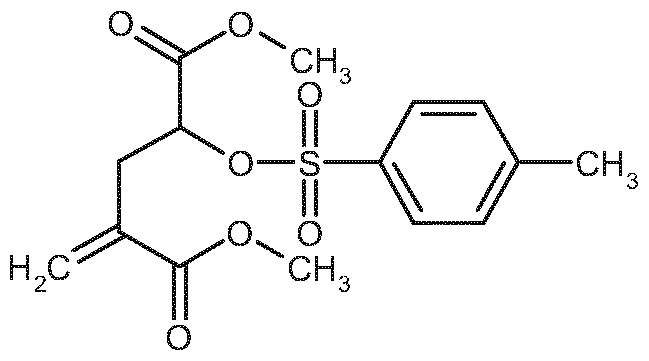
2
To a cooled (0°C) solution of the starting alcohol 1 (1 .00 g, 5.31 mmol) in pyridine (100 mL) was added para-toluenesulfonyl anhydride (2.00 eq). and the mixture was stirred for a period ranging from 2 h at 0°C. The reaction mixture was then partitioned between water and dichloromethane, the organic layer was then washed with water and brine, dried over sodium sulfate, and evaporated. The crude product was purified by column chromatography over silica to give 1.80 g of the target compound (99 % yield).
1H- MR (400 MHz, CDCb): δ ppm = 2.45 (s, 3 H) 2.69 (dd, 1 H) 2.90 (dd, 1 H) 3.67 (s, 3 H) 3.68 (s, 3 H) 5.06 (dd, 1 H) 5.67 (s, 1 H) 6.21 (s, 1 H) 7.32 (d, 2 H) 7.75 (d, 2 H).
Example 3: Dimethyl rac-2-([bis(benzyloxy)phosphoryl]methyl}-4-{tosyloxy)- pentanedioate

To a solution of compound 2 (1 .32 g, 3.81 mmol) in THF (40 mL) was added DBU (1 .8- Diazabicyclo(5.4.0)undec-7-en, 717 pL, 1 .25 eq) and dibenzyl phosphite (1.70 mL, 2.00 eq.) and the mixture was stirred at room temperature for 1.5 h. The mixture was concentrated in vacuo and then partitioned between EtOAc and 5 % aqueous citric acid. The organic layer was washed with brine, dried over sodium sulfate, and evaporated. The residue was purified by column chromatography on silica (hexane / EtOAc) to give the desired product (1.42 g, 61 % yield) as a mixture of stereoisomers.
1H- MR (400 MHz, CDCb): δ ppm 1.83 - 2.07 (m, 1 H) 2.10 - 2.33 (m, 3 H) 2.43 (s, 3 H) 2.81 - 2.98 (m, 1 H) 3.51 (s, 3 H, minor diastereomer) 3.53 (s, 3 H, major diastereomer) 3.57 (s, 3 H, major diastereomer), 3.62 (s, 3 H, minor diastereomer) 4.88 - 5.05 (m 5 H) 7.28 - 7.41 (m, 12 H) 7.75 - 7.81 (m, 2 H).
MS (ESI): [M + H]+ = 605.
Example 4: Dimethyl (2S,4 ?)-2-{[bis(benzyloxy)phosphoryl]methyl}-4-{tosyloxy)- pentanedioate

The compound 3 was submitted to chiral HPLC purification, the compound 4 was the first peak and had a retention time (tn) of 9.1 min using the following method:
SYSTEM: Dionex: Pump 680, AS I 100, Knauer: UV-Detektor K-2501
COLUMN: Chiralcel OD-H 5pm 150x4.6 mm
SOLVENT: Hexane / Ethanol 85: 15 (isocratic)
FLOW: 1 .0 mL/min
TEMPERATURE: 25 °C
DETECTION: UV 210 nm
1H NMR (400 MHz, CDCb) δ ppm 1 .83 - 1 .95 (m, 1 H) 2.10 - 2.31 (m, 3 H) 2.43 (s, 3 H) 2.81 - 2.95 (m, 1 H) 3.51 (s, 3 H) 3.62 (s, 3 H) 4.88 - 5.05 (m, 5 H) 7.28 - 7.40 (m, 12 H) 7.77 (d, 2 H).
Cold Standard Synthesis
Example 5: Dimethyl (RS)-2-fluoro-4-methylenepentanedioate

To a solution of compound 1 (6.00 g, 31 .9 mmol) in THF (60 mL) was added at room temperature perfluorobutanesulfonic acid fluoride (1 1.7 mL, 2.00 eq), triethylamine trihydrofluoride (10.4 mL, 2.00 eq.) and triethylamine (26.7 mL, 6.00 eq.). After stirring for 20 h at room temperature, the reaction mixture was partitioned between water and dichloromethane. The organic layer was separated and washed with a brine/water mixture (1 : 1 ), dried over sodium sulfate and concentrated under reduced pressure. The crude product was purified by column chromatography (silica, hexane / EtOAc) to give compound 5 (4.37 g, 72 % yield).
1H-NMR (400 MHz, CDCh): δ ppm 2.76 - 2.88 (m, 1 H) 2.94 - 3.06 (m, 1 H) 3.79 (s, 3 H) 3.80 (s, 3 H) 5.18 (ddd, 1 H) 5.78 (s, 1 H) 6.35 (s, 1 H). MS (ESI): [M + H]' = 191.
Example 6: Dimethyl rac-2-{[bis(benzyloxy)phosphoryl]methyl}-4-fluoropentanedioate

To a solution of compound 5 (50 mg, 0.26 mmol) and dibenzyl phosphite (86 mg, 1.25 eq) in DMF (3 mL) was added finely powdered potassium carbonate (mesh 325, 55 mg, 1.50 eq), and the resulting mixture was heated to 50 °C for 4 h in a microwave oven. After cooling to room temperature, the mixture was partitioned between EtOAc and 5% aqueous citric acid. The organic layer was washed with half-concentrated brine, dried over sodium sulfate, and
evaporated. The residue was purified by column chromatography over silica gel (hexane / EtOAc) to give the target compound as a mixture of stereoisomers (99 mg, 84 % yield). H NMR (400 MHz, CDCb) δ ppm 1.88 - 2.04 (m, 1 H) 2.10 - 2.39 (m. 3 H) 2.91 - 3.08 (m, 1 H) 3.55 (s, 3 H, minor diastereomer) 3.58 (s, 3 H, major diastereomer) 3.76 (s, 3 H, minor diastereomer) 3.77 (s. 3 H. major diastereomer) 4.82 - 5.08 (m, 5 H) 7.29 - 7.41 (m, 10 H).
MS (ESI): [M + H]* = 453.
Example 7: rac-2-Fluoro-4-(phosphonomethyl)pentanedioic acid

7
A mixture of compound 6 (100 mg, 221 pmol) in 6 N hydrochloric acid (1.33 ml_) was stirred at 100 "C in a microwave oven. After cooling to room temperature, the mixture was diluted with water and evaporated by lyophilization to give the crude target compound which was not purified otherwise (100 mg, >100 % crude yield).
1H NMR (400 MHz, d6-DMSO) δ ppm 1 .63 - 1.80 (m, 1 H) 1.85 - 2.29 (m, 3 H) 2.64 - 2.80 (m, 1 H) 4.81 - 5.1 1 (m, 1 H). C02H and P03H2 protons form a broad peak with adventitious water at 5.4 ppm.
MS (ESI): [M - H] = 243.
Derivatization cold standard
Example 8: Dimethyl rac-2-[(dimethoxyphosphoryl)methyl]-4-fluoropentanedioate

To a solution of compound 7 (220 mg, 1.16 mmol) in DMF (3 mL) was added dimethyl phosphite (135 μΙ_, 1.25 eq.), and finely powdered potassium carbonate (325 mesh, 240 mg, 1.50 eq.), and the mixture was stirred for 2 h at 50 °C in a microwave oven. After cooling to room temperature, the mixture was partitioned between dichloromethane and 5% aqueous citric acid. The organic layer was washed with brine, dried over sodium sulfate, and evaporated. The residue was purified by column chromatography over silica gel (dichloromethane / methanol) to give the target compound as a mixture of stereoisomers (210 mg, 54 % yield).
1H NMR (400 MHz, CDCI3) δ ppm 1.92 - 2.08 (m, 1 H) 2.17 - 2.48 (m, 3 H) 2.97 - 3.10 (m, 1 H) 3.71 - 3.83 (m, 12 H) 4.97 (ddd, 1 H, major diastereomer) 5.03 (ddd, 1 H, minor diastereomer).
MS (ESI): [M + H]+ = 300.
Hot Standard Synthesis
Example 9
(2S,4S)-2-[ 8F]Fluoro-4-phosphonomethyl-pentanedioic acid 9

9
[18F]Fluoride (7,7 GBq) was immobilized on a preconditioned QMA (Waters) cartridge (preconditioned by washing the cartridge with 5ml 0.5M K2CO3 and 10 ml water), The [ 8F]fluoride was eluted using a solution of CS2CO3 (2,3 mg) in 500 μΙ water and K222 (5 mg) in 1500 μΙ acetonitrile. This solution was dried at 120°C with stirring under vacuum, with a stream of nitrogen. Additional acetonitrile (1 ml) was added and the drying step was repeated. A solution of precursor 4 (4mg) in DMSO (500 μΙ) was added and heated at 120°C for 15 min. The mixture was diluted with 20ml water and passed through a C18 light SPE (preconditioned with 5ml ethanol and with 10ml water). The SPE was washed with 5ml water and eluted with 1 ml MeCN. The eluted solution was diluted with 3ml water and purified over prep. HPLC (ACE 5μ C18, 250 x 10mm, isocratic 60% MeCN in 40% water + 0.1 %TFA, flow: 4ml/min). The product peak was collected and diluted with 20ml water and passed through a C18 light SPE (preconditioned with 5ml ethanol and with 10ml water). The SPE was washed with 5ml water and was eluted with 1 ml ethanol. The ethanol solution was dried under gentle !s -stream for 10min at 90°C. 1000μΙ 6M HCI were added and the mixture was incubated for 15min at 120°C. After cooling the reaction mixture was diluted with 1 ml water and passed through a cartridge containing AG1 1A8 resin (ion retardation resin, ~11 g) connected in series with a C18 light SPE (preconditioned with 5ml ethanol and with 10ml water), the cartridges were then washed with saline (5ml) and eluents were collected to give the desired product, 760 MBq (23% d. a).
Figure 1 shows the chromatogram of the final compound 9 after acidic deprotection
Column: ACE 3μ C18 50 x 4,6 mm
Mobile Phase: A: H2O + 0.1 %TFA, B: MeCN + 0.1 %TFA
Gradient: 00:00 05%B
07:00 95%B
07:10 100%B
08:80 100%B
09:00 05%B
12:00 05%B
Flow: 2 ml/min
Detection: γ-detection
Derivatization hot radiopharmaceutical
Example 10:
Dimethyl-(2S,4S)-2-[ 8F]Fluoro-[(dimethoxyphosphoryl)methyl]-pentanedioate 10

To [18F]PMPA (Compound 9) final formulated product (100μΙ) add HBF4 (10μΙ).
Stir the solution vigorously.
Add trimethylsilyldiazomethane solution (3 x 400μΙ) dropwise (Care: exothermic reaction) Stir for 2 min at RT.
Quench reaction with acetic acid (10μΙ). Figure 2 shows complete conversion
Concentrate under a gentle N2 stream at RT for 5 min.
Dilute with 1 ml water and load solution onto tC18 (preconditioned with 5 ml ethanol and with 10 ml water)
Wash with 3 ml water.
Elute with 1 ml ethanol and inject 5 μΙ onto chiral HPLC. Figure 3 shows the chiral HPLC of compound 10, the derivatized product of compound 9.
Hot Standard Synthesis
Example 11 :
(rac)-2-[ 8F]Fluoro-4-phosphonomethyl-pentanedioic acid 11

11
[18F]Fluoride (4.6 GBq) was immobilized on a preconditioned QMA (Waters) cartridge (preconditioned by washing the cartridge with 5ml 0.5M K2CO3 and 10 ml water), The [18F]fluoride was eluted using a solution of CS2CO3 (2,3 mg) in 500 μΙ water and K222 (5 mg) in 1500 μΙ acetonitrile. This solution was dried at 120°C with stirring under vacuum, with a stream of nitrogen. Additional acetonitrile (1 ml) was added and the drying step was repeated. A solution of precursor 3 (4mg) in DMSO (500 μΙ) was added and heated at 120°C for 15 min. The mixture was diluted with 20ml water and passed through a C18 light SPE (preconditioned with 5ml ethanol and with 10ml water). The SPE was washed with 5ml water and eluted with 1 ml MeCN. The eluted solution was diluted with 3ml water and purified over prep. HPLC (ACE 5μ C18, 250 x 10mm, isocratic 60% MeCN in 40% water + 0.1 %TFA, flow:
4ml/min). The product peak was collected and diluted with 20ml water and passed through a C18 light SPE (preconditioned with 5ml ethanol and with 10ml water). The SPE was washed with 5ml water and was eluted with 1 ml ethanol. The ethanol solution was dried under gentle Na-stream for 10min at 90°C. 10ΟΟμΙ 6 HCI were added and the mixture was incubated for 15min at 120°C. After cooling the reaction mixture was diluted with 1 ml water and passed through a cartridge containing AG1 1A8 resin (ion retardation resin. ~11 g) connected in series with a C18 light SPE (preconditioned with 5ml ethanol and with 10ml water), the cartridges were then washed with saline (5ml) and eluents were collected to give the desired product, 430 MBq (25% d. a).
Derivatization Methods (Invention).
This derivatization method was surprisingly found to be rapid (<10 mins) and quantitative (>95%) despite the F18 labeled compound 9 being in a aqueous solution. In addition, this derivatization method allows for the chiral analysis of the derivatized product which was not possible with the underivatized compound 9 or 11.
1. Trimethylsilyldiazomethane in ether with tetrafluoroboric acid Materials:
Final formulated [18F]PMPA product (Compound 9). Figure 1 shows underivatized [18F]PMPA
(Compound 9).
48% HBF in Water (~8 M).
Trimethylsilyldiazomethane solution (2 M in diethyl ether).
tC18 light SPE-cartridge.
HPLC Method used to determine conversion for the derivatization:
Column: ACE 3μ C18 50 x 4,6 mm
Mobile Phase: A: H20 + 0.1 %TFA, B: MeCN + 0.1 %TFA
Gradient: 00:00 05%B
07:00 95%B
07:10 100%B
08:80 100%B
09:00 05%B
12:00 05%B
Flow: 2 ml/min
Detection: γ-detection
HPLC Method used to determine ratio of the different isomer after derivatization:
Mobile Phase: A: EtOH, B: Hexane
Injection volume 5μΙ injection volumes as ethanol solutions
Column: Lux 5μ Amylose-2, 150 x 4.6 mm, Phenomenex
Flow: 1 ml/min
Detection: UV (210-220 nm), γ-detection
Preparation :
To [18F]PMPA (Compound 9) final formulated product (100μΙ) add HBF4 (10μΙ).
Stir the solution vigorously.
Add trimethylsilyldiazomethane solution (3 x 400μΙ) dropwise (Care: exothermic reaction) Stir for 2 min at RT.
Quench reaction with acetic acid (10μΙ). Figure 2 shows complete conversion
Concentrate under a gentle N2 stream at RT for 5 min.
Dilute with 1 ml water and load solution onto tC18 (preconditioned with 5 ml ethanol and with
10 ml water)
Wash with 3 ml water.
Elute with 1 ml ethanol and inject 5 μΙ onto chiral HPLC. Figure 3 shows the chiral HPLC of compound 10, the derivatized product of compound 9. Figure 4 shows a chiral HPLC of the racemic mixture 8.
Derivatization Methods (Prior art). 1. Dimethylformamide dimethyl acetal (DMF-DMA) (See background: Thenot et al., Anal. Letters, 1972, 5, 217-223 and 519-529)
Materials:
Final formulated [18F]PMPA product (Compound 9). Figure 1 shows underivatized [18F]PMPA (Compound 9).
Ν,Ν-Dimethylformamide dimethyl acetal (DMF-DMA), derivatization grade: Aid rich.
HPLC Method used to determine conversion for the derivatization:
Column: ACE 3μ C18 50 x 4,6 mm
Mobile Phase: A: H20 + 0.1 %TFA, B: MeCN + 0.1 %TFA
Gradient: 00:00 05%B
07:00 95%B
07:10 100%B
08:80 100%B
09:00 05%B
12:00 05%B
Flow: 2 ml/min
Detection: γ-detection
Preparation :
To [18F]PMPA (Compound 9) final formulated product (100μΙ) was added DMF-DMA (1000μΙ). (Care: exothermic reaction)
Solution stirred at 100°C for 10 mins.
Quenched reaction with water (1 ΟΟΟμΙ). Figure 5 shows no conversion.
2. Trimethylorthoacetate and ionic liquid [bmim][PFe] (See background: Yoshino et a/. ,
Tetrahedron, 2006, 62, 1309-1317)
Materials:
Final formulated [ 8F]PMPA product (Compound 9). Figure 1 shows underivatized [18F]PMPA (Compound 9).
[bmim][PFe]: Aaron Chemistry
Trimethylorthoacetate (TMOA): Fluka HPLC Method used to determine conversion for the derivatization:
Column: ACE 3μ C18 50 x 4,6 mm
Mobile Phase: A: H20 + O.r/oTFA, B: MeCN + 0.1 %TFA
Gradient: 00:00 05%B
07:00 95%B
07:10 100%B
08:80 100%B
09:00 05%B
12:00 05%B
Flow: 2 ml/min
Detection: γ-detection
Preparation :
To [18F]PMPA (Compound 9) final formulated product (100μΙ) was added [bmim][PF6] (100μΙ) followed by TMOA (400μΙ).
Solution stirred at 100"C for 10mins.
Quenched reaction with water/MeOH (1 :1 ; 1000μΙ). Figure 6 shows no conversion.
3. Acetyl chloride (AcCI) and Methanol (MeOH) (See background: Lillington et al. , Clinica Chimica Acta, 1981 . 1 1 1 , 91 -98)
Materials:
Final formulated [18F]PMPA product (Compound 9). Figure 1 shows underivatized [18F]PMPA (Compound 9).
Acetyl Chloride p.A.: Merck:
HPLC Method used to determine conversion for the derivatization:
Column: ACE 3μ C18 50 x 4,6 mm
Mobile Phase: A: H20 + 0.1 %TFA, B: MeCN + 0.1 %TFA
Gradient: 00:00 05%B
07:00 95%B
07:10 100%B
08:80 100%B
09:00 05%B
12:00 05%B
Flow: 2 ml/min
Detection: γ-detection
Preparation :
To [18F]PMPA (Compound 9) final formulated product (100μΙ) was added MeOH (900μΙ) followed by AcCI (60μΙ - Care: exothermic reaction).
Solution stirred at RT for 10mins.
Quenched reaction with water (1000μΙ). Figure 7 shows conversed to multiple products.
4. Trimethylsilyl diazomethane (See background: Korn et al., J. Biol. Chem. , 1973, 248, 2257-2259)
Materials:
Final formulated [ 8F]PMPA product (Compound 9). Figure 1 shows underivatized [ 8F]PMPA (Compound 9).
Trimethylsilyldiazomethane solution (2 M in hexane).
HPLC Method used to determine conversion for the derivatization:
Column: ACE 3μ C18 50 x 4.6 mm
Mobile Phase: A: H20 + 0.1 %TFA, B: MeCN + 0.1 %TFA
Gradient: 00:00 05%B
07:00 95%B
07:10 100%B
08:80 100%B
09:00 05%B
12:00 05%B
Flow: 2 ml/min
Detection: γ-detection
Preparation :
T o [ 8F]PMPA (Compound 9) final formulated product (100μΙ) was added trimetfiylsilyldiazomethane in hexane complex (900μΙ).
Solution stirred at RT for 10mins.
Reaction quenched by the addition of AcOH (1 ΟμΙ). Figure 8 shows multiple peaks.
5. Boron trifluoride dimethanol complex
Materials:
Final formulated [18F]PMPA product (Compound 9). Figure 1 shows underivatized [ 8F]PMPA (Compound 9).
Boron trifluoride dimethanol complex: ACROS HPLC Method used to determine conversion for the derivatization:
Column: ACE 3μ C18 50 x 4,6 mm
Mobile Phase: A: H20 + 0.1 %TFA, B: MeCN + 0.1 %TFA
Gradient: 00:00 05%B
07:00 95%B
07:10 100%B
08:80 100%B
09:00 05%B
12:00 05%B
Flow: 2 ml/min
Detection: γ-detection
Preparation :
To [18F]PMPA (Compound 9) final formulated product (100μΙ) was added boron trifluoride dimethanol complex (400μΙ).
Solution stirred at 100"C for 10mins.
Quenched reaction with water (400μΙ). Figure 9 shows multiple peaks.
Hot Standard Synthesis
Example 12
2-(5-[18F]Fluoro-peniyl)-2-meihyl-malonic acid 12

12
[ 8F]Fluoride (2514 MBq) was immobilized on a preconditioned QMA (Waters) cartridge (preconditioned by washing the cartridge with 5ml 0.5M K2CO3 and 10 ml water), The [ 8F]fluoride was eluted using a solution of 5mg K222 in 0,95ml ACN / 1 mg K2CO3 in 50μΙ water. This solution was dried at 120°C with stirring under vacuum, with a stream of nitrogen. Additional acetonitrile (1 ml) was added and the drying step was repeated. A solution of 2- methyl-2-[5-(toluene-4-sulfonyloxy)-pentyl]-malonic acid di-tert-butyl ester (2mg) in acetonitrile (300 μΙ) was added and heated at 120 °C for 15 min. To the reaction mixture was added 300μΙ 6M HCI and the reaction heated at 120°C for 10min. The reaction mixture was diluted with 4ml 20% acetonitrile in water + 0.1 % TFA and subjected to purification by semi- prep HPLC (ACE 5μ C18 250 10mm, Solvent A: water + 0.1 % TFA; Solvent B: acetonitrile + 0.1 % TFA; Gradient: 20% B to 90% B in 22 mins; Flow: 4 mL/min). The product peak was collected and diluted with 25ml water and passed through a C18 Plus Environmental (preconditioned with 10ml ethanol and with 10ml water). The SPE was washed with 5ml water and was eluted with 1.5 ml ethanol to give the desired product 12, 418 MBq (51 % d.c). Figure 10 shows the HPLC chromatogram of the purified compound 12.
Derivatization hot radiopharmaceutical
Example 13:

13
Derivatization 1 (25% aqueous solution):
To the ethanolic solution of compound 12 final (150μΙ) was added water (50 μΙ_).
To this solution was added HBF4 (20μΙ).
Stir the solution vigorously.
Add trimethylsilyldiazomethane solution (3 x 400μΙ) dropwise (Care: exothermic reaction) Stir for 2 min at RT.
Quench reaction with acetic acid (20μΙ). HPLC showed >99% conversion
Concentrate to remove diethyl ether under a gentle N2 stream at RT for 5 min.
Add 10μΙ_ aliquot to 50μΙ methanol. HPLC analysis showed >99% conversion.
Figures 1 1 shows the HPLC chromatograms of the derivatized compound 13 with 25% aqueous solution.
Derivatization 2 (50% aqueous solution):
To the ethanolic solution of compound 12 final (100μΙ) was added water (100 μί).
To this solution was added HBF.«. (20μΙ).
Stir the solution vigorously.
Add trimethylsilyldiazomethane solution (3 x 400μΙ) dropwise (Care: exothermic reaction) Stir for 2 min at RT.
Quench reaction with acetic acid (20μΙ). HPLC showed >99% conversion
Concentrate to remove diethyl ether under a gentle N2 stream at RT for 5 min.
Add 10μί aliquot to 50μΙ methanol. HPLC analysis showed >99% conversion.
Derivatization 3 (75% aqueous solution):
To the ethanolic solution of compound 12 final (50μΙ) was added water (150 μί).
To this solution was added HBF.-, (20μΙ).
Stir the solution vigorously.
Add trimethylsilyldiazomethane solution (3 x 400μΙ) dropwise (Care: exothermic reaction) Stir for 2 min at RT.
Quench reaction with acetic acid (20μΙ). HPLC showed >99% conversion
Concentrate to remove diethyl ether under a gentle N2 stream at RT for 5 min.
Add 10μί aliquot to 50μΙ methanol. HPLC analysis showed >99% conversion.
Derivatization 4 (90% aqueous solution):
To the ethanolic solution of compound 12 final (20μΙ) was added water (180 μί).
To this solution was added HBF.< (20μΙ).
Stir the solution vigorously.
Add trimethylsilyldiazomethane solution (3 x 400μΙ) dropwise (Care: exothermic reaction) Stir for 2 min at RT.
Quench reaction with acetic acid (20μΙ). HPLC showed >99% conversion
Concentrate to remove diethyl ether under a gentle N2 stream at RT for 5 min.
Add 10μΙ_ aliquot to 50μΙ methanol. HPLC analysis showed >99% conversion.
Figures 12 shows the HPLC chromatograms of the derivatized compound 13 with 90% aqueous solutions.
Column: ACE 3μ C18 50 x 4,6 mm
Mobile Phase: A: H20 + 0.1 %TFA, B: MeCN + 0.1 %TFA
Gradient: 00:00 05%B
07:00 95%B
07:10 100%B
08:80 100%B
09:00 05%B
12:00 05%B
Flow: 2 ml/min
Detection: γ-detection
Claims
Claims:
1. A method for the derivatization of radiopharmaceuticals comprising one or more carboxylic acid groups and/or one or more phosphonic acid groups and being soluble in an aqueous solution for obtaining derivatized radiopharmaceuticals.
2. The method according to claim 1 comprising the step of alkylation of at least one carboxylic acid groups and/or phosphonic acid groups of a radiopharmaceutical wherein alkylation is obtained by reacting radiopharmaceutical according to claim 1 with an unsubstituted or substituted diazoalkane in presence of an acid, preferably selected from the group of strong acid, Lewis acid and Bransted acid.
3. The method according to claims 1 and 2 wherein independently from each other radiopharmace utical of the formula (I)

R is C(=0)OR6 ;
R2 is C(=0)OR7;
R3 is 9F or 18F;
R4 is hydrogen, Methyl, Ethyl, Propyl, Butyl, t-Butyl or Benzyl;
R5 is hydrogen, Methyl, Ethyl, Propyl, Butyl, t-Butyl or Benzyl;
R6 is hydrogen, Methyl, Ethyl, Propyl, Butyl, t-Butyl or Benzyl;
R7 is hydrogen, Methyl, Ethyl, Propyl, Butyl, t-Butyl or Benzyl;
with the proviso that at least one of R4, R5, R6, and R7 is hydrogen;
and stereoisomers, stereoisomeric mixtures, and suitable salts thereof and
unsubstituted or substituted diazoalkane is diazomethane, diazoethane trimethylsilyldiazomethane or diazomethylbenzene.
4. The method according to claims 1 , 2 or 3 wherein the radiopharmaceutical is one of the following isomers


6. The method herein the radiopharmaceutical is the isomer

7. The method according to the claims 1 to 6 comprises additionally the step of analytical characterization of the obtained derivatized radiopharmaceutical by suitable method such as HPLC, preferably using a HPLC column with a solid-phase.
8. The method according to claim 7 for chiral separation, and determination of the ratio of stereoisomers of the radiopharmaceutical as described in all preceding claims.
9. The method according to claim 8 for determining the ratio of stereoisomers of the radiopharmaceutical as described in all preceding claims.
10. A derivatized radiopharmaceutical which is alkylated at one (1 ) or more carboxylic acid groups and/or one (1 ) or more phosphonic acid groups of a radiopharmaceutical as defined in claims 1 to 6 for subsequent analytical characterization of radiopharmaceutical as described in the preceding claims.
1 1 . The derivatized radiopharmaceutical according to claim 10 of the formula (II)

wherein
R1 is C(=0)OR6 ;
R2 is C(=0)OR7;
R3 is 9F or 18F;
R4 is hydrogen, alkyl or aryl-alkyl;
R5 is hydrogen, alkyl or aryl-alkyl;
R6 is hydrogen, alkyl or aryl-alkyl;
R7 is hydrogen, alkyl or aryl-alkyl;
with the proviso that R4, R5, R6, and R7 are never simultaneously hydrogen;
and stereoisomers, stereoisomeric mixtures, and suitable salts thereof.
12. The derivatized radiopharmaceutical according to claim 1 1 that is one of the following isomers


13. The derivatized radiopharmaceutical according to claim 12 that is one of the following
14. The de

15. A kit comprising at least one sealed vial comprising radiopharmaceutical as defined in claims 1 to 6.
Applications Claiming Priority (2)
| Application Number | Priority Date | Filing Date | Title |
|---|---|---|---|
| EP11075017.1 | 2011-01-31 | ||
| EP11075017 | 2011-01-31 |
Publications (1)
| Publication Number | Publication Date |
|---|---|
| WO2012104225A1 true WO2012104225A1 (en) | 2012-08-09 |
Family
ID=43836750
Family Applications (1)
| Application Number | Title | Priority Date | Filing Date |
|---|---|---|---|
| PCT/EP2012/051368 Ceased WO2012104225A1 (en) | 2011-01-31 | 2012-01-27 | Derivatization of radiopharmaceuticals |
Country Status (1)
| Country | Link |
|---|---|
| WO (1) | WO2012104225A1 (en) |
Cited By (2)
| Publication number | Priority date | Publication date | Assignee | Title |
|---|---|---|---|---|
| CN117705970A (en) * | 2023-12-11 | 2024-03-15 | 平顶山德源精细化学品有限公司 | Analysis method for carboxylic acid content |
| WO2025058000A1 (en) | 2023-09-13 | 2025-03-20 | 東レ株式会社 | Pharmaceutical composition for treating, preventing and/or diagnosing cancer |
Citations (2)
| Publication number | Priority date | Publication date | Assignee | Title |
|---|---|---|---|---|
| EP2322514A1 (en) * | 2009-11-11 | 2011-05-18 | Bayer Schering Pharma Aktiengesellschaft | Homoglutamic acid and glutamic acid derivatives |
| EP2338892A1 (en) * | 2009-12-18 | 2011-06-29 | Bayer Schering Pharma Aktiengesellschaft | Prostate specific membrane antigen inhibitors |
-
2012
- 2012-01-27 WO PCT/EP2012/051368 patent/WO2012104225A1/en not_active Ceased
Patent Citations (2)
| Publication number | Priority date | Publication date | Assignee | Title |
|---|---|---|---|---|
| EP2322514A1 (en) * | 2009-11-11 | 2011-05-18 | Bayer Schering Pharma Aktiengesellschaft | Homoglutamic acid and glutamic acid derivatives |
| EP2338892A1 (en) * | 2009-12-18 | 2011-06-29 | Bayer Schering Pharma Aktiengesellschaft | Prostate specific membrane antigen inhibitors |
Non-Patent Citations (40)
| Title |
|---|
| BADOUD; PRATZ, J. CHROMATOGR., vol. 360, 1986, pages 119 - 136 |
| BOSSLE ET AL., J. CHROMATOGR., vol. 267, 1983, pages 209 - 212 |
| CARTWRIGHT ET AL., RAPID COMMUN. MASS SPECTROM., vol. 19, 2005, pages 1058 - 1062 |
| CHROMATOGRAPHIA, vol. 33, 1992, pages 13 - 18 |
| CLAUS O. MEESE ET AL: "Dimethyl 3,3,4,4,.5,.5,6,6-(2H8)-6-methoxycarbonyl-2-oxo-hexanephosphonate, a versatile reagent for the synthesis of deuterated [omega]-carboxy prostanoids", JOURNAL OF LABELLED COMPOUNDS AND RADIOPHARMACEUTICALS, vol. 23, no. 2, 1 February 1986 (1986-02-01), pages 175 - 185, XP055020551, ISSN: 0362-4803, DOI: 10.1002/jlcr.2580230208 * |
| COENEN: "PET-Chemistry - The Driving Force in Molecular Imaging", 2006, SPRINGER, article "Fluorine-18 Labeling Methods: Features and Possibilities of Basic Reactions", pages: 15 - 50 |
| CULLEN; ROVIS, ORG. LETT., vol. 10, 2008, pages 3141 - 3144 |
| D BENDER: "Metabolites of 18F-FDG and 3-O-11C-Methylglucose in Pig Liver", JOURNAL OF NUCLEAR MEDICINE, vol. 42, no. 11, 1 January 2001 (2001-01-01), pages 1673 - 1678, XP055020457 * |
| DATABASE CA [online] CHEMICAL ABSTRACTS SERVICE, COLUMBUS, OHIO, US; 1987, MIFTAKHOV, M. S. ET AL: "Prostanoids . XIX. Synthesis of C-14-labeled cloprostenol", XP002670490, retrieved from STN Database accession no. 109:37636 * |
| DING P ET AL: "Design, synthesis and pharmacological activity of novel enantiomerically pure phosphonic acid-based NAALADase inhibitors", ORGANIC & BIOMOLECULAR CHEMISTRY, ROYAL SOCIETY OF CHEMISTRY, GB, vol. 5, 1 January 2007 (2007-01-01), pages 826 - 831, XP002585048, ISSN: 1477-0520, [retrieved on 20070119], DOI: 10.1039/B615603G * |
| EDWARD J. O'CONNOR ET AL: "Synthesis of (1, 2-13C2) 2-phosphoglycolic acid", JOURNAL OF LABELLED COMPOUNDS AND RADIOPHARMACEUTICALS, vol. 34, no. 8, 1 August 1994 (1994-08-01), pages 735 - 740, XP055020428, ISSN: 0362-4803, DOI: 10.1002/jlcr.2580340806 * |
| ELMALEH ET AL., INTERNATIONAL JOURNAL OF NUCL. MED. AND BIO., vol. 10, no. 4, 1983, pages 181 - 187 |
| GATTI ET AL., BIOMED. CHROM., vol. 10, 1996, pages 19 - 24 |
| GATTI ET AL., BIOMED. CHROM., vol. 11, 1997, pages 11 - 15 |
| GREENE; WUTS: "Protecting groups in Organic Synthesis", pages: 16 - 298 |
| GREENE; WUTS: "Protecting groups in Organic Synthesis", pages: 647 - 695 |
| GREENE; WUTS: "Protecting groups in Organic Synthesis", pages: 696 - 926 |
| JOHN T. WHITTECK ET AL: "On the Stereochemistry of 2-Hydroxyethylphosphonate Dioxygenase", JOURNAL OF THE AMERICAN CHEMICAL SOCIETY, vol. 133, no. 12, 30 March 2011 (2011-03-30), pages 4236 - 4239, XP055020548, ISSN: 0002-7863, DOI: 10.1021/ja1113326 * |
| KIESEWETTER D O ET AL: "Enantiomeric radiochemical synthesis of R and S (1-(6-amino-9H-purin-9-yl)-3-fluoropropan-2-yloxy)methylphosphonic acid (FPMPA)", JOURNAL OF LABELLED COMPOUNDS AND RADIOPHARMACEUTICALS, JOHN WILEY, CHICHESTER, GB, vol. 51, 13 March 2008 (2008-03-13), pages 187 - 194, XP002487665, ISSN: 0362-4803, [retrieved on 20080313], DOI: 10.1002/JLCR.1505 * |
| KIHLBERG ET AL., NUCL. MED. BIOL., vol. 21, no. 8, November 1994 (1994-11-01), pages 1053 - 65 |
| KORN ET AL., J. BIOL. CHEM., vol. 248, 1973, pages 2257 - 2259 |
| KRASIKOWA: "PET-Chemistry - The Driving Force in Molecular Imaging", 2006, SPRINGER, article "Synthesis Modules and Automation in F-18 labeling", pages: 289 - 316 |
| KÜHNEL ET AL., ANGEW. CHEM. INT. ED., vol. 46, 2007, pages 7075 - 7078 |
| L. BREAU ET AL: "Synthesis of 13 C labelled unsymmetrically substituted maleic anhydrides", JOURNAL OF LABELLED COMPOUNDS AND RADIOPHARMACEUTICALS, vol. 25, no. 3, 1 March 1988 (1988-03-01), pages 301 - 312, XP055020549, ISSN: 0362-4803, DOI: 10.1002/jlcr.2580250310 * |
| LADANYI ET AL., CHROMATOGRAPHIA, vol. 24, 1987, pages 477 - 481 |
| LILLINGTON ET AL., CLINICA CHIMICA ACTA, vol. 111, 1981, pages 91 - 98 |
| MIFTAKHOV, M. S. ET AL: "Prostanoids . XIX. Synthesis of C-14-labeled cloprostenol", ZHURNAL ORGANICHESKOI KHIMII , 23(6), 1185-90 CODEN: ZORKAE; ISSN: 0514-7492, 1987 * |
| NAGELS ET AL., J. CHROMATOGR., vol. 190, 1980, pages 411 - 417 |
| PANDEY ET AL., HEART METAB, vol. 51, 2011, pages 15 - 19 |
| PRESSER; HUFNER, MONATSHEFTE FUR CHEMIE, vol. 135, 2004, pages 1015 - 1022 |
| PUTTMANN ET AL., CLIN. CHEM., vol. 39, 1993, pages 825 - 832 |
| ROACH ET AL., ANAL. CHEM., vol. 59, 1987, pages 1056 - 1059 |
| RUEPPEL ET AL., BIOMEDICAL MASS SPECTROMETRY, vol. 3, 1976, pages 28 - 31 |
| SALLY FREEMAN ET AL: "Phosphonate biosynthesis: the stereochemical course of phosphoenolpyruvate phosphomutase", JOURNAL OF THE AMERICAN CHEMICAL SOCIETY, vol. 111, no. 26, 1 December 1989 (1989-12-01), pages 9233 - 9234, XP055020436, ISSN: 0002-7863, DOI: 10.1021/ja00208a018 * |
| SENNELLO; ARGOUDELIS, ANAL. CHEM., vol. 41, 1969, pages 171 - 173 |
| SHIORI; AOYAMA, ADV. USE SYNTHONS ORG. CHEM., vol. 1, 1993, pages 51 - 101 |
| SLEGEL ET AL., J. PHARMACEUTICAL & BIOMEDICAL ANALYSIS, vol. 5, 1987, pages 665 - 673 |
| THENOT ET AL., ANAL. LETTERS, vol. 5, 1972, pages 217 - 223,519-529 |
| YASAKA ET AL., J. CHROMATOGR., vol. 508, 1990, pages 133 - 140 |
| YOSHINO ET AL., TETRAHEDRON, vol. 62, 2006, pages 1309 - 1317 |
Cited By (2)
| Publication number | Priority date | Publication date | Assignee | Title |
|---|---|---|---|---|
| WO2025058000A1 (en) | 2023-09-13 | 2025-03-20 | 東レ株式会社 | Pharmaceutical composition for treating, preventing and/or diagnosing cancer |
| CN117705970A (en) * | 2023-12-11 | 2024-03-15 | 平顶山德源精细化学品有限公司 | Analysis method for carboxylic acid content |
Similar Documents
| Publication | Publication Date | Title |
|---|---|---|
| Gao et al. | An improved synthesis of dopamine D2/D3 receptor radioligands [11C] fallypride and [18F] fallypride | |
| EP3212610B1 (en) | Methods for low temperature fluorine-18 radiolabeling of biomolecules | |
| Franck et al. | Investigations into the synthesis, radiofluorination and conjugation of a new [18F] fluorocyclobutyl prosthetic group and its in vitro stability using a tyrosine model system | |
| JP2018536031A (en) | Process for the synthesis of iodo- or asteratoarenes using diaryliodonium salts | |
| Kostikov et al. | N-(4-(di-tert-butyl [18F] fluorosilyl) benzyl)-2-hydroxy-N, N-dimethylethylammonium bromide ([18F] SiFAN+ Br−): A novel lead compound for the development of hydrophilic SiFA-based prosthetic groups for 18F-labeling | |
| EP2513121A1 (en) | Prostate specific membrane antigen inhibitors | |
| WO2012104225A1 (en) | Derivatization of radiopharmaceuticals | |
| WO2015004029A1 (en) | 18f-labeling of aromatic and heteroaromatic molecules with unprotected carboxylic acid groups | |
| EP2746250B1 (en) | Precursors and process for the production of 18F-labelled amino acids | |
| KR101996683B1 (en) | Novel precursors of glutamate derivatives | |
| Gilissen et al. | Synthesis of N‐(2‐[18F] fluoroethyl)‐N′‐methylthiourea: a hydrogen peroxide scavenger | |
| Balentova et al. | Synthesis and hydrolytic stability of novel 3-[18F] fluoroethoxybis (1-methylethyl) silyl] propanamine-based prosthetic groups | |
| Erlandsson et al. | 18F-labelled metomidate analogues as adrenocortical imaging agents | |
| WO2009029633A1 (en) | Synthesis of [18f]-labelled alkyl mesylates using fluorous spe separation | |
| WO2013173630A1 (en) | Formulation of radiopharmaceuticals containing multiple acidic groups | |
| Schou et al. | Synthesis and PET evaluation of (R)‐[S‐methyl‐11C] thionisoxetine, a candidate radioligand for imaging brain norepinephrine transporters | |
| Pascali et al. | Use of 1, 8‐bis‐(dimethylamino)‐naphthalene/H18F complex as new radiofluorinating agent | |
| Peters et al. | Simple and efficient synthesis of 2-[18F] fluoroethyl triflate for high yield 18fluoroethylation | |
| Li et al. | [18F] Fluoropropylsulfonyl chloride: a new reagent for radiolabeling primary and secondary amines for PET imaging | |
| WO2017186969A1 (en) | Alkylation method | |
| Kilbourn et al. | Fluorine-18 radiopharmaceuticals | |
| EP4433443A1 (en) | Method for the preparation of a composition comprising dissolved [18f]fluoride and composition obtainable by the method | |
| Pascali et al. | Identification of chemical byproducts in the radiofluorination of structurally complex aryliodonium salts | |
| WO2013026940A1 (en) | Simplified radiosynthesis of o-[18f]fluoromethyl tyrosine derivatives |
Legal Events
| Date | Code | Title | Description |
|---|---|---|---|
| 121 | Ep: the epo has been informed by wipo that ep was designated in this application |
Ref document number: 12703016 Country of ref document: EP Kind code of ref document: A1 |
|
| NENP | Non-entry into the national phase |
Ref country code: DE |
|
| 122 | Ep: pct application non-entry in european phase |
Ref document number: 12703016 Country of ref document: EP Kind code of ref document: A1 |