WO2012090888A1 - Organoboron compound and method for manufacturing the same - Google Patents
Organoboron compound and method for manufacturing the same Download PDFInfo
- Publication number
- WO2012090888A1 WO2012090888A1 PCT/JP2011/079957 JP2011079957W WO2012090888A1 WO 2012090888 A1 WO2012090888 A1 WO 2012090888A1 JP 2011079957 W JP2011079957 W JP 2011079957W WO 2012090888 A1 WO2012090888 A1 WO 2012090888A1
- Authority
- WO
- WIPO (PCT)
- Prior art keywords
- carbon atoms
- synthesis
- group
- benzo
- naphtho
- Prior art date
- Legal status (The legal status is an assumption and is not a legal conclusion. Google has not performed a legal analysis and makes no representation as to the accuracy of the status listed.)
- Ceased
Links
- 0 *c1cc2ccccc2c2c1[o]c1c2cccc1-c1cc(-c2ccc(cc3)c4c2ccc2c4c3ccc2)ccc1 Chemical compound *c1cc2ccccc2c2c1[o]c1c2cccc1-c1cc(-c2ccc(cc3)c4c2ccc2c4c3ccc2)ccc1 0.000 description 9
- RISJBMXJKFCIDY-UHFFFAOYSA-N CCCCCOB(c1cc(cccc2)c2c2c1[o]c1c2cccc1)OCCCCC Chemical compound CCCCCOB(c1cc(cccc2)c2c2c1[o]c1c2cccc1)OCCCCC RISJBMXJKFCIDY-UHFFFAOYSA-N 0.000 description 1
- JPFIPOUSUZFOPX-UHFFFAOYSA-N CCCCOB(c1cc(cccc2)c2c2c1[o]c1c2cccc1)OCCCC Chemical compound CCCCOB(c1cc(cccc2)c2c2c1[o]c1c2cccc1)OCCCC JPFIPOUSUZFOPX-UHFFFAOYSA-N 0.000 description 1
Classifications
-
- C—CHEMISTRY; METALLURGY
- C07—ORGANIC CHEMISTRY
- C07F—ACYCLIC, CARBOCYCLIC OR HETEROCYCLIC COMPOUNDS CONTAINING ELEMENTS OTHER THAN CARBON, HYDROGEN, HALOGEN, OXYGEN, NITROGEN, SULFUR, SELENIUM OR TELLURIUM
- C07F5/00—Compounds containing elements of Groups 3 or 13 of the Periodic Table
- C07F5/02—Boron compounds
- C07F5/025—Boronic and borinic acid compounds
-
- C—CHEMISTRY; METALLURGY
- C07—ORGANIC CHEMISTRY
- C07F—ACYCLIC, CARBOCYCLIC OR HETEROCYCLIC COMPOUNDS CONTAINING ELEMENTS OTHER THAN CARBON, HYDROGEN, HALOGEN, OXYGEN, NITROGEN, SULFUR, SELENIUM OR TELLURIUM
- C07F5/00—Compounds containing elements of Groups 3 or 13 of the Periodic Table
- C07F5/02—Boron compounds
Definitions
- the present invention relates to an organoboron compound and a method for manufacturing the same.
- Organic compounds can take a wide variety of structures compared with inorganic compounds, and have a possibility to provide materials having various functions with appropriate molecular design. For these advantages, materials of organoboron compounds that can be used as synthetic intermediates of various organic compounds have been developed.
- Patent Document 1 discloses a material for a light-emitting element synthesized using a benzofuran compound which is converted into organoboron as a material.
- organoboron compounds that can be used as synthetic intermediates thereof.
- organoboron compounds that can be used as synthetic intermediates thereof.
- the means for obtaining the objects with high purity in a simple manner include the adoption of a synthesis route using materials which are more stable and easy to purify, the adoption of a synthesis route through which by-products are less likely to be synthesized, and the like.
- Patent Document 1 Japanese Published Patent Application No. 2008-94777 DISCLOSURE OF INVENTION
- One embodiment of the present invention is an organoboron compound represented by General Formula (Gl) below.
- R 1 to R 9 separately represent any one of hydrogen, an alkyl group having 1 to 6 carbon atoms, and an aryl group having 6 to 16 carbon atoms.
- R 10 and R 11 separately represent hydrogen or an alkyl group having 1 to 6 carbon atoms, and R 10 and R 11 may be bonded with each other to form a ring.
- X represents an oxygen atom or a sulfur atom.
- Another embodiment of the present invention is a method for manufacturing an organoboron compound represented by General Formula (Gl) below which is synthesized in such a manner that a benzo[b]naphtho[l,2-i/]furan compound or a benzo[b]naphtho[l,2-d]thiophene compound is converted into organoboron with use of an alkyllithium reagent and a boron reagent.
- Gl General Formula
- R 1 to R 9 separately represent any one of hydrogen, an alkyl group having 1 to 6 carbon atoms, and an aryl group having 6 to 16 carbon atoms.
- R 10 and R 11 separately represent hydrogen or an alkyl group having 1 to 6 carbon atoms, and R 10 and R 11 may be bonded with each other to form a ring.
- X represents an oxygen atom or a sulfur atom.
- Another embodiment of the present invention is an organoboron compound represented by General Formula (G2) below.
- R 1 to R 9 separately represent any one of hydrogen, an alkyl group having 1 to 6 carbon atoms, and an aryl group having 6 to 16 carbon atoms.
- R 10 and R 11 separately represent hydrogen or an alkyl group having 1 to 6 carbon atoms, and R 10 and R 11 may be bonded with each other to form a ring.
- Another embodiment of the present invention is an organoboron compound represented by General Formula (G3) below.
- R 1 to R 9 separately represent any one of hydrogen, an alkyl group having 1 to 6 carbon atoms, and an aryl group having 6 to 16 carbon atoms.
- R 10 and R 11 separately represent hydrogen or an alkyl group having 1 to 6 carbon atoms, and R 10 and R 11 may be bonded with each other to form a ring.
- a novel organoboron compound and a method for manufacturing the same can be provided.
- the organoboron compound is useful as a reactant of organic synthesis, and a variety of organic compounds can be synthesized using the organoboron compound as a synthetic intermediate.
- FIGS. 1A and IB show a result of NMR measurement of benzo[b]naphtho[l,2-iZ]furan
- FIG. 2 shows a result of X-ray crystallography of PBnf (abbreviation).
- the organoboron compound according to one embodiment of the present invention is represented by General Formula (Gl) below.
- R 1 to R 9 separately represent any one of hydrogen, an alkyl group having 1 to 6 carbon atoms, and an aryl group having 6 to 16 carbon atoms.
- R 10 and R 11 separately represent hydrogen or an alkyl group having 1 to 6 carbon atoms, and R 10 and R u may be bonded with each other to form a ring.
- X represents an oxygen atom or a sulfur atom.
- an organoboron compound represented by any of General Formula (Gl) to General Formula (G3) also includes boronic acid.
- R 10 and R 11 in each of General Formulae (Gl) to (G3) represent hydrogen.
- the boronic acid may be protected by alcohol, ethylene glycol or the like, and in this case, R 10 and R 11 in each of General Formulae (Gl) to (G3) represent an alkyl group having 1 to 6 carbon atoms.
- R 1 to R 9 hydrogen, a methyl group, an ethyl group, a propyl group, an isopropyl group, a butyl group, a sec-butyl group, an isobutyl group, a tert-butyl group, a phenyl group, a 1-naphthyl group, a 2-naphthyl group, a 2-anthryl group, a 9-anthryl group, a pylen-l-yl group, a pylen-4-yl group, a fluoren-2-yl group and the like can be given.
- a phenyl group, a 1-naphthyl group, a 2-naphthyl group, a 2-anthryl group, a 9-anthryl group, a pylen-l-yl group, a pylen-4-yl group, or a fluoren-2-yl group, which is an aryl group, may have an alkyl group having 1 to 6 carbon atoms, an aryl group having 6 to 16 carbon atoms, or an aryl group having 6 to 13 carbon atoms as a substituent.
- R and R hydrogen, a methyl group, an ethyl group, a propyl group, an isopropyl group, a butyl group, a sec-butyl group, an isobutyl group, and a ieri-butyl group, a pentyl group, a hexyl group, a cyclopentyl group, a cyclohexyl group and the like can be given.
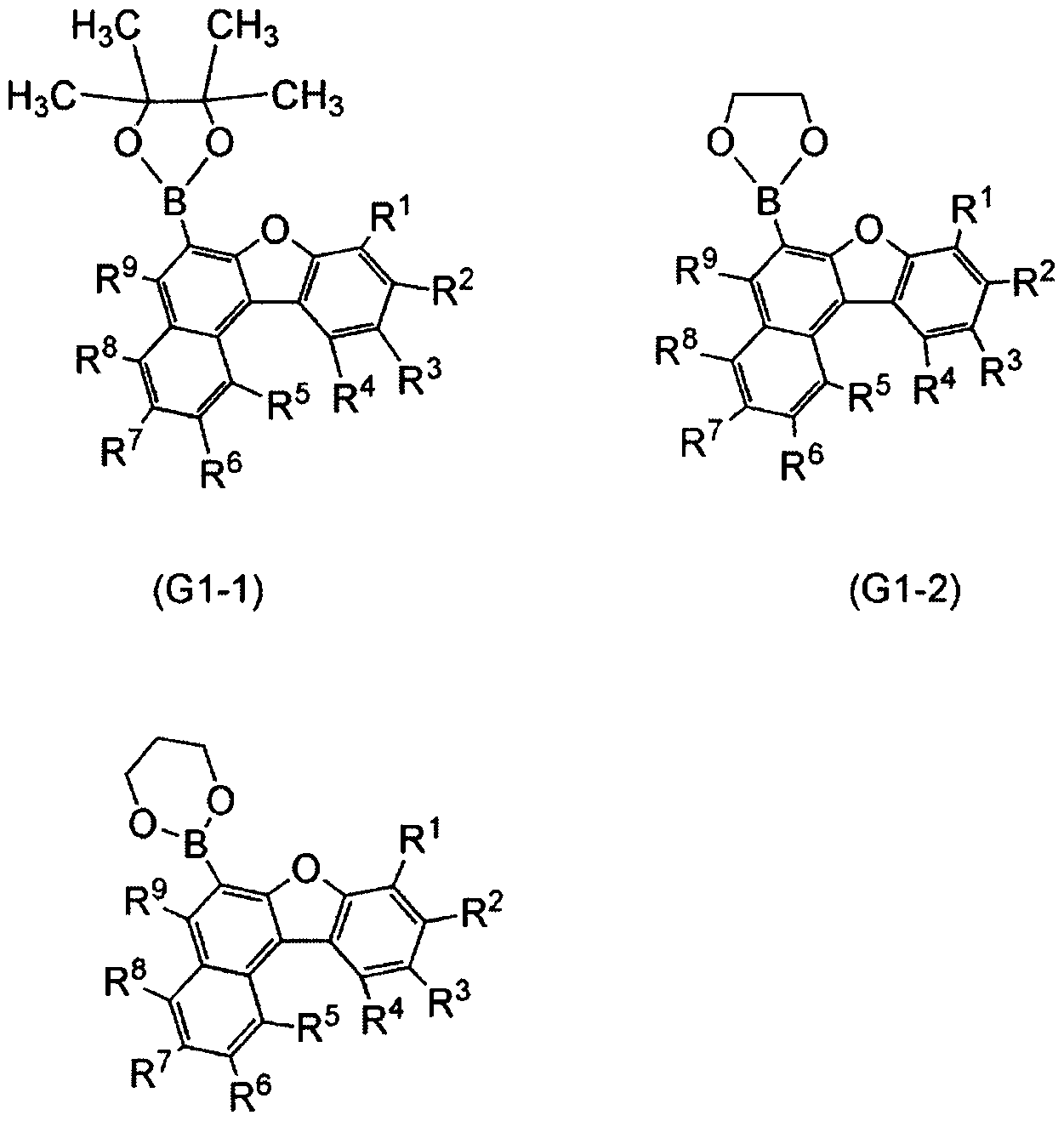
- R 10 and R 11 may be bonded to each other to form a ring as illustrated in General Formulae (Gl-1) to (Gl-3) below.
- an organoboron compound represented by General Formula (Gl) is an organoboron compound represented by General Formula (G2) or General Formula (G3) below.
- R 1 to R 9 separately represent any one of hydrogen, an alkyl group having 1 to 6 carbon atoms, and an aryl group having 6 to 16 carbon atoms.
- R 10 and R 11 separately represent hydrogen or an alkyl group having 1 to 6 carbon atoms, and R 10 and R 11 may be bonded to each other to form a ring.
- R 1 to R 9 separately represent any one of hydrogen, an alkyl group having 1 to 6 carbon atoms, and an aryl group having 6 to 16 carbon atoms.
- R 10 and R 11 separately represent hydrogen or an alkyl group having 1 to 6 carbon atoms, and R 10 and R 11 may be bonded to each other to form a ring.
- organoboron compound represented by General Formula (Gl) include organoboron compounds represented by Structural Formulae (100) to (143) and (200) to (243).
- the present invention is not limited thereto.
- a benzo[b]naphtho[l,2-i/]furan compound or a benzo[b]naphtho[l,2-i/]thiophene compound is converted into organoboron with use of an alkyllithium reagent and a boron reagent, whereby the organoboron compound in this embodiment can be manufactured.
- An example of reaction is described below.
- a benzo[b]naphtho[l,2-d]furan compound or a benzo[b]naphtho[l,2-d]thiophene compound (al) is converted into organoboron with use of an alkyllithium reagent and a boron reagent, whereby the organoboron compound represented by General Formula (Gl) can be obtained.
- the 6-position of the benzo[b]naphfho[l,2-d]furan compound or the benzo[b]naphtho[l,2-d]thiophene compound (al) is selectively converted into organoboron.
- R 1 to R 9 separately represent any one of hydrogen, an alkyl group having 1 to 6 carbon atoms, and an aryl group having 6 to 16 carbon atoms.
- R 10 and R 11 separately represent hydrogen or an alkyl group having 1 to 6 carbon atoms, and R 10 and R u may be bonded with each other to form a ring.
- X represents an oxygen atom or a sulfur atom.
- the conversion of the benzo[b]naphtho[l,2-(i]furan compound or the benzo[b]naphtho[l,2-i/]thiophene compound (al) illustrated in Synthesis Scheme (A-1) into organoboron includes the conversion into boronic acid.
- R 10 and R 11 in each of General Formulae (Gl) to (G3) represent hydrogen.
- the boronic acid may be protected by ethylene glycol or the like.
- R 10 and R 11 in each of General Formulae (Gl) to (G3) represent an alkyl group having 1 to 6 carbon atoms.
- an ether-based solvent or the like such as diethyl ether, tetrahydrofuran (THF), or cyclopentyl methyl ether
- the alkyllithium reagent may be n-butyllithium, sec -butyl lithium, ieri-butyl lithium, or the like.
- a coordinating additive to such an alkyllithium reagent can enhance reactivity.
- the coordinating additive that can be used may be tetramethylethylenediamine (TMEDA) or the like.
- the boron reagent may be trimethyl borate, triisopropyl borate, or the like.
- the organoboron compound represented by General Formula (Gl) can be synthesized.
- the 6-position of the benzo[b]naphfho[l,2-d]furan compound or the benzo[b]naphtho[l,2-rf]thiophene compound (al) can be selectively converted into organoboron, in which by-products are less likely to be synthesized.
- the reaction illustrated in Synthesis Scheme (A-l) has a small number of reaction steps, which is simple. Accordingly, the organoboron compound represented by General Formula (Gl) that is an objective substance can be synthesized with high purity.
- the organoboron compound represented by General Formula (Gl) is useful as a reactant of organic synthesis, and a variety of organic compounds can be synthesized using the organoboron compound as a synthetic intermediate.
- a ⁇ -naphthol derivative (bl) is coupled with an organoboron compound of an aryl derivative (b2) by the Suzuki-Miyaura coupling using a palladium catalyst, whereby a ⁇ -naphthol derivative having a halogen group (b3) can be obtained.
- R 1 to R 9 separately represent any one of hydrogen, an alkyl group having 1 to 6 carbon atoms, and an aryl group having 6 to 16 carbon atoms.
- R 10 and R 11 separately represent hydrogen or an alkyl group having 1 to 6 carbon atoms, and R 10 and R 11 may be bonded with each other to form a ring.
- X 1 represents halogen or a triflate group. In the case where X 1 is halogen, in particular, bromine or iodine is preferable.
- X 2 represents halogen, preferably chlorine, iodine, or bromine, more preferably, fluorine.
- the organoboron compound of an aryl derivative (b2) includes boronic acid.
- R 10 and R 11 in the organoboron compound of an aryl derivative (b2) represent hydrogen.
- the boronic acid may be protected by ethylene glycol or the like.
- R 10 and R 11 in the organoboron compound of an aryl derivative (b2) represent an alkyl group having 1 to 6 carbon atoms.
- Examples of palladium catalysts that can be used in Synthesis Scheme (B-1) include palladium(II) acetate, tetrakis(triphenylphosphine)palladium(0), and the like.
- Examples of ligands of the palladium catalyst that can be used in Synthesis Scheme (B-1) include tri(ori io-tolyl)phosphine, triphenylphosphine, tricyclohexylphosphine, and the like.
- examples of the base that can be used include organic bases such as sodium teri-butoxide, and inorganic bases such as a potassium carbonate and a sodium carbonate.
- solvents examples include as follows: toluene; xylene; an alcohol such as ethanol; a mixed solvent of toluene and an alcohol such as ethanol; a mixed solvent of xylene and an alcohol such as ethanol; a mixed solvent of toluene and water; a mixed solvent of toluene, an alcohol such as ethanol, and water; a mixed solvent of xylene and water; a mixed solvent of xylene, an alcohol such as ethanol, and water; a mixed solvent of benzene and water; a mixed solvent of benzene, an alcohol such as ethanol, and water; a mixed solvent of an ether such as 1,2-dimethoxyethane, and water; and the like.
- Use of a mixed solvent of toluene and water or a mixed solvent of toluene, ethanol, and water is more preferable.
- the ⁇ -naphthol derivative having a halogen group (b3) is intramolecularly cyclized by formation of an ether bond according to a Williamson ether synthesis to form a benzo[b]naphtho[l,2- ⁇ i]furan ring, so that a benzo[b]naphtho[l,2-fi?]furan compound (b4) can be obtained.
- Examples of the base that can be used in Synthesis Scheme (B-2) include inorganic bases such as sodium hydride, potassium carbonate, potassium hydroxide, and the like. In addition, a salt such as sodium iodide may be added to the bases described above.
- Examples of the solvent that can be used include aprotic polar solvents such as acetonitrile, N,N-dimethylformamide (DMF), dimethyl sulfoxide (DMSO), and N-methyl-pyrrolidone (NMP) and ketones such as cyclohexanone and 2-butanone, and acetone.
- Synthesis Method 2 a method for synthesizing the benzo[b]naphtho[l,2-ii]furan compound according to this embodiment, which is different from Synthesis Method 1, will be described below as Synthesis Method 2.
- R 12 represents an alkyl group having 1 to 6 carbon atoms.
- R 13 to R 17 separately represent any one of hydrogen, an alkyl group having 1 to 6 carbon atoms, and an aryl group having 6 to 16 carbon atoms.
- X represents a halogen or a triflate group. In the case where X is a halogen, in particular, chlorine, bromine, or iodine is preferable.
- Examples of palladium catalysts that can be used in Synthesis Scheme (C-1) include palladium(II) acetate, tetrakis(triphenylphosphine)palladium(0), and the like.
- Examples of ligands of the palladium catalyst that can be used in Synthesis Scheme (C-1) include tri(ort/ o-tolyl)phosphine, triphenylphosphine, tricyclohexylphosphine, and the like.
- examples of the base that can be used include organic bases such as sodium tert-butoxide, and inorganic bases such as a potassium carbonate and a sodium carbonate.
- solvents examples include as follows: toluene; xylene; an alcohol such as ethanol; a mixed solvent of toluene and an alcohol such as ethanol; a mixed solvent of xylene and an alcohol such as ethanol; a mixed solvent of toluene and water; a mixed solvent of toluene, an alcohol such as ethanol, and water; a mixed solvent of xylene and water; a mixed solvent of xylene, an alcohol such as ethanol, and water; a mixed solvent of benzene and water; a mixed solvent of benzene, an alcohol such as ethanol, and water; a mixed solvent of an ether such as 1,2-dimethoxyethane, and water; and the like.
- Use of a mixed solvent of toluene and water or a mixed solvent of toluene, ethanol, and water is more preferable.
- the naphthalene derivative (cl) having an alkoxide group is used instead of the ⁇ -naphthol derivative (bl) in Synthesis Scheme (B-l) described above.
- a hydroxyl group in the ⁇ -naphthol derivative (bl) can be protected; accordingly, introduction of a substituent into the ⁇ -naphthol derivative having a halogen group (b3) can be performed more easily.
- R is a methyl group.
- trifluoroacetic acid a 4 mol/L hydrochloric acid-ethyl acetate solution or the like is preferred when R 12 is a ieri-butyl group.
- examples of the solvent that can be used include halogen-based solvents such as dichloromethane, chloroform, and carbon tetrachloride, and aromatic hydrocarbon-based solvents such as toluene and xylene.
- the benzo[b]naphtho[l,2-rf]furan compound (b4) described in this embodiment can be used as a material for synthesizing the organoboron compound described in
- Nuclear magnetic resonance (NMR) spectroscopy identified this compound as benzo[b]naphtho[l,2-rf]furan, which was the object of the synthesis.
- FIGS. 1A and IB the 1H-NMR charts are shown in FIGS. 1A and IB. Note that FIG.
- IB is a chart showing an enlarged part of FIG 1 A in the range of 7.2 ppm to 8.7 ppm.
- TEDA tetramethylethylenediamine
- THF tetrahydrofuran
- FIG. 2 is an ORTEP (oak ridge thermal ellipsoid plot) drawing. It was confirmed from FIG 2 that PBnf, which was the object of the synthesis, was obtained. Accordingly, it was shown that the 6-position of benzo[fo]naphtho[l,2-i/]furan was selectively converted into boronic acid in the reaction scheme (El-3) and benzo[b]naphtho[l,2- ⁇ i]furan-6-boronic acid of the object of the synthesis was synthesized.
- Nuclear magnetic resonance (NMR) spectroscopy identified this compound as 6-[3-(9,10-diphenyl-2-anthryl)phenyl]-benzo[b]naphtho[l,2-i/]furan (abbreviation: 2mBnfPPA), which was the object of the synthesis.
- organoboron compound represented by General Formula (Gl) (specifically, benzo[b]naphtho[l,2-d]furan-6-boronic acid) was able to be used as a synthetic intermediate of another organic compound.
- organoboron compound represented by General Formula (Gl) (specifically, benzo[b]naphtho[l,2-i/]furan-6-boronic acid) was able to be used as a synthetic intermediate of another organic compound.
- this mixture was again cooled to -80 °C, and 1.1 mL (10 mmol) of trimethyl borate was added to this mixture.
- This solution was stirred for 18 hours while its temperature was returned to room temperature.
- about 50 mL of dilute hydrochloric acid (1.0 mol/L) was added to this mixture, and the mixture was stirred for 1 hour.
- the aqueous layer of this mixture was subjected to extraction with ethyl acetate, and the obtained solution of the extract and the organic layer were combined and washed with a saturated aqueous solution of sodium hydrogen carbonate and saturated brine.
- the organic layer was dried with magnesium sulfate, and this mixture was gravity-filtered. The obtained filtrate was concentrated to give a solid.
- Nuclear magnetic resonance (NMR) spectroscopy identified this compound as 6-[3-(9,10-diphenyl-2-anthryl)phenyl]-benzo[b]naphtho[l,2-i/]thiophene (abbreviation: 2mBntPPA), which was the object of the synthesis.
Landscapes
- Chemical & Material Sciences (AREA)
- Organic Chemistry (AREA)
Abstract
Description




Claims


Priority Applications (2)
| Application Number | Priority Date | Filing Date | Title |
|---|---|---|---|
| KR1020137019215A KR101994902B1 (en) | 2010-12-28 | 2011-12-16 | Organoboron compound and method for manufacturing the same |
| DE112011104615.4T DE112011104615B4 (en) | 2010-12-28 | 2011-12-16 | Organoboron compound and method of making same |
Applications Claiming Priority (2)
| Application Number | Priority Date | Filing Date | Title |
|---|---|---|---|
| JP2010292993 | 2010-12-28 | ||
| JP2010-292993 | 2010-12-28 |
Publications (1)
| Publication Number | Publication Date |
|---|---|
| WO2012090888A1 true WO2012090888A1 (en) | 2012-07-05 |
Family
ID=46317918
Family Applications (1)
| Application Number | Title | Priority Date | Filing Date |
|---|---|---|---|
| PCT/JP2011/079957 Ceased WO2012090888A1 (en) | 2010-12-28 | 2011-12-16 | Organoboron compound and method for manufacturing the same |
Country Status (6)
| Country | Link |
|---|---|
| US (1) | US8674117B2 (en) |
| JP (1) | JP5969759B2 (en) |
| KR (1) | KR101994902B1 (en) |
| DE (1) | DE112011104615B4 (en) |
| TW (1) | TWI582098B (en) |
| WO (1) | WO2012090888A1 (en) |
Families Citing this family (7)
| Publication number | Priority date | Publication date | Assignee | Title |
|---|---|---|---|---|
| TWI518078B (en) | 2010-12-28 | 2016-01-21 | 半導體能源研究所股份有限公司 | Benzo[b]naphtho[1,2-d]furan compound serving as a light-emitting element material |
| WO2012090888A1 (en) * | 2010-12-28 | 2012-07-05 | Semiconductor Energy Laboratory Co., Ltd. | Organoboron compound and method for manufacturing the same |
| US9947879B2 (en) | 2013-03-15 | 2018-04-17 | Idemitsu Kosan Co., Ltd. | Anthracene derivative and organic electroluminescence element using same |
| WO2015011614A1 (en) * | 2013-07-26 | 2015-01-29 | Semiconductor Energy Laboratory Co., Ltd. | Organic compound, light-emitting element, light-emitting device, electronic appliance, and lighting device |
| WO2020190034A1 (en) * | 2019-03-18 | 2020-09-24 | 서울대학교 산학협력단 | Novel naphthofuran derivative and use of same |
| KR102651502B1 (en) | 2022-01-12 | 2024-03-27 | 주식회사 에스켐 | Organoboron Compounds and Method for Manufacturing the same |
| CN114409691A (en) * | 2022-02-11 | 2022-04-29 | 安阳师范学院 | Preparation method of benzo-siloxaboron heterocyclic compound |
Citations (2)
| Publication number | Priority date | Publication date | Assignee | Title |
|---|---|---|---|---|
| JP2008094777A (en) * | 2006-10-13 | 2008-04-24 | Mitsui Chemicals Inc | Anthracene compound and organic light emitting device containing the compound |
| WO2010036027A2 (en) * | 2008-09-23 | 2010-04-01 | 주식회사 엘지화학 | Novel compound, method for preparing same and organic electronic device using same |
Family Cites Families (9)
| Publication number | Priority date | Publication date | Assignee | Title |
|---|---|---|---|---|
| CA2326561A1 (en) | 1998-03-31 | 1999-10-14 | Naoki Umezawa | Reagent for singlet oxygen determination |
| KR100903203B1 (en) | 2006-11-30 | 2009-06-18 | 에스에프씨 주식회사 | Anthracene Derivatives and Organic Electroluminescent Devices Employing the Same |
| KR101634393B1 (en) | 2007-05-21 | 2016-06-28 | 이데미쓰 고산 가부시키가이샤 | Anthracene derivative and organic electroluminescent device using the same |
| US20090076268A1 (en) * | 2007-09-14 | 2009-03-19 | Fitzgerald Anne E | Facile assembly of fused benzofuro-heterocycles |
| JP5608978B2 (en) | 2007-11-30 | 2014-10-22 | 東レ株式会社 | Light emitting device material and light emitting device |
| WO2010137285A1 (en) | 2009-05-29 | 2010-12-02 | 出光興産株式会社 | Anthracene derivative and organic electroluminescent element using the same |
| US8771840B2 (en) | 2009-11-13 | 2014-07-08 | Semiconductor Energy Laboratory Co., Ltd. | Heterocyclic compound, light-emitting element, light-emitting device, electronic device, and lighting device |
| TWI518078B (en) | 2010-12-28 | 2016-01-21 | 半導體能源研究所股份有限公司 | Benzo[b]naphtho[1,2-d]furan compound serving as a light-emitting element material |
| WO2012090888A1 (en) | 2010-12-28 | 2012-07-05 | Semiconductor Energy Laboratory Co., Ltd. | Organoboron compound and method for manufacturing the same |
-
2011
- 2011-12-16 WO PCT/JP2011/079957 patent/WO2012090888A1/en not_active Ceased
- 2011-12-16 DE DE112011104615.4T patent/DE112011104615B4/en active Active
- 2011-12-16 KR KR1020137019215A patent/KR101994902B1/en active Active
- 2011-12-21 TW TW100147756A patent/TWI582098B/en active
- 2011-12-22 US US13/334,593 patent/US8674117B2/en active Active
- 2011-12-23 JP JP2011282437A patent/JP5969759B2/en active Active
Patent Citations (2)
| Publication number | Priority date | Publication date | Assignee | Title |
|---|---|---|---|---|
| JP2008094777A (en) * | 2006-10-13 | 2008-04-24 | Mitsui Chemicals Inc | Anthracene compound and organic light emitting device containing the compound |
| WO2010036027A2 (en) * | 2008-09-23 | 2010-04-01 | 주식회사 엘지화학 | Novel compound, method for preparing same and organic electronic device using same |
Also Published As
| Publication number | Publication date |
|---|---|
| KR101994902B1 (en) | 2019-06-28 |
| JP5969759B2 (en) | 2016-08-17 |
| US20120165550A1 (en) | 2012-06-28 |
| DE112011104615B4 (en) | 2022-04-28 |
| US8674117B2 (en) | 2014-03-18 |
| JP2012149051A (en) | 2012-08-09 |
| TWI582098B (en) | 2017-05-11 |
| TW201241003A (en) | 2012-10-16 |
| KR20140004138A (en) | 2014-01-10 |
| DE112011104615T5 (en) | 2013-10-02 |
Similar Documents
| Publication | Publication Date | Title |
|---|---|---|
| JP5969759B2 (en) | Organoboron compound and method for producing the same | |
| CN112675919B (en) | Application of N-heterocyclic carbene-based mixed nickel (II) complex in synthesis of alpha-benzyl benzofuran compound | |
| CN104114563B (en) | Intermediate for acene dichalcogen element heterocyclopentadiene derivatives and synthesis method thereof | |
| CN115504953A (en) | Preparation method of 3-isocoumarin-based chromone compound | |
| CN112645909A (en) | Method for synthesizing alpha-benzyl benzofuran compound | |
| US12312373B2 (en) | Cyclopropane skeleton monophosphine ligands, palladium complexes thereof, preparation methods and application | |
| US8846950B2 (en) | Trianionic pincer ligands, a CR(III)/CR(V) catalytic system and its use for catalytic aerobic oxidation of organic substrates | |
| JP6140110B2 (en) | New borinic acid derivatives | |
| CN106632440B (en) | A kind of preparation method of aryl-boric acid ester and ene boric acid ester | |
| Yang et al. | Synthesis and separation of the atropisomers of 2-(5-benzo [b] fluorenyl)-2′-hydroxy-1, 1′-binaphthyl and related compounds | |
| JPH06100487A (en) | Production of ether compound | |
| Chetcuti et al. | Incorporating metal-metal multiple bonds into heterometallic chains: bis [tris (trimethylstanyl) tin] tetrakis (dimethylamido) dimolybdenum and-ditungsten and related compounds | |
| JP5448572B2 (en) | Acetyl compound, method for producing the acetyl compound, and method for producing a naphthol compound using the acetyl compound | |
| JP6842696B2 (en) | Compounds, compound synthesis methods and organic semiconductor materials | |
| JP2021176823A (en) | Method for Producing Dibenzo [g, p] Chrysene Derivatives and Novel Dibenzo [g, p] Chrysene Derivatives | |
| JP7557813B2 (en) | Metallocene Boron Polysubstituted Derivatives | |
| WO2022155981A1 (en) | USE OF N-HETEROCYCLIC CARBENE-BASED COMPOUNDED NICKEL (II) COMPLEX IN SYNTHESIS OF α-BENZYL BENZOFURAN COMPOUND | |
| WO2022155980A1 (en) | METHOD FOR SYNTHESIZING α-BENZYL BENZOFURAN COMPOUND | |
| CN121895355A (en) | A functionalized silane-hexene compound, its preparation method and application | |
| WO2014012371A1 (en) | Compounds of chiral aromatic spiroketal diphosphine ligands, preparation methods and uses thereof | |
| JPH0597735A (en) | Production of optically active secondary alcohol | |
| KR20040099535A (en) | Process For Preparing Benzophenone Derivatives | |
| JP2009286760A (en) | New phosphorus compound having bulky sterically protecting group, new silicon-phosphorus double-bond-containing compound, and production methods thereof | |
| Perez-Gavilan et al. | Synthesis and structural characterizations of ansa-vanadabis (tricarbadecaboranyl) sandwich complexes |
Legal Events
| Date | Code | Title | Description |
|---|---|---|---|
| 121 | Ep: the epo has been informed by wipo that ep was designated in this application |
Ref document number: 11852244 Country of ref document: EP Kind code of ref document: A1 |
|
| WWE | Wipo information: entry into national phase |
Ref document number: 112011104615 Country of ref document: DE Ref document number: 1120111046154 Country of ref document: DE |
|
| ENP | Entry into the national phase |
Ref document number: 20137019215 Country of ref document: KR Kind code of ref document: A |
|
| 122 | Ep: pct application non-entry in european phase |
Ref document number: 11852244 Country of ref document: EP Kind code of ref document: A1 |