WO2012090102A2 - Durable antimicrobial composition including a surfactant - Google Patents
Durable antimicrobial composition including a surfactant Download PDFInfo
- Publication number
- WO2012090102A2 WO2012090102A2 PCT/IB2011/055528 IB2011055528W WO2012090102A2 WO 2012090102 A2 WO2012090102 A2 WO 2012090102A2 IB 2011055528 W IB2011055528 W IB 2011055528W WO 2012090102 A2 WO2012090102 A2 WO 2012090102A2
- Authority
- WO
- WIPO (PCT)
- Prior art keywords
- composition
- carbonate
- alkyl
- surfactant
- bicarbonate
- Prior art date
- Legal status (The legal status is an assumption and is not a legal conclusion. Google has not performed a legal analysis and makes no representation as to the accuracy of the status listed.)
- Ceased
Links
Classifications
-
- A—HUMAN NECESSITIES
- A01—AGRICULTURE; FORESTRY; ANIMAL HUSBANDRY; HUNTING; TRAPPING; FISHING
- A01N—PRESERVATION OF BODIES OF HUMANS OR ANIMALS OR PLANTS OR PARTS THEREOF; BIOCIDES, e.g. AS DISINFECTANTS, AS PESTICIDES OR AS HERBICIDES; PEST REPELLANTS OR ATTRACTANTS; PLANT GROWTH REGULATORS
- A01N33/00—Biocides, pest repellants or attractants, or plant growth regulators containing organic nitrogen compounds
-
- A—HUMAN NECESSITIES
- A01—AGRICULTURE; FORESTRY; ANIMAL HUSBANDRY; HUNTING; TRAPPING; FISHING
- A01N—PRESERVATION OF BODIES OF HUMANS OR ANIMALS OR PLANTS OR PARTS THEREOF; BIOCIDES, e.g. AS DISINFECTANTS, AS PESTICIDES OR AS HERBICIDES; PEST REPELLANTS OR ATTRACTANTS; PLANT GROWTH REGULATORS
- A01N33/00—Biocides, pest repellants or attractants, or plant growth regulators containing organic nitrogen compounds
- A01N33/02—Amines; Quaternary ammonium compounds
-
- A—HUMAN NECESSITIES
- A01—AGRICULTURE; FORESTRY; ANIMAL HUSBANDRY; HUNTING; TRAPPING; FISHING
- A01N—PRESERVATION OF BODIES OF HUMANS OR ANIMALS OR PLANTS OR PARTS THEREOF; BIOCIDES, e.g. AS DISINFECTANTS, AS PESTICIDES OR AS HERBICIDES; PEST REPELLANTS OR ATTRACTANTS; PLANT GROWTH REGULATORS
- A01N59/00—Biocides, pest repellants or attractants, or plant growth regulators containing elements or inorganic compounds
-
- A—HUMAN NECESSITIES
- A01—AGRICULTURE; FORESTRY; ANIMAL HUSBANDRY; HUNTING; TRAPPING; FISHING
- A01N—PRESERVATION OF BODIES OF HUMANS OR ANIMALS OR PLANTS OR PARTS THEREOF; BIOCIDES, e.g. AS DISINFECTANTS, AS PESTICIDES OR AS HERBICIDES; PEST REPELLANTS OR ATTRACTANTS; PLANT GROWTH REGULATORS
- A01N33/00—Biocides, pest repellants or attractants, or plant growth regulators containing organic nitrogen compounds
- A01N33/02—Amines; Quaternary ammonium compounds
- A01N33/12—Quaternary ammonium compounds
-
- A—HUMAN NECESSITIES
- A01—AGRICULTURE; FORESTRY; ANIMAL HUSBANDRY; HUNTING; TRAPPING; FISHING
- A01N—PRESERVATION OF BODIES OF HUMANS OR ANIMALS OR PLANTS OR PARTS THEREOF; BIOCIDES, e.g. AS DISINFECTANTS, AS PESTICIDES OR AS HERBICIDES; PEST REPELLANTS OR ATTRACTANTS; PLANT GROWTH REGULATORS
- A01N37/00—Biocides, pest repellants or attractants, or plant growth regulators containing organic compounds containing a carbon atom having three bonds to hetero atoms with at the most two bonds to halogen, e.g. carboxylic acids
- A01N37/36—Biocides, pest repellants or attractants, or plant growth regulators containing organic compounds containing a carbon atom having three bonds to hetero atoms with at the most two bonds to halogen, e.g. carboxylic acids containing at least one carboxylic group or a thio analogue, or a derivative thereof, and a singly bound oxygen or sulfur atom attached to the same carbon skeleton, this oxygen or sulfur atom not being a member of a carboxylic group or of a thio analogue, or of a derivative thereof, e.g. hydroxy-carboxylic acids
Definitions
- compositions having durable antibacterial activity include a carbonate/bicarbonate salt of a quaternary ammonium cation, an organic acid, hydrogen peroxide, a cationic polymer, and a surfactant.
- the cationic polymer includes a (3-acrylamidopropyl)trimethylammonium chloride monomer or a [2-(acrylolyoxy)ethyl]trimethylammonium chloride monomer combined with another monomer selected from a polar, water-soluble monomer, a hydrophobic, silicone- containing monomer, and mixtures of such monomers.
- the surfactant is selected from cationic surfactants, non-ionic surfactants, zwitterionic surfactants, and combinations thereof.
- microorganisms bacteria, viruses, fungi, etc.
- Some types of microorganisms are capable of negatively impacting the health and/or safety of living organisms.
- Such microorganisms can be transmitted by contact with surfaces on which the microorganisms are present and/or multiplying and by contact between humans/animals already infected with particular microorganisms.
- the "host” can either go from an otherwise healthy state to a state of illness or from a "compromised” state (i.e., a state of pre-existing illness or a weak immune system) to a more serious/severe state.
- microorganisms The public health impact of the undesired spread of microorganisms is significant as reflected by time out of school, time away from work (either for self or to care for others not able to care for themselves), additional time for which professional health care is needed, etc. Therefore, it is desirable to be able to prevent or inhibit microbial presence/growth on targeted surfaces.
- the presence of microorganisms can be eliminated/controlled using surface treatments that may be applied directly (as from a spray bottle) and by using wipes or other carriers that include the surface treatment. Further, it is desirable that such surface treatments have durability and persistence so that they do not need to be re-applied on a frequent basis.
- compositions There are many detergent, disinfectant, cleaning and antimicrobial compositions known in the art for killing and preventing growth of microorganisms.
- Those compositions include components/ingredients that are well-known for antimicrobial functionality.
- quaternary ammonium compounds are considered "broad spectrum" antimicrobial cationic compounds that are effective against both Gram positive (e.g., Staphylococcus species) and Gram negative (e.g., Escherichia coli) microorganisms.
- Other components/ingredients that may be incorporated into products for removing/reducing microorganisms on surfaces include alcohols, acids and bleaching agents, such as hydrogen peroxide. Not all of the antimicrobial components can be used at the same time because some of them form unstable combinations.
- Disinfecting and cleaning compositions that provide antimicrobial activity over a period of time are also known in the art.
- U.S. Patent No. 6,270,754 issued to Zhou et al. and entitled “Antimicrobial Cleaning Composition” (hereinafter “the '754 patent") is directed to an antibacterial cleaning composition that exhibits germicidal activity for sustained periods of time.
- the '754 patent discloses an aqueous cleaning composition that includes a quaternary ammonium compound, an anionic polymer (where the anionic polymer has an acid number greater than 10 and the anionic polymer is partially or completely neutralized by the quaternary ammonium compound to form a polymer complex), a dispersing agent and/or a water-miscible solvent.
- the aqueous cleaning composition of the '754 patent has antibacterial activity against both Gram positive and Gram negative bacteria.
- the components of the '754 patent may not be effective against a broader range of microorganisms, such as non-enveloped viruses.
- compositions known in the art that are effective against a broad spectrum of microorganisms and continue to have activity for a period of time.
- U.S. Patent No. 7,598,214 issued to Cusack et al. and entitled “Disinfecting Compositions Containing A Polymer Complex Of an Organic Acid” (hereinafter “the '214 patent") is directed to compositions that include at least one organic acid and at least one polymer capable of forming a complex with the at least one organic acid.
- the compositions of the '214 patent may also optionally include an anionic surfactant and an organic acid.
- the organic acid may be citric acid and examples of suitable polymers include vinylpyrrolidone/dimethylaminoethylmethacrylate copolymer, vinylpyrrolidone/vinylacetate copolymers, vinylpyrrolidone/vinylcaprolactum/ammonium derivative terpolymers and polyvinylpyrrolidone.
- the compositions of the '214 patent need an organic acid and they are pH sensitive. Because of the acid-based reaction between the polymer having a tertiary amine functionality and the organic acid, the compositions are not effective in higher pH environments. In a higher pH environment, the reaction would reverse and the polymer would be rendered ineffective because it would be neutral. Though the compositions of the '214 patent are effective against a broader spectrum of microorganisms, the compositions may not be effective against the spore-form of all microorganisms because the compositions cannot penetrate through the outer wall of the spores.
- Durable antimicrobial compositions that are effective against a broad range of potentially harmful microorganisms and that do not have to be reapplied on a frequent basis to the surfaces on which controlled microbial growth is desired are described herein.
- the durable antimicrobial compositions are effective against a broad range of microorganisms, including the spore-form of microorganisms, because of the composition components, which are unexpectedly stable in combination with each other. Additionally, the durable antimicrobial compositions do not need to contain a volatile solvent that could make the compositions unpleasant to use.
- compositions described herein have durable antimicrobial activity and include a carbonate/bicarbonate salt of a quaternary ammonium cation, an organic acid, hydrogen peroxide, a surfactant and a cationic polymer.
- the cationic polymer includes a (3-acrylamidopropyl)trimethylammonium chloride monomer combined with another monomer selected from a polar, water-soluble monomer, a hydrophobic, a surfactant, silicone-containing monomer and mixtures of such monomers.
- the polar, water-soluble monomer may be selected from vinyl pyrrolidinone, hydroxyl ethyl acrylate, hydroxyl ethyl methacrylate, ⁇ , ⁇ '-dimethyl acrylamide, acrylamide and N-isopropyl acrylamide.
- the hydrophobic, silicone-containing monomer may be selected from unsubstituted or substituted vinyl or ethynyl group terminated siloxyl compounds, comprising monomethacryloxypropyl terminated polydimethylsiloxane, methacryloxypropyl tris(trimethylsiloxysilane) and methacryloxypropyl terminated T-structure siloxane.
- the compositions have a durable or persistent activity to kill and prevent the growth of potentially-harmful microorganisms.
- the durability of the compositions is indicated by the compositions retaining antimicrobial activity after twenty-five insults of E. coli organisms as measured by a log 2 reduction in organisms upon the twenty-fifth insult of 10 6 total organisms.
- the durable antimicrobial composition are stable; the stability of the compositions is reflected by the compositions maintaining their efficacy during shelf-life studies.
- the compositions remain effective (meaning, they have the same level of durability to effect a log 2 reduction in organisms after twenty-five insults of 10 6 organisms) after storage for three months at 40°C; further, the compositions remain effective after storage for one month at 50°C, nine months at 25 °C and after three freeze- thaw cycles.
- the compositions are liquid at room temperature and can be applied directly to a surface for which it is desired to prevent or inhibit microbial growth.
- the compositions may be applied using a spray bottle or other known structure for dispensing liquids.
- the compositions may be applied to a surface by transfer from a basesheet, such as a wiper, into which a representative composition has been incorporated.
- the basesheet may be made of a nonwoven material or of a cellulosic material. More particularly, the composition may include from 0.2 to 15.0 percent by weight of the carbonate/bicarbonate salt of a quaternary ammonium cation. The composition may include from 0.1 to 3.0 percent by weight of the organic acid, which may be selected from citric, malic, maleic, oxalic, glutaric, succinic, lactic, glycolic, fumaric, acetic, benzoic, propionic, sorbic, tartaric, formic and mixtures of such organic acids. The composition may include from 0.5 to 5.0 percent by weight of hydrogen peroxide and the composition may include from 0.5 to 10.0 percent by weight of cationic polymer. Even more particularly, the cationic polymer may include from 0.70 to 0.90 mole fraction of (3-acrylamidopropyl) trimethylammonium chloride monomer.
- compositions have durable antimicrobial activity and include a carbonate/bicarbonate salt of a quaternary ammonium cation, an organic acid, hydrogen peroxide and a cationic polymer.
- the cationic polymer includes a [2-acryloyloxy)ethyl]trimethylammonium chloride monomer combined with another monomer selected from a polar, water-soluble monomer, a hydrophobic, silicone- containing monomer and mixtures of such monomers.
- the polar, water-soluble monomer may be selected from vinyl pyrrolidinone, hydroxyl ethyl acrylate, hydroxyl ethyl methacrylate, ⁇ , ⁇ ' -dimethyl acrylamide, acrylamide and N-isopropyl acrylamide.
- the hydrophobic, silicone-containing monomer may be selected from unsubstituted or substituted vinyl or ethynyl group terminated siloxyl compounds, comprising monomethacryloxypropyl terminated polydimethylsiloxane, methacryloxypropyl tris(trimethylsiloxysilane) and methacryloxypropyl terminated T-structure siloxane.
- the compositions have a durable or persistent activity to kill and prevent the growth of potentially-harmful microorganisms.
- the durability of the compositions is indicated by the compositions retaining antimicrobial activity after twenty-five insults of E. coli organisms as measured by a log 2 reduction in organisms upon the twenty-fifth insult of 10 6 total organisms.
- the durable antimicrobial composition are stable; the stability of the compositions is reflected by the compositions maintaining their efficacy during shelf-life studies.
- the compositions remain effective (meaning, they have the same level of durability to effect a log 2 reduction in organisms after twenty-five insults of 10 6 organisms) after storage for three months at 40°C; further, the compositions remain effective after storage for one month at 50°C, nine months at 25 °C and after three freeze- thaw cycles.
- the compositions are liquid at room temperature and can be applied directly to a surface for which it is desired to prevent or inhibit microbial growth.
- the compositions may be applied using a spray bottle or other known structure for dispensing liquids.
- the compositions may be applied to a surface by transfer from a basesheet, such as a wiper, into which a representative composition has been incorporated.
- the basesheet may be made of a nonwoven material or of a cellulosic material. More particularly, the composition may include from 0.2 to 15.0 percent by weight of the carbonate/bicarbonate salt of a quaternary ammonium cation. The composition may include from 0.1 to 3.0 percent by weight of the organic acid, which may be selected from citric, malic, maleic, oxalic, glutaric, succinic, lactic, glycolic, fumaric, acetic, benzoic, propionic, sorbic, tartaric, formic and mixtures of such organic acids. The composition may include from 0.5 to 5.0 percent by weight of hydrogen peroxide and the composition may include from 0.5 to 10.0 percent by weight of cationic polymer. Even more particularly, the cationic polymer may include from 0.70 to 0.90 mole fraction of [2-(acrylolyoxy)ethyl] trimethylammonium chloride monomer.
- compositions having durable antimicrobial activity are disclosed herein.
- the compositions may be used to kill or to inhibit the growth of microorganisms that are potentially harmful or capable of causing disease.
- the durable antimicrobial compositions do not need to contain a volatile solvent and therefore, do not generate an unpleasant smell when used.
- the compositions are effective at killing and/or inhibiting growth of a broad range of microorganisms.
- the compositions are effective against both Gram positive and Gram negative bacteria.
- the compositions are effective against viruses, fungi, mildew and mold.
- the compositions are effective against bacteria that form spores, bacteria with waxy outer layers, fungi that form spores (fungal spores) and enveloped and non-enveloped viruses.
- the composition is capable of breaking down the waxy outer layer of a bacteria or outer layer of a spore so that the composition can penetrate into the microorganism beyond the outer layer.
- the durable antimicrobial compositions may be used to control microbial growth on a variety of surfaces, including relatively durable objects having both hard and soft surfaces; for example, appropriate surfaces may include door knobs, light switches, countertops, sinks, wash basins, telephones, keyboards, remote controls, medical instruments, upholstery, curtains, bedspreads, towels and shoes.
- the compositions may be applied to the targeted surface either directly, in liquid form, such as by a spray bottle or similar packaging capable of delivering a liquid composition in a relatively uniform amount over the full surface to be covered.
- the compositions may be applied to the targeted surface by a carrier, such as a basesheet (i.e., a "wet" wipe or wiper).
- the composition may be applied to a surface by wiping the surface with a basesheet that has been saturated with the composition; the composition will transfer from the basesheet to the surface.
- the basesheet may be formed from one or more woven materials, nonwoven materials, cellulosic materials, and combinations of such materials. More specifically, the basesheet may be formed of nonwoven fibrous sheet materials that include meltblown, spunlace, coform, air-laid, bonded-carded web materials, hydroentangled materials, and combinations of such materials. Such materials can be made of synthetic or natural fibers, or a combination of such fibers.
- the basesheet will have a basis weight of from 25 to 120 grams per square meter and desirably from 40 to 90 grams per square meter.
- the basesheet may be constructed of a coform material of polymer fibers and absorbent fibers having a basis weight of from 45 to 80 grams per square meter and desirably 60 grams per square meter.
- coform basesheets are constructed of a gas-formed matrix of thermoplastic polymeric meltblown fibers and cellulosic fibers.
- suitable materials may be used to provide the polymeric meltblown fibers, such as, for example, polypropylene microfibers.
- the polymeric meltblown fibers may be elastomeric polymer fibers, such as those provided by a polymer resin.
- VISTAMAXX elastic olefin copolymer resin designated PLTD-1810 available from ExxonMobil Corporation of Houston, TX, or KRATON G-2755, available from Kraton Polymers of Houston, TX, may be used to provide stretchable polymeric meltblown fibers for the coform basesheets.
- PLTD-1810 available from ExxonMobil Corporation of Houston, TX
- KRATON G-2755 available from Kraton Polymers of Houston, TX
- Other suitable polymeric materials or combinations thereof may alternatively be utilized as known in the art.
- the coform basesheet additionally may be constructed of various absorbent cellulosic fibers, such as, for example, wood pulp fibers.
- Suitable commercially available cellulosic fibers for use in the coform basesheets can include, for example, NF 405, which is a chemically treated bleached southern softwood Kraft pulp, available from
- the relative percentages of the polymeric meltblown fibers and cellulosic fibers in the coform basesheet may vary over a wide range depending upon the desired characteristics of the wipes.
- the coform basesheet may have from 10 to 90 weight percent, desirably from 20 to 60 weight percent, and more desirably from 25 to 35 weight percent of polymeric meltblown fibers based on the dry weight of the coform basesheet.
- the durable antimicrobial composition may be incorporated into the basesheet in an add-on amount of from 50 to 800 percent by weight of the basesheet. More specifically, the compositions may be incorporated into the basesheet in an add-on amount of from 200 to 600 percent by weight of the basesheet or from 400 to 600 percent by weight of the basesheet.
- the composition add-on amounts may vary depending on the composition of the basesheet.
- compositions disclosed herein having durable antimicrobial activity.
- the "durability” or “persistence” of antimicrobial activity is descriptive of a benefit provided by the durable antimicrobial composition. From a cost and efficiency standpoint, it is desirable to maintain antimicrobial activity on a surface over a period of time with one application of a composition rather than having to frequently apply a composition because its antimicrobial activity rapidly dissipates. From a public health standpoint, a durable antimicrobial composition is desirable because such a composition is more likely to prevent microbial growth than a composition that is weaker to begin with and a durable antimicrobial composition introduces less liquid/material into the environment, thereby decreasing the opportunity for microbes to develop resistance.
- the durability of the durable antimicrobial composition is measured by activity after twenty-five (25) insults with a representative Gram negative bacterium, Escherichia coli (E. coli).
- the durable antimicrobial compositions retain activity sufficient to cause a log 2 reduction upon the twenty-fifth insult of 10 6 total E. coli organisms. Additionally, the durability of the durable antimicrobial composition is measured by ability to effect greater log 2 reduction against E. coli.
- the durability of the durable antimicrobial composition is measured by ability to effect greater log 2 reduction in microorganisms in the presence of soil after either of the first two assays described above (i.e., (1) twenty-fifth insult of 10 6 total organisms; or (2) twenty-four hours after application). From a practical standpoint, a standard surface, such as a countertop, table, telephone, etc., in a susceptible environment, such as a hospital or daycare facility, is continuously exposed to potentially harmful microorganisms.
- a durable antimicrobial composition may be applied to the surface in a timeframe of every 24 to 48 hours in order to kill and/or to prevent the growth of microorganisms.
- an antimicrobial composition that is not durable would need to be applied continuously to a surface to maintain a comparable level of antimicrobial activity.
- the durable antimicrobial composition may last up to seven days at full activity.
- the durable antimicrobial compositions include a carbonate/bicarbonate salt of a quaternary ammonium cation.
- Quaternary ammonium compounds are generally considered "broad spectrum" antimicrobial cationic compounds that have efficacy against both Gram positive and Gram negative microorganisms.
- the carbonate/bicarbonate salts of quaternary ammonium cations may be selected from dioctyldimethylammonium carbonate, decyloctyldimethylammonium carbonate, didecyldimethylammonium carbonate, benzalkonium carbonate, benzethonium carbonate, stearalkonium carbonate, cetrimonium carbonate, behentrimonium carbonate, dioctyldimethylammonium bicarbonate, decyloctyldimethylammonium bicarbonate, didecyldimethylammonium bicarbonate, benzalkonium bicarbonate, benzethonium bicarbonate, stearalkonium bicarbonate, cetrimonium bicarbonate, behentrimonium bicarbonate and mixtures of one or more such carbonate salts.
- the durable antimicrobial composition may include from 0.2 to 15.0 percent by weight of one or more carbonate/bicarbonate salts of quaternary ammonium cations.
- the durable antimicrobial composition may include a chloride salt such as benzalkonium chloride, benzethonium chloride, cetrimonium chloride, stearalkonium chloride and behentrimonium chloride.
- the durable antimicrobial compositions also include an organic acid.
- Organic acids are also known to have efficacy against the growth of microorganisms.
- the organic acid may be selected from citric, malic, maleic, oxalic, glutaric, succinic, lactic, glycolic, fumaric, acetic, benzoic, propionic, sorbic, tartaric, formic and mixtures of one or more such organic acids.
- the durable antimicrobial composition may include from 0.1 to 3.0 percent by weight of one or more organic acids.
- the durable antimicrobial compositions also include hydrogen peroxide.
- the hydrogen peroxide is stable in the durable antimicrobial composition, despite the presence of the carbonate/bicarbonate salt.
- Existing antimicrobial compositions do not contain stabilized hydrogen peroxide in combination with a carbonate/bicarbonate salt.
- the stability of the hydrogen peroxide is measured by the durable antimicrobial composition maintaining their initial concentration and efficacy during shelf-life studies. For example, the compositions remain effective (meaning, they have the same level of durability to effect a log 2 reduction in organisms after twenty-five insults of 10 6 organisms) after storage for three months at 40°C; further, the compositions remain effective after storage for one month at 50°C, nine months at 25°C and after three freeze-thaw cycles.
- the ability to provide compositions with stabilized hydrogen peroxide significantly expands the range of microorganisms that the durable antimicrobial compositions are effective against.
- the stabilized hydrogen peroxide in the durable antimicrobial composition is capable of penetrating the outer layer of spores, thereby facilitating exposure of the spore interior to the carbonate/bicarbonate salt of a quaternary ammonium cation.
- the carbonate/ bicarbonate salt of a quaternary ammonium cation prevents future germination or development of the spore.
- the durable antimicrobial composition may include from 0.5 to 5.0 percent by weight of hydrogen peroxide.
- the stability of the durable antimicrobial composition is also measurable by the ongoing/sustained detectable concentration of the carbonate/bicarbonate salt of a quaternary ammonium cation, organic acid and hydrogen peroxide components of the compositions.
- the carbonate/bicarbonate salt of a quaternary ammonium cation component may be detected using high pressure liquid chromatography (HPLC) with an evaporative light-scattering (ELS) detector.
- HPLC high pressure liquid chromatography
- ELS evaporative light-scattering
- the mobile phase for the HPLC is an acidic mixture of acetonitrile and water.
- the organic acid component may be detected using HPLC with an ultra-violet (UV) absorption detector monitoring the 220 nanometer wavelength.
- UV ultra-violet
- the mobile phase for the HPLC for the detection of the organic acid is also an acidic mixture of acetonitrile and water.
- the hydrogen peroxide component may be detected by titrating the sample with a solution of eerie sulfate and ferroin indicator as described in the journal article, Frank P. Greenspan and Donald G. MacKellar entitled "Analysis of Aliphatic Per Acids” published in Analytical Chemistry, 1948, 20, 1061.
- the durable antimicrobial compositions have a sustained and detectable presence of these components after experiencing the accelerated shelf-life conditions described herein.
- the durability of the hydrogen peroxide in the presence of the carbonate/ bicarbonate salt is provided by novel cationic polymers that are components of the durable antimicrobial composition.
- the cationic polymers have the following structure:
- Rl may be independently selected from H (hydrogen) or methyl (C3 ⁇ 4);
- R2 may be independently selected from H (hydrogen), halide (fluoride, chloride, bromide, iodide), Ci_6 alkyl or alkoxy, aryl, linear or branched oligomeric or polymeric dimethyl siloxane;
- R3 may be independently selected from hydroxyl, alkyl amine, dialkyl amine or polyether ;
- R4 may be independently selected from H (hydrogen), Ci-6 alkyl, or benzyl;
- Z may be independently selected from O (oxygen) or NH;
- W may be independently selected from Ci_6 alkyl; and
- X may be independently selected from fluoride, chloride, bromide, iodide, methosulfate or ethosulfate.
- the monomer represented by subscript "n" may be a vinyl pyrrolidinone.
- the values of m, n and p may be the same or they may be different.
- the values of m, n and p are integers and are selected to make the number average molecular weight in the range of 1000 to 100,000 g/mol.
- One exemplary durable antimicrobial composition includes a cationic polymer that includes a (3-acrylamidopropyl)trimethylammonium chloride monomer combined with another monomer selected from a polar, water-soluble monomer, a hydrophobic, silicone - containing monomer, and mixtures of one or more polar, water-soluble monomers and hydrophobic, silicone- containing monomers.
- the polar, water-soluble monomer may be selected from vinyl pyrrolidinone, hydroxyl ethyl acrylate, hydroxyl ethyl methacrylate, ⁇ , ⁇ ' -dimethyl acrylamide, acrylamide, N-isopropyl acrylamide, and mixtures of one or more such polar water-soluble monomers.
- the hydrophobic, silicone-containing monomer may be selected from unsubstituted or substituted vinyl or ethynyl group terminated siloxyl compounds, comprising monomethacryloxypropyl terminated polydimethylsiloxane (commercially available from Gelest, Inc. as product "MCR-MH”), methacryloxypropyl tris(trimethylsiloxysilane), methacryloxypropyl terminated T-structure siloxane (commercially available from Gelest, Inc. as product "RTT- 101 1") and mixtures of one or more such hydrophobic, silicone-containing monomers.
- the durable antimicrobial composition may include from 0.5 to 10.0 percent by weight of cationic polymer. Additionally, the cationic polymer may include from 0.70 to 0.90 mole fraction of (3-acrylamidopropyl)trimethylammonium chloride monomer.
- Another exemplary durable antimicrobial composition includes a cationic polymer that includes a [2-(acrylolyoxy)ethyl]trimethylammonium chloride monomer combined with another monomer selected from a polar, water-soluble monomer, a hydrophobic, silicone-containing monomer, and mixtures of one or more polar, water-soluble monomers and hydrophobic, silicone-containing monomers.
- the polar, water-soluble monomer may be selected from vinyl pyrrolidinone, hydroxyl ethyl acrylate, hydroxyl ethyl methacrylate, ⁇ , ⁇ ' -dimethyl acrylamide, acrylamide, N-isopropyl acrylamide, and mixtures of one or more such polar, water-soluble monomers.
- the hydrophobic, silicone-containing monomer may be selected from unsubstituted or substituted vinyl or ethynyl group terminated siloxyl compounds, comprising monomethacryloxypropyl terminated polydimethylsiloxane (commercially available from Gelest, Inc. as "MCR-MH"), methacryloxypropyl tris(trimethylsiloxysilane), methacryloxypropyl terminated T-structure siloxane (commercially available from Gelest, Inc. as product "RTT- 101 1") and mixtures of one or more such hydrophobic, silicone-containing monomers.
- the durable antimicrobial composition may include from 0.5 to 10.0 percent by weight of cationic polymer. Additionally, the cationic polymer may include from 0.70 to 0.90 mole fraction of [2-(acrylolyoxy)ethyl]trimethylammonium chloride monomer.
- the cationic polymers may be synthesized using a typical acrylate copolymer synthesis.
- methacryloxypropyl tris(trimethylsiloxy) silane 0.2 g, 0.574 mmol
- (3-acrylamidopropyl)trimethylammonium chloride solution 75 wt. % in water, 1.86 g, 6.77 mmol
- hydroxyethyl acrylate 0.4 g, 3.44 mmol
- azobisisobutyronitrile (AIBN) solution 5 wt.
- the durable antimicrobial compositions also include a compatible surfactant.
- the surfactant is selected from cationic surfactants, non-ionic surfactants, zwitterionic surfactants and combinations thereof.
- the durable antimicrobial composition may suitably include one or more compatible surfactants in an amount of from about 0.01 to about 10.0 percent by weight of the composition. Not all surfactants are compatible with durable antimicrobial composition. For example, an anionic surfactant will react with other components of the durable antimicrobial composition to form a coacervate. This leads to poor resistance to abrasion and poor efficacy.
- the surfactant may be a nonionic surfactant.
- Nonionic surfactants typically have a hydrophobic base, such as a long chain alkyl group or an alkylated aryl group, and a hydrophilic chain comprising a certain number (e.g., 1 to about 30) of ethoxy and/or propoxy moieties.
- nonionic surfactants examples include, but are not limited to, ethoxylated alkylphenols, ethoxylated and propoxylated fatty alcohols, polyethylene glycol ethers of methyl glucose, polyethylene glycol ethers of sorbitol, ethylene oxide-propylene oxide block copolymers, ethoxylated esters of fatty (Cs-is) acids, condensation products of ethylene oxide with long chain amines or amides, condensation products of ethylene oxide with alcohols, and combinations thereof.
- nonionic surfactants that can be used include water soluble alcohol ethylene oxide condensates, such as the condensation products of a secondary aliphatic alcohol containing between about 8 to about 18 carbon atoms in a straight or branched chain configuration condensed with between about 5 to about 30 moles of ethylene oxide.
- nonionic surfactants are commercially available under the trade name Tergitol from The Dow Chemical Company (Midland, MI).
- nonionic surfactants of the foregoing type are Cn-15 secondary alkanols condensed with either 9 moles of ethylene oxide (Tergitol 15-S-9) or 12 moles of ethylene oxide (Tergitol 15-S- 12) marketed by The Dow Chemical Company (Midland, MI)..
- nonionic surfactants include the polyethylene oxide condensates of one mole of alkyl phenol containing from about 8 to 18 carbon atoms in a straight or branched chain alkyl group with about 5 to 30 moles of ethylene oxide.
- alkyl phenol ethoxylates include nonyl condensed with about 9.5 moles of ethylene oxide per mole of nonyl phenol, dinonyl phenol condensed with about 12 moles of ethylene oxide per mole of phenol, dinonyl phenol condensed with about 15 moles of ethylene oxide per mole of phenol and diisoctylphenol condensed with about 15 moles of ethylene oxide per mole of phenol.
- nonionic surfactants of this type include Igepal CO-630 (a nonyl phenol ethoxylate) marketed by ISP Corp. (Wayne, NJ). Suitable non- ionic ethoxylated octyl and nonyl phenols include those having from about 7 to about 13 ethoxy units. Such compounds are commercially available under the trade name Triton X by The Dow Chemical Company (Midland, MI).
- Alkyl polyglycosides may also be used as a nonionic surfactant in the durable antimicrobial composition.
- Suitable alkyl polyglycosides are known nonionic surfactants that are alkaline and electrolyte stable.
- Alkyl mono and polyglycosides are prepared generally by reacting a monosaccharide, or a compound hydrolyzable to a monosaccharide with an alcohol such as a fatty alcohol in an acid medium.
- nonionic surfactants of this type include Glucopon 425 marketed BASF (Ludwidschafen, Germany).
- Suitable zwitterionic surfactants for use in the durable antimicrobial composition include, for example, alkyl amine oxides, silicone amine oxides, and combinations thereof.
- Various specific zwitterionic surfactants for use in the durable antimicrobial composition include, for example, Almondamidopropylamine Oxide, Babassuamidopropylamine Oxide, Behenamine Oxide, Cocamidopropylamine Oxide, Cocamine Oxide, Dihydroxyethyl Cocamine Oxide, Dihydroxyethyl Lauramine Oxide, Dihydroxyethyl Stearamine Oxide, Isostearamidopropylamine Oxide, Isostearamidopropyl Morpholine Oxide, Lauramidopropylamine Oxide, Decylamine Oxide, Lauramine Oxide, Methyl Morpholine Oxide, Myristamidopropylamine Oxide, Myristamine Oxide, Palmitamidopropylamine Oxide, Palmitamine Oxide, PEG-3
- Suitable cationic surfactants for use in the durable antimicrobial composition include, for example, alkyl ammonium salts, polymeric ammonium salts, alkyl pyridinium salts, aryl ammonium salts, alkyl aryl ammonium salts, silicone quaternary ammonium compounds, and combinations thereof.
- Specific examples of cationic surfactants include behenyltrimonium chloride, stearlkonium chloride, distearalkonium chloride, chlorohexidine diglutamate, polyhexamethylene biguanide (PHMB), cetyl pyridinium chloride, benzammonium chloride, benzalkoniumchloride, and combinations thereof.
- the durable antimicrobial composition may also include a polar carrier solvent, pH adjuster, fragrance, preservative, dye, corrosion inhibitor, builder, cleansing solvent and other components known to be useful in antimicrobial compositions.
- the durable antimicrobial composition may include from 67 to 98 percent by weight of one or more of these other components.
- an example of one method of blending the durable antimicrobial composition is as follows: (1) Add water to vessel for mixing of the components of the compositions; (2) Slowly add the carbonate/bicarbonate salt of the quaternary ammonium cation component to the vessel; (3) Slowly add the organic acid component to the vessel and begin mixing at low revolutions per minute (RPM) (i.e., 150-250 RPM); (4) Continue mixing until any foam that is present dissipates (e.g., up to 10 minutes for a 1 liter batch); (5) If desired for additional stability when the final composition is applied to a surface, add a stabilizer such as urea and continue mixing at low RPM (e.g., add 0.4 percent by weight of urea if adding 3.0 percent by weight hydrogen peroxide); (6) Slowly add hydrogen peroxide to the vessel and continue mixing at low RPM; (7) Slowly add the cationic polymer component to the vessel and continue mixing at low RPM; (8) If desired for solution clarity
- the durable antimicrobial composition described herein is desirably made by the steps described above wherein the carbonate/bicarbonate salt of the quaternary ammonium cation is neutralized by the addition of the organic acid in step 3 prior to the addition of the hydrogen peroxide.
- cationic polymers of the durable antimicrobial compositions are provided in Table 1 below. Each exemplary cationic polymer described in Table 1 was used in a durable antimicrobial composition that included the following components: (1) 2 percent by weight of CARBOQUAT H solution as available from Lonza
- compositions also included 0.4 percent by weight urea and 20 percent ethanol; the remainder was water. Note, while ethanol was used for purposes of these examples, the ethanol is not needed for the durable antimicrobial composition to have the described efficacy and durability. In fact, before the treated surfaces were insulted as described below, the treated surfaces were allowed to dry and the ethanol and water would have evaporated. Similarly, while not required, the urea is added to provide enhanced stability of the compositions after application to a surface.
- compositions produced at least a log 3 reduction of microorganisms within five minutes after twenty- five, individual insults of 10 6 E. coli organisms.
- the values in Table 1 represent the mole fractions of the individual monomers forming the cationic polymer.
- APTAC (3-acrylamidopropyl)trimethylammonium chloride
- AETAC ([2-(Acrylolyoxy)ethyl]trimethylammonium chloride
- HEA hydroxyl ethyl acrylate
- MAPDMS monomethacryloxypropyl terminated polydimethylsiloxane
- TRIS methacryloxypropyl tris(trimethylsiloxysilane)
- TPDMS methacryloxypropyl T-Structure siloxane
- the monomers were commercially-available and obtained from Sigma- Aldrich Co.
- Table 1 there are additional examples of monomer combinations forming the cationic polymers provided in Table 2 below.
- Table 2 also includes the log reduction in microorganisms after the 25 th and (where appropriate) the 50 th insults of 10 6 E. coli organisms.
- the durable antimicrobial compositions represented in Table 2 have the same components described for the exemplary compositions in Table 1 and the same legend for the names of the monomers.
- Samples were also prepared to illustrate the stability of the composition with a surfactant included. To show stability, tests were run to determine the release profile of different biocides contained in exemplary durable antimicrobial formulations on hard surfaces and the durability of the films obtained from such formulations. To illustrate the release profile of the various compositions, sample compositions were prepared as described below. To test durability, pre-weighed substrates were placed in a fume-hood and 80-microliters of durable antimicrobial formulation was dispensed on top of each substrate spreading the formulation across the entire surface. The substrate is a non-porous, pre- cleaned, passivated 1 inch by 1 inch piece of stainless steel (18 ga 304 sst with mirrored finish).
- Substrates were passivated by immersing substrates in the Carboquat-H 3 wt. % solution for 2 hours; immersing them in the citric acid 3 wt. % solution for 2 hours and rinsing substrates twice by immersing them in clean Dl-water for 30 minutes; and immersing them in the 3 percent hydrogen peroxide solution for 2 hours and rinsing the substrates twice immersing by them in clean Dl-water for 30 minutes. After application of the formulation, the substrates were dried for 14 hours and then weighed to determine the weight of the film.
- the substrates were extracted with 1.2 mL of DI water in a weighing dish placed on orbital-shaker (IKA Shuttler MTS4).
- the substrate is placed into the DI water with the polymer film facing the weighing dish, in the water, and the speed of the orbital shaker is set to 100.
- Aliquots of 300 microliters each of the extraction fluid are then transferred to HPLC vials at 15 seconds, 30 seconds, 1 minute, 2 minutes and 7.5 minutes.
- An HPLC system with UV- & ELSD-detectors; and a Neptune Hilic Silica Column (5 ⁇ 100A; 15 cm by 4.6 mm) from ES-Industries (Cat. # 135221-NPN-SI) was used to determine the amount of the biocide released from the system at each time.
- the UV-Detector was set at 195 nm and the ELSD-Detector was set at a gas flow of 0.6, with a Neb. Temperature of 100°C and an Evap. Temperature of 80°C. The gradient was set at 0.08 percent TFA with an injection volume of 10 ⁇ .
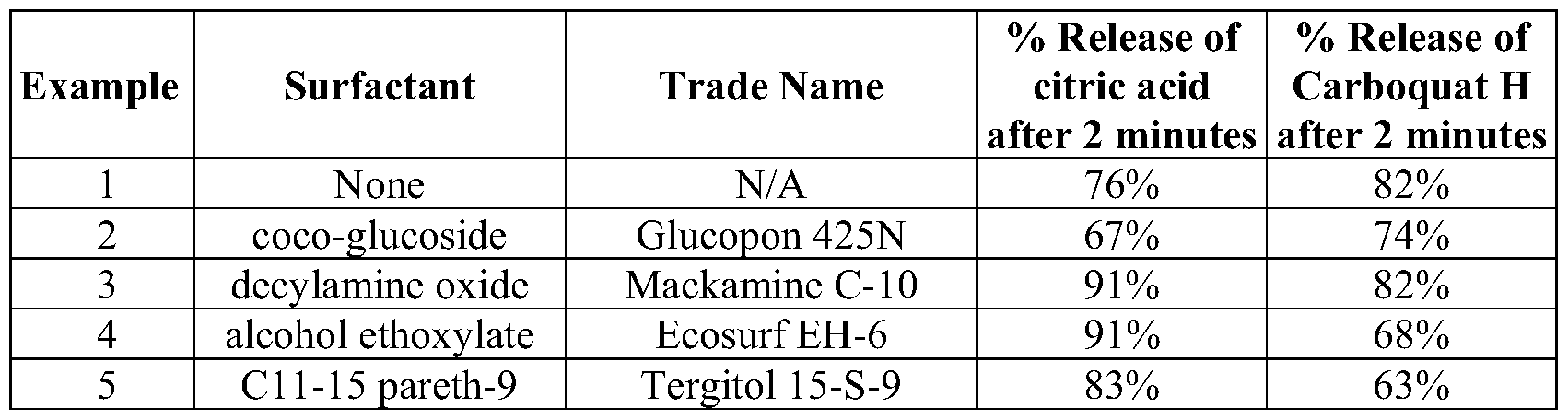
- a surfactant of the durable antimicrobial composition is provided in Table 3 below.
- Each exemplary surfactant described in Table 3 was used in a durable antimicrobial composition in a concentration of 1.0 percent active surfactant by weight that included the following components: (1) 2 percent by weight of CARBOQUAT H solution as available from Lonza Group Limited Switzerland; (2) 0.85 percent by weight of citric acid; (3) 3 percent by weight hydrogen peroxide; and (4) 2.5 percent by weight polyquaternium-22 polymer (MERQUAT 295 polymer available from Nalco Company).
- the compositions also included 0.4 percent by weight urea and 20 percent ethanol; the remainder was water.
- Table 3 also illustrates the biocide release of various actives of the durable antimicrobial compositions.
- the durable antimicrobial compositions including the exemplary surfactants represented in Table 3 have similar release profile of biocide and similar durability described for the exemplary durable antimicrobial composition not including a surfactant in Table 3. All of the durable antimicrobial compositions including the exemplary surfactants had quick release of the citric acid and CARBOQUAT H compound illustrating the compositions are stable. Similarly, the durable antimicrobial compositions provide similar durability required of the antimicrobial composition described herein.
Landscapes
- Life Sciences & Earth Sciences (AREA)
- Dentistry (AREA)
- Zoology (AREA)
- Environmental Sciences (AREA)
- Pest Control & Pesticides (AREA)
- Plant Pathology (AREA)
- Health & Medical Sciences (AREA)
- Agronomy & Crop Science (AREA)
- General Health & Medical Sciences (AREA)
- Engineering & Computer Science (AREA)
- Wood Science & Technology (AREA)
- Chemical & Material Sciences (AREA)
- Inorganic Chemistry (AREA)
- Agricultural Chemicals And Associated Chemicals (AREA)
- Detergent Compositions (AREA)
- Cosmetics (AREA)
Abstract
Description


Claims

Priority Applications (8)
| Application Number | Priority Date | Filing Date | Title |
|---|---|---|---|
| MX2013006291A MX2013006291A (en) | 2010-12-30 | 2011-12-07 | Durable antimicrobial composition including a surfactant. |
| KR1020137020028A KR20140006850A (en) | 2010-12-30 | 2011-12-07 | Durable antimicrobial composition including a surfactant |
| BR112013016736A BR112013016736A2 (en) | 2010-12-30 | 2011-12-07 | composition featuring durable antimicrobial activity |
| CA2821413A CA2821413A1 (en) | 2010-12-30 | 2011-12-07 | Durable antimicrobial composition including a surfactant |
| GB1310430.2A GB2503109A (en) | 2010-12-30 | 2011-12-07 | Durable antimicrobial composition including a surfactant |
| AU2011350930A AU2011350930B2 (en) | 2010-12-30 | 2011-12-07 | Durable antimicrobial composition including a surfactant |
| RU2013134747/15A RU2013134747A (en) | 2010-12-30 | 2011-12-07 | SUSTAINABLE ANTIMICROBIAL COMPOSITION CONTAINING SURFACE-ACTIVE SUBSTANCE |
| ZA2013/03917A ZA201303917B (en) | 2010-12-30 | 2013-05-29 | Durable antimicrobial composition including a surfactant |
Applications Claiming Priority (4)
| Application Number | Priority Date | Filing Date | Title |
|---|---|---|---|
| US12/982,169 US20120171267A1 (en) | 2010-12-30 | 2010-12-30 | Durable Antimicrobial Composition |
| US12/982,169 | 2010-12-30 | ||
| US13/269,931 | 2011-10-10 | ||
| US13/269,931 US20120171301A1 (en) | 2010-12-30 | 2011-10-10 | Durable Antimicrobial Composition Including a Surfactant |
Publications (2)
| Publication Number | Publication Date |
|---|---|
| WO2012090102A2 true WO2012090102A2 (en) | 2012-07-05 |
| WO2012090102A3 WO2012090102A3 (en) | 2012-11-22 |
Family
ID=46380969
Family Applications (1)
| Application Number | Title | Priority Date | Filing Date |
|---|---|---|---|
| PCT/IB2011/055528 Ceased WO2012090102A2 (en) | 2010-12-30 | 2011-12-07 | Durable antimicrobial composition including a surfactant |
Country Status (10)
| Country | Link |
|---|---|
| US (1) | US20120171301A1 (en) |
| KR (1) | KR20140006850A (en) |
| AU (1) | AU2011350930B2 (en) |
| BR (1) | BR112013016736A2 (en) |
| CA (1) | CA2821413A1 (en) |
| GB (1) | GB2503109A (en) |
| MX (1) | MX2013006291A (en) |
| RU (1) | RU2013134747A (en) |
| WO (1) | WO2012090102A2 (en) |
| ZA (1) | ZA201303917B (en) |
Cited By (3)
| Publication number | Priority date | Publication date | Assignee | Title |
|---|---|---|---|---|
| GB2501341A (en) * | 2011-12-29 | 2013-10-23 | Byotrol Plc | Anti-microbial composition |
| US10433545B2 (en) | 2016-07-11 | 2019-10-08 | Ecolab Usa Inc. | Non-streaking durable composition for cleaning and disinfecting hard surfaces |
| WO2021163269A1 (en) * | 2020-02-13 | 2021-08-19 | Rhodia Operations | Disinfectant cleaning compositions and methods of use thereof |
Families Citing this family (16)
| Publication number | Priority date | Publication date | Assignee | Title |
|---|---|---|---|---|
| US9394637B2 (en) | 2012-12-13 | 2016-07-19 | Jacob Holm & Sons Ag | Method for production of a hydroentangled airlaid web and products obtained therefrom |
| CA2894597C (en) | 2012-12-14 | 2020-09-22 | Saban Ventures Pty Limited | Disinfectant solution comprising peroxyacetic acid, hydrogen peroxide and a carbonate buffer |
| JP6239643B2 (en) | 2012-12-14 | 2017-11-29 | サバン ベンチャーズ ピーティーワイ リミテッド | Synergistic disinfection enhancement |
| KR101676356B1 (en) * | 2014-07-23 | 2016-11-29 | 주식회사 대호 | Antimicrobial agent and preparation thereof |
| CN107580451A (en) | 2015-01-13 | 2018-01-12 | 比奥塞恩公司 | Solid antimicrobial composition with enhanced solubility |
| US9260545B1 (en) | 2015-01-15 | 2016-02-16 | Ecolab Usa Inc. | Reverse emulsion breaker polymers |
| WO2016141050A1 (en) | 2015-03-04 | 2016-09-09 | Ecolab Usa Inc. | Reverse emulsion breaker polymers |
| CA2978434C (en) | 2015-03-06 | 2023-03-28 | Ecolab Usa Inc. | Reverse emulsion breaker polymers |
| US10190055B2 (en) | 2015-06-18 | 2019-01-29 | Ecolab Usa Inc. | Reverse emulsion breaker copolymers |
| US20180200397A1 (en) * | 2015-07-27 | 2018-07-19 | Kimberty-Clark Worldwide, Inc. | Disinfectant Composition with Rapid Antiviral Efficacy |
| EP3725153B1 (en) | 2015-07-27 | 2024-09-04 | Kimberly-Clark Worldwide, Inc. | Residual disinfectant composition |
| CN105494337A (en) * | 2015-12-18 | 2016-04-20 | 南京巨鲨显示科技有限公司 | Low-corrosivity ortho-phthalaldehyde disinfectant |
| US20170238542A1 (en) | 2016-02-23 | 2017-08-24 | Isoklean Llc | Stabilized antimicrobial compositions and methods of use |
| EP3772948B1 (en) * | 2018-04-09 | 2026-02-25 | Specialty Operations France | Compositions and methods for long lasting disinfection |
| KR102003646B1 (en) * | 2018-10-01 | 2019-07-24 | 충남대학교산학협력단 | Method of combined washing treatment of positively charged cinnamon leaf essential oil emulsion and organic acid for decreasing foodborne disease outbreaks in fresh-cut produce |
| CN112251025A (en) * | 2020-10-11 | 2021-01-22 | 深圳市捷安纳米复合材料有限公司 | Sterilizing and virus-killing protective film and preparation method thereof |
Family Cites Families (11)
| Publication number | Priority date | Publication date | Assignee | Title |
|---|---|---|---|---|
| US5438034A (en) * | 1993-06-09 | 1995-08-01 | Lonza, Inc. | Quaternary ammonium carbonate compositions and preparation thereof |
| US7150884B1 (en) * | 2000-07-12 | 2006-12-19 | Ecolab Inc. | Composition for inhibition of microbial growth |
| US7192601B2 (en) * | 2002-01-18 | 2007-03-20 | Walker Edward B | Antimicrobial and sporicidal composition |
| US20060003654A1 (en) * | 2004-06-30 | 2006-01-05 | Lostocco Michael R | Dispersible alcohol/cleaning wipes via topical or wet-end application of acrylamide or vinylamide/amine polymers |
| US8999363B2 (en) * | 2005-02-07 | 2015-04-07 | Sishield Technologies, Inc. | Methods and compositions for antimicrobial surfaces |
| US7651990B2 (en) * | 2005-06-13 | 2010-01-26 | 3M Innovative Properties Company | Foamable alcohol compositions comprising alcohol and a silicone surfactant, systems and methods of use |
| DE602006020490D1 (en) * | 2005-12-07 | 2011-04-14 | Rochal Ind Llp | ADJUSTABLE FASTENER AND COVER MATERIAL |
| US20080076313A1 (en) * | 2006-09-26 | 2008-03-27 | David Uitenbroek | Wipe and methods for manufacturing and using a wipe |
| US20080175919A1 (en) * | 2007-01-22 | 2008-07-24 | Fatemeh Mohammadi | Urea Compositions With Cooling Effect |
| US20090004287A1 (en) * | 2007-01-31 | 2009-01-01 | Joseph Kimler | Disinfectant formulations containing quaternary ammonium compounds and hydrogen peroxide |
| US8871232B2 (en) * | 2007-12-13 | 2014-10-28 | Kimberly-Clark Worldwide, Inc. | Self-indicating wipe for removing bacteria from a surface |
-
2011
- 2011-10-10 US US13/269,931 patent/US20120171301A1/en not_active Abandoned
- 2011-12-07 AU AU2011350930A patent/AU2011350930B2/en not_active Ceased
- 2011-12-07 BR BR112013016736A patent/BR112013016736A2/en not_active IP Right Cessation
- 2011-12-07 KR KR1020137020028A patent/KR20140006850A/en not_active Withdrawn
- 2011-12-07 RU RU2013134747/15A patent/RU2013134747A/en not_active Application Discontinuation
- 2011-12-07 GB GB1310430.2A patent/GB2503109A/en not_active Withdrawn
- 2011-12-07 MX MX2013006291A patent/MX2013006291A/en unknown
- 2011-12-07 WO PCT/IB2011/055528 patent/WO2012090102A2/en not_active Ceased
- 2011-12-07 CA CA2821413A patent/CA2821413A1/en not_active Abandoned
-
2013
- 2013-05-29 ZA ZA2013/03917A patent/ZA201303917B/en unknown
Cited By (6)
| Publication number | Priority date | Publication date | Assignee | Title |
|---|---|---|---|---|
| GB2501341A (en) * | 2011-12-29 | 2013-10-23 | Byotrol Plc | Anti-microbial composition |
| GB2501341B (en) * | 2011-12-29 | 2014-10-22 | Byotrol Plc | Anti-microbial composition |
| US10433545B2 (en) | 2016-07-11 | 2019-10-08 | Ecolab Usa Inc. | Non-streaking durable composition for cleaning and disinfecting hard surfaces |
| US10945431B2 (en) | 2016-07-11 | 2021-03-16 | Ecolab Usa Inc. | Non-streaking durable composition for cleaning and disinfecting hard surfaces |
| WO2021163269A1 (en) * | 2020-02-13 | 2021-08-19 | Rhodia Operations | Disinfectant cleaning compositions and methods of use thereof |
| CN115003158A (en) * | 2020-02-13 | 2022-09-02 | 罗地亚经营管理公司 | Disinfectant cleaning compositions and methods of use |
Also Published As
| Publication number | Publication date |
|---|---|
| US20120171301A1 (en) | 2012-07-05 |
| RU2013134747A (en) | 2015-02-10 |
| CA2821413A1 (en) | 2012-07-05 |
| KR20140006850A (en) | 2014-01-16 |
| AU2011350930B2 (en) | 2016-05-19 |
| MX2013006291A (en) | 2013-07-02 |
| BR112013016736A2 (en) | 2016-07-12 |
| AU2011350930A1 (en) | 2013-06-13 |
| GB201310430D0 (en) | 2013-07-24 |
| GB2503109A (en) | 2013-12-18 |
| WO2012090102A3 (en) | 2012-11-22 |
| ZA201303917B (en) | 2014-07-30 |
Similar Documents
| Publication | Publication Date | Title |
|---|---|---|
| AU2011350930B2 (en) | Durable antimicrobial composition including a surfactant | |
| AU2011350929B2 (en) | Durable antimicrobial composition including a surfactant | |
| GB2503359B (en) | Durable antimicrobial composition | |
| AU2011350928B2 (en) | Durable antimicrobial composition | |
| EP3772947B1 (en) | Compositions and methods for long lasting disinfection | |
| MX2008015189A (en) | ANTIMICROBIAL COMPOSITIONS CONTAINING ALCOHOL THAT HAVE IMPROVED EFFICIENCY. | |
| CN106232092A (en) | Antimicrobial compositions containing cationic active ingredients | |
| CN101861379A (en) | Formulations comprising antimicrobial compositions | |
| CN105979776A (en) | Compositions comprising hydrogen peroxide and quaternary ammonium compounds for disinfection and cleaning | |
| EP3783089B1 (en) | Antimicrobial composition comprising alkylated polyvinylpyrrolidone polymer | |
| US20230108533A1 (en) | Antimicrobial coating compositions and residual antimicrobial coatings resulting therefrom | |
| CA3189876A1 (en) | No rinse disinfectant with virucidal properties against non-enveloped viruses | |
| CN115103592A (en) | Universal formulation | |
| US20240067843A1 (en) | Biocidal polymer for long-term surface protection | |
| WO2016081295A1 (en) | Compositions comprising biguanide compound and diol surfactant | |
| WO2023144400A1 (en) | Antimicrobial indicator composition | |
| CN121729138A (en) | Durable disinfectant articles | |
| TR2021020958A2 (en) | A SURFACE CLEANING PRODUCT CONTAINING ANTISTATIC SURFACE CLEANING COMPOSITION AND COMPOSITION | |
| HK40081099A (en) | Universal formulation |
Legal Events
| Date | Code | Title | Description |
|---|---|---|---|
| 121 | Ep: the epo has been informed by wipo that ep was designated in this application |
Ref document number: 11853551 Country of ref document: EP Kind code of ref document: A2 |
|
| WWE | Wipo information: entry into national phase |
Ref document number: 226605 Country of ref document: IL |
|
| WWE | Wipo information: entry into national phase |
Ref document number: MX/A/2013/006291 Country of ref document: MX |
|
| ENP | Entry into the national phase |
Ref document number: 2821413 Country of ref document: CA Ref document number: 1310430 Country of ref document: GB Kind code of ref document: A Free format text: PCT FILING DATE = 20111207 |
|
| WWE | Wipo information: entry into national phase |
Ref document number: 1310430.2 Country of ref document: GB |
|
| ENP | Entry into the national phase |
Ref document number: 2011350930 Country of ref document: AU Date of ref document: 20111207 Kind code of ref document: A |
|
| NENP | Non-entry into the national phase |
Ref country code: DE |
|
| ENP | Entry into the national phase |
Ref document number: 20137020028 Country of ref document: KR Kind code of ref document: A |
|
| ENP | Entry into the national phase |
Ref document number: 2013134747 Country of ref document: RU Kind code of ref document: A |
|
| REG | Reference to national code |
Ref country code: BR Ref legal event code: B01A Ref document number: 112013016736 Country of ref document: BR |
|
| 122 | Ep: pct application non-entry in european phase |
Ref document number: 11853551 Country of ref document: EP Kind code of ref document: A2 |
|
| ENP | Entry into the national phase |
Ref document number: 112013016736 Country of ref document: BR Kind code of ref document: A2 Effective date: 20130628 |