WO2012085852A1 - 3,8-diaza-bicyclo[4.2.0]oct-8-yl amides - Google Patents
3,8-diaza-bicyclo[4.2.0]oct-8-yl amides Download PDFInfo
- Publication number
- WO2012085852A1 WO2012085852A1 PCT/IB2011/055840 IB2011055840W WO2012085852A1 WO 2012085852 A1 WO2012085852 A1 WO 2012085852A1 IB 2011055840 W IB2011055840 W IB 2011055840W WO 2012085852 A1 WO2012085852 A1 WO 2012085852A1
- Authority
- WO
- WIPO (PCT)
- Prior art keywords
- phenyl
- methyl
- group
- substituted
- substituents
- Prior art date
- Legal status (The legal status is an assumption and is not a legal conclusion. Google has not performed a legal analysis and makes no representation as to the accuracy of the status listed.)
- Ceased
Links
- 0 *C(N(C1)C2C1CCN(*)C2)=O Chemical compound *C(N(C1)C2C1CCN(*)C2)=O 0.000 description 2
- QQJQVUOUZSAJNI-UHFFFAOYSA-N CCOC(C[N]#C)=O Chemical compound CCOC(C[N]#C)=O QQJQVUOUZSAJNI-UHFFFAOYSA-N 0.000 description 1
- PVKNYZFXHNFWRI-UHFFFAOYSA-N CCOC(c1c(-c2cc(F)ccc2)[o]cn1)=O Chemical compound CCOC(c1c(-c2cc(F)ccc2)[o]cn1)=O PVKNYZFXHNFWRI-UHFFFAOYSA-N 0.000 description 1
- FGIVTQSUHOYGJL-UHFFFAOYSA-N COC(c1c(-c2cc(F)ccc2)[o]c(Cl)n1)OC Chemical compound COC(c1c(-c2cc(F)ccc2)[o]c(Cl)n1)OC FGIVTQSUHOYGJL-UHFFFAOYSA-N 0.000 description 1
- FQPRJNHITKNGOD-UHFFFAOYSA-N COC(c1c(-c2cc(F)ccc2)[o]cn1)OC Chemical compound COC(c1c(-c2cc(F)ccc2)[o]cn1)OC FQPRJNHITKNGOD-UHFFFAOYSA-N 0.000 description 1
- SYVNVEGIRVXRQH-UHFFFAOYSA-N O=C(c1cc(F)ccc1)Cl Chemical compound O=C(c1cc(F)ccc1)Cl SYVNVEGIRVXRQH-UHFFFAOYSA-N 0.000 description 1
- JQYKDPAETPTKBK-UHFFFAOYSA-N O=Cc1c(-c2cc(F)ccc2)[o]c(Cl)n1 Chemical compound O=Cc1c(-c2cc(F)ccc2)[o]c(Cl)n1 JQYKDPAETPTKBK-UHFFFAOYSA-N 0.000 description 1
- GAJWWRQHTBLGPN-UHFFFAOYSA-N O=Cc1c(-c2cc(F)ccc2)[o]cn1 Chemical compound O=Cc1c(-c2cc(F)ccc2)[o]cn1 GAJWWRQHTBLGPN-UHFFFAOYSA-N 0.000 description 1
Classifications
-
- C—CHEMISTRY; METALLURGY
- C07—ORGANIC CHEMISTRY
- C07D—HETEROCYCLIC COMPOUNDS
- C07D471/00—Heterocyclic compounds containing nitrogen atoms as the only ring hetero atoms in the condensed system, at least one ring being a six-membered ring with one nitrogen atom, not provided for by groups C07D451/00 - C07D463/00
- C07D471/02—Heterocyclic compounds containing nitrogen atoms as the only ring hetero atoms in the condensed system, at least one ring being a six-membered ring with one nitrogen atom, not provided for by groups C07D451/00 - C07D463/00 in which the condensed system contains two hetero rings
- C07D471/04—Ortho-condensed systems
-
- A—HUMAN NECESSITIES
- A61—MEDICAL OR VETERINARY SCIENCE; HYGIENE
- A61P—SPECIFIC THERAPEUTIC ACTIVITY OF CHEMICAL COMPOUNDS OR MEDICINAL PREPARATIONS
- A61P25/00—Drugs for disorders of the nervous system
Definitions
- the present invention relates to 3,8-diaza-bicyclo[4.2.0]oct-8-yl amide derivatives of formula (I) and their use as pharmaceuticals.
- the invention also concerns related aspects including processes for the preparation of the compounds, pharmaceutical compositions containing one or more compounds of formula (I), and especially their use as orexin receptor antagonists.
- Orexins are novel neuropeptides found in 1998 by two research groups, orexin A is a 33 amino acid peptide and orexin B is a 28 amino acid peptide (Sakurai T. et al., Cell, 1998, 92, 573-585). Orexins are produced in discrete neurons of the lateral hypothalamus and bind to the G-protein-coupled receptors (OX-i and OX 2 receptors). The orexin-1 receptor (OX-i) is selective for OX-A, and the orexin-2 receptor (OX 2 ) is capable to bind OX-A as well as OX-B.
- Orexin A is a 33 amino acid peptide
- orexin B is a 28 amino acid peptide (Sakurai T. et al., Cell, 1998, 92, 573-585). Orexins are produced in discrete neurons of the lateral hypothalamus and bind to the G-protein-coupled receptors (OX-i and O
- Orexins are found to stimulate food consumption in rats suggesting a physiological role for these peptides as mediators in the central feedback mechanism that regulates feeding behaviour (Sakurai T. et al., Cell, 1998, 92, 573-585).
- orexins regulate states of sleep and wakefulness opening potentially novel therapeutic approaches to insomnia and other sleep disorders (Chemelli R.M. et al., Cell, 1999, 98, 437-451 ).
- in vitro and in vivo evidence for a critical role of orexin signaling in the ventral tegmental area in neural plasticity relevant to addiction has been published (S. L. Borgland et al. Neuron, 2006, 49, 589-601 ).
- Orexin neurons are likely to be involved in the coordinated regulation of behavioral and physiological responses in stressful environments (Kuru, M, Ueta, Y, Serino, R, Nakazato, M, Yamamoto, Y, Shibuya, I, Yamashita, H; Centrally administered orexin/hypocretin activates HPA axis in rats. Neuroreport, 1 1 (9) (2000) 1977-1980).
- cardiovascular responses to conditioned fear and novelty exposure could be attenuated by a dual orexin receptor antagonist in rats (Furlong, TM, Vianna, DM, Liu, L, Carrive, P; Hypocretin/orexin contributes to the expression of some but not all forms of stress and arousal.
- the acute stress response may include behavioural, autonomic and endocrinological changes, such as promoting heightened vigilance, decreased libido, increased heart rate and blood pressure, or a redirection of blood flow to fuel the muscles, heart and the brain (Majzoub, JA; Corticotropin-releasing hormone physiology European Journal of Endocrinology, 155 (suppM ) (2006) S71-S76).
- behavioural, autonomic and endocrinological changes such as promoting heightened vigilance, decreased libido, increased heart rate and blood pressure, or a redirection of blood flow to fuel the muscles, heart and the brain (Majzoub, JA; Corticotropin-releasing hormone physiology European Journal of Endocrinology, 155 (suppM ) (2006) S71-S76).
- the compound has also been shown to enhance memory function in a rat model (WO2007/105177) and is also active in an animal model of conditioned fear: the rat fear potentiated startle paradigm (WO2009/0047723) which relates to emotional states of fear and anxiety diseases such as anxieties including post traumatic stress disorders (PTSDs).
- a rat model WO2007/105177
- WO2009/0047723 relates to emotional states of fear and anxiety diseases such as anxieties including post traumatic stress disorders (PTSDs).
- the present invention provides diazabicyclooctane derivatives, which are non-peptide antagonists of human orexin receptors. These compounds are in particular of potential use in the treatment of diseases or disorders related to the orexin system, especially comprising all types of sleep disorders, of stress-related syndromes, of addictions (especially psychoactive substance use, abuse, seeking and reinstatement), of cognitive dysfunctions in the healthy population and in psychiatric and neurologic disorders, of eating or drinking disorders.
- a first aspect of the invention relates to compounds of the formula (I)
- Ar 1 represents phenyl or 5- or 6-membered heteroaryl, wherein the phenyl or 5- or 6- membered heteroaryl independently is mono-, di-, or tri-substituted;
- substituents are attached in orffro-position to the point of attachment of Ar 1 to the rest of the molecule, wherein said substituent is phenyl or 5- or 6- membered heteroaryl, which is independently unsubstituted, or mono-, di-, or tri-substituted (especially unsubstituted or mono-substituted), wherein the substituents are independently selected from the group consisting of (Ci -4 )alkyl, (Ci -4 )alkoxy, halogen, cyano, (Ci -3 )fluoroalkyl, and (Ci -3 )fluoroalkoxy (especially (Ci -4 )alkyl and halogen);
- Ar 2 represents 5- or 6-membered heteroaryl, wherein the 5- or 6-membered heteroaryl independently is mono-, di-, or tri-substituted; wherein
- one of said substituents is phenyl or 5- or 6-membered heteroaryl; wherein said phenyl or 5- or 6-membered heteroaryl is independently unsubstituted, or mono-, di-, or tri-substituted, wherein the substituents are independently selected from the group consisting of (C 1-4 )alkyl, (C 1-4 )alkoxy, halogen, cyano, (C 1-3 )fluoroalkyl, and (C 1-3 )fluoroalkoxy;
- Ar 2 represents 8- to 10-membered bicyclic heteroaryl which is unsubstituted, or mono-, di-, or tri-substituted;
- substituents are independently selected from the group consisting of (Ci -4 )alkyl, (Ci -4 )alkoxy, (C 3-6 )cycloalkyl, halogen, cyano, (Ci -3 )fluoroalkyl, and
- a second embodiment thus, relates to the compounds of formula (I) according to embodiment 1 ) with the exception of the structurally overlapping scope of the compounds disclosed in WO201 1/050202; wherein WO201 1/050202 discloses the compounds of Formula X:
- R 1 is a member selected from the group consisting of: A) phenyl substituted or unsubstituted with R a , and substituted in the ortho position with R b ;
- R a is a member independently selected from the group consisting of: halo, -C ⁇ alkyl,
- R b is a member selected from the group consisting of:
- thiophen-2-yl 2H-1 ,2,3-triazole, 1 H-1 ,2,3-triazol-1 -yl, 1 H-pyrazol-1 -yl, 1 H- pyrazol-5-yl, pyrimidin-2-yl, or 3-methyl-1 ,2,4-oxadiazol-5-yl, and c) phenyl;
- R 2 is a member selected from the group consisting of:
- heteroaryl refers to a monocyclic, fused bicyclic, or fused polycyclic aromatic heterocycle (ring structure having ring atoms selected from carbon atoms and up to four heteroatoms selected from nitrogen, oxygen, and sulfur) having from 3 to 12 ring atoms per heterocycle and the term “halo” represents chloro, fluoro, bromo or iodo; and, for the compounds of formula X, the term “substituted” means that the specified group or moiety bears one or more substituents; the term “unsubstituted” means that the specified group bears no substituents; and the term “optionally substituted” means that the specified group is unsubstituted or substituted by one or more substituents.
- the compounds of formula (I) may contain one or more stereogenic or asymmetric centers, such as one or more asymmetric carbon atoms.
- the compounds of formula (I) may thus be present as mixtures of stereoisomers or preferably as pure stereoisomers. Mixtures of stereoisomers may be separated in a manner known to a person skilled in the art.
- the relative configuration of the diazabicyclooctane moiety is cis; i.e. the compounds of formula (I) are either compounds of formula (l E i), or compounds of formula (l E 2), or any mixture thereof (such as racemates):
- the present invention also includes isotopically labelled, especially 2 H (deuterium) labelled compounds of formula (I), which compounds are identical to the compounds of formula (I) except that one or more atoms have each been replaced by an atom having the same atomic number but an atomic mass different from the atomic mass usually found in nature.
- Isotopically labelled, especially 2 H (deuterium) labelled compounds of formula (I) and salts thereof are within the scope of the present invention. Substitution of hydrogen with the heavier isotope 2 H (deuterium) may lead to greater metabolic stability, resulting e.g. in increased in-vivo half-life or reduced dosage requirements, or may lead to reduced inhibition of cytochrome P450 enzymes, resulting e.g. in an improved safety profile.
- the compounds of formula (I) are not isotopically labelled, or they are labelled only with one or more deuterium atoms. In a sub-embodiment, the compounds of formula (I) are not isotopically labelled at all. Isotopically labelled compounds of formula (I) may be prepared in analogy to the methods described hereinafter, but using the appropriate isotopic variation of suitable reagents or starting materials.
- a dotted line shows the point of attachment of the radical drawn.
- pharmaceutically acceptable salts refers to non-toxic, inorganic or organic acid and/or base addition salts. Reference can be made to "Salt selection for basic drugs", Int. J. Pharm. (1986), 33, 201-217.
- halogen means fluorine, chlorine, or bromine, preferably fluorine or chlorine.
- alkyl refers to a saturated straight or branched chain alkyl group containing one to six carbon atoms.
- (C x-y )alkyl refers to an alkyl group as defined before, containing x to y carbon atoms.
- a (Ci-4)alkyl group contains from one to four carbon atoms.
- alkyl groups are methyl, ethyl, propyl, isopropyl, n-butyl, isobutyl, sec. -butyl and tert.-butyl. Preferred are methyl and ethyl. Most preferred is methyl.
- cycloalkyi refers to a saturated cyclic alkyl group containing three to six carbon atoms.
- (C x-y )cycloalkyl refers to a cycloalkyi group as defined before containing x to y carbon atoms.
- a (C 3 - 6 )cycloalkyl group contains from three to six carbon atoms.
- Examples of cycloalkyi groups are cyclopropyl, cyclobutyl, cyclopentyl and cyclohexyl. Preferred is cyclopropyl.
- alkoxy refers to an alkyl-O- group wherein the alkyl group is as defined before.
- (C x-y )alkoxy (x and y each being an integer) refers to an alkoxy group as defined before containing x to y carbon atoms.
- a (C 1-4 )alkoxy group means a group of the formula (C 1-4 )alkyl-0- in which the term "(C 1-4 )alkyl” has the previously given significance.
- alkoxy groups are methoxy, ethoxy, n- propoxy, isopropoxy, n-butoxy, isobutoxy, sec.-butoxy and tert.-butoxy.
- fluoroalkyl refers to an alkyl group as defined before containing one to three carbon atoms in which one or more (and possibly all) hydrogen atoms have been replaced with fluorine.
- (C x-y )fluoroalkyl (x and y each being an integer) refers to a fluoroalkyl group as defined before containing x to y carbon atoms.
- a (Ci -3 )fluoroalkyl group contains from one to three carbon atoms in which one to seven hydrogen atoms have been replaced with fluorine.
- fluoroalkyl groups include trifluoromethyl, 2-fluoroethyl, 2,2-difluoroethyl and 2,2,2-trifluoroethyl. Preferred are (C-i)fluoroalkyl groups such as trifluoromethyl.
- fluoroalkoxy refers to an alkoxy group as defined before containing one to three carbon atoms in which one or more (and possibly all) hydrogen atoms have been replaced with fluorine.
- (C x-y )fluoroalkoxy (x and y each being an integer) refers to a fluoroalkoxy group as defined before containing x to y carbon atoms.
- a (C 1-3 )fluoroalkoxy group contains from one to three carbon atoms in which one to seven hydrogen atoms have been replaced with fluorine.
- fluoroalkoxy groups include trifluoromethoxy, difluoromethoxy, 2-fluoroethoxy, 2,2-difluoroethoxy and 2,2,2-trifluoroethoxy.
- phenyl groups which are further substituted in ortho position as used for the group Ar 1 are 1 ,2-phenylene, 5-methyl-1 ,2-phenylene, 5-fluoro-1 ,2-phenylene, 6- fluoro-1 ,2-phenylene, 5-cyano-1 ,2-phenylene, 5-methoxy-1 ,2-phenylene, 5-trifluoromethyl- 1 ,2-phenylene, 5-trifluoromethoxy-1 ,2-phenylene, 6-fluoro-5-methyl-1 ,2-phenylene, and 6- fluoro-5-methoxy-1 ,2-phenylene; wherein in the above groups the carbonyl group is attached in position 1 .
- particular examples are 5-cyano-1 ,2-phenylene, 5- trifluoromethyl-1 ,2-phenylene, 5-trifluoromethoxy-1 ,2-phenylene, 6-fluoro-5-methyl-1 ,2- phenylene, and 6-fluoro-5-methoxy-1 ,2-phenylene; wherein in the above groups the carbonyl group is attached in position 1 .
- Examples of the particular phenyl groups which are substituents of the groups Ar 1 or Ar 2 are notably phenyl, 3-methyl-phenyl, 4-methyl-phenyl, 2-fluoro-phenyl, 3-fluoro-phenyl, 4-fluoro- phenyl, 3-chloro-phenyl, and 4-chloro-phenyl.
- particular examples of phenyl groups which are substituents of the groups Ar 1 are 3-methyl-phenyl, 4-methyl- phenyl, 3-fluoro-phenyl, 4-fluoro-phenyl, 3-chloro-phenyl, and 4-chloro-phenyl.
- heteroaryl if not explicitly stated otherwise, means a 5- to 10-membered monocyclic or fused bicyclic aromatic ring containing 1 to a maximum of 4 heteroatoms independently selected from oxygen, nitrogen and sulfur.
- monocyclic heteroaryl groups are 5-membered monocyclic heteroaryl groups such as furanyl, oxazolyl, isoxazolyl, oxadiazolyl, thienyl, thiazolyl, isothiazolyl, thiadiazolyl, pyrrolyl, imidazolyl, pyrazolyl, triazolyl, and tetrazolyl; and 6-membered monocyclic heteroaryl such as pyridinyl, pyrimidinyl, pyridazinyl, and pyrazinyl.
- bicyclic heteroaryl groups comprise 8-membered bicyclic heteroaryl groups such as 4H-furo[3,2-b]pyrrolyl, pyrrolo[2, 1-b]thiazolyl and imidazo[2, 1-b]thiazolyl; 9-membered bicyclic heteroaryl groups such as indolyl, isoindolyl, benzofuranyl, isobenzofuranyl, benzothiophenyl, indazolyl, benzimidazolyl, benzoxazolyl, benzisoxazolyl, benzothiazolyl, benzoisothiazolyl, benzotriazolyl, benzoxadiazolyl, benzothiadiazolyl, pyrazolo[1 ,5-a]pyridinyl, pyrazolo[1 ,5-a]pyrimidinyl, imidazo[1 ,2-a]pyridinyl, 1 H-pyrrolo[3,2-b]pyridinyl,
- Examples of the particular 5- or 6-membered heteroaryl groups which are further substituted in ortho position as used for the group Ar 1 are notably oxazolyl, isoxazolyl, thienyl, thiazolyl, isothiazolyl, pyridinyl, pyrimidinyl and pyrazinyl.
- examples are oxazolyl (in particular 2-methyl-oxazol-4,5-diyl), isoxazolyl (in particular 5-methyl-isoxazol-3,4-diyl), thiazolyl (in particular 2-methyl-thiazol-4,5-diyl), pyridinyl (in particular pyridin-2,3-diyl, 6- methyl-pyridin-2,3-diyl), pyrimidinyl (in particular pyrimidin-4,5-diyl, 2-methyl-pyrimidin-4,5- diyl), and pyrazinyl (in particular pyrazin-2,3-diyl.
- examples are oxazolyl (in particular 2-methyl-oxazol-4,5-diyl), isoxazolyl (in particular 5-methyl-isoxazol- 3,4-diyl), pyrimidinyl (in particular pyrimidin-4,5-diyl, 2-methyl-pyrimidin-4,5-diyl), and pyrazinyl (in particular pyrazin-2,3-diyl.
- the above groups are preferably attached to the rest of the molecule (i.e.
- examples are oxazolyl (in particular oxazol-2,4-diyl, oxazol-2,5-diyl, 4- methyl-oxazol-2,5-diyl, 5-methyl-oxazol-2,4-diyl, 4-cyano-oxazol-2,5-diyl, 4-difluoromethyl- oxazol-2,5-diyl) and thiazolyl (in particular thiazol-2,4-diyl, thiazol-2,5-diyl, 4-methyl-thiazol- 2,5-diyl, 5-methyl-thiazol-2,4-diyl).
- the above groups are preferably attached to the rest of the molecule on a carbon atom next to a heteroatom (notably next to a nitrogen atom); especially in position 2 of oxazolyl or thiazolyl groups.
- the above groups carry a phenyl or 5- or 6-membered heteroaryl substituent which is preferably attached on a carbon atom in meta position to the point of attachement of the rest of the molecule (it being well understood that for 5-membered heteroaryl a meta connectivity means, depending on the atom numbering of said 5-membered heteroaryl, either a 1 ,3-diyl, a 1 ,4-diyl, a 2,4-diyl, or a 2,5-diyl connectivity).
- Particular examples of such groups are 4-(3-methyl-phenyl)-thiazol-2- yl, 4-(3-fluoro-phenyl)-thiazol-2-yl, 5-(3-fluoro-phenyl)-thiazol-2-yl, 4-(3-chloro-phenyl)-thiazol- 2-yl, 5-(3-chloro-phenyl)-thiazol-2-yl, 4-(3-fluoro-phenyl)-oxazol-2-yl, 5-(3-fluoro-phenyl)- oxazol-2-yl, 5-(2-fluoro-phenyl)-oxazol-2-yl, 5-(4-fluoro-phenyl)-oxazol-2-yl, 4-(3-chloro- phenyl)-oxazol-2-yl, 4-(3-chloro-phenyl)-oxazol-2-yl, 4-(3-chloro-phenyl
- Examples of 8- to 10-membered bicyclic heteroaryl groups as used for the group Ar 2 are notably 9- or 10-membered bicyclic heteroaryl groups; examples are notably indolyl, benzofuranyl, benzothiophenyl, indazolyl, benzoxazolyl, benzisoxazolyl, benzothiazolyl, benzoisothiazolyl, quinolinyl, naphthyridinyl, cinnolinyl, quinazolinyl, and quinoxalinyl (in a sub-embodiment especially benzoxazolyl, benzisoxazolyl, benzothiazolyl, benzoisothiazolyl, and quinoxalinyl; in another sub-embodiment especially indolyl, benzofuranyl, benzothiophenyl, indazolyl, benzisoxazolyl, benzothiazolyl, benzoisothiazolyl,
- Particular examples are benzoxazol-2-yl, 5-fluoro-benzoxazol-2- yl, 6-fluoro-benzoxazol-2-yl, 4-chloro-benzoxazol-2-yl, 5-chloro-benzoxazol-2-yl, 6-chloro- benzoxazol-2-yl, benzo[d]isoxazol-3-yl, 5-methyl-benzo[d]isoxazol-3-yl, 6-methyl- benzo[d]isoxazol-3-yl, 5-fluoro-benzo[d]isoxazol-3-yl, 6-fluoro-benzo[d]isoxazol-3-yl, 5- chloro-benzo[d]isoxazol-3-yl, 6-chloro-benzo[d]isoxazol-3-yl, benzothiazol-2-yl, 5-fluoro- benzothiazol-2-yl, 6-fluoro- benzothiazol
- particular examples are especially benzo[d]isoxazol-3-yl, 5-methyl- benzo[d]isoxazol-3-yl, 6-methyl-benzo[d]isoxazol-3-yl, 5-fluoro-benzo[d]isoxazol-3-yl, 6- fluoro-benzo[d]isoxazol-3-yl, 5-chloro-benzo[d]isoxazol-3-yl, 6-chloro-benzo[d]isoxazol-3-yl, benzothiazol-2-yl, 5-fluoro-benzothiazol-2-yl, 6-fluoro-benzothiazol-2-yl, 5-chloro- benzothiazol-2-yl, 6-chloro-benzothiazol-2-yl, 5-chloro-benzo[d]isothiazol-3-yl, 6-chloro- benzo[d]isothiazol-3-yl, 6-fluor
- Examples of the particular 5- or 6-membered heteroaryl groups which are substituents of the groups Ar 1 or Ar 2 are notably oxazolyl, isoxazolyl, oxadiazolyl, thienyl, thiazolyl, isothiazolyl, thiadiazolyl, imidazolyl, pyrazolyl, triazolyl, pyridinyl, pyrimidinyl, and pyrazinyl (especially isoxazolyl, oxadiazolyl, pyrazolyl, triazolyl, pyridinyl, and pyrimidinyl).
- Particular examples are pyrazol-1-yl, 3-methyl-pyrazol-1-yl, [1 ,2,3]triazol-2-yl, 3-methyl-isoxazol-5-yl, 3-methyl- [1 ,2,4]oxadiazol-5-yl, pyridin-2-yl, and pyrimidin-2-yl.
- examples of the particular 5- or 6-membered heteroaryl groups which are substituents of the group Ar 1 are notably oxazolyl, isoxazolyl, thiazolyl, isothiazolyl, thiadiazolyl, imidazolyl, pyridinyl and pyrazinyl (especially 3-methyl-pyrazol-1 -yl, 3-methyl-isoxazol-5-yl, and pyridin-2-yl).
- heteroaryl groups as defined herein may be unsubstituted or substituted as explicitly defined.
- Ar 2 is a group selected from the group consisting of any of the following groups: a) 6-membered heteroaryl, wherein the 6-membered heteroaryl is mono-, di-, or tri- substituted; wherein
- one of said substituents is a group selected from the group consisting of any of the following groups:
- 5- or 6-membered heteroaryl wherein said 5- or 6-membered heteroaryl is independently unsubstituted, or mono-, di-, or tri- substituted, wherein the substituents are independently selected from the group consisting of (Ci-4)alkyl, (Ci -4 )alkoxy, halogen, cyano, (C 1-3 )fluoroalkyl, and (C 1-3 )fluoroalkoxy; and
- phenyl wherein said phenyl is mono-, di-, or tri-substituted, wherein the substituents are independently selected from the group consisting of (C 1-4 )alkyl, (C 1-4 )alkoxy, halogen, cyano, (C 1-3 )fluoroalkyl, and (Ci -3 )fluoroalkoxy; > and the other of said substituents, if present, is/are independently selected from the group consisting of (Ci-4)alkyl, (Ci-4)alkoxy, (C 3 -6)cycloalkyl, halogen, cyano, (Ci -3 )fluoroalkyl, and (Ci -3 )fluoroalkoxy;
- one of said substituents is phenyl or 5- or 6-membered heteroaryl; wherein said phenyl or 5- or 6-membered heteroaryl is independently unsubstituted, or mono-, di-, or tri-substituted, wherein the substituents are independently selected from the group consisting of (Ci-4)alkyl, (Ci-4)alkoxy, halogen, cyano, (Ci -3 )fluoroalkyl, and (Ci -3 )fluoroalkoxy;
- substituents are independently selected from the group consisting of (Ci -4 )alkyl, (Ci -4 )alkoxy, (C 3-6 )cycloalkyl, halogen, cyano, (Ci -3 )fluoroalkyl, and (Ci -3 )fluoroalkoxy;
- substituents are independently selected from the group consisting of (Ci -4 )alkoxy, (C 3-6 )cycloalkyl, halogen, cyano, (Ci -3 )fluoroalkyl, and (Ci -3 )fluoroalkoxy;
- substituents are independently selected from the group consisting of (C 1-4 )alkyl, (C 1-4 )alkoxy, (C 3-6 )cycloalkyl, cyano, (C 1-3 )fluoroalkyl, and (C 1-3 )fluoroalkoxy; and
- each of the above groups represents a separate sub-embodiment.
- Another embodiment relates to novel compounds according to any one of embodiments 1 ) to 3); wherein Ar 2 is a group selected from the group consisting of any of the following groups:
- one of said substituents is phenyl or 5- or 6-membered heteroaryl; wherein said phenyl or 5- or 6-membered heteroaryl is independently unsubstituted, or mono-, di-, or tri-substituted, wherein the substituents are independently selected from the group consisting of (C 1-4 )alkyl, (C 1-4 )alkoxy, halogen, cyano, (C 1-3 )fluoroalkyl, and (C 1-3 )fluoroalkoxy;
- substituents are independently selected from the group consisting of (Ci -4 )alkoxy, (C 3-6 )cycloalkyl, cyano, (Ci -3 )fluoroalkyl, and (Ci -3 )fluoroalkoxy; c) 8- to 10-membered bicyclic heteroaryl which is selected from the group consisting of indolyl, benzofuranyl, benzothiophenyl, indazolyl, benzisoxazolyl, benzothiazolyl, benzoisothiazolyl, naphthyridinyl, cinnolinyl, and quinazolinyl; which group is independently unsubstituted, or mono-, di-, or tri-substituted; wherein
- substituents are independently selected from the group consisting of (Ci -4 )alkyl, (Ci -4 )alkoxy, (C 3-6 )cycloalkyl, halogen, cyano, (Ci -3 )fluoroalkyl, and (Ci -3 )fluoroalkoxy;
- substituents are independently selected from the group consisting of (C 1-4 )alkoxy, (C 3-6 )cycloalkyl, halogen, cyano, (C 1-3 )fluoroalkyl, and (C 1-3 )fluoroalkoxy;
- substituents are independently selected from the group consisting of (Ci -4 )alkoxy, (C 3 -6)cycloalkyl, halogen, cyano, (Ci -3 )fluoroalkyl, and (Ci -3 )fluoroalkoxy;
- each of the above groups represents a separate sub-embodiment.
- one of said substituents is phenyl or 5- or 6-membered heteroaryl; wherein said phenyl or 5- or 6-membered heteroaryl is independently unsubstituted, or mono-, di-, or tri-substituted, wherein the substituents are independently selected from the group consisting of (Ci -4 )alkyl, (Ci -4 )alkoxy, halogen, cyano, (Ci -3 )fluoroalkyl, and (Ci -3 )fluoroalkoxy;
- substituents are independently selected from the group consisting of (Ci -4 )alkyl, (Ci -4 )alkoxy, (C 3-6 )cycloalkyl, halogen, cyano, (Ci -3 )fluoroalkyl, and (Ci -3 )fluoroalkoxy;
- substituents are independently selected from the group consisting of (C 1-4 )alkoxy, (C 3-6 )cycloalkyl, halogen, cyano, (C 1-3 )fluoroalkyl, and (Ci -3 )fluoroalkoxy; d) 8- to 10-membered bicyclic heteroaryl which is benzoxazolyl which is mono-, di-, or tri-substituted; wherein
- substituents are independently selected from the group consisting of (Ci -4 )alkyl, (Ci -4 )alkoxy, (C 3- 6)cycloalkyl, cyano, (Ci -3 )fluoroalkyl, and (Ci -3 )fluoroalkoxy; and
- substituents are independently selected from the group consisting of (Ci -4 )alkoxy, (C 3 -6)cycloalkyl, halogen, cyano, (Ci -3 )fluoroalkyl, and (Ci -3 )fluoroalkoxy;
- each of the above groups represents a separate sub-embodiment.
- Another embodiment relates to novel compounds according to any one of embodiments 1 ) to 3); wherein Ar 2 is a group selected from the group consisting of any of the following groups:
- one of said substituents is phenyl or 5- or 6-membered heteroaryl; wherein said phenyl or 5- or 6-membered heteroaryl is independently unsubstituted, or mono-, di-, or tri-substituted, wherein the substituents are independently selected from the group consisting of (Ci -4 )alkyl, (Ci -4 )alkoxy, halogen, cyano,
- benzo[d]isoxazol-3-yl 5-methyl-benzo[d]isoxazol-3-yl, 6-methyl- benzo[d]isoxazol-3-yl, 5-fluoro-benzo[d]isoxazol-3-yl, 6-fluoro- benzo[d]isoxazol-3-yl, 5-chloro-benzo[d]isoxazol-3-yl, 6-chloro- benzo[d]isoxazol-3-yl, benzothiazol-2-yl, 5-fluoro-benzothiazol-2-yl, 6-fluoro- benzothiazol-2-yl, 5-chloro-benzothiazol-2-yl, 6-chloro-benzothiazol-2-yl, 5- chloro-benzo[d]isothiazol-3-yl, 6-chloro-benzo[d]isothiazol-3-yl; and
- Ar 2 represents 8- to 10-membered bicyclic heteroaryl which is selected from the group consisting of indolyl, benzofuranyl, benzothiophenyl, indazolyl, benzisoxazolyl, benzothiazolyl, benzoisothiazolyl, naphthyridinyl, cinnolinyl, and quinazolinyl; which group is independently unsubstituted, or mono-, di-, or tri-substituted; wherein
- substituents are independently selected from the group consisting of (Ci -4 )alkyl, (Ci -4 )alkoxy, (C 3- 6)cycloalkyl, halogen, cyano, (Ci -3 )fluoroalkyl, and (Ci -3 )fluoroalkoxy.
- Ar 2 represents 5-membered heteroaryl, wherein the 5-membered heteroaryl independently is mono-, di-, or tri-substituted;
- one of said substituents is phenyl or 5- or 6-membered heteroaryl; wherein said phenyl or 5- or 6-membered heteroaryl is independently unsubstituted, or mono-, di-, or tri-substituted, wherein the substituents are independently selected from the group consisting of (Ci -4 )alkyl, (Ci -4 )alkoxy, halogen, cyano, (Ci -3 )fluoroalkyl, and (Ci -3 )fluoroalkoxy;
- Ar 1 represents phenyl or 5- or 6-membered heteroaryl, wherein the phenyl or 5- or 6-membered heteroaryl independently is mono-, di-, or tri-substituted;
- substituents are attached in orffro-position to the point of attachment of Ar 1 to the rest of the molecule, wherein said substituent is phenyl or 5- or 6-membered heteroaryl, which is independently unsubstituted, or mono-, or di-substituted (especially unsubstituted or mono-substituted), wherein the substituents are independently selected from the group consisting of (C 1-4 )alkyl, (C 1-4 )alkoxy, halogen, cyano, (C 1-3 )fluoroalkyl, and (C 1-3 )fluoroalkoxy (especially (C 1-4 )alkyl and halogen);
- Ar 1 represents phenyl, which is mono-, di-, or tri-substituted
- substituents are attached in orffro-position to the point of attachment of Ar 1 to the rest of the molecule, wherein said substituent is phenyl or 5- or 6- membered heteroaryl (notably phenyl, oxadiazolyl, pyrazolyl, triazolyl, pyridinyl, or pyrimidinyl; especially 5-membered heteroaryl), which is independently unsubstituted, or mono-, or di-substituted (notably unsubstituted or mono-substituted), wherein the substituents are independently selected from the group consisting of (C 1-4 )alkyl, (C 1-4 )alkoxy, halogen, cyano, (C 1-3 )fluoroalkyl, and (C 1-3 )fluoroalkoxy (notably (C 1-4 )alkyl and halogen);
- Ar 1 represents 5- or 6-membered heteroaryl (notably oxazolyl, isoxazolyl, thiazolyl, pyridinyl, pyrimidinyl or pyrazinyl) which is mono-, di-, or tri-substituted (especially mono- or di-substituted); wherein
- substituents are attached in orffro-position to the point of attachment of Ar 1 to the rest of the molecule, wherein said substituent is phenyl or 5- or 6- membered heteroaryl (notably phenyl, oxadiazolyl, pyrazolyl, triazolyl, pyridinyl, or pyrimidinyl; in case Ar 1 represents 5-membered heteroaryl it is especially phenyl; and in case Ar 1 represents 6-membered heteroaryl it is especially phenyl or 5-membered heteroaryl), which is independently unsubstituted, or mono-, or di-substituted (especially unsubstituted or mono- substituted), wherein the substituents are independently selected from the group consisting of (C 1-4 )alkyl, (C 1-4 )alkoxy, halogen, cyano, (C 1-3 )fluoroalkyl, and (C 1-3 )fluoroalkoxy (especially (C 1-4 )al
- substituents are attached in orffro-position to the point of attachment of Ar 1 to the rest of the molecule, wherein said substituent is phenyl or 5- or 6-membered heteroaryl (notably phenyl, oxadiazolyl, pyrazolyl, triazolyl, pyridinyl, or pyrimidinyl; especially 5-membered heteroaryl), which is independently unsubstituted, or mono-, or di-substituted (notably unsubstituted or mono-substituted), wherein the substituents are independently selected from the group consisting of (Ci-4)alkyl, (Ci -4 )alkoxy, halogen, cyano, (Ci -3 )fluoroalkyl, and (Ci -3 )fluoroalkoxy (notably
- Ar 1 represents 5- or 6-membered heteroaryl (notably oxazolyl, isoxazolyl, thiazolyl, pyridinyl, pyrimidinyl or pyrazinyl) which is mono-, di-, or tri-substituted (especially mono- or di-substituted); wherein
- substituents are attached in orffro-position to the point of attachment of Ar 1 to the rest of the molecule, wherein said substituent is phenyl or 5- or 6-membered heteroaryl (notably phenyl, oxadiazolyl, pyrazolyl, triazolyl, pyridinyl, or pyrimidinyl) (in a sub-embodiment, in case Ar 1 represents 5-membered heteroaryl it is especially phenyl, and in case Ar 1 represents 6-membered heteroaryl it is especially phenyl or 5-membered heteroaryl), which is independently unsubstituted, or mono-, or di- substituted (especially unsubstituted or mono-substituted), wherein the substituents are independently selected from the group consisting of (Ci -4 )alkyl, (Ci -4 )alkoxy, halogen, cyano, (Ci -3 )fluoroalkyl, and (Ci -3 )fluor
- Another embodiment relates to compounds according to embodiment 1 ), or any one of embodiments 2) to 8), wherein Ar 1 is a group selected from the group consisting of any of the following groups:
- substituents are attached in orffro-position to the point of attachment of Ar 1 to the rest of the molecule, wherein said substituent is a group selected from the group consisting of any of the following groups:
- phenyl which is independently mono-, or di-substituted (notably mono- substituted), wherein the substituents are independently selected from the group consisting of (Ci -4 )alkyl, (Ci -4 )alkoxy, halogen, cyano, (Ci -3 )fluoroalkyl, and (Ci -3 )fluoroalkoxy (notably (Ci-4)alkyl and halogen);
- pyridinyl which is unsubstituted, or mono-, or di-substituted (notably unsubstituted or mono-substituted), wherein the substituents are independently selected from the group consisting of (Ci-4)alkyl, (Ci -4 )alkoxy, halogen, cyano, (Ci -3 )fluoroalkyl, and (Ci -3 )fluoroalkoxy (notably (Ci -4 )alkyl and halogen); and
- pyrazolyl triazolyl, or pyrimidinyl which is independently mono-, or di- substituted (notably mono-substituted), wherein the substituents are independently selected from the group consisting of (Ci -4 )alkyl, (Ci -4 )alkoxy, halogen, cyano, (Ci -3 )fluoroalkyl, and (Ci -3 )fluoroalkoxy (notably (C 1-4 )alkyl and halogen);
- substituents are attached in orf/70-position to the point of attachment of Ar 1 to the rest of the molecule, wherein said substituent is phenyl or 5- or 6- membered heteroaryl (notably phenyl, oxadiazolyl, pyrazolyl, triazolyl, pyridinyl, or pyrimidinyl; especially 5-membered heteroaryl), which is independently unsubstituted, or mono-, or di-substituted (notably unsubstituted or mono-substituted), wherein the substituents are independently selected from the group consisting of (Ci -4 )alkyl, (Ci -4 )alkoxy, halogen, cyano, (Ci -3 )fluoroalkyl, and (Ci -3 )fluoroalkoxy (notably (Ci -4 )alkyl and halogen);
- substituents are attached in orf/70-position to the point of attachment of Ar 1 to the rest of the molecule, wherein said substituent is phenyl or 5- or 6- membered heteroaryl (notably phenyl, oxadiazolyl, pyrazolyl, triazolyl, pyridinyl, or pyrimidinyl; especially 5-membered heteroaryl), which is independently unsubstituted, or mono-, or di-substituted (notably unsubstituted or mono-substituted), wherein the substituents are independently selected from the group consisting of (Ci -4 )alkyl, (Ci -4 )alkoxy, halogen, cyano, (Ci -3 )fluoroalkyl, and (Ci -3 )fluoroalkoxy (notably (Ci -4 )alkyl and halogen); > and the other of said substituents are independently selected from the group consisting of (Ci -4 )alky
- 5- or 6-membered heteroaryl selected from the group consisting of oxazolyl, isoxazolyl, pyrimidinyl and pyrazinyl; which group is independently mono-, di-, or tri- substituted (especially mono- or di-substituted);
- substituents are attached in orffro-position to the point of attachment of Ar 1 to the rest of the molecule, wherein said substituent is phenyl or 5- or 6- membered heteroaryl (notably phenyl, oxadiazolyl, pyrazolyl, triazolyl, pyridinyl, or pyrimidinyl; in case Ar 1 represents 5-membered heteroaryl it is especially phenyl; and in case Ar 1 represents 6-membered heteroaryl it is especially phenyl or 5-membered heteroaryl), which is independently unsubstituted, or mono-, or di-substituted (especially unsubstituted or mono- substituted), wherein the substituents are independently selected from the group consisting of (C 1-4 )alkyl, (C 1-4 )alkoxy, halogen, cyano, (C 1-3 )fluoroalkyl, and (Ci -3 )fluoroalkoxy (especially (Ci -4 ), wherein
- said substituent is attached in orffro-position to the point of attachment of Ar 1 to the rest of the molecule, wherein said substituent is phenyl or 5- or 6- membered heteroaryl (notably phenyl, oxadiazolyl, pyrazolyl, triazolyl, pyridinyl, or pyrimidinyl; especially phenyl), which is independently unsubstituted, or mono-, or di-substituted (especially unsubstituted or mono- substituted), wherein the substituents are independently selected from the group consisting of (Ci -4 )alkyl, (Ci -4 )alkoxy, halogen, cyano, (Ci -3 )fluoroalkyl, and (Ci -3 )fluoroalkoxy (especially (Ci -4 )alkyl);
- substituents are attached in orffro-position to the point of attachment of Ar 1 to the rest of the molecule, wherein said substituent is phenyl or 5- or 6- membered heteroaryl (notably phenyl, oxadiazolyl, pyrazolyl, triazolyl, pyridinyl, or pyrimidinyl; especially phenyl), which is independently unsubstituted, or mono-, or di-substituted (especially unsubstituted or mono- substituted), wherein the substituents are independently selected from the group consisting of (Ci -4 )alkyl, (Ci -4 )alkoxy, halogen, cyano, (Ci -3 )fluoroalkyl, and (Ci -3 )fluoroalkoxy (especially (Ci -4 )alkyl);
- substituents are attached in orffro-position to the point of attachment of Ar 1 to the rest of the molecule, wherein said substituent is phenyl or 5- or 6- membered heteroaryl (notably phenyl, oxadiazolyl, pyrazolyl, triazolyl, pyridinyl, or pyrimidinyl; especially phenyl), which is independently unsubstituted, or mono-, or di-substituted (especially unsubstituted or mono- substituted), wherein the substituents are independently selected from the group consisting of (C 1-4 )alkyl, (C 1-4 )alkoxy, cyano, (C 1-3 )fluoroalkyl, and (C 1-3 )fluoroalkoxy (especially (C 1-4 )alkyl);
- substituents are attached in orffro-position to the point of attachment of Ar 1 to the rest of the molecule, wherein said substituent is a group selected from the group consisting of
- Ar 1 may be a group selected from the group
- Another embodiment relates to compounds according to any one of embodiments 1 ) to 10), wherein Ar 1 is a group selected from the group consisting of:
- Ar 1 may be a group selected from the group
- Ar 2 represents 5- or 6-membered heteroaryl (especially 5-membered heteroaryl), wherein the 5- or 6-membered heteroaryl independently is mono-, di-, or tri- substituted (especially mono- or di-substituted); wherein
- substituents are phenyl or 5- or 6-membered heteroaryl (especially said substituent is phenyl) [which is preferably attached in mefa-position to the point of attachment of Ar 2 to the rest of the molecule]; wherein said phenyl or 5- or 6-membered heteroaryl is independently unsubstituted, or mono-, di-, or tri-substituted (especially unsubstituted or mono-substituted), wherein the substituents are independently selected from the group consisting of (C 1-4 )alkyl, (C 1-4 )alkoxy, halogen, cyano, (C 1-3 )fluoroalkyl, and (C 1-3 )fluoroalkoxy (especially (C 1-4 )alkyl and halogen);
- Ar 2 represents 8- to 10-membered bicyclic heteroaryl (especially 9 or 10-mebered heteroaryl) which is unsubstituted, or mono-, di-, or tri-substituted (especially unsubstituted, or mono-, or di-substituted); wherein
- substituents are independently selected from the group consisting of (Ci -4 )alkyl, (Ci -4 )alkoxy, (C 3-6 )cycloalkyl, cyano, (Ci -3 )fluoroalkyl, and (Ci -3 )fluoroalkoxy (especially (Ci -4 )alkyl and halogen).
- Another embodiment relates to compounds according to any one of embodiments 1 ) to 16) [especially embodiments 2), 13) or 16)], wherein
- Ar 2 represents 5-membered heteroaryl, which is mono- or di-substituted
- one of said substituents is phenyl [which is preferably attached in mefa- position to the point of attachment of Ar 2 to the rest of the molecule]; wherein said phenyl is unsubstituted, or mono-, or di-substituted (especially unsubstituted or mono-substituted), wherein the substituents are independently selected from the group consisting of (Ci -4 )alkyl, (Ci -4 )alkoxy, halogen, cyano, (Ci -3 )fluoroalkyl, and (Ci -3 )fluoroalkoxy (especially (Ci -4 )alkyl and halogen);
- Ar 2 represents 9- or 10-membered bicyclic heteroaryl which is unsubstituted, or mono-, or di-substituted;
- Another embodiment relates to compounds according to any one of embodiments 1 ) to 16) [especially embodiments 2), 13) or 16)], wherein Ar 2 represents 5- or 6-membered heteroaryl (especially 5-membered heteroaryl), wherein the 5- or 6-membered heteroaryl independently is mono-, di-, or tri-substituted (especially mono- or di-substituted); wherein
- substituents is phenyl or 5- or 6-membered heteroaryl (especially said substituent is phenyl) [which is preferably attached in mefa-position to the point of attachment of Ar 2 to the rest of the molecule]; wherein said phenyl or 5- or 6- membered heteroaryl is independently unsubstituted, or mono-, di-, or tri-substituted
- substituents are independently selected from the group consisting of (Ci -4 )alkyl, (Ci -4 )alkoxy, halogen, cyano, (Ci -3 )fluoroalkyl, and (Ci -3 )fluoroalkoxy (especially (Ci -4 )alkyl and halogen);
- (Ci -3 )fluoroalkyl, and (Ci -3 )fluoroalkoxy notably (Ci -4 )alkyl, cyano, (Ci -3 )fluoroalkyl; especially (Ci -4 )alkyl).
- FIG. 20 Another embodiment relates to compounds according to any one of embodiments 1 ) to 16) [especially embodiments 2), 13) or 16)], wherein Ar 2 represents 8- to 10-membered bicyclic heteroaryl (especially 9- or 10-membered heteroaryl) which is unsubstituted, or mono-, di-, or tri-substituted (especially unsubstituted, or mono-, or di-substituted); wherein the substituents are independently selected from the group consisting of (Ci -4 )alkyl, (C 1-4 )alkoxy, (C 3-6 )cycloalkyl, cyano, (C 1-3 )fluoroalkyl, and (C 1-3 )fluoroalkoxy (especially (C 1-4 )alkyl and halogen).
- Ar 2 represents 8- to 10-membered bicyclic heteroaryl (especially 9- or 10-membered heteroaryl) which is unsubstituted, or mono-, di-, or tri
- FIG. 21 Another embodiment relates to compounds according to any one of embodiments 1 ) to 20), wherein, in case Ar 2 represents 8- to 10-membered bicyclic heteroaryl (or, respectively 9- or 10-membered heteroaryl), said 8- to 10-membered bicyclic heteroaryl is a group selected from the group consisting of indolyl, benzofuranyl, benzothiophenyl, indazolyl, benzoxazolyl, benzisoxazolyl, benzothiazolyl, benzoisothiazolyl, quinolinyl, naphthyridinyl, cinnolinyl, quinazolinyl, and quinoxalinyl (especially benzoxazolyl, benzisoxazolyl, benzothiazolyl, and quinoxalinyl); which group is unsubstituted, or mono-, di-, or tri- substituted (especially unsubstituted, or mono-, or di-substitute
- Another embodiment relates to compounds according to any one of embodiments 1 ) to 20), wherein, in case Ar 2 represents 8- to 10-membered bicyclic heteroaryl, said 8- to 10- membered bicyclic heteroaryl is a group selected from the group consisting of benzoxazol-2- yl, 5-fluoro-benzoxazol-2-yl, 6-fluoro-benzoxazol-2-yl, 4-chloro-benzoxazol-2-yl, 5-chloro- benzoxazol-2-yl, 6-chloro-benzoxazol-2-yl, benzo[d]isoxazol-3-yl, 5-methyl-benzo[d]isoxazol- 3-yl, 6-methyl-benzo[d]isoxazol-3-yl, 5-fluoro-benzo[d]isoxazol-3-yl, 6-fluoro- benzo[d]isoxazol-3-yl, 5-chloro-benzo[d]is
- Another embodiment relates to compounds according to any one of embodiments 1 ) to 20), wherein, in case Ar 2 represents 8- to 10-membered bicyclic heteroaryl, said 8- to 10- membered bicyclic heteroaryl is a group selected from the group consisting of the following groups, alone or in any combination:
- Another embodiment relates to compounds according to any one of embodiments 1 ) to 23), wherein, in case Ar 2 represents 5- or 6-membered heteroaryl which is at least mono- substituted with phenyl or 5- or 6-membered heteroaryl, said phenyl or 5- or 6-membered heteroaryl substituent is attached in mefa-position to the point of attachment of Ar 2 to the rest of the molecule (it being well understood that for 5-membered heteroaryl a meta connectivity means, depending on the atom numbering of said 5-membered heteroaryl, either a 1 ,3-diyl, a 1 ,4-diyl, a 2,4-diyl, or a 2,5-diyl connectivity).
- Another embodiment relates to compounds according to any one of embodiments 1 ) to 23), wherein, in case Ar 2 represents 5- or 6-membered heteroaryl (which is at least mono- substituted with phenyl or 5- or 6-membered heteroaryl as explicitly defined), said Ar 2 is a group selected from the group consisting of:
- Ar 2 is a group selected from the group consisting of 4-(3-methyl-phenyl)-thiazol-2-yl,
- Ar 2 represents 5- or 6-membered heteroaryl (which is at least mono- substituted with phenyl or 5- or 6-membered heteroaryl as explicitly defined), said Ar 2 is a group selected from the group consisting of 5-(3-fluoro-phenyl)-4-methyl-thiazol-2-yl, 4-(3- fluoro-phenyl)-5-methyl-thiazol-2-yl, 4-(3-fluoro-phenyl)-5-methyl-oxazol-2-yl, 5-(3-fluoro- phenyl)-4-methyl-oxazol-2-yl, and 4-difluoromethyl-5-(3-fluoro-phenyl)-oxazol-2-yl.
- a second embodiment relates to compounds according to any one of embodiments 1 ) to 26), which are also compounds of formula (l E i ) wherein the absolute configuration of the 3,8- diaza-bicyclo[4.2.0]octane moiety is
- Another embodiment relates to compounds of formula (I) according to any one of embodiments 1 ) to 3) selected from the group consisting of:
- the above listed compounds having the relative configuration (1 R * ,6S * ) preferably are enantiomerically enriched, especially having the absolute configuration (1 S,6R), corrresponding to the compounds of formula (l E i ) of embodiment 27).
- Another embodiment relates to compounds of formula (I) according to any one of embodiments 1 ) to 3) selected from the group consisting of:
- the above listed compounds having the relative configuration (1 R * ,6S * ) preferably are enantiomerically enriched, especially having the absolute configuration (1 S,6R), corrresponding to the compounds of formula (l E i ) of embodiment 27).
- the above listed compounds having the relative configuration (1 R * ,6S * ) preferably are enantiomerically enriched, especially having the absolute configuration (1 S,6R), corrresponding to the compounds of formula (l E i ) of embodiment 27).
- enriched for example when used in the context of enantiomers is understood in the context of the present invention to mean especially that the respective enantiomer is present in a ratio (mutatis mutandis: purity) of at least 70:30, and notably of at least 90:10 (mutatis mutandis: purity of 70% / 90%) with respect to the respective other enantiomer.
- the term refers to the respective essentially pure enantiomer.
- essentially for example when used in a term such as "essentially pure” is understood in the context of the present invention to mean especially that the respective stereoisomer / composition / compound etc. consists in an amount of at least 90, especially of at least 95, and notably of at least 99 per cent by weight of the respective pure stereoisomer / composition / compound etc..
- the compounds of formula (I) and their pharmaceutically acceptable salts can be used as medicaments, e.g. in the form of pharmaceutical compositions for enteral or parental administration.
- compositions can be effected in a manner which will be familiar to any person skilled in the art (see for example Remington, The Science and Practice of Pharmacy, 21 st Edition (2005), Part 5, "Pharmaceutical Manufacturing” [published by Lippincott Williams & Wilkins]) by bringing the described compounds of formula (I) or their pharmaceutically acceptable salts, optionally in combination with other therapeutically valuable substances, into a galenical administration form together with suitable, non-toxic, inert, therapeutically compatible solid or liquid carrier materials and, if desired, usual pharmaceutical adjuvants.
- the present invention also relates to a method for the prevention or treatment of a disease or disorder mentioned herein comprising administering to a subject a pharmaceutically active amount of a compound of formula (I).
- Such diseases or disorders related to the orexin system may be defined as comprising all types of sleep disorders, stress-related syndromes, addictions (especially psychoactive substance use, abuse, seeking and reinstatement), cognitive dysfunctions in the healthy population and in psychiatric and neurologic disorders, and eating or drinking disorders.
- diseases or disorders related to the orexin system comprise all types of sleep disorders, stress-related syndromes, and addictions (especially psychoactive substance use, abuse, seeking and reinstatement).
- such diseases or disorders related to the orexin system may be selected from the group consisting of sleep disorders that comprises all types of insomnias, sleep-related dystonias, restless leg syndrome, sleep apneas, jet-lag syndrome, shift-work syndrome, delayed or advanced sleep phase syndrome or insomnias related to psychiatric disorders (notably all types of insomnias, especially primary insomnia).
- diseases or disorders related to the orexin system may be selected from the group consisting of cognitive dysfunctions that comprise deficits in all types of attention, learning and memory functions occurring transiently or chronically in the normal, healthy, young, adult or aging population, and also occurring transiently or chronically in psychiatric, neurologic, cardiovascular and immune disorders.
- such diseases or disorders related to the orexin system may be selected from the group consisting of eating disorders that comprise metabolic dysfunction; dysregulated appetite control; compulsive obesities; bulimia or anorexia nervosa.
- such diseases or disorders related to the orexin system may be selected from the group consisting of all types of addictions (especially psychoactive substance use, abuse, seeking and reinstatement) that comprise all types of psychological or physical addictions and their related tolerance and dependence components.
- Eating disorders may be defined as comprising metabolic dysfunction; dysregulated appetite control; compulsive obesities; emeto-bulimia or anorexia nervosa.
- Pathologically modified food intake may result from disturbed appetite (attraction or aversion for food); altered energy balance (intake vs. expenditure); disturbed perception of food quality (high fat or carbohydrates, high palatability); disturbed food availability (unrestricted diet or deprivation) or disrupted water balance.
- Drinking disorders include polydipsias in psychiatric disorders and all other types of excessive fluid intake.
- Sleep disorders include all types of parasomnias, insomnias, sleep-related dystonias; restless leg syndrome; sleep apneas; jet-lag syndrome; shift-work syndrome, delayed or advanced sleep phase syndrome or insomnias related to psychiatric disorders.
- Insomnias are defined as comprising sleep disorders associated with aging; intermittent treatment of chronic insomnia; situational transient insomnia (new environment, noise) or short-term insomnia due to stress; grief; pain or illness. Insomnia also include stress-related syndromes including post-traumatic stress disorders as well as other types and subtypes of anxiety disorders such as generalized anxiety, obsessive compulsive disorder, panic attacks and all types of phobic anxiety and avoidance.
- Addictions may be defined as addiction to one or more rewarding stimuli, notably to one rewarding stimulus. Such rewarding stimuli may be of either natural or synthetic origin.
- Psychoactive substance use, abuse, seeking and reinstatement are defined as all types of psychological or physical addictions and their related tolerance and dependence components.
- Cognitive dysfunctions include deficits in all types of attention, learning and memory functions occurring transiently or chronically in the normal, healthy, young, adult or aging population, and also occurring transiently or chronically in psychiatric, neurologic, cardiovascular and immune disorders.
- any characteristics described in this invention for the compounds of formula (I) (whether for the compounds themselves, salts thereof, compositions containing the compounds or salts thereof, uses of the compounds or salts thereof, etc.) apply mutatis mutandis to compounds of formula (l E i ) and formula (l E 2)-
- a further aspect of the invention is a process for the preparation of compounds of formula (I).
- Compounds according to formula (I) of the present invention can be prepared according to the general sequence of reactions outlined in the schemes below wherein Ar 1 , and Ar 2 are as defined for formula (I).
- the generic substituent (R) n refers to optional substituents that may be present in the respective residues as explicitly defined for the compounds of formula (I).
- the compounds obtained may also be converted into salts thereof in a manner known per se.
- Diazabicyclooctanes - derivatives of formula (I) may be prepared according to schemes 1 , or 2 as racemates or as single enantiomers.
- the diazabicyclooctane core templates 1 and 6 can be prepared racemic and/or enantiomerically enriched according to the same reference.
- the starting material 1 available in racemic or enantiomerically enriched form, can be coupled with a carboxylic acid derivative Ar 1 -COOH 2 via a peptidic coupling using TBTU as activating agent in the presence of a base such as DIPEA in CH 3 CN at RT to afford intermediate 3.
- Boc-deprotection is usually achieved by reacting 3 with a solution of HCI 4 N in dioxane using dioxane as solvent or with a solution of HCI 2 N in Et 2 0 using Et 2 0 as solvent to give the amine's HCI salt 4.
- the starting material 6 available in racemic or enantiomerically enriched form, can be reacted with the suitable Ar 2 -halogenide or equivalent, e.g. Ar 2 -CI 5, via a nucleophilic substitution to afford intermediate 7.
- Boc- deprotection is achieved as before to give the amine's HCI salt 8.
- Ultimately 8 is coupled with the carboxylic acid derivative Ar 1 -COOH 2 as described before to give the final compounds of formula (I).
- Carboxylic acid derivatives of formula Ar 1 -CO-OH are well known in the art and/or commercially available; or they may be synthesized according to methods described in the literature (see for example Schemes 5-1 1 , wherein R 4 and R 5 correspond to the respective optional substituents as defined for the compounds of formula(l)). In addition, they may be synthesized in analogy to the methods given in the experimental part. Acids of structure 15 shown in Scheme 5 can especially be prepared following the procedures reported in WO2008/069997, WO2008/008517, WO2010/048012, WO2010/072722, WO2010/063662, and WO2010/063663.
- Acids of structure 16 shown in Scheme 6 can be prepared folowing the procedures reported in WO2010/044054, WO2010/038200 and WO2010/004507.
- Ar 2 -CI of structure 22 can be prepared according to general Method E depicted in Scheme 8. ethod E:
- TOSMIC 18 can be alkylated in a first step, e.g. to methyl-TOSMIC 19 with Mel, in the presence of benzyltriethylammonium chloride (TEBA) and NaOH 30% at 0°C in DCM. Further condensation of 18 or 19 on commercially available aldehydes 20 in the presence of a base such as K 2 C0 3 in MeOH at reflux affords the oxazoles 21. Chlorination of 21 can be performed at -78°C in THF with a base such as LiHMDS (1.0 M in THF) and hexachloroethane to give final compounds of structure 22.
- TEBA benzyltriethylammonium chloride
- Ar 2 -CI of structure 26 can be prepared according to general Method F depicted in Scheme 9.
- R 7 is H
- the commercially available alcohols 23 can be converted to aldehydes 24 e.g. with Dess-Martin periodinane in DCM at RT.
- Cyclization of 24 into the amino-thiazole 25 can be achieved in a two step sequence: bromination at -10°C with Br 2 in DCM followed by a treatment with thiourea in EtOH at reflux.
- 25 can also be obtained in one step if 24 is reacted with thiourea in pyridine at 80°C in the presence of l 2 .
- R 7 is alkyl, especially CH 3
- the respective commercially available ketone 24 can be directly used to give 25 in the same manner as described above. Chlorination of 25 can finally be performed at RT in CH 3 CN with CuCI 2 and tBuN0 2 to give final compounds of structure 26.
- alcohols 23 can, for example, be synthesized starting from the corresponding commercially available substituted arylbromides as follows: Reaction of substituted arylbromides with carbon monoxide in the presence of a base such as CsC0 3 (or TEA or DABCO), a ligand such as di-(1 -adamantyl)-n-butylphosphine, and a catalyst such as Pd(OAc) 2 in toluene (or 1-methyl-pyrrolidin-2-one) as solvent at 100°C gives the corresponding aldehydes.
- a base such as CsC0 3 (or TEA or DABCO)
- a ligand such as di-(1 -adamantyl)-n-butylphosphine
- a catalyst such as Pd(OAc) 2 in toluene (or 1-methyl-pyrrolidin-2-one) as solvent at 100°C gives the corresponding aldehydes.
- the arylacetonitriles are subsequently converted to the alcohols 23 by first hydrolysis to the corresponding substituted arylacetic acids with H 2 S0 4 in AcOH followed by reduction of the obtained acids to the alcohols with Borane-THF complex (or Borane-Me 2 S complex) in THF at RT.
- Borane-THF complex or Borane-Me 2 S complex
- Ketones 24 can be synthesized starting from the above described substituted arylacetic acids, which are first converted to their corresponding Weinreb amides using N,0- dimethylhydroxylamine hydrochloride in the presence of a base such as TEA, an activating agent such as HOBT, and a peptidic coupling agent such as EDC in DMF at RT. Ketones 24 are obtained by reaction of these Weinreb amides with alkylmagnesium bromides in THF at RT. The same methodology can be applied to substituted heteroarylbromides.
- Ar 2 -CI of general formula 31 can be prepared according to general Method G depicted in Scheme 10.
- the commerially available phenylketone derivative 27 can be brominated with Br 2 in AcOH at RT to give 28, which can further be converted to 29 with HCOONa in MeOH at reflux. Cyclization of 29 into 30 can be achieved in 2-PrOH in the presence of AcOH and KOCN at 50°C. Chlorination of 30 can finally be performed with POCI 3 at 120°C in pyridine to give final compounds of structure 31.
- R 8 CH 3
- arylketones 27 can, for example, be synthesized starting from the corresponding commercially available substituted arybromides, which are reacted with N-methoxy-N-methylpropionamide in the presence of magnesium (or isopropylmagnesium chloride) in THF at RT.
- the same methodologies can be applied to substituted heteroarylbromides using isopropylmagnesium chloride to generate the Grignard reagents.
- Ar 2 -CI of structure 33 can be prepared according to general Method H in Scheme 1 1 .
- bi-(hetero-)aryl-like structures can be synthesised using well established Suzuki chemistry in analogy to scheme 12.
- Ar 2 -CI of structure 77 can be prepared according to general Method I depicted in Scheme 13.
- the commerially available aniline derivative 69 ((R) n represents for example one or two F) can be acetylated with acetic anhydride 70 at RT followed by nitration with nitric acid at RT to give 71.
- 74 is obtained via deacetylation of 71 into 72 in EtOH in the presence of HCI 6N at 100°C followed by nucleophilic substitution of 72 onto ethyl bromoacetate 73 in the presence of K 2 C0 3 at 137°C.
- Cyclization of 74 into 75 can be achieved via a one pot 2 steps reaction: the nitro group is first reduced to the corresponding aniline with SnCI 2 .2H 2 0 in EtOH at 80°C or with Fe in AcOH at reflux, which is followed by intramolecular cyclization.
- Oxidation of 75 into 76 is performed with ammoniacal silver nitrate in water at reflux or with H 2 0 2 (3wt% in H 2 0) in the presence of NaOH 50% at 100°C.
- Chlorination of 76 can finally be performed with neat POCI 3 at 1 10°C to give final compounds of structure 77.
- anilines 72 can directly be used as starting materials using the same sequence to get chloro quinoxalines of formula 77.
- the compounds of formula (I) can be prepared as pure enantiomers using enantiomerically enriched core templates synthesized according to known methods described in the literature: J. Med. C em. 2006, 49(26), 7843-7853 or as mixture of enantiomers.
- the enantiomers can be separated using methods known to the one skilled in the art: e.g. by formation and separation of diastereomeric salts or by HPLC over a chiral stationary phase such a Daicel ChiralCel OD-H (5-10 ⁇ ) column, a Daicel ChiralPak IC (5 ⁇ ) column, or a Daicel ChiralPak IA (5-10 ⁇ ) or AD-H (5 ⁇ ) column.
- a chiral stationary phase such as a Daicel ChiralCel OD-H (5-10 ⁇ ) column, a Daicel ChiralPak IC (5 ⁇ ) column, or a Daicel ChiralPak IA (5-10 ⁇ ) or AD-H (5 ⁇ ) column.
- Typical conditions of chiral HPLC are an isocratic mixture of eluent A (heptanes or CH 3 CN) and eluent B (EtOH , MeOH, DCM ot tBME in presence or absence of an amine such as TEA or DEA), at a flow rate of 0.8 to 150 mL/min.
- eluent A heptanes or CH 3 CN
- eluent B EtOH , MeOH, DCM ot tBME in presence or absence of an amine such as TEA or DEA
- FCS Foatal calf serum
- Apparatus Agilent 1 100 series with mass spectroscopy detection (MS : Finnigan single quadrupole). Column: Waters XBridge C18 (2.5 ⁇ , 4.6 x 30 mm). Conditions: MeCN [eluent A]; water + 0.04% TFA [eluent B]. Gradient: 95% B ⁇ 5% B over 1.5 min. (flow: 4.5 ml/min.). Detection: UV/Vis + MS.
- Apparatus Agilent 1 100 series with mass spectroscopy detection (MS : Finnigan single quadrupole).
- MS Finnigan single quadrupole
- Column Waters XBridge C18 (5 ⁇ , 4.6 x 50 mm).
- Conditions MeCN [eluent A]; 13 mmol/l NH 3 in water [eluent B].
- Gradient 95% B ⁇ 5% B over 1.5 min. (flow: 4.5 ml/min.).
- Detection UV/Vis + MS.
- Apparatus Agilent 1 100 series with mass spectroscopy detection (MS : Finnigan single quadrupole).
- MS mass spectroscopy detection
- Column Agilent Zorbax Extend-C18 (5 um, 4.6 x 50 mm).
- Conditions MeCN [eluent A]; 13 mmol/l NH 3 in water [eluent B].
- Gradient 95% B ⁇ 5% B over 1.5 min. (flow: 4.5 ml/min.).
- Detection UV + MS.
- Apparatus Agilent 1 100 series with mass spectroscopy detection (MS : Finnigan single quadrupole).
- MS mass spectroscopy detection
- Column Agilent Zorbax SB-Aq, (3.5 um, 4.6 x 50mm).
- Conditions MeCN [eluent A]; water + 0.04% TFA [eluent B].
- Gradient 95% B ⁇ 5% B over 1 .5 min. (flow: 4.5 ml/min.).
- Detection UV + MS.
- the following examples illustrate the preparation of compounds of the invention but do not at all limit the scope thereof.
- 5-(4-Fluorophenyl)-4-methyloxazole is prepared in analogy to 5-(3-fluorophenyl)-4- methyloxazole starting from 4-fluorobenzaldehyde (37.466 mmol, 1 eq).
- 5-(4-Fluorophenyl)- 4-methyloxazole (5.71 g) is obtained as a yellow solid.
- 5-(2-Fluorophenyl)-4-methyloxazole is prepared in analogy to 5-(3-fluorophenyl)-4- methyloxazole starting from 2-fluorobenzaldehyde (37.466 mmol, 1 eq).
- 5-(2-fluorophenyl)-4- methyloxazole (6.01 g) is obtained as a yellow liquid.
- 5-(3-Chlorophenyl)-4-methyloxazole is prepared in analogy to 5-(3-fluorophenyl)-4- methyloxazole starting from 3-chlorobenzaldehyde (35.570 mmol, 1 eq).
- 5-(3-chlorophenyl)- 4-methyloxazole (2.29 g) is obtained as a brown solid.
- 5-(4-Fluorophenyl)oxazole is prepared in analogy to 5-(3-fluorophenyl)oxazole starting from 4-fluorobenzaldehyde (32.229 mmol, 1 eq).
- 5-(4-Fluorophenyl)oxazole (4.70 g) is obtained as a yellow solid.
- 1 H NMR (CDCIs): 7.90 (s, 1 H), 7.63 (m, 2 H), 7.29 (s, 1 H), 7.12 (t, J 8.7 Hz, 2 H).
- 5-(2-Fluorophenyl)oxazole is prepared in analogy to 5-(3-fluorophenyl)oxazole starting from 2-fluorobenzaldehyde (40.286 mmol, 1 eq).
- 5-(2-Fluorophenyl)oxazole (5.72 g) is obtained as a yellow liquid.
- 5-(3-Chlorophenyl)-4-methylthiazol-2-amine is prepared in analogy to 5-(3-fluorophenyl)-4- methylthiazol-2-amine starting from 3-chlorophenylacetone (13.936 mmol, 1 eq).
- 2-(3-Chlorophenyl)acetaldehyde is prepared in analogy to 2-(3-fluorophenyl)acetaldehyde starting from 3-chlorophenethyl alcohol (14.048 mmol, 1 eq).
- 2-(3- Chlorophenyl)acetaldehyde (1.21 g) is obtained as a colorless oil.
- 5-(3-Chlorophenyl)thiazol-2-amine is prepared in analogy to 5-(3-fluorophenyl)thiazol-2- amine starting from 2-(3-chlorophenyl)acetaldehyde (7.827 mmol, 1 eq).
- 5-(3- Chlorophenyl)thiazol-2-amine (980 mg) is obtained as a yellow solid.
- 2-(m-Tolyl)acetaldehyde is prepared in analogy to 2-(3-fluorophenyl)acetaldehyde starting from 2-(3-methylphenyl)ethanol (14.048 mmol, 1 eq).
- 2-(m-Tolyl)acetaldehyde (1.66 g) is obtained as a colorless oil.
- 5-(m-Tolyl)thiazol-2-amine is prepared in analogy to 5-(3-fluorophenyl)thiazol-2-amine starting from 2-(m-tolyl)acetaldehyde (5.567 mmol, 1 eq). 5-(m-Tolyl)thiazol-2-amine (659 mg) is obtained as a brown solid.
- 2-Bromo-1-(3-chlorophenyl)propan-1-one is prepared in analogy to 2-bromo-1-(3- fluorophenyl)propan-1-one starting from 1-(3-chlorophenyl)propan-1-one (23.722 mmol, 1 eq).
- 2-Bromo-1 -(3-chlorophenyl)propan-1 -one (5.68 g) is obtained as a yellow oil.
- 2-Bromo-1 -(m-tolyl)ethanone is prepared in analogy to 2-bromo-1 -(3-fluorophenyl)propan- 1-one starting from 1-(m-tolyl)ethanone (14.906 mmol, 1 eq).
- 2-Bromo-1-(m-tolyl)ethanone (3.25 g) is obtained as a light yellow oil.
- 1-(3-Chlorophenyl)-2-thiocyanatopropan-1 -one is prepared in analogy to 1 -(3- fluorophenyl)-2-thiocyanatopropan-1-one starting from 2-bromo-1-(3-chlorophenyl)propan-1 - one (B18.a, 5.858 mmol, 1 eq).
- 1-(3-Chlorophenyl)-2-thiocyanatopropan-1 -one (1 .24 g) is obtained as a yellow solid.
- 2-Thiocyanato-1-(m-tolyl)propan-1-one is prepared in analogy to 1 -(3-fluorophenyl)-2- thiocyanatopropan-1-one starting from 2-bromo-1-(m-tolyl)propan-1-one (B19.a, 6.297 mmol, 1 eq).
- 2-Thiocyanato-1-(m-tolyl)propan-1 -one (1 .18 g) is obtained as a colorless oil.
- 1-(3-Fluorophenyl)-2-thiocyanatoethanone is prepared in analogy to 1-(3-fluorophenyl)-2- thiocyanatopropan-1 -one starting from 2-bromo-1-(3-fluorophenyl)-ethanone (B20.a, 4.953 mmol, 1 eq).
- 1-(3-Fluorophenyl)-2-thiocyanatoethanone (697 mg) is obtained as a yellow solid.
- 1 -(3-Chlorophenyl)-2-thiocyanatoethanone is prepared in analogy to 1-(3-fluorophenyl)-2- thiocyanatopropan-1 -one starting from 2-bromo-1-(3-chlorophenyl)-ethanone (B21 .a, 6.703 mmol, 1 eq).
- 1-(3-Chlorophenyl)-2-thiocyanatoethanone (856 mg) is obtained as a yellow solid.
- 2-Thiocyanato-1-(m-tolyl)ethanone is prepared in analogy to 1 -(3-fluorophenyl)-2- thiocyanatopropan-1-one starting from 2-bromo-1-(m-tolyl)ethanone (B22.a, 7.744 mmol, 1 eq.).
- 2-Thiocyanato-1 -(m-tolyl)ethanone (971 mg) is obtained as a yellow solid.
- 1 H NMR (D 6 -DMSO) £7.81 (m, 2 H), 7.47 (m, 2 H), 5.03 (s, 2 H), 2.33 (s, 3 H).
- Ethyl 2-((3,4-difluoro-2-nitrophenyl)amino)acetate is prepared in analogy to ethyl 2-((2,3- difluoro-6-nitrophenyl)amino)acetate starting from 3,4-difluoro-2-nitroaniline (1 1.5 mmol, 1 eq).
- Ethyl 2-((3,4-difluoro-2-nitrophenyl)amino)acetate (1 .34 g) is obtained as a red solid.
- 7,8-Difluoro-3,4-dihydroquinoxalin-2(1 H)-one is prepared in analogy to 5,6-difluoro-3,4- dihydroquinoxalin-2(1 H)-one starting from ethyl 2-((3,4-difluoro-2-nitrophenyl)amino)acetate (5.15 mmol, 1 eq). 7,8-Difluoro-3,4-dihydroquinoxalin-2(1 /-/)-one (0.85 g) is obtained as a beige solid.
- 7,8-difluoroquinoxalin-2(1 H)-one is prepared in analogy to 5,6-difluoroquinoxalin-2(1 H)- one starting from 7,8-difluoro-3,4-dihydroquinoxalin-2(1 /-/)-one (4.62 mmol, 1 eq). 7,8- Difluoroquinoxalin-2(1 H)-one (572 mg) is obtained as a brown solid.
- 2-Chloro-7,8-difluoroquinoxaline 82 is prepared in analogy to 2-chloro-5,6- difluoroquinoxaline 81 starting from 7,8-difluoro-3,4-dihydroquinoxalin-2(1 H)-one (3.09 mmol, 1 eq). 82 (300 mg) is obtained as a white solid.
- Ethyl 2-((2-fluoro-6-nitrophenyl)amino)acetate is prepared in analogy to ethyl 2-((2,3- difluoro-6-nitrophenyl)amino)acetate starting from 2-fluoro-6-nitroaniline (12.8 mmol, 1 eq). Ethyl 2-((2-fluoro-6-nitrophenyl)amino)acetate (1 .35 g) is obtained as a yellow solid.
- 5-Fluoro-3,4-dihydroquinoxalin-2(1 H)-one is prepared in analogy to 5,6-difluoro-3,4- dihydroquinoxalin-2(1 H)-one starting from ethyl 2-((2-fluoro-6-nitrophenyl)amino)acetate (5.57 mmol, 1 eq).
- 5-Fluoro-3,4-dihydroquinoxalin-2(1 H)-one (862 mg) is obtained as a yellow solid.
- 5-Fluoroquinoxalin-2(1 H)-one is prepared in analogy to 5,6-difluoroquinoxalin-2(1 H)-one starting from 5-fluoro-3,4-dihydroquinoxalin-2(1 H)-one (5.19 mmol, 1 eq).
- 5-Fluoroquinoxalin- 2(1 H)-one (572 mg) is obtained as a brown solid.
- 2-Chloro-5-fluoroquinoxaline 83 is prepared in analogy to 2-chloro-5,6-difluoroquinoxaline 81 starting from 5-fluoroquinoxalin-2(1 H)-one (4.39 mmol, 1 eq). 83 (416 mg) is obtained as a white solid.
- Ethyl 2-((3-fluoro-2-nitrophenyl)amino)acetate is prepared in analogy to ethyl 2-((2,3- difluoro-6-nitrophenyl)amino)acetate starting from 3-fluoro-2-nitroaniline (19.2 mmol, 1 eq). Ethyl 2-((3-fluoro-2-nitrophenyl)amino)acetate (1 .60 g) is obtained as a yellow solid.
- 8-Fluoro-3,4-dihydroquinoxalin-2(1 H)-one is prepared in analogy to 5,6-difluoro-3,4- dihydroquinoxalin-2(1 H)-one starting from ethyl 2-((3-fluoro-2-nitrophenyl)amino)acetate (6.61 mmol, 1 eq). 8-Fluoro-3,4-dihydroquinoxalin-2(1 H)-one (1 .05 g) is obtained as a yellow solid.
- 8-Fluoroquinoxalin-2(1 H)-one is prepared in analogy to 5,6-difluoroquinoxalin-2(1 H)-one starting from 8-fluoro-3,4-dihydroquinoxalin-2(1 H)-one (41 .5 mmol, 1 eq). 8-Fluoroquinoxalin- 2(1 H)-one (5.15 g) is obtained as a brown solid.
- 2-Chloro-8-fluoroquinoxaline 84 is prepared in analogy to 2-chloro-5,6-difluoroquinoxaline 81 starting from 8-fluoroquinoxalin-2(1 H)-one (31 .4 mmol, 1 eq). 84 (4.36 g) is obtained as a light yellow solid.
- Example 7 rac-((1 ?*,6S*)-3-(6-Chloroquinoxalin-2-yl)-3,8-diazabicyclo[4.2.0]octan-8- yl)(5-methyl-2-(2H-1 ,2,3-triazol-2-yl)phenyl)methanone
- Example 8 rac-((1 ?*,6S*)-3-(6,7-Difluoroquinoxalin-2-yl)-3,8-diazabicyclo[4.2.0]octan-8- yl)(5-methyl-2-(2H-1 ,2,3-triazol-2-yl)phenyl)methanone
- Example 9 rac-((1 ?*,6S*)-3-(6-Fluoroquinoxalin-2-yl)-3,8-diazabicyclo[4.2.0]octan-8- yl)(5-methyl-2-(2H-1 ,2,3-triazol-2-yl)phenyl)methanone
- Example 10 rac-((1 ?*,6S*)-3-(5-(3-Fluorophenyl)-4-methyloxazol-2-yl)-3,8- diazabicyclo[4.2.0]octan-8-yl)(5-methyl-2-(2H-1 ,2,3-triazol-2-yl)phenyl)methanone
- Example 11 rac-((1 ?*,6S*)-3-(5-(3-Fluorophenyl)-4-methylthiazol-2-yl)-3,8- diazabicyclo[4.2.0]octan-8-yl)(5-methyl-2-(2H-1 ,2,3-triazol-2-yl)phenyl)methanone
- Example 12 rac-((1 ?*,6S*)-3-(4-(3-Fluorophenyl)-5-methyloxazol-2-yl)-3,8- diazabicyclo[4.2.0]octan-8-yl)(5-methyl-2-(2H-1 ,2,3-triazol-2-yl)phenyl)methanone
- Example 13 rac-((1 ?*,6S*)-3-(4-(3-Fluorophenyl)-5-methylthiazol-2-yl)-3,8- diazabicyclo[4.2.0]octan-8-yl)(5-methyl-2-(2H-1 ,2,3-triazol-2-yl)phenyl)methanone
- Example 14 rac-((1 ?*,6S*)-3-(4-(Difluoromethyl)-5-(3-fluorophenyl)oxazol-2-yl)-3,8- diazabicyclo[4.2.0]octan-8-yl)(5-methyl-2-(2H-1 ,2,3-triazol-2-yl)phenyl)methanone
- Example 14 rac-((1 ?*,6S*)-3-(5-Chlorobenzo[d]isoxazol-3-yl)-3,8- diazabicyclo[4.2.0]octan-8-yl)(5-methyl-2-(2H-1 ,2,3-triazol-2-yl)phenyl)methanone
- Example 18 rac-((1 ?*,6S*)-3-(6-Fluorobenzo[ ]thiazol-2-yl)-3,8- diazabicyclo[4.2.0]octan-8-yl)(4-methyl-[1 ,1 '-biphenyl]-2-yl)methanone
- Example 19 rac-((1 ?*,6S*)-3-(6,7-Difluoroquinoxalin-2-yl)-3,8-diazabicyclo[4.2.0]octan- 8-yl)(4-methyl-[1 ,1 '-biphenyl]-2-yl)methanone
- Example 19a ((1 S,6 ?)-3-(6,7-Difluoroquinoxalin-2-yl)-3,8-diazabicyclo[4.2.0]octan-8- yl)(4-methyl-[1 ,1'-biphenyl]-2-yl)methanone
- Example 20 rac-((1 ?*,6S*)-3-(6-Fluoroquinoxalin-2-yl)-3,8-diazabicyclo[4.2.0]octan-8- yl)(4-methyl-[1 ,1'-biphenyl]-2-yl)methanone
- Example 20a ((1 S,6 ?)-3-(6-Fluoroquinoxalin-2-yl)-3,8-diazabicyclo[4.2.0]octan-8-yl)(4- methyl-[1 ,1 '-biphenyl]-2-yl)methanone
- Example 21 rac-((1 ?*,6S*)-3-(5-(3-Fluorophenyl)-4-methyloxazol-2-yl)-3,8- diazabicyclo[4.2.0]octan-8-yl)(4-methyl-[1 ,1 '-biphenyl]-2-yl)methanone
- Example 22 rac-((1 ?*,6S*)-3-(4-(3-Fluorophenyl)-5-methylthiazol-2-yl)-3,8- diazabicyclo[4.2.0]octan-8-yl)(4-methyl-[1 ,1 '-biphenyl]-2-yl)methanone
- Example 25 rac-((1 ?*,6S*)-3-(6-Fluorobenzo[ ]thiazol-2-yl)-3,8- diazabicyclo[4.2.0]octan-8-yl)(5-methyl-2-(1 H-pyrazol-1 -yl)phenyl)methanone
- Example 26 rac-((1 ?*,6S*)-3-(6,7-Difluoroquinoxalin-2-yl)-3,8-diazabicyclo[4.2.0]octan- 8-yl)(5-methyl-2-(1H-pyrazol-1 -yl)phenyl)methanone
- Example 26a ((1 S,6 ?)-3-(6,7-Difluoroquinoxalin-2-yl)-3,8-diazabicyclo[4.2.0]octan-8- yl)(5-methyl-2-(1 H-pyrazol-1 -yl)phenyl)methanone
- Example 27 rac-((1 ?*,6S*)-3-(6-Fluoroquinoxalin-2-yl)-3,8-diazabicyclo[4.2.0]octan-8- yl)(5-methyl-2-(1 H-pyrazol-1 -yl)phenyl)methanone
- Example 27a ((1 S,6 ?)-3-(6-Fluoroquinoxalin-2-yl)-3,8-diazabicyclo[4.2.0]octan-8-yl)(5- methyl-2-(1 H-pyrazol-1 -yl)phenyl)methanone
- Example 28 rac-((1 ?*,6S*)-3-(7-Chloroquinoxalin-2-yl)-3,8-diazabicyclo[4.2.0]octan-8- yl)(5-methyl-2-(1 H-pyrazol-1 -yl)phenyl)methanone
- Example 29 rac-((1 ?*,6S*)-3-(5-(3-Fluorophenyl)-4-methyloxazol-2-yl)-3,8- diazabicyclo[4.2.0]octan-8-yl)(5-methyl-2-(1 H-pyrazol-1 -yl)phenyl)methanone
- Example 30 rac-((1 ?*,6S*)-3-(4-(3-Fluorophenyl)-5-methylthiazol-2-yl)-3,8- diazabicyclo[4.2.0]octan-8-yl)(5-methyl-2-(1 H-pyrazol-1 -yl)phenyl)methanone
- Example 32 rac-((1 ?*,6S*)-3-(5-Fluorobenzo[ ]oxazol-2-yl)-3,8- diazabicyclo[4.2.0]octan-8-yl)(5-methyl-2-(pyridin-2-yl)phenyl)methanone
- Example 32a (1 S,6 ?)-3-(5-Fluorobenzo[d]oxazol-2-yl)-3,8-diazabicyclo[4.2.0]octan-8- yl)(5-methyl-2-(pyridin-2-yl)phenyl)methanone
- Example 33 rac-((1 ?*,6S*)-3-(6-Fluorobenzo[ ]thiazol-2-yl)-3,8- diazabicyclo[4.2.0]octan-8-yl)(5-methyl-2-(pyridin-2-yl)phenyl)methanone
- Example 34 rac-((1 ?*,6S*)-3-(6,7-Difluoroquinoxalin-2-yl)-3,8-diazabicyclo[4.2.0]octan- 8-yl)(5-methyl-2-(pyridin-2-yl)phenyl)methanone
- Example 34a ((1 S,6 ?)-3-(6,7-Difluoroquinoxalin-2-yl)-3,8-diazabicyclo[4.2.0]octan-8- yl)(5-methyl-2-(pyridin-2-yl)phenyl)methanone
- Example 35 rac-((1 ?*,6S*)-3-(6-Fluoroquinoxalin-2-yl)-3,8-diazabicyclo[4.2.0]octan-8- yl)(5-methyl-2-(pyridin-2-yl)phenyl)methanone
- Example 35a ((1 S,6 ?)-3-(6-Fluoroquinoxalin-2-yl)-3,8-diazabicyclo[4.2.0]octan-8-yl)(5- methyl-2-(pyridin-2-yl)phenyl)methanone
- Example 36 rac-((1 ?*,6S*)-3-(7-Chloroquinoxalin-2-yl)-3,8-diazabicyclo[4.2.0]octan-8- yl)(5-methyl-2-(pyridin-2-yl)phenyl)methanone
- Example 37 rac-((1 ?*,6S*)-3-(5-(3-Fluorophenyl)-4-methyloxazol-2-yl)-3,8- diazabicyclo[4.2.0]octan-8-yl)(5-methyl-2-(pyridin-2-yl)phenyl)methanone
- Example 40 rac-(2-Fluoro-3-methyl-6-(2H-1 ,2,3-triazol-2-yl)phenyl)((1 ?*,6S*)-3-(6- fluorobenzo[d]thiazol-2-yl)-3,8-diazabicyclo[4.2.0]octan-8-yl)methanone
- Example 41 rac-((1 ?*,6S*)-3-(6,7-Difluoroquinoxalin-2-yl)-3,8-diazabicyclo[4.2.0]octan- 8-yl)(2-fluoro-3-methyl-6-(2H-1 ,2,3-triazol-2-yl)phenyl)methanone
- Example 41a ((1 S,6 ?)-3-(6,7-Difluoroquinoxalin-2-yl)-3,8-diazabicyclo[4.2.0]octan-8- yl)(2-fluoro-3-methyl-6-(2H-1 ,2,3-triazol-2-yl)phenyl)methanone
- Example 42 rac-(2-Fluoro-3-methyl-6-(2H-1 ,2,3-triazol-2-yl)phenyl)((1 ?*,6S*)-3-(6- fluoroquinoxalin-2-yl)-3,8-diazabicyclo[4.2.0]octan-8-yl)methanone
- Example 42a (2-Fluoro-3-methyl-6-(2H-1 ,2,3-triazol-2-yl)phenyl)((1 S,6 ?)-3-(6- fluoroquinoxalin-2-yl)-3,8-diazabicyclo[4.2.0]octan-8-yl)methanone
- Example 47 rac-((1 S*,6 ?*)-3-(7,8-Difluoroquinoxalin-2-yl)-3,8-diazabicyclo[4.2.0]octan- 8-yl)(5-methyl-2-(2H-1 ,2,3-triazol-2-yl)phenyl)methanone
- Example 48 rac-((1 S*,6 ?*)-3-(5,6-Difluoroquinoxalin-2-yl)-3,8-diazabicyclo[4.2.0]octan- 8-yl)(5-methyl-2-(2H-1 ,2,3-triazol-2-yl)phenyl)methanone
- Example 48a ((1 S,6 ?)-3-(5,6-Difluoroquinoxalin-2-yl)-3,8-diazabicyclo[4.2.0]octan-8- yl)(5-methyl-2-(2H-1 ,2,3-triazol-2-yl)phenyl)methanone
- Example 49 rac-((1 S*,6 ?*)-3-(8-Fluoroquinoxalin-2-yl)-3,8-diazabicyclo[4.2.0]octan-8- yl)(5-methyl-2-(2H-1 ,2,3-triazol-2-yl)phenyl)methanone
- Example 49a ((1 S,6 ?)-3-(8-Fluoroquinoxalin-2-yl)-3,8-diazabicyclo[4.2.0]octan-8-yl)(5- methyl-2-(2H-1 ,2,3-triazol-2-yl)phenyl)methanone
- Example 50 rac-((1 S*,6 ?*)-3-(5-Fluoroquinoxalin-2-yl)-3,8-diazabicyclo[4.2.0]octan-8- yl)(5-methyl-2-(2H-1 ,2,3-triazol-2-yl)phenyl)methanone
- Example 50a ((1 S,6 ?)-3-(5-Fluoroquinoxalin-2-yl)-3,8-diazabicyclo[4.2.0]octan-8-yl)(5- methyl-2-(2H-1 ,2,3-triazol-2-yl)phenyl)methanone
- Example 51 rac-((1 S*,6 ?*)-3-(5,6-Difluoroquinoxalin-2-yl)-3,8-diazabicyclo[4.2.0]octan- 8-yl)(5-methyl-2-(1H-pyrazol-1 -yl)phenyl)methanone
- Example 51a ((1 S,6 ?)-3-(5,6-Difluoroquinoxalin-2-yl)-3,8-diazabicyclo[4.2.0]octan-8- yl)(5-methyl-2-(1 H-pyrazol-1 -yl)phenyl)methanone
- Example 52 rac-((1 S*,6 ?*)-3-(5,6-Difluoroquinoxalin-2-yl)-3,8-diazabicyclo[4.2.0]octan- 8-yl)(5-methyl-2-(pyridin-2-yl)phenyl)methanone
- Example 52a ((1 S,6 ?)-3-(5,6-Difluoroquinoxalin-2-yl)-3,8-diazabicyclo[4.2.0]octan-8- yl)(5-methyl-2-(pyridin-2-yl)phenyl)methanone
- Example 53 rac-((1 S*,6 ?*)-3-(5,6-Difluoroquinoxalin-2-yl)-3,8-diazabicyclo[4.2.0]octan- 8-yl)(4-methyl-[1 ,1 '-biphenyl]-2-yl)methanone
- Example 53a ((1 S,6 ?)-3-(5,6-Difluoroquinoxalin-2-yl)-3,8-diazabicyclo[4.2.0]octan-8- yl)(4-methyl-[1 ,1'-biphenyl]-2-yl)methanone
- Example 54 rac-((1 S*,6 ?*)-3-(8-Fluoroquinoxalin-2-yl)-3,8-diazabicyclo[4.2.0]octan-8- yl)(4-methyl-[1 ,1'-biphenyl]-2-yl)methanone
- Example 54a ((1 S,6 ?)-3-(8-Fluoroquinoxalin-2-yl)-3,8-diazabicyclo[4.2.0]octan-8-yl)(4- methyl-[1 ,1 '-biphenyl]-2-yl)methanone
- Example 55 rac- ((1 S*,6 ?*)-3-(5-Fluoroquinoxalin-2-yl)-3,8-diazabicyclo[4.2.0]octan-8- yl)(4-methyl-[1 ,1'-biphenyl]-2-yl)methanone
- Example 55a ((1 S,6 ?)-3-(5-Fluoroquinoxalin-2-yl)-3,8-diazabicyclo[4.2.0]octan-8-yl)(4- methyl-[1 , 1 '-biphenyl]-2-yl)methanone
- Example 56 rac- ((1 S*,6 ?*)-3-(7-Fluoroquinoxalin-2-yl)-3,8-diazabicyclo[4.2.0]octan-8- yl)(4-methyl-[1 ,1'-biphenyl]-2-yl)methanone
- Example 57 rac-((1 S*,6 ?*)-3-(6,7-Difluoroquinoxalin-2-yl)-3,8-diazabicyclo[4.2.0]octan- 8-yl)(2-fluoro-3-methyl-6-(1H-pyrazol-1 -yl)phenyl)methanone
- the title compound is prepared by reacting 2-(rac-(1 S * ,6R * )-3,8-diazabicyclo[4.2.0]octan-3- yl)-6,7-difluoroquinoxaline hydrochloride (C.24) with 2-fluoro-3-methyl-6-(1 /-/-pyrazol-1- yl)benzoic acid (78, A.8) following General Method E.
- Example 58 rac-((1 S*,6 ?*)-3-(6,7-Difluoroquinoxalin-2-yl)-3,8-diazabicyclo[4.2.0]octan- 8-yl)(2-fluoro-3-methyl-6-(pyridin-2-yl)phenyl)methanone
- Example 59 rac-((1 S*,6 ?*)-3-(6,7-Difluoroquinoxalin-2-yl)-3,8-diazabicyclo[4.2.0]octan- 8-yl)(3-fluoro-4-methyl-[1 ,1 '-biphenyl]-2-yl)methanone
- Example 59a ((1 S,6 ?)-3-(6,7-Difluoroquinoxalin-2-yl)-3,8-diazabicyclo[4.2.0]octan-8- yl)(3-fluoro-4-methyl-[1 ,1 '-biphenyl]-2-yl)methanone
- Example 60 rac-(2-Fluoro-3-methyl-6-(1 H-pyrazol-1 -yl)phenyl)((1 S*,6 ?*)-3-(6- fluoroquinoxalin-2-yl)-3,8-diazabicyclo[4.2.0]octan-8-yl)methanone
- Example 60a (2-Fluoro-3-methyl-6-(1 H-pyrazol-1 -yl)phenyl)((1 S,6 ?)-3-(6- fluoroquinoxalin-2-yl)-3,8-diazabicyclo[4.2.0]octan-8-yl)methanone
- Example 61 rac- (2-Fluoro-3-methyl-6-(pyridin-2-yl)phenyl)((1 S*,6 ?*)-3-(6- fluoroquinoxalin-2-yl)-3,8-diazabicyclo[4.2.0]octan-8-yl)methanone
- Example 61a (2-Fluoro-3-methyl-6-(pyridin-2-yl)phenyl)((1 S,6 ?)-3-(6-fluoroquinoxalin- 2-yl)-3,8-diazabicyclo[4.2.0]octan-8-yl)methanone
- Example 62 rac- (3-Fluoro-4-methyl-[1,r-biphenyl]-2-yl)((1 S*,6 ?*)-3-(6- fluoroquinoxalin-2-yl)-3,8-diazabicyclo[4.2.0]octan-8-yl)methanone
- Example 62a (3-Fluoro-4-methyl-[1 ,1'-biphenyl]-2-yl)((1 S,6 ?)-3-(6-fluoroquinoxalin-2- yl)-3,8-diazabicyclo[4.2.0]octan-8-yl)methanone
- Example 63 rac- ((1 S*,6 ?*)-3-(5,6-Difluoroquinoxalin-2-yl)-3,8-diazabicyclo[4.2.0]octan- 8-yl)(2-fluoro-3-methyl-6-(2H-1 ,2,3-triazol-2-yl)phenyl)methanone
- Example 63a ((1 S,6 ?)-3-(5,6-Difluoroquinoxalin-2-yl)-3,8-diazabicyclo[4.2.0]octan-8- yl)(2-fluoro-3-methyl-6-(2H-1 ,2,3-triazol-2-yl)phenyl)methanone
- Example 64 rac- ((1 S*,6 ?*)-3-(5,6-Difluoroquinoxalin-2-yl)-3,8-diazabicyclo[4.2.0]octan- 8-yl)(2-fluoro-3-methyl-6-(1H-pyrazol-1 -yl)phenyl)methanone
- the title compound is prepared by reacting 2-(rac-(1 S * ,6R * )-3,8-diazabicyclo[4.2.0]octan-3- yl)-5,6-difluoroquinoxaline hydrochloride (C.27) with 2-fluoro-3-methyl-6-(1 /-/-pyrazol-1- yl)benzoic acid (78, A.8) following General Method E.
- Example 65 rac- ((1 S*,6 ?*)-3-(5,6-Difluoroquinoxalin-2-yl)-3,8-diazabicyclo[4.2.0]octan- 8-yl)(2-fluoro-3-methyl-6-(pyridin-2-yl)phenyl)methanone
Landscapes
- Chemical & Material Sciences (AREA)
- Organic Chemistry (AREA)
- Health & Medical Sciences (AREA)
- General Chemical & Material Sciences (AREA)
- Nuclear Medicine, Radiotherapy & Molecular Imaging (AREA)
- Neurosurgery (AREA)
- Biomedical Technology (AREA)
- Chemical Kinetics & Catalysis (AREA)
- Bioinformatics & Cheminformatics (AREA)
- Medicinal Chemistry (AREA)
- Neurology (AREA)
- Engineering & Computer Science (AREA)
- Pharmacology & Pharmacy (AREA)
- Life Sciences & Earth Sciences (AREA)
- Animal Behavior & Ethology (AREA)
- General Health & Medical Sciences (AREA)
- Public Health (AREA)
- Veterinary Medicine (AREA)
- Pharmaceuticals Containing Other Organic And Inorganic Compounds (AREA)
Abstract
The present invention relates to 3,8-diaza-bicyclo[4.2.0]oct-8-yl amide derivatives of formula (I) Formula (I) wherein the relative configuration of the diazabicyclooctane moiety is cis; and wherein Ar1, and Ar 2 are as described in the description, to their preparation, to pharmaceutically acceptable salts thereof, and to their use as pharmaceuticals, to pharmaceutical compositions containing one or more compounds of formula (I), and especially to their use as orexin receptor antagonists.
Description
3,8-Diaza-bicyclo[4.2.0]oct-8-yl amides
The present invention relates to 3,8-diaza-bicyclo[4.2.0]oct-8-yl amide derivatives of formula (I) and their use as pharmaceuticals. The invention also concerns related aspects including processes for the preparation of the compounds, pharmaceutical compositions containing one or more compounds of formula (I), and especially their use as orexin receptor antagonists.
Orexins (orexin A or OX-A and orexin B or OX-B) are novel neuropeptides found in 1998 by two research groups, orexin A is a 33 amino acid peptide and orexin B is a 28 amino acid peptide (Sakurai T. et al., Cell, 1998, 92, 573-585). Orexins are produced in discrete neurons of the lateral hypothalamus and bind to the G-protein-coupled receptors (OX-i and OX2 receptors). The orexin-1 receptor (OX-i) is selective for OX-A, and the orexin-2 receptor (OX2) is capable to bind OX-A as well as OX-B. Orexins are found to stimulate food consumption in rats suggesting a physiological role for these peptides as mediators in the central feedback mechanism that regulates feeding behaviour (Sakurai T. et al., Cell, 1998, 92, 573-585). On the other hand, it was also observed that orexins regulate states of sleep and wakefulness opening potentially novel therapeutic approaches to insomnia and other sleep disorders (Chemelli R.M. et al., Cell, 1999, 98, 437-451 ). Furthermore, in vitro and in vivo evidence for a critical role of orexin signaling in the ventral tegmental area in neural plasticity relevant to addiction has been published (S. L. Borgland et al. Neuron, 2006, 49, 589-601 ). In addition, several lines of evidence demonstrate a role of the orexin system as modulator of the stress response. For instance, stress (i.e. psychological stress or physical stress) is associated with increased arousal and vigilance which in turn is controlled by orexins (Sutcliffe, JG, de Lecea, L; The hypocretins: setting the arousal threshold. Nat Rev Neurosci, 3(5) (2002) 339- 349). Orexin neurons are likely to be involved in the coordinated regulation of behavioral and physiological responses in stressful environments (Kuru, M, Ueta, Y, Serino, R, Nakazato, M, Yamamoto, Y, Shibuya, I, Yamashita, H; Centrally administered orexin/hypocretin activates HPA axis in rats. Neuroreport, 1 1 (9) (2000) 1977-1980). For instance, cardiovascular responses to conditioned fear and novelty exposure could be attenuated by a dual orexin receptor antagonist in rats (Furlong, TM, Vianna, DM, Liu, L, Carrive, P; Hypocretin/orexin contributes to the expression of some but not all forms of stress and arousal. Eur J Neurosci, 30(8) (2009) 1603-1614). Stress response may lead to dramatic, usually time-limited physiological, psychological and behavioural changes that may affect appetite, metabolism and feeding behavior (Chrousos, GP, Gold, PW; The concepts of stress and stress system disorders. Overview of physical and behavioral homeostasis. JAMA, 267(9) (1992), 1244- 1252). The acute stress response may include behavioural, autonomic and endocrinological
changes, such as promoting heightened vigilance, decreased libido, increased heart rate and blood pressure, or a redirection of blood flow to fuel the muscles, heart and the brain (Majzoub, JA; Corticotropin-releasing hormone physiology European Journal of Endocrinology, 155 (suppM ) (2006) S71-S76).
The compound (2R)-2-{(1 S)-6,7-dimethoxy-1-[2-(4-trifluoromethyl-phenyl)-ethyl]-3,4-dihydro- 1 H-isoquinolin-2-yl}-/V-methyl-2-phenyl-acetamide (WO2005/1 18548), a dual orexin receptor antagonist, is currently in clinical development for primary insomnia. In the rat, the compound has been shown for example to decrease alertness, characterized by decreases in both active wake and locomotion; and to dose-dependently increase the time spent in both REM and NREM sleep (F. Jenck et al., Nature Medicine 2007, 13, 150-155). The compound has also been shown to enhance memory function in a rat model (WO2007/105177) and is also active in an animal model of conditioned fear: the rat fear potentiated startle paradigm (WO2009/0047723) which relates to emotional states of fear and anxiety diseases such as anxieties including post traumatic stress disorders (PTSDs).
The present invention provides diazabicyclooctane derivatives, which are non-peptide antagonists of human orexin receptors. These compounds are in particular of potential use in the treatment of diseases or disorders related to the orexin system, especially comprising all types of sleep disorders, of stress-related syndromes, of addictions (especially psychoactive substance use, abuse, seeking and reinstatement), of cognitive dysfunctions in the healthy population and in psychiatric and neurologic disorders, of eating or drinking disorders.
1 ) A first aspect of the invention relates to compounds of the formula (I)

Formula (I)
wherein the relative configuration of the diazabicyclooctane moiety is cis;
wherein
• Ar1 represents phenyl or 5- or 6-membered heteroaryl, wherein the phenyl or 5- or 6- membered heteroaryl independently is mono-, di-, or tri-substituted; wherein
> one of said substituents is attached in orffro-position to the point of attachment of Ar1 to the rest of the molecule, wherein said substituent is phenyl or 5- or 6- membered heteroaryl, which is independently unsubstituted, or mono-, di-, or tri-substituted (especially unsubstituted or mono-substituted), wherein the substituents are independently selected from the group consisting of
(Ci-4)alkyl, (Ci-4)alkoxy, halogen, cyano, (Ci-3)fluoroalkyl, and (Ci-3)fluoroalkoxy (especially (Ci-4)alkyl and halogen);
> and the other of said substituents, if present, is/are independently selected from the group consisting of (Ci-4)alkyl, (Ci-4)alkoxy, (C3-6)cycloalkyl, halogen, cyano, (Ci-3)fluoroalkyl, and (Ci-3)fluoroalkoxy;
and
• Ar2 represents 5- or 6-membered heteroaryl, wherein the 5- or 6-membered heteroaryl independently is mono-, di-, or tri-substituted; wherein
> one of said substituents is phenyl or 5- or 6-membered heteroaryl; wherein said phenyl or 5- or 6-membered heteroaryl is independently unsubstituted, or mono-, di-, or tri-substituted, wherein the substituents are independently selected from the group consisting of (C1-4)alkyl, (C1-4)alkoxy, halogen, cyano, (C1-3)fluoroalkyl, and (C1-3)fluoroalkoxy;
> and the other of said substituents, if present, is/are independently selected from the group consisting of (Ci-4)alkyl, (Ci-4)alkoxy, (C3-6)cycloalkyl, halogen, cyano, (Ci-3)fluoroalkyl, and (Ci-3)fluoroalkoxy;
• or Ar2 represents 8- to 10-membered bicyclic heteroaryl which is unsubstituted, or mono-, di-, or tri-substituted; wherein
> the substituents are independently selected from the group consisting of (Ci-4)alkyl, (Ci-4)alkoxy, (C3-6)cycloalkyl, halogen, cyano, (Ci-3)fluoroalkyl, and
(Ci-3)fluoroalkoxy.
Certain 3,8-diaza-bicyclo[4.2.0]oct-8-yl amide orexin receptor antagonists have been disclosed in WO201 1/050202 which was published after the priority date of the present invention.
2) A second embodiment, thus, relates to the compounds of formula (I) according to embodiment 1 ) with the exception of the structurally overlapping scope of the compounds disclosed in WO201 1/050202; wherein WO201 1/050202 discloses the compounds of Formula X:

wherein
R1 is a member selected from the group consisting of:
A) phenyl substituted or unsubstituted with Ra, and substituted in the ortho position with Rb;
Ra is a member independently selected from the group consisting of: halo, -C^alkyl,

Rb is a member selected from the group consisting of:
a) halo or -d^alkoxy,
b) thiophen-2-yl, 2H-1 ,2,3-triazole, 1 H-1 ,2,3-triazol-1 -yl, 1 H-pyrazol-1 -yl, 1 H- pyrazol-5-yl, pyrimidin-2-yl, or 3-methyl-1 ,2,4-oxadiazol-5-yl, and c) phenyl;
B) pyridine substituted or unsubstituted with one or two members independently selected from the group consisting of: C^alkyl and 1 H-1 ,2,3-triazol-1 -yl, wherein the substituents are positioned adjacent to the point of attachment by R1; and
C) methylthiazole substituted with 2-fluorophenyl;
R2 is a member selected from the group consisting of:
A) 6-membered heteroaryl ring containing two nitrogen members substituted or unsubstituted with one or more members selected from the group consisting of: -Ci-4alkyl, -Ci-4alkoxy, -CF3, halo, -N(Ci-4alkyl)2, -N H2, and phenyl;
B) pyridine substituted or unsubstituted with one or more members independently selected from the group consisting of: -CF3 and -Ci-4alkyl;
C) quinoxalin-2-yl or quinoline substituted or unsubstituted with

D) benzooxazol-2-yl substituted or unsubstituted with halo; and
E) 4-methyl-6,7-dihydro-5H-cyclopenta[d]pyrimidine;
and pharmaceutically acceptable salts of compounds of formula X.
For avoidance of any doubt, for the compounds of formula X for example the term "heteroaryl" refers to a monocyclic, fused bicyclic, or fused polycyclic aromatic heterocycle (ring structure having ring atoms selected from carbon atoms and up to four heteroatoms selected from nitrogen, oxygen, and sulfur) having from 3 to 12 ring atoms per heterocycle and the term "halo" represents chloro, fluoro, bromo or iodo; and, for the compounds of formula X, the term "substituted" means that the specified group or moiety bears one or more substituents; the term "unsubstituted" means that the specified group bears no substituents; and the term "optionally substituted" means that the specified group is unsubstituted or substituted by one or more substituents.
The compounds of formula (I) may contain one or more stereogenic or asymmetric centers, such as one or more asymmetric carbon atoms. The compounds of formula (I) may thus be
present as mixtures of stereoisomers or preferably as pure stereoisomers. Mixtures of stereoisomers may be separated in a manner known to a person skilled in the art.
The relative configuration of the diazabicyclooctane moiety is cis; i.e. the compounds of formula (I) are either compounds of formula (lEi), or compounds of formula (lE2), or any mixture thereof (such as racemates):

Formula (lEi) Formula (lE2).
The relative configuration of stereoisomers is denoted as follows: for example, ((1 ?*,6S*)-3- (5-chlorobenzo[c/]oxazol-2-yl)-3,8-diazabicyclo[4.2.0]octan-8-yl)(5-methyl-2-(2H-1 ,2,3-triazol- 2-yl)phenyl)methanone, if not explicitly mentioned as racemate, denominates ((1 R,6S)-3-(5- chlorobenzo[c/]oxazol-2-yl)-3,8-diazabicyclo[4.2.0]octan-8-yl)(5-methyl-2-(2H-1 ,2,3-triazol-2- yl)phenyl)methanone or ((1 S,6R)-3-(5-chlorobenzo[c/]oxazol-2-yl)-3,8-diazabicyclo[4.2.0] octan-8-yl)(5-methyl-2-(2H-1 ,2,3-triazol-2-yl)phenyl)methanone, or any mixture of these two enantiomers (including the racemic mixture).
The present invention also includes isotopically labelled, especially 2H (deuterium) labelled compounds of formula (I), which compounds are identical to the compounds of formula (I) except that one or more atoms have each been replaced by an atom having the same atomic number but an atomic mass different from the atomic mass usually found in nature. Isotopically labelled, especially 2H (deuterium) labelled compounds of formula (I) and salts thereof are within the scope of the present invention. Substitution of hydrogen with the heavier isotope 2H (deuterium) may lead to greater metabolic stability, resulting e.g. in increased in-vivo half-life or reduced dosage requirements, or may lead to reduced inhibition of cytochrome P450 enzymes, resulting e.g. in an improved safety profile. In one embodiment of the invention, the compounds of formula (I) are not isotopically labelled, or they are labelled only with one or more deuterium atoms. In a sub-embodiment, the compounds of formula (I) are not isotopically labelled at all. Isotopically labelled compounds of formula (I) may be prepared in analogy to the methods described hereinafter, but using the appropriate isotopic variation of suitable reagents or starting materials.
In this patent application, a dotted line shows the point of attachment of the radical drawn. For example, the radical drawn below

is the 3-(3-methyl-phenyl)pyrazin-2-yl group.
Where the plural form is used for compounds, salts, pharmaceutical compositions, diseases and the like, this is intended to mean also a single compound, salt, or the like.
Any reference to compounds of formula (I) is to be understood as referring also to the salts (and especially the pharmaceutically acceptable salts) of such compounds, as appropriate and expedient.
The term "pharmaceutically acceptable salts" refers to non-toxic, inorganic or organic acid and/or base addition salts. Reference can be made to "Salt selection for basic drugs", Int. J. Pharm. (1986), 33, 201-217.
The term "halogen" means fluorine, chlorine, or bromine, preferably fluorine or chlorine.
The term "alkyl", used alone or in combination, refers to a saturated straight or branched chain alkyl group containing one to six carbon atoms. The term "(Cx-y)alkyl" (x and y each being an integer), refers to an alkyl group as defined before, containing x to y carbon atoms. For example a (Ci-4)alkyl group contains from one to four carbon atoms. Examples of alkyl groups are methyl, ethyl, propyl, isopropyl, n-butyl, isobutyl, sec. -butyl and tert.-butyl. Preferred are methyl and ethyl. Most preferred is methyl.
The term "cycloalkyi", used alone or in combination, refers to a saturated cyclic alkyl group containing three to six carbon atoms. The term "(Cx-y)cycloalkyl" (x and y each being an integer), refers to a cycloalkyi group as defined before containing x to y carbon atoms. For example a (C3-6)cycloalkyl group contains from three to six carbon atoms. Examples of cycloalkyi groups are cyclopropyl, cyclobutyl, cyclopentyl and cyclohexyl. Preferred is cyclopropyl.
The term "alkoxy", used alone or in combination, refers to an alkyl-O- group wherein the alkyl group is as defined before. The term "(Cx-y)alkoxy" (x and y each being an integer) refers to an alkoxy group as defined before containing x to y carbon atoms. For example a (C1-4)alkoxy group means a group of the formula (C1-4)alkyl-0- in which the term "(C1-4)alkyl" has the previously given significance. Examples of alkoxy groups are methoxy, ethoxy, n- propoxy, isopropoxy, n-butoxy, isobutoxy, sec.-butoxy and tert.-butoxy. Preferred are ethoxy and especially methoxy.
The term "fluoroalkyl" refers to an alkyl group as defined before containing one to three carbon atoms in which one or more (and possibly all) hydrogen atoms have been replaced with fluorine. The term "(Cx-y)fluoroalkyl" (x and y each being an integer) refers to a fluoroalkyl group as defined before containing x to y carbon atoms. For example a (Ci-3)fluoroalkyl group contains from one to three carbon atoms in which one to seven hydrogen atoms have been replaced with fluorine. Representative examples of fluoroalkyl groups include trifluoromethyl, 2-fluoroethyl, 2,2-difluoroethyl and 2,2,2-trifluoroethyl. Preferred are (C-i)fluoroalkyl groups such as trifluoromethyl.
The term "fluoroalkoxy" refers to an alkoxy group as defined before containing one to three carbon atoms in which one or more (and possibly all) hydrogen atoms have been replaced with fluorine. The term "(Cx-y)fluoroalkoxy" (x and y each being an integer) refers to a fluoroalkoxy group as defined before containing x to y carbon atoms. For example a (C1-3)fluoroalkoxy group contains from one to three carbon atoms in which one to seven hydrogen atoms have been replaced with fluorine. Representative examples of fluoroalkoxy groups include trifluoromethoxy, difluoromethoxy, 2-fluoroethoxy, 2,2-difluoroethoxy and 2,2,2-trifluoroethoxy. Preferred are (C-i)fluoroalkoxy groups such as trifluoromethoxy and difluoromethoxy.
Particular examples of phenyl groups which are further substituted in ortho position as used for the group Ar1 are 1 ,2-phenylene, 5-methyl-1 ,2-phenylene, 5-fluoro-1 ,2-phenylene, 6- fluoro-1 ,2-phenylene, 5-cyano-1 ,2-phenylene, 5-methoxy-1 ,2-phenylene, 5-trifluoromethyl- 1 ,2-phenylene, 5-trifluoromethoxy-1 ,2-phenylene, 6-fluoro-5-methyl-1 ,2-phenylene, and 6- fluoro-5-methoxy-1 ,2-phenylene; wherein in the above groups the carbonyl group is attached in position 1 . In a sub-embodiment, particular examples are 5-cyano-1 ,2-phenylene, 5- trifluoromethyl-1 ,2-phenylene, 5-trifluoromethoxy-1 ,2-phenylene, 6-fluoro-5-methyl-1 ,2- phenylene, and 6-fluoro-5-methoxy-1 ,2-phenylene; wherein in the above groups the carbonyl group is attached in position 1 .
Examples of the particular phenyl groups which are substituents of the groups Ar1 or Ar2 are notably phenyl, 3-methyl-phenyl, 4-methyl-phenyl, 2-fluoro-phenyl, 3-fluoro-phenyl, 4-fluoro- phenyl, 3-chloro-phenyl, and 4-chloro-phenyl. In a sub-embodiment, particular examples of phenyl groups which are substituents of the groups Ar1 are 3-methyl-phenyl, 4-methyl- phenyl, 3-fluoro-phenyl, 4-fluoro-phenyl, 3-chloro-phenyl, and 4-chloro-phenyl.
The term "heteroaryl", if not explicitly stated otherwise, means a 5- to 10-membered monocyclic or fused bicyclic aromatic ring containing 1 to a maximum of 4 heteroatoms independently selected from oxygen, nitrogen and sulfur. Examples of monocyclic heteroaryl
groups are 5-membered monocyclic heteroaryl groups such as furanyl, oxazolyl, isoxazolyl, oxadiazolyl, thienyl, thiazolyl, isothiazolyl, thiadiazolyl, pyrrolyl, imidazolyl, pyrazolyl, triazolyl, and tetrazolyl; and 6-membered monocyclic heteroaryl such as pyridinyl, pyrimidinyl, pyridazinyl, and pyrazinyl. Examples of bicyclic heteroaryl groups comprise 8-membered bicyclic heteroaryl groups such as 4H-furo[3,2-b]pyrrolyl, pyrrolo[2, 1-b]thiazolyl and imidazo[2, 1-b]thiazolyl; 9-membered bicyclic heteroaryl groups such as indolyl, isoindolyl, benzofuranyl, isobenzofuranyl, benzothiophenyl, indazolyl, benzimidazolyl, benzoxazolyl, benzisoxazolyl, benzothiazolyl, benzoisothiazolyl, benzotriazolyl, benzoxadiazolyl, benzothiadiazolyl, pyrazolo[1 ,5-a]pyridinyl, pyrazolo[1 ,5-a]pyrimidinyl, imidazo[1 ,2-a]pyridinyl, 1 H-pyrrolo[3,2-b]pyridinyl, and 1 H-pyrrolo[2,3-b]pyridinyl; and 10-membered bicyclic heteroaryl groups such as quinolinyl, isoquinolinyl, naphthyridinyl, cinnolinyl, quinazolinyl, quinoxalinyl, and phthalazinyl.
Examples of the particular 5- or 6-membered heteroaryl groups which are further substituted in ortho position as used for the group Ar1 are notably oxazolyl, isoxazolyl, thienyl, thiazolyl, isothiazolyl, pyridinyl, pyrimidinyl and pyrazinyl. In a sub-embodiment, examples are oxazolyl (in particular 2-methyl-oxazol-4,5-diyl), isoxazolyl (in particular 5-methyl-isoxazol-3,4-diyl), thiazolyl (in particular 2-methyl-thiazol-4,5-diyl), pyridinyl (in particular pyridin-2,3-diyl, 6- methyl-pyridin-2,3-diyl), pyrimidinyl (in particular pyrimidin-4,5-diyl, 2-methyl-pyrimidin-4,5- diyl), and pyrazinyl (in particular pyrazin-2,3-diyl. In another sub-embodiment, examples are oxazolyl (in particular 2-methyl-oxazol-4,5-diyl), isoxazolyl (in particular 5-methyl-isoxazol- 3,4-diyl), pyrimidinyl (in particular pyrimidin-4,5-diyl, 2-methyl-pyrimidin-4,5-diyl), and pyrazinyl (in particular pyrazin-2,3-diyl. The above groups are preferably attached to the rest of the molecule (i.e. the carbonyl group) in position 4 of oxazolyl, isoxazolyl, or thiazolyl groups, in position 2 of pyridinyl or pyrazinyl groups, or in position 5 of pyrimidinyl groups. Examples of 5- or 6-membered heteroaryl groups as used for the group Ar2 are notably oxazolyl, isoxazolyl, thienyl, thiazolyl, isothiazolyl, pyridinyl, pyrimidinyl and pyrazinyl. In a sub-embodiment, examples are oxazolyl (in particular oxazol-2,4-diyl, oxazol-2,5-diyl, 4- methyl-oxazol-2,5-diyl, 5-methyl-oxazol-2,4-diyl, 4-cyano-oxazol-2,5-diyl, 4-difluoromethyl- oxazol-2,5-diyl) and thiazolyl (in particular thiazol-2,4-diyl, thiazol-2,5-diyl, 4-methyl-thiazol- 2,5-diyl, 5-methyl-thiazol-2,4-diyl). The above groups are preferably attached to the rest of the molecule on a carbon atom next to a heteroatom (notably next to a nitrogen atom); especially in position 2 of oxazolyl or thiazolyl groups. In addition, the above groups carry a phenyl or 5- or 6-membered heteroaryl substituent which is preferably attached on a carbon atom in meta position to the point of attachement of the rest of the molecule (it being well understood that for 5-membered heteroaryl a meta connectivity means, depending on the
atom numbering of said 5-membered heteroaryl, either a 1 ,3-diyl, a 1 ,4-diyl, a 2,4-diyl, or a 2,5-diyl connectivity). Particular examples of such groups are 4-(3-methyl-phenyl)-thiazol-2- yl, 4-(3-fluoro-phenyl)-thiazol-2-yl, 5-(3-fluoro-phenyl)-thiazol-2-yl, 4-(3-chloro-phenyl)-thiazol- 2-yl, 5-(3-chloro-phenyl)-thiazol-2-yl, 4-(3-fluoro-phenyl)-oxazol-2-yl, 5-(3-fluoro-phenyl)- oxazol-2-yl, 5-(2-fluoro-phenyl)-oxazol-2-yl, 5-(4-fluoro-phenyl)-oxazol-2-yl, 4-(3-chloro- phenyl)-oxazol-2-yl, 4-(3-chloro-phenyl)-5-methyl-oxazol-2-yl, 4-(3-methyl-phenyl)-oxazol-2- yl, 4-methyl-5-(3-methyl-phenyl)-thiazol-2-yl, 5-methyl-4-(3-methyl-phenyl)-thiazol-2-yl, 5-(3- chloro-phenyl)-4-methyl-thiazol-2-yl, 5-(3-fluoro-phenyl)-4-methyl-thiazol-2-yl, 4-(3-fluoro- phenyl)-5-methyl-thiazol-2-yl, 4-(3-chloro-phenyl)-5-methyl-oxazol-2-yl, 5-(3-chloro-phenyl)-4- methyl-oxazol-2-yl, 4-(3-fluoro-phenyl)-5-methyl-oxazol-2-yl, 5-(3-fluoro-phenyl)-4-methyl- oxazol-2-yl, 5-(2-fluoro-phenyl)-4-methyl-oxazol-2-yl, 5-(4-fluoro-phenyl)-4-methyl-oxazol-2- yl, 5-(3-methyl-phenyl)-thiazol-2-yl, 4-methyl-5-(3-methyl-phenyl)-oxazol-2-yl, 4-(3-chloro- phenyl)-5-methyl-thiazol-2-yl, 4-difluoromethyl-5-(3-fluoro-phenyl)-oxazol-2-yl, and 4-cyano- 5-(3-fluoro-phenyl)-oxazol-2-yl; (especially 5-(3-fluoro-phenyl)-4-methyl-thiazol-2-yl, 4-(3- fluoro-phenyl)-5-methyl-thiazol-2-yl, 4-(3-fluoro-phenyl)-5-methyl-oxazol-2-yl, 5-(3-fluoro- phenyl)-4-methyl-oxazol-2-yl, and 4-difluoromethyl-5-(3-fluoro-phenyl)-oxazol-2-yl).
Examples of 8- to 10-membered bicyclic heteroaryl groups as used for the group Ar2 are notably 9- or 10-membered bicyclic heteroaryl groups; examples are notably indolyl, benzofuranyl, benzothiophenyl, indazolyl, benzoxazolyl, benzisoxazolyl, benzothiazolyl, benzoisothiazolyl, quinolinyl, naphthyridinyl, cinnolinyl, quinazolinyl, and quinoxalinyl (in a sub-embodiment especially benzoxazolyl, benzisoxazolyl, benzothiazolyl, benzoisothiazolyl, and quinoxalinyl; in another sub-embodiment especially indolyl, benzofuranyl, benzothiophenyl, indazolyl, benzisoxazolyl, benzothiazolyl, benzoisothiazolyl, naphthyridinyl, cinnolinyl, and quinazolinyl). Particular examples are benzoxazol-2-yl, 5-fluoro-benzoxazol-2- yl, 6-fluoro-benzoxazol-2-yl, 4-chloro-benzoxazol-2-yl, 5-chloro-benzoxazol-2-yl, 6-chloro- benzoxazol-2-yl, benzo[d]isoxazol-3-yl, 5-methyl-benzo[d]isoxazol-3-yl, 6-methyl- benzo[d]isoxazol-3-yl, 5-fluoro-benzo[d]isoxazol-3-yl, 6-fluoro-benzo[d]isoxazol-3-yl, 5- chloro-benzo[d]isoxazol-3-yl, 6-chloro-benzo[d]isoxazol-3-yl, benzothiazol-2-yl, 5-fluoro- benzothiazol-2-yl, 6-fluoro-benzothiazol-2-yl, 5-chloro-benzothiazol-2-yl, 6-chloro- benzothiazol-2-yl, 5-chloro-benzo[d]isothiazol-3-yl, 6-chloro-benzo[d]isothiazol-3-yl, quinoxalin-2-yl, 6-fluoro-quinoxalin-2-yl, 7-fluoro-quinoxalin-2-yl, 6-chloro-quinoxalin-2-yl, 7- chloro-quinoxalin-2-yl, 6,7-difluoro-quinoxalin-2-yl, and 6,7-dichloro-quinoxalin-2-yl. In a sub- embodiment, particular examples are especially benzo[d]isoxazol-3-yl, 5-methyl- benzo[d]isoxazol-3-yl, 6-methyl-benzo[d]isoxazol-3-yl, 5-fluoro-benzo[d]isoxazol-3-yl, 6- fluoro-benzo[d]isoxazol-3-yl, 5-chloro-benzo[d]isoxazol-3-yl, 6-chloro-benzo[d]isoxazol-3-yl,
benzothiazol-2-yl, 5-fluoro-benzothiazol-2-yl, 6-fluoro-benzothiazol-2-yl, 5-chloro- benzothiazol-2-yl, 6-chloro-benzothiazol-2-yl, 5-chloro-benzo[d]isothiazol-3-yl, 6-chloro- benzo[d]isothiazol-3-yl, 6-fluoro-quinoxalin-2-yl, 7-fluoro-quinoxalin-2-yl, 6-chloro-quinoxalin- 2-yl, 7-chloro-quinoxalin-2-yl, 6,7-difluoro-quinoxalin-2-yl, and 6,7-dichloro-quinoxalin-2-yl. In addition to the above-mentioned examples, further particular examples are 5-fluoro- quinoxalin-2-yl, 8-fluoro-quinoxalin-2-yl, 7,8-difluoro-quinoxalin-2-yl, and 5,6-difluoro- quinoxalin-2-yl.
Examples of the particular 5- or 6-membered heteroaryl groups which are substituents of the groups Ar1 or Ar2 are notably oxazolyl, isoxazolyl, oxadiazolyl, thienyl, thiazolyl, isothiazolyl, thiadiazolyl, imidazolyl, pyrazolyl, triazolyl, pyridinyl, pyrimidinyl, and pyrazinyl (especially isoxazolyl, oxadiazolyl, pyrazolyl, triazolyl, pyridinyl, and pyrimidinyl). Particular examples are pyrazol-1-yl, 3-methyl-pyrazol-1-yl, [1 ,2,3]triazol-2-yl, 3-methyl-isoxazol-5-yl, 3-methyl- [1 ,2,4]oxadiazol-5-yl, pyridin-2-yl, and pyrimidin-2-yl. In a sub-embodiment, examples of the particular 5- or 6-membered heteroaryl groups which are substituents of the group Ar1 are notably oxazolyl, isoxazolyl, thiazolyl, isothiazolyl, thiadiazolyl, imidazolyl, pyridinyl and pyrazinyl (especially 3-methyl-pyrazol-1 -yl, 3-methyl-isoxazol-5-yl, and pyridin-2-yl).
The heteroaryl groups as defined herein may be unsubstituted or substituted as explicitly defined.
Further embodiments of the invention are presented hereinafter:
3) Another embodiment relates to novel compounds according to embodiments 1 ) or 2); wherein Ar2 is a group selected from the group consisting of any of the following groups: a) 6-membered heteroaryl, wherein the 6-membered heteroaryl is mono-, di-, or tri- substituted; wherein
> one of said substituents is a group selected from the group consisting of any of the following groups:
i.) 5- or 6-membered heteroaryl; wherein said 5- or 6-membered heteroaryl is independently unsubstituted, or mono-, di-, or tri- substituted, wherein the substituents are independently selected from the group consisting of (Ci-4)alkyl, (Ci-4)alkoxy, halogen, cyano, (C1-3)fluoroalkyl, and (C1-3)fluoroalkoxy; and
ii.) phenyl; wherein said phenyl is mono-, di-, or tri-substituted, wherein the substituents are independently selected from the group consisting of (C1-4)alkyl, (C1-4)alkoxy, halogen, cyano, (C1-3)fluoroalkyl, and (Ci-3)fluoroalkoxy;
> and the other of said substituents, if present, is/are independently selected from the group consisting of (Ci-4)alkyl, (Ci-4)alkoxy, (C3-6)cycloalkyl, halogen, cyano, (Ci-3)fluoroalkyl, and (Ci-3)fluoroalkoxy;
b) 5-membered heteroaryl, wherein the 5-membered heteroaryl independently is mono-, di-, or tri-substituted; wherein
> one of said substituents is phenyl or 5- or 6-membered heteroaryl; wherein said phenyl or 5- or 6-membered heteroaryl is independently unsubstituted, or mono-, di-, or tri-substituted, wherein the substituents are independently selected from the group consisting of (Ci-4)alkyl, (Ci-4)alkoxy, halogen, cyano, (Ci-3)fluoroalkyl, and (Ci-3)fluoroalkoxy;
> and the other of said substituents, if present, is/are independently selected from the group consisting of (C1-4)alkyl, (C1-4)alkoxy, (C3-6)cycloalkyl, halogen, cyano, (C1-3)fluoroalkyl, and (C1-3)fluoroalkoxy;
c) 8- to 10-membered bicyclic heteroaryl which is mono-, di-, or tri-substituted; wherein > the substituents are independently selected from the group consisting of
(Ci-4)alkoxy, (C3-6)cycloalkyl, cyano, (Ci-3)fluoroalkyl, and (Ci-3)fluoroalkoxy; d) 8- to 10-membered bicyclic heteroaryl which is selected from the group consisting of indolyl, benzofuranyl, benzothiophenyl, indazolyl, benzisoxazolyl, benzothiazolyl, benzoisothiazolyl, naphthyridinyl, cinnolinyl, and quinazolinyl; which group is independently unsubstituted, or mono-, di-, or tri-substituted; wherein
> the substituents are independently selected from the group consisting of (Ci-4)alkyl, (Ci-4)alkoxy, (C3-6)cycloalkyl, halogen, cyano, (Ci-3)fluoroalkyl, and (Ci-3)fluoroalkoxy;
e) 8- to 10-membered bicyclic heteroaryl which is quinoxalinyl which is mono-, di-, or tri- substituted; wherein
> the substituents are independently selected from the group consisting of (Ci-4)alkoxy, (C3-6)cycloalkyl, halogen, cyano, (Ci-3)fluoroalkyl, and (Ci-3)fluoroalkoxy;
f) 8- to 10-membered bicyclic heteroaryl which is benzoxazolyl which is mono-, di-, or tri-substituted; wherein
> the substituents are independently selected from the group consisting of (C1-4)alkyl, (C1-4)alkoxy, (C3-6)cycloalkyl, cyano, (C1-3)fluoroalkyl, and (C1-3)fluoroalkoxy; and
g) 8- to 10-membered bicyclic heteroaryl which is quinolinyl which is mono-, di-, or tri- substituted; wherein
> the substituents are independently selected from the group consisting of (Ci-4)alkoxy, (C3-6)cycloalkyl, halogen, cyano, (Ci-3)fluoroalkyl, and (Ci-3)fluoroalkoxy;
wherein each of the above groups represents a separate sub-embodiment.
4) Another embodiment relates to novel compounds according to any one of embodiments 1 ) to 3); wherein Ar2 is a group selected from the group consisting of any of the following groups:
a) 5-membered heteroaryl, wherein the 5-membered heteroaryl independently is mono-, di-, or tri-substituted; wherein
> one of said substituents is phenyl or 5- or 6-membered heteroaryl; wherein said phenyl or 5- or 6-membered heteroaryl is independently unsubstituted, or mono-, di-, or tri-substituted, wherein the substituents are independently selected from the group consisting of (C1-4)alkyl, (C1-4)alkoxy, halogen, cyano, (C1-3)fluoroalkyl, and (C1-3)fluoroalkoxy;
> and the other of said substituents, if present, is/are independently selected from the group consisting of (Ci-4)alkyl, (Ci-4)alkoxy, (C3-6)cycloalkyl, halogen, cyano, (Ci-3)fluoroalkyl, and (Ci-3)fluoroalkoxy;
b) 8- to 10-membered bicyclic heteroaryl which is mono-, di-, or tri-substituted; wherein
> the substituents are independently selected from the group consisting of (Ci-4)alkoxy, (C3-6)cycloalkyl, cyano, (Ci-3)fluoroalkyl, and (Ci-3)fluoroalkoxy; c) 8- to 10-membered bicyclic heteroaryl which is selected from the group consisting of indolyl, benzofuranyl, benzothiophenyl, indazolyl, benzisoxazolyl, benzothiazolyl, benzoisothiazolyl, naphthyridinyl, cinnolinyl, and quinazolinyl; which group is independently unsubstituted, or mono-, di-, or tri-substituted; wherein
> the substituents are independently selected from the group consisting of (Ci-4)alkyl, (Ci-4)alkoxy, (C3-6)cycloalkyl, halogen, cyano, (Ci-3)fluoroalkyl, and (Ci-3)fluoroalkoxy;
d) 8- to 10-membered bicyclic heteroaryl which is quinoxalinyl which is mono-, di-, or tri- substituted; wherein
> the substituents are independently selected from the group consisting of (C1-4)alkoxy, (C3-6)cycloalkyl, halogen, cyano, (C1-3)fluoroalkyl, and (C1-3)fluoroalkoxy;
e) 8- to 10-membered bicyclic heteroaryl which is benzoxazolyl which is mono-, di-, or tri-substituted; wherein
> the substituents are independently selected from the group consisting of (Ci-4)alkyl, (Ci-4)alkoxy, (C3-6)cycloalkyl, cyano, (Ci-3)fluoroalkyl, and (Ci-3)fluoroalkoxy; and
f) 8- to 10-membered bicyclic heteroaryl which is quinolinyl which is mono-, di-, or tri- substituted; wherein
> the substituents are independently selected from the group consisting of (Ci-4)alkoxy, (C3-6)cycloalkyl, halogen, cyano, (Ci-3)fluoroalkyl, and (Ci-3)fluoroalkoxy;
wherein each of the above groups represents a separate sub-embodiment.
5) Another embodiment relates to novel compounds according to any one of embodiments 1 ) to 3); wherein Ar2 is a group selected from the group consisting of any of the following groups:
a) 5-membered heteroaryl, wherein the 5-membered heteroaryl independently is mono-, di-, or tri-substituted; wherein
> one of said substituents is phenyl or 5- or 6-membered heteroaryl; wherein said phenyl or 5- or 6-membered heteroaryl is independently unsubstituted, or mono-, di-, or tri-substituted, wherein the substituents are independently selected from the group consisting of (Ci-4)alkyl, (Ci-4)alkoxy, halogen, cyano, (Ci-3)fluoroalkyl, and (Ci-3)fluoroalkoxy;
> and the other of said substituents, if present, is/are independently selected from the group consisting of (Ci-4)alkyl, (Ci-4)alkoxy, (C3-6)cycloalkyl, halogen, cyano, (Ci-3)fluoroalkyl, and (Ci-3)fluoroalkoxy;
b) 8- to 10-membered bicyclic heteroaryl which is selected from the group consisting of indolyl, benzofuranyl, benzothiophenyl, indazolyl, benzisoxazolyl, benzothiazolyl, benzoisothiazolyl, naphthyridinyl, cinnolinyl, and quinazolinyl; which group is independently unsubstituted, or mono-, di-, or tri-substituted; wherein
> the substituents are independently selected from the group consisting of (Ci-4)alkyl, (Ci-4)alkoxy, (C3-6)cycloalkyl, halogen, cyano, (Ci-3)fluoroalkyl, and (Ci-3)fluoroalkoxy;
c) 8- to 10-membered bicyclic heteroaryl which is quinoxalinyl which is mono-, di-, or tri- substituted; wherein
> the substituents are independently selected from the group consisting of (C1-4)alkoxy, (C3-6)cycloalkyl, halogen, cyano, (C1-3)fluoroalkyl, and (Ci-3)fluoroalkoxy;
d) 8- to 10-membered bicyclic heteroaryl which is benzoxazolyl which is mono-, di-, or tri-substituted; wherein
> the substituents are independently selected from the group consisting of (Ci-4)alkyl, (Ci-4)alkoxy, (C3-6)cycloalkyl, cyano, (Ci-3)fluoroalkyl, and (Ci-3)fluoroalkoxy; and
e) 8- to 10-membered bicyclic heteroaryl which is quinolinyl which is mono-, di-, or tri- substituted; wherein
> the substituents are independently selected from the group consisting of (Ci-4)alkoxy, (C3-6)cycloalkyl, halogen, cyano, (Ci-3)fluoroalkyl, and (Ci-3)fluoroalkoxy;
wherein each of the above groups represents a separate sub-embodiment.
6) Another embodiment relates to novel compounds according to any one of embodiments 1 ) to 3); wherein Ar2 is a group selected from the group consisting of any of the following groups:
a) 5-membered heteroaryl, wherein the 5-membered heteroaryl independently is mono-, di-, or tri-substituted; wherein
> one of said substituents is phenyl or 5- or 6-membered heteroaryl; wherein said phenyl or 5- or 6-membered heteroaryl is independently unsubstituted, or mono-, di-, or tri-substituted, wherein the substituents are independently selected from the group consisting of (Ci-4)alkyl, (Ci-4)alkoxy, halogen, cyano,
(Ci-3)fluoroalkyl, and (Ci-3)fluoroalkoxy;
> and the other of said substituents, if present, is/are independently selected from the group consisting of (Ci-4)alkyl, (Ci-4)alkoxy, (C3-6)cycloalkyl, halogen, cyano, (Ci-3)fluoroalkyl, and (Ci-3)fluoroalkoxy; and
b) 8- to 10-membered bicyclic heteroaryl which is selected from the group consisting of any of the following groups:
i. ) benzo[d]isoxazol-3-yl, 5-methyl-benzo[d]isoxazol-3-yl, 6-methyl- benzo[d]isoxazol-3-yl, 5-fluoro-benzo[d]isoxazol-3-yl, 6-fluoro- benzo[d]isoxazol-3-yl, 5-chloro-benzo[d]isoxazol-3-yl, 6-chloro- benzo[d]isoxazol-3-yl, benzothiazol-2-yl, 5-fluoro-benzothiazol-2-yl, 6-fluoro- benzothiazol-2-yl, 5-chloro-benzothiazol-2-yl, 6-chloro-benzothiazol-2-yl, 5- chloro-benzo[d]isothiazol-3-yl, 6-chloro-benzo[d]isothiazol-3-yl; and
ii. ) 6-fluoro-quinoxalin-2-yl, 7-fluoro-quinoxalin-2-yl, 6-chloro-quinoxalin-2-yl, 7- chloro-quinoxalin-2-yl, 6,7-difluoro-quinoxalin-2-yl, and 6,7-dichloro- quinoxalin-2-yl; and (in a further embodiment in addition to the above-listed):
iii.) 5-fluoro-quinoxalin-2-yl, 8-fluoro-quinoxalin-2-yl, 6-fluoro-7-methoxy- quinoxalin-2-yl, 7,8-difluoro-quinoxalin-2-yl, and 5,6-difluoro-quinoxalin-2-yl; wherein each of the above groups represents a separate sub-embodiment.
7) Another embodiment relates to novel compounds according to any one of embodiments 1 ) to 3); wherein Ar2 represents 8- to 10-membered bicyclic heteroaryl which is selected from the group consisting of indolyl, benzofuranyl, benzothiophenyl, indazolyl, benzisoxazolyl, benzothiazolyl, benzoisothiazolyl, naphthyridinyl, cinnolinyl, and quinazolinyl; which group is independently unsubstituted, or mono-, di-, or tri-substituted; wherein
> the substituents are independently selected from the group consisting of (Ci-4)alkyl, (Ci-4)alkoxy, (C3-6)cycloalkyl, halogen, cyano, (Ci-3)fluoroalkyl, and (Ci-3)fluoroalkoxy.
8) Another embodiment relates to novel compounds according to any one of embodiments 1 ) to 3); wherein Ar2 represents 5-membered heteroaryl, wherein the 5-membered heteroaryl independently is mono-, di-, or tri-substituted; wherein
> one of said substituents is phenyl or 5- or 6-membered heteroaryl; wherein said phenyl or 5- or 6-membered heteroaryl is independently unsubstituted, or mono-, di-, or tri-substituted, wherein the substituents are independently selected from the group consisting of (Ci-4)alkyl, (Ci-4)alkoxy, halogen, cyano, (Ci-3)fluoroalkyl, and (Ci-3)fluoroalkoxy;
> and the other of said substituents, if present, is/are independently selected from the group consisting of (Ci-4)alkyl, (Ci-4)alkoxy, (C3-6)cycloalkyl, halogen, cyano, (Ci-3)fluoroalkyl, and (Ci-3)fluoroalkoxy.
9) Another embodiment relates to compounds according to any one of embodiments 1 ) to 8), wherein Ar1 represents phenyl or 5- or 6-membered heteroaryl, wherein the phenyl or 5- or 6-membered heteroaryl independently is mono-, di-, or tri-substituted; wherein
> one of said substituents is attached in orffro-position to the point of attachment of Ar1 to the rest of the molecule, wherein said substituent is phenyl or 5- or 6-membered heteroaryl, which is independently unsubstituted, or mono-, or di-substituted (especially unsubstituted or mono-substituted), wherein the substituents are independently selected from the group consisting of (C1-4)alkyl, (C1-4)alkoxy, halogen, cyano, (C1-3)fluoroalkyl, and (C1-3)fluoroalkoxy (especially (C1-4)alkyl and halogen);
> and the other of said substituents, if present, is/are independently selected from the group consisting of (C1-4)alkyl, (C1-4)alkoxy, halogen, cyano, (C1-3)fluoroalkyl, and (Ci-3)fluoroalkoxy.
0) Another embodiment relates to compounds according to any one of embodiments 1 ) to) , wherein
• Ar1 represents phenyl, which is mono-, di-, or tri-substituted; wherein
> one of said substituents is attached in orffro-position to the point of attachment of Ar1 to the rest of the molecule, wherein said substituent is phenyl or 5- or 6- membered heteroaryl (notably phenyl, oxadiazolyl, pyrazolyl, triazolyl, pyridinyl, or pyrimidinyl; especially 5-membered heteroaryl), which is independently unsubstituted, or mono-, or di-substituted (notably unsubstituted or mono-substituted), wherein the substituents are independently selected from the group consisting of (C1-4)alkyl, (C1-4)alkoxy, halogen, cyano, (C1-3)fluoroalkyl, and (C1-3)fluoroalkoxy (notably (C1-4)alkyl and halogen);
> and the other of said substituents, if present, is/are independently selected from the group consisting of (C1-4)alkyl, (C1-4)alkoxy, halogen, cyano, (Ci-3)fluoroalkyl, and (Ci-3)fluoroalkoxy;
• or Ar1 represents 5- or 6-membered heteroaryl (notably oxazolyl, isoxazolyl, thiazolyl, pyridinyl, pyrimidinyl or pyrazinyl) which is mono-, di-, or tri-substituted (especially mono- or di-substituted); wherein
> one of said substituents is attached in orffro-position to the point of attachment of Ar1 to the rest of the molecule, wherein said substituent is phenyl or 5- or 6- membered heteroaryl (notably phenyl, oxadiazolyl, pyrazolyl, triazolyl, pyridinyl, or pyrimidinyl; in case Ar1 represents 5-membered heteroaryl it is especially phenyl; and in case Ar1 represents 6-membered heteroaryl it is especially phenyl or 5-membered heteroaryl), which is independently unsubstituted, or mono-, or di-substituted (especially unsubstituted or mono- substituted), wherein the substituents are independently selected from the group consisting of (C1-4)alkyl, (C1-4)alkoxy, halogen, cyano, (C1-3)fluoroalkyl, and (C1-3)fluoroalkoxy (especially (C1-4)alkyl);
> and the other of said substituents, if present, is/are independently selected from the group consisting of (C1-4)alkyl, (C1-4)alkoxy, halogen, cyano,
(Ci-3)fluoroalkyl, and (Ci-3)fluoroalkoxy (especially (Ci-4)alkyl).
1 ) Another embodiment relates to compounds according to any one of embodiments 1 ) to0) , wherein Ar1 represents phenyl, which is mono-, di-, or tri-substituted; wherein
> one of said substituents is attached in orffro-position to the point of attachment of Ar1 to the rest of the molecule, wherein said substituent is phenyl or 5- or 6-membered
heteroaryl (notably phenyl, oxadiazolyl, pyrazolyl, triazolyl, pyridinyl, or pyrimidinyl; especially 5-membered heteroaryl), which is independently unsubstituted, or mono-, or di-substituted (notably unsubstituted or mono-substituted), wherein the substituents are independently selected from the group consisting of (Ci-4)alkyl, (Ci-4)alkoxy, halogen, cyano, (Ci-3)fluoroalkyl, and (Ci-3)fluoroalkoxy (notably
(Ci-4)alkyl and halogen);
> and the other of said substituents, if present, is/are independently selected from the group consisting of (Ci-4)alkyl, (Ci-4)alkoxy, halogen, cyano, (Ci-3)fluoroalkyl, and (Ci-3)fluoroalkoxy.
12) Another embodiment relates to compounds according to any one of embodiments 1 ) to 10), wherein Ar1 represents 5- or 6-membered heteroaryl (notably oxazolyl, isoxazolyl, thiazolyl, pyridinyl, pyrimidinyl or pyrazinyl) which is mono-, di-, or tri-substituted (especially mono- or di-substituted); wherein
> one of said substituents is attached in orffro-position to the point of attachment of Ar1 to the rest of the molecule, wherein said substituent is phenyl or 5- or 6-membered heteroaryl (notably phenyl, oxadiazolyl, pyrazolyl, triazolyl, pyridinyl, or pyrimidinyl) (in a sub-embodiment, in case Ar1 represents 5-membered heteroaryl it is especially phenyl, and in case Ar1 represents 6-membered heteroaryl it is especially phenyl or 5-membered heteroaryl), which is independently unsubstituted, or mono-, or di- substituted (especially unsubstituted or mono-substituted), wherein the substituents are independently selected from the group consisting of (Ci-4)alkyl, (Ci-4)alkoxy, halogen, cyano, (Ci-3)fluoroalkyl, and (Ci-3)fluoroalkoxy (especially (Ci-4)alkyl);
> and the other of said substituents, if present, is/are independently selected from the group consisting of (Ci-4)alkyl, (Ci-4)alkoxy, halogen, cyano, (Ci-3)fluoroalkyl, and (Ci-3)fluoroalkoxy (especially (Ci-4)alkyl).
13) Another embodiment relates to compounds according to embodiment 1 ), or any one of embodiments 2) to 8), wherein Ar1 is a group selected from the group consisting of any of the following groups:
a) phenyl, which is mono-, or di-substituted; wherein
> one of said substituents is attached in orffro-position to the point of attachment of Ar1 to the rest of the molecule, wherein said substituent is a group selected from the group consisting of any of the following groups:
i.) phenyl which is independently mono-, or di-substituted (notably mono- substituted), wherein the substituents are independently selected from the group consisting of (Ci-4)alkyl, (Ci-4)alkoxy, halogen, cyano,
(Ci-3)fluoroalkyl, and (Ci-3)fluoroalkoxy (notably (Ci-4)alkyl and halogen);
pyridinyl; which is unsubstituted, or mono-, or di-substituted (notably unsubstituted or mono-substituted), wherein the substituents are independently selected from the group consisting of (Ci-4)alkyl, (Ci-4)alkoxy, halogen, cyano, (Ci-3)fluoroalkyl, and (Ci-3)fluoroalkoxy (notably (Ci-4)alkyl and halogen); and
pyrazolyl, triazolyl, or pyrimidinyl which is independently mono-, or di- substituted (notably mono-substituted), wherein the substituents are independently selected from the group consisting of (Ci-4)alkyl, (Ci-4)alkoxy, halogen, cyano, (Ci-3)fluoroalkyl, and (Ci-3)fluoroalkoxy (notably (C1-4)alkyl and halogen);
> and the other of said substituents, if present, is/are independently selected from the group consisting of (C1-4)alkyl, (C1-4)alkoxy, and halogen; b) phenyl, which is di-substituted; wherein
> one of said substituents is attached in orf/70-position to the point of attachment of Ar1 to the rest of the molecule, wherein said substituent is phenyl or 5- or 6- membered heteroaryl (notably phenyl, oxadiazolyl, pyrazolyl, triazolyl, pyridinyl, or pyrimidinyl; especially 5-membered heteroaryl), which is independently unsubstituted, or mono-, or di-substituted (notably unsubstituted or mono-substituted), wherein the substituents are independently selected from the group consisting of (Ci-4)alkyl, (Ci-4)alkoxy, halogen, cyano, (Ci-3)fluoroalkyl, and (Ci-3)fluoroalkoxy (notably (Ci-4)alkyl and halogen);
> and the other of said substituents is independently selected from the group consisting of cyano, (Ci-3)fluoroalkyl, and (Ci-3)fluoroalkoxy;
c) phenyl, which is tri-substituted; wherein
> one of said substituents is attached in orf/70-position to the point of attachment of Ar1 to the rest of the molecule, wherein said substituent is phenyl or 5- or 6- membered heteroaryl (notably phenyl, oxadiazolyl, pyrazolyl, triazolyl, pyridinyl, or pyrimidinyl; especially 5-membered heteroaryl), which is independently unsubstituted, or mono-, or di-substituted (notably unsubstituted or mono-substituted), wherein the substituents are independently selected from the group consisting of (Ci-4)alkyl, (Ci-4)alkoxy, halogen, cyano, (Ci-3)fluoroalkyl, and (Ci-3)fluoroalkoxy (notably (Ci-4)alkyl and halogen);
> and the other of said substituents are independently selected from the group consisting of (Ci-4)alkyl, (Ci-4)alkoxy, halogen, cyano, (Ci-3)fluoroalkyl, and (Ci-3)fluoroalkoxy;
d) 5- or 6-membered heteroaryl selected from the group consisting of oxazolyl, isoxazolyl, pyrimidinyl and pyrazinyl; which group is independently mono-, di-, or tri- substituted (especially mono- or di-substituted); wherein
> one of said substituents is attached in orffro-position to the point of attachment of Ar1 to the rest of the molecule, wherein said substituent is phenyl or 5- or 6- membered heteroaryl (notably phenyl, oxadiazolyl, pyrazolyl, triazolyl, pyridinyl, or pyrimidinyl; in case Ar1 represents 5-membered heteroaryl it is especially phenyl; and in case Ar1 represents 6-membered heteroaryl it is especially phenyl or 5-membered heteroaryl), which is independently unsubstituted, or mono-, or di-substituted (especially unsubstituted or mono- substituted), wherein the substituents are independently selected from the group consisting of (C1-4)alkyl, (C1-4)alkoxy, halogen, cyano, (C1-3)fluoroalkyl, and (Ci-3)fluoroalkoxy (especially (Ci-4)alkyl);
> and the other of said substituents, if present, is/are independently selected from the group consisting of (Ci-4)alkyl, (Ci-4)alkoxy, halogen, cyano, (Ci-3)fluoroalkyl, and (Ci-3)fluoroalkoxy (especially (Ci-4)alkyl);
) 5-membered heteroaryl which is thiazolyl which is mono-substituted; wherein
> said substituent is attached in orffro-position to the point of attachment of Ar1 to the rest of the molecule, wherein said substituent is phenyl or 5- or 6- membered heteroaryl (notably phenyl, oxadiazolyl, pyrazolyl, triazolyl, pyridinyl, or pyrimidinyl; especially phenyl), which is independently unsubstituted, or mono-, or di-substituted (especially unsubstituted or mono- substituted), wherein the substituents are independently selected from the group consisting of (Ci-4)alkyl, (Ci-4)alkoxy, halogen, cyano, (Ci-3)fluoroalkyl, and (Ci-3)fluoroalkoxy (especially (Ci-4)alkyl);
5-membered heteroaryl which is thiazolyl which is di-substituted; wherein
> one of said substituents is attached in orffro-position to the point of attachment of Ar1 to the rest of the molecule, wherein said substituent is phenyl or 5- or 6- membered heteroaryl (notably phenyl, oxadiazolyl, pyrazolyl, triazolyl, pyridinyl, or pyrimidinyl; especially phenyl), which is independently unsubstituted, or mono-, or di-substituted (especially unsubstituted or mono- substituted), wherein the substituents are independently selected from the
group consisting of (Ci-4)alkyl, (Ci-4)alkoxy, halogen, cyano, (Ci-3)fluoroalkyl, and (Ci-3)fluoroalkoxy (especially (Ci-4)alkyl);
> and the other of said substituents is independently selected from the group consisting of (Ci-4)alkoxy, halogen, cyano, (Ci-3)fluoroalkyl, and (Ci-3)fluoroalkoxy;
g) 5-membered heteroaryl which is thiazolyl which is di-substituted; wherein
> one of said substituents is attached in orffro-position to the point of attachment of Ar1 to the rest of the molecule, wherein said substituent is phenyl or 5- or 6- membered heteroaryl (notably phenyl, oxadiazolyl, pyrazolyl, triazolyl, pyridinyl, or pyrimidinyl; especially phenyl), which is independently unsubstituted, or mono-, or di-substituted (especially unsubstituted or mono- substituted), wherein the substituents are independently selected from the group consisting of (C1-4)alkyl, (C1-4)alkoxy, cyano, (C1-3)fluoroalkyl, and (C1-3)fluoroalkoxy (especially (C1-4)alkyl);
> and the other of said substituents is (C1-4)alkyl;
h) 6-membered heteroaryl which is pyridinyl which is mono-, di-, or tri-substituted (especially mono- or di-substituted); wherein
> one of said substituents is attached in orffro-position to the point of attachment of Ar1 to the rest of the molecule, wherein said substituent is a group selected from the group consisting of
i. ) (especially) phenyl,
ii. ) oxadiazolyl, pyrazolyl, pyridinyl, or pyrimidinyl; and
iii. ) [1 ,2,3]-triazole-2-yl;
which group is independently unsubstituted, or mono-, or di-substituted (especially unsubstituted or mono-substituted), wherein the substituents are independently selected from the group consisting of (Ci-4)alkyl, (Ci-4)alkoxy, halogen, cyano, (Ci-3)fluoroalkyl, and (Ci-3)fluoroalkoxy (especially (Ci-4)alkyl);
> and the other of said substituents, if present, is/are independently selected from the group consisting of (C1-4)alkyl, (C1-4)alkoxy, halogen, cyano,
(C1-3)fluoroalkyl, and (C1-3)fluoroalkoxy (especially (C1-4)alkyl); wherein each of the above groups represents a separate sub-embodiment.
) Another embodiment relates to compounds according to any one of embodiments 1 ) to ), wherein Ar1 is a group selected from the group consisting of:


or, in addition to the above listed groups, Ar1 may be a group selected from the group
consisting
 wherein each of the above lists form a separate sub-embodiment.
15) Another embodiment relates to compounds according to any one of embodiments 1 ) to 10), wherein Ar1 is a group selected from the group consisting of:

or, in addition to the above listed groups, Ar1 may be a group selected from the group
consisting of:
 wherein each of the above lists form a separate sub-embodiment.
16) Another embodiment relates to compounds according to embodiment 1 ), or any embodiments 2) to 10), wherein Ar1 is a group selected from the group consisting of:
 17) Another embodiment relates to compounds according to any one of embodiments 1 ) to 16) [especially embodiments 2), 13) or 16)], wherein
• Ar2 represents 5- or 6-membered heteroaryl (especially 5-membered heteroaryl), wherein the 5- or 6-membered heteroaryl independently is mono-, di-, or tri- substituted (especially mono- or di-substituted); wherein
> one of said substituents is phenyl or 5- or 6-membered heteroaryl (especially said substituent is phenyl) [which is preferably attached in mefa-position to the point of attachment of Ar2 to the rest of the molecule]; wherein said phenyl or 5- or 6-membered heteroaryl is independently unsubstituted, or mono-, di-, or tri-substituted (especially unsubstituted or mono-substituted), wherein the substituents are independently selected from the group consisting of (C1-4)alkyl, (C1-4)alkoxy, halogen, cyano, (C1-3)fluoroalkyl, and (C1-3)fluoroalkoxy (especially (C1-4)alkyl and halogen);
> and the other of said substituents, if present, is/are independently selected from the group consisting of (Ci-4)alkyl, (Ci-4)alkoxy, (C3-6)cycloalkyl, halogen, cyano, (Ci-3)fluoroalkyl, and (Ci-3)fluoroalkoxy (notably (Ci-4)alkyl, cyano, (Ci-3)fluoroalkyl; especially (Ci-4)alkyl);
• or Ar2 represents 8- to 10-membered bicyclic heteroaryl (especially 9 or 10-mebered heteroaryl) which is unsubstituted, or mono-, di-, or tri-substituted (especially unsubstituted, or mono-, or di-substituted); wherein
> the substituents are independently selected from the group consisting of (Ci-4)alkyl, (Ci-4)alkoxy, (C3-6)cycloalkyl, cyano, (Ci-3)fluoroalkyl, and (Ci-3)fluoroalkoxy (especially (Ci-4)alkyl and halogen).
18) Another embodiment relates to compounds according to any one of embodiments 1 ) to 16) [especially embodiments 2), 13) or 16)], wherein
• Ar2 represents 5-membered heteroaryl, which is mono- or di-substituted; wherein
> one of said substituents is phenyl [which is preferably attached in mefa- position to the point of attachment of Ar2 to the rest of the molecule]; wherein said phenyl is unsubstituted, or mono-, or di-substituted (especially unsubstituted or mono-substituted), wherein the substituents are independently selected from the group consisting of (Ci-4)alkyl, (Ci-4)alkoxy, halogen, cyano, (Ci-3)fluoroalkyl, and (Ci-3)fluoroalkoxy (especially (Ci-4)alkyl and halogen);
> and the other of said substituents, if present, is/are independently selected from the group consisting of (Ci-4)alkyl, (Ci-4)alkoxy, (C3-6)cycloalkyl, halogen,
cyano, (Ci-3)fluoroalkyl, and (Ci-3)fluoroalkoxy (notably (Ci-4)alkyl, cyano, (Ci-3)fluoroalkyl; especially (Ci-4)alkyl);
• or Ar2 represents 9- or 10-membered bicyclic heteroaryl which is unsubstituted, or mono-, or di-substituted; wherein
> the substituents are independently selected from the group consisting of
(Ci-4)alkyl, (Ci-4)alkoxy, cyano, (Ci-3)fluoroalkyl, and (Ci-3)fluoroalkoxy (especially (Ci-4)alkyl and halogen).
19) Another embodiment relates to compounds according to any one of embodiments 1 ) to 16) [especially embodiments 2), 13) or 16)], wherein Ar2 represents 5- or 6-membered heteroaryl (especially 5-membered heteroaryl), wherein the 5- or 6-membered heteroaryl independently is mono-, di-, or tri-substituted (especially mono- or di-substituted); wherein
> one of said substituents is phenyl or 5- or 6-membered heteroaryl (especially said substituent is phenyl) [which is preferably attached in mefa-position to the point of attachment of Ar2 to the rest of the molecule]; wherein said phenyl or 5- or 6- membered heteroaryl is independently unsubstituted, or mono-, di-, or tri-substituted
(especially unsubstituted or mono-substituted), wherein the substituents are independently selected from the group consisting of (Ci-4)alkyl, (Ci-4)alkoxy, halogen, cyano, (Ci-3)fluoroalkyl, and (Ci-3)fluoroalkoxy (especially (Ci-4)alkyl and halogen);
> and the other of said substituents, if present, is/are independently selected from the group consisting of (Ci-4)alkyl, (Ci-4)alkoxy, (C3-6)cycloalkyl, halogen, cyano,
(Ci-3)fluoroalkyl, and (Ci-3)fluoroalkoxy (notably (Ci-4)alkyl, cyano, (Ci-3)fluoroalkyl; especially (Ci-4)alkyl).
20) Another embodiment relates to compounds according to any one of embodiments 1 ) to 16) [especially embodiments 2), 13) or 16)], wherein Ar2 represents 8- to 10-membered bicyclic heteroaryl (especially 9- or 10-membered heteroaryl) which is unsubstituted, or mono-, di-, or tri-substituted (especially unsubstituted, or mono-, or di-substituted); wherein the substituents are independently selected from the group consisting of (Ci-4)alkyl, (C1-4)alkoxy, (C3-6)cycloalkyl, cyano, (C1-3)fluoroalkyl, and (C1-3)fluoroalkoxy (especially (C1-4)alkyl and halogen).
21 ) Another embodiment relates to compounds according to any one of embodiments 1 ) to 20), wherein, in case Ar2 represents 8- to 10-membered bicyclic heteroaryl (or, respectively 9- or 10-membered heteroaryl), said 8- to 10-membered bicyclic heteroaryl is a group selected from the group consisting of indolyl, benzofuranyl, benzothiophenyl, indazolyl, benzoxazolyl, benzisoxazolyl, benzothiazolyl, benzoisothiazolyl, quinolinyl, naphthyridinyl, cinnolinyl, quinazolinyl, and quinoxalinyl (especially benzoxazolyl, benzisoxazolyl,
benzothiazolyl, and quinoxalinyl); which group is unsubstituted, or mono-, di-, or tri- substituted (especially unsubstituted, or mono-, or di-substituted); wherein the substituents are independently selected from the group consisting of (Ci_4)alkyl, (Ci-4)alkoxy, (C3-6)cycloalkyl, cyano, (Ci-3)fluoroalkyl, and (Ci-3)fluoroalkoxy (especially (Ci-4)alkyl and halogen).
22) Another embodiment relates to compounds according to any one of embodiments 1 ) to 20), wherein, in case Ar2 represents 8- to 10-membered bicyclic heteroaryl, said 8- to 10- membered bicyclic heteroaryl is a group selected from the group consisting of benzoxazol-2- yl, 5-fluoro-benzoxazol-2-yl, 6-fluoro-benzoxazol-2-yl, 4-chloro-benzoxazol-2-yl, 5-chloro- benzoxazol-2-yl, 6-chloro-benzoxazol-2-yl, benzo[d]isoxazol-3-yl, 5-methyl-benzo[d]isoxazol- 3-yl, 6-methyl-benzo[d]isoxazol-3-yl, 5-fluoro-benzo[d]isoxazol-3-yl, 6-fluoro- benzo[d]isoxazol-3-yl, 5-chloro-benzo[d]isoxazol-3-yl, 6-chloro-benzo[d]isoxazol-3-yl, benzothiazol-2-yl, 5-fluoro-benzothiazol-2-yl, 6-fluoro-benzothiazol-2-yl, 5-chloro- benzothiazol-2-yl, 6-chloro-benzothiazol-2-yl, 5-chloro-benzo[d]isothiazol-3-yl, 6-chloro- benzo[d]isothiazol-3-yl, quinoxalin-2-yl, 6-fluoro-quinoxalin-2-yl, 7-fluoro-quinoxalin-2-yl, 6- chloro-quinoxalin-2-yl, 7-chloro-quinoxalin-2-yl, 6,7-difluoro-quinoxalin-2-yl, and 6,7-dichloro- quinoxalin-2-yl.
23) Another embodiment relates to compounds according to any one of embodiments 1 ) to 20), wherein, in case Ar2 represents 8- to 10-membered bicyclic heteroaryl, said 8- to 10- membered bicyclic heteroaryl is a group selected from the group consisting of the following groups, alone or in any combination:
a) benzoxazol-2-yl, 5-fluoro-benzoxazol-2-yl, 6-fluoro-benzoxazol-2-yl, 4-chloro- benzoxazol-2-yl, 5-chloro-benzoxazol-2-yl, and 6-chloro-benzoxazol-2-yl;
b) benzo[d]isoxazol-3-yl, 5-methyl-benzo[d]isoxazol-3-yl, 6-methyl-benzo[d]isoxazol-3-yl, 5-fluoro-benzo[d]isoxazol-3-yl, 6-fluoro-benzo[d]isoxazol-3-yl, 5-chloro- benzo[d]isoxazol-3-yl, 6-chloro-benzo[d]isoxazol-3-yl, benzothiazol-2-yl, 5-fluoro- benzothiazol-2-yl, 6-fluoro-benzothiazol-2-yl, 5-chloro-benzothiazol-2-yl, 6-chloro- benzothiazol-2-yl, 5-chloro-benzo[d]isothiazol-3-yl, and 6-chloro-benzo[d]isothiazol-3- yi;
c) quinoxalin-2-yl;
d) 6-fluoro-quinoxalin-2-yl, 7-fluoro-quinoxalin-2-yl, 6-chloro-quinoxalin-2-yl, 7-chloro- quinoxalin-2-yl, 6,7-difluoro-quinoxalin-2-yl, and 6,7-dichloro-quinoxalin-2-yl; and e) 5-fluoro-quinoxalin-2-yl, 8-fluoro-quinoxalin-2-yl, 7,8-difluoro-quinoxalin-2-yl, and 5,6- d if I u oro-q u i n oxa I i n-2-y I .
24) Another embodiment relates to compounds according to any one of embodiments 1 ) to 23), wherein, in case Ar2 represents 5- or 6-membered heteroaryl which is at least mono- substituted with phenyl or 5- or 6-membered heteroaryl, said phenyl or 5- or 6-membered heteroaryl substituent is attached in mefa-position to the point of attachment of Ar2 to the rest of the molecule (it being well understood that for 5-membered heteroaryl a meta connectivity means, depending on the atom numbering of said 5-membered heteroaryl, either a 1 ,3-diyl, a 1 ,4-diyl, a 2,4-diyl, or a 2,5-diyl connectivity).
25) Another embodiment relates to compounds according to any one of embodiments 1 ) to 23), wherein, in case Ar2 represents 5- or 6-membered heteroaryl (which is at least mono- substituted with phenyl or 5- or 6-membered heteroaryl as explicitly defined), said Ar2 is a group selected from the group consisting of:


i.e. said Ar2 is a group selected from the group consisting of 4-(3-methyl-phenyl)-thiazol-2-yl,
4- (3-fluoro-phenyl)-thiazol-2-yl, 5-(3-fluoro-phenyl)-thiazol-2-yl, 4-(3-chloro-phenyl)-thiazol-2- yl, 5-(3-chloro-phenyl)-thiazol-2-yl, 4-(3-fluoro-phenyl)-oxazol-2-yl, 5-(3-fluoro-phenyl)-oxazol- 2-yl, 5-(2-fluoro-phenyl)-oxazol-2-yl, 5-(4-fluoro-phenyl)-oxazol-2-yl, 4-(3-chloro-phenyl)- oxazol-2-yl, 4-(3-chloro-phenyl)— 5-methyl-oxazol-2-yl, 4-(3-methyl-phenyl)-oxazol-2-yl, 4- methyl-5-(3-methyl-phenyl)-thiazol-2-yl, 5-methyl-4-(3-methyl-phenyl)-thiazol-2-yl, 5-(3- chloro-phenyl)-4-methyl-thiazol-2-yl, 5-(3-fluoro-phenyl)-4-methyl-thiazol-2-yl, 4-(3-fluoro- phenyl)-5-methyl-thiazol-2-yl, 4-(3-chloro-phenyl)-5-methyl-oxazol-2-yl, 5-(3-chloro-phenyl)-4- methyl-oxazol-2-yl, 4-(3-fluoro-phenyl)-5-methyl-oxazol-2-yl, 5-(3-fluoro-phenyl)-4-methyl- oxazol-2-yl, 5-(2-fluoro-phenyl)-4-methyl-oxazol-2-yl, 5-(4-fluoro-phenyl)-4-methyl-oxazol-2- yl, 5-(3-methyl-phenyl)-thiazol-2-yl, 4-methyl-5-(3-methyl-phenyl)-oxazol-2-yl, 4-(3-chloro- phenyl)-5-methyl-thiazol-2-yl, 4-difluoromethyl-5-(3-fluoro-phenyl)-oxazol-2-yl, and 4-cyano-
5- (3-fluoro-phenyl)-oxazol-2-yl.
26) Another embodiment relates to compounds according to any one of embodiments 1 ) to 23), wherein, in case Ar2 represents 5- or 6-membered heteroaryl (which is at least mono- substituted with phenyl or 5- or 6-membered heteroaryl as explicitly defined), said Ar2 is a group selected from the group consisting of 5-(3-fluoro-phenyl)-4-methyl-thiazol-2-yl, 4-(3- fluoro-phenyl)-5-methyl-thiazol-2-yl, 4-(3-fluoro-phenyl)-5-methyl-oxazol-2-yl, 5-(3-fluoro- phenyl)-4-methyl-oxazol-2-yl, and 4-difluoromethyl-5-(3-fluoro-phenyl)-oxazol-2-yl.
27) A second embodiment relates to compounds according to any one of embodiments 1 ) to 26), which are also compounds of formula (lEi ) wherein the absolute configuration of the 3,8- diaza-bicyclo[4.2.0]octane moiety is

Formula (lEi ).
28) Another embodiment relates to compounds according to any one of embodiments 1 ) to 26), which are also compounds of formula (lE2) wherein the absolute configuration of the 3,8- diaza-bicyclo[4.2.0]octane moiety is (1 R,6S):

Formula (lE2)-
29) Another embodiment relates to compounds of formula (I) according to any one of embodiments 1 ) to 3) selected from the group consisting of:
[(1 R*,6S*)-3-(6-Chloro-benzothiazol-2-yl)-3,8-diaza-bicyclo[4.2.0]oct-8-yl]-(5-methyl-2- [1 ,2,3]triazol-2-yl-phenyl)-methanone;
[(1 R*,6S*)-3-(6-Fluoro-benzothiazol-2-yl)-3,8-diaza-bicyclo[4.2.0]oct-8-yl]-(5-methyl-2- [1 ,2,3]triazol-2-yl-phenyl)-methanone;
[(1 R*,6S*)-3-(6,7-Dichloro-quinoxalin-2-yl)-3,8-diaza-bicyclo[4.2.0]oct-8-yl]-(5-methyl-2- [1 ,2,3]triazol-2-yl-phenyl)-methanone;
[(1 R*,6S*)-3-(7-Chloro-quinoxalin-2-yl)-3,8-diaza-bicyclo[4.2.0]oct-8-yl]-(5-methyl-2- [1 ,2,3]triazol-2-yl-phenyl)-methanone;
[(1 R*,6S*)-3-(6-Chloro-quinoxalin-2-yl)-3,8-diaza-bicyclo[4.2.0]oct-8-yl]-(5-methyl-2- [1 ,2,3]triazol-2-yl-phenyl)-methanone;
[(1 R*,6S*)-3-(6,7-Difluoro-quinoxalin-2-yl)-3,8-diaza-bicyclo[4.2.0]oct-8-yl]-(5-methyl-2- [1 ,2,3]triazol-2-yl-phenyl)-methanone;
[(1 R*,6S*)-3-(6-Fluoro-quinoxalin-2-yl)-3,8-diaza-bicyclo[4.2.0]oct-8-yl]-(5-methyl-2- [1 ,2,3]triazol-2-yl-phenyl)-methanone;
{(1 R*,6S*)-3-[5-(3-Fluoro-phenyl)-4-methyl-oxazol-2-yl]-3,8-diaza-bicyclo[4.2.0]oct-8-yl}-(5- methyl-2-[1 ,2,3]triazol-2-yl-phenyl)-methanone;
{(1 R*,6S*)-3-[5-(3-Fluoro-phenyl)-4-methyl-thiazol-2-yl]-3,8-diaza-bicyclo[4.2.0]oct-8-yl}-(5- methyl-2-[1 ,2,3]triazol-2-yl-phenyl)-methanone;
{(1 R*,6S*)-3-[4-(3-Fluoro-phenyl)-5-methyl-oxazol-2-yl]-3,8-diaza-bicyclo[4.2.0]oct-8-yl}-(5- methyl-2-[1 ,2,3]triazol-2-yl-phenyl)-methanone;
{(1 R*,6S*)-3-[4-(3-Fluoro-phenyl)-5-methyl-thiazol-2-yl]-3,8-diaza-bicyclo[4.2.0]oct-8-yl}-(5- methyl-2-[1 ,2,3]triazol-2-yl-phenyl)-methanone;
{(1 R*,6S*)-3-[4-Difluoromethyl-5-(3-fluoro-phenyl)-oxazol-2-yl]-3,8-diaza-bicyclo[4.2.0]oct-8- yl}-(5-methyl-2-[1 ,2,3]triazol-2-yl-phenyl)-methanone;
[(1 R*,6S*)-3-(5-Chloro-benzo[d]isoxazol-3-yl)-3,8-diaza-bicyclo[4.2.0]oct-8-yl]-(5-methyl-2- [1 ,2,3]triazol-2-yl-phenyl)-methanone;
[(1 R 6S*)-3-(6-Fluoro-benzothiazol-2-yl)-3,8-diaza-bicyclo[4.2.0]oct-8-yl]-(4-methyl-biphenyl- 2-yl)-methanone;
[(1 R*,6S*)-3-(6,7-Difluoro-quinoxalin-2-yl)-3,8-diaza-bicyclo[4.2.0]oct-8-yl]-(4-methyl- biphenyl-2-yl)-methanone;
[(1 R*,6S*)-3-(6-Fluoro-quinoxalin-2-yl)-3,8-diaza-bicyclo[4.2 ]oct-8-yl]-(4-methyl-^ yl)-methanone;
{(1 R*,6S*)-3-[5-(3-Fluoro-phenyl)-4-methyl-oxazol-2-yl]-3,8-diaza-bicyclo[4.2.0]oct-8-yl}-(4- methyl-biphenyl-2-yl)-methanone;
{(1 R*,6S*)-3-[4-(3-Fluoro-phenyl)-5-methyl-thiazol-2-yl]-3,8-diaza-bicyclo[4.2.0]oct-8-yl}-(4- methyl-biphenyl-2-yl)-methanone;
[(1 R*,6S*)-3-(6-Fluoro-benzothiazol-2-yl)-3,8-diaza-bicyclo[4.2.0]oct-8-yl]-(5-methyl-2- pyrazol-1-yl-phenyl)-methanone;
[(1 R*,6S*)-3-(6,7-Difluoro-quinoxalin-2-yl)-3,8-diaza-bicyclo[4.2.0]oct-8-yl]-(5-methyl-2- pyrazol-1-yl-phenyl)-methanone;
[(1 R*,6S*)-3-(6-Fluoro-quinoxalin-2-yl)-3,8-diaza-bicyclo[4.2.0]oct-8-yl]-(5-methyl-2-pyrazol- 1 -yl-phenyl)-methanone;
[(1 R*,6S*)-3-(7-Chloro-quinoxalin-2-yl)-3,8-diaza-bicyclo[4.2.0]oct-8-yl]-(5-methyl-2-pyrazol- 1 -yl-phenyl)-methanone;
{(1 R*,6S*)-3-[5-(3-Fluoro-phenyl)-4-methyl-oxazol-2-yl]-3,8-diaza-bicyclo[4.2.0]oct-8-yl}-(5- methyl-2-pyrazol-1 -yl-phenyl)-methanone;
{(1 R*,6S*)-3-[4-(3-Fluoro-phenyl)-5-methyl-thiazol-2-yl]-3,8-diaza-bicyclo[4.2.0]oct-8-yl}-(5- methyl-2-pyrazol-1-yl-phenyl)-methanone;
[(1 R*,6S*)-3-(5-Chloro-benzooxazol-2-yl)-3,8-diaza-bicyclo[4.2.0]oct-8-yl]-(5-methyl-2- pyridin-2-yl-phenyl)-methanone;
[(1 R*,6S*)-3-(5-Fluoro-benzooxazol-2-yl)-3,8-diaza-bicyclo[4.2.0]oct-8-yl]-(5-methyl-2-pyridin- 2-yl-phenyl)-methanone;
[(1 R 6S*)-3-(6-Fluoro-benzothiazol-2-yl)-3,8-diaza-bicyclo[4.2 ]oct-8-yl]-(5-methyl-2-pyridin- 2-yl-phenyl)-methanone;
[(1 R*,6S*)-3-(6,7-Difluoro-quinoxalin-2-yl)-3,8-diaza-bicyclo[4.2.0]oct-8-yl]-(5-methyl-2- pyridin-2-yl-phenyl)-methanone;
[(1 R 6S*)-3-(6-Fluoro-quinoxalin-2-yl)-3,8-diaza-bicyclo[4.2 ]oct-8-yl]-(5-methyl-2-pyridin yl-phenyl)-methanone;
[(1 R*,6S*)-3-(7-Chloro-quinoxalin-2-yl)-3,8-diaza-bicyclo[4.2 ]oct-8-yl]-(5-methyl-2^ yl-phenyl)-methanone;
{(1 R*,6S*)-3-[5-(3-Fluoro-phenyl)-4-methyl-oxazol-2-yl]-3,8-diaza-bicyclo[4.2.0]oct-8-yl}-(5- methyl-2-pyridin-2-yl-phenyl)-methanone;
[(1 R 6S*)-3-(6-Fluoro-benzothiazol-2-yl)-3,8-diaza-bicyclo[4.2 ]oct-8-yl]-(2-fluoro-3-methyl- 6-[1 ,2,3]triazol-2-yl-phenyl)-methanone;
[(1 R 6S*)-3-(6J-Difluoro-quinoxalin-2-yl)-3,8-diaza-bicyclo[4.2 ]oct-8-yl]-(2-fluoro-3-methyl- 6-[1 ,2,3]triazol-2-yl-phenyl)-methanone; and
(2-Fluoro-3-methyl-6-[1 ,2,3]triazol-2-yl-phenyl)-[(1 R*,6S*)-3-(6-fluoro-quinoxalin-2-yl)-3,8- diaza-bicyclo[4.2.0]oct-8-yl]-methanone.
In a sub-embodiment of embodiment 29), the above listed compounds having the relative configuration (1 R*,6S*) preferably are enantiomerically enriched, especially having the absolute configuration (1 S,6R), corrresponding to the compounds of formula (lEi ) of embodiment 27).
30) Another embodiment relates to compounds of formula (I) according to any one of embodiments 1 ) to 3) selected from the group consisting of:
[(1 R*,6S*)-3-(6-Chloro-benzothiazol-2-yl)-3,8-diaza-bicyclo[4.2.0]oct-8-yl]-(5-methyl-2- [1 ,2,3]triazol-2-yl-phenyl)-methanone;
[(1 S,6R)-3-(6-Fluoro-benzothiazol-2-yl)-3,8-diaza-bicyclo[4.2.0]oct-8-yl]-(5-methyl-2- [1 ,2,3]triazol-2-yl-phenyl)-methanone;
[(1 R*,6S*)-3-(6,7-Dichloro-quinoxalin-2-yl)-3,8-diaza-bicyclo[4.2.0]oct-8-yl]-(5-methyl-2- [1 ,2,3]triazol-2-yl-phenyl)-methanone;
[(1 R*,6S*)-3-(7-Chloro-quinoxalin-2-yl)-3,8-diaza-bicyclo[4.2.0]oct-8-yl]-(5-methyl-2- [1 ,2,3]triazol-2-yl-phenyl)-methanone;
[(1 R*,6S*)-3-(6-Chloro-quinoxalin-2-yl)-3,8-diaza-bicyclo[4.2.0]oct-8-yl]-(5-methyl-2- [1 ,2,3]triazol-2-yl-phenyl)-methanone;
[(1 S,6R)-3-(6,7-Difluoro-quinoxalin-2-yl)-3,8-diaza-bicyclo[4.2.0]oct-8-yl]-(5-methyl-2- [1 ,2,3]triazol-2-yl-phenyl)-methanone;
[(1 S,6R)-3-(6-Fluoro-quinoxalin-2-yl)-3,8-diaza-bicyclo[4.2.0]oct-8-yl]-(5-methyl-2- [1 ,2,3]triazol-2-yl-phenyl)-methanone;
[(1 R,6S)-3-(6-Fluoro-quinoxalin-2-yl)-3,8-diaza-bicyclo[4.2.0]oct-8-yl]-(5-methyl-2- [1 ,2,3]triazol-2-yl-phenyl)-methanone;
{(1 S,6R)-3-[5-(3-Fluoro-phenyl)-4-methyl-oxazol-2-yl]-3,8-diaza-bicyclo[4.2.0]oct-8-yl}-(5- methyl-2-[1 ,2,3]triazol-2-yl-phenyl)-methanone;
{(1 R*,6S*)-3-[5-(3-Fluoro-phenyl)-4-methyl-thiazol-2-yl]-3,8-diaza-bicyclo[4.2.0]oct-8-yl}-(5- methyl-2-[1 ,2,3]triazol-2-yl-phenyl)-methanone;
{(1 S,6R)-3-[4-(3-Fluoro-phenyl)-5-methyl-oxazol-2-yl]-3,8-diaza-bicyclo[4.2.0]oct-8-yl}-(5- methyl-2-[1 ,2,3]triazol-2-yl-phenyl)-methanone;
{(1 R 6S*)-3-[4-(3-Fluoro-phenyl)-5-methyl-thiazol-2-yl]-3,8-diaza-bicyclo[4.2.0]oct-8-yl}-(5- methyl-2-[1 ,2,3]triazol-2-yl-phenyl)-methanone;
{(1 R*,6S*)-3-[4-Difluoromethyl-5-(3-fluoro-phenyl)-oxazol-2-yl]-3,8-diaza-bicyclo[4.2.0]oct-8- yl}-(5-methyl-2-[1 ,2,3]triazol-2-yl-phenyl)-methanone;
[(1 R*,6S*)-3-(5-Chloro-benzo[d]isoxazol-3-yl)-3,8-diaza-bicyclo[4.2.0]oct-8-yl]-(5-methyl-2- [1 ,2,3]triazol-2-yl-phenyl)-methanone;
[(1 R*,6S*)-3-(6-Fluoro-benzothiazol-2-yl)-3,8-diaza-bicyclo[4.2.0]oct-8-yl]-(4-methyl-biphenyl- 2-yl)-methanone;
[(1 S,6R)-3-(6,7-Difluoro-quinoxalin-2-yl)-3,8-diaza-bicyclo[4.2.0]oct-8-yl]-(4-methyl-biphenyl- 2-yl)-methanone;
[(1 S,6R)-3-(6-Fluoro-quinoxalin-2-yl)-3,8-diaza-bicyclo[4.2.0]oct-8-yl]-(4-methyl-biphenyl-2- yl)-methanone;
{(1 R*,6S*)-3-[5-(3-Fluoro-phenyl)-4-methyl-oxazol-2-yl]-3,8-diaza-bicyclo[4.2.0]oct-8-yl}-(4- methyl-biphenyl-2-yl)-methanone;
{(1 R*,6S*)-3-[4-(3-Fluoro-phenyl)-5-methyl-thiazol-2-yl]-3,8-diaza-bicyclo[4.2.0]oct-8-yl}-(4- methyl-biphenyl-2-yl)-methanone;
[(1 R*,6S*)-3-(6-Fluoro-benzothiazol-2-yl)-3,8-diaza-bicyclo[4.2.0]oct-8-yl]-(5-methyl-2- pyrazol-1-yl-phenyl)-methanone;
[(1 S,6R)-3-(6,7-Difluoro-quinoxalin-2-yl)-3,8-diaza-bicyclo[4.2.0]oct-8-yl]-(5-methyl-2-pyrazol- 1-yl-phenyl)-methanone;
[(1 S,6R)-3-(6-Fluoro-quinoxalin-2-yl)-3,8-diaza-bicyclo[4.2.0]oct-8-yl]-(5-methyl-2-pyrazol-1 - yl-phenyl)-methanone;
[(1 R*,6S*)-3-(7-Chloro-quinoxalin-2-yl)-3,8-diaza-bicyclo[4.2.0]oct-8-yl]-(5-methyl-2-pyrazol- 1 -yl-phenyl)-methanone;
{(1 R*,6S*)-3-[5-(3-Fluoro-phenyl)-4-methyl-oxazol-2-yl]-3,8-diaza-bicyclo[4.2.0]oct-8-yl}-(5- methyl-2-pyrazol-1-yl-phenyl)-methanone;
{(1 R*,6S*)-3-[4-(3-Fluoro-phenyl)-5-methyl-thiazol-2-yl]-3,8-diaza-bicyclo[4.2.0]oct-8-yl}-(5- methyl-2-pyrazol-1-yl-phenyl)-methanone;
[(1 R*,6S*)-3-(5-Chloro-benzooxazol-2-yl)-3,8-diaza-bicyclo[4.2.0]oct-8-yl]-(5-methyl-2- pyridin-2-yl-phenyl)-methanone;
[(1 S,6R)-3-(5-Fluoro-benzooxazol-2-yl)-3,8-diaza-bicyclo[4.2.0]oct-8-yl]-(5-methyl-2-pyridin- 2-yl-phenyl)-methanone;
[(1 R 6S*)-3-(6-Fluoro-benzothiazol-2-yl)-3,8-diaza-bicyclo[4.2 ]oct-8-yl]-(5-methyl-2-pyridin- 2-yl-phenyl)-methanone;
[(1 S,6R)-3-(6J-Difluoro-quinoxalin-2-yl)-3,8-diaza-bicyclo[4.2 ]oct-8-yl]-(5-methyl-2-pyridin- 2-yl-phenyl)-methanone;
[(1 S,6R)-3-(6-Fluoro-quinoxalin-2-yl)-3,8-diaza-bicyclo[4.2 ]oct-8-yl]-(5-methyl-2-pyridin-2 yl-phenyl)-methanone;
[(1 R 6S*)-3-(7-Chloro-quinoxalin-2-yl)-3,8-diaza-bicyclo[4.2 ]oct-8-yl]-(5-methyl-2-pyri yl-phenyl)-methanone;
{(1 R*,6S*)-3-[5-(3-Fluoro-phenyl)-4-methyl-oxazol-2-yl]-3,8-diaza-bicyclo[4.2.0]oct-8-yl}-(5- methyl-2-pyridin-2-yl-phenyl)-methanone;
[(1 R 6S*)-3-(6-Fluoro-benzothiazol-2-yl)-3,8-diaza-bicyclo[4.2.0]oct-8-yl]-(2-fluoro-3-methyl- 6-[1 ,2,3]triazol-2-yl-phenyl)-methanone;
[(1 S,6R)-3-(6J-Difluoro-quinoxalin-2-yl)-3,8-diaza-bicyclo[4.2 ]oct-8-yl]-(2-fluoro-3-methy [1 ,2,3]triazol-2-yl-phenyl)-methanone;
(2-Fluoro-3-methyl-6-[1 ,2,3]triazol-2-yl-phenyl)-[(1 R 6S*)-3-(6-fluoro-quinoxalin-2-yl)-3,8- diaza-bicyclo[4.2.0]oct-8-yl]-methanone; and
(2-Fluoro-3-methyl-6-[1 ,2,3]triazol-2-yl-phenyl)-[(1 S,6R)-3-(6-fluoro-quinoxalin-2-yl)-3,8- diaza-bicyclo[4.2.0]oct-8-yl]-methanone.
In a sub-embodiment of embodiment 30), the above listed compounds having the relative configuration (1 R*,6S*) preferably are enantiomerically enriched, especially having the absolute configuration (1 S,6R), corrresponding to the compounds of formula (lEi ) of embodiment 27).
31 ) In addition to the compounds listed in any of embodiments 29) and 30), further compounds of formula (I) according to any one of embodiments 1 ) to 3) are selected from the group consisting of:
[(1 S*,6R*)-3-(7,8-Difluoro-quinoxalin-2-yl)-3,8-diaza-bicyclo[4.2.0]oct-8-yl]-(5-methyl-2- [1 ,2,3]triazol-2-yl-phenyl)-methanone;
[(1 S,6R)-3-(5,6-Difluoro-quinoxalin-2-yl)-3,8-diaza-bicyclo[4.2.0]oct-8-yl]-(5-methyl-2- [1 ,2,3]triazol-2-yl-phenyl)-methanone;
[(1 S,6R)-3-(8-Fluoro-quinoxalin-2-yl)-3,8-diaza-bicyclo[4.2.0]oct-8-yl]-(5-methyl-2- [1 ,2,3]triazol-2-yl-phenyl)-methanone;
[(1 S,6R)-3-(5-Fluoro-quinoxalin-2-yl)-3,8-diaza-bicyclo[4.2.0]oct-8-yl]-(5-methyl-2- [1 ,2,3]triazol-2-yl-phenyl)-methanone;
[(1 S,6R)-3-(5,6-Difluoro-quinoxalin-2-yl)-3,8-diaza-bicyclo[4.2.0]oct-8-yl]-(5-methyl-2-pyrazol- 1 -yl-phenyl)-methanone;
[(1 S,6R)-3-(5,6-Difluoro-quinoxalin-2-yl)-3,8-diaza-bicyclo[4.2.0]oct-8-yl]-(5-methyl-2-pyridin- 2-yl-phenyl)-methanone;
[(1 S,6R)-3-(5,6-Difluoro-quinoxalin-2-yl)-3,8-diaza-bicyclo[4.2.0]oct-8-yl]-(4-methyl-biphenyl- 2-yl)-methanone;
[(1 S,6R)-3-(8-Fluoro-quinoxalin-2-yl)-3,8-diaza-bicyclo[4.2.0]oct-8-yl]-(4-methyl-biphenyl-2- yl)-methanone;
[(1 S,6R)-3-(5-Fluoro-quinoxalin-2-yl)-3,8-diaza-bicyclo[4.2.0]oct-8-yl]-(4-methyl-biphenyl-2- yl)-methanone;
[(1 S*,6R*)-3-(7-Fluoro-quinoxalin-2-yl)-3,8-diaza-bicyclo[4.2 ]oct-8-yl]-(4-methyl-^ yl)-methanone;
[(1 R 6S*)-3-(6J-Difluoro-quinoxalin-2-yl)-3,8-diaza-bicyclo[4.2.0]oct-8-yl]-(2-fluoro-3-methyl- 6-pyrazol-1 -yl-phenyl)-methanone;
[(1 R 6S*)-3-(6J-Difluoro-quinoxalin-2-yl)-3,8-diaza-bicyclo[4.2.0]oct-8-yl]-(2-fluoro-3-methyl- 6-pyridin-2-yl-phenyl)-methanone;
[(1 S,6R)-3-(6,7-Difluoro-quinoxalin-2-yl)-3,8-diaza-bicyclo[4.2.0]oct-8-yl]-(3-fluoro-4-methyl- biphenyl-2-yl)-methanone;
(2-Fluoro-3-methyl-6-pyrazol-1-yl-phenyl)-[(1 S,6R)-3-(6-fluoro-quinoxalin-2-yl)-3,8-diaza- bicyclo[4.2.0]oct-8-yl]-methanone;
(2-Fluoro-3-methyl-6-pyridin-2-yl-phenyl)-[(1 S,6R)-3-(6-fluoro-quinoxalin-2-yl)-3,8-diaza- bicyclo[4.2.0]oct-8-yl]-methanone;
(3-Fluoro-4-methyl-biphenyl-2-yl)-[(1 S,6R)-3-(6-fluoro-quinoxalin-2-yl)-3,8-diaza- bicyclo[4.2.0]oct-8-yl]-methanone;
[(1 S,6R)-3-(5,6-Difluoro-quinoxalin-2-yl)-3,8-diaza-bicyclo[4.2 ]oct-8-yl]-(2-fluoro-3-methyl-6- [1 ,2,3]triazol-2-yl-phenyl)-methanone;
[(1 R 6S*)-3-(5,6-Difluoro-quinoxalin-2-yl)-3,8-diaza-bicyclo[4.2.0]oct-8-yl]-(2-fluoro-3-methyl- 6-pyrazol-1 -yl-phenyl)-methanone;
[(1 S,6R)-3-(5,6-Difluoro-quinoxalin-2-yl)-3,8-diaza-bicyclo[4.2 ]oct-8-yl]-(2-fluoro-3-methyl-6- pyridin-2-yl-phenyl)-methanone;
[(1 S,6R)-3-(5,6-Difluoro-quinoxalin-2-yl)-3,8-diaza-bicyclo[4.2.0]oct-8-yl]-(3-fluoro-4-methyl- biphenyl-2-yl)-methanone;
(2-Fluoro-3-methyl-6-[1 ,2,3]triazol-2-yl-phenyl)-[(1 S,6R)-3-(8-fluoro-quinoxalin-2-yl)-3,8- diaza-bicyclo[4.2.0]oct-8-yl]-methanone;
(2-Fluoro-3-methyl-6-pyrazol-1-yl-phenyl)-[(1 R*,6S*)-3-(8-fluoro-quinoxalin-2-yl)-3,8-diaza- bicyclo[4.2.0]oct-8-yl]-methanone;
(2-Fluoro-3-methyl-6-pyridin-2-yl-phenyl)-[(1 S,6R)-3-(8-fluoro-quinoxalin-2-yl)-3,8-diaza- bicyclo[4.2.0]oct-8-yl]-methanone;
(3-Fluoro-4-methyl-biphenyl-2-yl)-[(1 S,6R)-3-(8-fluoro-quinoxalin-2-yl)-3,8-diaza- bicyclo[4.2.0]oct-8-yl]-methanone;
(3-Fluoro-4-methyl-biphenyl-2-yl)-[(1 S,6R)-3-(5-fluoro-quinoxalin-2-yl)-3,8-diaza- bicyclo[4.2.0]oct-8-yl]-methanone; and
[(1 R 6S*)-3-(7,8-Difluoro-quinoxalin-2-yl)-3,8-diaza-bicyclo[4.2 ]oct-8-yl]-(3-fluoro-4-methy biphenyl-2-yl)-methanone.
In a sub-embodiment of embodiment 31 ), the above listed compounds having the relative configuration (1 R*,6S*) preferably are enantiomerically enriched, especially having the absolute configuration (1 S,6R), corrresponding to the compounds of formula (lEi ) of embodiment 27).
The term "enriched", for example when used in the context of enantiomers is understood in the context of the present invention to mean especially that the respective enantiomer is present in a ratio (mutatis mutandis: purity) of at least 70:30, and notably of at least 90:10 (mutatis mutandis: purity of 70% / 90%) with respect to the respective other enantiomer. Preferably the term refers to the respective essentially pure enantiomer. The term "essentially", for example when used in a term such as "essentially pure" is understood in the context of the present invention to mean especially that the respective stereoisomer / composition / compound etc. consists in an amount of at least 90, especially of at least 95, and notably of at least 99 per cent by weight of the respective pure stereoisomer / composition / compound etc..
The compounds of formula (I) and their pharmaceutically acceptable salts can be used as medicaments, e.g. in the form of pharmaceutical compositions for enteral or parental administration.
The production of the pharmaceutical compositions can be effected in a manner which will be familiar to any person skilled in the art (see for example Remington, The Science and Practice of Pharmacy, 21 st Edition (2005), Part 5, "Pharmaceutical Manufacturing" [published by Lippincott Williams & Wilkins]) by bringing the described compounds of formula (I) or their pharmaceutically acceptable salts, optionally in combination with other therapeutically valuable substances, into a galenical administration form together with suitable, non-toxic, inert, therapeutically compatible solid or liquid carrier materials and, if desired, usual pharmaceutical adjuvants.
The present invention also relates to a method for the prevention or treatment of a disease or disorder mentioned herein comprising administering to a subject a pharmaceutically active amount of a compound of formula (I).
For avoidance of any doubt, if compounds are described as useful for the prevention or treatment of certain diseases or disorders, such compounds are likewise suitable for use in the preparation of a medicament for the prevention or treatment of said diseases or disorders.
The compounds according to formula (I) are useful for the prevention or treatment of diseases or disorders related to the orexin system.
Such diseases or disorders related to the orexin system may be defined as comprising all types of sleep disorders, stress-related syndromes, addictions (especially psychoactive substance use, abuse, seeking and reinstatement), cognitive dysfunctions in the healthy population and in psychiatric and neurologic disorders, and eating or drinking disorders. Especially, such diseases or disorders related to the orexin system comprise all types of sleep disorders, stress-related syndromes, and addictions (especially psychoactive substance use, abuse, seeking and reinstatement).
In a sub-embodiment, such diseases or disorders related to the orexin system may be selected from the group consisting of sleep disorders that comprises all types of insomnias, sleep-related dystonias, restless leg syndrome, sleep apneas, jet-lag syndrome, shift-work syndrome, delayed or advanced sleep phase syndrome or insomnias related to psychiatric disorders (notably all types of insomnias, especially primary insomnia).
In another sub-embodiment, such diseases or disorders related to the orexin system may be selected from the group consisting of cognitive dysfunctions that comprise deficits in all types of attention, learning and memory functions occurring transiently or chronically in the normal, healthy, young, adult or aging population, and also occurring transiently or chronically in psychiatric, neurologic, cardiovascular and immune disorders.
In another sub-embodiment, such diseases or disorders related to the orexin system may be selected from the group consisting of eating disorders that comprise metabolic dysfunction; dysregulated appetite control; compulsive obesities; bulimia or anorexia nervosa.
In another sub-embodiment, such diseases or disorders related to the orexin system may be selected from the group consisting of all types of addictions (especially psychoactive substance use, abuse, seeking and reinstatement) that comprise all types of psychological or physical addictions and their related tolerance and dependence components.
Eating disorders may be defined as comprising metabolic dysfunction; dysregulated appetite control; compulsive obesities; emeto-bulimia or anorexia nervosa. Pathologically modified food intake may result from disturbed appetite (attraction or aversion for food); altered energy balance (intake vs. expenditure); disturbed perception of food quality (high fat or carbohydrates, high palatability); disturbed food availability (unrestricted diet or deprivation) or disrupted water balance. Drinking disorders include polydipsias in psychiatric disorders and all other types of excessive fluid intake.
Sleep disorders include all types of parasomnias, insomnias, sleep-related dystonias; restless leg syndrome; sleep apneas; jet-lag syndrome; shift-work syndrome, delayed or advanced sleep phase syndrome or insomnias related to psychiatric disorders.
Insomnias are defined as comprising sleep disorders associated with aging; intermittent treatment of chronic insomnia; situational transient insomnia (new environment, noise) or short-term insomnia due to stress; grief; pain or illness. Insomnia also include stress-related syndromes including post-traumatic stress disorders as well as other types and subtypes of anxiety disorders such as generalized anxiety, obsessive compulsive disorder, panic attacks and all types of phobic anxiety and avoidance.
Addictions may be defined as addiction to one or more rewarding stimuli, notably to one rewarding stimulus. Such rewarding stimuli may be of either natural or synthetic origin. Psychoactive substance use, abuse, seeking and reinstatement are defined as all types of psychological or physical addictions and their related tolerance and dependence components.
Cognitive dysfunctions include deficits in all types of attention, learning and memory functions occurring transiently or chronically in the normal, healthy, young, adult or aging population, and also occurring transiently or chronically in psychiatric, neurologic, cardiovascular and immune disorders.
Besides, any characteristics described in this invention for the compounds of formula (I) (whether for the compounds themselves, salts thereof, compositions containing the compounds or salts thereof, uses of the compounds or salts thereof, etc.) apply mutatis mutandis to compounds of formula (lEi ) and formula (lE2)-
Preparation of compounds of formula (I):
A further aspect of the invention is a process for the preparation of compounds of formula (I). Compounds according to formula (I) of the present invention can be prepared according to the general sequence of reactions outlined in the schemes below wherein Ar1, and Ar2 are as defined for formula (I). In the schemes below, the generic substituent (R)n refers to optional substituents that may be present in the respective residues as explicitly defined for the compounds of formula (I). The compounds obtained may also be converted into salts thereof in a manner known per se.
In general, all chemical transformations can be performed according to well-known standard methodologies as described in the literature or as described in the procedures or in the experimental part below.
Diazabicyclooctanes - derivatives of formula (I) may be prepared according to schemes 1 , or 2 as racemates or as single enantiomers. The starting materials for use in the scheme are commercially available or can be prepared according to known methods described in the literature: J. Med. Chem. 2006, 49(26), 7843-7853 (n = 1 ) - The diazabicyclooctane core templates 1 and 6 can be prepared racemic and/or enantiomerically enriched according to the same reference.
Compounds of formula (I) can be obtained according to Method A depicted in Scheme 1 or according to Method B depicted in Scheme 2.
Method A:
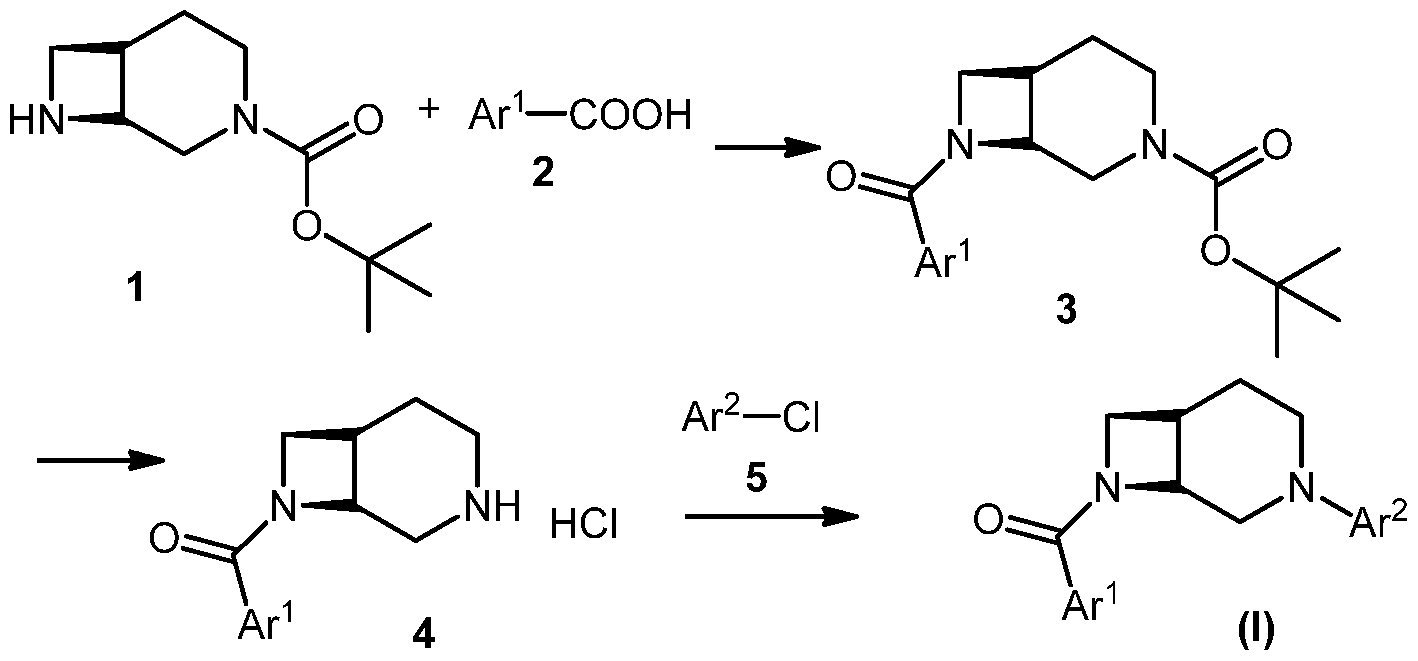
Scheme 1 : Preparation of compounds of formula (I)
The starting material 1 , available in racemic or enantiomerically enriched form, can be coupled with a carboxylic acid derivative Ar1-COOH 2 via a peptidic coupling using TBTU as activating agent in the presence of a base such as DIPEA in CH3CN at RT to afford intermediate 3. Boc-deprotection is usually achieved by reacting 3 with a solution of HCI 4 N in dioxane using dioxane as solvent or with a solution of HCI 2 N in Et20 using Et20 as solvent to give the amine's HCI salt 4. Further nucleophilic substitution of a suitable Ar2- halogenide or equivalent, e.g. Ar2-CI 5, by 4 in the presence of a base such as K2C03 (or DBU) in DMF (or pyridine) at 60°C or 1 10°C give the final compounds of formula (I). Such nucleophilic substitution may in certain circumstances be carried out in presence of well known metal catalysts, see for example: L. Jiang, S. L. Buchwald "Palladium-Catalyzed Aromatic Carbon-Nitrogen Bond Formation". In: A. de Meijere, F. Diederich "Metal-Catalyzed Cross-Couplings Reactions", 2nd Edition 2004, Weinheim: Wiley-VCH; J. F. Hartwig Acc. Chem. Res. 1998, 31 , 852; J. F. Hartwig Angew. Chem. Int. Ed. 1998, 37, 2046; and C. G. Frost, P. Mendonga J. Chem. Soc, Perkin Trans. 1 1998, 2615.
ethod B:

Scheme 2: Preparation of compounds of formula (I)
In analogy to the methods described above, the starting material 6, available in racemic or enantiomerically enriched form, can be reacted with the suitable Ar2-halogenide or equivalent, e.g. Ar2-CI 5, via a nucleophilic substitution to afford intermediate 7. Boc- deprotection is achieved as before to give the amine's HCI salt 8. Ultimately 8 is coupled with the carboxylic acid derivative Ar1-COOH 2 as described before to give the final compounds of formula (I).
In the following, particular methods for the synthesis of carboxylic acid derivatives of formula Ar1-CO-OH and halogenides of formula Ai^-halogenide (such as Ar2-CI) are described. These starting materials are well known in the art and/or commercially available; or they may be synthesized according to methods described in the literature. In addition, they may be synthesized in analogy to the methods given in the experimental part. In case Ar1, Ar2, or a substituent thereof is a heteroaryl moiety, such heteroaryl may be introduced using well known and generally commerially available building blocks (literature for precursors of heteroaryl-containing groups: see e.g. T. Eicher, S. Hauptmann "The chemistry of Heterocycles: Structure, Reactions, Syntheses, and Applications", 2nd Edition 2003, Wiley, ISBN 978-3-527-30720-3; A. R. Katrizky, C. W. Rees, E. F. V. Scriven (Eds.) "Comprehensive Heterocyclic Chemistry II" 1996, Elsevier, ISBN 0-08-042072-9). Such heteroaryl moiety may replace a phenyl group in the schemes below as appropriate.
Preparation of building blocks of formula Ar1 -CO-OH:
Carboxylic acid derivatives of formula Ar1-CO-OH are well known in the art and/or commercially available; or they may be synthesized according to methods described in the literature (see for example Schemes 5-1 1 , wherein R4 and R5 correspond to the respective optional substituents as defined for the compounds of formula(l)). In addition, they may be synthesized in analogy to the methods given in the experimental part.
Acids of structure 15 shown in Scheme 5 can especially be prepared following the procedures reported in WO2008/069997, WO2008/008517, WO2010/048012, WO2010/072722, WO2010/063662, and WO2010/063663.

Scheme 5: Preparation of building blocks of formula Ar1-CO-OH; wherein R3 is optionally substituted phenyl or 5- or 6-membered heteroaryl; X is CH or N
Acids of structure 16 shown in Scheme 6 can be prepared folowing the procedures reported in WO2010/044054, WO2010/038200 and WO2010/004507.

Scheme 6: Preparation of building blocks of formula Ar1-CO-OH; wherein Y is O or S
Acids of structure 17a and 17b shown in Scheme 7 can be prepared following the procedures reported in WO2010/044054.

Scheme 7: Preparation of building blocks of formula Ar1-CO-OH Preparation of building blocks of formula Ar2-CI:
Building blocks of formula Ar2-CI are well known in the art and/or commercially available, or they may be synthesized according to methods described in the literature. In addition, they may be synthesized in analogy to the methods given in the experimental part. General synthetic routes, which can be applied to several similar building blocks, are also shown in Schemes 8 through 1 1 .
Ar2-CI of structure 22 can be prepared according to general Method E depicted in Scheme 8.
ethod E:

Scheme 8: Preparation of building blocks of formula Ai^-CI; R6 is H or alkyl
Optionally, in case R6 = CH3, commercially available TOSMIC 18 can be alkylated in a first step, e.g. to methyl-TOSMIC 19 with Mel, in the presence of benzyltriethylammonium chloride (TEBA) and NaOH 30% at 0°C in DCM. Further condensation of 18 or 19 on commercially available aldehydes 20 in the presence of a base such as K2C03 in MeOH at reflux affords the oxazoles 21. Chlorination of 21 can be performed at -78°C in THF with a base such as LiHMDS (1.0 M in THF) and hexachloroethane to give final compounds of structure 22.
Ar2-CI of structure 26 can be prepared according to general Method F depicted in Scheme 9.
Method F:

Scheme 9: Preparation of building blocks of formula Ai^-CI; R7 is H or alkyl
In case R7 is H, the commercially available alcohols 23 can be converted to aldehydes 24 e.g. with Dess-Martin periodinane in DCM at RT. Cyclization of 24 into the amino-thiazole 25 can be achieved in a two step sequence: bromination at -10°C with Br2 in DCM followed by a treatment with thiourea in EtOH at reflux. Alternatively, 25 can also be obtained in one step if 24 is reacted with thiourea in pyridine at 80°C in the presence of l2.
In case R7 is alkyl, especially CH3, the respective commercially available ketone 24 can be directly used to give 25 in the same manner as described above. Chlorination of 25 can
finally be performed at RT in CH3CN with CuCI2 and tBuN02 to give final compounds of structure 26.
When not readily accessible, alcohols 23 can, for example, be synthesized starting from the corresponding commercially available substituted arylbromides as follows: Reaction of substituted arylbromides with carbon monoxide in the presence of a base such as CsC03 (or TEA or DABCO), a ligand such as di-(1 -adamantyl)-n-butylphosphine, and a catalyst such as Pd(OAc)2 in toluene (or 1-methyl-pyrrolidin-2-one) as solvent at 100°C gives the corresponding aldehydes. Reduction of the aldehydes with a reducing agent such as NaBH4 (or Bu3SnH) in MeOH at RT to the corresponding alcohols followed by bromination in the presence bromine, 1 H-imidazole and PPh3 in DCM at RT affords the corresponding substituted benzylbromides. Further nucleophilic substitution of the benzylbromides with KCN in EtOH/H20 at 80°C gives the corresponding substituted arylacetonitriles. The arylacetonitriles are subsequently converted to the alcohols 23 by first hydrolysis to the corresponding substituted arylacetic acids with H2S04 in AcOH followed by reduction of the obtained acids to the alcohols with Borane-THF complex (or Borane-Me2S complex) in THF at RT. The same methodology can be applied to substituted heteroarylbromides.
Ketones 24 can be synthesized starting from the above described substituted arylacetic acids, which are first converted to their corresponding Weinreb amides using N,0- dimethylhydroxylamine hydrochloride in the presence of a base such as TEA, an activating agent such as HOBT, and a peptidic coupling agent such as EDC in DMF at RT. Ketones 24 are obtained by reaction of these Weinreb amides with alkylmagnesium bromides in THF at RT. The same methodology can be applied to substituted heteroarylbromides.
Ar2-CI of general formula 31 can be prepared according to general Method G depicted in Scheme 10.
Method G:

Scheme 10: Preparation of building blocks of formula Ai^-CI; R8= H or alkyl
The commerially available phenylketone derivative 27 can be brominated with Br2 in AcOH at RT to give 28, which can further be converted to 29 with HCOONa in MeOH at reflux. Cyclization of 29 into 30 can be achieved in 2-PrOH in the presence of AcOH and KOCN at 50°C. Chlorination of 30 can finally be performed with POCI3 at 120°C in pyridine to give final compounds of structure 31.
When not readily accessible, arylketones 27 wherein R8 = H can, for example, be synthesized starting from the corresponding commercially available substituted arylbromides, which are reacted with acetic anhydride in the presence of magnesium (or isopropylmagnesium chloride) in THF at reflux. For R8 = CH3: arylketones 27 can, for example, be synthesized starting from the corresponding commercially available substituted arybromides, which are reacted with N-methoxy-N-methylpropionamide in the presence of magnesium (or isopropylmagnesium chloride) in THF at RT. The same methodologies can be applied to substituted heteroarylbromides using isopropylmagnesium chloride to generate the Grignard reagents.
Ar2-CI of structure 33 can be prepared according to general Method H in Scheme 1 1 .
Metho

Scheme 1 1 : Preparation of building blocks of formula Ar2-CI; R8 = H or alkyl
Similarly, phenylketone derivatives 27 can be brominated with Br2 in AcOH at RT to give 28, which can further be converted to 32 with NaSCN in acteone at RT. 32 can then be cyclized in HCI 4 N in dioxane at RT to give final compounds of structure 33.
Generally, bi-(hetero-)aryl-like structures can be synthesised using well established Suzuki chemistry in analogy to scheme 12.

Scheme 12: Synthesis of bi-(hetero-)aryl like structures; X is Br, I
Reaction of commercially available (hetero-)aryl-boronic acid derivatives (e.g. carboxylic acids or esters thereof) with commercially available (hetero-)aryl-bromides or (hetero-)aryl- iodides (or analogues thereof, such as chlorides, trifluoromethanesolfonates) in presence of a metal catalyst catalyst such as Pd(PPh3)4 or equivalent and a base such as Na2C03 under heating in a solvent such as toluene, dioxane, THF provides the corresponding bi-(hetero-)aryl like structures.
Ar2-CI of structure 77 can be prepared according to general Method I depicted in Scheme 13.
Method I:

Scheme 13: Preparation of building blocks of formula Ar2-CI
The commerially available aniline derivative 69 ((R)n represents for example one or two F) can be acetylated with acetic anhydride 70 at RT followed by nitration with nitric acid at RT to give 71. 74 is obtained via deacetylation of 71 into 72 in EtOH in the presence of HCI 6N at
100°C followed by nucleophilic substitution of 72 onto ethyl bromoacetate 73 in the presence of K2C03 at 137°C. Cyclization of 74 into 75 can be achieved via a one pot 2 steps reaction: the nitro group is first reduced to the corresponding aniline with SnCI2.2H20 in EtOH at 80°C or with Fe in AcOH at reflux, which is followed by intramolecular cyclization. Oxidation of 75 into 76 is performed with ammoniacal silver nitrate in water at reflux or with H202 (3wt% in H20) in the presence of NaOH 50% at 100°C. Chlorination of 76 can finally be performed with neat POCI3 at 1 10°C to give final compounds of structure 77.
When readily accessible, anilines 72 can directly be used as starting materials using the same sequence to get chloro quinoxalines of formula 77.
The compounds of formula (I) can be prepared as pure enantiomers using enantiomerically enriched core templates synthesized according to known methods described in the literature: J. Med. C em. 2006, 49(26), 7843-7853 or as mixture of enantiomers.
Whenever the compounds of formula (I) are obtained in the form of mixtures of enantiomers, the enantiomers can be separated using methods known to the one skilled in the art: e.g. by formation and separation of diastereomeric salts or by HPLC over a chiral stationary phase such a Daicel ChiralCel OD-H (5-10 μηη) column, a Daicel ChiralPak IC (5 μηη) column, or a Daicel ChiralPak IA (5-10 μηη) or AD-H (5 μηη) column. Typical conditions of chiral HPLC are an isocratic mixture of eluent A (heptanes or CH3CN) and eluent B (EtOH , MeOH, DCM ot tBME in presence or absence of an amine such as TEA or DEA), at a flow rate of 0.8 to 150 mL/min.
Experimental Section
Abbrevations (as used herein and in the description above):
Ac Acetyl (such as in OAc = acetate, AcOH = acetic acid)
AcOH Acetic acid
anh. Anhydrous
aq. aqueous
atm Atmosphere
tBME tert-Butylmethylether
Boc ferf-Butoxycarbonyl
Boc20 di-ferf-Butyl dicarbonate
BSA Bovine serum albumine
Bu Butyl such as tBu = ferf-butyl = tertiary butyl
n-BuLi n-Butyllithium
tBuN02 tert-Butylnitrite
CC Column Chromatography on silica gel
CH3CN Acetonitrile
CHO Chinese Hamster Ovary
cone. Concentrated
DBU 1 ,8-Diazabicyclo[5.4.0]undec-7-ene
DABCO 1 ,4-Diazabicyclo[2.2.2]octane
DCE 1 ,2-Dichloroethane
DCM Dichloromethane
DEA Diethylamine
Deoxo-Fluor Bis(2-methoxyethyl)aminosulfur trifluoride
DIBAL-H Diisobutylaluminium hydride
DIPEA Diisopropylethylamine
DMF A/JV-Dimethylformamide
DMSO Dimethyl sulfoxide
ELSD Evaporative Light-Scattering Detection
eq Equivalent(s)
ES Electron spray
Et Ethyl
Et20 Diethyl ether
EtOAc Ethyl acetate
EtOH Ethanol
FC Flash Chromatography on silica gel
FCS Foatal calf serum
FLIPR Fluorescent imaging plate reader
h Hour(s)
HBSS Hank's balanced salt solution
HCI Hydrogen chloride
HEPES 4-(2-Hydroxyethyl)-piperazine-1-ethanesulfonic acid
1H-NMR Nuclear magnetic resonance of the proton
HPLC High performance liquid chromatography
H2S04 Sulfuric acid
LC-MS Liquid chromatography - Mass Spectroscopy
LiHMDS Lithium bis(trimethylsilyl)amide
Lit. Literature
M Exact mass (as used for LC-MS)
Me Methyl
MeCN Acetonitrile
mCPBA mefa-Chloroperoxybenzoic acid
MeOH Methanol
Mel Methyl Iodide
MHz Megahertz
μΙ microliter
min Minute(s)
MS Mass spectroscopy
N Normality
Pd(OAc)2 Palladium diacetate
Pd(PPh3)4 Tetrakis(triphenylphosphine)palladium(0)
Ph Phenyl
PPh3 Triphenylphosphine
prep. Preparative
2-PrOH Isopropanol
Rfx reflux
RT Room temperature
sat. Saturated
TBTU 0-(Benzotriazol-1 -yl)-N,N,N',N'-tetramethyluronium tetrafluoroborate
TEA Triethylamine
TEBA Benzyltriethylammonium chloride
TFA trifluoroacetic acid
Tf Trifluoromethansulfonyl
THF Tetrahydrofuran
TLC Thin Layer Chromatography
TOSMIC Toluenesulfonylmethyl isocyanide
tR Retention time
uv Ultra violet l-Chemistrv
All temperatures are stated in °C. The commercially available starting materials were used as received without further purification. Compounds are purified by flash column chromatography on silica gel (FC) or by preparative HPLC. Compounds described in the invention are characterized by LC-MS (retention time tR is given in min.; molecular weight obtained from the mass spectrum is given in g/mol, using the conditions listed below). If the
mass is not detectable the compounds are also characterized by 1H-NMR (300 MHz: Varian Oxford; chemical shifts are given in ppm relative to the solvent used; multiplicities: s = singlet, d = doublet, t = triplet; p = pentuplet, hex = hexet, hept = heptet, m = multiplet, br = broad, coupling constants are given in Hz).
LC-MS with acidic conditions (conditions A)
Apparatus: Agilent 1 100 series with mass spectroscopy detection (MS : Finnigan single quadrupole). Column: Waters XBridge C18 (2.5 μηη, 4.6 x 30 mm). Conditions: MeCN [eluent A]; water + 0.04% TFA [eluent B]. Gradient: 95% B→ 5% B over 1.5 min. (flow: 4.5 ml/min.). Detection: UV/Vis + MS.
LC-MS with basic conditions (conditions B)
Apparatus: Agilent 1 100 series with mass spectroscopy detection (MS : Finnigan single quadrupole). Column: Waters XBridge C18 (5 μηη, 4.6 x 50 mm). Conditions: MeCN [eluent A]; 13 mmol/l NH3 in water [eluent B]. Gradient: 95% B→ 5% B over 1.5 min. (flow: 4.5 ml/min.). Detection: UV/Vis + MS.
Preparative HPLC for purification of compounds (conditions C)
Column: Waters XBridge (10 μηη, 75 x 30 mm). Conditions: MeCN [eluent A]; water + 0.5% NH4OH (25% aq.) [eluent B]; Gradient: 90% B → 5% B over 6.5 min. (flow: 75 ml/min.). Detection: UV + ELSD.
Preparative HPLC for purification of compounds (conditions D)
Column: Waters Atlantis T3 OBD (10 μηι, 75 x 30 mm). Conditions: MeCN [eluent A]; water + 0.5% HCOOH [eluent B]; Gradient: 90% B → 5% B over 6.4 min. (flow: 75 ml/min.). Detection: UV + ELSD.
LC-MS with basic conditions (conditions E)
Apparatus: Agilent 1 100 series with mass spectroscopy detection (MS : Finnigan single quadrupole). Column: Agilent Zorbax Extend-C18 (5 um, 4.6 x 50 mm). Conditions: MeCN [eluent A]; 13 mmol/l NH3 in water [eluent B]. Gradient: 95% B→ 5% B over 1.5 min. (flow: 4.5 ml/min.). Detection: UV + MS.
LC-MS with acidic conditions (conditions F)
Apparatus: Agilent 1 100 series with mass spectroscopy detection (MS : Finnigan single quadrupole). Column: Agilent Zorbax SB-Aq, (3.5 um, 4.6 x 50mm). Conditions: MeCN [eluent A]; water + 0.04% TFA [eluent B]. Gradient: 95% B→ 5% B over 1 .5 min. (flow: 4.5 ml/min.). Detection: UV + MS.
The following examples illustrate the preparation of compounds of the invention but do not at all limit the scope thereof.
Preparation of precursors and intermediates:
A Preparation of building blocks of formula Ar1-CO-OH:
In addition to commercially available building blocks, further particular building blocks of formula Ar1-CO-OH are prepared as follows:

A.1 2-Fluoro-3-methyl-6-(2H-1,2,3-triazol-2-yl)benzoic acid 34
2-Fluoro-3-methyl-6-(2H-1 ,2,3-triazol-2-yl)benzoic acid 34 is synthesized in analogy to procedures reported in WO2008/069997.
In a dry Schlenk Tube at RT under nitrogen are successively charged 2-fluoro-6-iodo-3- methyl-benzoic acid (1.786 mmol, 1 eq), Cul (0.089 mmol, 0.05 eq), 1 H-1 ,2,3-triazole (3.571 mmol, 2 eq), Cs2C03 (3.571 mmol, 2 eq) and DMF (2.5 ml_). The resulting blue suspension is stirred at 80°C overnight. The obtained reaction mixture is taken up in 1 M aq. HCI and extracted twice with EtOAc. The combined organic layers are dried over Na2S04, filtered and concentrated under reduced pressure. Purification is achieved by preparative HPLC (conditions D) to give the titled compound (246 mg) as a pale yellow solid. LC-MS (conditions A): tR = 0.55 min, [M + 1 ]+ = 222.19.
A.2 5-Methoxy-2-(2H-1,2,3-triazol-2-yl) benzoic acid 35
The title compound is prepared in analogy to compound 34 starting from 2-iodo-5- methoxybenzoic acid (1 .798 mmol, 1 eq). 35 (313 mg) is obtained as a yellow solid. LC-MS (conditions A): tR = 0.49 min, [M + 1]+ = 220.07.
A.3 2-Fluoro-3-methoxy-6-(2H-1,2,3-triazol-2-yl)benzoic acid 36
The title compound is prepared in analogy to compound 34 starting from 2-fluoro-6-iodo-3- methoxy-benzoic acid (1 .689 mmol, 1 eq). 36 (221 mg) is obtained as a pale yellow solid. LC-MS (conditions A): tR = 0.48 min, [M + 1 ]+ = 238.18.
A.4 2-(2H-1,2,3-Triazol-2-yl)-5-(trifluoromethyl)benzoic acid 37
The title compound is prepared in analogy to compound 34 starting from 2-iodo-5- trifluorobenzoic acid (1.582 mmol, 1 eq). 37 (268 mg, 66%) is obtained as a white solid. LC- MS (conditions A): tR = 0.64 min, [M + 1]+ = 257.91.
A.5 2-(2H-1,2,3-Triazol-2-yl)-5-(trifluoromethoxy)benzoic acid 38
The title compound is prepared in analogy to compound 34 starting from 2-iodo-5- (trifluoromethoxy)benzoic acid (1.506 mmol, 1 eq). 38 (243 mg) is obtained as an off-white solid. LC-MS (conditions A): tR = 0.66 min, [M + 1 ]+ = 273.69.
A.6 5-Cyano-2-(2H-1,2,3-triazol-2-y I) benzoic acid 39
The title compound is prepared in analogy to compound 34 starting from 5-cyano-2- iodobenzoic acid (1 .831 mmol, 1 eq). 39 (214 mg) is obtained as a grey solid. LC-MS (conditions A): tR = 0.46 min, [M + 1]+ = not detectable. 1H NMR (D6-DMSO): δ 13.49 (m, 1 H), 8.21 (m, 1 H), 8.18 (m, 2 H), 8.15 (m, 1 H), 8.03 (m, 1 H).
A.7 5-Methyl-2-(pyridin-2-yl)benzoic acid 40
a) In a dry Schlenk Tube at RT under nitrogen are successively charged 2-iodo-5- methylbenzoic acid methyl ester (13.765 mmol, 1 eq), Cul (2.753 mmol, 0.2 eq), CsF (27.529 mmol, 2 eq), 2-tributylstannylpyridine (20.647 mmol, 1.5 eq), Pd(PPh3)4 (1.376 mmol, 0.1 eq) and DMF (60 mL). The resulting suspension is stirred at 90°C overnight. The obtained reaction mixture is diluted with EtOAc and filtered through a short pad of Celite®. A solution of sat. aq. NaHC03 is then added to the filtrate and the aq. phase extracted with EtOAc (3 times). The combined organic layers are washed with H20 and brine, dried over Na2S04, filtered and concentrated under reduced pressure. Purification is achieved by FC (EtOAc/Heptane 1 :4 to 3:7) to give methyl 5-methyl-2-(pyridin-2-yl)benzoate (2.64 g) as a brown oil. LC-MS (conditions A): tR = 0.67 min, [M + 1 ]+ = 228.07.
b) To a solution of methyl 5-methyl-2-(pyridin-2-yl)benzoate (1 1.617 mmol, 1 eq) in MeOH (15 mL) and THF (17 mL) is added 1 M NaOH (23.233 mL, 2 eq). The resulting mixture is stirred at RT overnight. The volatiles are evaporated under reduced pressure and the remaining aq. phase is acidified with 2 M HCI to pH = 1 -2 and extracted with DCM (3 times). The combined organic layers are dried over Na2S04, filtered and concentrated under
reduced pressure to give 5-methyl-2-(pyridin-2-yl)benzoic acid 40 (2.65 g) as a pale brown foam. LC-MS (conditions A): tR = 0.39 min, [M + 1]+ = 214.25.
A.8 2-Fluoro-3-methyl-6-(1H-pyrazol-1-yl)benzoic acid 78
The title compound is prepared in analogy to compound 34 replacing the 1 H-1 ,2,3-triazole with 1 H-pyrazole (25 mmol, 2 eq). 78 (1 .86 g) is obtained as a light yellow solid. LC-MS (conditions F): tR = 0.63 min, [M + 1 ]+ = 221.16.
A.9 2-Fluoro-3-methyl-6-(pyridin-2-yl)benzoic acid 79
a) In a dry Schlenk Tube at RT under nitrogen are successively charged methyl 2-fluoro-6- iodo-3-methylbenzoate (9.18 mmol, 1 eq), Cul (1.84 mmol, 0.2 eq), CsF (18.4 mmol, 2 eq), 2-tributylstannylpyridine (9.18 mmol, 1 eq), Pd(PPh3)4 (0.918 mmol, 0.1 eq) and DMF (40 mL). The resulting suspension is stirred at 90°C overnight. The obtained reaction mixture is diluted with EtOAc and filtered through a short pad of Celite®. A solution of sat. aq. NaHC03 is then added to the filtrate and the aq. phase extracted with EtOAc (3 times). The combined organic layers are washed with H20 and brine, dried over Na2S04, filtered and concentrated under reduced pressure. Purification is achieved by FC (Teledyne Isco Combiflash Rf, Si02 cartridge 120 g; Heptane to EtOAc/Heptane 3:7) to give methyl 2-fluoro-3-methyl-6-(pyridin- 2-yl)benzoate as a brown oil. LC-MS (conditions F): tR = 0.74 min, [M + 1 ]+ = 246.15.
b) To a solution of methyl 2-fluoro-3-methyl-6-(pyridin-2-yl)benzoate (6.36 mmol, 1 eq) in MeOH (1 1.3 mL) is added NaOH 32% (6.27 mL). The resulting mixture is stirred at 60°C for 1 hour. The volatiles are evaporated under reduced pressure and the remaining aq. phase is acidified with 7 M HCI to pH = 1-2. The pink suspension is concentrated under reduced pressure and the obtained solid is purified by preparative HPLC (conditions D) to give 2- fluoro-3-methyl-6-(pyridin-2-yl)benzoic acid 79 (1.14 g) as a light pink solid. LC-MS (conditions F): tR = 0.47 min, [M + 1 ]+ = 232.17.
A.10 3-fluoro-4-methyl-[ 1, 1 '-biphenyl]-2-carboxylic acid 80
a) In a dry Schlenk Tube at RT under nitrogen are successively charged methyl 2-fluoro-6- iodo-3-methylbenzoate (23.5 mmol, 1 eq), Pd(PPh3)4 (1.17 mmol, 0.05 eq) and Toluene (60 mL). The resulting mixture is stirred at RT for 15 minutes before a solution of phenyloronic acid (25.8 mmol, 1.1 eq) in EtOH (26 mL) and 2 M Na2C03 (54 mL) are successively added . The resulting mixture is stirred at reflux overnight. The obtained reaction mixture is diluted with Et20 and the solvents are removed under reduced pressure. The residue is purified by FC (Teledyne Isco Combiflash Rf, Si02 cartridge 120 g; Heptane to EtOAc/Heptane 3:97) to give methyl 3-fluoro-4-methyl-[1 , 1 '-biphenyl]-2-carboxylate as a light yellow oil. LC-MS (conditions F): tR = 0.94 min, [M + 1 ]+ = 245.19.
b) To a solution of methyl 3-fluoro-4-methyl-[1 , 1 '-biphenyl]-2-carboxylate (23 mmol, 1 eq) in MeOH (42 ml.) is added NaOH 32% (24 ml_). The resulting mixture is stirred at 65°C for 2 hour. The volatiles are evaporated under reduced pressure and the remaining aq. phase is acidified with 7 M HCI to pH = 1 -2. The resulting suspension is filtered under vacuum and the obtained solid dried under hight vacuum. 3-Fluoro-4-methyl-[1 , 1 '-biphenyl]-2-carboxylic acid 80 (4.35 g) is obtained as a white solid. LC-MS (conditions F): tR = 0.81 min, [M + 1 ]+ = not detectable. 1 H NMR (D6-DMSO): δ 13.37 (bs, 1 H), 7.40 (m, 5 H), 7.15 (m, 2 H), 2.48 (s, 3 H).
All other carboxylic acids used in the experimental part which are not described in the previous section are either commercially available or fully described in the literature listed in the introduction part.
B Preparation of building blocks of formula Ar2-CI :
In addition to commercially available building blocks, further particular building blocks of formula Ai^-CI are prepared as follows:
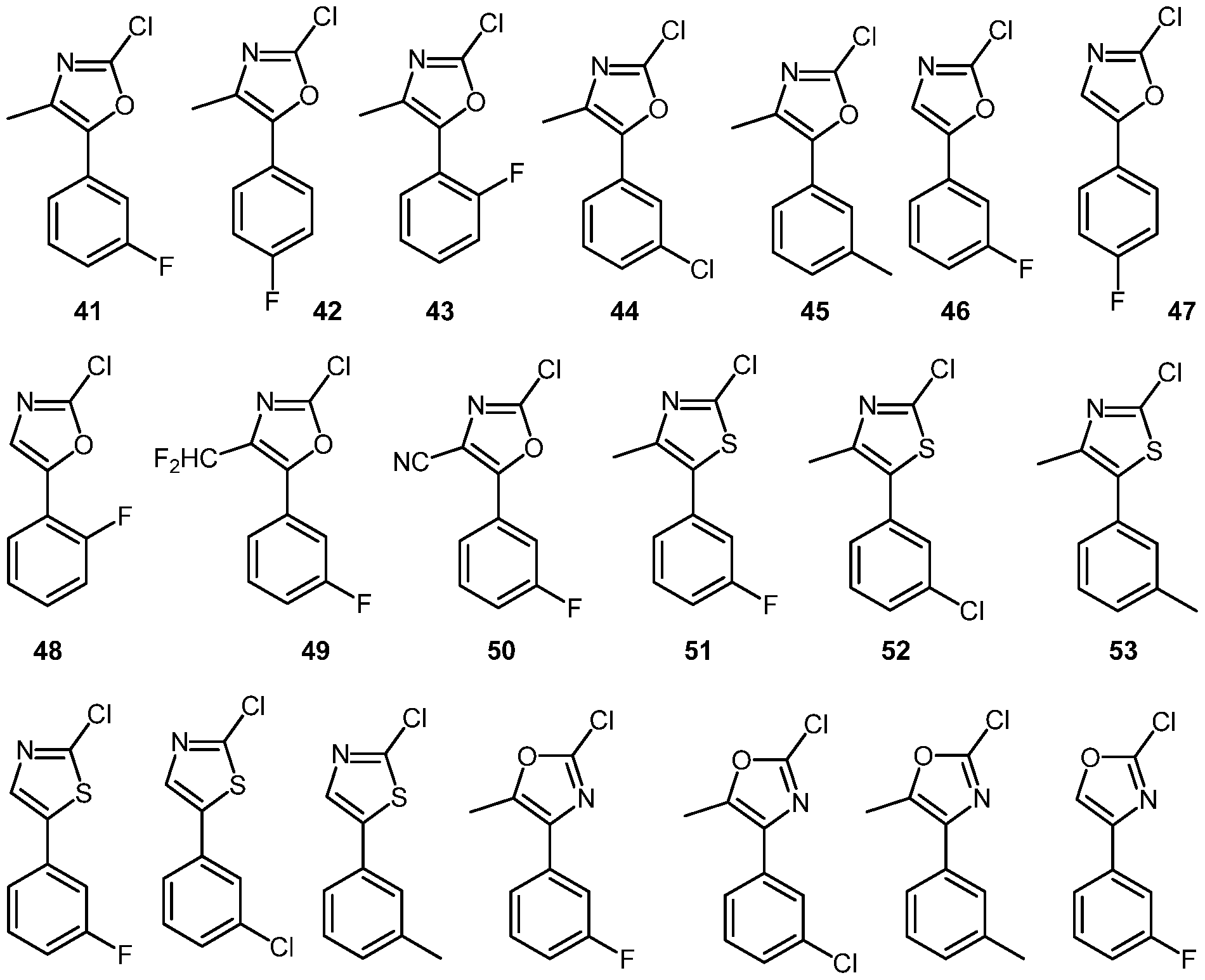
54 55 56 57 58 59 60

68
B.1 2-Chloro-5-(3-fluorophenyl)-4-methyloxazole 41
a) To a solution of TOSMIC (43.536 mmol, 1 eq) in DCM (85 mL) at 0°C under nitrogen are successively added benzyltriethylammonium chloride (8.707 mmol, 0.2 eq), Mel (87.072 mmol, 2 eq) and aq. NaOH (30%, 85 mL). The resulting mixture is stirred at 0°C for 3 h, diluted with H20 and extracted with DCM (3 times). The combined organic layers are washed with H20 (2 times) and brine, dried over Na2S04, filtered and concentrated under reduced pressure to give rac-N-methyl-1-tosylethanamine (9.1 1 g) as a brown oil. The compound is clean enough to be used in the next step without further purification. 1H NMR (CDCI3): δ 7.88 (m, 2 H), 7.44 (d, J = 8.1 Hz, 2 H), 4.57 (m, 1 H), 2.49 (s, 3 H), 1.74 (d, J = 6.8 Hz, 3 H) b) To a solution of 3-fluorobenzaldehyde (39.194 mmol, 1 eq) in MeOH (180 mL) at RT are successively added rac-N-methyl-1 -tosylethanamine (39.194 mmol, 1 eq) and K2C03 (47.033 mmol, 1.2 eq). The resulting mixture is refluxed for 3 h, cooled down to RT and further stirred at this temperature for an additional 16 h. Upon completion the reaction is concentrated under reduced pressure and the residue is diluted with H20. The aq. layer is extracted with Et20 (3 times). The combined organic layers are dried over Na2S04, filtered and concentrated under reduced pressure. Purification is achieved by FC (EtO Ac/ Heptane 1 :9) to give 5-(3-fluorophenyl)-4-methyloxazole (6.27 g) as a pale yellow solid. 1H NMR (CDCI3): δ 7.83 (s, 1 H), 7.40 (m, 2 H), 7.31 (m, 1 H), 7.02 (m, 1 H), 2.45 (s, 3 H).
c) To a solution of 5-(3-fluorophenyl)-4-methyloxazole (35.388 mmol, 1 eq) in THF (146 mL) at -78°C is added dropwise LiHMDS (1 M in THF, 44.235 mmol, 1 .25 eq). The obtained reaction mixture is stirred at this temperature for 30 min before being transferred via a canula
onto a suspension of hexachloroethane (70.776 mmol, 2 eq) in THF (10 mL) at -78°C. The resulting mixture is allowed to warm up to RT and is further stirred at this temperature overnight. Upon completion the reaction is quenched with sat. NH4CI and is extracted with Et20 (2 times). The combined organic layers are dried over Na2S04, filtered and concentrated under reduced pressure. Purification is achieved by FC (EtOAc/Heptane 5:95) to give the title compound 41 (6.50 g) as an orange oil. 1H NMR (CDCI3): 7.83 (s, 1 H), 7.40 (m, 2 H), 7.31 (m, 1 H), 7.02 (m, 1 H), 2.45 (s, 3 H).
B.2 2-Chloro-5-(4-fluorophenyl)-4-methyloxazole 42
a) Identical to B.1 a)
b) 5-(4-Fluorophenyl)-4-methyloxazole is prepared in analogy to 5-(3-fluorophenyl)-4- methyloxazole starting from 4-fluorobenzaldehyde (37.466 mmol, 1 eq). 5-(4-Fluorophenyl)- 4-methyloxazole (5.71 g) is obtained as a yellow solid. LC-MS (conditions A): tR = 0.71 min, [M + 1]+ = 178.21.
c) 2-Chloro-5-(4-fluorophenyl)-4-methyloxazole is prepared in analogy to 2-chloro-5-(3- fluorophenyl)-4-methyloxazole 41 starting from 5-(4-fluorophenyl)-4-methyloxazole (32.171 mmol, 1 eq). 42 (6.33 g) is obtained as a brown solid. LC-MS (conditions A): tR = 0.86 min, [M + 1]+ = not detectable. 1H NMR (CDCI3): £7.53 (m, 2 H), 7.14 (m, 2 H), 2.37 (m, 3 H).
B.3 2-Chloro-5-(2-fluorophenyl)-4-methyloxazole 43
a) Identical to B.1 a)
b) 5-(2-Fluorophenyl)-4-methyloxazole is prepared in analogy to 5-(3-fluorophenyl)-4- methyloxazole starting from 2-fluorobenzaldehyde (37.466 mmol, 1 eq). 5-(2-fluorophenyl)-4- methyloxazole (6.01 g) is obtained as a yellow liquid. LC-MS (conditions A): tR = 0.69 min, [M + 1 ]+ = 178.26.
c) 2-Chloro-5-(2-fluorophenyl)-4-methyloxazole is prepared in analogy to 2-chloro-5-(3- fluorophenyl)-4-methyloxazole 41 starting from 5-(2-fluorophenyl)-4-methyloxazole (33.921 mmol, 1 eq). 43 (5.80 g) is obtained as an orange liquid. LC-MS (conditions A): tR = 0.85 min, [M + 1]+ = 212.09.
B.4 2-Chloro-5-(3-chlorophenyl)-4-methyloxazole 44
a) Identical to B.1 a)
b) 5-(3-Chlorophenyl)-4-methyloxazole is prepared in analogy to 5-(3-fluorophenyl)-4- methyloxazole starting from 3-chlorobenzaldehyde (35.570 mmol, 1 eq). 5-(3-chlorophenyl)- 4-methyloxazole (2.29 g) is obtained as a brown solid. 1H NMR (CDCI3): £8.36 (s, 1 H), 7.51 (m, 4 H), 2.37 (s, 3 H).
c) 2-Chloro-5-(3-chlorophenyl)-4-methyloxazole is prepared in analogy to 2-chloro-5-(3- fluorophenyl)-4-methyloxazole 41 starting from 5-(3-chlorophenyl)-4-methyloxazole (1 1.775 mmol, 1 eq). 44 (2.09 g) is obtained as an orange liquid. LC-MS (conditions A): tR = 1.26 min, [M + 1]+ = 228.12.
B.5 2-Chloro-4-methyl-5-(m-tolyl)oxazole 45
a) Identical to B.1 a)
b) 4-Methyl-5-(m-tolyl)oxazole is prepared in analogy to 5-(3-fluorophenyl)-4-methyloxazole starting from 3-methylbenzaldehyde (41 .614 mmol, 1 eq). 4-Methyl-5-(m-tolyl)oxazole (2.39 g) is obtained as an orange liquid. 1H NMR (CDCI3): δ 7.82 (s, 1 H), 7.41 (m, 2 H), 7.33 (t, J = 7.5 Hz, 1 H), 7.15 (d, J = 7.5 Hz, 1 H), 2.44 (s, 3 H), 2.41 (s, 3 H).
c) 2-Chloro-4-methyl-5-(m-tolyl)oxazole is prepared in analogy to 2-chloro-5-(3-fluorophenyl)- 4-methyloxazole 41 starting from 4-methyl-5-(m-tolyl)oxazole (13.798 mmol, 1 eq). 45 (2.90 g) is obtained as an orange liquid. LC-MS (conditions A): tR = 0.92 min, [M + 1]+ = 208.13.
B.6 2-Chloro-5-(3-fluorophenyl)oxazole 46
a) To a solution of 3-fluorobenzaldehyde (40.246 mmol, 1 eq) in MeOH (200 ml.) at RT are successively added TOSMIC (40.286 mmol, 1 eq) and K2C03 (48.343 mmol, 1 .2 eq). The resulting mixture is refluxed for 3 h, cooled down to RT and further stirred at this temperature for an additional 16 h. Upon completion the reaction is concentrated under reduced pressure and the residue is diluted with H20. The aq. layer is extracted with Et20 (3 times). The combined organic layers are dried over Na2S04, filtered and concentrated under reduced pressure. Purification is achieved by FC (EtO Ac/ Heptane 1 :9) to give 5-(3- fluorophenyl)oxazole (5.86 g) as a yellow solid. LC-MS (conditions A): tR = 0.67 min, [M + 1]+ = not detectable. 1H NMR (CDCI3): 7.92 (s, 1 H), 7.39 (m, 4 H), 7.04 (m, 1 H).
b) To a solution of 5-(3-fluorophenyl)oxazole (35.918 mmol, 1 eq) in THF (140 mL) at -78°C is added dropwise LiHMDS (1 M in THF, 44.897 mmol, 1.25 eq). The obtained reaction mixture is stirred at this temperature for 30 min before being transferred via a canula onto a suspension of hexachloroethane (71.835 mmol, 2 eq) in THF (20 mL) at -78°C. The resulting mixture is allowed to warm up to RT and is further stirred at this temperature overnight. Upon completion the reaction is quenched with sat. NH4CI and is extracted with Et20 (2 times). The combined organic layers are dried over Na2S04, filtered and concentrated under reduced pressure. Purification is achieved by FC (EtOAc/Heptane 5:95) to give the title compound 46 (4.99 g) as a beige solid. LC-MS (conditions A): tR = 0.82 min, [M + 1]+ = not detectable. 1 H NMR (CDCI3): £7.83 (s, 1 H), 7.39 (m, 2 H), 7.30 (s, 1 H), 7.26 (m, 1 H), 7.05 (m, 1 H).
B.7 2-Chloro-5-(4-fluorophenyl)oxazole 47
a) 5-(4-Fluorophenyl)oxazole is prepared in analogy to 5-(3-fluorophenyl)oxazole starting from 4-fluorobenzaldehyde (32.229 mmol, 1 eq). 5-(4-Fluorophenyl)oxazole (4.70 g) is obtained as a yellow solid. LC-MS (conditions A): tR = 0.66 min, [M + 1]+ = not detectable. 1 H NMR (CDCIs): 7.90 (s, 1 H), 7.63 (m, 2 H), 7.29 (s, 1 H), 7.12 (t, J = 8.7 Hz, 2 H).
b) 2-Chloro-5-(4-fluorophenyl)oxazole is prepared in analogy to 2-chloro-5-(3- fluorophenyl)oxazole 46 starting from 5-(4-fluorophenyl)oxazole (28.808 mmol, 1 eq). 47 (4.30 g) is obtained as a pale yellow solid. LC-MS (conditions A): tR = 0.81 min, [M + 1 ]+ = not detectable. 1H NMR (CDCI3): £7.57 (m, 2 H), 7.22 (s, 1 H), 7.12 (m, 2 H).
B.8 2-Chloro-5-(2-fluorophenyl)oxazole 48
a) 5-(2-Fluorophenyl)oxazole is prepared in analogy to 5-(3-fluorophenyl)oxazole starting from 2-fluorobenzaldehyde (40.286 mmol, 1 eq). 5-(2-Fluorophenyl)oxazole (5.72 g) is obtained as a yellow liquid. LC-MS (conditions A): tR = 0.67 min, [M + 1]+ = not detectable. 1 H NMR (CDCI3): £7.94 (s, 1 H), 7.77 (td, Ji = 7.6 Hz, J2 = 1.7 Hz, 1 H), 7.51 (d, J = 3.9 Hz, 1 H), 7.32 (m, 1 H), 7.20 (m, 2 H).
b) 2-Chloro-5-(2-fluorophenyl)oxazole is prepared in analogy to 2-chloro-5-(3- fluorophenyl)oxazole 46 starting from 5-(2-fluorophenyl)oxazole (35.06 mmol, 1 eq). 48 (5.80 g) is obtained as a brown liquid. LC-MS (conditions A): tR = 0.83 min, [M + 1 ]+ = not detectable. 1H NMR (CDCI3): £7.70 (td, 4 = 7.6 Hz, J2 = 1.6 Hz, 1 H), 7.42 (d, J = 3.7 Hz, 1 H), 7.33 (m, 1 H), 7.19 (m, 2 H).
B.9 2-Chloro-4-(difluoromethyl)-5-(3-fluorophenyl)oxazole 49

b) To a solution of ethyl 5-(3-fluorophenyl)oxazole-4-carboxylate (3.337 mmol, 1 eq) in THF (9 ml.) at -78°C, is added dropwise a solution of DIBAL-H (1 M in Toluene, 6.675 mmol, 2 eq). The reaction mixture is allowed to proceed at -78°C for 1 h, before being warmed up to - 20°C and further stirred at this temperature for 1 h. The reaction mixture is diluted with DCM (90 ml.) and quenched with Rochelle salt (90 ml.) at -20°C. This resulting mixture is stirred vigorously with gradual warming to RT overnight. After 16 h, the layers are separated, and the aq. layer is extracted with DCM (3 times). The combined organic layers are dried over Na2S04, filtered, and concentrated under reduced pressure. The residue is purified by FC (EtOAc/heptane, 1 :9 to 2:3) to yield 5-(3-fluorophenyl)oxazole-4-carbaldehyde (564 mg) as a yellow solid. LC-MS (conditions A): tR = 0.78 min, [M + 1]+ = not detectable. 1 H NMR (CDCI3): £10.13 (s), 7.99 (m, 2 H), 7.95 (s, 1 H), 7.50 (td, Ji = 8.2 Hz, J2 = 5.9 Hz, 1 H), 7.21 (m, 1 H). c) To a solution of 5-(3-fluorophenyl)oxazole-4-carbaldehyde (3.547 mmol, 1 eq) in DCM (3 ml.) at -78°C, are successively added methoxytrimethysilane (7.094 mmol, 2 eq) and trimethylsilyl trifluoromethanesulfonate (0.177 mmol, 0.05 eq). The resulting reaction mixture is allowed to proceed with gradual warming to RT for 24 h. Upon completion the reaction is quenched with a sat. aq. solution of NaHC03 (10 ml_), and extracted with with EtOAc (3 times). The combined organic layers are washed with H20 and brine, dried over Na2S04, filtered, and concentrated under reduced pressure to give 4-(dimethoxymethyl)-5-(3- fluorophenyl)oxazole (749 mg) as a yellow oil. The compound is clean enough to be used in the next step without further purification. LC-MS (conditions A): tR = 0.82 min, [M + 1 ]+ = 238.20. 1H NMR (CDCI3): £7.89 (s, 1 H), 7.54 (m, 2 H), 7.41 (m, 1 H), 7.07 (m, 1 H), 5.55 (s, 1 H), 3.42 (m, 6 H).
d) To a solution of 4-(dimethoxymethyl)-5-(3-fluorophenyl)oxazole (3.157 mmol, 1 eq) in THF (13 mL) at -78°C is added dropwise a solution of LiHMDS (1 M in THF, 3.473 mmol, 1 .1 eq). The reaction mixture is stirred at -78°C for 30 min. before hexachloroethane (3.473 mmol, 1.1 eq.) is added in one portion. The reaction is allowed to proceed with gradual warming to 5°C over a period of 5.5 h and quenched with a sat. aq. solution of NH4CI. The aq. layer is
extrated with Et20 (3 times). The combined organic layers are washed with H20 and brine, dried over Na2S04, filtered, and concentrated under reduced pressure to give 2-chloro-4- (dimethoxymethyl)-5-(3-fluorophenyl)oxazole (832 mg) as a brown oil. The compound is clean enough to be used in the next step without further purification. LC-MS (conditions A): tR = 0.97 min, [M + 1 ]+ = not detectable. 1H NMR (CDCI3): 7.46 (m, 3 H), 7.09 (tdd, Ji = 8.3 Hz, J2 = 2.6 Hz, J3 = 1.1 Hz, 1 H), 5.48 (m, 1 H).
e) A HCI solution (4 M in dioxane, 12.044 mmol, 4 eq.) is added to a solution of 2-chloro-4- (dimethoxymethyl)-5-(3-fluorophenyl)oxazole (3.01 1 mmol, 1 eq) in THF (10 ml.) / H20 (5 ml_). The reaction mixture is stirred at RT for 16 h, quenched with a sat. aq. Sol. of Na2C03. The aq. layer is extracted with Et20 (3 times). The combined organic layers are washed with brine, dried over Na2S04, filtered, and concentrated under reduced pressure. The residue is purified by FC (EtOAc/heptane, 1 :9) to give 2-chloro-5-(3-fluorophenyl)oxazole-4- carbaldehyde (521 mg) as a beige solid. LC-MS (conditions A): tR = 0.88 min, [M + 1]+ = not detectable. 1H NMR (CDCI3): £10.00 (m, 1 H), 7.93 (m, 2 H), 7.50 (m, 1 H), 7.23 (m, 1 H). f) To a solution of 2-chloro-5-(3-fluorophenyl)oxazole-4-carbaldehyde (2.309 mmol, 1 eq.) in DCM (7 ml.) at 0°C, is added Deoxo-Fluor (3.464 mmol, 1.5 eq.). The reaction is stirred at 0°C for 2 h, and 1 h at RT. The reaction mixture is quenched with H20 and extracted with DCM (3 times). The combined organic layers are washed with brine, dried over Na2S04, filtered, and concentrated under reduced pressure. The residue is purified by FC (EtOAc/heptane, 1 :9) to give 49 (215 mg) as a white solid. LC-MS (conditions A): tR = 0.94 min, [M + 1]+ = not detectable. 1H NMR (CDCI3): £7.47 (m, 2 H), 7.39 (m, 1 H), 7.15 (m, 1 H), 6.71 (t, J = 54 Hz, 1 H).
-Chloro-5-(3-fluorophenyl)oxazole-4-carbonitrile 50

a) To a solution of 5-(3-fluorophenyl)oxazole (B.6a, 13.914 mmol, 1 eq) and 1 ,3-dimethyl- 3,4,5, 6-tetrahydro- 2(1 /-/)-pyrimidinone (18 mL) in THF (25 mL) at -78°C is added dropwise a solution of LiHMDS (1 M in THF, 16.696 mmol, 1 .2 eq). The reaction mixture is stirred at - 78°C for 1 h before addition Br2 (13.914 mmol, 1 eq). The reaction mixture is further stirred at this temperature for 1 h and poured onto a mixture of Et20 / aq. 10 % Na2S03 solution. The layers are separated and the organic phase is washed with brine, dried over Na2S04, filtered,
and concentrated under reduced pressure. The residue is purified by FC (EtOAc/heptane, 5:95) to give 4-bromo-5-(3-fluorophenyl)oxazole (2.27 g) as a pale yellow. LC-MS (conditions A): tR = 0.81 min, [M + 1 ]+ = not detectable. 1 H NMR (D6-DMSO): 8.60 (m, 1 H), 7.65 (m, 4 H), 7.32 (m, 1 H).
b) A mixture of 4-bromo-5-(3-fluorophenyl)oxazole (8.469 mmol, 1 eq), Zn(CN)2 (9.316 mmol, 1.1 eq.), and Pd(PPh3)4 (0.423 mmol, 0.05 eq) in DMF (20 ml_), is heated in a microwave at 160°C for 15 min. The reaction mixture is cooled to RT, diluted with EtOAc, filtered through a short pad of Celite®, washed with H20 and brine, and concentrated under reduced pressure. The residue is purified by FC (EtOAc/heptane, 5:95 to 1 :4) to give 5-(3-fluorophenyl)oxazole- 4-carbonitrile (1 .27 g) as a white solid. LC-MS (conditions A): tR = 0.84 min, [M + 1 ]+ = not detectable. 1H NMR (CDCI3): £7.94 (s, 1 H), 7.80 (m, 1 H), 7.63 (m, 1 H), 7.52 (m, 1 H), 7.22 (m, 1 H).
c) To a solution of 5-(3-fluorophenyl)oxazole-4-carbonitrile (6.750 mmol, 1 eq) in THF (21 ml.) at -78°C is added dropwise a solution of LiHMDS (1 M in THF, 7.425 mmol, 1.1 eq). The reaction mixture is stirred at -78°C for 30 min. before hexachloroethane (6.75 mmol, 1.1 eq.) is added in one portion. The reaction is allowed to proceed with gradual warming to RT overnight. The reaction mixture is quenched with H20 before heptane is added. The solid formed is filtered and the filtrate is diluted with EtOAc. The organic layer is washed with H20 and brine, dried over Na2S04, filtered, and concentrated under reduced pressure. The residue is purified by FC (EtOAc/heptane, 5:95 to 1 :4) to give 50 (770 mg) as a white solid. LC-MS (conditions A): tR = 0.93 min, [M + 1]+ = not detectable. 1H NMR (CDCI3): £7.75 (m, 1 H), 7.59 (m, 1 H), 7.51 (m, 1 H), 7.22 (m, 1 H).
B.11 2-Chloro-5-(3-fluorophenyl)-4-methylthiazole 51
a) To a solution of 3-fluorophenylacetone (16.101 mmol, 1 eq) in pyridine (14 mL) at RT is added thiourea (16.101 mmol, 1 eq) followed by l2 (16.101 mmol, 1 eq). The reaction mixture is stirred at 80°C for 16 h, and allowed to cool down to RT. The resulting suspension is filtered and washed with EtOAc. The filtrate is concentrated in vacuo, the residue re- dissolved in EtOAc, washed with a sat. aq. solution of NaHC03 (2 times) and brine, dried over Na2S04, filtered, and concentrated under reduced pressure to give 5-(3-fluorophenyl)-4- methylthiazol-2-amine (2.99 g) as a brown oil. The compound is clean enough to be used in the next step without further purification. LC-MS (conditions B): tR = 0.79 min, [M + 1 ]+ = 209.20.
b) To a suspension of CuCI2 anhydrous (12.577 mmol, 1.2 eq) in dry CH3CN (25 mL) is added dropwise tert-Butyl nitrite (15.721 mmol, 1 .5 eq), followed by a solution of 5-(3-
fluorophenyl)-4-methylthiazol-2-amine (10.481 mmol, 1 eq) in dry CH3CN (40 mL). The reaction mixture is stirred at RT for 3 h, poured onto an aq. solution of 0.5 N HCI and diluted with EtOAc. The separated organic layer is washed with H20 and brine, dried over Na2S04, filtered, and concentrated under reduced pressure. The residue is purified by FC (EtOAc/heptane, 1 :99 to 2:98) to give 51 (1.21 g) as a yellow liquid. LC-MS (conditions B): tR = 1.02 min, [M + 1 ]+ = not detectable. 1H NMR (CDCI3): 7.43 (m, 1 H), 7.20 (m, 1 H), 7.1 1 (m, 2 H), 2.48 (s, 3 H).
B.12 2-Chloro-5-(3-chlorophenyl)-4-methylthiazole 52
a) 5-(3-Chlorophenyl)-4-methylthiazol-2-amine is prepared in analogy to 5-(3-fluorophenyl)-4- methylthiazol-2-amine starting from 3-chlorophenylacetone (13.936 mmol, 1 eq). 5-(3-
Chlorophenyl)-4-methylthiazol-2-amine (3.06 g) is obtained as a red oil. LC-MS (conditions B): tR = 0.84 min, [M + 1 ]+ = 225.07.
b) 2-Chloro-5-(3-chlorophenyl)-4-methylthiazole is prepared in analogy to 2-chloro-5-(3- fluorophenyl)-4-methylthiazole starting from 5-(3-chlorophenyl)-4-methylthiazol-2-amine (7.001 mmol, 1 eq). 52 (949 mg) is obtained as a yellow liquid. LC-MS (conditions B): tR = 1.08 min, [M + 1]+ = not detectable. 1H NMR (CDCI3): £7.42 (m, 3 H), 7.30 (m, 1 H), 2.48 (s, 3 H).
B.13 2-Chloro-4-methyl-5-(m-tolyl)thiazole 53
a) 4-Methyl-5-(m-tolyl)thiazol-2-amine is prepared in analogy to 5-(3-fluorophenyl)-4- methylthiazol-2-amine starting from 3-methylphenylacetone (13.936 mmol, 1 eq). 4-Methyl-5-
(m-tolyl)thiazol-2-amine (2.96 g) is obtained as a brown oil. LC-MS (conditions B): tR = 0.82 min, [M + 1 ]+ = 205.21 .
b) 2-Chloro-4-methyl-5-(m-tolyl)thiazole is prepared in analogy to 2-chloro-5-(3-fluorophenyl)- 4-methylthiazole starting from 4-methyl-5-(m-tolyl)thiazol-2-amine (8.403 mmol, 1 eq). 53 (876 mg) is obtained as a yellow liquid. LC-MS (conditions B): tR = 1.08 min, [M + 1]+ = not detectable. 1H NMR (CDCI3): £7.30 (m, 1 H), 7.16 (m, 3 H), 2.43 (s, 3 H), 2.39 (s, 3 H).
B.14 2-Chloro-5-(3-fluorophenyl)thiazole 54
a) Dess-Martin periodinane (16.781 mmol, 1 .2 eq) is added to a solution of 3-fluorophenethyl alcohol (13.984 mmol, 1 eq) in DCM (32 mL). The resulting reaction mixture is stirred at RT for 4 h. The solvent is then partially evaporated, and the residue filtered through a short pad of Celite®. The filtrate is concentrated under reduced pressure and the residue purified by FC (EtOAc/heptane, 5:95). Crude 2-(3-fluorophenyl)acetaldehyde is obtained as a colorless oil (2.58 g). The compound is used in the next step without further purification. 1H NMR (CDCI3): £9.77 (t, J = 3.0 Hz, 1 H), 7.33 (m, 1 H), 6.98 (m, 3 H), 3.69 (d, J = 3.0 Hz, 2 H).
b) A solution of bromine (13.984 mmol, 1 eq) in DCM (3 mL) is slowly added to a -10°C cooled solution of 2-(3-fluorophenyl)acetaldehyde (13.984 mmol, 1 eq) in DCM (20 mL). The resulting solution is allowed to slowly warm up to RT, and is further stirred at this temperature for 2 h. Upon completion the reaction is quenched with a sat. aq. solution of NaHC03 and extracted DCM (3 times). The separated organic layer is dried over Na2S04, filtered and concentrated under reduced pressure. The residue is dissolved in EtOH (28 mL) before thiourea (27.968 mmol, 2 eq) is added. The obtained mixture is heated to reflux for 16 h, cooled down to RT and concentrated in vacuo. The residue is partitioned between EtOAc and a sat. aq. solution of NaHC03. The separated organic layer is washed with H20 and brine, dried over Na2S04, filtered and concentrated under reduced pressure to give 5-(3- fluorophenyl)thiazol-2-amine (1.35 g) as a brown solid. The compound is used in the next step without further purification. LC-MS (conditions B): tR = 0.77 min, [M + 1]+ = 195.20.
c) To a suspension of CuCI2 anhydrous (8.341 mmol, 1 .2 eq) in dry CH3CN (19 mL) is added dropwise tert-Butyl nitrite (10.426 mmol, 1 .5 eq), followed by a solution of 5-(3- fluorophenyl)thiazol-2-amine (6.95 mmol, 1 eq) in dry CH3CN (12 mL). The reaction mixture is stirred at RT for 3 h, poured onto an aq. solution of 0.5 N HCI and diluted with EtOAc. The separated organic layer is washed with H20 and brine, dried over Na2S04, filtered, and concentrated under reduced pressure. The residue is purified by FC (EtOAc/heptane, 1 :99) to give 54 (722 mg) as a yellow liquid. LC-MS (conditions B): tR = 0.98 min, [M + 1]+ = not detectable. 1H NMR (CDCI3): 7.72 (s, 1 H), 7.39 (m, 1 H), 7.25 (m, 1 H), 7.18 (m, 1 H), 7.05 (m, 1 H).
B.15 2-Chloro-5-(3-chlorophenyl)thiazole 55
a) 2-(3-Chlorophenyl)acetaldehyde is prepared in analogy to 2-(3-fluorophenyl)acetaldehyde starting from 3-chlorophenethyl alcohol (14.048 mmol, 1 eq). 2-(3- Chlorophenyl)acetaldehyde (1.21 g) is obtained as a colorless oil. 1 H NMR (CDCI3): £9.75 (t, J = 2.1 Hz, 1 H), 7.30 (m, 2 H), 7.21 (m, 1 H), 7.10 (m, 1 H), 3.68 (d, J = 2.1 Hz, 2 H).
b) 5-(3-Chlorophenyl)thiazol-2-amine is prepared in analogy to 5-(3-fluorophenyl)thiazol-2- amine starting from 2-(3-chlorophenyl)acetaldehyde (7.827 mmol, 1 eq). 5-(3- Chlorophenyl)thiazol-2-amine (980 mg) is obtained as a yellow solid. LC-MS (conditions A): tR = 0.52 min, [M + 1 ]+ = 21 1 .08.
c) 2-Chloro-5-(3-chlorophenyl)thiazole is prepared in analogy to 2-chloro-5-(3- fluorophenyl)thiazole starting from 5-(3-Chlorophenyl)thiazol-2-amine (4.177 mmol, 1 eq). 2- Chloro-5-(3-chlorophenyl)thiazole 55 (546 mg) is obtained as a yellow liquid. LC-MS
(conditions B): tR = 1 .03 min, [M + 1]+ = not detactable. 1H NMR (CDCI3): £7.72 (s, 1 H), 7.47 (m, 1 H), 7.34 (m, 3 H).
B.16 2-Chloro-5-(m-tolyl) thiazole 56
a) 2-(m-Tolyl)acetaldehyde is prepared in analogy to 2-(3-fluorophenyl)acetaldehyde starting from 2-(3-methylphenyl)ethanol (14.048 mmol, 1 eq). 2-(m-Tolyl)acetaldehyde (1.66 g) is obtained as a colorless oil. 1H NMR (CDCI3): 9.74 (t, J = 2.4 Hz, 1 H), 7.26 (m, 1 H), 7.12 (m, 1 H), 7.02 (m, 2 H), 3.64 (d, J = 2.4 Hz, 2 H), 2.36 (s, 3 H).
b) 5-(m-Tolyl)thiazol-2-amine is prepared in analogy to 5-(3-fluorophenyl)thiazol-2-amine starting from 2-(m-tolyl)acetaldehyde (5.567 mmol, 1 eq). 5-(m-Tolyl)thiazol-2-amine (659 mg) is obtained as a brown solid. LC-MS (conditions B): tR = 0.79 min, [M + 1 ]+ = 191.21 . c) 2-Chloro-5-(m-tolyl)thiazole is prepared in analogy to 2-chloro-5-(3-fluorophenyl)thiazole starting from 5-(m-tolyl)thiazol-2-amine (6.228 mmol, 1 eq). 2-Chloro-5-(m-tolyl)thiazole 56 (730 mg) is obtained as a yellow liquid. LC-MS (conditions B): tR = 1.03 min, [M + 1]+ = not detactable. 1H NMR (CDCI3): £7.69 (s, 1 H), 7.29 (m, 3 H), 7.17 (m, 1 H), 2.39 (s, 3 H).
B.17 2-Chloro-4-(3-fluorophenyl)-5-methyloxazole 57
a) To a stirred solution of 3'-fluoropropiophenone (26.287 mmol, 1 eq) in AcOH (35 mL) at RT is slowly added a solution of Br2 (26.287 mL, 1 eq) in DCM (10 mL). The resulting light yellow solution is stirred at RT overnight, concentrated under reduced pressure and the residue diluted with sat. NaHC03. The aq. phase is extracted with EtOAc (3 times). The combined organic layers are washed with with sat. NaHC03 and brine, dried over Na2S04, filtered, and concentrated under reduced pressure to give 2-bromo-1-(3-fluorophenyl)propan- 1-one (5.82 g) as a light yellow oil. The crude is used in the next step without further purification. LC-MS (conditions A): tR = 0.82 min, [M + 1]+ = not detactable. 1H NMR (D6- DMSO): £7.87 (m, 1 H), 7.80 (m, 1 H), 7.61 (m, 1 H), 7.52 (m, 1 H), 5.79 (t, J = 6.0 Hz, 1 H), 1.77 (d, J = 6.0 Hz, 3 H).
b) To a solution of 2-bromo-1 -(3-fluorophenyl)propan-1-one (25.188 mmol, 1 eq) in MeOH (50 mL) at RT is added HCOONa (100.752 mmol, 4 eq) and the resulting mixture is refluxed for 8 h. Upon completion the reaction is concentrated under reduced pressure and the residue dissolved in EtOAc. The organic phase is washed with H20, dried over Na2S04, filtered, and concentrated under reduced pressure. The residue is purified by FC (EtOAc/heptane, 1 :4) to give 1-(3-fluorophenyl)-2-hydroxypropan-1-one (3.26 g) as a yellow oil. LC-MS (conditions A): tR = 0.53 min, [M + 1 ]+ = not detectable. 1H NMR (D6-DMSO): £ 7.82 (m, 1 H), 7.73 (m, 1 H), 7.57 (m, 1 H), 7.46 (m, 1 H), 5.41 (d, J = 6.0 Hz, 1 H), 4.99 (qt, J = 6.0 Hz, 1 H), 1 .29 (d, J = 6.0 Hz, 3 H).
c) To a solution of 1-(3-fluorophenyl)-2-hydroxypropan-1-one (19.326 mmol, 1 eq) and KOCN (38.652 mmol, 2 eq) in 2-PrOH (50 mL) at 50°C is slowly added AcOH (2.65 ml_, 46.383 mmol, 2.4 eq). The reaction is further stirred at this temperature for 5 h, poured onto ice cooled H20 and the resulting precipitate is collected by filtration. 4-(3-Fluorophenyl)-5- methyloxazol-2(3H)-one (1 .48 g) is obtained as a white solid. LC-MS (conditions A): tR = 0.61 min, [2M + 1]+ = 386.1 . 1H NMR (D6-DMSO): δ 7.48 (m, 1 H), 7.28 (m, 2 H), 7.14 (m, 1 H), 2.27 (s, 3 H).
d) To a mixture of 4-(3-fluorophenyl)-5-methyloxazol-2(3H)-one (7.661 mmol, 1 eq) in POCI3 (45.968 mmol, 6 eq) is added pyridine (0.62 mL, 7.661 mmol, 1 eq.) at RT. The resulting reaction mixture is heated at 120°C and stirred at this temperature for 2.5 h. The reaction is cooled down to RT, carefully poured onto H20 and the aq. phase is extracted with EtOAc (2 times). The combined organic layers are washed with brine, dried over Na2S04, filtered, and concentrated under reduced pressure. The residue is purified by FC (EtOAc/heptane, 1 :9) to give 57 (1.00 g) as a yellow oil. LC-MS (conditions A): tR = 0.89 min, [M + 1]+ = 212.02. 1H NMR (D6-DMSO): 7.49 (m, 2 H), 7.39 (m, 1 H), 7.19 (m, 1 H), 2.54 (s, 3 H).
B.18 2-Chloro-4-(3-fluorophenyl)-5-methyloxazole 58
a) 2-Bromo-1-(3-chlorophenyl)propan-1-one is prepared in analogy to 2-bromo-1-(3- fluorophenyl)propan-1-one starting from 1-(3-chlorophenyl)propan-1-one (23.722 mmol, 1 eq). 2-Bromo-1 -(3-chlorophenyl)propan-1 -one (5.68 g) is obtained as a yellow oil. LC-MS (conditions A): tR = 0.89 min, [M + 1 ]+ = not detectable. 1H NMR (D6-DMSO): £8.03 (m, 1 H), 7.98 (m, 1 H), 7.73 (m, 1 H), 7.58 (m, 1 H), 5.85 (t, J = 6.0 Hz, 1 H), 1 .77 (d, J = 6.0 Hz, 3 H). b) 1-(3-Chlorophenyl)-2-hydroxypropan-1 -one is prepared in analogy to 1 -(3-fluorophenyl)-2- hydroxypropan-1 -one starting from 2-bromo-1-(3-chlorophenyl)propan-1-one (22.948 mmol, 1 eq). 1 -(3-Chlorophenyl)-2-hydroxypropan-1 -one (3.49 g) is obtained as a light yellow oil. LC-MS (conditions A): tR = 0.61 min, [M + 1]+ = not detectable. 1H NMR (D6-DMSO): £7.97 (m, 1 H), 7.91 (m, 1 H), 7.67 (m, 1 H), 7.54 (m, 1 H), 5.43 (d, J = 6.0 Hz, 1 H), 4.99 (qt, J = 6.0 Hz, 1 H), 1.27 (d, J = 6.0 Hz, 3 H).
c) 4-(3-Chlorophenyl)-5-methyloxazol-2(3/-/)-one is prepared in analogy to 4-(3-fluorophenyl)- 5-methyloxazol-2(3H)-one starting from 1 -(3-chlorophenyl)-2-hydroxy-propan-1-one (18.904 mmol, 1 eq). 4-(3-Chlorophenyl)-5-methyloxazol-2(3/-/)-one (1.44 g) is obtained as a white solid. LC-MS (conditions A): tR = 1.00 min, [2M + 1]+ = 418.9. 1H NMR (D6-DMSO): 57.48 (m, 1 H), 7.44 (m, 1 H), 7.39 (m, 2 H), 2.23 (s, 3 H).
d) 2-Chloro-4-(3-chlorophenyl)-5-methyloxazole 58 is prepared in analogy to 2-chloro-4-(3- fluorophenyl)-5-methyloxazole 57 starting from 4-(3-chlorophenyl)-5-methyloxazol-2(3/-/)-one
(6.855 mmol, 1 eq). 58 (680 mg) is obtained as a yellow oil. LC-MS (conditions A): tR = 0.96 min, [2M + 1]+ = 454.58. 1H NMR (D6-DMSO): 7.62 (m, 1 H), 7.58 (m, 1 H), 7.48 (m, 1 H), 7.41 (m, 1 H), 2.55 (s, 3 H).
B.19 2-Chloro-5-methyl-4-(m-tolyl)oxazole 59
a) 2-Bromo-1-(m-tolyl)propan-1-one is prepared in analogy to 2-bromo-1-(3- fluorophenyl)propan-1-one starting from 1-(m-tolyl)propan-1 -one (26.990 mmol, 1 eq). 2- Bromo-1-(m-tolyl)propan-1 -one (5.75 g) is obtained as a yellow oil. LC-MS (conditions A): tR = 0.86 min, [M + 1]+ = not detectable. 1H NMR (D6-DMSO): £ 7.82 (m, 2 H), 7.44 (m, 2 H), 5.77 (q, J = 6.5 Hz, 1 H), 2.37 (s, 3 H), 1 .76 (d, J = 6.5 Hz, 3 H).
b) 2-Hydroxy-1-(m-tolyl)propan-1 -one is prepared in analogy to 1 -(3-fluorophenyl)-2- hydroxypropan-1 -one starting from 2-bromo-1 -(m-tolyl)propan-1-one (25.319 mmol, 1 eq). 2- Hydroxy-1 -(m-tolyl)propan-1 -one (2.98 g) is obtained as a light yellow oil. LC-MS (conditions A): tR = 0.59 min, [M + 1 ]+ = not detectable. 1 H NMR (D6-DMSO): £7.77 (m, 2 H), 7.40 (m, 2 H), 5.22 (d, J = 6.5 Hz, 1 H), 5.01 (qt, J = 6.5 Hz, 1 H), 2.37 (s, 3 H), 1 .26 (d, J = 6.5 Hz, 3 H).
c) 5-Methyl-4-(m-tolyl)oxazol-2(3/-/)-one is prepared in analogy to 4-(3-fluorophenyl)-5- methyloxazol-2(3H)-one starting from 2-hydroxy-1 -(m-tolyl)propan-1-one (18.087 mmol, 1 eq). 5-Methyl-4-(m-tolyl)oxazol-2(3H)-one (1 .44 g) is obtained as a white solid. LC-MS (conditions A): tR = 0.65 min, [2M + 1 ]+ = 379.1.
d) 2-Chloro-5-methyl-4-(m-tolyl)oxazole 59 is prepared in analogy to 2-chloro-4-(3- fluorophenyl)-5-methyloxazole 57 starting from 5-methyl-4-(m-tolyl)oxazol-2(3/-/)-one (7.610 mmol, 1 eq). 59 (727 mg) is obtained as a yellow oil. LC-MS (conditions A): tR = 0.93 min, [M + 1]+ = 208.09. 1H NMR (D6-DMSO): £7.41 (m, 2 H), 7.32 (m, 1 H), 7.16 (m, 1 H), 2.52 (s, 3 H), 2.36 (s, 3 H).
B.20 2-chloro-4-(3-fluorophenyl)oxazole 60
a) 2-Bromo-1 -(3-fluorophenyl)ethanone is prepared in analogy to 2-bromo-1-(3- fluorophenyl)propan-1-one starting from 1-(3-fluorophenyl)ethanone (21 .717 mmol, 1 eq). 2- Bromo-1-(3-fluorophenyl)ethanone (4.68 g) is obtained as a yellow oil. LC-MS (conditions A): tR = 0.74 min, [M + 1 ]+ = not detectable. 1H NMR (D6-DMSO): £7.84 (m, 1 H), 7.78 (m, 1 H), 7.62 (m, 1 H), 7.53 (m, 1 H), 4.92 (s, 2 H).
b) 1-(3-Fluorophenyl)-2-hydroxyethanone is prepared in analogy to 1 -(3-fluorophenyl)-2- hydroxypropan-1 -one starting from 2-bromo-1 -(3-fluorophenyl)ethanone (10.92 mmol, 1 eq). 1-(3-Fluorophenyl)-2-hydroxyethanone (854 mg) is obtained as a pale yellow solid. LC-MS
(conditions A): tR = 0.45 min, [M + 1 ]+ = not detectable. 1H NMR (D6-DMSO): 7.76 (m, 1 H), 7.68 (m, 1 H), 7.57 (m, 1 H), 7.48 (m, 1 H), 5.15 (t, J = 6.0 Hz, 1 H), 4.76 (d, J = 6.0 Hz, 2 H). c) 4-(3-Fluorophenyl)oxazol-2(3H)-one is prepared in analogy to 4-(3-fluorophenyl)-5- methyloxazol-2(3H)-one starting from 1-(3-fluorophenyl)-2-hydroxyethanone (5.514 mmol, 1 eq). 4-(3-Fluorophenyl)oxazol-2(3H)-one (540 mg) is obtained as a light orange solid. LC-MS (conditions A): tR = 0.55 min, [M + 1]+ = not detectable. 1 H NMR (D6-DMSO): £ 1 1.35 (s, 1 H),
7.77 (s, 1 H), 7.43 (m, 3 H), 7.16 (m, 1 H).
d) 2-Chloro-4-(3-fluorophenyl)oxazole 60 is prepared in analogy to 2-chloro-4-(3- fluorophenyl)-5-methyloxazole 57 starting from 4-(3-fluorophenyl)oxazol-2(3H)-one (3.014 mmol, 1 eq). 60 (225 mg) is obtained as a yellow solid. LC-MS (conditions A): tR = 0.84 min, [M + 1]+ = not detectable. 1H NMR (D6-DMSO): £8.80 (s, 1 H), 7.53 (m, 3 H), 7.17 (m, 1 H).
B.21 2-Chloro-4-(3-chlorophenyl)oxazole 61
a) 2-Bromo-1-(3-chlorophenyl)ethanone is prepared in analogy to 2-bromo-1-(3- fluorophenyl)propan-1-one starting from 1 -(3-chlorophenyl)ethanone (12.937 mmol, 1 eq). 2- Bromo-1 -(3-chlorophenyl)ethanone (3.00 g) is obtained as a light yellow oil. LC-MS (conditions A): tR = 0.80 min, [M + 1 ]+ = not detectable. 1H NMR (D6-DMSO): £8.00 (m, 1 H), 7.93 (m, 1 H), 7.73 (m, 1 H), 7.57 (m, 1 H), 4.98 (s, 2 H).
b) 1-(3-Chlorophenyl)-2-hydroxyethanone is prepared in analogy to 1 -(3-fluorophenyl)-2- hydroxypropan-1 -one starting from 2-bromo-1 -(3-chlorophenyl)ethanone (13.277 mmol, 1 eq). 1-(3-Chlorophenyl)-2-hydroxyethanone (1.46 g) is obtained as a pale yellow solid. LC- MS (conditions A): tR = 0.55 min, [M + 1 ]+ = not detectable. 1H NMR (D6-DMSO): £7.87 (m, 2 H), 7.69 (m, 1 H), 7.53 (m, 1 H), 5.15 (t, J = 6.0 Hz, 1 H), 4.76 (d, J = 6.0 Hz, 2 H).
c) 4-(3-Chlorophenyl)oxazol-2(3H)-one is prepared in analogy to 4-(3-fluorophenyl)-5- methyloxazol-2(3H)-one starting from 1 -(3-chlorophenyl)-2-hydroxyethanone (8.50 mmol, 1 eq). 4-(3-Chlorophenyl)oxazol-2(3H)-one (922 mg) is obtained as a light red solid. LC-MS (conditions A): tR = 0.62 min, [M + 1]+ = not detectable. 1 H NMR (D6-DMSO): £ 1 1.34 (s, 1 H),
7.78 (m, 1 H), 7.67 (m, 1 H), 7.51 (m, 1 H), 7.44 (m, 1 H), 7.37 (m, 1 H).
d) 2-Chloro-4-(3-chlorophenyl)oxazole 61 is prepared in analogy to 2-chloro-4-(3- fluorophenyl)-5-methyloxazole 57 starting from 4-(3-chlorophenyl)oxazol-2(3H)-one (4.714 mmol, 1 eq). 61 (371 mg) is obtained as a yellow solid. LC-MS (conditions A): tR = 0.92 min, [M + 1]+ = not detectable. 1H NMR (D6-DMSO): £ 8.82 (s, 1 H), 7.79 (m, 1 H), 7.69 (m, 1 H), 7.45 (m, 2 H).
B.22 2-Chloro-4-(m-tolyl)oxazole 62
a) 2-Bromo-1 -(m-tolyl)ethanone is prepared in analogy to 2-bromo-1 -(3-fluorophenyl)propan- 1-one starting from 1-(m-tolyl)ethanone (14.906 mmol, 1 eq). 2-Bromo-1-(m-tolyl)ethanone (3.25 g) is obtained as a light yellow oil. LC-MS (conditions A): tR = 0.77 min, [M + 1]+ = not detectable. 1H NMR (D6-DMSO): 7.80 (m, 2 H), 7.46 (m, 2 H), 4.87 (s, 2 H), 2.34 (s, 3 H). b) 2-Hydroxy-1-(m-tolyl)ethanone is prepared in analogy to 1 -(3-fluorophenyl)-2- hydroxypropan-1 -one starting from 2-bromo-1 -(m-tolyl)ethanone (15.253 mmol, 1 eq). 2- Hydroxy-1 -(m-tolyl)ethanone (1.22 g) is obtained as a pale yellow solid. LC-MS (conditions A): tR = 0.53 min, [M + 1 ]+ = not detectable. 1 H NMR (D6-DMSO): £7.70 (m, 2 H), 7.41 (m, 2 H), 4.99 (t, J = 6.0 Hz, 1 H), 4.76 (d, J = 6.0 Hz, 2 H), 2.35 (s, 3 H).
c) 4-(m-Tolyl)oxazol-2(3H)-one is prepared in analogy to 4-(3-fluorophenyl)-5-methyloxazol- 2(3H)-one starting from 2-hydroxy-1-(m-tolyl)ethanone (8.09 mmol, 1 eq). 4-(m-Tolyl)oxazol- 2(3H)-one (740 mg) is obtained as a light red solid. LC-MS (conditions A): tR = 0.61 min, [2M + 1]+ = 351 .0. 1H NMR (D6-DMSO): £ 1 1.23 (s, 1 H), 7.62 (s, 1 H), 7.38 (m, 1 H), 7.30 (m, 2 H), 7.14 (m, 1 H), 2.30 (s, 3 H).
d) 2-Chloro-4-(m-tolyl)oxazole 62 is prepared in analogy to 2-chloro-4-(3-fluorophenyl)-5- methyloxazole 57 starting from 4-(m-tolyl)oxazol-2(3H)-one (4.196 mmol, 1 eq). 62 (255 mg) is obtained as a yellow oil. LC-MS (conditions A): tR = 0.89 min, [M + 1 ]+ = not detectable. 1 H NMR (D6-DMSO): £8.72 (s, 1 H), 7.57 (m, 1 H), 7.51 (m, 1 H), 7.31 (m, 1 H), 7.17 (m, 1 H), 2.33 (s, 3 H).
B.23 2-Chloro-4-(3-fluorophenyl)-5-methylthiazole 63
a) To a solution of 2-bromo-1-(3-fluorophenyl)propan-1 -one (B17.a, 6.167 mmol, 1 eq) in acetone (10 mL) at RT is added NaSCN (6.167 mmol, 1 eq) and the resulting mixture is stirred at RT for 2 h. Upon completion the reaction is concentrated under reduced pressure and the residue is purified by FC (EtOAc/heptane, 5:95 to 3:7) to give 1-(3-fluorophenyl)-2- thiocyanatopropan-1 -one (1 .14 g) as a light yellow oil. LC-MS (conditions A): tR = 0.75 min, [M + 1]+ = not detectable. 1H NMR (D6-DMSO): £7.88 (m, 2 H), 7.59 (m, 2 H), 5.35 (q, J = 6.0 Hz, 1 H), 1 .64 (d, J = 6.0 Hz, 3 H).
b) 1 -(3-Fluorophenyl)-2-thiocyanatopropan-1 -one (5.448 mmol, 1 eq) is dissolved in HCI (4 M in dioxane, 10 mL) and the resulting mixture is stirred at RT for 2 h. Upon completion the reaction mixture is concentrated under reduced pressure and the residue is purified by FC (EtOAc/heptane, 5:95) to give 63 (763 mg) as a colorless oil. LC-MS (conditions A): tR = 0.94 min, [M + 1 ]+ = 228.06. 1H NMR (D6-DMSO): £7.47 (m, 3 H), 7.21 (m, 1 H), 2.53 (s, 3 H).
B.24 2-Chloro-4-(3-chlorophenyl)-5-methylthiazole 64
a) 1-(3-Chlorophenyl)-2-thiocyanatopropan-1 -one is prepared in analogy to 1 -(3- fluorophenyl)-2-thiocyanatopropan-1-one starting from 2-bromo-1-(3-chlorophenyl)propan-1 - one (B18.a, 5.858 mmol, 1 eq). 1-(3-Chlorophenyl)-2-thiocyanatopropan-1 -one (1 .24 g) is obtained as a yellow solid. LC-MS (conditions A): tR = 0.81 min, [M + 1]+ = not detectable. 1 H NMR (D6-DMSO): 8.09 (m, 1 H), 7.99 (m, 1 H), 7.77 (m, 1 H), 7.60 (m, 1 H), 5.37 (q, J = 6.0 Hz, 1 H), 1 .62 (d, J = 6.0 Hz, 3 H).
b) 2-Chloro-4-(3-chlorophenyl)-5-methylthiazole is prepared in analogy to 2-chloro-4-(3- fluorophenyl)-5-methylthiazole starting from 1-(3-chlorophenyl)-2-thiocyanatopropan-1-one (5.494 mmol, 1 eq). 64 (843 mg) is obtained as a white solid. LC-MS (conditions A): tR = 1 .01 min, [M + 1]+ = 243.95. 1H NMR (D6-DMSO): £ 7.64 (m, 1 H), 7.59 (m, 1 H), 7.47 (m, 2 H), 2.52 (s, 3 H).
B.25 2-Chloro-5-methyl-4-(m-tolyl)thiazole 65
a) 2-Thiocyanato-1-(m-tolyl)propan-1-one is prepared in analogy to 1 -(3-fluorophenyl)-2- thiocyanatopropan-1-one starting from 2-bromo-1-(m-tolyl)propan-1-one (B19.a, 6.297 mmol, 1 eq). 2-Thiocyanato-1-(m-tolyl)propan-1 -one (1 .18 g) is obtained as a colorless oil. LC-MS (conditions A): tR = 0.80 min, [M + 1 ]+ = not detectable. 1H NMR (D6-DMSO): £ 7.84 (m, 2 H), 7.48 (m, 2 H), 5.41 (q, J = 6.0 Hz, 1 H), 2.36 (s, 3 H), 1.62 (d, J = 6.0 Hz, 3 H). b) 2-Chloro-5-methyl-4-(m-tolyl)thiazole is prepared in analogy to 2-chloro-4-(3-fluorophenyl)- 5-methylthiazole starting from 2-thiocyanato-1 -(m-tolyl)propan-1-one (5.305 mmol, 1 eq). 65
(994 mg) is obtained as a light yellow oil. LC-MS (conditions A): tR = 0.99 min, [M + 1]+ = 224.01 . 1H NMR (D6-DMSO): £7.38 (m, 3 H), 7.18 (m, 1 H), 2.50 (s, 3 H), 2.35 (s, 3 H).
B.26 2-chloro-4-(3-fluorophenyl)thiazole 66
a) 1-(3-Fluorophenyl)-2-thiocyanatoethanone is prepared in analogy to 1-(3-fluorophenyl)-2- thiocyanatopropan-1 -one starting from 2-bromo-1-(3-fluorophenyl)-ethanone (B20.a, 4.953 mmol, 1 eq). 1-(3-Fluorophenyl)-2-thiocyanatoethanone (697 mg) is obtained as a yellow solid. LC-MS (conditions A): tR = 0.70 min, [M + 1 ]+ = not detectable. 1H NMR (D6-DMSO): £ 7.82 (m, 2 H), 7.60 (m, 2 H), 5.02 (s, 2 H).
b) 2-Chloro-4-(3-fluorophenyl)thiazole is prepared in analogy to 2-chloro-4-(3-fluorophenyl)- 5-methylthiazole starting from 1 -(3-fluorophenyl)-2-thiocyanatoethanone (3.535 mmol, 1 eq).
66 (714 mg) is obtained as a white solid. LC-MS (conditions A): tR = 0.91 min, [M + 1]+ = not detectable. 1H NMR (D6-DMSO): £8.21 (s, 1 H), 7.74 (m, 2 H), 7.50 (m, 1 H), 7.21 (m, 1 H).
B.27 2-Chloro-4-(3-chlorophenyl)thiazole 67
a) 1 -(3-Chlorophenyl)-2-thiocyanatoethanone is prepared in analogy to 1-(3-fluorophenyl)-2- thiocyanatopropan-1 -one starting from 2-bromo-1-(3-chlorophenyl)-ethanone (B21 .a, 6.703 mmol, 1 eq). 1-(3-Chlorophenyl)-2-thiocyanatoethanone (856 mg) is obtained as a yellow solid. LC-MS (conditions A): tR = 0.76 min, [M + 1 ]+ = not detectable. 1H NMR (D6-DMSO): δ 8.04 (m, 1 H), 7.95 (m, 1 H), 7.77 (m, 1 H), 7.60 (m, 1 H), 4.97 (s, 2 H).
b) 2-Chloro-4-(3-chlorophenyl)thiazole is prepared in analogy to 2-chloro-4-(3-fluorophenyl)- 5-methylthiazole starting from 1-(3-chlorophenyl)-2-thiocyanatoethanone (4.016 mmol, 1 eq). 67 (845 mg) is obtained as a white solid. LC-MS (conditions A): tR = 0.98 min, [M + 1]+ = not detectable. 1H NMR (D6-DMSO): 8.27 (s, 1 H), 7.97 (m, 1 H), 7.86 (m, 1 H), 7.48 (m, 2 H).
B.28 2-Chloro-4-(m-tolyl)thiazole 68
a) 2-Thiocyanato-1-(m-tolyl)ethanone is prepared in analogy to 1 -(3-fluorophenyl)-2- thiocyanatopropan-1-one starting from 2-bromo-1-(m-tolyl)ethanone (B22.a, 7.744 mmol, 1 eq.). 2-Thiocyanato-1 -(m-tolyl)ethanone (971 mg) is obtained as a yellow solid. LC-MS (conditions A): tR = 0.75 min, [M + 1 ]+ = not detectable. 1H NMR (D6-DMSO): £7.81 (m, 2 H), 7.47 (m, 2 H), 5.03 (s, 2 H), 2.33 (s, 3 H).
b) 2-Chloro-4-(m-tolyl)thiazole is prepared in analogy to 2-chloro-4-(3-fluorophenyl)-5- methylthiazole starting from 2-thiocyanato-1-(m-tolyl)ethanone (5.046 mmol, 1 eq). 68 (926 mg) is obtained as a light yellow oil. LC-MS (conditions A): tR = 0.95 min, [M + 1 ]+ = 210.09. 1H NMR (D6-DMSO): £8.07 (s, 1 H), 7.71 (m, 1 H), 7.67 (m, 1 H), 7.32 (m, 1 H), 7.17 (m, 1 H), 2.34 (s, 3 H).
Syntheses of non-commercially available quinoxalines of formula Ar2-CI:

a) A mixture of 2,3-difluoro-6-nitroaniline (159 mmol, 1 eq), ethylbromo acetate (1.59 mol, 10 eq) and K2C03 (254 mmol, 1 .6 eq) is stirred at 137°C under nitrogen till completion. The resulting reaction mixture is cooled down to RT, carefully quenched with 1 N NaOH (215 mL) and stirred for 10 minutes. The aqueous phase is extracted with DCM (3 times). The
combined organic layers are dried over Na2S04, filtered, and concentrated under reduced pressure. The residue is purified by FC (DCM/heptane, 1 :9) is to give ethyl 2-((2,3-difluoro- 6-nitrophenyl)amino)acetate (16 g) as a light yellow solid. LC-MS (conditions F): tR = 0.87 min, [M + 1 ]+ = 261.21 .
b) A solution of ethyl 2-((2,3-difluoro-6-nitrophenyl)amino)acetate (38.4 mmol, 1 eq) and tin(ll) chloride dihydrate (150 mmol, 3.9 eq) in EtOH (202ml_) is refluxed for 1 h. Upon completion the reaction is concentrated under reduced pressure and the residue basified to pH = 1 1 with NaOH 1 N (300 ml_). The resulting white suspension is extracted with DCM (3 times). The combined organic layers are dried over Na2S04, filtered, and concentrated under reduced pressure. The residue is purified by FC (Teledyne Isco Combiflash Rf, Si02 cartridge 40 g; DCM/MeOH, 100:0 to 95:5) to give 5,6-difluoro-3,4-dihydroquinoxalin-2(1 H)-one (4.2 g) as a yellow solid. LC-MS (conditions F): tR = 0.60 min, [M + 1 + CH3CN]+ = 226.14.
c) A suspension of 5,6-difluoro-3,4-dihydroquinoxalin-2(1 H)-one (33.9 mmol, 1 eq), H202 (3 wt% in H20, 78.2 mmol, 2.3 eq) and NaOH 50% (4.29 ml.) is heated at 100°C for 3 hours, cooled down to 0°C and acidified with AcOH (81 .3 mmol, 4.65 ml_, 2.3 eq). The solid formed is filtrated, washed several times with ice cold water and dried under vacuum at 50°C. 5,6- Difluoroquinoxalin-2(1 H)-one (4.21 g) is obtained as a brown solid. LC-MS (conditions F): tR = 0.55 min, [M + 1 + CH3CN]+ = 224.17.
d) A mixture of 5,6-difluoroquinoxalin-2(1 H)-one (23.1 mmol, 1 eq) and POCI3 (461 mmol, 20 eq) is stirred at 100°C for 15 minutes. Upon completion, the reaction is cooled down to RT and excess POCI3 removed under reduced pressure. The residual POCI3 is carefully quenched with H20 at RT and the aq. phase is extracted with DCM (3 times). The combined organic layers are washed with brine, dried over Na2S04, filtered, and concentrated under reduced pressure. The residue is purified by FC (Teledyne Isco Combiflash Rf, Si02 cartridge 80 g; Heptane to EtOAc/Heptane 9:1 ) to give 81 (3.4 g) as a white solid. LC-MS (conditions F): tR = 0.79 min, [M + 1 ]+ = not detectable. 1H NMR (CDCI3): 8.84 (s, 1 H), 7.84 (dm, 1 H), 7.71 (m, 1 H).
B.30 2-Chloro-7,8-difluoroquinoxaline 82
a) Ethyl 2-((3,4-difluoro-2-nitrophenyl)amino)acetate is prepared in analogy to ethyl 2-((2,3- difluoro-6-nitrophenyl)amino)acetate starting from 3,4-difluoro-2-nitroaniline (1 1.5 mmol, 1 eq). Ethyl 2-((3,4-difluoro-2-nitrophenyl)amino)acetate (1 .34 g) is obtained as a red solid. LC- MS (conditions F): tR = 0.86 min, [M + 1]+ = 261 .10.
b) 7,8-Difluoro-3,4-dihydroquinoxalin-2(1 H)-one is prepared in analogy to 5,6-difluoro-3,4- dihydroquinoxalin-2(1 H)-one starting from ethyl 2-((3,4-difluoro-2-nitrophenyl)amino)acetate
(5.15 mmol, 1 eq). 7,8-Difluoro-3,4-dihydroquinoxalin-2(1 /-/)-one (0.85 g) is obtained as a beige solid. LC-MS (conditions F): tR = 0.56 min, [M + 1 + CH3CN]+ = 226.21.
c) 7,8-difluoroquinoxalin-2(1 H)-one is prepared in analogy to 5,6-difluoroquinoxalin-2(1 H)- one starting from 7,8-difluoro-3,4-dihydroquinoxalin-2(1 /-/)-one (4.62 mmol, 1 eq). 7,8- Difluoroquinoxalin-2(1 H)-one (572 mg) is obtained as a brown solid. LC-MS (conditions F): tR = 0.54 min, [M + 1 + CH3CN]+ = 224.02.
d) 2-Chloro-7,8-difluoroquinoxaline 82 is prepared in analogy to 2-chloro-5,6- difluoroquinoxaline 81 starting from 7,8-difluoro-3,4-dihydroquinoxalin-2(1 H)-one (3.09 mmol, 1 eq). 82 (300 mg) is obtained as a white solid. LC-MS (conditions F): tR = 0.79 min, [M + 1]+ = not detectable. 1H NMR (CDCI3): 8.79 (s, 1 H), 7.93 (dm, 1 H), 7.65 (m, 1 H).
B.31 2-Chloro-7,8-difluoroquinoxaline 83
a) Ethyl 2-((2-fluoro-6-nitrophenyl)amino)acetate is prepared in analogy to ethyl 2-((2,3- difluoro-6-nitrophenyl)amino)acetate starting from 2-fluoro-6-nitroaniline (12.8 mmol, 1 eq). Ethyl 2-((2-fluoro-6-nitrophenyl)amino)acetate (1 .35 g) is obtained as a yellow solid. LC-MS (conditions F): tR = 0.84 min, [M + 1 ]+ = 243.3.
b) 5-Fluoro-3,4-dihydroquinoxalin-2(1 H)-one is prepared in analogy to 5,6-difluoro-3,4- dihydroquinoxalin-2(1 H)-one starting from ethyl 2-((2-fluoro-6-nitrophenyl)amino)acetate (5.57 mmol, 1 eq). 5-Fluoro-3,4-dihydroquinoxalin-2(1 H)-one (862 mg) is obtained as a yellow solid. LC-MS (conditions F): tR = 0.53 min, [M + 1 + CH3CN]+ = 208.32.
c) 5-Fluoroquinoxalin-2(1 H)-one is prepared in analogy to 5,6-difluoroquinoxalin-2(1 H)-one starting from 5-fluoro-3,4-dihydroquinoxalin-2(1 H)-one (5.19 mmol, 1 eq). 5-Fluoroquinoxalin- 2(1 H)-one (572 mg) is obtained as a brown solid. LC-MS (conditions F): tR = 0.50 min, [M + 1 + CH3CN]+ = 206.31 .
d) 2-Chloro-5-fluoroquinoxaline 83 is prepared in analogy to 2-chloro-5,6-difluoroquinoxaline 81 starting from 5-fluoroquinoxalin-2(1 H)-one (4.39 mmol, 1 eq). 83 (416 mg) is obtained as a white solid. LC-MS (conditions F): tR = 0.73 min, [M + 1 ]+ = not detectable. 1H NMR (CDCI3): £8.82 (s, 1 H), 7.85 (m, 1 H), 7.75 (m, 1 H), 7.49 (m, 1 H).
B.32 2-Chloro-7,8-difluoroquinoxaline 84
a) Ethyl 2-((3-fluoro-2-nitrophenyl)amino)acetate is prepared in analogy to ethyl 2-((2,3- difluoro-6-nitrophenyl)amino)acetate starting from 3-fluoro-2-nitroaniline (19.2 mmol, 1 eq). Ethyl 2-((3-fluoro-2-nitrophenyl)amino)acetate (1 .60 g) is obtained as a yellow solid. LC-MS (conditions F): tR = 0.84 min, [M + 1 ]+ = 243.23.
b) 8-Fluoro-3,4-dihydroquinoxalin-2(1 H)-one is prepared in analogy to 5,6-difluoro-3,4- dihydroquinoxalin-2(1 H)-one starting from ethyl 2-((3-fluoro-2-nitrophenyl)amino)acetate (6.61 mmol, 1 eq). 8-Fluoro-3,4-dihydroquinoxalin-2(1 H)-one (1 .05 g) is obtained as a yellow solid. LC-MS (conditions F): tR = 0.52 min, [M + 1 + CH3CN]+ = 208.22.
c) 8-Fluoroquinoxalin-2(1 H)-one is prepared in analogy to 5,6-difluoroquinoxalin-2(1 H)-one starting from 8-fluoro-3,4-dihydroquinoxalin-2(1 H)-one (41 .5 mmol, 1 eq). 8-Fluoroquinoxalin- 2(1 H)-one (5.15 g) is obtained as a brown solid. LC-MS (conditions F): tR = 0.50 min, [M + 1 + CH3CN]+ = 206.16.
d) 2-Chloro-8-fluoroquinoxaline 84 is prepared in analogy to 2-chloro-5,6-difluoroquinoxaline 81 starting from 8-fluoroquinoxalin-2(1 H)-one (31 .4 mmol, 1 eq). 84 (4.36 g) is obtained as a light yellow solid. LC-MS (conditions F): tR = 0.75 min, [M + 1 + CH3CN]+ = 224.1.
All other groups Ai^-CI used in the experimental part which are not described in this section are commercially available and/or fully described in the literature.
C Preparation of precursors:
General Method A: Nucleophilic substitution
To a solution of 1 mmol of secondary amine 1 , 4, 6 or 14 (Schemes 1 + 2 +3 + 4) in DMF (7 mL) are successively added K2C03 (2.5 mmol for the free amine; 3.5 mmol when HCI salt is present) and R1-CI or R2-CI (1 .05 mmol). The resulting suspension is stirred at 60 °C overnight. Upon completion H20 is added and the aq. phase is extracted with EtOAc (3 times). The combined organic phases are washed with brine, dried over Na2S04, filtered and concentrated under reduced pressure. The residue is purified by column chromatography or by preparative HPLC (conditions C).
General Method B Nucleophilic substitution
To a solution of 1 mmol of secondary amine 1 , 4, 6 or 14 (Schemes 1 + 2 +3 + 4) in pyridine (5.5 mL) are successively added DBU (2.5 mmol for the free amine; 3.5 mmol when HCI salt is present) and R1-CI or R2-CI (1.2 mmol). The resulting suspension is stirred at 1 10 °C overnight. Upon completion H20 is added and the aq. phase is extracted with EtOAc (3 times). The combined organic phases are washed with brine, dried over Na2S04, filtered and concentrated under reduced pressure. The residue is purified by column chromatography or by preparative HPLC (conditions C).
General Method C: Boc-deprotection
To a solution of 1 mmol of Boc-protected amine 3, 7, 10 or 13 (Schemes 1 + 2 +3 + 4) in dioxane (1 .5 mL) is added HCI 4 M in dioxane (7.5 mL). The resulting reaction mixture is stirred at RT overnight and concentrated under reduced pressure. The residue is taken up in
MeOH, sonicated and concentrated in vacuum. This operation is repeated 3 times to get rid of all HCI gas. The compound is obtained as foam or solid and is used in the next step without further purification.
General Method D: Boc-deprotection
To a solution of 1 mmol of Boc-protected amine 3, 7, 10 or 13 (Schemes 1 + 2 +3 + 4) in Et20 (2.5 mL) at 0°C is added HCI 2 M in Et20 (2.5 mL). The resulting white suspension is stirred at RT for 2 h, cooled down to 0°C diluted with Et20 (1 .25 mL) and treated again with HCI 2 M in Et20 (1.25 mL). The resulting reaction mixture is further stirred at RT for an additional 2 h, diluted with cold EtOAc (3 mL) and filtered. The HCI salt is washed with EtOAc and pentane. The compound is obtained as a solid, which is used in the next step without further purification.
General Method E: Peptidic coupling
To a mixture of R1-OH or R2-OH (1 mmol) and TBTU (1 .05 mmol) in CH3CN (5.5 mL) at RT is added DIPEA (5 mmol). The resulting solution is stirred at RT for 15 minutes before addition of a solution of 1 mmol of secondary amine 1 , 6, 8, or 11 (Schemes 1 + 2 +3 + 4) in CH3CN (2 mL). The resulting reaction mixture is stirred at RT overnight. Upon completion aq. Sat. NaHC03 is added and the aq. phase is extracted with EtOAc (3 times). The combined organic phases are washed with H20 and brine, dried over Na2S04, filtered and concentrated under reduced pressure. The residue is purified by FC or by preparative HPLC (conditions C).
C.2 rac-(1R*,6S^3,8-Diazabicyclo[4.2.0]octan-8-yl(5-meW
yl)phenyl)methanone hydrochloride
a) rac-(1 R*,6S*)-tert-Butyl 8-(5-methyl-2-(2H-1 ,2,3-triazol-2-yl)benzoyl)-3,8- diazabicyclo[4.2.0]octane-3-carboxylate is obtained by reacting rac-(1 R*,6S*)-tert-butyl 3,8- diazabicyclo[4.2.0]octane-3-carboxylate (6-) with 5-methyl-2-(2H-1 ,2,3-triazol-2-yl)benzoic acid (WO2008/069997) following General Method E. rac-(1 R*,6S*)-tert-Butyl 8-(5-methyl-2- (2H-1 ,2,3-triazol-2-yl)benzoyl)-3,8-diazabicyclo[4.2.0]octane-3-carboxylate is obtained as a off-white foam after CC (DCM/MeOH 99:1 to 96:4). LC-MS (conditions A): tR = 0.74 min, [M + 1]+ = 398.16.
b) rac-(1 R*,6S*)-3,8-Diazabicyclo[4.2.0]octan-8-yl(5-methyl-2-(2H-1 ,2,3-triazol-2- yl)phenyl)methanone hydrochloride is obtained by reacting rac-(1 R*,6S*)-tert-butyl 8-(5- methyl-2-(2H-1 ,2,3-triazol-2-yl)benzoyl)-3,8-diazabicyclo[4.2.0]octane-3-carboxylate with HCI following General Method C. rac-(1 R*,6S*)-3,8-Diazabicyclo[4.2.0]octan-8-yl(5-methyl-2-(2H-
1 ,2,3-triazol-2-yl)phenyl)methanone hydrochloride is obtained as a off-white foam. LC-MS (conditions A): tR = 0.43 min, [M + 1 - HCI]+ = 298.23.
C.3 rac-2-((1R*,6S*)-3,8-Diazabicyclo[4.2.0]octan-3-yl)-5-chlorobenzo[d]oxazole hydrochloride
a) rac-(1 R*,6S*)-tert-Butyl 3-(5-chlorobenzo[c ]oxazol-2-yl)-3,8-diazabicyclo[4.2.0]octane-8- carboxylate is obtained by reacting rac-(1 R*,6S*)-tert-butyl 3,8-diazabicyclo[4.2.0]octane-8- carboxylate (1-) with 2,5-dichlorobenzo[c/]oxazole (commercially available) following General Method A. rac-(1 R*,6S*)-tert-Butyl 3-(5-chlorobenzo[c/]oxazol-2-yl)-3,8- diazabicyclo[4.2.0]octane-8-carboxylate is obtained as a light yellow foam after CC (DCM/MeOH 99:1 to 98:2). LC-MS (conditions A): tR = 0.84 min, [M + 1]+ = 364.12.
b) rac-2-((1 R*,6S*)-3,8-Diazabicyclo[4.2.0]octan-3-yl)-5-chlorobenzo[c/]oxazole hydrochloride is obtained by reacting rac-(1 R*,6S*)-tert-butyl 3-(5-chlorobenzo[c/]oxazol-2-yl)-3,8- diazabicyclo[4.2.0]octane-8-carboxylate with HCI following General Method C. rac-2- ((1 R*,6S*)-3,8-Diazabicyclo[4.2.0]octan-3-yl)-5-chlorobenzo[c ]oxazole hydrochloride is obtained as a beige solid. LC-MS (conditions A): tR = 0.48 min, [M + 1 - HCI]+ = 264.21.
C.8 rac-(1R*,6R*)-3,8-Diazabicyclo[4.2.0]octan-8-yl(4-methyl-[1, 1 '-biphenyl]-2- yl)methanone hydrochloride
a) rac-(1 R*,6R*)-tert-Butyl 8-(4-methyl-[1 , 1 '-biphenyl]-2-carbonyl)-3,8-diazabicyclo[4.2.0] octane-3-carboxylate is obtained by reacting rac-(1 R*,6S*)-tert-butyl 3,8- diazabicyclo[4.2.0]octane-3-carboxylate (6-) with 4-methyl-[1 , 1 '-biphenyl]-2-carboxylic acid (commercially available) following General Method E. rac-(1 R*,6R*)-tert-Butyl 8-(4-methyl- [1 , 1 '-biphenyl]-2-carbonyl)-3,8-diazabicyclo[4.2.0]octane-3-carboxylate is obtained as a white foam after CC (DCM/MeOH 99:1 to 98:2). LC-MS (conditions A): tR = 0.89 min, [M + 1]+ = 407.27.
b) rac-(1 R*,6R*)-3,8-Diazabicyclo[4.2.0]octan-8-yl(4-methyl-[1 , 1 '-biphenyl]-2-yl)methanone hydrochloride is obtained by reacting rac-(1 R*,6R*)-tert-butyl 8-(4-methyl-[1 , 1 '-biphenyl]-2- carbonyl)-3,8-diazabicyclo[4.2.0]octane-3-carboxylate with HCI following General Method D. rac-(1 R*,6R*)-3,8-Diazabicyclo[4.2.0]octan-8-yl(4-methyl-[1 , 1 '-biphenyl]-2-yl)methanone hydrochloride is obtained as a white powder. LC-MS (conditions A): tR = 0.54 min, [M + 1 - HCI]+ = 307.25.
C.10 rac-(1R*,6S^-3,8-Diazabicyclo[4.2.0]octan-8-yl(5-methyl-2-(1H-pyrazo
yl)phenyl)methanone hydrochloride
a) rac-(1 R*,6S*)-tert-Butyl 8-(5-methyl-2-(1 H-pyrazol-1 -yl)benzoyl)-3,8- diazabicyclo[4.2.0]octane-3-carboxylate is obtained by reacting rac-(1 R*,6S*)-tert-butyl 3,8-
diazabicyclo[4.2.0]octane-3-carboxylate (6-) with 5-methyl-2-(1 /-/-pyrazol-1 -yl)benzoic acid (commercially available) following General Method E. rac-(1 R*,6S*)-tert-Butyl 8-(5-methyl-2- (1 /-/-pyrazol-1-yl)benzoyl)-3,8-diazabicyclo[4.2.0]octane-3-carboxylate is obtained as a light yellow foam after CC (DCM/MeOH 99:1 to 94:6). LC-MS (conditions A): tR = 0.74 min, [M + 1]+ = 397.25.
b) rac-(1 R*,6S*)-3,8-Diazabicyclo[4.2.0]octan-8-yl(5-methyl-2-(1 H-pyrazol-1- yl)phenyl)methanone hydrochloride is obtained by reacting rac-(1 R*,6S*)-tert-butyl 8-(5- methyl-2-(1 H-pyrazol-1-yl)benzoyl)-3,8-diazabicyclo[4.2.0]octane-3-carboxylate with HCI following General Method D. rac-(1 R*,6S*)-3,8-Diazabicyclo[4.2.0]octan-8-yl(5-methyl-2-(1 H- pyrazol-1-yl)phenyl)methanone hydrochloride is obtained as white powder. LC-MS (conditions A): tR = 0.41 min, [M + 1 - HCI]+ = 297.26.
C.12 rac-(1R*,6S^-3,8-Diazabicyclo[4.2.0]octan-8-yl(5-methyl-2-(py^
yl)phenyl)methanone hydrochloride
a) rac-(1 R*,6S*)-tert-Butyl 8-(5-methyl-2-(pyridin-2-yl)benzoyl)-3,8-diazabicyclo[4.2.0]octane- 3-carboxylate is obtained by reacting rac-(1 R*,6S*)-tert-butyl 3,8-diazabicyclo[4.2.0]octane-3- carboxylate (6-) with 5-methyl-2-(pyridin-2-yl)benzoic acid (40, A.7) following General Method E. rac-(1 R*,6S*)-tert-Butyl 8-(5-methyl-2-(pyridin-2-yl)benzoyl)-3,8-diazabicyclo[4.2.0]octane- 3-carboxylate is obtained as a light yellow foam after CC (DCM/MeOH 99:1 to 96:4). LC-MS (conditions A): tR = 0.63 min, [M + 1]+ = 408.22.
b) rac-(1 R*,6S*)-3,8-Diazabicyclo[4.2.0]octan-8-yl(5-methyl-2-(pyridin-2-yl)phenyl)methanone hydrochloride is obtained by reacting rac-(1 R*,6S*)-tert-butyl 8-(5-methyl-2-(pyridin-2- yl)benzoyl)-3,8-diazabicyclo[4.2.0]octane-3-carboxylate with HCI following General Method
D. rac-(1 R*,6S*)-3,8-Diazabicyclo[4.2.0]octan-8-yl(5-methyl-2-(pyridin-2- yl)phenyl)methanone hydrochloride is obtained as a white powder. LC-MS (conditions A): tR = 0.39 min, [M + 1 - HCI]+ = 308.24.
C.14 rac-(1R*,6S^-3,8-Diazabicyclo[4.2.0]octan-3-yl(2-fluo^
triazol-2-yl)phenyl)methanone hydrochloride
a) rac-(1 R*,6S*)-tert-Butyl 8-(2-fluoro-3-methyl-6-(2H-1 ,2,3-triazol-2-yl)benzoyl)-3,8- diazabicyclo[4.2.0]octane-3-carboxylate is obtained by reacting rac-(1 R*,6S*)-tert-butyl 3,8- diazabicyclo[4.2.0]octane-3-carboxylate (6-) with 2-fluoro-3-methyl-6-(2H-1 ,2,3-triazol-2- yl)benzoic acid (34, A.1 ) following General Method E. rac-(1 R*,6S*)-tert-Butyl 8-(2-fluoro-3- methyl-6-(2H-1 ,2,3-triazol-2-yl)benzoyl)-3,8-diazabicyclo[4.2.0] octane-3-carboxylate is obtained as a yellow foam after CC (DCM/MeOH 99:1 to 98:2). LC-MS (conditions A): tR = 0.76 min, [M + 1 ]+ = 416.21 .
b) rac-(1 R*,6S*)-3,8-diazabicyclo[4.2.0]octan-8-yl(2-fluoro-3-methyl-6-(2H-1 ,2,3-triazol-2- yl)phenyl)methanone hydrochloride is obtained by reacting rac-(1 R*,6S*)-tert-butyl 8-(2- fluoro-3-methyl-6-(2/-/-1 ,2,3-triazol-2-yl)benzoyl)-3,8-diazabicyclo[4.2.0]octane-3-carboxylate with HCI following General Method D. rac-(1 R*,6S*)-3,8-diazabicyclo [4.2.0]octan-8-yl(2- fluoro-3-methyl-6-(2H-1 ,2,3-triazol-2-yl)phenyl)methanone hydrochloride is obtained as a white powder. LC-MS (conditions A): tR = 0.43 min, [M + 1 - HCI]+ = 316.22.
C.15 2-(rac-(1S*,6R*)-3,8-Diazabicyclo[4.2.0]octan-3-yl)quinoxaline hydrochloride a) rac-(1 S*,6R*)-tert-Butyl 3-(quinoxalin-2-yl)-3,8-diazabicyclo[4.2.0]octane-8- carboxylate is obtained by reacting rac-(1 S*,6R*)-tert-butyl 3,8-diazabicyclo[4.2.0]octane-8- carboxylate (1 ) with commercially available 2-chloroquinoxaline following General Method A. rac-(1 S*,6R*)-tert-Butyl 3-(quinoxalin-2-yl)-3,8-diazabicyclo[4.2.0]octane-8-carboxylate is obtained as a yellow foam after CC (DCM/MeOH 100:0 to 96:4). LC-MS (conditions F): tR = 0.77 min, [M + 1 ]+ = 341.39.
b) 2-(rac-('1 S*,6/?*)-3,8-Diazabicyclo[4.2.0]octan-3-yl)quinoxaline hydrochloride is obtained by reacting rac-(1 S*,6/?*)-tert-butyl 3-(quinoxalin-2-yl)-3,8-diazabicyclo[4.2.0]octane-8- carboxylate with HCI following General Method C. 2-(rac-^ S*,6R*)-3,8- Diazabicyclo[4.2.0]octan-3-yl)quinoxaline hydrochloride is obtained as a yellow foam. LC-MS (conditions F): tR = 0.50 min, [M + 1 - HCI]+ = 241.3.
C.16 2-((1S,6R)-3,8-Diazabicyclo[4.2.0]octan-3-yl)quinoxaline hydrochloride
a) (1 S,6R)-tert-Butyl 3-(quinoxalin-2-yl)-3,8-diazabicyclo[4.2.0]octane-8-carboxylate is obtained by reacting (1 S,6R)-tert-butyl 3,8-diazabicyclo[4.2.0]octane-8-carboxylate (1 ) with commercially available 2-chloroquinoxaline following General Method A. (1 S,6R)-tert-Butyl 3- (quinoxalin-2-yl)-3,8-diazabicyclo[4.2.0]octane-8-carboxylate is obtained as a yellow foam after CC (DCM/MeOH 100:0 to 96:4). LC-MS (conditions F): tR = 0.77 min, [M + 1]+ = 341 .35. b) 2-((1 S,6R)-3,8-Diazabicyclo[4.2.0]octan-3-yl)quinoxaline hydrochloride is obtained by reacting (1 S,6R)-tert-butyl 3-(quinoxalin-2-yl)-3,8-diazabicyclo[4.2.0]octane-8-carboxylate with HCI following General Method C. 2-((1 S,6R)-3,8-Diazabicyclo[4.2.0]octan-3- yl)quinoxaline hydrochloride is obtained as a yellow solid. LC-MS (conditions F): tR = 0.50 min, [M + 1 - HCI]+ = 241.08.
C.17 2-(rac-(1S*,6R^-3,8-Diazabicyclo[4.2.0]octan-3-yl)-7-fluoroquinoxaline
hydrochloride
a) rac-(1 S*,6R*)-tert-Butyl 3-(7-fluoroquinoxalin-2-yl)-3,8-diazabicyclo[4.2.0]octane-8- carboxylate is obtained by reacting rac-(1 S*,6R*)-tert-butyl 3,8-diazabicyclo[4.2.0]octane-8- carboxylate (1 ) with commercially available 2-chloro-7-fluoroquinoxaline following General
Method A. rac-(1 S*,6R*)-tert-Butyl 3-(7-fluoroquinoxalin-2-yl)-3,8-diazabicyclo[4.2.0]octane- 8-carboxylate is obtained as a light yellow foam after CC (DCM/MeOH 100:0 to 96:4). LC-MS (conditions F): tR = 0.87 min, [M + 1 ]+ = 359.12.
b) 2-(rac-(1 S*,6R*)-3,8-Diazabicyclo[4.2.0]octan-3-yl)-7-fluoroquinoxaline hydrochloride is obtained by reacting rac-(1 S*,6R*)-tert-butyl 3-(7-fluoroquinoxalin-2-yl)-3,8- diazabicyclo[4.2.0]octane-8-carboxylate with HCI following General Method C. 2-(rac- (1 S*,6R*)-3,8-Diazabicyclo[4.2.0]octan-3-yl)-7-fluoroquinoxaline hydrochloride is obtained as a yellow solid. LC-MS (conditions F): tR = 0.54 min, [M + 1 - HCI]+ = 259.17.
C.18 2-(rac-(1S^6R*)-3,8-Diazabicyclo[4.2.0]octan-3-yl)-6-fluoroquinoxaline
hydrochloride
a) rac-(1 S*,6R*)-tert-Butyl 3-(6-fluoroquinoxalin-2-yl)-3,8-diazabicyclo[4.2.0]octane-8- carboxylate is obtained by reacting rac-(1 S*,6R*)-tert-butyl 3,8-diazabicyclo[4.2.0]octane-8- carboxylate (1 ) with commercially available 2-chloro-6-fluoroquinoxaline following General Method A. rac-(1 S*,6R*)-tert-Butyl 3-(6-fluoroquinoxalin-2-yl)-3,8-diazabicyclo[4.2.0]octane- 8-carboxylate is obtained as a yellow foam after CC (DCM/MeOH 100:0 to 96:4). LC-MS (conditions F): tR = 0.87 min, [M + 1 ]+ = 359.21 .
b) 2-(rac-(1 S*,6R*)-3,8-Diazabicyclo[4.2.0]octan-3-yl)-6-fluoroquinoxaline hydrochloride is obtained by reacting rac-(1 S*,6R*)-tert-butyl 3-(6-fluoroquinoxalin-2-yl)-3,8- diazabicyclo[4.2.0]octane-8-carboxylate with HCI following General Method C. 2-(rac- (1 S*,6R*)-3,8-Diazabicyclo[4.2.0]octan-3-yl)-6-fluoroquinoxaline hydrochloride is obtained as a yellow solid. LC-MS (conditions F): tR = 0.54 min, [M + 1 - HCI]+ = 259.32.
C.19 2-((1S,6R)-3,8-Diazabicyclo[4.2.0]octan-3-yl)-6-fluoroquinoxaline hydrochloride a) (1 S,6R)-tert-Butyl 3-(6-fluoroquinoxalin-2-yl)-3,8-diazabicyclo[4.2.0]octane-8- carboxylate is obtained by reacting (1 S,6R)-tert-butyl 3,8-diazabicyclo[4.2.0]octane-8- carboxylate (1 ) with commercially available 2-chloro-6-fluoroquinoxaline following General Method A. (1 S,6R)-tert-Butyl 3-(6-fluoroquinoxalin-2-yl)-3,8-diazabicyclo[4.2.0]octane-8- carboxylate is obtained as a yellow foam after CC (DCM/MeOH 100:0 to 96:4). LC-MS (conditions F): tR = 0.86 min, [M + 1 ]+ = 359.15.
b) 2-((1 S,6R)-3,8-Diazabicyclo[4.2.0]octan-3-yl)-6-fluoroquinoxaline hydrochloride is obtained by reacting (1 S,6R)-tert-butyl 3-(6-fluoroquinoxalin-2-yl)-3,8-diazabicyclo[4.2.0]octane-8- carboxylate with HCI following General Method C. 2-((1 S,6R)-3,8-Diazabicyclo[4.2.0]octan-3- yl)-6-fluoroquinoxaline hydrochloride is obtained as a yellow solid. LC-MS (conditions F): tR = 0.53 min, [M + 1 - HCI]+ = 259.18.
C.20 2-(rac-(1S^6R*)-3,8-Diazabicyclo[4.2.0]octan-3-yl)-8-fluoroquinoxaline hydrochloride
a) rac-(1 S*,6 *)-tert-Butyl 3-(8-fluoroquinoxalin-2-yl)-3,8-diazabicyclo[4.2.0]octane-8- carboxylate is obtained by reacting rac-(1 S*,6 *)-tert-butyl 3,8-diazabicyclo[4.2.0]octane-8- carboxylate (1 ) with 2-chloro-8-fluoroquinoxaline (84, B.32) following General Method A. rac- (1 S*,6 *)-tert-Butyl 3-(8-fluoroquinoxalin-2-yl)-3,8-diazabicyclo[4.2.0]octane-8-carboxylate is obtained as a light yellow foam after CC (DCM/MeOH 100:0 to 96:4). LC-MS (conditions F): tR = 0.89 min, [M + 1 ]+ = 359.24.
b) 2-(rac-(1 S*,6 *)-3,8-Diazabicyclo[4.2.0]octan-3-yl)-8-fluoroquinoxaline hydrochloride is obtained by reacting rac-(1 S*,6 *)-tert-butyl 3-(8-fluoroquinoxalin-2-yl)-3,8- diazabicyclo[4.2.0]octane-8-carboxylate with HCI following General Method C. 2-(rac- (1 S*,6 *)-3,8-Diazabicyclo[4.2.0]octan-3-yl)-8-fluoroquinoxaline hydrochloride is obtained as a yellow solid. LC-MS (conditions F): tR = 0.54 min, [M + 1 - HCI]+ = 259.25.
C.21 2-((1S, 6R)-3, 8-Diazabicyclo[4.2.0]octan-3-yl)-8-fluoroquinoxaline hydrochloride a) (1 S,6 )-tert-Butyl 3-(8-fluoroquinoxalin-2-yl)-3,8-diazabicyclo[4.2.0]octane-8- carboxylate is obtained by reacting (1 S,6 )-tert-butyl 3,8-diazabicyclo[4.2.0]octane-8- carboxylate (1 ) with 2-chloro-8-fluoroquinoxaline (84, B.32) following General Method A. (1 S,6 )-tert-Butyl 3-(8-fluoroquinoxalin-2-yl)-3,8-diazabicyclo[4.2.0]octane-8-carboxylate is obtained as a yellow foam after CC (DCM/MeOH 100:0 to 96:4). LC-MS (conditions F): tR = 0.88 min, [M + 1 ]+ = 359.13.
b) 2-((1 S,6 )-3,8-Diazabicyclo[4.2.0]octan-3-yl)-8-fluoroquinoxaline hydrochloride is obtained by reacting (1 S,6 )-tert-butyl 3-(6-fluoroquinoxalin-2-yl)-3,8-diazabicyclo[4.2.0]octane-8- carboxylate with HCI following General Method C. 2-((1 S,6 )-3,8-Diazabicyclo[4.2.0]octan-3- yl)-8-fluoroquinoxaline hydrochloride is obtained as a yellow solid. LC-MS (conditions F): tR = 0.53 min, [M + 1 - HCI]+ = 259.20.
C.22 2-(rac-(1S^6R*)-3,8-Diazabicyclo[4.2.0]octan-3-yl)-5-fluoroquinoxaline
hydrochloride
a) rac-(1 S*,6 *)-tert-Butyl 3-(5-fluoroquinoxalin-2-yl)-3,8-diazabicyclo[4.2.0]octane-8- carboxylate is obtained by reacting rac-(1 S*,6 *)-tert-butyl 3,8-diazabicyclo[4.2.0]octane-8- carboxylate (1 ) with 2-chloro-5-fluoroquinoxaline (83, B.31 ) following General Method A. rac- (1 S*,6 *)-tert-Butyl 3-(5-fluoroquinoxalin-2-yl)-3,8-diazabicyclo[4.2.0]octane-8-carboxylate is obtained as a light yellow foam after CC (DCM/MeOH 100:0 to 96:4). LC-MS (conditions F): tR = 0.86 min, [M + 1 ]+ = 359.24.
b) 2-(rac-(1 S*,6 *)-3,8-Diazabicyclo[4.2.0]octan-3-yl)-5-fluoroquinoxaline hydrochloride is obtained by reacting rac-(1 S*,6 *)-tert-butyl 3-(5-fluoroquinoxalin-2-yl)-3,8- diazabicyclo[4.2.0]octane-8-carboxylate with HCI following General Method C. 2-(rac- (1 S*,6 *)-3,8-Diazabicyclo[4.2.0]octan-3-yl)-5-fluoroquinoxaline hydrochloride is obtained as a yellow solid. LC-MS (conditions F): tR = 0.52 min, [M + 1 - HCI]+ = 259.25.
C.23 2-((1S, 6R)-3, 8-Diazabicyclo[4.2.0]octan-3-yl)-5-fluoroquinoxaline hydrochloride a) (1 S,6 )-tert-Butyl 3-(5-fluoroquinoxalin-2-yl)-3,8-diazabicyclo[4.2.0]octane-8- carboxylate is obtained by reacting (1 S,6 )-tert-butyl 3,8-diazabicyclo[4.2.0]octane-8- carboxylate (1 ) with 2-chloro-5-fluoroquinoxaline (83, B.31 ) following General Method A. (1 S,6 )-tert-Butyl 3-(5-fluoroquinoxalin-2-yl)-3,8-diazabicyclo[4.2.0]octane-8-carboxylate is obtained as a yellow foam after CC (DCM/MeOH 100:0 to 96:4). LC-MS (conditions F): tR = 0.85 min, [M + 1 ]+ = 359.14.
b) 2-((1 S,6 )-3,8-Diazabicyclo[4.2.0]octan-3-yl)-5-fluoroquinoxaline hydrochloride is obtained by reacting (1 S,6 )-tert-butyl 3-(5-fluoroquinoxalin-2-yl)-3,8-diazabicyclo[4.2.0]octane-8- carboxylate with HCI following General Method C. 2-((1 S,6 )-3,8-Diazabicyclo[4.2.0]octan-3- yl)-5-fluoroquinoxaline hydrochloride is obtained as a yellow solid. LC-MS (conditions F): tR = 0.52 min, [M + 1 - HCI]+ = 259.19.
C.24 2-(rac-(1S^6R*)-3,8-Diazabicyclo[4.2.0]octan-3-yl)-6J-difluoroqw
hydrochloride
a) rac-(1 S*,6 *)-tert-Butyl 3-(6,7-difluoroquinoxalin-2-yl)-3,8-diazabicyclo[4.2.0]octane- 8-carboxylate is obtained by reacting rac-(1 S*,6 *)-tert-butyl 3,8-diazabicyclo[4.2.0]octane-8- carboxylate (1 ) with commercially available 2-chloro-6,7-difluoroquinoxaline following General Method A. rac-(1 S*,6 *)-tert-Butyl 3-(6,7-difluoroquinoxalin-2-yl)-3,8- diazabicyclo[4.2.0]octane-8-carboxylate is obtained as a yellow foam after CC (DCM/MeOH 100:0 to 96:4). LC-MS (conditions F): tR = 0.92 min, [M + 1]+ = 377.19.
b) 2-(rac-(1 S*,6 *)-3,8-Diazabicyclo[4.2.0]octan-3-yl)-6,7-difluoroquinoxaline hydrochloride is obtained by reacting rac-(1 S*,6 *)-tert-butyl 3-(6,7-difluoroquinoxalin-2-yl)-3,8- diazabicyclo[4.2.0]octane-8-carboxylate with HCI following General Method C. 2-(rac- (1 S*,6 *)-3,8-Diazabicyclo[4.2.0]octan-3-yl)-6,7-difluoroquinoxaline hydrochloride is obtained as a brown solid. LC-MS (conditions F): tR = 0.57 min, [M + 1 - HCI]+ = 277.10.
C.25 2-((1S, 6R)-3, 8-Diazabicyclo[4.2.0]octan-3-yl)-6, 7-difluoroquinoxaline
hydrochloride
a) (1 S,6 )-tert-Butyl 3-(6,7-difluoroquinoxalin-2-yl)-3,8-diazabicyclo[4.2.0]octane-8- carboxylate is obtained by reacting (1 S,6 )-tert-butyl 3,8-diazabicyclo[4.2.0]octane-8-
carboxylate (1 ) with commercially available 2-chloro-6,7-difluoroquinoxaline following General Method A. (1 S,6R)-tert-Butyl 3-(6,7-difluoroquinoxalin-2-yl)-3,8- diazabicyclo[4.2.0]octane-8-carboxylate is obtained as a pale yellow foam after CC (DCM/MeOH 100:0 to 96:4). LC-MS (conditions F): tR = 0.92 min, [M + 1 ]+ = 377.34.
b) 2-((1 S,6 )-3,8-Diazabicyclo[4.2.0]octan-3-yl)-6,7-difluoroquinoxaline hydrochloride is obtained by reacting (1 S,6R)-tert-Butyl 3-(6,7-difluoroquinoxalin-2-yl)-3,8- diazabicyclo[4.2.0]octane-8-carboxylate with HCI following General Method C. 2-((1 S,6R)- 3,8-Diazabicyclo[4.2.0]octan-3-yl)-6,7-difluoroquinoxaline hydrochloride is obtained as a brown solid. LC-MS (conditions F): tR = 0.57 min, [M + 1 - HCI]+ = 277.1 1 .
C.26 2-(rac-(1S^6R*)-3,8-Diazabicyclo[4.2.0]octan-3-yl)-7,8-difluoroqw
hydrochloride
a) rac-(1 S*,6R*)-tert-Butyl 3-(7,8-difluoroquinoxalin-2-yl)-3,8-diazabicyclo[4.2.0]octane- 8-carboxylate is obtained by reacting rac-(1 S*,6ft*)-tert-butyl 3,8-diazabicyclo[4.2.0]octane-8- carboxylate (1 ) with 2-chloro-7,8-difluoroquinoxaline (82, B.30) following General Method A. rac-(1 S*,6R*)-tert-Butyl 3-(7,8-difluoroquinoxalin-2-yl)-3,8-diazabicyclo[4.2.0]octane-8- carboxylate is obtained as a light yellow solid after CC (DCM/MeOH 100:0 to 96:4). LC-MS (conditions F): tR = 0.93 min, [M + 1 ]+ = 377.24.
b) 2-(rac-(1 S*,6R*)-3,8-Diazabicyclo[4.2.0]octan-3-yl)-7,8-difluoroquinoxaline hydrochloride is obtained by reacting rac-(1 S*,6R*)-tert-butyl 3-(7,8-difluoroquinoxalin-2-yl)-3,8- diazabicyclo[4.2.0]octane-8-carboxylate with HCI following General Method C. 2-(rac- (1 S*,6R*)-3,8-Diazabicyclo[4.2.0]octan-3-yl)-7,8-difluoroquinoxaline hydrochloride is obtained as a yellow solid. LC-MS (conditions F): tR = 0.57 min, [M + 1 - HCI]+ = 277.20.
C.27 2-(rac-(1S^6R*)-3,8-Diazabicyclo[4.2.0]octan-3-yl)-5,6-difluoroqum^
hydrochloride
a) rac-(1 S*,6R*)-tert-Butyl 3-(5,6-difluoroquinoxalin-2-yl)-3,8-diazabicyclo[4.2.0]octane- 8-carboxylate is obtained by reacting rac-(1 S*,6R*)-tert-butyl 3,8-diazabicyclo[4.2.0]octane-8- carboxylate (1 ) with 2-chloro-5,6-difluoroquinoxaline (81 , B.29) following General Method A. rac-(1 S*,6R*)-tert-Butyl 3-(5,6-difluoroquinoxalin-2-yl)-3,8-diazabicyclo[4.2.0]octane-8- carboxylate is obtained as a yellow foam after CC (DCM/MeOH 100:0 to 96:4). LC-MS (conditions F): tR = 0.91 min, [M + 1 ]+ = 377.22.
b) 2-(rac-(1 S*,6R*)-3,8-Diazabicyclo[4.2.0]octan-3-yl)-5,6-difluoroquinoxaline hydrochloride is obtained by reacting rac-(1 S*,6R*)-tert-butyl 3-(5,6-difluoroquinoxalin-2-yl)-3,8- diazabicyclo[4.2.0]octane-8-carboxylate with HCI following General Method C. 2-(rac-
(1 S*,6R*)-3,8-Diazabicyclo[4.2.0]octan-3-yl)-5,6-difluoroquinoxaline hydrochloride is obtained as a yellow solid. LC-MS (conditions F): tR = 0.56 min, [M + 1 - HCI]+ = 277.14.
C.28 2-((1S, 6R)-3, 8-Diazabicyclo[4.2.0]octan-3-yl)-5, 6-difluoroquinoxaline
hydrochloride
a) (1 S,6R)-tert-Butyl 3-(5,6-difluoroquinoxalin-2-yl)-3,8-diazabicyclo[4.2.0]octane-8- carboxylate is obtained by reacting (1 S,6R)-tert-butyl 3,8-diazabicyclo[4.2.0]octane-8- carboxylate (1 ) with 2-chloro-5, 6-difluoroquinoxaline (81 , B.29) following General Method A. (1 S,6/?)-tert-Butyl 3-(5,6-difluoroquinoxalin-2-yl)-3,8-diazabicyclo[4.2.0]octane-8-carboxylate is obtained as a yellow foam after CC (DCM/MeOH 100:0 to 96:4). LC-MS (conditions F): tR = 0.90 min, [M + 1 ]+ = 377.08.
b) 2-((1 S,6R)-3,8-Diazabicyclo[4.2.0]octan-3-yl)-5, 6-difluoroquinoxaline hydrochloride is obtained by reacting (1 S,6R)-tert-butyl 3-(5,6-difluoroquinoxalin-2-yl)-3,8- diazabicyclo[4.2.0]octane-8-carboxylate with HCI following General Method C. 2-((1 S,6R)- 3, 8-Diazabicyclo[4.2.0]octan-3-yl)-5, 6-difluoroquinoxaline hydrochloride is obtained as a pale yellow solid. LC-MS (conditions F): tR = 0.56 min, [M + 1 - HCI]+ = 277.13.
C.29 2-((1S, 6R)-3, 8-Diazabicyclo[4.2.0]octan-3-yl)-5-fluorobenzo[d]oxazole
hydrochloride
a) (1 S,6R)-tert-Butyl 3-(5-fluorobenzo[c/]oxazol-2-yl)-3,8-diazabicyclo[4.2.0]octane-8- carboxylate is obtained by reacting (1 S,6R)-tert-butyl 3,8-diazabicyclo[4.2.0]octane-8- carboxylate (1 ) with commercially available 2-chloro-5-fluorobenzo[c/]oxazole following General Method A. (1 S,6R)-tert-Butyl 3-(5-fluorobenzo[c/]oxazol-2-yl)-3,8- diazabicyclo[4.2.0]octane-8-carboxylate is obtained as a brown foam after FC (Teledyne Isco Combiflash Rf, Si02 cartridge 4 g; DCM/MeOH 100:0 to 96:4). LC-MS (conditions A): tR = 0.77 min, [M + 1 ]+ = 349.29.
b) 2-((1 S,6R)-3,8-Diazabicyclo[4.2.0]octan-3-yl)-5-fluorobenzo[d]oxazole hydrochloride is obtained by reacting (1 S,6R)-tert-butyl 3-(5-fluorobenzo[c/]oxazol-2-yl)-3,8- diazabicyclo[4.2.0]octane-8-carboxylate with HCI following General Method C. 2-((1 S,6R)- 3,8-Diazabicyclo[4.2.0]octan-3-yl)-5-fluorobenzo[d]oxazole hydrochloride is obtained as a light yellow solid. LC-MS (conditions A): tR = 0.43 min, [M + 1 - HCI]+ = 248.04.
Preparation of Examples
The General Methods referred to in this section are the same as those described under section C. All final compounds are purified by column chromatography or by preparative HPLC (conditions C).
Reference Example 1 : rac-((1 ?*,6S*)-3-(5-Chlorobenzo[d]oxazol-2-yl)-3,8- diazabicyclo[4.2.0]octan-8-yl)(5-methyl-2-(2H-1 ,2,3-triazol-2-yl)phenyl)methan
The title compound is prepared by reacting rac-(1 R*,6S*)-3,8-diazabicyclo[4.2.0]octan-8-yl(5- methyl-2-(2H-1 ,2,3-triazol-2-yl)phenyl)methanone hydrochloride (C.2) with 2,5- dichlorobenzo[c/]oxazole (commercially available) following General Method A or by reacting rac-2-((1 /?*,6S*)-3,8-diazabicyclo[4.2.0]octan-3-yl)-5-chlorobenzo[d]oxazole hydrochloride (C.3) with 5-methyl-2-(2H-1 ,2,3-triazol-2-yl)benzoic acid (WO2008/069997) following General Method E. LC-MS (conditions A): rotamers tR = 0.76 min, [M + 1]+ = 449.15.
The two enantiomers are separated by chiral preparative HPLC: Daicel ChiralPak IA (5 μηη; 30*250 mm) column, CH3CN/MeOH + 0.1 % DEA 95:5, flow rate = 34 mL/min.
Reference Example 1a (enantiomer 1)
((1 S,6R)-3-(5-Chlorobenzo[c ]oxazol-2-yl)-3,8-diazabicyclo[4.2.0]octan-8-yl)(5-methyl-2-(2H- 1 ,2,3-triazol-2-yl)phenyl)methanone or ((1 R,6S)-3-(5-Chlorobenzo[c/]oxazol-2-yl)-3,8- diazabicyclo[4.2.0]octan-8-yl)(5-methyl-2-(2/-/-1 ,2,3-triazol-2-yl)phenyl)methanone:
tR = 8.62 min.
Reference Example 1b (enantiomer 2)
((1 R,6S)-3-(5-Chlorobenzo[c ]oxazol-2-yl)-3,8-diazabicyclo[4.2.0]octan-8-yl)(5-methyl-2-(2H- 1 ,2,3-triazol-2-yl)phenyl)methanone or ((1 S,6R)-3-(5-Chlorobenzo[c/]oxazol-2-yl)-3,8- diazabicyclo[4.2.0]octan-8-yl)(5-methyl-2-(2/-/-1 ,2,3-triazol-2-yl)phenyl)methanone
tR = 1 1 .90 min.
Reference Example 2: rac-((1 ?*,6S*)-3-(5-Fluorobenzo[d]oxazol-2-yl)-3,8- diazabicyclo[4.2.0]octan-8-yl)(5-methyl-2-(2H-1 ,2,3-triazol-2-yl)phenyl)methanone
The title compound is prepared by reacting rac-(1 R*,6S*)-3,8-diazabicyclo[4.2.0]octan-8-yl(5- methyl-2-(2H-1 ,2,3-triazol-2-yl)phenyl)methanone hydrochloride (C.2) with 2-chloro-5- fluorobenzo[c/]oxazole (commercially available) following General Method A. LC-MS (conditions B): tR = 0.83 min, [M + 1]+ = 433.18.
Example 3: rac-((1 ?*,6S*)-3-(6-Chlorobenzo[d]thiazol-2-yl)-3,8-diazabicyclo[4.2.0]octan- 8-yl)(5-methyl-2-(2H-1 ,2,3-triazol-2-yl)phenyl)methanone
The title compound is prepared by reacting rac-(1 R*,6S*)-3,8-diazabicyclo[4.2.0]octan-8-yl(5- methyl-2-(2H-1 ,2,3-triazol-2-yl)phenyl)methanone hydrochloride (C.2) with 2,6- dichlorobenzo[c/]thiazole (commercially available) following General Method A. LC-MS (conditions B): tR = 0.92 min, [M + 1]+ = 465.09.
Example 4: rac-((1 ?*,6S*)-3-(6-Fluorobenzo[ ]thiazol-2-yl)-3,8-diazabicyclo[4.2.0]octan- 8-yl)(5-methyl-2-(2H-1 ,2,3-triazol-2-yl)phenyl)methanone
The title compound is prepared by reacting rac-(1 R*,6S*)-3,8-diazabicyclo[4.2.0]octan-8-yl(5- methyl-2-(2H-1 ,2,3-triazol-2-yl)phenyl)methanone hydrochloride (C.2) with 2-chloro-6- fluorobenzo[c/]thiazole (commercially available) following General Method A. LC-MS (conditions B): tR = 0.87 min, [M + 1]+ = 449.23.
The two enantiomers are separated by chiral preparative HPLC: Daicel ChiralPak IA (5 μηη; 30*250 mm) column, CH3CN/EtOH + 0.1 % DEA 95:5, flow rate = 34 mL/min.
Example 4a (enantiomer 1)
((1 S,6R)-3-(6-Fluorobenzo[c ]thiazol-2-yl)-3,8-diazabicyclo[4.2.0]octan-8-yl)(5-methyl-2-(2H- 1 ,2,3-triazol-2-yl)phenyl)methanone tR = 8.17 min.
Example 4b (enantiomer 2)
((1 R,6S)-3-(6-Fluorobenzo[c ]thiazol-2-yl)-3,8-diazabicyclo[4.2.0]octan-8-yl)(5-methyl-2-(2H- 1 ,2,3-triazol-2-yl)phenyl)methanone. tR = 9.89 min.
Example 5: rac-((1 ?*,6S*)-3-(6,7-Dichloroquinoxalin-2-yl)-3,8-diazabicyclo[4.2.0]octan- 8-yl)(5-methyl-2-(2H-1 ,2,3-triazol-2-yl)phenyl)methanone
The title compound is prepared by reacting rac-(1 R*,6S*)-3,8-diazabicyclo[4.2.0]octan-8-yl(5- methyl-2-(2H-1 ,2,3-triazol-2-yl)phenyl)methanone hydrochloride (C.2) with 2,6,7- trichloroquinoxaline (commercially available) following General Method A. LC-MS (conditions B): tR = 0.98 min, [M + 1 ]+ = 494.07.
Example 6: rac-((1 ?*,6S*)-3-(7-Chloroquinoxalin-2-yl)-3,8-diazabicyclo[4.2.0]octan-8- yl)(5-methyl-2-(2H-1 ,2,3-triazol-2-yl)phenyl)methanone
The title compound is prepared by reacting rac-(1 R*,6S*)-3,8-diazabicyclo[4.2.0]octan-8-yl(5- methyl-2-(2H-1 ,2,3-triazol-2-yl)phenyl)methanone hydrochloride (C.2) with 2,7- dichloroquinoxaline (commercially available) following General Method A. LC-MS (conditions B): tR = 0.90 min, [M + 1 ]+ = 460.08.
Example 7: rac-((1 ?*,6S*)-3-(6-Chloroquinoxalin-2-yl)-3,8-diazabicyclo[4.2.0]octan-8- yl)(5-methyl-2-(2H-1 ,2,3-triazol-2-yl)phenyl)methanone
The title compound is prepared by reacting rac-(1 R*,6S*)-3,8-diazabicyclo[4.2.0]octan-8-yl(5- methyl-2-(2H-1 ,2,3-triazol-2-yl)phenyl)methanone hydrochloride (C.2) with 2,6- dichloroquinoxaline (commercially available) following General Method A. LC-MS (conditions B): tR = 0.90 min, [M + 1 ]+ = 460.08.
Example 8: rac-((1 ?*,6S*)-3-(6,7-Difluoroquinoxalin-2-yl)-3,8-diazabicyclo[4.2.0]octan-8- yl)(5-methyl-2-(2H-1 ,2,3-triazol-2-yl)phenyl)methanone
The title compound is prepared by reacting rac-(1 R*,6S*)-3,8-diazabicyclo[4.2.0]octan-8-yl(5- methyl-2-(2H-1 ,2,3-triazol-2-yl)phenyl)methanone hydrochloride (C.2) with 2-chloro-6,7- difluoroquinoxaline (commercially available) following General Method A. LC-MS (conditions B): tR = 0.88 min, [M + 1 ]+ = 462.13.
The two enantiomers are separated by chiral preparative HPLC: Daicel ChiralPak IA (5 μηη; 30*250 mm) column, THF/tBME + 0.1 % DEA 70:30, flow rate = 34 mL/min.
Example 8a (enantiomer 1)
((1 S,6R)-3-(6,7-Difluoroquinoxalin-2-yl)-3,8-diazabicyclo[4.2.0]octan-8-yl)(5-methyl-2-(2H- 1 ,2,3-triazol-2-yl)phenyl)methanone: tR = 5.82 min.
Example 8b (enantiomer 2)
((1 R,6S)-3-(6,7-Difluoroquinoxalin-2-yl)-3,8-diazabicyclo[4.2.0]octan-8-yl)(5-methyl-2-(2H- 1 ,2,3-triazol-2-yl)phenyl)methanone: tR = 7.26 min.
Example 9: rac-((1 ?*,6S*)-3-(6-Fluoroquinoxalin-2-yl)-3,8-diazabicyclo[4.2.0]octan-8- yl)(5-methyl-2-(2H-1 ,2,3-triazol-2-yl)phenyl)methanone
The title compound is prepared by reacting rac-(1 R*,6S*)-3,8-diazabicyclo[4.2.0]octan-8-yl(5- methyl-2-(2H-1 ,2,3-triazol-2-yl)phenyl)methanone hydrochloride (C.2) with 2-chloro-6- fluoroquinoxaline (commercially available) following General Method A. LC-MS (conditions B): tR = 0.84 min, [M + 1 ]+ = 444.22.
The two enantiomers are separated by chiral preparative HPLC: Daicel ChiralPak IA (5 μηη; 30*250 mm) column, EtOH/tBME (1 :1 ) + 0.1 % DEA/CH3CN 20:80, flow rate = 34 mL/min.
Example 9a (enantiomer 1)
((1 S,6R)-3-(6-Fluoroquinoxalin-2-yl)-3,8-diazabicyclo[4.2.0]octan-8-yl)(5-methyl-2-(2H-1 ,2,3- triazol-2-yl)phenyl)methanone: tR = 7.09 min.
Example 9b (enantiomer 2)
((1 R,6S)-3-(6-Fluoroquinoxalin-2-yl)-3,8-diazabicyclo[4.2.0]octan-8-yl)(5-methyl-2-(2H-1 ,2,3- triazol-2-yl)phenyl)methanone: tR = 9.18 min.
Example 10: rac-((1 ?*,6S*)-3-(5-(3-Fluorophenyl)-4-methyloxazol-2-yl)-3,8- diazabicyclo[4.2.0]octan-8-yl)(5-methyl-2-(2H-1 ,2,3-triazol-2-yl)phenyl)methanone
The title compound is prepared by reacting rac-(1 R*,6S*)-3,8-diazabicyclo[4.2.0]octan-8-yl(5- methyl-2-(2H-1 ,2,3-triazol-2-yl)phenyl)methanone hydrochloride (C.2) with 2-chloro-5-(3-
fluorophenyl)-4-methyloxazole (B.1 - 41 ) following General Method A. LC-MS (conditions B): tR = 0.88 min, [M + 1 ]+ = 473.25.
The two enantiomers are separated by chiral preparative HPLC: Daicel ChiralPak IA (5 μηη; 30*250 mm) column, EtOH + 0.1 % DEA/CH3CN 5:95, flow rate = 34 mL/min.
Example 10a (enantiomer 1)
((1 S,6R)-3-(5-(3-Fluorophenyl)-4-methyloxazol-2-yl)-3,8-diazabicyclo[4.2.0]octan-8-yl)(5- methyl-2-(2H-1 ,2,3-triazol-2-yl)phenyl)methanone: tR = 6.81 min.
Example 10b (enantiomer 2)
((1 R,6S)-3-(5-(3-Fluorophenyl)-4-methyloxazol-2-yl)-3,8-diazabicyclo[4.2.0]octan-8-yl)(5- methyl-2-(2H-1 ,2,3-triazol-2-yl)phenyl)methanone: tR = 9.57 min.
Example 11 : rac-((1 ?*,6S*)-3-(5-(3-Fluorophenyl)-4-methylthiazol-2-yl)-3,8- diazabicyclo[4.2.0]octan-8-yl)(5-methyl-2-(2H-1 ,2,3-triazol-2-yl)phenyl)methanone
The title compound is prepared by reacting rac-(1 R*,6S*)-3,8-diazabicyclo[4.2.0]octan-8-yl(5- methyl-2-(2H-1 ,2,3-triazol-2-yl)phenyl)methanone hydrochloride (C.2) with 2-chloro-5-(3- fluorophenyl)-4-methylthiazole (B.1 1 - 51 ) following General Method A. LC-MS (conditions B): tR = 0.95 min, [M + 1 ]+ = 489.00.
Example 12: rac-((1 ?*,6S*)-3-(4-(3-Fluorophenyl)-5-methyloxazol-2-yl)-3,8- diazabicyclo[4.2.0]octan-8-yl)(5-methyl-2-(2H-1 ,2,3-triazol-2-yl)phenyl)methanone
The title compound is prepared by reacting rac-(1 R*,6S*)-3,8-diazabicyclo[4.2.0]octan-8-yl(5- methyl-2-(2H-1 ,2,3-triazol-2-yl)phenyl)methanone hydrochloride (C.2) with 2-chloro-4-(3- fluorophenyl)-5-methyloxazole (B.17 - 57) following General Method A. LC-MS (conditions B): tR = 0.92 min, [M + 1 ]+ = 473.27.
The two enantiomers are separated by chiral preparative HPLC: Daicel ChiralPak IA (5 μηη; 30*250 mm) column, EtOH + 0.1 % DEA/CH3CN 5:95, flow rate = 34 mL/min.
Example 12a (enantiomer 1)
((1 S,6R)-3-(4-(3-Fluorophenyl)-5-methyloxazol-2-yl)-3,8-diazabicyclo[4.2.0]octan-8-yl)(5- methyl-2-(2H-1 ,2,3-triazol-2-yl)phenyl)methanone: tR = 6.67 min.
Example 12b (enantiomer 2)
((1 R,6S)-3-(4-(3-Fluorophenyl)-5-methyloxazol-2-yl)-3,8-diazabicyclo[4.2.0]octan-8-yl)(5- methyl-2-(2H-1 ,2,3-triazol-2-yl)phenyl)methanone: tR = 8.95 min.
Example 13: rac-((1 ?*,6S*)-3-(4-(3-Fluorophenyl)-5-methylthiazol-2-yl)-3,8- diazabicyclo[4.2.0]octan-8-yl)(5-methyl-2-(2H-1 ,2,3-triazol-2-yl)phenyl)methanone
The title compound is prepared by reacting rac-(1 R*,6S*)-3,8-diazabicyclo[4.2.0]octan-8-yl(5- methyl-2-(2H-1 ,2,3-triazol-2-yl)phenyl)methanone hydrochloride (C.2) with 2-chloro-4-(3- fluorophenyl)-5-methylthiazole (B.23 - 63) following General Method A. LC-MS (conditions B): tR = 0.99 min, [M + 1 ]+ = 489.89.
Example 14: rac-((1 ?*,6S*)-3-(4-(Difluoromethyl)-5-(3-fluorophenyl)oxazol-2-yl)-3,8- diazabicyclo[4.2.0]octan-8-yl)(5-methyl-2-(2H-1 ,2,3-triazol-2-yl)phenyl)methanone
The title compound is prepared by reacting rac-(1 R*,6S*)-3,8-diazabicyclo[4.2.0]octan-8-yl(5- methyl-2-(2H-1 ,2,3-triazol-2-yl)phenyl)methanone hydrochloride (C.2) with 2-chloro-4- (difluoromethyl)-5-(3-fluorophenyl)oxazole (B.9 - 49) following General Method A. LC-MS (conditions B): tR = 0.91 min, [M + 1]+ = 509.18.
Example 14: rac-((1 ?*,6S*)-3-(5-Chlorobenzo[d]isoxazol-3-yl)-3,8- diazabicyclo[4.2.0]octan-8-yl)(5-methyl-2-(2H-1 ,2,3-triazol-2-yl)phenyl)methanone
The title compound is prepared by reacting rac-(1 R*,6S*)-3,8-diazabicyclo[4.2.0]octan-8-yl(5- methyl-2-(2H-1 ,2,3-triazol-2-yl)phenyl)methanone hydrochloride (C.2) with 3,5- dichlorobenzo[d]isoxazole (commercially available) following General Method B. LC-MS (conditions B): tR = 0.88 min, [M + 1]+ = 449.09.
Reference Example 16: rac-((1 ?*,6S*)-3-(5-Chlorobenzo[d]oxazol-2-yl)-3,8- diazabicyclo[4.2.0]octan-8-yl)(4-methyl-[1 ,1 '-biphenyl]-2-yl)methanone
The title compound is prepared by reacting rac-(1 R*,6R*)-3,8-diazabicyclo[4.2.0]octan-8-yl(4- methyl-[1 , 1 '-biphenyl]-2-yl)methanone hydrochloride (C.8) with 2,5-dichlorobenzo[c/]oxazole (commercially available) following General Method A. LC-MS (conditions B): tR = 0.97 min, [M + 1]+ = 457.86.
Reference Example 17: rac-((1 ?*,6S*)-3-(5-Fluorobenzo[d]oxazol-2-yl)-3,8- diazabicyclo[4.2.0]octan-8-yl)(4-methyl-[1 ,1 '-biphenyl]-2-yl)methanone
The title compound is prepared by reacting rac-(1 R*,6R*)-3,8-diazabicyclo[4.2.0]octan-8-yl(4- methyl-[1 , 1 '-biphenyl]-2-yl)methanone hydrochloride (C.8) with 2-chloro-5- fluorobenzo[c/]oxazole (commercially available) following General Method A. LC-MS (conditions B): tR = 0.93 min, [M + 1]+ = 442.15.
Reference Example 17a: ((1 S,6 ?)-3-(5-Fluorobenzo[d]oxazol-2-yl)-3,8- diazabicyclo[4.2.0]octan-8-yl)(4-methyl-[1 ,1 '-biphenyl]-2-yl)methanone
The title compound is prepared by reacting 2-((1 S,6R)-3,8-diazabicyclo[4.2.0]octan-3-yl)-5- fluorobenzo[c/]oxazole hydrochloride (C.29) with 4-methyl-[1 , 1 '-biphenyl]-2-carboxylic acid
(commercially available) following General Method E. LC-MS (conditions F): tR = 0.91 min, [M + 1]+ = 442.32.
Example 18: rac-((1 ?*,6S*)-3-(6-Fluorobenzo[ ]thiazol-2-yl)-3,8- diazabicyclo[4.2.0]octan-8-yl)(4-methyl-[1 ,1 '-biphenyl]-2-yl)methanone
The title compound is prepared by reacting rac-(1 R*,6R*)-3,8-diazabicyclo[4.2.0]octan-8-yl(4- methyl-[1 , 1 '-biphenyl]-2-yl)methanone hydrochloride (C.8) with 2-chloro-6- fluorobenzo[c/]thiazole (commercially available) following General Method A. LC-MS (conditions B): tR = 0.96 min, [M + 1]+ = 457.83.
Example 19: rac-((1 ?*,6S*)-3-(6,7-Difluoroquinoxalin-2-yl)-3,8-diazabicyclo[4.2.0]octan- 8-yl)(4-methyl-[1 ,1 '-biphenyl]-2-yl)methanone
The title compound is prepared by reacting rac-(1 R*,6R*)-3,8-diazabicyclo[4.2.0]octan-8-yl(4- methyl-[1 , 1 '-biphenyl]-2-yl)methanone hydrochloride (C.8) with 2-chloro-6,7- difluoroquinoxaline (commercially available) following General Method A. LC-MS (conditions B): tR = 0.98 min, [M + 1 ]+ = 471.19.
Example 19a: ((1 S,6 ?)-3-(6,7-Difluoroquinoxalin-2-yl)-3,8-diazabicyclo[4.2.0]octan-8- yl)(4-methyl-[1 ,1'-biphenyl]-2-yl)methanone
The title compound is prepared by reacting 2-((1 S,6R)-3,8-diazabicyclo[4.2.0]octan-3-yl)-6,7- difluoroquinoxaline hydrochloride (C.25) with 4-methyl-[1 , 1 '-biphenyl]-2-carboxylic acid (commercially available) following General Method E. LC-MS (conditions F): tR = 0.97 min, [M + 1]+ = 471 .16.
Example 20: rac-((1 ?*,6S*)-3-(6-Fluoroquinoxalin-2-yl)-3,8-diazabicyclo[4.2.0]octan-8- yl)(4-methyl-[1 ,1'-biphenyl]-2-yl)methanone
The title compound is prepared by reacting rac-(1 R*,6R*)-3,8-diazabicyclo[4.2.0]octan-8-yl(4- methyl-[1 , 1 '-biphenyl]-2-yl)methanone hydrochloride (C.8) with 2-chloro-6-fluoroquinoxaline (commercially available) following General Method A. LC-MS (conditions B): tR = 0.95 min, [M + 1]+ = 453.13.
Example 20a: ((1 S,6 ?)-3-(6-Fluoroquinoxalin-2-yl)-3,8-diazabicyclo[4.2.0]octan-8-yl)(4- methyl-[1 ,1 '-biphenyl]-2-yl)methanone
The title compound is prepared by reacting 2-((1 S,6R)-3,8-diazabicyclo[4.2.0]octan-3-yl)-6- fluoroquinoxaline hydrochloride (C.19) with 4-methyl-[1 , 1 '-biphenyl]-2-carboxylic acid (commercially available) following General Method E. LC-MS (conditions F): tR = 0.92 min, [M + 1]+ = 453.36.
Example 21 : rac-((1 ?*,6S*)-3-(5-(3-Fluorophenyl)-4-methyloxazol-2-yl)-3,8- diazabicyclo[4.2.0]octan-8-yl)(4-methyl-[1 ,1 '-biphenyl]-2-yl)methanone
The title compound is prepared by reacting rac-(l *,6 *)-3,8-diazabicyclo[4.2.0]octan-8-yl(4- methyl-[1 , 1 '-biphenyl]-2-yl)methanone hydrochloride (C.8) with 2-chloro-5-(3-fluorophenyl)-4- methyloxazole (B.1 - 41 ) following General Method A. LC-MS (conditions B): tR = 0.98 min, [M + 1]+ = 482.15.
Example 22: rac-((1 ?*,6S*)-3-(4-(3-Fluorophenyl)-5-methylthiazol-2-yl)-3,8- diazabicyclo[4.2.0]octan-8-yl)(4-methyl-[1 ,1 '-biphenyl]-2-yl)methanone
The title compound is prepared by reacting rac-(l *,6 *)-3,8-diazabicyclo[4.2.0]octan-8-yl(4- methyl-[1 , 1 '-biphenyl]-2-yl)methanone hydrochloride (C.8) with 2-chloro-4-(3-fluorophenyl)-5- methylthiazole (B.23 - 63) following General Method A. LC-MS (conditions B): tR = 1.07 min, [M + 1]+ = 498.13.
Reference Example 23: rac-((1 ?*,6S*)-3-(5-Chlorobenzo[d]oxazol-2-yl)-3,8- diazabicyclo[4.2.0]octan-8-yl)(5-methyl-2-(1 H-pyrazol-1 -yl)phenyl)methanone
The title compound is prepared by reacting rac-(l *,6S*)-3,8-diazabicyclo[4.2.0]octan-8-yl(5- methyl-2-(1 H-pyrazol-1-yl)phenyl)methanone hydrochloride (C.10) with 2,5- dichlorobenzo[c/]oxazole (commercially available) following General Method A. LC-MS (conditions B): tR = 0.86 min, [M + 1]+ = 449.23.
Reference Example 24: rac-((1 ?*,6S*)-3-(5-Fluorobenzo[d]oxazol-2-yl)-3,8- diazabicyclo[4.2.0]octan-8-yl)(5-methyl-2-(1 H-pyrazol-1 -yl)phenyl)methanone
The title compound is prepared by reacting rac-(l *,6S*)-3,8-diazabicyclo[4.2.0]octan-8-yl(5- methyl-2-(1 H-pyrazol-1-yl)phenyl)methanone hydrochloride (C.10) with 2-chloro-5- fluorobenzo[c/]oxazole (commercially available) following General Method A. LC-MS (conditions B): tR = 0.82 min, [M + 1]+ = 432.16.
Example 25: rac-((1 ?*,6S*)-3-(6-Fluorobenzo[ ]thiazol-2-yl)-3,8- diazabicyclo[4.2.0]octan-8-yl)(5-methyl-2-(1 H-pyrazol-1 -yl)phenyl)methanone
The title compound is prepared by reacting rac-(l *,6S*)-3,8-diazabicyclo[4.2.0]octan-8-yl(5- methyl-2-(1 H-pyrazol-1-yl)phenyl)methanone hydrochloride (C.10) with 2-chloro-6- fluorobenzo[c/]thiazole (commercially available) following General Method A. LC-MS (conditions B): tR = 0.85 min, [M + 1]+ = 448.09.
Example 26: rac-((1 ?*,6S*)-3-(6,7-Difluoroquinoxalin-2-yl)-3,8-diazabicyclo[4.2.0]octan- 8-yl)(5-methyl-2-(1H-pyrazol-1 -yl)phenyl)methanone
The title compound is prepared by reacting rac-(l *,6S*)-3,8-diazabicyclo[4.2.0]octan-8-yl(5- methyl-2-(1 H-pyrazol-1-yl)phenyl)methanone hydrochloride (C.10) with 2-chloro-6,7-
difluoroquinoxaline (commercially available) following General Method A. LC-MS (conditions B): tR = 0.87 min, [M + 1 ]+ = 461.14.
Example 26a: ((1 S,6 ?)-3-(6,7-Difluoroquinoxalin-2-yl)-3,8-diazabicyclo[4.2.0]octan-8- yl)(5-methyl-2-(1 H-pyrazol-1 -yl)phenyl)methanone
The title compound is prepared by reacting 2-((1 S,6R)-3,8-diazabicyclo[4.2.0]octan-3-yl)-6,7- difluoroquinoxaline hydrochloride (C.25) with 5-methyl-2-(1 H-pyrazol-1-yl)benzoic acid (commercially available) following General Method E. LC-MS (conditions F): tR = 0.87 min, [M + 1]+ = 461 .18.
Example 27: rac-((1 ?*,6S*)-3-(6-Fluoroquinoxalin-2-yl)-3,8-diazabicyclo[4.2.0]octan-8- yl)(5-methyl-2-(1 H-pyrazol-1 -yl)phenyl)methanone
The title compound is prepared by reacting rac-(1 R*,6S*)-3,8-diazabicyclo[4.2.0]octan-8-yl(5- methyl-2-(1 H-pyrazol-1-yl)phenyl)methanone hydrochloride (C.10) with 2-chloro-6- fluoroquinoxaline (commercially available) following General Method A. LC-MS (conditions B): tR = 0.83 min, [M + 1 ]+ = 443.09.
Example 27a: ((1 S,6 ?)-3-(6-Fluoroquinoxalin-2-yl)-3,8-diazabicyclo[4.2.0]octan-8-yl)(5- methyl-2-(1 H-pyrazol-1 -yl)phenyl)methanone
The title compound is prepared by reacting 2-((1 S,6R)-3,8-diazabicyclo[4.2.0]octan-3-yl)-6- fluoroquinoxaline hydrochloride (C.19) with 5-methyl-2-(1 H-pyrazol-1-yl)benzoic acid (commercially available) following General Method E. LC-MS (conditions F): tR = 0.81 min, [M + 1]+ = 443.33.
Example 28: rac-((1 ?*,6S*)-3-(7-Chloroquinoxalin-2-yl)-3,8-diazabicyclo[4.2.0]octan-8- yl)(5-methyl-2-(1 H-pyrazol-1 -yl)phenyl)methanone
The title compound is prepared by reacting rac-(1 R*,6S*)-3,8-diazabicyclo[4.2.0]octan-8-yl(5- methyl-2-(1 H-pyrazol-1-yl)phenyl)methanone hydrochloride (C.10) with 2,7- dichloroquinoxaline (commercially available) following General Method A. LC-MS (conditions B): tR = 0.89 min, [M + 1 ]+ = 460.23.
Example 29: rac-((1 ?*,6S*)-3-(5-(3-Fluorophenyl)-4-methyloxazol-2-yl)-3,8- diazabicyclo[4.2.0]octan-8-yl)(5-methyl-2-(1 H-pyrazol-1 -yl)phenyl)methanone
The title compound is prepared by reacting rac-(1 R*,6S*)-3,8-diazabicyclo[4.2.0]octan-8-yl(5- methyl-2-(1 H-pyrazol-1-yl)phenyl)methanone hydrochloride (C.10) with 2-chloro-5-(3- fluorophenyl)-4-methyloxazole (B.1 - 41 ) following General Method A. LC-MS (conditions B): tR = 0.88 min, [M + 1 ]+ = 472.16.
Example 30: rac-((1 ?*,6S*)-3-(4-(3-Fluorophenyl)-5-methylthiazol-2-yl)-3,8- diazabicyclo[4.2.0]octan-8-yl)(5-methyl-2-(1 H-pyrazol-1 -yl)phenyl)methanone
The title compound is prepared by reacting rac-(1 R*,6S*)-3,8-diazabicyclo[4.2.0]octan-8-yl(5- methyl-2-(1 H-pyrazol-1-yl)phenyl)methanone hydrochloride (C.10) with 2-chloro-4-(3- fluorophenyl)-5-methylthiazole (B.23 - 63) following General Method A. LC-MS (conditions B): tR = 0.97 min, [M + 1 ]+ = 488.21.
Example 31 : rac-((1 ?*,6S*)-3-(5-Chlorobenzo[ ]oxazol-2-yl)-3,8- diazabicyclo[4.2.0]octan-8-yl)(5-methyl-2-(pyridin-2-yl)phenyl)methanone
The title compound is prepared by reacting rac-(1 R*,6S*)-3,8-diazabicyclo[4.2.0]octan-8-yl(5- methyl-2-(pyridin-2-yl)phenyl)methanone hydrochloride (C.12) with 2,5- dichlorobenzo[c/]oxazole (commercially available) following General Method A. LC-MS (conditions B): tR = 0.88 min, [M + 1]+ = 459.07.
Example 32: rac-((1 ?*,6S*)-3-(5-Fluorobenzo[ ]oxazol-2-yl)-3,8- diazabicyclo[4.2.0]octan-8-yl)(5-methyl-2-(pyridin-2-yl)phenyl)methanone
The title compound is prepared by reacting rac-(1 R*,6S*)-3,8-diazabicyclo[4.2.0]octan-8-yl(5- methyl-2-(pyridin-2-yl)phenyl)methanone hydrochloride (C.12) with 2-chloro-5- fluorobenzo[c/]oxazole (commercially available) following General Method A. LC-MS (conditions B): tR = 0.83 min, [M + 1]+ = 443.14.
Example 32a: (1 S,6 ?)-3-(5-Fluorobenzo[d]oxazol-2-yl)-3,8-diazabicyclo[4.2.0]octan-8- yl)(5-methyl-2-(pyridin-2-yl)phenyl)methanone
The title compound is prepared by reacting 2-((1 S,6R)-3,8-diazabicyclo[4.2.0]octan-3-yl)-5- fluorobenzo[c/]oxazole hydrochloride (C.29) with 5-methyl-2-(pyridin-2-yl)benzoic acid (40, A.7) following General Method E. LC-MS (conditions F): tR = 0.72 min, [M + 1 ]+ = 443.31 .
Example 33: rac-((1 ?*,6S*)-3-(6-Fluorobenzo[ ]thiazol-2-yl)-3,8- diazabicyclo[4.2.0]octan-8-yl)(5-methyl-2-(pyridin-2-yl)phenyl)methanone
The title compound is prepared by reacting rac-(1 R*,6S*)-3,8-diazabicyclo[4.2.0]octan-8-yl(5- methyl-2-(pyridin-2-yl)phenyl)methanone hydrochloride (C.12) with 2-chloro-6- fluorobenzo[c/]thiazole (commercially available) following General Method A. LC-MS (conditions B): tR = 0.87 min, [M + 1]+ = 459.02.
Example 34: rac-((1 ?*,6S*)-3-(6,7-Difluoroquinoxalin-2-yl)-3,8-diazabicyclo[4.2.0]octan- 8-yl)(5-methyl-2-(pyridin-2-yl)phenyl)methanone
The title compound is prepared by reacting rac-(1 R*,6S*)-3,8-diazabicyclo[4.2.0]octan-8-yl(5- methyl-2-(pyridin-2-yl)phenyl)methanone hydrochloride (C.12) with 2-chloro-6,7-
difluoroquinoxaline (commercially available) following General Method A. LC-MS (conditions B): tR = 0.88 min, [M + 1 ]+ = 472.21.
Example 34a: ((1 S,6 ?)-3-(6,7-Difluoroquinoxalin-2-yl)-3,8-diazabicyclo[4.2.0]octan-8- yl)(5-methyl-2-(pyridin-2-yl)phenyl)methanone
The title compound is prepared by reacting 2-((1 S,6R)-3,8-diazabicyclo[4.2.0]octan-3-yl)-6,7- difluoroquinoxaline hydrochloride (C.25) with 5-methyl-2-(pyridin-2-yl)benzoic acid (40, A.7) following General Method E. LC-MS (conditions F): tR = 0.78 min, [M + 1]+ = 472.16.
Example 35: rac-((1 ?*,6S*)-3-(6-Fluoroquinoxalin-2-yl)-3,8-diazabicyclo[4.2.0]octan-8- yl)(5-methyl-2-(pyridin-2-yl)phenyl)methanone
The title compound is prepared by reacting rac-(1 R*,6S*)-3,8-diazabicyclo[4.2.0]octan-8-yl(5- methyl-2-(pyridin-2-yl)phenyl)methanone hydrochloride (C.12) with 2-chloro-6- fluoroquinoxaline (commercially available) following General Method A. LC-MS (conditions B): tR = 0.81 min, [M + 1 ]+ = 454.31.
Example 35a: ((1 S,6 ?)-3-(6-Fluoroquinoxalin-2-yl)-3,8-diazabicyclo[4.2.0]octan-8-yl)(5- methyl-2-(pyridin-2-yl)phenyl)methanone
The title compound is prepared by reacting 2-((1 S,6R)-3,8-diazabicyclo[4.2.0]octan-3-yl)-6- fluoroquinoxaline hydrochloride (C.19) with 5-methyl-2-(pyridin-2-yl)benzoic acid (40, A.7) following General Method E. LC-MS (conditions F): tR = 0.73 min, [M + 1]+ = 454.34.
Example 36: rac-((1 ?*,6S*)-3-(7-Chloroquinoxalin-2-yl)-3,8-diazabicyclo[4.2.0]octan-8- yl)(5-methyl-2-(pyridin-2-yl)phenyl)methanone
The title compound is prepared by reacting rac-(1 R*,6S*)-3,8-diazabicyclo[4.2.0]octan-8-yl(5- methyl-2-(pyridin-2-yl)phenyl)methanone hydrochloride (C.12) with 2,7-dichloroquinoxaline (commercially available) following General Method A. LC-MS (conditions B): tR = 0.90 min, [M + 1]+ = 470.14.
Example 37: rac-((1 ?*,6S*)-3-(5-(3-Fluorophenyl)-4-methyloxazol-2-yl)-3,8- diazabicyclo[4.2.0]octan-8-yl)(5-methyl-2-(pyridin-2-yl)phenyl)methanone
The title compound is prepared by reacting rac-(1 R*,6S*)-3,8-diazabicyclo[4.2.0]octan-8-yl(5- methyl-2-(pyridin-2-yl)phenyl)methanone hydrochloride (C.12) with 2-chloro-5-(3- fluorophenyl)-4-methyloxazole (B.1 - 41 ) following General Method A. LC-MS (conditions B): tR = 0.89 min, [M + 1 ]+ = 483.13.
Reference Example 38: rac-((1 ?*,6S*)-3-(5-Chlorobenzo[d]oxazol-2-yl)-3,8- diazabicyclo[4.2.0]octan-8-yl)(2-fluoro-3-methyl-6-(2H-1 ,2,3-triazol-2- yl)phenyl)methanone
The title compound is prepared by reacting rac-(1 R*,6S*)-3,8-diazabicyclo[4.2.0]octan-3-yl(2- fluoro-3-methyl-6-(2H-1 ,2,3-triazol-2-yl)phenyl)methanone hydrochloride (C.14) with 2,5- dichlorobenzo[c ]oxazole (commercially available) following General Method A. LC-MS (conditions B): tR = 0.88 min, [M + 1]+ = 468.1 1.
Reference Example 39: rac-(2-Fluoro-3-methyl-6-(2H-1 ,2,3-triazol-2- yl)phenyl)((1 ?*,6S*)-3-(5-fluorobenzo[ ]oxazol-2-yl)-3,8-diazabicyclo[4.2.0]octan-8- yl)methanone
The title compound is prepared by reacting rac-(1 R*,6S*)-3,8-diazabicyclo[4.2.0]octan-3-yl(2- fluoro-3-methyl-6-(2H-1 ,2,3-triazol-2-yl)phenyl)methanone hydrochloride (C.14) with 2- chloro-5-fluorobenzo[c ]oxazole (commercially available) following General Method A. LC-MS (conditions B): tR = 0.83 min, [M + 1]+ = 452.13.
Example 40: rac-(2-Fluoro-3-methyl-6-(2H-1 ,2,3-triazol-2-yl)phenyl)((1 ?*,6S*)-3-(6- fluorobenzo[d]thiazol-2-yl)-3,8-diazabicyclo[4.2.0]octan-8-yl)methanone
The title compound is prepared by reacting rac-(1 R*,6S*)-3,8-diazabicyclo[4.2.0]octan-3-yl(2- fluoro-3-methyl-6-(2H-1 ,2,3-triazol-2-yl)phenyl)methanone hydrochloride (C.14) with 2- chloro-6-fluorobenzo[c ]thiazole (commercially available) following General Method A. LC-MS (conditions B): tR = 0.87 min, [M + 1]+ = 467.10.
Example 41 : rac-((1 ?*,6S*)-3-(6,7-Difluoroquinoxalin-2-yl)-3,8-diazabicyclo[4.2.0]octan- 8-yl)(2-fluoro-3-methyl-6-(2H-1 ,2,3-triazol-2-yl)phenyl)methanone
The title compound is prepared by reacting rac-(1 R*,6S*)-3,8-diazabicyclo[4.2.0]octan-3-yl(2- fluoro-3-methyl-6-(2H-1 ,2,3-triazol-2-yl)phenyl)methanone hydrochloride (C.14) with 2- chloro-6,7-difluoroquinoxaline (commercially available) following General Method A. LC-MS (conditions B): rotamers tR1 = 0.88 min / tR2 = 0.91 min, [M + 1]+ = 480.13.
Example 41a: ((1 S,6 ?)-3-(6,7-Difluoroquinoxalin-2-yl)-3,8-diazabicyclo[4.2.0]octan-8- yl)(2-fluoro-3-methyl-6-(2H-1 ,2,3-triazol-2-yl)phenyl)methanone
The title compound is prepared by reacting 2-((1 S,6R)-3,8-diazabicyclo[4.2.0]octan-3-yl)-6,7- difluoroquinoxaline hydrochloride (C.25) with 2-fluoro-3-methyl-6-(2/-/-1 ,2,3-triazol-2- yl)benzoic acid (34, A.1 ) following General Method E. LC-MS (conditions F): tR = 0.88 min, [M + 1]+ = 479.96.
Example 42: rac-(2-Fluoro-3-methyl-6-(2H-1 ,2,3-triazol-2-yl)phenyl)((1 ?*,6S*)-3-(6- fluoroquinoxalin-2-yl)-3,8-diazabicyclo[4.2.0]octan-8-yl)methanone
The title compound is prepared by reacting rac-(7R*,6S*)-3,8-diazabicyclo[4.2.0]octan-3-yl(2- fluoro-3-methyl-6-(2H-1 ,2,3-triazol-2-yl)phenyl)methanone hydrochloride (C.14) with 2- chloro-6-fluoroquinoxaline (commercially available) following General Method A. LC-MS (conditions B): rotamers tR1 = 0.84 min / tR2 = 0.87 min, [M + 1]+ = 462.07.
Example 42a: (2-Fluoro-3-methyl-6-(2H-1 ,2,3-triazol-2-yl)phenyl)((1 S,6 ?)-3-(6- fluoroquinoxalin-2-yl)-3,8-diazabicyclo[4.2.0]octan-8-yl)methanone
The title compound is prepared by reacting 2-((1 S,6R)-3,8-diazabicyclo[4.2.0]octan-3-yl)-6- fluoroquinoxaline hydrochloride (C.19) with 2-fluoro-3-methyl-6-(2/-/-1 ,2,3-triazol-2-yl)benzoic acid (34, A.1 ) following General Method E. LC-MS (conditions F): tR = 0.83 min, [M + 1 ]+ = 461.94.
Reference Example 43: rac-[1 ,1'-Biphenyl]-2-yl((1 S*,6 ?*)-3-(quinoxalin-2-yl)-3,8- diazabicyclo[4.2.0]octan-8-yl)methanone
The title compound is prepared by reacting 2-(rac-(1 S*,6R*)-3,8-diazabicyclo[4.2.0]octan-3- yl)quinoxaline hydrochloride (C.15) with [1 , 1 '-biphenyl]-2-carboxylic acid (commercially available) following General Method E. LC-MS (conditions F): tR = 0.82, [M + 1]+ = 421 .05.
Reference Example 43a: [1 ,1 '-Biphenyl]-2-yl((1 S,6 ?)-3-(quinoxalin-2-yl)-3,8- diazabicyclo[4.2.0]octan-8-yl)methanone
The title compound is prepared by reacting 2-((1 S,6R)-3,8-diazabicyclo[4.2.0]octan-3- yl)quinoxaline hydrochloride (C.16) with [1 , 1 '-biphenyl]-2-carboxylic acid (commercially available) following General Method E. LC-MS (conditions F): tR = 0.82, [M + 1]+ = 421 .08.
Reference Example 44: rac-(5-Methyl-2-(1H-pyrazol-1 -yl)phenyl)((1 S*,6 ?*)-3- (quinoxalin-2-yl)-3,8-diazabicyclo[4.2.0]octan-8-yl)methanone
The title compound is prepared by reacting 2-(rac-(1 S*,6R*)-3,8-diazabicyclo[4.2.0]octan-3- yl)quinoxaline hydrochloride (C.15) with 5-methyl-2-(1 H-pyrazol-1 -yl)benzoic acid (commercially available) following General Method E. LC-MS (conditions F): tR = 0.73, [M + 1]+ = 425.32.
Reference Example 44a: (5-Methyl-2-(1 H-pyrazol-1 -yl)phenyl)((1 S,6 ?)-3-(quinoxalin-2- yl)-3,8-diazabicyclo[4.2.0]octan-8-yl)methanone
The title compound is prepared by reacting 2-((1 S,6R)-3,8-diazabicyclo[4.2.0]octan-3- yl)quinoxaline hydrochloride (C.16) with 5-methyl-2-(1 H-pyrazol-1 -yl)benzoic acid (commercially available) following General Method E. LC-MS (conditions F): tR = 0.73, [M + 1]+ = 425.33.
Reference Example 45: rac-(4-Methyl-[1 ,1 '-biphenyl]-2-yl)((1 S*,6 ?*)-3-(quinoxalin-2-yl)- 3,8-diazabicyclo[4.2.0]octan-8-yl)methanone
The title compound is prepared by reacting 2-(rac-(1 S*,6 *)-3,8-diazabicyclo[4.2.0]octan-3- yl)quinoxaline hydrochloride (C.15) with 4-methyl-[1 , 1 '-biphenyl]-2-carboxylic acid (commercially available) following General Method E. LC-MS (conditions F): tR = 0.85, [M + 1]+ = 435.33.
Reference Example 45a: (4-Methyl-[1 ,1 '-biphenyl]-2-yl)((1 S,6 ?)-3-(quinoxalin-2-yl)-3,8- diazabicyclo[4.2.0]octan-8-yl)methanone
The title compound is prepared by reacting 2-((1 S,6 )-3,8-diazabicyclo[4.2.0]octan-3- yl)quinoxaline hydrochloride (C.16) with 4-methyl-[1 , 1 '-biphenyl]-2-carboxylic acid (commercially available) following General Method E. LC-MS (conditions F): tR = 0.86, [M + 1]+ = 435.23.
Reference Example 46: rac-(5-Methyl-2-(2H-1 ,2,3-triazol-2-yl)phenyl)((1 S*,6 ?*)-3- (quinoxalin-2-yl)-3,8-diazabicyclo[4.2.0]octan-8-yl)methanone
The title compound is prepared by reacting 2-(rac-(1 S*,6 *)-3,8-diazabicyclo[4.2.0]octan-3- yl)quinoxaline hydrochloride (C.15) with 5-methyl-2-(2H-1 ,2,3-triazol-2-yl)benzoic acid (commercially available) following General Method E. LC-MS (conditions F): tR = 0.73, [M + 1]+ = 426.32.
Reference Example 46a: (5-Methyl-2-(2H-1 ,2,3-triazol-2-yl)phenyl)((1 S,6 ?)-3- (quinoxalin-2-yl)-3,8-diazabicyclo[4.2.0]octan-8-yl)methanone
The title compound is prepared by reacting 2-((1 S,6 )-3,8-diazabicyclo[4.2.0]octan-3- yl)quinoxaline hydrochloride (C.16) with 5-methyl-2-(2H-1 ,2,3-triazol-2-yl)benzoic acid (commercially available) following General Method E. LC-MS (conditions F): tR = 0.74, [M + 1]+ = 426.31.
Example 47: rac-((1 S*,6 ?*)-3-(7,8-Difluoroquinoxalin-2-yl)-3,8-diazabicyclo[4.2.0]octan- 8-yl)(5-methyl-2-(2H-1 ,2,3-triazol-2-yl)phenyl)methanone
The title compound is prepared by reacting 2-(rac-(1 S*,6 *)-3,8-diazabicyclo[4.2.0]octan-3- yl)-7,8-difluoroquinoxaline hydrochloride (C.26) with 5-methyl-2-(2H-1 ,2,3-triazol-2-yl)benzoic acid (commercially available) following General Method E. LC-MS (conditions F): tR = 0.86, [M + 1]+ = 462.29.
Example 48: rac-((1 S*,6 ?*)-3-(5,6-Difluoroquinoxalin-2-yl)-3,8-diazabicyclo[4.2.0]octan- 8-yl)(5-methyl-2-(2H-1 ,2,3-triazol-2-yl)phenyl)methanone
The title compound is prepared by reacting 2-(rac-(1 S*,6 *)-3,8-diazabicyclo[4.2.0]octan-3- yl)-5,6-difluoroquinoxaline hydrochloride (C.27) with 5-methyl-2-(2H-1 ,2,3-triazol-2-yl)benzoic
acid (commercially available) following General Method E. LC-MS (conditions F): tR = 0.85, [M + 1]+ = 462.16.
Example 48a: ((1 S,6 ?)-3-(5,6-Difluoroquinoxalin-2-yl)-3,8-diazabicyclo[4.2.0]octan-8- yl)(5-methyl-2-(2H-1 ,2,3-triazol-2-yl)phenyl)methanone
The title compound is prepared by reacting 2-((1 S,6R)-3,8-Diazabicyclo[4.2.0]octan-3-yl)-5,6- difluoroquinoxaline hydrochloride (C.28) with 5-methyl-2-(2/-/-1 ,2,3-triazol-2-yl)benzoic acid (commercially available) following General Method E. LC-MS (conditions F): tR = 0.85, [M + 1]+ = 462.29.
Example 49: rac-((1 S*,6 ?*)-3-(8-Fluoroquinoxalin-2-yl)-3,8-diazabicyclo[4.2.0]octan-8- yl)(5-methyl-2-(2H-1 ,2,3-triazol-2-yl)phenyl)methanone
The title compound is prepared by reacting 2-(rac-(1 S*,6R*)-3,8-diazabicyclo[4.2.0]octan-3- yl)-8-fluoroquinoxaline hydrochloride (C.20) with 5-methyl-2-(2H-1 ,2,3-triazol-2-yl)benzoic acid (commercially available) following General Method E. LC-MS (conditions F): tR = 0.83, [M + 1]+ = 444.15.
Example 49a: ((1 S,6 ?)-3-(8-Fluoroquinoxalin-2-yl)-3,8-diazabicyclo[4.2.0]octan-8-yl)(5- methyl-2-(2H-1 ,2,3-triazol-2-yl)phenyl)methanone
The title compound is prepared by reacting 2-((1 S,6R)-3,8-diazabicyclo[4.2.0]octan-3-yl)-8- fluoroquinoxaline hydrochloride (C.21 ) with 5-methyl-2-(2H-1 ,2,3-triazol-2-yl)benzoic acid (commercially available) following General Method E. LC-MS (conditions F): tR = 0.82, [M + 1]+ = 444.08.
Example 50: rac-((1 S*,6 ?*)-3-(5-Fluoroquinoxalin-2-yl)-3,8-diazabicyclo[4.2.0]octan-8- yl)(5-methyl-2-(2H-1 ,2,3-triazol-2-yl)phenyl)methanone
The title compound is prepared by reacting 2-(rac-(1 S*,6R*)-3,8-diazabicyclo[4.2.0]octan-3- yl)-5-fluoroquinoxaline hydrochloride (C.22) with 5-methyl-2-(2H-1 ,2,3-triazol-2-yl)benzoic acid (commercially available) following General Method E. LC-MS (conditions F): tR = 0.81 , [M + 1]+ = 444.14.
Example 50a: ((1 S,6 ?)-3-(5-Fluoroquinoxalin-2-yl)-3,8-diazabicyclo[4.2.0]octan-8-yl)(5- methyl-2-(2H-1 ,2,3-triazol-2-yl)phenyl)methanone
The title compound is prepared by reacting 2-((1 S,6R)-3,8-diazabicyclo[4.2.0]octan-3-yl)-5- fluoroquinoxaline hydrochloride (C.23) with 5-methyl-2-(2H-1 ,2,3-triazol-2-yl)benzoic acid (commercially available) following General Method E. LC-MS (conditions F): tR = 0.80, [M + 1]+ = 444.09.
Example 51 : rac-((1 S*,6 ?*)-3-(5,6-Difluoroquinoxalin-2-yl)-3,8-diazabicyclo[4.2.0]octan- 8-yl)(5-methyl-2-(1H-pyrazol-1 -yl)phenyl)methanone
The title compound is prepared by reacting 2-(rac-(1 S*,6R*)-3,8-Diazabicyclo[4.2.0]octan-3- yl)-5,6-difluoroquinoxaline hydrochloride (C.27) with 5-methyl-2-(1 H-pyrazol-1 -yl)benzoic acid (commercially available) following General Method E. LC-MS (conditions F): tR = 0.84, [M + 1]+ = 461 .29.
Example 51a: ((1 S,6 ?)-3-(5,6-Difluoroquinoxalin-2-yl)-3,8-diazabicyclo[4.2.0]octan-8- yl)(5-methyl-2-(1 H-pyrazol-1 -yl)phenyl)methanone
The title compound is prepared by reacting 2-((1 S,6R)-3,8-Diazabicyclo[4.2.0]octan-3-yl)-5,6- difluoroquinoxahne hydrochloride (C.28) with 5-methyl-2-(1 H-pyrazol-1-yl)benzoic acid (commercially available) following General Method E. LC-MS (conditions F): tR = 0.84, [M + 1]+ = 461 .29.
Example 52: rac-((1 S*,6 ?*)-3-(5,6-Difluoroquinoxalin-2-yl)-3,8-diazabicyclo[4.2.0]octan- 8-yl)(5-methyl-2-(pyridin-2-yl)phenyl)methanone
The title compound is prepared by reacting 2-(rac-(1 S*,6R*)-3,8-Diazabicyclo[4.2.0]octan-3- yl)-5,6-difluoroquinoxaline hydrochloride (C.27) with 5-methyl-2-(pyridin-2-yl)benzoic acid (40, A.7) following General Method E. LC-MS (conditions F): tR = 0.76, [M + 1]+ = 472.29.
Example 52a: ((1 S,6 ?)-3-(5,6-Difluoroquinoxalin-2-yl)-3,8-diazabicyclo[4.2.0]octan-8- yl)(5-methyl-2-(pyridin-2-yl)phenyl)methanone
The title compound is prepared by reacting 2-((1 S,6R)-3,8-Diazabicyclo[4.2.0]octan-3-yl)-5,6- difluoroquinoxaline hydrochloride (C.28) with 5-methyl-2-(pyridin-2-yl)benzoic acid (40, A.7) following General Method E. LC-MS (conditions F): tR = 0.76, [M + 1 ]+ = 472.27.
Example 53: rac-((1 S*,6 ?*)-3-(5,6-Difluoroquinoxalin-2-yl)-3,8-diazabicyclo[4.2.0]octan- 8-yl)(4-methyl-[1 ,1 '-biphenyl]-2-yl)methanone
The title compound is prepared by reacting 2-(rac-(1 S*,6R*)-3,8-Diazabicyclo[4.2.0]octan-3- yl)-5,6-difluoroquinoxaline hydrochloride (C.27) with 4-methyl-[1 , 1 '-biphenyl]-2-carboxylic acid (commercially available) following General Method E. LC-MS (conditions F): tR = 0.95, [M + 1]+ = 471 .28.
Example 53a: ((1 S,6 ?)-3-(5,6-Difluoroquinoxalin-2-yl)-3,8-diazabicyclo[4.2.0]octan-8- yl)(4-methyl-[1 ,1'-biphenyl]-2-yl)methanone
The title compound is prepared by reacting 2-((1 S,6R)-3,8-Diazabicyclo[4.2.0]octan-3-yl)-5,6- difluoroquinoxaline hydrochloride (C.28) with 4-methyl-[1 , 1 '-biphenyl]-2-carboxylic acid (commercially available) following General Method E. LC-MS (conditions F): tR = 0.95, [M + 1]+ = 471 .29.
Example 54: rac-((1 S*,6 ?*)-3-(8-Fluoroquinoxalin-2-yl)-3,8-diazabicyclo[4.2.0]octan-8- yl)(4-methyl-[1 ,1'-biphenyl]-2-yl)methanone
The title compound is prepared by reacting 2-(rac-(1 S*,6R*)-3,8-diazabicyclo[4.2.0]octan-3- yl)-8-fluoroquinoxaline hydrochloride (C.20) with 4-methyl-[1 , 1 '-biphenyl]-2-carboxylic acid (commercially available) following General Method E. LC-MS (conditions F): tR = 0.93, [M + 1]+ = 453.29.
Example 54a: ((1 S,6 ?)-3-(8-Fluoroquinoxalin-2-yl)-3,8-diazabicyclo[4.2.0]octan-8-yl)(4- methyl-[1 ,1 '-biphenyl]-2-yl)methanone
The title compound is prepared by reacting 2-((1 S,6R)-3,8-diazabicyclo[4.2.0]octan-3-yl)-8- fluoroquinoxaline hydrochloride (C.21 ) with 4-methyl-[1 , 1 '-biphenyl]-2-carboxylic acid (commercially available) following General Method E. LC-MS (conditions F): tR = 0.93, [M + 1]+ = 453.29.
Example 55: rac- ((1 S*,6 ?*)-3-(5-Fluoroquinoxalin-2-yl)-3,8-diazabicyclo[4.2.0]octan-8- yl)(4-methyl-[1 ,1'-biphenyl]-2-yl)methanone
The title compound is prepared by reacting 2-(rac-(1 S*,6R*)-3,8-diazabicyclo[4.2.0]octan-3- yl)-5-fluoroquinoxaline hydrochloride (C.22) with 4-methyl-[1 , 1 '-biphenyl]-2-carboxylic acid (commercially available) following General Method E. LC-MS (conditions F): tR = 0.91 , [M + 1]+ = 453.30.
Example 55a: ((1 S,6 ?)-3-(5-Fluoroquinoxalin-2-yl)-3,8-diazabicyclo[4.2.0]octan-8-yl)(4- methyl-[1 , 1 '-biphenyl]-2-yl)methanone
The title compound is prepared by reacting 2-((1 S,6R)-3,8-diazabicyclo[4.2.0]octan-3-yl)-5- fluoroquinoxaline hydrochloride (C.23) with 4-methyl-[1 , 1 '-biphenyl]-2-carboxylic acid (commercially available) following General Method E. LC-MS (conditions F): tR = 0.91 , [M + 1]+ = 453.1 1.
Example 56: rac- ((1 S*,6 ?*)-3-(7-Fluoroquinoxalin-2-yl)-3,8-diazabicyclo[4.2.0]octan-8- yl)(4-methyl-[1 ,1'-biphenyl]-2-yl)methanone
The title compound is prepared by reacting 2-(rac-(1 S*,6R*)-3,8-diazabicyclo[4.2.0]octan-3- yl)-7-fluoroquinoxaline hydrochloride (C.17) with 4-methyl-[1 , 1 '-biphenyl]-2-carboxylic acid (commercially available) following General Method E. LC-MS (conditions F): tR = 0.93, [M + 1]+ = 453.13.
Example 57: rac-((1 S*,6 ?*)-3-(6,7-Difluoroquinoxalin-2-yl)-3,8-diazabicyclo[4.2.0]octan- 8-yl)(2-fluoro-3-methyl-6-(1H-pyrazol-1 -yl)phenyl)methanone
The title compound is prepared by reacting 2-(rac-(1 S*,6R*)-3,8-diazabicyclo[4.2.0]octan-3- yl)-6,7-difluoroquinoxaline hydrochloride (C.24) with 2-fluoro-3-methyl-6-(1 /-/-pyrazol-1-
yl)benzoic acid (78, A.8) following General Method E. LC-MS (conditions F): tR = 0.87, [M + 1]+ = 479.13.
Example 58: rac-((1 S*,6 ?*)-3-(6,7-Difluoroquinoxalin-2-yl)-3,8-diazabicyclo[4.2.0]octan- 8-yl)(2-fluoro-3-methyl-6-(pyridin-2-yl)phenyl)methanone
The title compound is prepared by reacting 2-(rac-(1 S*,6R*)-3,8-diazabicyclo[4.2.0]octan-3- yl)-6,7-difluoroquinoxaline hydrochloride (C.24) with 2-fluoro-3-methyl-6-(pyridin-2-yl)benzoic acid (79, A.9) following General Method E. LC-MS (conditions F): tR = 0.84, [M + 1]+ = 490.15.
Example 59: rac-((1 S*,6 ?*)-3-(6,7-Difluoroquinoxalin-2-yl)-3,8-diazabicyclo[4.2.0]octan- 8-yl)(3-fluoro-4-methyl-[1 ,1 '-biphenyl]-2-yl)methanone
The title compound is prepared by reacting 2-(rac-(1 S*,6R*)-3,8-diazabicyclo[4.2.0]octan-3- yl)-6,7-difluoroquinoxaline hydrochloride (C.24) with 3-fluoro-4-methyl-[1 , 1 '-biphenyl]-2- carboxylic acid (80, A.10) following General Method E. LC-MS (conditions F): tR = 0.97, [M + 1]+ = 489.14.
Example 59a: ((1 S,6 ?)-3-(6,7-Difluoroquinoxalin-2-yl)-3,8-diazabicyclo[4.2.0]octan-8- yl)(3-fluoro-4-methyl-[1 ,1 '-biphenyl]-2-yl)methanone
The title compound is prepared by reacting 2-((1 S,6R)-3,8-diazabicyclo[4.2.0]octan-3-yl)-6,7- difluoroquinoxaline hydrochloride (C.25) with 3-fluoro-4-methyl-[1 ,1 '-biphenyl]-2-carboxylic acid (80, A.10) following General Method E. LC-MS (conditions F): tR = 0.97, [M + 1]+ = 488.96.
Example 60: rac-(2-Fluoro-3-methyl-6-(1 H-pyrazol-1 -yl)phenyl)((1 S*,6 ?*)-3-(6- fluoroquinoxalin-2-yl)-3,8-diazabicyclo[4.2.0]octan-8-yl)methanone
The title compound is prepared by reacting 2-(rac-(1 S*,6R*)-3,8-diazabicyclo[4.2.0]octan-3- yl)-6-fluoroquinoxaline hydrochloride (C.18) with 2-fluoro-3-methyl-6-(1 /-/-pyrazol-1 -yl)benzoic acid (78, A.8) following General Method E. LC-MS (conditions F): tR = 0.82, [M + 1]+ = 461.06.
Example 60a: (2-Fluoro-3-methyl-6-(1 H-pyrazol-1 -yl)phenyl)((1 S,6 ?)-3-(6- fluoroquinoxalin-2-yl)-3,8-diazabicyclo[4.2.0]octan-8-yl)methanone
The title compound is prepared by reacting 2-((1 S,6R)-3,8-diazabicyclo[4.2.0]octan-3-yl)-6- fluoroquinoxaline hydrochloride (C.19) with 2-fluoro-3-methyl-6-(1 H-pyrazol-1 -yl)benzoic acid (78, A.8) following General Method E. LC-MS (conditions F): tR = 0.82, [M + 1]+ = 460.97.
Example 61 : rac- (2-Fluoro-3-methyl-6-(pyridin-2-yl)phenyl)((1 S*,6 ?*)-3-(6- fluoroquinoxalin-2-yl)-3,8-diazabicyclo[4.2.0]octan-8-yl)methanone
The title compound is prepared by reacting 2-(rac-(1 S*,6R*)-3,8-diazabicyclo[4.2.0]octan-3- yl)-6-fluoroquinoxaline hydrochloride (C.18) with 2-fluoro-3-methyl-6-(pyridin-2-yl)benzoic acid (79, A.9) following General Method E. LC-MS (conditions F): tR = 0.79, [M + 1]+ = 472.18.
Example 61a: (2-Fluoro-3-methyl-6-(pyridin-2-yl)phenyl)((1 S,6 ?)-3-(6-fluoroquinoxalin- 2-yl)-3,8-diazabicyclo[4.2.0]octan-8-yl)methanone
The title compound is prepared by reacting 2-((1 S,6R)-3,8-diazabicyclo[4.2.0]octan-3-yl)-6- fluoroquinoxaline hydrochloride (C.19) with 2-fluoro-3-methyl-6-(pyridin-2-yl)benzoic acid (79, A.9) following General Method E. LC-MS (conditions F): tR = 0.78, [M + 1]+ = 471.98.
Example 62: rac- (3-Fluoro-4-methyl-[1,r-biphenyl]-2-yl)((1 S*,6 ?*)-3-(6- fluoroquinoxalin-2-yl)-3,8-diazabicyclo[4.2.0]octan-8-yl)methanone
The title compound is prepared by reacting 2-(rac-(1 S*,6R*)-3,8-diazabicyclo[4.2.0]octan-3- yl)-6-fluoroquinoxaline hydrochloride (C.18) with 3-fluoro-4-methyl-[1 , 1 '-biphenyl]-2- carboxylic acid (80, A.10) following General Method E. LC-MS (conditions F): tR = 0.93, [M + 1]+ = 471 .17.
Example 62a: (3-Fluoro-4-methyl-[1 ,1'-biphenyl]-2-yl)((1 S,6 ?)-3-(6-fluoroquinoxalin-2- yl)-3,8-diazabicyclo[4.2.0]octan-8-yl)methanone
The title compound is prepared by reacting 2-((1 S,6R)-3,8-diazabicyclo[4.2.0]octan-3-yl)-6- fluoroquinoxaline hydrochloride (C.19) with 3-fluoro-4-methyl-[1 ,1 '-biphenyl]-2-carboxylic acid (80, A.10) following General Method E. LC-MS (conditions F): tR = 0.93, [M + 1]+ = 470.99.
Example 63: rac- ((1 S*,6 ?*)-3-(5,6-Difluoroquinoxalin-2-yl)-3,8-diazabicyclo[4.2.0]octan- 8-yl)(2-fluoro-3-methyl-6-(2H-1 ,2,3-triazol-2-yl)phenyl)methanone
The title compound is prepared by reacting 2-(rac-(1 S*,6R*)-3,8-diazabicyclo[4.2.0]octan-3- yl)-5,6-difluoroquinoxaline hydrochloride (C.27) with 2-fluoro-3-methyl-6-(2H-1 ,2,3-triazol-2- yl)benzoic acid (34, A.1 ) following General Method E. LC-MS (conditions F): tR = 0.86, [M + 1]+ = 480.16.
Example 63a: ((1 S,6 ?)-3-(5,6-Difluoroquinoxalin-2-yl)-3,8-diazabicyclo[4.2.0]octan-8- yl)(2-fluoro-3-methyl-6-(2H-1 ,2,3-triazol-2-yl)phenyl)methanone
The title compound is prepared by reacting 2-((1 S,6R)-3,8-diazabicyclo[4.2.0]octan-3-yl)-5,6- difluoroquinoxaline hydrochloride (C.28) with 2-fluoro-3-methyl-6-(2H-1 ,2,3-triazol-2- yl)benzoic acid (34, A.1 ) following General Method E. LC-MS (conditions F): tR = 0.86, [M + 1]+ = 479.96.
Example 64: rac- ((1 S*,6 ?*)-3-(5,6-Difluoroquinoxalin-2-yl)-3,8-diazabicyclo[4.2.0]octan- 8-yl)(2-fluoro-3-methyl-6-(1H-pyrazol-1 -yl)phenyl)methanone
The title compound is prepared by reacting 2-(rac-(1 S*,6R*)-3,8-diazabicyclo[4.2.0]octan-3- yl)-5,6-difluoroquinoxaline hydrochloride (C.27) with 2-fluoro-3-methyl-6-(1 /-/-pyrazol-1- yl)benzoic acid (78, A.8) following General Method E. LC-MS (conditions F): tR = 0.86, [M + 1]+ = 479.17.
Example 65: rac- ((1 S*,6 ?*)-3-(5,6-Difluoroquinoxalin-2-yl)-3,8-diazabicyclo[4.2.0]octan- 8-yl)(2-fluoro-3-methyl-6-(pyridin-2-yl)phenyl)methanone
The title compound is prepared by reacting 2-(rac-(1 S*,6R*)-3,8-diazabicyclo[4.2.0]octan-3- yl)-5,6-difluoroquinoxaline hydrochloride (C.27) with 2-fluoro-3-methyl-6-(pyridin-2-yl)benzoic acid (79, A.9) following General Method E. LC-MS (conditions F): tR = 0.83, [M + 1]+ = 490.14.
Example 65a: ((1 S,6 ?)-3-(5,6-Difluoroquinoxalin-2-yl)-3,8-diazabicyclo[4.2.0]octan-8- yl)(2-fluoro-3 -methyl -6-(pyridin-2-yl)phenyl)methanone
The title compound is prepared by reacting 2-((1 S,6R)-3,8-diazabicyclo[4.2.0]octan-3-yl)-5,6- difluoroquinoxaline hydrochloride (C.28) with 2-fluoro-3-methyl-6-(pyridin-2-yl)benzoic acid (79, A.9) following General Method E. LC-MS (conditions F): tR = 0.82, [M + 1]+ = 489.96.
Example 66: rac- ((1 S*,6 ?*)-3-(5,6-Difluoroquinoxalin-2-yl)-3,8-diazabicyclo[4.2.0]octan- 8-yl)(3-fluoro-4-methyl-[1 ,1 '-biphenyl]-2-yl)methanone
The title compound is prepared by reacting 2-(rac-(1 S*,6R*)-3,8-diazabicyclo[4.2.0]octan-3- yl)-5,6-difluoroquinoxaline hydrochloride (C.27) with 3-fluoro-4-methyl-[1 , 1 '-biphenyl]-2- carboxylic acid (80, A.10) following General Method E. LC-MS (conditions F): tR = 0.96, [M + 1]+ = 489.16.
Example 66a: ((1 S,6 ?)-3-(5,6-Difluoroquinoxalin-2-yl)-3,8-diazabicyclo[4.2.0]octan-8- yl)(3-fluoro-4-methyl-[1 ,1 '-biphenyl]-2-yl)methanone
The title compound is prepared by reacting 2-((1 S,6R)-3,8-diazabicyclo[4.2.0]octan-3-yl)-5,6- difluoroquinoxaline hydrochloride (C.28) with 3-fluoro-4-methyl-[1 ,1 '-biphenyl]-2-carboxylic acid (80, A.10) following General Method E. LC-MS (conditions F): tR = 0.96, [M + 1]+ = 488.97.
Example 67: rac- (2-Fluoro-3-methyl-6-(2H-1 ,2,3-triazol-2-yl)phenyl)((1 S*,6 ?*)-3-(8- fluoroquinoxalin-2-yl)-3,8-diazabicyclo[4.2.0]octan-8-yl)methanone
The title compound is prepared by reacting 2-(rac-(1 S*,6R*)-3,8-diazabicyclo[4.2.0]octan-3- yl)-8-fluoroquinoxaline hydrochloride (C.20) with 2-fluoro-3-methyl-6-(2H-1 ,2,3-triazol-2-
yl)benzoic acid (34, A.1 ) following General Method E. LC-MS (conditions F): tR = 0.83, [M + 1]+ = 462.04.
Example 67a: (2-Fluoro-3-methyl-6-(2H-1 ,2,3-triazol-2-yl)phenyl)((1 S,6 ?)-3-(8- fluoroquinoxalin-2-yl)-3,8-diazabicyclo[4.2.0]octan-8-yl)methanone
The title compound is prepared by reacting 2-((1 S,6R)-3,8-Diazabicyclo[4.2.0]octan-3-yl)-8- fluoroquinoxaline hydrochloride (C.21 ) with 2-fluoro-3-methyl-6-(2H-1 ,2,3-triazol-2-yl)benzoic acid (34, A.1 ) following General Method E. LC-MS (conditions F): tR = 0.84, [M + 1]+ = 461.96.
Example 68: rac- (2-Fluoro-3-methyl-6-(1 H-pyrazol-1 -yl)phenyl)((1 S*,6 ?*)-3-(8- fluoroquinoxalin-2-yl)-3,8-diazabicyclo[4.2.0]octan-8-yl)methanone
The title compound is prepared by reacting 2-(rac-(1 S*,6R*)-3,8-diazabicyclo[4.2.0]octan-3- yl)-8-fluoroquinoxaline hydrochloride (C.20) with 2-fluoro-3-methyl-6-(1 /-/-pyrazol-1 -yl)benzoic acid (78, A.8) following General Method E. LC-MS (conditions F): tR = 0.84, [M + 1]+ = 461.01 .
Example 69: rac- (2-Fluoro-3-methyl-6-(pyridin-2-yl)phenyl)((1 S*,6 ?*)-3-(8- fluoroquinoxalin-2-yl)-3,8-diazabicyclo[4.2.0]octan-8-yl)methanone
The title compound is prepared by reacting 2-(rac-(1 S*,6R*)-3,8-diazabicyclo[4.2.0]octan-3- yl)-8-fluoroquinoxaline hydrochloride (C.20) with 2-fluoro-3-methyl-6-(pyridin-2-yl)benzoic acid (79, A.9) following General Method E. LC-MS (conditions F): tR = 0.80, [M + 1]+ = 472.17.
Example 69a: (2-Fluoro-3-methyl-6-(pyridin-2-yl)phenyl)((1 S,6 ?)-3-(8-fluoroquinoxalin- 2-yl)-3,8-diazabicyclo[4.2.0]octan-8-yl)methanone
The title compound is prepared by reacting 2-((1 S,6R)-3,8-Diazabicyclo[4.2.0]octan-3-yl)-8- fluoroquinoxaline hydrochloride (C.21 ) with 2-fluoro-3-methyl-6-(pyridin-2-yl)benzoic acid (79, A.9) following General Method E. LC-MS (conditions F): tR = 0.79, [M + 1]+ = 471.98.
Example 70: rac- (3-Fluoro-4-methyl-[1,r-biphenyl]-2-yl)((1 S*,6 ?*)-3-(8- fluoroquinoxalin-2-yl)-3,8-diazabicyclo[4.2.0]octan-8-yl)methanone
The title compound is prepared by reacting 2-(rac-(1 S*,6R*)-3,8-diazabicyclo[4.2.0]octan-3- yl)-8-fluoroquinoxaline hydrochloride (C.20) with 3-fluoro-4-methyl-[1 , 1 '-biphenyl]-2- carboxylic acid (80, A.10) following General Method E. LC-MS (conditions F): rotamers tR1 = 0.91 min / tR2 = 0.95 min, [M + 1 ]+ = 471.18.
Example 70a: (3-Fluoro-4-methyl-[1 ,1'-biphenyl]-2-yl)((1 S,6 ?)-3-(8-fluoroquinoxalin-2- yl)-3,8-diazabicyclo[4.2.0]octan-8-yl)methanone
The title compound is prepared by reacting 2-((1 S,6R)-3,8-Diazabicyclo[4.2.0]octan-3-yl)-8- fluoroquinoxaline hydrochloride (C.21 ) with 3-fluoro-4-methyl-[1 ,1 '-biphenyl]-2-carboxylic acid (80, A.10) following General Method E. LC-MS (conditions F): rotamers tR1 = 0.92 min / tR2 = 0.95 min, [M + 1 ]+ = 470.97.
Example 71 : rac- (3-Fluoro-4-methyl-[1,r-biphenyl]-2-yl)((1 S*,6 ?*)-3-(5- fluoroquinoxalin-2-yl)-3,8-diazabicyclo[4.2.0]octan-8-yl)methanone
The title compound is prepared by reacting 2-(rac-(1 S*,6R*)-3,8-diazabicyclo[4.2.0]octan-3- yl)-5-fluoroquinoxaline hydrochloride (C.22) with 3-fluoro-4-methyl-[1 , 1 '-biphenyl]-2- carboxylic acid (80, A.10) following General Method E. LC-MS (conditions F): tR = 0.92 min, [M + 1]+ = 471 .19.
Example 71a: (3-Fluoro-4-methyl-[1 ,1'-biphenyl]-2-yl)((1 S,6 ?)-3-(5-fluoroquinoxalin-2- yl)-3,8-diazabicyclo[4.2.0]octan-8-yl)methanone
The title compound is prepared by reacting 2-((1 S,6R)-3,8-diazabicyclo[4.2.0]octan-3-yl)-5- fluoroquinoxaline hydrochloride (C.23) with 3-fluoro-4-methyl-[1 ,1 '-biphenyl]-2-carboxylic acid (80, A.10) following General Method E. LC-MS (conditions F): tR = 0.92 min, [M + 1]+ = 470.97.
Example 72: rac- ((1 S*,6 ?*)-3-(7,8-Difluoroquinoxalin-2-yl)-3,8-diazabicyclo[4.2.0]octan- 8-yl)(3-fluoro-4-methyl-[1 ,1 '-biphenyl]-2-yl)methanone
The title compound is prepared by reacting 2-(rac-(1 S*,6R*)-3,8-Diazabicyclo[4.2.0]octan-3- yl)-7,8-difluoroquinoxaline hydrochloride (C.26) with 3-fluoro-4-methyl-[1 , 1 '-biphenyl]-2- carboxylic acid (80, A.10) following General Method E. LC-MS (conditions F): tR = 0.97 min, [M + 1]+ = 489.18.
ll-Biological assays
Antagonistic activities on both orexin receptors have been measured for each example compound using the following procedure:
In vitro assay: Intracellular calcium measurements:
Chinese hamster ovary (CHO) cells expressing the human orexin-1 receptor and the human orexin-2 receptor, respectively, are grown in culture medium (Ham F-12 with L-Glutamine) containing 300 μg/ml G418, 100 U/ml penicillin, 100 μg/ml streptomycin and 10 % heat inactivated fetal calf serum (FCS). The cells are seeded at 20Ό00 cells / well into 384-well
black clear bottom sterile plates (Greiner). The seeded plates are incubated overnight at 37°C in 5% C02.
Human orexin-A as an agonist is prepared as 1 mM stock solution in MeOH: water (1 :1 ), diluted in HBSS containing 0.1 % bovine serum albumin (BSA), NaHC03: 0.375g/l and 20 mM HEPES for use in the assay at a final concentration of 3 nM.
Antagonists are prepared as 10 mM stock solution in DMSO, then diluted in 384-well plates using DMSO followed by a transfer of the dilutions into in HBSS containing 0.1 % bovine serum albumin (BSA), NaHC03: 0.375g/l and 20 mM HEPES. On the day of the assay, 50 μΙ of staining buffer (HBSS containing 1 % FCS, 20 mM HEPES, NaHC03: 0.375g/l, 5 mM probenecid (Sigma) and 3 μΜ of the fluorescent calcium indicator fluo-4 AM (1 mM stock solution in DMSO, containing 10% pluronic) is added to each well. The 384-well cell-plates are incubated for 50 min at 37° C in 5% C02 followed by equilibration at RT for 30 min before measurement.
Within the Fluorescent Imaging Plate Reader (FLIPR Tetra, Molecular Devices), antagonists are added to the plate in a volume of 10 μΙ/well, incubated for 120 min and finally 10 μΙ/well of agonist is added. Fluorescence is measured for each well at 1 second intervals, and the height of each fluorescence peak is compared to the height of the fluorescence peak induced by 3 nM orexin-A with vehicle in place of antagonist. The IC50 value (the concentration of compound needed to inhibit 50 % of the agonistic response) is determined and may be normalized using the obtained IC50 value of a on-plate reference compound. Optimized conditions were achieved by adjustment of pipetting speed and cell splitting regime. The calculated IC50 values may fluctuate depending on the daily cellular assay performance. Fluctuations of this kind are known to those skilled in the art. Average IC50 values from several measurements are given as geometric mean values.
Table 1
ICso ICso ICso ICso ICso ICso
Example OX1 OX2 Example OX1 OX2 Example OX1 OX2
[nM] [nM] [nM] [nM] [nM] [nM]
1 22 31 25 30 67 51 34 10
1a 13 26 26 28 9 51a 36 12
1b 594 2187 26a 16 4 52 36 1 1
2 26 40 27 15 12 52a 20 9
3 66 29 27a 1 1 5 53 8 2
1 1 17 28 38 264 53a 4 1a 22 16 29 5 34 54 10 8b 936 469 30 7 70 54a 3 4
5 45 31 25 154 55 7 8
31 151 32 5 30 55a 3 5
23 13 32a 17 35 56 34 13
10 3 33 34 137 57 79 30a 6 2 34 24 13 58 85 20b 366 149 34a 14 6 59 10 3
5 4 35 4 10 59a 6 3a 2 1 35a 1 1 7 60 27 18b 425 271 36 38 157 60a 17 120 5 14 37 5 17 61 30 18a 2 5 38 62 48 61a 13 13b 202 996 39 65 131 62 5 31 58 38 40 9 25 62a 3 22 32 4 41 18 7 63 32 16a 58 8 41a 12 6 63a 7 12b 939 961 42 10 7 64 90 173 7 15 42a 7 5 65 43 194 35 99 43 120 53 65a 29 135 625 259 43a 73 28 66 10 56 9 26 44 27 39 66a 6 37 4 15 44a 9 26 67 18 25a 4 7 45 4 6 67a 6 258 7 15 45a 2 3 68 20 349 5 3 46 10 14 69 22 27a 6 2 46a 6 8 69a 13 280 4 3 47 90 79 70 4 7a 2 1 48 10 5 70a 3 61 4 22 48a 9 4 71 9 102 5 41 49 1 1 26 71a 6 103 53 132 50 16 39 72 57 84 31 152 50a 9 20
Compounds of the present invention may be further characterized with regard to their general pharmacokinetic and pharmacological properties using conventional assays well known in the art; for example relating to their bioavailablility in different species (such as rat or dog); or relating to their ability to cross the blood-brain barrier, using for example a human P-glycoprotein 1 (MDR 1 ) substrate assay, or an in vivo assay to determine drug concentrations in the brain, e.g. in rats after oral dosing; or relating to their functional behavior in different disease related animal models {for example: the sedative effect of the compound using Electroencephalography (EEG) and Electromyography (EMG) signal measurments [F. Jenck et al., Nature Medicine 2007, 13, 150-155]; the effect of the compound in the fear-potentiated startle paradigm [Fendt M et al., Neuroscience Biobehav Rev. 1999, 23, 743-760; WO2009/0047723]; the effect of the compound on stress-induced hyperthermia [Vinkers CH et al., European J Pharmacol. 2008, 585, 407-425]; the effect of the compound on morphine-induced locomotor sensitization [Vanderschuren LJMJ et al., in Self DW, Staley JK (eds.) "Behavioral Neuroscience of Drug Addiction", Current Topics in Behavioral Neurosciences 3 (2009), 179-195] }; or for their properties with regard to drug safety and/or toxicological properties using conventional assays well known in the art, for example relating to cytochrome P450 enzyme inhibition and time dependent inhibition, pregnane X receptor (PXR) activation, glutathione binding, or phototoxic behavior.
P-glycoprotein substrate assay in MDR1 overexpressing MDCKI cells
The purpose of this assay is to assess the potential of a compound to be a substrate for the human P-glycoprotein (MDR-1 ) by determining its apparent permeability across a confluent MDR1 -MDCKI cell monolayer in apical to basolateral (A-B) and basolateral to apical (B-A) direction.
Polarized MDR1 -MDCKI cells are cultured in a filter insert of 12-well transwell plates that separates apical (A) and basolateral (B) compartments. The cells are grown on the plates for 7 to 1 1 days to obtain confluent monolayers. The test compound is added either to the apical (A) or basolateral (B) compartment at a final concentration of 1 or 5 μΜ in Hank's balanced salt solution supplemented with glucose containing maximally 1 % DMSO. Bovine serum albumin (1 %) is added to the receiver compartment. The experiment is conducted in duplicate at pH 7.4 and 37 °C. Samples from both sides are collected after 120 min incubation and the concentration of test compound is determined using an LC-MS/MS method with a seven point calibration curve. The quality of the cell monolayer is verified by a TEER measurement and by measuring the apparent permeability of control compounds
(digoxin, atenolol and propranolol) before monolayers are used. Recovery of the test compound is determined in each individual experiment.
Time-dependent CYP3A4 inhibition assay
The CYP3A4 pre-incubation assay is performed by also using human liver microsomes and testosterone 6β-hydroxylation as P450 isoform-specific marker. It consists of two independent experiments in which the effect of various test compound concentrations on CYP3A4 activity is assessed with and without a pre-incubation.
Assay without pre-incubation: in a total volume of 100 μΙ_, the test compound at final concentrations of 0, 0.0032, 0.016, 0.08, 0.4, 1.0, 2.0, 5.0, 10, 20, 50 and 100 μΜ (1 μΙ_ of the respective 100-fold concentrated stock solution in DMSO) is incubated in a 100 mM phosphate buffer (pH 7.4) in a 96-well PCR plate with 0.3 mg/mL of human liver microsomes in an Eppendorf thermomixer at 37 °C and 400 rpm. After 35 min at 37°C, testosterone at a final concentration of 300 μΜ (2 μΙ_ of a 15 mM stock solution in acetonitrile) is added and the reaction is initiated by addition of 10 μΙ_ of the NADPH-regenerating system containing the glucose-6-phosphate dehydrogenase and terminated after 10 min with a 50 μί-3ΐί υοί of ice- cold methanol containing 1 .4 μΜ of cortisone. After sealing the PCR plate with aluminum foil and centrifugation at 465 g at 4 °C for 20 min, a 20 μί-3Ν υοί of the supernatant is submitted to LC-MS/MS analysis according to the analytical method described below.
Assay with pre-incubation: in a total volume of 100 μΙ_, a 1 .0 μί-3ΐί υοί of a 100-fold concentrated test compound stock solution in DMSO is added at final concentrations of 0, 0.0032, 0.016, 0.08, 0.4, 1 .0, 2.0, 5.0, 10, 20, 50 and 100 μΜ to a 100 mM sodium phosphate buffer (pH 7.4) and incubated in a 96-well PCR plate with 0.3 mg/mL of human liver microsomes in an Eppendorf thermomixer at 37 °C and 400 rpm. The reaction is initiated after 5 min of equilibration at 37°C by addition of 10 μΙ_ of the NADPH-regenerating system containing the glucose-6-phosphate dehydrogenase. At the end of the 30 min preincubation period, 2 μΙ_ of the 15 mM testosterone stock solution in acetonitrile are added to yield a final concentration of 300 μΜ. The reaction is terminated after 10 min with a 50 μΙ_- aliquot of ice-cold methanol containing 1.4 μΜ of cortisone. After sealing the 96-well PCR plate with aluminum foil and centrifugation at 465 g at 4 °C for 20 min, a 5 μί-3ΐί υοί of the supernatant is submitted to LC-MS/MS analysis according to the analytical method described below.
Mibefradil is run in parallel as a positive control at final concentrations of 0, 0.0032, 0.016, 0.08, 0.4, 1.0, 2.0, 5.0, 10, 20, 50 and 100 μΜ according to the protocol above.
The chromatographic analysis of 6β-hydroxytestosterone is achieved on a Phenomenex Luna C18 column (5 μηη, 2.0 x 20 mm ID) at room temperature with a flow rate of 0.8 mL/min. Mobile phases consist of 0.1 % aqueous formic acid (phase A) and methanol (phase B). The applied gradient method is described below. Using these chromatographic conditions, 6β-hydroxytestosterone and cortisone exhibit retention times of 0.95 min and 0.98 min, respectively.
Gradient for the analysis of 6β-hydroxytestosterone:

The quantification of 6β-hydroxytestosterone is carried out using an API4000 triple stage quadrupole mass spectrometer equipped with an electrospray interface operating in positive ion mode. The parameters of the mass detector are set as follows: capillary voltage 5.5 kV, ion source gas 20 psi, auxiliary ion source gas 50 psi, collision gas 5 mTorr, and heated nebulizer temperature 600 °C. The mass transition used for 6β-hydroxytestosterone is 305.2 to 269.2 with a scan time of 30 ms and for cortisone 361.1 to 163.1 with a scan time of 30 ms.
Claims
1. A compound of formula (I) 
Formula (I)
wherein the relative configuration of the diazabicyclooctane moiety is cis;
wherein
• Ar1 represents phenyl or 5- or 6-membered heteroaryl, wherein the phenyl or 5- or 6- membered heteroaryl independently is mono-, di-, or tri-substituted; wherein
> one of said substituents is attached in orffro-position to the point of attachment of Ar1 to the rest of the molecule, wherein said substituent is phenyl or 5- or 6- membered heteroaryl, which is independently unsubstituted, or mono-, di-, or tri-substituted (especially unsubstituted or mono-substituted), wherein the substituents are independently selected from the group consisting of (Ci-4)alkyl, (Ci-4)alkoxy, halogen, cyano, (Ci-3)fluoroalkyl, and (Ci-3)fluoroalkoxy (especially (Ci-4)alkyl and halogen);
> and the other of said substituents, if present, is/are independently selected from the group consisting of (Ci-4)alkyl, (Ci-4)alkoxy, (C3-6)cycloalkyl, halogen, cyano, (Ci-3)fluoroalkyl, and (Ci-3)fluoroalkoxy;
and
• Ar2 represents 5- or 6-membered heteroaryl, wherein the 5- or 6-membered heteroaryl independently is mono-, di-, or tri-substituted; wherein
> one of said substituents is phenyl or 5- or 6-membered heteroaryl; wherein said phenyl or 5- or 6-membered heteroaryl is independently unsubstituted, or mono-, di-, or tri-substituted, wherein the substituents are independently selected from the group consisting of (C1-4)alkyl, (C1-4)alkoxy, halogen, cyano, (C1-3)fluoroalkyl, and (C1-3)fluoroalkoxy;
> and the other of said substituents, if present, is/are independently selected from the group consisting of (Ci-4)alkyl, (Ci-4)alkoxy, (C3-6)cycloalkyl, halogen, cyano, (Ci-3)fluoroalkyl, and (Ci-3)fluoroalkoxy;
• or Ar2 represents 8- to 10-membered bicyclic heteroaryl which is unsubstituted, or mono-, di-, or tri-substituted; wherein > the substituents are independently selected from the group consisting of (Ci-4)alkyl, (Ci-4)alkoxy, (C3-6)cycloalkyl, halogen, cyano, (Ci-3)fluoroalkyl, and (Ci-3)fluoroalkoxy;
with the exception of the compounds of Formula X:

Formula X
wherein
R1 is a member selected from the group consisting of:
A) phenyl substituted or unsubstituted with Ra, and substituted in the ortho position with Rb;
Ra is a member independently selected from the group consisting of: halo, -C1-4alkyl, 
Rb is a member selected from the group consisting of:
a) halo or -d^alkoxy,
b) thiophen-2-yl, 2H-1 ,2,3-triazole, 1 H-1 ,2,3-triazol-1 -yl, 1 H-pyrazol-1 -yl, 1 H- pyrazol-5-yl, pyrimidin-2-yl, or 3-methyl-1 ,2,4-oxadiazol-5-yl, and c) phenyl;
B) pyridine substituted or unsubstituted with one or two members independently selected from the group consisting of:  and 1 H-1 ,2,3-triazol-1 -yl, wherein the substituents are positioned adjacent to the point of attachment by R1; and
C) methylthiazole substituted with 2-fluorophenyl;
R2 is a member selected from the group consisting of:
A) 6-membered heteroaryl ring containing two nitrogen members substituted or unsubstituted with one or more members selected from the group consisting of: -Ci-4alkyl, -Ci-4alkoxy, -CF3, halo, -N(C1 -4alkyl)2, -N H2, and phenyl;
B) pyridine substituted or unsubstituted with one or more members independently selected from the group consisting of: -CF3 and -C1-4alkyl;
C) quinoxalin-2-yl or quinoline substituted or unsubstituted with -C1-4alkyl;
D) benzooxazol-2-yl substituted or unsubstituted with halo; and
E) 4-methyl-6,7-dihydro-5H-cyclopenta[d]pyrimidine;
or a pharmaceutically acceptable salt thereof.
2. A compound of formula (I) according to claim 1

Formula (I)
wherein the relative configuration of the diazabicyclooctane moiety is cis;
wherein
• Ar1 represents phenyl or 5- or 6-membered heteroaryl, wherein the phenyl or 5- or 6- membered heteroaryl independently is mono-, di-, or tri-substituted; wherein
> one of said substituents is attached in orffro-position to the point of attachment of Ar1 to the rest of the molecule, wherein said substituent is phenyl or 5- or 6- membered heteroaryl, which is independently unsubstituted, or mono-, di-, or tri-substituted, wherein the substituents are independently selected from the group consisting of (Ci-4)alkyl, (Ci-4)alkoxy, halogen, cyano, (Ci-3)fluoroalkyl, and (Ci-3)fluoroalkoxy;
> and the other of said substituents, if present, is/are independently selected from the group consisting of (Ci-4)alkyl, (Ci-4)alkoxy, (C3-6)cycloalkyl, halogen, cyano, (Ci-3)fluoroalkyl, and (Ci-3)fluoroalkoxy;
and Ar2 is a group selected from the group consisting of any of the following groups:
a) 6-membered heteroaryl, wherein the 6-membered heteroaryl is mono-, di-, or tri- substituted; wherein
> one of said substituents is a group selected from the group consisting of any of the following groups:
i. ) 5- or 6-membered heteroaryl; wherein said 5- or 6-membered heteroaryl is independently unsubstituted, or mono-, di-, or tri- substituted, wherein the substituents are independently selected from the group consisting of (C1-4)alkyl, (C1-4)alkoxy, halogen, cyano,
(C1-3)fluoroalkyl, and (C1-3)fluoroalkoxy; and
ii. ) phenyl; wherein said phenyl is mono-, di-, or tri-substituted, wherein the substituents are independently selected from the group consisting of (Ci-4)alkyl, (Ci-4)alkoxy, halogen, cyano, (Ci-3)fluoroalkyl, and (Ci-3)fluoroalkoxy;
> and the other of said substituents, if present, is/are independently selected from the group consisting of (Ci-4)alkyl, (Ci-4)alkoxy, (C3-6)cycloalkyl, halogen, cyano, (Ci-3)fluoroalkyl, and (Ci-3)fluoroalkoxy; b) 5-membered heteroaryl, wherein the 5-membered heteroaryl independently is mono-, di-, or tri-substituted; wherein
> one of said substituents is phenyl or 5- or 6-membered heteroaryl; wherein said phenyl or 5- or 6-membered heteroaryl is independently unsubstituted, or mono-, di-, or tri-substituted, wherein the substituents are independently selected from the group consisting of (Ci_4)alkyl, (Ci-4)alkoxy, halogen, cyano, (Ci-3)fluoroalkyl, and (Ci-3)fluoroalkoxy;
> and the other of said substituents, if present, is/are independently selected from the group consisting of (Ci-4)alkyl, (Ci-4)alkoxy, (C3-6)cycloalkyl, halogen, cyano, (Ci-3)fluoroalkyl, and (Ci-3)fluoroalkoxy;
c) 8- to 10-membered bicyclic heteroaryl which is mono-, di-, or tri-substituted; wherein
> the substituents are independently selected from the group consisting of (C1-4)alkoxy, (C3-6)cycloalkyl, cyano, (C1-3)fluoroalkyl, and (C1-3)fluoroalkoxy; d) 8- to 10-membered bicyclic heteroaryl which is selected from the group consisting of indolyl, benzofuranyl, benzothiophenyl, indazolyl, benzisoxazolyl, benzothiazolyl, benzoisothiazolyl, naphthyridinyl, cinnolinyl, and quinazolinyl; which group is independently unsubstituted, or mono-, di-, or tri-substituted; wherein
> the substituents are independently selected from the group consisting of (Ci-4)alkyl, (Ci-4)alkoxy, (C3-6)cycloalkyl, halogen, cyano, (Ci-3)fluoroalkyl, and (Ci-3)fluoroalkoxy;
e) 8- to 10-membered bicyclic heteroaryl which is quinoxalinyl which is mono-, di-, or tri- substituted; wherein
> the substituents are independently selected from the group consisting of (Ci-4)alkoxy, (C3-6)cycloalkyl, halogen, cyano, (Ci-3)fluoroalkyl, and (Ci-3)fluoroalkoxy;
f) 8- to 10-membered bicyclic heteroaryl which is benzoxazolyl which is mono-, di-, or tri-substituted; wherein
> the substituents are independently selected from the group consisting of (Ci-4)alkyl, (Ci-4)alkoxy, (C3-6)cycloalkyl, cyano, (Ci-3)fluoroalkyl, and (C1-3)fluoroalkoxy;
g) and 8- to 10-membered bicyclic heteroaryl which is quinolinyl which is mono-, di-, or tri-substituted; wherein
> the substituents are independently selected from the group consisting of (Ci-4)alkoxy, (C3-6)cycloalkyl, halogen, cyano, (Ci-3)fluoroalkyl, and (Ci-3)fluoroalkoxy; or a pharmaceutically acceptable salt thereof.
3. A compound according to claims 1 or 2; wherein Ar2 is a group selected from the group consisting of any of the following groups:
a) 5-membered heteroaryl, wherein the 5-membered heteroaryl independently is mono-, di-, or tri-substituted; wherein
> one of said substituents is phenyl or 5- or 6-membered heteroaryl; wherein said phenyl or 5- or 6-membered heteroaryl is independently unsubstituted, or mono-, di-, or tri-substituted, wherein the substituents are independently selected from the group consisting of (Ci-4)alkyl, (Ci-4)alkoxy, halogen, cyano, (Ci-3)fluoroalkyl, and (Ci-3)fluoroalkoxy;
> and the other of said substituents, if present, is/are independently selected from the group consisting of (C1-4)alkyl, (C1-4)alkoxy, (C3-6)cycloalkyl, halogen, cyano, (C1-3)fluoroalkyl, and (C1-3)fluoroalkoxy;
b) 8- to 10-membered bicyclic heteroaryl which is selected from the group consisting of indolyl, benzofuranyl, benzothiophenyl, indazolyl, benzisoxazolyl, benzothiazolyl, benzoisothiazolyl, naphthyridinyl, cinnolinyl, and quinazolinyl; which group is independently unsubstituted, or mono-, di-, or tri-substituted; wherein
> the substituents are independently selected from the group consisting of (Ci-4)alkyl, (Ci-4)alkoxy, (C3-6)cycloalkyl, halogen, cyano, (Ci-3)fluoroalkyl, and (Ci-3)fluoroalkoxy;
c) 8- to 10-membered bicyclic heteroaryl which is quinoxalinyl which is mono-, di-, or tri- substituted; wherein
> the substituents are independently selected from the group consisting of (Ci-4)alkoxy, (C3-6)cycloalkyl, halogen, cyano, (Ci-3)fluoroalkyl, and (Ci-3)fluoroalkoxy;
d) 8- to 10-membered bicyclic heteroaryl which is benzoxazolyl which is mono-, di-, or tri-substituted; wherein
> the substituents are independently selected from the group consisting of (Ci-4)alkyl, (Ci-4)alkoxy, (C3-6)cycloalkyl, cyano, (Ci-3)fluoroalkyl, and (C1-3)fluoroalkoxy;
e) and 8- to 10-membered bicyclic heteroaryl which is quinolinyl which is mono-, di-, or tri-substituted; wherein
> the substituents are independently selected from the group consisting of (Ci-4)alkoxy, (C3-6)cycloalkyl, halogen, cyano, (Ci-3)fluoroalkyl, and (Ci-3)fluoroalkoxy; or a pharmaceutically acceptable salt thereof.
4. A compound according to any one of claims 1 to 3; wherein, in case Ar2 represents 5- or 6-membered heteroaryl which is at least mono-substituted with phenyl or 5- or 6-membered heteroaryl, said phenyl or 5- or 6-membered heteroaryl substituent is attached in meta- position to the point of attachment of Ar2 to the rest of the molecule;
or a pharmaceutically acceptable salt thereof.
5. A compound according to any one of claims 1 to 3; wherein Ar2 is a group selected from the group consisting of any of the following groups:
a) 5-membered heteroaryl, which is selected from the group consisting of any of the following groups:


b) 8- to 10-membered bicyclic heteroaryl which is selected from the group consisting of any of the following groups:
i.) benzo[d]isoxazol-3-yl, 5-methyl-benzo[d]isoxazol-3-yl, 6-methyl- benzo[d]isoxazol-3-yl, 5-fluoro-benzo[d]isoxazol-3-yl, 6-fluoro- benzo[d]isoxazol-3-yl, 5-chloro-benzo[d]isoxazol-3-yl, 6-chloro- benzo[d]isoxazol-3-yl, benzothiazol-2-yl, 5-fluoro-benzothiazol-2-yl, 6-fluoro- benzothiazol-2-yl, 5-chloro-benzothiazol-2-yl, 6-chloro-benzothiazol-2-yl, 5- chloro-benzo[d]isothiazol-3-yl, 6-chloro-benzo[d]isothiazol-3-yl; and
ii.) 6-fluoro-quinoxalin-2-yl, 7-fluoro-quinoxalin-2-yl, 6-chloro-quinoxalin-2-yl, 7- chloro-quinoxalin-2-yl, 6,7-difluoro-quinoxalin-2-yl, and 6,7-dichloro- quinoxalin-2-yl;
or a pharmaceutically acceptable salt thereof.
6. A compound according to any one of claims 1 to 5; wherein
· Ar1 represents phenyl, which is mono-, di-, or tri-substituted; wherein
> one of said substituents is attached in orffro-position to the point of attachment of Ar1 to the rest of the molecule, wherein said substituent is phenyl or 5- or 6- membered heteroaryl, which is independently unsubstituted, or mono-, or di- substituted, wherein the substituents are independently selected from the group consisting of (Ci-4)alkyl, (Ci-4)alkoxy, halogen, cyano, (Ci-3)fluoroalkyl, and (Ci-3)fluoroalkoxy;
> and the other of said substituents, if present, is/are independently selected from the group consisting of (Ci-4)alkyl, (Ci-4)alkoxy, halogen, cyano, (Ci-3)fluoroalkyl, and (Ci-3)fluoroalkoxy;
· or Ar1 represents 5- or 6-membered heteroaryl which is mono-, di-, or tri-substituted; wherein
> one of said substituents is attached in orffro-position to the point of attachment of Ar1 to the rest of the molecule, wherein said substituent is phenyl or 5- or 6- membered heteroaryl, which is independently unsubstituted, or mono-, or di- substituted, wherein the substituents are independently selected from the group consisting of (Ci-4)alkyl, (Ci-4)alkoxy, halogen, cyano, (Ci-3)fluoroalkyl, and (Ci-3)fluoroalkoxy;
> and the other of said substituents, if present, is/are independently selected from the group consisting of (Ci-4)alkyl, (Ci-4)alkoxy, halogen, cyano, (Ci-3)fluoroalkyl, and (Ci-3)fluoroalkoxy.
or a pharmaceutically acceptable salt thereof.
7. A compound according to any one of claims 1 to 5; wherein Ar1 is a group selected from the group consisting of any of the following groups:
a) phenyl, which is mono-, or di-substituted; wherein
> one of said substituents is attached in orffro-position to the point of attachment of Ar1 to the rest of the molecule, wherein said substituent is a group selected from the group consisting of any of the following groups:
i. ) phenyl which is independently mono-, or di-substituted (notably mono- substituted), wherein the substituents are independently selected from the group consisting of (C1-4)alkyl, (C1-4)alkoxy, halogen, cyano, (Ci-3)fluoroalkyl, and (Ci-3)fluoroalkoxy (notably (Ci-4)alkyl and halogen);
ii. ) pyridinyl; which is unsubstituted, or mono-, or di-substituted (notably unsubstituted or mono-substituted), wherein the substituents are independently selected from the group consisting of (Ci-4)alkyl, (Ci-4)alkoxy, halogen, cyano, (Ci-3)fluoroalkyl, and (Ci-3)fluoroalkoxy (notably (Ci-4)alkyl and halogen); and
iii. ) pyrazolyl, triazolyl, or pyrimidinyl which is independently mono-, or di- substituted (notably mono-substituted), wherein the substituents are independently selected from the group consisting of (Ci-4)alkyl, (Ci-4)alkoxy, halogen, cyano, (Ci-3)fluoroalkyl, and (Ci-3)fluoroalkoxy (notably (Ci-4)alkyl and halogen);
> and the other of said substituents, if present, is/are independently selected from the group consisting of (Ci-4)alkyl, (Ci-4)alkoxy, and halogen; b) phenyl, which is di-substituted; wherein
> one of said substituents is attached in orffro-position to the point of attachment of Ar1 to the rest of the molecule, wherein said substituent is phenyl or 5- or 6- membered heteroaryl (notably phenyl, oxadiazolyl, pyrazolyl, triazolyl, pyridinyl, or pyrimidinyl; especially 5-membered heteroaryl), which is independently unsubstituted, or mono-, or di-substituted (notably unsubstituted or mono-substituted), wherein the substituents are independently selected from the group consisting of (Ci-4)alkyl, (Ci-4)alkoxy, halogen, cyano, (Ci-3)fluoroalkyl, and (Ci-3)fluoroalkoxy (notably (Ci-4)alkyl and halogen);
> and the other of said substituents is independently selected from the group consisting of cyano, (Ci-3)fluoroalkyl, and (Ci-3)fluoroalkoxy;
c) phenyl, which is tri-substituted; wherein
> one of said substituents is attached in orffro-position to the point of attachment of Ar1 to the rest of the molecule, wherein said substituent is phenyl or 5- or 6- membered heteroaryl, which is independently unsubstituted, or mono-, or di- substituted, wherein the substituents are independently selected from the group consisting of (C1-4)alkyl, (C1-4)alkoxy, halogen, cyano, (C1-3)fluoroalkyl, and (C1 -3)fluoroalkoxy;
> and the other of said substituents are independently selected from the group consisting of (C1-4)alkyl, (C1-4)alkoxy, halogen, cyano, (C1 -3)fluoroalkyl, and
(Ci-3)fluoroalkoxy;
d) 5- or 6-membered heteroaryl selected from the group consisting of oxazolyl, isoxazolyl, pyrimidinyl and pyrazinyl; which group is independently mono-, di-, or tri- substituted; wherein
> one of said substituents is attached in orffro-position to the point of attachment of Ar1 to the rest of the molecule, wherein said substituent is phenyl or 5- or 6- membered heteroaryl, which is independently unsubstituted, or mono-, or di- substituted (especially unsubstituted or mono-substituted), wherein the substituents are independently selected from the group consisting of (Ci-4)alkyl, (Ci-4)alkoxy, halogen, cyano, (Ci-3)fluoroalkyl, and
(Ci-3)fluoroalkoxy;
> and the other of said substituents, if present, is/are independently selected from the group consisting of (Ci-4)alkyl, (Ci-4)alkoxy, halogen, cyano, (Ci-3)fluoroalkyl, and (Ci-3)fluoroalkoxy;
e) 5-membered heteroaryl which is thiazolyl which is mono-substituted; wherein
> said substituent is attached in orffro-position to the point of attachment of Ar1 to the rest of the molecule, wherein said substituent is phenyl or 5- or 6- membered heteroaryl, which is independently unsubstituted, or mono-, or di- substituted, wherein the substituents are independently selected from the group consisting of (Ci-4)alkyl, (Ci-4)alkoxy, halogen, cyano, (Ci-3)fluoroalkyl, and (Ci-3)fluoroalkoxy; f) 5-membered heteroaryl which is thiazolyl which is di-substituted; wherein
> one of said substituents is attached in orf/70-position to the point of attachment of Ar1 to the rest of the molecule, wherein said substituent is phenyl or 5- or 6- membered heteroaryl, which is independently unsubstituted, or mono-, or di- substituted, wherein the substituents are independently selected from the group consisting of (Ci-4)alkyl, (Ci-4)alkoxy, halogen, cyano, (Ci-3)fluoroalkyl, and (Ci-3)fluoroalkoxy;
> and the other of said substituents is independently selected from the group consisting of (Ci-4)alkoxy, halogen, cyano, (Ci-3)fluoroalkyl, and (Ci-3)fluoroalkoxy;
g) 5-membered heteroaryl which is thiazolyl which is di-substituted; wherein
> one of said substituents is attached in orf/70-position to the point of attachment of Ar1 to the rest of the molecule, wherein said substituent is phenyl or 5- or 6- membered heteroaryl, which is independently unsubstituted, or mono-, or di- substituted, wherein the substituents are independently selected from the group consisting of (Ci-4)alkyl, (Ci-4)alkoxy, cyano, (Ci-3)fluoroalkyl, and (Ci-3)fluoroalkoxy;
> and the other of said substituents is (Ci-4)alkyl;
h) 6-membered heteroaryl which is pyridinyl which is mono-, di-, or tri-substituted; wherein
> one of said substituents is attached in orf/70-position to the point of attachment of Ar1 to the rest of the molecule, wherein said substituent is a group selected from the group consisting of
i.) phenyl,
ii.) oxadiazolyl, pyrazolyl, pyridinyl, or pyrimidinyl; and
iii.) [1 ,2,3]-triazole-2-yl;
which group is independently unsubstituted, or mono-, or di- substituted, wherein the substituents are independently selected from the group consisting of (Ci-4)alkyl, (Ci-4)alkoxy, halogen, cyano, (C1-3)fluoroalkyl, and (C1-3)fluoroalkoxy;
> and the other of said substituents, if present, is/are independently selected from the group consisting of (C1-4)alkyl, (C1-4)alkoxy, halogen, cyano, (C1-3)fluoroalkyl, and (C1-3)fluoroalkoxy;
pharmaceutically acceptable salt thereof.
8. A compound according to any one of claims 1 to 5; wherein Ar1 is a group selected from the group consisting of:


or a pharmaceutically acceptable salt thereof.
9. A compound according to any one of claims 1 to 8; which is also a compound of formula (lEi) wherein the absolute configuration of the 3,8-diaza-bicyclo[4.2.0]octane moiety is (1 S,6R): 
Formula (lEi);
or a pharmaceutically acceptable salt thereof.
10. A compound according to claims 1 or 2 selected from the group consisting of:
[(1 R*,6S*)-3-(6-Chloro-benzothiazol-2-yl)-3,8-diaza-bicyclo[4.2.0]oct-8-yl]-(5-methyl-2- [1 ,2,3]triazol-2-yl-phenyl)-methanone;
[(1 S,6R)-3-(6-Fluoro-benzothiazol-2-yl)-3,8-diaza-bicyclo[4.2.0]oct-8-yl]-(5-methyl-2- [1 ,2,3]triazol-2-yl-phenyl)-methanone;
[(1 R*,6S*)-3-(6,7-Dichloro-quinoxalin-2-yl)-3,8-diaza-bicyclo[4.2.0]oct-8-yl]-(5-methyl-2- [1 ,2,3]triazol-2-yl-phenyl)-methanone;
[(1 R*,6S*)-3-(7-Chloro-quinoxalin-2-yl)-3,8-diaza-bicyclo[4.2.0]oct-8-yl]-(5-methyl-2- [1 ,2,3]triazol-2-yl-phenyl)-methanone;
[(1 R*,6S*)-3-(6-Chloro-quinoxalin-2-yl)-3,8-diaza-bicyclo[4.2.0]oct-8-yl]-(5-methyl-2- [1 ,2,3]triazol-2-yl-phenyl)-methanone;
[(1 S,6R)-3-(6,7-Difluoro-quinoxalin-2-yl)-3,8-diaza-bicyclo[4.2.0]oct-8-yl]-(5-methyl-2- [1 ,2,3]triazol-2-yl-phenyl)-methanone;
[(1 S,6R)-3-(6-Fluoro-quinoxalin-2-yl)-3,8-diaza-bicyclo[4.2.0]oct-8-yl]-(5-methyl-2- [1 ,2,3]triazol-2-yl-phenyl)-methanone;
[(1 R,6S)-3-(6-Fluoro-quinoxalin-2-yl)-3,8-diaza-bicyclo[4.2.0]oct-8-yl]-(5-methyl-2- [1 ,2,3]triazol-2-yl-phenyl)-methanone; {(1 S,6R)-3-[5-(3-Fluoro-phenyl)-4-methyl-oxazol-2-yl]-3,8-diaza-bicyclo[4.2.0]oct-8-yl}-(5- methyl-2-[1 ,2,3]triazol-2-yl-phenyl)-methanone;
{(1 R*,6S*)-3-[5-(3-Fluoro-phenyl)-4-methyl-thiazol-2-yl]-3,8-diaza-bicyclo[4.2.0]oct-8-yl}-(5- methyl-2-[1 ,2,3]triazol-2-yl-phenyl)-methanone;
{(1 S,6R)-3-[4-(3-Fluoro-phenyl)-5-methyl-oxazol-2-yl]-3,8-diaza-bicyclo[4.2.0]oct-8-yl}-(5- methyl-2-[1 ,2,3]triazol-2-yl-phenyl)-methanone;
{(1 R*,6S*)-3-[4-(3-Fluoro-phenyl)-5-methyl-thiazol-2-yl]-3,8-diaza-bicyclo[4.2.0]oct-8-yl}-(5- methyl-2-[1 ,2,3]triazol-2-yl-phenyl)-methanone;
{(1 R*,6S*)-3-[4-Difluoromethyl-5-(3-fluoro-phenyl)-oxazol-2-yl]-3,8-diaza-bicyclo[4.2.0]oct-8- yl}-(5-methyl-2-[1 ,2,3]triazol-2-yl-phenyl)-methanone;
[(1 R*,6S*)-3-(5-Chloro-benzo[d]isoxazol-3-yl)-3,8-diaza-bicyclo[4.2.0]oct-8-yl]-(5-methyl-2- [1 ,2,3]triazol-2-yl-phenyl)-methanone;
[(1 R*,6S*)-3-(6-Fluoro-benzothiazol-2-yl)-3,8-diaza-bicyclo[4.2.0]oct-8-yl]-(4-methyl-biphenyl- 2-yl)-methanone;
[(1 S,6R)-3-(6,7-Difluoro-quinoxalin-2-yl)-3,8-diaza-bicyclo[4.2.0]oct-8-yl]-(4-methyl-biphenyl- 2-yl)-methanone;
[(1 S,6R)-3-(6-Fluoro-quinoxalin-2-yl)-3,8-diaza-bicyclo[4.2.0]oct-8-yl]-(4-methyl-biphenyl-2- yl)-methanone;
{(1 R*,6S*)-3-[5-(3-Fluoro-phenyl)-4-methyl-oxazol-2-yl]-3,8-diaza-bicyclo[4.2.0]oct-8-yl}-(4- methyl-biphenyl-2-yl)-methanone;
{(1 R*,6S*)-3-[4-(3-Fluoro-phenyl)-5-methyl-thiazol-2-yl]-3,8-diaza-bicyclo[4.2.0]oct-8-yl}-(4- methyl-biphenyl-2-yl)-methanone;
[(1 R*,6S*)-3-(6-Fluoro-benzothiazol-2-yl)-3,8-diaza-bicyclo[4.2.0]oct-8-yl]-(5-methyl-2- pyrazol-1-yl-phenyl)-methanone;
[(1 S,6R)-3-(6,7-Difluoro-quinoxalin-2-yl)-3,8-diaza-bicyclo[4.2.0]oct-8-yl]-(5-methyl-2-pyrazol- 1 -yl-phenyl)-methanone;
[(1 S,6R)-3-(6-Fluoro-quinoxalin-2-yl)-3,8-diaza-bicyclo[4.2.0]oct-8-yl]-(5-methyl-2-pyrazol-1 - yl-phenyl)-methanone;
[(1 R*,6S*)-3-(7-Chloro-quinoxalin-2-yl)-3,8-diaza-bicyclo[4.2.0]oct-8-yl]-(5-methyl-2-pyrazol- 1-yl-phenyl)-methanone;
{(1 R*,6S*)-3-[5-(3-Fluoro-phenyl)-4-methyl-oxazol-2-yl]-3,8-diaza-bicyclo[4.2.0]oct-8-yl}-(5- methyl-2-pyrazol-1-yl-phenyl)-methanone;
{(1 R*,6S*)-3-[4-(3-Fluoro-phenyl)-5-methyl-thiazol-2-yl]-3,8-diaza-bicyclo[4.2.0]oct-8-yl}-(5- methyl-2-pyrazol-1-yl-phenyl)-methanone;
[(1 R*,6S*)-3-(5-Chloro-benzooxazol-2-yl)-3,8-diaza-bicyclo[4.2.0]oct-8-yl]-(5-methyl-2- pyridin-2-yl-phenyl)-methanone; [(1 S,6R)-3-(5-Fluoro-benzooxazol-2-yl)-3,8-diaza-bicyclo[4.2 ]oct-8-yl]-(5-methyl-2-pyridin- 2-yl-phenyl)-methanone;
[(1 R 6S*)-3-(6-Fluoro-benzothiazol-2-yl)-3,8-diaza-bicyclo[4.2 ]oct-8-yl]-(5-methyl-2-pyridin 2-yl-phenyl)-methanone;
[(1 S,6R)-3-(6J-Difluoro-quinoxalin-2-yl)-3,8-diaza-bicyclo[4.2 ]oct-8-yl]-(5-methyl-2-pyridin- 2-yl-phenyl)-methanone;
[(1 S,6R)-3-(6-Fluoro-quinoxalin-2-yl)-3,8-diaza-bicyclo[4.2 ]oct-8-yl]-(5-methyl-2-pyridin-2- yl-phenyl)-methanone;
[(1 R 6S*)-3-(7-Chloro-quinoxalin-2-yl)-3,8-diaza-bicyclo[4.2 ]oct-8-yl]-(5-methyl-2-pyri yl-phenyl)-methanone;
{(1 R*,6S*)-3-[5-(3-Fluoro-phenyl)-4-methyl-oxazol-2-yl]-3,8-diaza-bicyclo[4.2.0]oct-8-yl}-(5- methyl-2-pyridin-2-yl-phenyl)-methanone;
[(1 R 6S*)-3-(6-Fluoro-benzothiazol-2-yl)-3,8-diaza-bicyclo[4.2 ]oct-8-yl]-(2-fluoro-3-methyl- 6-[1 ,2,3]triazol-2-yl-phenyl)-methanone;
[(1 S,6R)-3-(6J-Difluoro-quinoxalin-2-yl)-3,8-diaza-bicyclo[4.2 ]oct-8-yl]-(2-fluoro-3-methy [1 ,2,3]triazol-2-yl-phenyl)-methanone;
(2-Fluoro-3-methyl-6-[1 ,2,3]triazol-2-yl-phenyl)-[(1 R 6S*)-3-(6-fluoro-quinoxalin-2-yl)-3,8- diaza-bicyclo[4.2.0]oct-8-yl]-methanone; and
(2-Fluoro-3-methyl-6-[1 ,2,3]triazol-2-yl-phenyl)-[(1 S,6R)-3-(6-fluoro-quinoxalin-2-yl)-3,8- diaza-bicyclo[4.2.0]oct-8-yl]-methanone;
or a pharmaceutically acceptable salt thereof.
11. A pharmaceutical composition containing, as active principle, one or more compounds according to any one of claims 1 to 10, or a pharmaceutically acceptable salt thereof, and at least one therapeutically inert excipient.
12. A compound according to any one of claims 1 to 10, or a pharmaceutically acceptable salt thereof, for use as a medicament.
13. A compound according to any one of claims 1 to 10, or a pharmaceutically acceptable salt thereof, for the prevention or treatment of diseases selected from the group consisting of sleep disorders, stress-related syndromes, addictions, cognitive dysfunctions in the healthy population and in psychiatric and neurologic disorders, and eating or drinking disorders.
14. A compound according to any one of claims 1 to 10, or a pharmaceutically acceptable salt thereof, for use in the preparation of a medicament for the prevention or treatment of diseases selected from the group consisting of sleep disorders, stress-related syndromes, addictions, cognitive dysfunctions in the healthy population and in psychiatric and neurologic disorders, and eating or drinking disorders.
Applications Claiming Priority (2)
| Application Number | Priority Date | Filing Date | Title |
|---|---|---|---|
| IB2010056028 | 2010-12-22 | ||
| IBPCT/IB2010/056028 | 2010-12-22 |
Publications (1)
| Publication Number | Publication Date |
|---|---|
| WO2012085852A1 true WO2012085852A1 (en) | 2012-06-28 |
Family
ID=45496219
Family Applications (2)
| Application Number | Title | Priority Date | Filing Date |
|---|---|---|---|
| PCT/IB2011/055846 Ceased WO2012085857A1 (en) | 2010-12-22 | 2011-12-21 | 3,8-diaza-bicyclo[4.2.0]oct-3-yl amides |
| PCT/IB2011/055840 Ceased WO2012085852A1 (en) | 2010-12-22 | 2011-12-21 | 3,8-diaza-bicyclo[4.2.0]oct-8-yl amides |
Family Applications Before (1)
| Application Number | Title | Priority Date | Filing Date |
|---|---|---|---|
| PCT/IB2011/055846 Ceased WO2012085857A1 (en) | 2010-12-22 | 2011-12-21 | 3,8-diaza-bicyclo[4.2.0]oct-3-yl amides |
Country Status (1)
| Country | Link |
|---|---|
| WO (2) | WO2012085857A1 (en) |
Cited By (8)
| Publication number | Priority date | Publication date | Assignee | Title |
|---|---|---|---|---|
| US9440982B2 (en) | 2012-02-07 | 2016-09-13 | Eolas Therapeutics, Inc. | Substituted prolines/piperidines as orexin receptor antagonists |
| US9499517B2 (en) | 2012-02-07 | 2016-11-22 | Eolas Therapeutics, Inc. | Substituted prolines / piperidines as orexin receptor antagonists |
| WO2018007323A1 (en) * | 2016-07-04 | 2018-01-11 | Bayer Cropscience Aktiengesellschaft | Benzosultams and analogues and their use as fungicides |
| US10196383B2 (en) | 2015-07-17 | 2019-02-05 | Sunshine Lake Pharma Co., Ltd. | Substituted quinazoline compounds and preparation and uses thereof |
| US10221170B2 (en) | 2014-08-13 | 2019-03-05 | Eolas Therapeutics, Inc. | Difluoropyrrolidines as orexin receptor modulators |
| US10370380B2 (en) | 2015-11-23 | 2019-08-06 | Sunshine Lake Pharma Co., Ltd. | Octahydropyrrolo[3,4-c]pyrrole derivatives and uses thereof |
| US10894789B2 (en) | 2016-02-12 | 2021-01-19 | Astrazeneca Ab | Halo-substituted piperidines as orexin receptor modulators |
| US11124488B2 (en) | 2017-05-03 | 2021-09-21 | Idorsia Pharmaceuticals Ltd | Preparation of 2-([1,2,3]triazol-2-yl)-benzoic acid derivatives |
Families Citing this family (3)
| Publication number | Priority date | Publication date | Assignee | Title |
|---|---|---|---|---|
| JP2016506921A (en) | 2013-01-30 | 2016-03-07 | バイエル ファーマ アクチエンゲゼルシャフト | Amino-substituted isothiazole |
| WO2016100157A2 (en) * | 2014-12-19 | 2016-06-23 | Merck Sharp & Dohme Corp. | 6,5-bicyclic octahydropyrrolopyridine orexin receptor antagonists |
| CN114874084B (en) * | 2022-01-28 | 2023-12-19 | 浙江普洛家园药业有限公司 | Preparation method of bupropion hydrochloride impurity F |
Citations (13)
| Publication number | Priority date | Publication date | Assignee | Title |
|---|---|---|---|---|
| WO2005118548A1 (en) | 2004-03-01 | 2005-12-15 | Actelion Pharmaceuticals Ltd | Substituted 1,2,3,4-tetrahydroisoquinoline derivatives |
| WO2007105177A1 (en) | 2006-03-15 | 2007-09-20 | Actelion Pharmaceuticals Ltd | Tetrahydroisoquinoline derivatives to enhance memory function |
| WO2008008517A2 (en) | 2006-07-14 | 2008-01-17 | Merck & Co., Inc. | Bridged diazepan orexin receptor antagonists |
| WO2008069997A1 (en) | 2006-12-01 | 2008-06-12 | Merck & Co., Inc. | Substituted diazepan compounds as orexin receptor antagonists |
| WO2009047723A2 (en) | 2007-10-10 | 2009-04-16 | Actelion Pharmaceuticals Ltd | Tetrahydroquinoline derivatives for treating post-traumatic stress disorders |
| WO2010004507A1 (en) | 2008-07-07 | 2010-01-14 | Actelion Pharmaceuticals Ltd | Thiazolidine compounds as orexin receptor antagonists |
| WO2010038200A1 (en) | 2008-10-01 | 2010-04-08 | Actelion Pharmaceuticals Ltd | Oxazolidine compounds as orexin receptor antagonists |
| WO2010044054A1 (en) | 2008-10-14 | 2010-04-22 | Actelion Pharmaceuticals Ltd | Phenethylamide derivatives and their heterocyclic analogues |
| WO2010048012A1 (en) | 2008-10-21 | 2010-04-29 | Merck Sharp & Dohme Corp. | 2,5-disubstituted piperidine orexin receptor antagonists |
| WO2010063662A1 (en) | 2008-12-02 | 2010-06-10 | Glaxo Group Limited | N-{[(ir,4s,6r-3-(2-pyridinylcarbonyl)-3-azabicyclo [4.1.0] hept-4-yl] methyl}-2-heteroarylamine derivatives and uses thereof |
| WO2010063663A1 (en) | 2008-12-02 | 2010-06-10 | Glaxo Group Limited | N-{[(ir,4s,6r-3-(2-pyridinylcarbonyl)-3-azabicyclo [4.1.0]hept-4-yl] methyl}-2-heteroarylamine derivatives and uses thereof |
| WO2010072722A1 (en) | 2008-12-23 | 2010-07-01 | Glaxo Group Limited | Piperidine derivatives useful as orexin antagonists |
| WO2011050202A1 (en) | 2009-10-23 | 2011-04-28 | Janssen Pharmaceutica Nv | Fused heterocyclic compounds as orexin receptor modulators |
Family Cites Families (2)
| Publication number | Priority date | Publication date | Assignee | Title |
|---|---|---|---|---|
| AU2010206161B2 (en) | 2009-01-21 | 2014-08-07 | Basilea Pharmaceutica Ag | Novel bicyclic antibiotics |
| JP5847087B2 (en) * | 2009-10-23 | 2016-01-20 | ヤンセン ファーマシューティカ エヌ.ベー. | Fused heterocyclic compounds as orexin receptor modulators |
-
2011
- 2011-12-21 WO PCT/IB2011/055846 patent/WO2012085857A1/en not_active Ceased
- 2011-12-21 WO PCT/IB2011/055840 patent/WO2012085852A1/en not_active Ceased
Patent Citations (13)
| Publication number | Priority date | Publication date | Assignee | Title |
|---|---|---|---|---|
| WO2005118548A1 (en) | 2004-03-01 | 2005-12-15 | Actelion Pharmaceuticals Ltd | Substituted 1,2,3,4-tetrahydroisoquinoline derivatives |
| WO2007105177A1 (en) | 2006-03-15 | 2007-09-20 | Actelion Pharmaceuticals Ltd | Tetrahydroisoquinoline derivatives to enhance memory function |
| WO2008008517A2 (en) | 2006-07-14 | 2008-01-17 | Merck & Co., Inc. | Bridged diazepan orexin receptor antagonists |
| WO2008069997A1 (en) | 2006-12-01 | 2008-06-12 | Merck & Co., Inc. | Substituted diazepan compounds as orexin receptor antagonists |
| WO2009047723A2 (en) | 2007-10-10 | 2009-04-16 | Actelion Pharmaceuticals Ltd | Tetrahydroquinoline derivatives for treating post-traumatic stress disorders |
| WO2010004507A1 (en) | 2008-07-07 | 2010-01-14 | Actelion Pharmaceuticals Ltd | Thiazolidine compounds as orexin receptor antagonists |
| WO2010038200A1 (en) | 2008-10-01 | 2010-04-08 | Actelion Pharmaceuticals Ltd | Oxazolidine compounds as orexin receptor antagonists |
| WO2010044054A1 (en) | 2008-10-14 | 2010-04-22 | Actelion Pharmaceuticals Ltd | Phenethylamide derivatives and their heterocyclic analogues |
| WO2010048012A1 (en) | 2008-10-21 | 2010-04-29 | Merck Sharp & Dohme Corp. | 2,5-disubstituted piperidine orexin receptor antagonists |
| WO2010063662A1 (en) | 2008-12-02 | 2010-06-10 | Glaxo Group Limited | N-{[(ir,4s,6r-3-(2-pyridinylcarbonyl)-3-azabicyclo [4.1.0] hept-4-yl] methyl}-2-heteroarylamine derivatives and uses thereof |
| WO2010063663A1 (en) | 2008-12-02 | 2010-06-10 | Glaxo Group Limited | N-{[(ir,4s,6r-3-(2-pyridinylcarbonyl)-3-azabicyclo [4.1.0]hept-4-yl] methyl}-2-heteroarylamine derivatives and uses thereof |
| WO2010072722A1 (en) | 2008-12-23 | 2010-07-01 | Glaxo Group Limited | Piperidine derivatives useful as orexin antagonists |
| WO2011050202A1 (en) | 2009-10-23 | 2011-04-28 | Janssen Pharmaceutica Nv | Fused heterocyclic compounds as orexin receptor modulators |
Non-Patent Citations (23)
| Title |
|---|
| "Comprehensive Heterocyclic Chemistry", 1996, ELSEVIER |
| "Current Topics in Behavioral Neurosciences", vol. 3, 2009, article "Behavioral Neuroscience of Drug Addiction", pages: 179 - 195 |
| "Salt selection for basic drugs", INT. J. PHARM., vol. 33, 1986, pages 201 - 217 |
| C. G. FROST; P. MENDONÇA, J. CHEM. SOC., PERKIN TRANS., vol. 1, 1998, pages 2615 |
| CHEMELLI R.M. ET AL., CELL, vol. 98, 1999, pages 437 - 451 |
| CHROUSOS, GP; GOLD, PW: "The concepts of stress and stress system disorders. Overview of physical and behavioral homeostasis", JAMA, vol. 267, no. 9, 1992, pages 1244 - 1252, XP008107020, DOI: doi:10.1001/jama.267.9.1244 |
| COLEMAN P J ET AL: "Design and synthesis of conformationally constrained N,N-disubstituted 1,4-diazepanes as potent orexin receptor antagonists", BIOORGANIC & MEDICINAL CHEMISTRY LETTERS, PERGAMON, ELSEVIER SCIENCE, GB, vol. 20, no. 7, 1 April 2010 (2010-04-01), pages 2311 - 2315, XP026971068, ISSN: 0960-894X, [retrieved on 20100208] * |
| COLEMAN P J ET AL: "Discovery of 3,9-diazabicyclo[4.2.1]nonanes as potent dual orexin receptor antagonists with sleep-promoting activity in the rat", BIOORGANIC & MEDICINAL CHEMISTRY LETTERS, PERGAMON, ELSEVIER SCIENCE, GB, vol. 20, no. 14, 15 July 2010 (2010-07-15), pages 4201 - 4205, XP027104018, ISSN: 0960-894X, [retrieved on 20100525] * |
| F. JENCK ET AL., NATURE MEDICINE, vol. 13, 2007, pages 150 - 155 |
| FENDT M ET AL., NEUROSCIENCE BIOBEHAV REV., vol. 23, 1999, pages 743 - 760 |
| FURLONG, TM; VIANNA, DM; LIU, L; CARRIVE, P: "Hypocretin/orexin contributes to the expression of some but not all forms of stress and arousal", EUR J NEUROSCI, vol. 30, no. 8, 2009, pages 1603 - 1614 |
| J. F. HARTWIG, ANGEW. CHEM., vol. 37, 1998, pages 2046 |
| J. F. HARTWIG: "Acc. Chem. Res.", vol. 31, 1998, pages: 852 |
| J. MED. CHEM., vol. 49, no. 26, 2006, pages 7843 - 7853 |
| KURU, M; UETA, Y; SERINO, R; NAKAZATO, M; YAMAMOTO; Y, SHIBUYA; YAMASHITA, H: "Centrally administered orexin/hypocretin activates HPA axis in rats", NEUROREPORT, vol. 11, no. 9, 2000, pages 1977 - 1980 |
| L. JIANG; S. L. BUCHWALD: "Metal-Catalyzed Cross-Couplings Reactions", 2004, WILEY-VCH, article "Palladium-Catalyzed Aromatic Carbon-Nitrogen Bond Formation" |
| MAJZOUB, JA: "Corticotropin-releasing hormone physiology", EUROPEAN JOURNAL OF ENDOCRINOLOGY, vol. 155, no. 1, 2006, pages S71 - S76 |
| REMINGTON: "The Science and Practice of Pharmacy", 2005, LIPPINCOTT WILLIAMS & WILKINS, article "Pharmaceutical Manufacturing" |
| S. L. BORGLAND ET AL., NEURON, vol. 49, 2006, pages 589 - 601 |
| SAKURAI T. ET AL., CELL, vol. 92, 1998, pages 573 - 585 |
| SUTCLIFFE, JG; LECEA, L: "The hypocretins: setting the arousal threshold", NAT REV NEUROSCI, vol. 3, no. 5, 2002, pages 339 - 349 |
| T. EICHER; S. HAUPTMANN: "The chemistry of Heterocycles: Structure, Reactions, Syntheses, and Applications", 2003, WILEY |
| VINKERS CH ET AL., EUROPEAN J PHARMACOL., vol. 585, 2008, pages 407 - 425 |
Cited By (13)
| Publication number | Priority date | Publication date | Assignee | Title |
|---|---|---|---|---|
| US9499517B2 (en) | 2012-02-07 | 2016-11-22 | Eolas Therapeutics, Inc. | Substituted prolines / piperidines as orexin receptor antagonists |
| US9440982B2 (en) | 2012-02-07 | 2016-09-13 | Eolas Therapeutics, Inc. | Substituted prolines/piperidines as orexin receptor antagonists |
| US9896452B2 (en) | 2012-02-07 | 2018-02-20 | Eolas Therapeutics, Inc. | Substituted prolines/piperidines as orexin receptor antagonists |
| US10221170B2 (en) | 2014-08-13 | 2019-03-05 | Eolas Therapeutics, Inc. | Difluoropyrrolidines as orexin receptor modulators |
| US10196383B2 (en) | 2015-07-17 | 2019-02-05 | Sunshine Lake Pharma Co., Ltd. | Substituted quinazoline compounds and preparation and uses thereof |
| US10370380B2 (en) | 2015-11-23 | 2019-08-06 | Sunshine Lake Pharma Co., Ltd. | Octahydropyrrolo[3,4-c]pyrrole derivatives and uses thereof |
| US10894789B2 (en) | 2016-02-12 | 2021-01-19 | Astrazeneca Ab | Halo-substituted piperidines as orexin receptor modulators |
| US11434236B2 (en) | 2016-02-12 | 2022-09-06 | Astrazeneca Ab | Halo-substituted piperidines as orexin receptor modulators |
| US12084437B2 (en) | 2016-02-12 | 2024-09-10 | Astrazeneca Ab | Halo-substituted piperidines as orexin receptor modulators |
| WO2018007323A1 (en) * | 2016-07-04 | 2018-01-11 | Bayer Cropscience Aktiengesellschaft | Benzosultams and analogues and their use as fungicides |
| US10736321B2 (en) | 2016-07-04 | 2020-08-11 | Bayer Cropscience Aktiengesellschaft | Benzosultams and analogues and their use as fungicides |
| US11219214B2 (en) | 2016-07-04 | 2022-01-11 | Bayer Cropscience Aktiengesellschaft | Benzosultams and analogues and their use as fungicides |
| US11124488B2 (en) | 2017-05-03 | 2021-09-21 | Idorsia Pharmaceuticals Ltd | Preparation of 2-([1,2,3]triazol-2-yl)-benzoic acid derivatives |
Also Published As
| Publication number | Publication date |
|---|---|
| WO2012085857A1 (en) | 2012-06-28 |
Similar Documents
| Publication | Publication Date | Title |
|---|---|---|
| WO2012085852A1 (en) | 3,8-diaza-bicyclo[4.2.0]oct-8-yl amides | |
| US10556908B2 (en) | Substituted imidazo[1,2-a]pyrazines as LSD1 inhibitors | |
| US11040966B2 (en) | Benzimidazole-proline derivatives | |
| EP3433234B1 (en) | Allosteric modulators of nicotinic acetylcholine receptors | |
| JP5642323B1 (en) | New pyrazole derivatives | |
| US9815846B2 (en) | TrkA kinase inhibitors, compositions and methods thereof | |
| ES2459496T3 (en) | Diaza-spiro [5.5] undecans as orexin receptor antagonists | |
| WO2017046675A1 (en) | Novel imidazo [4,5-c] quinoline and imidazo [4,5-c][1,5] naphthyridine derivatives as lrrk2 inhibitors | |
| WO2013050938A1 (en) | 3,7-diazabicyclo[3.3.1]nonane and 9-oxa-3,7-diazabicyclo[3.3.1]nonane derivatives | |
| CN119451951A (en) | Compounds for inhibiting KIF18A | |
| WO2012101487A1 (en) | Di/tri-aza-spiro-c9-c11alkanes | |
| RS58047B1 (en) | Thiazolopyrimidinones as modulators of nmda receptor activity | |
| AU2014352008B2 (en) | Tricyclic piperidine compounds | |
| WO2020007964A1 (en) | 2-(2-azabicyclo[3.1.0]hexan-1-yl)-1h-benzimidazole derivatives | |
| HK40070885A (en) | Allosteric modulators of nicotinic acetylcholine receptors | |
| WO2023218023A1 (en) | Thiazoloaryl-methyl substituted cyclic hydrazine-n-carboxamide derivatives | |
| HK1259808B (en) | Allosteric modulators of nicotinic acetylcholine receptors | |
| HK1208449B (en) | Benzimidazole-proline derivatives |
Legal Events
| Date | Code | Title | Description |
|---|---|---|---|
| 121 | Ep: the epo has been informed by wipo that ep was designated in this application |
Ref document number: 11815720 Country of ref document: EP Kind code of ref document: A1 |
|
| NENP | Non-entry into the national phase |
Ref country code: DE |
|
| 122 | Ep: pct application non-entry in european phase |
Ref document number: 11815720 Country of ref document: EP Kind code of ref document: A1 |