WO2012082400A2 - Polymer and methods for preparing and using the same - Google Patents
Polymer and methods for preparing and using the same Download PDFInfo
- Publication number
- WO2012082400A2 WO2012082400A2 PCT/US2011/063023 US2011063023W WO2012082400A2 WO 2012082400 A2 WO2012082400 A2 WO 2012082400A2 US 2011063023 W US2011063023 W US 2011063023W WO 2012082400 A2 WO2012082400 A2 WO 2012082400A2
- Authority
- WO
- WIPO (PCT)
- Prior art keywords
- polymer
- formula
- cooh
- solution
- structural units
- Prior art date
- Legal status (The legal status is an assumption and is not a legal conclusion. Google has not performed a legal analysis and makes no representation as to the accuracy of the status listed.)
- Ceased
Links
Classifications
-
- C—CHEMISTRY; METALLURGY
- C08—ORGANIC MACROMOLECULAR COMPOUNDS; THEIR PREPARATION OR CHEMICAL WORKING-UP; COMPOSITIONS BASED THEREON
- C08F—MACROMOLECULAR COMPOUNDS OBTAINED BY REACTIONS ONLY INVOLVING CARBON-TO-CARBON UNSATURATED BONDS
- C08F220/00—Copolymers of compounds having one or more unsaturated aliphatic radicals, each having only one carbon-to-carbon double bond, and only one being terminated by only one carboxyl radical or a salt, anhydride ester, amide, imide or nitrile thereof
- C08F220/02—Monocarboxylic acids having less than ten carbon atoms; Derivatives thereof
- C08F220/10—Esters
- C08F220/38—Esters containing sulfur
-
- C—CHEMISTRY; METALLURGY
- C08—ORGANIC MACROMOLECULAR COMPOUNDS; THEIR PREPARATION OR CHEMICAL WORKING-UP; COMPOSITIONS BASED THEREON
- C08F—MACROMOLECULAR COMPOUNDS OBTAINED BY REACTIONS ONLY INVOLVING CARBON-TO-CARBON UNSATURATED BONDS
- C08F8/00—Chemical modification by after-treatment
- C08F8/18—Introducing halogen atoms or halogen-containing groups
-
- B—PERFORMING OPERATIONS; TRANSPORTING
- B01—PHYSICAL OR CHEMICAL PROCESSES OR APPARATUS IN GENERAL
- B01D—SEPARATION
- B01D21/00—Separation of suspended solid particles from liquids by sedimentation
- B01D21/01—Separation of suspended solid particles from liquids by sedimentation using flocculating agents
-
- C—CHEMISTRY; METALLURGY
- C02—TREATMENT OF WATER, WASTE WATER, SEWAGE, OR SLUDGE
- C02F—TREATMENT OF WATER, WASTE WATER, SEWAGE, OR SLUDGE
- C02F1/00—Treatment of water, waste water, or sewage
- C02F1/52—Treatment of water, waste water, or sewage by flocculation or precipitation of suspended impurities
- C02F1/54—Treatment of water, waste water, or sewage by flocculation or precipitation of suspended impurities using organic material
- C02F1/56—Macromolecular compounds
-
- C—CHEMISTRY; METALLURGY
- C08—ORGANIC MACROMOLECULAR COMPOUNDS; THEIR PREPARATION OR CHEMICAL WORKING-UP; COMPOSITIONS BASED THEREON
- C08F—MACROMOLECULAR COMPOUNDS OBTAINED BY REACTIONS ONLY INVOLVING CARBON-TO-CARBON UNSATURATED BONDS
- C08F216/00—Copolymers of compounds having one or more unsaturated aliphatic radicals, each having only one carbon-to-carbon double bond, and at least one being terminated by an alcohol, ether, aldehydo, ketonic, acetal or ketal radical
- C08F216/12—Copolymers of compounds having one or more unsaturated aliphatic radicals, each having only one carbon-to-carbon double bond, and at least one being terminated by an alcohol, ether, aldehydo, ketonic, acetal or ketal radical by an ether radical
- C08F216/14—Monomers containing only one unsaturated aliphatic radical
- C08F216/1466—Monomers containing sulfur
-
- C—CHEMISTRY; METALLURGY
- C08—ORGANIC MACROMOLECULAR COMPOUNDS; THEIR PREPARATION OR CHEMICAL WORKING-UP; COMPOSITIONS BASED THEREON
- C08F—MACROMOLECULAR COMPOUNDS OBTAINED BY REACTIONS ONLY INVOLVING CARBON-TO-CARBON UNSATURATED BONDS
- C08F220/00—Copolymers of compounds having one or more unsaturated aliphatic radicals, each having only one carbon-to-carbon double bond, and only one being terminated by only one carboxyl radical or a salt, anhydride ester, amide, imide or nitrile thereof
- C08F220/02—Monocarboxylic acids having less than ten carbon atoms; Derivatives thereof
- C08F220/10—Esters
- C08F220/38—Esters containing sulfur
- C08F220/382—Esters containing sulfur and containing oxygen, e.g. 2-sulfoethyl (meth)acrylate
-
- C—CHEMISTRY; METALLURGY
- C08—ORGANIC MACROMOLECULAR COMPOUNDS; THEIR PREPARATION OR CHEMICAL WORKING-UP; COMPOSITIONS BASED THEREON
- C08F—MACROMOLECULAR COMPOUNDS OBTAINED BY REACTIONS ONLY INVOLVING CARBON-TO-CARBON UNSATURATED BONDS
- C08F8/00—Chemical modification by after-treatment
- C08F8/26—Removing halogen atoms or halogen-containing groups from the molecule
-
- C—CHEMISTRY; METALLURGY
- C08—ORGANIC MACROMOLECULAR COMPOUNDS; THEIR PREPARATION OR CHEMICAL WORKING-UP; COMPOSITIONS BASED THEREON
- C08F—MACROMOLECULAR COMPOUNDS OBTAINED BY REACTIONS ONLY INVOLVING CARBON-TO-CARBON UNSATURATED BONDS
- C08F8/00—Chemical modification by after-treatment
- C08F8/34—Introducing sulfur atoms or sulfur-containing groups
-
- Y—GENERAL TAGGING OF NEW TECHNOLOGICAL DEVELOPMENTS; GENERAL TAGGING OF CROSS-SECTIONAL TECHNOLOGIES SPANNING OVER SEVERAL SECTIONS OF THE IPC; TECHNICAL SUBJECTS COVERED BY FORMER USPC CROSS-REFERENCE ART COLLECTIONS [XRACs] AND DIGESTS
- Y10—TECHNICAL SUBJECTS COVERED BY FORMER USPC
- Y10S—TECHNICAL SUBJECTS COVERED BY FORMER USPC CROSS-REFERENCE ART COLLECTIONS [XRACs] AND DIGESTS
- Y10S210/00—Liquid purification or separation
- Y10S210/902—Materials removed
- Y10S210/911—Cumulative poison
- Y10S210/912—Heavy metal
Definitions
- the invention relates generally to polymers and methods for preparing and using the polymers.
- the invention relates to copolymers, methods for preparing the copolymers, and methods for using the copolymers to remove heavy metals from aqueous solutions.
- the prior art scavenging agents have limitations.
- the metal thiocarbonates, sulfides, mercaptans, and thiocarbamates form fine floes which are not conducive to settling and typically require the use of a flocculation agent.
- the metal thiocarbonates, sulfides, mercaptans, and thiocarbamates are unstable over time and under certain pH conditions because the thiocarbonates, sulfides, mercaptans, and thiocarbamates lack sufficient binding sites for heavy metal ions. Such unstable precipitates may release bound metal back into the environment, thereby proving unsatisfactory as treatment or remediation agents.
- Prior art polydithiocarbamates are characterized as having limited water solubility, which limits the possible degree of functionalization.
- a number of the prior art scavenging agents are themselves very toxic and care must be taken to ensure that they are not present in the discharged wastewater.
- Embodiments of the invention include polymers and methods for preparing and using the polymers.
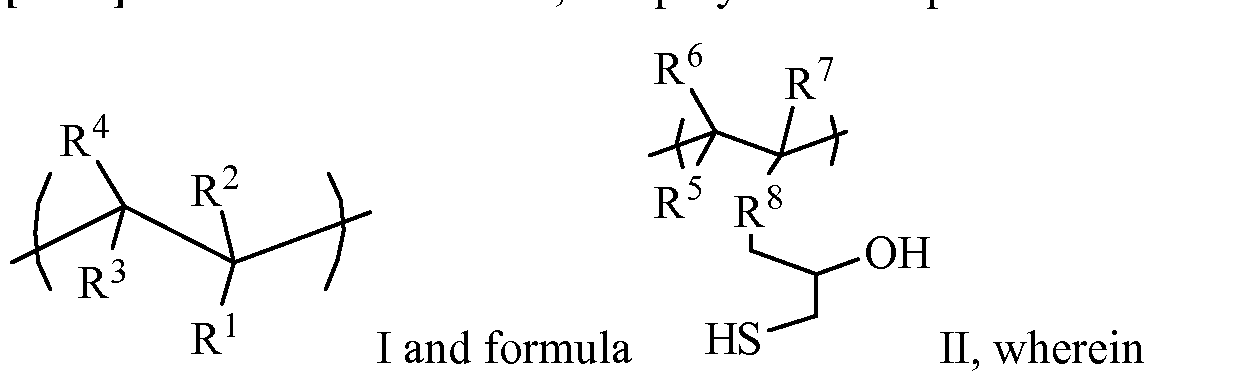
- a polymer comprises structural units of formula
- R 1 , R 2 , R 5 and R 6 are independently hydrogen, a methyl group, or -COOH, only one of R 1 and R 2 or R 5 and R 6 is -COOH;
- R 3 and R 7 are independently hydrogen, or a methyl group;
- R is -COOH, -CONH 2 or -OH, when R is -OH, R , R and R are respectively hydrogen;
- R 8 is -COO, -CONH, or -0-, when R 8 is -0-, R 5 , R 6 and R 7 are respectively hydrogen.
- a method comprises:
- R 1 , R 2 , R 5 and R 6 are independently hydrogen, a methyl group, or -COOH, only one of R 1 and R 2 or R 5 and R 6 is -COOH;
- R 3 and R 7 are independently hydrogen, or a methyl group
- R 4 is -COOH, -CONH 2 or -OH, when R 4 is -OH, R 1 , R 2 and R 3 are respectively hydrogen;
- R 8 is -COO, -CONH, or -0-, when R 8 is -0-, R 5 , R 6 and R 7 are respectively hydrogen;
- X is halogen
- a method comprises: adding an effective amount of a polymer to an aqueous solution to form precipitates comprising at least one of heavy metals;
- R 1 , R 2 , R 5 and R 6 are independently hydrogen, a methyl group, or -COOH, only one of R 1 and R 2 or R 5 and R 6 is -COOH;
- R 3 and R 7 are independently hydrogen, or a methyl group
- R 4 is -COOH, -CONH 2 or -OH, when R 4 is -OH, R 1 , R 2 and R 3 are respectively hydrogen;
- R 8 is -COO, -CONH, or -0-, when R 8 is -0-, R 5 , R 6 and R 7 are respectively hydrogen.
- Approximating language may be applied to modify any quantitative representation that could permissibly vary without resulting in a change in the basic function to which it is related. Accordingly, a value modified by a term or terms, such as "about”, is not to be limited to the precise value specified. In some instances, the approximating language may correspond to the precision of an instrument for measuring the value. Moreover, the suffix "(s)" as used herein is usually intended to include both the singular and the plural of the term that it modifies, thereby including one or more of that term.
- any numerical values recited herein include all values from the lower value to the upper value in increments of one unit provided that there is a separation of at least 2 units between any lower value and any higher value.
- the amount of a component or a value of a process variable such as, for example, temperature, pressure, time and the like is, for example, from 1 to 90, preferably from 20 to 80, more preferably from 30 to 70, it is intended that values such as 15 to 85, 22 to 68, 43 to 51, 30 to 32 etc. are expressly enumerated in this specification.
- one unit is considered to be 0.0001, 0.001, 0.01 or 0.1 as appropriate.
- a polymer comprises structural units of formula
- R 1 , R 2 , R 5 and R 6 are independently hydrogen, a methyl group, or -COOH, only one of R 1 and R 2 or R 5 and R 6 is -COOH;
- R 3 and R 7 are independently hydrogen, or a methyl group
- R 4 is -COOH, -CONH 2 or -OH, when R 4 is -OH, R 1 , R 2 and R 3 are respectively hydrogen;
- R 8 is -COO, -CONH, or -0-, when R 8 is -0-, R 5 , R 6 and R 7 are respectively hydrogen.
- the polymer may be random, block or graft copolymers, or a polymer having an intermediate structure thereof, for example, a random copolymer having blocky sequences.
- Orientations of individual structural units with respect to each other and connections between individual structural units in the polymers may be head-to-head, tail-to-tail or head-to-tail.
- -CR R2- and -CR5R 6 - are heads, -CR5R 6 - may be joined to -CR1R2- or -CR3R4-.
- the polymer is of formula:
- n is an integer greater than 0
- m is an integer greater than 0
- the polymer has a molecular weight of from about 500 to about 2,000,000.
- n and m refer to relative total amounts (e.g., numbers, moles, ...etc.) of structural units of formulas I and II in the polymer and do not indicate the structure of the polymer.
- the structural units of formulas I and II may be arranged alternately, or either of the structural units of formulas I and II may repeat itself twice or more times in the polymer before it connects to another different structural unit.
- a ratio of n to m may be in a broad range. In some embodiments, a ratio of n to m is from about 1 :99 to about 99: 1, or preferably from about 10:90 to about 90: 10, or more preferably from about 30:70 to about 70:30.
- Examples of monomers which the structural unit of formula I may be derived from include but are not limited to:
- Examples of monomers which the structural unit of formula II may be derived from include but are not limited to:
- the polymer is of formula:
- the polymer is of formula:
- n:m is from about 60:40 to about 70:30, and molecular weight (Mw) of the polymer is from about 5,000 to about 100,000.
- the polymer may comprise two or more different structural units derived from monomers described above although only polymers with two different structural units are set as examples herein.
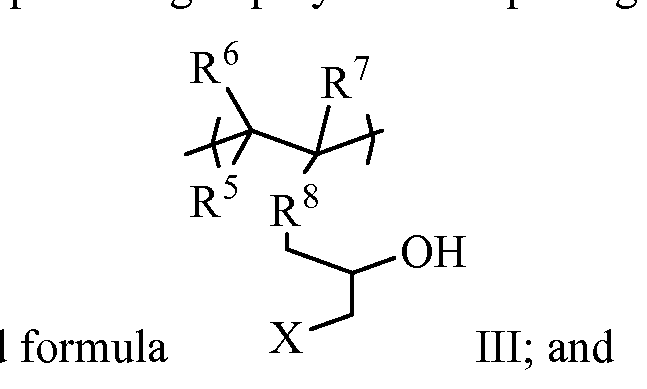
- a method comprises: providing a polymer comprising structural units of formula
- R 1 , R 2 , R 5 and R 6 are independently hydrogen, a methyl group, or -COOH, only one of R 1 and R 2 or R 5 and R 6 is -COOH;
- R 3 and R 7 are independently hydrogen, or a methyl group
- R 4 is -COOH, -CONH2 or -OH, when R 4 is -OH, R 1 , R 2 and R 3 are respectively hydrogen;
- R 8 is -COO, -CONH, or -0-, when R 8 is -0-, R 5 , R 6 and R 7 are respectively hydrogen;
- X is halogen
- the hydrosulfide salt is sodium hydrosulfide or potassium hydrosulfide and the sulfide salt is sodium sulfide or potassium sulfide.
- X is CI
- the polymer comprising the formula I and the formula III is prepared by epoxy ring opening reaction between a polymer comprising the structural units of formula I and epichlorohydrin. [0025] In some embodiments, the polymer comprising the formula I and the formula
- III is prepared by copolymerizing a monomer of formula with a
- the monomer of formula is prepared by epoxy ring opening reaction between the monomer of formula
- a method comprises: adding an effective amount of a polymer to an aqueous solution to form precipitates comprising at least one of heavy metals; and removing the precipitates from the aqueous solution; the polymer comprising structural units of formula I and formula II, wherein R 1 , R 2 , R 5 and R 6 are independently hydrogen, a methyl group, or -COOH, only one of R 1 and R 2 or R 5 and R 6 is -COOH; R 3 and R 7 are independently hydrogen, or a methyl group; R 4 is - COOH, -CONH 2 or -OH, when R 4 is -OH, R 1 , R 2 and R 3 are respectively hydrogen; and R 8 is -COO, -CONH, or -0-, when R 8 is -0-, R 5 , R 6 and R 7 are respectively hydrogen.
- the heavy metals may be any heavy metals existing in any forms that need to and may be removed by the polymer of the present invention, such as aluminium (Al), arsenic (As), beryllium (Be), bismuth (Bi), cadmium (Cd), cobalt (Co), chromium (Cr), copper (Cu), iron (Fe), mercury (Hg), manganese (Mn), molybdenum (Mo), nickel (Ni), lead (Pb), plutonium (Pu), tin (Sn), thorium (Th), thallium (Tl), uranium (U), vanadium (V), tungsten (W), zirconium (Zr), and zinc (Zn).
- the heavy metals comprise at least one of chromium (Cr), copper (Cu), zinc (Zn), lead (Pb), cobalt (Co), cadmium (Cd), and nickel (Ni).
- the polymer may be added alone or in combination with other additives.
- additives include but are not limited to inorganic or polymer flocculants.
- the amount of the polymer added may vary according to the application environment, e.g., the amount and type of heavy metals to be removed and effects of other materials coexisting with heavy metals in the aqueous solutions.
- a concentration ratio by weight of each of the at least one of the heavy metals to the polymer in the aqueous solution is from about 5: 1 to about 1 : 100, or preferably from about 1 : 1 to about 1 :50, or more preferably from about 1 :5 to about
- polymers that may be added alone or in combination with each other include, but are not limited to:
- the polymer is of formula: , or , in which n:m is from about 60:40 to about 70:30, and the polymer has a Mw of from about 5,000 to about 100,000.
- the precipitates may be removed by any suitable ways.
- the removing is by filtering the precipitates from the aqueous solution or by sedimentation.
- Acrylic acid, acrylamide, methylacrylamide, methacrylic acid, hydrochloric acid (37% solution), epichlorohydrin, potassium hydroxide, sodium hydroxide, ethanol and isopropanol were from Sinopharm Chemical Reagent Co., Ltd., Shanghai, China.
- Poly(acrylic acid) (Mw: about 1800), poly(vinyl alcohol) (average Mw 13,000-23,000, 98% hydrolyzed), sodium hydrosulfide (NaHS-3 ⁇ 40) and sodium persulfate ( a 2 S 2 0s) were from Aldrich Chemical Co., Milwaukee, WI, USA. Chemicals were used without further purification, unless specified otherwise.
- Atomic absorption Spectrometer (AA)/inductively coupled plasma (ICP) standard solutions of chromium (Cr), copper (Cu), zinc (Zn), lead (Pb), cobalt (Co), cadmium (Cd), selenium (Se), boron (B) and nickel (Ni) were obtained from Shanghai Analytical Center, at concentrations of from 1 ,000 ppm to 10,000 ppm.
- ICP standard solutions comprises 2- 10% (by weight) of nitric acid.
- the eluent was the aqueous solution of 0.1 mol/1 NaNC ⁇ and 0.02% by weight a 3 and had a flow rate of 0.5 mL/min.
- Calibration was performed using polyacrylic acid sodium salt (Mp 2,925- 782,200).
- the software used for data acquisition, calibration and treatment was CirrusTM multidetector GPC software.
- the solution was charged to a solution of sodium hydrosulfide (NaHS-H 2 0) (0.81 g, 1 1 mmol in 10 g deionized water) dropwise in 30 minutes.
- the solution was heated to 40 °C for 2 hours and was then allowed to cool to the room temperature.
- Poly(methylacrylamide) (obtained above, 0.91 g, 10.83 mmol) was charged to a 25 mL three neck round bottom flask equipped with a thermometer, a nitrogen inlet and an addition inlet.
- Deionized water (10 g) and EPI (0.75g, 8.12mmol) were then charged.
- the pH of the solution was adjusted to about 10 with sodium hydroxide.
- the solution was heated to 60 °C for 3 hours and was then cooled to the room temperature.
- the solution was charged to a buffer solution of sodium hydrosulfide (0.7 g, 9.6 mmol, pH 8.0) dropwise for over 30 minutes.
- the obtained solution was heated to 40 °C for 2 hours and was then allowed to cool to the room temperature.
- the apparatuses include beakers (500 ml), a Phipps and BirdTM jar tester with six standard paddles, a pH meter, plastic syringes, 0.45 micron filters and glass sample bottles.
- the pH of the stock solution was adjusted to specified values.
- a sample of the stock solution (5 ml) was taken for an ICP analysis using an ICP-OES (Inductively coupled plasma optical emission spectrometry) analyzer (Spectro Ciros, SPECTRO Analytical Instruments GmbH, Cleves, Germany).
- the stock solution was added into six clean 500 ml beakers respectively (400 ml/beaker) in the jar tester. A given amount of the polymer were added into the beaker so that the concentration of the polymer in the stock solution was 9 ppm, 45 ppm or 90 ppm as shown in tables below.
- the polymer dosage was calculated based on weight of polymer added into the stock solution, e.g., 1 ppm means 1 mg of polymer were dosed into 1 L of stock solution.
- the obtained mixture was stirred at 100 rpm for 2 minutes, at 35 rpm for 5 minutes, and left settling for 5 minutes.
- a sample (5 ml) of the supernate in the beaker was taken after settling for an ICP analysis.
- Another sample (5 ml) of the supernate was taken from the beaker to be filtered through a 0.45 micron filter. An ICP analysis of the filtrate was conducted.
Landscapes
- Chemical & Material Sciences (AREA)
- Organic Chemistry (AREA)
- Chemical Kinetics & Catalysis (AREA)
- Polymers & Plastics (AREA)
- Medicinal Chemistry (AREA)
- Health & Medical Sciences (AREA)
- General Chemical & Material Sciences (AREA)
- Hydrology & Water Resources (AREA)
- Water Supply & Treatment (AREA)
- Environmental & Geological Engineering (AREA)
- Engineering & Computer Science (AREA)
- Life Sciences & Earth Sciences (AREA)
- Addition Polymer Or Copolymer, Post-Treatments, Or Chemical Modifications (AREA)
- Removal Of Specific Substances (AREA)
- Organic Low-Molecular-Weight Compounds And Preparation Thereof (AREA)
Abstract
Description




Claims


Priority Applications (4)
| Application Number | Priority Date | Filing Date | Title |
|---|---|---|---|
| BR112013014910-8A BR112013014910A2 (en) | 2010-12-17 | 2011-12-02 | polymer and method |
| KR1020137018578A KR101867116B1 (en) | 2010-12-17 | 2011-12-02 | Polymer and methods for preparing and using the same |
| AU2011341491A AU2011341491A1 (en) | 2010-12-17 | 2011-12-02 | Polymer and methods for preparing and using the same |
| CA2819834A CA2819834C (en) | 2010-12-17 | 2011-12-02 | Polymer and methods for preparing and using the same |
Applications Claiming Priority (2)
| Application Number | Priority Date | Filing Date | Title |
|---|---|---|---|
| CN201010613521.6 | 2010-12-17 | ||
| CN201010613521.6A CN102532372B (en) | 2010-12-17 | 2010-12-17 | Polymer and preparation and using method thereof |
Publications (2)
| Publication Number | Publication Date |
|---|---|
| WO2012082400A2 true WO2012082400A2 (en) | 2012-06-21 |
| WO2012082400A3 WO2012082400A3 (en) | 2012-08-09 |
Family
ID=45349589
Family Applications (1)
| Application Number | Title | Priority Date | Filing Date |
|---|---|---|---|
| PCT/US2011/063023 Ceased WO2012082400A2 (en) | 2010-12-17 | 2011-12-02 | Polymer and methods for preparing and using the same |
Country Status (10)
| Country | Link |
|---|---|
| US (1) | US8728326B2 (en) |
| KR (1) | KR101867116B1 (en) |
| CN (1) | CN102532372B (en) |
| AR (1) | AR084310A1 (en) |
| AU (1) | AU2011341491A1 (en) |
| BR (1) | BR112013014910A2 (en) |
| CA (1) | CA2819834C (en) |
| MY (1) | MY160583A (en) |
| TW (1) | TWI549971B (en) |
| WO (1) | WO2012082400A2 (en) |
Cited By (2)
| Publication number | Priority date | Publication date | Assignee | Title |
|---|---|---|---|---|
| WO2016047277A1 (en) * | 2014-09-22 | 2016-03-31 | 三菱レイヨン株式会社 | Method for producing 3-chloro-2-hydroxypropyl (meth)acrylate and method for producing glycidyl (meth)acrylate |
| US10618986B2 (en) | 2016-10-19 | 2020-04-14 | Alcon Inc. | Hydrophilic copolymer with pendant thiol groups |
Families Citing this family (2)
| Publication number | Priority date | Publication date | Assignee | Title |
|---|---|---|---|---|
| CN111646949B (en) * | 2020-06-12 | 2021-03-30 | 上海馨远医药科技有限公司 | A kind of preparation method of 2,6-dimethylpiperazine dihydrochloride |
| CN112774869B (en) * | 2020-12-25 | 2022-09-16 | 厦门紫金矿冶技术有限公司 | Pyrite inhibitor, preparation thereof and application thereof in copper-lead-zinc multi-metal sulfide ores |
Family Cites Families (9)
| Publication number | Priority date | Publication date | Assignee | Title |
|---|---|---|---|---|
| DE3231982A1 (en) | 1982-08-27 | 1984-03-01 | Süd-Chemie AG, 8000 München | THIOLATE-CONTAINING AGENT AND METHOD FOR REMOVING HEAVY METAL IONS FROM DUCED AQUEOUS SOLUTIONS |
| DE3726454A1 (en) * | 1987-08-08 | 1989-02-16 | Behringwerke Ag | POLYMERS CONTAINING THIOL GROUPS, METHOD FOR THE PRODUCTION THEREOF AND THEIR USE |
| US5154833A (en) | 1992-01-08 | 1992-10-13 | Connaught Laboratories Inc. | Removal of mercury from waste streams |
| US5720886A (en) * | 1995-10-12 | 1998-02-24 | Kennecott Greens Creek Mining Company | Process for removing metal values from mine waste water |
| JP3517697B2 (en) * | 1999-05-07 | 2004-04-12 | 独立行政法人産業技術総合研究所 | Method and remover for removing heavy metal ions |
| US6586600B2 (en) | 2000-12-06 | 2003-07-01 | University Of Kentucky Research Foundation | Multidentate sulfur-containing ligands |
| US7138462B2 (en) * | 2003-08-22 | 2006-11-21 | Los Alamos National Security, Llc | Functionalized polymers for binding to solutes in aqueous solutions |
| US7610920B2 (en) | 2003-12-22 | 2009-11-03 | Philip Morris Usa Inc. | Thiol-functionalized sorbent for smoking articles and filters for the removal of heavy metals from mainstream smoke |
| CN101726570B (en) * | 2009-12-25 | 2013-01-02 | 东南大学 | Intelligent bending double hydrogel for visual detection of heavy metal ions and preparation method and application thereof |
-
2010
- 2010-12-17 CN CN201010613521.6A patent/CN102532372B/en active Active
-
2011
- 2011-03-29 US US13/074,733 patent/US8728326B2/en active Active
- 2011-12-02 CA CA2819834A patent/CA2819834C/en active Active
- 2011-12-02 KR KR1020137018578A patent/KR101867116B1/en active Active
- 2011-12-02 BR BR112013014910-8A patent/BR112013014910A2/en not_active Application Discontinuation
- 2011-12-02 AU AU2011341491A patent/AU2011341491A1/en not_active Abandoned
- 2011-12-02 WO PCT/US2011/063023 patent/WO2012082400A2/en not_active Ceased
- 2011-12-02 MY MYPI2013001800A patent/MY160583A/en unknown
- 2011-12-15 AR ARP110104704A patent/AR084310A1/en active IP Right Grant
- 2011-12-15 TW TW100146613A patent/TWI549971B/en active
Non-Patent Citations (1)
| Title |
|---|
| None |
Cited By (5)
| Publication number | Priority date | Publication date | Assignee | Title |
|---|---|---|---|---|
| WO2016047277A1 (en) * | 2014-09-22 | 2016-03-31 | 三菱レイヨン株式会社 | Method for producing 3-chloro-2-hydroxypropyl (meth)acrylate and method for producing glycidyl (meth)acrylate |
| JPWO2016047277A1 (en) * | 2014-09-22 | 2017-06-29 | 三菱ケミカル株式会社 | Method for producing 3-chloro-2-hydroxypropyl (meth) acrylate and glycidyl (meth) acrylate |
| US10087159B2 (en) | 2014-09-22 | 2018-10-02 | Mitsubishi Chemical Corporation | Method for producing 3-chloro-2-hydroxypropyl (meth)acrylate and method for producing glycidyl (meth)acrylate |
| JP2019189653A (en) * | 2014-09-22 | 2019-10-31 | 三菱ケミカル株式会社 | Process for producing glycidyl(meth)acrylate |
| US10618986B2 (en) | 2016-10-19 | 2020-04-14 | Alcon Inc. | Hydrophilic copolymer with pendant thiol groups |
Also Published As
| Publication number | Publication date |
|---|---|
| AR084310A1 (en) | 2013-05-08 |
| CN102532372A (en) | 2012-07-04 |
| TWI549971B (en) | 2016-09-21 |
| US20120152851A1 (en) | 2012-06-21 |
| CA2819834A1 (en) | 2012-06-21 |
| CA2819834C (en) | 2018-05-29 |
| CN102532372B (en) | 2015-06-10 |
| MY160583A (en) | 2017-03-15 |
| TW201231480A (en) | 2012-08-01 |
| KR101867116B1 (en) | 2018-06-12 |
| KR20130129414A (en) | 2013-11-28 |
| AU2011341491A1 (en) | 2013-06-27 |
| WO2012082400A3 (en) | 2012-08-09 |
| BR112013014910A2 (en) | 2019-11-19 |
| US8728326B2 (en) | 2014-05-20 |
Similar Documents
| Publication | Publication Date | Title |
|---|---|---|
| RU2556688C2 (en) | Polymers for purification from metals | |
| KR101933028B1 (en) | Metal scavenging polymers and uses thereof | |
| JP3412842B2 (en) | Metal collecting agent and method for producing the same | |
| CA2819834C (en) | Polymer and methods for preparing and using the same | |
| AU2012282939B2 (en) | Polymer and method for using the same | |
| CN102775598A (en) | Polymer, preparation method thereof and use method thereof | |
| CN121554732A (en) | Functionalized polyamide polymer, preparation method and application thereof, and heavy metal remover |
Legal Events
| Date | Code | Title | Description |
|---|---|---|---|
| ENP | Entry into the national phase |
Ref document number: 2819834 Country of ref document: CA |
|
| NENP | Non-entry into the national phase |
Ref country code: DE |
|
| ENP | Entry into the national phase |
Ref document number: 2011341491 Country of ref document: AU Date of ref document: 20111202 Kind code of ref document: A |
|
| ENP | Entry into the national phase |
Ref document number: 20137018578 Country of ref document: KR Kind code of ref document: A |
|
| REG | Reference to national code |
Ref country code: BR Ref legal event code: B01A Ref document number: 112013014910 Country of ref document: BR |
|
| 121 | Ep: the epo has been informed by wipo that ep was designated in this application |
Ref document number: 11797094 Country of ref document: EP Kind code of ref document: A2 |
|
| 122 | Ep: pct application non-entry in european phase |
Ref document number: 11797094 Country of ref document: EP Kind code of ref document: A2 |
|
| REG | Reference to national code |
Ref country code: BR Ref legal event code: B01E Ref document number: 112013014910 Country of ref document: BR Free format text: APRESENTE AS TRADUCOES SIMPLES DA FOLHA DE ROSTO DA CERTIDAO DE DEPOSITO DA PRIORIDADE CN 201010613521.6 DE 17.12.2010; OU DECLARACAO DE QUE OS DADOS DO PEDIDO INTERNACIONAL ESTAO FIELMENTE CONTIDOS NA PRIORIDADE REIVINDICADA, CONTENDO TODOS OS DADOS IDENTIFICADORES DESTA (TITULARES, NUMERO DE REGISTRO, DATA E TITULO), CONFORME O PARAGRAFO UNICO DO ART. 25 DA RESOLUCAO 77/2013. CABE SALIENTAR QUE NAO FOI POSSIVEL IDENTIFICAR O TITULAR DO PEDIDO NOS DOCUMENTOS JUNTADOS AO PROCESSO, TAMPOUCO NOS APRESENTADOS NA OMPI, POIS SE ENCONTRAM EM CHINES. |
|
| ENP | Entry into the national phase |
Ref document number: 112013014910 Country of ref document: BR Kind code of ref document: A2 Effective date: 20130614 |