WO2012074912A1 - Methods, assays and compounds for treating bacterial infections by inhibiting methylthioinosine phosphorylase - Google Patents
Methods, assays and compounds for treating bacterial infections by inhibiting methylthioinosine phosphorylase Download PDFInfo
- Publication number
- WO2012074912A1 WO2012074912A1 PCT/US2011/062208 US2011062208W WO2012074912A1 WO 2012074912 A1 WO2012074912 A1 WO 2012074912A1 US 2011062208 W US2011062208 W US 2011062208W WO 2012074912 A1 WO2012074912 A1 WO 2012074912A1
- Authority
- WO
- WIPO (PCT)
- Prior art keywords
- methyl
- amino
- group
- pyrimidin
- hydroxy
- Prior art date
- Legal status (The legal status is an assumption and is not a legal conclusion. Google has not performed a legal analysis and makes no representation as to the accuracy of the status listed.)
- Ceased
Links
- 0 *NCc1c[n]c2c1N=CNC2=O Chemical compound *NCc1c[n]c2c1N=CNC2=O 0.000 description 9
- DBPWKRQKYPFTJB-ZJUUUORDSA-N CSC[C@@H](CN(Cc1c[nH]c2c1N=CNC2=O)C1)[C@H]1O Chemical compound CSC[C@@H](CN(Cc1c[nH]c2c1N=CNC2=O)C1)[C@H]1O DBPWKRQKYPFTJB-ZJUUUORDSA-N 0.000 description 2
- QWSLXWGGHIFYOZ-UHFFFAOYSA-N CN(CNC1OC11)C2C1NCC2CN Chemical compound CN(CNC1OC11)C2C1NCC2CN QWSLXWGGHIFYOZ-UHFFFAOYSA-N 0.000 description 1
- HWEHGMKFJOBOQJ-ZDUSSCGKSA-N CN(Cc1c[nH]c2c1N=CNC2=O)[C@@H](CO)CSc1ccccc1 Chemical compound CN(Cc1c[nH]c2c1N=CNC2=O)[C@@H](CO)CSc1ccccc1 HWEHGMKFJOBOQJ-ZDUSSCGKSA-N 0.000 description 1
- HWEHGMKFJOBOQJ-CYBMUJFWSA-N CN(Cc1c[nH]c2c1N=CNC2=O)[C@H](CO)CSc1ccccc1 Chemical compound CN(Cc1c[nH]c2c1N=CNC2=O)[C@H](CO)CSc1ccccc1 HWEHGMKFJOBOQJ-CYBMUJFWSA-N 0.000 description 1
- PAKUOCDCFANBAW-UHFFFAOYSA-N CNCC1C2N(C)CNC3OC3C2NC1 Chemical compound CNCC1C2N(C)CNC3OC3C2NC1 PAKUOCDCFANBAW-UHFFFAOYSA-N 0.000 description 1
- NQUJYPQVZRIQJF-MRVPVSSYSA-N CSC[C@@H](CNCc1c[nH]c2c1N=CNC2=O)O Chemical compound CSC[C@@H](CNCc1c[nH]c2c1N=CNC2=O)O NQUJYPQVZRIQJF-MRVPVSSYSA-N 0.000 description 1
- CEGIKIXYDFDYDN-RXDXJJGDSA-N CSC[C@H]([C@H]([C@H]1O)O)N[C@H]1c1c[nH]c2c1N=CNC2=O Chemical compound CSC[C@H]([C@H]([C@H]1O)O)N[C@H]1c1c[nH]c2c1N=CNC2=O CEGIKIXYDFDYDN-RXDXJJGDSA-N 0.000 description 1
- ROXMKHGLZQYUQI-UHFFFAOYSA-N Cc1c(C(NC)=O)[nH]cc1CN=C Chemical compound Cc1c(C(NC)=O)[nH]cc1CN=C ROXMKHGLZQYUQI-UHFFFAOYSA-N 0.000 description 1
- UWYAIHNGGLHQNM-UHFFFAOYSA-N NCc1c[nH]c2c1N=CNC2=O Chemical compound NCc1c[nH]c2c1N=CNC2=O UWYAIHNGGLHQNM-UHFFFAOYSA-N 0.000 description 1
- QSPXOQGUZXERLP-UHFFFAOYSA-N O=C1NC=Nc2c1[nH]cc2CNCCCCSc1ccccc1 Chemical compound O=C1NC=Nc2c1[nH]cc2CNCCCCSc1ccccc1 QSPXOQGUZXERLP-UHFFFAOYSA-N 0.000 description 1
- WMZFIZIOAALDAL-LBPRGKRZSA-N OC[C@@H](CSc1ccccc1)NCc1c[nH]c2c1N=CNC2=O Chemical compound OC[C@@H](CSc1ccccc1)NCc1c[nH]c2c1N=CNC2=O WMZFIZIOAALDAL-LBPRGKRZSA-N 0.000 description 1
- WMZFIZIOAALDAL-GFCCVEGCSA-N OC[C@H](CSc1ccccc1)NCc1c[nH]c2c1N=CNC2=O Chemical compound OC[C@H](CSc1ccccc1)NCc1c[nH]c2c1N=CNC2=O WMZFIZIOAALDAL-GFCCVEGCSA-N 0.000 description 1
- RILVLBFFRDXSEY-JMGFVUJMSA-N O[C@H]([C@@H](CSc1ccccc1)N[C@H]1c2c[nH]c3c2N=CNC3=O)[C@H]1O Chemical compound O[C@H]([C@@H](CSc1ccccc1)N[C@H]1c2c[nH]c3c2N=CNC3=O)[C@H]1O RILVLBFFRDXSEY-JMGFVUJMSA-N 0.000 description 1
Classifications
-
- C—CHEMISTRY; METALLURGY
- C07—ORGANIC CHEMISTRY
- C07D—HETEROCYCLIC COMPOUNDS
- C07D487/00—Heterocyclic compounds containing nitrogen atoms as the only ring hetero atoms in the condensed system, not provided for by groups C07D451/00 - C07D477/00
- C07D487/02—Heterocyclic compounds containing nitrogen atoms as the only ring hetero atoms in the condensed system, not provided for by groups C07D451/00 - C07D477/00 in which the condensed system contains two hetero rings
- C07D487/04—Ortho-condensed systems
-
- A—HUMAN NECESSITIES
- A61—MEDICAL OR VETERINARY SCIENCE; HYGIENE
- A61K—PREPARATIONS FOR MEDICAL, DENTAL OR TOILETRY PURPOSES
- A61K31/00—Medicinal preparations containing organic active ingredients
-
- A—HUMAN NECESSITIES
- A61—MEDICAL OR VETERINARY SCIENCE; HYGIENE
- A61K—PREPARATIONS FOR MEDICAL, DENTAL OR TOILETRY PURPOSES
- A61K31/00—Medicinal preparations containing organic active ingredients
- A61K31/33—Heterocyclic compounds
- A61K31/395—Heterocyclic compounds having nitrogen as a ring hetero atom, e.g. guanethidine or rifamycins
- A61K31/495—Heterocyclic compounds having nitrogen as a ring hetero atom, e.g. guanethidine or rifamycins having six-membered rings with two or more nitrogen atoms as the only ring heteroatoms, e.g. piperazine or tetrazines
- A61K31/505—Pyrimidines; Hydrogenated pyrimidines, e.g. trimethoprim
- A61K31/519—Pyrimidines; Hydrogenated pyrimidines, e.g. trimethoprim ortho- or peri-condensed with heterocyclic rings
-
- A—HUMAN NECESSITIES
- A61—MEDICAL OR VETERINARY SCIENCE; HYGIENE
- A61K—PREPARATIONS FOR MEDICAL, DENTAL OR TOILETRY PURPOSES
- A61K31/00—Medicinal preparations containing organic active ingredients
- A61K31/70—Carbohydrates; Sugars; Derivatives thereof
- A61K31/7042—Compounds having saccharide radicals and heterocyclic rings
-
- A—HUMAN NECESSITIES
- A61—MEDICAL OR VETERINARY SCIENCE; HYGIENE
- A61K—PREPARATIONS FOR MEDICAL, DENTAL OR TOILETRY PURPOSES
- A61K31/00—Medicinal preparations containing organic active ingredients
- A61K31/70—Carbohydrates; Sugars; Derivatives thereof
- A61K31/7042—Compounds having saccharide radicals and heterocyclic rings
- A61K31/7052—Compounds having saccharide radicals and heterocyclic rings having nitrogen as a ring hetero atom, e.g. nucleosides, nucleotides
-
- A—HUMAN NECESSITIES
- A61—MEDICAL OR VETERINARY SCIENCE; HYGIENE
- A61K—PREPARATIONS FOR MEDICAL, DENTAL OR TOILETRY PURPOSES
- A61K31/00—Medicinal preparations containing organic active ingredients
- A61K31/70—Carbohydrates; Sugars; Derivatives thereof
- A61K31/7042—Compounds having saccharide radicals and heterocyclic rings
- A61K31/7052—Compounds having saccharide radicals and heterocyclic rings having nitrogen as a ring hetero atom, e.g. nucleosides, nucleotides
- A61K31/706—Compounds having saccharide radicals and heterocyclic rings having nitrogen as a ring hetero atom, e.g. nucleosides, nucleotides containing six-membered rings with nitrogen as a ring hetero atom
-
- A—HUMAN NECESSITIES
- A61—MEDICAL OR VETERINARY SCIENCE; HYGIENE
- A61K—PREPARATIONS FOR MEDICAL, DENTAL OR TOILETRY PURPOSES
- A61K31/00—Medicinal preparations containing organic active ingredients
- A61K31/70—Carbohydrates; Sugars; Derivatives thereof
- A61K31/7042—Compounds having saccharide radicals and heterocyclic rings
- A61K31/7052—Compounds having saccharide radicals and heterocyclic rings having nitrogen as a ring hetero atom, e.g. nucleosides, nucleotides
- A61K31/706—Compounds having saccharide radicals and heterocyclic rings having nitrogen as a ring hetero atom, e.g. nucleosides, nucleotides containing six-membered rings with nitrogen as a ring hetero atom
- A61K31/7064—Compounds having saccharide radicals and heterocyclic rings having nitrogen as a ring hetero atom, e.g. nucleosides, nucleotides containing six-membered rings with nitrogen as a ring hetero atom containing condensed or non-condensed pyrimidines
-
- A—HUMAN NECESSITIES
- A61—MEDICAL OR VETERINARY SCIENCE; HYGIENE
- A61K—PREPARATIONS FOR MEDICAL, DENTAL OR TOILETRY PURPOSES
- A61K31/00—Medicinal preparations containing organic active ingredients
- A61K31/70—Carbohydrates; Sugars; Derivatives thereof
- A61K31/7042—Compounds having saccharide radicals and heterocyclic rings
- A61K31/7052—Compounds having saccharide radicals and heterocyclic rings having nitrogen as a ring hetero atom, e.g. nucleosides, nucleotides
- A61K31/706—Compounds having saccharide radicals and heterocyclic rings having nitrogen as a ring hetero atom, e.g. nucleosides, nucleotides containing six-membered rings with nitrogen as a ring hetero atom
- A61K31/7064—Compounds having saccharide radicals and heterocyclic rings having nitrogen as a ring hetero atom, e.g. nucleosides, nucleotides containing six-membered rings with nitrogen as a ring hetero atom containing condensed or non-condensed pyrimidines
- A61K31/7068—Compounds having saccharide radicals and heterocyclic rings having nitrogen as a ring hetero atom, e.g. nucleosides, nucleotides containing six-membered rings with nitrogen as a ring hetero atom containing condensed or non-condensed pyrimidines having oxo groups directly attached to the pyrimidine ring, e.g. cytidine, cytidylic acid
-
- A—HUMAN NECESSITIES
- A61—MEDICAL OR VETERINARY SCIENCE; HYGIENE
- A61K—PREPARATIONS FOR MEDICAL, DENTAL OR TOILETRY PURPOSES
- A61K31/00—Medicinal preparations containing organic active ingredients
- A61K31/70—Carbohydrates; Sugars; Derivatives thereof
- A61K31/7042—Compounds having saccharide radicals and heterocyclic rings
- A61K31/7052—Compounds having saccharide radicals and heterocyclic rings having nitrogen as a ring hetero atom, e.g. nucleosides, nucleotides
- A61K31/706—Compounds having saccharide radicals and heterocyclic rings having nitrogen as a ring hetero atom, e.g. nucleosides, nucleotides containing six-membered rings with nitrogen as a ring hetero atom
- A61K31/7064—Compounds having saccharide radicals and heterocyclic rings having nitrogen as a ring hetero atom, e.g. nucleosides, nucleotides containing six-membered rings with nitrogen as a ring hetero atom containing condensed or non-condensed pyrimidines
- A61K31/7076—Compounds having saccharide radicals and heterocyclic rings having nitrogen as a ring hetero atom, e.g. nucleosides, nucleotides containing six-membered rings with nitrogen as a ring hetero atom containing condensed or non-condensed pyrimidines containing purines, e.g. adenosine, adenylic acid
-
- A—HUMAN NECESSITIES
- A61—MEDICAL OR VETERINARY SCIENCE; HYGIENE
- A61K—PREPARATIONS FOR MEDICAL, DENTAL OR TOILETRY PURPOSES
- A61K31/00—Medicinal preparations containing organic active ingredients
- A61K31/70—Carbohydrates; Sugars; Derivatives thereof
- A61K31/7042—Compounds having saccharide radicals and heterocyclic rings
- A61K31/7052—Compounds having saccharide radicals and heterocyclic rings having nitrogen as a ring hetero atom, e.g. nucleosides, nucleotides
- A61K31/706—Compounds having saccharide radicals and heterocyclic rings having nitrogen as a ring hetero atom, e.g. nucleosides, nucleotides containing six-membered rings with nitrogen as a ring hetero atom
- A61K31/7064—Compounds having saccharide radicals and heterocyclic rings having nitrogen as a ring hetero atom, e.g. nucleosides, nucleotides containing six-membered rings with nitrogen as a ring hetero atom containing condensed or non-condensed pyrimidines
- A61K31/7076—Compounds having saccharide radicals and heterocyclic rings having nitrogen as a ring hetero atom, e.g. nucleosides, nucleotides containing six-membered rings with nitrogen as a ring hetero atom containing condensed or non-condensed pyrimidines containing purines, e.g. adenosine, adenylic acid
- A61K31/708—Compounds having saccharide radicals and heterocyclic rings having nitrogen as a ring hetero atom, e.g. nucleosides, nucleotides containing six-membered rings with nitrogen as a ring hetero atom containing condensed or non-condensed pyrimidines containing purines, e.g. adenosine, adenylic acid having oxo groups directly attached to the purine ring system, e.g. guanosine, guanylic acid
-
- A—HUMAN NECESSITIES
- A61—MEDICAL OR VETERINARY SCIENCE; HYGIENE
- A61K—PREPARATIONS FOR MEDICAL, DENTAL OR TOILETRY PURPOSES
- A61K45/00—Medicinal preparations containing active ingredients not provided for in groups A61K31/00 - A61K41/00
- A61K45/06—Mixtures of active ingredients without chemical characterisation, e.g. antiphlogistics and cardiaca
-
- C—CHEMISTRY; METALLURGY
- C12—BIOCHEMISTRY; BEER; SPIRITS; WINE; VINEGAR; MICROBIOLOGY; ENZYMOLOGY; MUTATION OR GENETIC ENGINEERING
- C12Q—MEASURING OR TESTING PROCESSES INVOLVING ENZYMES, NUCLEIC ACIDS OR MICROORGANISMS; COMPOSITIONS OR TEST PAPERS THEREFOR; PROCESSES OF PREPARING SUCH COMPOSITIONS; CONDITION-RESPONSIVE CONTROL IN MICROBIOLOGICAL OR ENZYMOLOGICAL PROCESSES
- C12Q1/00—Measuring or testing processes involving enzymes, nucleic acids or microorganisms; Compositions therefor; Processes of preparing such compositions
- C12Q1/48—Measuring or testing processes involving enzymes, nucleic acids or microorganisms; Compositions therefor; Processes of preparing such compositions involving transferase
Definitions
- the present invention relates to methods, assay, compounds and compositons for treating infections caused by bacteria that use 5'-methylthioinosine phosphorylase (MTIP) in a quorum sensing pathway, such as Pseudomonas aeruginosa.
- MTIP 5'-methylthioinosine phosphorylase
- Pseudomonas aeruginosa is a Gram-negative bacterium found in a wide range of environments including water, soil, and mammals (1). It is a major opportunistic human pathogen, infecting burns, and lungs in cystic fibrosis (2). Compromised immune systems and extended hospitalization are correlated with infections, making P. aeruginosa the causative agent of approximately 15% of all hospital infections (2, 3). P. aeruginosa infections are difficult to treat since the bacterium has multiple antimicrobial resistance mechanisms (4). Chronic infections can be severe in patients with cystic fibrosis, causing high rates of morbidity and mortality (5, 6). P.
- aeruginosa infections are related to quorum sensing (QS) pathways, which regulate virulence factors and biofilm formation.
- QS quorum sensing
- Signal molecules of QS include N-acyl-homoserine lactones (AHLs). The concentration of AHLs increases during bacterial growth to allow AHL binding to specific receptors and the regulation of target genes.
- AHLs N-acyl-homoserine lactones
- the concentration of AHLs increases during bacterial growth to allow AHL binding to specific receptors and the regulation of target genes.
- the las and rhl QS systems use AHLs of 3-oxo-Ci 2 -homoserine lactone and C4-homoserine lactone as signal molecules, respectively.
- Microarray studies on P. aeruginosa indicated that QS regulated 3-7% of the total open reading frames (7-9).
- AHLs are synthesized from S-adenosylmethionine (SAM) and acylated-acyl carrier protein by AHL synthase with 5'-methylthioadenosine (MTA) as a by-product. MTA is recycled to ATP and methionine for SAM recycling (17).
- SAM S-adenosylmethionine
- MTA 5'-methylthioadenosine
- 5'-methylthioadenosine nucleosidase ( ⁇ ) is the normal path to produce adenine and 5-methylthioribose-a-D-l- phosphate (MTR-l-P) from MTA for recycling.
- the present invention addresses that need for infections caused by bacteria such as Pseudomonas aeruginosa that use 5'-methylthioinosine phosphorylase (MTIP) in a quorum sensing pathway.
- bacteria such as Pseudomonas aeruginosa that use 5'-methylthioinosine phosphorylase (MTIP) in a quorum sensing pathway.
- MTIP 5'-methylthioinosine phosphorylase
- the invention provides methods for treating infections caused by bacteria that use 5'-methylthioinosine phosphorylase (MTIP) in a quorum sensing pathway comprising administering to a subject having the infection a sub-growth inhibiting amount of a 5'- methylthioinosine phosphorylase (MTIP) inhibitor.
- the invention also provides pharmaceutical compositions comprising a sub-bacterial-growth inhibiting amount of a 5'- methylthioinosine phosphorylase (MTIP) inhibitor and a pharmaceutically acceptable carrier.
- the invention also provides methods for determining whether or not a compound is a candidate for treating an infection caused by bacteria that use 5'- methylthioinosine phosphorylase (MTIP) in a quorum sensing pathway, the method comprising determining whether or not the compound inhibits MTIP, wherein a compound that inhibits MTIP is a candidate for treating an infection caused by bacteria that use MTIP in a quorum sensing pathway and wherein a compound that does not inhibit MTIP is not a candidate for treating an infection caused by bacteria that use MTIP in a quorum sensing pathway.
- MTIP 5'- methylthioinosine phosphorylase
- Figure 1 Early and late transition-state mimics as inhibitors for ⁇ and P PNP.
- FIG. 1 Structure-based sequence alignment. Protein are listed by PDB ID. The top 7 sequences are PNPs, the bottom 4 sequences are MTAPs, and PaMTIP is 30ZB. The conserved residues in the phosphate binding site of PNPs (bold font) and MTAPs (bold font) are indicated. The conserved residues in the purine binding site of PNPs and MTAPs are underlined. The conserved Phe ("F”) and His ("H”) in ribose-binding site of PNPs are in italics. The conserved His and small hydrophobic amino acid in the (methylthio)ribose- binding site of MTAPs are in lower case letters.
- coli PNP II (SEQ ID NO: l); 1N3I, Mycobacterium tuberculosis PNP (SEQ ID NO:2); 3KHS, Grouper Iridoviurs PNP (SEQ ID NO:3); 2P4S, Anopheles Gambia PNP (SEQ ID NO:4); 1VMK, Thermotoga maritime PNP (SEQ ID NO:5); 1A9T, bovine PNP (SEQ ID NO:6); 1RR6, human PNP (SEQ ID NO:7); 30ZB, PaMTIP (SEQ ID NO:8); 1V4N, Sulfolobus tokodaii MTAP (SEQ ID NO:9); 1K27, human MTAP (SEQ ID NO: 10); 1WTA, Aeropyrum pernix Kl MTAP (SEQ ID NO: 11); 2A8Y, Sulfolobus solfataricus MTAP (SEQ ID NO: 12).
- FIG. 3 Metabolism of [8- 14 C]MTA in P. aeruginosa.
- P. aeruginosa lysate was incubated with [8- 14 C]MTA for 0, 10, and 25 min, respectively.
- the 14 C-metabolites MTA, MTI, adenine and hypoxanthine were purified using RP-HPLC and quantitated by scintillation counting. Bar graphs from left to right of figure for hypoxanthine, adenine, MTI and MTA.
- the invention provides a method for treating an infection caused by bacteria that use 5 '-methylthioinosine phosphorylase (MTIP) in a quorum sensing pathway comprising administering to a subject having the infection a sub-growth inhibiting amount of a 5'- methylthioinosine phosphorylase (MTIP) inhibitor.
- MTIP 5 '-methylthioinosine phosphorylase
- the bacteria can be, for example, Pseudomonas aeruginosa, Pseudomonas syringae or Xanthomonas campestris.
- the subject can be, for example, an animal, such as a mammal, such as a primate, such as a human, or a plant.
- the bacteria is Pseudomonas aeruginosa and the subject is a human.
- the bacteria is Pseudomonas syringae ox Xanthomonas campestris and the subject is a plant.
- to treat a bacterial infection in a subject means to reduce the virulence of the bacteria in the subject.
- bacterial infection shall mean any deleterious presence of bacteria in the subject.
- sub-growth inhibiting amount of a MTIP inhibitor as used herein means an amount of the inhibitor, which when contacted with a population of bacteria, does not reduce the growth of the bacterial population.
- the sub-growth inhibiting amount of the MTIP inhibitor inhibits quorum sensing in the bacteria.
- the sub- growth inhibiting amount of the MTIP inhibitor is effective to reduce virulence of the bacteria without promoting the development of resistance by the bacteria to the MTIP inhibitor.
- quorum sensing refers to the process by which bacteria produce and detect signaling molecules with which to coordinate gene expression and regulate processes beneficial to the microbial community.
- inhibit quorum sensing means altering this process such that coordination of gene expression and process regulation in microbial communities are impaired or prevented.
- the invention also provides a pharmaceutical composition or an agrochemical composition comprising a sub-bacterial-growth inhibiting amount of a 5'-methylthioinosine phosphorylase (MTIP) inhibitor and a pharmaceutically or agrochemically acceptable carrier.
- MTIP 5'-methylthioinosine phosphorylase
- the pharmaceutical composition is formulated in dosage form.
- the sub-bacterial-growth inhibiting amount of the MTAN inhibitor inhibits quorum sensing in bacteria.
- Preferred bacteria include, for example, Pseudomonas aeruginosa, Pseudomonas syringae and Xanthomonas campestris.
- pharmaceutically acceptable carriers are materials that (i) are compatible with the other ingredients of the composition without rendering the composition unsuitable for its intended purpose, and (ii) are suitable for use with subjects as provided herein without undue adverse side effects (such as toxicity, irritation, and allergic response). Side effects are “undue” when their risk outweighs the benefit provided by the composition.
- Non-limiting examples of pharmaceutically acceptable carriers include any of the standard pharmaceutical carriers such as phosphate buffered saline solutions, water, and emulsions such as oil/water emulsions and microemulsions.
- alkyl is intended to include straight- and branched-chain alkyl groups, as well as cycloalkyl groups and having up to 30 carbon atoms, and includes any Ci- C25, C1-C20, C1-C15, C1-C10, or C1-C6 alkyl group. Cycloalkyl groups may have one or two carbon atoms substituted by a nitrogen, oxygen or sulfur atom. The same terminology applies to the non-aromatic moiety of an aralkyl radical.
- alkyl groups include, but are not limited to: methyl group, ethyl group, w-propyl group, z ' sopropyl group, w-butyl group, z ' so-butyl group, sec-butyl group, ?-butyl group, w-pentyl group, 1, 1-dimethylpropyl group, 1,2-dimethylpropyl group, 2,2-dimethylpropyl group, 1-ethylpropyl group, 2-ethylpropyl group, M-hexyl group and 1 -methyl-2-ethylpropyl group.
- cycloalkyl group examples include cyclopropyl, cyclobutyl, cyclopentyl, cyclohexyl, cycloheptyl, adamantly, 2- tetrahydrofuranyl, 2-thietaneyl, 3-piperidinyl, 2-pyrrolidinyl and 4-thiacyclohexanyl.
- alkenyl means any hydrocarbon radical having at least one double bond, and having up to 30 carbon atoms, and includes any C2-C25, C2-C20, C2-C15, C2-C10, or C2-C6 alkenyl group, as well as cycloalkenyl groups, and is intended to include both straight- and branched-chain alkenyl groups.
- alkenyl means any hydrocarbon radical having at least one double bond, and having up to 30 carbon atoms, and includes any C2-C25, C2-C20, C2-C15, C2-C10, or C2-C6 alkenyl group, as well as cycloalkenyl groups, and is intended to include both straight- and branched-chain alkenyl groups.
- the same terminology applies to the non-aromatic moiety of an aralkenyl radical.
- alkenyl groups include but are not limited to: ethenyl group, prop- 1 -en-l-yl group, prop-2-en-l-yl group, prop-l-en-2-yl group, cis-but-2- en-l-yl group, trans-but-2-en- 1 -yl group, but-3 -en-l-yl group, but-l-en-l-yl group, but-3-en- 2-yl group, pent-4-en-l-yl group, 2-methyl-but-3-en-2-yl group, hex-5-en-l-yl group, cyclohex-l-enyl group, cyclohex-2-enyl group and cyclohex-3-enyl group
- alkynyl means any hydrocarbon radical having at least one triple bond, and having up to 30 carbon atoms, and includes any C2-C25, C2-C20, C2-C15, C2-C10, or C2-C6 alkynyl group, and is intended to include both straight- and branched-chain alkynyl groups.
- alkynyl means any hydrocarbon radical having at least one triple bond, and having up to 30 carbon atoms, and includes any C2-C25, C2-C20, C2-C15, C2-C10, or C2-C6 alkynyl group, and is intended to include both straight- and branched-chain alkynyl groups.
- the same terminology applies to the non-aromatic moiety of an aralkynyl radical.
- alkynyl groups include but are not limited to: ethynyl group, prop-l-yn-l-yl group, prop-2-yn-l-yl group, but-l-yn-l-yl group, but-2-yn-l-nyl group, but-3-yn-l-yl group, pent-l-yn-l-yl group, 3,3-dimethyl-but-l-yn-l-yl group, 2-methyl-but-3-yn-2-yl group and hex-l-yn-l-yl group.
- aryl means an aromatic radical having 1 to 18 carbon atoms and includes heteroaromatic radicals. Examples include monocyclic groups, as well as fused groups such as bicyclic groups and tricyclic groups. Examples include but are not limited to: phenyl group, indenyl group, 1-naphthyl group, 2-naphthyl group, azulenyl group, heptalenyl group, biphenyl group, indacenyl group, acenaphthyl group, fluorenyl group, phenalenyl group, phenanthrenyl group, anthracenyl group, cyclopentacyclooctenyl group, and benzocyclooctenyl group, pyridyl group, pyrrolyl group, pyridazinyl group, pyrimidinyl group, pyrazinyl group, triazolyl group, tetrazolyl group, benzotriaminocteny
- aralkyl means an alkyl radical having an aryl substituent.
- alkenyl means an alkenyl radical having an aryl substituent.
- alkoxy means an hydroxy group with the hydrogen replaced by an alkyl group.
- halogen includes fluorine, chlorine, bromine and iodine.
- prodrug means a pharmacologically acceptable derivative of the MTIP inhibitor, such that an in vivo biotransformation of the derivative gives the MTIP inhibitor.
- Prodrugs of MTIP inhibitors may be prepared by modifying functional groups present in the compounds in such a way that the modifications are cleaved in vivo to give the parent compound.
- the MTIP inhibitor comprises a compound having formula (I):
- A is CH or N; B is OH; D is chosen from H, OH, NH 2 , or SCH 3 ; and X and Y are independently selected from H, OH or halogen, except that when one of X and Y is hydroxy or halogen, the other is hydrogen; Z is selected from CH 2 SQ, CH 2 OQ or Q, where Q is an optionally substituted alkyl, alkenyl, aralkyl, aralkenyl or aryl group, each of which is optionally substituted with one or more substituents selected from hydroxy, halogen, methoxy, amino, carboxy, or straight- or branched-chain Ci-Ce alkyl; provided that Q is not CH 2 OH; or a tautomer thereof; or a pharmaceutically acceptable salt thereof; or an ester thereof.
- A is CH.
- D is H.
- X is OH and Y is H.
- Z is CH 2 SQ.
- Q is alkyl, preferably an optionally substituted Ci-Ce alkyl group such as methyl, ethyl, propyl or butyl, or Q is an aryl group such as a phenyl group or an aralkyl group such as a benzyl group. It is also preferred that Q is an alkyl group substituted with one or more amino groups. Preferably Q is an alkyl group substituted with one or more amino and one or more carboxy groups.
- Z is Q.
- Q is an optionally substituted alkyl group, e.g. a Ci-Ce alkyl group such as a methyl, ethyl, propyl or butyl group. It is also preferred that Q is an alkyl group substituted with one or more amino groups. Preferably Q is an alkyl group substituted with one or more amino and one or more carboxy groups.
- Z is Q and Q is an optionally substituted aralkyl group, e.g. a phenylethyl group.
- Q is an optionally substituted aralkenyl group, e.g. a phenylethenyl group, e.g. a cz ' s-phenylethenyl group or a iraws-phenylethenyl group.
- Z is selected from the group consisting of:
- phenylthiomethyl p-chlorophenylthiomethyl, methylthiomethyl, ethylthiomethyl, propylthiomethyl, e.g. n-propylthiomethyl or isopropylthiomethyl, butylthiomethyl, - CH2,S(CH 2 )2CH(NH 2 )COOH, methyl, ethyl, propyl, butyl, benzyl, cz ' s-phenylethenyl, trans- phenylethenyl and -(CH 2 ) 4 CH 3 C(NH 2 )COOH.
- halogens are chosen from chlorine and fluorine.
- A is CH or N; B is OH; D is chosen from H, OH, NH 2 , or SCH 3 ; and X is OH; Y is H; Z is Q, where Q is a methyl group optionally substituted with a halogen, a methoxy, an amino or a carboxy group, or Q is an optionally substituted aralkyl, aryl or C 2 -Cio alkyl group, each of which is optionally substituted with one or more substituents selected from hydroxy, halogen, methoxy, amino, carboxy, or straight- or branched-chain C ⁇ -Ce alkyl; or a tautomer thereof; or a pharmaceutically acceptable salt thereof; or an ester thereof.
- Preferred compounds include those having the formula (II):
- Q is aryl, aralkyl or alkyl, each of which is optionally substituted with one or more substituents selected from hydroxy, halogen, methoxy, amino, carboxy, or straight- or branched-chain C1-C6 alkyl; or a tautomer thereof; or a pharmaceutically acceptable salt thereof, or an ester thereof.
- Q is alkyl, preferably a C1-C6 alkyl group such as methyl, ethyl, propyl or butyl, or Q is an aryl group such as a phenyl group or an aralkyl group such as a benzyl group.
- Q is an alkyl group substituted with one or more amino and one or more carboxy groups.
- Preferred compounds include those where Q is methyl or optionally substituted phenyl.
- Additional preferred compounds include those having the formula (Ha):
- Q is is a methyl group optionally substituted with a halogen, a methoxy, an amino or a carboxy group, or Q is an optionally substituted aralkyl, aryl or C2-C1 0 alkyl group, each of which is optionally substituted with one or more substituents selected from hydroxy, halogen, methoxy, amino, carboxy, or straight- or branched-chain Ci-Ce alkyl; or a tautomer thereof; or a pharmaceutically acceptable salt thereof, or an ester thereof.
- Q is alkyl, preferably a Ci-Ce alkyl group such as methyl, ethyl, propyl or butyl, or Q is an aryl group such as a phenyl group or an aralkyl group such as a benzyl group or an aralkenyl group such as a phenylethenyl group e.g. a cz ' s-phenylethenyl group or a iraws-phenylethenyl group.
- Q is an alkyl group substituted with one or more amino and one or more carboxy groups.
- Examples of compounds of formula (I) include:
- Preferred compounds include those having the structure:
- the MTIP inhibitor comprises a compound having formula (III) or (Ilia):
- V is C3 ⁇ 4 and W is NR 1 ;
- X is C3 ⁇ 4;
- Y is selected from hydrogen, halogen and hydroxyl;
- Z is selected from hydrogen, halogen, SQ, OQ and Q, where Q is an optionally substituted alkyl, aralkyl or aryl group, each of which is optionally substituted with one or more substituents selected from hydroxy, halogen, methoxy, amino, carboxy, or straight- or branched-chain Ci-Ce alk l;
- R 1 is a radical of the formula (IV)
- A is selected from N, CH and CR, where R is selected from halogen or optionally substituted alkyl, aralkyl or aryl group, each of which is optionally substituted with one or more substituents selected from hydroxy, halogen, methoxy, amino, carboxy, or straight- or branched-chain Ci-Ce alkyl;
- B is OH;
- D is selected from OH, NH 2 , SCH 3 and hydrogen;
- E is N;
- G is C3 ⁇ 4; or a tautomer thereof or a pharmaceutically acceptable salt thereof; or an ester thereof.
- Y is H.
- Z is SQ.
- A is CH.
- D is H.
- Q is alkyl, preferably a Ci-Ce alkyl group such as methyl, ethyl, propyl, butyl, pentyl or cyclohexyl or Q is an aryl group such as a phenyl group or an aralkyl group such as a benzyl group. It is also preferred that Q is an alkyl group substituted with one or more amino and one or more carboxy groups.
- Preferred compounds include those having the formula (V):
- Q is aryl, aralkyl or alkyl, each of which is optionally substituted with one or more substituents selected from hydroxy, halogen, methoxy, amino, carboxy, and straight- or branched-chain Ci-Ce alkyl; or a tautomer thereof; or an ester thereof; or a pharmaceutically acceptable salt thereof, or a prodrug thereof.
- Q is optionally substituted alkyl, preferably a Ci-Ce alkyl group such as methyl, ethyl, propyl or butyl, or Q is an optionally substituted aryl group such as a phenyl group or an optionally substituted aralkyl group such as a benzyl group.
- Preferred compounds include those where Q is methyl or phenyl. It is also preferred that Q is an alkyl group substituted with one or more amino groups.
- Q is an alkyl group substituted with one or more amino and one or more carboxy groups.
- Q is aryl, aralkyl or alkyl, each of which is optionally substituted with one or more substituents selected from hydroxy, halogen, methoxy, amino, carboxy, and straight- or branched-chain Ci-Ce alkyl; or a tautomer thereof; or an ester thereof; or a pharmaceutically acceptable salt thereof, or a prodrug thereof.
- Q is optionally substituted alkyl, preferably a Ci-Ce alkyl group such as methyl, ethyl, propyl or butyl, or Q is an optionally substituted aryl group such as a phenyl group or an aralkyl group such as a benzyl group.
- Preferred compounds include those where Q is methyl, ethyl or phenyl. It is also preferred that Q is an alkyl group substituted with one or more amino groups. Preferably Q is an alkyl group substituted with one or more amino and one or more carboxy groups.
- Examples of compounds of formula (III) include:
- Preferred compounds include those having the structure:
- Examples of compounds of formula (Ilia) include:
- the MTIP inhibitor comprises a compound having formula (VI):
- R 1 is H or NR 3 R 4 ;
- R 2 is H or an alkyl, alkenyl, alkynyl, aralkyl, aralkenyl, aralkynyl, or aryl group, each of which is optionally substituted with one or more hydroxy, alkoxy, thiol, alkylthio, arylthio, aralkylthio, halogen, carboxylic acid, carboxylate alkyl ester, nitro, or NR 3 R 4 groups, where each alkylthio, arylthio and aralkylthio group is optionally substituted with one or more alkyl, halogen, amino, hydroxy, or alkoxy groups; provided that when R 1 is H, R 2 is an alkyl, alkenyl, alkynyl, aralkyl, aralkenyl, aralkynyl, or aryl group which is substituted with at least one NR 3 R 4 group, and
- R 1 is NR 3 R 4 and R 2 is H. It is further preferred that R 1 is NR 3 R 4 and one of R 3 and R 4 is H, a lower alkyl group, e.g. a methyl group, or an aralkyl group, e.g. a benzyl group. Preferably R 1 is NR 3 R 4 and one of R 3 and R 4 is H.
- R 3 or R 4 is alkyl substituted by one or more hydroxy groups and/or one or more optionally substituted thiol, alkylthio, arylthio, or aralkylthio groups.
- R 3 or R 4 may be, methylthioethyl, methylthiopropyl, methylthiohydroxypropyl, methylthiobutyl, methylthiohydroxybutyl, methylthiodihydroxybutyl, methylthiopentyl, methylthiohydroxypentyl, methylthiodihydroxypentyl, or methylthiotrihydroxypentyl.
- R 1 is NR 3 R 4 and one of R 3 and R 4 is H and the other is selected from the group consisting of methylthioethyl, methylthiopropyl, methylthiohydroxypropyl, methylthiobutyl, methylthiohydroxybutyl, methylthiodihydroxybutyl, methylthiopentyl, methylthiohydroxypentyl, methylthiodihydroxypentyl, and methylthiotrihydroxypentyl.
- R 2 is an optionally substituted alkyl group, more preferably an optionally substituted C1-C5 alkyl group, for example, hydroxymethyl, hydroxyethyl, hydroxypropyl, dihydroxypropyl, hydroxybutyl, dihydroxybutyl,
- A is CH. It is further preferred that D is H.
- Preferred compounds include those having the formula (Via):
- R 3 is an alkyl, alkenyl, alkynyl, aralkyl, aralkenyl, aralkynyl, or aryl group, each of which is optionally substituted with one or more hydroxy, alkoxy, thiol, alkylthio, arylthio, aralkylthio, halogen, carboxylic acid, carboxylate alkyl ester, or nitro group, where each alkylthio, arylthio and aralkylthio group is optionally substituted with one or more alkyl, halogen, amino, hydroxy, or alkoxy groups; or a tautomer thereof, or a pharmaceutically acceptable salt thereof, or an ester prodrug form thereof.
- R 3 is an alkyl, alkenyl, alkynyl, aralkyl, aralkenyl, aralkynyl, or aryl group, each of which is substituted with at least one alkoxy, thiol, alkylthio, arylthio, or aralkylthio group and optionally substituted with one or more hydroxy, halogen, carboxylic acid, carboxylate alkyl ester, or nitro group, where each alkylthio, arylthio and aralkylthio group is optionally substituted with one or more alkyl, halogen, amino, hydroxy, or alkoxy groups; or a tautomer thereof, or a pharmaceutically acceptable salt thereof, or an ester prodrug form thereof.
- R 3 in the above formulae (Via) and (VIb) is selected from the group consisting of, methylthioethyl, methylthiopropyl, methylthiohydroxypropyl, methylthiobutyl, methylthiohydroxybutyl, methylthiodihydroxybutyl, methylthiopentyl, methylthiohydroxypentyl, methylthiodihydroxypentyl, or methylthiotrihydroxypentyl.
- Examples of compounds of formula (VI), as described in WO 2008/0301 19, include:
- Preferred compounds include those having the structure:
- the MTIP inhibitor comprises a compound having formul
- X is an alkyl, cycloalkyl, aralkyl, aralkenyl, alkenyl, alkynyl or aryl group, each of which is optionally substituted with one or more substituents selected from the group consisting of hydroxy, alkoxy, cycloalkyl, thiol, alkylthio, arylthio, aralkylthio, halogen, carboxylic acid, carboxylate alkyl ester, nitro, cyano, thiazole and NR 2 R 3 group, where each alkylthio, arylthio and aralkylthio group is optionally substituted with one or more alkyl, halogen, amino, hydroxy, or alkoxy groups; or X is SR ; or X is NR R ; R , R and R are independently selected from the group consisting of alkyl, alkenyl, alkynyl, aralkyl or aryl, each of which iso
- Preferred compounds include those of formula (Vila):
- the compound is a compound of formula (Vllb):
- Q 1 is an optionally substituted alkyl, aralkyl or aryl group
- Q 2 is an optionally substituted alkyl group
- Q 3 is an optionally substituted alkyl group.
- Q 1 , Q 2 or C may be optionally substituted with one or more: halogens, e.g. chlorine or fluorine; alkyl groups, e.g. methyl or cyclohexylmethyl; COOH; or NH 2 .
- A is CH. It is further preferred that D is H.
- X is an alkenyl or alkynyl group each of which is optionally substituted with one or more substituents selected from the group consisting of hydroxy, alkoxy, thiol, alkylthio, arylthio, aralkylthio, halogen, carboxylic acid, carboxylate alkyl ester, nitro, or NR 2 R 3 group, where each alkylthio, arylthio and aralkylthio group is optionally substituted with one or more alkyl, halogen, amino, hydroxy, or alkoxy groups.
- X may be, for example, a lower alkenyl group, e.g. a vinyl, allyl or prop-l-en-2-yl group.
- X may be, for example, a lower alkynyl group, e.g. an ethynyl group or a propyn-3-yl group.
- X is an alkyl group which is optionally substituted with one or more substituents selected from the group consisting of hydroxy, alkoxy, thiol, alkylthio, arylthio, or aralkylthio, e.g. benzylthio, halogen, carboxylic acid, carboxylate alkyl ester, nitro or NR 2 R 3 group, where each alkylthio, arylthio and aralkylthio group is optionally substituted with one or more alkyl, halogen, amino, hydroxy or alkoxy groups.
- X may be, for example, a lower alkyl group, e.g.
- X may be cyclohexanemethyl.
- X may be, for example, an alkyl group which is substituted with an aralkylthio group, e.g X may be 3-benzylthiopropyl group.
- X is an alkyl group which is optionally substituted with one or more substituents selected from the group consisting of cycloalkyl, e.g.
- X may be cyclopropanemethyl, 2- tetrahydrofuranmethyl, 2-thietanemethyl, 3-piperidinemethyl, 2-pyrrolidinemethyl or 4- thiacyclohexanemethyl.
- X is a cycloalkyl group which is optionally substituted with one or more substituents selected from the group consisting of hydroxy, alkoxy, cycloalkyl, thiol, alkylthio, arylthio, aralkylthio, halogen, carboxylic acid, carboxylate alkyl ester, nitro, cyano, thiazole and NR 2 R 3 group, where each alkylthio, arylthio and aralkylthio group is optionally substituted with one or more alkyl, halogen, amino, hydroxy or alkoxy groups.
- X may be, for example, a cyclopropyl, cyclobutyl, cyclopentyl, cyclohexyl or adamantyl group.
- X may be a cycloalkyl group where one or more of the ring atoms is a heteroatom, e.g. a nitrogen, sulfur or oxygen atom.
- X may be, for example, 2-tetrahydrofuranyl, 2-tetrahydrothienyl, l,2-dithian-3-yl, piperidin-3-yl, thietan-2yl, 2- pyrrolidinyl or 4-thiacyclohexyl.
- X is an aryl group which is optionally substituted with one or more substituents selected from the group consisting of hydroxy, alkoxy, cycloalkyl, thiol, alkylthio, arylthio, aralkylthio, halogen, carboxylic acid, carboxylate alkyl ester, nitro, cyano, thiazole and NR 2 R 3 group, where each alkylthio, arylthio and aralkylthio group is optionally substituted with one or more alkyl, halogen, amino, hydroxy, or alkoxy groups.
- substituents selected from the group consisting of hydroxy, alkoxy, cycloalkyl, thiol, alkylthio, arylthio, aralkylthio, halogen, carboxylic acid, carboxylate alkyl ester, nitro, cyano, thiazole and NR 2 R 3 group, where each alkylthio, arylthi
- the aryl group may be a heteroaryl group, where one or more of the ring carbon atoms is a heteroatom, e.g. a nitrogen, sulfur or oxygen atom.
- X may be, for example, a phenyl group or an optionally substituted triazole group. Where X is an optionally substituted triazole group the triazole ring may optionally be substituted with one or more substituents selected from the group consisting of aryl group, e.g. phenyl; alkyl group, e.g. a lower alkyl group, e.g.
- a propyl group which may optionally be substituted with one or more substituents selected from aryl, hydroxyl, or alkoxy; aralkyl group, e.g. benzyl; or cycloalkyl group.
- X is an optionally substituted triazole group
- the triazole ring may be attached to the pyrrolidine ring via either a triazole ring nitrogen or a triazole ring carbon atom.
- X is SR 1 , where R 1 is alkyl, alkenyl, alkynyl, aralkyl or aryl, each of which is optionally substituted with one or more substituents selected from the group consisting of hydroxy, alkoxy, cycloalkyl, thiol, alkylthio, arylthio, aralkylthio, halogen, carboxylic acid, carboxylate alkyl ester, nitro, cyano, thiazole and NR 2 R 3 group, where each alkylthio, arylthio and aralkylthio group is optionally substituted with one or more alkyl, halogen, amino, hydroxy or alkoxy groups.
- R 1 is alkyl, alkenyl, alkynyl, aralkyl or aryl, each of which is optionally substituted with one or more substituents selected from the group consisting of hydroxy, alkoxy, cycloalkyl, thiol
- X may be phenylthio, 4- chlorophenylthio, 4-fluorophenylthio, 3-fluorophenylthio, 4-methylphenylthio, ethylthio, propylthio, butylthio, pentylthio, 3-fluoropropylthio, 2,3-dihydroxypropylthio, 3- hydroxypropylthio, 2 -hydroxy ethylthio, allylthio or 4-chlorobutylthio.
- X is NR 2 R 3 , where R 2 and R 3 are independently selected from alkyl, alkenyl, alkynyl, aralkyl or aryl, each of which is optionally substituted with one or more substituents selected from the group consisting of hydroxy, alkoxy, cycloalkyl, thiol, alkylthio, arylthio, aralkylthio, halogen, carboxylic acid, carboxylate alkyl ester, nitro, cyano, thiazole and NR 2 R 3 group, where each alkylthio, arylthio and aralkylthio group is optionally substituted with one or more alkyl, halogen, amino, hydroxy, or alkoxy groups.
- X may be diethylamino, ethylamino, propylamino, butylamino, 2- hydroxyethylamino, 3-hydroxypropylamino, 2,3-dihydroxypropylamino, 3-fluoroethylamino, trifluoroethylamino, bis(2-hydroxyethyl)amino, 3-butenylamino, benzylamino, 4- fluorobenzylamino, 4-chlorobenzylamino, or N-methyl-benzylamino.
- Examples of compounds of formula (VII) include:
- the MTIP inhibitor has an IC50 value greater than or equal to 50 nanomolar for human purine nucleoside phosphorylase (PNP), as determined by the method described in Bantia, et ah, Immunopharmacology 35, p. 54, paragraph 2.1 (1996) (52).
- PNP purine nucleoside phosphorylase
- the MTIP inhibitor has an IC50 value greater than or equal to 50 nanomolar for 5'-methylthioadenosine nucleosidase (MTAN).
- MTAN 5'-methylthioadenosine nucleosidase
- MTAP 5'-methylthioadenosine phosphorylase
- the active compounds may be administered to a subject, such as a human, by a variety of routes, including orally, parenterally, by inhalation spray, topically, rectally, nasally, buccally or via an implanted reservoir.
- routes including orally, parenterally, by inhalation spray, topically, rectally, nasally, buccally or via an implanted reservoir.
- the specific dosage required for any particular patient will depend upon a variety of factors, including the patient's age and body weight.
- the compounds can be formulated into solid or liquid preparations, for example tablets, capsules, powders, solutions, suspensions and dispersions. Such preparations are well known in the art as are other oral dosage regimes not listed here.
- the compounds may be tableted with conventional tablet bases such as lactose, sucrose and corn starch, together with a binder, a disintegration agent and a lubricant.
- the binder may be, for example, corn starch or gelatin
- the disintegrating agent may be potato starch or alginic acid
- the lubricant may be magnesium stearate.
- diluents such as lactose and dried cornstarch may be employed. Other components such as colourings, sweeteners or flavourings may be added.
- the active ingredient may be combined with carriers such as water and ethanol, and emulsifying agents, suspending agents and/or surfactants may be used. Colourings, sweeteners or flavourings may also be added.
- the compounds may also be administered by injection in a physiologically acceptable diluent such as water or saline.
- a physiologically acceptable diluent such as water or saline.
- the diluent may comprise one or more other ingredients such as ethanol, propylene glycol, an oil or a pharmaceutically acceptable surfactant.
- the compounds may also be administered topically.
- Carriers for topical administration of the compounds of include mineral oil, liquid petrolatum, white petrolatum, propylene glycol, polyoxyethylene, polyoxypropylene compound, emulsifying wax and water.
- the compounds may be present as ingredients in lotions or creams, for topical administration to skin or mucous membranes. Such creams may contain the active compounds suspended or dissolved in one or more pharmaceutically acceptable carriers. Suitable carriers include mineral oil, sorbitan monostearate, polysorbate 60, cetyl ester wax, cetearyl alcohol, 2-octyldodecanol, benzyl alcohol and water.
- the compounds may further be administered by means of sustained release systems.
- they may be incorporated into a slowly dissolving tablet or capsule.
- the compounds can be administered to plants, for example, by spraying the plant surfaces with the compound and a carrier of the type normally used in agricultural applications, such as, for example, water or an oil.
- Typical concentrations can be, for example, 1 - 100 grams of inhibitor per 1000 gallons of plant spray.
- the present invention also provides for the use of a subgrowth inhibiting amount of an MTIP inhibitor for treating bacterial infections in a subject.
- the present invention further provides for the use of a subgrowth inhibiting amount of an MTIP inhibitor for the preparation of a composition for treating bacterial infections in a subject.
- the invention also provides a method for determining whether or not a compound is a candidate for treating an infection caused by bacteria that use 5'- methylthioinosine phosphorylase (MTIP) in a quorum sensing pathway, the method comprising determining whether or not the compound inhibits MTIP, wherein a compound that inhibits MTIP is a candidate for treating an infection caused by bacteria that use MTIP in a quorum sensing pathway and wherein a compound that does not inhibit MTIP is not a candidate for treating an infection caused by bacteria that use MTIP in a quorum sensing pathway.
- MTIP 5'- methylthioinosine phosphorylase
- the MTIP inhibitor has an IC50 value less than 50 nanomolar for MTIP.
- the MTIP inhibitor has an IC50 value greater than or equal to 50 nanomolar for human purine nucleoside phosphorylase (PNP), as determined by the method described in Bantia, et ah, Immunopharmacology 35, p. 54, paragraph 2.1 (1996) (52).
- PNP purine nucleoside phosphorylase
- the MTIP inhibitor has an IC50 value greater than or equal to 50 nanomolar for 5'-methylthioadenosine nucleosidase (MTAN).
- MTAN 5'-methylthioadenosine nucleosidase
- the MTIP inhibitor has an IC50 value greater than or equal to 50 nanomolar for 5'-methylthioadenosine phosphorylase (MTAP).
- IC50 means the molar concentration of an inhibitor needed to reduce the rate of product formation by 50% from the uninhibited reaction in an assay mixture containing a target enzyme.
- an "inhibitor” is a substance that when added to an assay mixture for a target enzyme causes a decrease in the rate of product formation by interaction with the enzyme.
- the bacteria can be, for example, Pseudomonas aeruginosa, Pseudomonas syringae or Xanthomonas campestris.
- Enzymatic assays can be carried out, for example, as described herein in Experimental Details.
- the invention also provides a chemical compound of formula (I)
- A is CH or N; B is OH; D is chosen from H, OH, NH 2 , or SCH 3 ; X is OH; Y is H; and Z is Q, where Q is a methyl group which is substituted with one or more substituents selected from the group consisting of methoxy, amino and carboxy, or Q is an optionally substituted, alkenyl, aralkyl, aralkenyl, aryl group or C2-C1 0 alkyl group, each of which is optionally substituted with one or more substituents selected from hydroxy, halogen, methoxy, amino, carboxy, or straight- or branched-chain C ⁇ -Ce alkyl; or a tautomer thereof; or a pharmaceutically acceptable salt thereof; or an ester thereof.
- D is H. It is also preferred that A is CH. It is further preferred that D is H and A is CH.
- Q is an optionally substituted alkyl group, e.g. a C2-C6 alkyl group such as an ethyl, propyl or butyl group. It is also preferred that Q is an alkyl group substituted with one or more amino groups. Preferably Q is an alkyl group substituted with one or more amino and one or more carboxy groups, e.g. -(CH 2 ) 4 CH(NH 2 )COOH. [0095] Alternatively, preferably, Q is an optionally substituted aralkyl group, e.g. a phenylethyl or benzyl group.
- Q is an optionally substituted aralkenyl group, e.g. a phenylethenyl group, e.g. a cz ' s-phenylethenyl group or a iraws-phenylethenyl group.
- the compound has an IC50 value greater than or equal to 50 nanomolar for human purine nucleoside phosphorylase (PNP), as determined by the method described in Bantia, et al, Immunopharmacology 35, p. 54, paragraph 2.1 (1996) (52).
- PNP human purine nucleoside phosphorylase
- the compound has an IC50 value greater than or equal to 50 nanomolar for 5'- methylthioadenosine nucleosidase (MTAN).
- MTAN 5'-methylthioadenosine nucleosidase
- MTAP 5'-methylthioadenosine phosphorylase
- the invention also provides a compound selected from the group consisting of
- the invention also provides a pharmaceutical composition comprising any one or more of the compounds disclosed herein and a pharmaceutically acceptable salt.
- salt is intended to apply to non-toxic salts derived from inorganic or organic acids, including, for example, the following acid salts: acetate, adipate, alginate, aspartate, benzoate, benzenesulfonate, bisulfate, butyrate, citrate, camphorate, camphorsulfonate, cyclopentanepropionate, digluconate, dodecylsulfate, ethanesulfonate, formate, fumarate, glucoheptanoate, glycerophosphate, glycolate, hemisulfate, heptanoate, hexanoate, hydrochloride, hydrobromide, hydroiodide, 2- hydroxyethanesulfonate, lactate, maleate, malonate, methanesulfonate,
- the invention also provides a pharmaceutical composition or an agrochemical composition comprising one or more of the compounds disclosed herein and a pharmaceutically or agrochemically acceptable carrier.
- the compound can be present in a concentration that is a sub-bacterial-growth inhibiting amount of a 5'-methylthioinosine phosphorylase (MTIP) inhibitor.
- MTIP 5'-methylthioinosine phosphorylase
- the invention also provides a pharmaceutical composition or an agrochemical composition comprising any one or more of the compounds disclosed herein and one or more additional compounds, such as 5'-methylthio-inosine or 5'-methylthioadenosine.
- the invention also provides methods for treating infections caused by bacteria that use 5'-methylthioinosine phosphorylase (MTIP) in a quorum sensing pathway comprising coadministering to a subject having the infection a sub-growth inhibiting amount of a 5'- methylthioinosine phosphorylase (MTIP) inhibitor, and 5'-methylthioinosine and/or 5'- methylthioadenosine.
- MTIP 5'-methylthioinosine phosphorylase
- P. aeruginosa is an unusual bacterium as it possesses a putative 5'- methylthioadenosine phosphorylase (MTAP: PA3004 gene) instead of MTAN.
- MTAP is rare in bacteria and common in mammals, while MTAN is not found in mammals.
- the action of MTAP on MTA would be functionally similar to that of MTAN by relieveing MTA product inhibition of AHL synthase and SAM recycling in P. aeruginosa (18).
- the PA3004 gene in P. aeruginosa PA01 was originally annotated from sequence homology, followed by metabolic studies in PA3004 mutants that mistakenly supported the MTAP assignment (19, 20).
- the present study establishes the PA3004 encoded protein to be 5'-methylthioinosine phosphorylase (MTIP) rather than MTA phosphorylase (MTAP).
- MTIP 5'-methylthioinosine phosphorylase
- MTAP MTA phosphorylase
- Plasmid construction A synthetic gene was designed based on the predicated protein sequence of NP_251694.1 in CBI, annotated as MTAP of Pseudomonas aeruginosa PAOl. The synthetic gene was obtained in a pJexpress414 expression vector from DNA2.0 Inc. This construct encodes an additional 14 amino acids at the N-terminus which includes a His 6 tag and a TEV cleavage site.
- the cell pellet was suspended in 20 mL of 15 mM imidazole, 300 mM NaCl, and 50 mM phosphate, pH 8.0 (lysis buffer), with 2 tablets of EDTA-free protease inhibitor (from Roche Diagnostics) and lysozyme (from chicken egg) added to the mixture. Cells were disrupted twice with a French Press and centrifuged at 20,000 g for 30 min. The supernatant was loaded onto a 4 mL column of Ni-NTA Superflow resin previously equilibrated with 5 columns of lysis buffer.
- the column was washed with 5 volumes of 80 mM imidazole, 300 mM NaCl, and 50 mM phosphate, pH 8.0 (wash buffer), and enzyme was eluted with 3 volumes of 250 mM imidazole, 300 mM NaCl, and 50 mM phosphate, pH 8.0 (elution buffer).
- the purified enzyme (> 95% purity on the basis of SDS-PAGE) was dialyzed against 50 mM Hepes, pH 7.4 and concentrated to 8 mg/ml. Enzyme was stored at - 80 °C.
- the extinction coefficient of target protein is 20.4 mM ⁇ cm "1 at 280 nm, determined by ProtParam program from ExPASy.
- Enzymatic assays Product formation was monitored by conversion of hypoxanthine to uric acid by xanthine oxidase (22). The extinction coefficient of this assay was 12.9 mM "1 TM at 293 nm. Enzyme activity with adenosine or MTA as substrates was determined by conversion of adenine to 2,8-dihydroxyadenine using the same coupling enzyme (23). Its extinction coefficient at 293 nm was 15.2 mM ⁇ cm 1 .
- Reactions were carried out at 25 °C in 1 cm cuvettes, 1 mL volumes of 100 mM Hepes, pH 7.4, 100 mM phosphate, pH 7.4, variable concentrations of nucleoside substrate, 0.5 unit of xanthine oxidase, 5 mM DTT, and appropriate amounts of purified MTIP. Reactions were initiated by addition of enzyme and the initial rates were monitored with a CARY 300 UV-Visable spectrophotometer. Control rates (no ⁇ ) were subtracted from initial rates. K m and k cat values for ⁇ were obtained by fitting initial rates to the Michaelis-Menten equation using GraFit 5 (Erithacus Software). Phosphate was found to be near saturation when present at 100 mM.
- Inhibition assays Assays for slow-onset inhibitors were carried out by adding 1 nM PaMTIP into reaction mixtures at 25 °C containing 100 mM Hepes, pH 7.4, 100 mM phosphate, pH 7.4, 2 mM MTI, 5 mM DTT, 0.5 unit of xanthine oxidase and variable inhibitor concentration. Inhibitors were present at > 10 times the enzyme concentration, required to simplify data analysis (24). Assays for MTA inhibition used 200 ⁇ MTI. Controls having no enzyme and no inhibitor were included in all of the inhibition assays. Inhibition constants were obtained by fitting initial rates with variable inhibitor concentrations to equation (1) using GraFit 5 (Erithacus Software):
- v z - is the initial rate in the presence of inhibitor
- v 0 is the initial rate in the absence of inhibitor
- K m is the Michaelis constant for MTI
- [S] and [I] are MTI and inhibitor concentrations, respectively
- K ⁇ is the inhibition constant.
- Slow-onset inhibitors display a second phase of tighter binding after reaching a thermodynamic equilibrium with the enzyme.
- the equilibrium constant for the second binding phase is indicated as K ⁇ *. This constant was obtained by fitting initial final rates and inhibitor concentrations to equation (1) using GraFit
- [00114] MTA catabolism using [8- 14 C]MTA P. aeruginosa PAOl (ATCC number: 15692) was grown at 37 °C in LB medium for 16 hours. Cells were collected by centrifugation at 16100 g and washed twice with 100 mM phosphate, pH 7.4. Washed cells were lysed using BugBuster (Novagen). Cleared lysate (53 ⁇ ) was incubated with [8- 14 C]MTA (10 containing approximately 0.1 ⁇ 14 C) in 100 mM phosphate, pH 7.4, for 10 and 25 min. Reaction mixtures were quenched with perchloric acid (1.8 M final concentration) and neutralized with potassium hydroxide.
- Precipitates were removed by centrifugation and carrier hypoxanthine, adenine, MTI, and MTA were added to the cleared supernatant. Metabolites were resolved on a C 18 Luna HPLC column (Phenomenex) with a gradient of 5-52.8% acetonitrile in 20 mM ammonium acetate, pH 5.2. UV absorbance was detected at 260 nm and the retention times were 5.1 min for hypoxanthine, 7.5 min for adenine, 20.4 min for MTI, and 21.9 min for MTA.
- PA3004 Annotation ofPA3004 as a MTAP.
- the PA3004 gene of P. aeruginosa PAOl encodes a protein (NCBI ID of NP_251694.1) annotated as a "probable nucleoside phosphorylase" in PseudoCAP (29). It was later proposed to be an MTAP based on catabolism studies in mutant strains of P. aeruginosa (19, 20).
- PAO503 is a P. aeruginosa methionine-auxotroph.
- a new strain (PA06422) was created by inactivating the PA3004 gene of PAO503.
- PA06422 responded to methionine and homocysteine but was not complemented by MTA (20). These results supported an MTAP activity for the PA3004 encoded protein. The results also support a pathway of MTA ⁇ MTI ⁇ hypoxanthine + MTR-l-P ⁇ methionine, but this was not considered.
- PA3004 encodes a MTI phosphorylase.
- the recombinant protein from PA3004 was purified and tested for substrate specificity (Table 2).
- the recombinant protein could not utilize MTA in the presence or absence of phosphate.
- the most favorable reaction was phosphorolysis of MTI with a k cat of 4.8 s "1 , K m of 2.6 ⁇ (k cat /K m of 1.8 x 10 6 M ' V 1 ).
- Enzyme was less active with inosine with a k cat of 0.57 s "1 and a K m of 90 ⁇ (k cat /K m of 6.3 x 10 3 M ' V 1 ) and depended on phosphate for significant activity.
- the methylthio- group of MTI is important for both substrate binding and catalysis.
- Adenosine is a weak substrate with a k cat of 0.0549 s "1 and a K m of 23 ⁇ (k cat /K m of 2.4 x 10 3 M ' V 1 ).
- the protein encoded by PA3004 is a relatively specific MTI phosphorylase.
- the catalytic efficiency (k cat /K m ) for MTI is 290 times larger than for inosine, the second best substrate.
- the MTI phosphorylase activity of PNP has a k cat /K m of 9.4 x 10 4 M ' V 1 for MTI and a k ca t/K m oi 3.6 x 10 5 M ' V 1 for inosine.
- MTI phosphorylase activity has been documented in Caldciriella acidophilan MTAP, human MTAP, human PNP, and P. falciparum PNP, but in these, MTI is a relatively poor substrate (30-33).
- MTIP of P. aeruginosa is the only reported MTIP with high specificity for MTI.
- MTA is not a substrate (less than the detection level of 10 "4 k ca t) but is a competitive inhibitor of MTI, with a K ⁇ value of 70 ⁇ , three times greater than the K m of adenosine. Thus, MTA binds to the active site of the enzyme but is not catalytically competent.
- Recombinant MTIP was expressed with a 14 amino acid extension at the N- terminus. Incubation with TEV protease removed 13 of these, leaving one additional glycine at the N-terminus. This construct exhibited identical substrate specificity as the original recombinant protein. The crystal structure (see below) shows the N-terminal extension to be remote from the active site. Unchanged substrate specificity with or without the 13 amino acid extension supports activity of the native enzyme to be aMTIP.
- Crystal structure of PaMTIP hypoxanthine.
- the crystal structure of aMTIP in complex with hypoxanthine was determined to 2.0 A resolution with two homotrimers in the asymmetric unit.
- Residues 2 to 54 and 60 to 243 of each PaMTIP monomer are ordered in the electron density map.
- the N terminal His 6 tag and TEV protease site are disordered and distant from the active site.
- the PaMTIP monomer exhibits an ⁇ / ⁇ -fold consisting of a 7- stranded ⁇ -sheet and 5 a-helices.
- the active sites of PaMTIP are located near the interfaces formed between monomers in the trimer. Each trimeric PaMTIP forms three active sites.
- PaMTIP Purine N-Ribosylphosphorylases.
- PNPs and MTAPs have similar functions in the phosphorolysis of nucleosides, but show different substrate specificities.
- the structural architecture of PaMTIP is similar to the four MTAPs and seven trimeric PNPs in the Protein Data Bank (r.m.s.d is in the range of 0.8 to 1.2 A for the monomers).
- Structure-based sequence alignments with PaMTIP show a 28-40% identity with the four MTAPs and 20-32% with the seven trimeric PNPs (Fig. 2).
- PaMTIP shows no significant similarity in amino acid sequence or quaternary structures with the hexameric PNPs including that from Plasmodium species.
- Plasmodium PNPs are not included in the following analysis even though most P. falciparum PNPs also catalyze the phosphorolysis of MTI (34).
- the active sites of PaMTIP can be compared to those of PNP and MTAP by considering three distinct regions corresponding to the purine-, (methylthio)ribose- and phosphate-binding sites.
- the Glu201 and Asn243 are conserved in the purine binding site of PaMTIP and PNPs (Fig. 2), and have an important role in 6-oxopurine specificity by hydrogen bonding to Nl, 06 and N7 of the 6-oxopurine (35).
- Human PNP exhibits a 350,000-fold catalytic preference for 6-oxopurines compared to 6-aminopurines (36).
- the Asn243Asp mutant and Glu201Gln:Asn243Asp double mutant in human PNP is known to shift the substrate preference in favor of adenosine, a 6-aminopurine substrate (36).
- MTAPs prefer 6-aminopurine (31).
- Human MTAP Serl78 via a water molecule
- Asp220 and Asp222 are conserved for the MTAPs, forming hydrogen bonds to Nl, 06 and N7 of 6- aminopurine, respectively (37).
- Human PNP is efficient for phosphorolysis of purine nucleosides with a 5'- hydroxyl group but not for purine nucleosides with a 5'-methylthio group.
- the conserved His257 and Phel59 (from the adjacent monomer) of human PNP are important in binding the 5 '-hydroxyl group, whereas in MTAP and PaMTIP, a small hydrophobic amino acid corresponding to His257 and a His corresponding to Phel59 (human PNP numbering), provides space to accommodate the 5'-methylthio group. Consistent with these observations, the His257Gly mutant of human PNP binds 5'-methylthio- inhibitors tighter than the corresponding 5'-hydroxyl- inhibitors (38).
- PaMTIP and MTAP share key residues in the phosphate and (methylthio)ribose- binding sites; however, PaMTIP has a purine binding site more similar to the PNPs, consistent with its preference for 6-oxypuprines.
- P. aeruginosa Catabolism [8- 14 C]MTA Substrate specificity and structural data of PA3004 support a physiological function as MTIP. But this role requires production of MTI in P. aeruginosa; however, there is no previous report of MTI as a metabolite in P. aeruginosa and the published genetic approach supported MTAP activity (20). Catabolism of [8- 14 C]MTA in lysates of P. aeruginosa was followed by analysis of hypoxanthine, adenine, MTI, and MTA.
- PfADA purine nucleoside phosphorylase
- P PNP purine nucleoside phosphorylase
- Human PNP is a poor catalyst for MTI phosphorolysis and mammalian ADA does not deaminate MTA (34).
- the substrate specificities of the P. falciparum enzymes permit conversion of MTA to hypoxanthine via MTI. This process was reconstituted in vitro with purified PfADA and P PNP (34). Metabolic and genomic studies have thus established that neither P. aeruginosa nor P. falciparum encode MTAN or MTAP activities.
- MTI in Other Organisms Although MTI has been used as an MTA analogue, its function as a metabolite has been documented only in Plasmodium (30, 31, 39-42). Metabolism studies on Saccharomyces cereviceae suggested in vivo conversion of MTA to MTI, but the corresponding enzyme(s) and fate of MTI have not been determined (43). In humans, MTAP catalyzes the conversion of MTA to adenine and 5-methylthioribose-a-D- l- phosphate. And no other fate is known for MTA although it appears in human urine (44).
- Immucillins are transition-state analogues developed for N-ribosyl transferases that have ribocation character in their transition states (47).
- ImmH is a first generation Immucillin, representing early transition states exemplified by bovine PNP (Fig. 1).
- DADMe-ImmH is a second generation Immucillin and mimics the fully dissociated transition states of human and P. falciparum PNPs (48).
- the MT-TrisMe-ImmH analogue has a Ki value of 19 nM.
- the ⁇ ⁇ 1 / ⁇ values were 34,000 for MT-ImmH, 7,600 for MT-DADMe-ImmH, and 74,000 for PhT-ImmH, emphasizing the potency of these transition state analogue inhibitors. Inhibitor specificity can be compared to that for P PNP, which catalyzes the same reaction.
- MT-ImmH, PhT-ImmH, and MT-DADMe-ImmH bind more weakly to P PNP with dissociation constants of 2.7 nM, 150 nM, and 0.9 nM, respectively (Table 3) (33, 49).
- K* values for certain MTIP inhibitors are indicated below.
- Ki* 96 ⁇ 2 pM
- PNP has a fully-dissociated ribocation transition state with approximately 3 A between the CI' ribocation and N9 and a similar separation between CI' and the attacking phosphate oxygen.
- PaMTIP shows the opposite pattern, consistent with an early, dissociative transition state.
- MTAP 5'-methylthioadenosine phosphorylase
- MENA Menaquinone via futalosine step 4, possible alternative.
- the MTIP inhibitor comprises a compound having formula (I):
- A is CH or N; B is OH; D is chosen from H, OH, NH 2 , or SCH 3 ; and X and Y are independently selected from H, OH or halogen, except that when one of X and Y is hydroxy or halogen, the other is hydrogen; Z is selected from CH 2 SQ, CH 2 OQ or Q, where Q is an optionally substituted alkyl, aralkyl, aralkenyl or aryl group, each of which is optionally substituted with one or more substituents selected from hydroxy, halogen, methoxy, amino, carboxy, or straight- or branched-chain Ci-Ce alkyl; provided that Z is not CH 2 OH; or a tautomer thereof; or a pharmaceutically acceptable salt thereof; or an ester thereof.
- l,4-Dideoxy-l,4-imino-2,3-0-isopropylidene-D-ribitol can be converted into compounds of formula (i) below.
- Compounds of formula (i) can be converted into compounds of formula (I) by the methods provided in WO 00/061783 and in U.S. Patent No. 6,693, 193.
- Compound (ii) can be prepared by selectively removing the 5'-0-tert-butyldimethylsilyl protecting group of compound 40 in Evans et al, J. Org. Chem., 66 (2001) 5723, e.g. by the use of
- the MTIP inhibitor comprises a compound having formula (III) or (Ilia):
- V is C3 ⁇ 4 and W is NR 1 ;
- X is C3 ⁇ 4;
- Y is selected from hydrogen, halogen and hydroxyl;
- Z is selected from hydrogen, halogen, SQ, OQ and Q, where Q is an optionally substituted alkyl, aralkyl or aryl group, each of which is optionally substituted with one or more substituents selected from hydroxy, halogen, methoxy, amino, carboxy, or straight- or branched-chain Ci-Ce alk l;
- R 1 is a radical of the formula (IV)
- A is selected from N, CH and CR, where R is selected from halogen or optionally substituted alkyl, aralkyl or aryl group, each of which is optionally substituted with one or more substituents selected from hydroxy, halogen, methoxy, amino, carboxy, or straight- or branched-chain Ci-Ce alkyl;
- B is OH;
- D is selected from OH, NH 2 , SCH 3 and hydrogen;
- E is N;
- G is C3 ⁇ 4; or a tautomer thereof or a pharmaceutically acceptable salt thereof; or an ester thereof.
- the MTIP inhibitor comprises a compound having formula (VI):
- R 1 is H or NR 3 R 4 ;
- R 2 is H or an alkyl, alkenyl, alkynyl, aralkyl, aralkenyl, aralkynyl, or aryl group, each of which is optionally substituted with one or more hydroxy, alkoxy, thiol, alkylthio, arylthio, aralkylthio, halogen, carboxylic acid, carboxylate alkyl ester, nitro, or NR 3 R 4 groups, where each alkylthio, arylthio and aralkylthio group is optionally substituted with one or more alkyl, halogen, amino, hydroxy, or alkoxy groups; provided that when R 1 is H, R 2 is an alkyl, alkenyl, alkynyl, aralkyl, aralkenyl, aralkynyl, or aryl group which is substituted with at least one NR 3 R 4 group, and
- the MTIP inhibitor comprises a compound having formula (VII):
- X is an alkyl, cycloalkyl, aralkyl, aralkenyl, alkenyl, alkynyl or aryl group, each of which is optionally substituted with one or more substituents selected from the group consisting of hydroxy, alkoxy, cycloalkyl, thiol, alkylthio, arylthio, aralkylthio, halogen, carboxylic acid, carboxylate alkyl ester, nitro, cyano, thiazole and NR 2 R 3 group, where each alkylthio, arylthio and aralkylthio group is optionally substituted with one or more alkyl, halogen, amino, hydroxy, or alkoxy groups; or X is SR ; or X is NR R ; R , R and R are independently selected from the group consisting of alkyl, alkenyl, alkynyl, aralkyl or aryl, each of which iso
- Pseudomonas aeruginosa lasR transcription correlates with the transcription of lasA, lasB, and toxA in chronic lung infections associated with cystic fibrosis, Infect Immun 66, 2521-2528.
- Pseudomonas aeruginosa quorum-sensing systems may control virulence factor expression in the lungs of patients with cystic fibrosis, Infection and Immunity 70, 1783-1790.
- the CCP4 suite programs for protein crystallography, Acta Crystallogr D Biol Crystallogr 50, 760-763.
- Carteni-Farina M., Oliva, A., Romeo, G., Napolitano, G., De Rosa, M., Gambacorta, A., and Zappia, V. (1979) 5'-Methylthioadenosine phosphorylase from Caldariella acidophila. Purification and properties, European J. Biochemistry 101, 317-324. Zappia, V., Oliva, A., Cacciapuoti, G., Galletti, P., Mignucci, G., and Carteni-Farina, M. (1978) Substrate specificity of 5'-methylthioadenosine phosphorylase from human prostate, Biochemical Journal 175, 1043-1050.
Landscapes
- Health & Medical Sciences (AREA)
- Life Sciences & Earth Sciences (AREA)
- Chemical & Material Sciences (AREA)
- General Health & Medical Sciences (AREA)
- Epidemiology (AREA)
- Animal Behavior & Ethology (AREA)
- Pharmacology & Pharmacy (AREA)
- Public Health (AREA)
- Veterinary Medicine (AREA)
- Medicinal Chemistry (AREA)
- Molecular Biology (AREA)
- Organic Chemistry (AREA)
- Engineering & Computer Science (AREA)
- Zoology (AREA)
- Wood Science & Technology (AREA)
- Proteomics, Peptides & Aminoacids (AREA)
- Physics & Mathematics (AREA)
- Biotechnology (AREA)
- Immunology (AREA)
- Microbiology (AREA)
- Biophysics (AREA)
- Analytical Chemistry (AREA)
- Biochemistry (AREA)
- Bioinformatics & Cheminformatics (AREA)
- General Engineering & Computer Science (AREA)
- Genetics & Genomics (AREA)
- Pharmaceuticals Containing Other Organic And Inorganic Compounds (AREA)
Abstract
The present invention discloses methods for treating bacterial infections in a subject comprising administering to the subject a sub-growth inhibiting amount of a 5'- methylthioinosine phosphorylase (MTIP) inhibitor, as well as assays for identifying such inhibitors, and compounds and pharmaceutical compositions comprising the inhibitors.
Description
METHODS, ASSAYS AND COMPOUNDS FOR TREATING BACTERIAL INFECTIONS BY INHIBITING METHYLTHIOINO SINE PHOSPHORYLASE
CROSS-REFERENCE TO RELATED APPLICATION
[0001] This application claims the benefit of U.S. Provisional Application No. 61/458,660, filed November 29, 2010.
STATEMENT OF GOVERNMENT SUPPORT
[0002] This invention was made with government support under Grant No. GM41916 awarded by the National Institutes of Health. The government has certain rights in the invention.
FIELD OF THE INVENTION
[0003] The present invention relates to methods, assay, compounds and compositons for treating infections caused by bacteria that use 5'-methylthioinosine phosphorylase (MTIP) in a quorum sensing pathway, such as Pseudomonas aeruginosa.
BACKGROUND OF THE INVENTION
[0004] Throughout this application various publications are referred to by Arabic numerals in parentheses. Full citations for these references may be found at the end of the specification immediately preceding the claims. The disclosures of these publications are hereby incorporated by reference in their entireties into the subject application to more fully describe the art to which the subject application pertains.
[0005] Pseudomonas aeruginosa is a Gram-negative bacterium found in a wide range of environments including water, soil, and mammals (1). It is a major opportunistic human pathogen, infecting burns, and lungs in cystic fibrosis (2). Compromised immune systems and extended hospitalization are correlated with infections, making P. aeruginosa the causative agent of approximately 15% of all hospital infections (2, 3). P. aeruginosa infections are difficult to treat since the bacterium has multiple antimicrobial resistance mechanisms (4). Chronic infections can be severe in patients with cystic fibrosis, causing high rates of morbidity and mortality (5, 6). P. aeruginosa infections are related to quorum sensing (QS) pathways, which regulate virulence factors and biofilm formation.
[0006] Signal molecules of QS include N-acyl-homoserine lactones (AHLs). The concentration of AHLs increases during bacterial growth to allow AHL binding to specific receptors and the regulation of target genes. In P. aeruginosa, the las and rhl QS systems use AHLs of 3-oxo-Ci2-homoserine lactone and C4-homoserine lactone as signal molecules, respectively. Microarray studies on P. aeruginosa indicated that QS regulated 3-7% of the total open reading frames (7-9). Deletion of single or multiple QS genes reduced the virulence of P. aeruginosa in mouse studies, indicating a strong correlation between the QS system and P. aeruginosa pathogenesis (10-15). Quorum sensing blockade does not affect bacterial growth and is therefore expected to attenuate the virulence of infection without causing drug resistance (16, 17 ).
[0007] Potential therapeutic targets in the QS system include enzymes involved in the formation of AHLs that act as signaling molecules and as virulence factors in P. aeruginosa (16). AHLs are synthesized from S-adenosylmethionine (SAM) and acylated-acyl carrier protein by AHL synthase with 5'-methylthioadenosine (MTA) as a by-product. MTA is recycled to ATP and methionine for SAM recycling (17). In bacteria, 5'-methylthioadenosine nucleosidase (ΜΤΑΝ) is the normal path to produce adenine and 5-methylthioribose-a-D-l- phosphate (MTR-l-P) from MTA for recycling. Transition state analogue inhibitors of E. coli and V. cholerae ΜΤΑΝ disrupted quorum sensing and reduced biofilm formation, supporting ΜΤΑΝ as a target for QS (17).
[0008] With the growing global threat of multi-drug resistance, nonconventional antibacterial discovery approaches are required that are nonlethal to bacteria where the potential to develop drug resistance is assumed to be less significant. The present invention addresses that need for infections caused by bacteria such as Pseudomonas aeruginosa that use 5'-methylthioinosine phosphorylase (MTIP) in a quorum sensing pathway.
SUMMARY OF THE INVENTION
[0009] The invention provides methods for treating infections caused by bacteria that use 5'-methylthioinosine phosphorylase (MTIP) in a quorum sensing pathway comprising administering to a subject having the infection a sub-growth inhibiting amount of a 5'- methylthioinosine phosphorylase (MTIP) inhibitor. The invention also provides pharmaceutical compositions comprising a sub-bacterial-growth inhibiting amount of a 5'- methylthioinosine phosphorylase (MTIP) inhibitor and a pharmaceutically acceptable carrier.
[0010] The invention also provides methods for determining whether or not a compound is a candidate for treating an infection caused by bacteria that use 5'-
methylthioinosine phosphorylase (MTIP) in a quorum sensing pathway, the method comprising determining whether or not the compound inhibits MTIP, wherein a compound that inhibits MTIP is a candidate for treating an infection caused by bacteria that use MTIP in a quorum sensing pathway and wherein a compound that does not inhibit MTIP is not a candidate for treating an infection caused by bacteria that use MTIP in a quorum sensing pathway.
BRIEF DESCRIPTION OF THE FIGURES
[0011] Figure 1. Early and late transition-state mimics as inhibitors for ΡαΜΤΓΡ and P PNP.
[0012] Figure 2. Structure-based sequence alignment. Protein are listed by PDB ID. The top 7 sequences are PNPs, the bottom 4 sequences are MTAPs, and PaMTIP is 30ZB. The conserved residues in the phosphate binding site of PNPs (bold font) and MTAPs (bold font) are indicated. The conserved residues in the purine binding site of PNPs and MTAPs are underlined. The conserved Phe ("F") and His ("H") in ribose-binding site of PNPs are in italics. The conserved His and small hydrophobic amino acid in the (methylthio)ribose- binding site of MTAPs are in lower case letters. The residues in columns marked by * are conserved (but not identical) in all species. The Leu ("L") of PaMTIP is not conserved in either MTAPs or PNPs and is in underlined italic. The PDB IDs are as follows: 1YR3, E. coli PNP II (SEQ ID NO: l); 1N3I, Mycobacterium tuberculosis PNP (SEQ ID NO:2); 3KHS, Grouper Iridoviurs PNP (SEQ ID NO:3); 2P4S, Anopheles Gambia PNP (SEQ ID NO:4); 1VMK, Thermotoga maritime PNP (SEQ ID NO:5); 1A9T, bovine PNP (SEQ ID NO:6); 1RR6, human PNP (SEQ ID NO:7); 30ZB, PaMTIP (SEQ ID NO:8); 1V4N, Sulfolobus tokodaii MTAP (SEQ ID NO:9); 1K27, human MTAP (SEQ ID NO: 10); 1WTA, Aeropyrum pernix Kl MTAP (SEQ ID NO: 11); 2A8Y, Sulfolobus solfataricus MTAP (SEQ ID NO: 12).
[0013] Figure 3. Metabolism of [8-14C]MTA in P. aeruginosa. P. aeruginosa lysate was incubated with [8-14C]MTA for 0, 10, and 25 min, respectively. The 14C-metabolites MTA, MTI, adenine and hypoxanthine were purified using RP-HPLC and quantitated by scintillation counting. Bar graphs from left to right of figure for hypoxanthine, adenine, MTI and MTA.
DETAILED DESCRIPTION OF THE INVENTION
[0014] The invention provides a method for treating an infection caused by bacteria that use 5 '-methylthioinosine phosphorylase (MTIP) in a quorum sensing pathway comprising
administering to a subject having the infection a sub-growth inhibiting amount of a 5'- methylthioinosine phosphorylase (MTIP) inhibitor.
[0015] The bacteria can be, for example, Pseudomonas aeruginosa, Pseudomonas syringae or Xanthomonas campestris.
[0016] The subject can be, for example, an animal, such as a mammal, such as a primate, such as a human, or a plant.
[0017] For example, in one embodiment, the bacteria is Pseudomonas aeruginosa and the subject is a human. In another embodiment, for example, the bacteria is Pseudomonas syringae ox Xanthomonas campestris and the subject is a plant.
[0018] As used herein, to treat a bacterial infection in a subject means to reduce the virulence of the bacteria in the subject. The term "bacterial infection" shall mean any deleterious presence of bacteria in the subject.
[0019] The term "sub-growth inhibiting amount" of a MTIP inhibitor as used herein means an amount of the inhibitor, which when contacted with a population of bacteria, does not reduce the growth of the bacterial population. Preferably, the sub-growth inhibiting amount of the MTIP inhibitor inhibits quorum sensing in the bacteria. Preferably, the sub- growth inhibiting amount of the MTIP inhibitor is effective to reduce virulence of the bacteria without promoting the development of resistance by the bacteria to the MTIP inhibitor.
[0020] The term "quorum sensing" as used herein refers to the process by which bacteria produce and detect signaling molecules with which to coordinate gene expression and regulate processes beneficial to the microbial community. The term "inhibit quorum sensing" as used herein means altering this process such that coordination of gene expression and process regulation in microbial communities are impaired or prevented.
[0021] The invention also provides a pharmaceutical composition or an agrochemical composition comprising a sub-bacterial-growth inhibiting amount of a 5'-methylthioinosine phosphorylase (MTIP) inhibitor and a pharmaceutically or agrochemically acceptable carrier. Preferably, the pharmaceutical composition is formulated in dosage form. Preferably, the sub-bacterial-growth inhibiting amount of the MTAN inhibitor inhibits quorum sensing in bacteria. Preferred bacteria include, for example, Pseudomonas aeruginosa, Pseudomonas syringae and Xanthomonas campestris.
[0022] As used herein, "pharmaceutically acceptable carriers" are materials that (i) are compatible with the other ingredients of the composition without rendering the
composition unsuitable for its intended purpose, and (ii) are suitable for use with subjects as provided herein without undue adverse side effects (such as toxicity, irritation, and allergic response). Side effects are "undue" when their risk outweighs the benefit provided by the composition. Non-limiting examples of pharmaceutically acceptable carriers include any of the standard pharmaceutical carriers such as phosphate buffered saline solutions, water, and emulsions such as oil/water emulsions and microemulsions.
DEFINITIONS as applied to MTIP Inhibitors:
[0023] The term "alkyl" is intended to include straight- and branched-chain alkyl groups, as well as cycloalkyl groups and having up to 30 carbon atoms, and includes any Ci- C25, C1-C20, C1-C15, C1-C10, or C1-C6 alkyl group. Cycloalkyl groups may have one or two carbon atoms substituted by a nitrogen, oxygen or sulfur atom. The same terminology applies to the non-aromatic moiety of an aralkyl radical. Examples of alkyl groups include, but are not limited to: methyl group, ethyl group, w-propyl group, z'sopropyl group, w-butyl group, z'so-butyl group, sec-butyl group, ?-butyl group, w-pentyl group, 1, 1-dimethylpropyl group, 1,2-dimethylpropyl group, 2,2-dimethylpropyl group, 1-ethylpropyl group, 2-ethylpropyl group, M-hexyl group and 1 -methyl-2-ethylpropyl group. Examples of cycloalkyl group include cyclopropyl, cyclobutyl, cyclopentyl, cyclohexyl, cycloheptyl, adamantly, 2- tetrahydrofuranyl, 2-thietaneyl, 3-piperidinyl, 2-pyrrolidinyl and 4-thiacyclohexanyl.
[0024] The term "alkenyl" means any hydrocarbon radical having at least one double bond, and having up to 30 carbon atoms, and includes any C2-C25, C2-C20, C2-C15, C2-C10, or C2-C6 alkenyl group, as well as cycloalkenyl groups, and is intended to include both straight- and branched-chain alkenyl groups. The same terminology applies to the non-aromatic moiety of an aralkenyl radical. Examples of alkenyl groups include but are not limited to: ethenyl group, prop- 1 -en-l-yl group, prop-2-en-l-yl group, prop-l-en-2-yl group, cis-but-2- en-l-yl group, trans-but-2-en- 1 -yl group, but-3 -en-l-yl group, but-l-en-l-yl group, but-3-en- 2-yl group, pent-4-en-l-yl group, 2-methyl-but-3-en-2-yl group, hex-5-en-l-yl group, cyclohex-l-enyl group, cyclohex-2-enyl group and cyclohex-3-enyl group
[0025] The term "alkynyl" means any hydrocarbon radical having at least one triple bond, and having up to 30 carbon atoms, and includes any C2-C25, C2-C20, C2-C15, C2-C10, or C2-C6 alkynyl group, and is intended to include both straight- and branched-chain alkynyl groups. The same terminology applies to the non-aromatic moiety of an aralkynyl radical. Examples of alkynyl groups include but are not limited to: ethynyl group, prop-l-yn-l-yl group, prop-2-yn-l-yl group, but-l-yn-l-yl group, but-2-yn-l-nyl group, but-3-yn-l-yl group,
pent-l-yn-l-yl group, 3,3-dimethyl-but-l-yn-l-yl group, 2-methyl-but-3-yn-2-yl group and hex-l-yn-l-yl group.
[0026] The term "aryl" means an aromatic radical having 1 to 18 carbon atoms and includes heteroaromatic radicals. Examples include monocyclic groups, as well as fused groups such as bicyclic groups and tricyclic groups. Examples include but are not limited to: phenyl group, indenyl group, 1-naphthyl group, 2-naphthyl group, azulenyl group, heptalenyl group, biphenyl group, indacenyl group, acenaphthyl group, fluorenyl group, phenalenyl group, phenanthrenyl group, anthracenyl group, cyclopentacyclooctenyl group, and benzocyclooctenyl group, pyridyl group, pyrrolyl group, pyridazinyl group, pyrimidinyl group, pyrazinyl group, triazolyl group, tetrazolyl group, benzotriazolyl group, pyrazolyl group, imidazolyl group, benzimidazolyl group, indolyl group, isoindolyl group, indolizinyl group, purinyl group, indazolyl group, furyl group, pyranyl group, benzofuryl group, isobenzofuryl group, thienyl group, thiazolyl group, isothiazolyl group, benzothiazolyl group, oxazolyl group, and isoxazolyl group.
[0027] The term "aralkyl" means an alkyl radical having an aryl substituent.
[0028] The term "aralkenyl" means an alkenyl radical having an aryl substituent.
[0029] The term "alkoxy" means an hydroxy group with the hydrogen replaced by an alkyl group.
[0030] The term "halogen" includes fluorine, chlorine, bromine and iodine.
[0031] The term "prodrug" as used herein means a pharmacologically acceptable derivative of the MTIP inhibitor, such that an in vivo biotransformation of the derivative gives the MTIP inhibitor. Prodrugs of MTIP inhibitors may be prepared by modifying functional groups present in the compounds in such a way that the modifications are cleaved in vivo to give the parent compound.
s used herein, the structural formulae showing the "wedge" notation, e.g.:
 are intended to represent pure enantiomeric forms of a trans isomer.
Similarly, the structural formulae showing the "rectangular" notation, e.g. :
 ended to represent racemic mixtures of trans isomers.
[0033] It will be appreciated that the representation of the compound of the invention where B is a hydroxy group, is of the enol-type tautomeric form of a corresponding amide, and this will largely exist in the amide form. The enol-type tautomeric representation is
reproduced the referenced patents and patent applications simply to allow direct comparison the compounds of the invention with those in the references.
[0034] In one embodiment, as described in part in U.S. Patent No. 5,985,848 and in PCT International Patent Application Publication No. WO 99/19338, the contents of which are herein incorporated by reference, the MTIP inhibitor comprises a compound having formula (I):

wherein A is CH or N; B is OH; D is chosen from H, OH, NH2, or SCH3; and X and Y are independently selected from H, OH or halogen, except that when one of X and Y is hydroxy or halogen, the other is hydrogen; Z is selected from CH2SQ, CH2OQ or Q, where Q is an optionally substituted alkyl, alkenyl, aralkyl, aralkenyl or aryl group, each of which is optionally substituted with one or more substituents selected from hydroxy, halogen, methoxy, amino, carboxy, or straight- or branched-chain Ci-Ce alkyl; provided that Q is not CH2OH; or a tautomer thereof; or a pharmaceutically acceptable salt thereof; or an ester thereof.
[0035] Preferably A is CH. Preferably D is H. Preferably X is OH and Y is H.
Preferably Z is CH2SQ. Preferably, when Z is CH2SQ, Q is alkyl, preferably an optionally substituted Ci-Ce alkyl group such as methyl, ethyl, propyl or butyl, or Q is an aryl group such as a phenyl group or an aralkyl group such as a benzyl group. It is also preferred that Q is an alkyl group substituted with one or more amino groups. Preferably Q is an alkyl group substituted with one or more amino and one or more carboxy groups.
[0036] Alternatively preferably, Z is Q. Preferably, when Z is Q, Q is an optionally substituted alkyl group, e.g. a Ci-Ce alkyl group such as a methyl, ethyl, propyl or butyl group. It is also preferred that Q is an alkyl group substituted with one or more amino groups. Preferably Q is an alkyl group substituted with one or more amino and one or more carboxy groups.
[0037] Alternatively, preferably, Z is Q and Q is an optionally substituted aralkyl group, e.g. a phenylethyl group. In still other preferred embodiments, Q is an optionally substituted aralkenyl group, e.g. a phenylethenyl group, e.g. a cz's-phenylethenyl group or a iraws-phenylethenyl group.
[0038] It is preferred that Z is selected from the group consisting of:
phenylthiomethyl, p-chlorophenylthiomethyl, methylthiomethyl, ethylthiomethyl, propylthiomethyl, e.g. n-propylthiomethyl or isopropylthiomethyl, butylthiomethyl, - CH2,S(CH2)2CH(NH2)COOH, methyl, ethyl, propyl, butyl, benzyl, cz's-phenylethenyl, trans- phenylethenyl and -(CH2)4CH3C(NH2)COOH.
[0039] Preferably when one or more halogens are present they are chosen from chlorine and fluorine.
[0040] In one embodiment, A is CH or N; B is OH; D is chosen from H, OH, NH2, or SCH3; and X is OH; Y is H; Z is Q, where Q is a methyl group optionally substituted with a halogen, a methoxy, an amino or a carboxy group, or Q is an optionally substituted aralkyl, aryl or C2-Cio alkyl group, each of which is optionally substituted with one or more substituents selected from hydroxy, halogen, methoxy, amino, carboxy, or straight- or branched-chain C\-Ce alkyl; or a tautomer thereof; or a pharmaceutically acceptable salt thereof; or an ester thereof.
[0041] Preferred compounds include those having the formula (II):

where Q is aryl, aralkyl or alkyl, each of which is optionally substituted with one or more substituents selected from hydroxy, halogen, methoxy, amino, carboxy, or straight- or branched-chain C1-C6 alkyl; or a tautomer thereof; or a pharmaceutically acceptable salt thereof, or an ester thereof. Preferably, Q is alkyl, preferably a C1-C6 alkyl group such as methyl, ethyl, propyl or butyl, or Q is an aryl group such as a phenyl group or an aralkyl group such as a benzyl group. Preferably Q is an alkyl group substituted with one or more amino and one or more carboxy groups. Preferred compounds include those where Q is methyl or optionally substituted phenyl.
[0042] Additional preferred compounds include those having the formula (Ha):

where Q is is a methyl group optionally substituted with a halogen, a methoxy, an amino or a carboxy group, or Q is an optionally substituted aralkyl, aryl or C2-C10 alkyl group, each of which is optionally substituted with one or more substituents selected from hydroxy, halogen, methoxy, amino, carboxy, or straight- or branched-chain Ci-Ce alkyl; or a tautomer thereof; or a pharmaceutically acceptable salt thereof, or an ester thereof. Preferably, Q is alkyl, preferably a Ci-Ce alkyl group such as methyl, ethyl, propyl or butyl, or Q is an aryl group such as a phenyl group or an aralkyl group such as a benzyl group or an aralkenyl group such as a phenylethenyl group e.g. a cz's-phenylethenyl group or a iraws-phenylethenyl group. Preferably Q is an alkyl group substituted with one or more amino and one or more carboxy groups.
[0043] Examples of compounds of formula (I) include:


H,N
(S)-2-amino-6-((2R,3R,4S,5S)-3,4-dihydroxy-5-(4- 4,5-dihydro-3i/-pyrrolo[3,2-c/]pyrimidin-7- yl)pyrrolidin-2-yl)hexanoic acid
7-((2S,3S,4R,5S)-5- dihydroxypyrrolidin-2-yl)-3 /-pyrro

and
2-amino-7-((2S,3S,4R,5S)-5-(fluoromethyl)-3,4- dihydroxypyrrolidin-2-yl)-3H-pyrrolo[3,2- d]pyrimidin-4(5H)-one

or a tautomer thereof; or a pharmaceutically acceptable salt thereof; or an ester thereof.
[0044] Preferred compounds include those having the structure:

[0045] In another embodiment, as described in U.S. Patent No. 7,553,839 and in PCT International Patent Application Publication No. WO 04/018496, and in WO 2007/069924,
the contents of which are herein incorporated by reference, the MTIP inhibitor comprises a compound having formula (III) or (Ilia):

wherein V is C¾ and W is NR1; X is C¾; Y is selected from hydrogen, halogen and hydroxyl; Z is selected from hydrogen, halogen, SQ, OQ and Q, where Q is an optionally substituted alkyl, aralkyl or aryl group, each of which is optionally substituted with one or more substituents selected from hydroxy, halogen, methoxy, amino, carboxy, or straight- or branched-chain Ci-Ce alk l; R1 is a radical of the formula (IV)

A is selected from N, CH and CR, where R is selected from halogen or optionally substituted alkyl, aralkyl or aryl group, each of which is optionally substituted with one or more substituents selected from hydroxy, halogen, methoxy, amino, carboxy, or straight- or branched-chain Ci-Ce alkyl; B is OH; D is selected from OH, NH2, SCH3 and hydrogen; E is N; G is C¾; or a tautomer thereof or a pharmaceutically acceptable salt thereof; or an ester thereof.
[0046] Preferably Y is H. Preferably Z is SQ. Preferably A is CH. Preferably D is H. Preferably Q is alkyl, preferably a Ci-Ce alkyl group such as methyl, ethyl, propyl, butyl, pentyl or cyclohexyl or Q is an aryl group such as a phenyl group or an aralkyl group such as a benzyl group. It is also preferred that Q is an alkyl group substituted with one or more amino and one or more carboxy groups.
[0047] Preferred compounds include those having the formula (V):

where Q is aryl, aralkyl or alkyl, each of which is optionally substituted with one or more substituents selected from hydroxy, halogen, methoxy, amino, carboxy, and straight- or branched-chain Ci-Ce alkyl; or a tautomer thereof; or an ester thereof; or a pharmaceutically acceptable salt thereof, or a prodrug thereof. Preferably, Q is optionally substituted alkyl, preferably a Ci-Ce alkyl group such as methyl, ethyl, propyl or butyl, or Q is an optionally substituted aryl group such as a phenyl group or an optionally substituted aralkyl group such as a benzyl group. Preferred compounds include those where Q is methyl or phenyl. It is also preferred that Q is an alkyl group substituted with one or more amino groups. Preferably Q is an alkyl group substituted with one or more amino and one or more carboxy groups.
[0048] Other preferred compounds include those having the formula (Va):
where Q is aryl, aralkyl or alkyl, each of which is optionally substituted with one or more substituents selected from hydroxy, halogen, methoxy, amino, carboxy, and straight- or branched-chain Ci-Ce alkyl; or a tautomer thereof; or an ester thereof; or a pharmaceutically acceptable salt thereof, or a prodrug thereof. Preferably, Q is optionally substituted alkyl, preferably a Ci-Ce alkyl group such as methyl, ethyl, propyl or butyl, or Q is an optionally substituted aryl group such as a phenyl group or an aralkyl group such as a benzyl group. Preferred compounds include those where Q is methyl, ethyl or phenyl. It is also preferred that Q is an alkyl group substituted with one or more amino groups. Preferably Q is an alkyl group substituted with one or more amino and one or more carboxy groups.
[0049] Examples of compounds of formula (III) include:


or a tautomer thereof; or a pharmaceutically acceptable salt thereof; or an ester thereof.
[0050] Preferred compounds include those having the structure:
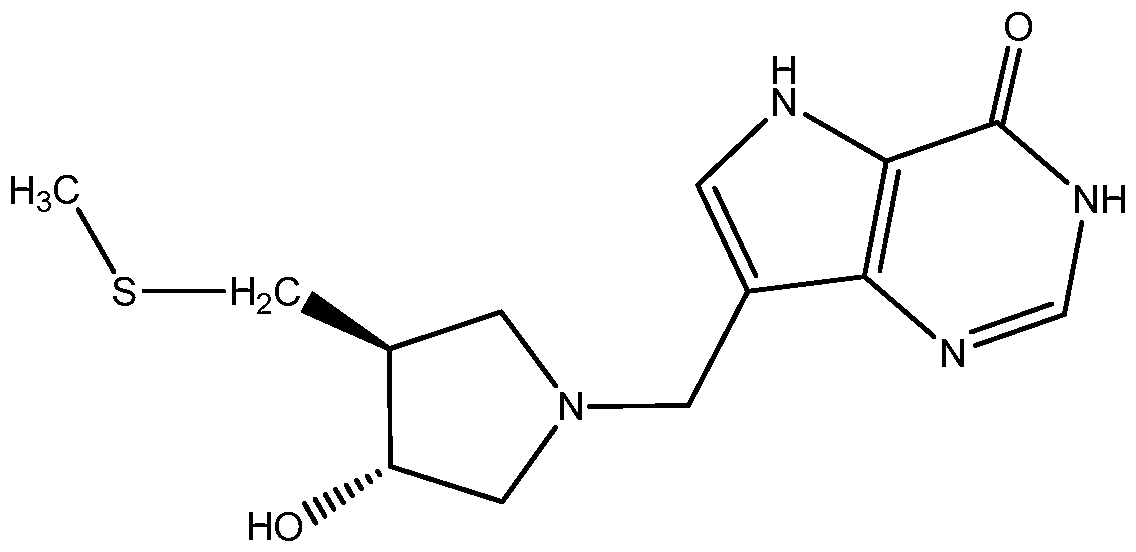

[0051] Examples of compounds of formula (Ilia) include:


7-(((3^,45)-3-(ethylthiomethyl)-4-hydroxypyrrolidin-l-


or a tautomer thereof; or a pharmaceutically acceptable salt thereof; or an ester thereof.
[0052] In another embodiment, as described in PCT International Patent Application Publication No. WO 2008/030119, the contents of which are herein incorporated by reference, the MTIP inhibitor comprises a compound having formula (VI):

wherein R1 is H or NR3R4; R2 is H or an alkyl, alkenyl, alkynyl, aralkyl, aralkenyl, aralkynyl, or aryl group, each of which is optionally substituted with one or more hydroxy, alkoxy, thiol, alkylthio, arylthio, aralkylthio, halogen, carboxylic acid, carboxylate alkyl ester, nitro, or NR3R4 groups, where each alkylthio, arylthio and aralkylthio group is optionally substituted with one or more alkyl, halogen, amino, hydroxy, or alkoxy groups; provided that when R1 is H, R2 is an alkyl, alkenyl, alkynyl, aralkyl, aralkenyl, aralkynyl, or aryl group which is substituted with at least one NR3R4 group, and optionally substituted with one or more hydroxy, alkoxy, thiol, alkylthio, arylthio, aralkylthio, halogen, carboxylic acid, carboxylate alkyl ester or nitro group; R3 and R4, independently of each other, are H or an
alkyl, alkenyl, alkynyl, aralkyl, aralkenyl, aralkynyl, or aryl group, each of which is optionally substituted with one or more hydroxy, alkoxy, thiol, alkylthio, arylthio, aralkylthio, halogen, carboxylic acid, carboxylate alkyl ester, nitro, or NR3R4 groups, where each alkylthio, arylthio and aralkylthio group is optionally substituted with one or more alkyl, halogen, amino, hydroxy, or alkoxy groups; A is N or CH; B is OH; and D is H, OH, NH2, or SC¾; or a tautomer thereof, or a pharmaceutically acceptable salt thereof, or an ester prodrug form thereof.
[0053] Preferably, R1 is NR3R4and R2 is H. It is further preferred that R1 is NR3R4 and one of R3 and R4 is H, a lower alkyl group, e.g. a methyl group, or an aralkyl group, e.g. a benzyl group. Preferably R1 is NR3R4 and one of R3 and R4 is H.
[0054] Preferably R3 or R4 is alkyl substituted by one or more hydroxy groups and/or one or more optionally substituted thiol, alkylthio, arylthio, or aralkylthio groups. For example, R3 or R4 may be, methylthioethyl, methylthiopropyl, methylthiohydroxypropyl, methylthiobutyl, methylthiohydroxybutyl, methylthiodihydroxybutyl, methylthiopentyl, methylthiohydroxypentyl, methylthiodihydroxypentyl, or methylthiotrihydroxypentyl.
[0055] Preferably R1 is NR3R4 and one of R3 and R4 is H and the other is selected from the group consisting of methylthioethyl, methylthiopropyl, methylthiohydroxypropyl, methylthiobutyl, methylthiohydroxybutyl, methylthiodihydroxybutyl, methylthiopentyl, methylthiohydroxypentyl, methylthiodihydroxypentyl, and methylthiotrihydroxypentyl.
[0056] In addition, preferably R2 is an optionally substituted alkyl group, more preferably an optionally substituted C1-C5 alkyl group, for example, hydroxymethyl, hydroxyethyl, hydroxypropyl, dihydroxypropyl, hydroxybutyl, dihydroxybutyl,
trihyroxybutyl, hydroxypentyl, dihydroxypentyl, trihydroxpentyl, methylthiomethyl, methylthioethyl, methylthiopropyl, methylthiohydroxypropyl, methylthiobutyl,
methylthiohydroxybutyl, methylthiodihydroxybutyl, methylthiopentyl,
methylthiohydroxypentyl, methylthiodihydroxypentyl, or methylthiotrihydroxypentyl.
[0057] Preferably A is CH. It is further preferred that D is H.
[0058] Preferred compounds include those having the formula (Via):

[0059] Other preferred compounds include those having the formula (VIb):

wherein R3 is an alkyl, alkenyl, alkynyl, aralkyl, aralkenyl, aralkynyl, or aryl group, each of which is substituted with at least one alkoxy, thiol, alkylthio, arylthio, or aralkylthio group and optionally substituted with one or more hydroxy, halogen, carboxylic acid, carboxylate alkyl ester, or nitro group, where each alkylthio, arylthio and aralkylthio group is optionally substituted with one or more alkyl, halogen, amino, hydroxy, or alkoxy groups; or a tautomer thereof, or a pharmaceutically acceptable salt thereof, or an ester prodrug form thereof.
[0060] Preferably R3 in the above formulae (Via) and (VIb) is selected from the group consisting of, methylthioethyl, methylthiopropyl, methylthiohydroxypropyl, methylthiobutyl, methylthiohydroxybutyl, methylthiodihydroxybutyl, methylthiopentyl, methylthiohydroxypentyl, methylthiodihydroxypentyl, or methylthiotrihydroxypentyl.
[0061] Examples of compounds of formula (VI), as described in WO 2008/0301 19, include:
2-amino-7-(2,3-dihydroxy-l-(2-(methylthio)ethylamino)propyl)-3H-pyrrolo[3,2-d]pyrimidin- 4(5H)-one;
7-(2,3-dihydroxy-l-(2-(methylthio)ethylamino)propyl)-3H-pyrrolo[3,2-d]pyrimidin-4(5H)- one;

7-(l-amino-2,3-dihydroxy-5-(methylthio)pentyl)-3H-pyrrolo[3,2-d]pyrimidin-4(5H)-one;

2-amino-7-(2-hydroxy-l-(l-hydroxy-3-(methylthio)propan-2-ylamino)ethyl)-3H-pyrrolo[3,2- d]pyrimidin-4(5H)-one;
7-(2 -hydroxy- l-(l-hydroxy-3-(methylthio)propan-2-ylamino)ethyl)-3H-pyrrolo[3,2- d]pyrimidin-4(5H)-one;

2-amino-7-((3,4-dihydroxy-l-(methylthio)butan-2-ylamino)methyl)-3H-pyrrolo[3,2- d]pyrimidin-4(5H)-one;
7-((3,4-dihydroxy-l-(methylthio)butan-2-ylamino)methyl)-3H-pyrrolo[3,2-d]pyrimidin- -one (each enantiomer);

2-amino-7-(((2-hydroxy-4-(methylthio)butyl)(methyl)amino)methyl)-3H-pyrrolo[3,2- d]pyrimidin-4(5H)-one;
7-(((2-hydroxy-4-(methylthio)butyl)(methyl)amino)methyl)-3H-pyrrolo[3,2-d]pyrimidin- 4(5H)-one;

2-amino-7-((2-hydroxy-4-(methylthio)butylamino)methyl)-3H-pyrrolo[3,2-d]pyrimidin- 4(5H)-one;
-((2 -hydroxy -4-(methylthio)butylamino)methyl)-3H-pyrrolo[3,2-d]pyrimidin-4(5H)-one;

2-amino-7-((3,4-dihydroxy-2-(methylthiomethyl)butylamino)methyl)-3H-pyrrolo[3,2- d]pyrimidin-4(5H)-one;
7-((3,4-dihydroxy-2-(methylthiomethyl)butylamino)methyl)-3H-pyrrolo[3,2-d]pyrimidin- 4(5H)-one (DL-erythro, DL-threo);

2-amino-7-((3-hydroxy-2-(methylthiomethyl)propylamino)methyl)-3H-pyrrolo[3,2- d]pyrimidin-4(5H)-one;
7-((3-hydroxy-2-(methylthiomethyl)propylamino)methyl)-3H-pyrrolo[3,2-d]pyrimidin- 4(5H)-one;

2-amino-7-(((3-hydroxy-2-(methylthiomethyl)propyl)(methyl)amino)methyl)-3H- pyrrolo[3,2-d]pyrimidin-4(5H)-one;

7-((l,3-dihydroxy-2-(methylthiomethyl)propan-2-ylamino)methyl)-3H-pyrrolo[3,2- d]pyrimidin-4(5H)-one;
2-amino-7-((l,3-dihydroxy-2-(methylthiomethyl)propan-2-ylamino)methyl)-3H-pyrrolo[3,2- d]pyrimidin-4(5H)-one;
5-amino-3-((l,3-dihydroxy-2-(methylthiomethyl)propan-2-ylamino)methyl)-lH- pyrazolo[4,3-d]pyrimidin-7(6H)-one;

7-((benzyl((2R,3R)-3,4-dihydroxy-2-(methylthiomethyl)butyl)amino)methyl)-3H- pyrrolo[3,2-( Jpyrimidin-4(5H)-one;
7-((benzyl((25,35)-3,4-dihydroxy-2-(methylthiomethyl)butyl)amino)methyl)-3H-pyrrolo[3,2- i/]pyrimidin-4(5H)-one;
7-((benzyl((2R,35)-3,4-dihydroxy-2-(methylthiomethyl)butyl)amino)methyl)-3H-pyrrolo[3,2- i/]pyrimidin-4(5H)-one;
7-((benzyl((25,3R)-3,4-dihydroxy-2-(methylthiomethyl)butyl)amino)methyl)-3H-pyrrolo[3,2- i/]pyrimidin-4(5H)-one;
(Racemic mixture of above two as DL-erythro);
2-amino-7-((benzyl((2R,3R)-3,4-dihydroxy-2-(methylthiomethyl)butyl)amino)methyl)-3H- pyrrolo[3,2-( Jpyrimidin-4(5H)-one;
2-amino-7-((benzyl((2S,35)-3,4-dihydroxy-2-(methy^
pyrrolo[3,2-( Jpyrimidin-4(5H)-one;
2-amino-7-((benzyl((2R,35)-3,4-dihydroxy-2-(methylthiomethyl)butyl)amino)methyl)-3H- pyrrolo[3,2-( Jpyrimidin-4(5H)-one;
2-amino-7-((benzyl((25,3R)-3,4-dihydroxy-2-(methylthiomethyl)butyl)amino)methyl)-3H- pyrrolo[3,2-( Jpyrimidin-4(5H)-one;

7-(((2R,3R)-2,3-dihydroxy-4-(methylthio)butylamino)methyl)-3H-pyrrolo[3,2-d]pyrimidin- 4(5H)-one;
7-(((2S,3S)-2,3-dihydroxy-4-(methylthio)butylamino)methyl)-3H-pyrrolo[3,2-d]pyrimidin- 4(5H)-one;
7-(((2R,3S)-2,3-dihydroxy-4-(methylthio)butylamino)methyl)-3H-pyrrolo[3,2-d]pyrimidin- 4(5H)-one;
7-(((2S,3R)-2,3-dihydroxy-4-(methylthio)butylamino)methyl)-3H-pyrrolo[3,2-d]pyrimidin- 4(5H)-one;
(Racemic mixture of above two as DL-threo);
2-amino-7-(((2R,3R)-2,3-dihydroxy-4-(methylthio)butylamino)methyl)-3H-pyrrolo[3,2- d]pyrimidin-4(5H)-one;
2-amino-7-(((2S,3S)-2,3-dihydroxy-4-(methylthio)butylamino)methyl)-3H-pyrrolo[3,2- d]pyrimidin-4(5H)-one;
2-amino-7-(((2R,3S)-2,3-dihydroxy-4-(methylthio)butylamino)methyl)-3H-pyrrolo[3,2- d]pyrimidin-4(5H)-one;
2-amino-7-(((2S,3R)-2,3-dihydroxy-4-(methylthio)butylamino)methyl)-3H-pyrrolo[3,2- d]pyrimidin-4(5H)-one;

7-(((25,35)-3,4-dihydroxy-l-(methylthio)butan-2-ylamino)methyl)-3H-pyrrolo[3,2- i/]pyrimidin-4(5H)-one;
7-(((2R,35)-3,4-dihydroxy-l-(methylthio)butan-2-ylamino)methyl)-3H-pyrrolo[3,2- i/]pyrimidin-4(5H)-one;
7-(((25,3R)-3,4-dihydroxy-l-(methylthio)butan-2-ylamino)methyl)-3H-pyrrolo[3,2- i/]pyrimidin-4(5H)-one;
2-amino-7-(((2R, 3R)-3 ,4-dihydroxy- 1 -(methylthio)butan-2-ylamino)methyl)-3H-pyrrolo[3 ,2- i/]pyrimidin-4(5H)-one;
2-amino-7-(((25', 3S)-3 ,4-dihydroxy- 1 -(methylthio)butan-2-ylamino)methyl)-3H-pyrrolo[3,2- i/]pyrimidin-4(5H)-one;
2-amino-7-(((2R, 3S)-3 ,4-dihydroxy- 1 -(methylthio)butan-2-ylamino)methyl)-3H-pyrrolo[3 ,2- i/]pyrimidin-4(5H)-one;
2- amino-7-(((25', 3R)-3 ,4-dihydroxy- 1 -(methylthio)butan-2-ylamino)methyl)-3H-pyrrolo[3 ,2- i/]pyrimidin-4(5H)-one;
3- (((2R,3R^-3,4-dihydroxy-l-(methylthio)butan-2-ylamino)methyl)-lH-pyrazolo[4,3- d]pyrimidin-7(6H)-one;
3 -(((25', 3S) -3 ,4-dihydroxy- 1 -(methylthio)butan-2-ylamino)methyl)- 1 H-pyrazolo[4,3 - d]pyrimidin-7(6H)-one;
3-(((2R,3^-3,4-dihydroxy-l-(methylthio)butan-2-ylamino)methyl)-lH-pyrazolo[4,3- d]pyrimidin-7(6H)-one;
3-(((25,3R^-3,4-dihydroxy-l-(methylthio)butan-2-ylamino)methyl)-lH-pyrazolo[4,3- d]pyrimidin-7(6H)-one;

3-(((2R,3R)-3,4-dihydroxy-2-(methylthiomethyl)butylamino)methyl)-lH-pyrazolo[4,3- d]pyrimidin-7(6H)-one;
3-(((2S,3S)-3,4-dihydroxy-2-(methylthiomethyl)butylamino)methyl)-lH-pyrazolo[4,3- d]pyrimidin-7(6H)-one;
3-(((2R,3S)-3,4-dihydroxy-2-(methylthiomethyl)butylamino)methyl)-lH-pyrazolo[4,3- d]pyrimidin-7(6H)-one;
3-(((2S,3R)-3,4-dihydroxy-2-(methylthiomethyl)butylamino)methyl)-lH-pyrazolo[4,3- d]pyrimidin-7(6H)-one;
2-amino-7-(((2R,3R)-3,4-dihydroxy-2-(methylthiomethyl)butylamino)methyl)-3H- pyrrolo[3,2-d]pyrimidin-4(5H)-one;
2-amino-7-(((2S,3S)-3,4-dihydroxy-2-(methylthiomethyl)butylamino)methyl)-3H- pyrrolo[3,2-d]pyrimidin-4(5H)-one;
2-amino-7-(((2R,3S)-3,4-dihydroxy-2-(methylthiomethyl)butylamino)methyl)-3H- pyrrolo[3,2-d]pyrimidin-4(5H)-one;
2-amino-7-(((2S,3R)-3,4-dihydroxy-2-(methylthiomethyl)butylamino)methyl)-3H- pyrrolo[3,2-d]pyrimidin-4(5H)-one;
7-(((2R,3R)-3,4-dihydroxy-2-(methylthiomethyl)butylamino)methyl)-3H-pyrrolo[3,2- d]pyrimidin-4(5H)-one;
7-(((2S,3S)-3,4-dihydroxy-2-(methylthiomethyl)butylamino)methyl)-3H-pyrrolo[3,2- d]pyrimidin-4(5H)-one;
7-(((2R,3S)-3,4-dihydroxy-2-(methylthiomethyl)butylamino)methyl)-3H-pyrrolo[3,2- d]pyrimidin-4(5H)-one;
7-(((2S,3R)-3,4-dihydroxy-2-(methylthiomethyl)butylamino)methyl)-3H-pyrrolo[3,2- d]pyrimidin-4(5H)-one;


or a tautomer thereof; or a pharmaceutically acceptable salt thereof; or an ester thereof.
[0062] Additional examples of compounds of formula (VI) include:

7-((5-(ethylthio)pentylamino)methyl)-3i/-pyrrolo[3,2- i/]pyrimidin-4(5i/)-one

(R)-7-((2-hydroxy-3-
(methylthio)propylamino)methyl)-3 -pyrrolo[3,2- i ]pyrimidin-4(5H)-one
(5)-7-((2-hydroxy-3-
(methylthio)propylamino)methyl)-3 -pyrrolo [3 ,2- i ]pyrimidin-4(5H)-one
(R)-7-((3-(ethylthio)-2-hydroxypropylamino)methyl)- 3 -pynOlo[3,2-i ]pyrimidin-4(5H)-one
(S)-7-((3-(ethylthio)-2- hydroxypropylamino)methyl)-3 -pyrrolo[3,2- i ]pyrimidin-4(5 /)-one

(R)-7-((2-hydroxy-3-
(propylthio)propylamino)methyl)-3 -pyrrolo[3,2- <¾pyrimidin-4(5H)-one

(S)-7-((2-hydroxy-3-
(propylthio)propylamino)methyl)-3 -pyrrolo[3,2- <¾pyrimidin-4(5H)-one
(R)-7-((2-hydroxy-3-
(phenylthio)propylamino)methyl)-3 -pyrrolo[3,2- <¾pyrimidin-4(5H)-one
(S)-7-((2-hydroxy-3-
(phenylthio)propylamino)methyl)-3 -pyrrolo[3,2- <¾pyrimidin-4(5H)-one


ii]pyrimidin-4(5ii)-one MeS

^pyrimidm-4(5i7)-one


3 -pyrrolo[3,2- ]pyrimidin-4(5 )-one EtS
(?5)-7-((2-hydroxy-4- (propylthio)butylamino)methyl)-3 -pyrrolo[3,2- ]pyrimidin-4(5 )-one
(RS)-7-((2-hydroxy-4- (phenylthio)butylamino)methyl)-3 -pyrrolo[3,2- ]pyrimidin-4(5 )-one

yl)(methyl)

(5')-7-(((l-hydroxy-3-(methylthio)propan-2- MeS1 ylamino)methyl)-3 /-pyrrolo[3,2-ii]pyrimidin-4(5 /)-one

(5)-7-(((l -(ethylthio)-3-hydroxypropan-2- yl)(methyl)amino)methyl)-3H-pyrrolo[3,2-
( Jpyrimidin-4(5H)-one


(R)-7-(((l -(ethylthio)-3-hydroxypropan-2- yl)(methyl)amino)methyl)-3H-pyrrolo[3,2- d]pyrimidin-4(5H)-one

one


4(5H)-one
(RS)-7-((l-hydroxy-3-(propylthio)propan-2- ylamino)methyl)-3H-pyrrolo[3,2-i ]pyrimidin-
4(5H)-one


(RS)-7-(((l-hydroxy-3-(phenylthio)propan-2- yl)(methyl)amino)methyl)-3i/-pyrrolo[3,2-i ]pyrimidi
4(5H)-one
(RS)-7-((l-hydroxy-3-(phenylthio)propan-2- ylamino)methyl)-3H-pyrrolo[3,2-i ]pyrimidin-
4(5H)-one

(5)-7-((l-(butylthio)-3-hydroxypropan-2-ylamino)methyl) 3 -pyrrolo [3 ,2-<i]pyrimidin-4(5 )-one

(i^)-7-((l-(butylthio)-3-hydroxypropan-2-ylamino)methyl)' 3 -pyrrolo [3 ,2-<i]pyrimidin-4(5 )-one
(RS )-7 - (( 1 - (butyl thio) -3 -hydroxypropan-2- ylamino)methyl)-3 -pyrrolo[3,2-ii]pyrimidin-4(5 )-one
(5)-7-((l-hydroxy-3-(isopropylthio)propan-2- ylamino)methyl)-3 -pyrrolo [3 ,2-<i]pyrimidin-4(5 /)
(Λ)-7-(( 1 -hydroxy-3 -(isopropylthio)propan-2- ylamino)methyl)-3/ -pyrrolo[3,2 /]pyrimidin-4(5/ )
(RS)-7-((l-hydroxy-3-(isopropylthio)propan-2- ylamino)methyl)-3/ -pyrrolo[3,2-ii]pyrimidin-4(5//)'
(5")-2-amino-4-((5)-3-hydroxy-2-((4-oxo-4,5- dihydro-3/ -pyrrolo [3 ,2-</]pyrimidin-7- yl)methylamino)propylthio)butanoic acid
(S)-2-amino-4-((i?)-3-hydroxy-2-((4-oxo-4,5- dihydro-3/ -pyrrolo[3,2 /]pyrimidin-7- yl)methylamino)propylthio)butanoic acid
(5 -2-amino-4-((RS)-3-hydroxy-2-((4-oxo-4,5- dihydro-37 -pyrrolo[3,2-ii]pyrimidm-7- yl)methylamino)propylthio)butanoic acid
 (5)-7-(( 1 -hydroxy-4-phenylbutan-2-ylamino)methyl)-3 /- pyrrolo [3 ,2-i/]pyrimidin-4(5H)-one
(5)-7-(( 1 -hydro xybutan-2-ylamino)methyl)-3 /- pyrrolo [3 ,2-i/]pyrimidin-4(5H)-one
(5)-7-(( 1 -hydroxypentan-2-ylamino)methyl)-3 /- pyrrolo [3 ,2-i/]pyrimidin-4(5H)-one
(5)-7-(( 1 -hydro xyhexan-2-ylamino)methyl)-3 /-pyrrolo [3 ,2- ]pyrimidin-4(5H)-one
7-(((2S,3S)- 1 -hydro xy-3 -methylpentan-2-ylamino)methyl)- 3 /-pyrrolo[3,2- ]pyrimidin-4(5H)-one
(5)-7-(( 1 -hydroxypropan-2-ylamino)methyl)-3 /-pyrrolo [3 ,2- ]pyrimidin-4(5H)-one
(5)-7-(( 1 -hydroxy-4-methylpentan-2-ylamino)methyl)-3 /- pyrrolo [3 ,2-d]pyrimidin-4(5H)-one
 (R)-7-(( 1 -hydroxy -4-phenylbutan-2-ylamino)methyl)-3//- pyrrolo[3,2-(i]pyrimidin-4(5 /)-one
(R)-7-((l-hydroxybutan-2-ylamino)methyl)-3//- pyrrolo[3,2-<i]pyrimidin-4(5//)-one
(R)-7-((l-hydroxypentan-2-ylamino)methyl)-3//- pyrrolo[3,2-(i]pyrimidin-4(5 /)-one
(R)-7-((l -hydroxyhexan-2-ylamino)methyl)-3 -pyrrolo[3 ,2- i ]pyrimidin-4(5H)-one
7-(((2R,35)-l -hydro xy-3-methylpentan-2-ylamino)methyl)- 3//-pyrrolo [3 ,2-<i]pyrimidin-4(5//)-one
(R)-7-((l -hydroxypropan-2-ylamino)methyl)-3//- pyrrolo[3,2-(i]pyrimidin-4(5 /)-one
(R)-7-((l-hydroxy-4-methylpentan-2-ylamino)methyl)-3 - pyrrolo[3,2-(i]pyrimidin-4(5 /)-one
(

(RS)-7-((l-hydroxybutan-2-ylamino)methyl)-3H-pyrrolo[3,2- ]pyrimidin-4(5H)-one
(RS)-7-((l-hydroxypentan-2-ylamino)methyl)-3H-pyrrolo[3,2- ]pyrimidin-4(5H)-one
-(( 1 -hydroxyhexan-2-ylamino)methyl)-3H- pyrrolo[3,2-<i]pyrimidin-4(5H)-one
7-((2RS,3S)-l-hydroxy-3-methylpentan-2-ylamino)methyl)- 3H-pyrrolo[3,2-<i]pyrimidin-4(5H)-one
(RS)-7-((l-hydroxypropan-2-ylamino)methyl)-3H- pyrrolo[3,2-<i]pyrimidin-4(5H)-one
(RS)-7-(( 1 -hydroxy-4-methylpentan-2-ylamino)methyl)-3H- pyrrolo[3,2-<i]pyrimidin-4(5H)-one


(S)-7-(( 1 -hydroxyoctan-2-ylamino)methyl)-3i -pyrrolo[3 ,2-<i]pyrimidin-4(5i )-one
or a tautomer thereof; or a pharmaceutically acceptable salt thereof; or an ester thereof.
[0063] Preferred compounds include those having the structure:


[0064] In another embodiment, the MTIP inhibitor comprises a compound having formul

wherein X is an alkyl, cycloalkyl, aralkyl, aralkenyl, alkenyl, alkynyl or aryl group, each of which is optionally substituted with one or more substituents selected from the group consisting of hydroxy, alkoxy, cycloalkyl, thiol, alkylthio, arylthio, aralkylthio, halogen, carboxylic acid, carboxylate alkyl ester, nitro, cyano, thiazole and NR2R3 group, where each alkylthio, arylthio and aralkylthio group is optionally substituted with one or more alkyl, halogen, amino, hydroxy, or alkoxy groups; or X is SR ; or X is NR R ; R , R and R are
independently selected from the group consisting of alkyl, alkenyl, alkynyl, aralkyl or aryl, each of which is optionally substituted with one or more substituents selected from the group consisting of hydroxy, alkoxy, thiol, alkylthio, arylthio, aralkylthio, halogen, carboxylic acid, carboxylate alkyl ester, nitro, cyano and NR2R3 group, where each alkylthio, arylthio and aralkylthio group is optionally substituted with one or more alkyl, halogen, amino, hydroxy, or alkoxy groups; A is N or CH; B is OH; D is H, OH, NH2, or SCH3; provided that X is not CH2Z, where Z is selected from OH, hydrogen, halogen, SQ1, OQ2 and Q3, where Q1 is an optionally substituted alkyl, aralkyl or aryl group, Q2 is an optionally substituted alkyl group and Q3 is an optionally substituted alkyl group; or a tautomer thereof, or a pharmaceutically acceptable salt thereof, or an ester prodrug form thereof.
[0065] Preferred compounds include those of formula (Vila):

wherein A, B, D and X are as defined above.
[0066] Alternatively, preferably the compound is a compound of formula (Vllb):

wherein A, B, D and X are as defined above.
[0067] Preferably, in the above formulae (VII), (Vila) and (Vllb), Q1 is an optionally substituted alkyl, aralkyl or aryl group, Q2 is an optionally substituted alkyl group and Q3 is an optionally substituted alkyl group. For example, Q1, Q2 or C/may be optionally substituted with one or more: halogens, e.g. chlorine or fluorine; alkyl groups, e.g. methyl or cyclohexylmethyl; COOH; or NH2.
[0068] Preferably A is CH. It is further preferred that D is H.
[0069] Preferably, X is an alkenyl or alkynyl group each of which is optionally substituted with one or more substituents selected from the group consisting of hydroxy,
alkoxy, thiol, alkylthio, arylthio, aralkylthio, halogen, carboxylic acid, carboxylate alkyl ester, nitro, or NR2R3 group, where each alkylthio, arylthio and aralkylthio group is optionally substituted with one or more alkyl, halogen, amino, hydroxy, or alkoxy groups. X may be, for example, a lower alkenyl group, e.g. a vinyl, allyl or prop-l-en-2-yl group. X may be, for example, a lower alkynyl group, e.g. an ethynyl group or a propyn-3-yl group.
[0070] Alternatively, preferably, X is an alkyl group which is optionally substituted with one or more substituents selected from the group consisting of hydroxy, alkoxy, thiol, alkylthio, arylthio, or aralkylthio, e.g. benzylthio, halogen, carboxylic acid, carboxylate alkyl ester, nitro or NR2R3 group, where each alkylthio, arylthio and aralkylthio group is optionally substituted with one or more alkyl, halogen, amino, hydroxy or alkoxy groups. X may be, for example, a lower alkyl group, e.g. ethyl, propyl, butyl, isobutyl, pent-3-yl or an alkyl group substituted with a cycloalkyl group, e.g. cyclohexyl group, e.g. X may be cyclohexanemethyl. Alternatively, X may be, for example, an alkyl group which is substituted with an aralkylthio group, e.g X may be 3-benzylthiopropyl group.
[0071] Alternatively, preferably, X is an alkyl group which is optionally substituted with one or more substituents selected from the group consisting of cycloalkyl, e.g.
cycloalkyl in which one or more of the ring carbon atoms is substituted by a heteroatom chosen from nitrogen, oxygen or sulfur. In some examples, X may be cyclopropanemethyl, 2- tetrahydrofuranmethyl, 2-thietanemethyl, 3-piperidinemethyl, 2-pyrrolidinemethyl or 4- thiacyclohexanemethyl.
[0072] Alternatively, preferably, X is a cycloalkyl group which is optionally substituted with one or more substituents selected from the group consisting of hydroxy, alkoxy, cycloalkyl, thiol, alkylthio, arylthio, aralkylthio, halogen, carboxylic acid, carboxylate alkyl ester, nitro, cyano, thiazole and NR2R3 group, where each alkylthio, arylthio and aralkylthio group is optionally substituted with one or more alkyl, halogen, amino, hydroxy or alkoxy groups. X may be, for example, a cyclopropyl, cyclobutyl, cyclopentyl, cyclohexyl or adamantyl group.
[0073] Alternatively, preferably, X may be a cycloalkyl group where one or more of the ring atoms is a heteroatom, e.g. a nitrogen, sulfur or oxygen atom. X may be, for example, 2-tetrahydrofuranyl, 2-tetrahydrothienyl, l,2-dithian-3-yl, piperidin-3-yl, thietan-2yl, 2- pyrrolidinyl or 4-thiacyclohexyl.
[0074] Alternatively, preferably, X is an aryl group which is optionally substituted with one or more substituents selected from the group consisting of hydroxy, alkoxy,
cycloalkyl, thiol, alkylthio, arylthio, aralkylthio, halogen, carboxylic acid, carboxylate alkyl ester, nitro, cyano, thiazole and NR2R3 group, where each alkylthio, arylthio and aralkylthio group is optionally substituted with one or more alkyl, halogen, amino, hydroxy, or alkoxy groups. The aryl group may be a heteroaryl group, where one or more of the ring carbon atoms is a heteroatom, e.g. a nitrogen, sulfur or oxygen atom. X may be, for example, a phenyl group or an optionally substituted triazole group. Where X is an optionally substituted triazole group the triazole ring may optionally be substituted with one or more substituents selected from the group consisting of aryl group, e.g. phenyl; alkyl group, e.g. a lower alkyl group, e.g. a propyl group which may optionally be substituted with one or more substituents selected from aryl, hydroxyl, or alkoxy; aralkyl group, e.g. benzyl; or cycloalkyl group. Where X is an optionally substituted triazole group, the triazole ring may be attached to the pyrrolidine ring via either a triazole ring nitrogen or a triazole ring carbon atom.
[0075] Alternatively, preferably, X is SR1, where R1 is alkyl, alkenyl, alkynyl, aralkyl or aryl, each of which is optionally substituted with one or more substituents selected from the group consisting of hydroxy, alkoxy, cycloalkyl, thiol, alkylthio, arylthio, aralkylthio, halogen, carboxylic acid, carboxylate alkyl ester, nitro, cyano, thiazole and NR2R3 group, where each alkylthio, arylthio and aralkylthio group is optionally substituted with one or more alkyl, halogen, amino, hydroxy or alkoxy groups. For example, X may be phenylthio, 4- chlorophenylthio, 4-fluorophenylthio, 3-fluorophenylthio, 4-methylphenylthio, ethylthio, propylthio, butylthio, pentylthio, 3-fluoropropylthio, 2,3-dihydroxypropylthio, 3- hydroxypropylthio, 2 -hydroxy ethylthio, allylthio or 4-chlorobutylthio.
[0076] Alternatively, preferably, X is NR2R3, where R2 and R3 are independently selected from alkyl, alkenyl, alkynyl, aralkyl or aryl, each of which is optionally substituted with one or more substituents selected from the group consisting of hydroxy, alkoxy, cycloalkyl, thiol, alkylthio, arylthio, aralkylthio, halogen, carboxylic acid, carboxylate alkyl ester, nitro, cyano, thiazole and NR2R3 group, where each alkylthio, arylthio and aralkylthio group is optionally substituted with one or more alkyl, halogen, amino, hydroxy, or alkoxy groups. For example, X may be diethylamino, ethylamino, propylamino, butylamino, 2- hydroxyethylamino, 3-hydroxypropylamino, 2,3-dihydroxypropylamino, 3-fluoroethylamino, trifluoroethylamino, bis(2-hydroxyethyl)amino, 3-butenylamino, benzylamino, 4- fluorobenzylamino, 4-chlorobenzylamino, or N-methyl-benzylamino.
[0077] Examples of compounds of formula (VII) include:
(±)-?ra«s-l-[(9-Deazahypoxanthin-9-yl)methyl]-3-hydroxy-4-phenylpyrrolidine;
(±)-?ra«s-l-[(9-Deazahypoxanthin-9-yl)methyl]-3-hydroxy-4-vinylpyrrolidine;
(±)-?ra«s-l-[(9-Deazahypoxanthin-9-yl)methyl]-4-ethynyl-3-hydroxypyrrolidine;
(±)-?ra«s-4-Allyl-l-[(9-deazahypoxanthin-yl)methyl]-3-hydroxypyrrolidine;
(±)-?ra«s-4-Cyclopropyl-l-[(9-deazahypoxanthin-9-yl)methyl]-3-hydroxypyrrolidine;
(±)-?ra«s-4-Cyclohexyl-l-[(9-deazahypoxanthin-9-yl)methyl]-3-hydroxypyrrolidine;
(±)-?ra«s-4-Cyclohexylmethyl-l-[(9-deazahypoxanthin-9-yl)methyl]-3-hydroxypyrrolidine;
(±)-?ra«s-l-[(9-Deazahypoxanthin-9-yl)methyl]-3-hydroxy-4-(prop-l-en-2-yl)-pyrrolidine;
(±)-?ra«s-4-Butyl-l-[(9-Deazahypoxanthin-9-yl)methyl]-3-hydroxypyrrolidine;
(±)-?ra«s-l-[(9-Deazahypoxanthin-9-yl)methyl]-3-hydroxy-4-(pent-3-yl)-pyrrolidine;
(±)-?ra«s-4-Cyclopentyl-l-[(9-deazahypoxanthin-9-yl)methyl]-3-hydroxypyrrolidine;
(±)-?ra«s-l-[(9-Deazahypoxanthin-9-yl)methyl]-3-hydroxy-4-(lH-l,2,3-triazol-l- yl)pyrrolidine;
(±)-?ra«s-4-(l-Benzyl-lH-l,2,3-triazol-4-yl)-l-[(9-deazahypoxanthin-9-yl)methyl]-3- hydroxypyrrolidine;
(±)-tra«5-4-(3 -Benzylthiopropyl)- 1 -[(9-deazahypoxanthin-9-yl)methyl]-3 - hydroxypyrrolidine;
(±)-cis- 1 - [(9-Deazahypoxanthin-9-yl)methyl]-4-ethyl-3 -hydroxypyrrolidine;
(3R,4S)-l-[(9-Deazahypoxanthin-9-yl)methyl]-3-hydroxy-4-phenylpyrrolidine;
(3R,4S)-l-[(9-Deazahypoxanthin-9-yl)methyl]-3-hydroxy-4-vinylpyrrolidine;
(3R,4S)-l-[(9-Deazahypoxanthin-9-yl)methyl]-4-ethynyl-3-hydroxy -pyrrolidine;
(3R,4S)-4-Allyl-l-[(9-deazahypoxanthin-9-yl)methyl]-3 -hydroxypyrrolidine;
(3R,4S)-4-Cyclopropyl-l-[(9-deazahypoxanthin-9-yl)methyl]-3-hydroxypyrrolidine;
(3R,4S)-4-Cyclohexyl-l-[(9-deazahypoxanthin-9-yl)methyl]-3-hydroxypyrrolidine;
(3R,4S)-l-[(9-Deazahypoxanthin-9-yl)methyl]-3-hydroxy-4-(prop-l-en-2-yl)-pyrrolidine;
(3R,4S)-l-[(9-Deazahypoxanthin-9-yl)methyl]-3-hydroxy-4-(pent-3-yl)-pyrrolidine;
(3R,4S)-4-Cyclopentyl-l-[(9-deazahypoxanthin-9-yl)methyl]-3-hydroxypyrrolidine;
(3S,4S)-l-[(9-Deazahypoxanthin-9-yl)methyl]-3-hydroxy-4-(lH-l,2,3-triazol-l- yl)pyrrolidine;
(3R,4R)-4-( 1 -Benzyl- 1H- 1 ,2,3 -triazol-4-yl)- 1 - [(9-deazahypoxanthin-9-yl)methyl] -3 - hydroxypyrrolidine;
(±)-?ra«s-l-[(9-Deazahypoxanthin-9-yl)methyl]-3-hydroxy-4-(2-methylpropyl)pyrrolidine; (±)-?ra«s-4-Butyl-l-[(9-deazahypoxanthin-9-yl)methyl]-3-hydroxypyrrolidine;
(±)-?ra«s-l-[(9-Deazahypoxanthin-9-yl)methyl]-3-hydroxy-4-(thiazol-2-yl)- pyrrolidine; (3R,4S)-l-[(9-Deazahypoxanthin-9-yl)methyl]-3-hydroxy-4-(thiazol-2-yl)- pyrrolidine;
(±)-?ra«s-l-[(9-Deazahypoxanthin-9-yl)methyl]-3-hydroxy-4-(tetrazol-5-yl)- pyrrolidine; (3R,4R)-l-[(9-Deazahypoxanthin-9-yl)methyl]-3-hydroxy-4-(tetrazol-5-yl)- pyrrolidine; and (3S,4R)-l-[(9-Deaza-adenin-9-yl)methyl]-4-ethyl-3-hydroxypyrrolidine;
or a tautomer thereof, or a pharmaceutically acceptable salt thereof, or an ester thereof.
[0078] Preferably, the MTIP inhibitor has an IC50 value greater than or equal to 50 nanomolar for human purine nucleoside phosphorylase (PNP), as determined by the method described in Bantia, et ah, Immunopharmacology 35, p. 54, paragraph 2.1 (1996) (52).
Preferably, the MTIP inhibitor has an IC50 value greater than or equal to 50 nanomolar for 5'-methylthioadenosine nucleosidase (MTAN). Preferably, the MTIP inhibitor has an IC50 value greater than or equal to 50 nanomolar for 5'-methylthioadenosine phosphorylase (MTAP). "IC50" means the molar concentration of an inhibitor needed to reduce the rate of product formation by 50% from the uninhibited reaction in an assay mixture containing a target enzyme.
[0079] The active compounds may be administered to a subject, such as a human, by a variety of routes, including orally, parenterally, by inhalation spray, topically, rectally, nasally, buccally or via an implanted reservoir. The specific dosage required for any particular patient will depend upon a variety of factors, including the patient's age and body weight.
[0080] For oral administration the compounds can be formulated into solid or liquid preparations, for example tablets, capsules, powders, solutions, suspensions and dispersions. Such preparations are well known in the art as are other oral dosage regimes not listed here. In the tablet form the compounds may be tableted with conventional tablet bases such as lactose, sucrose and corn starch, together with a binder, a disintegration agent and a lubricant. The binder may be, for example, corn starch or gelatin, the disintegrating agent may be potato starch or alginic acid, and the lubricant may be magnesium stearate. For oral administration in the form of capsules, diluents such as lactose and dried cornstarch may be employed. Other components such as colourings, sweeteners or flavourings may be added.
[0081] When aqueous suspensions are required for oral use, the active ingredient may be combined with carriers such as water and ethanol, and emulsifying agents, suspending agents and/or surfactants may be used. Colourings, sweeteners or flavourings may also be added.
[0082] The compounds may also be administered by injection in a physiologically acceptable diluent such as water or saline. The diluent may comprise one or more other
ingredients such as ethanol, propylene glycol, an oil or a pharmaceutically acceptable surfactant.
[0083] The compounds may also be administered topically. Carriers for topical administration of the compounds of include mineral oil, liquid petrolatum, white petrolatum, propylene glycol, polyoxyethylene, polyoxypropylene compound, emulsifying wax and water. The compounds may be present as ingredients in lotions or creams, for topical administration to skin or mucous membranes. Such creams may contain the active compounds suspended or dissolved in one or more pharmaceutically acceptable carriers. Suitable carriers include mineral oil, sorbitan monostearate, polysorbate 60, cetyl ester wax, cetearyl alcohol, 2-octyldodecanol, benzyl alcohol and water.
[0084] The compounds may further be administered by means of sustained release systems. For example, they may be incorporated into a slowly dissolving tablet or capsule.
[0085] The compounds can be administered to plants, for example, by spraying the plant surfaces with the compound and a carrier of the type normally used in agricultural applications, such as, for example, water or an oil. Typical concentrations can be, for example, 1 - 100 grams of inhibitor per 1000 gallons of plant spray.
[0086] The present invention also provides for the use of a subgrowth inhibiting amount of an MTIP inhibitor for treating bacterial infections in a subject. The present invention further provides for the use of a subgrowth inhibiting amount of an MTIP inhibitor for the preparation of a composition for treating bacterial infections in a subject.
[0087] The invention also provides a method for determining whether or not a compound is a candidate for treating an infection caused by bacteria that use 5'- methylthioinosine phosphorylase (MTIP) in a quorum sensing pathway, the method comprising determining whether or not the compound inhibits MTIP, wherein a compound that inhibits MTIP is a candidate for treating an infection caused by bacteria that use MTIP in a quorum sensing pathway and wherein a compound that does not inhibit MTIP is not a candidate for treating an infection caused by bacteria that use MTIP in a quorum sensing pathway.
[0088] Preferably, the MTIP inhibitor has an IC50 value less than 50 nanomolar for MTIP. Preferably, the MTIP inhibitor has an IC50 value greater than or equal to 50 nanomolar for human purine nucleoside phosphorylase (PNP), as determined by the method described in Bantia, et ah, Immunopharmacology 35, p. 54, paragraph 2.1 (1996) (52). Preferably, the MTIP inhibitor has an IC50 value greater than or equal to 50 nanomolar for
5'-methylthioadenosine nucleosidase (MTAN). Preferably, the MTIP inhibitor has an IC50 value greater than or equal to 50 nanomolar for 5'-methylthioadenosine phosphorylase (MTAP). "IC50" means the molar concentration of an inhibitor needed to reduce the rate of product formation by 50% from the uninhibited reaction in an assay mixture containing a target enzyme.
[0089] An "inhibitor" is a substance that when added to an assay mixture for a target enzyme causes a decrease in the rate of product formation by interaction with the enzyme.
[0090] The bacteria can be, for example, Pseudomonas aeruginosa, Pseudomonas syringae or Xanthomonas campestris.
[0091] Enzymatic assays can be carried out, for example, as described herein in Experimental Details.
[0092] The invention also provides a chemical compound of formula (I)

wherein A is CH or N; B is OH; D is chosen from H, OH, NH2, or SCH3; X is OH; Y is H; and Z is Q, where Q is a methyl group which is substituted with one or more substituents selected from the group consisting of methoxy, amino and carboxy, or Q is an optionally substituted, alkenyl, aralkyl, aralkenyl, aryl group or C2-C10 alkyl group, each of which is optionally substituted with one or more substituents selected from hydroxy, halogen, methoxy, amino, carboxy, or straight- or branched-chain C\-Ce alkyl; or a tautomer thereof; or a pharmaceutically acceptable salt thereof; or an ester thereof.
[0093] Preferably, D is H. It is also preferred that A is CH. It is further preferred that D is H and A is CH.
[0094] Preferably, Q is an optionally substituted alkyl group, e.g. a C2-C6 alkyl group such as an ethyl, propyl or butyl group. It is also preferred that Q is an alkyl group substituted with one or more amino groups. Preferably Q is an alkyl group substituted with one or more amino and one or more carboxy groups, e.g. -(CH2)4CH(NH2)COOH.
[0095] Alternatively, preferably, Q is an optionally substituted aralkyl group, e.g. a phenylethyl or benzyl group. In still other preferred embodiments, Q is an optionally substituted aralkenyl group, e.g. a phenylethenyl group, e.g. a cz's-phenylethenyl group or a iraws-phenylethenyl group.
[0096] Preferably, the compound has an IC50 value greater than or equal to 50 nanomolar for human purine nucleoside phosphorylase (PNP), as determined by the method described in Bantia, et al, Immunopharmacology 35, p. 54, paragraph 2.1 (1996) (52). Preferably, the compound has an IC50 value greater than or equal to 50 nanomolar for 5'- methylthioadenosine nucleosidase (MTAN). Preferably, the compound has an IC50 value greater than or equal to 50 nanomolar for 5'-methylthioadenosine phosphorylase (MTAP).
[0097] The invention also provides a compound selected from the group consisting of


-56-


-58-


or a tautomer thereof; or a pharmaceutically acceptable salt thereof; or an ester thereof.
[OOIOO] The invention also provides a pharmaceutical composition comprising any one or more of the compounds disclosed herein and a pharmaceutically acceptable salt.
[00101] The term "pharmaceutically acceptable salt" is intended to apply to non-toxic salts derived from inorganic or organic acids, including, for example, the following acid salts: acetate, adipate, alginate, aspartate, benzoate, benzenesulfonate, bisulfate, butyrate, citrate, camphorate, camphorsulfonate, cyclopentanepropionate, digluconate, dodecylsulfate, ethanesulfonate, formate, fumarate, glucoheptanoate, glycerophosphate, glycolate,
hemisulfate, heptanoate, hexanoate, hydrochloride, hydrobromide, hydroiodide, 2- hydroxyethanesulfonate, lactate, maleate, malonate, methanesulfonate,
2- naphthalenesulfonate, nicotinate, nitrate, oxalate, palmoate, pectinate, persulfate,
3- phenylpropionate, phosphate, picrate, pivalate, propionate, -toluenesulfonate, salicylate, succinate, sulfate, tartrate, thiocyanate, and undecanoate.
[00102] The invention also provides a pharmaceutical composition or an agrochemical composition comprising one or more of the compounds disclosed herein and a pharmaceutically or agrochemically acceptable carrier. The compound can be present in a concentration that is a sub-bacterial-growth inhibiting amount of a 5'-methylthioinosine phosphorylase (MTIP) inhibitor.
[00103] The invention also provides a pharmaceutical composition or an agrochemical composition comprising any one or more of the compounds disclosed herein and one or more additional compounds, such as 5'-methylthio-inosine or 5'-methylthioadenosine.
[00104] The invention also provides methods for treating infections caused by bacteria that use 5'-methylthioinosine phosphorylase (MTIP) in a quorum sensing pathway comprising coadministering to a subject having the infection a sub-growth inhibiting amount of a 5'- methylthioinosine phosphorylase (MTIP) inhibitor, and 5'-methylthioinosine and/or 5'- methylthioadenosine.
[00105] This invention will be better understood from the Experimental Details, which follow. However, one skilled in the art will readily appreciate that the specific methods and results discussed are merely illustrative of the invention as described more fully in the claims that follow thereafter.
EXPERIMENTAL DETAILS
Introduction
[00106] P. aeruginosa is an unusual bacterium as it possesses a putative 5'- methylthioadenosine phosphorylase (MTAP: PA3004 gene) instead of MTAN. MTAP is rare in bacteria and common in mammals, while MTAN is not found in mammals. The action of MTAP on MTA would be functionally similar to that of MTAN by relieveing MTA product inhibition of AHL synthase and SAM recycling in P. aeruginosa (18). The PA3004 gene in P. aeruginosa PA01 was originally annotated from sequence homology, followed by metabolic studies in PA3004 mutants that mistakenly supported the MTAP assignment (19, 20). The present study establishes the PA3004 encoded protein to be 5'-methylthioinosine phosphorylase (MTIP) rather than MTA phosphorylase (MTAP). Examination of MTA
metabolism in P. aeruginosa using [8- C]MTA confirmed that the pathway involves MTIP. Transition state analogue inhibitors with picomolar Kj values for aMTIP are described.
Materials and Methods
[00107] Chemicals. MT-ImmH, PhT-ImmH, and MT-DADMe-ImmH were synthesized by the Carbohydrate Chemistry Team of Industrial Research Ltd, Lower Hutt, New Zealand (Figure 1). [8-14C]MTA was synthesized as described previously (21). All other chemicals and reagents were obtained from Sigma or Fisher Scientific, and were of reagent grade.
[00108] Plasmid construction. A synthetic gene was designed based on the predicated protein sequence of NP_251694.1 in CBI, annotated as MTAP of Pseudomonas aeruginosa PAOl. The synthetic gene was obtained in a pJexpress414 expression vector from DNA2.0 Inc. This construct encodes an additional 14 amino acids at the N-terminus which includes a His6 tag and a TEV cleavage site.
[00109] Enzyme purification and preparation. BL21-CodonPlus(DE3)-RIPL E. coli were transformed with the above plasmid and grown overnight at 37 °C in 50 mL of LB medium with 100 μg/mL Ampicillin. The culture was transferred into 1 L of LB/Ampicillin medium and growth continued at 37 °C to an O.D.6oo of 0.7. Expression was induced by addition of 1 mM IPTG. After 4 hours at 37 °C, the cells were harvested by centrifugation at 4500 g for 30 min. The cell pellet was suspended in 20 mL of 15 mM imidazole, 300 mM NaCl, and 50 mM phosphate, pH 8.0 (lysis buffer), with 2 tablets of EDTA-free protease inhibitor (from Roche Diagnostics) and lysozyme (from chicken egg) added to the mixture. Cells were disrupted twice with a French Press and centrifuged at 20,000 g for 30 min. The supernatant was loaded onto a 4 mL column of Ni-NTA Superflow resin previously equilibrated with 5 columns of lysis buffer. The column was washed with 5 volumes of 80 mM imidazole, 300 mM NaCl, and 50 mM phosphate, pH 8.0 (wash buffer), and enzyme was eluted with 3 volumes of 250 mM imidazole, 300 mM NaCl, and 50 mM phosphate, pH 8.0 (elution buffer). The purified enzyme (> 95% purity on the basis of SDS-PAGE) was dialyzed against 50 mM Hepes, pH 7.4 and concentrated to 8 mg/ml. Enzyme was stored at - 80 °C. The extinction coefficient of target protein is 20.4 mM^cm"1 at 280 nm, determined by ProtParam program from ExPASy.
[00110] Enzymatic assays. Product formation was monitored by conversion of hypoxanthine to uric acid by xanthine oxidase (22). The extinction coefficient of this assay was 12.9 mM"1™ at 293 nm. Enzyme activity with adenosine or MTA as substrates was
determined by conversion of adenine to 2,8-dihydroxyadenine using the same coupling enzyme (23). Its extinction coefficient at 293 nm was 15.2 mM^cm 1. Reactions were carried out at 25 °C in 1 cm cuvettes, 1 mL volumes of 100 mM Hepes, pH 7.4, 100 mM phosphate, pH 7.4, variable concentrations of nucleoside substrate, 0.5 unit of xanthine oxidase, 5 mM DTT, and appropriate amounts of purified MTIP. Reactions were initiated by addition of enzyme and the initial rates were monitored with a CARY 300 UV-Visable spectrophotometer. Control rates (no ΡαΜΤΓΡ) were subtracted from initial rates. Km and kcat values for ΡαΜΤΓΡ were obtained by fitting initial rates to the Michaelis-Menten equation using GraFit 5 (Erithacus Software). Phosphate was found to be near saturation when present at 100 mM.
[00111] Inhibition assays. Assays for slow-onset inhibitors were carried out by adding 1 nM PaMTIP into reaction mixtures at 25 °C containing 100 mM Hepes, pH 7.4, 100 mM phosphate, pH 7.4, 2 mM MTI, 5 mM DTT, 0.5 unit of xanthine oxidase and variable inhibitor concentration. Inhibitors were present at > 10 times the enzyme concentration, required to simplify data analysis (24). Assays for MTA inhibition used 200 μΜ MTI. Controls having no enzyme and no inhibitor were included in all of the inhibition assays. Inhibition constants were obtained by fitting initial rates with variable inhibitor concentrations to equation (1) using GraFit 5 (Erithacus Software):

where vz- is the initial rate in the presence of inhibitor, v0 is the initial rate in the absence of inhibitor, Km is the Michaelis constant for MTI, [S] and [I] are MTI and inhibitor concentrations, respectively, and K{ is the inhibition constant. Slow-onset inhibitors display a second phase of tighter binding after reaching a thermodynamic equilibrium with the enzyme. The equilibrium constant for the second binding phase is indicated as K{ *. This constant was obtained by fitting initial final rates and inhibitor concentrations to equation (1) using GraFit
5 (22).
[00112] Protein crystallization and data collection. Recombinant PaMTIP (9 mg/ml) in 50 mM HEPES, pH 7.4 crystallized in 30% polyethylene glycol monomethyl ether 2000, and 0.1 M potassium thiocyanate in the presence of 5 mM MTI and 5 mM sulfate by sitting- drop vapor diffusion. Crystals were transferred to a fresh drop of crystallization solution supplemented with 20% glycerol and flash-cooled in liquid nitrogen. X-ray diffraction data
were collected at Beamline X29A, Brookhaven National Laboratory and processed with the HKL2000 program suite (Table 1).
[00113] Structure determination and refinement. The crystal structure of ΡαΜΤΓΡ was determined by molecular replacement with Molrep using the published structure of Sulfolobus tokodaii MTAP (PDB: 1V4N) as the search model (25). A model without catalytic site ligands was built by Phenix (26), followed by iterative rounds of manual model building and refinement in COOT and REFMAC5 (27, 28). Although PaMTIP was co-crystallized in the presence of sulfate and MTI to mimic the Michaelis complex of PaMTIP, based on ligand-omitted F0-Fc maps (contoured at 3 σ) electron density was consistent with the presence of only a purine ring in the active site. PaMTIP was later confirmed to hydrolyze MTI under these conditions. Hypoxanthine was modeled in the active site of PaMTIP (Table
1).
[00114] MTA catabolism using [8-14C]MTA. P. aeruginosa PAOl (ATCC number: 15692) was grown at 37 °C in LB medium for 16 hours. Cells were collected by centrifugation at 16100 g and washed twice with 100 mM phosphate, pH 7.4. Washed cells were lysed using BugBuster (Novagen). Cleared lysate (53 μί) was incubated with [8- 14C]MTA (10 containing approximately 0.1 μθϊ 14C) in 100 mM phosphate, pH 7.4, for 10 and 25 min. Reaction mixtures were quenched with perchloric acid (1.8 M final concentration) and neutralized with potassium hydroxide. Precipitates were removed by centrifugation and carrier hypoxanthine, adenine, MTI, and MTA were added to the cleared supernatant. Metabolites were resolved on a C18 Luna HPLC column (Phenomenex) with a gradient of 5-52.8% acetonitrile in 20 mM ammonium acetate, pH 5.2. UV absorbance was detected at 260 nm and the retention times were 5.1 min for hypoxanthine, 7.5 min for adenine, 20.4 min for MTI, and 21.9 min for MTA. Fractions were collected in scintillation vials, dried, reconstituted in 200 deionized water prior to addition of 10 mL ULTIMA GOLD LSC-Cocktail and 14C was counted for three cycles at 20 minutes per cycle using a Tri-Carb 2910TR liquid scintillation analyzer. Control experiments replaced cell lysate by lysis buffer in reaction mixtures.
Results and Discussion
[00115] Annotation ofPA3004 as a MTAP. The PA3004 gene of P. aeruginosa PAOl encodes a protein (NCBI ID of NP_251694.1) annotated as a "probable nucleoside phosphorylase" in PseudoCAP (29). It was later proposed to be an MTAP based on catabolism studies in mutant strains of P. aeruginosa (19, 20). PAO503 is a P. aeruginosa
methionine-auxotroph. A new strain (PA06422) was created by inactivating the PA3004 gene of PAO503. While PAO503 was complemented for growth on minimum medium with methionine, homocysteine or MTA, PA06422 responded to methionine and homocysteine but was not complemented by MTA (20). These results supported an MTAP activity for the PA3004 encoded protein. The results also support a pathway of MTA → MTI → hypoxanthine + MTR-l-P→ methionine, but this was not considered.
[00116] PA3004 encodes a MTI phosphorylase. Here, the recombinant protein from PA3004 was purified and tested for substrate specificity (Table 2). The recombinant protein could not utilize MTA in the presence or absence of phosphate. The most favorable reaction was phosphorolysis of MTI with a kcat of 4.8 s"1, Km of 2.6 μΜ (kcat/Km of 1.8 x 10⁶ M'V1). Enzyme was less active with inosine with a kcat of 0.57 s"1 and a Km of 90 μΜ (kcat/Km of 6.3 x 10³ M'V1) and depended on phosphate for significant activity. The methylthio- group of MTI is important for both substrate binding and catalysis. Adenosine is a weak substrate with a kcat of 0.0549 s"1 and a Km of 23 μΜ (kcat/Km of 2.4 x 10³ M'V1). Thus the protein encoded by PA3004 is a relatively specific MTI phosphorylase. The catalytic efficiency (kcat/Km) for MTI is 290 times larger than for inosine, the second best substrate. For comparison, the MTI phosphorylase activity of PNP (see below) has a kcat/Km of 9.4 x 10⁴ M'V1 for MTI and a kcat/Km oi 3.6 x 10⁵ M'V1 for inosine.
[00117] MTI phosphorylase activity has been documented in Caldciriella acidophilan MTAP, human MTAP, human PNP, and P. falciparum PNP, but in these, MTI is a relatively poor substrate (30-33). MTIP of P. aeruginosa is the only reported MTIP with high specificity for MTI. MTA is not a substrate (less than the detection level of 10"4 kcat) but is a competitive inhibitor of MTI, with a K{ value of 70 μΜ, three times greater than the Km of adenosine. Thus, MTA binds to the active site of the enzyme but is not catalytically competent.
[00118] Recombinant MTIP was expressed with a 14 amino acid extension at the N- terminus. Incubation with TEV protease removed 13 of these, leaving one additional glycine at the N-terminus. This construct exhibited identical substrate specificity as the original recombinant protein. The crystal structure (see below) shows the N-terminal extension to be remote from the active site. Unchanged substrate specificity with or without the 13 amino acid extension supports activity of the native enzyme to be aMTIP.
[00119] Crystal structure of PaMTIP: hypoxanthine. The crystal structure of aMTIP in complex with hypoxanthine was determined to 2.0 A resolution with two homotrimers in
the asymmetric unit. Residues 2 to 54 and 60 to 243 of each PaMTIP monomer are ordered in the electron density map. The N terminal His6 tag and TEV protease site are disordered and distant from the active site. The PaMTIP monomer exhibits an α/β-fold consisting of a 7- stranded β-sheet and 5 a-helices. The active sites of PaMTIP are located near the interfaces formed between monomers in the trimer. Each trimeric PaMTIP forms three active sites. Although PaMTIP was co-crystallized with MTI and sulfate (5 mM) to mimic the Michaelis complex, the ligand-omitted difference Fourier map showed only the presence of hypoxanthine. Kinetic experiments demonstrated slow hydrolysis of MTI (3.8 x 10" 5 s"1) to generate hypoxanthine and 5-methylthioribose. Crystallization attempts with apo-ΡαΜΤΙΡ or with PaMTIP in complex with hypoxanthine and phosphate failed to yield crystals. In the crystal structure, hypoxanthine is wedged between the backbone of a 5 -stranded β sheet and the side chains of Leul80 and Metl90. Structure-based sequence alignment revealed that Met 190 is conserved and Leu 180 is replaced by Phe in human PNP and human MTAP (Fig. 2). Hypoxanthine N7 and 06 form hydrogen bond with the side chain of Asn223 in PaMTIP and l forms a hydrogen bond with the side chain of Asp 181.
[00120] Comparison with Other Purine N-Ribosylphosphorylases. PaMTIP, PNPs and MTAPs have similar functions in the phosphorolysis of nucleosides, but show different substrate specificities. The structural architecture of PaMTIP is similar to the four MTAPs and seven trimeric PNPs in the Protein Data Bank (r.m.s.d is in the range of 0.8 to 1.2 A for the monomers). Structure-based sequence alignments with PaMTIP show a 28-40% identity with the four MTAPs and 20-32% with the seven trimeric PNPs (Fig. 2). However, PaMTIP shows no significant similarity in amino acid sequence or quaternary structures with the hexameric PNPs including that from Plasmodium species. Because of this structural difference, Plasmodium PNPs are not included in the following analysis even though most P. falciparum PNPs also catalyze the phosphorolysis of MTI (34). The active sites of PaMTIP can be compared to those of PNP and MTAP by considering three distinct regions corresponding to the purine-, (methylthio)ribose- and phosphate-binding sites. The Glu201 and Asn243 (human PNP numbering) are conserved in the purine binding site of PaMTIP and PNPs (Fig. 2), and have an important role in 6-oxopurine specificity by hydrogen bonding to Nl, 06 and N7 of the 6-oxopurine (35). Human PNP exhibits a 350,000-fold catalytic preference for 6-oxopurines compared to 6-aminopurines (36). The Asn243Asp mutant and Glu201Gln:Asn243Asp double mutant in human PNP is known to shift the substrate preference in favor of adenosine, a 6-aminopurine substrate (36). In contrast, MTAPs prefer 6-aminopurine (31). Human MTAP Serl78 (via a water molecule), Asp220
and Asp222 are conserved for the MTAPs, forming hydrogen bonds to Nl, 06 and N7 of 6- aminopurine, respectively (37).
[00121] Human PNP is efficient for phosphorolysis of purine nucleosides with a 5'- hydroxyl group but not for purine nucleosides with a 5'-methylthio group. The conserved His257 and Phel59 (from the adjacent monomer) of human PNP are important in binding the 5 '-hydroxyl group, whereas in MTAP and PaMTIP, a small hydrophobic amino acid corresponding to His257 and a His corresponding to Phel59 (human PNP numbering), provides space to accommodate the 5'-methylthio group. Consistent with these observations, the His257Gly mutant of human PNP binds 5'-methylthio- inhibitors tighter than the corresponding 5'-hydroxyl- inhibitors (38). Superposition of the liganded human MTAP and PNP structures reveals a 1 A shift of phosphate toward the purine in human MTAP. Phosphate forms favorable hydrogen bonds with the 2'- and 3'- hydroxyl groups of (5'- methylthio)ribose, and thereby anchors (5'-methylthio)ribose to the active site. The spatial shift of the phosphate of human MTAP relative to that of human PNP places the 5'- methylthioribose closer to the purine binding site and this shift provides more room to accommodate the 5'-methylthio group in the active site of human MTAP. Structure-based sequence alignment shows that PaMTIP and MTAP share key residues in the phosphate and (methylthio)ribose- binding sites; however, PaMTIP has a purine binding site more similar to the PNPs, consistent with its preference for 6-oxypuprines.
[00122] P. aeruginosa Catabolism [8-14C]MTA. Substrate specificity and structural data of PA3004 support a physiological function as MTIP. But this role requires production of MTI in P. aeruginosa; however, there is no previous report of MTI as a metabolite in P. aeruginosa and the published genetic approach supported MTAP activity (20). Catabolism of [8-14C]MTA in lysates of P. aeruginosa was followed by analysis of hypoxanthine, adenine, MTI, and MTA. If MTA is first deaminated to MTI followed by PaMTIP action, the sequential conversion to [8-14C]MTI and hypoxanthine would occur without adenine formation. After 10 min with lysate, 77% of the MTA was converted to MTI (52%) and hypoxanthine (25%) without significant formation of adenine (Fig. 3). As 98% of the total 14C-label was recovered, the results establish MTA conversion to MTI and hypoxanthine but not to adenine. At 25 min incubation, over 97% of the [8-14C] MTA was recovered as MTI (45%) and hypoxanthine (53%). Continuous conversion of MTA→ MTI→ hypoxanthine without significant MTAP or MTAN activity is supported by these results, highlighting the requirement for an MTA deaminase to catalyze the conversion of MTA to MTI. There is no significant MTA phosphorylase or MTA nucleosidase activity in P. aeruginosa abstracts.
[00123] MTI Formation in P. falciparum. A similar pathway of MTA catabolism is found in Plasmodium species (34). The adenosine deaminase of P. falciparum (PfADA) deaminates adenosine and MTA as substrates with similar kcat/Km values (6.2 x 10⁴ and 8.8 x 10⁴, M'Y1 respectively) (34). Its purine nucleoside phosphorylase (P PNP) also degrades inosine and MTI to hypoxanthine with similar catalytic efficiency (3.6 x 10⁵ and 9.4 x 10⁴, M'V1 respectively) (33). Human PNP is a poor catalyst for MTI phosphorolysis and mammalian ADA does not deaminate MTA (34). The substrate specificities of the P. falciparum enzymes permit conversion of MTA to hypoxanthine via MTI. This process was reconstituted in vitro with purified PfADA and P PNP (34). Metabolic and genomic studies have thus established that neither P. aeruginosa nor P. falciparum encode MTAN or MTAP activities.
[00124] MTI in Other Organisms. Although MTI has been used as an MTA analogue, its function as a metabolite has been documented only in Plasmodium (30, 31, 39-42). Metabolism studies on Saccharomyces cereviceae suggested in vivo conversion of MTA to MTI, but the corresponding enzyme(s) and fate of MTI have not been determined (43). In humans, MTAP catalyzes the conversion of MTA to adenine and 5-methylthioribose-a-D- l- phosphate. And no other fate is known for MTA although it appears in human urine (44). Excess MTA added to cultured human cells is known to form some MTI through the reverse reaction of PNP using hypoxanthine and MTR-l -P, but it is not physiologically significant (45-46). The physiological fate of [8-14C]MTI in P. falciparum has been established by following its incorporation into nucleic acids, where it was shown to be equivalent to inosine as a nucleic acid precursor (34).
[00125] The surprising discovery of MTIP catalytic activity in Psuedomonas aeruginosa led to a search of the genome data bases for other microbial species that could be treated in the same manner as P. aeruginosa (Table 4). Of particular interest are Pseudomonas syringae and Xanthomonas campestris, which are important plant pathogens. P. syringae produces ice nucleation-active (Ina) proteins that cause water to freeze at fairly high temperatures resulting in surface frost damage to plants (51). It has been estimated that frost accounts for approximately $ 1 billion in crop damage each year in the United States alone. Xanthomonas campestris causes a variety of plant diseases.
[00126] Picomolar inhibitors of PaMTIP. Immucillins are transition-state analogues developed for N-ribosyl transferases that have ribocation character in their transition states (47). ImmH is a first generation Immucillin, representing early transition states exemplified
by bovine PNP (Fig. 1). DADMe-ImmH is a second generation Immucillin and mimics the fully dissociated transition states of human and P. falciparum PNPs (48). 5'-Alkylthio- and arylthio- derivatives of two generations of Immucillins (MT-ImmH, PhT-ImmH, and MT- DADMe-ImmH) have been synthesized to target the transition-state features of P/PNP with MTI as the substrate (34). The inhibitors exhibited slow-onset inhibition of ΡαΜΤΓΡ, suggesting a slow conversion of initial enzyme-inhibitor complex to a more stable conformation.
[00127] MT-ImmH inhibited ΡαΜΤΓΡ with & * value of 76 pM, binding 4-fold more tightly than MT-DADMe-ImmH, suggesting that the first generation Immucillins more closely resemble the transition state (Table 3). PhT-ImmH was the most tightly bound inhibitor with a K* value of 35 pM and demonstrating the importance of hydrophobic interactions at the 5'-positon. Increasing the lipophilicity at the equivalent position in the second generation inhibitors by extending the alkyl chain length in going from MT-DADMe- ImmH to PrT-DADMe-ImmH similarly enhanced potency, in this instance by a factor of 4, confirming that both first and second generation Immucillins can provide highly effective inhibitors. Introduction of the 4'-C-hydroxy group (4' -HO-MT -DADMe-ImmH) provides a nanomolar inhibitor of ΡαΜΤΓΡ . The acyclic Immucillin, MT-SerMe-ImmH, inhibited ΡαΜΤΓΡ with a Ki* value of 96 pM, confirming that this class of Immucillin is also able to inhibit MTIP enzymes effectively. The MT-TrisMe-ImmH analogue, has a Ki value of 19 nM. The ΚΜΎ1/Κ values were 34,000 for MT-ImmH, 7,600 for MT-DADMe-ImmH, and 74,000 for PhT-ImmH, emphasizing the potency of these transition state analogue inhibitors. Inhibitor specificity can be compared to that for P PNP, which catalyzes the same reaction. Thus, MT-ImmH, PhT-ImmH, and MT-DADMe-ImmH bind more weakly to P PNP with dissociation constants of 2.7 nM, 150 nM, and 0.9 nM, respectively (Table 3) (33, 49). Binding of the bulky, hydrophobic 5'-PhT-group is preferred by PaMTIP where K* = 35 pM. This inhibitor induces slow-onset, tight-binding inhibition. In contrast, the same inhibitor has K = 150 nM with P PNP, where it binds 4,300-fold more weakly and does not induce slow- onset inhibition. The K* values for certain MTIP inhibitors are indicated below.


(D) Z = SMe Ki* = 96 pM

MT-ImmH PT-ImmH
K* = 76 ± 5 pM K* = 35 ± 3 pM
Ki = 840 ± 50 pM Ki = 660 ± 90 pM

^i* = 340 ± 20 pM K* = 72 ± 2 pM
Ki 380 ±40 pM

K= 1.21 ±0.01 nM

MT-SerMe-ImmH
MT-TrisMe-ImmH
Ki* = 96 ± 2 pM
= 720 ± 30 pM K= 19 ± 1 nM
[00128] The Nature of the PaMTIP Transition State. PNP has a fully-dissociated ribocation transition state with approximately 3 A between the CI' ribocation and N9 and a similar separation between CI' and the attacking phosphate oxygen. Thus, it prefers to bind
MT-DADMe-ImmH rather than MT-ImmH (50). PaMTIP shows the opposite pattern, consistent with an early, dissociative transition state.
[00129] Implications for Quorum Sensing. Inhibition studies of PaMTIP have identified inhibitors with K{* values in the picomolar range. These are candidates for blocking PaMTIP activities. In most bacteria, MTAN inhibition blocks quorum sensing, but the lack of MTAN in P. aeruginosa indicates that PaMTIP becomes an equivalent target. This study has revealed the pathway of MTA metabolism in P. aeruginosa and provided new tools to explore this unusual bacterial pathway.
Table 1. Data collection and refinement statistics.
Data collection
PDB 30ZB
Space group P4i2i2
Cell dimension
a, b, c (A) 99.5, 99.5, 334.9
, β, γ (°) 90.0, 90.0, 90.0
Resolutions (A) 20.0-2.8
(2.9-2.8)

Ι / σΙ 9.6 (1.9)
Completeness (%) 100.0 (100.0)
Redundancy 7.0 (7.2)
Refinement
Resolution (A) 20.00-2.0
No. reflections 39915
-Rwork Rfree (%) 20.1 / 26.2
B-factors (A2)
Protein
(main chain) 39.9
(side chain) 40.9
Water 25.2
Ligand 46.0
No. of Atoms
Protein 10800
Water 68
Ligand 60
R.m.s deviations
Bond lengths (A) 0.012
Bond angles (°) 1.46
Ramanchran analysis
allowed region 99.3%
disallowed region 0.7%
Numbers in parentheses are for the highest-resolution shell. One crystal was used for each data set.
Table 2. Substrate specificity of aMTIP.
Substrate ^cat (S_1) Km (μΜ) Kcat/Km (x 103 M'Y1)
MTI 4.8 ±0.2 2.6 ±0.4 1800 ±300 MTA a N/A 70 ±20 N/A inosine 0.57 ±0.04 90 ±20 6± 1 [300] adenosine 0.0549 ± 0.0005 23 ± 1 2.4 ±0.1 [750] a MTA is not a substrate of aMTIP. K is used instead of Km for MTA.
b Numbers in [] are fold decreases oiKcat/Km in comparion with those of MTI.
c Values are ± S.E.
Table 3. Summary of Ki values for PaMTIP and PfPNP.
PaMTIP PNPa
Inhibitors
Ki(pM) ii*(pM) Ki(pM) ^i*(pM)
MT-ImmH 840 ± 50 76 ±5 22000± 3000 2700 ± 400
PhT-ImmH 660 ± 90 35 ±3 150000 ±8000 ND
MT-DADMe-
800 ± 100 340 ± 20 11000 ±4000 900 ± 100 ImmH a Inhibition constants of PNP were from Lewandowicz et cil. (49).
b Values are ± S.E.
Table 4. Microbial species searched for possible MTIP catalytic activity.
Feature Descrip
ID Locus_Tag -tion Species
31909191 VBIAciFerl09666_1307 MTAP Acidaminococcus fermentans DSM 20731
24310952 VBIAciSp85863_0249 MTAP Acidaminococcus sp. D21
20652065 VBIAciFer29821_0353 MTAP Acidithiobacillus ferrooxidans ATCC 23270
20658606 VBIAciFer6930_0524 MTAP Acidithiobacillus ferrooxidans ATCC 53993
20839765 VBIAIcBoi-124741 1073 MTAP Alcanivorax borkumensis SK2
24415594 VBIAIcSpl34196_0029 MTAP Alcanivorax sp. DG881
24433023 VBIAIiAcil6525_1025 MTAP Alicyclobacillus acidocaldarius LAA1
Alicyclobacillus acidocaldarius
20846714 VBIAIiAci73240_1597 MTAP subsp. acidocaldarius DSM 446
20861899 VBIAIkEhrll4327_1328 MTAP Alkalilimnicola ehrlichii MLHE-1
31920755 VBIAIIVin64954_0500 MTAP Allochromatium vinosum DSM 180
20881494 VBIAmmDegl04956_0971 MTAP Ammonifex degensii KC4
20958662 VBIAquAeo85532_0465 MTAP Aquifex aeolicus VF5
20973491 VBIAroAro98752_3663 MTAP Aromatoleum aromaticum EbNl
21012394 VBIAzoSp26047_2034 MTAP Azoarcus sp. BH72
21029193 VBIAzoVin72790_1379 MTAP Azotobacter vinelandii DJ
27182875 VBIBerMar44794_0658 MTAP Bermanella marisrubri
30885632 VBIBetPro60814_0744 MTAP beta proteobacterium KB13
Candidatus Accumulibacter
21263520 VBICanAccl32554_3989 MTAP phosphatis clade MA str. UW-1
31968053 VBICanDes92303_0674 MTAP Candidatus Desulforudis audaxviator MP104C
30383843 VBICarPacll4674_0689 MTAP Carboxydibrachium pacificum DSM 12653
21276013 VBICarHyd26463_1381 MTAP Carboxydothermus hydrogenoformans Z-2901
21442613 VBIChrVio67196_3821 MTAP Chromobacterium violaceum ATCC 12472
27118095 VBICIoBac45081_0978 MTAP Clostridiales bacterium 1 7 47FAA
29068547 VBIConLit32816_3743 MTAP Congregibacter litoralis KT71
21474258 VBICopPro72829_0673 MTAP Coprothermobacter proteolyticus DSM 5265
21602118 VBIDecAro89105_1723 MTAP Dechloromonas aromatica RCB
35334867 VBIDefDesl07323_0476 MTAP Deferribacter desulfuricans SSM1
21665529 VBIDesHafl5223_3920 MTAP Desulfitobacterium hafniense DCB-2
21673960 VBIDesHaf65307_2915 MTAP Desulfitobacterium hafniense Y51
21719077 VBIDesAce42372_1190 MTAP Desulfotomaculum acetoxidans DSM 771
21730383 VBIDes ed82656_2261 MTAP Desulfotomaculum reducens Ml-l
26640796 VBIDetAlkl25442_2011 MTAP Dethiobacter alkaliphilus AHT 1
36975078 VBIDialnvll5189_0190 MTAP Dialister invisus DSM 15470
21806196 VBIDicThe33784_0766 MTAP Dictyoglomus thermophilum H-6-12
21810560 VBIDicTur93964_0965 MTAP Dictyoglomus turgidum DSM 6724
25910268 VBIGamProll258_1251 MTAP gamma proteobacterium HTCC5015
36991798 VBIGamPro33483_0733 MTAP gamma proteobacterium NOR5-3
22086164 VBIHahChe29232_2456 MTAP Hahella chejuensis KCTC 2396
22096829 VBIHalHalll2047_1253 MTAP Halorhodospira halophila SL1
32206686 VBIHalNeal20669_1410 MTAP Halothiobacillus neapolitanus c2
22108421 VBIHelMod36755_1971 MTAP Heliobacterium modesticaldum lcel
22119229 VBIHerAur93466_1152 MENA Herpetosiphon aurantiacus ATCC 23779
38514308 VBIHydSp35543_1620 MTAP Hydrogenivirga sp. 128-5-R1-1
32212773 VBIHydThe36152_1917 MTAP Hydrogenobacter thermophilus TK-6
36565664 VBIHydSp5595_0540 MTAP Hydrogenobaculum sp. SN
22134890 VBIHydSp64203_0132 MTAP Hydrogenobaculum sp. Y04AAS1
27563531 VBIJanSp77695_2689 MTAP Janibacter sp. HTCC2649
27466181 VBILimSplll806_2854 MTAP Limnobacter sp. MED105
30256927 VBILutNit9412 3599 MTAP Lutiella nitroferrum 2002
22430377 VBIMagSp23654_1940 MTAP Magnetococcus sp. MC-1
25938712 VBIMarGaml25067_3745 MTAP marine gamma proteobacterium HTCC2143
30952185 VBIMarGaml20175_0624 MTAP marine gamma proteobacterium HTCC2148
22459174 VBIMarAqu65105_2345 MTAP Marinobacter aquaeolei VT8
30999028 VBIMarSpl9762_0602 MTAP Marinobacter sp. ELB17
36495797 VBIMegGenl54667_0818 MTAP Megasphaera genomosp. type 1 str. 28L
32268663 VBIMetFla97085_1558 MTAP Methylobacillus flagellatus KT
22607820 VBIMetCap22254_2017 MTAP Methylococcus capsulatus str. Bath
26225373 VBIMetThi34374_0895 MTAP Methylophaga thiooxidans DMS010
26231633 VBIMetBac29390_0798 MTAP Methylophilales bacterium HTCC2181
22612561 VBIMetMob89187_1188 MTAP Methylotenera mobilis JLW8
38199151 VBIMetSpl40979_1406 MTAP Methylotenera sp. 301
22617878 VBIMetSpll0381_1427 MTAP Methylovorus sp. SIP3-4
22638531 VBIMooThe6753_0754 MTAP Moorella thermoacetica ATCC 39073
25483803 VBINitMobll2042_0928 MTAP Nitrococcus mobilis Nb-231
35395780 VBINitHalll5488_3010 MTAP Nitrosococcus halophilus Nc4
25494267 VBINitOce87996_2021 MTAP Nitrosococcus oceani AFC27
22704664 VBINitOce57959_0576 MTAP Nitrosococcus oceani ATCC 19707
22714750 VBINitEur56163_1967 MTAP Nitrosomonas europaea ATCC 19718
22719073 VBINitEut7577_1203 MTAP Nitrosomonas eutropha C91
25500690 VBINitSp88817_2664 MTAP Nitrosomonas sp. AL212
22724352 VBINitMulll0821_0751 MTAP Nitrosospira multiformis ATCC 25196
23779746 VBISymThell6959_0804 MENA Symbiobacterium thermophilum 1AM 14863
22910709 VBIPelThe8413_1946 MTAP Pelotomaculum thermopropionicum SI
22915331 VBIPerMarll9911_0973 MTAP Persephonella marina EX-HI
25555006 VBIPseAerl26331_1953 MTAP Pseudomonas aeruginosa 2192
25567207 VBIPseAer51129_2865 MTAP Pseudomonas aeruginosa C3719
19813767 VBIPseAerll3719_2130 MTAP Pseudomonas aeruginosa LESB58
19826092 VBIPseAer80442_2070 MTAP Pseudomonas aeruginosa PA7
37796667 VBIPseAerll9691_1964 MTAP Pseudomonas aeruginosa PAbl
25582692 VBIPseAer78937_3783 MTAP Pseudomonas aeruginosa PACS2
19840565 VBIPseAer58763_3152 MTAP Pseudomonas aeruginosa PAOl
19850174 VBIPseAer79785_2046 MTAP Pseudomonas aeruginosa UCBPP-PA14
19889839 VBIPseFlu44242_3864 MTAP Pseudomonas fluorescens PfO-1
19909669 VBIPseMenl31592_1613 MTAP Pseudomonas mendocina ymp
Pseudomonas savastanoi
37952625 VBIPseSavl58853_3365 MTAP pv. savastanoi NCPPB 3335
19963943 VBIPseStu31643_1746 MTAP Pseudomonas stutzeri A1501
25590088 VBIPseSyrl38828_1392 MTAP Pseudomonas syringae pv. aesculi str. 2250
19975790 VBIPseSyr78478_3367 MTAP Pseudomonas syringae pv. phaseolicola 1448A
19987196 VBIPseSyr42314_3354 MTAP Pseudomonas syringae pv. syringae B728a
25607361 VBIPseSyr86336_4594 MTAP Pseudomonas syringae pv. syringae FF5
25614561 VBIPseSyr56650_2715 MTAP Pseudomonas syringae pv. tabaci ATCC 11528
19998439 VBIPseSyr93040_3591 MTAP Pseudomonas syringae pv. tomato str. DC3000
25625381 VBIPseSyr88081_2476 MTAP Pseudomonas syringae pv. tomato Tl
28431114 VBI eiBla99298 1448 MTAP Reinekea blandensis MED297
23402541 VBISacDeg56404_1951 MTAP Saccharophagus degradans 2-40
35400680 VBISidLit69165_1281 MTAP Sideroxydans lithotrophicus ES-1
23702535 VBISteMal45202_3320 MTAP Stenotrophomonas maltophilia K279a
23710908 VBISteMal40512_2988 MTAP Stenotrophomonas maltophilia 551-3
30945052 VBISteSp70125_0969 MTAP Stenotrophomonas sp. SKA14
23764404 VBISulAzol23226_1591 MTAP Sulfurihydrogenibium azorense Az-Ful
23767117 VBISulSp94719_1189 MTAP Sulfurihydrogenibium sp. Y03AOP1
28316110 VBISulYel28410_0490 MTAP Sulfurihydrogenibium yellowstonense SS-5
23781549 VBISymThell6959_1695 MTAP Symbiobacterium thermophilum 1AM 14863
Syntrophomonas wolfei
23856307 VBISynWol51738_0821 MTAP subsp. wolfei str. Goettingen
38269016 VBISynLip21176_1328 MTAP Syntrophothermus lipocalidus DSM 12680
23865162 VBISynAci70500_2363 MTAP Syntrophus aciditrophicus SB
23880636 VBIThaSp83776_2179 MTAP Thauera sp. MZ1T
38275831 VBITheSpl41296_2211 MTAP Thermincola sp. JR
29924698 VBITheBro57020_1537 MTAP Thermoanaerobacter brockii subsp. finnii Ako-1
30825907 VBITheEthl25011_1168 MTAP Thermoanaerobacter ethanolicus CCSD1
32497914 VBIThelta22270_1468 MTAP Thermoanaerobacter italicus Ab9
Thermoanaerobacter mathranii
38281044 VBITheMatl8_1480 MTAP subsp. mathranii str. A3
Thermoanaerobacter pseudethanolicus
23886420 VBIThePse6203_0923 MTAP ATCC 33223
31262795 VBITheSp37765_1746 MTAP Thermoanaerobacter sp. X513
23893440 VBITheSp86957_1944 MTAP Thermoanaerobacter sp. X514
30832536 VBITheSp21349_1908 MTAP Thermoanaerobacter sp. X561
23897876 VBITheTen82880_1587 MTAP Thermoanaerobacter tengcongensis MB4
32508736 VBITheAlb52854_1221 MTAP Thermocrinis albus DSM 14484
23908977 VBITheYell04483_0962 MTAP Thermodesulfovibrio yellowstonii DSM 11347
30839490 VBITheCarl26673_2743 MTAP Thermosinus carboxydivorans Norl
23963030 VBIThiSpl9295_1753 MTAP Thioalkalivibrio sp. HL-EbGR7
32526054 VBIThiSpl3812_1233 MTAP Thioalkalivibrio sp. K90mix
23967725 VBIThiDen82923_0777 MTAP Thiobacillus denitrificans ATCC 25259
29650470 VBIVeiDisl254_0157 MTAP Veillonella dispar ATCC 17748
36458212 VBIVeiParl56829_1474 MTAP Veillonella parvula ATCC 17745
32531194 VBIVeiPar80537_0927 MTAP Veillonella parvula DSM 2008
36275462 VBIVeiSpl8830_0337 MTAP Veillonella sp. 3 1 44
36279337 VBIVeiSp6271_0334 MTAP Veillonella sp. 6 1 27
32547531 VBIXanAlb89132_2491 MTAP Xanthomonas albilineans
24054663 VBIXanAxo33670_1412 MTAP Xanthomonas axonopodis pv. citri str. 306
Xanthomonas campestris
24067511 VBIXanCam24967_3134 MTAP pv. campestris str. 8004
Xanthomonas campestris pv.
24073319 VBIXanCamll5730_1376 MTAP campestris str. ATCC 33913
Xanthomonas campestris
24085960 VBIXanCaml08527_3058 MTAP pv. campestris str. B100
Xanthomonas campestris
25699756 VBIXanCam81519 3238 MTAP pv. musacearum NCPPB4381
Xanthomonas campestris
26313008 VBIXanCam29727_1092 MTAP pv. vasculorum NCPPB702
Xanthomonas campestris
24092240 VBIXanCam71633_1615 MTAP pv. vesicatoria str. 85-10
Xanthomonas fuscans subsp.
35684919 VBIXanFus21887_3741 MTAP aurantifolii str. ICPB 10535
Xanthomonas fuscans subsp.
35674697 VBIXanFus92710_3232 MTAP aurantifolii str. ICPB 11122
24102870 VBIXanOrylll333_2072 MTAP Xanthomonas oryzae pv. oryzae KACC10331
24113099 VBIXanOry49434_1979 MTAP Xanthomonas oryzae pv. oryzae MAFF 311018
24125601 VBIXanOry73153_3157 MTAP Xanthomonas oryzae pv. oryzae PX099A
26326018 VBIXanOry69950_3062 MTAP Xanthomonas oryzae pv. oryzicola BLS256
24134970 VBIXylFas578_2504 MTAP Xylella fastidiosa 9a5c
26340625 VBIXylFas50652_2177 MTAP Xylella fastidiosa Dixon
24139674 VBIXylFasl24301_1785 MTAP Xylella fastidiosa M12
24145269 VBIXylFas85937_1803 MTAP Xylella fastidiosa M23
26353973 VBIXylFas52623_5708 MTAP Xylella fastidiosa subsp. sandyi Ann-1
26344082 VBIXylFas52623_0929 MTAP Xylella fastidiosa subsp. sandyi Ann-1
24150927 VBIXylFas71109_1769 MTAP Xylella fastidiosa Temeculal
MTAP = 5'-methylthioadenosine phosphorylase; MENA = Menaquinone via futalosine step 4, possible alternative.
Description of Chemical Compounds
[00130] In one embodiment, as described in part in U.S. Patent No. 5,985,848 and in PCT International Patent Application Publication No. WO 99/19338, the contents of which are herein incorporated by reference, the MTIP inhibitor comprises a compound having formula (I):

wherein A is CH or N; B is OH; D is chosen from H, OH, NH2, or SCH3; and X and Y are independently selected from H, OH or halogen, except that when one of X and Y is hydroxy or halogen, the other is hydrogen; Z is selected from CH2SQ, CH2OQ or Q, where Q is an optionally substituted alkyl, aralkyl, aralkenyl or aryl group, each of which is optionally substituted with one or more substituents selected from hydroxy, halogen, methoxy, amino,
carboxy, or straight- or branched-chain Ci-Ce alkyl; provided that Z is not CH2OH; or a tautomer thereof; or a pharmaceutically acceptable salt thereof; or an ester thereof.
[00131] Methods to make compounds of formula (I) can be found in WO 99/19338 and in U.S. Patent No. 5,985,848.
[00132] Methods to make compounds of formula (I) in which X = OH and Y = H can be found in PCT International Patent Application Publication No. WO 00/061783 and in U.S. Patent No. 6,693, 193, the contents of which are herein incorporated by reference.
[00133] l,4-Dideoxy-l,4-imino-2,3-0-isopropylidene-D-ribitol can be converted into compounds of formula (i) below. Compounds of formula (i) can be converted into compounds of formula (I) by the methods provided in WO 00/061783 and in U.S. Patent No. 6,693, 193.

[00134] The compound of Formula (ii) below can be converted into compounds of formula (I) where Z = Q by oxidation at C-5', Witting reaction with the resulting aldehyde, optionally hydrogenating the double bond so formed, then removing the protecting groups by acid hydrolysis or a combination of acid hydrogenolysis and acid hydrolysis. Compound (ii) can be prepared by selectively removing the 5'-0-tert-butyldimethylsilyl protecting group of compound 40 in Evans et al, J. Org. Chem., 66 (2001) 5723, e.g. by the use of
tetrabutylammonium fluoride.


Patent No. 5,985,848, where it was referred to as (l S)-l,4-dideoxy-l-C-(4- hydroxypyrrolo[3,2-d]pyrimidin-7-yl)-l,4-imino-5-methylthio-D-ribitol. Subsequently, the compound was reported as an inhibitor of the PNP oi Plasmodium falciparum and its method of synthesis was described (W. Shi et al, J. Biol. Chem., 279 (2004) 18103) (33).
[00136] The compound

[00137] The compound

[00138] In another embodiment, as described in U.S. Patent No. 7,553,839 and in PCT International Patent Application Publication No. WO 04/018496, and in WO 2007/069924
the contents of which are herein incorporated by reference, the MTIP inhibitor comprises a compound having formula (III) or (Ilia):

wherein V is C¾ and W is NR1; X is C¾; Y is selected from hydrogen, halogen and hydroxyl; Z is selected from hydrogen, halogen, SQ, OQ and Q, where Q is an optionally substituted alkyl, aralkyl or aryl group, each of which is optionally substituted with one or more substituents selected from hydroxy, halogen, methoxy, amino, carboxy, or straight- or branched-chain Ci-Ce alk l; R1 is a radical of the formula (IV)

A is selected from N, CH and CR, where R is selected from halogen or optionally substituted alkyl, aralkyl or aryl group, each of which is optionally substituted with one or more substituents selected from hydroxy, halogen, methoxy, amino, carboxy, or straight- or branched-chain Ci-Ce alkyl; B is OH; D is selected from OH, NH2, SCH3 and hydrogen; E is N; G is C¾; or a tautomer thereof or a pharmaceutically acceptable salt thereof; or an ester thereof.
[00139] Methods to make compounds of formula (III) and (Ilia) are provided in U.S. Patent No. 7,553,839 and in WO 04/018496, and in WO 2007/069924, and also in US 7,655,795 and WO 2004/069856, the contents of all of which are herein incorporated by reference.
[00140] The compound

is disclosed in WO 2004/018496 and in U.S. Patent No. 7,553,839 as "(3R,4S)-l-[(9- deazahypoxanthin-9-yl)methyl] -3 -hydroxy-4-(methylthiomethyl)pyrrolidine", exemplified as compound 37 (Example 29) and shown to have PNP inhibitory properties. It is disclosed as (3R,4S)-l-[(9-deazahypoxanthin-9-yl)methyl]-3-hydroxy-4-(methylthiomethyl)-pyrrolidine in WO 2004/069856 and in US 7,655,795 as a compound that can be prepared by the process disclosed and claimed therein. The compound is also reported as an inhibitor of human and Plasmodium falciparum PNP and a method of synthesis is described (A. Lewandowicz et al, J. Biol. Chem., 280 (2005) 30320) (49).
[00141] The compound

is disclosed in in WO 2004/018496 and in U.S. Patent No. 7,553,839, as "(3S,4R)-l-[(9- deazahypoxanthin-9-yl)methyl]-3,4-dihydroxy-4-methylthiomethylpyrrolidine", exemplified as compound 33 (Example 28) and shown to have PNP inhibitory properties. This is an example where Y = OH. It is also reported in connection with its inhibition of the human and Plasmodium falciparum PNP and a method of synthesis is described (A. Lewandowicz et al, J. Biol. Chem., 280 (2005) 30320) (49).
[00142] The compound

as a racemic mixture with its enantiomer is reported in connection with its inhibition of the human and mutated human PNP and a method of synthesis is described (A. Murkin et al, Bioorg. Med. Chem. Lett., 18 (2008) 5900.
[00143] The compound

[00144] The compound:

is disclosed in US 7,655,795 and WO 2004/069856 as "(3R,4S)-4-(butylthiomethyl)-l-[(9- deazahypoxanthin-9-yl)methyl]-3 -hydroxy -pyrrolidine", and exemplified as compound 25 in Example 1.21.
[00145] The compound:

is disclosed as "(3R,4S)-l-[(9-Deazahypoxanthin-9-yl)methyl]-3-hydroxy-4-propyl- pyrrolidine", compound 28 in Example 1.24 of in US 7,655,795 and WO 2004/069856.
[00146] This compound can also be prepared according to the following procedure: HCI, MeOH

(3R,4S)-A.1 (3R,4S)-A.2 (3R,4S)-A.3

(3R,4S)-A.4
(3R,4S)-A.5
[00147] (3R,4S)-tert-Butyl 3-(tert-butyldimethylsilyloxy)-4-formylpyrrolidine-l- carboxylate (A. l) . This compound is prepared as described in Longshaw, Alistair I.;
Adanitsch, Florian; Gutierrez, Jemy A.; Evans, Gary B.; Tyler, Peter C; Schramm, Vern L. Design and Synthesis of Potent "Sulfur-Free" Transition State Analogue Inhibitors of 5'- Methylthioadenosine Nucleosidase and 5'-Methylthioadenosine Phosphorylase. Journal of Medicinal Chemistry (2010), 53(18), 6730-6746.
[00148] (3R,4S)-tert-Butyl 3-(tert-butyldimethylsilyloxy)-4-(propen-2-yl)pyrrolidine- 1-carboxylate (A.2). w-Butyllithium (1.95 mL, 2.7 mmol, 1.4 M solution in hexanes) was added drop-wise to a stirred suspension of ethyltriphenylphosphonium bromide (2.03 g, 5.5 mmol) in THF (10 mL) at 0 °C. After 30 min a solution of A.1 (977 mg, 3.0 mmol) in THF (10 mL) was added. The reaction mixture was stirred overnight and allowed to warm to room temperature. The reaction was quenched with water (30 mL) and extracted with ethyl acetate (100 mL). The combined organic phases were washed with saturated aqueous sodium hydrogen carbonate solution (50 mL) and brine (50 mL) and then dried (MgSC^), filtered and concentrated in vacuo. Flash chromatography of the residue (1 : 9, EtOAc : Petrol) afforded
A.2 as a colorless oil (250 mg, 40%). XH NMR (500 MHz, CDC13): δ = 5.59 (m, 1H), 5.17 (m, 2H), 3.95 (m, 1H), 3.66 - 3.48 (m, 2H), 3.17 - 2.32 (m, 2H), 1.67 (d, J = 6.6 Hz, 2H), 1.46 (s, 9H), 0.87 (s, 9H) and 0.04 ppm (s, 6H).
[00149] 3-(tert-butyldimethylsilyloxy)-4-propylpyrrolidine-l-carboxylate (A.3).
Perlman's catalyst (75 mg, 0.9 mmol, 20 wt% on carbon) was added to a solution of A.2 (221 mg, .65 mmol) in ethanol (5 mL) under an argon atmosphere. The reaction mixture was placed under a hydrogen atmosphere and stirred overnight and then filtered through Celite® and concentrated under reduced pressure to afford the title compound A.3 (.220 mg, 99%). NMR confirmed that no olefinic protons remained and that no further purification was necessary.
[00150] (3R,4S)-4-PropyI-3-hydroxypyrroIidine (A.4). Concentrated HCl (1 ml, 12 mmol) was added to a solution of A.3 (.22 g, 0.62 mmol) in methanol (5 ml) and
concentrated in vacuo. The resulting residue was dissolved in additional concentrated HCl (1 ml, 12 mmol) and concentrated in vacuo. The residue was dissolved in water (10 ml) and washed with CHCI3 (2 x 20 ml) and the water layer concentrated in vacuo to afford A.4. 13C NMR (125 MHz, D20): δ = 73.4, 51.1, 48.9, 45.0, 32.6, 20.2 and 13.3 ppm.
[00151] (3R,4S)-l-[(9-Deazahypoxanthin-9-yl)methyl]-4-propyl-3-hydroxypyrroUdine (A.5). 9-Deazahypoxanthine (0.147 g, 1.09 mmol) was added to a solution of A.4 (.090 g, 0.54 mmol) and sodium acetate (0.089 g, 1.09 mmol) in water (2 ml). After 5 min aqueous formaldehyde (0.084 ml, 1.087 mmol) was added and the resulting suspension warmed to 95 °C bath temperature and the resulting mixture stirred overnight. The reaction mixture was then cooled to room temperature and absorbed onto silica gel. The resulting residue was purified by chromatography eluting with 25% 7N NH3 in MeOH:CHC13 to afford A.5 (90 mg, 60%) as a white solid. 13C NMR (125 MHz, D20): δ = 163.5, 151.7, 145.4, 127.7, 118.8, 109.7, 76.2, 59.9, 57.1, 47.3, 46.1, 34.6, 20.6, and 13.4 ppm.
:


[00153] To a solution of B.l (1.3 g, 1.985 mmol) in THF (30 mL) was added acetic acid (0.114 ml, 1.985 mmol) and then TBAF (tetrabutyl ammonium fluoride 1M THF) (1.730 ml, 5.96 mmol). The solution was stirred at ~ 50-60 °C for 16 h. After evaporation, toluene was added and the solution was washed water, dried (MgSC^) and concentrated.
Chromatography (25-50% EtO Ac/Hex) gave B.2 as a foam (1.0 g, 1.85 mmol, 93%).
[00154] To a stirred solution of B.2 (100 mg, 185 μιηοΐ) in dry DCM (3 mL) was added Dess-Martin periodinane (157 mg, 370 μιηοΐ). After 16 h the mixture was concentrated to dryness. Chromatography (20-60% EtOAc/Hex) gave B.3 as a syrupy product (58 mg, 108 μιηοΐ, 58%).
[00155] A 1M solution of lithium bis(trimethylsilyl)amide in THF (204 μΐ, 204 μηιοι) was added to a suspension of benzyl triphenylphosphonium bromide (97 mg, 225 μιηοΐ) in dry THF (3 mL) at -75 °C and then the mixture was allowed to warm to 0 °C. After 30 mins at 0 °C a solution of B.3 (55 mg, 102 μηιοΐ) in THF (1 mL) was added and then the mixture
was stirred at RT. After 30 mins chloroform was added and the mixture was washed with water, dried (MgS04) and concentrated. Chromatography of the residue (15-40%
EtO Ac/Hex) gave B.4 as a syrup (59 mg 96 μιηοΐ, 94%).
[00156] To a solution of B.4 (55 mg, 90 μιηοΐ) in EtOH and some NH3/MeOH was added 10% Pd/C and the mixture was stirred under H2. After 2 days the mixture was filtered and the filtrate concentrated. Chromatography of the residue (20-60% EtO Ac/Hex) gave B.5 as a syrup (25 mg, 50 μιηοΐ, 56%).
[00157] A solution of B.5 (25 mg, 50.5 μιηοΐ) in MeOH (4 mL) and cone aq HC1 (4 mL) was heated under reflux for 3 h and then concentrated to dryness. The residue in water was lyophilized to a white powder of B.6 (18 mg, 48 μιηοΐ, 94%). lH nmr (d4MeOH with a little DC1/D20) δ 9.1 (1H, s), 8.1 (1H, s), 7.31 (4H, m), 7.20 (1H, m), 4.96 (1H, d), 4.73( 1H, dd), 4.30 (1H, t), 3.68 (1H, m), 2.84 (2H, m), 2.27 (2H, m). 13C nmr δ 152.5, 146.7, 141.7, 132.5, 131.9, 129.7, 127.4, 119.8, 106.5, 74.1, 73.8, 66.6, 57.3, 34.0, 33.5. HRMS calc for MH+ Ci8H21N403 341.1614; found 341.1618.
[00158] In another embodiment, as described in PCT International Patent Application Publication No. WO 2008/030119, the contents of which are herein incorporated by reference, the MTIP inhibitor comprises a compound having formula (VI):

wherein R1 is H or NR3R4; R2 is H or an alkyl, alkenyl, alkynyl, aralkyl, aralkenyl, aralkynyl, or aryl group, each of which is optionally substituted with one or more hydroxy, alkoxy, thiol, alkylthio, arylthio, aralkylthio, halogen, carboxylic acid, carboxylate alkyl ester, nitro, or NR3R4 groups, where each alkylthio, arylthio and aralkylthio group is optionally substituted with one or more alkyl, halogen, amino, hydroxy, or alkoxy groups; provided that when R1 is H, R2 is an alkyl, alkenyl, alkynyl, aralkyl, aralkenyl, aralkynyl, or aryl group which is substituted with at least one NR3R4 group, and optionally substituted with one or more hydroxy, alkoxy, thiol, alkylthio, arylthio, aralkylthio, halogen, carboxylic acid,
carboxylate alkyl ester or nitro group; R3 and R4, independently of each other, are H or an alkyl, alkenyl, alkynyl, aralkyl, aralkenyl, aralkynyl, or aryl group, each of which is optionally substituted with one or more hydroxy, alkoxy, thiol, alkylthio, arylthio, aralkylthio, halogen, carboxylic acid, carboxylate alkyl ester, nitro, or NR3R4 groups, where each alkylthio, arylthio and aralkylthio group is optionally substituted with one or more alkyl, halogen, amino, hydroxy, or alkoxy groups; A is N or CH; B is OH; and D is H, OH, NH2, or SC¾; or a tautomer thereof, or a pharmaceutically acceptable salt thereof, or an ester prodrug form thereof.
[00159] Methods to make compounds of formula (VI) are provided in WO 08 030119. Certain of the amino-alcohols required for use in the synthesis of the compounds of formula (VI) can be obtained through reduction of amino-acids to the corresponding amino-alcohols.
[00160] In another embodiment, the MTIP inhibitor comprises a compound having formula (VII):

wherein X is an alkyl, cycloalkyl, aralkyl, aralkenyl, alkenyl, alkynyl or aryl group, each of which is optionally substituted with one or more substituents selected from the group consisting of hydroxy, alkoxy, cycloalkyl, thiol, alkylthio, arylthio, aralkylthio, halogen, carboxylic acid, carboxylate alkyl ester, nitro, cyano, thiazole and NR2R3 group, where each alkylthio, arylthio and aralkylthio group is optionally substituted with one or more alkyl, halogen, amino, hydroxy, or alkoxy groups; or X is SR ; or X is NR R ; R , R and R are independently selected from the group consisting of alkyl, alkenyl, alkynyl, aralkyl or aryl, each of which is optionally substituted with one or more substituents selected from the group consisting of hydroxy, alkoxy, thiol, alkylthio, arylthio, aralkylthio, halogen, carboxylic acid, carboxylate alkyl ester, nitro, cyano and NR2R3 group, where each alkylthio, arylthio and aralkylthio group is optionally substituted with one or more alkyl, halogen, amino, hydroxy, or alkoxy groups; A is N or CH; B is OH; D is H, OH, NH2, or SCH3; provided that X is not CH2Z, where Z is selected from OH, hydrogen, halogen, SQ1, OQ2 and Q3, where Q1 is an optionally substituted alkyl, aralkyl or aryl group, Q2 is an optionally substituted alkyl group
and Q3 is an optionally substituted alkyl group; or a tautomer thereof, or a pharmaceutically acceptable salt thereof, or an ester prodrug form thereof.
[00161] Methods to make compounds of formula (VII) are provided in U.S. Patent No. 7,553,839 and in WO 04/018496, the contents of all of which are herein incorporated by reference, where a 3-hydroxypyrrolidine is coupled to 9-deaza9-formylpurine derivative by reductive amination, and in US Patent No. 7,655,795 and WO 2004/069856, the contents of all of which are herein incorporated by reference, where a 3-hydroxypyrrolidine is coupled to 9-deazapurine and formaldehyde in a Mannich reaction. Suitable 3-hydroxypyrrolidines may be prepared by methods detailed in PCT/NZ2010/000148 and in A. Longshaw et al, J. Med. Chem., 53 (2010) 6730.
REFERENCES
1. Hardalo, C, and Edberg, S. C. (1997) Pseudomonas aeruginosa: assessment of risk from drinking water, Crit. Rev. Microbiol. 23, 47-75.
2. Bodey, G. P., Bolivar, R., Fainstein, V., and Jadeja, L. (1983) Infections caused by Pseudomonas aeruginosa, Rev. Infect. Dis. 5, 279-313.
3. Van Delden, C, and Iglewski, B. H. (1998) Cell-to-cell signaling and Pseudomonas aeruginosa infections, Emerg Infect Dis 4, 551-560.
4. Strateva, T., and Yordanov, D. (2009) Pseudomonas aeruginosa - a phenomenon of bacterial resistance, J Med Microbiol 58, 1 133-1148.
5. Lyczak, J. B., Cannon, C. L., and Pier, G. B. (2002) Lung infections associated with cystic fibrosis, Clin Microbiol Rev 15, 194-222.
6. Govan, J. R., and Deretic, V. (1996) Microbial pathogenesis in cystic fibrosis: mucoid Pseudomonas aeruginosa and Burkholderia cepacia, Microbiol Rev 60, 539-574.
7. Wagner, V. E., Bushnell, D., Passador, L., Brooks, A. I., and Iglewski, B. H. (2003) Microarray analysis of Pseudomonas aeruginosa quorum-sensing regulons: effects of growth phase and environment, JBacteriol 185, 2080-2095.
8. Schuster, M., Lostroh, C. P., Ogi, T., and Greenberg, E. P. (2003) Identification, timing, and signal specificity of Pseudomonas aeruginosa quorum-controlled genes: a transcriptome analysis, JBacteriol 185, 2066-2079.
9. Hentzer, M., Wu, FL, Andersen, J. B., Riedel, K., Rasmussen, T. B., Bagge, N., Kumar, N., Schembri, M. A., Song, Z., Kristoffersen, P., Manefield, M., Costerton, J. W., Molin, S., Eberl, L., Steinberg, P., Kjelleberg, S., Hoiby, N., and Givskov, M.
(2003) Attenuation of Pseudomonas aeruginosa virulence by quorum sensing inhibitors, EMBO J22, 3803-3815.
Rumbaugh, K. P., Griswold, J. A., Iglewski, B. H., and Hamood, A. N. (1999) Contribution of quorum sensing to the virulence of Pseudomonas aeruginosa in burn wound infections, Infect Immun 67, 5854-5862.
Smith, R. S., Harris, S. G., Phipps, R., and Iglewski, B. (2002) The Pseudomonas aeruginosa quorum-sensing molecule N-(3-oxododecanoyl)homoserine lactone contributes to virulence and induces inflammation in vivo, JBacteriol 184, 1 132-9. Pearson, J. P., Feldman, M., Iglewski, B. H., and Prince, A. (2000) Pseudomonas aeruginosa cell-to-cell signaling is required for virulence in a model of acute pulmonary infection, Infection and Immunity 68, 4331-4334.
Wu, H., Song, Z., Givskov, M., Doring, G., Worlitzsch, D., Mathee, K., Rygaard, J., and Hoiby, Ν. (2001) Pseudomonas aeruginosa mutations in lasl and rhll quorum sensing systems result in milder chronic lung infection, Microbiology 147, 1105-13. Storey, D. G., Ujack, E. E., Rabin, H. R., and Mitchell, I. (1998) Pseudomonas aeruginosa lasR transcription correlates with the transcription of lasA, lasB, and toxA in chronic lung infections associated with cystic fibrosis, Infect Immun 66, 2521-2528. Erickson, D. L., Endersby, R., Kirkham, A., Stuber, K., Vollman, D. D., Rabin, H. R., Mitchell, I., and Storey, D. G. (2002) Pseudomonas aeruginosa quorum-sensing systems may control virulence factor expression in the lungs of patients with cystic fibrosis, Infection and Immunity 70, 1783-1790.
Smith, R. S., and Iglewski, B. H. (2003) Pseudomonas aeruginosa quorum sensing as a potential antimicrobial target, Journal of Clinical Investigation 112, 1460-1465. Gutierrez, J. A., Crowder, T., Rinaldo-Matthis, A., Ho, M.-C, Almo, S. C, and Schramm, V. L. (2009) Transition state analogues of 5'-methylthioadenosine nucleosidase disrupt quorum sensing, Nature Chemical Biology 5, 251-257.
Parsek, M. R., Val, D. L., Hanzelka, B. L., Cronan, J. E., Jr., and Greenberg, E. P. (1999) Acyl homoserine-lactone quorum-sensing signal generation, Proc Natl Acad Sci USA 96, 4360-4365.
Oberhardt, M. A., Puchalka, J., Fryer, K. E., Martins dos Santos, V. A., and Papin, J. A. (2008) Genome-scale metabolic network analysis of the opportunistic pathogen Pseudomonas aeruginosa PAOl, JBacteriol 190, 2790-2803.
Sekowska, A., Denervaud, V., Ashida, H., Michoud, K., Haas, D., Yokota, A., and Danchin, A. (2004) Bacterial variations on the methionine salvage pathway, BMC Microbiology 4, 9.
Singh, V., Lee, J. E., Nunez, S., Howell, P. L., and Schramm, V. L. (2005) Transition state structure of 5'-methylthioadenosine/S-adenosylhomocysteine nucleosidase from Escherichia coli and its similarity to transition state analogues, Biochemistry 44, 1 1647-1 1659.
Miles, R. W., Tyler, P. C, Furneaux, R. H., Bagdassarian, C. K., and Schramm, V. L. (1998) One-third-the-sites transition-state inhibitors for purine nucleoside phosphorylase, Biochemistry 37, 8615-8621.
Singh, V., Evans, G. B., Lenz, D. H., Mason, J. M., Clinch, K., Mee, S., Painter, G. F., Tyler, P. C, Furneaux, R. H., Lee, J. E., Howell, P. L., and Schramm, V. L. (2005) Femtomolar transition state analogue inhibitors of 5'-methylthioadenosine/5'- adenosylhomocysteine nucleosidase from Escherichia coli, Journal of Biological Chemistry 280, 18265-18273.
Morrison, J. F., and Walsh, C. T. (1988) The behavior and significance of slow- binding enzyme inhibitors, Advances in enzymology and related areas of molecular biology 61, 201-301.
(1994) The CCP4 suite: programs for protein crystallography, Acta Crystallogr D Biol Crystallogr 50, 760-763.
Adams, P. D., Afonine, P. V., Bunkoczi, G., Chen, V. B., Davis, I. W., Echols, N., Headd, J. J., Hung, L. W., Kapral, G. J., Grosse-Kunstleve, R. W., McCoy, A. J., Moriarty, N. W., Oeffner, R., Read, R. J., Richardson, D. C, Richardson, J. S., Terwilliger, T. C, and Zwart, P. H. (2010) ΡΗΕΝΓΧ: a comprehensive Python-based system for macromolecular structure solution, Acta Crystallogr D Biol Crystallogr 66, 213-221.
Emsley, P., and Cowtan, K. (2004) Coot: model-building tools for molecular graphics, Acta Crystallogr D Biol Crystallogr 60, 2126-2132.
Potterton, E., Briggs, P., Turkenburg, M., and Dodson, E. (2003) A graphical user interface to the CCP4 program suite, Acta Crystallogr D Biol Crystallogr 59, 1 131-7. Winsor, G. L., Lo, R., Sui, S. J., Ung, K. S., Huang, S., Cheng, D., Ching, W. K., Hancock, R. E., and Brinkman, F. S. (2005) Pseudomonas aeruginosa genome database and PseudoCAP: facilitating community -based, continually updated, genome annotation, Nucleic Acids Res 33, D338-343.
Carteni-Farina, M., Oliva, A., Romeo, G., Napolitano, G., De Rosa, M., Gambacorta, A., and Zappia, V. (1979) 5'-Methylthioadenosine phosphorylase from Caldariella acidophila. Purification and properties, European J. Biochemistry 101, 317-324. Zappia, V., Oliva, A., Cacciapuoti, G., Galletti, P., Mignucci, G., and Carteni-Farina, M. (1978) Substrate specificity of 5'-methylthioadenosine phosphorylase from human prostate, Biochemical Journal 175, 1043-1050.
Stoeckler, J. D., Cambor, C, Kuhns, V., Chu, S. FL, and Parks, R. E., Jr. (1982) Inhibitors of purine nucleoside phosphorylase, C(8) and C(5') substitutions, Biochem Pharmacol 31, 163-171.
Shi, W., Ting, L.-M., Kicska, G. A., Lewandowicz, A., Tyler, P. C, Evans, G. B., Furneaux, R. FL, Kim, K., Almo, S. C, and Schramm, V. L. (2004) Plasmodium falciparum purine nucleoside phosphorylase: crystal structures, immucillin inhibitors, and dual catalytic function, Journal of Biological Chemistry 279, 18103-18106.
Ting, L.-M., Shi, W., Lewandowicz, A., Singh, V., Mwakingwe, A., Birck, M. R., Ringia, E. A. T., Bench, G., Madrid, D. C, Tyler, P. C, Evans, G. B., Furneaux, R. FL, Schramm, V. L., and Kim, K. (2005) Targeting a novel Plasmodium falciparum purine recycling pathway with specific immucillins, Journal of Biological Chemistry 280, 9547-9554.
Ho, M. C, Shi, W., Rinaldo-Matthis, A., Tyler, P. C, Evans, G. B., Clinch, K., Almo, S. C, and Schramm, V. L. (2010) Four generations of transition-state analogues for human purine nucleoside phosphorylase, Proc Natl Acad Sci U S A 107, 4805-4812. Stoeckler, J. D., Poirot, A. F., Smith, R. M., Parks, R. E., Jr., Ealick, S. E., Takabayashi, K., and Erion, M. D. (1997) Purine nucleoside phosphorylase. 3. Reversal of purine base specificity by site-directed mutagenesis, Biochemistry 36, 1 1749-1 1756.
Appleby, T. C, Erion, M. D., and Ealick, S. E. (1999) The structure of human 5 '- deoxy-5 '-methylthioadenosine phosphorylase at 1.7 angstrom resolution provides insights into substrate binding and catalysis, Structure (London, England 1993) 7, 629-641.
Murkin, A. S., Clinch, K., Mason, J. M., Tyler, P. C, and Schramm, V. L. (2008) Immucillins in custom catalytic-site cavities, Bioorganic & Medicinal Chemistry Letters 18, 5900-5903.
Ferro, A. J., Barrett, A., and Shapiro, S. K. (1976) Kinetic properties and the effect of substrate analogues on 5'-methylthioadenosine nucleosidase from Escherichia coli, Biochimica et biophysica acta 438, 487-494.
Guranowski, A. B., Chiang, P. K., and Cantoni, G. L. (1981) 5'-Methylthioadenosine nucleosidase. Purification and characterization of the enzyme from Lupinus luteus seeds, European journal of biochemistry / FEBS 114, 293-299.
Cornell, K. A., Swarts, W. E., Barry, R. D., and Riscoe, M. K. (1996) Characterization of recombinant Eschericha coli 5'-methylthioadenosine/5'- adenosylhomocysteine nucleosidase: analysis of enzymatic activity and substrate specificity, Biochemical and biophysical research communications 228, 724-732. White, M. W., Vandenbark, A. A., Barney, C. L., and Ferro, A. J. (1982) Structural analogues of 5'-methylthioadenosine as substrates and inhibitors of 5'- methylthioadenosine phosphorylase and as inhibitors of human lymphocyte transformation, Biochemical Pharmacology 31, 503-507.
Marchitto, K. S. (1982) The metabolism of 5'-deoxy-5'-methylthioadenosine in Saccharomyces cerevisiae, p 167 pp.
Kaneko, K., Fujimori, S., Kumakawa, T., Kamatani, N., and Akaoka, I. (1991) Disturbance in the metabolism of 5'-methylthioadenosine and adenine in patients with neoplastic diseases, and in those with a deficiency in adenine phosphoribosyltransferase, Metabolism 40, 918-921.
Savarese, T. M., Ghoda, L. Y., Dexter, D. L., and Parks, R. E., Jr. (1983) Conversion of 5'-deoxy-5'-methylthioadenosine and 5'-deoxy-5'-methylthioinosine to methionine in cultured human leukemic cells, Cancer Research 43, 4699-4702.
Carson, D. A., Willis, E. FL, and Kamatani, N. (1983) Metabolism to methionine and growth stimulation by 5'-methylthioadenosine and 5'-methylthioinosine in mammalian cells, Biochemical and biophysical research communications 112, 391-397.
Evans, G. B., Furneaux, R. FL, Gainsford, G. J., Schramm, V. L., and Tyler, P. C. (2000) Synthesis of transition state analogue inhibitors for purine nucleoside phosphorylase and N-riboside hydrolases, Tetrahedron 56, 3053-3062.
Evans, G. B., Furneaux, R. FL, Lewandowicz, A., Schramm, V. L., and Tyler, P. C. (2003) Synthesis of second-generation transition state analogues of human purine nucleoside phosphorylase, Journal of Medicinal Chemistry 46, 5271-5276.
Lewandowicz, A., Ringia, E. A. T., Ting, L.-M., Kim, K., Tyler, P. C, Evans, G. B., Zubkova, O. V., Mee, S., Painter, G. F., Lenz, D. FL, Furneaux, R. FL, and Schramm,
V. L. (2005) Energetic mapping of transition state analogue interactions with human and Plasmodium falciparum purine nucleoside phosphorylases, Journal of Biological Chemistry 280, 30320-30328.
Lewandowicz, A., and Schramm, V. L. (2004) Transition state analysis for human and Plasmodium falciparum purine nucleoside phosphorylases, Biochemistry 43, 1458-68. Richard E. Lee, Jr., Gareth J. Warren, L.V. Gusta (Editors) (1995). "Chapter 3, "Ecology of Ice Nucleation— Active Bacteria" by Susan S. Hirano and Christen D. Upper". Biological Ice Nucleation and Its Applications. St. Paul, Minnesota: APS Press (The American Phytopathological Society), pp. 41-61.
Bantia S, Montgomery JA, Johnson HG, Walsh GM. In vivo and in vitro pharmacologic activity of the purine nucleoside phosphorylase inhibitor BCX-34: the role of GTP and dGTP. Immunopharmacology. 1996 Oct;35(l):53-63.
Claims
What is claimed is:
1. A method for treating an infection caused by bacteria that use 5'-methylthioinosine phosphorylase (MTIP) in a quorum sensing pathway comprising administering to a subject having the infection a sub-growth inhibiting amount of a 5'-methylthioinosine phosphorylase (MTIP) inhibitor.
2. The method of Claim 1, wherein the bacteria is Pseudomonas aeruginosa, Pseudomonas syringae or Xanthomonas campestris.
3. The method of Claim 1 or 2, wherein the subject is an animal
4. The method of Claim 3, wherein the subject is a human.
5. The method of Claim 1 or 2, wherein the subject is a plant.
6. The method of Claim 1, wherein the bacteria is Pseudomonas aeruginosa and the subject is a human.
7. The method of Claim 1, wherein the bacteria is Pseudomonas syringae or Xanthomonas campestris and the subject is a plant.
8. The method of any of Claims 1-7, wherein the MTIP inhibitor comprises a compound having formula (I):

wherein
A is CH or ;
B is OH;
D is chosen from H, OH, NH2, or SCH3;
X and Y are independently selected from H, OH or halogen, except that when one of X and Y is hydroxy or halogen, the other is hydrogen;
Z is selected from CH2SQ, CH2OQ or Q, where Q is an optionally substituted alkyl, aralkyl, aralkenyl or aryl group, each of which is optionally substituted with one or more substituents selected from hydroxy, halogen, methoxy, amino, carboxy, or straight- or branched-chain - Ce alkyl; provided that Q is not CH2OH;
or a tautomer thereof; or a pharmaceutically acceptable salt thereof; or an ester thereof; or a prodrug thereof.
9. The method of Claim 8, wherein A is CH.
10. The method of Claims 8 or 9, wherein D is H.
1 1. The method of any of Claims 8- 10, wherein X is OH and Y is H.
12. The method of any of Claims 8- 1 1 , wherein Z is CH2SQ or Q.
13. The method of any of Claims 8- 12, where Z is CH2SQ, and Q is an optionally substituted Ci-Ce alkyl group, aryl group or aralkyl group.
14. The method of any of Claims 8- 12, where Z is Q, and Q is an optionally substituted Ci-Ce alkyl group, aralkyl group, or aralkenyl group.
15. The method of any of Claims 8- 1 1 , wherein Z is phenylthiomethyl,
p-chlorophenylthiomethyl, methylthiomethyl, ethylthiomethyl, propylthiomethyl, n-propylthiomethyl or isopropylthiomethyl, butylthiomethyl, -CH2S(CH2)2CHNH2COOH, methyl, ethyl, propyl, butyl, benzyl, phenylethenyl or -CH2(CH2)3CH(NH2)COOH.
16. The method of Claim 8, wherein A is CH or N; B is OH; D is chosen from H, OH, NH2, or SCH3; and X is OH; Y is H; Z is Q, where Q is an optionally substituted alkyl,
alkenyl, aralkyl or aryl group, each of which is optionally substituted with one or more substituents selected from hydroxy, halogen, methoxy, amino, carboxy, or straight- or branched-chain Ci-Ce alkyl; or a tautomer thereof; or a pharmaceutically acceptable salt thereof; or an ester thereof.
The method of Claim 8, wherein the MTIP inhibitor comprises a compound having

wherein Q is an optionally substituted alkyl, aralkyl or aryl group, each of which is optionally substituted with one or more substituents selected from hydroxy, halogen, methoxy, amino, carboxy, or straight- or branched-chain Ci-Ce alkyl;
or a tautomer thereof; or a pharmaceutically acceptable salt thereof, or an ester thereof; or a prodrug thereof.
18. The method of Claim 17, wherein Q is a Ci-Ce alkyl group or an aryl group.
The method of Claim 17, wherein Q is methyl. The method of Claim 17, wherein Q is phenyl.
21. The method of Claim 8, wherein wherein the MTIP inhibitor comprises a compound having formula (Ila):

22. The method of Claim 8, wherein the MTIP inhibitor comprises a compound having the structure selected from the group consisting of:


a tautomer thereof; or a pharmaceutically acceptable salt thereof; or an ester thereof.
23. The method of Claim 8, wherein the MTIP inhibitor comprises a compound having the structure:


24. The method of any of Claims 1-7, wherein the MTIP inhibitor comprises a compound having formula (III) or formula (Ilia):

wherein
V is CH2 ;
W is NR1;
X is CH2;
Y is selected from hydrogen, halogen and hydroxyl;
Z is selected from hydrogen, halogen, SQ, OQ and Q, where Q is an optionally substituted alkyl, aralkyl or aryl group, each of which is optionally substituted with one or more substituents selected from hydroxy, halogen, methoxy, amino, carboxy, or straight- or branched-chain Ci-Ce alkyl;
R1 is a radical of the formula (IV)

A is selected from N, CH and CR, where R is selected from halogen or optionally substituted alkyl, aralkyl or aryl group, each of which is optionally substituted with one or more substituents selected from hydroxy, halogen, methoxy, amino, carboxy, or straight- or branched-chain Ci-Ce alkyl;
B is OH;
D is selected from OH, NH2, SCH3 and hydrogen;
E is N;
G is CH2;
or a tautomer thereof or a pharmaceutically acceptable salt thereof; or an ester thereof.
25. The method of Claim 24, whereinY is H.
26. The method of Claim 24 or 25, wherein A is CH.
27. The method of any of Claims 24-26, wherein D is H.
28. The method of any of Claims 24-27, wherein Z is SQ.
29. The method of any of Claims 24-28, wherein Q is an optionally substituted aryl group or aralkyl group, or Q is an optionally substituted Ci-Ce alkyl group.
30. The method of any of Claims 24-29, wherein Q is methyl.
3 1. The method of any of Claims 24-29, wherein Q is phenyl.
32. The method of Claim 24, wherein the MTIP inhibitor comprises a compound having formula (V):

where Q is aryl, aralkyl or alkyl, each of which is optionally substituted with one or more substituents selected from hydroxy, halogen, methoxy, amino, carboxy, and straight- or branched-chain Ci-Ce alkyl;
or a tautomer thereof; or an ester thereof; or a pharmaceutically acceptable salt thereof.
33. The method of Claim 32, wherein Q is an optionally substituted aryl group or aralkyl group, or Q is an optionally substituted Ci-Ce alkyl group.
34. The method of Claim 33, wherein Q is methyl.
35. The method of Claim 33, wherein Q is phenyl.
36. The method of Claim 24, wherein the MTIP inhibitor comprises a compound having formul

where Q is aryl, aralkyl or alkyl, each of which is optionally substituted with one or more substituents selected from hydroxy, halogen, methoxy, amino, carboxy, and straight- or branched-chain Ci-Ce alkyl; or a tautomer thereof; or an ester thereof; or a pharmaceutically acceptable salt thereof, or a prodrug thereof.
37. The method of Claim 24, wherein the MTIP inhibitor comprises a compound having the structure selected from the group consisting of:
 or a tautomer thereof; or a pharmaceutically acceptable salt thereof; or an ester thereof.

39. The method of Claim 24, wherein the MTIP inhibitor comprises a compound having the structure selected from the group consisting of:

-108-


or a tautomer thereof; or a pharmaceutically acceptable salt thereof; or an ester thereof.
40. The method of any of Claims 1-7, wherein the MTIP inhibitor comprises a compound having formula (VI):

wherein
R1 is H or NR3R4;
R2 is H or an alkyl, alkenyl, alkynyl, aralkyl, aralkenyl, aralkynyl, or aryl group, each of which is optionally substituted with one or more hydroxy, alkoxy, thiol, alkylthio, arylthio, aralkylthio, halogen, carboxylic acid, carboxylate alkyl ester, nitro, or NR3R4 groups, where each alkylthio, arylthio and aralkylthio group is optionally substituted with one or more alkyl, halogen, amino, hydroxy, or alkoxy groups;
provided that when R1 is H, R2 is an alkyl, alkenyl, alkynyl, aralkyl, aralkenyl, aralkynyl, or aryl group which is substituted with at least one NR3R4 group, and optionally substituted with one or more hydroxy, alkoxy, thiol, alkylthio, arylthio, aralkylthio, halogen, carboxylic acid, carboxylate alkyl ester or nitro group;
R3 and R4, independently of each other, are H or an alkyl, alkenyl, alkynyl, aralkyl, aralkenyl, aralkynyl, or aryl group, each of which is optionally substituted with one or more hydroxy, alkoxy, thiol, alkylthio, arylthio, aralkylthio, halogen, carboxylic acid, carboxylate alkyl ester, nitro, or NR3R4 groups, where each alkylthio, arylthio and aralkylthio group is optionally substituted with one or more alkyl, halogen, amino, hydroxy, or alkoxy groups;
A is N or CH;
B is OH; and
D is H, OH, NH2, or SCH3;
or a tautomer thereof, or a pharmaceutically acceptable salt thereof, or an ester prodrug form thereof.
41. The method of Claim 40, wherein A is CH.
42. The method of Claim 40 or 41 , wherein D is H.
43. The method of any of Claims 40-4, wherein R1 is NR3R4
44. The method of any of Claims 40-43, wherein R2 is H.
45. The method of Claim 40, wherein the MTIP inhibitor comprises a compound having formula (Via):

wherein R3 is an alkyl, alkenyl, alkynyl, aralkyl, aralkenyl, aralkynyl, or aryl group, each of which is optionally substituted with one or more hydroxy, alkoxy, thiol, alkylthio, arylthio, aralkylthio, halogen, carboxylic acid, carboxylate alkyl ester, or nitro group, where each alkylthio, arylthio and aralkylthio group is optionally substituted with one or more alkyl, halogen, amino, hydroxy, or alkoxy groups; or a tautomer thereof, or a pharmaceutically acceptable salt thereof, or an ester prodrug form thereof.
46. The method of Claim 40, wherein the MTIP inhibitor comprises a compound having formula

wherein R3 is an alkyl, alkenyl, alkynyl, aralkyl, aralkenyl, aralkynyl, or aryl group, each of which is substituted with at least one alkoxy, thiol, alkylthio, arylthio, or aralkylthio group and optionally substituted with one or more hydroxy, halogen, carboxylic acid, carboxylate alkyl ester, or nitro group, where each alkylthio, arylthio and aralkylthio group is optionally
substituted with one or more alkyl, halogen, amino, hydroxy, or alkoxy groups; or a tautomer thereof, or a pharmaceutically acceptable salt thereof, or an ester prodrug form thereof.
47. The method of Claim 40, wherein the MTIP inhibitor comprises a compound selected from the group consisting of:
2-amino-7-(2,3-dihydroxy-l-(2-(methylthio)ethylamino)propyl)-3H-pyrrolo[3,2-d]pyrimidin- 4(5H)-one;
7-(2,3-dihydroxy-l-(2-(methylthio)ethylamino)propyl)-3H-pyrrolo[3,2-d]pyrimidin-4(5H)- one;

2-amino-7-(l-amino-2,3-dihydroxy-5-(methylthio)pentyl)-3H-pyrrolo[3,2-d]pyrimidin- 4(5H)-one;
7-(l-amino-2,3-dihydroxy-5-(methylthio)pentyl)-3H-pyrrolo[3,2-d]pyrimidin-4(5H)-one;

2-amino-7-(2-hydroxy-l-(l-hydroxy-3-(methylthio)propan-2-ylamino)ethyl)-3H-pyrrolo[3,2- d]pyrimidin-4(5H)-one;
7-(2 -hydroxy- l-(l-hydroxy-3-(methylthio)propan-2-ylamino)ethyl)-3H-pyrrolo[3,2- d]pyrimidin-4(5H)-one;

7-((3,4-dihydroxy-l-(methylthio)butan-2-ylam
-one;

2-amino-7-(((2-hydroxy-4-(methylthio)butyl)(methyl)amino)methyl)-3H-pyrrolo[3,2- d]pyrimidin-4(5H)-one;
7-(((2-hydroxy-4-(methylthio)butyl)(methyl)amino)methyl)-3H-pyrrolo[3,2-d]pyrimidin- 4(5H)-one;

2-amino-7-((2-hydroxy-4-(methylthio)butylamino)methyl)-3H-pyrrolo[3,2-d]pyrimidin- 4(5H)-one;
7-((2 -hydroxy -4-(methylthio)butylamino)methyl)-3H-pyrrolo[3,2-d]pyrimidin-4(5H)-one;

2-amino-7-((3,4-dihydroxy-2-(methylthiomethyl)butylamino)methyl)-3H-pyrrolo[3,2- d]pyrimidin-4(5H)-one;
7-((3,4-dihydroxy-2-(methylthiomethyl)butylamino)methyl)-3H-pyrrolo[3,2-d]pyrimidin- 4(5H)-one;

2-amino-7-((3-hydroxy-2-(methylthiomethyl)propylamino)methyl)-3H-pyrrolo[3,2- d]pyrimidin-4(5H)-one;
7-((3-hydroxy-2-(methylthiomethyl)propylamino)methyl)-3H-pyrrolo[3,2-d]pyrimidin- -one;

7-(((3-hydroxy-2-(methylthiomethyl)propyl)(methyl)amino)methyl)-3H-pyrrolo[3,2- d]pyrimidin-4(5H)-one;
2-amino-7-(((3-hydroxy-2-(methylthiomethyl)propyl)(methyl)amino)methyl)-3H- pyrrolo[3,2-d]pyrimidin-4(5H)-one;

7-((l,3-dihydroxy-2-(methylthiomethyl)propan-2-ylamino)methyl)-3H-pyrrolo[3,2- d]pyrimidin-4(5H)-one;
2-amino-7-((l,3-dihydroxy-2-(methylthiomethyl)propan-2-ylamino)methyl)-3H-pyrrolo[3,2- d]pyrimidin-4(5H)-one;
5-amino-3-((l,3-dihydroxy-2-(methylthiomethyl)propan-2-ylamino)methyl)-lH- pyrazolo[4,3-d]pyrimidin-7(6H)-one;

7-((benzyl((2R,3R)-3,4-dihydroxy-2-(methylthiomethyl)butyl)amino)methyl)-3H- pyrrolo[3,2-( Jpyrimidin-4(5H)-one;
7-((benzyl((25,35)-3,4-dihydroxy-2-(methylthiomethyl)butyl)amino)methyl)-3H-pyrrolo[3,2- i/]pyrimidin-4(5H)-one;
7-((benzyl((2R,35)-3,4-dihydroxy-2-(methylthiomethyl)butyl)amino)methyl)-3H-pyrrolo[3,2- i/]pyrimidin-4(5H)-one;
7-((benzyl((25,3R)-3,4-dihydroxy-2-(methylthiomethyl)butyl)amino)methyl)-3H-pyrrolo[3,2- i/]pyrimidin-4(5H)-one;
2-amino-7-((benzyl((2R,3R)-3,4-dihydroxy-2-(methylthiomethyl)butyl)amino)methyl)-3H- pyrrolo[3,2-( Jpyrimidin-4(5H)-one;
2-amino-7-((benzyl((25,35)-3,4-dihydroxy-2-(methylthiomethyl)butyl)amino)methyl)-3H- pyrrolo[3,2-( Jpyrimidin-4(5H)-one;
2-amino-7-((benzyl((2R, 35')-3,4-dihydroxy-2-(methylthiomethyl)butyl)amino)methyl)-3H- pyrrolo[3,2-( Jpyrimidin-4(5H)-one;
2-amino-7-((benzyl((25,3R)-3,4-dihydroxy-2-(methylthiomethyl)butyl)amino)methyl)-3H- pyrrolo[3,2-( Jpyrimidin-4(5H)-one;

7-(((2R,3R)-2,3-dihydroxy-4-(methylthio)butylamino)methyl)-3H-pyrrolo[3,2-d]pyrimidin- 4(5H)-one;
7-(((2S,3S)-2,3-dihydroxy-4-(methylthio)butylamino)methyl)-3H-pyrrolo[3,2-d]pyrimidin- 4(5H)-one;
7-(((2R,3S)-2,3-dihydroxy-4-(methylthio)butylamino)methyl)-3H-pyrrolo[3,2-d]pyrimidin- 4(5H)-one;
7-(((2S,3R)-2,3-dihydroxy-4-(methylthio)butylamino)methyl)-3H-pyrrolo[3,2-d]pyrim^ 4(5H)-one;
2-amino-7-(((2R,3R)-2,3-dihydroxy-4-(methylthio)butylamino)methyl)-3H-pyrrolo[3,2- d]pyrimidin-4(5H)-one;
2-amino-7-(((2S,3S)-2,3-dihydroxy-4-(methylthio)butylamino)methyl)-3H-pyrrolo[3,2- d]pyrimidin-4(5H)-one;
2-amino-7-(((2R,3S)-2,3-dihydroxy-4-(methylthio)butylamino)methyl)-3H-pyrrolo[3,2- d]pyrimidin-4(5H)-one;
2-amino-7-(((2S,3R)-2,3-dihydroxy-4-(methylthio)butylamino)methyl)-3H-pyrrolo[3,2- d]pyrimidin-4(5H)-one;

7-(((2R,3R)-3,4-dihydroxy-l-(methylthio)butan-2-ylamino)methyl)-3H-pyrrolo[3,2- i/]pyrimidin-4(5H)-one;
7-(((25,35)-3,4-dihydroxy-l-(methylthio)butan-2-ylamino)methyl)-3H-pyrrolo[3,2- i/]pyrimidin-4(5H)-one;
7-(((2R,35)-3,4-dihydroxy-l-(methylthio)butan-2-ylamino)methyl)-3H-pyrrolo[3,2- i/]pyrimidin-4(5H)-one;
7-(((25,3R)-3,4-dihydroxy-l-(methylthio)butan-2-ylamino)methyl)-3H-pyrrolo[3,2- i/]pyrimidin-4(5H)-one;
2-amino-7-(((2R, 3R)-3 ,4-dihydroxy- 1 -(methylthio)butan-2-ylamino)methyl)-3H-pyrrolo[3 ,2- i/]pyrimidin-4(5H)-one;
2-amino-7-(((25', 3S)-3 ,4-dihydroxy- 1 -(methylthio)butan-2-ylamino)methyl)-3H-pyrrolo[3,2- i/]pyrimidin-4(5H)-one;
2-amino-7-(((2R, 3S)-3 ,4-dihydroxy- 1 -(methylthio)butan-2-ylamino)methyl)-3H-pyrrolo[3 ,2- i/]pyrimidin-4(5H)-one;
2- amino-7-(((25', 3R)-3 ,4-dihydroxy- 1 -(methylthio)butan-2-ylamino)methyl)-3H-pyrrolo[3 ,2- i/]pyrimidin-4(5H)-one;
3- (((2R,3R^-3,4-dihydroxy-l-(methylthio)butan-2-ylamino)methyl)-lH-pyrazolo[4,3- d]pyrimidin-7(6H)-one;
3 -(((25, 3S) -3 ,4-dihydroxy- 1 -(methylthio)butan-2-ylamino)methyl)- 1 H-pyrazolo[4,3 - d]pyrimidin-7(6H)-one;
3-(((2R,35)-3,4-dihydroxy-l-(methylthio)butan-2-ylamino)methyl)-lH-pyrazolo[4,3- d]pyrimidin-7(6H)-one;
3-(((25,3Rj-3,4-dihydroxy-l-(methylthio)butan-2-ylamino)methyl)-lH-pyrazolo[4,3- d]pyrimidin-7(6H)-one;

3-(((2R,3R)-3,4-dihydroxy-2-(methylthiomethyl)butylamino)methyl)-lH-pyrazolo[4,3- d]pyrimidin-7(6H)-one;
3-(((2S,3S)-3,4-dihydroxy-2-(methylthiomethyl)butylamino)methyl)-lH-pyrazolo[4,3- d]pyrimidin-7(6H)-one;
3-(((2R,3S)-3,4-dihydroxy-2-(methylthiomethyl)butylamino)methyl)-lH-pyrazolo[4,3- d]pyrimidin-7(6H)-one;
3-(((2S,3R)-3,4-dihydroxy-2-(methylthiomethyl)butylamino)methyl)-lH-pyrazolo[4,3- d]pyrimidin-7(6H)-one;
2-amino-7-(((2R,3R)-3,4-dihydroxy-2-(methylthiomethyl)butylamino)methyl)-3H- pyrrolo[3,2-d]pyrimidin-4(5H)-one;
2-amino-7-(((2S,3S)-3,4-dihydroxy-2-(methylthiomethyl)butylamino)methyl)-3H- pyrrolo[3,2-d]pyrimidin-4(5H)-one;
2-amino-7-(((2R,3S)-3,4-dihydroxy-2-(methylthiomethyl)butylamino)methyl)-3H- pyrrolo[3,2-d]pyrimidin-4(5H)-one;
2-amino-7-(((2S,3R)-3,4-dihydroxy-2-(methylthiomethyl)butylamino)methyl)-3H- pyrrolo[3,2-d]pyrimidin-4(5H)-one;
7-(((2R,3R)-3,4-dihydroxy-2-(methylthiomethyl)butylamino)methyl)-3H-pyrrolo[3,2- d]pyrimidin-4(5H)-one;
7-(((2S,3S)-3,4-dihydroxy-2-(methylthiomethyl)butylamino)methyl)-3H-pyrrolo[3,2- d]pyrimidin-4(5H)-one;
7-(((2R,3S)-3,4-dihydroxy-2-(methylthiomethyl)butylamino)methyl)-3H-pyrrolo[3,2- d]pyrimidin-4(5H)-one;
7-(((2S,3R)-3,4-dihydroxy-2-(methylthiomethyl)butylamino)methyl)-3H-pyrrolo[3,2- d]pyrimidin-4(5H)-one;

or a tautomer thereof; or a pharmaceutically acceptable salt thereof; or an ester thereof.
48. The method of Claim 40, wherein the MTIP inhibitor comprises a compound selected from the group consisting of:


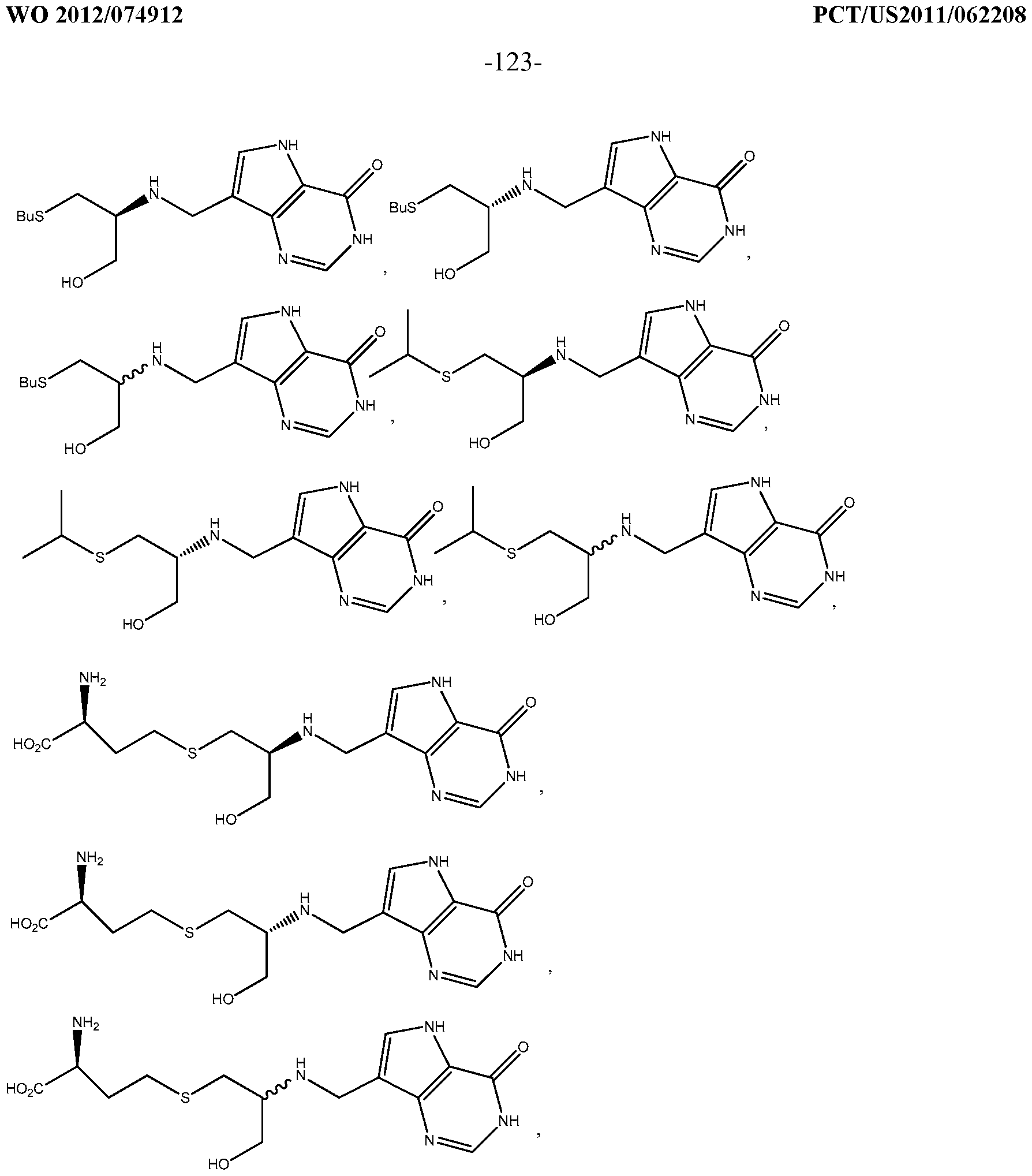
-124-


50. The method of any of Claims 1-7, wherein the MTIP inhibitor comprises a compound having formula (VII):

wherein
X is an alkyl, cycloalkyl, aralkyl, aralkenyl, alkenyl, alkynyl or aryl group, each of which is optionally substituted with one or more substituents selected from the group consisting of hydroxy, alkoxy, cycloalkyl, thiol, alkylthio, arylthio, aralkylthio, halogen, carboxylic acid, carboxylate alkyl ester, nitro, cyano, thiazole and NR2R3 group, where each alkylthio, arylthio and aralkylthio group is optionally substituted with one or more alkyl, halogen, amino, hydroxy, or alkoxy groups; or X is SR1; or X is NR2R3;
R1, R2 and R3 are independently selected from the group consisting of alkyl, alkenyl, alkynyl, aralkyl or aryl, each of which is optionally substituted with one or more substituents selected from the group consisting of hydroxy, alkoxy, thiol, alkylthio, arylthio, aralkylthio, halogen, carboxylic acid, carboxylate alkyl ester, nitro, cyano and NR2R3 group, where each alkylthio, arylthio and aralkylthio group is optionally substituted with one or more alkyl, halogen, amino, hydroxy, or alkoxy groups;
A is N or CH;
B is OH;
D is H, OH, NH2, or SCH3;
provided that X is not CH2Z, where Z is selected from OH, hydrogen, halogen, SQ1, OQ2 and
Q3, where Q1 is an optionally substituted alkyl, aralkyl or aryl group, Q2 is an optionally substituted alkyl group and Q3 is an optionally substituted alkyl group;
or a tautomer thereof, or a pharmaceutically acceptable salt thereof, or an ester prodrug form thereof.
51. The method of Claim 50, wherein the MTIP inhibitor comprises a compound having formula (Vila):

The method of Claim 50, wherein the MTIP inhibitor comprises a compound having

53. The method of any of Claims 50-52, wherein Q1 is an optionally substituted alkyl, aralkyl or aryl group, Q2 is an optionally substituted alkyl group and Q3 is an optionally substituted alkyl group.
54. The method of any of Claims 50-53, wherein A is CH.
55. The method of any of Claims 50-54, wherein D is H.
56. The method of Claim 50, wherein the compound is selected from the group consisting of:
(±)-?ra«s-l-[(9-Deazahypoxanthin-9-yl)methyl]-3-hydroxy-4-phenylpyrrolidine;
(±)-?ra«s-l-[(9-Deazahypoxanthin-9-yl)methyl]-3-hydroxy-4-vinylpyrrolidine;
(±)-?ra«s-l-[(9-Deazahypoxanthin-9-yl)methyl]-4-ethynyl-3-hydroxypyrrolidine;
(±)-?ra«s-4-Allyl-l-[(9-deazahypoxanthin-yl)methyl]-3-hydroxypyrrolidine;
(±)-?ra«s-4-Cyclopropyl-l-[(9-deazahypoxanthin-9-yl)methyl]-3-hydroxypyrrolidine;
(±)-?ra«s-4-Cyclohexyl-l-[(9-deazahypoxanthin-9-yl)methyl]-3-hydroxypyrrolidine;
(±)-?ra«s-4-Cyclohexylmethyl-l-[(9-deazahypoxanthin-9-yl)methyl]-3-hydroxypyrrolidine;
(±)-?ra«s-l-[(9-Deazahypoxanthin-9-yl)methyl]-3-hydroxy-4-(prop-l-en-2-yl)-pyrrolidine;
(±)-?ra«s-4-Butyl-l-[(9-Deazahypoxanthin-9-yl)methyl]-3-hydroxypyrrolidine;
(±)-?ra«s-l-[(9-Deazahypoxanthin-9-yl)methyl]-3-hydroxy-4-(pent-3-yl)-pyrrolidine;
(±)-?ra«s-4-Cyclopentyl-l-[(9-deazahypoxanthin-9-yl)methyl]-3-hydroxypyrrolidine;
(±)-?ra«s-l-[(9-Deazahypoxanthin-9-yl)methyl]-3-hydroxy-4-(lH-l,2,3-triazol-l- yl)pyrrolidine;
(±)-?ra«s-4-(l-Benzyl-lH-l,2,3-triazol-4-yl)-l-[(9-deazahypoxanthin-9-yl)methyl]-3- hydroxypyrrolidine;
(±)-tra«5-4-(3 -Benzylthiopropyl)- 1 -[(9-deazahypoxanthin-9-yl)methyl]-3 - hydroxypyrrolidine;
(±)-cis- 1 - [(9-Deazahypoxanthin-9-yl)methyl]-4-ethyl-3 -hydroxypyrrolidine;
(3R,4S)-l-[(9-Deazahypoxanthin-9-yl)methyl]-3-hydroxy-4-phenylpyrrolidine;
(3R,4S)-l-[(9-Deazahypoxanthin-9-yl)methyl]-3-hydroxy-4-vinylpyrrolidine;
(3R,4S)-l-[(9-Deazahypoxanthin-9-yl)methyl]-4-ethynyl-3-hydroxy -pyrrolidine;
(3R,4S)-4-Allyl-l-[(9-deazahypoxanthin-9-yl)methyl]-3 -hydroxypyrrolidine;
(3R,4S)-4-Cyclopropyl-l-[(9-deazahypoxanthin-9-yl)methyl]-3-hydroxypyrrolidine;
(3R,4S)-4-Cyclohexyl-l-[(9-deazahypoxanthin-9-yl)methyl]-3-hydroxypyrrolidine;
(3R,4S)-l-[(9-Deazahypoxanthin-9-yl)methyl]-3-hydroxy-4-(prop-l-en-2-yl)-pyrrolidine;
(3R,4S)-l-[(9-Deazahypoxanthin-9-yl)methyl]-3-hydroxy-4-(pent-3-yl)-pyrrolidine;
(3R,4S)-4-Cyclopentyl-l-[(9-deazahypoxanthin-9-yl)methyl]-3-hydroxypyrrolidine;
(3S,4S)-l-[(9-Deazahypoxanthin-9-yl)methyl]-3-hydroxy-4-(lH-l,2,3-triazol-l- yl)pyrrolidine;
(3R,4R)-4-( 1 -Benzyl- 1H- 1 ,2,3 -triazol-4-yl)- 1 - [(9-deazahypoxanthin-9-yl)methyl] -3 - hydroxypyrrolidine;
(±)-?ra«s-l-[(9-Deazahypoxanthin-9-yl)methyl]-3-hydroxy-4-(2-methylpropyl)pyrrolidine; (±)-?ra«s-4-Butyl-l-[(9-deazahypoxanthin-9-yl)methyl]-3-hydroxypyrrolidine;
(±)-?ra«s-l-[(9-Deazahypoxanthin-9-yl)methyl]-3-hydroxy-4-(thiazol-2-yl)- pyrrolidine; (3R,4S)-l-[(9-Deazahypoxanthin-9-yl)methyl]-3-hydroxy-4-(thiazol-2-yl)- pyrrolidine; (±)-?ra«s-l-[(9-Deazahypoxanthin-9-yl)methyl]-3-hydroxy-4-(tetrazol-5-yl)- pyrrolidine; (3R,4R)-l-[(9-Deazahypoxanthin-9-yl)methyl]-3-hydroxy-4-(tetrazol-5-yl)- pyrrolidine; and (3S,4R)-l-[(9-Deaza-adenin-9-yl)methyl]-4-ethyl-3-hydroxypyrrolidine;
or a tautomer thereof, or a pharmaceutically acceptable salt thereof, or an ester thereof.
57. The method of any of Claims 1-56, wherein the sub-growth inhibiting amount of the MTIP inhibitor inhibits quorum sensing in the bacteria.
58. A pharmaceutical composition or an agrochemical composition comprising a sub- bacterial-growth inhibiting amount of a 5'-methylthioinosine phosphorylase (MTIP) inhibitor and a pharmaceutically acceptable carrier or an agrochemically acceptable carrier.
59. The pharmaceutical composition of Claim 58, wherein the sub-bacterial-growth inhibiting amount of the MTAN inhibitor inhibits quorum sensing in bacteria.
60. The pharmaceutical composition of Claim 58 or 59, wherein the bacteria is
Pseudomonas aeruginosa, Pseudomonas syringae or Xanthomonas campestris.
61. The pharmaceutical composition of any one of Claims 58-60, wherein the
pharmaceutical composition is formulated in dosage form.
62. A method for determining whether or not a compound is a candidate for treating an infection caused by bacteria that use 5'-methylthioinosine phosphorylase (MTIP) in a quorum sensing pathway, the method comprising determining whether or not the compound inhibits MTIP, wherein a compound that inhibits MTIP is a candidate for treating an infection caused by bacteria that use MTIP in a quorum sensing pathway and wherein a compound that does not inhibit MTIP is not a candidate for treating an infection caused by bacteria that use MTIP in a quorum sensing pathway.
63. The method of Claim 62, wherein the bacteria is Pseudomonas aeruginosa,
Pseudomonas syringae ox Xanthomonas campestris.
64. The method of any of Claims 1-57 or 62-63, or the composition of any of Claims 58- 61, wherein the MTIP inhibitor has an IC50 value less than 50 nanomolar for MTIP.
65. The method of any of Claims 1-57 or 62-64, or the composition of any of Claims 58- 61 or 64, wherein the MTIP inhibitor has an IC50 value greater than or equal to 50 nanomolar for human purine nucleoside phosphorylase (PNP).
66. The method of any of Claims 1-57 or 62-65, or the composition of any of Claims 58- 61 or 64-65, wherein the MTIP inhibitor has an IC50 value greater than or equal to 50 nanomolar for 5'-methylthioadenosine nucleosidase (MTAN).
67. The method of any of Claims 1-57 or 62-66, or the composition of any of Claims 58- 61 or 64-66, wherein the MTIP inhibitor has an IC50 value greater than or equal to 50 nanomolar for 5'-methylthioadenosine phosphorylase (MTAP).
68. A compound having the formula:

wherein A is CH or N; B is OH; D is chosen from H, OH, NH2, or SCH3; X is OH; Y is H; and Z is Q, where Q is a methyl group which is substituted with one or more substituents selected from the group consisting of methoxy, amino and carboxy, or Q is an optionally substituted, alkenyl, aralkyl, aralkenyl, aryl group or C2-C10 alkyl group, each of which is optionally substituted with one or more substituents selected from hydroxy, halogen, methoxy, amino, carboxy, or straight- or branched-chain Ci-Ce alkyl; or a tautomer thereof; or a pharmaceutically acceptable salt thereof; or an ester thereof.
69. The compound of Claim 68, wherein A is CH.
70. The compound of Claim 69 or 70, wherein D is H.
71. A compound selected from the group consisting of :

or a tautomer thereof; or a pharmaceutically acceptable salt thereof; or an ester thereof.
72. A compound selected from the group consisting of:
-133-

PCT/US2011/062208


-136-


or a tautomer thereof; or a pharmaceutically acceptable salt thereof; or an ester thereof.
74. A pharmaceutical composition or an agrochemical composition comprising the compound of any of Claims 68-73 and a pharmaceutically or an agrochemically acceptable carrier.
75. The composition of any of Claims 58-61 or 74, comprising 5'-methylthioinosine and/or 5'-methylthioadenosine.
76. The method of any of Claims 1-57, comprising coadministering the 5'- methylthioinosine phosphorylase (MTIP) inhibitor with 5 '-methyhhioinosine and/or 5'- methylthioadenosine.
Priority Applications (1)
| Application Number | Priority Date | Filing Date | Title |
|---|---|---|---|
| US13/884,298 US9290501B2 (en) | 2010-11-29 | 2011-11-28 | Methods, assays and compounds for treating bacterial infections by inhibiting methylthioinosine phosphorylase |
Applications Claiming Priority (2)
| Application Number | Priority Date | Filing Date | Title |
|---|---|---|---|
| US45866010P | 2010-11-29 | 2010-11-29 | |
| US61/458,660 | 2010-11-29 |
Publications (1)
| Publication Number | Publication Date |
|---|---|
| WO2012074912A1 true WO2012074912A1 (en) | 2012-06-07 |
Family
ID=46172230
Family Applications (1)
| Application Number | Title | Priority Date | Filing Date |
|---|---|---|---|
| PCT/US2011/062208 Ceased WO2012074912A1 (en) | 2010-11-29 | 2011-11-28 | Methods, assays and compounds for treating bacterial infections by inhibiting methylthioinosine phosphorylase |
Country Status (2)
| Country | Link |
|---|---|
| US (1) | US9290501B2 (en) |
| WO (1) | WO2012074912A1 (en) |
Cited By (3)
| Publication number | Priority date | Publication date | Assignee | Title |
|---|---|---|---|---|
| EP2913333A1 (en) * | 2014-02-27 | 2015-09-02 | Laboratoire Biodim | 3H-thieno[3,4]pyrimidin-4-one and pyrrolopyrimidone as gram-positive antibacterial agents |
| WO2019129025A1 (en) * | 2017-12-26 | 2019-07-04 | 迈第康(上海)生物医药科技有限公司 | Tetrahydropyrrole compound, preparation method therefor, pharmaceutical composition containing same, and use thereof |
| WO2023022216A1 (en) | 2021-08-20 | 2023-02-23 | 塩野義製薬株式会社 | Nucleoside derivatives and prodrugs thereof having viral growth inhibitory action |
Families Citing this family (2)
| Publication number | Priority date | Publication date | Assignee | Title |
|---|---|---|---|---|
| JP6063571B2 (en) | 2012-08-07 | 2017-01-18 | アルバート アインシュタイン カレッジ オブ メディシン,インコーポレイティド | Treatment of Helicobacter pylori infection |
| HK1232071A1 (en) | 2014-02-12 | 2018-01-05 | Albert Einstein College Of Medicine, Inc. | Treatment of h. pylori infections using mtan inhibitors |
Citations (5)
| Publication number | Priority date | Publication date | Assignee | Title |
|---|---|---|---|---|
| US5985848A (en) * | 1997-10-14 | 1999-11-16 | Albert Einstein College Of Medicine Of Yeshiva University | Inhibitors of nucleoside metabolism |
| US6562785B1 (en) * | 1999-03-23 | 2003-05-13 | Howard M. Shapiro | Method for overcoming bacterial antibiotic resistance |
| WO2008030119A1 (en) * | 2006-09-07 | 2008-03-13 | Industrial Research Limited | Acyclic amine inhibitors of nucleoside phosphorylases and hydrolases |
| US20080070860A1 (en) * | 2005-02-04 | 2008-03-20 | Uti Limited Partnership | Adenosine Analogs Useful as Anti-Bacterial and Anti Protozoan Agents |
| US7553839B2 (en) * | 2002-08-21 | 2009-06-30 | Industrial Research Limited | 5h-pyrrolo[3,2-D] pyrimidine inhibitors of nucleoside phosphorylases and nucleosidases |
Family Cites Families (16)
| Publication number | Priority date | Publication date | Assignee | Title |
|---|---|---|---|---|
| SI1165564T1 (en) | 1999-04-08 | 2009-08-31 | Ind Res Ltd | Process for preparing inhibitors of nucleoside metabolism |
| US7109331B2 (en) | 2000-08-29 | 2006-09-19 | Industrial Research Limited | 5H-pyrrolo[3,2-d]pyrimidine nucleoside metabolism inhibitors |
| US7098334B2 (en) | 2002-03-25 | 2006-08-29 | Industrial Research Limited | 4-amino-5H-pyrrolo[3,2-d]pyrimidine inhibitors of nucleoside phosphorylases and nucleosidases |
| NZ523970A (en) | 2003-02-04 | 2005-02-25 | Ind Res Ltd | Process for preparing inhibitors of nucleoside phoshorylases and nucleosidases |
| NZ533360A (en) | 2004-06-04 | 2007-02-23 | Ind Res Ltd | Improved method for preparing 3-hydroxy-4-hydroxymethyl-pyrrolidine compounds |
| NZ540160A (en) | 2005-05-20 | 2008-03-28 | Einstein Coll Med | Inhibitors of nucleoside phosphorylases |
| US8541567B2 (en) | 2005-07-27 | 2013-09-24 | Albert Einstein College Of Medicine Of Yeshiva University | Transition state structure of 5′-methylthioadenosine/s-adenosylhomocysteine nucleosidases |
| NZ544187A (en) | 2005-12-15 | 2008-07-31 | Ind Res Ltd | Deazapurine analogs of 1'-aza-l-nucleosides |
| JP2009528996A (en) | 2006-02-24 | 2009-08-13 | インダストリアル リサーチ リミテッド | Methods for treating diseases using nucleoside phosphorylases and inhibitors of nucleosidases |
| JP2009527550A (en) | 2006-02-24 | 2009-07-30 | アルバート アインシュタイン カレッジ オブ メディシン オブ イエシバ ユニバーシティ | How to treat cancer |
| CA2662626C (en) | 2006-09-07 | 2016-07-26 | Industrial Research Limited | Acyclic amine inhibitors of 5'-methylthioadenosine phosphorylase and nucleosidase |
| EP2066671A1 (en) | 2006-09-26 | 2009-06-10 | Albert Einstein College Of Medicine Of Yeshiva University | Transition state structure of human 5'-methylthioadenosine phosphorylase |
| WO2008079028A1 (en) | 2006-12-22 | 2008-07-03 | Industrial Research Limited | Azetidine analogues of nucleosidase and phosphorylase inhibitors |
| WO2009082247A1 (en) * | 2007-12-21 | 2009-07-02 | Industrial Research Limited | Process for preparing immucillins having a methylene link |
| US20110190265A1 (en) | 2008-09-22 | 2011-08-04 | Schramm Vern L | Methods and compositions for treating bacterial infections by inhibiting quorum sensing |
| EP2454263B1 (en) | 2009-07-17 | 2018-06-13 | Albert Einstein College of Medicine, Inc. | 3-hydroxypyrrolidine inhibitors of 5'-methylthioadenosine phosphorylase and nucleosidase |
-
2011
- 2011-11-28 US US13/884,298 patent/US9290501B2/en active Active
- 2011-11-28 WO PCT/US2011/062208 patent/WO2012074912A1/en not_active Ceased
Patent Citations (5)
| Publication number | Priority date | Publication date | Assignee | Title |
|---|---|---|---|---|
| US5985848A (en) * | 1997-10-14 | 1999-11-16 | Albert Einstein College Of Medicine Of Yeshiva University | Inhibitors of nucleoside metabolism |
| US6562785B1 (en) * | 1999-03-23 | 2003-05-13 | Howard M. Shapiro | Method for overcoming bacterial antibiotic resistance |
| US7553839B2 (en) * | 2002-08-21 | 2009-06-30 | Industrial Research Limited | 5h-pyrrolo[3,2-D] pyrimidine inhibitors of nucleoside phosphorylases and nucleosidases |
| US20080070860A1 (en) * | 2005-02-04 | 2008-03-20 | Uti Limited Partnership | Adenosine Analogs Useful as Anti-Bacterial and Anti Protozoan Agents |
| WO2008030119A1 (en) * | 2006-09-07 | 2008-03-13 | Industrial Research Limited | Acyclic amine inhibitors of nucleoside phosphorylases and hydrolases |
Non-Patent Citations (4)
| Title |
|---|
| DIXON: "Natural products and plant disease resistance", NATURE, vol. 411, 2001, pages 844 * |
| GUAN ET AL.: "Methylthioinosine Phosphorylase from Pseudomonas aeruginosa. Structure and Annotation of a Novel Enzyme in Quorum Sensing", BIOCHEMISTRY, vol. 50, no. 7, 22 February 2011 (2011-02-22), pages 1247 - 1254 * |
| HENTZER ET AL.: "Inhibition of quorum sensing in Pseudomonas aeruginosa biofilm bacteria by a halogenated furanone compound", MICROBIOLOGY, vol. 148, 2002, pages 87 - 102 * |
| TRELLES ET AL.: "Nucleoside synthesis by immobilised bacterial whole cells", JOURNAL OF MOLECULAR CATALYSIS B: ENZYMATIC, vol. 30, 2004, pages 219 - 227 * |
Cited By (5)
| Publication number | Priority date | Publication date | Assignee | Title |
|---|---|---|---|---|
| EP2913333A1 (en) * | 2014-02-27 | 2015-09-02 | Laboratoire Biodim | 3H-thieno[3,4]pyrimidin-4-one and pyrrolopyrimidone as gram-positive antibacterial agents |
| WO2015128334A1 (en) * | 2014-02-27 | 2015-09-03 | Laboratoire Biodim | 3h-thieno[3,4]pyrimidin-4-oneand pyrrolopyrimid-4-one as gram-positive antibacterial agents |
| WO2019129025A1 (en) * | 2017-12-26 | 2019-07-04 | 迈第康(上海)生物医药科技有限公司 | Tetrahydropyrrole compound, preparation method therefor, pharmaceutical composition containing same, and use thereof |
| WO2023022216A1 (en) | 2021-08-20 | 2023-02-23 | 塩野義製薬株式会社 | Nucleoside derivatives and prodrugs thereof having viral growth inhibitory action |
| KR20240050362A (en) | 2021-08-20 | 2024-04-18 | 시오노기 앤드 컴파니, 리미티드 | Nucleoside derivatives and their prodrugs with virus growth inhibition activity |
Also Published As
| Publication number | Publication date |
|---|---|
| US9290501B2 (en) | 2016-03-22 |
| US20130274220A1 (en) | 2013-10-17 |
Similar Documents
| Publication | Publication Date | Title |
|---|---|---|
| WO2010033236A2 (en) | Methods and compositions for treating bacterial infections by inhibiting quorum sensing | |
| Matthews et al. | Cobalamin-dependent and cobamide-dependent methyltransferases | |
| Oikonomakos et al. | N‐acetyl‐β‐D‐glucopyranosylamine: A potent T‐state inhibitor of glycogen phosphorylase. A comparison with α‐D‐glucose | |
| Souness et al. | Proposal for pharmacologically distinct conformers of PDE4 cyclic AMP phosphodiesterases | |
| Rosemeyer | The chemodiversity of purine as a constituent of natural products | |
| Shi et al. | Plasmodium falciparum purine nucleoside phosphorylase: crystal structures, immucillin inhibitors, and dual catalytic function | |
| Verlinde et al. | Selective inhibition of trypanosomal glyceraldehyde-3-phosphate dehydrogenase by protein structure-based design: toward new drugs for the treatment of sleeping sickness | |
| WO2012074912A1 (en) | Methods, assays and compounds for treating bacterial infections by inhibiting methylthioinosine phosphorylase | |
| CA2663562A1 (en) | Transition state structure of human 5'-methylthioadenosine phosphorylase | |
| Tanaka et al. | Crystal structure of S-adenosyl-L-homocysteine hydrolase from the human malaria parasite Plasmodium falciparum | |
| Alexandrova et al. | Synthesis and evaluation of C-5 modified 2′-deoxyuridine monophosphates as inhibitors of M. tuberculosis thymidylate synthase | |
| Boojamra et al. | Synthesis and anti-HIV activity of GS-9148 (2′-Fd4AP), a novel nucleoside phosphonate HIV reverse transcriptase inhibitor | |
| Delbaere et al. | Structure/function studies of phosphoryl transfer by phosphoenolpyruvate carboxykinase | |
| Kyriakis et al. | Probing the β-pocket of the active site of human liver glycogen phosphorylase with 3-(C-β-d-glucopyranosyl)-5-(4-substituted-phenyl)-1, 2, 4-triazole inhibitors | |
| Lakshmanasenthil et al. | α-amylase and α-glucosidase inhibitoryactivity of tetradecanoic acid (TDA) from Sargassum wightii with relevance to type 2 diabetes mellitus | |
| Larson et al. | Structure of Leishmania major methionyl-tRNA synthetase in complex with intermediate products methionyladenylate and pyrophosphate | |
| Zhang et al. | Synthesis of β‐Nicotinamide Riboside Using an Efficient Two‐Step Methodology | |
| Lee et al. | Structural snapshots of MTA/AdoHcy nucleosidase along the reaction coordinate provide insights into enzyme and nucleoside flexibility during catalysis | |
| Pochet et al. | Nucleoside analogues as inhibitors of thymidylate kinases: possible therapeutic applications | |
| Kantsadi et al. | van der Waals interactions govern C-β-D-glucopyranosyl triazoles’ nM inhibitory potency in human liver glycogen phosphorylase | |
| Ullrich et al. | The complex structures of ATP sulfurylase with thiosulfate, ADP and chlorate reveal new insights in inhibitory effects and the catalytic cycle | |
| Marquez et al. | Conformationally restricted nucleosides. The reaction of adenosine deaminase with substrates built on a bicyclo [3.1. 0] hexane template | |
| Zang et al. | Identification of a subversive substrate of Trichomonas vaginalis purine nucleoside phosphorylase and the crystal structure of the enzyme-substrate complex | |
| US9522159B2 (en) | Treatment and prevention of P. aeruginosa infections using coformycin analogs | |
| Corrales et al. | Mycobacterium tuberculosis S-adenosyl-l-homocysteine hydrolase is negatively regulated by Ser/Thr phosphorylation |
Legal Events
| Date | Code | Title | Description |
|---|---|---|---|
| 121 | Ep: the epo has been informed by wipo that ep was designated in this application |
Ref document number: 11846010 Country of ref document: EP Kind code of ref document: A1 |
|
| NENP | Non-entry into the national phase |
Ref country code: DE |
|
| WWE | Wipo information: entry into national phase |
Ref document number: 13884298 Country of ref document: US |
|
| 122 | Ep: pct application non-entry in european phase |
Ref document number: 11846010 Country of ref document: EP Kind code of ref document: A1 |