WO2012068080A1 - Oil field treatment fluids - Google Patents

Oil field treatment fluids Download PDF

Info

Publication number
WO2012068080A1
WO2012068080A1 PCT/US2011/060748 US2011060748W WO2012068080A1 WO 2012068080 A1 WO2012068080 A1 WO 2012068080A1 US 2011060748 W US2011060748 W US 2011060748W WO 2012068080 A1 WO2012068080 A1 WO 2012068080A1
Authority
WO
WIPO (PCT)
Prior art keywords
monomer
fluid
polymer
chosen
surfactant
Prior art date
Legal status (The legal status is an assumption and is not a legal conclusion. Google has not performed a legal analysis and makes no representation as to the accuracy of the status listed.)
Ceased
Application number
PCT/US2011/060748
Other languages
French (fr)
Inventor
Satyanarayana D. V. Gupta
Madhukar Chetty
Paul Scott Carman
Current Assignee (The listed assignees may be inaccurate. Google has not performed a legal analysis and makes no representation or warranty as to the accuracy of the list.)
Baker Hughes Holdings LLC
Original Assignee
Baker Hughes Inc
Priority date (The priority date is an assumption and is not a legal conclusion. Google has not performed a legal analysis and makes no representation as to the accuracy of the date listed.)
Filing date
Publication date
Family has litigation
First worldwide family litigation filed litigation Critical https://patents.darts-ip.com/?family=45062973&utm_source=google_patent&utm_medium=platform_link&utm_campaign=public_patent_search&patent=WO2012068080(A1) "Global patent litigation dataset” by Darts-ip is licensed under a Creative Commons Attribution 4.0 International License.
Application filed by Baker Hughes Inc filed Critical Baker Hughes Inc
Priority to CA2812850A priority Critical patent/CA2812850C/en
Priority to BR112013012457-1A priority patent/BR112013012457B1/en
Priority to CN201180055085.8A priority patent/CN103221505B/en
Priority to AU2011329089A priority patent/AU2011329089A1/en
Priority to MX2013004418A priority patent/MX2013004418A/en
Priority to RU2013127675/04A priority patent/RU2013127675A/en
Publication of WO2012068080A1 publication Critical patent/WO2012068080A1/en
Anticipated expiration legal-status Critical
Ceased legal-status Critical Current

Links

Classifications

    • CCHEMISTRY; METALLURGY
    • C09DYES; PAINTS; POLISHES; NATURAL RESINS; ADHESIVES; COMPOSITIONS NOT OTHERWISE PROVIDED FOR; APPLICATIONS OF MATERIALS NOT OTHERWISE PROVIDED FOR
    • C09KMATERIALS FOR MISCELLANEOUS APPLICATIONS, NOT PROVIDED FOR ELSEWHERE
    • C09K8/00Compositions for drilling of boreholes or wells; Compositions for treating boreholes or wells, e.g. for completion or for remedial operations
    • C09K8/02Well-drilling compositions
    • C09K8/03Specific additives for general use in well-drilling compositions
    • C09K8/035Organic additives
    • CCHEMISTRY; METALLURGY
    • C09DYES; PAINTS; POLISHES; NATURAL RESINS; ADHESIVES; COMPOSITIONS NOT OTHERWISE PROVIDED FOR; APPLICATIONS OF MATERIALS NOT OTHERWISE PROVIDED FOR
    • C09KMATERIALS FOR MISCELLANEOUS APPLICATIONS, NOT PROVIDED FOR ELSEWHERE
    • C09K8/00Compositions for drilling of boreholes or wells; Compositions for treating boreholes or wells, e.g. for completion or for remedial operations
    • C09K8/60Compositions for stimulating production by acting on the underground formation
    • C09K8/62Compositions for forming crevices or fractures
    • C09K8/66Compositions based on water or polar solvents
    • C09K8/68Compositions based on water or polar solvents containing organic compounds

Definitions

  • the present disclosure relates generally to a well bore servicing fluid, and more particularly to the viscosification of a well bore servicing fluid using polymers comprising betaine units,
  • TDS total dissolved solids
  • Many conventional viscosifying polymers including polyacrylamide based slick water fracturing polymers, do not function well in such high salinity waters, especially in the presence of metals, such as iron, which are often present in produced water.
  • many surfactants commonly used in well servicing fluids have reduced solubility in produced water due to the high TDS content. Reduced solubility of the surfactants can increase mixing times and/or reduce the viscosifying effect of the viscosifying polymers in the produced water.
  • the zwitterionic polymer is prepared by polymerization of at least one monomer, A , comprising a betaine group and optionally one or more nonionic monomers, B a .
  • the brines used in the examples of the '530 application were stock completion brines, which are high purity brines and mixtures without significant amounts of contaminants such as iron, barium, strontium, sulfates and other contaminants that are often contained in produced water.
  • the zwitterionic polymers of the '530 Application may be mixed with brines using a batch mixing process.
  • the brines can be mixed at high shear with a surfactant, such as ammonium salts of polyarylphenyl ether sulfate in a batch process for about 15 minutes until a desired viscosity of the fluid is reached.
  • a surfactant such as ammonium salts of polyarylphenyl ether sulfate
  • On-the-fly processes generally involve mixing components, such as the viscosifying polymer, for a relatively short period of time compared to batch mixing processes, and then pumping the well fluid downhole.
  • surfactants can he used to allow the viscosifying polymer to mix rapidly and thereby quickly allow the well servicing fluid to reach a suitable viscosity.
  • the ability to mix viscosifying polymers on-the-fly can have certain benefits, including saving timeand/or allowing for reduced mixing equipment size and cost relative to batch mixing processes.
  • the ability to employ viscosifying polymers in either batch or on-the-fly mixing processes also increases process flexibility.
  • An embodiment of the present disclosure is directed to a method comprising: mixing (i) a zwitterionic polymer prepared by inverse emulsion polymerization of at least one monomer Ab comprising a betaine group and optionally one or more nonionic monomers B a , (ii) a surfactant and (iii) produced water to form a well sen' icing fluid.
  • the resulting well servicing fluid is introduced into a hydrocarbon well.
  • Another embodiment of the present disclosure is directed to a method of servicing a hydrocarbon well.
  • the method comprises introducing into a hydrocarbon well a fluid comprising (i) a zwitterionic polymer prepared by inverse emulsion polymerization of at least one monomer A- b comprising a betaine group and optionally one or more nomomc monomers B a , (ii) a surfactant chosen from ammonium C4-C12 alkyl ether sulfates, ammonium C 4 -C 12 alkyl ether sulfonates and ammonium C 4 -Cj 2 alkyl ether phosphates; and (iii) an aqueous based saline solution.
  • FIGS. 1 to 9 illustrate viscosity data for various mixtures, according to
  • the present disclosure is directed to a servicing fluid for use in a natural gas or oil field well bore
  • the servicing fluid includes a zwitterionic polymer, a surfactant and produced water.
  • the servicing fluid includes a zwitterionic polymer; a surfactant chosen from ammonium C 4 -C 12 alkyl ether sulfates, ammonium C -C 12 alkyl ether sulfonates and ammonium C -C 12 alkyl ether phosphates; and an aqueous based saline solution.
  • the zvvitterionic polymer is prepared by polymerization of at least one monomer, A f disturb comprising a betaine group and optionally one or more nonionic monomers, B a .
  • the monomer, Aj can be chosen from at least one of the following monomers:
  • dialkylammonioalkoxyalkyl acrylates dialkylammonioalkoxyalkyl methacrylates, dialkylammonioalkoxyalkyl acrylamides, and dialkylammonioalkoxyalkyl
  • methacrylamides such as:
  • sulphobetaines derived from vinyl substituted pyridines such as 2-vmylpyridine and 4-vinylpyridine, examples of which include:
  • SPV Raschig
  • suiphobetaines derived from imidazoles such as:
  • the substituents can be chosen from any suitable groups that will not be significantly detrimental to a desired function of these compounds, such as the ability to provide viscosification of a well bore servicing fluid.
  • the substituents can be bonded to, for example, the cyclic moieties and/or linear carbon chain moieties of the compounds, Examples of suitable substituents can include hydroxy! groups, such as in formulae 4, 8 and 10 above, as well as Ci to Ce alkyl groups,
  • the betaines can be monomers of formula 24: or of formula 25:
  • R is hydrogen or methyl
  • R ⁇ " and R ⁇ which are identical or different, are hydrogen or alkyls having from 1 to 6 carbon atoms,
  • Y] is -O- or R '-2
  • n 1-6.
  • the monomer A can be chosen from
  • SPE sulphopropyldimethylammonioetbyl methacrylate
  • sulphoethyldimethylarnmonioethyl methacrylate sulphobutyldimethylammonioethyl methacrylate, sulphohydroxypi pyldimethylammonioethyl methacrylate (SHPE), sulphopropyldimethylammoniopropylacrylamide,
  • SPP sulphopropyldimethylammoniopropylmethacrylamide
  • SPDA sulphopropy!dimethylammonioethyl acrylate
  • sulphopropyldiethy!ammonioethoxyethy! methacrylate 2 -vinyl- 1 -(3- sulphopropyl)pyridinium betaine, 4-vinyl- 1 -(3-sulphopropyl)pyridinium betaine, 1 -vinyl- 3 ⁇ (3-sulphopropy])imidazolium betaine, sulphopropylmethyidiallyiammonnim betaine.
  • monomer Ab corresponds to one of the following formulae :
  • hydrophilic nonionic monomer B a can be chosen to be one or more of:
  • hydroxyethyl acrylate hydroxyethyl methaerylate, hydroxypropyl aery late and hydroxypropyl methaerylate, aerylamide (AM), methacrylamide, N-methylolacrylamide, dimethylacrylamide, dimethylmethacrylamide, polyethylene oxide, polypropylene oxide, polyethylene/polypropylene oxide copolymers (which can be any suitable type of copolymer, such as block or random copolymers), -methacr iates, vinyl alcohol or vinylpyrrolidone .
  • AM aerylamide
  • the hydrophilic nonionic monomer B a is aerylamide (AM) and/or monomer A3 ⁇ 4 includes one or both of sulphopropyldimethylammonioethyl methaerylate (SPE) and sulphopropyldimethylammoniopropylmethacrylamide (SPP).
  • the hydrophilic nonionic monomer B a is aerylamide (AM) and the monomer A[, is SPP.
  • the polymers are thus prepared by an inverse polymerization process which comprises the following stages: al) preparation of the in verse emulsion, and al)
  • stage al is carried out by emulsification of a mixture comprising the aqueous phase comprising the monomers, the exteraal phase and at least one emulsifying agent.
  • the polymerization is carried out by bringing together the monomers A t - and optionally the monomers B a with an initiator compound that can generate free radicals.
  • the temperature employed for the polymerization can be any suitable
  • the temperature can range from about ambient temperature to about 75°C, depending on the initiating system chosen,
  • any suitable concentration of monomers can be employed in the polymerization process.
  • the molar ratio of the monomers Ab to the monomers B a ranges from about 4:96 to about 40:60, such as from about 7:93 to about 30:70.
  • any suitable inert hydrophobic liquid can be employed.
  • suitable hydrophobic liquids can include aliphatic and aromatic
  • hydrocarbons and halocarbons such as toluene, xylene, o-dichiorobenzene,
  • perchloroethvlene iiexane, heptane, kerosene, a mineral oil and Isopar M (a substance of isoparaffin type of high purity sold by Exxon Corporation).
  • any suitable water-in-oil emulsifying agent such as hexadecyl sodium phthalate, sorbitan monooleate, sorbitan monostearate, mono- and digiycerides, poiyethoxyiated sorbitol hexaoleate, octyl sodium phthalate or stearyl sodium phthalate.
  • the emulsifying agent is sorbita monooleate.
  • Example concentrations of the emulsifying agent can range from about 0.5% to about 10%, such as from about 1% to abou t 5%), by weight of the emulsion.
  • the ratio of the aqueous phase to the external phase can vary within wide limits.
  • the water-in-oil emulsion can comprise from about 20% to about 80% of aqueous phase and thus from about 80% to about 20% of oil phase, these percentages being based on the total weight of the water-in-oil emulsion.
  • a rati o of the aqueous phase to the oil phase is about 70% to about 75% aqueous phase to about 30% to about 25% oil phase, where percentages are based on the total weight of the water-in-oil emulsion.
  • the polymerization is initiated by means of a chemical initiator comprising free radicals.
  • This initiator can be dissolved either in the oil phase or in the aqueous phase, according to its solubility characteristics.
  • water- soluble initiators can include 4,4'-azobis[4-cyanovaleric acid] (abbreviated to ACVA), potassium persulphate ( 2 S 2 0 8 ) and t-butyl hydroperoxide.
  • Use may also be made of water-soluble initiators of redox type, such as bromate/bi sulphite or metabisulphite (for example, KBr0 3 /NaHS0 3 or KBr0 3 /NaS 2 0 5 ) or persulphate/bisulphite initiators.
  • redox type such as bromate/bi sulphite or metabisulphite (for example, KBr0 3 /NaHS0 3 or KBr0 3 /NaS 2 0 5 ) or persulphate/bisulphite initiators.
  • oil-soluble initiators examples include azobisisobutyronitrile (A1BN) and 2,2 - azobis(2,4-dimethylvaleronitrile) (ADVN).
  • the proportion of chemical initiator used depends on several factors. For instance, if it is necessary to maintain a desired reaction rate, the proportion of initiator can be increased as the reaction temperature falls. By adjusting the reaction temperature and the proportion of initiator, it may be possible to carry out the polymerization in a reasonable time and with a reasonabl e conversion of monomer to polymer, retaining the ad vantages of a polymerization at low temperatures.
  • the water-soluble zwitterionic polymers of the present invention can be used as viscosifying agents for aqueous solutions over a wide range of salinity and of temperature and as agent for modifying surfaces of particles in aqueous suspensions.
  • the polymer can be provided in any practical form.
  • the polymer can be provided in a dry solid form or in a vectorized form, such as in a solution, an emulsion or a suspension.
  • the polymer is provided in the form of an aqueous solution, in an example, the aqueous solution can comprise from about 5 to about 50% by weight, such as from about 10 to about 30% by weight, of the polymer.
  • the present disclosure also relates to compositions comprising the polymer.
  • the polymer can help to increase the viscosity of the compositions.
  • the polymer can be in the form of an aqueous composition comprising the inverse emulsion with the aqueous phase comprising the polymer dispersed in the form of droplets in a hydrophobic external phase and other ingredients chosen from a surfactant, an organic salt, an inorganic salt, a detergent and a thickener.
  • the aqueous composition can additionally comprise ionic entities, such as inorganic salts or organic salts, such as acid salts, it being possible for the salts to exhibit a surface-active or non-surface-active nature.
  • the composition can be a "saline" composition.
  • the polymer can make it possible to increase the viscosity of compositions comprising ions, such as saline compositions, and in particular, of compositions of relatively high ionic strength.
  • the polymer ca make it possible to increase the viscosity of compositions comprising relatively large amounts of salts, such as compositions based on seawater or on brines, including produced water.
  • the ionic strength of the composition can range from low to high, depending on the application. It has been found that the polymer can be effective as thickening agent at a zero or low ionic strength and that it can, surprisingly, remain effective at a high ionic strength.
  • the ionic strength can, for example, be at least about 0.7 mol/1 or at least about 1 mol/1, or even greater than 2 mol/1, after saturation of the salt or mixture of salts.
  • the composition can comprise at least 25 g/1 of a salt (1 1 pounds per gallon density), such as, for example, about 35 g/1 of a salt or more.
  • Suitable salts include monovalent, divalent and polyvalent salts.
  • the salts can include a cation selected from alkali metal, alkaline earth metal, ammonium, manganese, and zinc cations, and an anion selected from halides, oxides, carbonates, nitrates, sulfates, acetates and formate anions.
  • the salt can be potassium chloride, sodium chloride, sodium bromide, calcium chloride, calcium bromide, zinc bromide, zinc formate, zinc oxide and mixtures of these salts.
  • the composition can be formed of seawater or a brine comprising the polymer, in an embodiment, the composition is a brine comprising divalent ions, such as those ions formed from the disassociation of alkaline earth metal salts, such as salts of calcium or magnesium, including CaCl 2 , CaBr 2 , gCl 2 or gBr 2 ; or other divalent ion forming salts, such as salts of zinc (e.g., ZnCl 2 or ZnBr 2 ).
  • the concentration of the divalent ions in the brine can vary.
  • the brine can comprise divalent salts in an amount greater than about 25 % by weight of the total salts in the brine.
  • the composition can comprise produced water.
  • the produced water can have a relatively high total dissolved solids ("TDS") content.
  • TDS content can range from about 50,000 mg/L up to saturation, such as about 100,000 mg/L to about 300,000 mg/L, based on the total volume of the composition.
  • the elements contained in the produced water can vary significantly depending on the source of the water.
  • the produced water can comprise at least one of calcium, potassium, iron, magnesium, strontium, sodium , sulfate and chloride.
  • suitable dissolved calcium concentrations can range from about 5000 mg/L to saturation, such as about 10,000 or 15,000 mg/L to about 50,000 mg/L.
  • suitable dissolved potassium concentrations can range from about 1000 mg/L to saturation, such as about 2000 or 3000 mg/L. to about 10,000 mg/L.
  • suitable dissolved iron concentrations can range from about 2 mg/L. to saturation, such as about 5 or 10 mg/L to about 100 mg/L.
  • concentrations can range from about 5 mg/L to saturation, such as about 100 or 1000 mg/L to about 2500 mg/L.
  • suitable dissolved strontium concentrations can range from about 5 mg/L to saturation, such as about 100 or 1000 mg/L to about 2500 mg/L.
  • suitable dissol ved sodium concentrations can range from about 10,000 mg/L to saturation, such as about 25,000 or 50,000 mg/L to about 100,000 mg/L.
  • suitable dissol ved sulfate concentrations can range from about 100 mg/L to about 50,000 mg/L, or up to saturation.
  • suitable dissolved chloride concentrations can range from about 10,000 mg/L to saturation, such as about 50,000 or 100,000 mg/L to about 300,000 mg/L.
  • produced water can include a variety of other species.
  • examples of such species include barium, boron, copper, manganese, molybdenum, phosphorus, silica, zinc, aluminum, carbonate, and bicarbonate.
  • the well servicing fluid composition can comprise any suitable amount of produced water.
  • the produced water can be 50% by weight or more of the well servicing fluid.
  • the produced water can range from about 75% to about 99.9% by wei ght of the composition.
  • the well servicing fluid comprises at least one surfactant. Any suitable surfactant that is soluble in the brine or produced water can be employed.
  • surfactants include ammonium organosulfates, such as ammonium C4-C12 alkyl ether sulfates; ammonium organosulftmates, such as ammonium C 4 -C 12 aikyi ether sulfonates: and ammonium organophosphates, such as ammonium C 4 -Cj 2 alkyl ether phosphates.
  • the surfactant is an ammonium Cg-Cuj alkyl ether sulfate.
  • a suitable ammonium Cg-Ci alkyl ether sulfate is RHQDAPEX®
  • CD 128/1 available from Rhodia with headquarters in Cranbury, New Jersey,
  • the above surfactants can be employed at any suitable concentration that will result in a desired viscosity.
  • suitable concentrations can range from about 0.5 gallon per thousand (“gpt") or more, such as about 1 gpt to about 20 gpt, or about 2 gpt to about 8 gpt.
  • mixing times can be reduced sufficiently to allow for on-the-fly mixing. Examples of suitable mixing times can range from about 1 to about 2 minutes or less. Of course, longer mixing times can be employed if desired.
  • the short mixing times can allow the well servicing fluids of the present application to reach a desired viscosity relatively quickly, such as, for example, within the mixing time of 1 to 2 minutes or less.
  • surfactants that are soluble in the brine or produced water used in the well servicing fluid can also be em loyed in addition to or as an alternative to those listed above, including surfactants employed during the preparation of the polymer.
  • surfactants employed during the preparation of the polymer can be employed in, for example, batch mixing processes.
  • examples of such surfactants are the ammonium salts of polyarylphenyl ether sulfate, such as the ammonium salt of tristyrylphenol ethoxylate sulfate, which is sold under the tradename SOPROPHO 4 D 384, by RHODIA.
  • Surfactants other than ammonium based salts can also be employed.
  • all or a portion of the surfactant can be introduced with the polymer, if a surfactant was used during the preparation of the polymer.
  • surfactant can be added to the composition in addition to the surfactant employed during preparation of the polymer, Alternatively, all of the surfactant can be added separately from the polymer,
  • the total amount of surfactant included in the composition can vary depending upon the use of the composition.
  • the amount can range from the values indicated above to about 20%, by weight, such as from about 5% to about 15% by weight of surfactant with respect to the polymer,
  • the amount by weight of polymer in the compositions can depend on the rheological behavior desired and/or on the thickening strength desired for the
  • the amount by weight can be greater than about 0.01 ) by weight, with respect to the composition, for example greater than about 0.1%) by weight and often greater than or equal to about 0.5% or about 1% by weight.
  • the amount will generally be less than or equal to about 20% by weight, such as about 10% by weight.
  • compositions of the present application can be employed as a well bore servicing fluid for oil wells and natural gas wells, including subsea wells.
  • the zwitterionic polymers and surfactants of the present disclosure are used as viscosifying agents in produced water or other brine formulations employed in well bores of oil and gas wells. Examples of such fluids include: drilling fluids, gravel packing fluids, fracturing fluids, frac packing fluids, completion fluids, and fluids used for completion pills.
  • the present disclosure can be directed to a method of drilling an oil or natural gas well bore in which the fluids of the present application are utilized as a drilling fluid
  • well bore servicing fluids of the present disclosure comprising an aqueous media, such as produced water or other brines, a zwitterionic polymer and a surfactant can be circulated through a well bore as it is drilled into a subterranean formation.
  • the drilling fluid can carry drill cuttings created by the drilling process in a return flow stream back to the w r eil drilling platform.
  • the circulation of the drilling fluid can be terminated after drilling is stopped.
  • a string of pipe such as, for example, an annular pipe casing, can be run into the well bore.
  • the well bore servicing fluid of the present application can then be circulated through the well bore to remove additional drill cuttings.
  • the well bore servicing fluid can be pumped downwardly through the interior of the pipe and upwardly through an annulus, which is located between the exterior of the pipe and the walls of the well bore, to thereby carr the cuttings out of the well bore.
  • the drilling fluid used during the second stage of the process may be different than the drilling fluid used during the drilling stage.
  • the well bore servicing fluids of the present disclosure can be employed during the drilling stage, while a second drilling fluid other than the well bore servicing fluids of the present disclosure can be employed during the second stage, or vice versa,
  • the well bore servicing fluids of the present application can be employed as gravel packing fluids.
  • a well bore servicing fluid comprising an aqueous media, such as produced water or other brines, a zwitterionic polymer and a surfactant can further comprise gravel suspended therein.
  • a permeable screen may be placed against the face of the subterranean formation, followed by pumping the well bore servicing fluid comprising the gravel into the annulus of the well bore such that gravel becomes packed against the exterior of the screen,
  • the w el l bore servicing fluids of the present application can also be employed as fracturing fluids
  • a well bore servicing fluid of the present disclosure comprising a zwitierionic polymer, a surfactant and an aqueous media, suc as produced water or other brines, can be used to fracture a subterranean formation.
  • the well bore servicing fluid is pumped into the well bore at a rate and a pressure sufficient to form fractures that extend into the subterranean formation, providing additional pathways through which fluids being produced can flow into the well bores.
  • the well bore servicing fluid can include a proppant.
  • Well known propants used in fracturing include graded sand, bauxite, or resin coated sand, any of which may be suspended in the fracturing fluid.
  • the proppant becomes deposited into the fractures and thus holds the fractures open after the pressure exerted on the fracturing fluid has been released,
  • compositions of the present disclosure can comprise dispersed liquid particles (emulsified droplets) or dispersed solid particles.
  • Liquid particles can, for example, be synthetic oils (for example silicone oils) or oils of vegetable or mineral origin.
  • the solid particles can in particular be sand, density- modifying particles, debris and/or polymeric particles, The polymer can promote the suspending of these particles during the time necessary for the use of the composition and/ or during a storage time, It can also alternatively contribute to easy transportation of the particles, in order to position them at or to move them to an appropriate spot.
  • the fluids of the present disclosure can include additional ingredients to modify the rheological and chemical properties of the fluid.
  • Clayey material s such as bentonite, attapulgite, sepiolite or other material commonly used in drilling fluids can be included to provide drilling muds to lubricate the drill strings and suspend drill cuttings.
  • the fluids can also include buffering agents or pH control additives. Buffering agents can be used in well bore servicing fluids to maintain the desired pH of the fluid, I f the pH of the well bore servicing fluid becomes too low, severe degradation of the included polymers, such as the viscosifviiig agents, may result.
  • buffering agents include, but are not limited to: sodium phosphate, sodium hydrogen phosphate, boric acid-sodium hydroxide, citric acid-sodium hydroxide, boric acid-borax, sodium bicarbonate, ammonium salts, sodium salts, potassium salts, dibasic phosphate, tribasic phosphate, lime, slaked lime, magnesium oxide, basic magnesium carbonate, calcium oxide and zinc oxide.
  • the temperature and the pressure of the fluid can vary according to the use which is made of the fluid and its environment.
  • the polymer can remain effective over a relatively wide range of temperatures, including under conditions requiring relatively high temperatures, in particular in the fields of oil and/or gas extraction.
  • the composition can have a temperature ranging from about 20°C to relatively high temperatures, such as greater than or equal to 50°C, greater than or equal to 70°C, greater than or equal to 100°C, greater than or equal to 150°C or greater than or equal to 180°C.
  • the pressure can be any suitable pressure, such as, for example, atmospheric pressure or a greater pressure.
  • a reduced specific viscosity can be measured by dissolving the polymer in a 20% by weight aqueous NaCI solution.
  • the intrinsic viscosity ⁇ can then be obtained by linear extrapolation of the reduced specific viscosity to zero concentration of polymer.
  • the slope of this extrapolation is equal to k' n) 2 , k' being the Huggins coefficient.
  • This method of calculating ⁇ is described in detail in the publication Polymer Handbook (4 lh edition), J, Brandmp, E.H. Immergui and E.A.Grulke, Wiley (1999), the description of calculating ⁇ in the Polymer Handbook being hereby incorporated by reference in its entirety.
  • the specific viscosity makes it possible to have indirect access to the molecular weights of greater than approximately 2 000 000, which cannot be directly determined experimentally.
  • the zwitterionic polymers exhibit an intrinsic viscosity of about 600 or greater, such as about 1000 or greater, where the reduced specific viscosity is measured by dissolving the polymer in a 20% by weight aqueous NaCl solution, as described above.
  • the molar mass of the polymer obtained can be conventionally adjusted by modifying the amount of initiator introduced, the reaction temperature or the addition of a transfer agent.
  • concentrations of initiator and the corresponding molar masses, determined by steric exclusion chromatography (+CVG ret) are referenced in Table 1 below:
  • Rhodasurf LA-3 Rhodia
  • Hypermer B261 Uniquema.
  • ⁇ 0 is the viscosity of the solvent and c is the concentration of polymer.
  • the intrinsic viscosity for a polymer chemical composition under given solvent conditions, is related to the molar mass by the Mark-Houwink relationship. See Polymer Handbook (4 ta edition), J. Brandrup, E.H. Immergut and E.A.Grulke, Wiley ( 1999), the description of the Mark-Houwink relationship in the Polymer Handbook being hereby incorporated by reference in its entirety.
  • copolymers described in Examples 1 and 2 are used in the solutions of variable salinities described in Table 4 below.
  • the polymers are purified and dried.
  • the powders obtained are dissolved at 10 g/1 with magnetic stirring.
  • the viscosities are measured 72 h after the preparation of the samples and the values obtained are collated in Table 5 below.
  • Example 2 The polymers of Example 2, synthesized by in verse emulsion polymerization with the composition AM/SPP (90/10), are dispersed directly in the brines.
  • the aged solutions may exhibit solid residues; if appropriate, these solutions are filtered through a 100 ⁇ cloth. The viscosities are then measured at 90°C and the values are collated in Table 7 below.
  • Example 4 The 5% polymer/surfactant blend of Example 4 was then tested at various temperatures (150° F - 350° F) at loadings of 40 gpt to 50 gpt with all three brines (HyCal II (14.2 ppg CaBr 2 ), NoCal II (11.0-12.5 ppg NaBr), and HyCal III (19.2 ppg ZnBr?)).
  • the polymer blend was added to the various brines and allowed to hydrate for 15 minutes.
  • the samples were then tested at the different temperatures using a Chandler 5550 Viscometer, The resulting data for HyCal II, NoCal II and HyCal III is respectively shown in FIGS. 4,5 and 6. From the data it was determined that the brine viseosifier is stable up to about 350° F for 1 hour. All other temperatures showed stability for 3 hours. The data shows that good viscosities were achieved at the various temperatures for all three brines.
  • Rhodapex CD- 1281 and BVP-1 ingredients during mixing was tested for effect on apparent viscosity. The results are shown in FIGS. 1 and 2. The testing for FIG. 1 included the following compositions, with mgredients listed in order of mixing :
  • FIG. 2 included the following compositions, with ingredients listed in order of mixing:
  • Results showed that using the Rhodapex CD- 1281 and BVP-1 combined provided a significant increase in apparent viscosity at room temperature when compared with using the BVP-1 alone.
  • the results also showed that when using either the Bakken or Marcellus water, adding the BVP-1 before adding the Rhodapex CD-I 281 provided a marginal increase in apparent viscosity when compared with the same composition in which the Rhodapex CD 1281 was added before the BVP-1. Examples 8 and 9
  • Ail of the fluids in the examples below were prepared by the following procedure: 250 mi of produced water was added to a 16 oz jar. The jar was placed under an overhead stirrer at 1000 rpm. Once a vortex was established, the concentration of brine viscosifier BVP-1 was added. Then the surfactant Rhodopex CD-I 281 was added. Finally, a breaker was added if necessary. The resulting composition was mixed for 1 minute and then removed from the overhead stirrer for testing. Testing was performed using an OFITE
  • compositions of Examples 8 A, 8B and 8C were heated to 200° F and 250 °F.
  • results at 250°F for compositions 8A to 8C are respectively shown in FIGS. 6-8.
  • the results indicate that the viscosity at temperature can be controlled by varying the amounts of BVP-1 and Rhodapex CD-128L In addition, the viscosity can be broken (reduced) in a controlled fashion by varying the amount of breaker added to the compositions.
  • Example 9 Fluid in Marcellus Produced Water at high temperatures

Landscapes

  • Chemical & Material Sciences (AREA)
  • Life Sciences & Earth Sciences (AREA)
  • General Life Sciences & Earth Sciences (AREA)
  • Engineering & Computer Science (AREA)
  • Materials Engineering (AREA)
  • Organic Chemistry (AREA)
  • Addition Polymer Or Copolymer, Post-Treatments, Or Chemical Modifications (AREA)
  • Polymerisation Methods In General (AREA)
  • Production Of Liquid Hydrocarbon Mixture For Refining Petroleum (AREA)

Abstract

The present disclosure is directed to a method comprising: mixing (i) a zwitterionic polymer prepared by inverse emulsion polymerization of at least one monomer Ab comprising a betaine group and optionally one or more nonionic monomers Ba, (ii) a surfactant and (iii) produced water to form a well servicing fluid. The resulting well servicing fluid is introduced into a hydrocarbon well.

Description

[0001] The present disclosure relates generally to a well bore servicing fluid, and more particularly to the viscosification of a well bore servicing fluid using polymers comprising betaine units,
[0002] In the past, well drilling and development operations have employed large amounts of fresh water. In some areas, obtaining fresh water for these operations has become more expensive and difficult due to water shortages and government regulation. On the other hand, vast amount of produced wa ter can be generated from hydrocarbon wells. Generally, this produced water must be disposed of at a significant cost. Given the volume of fresh water required for well operations, the ability to reclaim and use produced water as a well ser icing fluid could alleviate the impact of well operations on fresh water shortages, reduce environmental concerns of contaminating fresh water reserves, and potential ly lower the cost of w el l servicing operations.
[0003] However, produced water often has high concentrations of total dissolved solids ("TDS"), including high salinity and hardness content. Many conventional viscosifying polymers, including polyacrylamide based slick water fracturing polymers, do not function well in such high salinity waters, especially in the presence of metals, such as iron, which are often present in produced water. Also, many surfactants commonly used in well servicing fluids have reduced solubility in produced water due to the high TDS content. Reduced solubility of the surfactants can increase mixing times and/or reduce the viscosifying effect of the viscosifying polymers in the produced water. It therefore would be an advancement in the art to discover a novel viscosifying system that worked well in produced water, especially in produced water having relatively high TDS content. 10004] The use of polymers comprising betaine units for viscosifying hydrocarbon well fluids was disclosed by D.V. Satyanarayana Gupta et ai, in copending U.S. Patent Application Publication No. 2010/0197530 ("the '530 Application"), published on August 5, 2010, the disclosure of which is hereby incorporated by reference in its entirety. The application discloses a servicing fluid for use in natural gas or oil field wells. The well servicing fluid includes an aqueous brine media and a zwitterionic polymer. The zwitterionic polymer is prepared by polymerization of at least one monomer, A , comprising a betaine group and optionally one or more nonionic monomers, Ba. The brines used in the examples of the '530 application were stock completion brines, which are high purity brines and mixtures without significant amounts of contaminants such as iron, barium, strontium, sulfates and other contaminants that are often contained in produced water.
[0005] The zwitterionic polymers of the '530 Application may be mixed with brines using a batch mixing process. For examples, the brines can be mixed at high shear with a surfactant, such as ammonium salts of polyarylphenyl ether sulfate in a batch process for about 15 minutes until a desired viscosity of the fluid is reached.
[0006] It is well known in the art that well fluid can be mixed "on-the-fly" as it is pumped downhole. On-the-fly processes generally involve mixing components, such as the viscosifying polymer, for a relatively short period of time compared to batch mixing processes, and then pumping the well fluid downhole. In order to mix fluids on the fly, surfactants can he used to allow the viscosifying polymer to mix rapidly and thereby quickly allow the well servicing fluid to reach a suitable viscosity. The ability to mix viscosifying polymers on-the-fly can have certain benefits, including saving timeand/or allowing for reduced mixing equipment size and cost relative to batch mixing processes. The ability to employ viscosifying polymers in either batch or on-the-fly mixing processes also increases process flexibility.
[0007] Accordingly, there exists a need for improved viscosificatioii agents for use as wel l bore-servicing fluids that exhibit one or more of the following properties: reduced mixing time, the ability to allow on-the-fly mixing in high salinity water or produced water, good viscosifying power in produced waters, good rheological stability at increased temperatures in produced waters, good stability at a relatively high ionic strength and/or good stability in a relatively saline medium, such as produced water with high total dissolved solids; good thickening power for media comprising a relatively high ionic strength, such as saline media, including highly saline media, and/or a thickening power at low contents of polymer.
SUMMARY
[0008] An embodiment of the present disclosure is directed to a method comprising: mixing (i) a zwitterionic polymer prepared by inverse emulsion polymerization of at least one monomer Ab comprising a betaine group and optionally one or more nonionic monomers Ba, (ii) a surfactant and (iii) produced water to form a well sen' icing fluid. The resulting well servicing fluid is introduced into a hydrocarbon well. [0009] Another embodiment of the present disclosure is directed to a method of servicing a hydrocarbon well. The method comprises introducing into a hydrocarbon well a fluid comprising (i) a zwitterionic polymer prepared by inverse emulsion polymerization of at least one monomer A-b comprising a betaine group and optionally one or more nomomc monomers Ba, (ii) a surfactant chosen from ammonium C4-C12 alkyl ether sulfates, ammonium C4-C12 alkyl ether sulfonates and ammonium C4-Cj2 alkyl ether phosphates; and (iii) an aqueous based saline solution.
BRIEF DESCRIPTION OF THE DRAWINGS
|0010] FIGS. 1 to 9 illustrate viscosity data for various mixtures, according to
embodiments of the present disclosure.
[0011] While the disclosure is susceptible to various modifications and alternative forms, specific embodiments have been shown by way of example in the drawings and will be described in detail herein. However, it should be understood that the disclosure is not intended to be limited to the particular forms disclosed. Rather, the intention is to cover all modifications, equivalents and alternatives falling within the spirit and scope of the invention as defined by the appended claims.
DETAILED DESCRIPTION
[0012] The present disclosure is directed to a servicing fluid for use in a natural gas or oil field well bore, in an embodiment, the servicing fluid includes a zwitterionic polymer, a surfactant and produced water. In another embodiment, the servicing fluid includes a zwitterionic polymer; a surfactant chosen from ammonium C4-C12 alkyl ether sulfates, ammonium C -C12 alkyl ether sulfonates and ammonium C -C12 alkyl ether phosphates; and an aqueous based saline solution. The zvvitterionic polymer is prepared by polymerization of at least one monomer, Af„ comprising a betaine group and optionally one or more nonionic monomers, Ba.
f 0013] According to the present disclosure, the monomer, Aj,, can be chosen from at least one of the following monomers:
A) substituted or unsubstituted alkylsulphonates or aikyiphosphonates of diaikyiammonioaikyi acrylates, dialkylammonioalkyl methacrylates,
dialkylammonioalkyl aciylamid.es, dialkylammonioalkyl methaci lamides,
dialkylammonioalkoxyalkyl acrylates, dialkylammonioalkoxyalkyl methacrylates, dialkylammonioalkoxyalkyl acrylamides, and dialkylammonioalkoxyalkyl
methacrylamides, such as:
1) suiphopropyldimethylammonioethyi methacrylate, sold by Raschigunder the name SPE (Formula 1):
Figure imgf000006_0001
2) sulphoethyldimethylammonioethyl methacrylate (Formula 2) and sulphobutyldimethyiammonioethyi methacrylate (Formula 3):
Figure imgf000007_0001
the synthesis of which is described in the paper "Sulfobetaine zwitterionomers based on n-buty! acry!ate and 2-ethoxyethyl acryiate: monomer synthesis and copo!ymerization behavior", journal of Polymer Science, 40, 511-523 (2002), the disclosure of which is incorporated herein by reference in its entirety .
3) suiphohydroxypropyldimethylammonioethyl methacrylate (SHPE) (Formula 4):
Figure imgf000007_0002
4) sulphopropyldimethylarnmoniopropylacrylamide (Formula 5):
Figure imgf000007_0003
the synthesis of which is described in the paper "Synthesis and solubility of the poly(suifobetaine)s and the corresponding cationic polymers: 1. Synthesis and characterization of sulfobetaiiies and the corresponding cationic monomers by nuclear magnetic resonance spectra", Wen-Fu Lee and Chan-Chang Tsai, Polymer, 35 (10), 2210-2217 ( 1994), the disclosure of which is incorporated herein by reference in its entirety.
5) sulphopropyldimethylammoniopropylmethacrylamide, sold by Raschig under the name SPP (Formula 6):
Figure imgf000008_0001
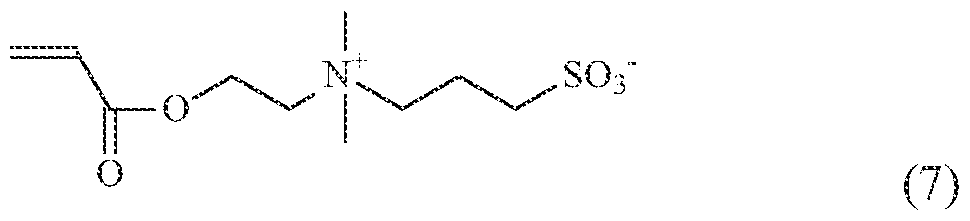
6) suiphopropyldimethylammomoethyi acrylate, sold by Raschig under the name SPDA (Formula. 7):
Figure imgf000008_0002
7) suiphohydroxypropyldimethylammoniopropylmethactylamide ("SHPP") (Formula 8)
Figure imgf000008_0003
8) suiphopropy Idi ethylammoni oethoxy ethyl methacry late
(Formula 9)
Figure imgf000009_0001
the synthesis of which is described in the paper
"Poly(sulphopropyibetaines): 1. Synthesis and characterization", V. M. Monroy Soto and J. C. Galin, Polymer, 1984, Vol. 25, 121-128, the disclosure of which is incorporated herein by reference in its entirety .
9) sulphohydroxypropyidiethylarnnionioethyl methacryiate (Formula 10)
Figure imgf000009_0002
tituted or unsubstituied heterocyclic betaine monomers, such as:
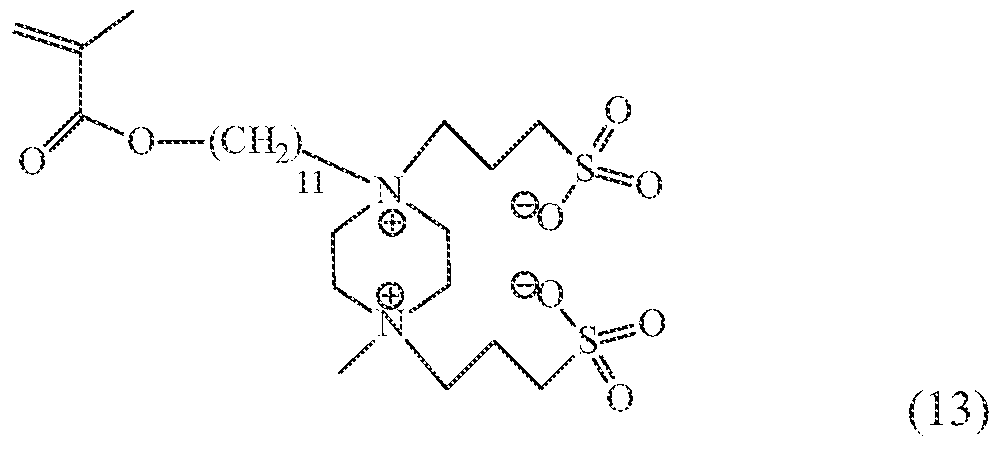
1) sulphobetaines derived from piperazine, examples which include compounds of Formulae 11 , 12 and 13,
Figure imgf000009_0003
Figure imgf000010_0001
the synthesis of which is described in the paper "Hydrophobicaliy Modified Zwitterionic Polymers: Synthesis, Bulk Properties, and
Miscibility with Inorganic Salts", P. Koberle and A. Laschewskv, Macromolecules, 27, 2165-2173 (1994), the disclosure of which is incorporated herein by reference in its entirety.
2) sulphobetaines derived from vinyl substituted pyridines, such as 2-vmylpyridine and 4-vinylpyridine, examples of which include:
a) 2-vmyl-l-(3-sulphopropyl)pyridinium betaine (2SPV or
"SPV") (Formula 14), sold by Raschig under the name SPV:
Figure imgf000010_0002
b) 4-vinyl-l-(3-sulpbopropyl)pyridmium betaine ("48 PV")
(Formula 15),
Figure imgf000011_0001
the synthesis of which is disclosed in the paper "Evidence of ionic aggregates in some ampholytic polymers by transmission electron microscopy", V. M. Castaflo and A. E. Gonzalez, J. Cardoso, O. Manero and V. M. Monroy, J. Mater. Res., 5 (3), 654-657 (1990), the disclosure of which is incorporated herein by reference in its entirety,
3) suiphobetaines derived from imidazoles, such as:
a) 1 -vinyl-3-(3-sulphopropyl)imidazoliurn betaine (Formula 16)
Figure imgf000011_0002
the synthesis of which is described in the paper "Aqueous solution properties of a poly( inyl imidazolium sulphobetaine)", J. C. Salamone, W. Volkson, A.P. Oison, S.C. Israel, Polymer, 19, 1157-1162 (1978), the disclosure of which is incorporated herein by reference in its entirety.
C) substituted or unsubstituted alkylsulphonates or alkylphosphonates of diaikyiammonioalkylallylics, such as: 1) sulphopropylmethyldiallylamn onium betaine (17):
Figure imgf000012_0001
the synthesis of which is described in the paper "New poly(carbobetaine)s made from zvvitterionic dialiylammonium monomers''', Favresse, Philippe; Laschewsky, Andre, Macromolecular Chemistry and Physics, 200(4), 887- 895 ( 1999), the disclosure of which is incorporated herein by reference in its entirety.
D) substituted or unsubstituted alkylsulphonates or alkySphosphonates of dialkylanimonioalkylstyrenes, such as the compounds of formulae 18 and 19:
Figure imgf000012_0002
the synthesis of which is described in the paper "Hydrophobicaliy Modified Zwitteriomc Polymers: Synthesis, Bulk Properties, and Miscibility with Inorganic Salts", P. Koberle and A. Laschewsky, acromolecules, 27, 2165-2173 (1994), the disclosure of which is incorporated herein by reference in its entirety.
E) substituted or unsubstituted betaines resulting from etlivlenically unsaturated anhydrides and dienes, such as the compounds of Formulae 20 and 21 :
C9H1
Figure imgf000013_0001
the synthesis of which is described in the paper "Hydrophobically Modified Zwitterionic Polymers: Synthesis, Bulk Properties, and Miscibility with inorganic Salts", P. Koberle and A. Laschewsky, Macromoleeules, 27, 2165-2173 (1994), the disclosure of which is incorporated herein by reference in its entirety.
F) substituted or unsiibstituted phosphobetames, such as the compounds of formula 22 ("MPC") and formula 23 ("VPC"):
Figure imgf000013_0002
The synthesis of M PC and of VPC is described in EP 810 239 B l (Biocompatibles, Alister et al), the disclosure of which is incorporated herein by reference in its entirety. [0014] in embodiments where the monomers A-0 described above are substituted, the substituents can be chosen from any suitable groups that will not be significantly detrimental to a desired function of these compounds, such as the ability to provide viscosification of a well bore servicing fluid. The substituents can be bonded to, for example, the cyclic moieties and/or linear carbon chain moieties of the compounds, Examples of suitable substituents can include hydroxy! groups, such as in formulae 4, 8 and 10 above, as well as Ci to Ce alkyl groups,
[0015] in an embodiment, the betaines can be monomers of formula 24:
Figure imgf000014_0001
or of formula 25:
Figure imgf000014_0002
in which:
R is hydrogen or methyl,
R~" and R\ which are identical or different, are hydrogen or alkyls having from 1 to 6 carbon atoms,
Y] is -O- or R '-2,
/ ' : IS SO ;'. m is 2 or 3, and
n is 1-6.
|0016] In an embodiment, the monomer A can be chosen from
sulphopropyldimethylammonioetbyl methacrylate (SPE),
sulphoethyldimethylarnmonioethyl methacrylate, sulphobutyldimethylammonioethyl methacrylate, sulphohydroxypi pyldimethylammonioethyl methacrylate (SHPE), sulphopropyldimethylammoniopropylacrylamide,
sulphopropyldimethylammoniopropylmethacrylamide (SPP),
suiphohydroxypropyldimethylaninioniopropylmetliacr}4amide (SHPP),
sulphopropy!dimethylammonioethyl acrylate (SPDA),
sulphopropyldiethy!ammonioethoxyethy! methacrylate, 2 -vinyl- 1 -(3- sulphopropyl)pyridinium betaine, 4-vinyl- 1 -(3-sulphopropyl)pyridinium betaine, 1 -vinyl- 3~(3-sulphopropy])imidazolium betaine, sulphopropylmethyidiallyiammonnim betaine.
[0017] In another exemplary embodiment, monomer Ab corresponds to one of the following formulae :
Figure imgf000015_0001
Figure imgf000016_0001
|0018] The hydrophilic nonionic monomer Ba can be chosen to be one or more of:
hydroxyethyl acrylate, hydroxyethyl methaerylate, hydroxypropyl aery late and hydroxypropyl methaerylate, aerylamide (AM), methacrylamide, N-methylolacrylamide, dimethylacrylamide, dimethylmethacrylamide, polyethylene oxide, polypropylene oxide, polyethylene/polypropylene oxide copolymers (which can be any suitable type of copolymer, such as block or random copolymers), -methacr iates, vinyl alcohol or vinylpyrrolidone .
|0019] In an embodiment, the hydrophilic nonionic monomer Ba is aerylamide (AM) and/or monomer A¾ includes one or both of sulphopropyldimethylammonioethyl methaerylate (SPE) and sulphopropyldimethylammoniopropylmethacrylamide (SPP). In an embodiment, the hydrophilic nonionic monomer Ba is aerylamide (AM) and the monomer A[, is SPP.
|0020] The polymers are thus prepared by an inverse polymerization process which comprises the following stages: al) preparation of the in verse emulsion, and al)
polymerization, In an embodiment, stage al) is carried out by emulsification of a mixture comprising the aqueous phase comprising the monomers, the exteraal phase and at least one emulsifying agent. The polymerization is carried out by bringing together the monomers At- and optionally the monomers Ba with an initiator compound that can generate free radicals.
f 0021] The temperature employed for the polymerization can be any suitable
temperature. For example, the temperature can range from about ambient temperature to about 75°C, depending on the initiating system chosen,
[0022] Any suitable concentration of monomers can be employed in the polymerization process. In an embodiment, the molar ratio of the monomers Ab to the monomers Ba ranges from about 4:96 to about 40:60, such as from about 7:93 to about 30:70.
[0023] As the externa] phase, any suitable inert hydrophobic liquid can be employed. Examples of suitable hydrophobic liquids can include aliphatic and aromatic
hydrocarbons and halocarbons, such as toluene, xylene, o-dichiorobenzene,
perchloroethvlene, iiexane, heptane, kerosene, a mineral oil and Isopar M (a substance of isoparaffin type of high purity sold by Exxon Corporation). Likewise, use may be made of any suitable water-in-oil emulsifying agent, such as hexadecyl sodium phthalate, sorbitan monooleate, sorbitan monostearate, mono- and digiycerides, poiyethoxyiated sorbitol hexaoleate, octyl sodium phthalate or stearyl sodium phthalate. In an
embodiment, the emulsifying agent is sorbita monooleate. Example concentrations of the emulsifying agent can range from about 0.5% to about 10%, such as from about 1% to abou t 5%), by weight of the emulsion.
[0024] The ratio of the aqueous phase to the external phase can vary within wide limits. For example, the water-in-oil emulsion can comprise from about 20% to about 80% of aqueous phase and thus from about 80% to about 20% of oil phase, these percentages being based on the total weight of the water-in-oil emulsion. In an embodiment, a rati o of the aqueous phase to the oil phase is about 70% to about 75% aqueous phase to about 30% to about 25% oil phase, where percentages are based on the total weight of the water-in-oil emulsion.
[0025] As discussed above, the polymerization is initiated by means of a chemical initiator comprising free radicals. This initiator can be dissolved either in the oil phase or in the aqueous phase, according to its solubility characteristics. Examples of water- soluble initiators can include 4,4'-azobis[4-cyanovaleric acid] (abbreviated to ACVA), potassium persulphate ( 2S208) and t-butyl hydroperoxide. Use may also be made of water-soluble initiators of redox type, such as bromate/bi sulphite or metabisulphite (for example, KBr03/NaHS03 or KBr03/NaS205) or persulphate/bisulphite initiators.
Examples of oil-soluble initiators include azobisisobutyronitrile (A1BN) and 2,2 - azobis(2,4-dimethylvaleronitrile) (ADVN).
[0026] The proportion of chemical initiator used depends on several factors. For instance, if it is necessary to maintain a desired reaction rate, the proportion of initiator can be increased as the reaction temperature falls. By adjusting the reaction temperature and the proportion of initiator, it may be possible to carry out the polymerization in a reasonable time and with a reasonabl e conversion of monomer to polymer, retaining the ad vantages of a polymerization at low temperatures.
[0027] The water-soluble zwitterionic polymers of the present invention can be used as viscosifying agents for aqueous solutions over a wide range of salinity and of temperature and as agent for modifying surfaces of particles in aqueous suspensions. For these uses/applications, the polymer can be provided in any practical form. For example, the polymer can be provided in a dry solid form or in a vectorized form, such as in a solution, an emulsion or a suspension. In an embodiment, the polymer is provided in the form of an aqueous solution, in an example, the aqueous solution can comprise from about 5 to about 50% by weight, such as from about 10 to about 30% by weight, of the polymer.
[0028] The present disclosure also relates to compositions comprising the polymer. The polymer can help to increase the viscosity of the compositions. The polymer can be in the form of an aqueous composition comprising the inverse emulsion with the aqueous phase comprising the polymer dispersed in the form of droplets in a hydrophobic external phase and other ingredients chosen from a surfactant, an organic salt, an inorganic salt, a detergent and a thickener.
[0029] The aqueous composition can additionally comprise ionic entities, such as inorganic salts or organic salts, such as acid salts, it being possible for the salts to exhibit a surface-active or non-surface-active nature. The composition can be a "saline" composition. In an embodiment, the polymer can make it possible to increase the viscosity of compositions comprising ions, such as saline compositions, and in particular, of compositions of relatively high ionic strength. For instance, the polymer ca make it possible to increase the viscosity of compositions comprising relatively large amounts of salts, such as compositions based on seawater or on brines, including produced water. [0030] The ionic strength of the composition can range from low to high, depending on the application. It has been found that the polymer can be effective as thickening agent at a zero or low ionic strength and that it can, surprisingly, remain effective at a high ionic strength. The ionic strength can, for example, be at least about 0.7 mol/1 or at least about 1 mol/1, or even greater than 2 mol/1, after saturation of the salt or mixture of salts. In an embodiment, the composition can comprise at least 25 g/1 of a salt (1 1 pounds per gallon density), such as, for example, about 35 g/1 of a salt or more.
[0031] Any suitable salts can be employed in the compositions of the present application. Suitable salts include monovalent, divalent and polyvalent salts. In an embodiment, the salts can include a cation selected from alkali metal, alkaline earth metal, ammonium, manganese, and zinc cations, and an anion selected from halides, oxides, carbonates, nitrates, sulfates, acetates and formate anions. For example, the salt can be potassium chloride, sodium chloride, sodium bromide, calcium chloride, calcium bromide, zinc bromide, zinc formate, zinc oxide and mixtures of these salts.
[0032] in an embodiment, the composition can be formed of seawater or a brine comprising the polymer, in an embodiment, the composition is a brine comprising divalent ions, such as those ions formed from the disassociation of alkaline earth metal salts, such as salts of calcium or magnesium, including CaCl2, CaBr2, gCl2 or gBr2; or other divalent ion forming salts, such as salts of zinc (e.g., ZnCl2 or ZnBr2). The concentration of the divalent ions in the brine can vary. In an example, the brine can comprise divalent salts in an amount greater than about 25 % by weight of the total salts in the brine. [0033] in an embodiment, the composition can comprise produced water. The produced water can have a relatively high total dissolved solids ("TDS") content. Examples of TDS content can range from about 50,000 mg/L up to saturation, such as about 100,000 mg/L to about 300,000 mg/L, based on the total volume of the composition.
[0034] The elements contained in the produced water can vary significantly depending on the source of the water. In an embodiment, the produced water can comprise at least one of calcium, potassium, iron, magnesium, strontium, sodium , sulfate and chloride. Examples of suitable dissolved calcium concentrations can range from about 5000 mg/L to saturation, such as about 10,000 or 15,000 mg/L to about 50,000 mg/L. Examples of suitable dissolved potassium concentrations can range from about 1000 mg/L to saturation, such as about 2000 or 3000 mg/L. to about 10,000 mg/L. Examples of suitable dissolved iron concentrations can range from about 2 mg/L. to saturation, such as about 5 or 10 mg/L to about 100 mg/L. Examples of suitable dissolved magnesium
concentrations can range from about 5 mg/L to saturation, such as about 100 or 1000 mg/L to about 2500 mg/L. Examples of suitable dissolved strontium concentrations can range from about 5 mg/L to saturation, such as about 100 or 1000 mg/L to about 2500 mg/L. Examples of suitable dissol ved sodium concentrations can range from about 10,000 mg/L to saturation, such as about 25,000 or 50,000 mg/L to about 100,000 mg/L. Examples of suitable dissol ved sulfate concentrations can range from about 100 mg/L to about 50,000 mg/L, or up to saturation. Examples of suitable dissolved chloride concentrations can range from about 10,000 mg/L to saturation, such as about 50,000 or 100,000 mg/L to about 300,000 mg/L. [0035] in addition to those listed above, produced water can include a variety of other species. Examples of such species include barium, boron, copper, manganese, molybdenum, phosphorus, silica, zinc, aluminum, carbonate, and bicarbonate.
[0036] The well servicing fluid composition can comprise any suitable amount of produced water. In an embodiment, the produced water can be 50% by weight or more of the well servicing fluid. For example, the produced water can range from about 75% to about 99.9% by wei ght of the composition.
[0037] In an embodiment, the well servicing fluid comprises at least one surfactant. Any suitable surfactant that is soluble in the brine or produced water can be employed.
Examples of surfactants include ammonium organosulfates, such as ammonium C4-C12 alkyl ether sulfates; ammonium organosulftmates, such as ammonium C4-C12 aikyi ether sulfonates: and ammonium organophosphates, such as ammonium C4-Cj 2 alkyl ether phosphates. In an embodiment, the surfactant is an ammonium Cg-Cuj alkyl ether sulfate. One example of a suitable ammonium Cg-Ci alkyl ether sulfate is RHQDAPEX®
CD 128/1, available from Rhodia with headquarters in Cranbury, New Jersey,
[0038] The above surfactants can be employed at any suitable concentration that will result in a desired viscosity. Examples of suitable concentrations can range from about 0.5 gallon per thousand ("gpt") or more, such as about 1 gpt to about 20 gpt, or about 2 gpt to about 8 gpt.
[0039] By employing one or more of the surfactants discussed above, it may be possible to reduce mixing time of the zwitterionic polymers of the present application compared to the time it would take to mix the polymers without a surfactant. In an embodiment, mixing times can be reduced sufficiently to allow for on-the-fly mixing. Examples of suitable mixing times can range from about 1 to about 2 minutes or less. Of course, longer mixing times can be employed if desired.
10040] The short mixing times can allow the well servicing fluids of the present application to reach a desired viscosity relatively quickly, such as, for example, within the mixing time of 1 to 2 minutes or less.
[0041] Other suitable surfactants that are soluble in the brine or produced water used in the well servicing fluid can also be em loyed in addition to or as an alternative to those listed above, including surfactants employed during the preparation of the polymer. These other surfactants can be employed in, for example, batch mixing processes. Examples of such surfactants are the ammonium salts of polyarylphenyl ether sulfate, such as the ammonium salt of tristyrylphenol ethoxylate sulfate, which is sold under the tradename SOPROPHO 4 D 384, by RHODIA. Surfactants other than ammonium based salts can also be employed.
[0042 ] in an embodiment, all or a portion of the surfactant can be introduced with the polymer, if a surfactant was used during the preparation of the polymer. In an embodiment, surfactant can be added to the composition in addition to the surfactant employed during preparation of the polymer, Alternatively, all of the surfactant can be added separately from the polymer,
[0043] The total amount of surfactant included in the composition can vary depending upon the use of the composition. For example, the amount can range from the values indicated above to about 20%, by weight, such as from about 5% to about 15% by weight of surfactant with respect to the polymer,
[0044] The amount by weight of polymer in the compositions can depend on the rheological behavior desired and/or on the thickening strength desired for the
compositions and on the possible presence of other compounds, in particular ionic compounds, such as salts, In an embodiment, the amount by weight can be greater than about 0.01 ) by weight, with respect to the composition, for example greater than about 0.1%) by weight and often greater than or equal to about 0.5% or about 1% by weight. The amount will generally be less than or equal to about 20% by weight, such as about 10% by weight. Advantageous thickenings may in some instances be observed at polymer concentrations ranging from about 0.1% to about 1% by weight, and/or from about 1% to about 2% by weight, and/or from about 2°/» to about 3% by weight, and/or from about 3% to about 4% by weight, and/or from about 4% to about 5% by weight, [0045] As discussed above, the compositions of the present application can be employed as a well bore servicing fluid for oil wells and natural gas wells, including subsea wells. In an embodiment, the zwitterionic polymers and surfactants of the present disclosure are used as viscosifying agents in produced water or other brine formulations employed in well bores of oil and gas wells. Examples of such fluids include: drilling fluids, gravel packing fluids, fracturing fluids, frac packing fluids, completion fluids, and fluids used for completion pills.
[0046] Thus, the present disclosure can be directed to a method of drilling an oil or natural gas well bore in which the fluids of the present application are utilized as a drilling fluid, In an embodiment, well bore servicing fluids of the present disclosure comprising an aqueous media, such as produced water or other brines, a zwitterionic polymer and a surfactant can be circulated through a well bore as it is drilled into a subterranean formation. The drilling fluid can carry drill cuttings created by the drilling process in a return flow stream back to the wreil drilling platform. The circulation of the drilling fluid can be terminated after drilling is stopped. Then a string of pipe, such as, for example, an annular pipe casing, can be run into the well bore. In an optional second sta ge of the process, the well bore servicing fluid of the present application can then be circulated through the well bore to remove additional drill cuttings. For example, the well bore servicing fluid can be pumped downwardly through the interior of the pipe and upwardly through an annulus, which is located between the exterior of the pipe and the walls of the well bore, to thereby carr the cuttings out of the well bore.
[0047] In an embodiment, the drilling fluid used during the second stage of the process may be different than the drilling fluid used during the drilling stage. For example, the well bore servicing fluids of the present disclosure can be employed during the drilling stage, while a second drilling fluid other than the well bore servicing fluids of the present disclosure can be employed during the second stage, or vice versa,
10048] The well bore servicing fluids of the present application can be employed as gravel packing fluids. In an embodiment, a well bore servicing fluid comprising an aqueous media, such as produced water or other brines, a zwitterionic polymer and a surfactant can further comprise gravel suspended therein. As part of the gravel packing process, a permeable screen may be placed against the face of the subterranean formation, followed by pumping the well bore servicing fluid comprising the gravel into the annulus of the well bore such that gravel becomes packed against the exterior of the screen,
10049] The w el l bore servicing fluids of the present application can also be employed as fracturing fluids, In an embodiment, a well bore servicing fluid of the present disclosure comprising a zwitierionic polymer, a surfactant and an aqueous media, suc as produced water or other brines, can be used to fracture a subterranean formation. The well bore servicing fluid is pumped into the well bore at a rate and a pressure sufficient to form fractures that extend into the subterranean formation, providing additional pathways through which fluids being produced can flow into the well bores. In an embodiment, the well bore servicing fluid can include a proppant. Well known propants used in fracturing include graded sand, bauxite, or resin coated sand, any of which may be suspended in the fracturing fluid. The proppant becomes deposited into the fractures and thus holds the fractures open after the pressure exerted on the fracturing fluid has been released,
[0050] The compositions of the present disclosure, whatever the use, can comprise dispersed liquid particles (emulsified droplets) or dispersed solid particles. Liquid particles can, for example, be synthetic oils (for example silicone oils) or oils of vegetable or mineral origin. The solid particles can in particular be sand, density- modifying particles, debris and/or polymeric particles, The polymer can promote the suspending of these particles during the time necessary for the use of the composition and/ or during a storage time, It can also alternatively contribute to easy transportation of the particles, in order to position them at or to move them to an appropriate spot. [0051] The fluids of the present disclosure can include additional ingredients to modify the rheological and chemical properties of the fluid. Clayey material s such as bentonite, attapulgite, sepiolite or other material commonly used in drilling fluids can be included to provide drilling muds to lubricate the drill strings and suspend drill cuttings. The fluids can also include buffering agents or pH control additives. Buffering agents can be used in well bore servicing fluids to maintain the desired pH of the fluid, I f the pH of the well bore servicing fluid becomes too low, severe degradation of the included polymers, such as the viscosifviiig agents, may result. Examples of suitable buffering agents include, but are not limited to: sodium phosphate, sodium hydrogen phosphate, boric acid-sodium hydroxide, citric acid-sodium hydroxide, boric acid-borax, sodium bicarbonate, ammonium salts, sodium salts, potassium salts, dibasic phosphate, tribasic phosphate, lime, slaked lime, magnesium oxide, basic magnesium carbonate, calcium oxide and zinc oxide.
[0052] The temperature and the pressure of the fluid can vary according to the use which is made of the fluid and its environment. The polymer can remain effective over a relatively wide range of temperatures, including under conditions requiring relatively high temperatures, in particular in the fields of oil and/or gas extraction. For example, the composition can have a temperature ranging from about 20°C to relatively high temperatures, such as greater than or equal to 50°C, greater than or equal to 70°C, greater than or equal to 100°C, greater than or equal to 150°C or greater than or equal to 180°C. The pressure can be any suitable pressure, such as, for example, atmospheric pressure or a greater pressure. [0053] A reduced specific viscosity can be measured by dissolving the polymer in a 20% by weight aqueous NaCI solution. The intrinsic viscosity η can then be obtained by linear extrapolation of the reduced specific viscosity to zero concentration of polymer. The slope of this extrapolation is equal to k' n)2, k' being the Huggins coefficient. This method of calculating η is described in detail in the publication Polymer Handbook (4lh edition), J, Brandmp, E.H. Immergui and E.A.Grulke, Wiley (1999), the description of calculating η in the Polymer Handbook being hereby incorporated by reference in its entirety. The specific viscosity makes it possible to have indirect access to the molecular weights of greater than approximately 2 000 000, which cannot be directly determined experimentally. In an embodiment of the present application, the zwitterionic polymers exhibit an intrinsic viscosity of about 600 or greater, such as about 1000 or greater, where the reduced specific viscosity is measured by dissolving the polymer in a 20% by weight aqueous NaCl solution, as described above.
[0054] Other characteristics or advantages of the invention may become apparent in the light of the examples which follow, given by way of illustration without a limiting nature.
EXAMPLES
Example 1 (comparative)— Solutio poiymerization-polyfacr lamide/ SP P) 90/10 mo /mol
Copolymerization
[0055] 82.4 g of 50% acrylamide in water, 18.8 g of SPP and 94.4 g of water are added to a 500 ml three-necked round-bottom flask equipped with a nitrogen inlet, a mechanical stirrer (anchor), a reflux condenser and temperature regulation via a thermostatically controlled bath of oil. The temperature of the reaction medium is brought to 65°C while flushing with nitrogen. 0.3 g of sodium persulphate dissolved in 5 g of water is added at 65°C. The temperature of the reaction medium is maintained for 24 h. The combined mixture is subsequently cooled to ambient temperature. The final product exists in the form of a translucent gel.
[0056] The molar mass of the polymer obtained can be conventionally adjusted by modifying the amount of initiator introduced, the reaction temperature or the addition of a transfer agent. The concentrations of initiator and the corresponding molar masses, determined by steric exclusion chromatography (+CVG ret) are referenced in Table 1 below:
Table 1
Figure imgf000029_0001
Example 2 - inverse emulsion polymerization-poiy(acrylamide/SPP) 90/ 10 mol/mol
[0057] The synthesis takes place in two stages: preparation of an emulsion comprising the monomers and die surfactants, followed by copolymerization.
[0058] Preparation of an emulsion comprising the monomers and the surfactants:
[0059] 1 10.2 g of Sheilsoi D80 (Shell Chemicals), 18.5 g of G946 (ICI), 9.3 g of
Rhodasurf LA-3 (Rhodia) and 4.9 g of Hypermer B261 (Uniquema.) are added to a
250 mi glass beaker with magnetic stirring. Stirring is maintained until a clear solution is obtained (Mixture 1). 199.8 g of 50% acrylamide in water, 91.3 g of 50% SPP in water, 0.2 g of Versene 100 (Dow) and 2.9 g of sodium sulphate are added to a 500 ml glass beaker with magnetic stirring. Stirring is maintained until a clear solution is obtained (Mixture 2). Mixture 2 is subsequently introduced into Mixture 1 with magnetic stirring. Stirring is maintained for 5 min and then all the liquid is added to a mixer of rotor/stator type in order to be mixed for 10 s (6000 revolutions/min). The stable emulsion is thus obtained,
Copolymerization
[0060] All the emulsion prepared immediately above is added to a 1 litre jacketed glass reactor equipped with a nitrogen inlet, a mechanical stirrer, a reflux condenser and temperature regulation via a thermostatically controlled bath. The temperature of the reaction medium is brought to 45°C while flushing with nitrogen. 0.2 g of Trigonox 25C75 (Akzo Nobel) is added at 45°C. An additional 0.2 g of Trigonox 25C75 is added 4 hours after this addition. The temperature of the reaction medium is subsequently brought to 55°C for 3 h. The combined mixture is cooled to ambient temperature.
[006 Ij The final emulsion exists in the form of a translucent and slightly coloured liquid which is not very viscous.
[0062] By following the procedure described above, polymers of variable molar masses are produced by modifying the level of initiator. However, for numerous tests, the molar masses are too high to be measured by steric exclusion chromatography. The molar masses are likely significantly greater than 3 x 10° g/'mol. Furthermore, copolymers with variable acrylaniide/SPP ratios are also synthesized, The characteristies of the products are referenced in Table 2 below:
Table 2
Figure imgf000031_0001
Example 2-10 Concentration initiator =0.3 mol % not measurable vs monomers,
[Am]/[SPP]-50/50mo]/iTioi
Example 3 - Evaluations
[0063] The viscosities of the polymer solutions are evaluated using an AR2000 rheometer (TA instrument, Surrey, United Kingdom) pro vided with geometry of Couette type (internal radius = 14 mm; externa! radius = 15 mm and height = 42 ram).
Molar Masses
[0064] The viscosity contributed by the dissolution of a polymer is represented by its intrinsic viscosity (the l inear extrapolation to zero concentration of the reduced specific viscosity) [?/] = lim , where η is the viscosity of the solution comprising
<=→<> η0ο
the polymer, η0 is the viscosity of the solvent and c is the concentration of polymer.
[0065] The intrinsic viscosity, for a polymer chemical composition under given solvent conditions, is related to the molar mass by the Mark-Houwink relationship. See Polymer Handbook (4ta edition), J. Brandrup, E.H. Immergut and E.A.Grulke, Wiley ( 1999), the description of the Mark-Houwink relationship in the Polymer Handbook being hereby incorporated by reference in its entirety.
[0066] \?] \ - KM" , with " " and "a" constants which depend on the chemical composition of the polymer and on the solvent and temperature.
[0067] The polymers of Examples 1 and 2 are purified and dried and then dissolved in a 20% by weight NaCl solution at different concentrations of polymer. The reduced specific viscosity curves as a function of the polymer concentration make it possible to determine the intrinsic viscosity given in Table 3 below. Table 3
Figure imgf000034_0001
Rheology in Saline Solutions
[0068] The copolymers described in Examples 1 and 2 are used in the solutions of variable salinities described in Table 4 below.
Table 4
Figure imgf000034_0002
[0069] The polymers are purified and dried. The powders obtained are dissolved at 10 g/1 with magnetic stirring. The viscosities are measured 72 h after the preparation of the samples and the values obtained are collated in Table 5 below.
Table 5
[0070] Relative viscosity at a polymer concentration at 10 g/i (gradient of 1 s"1 at 25°C).
Figure imgf000035_0001
[0071] These results demonstrate that the viscosifying power of the polymers according to the invention increases as the molar mass (and the intrinsic viscosity) increases and as the salinity increases. Direct Dispersion
[0073] The polymers of Example 2, synthesized by in verse emulsion polymerization with the composition AM/SPP (90/10), are dispersed directly in the brines.
[0074] 5% by weight of surfactant Soprophor 4D384 (Rliodia) are added to the inverse emulsion 5 minutes before mixing with the brines. The amount necessary to obtain 10 g/1 of polymer is dispersed in the brines. These preparations are, in a first step, stirred vigorously by hand for a few moments and then stirred with a magnetic bar until they are used.
[0075] Relative viscosities at a polymer concentration of 10 g/1 are measured here 24 h after the preparation of the samples (gradient of 1 s"! at 25 °C) and the values are collated in Table 6 below.
Table 6
Figure imgf000036_0001
These results demonstrate that the viscosifying po wer of t he polymers according to invention is very high in brines highly concentrated in salt. High-Temperature Stability [0076] Solutions of polymers comprising variable levels of SPP are prepared according to the protocol described in Example 2 at a concentration by weight of 0.5% in the brine ZnBr2/CaBr2.
[0077] The viscosities of these solutions are measured after mixing at ambient temperature and then after ageing in pressurized cells (acid digestion bombs - Parr instalments) in a rolling oven at 160°C for 6 h.
[0078] The aged solutions may exhibit solid residues; if appropriate, these solutions are filtered through a 100 μηι cloth. The viscosities are then measured at 90°C and the values are collated in Table 7 below.
Table 7
[0079] Relative viscosity at a polymer concentration of 0.5% by weight (gradient of 100 s'1 at 90c'C).
Figure imgf000037_0001
[0080 j These results demonstrate that the high-temperature stability of the polymers according to the invention dissolved in brines is directly related to the level of SPP incorporated in the polymer. In this instance, a minimum level of 10 raol% is necessary to maintain the homogeneity of the solution if the latter is exposed for a long time to high temperatures.
Example 4 - Optimization of Polymer-Surfactant Ratio:
[0081] A surfactant, SOPROPHOR 4 D 384, made by Rhodia, was first dissolved into the polymer of Example 2-5 (polymer concentration of 30 wt. %), abo ve, at varying concentrations - 2% to 5% by total volume. Next, 40 gpt of each blend was tested in HyCai H (14,2 ppg CaBr2), NoCal II (1 1 .0-12.5 ppg NaBr), and HyCal III (19.2 ppg ZnBr2). The polymer/surfactant blend was added to the different brines and allowed to hydrate for 15 minutes at a constant shear rate of approximately 700 RPM using a standard servodyne mixer. After that, the samples were tested at 200° F using a Chandler 5550 viscometer. From the data obtained, it was determined that the 5% surfactant concentration was optimum. The optimum concentration was also confirmed to be 5% surfactant concentration after testing with 50 gpt of polymer loading with 4 and 5% surfactant concentraion. See FIGS. 1 -3.
Example 5
[0082] The 5% polymer/surfactant blend of Example 4 was then tested at various temperatures (150° F - 350° F) at loadings of 40 gpt to 50 gpt with all three brines (HyCal II (14.2 ppg CaBr2), NoCal II (11.0-12.5 ppg NaBr), and HyCal III (19.2 ppg ZnBr?)). The polymer blend was added to the various brines and allowed to hydrate for 15 minutes. The samples were then tested at the different temperatures using a Chandler 5550 Viscometer, The resulting data for HyCal II, NoCal II and HyCal III is respectively shown in FIGS. 4,5 and 6. From the data it was determined that the brine viseosifier is stable up to about 350° F for 1 hour. All other temperatures showed stability for 3 hours. The data shows that good viscosities were achieved at the various temperatures for all three brines.
Example 6 - Produced Water Analysis
[0083] Produced water samples from the Bakken formation and Marcellus formation were analyzed using API Recommended practice 45 available from American Petroleum Institute. Results are shown in Table 8, below.
TABLE 8
Cone. In Bakken MarceUu
tng/L Water s Water
Calcium (Ca) 18,370 27,900
Barium (13a) 1 1 9,800
Magnesium 1,242 1,470
(Mg)
Iron (Fe) 95 79
Potassium 5,397 341
( { VK) \
Sodium (Na) 88,690 69,600
Boron (B) 334
Copper (Cu) ND ND
Manganese 6 11
tMn)
Molybdenum ND ND
(Mo)
Phosphorus ND ND
)
Silica (Si) 3 Strontium 1 ,213 6,970
(Sr)
Zinc (Zn) 3 ND
Aluminum ND ND
(Al)
Chloride 163,500 165,500
Sulfate 282 0
Carbonate NA NA
Bicarbonate 127 10
TDS 268,242 273,828
pH 5,43 4.45
Specific 1.1855 1.1922
Gravity
Total 50988 75726
Hardness
[0084] The above water analysis indicates very high amounts of dissolved solids and total hardness for the Bakken and Marcellus produced water samples. The water was filtered through a Whatman no. 42 filter paper. The filtered Bakken and Marcellus water was used in the Examples below. Example 7
[0085] Apparent viscosity testing was performed at room temperature using an OFITE
M900 Viscometer for both Bakken and Marcellus water. The order of adding the
Rhodapex CD- 1281 and BVP-1 ingredients during mixing was tested for effect on apparent viscosity. The results are shown in FIGS. 1 and 2. The testing for FIG. 1 included the following compositions, with mgredients listed in order of mixing :
7 A. 9.9 ppg Bakken Water
4 gpi Rhodapex CD- 1281
50 gpt BVP-1
713. 9.9 ppg Bakken Water
50 gpt BVP-1 4 gpt Rhodapex CD- 1281
9.9 ppg Bakken Water
50 gpt BVP-1
The testing for FIG, 2 included the following compositions, with ingredients listed in order of mixing:
7D. 9.9 ppg Marcellus Water
6 gpt Rhodapex CD- 1281
50 gpt BVP-1
7Έ. 9.9 ppg Marcellus Water
50 gpt BVP-1
6 gpt Rhodapex CD-I 281
7F. 9.9 ppg Marcellus Water
50 gpt BVP-1
[0086] Results showed that using the Rhodapex CD- 1281 and BVP-1 combined provided a significant increase in apparent viscosity at room temperature when compared with using the BVP-1 alone. The results also showed that when using either the Bakken or Marcellus water, adding the BVP-1 before adding the Rhodapex CD-I 281 provided a marginal increase in apparent viscosity when compared with the same composition in which the Rhodapex CD 1281 was added before the BVP-1. Examples 8 and 9
[0087] Ail of the fluids in the examples below were prepared by the following procedure: 250 mi of produced water was added to a 16 oz jar. The jar was placed under an overhead stirrer at 1000 rpm. Once a vortex was established, the concentration of brine viscosifier BVP-1 was added. Then the surfactant Rhodopex CD-I 281 was added. Finally, a breaker was added if necessary. The resulting composition was mixed for 1 minute and then removed from the overhead stirrer for testing. Testing was performed using an OFITE
M900 viscometer for room temperature measurements. A Chandler 5550 HPHT viscometer was used for high temperature measurements.
Example 8: Fluid in Bakken Produced Water at high temperatures
[0088] The following example well servicing fluid compositions were prepared using
Bakken Produced Water.
8A. Bakken Produced Water
60 gpt BVP-1
6 gpt Rhodapex CD-128I
8B. Bakken Produced Water
50 gpt BVP-1
8 gpt Rhodapex CD-128I
8C. Bakken Produced Water
40 gpt BVP- 1
8 gpt Rhodapex CD-128I
[0089] The compositions of Examples 8 A, 8B and 8C were heated to 200° F and 250 °F.
As shown in the figures, various amounts of oxidizing breaker GBB-1, available from BJ
Services Company, were also added to these compositions. Apparent viscosity data was then measured using a Chandler 5550 Viscometer at a shear rate of 100 sec"'.
[0090] Results at 200°F for compositions 8A to 8C are respectively shown in FIGS. 3-5.
Results at 250°F for compositions 8A to 8C are respectively shown in FIGS. 6-8. The results indicate that the viscosity at temperature can be controlled by varying the amounts of BVP-1 and Rhodapex CD-128L In addition, the viscosity can be broken (reduced) in a controlled fashion by varying the amount of breaker added to the compositions. Example 9: Fluid in Marcellus Produced Water at high temperatures
[0091] The following example well servicing fluid compositions were prepared using
MarcellusProduced Water.
9. Marcel us Produced W ater
50 gpt BVP-- I
6 gpt Rhodape CD-I 281
[0092] As shown in FIG. 9, various amounts of oxidizing breaker GBW-7, available from BJ Services Company, were added to these compositions. The fluid of these compositions was heated to 150° F. Apparent viscosity data was then measured using a
Chandler 5550 Viscometer at a shear rate of 100 see"' . Results are shown in FIG. 10. The results indicate that the fluid has good viscosity at temperature, in addition, the viscosity can be broken (reduced) in a controlled fashion by varying the amount of breaker added to fluid.
[0093] Although various embodiments have been shown and described, the present disclosure is not so limited and will be understood to include all such modifications and variations as would be apparent to one skilled in the art.

Claims

WHAT IS CLAIMED IS:
1. A method comprising:
mixing (i) a zwitterionic polymer prepared by inverse emulsion polymerization of at least one monomer At, comprising a betaine group and optionally one or more nonionic monomers Ba, (ii) a surfactant and (iii) produced water to form a well servicing fluid; and introducing the well servicing fluid into a hydrocarbon well
2. The method of claim 1, wherein the surfactant is an ammonium organosulfate.
3. The method of claim 1, wherein the surfactant is chosen from ammonium C4-C0 alkyl ether sulfates, ammonium C4-C12 alkyl ether sulfonates and ammonium C4-C12 alkyl ether phosphates.
4. The method of claim 1 , wherein the surfactant is an ammonium C4-C12 alkyl ether sulfate.
5. The method of claim 1, wherein the produced water comprises a total dissolved solids content of at least 50,000 mg/L.
6. The method of claim 1, wherein the produced water comprises a total dissolved solids content ranging from about 100,000 mg/L to about 300,000 mg/L.
7. The method of claim 1, further comprising mixing the fluid comprising the zwitterionic polymer and surfactant for about 2 minutes or less prior to introducing the fluid into the hydrocarbon well.
8. The method of claim 1, further comprising obtaining the produced water from a hydrocarbon well formation prior to the mixing.
9. The method of claim 1, wherein the zwitterionic polymers exhibit an intrinsic viscosity of about 600 or greater, the reduced specific viscosity being measured by dissolving the polymer in a 20% by weight aqueous NaCl solution.
10. The method of Claim 1, wherein the at least one monomer A¾ is chosen from
sulphobetaines and phosphobetaines.
11. The method of Claim 1 , wherein the at least one monomer Ab is a substituted or imsubstituted compound chosen from alkylphosphonates of dialkylammonioalkyl acrylates, alkylphosphonates of dialkylammonioalkyl methacrylates, alkylphosphonates of
dialkylammonioalkyl acrylamides, alkylphosphonates of dialkylammonioalkyl methacrylamides, alkylsulphonates of dialkylammonioalkyl acrylates, alkylsulphonates of dialkylammonioalkyl methacrylates, alkylsulphonates of dialkylammonioalkyl acrylamides, alkylsulphonates of dialkylammonioalkyl methacrylamides, alkylphosphonates of diaikviammonioaikoxyalkyl acrylates, alkylphosphonates of dialkylammonioalkoxyalkyl methacrylates, alkylphosphonates of dialkylammonioalkoxyalkyl acrylamides, alkylphosphonates of dialkylammonioalkoxyalkyl methacrylamides, alkylsulphonates of dialkylammonioalkoxyalkyl acrylates, alkylsulphonates of dialkylammonioalkoxyalkyl methacrylates, alkylsulphonates of dialkylammonioalkoxyalkyl acrylamides, alkylsulphonates of dialkylammonioalkoxyalkyl methacrylamides, heterocyclic betaine monomers, alkylphosphonates of dialkylammonioalkylaily!ics, alkylsulphonates of dialkylammonioaikyiallylics, alkylphosphonates of dialkylammonioalkylstyrenes,
alkylsulphonates of dialkylammonioalkylstyrenes, betaines resulting from ethylenically unsaturated anhydrides and dienes.
12. The method of Claim 11, wherein at least one monomer Ab is a heterocyclic betaine chosen from sulphobetaines derived from piperazine, sulphobetaines derived from vinyl substituted pyridines, and sulphobetaines derived from imidazoles,
13. The method of Claim 1 , wherein the at least one monomer A¾ is chosen from compounds of formulae 10, 11 , 12, 13, 18, 1 9, 20, 21 , 22 and 23:
Figure imgf000046_0001
Figure imgf000046_0002
Figure imgf000046_0003
Figure imgf000047_0001
Figure imgf000047_0002
Figure imgf000047_0003
Figure imgf000047_0004
'.) and
Figure imgf000048_0001
, The method of claim 1, wherein the at least one monomer Α-0 is chosen from siibstituted unsubstituted compounds of formula 24 and 25:
Figure imgf000048_0002
and
Figure imgf000048_0003
in which:
1 is hydrogen or methyl,
R2 and R3, which are identical or different, are hydrogen or alkyls having from 1 to 6 carbon atoms,
V i is ·()·· or N R .,
Z" is S03\
m is 2 or 3, and
n is 1-6,
15. The method of Claim 1, wherein the at least one monomer Ab is chosen from:
sulphopropyldimethylammonioethyl methacrylate, suiphoethyldimethylammonioethyl methacrylate, sulphobutyldimethylammonioethyl methacrylate,
sulphohydroxypropyldimethylammonioethyl methacrylate,
sulphopropyldimethylammoniopropylacry'lamide,
sulphopropyldimeihyiammoniopropylrnethacndamide,
sulphohydroxypropyldimethylammoniopropylmethacrylamide,
sulphopropyldiethylammomoethoxyethyl methacrylate, 2-vinyl- 1 -(3-sulphopropyl)pyridimum betaine, 4-vinyl- 1 -(3-sulphopropyl)pyridinium betaine, sulphopropyldimethylammonioethyl acrylate, l-vinyl-3-(3-sulphopropyl)imidazolium betaine and
sulphopropylmethyldiallylammonium betaine.
16. The method of claim 1 , wherein the at least one monomer A0 is chosen from compounds of formula 1 , 4, 6, 7 and 8:
Figure imgf000049_0001
Figure imgf000049_0002
Figure imgf000049_0003
Figure imgf000050_0001
17. The method of claim 1 , wherein during the polymerization, the monomer Ba is a hydrophilic monomer.
18. The method of claim 1 , wherein the zwitterionic polymer is prepared by in verse emulsion polymerization of the at least one monomer Ab and the one or more nonionic monomers Ba, wherein the one or more nonionic monomer Ba is chosen from hydroxyethyl acrylate, hydroxyethyl methacrylate, hydroxypropyl acrylate, hydroxypropyl methacrylate, glycerol monomethacrylate, acrylamide, methaciylamide, N-mettiylolacrylamide,
dimethyl acrylamide, dimethylmethacrylamide, polyethylene oxide, polypropylene oxide, polyethylene/polypropylene oxide copolymers, a-methacrylates, vinyl alcohol and
vinylpyrro 1 idone .
19. The method of claim 18, wherein the at least one monomer A is chosen from
sulphopropyldimethylammonioethy] methacrylate and
sulphopropyldirneihylarnrnoniopropylrnethacndarnide and the at least one nonionic monomer Ba is acrylamide.
20. The method of claim 1, wherein the inverse emulsion polymerization comprises: preparing an inverse emulsion comprising monomer Ab and monomer Ba in an aqueous phase dispersed in the form of droplets in a hydrophobic external phase of an inverse emulsion; and
after preparing the inverse emulsion, forming the zwitterionic polymer by polymerization of the at least one monomer A0 and the one or more nomomc monomers
Ba.
21. The method of claim 20, wherein preparing the inverse emulsion comprises mixing at least one emulsifying agent, monomer Ab, monomer Ba> the aqueous phase and the hydrophobic external phase.
22. The method of claim 1 , wherein the polymer is in the form of an aqueous composition comprising the inverse emulsion with an aqueous phase comprising the polymer dispersed in the form of droplets in a hydrophobic external phase and other ingredients chosen from a surfactant, an organic salt, an inorganic salt, a detergent and a thickener.
23. The method of claim 22, wherein the aqueous composition is a saline composition comprising at least 25 g/1 of a salt.
24. The method of claim 1, wherein the fluid is employed to fracture the well.
25. The method of claim 1, wherein the fluid is employed simultaneously with drilling of the well.
26. The method of claim 1 , wherein the fluid further comprises gravel, the fluid causing the gravel to be packed in the well.
27. A method comprising: introducing into a hydrocarbon well a fluid comprising (i) a zwitterioiiic polymer prepared by inverse emulsion polymerization of at least one monomer A-0 comprising a betame group and optionally one or more nonionic monomers Ba, (ii) a surfactant chosen from ammonium C4-C12 alkyl ether sulfates, ammonium C4-C12 alkyl ether sulfonates and ammonium C4-C12 alkyl ether phosphates; and (iii) an aqueous based saline solution.
28. The method of claim 27, wherein the surfactan t is an ammonium C4-C12 alkyl ether sulfate.
29. The method of claim 27, wherein the aqueous based saline solution is produced water.
30. The method of claim 27, wherein the aqueous based saline solution comprises a total dissolved solids content of at least 50,000 mg/L.
31. The method of claim 27, wherein the aqueous based saline solution comprises a total dissolved solids content ranging from about 100,000 mg/L to about 300,000 mg/L.
32. The method of claim claim 27, further comprising mixing the fluid comprising the zwitterionic polymer and surfactant for about 2 minutes or less prior to introducing the fluid into the hydrocarbon well.
PCT/US2011/060748 2010-11-19 2011-11-15 Oil field treatment fluids Ceased WO2012068080A1 (en)

Priority Applications (6)

Application Number Priority Date Filing Date Title
CA2812850A CA2812850C (en) 2010-11-19 2011-11-15 Oil field treatment fluids
BR112013012457-1A BR112013012457B1 (en) 2010-11-19 2011-11-15 METHOD OF OBTAINING MAINTENANCE FLUID AND WELL HOLE REPAIR
CN201180055085.8A CN103221505B (en) 2010-11-19 2011-11-15 Oilfield Treatment Fluids
AU2011329089A AU2011329089A1 (en) 2010-11-19 2011-11-15 Oil field treatment fluids
MX2013004418A MX2013004418A (en) 2010-11-19 2011-11-15 Oil field treatment fluids.
RU2013127675/04A RU2013127675A (en) 2010-11-19 2011-11-15 OIL FIELD SERVICE FLOWS

Applications Claiming Priority (2)

Application Number Priority Date Filing Date Title
US12/950,756 2010-11-19
US12/950,756 US8183181B1 (en) 2010-11-19 2010-11-19 Oil field treatment fluids comprising zwitterionic betaine-group-containing polymers

Publications (1)

Publication Number Publication Date
WO2012068080A1 true WO2012068080A1 (en) 2012-05-24

Family

ID=45062973

Family Applications (1)

Application Number Title Priority Date Filing Date
PCT/US2011/060748 Ceased WO2012068080A1 (en) 2010-11-19 2011-11-15 Oil field treatment fluids

Country Status (13)

Country Link
US (1) US8183181B1 (en)
EP (1) EP2455441B1 (en)
CN (1) CN103221505B (en)
AR (1) AR083917A1 (en)
AU (1) AU2011329089A1 (en)
BR (1) BR112013012457B1 (en)
CA (1) CA2812850C (en)
CO (1) CO6690802A2 (en)
HU (1) HUE042642T2 (en)
MX (1) MX2013004418A (en)
PL (1) PL2455441T3 (en)
RU (1) RU2013127675A (en)
WO (1) WO2012068080A1 (en)

Cited By (1)

* Cited by examiner, † Cited by third party
Publication number Priority date Publication date Assignee Title
WO2016109348A1 (en) * 2014-12-31 2016-07-07 Jackson Logan Emulsions containing alkyl ether sulfates and uses thereof

Families Citing this family (51)

* Cited by examiner, † Cited by third party
Publication number Priority date Publication date Assignee Title
US9222013B1 (en) 2008-11-13 2015-12-29 Cesi Chemical, Inc. Water-in-oil microemulsions for oilfield applications
US9303096B2 (en) * 2010-04-20 2016-04-05 Rhodia Operations Expandable elastomeric material in the presence of water or oil
US20130292121A1 (en) 2012-04-15 2013-11-07 Cesi Chemical, Inc. Surfactant formulations for foam flooding
US11407930B2 (en) 2012-05-08 2022-08-09 Flotek Chemistry, Llc Compositions and methods for enhancement of production of liquid and gaseous hydrocarbons
US9200192B2 (en) 2012-05-08 2015-12-01 Cesi Chemical, Inc. Compositions and methods for enhancement of production of liquid and gaseous hydrocarbons
DE102012110156B4 (en) * 2012-10-24 2016-12-22 Karlsruher Institut für Technologie Process for the preparation of zwitterionic monomers and the use of these monomers
US10590332B2 (en) 2013-03-14 2020-03-17 Flotek Chemistry, Llc Siloxane surfactant additives for oil and gas applications
US9464223B2 (en) 2013-03-14 2016-10-11 Flotek Chemistry, Llc Methods and compositions for use in oil and/or gas wells
US10577531B2 (en) 2013-03-14 2020-03-03 Flotek Chemistry, Llc Polymers and emulsions for use in oil and/or gas wells
US10421707B2 (en) 2013-03-14 2019-09-24 Flotek Chemistry, Llc Methods and compositions incorporating alkyl polyglycoside surfactant for use in oil and/or gas wells
US9068108B2 (en) 2013-03-14 2015-06-30 Cesi Chemical, Inc. Methods and compositions for stimulating the production of hydrocarbons from subterranean formations
US10717919B2 (en) 2013-03-14 2020-07-21 Flotek Chemistry, Llc Methods and compositions for use in oil and/or gas wells
US9884988B2 (en) 2013-03-14 2018-02-06 Flotek Chemistry, Llc Methods and compositions for use in oil and/or gas wells
US10000693B2 (en) 2013-03-14 2018-06-19 Flotek Chemistry, Llc Methods and compositions for use in oil and/or gas wells
US10287483B2 (en) 2013-03-14 2019-05-14 Flotek Chemistry, Llc Methods and compositions for use in oil and/or gas wells comprising a terpene alcohol
US10941106B2 (en) 2013-03-14 2021-03-09 Flotek Chemistry, Llc Methods and compositions incorporating alkyl polyglycoside surfactant for use in oil and/or gas wells
US11254856B2 (en) 2013-03-14 2022-02-22 Flotek Chemistry, Llc Methods and compositions for use in oil and/or gas wells
US9428683B2 (en) 2013-03-14 2016-08-30 Flotek Chemistry, Llc Methods and compositions for stimulating the production of hydrocarbons from subterranean formations
US9321955B2 (en) 2013-06-14 2016-04-26 Flotek Chemistry, Llc Methods and compositions for stimulating the production of hydrocarbons from subterranean formations
US10053619B2 (en) 2013-03-14 2018-08-21 Flotek Chemistry, Llc Siloxane surfactant additives for oil and gas applications
US11180690B2 (en) 2013-03-14 2021-11-23 Flotek Chemistry, Llc Diluted microemulsions with low surface tensions
US9868893B2 (en) 2013-03-14 2018-01-16 Flotek Chemistry, Llc Methods and compositions for use in oil and/or gas wells
US20140364343A1 (en) 2013-06-11 2014-12-11 Chemplex Advanced Materials, Llc Produced Water Borate Crosslinking Compositions and Method of Use
CN103467652B (en) * 2013-09-03 2015-08-26 东南大学 A kind of hydrogel contact glass and preparation method thereof
WO2015041662A1 (en) 2013-09-20 2015-03-26 Halliburton Energy Services, Inc. High-salt gelling composition for well treatment
AU2014327012A1 (en) 2013-09-26 2016-03-03 Baker Hughes Incorporated Method of optimizing conductivity in a hydraulic fracturing operation
US9890625B2 (en) 2014-02-28 2018-02-13 Eclipse Ior Services, Llc Systems and methods for the treatment of oil and/or gas wells with an obstruction material
US9890624B2 (en) 2014-02-28 2018-02-13 Eclipse Ior Services, Llc Systems and methods for the treatment of oil and/or gas wells with a polymeric material
US9505970B2 (en) 2014-05-14 2016-11-29 Flotek Chemistry, Llc Methods and compositions for use in oil and/or gas wells
US9957779B2 (en) 2014-07-28 2018-05-01 Flotek Chemistry, Llc Methods and compositions related to gelled layers in oil and/or gas wells
CN104371063B (en) * 2014-10-08 2016-03-16 西南石油大学 One class can the sulfonate type polymkeric substance of emulsification hydrocarbons and synthetic method thereof
US10907088B2 (en) 2015-09-30 2021-02-02 Halliburton Energy Services, Inc. Use of natural gas as a vaporizing gas in a well intervention operation
US10760390B2 (en) 2015-09-30 2020-09-01 Halliburton Energy Services, Inc. Use of gaseous phase natural gas as a carrier fluid during a well intervention operation
CN105669499A (en) * 2016-03-15 2016-06-15 西南石油大学 Sulfonate betaine type acrylamide copolymer oil displacement agent and synthesis method thereof
US20210130675A1 (en) * 2017-03-20 2021-05-06 Baker Hughes, A Ge Company, Llc Viscosity modifiers and methods of use thereof
US10563119B2 (en) * 2017-07-27 2020-02-18 Saudi Arabian Oil Company Methods for producing seawater based, high temperature viscoelastic surfactant fluids with low scaling tendency
US10934472B2 (en) 2017-08-18 2021-03-02 Flotek Chemistry, Llc Compositions comprising non-halogenated solvents for use in oil and/or gas wells and related methods
WO2019108971A1 (en) 2017-12-01 2019-06-06 Flotek Chemistry, Llc Methods and compositions for stimulating the production of hydrocarbons from subterranean formations
CN110016325B (en) * 2018-01-10 2021-05-04 中国石油化工股份有限公司 Shear strength improving agent for water-based drilling fluid and preparation method thereof
CN108276974B (en) * 2018-02-10 2020-09-11 长江大学 Deepwater constant-current transformation synthetic base drilling fluid
CN110205104B (en) * 2019-05-20 2021-10-01 西南石油大学 A kind of strong plugging drilling fluid composition, preparation method and application thereof
CN110182895B (en) * 2019-05-23 2021-06-18 中国石油化工股份有限公司 Oil removing agent for polymer-containing sewage treatment in oil field and preparation method thereof
US11104843B2 (en) 2019-10-10 2021-08-31 Flotek Chemistry, Llc Well treatment compositions and methods comprising certain microemulsions and certain clay control additives exhibiting synergistic effect of enhancing clay swelling protection and persistency
US11512243B2 (en) 2020-10-23 2022-11-29 Flotek Chemistry, Llc Microemulsions comprising an alkyl propoxylated sulfate surfactant, and related methods
CA3224262A1 (en) * 2021-06-28 2023-01-05 Matthew Panzer Plant-inspired zwitterionic monomers, polymers, and uses thereof
US11746279B2 (en) 2021-11-12 2023-09-05 Saudi Arabian Oil Company Fracturing fluids based on viscoelastic surfactants
US11643590B1 (en) 2021-11-12 2023-05-09 Saudi Arabian Oil Company Methods and compositions of using viscoelastic surfactants as diversion agents
US11739255B2 (en) 2021-11-12 2023-08-29 Saudi Arabian Oil Company Methods and compositions of piperazine-based viscoelastic surfactants as diversion agents
US11713412B2 (en) 2021-11-12 2023-08-01 Saudi Arabian Oil Company Piperazine-based viscoelastic surfactants for hydraulic fracturing applications
CN116813849B (en) * 2023-08-29 2023-11-28 成都与盛能源科技股份有限公司 Low-molecular-weight high-elasticity block copolymer, fracturing fluid and preparation method
CN118085169B (en) * 2024-04-26 2024-08-02 安徽海螺制剂工程技术有限公司 Hydrolyzed maleic anhydride copolymer scale inhibitor and preparation method thereof

Citations (4)

* Cited by examiner, † Cited by third party
Publication number Priority date Publication date Assignee Title
EP0810239B1 (en) 1991-07-05 2000-09-20 Biocompatibles Limited Polymeric surface coatings
FR2914647A1 (en) * 2007-04-05 2008-10-10 Rhodia Recherches & Tech COPOLYMER COMPRISING BETAINIC UNITS AND HYDROPHOBIC AND / OR AMPHIPHILIC UNITS, PREPARATION METHOD, AND USES.
US20100197530A1 (en) 2009-02-04 2010-08-05 Gupta D V Satyanarayana Oil field treatment fluids with viscosified brines
US20110257333A1 (en) * 2010-04-20 2011-10-20 Rhodia Operations Expandable elastomeric material in the presence of water or oil

Family Cites Families (24)

* Cited by examiner, † Cited by third party
Publication number Priority date Publication date Assignee Title
US4607076A (en) 1985-01-02 1986-08-19 Exxon Research And Engineering Co. Betaine copolymers-viscosifiers for water and brine
US5153289A (en) 1985-01-02 1992-10-06 Exxon Research And Engineering Company Betaine copolymers-viscosifiers for water and brine
US4585846A (en) 1985-01-02 1986-04-29 Exxon Research And Engineering Co. Cyclopolymerizable sulfobetaine monomer
US4708998A (en) 1985-01-02 1987-11-24 Exxon Research And Engineering Company Cyclopolymerizable sulfobetaine monomer
US4822847A (en) 1986-01-27 1989-04-18 Exxon Research And Engineering Company Method of increasing viscosity of an aqueous solution with a sulfo betaine polymer
US4788247A (en) 1986-09-15 1988-11-29 Exxon Research And Engineering Company Terpolymers of acrylamide, alkyl polyetheroxyacrylate and betaine monomers
US6284854B1 (en) 1991-07-05 2001-09-04 Biccompatibles Limited Polymeric surface coatings
US5362408A (en) 1992-07-14 1994-11-08 The Western Company Of North America High temperature gel stabilizer for fracturing fluids
US5600044A (en) * 1994-09-15 1997-02-04 Exxon Production Research Company Method for inhibiting hydrate formation
US7426961B2 (en) 2002-09-03 2008-09-23 Bj Services Company Method of treating subterranean formations with porous particulate materials
US5975206A (en) 1998-03-31 1999-11-02 Bj Services Company Acid gels for fracturing subterranean formations
FR2780729B1 (en) 1998-07-06 2000-08-25 Inst Francais Du Petrole ZWITTERIONIC DERIVATIVES AND APPLICATION TO THE PROPERTIES OF AQUEOUS SUSPENSIONS
CA2257028C (en) 1998-12-24 2003-11-18 Fracmaster Ltd. Liquid co2/hydrocarbon oil emulsion fracturing system
US6489270B1 (en) 1999-01-07 2002-12-03 Daniel P. Vollmer Methods for enhancing wellbore treatment fluids
US6313246B1 (en) 1999-07-07 2001-11-06 Nalco Chemical Company High molecular weight zwitterionic polymers
US6881349B2 (en) * 2002-11-15 2005-04-19 M-I Llc Method for recycling of oil based drilling fluid contaminated with water and water contaminated with oil based drilling fluid
FR2826015A1 (en) 2001-06-18 2002-12-20 Schlumberger Services Petrol Shear viscosifying or gelling fluid for well drilling operations, comprises polymer containing hydrosoluble non-ionic, ionic and hydrophobic or low critical solution temperature functional groups
US7056868B2 (en) 2001-07-30 2006-06-06 Cabot Corporation Hydrophobe associative polymers and compositions and methods employing them
US7148185B2 (en) 2001-12-03 2006-12-12 Schlumberger Technology Corporation Viscoelastic surfactant fluids stable at high brine concentration and methods of using same
US7157409B2 (en) * 2002-09-25 2007-01-02 M-I Llc Surfactant-polymer compositions for enhancing the stability of viscoelastic-surfactant based fluid
FR2863617B1 (en) 2003-12-15 2006-01-21 Rhodia Chimie Sa ZWITTERIONIC POLYMERS COMPRISING BETAINE - TYPE UNITS AND USE OF ZWITTERIONIC POLYMERS IN BOREHOLE FLUIDS.
US7351681B2 (en) 2004-02-17 2008-04-01 Halliburton Energy Services, Inc. Well bore servicing fluids comprising thermally activated viscosification compounds and methods of using the same
FR2894585B1 (en) 2005-12-14 2012-04-27 Rhodia Recherches Et Tech COPOLYMER COMPRISING ZWITTERIONIC UNITS AND OTHER UNITS, COMPOSITION COMPRISING THE COPOLYMER, AND USE
US8658574B2 (en) * 2008-08-29 2014-02-25 Schlumberger Technology Corporation Treatment and reuse of oilfield produced water for operations in a well

Patent Citations (4)

* Cited by examiner, † Cited by third party
Publication number Priority date Publication date Assignee Title
EP0810239B1 (en) 1991-07-05 2000-09-20 Biocompatibles Limited Polymeric surface coatings
FR2914647A1 (en) * 2007-04-05 2008-10-10 Rhodia Recherches & Tech COPOLYMER COMPRISING BETAINIC UNITS AND HYDROPHOBIC AND / OR AMPHIPHILIC UNITS, PREPARATION METHOD, AND USES.
US20100197530A1 (en) 2009-02-04 2010-08-05 Gupta D V Satyanarayana Oil field treatment fluids with viscosified brines
US20110257333A1 (en) * 2010-04-20 2011-10-20 Rhodia Operations Expandable elastomeric material in the presence of water or oil

Non-Patent Citations (9)

* Cited by examiner, † Cited by third party
Title
"Sulfobetaine zwitterionomers based on n-butyl acrylate and 2-ethoxyethyl acrylate: monomer synthesis and copolymerization behavior", JOURNAL OF POLYMER SCIENCE, vol. 40, 2002, pages 511 - 523
FAVRESSE, PHILIPPE; LASCHEWSKY, ANDRE: "New poly(carbobetaine)s made from zwitterionic diallylammonium monomers", MACROMOLECULAR CHEMISTRY AND PHYSICS, vol. 200, no. 4, 1999, pages 887 - 895
J. BRANDRUP; E.H. IMMERGUT; E.A.GRULKE: "Polymer Handbook(4th edition),", 1999, WILEY
J. C. SALAMONE; W. VOLKSON; A.P. OISON; S.C. ISRAEL: "Aqueous solution properties of a poly(vinyl imidazolium sulphobetaine", POLYMER, vol. 19, 1978, pages 1157 - 1162, XP024117067, DOI: doi:10.1016/0032-3861(78)90064-2
P. KOBEDE; A. LASCHEWSKY: "Hydrophobically Modified Zwitterionic Polymers: Synthesis, Bulk Properties, and Miscibility with Inorganic Salts", MACROMOLECULES, vol. 27, 1994, pages 2165 - 2173, XP009121419, DOI: doi:10.1021/ma00086a028
P. KOBERLE; A. LASCHEWSKY: "Hydrophobically Modified Zwitterionic Polymers: Synthesis, Bulk Properties, and Miscibility with Inorganic Salts", MACROMOLECULES, vol. 27, 1994, pages 2165 - 2173, XP009121419, DOI: doi:10.1021/ma00086a028
V. M. CASTANO; A. E. GONZALEZ; J. CARDOSO; O. MANERO; V. M. MONROY: "Evidence of ionic aggregates in some ampholytic polymers by transmission electron microscopy", J. MATER. RES., vol. 5, no. 3, 1990, pages 654 - 657, XP009121436, DOI: doi:10.1557/JMR.1990.0654
V. M. MONROY SOTO; J. C. GALIN: "Poly(sulphopropylbetaines): 1. Synthesis and characterization", POLYMER, vol. 25, 1984, pages 121 - 128, XP024119682, DOI: doi:10.1016/0032-3861(84)90276-3
WEN-FU LEE; CHAN-CHANG TSAI: "Synthesis and solubility of the poly(sulfobetaine)s and the corresponding cationic polymers: 1. Synthesis and characterization of sulfobetaines and the corresponding cationic monomers by nuclear magnetic resonance spectra", POLYMER, vol. 35, no. 10, 1994, pages 2210 - 2217

Cited By (2)

* Cited by examiner, † Cited by third party
Publication number Priority date Publication date Assignee Title
WO2016109348A1 (en) * 2014-12-31 2016-07-07 Jackson Logan Emulsions containing alkyl ether sulfates and uses thereof
CN107207953A (en) * 2014-12-31 2017-09-26 凯米罗总公司 Emulsion comprising alkyl ether sulphate and application thereof

Also Published As

Publication number Publication date
MX2013004418A (en) 2013-07-17
AR083917A1 (en) 2013-04-10
CA2812850A1 (en) 2012-05-24
HUE042642T2 (en) 2019-07-29
US8183181B1 (en) 2012-05-22
CO6690802A2 (en) 2013-06-17
CA2812850C (en) 2015-02-03
EP2455441A1 (en) 2012-05-23
PL2455441T3 (en) 2019-09-30
CN103221505A (en) 2013-07-24
RU2013127675A (en) 2014-12-27
BR112013012457B1 (en) 2021-03-30
EP2455441B1 (en) 2018-12-26
US20120129738A1 (en) 2012-05-24
AU2011329089A1 (en) 2013-04-18
BR112013012457A2 (en) 2016-08-30
CN103221505B (en) 2016-05-11

Similar Documents

Publication Publication Date Title
US8183181B1 (en) Oil field treatment fluids comprising zwitterionic betaine-group-containing polymers
US10392551B2 (en) Oil field treatment fluids
US7956012B2 (en) Oil field treatment fluids with viscosified brines
Jia et al. Investigation of inhibition mechanism of three deep eutectic solvents as potential shale inhibitors in water-based drilling fluids
US10968171B2 (en) Fracturing fluid comprising a (co)polymer of a hydrated crystalline form of 2-acrylamido-2-methylpropane sulphonic acid and hydraulic fracturing method
US10023782B2 (en) Salt-tolerant, thermally-stable rheology modifiers
CA3178128C (en) Drilling fluid with improved fluid loss and viscosifying properties
EP2393845B1 (en) Method for modifying the properties of an aqueous suspension
EP4110838B1 (en) Water-soluble associative amphoteric polymer as a rheology modifier for subterranean treatments
US11560510B2 (en) Aqueous fracturing fluid composition and fracturing process using the composition
CA2972431A1 (en) Emulsions containing alkyl ether sulfates and uses thereof
CN113528113A (en) Fracturing fluid comprising (co) polymer containing 2-acrylamido-2-methylpropanesulfonic acid as monomer

Legal Events

Date Code Title Description
WWE Wipo information: entry into national phase

Ref document number: 201180055085.8

Country of ref document: CN

121 Ep: the epo has been informed by wipo that ep was designated in this application

Ref document number: 11793574

Country of ref document: EP

Kind code of ref document: A1

DPE1 Request for preliminary examination filed after expiration of 19th month from priority date (pct application filed from 20040101)
ENP Entry into the national phase

Ref document number: 2812850

Country of ref document: CA

ENP Entry into the national phase

Ref document number: 2011329089

Country of ref document: AU

Date of ref document: 20111115

Kind code of ref document: A

WWE Wipo information: entry into national phase

Ref document number: MX/A/2013/004418

Country of ref document: MX

NENP Non-entry into the national phase

Ref country code: DE

WWE Wipo information: entry into national phase

Ref document number: DZP2013000326

Country of ref document: DZ

ENP Entry into the national phase

Ref document number: 2013127675

Country of ref document: RU

Kind code of ref document: A

122 Ep: pct application non-entry in european phase

Ref document number: 11793574

Country of ref document: EP

Kind code of ref document: A1

REG Reference to national code

Ref country code: BR

Ref legal event code: B01A

Ref document number: 112013012457

Country of ref document: BR