WO2012045007A1 - Method of preparation of (4 - {4 -acetylamino- 2 - [3- ( 2 - isopropyl - thiazol - 4 - ylmethyl) - 3 -methyl - ureido] - butyryl amino} -1 -benzyl- 5 -phenyl- pentyl) -carbamic acid thiazol - 5 - ylmethyl ester - Google Patents
Method of preparation of (4 - {4 -acetylamino- 2 - [3- ( 2 - isopropyl - thiazol - 4 - ylmethyl) - 3 -methyl - ureido] - butyryl amino} -1 -benzyl- 5 -phenyl- pentyl) -carbamic acid thiazol - 5 - ylmethyl ester Download PDFInfo
- Publication number
- WO2012045007A1 WO2012045007A1 PCT/US2011/054346 US2011054346W WO2012045007A1 WO 2012045007 A1 WO2012045007 A1 WO 2012045007A1 US 2011054346 W US2011054346 W US 2011054346W WO 2012045007 A1 WO2012045007 A1 WO 2012045007A1
- Authority
- WO
- WIPO (PCT)
- Prior art keywords
- formula
- compound
- salt
- preparing
- xxvii
- Prior art date
- Legal status (The legal status is an assumption and is not a legal conclusion. Google has not performed a legal analysis and makes no representation as to the accuracy of the status listed.)
- Ceased
Links
- 0 *N[C@@](Cc1ccccc1)C=C[C@@](Cc1ccccc1)N Chemical compound *N[C@@](Cc1ccccc1)C=C[C@@](Cc1ccccc1)N 0.000 description 8
- UNGSEFSSTJGMPI-LBPRGKRZSA-N CC(C)c1nc(CN(C)C(N[C@@H](CCNC(C)=O)C(O)=O)=O)c[s]1 Chemical compound CC(C)c1nc(CN(C)C(N[C@@H](CCNC(C)=O)C(O)=O)=O)c[s]1 UNGSEFSSTJGMPI-LBPRGKRZSA-N 0.000 description 3
- KBZPKTMYSVUUNF-JHFJJOSTSA-N CC(C)c1nc(CN(C)C(N[C@@H](CCNC(C)=O)C(N[C@@H](CC[C@@H](Cc2ccccc2)NC(OCc2cnc[s]2)=O)Cc2ccccc2)=O)=O)c[s]1 Chemical compound CC(C)c1nc(CN(C)C(N[C@@H](CCNC(C)=O)C(N[C@@H](CC[C@@H](Cc2ccccc2)NC(OCc2cnc[s]2)=O)Cc2ccccc2)=O)=O)c[s]1 KBZPKTMYSVUUNF-JHFJJOSTSA-N 0.000 description 2
- GNALQNHRLANMHW-JWSDNSILSA-N N[C@H](Cc1ccccc1)/C=C/[C@@H](Cc1ccccc1)N Chemical compound N[C@H](Cc1ccccc1)/C=C/[C@@H](Cc1ccccc1)N GNALQNHRLANMHW-JWSDNSILSA-N 0.000 description 2
- WUZLABZHVGMBFG-UGKZJAPTSA-N CC(C)c1nc(CN(C)C(N/C(/C(N[C@H](Cc2ccccc2)/C=C/[C@@H](Cc2ccccc2)N)=O)=C/CNC(C)=O)=O)c[s]1 Chemical compound CC(C)c1nc(CN(C)C(N/C(/C(N[C@H](Cc2ccccc2)/C=C/[C@@H](Cc2ccccc2)N)=O)=C/CNC(C)=O)=O)c[s]1 WUZLABZHVGMBFG-UGKZJAPTSA-N 0.000 description 1
- FUKCIDGKNHJOGO-SDMWUBSESA-N CC(C)c1nc(CN(C)C(NC(CCNC(C)=O)C(N[C@H](Cc2ccccc2)/C=C/C(Cc2ccccc2)N)=O)=O)c[s]1 Chemical compound CC(C)c1nc(CN(C)C(NC(CCNC(C)=O)C(N[C@H](Cc2ccccc2)/C=C/C(Cc2ccccc2)N)=O)=O)c[s]1 FUKCIDGKNHJOGO-SDMWUBSESA-N 0.000 description 1
- AFMXLBBHNWRHAI-FSUQMGBSSA-N CN(C)S(N[C@H](Cc1ccccc1)/C=C/[C@@H](Cc1ccccc1)NS(N(C)C)(=O)=O)(=O)=O Chemical compound CN(C)S(N[C@H](Cc1ccccc1)/C=C/[C@@H](Cc1ccccc1)NS(N(C)C)(=O)=O)(=O)=O AFMXLBBHNWRHAI-FSUQMGBSSA-N 0.000 description 1
- GNALQNHRLANMHW-VAWYXSNFSA-N NC(Cc1ccccc1)/C=C/C(Cc1ccccc1)N Chemical compound NC(Cc1ccccc1)/C=C/C(Cc1ccccc1)N GNALQNHRLANMHW-VAWYXSNFSA-N 0.000 description 1
- PIBCDQFEDJPCAK-VAWYXSNFSA-N NC(Cc1ccccc1)/C=C/C(Cc1ccccc1)NC(OCc1cnc[s]1)=O Chemical compound NC(Cc1ccccc1)/C=C/C(Cc1ccccc1)NC(OCc1cnc[s]1)=O PIBCDQFEDJPCAK-VAWYXSNFSA-N 0.000 description 1
- UYLRMYHPZQJYTK-ZVAWYAOSSA-N N[C@@H](CCC(Cc1ccccc1)I)Cc1ccccc1 Chemical compound N[C@@H](CCC(Cc1ccccc1)I)Cc1ccccc1 UYLRMYHPZQJYTK-ZVAWYAOSSA-N 0.000 description 1
Classifications
-
- C—CHEMISTRY; METALLURGY
- C07—ORGANIC CHEMISTRY
- C07D—HETEROCYCLIC COMPOUNDS
- C07D277/00—Heterocyclic compounds containing 1,3-thiazole or hydrogenated 1,3-thiazole rings
- C07D277/02—Heterocyclic compounds containing 1,3-thiazole or hydrogenated 1,3-thiazole rings not condensed with other rings
- C07D277/20—Heterocyclic compounds containing 1,3-thiazole or hydrogenated 1,3-thiazole rings not condensed with other rings having two or three double bonds between ring members or between ring members and non-ring members
- C07D277/22—Heterocyclic compounds containing 1,3-thiazole or hydrogenated 1,3-thiazole rings not condensed with other rings having two or three double bonds between ring members or between ring members and non-ring members with only hydrogen atoms, hydrocarbon or substituted hydrocarbon radicals, directly attached to ring carbon atoms
- C07D277/28—Radicals substituted by nitrogen atoms
Definitions
- the invention provides a method for preparing a compound of formula I:
- Y is a suitable counter ion
- the invention provides a compound of formula XIX, XXa, XXI, XXVI, XXVII, XXVIII, XL, XLI, XLII, or XLIII:
- Y is a suitable counter ion
- each R ⁇ is a protecting group, or a salt thereof is prepared and converted into the compound of formula I, characterized in that the compound of formula XX is prepared by dimerizing a corresponding compound of formula XIX:
- each R ⁇ is a protecting group, or a salt thereof to provide the compound of formula XXI.
- R 2 is (C 1 -C 8 )alkyl, or a salt thereof is prepared and converted into the compound of formula I, characterized in that the compound of formula XXVI is prepared by acylating a corresponding compound of formula XXX:
- R 2 is (C 1 -C 8 )alkyl to provide the compound of formula XXVII.
- XXVIII wherein Y is a suitable counter ion, or a salt thereof, is prepared and converted into the compound of formula I, characterized in that the compound of formula XXVIII or the salt thereof is prepared by converting an acid of formula XXVII: or a salt thereof to the compound of formula XXVIII or the salt thereof.
- XL or a salt thereof is prepared and converted into the compound of formula I or the thereof, characterized in that the compound of formula XL or the salt thereof is prepared by reacting an amine formula XXI:
- R 3 is nitrophenyl (e.g. 4-nitrophenyl), succinimidyl, or thiazol-5-ylmethyl, to provide the compound of formula XL.
- R is nitrophenyl (e.g. 4-nitrophenyl), succinimidyl, or thiazol-5-ylmethyl, to provide the compound of formula I or the salt thereof.
- each R 1 is a protecting group, or a salt thereof comprising dimerizing a corresponding compound of formula XIX:
- each Ri is a protecting group, or a salt thereof comprising deprotecting a corresponding compound of formula XX:
- each Ri is a protecting group, or a salt thereof, to provide the compound of formula XXI or the salt thereof.
- R 2 is (C 1 -C 8 )alkyl, or a salt thereof comprising acylating a compound of formula XXX:
- R 2 is (Ci-Cg)alkyl, or a salt thereof to provide the compound of formula XXVI or the salt thereof.
- the invention provides a method for preparing a compound of formula XXVII:
- Y is a suitable counter ion or a salt thereof comprising converting an acid of formula XXVII: or a salt thereof to the compound of formula XXVIII or the salt thereof.
- the invention provides a method for preparing a compound of formula XLI: comprising coupling an amine of formula XXI:
- R 3 is nitrophenyl (e.g. 4-nitrophenyl), succinimidyl, or thiazol-5-ylmethyl, to provide the compound of formula XLII.
- the invention provides a method for preparing an amine formula ofXLIII:
- the invention also provides novel synthetic intermediates described herein as well as methods for preparing such intermediates.
- alkyl, alkoxy, etc. denote both straight and branched groups; but reference to an individual group such as propyl embraces only the straight chain radical, a branched chain isomer such as isopropyl being specifically referred to.
- (C 1 -C )alkyl can be methyl, ethyl, propyl, isopropyl, butyl, iso- butyl, sec-butyl, pentyl, 3-pentyl, hexyl, heptyl, or octyl.
- R a and R b are independently (C]-C8)alkyl; or R a and R b together with the nitrogen to which they are attached form a 3 or 4 membered saturated ring or a 5, 6, or 7 membered saturated or partially unsaturated ring comprising 1 or 2 heteroatoms (e.g.
- Rc is aryl, (C ⁇ - C 8 )alkyl, halo(C 1 -C 8 )alkyl (Ci-C8)alkoxy, or aryl-(C 1 -C 8 )alkoxy, wherein any aryl can optionally be substituted with one or more (C 1 -C 8 )alkyl.
- Ri is not fert-butylsulfonyl.
- heteroatoms e.g. an aziridine, azetidine, piperidine, morpholine, thiomorpholine, pyrrolidine, homopiperazine, homopiperidine, or piperazine ring.
- a specific value for R] is an NN-disubstituted aminosulfonyl group.
- R is an NN-dialkyl aminosulfonyl group.
- R 1 Another specific value for R 1 is -S(0) 2 N(CH 3 ) 2 .
- R 1 Another specific value for R 1 is benzyloxycarbonyl.
- a specific value for R 2 is methyl.
- the invention provides a compound of formula XIX, XX, XXI, XXVI, XXVII, or XXVIII; or a salt thereof.
- the invention provides a compound of formula XL, XLI, XLII, or XLIII; or a salt thereof.
- a compound of formula I or a salt thereof can be prepared as illustrated in
- An intermediate compound of formula XXIII or a salt thereof can be prepared as illustrated in Scheme 6 below.
- the compound of formula XXIII or the salt thereof can be carried on to a compound of formula I as described herein.
- Ri is a protecting group, or a salt thereof.
- R is nitrophenyl (e.g. 4-nitrophenyl), succinimidyl, or thiazol-5-ylmethyl, to provide a compound of formula XXIII:
- Y is a suitable counter ion to provide the compound of formula I or the salt thereof.
- the invention also provides the above method for preparing a compound of formula I which further comprises preparing the compound of formula XXVIII by:
- the starting aziridine can be protected with any suitable protecting group (K ⁇ ) under standard conditions to provide the corresponding compound of formula XIX.
- the reaction can be carried out in a suitable solvent in the presence of a base.
- suitable solvents include aprotic solvents such as, dichloromethane, tetrahydrofuran, ethyl ether, tert-butyl methyl ether, tetrahydropyran, 1,4-dioxane, 1,2-dichloroethane, and mixtures thereof.
- Suitable bases include trialkylamines such as: triethylamine, N- methyl morpholine, quinuclidine, N-methylpiperidine, N,N-diisopropylethylamine, and iV-methyl pyrrolidine; as well as other weak non-nucleophilic bases such as, potassium carbonate and sodium bicarbonate.
- the reaction can conveniently be carried out at a temperature from about -10 °C to 40 °C.
- the resulting compound of formula XIX can be purified by recrystallization from a suitable solvent or mixture of solvents.
- suitable solvent or mixture of solvents for example, combinations of ethereal and non-polar solvents, such as ethyl ether, «-butyl ether, tetrahydrofuran, tetrahydropyran, 1,2-dimethoxyethane, hexanes, tert-butyl methyl ether, heptane, pentane, cyclohexane, toluene can be used.
- the starting aziridine XIX can be dimerized by treatment with a suitable base in a suitable solvent to provide the corresponding compound of formula XX.
- suitable solvents include ethyl ether, tert-butyl methyl ether, w-butyl ether, tetrahydropyran, hexanes, tetrahydrofuran, 1 ,2-dimethoxyethane, and mixtures thereof.
- Suitable bases include 2,2,6,6-tetramethylpiperidine (TMP); w-butyllithium ( «-BuLi), as well as other hindered non-nucleophilic amine bases such as diisopropylamine,
- dicyclohexylamine dicyclohexylamine; and other organolithium bases such as: rc-hexyllithium, s- butyllithium, and t-butyllithium.
- the reaction can conveniently be carried out at a temperature from about -78 °C to 22 °C.
- the resulting compound of formula XX can be purified by recrystallization from a suitable solvent or mixture of solvents.
- suitable solvent or mixture of solvents for example, combinations of ethereal and non-polar solvents, such as ethyl ether, n-butyl ether, tetrahydrofuran, tetrahydropyran, 1,2-dimethoxyethane, and fert-butyl methyl ether can be used.
- ethereal and non-polar solvents such as ethyl ether, n-butyl ether, tetrahydrofuran, tetrahydropyran, 1,2-dimethoxyethane, and fert-butyl methyl ether.
- the starting compound of formula XX can be deprotected under standard conditions to provide the corresponding compound of formula XXI.
- the reaction can be carried out in a solvent that comprises an amine; for example, a diamine such as 1,3-diaminopropane, ethylenediamine, 1,2-diaminocyclohexane, 1,2-phenylenediamine, putrescene, or cadaverine; also for example, an amino alcohol, such as 2-aminoehanol or 3-amino-l-propanol.
- the solvent can also comprise toluene, anisole, or the like, or mixtures thereof.
- the reaction can conveniently be carried out at a temperature from about 100 °C to about 140 °C.
- the starting alkene XXI can be hydrogenated under standard conditions to provide the corresponding compound of formula XXII.
- the starting alkene XXI can be hydrogenated under standard conditions to provide the corresponding compound of formula XXII.
- hydrogenation can be carried out using a metal-containing catalyst in an alcoholic solvent.
- Suitable solvents include methanol, ethanol, isopropanol, «-propanol, butanol, ethyl acetate, isopropyl acetate, toluene, dioxane, and anisole, and mixtures thereof.
- Suitable catalysts include palladium on carbon, platinum on carbon, Raney nickel, Wilkinson's catalyst, and palladium hydroxide The reaction can conveniently be carried out at a pressure from about ambient pressure to about 60 psi.
- the compound of formula XXII can be isolated by treatment with an acid in an organic solvent to provide a corresponding salt.
- Suitable acids include hydrochloric acid, hydrobromic acid, hydroiodic acid, and sulfuric acid.
- Suitable solvents include dichloromethane, ethyl ether, tetrahydrofuran, t-butyl methyl ether, 1,4-dioxane, 1,2- dimethoxyethane, chloroform, 1 ,2-dichloroethane, toluene, and anisole, and mixtures thereof.
- the conversion to the salt can conveniently be carried out at a temperature from about -10 °C to about 40 °C.
- a compound of formula XXIII can be prepared from a compound of formula XXII by treatment with a carbonate of formula VIII wherein R 3 is nitrophenyl (e.g. 4-nitrophenyl), succinimidyl, or thiazol-5-ylmethyl, in the presence of a suitable base in a suitable solvent.
- Suitable bases include carbonate bases (e.g. potassium carbonate) and trialkylamines (e.g. diisopropylethylamine, or N-methyl morpholine).
- Suitable solvents include solvents such as dichloromethane, tetrahydrofuran, 1,2- dichloroethane, isopropyl acetate, and diethylether, and mixtures thereof. Subsequent treatment with an acid source provides a salt of the compound of formula XXIII.
- Suitable acid sources include 1) non-aqueous acid solutions such as hydrochloric acid in ether, hydrochloric acid in methanol, or hydrochloric acid in isopropanol; 2) other mineral acids such as: hydrobromic acid, hydroiodic acid, sulfuric acid, in similar solvents; and in situ generated acid sources such as TMSCl/methanol and acetyl chloride/methanol.
- the mixed carbonate of formula VIII can be prepared by treating 5-hydroxy- methylthiazole with a suitable carbonate or carbonate equivalent having a leaving group adjacent to the carbonyl carbon, such as phosgene in the presence of a base.
- suitable carbonates include bis-(4-nitrophenyl)carbonate and disuccinimidyl carbonate.
- the reaction can conveniently be carried out in a suitable aprotic organic solvent, such as dichloromethane, tetrahydrofuran, 1 ,2-dichloro-ethane, or diethylether, or a mixture thereof.
- suitable bases include trialkylamine bases, such as
- the compound of formula XXV can be prepared by treating methyl
- a salt of the compound of formula XXIV is used, the reaction can be carried out in the presence of a base.
- the reaction can conveniently be carried out in a suitable aprotic organic solvent, such as dichloromethane, tetrahydrofuran, 1 ,2- dichloroethane, or diethylether, or a mixture thereof.
- Suitable coupling agents include carbonyl diimidazole.
- Suitable bases include trialkylamine bases, such as
- Suitable protecting groups include carbamates such as a Boc group as well as acetates.
- the compound of formula XXVI can be prepared by deprotecting a
- Pg is a suitable protecting group other than acetate and R 2 is (CrC 8 )alkyl followed by treatment of the resulting primary amine with a acetic anhydride or acetyl chloride in the presence of a suitable base.
- the deprotection reaction can conveniently be carried out under standard conditions for removing the group Pg.
- Pg is a Boc group
- the deprotection can be carried out in a suitable aprotic organic solvent, such as dichloromethane, tetrahydrofuran, 1,2- dichloroethane, or diethylether, or a mixture thereof, in the presence of an anhydrous acid source (e.g. methanesulfonic acid).
- the acetylation reaction can conveniently be carried out at a temperature from about 0 °C to about 22 °C.
- An acid of formula XXVII or a salt thereof can be prepared by hydrolyzing a corresponding ester of formula XXVI wherein R 2 is (C 1 -C 8 )alkyl or a salt thereof under standard conditions.
- the hydrolysis can be carried out in an aqueous solvent (e.g. water and dichloromethane, 2-methyltetrahydrofuran, or tetrahydrofuran) in the presence of a base (e.g. potassium hydroxide or lithium hydroxide) at a temperature from about -10 °C to about -30 °C.
- a base e.g. potassium hydroxide or lithium hydroxide
- a salt of formula XXVIII wherein Y is counterion can be prepared by treating an acid of formula XXVII with a base.
- the reaction can be carried out in a suitable solvent (e.g. acetone, 2-methyl tetrahydrofuran, tetrahydrofuran, methylethylketone, other keytones, methyl tert-butyl ether, and other ethers, and mixtures thereof) in the presence of a suitable base (e.g. an amine base such as dicyclohexylamine).
- a suitable solvent e.g. acetone, 2-methyl tetrahydrofuran, tetrahydrofuran, methylethylketone, other keytones, methyl tert-butyl ether, and other ethers, and mixtures thereof
- a suitable base e.g. an amine base such as dicyclohexylamine.
- the reaction salt formation can conveniently be carried out at a
- a compound of formula I or a salt thereof can be prepared by coupling an acid salt of formula XXVIII with an amine of formula XXIII to form the corresponding amide.
- This amide forming reaction can be carried out under standard conditions. For example, it can be carried out in a suitable organic solyent (e.g. dichloromethane, tetrahydrofuran, diethylether, 1 ,2-dichloroethane, N,N-dimethylformamide, or a mixture thereof) in the presence of a suitable coupling agent, such as an onium salt reagent (e.g.
- BOP, PyBOP, PyBroP, BOI, HBTU, HATU, or TBTU) or a carbodiimide reagent e.g. DCC or DICI
- a suitable base e.g. a trialkylamine base such as diisopropylethylamine triethylamine or N-methyl morpholine.
- a compound of formula XL can be prepared from a compound of formula XXI by treatment with a carbonate of formula VIII wherein R 3 is nitrophenyl (e.g. 4- nitrophenyl), succinimidyl, or thiazol-5-ylmethyl (in the presence of a suitable base in a suitable solvent.
- Suitable bases include carbonate bases (e.g. potassium carbonate) and trialkylamines (e.g. diisopropylethylamine, or N-methyl morpholine).
- Suitable solvents include solvents such as dichloromethane, tetrahydrofuran, 1 ,2-dichloroethane, isopropyl acetate, and diethylether, and mixtures thereof.
- Suitable acid sources include 1) non-aqueous acid solutions such as hydrochloric acid in ether, hydrochloric acid in methanol, or hydrochloric acid in isopropanol; 2) other mineral acids such as: hydrobromic acid, hydroiodic acid, sulfuric acid, in similar solvents; and in situ generated acid sources such as TMSCl/methanol and acetyl chloride/methanol.
- the starting alkene XL or a salt thereof can be hydrogenated under standard conditions.
- the hydrogenation can be carried out using a metal containing catalyst in a suitable solvent.
- suitable solvents include methanol, ethanol, isopropanol, w-propanol, butanol, ethyl acetate, isopropyl acetate, toluene, dioxane, and anisole, and mixtures thereof.
- Suitable catalysts include palladium on carbon, platinum on carbon, Raney nickel, Wilkinson's catalyst, and palladium hydroxide.
- the reaction can conveniently be carried out at a pressure from about ambient pressure to about 60 psi.
- the compound of formula XXIII can be isolated by treatment with an acid in an organic solvent to provide a corresponding salt.
- Suitable acids include hydrochloric acid, hydrobromic acid, hydroiodic acid, and sulfuric acid.
- Suitable solvents include dichloromethane, ethyl ether, tetrahydrofuran, t-butyl methyl ether, 1,4-dioxane, 1,2- dimethoxyethane, chloroform, 1,2-dichloroethane, toluene, and anisole, and mixtures thereof.
- the conversion to the salt can conveniently be carried out at a temperature from about -10 °C to about 40 °C.
- a compound of formula XLI or a salt thereof can be prepared by coupling a compound of formula XXVII (or a salt of formula XXVIII) with an amine of formula XXI to form the corresponding amide.
- This amide forming reaction can be carried out under standard conditions. For example, it can be carried out in a suitable organic solvent (e.g. dichloromethane, tetrahydrofuran, diethylether, 1 ,2-dichloroethane, N,N- dimethylformamide, or a mixture thereof) in the presence of a suitable coupling agent, such as an onium salt reagent (e.g.
- BOP, PyBOP, PyBroP, BOI, HBTU, HATU, or TBTU) or a carbodiimide reagent e.g. DCC or DICI
- a suitable base e.g. a trialkylamine base such as diisopropylethylamine triethylamine or N-methyl morpholine.
- a compound of formula XLII can be prepared from a compound of formula XLI by treatment with a carbonate of formula VIII (wherein R 3 is nitrophenyl (e.g. 4-nitrophenyl), succinimidyl, or thiazol-5-ylmethyl) in the presence of a suitable base in a suitable solvent.
- Suitable bases include carbonate bases (e.g. potassium carbonate) and trialkylamines (e.g. diisopropylethylamine, or N-methyl morpholine).
- Suitable solvents include solvents such as dichloromethane, tetrahydrofuran, 1 ,2- dichloroethane, isopropyl acetate, and diethylether, and mixtures thereof.
- the starting alkene XLII can be hydrogenated under standard conditions.
- the hydrogenation can be carried out using a metal containing catalyst in a suitable solvent.
- suitable solvents include methanol, ethanol, isopropanol, «-propanol, butanol, ethyl acetate, isopropyl acetate, toluene, dioxane, and anisole, and mixtures thereof.
- Suitable catalysts include palladium on carbon, platinum on carbon, Raney nickel, Wilkinson's catalyst, and palladium hydroxide.
- the reaction can conveniently be carried out at a pressure from about ambient pressure to about 60 psi. Preparation of a compound of formula XLIII or a salt thereof
- a compound of formula XLIII or a salt thereof can be prepared by
- the hydrogenation can be carried out using a metal containing catalyst in an alcoholic solvent.
- suitable solvents include methanol, ethanol, isopropanol, «-propanol, butanol, ethyl acetate, isopropyl acetate, toluene, dioxane, and anisole, and mixtures thereof.
- Suitable catalysts include palladium on carbon, platinum on carbon, Raney nickel, Wilkinson's catalyst, and palladium hydroxide The reaction can conveniently be carried out at a pressure from about ambient pressure to about 60 psi.
- the compound of formula XLIII can be isolated by treatment with an acid in an organic solvent to provide a corresponding salt.
- Suitable acids include hydrochloric acid, hydrobromic acid, hydroiodic acid, and sulfuric acid.
- Suitable solvents include dichloromethane, ethyl ether, tetrahydrofuran, i-butyl methyl ether, 1,4-dioxane, 1,2- dimethoxyethane, chloroform, 1 ,2-dichloroethane, toluene, and anisole, and mixtures thereof.
- the conversion to the salt can conveniently be carried out at a temperature from about -10 °C to about 40 °C.
- the compound of formula XLIII or a salt thereof can be converted to a compound of formula I by treatment with a carbonate of formula VIII (wherein R 3 is nitrophenyl (e.g. 4-nitrophenyl), succinimidyl, or thiazol-5-ylmethyl) in the presence of a suitable base in a suitable solvent.
- Suitable bases include carbonate bases (e.g.
- Suitable solvents include solvents such as dichloromethane,
- a compound of formula XLIII or a salt thereof can also be prepared by coupling a compound of formula XXVII or a salt thereof with an amine of
- This amide forming reaction can be carried out under standard conditions. For example, it can be carried out in a suitable organic solvent (e.g. dichloromethane, tetrahydrofuran, diethylether, 1,2-dichloroethane, N,N-dimethylformamide, or a mixture thereof) in the presence of a suitable coupling agent, such as an onium salt reagent (e.g. BOP, PyBOP, PyBroP, BOI, HBTU, HATU, or TBTU) or a carbodiimide reagent (e.g. DCC or DICI) and in the presence of a suitable base (e.g. a trialkylamine base such as diisopropylethylamine triethylamine or N-methyl morpholine).
- a suitable organic solvent e.g. dichloromethane, tetrahydrofuran, diethylether, 1,2-dichloroethane, N,N-dimethylformamide
- Methanesulfonic acid (25.3 mL, 390.0 mmol) was added to a solution of XXVa (167.0 g, 390.0 mmol) in dichloromethane (1 L) at 22 °C and the resulting solution was allowed to stir for 1 hour. A second equivalent of MSA was added and the solution was stirred for 1 hour. A third equivalent of MSA was added and the solution was stirred for 1 hour. This was repeated until no starting material remained. The solution was cooled to 0 °C and diisopropylethylamine (340.0 mL, 1,950.0 mmol) was added slowly while keeping the temperature between 0-5 °C.
- Acetamide XXVIa (117.0 g, 316.22 mmol) was dissolved in tetrahydrofuran (910 mL) and cooled to 0 °C. NaOH (347.8 mL, 347.8 mmol, 1M) was added to the solution such that the internal temperature did not exceed 5 °C. The reaction was allowed to stir for a total of 1 hour and then HC1 (205.5 mL, 411.0 mmol, 2M) was added to pH 3.2-3.5. The resulting solution was extracted with dichloromethane (1.8 L). The layers were separated and the aqueous layer was washed a second time with dichloromethane (440 mL).
- reaction was seeded and cooled from 50 °C to 20 °C over 3 hours then held at 20 °C for 10 hours. The reaction was then cooled to 0 °C for at least 1 hour followed by filtration. The wet cake was rinsed with the mother liquor and the solids were dried in the vac oven at 35 °C to provide compound XXVIIIa (30.75 g, 81% yield).
- the resulting golden-yellow solution was concentrated out of ethyl acetate (1 x 10 mL).
- the crude mixture was diluted with ethyl acetate (15 mL), heated, seeded with previously formed I, and allowed to slowly cool to 22 °C. After stirring at 22 °C for 4 days the resulting thick slurry was filtered and the white, crystalline solids were washed with ethyl acetate.
- a typical yield for this reaction is about 82%.
- R f 0.24 (Si0 2 , 9:1 EtOAc:CH 3 OH, ⁇ 0 4 ).
Landscapes
- Chemical & Material Sciences (AREA)
- Organic Chemistry (AREA)
- Pharmaceuticals Containing Other Organic And Inorganic Compounds (AREA)
Abstract
The invention provides methods and intermediates that are useful for preparing a compound of formula I: and salts thereof.
Description
METHOD OF PREPARATION OF (4 - {4 -ACETYLAMINO- 2 - [3- ( 2 - ISOPROPYL - THIAZOL - 4 - YLMETHYL) - 3 -METHYL - UREIDO] - BUTYRYL AMINO} -1 -BENZYL- 5 -PHENYL- PENTYL) -CARBAMIC ACID THIAZOL - 5 -
YLMETHYL ESTER
Related Application
This patent document claims the benefit of priority of U.S. application serial No.
61/388,928, filed October 1, 2010, which application is herein incorporated by reference.
Background of the Invention
International Patent Application Publication Number WO 2008/010921 and
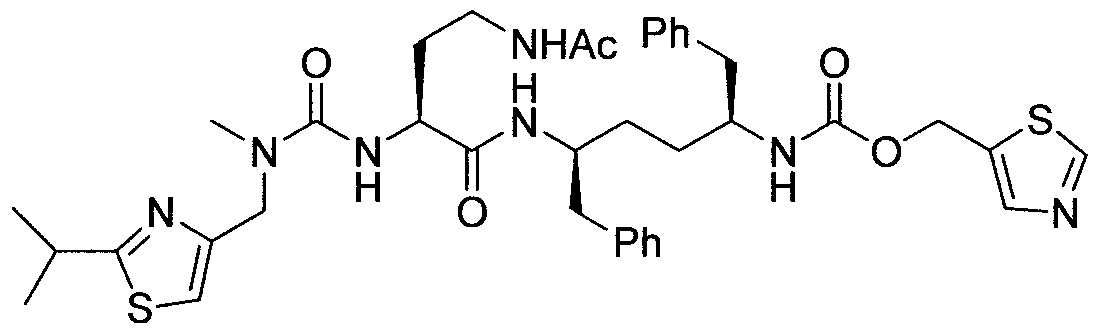
International Patent Application Publication Number WO 2008/103949 disclose certain compounds that are reported to be useful to modify the pharmacokinetics of a coadministered drug, e.g. by inhibiting cytochrome P450 monooxygenase. One specific compound identified therein is a compound of the following formula I:

There is currently a need for improved synthetic methods and intermediates that can be used to prepare the compound of formula I and its salts. There is also a need for improved methods for preparing intermediate compounds that can be used to prepare the compound of formula I and its salts. The improved methods and intermediates may reduce the cost, time, and or the amount of waste associated with the existing methods for preparing the compound of formula I and its salts.
Summary of the Invention
An improved synthetic route for preparing the compound of formula I and its salts has been identified. This improved synthetic route utilizes novel intermediates of formulae XIX, XX, XXI, XXVI, XXVII, XXVIII, XL, XLI, XLII, and XLIII
identified herein below. This route reduces the cost, the time, and the amount of waste associated with the preparation of the compound of formula I and its salts.
Accordingly in one embodiment, the invention provides a method for preparing a compound of formula I:


with a compound of formula XXIII:

XXIII
or a salt thereof; to provide the compound of formula I.
In another embodiment the invention provides a compound of formula XIX, XXa, XXI, XXVI, XXVII, XXVIII, XL, XLI, XLII, or XLIII:

 wherein Y is a suitable counter ion; Ri is -S(=0)2NRaRb, wherein each of Ra and Rb is independently (C1-C8)alkyl; or Ra and Rb together with the nitrogen to which they are attached form a 3 or 4 membered saturated ring or a 5, 6, or 7 membered saturated or partially unsaturated ring comprising 1 or 2 heteroatoms (e.g. aziridine, azetidine, piperidine, morpholine, thiomorpholine, pyrrolidine, homopiperazine, homopiperidine, or piperazine); and R2 is (C1-C8)alkyl; or a salt thereof.
In another embodiment the invention provides a method for preparing a compound of formula I:


XIX wherein Rj is a suitable protecting group, or a salt thereof is prepared and converted into the compound of formula I, characterized in that the compound of formula XIX is prepared by protecting a corresponding compound of formula XXXI:
H N
Ph
XXXI
or a salt thereof to provide the compound of formula XIX.
In another embodiment the invention provides a method for preparing a compound of formula I:

I
or a salt thereof, wherein a compound of formula XX:


XIX or a salt thereof to provide the compound of formula XX.
In another embodiment the invention provides a method for preparing a compound of formula I:

XXI or a salt thereof is prepared and converted into the compound of formula I,
characterized in that the compound of formula XXI is prepared by deprotecting a corresponding compound of formula XX:

XX wherein each R\ is a protecting group, or a salt thereof to provide the compound of formula XXI.
In another embodiment the invention provides a method for preparing a compound of formula I:


wherein R2 is (C1-C8)alkyl, or a salt thereof is prepared and converted into the compound of formula I, characterized in that the compound of formula XXVI is prepared by acylating a corresponding compound of formula XXX:

In another embodiment the invention provides a method for preparing a compound of formula I:

I
or a salt thereof, wherein an acid of formula XXVII:

characterized in that the acid of formula XXVII is prepared by hydrolyzing an ester of formula XXVI:

wherein R2 is (C1-C8)alkyl to provide the compound of formula XXVII.
In another embodiment the invention provides a method for preparing a compound of formula I:

I
thereof, wherein a compound of formula XXVIII:

XXVIII wherein Y is a suitable counter ion, or a salt thereof, is prepared and converted into the compound of formula I, characterized in that the compound of formula XXVIII or the salt thereof is prepared by converting an acid of formula XXVII:
 or a salt thereof to the compound of formula XXVIII or the salt thereof.
In another embodiment the invention provides a method for preparing a compound of formula I:

XL or a salt thereof is prepared and converted into the compound of formula I or the thereof, characterized in that the compound of formula XL or the salt thereof is prepared by reacting an amine formula XXI:


In another embodiment the invention provides a method for preparing a compound of formula I:

or a salt thereof, wherein a compound of formula XLI:


In another embodiment the invention provides a method for preparing a compound of formula I:

or a salt thereof, comprising hydrogenating a compound of formula XLII:

In another embodiment the invention provides a method for preparing a compound of formula I:

I
or a salt thereof, comprising reacting an amine formula XLIII:


In another embodiment the invention provides a method for preparing a compound of formula XIX:

XIX wherein R\ is a suitable protecting group, or a salt thereof comprising protecting a corresponding compound of formula XXXI:

XXXI
or a salt thereof to provide the compound of formula XIX or the salt thereof.
In another embodiment the invention provides a method for preparing a compound of formula XX:


XIX or a salt thereof to provide the compound of formula XX.
In another embodiment the invention provides a method for preparing a compound of formula XXI:


XX wherein each Ri is a protecting group, or a salt thereof, to provide the compound of formula XXI or the salt thereof.
In another embodiment the invention provides a method for preparing a compound of formula XXVI:

wherein R2 is (C1-C8)alkyl, or a salt thereof comprising acylating a compound of formula XXX:


XXVI wherein R2 is (C1-C8)alkyl to provide the compound of formula XXVII or the salt thereof.
In another embodiment the invention provides a method for preparing a compound of formula XXVIII:


In another embodiment the invention provides a method for preparing a compound of formula XL:

XL or a salt thereof comprising reacting an amine formula XXI:

to provide the compound of formula XL or the salt thereof.
In another embodiment the invention provides a method for preparing a compound of formula XLI:
 comprising coupling an amine of formula XXI:


In another embodiment the invention provides a method for preparing a compound of formula XLII:


In another embodiment the invention provides a method for preparing an amine formula XLIII:


The invention also provides novel synthetic intermediates described herein as well as methods for preparing such intermediates.
Detailed Description
As used herein alkyl, alkoxy, etc. denote both straight and branched groups; but reference to an individual group such as propyl embraces only the straight chain radical, a branched chain isomer such as isopropyl being specifically referred to.
Specific values listed below for radicals, substituents, and ranges, are for illustration only; they do not exclude other defined values or other values within defined ranges for the radicals and substituents.
Specifically, (C1-C )alkyl can be methyl, ethyl, propyl, isopropyl, butyl, iso- butyl, sec-butyl, pentyl, 3-pentyl, hexyl, heptyl, or octyl.
Another specific value for Rx is -S(=0)2NRaRb, -S(=0)2Rc, -C(=0)Rc, or
-C(=0)NRaRb wherein each of Ra and Rb is independently (C]-C8)alkyl; or Ra and Rb together with the nitrogen to which they are attached form a 3 or 4 membered saturated ring or a 5, 6, or 7 membered saturated or partially unsaturated ring comprising 1 or 2 heteroatoms (e.g. aziridine, azetidine, piperidine, morpholine, thiomorpholine, pyrrolidine, homopiperazine, homopiperidine, or piperazine); and Rc is aryl, (C\- C8)alkyl, halo(C1-C8)alkyl (Ci-C8)alkoxy, or aryl-(C1-C8)alkoxy, wherein any aryl can optionally be substituted with one or more (C1-C8)alkyl. In one embodiment of the invention Ri is not fert-butylsulfonyl.
Another specific value for Ri is -S(=0)2NRaRb wherein each of Ra and Rb is independently (C1-C8)alkyl; or Ra and Rb together with the nitrogen to which they are attached form a 3 or 4 membered saturated ring or a 5, 6, or 7 membered saturated or partially unsaturated ring comprising 1 or 2 heteroatoms (e.g. an aziridine, azetidine, piperidine, morpholine, thiomorpholine, pyrrolidine, homopiperazine, homopiperidine, or piperazine ring.
A specific value for R] is an NN-disubstituted aminosulfonyl group.
Another specific value for R is an NN-dialkyl aminosulfonyl group.
Another specific value for Ri is:


Another specific value for R1 is -S(0)2N(CH3)2.
Another specific value for R1 is benzyloxycarbonyl.
A specific value for R2 is methyl.
In one specific embodiment the invention provides a compound of formula XIX, XX, XXI, XXVI, XXVII, or XXVIII; or a salt thereof.
In one specific embodiment the invention provides a compound of formula XL, XLI, XLII, or XLIII; or a salt thereof.
A compound of formula I or a salt thereof can be prepared as illustrated in
Schemes 1-5 below.
Scheme 1

f/? 2-Benzylaziridine XIX


VIII XXIII
Scheme 3

Scheme 4

 Scheme 5
XXVIII + XXIII

I
An intermediate compound of formula XXIII or a salt thereof can be prepared as illustrated in Scheme 6 below. The compound of formula XXIII or the salt thereof can be carried on to a compound of formula I as described herein.
Scheme 6

XXIII
A compound of formula I or a salt thereof can also be prepared as illustrated in Schemes 7-9 below.
Scheme 7

XLII
Scheme 8


1) protecting (R)-2-benzylaziridine to provide a compound of formula XIX:

XIX wherein Ri is a protecting group, or a salt thereof.
2) dimerizing the compound of formula XIX or the salt thereof to provide a corresponding compound of formula XX:
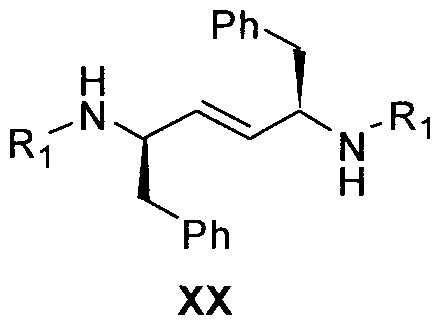
3) deprotecting the compound of formula XX or the salt thereof to provide compound of formula XXI:

or a salt thereof;
4) reducing the compound of formula XXI or the salt thereof to provide compound of formula XXII:

5) reacting the compound of formula XXII or the salt thereof with a carbonate of formula VIII:


XXIII
or a salt thereof;
6) reacting the compound of formula XXIII or the salt thereof with a compound of formula XXVIII:

In another embodiment, the invention also provides the above method for preparing a compound of formula I which further comprises preparing the compound of formula XXVIII by:
7) reacting a compound of formula XXIV:

XXIV wherein Pg is a suitable protecting group and R2 is (C1-C )alkyl or a salt thereof with methyl aminomethylthiazole to provide a corresponding compound of formula XXV:

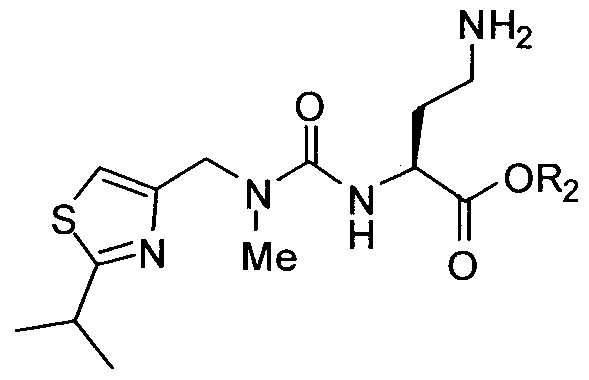
8) deprotecting the compound of formula XXV to provide an amine of formula XXX:

XXX or a salt thereof;
9) acylating the amine of formula XXX or the salt thereof to provide an ester of formula XXVI:

XXVI or a salt thereof;
10) hydrolyzing the ester of formula XXVI or the salt thereof to provide an acid of formula XVII:

XXVII
or a salt thereof;
11) treating the acid of formula XXVII or the salt thereof with a base to provide the compound of formula XXVIII:
 wherein Y is a suitable counter ion.
Preparation of a compound of formula XIX

f?J-2-Benzylaziridine XIX
The starting aziridine can be protected with any suitable protecting group (K\) under standard conditions to provide the corresponding compound of formula XIX. For example, the reaction can be carried out in a suitable solvent in the presence of a base. Suitable solvents include aprotic solvents such as, dichloromethane, tetrahydrofuran, ethyl ether, tert-butyl methyl ether, tetrahydropyran, 1,4-dioxane, 1,2-dichloroethane, and mixtures thereof. Suitable bases include trialkylamines such as: triethylamine, N- methyl morpholine, quinuclidine, N-methylpiperidine, N,N-diisopropylethylamine, and iV-methyl pyrrolidine; as well as other weak non-nucleophilic bases such as, potassium carbonate and sodium bicarbonate. The reaction can conveniently be carried out at a temperature from about -10 °C to 40 °C.
The resulting compound of formula XIX can be purified by recrystallization from a suitable solvent or mixture of solvents. For example, combinations of ethereal and non-polar solvents, such as ethyl ether, «-butyl ether, tetrahydrofuran,
tetrahydropyran, 1,2-dimethoxyethane, hexanes, tert-butyl methyl ether, heptane, pentane, cyclohexane, toluene can be used.
Preparation of a compound of formula XX

XIX XX
The starting aziridine XIX can be dimerized by treatment with a suitable base in a suitable solvent to provide the corresponding compound of formula XX. Suitable solvents include ethyl ether, tert-butyl methyl ether, w-butyl ether, tetrahydropyran, hexanes, tetrahydrofuran, 1 ,2-dimethoxyethane, and mixtures thereof. Suitable bases include 2,2,6,6-tetramethylpiperidine (TMP); w-butyllithium («-BuLi), as well as other hindered non-nucleophilic amine bases such as diisopropylamine,
hexamethyldisilazane, di-t-butylamine, isopropylcyclohexyl-amine, and
dicyclohexylamine; and other organolithium bases such as: rc-hexyllithium, s- butyllithium, and t-butyllithium. The reaction can conveniently be carried out at a temperature from about -78 °C to 22 °C.
The resulting compound of formula XX can be purified by recrystallization from a suitable solvent or mixture of solvents. For example, combinations of ethereal and non-polar solvents, such as ethyl ether, n-butyl ether, tetrahydrofuran, tetrahydropyran, 1,2-dimethoxyethane, and fert-butyl methyl ether can be used.
Preparation of a compound of formula XXI

XX
The starting compound of formula XX can be deprotected under standard conditions to provide the corresponding compound of formula XXI. The reaction can be carried out in a solvent that comprises an amine; for example, a diamine such as 1,3-diaminopropane, ethylenediamine, 1,2-diaminocyclohexane, 1,2-phenylenediamine, putrescene, or cadaverine; also for example, an amino alcohol, such as 2-aminoehanol or 3-amino-l-propanol. The solvent can also comprise toluene, anisole, or the like, or mixtures thereof. The reaction can conveniently be carried out at a temperature from about 100 °C to about 140 °C.
Hydrogenation to provide a compound of formula XXII

The starting alkene XXI can be hydrogenated under standard conditions to provide the corresponding compound of formula XXII. For example, the
hydrogenation can be carried out using a metal-containing catalyst in an alcoholic solvent. Suitable solvents include methanol, ethanol, isopropanol, «-propanol, butanol, ethyl acetate, isopropyl acetate, toluene, dioxane, and anisole, and mixtures thereof. Suitable catalysts include palladium on carbon, platinum on carbon, Raney nickel,
Wilkinson's catalyst, and palladium hydroxide The reaction can conveniently be carried out at a pressure from about ambient pressure to about 60 psi.
The compound of formula XXII can be isolated by treatment with an acid in an organic solvent to provide a corresponding salt. Suitable acids include hydrochloric acid, hydrobromic acid, hydroiodic acid, and sulfuric acid. Suitable solvents include dichloromethane, ethyl ether, tetrahydrofuran, t-butyl methyl ether, 1,4-dioxane, 1,2- dimethoxyethane, chloroform, 1 ,2-dichloroethane, toluene, and anisole, and mixtures thereof. The conversion to the salt can conveniently be carried out at a temperature from about -10 °C to about 40 °C.
Preparation of a compound of formula XXIII or a salt thereof

VIII XXIII
A compound of formula XXIII can be prepared from a compound of formula XXII by treatment with a carbonate of formula VIII wherein R3 is nitrophenyl (e.g. 4-nitrophenyl), succinimidyl, or thiazol-5-ylmethyl, in the presence of a suitable base in a suitable solvent. Suitable bases include carbonate bases (e.g. potassium carbonate) and trialkylamines (e.g. diisopropylethylamine, or N-methyl morpholine). Suitable solvents include solvents such as dichloromethane, tetrahydrofuran, 1,2- dichloroethane, isopropyl acetate, and diethylether, and mixtures thereof. Subsequent treatment with an acid source provides a salt of the compound of formula XXIII.
Suitable acid sources include 1) non-aqueous acid solutions such as hydrochloric acid in ether, hydrochloric acid in methanol, or hydrochloric acid in isopropanol; 2) other mineral acids such as: hydrobromic acid, hydroiodic acid, sulfuric acid, in similar solvents; and in situ generated acid sources such as TMSCl/methanol and acetyl chloride/methanol.
Preparation of a compound of formula VIII

VIII
The mixed carbonate of formula VIII can be prepared by treating 5-hydroxy- methylthiazole with a suitable carbonate or carbonate equivalent having a leaving group adjacent to the carbonyl carbon, such as phosgene in the presence of a base. For example, suitable carbonates include bis-(4-nitrophenyl)carbonate and disuccinimidyl carbonate. The reaction can conveniently be carried out in a suitable aprotic organic solvent, such as dichloromethane, tetrahydrofuran, 1 ,2-dichloro-ethane, or diethylether, or a mixture thereof. Suitable bases include trialkylamine bases, such as
diisopropylethylamine, N-methyl morpholine, and triethylamine.
Preparation of a compound of formula XXV

aminomethylthiazole
The compound of formula XXV can be prepared by treating methyl
aminomethylthiazole with a compound of formula XXIV wherein Pg is a suitable protecting group; and R2 is (C1-C8)alkyl, or a salt thereof, in the presence of a suitable coupling agent. When a salt of the compound of formula XXIV is used, the reaction can be carried out in the presence of a base. The reaction can conveniently be carried out in a suitable aprotic organic solvent, such as dichloromethane, tetrahydrofuran, 1 ,2- dichloroethane, or diethylether, or a mixture thereof. Suitable coupling agents include
carbonyl diimidazole. Suitable bases include trialkylamine bases, such as
diisopropylethylamine, N-methyl morpholine, and triethylamine. The reaction can conveniently be carried out at a temperature from about 0 °C to about 22 °C. Suitable protecting groups (Pg) include carbamates such as a Boc group as well as acetates.
Preparation of a com ound of formula XXVI:

The compound of formula XXVI can be prepared by deprotecting a
corresponding compound of formula XXV wherein Pg is a suitable protecting group other than acetate and R2 is (CrC8)alkyl followed by treatment of the resulting primary amine with a acetic anhydride or acetyl chloride in the presence of a suitable base. The deprotection reaction can conveniently be carried out under standard conditions for removing the group Pg. When Pg is a Boc group, the deprotection can be carried out in a suitable aprotic organic solvent, such as dichloromethane, tetrahydrofuran, 1,2- dichloroethane, or diethylether, or a mixture thereof, in the presence of an anhydrous acid source (e.g. methanesulfonic acid). The acetylation reaction can conveniently be carried out at a temperature from about 0 °C to about 22 °C.
Preparation of an acid of formula XXVII

XXVII
An acid of formula XXVII or a salt thereof can be prepared by hydrolyzing a corresponding ester of formula XXVI wherein R2 is (C1-C8)alkyl or a salt thereof under standard conditions. For example, the hydrolysis can be carried out in an aqueous solvent (e.g. water and dichloromethane, 2-methyltetrahydrofuran, or tetrahydrofuran) in the presence of a base (e.g. potassium hydroxide or lithium hydroxide) at a temperature from about -10 °C to about -30 °C. Preparation of a salt of formula XXVIII

XXVII XXVIII
A salt of formula XXVIII wherein Y is counterion can be prepared by treating an acid of formula XXVII with a base. The reaction can be carried out in a suitable solvent (e.g. acetone, 2-methyl tetrahydrofuran, tetrahydrofuran, methylethylketone, other keytones, methyl tert-butyl ether, and other ethers, and mixtures thereof) in the presence of a suitable base (e.g. an amine base such as dicyclohexylamine). The reaction salt formation can conveniently be carried out at a temperature from about 20 °C to about 50 °C.
Preparation of a compound of formula I

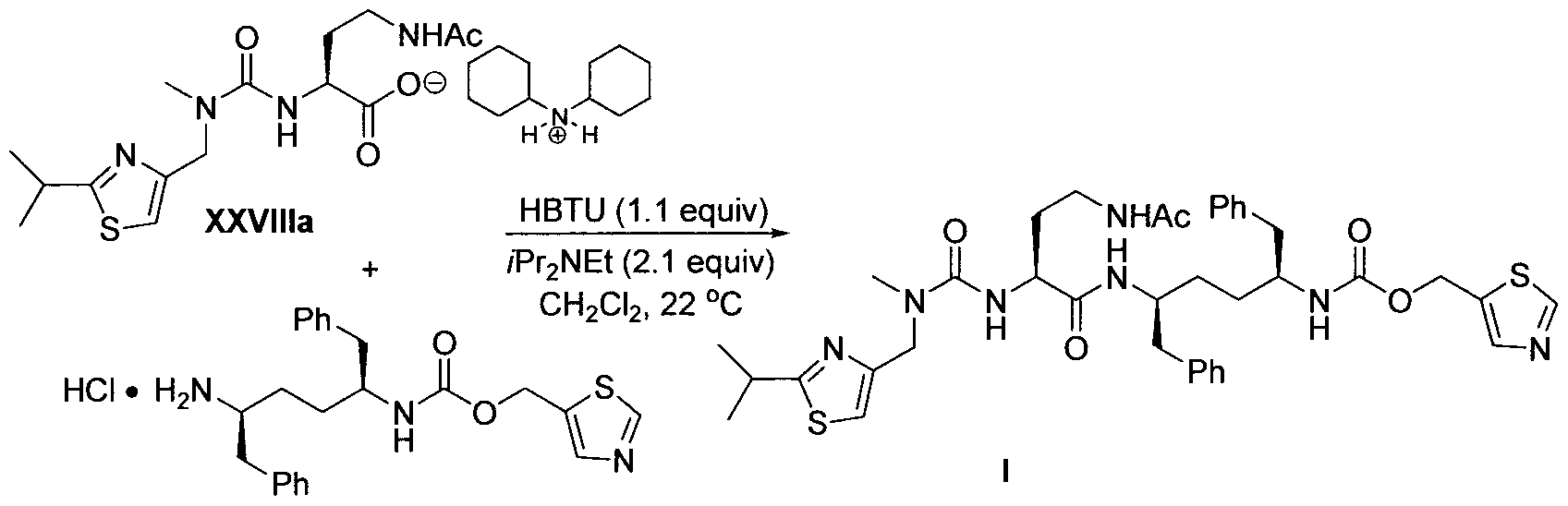
A compound of formula I or a salt thereof can be prepared by coupling an acid salt of formula XXVIII with an amine of formula XXIII to form the corresponding amide. This amide forming reaction can be carried out under standard conditions. For example, it can be carried out in a suitable organic solyent (e.g. dichloromethane, tetrahydrofuran, diethylether, 1 ,2-dichloroethane, N,N-dimethylformamide, or a mixture thereof) in the presence of a suitable coupling agent, such as an onium salt reagent (e.g. BOP, PyBOP, PyBroP, BOI, HBTU, HATU, or TBTU) or a carbodiimide reagent (e.g. DCC or DICI) and in the presence of a suitable base (e.g. a trialkylamine base such as diisopropylethylamine triethylamine or N-methyl morpholine).
Preparation of a compound of formula XL or a salt thereof

XXI VIII XL
A compound of formula XL can be prepared from a compound of formula XXI by treatment with a carbonate of formula VIII wherein R3 is nitrophenyl (e.g. 4- nitrophenyl), succinimidyl, or thiazol-5-ylmethyl (in the presence of a suitable base in a suitable solvent. Suitable bases include carbonate bases (e.g. potassium carbonate) and trialkylamines (e.g. diisopropylethylamine, or N-methyl morpholine). Suitable solvents
include solvents such as dichloromethane, tetrahydrofuran, 1 ,2-dichloroethane, isopropyl acetate, and diethylether, and mixtures thereof. Subsequent treatment with an acid source provides a salt of the compound of formula XL. Suitable acid sources include 1) non-aqueous acid solutions such as hydrochloric acid in ether, hydrochloric acid in methanol, or hydrochloric acid in isopropanol; 2) other mineral acids such as: hydrobromic acid, hydroiodic acid, sulfuric acid, in similar solvents; and in situ generated acid sources such as TMSCl/methanol and acetyl chloride/methanol.
Reduction of a compound of formula XL or a salt thereof to provide a compound of formula XXIII

The starting alkene XL or a salt thereof can be hydrogenated under standard conditions. For example, the hydrogenation can be carried out using a metal containing catalyst in a suitable solvent. Suitable solvents include methanol, ethanol, isopropanol, w-propanol, butanol, ethyl acetate, isopropyl acetate, toluene, dioxane, and anisole, and mixtures thereof. Suitable catalysts include palladium on carbon, platinum on carbon, Raney nickel, Wilkinson's catalyst, and palladium hydroxide. The reaction can conveniently be carried out at a pressure from about ambient pressure to about 60 psi.
The compound of formula XXIII can be isolated by treatment with an acid in an organic solvent to provide a corresponding salt. Suitable acids include hydrochloric acid, hydrobromic acid, hydroiodic acid, and sulfuric acid. Suitable solvents include dichloromethane, ethyl ether, tetrahydrofuran, t-butyl methyl ether, 1,4-dioxane, 1,2- dimethoxyethane, chloroform, 1,2-dichloroethane, toluene, and anisole, and mixtures
thereof. The conversion to the salt can conveniently be carried out at a temperature from about -10 °C to about 40 °C.
Preparation of a compound of formula XLI or a salt thereof

XXI XXVII XLI
A compound of formula XLI or a salt thereof can be prepared by coupling a compound of formula XXVII (or a salt of formula XXVIII) with an amine of formula XXI to form the corresponding amide. This amide forming reaction can be carried out under standard conditions. For example, it can be carried out in a suitable organic solvent (e.g. dichloromethane, tetrahydrofuran, diethylether, 1 ,2-dichloroethane, N,N- dimethylformamide, or a mixture thereof) in the presence of a suitable coupling agent, such as an onium salt reagent (e.g. BOP, PyBOP, PyBroP, BOI, HBTU, HATU, or TBTU) or a carbodiimide reagent (e.g. DCC or DICI) and in the presence of a suitable base (e.g. a trialkylamine base such as diisopropylethylamine triethylamine or N-methyl morpholine).
Preparation of a compound of formula XLII or a salt thereof

A compound of formula XLII can be prepared from a compound of
formula XLI by treatment with a carbonate of formula VIII (wherein R3 is nitrophenyl (e.g. 4-nitrophenyl), succinimidyl, or thiazol-5-ylmethyl) in the presence of a suitable base in a suitable solvent. Suitable bases include carbonate bases (e.g. potassium carbonate) and trialkylamines (e.g. diisopropylethylamine, or N-methyl morpholine). Suitable solvents include solvents such as dichloromethane, tetrahydrofuran, 1 ,2- dichloroethane, isopropyl acetate, and diethylether, and mixtures thereof.
Reduction of a compound of formula XLII or a salt thereof to provide a compound of formula I
XLII
The starting alkene XLII can be hydrogenated under standard conditions. For example, the hydrogenation can be carried out using a metal containing catalyst in a suitable solvent. Suitable solvents include methanol, ethanol, isopropanol, «-propanol, butanol, ethyl acetate, isopropyl acetate, toluene, dioxane, and anisole, and mixtures thereof. Suitable catalysts include palladium on carbon, platinum on carbon, Raney nickel, Wilkinson's catalyst, and palladium hydroxide. The reaction can conveniently be carried out at a pressure from about ambient pressure to about 60 psi. Preparation of a compound of formula XLIII or a salt thereof

A compound of formula XLIII or a salt thereof can be prepared by
hydrogenating a corresponding compound of formula XLI or a salt thereof under standard conditions. For example, the hydrogenation can be carried out using a metal
containing catalyst in an alcoholic solvent. Suitable solvents include methanol, ethanol, isopropanol, «-propanol, butanol, ethyl acetate, isopropyl acetate, toluene, dioxane, and anisole, and mixtures thereof. Suitable catalysts include palladium on carbon, platinum on carbon, Raney nickel, Wilkinson's catalyst, and palladium hydroxide The reaction can conveniently be carried out at a pressure from about ambient pressure to about 60 psi.
The compound of formula XLIII can be isolated by treatment with an acid in an organic solvent to provide a corresponding salt. Suitable acids include hydrochloric acid, hydrobromic acid, hydroiodic acid, and sulfuric acid. Suitable solvents include dichloromethane, ethyl ether, tetrahydrofuran, i-butyl methyl ether, 1,4-dioxane, 1,2- dimethoxyethane, chloroform, 1 ,2-dichloroethane, toluene, and anisole, and mixtures thereof. The conversion to the salt can conveniently be carried out at a temperature from about -10 °C to about 40 °C.
The compound of formula XLIII or a salt thereof can be converted to a compound of formula I by treatment with a carbonate of formula VIII (wherein R3 is nitrophenyl (e.g. 4-nitrophenyl), succinimidyl, or thiazol-5-ylmethyl) in the presence of a suitable base in a suitable solvent. Suitable bases include carbonate bases (e.g.
potassium carbonate) and trialkylamines (e.g. diisopropylethylamine, or N-methyl morpholine). Suitable solvents include solvents such as dichloromethane,
tetrahydrofuran, 1,2-dichloroethane, isopropyl acetate, and diethylether, and mixtures thereof.
Alternative preparation of a compound of formula XLIII or a salt thereof

formula XXII or a salt thereof to form the corresponding amide. This amide forming reaction can be carried out under standard conditions. For example, it can be carried out in a suitable organic solvent (e.g. dichloromethane, tetrahydrofuran, diethylether, 1,2-dichloroethane, N,N-dimethylformamide, or a mixture thereof) in the presence of a suitable coupling agent, such as an onium salt reagent (e.g. BOP, PyBOP, PyBroP, BOI, HBTU, HATU, or TBTU) or a carbodiimide reagent (e.g. DCC or DICI) and in the presence of a suitable base (e.g. a trialkylamine base such as diisopropylethylamine triethylamine or N-methyl morpholine).
The invention will now be illustrated by the following non-limiting Examples.
Examples
Example 1. Preparation of (i?)-2-benzyl-N,N-dimethylaziridine-l -sulfonamide (XlXa)

? -2-Benzylaziridine XlXa
To a cooled (-10 °C) solution of (i?)-2-benzylaziridine (152 g, 1.14 mol) and N,N-dimethylsulfamoyl chloride (128.5 mL, 1.20 mol) in dichloromethane (762 mL) was added N.N-diisopropylethylamine (198.5 mL, 1.14 mol). The resulting yellow solution was stirred at -10 °C for a minimum of 16 hours. A 0.5M solution of citric acid (300 mL) was then added and the phases were separated. The organic phase was washed with 1.0 M sodium bicarbonate solution (300 mL). The organic phase was solvent exchanged into fert-butyl methyl ether (760 mL). The solution was cooled to 0 °C, and heptane (1.5 L) was added dropwise over a period of 2 hours. The mixture was aged for an additional 2 hours at 0 °C, then cooled to -10 °C, allowing the compound of formula XlXa to precipitate out as a white, crystalline solid (209 g, 76%). Rf: 0.53 (Si02; 1 :1 heptane:ethyl acetate, KMn04). 1H NMR (400 MHz, CDC13): δ 7.20-7.29 (m, 5H), 2.94 (dd, J= 14, 5 Hz, 1H), 2.80-2.88 (m, 1H), 2.70 (dd, J= 14, 7 Hz, 1H), 2.66 (s, 6H), 2.56 (d, J= 7 Hz, 1H), 2.14 (d, J= 4 Hz, 1H). 13C NMR (100 MHz, CDC13): δ 137.4, 129.3, 128.9, 127.2, 40.6, 38.3, 38.1, 33.0.
Example 2. Preparation of Diamine (XXa)

To a cooled (-9 °C) slurry of XlXa (lOg, 0.041 mol) and 2,2,6,6-tetra- methylpiperidine (2.1 mL, 0.012 mol) in 1 :3 tetrahydrofuramheptane (30 mL) was added «-butyllithium (2.6M in hexanes, 19 mL, 0.050 mol), dropwise, maintaining an internal temperature below -7.2 °C (total addition time: 120 minutes). The resulting red-brown mixture was quenched with glacial acetic acid (4 mL) at which time the reaction turned bright-yellow. The solution was warmed to 5 °C and the suspension was filtered cold, and the yellow solids were subsequently washed with 3:1
MTBE:heptane (2 x 30 mL), water (3 x 30 mL), then again with 3:1 MTBE:heptane (2 x 30 mL) to give XXa as a pale-yellow powder (7.2g, 72%). Rf: 0.32 (Si02, 1 : 1 heptane:ethyl acetate, ΚΜη04). Ή NMR (400 MHz, CDC13): δ 7.10-7.35 (m, 10H), 5.59 (s, 2H), 3.95-4.10 (m, 4H), 2.80 (ddd, J = 22, 13, 6 Hz, 4H), 2.59 (s, 12H). 13C NMR (100 MHz, CDC13): δ 136.7, 132.0, 129.9, 128.9, 127.2, 57.0, 42.4, 38.1.
Example 3. Preparation of Diamine (XXI)

Example 4. Preparation of Diamine (XXII)

XXI XXII
To a solution of XXI (th. 1.69 g, th. moles, 0.00635 mol) in isopropyl acetate was added 10% palladium on carbon (168 mg, 10 wt%). The resulting black suspension was purged with hydrogen gas and held under a hydrogen atmosphere (balloon) for 4-12 hours. The reaction was then filtered through celite, the cake was rinsed with isopropyl acetate (15 mL) and the solution was dried via distillation then diluted up to 30 vols (50 mL) (KF of solution < 0.1% water). This solution was used
the next step. f: 0.60 (Si02, 4: 1 CH2C12:CH30H w/ 5% Et3N, KMn04).
1H NMR (400 MHz, CDC13): δ 7.15-7.35 (m, 10H), 2.95-3.05 (m, 2H),
2.82 (dd, J = 13, 5 Hz, 2H), 2.50 (dd, J = 13, 9 Hz, 2H), 1.45-1.66 (m, 4H), 1.36
(br, 4H). 13C NMR (100 MHz, CDC13): δ 139.7, 129.5, 128.7, 126.5, 53.2, 45.1, 34.6.
Example 5. Preparation of Mono-Carbamate Hydrochloride (XXIIIa)
XXII + T Π N i. DIPEA (1 .5 equiv)
ii- 4M HCI in dioxane

Villa XXIIIa To a solution of XXII (th, 11.9 g, 0.0044 mol) in isopropylacetate (375 mL) was added Villa (12.4 g, 0.0044 mol) followed by diisopropylethylamine (8.6 g, 0.0066 mol). The resulting yellow solution was stirred for 18 hours and was then quenched with the addition of 0.25M sodium hydroxide (120 mL). The phases were split and the organic layer was washed with 0.5M sodium hydroxide (1 x 120 mL) followed by l.OM sodium hydroxide (1 x 120 mL). The organic layer was then washed with water (120 mL), dried over sodium sulfate (48 g), filtered, and diluted with dichloromethane (180 mL). To this solution was charged HCI (12.2 mL, 4M HCI in dioxane, about 0.0048) to induce precipitation. The product, XXIIIa, was filtered, rinsed with isopropyl acetate, and dried under vacuum to afford a white powder (16.1 g, 82% yield). 1H NMR (CD3OD) δ 9.0 (s, 1H), 7.8 (s, 1H), 7.4-7.14 (m, 10H), 5.2 (d, 1H), 4.8 (s, 5 H) 3.7 (m, 1H), 3.6 (m, 1H), 3.3 (s, 1H), 2.6-2.8 (m, 2H), 1.8-1.4 (m, 4H). 13C NMR (CD3OD) δ 154.4, 143.2, 129.6, 128.0, 126.0, 58.0, 52.4, 44.3, 41.6, 33.8, 30.5.
Example 6. Preparation of Urea XXVa

aminomethylthiazole
Compound XXIVa (104.8 g, 390.0 mmol), carbonyl diimidazole (63.2 g, 390.0 mmol) and dichloromethane (1.02 L) were charged to 2 liter flask. The mixture was cooled to 0 °C and diisopropylethylamine (135.9 mL, 780.0 mmol) was added slowly while keeping the temperature between 0-5 °C. After the addition was complete, the mixture was warmed to 22 °C and stir for 2 hours. Methyl aminomethylthiazole (66.4 g, 380.0 mmol) was added and the resulting mixture was stirred for 6-12 hours until the coupling was complete. The reaction was quenched by pouring it into 10% citric acid (1 L). The phases were separated and the organic phase was washed with water (1 L). Sodium sulfate (105 g) was added to the organic layer and it was stirred for 10 minutes and filtered. The solution was used directly in the next step. Compound XXVa can also be isolated as an oil by concentrating in vacuo (99% yield). Ή NMR (400 MHz,
CDC13): δ 7.04 (s, IH), 6.15 (bs, IH), 5.07-5.21 (bs, IH), 4.58 (m, IH), 4.53 (s, 2H), 3.73 (s, 3H), 3.38-3.40 (m, 2H), 3.0-3.1 (m, IH), 3.02 (s, 3H), 2.12-2.05 (m, IH), 1.77- 1.78 (m, IH), 1.39-1.42 (m, 15H).
Example 7. Preparation of Compound XXVIa

Methanesulfonic acid (25.3 mL, 390.0 mmol) was added to a solution of XXVa (167.0 g, 390.0 mmol) in dichloromethane (1 L) at 22 °C and the resulting solution was allowed to stir for 1 hour. A second equivalent of MSA was added and the solution was stirred for 1 hour. A third equivalent of MSA was added and the solution was stirred for 1 hour. This was repeated until no starting material remained. The solution was cooled to 0 °C and diisopropylethylamine (340.0 mL, 1,950.0 mmol) was added slowly while keeping the temperature between 0-5 °C. Acetic anhydride (59.0 mL, 624 mmol) was added and the solution was stirred for 15 minutes at 0 °C. The reaction was quenched by pouring it into 9% sodium bicarbonate (3.4 L) and stirring vigorously for 1 hour. The layers were separated and the organic layer was washed with 10% citric acid (300 mL) and concentrate in vacuo to yield 81% (2 steps) of XXVIa as yellow oil. Compound XXVIa was typically carried onto the next step without further purification.
1H NMR (400 MHz, CDC13): δ 6.41 (s, 1H), 6.75 (bs, 1H), 6.22 (bs, 1H), 4.34-4.51 (m, 3H), 3.67 (s, 3H), 3.20 (ddd, J= 6.8, 6.8, 13.9 Hz, 1H), 2.94 (s, 3H), 2.84 (ddd, J= 3.7, 9.0, 17.8 Hz, 1H), 2.04 (ddd, J= 4.3, 9.4, 18.2 Hz, 1H), 1.90 (s, 3H), 1.60 (ddd, J= 4.5, 9.6, 18.6 Hz, 1H), 1.32 (d, J= 6.8 Hz, 6H).
Example 8. Pre aration of compound XXVII

XXVII
Acetamide XXVIa (117.0 g, 316.22 mmol) was dissolved in tetrahydrofuran (910 mL) and cooled to 0 °C. NaOH (347.8 mL, 347.8 mmol, 1M) was added to the solution such that the internal temperature did not exceed 5 °C. The reaction was allowed to stir for a total of 1 hour and then HC1 (205.5 mL, 411.0 mmol, 2M) was added to pH 3.2-3.5. The resulting solution was extracted with dichloromethane (1.8 L). The layers were separated and the aqueous layer was washed a second time with dichloromethane (440 mL). The combined organic layers were concentrated in vacuo to provide 93% of XXVII as white foam. 1H NMR (400 MHz, D20): δ 7.20 (s, IH), 4.45 (s, 2H), 4.15 (ddd, J= 4.7, 9.4 Hz, IH), 3.20-3.25 (m, IH), 3.12-3.17 (m, 2H), 2.87 (s, 3H), 1.93-1.97 (m, IH), 1.83 (s, 3H), 1.73-1.80 (m, IH), 1.24 (d, J= 7.0 Hz, 6H).
Example 9. Preparation of compound XXVIIIa

A solution of XXVII (25.0 g, 0.0701 moles) in dichloromethane was distilled to a minimal stirring volume. Acetone (1000 mL) was added then and distilled to 7 vols (175 mL) and cooled to 50 °C (KF < 0.4% water, 1H NMR showed less than 5% CH2C12). Dicyclohexylamine (12.97 g, 0.0715 moles) and isopropyl ether (750 mL) was charged to a separate flask and heated to 50 °C. The dicyclohexlyamine/ IPE
solution was charged to the acetone solution at such a rate to maintain 45-50 °C. The reaction was seeded and cooled from 50 °C to 20 °C over 3 hours then held at 20 °C for 10 hours. The reaction was then cooled to 0 °C for at least 1 hour followed by filtration. The wet cake was rinsed with the mother liquor and the solids were dried in the vac oven at 35 °C to provide compound XXVIIIa (30.75 g, 81% yield). 1H NMR (400 MHz, D20): δ 7.00 (s, 1H), 4.4 (s, 2H), 4.01-3.97 (dd, J= 4, 9Hz 1H), 3.04-3.19 (m, 5H), 2.86 (s, 3H), 1.82-1.9 (m, 8H), 1.68 (m, 5H), 1.51-1.54 (m, 2H), 1.03-1.22 (m, 16H). Example 10. Preparation of compound I
XXIIIa
To a slurry of XXIIIa (0.829 g, 0.0019 mol), XXVIIIa (1.0 g, 0.0019 mol), and HBTU (0.712 g, 0.0019 mol) in CH2C12 (8 mL) was added diisopropylethyl-amine (0.680 mL, 0.0039 mol). After stirring at 22 °C for 1 hour, the mixture was quenched with half-saturated sodium bicarbonate (8 mL) at which time the slurry became homogeneous. The layers were separated and the aqueous layer was washed with ethyl acetate (2 x 8 mL). The combined organic solution was then washed with brine (1 x 8 mL). The resulting golden-yellow solution was concentrated out of ethyl acetate (1 x 10 mL). The crude mixture was diluted with ethyl acetate (15 mL), heated, seeded with previously formed I, and allowed to slowly cool to 22 °C. After stirring at 22 °C for 4 days the resulting thick slurry was filtered and the white, crystalline solids were washed
with ethyl acetate. A typical yield for this reaction is about 82%. Rf: 0.24 (Si02, 9:1 EtOAc:CH3OH, ΚΜη04). Ή NMR (400 MHz, CDC13): δ 8.80 (s, 1H), 7.85 (s, 1H), 7.10-7.40 (m, 10H), 6.90 (s, 1H), 6.15-6.25 (m, 2H), 5.65 (d, J= 8.6 Hz, 1H), 5.25 (dd, J= 12.5, 12.5 Hz, 2H), 4.50 (dd, J= 15.9, 15.9 Hz, 2H), 3.96-4.15 (m, 3H), 3.70-3.80 (m, 1H), 3.35-3.50 (m, 1H), 3.25 (ddd, J= 7.6, 7.6, 7.6 Hz, 1H), 2.95 (s, 3H), 2.80-2.90 (m, 2H), 2.55-2.75 (m, 2H), 2.98 (s, 3H), 1.40-1.80 (m, 6H), 1.35 (d, J= 7.0 Hz, 6H).
All publications, patents, and patent documents are incorporated by reference herein, as though individually incorporated by reference. The invention has been described with reference to various specific and preferred embodiments and techniques. However, it should be understood that many variations and modifications may be made while remaining within the spirit and scope of the invention.
Claims
What is claimed is:
1. A method for preparing a compound of formula I:

I
comprising reacting a compound of formula XXVIII:

with a compound of formula XXIII:

XXIII
or a salt thereof to provide the compound of formula I.
2. The method of claim 1 wherein the compound of formula XXIII or the salt thereof is a salt of formula XXIIIb:

XXI I lb
wherein W is dicyclohexylammonium. 3. The method of claim 1 or 2 wherein the reaction is carried out in a suitable organic solvent, in the presence of a suitable coupling agent, and in the presence of a suitable base.
4. The method of any one of claims 1-3 further comprising preparing the compound of formula XVIII by treating a corresponding compound of
formula XXVII:

5. The method of claim 4 further comprising preparing the compound of formula XXVII by hydrolyzing a corresponding ester of formula XXVI:

XXVI wherein R2 is (C1-C8)alkyl to provide the compound of formula XXVI.
6. The method of claim 5 further comprising preparing the ester of formula XXVI by acylating a corresponding amine of formula XXX:
XXX to provide the compound of formula XXVI.
7. The method of claim 6 further comprising preparing the amine of formula XXX by deprotecting a correspondin compound of formula XXV:

8. The method of claim 7 wherein Pg is tert-butoxycarbonyl.
9. The method of claim 7 or 8 further comprising preparing the compound of formula XXV by reacting a corresponding compound of formula XXIV:

or a salt thereof with methyl aminomethylthiazole to provide the compound of formula XXV.
10. The method of claim 9 wherein the compound of formula XXIV or the salt thereof is a salt of formula XXIVb:

11. The method of any one of claims 1-10 further comprising preparing the compound of formula XXIII:

^111 or a salt thereof by reacting a compound of formula XXII:
XXII or a salt thereof with a carbonate of formula VIII:

12. The method of claim 11 further comprising preparing the compound of formula XXII or the salt thereof by reducing a compound of formula XXI:

or a salt thereof to provide the compound of formula XXII or the salt thereof.
13. The method of claim 12 further comprising preparing the compound of formula XXI or the salt thereof by deprotecting a corresponding compound of formula XX:

XX or a salt thereof wherein each R] is a protecting group, to provide the compound of formula XXI or the salt thereof. 14. The method of claim 13 wherein each R] is -S(=0)2NRaRb wherein each of Ra and Rb is independently (Ci-C8)alkyl; or Ra and Rb together with the nitrogen to which they are attached form a 3 or 4 membered saturated ring or a 5, 6, or 7 membered saturated or partially unsaturated ring comprising 1 or 2 heteroatoms. 15. The method of claim 13 or 14 further comprising preparing the compound of formula XX or the salt thereof by dimerizing a corresponding compound of formula XIX:

XIX or a salt thereof to provide the compound of formula XX or the salt thereof.
16. The method of claim 15 further comprising preparing the compound of formula XIX or the salt thereof by protecting (i?)-2-benzylaziridine to provide the compound of formula XIX or the salt thereof. 17. A compound of formula XIX, XXa, XXI, XXVI, XXVII, XXVIII, XL, XLI, XLII, or XLIII:

XIX XXa XXI

XXVI XXVII


19. A method for preparing a compound of formula I:


XIX wherein Ri is a suitable protecting group, or a salt thereof is prepared and converted into the compound of formula I or the salt thereof, characterized in that the compound of formula XIX or the salt thereof is prepared by protecting a corresponding compound of formula XXXI:

XXXI
or a salt thereof to provide the compound of formula XIX or the salt thereof. 20. A method for preparing a compound of formula I:

I
or a salt thereof, wherein a compound of formula XX:

XX wherein each R\ is a protecting group, or a salt thereof is prepared and converted into the compound of formula I or the salt thereof, characterized in that the compound of formula XX or the salt thereof is prepared by dimerizing a corresponding compound of formula XIX:

XIX or a salt thereof to provide the compound of formula XX or the salt thereof.
A method for preparing a compound of formula I


XX wherein each ¾ is a protecting group, or a salt thereof to provide the compound of formula XXI or the salt thereof.
A method for preparing a compound of formula I


XXVI wherein R2 is (C1-C8)alkyl or a salt thereof is prepared and converted into the compound of formula I or the salt thereof, characterized in that the compound of
formula XXVI or the salt thereof is prepared by acylating a corresponding compound of formula XXX:

A method for preparing a compound of formula I

I
a salt thereof, wherein an acid of formula XXVII

XXVII or a salt thereof is prepared and converted into the compound of formula I or the salt thereof, characterized in that the compound of formula XXVII or the salt thereof is prepared by hydrolyzing an ester of formula XXVI:

XXVI wherein R2 is (C1-Cg)alkyl or a salt thereof, to provide the compound of
formula XXVII.
A method for preparing a compound of formula I


formula XXVII:

XXVII salt thereof to the compound of formula XXVIII or the salt thereof. A method for preparing a compound of formula XIX:

XIX wherein is a suitable protecting group, or a salt thereof comprising protecting corresponding compound of formula XXXI:

XXXI
or a salt thereof to provide the compound of formula XIX or the salt thereof.
26. A method for preparing a compound of formula XX:

XX wherein each R\ is a protecting group, or a salt thereof comprising dimerizing a corresponding compound of formula XIX:
 or a salt thereof to provide the compound of formula XX or the salt thereof.
A method for preparing a compound of formula XXI:

wherein each R\ is a protecting group, or a salt thereof comprising deprotecting corresponding compound of formula XX:

XX wherein each Ri is a protecting group, or a salt thereof, to provide the compound of formula XXI or the salt thereof.
28. A method for preparing a compound of formula XXVI:

wherein R2 is (CrC8)alkyl or a salt thereof comprising acylating a corresponding compound of formula XXX:


XXVII or a salt thereof comprising hydrolyzing an ester of formula XXVI:
 wherein R2 is (C1-C8)alkyl or a salt thereof, to provide the compound of formula XXVII or the salt thereof. 30. A method for preparing a compound of formula XXVIII:


XXVII or a salt thereof to the compound of formula XXVIII or the salt thereof. 31. A method for preparing a compound of formula I:

I
or a salt thereof, wherein a com ound of formula XL:

XL or a salt thereof is prepared and converted into the compound of formula I or the thereof, characterized in that the compound of formula XL or the salt thereof is prepared by reacting an amine formula XXI:


32. A method for preparing a compound of formula I:

I
or a salt thereof, wherein a compound of formula XLI:


33. A method for preparing a compound of formula I:

or a salt thereof, comprising hydrogenating a compound of formula XLII:

to provide the compound of formula I or the salt thereof.
A method for preparing a compound of formula I

I
a salt thereof, comprising reacting an amine formula XLIII:

or a salt thereof, with a carbonate of formula VIII:

A method for preparin a compound of formula XL

XL or a salt thereof comprising reacting an amine formula XXI:


comprising coupling an amine formula XXI:

or a salt thereof, with a compound of formula XXVII:

to provide the compound of formula XLI.
A method for preparing a compound of formula XLII


A method for preparing an amine formula XLIII


39. A method for preparing an amine formula XLIII:

or a salt thereof, comprising couplin an amine formula XXII:

or a salt thereof, with a compound of formula XXVII:

to provide the amine of formula XLIII or the salt thereof.
Applications Claiming Priority (2)
| Application Number | Priority Date | Filing Date | Title |
|---|---|---|---|
| US38892810P | 2010-10-01 | 2010-10-01 | |
| US61/388,928 | 2010-10-01 |
Publications (1)
| Publication Number | Publication Date |
|---|---|
| WO2012045007A1 true WO2012045007A1 (en) | 2012-04-05 |
Family
ID=44906370
Family Applications (1)
| Application Number | Title | Priority Date | Filing Date |
|---|---|---|---|
| PCT/US2011/054346 Ceased WO2012045007A1 (en) | 2010-10-01 | 2011-09-30 | Method of preparation of (4 - {4 -acetylamino- 2 - [3- ( 2 - isopropyl - thiazol - 4 - ylmethyl) - 3 -methyl - ureido] - butyryl amino} -1 -benzyl- 5 -phenyl- pentyl) -carbamic acid thiazol - 5 - ylmethyl ester |
Country Status (1)
| Country | Link |
|---|---|
| WO (1) | WO2012045007A1 (en) |
Cited By (6)
| Publication number | Priority date | Publication date | Assignee | Title |
|---|---|---|---|---|
| CN104370777A (en) * | 2013-08-13 | 2015-02-25 | 上海迪赛诺化学制药有限公司 | Intermediates for synthesizing (2R,5R)-1,6-diphenylhexyl-2,5-diamine and salts thereof, preparation method and applications of the intermediates |
| CN104447472A (en) * | 2014-11-06 | 2015-03-25 | 江苏森萱医药化工股份有限公司 | Synthesis method of D)-2-benzyl-N,N-dimethyl-aziridinyl-1-sulfonamide |
| WO2016037588A3 (en) * | 2014-09-12 | 2016-05-26 | 宁波九胜创新医药科技有限公司 | Intermediate for synthesis of anti-aids drug enhancer cobicistat |
| CN106749085A (en) * | 2016-12-23 | 2017-05-31 | 东北制药集团股份有限公司 | A kind of method for preparing Ritonavir |
| US9975864B2 (en) | 2013-12-03 | 2018-05-22 | Mylan Laboratories Limited | Preparation of cobicistat intermediates |
| CN116239476A (en) * | 2022-11-28 | 2023-06-09 | 安徽贝克制药股份有限公司 | A kind of preparation method of selegiline hydrochloride isomer |
Citations (3)
| Publication number | Priority date | Publication date | Assignee | Title |
|---|---|---|---|---|
| US5541206A (en) * | 1989-05-23 | 1996-07-30 | Abbott Laboratories | Retroviral protease inhibiting compounds |
| WO2008010921A2 (en) | 2006-07-07 | 2008-01-24 | Gilead Sciences, Inc. | Modulators of pharmacokinetic properties of therapeutics |
| WO2008103949A1 (en) | 2007-02-23 | 2008-08-28 | Gilead Sciences, Inc. | Modulators of pharmacokinetic properties of therapeutics |
-
2011
- 2011-09-30 WO PCT/US2011/054346 patent/WO2012045007A1/en not_active Ceased
Patent Citations (3)
| Publication number | Priority date | Publication date | Assignee | Title |
|---|---|---|---|---|
| US5541206A (en) * | 1989-05-23 | 1996-07-30 | Abbott Laboratories | Retroviral protease inhibiting compounds |
| WO2008010921A2 (en) | 2006-07-07 | 2008-01-24 | Gilead Sciences, Inc. | Modulators of pharmacokinetic properties of therapeutics |
| WO2008103949A1 (en) | 2007-02-23 | 2008-08-28 | Gilead Sciences, Inc. | Modulators of pharmacokinetic properties of therapeutics |
Cited By (7)
| Publication number | Priority date | Publication date | Assignee | Title |
|---|---|---|---|---|
| CN104370777A (en) * | 2013-08-13 | 2015-02-25 | 上海迪赛诺化学制药有限公司 | Intermediates for synthesizing (2R,5R)-1,6-diphenylhexyl-2,5-diamine and salts thereof, preparation method and applications of the intermediates |
| US9975864B2 (en) | 2013-12-03 | 2018-05-22 | Mylan Laboratories Limited | Preparation of cobicistat intermediates |
| WO2016037588A3 (en) * | 2014-09-12 | 2016-05-26 | 宁波九胜创新医药科技有限公司 | Intermediate for synthesis of anti-aids drug enhancer cobicistat |
| CN104447472A (en) * | 2014-11-06 | 2015-03-25 | 江苏森萱医药化工股份有限公司 | Synthesis method of D)-2-benzyl-N,N-dimethyl-aziridinyl-1-sulfonamide |
| CN106749085A (en) * | 2016-12-23 | 2017-05-31 | 东北制药集团股份有限公司 | A kind of method for preparing Ritonavir |
| CN106749085B (en) * | 2016-12-23 | 2019-05-24 | 东北制药集团股份有限公司 | A kind of method for preparing ritonavir |
| CN116239476A (en) * | 2022-11-28 | 2023-06-09 | 安徽贝克制药股份有限公司 | A kind of preparation method of selegiline hydrochloride isomer |
Similar Documents
| Publication | Publication Date | Title |
|---|---|---|
| KR101728375B1 (en) | Method of preparing an inhibitor of cytochrome p450 monooxygenase, and intermediates involved | |
| US9890159B2 (en) | Process for making duocarmycin prodrugs | |
| JP5019389B2 (en) | Preparation of carbapenem derivatives and their intermediate crystals | |
| US7906676B2 (en) | Process for preparing 3-amino-5-fluoro-4-dialkoxypentanoic acid ester | |
| HK1166976B (en) | Method of preparing an inhibitor of cytochrome p450 monooxygenase, and intermediates involved |
Legal Events
| Date | Code | Title | Description |
|---|---|---|---|
| 121 | Ep: the epo has been informed by wipo that ep was designated in this application |
Ref document number: 11778726 Country of ref document: EP Kind code of ref document: A1 |
|
| NENP | Non-entry into the national phase |
Ref country code: DE |
|
| 122 | Ep: pct application non-entry in european phase |
Ref document number: 11778726 Country of ref document: EP Kind code of ref document: A1 |