WO2011140599A1 - Chemical compound arrays useful for detecting bacterial peptides - Google Patents
Chemical compound arrays useful for detecting bacterial peptides Download PDFInfo
- Publication number
- WO2011140599A1 WO2011140599A1 PCT/AU2011/000547 AU2011000547W WO2011140599A1 WO 2011140599 A1 WO2011140599 A1 WO 2011140599A1 AU 2011000547 W AU2011000547 W AU 2011000547W WO 2011140599 A1 WO2011140599 A1 WO 2011140599A1
- Authority
- WO
- WIPO (PCT)
- Prior art keywords
- aryl
- pyridin
- benzoic acid
- phenyl
- acid
- Prior art date
- Legal status (The legal status is an assumption and is not a legal conclusion. Google has not performed a legal analysis and makes no representation as to the accuracy of the status listed.)
- Ceased
Links
- RDDXXXJDSJVKPO-UHFFFAOYSA-N CCC(C)(CCO)C(C)(C)c1nc(OC)nc(OC)n1 Chemical compound CCC(C)(CCO)C(C)(C)c1nc(OC)nc(OC)n1 RDDXXXJDSJVKPO-UHFFFAOYSA-N 0.000 description 1
- FEHZYBDGXFGGEP-CXUHLZMHSA-N OC(Cc(cc1)ccc1/N=C/c1cccc(Br)n1)=O Chemical compound OC(Cc(cc1)ccc1/N=C/c1cccc(Br)n1)=O FEHZYBDGXFGGEP-CXUHLZMHSA-N 0.000 description 1
- UJJRFJUKCCJJNI-UHFFFAOYSA-N OC(Cc(cc1)ccc1NCc1cnccc1)=O Chemical compound OC(Cc(cc1)ccc1NCc1cnccc1)=O UJJRFJUKCCJJNI-UHFFFAOYSA-N 0.000 description 1
- UXCKUSCZMIQFID-PXNMLYILSA-N OC(c(cc1)ccc1/N=C\c(cccn1)c1Br)=O Chemical compound OC(c(cc1)ccc1/N=C\c(cccn1)c1Br)=O UXCKUSCZMIQFID-PXNMLYILSA-N 0.000 description 1
- GCXBUWVLRYTSAM-LSHDLFTRSA-N OC(c(cccc1)c1Nc(ccc(Cl)c1)c1/N=C/c(cc1)cnc1Cl)=O Chemical compound OC(c(cccc1)c1Nc(ccc(Cl)c1)c1/N=C/c(cc1)cnc1Cl)=O GCXBUWVLRYTSAM-LSHDLFTRSA-N 0.000 description 1
Classifications
-
- C—CHEMISTRY; METALLURGY
- C07—ORGANIC CHEMISTRY
- C07D—HETEROCYCLIC COMPOUNDS
- C07D213/00—Heterocyclic compounds containing six-membered rings, not condensed with other rings, with one nitrogen atom as the only ring hetero atom and three or more double bonds between ring members or between ring members and non-ring members
- C07D213/02—Heterocyclic compounds containing six-membered rings, not condensed with other rings, with one nitrogen atom as the only ring hetero atom and three or more double bonds between ring members or between ring members and non-ring members having three double bonds between ring members or between ring members and non-ring members
- C07D213/04—Heterocyclic compounds containing six-membered rings, not condensed with other rings, with one nitrogen atom as the only ring hetero atom and three or more double bonds between ring members or between ring members and non-ring members having three double bonds between ring members or between ring members and non-ring members having no bond between the ring nitrogen atom and a non-ring member or having only hydrogen or carbon atoms directly attached to the ring nitrogen atom
- C07D213/24—Heterocyclic compounds containing six-membered rings, not condensed with other rings, with one nitrogen atom as the only ring hetero atom and three or more double bonds between ring members or between ring members and non-ring members having three double bonds between ring members or between ring members and non-ring members having no bond between the ring nitrogen atom and a non-ring member or having only hydrogen or carbon atoms directly attached to the ring nitrogen atom with substituted hydrocarbon radicals attached to ring carbon atoms
- C07D213/44—Radicals substituted by doubly-bound oxygen, sulfur, or nitrogen atoms, or by two such atoms singly-bound to the same carbon atom
- C07D213/53—Nitrogen atoms
-
- C—CHEMISTRY; METALLURGY
- C07—ORGANIC CHEMISTRY
- C07D—HETEROCYCLIC COMPOUNDS
- C07D213/00—Heterocyclic compounds containing six-membered rings, not condensed with other rings, with one nitrogen atom as the only ring hetero atom and three or more double bonds between ring members or between ring members and non-ring members
- C07D213/02—Heterocyclic compounds containing six-membered rings, not condensed with other rings, with one nitrogen atom as the only ring hetero atom and three or more double bonds between ring members or between ring members and non-ring members having three double bonds between ring members or between ring members and non-ring members
- C07D213/04—Heterocyclic compounds containing six-membered rings, not condensed with other rings, with one nitrogen atom as the only ring hetero atom and three or more double bonds between ring members or between ring members and non-ring members having three double bonds between ring members or between ring members and non-ring members having no bond between the ring nitrogen atom and a non-ring member or having only hydrogen or carbon atoms directly attached to the ring nitrogen atom
- C07D213/24—Heterocyclic compounds containing six-membered rings, not condensed with other rings, with one nitrogen atom as the only ring hetero atom and three or more double bonds between ring members or between ring members and non-ring members having three double bonds between ring members or between ring members and non-ring members having no bond between the ring nitrogen atom and a non-ring member or having only hydrogen or carbon atoms directly attached to the ring nitrogen atom with substituted hydrocarbon radicals attached to ring carbon atoms
- C07D213/36—Radicals substituted by singly-bound nitrogen atoms
- C07D213/38—Radicals substituted by singly-bound nitrogen atoms having only hydrogen or hydrocarbon radicals attached to the substituent nitrogen atom
-
- C—CHEMISTRY; METALLURGY
- C07—ORGANIC CHEMISTRY
- C07D—HETEROCYCLIC COMPOUNDS
- C07D213/00—Heterocyclic compounds containing six-membered rings, not condensed with other rings, with one nitrogen atom as the only ring hetero atom and three or more double bonds between ring members or between ring members and non-ring members
- C07D213/02—Heterocyclic compounds containing six-membered rings, not condensed with other rings, with one nitrogen atom as the only ring hetero atom and three or more double bonds between ring members or between ring members and non-ring members having three double bonds between ring members or between ring members and non-ring members
- C07D213/04—Heterocyclic compounds containing six-membered rings, not condensed with other rings, with one nitrogen atom as the only ring hetero atom and three or more double bonds between ring members or between ring members and non-ring members having three double bonds between ring members or between ring members and non-ring members having no bond between the ring nitrogen atom and a non-ring member or having only hydrogen or carbon atoms directly attached to the ring nitrogen atom
- C07D213/60—Heterocyclic compounds containing six-membered rings, not condensed with other rings, with one nitrogen atom as the only ring hetero atom and three or more double bonds between ring members or between ring members and non-ring members having three double bonds between ring members or between ring members and non-ring members having no bond between the ring nitrogen atom and a non-ring member or having only hydrogen or carbon atoms directly attached to the ring nitrogen atom with hetero atoms or with carbon atoms having three bonds to hetero atoms with at the most one bond to halogen, e.g. ester or nitrile radicals, directly attached to ring carbon atoms
- C07D213/61—Halogen atoms or nitro radicals
-
- C—CHEMISTRY; METALLURGY
- C07—ORGANIC CHEMISTRY
- C07D—HETEROCYCLIC COMPOUNDS
- C07D215/00—Heterocyclic compounds containing quinoline or hydrogenated quinoline ring systems
- C07D215/02—Heterocyclic compounds containing quinoline or hydrogenated quinoline ring systems having no bond between the ring nitrogen atom and a non-ring member or having only hydrogen atoms or carbon atoms directly attached to the ring nitrogen atom
- C07D215/12—Heterocyclic compounds containing quinoline or hydrogenated quinoline ring systems having no bond between the ring nitrogen atom and a non-ring member or having only hydrogen atoms or carbon atoms directly attached to the ring nitrogen atom with substituted hydrocarbon radicals attached to ring carbon atoms
-
- C—CHEMISTRY; METALLURGY
- C12—BIOCHEMISTRY; BEER; SPIRITS; WINE; VINEGAR; MICROBIOLOGY; ENZYMOLOGY; MUTATION OR GENETIC ENGINEERING
- C12Q—MEASURING OR TESTING PROCESSES INVOLVING ENZYMES, NUCLEIC ACIDS OR MICROORGANISMS; COMPOSITIONS OR TEST PAPERS THEREFOR; PROCESSES OF PREPARING SUCH COMPOSITIONS; CONDITION-RESPONSIVE CONTROL IN MICROBIOLOGICAL OR ENZYMOLOGICAL PROCESSES
- C12Q1/00—Measuring or testing processes involving enzymes, nucleic acids or microorganisms; Compositions therefor; Processes of preparing such compositions
- C12Q1/02—Measuring or testing processes involving enzymes, nucleic acids or microorganisms; Compositions therefor; Processes of preparing such compositions involving viable microorganisms
- C12Q1/04—Determining presence or kind of microorganism; Use of selective media for testing antibiotics or bacteriocides; Compositions containing a chemical indicator therefor
-
- C—CHEMISTRY; METALLURGY
- C40—COMBINATORIAL TECHNOLOGY
- C40B—COMBINATORIAL CHEMISTRY; LIBRARIES, e.g. CHEMICAL LIBRARIES
- C40B40/00—Libraries per se, e.g. arrays, mixtures
- C40B40/04—Libraries containing only organic compounds
-
- B—PERFORMING OPERATIONS; TRANSPORTING
- B01—PHYSICAL OR CHEMICAL PROCESSES OR APPARATUS IN GENERAL
- B01J—CHEMICAL OR PHYSICAL PROCESSES, e.g. CATALYSIS OR COLLOID CHEMISTRY; THEIR RELEVANT APPARATUS
- B01J2219/00—Chemical, physical or physico-chemical processes in general; Their relevant apparatus
- B01J2219/00274—Sequential or parallel reactions; Apparatus and devices for combinatorial chemistry or for making arrays; Chemical library technology
- B01J2219/00277—Apparatus
- B01J2219/00497—Features relating to the solid phase supports
- B01J2219/005—Beads
-
- B—PERFORMING OPERATIONS; TRANSPORTING
- B01—PHYSICAL OR CHEMICAL PROCESSES OR APPARATUS IN GENERAL
- B01J—CHEMICAL OR PHYSICAL PROCESSES, e.g. CATALYSIS OR COLLOID CHEMISTRY; THEIR RELEVANT APPARATUS
- B01J2219/00—Chemical, physical or physico-chemical processes in general; Their relevant apparatus
- B01J2219/00274—Sequential or parallel reactions; Apparatus and devices for combinatorial chemistry or for making arrays; Chemical library technology
- B01J2219/00583—Features relative to the processes being carried out
- B01J2219/00603—Making arrays on substantially continuous surfaces
- B01J2219/00646—Making arrays on substantially continuous surfaces the compounds being bound to beads immobilised on the solid supports
- B01J2219/00648—Making arrays on substantially continuous surfaces the compounds being bound to beads immobilised on the solid supports by the use of solid beads
Definitions
- the present invention relates to chemical compound l ibraries and microarrays and nanoarrays comprising the chemical compound libraries.
- the i nvention also relates to assays for detecting bacterial peptides or proteins comprising contacting the chemical compound array with a test sample that may contain the bacterial peptides or proteins.
- Chemical compound microarrays have been made by spotting a collection of organic chemical compounds onto a solid surface, such as glass or plastic. In terms of design and manufacture, this microarray format is thus very similar to that empl oyed with DNA m icroarray or protein/antibody microarrays.
- Such chemical microarrays have predominately found application in chemical genetics research, where advantage is taken of the affinity i nteractions of speci fic chemical compounds with proteins and in general drug discovery research, where they have found use in the search for potential drugs to therapeutic targets.
- the chemical compounds are usually directly added to the glass or plastic surface by adding small droplets of the compounds in different solvents or in some cases may be immobil ised by covalent interaction with a functional ised sol id support.
- Chem ical arrays of di verse chemical compounds can be used to detect the presence of different biological molecules in a test sample.
- these different biological molecules are usual ly derived from different types of organisms.
- chemical compound libraries that can be used to identi fy the presence of biological molecules and in some cases, differentiate between very simi lar microorganisms.
- the present invention is predicated at least in part on the development of a chemical compound library which is readily immobilised to form chemical compound microan-ays or nanoarrays in a generic, simple to use, low cost manner that is reproducible and sensitive. Furthermore, the chemical compound m icroarrays and/or nanoarrays comprising the chemical compounds in the library are suitable for delecting the presence of bacteria in a lest sample and may even distinguish between particular strains of a specific bacterium. Description of the I nvention
- a chemical library comprising at least two compounds of formula (I):
- H is an optional ly substituted nitrogen containing heteroaryl group
- R i is hydrogen when is a single bond and absent when is a double bond;
- A is a divalent l inker;
- R 2 i s a functional group suitable for attachment to a solid support.
- the compounds in the l ibrary may be suitable to be attached to the solid support in any manner that is robust enough to withstand the washing and handling conditions required for use of the chemical library.
- the compounds may be suitable to be attached to the solid support by adsorption such as by ionic interactions, electrostatic interactions and hydrogen bonding.
- the compounds may be suitable for attachment to the solid support by covalent bonding.
- the compounds in the chemical library are suitable for attachment to the solid support by the same means such as covalent bonding.
- at least some of the compounds in the chemical library are suitable for attachment by varying means, such as hydrogen bonding or covalent bonding.
- the compounds are suitable for attachment to the solid support by covalent bonding.
- H is selected from pyrrolyl, pyridinyl, pyridazinyl, pvrimidinyl, pyrazinyl, 1 ,3,5-triazinyl, 1,2,4-triazinyl, 1,2,3-triazinyl, indolyl, indazolyl, quinolinyl, isoquinolinyl, cinnolinyl, quinazolinyl, quinoxalinyl, 1 ,8-naphthyridinyl, 1 ,7-naphthyridinyl.1,6-naphthyridinyl.
- ⁇ is a divalent linker selected from -(CH2)i-io-, -aryl-, -(CM2) 1 -s-aryl-, -(CH 2 )i-5-aryl- (CH 2 )
- Ri is hydrogen, when zzzzzz is a single bond and absent when is a double bond;
- A is a divalent linker;
- R 2 is a functional group suitable for attachment to a solid support
- R3 to R5 are each independently selected from hydrogen, -Ci -6 alkyl, -C 2 .6alkenyl, -halo, -nitro, -OH, -OC,, 6 alkyl, -SH, -Salkyl, -CN, -NH 2 , -NH(C,. 6 alkyl). -NH(C
- A is a divalent linker selected from -(CH 2 )i-io-, -aryl-, -(CH 2 )
- R 2 is.-C0 2 H, -NH 2 or -OH
- R.i is selected from hydrogen, -halo, -C1.3alk.yl. ' -OH, -OC
- R 4 is selected from hydrogen, -halo. -Ci alkyl, -OH, -OC ⁇ alkyl, -NH 2 , -NH(Ci. 6 alkyl)
- R 3 and R taken together with the carbon atoms to which they are attached form a 6 membered aromatic ring optionally substituted with one or more R5;
- R 5 is selected from hydrogen, -halo, -C
- n is 1 to 20.
- the chemical library comprises more than two compounds of formulae (I) or (II), for example, at least three compounds, at least 5, 10, 15, 20 or 30 compounds of formulae (I) or (II).
- the chemical library comprises, for example, 300 compounds or 1000 compounds.
- a chemical compound array comprising a) a functionalised solid support; and
- ⁇ is an optionally substituted nitrogen containing heteroaryl group
- Ri is hydrogen when r is a single bond and absent when ZZ I is a double bond;
- A is a divalent linker;
- R 2!l represents a functional group attached to the functionalised solid support.
- the compound may be attached to the solid support in any manner that is robust enough to withstand the washing and handling conditions required for use of the chemical array.
- the compound may be attached to the solid support by adsorption, such as by ionic interactions, electrostatic interactions and hydrogen bonding.
- the compounds are attached to the solid support by covalent bonding.
- the compounds in the chemical array are attached to the solid support by the same means, such as covalent bonding.
- at least some of the compounds in the chemical array are attached by varying means, such as where some compounds are attached by hydrogen bonding and some compounds are attached by covalent bonding.
- the compounds are attached to the solid support by covalent bonding.
- H is selected from pyrrolyl. pyridinyl, pyridazinyl, pyrimidinyl, pyrazinyl, 1 ,3,5-triazinyl, 1,2,4-triazinyl, 1,2,3-triazinyl, indolyl.
- A is a divalent linker selected from -(CH 2 )i.io-, -aryl-, -(CH 2 )i.5-aryl-, -(CH 2 )i-5-aryl- (CII 2 )] -, -aryl-(CH 2 )i-5-, -aryl-NH-(CH 2 )i. 5 -, -aryl-NH-aryl-, -aryl-CONH-(CH 2 )i.
- R 2a is -C0 2 -solid support, -NHCO-solid support, - llOCO-solid support, -CONH-solid support or -OCO-solid support.
- the chemical compound array comprises
- Ri is hydrogen, when is a single bond and absent when is a double bond;
- A is a divalent linker
- R 2a represents a functional group attached to the functionalised solid support
- R 3 to R5 are each independently selected from hydrogen, -Chalky!, -C2.6alk.enyl, -halo, -nitro, -OH, -OC,. 6 alkyL -SH, -Salkyl, -CN, -NH 2 , -NH(C,. () alkyl), -NH(C,. 6 alkyl) 2 and -(OCH 2 CH2)nCH 2 OH where n is 1 to 30; or R 3 and R taken together with the carbon atoms to which they are attached form a 6 membered aromatic ring optionally substituted with one or more R5.
- R 3 and R taken together with the carbon atoms to which they are attached form a 6 membered aromatic ring optionally substituted with one or more R5.
- A is a divalent linker selected from — (CH 2 )i-)o-, -aryl-, -(CH2)i-5-aryl-, -(CI l2)i-5-aryl- (CH 2 )
- R 2; is -C0 2 -solid support, -NHCO-solid support. -NHOCO-solid support, -CONH-solid support or -OCO-solid support,
- R 3 is selected from hydrogen, -halo, -C,_jalky -OI L -OC
- RA is selected from hydrogen, -halo, -C
- R5 is selected from hydrogen, -halo, -C 1.3al.kyl, -OH, -OC i -3 alkyl, -NH 2 , -NH(C
- n 1 to 20.
- the groups A-R 2 and/or A-R 2a in the compounds of formulae I and II and/or I A and IIA is not deri ved from succinic acid, substituted succinic acid, succinamide or substituted succinamide.
- the chemical compound array comprises more than one compound of formulae (IA) or (IIA), for example, at least two compounds of formula (IA), at least 5, 10, 1 5, 20 or 30 compounds of formulae (IA) or (IIA).
- the chemical compound array may include, for example, 300 or 1000 compounds of formulae (lA) or (IIA).
- nitrogen containing heteroaryl group refers to a 5-7 membered aromatic group in which one or more carbon atoms have been replaced by nitrogen atoms.
- suitable nitrogen containing heteroaryl groups include, but are not limited to pyrrolyl, pyridinyl, pyridazinyl, pyrimidinyl, pyrazinyl, 1 ,3,5-triazinyl, 1 ,2,4-triazinyl, 1 ,2,3-triazinyl, indolyl, indazolyl, quinolinyl, isoquinolinyl, cinnolinyl, quinazolinyl, quinoxalinyl, 1 ,8-naphthyridinyl , 1 ,7-naphthyridinyl, 1 ,6-naphthyridinyl, 1 ,5- naphthyridinyl, phthalazinyl, be
- divalent linker refers to a moiety that links together the amino group and the functional group that is capable of or is attached to the solid support in the array.
- the divalent linker is preferably 1 to 1 0 atoms in length.
- suitable divalent linkers include, but are not limited to -(CH2) i -i o-, -aryl-, -(CH 2 ) i .5-aryl-, -(CH2)i-s- aryl-(CH 2 ) ] .5- ; -aryl-(CH 2 )i- 5 -, -aryl-NH-(CH 2 ), .
- the term "functional group suitable for attachment to a solid support” refers to a functional group that in the presence of suitable reagents, undergoes reaction with a functional group on a solid support.
- the functional group may be a group capable of forming an ester, an amide or an ether.
- the functional group include carboxylic acids, carboxylic anhydrides, acid chlorides, amines and hydroxy groups.
- the functional group, such as a hydroxy group can be reacted with a solid support functional group, such as an amine, using a reactive reagent such as 1 , 1 9-carbonyldiimidazole (CDI) to form a carbamate (Bethel et al , 1979, J.
- CDI reactive reagent
- alkyl used either alone or in compound words, denotes saturated, straight chain or branched hydrocarbon groups typical ly having from 1 to 1 8 carbon atoms, preferably 1 to 1 0 or 1 to 6 or 1 to 3 carbon atoms.
- straight chain and branched alkyl groups include, but are not limited to, methyl , ethyl , propyl, isopropyl .
- cycloalkyl denotes cyclic saturated carbocyclic rings having 3 to 8 carbon atoms.
- Examples of cyc loalkyl groups include cyclopropyl, cyclobutyl, cyclopentyl, cyclohexyl, cyc lohcptyl and cyclooctyl.
- alkenyl denotes groups formed from straight chain or branched hydrocarbon residues containing at least one carbon to carbon double bond including ethylenically mono-, di- or pol y-unsalurated alkyl or cycloalkyl groups as previously defined, typically C?. i 8 alkenyl (eg C2- 10 or C2. or C2.3). Alkenyl groups may include isolated or conjugated double bonds. Examples of alkenyl include, but are not limited to, vinyl, allyl, 1 -mcthylvinyl, butcnyl.
- aryi used either alone or in compound words, denotes a Cr,-C u aromatic hydrocarbon group.
- Suitable aryl groups include phenyl, bi phenyl, naphthyl, tetrahydronaphthyl , anthraceny l. dihydroanlhracenyl and phenanthrenyl .
- Preferred aryl groups include phenyl and naphthyl .
- heterocyclic or “heterocyclyl” as used herein, refers to a cyclic hydrocarbon in which one to four carbon atoms have been replaced by heteroatoms independently selected from the group consisting of N, N(R), S, S(O), S(0) 2 and O.
- a heterocyclic ring may be saturated or unsaturated.
- heterocyclyl groups examples include tetrahydrofuranyl, tetrahydrothiophenyl , pyrrolidinyl, pyrrolinyl, pyranyl , piperidinyl, pyrazolinyl, dithiolyl, oxathiolyl , dioxanyl, dioxinyl , morpholino and oxazinyl .
- heteroaryl represents a stable monocyclic or bicyclic ring of up to 7 atoms in each ring, wherein at least one ring is aromatic and at least one ring contains from 1 to 4 heteroatoms selected from the group consi sting of O, N and S.
- Heteroaryl groups within the scope of this definition include, but are not limited to, acridinyl, carba/.olyl , cinnol inyl. quinoxalinyl, quina/olinyl , pyra olyl, indolyl, benzotriazolyl, furanyl, thicnyl, thiophenyl, benzothienyl, benzofuranyl , benzodioxane, benzodioxin, quinoli nyl, i soquinolinyl , oxazolyl, isoxazolyl, imidazolyl, pyra/.inyl , pyridazinyl, pyridinyl, pyrimidinyl, pyrrolyl, tetrahydroquinolinc, thiazolyl, isolhiazolyl, 1 ,2,4-triazolyl, 1 ,2,4-oxadia
- heteroaryl groups have 5- or 6-mcmbered rings, such as pyrazolyl. furanyl, thienyl, oxazolyl, isoxazolyl, imidazolyl , pyrazinyl, pyridazinyl, pyridinyl. pyrimidinyl. pyrrolyl, thiazolyl, isothiazolyl. 1 ,2.4-triazolyl and 1 ,2,4-oxadiazolyl and 1 ,2.4-thiadiazolyl .
- halo refers to fluoro, chloro, bromo and iodo atoms.
- the term "optionally substituted" indicates that the nitrogen containing heteroaryl group or aryl group may be unsubstituted or substituted with one or more subslituents.
- Suitable substituents include -C j ⁇ alkyl , -C2- 6 lkenyl, -halo, -nitro, -OH, -OC , . 6 alky) , -SH, -Salkyl, -CN, -NH 2 , ' -NH(C , . f ,alkyl).
- the methylamino- and methyleneamino-heteroaryl compounds in the chemical compound library may be prepared using known methods.
- a combinational synthetic approach based on solventless and/or microwave reaction conditions may be used. These conditions resulted in improved yields and purity of the synthetic products.
- A is a divalent linker selected from the group -(CH2)i.io-, -aryl-, -(CH2)i -aryl-, -(CH 2 )i-.r aryl-(CH 2 )i.s-, -aryl-(CH 2 )i. s -, -aryl-NH-(CH 2 ),. 5 -, -aryl-NH-aryl-, -aryl-CONH-(CH 2 ),. 5 -, -aryl-CONH-aryl-, -aryl-CO-(CH )i-5-, and -aryl-CO-aryl-, where each aryl is optionally substituted;
- Ri2 is selected from ⁇ C0 2 H, -NH 2 and OH:
- R i 3 and R M are independently selected from hydrogen, -C i ⁇ alkyl, -C 2 . ⁇ >alkenyl, -halo, -nitro. ' -OH, -OC , . 6 alkyl, -SH, -Salkyl, -CN, -NH 2 , -NH(C
- i 5 is selected from hydrogen, -C
- the compounds are selected from :
- the compounds where ihe functionalised group suitable for attachment to a solid support is a carboxylic acid may be prepared by a general reaction where a nitrogen containing heteroaryl carboxylic aldehyde is allowed to react with an amino functionalised aryl- or alkyl-carboxylic acid, to generate the corresponding methylene-amino product as shown in Scheme 1 :
- R is -alkyl- or -aryl-
- suitably substituted 2-, 3- or 4-nitrogen containing heteroaryl carboxylic aldehydes may be mixed with a stoichiometrically equivalent amounts of a suitably substituted 2-, 3- or 4-aminoaryl or aminoalkyl carboxyl ic acid in the presence of a catalytic amount of acid and the reaction allowed to proceed as a solventless reaction or alternatively as a solution in methanol at room temperature or under microwave/reflux conditions in suitable solvents such as methanol and ethanol.
- Suitable acids include strong organic acids that are not oxidising and are soluble in a broad range of solvents. Examples include p-toluenesulfonic acid (TsOH), methanesulfonic acid and camphor sulfonic acid, especially TsOH.
- the imine product if required, may then be reduced under mild conditions to generate the corresponding methylamino product as shown in Scheme 2:
- R is -alkyl- or— aryl- Scheme 2
- the imine may be reduced with a stoichiometric equivalent of a mild reducing agent such in the presence of one stoichiometric equivalent of an acid such as TsOH, in a solventless reaction.
- a mild reducing agent such as catalytic hydrogenation and metal hydride reducing agents such as NaBH 4 , NaBH CN.
- A is a divalent linker selected from the group -(CH 2 )i-m-, -aryl-, -(CH 2 )i.5-aryl-, -(CH 2 )i_ 5 - aryl-(CH 2 )i.5-, -aryl-(CH 2 ),. 5 -, -aryl-NH-(CH 2 )i. 5 -, -aryl-NH-aryl-, -aryl-CONH-(CH 2 )i-s-, -aryl-CONH-aryl-, -aryl-CO-(CH 2 )
- R,2 is selected from -C0 2 H, -NH 2 and OH:
- Ri3 and RM are independently selected from hydrogen, -C
- Ri5 is selected from hydrogen, -C
- A is a divalent linker selected from the group -(CH2)
- Ri2 is selected from -C0 2 H, -NH 2 and OH:
- Ri3 and R are independently selected from hydrogen, -C
- R is is selected from hydrogen, -C 2 .
- said method comprising:
- Rn to R 15 are as defined in formula (IV),
- the compounds in the library may be attached to a solid support that has a functional group capable of reacting with the functional group on the compound in the chemical l ibrary to form a covalent bond.
- the solid support is tunctional ised with an amino group, a hydroxy group, a carboxyl ic acid group, a carboxyl ic anhydride or an acid chlori de.
- the functional group on the solid support is an amino group or a hydroxy group, or when the compound is an amine, the functional group on the sol id support is a carboxylic acid, a carboxyl ic anhydride or an acid chloride, or when the compound is an alcohol , the functional group on the solid support is a carboxylic acid, a carboxylic anhydride or an acid chloride.
- the compounds of the chemical library may be immobilised onto the solid support by known reactions for forming amides and esters.
- a suitable carbodnmide reagent such as l -efhyl -3 -[3 - dimethylaminoproplyjcarbodiimide (EDC) and dicyclohexylcarbodiimide (DCC) to form a reactive O-acyl isourea ester.
- EDC dimethylaminoproplyjcarbodiimide
- DCC dicyclohexylcarbodiimide
- Other suitable coupli ng agents arc also known, for example ⁇ , '-carbonyldii midazole (
- Similar reaction where the activated carboxy group is reacted with a hydroxy functionalised solid support to provide an ester l inkage may be effected with the same rcagcnts.
- the carboxyl group may be activated for reaction with an amino group or hydroxy group by reaction with a triazine-based coupling reagent such as 4-(4,6- dimethoxy- 1 ,3 ,5- ⁇ 3 ⁇ -2 ⁇ 1)-4 ⁇ ⁇ 1 ⁇ 1 ⁇ -4- ⁇ (DMTMM) tetrafluoroborate.
- a triazine-based coupling reagent such as 4-(4,6- dimethoxy- 1 ,3 ,5- ⁇ 3 ⁇ -2 ⁇ 1)-4 ⁇ ⁇ 1 ⁇ 1 ⁇ -4- ⁇ (DMTMM) tetrafluoroborate.
- the coupling conditions may be optimised using model systems such as a carboxy terminated ligand and ben/.ylamine or ben/ylalcohol .
- the chemical compound l ibrary of the invention i s immobi lised on a solid support to form microarray or nanoarray.
- the compounds may be immobil ised on the solid support in any manner that i s robust enough to withstand the washing and handling conditions required for the use of the chemical library.
- the compound may be immobilised on the solid support by adsorption, such as by ionic interactions, electrostatic interactions and hydrogen bonding.
- the compounds are immobi lised on the sol id support by covalent bonding.
- the compounds in the chemical array arc immobi lised on the solid support by the same means, such as covalent bonding.
- the compounds in the chemical array are immobilised by varying means, such as some compounds may be immobilised by hydrogen bonding and some compounds may be immobilised by covalent bonding.
- the compounds are immobilised on the solid support by covalent bonding.
- Suitably functionalised solid supports are known in the art. Any solid support that provides the required functional ised surface on at least part of the support is suitable for use in the invention.
- the solid support may be glass which has been coated with a layer or layers of functionalised coating.
- the solid support may be a plastic material that includes surface functional groups or may be reacted with molecules containing the required functional groups to provide a functionalised surface.
- Suitable polymers include polyacrylates, polycarbonates, polystyrenes, fluorine containing polymers, polyethylenes and their derivatives.
- suitable polymers include polymethylmethacrylate (PMMA), polyacrylic acid, polyacrylonitrile, polymethacrylate, styrene-acryloni trile copolymers, butadiene-styrene copolymers and polyalkylstyrenes.
- PMMA polymethylmethacrylate
- the sol id support may also be a suitably tunctionalised sil icon chip.
- the tunctionalised solid support may have functional groups d irectly bound to its surface or the functional groups may be attached to the solid support via a linker.
- the amino groups of amino-functionalised solid support may be directly attached to the solid support surface or attached to the solid support through a l inker.
- colloidal support is in the form of a bead or particle, especial ly a colloidal bead or particle.
- colloidal beads/particles are commercially available.
- the beads/particles can be nanoparticles or micropanicles selected from a polymer material, an inorganic material, a silicon material, a titania, zirconia of ceramic material, a quartz material, a glass material , a magnetic material, and combinations thereof.
- ammo-terminated or carboxy-terminated mclaminc microspheres are available from Corpuscular, Inc. (Cold Spring, NY. U SA) as a 5% by weight aqueous colloidal solution.
- At least one compound from the chemical compound library is immobilised on a sol id support having a profiled surface.
- the solid support may have discrete zones of functionalisation suitable for binding to the compounds of the chemical library. These discrete zones of functionalisation may occur on a flat surface, prepared for instance, by known lithographic and masking techniques. The discrete zones of functionalisation may also occur in wells or channels or on raised surfaces, prepared for example by photolithography or ablation.
- functionalised beads or particles upon which compounds of the chemical compound library have been immobilised may be trapped in the profiled surface of an array structure preferably having a grid pattern.
- a suitable array is described in WO 2008/0000 1 , the contents of which are incoiporated herein by reference.
- the beads upon which at least one compound of the chemical compound library is immobilised may be trapped in the surface indentations of a mould. Once trapped, a solidifiable material is poured onto the mould to cast an array. Once removed from the mould, the array provides the at least one chemical compound immobilised on a bead positioned at the top of a raised profiled feature such as a frustopyramidal or frustoconical shaped post, the truncated apex of which has the bead embedded within it.
- the array may be a nanoarray or a microarray.
- the raised profiled features may be nanostructures or microstructures.
- the beads carrying the immobilised chemical library may be applied to the mould and randomly trapped in the mould indentations.
- the random trapping can include spin-coating-directed deposition of a colloidal solution of the beads or particles.
- the random trapping can be at least partially influenced by selectively varying at least one of the spin speeds of the spin-coating-directed deposition, the concentration of the colloidal solution, the shape and size of the particles, and the shape, width, depth and mutual spacing of the surface indentations.
- a bead or beads may be placed in a speci fic indentation or beads may be placed in a series of indentations.
- beads each having a different chemical compound from the chemical compound library immobilised thereon, may be placed or trapped in different indentations or beads containing a different chemical compound from the chemical library immobilised thereon, may be trapped or placed in the same indentation.
- the spatial positions of the beads carrying the immobilised chemical compounds may represent a unique code which may be used to encode information about the array.
- different special arrangemen in beads in the array may encode information relating to the sample being tested, such as concentration or dilution, the date upon which tests were carried out, the patient or animal from which the sample is derived, or the bacteria that may be identi fied by the array.
- the spatially or informationally-addressable pattern of beads may be detected using label-based detection such as biotin/streplavadin or detection using a luminescent, phosphorescent, fluorescent or radioactive label or dye.
- label-based detection such as biotin/streplavadin
- detection using a luminescent, phosphorescent, fluorescent or radioactive label or dye ⁇ suitable dye includes amino reactive Alexa Fluor® 546.
- Such a dye reacts with free amino groups present on the bead or solid support and can indicate the presence of beads that do not have library compound immobi lised (hereon or the presence of beads having an immobilised compound with a free amino group.
- the spatially or informationally-addressable pattern may be detected using non-label based detection of the immobilised particles such as scanning electron microscopy (SEM), atomic force microscopy (AFM) or confocal (fluorescence) microscopy.
- SEM scanning electron microscopy
- AFM atomic force microscopy
- confocal fluorescence microscopy
- the beads may be placed individually in a desired pattern in the mould indentations. This may be achieved by masking specific indentations to prevent a bead entering that indentation when using spin- coating-directed deposition, or by specific placement of a bead in an indentation. Placement of beads in specific locations may be achieved by atomic force microscopy (AFM) deposition methods and using various types of inverse lithography.
- AFM atomic force microscopy
- the mould can be made from a rigid substrate material selected from a polymer material, an inorganic material, a silicon material, a quartz material, a glass material, and combinations thereof.
- the mould can be a silicon substrate.
- the surface indentations in the mould may be made by any suitable method, for example, l ithography or etching.
- the size of the indentations may vary depending on the detection method used in the assay for which the array is to be used. Label l ing detection may allow small indentations to be used as small as 2- 10 nm, whereas mass spectrometry may require a cluster of beads at each detection site, typically a few mm such as 1 -2 mm in size, to ensure the laser is able to focus on the sample.
- the solidifiable material can be selected from a polymeric material, a polymerisation initiator, a polymerisation catal yst, an inorganic precursor, a metal precursor, and combinations thereof.
- the sol idifiable material can be a polymeric material such as polydimethylsiloxane (PDMS).
- the array bearing the beads at the top of the raised posts can be removed from the mould and is ready for use in an assay.
- an assay for detecting the presence of one or more bacteria in a test sample comprising:
- the chemical compound array comprises at least one compound of formula (I I A) as defined above.
- the bacterium or bacteria to be detected may be any bacterium or bacteria and will depend on the object of the assay.
- the bacteria may be pathogenic or beneficial and may also be a cultivar or strai n of bacteria.
- Examples of bacteria include Gram positive or Gram negative bacteria, especially Gram positive bacteria including bacteria of the Genus Bacillus (e.g. B. subtilis, B. anthracis, B. cereus, B. firmis, B. licheniformis, B. megaterium, B. pumilux, B. coagulans, B. pantothentic s. B. alvei, B. brevis, B circulans, B. laterosporus, B. macerans, B. polymyxa, stearothermophilus, B.
- Genus Bacillus e.g. B. subtilis, B. anthracis, B. cereus, B. firmis, B. licheniformis, B. megaterium, B. pumilux, B. coagulans, B.
- Staphylococcus e.g. 5 aureus, S. epidermidis, S. haemolyticus, S. saprophytics
- Streptococcus e.g. S. pyogenes, S. pneumoniae, S. agalactiae, S. pyogenes, S. agalactiae, S. dysgalactiae, S. equisimi!is, S. ecjui, S. zooepidemicus, S. anginosus, S. salivarius, S. milleri, S. sanguis, S. mitior, S. /nutans, S.
- a particular bacterium or strain of a bacterium may be identified with a specific disease or infection to be detected.
- the bacteria to be detected may include E. coli, S aureus, S. agalactiae, S. dysyalactiae. and S. uberis which have all been implicated in bovine mastitis in dairy cows.
- the assay able to provide confirmation that a bacterial infection is present but may also provide information relating to the specific bacterium or bacteria or strains of a bacterium that is causing the infection. This may lead to better identification of a treatment, for example, the most suitable antibiotic to treat the infection,
- Each bacterial species includes proteins, polypeptides and peptides which are characteristic of that species, or even a strain of the species.
- the following criteria may be employed to identify a marker protein, polypeptide or peptide characteristic of a particular bacterium: a) the target protcin(s) is(are) relatively abundant in bacteria cells;
- the expression of the target protein(s) must be essential to cell growth, survival or reproduction, possibly belonging to particular functional group such as cell wall biosynthesis, protein biosynthesis (including, the entire tR A synthetase complex), fatty acid biosynthesis, DNA replication or RNA transcription; d) the target protein(s) must have homologues i n other target bacteria, but nevertheless is structurally unique;
- the target protei n(s) must have sites within its ami no acid sequence that are proteolytic accessible;
- the target proteins and some proteolyti cal 1 y-deri ved fragment(s) thereof must be unique for a particular bacterium ;
- the target proteins and some proteolytical ly-derived fragment(s) thereof must have specific binding behaviour for individual ligands, which are immobili sed onto nanosized beads, which can be supported i n the array format as described in this application;
- the target proteins or the proteolytically-derived fragment(s) may be detectable in MALD I ToF mass spectrometry.
- lysate protein is then precipitated and digested to provide polypeptides and peptides. Digestion may be carried out wi th any suitable proteolytic enzyme or enzymes, for example, trypsin and chymotrypsin or _ mixtures thereof. Commercially available RapiGestTM SF may be used. Moreover, digestion can be achieved using one of a number of established methods of chemical cleavage with suitable chemical reagents such as cyanogen bromide, formic acid, tri ll uoroacetic acid, etc.
- suitable chemical reagents such as cyanogen bromide, formic acid, tri ll uoroacetic acid, etc.
- the characteristic peptides of each bacterium may be identified by mass spectrometry and comparison with databases of bacterial proteins will al low identification of parent proteins and the bacterium or strain of bacterium of which they are characteristic.
- test sample is also subject to lysi s of bacterial cel ls and digestion of peptides so that characteristic peptides are produced .
- the chemical compound array is contacted with a test sample suspected of containing a protein, polypeptide or peptide of bacterium or bacteria to be detected.
- the test sample may be a control sample that contai ns a known amount of the bacterial protein, polypeptide or pept ide.
- the contact may be achieved by subjecting an array or a speci fic bead or zone in the array to an aliquot of test sample. Alternatively, an entire array may be soaked or submerged in a solution of test sample. Contact may also be achieved by sprayi ng technologies such as ink-jet spraying technologies.
- test sample Several di lut ions of test sample may be used.
- the arrays may then be washed at least once to remove excess and/or unreacted test sample.
- the array may then be subject to detection for peptides that have reacted with a chemical compound in the immobilised chemical library (positive mode).
- the washings may also be retained and analysed to detect depletion of particular peptide (negati ve mode) compared to a control sample, either not exposed to beads at al l or exposed to beads that do not have immobil ised chemical compounds from the chemical compound library.
- Detection is suitably achieved by label detection such as biotin/streptavadin, radiolabeling. or a fluorescent, phosphorescent, or luminescent l abel or dye that reacts with the peptide or protein bound to the assay array.
- Such detection provides information relating to whether there is a peptide bound or not but does not provide structural in formation to enable identification of the peptide.
- detection is achieved by mass spectrometry, for example Matrix Assisted Laser Desorption Ionisation Time of Flight Mass Spectrometry. (MALDI TOF MS).
- MALDI TOF MS may not only provide information relating to the presence of bound bacterial peptide, but also structural information relating to the bound peptide.
- the beads with i mmobilised compounds from the chemical li brary and potentially peptides from the test sample are subject to mass specirometric detection or detection by use of a label based detection system such as biotin/streptavadin, or a fluorescent, luminescent or phosphorescent label or a radio label.
- a label based detection system such as biotin/streptavadin, or a fluorescent, luminescent or phosphorescent label or a radio label.
- peptides that are bound to the compounds of the chemical library are identified, cither by their presence on the array or by molecular mass when mass spectrometric detection is used.
- I f d i fferent compounds in the chemical compound library are immobilised on the solid support and arc arranged in a known spatially and informationally-addressable pattern, and the binding affinity of the bacterial protein, polypeptide or peptide for a particular compound or group of compounds in the library and which are part of the spatially- and informationally-addressable array, the presence of a particular protein, polypeptide or peptide may be identified by its binding pattern on the array.
- the bacteria from which the peptide is known to be derived may therefore be identified.
- the washings may be subject to mass spectrometric analysis or by use of anti bodies, particularly monoclonal antibodies that have a specificity for the marker peptides l inked to a suitable amplification enzyme.
- the absence of peptides characteristic of a particular bacterium or strain of bacterium may be identified. This mode may be used alone, or may be used to confirm the results of positive mode testing.
- Control samples may include test sample exposed to beads which do not have compounds from the chemical l ibrary immobilised thereon. This control may be used to identify any non specific binding that may occur on the beads. This control sample may also be analysed in both positive and negative form.
- Another control sample that may be used is a test sample not exposed to any array or library compounds. This control sample should provide a full complement of peptides in the test sample.
- the functionalised array When the arrays are intended to be used in conjunction with matrix assisted laser desorption ionisation time-of-flight mass spectrometry instrumentation, the functionalised array must have spots or areas of functionalisation of at least 0.5 mm to enable adequate focussing of the laser.
- Functionalised beads containing immobilised compounds or lacking immobilised compounds may be deposited on surfaces or at the bottom of a mould surface indentation of suitable size as a bead cluster, or as multiple bead clusters.
- the assay is for detection of E. coli.
- the bacterial peptides that characterise the E. coli and bind to compounds in the chemical compound library include:
- LEVVVNER (m/z ion 957. 1 385) [SEQ ID NO: 1 ]
- bacterial peptide selected from:
- the bacterial infection being detected with the assay is bovine mastitis.
- the sample may be obtained by any suitable means, or example, from a sample of milk or by taking swab from the infecled area.
- Figure 1 is a schematic diagram for the fabrication of the PDMS derived beads-on-posts microarray.
- Figure 2 is a close-up microscopic image of a bead trapped in a pyramidal well (a) and at the apex of a PDMS pyramid (b). Note the clear boundary between the PDMS polymeric material and the bead. The bars represent 2.5 ⁇ .
- Figure 3 is an image of an example of a fabricated microarray with (a) the beads randomly deposited in the wells on the silicon wafer, and (b) the beads positioned at the apex of the complementary PDMS pyramids/posts of the microarray.
- the bar represents 5 ⁇ .
- Figure 4 is a general schematic for the fabrication of microarray with functionalized bead clusters deposited in a 5 x 5 mm grid arrangement.
- Figure 5 provides microscopic images of immobilised bead clusters of ca. 1 mm in diameter. Images were collected using DIG optics and at (A) 20 x (top left) or (B) 60 x (top right) magnification. Also shown are the microscopic images (DIG optics. 60 x magnification) of the immobilised bead clusters (C, bottom left) before and (D, bottom, right) after sonication. Individual beads are approximately 2 ⁇ in diameter.
- Figure 6 demonstrates alternative geometric codes (a, b and c) obtained through the random deposition of beads in wells.
- the bar represents 1 0 ⁇ ,
- Figure 7 Fluorescent images of the bead microarray before (a) and after (b) the reaction of the amino-bead-PDMS microarray with a solution of the amino-reactive dye Alexa Fluor® 546.
- the bar represents 10 ⁇ .
- Figure 8 is a schematic diagram of the general format that can be used to interrogate the various bead systems bearing different immobilised chemical compounds or bead systems that have not been chemically funclionalised.
- beads having different chemical compounds from the library immobilised on them are arrayed in the X-dircction as Bead 1 , 2, 3, N- l , N, whilst samples of different dilution/concentrations are arrayed in the X-direction, as Sample 1 , 2, 3, ,M.
- the location of the different beads and dilution regimes can be specified via the X-Y codes, such as 1 1 , 12, 13 . .. I N or 1 1 ,
- sample plates of 5 x 5 cm dimensions and containing from 4 through 1400 immobilised bead clusters can be used.
- a random distribution o beads can also be achieved where a 100% occupancy of the PDMS polymer surface sites is not utilized, , permitting the groups of arrayed beads, bearing the same or different chemical compounds, to be read separately from the information carried by each bead. As such, in this configuration, the arrayed beads represent a self-identifying bar code.
- Figure 9 provides MALD1-TOF mass spectra in the mlz range of 500 to 2500 from three experiments after incubation of the tryptic peptides from an E. coli preparation at 1 : 10 dilution with (A) beads containing the immobilised compound 4-(pyridin-4- ylmethyleneamino)benx.oic acid (7) with the test sample analysed in the adsorption mode, (B) unmodified beads as negative control, and (C) buffer alone as positive control. Comparison of the three spectra revealed significant differences in the signal intensities for particular signals indicating the occurrence of pcptide-immobiliscd ligand binding events. Such differences occur, for example, in the region under the arrow in the m/z range of 800- 1 100.
- Example 1 Synthesis of 2-(4-(pyridin-2-ylmethyleneamino)phcnyl)acctic acid ( 1 ) Pyridine-2-carboxaldchyde (0.45 g, 4.2 mmol) was dissolved in methanol (ca. 30 mL) and the mixture stirred at room temperature. To this mixture, 4-amino-phcnylacetic acid (0.64 g, 4.2 mmol) and a catalytic amount of p-toluenesulfonic acid (TsOH, 6 mg) were added and the resulting suspension stirred at room temperature with the rcactants dissolving to give an orange solution. The reaction mixture was left to stir for 1 5 hours at room temperature, yielding an orange suspension. The suspension was filtered, the solid washed with cold methanol and dried in vacuo to leave the product as an orange solid. Yield 42%.
- Example 5 Synthesis of 4-((pyridin-2-ylmethyleneamino)melhyl)benzoic acid (4) To pyridine-2-carboxaldchyde ( 1 .06 g, 9.9 mmol) and a catalytic amount of TsOH ( 10 mg) in a mortar, 4-(methylamino)-benzoic acid ( 1 .0 g, 6.6 mmol) was added slowly in portions. After each portion was added the reactants were ground together with the mortar and pestle. Upon addition of the final portion of the acid the mixture was ground to give a pale pink solid, which solidified to yield a pink powder upon standing. This solid was washed with methanol and dried in vacuo to yield (4) as an off white solid. Yield 84%.
- Example 17 Synthesis of 2-(4-(pyridin-3-ylmethyleneamino)phenyl)acetic acid (15) Pyridine-3-carbox-aldchydc (0.94 g, 8.79 mmol) was dissolved in methanol (ca. 40 ml,) and the solution stirred at room temperature. To this solution, 4-aminophenylacetic acid (1.33 g, 8.79 mmol ) and a catalytic amount of TsOH (10 mg) were added. The suspension was stirred at room temperature. ⁇ solution never resulted and the yellow suspension was left to stir for a further 12 hours at room temperature. The reaction was monitored by TLC and was complete within 12 hours. The suspension was filtered, the solid washed with cold methanol and dried in vacuo to yield the roduct (1 ) as a pale yellow solid. Yield: >95%..
- TLC (MeOH:CH 2 CI 2 , 10:90) 3 spots, Rf 0.20, 0.35 and 0.55 (major spot).
- Example 20 Synthesis of 2-(4-(pyridin-4-ylmethyleneamino)phenyl)acetic acid (18) Pyridine-4-carbox-aldehyde (0.89 g, 8.32 mmol) was dissolved in methanol (ca. 30 mL) and the solution stirred at room temperature. To this mixture, 4-amino-phenyIacetic acid (1.26 g, 8.32 mmol) and a catalytic amount of TsOH (10 mg) were added and the resulting suspension stirred. Whilst stirring, the pale yellow suspension changed colour to a bright yellow over 12 hours at room temperature. The suspension was filtered, the solid washed with cold methanol and dried in vacuo to yield the product (18) as a bright yellow solid. Yield: >85%.
- Example 23 Synthesis of 2-(4-(pyridin-4-ylmethyleneamino)benzamido)acetic acid (20) Pyridine-4-carboxaldehyde (0.58 g, 5.41 mmol) was dissolved in methanol ⁇ ca. 30 mL) and the solution stirred at room temperature. To this solution, -amino-hippuric acid ( 1 .05 g, 5.4 1 mmol) and a catalytic amount of TsOH (7 mg) were added and the resulting suspension stirred at room temperature until all the reaclants had dissolved. The resulting yellow solution .was stirred at room temperature for 12 hours, then concentrated in vacuo and placed in the freezer at -20°C. An orange/yellow precipitate formed and was recovered by filtration. The solid was washed with cold methanol and dried in vacuo to yield the product (20) as an orange/yellow solid. Yield; >85%.
- Example 26 Synthesis of 4-((pyridine-4-ylmethylcneamino)methyl)benzoic acid (23) To pyridine-4-carboxaldehyde (1.05 g, 9.80 mmol) and a catalytic amount of TsOH (10 mg) in a mortar, 4-(aminomcthyl)-benzoic acid (0.99 g, 6.54 mmol) was added in portions. After each addition, the reactants were ground together with the mortal' and pestle. Upon addition of the final portion of 4-(methyl-amino)-benzoic acid, the mixture was ground to give a pasty white solid, which hardened to a white solid upon standing. This solid was washed with methanol and dried in vacuo to yield the product (23) as a white solid. Yield: 90%.
- Example 33 Synthesis of 2-(4-(quinolin-2-ylmethyleneamino)phenyl)acetic acid (30)
- a mixture of quinoline-2-carboxaldehyde (0.20 g, 1.27 mmol), 4-aminophenylacetic acid (0.19 g, 1.27 mmol), ethanol (3 mL) and a catalytic amount o TsOH (3 mg) were added to a 5 mL microwave reaction tube, sealed and heated to 160 °C for 3 minutes. After 3 minutes the reaction vessel was cooled to room temperature to yield a brown solution. The reaction vessel was placed in the freezer (-20 °C) upon which a brown solid precipitated from solution. The suspension was filtered, the solid washed with cold methanol and dried in vacuo to yield the product (30) as a brown solid. Yield: >95%.
- 6-Bromo-pyridine-2-carboxaldehyde (0.30 g, 1.61 mmol) was dissolved in methanol (ca. 30 ml,) and the solution stirred at room temperature.
- methanol ca. 30 ml
- N-(2-amino-4- chlorophenyl)-anthranilic acid (0.43 g, 1.61 mmol) and a catalytic amount of TsOH (3 mg) were added and the resulting suspension stirred at room temperature until all the reactants had dissolved to give an orange solution. Within 15 minutes of dissolving, a red/orange precipitate formed.
- the resulting suspension was left to stir for a further.12 hours at room temperature, filtered, the solid washed with cold methanol and dried in vacuo to yield the product (32) as a red solid. Yield: >85%.
- Example 37 Synthesis of 3-((6-bromopyridin-2-yl)mcthylcncamino)benzoic acid (34)
- a mixture of 6-bromo-pyridine-2-carbo ⁇ aldehyde (0.33 g, 1.77 mmol), 3-aminobenzoic acid (0.24g, 1.77 mmol), ethanol (3 mL) and a catalytic amount of TsOH (3 mg) were added to a 5 mL microwave reaction tube, sealed and heated to 150°C for 5 minutes. Alter 5 minutes the reaction vessel was cooled to room temperature to yield a dark green solution. The reaction vessel was placed in the freezer (-20 C C) upon which a green solid precipitated from solution. The suspension was filtered, the solid washed ' with cold methanol and dried in vacuo to yield the product (34) as a green solid. Yield: 97%.
- 6-Chloro-pyridine-3-carboxaldehyde (0.43 g.3 mmol) was dissolved in methanol (ca. 30 mL) and the solution stirred at room temperature.
- N-(2-amino-4-chloro-phenyl)-anthranilic acid (0.79 g, 3 mmol) and a catalytic amount of TsOH (10 mg) were added and the resulting suspension stirred at room temperature until all reactants had dissolved to give an orange solution. Within 1 minute, a yellow/orange precipitate formed.
- the resulting suspension was stirred for a further 12 hours at room temperature, darkening to an orange/red colour, and was then filtered. The solid washed with cold methanol and dried in vacuo to yield the product (38) as a dark yellow solid. Yield: >81%.
- Example 42 Synthesis of 3-((6-chloropyridin-3-yl)melhyleneamino)benzoic acid (39) 6-ChlotO-pyridine-3-carboxaldehyde (0.25 g, 1.77 mmol) was dissolved in methanol (ca. 30 mL) and the solution stirred at room temperature. To this solution, N-(2-amino-4- ch)orophenyl)-anthranilic acid (0.24 g, 1.77 mmol) and a catalytic amount of TsOH (3 mg) were added and the resulting suspension stirred at reflux for 12 hours to give a pale yellow suspension. The resulting suspension was then filtered, the solid washed with cold methanol and dried in vacuo to yield the product (39) as a pale yellow solid. Yield: >85%.
- Example 43 Synthesis of 3-((5-bromopyridin-3-yl)methyleneamino)benzoic acid (40) 5-Bromo-pyridine-3-earboxaldehyde (0.25 g, 1,34 mmol) was dissolved in methanol (ca. 30 ml) and the solution stirred at room temperature. To this solution, N-(2-amino-4- ehlorophenyl)-anthranilic acid (0.18 g, 1.34 mmol) and a catalytic amount of TsOH (3 mg) were added and the resulting suspension stirred at reflux for 12 hours to give a pale yellow suspension. The resulting suspension was then filtered, the solid washed with cold methanol and dried in vacuo to yield the product (40) as a pale yellow solid. Yield: >95%.
- Example 44 Synthesis of 3-((6-bromopyridin-3-yl)methyleneamino)benzoic acid (41) 6-Bromo-pyridinc-3-carboxaldehyde (0.26 g, 1.40 mmol) was dissolved in methanol (ca. 30 mL) and the solution stirred at room temperature. To this solution, N-(2-amino-4- chlorophenyl)-anthranilic acid (0.19 g, 1.40 mmol) and a catalytic amount of TsOH (2 mg) were added and the resulting suspension stirred at reflux for 12 hours to give a light brown suspension. The resulting suspension was then filtered, the solid washed with cold methanol and dried in vacuo to yield the product (41) as a light brown solid. Yield: 95%.
- Example 46 Synthesis of 4-((2-bromopyridin-3-yl)methyleneamino)bcnzoic acid (43) A mixture of 2-bromo-pyridine-3-carboxaldehyde (0.25 g, 1.34 mmol), 4-aminobenzoic acid (0.18 g, 1.34 ' mmol), ethanol (3 ml,) and a catalytic amount of TsOIl (2 mg) were added to a 5 ml., microwave reaction tube, sealed and heated to I50°C for 5 minutes. After 5 minutes the reaction vessel was cooled to room temperature to yield an orange solution. The reaction vessel was placed in the freezer (-20 °C) upon which an orange/yellow solid precipitated from solution. The suspension was filtered, the solid washed with cold methanol and dried in vacuo to yield the product (43) as a yellow solid. Yield: >95%.
- Example 47 Synthesis of 3-((2-bromopyridin-3-yl)methyleneamino)benzoic acid (44)
- a mixture of 2-bromo-pyridine-3-carboxaldehyde (0.27 g. 1.45 mmol), 3-aminobenzoic acid (0.20 g, 1.45 mmol), ethanol (3 mL) and a catalytic amount of TsOH (2 mg) were added to a 5 mL microwave reaction tube, sealed and heated to 150°C for 5 minutes. After 5 minutes the reaction vessel was cooled to room temperature to yield an orange solution. The reaction vessel was placed in a freezer (-20°C) upon which an orange/yellow solid precipitated from solution. The suspension was filtered, the solid washed with cold methanol and dried in vacuo to yield the product (44) as a yellow solid. Yield: 95%.
- Benzoic acid 244.2 mg, 2 mmol
- benzylamine (2 14.3 nig, 2 mmol) were placed in a reaction vial with the appropriate solvent A, B or C (as detailed below) ( 10 mL), The contents were stirred and cooled to 0° C and a catalytic amount of tricthylamine (TEA. 1 0 ⁇ ) was added. After 5 minutes 1 -ethyl-3-[3-dimethylaminopropyl]carbodiimide (EDC) (460.1 mg, 2.2 mmol) and t-butanol (HOBt) (324.3 mg, 2.2 mmol) were added and the solution was stirred at 0° C for 30 minutes.
- EDC -ethyl-3-[3-dimethylaminopropyl]carbodiimide
- HOBt t-butanol
- Example 49A Coupling of Mcthyleneamino-Ligands to Amino-group Functionality 2-(4-(Pyridin-4-ylmethyleneamino)phenyl)acetic acid (240.2 mg. 1 mmol) and benzylamine ( 107.2 mg, 1 mmol) were placed in a vial with 10 mL of solvent. The contents were stirred and cooled to 0° C and a catalytic amount of TEA ( 10 ⁇ _) was added. After 5 minutes EDC (21 0.8 mg, 1 . 1 mmol) and HOBt ( 148.6 mg, 1 . 1 mmol) were added and the solution was stirred at 0 U C for 30 minutes.
- EDC 21 0.8 mg, 1 . 1 mmol
- HOBt 148.6 mg, 1 . 1 mmol
- the solid support chosen for the ligands was the amino terminated polymer beads (nanospheres), obtained from a commercial supplier (Corpuscular Inc, USA).
- the beads were used as supplied (50 mg/mL solid concentration, amino group density of 3.3 x 10 *6 mol/g, 2 ⁇ average particle size, with a pH 6-7), when stored in deionised water.
- the carboxyl-terminated ligand ( 1 .65 x 1 0 's mol) was made up in DMF (40 ⁇ .) and 100 ⁇ , of the amino polymer beads ( 1 .65 > ⁇ 1 0 "8 mol, l eq) suspended in solution (prepared by centrifuging the commercial sample of the amino polymer beads ( 100 ⁇ _), removing 90 ⁇ aliquot of the aqueous supernatant and replacing it with 40 ⁇ . of DMF). After 1 0 minutes of gentle shaking, the coupling reaction was initiated by adding a solution of EDC ( 1 .91 10 's mol) and HOBt ( 1 .81 * 10 "x mo! ( 1 .1 eq.
- ⁇ '- ⁇ 1 ⁇ 1 ⁇ 1 ⁇ 1 ⁇ (68 mg, 0.6 mmol) was added dropwisc to a solution of 4-(4,6- dimethoxy- l ,3 ,5-triazin-2-yl)-4-methylmoipholin-4-ium tetrafiuoroborate (DMTMM) (200 mg, 0.6 mmol) and benzoic acid 73.3 mg, 0.6 mmol) in acetonitrile (5 mL) at 0 "C. The solution was stirred at 0 °C for an additional 2 hours, then a mixture of benzyl alcohol (81.0 mg, 0.75 mmol) and DMAP (9.3 mg, 0.06 mmol) were added.
- DTMM 4-(4,6- dimethoxy- l ,3 ,5-triazin-2-yl)-4-methylmoipholin-4-ium tetrafiuoroborate
- Example 53a Coupling of Methyleneamino-Ligands to Hydroxy-group Functionality: N-methyl-rnorpholine (50.6 mg, 0.5 mmol) was added dropwisc to a solution of 4-(4,6- dimetho y- l ,3,5-triazin-2-yl)-4-methylmo ⁇ holin-4-ium tetrafluoroborate (DMTMM) ( 164.0 mg, 0.5 mmol) and 2-(4-(pyridin-4-ylmcthyleneamino)phenyl)acetic acid (7) ( 120. 1 mg, 0.5 mmol) in acctonitrile (3 mL) at 0 °C.
- DTMM 4-(4,6- dimetho y- l ,3,5-triazin-2-yl)-4-methylmo ⁇ holin-4-ium tetrafluoroborate
- Example 53b Coupling of Methyleneamino-Ligands to Hydroxy-group Functionality N-methyl-morpholine (50.6 mg, 0.5 mmol) was added dropwise to a solution of 4-(4,6- dimethoxy- l ,3,5-triazin-2-yl)-4-methylmorpholin-4-ium tetrafluoroborate (DMT) ( 164.0 mg, 0.5 mmol) and 2-(4-(pyridin-4-ylmethylamino)phenyl)acetic acid (7) ( 121 .1 mg, 0.5 mmol) in acetonitrile (3 mL) at 0° C.
- DMT 4-(4,6- dimethoxy- l ,3,5-triazin-2-yl)-4-methylmorpholin-4-ium tetrafluoroborate
- 2-(4-(pyridin-4-ylmethylamino)phenyl)acetic acid (7) 121 .1 mg, 0.5 mmol
- Figure 1 shows one such fabrication scheme for the preparation of a beads- on-posts microarray.
- each row which have the same size (4.5 or 5.5 ⁇ in width), but placed at an increasing inter-well distance (8, 16, 32, 64 or 128 ⁇ and 6, 12, 24, 48 or 96 ⁇ , respectively), were fabricated by photolithography and anisotropic etching (along the ⁇ 1 00> crystallographic face) of a silicon 4 x 4 inch wafer. The wafer was then cut into smaller chips (about 1 x 1 cm), which were then used for fabrication of the bead-PDMS microarrays. Each chip comprises approximately 60 etched microarrays.
- Polydimethylsiloxane (PDMS, Dow Corning) polymer was prepared by mixing the pre- polymer base material ( 1 84 Silicone Elastomer) and the curing agent ( 1 84 Silicone Elastomer) at a ratio of 1 0: 1 (w/w). The mixture was then stirred at room temperature thoroughly until a whitish mixture was present. After degassing for 30 minutes to 1 hour under vacuum until all air bubbles disappeared, the clear and transparent PDMS precursor solution was gently poured over the silicon chip master and cured at 60 - 65 °C for 2 - 3 hours to ensure complete cross-linking. This procedure was employed for the preparation of the PDMS polymer array using the appropriately designed complementary silicon master and array mask. The PDMS replica moulds was then cut and removed from the silicon master and were then ready for deposition of the funetionalized beads and further testing and use.
- PDMS Polydimethylsiloxane
- the amino-terminated or carboxy-terminated melamine microspheres were obtained from Corpuscular, Inc. (Cold Spring, NY, USA), as a 5 wt.-%. aqueous colloidal solution.
- Amino- or carboxy-terminated beads obtained from other suppliers, such as Estapor-Merck Chimie s.a.s (F-94126 Fontenay Sous Bois Cedex France) or , Sigma- Aldrich (St. Louis, MO, USA) can also be employed.
- Ethanol HPLC grade
- acetone HPLC grade
- DMSO DMSO
- Functionalised beads can be prepared by immobilising low molecular weight heterocyclic compounds as described in examples 49 to 53.
- the functionalised beads (with non- functionalised beads lacking the specific ligand(s) employed as controls) were deposited inside the etched wells of the silicon master by spin coating, using a Specialty Coating Systems spin coater (Model P6708).
- the resulting microarray platform thus comprises a transparent, biocompatible poly(dimethylsiloxane (PDMS) polymer moulded into a series of arrayed micro-sized pyramidal posts with single microbeads trapped at their apex.
- PDMS poly(dimethylsiloxane
- the functionalised beads can be deposited as chemical compound immobilised bead clusters using, say, 0.5 ⁇ ., aliquots of approximately 1 mg mL " 1 bead solution onto the bottom of a preformed polystyrene culture dishes, marked with a 5 x 5 mm 2 grid on the underside of the dish.
- Figure 5 (A)-(D) show examples of this type of bead arrangement so formed, in a 5 x 5 mm grid format, at 20 x and 60 x magnification.
- bcad-PDMS microarrays belonging to different chemical compound classes, and derived from different functionalised/non- lunctionalised beads can thus be obtained.
- the amino-group reactive dye Alexa Fluor® 546 (Invitrogen, Inc.) was used to test the reactivity of a bead-PDMS microarray fabricated with amino-terminated microspheres ( Figure 7).
- the PDMS stamp was covered with 1 50 ⁇ . of the dye solution (0.4 mg/mL in DMSO) and left reacting for 1 hour. The stamp was then washed with DMSO, water and dried in air.
- a bead-PDMS microarray fabricated with glass microspheres was also used as a control sample and reacted with the dye Alexa Fluor® 546 under the same conditions.
- the bead-PDMS microarray when probed with the reactive dye Alexa Fluor® 546 was imaged using an inverted Olympus 1X81 microscope (60 x water objective) equipped with a transmitted light differential interference contract attachment. Fluorescent images (40 x) were captured using the same microscope with epifluorescence optics (Alexa Fluor® 546 filter setting) and mercury light source. The images were recorded with a Coolview FDI high-resolution camera (Photonics Science Ltd.) controlled by Image-Pro Plus software (version 5.0, Media Cybernetics).
- the optics used for sample visualisation within the MALDI-TOF MS instrumentation are not able to discern beads smaller than 2 ⁇ . so the user would thus not know whether the instrument was sampling an array area with beads or a zone lacking beads, if the spatial distance between beads was of the same dimensions or smaller than the beads themselves.
- a solution to this constraint of focusing the laser of a MALDI-TOF MS instrument can be achieved with the use of beads clustered into spot diameters of approximately 1 mm with spatial displacement between bead arrays of approximately 5 mm. In this manner, regions containing the beads bearing the chemically immobilised ligands can be easily visualised and sampled by the MALDI-TOF MS laser.
- Example 55 Selection Criteria for the Identification of Specific Peptide/Protein Markers Associated with Specific Bacterial Species:
- the target protein(s) is(are) relatively abundant in bacteria cells
- the expression of the target protein(s) must be essential to cell growth, survival or reproduction, possibly belonging to particular functional group such as cell wall biosynthesis, protein biosynthesis (including the entire tRNA synthetase complex), fatty acid biosynthesis, DNA replication or RNA transcription;
- the target protein(s) must have homologues in other target bacteria, but nevertheless is structural ly unique;
- the target protein(s) must have sites within its amino acid sequence that are proteolytic accessible;
- the target proteins and some proteolytically-derived fragment(s) thereof must be unique for a particular bacterium and;
- the target proteins and some proteolytically-derived fragment(s) thereof must have specific binding behaviour for individual ligands, which are i mmobilised onto nanosized beads, which can be supported in the array format as described in this application;
- the target proteins or the proteolytically-derived fragment(s) must be detectable in MALDI ToF mass spectrometry.
- the fol lowing microorganisms were used as exemplars in investigations associated with the detection of pathogenic bacteria that have been implicated in the disease of dai ry cows, namely bovine mastitis :
- Example 56 Sample Preparation Procedures for the Detection of Speci fic Markers using the Functionalised Bead Microarray Methods
- Biological samples containing bacterial cells were centrifuged at 4,500 g for 5 minutes at 4 °C to allow a cell pellet to be obtained.
- the cell pellet can be stored overnight at -20 °C.
- PBS 1 50 mM NaCl [AmrescoJ, 10 mM buffer [Merck Australia Pty. Ltd, Kilsyth], pH 8.0.
- a hen egg white lysozyme solution (20 mg/mL) was added to the resuspended pellet preparation.
- the cell suspension was then sonicated 10 times with 30 second bursts with a one minute delay between sonication bursts.
- the lysate was recovered by ccntrifugation at 25 ,000 g for 30 minutes at 4 °C .
- the resulting lysate supernatant can be stored at -80 °C as al iquots if necessary.
- bacterial colonies were cultured by inoculated into 20 mL 2YT ( 1.6 % Tryptone [OxoidJ ; 1 % yeast extract [OxoidJ; 85 mM NaCl [Amresco]) and grown overnight at 37 °C.
- Fresh 2YT media 500 mL was inoculated with 10 mL of this culture and the bacterial colony cultures grown at 37 °C until an OD 6 oo of between 0,8 and .1 ,0 was reached.
- Bacteria lysate supernatants were diluted 1 in 10. 1 in 50, 1 in 100. 1 in 500 or 1 in 1000 with 1 x PBS buffer.
- solutions of bovine serum albumin (BSA) ranging in concentration from 20 ⁇ g/mL to 1000 ⁇ g/mL were prepared. Aliquols ( 100 ⁇ ,) of the samples and standards were transferred into 2 mL eppendorf tubes.
- Reagent A and Reagent B from BCA Protein Assay Kit were mixed together at a ratio of 50: 1 (Reagent A : B) and 2 mL of mixture was added to each sample and standard tube. The reactions were incubated at 37 °C for ⁇ 30 minutes before the absorbance were measured at 562 nm. Protein concentrations of the samples were then determined from the standard curve.
- the dried (lyophilized) protein sample was dissolved in 50 mM ammonium bicarbonate ( H4HCO3) to give a final concentration of 1 mg/mL.
- Calcium chloride (CaCb) was then added to a final concentration of 2 mM.
- Aliquots (typically - 100 ⁇ _) of the above mixture were incubated at 100 °C for 90 seconds, and then DTT was added to a final concentration of 10 mM. This sample was incubated at 60 °C for 30 minutes, and the sample cooled at room temperature for 30 minutes. For digestion volumes of 100 ⁇ ,, 15 ⁇ , of RapiGest ' M SF (2 % solution) was added to give a final concentration of -0. 1 %.
- the digest sample was then vortexed before and after the addition of iodoacetamide to a final concentration of 20 mM, and incubated at room temperature in the dark for 30. minutes.
- trypsin was incubated in the digestion buffer at 30 °C for 1 5 minutes before addition to the sample at a ratio of 1 :20 (trypsimsample).
- the digest was centrifuged at 1 3,000 x g for 5 minutes at room temperature. The supernatant containing the tryptic digest peptides was then collected before an additional aliquot of trypsin was added at the same ratio and the digestion continued for another 2 hours at 37 °C.
- the enzyme was inactivated by the addition of TFA (trilluoroacetic acid) to a final concentration of 1 -2 % and the sample was centrifuged at 1 3,000 x g for 5 minutes at room temperature before being concentrated by evaporation. An aliquot (50 ⁇ ,) of 0. 1 % aqueous formic acid (v/v) was added before the sample was desalted using a C I 8 OMIX pipette tip (to generate a working volume of -1 0 ⁇ .).
- TFA trilluoroacetic acid
- the tryptic digestion sample (containing the phosphopeptides) (2 ⁇ g/ ⁇ L) was reconstituted in methanolic HC1 (-500 ⁇ ), and methyl esterification was allowed to proceed for 3-4 hours at room temperature.
- the derived polypeptide/peptides were then recovered by drying using rotary evaporation (-2.7 kPa) at 40 °C, vacuum 50 mbar) before being reconstituted in a solution containing an equal volume of methanol, water, acetonitrile and 0.5 % TFA.
- the sample was then ready for the micro-array chemical ligand capture and ALDl-TOF analysis.
- Enzymatically digested ⁇ -casein phosphopeptides can be used as internal and external calibration standard.
- a dephosphorylation buffer (0.5 M Tris-HG, 1 mM ED ' l ' A, pH 8.5) was added to the tryptic digestion sample that had been processed through the C I 8 OMIX pipette tip (typically in the volume ratio of (4 ⁇ , to 33 ⁇ ).
- One unit of calf intestinal alkaline phosphatase was then added before the mixture was incubated at 37 °C for one hour.
- An additional unit of alkaline phosphatase was added after 20 and 40 minutes.
- the sample was then ready for micro-array chemical ligand capture and MALDl-TOF analysis.
- Enzymatically dephosphorylated ⁇ -casein phosphopeptides can be used as internal and external calibration standard.
- a TiO MonoTip was washed three times successively with 100 % ACN/0. 1 % trifluoroacetic acid followed by the conditioning buffer (200 mM NaH 2 PO ⁇ buffer [Merck Australia Ply. Ltd, Kilsyth], pH 7.0) twice. The sample was then drawn slowly into the pipette tip approximately twenty times. The TiO Monotip was then washed two to seven times with rinsing buffer (50 % ACN with 0.1 % formic acid and 0.1 M KC1) before the sample was eluted in 50 ⁇ .. 0.2 M phosphate buffer (pH 7) by drawing this solution through the TiO Monotip three to six times.
- Example 57 Techniques Employed for the Matrix Assisted Laser Desorption lonisation Time of Flight Mass Spectrometric (MALD1-TOF MS) Detection Analysis and Characterisation of Biotargets
- 2,5-DHB was dissolved in water/acctonitrile (35:65, v/v) and 0.1 % tri fluoroacetic acid or 1 % ortho-phosphoric acid to give a final concentration of 10 mg/mL. Solutions of 2, 5- DIIB and diammonium -citrate (200 mM) were combined at a ratio of 9: 1 , and vortexed 1 0 until the matrix was dissolved.
- THAP was prepared by dissolving 2, 4, 6-trihydroxyacetophenone monohydrate in water/acetonitrile (50:50, v/v) and 0. 1 % TFA or 1 % o-PA to give a final concentration of 1 5 14 mg/mL. Solutions of THAP and diammonium citrate (200 mM) were combined at a ratio of 9: 1 . and vortexed until matrix was dissolved.
- MALDI TOF MS Matrix Assisted Laser Desoiption lonisation Time-of-Flight Mass Spectrometry
- Each spectrum comprised 500 laser shots.
- the MALDI TOF MS spectra were processed with the Data Explorer Software Version0 4.0.0.0 baseline corrected, noise filtered/smoothed and deisotoped to determine the monoisotopic masses. Spectra were analyzed using the SpectrumMill software where the databases were searched with MS spectra obtained for the Peptide Mass Fingerprints (PMF). in this procedure, the IntelliCal routine with one filter was utilized. The preprocessing filter was set to an accuracy of 100 ppm to identify the protein from the obtained masses of the tryptic peptides.
- the mass spectral interpretation tool for MALDl TOF MS data used was the Peptide Mass Fingerprint data (PMF) subroutine and the database used for the identification of peptides was the non-redundant SwissProt or NCB1 database.
- the SpectrumMill workbench allows the use of subset databases for the purpose of fast off-line searches of the results.
- the databases for the following bacteria (+ strains) were installed on a server and used as off-line searchable databases:
- Example 58 Application of the New Functional ised Bead-Based Microarray Technology for the Detection, Analysis and Characterisation of Bacterial Peptides
- the first mode is based on the selective and highly specific binding of target bacterial peptides to the ligands, chemically immobilised onto the beads, which in turn are supported on the posts or other types of polymer surface configurations, generated for example from a PDMS polymer substratum.
- the second mode is based on the selective and highly specific binding of target peptides to the ligands, chemically immobilised onto the beads, which in turn are supported on the posts or other types of polymer surface configuration, generated for example from a PDMS polymer substratum.
- the non-bound peptides, recovered in the wash fraction are. analysed and characterised directly by MALDI-TOF MS techniques as described below.
- the specific peptides recognised by the different chemical ligands, such as such as the methyleneamino- and methylamino-heterocyclic compounds, 1 -45, immobilised onto the bead microarray are then characterised by subtraction analysis.
- the control-only samples i.e.
- the positive control sample also known as the positive control sample since this sample represents bacterial peptides that have not been exposed to any bead or polymer material surfaces) will contain the full complement oi ' detectable bacterial peptides; similarly, in the positive or negative mode the samples derived from exposure of the crude bacterial peptide sample to the unmodified beads (i.e.
- the negative control sample are expected to contain those bacterial peptides which are capable of interacting non- specifically with the bead or polymer support substratum; whi lst in the positive or negative mode the samples derived from exposure to the chemical compounds immobilised onto the beads (also known as the test samples) should display a depleted peptide profile resulting from the specific interaction of certain peptides with the bead-immobilised ligands. As a consequence, certain peptide miz peaks in the MALDI-TOF mass spectrum should display significant differences in signal intensities with respect to the positive and negative control samples.
- Bacterial protein/polypeptidc/pcptidc samples (20 ⁇ ⁇ per sample), prepared as described above, were passed twice through C I 8 OM1X pipette tips. The resulting solutions were evaporated using a high throughput evaporator and the pellets resuspended by gently mixing it for a few minutes in 100 ⁇ of above equilibration buffer ( 1 0 mM morpholine ethanesul tonic acid, MES, at pH 7.5). Fifty ⁇ , of this solution was then diluted 1 : 1 0, 1 : 1 00, 1 : 1000, 1 : 10000 and 1 : 1 00000* with the above buffer.
- equilibration buffer 1 0 mM morpholine ethanesul tonic acid, MES, at pH 7.5.
- each bead sample (the unmodified beads and the beads containing immobilised ligands), arranged according to a specific predetermined order, received aliquots of the protein/polypeptide/peptide solution, prepared as described above, at five different concentrations diluted respectively over a 1 0 3 range. These samples were then incubated for 5 minutes, briefly washed with incubation buffer and then centrifuged at 1 3,000 x g for 1 0 minutes to remove the supernatants and washings. In the case of the posi tive and negative adsorption mode, both the peptide-bound bead system and the supernatant/washings can be recovered for analysis.
- a specific compound such as 6-(pyridin-2-ylmethyleneamino)hexanoic acid (24)
- the iunctionalised beads may not be desirable or essential.
- the product from the negative control sample when analysed in the positive adsorption mode under sub-optimal washing conditions, is expected to contain those bacterial polypeptides/ peptides that have undergone non-specific binding to the unmodified beads.
- the product from the incubation of the negative control sample with the unmodified beads under the negative adsorption mode with suboptimal washing conditions will be depleted in those bacterial polypeptide/peptides that have non-specifically bound to beads lacking any immobilised chemical compounds.
- the product from incubation in the positive adsorption mode with the beads modified with chemical compounds is expected, following an optimised washing step(s), to contain those bacterial polypeptide/peptides that have specifically bound to the beads, whilst in the negative adsorption mode the corresponding wash sample will be depleted in those bacterial polypeptide/peptides that have specifically bound to the bead with immobilised chemical compounds.
- the corresponding MALDI TOF MS m/z signals for these polypeptides/peptides will, as a consequence, be significantly reduced or disappear with respect to the control samples.
- the positive control sample analyses are carried out with samples not exposed to either the beads or polymer substratum
- the negative control sample experiments involve samples exposed to unmodified beads and the test samples involve samples at different dilutions exposed to beads carrying the immobilised chemical ligands, e.g. beads that possess different surface chemical functionalities as immobilised pyridinyl-methyleneamino- or pyridinylmethylamino- related compounds, prepared as described above.
- the various bead systems Prior to incubation with the sample, the various bead systems were washed and left for about 10 minutes in equi libration buffer.
- the MALDl-TOF mass spectral runs for a sample exposed to target capture in the positive adsorption mode is shown in Figures 9 and 10, highlighting the selection of only one m/z value (ions corresponding to other m/z values can also be evaluated as necessary).
- Polypeptide mixtures were separated by gradient elution chromatography performed using an Agi lent 1 1 00 Series Capillary HPI .C and analysed using an Agilent 1 100 Series LC ESI-MS ion Trap SL mass spectrometer. Data analysis was performed using the ChemStation Software (Agilent Technologies HP 1 100 Series LC ESI-MS). The eluents employed were A: 0. 1 % formic acid, in Milli-Q water and B; 0.1 % formic acid in acetonitrile, with a linear gradient from 5- 100 % B. The total run time was 1 85 minutes. Solvents were filtered and degassed by a vacuum degasser. UV detection was employed at 2 1 1 nm.
- the column used was a ZORBAX SB-C 1 8 (0.5 ⁇ 1 50 mm, I.D., 5 ⁇ particle size) with the flow rate set at 4 ⁇ / ⁇ and temperature set at 30 °C.
- the injection volume was typically 2 ⁇ .
- the experiments were carried out at ambient temperatures (21 ⁇ 1 °C).
- the scan range was from 100- 1 800 m/z; with positive polarity.
- LC ESI/MS LC ESI/MS spectra were analysed using the Agilent software SpectrumMill version A.03.02.
- the databank used for the identification of the polypeptides/peptides was the non- redundant NCBlnr database.
- search engines were also used such as the Mascot (databases: NCBlnr and SwissProt) and Phenyx (database: NCBlnr). All database searches were performed using the servers MS/MS Ion Search. Detection was based on raw deconvokited MS data and MS/MS data from the polypeptides/peptides or fragmented peptides.
- Enzymatically cleaved peptides derived from selected proteins were identified by using the program Peptide Mass, [http://us. expasy. orgl ⁇ , making allowance for a maximum of 5 missed cleavages.
- Data analysis and deconvolution of the MS data was performed with the LC ESI-MS Trap Software Version 4.2. This approach enabled the independent validation of the assignment of the target protein as identified by the above described novel technology, and resulted in confirmation that the bacterial strain was E. coli K 12. This outcome was achieved by complementary LC ESI ion trap mass spectrometry of the tryptic digest of the E.
Landscapes
- Chemical & Material Sciences (AREA)
- Organic Chemistry (AREA)
- Health & Medical Sciences (AREA)
- Life Sciences & Earth Sciences (AREA)
- Proteomics, Peptides & Aminoacids (AREA)
- Biochemistry (AREA)
- Zoology (AREA)
- Wood Science & Technology (AREA)
- Molecular Biology (AREA)
- Engineering & Computer Science (AREA)
- General Chemical & Material Sciences (AREA)
- Microbiology (AREA)
- Biophysics (AREA)
- Physics & Mathematics (AREA)
- Toxicology (AREA)
- Biotechnology (AREA)
- Immunology (AREA)
- Analytical Chemistry (AREA)
- Medicinal Chemistry (AREA)
- Chemical Kinetics & Catalysis (AREA)
- Bioinformatics & Cheminformatics (AREA)
- General Engineering & Computer Science (AREA)
- General Health & Medical Sciences (AREA)
- Genetics & Genomics (AREA)
- Pyridine Compounds (AREA)
Abstract
The present invention relates to chemical compound libraries and microarrays and nanoarrays comprising the chemical compound libraries. The invention also relates to assays for detecting bacterial peptides or proteins comprising contacting the chemical compound array with a test sample that may contain the bacterial peptides or proteins.
Description
CHEMICAL COMPOUND ARRAYS USEFUL FOR DETECTING BACTERIAL PEPTIDES
Field of the Invention
The present invention relates to chemical compound l ibraries and microarrays and nanoarrays comprising the chemical compound libraries. The i nvention also relates to assays for detecting bacterial peptides or proteins comprising contacting the chemical compound array with a test sample that may contain the bacterial peptides or proteins.
Background of the invention
Chemical compound microarrays have been made by spotting a collection of organic chemical compounds onto a solid surface, such as glass or plastic. In terms of design and manufacture, this microarray format is thus very similar to that empl oyed with DNA m icroarray or protein/antibody microarrays. Such chemical microarrays have predominately found application in chemical genetics research, where advantage is taken of the affinity i nteractions of speci fic chemical compounds with proteins and in general drug discovery research, where they have found use in the search for potential drugs to therapeutic targets. With chemical microarrays, the chemical compounds are usually directly added to the glass or plastic surface by adding small droplets of the compounds in different solvents or in some cases may be immobil ised by covalent interaction with a functional ised sol id support.
However, compared to DNA or protein/antibody microarrays, the development and appl ication of chemical microarrays (also known as chemical compound microarrays or small molecule microarrays) still remains challenging. These constraints have their origin partly because (a) chemical microarrays can potentially be based on the use of large numbers of chemical structures (theoretical ly in excess of 1 04() compounds i f the molecular diversity of accessible organic compounds is taken into account), (b) a general methodology is lacking to covalently link or bind this diverse variety of compounds to the same chip surface; (c) significant differences in the solubil ity and reaction kinetics of the compounds occur, and (d) there is an absence o f general , robust and rel iable methods to
validate and quantify the chemical compounds once immobilised, in terms o f concentration, density (pmole/m2) and structural stability.
To avoid constraints in covalent chemical immobilisation, alternative deposition methods have been devised, which allow chemical compounds to be chcmisorbed onto a slide surface, but again the unpredictable differences in dissolution rates of the compounds, and the absence of robust methods to validate and quantify the chemical compounds once chcmisorbed have resulted in low levels of performance and lack of reproducibi lity of these types of chemical microarrays. Approaches lo avoid some of these problems have uti lized solution-based chemical compound rnicroarray methods, whereby the chemical compounds are individually arrayed as 'dots' or ' spots ' by contact printing techniques onto a glass slide surface using a buffer that contains a low concentration o f glycerol to prevent evaporation. However, the fundamental constraints remain i n terms of di fficulties with rcproducibly and rel iabi lity at low cost, the lack of a general procedure of immobilization or capture chemistry, rather than the need to use a diverse range of different attachment chemistries, difficulties in accurately determi ning the concentrations/densities of the chemical compounds once immobilised and the absence of procedures that enable multiple binding partners, when bound to the rnicroarray, to be simultaneously detected and analysed, in terms of their relative abundance, composition and structure, have hitherto not found practical or innovative solutions.
Chem ical arrays of di verse chemical compounds can be used to detect the presence of different biological molecules in a test sample. However, these different biological molecules are usual ly derived from different types of organisms. In some cases it would be advantageous to differentiate between very similar types of microorganisms, such as strains of a specific bacteri um .
A need therefore exists for general methods of immobi lization of chemical compounds for use in chemical rnicroarray and nanoarray formats, their fabrication and their application which is generic, simple to use, low cost, yet has improved precision, reproducibility and sensitivity, including the capabilities to provide quantitative assessment of the densities of
the immobilised chemical compounds, and the opportunity ■ to provide structural information about the target molecules which bind to the so immobili sed chemical compound array. There also exists a need for chemical compound libraries that can be used to identi fy the presence of biological molecules and in some cases, differentiate between very simi lar microorganisms.
Su mmary of the Invention
The present invention is predicated at least in part on the development of a chemical compound library which is readily immobilised to form chemical compound microan-ays or nanoarrays in a generic, simple to use, low cost manner that is reproducible and sensitive. Furthermore, the chemical compound m icroarrays and/or nanoarrays comprising the chemical compounds in the library are suitable for delecting the presence of bacteria in a lest sample and may even distinguish between particular strains of a specific bacterium. Description of the I nvention
In one aspect of the present invention, there is provided a chemical library comprising at least two compounds of formula (I):

(I)
wherein
H is an optional ly substituted nitrogen containing heteroaryl group;
is selected from a single and double bond;
R i is hydrogen when is a single bond and absent when is a double bond; A is a divalent l inker;
R2 i s a functional group suitable for attachment to a solid support.
The compounds in the l ibrary may be suitable to be attached to the solid support in any manner that is robust enough to withstand the washing and handling conditions required
for use of the chemical library. For example, the compounds may be suitable to be attached to the solid support by adsorption such as by ionic interactions, electrostatic interactions and hydrogen bonding. In other embodiments, the compounds may be suitable for attachment to the solid support by covalent bonding. In some embodiments, the compounds in the chemical library are suitable for attachment to the solid support by the same means such as covalent bonding. In other embodiments, at least some of the compounds in the chemical library are suitable for attachment by varying means, such as hydrogen bonding or covalent bonding. In particular embodiments, 'the compounds are suitable for attachment to the solid support by covalent bonding.
In particular embodiments of the compound of formula (I), one or more of the following applies:
H is selected from pyrrolyl, pyridinyl, pyridazinyl, pvrimidinyl, pyrazinyl, 1 ,3,5-triazinyl, 1,2,4-triazinyl, 1,2,3-triazinyl, indolyl, indazolyl, quinolinyl, isoquinolinyl, cinnolinyl, quinazolinyl, quinoxalinyl, 1 ,8-naphthyridinyl, 1 ,7-naphthyridinyl.1,6-naphthyridinyl. 1,5- naphthyridinyl, phthalazinyl, benzo- 1,2,3-triazinyl, benzo- 1 ,2,4-triazinyl, oxazole, thiazole, benzoxazole, benzothiazole and pteridinyl, each of which is optionally substituted; especially pyridinyl, pyridazinyl, pvrimidinyl, pyrazinyl, 1,2,3-triazinyl, 1,2.4- triazinyl, 1 ,3,5-triazinyl, quinolinyl and cinnolinyl, each of which is optionally substituted; more especially pyridinyl and quinolinyl, each of which is optionally substituted;
Λ is a divalent linker selected from -(CH2)i-io-, -aryl-, -(CM2) 1 -s-aryl-, -(CH2)i-5-aryl- (CH2)|.5-, -aryl-(CH2),.5-, -aryl-NH-(CH2),.5-, -aryl-NH-aryl-, -aryl-CONH-(CH2)i-5-, -aryl-CONH-aryl-, -aryl-CO-(CH2)i-5-, and -aryl-CO-aryl-, where each aryl is optionally substituted; especially -(CH2)|.G-, -aryl-, -(CH2)i-3-aryl, -(CH2)|.3-aryl-(CII2)]-3- -aryl- (CH2)i-3-, -aryl-NH-(CH2)i..r, -aryl-NH-aryl-, -aryl-CONH-(CH2)i,r, -aryl-CONH-aryl-, wherein each aryl is optionally substituted; more especially -(CH2)i-6-, -phenyl-. -(CH2)i.3- phenyh -phenyl-(CH2)i.3-. -(Cl-]2)i-.i-phcnyl-(CH2)|.3-, -phenyl-NH-(CH2)i-3-, -phenyl- ΝΗ-phenyl-, -phenyl-CONH-(CH2)i-3-. and -phenyl-CONH-phenyl, wherein each phenyl is optionally substituted; even more especially -(CH2)|.6-, -phenyl-, -CH2-phenyl-, -phenyl- CH2-, -phenyl-NH-phenyl and -phenyl-CONH-CH2- wherein each phenyl is optionally substituted; and
R2is-C02H,-NH2or-OH.
In one aspect of the invention there is provided a chemical library comprising at least two compounds of formula (II

(II)
wherein
is a double or single bond;
Ri is hydrogen, when zzzzzz is a single bond and absent when is a double bond; A is a divalent linker;
R2 is a functional group suitable for attachment to a solid support;
R3 to R5 are each independently selected from hydrogen, -Ci-6alkyl, -C2.6alkenyl, -halo, -nitro, -OH, -OC,,6alkyl, -SH, -Salkyl, -CN, -NH2, -NH(C,.6alkyl). -NH(C|.6alkyl)2, -(OCH2CH )nCH20H where n is 1 to 30, or R3 and R4 taken together with the carbon atoms to which they are attached form a 6 membered aromatic ring optionally substituted

In particular embodiments of the compound of formula (II), one or more of the following applies:
A is a divalent linker selected from -(CH2)i-io-, -aryl-, -(CH2)|.5-aryl-, -(CH2)|.5-aryl- (CH2)i-5-, -ary]-(CH2)|.5-, -aryl-NH-(CII2)i.s-, -aryl-NH-aryl-, -aryl-CONH-(CH2)|.5-, -aryl-CONH-aryl-, -aryl-C -(CH2)i.s-, and -aryl-CO-aryl-, where each aryl is optionally substituted; especially -(CH2)i-6-, -aryl-, -(CH2)|„3-aryl, -(CH2)i.3-aryl-(CH2)i.3- -aryl- (CH2),.3-, -aryl-NH-(CH2),..r, -aryl-NH-aryl-, -aryl-CONH-(CH2),.3-, -aryl-CONH-aryl-, wherein each aryl is optionally substituted; more especially -(CH2)i-6-, -phenyl-, -(CH2)i.3- phenyl-, -phenyl-(CH2)i.3-> ,-(CH2)|.3-phenyl-(CH2)|.3-, -phenyl-NH-(CH2)|.3-, -phenyl- NH-phenyl-, -phcnyl-CONH-(CH2)i.3- and -phenyl-CONII-phenyl, wherein each phenyl is
optionally substituted; even more especially -(CH;)|.(r, -phenyl-, -CH2-phenyl-, -phenyl- CH2-, -phenyl-NH-phenyl and ~phenyl-CONH-CH2- wherein each phenyl is optionally substituted;
R2 is.-C02H, -NH2 or -OH,
R.i is selected from hydrogen, -halo, -C1.3alk.yl.' -OH, -OC|.3alkyl, -NH2, -NH(Ci.3alkyl) and -N(C). alkyl)2;
R4 is selected from hydrogen, -halo. -Ci alkyl, -OH, -OC^alkyl, -NH2, -NH(Ci.6alkyl)
or R3 and R taken together with the carbon atoms to which they are attached form a 6 membered aromatic ring optionally substituted with one or more R5;
R5 is selected from hydrogen, -halo, -C|.3alkyl, -OH, -OC|,3alkyl, -NH2, -NH(C].3alkyl) and -N(Ci-3alkyl)2; and
n is 1 to 20. In some embodiments, the chemical library comprises more than two compounds of formulae (I) or (II), for example, at least three compounds, at least 5, 10, 15, 20 or 30 compounds of formulae (I) or (II). In some embodiments, the chemical library comprises, for example, 300 compounds or 1000 compounds. In another aspect of the invention there is provided a chemical compound array comprising a) a functionalised solid support; and
b) at least one compound of formula (IA):

(IA)
wherein
Π is an optionally substituted nitrogen containing heteroaryl group;
---Γ-- is selected from a single and double bond;
Ri is hydrogen when r is a single bond and absent when ZZ I is a double bond;
A is a divalent linker;
R2!l represents a functional group attached to the functionalised solid support.
The compound may be attached to the solid support in any manner that is robust enough to withstand the washing and handling conditions required for use of the chemical array. For example, the compound may be attached to the solid support by adsorption, such as by ionic interactions, electrostatic interactions and hydrogen bonding. In other embodiments the compounds are attached to the solid support by covalent bonding. In some embodiments, the compounds in the chemical array are attached to the solid support by the same means, such as covalent bonding. In other embodiments, at least some of the compounds in the chemical array are attached by varying means, such as where some compounds are attached by hydrogen bonding and some compounds are attached by covalent bonding. In particular embodiments, the compounds are attached to the solid support by covalent bonding.
In particular embodiments of the compound of formula (IA), one or more of the following applies:
H is selected from pyrrolyl. pyridinyl, pyridazinyl, pyrimidinyl, pyrazinyl, 1 ,3,5-triazinyl, 1,2,4-triazinyl, 1,2,3-triazinyl, indolyl. indazolyl, quinolinyl, isoquinolinyl, cinnolinyl, quinazolinyl, quinoxalinyl, 1 ,8-naphthyridinyl, 1 ,7-naphthyridinyl, 1,6-naphthyridinyl, 1.5- naphthyridinyl, phthalazinyl, benzo-1 ,2,3-triazinyl, benzo-l ,2,4-triazinyl, oxazole, thiazole, benzoxazole, benzothiazole and ptendinyl, each of which is optionally substituted; especially pyridinyl, pyridazinyl, pyrimidinyl, pyrazinyl, 1,2.3-triazinyl, 1,2,4- triazinyl, 1 ,3,5-triazinyl, quinolinyl and cinnolinyl, each of which is optionally substituted; more especially pyridinyl and quinolinyl, each of which is optionally substituted;
A is a divalent linker selected from -(CH2)i.io-, -aryl-, -(CH2)i.5-aryl-, -(CH2)i-5-aryl- (CII2)] -, -aryl-(CH2)i-5-, -aryl-NH-(CH2)i.5-, -aryl-NH-aryl-, -aryl-CONH-(CH2)i.5-, -aryl-CONH-aryl-, -aryl-CO-(CH2)i -, and -aryl-CO-aryl-, where each aryl is optionally substituted; especially -(CH2)i-6-, -aryl-, -(CH2)i.3-aryl, -(CH2)i-;j-aryl-(CH2)t-3- -aryl- (CH2),.r, -aryl-NH-(CH2),.3-, -aryl-NH-aryl-, -aryl-CONH-(CH2)|.3-, -aryl-CONH-aryl-, wherein each aryl is optionally substituted; more especially -(CH2)i-6-, -phenyl-, -(CH2)i-3-
phenyl-, -phenyl-(CH2)i.3-, -(CH2)i.3-phenyl-(CH2)i.3-, -phenyl-NH-(CH2)|.3-, -phenyl- NH-phenyk -phenyl-CONH-(CH2)|.3- and -phenyl-CONM-phenyl, wherein each phenyl is optionally substituted; even more especially -(CH2)i.6-, -phenyl-, -CH2-phenyl-, -phenyl- CH2-, -phenyl-NH-phcnyl and -phenyl-CONM-CH2- wherein each phenyl is optionally substituted; and
R2a is -C02-solid support, -NHCO-solid support, - llOCO-solid support, -CONH-solid support or -OCO-solid support.
In a particular embodiment, the chemical compound array comprises
a) a functionalised solid support, and
b) at least one compound of formula (I I A):

(ΙΙΛ) wherein
---"· is a double or single bond;
Ri is hydrogen, when is a single bond and absent when is a double bond;
A is a divalent linker;
R2a represents a functional group attached to the functionalised solid support;
R3 to R5 are each independently selected from hydrogen, -Chalky!, -C2.6alk.enyl, -halo, -nitro, -OH, -OC,.6alkyL -SH, -Salkyl, -CN, -NH2, -NH(C,.()alkyl), -NH(C,.6alkyl)2 and -(OCH2CH2)nCH2OH where n is 1 to 30; or R3 and R taken together with the carbon atoms to which they are attached form a 6 membered aromatic ring optionally substituted with one or more R5.
In particular embodiments of the compound of formula (IIA), one or more of the following applies:
A is a divalent linker selected from — (CH2)i-)o-, -aryl-, -(CH2)i-5-aryl-, -(CI l2)i-5-aryl- (CH2)| .5-; -aryl-(CH2),.5-, -aryl-NH-(CH2)i.5-, -aryl-NH-aryl-, -aryl-CONH-(CH2),.5-, -aryl-CONH-aryl-, -aryl-CO-(CH2)i -5-, and -aryl-CO-aryl-, where each aryl is optional ly substituted; especially -(CH2) | .6-, -aryl-, -(CH2)i -3-aryl, -(CH2) | .3-aryl-(CH2) i -3- -aryl- (CH2) | .j-, -aryl-NH-(CH2)i.3-, -aryl-NH-aryl-. -aryl-CONM-(CH2)i.3-, -aryl-CONH-aryl-, wherein each aryl is optionally substituted; more especially -(Cl l2)|.r>-, -phenyl-, -(CH2)i-3- phenyl-, -phenyl-(CH2) | .3-, -(CH2)i .3-phenyI-(CH2) i.3-, -phenyl-NH-(CH2)| .3-, -phenyl- NH-phenyl-, -phcnyl-CONH-(CH2)i .3- and -phenyl-CONH-pheny!, wherein each phenyl is optionally substituted; even more especially -(CH2) i -6-, -phenyl-, -Cl l2-phenyl-, -phcnyl- CH2-, -phenyl-NH-phenyl and -phenyl-CON H-CH2- wherein each phenyl is optional ly substituted;
R2;) is -C02-solid support, -NHCO-solid support. -NHOCO-solid support, -CONH-solid support or -OCO-solid support,
R3 is selected from hydrogen, -halo, -C,_jalky -OI L -OC |.3alkyl, -NH2, -NH(C|.3alkyl) and -N(C | .3alkyl) 2;
RA is selected from hydrogen, -halo, -C |. alkyl, -Oi l, -OC |.3alkyl, -NH2, -NH(C ] .6alkyl) and -N(C | .3alkyl) 2;
or R3 and taken together with the carbon atoms to which they are attached form a 6 membcred aromatic ring optionally substituted with one or more R?;
R5 is selected from hydrogen, -halo, -C 1.3al.kyl, -OH, -OC i-3alkyl, -NH2, -NH(C |.3alkyl) and -N(Ci .3alkyl) 2; and
n is 1 to 20.
In some embodiments, the groups A-R2 and/or A-R2a in the compounds of formulae I and II and/or I A and IIA is not deri ved from succinic acid, substituted succinic acid, succinamide or substituted succinamide.
In some embodiments, the chemical compound array comprises more than one compound of formulae (IA) or (IIA), for example, at least two compounds of formula (IA), at least 5, 10, 1 5, 20 or 30 compounds of formulae (IA) or (IIA). In some embodiments, the
chemical compound array may include, for example, 300 or 1000 compounds of formulae (lA) or (IIA).
As used herein the term "nitrogen containing heteroaryl group" refers to a 5-7 membered aromatic group in which one or more carbon atoms have been replaced by nitrogen atoms. Examples of suitable nitrogen containing heteroaryl groups include, but are not limited to pyrrolyl, pyridinyl, pyridazinyl, pyrimidinyl, pyrazinyl, 1 ,3,5-triazinyl, 1 ,2,4-triazinyl, 1 ,2,3-triazinyl, indolyl, indazolyl, quinolinyl, isoquinolinyl, cinnolinyl, quinazolinyl, quinoxalinyl, 1 ,8-naphthyridinyl , 1 ,7-naphthyridinyl, 1 ,6-naphthyridinyl, 1 ,5- naphthyridinyl, phthalazinyl, benzo- 1 ,2,3-triazinyl, benzo- 1 ,2,4-triazinyl, oxazolc, thiazole, benzoxazole and benzothiazole and pteridinyl.
The term "divalent linker" as used herein refers to a moiety that links together the amino group and the functional group that is capable of or is attached to the solid support in the array. The divalent linker is preferably 1 to 1 0 atoms in length. Examples of suitable divalent linkers include, but are not limited to -(CH2) i -i o-, -aryl-, -(CH2) i .5-aryl-, -(CH2)i-s- aryl-(CH2) ] .5- ; -aryl-(CH2)i-5-, -aryl-NH-(CH2), .5-, -aryl-NH-aryl-, -aryl-CONH-(CH2), .5-, -aryl-CONH-aryl-, -aryI-CO-(CH2) ,.r, -aryl-CO-aryl-, -aryl-C02-(CH2CH20) , .5CH20-, -aryl-CONl I-(CH2CH20) |.5CH20-, -aryl-NHCO-(CH2CH20),.5CH2O- and -aryl- OC(0)CH2CH20) , .5CH20-.
As used herein the term "functional group suitable for attachment to a solid support" refers to a functional group that in the presence of suitable reagents, undergoes reaction with a functional group on a solid support. For example, the functional group may be a group capable of forming an ester, an amide or an ether. Examples of the functional group include carboxylic acids, carboxylic anhydrides, acid chlorides, amines and hydroxy groups. In some instances, the functional group, such as a hydroxy group, can be reacted with a solid support functional group, such as an amine, using a reactive reagent such as 1 , 1 9-carbonyldiimidazole (CDI) to form a carbamate (Bethel et al , 1979, J. Biol. Chem , 254, 1683- 1686).
As used herein, the term "alkyl", used either alone or in compound words, denotes saturated, straight chain or branched hydrocarbon groups typical ly having from 1 to 1 8 carbon atoms, preferably 1 to 1 0 or 1 to 6 or 1 to 3 carbon atoms. Examples of straight chain and branched alkyl groups include, but are not limited to, methyl , ethyl , propyl, isopropyl . butyl , ,vcc-butyl , /eri-butyl , /7-pentyl and branched isomers thereof, /7-hexyl and branched isomers thereof, «-heptyl and branched isomers thereof, «-octyl and branched isomers thereof, n-nonyl and branched isomers thereof, and «-decyl and branched isomers thereof. As used herein, the term "cycloalkyl " denotes cyclic saturated carbocyclic rings having 3 to 8 carbon atoms. Examples of cyc loalkyl groups include cyclopropyl, cyclobutyl, cyclopentyl, cyclohexyl, cyc lohcptyl and cyclooctyl.
The term "alkenyl" as used herein denotes groups formed from straight chain or branched hydrocarbon residues containing at least one carbon to carbon double bond including ethylenically mono-, di- or pol y-unsalurated alkyl or cycloalkyl groups as previously defined, typically C?. i 8 alkenyl (eg C2- 10 or C2. or C2.3). Alkenyl groups may include isolated or conjugated double bonds. Examples of alkenyl include, but are not limited to, vinyl, allyl, 1 -mcthylvinyl, butcnyl. «o-butenyl , 3-methyl -2-butenyl , 1 -penlenyl, cyclopentenyl, 1 -melhyl-cyclopenlenyl, 1 -hexenyl, 3-hexenyI, cyclohexenyl, 1 -heptenyl, 3-heptenyl, 1 -octenyl, cyclooctenyl, 1 -nonenyl, 2-nonen l, 3-nonenyl, 1 -decenyl, 3- decenyl, 1 ,3-butadienyl, 1 ,4-pentadienyl and 1 ,4-hexadienyl.
As used herein, the term "aryi", used either alone or in compound words, denotes a Cr,-C u aromatic hydrocarbon group. Suitable aryl groups include phenyl, bi phenyl, naphthyl, tetrahydronaphthyl , anthraceny l. dihydroanlhracenyl and phenanthrenyl . Preferred aryl groups include phenyl and naphthyl .
The term "heterocyclic " or "heterocyclyl" as used herein, refers to a cyclic hydrocarbon in which one to four carbon atoms have been replaced by heteroatoms independently selected from the group consisting of N, N(R), S, S(O), S(0)2 and O. A heterocyclic ring may be
saturated or unsaturated. Examples of suitable heterocyclyl groups include tetrahydrofuranyl, tetrahydrothiophenyl , pyrrolidinyl, pyrrolinyl, pyranyl , piperidinyl, pyrazolinyl, dithiolyl, oxathiolyl , dioxanyl, dioxinyl , morpholino and oxazinyl . The term "heteroaryl " as used herein, represents a stable monocyclic or bicyclic ring of up to 7 atoms in each ring, wherein at least one ring is aromatic and at least one ring contains from 1 to 4 heteroatoms selected from the group consi sting of O, N and S. Heteroaryl groups within the scope of this definition include, but are not limited to, acridinyl, carba/.olyl , cinnol inyl. quinoxalinyl, quina/olinyl , pyra olyl, indolyl, benzotriazolyl, furanyl, thicnyl, thiophenyl, benzothienyl, benzofuranyl , benzodioxane, benzodioxin, quinoli nyl, i soquinolinyl , oxazolyl, isoxazolyl, imidazolyl, pyra/.inyl , pyridazinyl, pyridinyl, pyrimidinyl, pyrrolyl, tetrahydroquinolinc, thiazolyl, isolhiazolyl, 1 ,2,4-triazolyl, 1 ,2,4-oxadiazolylj 1 .2,4-thiadiazolyl, 1 ,3 ,5-lriazinyl, 1 ,2,4-triazinyl. 1 ,2,4.5 -tetrazinyl and tetrazolyl . Particular heteroaryl groups have 5- or 6-mcmbered rings, such as pyrazolyl. furanyl, thienyl, oxazolyl, isoxazolyl, imidazolyl , pyrazinyl, pyridazinyl, pyridinyl. pyrimidinyl. pyrrolyl, thiazolyl, isothiazolyl. 1 ,2.4-triazolyl and 1 ,2,4-oxadiazolyl and 1 ,2.4-thiadiazolyl .
The term "halo" as used herein refers to fluoro, chloro, bromo and iodo atoms.
As used herein, the term "optionally substituted" indicates that the nitrogen containing heteroaryl group or aryl group may be unsubstituted or substituted with one or more subslituents. Suitable substituents include -C j ^alkyl , -C2-6 lkenyl, -halo, -nitro, -OH, -OC , .6alky) , -SH, -Salkyl, -CN, -NH2, ' -NH(C , .f,alkyl). -NH(C1. alkyl)2 or -( OCH2CI l2)nCl I2OI I where n is 1 to 30,
In preferred embodiments the chemical library comprising two or more compounds or chemical compound array incl udes one or more compounds selected from:
2-(4-(pyridin-2-ylmethyleneamino)phenyl)acetic acid,
2-(4-(pyridin-2-ylmethylamino)phenyl)acetic acid,
2-(pyridin-2-methyleneamino)benzoic acid,
4 ((pyridin-2-ylmethyleneamino)methyl)benzoic acid.
4 (pyridin-3-ylmethyleneamino)benzoic acid,
4 (pyridin-3-ylmethylarnino)benzoic acid,
4 (pyridin-4-ylmcthyleneamino)benzoic acid,
4 (pyridin-4-ylmethylamino)benzoic acid,
4 (pyridin-2-y]methyIeneamino)benzoic acid,
4 (pyridin-2-yliriethylamino)benzoic acid,
3 (pyridin-2-ylmethyleneamino)benzoic acid,
3 (pyridin-4-ylmethyleneamino)bcnzoic acid,
2 (4-chloiO-2-(pyridin-4-y methyleneamino)pheny]amino)benzoic acid, 2 (4-chloro-2-(pyridin-2-yl methyleneamino)pheny]amino)benzoic acid, 2 (4-(pyridin-3-ylmethyleneamino)phenyl)acetic acid,
2 (4-( pyridin-3 -yliTiethylaiTiino)phenyl)acetic acid,
2 (pyridin-4-ylmethyleneamino)benzoic acid,
2 (4-(pyridin-4-ylmethyleneamino)phcnyl)acetic acid,
2 (4-(pyridin-4-ylmethylamino)phenyl)acet'ic acid,
2 (4-(pyridin-4-ylmethyleneamino)benzamido)acetic acid,
J (pyridin-3-ylmethylencamino)benzoic acid,
2 (4-chloiO-2-(pyridin-3-ylmcthyleneamino)phenylamino)benzoic acid, 4 ((pyridin-4-ylmethyleneamino)methyl)benzoic acid,
6 (pyridin-2-methyleneamino)hexanoic acid,
6 ( pyridin-3-ylmethyleneamino)hexanoic acid,
4 (pyridin-3-ylmethylenamino)butanoic acid,
2 (4-(pyridin-3 -ylmethyleneamino)benzamido)acetic acid,
2 (4-chloro-2-(quinolin-2-ylmethyleneamino)phenylamino)benzoic acid,
(quinolin-2-ylmethyleneamino)benzoic acid,
2 (4-(quinolin-2-ylmethylcncamino)phenyl)acctic acid,
(4-chloro-2-(quinolin-4-ylmethylcncamino)phcnylamino)bci zoic acid, 2 (2-((6-bromopyridin-2-yl)methyleneamino)^ hlorophenylamino)benzoic aci 2 (4-((6-bromopyridin-2-yl)mcthyleneamino)phenyl)acctic acid,
((6-bromopyridin-2-yl)i'nethyleneat'n ino)benzoic acid,
2-(4-((6-chloropyridin-3-yl)methylenearnino)phenyl)acetic acid,
2-(4-((5-bromopyridin-3-yl)methyleneamino)phenyl)acetic acid,
2-(2-((5-bromopyridin-3-yl)methyleneamino)-4-chlorophenylamino)benzoic acid,
2- (4-ch]oro-2-((6-chloropyridin-3-yl)methylencamino)pheny aniino)benzoic acid, 3-((6-chloropyridin-3-yl)methyleneamino)benzoic acid,
3- ((5-bromopyridin-3-yl)methyleneamino)benzoic acid,
3- ((6-bromopyridin-3-yl)methyleneamino)benzoic acid,
2-(4-((2-bromopyridin-3-yl)methyleneaniino)phenyl)acetic acid,
4- ((2-bromopyridin-3-yl)mcthyleneamino)benzoic acid,
3-((2-bromopyridin-3-yl)methylencamino)benzoic acid, and
2-(2-((2-bromopyridin-3-yl)m'ethylenearnino)-4-chlorophenylamino)benzoic acid.
The methylamino- and methyleneamino-heteroaryl compounds in the chemical compound library may be prepared using known methods. Suitably, a combinational synthetic approach based on solventless and/or microwave reaction conditions may be used. These conditions resulted in improved yields and purity of the synthetic products.
In another aspect of the invention there is provided a compound having the formula (III)

( III )
wherein
A is a divalent linker selected from the group -(CH2)i.io-, -aryl-, -(CH2)i -aryl-, -(CH2)i-.r aryl-(CH2)i.s-, -aryl-(CH2)i.s-, -aryl-NH-(CH2),.5-, -aryl-NH-aryl-, -aryl-CONH-(CH2),.5-, -aryl-CONH-aryl-, -aryl-CO-(CH )i-5-, and -aryl-CO-aryl-, where each aryl is optionally substituted;
Ri2 is selected from ~C02H, -NH2 and OH:
R i 3 and R M are independently selected from hydrogen, -C i ^alkyl, -C2.<>alkenyl, -halo, -nitro.' -OH, -OC , .6alkyl, -SH, -Salkyl, -CN, -NH2, -NH(C | .6alkyl) and -NH(C | .6alkyl)2; or R i3 and R, taken together with the carbon atoms to which they are attached form a 6 membcred aromatic ring optionally substituted with one or more s 5 ; and
i 5 is selected from hydrogen, -C | -6alkyl, -C2.6alkenyl, -halo, -nitro, -OH, -OC ] .6alkyl, -SH, -Salkyl, -CN, -NH2, -NH(d .6alkyl) and -NH(C | .6alkyl)2;
with the proviso that the following compounds are excluded:
2- (pyridin-2-ylmelhyleneamino)benzoic acid,
4-(pyridin-3-ylmethyleneam ino)benzoic acid.
4-(pyridin-4-ylmethylcneamino)benzoic acid,
4-(pyridin-2-ylmethyleneami no)benzoic acid,
3 - (pyridin-2-y imethylencamino)benzoic acid,
3-(pyridi n-4-ylmethyleneamino)benzoic acid,
2- (pyridin-4-ylmethyleneamino)benzoic acid,
2-(4-(pyridin-4-ylmethyleneamino)phenyl)acetic acid,
3- (pyridin-3-ylmethyleneamino)benzoic acid, and
2-(4-(quinolin-2-ylmethyleneamino)phenyl)acetic acid.
In particular embodiments, the compounds are selected from :
2-(4-(pyridin-2-ylmelhyleneamino)phenyl)acetic acid,
4- ((pyridin-2-ylmethyleneamino)methyl)benzoic acid,
2-(4-chloro-2-(pyridin-4-ylmethyleneamino)phenylamino)benzoic acid.
2-(4-chloro-2-(pyridin-2-ylmethylencamino)phenylamino)benzoic acid,
2-(4-(pyridin-3-ylmethy eneamino)phenyl )acetic acid,
2-(4-(pyridin-4-ylmethyleneamino)benzamido)acetic acid,
2-(4-chloro-2-(pyridin-3-ylmethyleneamino)phenylamino)ben/.oic acid,
4-((pyridin-4-ylmethyleneamino)methyl)benzoic acid,
6-(pyridin-2-ylmethyleneamino)hexanoic acid,
6-(pyridi n-3-ylmethyleneamino)hexanoic acid,
4-(pyridin-3 -ylmethyleneamino)butanoic acid,
2-(4-(pyridin-3 -ylmethyleneamino)benzamido)acetic acid,
2- (4-chloro-2-(quinolin-2-ylmcthylencamino)phcnylarnino)bcnzoic acid,
3- (quinoIin-2-ylmelhyleneamino)benzoic acid,
2-(4-chloro-2-(quinolin-4-ylmethyleneamino)phenylamino)benzoic acid,
2- (2-((6-bromopyridin-2-yl)methylcneamino)-4-chlorophcnylamino)benzoic acid, 2-(4-((6-bromopyridin-2-yl)methyleneamino)phenyl)acetic acid,
3- ((6-bromopyridin-2-yl)mcthylcncamino)bcnzoic acid.
2-(4-((6-chloropyridin-3-yl)methyleneamino)phenyl)acelic acid,
2-(4-((5-bromopyridin-3-yl)mcthylencamino)phcny])acctic acid,
2- (2-((5-bromopyridin-3-yl)methylenearnino)-4-chlorophenylamino)benzoic acid.
2-(4-chIoro-2-((6-ch]oropyridin-3-yl)methyleneamino)pheny]arnino)ben/.oic acid,
3- ((6-chloropyridin-3-yl)methyleneamino)benzoic acid,
3-((5-bromopyridin-3-yl)methyleneamino)benzoic acid,
3-((6-bromopyridin-3-yl)methy!eneamino)benzoic acid,
2- (4-((2-brornopyridin-3-y )methyleneaniino)phenyl)acetic acid,
4-((2-bromopyridin-3-yl)methyleneamino)benzoic acid.
3- ((2-brornopyridin-3-yl)methyleneamino)benzoic acid, and
2-(2-((2-brGmopyridin-3-yl)methyleneamino)-4-chlorophenylamino)benzoic acid.
The compounds where ihe functionalised group suitable for attachment to a solid support is a carboxylic acid may be prepared by a general reaction where a nitrogen containing heteroaryl carboxylic aldehyde is allowed to react with an amino functionalised aryl- or alkyl-carboxylic acid, to generate the corresponding methylene-amino product as shown in Scheme 1 :

where R is -alkyl- or -aryl-,
Scheme 1
For example, suitably substituted 2-, 3- or 4-nitrogen containing heteroaryl carboxylic aldehydes may be mixed with a stoichiometrically equivalent amounts of a suitably substituted 2-, 3- or 4-aminoaryl or aminoalkyl carboxyl ic acid in the presence of a catalytic amount of acid and the reaction allowed to proceed as a solventless reaction or alternatively as a solution in methanol at room temperature or under microwave/reflux conditions in suitable solvents such as methanol and ethanol. Suitable acids include strong organic acids that are not oxidising and are soluble in a broad range of solvents. Examples include p-toluenesulfonic acid (TsOH), methanesulfonic acid and camphor sulfonic acid, especially TsOH.
The imine product, if required, may then be reduced under mild conditions to generate the corresponding methylamino product as shown in Scheme 2:

where R is -alkyl- or— aryl- Scheme 2
Suitably the imine may be reduced with a stoichiometric equivalent of a mild reducing agent such in the presence of one stoichiometric equivalent of an acid such as TsOH, in a solventless reaction. Suitable mild reducing agents include catalytic hydrogenation and metal hydride reducing agents such as NaBH4, NaBH CN. (n-Bu).,NBH.,CN, NaBH3CN- ZnCl2, NaBI I3CN-Ti(OiPr)4, NaBH3CN- g(C104)2, NaBH4(OAc)3, NaBH4-NiCl2 ) NaBH -ZnCI2 (nickel boride), NaBH4-7.rCl4, Ti(0iPr)4-NaBH4, NaBH4-H2S04, NaBH4- wet clay microwave borohydride exchange resin, ZnBH4, ZnBH -ZnCI2, ZnBH4-Si0 , pyridine-borane, picolinc-borane, diborane-methanol. decaborane, Zn-AcOH. polymethlhydrosiloxane (PMHS)-Ti(OiPr)4! PMHS-ZnCl2, l -Et3SiH-CF3C02H, PhMe2SiH-(C6F6)3, Cl3SiH-DMF, PhSiH:,-Bu2SnCl2, n-Bu3SnI I-DMF, HMPA, n-Bu3SnH- SiO:, nBu2SnIH, nBu2SnClH and PMHS-BuSn(OCOR*)3 wherein R* is a group that does not destabilize the reducing reagent or result in complex mixtures of byproducts, such as alkyl, alkenyl, cycloalkyl, aryl. heterocyclyl or heteroaryl. In preferred embodiments, the
reducing agent used is NaBH.(. The reducing agent may be selected such that it reduces the ON bond without reducing other functional groups that may be present in, the compound.
The reactions depicted in Scheme 1 and Scheme 2 are also suitable for preparing similar compounds where the functional group suitable for attachment to a solid support is other than a carboxylic acid, for example, a carboxylic anhydride, an acid chloride, an amino group or a hydroxy group.
Thus in another aspect of the invention, there is provided a method of preparing a compound of formula (IV)

wherein
A is a divalent linker selected from the group -(CH2)i-m-, -aryl-, -(CH2)i.5-aryl-, -(CH2)i_5- aryl-(CH2)i.5-, -aryl-(CH2),.5-, -aryl-NH-(CH2)i.5-, -aryl-NH-aryl-, -aryl-CONH-(CH2)i-s-, -aryl-CONH-aryl-, -aryl-CO-(CH2)|.5-, and -aryl-CO-aryl-, where each aryl is optionally substituted;
R,2 is selected from -C02H, -NH2 and OH:
Ri3 and RM are independently selected from hydrogen, -C|.6alkyl, -C^alkenyl, -halo, -nitro, -OH, -OC,.6alkyl, -SH, -Salkyl, -CN, -NH2, -NH(C,.6alkyl) and -NH(C|.6alkyl)2; or Ri j and Ru taken together with the carbon atoms to which they are attached form a 6 membered aromatic ring optionally substituted with one or more Rts; and
Ri5 is selected from hydrogen, -C|.6alkyl, -C2.6alkcnyl, -halo, -nitro, -OH, -OC|.(,alkyl, -SH, -Salkyl, -CN, -NH2, -NH(C|. alkyl) and -NH(C|.6alkyl)2,
said method comprising i) grinding a carboxaldehydc of formula (V)
 wherein R1 to R15 are as defined in formula (IV)
together with an amine compound of formula (VI)
A
Rii VI wherein A and R|2 are as defined in formula (IV)
together with a catalytic amount of an organic acid,
ii) adding solvent in an amount sufficient to form a paste,
iii) grinding the paste for a time sufficient for reaction to occur, and
iv) removing the solvent to provide a compound of formula (IV).
A reduction step to provide a compound of formula (VII):

(VII ) wherein A, R]2, R13. R14 and R|5 are as defined for formula (IV) may also be prepared by similar solventless reduction reaction.
In a further aspect of the invention, there is provided a method of preparing a compound of formula (IV) '

( IV)
wherein
A is a divalent linker selected from the group -(CH2)|.io-, -aryl-, -(CII2) 1 -5-aryl-, -(CH2)i-5- aryl-(CH2)|.5-, -aryl-(CH2)|.s-, -aryl-NH-(CH2)i. -, -aryl-NH-aryl-, -aryl-CONH-(CH2)|..s-, -aryl-CONU-aryl-, -aryl-CO-(CI .2)1.5-, and -aryl-CO-aryl-, where each aryl is optionally substituted;
Ri2 is selected from -C02H, -NH2 and OH:
Ri3 and R are independently selected from hydrogen, -C|.ftalkyl, -C2.(,alkenyl, -halo, -nitro, -OH, -OC,.0alkyl, -SH, -Salkyl -CN, -NH2, -NH(C,.6alkyl) and -NH(Ci-6alkyl)2; or Ri3 and Rl4 taken together with the carbon atoms to which they are attached form a 6 mcmbcrcd aromatic ring optionally substituted with one or more R 15 ; and
R is is selected from hydrogen,
 -C2.()alkcnyl. -halo, -nitro, -OH, - SH, -Salkyl, -CN, -NH2> -NH(C|.6alkyl) and -NH(C,.6alkyl)2
said method comprising:
i) heating a solution of a carboxaldehyde of formula (V)

together with an amine compound of formula (VI)
A
H2N
( VI )
wherein A and R! 2 are as defined in formula (IV), together with a catalytic amount of an organic acid, under microwave conditions.
The compounds in the library may be attached to a solid support that has a functional group capable of reacting with the functional group on the compound in the chemical l ibrary to form a covalent bond. Suitably, the solid support is tunctional ised with an amino group, a hydroxy group, a carboxyl ic acid group, a carboxyl ic anhydride or an acid chlori de. For example, when the compounds in the library are carboxylic acids, the functional group on the solid support is an amino group or a hydroxy group, or when the compound is an amine, the functional group on the sol id support is a carboxylic acid, a carboxyl ic anhydride or an acid chloride, or when the compound is an alcohol , the functional group on the solid support is a carboxylic acid, a carboxylic anhydride or an acid chloride. The compounds of the chemical library may be immobilised onto the solid support by known reactions for forming amides and esters.
For example, amide formation using activation of the carboxylic acid with a reagent to form an acid chloride or with a suitable carbodnmide reagent, such as l -efhyl -3 -[3 - dimethylaminoproplyjcarbodiimide (EDC) and dicyclohexylcarbodiimide (DCC) to form a reactive O-acyl isourea ester. Other suitable coupli ng agents arc also known, for example Ν, '-carbonyldii midazole (CDI). These reactive or activated intermediates readily react with an amino group to form an amide bond as shown in Scheme 3 :
Ligand -C03H · EDC ■ Solid support Ligand Solid support

Scheme 3
Similar reaction where the activated carboxy group is reacted with a hydroxy functionalised solid support to provide an ester l inkage may be effected with the same
rcagcnts. Alternatively, the carboxyl group may be activated for reaction with an amino group or hydroxy group by reaction with a triazine-based coupling reagent such as 4-(4,6- dimethoxy- 1 ,3 ,5-Ιπ3ζίη-2^1)-4^εώνΗ ο 1ιο1ίη-4-ίιΐΓη (DMTMM) tetrafluoroborate. Similar activation of a carboxylic acid as described above, wherein the carboxylic acid is present on a carboxy-terminated solid support, i s suitable for reaction wi th a ligand that includes an amino or hydroxy functional group for attachment to the sol id support.
The coupling conditions may be optimised using model systems such as a carboxy terminated ligand and ben/.ylamine or ben/ylalcohol .
The chemical compound l ibrary of the invention i s immobi lised on a solid support to form microarray or nanoarray. The compounds may be immobil ised on the solid support in any manner that i s robust enough to withstand the washing and handling conditions required for the use of the chemical library. For example, the compound may be immobilised on the solid support by adsorption, such as by ionic interactions, electrostatic interactions and hydrogen bonding. In other embodiments the compounds are immobi lised on the sol id support by covalent bonding. In some embodiments, the compounds in the chemical array arc immobi lised on the solid support by the same means, such as covalent bonding. In other embodiments, at least some of the compounds in the chemical array are immobilised by varying means, such as some compounds may be immobilised by hydrogen bonding and some compounds may be immobilised by covalent bonding. In particular embodiments, the compounds are immobilised on the solid support by covalent bonding. Suitably functionalised solid supports are known in the art. Any solid support that provides the required functional ised surface on at least part of the support is suitable for use in the invention. For example, the solid support may be glass which has been coated with a layer or layers of functionalised coating. The solid support may be a plastic material that includes surface functional groups or may be reacted with molecules containing the required functional groups to provide a functionalised surface. Suitable polymers include polyacrylates, polycarbonates, polystyrenes, fluorine containing
polymers, polyethylenes and their derivatives. Examples of suitable polymers include polymethylmethacrylate (PMMA), polyacrylic acid, polyacrylonitrile, polymethacrylate, styrene-acryloni trile copolymers, butadiene-styrene copolymers and polyalkylstyrenes. The sol id support may also be a suitably tunctionalised sil icon chip.
The tunctionalised solid support may have functional groups d irectly bound to its surface or the functional groups may be attached to the solid support via a linker. For example, the amino groups of amino-functionalised solid support may be directly attached to the solid support surface or attached to the solid support through a l inker.
In one embodiment, (he solid support is in the form of a bead or particle, especial ly a colloidal bead or particle. Suitably functionalised colloidal beads/particles are commercially available. The beads/particles can be nanoparticles or micropanicles selected from a polymer material, an inorganic material, a silicon material, a titania, zirconia of ceramic material, a quartz material, a glass material , a magnetic material, and combinations thereof. For example ammo-terminated or carboxy-terminated mclaminc microspheres are available from Corpuscular, Inc. (Cold Spring, NY. U SA) as a 5% by weight aqueous colloidal solution. Other commercial ly available functionalised beads/particles are available from Estapor- erck Chimie s.a.s (F-94 1 26 Fontenay Sous Bois Cedex France) and Sigma-Aldrich (St. Louis, MO, U SA). Zirconia, titania and composite ceramic-based unmodi fied or functionalised materials may also be used as solid supports. Other hydroxy, am ino and carboxy functionalised beads are also commercial ly available. A person ski lled in the art would be able to identi fy other commercially available functionalised solid supports or solid supports that may be functionalised so that they are suitable for immobilising the chemical compounds libraries of the invention.
In some embodiments of the invention, at least one compound from the chemical compound library is immobilised on a sol id support having a profiled surface. For example, the solid support may have discrete zones of functionalisation suitable for binding to the compounds of the chemical library. These discrete zones of functionalisation may occur on a flat surface, prepared for instance, by known lithographic
and masking techniques. The discrete zones of functionalisation may also occur in wells or channels or on raised surfaces, prepared for example by photolithography or ablation.
In one embodiment functionalised beads or particles upon which compounds of the chemical compound library have been immobilised may be trapped in the profiled surface of an array structure preferably having a grid pattern.
A suitable array is described in WO 2008/0000 1 , the contents of which are incoiporated herein by reference. In particular, the beads upon which at least one compound of the chemical compound library is immobilised may be trapped in the surface indentations of a mould. Once trapped, a solidifiable material is poured onto the mould to cast an array. Once removed from the mould, the array provides the at least one chemical compound immobilised on a bead positioned at the top of a raised profiled feature such as a frustopyramidal or frustoconical shaped post, the truncated apex of which has the bead embedded within it.
The array may be a nanoarray or a microarray. The raised profiled features may be nanostructures or microstructures. The beads carrying the immobilised chemical library may be applied to the mould and randomly trapped in the mould indentations. The random trapping can include spin-coating-directed deposition of a colloidal solution of the beads or particles. The random trapping can be at least partially influenced by selectively varying at least one of the spin speeds of the spin-coating-directed deposition, the concentration of the colloidal solution, the shape and size of the particles, and the shape, width, depth and mutual spacing of the surface indentations. Alternatively, a bead or beads may be placed in a speci fic indentation or beads may be placed in a series of indentations. In some embodiments beads, each having a different chemical compound from the chemical compound library immobilised thereon, may be placed or trapped in different indentations or beads containing a different chemical compound from the chemical library immobilised thereon, may be trapped or placed in the same indentation.
Whether randomly trapped or specifically placed, the spatial positions of the beads carrying the immobilised chemical compounds may represent a unique code which may be used to encode information about the array. For example, different special arrangemen in beads in the array may encode information relating to the sample being tested, such as concentration or dilution, the date upon which tests were carried out, the patient or animal from which the sample is derived, or the bacteria that may be identi fied by the array. The term "informationally-addressable", as used herein, refers to the ability of the profiled features to encode information about an array or an assay. In the case of the random trapping of beads carrying the immobilised chemical compounds, the spatially or informationally-addressable pattern of beads may be detected using label-based detection such as biotin/streplavadin or detection using a luminescent, phosphorescent, fluorescent or radioactive label or dye. Λ suitable dye includes amino reactive Alexa Fluor® 546. Such a dye reacts with free amino groups present on the bead or solid support and can indicate the presence of beads that do not have library compound immobi lised (hereon or the presence of beads having an immobilised compound with a free amino group. Alternatively, the spatially or informationally-addressable pattern may be detected using non-label based detection of the immobilised particles such as scanning electron microscopy (SEM), atomic force microscopy (AFM) or confocal (fluorescence) microscopy.
In the case of placement of beads to provide a known pattern, the beads may be placed individually in a desired pattern in the mould indentations. This may be achieved by masking specific indentations to prevent a bead entering that indentation when using spin- coating-directed deposition, or by specific placement of a bead in an indentation. Placement of beads in specific locations may be achieved by atomic force microscopy (AFM) deposition methods and using various types of inverse lithography.
The mould can be made from a rigid substrate material selected from a polymer material, an inorganic material, a silicon material, a quartz material, a glass material, and combinations thereof. For example, the mould can be a silicon substrate. The surface
indentations in the mould may be made by any suitable method, for example, l ithography or etching. Furthermore the size of the indentations may vary depending on the detection method used in the assay for which the array is to be used. Label l ing detection may allow small indentations to be used as small as 2- 10 nm, whereas mass spectrometry may require a cluster of beads at each detection site, typically a few mm such as 1 -2 mm in size, to ensure the laser is able to focus on the sample.
The solidifiable material can be selected from a polymeric material, a polymerisation initiator, a polymerisation catal yst, an inorganic precursor, a metal precursor, and combinations thereof. For example, the sol idifiable material can be a polymeric material such as polydimethylsiloxane (PDMS).
Once the solidifiable material is set, the array bearing the beads at the top of the raised posts can be removed from the mould and is ready for use in an assay.
In another aspect of the present invention there is provided an assay for detecting the presence of one or more bacteria in a test sample comprising:
i) contacting a chemical compound array comprising at least one compound of formula (IA) as defined above, with a test sample that is suspected of contai ning a bacterial peptide or protein that i nteracts with at least one chemical compound in the chemical compound array; and
(ii) detecting the interaction between the bacterial peptide or protein and the at least one chemical compound in the array. In preferred embodiments, the chemical compound array comprises at least one compound of formula (I I A) as defined above.
The bacterium or bacteria to be detected may be any bacterium or bacteria and will depend on the object of the assay. The bacteria may be pathogenic or beneficial and may also be a cultivar or strai n of bacteria. Examples of bacteria include Gram positive or Gram negative bacteria, especially Gram positive bacteria including bacteria of the Genus
Bacillus (e.g. B. subtilis, B. anthracis, B. cereus, B. firmis, B. licheniformis, B. megaterium, B. pumilux, B. coagulans, B. pantothentic s. B. alvei, B. brevis, B circulans, B. laterosporus, B. macerans, B. polymyxa, stearothermophilus, B. thuringiensis, sphaericus), Staphylococcus (e.g. 5 aureus, S. epidermidis, S. haemolyticus, S. saprophytics), Streptococcus (e.g. S. pyogenes, S. pneumoniae, S. agalactiae, S. pyogenes, S. agalactiae, S. dysgalactiae, S. equisimi!is, S. ecjui, S. zooepidemicus, S. anginosus, S. salivarius, S. milleri, S. sanguis, S. mitior, S. /nutans, S. faecalis, S. faecium, S. bovis, S. equinus, S. uber s, S. avi m), Aerococcus, Gemel!a, Corynebacterium, Listeria, urthia, Lactobaci llus, Erysipelothrix, Arachnia, Actinomyces, Propionibactcrium, Rothia, Bi fidobacterium. Clostridium, Eubacterium, Nocardia and Mycobacterium.
A particular bacterium or strain of a bacterium may be identified with a specific disease or infection to be detected. For example, if the assay was to detect bovine mastitis, the bacteria to be detected may include E. coli, S aureus, S. agalactiae, S. dysyalactiae. and S. uberis which have all been implicated in bovine mastitis in dairy cows.
In this case, not only is the assay able to provide confirmation that a bacterial infection is present but may also provide information relating to the specific bacterium or bacteria or strains of a bacterium that is causing the infection. This may lead to better identification of a treatment, for example, the most suitable antibiotic to treat the infection,
Each bacterial species includes proteins, polypeptides and peptides which are characteristic of that species, or even a strain of the species. The following criteria may be employed to identify a marker protein, polypeptide or peptide characteristic of a particular bacterium: a) the target protcin(s) is(are) relatively abundant in bacteria cells;
b) the genome sequence and/or proteome of the bacterium was known;
c) the expression of the target protein(s) must be essential to cell growth, survival or reproduction, possibly belonging to particular functional group such as cell wall biosynthesis, protein biosynthesis (including, the entire tR A synthetase complex), fatty acid biosynthesis, DNA replication or RNA transcription;
d) the target protein(s) must have homologues i n other target bacteria, but nevertheless is structurally unique;
e) the target protei n(s) must have sites within its ami no acid sequence that are proteolytic accessible;
f) the target proteins and some proteolyti cal 1 y-deri ved fragment(s) thereof must be unique for a particular bacterium ;
g) the target proteins and some proteolytical ly-derived fragment(s) thereof must have specific binding behaviour for individual ligands, which are immobili sed onto nanosized beads, which can be supported i n the array format as described in this application; and
h) the target proteins or the proteolytically-derived fragment(s) may be detectable in MALD I ToF mass spectrometry.
To identify specific markers, biological samples containing bacterial cells are lysed and the cel l lysate recovered . The protein concentrat ion of the lysates is then determined by known methods such as BCA protein assay. The lysate protein is then precipitated and digested to provide polypeptides and peptides. Digestion may be carried out wi th any suitable proteolytic enzyme or enzymes, for example, trypsin and chymotrypsin or _ mixtures thereof. Commercially available RapiGest™ SF may be used. Moreover, digestion can be achieved using one of a number of established methods of chemical cleavage with suitable chemical reagents such as cyanogen bromide, formic acid, tri ll uoroacetic acid, etc.
The characteristic peptides of each bacterium may be identified by mass spectrometry and comparison with databases of bacterial proteins will al low identification of parent proteins and the bacterium or strain of bacterium of which they are characteristic.
Each test sample is also subject to lysi s of bacterial cel ls and digestion of peptides so that characteristic peptides are produced .
ίη the assay of the i nvention, the chemical compound array is contacted with a test sample suspected of containing a protein, polypeptide or peptide of bacterium or bacteria to be detected. Alternatively, the test sample may be a control sample that contai ns a known amount of the bacterial protein, polypeptide or pept ide.
The contact may be achieved by subjecting an array or a speci fic bead or zone in the array to an aliquot of test sample. Alternatively, an entire array may be soaked or submerged in a solution of test sample. Contact may also be achieved by sprayi ng technologies such as ink-jet spraying technologies.
Several di lut ions of test sample may be used.
The arrays may then be washed at least once to remove excess and/or unreacted test sample. The array may then be subject to detection for peptides that have reacted with a chemical compound in the immobilised chemical library (positive mode). The washings may also be retained and analysed to detect depletion of particular peptide (negati ve mode) compared to a control sample, either not exposed to beads at al l or exposed to beads that do not have immobil ised chemical compounds from the chemical compound library. Detection is suitably achieved by label detection such as biotin/streptavadin, radiolabeling. or a fluorescent, phosphorescent, or luminescent l abel or dye that reacts with the peptide or protein bound to the assay array. Such detection provides information relating to whether there is a peptide bound or not but does not provide structural in formation to enable identification of the peptide. In a preferred embodiment, detection is achieved by mass spectrometry, for example Matrix Assisted Laser Desorption Ionisation Time of Flight Mass Spectrometry. (MALDI TOF MS). MALDI TOF MS may not only provide information relating to the presence of bound bacterial peptide, but also structural information relating to the bound peptide. For example, in the positive mode of the assay, the beads with i mmobilised compounds from the chemical li brary and potentially peptides from the test sample are subject to mass
specirometric detection or detection by use of a label based detection system such as biotin/streptavadin, or a fluorescent, luminescent or phosphorescent label or a radio label. In this mode, peptides that are bound to the compounds of the chemical library are identified, cither by their presence on the array or by molecular mass when mass spectrometric detection is used.
I f d i fferent compounds in the chemical compound library are immobilised on the solid support and arc arranged in a known spatially and informationally-addressable pattern, and the binding affinity of the bacterial protein, polypeptide or peptide for a particular compound or group of compounds in the library and which are part of the spatially- and informationally-addressable array, the presence of a particular protein, polypeptide or peptide may be identified by its binding pattern on the array. The bacteria from which the peptide is known to be derived may therefore be identified. In the negative mode, the washings may be subject to mass spectrometric analysis or by use of anti bodies, particularly monoclonal antibodies that have a specificity for the marker peptides l inked to a suitable amplification enzyme. The absence of peptides characteristic of a particular bacterium or strain of bacterium may be identified. This mode may be used alone, or may be used to confirm the results of positive mode testing.
Control samples may include test sample exposed to beads which do not have compounds from the chemical l ibrary immobilised thereon. This control may be used to identify any non specific binding that may occur on the beads. This control sample may also be analysed in both positive and negative form.
Another control sample that may be used is a test sample not exposed to any array or library compounds. This control sample should provide a full complement of peptides in the test sample. When the arrays are intended to be used in conjunction with matrix assisted laser desorption ionisation time-of-flight mass spectrometry instrumentation, the functionalised
array must have spots or areas of functionalisation of at least 0.5 mm to enable adequate focussing of the laser. Functionalised beads containing immobilised compounds or lacking immobilised compounds may be deposited on surfaces or at the bottom of a mould surface indentation of suitable size as a bead cluster, or as multiple bead clusters.
In one embodiment, the assay is for detection of E. coli. In this embodiment, the bacterial peptides that characterise the E. coli and bind to compounds in the chemical compound library include:
LEVVVNER (m/z ion 957. 1 385) [SEQ ID NO: 1 ]
YSYVDENGET (m/z ion 1 304.564) [SEQ ID NO: 2
REEESAAAAEVEER (m/z ion 1 575.725) [SEQ ID NO: 3] and
EMLIADGIDDNELLNSLAAV (m/z ion 2226.169) [SEQ ID NO: 4].
In another embodiment of the invention, there is provided a use of a bacterial peptide selected from:
LEVVVNER (m/z ion 957.1385) [SEQ ID NO: 1 ]
YSYVDENGETK. (m/z ion 1304.564) [SEQ ID NO: 2
REEESAAAAEVEER (m/z ion 1 575.725) [SEQ ID NO: 3] and
EMLIADGIDDNELLNSLAAVK (m/z ion 2226.169) [SEQ ID NO: 4]
as a bacterial marker that characterises E. coli or a strain of £ coli.
In some embodiments, the bacterial infection being detected with the assay is bovine mastitis. The sample may be obtained by any suitable means, or example, from a sample of milk or by taking swab from the infecled area.
In another aspect of the invention there is provided a method of detecting bacteria in a test sample comprising:
i) providing a chemical compound array defined above;
ii) contacting the array with a biological test sample of interest,
iii) determining any interaction of a bacterial peptide marker in the test sample with a chemical compound in the chemical compound array, and
iv) identifying the bacterial peptide marker and the bacterium from which the bacterial marker is derived.
In yet another aspect of the invention there is provided a method of detecting a bacterium responsible for bovine mastitis comprising:
i) providing a chemical compound array comprising a compound of formula
(HA);
ii) contacting the array with a bovine test sample of interest,
iv) determining any interaction of a bacterial peptide marker in the test sample with a chemical compound in the chemical compound array, and
v) identifying the bacterial peptide marker and the bacterium from which it is derived.
In order that the nature of the present invention may be more clearly understood and put into practical effect, particular preferred embodiments thereof will now be described with reference to the following non-limited examples and Figures.
Description of the Figures
Figure 1 . is a schematic diagram for the fabrication of the PDMS derived beads-on-posts microarray.
Figure 2 is a close-up microscopic image of a bead trapped in a pyramidal well (a) and at the apex of a PDMS pyramid (b). Note the clear boundary between the PDMS polymeric material and the bead. The bars represent 2.5μηι.
Figure 3 is an image of an example of a fabricated microarray with (a) the beads randomly deposited in the wells on the silicon wafer, and (b) the beads positioned at the apex of the complementary PDMS pyramids/posts of the microarray. The bar represents 5 μηη.
Figure 4 is a general schematic for the fabrication of microarray with functionalized bead clusters deposited in a 5 x 5 mm grid arrangement.
Figure 5 provides microscopic images of immobilised bead clusters of ca. 1 mm in diameter. Images were collected using DIG optics and at (A) 20 x (top left) or (B) 60 x (top
right) magnification. Also shown are the microscopic images (DIG optics. 60 x magnification) of the immobilised bead clusters (C, bottom left) before and (D, bottom, right) after sonication. Individual beads are approximately 2 μπι in diameter.
Figure 6 demonstrates alternative geometric codes (a, b and c) obtained through the random deposition of beads in wells. The bar represents 1 0 μπι,
Figure 7. Fluorescent images of the bead microarray before (a) and after (b) the reaction of the amino-bead-PDMS microarray with a solution of the amino-reactive dye Alexa Fluor® 546. The bar represents 10 μιη.
Figure 8 is a schematic diagram of the general format that can be used to interrogate the various bead systems bearing different immobilised chemical compounds or bead systems that have not been chemically funclionalised. In the shown format, beads having different chemical compounds from the library immobilised on them are arrayed in the X-dircction as Bead 1 , 2, 3, N- l , N, whilst samples of different dilution/concentrations are arrayed in the X-direction, as Sample 1 , 2, 3, ,M. The location of the different beads and dilution regimes can be specified via the X-Y codes, such as 1 1 , 12, 13 . .. I N or 1 1 ,
21 , 3 1 1 M. In the Y-direction manipulations other than dilution can be affected, i.e. different washing or buffer handling steps can be employed. Depending on the speci fic MALDI-TOF-MS instrumentation employed and the laser focal width, sample plates of 5 x 5 cm dimensions and containing from 4 through 1400 immobilised bead clusters, can be used. A random distribution o beads can also be achieved where a 100% occupancy of the PDMS polymer surface sites is not utilized, , permitting the groups of arrayed beads, bearing the same or different chemical compounds, to be read separately from the information carried by each bead. As such, in this configuration, the arrayed beads represent a self-identifying bar code.
Figure 9 provides MALD1-TOF mass spectra in the mlz range of 500 to 2500 from three experiments after incubation of the tryptic peptides from an E. coli preparation at 1 : 10 dilution with (A) beads containing the immobilised compound 4-(pyridin-4- ylmethyleneamino)benx.oic acid (7) with the test sample analysed in the adsorption mode, (B) unmodified beads as negative control, and (C) buffer alone as positive control. Comparison of the three spectra revealed significant differences in the signal intensities for particular signals indicating the occurrence of pcptide-immobiliscd ligand binding events.
Such differences occur, for example, in the region under the arrow in the m/z range of 800- 1 100.
Figure 10 is an expanded view of the MALD1 TOP mass spectra in the m/z range of 800- 1 1 00 from three experiments after incubation of tryptic peptides from an E. coli preparation at 1 : 10 di lution with (A) beads containing the immobilised ligand, 4-(pyridin- 4-ylmethyleneamino)-benzoic acid (7) as test sample for the positive adsorption mode, (B) unmodified beads as negative control and (C) buffer as positive control . Comparison of the spectrum (A) with spectra (B) and (C), respectively, reveal significant differences in the signal intensities (the location of the m/z = 957.1385 [M+HJ+ signal is identified by the arrow).
EXAMPLES
Example 1 : Synthesis of 2-(4-(pyridin-2-ylmethyleneamino)phcnyl)acctic acid ( 1 ) Pyridine-2-carboxaldchyde (0.45 g, 4.2 mmol) was dissolved in methanol (ca. 30 mL) and the mixture stirred at room temperature. To this mixture, 4-amino-phcnylacetic acid (0.64 g, 4.2 mmol) and a catalytic amount of p-toluenesulfonic acid (TsOH, 6 mg) were added and the resulting suspension stirred at room temperature with the rcactants dissolving to give an orange solution. The reaction mixture was left to stir for 1 5 hours at room temperature, yielding an orange suspension. The suspension was filtered, the solid washed with cold methanol and dried in vacuo to leave the product as an orange solid. Yield 42%.

TLC: (MeOH:CH2CI2 1 0:90) 2 spots Rf 0.50 and 0.46.
MS [M + Hf m/z 241 .2.
Ή NMR (300 MHz, d6-DMSO) 8 3.65 ( 2H, s. CH2), 7.3 1 (4H, m. Ar-H). 7.53 ( 1 H, t, J = 4.2 Hz, Ar-H), 7.95 ( 1 H, t, 7 = 7.8 Hz, Ar-H), 8.53 ( H i, d, J = 7.8 l lz, Ar-H), 8.60 ( 111, s, CH=CN), 8.71 ( 1 H, d, J = 4.2 Hz, Ar-H).
Example 2: Solventless synthesis of 2-(4-(pyridin-2-ylmethyleneamino)phenyl)acetic acid
( 1 )
Pyridine-2-carboxaldehydc (0.91 g, 8.5 mmol) and 4-aminophcnylacctic acid (1 .28 g, 8.5 mmol) were placed in a mortar and pestle to which a catalytic amount of TsOH ( 10 mg) was added. The mixture was ground at room temperature for approximately 10 minutes. Dry methanol ( 1 mL) was added and the paste was ground for a further 20 minutes. The solid was removed from the mortar, placed into a round bottom flask and dried under high vacuum to give the final product as a yellow coloured solid. Yield 90%. The MS and NMR spectroscopic data for this compound were identical to that obtained in Example 1 .
Example 3: Synthesis of 2-(4-(pyridin-2-ylmethylamino)phenyl)acetic acid (2)
A mixture of 4-(pyridin-2-ylmethylcneamino)bcnzoic acid ( 1 .20 g, 5 mmol), sodium borohydride (0. 1 89 g. 5 mmol) and TsOH (0.951 g, 5 mmol) was 'ground in a mortar and pestle at room temperature for 1 5 minutes. The reaction was monitored by TLC and upon disappearance of the starting material the reaction was- stopped. Then, saturated sodium bicarbonate (~ 10 mL) was added the solution was poured into a beaker. The pH of the solution was carefully acidified to pH -4.5 by treating with 5 M HCI and a precipitate formed. The precipitate was filtered off and dried in vacuo to give the product (2), as a yellow solid, which could be recrystallised from ethanol . Yield 92%.

TLC (MeOH:CH2Cl2 : 10:90) 1 spot, Rf: 0.25.
MS [M+Hf m/z 243.1 .
Ή NMR (400 MHz, d -DMSO) δ 3.43 (2H, s. CH2), 4.33 (2H, d, J = 5.6 Hz, N-CH2), 6.22 ( 111, s. Ni l), 6.50 (2H, d, ./ = 8.5 Hz, Ar-H), 6.93 (2H, d, J = 8.5 Hz, Ar-H), 7.23 (1 H, dt, J I = 3.2 Hz, J2 = 1 .5 Hz, Ar-H), 7.34 ( ! H, d, J = 3.2 Hz, Ar-H), 7.71 ( 1 H, dt, Jj = 4.8 Hz, ,./? = 1 .5 Hz, Ar-H), 8,5 1 ( l H, d. J = 4.8 Hz, Ar-H).
Example 4: Synthesis of 2-(4-(pyridin-2-ylmethyleneamino)benzoic acid (3)
Pyridine-2-carboxaldehyde (0.96 g, 8.97 mmol) was dissolved in methanol (ca. 30 mL) and the solution stirred at room temperature. To this solution, anthranilic. acid ( 1 .23 g. 8.97 mmol) and a catalytic amount of TsOH ( 1 0 mg) were added and the resulting suspension stirred at room temperature with the reactants dissolving to give an orange
solution. Upon further stirring form 1 5 hours, no visible change in colour was noted, solution was concentrated in vacuo and analysed.
 TLC (MeOH :CH2Cl2 10:90) 2 spots Rf 0.45 and 0.42.
Ms IM+ Hf m/z 227. 1 .
H NMR (300 MHz, d6-DMSO) an 85: 1 5 mixture of product and starting material.
Example 5: Synthesis of 4-((pyridin-2-ylmethyleneamino)melhyl)benzoic acid (4) To pyridine-2-carboxaldchyde ( 1 .06 g, 9.9 mmol) and a catalytic amount of TsOH ( 10 mg) in a mortar, 4-(methylamino)-benzoic acid ( 1 .0 g, 6.6 mmol) was added slowly in portions. After each portion was added the reactants were ground together with the mortar and pestle. Upon addition of the final portion of the acid the mixture was ground to give a pale pink solid, which solidified to yield a pink powder upon standing. This solid was washed with methanol and dried in vacuo to yield (4) as an off white solid. Yield 84%.

TLC (MeOH:CH2Cl2 10:90) 3 spots Rf 0.20, 0.40 (major) and 0.50.
MS [ M+H'J+ m/z. 240.9
Ή NMR (400 M Hz. d6-DMSO) δ 4.92 (2H, s, CH2), 7.47 (3H, m, Ar-H), 7.89 (3 H, m, Ari l). 8.01 (11 1, m, Ar-H), 8.53 ( l H, s, CH=N), 8.67 ( 1 H, m, Ar-H), 12.70 ( I I I, br s, COOH). °C NMR ( 100 MHz, d6-DMSO) δ 63.08 (CH2), 120.56 (CI I), 125.26 (CI I), 127.94 (C), 129.38 (CH). 129.44 (CH), 1 36.89 (CH), 144.25 (CH), 1 49.4 (C), ' 153.97 (C), 163.31 (C=N), 167.1 3 (COOH). Example 6: Synthesis of 4-(pyridin-3-ylmethyleneamino)benzoic acid (5)
Pyridine-3-carb0xaldehydc ( 1 .34 g, 12.52 mmol) was dissolved in methanol (-50 mL) and the solution stirred at room temperature. To this mixture, aminobenzoic acid ( 1.72 g, 12.52 mmol) and a catalytic amount of TsOH ( 15 mg) were added and the resulting suspension stirred at room temperature until all the reactants had dissolved. Within 30 minutes of dissolving, a yellow precipitate was formed. The resulting suspension was left to stir for a further 12 hours at room temperature, filtered, the solid washed with cold methanol and dried in vacuo to leave a yellow solid. Yield 90%.

TLC (MeOH:CH2.Cl2 10:90) 2 spots Rf 0.45 and 0.42,
M S I M H I ' m. / 227. 1 .
Ή MR (200 MHz, d6-DMSO) δ 6,84 (2H, m, Ar-H). 7.26 ( 1 R m, Ar-H), 7.46 (2H, m, Ar-H), 7.70 (2H, m, Ar-H), 8.58-8.70 (2H, m, Ar-H, CH=N).
Example 7: Synthesis of 4-(pyridin-3-ylmethylamino)benzoic acid (6)
A mixture of 4-(pyridin-3-ylmethyleneamino)benzoic acid ( 1 .1 3 g, 5 mmol), sodium borohydride (0.189 g, 5 mmol) and TsOH (0.951 g, 5 mmol) was ground in a mortar and pestle at room temperature for 15 minutes. The reaction was monitored by TLC and upon disappearance of the starting material the reaction was stopped. Then, saturated sodium bicarbonate ( 1 0 mL) was added the solution was poured into a beaker. The pH of the solution was carefully acidified to ~pH 4.5 by treating with 5M HC1 and a precipitate formed. The precipitate was filtered off and dried in vacuo to give (6) as a light yellow solid. Yield: 83%.

TLC (MeOI I:CH2C l2 1 0:90) 1 spot Rf: 0.45

Ή NMR (400 MHz, d6-DMSO) δ 4.37 (2H, s, CH2), 6.61 (2H. d, J = 8.4 Hz, Ar-H), 7.03 ( 1 H, s, NH), 7.36 ( 1 H, dt, J, = 8.4 Hz, J2 = 3.6 Hz, Ar-H), 7.65 (2H, d, J = 8.4 Hz, Ar-H) 7.74 ( 1 H. d, J = 7.6 Hz, Ar-H), 8.45 ( HI, d, J = 3.6 H/. Ar-H) 8.58 ( 1 H, s, Ar-H).
Example 8: Synthesis of 4-(pyridin-4-ylmethyleneamino)benzoic acid (7)
Pyridine-4-carboxaldehyde ( 1 .1 8 g, 1 1.02 mmol) was dissolved in methanol (ca 50 niL) and the mixture stirred at room temperature. To this solution, 4-aminobenzoic acid ( 1 .5 1 g, 1 1 .02 mmol) and a catalytic amount of TsOl I ( 15 mg) were added and the resulting suspension stirred at room temperature until all the reactants had dissolved. Within a couple of minutes of dissolving, a yellow precipitate formed. The resulting suspension was left to stir for a further 1 2 hours at room temperature, fi ltered, the solid washed with cold methanol and dried in vacuo to yield the product as a yellow solid. Yield >90%.

TLC (MeOH :CH2Cl2 10:90) 2 spots, Rf 0.40 and 0.37.
MS [M+I I] ' m/z 227. 1
Ή NMR (200MHz, d6-DMSO) δ 7.33 (2H, m, Ar-H), 7.58 ( 1 H, m, Ar-H), 7.98 (2H, m, Ar-H), 8.32 ( 1 H, m, Ar-H), 8.72 (2H, m,.Ar-H, CH-N), 9.08 ( 1 H, Ar-H).
Example 9: Synthesis of 4-(pyridin-4-ylmethylamino)benzoie acid (8)
In a 2 neck flask 4-(pyridin-4-yl-methyleneamino)benzoic acid ( 1 .47 g, 6.48 mmol) was added to 30 ml of methanol. The solution was warmed to 40 °C with stirring and sodium borohydride (245 mg, 6.48 mmol, 1 eq.) was gradually added over 30 minutes. The mixture was then stirred at reflux for 20 minutes. Subsequently, water (30 mL) was added and the mixture was allowed to cool. Following measurement of the pH of the solution (pH 9.0), the solution was then carefully acidified with 5 M HCI until a pH of pH 4-5 was reached. At this point a precipitate formed, which was filtered through a sinter. The solid was washed with cold methanol and dried in vacuo to give the crude product as an orange- yellow sol id. Yield: 67 %.

Upon analysis by MS and NMR spectroscopy the crude product was found to be a mixture of 3 different compounds and some starting. material. No attempt was made to purify this
mixture further. An alternative methodology to the above solvent-based procedure was developed.
Example 10: Solventless synthesis 4-(pyridin-4-ylmethylamino)bcnzoic acid (8)
A mixture of 4-(pyridin-4-ylmethyleneamino)benzoic acid (452 mg, 2 mmol), sodium borohydride ( 1 5 1 mg, 2 mmol) and TsOH (760 mg, 2 mmol) was ground in a mortar and pestle at room temperature for 1 5 minutes. The reaction was monitored by TLC and upon disappearance of the starting material the reaction was stopped. Then, saturated sodium bicarbonate ( 10 mL) was added and the solution was poured into a beaker. The pH of the solution was acidified to ~ pH 4.5 by treating with 5 M HC1 and a precipitate formed. The precipitate was filtered off and dried in vacuo to give the product (8) as a creamy coloured solid. Yield: 91 %.

TLC (MeOH:CH2Cl2 10:90) 1 spot, Rf 0.35.
MS [M+Hj+ m/z 229.0
Ή NMR (400 MHz, d6-DMSO) δ 4.41 (2H, s, CH2), 6.65 (2H, d, J = 8.3 I I/, Ar-H), 7.06 ( 1 H, s, NH), 7.40 ( 1 H, d; J = 4.4 Hz, Ar-H), 7.73 (311, m, Ar-H), 8.49 ( 1 H, s, Ar-H), 8.61 ( 1 H, s, Ar-H). Example 1 1 : Synthesis 4-(pyridin-2-yltnethyleneamino)benzoic acid (9)
Pyridine-2-carboxaldehyde ( 1 .1 0 g, 10.30 mmol) was dissolved in methanol (ca. 50 mL) and the solution stirred at room temperature. To this solution, 4-aminobenzoic acid ( 1 .41 g, 1 0.30 mmol) and a catalytic amount of TsOH, ( 14 mg) were added and the resulting suspension stirred at room temperature until all the reactants had dissolved. Within a couple of minutes of dissolving, a yellow precipitate formed. The resulting suspension was left to stir for a further 12 hours at room temperature, filtered, the solid washed with cold methanol and dried in vacuo to give the product (9) as a yellow solid. Yield: 88%.
 TLC (MeOH:CH2Cl2, 10:90) 3 spots, Rf 0.55, 0.45 and 0.40.
MS [M+H]' m/z 227.1
Ή NMR (200 MHz, d -DMSO) 87.38 (2H, m, Ar-H), 7.55 (1H, m. Ar-H), 7.99 (3H, m, Ar-H), 8.17 (1H. m, Ar-H), 8.59 (III, s, CH=N), 8.74 (1H, m, Ar-H), 12.9 (III, br s, COOH).
13C NMR (50 MHz, d -DMSO) δ 121.83 (CH), 120.56 (CH), 122.39 (CH), 126.78 (CH), 129.47 (C), 131.43 (CH), 150.61 (CH), 154.48 (C), 155.26 (C), 163.28 (C=N), 167.69 (COOH). Example 12: Synthesis of 4-(pyridin-2-ylmethylamino)benzoic acid (10)
A mixture of 4-(pyridin-2-ylmethyleneamino)benzoic acid (680 mg, 3 mmol), sodium borohydride (113 mg.3 mmol) and TsOII (570 mg, 3 mmol) was ground in a mortar and pestle at room temperature for 15 minutes. The reaction was monitored by TLC and upon disappearance of the starting material the reaction was stopped. Then, saturated sodium bicarbonate (10 mL) was added, and the solution was poured into a beaker. The pH of the solution was carefully acidified to ~ pH 4.5 by treating with 5 M HC1 and a precipitate formed. The precipitate was filtered off and dried in vacuo to give the product (10) as an orange solid. Yield: 80 %.

TLC (MeOH:CH2CL 10:90) 1 spot, Rf 0.30.
MS [M+H]' m/z 229.0
Ή NMR (300 MHz, d6-DMSO) δ 4.40 (2H, s, CH2), 6.34 (1 H, s, NH), 6.52 (2H, d, J::: 8.2 Hz, Ar-H), 6.98 (2H, d, J~ 8.2 Hz, Ar-H).7.23 (HI, dt, J, = 3.3 Hz, J2 « 1.5 Hz , Ar-H), 7.29 (1H. d, J ~ 3.3 Hz, Ar-H), 7.68 (111, dt../, - 4.8 Hz. J2 = 1.5 Hz , Ar-H).8.49 (1H, d, J = 4.8 Hz, Ar-H).
Example 13: Synthesis of 3-(pyridin-2-ylmethyleneamino)benzoic acid (11)
Pyridine-2-carboxaldehyde (0.89 g, 8.32 mmol) was dissolved in methanol (ca. 40 mL) and the solution stirred at room temperature. To this solution, 3-aminobenzoic acid (1.14 g, 8.32 mmol) and a catalytic amount of TsOH (10 mg) were added and the resulting
suspension stirred at room temperature until all the reactants had dissolved. Within a couple of minutes of dissolving, a yellow/orange precipitate formed. The resulting suspension was left to stir for a further 12 hours at room temperature, filtered, the solid washed with cold methanol and dried in vacuo to yield the product (11) as a pale yellow solid. Yield: 98%.

TLC (EtOAc:CH2Cb, 1:1) 1 spot, Rf 0.40
MS |M+H]+ m/z 227.1
Ή NMR(400 MHz, d -DMSO) δ 7.55 (3H, m, Ar-H), 7.81. (1H, m, Ar-H), 7.86 (1H, m, Ar-H), 7.98 (III, m, Ar-H), 8.18 (1H, m. Ar-H), 8.63 (III, s, CH=N), 8.74 (1H, m, Ar-H), 13.05 (1H, brs, COOH).
I C NMR (100 MHz, dfi-DMSO) δ 121.99 (CH), 122.38 (CH), 125.76 (CH), 126.37 (CH), 127.87 (CH), 130.20 (CH), 132.57 (C), 137.63 (CH), 150.27 (CH), 151.26 (C), 154.32 (C), 162.47 (C=N), 167.46 (COOH).
Example 14: Synthesis of 3-(pyridin-4-ylmethyleneamino)benzoic acid (12):
Pyridine-4-carboxaldehyde (0.59 g, 5.51 mmol) was dissolved in methanol (ca. 30 ml,) and the solution stirred at room temperature. To this solution, 3-aminobenzoic acid (0.76 g, 5.51 mmol) and a catalytic amount of TsOH (8 mg) were added and the resulting suspension stirred at room temperature until all the reactants had dissolved. Within a minute of dissolving, a pale yellow precipitate formed. The resulting suspension was left to stir for a further 12 hours at room temperature, filtered, the recovered solid washed with cold methanol and dried in vacuo to yield the product (12) as an off-white solid. Yield: 95 %.

TLC (MeOH:CH2Cl2, 10:90) major spot, Rf 0.40. minor spot R 0.15.
Ή NMR(400 MHz, c -DMSO) δ 7.57 '(2Η, m, Ar-H), 7.84-7.88 (4R br m. Ar-H), 8.77
(3H, m, Ar-H, CH=N), 12.10 (1H, br s, COOH).
Examplc 15; Synthesis of 2-(4-chloro-2-(pyridin-4-ylmethyleneamino)phenylamino)- benzoic acid (13)
Pyridine-4-carboxaldehyde (0.87 g, 8.12 mmoi) was dissolved in methanol (ca. 50 mL) and the solution stirred at room temperature. To this solution, N-(2-amino-4- chlorophcnyl)-anthranilic acid (2.13 g, 8.12 mmoi) and a catalytic amount of TsOH (5 mg) were added and the resulting suspension stirred at room temperature until all the reactants had dissolved. Within a minute of dissolving, a bright red precipitate formed. The resulting suspension was stirred for a further 12 hours at room temperature, filtered, the solid washed with cold methanol and dried in vacuo to yield the product (13) as a red solid. Yield: >85%.

TLC (MeOH:CH2Cl2, 10:90) 1 major spot, Rf 0.55
MS [M+Hf m/z 352.2
Ή NMR(400 MHz, dr.-DMSO) δ 6.90 (111, m, Ar-H), 7.30 (1H, m, Ar-H), 7.48-7.59 (4H, br m, Ar-H), 7.94 (3H, m, Ar-H), 8.76 (2H, m, Ar-H), 8.88 (1H, s, CH=N), 10.42 (1H, s, N-H), 13.25 (lH.br s, COOH).
I3C NMR (100 MHz, dfi-DMSO) δ 115.23 (CH), 115.42 (C), 118.29 (CH), 118.71 (CH), 119.24 (CH), 121.88 (CH), 125.37 (C), 128.12 (CH), 131.67 (CH), 134.55 (CH), 135.97 (C), 139.94 (C), 142.98 (C), 144.91 (C), 150.9 (CH), 160.85 (C=N), 170.21 (COOH).
Example 16: Synthesis of 2-(4-chloro-2-(pyridin-2-ylmethyleneamino)phenylamino)- bcnzoic acid (14)
Pyridine-2-carboxaldehyde (0.61 g, 5.70 mmoi) was dissolved in methanol (ca. 30 mL) and the solution stirred at room temperature. To this solution, N-(2-amino-4- chlorophenyl)-anlhranilic acid (1.5 g, 5.70 mmoi) and a catalytic amount of TsOH (3 mg)
were added and the resulting suspension stirred at room temperature until all the rcactants had dissolved. Within a minute of dissolving, a bright orange precipitate formed. The suspension was stirred for a further 12 hours at room temperature, filtered, the solid washed with cold methanol and dried in vacuo to yield the product (14) as a bright orange solid. Yield: >85%.

TLC (MeOH:CH2Cl2, 10:90) 1 major spot, Rf 0.65.

Ή NMR (200 MHz, d6-DMSO) δ 6.86 (1H, m, Ar-H), 7.25-7.32 (1H, br m, Ar-H), 7.47- 7.59 (4H, br m, Ar-H).7.75 (1H, m, Ar-H).7.89-7.98 (2H, br m, Ar-H), 8.33 (111, m, Ar- H), 8.72-8.76 (2H, s, Ar-H, CH=N), 10.40 (1H. s, N-H), 13.01 (1H, br s, COOH).
I C NMR (50 MHz, d6-DMSO) 5 114.28 (CH), 114.41 (C), 117.40 (CH), 117.80 (CH), 118.23 (CH), 121.00 (CH), 124.57 (C), 125.40 (CH), 127.00 (CH), 131.53 (CH), 133.62 (CH), 134.79 (C), 136.56 (CH), 139.61 (C), 144.08 (C), 149.29 (CH), 153.68 (C), 160.15 (C-N), 169.28 (COOH).
Example 17: Synthesis of 2-(4-(pyridin-3-ylmethyleneamino)phenyl)acetic acid (15) Pyridine-3-carbox-aldchydc (0.94 g, 8.79 mmol) was dissolved in methanol (ca. 40 ml,) and the solution stirred at room temperature. To this solution, 4-aminophenylacetic acid (1.33 g, 8.79 mmol ) and a catalytic amount of TsOH (10 mg) were added. The suspension was stirred at room temperature. Λ solution never resulted and the yellow suspension was left to stir for a further 12 hours at room temperature. The reaction was monitored by TLC and was complete within 12 hours. The suspension was filtered, the solid washed with cold methanol and dried in vacuo to yield the roduct (1 ) as a pale yellow solid. Yield: >95%..

TLC (MeOH:CH2CI2, 10:90) 3 spots, Rf 0.20, 0.35 and 0.55 (major spot).
MS [M+Hf m/z 241.1
Ή NMR (200 MHz, d6-DMSO) δ 3.60 (2H, s, CH2), 7.23-7.35 (4H, m, Ar-H), 7.54 (1H, m, Ar-H), 8.30 (1H, m, Ar-H), 8.71 (2H, m, Ar-H, CH=N), 9.06 (IH, m, Ar-H), 12.29 (1H, br s, COOH).
13C NMR (50 MHz, d6-DMSO) δ 40.17 (CH2), 120.96 (CH), 124.02 (CH), 130.23 (CH), 131.56 (C), 133.37 (C), 134.90 (CH), 149.51 (C), 150.37 (CH), 151.87 (CH), 158.15 (C=N), 172.64 (COOH).
Example 18: Synthesis of 2-(4-(pyridin-3-ylmethylamino)pheny])acetic acid (16)
A mixture of 4-(pyridin-3-ylmethyleneamino)benzoic acid (240.0 mg, 1 mmol), sodium borohvdride (37.8 mg, 1 mmol) and TsOH (190.2 mg.1 mmol) was ground in a mortar and pestle at room temperature for 15 minutes. The reaction wa monitored by TLC and upon disappearance of the starting material the reaction was stopped. Then, saturated sodium bicarbonate (10 ml,) was added, and the solution was poured into a beaker. The pH of the solution was carefully acidified to - pH 4.5 with 5 M HC1 and a precipitate formed. The precipitate was filtered off and dried in vacuo to give the product (16) as a yellow solid.
Yield: 85 %
 TLC (MeOH:CH2Cl210:90) 1 spot, Rf 0.45.
MS[M+llf m/z 243.1
Ή NMR (200 MHz, d6-DMSO) 63.69 (21-1, s, CII2), 4.35 (2H, d, ./ = 4.4 Hz , CH2), 6.51 (2H, d, J= 8.1 Hz, Ar-H), 6.93 (IH, s, NH), 7.26 (III, dt, J = 8.4 Hz, J2 = 3.5 Ηζ·, Ar-H), 7.44 (2H, d, J= 8.4 Hz, Ar-H), 7.74 (IH, d,J- 7.6 Hz, Ar-H), 8.45 (IH, d,./= 3.5 Hz Ar- H), 8.51 (IH, s, Ar-H).
Example 19: Synthesis of 2-(pyridin-4-ylmethyleneamino)benzoic acid (17)
Pyridine-4-carboxaldehyde (0.51 g, 4.77mmol) was dissolved in methanol (ca.30 mL) and the solution stirred at room temperature. To this solution, anthranilic acid (0.65 g, 4.77 mmol) and a catalytic amount of TsOH (6 mg) were added and the resulting suspension stirred at room temperature until all the reactants had dissolved. Within 30 minutes, a pink/brown precipitate formed. The resulting suspension was left to stir for a further 12 hours at room temperature, filtered, the solid washed with cold methanol and dried in vacuo to yield the product (17) as an off white solid. Yield: >85%.

TLC (MeOH:CH2Cl2, 10:90) Rf 0.40 and 0.50 (major spot).
MS [M+Hf m/z 227.1
Ή NMR (200 MHz, d6-DMSO) δ 6.94 (2H, s, Ar-H), 7.48 (III, m, Ar-H), 7.60 (2H, m, Ar-H), 7.74(1H, m, Ar-H), 7.94 (IH, m, Ar-H), 8.71 (2H. m, Ar-H, CH=N).12.45 (IH, br s, COOH).
C NMR (50 MHz, d6-DMSO) 122.20 (CH), 124.26 (CH), 126.84 (C), 127.88 (CH), 129.14 (CH), 134.89 (CH), 143.28 (CH), 149.60 (C), 153.657 (C), 164.06 (C=N), 167.87 (COOH).
Example 20: Synthesis of 2-(4-(pyridin-4-ylmethyleneamino)phenyl)acetic acid (18) Pyridine-4-carbox-aldehyde (0.89 g, 8.32 mmol) was dissolved in methanol (ca. 30 mL) and the solution stirred at room temperature. To this mixture, 4-amino-phenyIacetic acid (1.26 g, 8.32 mmol) and a catalytic amount of TsOH (10 mg) were added and the resulting
suspension stirred. Whilst stirring, the pale yellow suspension changed colour to a bright yellow over 12 hours at room temperature. The suspension was filtered, the solid washed with cold methanol and dried in vacuo to yield the product (18) as a bright yellow solid. Yield: >85%.

TLC(MeOH:CH2Cl2, 10:90) Rf 0.15, 0.20 and 0.25 (major spot).
MS [M+H]+ m/z 241.1
Ή NM (200 MHz, d6-DMSO) δ 3.61 (2H, s, CH2),7.30 (411, m, Ar-H), 7.84 (211, m, Aril), 8.73-8.87 (3H, m, CH=N, Ar-H), 12.62 (1H, br s, COOH).
l3C NMR (50 MHz, d6-DMSO) 40.14 (CTI2), 121.12 (CH), 122.14 (CH), 130.29 (CH), 133.91 (C), 142.51 (C), 148.99 (C), 150.44 (CH), 158.85 (ON), 172.58 (COOH).
Example 21: Solventless synthesis of 2-(4-(pyridin-4-ylmethyleneamino)phenyl)acetic acid (18)
Pyridine-4-carboxaldehyde (0.91 g, 8.5 mmol) and 4-amino benzoic acid (1.28 g, 8.5 mmol) were placed in a mortar and pestle to which a catalytic amount of TsOH (10 mg) was added. The mixture was ground at room temperature lor approximately 10 minutes. Then, dry methanol ( 1 mL) was added and the paste was ground for a further 20 minutes. The solid was transferred from the mortar into a round bottom flask and dried under high vacuum to give the final product (18) as a light yellow solid. Yield: 92 %.

TLC (MeOH:CH2Cl210:90) 1 spot, RfO.10.
MS [M+Hf m/z 241.0
Ή NMR (300 MHz, dft-DMSO) δ 3.64 (2H, s, CH2), 7.31 (4H. m. Ar-H), 7.83 (2H. d, J = 6.0 Hz, Ar-H), 8.70 (1H, s, ), 8.53 (1H, d, J = 7.8 Hz, Ar-H), 8.70 (1H, s. CH-N), 8.74 (2H, d,J=6.0 Hz, Ar-H).
Example 22: Synthesis of 2-(4-(pyridin-4-ylmethyIamino)phenyl)acetic acid ( 19)
A mixture of 2-(pyridin-4-ylmethyleneamino)benzoic acid ( 1 .20 g, 5 mmol), sodium borohydride (0.1 89 g, 5 mmol) and TsOH (0.95 1 g, 5 mmol) was ground in a mortar and pestle at room temperature for 1 5 minutes. The reaction was monitored by TLC and upon disappearance of the starting material the reaction was stopped. Saturated sodium bicarbonate (- 10 mL) was added, and the solution poured into a beaker. The pH of the solution was carefully acidified to ~ pH 4.5 by treating with 5 M HCl and a precipitate formed. The precipitate was filtered off and dried in vacuo to give the product ( 19) as a creamy coloured solid. Yield:

MS [M+H]+ m/z 243.1
Ή NMR (200 MHz, d6-DMSO) δ 3.33 (2H, s, CH2). 4.29 (2H, d, J = 5.0 Hz, N-CH2), 6.32 I I I, s, Ni l), 6.47 (211, d, J = 8.2 Hz, Ar-H), 6.92 (2H, d, J = 8.2 Hz, Ar-H), 7.33 (2H, d, J = 4.6 Hz, Ar-H), 8.47 (2H, d, J = 4.6 Hz, Ar-H).
| :,C NMR (50 MHz, d6-DMSO) δ 39.80 (CH2), 45.47 (N-CHj), 1 12.20 (CM), 122.27 (CH), 1 22.35 (C), 129.86 (CH), 146.95 (C), 149.48 (CH), 149.84 (C), 173.36 (C=0).
Example 23: Synthesis of 2-(4-(pyridin-4-ylmethyleneamino)benzamido)acetic acid (20) Pyridine-4-carboxaldehyde (0.58 g, 5.41 mmol) was dissolved in methanol {ca. 30 mL) and the solution stirred at room temperature. To this solution, -amino-hippuric acid ( 1 .05 g, 5.4 1 mmol) and a catalytic amount of TsOH (7 mg) were added and the resulting suspension stirred at room temperature until all the reaclants had dissolved. The resulting yellow solution .was stirred at room temperature for 12 hours, then concentrated in vacuo and placed in the freezer at -20°C. An orange/yellow precipitate formed and was recovered by filtration. The solid was washed with cold methanol and dried in vacuo to yield the product (20) as an orange/yellow solid. Yield; >85%.

TLC (MeOH :CH2Cl2, 1585) 1 major spot, Rf 0. 1 0.
MS[M+H]+ m/z 284.0
Ή NMR (200 MHz, d6-DMSO) δ 3.96 (2H, m, CH2),7.39 (211, m, Ar-H), 7.60-7.99 (4H, br m, Ar-H), 8.76-8.90 (4H, br m, NH, CH=N, Ar-H), 12.87 (1H, br s, COOH).
I C NMR (50 MHz, d6-DMSO) 41.21 (CH2), 121.01 (CH), 122.30(CH),' 128.50 (CH), 131.86 (C), 142.22(C), 150.47 (CH), 153.14 (C), 160.7 (C=N), 165.86 (C=0), 171.31 (COOH).
Example 24: Synthesis of 3-(pyridin-3-ylmethylencamino)benzoic acid (21)
Pyridine-3-carboxaldehyde (0.84 g, 7.84 mmol) was dissolved in methanol (ca. 30 mL) and the solution stirred at room temperature. To this solution, 3-aminobenzoic acid (1.08 g, 7.84 mmol) and a catalytic amount of TsOH (10 mg) were added and the resulting suspension stirred a room temperature until all the reaclants had dissolved, Within one minute of dissolving, a pale yellow precipitate formed. The suspension was stirred at room temperature for 12 hours at room temperature, filtered, the solid washed with cold methanol and dried in vacuo to yield the roduct (21) as a pale yellow solid. Yield; 98%.

TLC (MeOH:CH2Cl2, 10:90) 1 major spot, Rf 0.15, 0.40 and 0.80.
MS [M+H]+ m/z 227.1
Ή NMR'(400 MHz, d„-DMSO) δ 7.56 (3H, m, Ar-H), 7.85 (2H, m, Ar-H), 8.33 (1H, m, Ar-H), 8.72 (1H, m, Ar-H), 8.78 (1H, s, Ar-H), 9.09 (1H, s, CH=N) 13.10 (1H, br s, COOH).
nC NMR (100 MHz, d6-DMSO) 121.38 (CH), 124.01 (CH), 125.72 (CH), 127.06 (CH), 129.52 (CH), 131.35(C), 131.98 (C), 135.08 (CH), 150.54 (CH), 151.19(C), 152.09 (CH), 159.73 (C=N), 166.97 (COOH).
Example 25: Synthesis of 2-(4-chloro-2-(pyridin-3-ylmethyleneamino)phenylamino)- benzoic acid (22)
Pyridine-3-carboxaldehyde (0.75 g, 7.00 mmol) was dissolved in methanol (ca. 40 mL) and the solution stirred at room temperature. To this solution, N-(2-amino-4-
chlorophenyl)-anthranilic acid (1.84 g, 7.00 mmol) and a catalytic amount of TsOH (10 mg) were added and the resulting suspension stirred at room temperature until all the reactants had dissolved. Within a minute of dissolving, a bright orange precipitate formed. The resulting suspension was stirred for a further 12 hours at room temperature, filtered, the solid washed with cold methanol and dried in vacuo to yield the product (22) as a bright orange solid. Yield: >95%.

TLC (MeOH:CH2Cl2, 10:90) 1 major spot, Rf 0.55.
Ή NMR (400 MHz, d6-DMSO) δ 6.87 (lH, m, Ar-H), 7.27 (1H, m, Ar-H), 7.41-7.59 (511, br m, Ar-H), 7.94 (1H, m, Ar-H), 8.40 (lH, m, Ar-H), 8.73 (III, m. Ar-H), 8.88 (1H, s, CH=N), 9.18 (lH,m, Ar-H), 10.49 (1H, br s, NH), 13.21 (1 H, br s, COOH).
IJC NMR (100 MHz, d6-DMSO) 115.04 (CH), 115.20 (C), 118.18 (CH), 118.54 (CH), 119.05 (CH), 124.51 (CH), 125.37 (C), 127.49 (CH), 132.06 (C), 132.49 (CH), 134.55 (CH), 135.68 (C), 135.85 (CH), 141.06 (C), 145.07 (C), 151.12 (CH), 152.62 (CH).159.06 (C=N), 170.22 (COOH).
Example 26: Synthesis of 4-((pyridine-4-ylmethylcneamino)methyl)benzoic acid (23) To pyridine-4-carboxaldehyde (1.05 g, 9.80 mmol) and a catalytic amount of TsOH (10 mg) in a mortar, 4-(aminomcthyl)-benzoic acid (0.99 g, 6.54 mmol) was added in portions. After each addition, the reactants were ground together with the mortal' and pestle. Upon addition of the final portion of 4-(methyl-amino)-benzoic acid, the mixture was ground to give a pasty white solid, which hardened to a white solid upon standing. This solid was washed with methanol and dried in vacuo to yield the product (23) as a white solid. Yield: 90%.

TLC (MeOH:CH2Ct2, 10:90) 3 spots, Rf 0.20.0.25 and 0.40.
Ή NMR (400 MHz, d6-DMSO) 64.91 (2H, s, CH2), 7.46 (2H, m, Ar-H), 7.73 (2H, m, Ar- H), 7.92 (2H, m, Ar-11), 8.58 (1H, s, CH=N), 8.69 (2H, m, Ar-H), 13.01 (1 H, br s, COOH) l3C NMR (100 MHz, d6-DMSO) 64.10 (CH2), 122.37 (CH), 128.44 (CH), 129.99 (CH), 143.01 (C), 144.62 (C), 147.97 (C), 150.89 (CH), 161.83 (C=N), 167.69 (COOH).
Example 27: Synthesis ol'6-(pyridin-2-ylmethylcneamino)hexanoic acid (24)
A mixture of pyridine-2-carboxaldehyde (0.49 g, 4.57 mmol), amino-hexanoic acid (0.60 g, 4.57 mmol) and a catalytic amount of TsOII (7 mg) were added to a 5 mL microwave reaction tube, sealed and heated to 100°C for 5 minutes. A ter 5 minutes the reaction vessel was cooled to room temperature to yield a brown oily material, which upon standing solidified to a. brown solid. The suspension was filtered, the solid washed with cold methanol and dried in vacuo to yield the product (24) as a light brown solid. Yield: >95%.

Ή NMR (400 MHz, d6-DMSO) δ 1.31 (2H, m, CH2); 1.52-1.65 (4H, m, CH2), 2.18 (2H, m, CH2), 3.61 (2H, m, CH2), 7.45 (1H. m, Ar-H), 7.84-7.94 (2H, m, Ar-H), 8.33 (1H, s, CH=N), 8.63 (1H, m, Ar-H), 12.90 (1H, br s, COOH).
UC NMR (100 MHz. d6-DMSO) 24.90 (CH2), 26.87 (CH2), 30.52 (CH2), 34.33 (CH2), 50.73 (CM2), 120.87 (CH), 125.51(CH), 137.33 (CH), 149.82 (CH), 154.71 (C), 162.08 (C=N), 175.01 (COOH).
Example 28: Synthesis of 6-(pyridin-3-ylmethylcncamino)hexanoic acid (25)
A mixture of pyridine-3-carboxaldehyde (0.45 g, 4.20 mmol), amino-hexanoic acid (0.55 g, 4.20 mmol) and a catalytic amount of TsOH (10 mg) were added to a 5 mL microwave
reaction tube, sealed and heated to 100°C for 5 minutes. After 5 minutes the reaction vessel was cooled to room temperature to yield an orange/brown oily material, which upon standing formed a brown solid. The solid was filtered, the solid washed with cold methanol and dried in vacuo to yield the product (25) as a light brown solid. Yield: >95%.

Ή NMR (200 MHz, df DMSO) δ 1.27-1.65 (6H, m, CH2), 2.24 (211, m. CH2), 3.57 (211, m, CH2), 7.47 (1H, m, Ar-H), 8.09 (1H, m, Ar-H), 8.40 (1H, s, CH=N), 8.62 (1H, m, Aril), 8.87 (1H, m, Ar-H), 13.10 (111, br s, COOH).
I3C NMR (50 MHz. d6-DMSO) 23.81 (CH2), 25.89 (CH2), 29.62 (CH2), 33.23 (CH2), 60.11 (CH2), 123.64 (CH), 131.12(C), 133.96 (CH), 149.04 (CH), 150.79 (CH), 157.98 (C=N), 174.05 (COOH).
Example 29: Synthesis of 4-(pyridin-3-ylmethyleneamino)butanoic acid (26)
A mixture of pyridine-3-carboxaldchyde (0.59 g, 5.51 mmol), amino-butanoic acid (0.57 g, 5.51 mmol) and a catalytic amount of TsOH (10 mg) were added to a 5 ml, microwave reaction tube, scaled and heated to 100°C for 7.6 minutes. After 7.6 minutes, the reaction vessel was cooled to room temperature to yield an orange/brown solution which upon standing formed a yellow solid. The solid was filtered, washed with cold methanol and dried in vacuo to yield the product (26) as a light yellow solid. Yield: 99%.

Ή NMR (400 MHz, d6-DMSO) δ 1.81-1.92 (211, m, CT12), 2.28 (2H. m, CH2), 3.59 (211, •m, CH2), 7.46 (1H, m, Ar-H), 8.11 (1H, m, Ar-H), 8.40 (1H, s. CH=N), 8.62 (1H. m, Ar- H), 8.86 (1H, m, Ar-H), 12.08 (1H, br s, COOH).
13C NMR (100 MHz, d6-DMSO) 20.56 (CH2), 26.33 (CH2), 60.23 (CH2), 124.39 (CH), 132.00 (C), 134.96 (CH), 150.01 (CH), 151.78 (CH), 159.55 (C=N), 174.73 (COOH).
Example 30: Synthesis of 2-(4-(pyridin-3-ylmethyleneamino)benzamido)acetic acid (27) Pyridine-3-carboxaldehyde (0.64 g, 5.98 mmol) was dissolved in methanol (ca. 40 mL) and the solution stirred at room temperature. To this solution, p-amino-hippuric acid ( l . l 6g, 5.98 mmol) and a catalytic amount of TsOH ( 1 0 mg) were added and the resulting cream coloured suspension stirred at reflux for l hour, then allowed to cool to room temperature and stirred at room temperature for a further 12 hours. The suspension was then filtered, the solid washed with cold methanol and dried in vacuo to yield the product (27) as a cream coloured solid. Yield: >85%.
 TLC ( MeOH:CH2Cl2, 10:90) 1 major spot, Rf 0. 10
Ή NMR (400 MHz, d0-DMSO) 5 3.92 (2H, m, GH2). 7.36 (2H, m, Ar-H), 7.59 ( 1 H, m, Ar-H), 7.96 (2H, m, Ar-H), 8.33 ( 1 H, m, Ar-H), 8.71 -8.83 (3 H. br m, Ar-H, CH=N), 9.08 ( 1 H, m, NH), 12.56 ( 1 H, br s, COOH).
I 3C NMR ( 1 00 MHz, d6-DMSO) 4 1 .22 (CH2), 120.88 (CH), 124.06 (CH), 1 28.46 (C), 1 3 1 .30 (C), 1 35. 1 3 (CH), 1 50.57 (CH), 1 52.21 (CH). 1 53.63 (C), 1 59.92 (C=N), 1 65.86 (C=0), 171.30 (COOH).
Example 31 : Synthesis of 2-(4-chloro-2-(quinolin-2-ylmethyleneamino)phenylamino)- benzoic acid (28)
Quinoline-2-carboxaldehyde (0.38 g, 2.51 mmol) was dissolved in methanol (ca. 30 mL) and the solution stirred at_ room temperature. To this solution, N-(2-amino-4- chlorophenyl)-anthranilic acid (0.66 g, 2.51 mmol ) and a catalytic amount of TsOH ( 10 mg) were added and the resulting suspension stirred at room temperature until all the reactants had dissolved. Within a minute of dissolving, a bright orange precipitate formed. The resulting suspension was left to stir for a further 12 hours at room temperature, filtered, the solid washed with cold methanol and dried in vacuo to yield the product (28) as a bright orange solid. Yield: 95%.

TLC (MeOH:CH2Cl2j 10:90) 3 spots, Rf 0.65, 0.80 and 0.90 (major spot).

Ή NMR (200 MHz, d,,-DMSO) δ 6.86 (111, m,' Ar-II), 7.30 (.11-1, m, Ar-II), 7.49-7.75 (5H, br m. Ar-H), 7.82-7.93 (2H, br m, Ar-H), 8.06-8016 (2H, br m, Ar-H), 8.49 (2H, m, Ar-H), 8.94 (lH,s, CH=N), 10.53 (IH, br s, NH), 13.21 (IH, br s, COOH).
1 C NMR (50 MHz, d -DMSO) 114.39 (CH), 117.38 (CH), 117.88 (CH), 117.98 (CH), 118.32 (CH), 124.58 (C), 126.92 (CH), 127.40 (CH), 127.71 (CH), 128.09 (C), 128.84 (C), 129.92 (CH), 130.69 (CH), 131.56 (CH), 133.60 (CH), 135.15 (C), 136.50 (CH), 139.24 (C), 144.01 (C), 146.94 (C), 154.04 (C), 159.88 (C=N).169.32 (COOH).
Example 32: Synthesis 3-(quinolin-2-ylmethyleneamino)benzoic acid (29)
A mixture of quinoline-2-carboxaldehyde (0.19 g, 1.20 mmol), 3-aminobenzoic acid (0.17 g, 1.20 mmol,) ethanol (3 mL) and a catalytic amount of TsOH (10 mg) were added to a 5 mL mw reaction tube, sealed and heated to 160°C for 3 minutes. After 3 minutes the reaction vessel was cooled to room temperature to yield a brown solution, which upon standing precipitated a brown solid. The suspension was filtered, the solid washed with cold methanol and dried in vacuo to yield the product (29) as a light brown solid. Yield: 90
%.

Ή NMR (400 MHz, d6-DMSO) 67.59 (IH, m, Ar-H), 7.66 (2H, m, Ar-H), 7.88 (3H, m, Ar-H), 8.07 (HI, m, Ar-H), 8.14 (HI, m, Ar-H), 8.31 (IH, m, Ar-H), 8.53 (IH, m, Ar-H), 8.81 (111, s, CH=N) 13.14 (I H, br s, COOH).
l3C NMR (100 MHz, d6-DMSO) 118.79 (CH), 122.71 (CH), 125.75 (CH), 128.16 (CH), 128.65 (CH), 129.07 (C), 129.79 (CH), 130.26 (CH), 130.84 (CH), 131.2 (CH), 137.66 (CH) 147.90 (C).151.04 (C), 154.70 (C), 159.63 (C).162.47(C=N), 167.50 (COOH).
Example 33: Synthesis of 2-(4-(quinolin-2-ylmethyleneamino)phenyl)acetic acid (30) A mixture of quinoline-2-carboxaldehyde (0.20 g, 1.27 mmol), 4-aminophenylacetic acid (0.19 g, 1.27 mmol), ethanol (3 mL) and a catalytic amount o TsOH (3 mg) were added to a 5 mL microwave reaction tube, sealed and heated to 160 °C for 3 minutes. After 3 minutes the reaction vessel was cooled to room temperature to yield a brown solution. The reaction vessel was placed in the freezer (-20 °C) upon which a brown solid precipitated from solution. The suspension was filtered, the solid washed with cold methanol and dried in vacuo to yield the product (30) as a brown solid. Yield: >95%.

Ή NMR (400 MHz, d6-DMSO) δ 3.63 (2H, m, CH2), 7.37 (4H, m, Ar-H), 7.69 (1H, m, Ar-H), 7.84 (1H, m, Ar-H), 8.06 (2H, m, Ar-H), 8,29 (1H, m, Ar-H).8.50 (1H, m, Ar-H), 8.79 (1H, s, CH=N) 12.35 (1H, br s, COOH).
1 C NMR (100 MHz, d6-DMSO) 40.20 (CH2), 118.14 (CH), 121.21 (CH), 127.90 (CH), 128.06 (CH), 128.43 (C), 129.18 (CH), 130.21 (CH), 130.35 (CH), 134.08 (C), 136.98 (CH) 147.36 (C), 148.68 (C), 154.41 (C), 160.32 (C=N).172.55 (COOH).
Example 34: Synthesis of 2-(4-chloro-2-(quinolin-4- ylmethyleneamino)phenylamino)benzoic acid (31 )
Quinoline-4-carboxaldehyde (0.25 g, 1.59 mmol) was dissolved in methanol {ca. 30 mL) and the solulion stirred at room temperature. N-(2-amino-4-chlorophenyl)-anthranilic acid (0.42 g, 1.59 mmol) and a catalytic amount of TsOH (3 mg) were then added. The suspension was stirred at room temperature until all reactants had dissolved. Within a minute of dissolving, a red/brown precipitate formed. The resulting suspension was left to stir for a further 12 hours at room temperature, filtered, the solid washed with cold methanol and dried in vacuo to yield the product (31) as a red solid. Yield: >95%.

TLC (MeOH:CH2Cl2, 10:90) 2 spots, Rf 0.65 and 0.70 (major spot).
MS [M+H]+ lz 402.1
Ή NMR (200 MHz, d6-DMSO) 66.88 (1H, m, Ar-H), 7.33 (1Ή, m, Ar-H), 7.48 (2H, m, Ar-H), 7.60 (1H, m, Ar-H), 7.72-7.97 (4H, br m, Ar-H), 8.13 (111 m, Ar-H), 8.24 (1H, m, Ar-H), 9.08 (2H, m, Ar-H), 9.53 (1H, s, CH=N), 10.38 (1H, br s, NH) 13.11 (1H, br s, COOl I).
I3C NMR (50 MHz, d6-DMSO) 112.65 (CH), 118.23 (CH), 118.34 (CH), 119.53 (CH), 120.71 (CH), 123.94 (CH), 124.45 (CH), 124.88 (C), 125.03 (C), 127.23 (CH), 127.30 (C), 131.53 (CH) 133.60 (CH), 134.92 (CH), 137.68 (C), 137.87 (C), 140.69 (C), 144.35 (CH), 148.16 (C), 149.97 (CH), 152.87 (C), 157.94 (C=N), 169.26 (COOH).
Example 35: Synthesis of 2-(2-((6-bromopyridin-2-yl)methyleneamino)-4-chlorophenyl- amino)benzoic acid (32)
6-Bromo-pyridine-2-carboxaldehyde (0.30 g, 1.61 mmol) was dissolved in methanol (ca. 30 ml,) and the solution stirred at room temperature. To this solution, N-(2-amino-4- chlorophenyl)-anthranilic acid (0.43 g, 1.61 mmol) and a catalytic amount of TsOH (3 mg) were added and the resulting suspension stirred at room temperature until all the reactants had dissolved to give an orange solution. Within 15 minutes of dissolving, a red/orange precipitate formed. The resulting suspension was left to stir for a further.12 hours at room temperature, filtered, the solid washed with cold methanol and dried in vacuo to yield the product (32) as a red solid. Yield: >85%.

TLC (MeOH:CH2CT2, 10:90) 2 spots, Rf 0.75 and 0.80 (major spot).
MS [M+Hf ni/z 430.2
Ή NMR (400 MHz, d6-DMSO) 57.01 (1H, m, Ar-H), 7.30 (1H, m, Ar-H), 7.53-7.89 (8H, br m, Ar-H), 8.09 (1H, m, CH=N), 8.29 (1H, m, NH), 12.64 (111, br s, COOH).
I3C NMR (100 MHz, d6-DMSO) 112.65 (CH), 119.53 (CH), 123.29 (CH), 124.78 (CH), 127.71 (C), 129.10 (CH). 129.65 (CH), 129.88 (CH), 131.86 (CH), 133.69 (CH) 137.18 (C), 137.25 (C), 140.17 (C), 140.78 (CH), 143.43 (C), 149.58 (C), 150.25 (C), 165.44 (C=N).166.12 (COOH).
Example 36: Synthesis of 2-(4-((6-bromopyridin-2-yl)methyleneanuno)phenyl)acetic acid
(33)
A mixture of 6-bromo-pyridine-2-carboxaldehyde (0.29 g, 1.56 mrnol), 4- aminophenylacetic acid (0.24g, 1.56 mrnol). ethanol (3 mL) and a catalytic amount of TsOH (3 mg) were added to a 5 mL microwave reaction tube, sealed and heated to 150 °C for 5 minutes. After 5 minutes the reaction vessel was cooled to room temperature to yield a green solution. The reaction vessel was placed in the freezer (-20 °C) upon which a green solid precipitated from solution. The suspension was filtered, the solid washed with cold methanol and' dried in vacuo to yield the product (33) as a green solid. Yield: 95%.

TLC (MeOH:CH2Cl2, 10 1 major spot, Rf 0.40.
MS [MiTIJ+ m/z 321.1
H NMR (200 MHz, d6-DMSO) δ 3.61 (2H, s, CH2), 7.32 (4H, m, Ar-H), 7.76 (1H, m, Aril), 7.90 (1H, m. Ar-H), 8.15(111, m, Ar-H), 8.57 (1H, m, CH= ), 12.22 (1H, br s, COOH).
,3C NMR (50 MHz, d6-DMSO) 40.74 (CH2), 120.72 (CH). 121.24 (CH), 129.79 (CM), 130.31 (CH), 134.17(C), 140.31 (CH), 141.16(C), 148.36 (C), 155.20 (C) 158.46 (C=N), 172.53 (COOH).
Example 37: Synthesis of 3-((6-bromopyridin-2-yl)mcthylcncamino)benzoic acid (34) A mixture of 6-bromo-pyridine-2-carbo\aldehyde (0.33 g, 1.77 mmol), 3-aminobenzoic acid (0.24g, 1.77 mmol), ethanol (3 mL) and a catalytic amount of TsOH (3 mg) were added to a 5 mL microwave reaction tube, sealed and heated to 150°C for 5 minutes. Alter 5 minutes the reaction vessel was cooled to room temperature to yield a dark green solution. The reaction vessel was placed in the freezer (-20CC) upon which a green solid precipitated from solution. The suspension was filtered, the solid washed 'with cold methanol and dried in vacuo to yield the product (34) as a green solid. Yield: 97%.

TLC (MeOH:CH2Cl2, 10:90) 1 major spot, 0.40.
MS [M+H]+ m/z 305.1
Ή NMR (200 MHz, d6-DMSO) δ 7.59 (2H, m, Ar-H).7.78-7.97 (4H, br m, Ar-H), 8.17 (111, m, Ar-H), 8.60 (111, m, CH=N), 13.02 (1H. br s, COOH).
I3C NMR (50 MHz, d6-DMSO) 121.16 (CH), 122.13 (CH), 125.36 (CH), 127.70 (CH), 129.69 (CH), 1 0.11 (CH), 132.06 (C), 140.42 (CH), 141.25 (C), 150.23 (C) 154.93 (C), 160.17 (C=N).166.88 (COOH). Example 38: Synthesis of 2-(4-((6-chloiOmopyridin-3-yl)methyleneamino)phenyl)-acetic acid (35)
A mixture of 6-chloro-pyridinc-3-carboxaldehyde (0.31 g, 2.19 mmol), 4- ajTiinophenylacetic acid (0.33 g, 2.19 mmol), ethanol (3 ml.) and a catalytic amount of
TsOH (3 mg) were added to a 5 ml microwave reaction tube, scaled and heated to 1 50 °C for 5 minutes. After 5 minutes the reaction vessel was cooled to room temperature to yield a yellow solution. The reaction vessel was placed in the freezer (-20 °C) upon which an orange solid precipitated from solution. The suspension was filtered, the solid washed with cold methanol and dried in vacuo to yield the product (35) as an orange solid. Yield:
>85%.

TLC (MeOH:CH2Cl2, 10:90) 2 spots, Rf 0.65 and 0.95 (major spot).
MS [M+Hf m/z 275. 1
Ή NMR (200 MHz, d6-DMSO) 5 3.60 (211, s, CH2), 7.24-7.35 (411, br m, Ar-H), 7.67 (111, m, Ar-H), 8.34 ( 1 H, m, Ar-H), 8.74 ( 1 H, m, CH=N), 8.89 ( 1 H, m, Ar-H), 12.3 1 ( 1 H, br s, COOI I).
I 3C NMR (50 MHz, d6-DMSO) 46.03 (CH2), 120.62 (CH), 1 24.35 (CH), 129.87 (CH), 1 30.72 (C), 1 34.86 (C), 1 37.79 (CM), 148.79 (C), 1 50.2 1 (CH), 1 5 1 .89 (C) 156.48 (C=N), 1 72. 1 8 (COOH).
Example 39: Synthesis of 2-(4-((5-bromopyridin-3-yl)methyleneaminophenyl)acetic acid (36)
A mixture of 5-bromo-pyridine-3-carboxaldehyde (0.35 g, 1 .88 mmol), 4- aminophenylacctic acid (0.28g, 1.88 mmol), ethanol (3 ml.) and a catalytic amount of TsOH (3 mg) were added to a 5 mL microwave reaction tube, scaled and heated to 1 50°C for 5 minutes. After 5 minutes the reaction vessel was cooled to room temperature to yield an orange solution. The reaction vessel was placed in the freezer (-20 °C) upon which an orange/yellow solid precipitated from solution. The suspension was filtered, the solid washed with cold methanol and dried in vacuo to yield the product (36) as a yellow solid. Yield: >85%.

TLC (MeOH :CH2CI2, 10:90) 2 spots, Rf 0.65 and 0.90 (major spot).
MS [M+H]H m/z 319.1
Ή NMR (200 MHz, d6-DMSO) 53.61 (211, s, CH2), 7.30 (411, m, Ar-H), 8.50 (1H, m, Ar- H), 8.72 (1H, m, CH=N), 8.84 (1H, m, Ar-H), 9.04 (1H, m, Ar-H). 12.30 (1H, br s. COOH).
13C NMR (50 MHz, d6-DMSO) 40.15 (CH2), 120.62 (C), 121.07 (CH), 130.29 (CH), 133.36 (C), 133.80 (C), 137.51 (CH), 148.50 (CH), 149.01 (C), 152.27 (CH) 156.73 (C=N), 172.57 (COOH).
Example 40: Synthesis of 2-(2-((5-biOmopyridin-3-yl)methyleneamino)-4-chlorophenyl- amino)benzoic acid (37)
5-bromo-pyridine-3-carboxaldehyde (0.59 g, 3.0 mmol) was dissolved in methanol (ca.30 ml) and the solution stirred at room temperature. To this solution, N-(2-amino-4-chloro- phenyl)-anthranilic acid (0.79 g, 3 mmol) and a catalytic amount of TsOH (10 mg) were added and the resulting suspension stin'ed at room temperature until all the reaclants had dissolved to give an orange solution. Within 1 minute of dissolving, a red/brown precipitate formed. The resulting suspension was stirred for a further 12 hours at room temperature, filtered, the solid washed with cold methanol and dried in vacuo to yield the product (37) as an off white solid. Yield: >85%.

TLC (MeOH:CH2Cl210:90) 2 spots, Rf 0.65 and 0.45.
MS [M+Hf . m/z 429.9
Ή NMR (200 MHz, d6-DMSO) δ 6.89 (111, m, Ar-II), 7.08 (III, d, J= 8.1 IIz. Ar-H), 7.32 (1H, dd, J = 8.1 Hz,J. = 2.0 IIz, Ar-II), 7.71-7.79 (2H, m, Ar-H), 7.83-7.92 (2H, m, Aril), 7.99-8.07 (211, rn, Ar-H, CH=N), 8.56 (1H, d, J= 2.0 Hz, Ar-H ), 8.75 (1H, d, J= 2.0 Hz, Ar-H), 9.17 (1H, s, NH).
l3C NMR (50 MHz, dfl-DMSO) 111.83 (CH), 118.98 (CH), 119.71 (C), 124.08 (CH), 127.29 (C), 129.61 (C), 130.08 (CH), 130.41 (CH), 131.73 (CH), 133.93 (CH), 134.23 (C), 136.20 (C), 138.28 (2CH). 143.26 (C). 147.345 (CH). 149.78 (C), 151.11 (C=N), 165.69 (COOH).
Example 41: Synthesis of 2-(4-chloro-2-((6-chloropyridin-3-yl)methyleneamino)- phenylamino)bcnzoic acid (38)
6-Chloro-pyridine-3-carboxaldehyde (0.43 g.3 mmol) was dissolved in methanol (ca. 30 mL) and the solution stirred at room temperature. N-(2-amino-4-chloro-phenyl)-anthranilic acid (0.79 g, 3 mmol) and a catalytic amount of TsOH (10 mg) were added and the resulting suspension stirred at room temperature until all reactants had dissolved to give an orange solution. Within 1 minute, a yellow/orange precipitate formed. The resulting suspension was stirred for a further 12 hours at room temperature, darkening to an orange/red colour, and was then filtered. The solid washed with cold methanol and dried in vacuo to yield the product (38) as a dark yellow solid. Yield: >81%.

TLC (MeOH:CH;Cl: 10:90) 2 spots, Rf 0.65 and 0.45.
MS [M-H]' m/z 384.1
Ή NMR (200 MHz, d(>-DMSO) δ 7.06 (111, d, J - 8.5 Hz, Ar-H), 7.31 (1H, dd, J = 8.5 Hz, J2 = 2.0 Hz, Ar-H), 7.56 (1H, d, J r 10.4 Hz, Ar-H), 7.70-7.90 (6H, m, Ar-H), 8.02- 8.07 (III, m, Ar-H), 8.47 (1H, d,J= 2.0 Hz, CH=N).
nC NMR (50 MHz, df,-DMSO) 111.76 (CH), 118.90 (CH), 123.93 (CH), 124.25 (CH), 125.19(C), 127.19(C), 129.05 (C), 129.63 (CH), 130.04 (CH).131.78 (CH), 133.95 (CH), 134.31 (C), 136.26 (C), 139.32 (CH), 143.31 (C), 149.37 (CH), 150.24 (C), 159.99 (C=N), 165.71 (COOH).
Example 42: Synthesis of 3-((6-chloropyridin-3-yl)melhyleneamino)benzoic acid (39) 6-ChlotO-pyridine-3-carboxaldehyde (0.25 g, 1.77 mmol) was dissolved in methanol (ca. 30 mL) and the solution stirred at room temperature. To this solution, N-(2-amino-4- ch)orophenyl)-anthranilic acid (0.24 g, 1.77 mmol) and a catalytic amount of TsOH (3 mg) were added and the resulting suspension stirred at reflux for 12 hours to give a pale yellow suspension. The resulting suspension was then filtered, the solid washed with cold methanol and dried in vacuo to yield the product (39) as a pale yellow solid. Yield: >85%.

TLC (EtOAc;CH2Cl21:1) 1 spot, Rf 0.70.
MS [M+H-(COOH)]+ m/z 216.0
Ή NMR (400 MHz, d6-DMSO) 67.55 (2H, m. Ar-H), 7.67 (1H, m, Ar-H), 7.85 (2H, m, Ar-H), 8.37 (1H, m, Ar-H), 8.81 (1H, m, CH=N), 8.93 (1H, m, Ar-H), 13.13 (1H, br s, COOH).
l C NMR (100 MHz, d6-DMSO) 121.36 (CH), 124.27 (CH). 125.83 (CH), 127.25 (CH), 129.54 (CH), 130.89 (C), 131.98 (C), 138.32 (CH), 150.79 (CH), 150.87 (C), 152.54 (C), 158.46 (C- ), 166.90 (COOH).
Example 43: Synthesis of 3-((5-bromopyridin-3-yl)methyleneamino)benzoic acid (40) 5-Bromo-pyridine-3-earboxaldehyde (0.25 g, 1,34 mmol) was dissolved in methanol (ca. 30 ml) and the solution stirred at room temperature. To this solution, N-(2-amino-4- ehlorophenyl)-anthranilic acid (0.18 g, 1.34 mmol) and a catalytic amount of TsOH (3 mg) were added and the resulting suspension stirred at reflux for 12 hours to give a pale yellow suspension. The resulting suspension was then filtered, the solid washed with cold methanol and dried in vacuo to yield the product (40) as a pale yellow solid. Yield: >95%.

TLC (MeOH:CH2Cl2, 10:90) 1 major spot, Rf 0.40.
MS [M+H-(COOH)f m/z 260.1
Ή NMR (200 MHz, d6-DMSO) δ 7.57 (2H, m, Ar-H), 7.86 (2H, ffl, Ar-H), 8.54 (1H, m, Ar-H), 8.79 (1H, m, CH=N), 8.87 (1H, m, Ar-H), 9.08 (1H, m, Ar-H) 13.15 (1H, br s, COOH).
l C NMR (50 MHz, d6-DMSO) 120.6 (C), 121.40 (CH), 125.90 (CH). 127.44 (CH), 129.62 (CH), 132.04 (C), 133.15 (C), 137.40 (CH), 148.69 (CH), 150.73 (C) 152.53 (CH), 158.42 (ON), 166.92 (COOH).
Example 44: Synthesis of 3-((6-bromopyridin-3-yl)methyleneamino)benzoic acid (41) 6-Bromo-pyridinc-3-carboxaldehyde (0.26 g, 1.40 mmol) was dissolved in methanol (ca. 30 mL) and the solution stirred at room temperature. To this solution, N-(2-amino-4- chlorophenyl)-anthranilic acid (0.19 g, 1.40 mmol) and a catalytic amount of TsOH (2 mg) were added and the resulting suspension stirred at reflux for 12 hours to give a light brown suspension. The resulting suspension was then filtered, the solid washed with cold methanol and dried in vacuo to yield the product (41) as a light brown solid. Yield: 95%.

TLC(McOH:CH2Cl2, 10:90) 1 major spot, Rf 0.40.
MS [M+H-(COOH)]+ m/z 260.1
Ή NMR (200 MHz, d6-DMSO) δ 7.56 (2H, m, Ar-H), 7.80-7.88 (3H, m, Ar-H), 8.27 (1H, m, Ar-H), 8.78 (1H, m, CH=N), 8.89 (1H, m, Ar-H), 13.04 (lH, br s, COOH).
I3C NMR (50 MHz, d6-DMSO) 121.37 (CH), 125.88 (CH), 127.31 (CH), 128.52 (CH), 129.60 (CH), 131.14 (C), 132.00 (C), 137.97 (CH), 144.02 (C), 150.89 (C) 151.23 (CH), 158.69 (C=N), 166.94 (COOH). Example 45: Synthesis of 2-(4-((2-bromopyridin-3-yl)methyleneamino)phenyl)acetic acid (42)
A mixture of 2-bromo-pyridine-3-carboxaldehyde (0.26 g, 1.40 mmol), 4- aminophenylacetic acid (0.21 g, 1.40 mmol), ethanol (3 mL) and a catalytic amount of TsOH (2 mg) were added to a 5 mL microwave reaction tube, sealed and heated to 150°C
for 5 minutes. After 5 minutes the reaction vessel was cooled to room temperature to yield an orange solution. The reaction vessel was placed in the freezer (-20°C) upon which an orange/yellow solid precipitated from solution. The suspension was filtered, the solid washed with cold methanol and dried in vacuo to yield the product (42) as a yellow solid. Yield; >85%.

FIX (MeOH:CH2Cl2, 10:90) 1 major spot, Rf 0.40.
MS [M-(COOH)]" m/z 273.1
MP 191.1-191.2°C
Ή NMR (200 MHz, d6-DMSO) δ 3.61 (2H, s, CH2), 7.29 (4H, m, Ar-H), 7.60 (1H, m, Ar- H), 8.43 (1H, m, Ar-H), 8.53 (1H, m, Ar-H), 8.73 (1H, s, CH=N), 12.57 (1H, br s, COOH). I3C NMR (50 MHz, d6-DMSO) 40.17 (CH2), 121.02 (CH), 124.07 (CH), 130.40 (CH), 131.53 (C), 134.02 (C), 137.21 (CH), 143.77 (C), 149.18 (C), 152.50 (CH) 157.17 (C=N), 172.55 (COOH).
Example 46: Synthesis of 4-((2-bromopyridin-3-yl)methyleneamino)bcnzoic acid (43) A mixture of 2-bromo-pyridine-3-carboxaldehyde (0.25 g, 1.34 mmol), 4-aminobenzoic acid (0.18 g, 1.34' mmol), ethanol (3 ml,) and a catalytic amount of TsOIl (2 mg) were added to a 5 ml., microwave reaction tube, sealed and heated to I50°C for 5 minutes. After 5 minutes the reaction vessel was cooled to room temperature to yield an orange solution. The reaction vessel was placed in the freezer (-20 °C) upon which an orange/yellow solid precipitated from solution. The suspension was filtered, the solid washed with cold methanol and dried in vacuo to yield the product (43) as a yellow solid. Yield: >95%.

TLC(MeOH:CH2Cl2, 10:90) 1 major spot, Rf 0.40.
MS [M-HJ- m/z 305.0
MP 222-223°C
Ή NMR (200 MHz. d(,-DMSO) δ 7.37 (2H, m, Ar-H), 7.63 ( 1 II, m, Ar-H), 8.00 (211, m, Ar-H), 8.46 (1H, m, Ar-H), 8.56 (1H, m, Ar-H), 8.73 (1H, s, CH=N), 13.11 (1H, br s, COOH).
13C NMR (50 MHz, d6-DMSO) 121.06 (CH), 124.08 (CH), 128.76 (C), 130.67 (CH), 131.21 (C), 137.45 (CH), 143.96 (C). 152.87 (CH), 154.50 (C), 159.30 (C=N), 166.81 (COOH).
Example 47: Synthesis of 3-((2-bromopyridin-3-yl)methyleneamino)benzoic acid (44) A mixture of 2-bromo-pyridine-3-carboxaldehyde (0.27 g. 1.45 mmol), 3-aminobenzoic acid (0.20 g, 1.45 mmol), ethanol (3 mL) and a catalytic amount of TsOH (2 mg) were added to a 5 mL microwave reaction tube, sealed and heated to 150°C for 5 minutes. After 5 minutes the reaction vessel was cooled to room temperature to yield an orange solution. The reaction vessel was placed in a freezer (-20°C) upon which an orange/yellow solid precipitated from solution. The suspension was filtered, the solid washed with cold methanol and dried in vacuo to yield the product (44) as a yellow solid. Yield: 95%.

TLC (MeOH:CH2Cl2, 10:90) 1 major spot, 0.40.
MS[M-H]" m/z 303,1
MP 203.9-204°C
Ή NMR (200 MHz, d6-DMSO) 67.57-7.66 (311, br m, Ar-H), 7.80-7.91 (2H, m, Ar-H), 8.47 (1H, m, A -H).8.55 (1H, m, Ar-H), 8.76 (1H, s, CH=N), 13.12 (1H, br s, COOH). 13C NMR (50 MHz, d6-DMSO) 121.52 (CH), 124.07 (CH), 125.56 (CH), 127.55 (CH),
129.74 (CH), 131.37 (C), 132.07 (C), 137.40 (CH), 143.89 (C), 150.85 (C), 152.71 (CH),
158.75 (C=N), 166.86 (COOH).
Example 48: Synthesis of 2-(2-((2-bromopyridin-3-yl)melhyleneaniino)-4-chlorophenyl- amino)benzoic acid: (45)
2-Bromo-pyridine-3-carboxaldehyde (0.23 g, 1.24 mmol) was dissolved in methanol (ca. 30 mL) and the solution stirred at room temperature. To this solution, N-(2-amino-4- chlorophenyl)-anthranilic acid (0.32 g, 1.24 mmol) and a catalytic amount of TsOH (2 mg) were added and the resulting suspension stirred at room temperature until all the reactants had dissolved to give an orange solution. Within 15 minutes of dissolving, a yellow precipitate formed. The resulting suspension was left to stir for a further 12 hours at room temperature, filtered, the solid washed with cold methanol and dried in vacuo to yield the product (45) as a yellow solid. Yield: >95%.

MS [M-Hj" m/z 430.0
M.P 180-180.I°C
Ή NMR (200 MHz, d6-DMSO) δ 6.89 (IH, m, Ar-H).7.29 (IH, m, Ar-H), 7.47-7.62 (511, br m, Ar-H), 7.92 (IH, m, Ar-H), 8.55 (2H, m, Ar-H), 8.84 (IH, s, CH=N),10.34 (IH, br s, NH) 13.32 (IH, brs. COOH).
,3C NMR (50 MHz, d6-DMSO) 114.69 (CH), 114.78 (C), 117.89 (CH), 118.16 (CH), 118.66 (CH), 123.93 (CH), 124.92 (C), 127.53 (CH), 131.49 (C), 131.89 (CH), 133.99 (CH), 135.09(C), 137,38 (CH), 140.38 (C), 144.00 (C), 144.39 (C), 151.26 (CH), 157.40 (C=N), 169.65 (COOH).
Examples relating to Immobilisation of the Compounds of the Chemical Compound Library
Example 49: Optimisation of the Coupling Conditions for the Immobilisation of Carboxyl-terminated Ligands with Amino-terminated Support Materials
Optimisation of coupling conditions was initially established using the carboxyl-terminated chemical ligands, e.g. compounds 1 -45, with model amines as the mimics of the amino- terminated polymer support materials, The following examples are representative of the procedures employed to select the optimal conditions for this immobilisation.
(A) Optimisation of coupling conditions using benzoic acid and benzylamine as mimics of the carboxy-terminated ligands and amino-terminated beads with polymer support functionalities respectively.

iV-benzylbenzamidc
Benzoic acid (244.2 mg, 2 mmol) and benzylamine (2 14.3 nig, 2 mmol) were placed in a reaction vial with the appropriate solvent A, B or C (as detailed below) ( 10 mL), The contents were stirred and cooled to 0° C and a catalytic amount of tricthylamine (TEA. 1 0 μί) was added. After 5 minutes 1 -ethyl-3-[3-dimethylaminopropyl]carbodiimide (EDC) (460.1 mg, 2.2 mmol) and t-butanol (HOBt) (324.3 mg, 2.2 mmol) were added and the solution was stirred at 0° C for 30 minutes. The ice bath was removed and the solution stirred overnight at room temperature. The solutions were diluted with chloroform or dichloromethane (60 mL) and washed with saturated sodium bicarbonate, 1 M HCl and brine, dried with MgSO^ and evaporated in vacuo to give the crude products. The products obtained from the reactions carried out in dichloromethane (DCM) and MES buffer were isolated immediately whilst the product from the reaction performed in dimethylformamide (DMF) had approximately 1 mL of water added and was subsequently freeze dried. In all cases the final product was a colourless solid.
A: Reaction in DMF: yield 85 %;
B : Reaction in DCM : yield 95 %;
C: Reaction in MLS Buffer: yield 92 %.
The MS and H NMR spectroscopic data tor the products were identical in all solvent systems to that below.
MS [M+H] ' m/z 2 12.0, [M+NaJ ' mlz 234.0
Ή NMR (300 MHz, CDC13) δ 4.65 (211, d, J = 6 Hz, CH2), 6.66 ( 1 H, bs, NH). 7.28-7.36 (5H, m, Ar-H), 7.40-7.52 (3H, m, Ar-H), 7.79 (2H, dd, J = 9 Hz, J2 = 2 Hz, Ar-H).
(B) The above model reaction conditions were then replicated to verily the coupling reaction of the carboxyl-terminated ligands, based on the methyleneamino- and methylamino-heterocyclic structures as indicated above, with benzylamine as the model for the amino-lerminated polymer supports. The following examples are representative of these reaction conditions with these various methyleneamino- and methylamino- heterocyclic ligands.
Example 49A: Coupling of Mcthyleneamino-Ligands to Amino-group Functionality 2-(4-(Pyridin-4-ylmethyleneamino)phenyl)acetic acid (240.2 mg. 1 mmol) and benzylamine ( 107.2 mg, 1 mmol) were placed in a vial with 10 mL of solvent. The contents were stirred and cooled to 0° C and a catalytic amount of TEA ( 10 μΙ_) was added. After 5 minutes EDC (21 0.8 mg, 1 . 1 mmol) and HOBt ( 148.6 mg, 1 . 1 mmol) were added and the solution was stirred at 0U C for 30 minutes. The ice bath was removed and the solution stirred overnight at room temperature. The solutions were diluted with dichloromethane (60 mL) and washed with saturated sodium bicarbonate, 1 M 1 IC1 and brine, dried with MgSO^ and the organic layer was evaporated in vacuo to give the crude product. The product obtained from the reactions carried out in DCM and MLS buffer was isolated immediately whilst the product from the reaction performed in DMF had approximately 1 mL of water added and was subsequently freeze dried. In all cases the final product was a creamy solid.

N-benzyl-2-(4-(pyridin-4-ylmethyleneamino)phenyl)acetamide
Reaction in DMF: yield 65 %;
Reaction in DCM : yield 72 %;
Reaction in MHS Buffer: yield 70 %.
The MS and Ή NMR spectroscopic data for the product were identical when prepared in all solvent systems as given below.
MS [M+I Ij+ m/z 330.0
Ή NMR (200 MHz, d6-DM.SO) δ 3.52 (2H, s, CH2). 4.28 (2H, d, CH2), 7.23-7.38 (9H, m, Ar-H), 7.85 (2H. dd, Ar-H), 8.58 ( 1 H, t, NH), 8.71 (3H, m, Ar-H, CH=N).
Example 49b: Coupling of Methylamino-Ligands to Amino-group Functionality
2-(4-(Pyridin-4-ylmethylamino)phenyl)acetic acid (242.2 mg, 1 mmol) and benzyl-amine (107.2 mg, 1 mmol) were placed in a vial with the appropriate solvent A, B or C (as detailed below) ( 10 mL). The contents were stirred and cooled to 0° C and a catalytic amount of TEA ( 1 0 μΐ,) was added. After 5 minutes, EDC (210.8 mg, 1 .1 mmol) and HOBt ( 148.6 mg. 1 .1 mmol) were added and the solution was stirred at 0 °C for 30 minutes. The ice bath was removed and the solution stirred overnight at room temperature. The solutions were diluted with dichloromcthane (60 mL), and washed with saturated sodium bicarbonate, 1 M HC1 and brine, dried with MgS0 and the organic layer was evaporated in vacuo to give the crude product. The product obtained from the reactions carried out in DCM and MES buffer was isolated immediately whilst the product from the reaction performed in DMF had approximately 1 mL of water added and w;as subsequently freeze dried. In all cases the final product was a creamy solid.

N-benzyl-2-(4-(pyridin-4-ylmcthylamino) phenyl )acctamide Reaction in DMF: yield 73 %;
Reaction in DCM : yield 81 %;
Reaction in MES Buffer: yield 78 %.
The MS and Ή NMR spectroscopic data for the product were identical when prepared in all solvent systems as given below.
MS fM+H m/z 332.2
Ή NMR (300 MHz, d6-DMSO) δ 3.26 (2H, s, CH2), 4.22 (2H, d, CH2), 4.26 (2H, d, CH2), 6.26 ( 1 H, t, NH). 6.46 (2H, d, Ar-H). 6.95 (2H, d, Ar-H), 7.1 8-7.33 (7H, m, Ar-H), 8.36 ( Ι Η, Ι. ΝΉ), 8.46 (2H. d. Ar-H).
°C NMR (75 MHz, d6-DMSO) δ 41 .55 (CH2), 42.07 (CH2), 45.47 (C1 I2). 1 12. 13 (CH), 1 22. 1 5 (CH), 1 23.73 (C), 126.58 (CH), 1 27.08 (CH), 1 28. 1 1 (CM), 1 29.44 (CH), 139.50 • (C), 1 46.70 (C), 149.36 (CH), 149.72 (C), 1 70.77 (CO).
Example 50: Ligation of Amino-terminated Beads with the Carboxyl-terminated Chemical
Ligands based on the above Optimised Procedures:
Several different coupling conditions were examined based on the above results with the model systems to ligate the carboxyl-terminated ligands to the amino-terminated polymer beads. Initially, a simple literature procedure [Sehgal ct al., Analytical Biochemistry, 21 8
( 1994) 87] was employed based on the EDC and NHS coupling method in MES buffer.
The procedure was modified accordingly to be consistenl with successful and high yielding coupling reactions undertaken in solution phase between acid terminated ligands and the simple model amine (benzylamine) as described above.
The preferred method for ligating the carboxyl-terminated ligands with polymer beads containing terminating amino groups involved performing the reaction in DMF in a similar manner to that observed for the solution phase reactions and is shown in Scheme 4. H, H OOC-f Ligand ]

Scheme 4 Initially, the solid support chosen for the ligands was the amino terminated polymer beads (nanospheres), obtained from a commercial supplier (Corpuscular Inc, USA). The beads were used as supplied (50 mg/mL solid concentration, amino group density of 3.3 x 10*6 mol/g, 2 μηι average particle size, with a pH 6-7), when stored in deionised water.' The carboxyl-terminated ligand ( 1 .65 x 1 0's mol) was made up in DMF (40 μΐ.) and 100 μΐ, of the amino polymer beads ( 1 .65 >< 1 0"8 mol, l eq) suspended in solution (prepared by
centrifuging the commercial sample of the amino polymer beads ( 100 μΙ_), removing 90 μΕ aliquot of the aqueous supernatant and replacing it with 40 μί. of DMF). After 1 0 minutes of gentle shaking, the coupling reaction was initiated by adding a solution of EDC ( 1 .91 10's mol) and HOBt ( 1 .81 * 10"x mo!) ( 1 .1 eq. each of EDC, HOBt) in 40 μΐ of DMF to the ligand/amino bead solution so that the total volume was 1 00 μΙ_. The reaction vials were rotated overnight at room temperature. After the required lime, the solutions of reactions 1 and 2 were centrifuged and 90 μί, aliquots were taken out and replaced with deionized water and after shaking the solutions were centrifuged again and 90 μΙ„ aliquots were taken out and replaced with DCM, EtOH and. finally water. The ligand coupled beads were stored in water. Example 51 : Optimisation of the Coupling Conditions for Reactions of the Carboxyl- terminated ligands with Hydroxyl terminated support materials
Optimisation of coupling conditions was initially established using carboxyl-terminated ligands with model hydroxyl-group containing compounds as the mimics of the hydroxyl- terminated polymer support materials or hydroxyl-terminated alkylthiol gold surfaces. The following examples are representative of the procedures employed to select the optimal conditions for this immobilization. Several coupling methods, such as CDI, EDC HOB: "! EA. EDC/HOBt/DMAP, DCC/HOBt/DMAP, were examined to afford the ester bond between the -COOH terminated ligand and the -Oi l terminated support material, but satisfactory coupling product or satisfactory yields could not be obtained routinely with the different carboxyl-group containing ligands. An alternative coupling' reaction protocol was thus utilized involving the reagent, 4-(4,6-dimethoxy- l ,3,5-triazin-2- yl)-4-methylm holin-4-iulTl tetrafiuoroborale.
Example 52: Synthesis of 4-(4,6-dimethoxy- l ,3 ,5-tria in-2-yl)-4-methylmo holin-4-ium tetrafluoroborate (DMTMM) (46)
.V-methyl morpholine ( 1 .10 mL, 10 mmol) was added dropwise to a vigorously stirred solution of 2-chloro-4,6-dimefhoxy- l ,3,5-triazine ( 1 .76 g, 10 mmol) in dichloromethane (20 mL) cooled to 5 °C. The mixture was stirred at 5 °C for 30 minutes after which time a suspension of silver tetrafluoroborate ( 1 .94 g, 10 mmol) in acetonitrile (20 mL) was added.
The stirring was continued for an additional 2 hours, the precipitate was filtered off and the filtrate was evaporated to dryness at a temperature not exceeding 20 °C. The solid residue was washed with tetrahydroiiiran and recrystallised from acetonitrile/ether to give (46) as a gray solid. Yield 47 %.
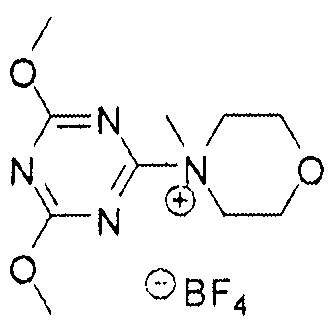
MS [M+H'f m/z 241 .1
Ή NMR (300 MHz. CD CN) δ 3.39 (3 H, s, CH3-N). 3.71 (2H, t, J - 8.5 Hz, CH2), 3.75 (2H. t, J - 10 Hz, CH2), 4.00 (21 1, m, CH2), 4. 1 1 (611, s. 0-CH3), 4.47 (2H, dd, J, 1 0 Hz, J2 = 2 Hz , CH2).
L'C NMR (75 MHz, CD3CN) δ 56.90 (CHj-N), 57.82 (2 x CH3-0), 61 . 1 0 (2 x CH2), 62.78 (2 x CH2). 1 71 .23 (N-C-N), 1 75.02 (N-C-N).
Example 53:
(A) Optimisation of Coupling Conditions using Benzoic Acid and Benzyl Alcohol as Mimics of the Carboxy-terminated Chemical Ligands and Hydroxyl-terminated Polymer Supported Bead Functionalities respectively.
Λ'-ηΐΰΐ1ιν1ηιο 1ιο1ίηε (68 mg, 0.6 mmol) was added dropwisc to a solution of 4-(4,6- dimethoxy- l ,3 ,5-triazin-2-yl)-4-methylmoipholin-4-ium tetrafiuoroborate (DMTMM) (200 mg, 0.6 mmol) and benzoic acid 73.3 mg, 0.6 mmol) in acetonitrile (5 mL) at 0 "C. The solution was stirred at 0 °C for an additional 2 hours, then a mixture of benzyl alcohol (81.0 mg, 0.75 mmol) and DMAP (9.3 mg, 0.06 mmol) were added. Stirring was continued at 0° C for 30 minutes and then the mixture was left to stir at room temperature overnight. The solvent was evaporated, and the residue was suspended in chloroform ( 10 mL). The suspension was washed with water (5 mL), 0.5 M KHSO4 (5 mL), water (5 mL), 0.5 M NaHCOj (5 mL) and water (5 mL). The organic layer was dried with MgSOa and the solvent was evaporated in vacuo to give the product as a colourless oil. Yield: 85 %

Benzvl bcnzoate
MS [M+Na] ' m/z 225.0
Ή NMR (300 MHz, CDC ) 6 5.43 (211, s, CI I2), 7.38-7.58 (811, m, Ar-I I), 8. 1 4 (2H, d, J = 8. 1 Hz, Ar-IT).
(B) The above model reaction conditions were then replicated to verify the coupling reaction of the carboxyl-terminated ligands, based on the methyleneamino- and methylamino-heterocyclic structures as indicated above, with benzyl alcohol as the model for the hydroxy-terminated polymer bead supports. The following examples are representative of the conditions used in these reactions with these various methyleneamino- and methylamino-heterocyclic ligands.
Example 53a: Coupling of Methyleneamino-Ligands to Hydroxy-group Functionality: N-methyl-rnorpholine (50.6 mg, 0.5 mmol) was added dropwisc to a solution of 4-(4,6- dimetho y- l ,3,5-triazin-2-yl)-4-methylmoφholin-4-ium tetrafluoroborate (DMTMM) ( 164.0 mg, 0.5 mmol) and 2-(4-(pyridin-4-ylmcthyleneamino)phenyl)acetic acid (7) ( 120. 1 mg, 0.5 mmol) in acctonitrile (3 mL) at 0 °C. The solution was stirred at 0 °C for an additional 2 hours, then a mixture of benzyl alcohol (67.6 mg, 0.67 mmol) and DMAP (6. 1 mg, 0.05 mmol) were added. Stirring was continued at 0 °C for 30 minutes and then the mixture was left to stir at room temperature overnight. The solvent was evaporated, and the residue was suspended in chloroform ( 10 mL). The suspension was washed with water (5 mL), 0.5 M HS04 (5 mL), water (5 mL), 0.5 M NalIC0.3 (5 mL) and water (5 mL). The organie'layer was dried with MgSO.i and the solvent was evaporated in vacuo to give the product as colourless oil . Yield: 72 %

Benzyl2-(4-(pyridin-4-ylmethyleneamino)phenyl)acetate
MS [M+ H]+ m/z 33 1 .1
Ή NM (200 MHz, d6-DMSO) δ 3.38 (21 1, s, CH2), 4.53 (2H, d, CH2), 7.20-7.39 (9H, m, Ar-H). 7.84 (2H, dd, Ar-H), 8.67 ( 1 H, s, CH=N)), 8.75 (2H, dd, Ar-H).
I 3C NMR (50 MHz, d6-DMSO) δ 54.76 (CH2), 62.99 (CH2), 121 .20 (CH), 122. 1 3 (CH), 1 26.41 (CH), 126.58 (CH), 127.83 (CH), 1 27.85 (CH), 1 28.37 (CH), 130.3 1 (CM), 133. i l (C), 136.01 (C), 142.53 (C), 1 49.30 (C), 1 50.41 (CH), 158.90 (CH=N), 1 70.96 (C=0).
Example 53b: Coupling of Methyleneamino-Ligands to Hydroxy-group Functionality N-methyl-morpholine (50.6 mg, 0.5 mmol) was added dropwise to a solution of 4-(4,6- dimethoxy- l ,3,5-triazin-2-yl)-4-methylmorpholin-4-ium tetrafluoroborate (DMT) ( 164.0 mg, 0.5 mmol) and 2-(4-(pyridin-4-ylmethylamino)phenyl)acetic acid (7) ( 121 .1 mg, 0.5 mmol) in acetonitrile (3 mL) at 0° C. The solution was stirred at 0 °C for an additional 2 hours, then a mixture of benzyl alcohol (67.6 mg, 0.67 mmol) and DMAP (6.1 mg, 0.05 mmol) were added. Stining was continued at 0 °C for 30 minutes and then the mixture was left to stir at room temperature overnight. The solvent was evaporated, and the residue was suspended in chloroform ( 10 mL). The suspension was washed with water (5 mL), 0.5 M HS04 (5 mL), water (5 mL), 0.5 M NaHC03 (5 mL) and water (5 mL). The organic layer was dried with MgS04 and the solvent was evaporated in vacuo to give the product as yellow oil. Yield: 46 %

benzyl 2-(4-(pyridin-4-ylmethylamino)phenyl)acetate

Ή NMR (200 MHz. do-DMSO) δ 3.51 (2H, s. CH2), 4.30 (211, d, CH2), 4.5 1 (s, BzOH impurity), 5.07 (2H, d, CH2), 6.33 (2H, d, Ar-H), 6.95 (2H, d, Ar-H). 7.20-7.35 (m, Ar-H, BzOH impurity), 7.84 (2H, dd, Ar-H), 8.47 (2H, d, Ar-H), 8.70 ( 1 H, s, NH), 8.75 (21 L d, Ar-H).
Example 54: Preparation of chemical compound array
Preparation of the Array Silicon Master:
The following example is illustrative of the type of silicon master that can be employed, whereby a PDMS mould can be formed with two series of arrays arranged in two rows,
cach including five arrays of etched 5x5 arrays of pyramidal wells. Other configurational arrangements can be made through changing the location of the pyramidal posts within the silicon master. Figure 1 shows one such fabrication scheme for the preparation of a beads- on-posts microarray. The wells in each row, which have the same size (4.5 or 5.5 μιη in width), but placed at an increasing inter-well distance (8, 16, 32, 64 or 128 μηι and 6, 12, 24, 48 or 96 μιη, respectively), were fabricated by photolithography and anisotropic etching (along the <1 00> crystallographic face) of a silicon 4 x 4 inch wafer. The wafer was then cut into smaller chips (about 1 x 1 cm), which were then used for fabrication of the bead-PDMS microarrays. Each chip comprises approximately 60 etched microarrays.
Preparation of Polydimethylsiloxane (PDMS) Polymer
Polydimethylsiloxane (PDMS, Dow Corning) polymer was prepared by mixing the pre- polymer base material ( 1 84 Silicone Elastomer) and the curing agent ( 1 84 Silicone Elastomer) at a ratio of 1 0: 1 (w/w). The mixture was then stirred at room temperature thoroughly until a whitish mixture was present. After degassing for 30 minutes to 1 hour under vacuum until all air bubbles disappeared, the clear and transparent PDMS precursor solution was gently poured over the silicon chip master and cured at 60 - 65 °C for 2 - 3 hours to ensure complete cross-linking. This procedure was employed for the preparation of the PDMS polymer array using the appropriately designed complementary silicon master and array mask. The PDMS replica moulds was then cut and removed from the silicon master and were then ready for deposition of the funetionalized beads and further testing and use.
Deposition of the Functionalised Beads into the Etched Wells of the PDMS Mold
Functionalised beads derived from amino-terminated or carboxy-terminated polymeric microspheres, as described below, were deposited inside the etched wells of the PDMS mould formed from the corresponding silicon master, which was prepared as outlined above. The amino-terminated or carboxy-terminated melamine microspheres were obtained from Corpuscular, Inc. (Cold Spring, NY, USA), as a 5 wt.-%. aqueous colloidal solution. Amino- or carboxy-terminated beads obtained from other suppliers, such as Estapor-Merck Chimie s.a.s (F-94126 Fontenay Sous Bois Cedex France) or , Sigma-
Aldrich (St. Louis, MO, USA) can also be employed. Ethanol (HPLC grade), acetone (HPLC grade) and DMSO (>99.9%) were purchased from Sigma Aldrich Pty Ltd (Sydney, Australia). All bead solutions were prepared at the approximate concentration of 0.04 wt.- % using MilliQ water. Solutions were always prepared fresh to minimize the formation of aggregates and were vortexed immediately prior to their use for 1 -2 minutes.
Functionalised beads can be prepared by immobilising low molecular weight heterocyclic compounds as described in examples 49 to 53. The functionalised beads (with non- functionalised beads lacking the specific ligand(s) employed as controls) were deposited inside the etched wells of the silicon master by spin coating, using a Specialty Coating Systems spin coater (Model P6708). A volume ( 1 50 μΙ_.) of the bead solution (0.04 wt.-%), containing either the functtonalized or non-functionalised beads, was deposited over the silicon master and the rotor spun to 500 rpm. After 30 seconds, the speed was increased to 2000 rpm and spinning kept for further 60 seconds. Spinning was repeated three times. Between each spin, a thin, flat piece of PDMS was placed over the master to remove the residual beads that deposited on the chip surface outside the wells. The resulting microarray platform thus comprises a transparent, biocompatible poly(dimethylsiloxane (PDMS) polymer moulded into a series of arrayed micro-sized pyramidal posts with single microbeads trapped at their apex. In Figure 2 (a) and (b). close-up microscopic images of the bead trapped in (a) a pyramidal well and (b) at the apex of a PDMS pyramid respectively are illustrated.
The above fabrication method allows the preparation of bead arrays, which are both spatially- and informationally-addressable, in the sense that each bead-array is characterised by a unique geometric code. The trapped beads are mechanically stable and their surface properties are unaltered during the fabrication process, therefore providing anchoring sites for the specific interaction of the immobilised chemical ligands with the target (bio)molecules. Figure 3 shows an example of such a microarray with beads (a) randomly deposited in the wells on the silicon wafer and (b) positioned at the apex of the complementary PDMS pyramids/posts of the microarray.
When microarrays are intended to be used in conjunction with matrix assisted laser desorption ionisation lime-of-flight-mass spectrometry (MALDI TOF MS) instrumentation, which requires spot diameters of larger than 0.5 mm to enable adequate focusing of the MALD1-TOF MS laser, the functionalised beads (with non-functionalised beads lacking the specific ligands employed as controls) can be deposited as chemical compound immobilised bead clusters using, say, 0.5 μΐ., aliquots of approximately 1 mg mL" 1 bead solution onto the bottom of a preformed polystyrene culture dishes, marked with a 5 x 5 mm2 grid on the underside of the dish. In this case, four clusters could then be generated within each 0.5 mm gridbox, resulting in spots of approximately 1 mm in diameter. Figure 4 illustrates the general schematic for the fabrication of these array arrangements. Clearly, other types of bead cluster arrangements can be readily developed, based on the grid design and size. After drying, excess beads were removed with a stream of filtered nitrogen gas, and the PDMS prepolymer poured over the spotted beads to a depth of 3 mm. The PDMS prepolymer was cured as described previously, and any unattached beads and excess buffer salts were removed by extensive rinsing with deionised water. Microscopic visualisation of the bead arrays before and after sonication showed that beads were strongly embedded in the PDMS and could not be removed by sonication at 50 W, 40 kHz. Figure 5 (A)-(D) show examples of this type of bead arrangement so formed, in a 5 x 5 mm grid format, at 20 x and 60 x magnification.
Characteristics of the Bead-PDMS Microarray
To test the mechanical stability of the bead-PDMS microarray, the same array was sonicated (separately) in a 20 mL of phosphate buffer saline (PBS, 1 0 iiiM), ethanol and acetone for 5. 1 0 and 20 minutes using an ultrasonic cleaner. Between each wash, the platform was imaged with the 40 x objective of an upright microscope and the number and position of the beads entrapped in the PDMS mould recorded. Depending on the spatial distribution of the functionalised beads, a unique address can be assigned to the specific microarray. For example, Figure 6 illustrates the optical microscopy images of one such array, obtained through the random deposition of the functionalised beads in the wells, reproduced with three different geometric codes.
Depending on the structure of the immobilised compound, and the type o f functionality and chemical composition of the bead itself, different bcad-PDMS microarrays, belonging to different chemical compound classes, and derived from different functionalised/non- lunctionalised beads can thus be obtained. For example, the amino-group reactive dye Alexa Fluor® 546 (Invitrogen, Inc.) was used to test the reactivity of a bead-PDMS microarray fabricated with amino-terminated microspheres (Figure 7). The PDMS stamp was covered with 1 50 μΐ. of the dye solution (0.4 mg/mL in DMSO) and left reacting for 1 hour. The stamp was then washed with DMSO, water and dried in air. A bead-PDMS microarray fabricated with glass microspheres was also used as a control sample and reacted with the dye Alexa Fluor® 546 under the same conditions. The bead-PDMS microarray when probed with the reactive dye Alexa Fluor® 546 was imaged using an inverted Olympus 1X81 microscope (60 x water objective) equipped with a transmitted light differential interference contract attachment. Fluorescent images (40 x) were captured using the same microscope with epifluorescence optics (Alexa Fluor® 546 filter setting) and mercury light source. The images were recorded with a Coolview FDI high-resolution camera (Photonics Science Ltd.) controlled by Image-Pro Plus software (version 5.0, Media Cybernetics).
When functionalised beads derived from amino- or carboxy-terminated beads are employed, alternative modes of imaging other than fluorescence spectroscopy can be employed, based on the spectral characteristics of the resultant bound analyles, such as polypeptide/peptides generated from the digestion of different target proteins as described below. Moreover, when matrix assisted laser desorption ionisation time-of-flight-mass spectrometry (MALDl TOF MS) is intended to be used as the detection system, depending on the focusing optics of the specific MALDI-TOF MS instrumentation, as noted above microarrays of larger spot dimensions can be employed. For example, with the Voyager DE-STR mass spectrometer manufactured by Applied BioSystems Inc. (Waltham, MA, USA) the optics used for sample visualisation within the MALDI-TOF MS instrumentation are not able to discern beads smaller than 2 μιη. so the user would thus not know whether the instrument was sampling an array area with beads or a zone lacking beads, if the spatial distance between beads was of the same dimensions or smaller than the beads themselves.
A solution to this constraint of focusing the laser of a MALDI-TOF MS instrument can be achieved with the use of beads clustered into spot diameters of approximately 1 mm with spatial displacement between bead arrays of approximately 5 mm. In this manner, regions containing the beads bearing the chemically immobilised ligands can be easily visualised and sampled by the MALDI-TOF MS laser.
SEM Analysis of the PDMS-bead Microarray
SEM analysis of the PDMS-bead microarray was performed on a JEOL 10 microscope (JSM840) at 1 5 keV. Prior to SEM imaging, the PDMS stamps were coated with gold using Gold coating using a SEM-coating unit E5100 (Polaron Equipment Ltd.) at 25 mA for 90 s at 0. 1 Torr.
Example 55: Selection Criteria for the Identification of Specific Peptide/Protein Markers Associated with Specific Bacterial Species:
The fol lowing criteria were employed 'to allow the identification of marker protein/polypeptide/peplides, which are characteristic of various bacterial species and strains:
ii) the target protein(s) is(are) relatively abundant in bacteria cells;
iii) the genome sequence and/or proteome of the bacterium was known;
iv) the expression of the target protein(s) must be essential to cell growth, survival or reproduction, possibly belonging to particular functional group such as cell wall biosynthesis, protein biosynthesis (including the entire tRNA synthetase complex), fatty acid biosynthesis, DNA replication or RNA transcription;
v) the target protein(s) must have homologues in other target bacteria, but nevertheless is structural ly unique;
vi) the target protein(s) must have sites within its amino acid sequence that are proteolytic accessible;
vii) the target proteins and some proteolytically-derived fragment(s) thereof must be unique for a particular bacterium and;
viii) the target proteins and some proteolytically-derived fragment(s) thereof must have specific binding behaviour for individual ligands, which are
i mmobilised onto nanosized beads, which can be supported in the array format as described in this application;
ix) the target proteins or the proteolytically-derived fragment(s) must be detectable in MALDI ToF mass spectrometry.
Choice of Bacterial Micro-organism Targets for Biomarker Identification
For the purpose of validating the capabil ities of the technology, the fol lowing microorganisms were used as exemplars in investigations associated with the detection of pathogenic bacteria that have been implicated in the disease of dai ry cows, namely bovine mastitis :
a) Escherichia coli
b) Si aphylococcus aure us
c) Streptococcus agalactiae
d) Streptococcus dysgalactiae
Streptococcus uteris
Example 56 : Sample Preparation Procedures for the Detection of Speci fic Markers using the Functionalised Bead Microarray Methods
Lysis of Bacterial Cell Colonies to Obtain the Biomarker Cyloplasmalic Proteins
Biological samples containing bacterial cells were centrifuged at 4,500 g for 5 minutes at 4 °C to allow a cell pellet to be obtained. The cell pellet can be stored overnight at -20 °C. To achieve lysis, the cell pel let was then resuspended in 1 * PBS ( 1 50 mM NaCl [AmrescoJ, 10 mM
 buffer [Merck Australia Pty. Ltd, Kilsyth], pH 8.0). On a pro-rata volume basis of 1 0 mL resuspension solution to 0.25 mL lysis solution, a hen egg white lysozyme solution (20 mg/mL) was added to the resuspended pellet preparation. The cell suspension was then sonicated 10 times with 30 second bursts with a one minute delay between sonication bursts. The lysate was recovered by ccntrifugation at 25 ,000 g for 30 minutes at 4 °C . The resulting lysate supernatant can be stored at -80 °C as al iquots if necessary.
For the preparation of bacterial cell lysate supernatants for , use in larger scale or control experiments, bacterial colonies were cultured by inoculated into 20 mL 2YT ( 1.6 % Tryptone [OxoidJ ; 1 % yeast extract [OxoidJ; 85 mM NaCl [Amresco]) and grown overnight at 37 °C. Fresh 2YT media (500 mL) was inoculated with 10 mL of this culture and the bacterial colony cultures grown at 37 °C until an OD6oo of between 0,8 and .1 ,0 was reached.
buffer [Merck Australia Pty. Ltd, Kilsyth], pH 8.0). On a pro-rata volume basis of 1 0 mL resuspension solution to 0.25 mL lysis solution, a hen egg white lysozyme solution (20 mg/mL) was added to the resuspended pellet preparation. The cell suspension was then sonicated 10 times with 30 second bursts with a one minute delay between sonication bursts. The lysate was recovered by ccntrifugation at 25 ,000 g for 30 minutes at 4 °C . The resulting lysate supernatant can be stored at -80 °C as al iquots if necessary.
For the preparation of bacterial cell lysate supernatants for , use in larger scale or control experiments, bacterial colonies were cultured by inoculated into 20 mL 2YT ( 1.6 % Tryptone [OxoidJ ; 1 % yeast extract [OxoidJ; 85 mM NaCl [Amresco]) and grown overnight at 37 °C. Fresh 2YT media (500 mL) was inoculated with 10 mL of this culture and the bacterial colony cultures grown at 37 °C until an OD6oo of between 0,8 and .1 ,0 was reached.
Determination of Protein Concentration in Bacterial Samples with the BCA Protein Assay Bacteria lysate supernatants were diluted 1 in 10. 1 in 50, 1 in 100. 1 in 500 or 1 in 1000 with 1 x PBS buffer. For protein standards, solutions of bovine serum albumin (BSA) ranging in concentration from 20 μg/mL to 1000 μg/mL were prepared. Aliquols ( 100 μΐ,) of the samples and standards were transferred into 2 mL eppendorf tubes. Reagent A and Reagent B from BCA Protein Assay Kit (Pierce Chemical Co., Rockford, IL) were mixed together at a ratio of 50: 1 (Reagent A : B) and 2 mL of mixture was added to each sample and standard tube. The reactions were incubated at 37 °C for < 30 minutes before the absorbance were measured at 562 nm. Protein concentrations of the samples were then determined from the standard curve.
Ethanol Precipitation of Proteins from Bacterial Cell Lysates
Six to eight volume equivalents of cold ethanol (stored overnight at -20 °C) was added to the centriiuged cell lysale. The sample was mixed by vortexing then incubated on ice for 1 5 minutes and then stored at -20 °C overnight. Proteins were pelleted by centrifuging at 14,000 g for 30 minutes at 4 °C. The pellet was then washed with cold ethanol (4-6 times the starting volume of the centriiuged cell lysate) by vortexing and incubation on ice for 20 minutes. The ethanol washed protein was then re-pelleted by centrifugation as above, air- dried and then directly analysed or alternatively could be lyophilized for storage and subsequent analysis.
Enzymatic Digestion of the Precipitated Bacterial Proteins
The dried (lyophilized) protein sample was dissolved in 50 mM ammonium bicarbonate ( H4HCO3) to give a final concentration of 1 mg/mL. Calcium chloride (CaCb) was then
added to a final concentration of 2 mM. Aliquots (typically - 100 μΙ_) of the above mixture were incubated at 100 °C for 90 seconds, and then DTT was added to a final concentration of 10 mM. This sample was incubated at 60 °C for 30 minutes, and the sample cooled at room temperature for 30 minutes. For digestion volumes of 100 μΐ,, 15 μΐ, of RapiGest ' M SF (2 % solution) was added to give a final concentration of -0. 1 %. The digest sample was then vortexed before and after the addition of iodoacetamide to a final concentration of 20 mM, and incubated at room temperature in the dark for 30. minutes. For maximum activity, trypsin was incubated in the digestion buffer at 30 °C for 1 5 minutes before addition to the sample at a ratio of 1 :20 (trypsimsample). After two hours digestion at 37 °C, the digest was centrifuged at 1 3,000 x g for 5 minutes at room temperature. The supernatant containing the tryptic digest peptides was then collected before an additional aliquot of trypsin was added at the same ratio and the digestion continued for another 2 hours at 37 °C. The enzyme was inactivated by the addition of TFA (trilluoroacetic acid) to a final concentration of 1 -2 % and the sample was centrifuged at 1 3,000 x g for 5 minutes at room temperature before being concentrated by evaporation. An aliquot (50 μΐ,) of 0. 1 % aqueous formic acid (v/v) was added before the sample was desalted using a C I 8 OMIX pipette tip (to generate a working volume of -1 0 μΐ.).
Sample Handling and Solid Phase Extraction Methods with Target Polypeptides/Peptides Prior to sample desalting and concentrating, a C I 8 OMIX pipette tip was washed three to five times successively with ACN/H20 (75/25 v/v)/0. 1 % TFA followed by 0.1 % TFA three to five times. The sample was then drawn slowly into the pipette tip ten to twenty times. The C I 8 tip was then washed two to three times with 0. 1 % TFA before the sample was eluted in 10 μΐ ACN/H20 (75/25 v/v)/0.1 % TFA by drawing this through the C I 8 pipette tip two to three times. The tryptic digestion samples (-2 ί) can be dried by evaporation and stored at -20 UC, prior to analysis, if necessary.
Methylation of Phosphopeptides
In order to characterize post-translationally modified proteins/peptides that have been phosphorylated, an addition methylation step is required. In this case, the tryptic digestion sample (containing the phosphopeptides) (2 μg/μL) was reconstituted in methanolic HC1
(-500 μί), and methyl esterification was allowed to proceed for 3-4 hours at room temperature. The derived polypeptide/peptides were then recovered by drying using rotary evaporation (-2.7 kPa) at 40 °C, vacuum 50 mbar) before being reconstituted in a solution containing an equal volume of methanol, water, acetonitrile and 0.5 % TFA. The sample was then ready for the micro-array chemical ligand capture and ALDl-TOF analysis. Enzymatically digested β-casein phosphopeptides can be used as internal and external calibration standard.
Dephosphorylation of Phosphopeptides
To further characterize post-translationally modified proteins/pcptides that have been phosphorylated, a dephosphorylation buffer (0.5 M Tris-HG, 1 mM ED'l'A, pH 8.5) was added to the tryptic digestion sample that had been processed through the C I 8 OMIX pipette tip (typically in the volume ratio of (4 μΐ, to 33 μΕ). One unit of calf intestinal alkaline phosphatase was then added before the mixture was incubated at 37 °C for one hour. An additional unit of alkaline phosphatase was added after 20 and 40 minutes. The sample was then ready for micro-array chemical ligand capture and MALDl-TOF analysis. Enzymatically dephosphorylated β-casein phosphopeptides can be used as internal and external calibration standard. Solid Phase Extraction with Titanium Oxide Materials for Further Phosphopeptide Enrichment
Prior to phosphopeptides enrichment and concentrating, a TiO MonoTip was washed three times successively with 100 % ACN/0. 1 % trifluoroacetic acid followed by the conditioning buffer (200 mM NaH2PO^ buffer [Merck Australia Ply. Ltd, Kilsyth], pH 7.0) twice. The sample was then drawn slowly into the pipette tip approximately twenty times. The TiO Monotip was then washed two to seven times with rinsing buffer (50 % ACN with 0.1 % formic acid and 0.1 M KC1) before the sample was eluted in 50 μΐ.. 0.2 M phosphate buffer (pH 7) by drawing this solution through the TiO Monotip three to six times.
Example 57: Techniques Employed for the Matrix Assisted Laser Desorption lonisation Time of Flight Mass Spectrometric (MALD1-TOF MS) Detection Analysis and Characterisation of Biotargets
5 Matrix Preparation Method with 2,5-DI IB (2, 5-dihydroxybenzoic acid, gentisic acid) for MALDI-TOF MS Analysis
2,5-DHB was dissolved in water/acctonitrile (35:65, v/v) and 0.1 % tri fluoroacetic acid or 1 % ortho-phosphoric acid to give a final concentration of 10 mg/mL. Solutions of 2, 5- DIIB and diammonium -citrate (200 mM) were combined at a ratio of 9: 1 , and vortexed 1 0 until the matrix was dissolved.
Matrix Preparation Method for THAP (2, 4, 6-trihydroxyacetophenone)
THAP was prepared by dissolving 2, 4, 6-trihydroxyacetophenone monohydrate in water/acetonitrile (50:50, v/v) and 0. 1 % TFA or 1 % o-PA to give a final concentration of 1 5 14 mg/mL. Solutions of THAP and diammonium citrate (200 mM) were combined at a ratio of 9: 1 . and vortexed until matrix was dissolved.
Matrix Assisted Laser Desoiption lonisation Time-of-Flight Mass Spectrometry (MALDI TOF MS)
0 All protein, polypeptide and peptide products were analyzed with a MALDI ToF mass spectrometer (Voyager DE-STR, Applied BioSysterns) with a 337 nm nitrogen laser using 3-nanosecond duration pulses with a maximum firing rate of 20 Hz. Spectra in the retlectron mode were obtained with delayed extraction using a delay time of 375 ns with positive polarity for samples with the 2, 5-DHB as a matrix and 375-550 ns in a positive5 polarity for samples with the THAP as a matrix. The low mass gate was set at 500 Da.
Each spectrum comprised 500 laser shots.
Mass Spectrometry Data Analysis
The MALDI TOF MS spectra were processed with the Data Explorer Software Version0 4.0.0.0 baseline corrected, noise filtered/smoothed and deisotoped to determine the monoisotopic masses. Spectra were analyzed using the SpectrumMill software where the
databases were searched with MS spectra obtained for the Peptide Mass Fingerprints (PMF). in this procedure, the IntelliCal routine with one filter was utilized. The preprocessing filter was set to an accuracy of 100 ppm to identify the protein from the obtained masses of the tryptic peptides. The mass spectral interpretation tool for MALDl TOF MS data used was the Peptide Mass Fingerprint data (PMF) subroutine and the database used for the identification of peptides was the non-redundant SwissProt or NCB1 database.
Databases for Protein Identification
The SpectrumMill workbench allows the use of subset databases for the purpose of fast off-line searches of the results. The databases for the following bacteria (+ strains) were installed on a server and used as off-line searchable databases:
> NCBInr
> SwissProt
> Escherichia coli (CFT073, KI2-MGJ 655, 0157H7, 0157H7 EDL933)
> Staphylococcus aureus (MW2, Mu50, N315, COL, MRSA252, MSSA476)
> Streptococcus agalactiae (2603 V/R, NEM316. A 909)
> Streptococcus uteris (0140 J)
> Streptococcus dysgalaciiae (no information: genome not sequenced)
Sequence Alignment of Homologous Proteins for Biomarker Identification
In order to identify homologous proteins amongst the bacterial strains (E. coli, Staphylococcus aureus and Streptococcus agalactiae) several protein databases can be utilised. The WU-Blast2 (Washington University Basic Focal Alignment Search Tool Version 2.0.) was used due to its high sensitivity as well as the Blastp, UniProt and Blossum62 matrix programs.
Example 58: Application of the New Functional ised Bead-Based Microarray Technology for the Detection, Analysis and Characterisation of Bacterial Peptides
Establishment of Protocols for the Evaluation of the Chemical Compounds Immobilised to Beads for their Capacity to Bind Bacterial Target Peptides
The following protocol is representative of the procedures followed to evaluate the capture efficiency of the embedded beads with immobilised ligands, such as the methylcneamino- and methylamino-heterocyclic compounds 1 -45, and to determine their ability to selectively bind bacterial peptides. These bi ding/capture procedures can be operated in two alternative modes. The first mode, called the positive binding mode, is based on the selective and highly specific binding of target bacterial peptides to the ligands, chemically immobilised onto the beads, which in turn are supported on the posts or other types of polymer surface configurations, generated for example from a PDMS polymer substratum. In this mode the bound bacterial peptides are analysed and characterised directly by MALDI-TOF MS techniques as described below. The second mode, called the negative binding mode, is based on the selective and highly specific binding of target peptides to the ligands, chemically immobilised onto the beads, which in turn are supported on the posts or other types of polymer surface configuration, generated for example from a PDMS polymer substratum. In this mode the non-bound peptides, recovered in the wash fraction, are. analysed and characterised directly by MALDI-TOF MS techniques as described below. The specific peptides recognised by the different chemical ligands, such as such as the methyleneamino- and methylamino-heterocyclic compounds, 1 -45, immobilised onto the bead microarray are then characterised by subtraction analysis. The control-only samples (i.e. also known as the positive control sample since this sample represents bacterial peptides that have not been exposed to any bead or polymer material surfaces) will contain the full complement oi' detectable bacterial peptides; similarly, in the positive or negative mode the samples derived from exposure of the crude bacterial peptide sample to the unmodified beads (i.e. also known as the negative control sample) are expected to contain those bacterial peptides which are capable of interacting non- specifically with the bead or polymer support substratum; whi lst in the positive or negative mode the samples derived from exposure to the chemical compounds immobilised onto the beads (also known as the test samples) should display a depleted peptide profile resulting from the specific interaction of certain peptides with the bead-immobilised ligands. As a consequence, certain peptide miz peaks in the MALDI-TOF mass spectrum should display significant differences in signal intensities with respect to the positive and negative control
samples. A signi ficant result will be achievable at an appropriate sample di lution where the concentration of peptides is at or j ust below the total loading capacity of the beads. When the system is operated in the negative binding mode (i .e. the beads are pretreated with crude bacterial peptide samples after loading onto the PDMS array posts) this will equate with an enhanced signal intensity compared to the posi tive/negative controls; whilst when the system is operated in the positive binding mode (i .e. the beads are pretreated with bacterial peptide samples prior to loading onto the PDMS array posts) this wi ll equate with an depleted signal intensity compared to the positive/negative controls. Characterisation of Bacterial Proteins/Polypeptidcs/Peptides through their Abi lity to Selectively bind to Ligands that have been Immobilised onto Functionalised Beads and presented in Bulk or Micro-Array Format
The following example documents the approach followed to characterise the specificity and characteristics of the different immobilised chemical ligands, such as the methyleneamino- and methylamino-heterocyclic compounds 1 -45, presented in bulk or micro-array format, to selectively bind to bacterial proteins, polypeptides and peptides. These experiments were carried out in parallel with the untreated bacterial polypeptide/peptide sample (negative control sample), with the unmodified beads (positive control sample ) and with the functionalized beads containing different immobilised chemical ligands. Prior to incubation, the unmodified and functionalised bead systems were washed with de-ionized water. Excess liquid was removed by centrifugation of the bead systems and discarded, and the washing procedure repeated. The unmodi fied and functionalised bead systems were then washed with the equilibration buffer ( 1 00 μΐ of 10 mM morpholine ethanesul fonic acid , MES, at pH 7.5), and again centri fuged. All steps were performed at room temperature.
Bacterial protein/polypeptidc/pcptidc samples (20 μ Ε per sample), prepared as described above, were passed twice through C I 8 OM1X pipette tips. The resulting solutions were evaporated using a high throughput evaporator and the pellets resuspended by gently mixing it for a few minutes in 100 μΕ of above equilibration buffer ( 1 0 mM morpholine
ethanesul tonic acid, MES, at pH 7.5). Fifty μί, of this solution was then diluted 1 : 1 0, 1 : 1 00, 1 : 1000, 1 : 10000 and 1 : 1 00000* with the above buffer.
For both the positive and the negative adsorption mode, each bead sample (the unmodified beads and the beads containing immobilised ligands), arranged according to a specific predetermined order, received aliquots of the protein/polypeptide/peptide solution, prepared as described above, at five different concentrations diluted respectively over a 1 03 range. These samples were then incubated for 5 minutes, briefly washed with incubation buffer and then centrifuged at 1 3,000 x g for 1 0 minutes to remove the supernatants and washings. In the case of the posi tive and negative adsorption mode, both the peptide-bound bead system and the supernatant/washings can be recovered for analysis. An additional control was included which consisted of the original samples of the protein/polypeptide/peptide solutions incubated with buffer only. The general format that can be employed is shown in Figure 8. The chemical ligands, such as the methyleneamino- and methylamino-heterocyclic compounds 1 -45, were individually immobilised onto the beads using the procedures described above, whilst the different bead clusters and arrays were made as discussed above by preparing a mould, placing the beads into the indentations in the mould and a solidifiable polymer poured on top then after setting the polymeric array of immobilised beads removed from the mould. The arrangement of the various chemical ligands is operator friendly, i.e. a specific compound, such as 6-(pyridin-2-ylmethyleneamino)hexanoic acid (24), can be located at any position of choice, e.g. at position 1 1 and/or 12 and/or 13, and/or 21 and/or 22 and/or 23, , etc, of the XY grid shown in Figure 8 and the other chemical compounds arranged in an ordered rank on adjacent locations according to polarity, hydrophobiciily or another physical chemical property, or alternatively randomly. In the preparation of the array format, although it may be feasible to load all available site with beads, technically a 100% occupancy by the iunctionalised beads may not be desirable or essential. For example, random distribution of the beads on the PDMS polymer surface, prepared as described above, results in groups of arrayed beads, each bearing the same or a different chemical compound, being presented as an informationally-addressable "bar code", which represents
a quasi-unique signature that can be read separately from the information carried by the beads. All samples were subjected to MALDl TOF MS analysis as triplicate measurements. The positive control sample (i .e. the sample not exposed to either the funclionalised beads or the naked beads) contains the full complement of peptides present in the bacterial protein/polypeptides preparation. The product from the negative control sample, when analysed in the positive adsorption mode under sub-optimal washing conditions, is expected to contain those bacterial polypeptides/ peptides that have undergone non-specific binding to the unmodified beads. The product from the incubation of the negative control sample with the unmodified beads under the negative adsorption mode with suboptimal washing conditions will be depleted in those bacterial polypeptide/peptides that have non-specifically bound to beads lacking any immobilised chemical compounds.
Similarly, the product from incubation in the positive adsorption mode with the beads modified with chemical compounds is expected, following an optimised washing step(s), to contain those bacterial polypeptide/peptides that have specifically bound to the beads, whilst in the negative adsorption mode the corresponding wash sample will be depleted in those bacterial polypeptide/peptides that have specifically bound to the bead with immobilised chemical compounds. Thus, in the latter case, it is expected that some polypeptide/peptides will be missing as they interact specifically with certain chemical compounds, such as the methyleneamino- and methylamino-heterocycUc compounds 1 -45, immobilised onto the beads. The corresponding MALDI TOF MS m/z signals for these polypeptides/peptides will, as a consequence, be significantly reduced or disappear with respect to the control samples.
The following examples, shown as Figures 9 and 10, illustrate the potential of the new technology for micro-organism screening with different chemical compounds immobilised in these bead formats. In this case, the capability is documented with bacterial systems, whereby two closely related compounds, namely compound 7, 4-(pyridine-4- ylmethyleneamino) benzoic acid, and compound 5, 4-(pyridine-3- ylmcthylencamino)benzoic acid, show significantly different binding specificity and
selectivity. As noted above, the positive control sample analyses are carried out with samples not exposed to either the beads or polymer substratum, the negative control sample experiments involve samples exposed to unmodified beads and the test samples involve samples at different dilutions exposed to beads carrying the immobilised chemical ligands, e.g. beads that possess different surface chemical functionalities as immobilised pyridinyl-methyleneamino- or pyridinylmethylamino- related compounds, prepared as described above. Prior to incubation with the sample, the various bead systems were washed and left for about 10 minutes in equi libration buffer. Previously prepared bacterial samples were suspended in the equilibration buffer and serially diluted 1 0-fold up to a dilution of 1 05 with the equilibration buffer prior to loading onto tine various bead systems for analysis. Thus, these bacterial peptide samples were loaded onto the unmodified beads and beads with immobilised ligands, incubated for 5 minutes, and following appropriate wash and other handling procedures as set out above, were then analysed by the (above MALDl-TOF MS procedures.
In this illustrative example, the MALDl-TOF mass spectral runs for a sample exposed to target capture in the positive adsorption mode is shown in Figures 9 and 10, highlighting the selection of only one m/z value (ions corresponding to other m/z values can also be evaluated as necessary). As evident from these examples, in this case a peptide corresponding to a mass spectral peak value of m/z = 957.1 385 [M+H]+ is depleted (captured) from the bacterial peptide preparation (Figures 9 and 10, Panel A) by the bead containing the immobilised compound 7, i.e. 4-(pyridine-4-ylmethyleneamino)benzoic acid), but clearly remains on screening the sample with beads that have not been modified with this chemical compound (Figure 9 and 10, Panel B) or in the control peptide sample (Figure 9 and 10, Panel C). Based on database search using the Spectrum Mill software and the archived sequences, this m/z ion of 957.1385 corresponded to the peptide "LEVVVNER40. This peptide is diagnostic of the intracellular DNA-binding protein. Fins, and unequivocally confirms the protein is derived from the bacterial strain, E. coli strain K 12.
In contrast, with the bead system that contained the immobi lised compound 5, i.e. 4- (pyridine-3-ylmcthyleneamino)benzoic acid, no depletion (capture) of the bacterial peptide corresponding to a mass spectral peak value of m/z ~ 957. 1 85 [M+HJ^ was observed. In addition, as apparent from these results, exquisite and unexpected selectivity differences are manifested in these formats by these functionalised beads, bearing different immobilised py idinylmethylencamino- or pyridinylmethylamino- related compounds that differ only slightly in terms of their structures. independent Validation of the Target Protein, Polypeptide and Peptide Identification by Complementary Liquid Chromaiography/Electrospray Ionization Ion-Trap Mass Spectrometry (LC/ESI-MS)
Polypeptide mixtures were separated by gradient elution chromatography performed using an Agi lent 1 1 00 Series Capillary HPI .C and analysed using an Agilent 1 100 Series LC ESI-MS ion Trap SL mass spectrometer. Data analysis was performed using the ChemStation Software (Agilent Technologies HP 1 100 Series LC ESI-MS). The eluents employed were A: 0. 1 % formic acid, in Milli-Q water and B; 0.1 % formic acid in acetonitrile, with a linear gradient from 5- 100 % B. The total run time was 1 85 minutes. Solvents were filtered and degassed by a vacuum degasser. UV detection was employed at 2 1 1 nm. The column used was a ZORBAX SB-C 1 8 (0.5 χ 1 50 mm, I.D., 5 μιη particle size) with the flow rate set at 4 μί/ηιίη and temperature set at 30 °C. The injection volume was typically 2 μΕ. The experiments were carried out at ambient temperatures (21 ± 1 °C). The electro-spray ionization conditions were: nebulizer 1 5 psi; dry gas 5.0 L/min; dry temperature 325 °C, the target m/z was m z = 791 . The scan range was from 100- 1 800 m/z; with positive polarity.
LC ESI/MS" spectra were analysed using the Agilent software SpectrumMill version A.03.02. The databank used for the identification of the polypeptides/peptides was the non- redundant NCBlnr database. To increase the accuracy for identification of the polypeptide/peptides other search engines were also used such as the Mascot (databases: NCBlnr and SwissProt) and Phenyx (database: NCBlnr). All database searches were performed using the servers MS/MS Ion Search. Detection was based on raw deconvokited
MS data and MS/MS data from the polypeptides/peptides or fragmented peptides. Enzymatically cleaved peptides derived from selected proteins were identified by using the program Peptide Mass, [http://us. expasy. orgl}, making allowance for a maximum of 5 missed cleavages. Data analysis and deconvolution of the MS data was performed with the LC ESI-MS Trap Software Version 4.2. This approach enabled the independent validation of the assignment of the target protein as identified by the above described novel technology, and resulted in confirmation that the bacterial strain was E. coli K 12. This outcome was achieved by complementary LC ESI ion trap mass spectrometry of the tryptic digest of the E. coli cell extracts, which again resulted in unambiguous identification of the protein H-ns based on LC ESI/MSrt m/z ion profiles at m/z - 957.536 (LEVVVNER), m/z = 1304.564 (YSYVDENGET ), m/z - 1 575.725 (REEESAAAAEV EER) and m/z = 2226. 169 (EML1ADGIDPNELLNSLAAVK). The identification of these m/z. ions, and the retrieval of the corresponding peptides by this technique, provides the independent validation for the efficacy of the immobilised chemical ligands, attached to beads, to screen for and detect bacterial micro-organisms, such as those associated with bovine mastitis.
Claims
1. A chemical library comprising at least two compounds of formula (I):

(I) wherein
H is an optionally substituted nitrogen containing heteroaryl group;
is selected from a single and double bond;
Ri is hydrogen when - ----- is a single bond and absent when ------ is a double bond;
A is a divalent linker;
R2 is a functional group suitable for attachment to a solid support.
2. A chemical library according to claim 1, wherein H is selected from pyrrolyl, pyridinyl, pyridazinyl, pyrimidinyl, pyrazinyl, 1 ,3,5-triazinyl, 1,2,4-triazinyl, 1,2,3- triazinyl, indolyl, indazolyl, quinolinyl, isoquinolinyl, cinnolinyl, quinazolinyl, quinoxalinyl, 1.8-naphthyridinyl,, 1 ,7-naphthyridinyl, 1 ,6-naphthyridinyl, 1,5- naphthyridinyl, phthalazinyl, benzo-l,2,3-triazinyl, benzo-l,2,4-triazinyl, oxazole, thiazole, benzoxazole, benzothiazole and pteridinyl, each of which is optionally substituted.
3. A chemical compound library according to claim 2, wherein H .is pyridinyl, pyridazinyl, pyrimidinyl, pyrazinyl. 1 ,2,3-triazinyl, 1,2,4-triazinyl, 1 ,3,5-triazinyl, quinolinyl and cinnolinyl, each of which is optionally substituted.
4. A chemical compound library according to claim 3, wherein H is pyridinyl and quinolinyl, each of which is optionally substituted.
5. Λ chemical compound library according to any one of claims 1 to 4, wherein the divalent linker is selected from -(CH2)I .I O-, -aryl-, -(CH2)i.5-aryl-, -(CH2)|.5-aryl-(CH2)|..r> -aryl-(CH2)i -s-, -aryl-NH-(CH2)i .5-, -aryl-NH-aryl-, -aryl-CONH-(CH2) | .5-, -aryl-CONH- aryl-, -aryl-CO-(CH2) | .5-, and -aryl-CO-aryl-; where each aryl is optionally substituted.
6. A chemical compound library according to claim 5, wherein the divalent linker group is selected from -(CH2) | .<;-, -aryl-, -(CH2)i -3-aryl. -(CH2) i ..raryl-(CH2)i-3- -aryl- (CH2) | .3-, -aryl-NH-(CH2) , .3-5 -aryl-NH-aryl-, -aryl-CONH-(CH2), .3-; -aryl-CONH-aryl-, wherein each aryl is optionally substituted.
7. A chemical compound library according to claim 6, wherein the divalent linker is selected from -(CH2)i -6-, -phenyl-, -(CH2)|.3'-phenyl-, -phenyl-(CH2) | .3-, '(CH2)i-3-phenyl- (CH2)i-3-, -phenyl-NH-(CH2) , .3-, -phenyl-NH-phenyl-, -phenyl-CONH-(CH2) | .3- and -phenyl-CONH-phenyl, wherein each phenyl is optionally substituted.
8. A chemical compound library according to claim 7, wherein the divalent linker is selected from -(CH2)| .6-, -phenyl-, -CH2-phenyl-, -phenyl-CH2-, -phenyl-NH-phenyl and -phenyl-CONH-CH2- wherein each phenyl is optionally substituted.
9. A chemical compound library according to any one of claims 1 to 8, wherein R2 is selected from C02H, -NH2 and -OH.
10. A chemical library according lo any one of claims 1 to 9, comprising at least two compounds of formula (11):

wherein is a double or single bond;
R i is hydrogen, when ^ z i a single bond and absent when ~ r is a double bond ;
A is a divalent linker;
R2 is a functional group suitable for attachment to a solid support;
Rj to Rs are each independently selected from hydrogen, -C i -6alkyl, -C^alkenyl, -halo, -nitro, -OH, -OC , .6alkyl, -SH, -Salkyl, -CN, -NH2, -NH(C, .6alkyl), -NH(C , .6alkyl)2 and  wherein n is 1 to 30; or R;¾ and R,t taken together with the carbon atoms to which they are attached form a 6 membered aromatic ring optional ly substituted with one or more R5.
'
1 1 . A chemical compound library according to any one of claims I to 1 0, comprising two or more compounds selected from :
2-(4-(pyridin-2-ylmethyleneamino)phenyl)acetic acid ,
2- (4-(pyridin-2-ylmethylamino)phenyl )acetic acid,
2-(pyridin-2-methyleneamino)benzoic acid,
4-((pyridi n-2-ylmethyleneamino)methyl)benzoic acid,
4-(pyridin-3 -ylmethyleneamino)benzoic acid,
4-(pyridin-3-ylmethylamino)benzoic acid,
4-(pyridin-4-ylmethyleneamino)benzoic acid,
4-(pyridin-4-ylinethylam ino)benzoic acid,
4-(pyridin-2-y melhyleneamino)ben/.oic acid,
4-(pyridin-2-ylmethylamino)benzoic acid,
3- (pyridin-2-ylmethyleneamino)benzoic acid,
3-( pyridin-4-ylmethyleneamino)benzoic acid,
2-(4-chloro-2-(pyridin-4-ylmethyleneami no)phenylamino)bcnzoic acid,
2-(4-chloro-2-(pyridin-2-ylmethyleneamino)phenylamino)benzoic acid,
2-(4-(pyridin-3-ylmethyleneami no)phenyl)aeetic acid,
2-(4-(pyridin-3 -ylmelhylamino)phenyl)acetic acid,
2-(pyridin-4-ylmethylcneamino)benzoic acid,
2-( 4-(pyridin-4-yl methyleneamino)phenyl)acetic acid,
2-(4-(pyridin-4-ylmethylamino)phenyl)acetic acid, 2- (4-(pyridin-4-ylmethyleneamino)benzamido)acetic acid,
3- (pyridin-3-ylmethyleneamino)benzoic acid,
2-(4-ch]oro-2-(pyridin-3-ylmethylcneamino)phenylamino)benzoic acid,
4- ((pyridin-4-ylmethyleneamino)methy])benzoic acid,
6-(pyridin-2-methyleneamino)hexanoic acid,
6-(pyridin-3-ylmethylencamino)hexanoic acid,
4-(pyridin-3-ylmethylenamino)butanoic acid,
2-(4-(pyridin-3-ylmethyleneamino)benzamido)acetic acid,
2- (4-chloro-2-(quinolin-2-ylmethyleneamino)phenylamino)benzoic acid,
3- (quinolin-2-ylmethyleneamino)benzoic acid,
2-(4-(quinolin-2-ylmethyleneamino)phenyl)acetic acid,
2-(4-chloro-2-(quinolin-4-ylmethyleneamino)phenylarnino)benzoic acid, 2-(2-((6-bromopyridin-2-yl)methyleneamino)-4-chloi phenylam ino)benzoic acid,
2- (4-((6-bi mopyridin-2-y])methyleneamino)phenyl)acetic acid,
3- ((6-bromopyridin-2-yl)methyleneamino)benzoic acid,
2-(4-((6-chloropyridin-3-yl)methyleneamii'io)phenyl)acetic acid,
2-(4-((5-bromopyridin-3-yl)methyleneamino)phenyl)acetic acid,
2-(2-((5-bromopyridin-3-y])methyleneamino)-4-chlorophenylamino)benzoic acid,
2- (4-chloro-2-((6-chIoropyridin-3-yl)methyleneamino)phenylamino)benzoic acid,
3- ((6-chloropyridin-3-yl)methyleneamino)benzoic acid,
3-((5-bromopyridin-3-yl)methyleneamino)benzoic acid,
3- ((6-bromopyridin-3-yl)methyleneamino)benzoic acid,
2- (4-((2-bromopyridin-3-yl)mcthyleneamino)phenyl)acetic acid,
4- ((2-bromopyridin-3-yl)methyleneamino)benzoic acid,
3- ((2-bromopyridin-3-yl)methyleneamino)benzoic acid, and
2-(2-((2-bromopyridin-3-yl)mcthyIcncamino)-4-chlorophenylamino)benzoic acid.
12. A chemical compound array comprising
a) a functionalised solid support; and
b) at least one compound of formula (IA):

vvhercin
H is an optionally substituted nitrogen containing heleroaryl group;
is selected from a single and double bond;
R i is hydrogen when is a single bond and absent when ------ is a double bond;
Λ is a divalent linker;
R2il represents a functional group attached to the tunctionalised solid support.
13. A chemical compound array according to claim 12, wherein H is selected from pyrrolyl, pyridinyl, pyridazinyl, pyrimidinyl, pyrazinyl, 1 ,3,5-triazinyl, 1 ,2,4-triazinyl, 1 ,2,3-triazinyl, indolyl, indazolyl, quinolinyl, isoquinolinyl, cinnolinyl, quinazolinyl, quinoxalinyl, 1,8-naphthyridinyl, 1,7-naphthyridinyl, 1 ,6-naphthyridinyl, 1,5- naphthyridinyl, phthala/.inyl, benzo- 1 ,2,3-triazinyl, benzo- 1 ,2,4-triazinyl, oxazolc. thiazole, benzoxazole, benzothiazole and pteridinyl, each of which is optionally substituted.
14. . A chemical compound array according to claim 13, wherein H is pyridinyl, pyridazinyl, pyrimidinyl, pyrazinyl, 1 ,2,3-triazinyl, 1 ,2,4-triazinyl, 1 ,3,5-triazinyl, quinolinyl and cinnolinyl, each of which is optionally substituted.
15. A chemical compound array according to claim 14, wherein H is pyridinyl and quinolinyl, each of which is optionally substituted.
16. A chemical compound array according to any one of claims 12 to 15, wherein the divalent linker is selected from -(CH2)i-io-, -aryl-, -(CH2)i.5-aryl-, -(CI I2) 1 -5-ary 1-(CH2) 1-5-, -aryl-(CH2)i-5-, -aryl-NH-(CH2)i.5-, -aryl-NH-aryl-, -aryl-CONH-(CH2)i.5-, -aryl-CONH- aryl-, -aryl-CO-(CH2)i.s-, and -aryl-CO-aryl-, where each aryl is optionally substituted.
17. A chemical compound array according to claim 16, wherein the divalent linker is selected from -(CH2)i-6-, -aryl-, -(CH2)i.3-aryl, -(CH2)i-3-aryl-(CH2)].3- -aryl-(CH2)i-3-- -aryl-NH-(CH2)i-3-, -aryl-NH-aryl-, -aryl-CONH-(CH2)i.3-, -aryl-CONll-aryl-, wherein each aryl is optionally substituted.
18. A chemical compound array according to claim 17, wherein the divalent linker is selected from -(0¾ι.(>-, -phenyl-, -(CH2)i.3-phenyl-, -phenyl-(CH2)]-3-, -(CH2)i.3-phenyl- (CH2)i-;,-.- -phenyl-NH-(ClI2)|.3-, -phenyl-NH-phcnyl-. -pheny]-CO 1I-(CH2)i.j- and -phenyl -CO H-phenyl, wherein each phenyl is optionally substituted.
19. A chemical compound array according to claim 18, wherein the divalent linker is selected from -(CH2) ,-, -phenyl-, -CH2-phenyl-, -phenyl-CH2-, -phenyl-NH-phenyl and -phenyl-CONH-C.H2- wherein each phenyl is optionally substituted.
20. A chemical compound array according to claim 12 comprising
a) a functionalised solid support; and
b) at least one compound of formula (II A):

(IIA)
wherein
is a double or single bond;
Ri is hydrogen, when is a single bond and absent when ------ is a double
A is a divalent linker;
R2i, represents a functional group attached to the functionalised solid support; R3 to R? are each independently sel ected from hydrogen, -C i -6alkyl , -C2-6alken l, -halo, -nitro, -OH, -OC , .6alkyl , -SH, -Salkyl, -CN, -NH2, -NH(C , .6alkyl), -NH(C , .6alkyl)2 and -(OCH2CH.2)nCH20H wherein n is 1 to 30, or R3 and R4 taken together with the carbon atoms to which they are attached form a 6 mcmbered aromatic ring optionally substituted 
2 1 . A chemical compound array according to any one of claims 1 2 to 20, comprising one or more compounds selected from :
2-(4-(pyridin-2-ylmethyleneamino)phenyl)acetic acid,
2-(4-(pyridin-2-ylmethylamino)phenyl)acetic acid,
2- (pyridin-2-methyleneamino)benzoic acid,
4-((pyridin-2-ylmethyleneamino)methyl )benzoic acid,'
4-(pyridin-3 -yImethyleneamino)benzoic acid,
4-(pyridi n-3 -ylmethy!amino)benzoic acid,
4-(pyridin-4-ylmethyleneamino)benzoic acid,
4-(pyridin-4-ylmethylamino)benzoic acid,
4-(pyridin-2-ylmethyleneamino)benzoic acid,
4-(pyridin-2-ylmethylamino)benzoic acid,
3- (pyridin-2-ylmethyleneami no)benzoic acid,
3 -(pyridin-4-ylmethyleneamino)benzoic acid,
2-(4-chloro-2-(pyridin-4-ylmethyleneamino)phenylamino)benzoic acid,
2-(4-chloro-2-(pyridin-2-ylmethyleneamino)phenylamino)benzoic acid,
2-(4-(pyridin-3-ylmcthylencamino)phenyl)acetic acid,
2-(4-(pyridin-3-ylmethylamino)phenyl)acetic acid,
2-(pyridin-4-ylmethyleneamino)benzoic acid,
2-(4-(pyridin-4-ylmethyleneamino)phenyl)acetic acid,
2-(4-(pyridin-4-ylmethylamino)phenyl)acctic acid,
2- (4-(pyridi n-4-ylmethyleneam ino)benzamido)acetic acid,
3- (pyridin-3-ylmethyleneamino)benzoic acid,
2-(4-chloro-2-(pyridin-3-ylmethyleneamino)phenylamino)benz.oic acid,
4- ((pyridin-4-ylmethyleneamino)methyl)bcnzoic acid, 6-(pyridin-2-methyleneamino)hexanoic acid,
6-(pyridin-3-ylmethyleneamino)hexanoic acid,
4-(pyridin-3-ylmethylenamino)butanoic acid,
2-(4-(pyridin-3-ylmethyleneamino)benzamido)acetic acid,
2-(4-chloro-2-(quinolin-2-ylmethyleneamino)phenylamino)benzoic acid,
3-(quinolin-2-ylmethyleneamino)benzoic acid,
2-(4-(quinolin-2-ylmcthylcncamino)phcnyl)acetic acid,
2-(4-chloro-2-(quinolin-4-ylmethyleneamino)phenylamino)benzoic acid,
2- (2-((6-bromopyridin-2-yl)methyleneamino)-4-chlorophenylamino)benzoic acid, 2-(4-((6-bromopyridin-2-yl)methylenearnino)phenyl)acetic acid,
3- ((6-bromopyridin-2-yl)methyleneamino)benzoic acid,
2-(4-((6-chloropyridin-3-yl)methyleneamino)pheny])acelic acid,
2-(4-((5-bromopyridin-3-yl)methyleneamino)phcnyl)acctic acid,
2- (2-((5-bromopyridin-3-yl)methyleneamino)-4-chIorophenylarnino)benzoic acid, 2-(4 hloro-2-((6-chIoropyridin-3-yl)methyleneamino)phenylamino)benzoic acid,
3- ((6-chloropyridin-3-yl)methyleneamino)benzoic acid,
3-((5-bromopyridin-3-yl)methyleneamino)benzoic acid.
3-((6-bromopyridin-3-yl)memylencamino)benzoic acid,
2- (4-((2-bromopyridin-3-yl)methyleneamino)phenyl)acetic acid,
4-((2-bromopyridin-3-yl)methyleneamino)benzoic acid.
3- ((2-bromopyridin-3-yl)methyleneamino)bcnzoic acid, and
2-(2-((2-bromopyridin-3-yl)methyleneainino)-4-chlorophenylamino)benzoic acid.
22. Λη assay for detecting the presence of one or more bacteria in a test sample comprising:
i) contacting a chemical compound array according to any one of claims 1 2 to 21 , with a test sample that is suspected of containing a bacterial peptide or protein that interacts with at least one chemical compound in the chemical compound array; and
(ii) detecting the interaction between the bacterial peptide or protein and the at least one chemical compound in the array.
23. An assay according to claim 22, wherein the chemical compound array comprises at least one compound of formula IIA as defined in claim 20.
24. An assay according to claim 22 or claim 23, wherein the bacterial peptide is an 5 /·,". coli bacterial peptide.
25. An assay according to claim 24, wherein the bacterial peptide is selected from at least one of:
LEVVVNER [SEQ ID NO: 1 ]
0 YSYVDENGETK [SEQ ID NO: 2
REEESAAAAEVEER [SEQ ID NO: 3] and
EML1ADGIDDNELLNSLAAVK [SEQ ID NO: 4J.
26. A method of detecting bacteria in a test sample comprising:
5 i) providing a chemical compound array according to any one of claims 12 to
2 1 ;
ii) contacting the array with a biological test sample of interest,
v) determining any interaction of a bacterial peptide marker in the test sample with a chemical compound in the chemical compound array, and
ϋ vi ) identi fying the bacterial .peptide marker and the bacterium from which the peptide marker is derived.
27. A method of detecting a bacterium responsible for bovine mastitis comprising: i) providing a chemical compound array according to claim 20;
5 ii) contacting the array with a bovine test sample of interest,
vi) determining any interaction of a bacterial peptide marker in the test sample with a chemical compound in the chemical compound array, and
vii) identifying the bacterial peptide marker and the bacterium from which the peptide marker is derived.
28. A melhod according lo claim 27, wherein the bacterial peptide marker is selected from at least one of:
LEVVVNER [SEQ ID NO: 1]
YSYVDENGET [SEQ ID NO: 2
REEESAAAAEVEER [SEQ ID NO: 3] and
EM L1ADGIDDNELLNSLAAVK [SEQ ID NO: 4].
29. A compound having the formula (III)

( II I )
wherein
A is a divalent linker selected from the group -(C i2) i - i o-, -aryl-, -(CH2) i -aryl-, -(CH2) |.s- aryl-(CH2), .5-, -aryl-(CH2)i.s-, -aryl-NH-(CH2)i .5-, -aryl-NH-aryk -aryl-CONH-(CH2)i.5-, -aryl-CONH-aryl-, -aryl-CO-(CIl2)i -5-. and -aryl-CO-aryl-, where each aryl is optionally substituted;
R 12 is selected from -C02H, -NH2 and OH:
R] and Ru arc independently selected from hydrogen, -d^alkyl, -C2-6alkenyl, -halo,
-nitro, -OH, -0C | .6alkyl, -SH, -SalkyL -CN, -NH2, -NH(C, .6alkyl) and -NH(C |.6alkyl)2; or
R i 3 and RH taken together with the carbon atoms to which Ihey are attached form a 6 membered aromatic ring optionally substituted with one or more R j 5 ; and
R] is selected from hydrogen, -C halky!. -C2.(,alkenyl, -halo, -nitro, -Oi l. -OC | .6alkyl,
-SH, -Salkyl. -CN, -NH2, -NH(C|.6alkyl) and -NH(C ,alky] )2;
with the proviso that the following are excluded:
2-(pyridin-2-methylcneamino)benzoic acid,
4-(pyridin-3-ylmethyleneamino)benzoic acid,
4-(pyridin-4-ylmethyleneamino)benzoic acid,
4-(pyridin-2-ylmethyleneamino)benzoic acid. 3-(pyridin-2-ylmethyleneamino)benzoic acid,
3 - (pyridin-4-ylmethylencamino)benzoic acid,
2-(pyridin-4-ylmethyleneamino)benzoic acid,
2-(4-(pyridin-4-ylmethyleneamino)phenyl)acetic acid,
3-(pyridin-3 -ylmethyleneamino)benzoic acid, and
2-(4-(quinolin-2-ylmethyleneamino)phenyl)acctic acid.
30. A compound selected from the group consisting of:
2-(4-(pyridin-2-ylmethyleneamino)phenyl)acetic acid,
4-((pyridin-2-ylmcthylcncami no)methyl)bcnzoic acid,
2-(4-chloro-2-(pYridin-4-ylmethyleneamino)phenylamino)benz.oic acid,
2-(4-chloro-2-(pyridin-2-ylmethyleneamino)phenylami no)benzoic acid,
2-(4-(pyridin-3 -ylmethyleneamino)phenyl)acetic acid,
2-(4-(pyridin-4-ylmethyleneamino)benzamido)acetic acid,
2-(4-chloro-2-(pyiidin-3-ylmethyleneamino)phenylamino)benzoic acid,
4- ((pyridi n-4-yImethyleneamino)methyl)benzoic acid,
6-(pyridin-2-ylmethyleneamino)hexanoic acid,
6-(pyridin-3 -ylmcthylcncamino)hexanoic acid,
4-(pyridin-3-ylmcthyleneamino)butanoic acid,
2-(4-(pyridin-3-ylmethyleneamino)benzamido)acetic acid,
2- (4-chloro-2-(quinolin-2-ylmethyleneamino)phenylamino)benzoic acid,
3- (quinolin-2-ylmethyleneamino)benzoic acid,
2-(4-chloro-2-(quinol in-4-ylmcthylcneamino)phenylamino)bcnzoic acid,
2- (2-((6-bromopyridin-2-yl)methyleneamino)-4-chlorophenylamino)benzoic acid, 2-(4-( (6-bromopyridin-2-yl)methyleneamino)phenyl)acetic acid,
3- ((6-bromopyridin-2-yl)methyleneamino)benzoic acid,
2-(4-((6-chloropyridin-3-yl)mcthylcncamino)phenyl)acetic acid,
2-(4-((5-bromopyridin-3 -yl)methyleneamino)phenyl )acetic acid,
2- (2-((5 -bromopyridin-3-yl)methyleneamino)-4-chloiOphcnyl amino)benzoic acid, 2-(4-chloro-2-((6-chloropyridin-3 -yl )methyleneamino)phenylamino)benzoic acid,
3 - ((6-chloropyridin-3-yl)methyleneamino)benzoic acid, 3-((5-bromopyridin-3-yl)methyleneamino)bcnzoic acid.
3- ((6-bromopyridin-3-yl)niethyleneamino)benzoic acid,
2-(4-((2-bromopyridin-3-yl)methyleneamino)phcnyl)acctic acid,
4- ((2-bromopyndin-3-yl)rncthyIencamino)benzoic acid,
3-((2-bromopyridin-3-yl)mcthyleneamino)benzoic acid, and
2-(2-((2-bromopyridin-3-yl)methylenearnino)-4-chlorophenylamino)bcnzoic acid.
31 A method of preparing a compound of formula (IV)

( IV )
wherein
A is a divalent linker selected from the group -(01-12)1-10-- -aryl-, -(CH2)|.5-aryl-, -(CH2)i-5- aryi-(CH2)i.5-, -aryl-(CH2)i-5-, -aryl-NH-(CH2)i-5-, -aryl-NH-aryl-, -aryl-CONH-(CH2)|.s-, -aryl-CONH-aryl-, -aryl-CO-(CH2)i-s-, and -aryl-CO-aryl-, where each aryl is optionally substituted;
Ri2 is selected from -C02H, -NH2 and OH:
Ri3 and R| are independently selected from hydrogen, -Ci.<-,alkyl, -C^alke-nyl, -halo, -nitro, -OH, -OC,.6alkyL -SH, -Salkyl, -CN, -NH2, -NH(C,.6alkyl) and -NH(C,.6alkyl)2; or Ri3 and R|4 taken together with the carbon atoms to which they are attached form a 6 membered aromatic ring optionally substituted with one or more R15; and
Ri5 is selected from hydrogen, -Ci-ealkyl, -C2.6 lkenyl, -halo, -nitro, -OH, -OC ] .6alky] , -SH, -Salkyl, -CN, -NH2, -NII(C,.6alkyl) and -NH(C,.fialkyl)2,
said method comprising x) grinding a carboxaldehyde of formula (V)  wherein R13 to R15 are as defined in formula (IV)
together with an amine compound of formula (VI)  wherein A and R|2 are as defined in formula (IV)
together with a catalytic amount of an organic acid,
I0 ii) adding solvent in an amount sufficient to form a paste,
iii) grinding the paste for a time sufficient for reaction to occur, and iv) removing the solvent to provide a compound of formula (IV).
32. A method according to claim 31 further comprising the steps of: v) grinding a compound of formula (IV) together with a reducing agent and a catalytic amount of acid, and
vi) monitoring the reduction reaction until the starting material has disappeared,
0 thereby producing a compound of formula (VII):

33. A method of preparing a compound of formula (IV)

( IV)
wherein
A is a divalent linker selected from the group -(CH2)].i0-, -aryl-, -(CH2)i-s-ary!-, -(CH2)|.s- aryl-(CH2)i.s-, -aryl-(CH2)|.5-. -aryl-NH-(CH2),.5-, -aryl-NH-aryl-, -aryl-CONH-(CH2)|.5-, -aryl-CONH-aryl-, -aryl-CO-(CI--2)i-5-> and -aryl-CO-aryl-, where each aryl is optionally substituted;
Ri2 is selected from -C02H, -NH2 and OH:
Ri and Ru are independently selected from hydrogen, -C|.6alkyl, -C\-<,alkenyl, -halo, -nitro, -OH, -OC,.6alkyl. -SH, -Salkyl, -CN, -NH2, -NH(C,.6alkyl) and -NH(Ci.6alkyl)2; or R j and taken together with the carbon atoms to which they are attached form a 6 membered aromatic ring optionally substituted with one or more R|5; and
Ri5 is 'selected from hydrogen, -Chalky!, -C2.6alkenyl, -halo, -nitro, -OH, -OC^alkyl, - SH, -Salkyl, -CN, -NH2, -NH(C,.6alkyl) and -NH(C,.6alky1)2
said method comprising:
heating a solution of a carboxaldehyde of formula (V)

together with an amine compound of formula (VI)
. A .
H2 R i 2
VI wherein A and R12 are as defined in formula (IV), together with a catalytic amount of an organic acid, under microwave conditions.
34. Use of a bacterial peptide selected from:
LEVVVNER [SEQ ID NO: 1 ]
YSYVDENGETK [SEQ ID NO: 2
REEESAAAAEVEER [SEQ ID NO: 3] and
EMLIADGIDDNELLNSLAAVK [SEQ ID NO: 4]
as a bacterial marker that characterises E. coli or a strain of E. coli.
Applications Claiming Priority (2)
| Application Number | Priority Date | Filing Date | Title |
|---|---|---|---|
| AU2010902017A AU2010902017A0 (en) | 2010-05-11 | Chemical compound arrays | |
| AU2010902017 | 2010-05-11 |
Publications (1)
| Publication Number | Publication Date |
|---|---|
| WO2011140599A1 true WO2011140599A1 (en) | 2011-11-17 |
Family
ID=44913764
Family Applications (1)
| Application Number | Title | Priority Date | Filing Date |
|---|---|---|---|
| PCT/AU2011/000547 Ceased WO2011140599A1 (en) | 2010-05-11 | 2011-05-11 | Chemical compound arrays useful for detecting bacterial peptides |
Country Status (1)
| Country | Link |
|---|---|
| WO (1) | WO2011140599A1 (en) |
Citations (1)
| Publication number | Priority date | Publication date | Assignee | Title |
|---|---|---|---|---|
| EP1260592A1 (en) * | 2001-05-17 | 2002-11-27 | MWG -Biotech AG | Biochip |
-
2011
- 2011-05-11 WO PCT/AU2011/000547 patent/WO2011140599A1/en not_active Ceased
Patent Citations (1)
| Publication number | Priority date | Publication date | Assignee | Title |
|---|---|---|---|---|
| EP1260592A1 (en) * | 2001-05-17 | 2002-11-27 | MWG -Biotech AG | Biochip |
Non-Patent Citations (2)
| Title |
|---|
| DATABASE REGISTRY 16 November 1984 (1984-11-16), "See compound 3-[(2-quinolinylmethylene)amino]-benzoic acid", Database accession no. RN 24640-92-4 * |
| NAQVI A. ET AL.: "Synthesis of Schiff Bases via Environmentally Benign and Energy- Efficient Greener Methodologies", E-JOURNAL OF CHEMISTRY, vol. 6, no. S1, 2009, pages S75 - S78 * |
Similar Documents
| Publication | Publication Date | Title |
|---|---|---|
| AU2004206856B9 (en) | Capture compounds, collections thereof and methods for analyzing the proteome and complex compositions | |
| CA2314422A1 (en) | Methods for the simultaneous identification of novel biological targets and lead structures for drug development | |
| EP1907860B1 (en) | Mass labels | |
| Sidarovich et al. | Identification of a small molecule inhibitor that stalls splicing at an early step of spliceosome activation | |
| KR19980703097A (en) | How to make multiple chemical chemicals in spatially arranged arrays | |
| JP5223391B2 (en) | Sensitization assay method using fluorescent cysteine derivative and fluorescent cysteine derivative | |
| JP2000507091A (en) | Methods and compositions for detecting ligand pair binding using non-fluorescent labels | |
| CA3117476A1 (en) | Solid-phase n-terminal peptide capture and release | |
| Franzini et al. | “Cap-and-Catch” purification for enhancing the quality of libraries of DNA conjugates | |
| EP1926997B1 (en) | Mass labels | |
| CA2934430A1 (en) | Mass labels and methods of use thereof for labelling analytes | |
| Zhu et al. | Applications of functional protein microarrays in basic and clinical research | |
| US20060057647A1 (en) | Detection and identification of saxiphilins using saxitoxin-biotin conjugates | |
| Renault et al. | Arylidene Meldrum's Acid: A Versatile Structural Motif for the Design of Enzyme‐Responsive “Covalent‐Assembly” Fluorescent Probes with Tailor‐Made Properties | |
| WO2011140599A1 (en) | Chemical compound arrays useful for detecting bacterial peptides | |
| EP2592154A1 (en) | Immobilization products and methods for the identification of histone demethylase interacting molecules and for the purification of histone demethylase proteins | |
| Kunishima et al. | Specific labeling of streptavidin for better understanding of ligand modification in modular method for affinity labeling (MoAL) | |
| CN119343349B (en) | Spiro compounds and uses | |
| de Castro et al. | The role of microwaves in omics disciplines | |
| CN110218228B (en) | Compounds for immobilizing proteins and methods of immobilizing proteins | |
| Collet et al. | Molecular tools for metalloprotease sub-proteome generation | |
| Tominaga et al. | Applications of a novel biodetection system to saliva using protein fingerprints with data processing | |
| CN111808006A (en) | Azacyclopropene compounds and preparation method and application thereof | |
| CN116514689B (en) | An activated alkyne-tetraphenylene sulfonic acid sodium salt molecule and preparation method and its application in high-throughput screening of antibiotics | |
| CN114544571B (en) | Method for constructing bioorthogonal reaction base paper device and application of bioorthogonal reaction base paper device in monoamine oxidase detection |
Legal Events
| Date | Code | Title | Description |
|---|---|---|---|
| 121 | Ep: the epo has been informed by wipo that ep was designated in this application |
Ref document number: 11779977 Country of ref document: EP Kind code of ref document: A1 |
|
| NENP | Non-entry into the national phase |
Ref country code: DE |
|
| 122 | Ep: pct application non-entry in european phase |
Ref document number: 11779977 Country of ref document: EP Kind code of ref document: A1 |