WO2011128374A1 - Insulin-sirna conjugates - Google Patents
Insulin-sirna conjugates Download PDFInfo
- Publication number
- WO2011128374A1 WO2011128374A1 PCT/EP2011/055823 EP2011055823W WO2011128374A1 WO 2011128374 A1 WO2011128374 A1 WO 2011128374A1 EP 2011055823 W EP2011055823 W EP 2011055823W WO 2011128374 A1 WO2011128374 A1 WO 2011128374A1
- Authority
- WO
- WIPO (PCT)
- Prior art keywords
- alkyl
- cycloalkyl
- aryl
- heterocyclyl
- heteroaryl
- Prior art date
- Legal status (The legal status is an assumption and is not a legal conclusion. Google has not performed a legal analysis and makes no representation as to the accuracy of the status listed.)
- Ceased
Links
- 0 COC(C(C1OP(O)(OCCCCCCSSCCCCCCOP(*)(O)=O)=O)O)OC1OC Chemical compound COC(C(C1OP(O)(OCCCCCCSSCCCCCCOP(*)(O)=O)=O)O)OC1OC 0.000 description 1
Classifications
-
- A—HUMAN NECESSITIES
- A61—MEDICAL OR VETERINARY SCIENCE; HYGIENE
- A61K—PREPARATIONS FOR MEDICAL, DENTAL OR TOILETRY PURPOSES
- A61K47/00—Medicinal preparations characterised by the non-active ingredients used, e.g. carriers or inert additives; Targeting or modifying agents chemically bound to the active ingredient
- A61K47/50—Medicinal preparations characterised by the non-active ingredients used, e.g. carriers or inert additives; Targeting or modifying agents chemically bound to the active ingredient the non-active ingredient being chemically bound to the active ingredient, e.g. polymer-drug conjugates
- A61K47/51—Medicinal preparations characterised by the non-active ingredients used, e.g. carriers or inert additives; Targeting or modifying agents chemically bound to the active ingredient the non-active ingredient being chemically bound to the active ingredient, e.g. polymer-drug conjugates the non-active ingredient being a modifying agent
- A61K47/62—Medicinal preparations characterised by the non-active ingredients used, e.g. carriers or inert additives; Targeting or modifying agents chemically bound to the active ingredient the non-active ingredient being chemically bound to the active ingredient, e.g. polymer-drug conjugates the non-active ingredient being a modifying agent the modifying agent being a protein, peptide or polyamino acid
-
- A—HUMAN NECESSITIES
- A61—MEDICAL OR VETERINARY SCIENCE; HYGIENE
- A61K—PREPARATIONS FOR MEDICAL, DENTAL OR TOILETRY PURPOSES
- A61K47/00—Medicinal preparations characterised by the non-active ingredients used, e.g. carriers or inert additives; Targeting or modifying agents chemically bound to the active ingredient
- A61K47/50—Medicinal preparations characterised by the non-active ingredients used, e.g. carriers or inert additives; Targeting or modifying agents chemically bound to the active ingredient the non-active ingredient being chemically bound to the active ingredient, e.g. polymer-drug conjugates
- A61K47/51—Medicinal preparations characterised by the non-active ingredients used, e.g. carriers or inert additives; Targeting or modifying agents chemically bound to the active ingredient the non-active ingredient being chemically bound to the active ingredient, e.g. polymer-drug conjugates the non-active ingredient being a modifying agent
- A61K47/54—Medicinal preparations characterised by the non-active ingredients used, e.g. carriers or inert additives; Targeting or modifying agents chemically bound to the active ingredient the non-active ingredient being chemically bound to the active ingredient, e.g. polymer-drug conjugates the non-active ingredient being a modifying agent the modifying agent being an organic compound
- A61K47/549—Sugars, nucleosides, nucleotides or nucleic acids
-
- A—HUMAN NECESSITIES
- A61—MEDICAL OR VETERINARY SCIENCE; HYGIENE
- A61P—SPECIFIC THERAPEUTIC ACTIVITY OF CHEMICAL COMPOUNDS OR MEDICINAL PREPARATIONS
- A61P3/00—Drugs for disorders of the metabolism
- A61P3/08—Drugs for disorders of the metabolism for glucose homeostasis
- A61P3/10—Drugs for disorders of the metabolism for glucose homeostasis for hyperglycaemia, e.g. antidiabetics
Definitions
- This invention relates generally to therapeutic compounds and methods useful for treating disease in humans. Specifically, the present invention relates to methods and reagents useful for treating humans suffering from metabolic diseases. Specifically, the present invention relates to covalent conjugates of insulin and analogues with nucleic acid derivatives which are capable of modulating gene expression. Furthermore, this invention relates to the use of such conjugated insulins for the treatment of metabolic diseases, including diabetes mellitus.
- pharmacodynamic properties of insulins to provide basal insulins which can provide stable control of blood glucose levels over several hours, as well as fast-acting insulins to control postprandial blood glucose excursions. This has been achieved either by formulation, by modification of the insulin amino acid sequence, or conjugation to, for example, fatty acids.
- Insulin regulates circulating glucose levels by suppressing hepatic glucose production and increasing glucose transport into muscle and adipose tissues. At the cellular level, insulin stimulates glucose uptake by inducing the translocation of the glucose transporter 4 (GLUT4) from intracellular storage sites to the plasma membrane, where the transporter facilitates the diffusion of glucose into striated muscle and adipocytes.
- GLUT4 glucose transporter 4
- Insulin exerts its biological effects by binding to insulin receptor, a transmembrane receptor with intrinsic tyrosine kinase activity. Upon insulin binding the insulin receptor undergoes a conformational change which enables it to bind ATP and be autophosphorylated. This autophosphorylation increases the kinase activity of the receptor allowing it to phosphorylate a variety of intracellular substrates which initiate signalling cascades, leading to the activation of multiple downstream effectors and resulting ultimately in the biological response, including glucose uptake in muscle and adipose tissue as a consequence of the rapid translocation of GLUT4 glucose transporters from an intracellular site to the cell surface.
- insulin-insulin receptor complex Following insulin binding and the activation of the receptor the insulin-insulin receptor complex is internalized via receptor-mediated endocytosis after translocation to clathrin-coated pits. This process depends on the presence of bound insulin ligand on the insulin receptor. Following uncoating of the clathrin-coated vesicles and fusion with endosomal compartments, insulin dissociates from its receptor and is directed to late endosomes and ultimately to lysosomal compartments where it is degraded. The ligand-free insulin receptor is recycled back to the cell membrane. (Foti, M. et al., Novartis Foundation Symposium (2004) 262, 125-147; Carpentier, J.-L, Diabetologia (1994) Suppl 2, 1 17-124.)
- insulin conjugates have been synthesized previously. These are usually aimed at improving the pharmacokinetic and/or pharmacodynamic properties of insulin, or to facilitate alternative methods of insulin delivery, such as oral or pulmonary delivery. Examples include, but are not limited to: insulin-polyethylene glycol (PEG) conjugates (Hinds, K.D. and Kim, S.W. Advanced Drug Delivery Reviews (2002) 54, 505-530; WO2007043059A1 ; WO2007007345A1 ; Uchio, T. et al. Advanced Drug Delivery Reviews (1999) 35, 289-306.); Insulin-branched polymer conjugates
- Insulin-Silk sericin peptide conjugates (Zhang, Y.-Q. et al. Journal of Controlled
- Insulin-transferrin conjugates (Xia, C. Q. et al.
- Insulin has also been used as a drug carrier by conjugation to cytotoxic/cytostatic drugs, such as 5-fluorouracil (Huang, J. et al. Chinese Chemical Letters (2007), 18(3), 247-250).
- cytotoxic/cytostatic drugs such as 5-fluorouracil
- Insulin has been used as a carrier for alpha-1 ,4-glucosidase enzyme. Poorly defined conjugates of insulin with this enzyme, or with a conjugate of enzyme with albumin were prepared and tested for their cell association, enzyme activity and intracellular and in vivo distribution (Poznansky, M. J. et al. Science (1984) 223(4642), 1304-6). A poorly characterized insulin-serum albumin conjugate was used to form an indirect, non-specific and non-covalent complex with DNA, by virtue of electrostatic and lipophilic interactions of the negatively-charged DNA with the positively-charged albumin. This was used in vitro to transfect the DNA, which coded for the neo gene, into HEPG2 cells (Huckett, B.
- Type II Diabetes mellitus the etiology of which is more complex than simple
- insulin underproduction of insulin.
- This can be treated in its early stages by a variety of oral antidiabetic drugs, which, as the disease progresses, must normally be supplemented by insulin therapy.
- type 2 diabetes has sparked interest in the development of agents other than insulins that treat and prevent the disease. It has not, so far, been possible to develop therapeutically useful insulin receptor agonists which can directly mimic and replace insulins.
- insulin therapy there are a number of other biological targets and pathways which can be exploited for the treatment of Type II diabetes.
- An exemplary promising approach is improving insulin sensitivity by the modulation of targets downstream of the insulin receptor.
- the signalling cascade set in motion by the binding of insulin to its receptor is regulated by a number of enzymes, some of which inhibit transduction of the signal. Improving insulin signalling by removing or inhibiting these negative regulators is of particular interest in the development of new therapeutics for the treatment of diabetes.
- An example of a key negative regulator of insulin signalling is protein tyrosine
- PTP1 B belongs to the protein-tyrosine phosphatase family of enzymes that catalyze protein tyrosine dephosphorylation. Over 100 PTPs have been isolated in humans and can function either as negative or positive modulators in various signal transduction pathways. PTPs play essential roles in intracellular signal transduction by regulating the cellular level of tyrosine
- PTP protein tyrosine phosphatase
- PTP1 B plays a seminal role in cellular signaling and in many human diseases, including cancer, diabetes and obesity.
- Abundant in vitro and in vivo data have established a role for PTP1 B as a key negative regulator of insulin receptor signaling and therefore insulin action.
- PTP1 B acts as an insulin "antagonist" through the direct dephosphorylation and inactivation of the insulin receptor and possibly also by dephosphorylating downstream targets. This evidence indicates that PTP-1 B negatively regulates insulin signaling making it a prime target for enhancing insulin sensitivity. In addition it negatively regulates leptin signaling and therefore influences appetite and body mass.
- PTP1 B inhibitors Despite intense efforts and recent progress, development of therapeutically useful orally bioavailable small-molecule PTP1 B inhibitors has so far been unsuccessful.
- Other approaches to modulate the action of PTP1 B are inhibition of its expression using antisense oligonucleotides, and more recently in vitro siRNA knock-down of siRNA expression has been reported (WO 2004016735 A2; WO 2003099227 A2; US 2006025361 A1 ; US 2006019913 A1 ; US 2004077574 A1 ; US 2004009946 A1 ).
- introduction of double-stranded RNA (dsRNA) induces potent and specific gene silencing.
- RNA interference This well-known, fundamental cellular mechanism of sequence-specific post-transcriptional gene silencing, known as RNA interference (RNAi), occurs in plants, animals and fungi and has roles in, for example, viral defense and transposon silencing mechanisms. Fire and Mello received the 2006 Nobel Prize for Medicine for their role in its discovery. (Ghildiyal, M. & Zamore, P.D. Nature
- RNA-lnduced Silencing Complex RISC
- the specific mRNA sequence to be degraded is recognized by hybridisation to the complementary short RNA sequence in the RISC complex, and on recognition the activity of the argonaute endonuclease in the RISC degrades the mRNA (Liu, J. et al. Science, (2004) 305, 1437-1441 .; song, J-J. et al. Science, (2004) 305, 1434-1437). This is a catalytic process.
- the short RNA recognition sequence often known as the guide or antisense strand, is typically about 19 to about 25 nucleotides in length, and is normally transported to, and recognized for incorporation into the RISC as part of a duplex with a second RNA strand, known as the passenger or sense strand.
- siRNA duplex which typically has short nucleotide overhangs of around 2 nucleotides at the 3'-end of each strand, is known as a short interfering RNA (siRNA).
- siRNA duplex The two strands of the siRNA duplex are typically highly complementary to each other, although the presence of a small number of mismatches may be tolerated, albeit with detrimental effects on the efficiency of RNA interference.
- the 5'-hydroxyl group of the siRNA is essential as it is phosphorylated for activity (Chiu et al., Molecular Cell, 2002, 10, 549-561 ).
- the passenger strand On incorporation of the guide strand into the RISC, the passenger strand is typically discarded/degraded. (Tomari, Y.; Zamore P.D.
- siRNAs are produced typically from longer endogenous or exogenous precursors which may be composed of dsRNA composed of two separate RNA strands, or sections of dsRNA within longer, partially self-complementary RNA single strands, such as stem-loop structures, for example in pre-microRNAs.
- the processing of these precursors to form siRNA is carried out by the DICER endonuclease in the cytoplasm.
- RNAi is, in principle, an elegantly potent and specific method of
- siRNA sequence design is largely empirical, there are a number of generally accepted guidelines for siRNA sequence design to achieve potent and specific protein knock-down, and many of these have been formalized into computer algorithms. (Ui-Tei, K. et al. Journal of Biomedicine and Biotechnology (2006) 1-8.; Amarzguioui, M.; Prydz, H. Biochem. Biophys. Res. Commun. (2004) 316, 1050-1058.). Many of these algorithms are freely, or commercially available. In addition to the design of the primary nucleotide sequence of siRNAs, much work has been done on other structural requirements which can optimise either the stability or cost of the oligomers while maintaining or improving their potency and selectivity.
- siRNA is prone to nuclease degradation, and requires appropriate precautions to be taken during synthesis and handling. This instability is also a major cause of the poor pharmacokinetic properties of siRNA in vivo.
- Chemical modifications have been extensively investigated to address not only this problem, but also to investigate the mechanisms of RNAi; to improve the efficiency and specificity of protein knock-down; to reduce or eliminate immune responses related to the siRNA; to reduce the cost of the siRNA oligomers, amongst others. These chemical modifications include
- nudeobase modifications include substitution of ribonucleotides by deoxyribonucleotides or 2'-substituted sugars; modified internucleotide linkages, including phosphorothioates and dephospho linkages; end modifications and
- siRNAs In addition a wide variety of chemical modifications which are tolerated in specific parts of the siRNA, and which improve the properties of these siRNAs are well documented in the literature cited herein and the references cited therein. One ordinarily skilled in the art would be capable of combining this information to construct modified siRNA sequences with the potential to be potent and selective silencers of gene expression when combined with an appropriate delivery system. Synthetic methods for the solid phase synthesis of siRNAs are reviewed in (Beaucage, S. Current Opinion in Drug Discovery & Development (2008) 1 1 (2), 203-216).
- siRNAi As a therapeutic principle, the remaining major obstacles to the utility of RNAi as a therapeutic principle are the poor cellular uptake of siRNAs into cells, and the poor pharmacokinetic and pharmacodynamic properties of siRNA in vivo.
- the poor pharmacokinetic properties of unmodified siRNAs are related to their low in vivo stability and their fast elimination by kidney filtration (Kawakami, S. & Hashida, M. Drug Metab. Pharmacokinet. (2007) 22(3), 142-151 ).
- siRNAs Covalent conjugation of siRNAs to lipophilic moieties such as, for example, cholesterol, cholesterol derivatives and analogues, bile acids, lipids or tocopherol has been applied with some success.
- lipophilic siRNAs can associate to varying extents with lipoproteins, or may be used in combination with the carriers described above.
- Covalent conjugates or complexes of siRNAs with antibodies or fragments thereof, cell surface receptor ligands, or peptides have been prepared to facilitate cellular uptake, tissue targeting, or modulate the intracellular distribution of the siRNA.
- peptide ligands which can be modified by the addition of multiple cationic amino acids while maintaining their affinity and specificity for their receptor targets are suitable candidates for electrostatic complex formation with polyanionic siRNAs.
- Complexes of siRNAs with antibodies or fragments thereof are often achieved by means of antibody fusion proteins with cationic peptides, such as, for example, protamine.
- antibody conjugates are superficially attractive as delivery agents, they introduce all the issues involved in the development of therapeutic antibodies, such as species specificity, immunological stimulation, humanisation and the like.
- Cell penetrating peptides have been conjugated to siRNA. These peptides can carry molecules to which they are conjugated across cell membranes. They typically contain domains with a high density of basic amino acids, which facilitates their uptake by cells in a receptor-independent manner.
- Example cell penetrating peptides include Tat peptide from HIV Tat protein, Ant peptide from Drosophila antennapedia homeobox protein, Penetratin, transportan, HSV-1 protein VP22 and MPG, model amphipathic peptide (MAP) and polyarginine.
- Tat peptide from HIV Tat protein Ant peptide from Drosophila antennapedia homeobox protein
- Penetratin Penetratin
- transportan HSV-1 protein VP22 and MPG
- MAP model amphipathic peptide
- polyarginine polyarginine.
- Non-covalent complexes of siRNA with cell penetrating peptides (Meade, B.R. & Dowdy, S.F. Advanced Drug Delivery Reviews (2007) 59, 134-140.), as well as modified peptidic ligands for cell surface receptors have also been synthesized.
- a streptavidin-human insulin receptor antibody conjugate has been used to form a non-covalent complex with a biotinylated siRNA (Xia, C-F. et al. Mol.
- siRNA targeting IRS-1 designed for the treatment of breast cancer, has been successfully conjugated to small cyclic peptide mimetic of IGF-1 .
- These conjugates were active in cellular assays without the addition of transfection reagents, and were apparently taken-up by cells specifically by receptor-mediated endocytosis of IGF-1 receptor (Cesarone, G. et al. Bioconjugate Chem. (2007) 18, 1831-1840).
- the present invention provides covalent conjugates of insulin and analogues with nucleic acid derivatives which are capable of modulating gene expression. More specifically, the present invention relates to covalent conjugates of insulin and insulin analogues with synthetic nucleic acid molecules capable of mediating RNA
- RNAi short interfering nucleic acid
- siNA short interfering nucleic acid
- dsRNA double-stranded RNA
- miRNA micro-RNA
- shRNA short hairpin RNA
- the present invention relates to covalent conjugates of insulin and insulin analogues with synthetic nucleic acid molecules, capable of mediating RNA interference (RNAi), whereby the conjugate is capable of binding to, activating, and being internalised with, the insulin receptor.
- the present invention relates to covalent conjugates of insulin and insulin analogues with synthetic nucleic acid molecules, which, by means of RNA interference (RNAi), are capable of reducing expression of proteins involved in the pathophysiology of diseases.
- RNAi RNA interference
- the present invention relates to covalent conjugates of insulin and insulin analogues with synthetic nucleic acid molecules, which, by means of RNA interference (RNAi), are capable of reducing expression of proteins involved in the pathophysiology of metabolic diseases.
- this invention relates to the use of such conjugated insulins for the treatment of metabolic diseases, including, but not limited to, diabetes mellitus.
- insulin when used in connection with the compounds of this invention, it covers insulin from any species such as porcine insulin, bovine insulin, and human insulin and salts thereof, such as zinc salts, and protamine salts as well as dimers and polymers, for example, hexamers thereof. Furthermore, the term “insulin” herein also covers "modified insulins” being what a skilled art worker generally considers derivatives of insulin, vide general texbooks, for example, insulin having a substituent not present in the parent insulin molecule.
- Modified insulins are typically prepared by chemical and/or enzymatic manipulation of insulin, or a suitable insulin precursor such as preproinsulin, proinsulin or truncated analogues thereof.
- insulin also covers insulin molecules acylated in one or more positions, such as in the B29 position of human insulin, desB30 human insulin, or B01 bovine insulin (Journal of Pharmaceutical Sciences (1997) 86 (1 1 ) 1264-1268). It also covers C-terminal amides of insulins.
- insulin herein covers so-called “insulin analogues".
- An insulin analogue is an insulin molecule having one or more mutations, substitutions, deletions and/or additions of the A and/or B amino acid chains relative to the human insulin molecule. More specifically, one or more of the amino acid residues have been exchanged with another amino acid residue and/or one or more amino acid residue has been deleted and/or one or more amino acid residue has been added with the proviso that said insulin analogue has a sufficient insulin activity.
- insulin analogues An overview of some structure-activity relationships for insulin analogues, with examples of amino acid exchanges/deletions/additions which are tolerated is provided in Biopolymers (Peptide Science) 2007, 88 (5), 687-713 together with the references cited therein.
- the insulin analogues are preferably such wherein one or more of the naturally occurring amino acid residues have been substituted by another amino acid residue.
- insulin analogues are: C-terminal truncated derivatives such as des(B30) human insulin; B-chain N-terminal truncated insulin analogues such as des PheB1 insulin or des B1 -4 insulin; insulin analogues wherein the A-chain and/or B-chain have an N-terminal extension, including so-called "pre-insulins" where the B-chain has an N-terminal extension; and insulin analogues wherein the A-chain and/or the B-chain have a C-terminal extension. For example one, two or three Arg may be added to the C-terminus of the B-chain.
- insulin analogues are composed of combinations of the substitutions, truncations and extensions described above. Examples of insulin analogues are described in the following patents and equivalents thereto: US 5,618,913, EP254,516, EP280, 534, US 5,750,497 and US 6,01 1 ,007. An overview of insulin analogues in clinical use is provided in Biopolymers (Peptide Science) 2007, 88 (5), 687-713 together with the references cited therein. Insulin analogues or their precursors are typically prepared using gene technology techniques well known to those skilled in the art, typically in bacteria or yeast, with subsequent enzymatic or synthetic manipulation if required. Alternatively, insulin analogues can be prepared chemically (Biol. Chem.
- insulin analogues examples include insulin aspart (i.e. AspB28 human insulin); insulin lispro (i.e. LysB28, ProB29 human insulin); insulin glulisine (ie. LysB03, GluB29 human insulin); and insulin glargine (i.e. GlyA21 , ArgB31 , ArgB32 human insulin).
- insulin also covers precursors or intermediates for other insulins, such as preproinsulin, proinsulin or derivatives of preproinsulin or proinsulin in which the C-peptide is truncated, modified or replaced.
- insulin herein also covers compounds which can be considered to be both modified insulins and insulin analogues, for example insulins which have amino acid exchanges/deletions/additions as well as further modifications such as acylation or other chemical modification. Such insulins are also called “insulin derivatives".
- insulin detemir ie. LysB29-tetradecanoyl, des(B30) human insulin.
- Another example may be insulins in which unnatural amino acids or amino acids which are normally non-coding in eukaryotes, such as D-amino acids, have been incorporated (Hoppe Seylers Z. Physiol. Chem. (1976) 357,
- insulin analogues in which the C-terminal carboxylic acid of either the A-chain or the B-chain, or both, are replaced by an amide.
- linker herein is used in connection with the compounds of this invention, it covers chemical moieties used to connect two biomolecules or modified biomolecules to each other. These linkers are well known to those skilled in the art. A description of many of these linkers, together with the reagents and methods used to introduce them, is given in Hermanson, G.T., Bioconjugate Techniques (Second edition) Academic Press 2008 pages 215-342. However the term “linker” herein is not limited to those described in this reference, but also covers analogues, homologues, regioisomers and combinations thereof. Of particular relevance to this invention are the heterobifunctional linkers described in Hermanson, G.T.
- Such in vivo cleavable linkers include those containing appropriately functionalized disulfide bridges which can be cleaved under reducing conditions intracellularly, and those containing appropriately functionalized ester functions which can be cleaved either enzymatically or in a pH dependent manner intracellularly (Oishi, M., Biomacromolecules 2003, 4, 1426-1432; Oishi, M., J. Am. Chem. Soc. 2005, 127, 1624-1625).
- linker herein also covers chemical moieties which result from the application of the chemical reactions described in Hermanson, G.T. Bioconjugate Techniques (Second edition) Academic Press 2008 pages 169-21 1 , using appropriate starting materials obvious to a practitioner of the art.
- RNA When the term “siRNA” herein is used in connection with this invention, it covers oligomers comprised of, or containing, ribonucleotides, which are capable of modulating gene expression by means of RNA interference. It is also by extension used to cover ribonucleotide-containing precursors which require processing by intracellular enzymes, such as DICER, to be capable of modulating gene expression by means of RNA interference.
- oligomers include short interfering nucleic acid (siNA), short interfering RNA (siRNA), double-stranded RNA (dsRNA), DICER substrate RNA (DsiRNA), micro-RNA (miRNA), and short hairpin RNA (shRNA) molecules.
- the invention is a chimeric compound comprising an insulin and an siRNA.
- the chimeric compound may be defined by formula I: Ins - Lin - siRNA (formula I), wherein the insulin (Ins) is attached to the siRNA by a linker (Lin).
- the linker (Lin) is a moiety with the structure
- X1 is a moiety selected from a group comprising -C(O)-; -O-C(O) -; -C(O)-O-;
- L1 is selected from a group comprising (Ci-Cis)-alkyl, (O-(Ci-C8)-alkyl) n ,
- L2 is selected from a group comprising (Ci-Ci 8 )-alkyl, (O-(Ci-C 8 )-alkyl) n ,
- X2 is a moiety selected from a group comprising -C(O)-; -O-C(O) -; -C(O)-O-,
- Z is selected from a group comprising a direct bond, (CrCi 4 )-alkyl, (O-(Ci-C 8 )-alkyl) n , ((Ci-C 8 )-alkyl-0) n> (Ci-Ci 4 )-alkyl-C(0)-, (C 3 -C 6 )-cycloalkyl-C(O)-, (C 6 -Ci 4 )-aryl-C(0)-, (CrCi 4 )-alkyl-(C 6 -Ci 4 )-aryl-C(O)-, (C 6 -Ci 4 )-aryl-(Ci-Ci 4 )-alkyl-C(O)-, (C 6 -Ci 4 )-aryl-(Ci-Ci 4 )-alkyl-C(O)-,
- n is an integer between 1 and 1 1 ;
- n 0, 1 or 2;
- q, p, r, s, t are independently from each other 0, 1 or 2;
- R1 is H, (Ci-C 6 )-alkyl
- R2 and R3 are independently H, (CrC 6 )-alkyl, whereby R2 and R3 together with the nitrogen atom to which they are bonded may form a saturated 5- to 6-membered monocyclic heterocyclyl group.
- X1 is a moiety selected from a group comprising -C(O)-; -O-C(O) -; -C(O)-O-;
- L1 is selected from a group comprising (Ci-Cio)-alkyl, (O-(C 2 -C3)-alkyl) n ,
- L2 is selected from a group comprising (Ci-Cio)-alkyl, (0-(C2-C3)-alkyl) n ,
- X2 is a moiety selected from a group comprising -C(O)-; -O-C(O) -; -C(O)-O-,
- Z is selected from a group comprising a direct bond, (Ci-Cio)-alkyl, (O-(C2-C3)-alkyl) n , ((C 2 -C 3 )-alkyl-O)n, (Ci-Ci 0 )-alkyl-C(O)-, (C 3 -C 6 )-cycloalkyl-C(O)-, (C 6 -Ci 0 )-aryl-C(O)-, (Ci-C 6 )-alkyl-(C 6 -Cio)-aryl-C(O)-, (C 6 -Ci 0 )-aryl-(Ci-C 6 )-alkyl-C(O)-, (C 6 -Ci 0 )-aryl-(Ci-C 6 )-alkyl-C(O)-, (C 6 -Ci 0 )-aryl-(Ci-C 6 )-alkyl
- n is an integer between 1 and 1 1 ;
- n 0, 1 or 2;
- q, p, r, s, t are independently from each other 0, 1 or 2;
- R1 is H, (Ci-C 6 )-alkyl
- R2 and R3 are independently H, (CrC 6 )-alkyl, whereby R2 and R3 together with the nitrogen atom to which they are bonded may form a saturated 5- to 6-membered monocyclic heterocyclyl group.
- X1 is a moiety selected from a group comprising -C(O)-; -O-C(O) -; -C(O)-O-;
- L1 is selected from a group comprising (Ci-Cio)-alkyl, (O-(C2-C3)-alkyl) n ,
- L2 is selected from a group comprising (Ci-Cio)-alkyl, (O-(C2-C3)-alkyl) n ,
- X2 is a moiety selected from a group comprising -C(O)-; -O-C(O) -; -C(O)-O-,
- Z is selected from a group comprising a direct bond, (Ci-Cio)-alkyl, (O-(C2-C 3 )-alkyl) n , ((C 2 -C 3 )-alkyl-O) n ,
- n is an integer between 1 and 1 1 ;
- n 0, 1 or 2;
- q, p, r, s, t are independently from each other 0, 1 or 2;
- R1 is H, (Ci-C 6 )-alkyl
- R2 and R3 are independently H, (Ci-C 6 )-alkyl, whereby R2 and R3 together with the nitrogen atom to which they are bonded may form a saturated 5- to 6-membered monocyclic heterocyclyl group.
- X1 is a moiety selected from a group comprising -C(O)-; -O-C(O) -; -C(O)-O-;
- L1 is selected from a group comprising (Ci-Cio)-alkyl, (O-(C2-C3)-alkyl) n , ((C 2 -C 3 )-alkyl-O)n, (C 3 -C 6 )-cycloalkyl, (O-(C 3 -C 6 )-cycloalkyl)n, ((C 3 -C 6 )-cycloalkyl-O)n, (Ci-C 6 )-al kyl-(C 3 -C 6 )-cycloalkyl , (C 3 -C 6 )-cycloal kyl-(Ci-C 6 )-al kyl , (C 6 -Ci 0 )-aryl ,
- L2 is selected from a group comprising (Ci-Cio)-alkyl, (O-(C2-C3)-alkyl) n ,
- X2 is a moiety selected from a group comprising -C(O)-; -O-C(O) -; -C(O)-O-,
- phosphorus atom of Z is attached to a 3'-, or 5'-oxygen atom of the siRNA; d is an integer between 0 and 10; n is an integer between 1 and 1 1 ;
- n 0, 1 or 2;
- q, p, r, s, t are independently from each other 0, 1 or 2;
- R1 is H, (Ci-C 6 )-alkyl
- R2 and R3 are independently H, (CrC 6 )-alkyl, whereby R2 and R3 together with the nitrogen atom to which they are bonded may form a saturated 5- to 6-membered monocyclic heterocyclyl group.
- X1 is a moiety selected from a group comprising -C(O)-; -C(O)-O-; -C(O)-N(R1 )-; -S-; -N(R1 )-; -O-; and heterocyclyl;
- L1 is selected from a group comprising (Ci-Cio)-alkyl, (O-(C2-C3)-alkyl) n ,
- D is independently selected from a group comprising -C(O)-, -C(O)O-, -O-C(O)-, -N(R1 )-C(O)-, -C(O)-N(R1 )-, -N(R1 )C(O)-N(R1 )-, -N(R1 )-, -O-, -S-, -S-S-, -O-(CH 2 )-, -(CH 2 )-O-, (O-(C 2 -C 3 )-alkyl) nj ((C 2 -C 3 )-alkyl-O) n , (N(R1 )-(Ci-C 6 )-alkyl),
- L2 is selected from a group comprising (Ci-Cio)-alkyl, (O-(C2-C3)-alkyl) n ,
- X2 is a moiety selected from a group comprising -C(O)-; -O-C(O) -; -C(O)-O-,
- Z is selected from a group comprising a direct bond, -O-P(O)(OH)-,
Landscapes
- Health & Medical Sciences (AREA)
- Life Sciences & Earth Sciences (AREA)
- Chemical & Material Sciences (AREA)
- Veterinary Medicine (AREA)
- Bioinformatics & Cheminformatics (AREA)
- Engineering & Computer Science (AREA)
- Medicinal Chemistry (AREA)
- Pharmacology & Pharmacy (AREA)
- Animal Behavior & Ethology (AREA)
- General Health & Medical Sciences (AREA)
- Public Health (AREA)
- Diabetes (AREA)
- Epidemiology (AREA)
- Molecular Biology (AREA)
- Chemical Kinetics & Catalysis (AREA)
- Proteomics, Peptides & Aminoacids (AREA)
- Emergency Medicine (AREA)
- Endocrinology (AREA)
- Hematology (AREA)
- Obesity (AREA)
- Biochemistry (AREA)
- General Chemical & Material Sciences (AREA)
- Nuclear Medicine, Radiotherapy & Molecular Imaging (AREA)
- Organic Chemistry (AREA)
- Pharmaceuticals Containing Other Organic And Inorganic Compounds (AREA)
- Medicines That Contain Protein Lipid Enzymes And Other Medicines (AREA)
- Peptides Or Proteins (AREA)
Abstract
This invention relates generally to therapeutic compounds and methods useful for treating disease in humans. Specifically, the present invention relates to methods and reagents useful for treating humans suffering from metabolic diseases. Specifically, the present invention relates to covalent conjugates of insulin and analogues with nucleic acid derivatives which are capable of modulating gene expression. Furthermore, this invention relates to the use of such conjugated insulins for the treatment of metabolic diseases, including diabetes mellitus.
Description
Insulin-siRNA conjugates
This invention relates generally to therapeutic compounds and methods useful for treating disease in humans. Specifically, the present invention relates to methods and reagents useful for treating humans suffering from metabolic diseases. Specifically, the present invention relates to covalent conjugates of insulin and analogues with nucleic acid derivatives which are capable of modulating gene expression. Furthermore, this invention relates to the use of such conjugated insulins for the treatment of metabolic diseases, including diabetes mellitus.
Remarkable progress has been made in the treatment of diabetes mellitus since the introduction of insulin in the 1920s. The major advances in treatment initially were a result of improved insulin purity and availability, followed by improved formulation, the development of methods for the production of human insulin, and most recently the invention of "insulin analogues" with modified amino acid sequences. One of the most important parameters for successful diabetes therapy is the maintainance of blood glucose levels within close tolerances (The Diabetes Control and Complications Trial Research Group (1993) N. Engl. J. Med. 329, 977-986). The major focus of insulin research has, therefore, been the tuning of the pharmacokinetic and
pharmacodynamic properties of insulins to provide basal insulins which can provide stable control of blood glucose levels over several hours, as well as fast-acting insulins to control postprandial blood glucose excursions. This has been achieved either by formulation, by modification of the insulin amino acid sequence, or conjugation to, for example, fatty acids.
Insulin regulates circulating glucose levels by suppressing hepatic glucose production and increasing glucose transport into muscle and adipose tissues. At the cellular level, insulin stimulates glucose uptake by inducing the translocation of the glucose transporter 4 (GLUT4) from intracellular storage sites to the plasma membrane, where the transporter facilitates the diffusion of glucose into striated muscle and adipocytes.
Insulin exerts its biological effects by binding to insulin receptor, a transmembrane receptor with intrinsic tyrosine kinase activity. Upon insulin binding the insulin receptor
undergoes a conformational change which enables it to bind ATP and be autophosphorylated. This autophosphorylation increases the kinase activity of the receptor allowing it to phosphorylate a variety of intracellular substrates which initiate signalling cascades, leading to the activation of multiple downstream effectors and resulting ultimately in the biological response, including glucose uptake in muscle and adipose tissue as a consequence of the rapid translocation of GLUT4 glucose transporters from an intracellular site to the cell surface. Following insulin binding and the activation of the receptor the insulin-insulin receptor complex is internalized via receptor-mediated endocytosis after translocation to clathrin-coated pits. This process depends on the presence of bound insulin ligand on the insulin receptor. Following uncoating of the clathrin-coated vesicles and fusion with endosomal compartments, insulin dissociates from its receptor and is directed to late endosomes and ultimately to lysosomal compartments where it is degraded. The ligand-free insulin receptor is recycled back to the cell membrane. (Foti, M. et al., Novartis Foundation Symposium (2004) 262, 125-147; Carpentier, J.-L, Diabetologia (1994) Suppl 2, 1 17-124.)
A large variety of insulin conjugates have been synthesized previously. These are usually aimed at improving the pharmacokinetic and/or pharmacodynamic properties of insulin, or to facilitate alternative methods of insulin delivery, such as oral or pulmonary delivery. Examples include, but are not limited to: insulin-polyethylene glycol (PEG) conjugates (Hinds, K.D. and Kim, S.W. Advanced Drug Delivery Reviews (2002) 54, 505-530; WO2007043059A1 ; WO2007007345A1 ; Uchio, T. et al. Advanced Drug Delivery Reviews (1999) 35, 289-306.); Insulin-branched polymer conjugates
(WO2006/079641A2); Insulin-Vitamin B12 conjugates (WO2008109068A2);
Insulin-Silk sericin peptide conjugates (Zhang, Y.-Q. et al. Journal of Controlled
Release (2006), 1 15(3), 307-315.); Insulin-transferrin conjugates (Xia, C. Q. et al.
Journal of Pharmacology and Experimental Therapeutics (2000), 295(2), 594-600.); Insulin-Fmoc analogue conjugates (Gershonov, E. et al. Journal of Medicinal
Chemistry (2000), 43(13), 2530-2537.); Glycosylated Insulin (Uchio, T. et al. Advanced Drug Delivery Reviews (1999) 35, 289-306.)
Insulin has also been used as a drug carrier by conjugation to cytotoxic/cytostatic
drugs, such as 5-fluorouracil (Huang, J. et al. Chinese Chemical Letters (2007), 18(3), 247-250).
Insulin has been used as a carrier for alpha-1 ,4-glucosidase enzyme. Poorly defined conjugates of insulin with this enzyme, or with a conjugate of enzyme with albumin were prepared and tested for their cell association, enzyme activity and intracellular and in vivo distribution (Poznansky, M. J. et al. Science (1984) 223(4642), 1304-6). A poorly characterized insulin-serum albumin conjugate was used to form an indirect, non-specific and non-covalent complex with DNA, by virtue of electrostatic and lipophilic interactions of the negatively-charged DNA with the positively-charged albumin. This was used in vitro to transfect the DNA, which coded for the neo gene, into HEPG2 cells (Huckett, B. et al. Biochemical Pharmacology (1990), 40(2), 253-63). Taylor, S.K. et al. Angew. Chem. 2009, 121 , 4458 -4461 describe the use of insulin conjugated to a quinine-sensitive DNA device for the controlled release of insulin. There are no examples of conjugates of insulin with biologically active compounds whereby the conjugate maintains biological activity on the insulin receptor and simultaneously influences other targets relevant for the treatment of the disease.
Worldwide around 177 million people suffer from Diabetes mellitus. Of these, around 17 million are Type I diabetics whose only therapeutic option is insulin therapy to replace the missing endocrine insulin secretion. The majority of diabetics suffer from Type II Diabetes mellitus, the etiology of which is more complex than simple
underproduction of insulin. This can be treated in its early stages by a variety of oral antidiabetic drugs, which, as the disease progresses, must normally be supplemented by insulin therapy. The increasing prevalence of type 2 diabetes has sparked interest in the development of agents other than insulins that treat and prevent the disease. It has not, so far, been possible to develop therapeutically useful insulin receptor agonists which can directly mimic and replace insulins. In addition to insulin therapy, there are a number of other biological targets and pathways which can be exploited for the treatment of Type II diabetes. An exemplary promising approach is improving insulin sensitivity by the modulation of targets downstream of the insulin receptor. The signalling cascade set in motion by the binding of insulin to its receptor is regulated by
a number of enzymes, some of which inhibit transduction of the signal. Improving insulin signalling by removing or inhibiting these negative regulators is of particular interest in the development of new therapeutics for the treatment of diabetes. An example of a key negative regulator of insulin signalling is protein tyrosine
phosphatase (PTP)1 B (also know as PTPN1 ). PTP1 B belongs to the protein-tyrosine phosphatase family of enzymes that catalyze protein tyrosine dephosphorylation. Over 100 PTPs have been isolated in humans and can function either as negative or positive modulators in various signal transduction pathways. PTPs play essential roles in intracellular signal transduction by regulating the cellular level of tyrosine
phosphorylation to control cell growth and differentiation, metabolism, cell migration, gene transcription, ion channel activity, the immune response, cell apoptosis and bone development. Among all PTPs, protein tyrosine phosphatase (PTP)1 B plays a seminal role in cellular signaling and in many human diseases, including cancer, diabetes and obesity. Abundant in vitro and in vivo data have established a role for PTP1 B as a key negative regulator of insulin receptor signaling and therefore insulin action. PTP1 B acts as an insulin "antagonist" through the direct dephosphorylation and inactivation of the insulin receptor and possibly also by dephosphorylating downstream targets. This evidence indicates that PTP-1 B negatively regulates insulin signaling making it a prime target for enhancing insulin sensitivity. In addition it negatively regulates leptin signaling and therefore influences appetite and body mass. (Kasibhatla, B. et al.
Current Opinion in Investigational Drugs (2007), 8(10), 805-813.; Tarn, S.; Saiah, E. Drugs of the Future (2008), 33(2), 175-185.; Elchebly, M. et al. Science (1999), 283(5407), 1544-1548.; Zhong, Z-Y.; Lee, S-Y. Expert Opinion in Investigational Drugs (2003), 12(2), 223-233.)
Despite intense efforts and recent progress, development of therapeutically useful orally bioavailable small-molecule PTP1 B inhibitors has so far been unsuccessful. Other approaches to modulate the action of PTP1 B are inhibition of its expression using antisense oligonucleotides, and more recently in vitro siRNA knock-down of siRNA expression has been reported (WO 2004016735 A2; WO 2003099227 A2; US 2006025361 A1 ; US 2006019913 A1 ; US 2004077574 A1 ; US 2004009946 A1 ).
In many organisms, introduction of double-stranded RNA (dsRNA) induces potent and specific gene silencing. This well-known, fundamental cellular mechanism of sequence-specific post-transcriptional gene silencing, known as RNA interference (RNAi), occurs in plants, animals and fungi and has roles in, for example, viral defense and transposon silencing mechanisms. Fire and Mello received the 2006 Nobel Prize for Medicine for their role in its discovery. (Ghildiyal, M. & Zamore, P.D. Nature
Reviews Genetics (2009) 10, 94-108.; Zamore et al. Cell (2000) 101 , 25-33; Fire, A. et al. Nature (1998) 391 , 806-81 1 ; Hamilton et al. Science (1999) 286, 950-951 ; Fire, A. (Nobel lecture). Angew. Chem. Int. Ed. Engl. (2007) 46, 6966-6984. Mello, C.C.
(Nobel Lecture). Angew. Chem. Int. Ed. Engl. (2007) 46, 6985-6994).
Although they have not been completely elucidated, the mechanisms of RNAi have been investigated in considerable depth (Rana,T.M. Nat. Rev. Mol. Cell. Biol. (2007) 8, 23-36. Ghildiyal, M. & Zamore, P.D. Nature Reviews Genetics (2009) 10, 94-108.). Ultimately, gene silencing is produced by recognition of, and sequence-specific degradation of, mRNA coding for the gene product by a short RNA sequence incorporated into the RNA-lnduced Silencing Complex (RISC). The specific mRNA sequence to be degraded is recognized by hybridisation to the complementary short RNA sequence in the RISC complex, and on recognition the activity of the argonaute endonuclease in the RISC degrades the mRNA (Liu, J. et al. Science, (2004) 305, 1437-1441 .; song, J-J. et al. Science, (2004) 305, 1434-1437). This is a catalytic process. The short RNA recognition sequence, often known as the guide or antisense strand, is typically about 19 to about 25 nucleotides in length, and is normally transported to, and recognized for incorporation into the RISC as part of a duplex with a second RNA strand, known as the passenger or sense strand. This duplex, which typically has short nucleotide overhangs of around 2 nucleotides at the 3'-end of each strand, is known as a short interfering RNA (siRNA). The two strands of the siRNA duplex are typically highly complementary to each other, although the presence of a small number of mismatches may be tolerated, albeit with detrimental effects on the efficiency of RNA interference. The 5'-hydroxyl group of the siRNA is essential as it is phosphorylated for activity (Chiu et al., Molecular Cell, 2002, 10, 549-561 ). On incorporation of the guide strand into the RISC, the passenger strand is typically
discarded/degraded. (Tomari, Y.; Zamore P.D. Genes & Dev. (2005) 19, 517-529). siRNAs are produced typically from longer endogenous or exogenous precursors which may be composed of dsRNA composed of two separate RNA strands, or sections of dsRNA within longer, partially self-complementary RNA single strands, such as stem-loop structures, for example in pre-microRNAs. The processing of these precursors to form siRNA is carried out by the DICER endonuclease in the cytoplasm.
The therapeutic potential of exploiting this natural process to reduce the expression of pathological proteins was recognized very quickly and, following the demonstration of protein knock-down using exogenously applied synthetic siRNAs in mammalian cells (Elbashir, S.M. et al. Nature (2001 ) 41 1 ,494-498.) has been pursued relentlessly. The high specificity and potency of RNAi, together with its potential to inhibit the expression of any gene, including those resistant to conventional therapy make it a highly attractive therapeutic principle (Yang, M.& Mattes, J. Pharmacology & Therapeutics (2008) 1 17, 94-104). Potential issues such as immune response activation and off-target effects have already been identified and addressed (Aagaard, L; Rossi, J.J. Advanced Drug Delivery Reviews (2007) 59, 75-86.; De Paula, D. et al. RNA (2007) 13, 431^156.; Hornung, V. et al. Nature Medicine (2005) 1 1 (3), 263-270.; Eberle, F. et al. The Journal of Immunology (2008) 180, 3229-3237.; Judge, A.D. Molecular Therapy (2006) 13(3), 494-505.; Jackson, A.L. et al. RNA (2006) 12, 1-9.; Marques, J.T. et al. Nature Biotechnology (2006) 24(5) 559-565.). Exogenously applied synthetic double stranded RNAs which are either siRNAs themselves or precursors thereof, have been extensively tested for their therapeutic potential. Since this new generation of exogenously-applied siRNAs are synthetic, it is possible to prepare sequences with modifications not found in nature. These include chemical modifications, variations in duplex and overhang length and complimentarity, and combinations thereof. These modifications have not only added to the understanding of the mechanisms of RNAi, but also resulted in the synthesis of siRNAs with improved properties and thus improved potential as therapeutics.
Although RNAi is, in principle, an exquisitely potent and specific method of
down-regulating protein expression, the choice of the nucleotide sequence in the
siRNA is critical to achieving efficient and selective protein knock-down. Parameters to be considered include, for example, the ratio of G:C and A:T base pairs and their positions and distribution. Although siRNA sequence design is largely empirical, there are a number of generally accepted guidelines for siRNA sequence design to achieve potent and specific protein knock-down, and many of these have been formalized into computer algorithms. (Ui-Tei, K. et al. Journal of Biomedicine and Biotechnology (2006) 1-8.; Amarzguioui, M.; Prydz, H. Biochem. Biophys. Res. Commun. (2004) 316, 1050-1058.). Many of these algorithms are freely, or commercially available. In addition to the design of the primary nucleotide sequence of siRNAs, much work has been done on other structural requirements which can optimise either the stability or cost of the oligomers while maintaining or improving their potency and selectivity.
These include investigations of optimal sequence length, optimal 3'-overhang length, longer sequences as DICER substrates and others (Ui-Tei, K. et al. Journal of
Biomedicine and Biotechnology (2006) 1-8; Manoharan, M. Current Opinion in
Chemical Biology (2004) 8, 570-579; Bumcrot, D. et al. Nature Chemical Biology (2006) 2(12), 71 1 -719.; Amarzguioui, M. Nucleic Acids Research (2003) 31 (2)
589-595.; Kim, D. H. et al. Nature Biotechnol. (2005) 23, 222-226.; Siolas, D. et al. Nature Biotechnol. (2005) 23, 227-231 ). siRNA is prone to nuclease degradation, and requires appropriate precautions to be taken during synthesis and handling. This instability is also a major cause of the poor pharmacokinetic properties of siRNA in vivo. Chemical modifications have been extensively investigated to address not only this problem, but also to investigate the mechanisms of RNAi; to improve the efficiency and specificity of protein knock-down; to reduce or eliminate immune responses related to the siRNA; to reduce the cost of the siRNA oligomers, amongst others. These chemical modifications include
nudeobase modifications; sugar modifications, including substitution of ribonucleotides by deoxyribonucleotides or 2'-substituted sugars; modified internucleotide linkages, including phosphorothioates and dephospho linkages; end modifications and
conjugates; and many others. (Corey, D.A. J. Clin. Invest. (2007) 1 17,3615-3622.; Manoharan, M. Current Opinion in Chemical Biology (2004) 8, 570-579.; Bumcrot, D. et al. Nature Chemical Biology (2006) 2(12), 71 1 -719.; Ui-Tei, K. et al. Nucleic Acids
Research (2008) 36(7), 2136-2151 .; Jackson, A.L. et al. RNA (2006) 12, 1-9.;
Amarzguioui, M. Nucleic Acids Research (2003) 31 (2) 589-595.; Braasch, D.A. et al. Biochemistry (2003) 42, 7967-7975.; Allerson, C.R. et al. J. Med. Chem. (2005) 48, 901 -904.; Soutschek, J. et al. Nature (2004) 432, 173-178.; Rana,T.M. Nat. Rev. Mol. Cell. Biol. (2007) 8, 23-36.; Allerson, C.R. et al. J. Med. Chem. (2005) 48, 901 -904.; De Paula, D. et al. RNA (2007) 13, 431-456.; Kore, A.R. & Ford, LP. Current
Bioactive Compounds (2008) 4, 6-14.)
In general, methods for the design of potent and selective siRNA sequences are well known to those skilled in the art, and are well documented in the literature cited herein and the references cited therein.
In addition a wide variety of chemical modifications which are tolerated in specific parts of the siRNA, and which improve the properties of these siRNAs are well documented in the literature cited herein and the references cited therein. One ordinarily skilled in the art would be capable of combining this information to construct modified siRNA sequences with the potential to be potent and selective silencers of gene expression when combined with an appropriate delivery system. Synthetic methods for the solid phase synthesis of siRNAs are reviewed in (Beaucage, S. Current Opinion in Drug Discovery & Development (2008) 1 1 (2), 203-216).
Although there are examples of direct application of siRNA in vivo by a variety of routes of administration, the remaining major obstacles to the utility of RNAi as a therapeutic principle are the poor cellular uptake of siRNAs into cells, and the poor pharmacokinetic and pharmacodynamic properties of siRNA in vivo. The poor pharmacokinetic properties of unmodified siRNAs are related to their low in vivo stability and their fast elimination by kidney filtration (Kawakami, S. & Hashida, M. Drug Metab. Pharmacokinet. (2007) 22(3), 142-151 ). Many approaches have been used to overcome these obstacles, including encapsulation or complexation of siRNAs with a variety of carriers such as, for example, liposomes and related particles; nanoparticles; cationic polymers such as polyethylenimine or cationic peptides; and lipocationic compounds. Some of these carriers have be modified or designed to allow tissue or cell specific targeting. (Aigner, A. Journal of Biomedicine and Biotechnology (2006)
Article ID 71659, 1-15.; Akhtar, S.; Benter, I.F. J. Clin. Invest. (2007) 1 17, 3623-3632.; De Paula, D. et al. RNA (2007) 13, 431-456.; Kawakami, S. & Hashida, M. Drug Metab. Pharmacokinet. (2007) 22(3), 142-151 .; Kore, A.R. & Ford, L.P. Current Bioactive Compounds (2008) 4, 6-14.; Kumar, P. et al. Nature (2007) 448, 39-43.; Oliviera, s. et al. Journal of Biomedicine and Biotechnology (2006), Article ID 63675, 1-9.; Shen, Y. IDrugs (2008) 1 1 (8), 572-578. Kim, D.H. & Rossi, J.J. Nature Reviews Genetics (2007) 8, 173-184; De Rosa, G. Molecules 2009, 14, 2801 -2823.)
Covalent conjugation of siRNAs to lipophilic moieties such as, for example, cholesterol, cholesterol derivatives and analogues, bile acids, lipids or tocopherol has been applied with some success. These lipophilic siRNAs can associate to varying extents with lipoproteins, or may be used in combination with the carriers described above. (De Paula, D. et al. RNA (2007) 13, 431-456.; Juliano, R. Nucleic Acids Research (2008) 36(12), 4158-4171 . Nishina, K. et al. Molecular Therapy (2008) 16(4); Wolf rum, C. et al. Nature Biotechnology (2007) 25(10), 1 149-1 157. Soutschek, J. et al. Nature (2004) 432, 173-178.)
Covalent conjugates or complexes of siRNAs with antibodies or fragments thereof, cell surface receptor ligands, or peptides have been prepared to facilitate cellular uptake, tissue targeting, or modulate the intracellular distribution of the siRNA. In general, peptide ligands which can be modified by the addition of multiple cationic amino acids while maintaining their affinity and specificity for their receptor targets are suitable candidates for electrostatic complex formation with polyanionic siRNAs. Complexes of siRNAs with antibodies or fragments thereof, are often achieved by means of antibody fusion proteins with cationic peptides, such as, for example, protamine. Although antibody conjugates are superficially attractive as delivery agents, they introduce all the issues involved in the development of therapeutic antibodies, such as species specificity, immunological stimulation, humanisation and the like. Cell penetrating peptides have been conjugated to siRNA. These peptides can carry molecules to which they are conjugated across cell membranes. They typically contain domains with a high density of basic amino acids, which facilitates their uptake by cells
in a receptor-independent manner. Example cell penetrating peptides include Tat peptide from HIV Tat protein, Ant peptide from Drosophila antennapedia homeobox protein, Penetratin, transportan, HSV-1 protein VP22 and MPG, model amphipathic peptide (MAP) and polyarginine. (Meade, B.R. & Dowdy, S.F. Advanced Drug Delivery Reviews (2007) 59, 134-140; Gupta, B. et al. Adv. Drug Deliv. Rev. (2005) 57, 637-651 ; Zorko, M. & Langel, U. Adv. Drug Deliv. Rev. (2005) 57, 529-545. Snyder, E.L. & Dowdy, S.F. Pharm. Res. (2004) 21 , 389-393; Gait, M.J. Cell. Mol. Life Sci. (2003) 60, 844-853; Muratovska, A. et al. FEBS Letters (2004)558, 63-68;
US2004147027A1 ; WO06037126A2; WO07056153A2).
Non-covalent complexes of siRNA with cell penetrating peptides (Meade, B.R. & Dowdy, S.F. Advanced Drug Delivery Reviews (2007) 59, 134-140.), as well as modified peptidic ligands for cell surface receptors have also been synthesized. For example, a streptavidin-human insulin receptor antibody conjugate has been used to form a non-covalent complex with a biotinylated siRNA (Xia, C-F. et al. Mol.
Pharmaceutics (2009), Article ASAP, DOI: 10.1021/mp800194y). This complex was active in cell culture. The effects and consequences of long-term treatment in vivo with this type of complex which is largely composed of non-human proteins is unclear. A 29 amino acid peptide derived from rabies virus glycoprotein containing multiple contiguous arginine residues was able to form a non-covalent complex with siRNA and enabled the transvascular delivery of siRNA to the brain. (Kumar, P. et al. Nature (2007) 448, 39-43.) In general, peptide ligands which can be modified by the addition of multiple cationic amino acids while maintaining their affinity and specificity for their receptor targets, are suitable candidates for electrostatic complex formation with polyanionic siRNAs.
Conjugation of siRNA to peptides which are ligands for cell surface receptors to facilitate receptor-mediated endocytosis of the conjugate and /or tissue targeting has also been carried out. For example, siRNA targeting IRS-1 , designed for the treatment of breast cancer, has been successfully conjugated to small cyclic peptide mimetic of IGF-1 . These conjugates were active in cellular assays without the addition of transfection reagents, and were apparently taken-up by cells specifically by
receptor-mediated endocytosis of IGF-1 receptor (Cesarone, G. et al. Bioconjugate Chem. (2007) 18, 1831-1840).
The present invention provides covalent conjugates of insulin and analogues with nucleic acid derivatives which are capable of modulating gene expression. More specifically, the present invention relates to covalent conjugates of insulin and insulin analogues with synthetic nucleic acid molecules capable of mediating RNA
interference (RNAi). Such nucleic acid derivatives include short interfering nucleic acid (siNA), short interfering RNA (siRNA), double-stranded RNA (dsRNA), DICER substrate dsRNA, micro-RNA (miRNA), and short hairpin RNA (shRNA) molecules, or precursors thereof. Even more specifically, the present invention relates to covalent conjugates of insulin and insulin analogues with synthetic nucleic acid molecules, capable of mediating RNA interference (RNAi), whereby the conjugate is capable of binding to, activating, and being internalised with, the insulin receptor. In particular, the present invention relates to covalent conjugates of insulin and insulin analogues with synthetic nucleic acid molecules, which, by means of RNA interference (RNAi), are capable of reducing expression of proteins involved in the pathophysiology of diseases. In particular, the present invention relates to covalent conjugates of insulin and insulin analogues with synthetic nucleic acid molecules, which, by means of RNA interference (RNAi), are capable of reducing expression of proteins involved in the pathophysiology of metabolic diseases. Furthermore, this invention relates to the use of such conjugated insulins for the treatment of metabolic diseases, including, but not limited to, diabetes mellitus. When the term "insulin" herein is used in connection with the compounds of this invention, it covers insulin from any species such as porcine insulin, bovine insulin, and human insulin and salts thereof, such as zinc salts, and protamine salts as well as dimers and polymers, for example, hexamers thereof. Furthermore, the term "insulin" herein also covers "modified insulins" being what a skilled art worker generally considers derivatives of insulin, vide general texbooks, for example, insulin having a substituent not present in the parent insulin molecule. An overview of some
structure-activity relationships for modified insulins, is provided in Biopolymers
(Peptide Science) 2007, 88 (5), 687-713 together with the references cited therein. Modified insulins are typically prepared by chemical and/or enzymatic manipulation of insulin, or a suitable insulin precursor such as preproinsulin, proinsulin or truncated analogues thereof. For example the term "insulin" also covers insulin molecules acylated in one or more positions, such as in the B29 position of human insulin, desB30 human insulin, or B01 bovine insulin (Journal of Pharmaceutical Sciences (1997) 86 (1 1 ) 1264-1268). It also covers C-terminal amides of insulins.
Additionally the term "insulin" herein covers so-called "insulin analogues". An insulin analogue is an insulin molecule having one or more mutations, substitutions, deletions and/or additions of the A and/or B amino acid chains relative to the human insulin molecule. More specifically, one or more of the amino acid residues have been exchanged with another amino acid residue and/or one or more amino acid residue has been deleted and/or one or more amino acid residue has been added with the proviso that said insulin analogue has a sufficient insulin activity. An overview of some structure-activity relationships for insulin analogues, with examples of amino acid exchanges/deletions/additions which are tolerated is provided in Biopolymers (Peptide Science) 2007, 88 (5), 687-713 together with the references cited therein. The insulin analogues are preferably such wherein one or more of the naturally occurring amino acid residues have been substituted by another amino acid residue. Further preferred examples of insulin analogues are: C-terminal truncated derivatives such as des(B30) human insulin; B-chain N-terminal truncated insulin analogues such as des PheB1 insulin or des B1 -4 insulin; insulin analogues wherein the A-chain and/or B-chain have an N-terminal extension, including so-called "pre-insulins" where the B-chain has an N-terminal extension; and insulin analogues wherein the A-chain and/or the B-chain have a C-terminal extension. For example one, two or three Arg may be added to the C-terminus of the B-chain. Additional preferred examples of insulin analogues are composed of combinations of the substitutions, truncations and extensions described above. Examples of insulin analogues are described in the following patents and equivalents thereto: US 5,618,913, EP254,516, EP280, 534, US 5,750,497 and US 6,01 1 ,007. An overview of insulin analogues in clinical use is provided in Biopolymers (Peptide Science) 2007, 88 (5), 687-713 together with the references cited therein.
Insulin analogues or their precursors are typically prepared using gene technology techniques well known to those skilled in the art, typically in bacteria or yeast, with subsequent enzymatic or synthetic manipulation if required. Alternatively, insulin analogues can be prepared chemically (Biol. Chem. Hoppe Seyler (1986) 135-140). Examples of specific insulin analogues are insulin aspart (i.e. AspB28 human insulin); insulin lispro (i.e. LysB28, ProB29 human insulin); insulin glulisine (ie. LysB03, GluB29 human insulin); and insulin glargine (i.e. GlyA21 , ArgB31 , ArgB32 human insulin).
Herein the term "insulin" also covers precursors or intermediates for other insulins, such as preproinsulin, proinsulin or derivatives of preproinsulin or proinsulin in which the C-peptide is truncated, modified or replaced.
Finally the term "insulin" herein also covers compounds which can be considered to be both modified insulins and insulin analogues, for example insulins which have amino acid exchanges/deletions/additions as well as further modifications such as acylation or other chemical modification. Such insulins are also called "insulin derivatives". One example of this type of compound is insulin detemir (ie. LysB29-tetradecanoyl, des(B30) human insulin). Another example may be insulins in which unnatural amino acids or amino acids which are normally non-coding in eukaryotes, such as D-amino acids, have been incorporated (Hoppe Seylers Z. Physiol. Chem. (1976) 357,
1267-1270; Hoppe Seylers Z. Physiol. Chem. (1975) 356, 1635-1649; Hoppe Seylers Z. Physiol. Chem. (1971 ) 352, 1595-1598). Yet another example is insulin analogues in which the C-terminal carboxylic acid of either the A-chain or the B-chain, or both, are replaced by an amide.
When the term "linker" herein is used in connection with the compounds of this invention, it covers chemical moieties used to connect two biomolecules or modified biomolecules to each other. These linkers are well known to those skilled in the art. A description of many of these linkers, together with the reagents and methods used to introduce them, is given in Hermanson, G.T., Bioconjugate Techniques (Second edition) Academic Press 2008 pages 215-342. However the term "linker" herein is not limited to those described in this reference, but also covers analogues, homologues,
regioisomers and combinations thereof. Of particular relevance to this invention are the heterobifunctional linkers described in Hermanson, G.T. Bioconjugate Techniques (Second edition) Academic Press 2008 pages 277-334, as well as their analogues, homologues, regioisomers and combinations thereof. Linkers which can be cleaved under certain conditions in vivo are also of particular relevance to this invention, since a release or separation of the insulin from the siRNA may be desirable or necessary following internalisation of the compounds of the invention into cells. Such in vivo cleavable linkers include those containing appropriately functionalized disulfide bridges which can be cleaved under reducing conditions intracellularly, and those containing appropriately functionalized ester functions which can be cleaved either enzymatically or in a pH dependent manner intracellularly (Oishi, M., Biomacromolecules 2003, 4, 1426-1432; Oishi, M., J. Am. Chem. Soc. 2005, 127, 1624-1625). Furthermore the term "linker" herein also covers chemical moieties which result from the application of the chemical reactions described in Hermanson, G.T. Bioconjugate Techniques (Second edition) Academic Press 2008 pages 169-21 1 , using appropriate starting materials obvious to a practitioner of the art.
When the term "siRNA" herein is used in connection with this invention, it covers oligomers comprised of, or containing, ribonucleotides, which are capable of modulating gene expression by means of RNA interference. It is also by extension used to cover ribonucleotide-containing precursors which require processing by intracellular enzymes, such as DICER, to be capable of modulating gene expression by means of RNA interference. Such oligomers include short interfering nucleic acid (siNA), short interfering RNA (siRNA), double-stranded RNA (dsRNA), DICER substrate RNA (DsiRNA), micro-RNA (miRNA), and short hairpin RNA (shRNA) molecules.
In general the invention is a chimeric compound comprising an insulin and an siRNA.
The chimeric compound may be defined by formula I: Ins - Lin - siRNA (formula I), wherein the insulin (Ins) is attached to the siRNA by a linker (Lin).
In a preferred embodiment of the invention the linker (Lin) is a moiety with the structure
(X1 )q-(L1 )p-(D)d-(L2)r-(X2)s-(Y)t-Z (formula II)
wherein
X1 is a moiety selected from a group comprising -C(O)-; -O-C(O) -; -C(O)-O-;
-C(O)-N(R1 )-; -N(R1 )-C(O)-; -C(S)-N(R1 )-; -N(R1 )-C(S)-; -SO2-; -C(NH2 +)-;
-O-P(O)(OH)-; -S-; -N(R1 )- ; =N-N(R1 )-; -O-; and heterocyclyl;
L1 is selected from a group comprising (Ci-Cis)-alkyl, (O-(Ci-C8)-alkyl)n,
((Ci-C8)-alkyl-O)n, (C3-C6)-cycloalkyl, (O-(C3-C6)-cycloalkyl)n, ((C3-C6)-cycloalkyl-O)n, (Ci -C8)-al kyl-(C3-C6)-cycloal kyl , (C3-C6)-cycloal kyl-(Ci -C8)-al kyl , (C6-Ci4)-aryl ,
(Ci-C8)-alkyl-(C6-Ci4)-aryl, (C6-Ci4)-aryl-(Ci-C8)-alkyl, (C3-C6)-cycloalkyl-(C6-Ci4)-aryl, (C6-Ci4)-aryl-(C3-C6)-cycloalkyl, (Ci-Ci3)-heteroaryl, (Ci-C8)-alkyl-(Ci-Ci3)-heteroaryl, (Ci-Ci3)-heteroaryl-(Ci-C8)-alkyl, (C3-C6)-cycloalkyl-(Ci-Ci3)-heteroaryl,
(Ci-Ci3)-heteroaryl-(C3-C6)-cycloalkyl, (C2-Ci3)-heterocyclyl,
(Ci-C8)-alkyl-(C2-Ci3)-heterocyclyl, (C2-Ci3)-heterocyclyl-(Ci-C8)-alkyl,
(C3-C6)-cycloalkyl-(C2-Ci3)-heterocyclyl, and (C2-Ci3)-heterocyclyl-(C3-C6)-cycloalkyl;
D is independently selected from a group comprising -C(O)-, -C(O)O-, -O-C(O)-, -N(R1 )-C(O)-, -C(O)N(R1 )-, -N(R1 )C(O)-N(R1 )-, -SOm-, -C(NH2 +)-, -N(R1 )-, -N(R1 )-N=, =N-N(R1 )-, -N(R1 )-N(R1 )-, -O-, -S-, -S-S-, -O-(CH2)-, -(CH2)-O-, (O-(C2-C8)-alkyl)n, ((C2-C8)-alkyl-O)n, (O-SO2-N(R1 )-(Ci-C8)-alkyl), (N(R1 )-(Ci-C8)-alkyl),
(N(R1 )C(O)-(Ci-C8)-alkyl), (N(R1 )C(NH2 +)-(Ci-C8)-alkyl),
(N(R1 )C(O)-N(R1 )-(Ci-C8)-alkyl), (C(O)-N(R1 )-(Ci-C8)-alkyl),
(N(R1 )-SO2-N(R1 )-(Ci-C8)-alkyl), (N(R1 )-SO2-(Ci-C8)-alkyl), (SO2-N(R1 )-(Ci-C8)-alkyl), (N(R1 )-SO2-O-(Ci-C8)-alkyl), (SOm-(Ci-C8)-alkyl), (O-C(O)-(Ci-C8)-alkyl),
(C(O)-O-(Ci-C8)-alkyl), (O-C(O)-O-(Ci-C8)-alkyl), (O-C(O)-N(RI )-(Ci-C8)-alkyl), (N(R1 )-C(O)-O-(Ci-C8)-alkyl),
(O-(C3-C6)-cycloalkyl)n, (O-SO2-N(R1 )-(C3-C6)-cycloalkyl), (N(R1 )-(C3-C6)-cycloalkyl),
(N(R1 )C(O)-(C3-C6)-cycloalkyl), (N(R1 )C(NH2 +)-(C3-C6)-cycloalkyl),
(N(R1 )C(O)-N(R1 )-(C3-C6)-cycloalkyl), (C(O)-N(R1 )-(C3-C6)-cycloalkyl),
(N(R1 )-SO2-N(R1 )-(C3-C6)-cycloalkyl), (N(R1 )-SO2-(C3-C6)-cycloalkyl),
(SO2-N(R1 )-(C3-C6)-cycloalkyl), (N(R1 )-SO2-O-(C3-C6)-cycloalkyl),
(SOm-(C3-C6)-cycloalkyl), (O-C(O)-(C3-C6)-cycloalkyl), (C(O)-O-(C3-C6)-cycloalkyl), (O-C(O)-O-(C3-C6)-cycloalkyl), (O-C(O)-N(RI )- (C3-C6)-cycloalkyl),
(N(R1 )-C(O)-O-(C3-C6)-cycloalkyl),
(O-(Ci-C8)-alkyl-(C3-C6)-cycloalkyl)nj (O-SO2-N(R1 )- (Ci-C8)-alkyl-(C3-C6)-cycloalkyl),
(N(R1 )-(Ci-C8)-alkyl-(C3-C6)-cycloalkyl), (N(R1 )C(O)-(Ci-C8)-alkyl-(C3-C6)-cycloalkyl), (N(R1 )C(O)-N(R1 )-(Ci-C8)-alkyl-(C3-C6)-cycloalkyl),
(C(O)-N(R1 )-(Ci-C8)-alkyl-(C3-C6)-cycloalkyl),
(N(R1 )-SO2-N(R1 )-(Ci-C8)-alkyl-(C3-C6)-cycloalkyl),
(N(R1 )-SO2-(Ci-C8)-alkyl-(C3-C6)-cycloalkyl)J
(SO2-N(R1 )-(Ci-C8)-alkyl-(C3-C6)-cycloalkyl)J
(N(R1 )-SO2-O-(Ci-C8)-alkyl-(C3-C6)-cycloalkyl), (SOm-(Ci-C8)-alkyl-(C3-C6)-cycloalkyl),
(O-C(O)-(Ci-C8)-alkyl-(C3-C6)-cycloalkyl), (C(O)-O-(Ci-C8)-alkyl-(C3-C6)-cycloalkyl),
(O-C(O)-O-(Ci-C8)-alkyl-(C3-C6)-cycloalkyl),
(O-C(O)-N(R1 )-(Ci-C8)-alkyl-(C3-C6)-cycloalkyl),
(N(R1 )-C(O)-O-(Ci-C8)-alkyl-(C3-C6)-cycloalkyl),
(O-(C3-C6)-cycloalkyl-(Ci-C8)-alkyl)nj (O-SO2-N(R1 )-(C3-C6)-cycloalkyl-(Ci-C8)-alkyl),
(N(R1 )-(C3-C6)-cycloalkyl-(Ci-C8)-alkyl), (N(R1 )C(O)- (C3-C6)-cycloalkyl-(Ci-C8)-alkyl),
(N(R1 )C(O)-N(R1 )- (C3-C6)-cycloalkyl-(Ci-C8)-alkyl),
(C(O)-N(R1 )-(C3-C6)-cycloalkyl-(Ci-C8)-alkyl),
(N(R1 )-SO2-N(R1 )-(C3-C6)-cycloalkyl-(Ci-C8)-alkyl),
(N(R1 )-SO2-(C3-C6)-cycloalkyl-(Ci-C8)-alkyl), (SO2-N(R1 )-
(C3-C6)-cycloalkyl-(Ci-C8)-alkyl), (N(R1 )-SO2-O-(C3-C6)-cycloalkyl-(Ci-C8)-alkyl)J
(SOm-(C3-C6)-cycloalkyl-(Ci-C8)-alkyl), (O-C(O)- (C3-C6)-cycloalkyl-(Ci-C8)-alkyl),
(C(O)-O- (C3-C6)-cycloalkyl-(Ci-C8)-alkyl), (O-C(O)-O-(C3-C6)-cycloalkyl-(Ci-C8)-alkyl),
(O-C(O)-N(RI )- (C3-C6)-cycloalkyl-(Ci-C8)-alkyl),
(N(R1 )-C(O)-O-(C3-C6)-cycloalkyl-(Ci-C8)-alkyl),
(O-(C6-Ci4)-aryl)n, (O-SO2-N(R1 )-(C6-Ci4)-aryl), (N(R1 )-(C6-Ci4)-aryl),
(N(R1 )C(O)-(C6-Ci4)-aryl), (N(R1 )C(O)-N(R1 )-(C6-Ci4)-aryl),
(C(O)-N(R1 )-(C6-d4)-aryl), (N(R1 )-SO2-N(R1 )-(C6-Ci4)-aryl),
(N(R1 )-SO2-(C6-Ci4)-aryl), (SO2-N(R1 )-(C6-Ci4)-aryl), (N(R1 )-SO2-O-(C6-Ci4)-aryl), (SOm-(C6-Ci4)-aryl), (O-C(O)-(C6-Ci4)-aryl), (C(O)-O-(C6-Ci4)-aryl),
(O-C(O)-O-(C6-Ci4)-aryl), (O-C(O)-N(RI )-(C6-Ci4)-aryl), (N(R1 )-C(O)-O-(C6-Ci4)-aryl), (O-(Ci-C8)-alkyl-(C6-Ci4)-aryl)nj (O-SO2-N(R1 )- (Ci-C8)-alkyl-(C6-Ci4)-aryl), (N(R1 )- (Ci-C8)-alkyl-(C6-Ci4)-aryl), (N(R1 )C(O)- (Ci-C8)-alkyl-(C6-Ci4)-aryl),
(N(R1 )C(O)-N(R1 )-(Ci-C8)-alkyl-(C6-Ci4)-aryl),
(C(O)-N(R1 )-(Ci-C8)-alkyl-(C6-Ci4)-aryl),
(N(R1 )-SO2-N(R1 )-(Ci-C8)-alkyl-(C6-Ci4)-aryl), (N(R1 )-SO2-(Ci-C8)-alkyl-(C6-Ci4)-aryl), (SO2-N(R1 )-(Ci-C8)-alkyl-(C6-Ci4)-aryl), (N(R1 )-SO2-O-(Ci-C8)-alkyl-(C6-Ci4)-aryl), (SOm-(Ci-C8)-alkyl-(C6-Ci4)-aryl), (O-C(O)-(Ci-C8)-alkyl-(C6-Ci4)-aryl),
(C(O)-O-(Ci-C8)-alkyl-(C6-Ci4)-aryl), (O-C(O)-O-(Ci-C8)-alkyl-(C6-Ci4)-aryl),
(O-C(O)-N(RI )-(Ci-C8)-alkyl-(C6-Ci4)-aryl), (N(R1 )-C(O)-O-(Ci-C8)-alkyl-(C6-Ci4)-aryl), (O-(C6-Ci4)-aryl- (Ci-C8)-alkyl)n, (O-SO2-N(R1 )-(C6-Ci4)-aryl-(Ci-C8)-alkyl), (N(R1 )- (C6-Ci4)-aryl-(Ci-C8)-alkyl), (N(R1 )C(O)- (C6-Ci4)-aryl-(Ci-C8)-alkyl),
(N(R1 )C(O)-N(R1 )-(C6-Ci4)-aryl-(Ci-C8)-alkyl), (C(O)-N(R1 )- (C6-Ci4)-aryl-(Ci-C8)-alkyl), (N(R1 )-SO2-N(R1 )-(C6-Ci4)-aryl-(Ci-C8)-alkyl),
(N(R1 )-SO2-(C6-Ci4)-aryl-(Ci-C8)-alkyl), (SO2-N(R1 )-(C6-Ci4)-aryl-(Ci-C8)-alkyl), (N(R1 )-SO2-O-(C6-Ci4)-aryl-(Ci-C8)-alkyl), (SOm-(C6-Ci4)-aryl-(Ci-C8)-alkyl), (O-C(O)-

(O-C(O)-O-(C6-Ci4)-aryl-(Ci-C8)-alkyl), (O-C(O)-N(R1 )-(C6-Ci4)-aryl-(Ci-C8)-alkyl), (N(R1 )-C(O)-O-(C6-Ci4)-aryl-(Ci-C8)-alkyl),
(O-(C3-C6)-cycloalkyl-(C6-Ci4)-aryl)n, (O-SO2-N(R1 )-(C3-C6)-cycloalkyl-(C6-Ci4)-aryl),
(N(R1 )-(C3-C6)-cycloalkyl-(C6-Ci4)-aryl), (N(R1 )C(O)-(C3-C6)-cycloalkyl-(C6-Ci4)-aryl), (N(R1 )C(O)-N(R1 HCs-CeJ-cycloalkyl-iCe-Ci^-aryl),
(C(O)-N(R1 )-(C3-C6)-cycloalkyl-(C6-Ci4)-aryl),
(N(R1 )-SO2-N(R1 )-(C3-C6)-cycloalkyl-(C6-Ci4)-aryl),
(N(R1 )-SO2-(C3-C6)-cycloalkyl-(C6-Ci4)-aryl),
(SO2-N(R1 )-(C3-C6)-cycloalkyl-(C6-Ci4)-aryl),
(N(R1 )-SO2-O-(C3-C6)-cycloalkyl-(C6-Ci4)-aryl), (SOm-(C3-C6)-cycloalkyl-(C6-Ci4)-aryl),
(O-C(O)-(C3-C6)-cycloalkyl-(C6-Ci4)-aryl), (C(O)-O-(C3-C6)-cycloalkyl-(C6-Ci4)-aryl),
(O-C(O)-O-(C3-C6)-cycloalkyl-(C6-Ci4)-aryl),
(O-C(O)-N(R1 )-(C3-C6)-cycloalkyl-(C6-Ci4)-aryl),
(N(R1 )-C(O)-O-(C3-C6)-cycloalkyl-(C6-Ci4)-aryl),
(O-(C6-Ci4)-aryl-(C3-C6)-cycloalkyl)n, (O-SO2-N(R1 )-(C6-Ci4)-aryl-(C3-C6)-cycloalkyl), (N(R1 )- (C6-Ci4)-aryl-(C3-C6)-cycloalkyl), (N(R1 )C(O)-(C6-Ci4)-aryl-(C3-C6)-cycloalkyl), (N(R1 )C(O)-N(R1 )-(C6-Ci4)-aryl-(C3-C6)-cycloalkyl),
(C(O)-N(R1 )-(C6-Ci4)-aryl-(C3-C6)-cycloalkyl),
(N(R1 )-SO2-N(R1 )-(C6-Ci4)-aryl-(C3-C6)-cycloalkyl),
(N(R1 )-SO2-(C6-Ci4)-aryl-(C3-C6)-cycloalkyl),
(SO2-N(R1 )-(C6-Ci4)-aryl-(C3-C6)-cycloalkyl),
(N(R1 )-SO2-O-(C6-Ci4)-aryl-(C3-C6)-cycloalkyl), (SOm-(C6-Ci4)-aryl-(C3-C6)-cycloalkyl), (O-C(O)-(C6-Ci4)-aryl-(C3-C6)-cycloalkyl), (C(O)-O-(C6-Ci4)-aryl-(C3-C6)-cycloalkyl), (O-C(O)-O-(C6-Ci4)-aryl-(C3-C6)-cycloalkyl), (O-C(O)-N(RI )- (C6-Ci4)-aryl-(C3-C6)-cycloalkyl), (N(R1 )-C(O)-O-(C6-Ci4)-aryl-(C3-C6)-cycloalkyl), (O-(Ci-Ci3)-heteroaryl)n, (O-SO2-N(R1 )-(Ci-Ci3)-heteroaryl),
(N(R1 )-(Ci-Ci3)-heteroaryl), (N(R1 )C(O)-(Ci-Ci3)-heteroaryl),
(N(R1 )C(O)-N(R1 )-(Ci-Ci3)-heteroaryl), (C(O)-N(R1 )-(Ci-Ci3)-heteroaryl),
(N(R1 )-SO2-N(R1 )-(Ci-Ci3)-heteroaryl), (N(R1 )-SO2-(Ci-Ci3)-heteroaryl),
(SO2-N(R1 )-(Ci-Ci3)-heteroaryl), (N(R1 )-SO2-O-(Ci-Ci3)-heteroaryl),
(SOm-(Ci-Ci3)-heteroaryl), (O-C(O)-(Ci-Ci3)-heteroaryl), (C(O)-O-(Ci-Ci3)-heteroaryl), (O-C(O)-O-(Ci-Ci3)-heteroaryl), (O-C(O)-N(RI )-(Ci-Ci3)-heteroaryl),
(N(R1 )-C(O)-O-(Ci-Ci3)-heteroaryl),
(O-(Ci-C8)-alkyl-(Ci-Ci3)-heteroaryl)n, (O-SO2-N(R1 )-(Ci-C8)-alkyl-(Ci-Ci3)-heteroaryl),
(N(R1 )-(Ci-C8)-alkyl-(Ci-Ci3)-heteroaryl),
(N(R1 )C(O)-(Ci-C8)-alkyl-(Ci-Ci3)-heteroaryl),
(N(R1 )C(O)-N(R1 )-(Ci-C8)-alkyl-(Ci-Ci3)-heteroaryl),
(C(O)-N(R1 )-(Ci-C8)-alkyl-(Ci-Ci3)-heteroaryl),
(N(R1 )-SO2-N(R1 )-(Ci-C8)-alkyl-(Ci-Ci3)-heteroaryl),
(N(R1 )-SO2-(Ci-C8)-alkyl-(Ci-Ci3)-heteroaryl),
(SO2-N(R1 )-(Ci-C8)-alkyl-(Ci-Ci3)-heteroaryl),
(N(R1 )-SO2-O-(Ci-C8)-alkyl-(Ci-Ci3)-heteroaryl),
(SOm-(Ci-C8)-alkyl-(Ci-Ci3)-heteroaryl), (O-C(O)- (Ci-C8)-alkyl-(Ci-Ci3)-heteroaryl),
(C(O)-O-(Ci-C8)-alkyl-(Ci-Ci3)-heteroaryl),
(O-C(O)-O-(Ci-C8)-alkyl-(Ci-Ci3)-heteroaryl),
(O-C(O)-N(R1 )-(Ci-C8)-alkyl-(Ci-Ci3)-heteroaryl),
(N(R1 )-C(O)-O-(Ci-C8)-alkyl-(Ci-Ci3)-heteroaryl),
(O-(Ci-Ci3)-heteroaryl-(Ci-C8)-alkyl)n, (O-SO2-N(R1 )-(Ci-Ci3)-heteroaryl-(Ci-C8)-alkyl), (N(R1 )-(Ci-Ci3)-heteroaryl-(Ci-C8)-alkyl),
(N(R1 )C(O)-(Ci-Ci3)-heteroaryl-(Ci-C8)-alkyl),
(N(R1 )C(O)-N(R1 )-(Ci-Ci3)-heteroaryl-(Ci-C8)-alkyl),
(C(O)-N(R1 )-(Ci-Ci3)-heteroaryl-(Ci-C8)-alkyl),
(N(R1 )-SO2-N(R1 )-(Ci-Ci3)-heteroaryl-(Ci-C8)-alkyl),
(N(R1 )-SO2-(Ci-Ci3)-heteroaryl-(Ci-C8)-alkyl),
(SO2-N(R1 )-(Ci-Ci3)-heteroaryl-(Ci-C8)-alkyl),
(N(R1 )-SO2-O-(Ci-Ci3)-heteroaryl-(Ci-C8)-alkyl),
(SOm-(Ci-Ci3)-heteroaryl-(Ci-C8)-alkyl), (O-C(O)- (Ci-Ci3)-heteroaryl-(Ci-C8)-alkyl),
(C(O)-O-(Ci-Ci3)-heteroaryl-(Ci-C8)-alkyl),
(O-C(O)-O-(Ci-Ci3)-heteroaryl-(Ci-C8)-alkyl),
(O-C(O)-N(R1 )-(Ci-Ci3)-heteroaryl-(Ci-C8)-alkyl),
(N(R1 )-C(O)-O-(Ci-Ci3)-heteroaryl-(Ci-C8)-alkyl),
(O-(C2-Ci3)-heterocyclyl)n, (O-SO2-N(R1 )-(C2-Ci3)-heterocyclyl),
(N(R1 )-(C2-Ci3)-heterocyclyl), (N(R1 )C(O)-(C2-Ci3)-heterocyclyl),
(N(R1 )C(O)-N(R1 )-(C2-Ci3)-heterocyclyl), (C(O)-N(R1 )-(C2-Ci3)-heterocyclyl),
(N(R1 )-SO2-N(R1 )-(C2-Ci3)-heterocyclyl), (N(R1 )-SO2-(C2-Ci3)-heterocyclyl),
(SO2-N(R1 )-(C2-Ci3)-heterocyclyl), (N(R1 )-SO2-O-(C2-Ci3)-heterocyclyl),
(SOm-(C2-Ci3)-heterocyclyl), (O-C(O)-(C2-Ci3)-heterocyclyl),
(C(O)-O-(C2-Ci3)-heterocyclyl), (O-C(O)-O-(C2-Ci3)-heterocyclyl),
(O-C(O)-N(RI )-(C2-Ci3)-heterocyclyl), (N(R1 )-C(O)-O-(C2-Ci3)-heterocyclyl),
(O-(Ci-C8)-alkyl-(C2-Ci3)-heterocyclyl)n,
(O-SO2-N(R1 )-(Ci-C8)-alkyl-(C2-Ci3)-heterocyclyl),
(N(R1 )-(Ci-C8)-alkyl-(C2-Ci3)-heterocyclyl),
(N(R1 )C(O)-(Ci-C8)-alkyl-(C2-Ci3)-heterocyclyl),
(N(R1 )C(O)-N(R1 )-(Ci-C8)-alkyl-(C2-Ci3)-heterocyclyl), (C(O)-N(R1 )-
(Ci-C8)-alkyl-(C2-Ci3)-heterocyclyl),
(N(R1 )-SO2-N(R1 )-(Ci-C8)-alkyl-(C2-Ci3)-heterocyclyl),
(N(R1)-S02-(Ci-C8)-alkyl-(C2-Ci 3)-heterocyclyl)>
(5θ2-Ν(Ρ1 )-(Οι-Ο8)-3ΐ νΙ-(θ2-Οΐ 3)- θίθΓθονοΙνΙ),
(N(R1)-S02-0-(Ci-C8)-alkyl-(C2-Ci 3)-heterocyclyl)>
(SOm-(Ci-C8)-alkyl-(C2-Ci3)-heterocyclyl), (O-C(O)-(Ci-C8)-alkyl-(C2-Ci3)-heterocyclyl), (C(O)-O-(Ci-C8)-alkyl-(C2-Ci3)-heterocyclyl),
(O-C(O)-O-(Ci-C8)-alkyl-(C2-Ci3)-heterocyclyl),
(O-C(O)-N(R1)-(Ci-C8)-alkyl-(C2-Ci3)-heterocyclyl),
(N(R1)-C(O)-O-(Ci-C8)-alkyl-(C2-Ci3)-heterocyclyl),
(O-(C2-Ci3)-heterocyclyl-(Ci-C8)-alkyl)n,
(O-SO2-N(R1 )-(C2-Ci3)-heterocyclyl-(Ci-C8)-alkyl), (N(R1 )-
(C2-Ci3)-heterocyclyl-(Ci-C8)-alkyl), (N(R1 )C(O)- (C2-Ci3)-heterocyclyl-(Ci-C8)-alkyl), (N(R1 )C(O)-N(R1 )- (C2-Ci3)-heterocyclyl-(Ci-C8)-alkyl), (C(O)-N(R1 )- (C2-Ci3)-heterocyclyl-(Ci-C8)-alkyl), (N(R1 )-SO2-N(R1 )-
(C2-Ci3)-heterocyclyl-(Ci-C8)-alkyl), (N(R1 )-SO2-(C2-Ci3)-heterocyclyl-(Ci-C8)-alkyl), (SO2-N(R1 )- (C2-Ci3)-heterocyclyl-(Ci-C8)-alkyl),
(N(R1 )-SO2-O-(C2-Ci3)-heterocyclyl-(Ci-C8)-alkyl),
(SOm-(C2-Ci3)-heterocyclyl-(Ci-C8)-alkyl), (O-C(O)- (C2-Ci3)-heterocyclyl-(Ci-C8)-alkyl), (C(O)-O-(C2-Ci3)-heterocyclyl-(Ci-C8)-alkyl),
(O-C(O)-O-(C2-Ci3)-heterocyclyl-(Ci-C8)-alkyl),
(O-C(O)-N(R1)-(C2-Ci3)-heterocyclyl-(Ci-C8)-alkyl), and
(N(R1)-C(O)-O-(C2-Ci3)-heterocyclyl-(Ci-C8)-alkyl);
L2 is selected from a group comprising (Ci-Ci8)-alkyl, (O-(Ci-C8)-alkyl)n,
((Ci-C8)-alkyl-O)n, (C3-C6)-cycloalkyl, (O-(C3-C6)-cycloalkyl)n, ((C3-C6)-cycloalkyl-O)n, (Ci-C8)-alkyl-(C3-C6)-cycloalkyl, (C3-C6)-cycloalkyl-(Ci-C8)-alkyl, (C6-Ci4)-aryl,
(Ci-C8)-alkyl-(C6-Ci4)-aryl, (C6-Ci4)-aryl-(Ci-C8)-alkyl, (C3-C6)-cycloalkyl-(C6-Ci4)-aryl, (C6-Ci4)-aryl-(C3-C6)-cycloalkyl, (Ci-Ci3)-heteroaryl, (Ci-C8)-alkyl-(Ci-Ci3)-heteroaryl, (Ci-Ci3)-heteroaryl-(Ci-C8)-alkyl, (C3-C6)-cycloalkyl-(Ci-Ci3)-heteroaryl,
(Ci-Ci3)-heteroaryl-(C3-C6)-cycloalkyl, (C2-Ci3)-heterocyclyl,
(Ci-C8)-alkyl-(C2-Ci3)-heterocyclyl, (C2-Ci3)-heterocyclyl-(Ci-C8)-alkyl,
(C3-C6)-cycloalkyl-(C2-Ci3)-heterocyclyl, and (C2-Ci3)-heterocyclyl-(C3-C6)-cycloalkyl;
X2 is a moiety selected from a group comprising -C(O)-; -O-C(O) -; -C(O)-O-,
-N(R1 )-C(O)-; -C(0)-N(R1 )-; -N(R1 )-C(S)-; -SO2-; -C(NH2 +)-; -O-P(O)(OH)-; -S-;
-N(R1 )- ; and -O-; Y is a moiety selected from a group comprising -C(O)- ; -S-; -N(R1 )-; -N(R1 )-N=; and =N-N(R1 )-;
Z is selected from a group comprising a direct bond, (CrCi4)-alkyl, (O-(Ci-C8)-alkyl)n, ((Ci-C8)-alkyl-0)n> (Ci-Ci4)-alkyl-C(0)-, (C3-C6)-cycloalkyl-C(O)-, (C6-Ci4)-aryl-C(0)-, (CrCi4)-alkyl-(C6-Ci4)-aryl-C(O)-, (C6-Ci4)-aryl-(Ci-Ci4)-alkyl-C(O)-,
(C3-C6)-cycloalkyl-(C6-Ci4)-aryl-C(O)-, (C6-Ci4)-aryl-(C3-C6)-cycloalkyl-C(0)->
(Ci-Ci3)- eteroaryl-C(O)-, (Ci-Ci4)-alkyl-(Ci-Ci3)-heteroaryl-C(O)-,
(Ci-Ci3)-heteroaryl-(Ci-Ci4)-alkyl-C(O)-, (C3-C6)-cycloalkyl-(Ci-Ci3)-heteroaryl-C(O)-, (Ci-Ci3)-heteroaryl-(C3-C6)-cycloalkyl-C(O)-, (C2-Ci3)-heterocyclyl-C(O)-,
(Ci-Ci4)-alkyl-(C2-Ci3)-heterocyclyl-C(O)-, (C2-Ci3)-heterocyclyl-(Ci-Ci4)-alkyl-C(O)-, (C3-C6)-cycloalkyl-(C2-Ci3)-heterocyclyl-C(O)-,
(C2-Ci3)-heterocyclyl-(C3-C6)-cycloalkyl-C(O)-,
 (C3-C6)-cycloalkyl-N=
 (C6-Ci4)-aryl-(Ci-Ci4)-alkyl-N=, (C3-C6)-cycloalkyl-(C6-Ci4)-aryl-N=, (C6-Ci4)-aryl-(C3-C6)-cycloalkyl-N=,
(Ci-Ci3)-heteroaryl-N=, (Ci-Ci4)-alkyl-(Ci-Ci3)-heteroaryl-N=,
(CrCi3)-heteroaryl-(Ci-Ci4)-alkyl-N=, (C3-C6)-cycloalkyl-(Ci-Ci3)-heteroaryl-N=, (Ci-Ci3)-heteroaryl-(C3-C6)-cycloalkyl-N=,

(Ci-Ci4)-alkyl-(C2-Ci3)-heterocyclyl-N=, (C2-Ci3)-heterocyclyl-(Ci-Ci4)-alkyl-N=, (C3-C6)-cycloalkyl-(C2-Ci3)-heterocyclyl-N=,
(C2-Ci3)-heterocyclyl-(C3-C6)-cycloalkyl-N=, (Ci-Ci4)-alkyl-N(R1 )-,
(C3-C6)-cycloalkyl-N(R1 )-, (C6-C14)-aryl-N(R1 )-, (Ci-Ci4)-alkyl-(C6-Ci4)-aryl-N(R1 )-, (C6-Ci4)-aryl-(Ci-Ci4)-alkyl-N(R1 )-, (C3-C6)-cycloalkyl-(C6-Ci4)-aryl-N(R1 )-,
(C6-Ci4)-aryl-(C3-C6)-cycloalkyl-N(R1 )-, (Ci-Ci3)-heteroaryl-N(R1 )-,
(Ci-Ci4)-alkyl-(Ci-Ci3)-heteroaryl-N(R1 )-, (Ci-Ci3)-heteroaryl-(Ci-Ci4)-alkyl-N(R1 )-, (C3-C6)-cycloalkyl-(Ci-Ci3)-heteroaryl-N(R1 )-,
(Ci-Ci3)-heteroaryl-(C3-C6)-cycloalkyl-N(R1 )-, (C2-Ci3)-heterocyclyl-N(R1 )-,
(Ci-Ci4)-alkyl-(C2-Ci3)-heterocyclyl-N(R1 )-, (C2-Ci3)-heterocyclyl-(Ci-Ci4)-alkyl-N(R1 )-,
(C3-C6)-cycloalkyl-(C2-Ci3)- eterocyclyl-N(R1 )-,
^-C^J-heterocyclyl-iCs-CeJ-cycloalkyl-NiRI )-,
-O-P(O)(OH)-, (Ci-Ci4)-alkyl-O-P(O)(OH)-, (O-(Ci-C8)-alkyl)n-O-P(O)(OH)-,
((Ci-C8)-alkyl-O)n-P(O)(OH)-, (C3-C6)-cycloalkyl-O-P(O)(OH)-,
(Ci-Ci4)-alkyl-(C3-C6)-cycloalkyl-O-P(O)(OH)-,
(C3-C6)-cycloalkyl-(Ci-Ci4)-alkyl-0-P(O)(OH)-, (C6-Ci4)-aryl-O-P(O)(OH),
(Ci-Ci3)-heteroaryl-O-P(O)(OH)-, (Ci-Ci4)-alkyl-(C6-Ci4)-aryl-O-P(O)(OH)-,
(C6-Ci4)-aryl-(Ci-Ci4)-alkyl-O-P(O)(OH)-, (C3-C6)-cycloalkyl-(C6-Ci4)-aryl-O-P(O)(OH)-, (C6-Ci4)-aryl-(C3-C6)-cycloalkyl-O-P(O)(OH)-,
(Ci-Ci4)-alkyl-(Ci-Ci3)-heteroaryl-0-P(O)(OH)-,
(Ci-Ci3)-heteroaryl-(Ci-Ci4)-alkyl-O-P(O)(OH)-,
(C3-C6)-cycloalkyl-(Ci-Ci3)-heteroaryl-O-P(O)(OH)-,
(Ci-Ci3)-heteroaryl-(C3-C6)-cycloalkyl-O-P(O)(OH)-,
(C2-Ci3)-heterocyclyl-O-P(O)(OH)-, (C2-Ci3)-heterocyclyl-(Ci-Ci4)-alkyl-O-P(O)(OH)-, (Ci-Ci4)-alkyl-(C2-Ci3)-heterocyclyl-O-P(O)(OH)-,
(C2-Ci3)-heterocyclyl-(C3-C6)-cycloalkyl-O-P(O)(OH)-,
(C3-C6)-cycloalkyl-(C2-Ci3)-heterocyclyl-O-P(O)(OH)-,
-O-P(S)(OH)-, (Ci-C14)-alkyl-O-P(S)(OH)-,

((d-CeJ-alkyl-OJn-PiSXOH)-, (C3-C6)-cycloalkyl-O-P(S)(OH)-,
(Ci-Ci4)-alkyl-(C3-C6)-cycloalkyl-O-P(S)(OH)-,
(C3-C6)-cycloalkyl-(Ci-Ci4)-alkyl-O-P(S)(OH)-, (C6-Ci4)-aryl-O-P(S)(OH),
(Ci-Ci3)-heteroaryl-0-P(S)(OH)-, (Ci-Ci4)-alkyl-(C6-Ci4)-aryl-O-P(S)(OH)-,
(C6-Ci4)-aryl-(Ci-Ci4)-alkyl-O-P(S)(OH)-, (C3-C6)-cycloalkyl-(C6-Ci4)-aryl-O-P(S)(OH)-,
(C6-Ci4)-aryl-(C3-C6)-cycloalkyl-O-P(S)(OH)-,
(Ci-Ci4)-alkyl-(Ci-Ci3)-heteroaryl-0-P(S)(OH)-,
(Ci-Ci3)-heteroaryl-(Ci-Ci4)-alkyl-0-P(S)(OH)-,
(C3-C6)-cycloalkyl-(Ci-Ci3)-heteroaryl-O-P(S)(OH)-,
(Ci-Ci3)-heteroaryl-(C3-C6)-cycloalkyl-O-P(S)(OH)-, (C2-Ci3)-heterocyclyl-O-P(S)(OH)-, (C2-Ci3)-heterocyclyl-(Ci-Ci4)-alkyl-O-P(S)(OH)-,
(Ci-Ci4)-alkyl-(C2-Ci3)-heterocyclyl-O-P(S)(OH)-,
(C2-Ci3)-heterocyclyl-(C3-C6)-cycloalkyl-O-P(S)(OH)-,
(C3-C6)-cycloalkyl-(C2-Ci3)-heterocyclyl-O-P(S)(OH)-,
-0-P(S)(SH)-, (Ci-Ci4)-alkyl-0-P(S)(SH)-, (O-(Ci-C8)-alkyl)n-O-P(S)(SH)-, ((Ci-C8)-alkyl-O)n-P(S)(SH)-, (C3-C6)-cycloalkyl-O-P(S)(SH)-,
(Ci-Ci4)-alkyl-(C3-C6)-cycloalkyl-O-P(S)(SH)-,
(C3-C6)-cycloalkyl-(Ci-Ci4)-alkyl-0-P(S)(SH)-> (C6-Ci4)-aryl-O-P(S)(SH),
(Ci-Ci3)-heteroaryl-0-P(S)(SH)-, (Ci-Ci4)-alkyl-(C6-Ci4)-aryl-O-P(S)(SH)-,
(C6-Ci4)-aryl-(Ci-Ci4)-alkyl-O-P(S)(SH)-, (C3-C6)-cycloalkyl-(C6-Ci4)-aryl-O-P(S)(SH)-,
(C6-Ci4)-aryl-(C3-C6)-cycloalkyl-O-P(S)(SH)-,
(Ci-Ci4)-alkyl-(Ci-Ci3)-heteroaryl-O-P(S)(SH)-,
(Ci-Ci3)-heteroaryl-(Ci-Ci4)-alkyl-O-P(S)(SH)-,
(C3-C6)-cycloalkyl-(Ci-Ci3)-heteroaryl-O-P(S)(SH)-,
(Ci-Ci3)-heteroaryl-(C3-C6)-cycloalkyl-O-P(S)(SH)-, (C2-Ci3)-heterocyclyl-O-P(S)(SH)-,
(C2-Ci3)-heterocyclyl-(Ci-Ci4)-alkyl-O-P(S)(SH)-,
(Ci-Ci4)-alkyl-(C2-Ci3)-heterocyclyl-O-P(S)(SH)-,
(C2-Ci3)-heterocyclyl-(C3-C6)-cycloalkyl-O-P(S)(SH)-,
(C3-C6)-cycloalkyl-(C2-Ci3)-heterocyclyl-O-P(S)(SH)-,
-O-P(O)((Ci-C8)-alkyl)-, (Ci-Ci4)-alkyl-O-P(O)((Ci-C8)-alkyl)-,
(O-(Ci-C8)-alkyl)n-O-P(O)((Ci-C8)-alkyl)-, ((Ci-C8)-alkyl-O)n-P(O)((Ci-C8)-alkyl)-,
(C3-C6)-cycloalkyl-O-P(O)((Ci-C8)-alkyl)-,
(Ci-Ci4)-alkyl-(C3-C6)-cycloalkyl-O-P(O)((Ci-C8)-alkyl)-,
(C3-C6)-cycloalkyl-(Ci-Ci4)-alkyl-O-P(O)((Ci-C8)-alkyl)-,
(C6-Ci4)-aryl-O-P(O)((Ci-C8)-alkyl), (Ci-Ci3)-heteroaryl-O-P(O)((Ci-C8)-alkyl)-,
(Ci-Ci4)-alkyl-(C6-Ci4)-aryl-O-P(O)((Ci-C8)-alkyl)-,
(C6-Ci4)-aryl-(Ci-Ci4)-alkyl-O-P(O)((Ci-C8)-alkyl)-,
(C3-C6)-cycloalkyl-(C6-Ci4)-aryl-0-P(O)((Ci-C8)-alkyl)-,
(C6-Ci4)-aryl-(C3-C6)-cycloalkyl-O-P(O)((Ci-C8)-alkyl)-,
(Ci-Ci4)-alkyl-(Ci-Ci3)-heteroaryl-O-P(O)((Ci-C8)-alkyl)-,
(Ci-Ci3)-heteroaryl-(Ci-Ci4)-alkyl-O-P(O)((Ci-C8)-alkyl)-,
(C3-C6)-cycloalkyl-(Ci-Ci3)-heteroaryl-O-P(O)((Ci-C8)-alkyl)-,
(Ci-Ci3)-heteroaryl-(C3-C6)-cycloalkyl-O-P(O)((Ci-C8)-alkyl)-,
(C2-Ci3)-heterocyclyl-O-P(O)((Ci-C8)-alkyl)-,
(C2-Ci3)-heterocyclyl-(Ci-Ci4)-alkyl-O-P(O)((Ci-C8)-alkyl)-,
(Ci-Ci4)-alkyl-(C2-Ci3)-heterocyclyl-O-P(O)((Ci-C8)-alkyl)-,
(C2-Ci3)-heterocyclyl-(C3-C6)-cycloalkyl-O-P(O)((Ci-C8)-alkyl)-)
(C3-C6)-cycloalkyl-(C2-C13)-heterocyclyl-O-P(O)((C1-C8)-alkyl)-,
-0-P(0)(N(R2R3))-, (Ci-Ci4)-alkyl-0-P(0)(N(R2R3))-,
(0-(Ci-C8)-alkyl)n-0-P(0)(N(R2R3))-, ((C1-C8)-alkyl-O)n-P(O)(N(R2R3))-)
(C3-C6)-cycloalkyl-O-P(O)(N(R2R3))-,
(Ci-Ci4)-alkyl-(C3-C6)-cycloalkyl-0-P(0)(N(R2R3))->
(C3-C6)-cycloalkyl-(C1-Ci4)-alkyl-0-P(0)(N(R2R3))-> (C6-Ci4)-aryl-0-P(0)(N(R2R3))-,
(Ci-Ci3)-heteroaryl-0-P(O)(N(R2R3))-, (Ci-Ci4)-alkyl-(C6-Ci4)-aryl-0-P(0)(N(R2R3))->
(C6-Ci4)-aryl-(Ci-Ci4)-alkyl-0-P(0)(N(R2R3))-,
(C3-C6)-cycloalkyl-(C6-Ci4)-aryl-O-P(O)(N(R2R3))-,
(C6-Ci4)-aryl-(C3-C6)-cycloalkyl-O-P(O)(N(R2R3))-,
(Ci-Ci4)-alkyl-(Ci-Ci3)-heteroaryl-O-P(O)(N(R2R3))-,
(Ci-Ci3)-heteroaryl-(Ci-Ci4)-alkyl-O-P(O)(N(R2R3))-,
(C3-C6)-cycloalkyl-(Ci-Ci3)-heteroaryl-O-P(O)(N(R2R3))-,
(Ci-Ci3)-heteroaryl-(C3-C6)-cycloalkyl-O-P(O)(N(R2R3))-,
(C2-Ci3)-heterocyclyl-O-P(O)(N(R2R3))-,
(C2-Ci3)-heterocyclyl-(Ci-Ci4)-alkyl-O-P(O)(N(R2R3))-,
(Ci-Ci4)-alkyl-(C2-Ci3)-heterocyclyl-O-P(O)(N(R2R3))-,
(C2-Ci3)-heterocyclyl-(C3-C6)-cycloalkyl-O-P(O)(N(R2R3))-,
(C3-C6)-cycloalkyl-(C2-Ci3)-heterocyclyl-O-P(O)(N(R2R3))-,
-N(R1 )-P(O)(OH)-, (Ci-Ci4)-alkyl-N(R1 )-P(O)(OH)-,
(0-(Ci-C8)-alkyl)n-N(R1 )-P(0)(OH)-, (C3-C6)-cycloalkyl-N(R1 )-P(0)(OH)-,
(Ci-Ci4)-alkyl-(C3-C6)-cycloalkyl-N(R1 )-P(O)(OH)-,
(C3-C6)-cycloalkyl-(Ci-Ci4)-alkyl-N(R1 )-P(O)(OH)-, (C6-Ci4)-aryl-N(R1 )-P(O)(OH), (Ci-Ci3)-heteroaryl-N(R1 )-P(O)(OH)-, (C Ci4)-alkyl-(C6-Ci4)-aryl-N(R1 )-P(O)(OH)-,
(C6-Ci4)-aryl-(Ci-Ci4)-alkyl-N(R1 )-P(0)(OH)-,
(C3-C6)-cycloalkyl-(C6-Ci4)-aryl-N(R1 )-P(0)(OH)-,
(C6-Ci4)-aryl-(C3-C6)-cycloalkyl-N(R1 )-P(O)(OH)-,
(Ci-Ci4)-alkyl-(Ci-Ci3)-heteroaryl-N(R1 )-P(0)(OH)-,
(Ci-Ci3)-heteroaryl-(Ci-Ci4)-alkyl-N(R1 )-P(O)(OH)-,
(C3-C6)-cycloalkyl-(Ci-Ci3)-heteroaryl-N(R1 )-P(O)(OH)-,
(Ci-Ci3)-heteroaryl-(C3-C6)-cycloalkyl-N(R1 )-P(O)(OH)-,
(C2-Ci3)-heterocyclyl-N(R1 )-P(O)(OH)-,
(C2-Ci3)-heterocyclyl-(Ci-Ci4)-alkyl-N(R1 )-P(O)(OH)-,
(Ci-Ci4)-alkyl-(C2-Ci3)-heterocyclyl-N(R1 )-P(O)(OH)-,
(C2-Ci3)-heterocyclyl-(C3-C6)-cycloalkyl-N(R1 )-P(O)(OH)-, and
(C3-C6)-cycloalkyl-(C2-Ci3)-heterocyclyl-N(R1 )-P(O)(OH)-; d is an integer between 0 and 10;
n is an integer between 1 and 1 1 ;
m is 0, 1 or 2;
q, p, r, s, t are independently from each other 0, 1 or 2;
R1 is H, (Ci-C6)-alkyl;
R2 and R3 are independently H, (CrC6)-alkyl, whereby R2 and R3 together with the nitrogen atom to which they are bonded may form a saturated 5- to 6-membered monocyclic heterocyclyl group.
In a more preferred embodiment of the invention the moieties are defined as follows:
X1 is a moiety selected from a group comprising -C(O)-; -O-C(O) -; -C(O)-O-;
-C(O)-N(R1 )-; -N(R1 )-C(O)-; -C(S)-N(R1 )-; -N(R1 )-C(S)-; -SO2-; -C(NH2 +)-;
-O-P(O)(OH)-; -S-; -N(R1 )- ; =N-N(R1 )-; -O-; and heterocyclyl;
L1 is selected from a group comprising (Ci-Cio)-alkyl, (O-(C2-C3)-alkyl)n,
((C2-C3)-alkyl-O)n, (C3-C6)-cycloalkyl, (O-(C3-C6)-cycloalkyl)n, ((C3-C6)-cycloalkyl-O)n, (Ci -C6)-al kyl-(C3-C6)-cycloal kyl , (C3-C6)-cycloal kyl-(Ci -C6)-al kyl , (C6-Ci0)-aryl , (Ci-C6)-alkyl-(C6-Cio)-aryl, (C6-Cio)-aryl-(Ci-C6)-alkyl, (C3-C6)-cycloalkyl-(C6-Cio)-aryl, (C6-Cio)-aryl-(C3-C6)-cycloalkyl, (Ci-C9)-heteroaryl, (Ci-C6)-alkyl-(Ci-C9)-heteroaryl, (Ci-C9)-heteroaryl-(Ci-C6)-alkyl, (C3-C6)-cycloalkyl-(Ci-C9)-heteroaryl,
(Ci-C9)-heteroaryl-(C3-C6)-cycloalkyl, (C2-C9)-heterocyclyl,
(Ci -C6)-al kyl-(C2-C9)-heterocyclyl , (C2-C9)-heterocyclyl-(Ci -C6)-al kyl ,
(C3-C6)-cycloalkyl-(C2-C9)-heterocyclyl, and (C2-C9)-heterocyclyl-(C3-C6)-cycloalkyl;
D is independently selected from a group comprising -C(O)-, -C(O)O-, -O-C(O)-,
-N(R1 )-C(O)-, -C(O)N(R1 )-, -N(R1 )C(O)-N(R1 )-, -SOm-, -C(NH2 +)-, -N(R1 )-, -N(R1 )-N= =N-N(R1 )-, -N(R1 )-N(R1 )-, -O-, -S-, -S-S-, -O-(CH2)-, -(CH2)-O-, (O-(C2-C3)-alkyl)n, ((C2-C3)-alkyl-O)n, (O-SO2-N(R1 )-(Ci-C6)-alkyl), (N(R1 )-(Ci-C6)-alkyl),
(N(R1 )C(O)-(Ci-C6)-alkyl), (N(R1 )C(NH2 +)-(Ci-C6)-alkyl),
(N(R1 )C(O)-N(R1 )-(Ci-C6)-alkyl), (C(O)-N(R1 )-(Ci-C6)-alkyl),
(N(R1 )-SO2-N(R1 )-(Ci-C6)-alkyl), (N(R1 )-SO2-(Ci-C6)-alkyl), (SO2-N(R1 )-(Ci-C6)-alkyl), (N(R1 )-SO2-O-(Ci-C6)-alkyl), (SOm-(Ci-C6)-alkyl), (O-C(O)-(Ci-C6)-alkyl),
(C(O)-O-(Ci-C6)-alkyl), (O-C(O)-O-(Ci-C6)-alkyl), (O-C(O)-N(RI )-(Ci-C6)-alkyl), (N(R1 )-C(O)-O-(Ci-C6)-alkyl),
(O-(C3-C6)-cycloalkyl)n, ((C3-C6)-cycloalkyl-O)n, (O-SO2-N(R1 )-(C3-C6)-cycloalkyl), (N(R1 )-(C3-C6)-cycloalkyl), (N(R1 )C(O)-(C3-C6)-cycloalkyl),
(N(R1 )C(NH2 +)-(C3-C6)-cycloalkyl), (N(R1 )C(O)-N(R1 )-(C3-C6)-cycloalkyl),
(C(O)-N(R1 )-(C3-C6)-cycloalkyl), (N(R1 )-SO2-N(R1 )-(C3-C6)-cycloalkyl),
(N(R1 )-SO2-(C3-C6)-cycloalkyl), (SO2-N(R1 )-(C3-C6)-cycloalkyl),
(N(R1 )-SO2-O-(C3-C6)-cycloalkyl), (SOm-(C3-C6)-cycloalkyl),
(O-C(O)-(C3-C6)-cycloalkyl), (C(O)-O-(C3-C6)-cycloalkyl),
(O-C(O)-O-(C3-C6)-cycloalkyl), (O-C(O)-N(RI )- (C3-C6)-cycloalkyl),
(N(R1 )-C(O)-O-(C3-C6)-cycloalkyl),
(O-(Ci-C6)-alkyl-(C3-C6)-cycloalkyl)n, (O-SO2-N(R1 )-(Ci-C6)-alkyl-(C3-C6)-cycloalkyl), (N(R1 )-(Ci-C6)-alkyl-(C3-C6)-cycloalkyl), (N(R1 )C(O)-(Ci-C6)-alkyl-(C3-C6)-cycloalkyl),
(N(R1 )C(O)-N(R1 )-(Ci-C6)-alkyl-(C3-C6)-cycloalkyl),
(C(O)-N(R1 )-(Ci-C6)-alkyl-(C3-C6)-cycloalkyl),
(N(R1 )-SO2-N(R1 )-(Ci-C6)-alkyl-(C3-C6)-cycloalkyl),
(N(R1 )-SO2-(Ci-C6)-alkyl-(C3-C6)-cycloalkyl),
(SO2-N(R1 )-(Ci-C6)-alkyl-(C3-C6)-cycloalkyl),
(N(R1 )-SO2-O-(Ci-C6)-alkyl-(C3-C6)-cycloalkyl), (SOm-(Ci-C6)-alkyl-(C3-C6)-cycloalkyl),
(O-C(O)-(Ci-C6)-alkyl-(C3-C6)-cycloalkyl), (C(O)-O-(Ci-C6)-alkyl-(C3-C6)-cycloalkyl),
(O-C(O)-O-(Ci-C6)-alkyl-(C3-C6)-cycloalkyl),
(O-C(O)-N(R1 )-(Ci-C6)-alkyl-(C3-C6)-cycloalkyl),
(N(R1 )-C(O)-O-(Ci-C6)-alkyl-(C3-C6)-cycloalkyl),
(O-(C3-C6)-cycloalkyl-(Ci-C6)-alkyl)n, (O-SO2-N(R1 )-(C3-C6)-cycloalkyl-(Ci-C6)-alkyl),
(N(R1 )-(C3-C6)-cycloalkyl-(Ci-C6)-alkyl), (N(R1 )C(O)- (C3-C6)-cycloalkyl-(Ci-C6)-alkyl),
(N(R1 )C(O)-N(R1 )- (C3-C6)-cycloalkyl-(Ci-C6)-alkyl),
(C(O)-N(R1 )-(C3-C6)-cycloalkyl-(Ci-C6)-alkyl),
(N(R1 )-SO2-N(R1 )-(C3-C6)-cycloalkyl-(Ci-C6)-alkyl),
(N(R1 )-SO2-(C3-C6)-cycloalkyl-(Ci-C6)-alkyl), (SO2-N(R1 )- (C3-C6)-cycloalkyl-(Ci-C6)-alkyl), (N(R1 )-SO2-O-(C3-C6)-cycloalkyl-(Ci-C6)-alkyl), (SOm-(C3-C6)-cycloal kyl-(Ci -C6)-al kyl), (O-C(O)-(C3-C6)-cycloal kyl-(Ci -C6)-al kyl), (C(O)-O- (C3-C6)-cycloalkyl-(Ci-C6)-alkyl), (O-C(O)-O-(C3-C6)-cycloalkyl-(Ci-C6)-alkyl), (O-C(O)-N(RI )- (C3-C6)-cycloalkyl-(Ci-C6)-alkyl),
(N(R1 )-C(O)-O-(C3-C6)-cycloalkyl-(Ci-C6)-alkyl),
(O-(C6-Cio)-aryl)nj (O-SO2-N(R1 )-(C6-Ci0)-aryl), (N(R1 )-(C6-Ci0)-aryl),
(N(R1 )C(O)-(C6-Cio)-aryl), (N(R1 )C(O)-N(R1 )-(C6-do)-aryl),
(C(O)-N(R1 )-(C6-Cio)-aryl), (N(R1 )-SO2-N(R1 )-(C6-do)-aryl),
(N(R1 )-SO2-(C6-Cio)-aryl), (SO2-N(R1 )-(C6-do)-aryl), (N(R1 )-SO2-O-(C6-do)-aryl), (SOm-(C6-Cio)-aryl), (O-C(O)-(C6-Ci0)-aryl), (C(O)-O-(C6-Ci0)-aryl),
(O-C(O)-O-(C6-Cio)-aryl), (O-C(O)-N(RI )-(C6-do)-aryl), (N(R1 )-C(O)-O-(C6-do)-aryl), (O-(Ci-C6)-alkyl-(C6-Cio)-aryl)nj (O-SO2-N(R1 )- (Ci-C6)-alkyl-(C6-Cio)-aryl),
(N(R1 )-(Ci-C6)-alkyl-(C6-Cio)-aryl), (N(R1 )C(O)-(Ci-C6)-alkyl-(C6-Cio)-aryl),
(N(R1 )C(O)-N(R1 )-(Ci-C6)-alkyl-(C6-Cio)-aryl),
(C(O)-N(R1 )-(Ci-C6)-alkyl-(C6-Cio)-aryl),
(N(R1 )-SO2-N(R1 )-(Ci-C6)-alkyl-(C6-Cio)-aryl), (N(R1 )-SO2-(Ci-C6)-alkyl-(C6-Cio)-aryl), (SO2-N(R1 )-(Ci-C6)-alkyl-(C6-Cio)-aryl), (N(R1 )-SO2-O-(Ci-C6)-alkyl-(C6-Cio)-aryl), (SOm-(Ci-C6)-alkyl-(C6-Cio)-aryl), (O-C(O)-(Ci-C6)-alkyl-(C6-Cio)-aryl),
(C(O)-O-(Ci-C6)-alkyl-(C6-Cio)-aryl), (O-C(O)-O-(Ci-C6)-alkyl-(C6-Cio)-aryl),
(O-C(O)-N(RI )-(Ci-C6)-alkyl-(C6-Cio)-aryl), (N(R1 )-C(O)-O-(Ci-C6)-alkyl-(C6-Cio)-aryl), (O-(C6-Cio)-aryl-(Ci-C6)-alkyl)nj (O-SO2-N(R1 )-(C6-Cio)-aryl-(Ci-C6)-alkyl),
(N(R1 )-(C6-Cio)-aryl-(Ci-C6)-alkyl), (N(R1 )C(O)-(C6-Cio)-arYl-(Ci-C6)-alkyl),
(N(R1 )C(O)-N(R1 )-(C6-Cio)-aryl-(Ci-C6)-alkyl), (C(O)-N(R1 )- (C6-Cio)-aryl-(Ci-C6)-alkyl), (N(R1 )-SO2-N(R1 )-(C6-Cio)-aryl-(Ci-C6)-alkyl),
(N(R1 )-SO2-(C6-Cio)-aryl-(Ci-C6)-alkyl), (SO2-N(R1 )-(C6-Cio)-aryl-(Ci-C6)-alkyl), (N(R1 )-SO2-O-(C6-Cio)-aryl-(Ci-C6)-alkyl), (SOm-(C6-Cio)-aryl-(Ci-C6)-alkyl), (O-C(O)- (C6-Cio)-aryl-(Ci-C6)-alkyl), (C(O)-O-(C6-Cio)-aryl-(Ci-C6)-alkyl),
(O-C(O)-O-(C6-Cio)-aryl-(Ci-C6)-alkyl), (O-C(O)-N(R1 )-(C6-Cio)-aryl-(Ci-C6)-alkyl),
(N(R1 )-C(O)-O-(C6-Cio)-aryl-(Ci-C6)-alkyl),
(O-(C3-C6)-cycloalkyl-(C6-Cio)-aryl)n, (0-S02-N(R1 )-(C3-C6)-cycloalkyl-(C6-Cio)-aryl)> (N(R1 )-(C3-C6)-cycloalkyl-(C6-Cio)-aryl)> (N(R1 )C(O)-(C3-C6)-cycloalkyl-(C6-Cio)-aryl), (N(R1 )C(O)-N(R1 )-(C3-C6)-cycloalkyl-(C6-Cio)-aryl)>
(C(O)-N(R1 )-(C3-C6)-cycloalkyl-(C6-Cio)-aryl),
(N(R1 )-SO2-N(R1 )-(C3-C6)-cycloalkyl-(C6-Cio)-aryl)>
(NiR^^-iCs-CeJ-cycloalkyl-iCe-CioJ-aryl),
(SO2-N(R1 )-(C3-C6)-cycloalkyl-(C6-Cio)-aryl)J
(N(R1 )-S02-0-(C3-C6)-cycloalkyl-(C6-Cio)-aryl)> (SOm-(C3-C6)-cycloalkyl-(C6-Cio)-aryl), (O-C(O)-(C3-C6)-cycloalkyl-(C6-Cio)-aryl), (C(O)-O-(C3-C6)-cycloalkyl-(C6-Cio)-aryl), (O-C(O)-O-(C3-C6)-cycloalkyl-(C6-Cio)-aryl),
(O-CiO^NiR^-iCs-CeJ-cycloalkyl-iCe-CioJ-aryl),
(NiR^-CiOVO-iCs-CeJ-cycloalkyl-iCe-CioJ-aryl),
(O-(C6-Cio)-aryl-(C3-C6)-cycloalkyl)n, (0-S02-N(R1 )-(C6-Cio)-aryl-(C3-C6)-cycloalkyl)> (N(R1 )- (C6-Cio)-aryl-(C3-C6)-cycloalkyl), (N(R1 )C(O)-(C6-Cio)-aryl-(C3-C6)-cycloalkyl),
(N(R1 )C(O)-N(R1 )-(C6-Cio)-aryl-(C3-C6)-cycloalkyl)>
(CiO^NiRI ViCe-CioJ-aryl-iCs-CeJ-cycloalkyl),
(N(R1 )-S02-N(R1 )-(C6-Cio)-aryl-(C3-C6)-cycloalkyl)>
(NiR^-SOriCe-CioJ-aryl-iCs-CeJ-cycloalkyl),
(S02-N(R1 )-(C6-Cio)-aryl-(C3-C6)-cycloalkyl)>
(N(R1 )-SO2-O-(C6-Cio)-aryl-(C3-C6)-cycloalkyl), (SOm-(C6-Cio)-aryl-(C3-C6)-cycloalkyl),
(0-C(0)-(C6-Cio)-aryl-(C3-C6)-cycloalkyl)> (C(0)-0-(C6-Cio)-aryl-(C3-C6)-cycloalkyl)>
(O-C(O)-O-(C6-Cio)-aryl-(C3-C6)-cycloalkyl), (O-C(O)-N(RI )-
(C6-Cio)-aryl-(C3-C6)-cycloalkyl), (N(R1 )-C(O)-O-(C6-Cio)-aryl-(C3-C6)-cycloalkyl), (O-(Ci-C9)-heteroaryl)n, (O-SO2-N(R1 )-(Ci-C9)-heteroaryl), (N(R1 )-(Ci-C9)-heteroaryl),
(N(R1 )C(O)-(Ci-C9)-heteroaryl), (N(R1 )C(O)-N(R1 )-(Ci-C9)-heteroaryl),
(C(O)-N(R1 )-(Ci-C9)-heteroaryl), (N(R1 )-SO2-N(R1 )-(Ci-C9)-heteroaryl),
(N(R1 )-SO2-(Ci-C9)-heteroaryl), (SO2-N(R1 )-(Ci-C9)-heteroaryl),
(N(R1 )-SO2-O-(Ci-C9)-heteroaryl), (SOm-(Ci-C9)-heteroaryl),
(O-C(O)-(Ci-C9)-heteroaryl), (C(O)-O-(Ci-C9)-heteroaryl),
(O-C(O)-O-(Ci-C9)-heteroaryl), (O-C(O)-N(R1 )-(Ci-C9)-heteroaryl),
(N(R1 )-C(O)-O-(Ci-C9)-heteroaryl),
(O-(Ci-C6)-alkyl-(Ci-C9)-heteroaryl)n, (O-SO2-N(R1 )-(Ci-C6)-alkyl-(Ci-C9)-heteroaryl), (N(R1 )-(Ci-C6)-alkyl-(Ci-C9)-heteroaryl), (N(R1 )C(O)-(Ci-C6)-alkyl-(Ci-C9)-heteroaryl), (N(R1 )C(O)-N(R1 )-(Ci-C6)-alkyl-(Ci-C9)-heteroaryl),
(C(O)-N(R1 )-(Ci-C6)-alkyl-(Ci-C9)-heteroaryl),
(N(R1 )-SO2-N(R1 )-(Ci-C6)-alkyl-(Ci-C9)-heteroaryl),
(N(R1 )-SO2-(Ci-C6)-alkyl-(Ci-C9)-heteroaryl),
(SO2-N(R1 )-(Ci-C6)-alkyl-(Ci-C9)-heteroaryl),
(N(R1 )-SO2-O-(Ci-C6)-alkyl-(Ci-C9)-heteroaryl), (SOm-(Ci-C6)-alkyl-(Ci-C9)-heteroaryl), (O-C(O)- (Ci-C6)-alkyl-(Ci-C9)-heteroaryl), (C(O)-O-(Ci-C6)-alkyl-(Ci-C9)-heteroaryl), (O-C(O)-O-(Ci-C6)-alkyl-(Ci-C9)-heteroaryl),
(O-C(O)-N(R1 )-(Ci-C6)-alkyl-(Ci-C9)-heteroaryl),
(N(R1 )-C(O)-O-(Ci-C6)-alkyl-(Ci-C9)-heteroaryl),
(O-(Ci-C9)-heteroaryl-(Ci-C6)-alkyl)n, (O-SO2-N(R1 )-(Ci-C9)-heteroaryl-(Ci-C6)-alkyl),
(N(R1 )-(Ci-C9)-heteroaryl-(Ci-C6)-alkyl), (N(R1 )C(O)-(Ci-C9)-heteroaryl-(Ci-C6)-alkyl), (N(R1 )C(O)-N(R1 )-(Ci-C9)-heteroaryl-(Ci-C6)-alkyl),
(C(O)-N(R1 )-(Ci-C9)-heteroaryl-(Ci-C6)-alkyl),
(N(R1 )-SO2-N(R1 )-(Ci-C9)-heteroaryl-(Ci-C6)-alkyl),
(N(R1 )-SO2-(Ci-C9)-heteroaryl-(Ci-C6)-alkyl),
(SO2-N(R1 )-(Ci-C9)-heteroaryl-(Ci-C6)-alkyl),
(N(R1 )-SO2-O-(Ci-C9)-heteroaryl-(Ci-C6)-alkyl), (SOm-(Ci-C9)-heteroaryl-(Ci-C6)-alkyl),
(O-C(O)- (Ci-C9)-heteroaryl-(Ci-C6)-alkyl), (C(O)-O-(Ci-C9)-heteroaryl-(Ci-C6)-alkyl),
(O-C(O)-O-(Ci-C9)-heteroaryl-(Ci-C6)-alkyl),
(O-C(O)-N(R1 )-(Ci-C9)-heteroaryl-(Ci-C6)-alkyl),
(N(R1 )-C(O)-O-(Ci-C9)-heteroaryl-(Ci-C6)-alkyl),
(O-(C2-C9)-heterocyclyl)n, (O-SO2-N(R1 )-(C2-C9)-heterocyclyl),
(N(R1 )-(C2-C9)-heterocyclyl), (N(R1 )C(O)-(C2-C9)-heterocyclyl),
(N(R1 )C(O)-N(R1 )-(C2-C9)-heterocyclyl), (C(O)-N(R1 )-(C2-C9)-heterocyclyl),
(N(R1 )-SO2-N(R1 )-(C2-C9)-heterocyclyl), (N(R1 )-SO2-(C2-C9)-heterocyclyl),
(SO2-N(R1 )-(C2-C9)-heterocyclyl), (N(R1 )-SO2-O-(C2-C9)-heterocyclyl),
(SOm-(C2-C9)-heterocyclyl), (O-C(O)-(C2-C9)-heterocyclyl),
(C(O)-O-(C2-C9)-heterocyclyl), (O-C(O)-O-(C2-C9)-heterocyclyl),
(O-C(O)-N(RI )-(C2-C9)-heterocyclyl), (N(R1 )-C(O)-O-(C2-C9)-heterocyclyl),
(O-(Ci-C6)-alkyl-(C2-C9)-heterocyclyl)n,
(O-SO2-N(R1)-(Ci-C6)-alkyl-(C2-C9)-heterocyclyl)J
(NiRI Hd-CeJ-alkyl-^-CgJ-heterocyclyl),
(N(R1)C(O)-(Ci-C6)-alkyl-(C2-C9)-heterocyclyl),
(N(R1 )C(O)-N(R1 )-(Ci-C6)-alkyl-(C2-C9)-heterocyclyl),
(C(O)-N(R1)-(Ci-C6)-alkyl-(C2-C9)-heterocyclyl),
(N(R1 )-SO2-N(R1 )-(Ci-C6)-alkyl-(C2-C9)-heterocyclyl),
(N(R1 )-SO2-(Ci-C6)-alkyl-(C2-C9)-heterocyclyl),
(SO2-N(R1)-(Ci-C6)-alkyl-(C2-C9)-heterocyclyl),
(N(R1 )-SO2-O-(Ci-C6)-alkyl-(C2-C9)-heterocyclyl),
(SOm-(Ci-C6)-alkyl-(C2-C9)-heterocyclyl), (O-C(O)-(Ci-C6)-alkyl-(C2-C9)-heterocyclyl),
(C(O)-O-(Ci-C6)-alkyl-(C2-C9)-heterocyclyl),
(O-C(O)-O-(Ci-C6)-alkyl-(C2-C9)-heterocyclyl),
(O-C(O)-N(R1)-(Ci-C6)-alkyl-(C2-C9)-heterocyclyl),
(N(R1 )-C(O)-O-(Ci-C6)-alkyl-(C2-C9)-heterocyclyl),
(O-(C2-C9)-heterocyclyl-(Ci-C6)-alkyl)n,
(O-SO2-N(R1 )-(C2-C9)-heterocyclyl-(Ci-C6)-alkyl), (N(R1 )-
(C2-C9)-heterocyclyl-(Ci-C6)-alkyl), (N(R1)C(O)-(C2-C9)-heterocyclyl-(Ci-C6)-alkyl),
(N(R1 )C(O)-N(R1 )-(C2-C9)- eterocyclyl-(CrC6)-alkyl),
(C(O)-N(R1 )-(C2-C9)-heterocyclyl-(Ci-C6)-alkyl),
(N(R1 )-SO2-N(R1 )-(C2-C9)-heterocyclyl-(Ci-C6)-alkyl),
(N(R1 )-SO2-(C2-C9)-heterocyclyl-(Ci-C6)-alkyl),
(SO2-N(R1)-(C2-C9)-heterocyclyl-(Ci-C6)-alkyl),
(N(R1 )-SO2-O-(C2-C9)-heterocyclyl-(Ci-C6)-alkyl),
(SOm-(C2-C9)-heterocyclyl-(Ci-C6)-alkyl), (O-C(O)- (C2-C9)-heterocyclyl-(Ci-C6)-alkyl),
(C(O)-O-(C2-C9)-heterocyclyl-(Ci-C6)-alkyl),
(O-C(O)-O-(C2-C9)-heterocyclyl-(Ci-C6)-alkyl),
(O-C(O)-N(RI )-(C2-C9)-heterocyclyl-(Ci-C6)-alkyl), and
(N(R1)-C(O)-O-(C2-C9)-heterocyclyl-(Ci-C6)-alkyl);
L2 is selected from a group comprising (Ci-Cio)-alkyl, (0-(C2-C3)-alkyl)n,
((C2-C3)-alkyl-O)n, (C3-C6)-cycloalkyl, (O-(C3-C6)-cycloalkyl)n, ((C3-C6)-cycloalkyl-O)n,
(Ci -C6)-al kyl-(C3-C6)-cycloal kyl , (C3-C6)-cycloal kyl-(Ci -C6)-al kyl , (C6-Ci0)-aryl ,
(Ci-C6)-alkyl-(C6-Cio)-aryl, (C6-Cio)-aryl-(Ci-C6)-alkyl, (C3-C6)-cycloalkyl-(C6-Cio)-aryl, (C6-Cio)-aryl-(C3-C6)-cycloalkyl, (Ci-C9)-heteroaryl, (Ci-C6)-alkyl-(Ci-C9)-heteroaryl, (Ci-C9)-heteroaryl-(Ci-C6)-alkyl, (C3-C6)-cycloalkyl-(Ci-C9)-heteroaryl,
(Ci-C9)-heteroaryl-(C3-C6)-cycloalkyl, (C2-C9)-heterocyclyl,
(Ci -C6)-al kyl-(C2-C9)-heterocyclyl , (C2-C9)-heterocyclyl-(Ci -C6)-al kyl ,
(C3-C6)-cycloalkyl-(C2-C9)-heterocyclyl, and (C2-C9)-heterocyclyl-(C3-C6)-cycloalkyl;
X2 is a moiety selected from a group comprising -C(O)-; -O-C(O) -; -C(O)-O-,
-N(R1 )-C(O)-; -C(O)-N(R1 )-; -N(R1 )-C(S)-; -SO2-; -C(NH2 +)-; -O-P(O)(OH)-; -S-; and -N(R1 )- ;-O-;
Y is a moiety selected from a group comprising -C(O)- ; -S-; -N(R1 )-; -N(R1 )-N=; and =N-N(R1 )-;
Z is selected from a group comprising a direct bond, (Ci-Cio)-alkyl, (O-(C2-C3)-alkyl)n, ((C2-C3)-alkyl-O)n, (Ci-Ci0)-alkyl-C(O)-, (C3-C6)-cycloalkyl-C(O)-, (C6-Ci0)-aryl-C(O)-, (Ci-C6)-alkyl-(C6-Cio)-aryl-C(O)-, (C6-Ci0)-aryl-(Ci-C6)-alkyl-C(O)-,
(C3-C6)-cycloalkyl-(C6-Cio)-aryl-C(O)-, (C6-Cio)-aryl-(C3-C6)-cycloalkyl-C(O)-,
(Ci-C9)-heteroaryl-C(O)-, (Ci-C6)-alkyl-(Ci-C9)-heteroaryl-C(O)-,
(Ci-C9)-heteroaryl-(Ci-C6)-alkyl-C(O)-, (C3-C6)-cycloalkyl-(Ci-C9)-heteroaryl-C(O)-, (Ci-C9)-heteroaryl-(C3-C6)-cycloalkyl-C(O)-, (C2-C9)-heterocyclyl-C(O)-,
(Ci-C6)-alkyl-(C2-C9)-heterocyclyl-C(O)-, (C2-C9)-heterocyclyl-(Ci-C6)-alkyl-C(O)-, (C3-C6)-cycloalkyl-(C2-C9)-heterocyclyl-C(O)-,
(C2-C9)-heterocyclyl-(C3-C6)-cycloalkyl-C(O)-, (Ci-Ci0)-alkyl-N=, (C3-C6)-cycloalkyl-N=, (C6-Cio)-aryl-N=, (Ci-C6)-alkyl-(C6-Ci0)-aryl-N=, (C6-Ci0)-aryl-(Ci-C6)-alkyl-N=
(C3-C6)-cycloalkyl-(C6-Cio)-aryl-N=, (C6-Cio)-aryl-(C3-C6)-cycloalkyl-N=,
(Ci-C9)-heteroaryl-N=, (Ci-C6)-alkyl-(Ci-C9)-heteroaryl-N=,
(Ci-C9)-heteroaryl-(Ci-C6)-alkyl-N= (C3-C6)-cycloalkyl-(Ci-C9)-heteroaryl-N=,
(Ci-C9)-heteroaryl-(C3-C6)-cycloalkyl-N=, (C2-C9)-heterocyclyl-N=,
(Ci-C6)-alkyl-(C2-C9)-heterocyclyl-N= (C2-C9)-heterocyclyl-(Ci-C6)-alkyl-N=,
(C3-C6)-cycloalkyl-(C2-C9)-heterocyclyl-N=, (C2-C9)-heterocyclyl-(C3-C6)-cycloalkyl-N=,
(Ci-Cio)-alkyl-N(R1 )-, (C3-C6)-cycloalkyl-N(R1 )-, (C6-Ci0)-aryl-N(R1 )-, (Ci-C6)-alkyl-(C6-Cio)-aryl-N(R1 )-, (C6-Ci0)-aryl-(Ci-C6)-alkyl-N(R1 )-,
(C3-C6)-cycloalkyl-(C6-Cio)-aryl-N(R1 )-, (C6-Cio)-aryl-(C3-C6)-cycloalkyl-N(R1 )-, (Ci-C9)-heteroaryl-N(R1 )-, (Ci-C6)-alkyl-(Ci-C9)-heteroaryl-N(R1 )-,
(Ci-C9)-heteroaryl-(Ci-C6)-alkyl-N(R1 )-, (C3-C6)-cycloalkyl-(Ci-C9)-heteroaryl-N(R1 )-, (Ci-C9)-heteroaryl-(C3-C6)-cycloalkyl-N(R1 )-, (C2-C9)-heterocyclyl-N(R1 )-,
(Ci-C6)-alkyl-(C2-C9)-heterocyclyl-N(R1 )-, (C2-C9)-heterocyclyl-(Ci-C6)-alkyl-N(R1 )-, (C3-C6)-cycloalkyl-(C2-C9)-heterocyclyl-N(R1 )-,
(C2-C9)-heterocyclyl-(C3-C6)-cycloalkyl-N(R1 )-, -O-P(O)(OH)-,
(Ci-Cio)-alkyl-O-P(O)(OH)-, (O-(C2-C3)-alkyl)n-O-P(O)(OH)-,
((C2-C3)-alkyl-O)n-P(O)(OH)-, (C3-C6)-cycloalkyl-O-P(O)(OH)-,
(Ci-C6)-alkyl-(C3-C6)-cycloalkyl-O-P(O)(OH)-,
(C3-C6)-cycloalkyl-(Ci-C6)-alkyl-O-P(O)(OH)-, (C6-Ci0)-aryl-O-P(O)(OH),
(Ci-C9)-heteroaryl-O-P(O)(OH)-, (Ci-C6)-alkyl-(C6-Cio)-aryl-O-P(O)(OH)-,
(C6-Cio)-aryl-(Ci-C6)-alkyl-O-P(O)(OH)-, (C3-C6)-cycloalkyl-(C6-Cio)-aryl-0-P(O)(OH)-,
(C6-Cio)-aryl-(C3-C6)-cycloalkyl-O-P(O)(OH)-,
(Ci-C6)-alkyl-(Ci-C9)-heteroaryl-O-P(O)(OH)-,
(Ci-C9)-heteroaryl-(Ci-C6)-alkyl-O-P(O)(OH)-,
(C3-C6)-cycloalkyl-(Ci-C9)-heteroaryl-O-P(O)(OH)-,
(Ci-C9)-heteroaryl-(C3-C6)-cycloalkyl-O-P(O)(OH)-, (C2-C9)-heterocyclyl-O-P(O)(OH)-,
(C2-C9)-heterocyclyl-(Ci-C6)-alkyl-O-P(O)(OH)-,
(Ci-C6)-alkyl-(C2-C9)-heterocyclyl-O-P(O)(OH)-,
(C2-C9)-heterocyclyl-(C3-C6)-cycloalkyl-0-P(O)(OH)-,
(C3-C6)-cycloalkyl-(C2-C9)-heterocyclyl-O-P(O)(OH)-,
-O-P(S)(OH)-, (Ci-Cio)-alkyl-O-P(S)(OH)-, (O-(C2-C3)-alkyl)n-O-P(S)(OH)-,
((C2-C3)-alkyl-O)n-P(S)(OH)-, (C3-C6)-cycloalkyl-O-P(S)(OH)-,
(Ci-C6)-alkyl-(C3-C6)-cycloalkyl-O-P(S)(OH)-,
(C3-C6)-cycloalkyl-(Ci-C6)-alkyl-O-P(S)(OH)-, (C6-Ci0)-aryl-O-P(S)(OH),
(Ci-C9)-heteroaryl-O-P(S)(OH)-, (Ci-C6)-alkyl-(C6-Cio)-aryl-O-P(S)(OH)-,
(C6-Cio)-aryl-(Ci-C6)-alkyl-O-P(S)(OH)-, (C3-C6)-cycloalkyl-(C6-Cio)-aryl-O-P(S)(OH)-, (C6-Cio)-aryl-(C3-C6)-cycloalkyl-O-P(S)(OH)-,
(Ci-C6)-alkyl-(Ci-C9)-heteroaryl-O-P(S)(OH)-,
(Ci-C9)-heteroaryl-(Ci-C6)-alkyl-O-P(S)(OH)-,
(C3-C6)-cycloalkyl-(Ci-C9)-heteroaryl-O-P(S)(OH)-,
(Ci-C9)-heteroaryl-(C3-C6)-cycloalkyl-O-P(S)(OH)-, (C2-C9)-heterocyclyl-O-P(S)(OH)-,
(C2-C9)-heterocyclyl-(Ci-C6)-alkyl-O-P(S)(OH)-,
(Ci-C6)-alkyl-(C2-C9)-heterocyclyl-O-P(S)(OH)-,
(C2-C9)-heterocyclyl-(C3-C6)-cycloalkyl-O-P(S)(OH)-,
(C3-C6)-cycloalkyl-(C2-C9)-heterocyclyl-O-P(S)(OH)-,
-O-P(S)(SH)-, (Ci-Cio)-alkyl-O-P(S)(SH)-, (O-(C2-C3)-alkyl)n-O-P(S)(SH)-,
((C2-C3)-alkyl-O)n-P(S)(SH)-, (C3-C6)-cycloalkyl-O-P(S)(SH)-,
(Ci-C6)-alkyl-(C3-C6)-cycloalkyl-O-P(S)(SH)-,
(C3-C6)-cycloalkyl-(Ci-C6)-alkyl-0-P(S)(SH)-, (C6-Ci0)-aryl-O-P(S)(SH),
(Ci-C9)-heteroaryl-O-P(S)(SH)-, (Ci-C6)-alkyl-(C6-Cio)-aryl-O-P(S)(SH)-,
(Ce-CioJ-aryl-iCrCeJ-alkyl-O-PiSKSH)-, (Cs-CeJ-cycloalkyl-iCe-CioJ-aryl-O-PiSJiSH)-,
(C6-Cio)-aryl-(C3-C6)-cycloalkyl-0-P(S)(SH)-,
(Ci-C6)-alkyl-(Ci-C9)-heteroaryl-O-P(S)(SH)-,
(Ci-C9)-heteroaryl-(Ci-C6)-alkyl-O-P(S)(SH)-,
(C3-C6)-cycloalkyl-(Ci-C9)-heteroaryl-O-P(S)(SH)-,
(Ci-C9)-heteroaryl-(C3-C6)-cycloalkyl-O-P(S)(SH)-, (C2-C9)-heterocyclyl-O-P(S)(SH)-,
(C2-C9)-heterocyclyl-(Ci-C6)-alkyl-O-P(S)(SH)-,
(Ci-C6)-alkyl-(C2-C9)-heterocyclyl-O-P(S)(SH)-,
(C2-C9)-heterocyclyl-(C3-C6)-cycloalkyl-O-P(S)(SH)-,
(C3-C6)-cycloalkyl-(C2-C9)-heterocyclyl-O-P(S)(SH)-,
-O-P(O)((Ci-C8)-alkyl)-, (Ci-Ci0)-alkyl-O-P(O)((Ci-C8)-alkyl)-,
(O-(C2-C3)-alkyl)n-O-P(O)((Ci-C8)-alkyl)-, ((C2-C3)-alkyl-O)n-P(O)((Ci-C8)-alkyl)-, (C3-C6)-cycloalkyl-O-P(O)((Ci-C8)-alkyl)-,
(Ci-C6)-alkyl-(C3-C6)-cycloalkyl-0-P(O)((Ci-C8)-alkyl)-,
(C3-C6)-cycloalkyl-(Ci-C6)-alkyl-0-P(O)((Ci-C8)-alkyl)-,
(C6-Cio)-aryl-0-P(O)((Ci-C8)-alkyl), (Ci-C9)-heteroaryl-O-P(O)((Ci-C8)-alkyl)-,
(Ci-CeJ-alkyl-iCe-CioJ-aryl-O-PiOJiiC CsJ-alkyl)-,
(C6-Cio)-aryl-(Ci-C6)-alkyl-O-P(O)((Ci-C8)-alkyl)-,
(C3-C6)-cycloalkyl-(C6-Cio)-aryl-0-P(O)((Ci-C8)-alkyl)-,
(C6-Cio)-aryl-(C3-C6)-cycloalkyl-0-P(O)((Ci-C8)-alkyl)-,
(Ci-C6)-alkyl-(Ci-C9)-heteroaryl-O-P(O)((Ci-C8)-alkyl)-,
(Ci-C9)-heteroaryl-(Ci-C6)-alkyl-O-P(O)((Ci-C8)-alkyl)-,
(C3-C6)-cycloalkyl-(Ci-C9)-heteroaryl-O-P(O)((Ci-C8)-alkyl)-,
(Ci-C9)-heteroaryl-(C3-C6)-cycloalkyl-O-P(O)((Ci-C8)-alkyl)-,
(C2-C9)-heterocyclyl-O-P(O)((Ci-C8)-alkyl)-,
(C2-C9)-heterocyclyl-(Ci-Cio)-alkyl-0-P(O)((Ci-C8)-alkyl)-,
(Ci-Cio)-alkyl-(C2-C9)-heterocyclyl-0-P(O)((Ci-C8)-alkyl)-,
(C2-C9)-heterocyclyl-(C3-C6)-cycloalkyl-O-P(O)((Ci-C8)-alkyl)-,
(C3-C6)-cycloalkyl-(C2-C9)-heterocyclyl-O-P(0)((Ci-C8)-alkyl)-,
-O-P(O)(N(R2R3))-, (Ci-Ci0)-alkyl-O-P(O)(N(R2R3))-,
(O-(C2-C3)-alkyl)n-O-P(O)(N(R2R3))-, ((C2-C3)-alkyl-O)n-P(O)(N(R2R3))-,
(C3-C6)-cycloalkyl-O-P(O)(N(R2R3))-,
(Ci-C6)-alkyl-(C3-C6)-cycloalkyl-O-P(O)(N(R2R3))-,
(C3-C6)-cycloalkyl-(C1-C6)-alkyl-O-P(O)(N(R2R3))-, (C6-Ci0)-aryl-O-P(O)(N(R2R3))-, (Ci-C9)-heteroaryl-O-P(O)(N(R2R3))-, (Ci-C6)-alkyl-(C6-Cio)-aryl-O-P(O)(N(R2R3))-J
(C6-Cio)-aryl-(Ci-C6)-alkyl-O-P(O)(N(R2R3))-,
(C3-C6)-cycloalkyl-(C6-Cio)-aryl-O-P(O)(N(R2R3))-,
(C6-Cio)-aryl-(C3-C6)-cycloalkyl-O-P(O)(N(R2R3))-J
(Ci-C6)-alkyl-(Ci-C9)-heteroaryl-O-P(O)(N(R2R3))-,
(Ci-C9)-heteroaryl-(Ci-C6)-alkyl-O-P(O)(N(R2R3))-,
(C3-C6)-cycloalkyl-(Ci-C9)-heteroaryl-O-P(O)(N(R2R3))-,
(Ci-C9)-heteroaryl-(C3-C6)-cycloalkyl-O-P(O)(N(R2R3))-,
(C2-C9)-heterocyclyl-0-P(O)(N(R2R3))-,
(C2-C9)-heterocyclyl-(Ci-C6)-alkyl-O-P(O)(N(R2R3))-,
(Ci-C6)-alkyl-(C2-C9)-heterocyclyl-O-P(O)(N(R2R3))-,
(C2-C9)-heterocyclyl-(C3-C6)-cycloalkyl-O-P(0)(N(R2R3))-,
(C3-C6)-cycloalkyl-(C2-C9)-heterocyclyl-O-P(O)(N(R2R3))-,
-N(R1 )-P(O)(OH)-, (Ci-C10)-alkyl-N(R1 )-P(O)(OH)-,
(O-(C2-C3)-alkyl)n-N(R1 )-P(O)(OH)-, (C3-C6)-cycloalkyl-N(R1 )-P(O)(OH)-,
(d-CeJ-alkyl-iCs-CeJ-cycloalkyl-NiRI )-P(O)(OH)-,
(C3-C6)-cycloalkyl-(Ci-C6)-alkyl-N(R1 )-P(O)(OH)-, (C6-Ci0)-aryl-N(R1 )-P(O)(OH),
(Ci-C9)-heteroaryl-N(R1 )-P(O)(OH)-, (Ci-C6)-alkyl-(C6-Ci0)-aryl-N(R1 )-P(O)(OH)-,
(06-Οιο)-3ΓΥΙ-(Οι-06)-3ΐΙ ΥΙ-Ν(Ρ1 )-Ρ(Ο)(ΟΗ)-,
(Ca-CeJ-cycloalkyl-iCe-CioJ-aryl-NiR^-P^iOH)-,
(C6-Cio)-aryl-(C3-C6)-cycloalkyl-N(R1 )-P(0)(OH)->
(Ci-C6)-alkyl-(Ci-C9)-heteroaryl-N(R1 )-P(O)(OH)-,
(Ci-C9)-heteroaryl-(Ci-C6)-alkyl-N(R1 )-P(0)(OH)-,
(Ca-CeJ-cycloalkyl-iCi-C^-heteroaryl-NiR^-PiOKOH)-,
(Ci-C^-heteroaryl-iCa-CeJ-cycloalkyl-NiR^-PiOKOH)-,
(C2-C9)-heterocyclyl-N(R1 )-P(O)(OH)-,
(C2-C9)-heterocyclyl-(Ci-C6)-alkyl-N(R1 )-P(O)(OH)-,
(Ci-C6)-alkyl-(C2-C9)-heterocyclyl-N(R1 )-P(0)(OH)-,
(C2-C9)-heterocyclyl-(C3-C6)-cycloalkyl-N(R1 )-P(O)(OH)-, and
(C3-C6)-cycloalkyl-(C2-C9)-heterocyclyl-N(R1 )-P(O)(OH)-; d is an integer between 0 and 10;
n is an integer between 1 and 1 1 ;
m is 0, 1 or 2;
q, p, r, s, t are independently from each other 0, 1 or 2;
R1 is H, (Ci-C6)-alkyl;
R2 and R3 are independently H, (CrC6)-alkyl, whereby R2 and R3 together with the nitrogen atom to which they are bonded may form a saturated 5- to 6-membered monocyclic heterocyclyl group.
In a more preferred embodiment of the invention the moieties are defined as follows: X1 is a moiety selected from a group comprising -C(O)-; -O-C(O) -; -C(O)-O-;
-C(O)-N(R1 )-; -N(R1 )-C(O)-; -C(S)-N(R1 )-; -N(R1 )-C(S)-; -SO2-; -C(NH2 +)-;
-O-P(O)(OH)-; -S-; -N(R1 )- ; =N-N(R1 )-; -O-; and heterocyclyl;
L1 is selected from a group comprising (Ci-Cio)-alkyl, (O-(C2-C3)-alkyl)n,
((C2-C3)-alkyl-O)n, (C3-C6)-cycloalkyl, (O-(C3-C6)-cycloalkyl)n, ((C3-C6)-cycloalkyl-O)n, (Ci -C6)-al kyl-(C3-C6)-cycloal kyl , (C3-C6)-cycloal kyl-(Ci -C6)-al kyl , (C6-Ci0)-aryl , (Ci-C6)-alkyl-(C6-Cio)-aryl, (C6-Cio)-aryl-(Ci-C6)-alkyl, (C3-C6)-cycloalkyl-(C6-Cio)-aryl,
(C6-Cio)-aryl-(C3-C6)-cycloalkyl, (Ci-C9)-heteroaryl, (Ci-C6)-alkyl-(Ci-C9)-heteroaryl, (Ci-C9)-heteroaryl-(Ci-C6)-alkyl, (C3-C6)-cycloalkyl-(Ci-C9)-heteroaryl,
(Ci -C9)-heteroaryl-(C3-C6)-cycloal kyl , (C2-C9)-heterocyclyl ,
(Ci -C6)-al kyl-(C2-C9)-heterocyclyl , (C2-C9)-heterocyclyl-(Ci -C6)-al kyl ,
(C3-C6)-cycloalkyl-(C2-C9)-heterocyclyl, and (C2-C9)-heterocyclyl-(C3-C6)-cycloalkyl;
D is independently selected from a group comprising -C(O)-, -C(O)O-, -O-C(O)-, -N(R1 )-C(O)-, -C(O)N(R1 )-, -N(R1 )C(O)-N(R1 )-, -SOm-, -N(R1 )-, -N(R1 )-N=,
=N-N(R1 )-, -N(R1 )-N(R1 )-, -O-, -S-, -S-S-, -O-(CH2)-, -(CH2)-O-, (O-(C2-C3)-alkyl)n, ((C2-C3)-alkyl-O)n, (N(R1 )-(Ci-C6)-alkyl), (N(R1 )C(O)-(Ci-C6)-alkyl),
(N(R1 )C(O)-N(R1 )-(Ci-C6)-alkyl), (C(O)-N(R1 )-(Ci-C6)-alkyl),
(N(R1 )-SO2-N(R1 )-(Ci-C6)-alkyl), (N(R1 )-SO2-(Ci-C6)-alkyl), (SO2-N(R1 )-(Ci-C6)-alkyl),
(SOm-(Ci-C6)-alkyl), (O-C(O)-(Ci-C6)-alkyl), (C(O)-O-(Ci-C6)-alkyl),
(O-C(O)-N(RI )-(Ci-C6)-alkyl), (N(R1 )-C(O)-O-(Ci-C6)-alkyl),
(O-(C3-C6)-cycloalkyl)n, ((C3-C6)-cycloalkyl-O)n, (N(R1 )-(C3-C6)-cycloalkyl),
(N(R1 )C(O)-(C3-C6)-cycloalkyl), (N(R1 )C(O)-N(R1 )-(C3-C6)-cycloalkyl),
(C(O)-N(R1 )-(C3-C6)-cycloalkyl), (N(R1 )-SO2-N(R1 )-(C3-C6)-cycloalkyl),
(N(R1 )-SO2-(C3-C6)-cycloalkyl), (SO2-N(R1 )-(C3-C6)-cycloalkyl),
(SOm-(C3-C6)-cycloalkyl), (O-C(O)-(C3-C6)-cycloalkyl), (C(O)-O-(C3-C6)-cycloalkyl), (O-C(O)-N(RI )-(C3-C6)-cycloalkyl), (N(R1 )-C(O)-O-(C3-C6)-cycloalkyl),
(O-(Ci-C6)-alkyl-(C3-C6)-cycloalkyl)n, (N(R1 )-(Ci-C6)-alkyl-(C3-C6)-cycloalkyl),
(NiRI JCiOHCi-CeJ-alkyl-iCs-CeJ-cycloalkyl),
(N(R1 )C(O)-N(R1 )-(Ci-C6)-alkyl-(C3-C6)-cycloalkyl),
(C(O)-N(R1 )-(Ci-C6)-alkyl-(C3-C6)-cycloalkyl),
(N(R1 )-SO2-N(R1 )-(Ci-C6)-alkyl-(C3-C6)-cycloalkyl),
(N(R1 )-SO2-(Ci-C6)-alkyl-(C3-C6)-cycloalkyl),
(SO2-N(R1 )-(Ci-C6)-alkyl-(C3-C6)-cycloalkyl), (SOm-(Ci-C6)-alkyl-(C3-C6)-cycloalkyl), (O-C(O)-(Ci-C6)-alkyl-(C3-C6)-cycloalkyl), (C(O)-O-(Ci-C6)-alkyl-(C3-C6)-cycloalkyl), (O-C(O)-N(R1 )-(Ci-C6)-alkyl-(C3-C6)-cycloalkyl),
(N(R1 )-C(O)-O-(Ci-C6)-alkyl-(C3-C6)-cycloalkyl),
(O-(C3-C6)-cycloalkyl-(Ci-C6)-alkyl)n, (N(R1 )-(C3-C6)-cycloalkyl-(Ci-C6)-alkyl),
(N(R1 )C(O)-(C3-C6)-cycloalkyl-(Ci-C6)-alkyl), (N(R1 )C(O)-N(R1 )-
(C3-C6)-cycloalkyl-(Ci-C6)-alkyl), (CiOVNiRI HCa-CeJ-cycloalkyl-iCi-CeJ-alkyl),
(N(R1 )-SO2-N(R1 )-(C3-C6)-cycloalkyl-(Ci-C6)-alkyl),
(N(R1 )-SO2-(C3-C6)-cycloalkyl-(Ci-C6)-alkyl), (SO2-N(R1 )- (C3-C6)-cycloalkyl-(Ci-C6)-alkyl), (SOm-(C3-C6)-cycloalkyl-(Ci-C6)-alkyl),
(O-C(O)-(C3-C6)-cycloalkyl-(Ci-C6)-alkyl), (C(O)-O- (C3-C6)-cycloalkyl-(Ci-C6)-alkyl), (O-C(O)-N(RI )- (C3-C6)-cycloalkyl-(Ci-C6)-alkyl),
(N(R1 )-C(O)-O-(C3-C6)-cycloalkyl-(Ci-C6)-alkyl),
(O-(C6-Cio)-aryl)nj (N(R1 )-(C6-Ci0)-aryl), (N(R1 )C(O)-(C6-Ci0)-aryl),
(N(R1 )C(O)-N(R1 )-(C6-Cio)-aryl), (C(O)-N(R1 )-(C6-Ci0)-aryl),
(N(R1 )-SO2-N(R1 )-(C6-Ci0)-aryl), (N(R1 )-SO2-(C6-Ci0)-aryl), (SO2-N(R1 )-(C6-Ci0)-aryl), (SOm-(C6-Cio)-aryl), (O-C(O)-(C6-Ci0)-aryl), (C(O)-O-(C6-Ci0)-aryl),
(O-C(O)-N(RI )-(C6-Cio)-aryl), (N(R1 )-C(O)-O-(C6-Ci0)-aryl),
(O-(Ci-C6)-alkyl-(C6-Cio)-aryl)nj (N(R1 )-(Ci-C6)-alkyl-(C6-Cio)-aryl),
(N(R1 ^(OHd-C^-alkyl-iCe-CioJ-aryl), (N(R1 )C(O)-N(R1 )-(Ci-C6)-alkyl-(C6-Cio)-aryl), (C(O)-N(R1 )-(Ci-C6)-alkyl-(C6-Cio)-aryl),
(N(R1 )-SO2-N(R1 )-(Ci-C6)-alkyl-(C6-Cio)-aryl), (N(R1 )-SO2-(Ci-C6)-alkyl-(C6-Ci0)-aryl), (SO2-N(R1 )-(Ci-C6)-alkyl-(C6-Cio)-aryl)J (SOm-(Ci-C6)-alkyl-(C6-Cio)-aryl),
(O-C(O)-(Ci-C6)-alkyl-(C6-Cio)-aryl), (C(O)-O-(Ci-C6)-alkyl-(C6-Cio)-aryl),
(O-C(O)-N(RI )-(Ci-C6)-alkyl-(C6-Cio)-aryl), (N(R1 )-C(O)-O-(Ci-C6)-alkyl-(C6-Cio)-aryl), (O-(C6-Cio)-aryl-(Ci-C6)-alkyl)nj (N(R1 )-(C6-Cio)-aryl-(Ci-C6)-alkyl),
(N(R1 ^(OHCe-CioJ-aryl-id-C^-alkyl), (N(R1 )C(O)-N(R1 )-(C6-Cio)-aryl-(Ci-C6)-alkyl), (C(O)-N(R1 )- (C6-Cio)-aryl-(Ci-C6)-alkyl),
(N(R1 )-SO2-N(R1 )-(C6-Cio)-aryl-(Ci-C6)-alkyl), (N(R1 )-SO2-(C6-Ci0)-aryl-(Ci-C6)-alkyl),
(SO2-N(R1 )-(C6-Cio)-aryl-(Ci-C6)-alkyl), (SOm-(C6-Cio)-aryl-(Ci-C6)-alkyl), (O-C(O)- (C6-Cio)-aryl-(Ci-C6)-alkyl), (C(O)-O-(C6-Cio)-aryl-(Ci-C6)-alkyl),
(O-C(O)-N(RI )-(C6-Cio)-aryl-(Ci-C6)-alkyl), (N(R1 )-C(O)-O-(C6-Cio)-aryl-(Ci-C6)-alkyl),
(O-(C3-C6)-cycloalkyl-(C6-Cio)-aryl)n, (N(R1 )-(C3-C6)-cycloalkyl-(C6-Cio)-aryl),
(NiRI JCCOHCs-C^-cycloalkyl-iCe-CioJ-aryl),
(N(R1 )C(O)-N(R1 )-(C3-C6)-cycloalkyl-(C6-Cio)-aryl),
(C(O)-N(R1 )-(C3-C6)-cycloalkyl-(C6-Cio)-aryl),
(N(R1 )-SO2-N(R1 )-(C3-C6)-cycloalkyl-(C6-Ci0)-aryl),
(N(R1 )-SO2-(C3-C6)-cycloalkyl-(C6-Cio)-aryl),
(S02-N(R1 )-(C3-C6)-cycloalkyl-(C6-Cio)-aryl)> (SOm-(C3-C6)-cycloalkyl-(C6-Cio)-aryl),
(O-C(O)-(C3-C6)-cycloalkyl-(C6-Cio)-aryl), (C(0)-0-(C3-C6)-cycloalkyl-(C6-Cio)-aryl)>
(O-CiO^NiR^-iCa-CeJ-cycloalkyl-iCe-CioJ-aryl),
(NiR^-CiOVO-iCa-CeJ-cycloalkyl-iCe-CioJ-aryl),
(O-(C6-Cio)-aryl-(C3-C6)-cycloalkyl)n, (N(R1 )- (C6-Cio)-aryl-(C3-C6)-cycloalkyl),
(NiR^CiOHCe-CioJ-aryl-iCa-CeJ-cycloalkyl),
(N(R1 )C(O)-N(R1 )-(C6-Cio)-aryl-(C3-C6)-cycloalkyl)>
(CiO^NiRI ViCe-CioJ-aryl-iCa-CeJ-cycloalkyl),
(N(R1 )-SO2-N(R1 )-(C6-Cio)-aryl-(C3-C6)-cycloalkyl)>
(N(R1 )-S02-(C6-Cio)-aryl-(C3-C6)-cycloalkyl)>
(S02-N(R1 )-(C6-Cio)-aryl-(C3-C6)-cycloalkyl)> (SOm-(C6-Cio)-aryl-(C3-C6)-cycloalkyl),
(0-C(0)-(C6-Cio)-aryl-(C3-C6)-cycloalkyl)> (C(0)-0-(C6-Cio)-aryl-(C3-C6)-cycloalkyl)>
(O-C(O)-N(RI )- (C6-Cio)-aryl-(C3-C6)-cycloalkyl),
(NiR^-CiOVO-iCe-CioJ-aryl-iCs-CeJ-cycloalkyl),
(O-(Ci-C9)-heteroaryl)n, (N(R1 )-(Ci-C9)-heteroaryl), (N(R1 )C(O)-(Ci-C9)-heteroaryl),
(N(R1 )C(O)-N(R1 )-(Ci-C9)-heteroaryl), (C(O)-N(R1 )-(Ci-C9)-heteroaryl),
(N(R1 )-S02-N(R1 )-(Ci-C9)-heteroaryl), (N(R1 )-SO2-(Ci-C9)-heteroaryl),
(SO2-N(R1 )-(Ci-C9)-heteroaryl), (SOm-(Ci-C9)-heteroaryl), (O-C(O)-(Ci-C9)-heteroaryl),
(C(O)-O-(Ci-C9)-heteroaryl), (O-C(O)-N(RI )-(Ci-C9)-heteroaryl),
(N(R1 )-C(O)-O-(Ci-C9)-heteroaryl),
(O-(Ci-C6)-alkyl-(Ci-C9)-heteroaryl)n, (N(R1 )-(Ci-C6)-alkyl-(Ci-C9)-heteroaryl),
(N(R1 )C(O)-(Ci-C6)-alkyl-(Ci-C9)-heteroaryl),
(N(R1 )C(O)-N(R1 )-(Ci-C6)-alkyl-(Ci-C9)-heteroaryl),
(C(O)-N(R1 )-(Ci-C6)-alkyl-(Ci-C9)-heteroaryl),
(N(R1 )-SO2-N(R1 )-(Ci-C6)-alkyl-(Ci-C9)-heteroaryl),
(N(R1 )-SO2-(Ci-C6)-alkyl-(Ci-C9)-heteroaryl),
(SO2-N(R1 )-(Ci-C6)-alkyl-(Ci-C9)-heteroaryl), (SOm-(Ci-C6)-alkyl-(Ci-C9)-heteroaryl), (O-C(O)- (Ci-C6)-alkyl-(Ci-C9)-heteroaryl), (C(O)-O-(Ci-C6)-alkyl-(Ci-C9)-heteroaryl), (O-C(O)-N(R1 )-(Ci-C6)-alkyl-(Ci-C9)-heteroaryl),
(N(R1 )-C(O)-O-(Ci-C6)-alkyl-(Ci-C9)-heteroaryl),
(O-(Ci-C9)-heteroaryl-(Ci-C6)-alkyl)n, (N(R1 )-(Ci-C9)-heteroaryl-(Ci-C6)-alkyl),
(N(R1 )C(O)-(Ci-C9)-heteroaryl-(Ci-C6)-alkyl),
(N(R1 )C(O)-N(R1 )-(Ci-C9)-heteroaryl-(Ci-C6)-alkyl),
(C(O)-N(R1)-(Ci-C9)-heteroaryl-(Ci-C6)-alkyl),
(N(R1 )-SO2-N(R1 )-(Ci-C9)-heteroaryl-(Ci-C6)-alkyl),
(N(R1 )-SO2-(Ci-C9)-heteroaryl-(Ci-C6)-alkyl),
(SO2-N(R1 )-(Ci-C9)-heteroaryl-(Ci-C6)-alkyl), (SOm-(Ci-C9)-heteroaryl-(Ci-C6)-alkyl),
(O-C(O)- (Ci-C9)-heteroaryl-(Ci-C6)-alkyl), (C(O)-O-(Ci-C9)-heteroaryl-(Ci-C6)-alkyl),
(O-C(O)-N(R1)-(Ci-C9)-heteroaryl-(Ci-C6)-alkyl),
(N(R1 )-C(O)-O-(Ci-C9)-heteroaryl-(Ci-C6)-alkyl),
(O-(C2-C9)-heterocyclyl)n, (N(R1 )-(C2-C9)-heterocyclyl),
(N(R1 )C(O)-(C2-C9)-heterocyclyl), (N(R1 )C(O)-N(R1 )-(C2-C9)-heterOcyclyl),
(C(O)-N(R1 )-(C2-C9)-heterocyclyl), (N(R1 )-SO2-N(R1 )-(C2-C9)-heterOcyclyl),
(N(R1 )-SO2-(C2-C9)-heterocyclyl), (SO2-N(R1 )-(C2-C9)-heterocyclyl),
(SOm-(C2-C9)-heterocyclyl), (O-C(O)-(C2-C9)-heterocyclyl),
(C(O)-O-(C2-C9)-heterocyclyl), (O-C(O)-N(R1 )-(C2-C9)-heterocyclyl),
(N(R1 )-C(O)-O-(C2-C9)-heterocyclyl),
(O-(Ci-C6)-alkyl-(C2-C9)-heterocyclyl)n, (N(R1)-(Ci-C6)-alkyl-(C2-C9)-heterocyclyl),
(NiRI JCiOHCi-CeJ-alkyl-^-CgJ-heterocyclyl),
(N(R1 )C(O)-N(R1 )-(Ci-C6)-alkyl-(C2-C9)-heterOcyclyl),
(C(O)-N(R1)-(Ci-C6)-alkyl-(C2-C9)-heterocyclyl),
(N(R1 )-SO2-N(R1 )-(Ci-C6)-alkyl-(C2-C9)-heterOcyclyl),
(N(R1 )-SO2-(Ci-C6)-alkyl-(C2-C9)-heterocyclyl),
(SO2-N(R1)-(Ci-C6)-alkyl-(C2-C9)-heterocyclyl),
(SOm-(Ci -C6)-al kyl-(C2-C9)-heterocyclyl), (O-C(O)-(Ci -C6)-al kyl-(C2-C9)-heterocyclyl ), (C(O)-O-(Ci-C6)-alkyl-(C2-C9)-heterocyclyl),
(O-C(O)-N(RI )-(Ci-C6)-alkyl-(C2-C9)-heterOcyclyl),
(N(R1 )-C(O)-O-(Ci-C6)-alkyl-(C2-C9)-heterocyclyl),
(O-(C2-C9)-heterocyclyl-(Ci-C6)-alkyl)n, (N(R1 )- (C2-C9)-heterocyclyl-(Ci-C6)-alkyl), (NiRI JCiOJ-^-CgJ-heterocyclyl-iCi-CeJ-alkyl),
(N(R1 )C(O)-N(R1 )-(C2-C9)-heterOcyclyl-(Ci-C6)-alkyl),
(C(O)-N(R1 )-(C2-C9)-heterocyclyl-(Ci-C6)-alkyl),
(N(R1 )-SO2-N(R1 )-(C2-C9)-heterocyclyl-(Ci-C6)-alkyl),
(N(R1 )-SO2-(C2-C9)-heterocyclyl-(Ci-C6)-alkyl),
(S02-N(R1 )-(C2-C9)-heterocyclyl-(Ci-C6)-alkyl)>
(SOm-(C2-C9)-heterocyclyl-(Ci-C6)-alkyl), (O-C(O)- (C2-C9)-heterocyclyl-(Ci-C6)-alkyl), (C(O)-O-(C2-C9)-heterocyclyl-(Ci-C6)-alkyl),
(O-C(O)-N(RI )-(C2-C9)-heterocyclyl-(Ci-C6)-alkyl), and
(N(R1 )-C(O)-O-(C2-C9)-heterocyclyl-(Ci-C6)-alkyl);
L2 is selected from a group comprising (Ci-Cio)-alkyl, (O-(C2-C3)-alkyl)n,
((C2-C3)-alkyl-O)n, (C3-C6)-cycloalkyl, (O-(C3-C6)-cycloalkyl)n, ((C3-C6)-cycloalkyl-O)n, (Ci -C6)-al kyl-(C3-C6)-cycloal kyl , (C3-C6)-cycloal kyl-(Ci -C6)-al kyl , (C6-Ci0)-aryl ,
(Ci-C6)-alkyl-(C6-Cio)-aryl, (C6-Cio)-aryl-(Ci-C6)-alkyl, (C3-C6)-cycloalkyl-(C6-Cio)-aryl, (C6-Cio)-aryl-(C3-C6)-cycloalkyl, (Ci-C9)-heteroaryl, (Ci-C6)-alkyl-(Ci-C9)-heteroaryl, (Ci-C9)-heteroaryl-(Ci-C6)-alkyl, (C3-C6)-cycloalkyl-(Ci-C9)-heteroaryl,
(Ci-C9)-heteroaryl-(C3-C6)-cycloalkyl, (C2-C9)-heterocyclyl,
(Ci -C6)-al kyl-(C2-C9)-heterocyclyl , (C2-C9)-heterocyclyl-(Ci -C6)-al kyl ,
(C3-C6)-cycloalkyl-(C2-C9)-heterocyclyl, and (C2-C9)-heterocyclyl-(C3-C6)-cycloalkyl;
X2 is a moiety selected from a group comprising -C(O)-; -O-C(O) -; -C(O)-O-,
-N(R1 )-C(O)-; -C(O)-N(R1 )-; -N(R1 )-C(S)-; -SO2-; -C(NH2 +)-; -O-P(O)(OH)-; -S-;
-N(R1 )- ; and -O-;
Y is a moiety selected from a group comprising -C(O)- ; -S-; -N(R1 )-; -N(R1 )-N=; and =N-N(R1 )-;
Z is selected from a group comprising a direct bond, (Ci-Cio)-alkyl, (O-(C2-C3)-alkyl)n, ((C2-C3)-alkyl-O)n,
(Ci-Cio)-alkyl-C(O)-, (C3-C6)-cycloalkyl-C(O)-, (C6-Ci0)-aryl-C(O)-,
(Ci-C6)-alkyl-(C6-Cio)-aryl-C(O)-, (C6-Ci0)-aryl-(Ci-C6)-alkyl-C(O)-,
(C3-C6)-cycloalkyl-(C6-Cio)-aryl-C(O)-, (C6-Ci0)-aryl-(C3-C6)-cycloalkyl-C(O)-,
(Ci-C9)-heteroaryl-C(O)-, (Ci-C6)-alkyl-(Ci-C9)-heteroaryl-C(O)-,
(Ci-C9)-heteroaryl-(Ci-C6)-alkyl-C(O)-, (C3-C6)-cycloalkyl-(Ci-C9)-heteroaryl-C(O)-, (Ci-C9)-heteroaryl-(C3-C6)-cycloalkyl-C(O)-, (C2-C9)-heterocyclyl-C(O)-,
(Ci-C6)-alkyl-(C2-C9)-heterocyclyl-C(O)-, (C2-C9)-heterocyclyl-(Ci-C6)-alkyl-C(O)-,
(C3-C6)-cycloalkyl-(C2-C9)-heterocyclyl-C(O)-,
(C2-C9)-heterocyclyl-(C3-C6)-cycloalkyl-C(O)-,
(Ci-Cio)-alkyl-N=, (C3-C6)-cycloalkyl-N=, (C6-Ci0)-aryl-N=,
(Ci-C6)-alkyl-(C6-Cio)-aryl-N=, (C6-Cio)-aryl-(Ci-C6)-alkyl-N=
(C3-C6)-cycloalkyl-(C6-Cio)-aryl-N=, (C6-Cio)-aryl-(C3-C6)-cycloalkyl-N=,
(Ci-C9)-heteroaryl-N=, (Ci-C6)-alkyl-(Ci-C9)-heteroaryl-N=,
(Ci-C9)-heteroaryl-(Ci-C6)-alkyl-N=, (C3-C6)-cycloalkyl-(Ci-C9)-heteroaryl-N=,
(Ci-C9)-heteroaryl-(C3-C6)-cycloalkyl-N=, (C2-C9)-heterocyclyl-N=,
(Ci-C6)-alkyl-(C2-C9)-heterocyclyl-N= (C2-C9)-heterocyclyl-(Ci-C6)-alkyl-N=,
(C3-C6)-cycloalkyl-(C2-C9)-heterocyclyl-N=, (C2-C9)-heterocyclyl-(C3-C6)-cycloalkyl-N=, (Ci-Cio)-alkyl-N(RI )-, (C3-C6)-cycloalkyl-N(R1 )-, (C6-Ci0)-aryl-N(R1 )-,
(Ci-C6)-alkyl-(C6-Cio)-aryl-N(R1 )-, (C6-Ci0)-aryl-(Ci-C6)-alkyl-N(R1 )-,
(C3-C6)-cycloalkyl-(C6-Cio)-aryl-N(R1 )-, (C6-C10)-aryl-(C3-C6)-cycloalkyl-N(R1 )-, (Ci-C9)-heteroaryl-N(R1 )-, (Ci-C6)-alkyl-(Ci-C9)-heteroaryl-N(R1 )-,
(Ci-C9)-heteroaryl-(Ci-C6)-alkyl-N(R1 )-, (C3-C6)-cycloalkyl-(Ci-C9)-heteroaryl-N(R1 )-, (Ci-C9)-heteroaryl-(C3-C6)-cycloalkyl-N(R1 )-, (C2-C9)-heterocyclyl-N(R1 )-,
(Ci-C6)-alkyl-(C2-C9)-heterocyclyl-N(R1 )-, (C2-C9)-heterocyclyl-(Ci-C6)-alkyl-N(R1 )-, (C3-C6)-cycloalkyl-(C2-C9)-heterocyclyl-N(R1 )-,
(C2-C9)-heterocyclyl-(C3-C6)-cycloalkyl-N(R1 )-,
-O-P(O)(OH)-, (Ci-Cio)-alkyl-0-P(0)(OH)-, (O-(C2-C3)-alkyl)n-O-P(OXOH)-,
((C2-C3)-alkyl-O)n-P(O)(OH)-, (C3-C6)-cycloalkyl-O-P(OXOH)-,
(Ci-CeJ-alkyl-iCs-Ce^cycloalkyl-O-PiOKOH)-,
(C3-C6)-cycloalkyl-(Ci-C6)-alkyl-O-P(O)(OH)-, (C6-Ci0)-aryl-O-P(O)(OH),
(Ci-C9)-heteroaryl-O-P(O)(OH)-, (Ci-CeJ-alkyl-iCe-CioJ-aryl-O-PiOXOH)-,
(C6-Cio)-aryl-(Ci-C6)-alkyl-O-P(0)(OH)-, (C3-C6)-cycloalkyl-(C6-Cio)-aryl-0-P(0)(OH)->
(C6-Cio)-aryl-(C3-C6)-cycloalkyl-O-P(OXOH)-,
(Ci-C6)-alkyl-(Ci-C9)-heteroaryl-O-P(OXOH)-,
(Ci-C9)-heteroaryl-(Ci-C6)-alkyl-O-P(OXOH)-,
(C3-C6)-cycloalkyl-(Ci-C9)-heteroaryl-O-P(O)(OH)-,
(Ci-C9)-heteroaryl-(C3-C6)-cycloalkyl-O-P(O)(OH)-, (C2-C9)-heterocyclyl-O-P(O)(OH)-,
(C2-C9)-heterocyclyl-(Ci-C6)-alkyl-O-P(O)(OH)-,
(Ci-C6)-alkyl-(C2-C9)-heterocyclyl-O-P(O)(OH)-,
(C2-C9)-heterocyclyl-(C3-C6)-cycloalkyl-O-P(O)(OH)-,
(C3-C6)-cycloalkyl-(C2-C9)-heterocyclyl-O-P(O)(OH)-,
-O-P(S)(OH)-, (Ci-Cio)-alkyl-0-P(S)(OH)-, (0-(C2-C3)-alkyl)n-0-P(S)(OH)->
((C2-C3)-alkyl-O)n-P(S)(OH)-, (C3-C6)-cycloalkyl-0-P(S)(OH)-,
(Ci-C6)-alkyl-(C3-C6)-cycloalkyl-O-P(S)(OH)-,
(C3-C6)-cycloalkyl-(Ci-C6)-alkyl-O-P(S)(OH)-, (C6-Ci0)-aryl-O-P(S)(OH),
(Ci-C9)-heteroaryl-O-P(S)(OH)-, (Ci-C6)-alkyl-(C6-Cio)-aryl-O-P(S)(OH)-,
(C6-Cio)-aryl-(Ci-C6)-alkyl-O-P(S)(OH)-, (C3-C6)-cycloalkyl-(C6-Cio)-aryl-O-P(S)(OH)-, (C6-Cio)-aryl-(C3-C6)-cycloalkyl-O-P(S)(OH)-,
(Ci-C6)-alkyl-(Ci-C9)-heteroaryl-O-P(S)(OH)-,
(Ci-C9)-heteroaryl-(Ci-C6)-alkyl-O-P(S)(OH)-,
(C3-C6)-cycloalkyl-(Ci-C9)-heteroaryl-O-P(S)(OH)-,
(Ci-C9)-heteroaryl-(C3-C6)-cycloalkyl-O-P(S)(OH)-, (C2-C9)-heterocyclyl-O-P(S)(OH)-, (C2-C9)-heterocyclyl-(Ci-C6)-alkyl-O-P(S)(OH)-,
(Ci-C6)-alkyl-(C2-C9)-heterocyclyl-O-P(S)(OH)-,
(C2-C9)-heterocyclyl-(C3-C6)-cycloalkyl-O-P(S)(OH)-, and
(C3-C6)-cycloalkyl-(C2-C9)-heterocyclyl-O-P(S)(OH)-; d is an integer between 0 and 10;
n is an integer between 1 and 1 1 ;
m is 0, 1 or 2;
q, p, r, s, t are independently from each other 0, 1 or 2;
R1 is H, (Ci-C6)-alkyl;
R2 and R3 are independently H, (Ci-C6)-alkyl, whereby R2 and R3 together with the nitrogen atom to which they are bonded may form a saturated 5- to 6-membered monocyclic heterocyclyl group.
In a more preferred embodiment of the invention the moieties are defined as follows: X1 is a moiety selected from a group comprising -C(O)-; -O-C(O) -; -C(O)-O-;
-C(O)-N(R1 )-; -N(R1 )-C(O)-; -C(S)-N(R1 )-; -N(R1 )-C(S)-; -SO2-; -C(NH2 +)-;
-O-P(O)(OH)-; -S-; -N(R1 )- ; =N-N(R1 )-; -O-; and heterocyclyl;
L1 is selected from a group comprising (Ci-Cio)-alkyl, (O-(C2-C3)-alkyl)n, ((C2-C3)-alkyl-O)n, (C3-C6)-cycloalkyl, (O-(C3-C6)-cycloalkyl)n, ((C3-C6)-cycloalkyl-O)n, (Ci-C6)-al kyl-(C3-C6)-cycloal kyl , (C3-C6)-cycloal kyl-(Ci-C6)-al kyl , (C6-Ci0)-aryl ,
(Ci-C6)-alkyl-(C6-Cio)-aryl, (C6-Cio)-aryl-(Ci-C6)-alkyl, (C3-C6)-cycloalkyl-(C6-Cio)-aryl, (C6-Cio)-aryl-(C3-C6)-cycloalkyl, (Ci-C9)-heteroaryl, (Ci-C6)-alkyl-(Ci-C9)-heteroaryl, (Ci-C9)-heteroaryl-(Ci-C6)-alkyl, (C3-C6)-cycloalkyl-(Ci-C9)-heteroaryl,
(Ci-C9)-heteroaryl-(C3-C6)-cycloal kyl , (C2-C9)-heterocyclyl ,
(Ci-C6)-al kyl-(C2-C9)-heterocyclyl , (C2-C9)-heterocyclyl-(Ci-C6)-al kyl ,
(C3-C6)-cycloalkyl-(C2-C9)-heterocyclyl, and (C2-C9)-heterocyclyl-(C3-C6)-cycloalkyl;
D is independently selected from a group comprising -C(O)-, -C(O)O-, -O-C(O)-, -N(R1)-C(O)-, -C(O)N(R1 )-, -N(R1)C(O)-N(R1 )-, -SOm-, -N(R1 )-, -N(R1 )-N=
=N-N(R1 )-, -N(R1 )-N(R1 )-, -O-, -S-, -S-S-, -O-(CH2)-, -(CH2)-O-, (O-(C2-C3)-alkyl)n, ((C2-C3)-alkyl-O)n, (N(R1 )-(Ci-C6)-alkyl), (N(R1 )C(O)-(Ci-C6)-alkyl),
(N(R1 )C(O)-N(R1 )-(Ci-C6)-alkyl), (C(O)-N(R1 )-(Ci-C6)-alkyl),
(N(R1 )-SO2-N(R1 )-(Ci-C6)-alkyl), (N(R1 )-SO2-(Ci-C6)-alkyl), (SO2-N(R1 )-(Ci-C6)-alkyl),
(SOm-(Ci-C6)-alkyl), (O-C(O)-(Ci-C6)-alkyl), (C(O)-O-(Ci-C6)-alkyl),
(O-C(O)-N(RI )-(Ci-C6)-alkyl), (N(R1 )-C(O)-O-(Ci-C6)-alkyl),
(O-(C3-C6)-cycloalkyl)n, ((C3-C6)-cycloalkyl-O)n, (N(R1)-(C3-C6)-cycloalkyl),
(N(R1 )C(O)-(C3-C6)-cycloalkyl), (N(R1 )C(O)-N(R1 )-(C3-C6)-cycloalkyl),
(C(O)-N(R1 )-(C3-C6)-cycloalkyl), (N(R1 )-SO2-N(R1 )-(C3-C6)-cycloalkyl),
(N(R1 )-SO2-(C3-C6)-cycloalkyl), (SO2-N(R1 )-(C3-C6)-cycloalkyl),
(SOm-(C3-C6)-cycloalkyl), (O-C(O)-(C3-C6)-cycloalkyl), (C(O)-O-(C3-C6)-cycloalkyl), (O-C(O)-N(RI )-(C3-C6)-cycloalkyl), (N(R1 )-C(O)-O-(C3-C6)-cycloalkyl),
(O-(Ci-C6)-alkyl-(C3-C6)-cycloalkyl)n, (N(R1)-(Ci-C6)-alkyl-(C3-C6)-cycloalkyl),
(N(R1)C(O)-(Ci-C6)-alkyl-(C3-C6)-cycloalkyl),
(N(R1 )C(O)-N(R1 )-(Ci-C6)-alkyl-(C3-C6)-cycloalkyl),
(C(O)-N(R1)-(Ci-C6)-alkyl-(C3-C6)-cycloalkyl),
(N(R1 )-SO2-N(R1 )-(Ci-C6)-alkyl-(C3-C6)-cycloalkyl),
(N(R1 )-SO2-(Ci-C6)-alkyl-(C3-C6)-cycloalkyl),
(SO2-N(R1)-(Ci-C6)-alkyl-(C3-C6)-cycloalkyl), (SOm-(Ci-C6)-alkyl-(C3-C6)-cycloalkyl),
(O-C(O)-(Ci-C6)-alkyl-(C3-C6)-cycloalkyl), (C(O)-O-(Ci-C6)-alkyl-(C3-C6)-cycloalkyl),
(O-C(O)-N(R1 )-(Ci-C6)-alkyl-(C3-C6)-cycloalkyl),
(N(R1 )-C(O)-O-(Ci-C6)-alkyl-(C3-C6)-cycloalkyl),
(O-(C3-C6)-cycloalkyl-(Ci-C6)-alkyl)nj (N(R1 )-(C3-C6)-cycloalkyl-(Ci-C6)-alkyl),
(N(R1 )C(O)-(C3-C6)-cycloalkyl-(Ci-C6)-alkyl), (N(R1 )C(O)-N(R1 )-
(C3-C6)-cycloalkyl-(Ci-C6)-alkyl), (CiOJ-NiRI HCs-CeJ-cycloalkyl-iCi-CeJ-alkyl),
(N(R1 )-SO2-N(R1 )-(C3-C6)-cycloalkyl-(Ci-C6)-alkyl),
(N(R1 )-SO2-(C3-C6)-cycloalkyl-(Ci-C6)-alkyl), (SO2-N(R1 )- (C3-C6)-cycloalkyl-(Ci-C6)-alkyl), (SOm-(C3-C6)-cycloalkyl-(Ci-C6)-alkyl),
(O-C(O)-(C3-C6)-cycloalkyl-(Ci-C6)-alkyl), (C(O)-O- (C3-C6)-cycloalkyl-(Ci-C6)-alkyl), (O-C(O)-N(RI )- (C3-C6)-cycloalkyl-(Ci-C6)-alkyl),
(N(R1 )-C(O)-O-(C3-C6)-cycloalkyl-(Ci-C6)-alkyl),
(O-(C6-Cio)-aryl)nj (N(R1 )-(C6-Ci0)-aryl), (N(R1 )C(O)-(C6-Ci0)-aryl),
(N(R1 )C(O)-N(R1 )-(C6-Cio)-aryl), (C(O)-N(R1 )-(C6-Ci0)-aryl),
(N(R1 )-SO2-N(R1 )-(C6-Ci0)-aryl), (N(R1 )-SO2-(C6-Ci0)-aryl), (SO2-N(R1 )-(C6-Ci0)-aryl), (SOm-(C6-Cio)-aryl), (O-C(O)-(C6-Ci0)-aryl), (C(O)-O-(C6-Ci0)-aryl),
(O-C(O)-N(RI )-(C6-Cio)-aryl), (N(R1 )-C(O)-O-(C6-Ci0)-aryl),
(O-(Ci-C6)-alkyl-(C6-Cio)-aryl)nj (N(R1 )-(Ci-C6)-alkyl-(C6-Cio)-aryl),
(N(R1 ^(OHd-C^-alkyl-iCe-CioJ-aryl), (N(R1 )C(O)-N(R1 )-(Ci-C6)-alkyl-(C6-Cio)-aryl), (C(O)-N(R1 )-(Ci-C6)-alkyl-(C6-Cio)-aryl),
(N(R1 )-SO2-N(R1 )-(Ci-C6)-alkyl-(C6-Cio)-aryl), (N(R1 J^-iCi-C^-alkyl-iCe-CioJ-aryl), (SO2-N(R1 )-(Ci-C6)-alkyl-(C6-Cio)-aryl)J (SOm-(Ci-C6)-alkyl-(C6-Cio)-aryl),
(O-C(O)-(Ci-C6)-alkyl-(C6-Cio)-aryl), (C(O)-O-(Ci-C6)-alkyl-(C6-Cio)-aryl),
(O-C(O)-N(RI )-(Ci-C6)-alkyl-(C6-Cio)-aryl), (N(R1 )-C(O)-O-(Ci-C6)-alkyl-(C6-Cio)-aryl), (O-(C6-Cio)-aryl-(Ci-C6)-alkyl)nj (N(R1 )-(C6-Cio)-aryl-(Ci-C6)-alkyl),
(N(R1 ^(OHCe-CioJ-aryl-id-C^-alkyl), (N(R1 )C(O)-N(R1 )-(C6-Cio)-aryl-(Ci-C6)-alkyl), (C(O)-N(R1 )- (C6-Cio)-aryl-(Ci-C6)-alkyl),
(N(R1 )-SO2-N(R1 )-(C6-Cio)-aryl-(Ci-C6)-alkyl), (N(R1 J^-iCe-CioJ-aryl-iCi-C^-alkyl), (SO2-N(R1 )-(C6-Cio)-aryl-(Ci-C6)-alkyl), (SOm-(C6-Cio)-aryl-(Ci-C6)-alkyl), (O-C(O)- (Ce-CioJ-aryl-iCi-CeJ-alky ^CiOJ-O-iCe-CioJ-aryl-iCi-C^-alkyl),
(O-C(O)-N(RI )-(C6-Cio)-aryl-(Ci-C6)-alkyl), (N(R1 )-C(O)-O-(C6-Cio)-aryl-(Ci-C6)-alkyl),
(O-(C3-C6)-cycloalkyl-(C6-Cio)-aryl)n, (N(R1 )-(C3-C6)-cycloalkyl-(C6-Cio)-aryl),
(NiR^CiOHCa-CeJ-cycloalkyl-iCe-CioJ-aryl),
(N(R1 )C(O)-N(R1 )-(C3-C6)-cycloalkyl-(C6-Cio)-aryl)>
(CiO^NiRI ViCa-CeJ-cycloalkyl-iCe-CioJ-aryl),
(N(R1 )-SO2-N(R1 )-(C3-C6)-cycloalkyl-(C6-Cio)-aryl)>
(N(R1 )-S02-(C3-C6)-cycloalkyl-(C6-Cio)-aryl)>
(S02-N(R1 )-(C3-C6)-cycloalkyl-(C6-Cio)-aryl)> (SOm-(C3-C6)-cycloalkyl-(C6-Cio)-aryl),
(O-C(O)-(C3-C6)-cycloalkyl-(C6-Cio)-aryl), (C(O)-O-(C3-C6)-cycloalkyl-(C6-Cio)-aryl),
(O-C(O)-N(R1 )-(C3-C6)-cycloalkyl-(C6-Cio)-aryl),
(N(R1 )-C(0)-0-(C3-C6)-cycloalkyl-(C6-Cio)-aryl)>
(O-(C6-Cio)-aryl-(C3-C6)-cycloalkyl)n, (N(R1 )- (C6-Cio)-aryl-(C3-C6)-cycloalkyl),
(NiR^CiOHCe-CioJ-aryl-iCa-CeJ-cycloalkyl),
(N(R1 )C(O)-N(R1 )-(C6-Cio)-aryl-(C3-C6)-cycloalkyl)>
(C(O)-N(R1 )-(C6-Cio)-aryl-(C3-C6)-cycloalkyl),
(N(R1 )-SO2-N(R1 )-(C6-Ci0)-aryl-(C3-C6)-cycloalkyl),
(N(R1 )-SO2-(C6-Cio)-aryl-(C3-C6)-cycloalkyl),
(SO2-N(R1 )-(C6-Cio)-aryl-(C3-C6)-cycloalkyl), (SOm-(C6-Cio)-aryl-(C3-C6)-cycloalkyl), (O-C(O)-(C6-Cio)-aryl-(C3-C6)-cycloalkyl), (C(O)-O-(C6-Cio)-aryl-(C3-C6)-cycloalkyl), (O-C(O)-N(RI )- (C6-Ci0)-aryl-(C3-C6)-cycloalkyl),
(N(R1 )-C(O)-O-(C6-Ci0)-aryl-(C3-C6)-cycloalkyl),
(O-(Ci-C9)-heteroaryl)n, (N(R1 )-(Ci-C9)-heteroaryl), (N(R1 )C(O)-(Ci-C9)-heteroaryl),
(N(R1 )C(O)-N(R1 )-(Ci-C9)-heteroaryl), (C(O)-N(R1 )-(Ci-C9)-heteroaryl),
(N(R1 )-SO2-N(R1 )-(Ci-C9)-heteroaryl), (N(R1 )-SO2-(Ci-C9)-heteroaryl),
(SO2-N(R1 )-(Ci-C9)-heteroaryl), (SOm-(Ci-C9)-heteroaryl), (O-C(O)-(Ci-C9)-heteroaryl), (C(O)-O-(Ci-C9)-heteroaryl), (O-C(O)-N(RI )-(Ci-C9)-heteroaryl),
(N(R1 )-C(O)-O-(Ci-C9)-heteroaryl),
(O-(Ci-C6)-alkyl-(Ci-C9)-heteroaryl)n, (N(R1 )-(Ci-C6)-alkyl-(Ci-C9)-heteroaryl),
(N(R1 )C(O)-(Ci-C6)-alkyl-(Ci-C9)-heteroaryl),
(N(R1 )C(O)-N(R1 )-(Ci-C6)-alkyl-(Ci-C9)-heteroaryl),
(C(O)-N(R1 )-(Ci-C6)-alkyl-(Ci-C9)-heteroaryl),
(N(R1 )-SO2-N(R1 )-(Ci-C6)-alkyl-(Ci-C9)-heteroaryl),
(N(R1 )-SO2-(Ci-C6)-alkyl-(Ci-C9)-heteroaryl),
(SO2-N(R1 )-(Ci-C6)-alkyl-(Ci-C9)-heteroaryl), (SOm-(Ci-C6)-alkyl-(Ci-C9)-heteroaryl),
(O-C(O)- (Ci-C6)-alkyl-(Ci-C9)-heteroaryl), (C(O)-O-(Ci-C6)-alkyl-(Ci-C9)-heteroaryl),
(O-C(O)-N(R1 )-(Ci-C6)-alkyl-(Ci-C9)-heteroaryl),
(N(R1 )-C(O)-O-(Ci-C6)-alkyl-(Ci-C9)-heteroaryl),
(O-(Ci-C9)-heteroaryl-(Ci-C6)-alkyl)n, (N(R1 )-(Ci-C9)-heteroaryl-(Ci-C6)-alkyl),
(N(R1 )C(O)-(Ci-C9)-heteroaryl-(Ci-C6)-alkyl),
(N(R1 )C(O)-N(R1 )-(Ci-C9)-heteroaryl-(Ci-C6)-alkyl),
(C(O)-N(R1 )-(Ci-C9)-heteroaryl-(Ci-C6)-alkyl),
(N(R1 )-SO2-N(R1 )-(Ci-C9)-heteroaryl-(Ci-C6)-alkyl),
(N(R1 )-SO2-(Ci-C9)-heteroaryl-(Ci-C6)-alkyl),
(SO2-N(R1 )-(Ci-C9)-heteroaryl-(Ci-C6)-alkyl), (SOm-(Ci-C9)-heteroaryl-(Ci-C6)-alkyl),
(O-C(O)- (Ci-C9)-heteroaryl-(Ci-C6)-alkyl), (C(O)-O-(Ci-C9)-heteroaryl-(Ci-C6)-alkyl),
(O-C(O)-N(R1 )-(Ci-C9)-heteroaryl-(Ci-C6)-alkyl),
(N(R1 )-C(O)-O-(Ci-C9)-heteroaryl-(Ci-C6)-alkyl),
(O-(C2-C9)-heterocyclyl)n, (N(R1 )-(C2-C9)-heterocyclyl),
(N(R1 )C(O)-(C2-C9)-heterocyclyl), (N(R1 )C(O)-N(R1 )-(C2-C9)-heterocyclyl),
(C(O)-N(R1 )-(C2-C9)-heterocyclyl), (N(R1 )-SO2-N(R1 )-(C2-C9)-heterocyclyl),
(N(R1 )-SO2-(C2-C9)-heterocyclyl), (SO2-N(R1 )-(C2-C9)-heterocyclyl),
(SOm-(C2-C9)-heterocyclyl), (O-C(O)-(C2-C9)-heterocyclyl),
(C(O)-O-(C2-C9)-heterocyclyl), (O-C(O)-N(RI )-(C2-C9)-heterocyclyl),
(N(R1 )-C(O)-O-(C2-C9)-heterocyclyl),
(O-(Ci-C6)-alkyl-(C2-C9)-heterocyclyl)n, (N(R1 )-(Ci-C6)-alkyl-(C2-C9)-heterocyclyl), (N(R1 )C(O)-(Ci-C6)-alkyl-(C2-C9)-heterocyclyl),
(N(R1 )C(O)-N(R1 )-(Ci-C6)-alkyl-(C2-C9)-heterocyclyl),
(C(O)-N(R1 )-(Ci-C6)-alkyl-(C2-C9)-heterocyclyl),
(N(R1 )-SO2-N(R1 )-(Ci-C6)-alkyl-(C2-C9)-heterocyclyl),
(N(R1 )-SO2-(Ci-C6)-alkyl-(C2-C9)-heterocyclyl),
(SO2-N(R1 )-(Ci-C6)-alkyl-(C2-C9)-heterocyclyl),
(SOm-(Ci -C6)-al kyl-(C2-C9)-heterocyclyl), (O-C(O)-(Ci -C6)-al kyl-(C2-C9)-heterocyclyl ), (C(O)-O-(Ci-C6)-alkyl-(C2-C9)-heterocyclyl),
(O-C(O)-N(R1 )-(Ci-C6)-alkyl-(C2-C9)-heterocyclyl),
(N(R1 )-C(O)-O-(Ci-C6)-alkyl-(C2-C9)-heterocyclyl),
(O-(C2-C9)-heterocyclyl-(Ci-C6)-alkyl)n, (N(R1 )- (C2-C9)-heterocyclyl-(Ci-C6)-alkyl), (NiR^CiO^^-C^-heterocyclyl-iCi-CeJ-alkyl),
(N(R1 )C(O)-N(R1 )-(C2-C9)-heterocyclyl-(Ci-C6)-alkyl)>
(C(O)-N(R1 )-(C2-C9)-heterocyclyl-(Ci-C6)-alkyl),
(N(R1 )-SO2-N(R1 )-(C2-C9)-heterocyclyl-(Ci-C6)-alkyl),
(N(R1 )-SO2-(C2-C9)-heterocyclyl-(Ci-C6)-alkyl)J
(SO2-N(R1 )-(C2-C9)-heterocyclyl-(Ci-C6)-alkyl)J
(SOm-(C2-C9)-heterocyclyl-(Ci-C6)-alkyl), (O-C(O)- (C2-C9)-heterocyclyl-(Ci-C6)-alkyl), (C(O)-O-(C2-C9)-heterocyclyl-(Ci-C6)-alkyl),
(O-C(O)-N(RI )-(C2-C9)-heterocyclyl-(Ci-C6)-alkyl), and
(N(R1 )-C(O)-O-(C2-C9)-heterocyclyl-(Ci-C6)-alkyl);
L2 is selected from a group comprising (Ci-Cio)-alkyl, (O-(C2-C3)-alkyl)n,
((C2-C3)-alkyl-O)n, (C3-C6)-cycloalkyl, (O-(C3-C6)-cycloalkyl)n, ((C3-C6)-cycloalkyl-O)n, (Ci-C6)-alkyl-(C3-C6)-cycloalkyl, (C3-C6)-cycloalkyl-(Ci-C6)-alkyl, (C6-Ci0)-aryl,
(Ci-C6)-alkyl-(C6-Cio)-aryl, (C6-Cio)-aryl-(Ci-C6)-alkyl, (C3-C6)-cycloalkyl-(C6-Cio)-aryl, (C6-Cio)-aryl-(C3-C6)-cycloalkyl, (Ci-C9)-heteroaryl, (Ci-C6)-alkyl-(Ci-C9)-heteroaryl, (Ci-C9)-heteroaryl-(Ci-C6)-alkyl, (C3-C6)-cycloalkyl-(Ci-C9)-heteroaryl,
(Ci -C9)-heteroaryl-(C3-C6)-cycloal kyl , (C2-C9)-heterocyclyl ,
(Ci -C6)-al kyl-(C2-C9)-heterocyclyl , (C2-C9)-heterocyclyl-(Ci -C6)-al kyl ,
(C3-C6)-cycloalkyl-(C2-C9)-heterocyclyl, and (C2-C9)-heterocyclyl-(C3-C6)-cycloalkyl;
X2 is a moiety selected from a group comprising -C(O)-; -O-C(O) -; -C(O)-O-,
-N(R1 )-C(O)-; -C(O)-N(R1 )-; -N(R1 )-C(S)-; -SO2-; -C(NH2 +)-; -O-P(O)(OH)-; -S-;
-N(R1 )- ; and -O-;
Y is a moiety selected from a group comprising -C(O)- ; -S-; -N(R1 )-; -N(R1 )-N=; and =N-N(R1 )-; Z is selected from a group comprising a direct bond, -O-P(O)(OH)-,
(Ci-Cio)-alkyl-O-P(O)(OH)-, (O-(C2-C3)-alkyl)n-O-P(O)(OH)-,
((C2-C3)-alkyl-O)n-P(O)(OH)-, (C3-C6)-cycloalkyl-O-P(O)(OH)-,
(Ci-CeJ-alkyl-iCa-CeJ-cycloalkyl-O-PiOKOH)-,
(Cs-CeJ-cycloalkyl-iCi-CeJ-alkyl-O-PiOXOH)-, (C6-C10)-aryl-O-P(O)(OH),
(Ci-C9)-heteroaryl-0-P(0)(OH)-, (Ci-C6)-alkyl-(C6-Cio)-aryl-O-P(O)(OH)-,
(C6-Cio)-aryl-(Ci-C6)-alkyl-O-P(0)(OH)-, (C3-C6)-cycloalkyl-(C6-Cio)-aryl-0-P(0)(OH)-, (C6-Cio)-aryl-(C3-C6)-cycloalkyl-O-P(O)(OH)-,
(Ci-C6)-alkyl-(Ci-C9)-heteroaryl-O-P(O)(OH)-,
(Ci-C9)-heteroaryl-(Ci-C6)-alkyl-O-P(O)(OH)-,
(C3-C6)-cycloalkyl-(Ci-C9)-heteroaryl-O-P(O)(OH)-,
(Ci-C9)-heteroaryl-(C3-C6)-cycloalkyl-O-P(O)(OH)-, (C2-C9)-heterocyclyl-O-P(O)(OH)-, (C2-C9)-heterocyclyl-(Ci-C6)-alkyl-O-P(O)(OH)-,
(Ci-C6)-alkyl-(C2-C9)-heterocyclyl-O-P(O)(OH)-,
(C2-C9)-heterocyclyl-(C3-C6)-cycloalkyl-O-P(O)(OH)-,
(C3-C6)-cycloalkyl-(C2-C9)-heterocyclyl-O-P(O)(OH)-,
-O-P(S)(OH)-, (Ci-Cio)-alkyl-0-P(S)(OH)-, (0-(C2-C3)-alkyl)n-0-P(S)(OH)->
((C2-C3)-alkyl-0)n-P(S)(OH)-> (C3-C6)-cycloalkyl-O-P(S)(OH)-,
(Ci-C6)-alkyl-(C3-C6)-cycloalkyl-O-P(S)(OH)-,
(C3-C6)-cycloalkyl-(Ci-C6)-alkyl-O-P(S)(OH)-, (C6-C10)-aryl-O-P(S)(OH),
(Ci-C9)-heteroaryl-O-P(S)(OH)-, (Ci-C6)-alkyl-(C6-Cio)-aryl-O-P(S)(OH)-,
(C6-Cio)-aryl-(Ci-C6)-alkyl-0-P(S)(OH)-> (C3-C6)-cycloalkyl-(C6-Ci0)-ar^O-P(S)(OH)-, (C6-Cio)-aryl-(C3-C6)-cycloalkyl-O-P(S)(OH)-,
(Ci-C6)-alkyl-(Ci-C9)-heteroaryl-O-P(S)(OH)-,
(Ci-C9)-heteroaryl-(Ci-C6)-alkyl-O-P(S)(OH)-,
(C3-C6)-cycloalkyl-(Ci-C9)-heteroaryl-O-P(S)(OH)-,
(Ci-C9)-heteroaryl-(C3-C6)-cycloalkyl-O-P(S)(OH)-, (C2-C9)-heterocyclyl-O-P(S)(OH)-, (C2-C9)-heterocyclyl-(Ci-C6)-alkyl-O-P(S)(OH)-,
(Ci-C6)-alkyl-(C2-C9)-heterocyclyl-O-P(S)(OH)-,
(C2-C9)-heterocyclyl-(C3-C6)-cycloalkyl-O-P(S)(OH)-,
(C3-C6)-cycloalkyl-(C2-C9)-heterocyclyl-O-P(S)(OH)-,
whereby the phosphorus atom of Z is attached to a 3'-, or 5'-oxygen atom of the siRNA; d is an integer between 0 and 10;
n is an integer between 1 and 1 1 ;
m is 0, 1 or 2;
q, p, r, s, t are independently from each other 0, 1 or 2;
R1 is H, (Ci-C6)-alkyl;
R2 and R3 are independently H, (CrC6)-alkyl, whereby R2 and R3 together with the nitrogen atom to which they are bonded may form a saturated 5- to 6-membered monocyclic heterocyclyl group.
In a more preferred embodiment of the invention the moieties are defined as follows:
X1 is a moiety selected from a group comprising -C(O)-; -C(O)-O-; -C(O)-N(R1 )-; -S-; -N(R1 )-; -O-; and heterocyclyl;
L1 is selected from a group comprising (Ci-Cio)-alkyl, (O-(C2-C3)-alkyl)n,
((C2-C3)-alkyl-O)n, (C3-C6)-cycloalkyl, (O-(C3-C6)-cycloalkyl)n, ((C3-C6)-cycloalkyl-O)n, (Ci -C6)-al kyl-(C3-C6)-cycloal kyl , (C3-C6)-cycloal kyl-(Ci -C6)-al kyl , (C6-Ci0)-aryl ,
(Ci-C6)-alkyl-(C6-Cio)-aryl, (C6-Cio)-aryl-(Ci-C6)-alkyl, (C3-C6)-cycloalkyl-(C6-Cio)-aryl, (C6-Cio)-aryl-(C3-C6)-cycloalkyl, (Ci-C9)-heteroaryl, (Ci-C6)-alkyl-(Ci-C9)-heteroaryl, (Ci-C9)-heteroaryl-(Ci-C6)-alkyl, (C3-C6)-cycloalkyl-(Ci-C9)-heteroaryl,
(Ci-C9)-heteroaryl-(C3-C6)-cycloalkyl, (C2-C9)-heterocyclyl,
(Ci -C6)-al kyl-(C2-C9)-heterocyclyl , (C2-C9)-heterocyclyl-(Ci -C6)-al kyl ,
(C3-C6)-cycloalkyl-(C2-C9)-heterocyclyl, and (C2-C9)-heterocyclyl-(C3-C6)-cycloalkyl;
D is independently selected from a group comprising -C(O)-, -C(O)O-, -O-C(O)-, -N(R1 )-C(O)-, -C(O)-N(R1 )-, -N(R1 )C(O)-N(R1 )-, -N(R1 )-, -O-, -S-, -S-S-, -O-(CH2)-, -(CH2)-O-, (O-(C2-C3)-alkyl)nj ((C2-C3)-alkyl-O)n, (N(R1 )-(Ci-C6)-alkyl),
(N(R1 )C(O)-(Ci-C6)-alkyl), (N(R1 )C(O)-N(R1 )-(Ci-C6)-alkyl),
(C(O)-N(R1 )-(Ci-C6)-alkyl), (N(R1 )-SO2-(Ci-C6)-alkyl), (SO2-N(R1 )-(Ci-C6)-alkyl), (SOm-(Ci-C6)-alkyl), (O-C(O)-(Ci-C6)-alkyl), (C(O)-O-(Ci-C6)-alkyl),
(O-C(O)-N(R1 )-(Ci-C6)-alkyl), (N(R1 )-C(O)-O-(Ci-C6)-alkyl),
(O-(C3-C6)-cycloalkyl)n, ((C3-C6)-cycloalkyl-O)n, (N(R1 )-(C3-C6)-cycloalkyl),
(N(R1 )C(O)-(C3-C6)-cycloalkyl), (N(R1 )C(O)-N(R1 )-(C3-C6)-cycloalkyl),
(C(O)-N(R1 )-(C3-C6)-cycloalkyl), (N(R1 )-SO2-(C3-C6)-cycloalkyl),
(SO2-N(R1 )-(C3-C6)-cycloalkyl), (SOm-(C3-C6)-cycloalkyl), (O-C(O)-(C3-C6)-cycloalkyl), (C(O)-O-(C3-C6)-cycloalkyl), (O-C(O)-N(R1 )-(C3-C6)-cycloalkyl),
(N(R1 )-C(O)-O-(C3-C6)-cycloalkyl),
(O-(Ci-C6)-alkyl-(C3-C6)-cycloalkyl)n, (N(R1 )-(Ci-C6)-alkyl-(C3-C6)-cycloalkyl),
(NiRI JCiOHCi-CeJ-alkyl-iCs-CeJ-cycloalkyl),
(N(R1 )C(O)-N(R1 )-(Ci-C6)-alkyl-(C3-C6)-cycloalkyl),
(C(O)-N(R1 )-(Ci-C6)-alkyl-(C3-C6)-cycloalkyl),
(N(R1 )-SO2-(Ci-C6)-alkyl-(C3-C6)-cycloalkyl)J
(SO2-N(R1 )-(Ci-C6)-alkyl-(C3-C6)-cycloalkyl), (SOm-(Ci-C6)-alkyl-(C3-C6)-cycloalkyl), (O-C(O)-(Ci-C6)-alkyl-(C3-C6)-cycloalkyl), (C(O)-O-(Ci-C6)-alkyl-(C3-C6)-cycloalkyl), (O-C(O)-N(R1 )-(Ci-C6)-alkyl-(C3-C6)-cycloalkyl),
(N(R1 )-C(O)-O-(Ci-C6)-alkyl-(C3-C6)-cycloalkyl),
(O-(C3-C6)-cycloalkyl-(Ci-C6)-alkyl)nj (N(R1 )-(C3-C6)-cycloalkyl-(Ci-C6)-alkyl),
(N(R1 )C(O)-(C3-C6)-cycloalkyl-(Ci-C6)-alkyl), (N(R1 )C(O)-N(R1 )-
(C3-C6)-cycloalkyl-(Ci-C6)-alkyl), (CiOJ-NiRI HCs-CeJ-cycloalkyl-iCi-CeJ-alkyl), (N(R1 )-SO2-(C3-C6)-cycloalkyl-(Ci-C6)-alkyl), (SO2-N(R1 )- (C3-C6)-cycloalkyl-(Ci-C6)-alkyl), (SOm-(C3-C6)-cycloalkyl-(Ci-C6)-alkyl),
(O-C(O)-(C3-C6)-cycloalkyl-(Ci-C6)-alkyl), (C(O)-O- (C3-C6)-cycloalkyl-(Ci-C6)-alkyl), (O-C(O)-N(RI )- (C3-C6)-cycloalkyl-(Ci-C6)-alkyl),
(N(R1 )-C(O)-O-(C3-C6)-cycloalkyl-(Ci-C6)-alkyl),
(O-(C6-Cio)-aryl)nj (N(R1 )-(C6-Ci0)-aryl), (N(R1 )C(O)-(C6-Ci0)-aryl),
(N(R1 )C(O)-N(R1 )-(C6-Cio)-aryl), (C(O)-N(R1 )-(C6-Ci0)-aryl),
(N(R1 )-SO2-(C6-Ci0)-aryl), (SO2-N(R1 )-(C6-Ci0)-aryl), (SOm-(C6-Ci0)-aryl),
(O-C(O)-(C6-Cio)-aryl), (C(O)-O-(C6-Ci0)-aryl), (O-C(O)-N(RI )-(C6-Ci0)-aryl),
(N(R1 )-C(O)-O-(C6-Cio)-aryl),
(O-(Ci-C6)-alkyl-(C6-Cio)-aryl)nj (N(R1 )-(Ci-C6)-alkyl-(C6-Cio)-aryl),
(N(R1 ^(OHd-C^-alkyl-iCe-CioJ-aryl), (N(R1 )C(O)-N(R1 )-(Ci-C6)-alkyl-(C6-Cio)-aryl), (C(O)-N(R1 )-(Ci-C6)-alkyl-(C6-Cio)-aryl), (N(R1 J^-iCi-C^-alkyl-iCe-CioJ-aryl), (SO2-N(R1 )-(Ci-C6)-alkyl-(C6-Cio)-aryl), (SOm-(Ci-C6)-alkyl-(C6-Cio)-aryl),
(O-C(O)-(Ci-C6)-alkyl-(C6-Cio)-aryl), (C(O)-O-(Ci-C6)-alkyl-(C6-Cio)-aryl),
(O-C(O)-N(RI )-(Ci-C6)-alkyl-(C6-Cio)-aryl), (N(R1 )-C(O)-O-(Ci-C6)-alkyl-(C6-Cio)-aryl),
(O-(C6-Cio)-aryl-(Ci-C6)-alkyl)nj (N(R1 )-(C6-Cio)-aryl-(Ci-C6)-alkyl),
(N(R1 ^(OHCe-CioJ-aryl-id-C^-alkyl), (N(R1 )C(O)-N(R1 )-(C6-Cio)-aryl-(Ci-C6)-alkyl), (C(O)-N(R1 )- (C6-Cio)-aryl-(Ci-C6)-alkyl), (N(R1 J^-iCe-CioJ-aryl-iCi-C^-alkyl), (SO2-N(R1 )-(C6-Cio)-aryl-(Ci-C6)-alkyl), (SOm-(C6-Cio)-aryl-(Ci-C6)-alkyl), (O-C(O)- (C6-Cio)-aryl-(Ci-C6)-alkyl), (C(O)-O-(C6-Cio)-aryl-(Ci-C6)-alkyl),
(O-C(O)-N(RI )-(C6-Cio)-aryl-(Ci-C6)-alkyl), (N(R1 )-C(O)-O-(C6-Cio)-aryl-(Ci-C6)-alkyl), (O-(C3-C6)-cycloalkyl-(C6-Cio)-aryl)n, (N(R1 )-(C3-C6)-cycloalkyl-(C6-Cio)-aryl),
(NiRI JCCOHCs-C^-cycloalkyl-iCe-CioJ-aryl),
(N(R1 )C(O)-N(R1 HCs-CeJ-cycloalkyl-iCe-CioJ-aryl),
(C(O)-N(R1 )-(C3-C6)-cycloalkyl-(C6-Cio)-aryl),
(NiRI J^-iCs-C^-cycloalkyl-iCe-CioJ-aryl),
(SO2-N(R1 )-(C3-C6)-cycloalkyl-(C6-Cio)-aryl), (SOm-(C3-C6)-cycloalkyl-(C6-Cio)-aryl),
(O-C(O)-(C3-C6)-cycloalkyl-(C6-Cio)-aryl), (C(O)-O-(C3-C6)-cycloalkyl-(C6-Cio)-aryl),
(O-C j-NiRI J-iCs-CeJ-cycloalkyl-iCe-CioJ-aryl),
(N(R1 )-C(O)-O-(C3-C6)-cycloalkyl-(C6-Cio)-aryl),
(O-(C6-Cio)-aryl-(C3-C6)-cycloalkyl)n, (N(R1 )- (C6-Cio)-aryl-(C3-C6)-cycloalkyl),
(NiRI JCiOHCe-CioJ-aryl-iCs-C^-cycloalkyl),
(N(R1 )C(O)-N(R1 HCe-CioJ-aryl-iCs-CeJ-cycloalkyl),
(CiOJ-NCRI J-iCe-CioJ-aryl-iCs-C^-cycloalkyl),
(N(R1 )-SO2-(C6-Cio)-aryl-(C3-C6)-cycloalkyl),
(SO2-N(R1 )-(C6-Cio)-aryl-(C3-C6)-cycloalkyl), (SOm-(C6-Cio)-aryl-(C3-C6)-cycloalkyl),
(O-C(O)-(C6-Cio)-aryl-(C3-C6)-cycloalkyl), (C(O)-O-(C6-Cio)-aryl-(C3-C6)-cycloalkyl),
(O-C(O)-N(RI )- (C6-Cio)-aryl-(C3-C6)-cycloalkyl),
(NiRI J-C j-O-iCe-CioJ-aryl-iCs-CeJ-cycloalkyl),
(O-(Ci-C9)-heteroaryl)n, (N(R1 )-(Ci-C9)-heteroaryl), (N(R1 )C(O)-(Ci-C9)-heteroaryl),
(N(R1 )C(O)-N(R1 )-(Ci-C9)-heteroaryl), (C(O)-N(R1 )-(Ci-C9)-heteroaryl),
(N(R1 )-SO2-(Ci-C9)-heteroaryl), (SO2-N(R1 )-(Ci-C9)-heteroaryl),
(SOm-(Ci-C9)-heteroaryl), (O-C(O)-(Ci-C9)-heteroaryl), (C(O)-O-(Ci-C9)-heteroaryl),
(O-C(O)-N(RI )-(Ci-C9)-heteroaryl), (N(R1 )-C(O)-O-(Ci-C9)-heteroaryl),
(O-(Ci-C6)-alkyl-(Ci-C9)-heteroaryl)n, (N(R1 )-(Ci-C6)-alkyl-(Ci-C9)-heteroaryl),
(N(R1 )C(O)-(Ci-C6)-alkyl-(Ci-C9)-heteroaryl),
(N(R1 )C(O)-N(R1 )-(Ci-C6)-alkyl-(Ci-C9)-heteroaryl),
(C(O)-N(R1 )-(Ci-C6)-alkyl-(Ci-C9)-heteroaryl),
(N(R1 )-S02-(Ci-C6)-alkyl-(Ci-C9)-heteroaryl)>
(SO2-N(R1 )-(Ci-C6)-alkyl-(Ci-C9)-heteroaryl), (SOm-(Ci-C6)-alkyl-(Ci-C9)-heteroaryl), (O-C(O)- (Ci-C6)-alkyl-(Ci-C9)-heteroaryl), (C(O)-O-(Ci-C6)-alkyl-(Ci-C9)-heteroaryl), (O-C(O)-N(RI )-(Ci-C6)-alkyl-(Ci-C9)-heteroaryl),
(N(R1 )-C(O)-O-(Ci-C6)-alkyl-(Ci-C9)-heteroaryl),
(O-(Ci-C9)-heteroaryl-(Ci-C6)-alkyl)n, (N(R1 )-(Ci-C9)-heteroaryl-(Ci-C6)-alkyl), (N(R1 )C(O)-(Ci-C9)-heteroaryl-(Ci-C6)-alkyl),
(N(R1 )C(O)-N(R1 )-(Ci-C9)-heteroaryl-(Ci-C6)-alkyl),
(C(O)-N(R1 )-(Ci-C9)-heteroaryl-(Ci-C6)-alkyl),
(N(R1 )-SO2-(Ci-C9)-heteroaryl-(Ci-C6)-alkyl),
(SO2-N(R1 )-(Ci-C9)-heteroaryl-(Ci-C6)-alkyl), (SOm-(Ci-C9)-heteroaryl-(Ci-C6)-alkyl),
(O-C(O)- (Ci-C9)-heteroaryl-(Ci-C6)-alkyl), (C(O)-O-(Ci-C9)-heteroaryl-(Ci-C6)-alkyl),
(O-C(O)-N(R1 )-(Ci-C9)-heteroaryl-(Ci-C6)-alkyl),
(N(R1 )-C(O)-O-(Ci-C9)-heteroaryl-(Ci-C6)-alkyl),
(O-(C2-C9)-heterocyclyl)n, (N(R1 )-(C2-C9)-heterocyclyl),
(N(R1 )C(O)-(C2-C9)-heterocyclyl), (N(R1 )C(O)-N(R1 )-(C2-C9)-heterocyclyl),
(C(O)-N(R1 )-(C2-C9)-heterocyclyl), (N(R1 )-SO2-(C2-C9)-heterocyclyl),
(SO2-N(R1 )-(C2-C9)-heterocyclyl), (SOm-(C2-C9)-heterocyclyl),
(O-C(O)-(C2-C9)-heterocyclyl), (C(O)-O-(C2-C9)-heterocyclyl),
(O-C(O)-N(RI )-(C2-C9)-heterocyclyl), (N(R1 )-C(O)-O-(C2-C9)-heterocyclyl),
(O-(Ci-C6)-alkyl-(C2-C9)-heterocyclyl)n, (N(R1 )-(Ci-C6)-alkyl-(C2-C9)-heterocyclyl),
(N(R1 )C(O)-(Ci-C6)-alkyl-(C2-C9)-heterocyclyl),
(N(R1 )C(O)-N(R1 )-(Ci-C6)-alkyl-(C2-C9)-heterocyclyl),
(C(O)-N(R1 )-(Ci-C6)-alkyl-(C2-C9)-heterocyclyl),
(N(R1 )-SO2-(Ci-C6)-alkyl-(C2-C9)-heterocyclyl),
(SO2-N(R1 )-(Ci-C6)-alkyl-(C2-C9)-heterocyclyl),
(SOm-(Ci -C6)-al kyl-(C2-C9)-heterocyclyl), (O-C(O)-(Ci -C6)-al kyl-(C2-C9)-heterocyclyl ), (C(O)-O-(Ci-C6)-alkyl-(C2-C9)-heterocyclyl),
(O-C(O)-N(RI )-(Ci-C6)-alkyl-(C2-C9)-heterocyclyl),
(N(R1 )-C(O)-O-(Ci-C6)-alkyl-(C2-C9)-heterocyclyl),
(O-(C2-C9)-heterocyclyl-(Ci-C6)-alkyl)n, (N(R1 )-(C2-C9)-heterocyclyl-(Ci-C6)-alkyl),
(NiR^CiO^^-C^-heterocyclyl-iCi-CeJ-alkyl),
(N(R1 )C(O)-N(R1 )-(C2-C9)-heterocyclyl-(Ci-C6)-alkyl)>
(C(O)-N(R1 )-(C2-C9)-heterocyclyl-(Ci-C6)-alkyl),
(N(R1 )-SO2-(C2-C9)-heterocyclyl-(Ci-C6)-alkyl)J
(SO2-N(R1 )-(C2-C9)-heterocyclyl-(Ci-C6)-alkyl),
(SOm-(C2-C9)-heterocyclyl-(Ci-C6)-alkyl), (O-C(O)- (C2-C9)-heterocyclyl-(Ci-C6)-alkyl), (C(O)-O-(C2-C9)-heterocyclyl-(Ci-C6)-alkyl),
(O-C(O)-N(RI )-(C2-C9)-heterocyclyl-(Ci-C6)-alkyl), and
(N(R1 )-C(O)-O-(C2-C9)-heterocyclyl-(Ci-C6)-alkyl);
L2 is selected from a group comprising (Ci-Cio)-alkyl, (O-(C2-C3)-alkyl)n,
((C2-C3)-alkyl-O)n, (C3-C6)-cycloalkyl, (O-(C3-C6)-cycloalkyl)n, ((C3-C6)-cycloalkyl-O)n, (Ci -C6)-al kyl-(C3-C6)-cycloal kyl , (C3-C6)-cycloal kyl-(Ci -C6)-al kyl , (C6-Ci0)-aryl ,
(Ci-C6)-alkyl-(C6-Cio)-aryl, (C6-Cio)-aryl-(Ci-C6)-alkyl, (C3-C6)-cycloalkyl-(C6-Cio)-aryl, (C6-Cio)-aryl-(C3-C6)-cycloalkyl, (Ci-C9)-heteroaryl, (Ci-C6)-alkyl-(Ci-C9)-heteroaryl, (Ci-C9)-heteroaryl-(Ci-C6)-alkyl, (C3-C6)-cycloalkyl-(Ci-C9)-heteroaryl,
(Ci -C9)-heteroaryl-(C3-C6)-cycloal kyl , (C2-C9)-heterocyclyl ,
(Ci -C6)-al kyl-(C2-C9)-heterocyclyl , (C2-C9)-heterocyclyl-(Ci -C6)-al kyl ,
(C3-C6)-cycloalkyl-(C2-C9)-heterocyclyl, and (C2-C9)-heterocyclyl-(C3-C6)-cycloalkyl;
X2 is a moiety selected from a group comprising -C(O)-; -O-C(O) -; -C(O)-O-,
-N(R1 )-C(O)-; -C(O)-N(R1 )-; -S-; -N(R1 )- ; and -O-;
Y is a moiety selected from a group comprising -C(O)- ; -S-; -N(R1 )-; and -N(R1 )-N=;
Z is selected from a group comprising a direct bond, -O-P(O)(OH)-,
(Ci-Cio)-alkyl-O-P(O)(OH)-, (O-(C2-C3)-alkyl)n-O-P(O)(OH)-,
((C2-C3)-alkyl-O)n-P(O)(OH)-, (C3-C6)-cycloalkyl-O-P(O)(OH)-,
(Ci-C6)-alkyl-(C3-C6)-cycloalkyl-O-P(O)(OH)-,
(C3-C6)-cycloalkyl-(Ci-C6)-alkyl-O-P(O)(OH)-, (C6-Cio)-aryl-O-P(O)(OH),
(Ci-C9)-heteroaryl-O-P(O)(OH)-, (Ci-CeJ-alkyl-iCe-CioJ-aryl-O-PiOXOH)-,
(C6-Cio)-aryl-(Ci-C6)-alkyl-O-P(O)(OH)-, (C3-C6)-cycloalkyl-(C6-Cio)-aryl-O-P(O)(OH)-,
(Ce-CioJ-aryl-iCs-CeJ-cycloalkyl-O-PiOKOH)-,
(Ci-C6)-alkyl-(Ci-C9)-heteroaryl-O-P(O)(OH)-,
(Ci-C9)-heteroaryl-(Ci-C6)-alkyl-O-P(O)(OH)-,
(C3-C6)-cycloalkyl-(Ci-C9)-heteroaryl-O-P(O)(OH)-,
(Ci-C9)-heteroaryl-(C3-C6)-cycloalkyl-O-P(O)(OH)-, (C2-C9)-heterocyclyl-O-P(O)(OH)-, (C2-C9)-heterocyclyl-(Ci-C6)-alkyl-O-P(O)(OH)-,
(Ci-C6)-alkyl-(C2-C9)-heterocyclyl-O-P(O)(OH)-,
(C2-C9)-heterocyclyl-(C3-C6)-cycloalkyl-O-P(O)(OH)-,
(C3-C6)-cycloalkyl-(C2-C9)-heterocyclyl-O-P(O)(OH)-,
-O-P(S)(OH)-, (Ci-Cio)-alkyl-O-P(S)(OH)-, (O-(C2-C3)-alkyl)n-O-P(S)(OH)-,
((C2-C3)-alkyl-O)n-P(S)(OH)-, (C3-C6)-cycloalkyl-O-P(S)(OH)-,
(Ci-C6)-alkyl-(C3-C6)-cycloalkyl-0-P(S)(OH)-,
(C3-C6)-cycloalkyl-(Ci-C6)-alkyl-0-P(S)(OH)-, (C6-Ci0)-aryl-O-P(S)(OH),
(Ci-C9)-heteroaryl-O-P(S)(OH)-, (Ci-C6)-alkyl-(C6-Cio)-aryl-O-P(S)(OH)-,
(C6-Cio)-aryl-(Ci-C6)-alkyl-O-P(S)(OH)-, (Cs-CeJ-cycloalkyl-iCe-CioJ-aryl-O-PiSJiOH)-,
(C6-Cio)-aryl-(C3-C6)-cycloalkyl-0-P(S)(OH)-,
(Ci-C6)-alkyl-(Ci-C9)-heteroaryl-O-P(S)(OH)-,
(Ci-C9)-heteroaryl-(Ci-C6)-alkyl-O-P(S)(OH)-,
(C3-C6)-cycloalkyl-(Ci-C9)-heteroaryl-O-P(S)(OH)-,
(d-C^-heteroaryl- Cs-CeJ-cycloalkyl-O-PiSJiOH)-, (C2-C9)-heterocyclyl-O-P(S)(OH)-,
(C2-C9)-heterocyclyl-(Ci-C6)-alkyl-O-P(S)(OH)-,
(Ci-C6)-alkyl-(C2-C9)-heterocyclyl-O-P(S)(OH)-,
(C2-C9)-heterocyclyl-(C3-C6)-cycloalkyl-O-P(S)(OH)-, and
(C3-C6)-cycloalkyl-(C2-C9)-heterocyclyl-O-P(S)(OH)-,
whereby the phosphorus atom of Z is attached to a 3'-, or 5'-oxygen atom of the siRNA; d is an integer between 0 and 10;
n is an integer between 1 and 1 1 ;
m is 0, 1 or 2;
q is 1 ;
p, r, s, t are independently from each other 0, 1 or 2;
R1 is H, (Ci-C6)-alkyl;
R2 and R3 are independently H, (CrC6)-alkyl, whereby R2 and R3 together with the nitrogen atom to which they are bonded may form a saturated 5- to 6-membered monocyclic heterocyclyl group.
In a more preferred embodiment of the invention the moieties are defined as follows:
X1 is a moiety selected from:
-C(O)-; -C(O)-O-; -C(O)-N(R1 )-; a direct bond;
L1 is selected from a group comprising (Ci-Cio)-alkyl, (O-(C2-C3)-alkyl)n,
((C2-C3)-alkyl-O)n, (C3-C6)-cycloalkyl, (Ci-C4)-alkyl-(C3-C6)-cycloalkyl,
(C3-C6)-cycloalkyl-(Ci-C4)-alkyl, (C6-Ci0)-aryl, (Ci-C4)-alkyl-(C6-Ci0)-aryl,
(C6-Cio)-aryl-(Ci-C4)-alkyl, (Ci-C9)-heteroaryl, (Ci-C4)-alkyl-(Ci-C9)-heteroaryl,
(Ci-C9)-heteroaryl-(Ci-C4)-alkyl, (C2-C9)-heterocyclyl,
(Ci-C4)-alkyl-(C2-C9)-heterocyclyl, and (C2-C9)-heterocyclyl-(Ci-C4)-alkyl;
D is independently selected from a group comprising -C(O)-, -C(O)O-, -O-C(O)-, -N(R1)-C(O)-, -C(O)-N(R1 )-, -N(R1 )C(O)-N(R1 )-, -N(R1 )-, -O-, -S-, -S-S-, -O-(CH2)-, -(CH2)-O-, (O-(C2-C3)-alkyl)n, ((C2-C3)-alkyl-O)n, (N(R1 )-(Ci-C6)-alkyl),
(N(R1 )C(O)-(Ci-C6)-alkyl), (N(R1 )C(O)-N(R1 )-(Ci-C6)-alkyl),
(C(O)-N(R1 )-(Ci-C6)-alkyl), (O-C(O)-(d-C6)-alkyl), (C(O)-O-(Ci-C6)-alkyl),
(O-C(O)-N(RI )-(Ci-C6)-alkyl), (N(R1 )-C(O)-O-(Ci-C6)-alkyl),
(N(R1 )-(C3-C6)-cycloalkyl), (N(R1 )C(O)-(C3-C6)-cycloalkyl),
(N(R1 )C(O)-N(R1 )-(C3-C6)-cycloalkyl), (C(O)-N(R1 )-(C3-C6)-cycloalkyl),
(O-C(O)-(C3-C6)-cycloalkyl), (C(O)-O-(C3-C6)-cycloalkyl),
(O-C(O)-N(RI )-(C3-C6)-cycloalkyl), (N(R1 )-C(O)-O-(C3-C6)-cycloalkyl),
(O-(Ci-C6)-alkyl-(C3-C6)-cycloalkyl)n, (N(R1)-(Ci-C6)-alkyl-(C3-C6)-cycloalkyl), (N(R1)C(O)-(Ci-C6)-alkyl-(C3-C6)-cycloalkyl),
(N(R1 )C(O)-N(R1 )-(Ci-C6)-alkyl-(C3-C6)-cycloalkyl),
(C(O)-N(R1)-(Ci-C6)-alkyl-(C3-C6)-cycloalkyl),
(O-C(O)-(Ci-C6)-alkyl-(C3-C6)-cycloalkyl), (C(O)-O-(Ci-C6)-alkyl-(C3-C6)-cycloalkyl),
(O-C(O)-N(R1 )-(Ci-C6)-alkyl-(C3-C6)-cycloalkyl),
(N(R1 )-C(O)-O-(Ci-C6)-alkyl-(C3-C6)-cycloalkyl),
(O-(C3-C6)-cycloalkyl-(Ci-C6)-alkyl)n, (N(R1 )-(C3-C6)-cycloalkyl-(Ci-C6)-alkyl),
(N(R1 )C(O)-(C3-C6)-cycloalkyl-(Ci-C6)-alkyl), (N(R1 )C(O)-N(R1 )- (C3-C6)-cycloalkyl-(Ci-C6)-alkyl), (C(O)-N(R1 )-(C3-C6)-cycloalkyl-(Ci-C6)-alkyl),
(O-C(O)-(C3-C6)-cycloalkyl-(Ci-C6)-alkyl), (C(O)-O- (C3-C6)-cycloalkyl-(Ci-C6)-alkyl), (O-C(O)-N(RI )- (C3-C6)-cycloalkyl-(Ci-C6)-alkyl),
(N(R1 )-C(O)-O-(C3-C6)-cycloalkyl-(Ci-C6)-alkyl),
(O-(C6-Cio)-aryl)nj (N(R1 )-(C6-Ci0)-aryl), (N(R1 )C(O)-(C6-Ci0)-aryl),
(N(R1 )C(O)-N(R1 )-(C6-Ci0)-aryl), (C(O)-N(R1 )-(C6-Ci0)-aryl), (O-C(O)-(C6-Ci0)-aryl), (C(O)-O-(C6-Cio)-aryl), (O-C(O)-N(RI )-(C6-Ci0)-aryl), (N(R1 )-C(O)-O-(C6-Ci0)-aryl), (O-(Ci-C6)-alkyl-(C6-Cio)-aryl)nj (N(R1 )-(Ci-C6)-alkyl-(C6-Cio)-aryl),
(N(R1 ^(OHd-C^-alkyl-iCe-CioJ-aryl), (N(R1 )C(O)-N(R1 )-(Ci-C6)-alkyl-(C6-Cio)-aryl), (C(O)-N(R1 )-(Ci-C6)-alkyl-(C6-Cio)-aryl), (O-CiOHCi-C^-alkyl-iCe-CioJ-aryl),
(C(O)-O-(Ci-C6)-alkyl-(C6-Cio)-aryl), (O-C(O)-N(RI )-(Ci-C6)-alkyl-(C6-Cio)-aryl), (N(R1 )-C(O)-O-(Ci-C6)-alkyl-(C6-Cio)-aryl),
(O-(C6-Cio)-aryl-(Ci-C6)-alkyl)nj (N(R1 )-(C6-Cio)-aryl-(Ci-C6)-alkyl),
(N(R1 ^(OHCe-CioJ-aryl-id-C^-alkyl), (N(R1 )C(O)-N(R1 )-(C6-Cio)-aryl-(Ci-C6)-alkyl), (C(O)-N(R1 )- (C6-Cio)-aryl-(Ci-C6)-alkyl), (O-C(O)- (C6-Cio)-aryl-(Ci-C6)-alkyl),
(C(O)-O-(C6-Cio)-aryl-(Ci-C6)-alkyl), (O-C(O)-N(RI )-(C6-Cio)-aryl-(Ci-C6)-alkyl), (N(R1 )-C(O)-O-(C6-Cio)-aryl-(Ci-C6)-alkyl),
(O-(C3-C6)-cycloalkyl-(C6-Cio)-aryl)n, (N(R1 )-(C3-C6)-cycloalkyl-(C6-Cio)-aryl),
(NiRI JCCOHCs-C^-cycloalkyl-iCe-CioJ-aryl),
(N(R1 )C(O)-N(R1 )-(C3-C6)-cycloalkyl-(C6-Cio)-aryl),
(C(O)-N(R1 )-(C3-C6)-cycloalkyl-(C6-Cio)-aryl),
(O-C(O)-(C3-C6)-cycloalkyl-(C6-Cio)-aryl), (C(O)-O-(C3-C6)-cycloalkyl-(C6-Cio)-aryl),
(O-C j-NiRI J-iCs-CeJ-cycloalkyl-iCe-CioJ-aryl),
(NiRI J-C j-O-iCs-CeJ-cycloalkyl-iCe-CioJ-aryl),
(O-(C6-Cio)-aryl-(C3-C6)-cycloalkyl)n, (N(R1 )- (C6-Cio)-aryl-(C3-C6)-cycloalkyl),
(N(R1 )C(O)-(C6-Ci0)-aryl-(C3-C6)-cycloalkyl),
(N(R1 )C(O)-N(R1 )-(C6-Cio)-aryl-(C3-C6)-cycloalkyl),
(CiOJ-NCRI J-iCe-CioJ-aryl-iCs-C^-cycloalkyl),
(0-C(0)-(C6-Cio)-aryl-(C3-C6)-cycloalkyl)> (C(0)-0-(C6-Cio)-aryl-(C3-C6)-cycloalkyl)> (O-C(O)-N(RI )- (C6-Cio)-aryl-(C3-C6)-cycloalkyl),
(NiR^-CiOVO-iCe-CioJ-aryl-iCa-CeJ-cycloalkyl),
(O-(Ci-C9)-heteroaryl)n, (N(R1 )-(Ci-C9)-heteroaryl), (N(R1 )C(O)-(Ci-C9)-heteroaryl), (N(R1 )C(O)-N(R1 )-(Ci-C9)-heteroaryl), (C(O)-N(R1 )-(Ci-C9)-heteroaryl),
(O-C(O)-(Ci-C9)-heteroaryl), (C(O)-O-(Ci-C9)-heteroaryl),
(O-C(O)-N(RI )-(Ci-C9)-heteroaryl), (N(R1 )-C(O)-O-(Ci-C9)-heteroaryl),
(O-(Ci-C6)-alkyl-(Ci-C9)-heteroaryl)n, (N(R1 )-(Ci-C6)-alkyl-(Ci-C9)-heteroaryl), (N(R1 )C(O)-(Ci-C6)-alkyl-(Ci-C9)-heteroaryl),
(N(R1 )C(O)-N(R1 )-(Ci-C6)-alkyl-(Ci-C9)-heteroaryl),
(C(O)-N(R1 )-(Ci-C6)-alkyl-(Ci-C9)-heteroaryl),
(O-C(O)-(Ci-C6)-alkyl-(Ci-C9)-heteroaryl), (C(O)-O-(Ci-C6)-alkyl-(Ci-C9)-heteroaryl), (O-C(O)-N(R1 )-(Ci-C6)-alkyl-(Ci-C9)-heteroaryl),
(N(R1 )-C(O)-O-(Ci-C6)-alkyl-(Ci-C9)-heteroaryl),
(O-(Ci-C9)-heteroaryl-(Ci-C6)-alkyl)n, (N(R1 )-(Ci-C9)-heteroaryl-(Ci-C6)-alkyl), (N(R1 )C(O)-(Ci-C9)-heteroaryl-(Ci-C6)-alkyl),
(N(R1 )C(O)-N(R1 )-(Ci-C9)-heteroaryl-(Ci-C6)-alkyl),
(C(O)-N(R1 )-(Ci-C9)-heteroaryl-(Ci-C6)-alkyl),
(O-C(O)-(Ci-C9)-heteroaryl-(Ci-C6)-alkyl), (C(O)-O-(Ci-C9)-heteroaryl-(Ci-C6)-alkyl), (O-C(O)-N(RI )-(Ci-C9)-heteroaryl-(Ci-C6)-alkyl),
(N(R1 )-C(O)-O-(Ci-C9)-heteroaryl-(Ci-C6)-alkyl),
(O-(C2-C9)-heterocyclyl)n, (N(R1 )-(C2-C9)-heterocyclyl),
(N(R1 )C(O)-(C2-C9)-heterocyclyl), (N(R1 )C(O)-N(R1 )-(C2-C9)-heterocyclyl),
(C(O)-N(R1 )-(C2-C9)-heterocyclyl), (O-C(O)-(C2-C9)-heterocyclyl),
(C(O)-O-(C2-C9)-heterocyclyl), (O-C(O)-N(RI )-(C2-C9)-heterocyclyl),
(N(R1 )-C(O)-O-(C2-C9)-heterocyclyl),
(O-(Ci-C6)-alkyl-(C2-C9)-heterocyclyl)n, (N(R1 )-(Ci-C6)-alkyl-(C2-C9)-heterocyclyl), (N(R1 )C(O)-(Ci-C6)-alkyl-(C2-C9)-heterocyclyl),
(N(R1 )C(O)-N(R1 )-(Ci-C6)-alkyl-(C2-C9)-heterocyclyl),
(C(O)-N(R1 )-(Ci-C6)-alkyl-(C2-C9)-heterocyclyl),
(O-C(O)-(Ci-C6)-alkyl-(C2-C9)-heterocyclyl),
(C(O)-O-(Ci-C6)-alkyl-(C2-C9)-heterocyclyl),
(O-C(O)-N(R1 )-(Ci-C6)-alkyl-(C2-C9)-heterocyclyl),
(N(R1 )-C(O)-O-(Ci-C6)-alkyl-(C2-C9)-heterocyclyl),
(O-(C2-C9)-heterocyclyl-(Ci-C6)-alkyl)n, (N(R1 )-(C2-C9)-heterocyclyl-(Ci-C6)-alkyl), (NiRI JCiOJ-d-CgJ-heterocyclyl-iCi-CeJ-alkyl),
(N(R1 )C(O)-N(R1 )-(C2-C9)-heterocyclyl-(Ci-C6)-alkyl),
(C(O)-N(R1 )-(C2-C9)-heterocyclyl-(Ci-C6)-alkyl), (O-C(O)- (C2-C9)-heterocyclyl-(Ci-C6)-alkyl), (C(O)-O-(C2-C9)-heterocyclyl-(Ci-C6)-alkyl), (O-C(O)-N(RI )-(C2-C9)-heterocyclyl-(Ci-C6)-alkyl), and
(N(R1 )-C(O)-O-(C2-C9)-heterocyclyl-(Ci-C6)-alkyl);
L2 is selected from a group comprising (Ci-Cio)-alkyl, (O-(C2-C3)-alkyl)n,
((C2-C3)-alkyl-O)n, (C3-C6)-cycloalkyl, (O-(C3-C6)-cycloalkyl)n, ((C3-C6)-cycloalkyl-O)n, (Ci -C6)-al kyl-(C3-C6)-cycloal kyl , (C3-C6)-cycloal kyl-(Ci -C6)-al kyl , (C6-Ci0)-aryl ,
(Ci-C6)-alkyl-(C6-Cio)-aryl, (C6-Cio)-aryl-(Ci-C6)-alkyl, (C3-C6)-cycloalkyl-(C6-Cio)-aryl, (C6-Cio)-aryl-(C3-C6)-cycloalkyl, (Ci-C9)-heteroaryl, (Ci-C6)-alkyl-(Ci-C9)-heteroaryl, (Ci-C9)-heteroaryl-(Ci-C6)-alkyl, (C3-C6)-cycloalkyl-(Ci-C9)-heteroaryl,
(Ci -C9)-heteroaryl-(C3-C6)-cycloal kyl , (C2-C9)-heterocyclyl ,
(Ci -C6)-al kyl-(C2-C9)-heterocyclyl , (C2-C9)-heterocyclyl-(Ci -C6)-al kyl ,
(C3-C6)-cycloalkyl-(C2-C9)-heterocyclyl, and (C2-C9)-heterocyclyl-(C3-C6)-cycloalkyl;
X2 is a moiety selected from a group comprising -C(O)-; -O-C(O) -; -C(O)-O-,
-N(R1 )-C(O)-; -C(O)-N(R1 )-; -S-; -N(R1 )- ; and -O-;
Y is a moiety selected from a group comprising -C(O)- ; -S-; -N(R1 )-; and -N(R1 )-N=;
Z is selected from a group comprising a direct bond, -O-P(O)(OH)-,
(Ci-Cio)-alkyl-O-P(O)(OH)-, (O-(C2-C3)-alkyl)n-O-P(O)(OH)-,
((C2-C3)-alkyl-O)n-P(O)(OH)-, (C3-C6)-cycloalkyl-O-P(O)(OH)-,
(Ci-C6)-alkyl-(C3-C6)-cycloalkyl-O-P(O)(OH)-,
(C3-C6)-cycloalkyl-(Ci-C6)-alkyl-O-P(O)(OH)-, (C6-Cio)-aryl-O-P(O)(OH),
(Ci-C9)-heteroaryl-O-P(O)(OH)-, (Ci-CeJ-alkyl-iCe-CioJ-aryl-O-PiOXOH)-,
(C6-Cio)-aryl-(Ci-C6)-alkyl-O-P(O)(OH)-, (C3-C6)-cycloalkyl-(C6-Cio)-aryl-O-P(O)(OH)-,
(C6-Cio)-aryl-(C3-C6)-cycloalkyl-0-P(O)(OH)-,
(Ci-C6)-alkyl-(Ci-C9)-heteroaryl-O-P(O)(OH)-,
(Ci-C9)-heteroaryl-(Ci-C6)-alkyl-O-P(O)(OH)-,
(C3-C6)-cycloalkyl-(Ci-C9)-heteroaryl-O-P(O)(OH)-,
(Ci-C9)-heteroaryl-(C3-C6)-cycloalkyl-O-P(O)(OH)-, (C2-C9)-heterocyclyl-O-P(O)(OH)-, (C2-C9)-heterocyclyl-(Ci-C6)-alkyl-O-P(O)(OH)-,
(Ci-C6)-alkyl-(C2-C9)-heterocyclyl-O-P(O)(OH)-,
(C2-C9)-heterocyclyl-(C3-C6)-cycloalkyl-O-P(O)(OH)-,
(C3-C6)-cycloalkyl-(C2-C9)-heterocyclyl-O-P(O)(OH)-,
-O-P(S)(OH)-, (Ci-Cio)-alkyl-O-P(S)(OH)-, (O-(C2-C3)-alkyl)n-O-P(S)(OH)-,
((C2-C3)-alkyl-O)n-P(S)(OH)-, (C3-C6)-cycloalkyl-O-P(S)(OH)-,
(Ci-C6)-alkyl-(C3-C6)-cycloalkyl-0-P(S)(OH)-,
(C3-C6)-cycloalkyl-(Ci-C6)-alkyl-0-P(S)(OH)-, (C6-Ci0)-aryl-O-P(S)(OH),
(Ci-C9)-heteroaryl-O-P(S)(OH)-, (Ci-C6)-alkyl-(C6-Cio)-aryl-O-P(S)(OH)-,
(C6-Cio)-aryl-(Ci-C6)-alkyl-O-P(S)(OH)-, (Cs-CeJ-cycloalkyl-iCe-CioJ-aryl-O-PiSJiOH)-,
(C6-Cio)-ary C3-C6)-cycloalkyl-0-P(S)(OH)-,
(Ci-C6)-alkyl-(Ci-C9)-heteroaryl-O-P(S)(OH)-,
(Ci-C9)-heteroaryl-(Ci-C6)-alkyl-O-P(S)(OH)-,
(C3-C6)-cycloalkyl-(Ci-C9)-heteroaryl-O-P(S)(OH)-,
(Ci-C9)-heteroaryl-(C3-C6)-cycloalkyl-O-P(S)(OH)-, (C2-C9)- eterocyclyl-O-P(S)(OH)-,
(C2-C9)-heterocyclyl-(Ci-C6)-alkyl-O-P(S)(OH)-,
(Ci-C6)-alkyl-(C2-C9)-heterocyclyl-O-P(S)(OH)-,
(C2-C9)-heterocyclyl-(C3-C6)-cycloalkyl-O-P(S)(OH)-,
(C3-C6)-cycloalkyl-(C2-C9)-heterocyclyl-O-P(S)(OH)-;
whereby the phosphorus atom of Z is attached to a 3'-, or 5'-oxygen atom of the siRNA. d is an integer between 0 and 5;
n is an integer between 1 and 1 1 ;
q is 1 ;
p, r, s, t are independently from each other 0, 1 or 2;
R1 is H, (Ci-C6)-alkyl;
R2 and R3 are independently H, (Ci-C6)-alkyl, whereby R2 and R3 together with the nitrogen atom to which they are bonded may form a saturated 5- to 6-membered monocyclic heterocyclyl group. In a more preferred embodiment of the invention the moieties are defined as follows:
X1 is a moiety selected from a group comprising -C(O)-; -C(O)-O- and -C(O)-N(R1 )-;
L1 is selected from a group comprising (Ci-Cio)-alkyl, (O-(C2-C3)-alkyl)n,
((C2-C3)-alkyl-O)n, (C3-C6)-cycloalkyl, (Ci-C4)-alkyl-(C3-C6)-cycloalkyl,
(C3-C6)-cycloalkyl-(Ci-C4)-alkyl, (C6-Ci0)-aryl, (Ci-C4)-alkyl-(C6-Ci0)-aryl,
(C6-Cio)-aryl-(Ci-C4)-alkyl, (Ci-C9)-heteroaryl, (Ci-C4)-alkyl-(Ci-C9)-heteroaryl,
(Ci -C9)-heteroaryl-(Ci-C4)-al kyl , (C2-C9)-heterocyclyl ,
(Ci-C4)-al kyl-(C2-C9)-heterocyclyl , and (C2-C9)-heterocyclyl-(Ci-C4)-al kyl ;
D is independently selected from a group comprising -C(O)-, -C(O)O-, -O-C(O)-,
-N(R1)-C(O)-, -C(O)-N(R1 )-, -N(R1 )C(O)-N(R1 )-, -N(R1 )-, -O-, -S-, -S-S-, -O-(CH2)-,
-(CH2)-O-, (O-(C2-C3)-alkyl)n, ((C2-C3)-alkyl-O)n, (N(R1)-(Ci-C6)-alkyl),
(N(R1 )C(O)-(Ci-C6)-alkyl), (N(R1 )C(O)-N(R1 )-(Ci-C6)-alkyl),
(C(O)-N(R1 )-(Ci-C6)-alkyl), (O-C(O)-(Ci-C6)-alkyl), (C(O)-O-(Ci-C6)-alkyl),
(O-C(O)-N(RI )-(Ci-C6)-alkyl), (N(R1 )-C(O)-O-(Ci-C6)-alkyl),
(N(R1 )-(C3-C6)-cycloalkyl), (N(R1 )C(O)-(C3-C6)-cycloalkyl),
(N(R1 )C(O)-N(R1 )-(C3-C6)-cycloalkyl), (C(O)-N(R1 )-(C3-C6)-cycloalkyl),
(O-C(O)-(C3-C6)-cycloalkyl), (C(O)-O-(C3-C6)-cycloalkyl),
(O-C(O)-N(RI )-(C3-C6)-cycloalkyl), (N(R1 )-C(O)-O-(C3-C6)-cycloalkyl),
(O-(Ci-C6)-alkyl-(C3-C6)-cycloalkyl)n, (N(R1)-(Ci-C6)-alkyl-(C3-C6)-cycloalkyl),
(N(R1)C(O)-(Ci-C6)-alkyl-(C3-C6)-cycloalkyl),
(N(R1 )C(O)-N(R1 )-(Ci-C6)-alkyl-(C3-C6)-cycloalkyl),
(C(O)-N(R1)-(Ci-C6)-alkyl-(C3-C6)-cycloalkyl),
(O-C(O)-(Ci-C6)-alkyl-(C3-C6)-cycloalkyl), (C(O)-O-(Ci-C6)-alkyl-(C3-C6)-cycloalkyl),
(O-C(O)-N(R1)-(Ci-C6)-alkyl-(C3-C6)-cycloalkyl),
(N(R1)-C(O)-O-(Ci-C6)-alkyl-(C3-C6)-cycloalkyl),
(O-(C3-C6)-cycloalkyl-(Ci-C6)-alkyl)n, (N(R1 )-(C3-C6)-cycloalkyl-(Ci-C6)-alkyl),
(N(R1 )C(O)-(C3-C6)-cycloalkyl-(Ci-C6)-alkyl), (N(R1 )C(O)-N(R1 )- (C3-C6)-cycloalkyl-(Ci-C6)-alkyl), (CiOJ-NiRI HCs-CeJ-cycloalkyl-iCi-CeJ-alkyl), (O-C(O)-(C3-C6)-cycloalkyl-(Ci-C6)-alkyl), (C(O)-O- (C3-C6)-cycloalkyl-(Ci-C6)-alkyl), (O-C(O)-N(RI )- (C3-C6)-cycloalkyl-(Ci-C6)-alkyl),
(N(R1 )-C(O)-O-(C3-C6)-cycloalkyl-(Ci-C6)-alkyl),
(O-(C6-Cio)-aryl)nj (N(R1 )-(C6-Ci0)-aryl), (N(R1 )C(O)-(C6-Ci0)-aryl),
(N(R1 )C(O)-N(R1 )-(C6-Cio)-aryl), (C(O)-N(R1 )-(C6-Ci0)-aryl), (O-C(O)-(C6-Ci0)-aryl), (C(O)-O-(C6-Cio)-aryl), (O-C(O)-N(RI )-(C6-Ci0)-aryl), (N(R1 )-C(O)-O-(C6-Ci0)-aryl), (O-(Ci-C6)-alkyl-(C6-Cio)-aryl)nj (N(R1 )-(Ci-C6)-alkyl-(C6-Cio)-aryl),
(N(R1 ^(OHd-C^-alkyl-iCe-CioJ-aryl), (N(R1 )C(O)-N(R1 )-(Ci-C6)-alkyl-(C6-Cio)-aryl), (C(O)-N(R1 )-(Ci-C6)-alkyl-(C6-Cio)-aryl), (O-CiOHCi-C^-alkyl-iCe-CioJ-aryl),
(C(O)-O-(Ci-C6)-alkyl-(C6-Cio)-aryl), (O-C(O)-N(R1 )-(Ci-C6)-alkyl-(C6-Cio)-aryl), (N(R1 )-C(O)-O-(Ci-C6)-alkyl-(C6-Cio)-aryl),
(O-(C6-Cio)-aryl-(Ci-C6)-alkyl)nj (N(R1 )-(C6-Cio)-aryl-(Ci-C6)-alkyl),
(N(R1 ^(OHCe-CioJ-aryl-id-C^-alkyl), (N(R1 )C(O)-N(R1 )-(C6-Cio)-aryl-(Ci-C6)-alkyl), (C(O)-N(R1 )- (C6-Cio)-aryl-(Ci-C6)-alkyl), (O-C(O)- (C6-Cio)-aryl-(Ci-C6)-alkyl),
(C(O)-O-(C6-Cio)-aryl-(Ci-C6)-alkyl), (O-C(O)-N(R1 )-(C6-Cio)-aryl-(Ci-C6)-alkyl), (N(R1 )-C(O)-O-(C6-Cio)-aryl-(Ci-C6)-alkyl),
(O-(C3-C6)-cycloalkyl-(C6-Cio)-aryl)n, (N(R1 )-(C3-C6)-cycloalkyl-(C6-Cio)-aryl),
(NiRI JCCOHCs-C^-cycloalkyl-iCe-CioJ-aryl),
(N(R1 )C(O)-N(R1 )-(C3-C6)-cycloalkyl-(C6-Cio)-aryl),
(CiOJ-NCRI J-iCs-CeJ-cycloalkyl-iCe-CioJ-aryl),
(O-C(O)-(C3-C6)-cycloalkyl-(C6-Cio)-aryl), (C(O)-O-(C3-C6)-cycloalkyl-(C6-Cio)-aryl), (O-C(O)-N(RI )-(C3-C6)-cycloalkyl-(C6-Ci0)-aryl),
(NiRI J-C j-O-iCs-CeJ-cycloalkyl-iCe-CioJ-aryl),
(O-(C6-Cio)-aryl-(C3-C6)-cycloalkyl)n, (N(R1 )- (C6-Cio)-aryl-(C3-C6)-cycloalkyl),
(NiRI JCiOHCe-CioJ-aryl-iCs-C^-cycloalkyl),
(N(R1 )C(O)-N(R1 )-(C6-Cio)-aryl-(C3-C6)-cycloalkyl),
(C(O)-N(R1 )-(C6-Cio)-aryl-(C3-C6)-cycloalkyl),
(O-C(O)-(C6-Cio)-aryl-(C3-C6)-cycloalkyl), (C(O)-O-(C6-Cio)-aryl-(C3-C6)-cycloalkyl), (O-C(O)-N(RI )- (C6-Ci0)-aryl-(C3-C6)-cycloalkyl),
(NiR^-CiOVO-iCe-CioJ-aryl-iCa-CeJ-cycloalkyl),
(O-(Ci-C9)-heteroaryl)n, (N(R1 )-(Ci-C9)-heteroaryl), (N(R1 )C(O)-(Ci-C9)-heteroaryl), (N(R1 )C(O)-N(R1 )-(Ci-C9)-heteroaryl), (C(O)-N(R1 )-(Ci-C9)-heteroaryl),
(O-C(O)-(Ci-C9)-heteroaryl), (C(O)-O-(Ci-C9)-heteroaryl),
(O-C(O)-N(RI )-(Ci-C9)-heteroaryl), (N(R1 )-C(O)-O-(Ci-C9)-heteroaryl),
(O-(Ci-C6)-alkyl-(Ci-C9)-heteroaryl)n, (N(R1 )-(Ci-C6)-alkyl-(Ci-C9)-heteroaryl), (N(R1 )C(O)-(Ci-C6)-alkyl-(Ci-C9)-heteroaryl),
(N(R1 )C(O)-N(R1 )-(Ci-C6)-alkyl-(Ci-C9)-heteroaryl),
(C(O)-N(R1 )-(Ci-C6)-alkyl-(Ci-C9)-heteroaryl),
(O-C(O)-(Ci-C6)-alkyl-(Ci-C9)-heteroaryl), (C(O)-O-(Ci-C6)-alkyl-(Ci-C9)-heteroaryl), (O-C(O)-N(R1 )-(Ci-C6)-alkyl-(Ci-C9)-heteroaryl),
(N(R1 )-C(O)-O-(Ci-C6)-alkyl-(Ci-C9)-heteroaryl),
(O-(Ci-C9)-heteroaryl-(Ci-C6)-alkyl)n, (N(R1 )-(Ci-C9)-heteroaryl-(Ci-C6)-alkyl), (N(R1 )C(O)-(Ci-C9)-heteroaryl-(Ci-C6)-alkyl),
(N(R1 )C(O)-N(R1 )-(Ci-C9)-heteroaryl-(Ci-C6)-alkyl),
(C(O)-N(R1 )-(Ci-C9)-heteroaryl-(Ci-C6)-alkyl),
(O-C(O)-(Ci-C9)-heteroaryl-(Ci-C6)-alkyl), (C(O)-O-(Ci-C9)-heteroaryl-(Ci-C6)-alkyl),
(O-C(O)-N(R1 )-(Ci-C9)-heteroaryl-(Ci-C6)-alkyl),
(N(R1 )-C(O)-O-(Ci-C9)-heteroaryl-(Ci-C6)-alkyl),
(O-(C2-C9)-heterocyclyl)n, (N(R1 )-(C2-C9)-heterocyclyl),
(N(R1 )C(O)-(C2-C9)-heterocyclyl), (N(R1 )C(O)-N(R1 )-(C2-C9)-heterocyclyl),
(C(O)-N(R1 )-(C2-C9)-heterocyclyl), (O-C(O)-(C2-C9)-heterocyclyl),
(C(O)-O-(C2-C9)-heterocyclyl), (O-C(O)-N(R1 )-(C2-C9)-heterocyclyl),
(N(R1 )-C(O)-O-(C2-C9)-heterocyclyl),
(O-(Ci-C6)-alkyl-(C2-C9)-heterocyclyl)n, (N(R1 )-(Ci-C6)-alkyl-(C2-C9)-heterocyclyl),
(N(R1 )C(O)-(Ci-C6)-alkyl-(C2-C9)-heterocyclyl),
(N(R1 )C(O)-N(R1 )-(Ci-C6)-alkyl-(C2-C9)-heterocyclyl),
(C(O)-N(R1 )-(Ci-C6)-alkyl-(C2-C9)-heterocyclyl),
(O-C(O)-(Ci-C6)-alkyl-(C2-C9)-heterocyclyl),
(C(O)-O-(Ci-C6)-alkyl-(C2-C9)-heterocyclyl),
(O-C(O)-N(R1 )-(Ci-C6)-alkyl-(C2-C9)-heterocyclyl),
(N(R1 )-C(O)-O-(Ci-C6)-alkyl-(C2-C9)-heterocyclyl),
(O-(C2-C9)-heterocyclyl-(Ci-C6)-alkyl)n, (N(R1 )-(C2-C9)-heterocyclyl-(Ci-C6)-alkyl), (NiR^CiO^^-C^-heterocyclyl-iCi-CeJ-alkyl),
(N(R1 )C(O)-N(R1 )-(C2-C9)-heterocyclyl-(Ci-C6)-alkyl)>
(C(O)-N(R1 )-(C2-C9)-heterocyclyl-(Ci-C6)-alkyl), (O-C(O)- (C2-C9)-heterocyclyl-(Ci-C6)-alkyl), (C(O)-O-(C2-C9)-heterocyclyl-(Ci-C6)-alkyl), (O-C(O)-N(RI )-(C2-C9)-heterocyclyl-(Ci-C6)-alkyl), and
(N(R1 )-C(O)-O-(C2-C9)-heterocyclyl-(Ci-C6)-alkyl);
L2 is selected from a group comprising (Ci-Cio)-alkyl, (O-(C2-C3)-alkyl)n,
((C2-C3)-alkyl-O)n, (C3-C6)-cycloalkyl, (O-(C3-C6)-cycloalkyl)n, ((C3-C6)-cycloalkyl-O)n, (Ci -C6)-al kyl-(C3-C6)-cycloal kyl , (C3-C6)-cycloal kyl-(Ci -C6)-al kyl , (C6-Ci0)-aryl ,
(Ci-C6)-alkyl-(C6-Cio)-aryl, (C6-Cio)-aryl-(Ci-C6)-alkyl, (C3-C6)-cycloalkyl-(C6-Cio)-aryl, (C6-Cio)-aryl-(C3-C6)-cycloalkyl, (Ci-C9)-heteroaryl, (Ci-C6)-alkyl-(Ci-C9)-heteroaryl, (Ci-C9)-heteroaryl-(Ci-C6)-alkyl, (C3-C6)-cycloalkyl-(Ci-C9)-heteroaryl,
(Ci-C9)-heteroaryl-(C3-C6)-cycloalkyl, (C2-C9)-heterocyclyl,
(Ci -C6)-al kyl-(C2-C9)-heterocyclyl , (C2-C9)-heterocyclyl-(Ci -C6)-al kyl ,
(C3-C6)-cycloalkyl-(C2-C9)-heterocyclyl, and (C2-C9)-heterocyclyl-(C3-C6)-cycloalkyl;
X2 is a moiety selected from a group comprising -C(O)-; -O-C(O) -; -C(O)-O-,
-N(R1 )-C(O)-; -C(O)-N(R1 )-; -S-; -N(R1 )- ; and -O-;
Y is a moiety selected from a group comprising -C(O)- ; -S-; -N(R1 )-; and -N(R1 )-N=;
Z is selected from a group comprising direct bond, -O-P(O)(OH)-,
(Ci-Cio)-alkyl-O-P(O)(OH)-, (O-(C2-C3)-alkyl)n-O-P(O)(OH)-,
((C2-C3)-alkyl-O)n-P(O)(OH)-, (C3-C6)-cycloalkyl-O-P(O)(OH)-,
(Ci-C6)-alkyl-(C3-C6)-cycloalkyl-O-P(O)(OH)-,
(C3-C6)-cycloalkyl-(Ci-C6)-alkyl-O-P(O)(OH)-, (C6-Cio)-aryl-O-P(O)(OH),
(Ci-C9)-heteroaryl-O-P(O)(OH)-, (Ci-CeJ-alkyl-iCe-CioJ-aryl-O-PiOXOH)-,
(C6-Cio)-aryl-(Ci-C6)-alkyl-O-P(O)(OH)-, (C3-C6)-cycloalkyl-(C6-Cio)-aryl-O-P(O)(OH)-, (C6-Cio)-aryl-(C3-C6)-cycloalkyl-O-P(O)(OH)-,
(Ci-C6)-alkyl-(Ci-C9)-heteroaryl-O-P(O)(OH)-,
(Ci-C9)-heteroaryl-(Ci-C6)-alkyl-O-P(O)(OH)-,
(Ca-CeJ-cycloalkyl-id-CgJ-heteroaryl-O-PiOJiOH)-,
(Ci-C9)-heteroaryl-(C3-C6)-cycloalkyl-O-P(O)(OH)-, (C2-C9)-heterocyclyl-O-P(0)(OH)-,
(C2-C9)-heterocyclyl-(Ci-C6)-alkyl-O-P(0)(OH)-,
(Ci-C6)-alkyl-(C2-C9)-heterocyclyl-O-P(O)(OH)-,
(C2-C9)-heterocyclyl-(C3-C6)-cycloalkyl-O-P(O)(OH)-,
(C3-C6)-cycloalkyl-(C2-C9)-heterocyclyl-O-P(O)(OH)-,
-0-P(S)(OH)-, (Ci-Cio)-alkyl-O-P(S)(OH)-, (O-(C2-C3)-alkyl)n-O-P(S)(OH)-,
((C2-C3)-alkyl-O)n-P(S)(OH)-, (C3-C6)-cycloalkyl-O-P(S)(OH)-,
(Ci-C6)-alkyl-(C3-C6)-cycloalkyl-O-P(S)(OH)-,
(Cs-CeJ-cycloalkyl-id-CeJ-alkyl-O-PiSJiOH)-, (C6-Ci0)-aryl-O-P(S)(OH),
(CrC9)-heteroaryl-O-P(S)(OH)-, (Ci-C6)-alkyl-(C6-Cio)-aryl-O-P(S)(OH)-,
(C6-Cio)-aryl-(Ci-C6)-alkyl-O-P(S)(OH)-, (C3-C6)-cycloalkyl-(C6-Cio)-aryl-O-P(S)(OH)-,
(C6-Cio)-aryl-(C3-C6)-cycloalkyl-O-P(S)(OH)-,
(Ci-C6)-alkyl-(Ci-C9)-heteroaryl-O-P(S)(OH)-,
(Ci-C9)-heteroaryl-(CrC6)-alkyl-O-P(S)(OH)-,
(C3-C6)-cycloalkyl-(Ci-C9)-heteroaryl-O-P(S)(OH)-,
(Ci-C9)-heteroaryl-(C3-C6)-cycloalkyl-O-P(S)(OH)-, (C2-C9)-heterocyclyl-O-P(S)(OH)-, (C2-C9)-heterocyclyl-(Ci-C6)-alkyl-O-P(S)(OH)-,
(Ci-C6)-alkyl-(C2-C9)-heterocyclyl-O-P(S)(OH)-,
(C2-C9)-heterocyclyl-(C3-C6)-cycloalkyl-O-P(S)(OH)-, and
(C3-C6)-cycloalkyl-(C2-C9)-heterocyclyl-O-P(S)(OH)-,
whereby the phosphorus atom of Z is attached to a 3'-, or 5'-oxygen atom of the siRNA; d is an integer between 0 and 5;
n is an integer between 1 and 1 1 ;
q is 1 ;
p, r, s, t are independently from each other 0, 1 or 2;
R1 is H, (Ci-C6)-alkyl;
R2 and R3 are independently H, (Ci-C6)-alkyl, whereby R2 and R3 together with the nitrogen atom to which they are bonded may form a saturated 5- to 6-membered
monocyclic heterocyclyl group.
In a more preferred embodiment of the invention the moieties are defined as follows: X1 is a moiety selected from a group comprising -C(O)- and -C(O)-N(R1 )-;
L1 is selected from a group comprising (Ci-Cio)-alkyl, ((C2-C3)-alkyl-O)n,
(C3-C6)-cycloal kyl , (Ci -C4)-alkyl-(C3-C6)-cycloal kyl , (C3-C6)-cycloal kyl-(Ci -C4)-al kyl , (C6-Cio)-aryl, (Ci-C4)-alkyl-(C6-Ci0)-aryl, (C6-Ci0)-aryl-(Ci-C4)-alkyl, (Ci-C9)-heteroaryl, (Ci-C4)-alkyl-(Ci-C9)-heteroaryl, (Ci-C9)-heteroaryl-(Ci-C4)-alkyl, (C2-C9)-heterocyclyl, (Ci -C4)-al kyl-(C2-C9)-heterocyclyl , and (C2-C9)-heterocyclyl-(Ci -C4)-al kyl ;
D is independently selected from a group comprising -C(O)-, -C(O)O-, -O-C(O)-, -N(R1 )-C(O)-, -C(O)-N(R1 )-, -N(R1 )C(O)-N(R1 )-, -N(R1 )-, -O-, -S-, -S-S-, -O-(CH2)-, -(CH2)-O-, (O-(C2-C3)-alkyl)nj ((C2-C3)-alkyl-O)n, (N(R1 )-(Ci-C6)-alkyl),
(N(R1 )C(O)-(Ci-C6)-alkyl), (N(R1 )C(O)-N(R1 )-(Ci-C6)-alkyl),
(C(O)-N(R1 )-(Ci-C6)-alkyl), (O-C(O)-(Ci-C6)-alkyl), (C(O)-O-(Ci-C6)-alkyl),
(O-C(O)-N(RI )-(Ci-C6)-alkyl), (N(R1 )-C(O)-O-(Ci-C6)-alkyl),
(N(R1 )-(C3-C6)-cycloalkyl), (N(R1 )C(O)-(C3-C6)-cycloalkyl),
(N(R1 )C(O)-N(R1 )-(C3-C6)-cycloalkyl), (C(O)-N(R1 )-(C3-C6)-cycloalkyl),
(O-C(O)-(C3-C6)-cycloalkyl), (C(O)-O-(C3-C6)-cycloalkyl),
(O-C(O)-N(RI )-(C3-C6)-cycloalkyl), (N(R1 )-C(O)-O-(C3-C6)-cycloalkyl),
(O-(Ci-C6)-alkyl-(C3-C6)-cycloalkyl)n, (N(R1 )-(Ci-C6)-alkyl-(C3-C6)-cycloalkyl),
(N(R1 )C(O)-(Ci-C6)-alkyl-(C3-C6)-cycloalkyl),
(N(R1 )C(O)-N(R1 )-(Ci-C6)-alkyl-(C3-C6)-cycloalkyl),
(C(O)-N(R1 )-(Ci-C6)-alkyl-(C3-C6)-cycloalkyl),
(O-C(O)-(Ci-C6)-alkyl-(C3-C6)-cycloalkyl), (C(O)-O-(Ci-C6)-alkyl-(C3-C6)-cycloalkyl), (O-C(O)-N(R1 )-(Ci-C6)-alkyl-(C3-C6)-cycloalkyl),
(N(R1 )-C(O)-O-(Ci-C6)-alkyl-(C3-C6)-cycloalkyl),
(O-(C3-C6)-cycloalkyl-(Ci-C6)-alkyl)n, (N(R1 )-(C3-C6)-cycloalkyl-(Ci-C6)-alkyl),
(N(R1 )C(O)-(C3-C6)-cycloalkyl-(Ci-C6)-alkyl), (N(R1 )C(O)-N(R1 )- (C3-C6)-cycloalkyl-(Ci-C6)-alkyl), (C(O)-N(R1 )-(C3-C6)-cycloalkyl-(Ci-C6)-alkyl),
(O-C(O)-(C3-C6)-cycloalkyl-(Ci-C6)-alkyl), (C(O)-O- (C3-C6)-cycloalkyl-(Ci-C6)-alkyl), (O-C(O)-N(RI )- (C3-C6)-cycloalkyl-(Ci-C6)-alkyl),
(N(R1 )-C(O)-O-(C3-C6)-cycloalkyl-(Ci-C6)-alkyl),
(O-(C6-Cio)-aryl)nj (N(R1 )-(C6-Ci0)-aryl), (N(R1 )C(O)-(C6-Ci0)-aryl),
(N(R1 )C(O)-N(R1 )-(C6-Ci0)-aryl), (C(O)-N(R1 )-(C6-Ci0)-aryl), (O-C(O)-(C6-Ci0)-aryl), (C(O)-O-(C6-Cio)-aryl), (O-C(O)-N(RI )-(C6-Ci0)-aryl), (N(R1 )-C(O)-O-(C6-Ci0)-aryl), (O-(Ci-C6)-alkyl-(C6-Cio)-aryl)nj (N(R1 )-(Ci-C6)-alkyl-(C6-Cio)-aryl),
(N(R1 ^(OHd-C^-alkyl-iCe-CioJ-aryl), (N(R1 )C(O)-N(R1 )-(Ci-C6)-alkyl-(C6-Cio)-aryl), (C(O)-N(R1 )-(Ci-C6)-alkyl-(C6-Cio)-aryl), (O-CiOHCi-C^-alkyl-iCe-CioJ-aryl),
(C(O)-O-(Ci-C6)-alkyl-(C6-Cio)-aryl), (O-C(O)-N(RI )-(Ci-C6)-alkyl-(C6-Cio)-aryl), (N(R1 )-C(O)-O-(Ci-C6)-alkyl-(C6-Cio)-aryl),
(O-(C6-Cio)-aryl-(Ci-C6)-alkyl)nj (N(R1 )-(C6-Cio)-aryl-(Ci-C6)-alkyl),
(N(R1 ^(OHCe-CioJ-aryl-id-C^-alkyl), (N(R1 )C(O)-N(R1 )-(C6-Cio)-aryl-(Ci-C6)-alkyl), (C(O)-N(R1 )- (C6-Cio)-aryl-(Ci-C6)-alkyl), (O-C(O)- (C6-Cio)-aryl-(Ci-C6)-alkyl),
(C(O)-O-(C6-Cio)-aryl-(Ci-C6)-alkyl), (O-C(O)-N(RI )-(C6-Cio)-aryl-(Ci-C6)-alkyl), (N(R1 )-C(O)-O-(C6-Cio)-aryl-(Ci-C6)-alkyl),
(O-(C3-C6)-cycloalkyl-(C6-Cio)-aryl)n, (N(R1 )-(C3-C6)-cycloalkyl-(C6-Cio)-aryl),
(NiRI JCCOHCs-C^-cycloalkyl-iCe-CioJ-aryl),
(N(R1 )C(O)-N(R1 HCs-CeJ-cycloalkyl-iCe-CioJ-aryl),
(C(O)-N(R1 )-(C3-C6)-cycloalkyl-(C6-Cio)-aryl),
(O-C(O)-(C3-C6)-cycloalkyl-(C6-Cio)-aryl), (C(O)-O-(C3-C6)-cycloalkyl-(C6-Cio)-aryl),
(O-C j-NiRI J-iCs-CeJ-cycloalkyl-iCe-CioJ-aryl),
(NiRI J-C j-O-iCs-CeJ-cycloalkyl-iCe-CioJ-aryl),
(O-(C6-Cio)-aryl-(C3-C6)-cycloalkyl)n, (N(R1 )- (C6-Cio)-aryl-(C3-C6)-cycloalkyl),
(N(R1 )C(O)-(C6-Cio)-aryl-(C3-C6)-cycloalkyl),
(N(R1 )C(O)-N(R1 HCe-CioJ-aryl-iCs-CeJ-cycloalkyl),
(CiOJ-NCRI J-iCe-CioJ-aryl-iCs-CeJ-cycloalkyl),
(O-C(O)-(C6-Cio)-aryl-(C3-C6)-cycloalkyl), (C(O)-O-(C6-Cio)-aryl-(C3-C6)-cycloalkyl), (O-C(O)-N(RI )- (C6-Cio)-aryl-(C3-C6)-cycloalkyl),
(N(R1 )-C(O)-O-(C6-Cio)-aryl-(C3-C6)-cycloalkyl),
(O-(Ci-C9)-heteroaryl)n, (N(R1 )-(Ci-C9)-heteroaryl), (N(R1 )C(O)-(Ci-C9)-heteroaryl), (N(R1 )C(O)-N(R1 )-(Ci-C9)-heteroaryl), (C(O)-N(R1 )-(Ci-C9)-heteroaryl),
(O-C(O)-(Ci-C9)-heteroaryl), (C(O)-O-(Ci-C9)-heteroaryl),
(O-C(O)-N(RI )-(Ci-C9)-heteroaryl), (N(R1 )-C(O)-O-(Ci-C9)-heteroaryl),
(O-(Ci-C6)-alkyl-(Ci-C9)-heteroaryl)n, (N(R1 )-(Ci-C6)-alkyl-(Ci-C9)-heteroaryl), (N(R1 )C(O)-(Ci-C6)-alkyl-(Ci-C9)-heteroaryl),
(N(R1 )C(O)-N(R1 )-(Ci-C6)-alkyl-(Ci-C9)-heteroaryl),
(C(O)-N(R1 )-(Ci-C6)-alkyl-(Ci-C9)-heteroaryl),
(O-C(O)-(Ci-C6)-alkyl-(Ci-C9)-heteroaryl), (C(O)-O-(Ci-C6)-alkyl-(Ci-C9)-heteroaryl), (O-C(O)-N(R1 )-(Ci-C6)-alkyl-(Ci-C9)-heteroaryl),
(N(R1 )-C(O)-O-(Ci-C6)-alkyl-(Ci-C9)-heteroaryl),
(O-(Ci-C9)-heteroaryl-(Ci-C6)-alkyl)n, (N(R1 )-(Ci-C9)-heteroaryl-(Ci-C6)-alkyl), (N(R1 )C(O)-(Ci-C9)-heteroaryl-(Ci-C6)-alkyl),
(N(R1 )C(O)-N(R1 )-(Ci-C9)-heteroaryl-(Ci-C6)-alkyl),
(C(O)-N(R1 )-(Ci-C9)-heteroaryl-(Ci-C6)-alkyl),
(O-C(O)-(Ci-C9)-heteroaryl-(Ci-C6)-alkyl), (C(O)-O-(Ci-C9)-heteroaryl-(Ci-C6)-alkyl), (O-C(O)-N(RI )-(Ci-C9)-heteroaryl-(Ci-C6)-alkyl),
(N(R1 )-C(O)-O-(Ci-C9)-heteroaryl-(Ci-C6)-alkyl),
(O-(C2-C9)-heterocyclyl)n, (N(R1 )-(C2-C9)-heterocyclyl),
(N(R1 )C(O)-(C2-C9)-heterocyclyl), (N(R1 )C(O)-N(R1 )-(C2-C9)-heterocyclyl),
(C(O)-N(R1 )-(C2-C9)-heterocyclyl), (O-C(O)-(C2-C9)-heterocyclyl),
(C(O)-O-(C2-C9)-heterocyclyl), (O-C(O)-N(RI )-(C2-C9)-heterocyclyl),
(N(R1 )-C(O)-O-(C2-C9)-heterocyclyl),
(O-(Ci-C6)-alkyl-(C2-C9)-heterocyclyl)n, (N(R1 )-(Ci-C6)-alkyl-(C2-C9)-heterocyclyl),
(N(R1 )C(O)-(Ci-C6)-alkyl-(C2-C9)-heterocyclyl),
(N(R1 )C(O)-N(R1 )-(Ci-C6)-alkyl-(C2-C9)-heterocyclyl),
(C(O)-N(R1 )-(Ci-C6)-alkyl-(C2-C9)-heterocyclyl),
(O-C(O)-(Ci-C6)-alkyl-(C2-C9)-heterocyclyl),
(C(O)-O-(Ci-C6)-alkyl-(C2-C9)-heterocyclyl),
(O-C(O)-N(R1 )-(Ci-C6)-alkyl-(C2-C9)-heterocyclyl),
(N(R1 )-C(O)-O-(Ci-C6)-alkyl-(C2-C9)-heterocyclyl),
(O-(C2-C9)-heterocyclyl-(Ci-C6)-alkyl)n, (N(R1 )-(C2-C9)-heterocyclyl-(Ci-C6)-alkyl),
(N(R1 )C(O)-(C2-C9)-heterocyclyl-(Ci-C6)-alkyl),
(N(R1 )C(O)-N(R1 )-(C2-C9)-heterocyclyl-(Ci-C6)-alkyl),
(C(O)-N(R1 )-(C2-C9)-heterocyclyl-(Ci-C6)-alkyl), (O-C(O)- (C2-C9)-heterocyclyl-(Ci-C6)-alkyl), (C(O)-O-(C2-C9)-heterocyclyl-(Ci-C6)-alkyl), (O-C(O)-N(RI )-(C2-C9)-heterocyclyl-(Ci-C6)-alkyl), and
(N(R1 )-C(O)-O-(C2-C9)-heterocyclyl-(Ci-C6)-alkyl);
L2 is selected from a group comprising (Ci-Cio)-alkyl, (O-(C2-C3)-alkyl)n,
((C2-C3)-alkyl-O)n, (C3-C6)-cycloalkyl, (O-(C3-C6)-cycloalkyl)n, ((C3-C6)-cycloalkyl-O)n, (Ci -C6)-al kyl-(C3-C6)-cycloal kyl , (C3-C6)-cycloal kyl-(Ci -C6)-al kyl , (C6-Ci0)-aryl ,
(Ci-C6)-alkyl-(C6-Cio)-aryl, (C6-Cio)-aryl-(Ci-C6)-alkyl, (C3-C6)-cycloalkyl-(C6-Cio)-aryl, (C6-Cio)-aryl-(C3-C6)-cycloalkyl, (Ci-C9)-heteroaryl, (Ci-C6)-alkyl-(Ci-C9)-heteroaryl, (Ci-C9)-heteroaryl-(Ci-C6)-alkyl, (C3-C6)-cycloalkyl-(Ci-C9)-heteroaryl,
(Ci -C9)-heteroaryl-(C3-C6)-cycloal kyl , (C2-C9)-heterocyclyl ,
(Ci -C6)-al kyl-(C2-C9)-heterocyclyl , (C2-C9)-heterocyclyl-(Ci -C6)-al kyl ,
(C3-C6)-cycloalkyl-(C2-C9)-heterocyclyl, and (C2-C9)-heterocyclyl-(C3-C6)-cycloalkyl;
X2 is a moiety selected from a group comprising -C(O)-; -C(O)-O-, -C(O)-N(R1 )-; and -S-;
Y is a moiety selected from a group comprising -S- and -N(R1 )-;
Z is selected from a group comprising a direct bond, -O-P(G)(OH)-,
(Ci-Cio)-alkyl-O-P(G)(OH)-, (O-(C2-C3)-alkyl)n-O-P(G)(OH)-,
((C2-C3)-alkyl-O)n-P(G)(OH)-, (C3-C6)-cycloalkyl-O-P(G)(OH)-,
(Ci-C6)-alkyl-(C3-C6)-cycloalkyl-O-P(G)(OH)-,
(C3-C6)-cycloalkyl-(Ci-C6)-alkyl-O-P(G)(OH)-, (C6-Cio)-aryl-O-P(G)(OH),
(Ci-C6)-alkyl-(C6-Cio)-aryl-O-P(G)(OH)-, (C6-Cio)-aryl-(Ci-C6)-alkyl-O-P(G)(OH)-,
(C3-C6)-cycloalkyl-(C6-Cio)-aryl-O-P(G)(OH)-, (C2-C9)-heterocyclyl-O-P(G)(OH)-,
(C2-C9)-heterocyclyl-(Ci-C6)-alkyl-O-P(G)(OH)-,
(Ci-C6)-alkyl-(C2-C9)-heterocyclyl-O-P(G)(OH)-,
whereby the phosphorus atom of Z is attached to the 3'-, or 5'-oxygen atom of the sense strand of the siRNA and G is oxygen or sulphur;
d is an integer between 0 and 3;
n is an integer between 1 and 1 1 ;
q is 1 ;
p, r, s, t are independently from each other 0 or 1 ;
R1 is H, (Ci-C3)-alkyl;
R2 and R3 are independently H, (Ci-C6)-alkyl, whereby R2 and R3 together with the nitrogen atom to which they are bonded may form a saturated 5- to 6-membered monocyclic heterocyclyl group. In general, the meaning of any group, residue, heteroatom, number etc. which can occur more than once in the compounds of the formula 1 , is independent of the meaning of this group, residue, heteroatom, number etc. in any other occurrence. All groups, residues, heteroatoms, numbers etc. which can occur more than once in the compounds of the formula 1 can be identical or different.
As used herein, the term alkyl is to be understood in the broadest sense to mean hydrocarbon residues which can be linear, i. e. straight-chain, or branched. Further, the term alkyl as used herein expressedly includes saturated groups as well as unsaturated groups which latter groups contain one or more, for example one, two or three, double bonds and/or triple bonds, provided that the double bonds are not located within a cyclic alkyl group in such a manner that an aromatic system results. All these statements also apply if an alkyl group occurs as a substituent on another residue, for example in an alkyloxy residue, an alkyloxycarbonyl residue or an arylalkyi residue. Examples of alkyl residues containing 1 , 2, 3, 4, 5, 6, 7 or 8 carbon atoms are methyl, ethyl, propyl, butyl, pentyl, hexyl, heptyl or octyl, the n-isomers of all these residues, isopropyl, isobutyl, 1 -methylbutyl, isopentyl, neopentyl, 2,2-dimethylbutyl,
2- methylpentyl, 3-methylpentyl, isohexyl, sec-butyl, tBu, tert-pentyl, sec-butyl, tert-butyl or tert-pentyl. Unsaturated alkyl residues are, for example, alkenyl residues such as vinyl,
1 -propenyl, 2-propenyl (= allyl), 2-butenyl, 3-butenyl, 2-methyl-2-butenyl,
3- methyl-2-butenyl, 5-hexenyl or 1 ,3-pentadienyl, or alkynyl residues such as ethynyl,
1 -propynyl, 2-propynyl (= propargyl), 2-butynyl, 5-hexynyl . Alkyl residues can also be unsaturated when they are substituted. An unsaturated alkyl group has to contain at least two carbon atoms. Thus, a group like (Ci-Cs)-alkyl is to be understood as comprising, among others, saturated acyclic (Ci-CsJ-alkyl, and unsaturated
(C2-Cs)-alkyl like (C2-Cs)-alkenyl or (C2-Cs)-alkynyl. Similarly, a group like (Ci-C4)-alkyl is to be understood as comprising, among others, saturated acyclic (Ci-C4)-alkyl, and unsaturated (C2-C4)-alkyl like (C2-C4)-alkenyl or (C2-C4)-alkynyl.
Unless stated otherwise, the term alkyl preferably comprises acyclic saturated hydro-carbon residues which have from one to ten carbon atoms and which can be linear or branched. A particular group of saturated acyclic alkyl residues is formed by (Ci-C6)-alkyl residues like methyl, ethyl, n-propyl, isopropyl, n-butyl, isobutyl, sec-butyl and tBu, n-pentyl, isopentyl, n-hexyl.
As used herein, the term cycloalkyi is to be understood in the broadest sense to mean cyclic or polycyclic hydrocarbon residues which contain at least three carbon atoms. Further, the term cycloalkyi as used herein expressedly includes saturated groups as well as unsaturated groups which latter groups contain one or more, for example one, two or three, double bonds and/or triple bonds, provided that the double bonds are not located within a cycloalkyi group in such a manner that an aromatic system results. In addition the term cycloalkyi as used herein includes polycyclic hydrocarbon residues with complex geometry such as, for example adamantyl, norborneyl, and spiro-linked cycloalkanes.
Examples of cycloalkyi residues are residues containing 3, 4, 5 or 6 ring carbon atoms like cyclopropyl, cyclobutyl, cyclopentyl or cyclohexyl, which can also be substituted and/or unsaturated. Unsaturated cyclic alkyl groups and unsaturated cycloalkyi groups like, for example, cyclopentenyl or cyclohexenyl can be bonded via any carbon atom.
Unless stated otherwise, and irrespective of any specific substituents bonded to alkyl or cycloalkyi groups which are indicated in the definition of the compounds of the formula 1 , alkyl or cycloalkyi groups can in general be unsubstituted or substituted by one or more, for example one, two or three, identical or different substituents. Any kind of substituents present in substituted alkyl or cycloalkyi residues can be present in any
desired position provided that the substitution does not lead to an unstable molecule. Examples of substituted alkyl or cycloalkyl residues are alkyl or cycloalkyl residues in which one or more, for example 1 , 2 or 3, hydrogen atoms are replaced with halogen atoms, in particular fluorine atoms. Other examples of substituted alkyl or cycloalkyl residues are alkyl or cycloalkyl residues in which one or more, for example 1 , 2 or 3, hydrogen atoms are replaced with a hydroxy function (-OH), a carboxylate function (-COOH) or an acylamino function (for example -NHC(O)Me).
The term aryl refers to a monocyclic or polycyclic hydrocarbon residue in which at least one carbocyclic ring is present that has a conjugated pi electron system. Preferred aryl residues are (C6-Ci4)-aryl residues in which 6 to 14 ring carbon atoms are present. Examples of (C6-Ci4)-aryl residues are phenyl, naphthyl, biphenylyl, fluorenyl, anthracenyl, tetrahydronaphthyl, alpha- Oder beta-tetralonyl, indanyl, indan-1 -onyl and indan-2-onyl. Unless stated otherwise, and irrespective of any specific substituents bonded to aryl groups which are indicated in the definition of the compounds of the formula 1 , aryl residues, for example phenyl, naphthyl or fluorenyl, can in general be unsubstituted or substituted by one or more, for example one, two, three, four or five, identical or different substituents. Aryl residues can be bonded via any desired position. Any kind of substituents present in aryl residues can be present in any desired position provided that the substitution does not lead to an unstable molecule. Unless stated otherwise, and irrespective of any specific substituents bonded to aryl groups which are indicated in the definition of the compounds of the formula 1 , substituents that can be present in substituted aryl groups are, for example,
(Ci-C8)-alkyl, in particular (Ci-C4)-alkyl, (Ci-CsJ-alkyloxy, in particular (Ci-C4)-alkyloxy, (Ci-C4)-alkylthio, halogen, nitro, amino, ((Ci-C4)-alkyl)carbonylamino like acetylamino, trifluoromethyl, trifluoromethoxy, hydroxy, oxo, -P(O)-Ph2, hydroxy-(Ci-C4)-alkyl such as, for example, hydroxymethyl or 1 -hydroxyethyl or 2-hydroxyethyl, methylenedioxy, ethylenedioxy, formyl, acetyl, cyano, aminosulfonyl, methylsulfonyl, hydroxycarbonyl, aminocarbonyl, (Ci-C4)-alkyloxycarbonyl, optionally substituted phenyl, optionally substituted phenoxy, benzyl optionally substituted in the phenyl group, benzyloxy optionally substituted in the phenyl group, etc. The substituents can be present in any desired position provided that a stable molecule results. A substituted 6-10
membered aryl group that can be present in a specific position of the compounds of formula 1 can independently of other groups be substituted by substituents selected from any desired subgroup of the substituents listed before and/or in the definition of that group. For example, a substituted aryl group may be substituted by one or more identical or different substituents chosen from (CrC4)-alkyl, hydroxy, (Ci-C4)-alkyloxy, F, CI, Br, I, cyano, nitro, trifluoromethyl, amino, phenyl, benzyl, phenoxy and
benzyloxy.
The term heteroaryl refers to aryl residues in which one or more of the ring carbon atoms are replaced by heteroatoms such as nitrogen, oxygen or sulfur. For example the term heteroaryl refers to (C5-Ci4)-aryl in which one or more of the 5 to 14 ring carbon atoms are replaced by heteroatoms such as nitrogen, oxygen or sulfur.
Examples are azocinyl, benzimidazolyl, benzofuranyl, benzothiofuranyl,
benzothiophenyl, benzoxazolyl, benzthiazolyl, benztriazolyl, benztetrazolyl,
benzisoxazolyl, benzisothiazolyl, benzimidazalinyl, carbazolyl, 4aH-carbazolyl, carbolinyl, chromanyl, chromenyl, cinnolinyl, decahydrochinolinyl,
2H,6H-1 ,5,2-dithiazinyl, dihydrofuro[2,3-b]-tetrahydrofuran, furanyl, furazanyl, imidazolidinyl, imidazolinyl, imidazolyl, 1 H-indazolyl, indolinyl, indolizinyl, indolyl, 3H-indolyl, isobenzofuranyl, isochromanyl, isoindazolyl, isoindolinyl, isoindolyl, isoquinolinyl (benzimidazolyl), isothiazolyl, isoxazolyl, naphthyridinyl,
octahydroisoquinolinyl, oxadiazolyl, 1 ,2,3-oxadiazolyl, 1 ,2,4-oxadiazolyl,
1 ,2,5-oxadiazolyl, 1 ,3,4-oxadiazolyl, oxazolidinyl, oxazolyl, oxazolidinyl, pyrimidinyl, phenanthridinyl, phenanthrolinyl, phenazinyl, phenothiazinyl, phenoxathiinyl, phenoxazinyl, phthalazinyl, piperazinyl, piperidinyl, pteridinyl, purinyl, pyranyl, pyrazinyl, pyroazolidinyl, pyrazolinyl, pyrazolyl, pyridazinyl, 2H-pyridazin-3-on-yl, pyridooxazolyl, pyridoimidazolyl, pyridothiazolyl, pyridinyl, pyridyl, pyrimidinyl, pyrrolinyl, 2H-pyrrolyl, pyrrolyl, quinazolinyl, quinolinyl, 4H-quinolizinyl, quinoxalinyl, quinuclidinyl, tetrahydroisochinolinyl, tetrahydrochinolinyl, tetrazinyl, 1 ,2,3-triazinyl, 1 ,2,4-triazinyl, 1 ,3,5-triazinyl, 6H-1 ,2,5-thiadazinyl, 1 ,2,3-thiadiazolyl, 1 ,2,4-thiadiazolyl, 1 ,2,5-thiadiazolyl, 1 ,3,4-thiadiazolyl, 1 ,2,3-triazolyl, 1 ,2,4-triazolyl and xanthenyl.
Preferred are: pyridyl; such as 2-pyridyl, 3-pyridyl or 4-pyridyl; pyrrolyl; such as
2-pyrrolyl and 3-pyrrolyl; furyl; such as 2-furyl and 3-furyl; thienyl; such as 2-thienyl and
3-thienyl; imidazolyl, pyrazolyl, oxazolyl, isoxazolyl, thiazolyl, isothiazolyl, tetrazolyl, pyridazinyl, pyrazinyl, pyrimidinyl, indolyl, isoindolyl, benzofuranyl, benzothiophenyl, 1 ,3-benzodioxolyl, indazolyl, benzimidazolyl, benzoxazolyl, benzothiazolyl, quinolinyl, isoquinolinyl, chromanyl, isochromanyl, cinnolinyl, quinazolinyl, quinoxalinyl, phthalazinyl, pyridoimidazolyl, pyridopyridinyl, pyridopyrimidinyl, purinyl, pteridinyl,
1 .2.3- triazolyl and 1 ,2,4-triazolyl. The heteroaryl residue may be bonded via any ring carbon atom, and in the case of nitrogen heterocycles via any suitable ring nitrogen atom. Thus, for example, a pyrrolyl residue can be 1 -pyrrolyl, 2-pyrrolyl or 3-pyrrolyl; a pyridinyl residue can be pyridin-2-yl, pyridin-3-yl or pyridin-4-yl. Furyl can be 2-furyl or 3-furyl; thienyl can be 2-thienyl or 3-thienyl; imidazolyl can be imidazol-1 -yl,
imidazol-2-yl, imidazol-4-yl or imidazol-5-yl; 1 ,3-oxazolyl can be 1 ,3-oxazol-2-yl,
1 ,3-oxazol-4-yl or 1 ,3-oxazol-5-yl; 1 ,3-thiazolyl can be 1 ,3-thiazol-2-yl, 1 ,3-thiazol-4-yl or 1 ,3-thiazol-5-yl; triazolyl can be 1 ,2,3-triazol-1 -yl, 1 ,2,3-triazol-4-yl, 1 ,2,3-triazol-5-yl,
1 .2.4- triazol-1 -yl, 1 ,2,4-triazol-3-yl, 1 ,2,4-triazol-5-yl; pyrimidinyl can be pyrimidin-2-yl, pyrimidin-4-yl (= 6-pyrimidinyl) or 5-pyrimidinyl. Indolyl can be indol-1 -yl, indol-2-yl, indol-3-yl, indol-4-yl, indol-5-yl, indol-6-yl or indol-7-yl. Similarly benzimidazolyl, benzoxazolyl and benzothiazol residues can be bonded via the 2-position and via any of the positions 4, 5, 6, and 7. Quinolinyl can be quinolin-2-yl, quinolin-3-yl,
quinolin-4-yl, quinolin-5-yl, quinolin-6-yl, quinolin-7-yl or quinolin-8-yl, isoqinolinyl can be isoquinol-1 -yl, isoquinolin-3-yl, isoquinolin-4-yl, isoquinolin-5-yl, isoquinolin-6-yl, isoquinolin-7-yl or isoquinolin-8-yl. In addition to being bonded via any of the positions indicated for quinolinyl and isoquinolinyl, 1 ,2,3,4-tetrahydroquinolinyl and
1 ,2,3,4-tetrahydroisoquinolinyl can also be bonded via the nitrogen atoms in 1 -position and 2-position, respectively.
Unless stated otherwise, and irrespective of any specific substituents bonded to the heteroaryl group or any other heteroaryl groups which are indicated in the definition of the compounds of the formula 1 , the heteroaryl group can be unsubstituted or substituted on ring carbon atoms with one or more, for example one, two, three, four or five, identical or different substituents like (Ci-CsJ-alkyl, in particular (Ci-C4)-alkyl,
(Ci-C8)-alkyloxy, in particular (Ci-C4)-alkyloxy, (Ci-C4)-alkylthio, halogen, nitro, amino, ((Ci-C4)-alkyl)carbonylamino like acetylamino, trifluoromethyl, trifluoromethoxy,
hydroxy, hydroxy-(Ci-C4)-alkyl such as, for example, hydroxymethyl or 1 -hydroxyethyl or 2-hydroxyethyl, methylenedioxy, ethylenedioxy, formyl, acetyl, cyano, aminosulfonyl, methylsulfonyl, hydroxycarbonyl, aminocarbonyl, (CrC4)-alkyloxycarbonyl, optionally substituted phenyl, optionally substituted phenoxy, benzyl optionally substituted in the phenyl group, benzyloxy optionally substituted in the phenyl group, etc. The
substituents can be present in any desired position provided that a stable molecule results. The substituents can be connected to form cyclic structures, which may, or may not be, fused with the heteroaryl group. Each suitable ring nitrogen atom in the heteroaryl group can independently of each other be unsubstituted, i. e. carry a hydrogen atom, or can be substituted, i. e. carry a substituent like (Ci-CsJ-alkyl, for example (Ci-C4)-alkyl such as methyl or ethyl, optionally substituted phenyl,
phenyl-(Ci-C4)-alkyl, for example benzyl, optionally substituted in the phenyl group, hydroxy-(C2-C4)-alkyl such as, for example 2-hydroxyethyl, acetyl or another acyl group, methylsulfonyl or another sulfonyl group, aminocarbonyl,
(Ci-C4)-alkyloxycarbonyl, etc. In general, in the compounds of the formula 1 nitrogen heterocycles can also be present as N-oxides or as quaternary salts. A substituted heteroaryl group that can be present in a specific position of the compounds of formula 1 can independently of other groups be substituted by substituents selected from any desired subgroup of the substituents listed before and/or in the definition of that group.
The term heterocyclyl refers to monocyclic or polycyclic saturated or partially saturated residues containing carbon and heteroatoms such as nitrogen, oxygen or sulfur. The term heterocyclyl includes saturated or partially saturated residues derived from the heteroaryl residues described above or from their partially or completely hydrogenated analogues and also from their more highly unsaturated analogues if applicable. In addition it includes monocyclic or polycyclic saturated or partially saturated residues containing carbon and heteroatoms such as nitrogen, oxygen or sulfur which do not have an aromatic heteroaryl analogue, including for example azetidine, or saturated or partially saturated spiro heterocycles. For example heterocyclyl is used to describe structures of heterocycles which can be derived from compounds such as aziridine, azirine, azetidine, pyrrole, pyrrolidine, imidazole, pyrazole, 1 ,2,3-triazole, 1 ,2,4-triazole, tetrazole, pyridine, pyrimidine, pyrazine, 1 ,2,3-triazine, 1 ,2,4-triazine, 1 ,3,5-triazine,
tetrazine, tetrazole, azepine, diazirine, 1 ,2-diazepine, 1 ,3-diazepine, 1 ,4-diazepine, pyridazine, piperidine, piperazine, pyrrolidinone, ketopiperazine, furan, pyran, dioxole, oxazole, isoxazole, 2-isoxazoline, isoxazolidine, morpholine, oxirane, oxaziridine, 1 ,3-dioxolene, 1 ,2-oxazine, 1 ,3-oxazine, 1 ,4-oxazine, oxaziridine, thiophene, thiopyran, thietan, thiazole, isothiazole, isothiazoline, isothiazolidine, 1 ,2-oxathiolan, thiopyran, 1 ,2-thiazine, 1 ,3-thiazole, 1 ,3-thiazine, 1 ,4-thiazine, thiadiazine, thiomorpholine, benzimidazole, benzofuran, benzothiofuran, benzothiophene, benzoxazole,
benzthiazole, benztriazole, benzisoxazole, benzisothiazole, benzimidazalinyl, carbazole, 4aH-carbazole, carboline, chroman, chromen, cinnoline,
decahydrochinoline, 2H,6H-1 ,5,2-dithiazine, dihydrofuro[2,3-b]-tetrahydrofuran, furanyl, furazane, imidazolidine, imidazoline, imidazole, 1 H-indazole, indoline, indolizine, indole, 3H-indole, isobenzofuran, isochroman, isoindazole, isoindoline, isoindole, isoquinoline (benzimidazole), morpholinyl, octahydroisoquinoline, oxadiazole,
1 .2.3- oxadiazole, 1 ,2,4-oxadiazole, 1 ,2,5-oxadiazole, 1 ,3,4-oxadiazole, oxazolidine, oxazolidine, phenanthridine, phenanthroline, phenazine, phenothiazine, phenoxathiine, phenoxazine, phthalazine, pteridine, purine, pyroazolidine, pyrazoline,
2H-pyridazin-3-one, pyridooxazole, pyridoimidazole, pyridothiazole, quinazoline, quinoline, 4H-quinolizine, quinoxaline, quinuclidine, tetrahydroisochinoline,
tetrahydrochinoline, tetrazine, 1 ,2,3-triazine, 1 ,2,4-triazine, 1 ,3,5-triazine,
6H-1 ,2,5-thiadazine, 1 ,2,3-thiadiazole, 1 ,2,4-thiadiazole, 1 ,2,5-thiadiazole,
1 .3.4- thiadiazole, 1 ,2,3-triazole, 1 ,2,4-triazole and xanthene.
The fact that some of the before-listed names of heterocycles are the chemical names of unsaturated or aromatic ring systems does not imply that the heterocyclyl group could only be derived from the respective unsaturated ring system. The names here only serve to describe the ring system with respect to ring size and the number of the heteroatoms and their relative positions.
As examples of completely or partially hydrogenated analogues of the heteroaryl residues described above from which this group may be derived the following may be mentioned: pyrroline, pyrrolidine, tetrahydrofuran, tetrahydrothiophene,
dihydropyridine, tetrahydropyridine, piperidine, 1 ,3-dioxolane, 2-imidazoline,
imidazolidine, 4,5-dihydro-1 ,3-oxazol, 1 ,3-oxazolidine, 4,5-dihydro-1 ,3-thiazole, 1 ,3-thiazolidine, perhydro-1 ,4-dioxane, piperazine, perhydro-1 ,4-oxazine (=
morpholine), perhydro-1 ,4-thiazine (= thiomorpholine), perhydroazepine, indoline, isoindoline, 1 ,2,3,4-tetrahydroquinoline, 1 ,2,3,4-tetrahydroisoquinoline, etc.
The heterocyclyl group may be bonded via any ring carbon atom, and in the case of nitrogen heterocycles via any suitable ring nitrogen atom. Thus, for example, a pyrrolidinyl residue can be pyrrolidin-1 -yl (= pyrrolidino), pyrrol id in-2-yl or
pyrrol id in-3-yl; a piperidinyl residue can be piperidin-1 -yl (= piperidino), piperidin-2-yl, piperidin-3-yl or piperidin-4-yl. Piperazinyl can be piperazin-1 -yl (= piperazin-4-yl = piperazino) or piperazin-2-yl.
Preferred embodiments of heterocyclyl include pyrrolidinyl, piperidinyl, piperazinyl, tetrahydrofuranyl, morpholinyl, triazolinyl, tetrahydroisoindolyl-1 ,3-dione. An even more preferred embodiment of heterocyclyl is pyrrolidinyl-2,5-dione. Unless stated
otherwise, and irrespective of any specific substituents bonded to the heterocycly group or any other heterocyclyl groups which are indicated in the definition of the compounds of the formula 1 , the heterocyclyl group can be unsubstituted or substituted on ring carbon atoms with one or more, for example one, two, three, four or five, identical or different substituents like (Ci-CsJ-alkyl, in particular (Ci-C4)-alkyl,
(Ci-C8)-alkyloxy, in particular (Ci-C4)-alkyloxy, (Ci-C4)-alkylthio, halogen, nitro, amino, ((Ci-C4)-alkyl)carbonylamino like acetylamino, trifluoromethyl, trifluoromethoxy, oxo, hydroxy, hydroxy-(Ci-C4)-alkyl such as, for example, hydroxymethyl or 1 -hydroxyethyl or 2-hydroxyethyl, methylenedioxy, ethylenedioxy, formyl, acetyl, cyano, aminosulfonyl, methylsulfonyl, hydroxycarbonyl, aminocarbonyl, (Ci-C4)-alkyloxycarbonyl, optionally substituted phenyl, optionally substituted phenoxy, benzyl optionally substituted in the phenyl group, benzyloxy optionally substituted in the phenyl group, etc. The
substituents can be present in any desired position provided that a stable molecule results. Each suitable ring nitrogen atom in the heteroaryl group can independently of each other be unsubstituted, i. e. carry a hydrogen atom, or can be substituted, i. e. carry a substituent like (Ci-CsJ-alkyl, for example (Ci-C4)-alkyl such as methyl or ethyl, optionally substituted phenyl, phenyl-(Ci-C4)-alkyl, for example benzyl, optionally substituted in the phenyl group, hydroxy-(C2-C4)-alkyl such as, for example
2-hydroxyethyl, acetyl or another acyl group, methylsulfonyl or another sulfonyl group, aminocarbonyl, (CrC4)-alkyloxycarbonyl, etc. In general, in the compounds of the formula 1 nitrogen heterocycles can also be present as N-oxides or as quaternary salts. Ring sulfur atoms can be oxidized to the sulfoxide or to the sulfone. Thus, for example a tetrahydrothienyl residue may be present as S,S-dioxotetrahydro-thienyl residue or a thiomorpholinyl residue like thiomorpholin-4-yl may be present as
1 -oxo-thiomorpholin-4-yl or 1 ,1 -dioxo-thiomorpholin-4-yl. A substituted heterocyclyl group that can be present in a specific position of the compounds of formula 1 can independently of other groups be substituted by substituents selected from any desired subgroup of the substituents listed before and/or in the definition of that group.
When the term "siRNA" herein is used in connection with this invention, it covers oligomers comprised of, or containing, ribonucleotides, which are capable of modulating gene expression by means of RNA interference. It is also by extension used to cover ribonucleotide-containing precursors which require processing by intracellular enzymes, such as DICER, to be capable of modulating gene expression by means of RNA interference. Such oligomers include short interfering nucleic acid (siNA), short interfering RNA (siRNA), double-stranded RNA (dsRNA), DICER substrate RNA (DsiRNA), micro-RNA (miRNA), and short hairpin RNA (shRNA) molecules.
Furthermore it covers oligomers of these types which are modified partially or in their entirety, using methods well know to those skilled in the art, in order to improve their properties, such as stability, affinity, gene-expression modulation ability, cellular uptake, selectivity and the like, provided that these modifications do not significantly interfere with the ability of the oligomer to down-regulate expression of specific target proteins by the RNAi mechanism, or the ability of inactive oligomers to act as substrates for enzymes which process these inactive oligomers to form active oligomers which down-regulate expression of specific target proteins by the RNAi mechanism. The type and extent of modifications required to enhance particular properties are well know in the art. For example deoxyribonucleotides can be incorporated at certain positions. One example is the modification of the
internucleotide phosphodiester linkage, by groups such as phosphorothioates, phosphorodithioates, phosphoramidates, alkyl- and aryl-phosphonates,
boranophosphonates, as well as a variety of dephospho linkages such as, but not limited to, carbonate, carboxymethyl, acetamidate, carbamate, thioether, sulfonate, sulfonamide, oxime, methyleneimino, methylene methylimino (MMI), methylene di methyl hydrazo (MDH), methyleneoxymethylimino, urea, guanidino, riboacetal, and amide.
Another example of modifications which may be incorporated into the oligomers are modifications of the sugar moiety of the nucleoside unit. These include
2'-O-4'-C-methylene ribose, unlocked nucleic acid (UNA),
2'-deoxy-2'-fluoro- -d-arabinose, 2'-O-alkyl-ribose, 2'-O-allyl-ribose,
2'-O-(2-alkoxyethyl)-ribose, 2'-O-(2-hydroxyethyl)-ribose, 2'-O-(2-aminoethyl)-ribose, 2'-deoxy-2'-amino-ribose, 2'-deoxy-2'-fluoro-ribose, 4'-thioribose,
5'-deoxy-5'-amino-ribose, 2',5'-dideoxy-5'-amino-ribose, 5'-deoxy-5'-mercapto-ribose, 2',5'-dideoxy-5'-mercapto-ribose, 5'-carboxy-ribose, 5'-carboxy-2'-deoxyribose and others.
The introduction of appropriately modified sugars, such as, for example, terminal nucleotides with 5'-modified ribose derivatives can allow the introduction of a functional group, such as an amino, thiol, aldehyde, ketone or carboxylic acid group, which can be used to attach the oligomer to other moieties, such as linkers, labels, and other property-enhancing functionality. Yet another example of modifications which may be incorporated into the oligomers are modifications of the nucleobase moiety of the nucleoside unit. In addition to common naturally occurring bases, such as adenine, guanine, cytosine, thymine, uracil, and the like, any other base, including minor RNA bases or non-naturally occurring examples such as phenyl, naphthyl, difluorotoluyl, 3-nitropyrrole,
5-nitroindole, purine, pyridone, pyrimidin-2-one, pseudouridine, 5-propynyluracil, 2-thiouracil, 2-thiothymine, 4-thiouracil, 4-thiothymine,
8-(2-amino-ethoxy)-3-methyl-3H,9H-10-oxa-1 ,3,9-triaza- anthracen-2-one (G-clamp),
3-formyl indole, 2-aminopurine, 2,6-diaminopurine, 3-deaza-adenine, 7-deaza-adenine, 8-aza-7-deaza-adenine, 8-aza-7-deaza-guanine, 8-amino-guanine, 8-amino-adenine, 8-bromo-guanine, N2-alkylaminoguanine, 8-bromo-adenine, 6-thioguanine,
5-methylcytosine, 5-propynylcytosine, 5-bromocytosine, 5-iodocytosine, 5-fluorouracil, 5-bromouracil, 5-iodouracil, N4-alkyl-cytosine, N4-aryl-cytosine, N4-alkyl-aryl-cytosine, 3-deaza-5-aza-cytosine, N6-alkyl-adenine, N6-aryl-adenine, N6-alkyl-aryl-adenine, xanthine, 7-deazaxanthene, and the like, that can be complementary or
non-complementary to a target RNA can be incorporated at appropriate positions in the oligomer. Chemically modified derivatives of naturally occurring nucleic acid bases, such as 5-substituted pyrimidines, 8-substituted purines and exocyclic-amine substituted purines and pyrimidines, examples of which are given above, can also be incorporated at appropriate positions in the oligomer. The introduction of appropriate chemically modified nucleic acid bases into the oligomers can allow the introduction of a functional group, such as an amino, thiol, aldehyde, ketone or carboxylic acid group, which can be used to attach the oligomer to other moieties. These functional groups can be introduced at appropriate positions either terminally, or within the oligomer, provided that they do not infere with the RNA interference activity of the oligomer or its processing. For example the incorporation of a 5-(amino-alkyl)-, 5-(amino-alkenyl)-, or 5-(amino-alkynyl)-pyrimidine into an siRNA oligomer would allow the attachment of linkers, labels, and other property-enhancing functionality to the siRNA oligomer. The same is true for derivatives of 5-acrylamido derivatives of uracil and cytosine, and also for other functionalized heterocycles such as 3-formylindole.
Further modifications which may be incorporated into the oligomers are modifications at the 5'-, and/or 3'-termini of the oligomers. These modifications can be introduced for a number of, or combination of, reasons, including to increase the stability of the oligomer; to reduce off-target effects by preventing incorporation of an RNAi-active sense strand into the RISC complex; and to improve other properties of the oligomer such as cell uptake or targeting. These modifications may include, for example, alkylated or phosphorylated terminal hydroxyl functions; the incorporation of a non-nucleotidic moiety, or of an unnatural sugar-modified nucleotide. In particular, it is often desirable to block the 5'-end of the sense strand to prevent its phosphorylation
and incorporation into the RISC complex. This can be achieved by the incorporation of 5'-O-alkyl nucleotide derivative, for example a 5'-O-methyl nucleotide, at the 5'-end of the sense strand. This can also be achieved by the formation of a phosphate ester at the 5'-hydroxyl, such as, for example, alkylphosphodiesters, arylphosphodiesters, aminoalkylphosphodiesters, or phosphodiesters of other moieties, such as cholesterol or tocopherol derivatives. The attachment as phosphodiester derivatives of pyrene or trimethoxystilbene caps at the 5'-terminus of the sense strand can also be carried out. In addition, phosphorylation of the 5'-end of the antisense strand may be desirable for improved activity.
The introduction of appropriate modifications, by methods well known to one skilled in art, at the 5'-, and/or 3'-termini of the oligomers can allow the introduction of a functional group, such as an amino, thiol, aldehyde, ketone or carboxylic acid group, which can be used to attach the oligomer to other moieties, such as linkers, labels, and other property-enhancing functionality. Methods and building blocks for the introduction of many of the modifications discussed above are described in the Glen Research Catalog (Glen Research, Sterling, VA, USA).
Any of the modifications described above may be combined with each other within an siRNA oligomer, provided that the resulting siRNA oligomer is still capable of mediating RNA interference, or is still capable of being processed in vivo to produce an oligomer which is capable of mediating RNA interference. The nature and position of terminal modifications are in some cases limited dependent upon the design and topology of the siRNA. In general, the 5'-terminal nucleotide of the antisense strand of an siRNA must either be a hydroxyl function which can be phophorylated in vivo, or a phosphate function to be capable of mediating RNA interference. For siRNA oligomers of this invention designed to be incorporated directly into the RISC complex this proviso means that the 5'-terminus of the antisense strand must satisfy these requirements from the outset. For siRNA oligomers of the invention designed to be processed in vivo (for example by DICER), terminal modifications can be incorporated without this restriction provided that the product of processing is an siRNA oligomer which fulfills these requirements.
Preferred types of modification include the specific incorporation of 2'-O-ribose modified nucleotides, phosphorothioates and terminal modifications.
These oligomers covered by the term "siRNA" in the current invention may be composed of two separate strands, which are largely, but not necessarily completely complementary to each other. In addition, these oligomers may be composed of more than two separate strands, which can assemble, via Watson-Crick, Hoogsteen or reverse Hoogsteen base-pairing into structures capable of RNA interference. The term "siRNA" in this invention is furthermore used to cover precursors to oligomers capable of modulating gene expression by means of RNA interference, including longer double-stranded oligomers and single stranded oligomers, containing
self-complementary sequences, such as, for example, stem-loop structures. The processing of these precursors to form siRNA is carried out by, for example, the DICER endonuclease in the cell.
Preferred embodiments for the length and topology of siRNA oligomers in the present invention are double stranded structures where the two strands are completely, or largely complementary to each other and where each strand can be between 1 1 and 35 nucleotides long, preferably between 19 and 27 nucleotides long, and most preferably 21 , 22 or 23 nucleotides long. For the most preferable length of the oligomers of the present invention, that is 21 , 22 or 23 nucleotides long, a preferred embodiment is that where the strands are complimentary to each other over a stretch of 19, 20, or 21 nucleotides, with single-stranded overhangs of 2, 3 or 4 nucleotides at the 3'-end of each strand.
In general, methods for the design of potent and selective siRNA sequences are well known to those skilled in the art, and are well documented in the literature cited herein and the references cited therein (Volkov, A.A. Oligonucleotides (2009) 19(2) 191 -202; Czauderna, F. Nucleic Acids Research (2003), 31 (1 1 ), 2705-2716). This includes methods for the selection of the optimal length, sequence and topology (that is single strand with stem-loop, double strand, multiple strand etc.) of the siRNA oligomer. In addition a wide variety of chemical modifications which are tolerated in specific parts of
the siRNA oligomer, and which improve the properties of the siRNA are well documented in the literature cited herein and the references cited therein. One ordinarily skilled in the art would be capable of using this information to construct modified siRNA sequences with the potential to be potent and selective silencers of gene expression when combined with an appropriate delivery system. Synthetic methods for the solid phase synthesis of siRNAs are reviewed in (Beaucage, S.
Current Opinion in Drug Discovery & Development (2008) 1 1 (2), 203-216).
In a preferred embodiment of the invention the siRNA is defined as follows: siRNA is a nucleic acid derivative comprised of, or containing, ribonucleotide units, capable, either directly or following activation in cells, of modulating the expression of genes relevant to the pathophysiology of diseases by the RNA interference mechanism. The siRNA nucleic acid derivative may be composed entirely of natural ribonucleotide units, or it may contain deoxyribonucleotides as substitutes for, or in addition to, some of the ribonucleotide units. In addition the siRNA nucleic acid derivative may contain rare, unnatural or chemically modified nucleotide derivatives or a mixture thereof, as substitutes for, or in addition to, some of the ribonucleotide units. Some of the phosphodiester linkages in the siRNA nucleic acid derivative may be chemically modified. The nucleic acid may be modified by the attachment of non-nucleotide units. The siRNA nucleic acid may be composed of two or more separate strands, whereby only one of the strands is covalently attached to the unit (Ins)-(Lin), and additional strands are associated with the strand covalently attached to (Ins)-(Lin) by
non-covalent interactions, such as nucleic acid base-pairing. The separate strands are largely, but not necessarily completely complementary to each other. The nucleic acid may also be composed of a single strand which can self associate by intramolecular nucleic acid base-pairing to form a structure, such as a stem-loop, containing a double-stranded motif.
In a more preferred embodiment of the invention the siRNA is defined as follows:
siRNA is a nucleic acid derivative comprised of, or containing, ribonucleotide units, capable, either directly or following activation in cells, of modulating the expression of genes relevant to the pathophysiology of diseases by the RNA interference
mechanism. The siRNA nucleic acid derivative may be composed entirely of natural ribonucleotide units, or it may contain deoxyribonucleotides as substitutes for, or in addition to, some of the ribonucleotide units. In addition the siRNA nucleic acid derivative may contain rare, unnatural or chemically modified nucleotide derivatives or a mixture thereof, as substitutes for, or in addition to, some of the ribonucleotide units. Some of the phosphodiester linkages in the siRNA nucleic acid derivative may be chemically modified. The nucleic acid may be modified by the attachment of non-nucleotide units, either at the termini or at internal positions. The siRNA nucleic acid is composed of two separate strands, whereby only one of the strands is covalently attached to the unit (Ins)-(Lin), and the second strand is associated with the strand covalently attached to (Ins)-(Lin) by nucleic acid base-pairing. The siRNA nucleic acid is a double stranded structure bound together by nucleic acid base-pairing where the two strands are completely, or largely complementary to each other and where each strand can be between 1 1 and 35 nucleotides long.
In a more preferred embodiment of the invention the siRNA is defined as follows: siRNA is a nucleic acid derivative comprised of, or containing, ribonucleotide units, capable, either directly or following activation in cells, of modulating the expression of genes relevant to the pathophysiology of diseases by the RNA interference
mechanism. The siRNA nucleic acid derivative may be composed entirely of natural ribonucleotide units, or it may contain deoxyribonucleotides as substitutes for, or in addition to, some of the ribonucleotide units. In addition the siRNA nucleic acid derivative may contain rare, unnatural or chemically modified nucleotide derivatives or a mixture thereof, as substitutes for, or in addition to, some of the ribonucleotide units. Some of the phosphodiester linkages in the siRNA nucleic acid derivative may be chemically modified. The nucleic acid may be modified by the attachment of non-nucleotide units, either at the termini or at internal positions. The siRNA nucleic acid is composed of two separate strands, whereby only one of the strands is covalently attached to the unit (Ins)-(Lin), and the second strand is associated with the strand covalently attached to (Ins)-(Lin) by nucleic acid base-pairing. The siRNA nucleic acid is a double stranded structure bound together by nucleic acid base-pairing where the two strands are completely, or largely complementary to each other and
where each strand can be between 19 and 27 nucleotides long.
In a more preferred embodiment of the invention the siRNA is defined as follows: siRNA is a nucleic acid derivative comprised of, or containing, ribonucleotide units, capable, either directly or following activation in cells, of modulating the expression of genes relevant to the pathophysiology of diseases by the RNA interference
mechanism. The siRNA nucleic acid derivative may be composed entirely of natural ribonucleotide units, or it may contain deoxyribonucleotides as substitutes for, or in addition to, some of the ribonucleotide units. In addition the siRNA nucleic acid derivative may contain rare, unnatural or chemically modified nucleotide derivatives or a mixture thereof, as substitutes for, or in addition to, some of the ribonucleotide units. Some of the phosphodiester linkages in the siRNA nucleic acid derivative may be chemically modified. The nucleic acid may be modified by the attachment of non-nucleotide units, either at the termini or at internal positions. The siRNA nucleic acid is composed of two separate strands, whereby only one of the strands is covalently attached to the unit (Ins)-(Lin), and the second strand is associated with the strand covalently attached to (Ins)-(Lin) by nucleic acid base-pairing. The siRNA nucleic acid is a double stranded structure bound together by nucleic acid base-pairing where the two strands are completely, or largely complementary to each other and where each strand is 21 , 22 or 23 nucleotides long.
In a more preferred embodiment of the invention the siRNA is defined as follows: siRNA is a nucleic acid derivative comprised of, or containing, ribonucleotide units, capable, either directly or following activation in cells, of modulating the expression of genes relevant to the pathophysiology of diseases by the RNA interference
mechanism. The siRNA nucleic acid derivative may be composed entirely of natural ribonucleotide units, or it may contain deoxyribonucleotides as substitutes for, or in addition to, some of the ribonucleotide units. In addition the siRNA nucleic acid derivative may contain rare, unnatural or chemically modified nucleotide derivatives or a mixture thereof, as substitutes for, or in addition to, some of the ribonucleotide units. Some of the phosphodiester linkages in the siRNA nucleic acid derivative may be chemically modified. The nucleic acid may be modified by the attachment of
non-nucleotide units, either at the termini or at internal positions.
The siRNA nucleic acid is a double stranded structure bound together by nucleic acid base-pairing and where each strand is 21 , 22 or 23 nucleotides long whereby the strands are complimentary to each other over a stretch of 19, 20, or 21 nucleotides, with single-stranded overhangs of 2, 3 or 4 nucleotides at the 3'-end of each strand. Only one of the strands is covalently attached to the unit (Ins)-(Lin), and the second strand is associated with the strand covalently attached to (Ins)-(Lin) by nucleic acid base-pairing. (Ins)-(Lin) may not be attached to the 5'-terminus of the antisense strand. Modification at the 5'-terminus of the antisense strand is limited to phosphate and nucleotides which can be 5'-phosphorylated in cells.
In a more preferred embodiment of the invention the siRNA is defined as follows:
siRNA is a nucleic acid derivative comprised of, or containing, ribonucleotide units, capable, either directly or following activation in cells, of modulating the expression of genes relevant to the pathophysiology of diseases by the RNA interference
mechanism. The siRNA nucleic acid derivative may be composed entirely of natural ribonucleotide units, or it may contain deoxyribonucleotides as substitutes for, or in addition to, some of the ribonucleotide units. In addition the siRNA nucleic acid derivative may contain rare, unnatural or chemically modified nucleotide derivatives or a mixture thereof, as substitutes for, or in addition to, some of the ribonucleotide units. These rare, unnatural or chemically modified nucleotide derivatives may contain modifications of the nucleobase moiety of the nucleoside unit. In addition to common naturally occurring bases, such as adenine, guanine, cytosine, thymine and uracil, any other base, aryl or heteroaryl moiety, that can be complementary or
non-complementary to a target RNA can be incorporated at appropriate positions in the oligomer.
These rare, unnatural or chemically modified nucleotide derivatives may also contain modifications to the sugar moiety of the nucleotide unit.
Some of the phosphodiester linkages in the siRNA nucleic acid derivative may also be chemically modified. Any or all of the modifications described may be introduced separately, or may be combined with each other, either within single nucleotides,
provided that the resulting nucleotide is chemically stable, or in separate nucleotides within the siRNA oligomer. The nucleic acid may be modified by the attachment of non-nucleotide units, either at the termini or at internal positions. Modification at the 5'-terminus of the antisense strand is limited to phosphate.
The siRNA nucleic acid is a double stranded structure bound together by nucleic acid base-pairing and where each strand is 21 , 22 or 23 nucleotides long whereby the strands are complimentary to each other over a stretch of 19, 20, or 21 nucleotides, with single-stranded overhangs of 2, 3 or 4 nucleotides at the 3'-end of each strand. Only one of the strands is covalently attached to the unit (Ins)-(Lin), and the second strand is associated with the strand covalently attached to (Ins)-(Lin) by nucleic acid base-pairing. (Ins)-(Lin) may not be attached to the 5'-terminus of the antisense strand.
In a more preferred embodiment of the invention the siRNA is defined as follows:
siRNA is a nucleic acid derivative comprised of, or containing, ribonucleotide units, capable, either directly or following activation in cells, of modulating the expression of genes relevant to the pathophysiology of diseases by the RNA interference
mechanism. The siRNA nucleic acid derivative may be composed entirely of natural ribonucleotide units, or it may contain deoxyribonucleotides as substitutes for, or in addition to, some of the ribonucleotide units. In addition the siRNA nucleic acid derivative may contain rare, unnatural or chemically modified nucleotide derivatives or a mixture thereof, as substitutes for, or in addition to, some of the ribonucleotide units.
These rare, unnatural or chemically modified nucleotide derivatives may contain modifications of the nucleobase moiety of the nucleoside unit. In addition to common naturally occurring bases, such as adenine, guanine, cytosine, thymine and uracil, any other base, aryl or heteroaryl moiety, that can be complementary or
non-complementary to a target RNA can be incorporated at appropriate positions in the oligomer. Such moieties are phenyl, naphthyl, difluorotoluyl, 3-nitropyrrole,
5-nitroindole, purine, pyridone, pyrimidin-2-one, pseudouridine, 5-propynyluracil, 2-thiouracil, 2-thiothymine, 4-thiouracil, 4-thiothymine,
8-(2-Amino-ethoxy)-3-methyl-3H,9H-10-oxa-1 ,3,9-triaza- anthracen-2-one (G-clamp),
3-formyl indole, 2-aminopurine, 2,6-diaminopurine, 3-deaza-adenine, 7-deaza-adenine, 8-aza-7-deaza-adenine, 8-aza-7-deaza-guanine, 8-amino-guanine, 8-amino-adenine, 8-bromo-guanine, 8-bromo-adenine, 6-thioguanine, 5-methylcytosine,
5-propynylcytosine, 5-bromocytosine, 5-iodocytosine, 5-fluorouracil, 5-bromouracil, 5-iodouracil, 5-acrylamido uracil derivatives, 5-acrylamido cytosine derivatives, 5-(amino-alkyl)-pyrinnidine derivatives, 5-(amino-alkenyl)-pyhnnidine derivatives, 5-(amino-alkynyl)-pyrinnidine derivatives, N4-alkyl-cytosine, N4-aryl-cytosine,
N4-alkyl-aryl-cytosine, 3-deaza-5-aza-cytosine, N6-alkyl-adenine, N6-aryl-adenine, N6-alkyl-aryl-adenine, N2-alkylaminoguanine, xanthine, 7-deazaxanthene.
These rare, unnatural or chemically modified nucleotide derivatives may also contain modifications to the sugar moiety of the nucleotide unit including 2'-O-4'-C-methylene ribose, unlocked nucleic acid (UNA), 2'-deoxy-2'-fluoro- -d-arabinose,
2'-O-alkyl-ribose, 2'-O-allyl-ribose, 2'-O-(2-alkoxyethyl)-ribose,
2'-O-(2-hydroxyethyl)-ribose, 2'-O-(2-aminoethyl)-ribose, 2'-deoxy-2'-amino-ribose, 2'-deoxy-2'-fluoro-ribose, 4'-thioribose, 5'-deoxy-5'-amino-ribose,
2',5'-dideoxy-5'-amino-ribose, 5'-deoxy-5'-mercapto-ribose,
2',5'-dideoxy-5'-mercapto-ribose, 5'-carboxy-ribose and 5'-carboxy-2'-deoxyribose. Some of the phosphodiester linkages in the siRNA nucleic acid derivative may be chemically modified. Such modified internucleotide phosphodiester linkages are phosphorothioates, phosphorodithioates, phosphoramidates, alkyl- and
aryl-phosphonates, boranophosphonates, as well as the dephospho linkages carbonate, carboxymethyl, acetamidate, carbamate, thioether, sulfonate, sulfonamide, oxime, methyleneimino, methylene methylimino (MMI), methylene dimethylhydrazo (MDH), methyleneoxymethylimino, urea, guanidino, riboacetal, and amide.
Any or all of the modifications described may be introduced separately, or may be combined with each other, either within single nucleotides, provided that the resulting nucleotide is chemically stable, or in separate nucleotides within the siRNA oligomer. The nucleic acid may be modified by the attachment of non-nucleotide units, either at the termini or at internal positions. Modification at the 5'-terminus of the antisense strand is limited to phosphate.
Non-nucleotide modifications are selected from a group comprising (Ci-Cio)-alkyl, H-(O-(C2-C3)-alkyl)n, ((C2-C3)-alkyl-O)n, (Ci-Cio)-alkyl-C(O)-, (C3-C6)-cycloalkyl-C(O)-, (C6-Cio)-aryl-C(O)-, (Ci-C6)-alkyl-(C6-Cio)-aryl-C(O)-, (C6-Cio)-aryl-(Ci-C6)-alkyl-C(O)-, (C3-C6)-cycloalkyl-(C6-Cio)-aryl-C(O)-, (C6-Cio)-aryl-(C3-C6)-cycloalkyl-C(O)-,
(Ci-C9)-heteroaryl-C(O)-, (Ci-C6)-alkyl-(Ci-C9)-heteroaryl-C(O)-,
(Ci-C9)-heteroaryl-(Ci-C6)-alkyl-C(O)-, (C3-C6)-cycloalkyl-(Ci-C9)-heteroaryl-C(O)-, (Ci-C9)-heteroaryl-(C3-C6)-cycloalkyl-C(O)-, (C2-C9)-heterocyclyl-C(O)-,
(Ci-C6)-alkyl-(C2-C9)-heterocyclyl-C(O)-, (C2-C9)-heterocyclyl-(Ci-C6)-alkyl-C(O)-, (C3-C6)-cycloalkyl-(C2-C9)-heterocyclyl-C(O)-,
(C2-C9)-heterocyclyl-(C3-C6)-cycloalkyl-C(O)-, R4-(Ci-Ci0)-alkyl, R4-((C2-C3)-alkyl-O)n, R4-(Ci-Cio)-alkyl-C(O)-, R4-(C3-C6)-cycloalkyl-C(O)-,
R4-(Ci-C6)-alkyl-(C6-Cio)-aryl-C(O)-, R4-(C3-C6)-cycloalkyl-(C6-Cio)-aryl-C(O)-, R4-(Ci-C9)-heteroaryl-C(O)-, R4-(Ci-C6)-alkyl-(Ci-C9)-heteroaryl-C(O)-,
R4-(Ci-C9)-heteroaryl-(Ci-C6)-alkyl-C(O)-,
R4-(C3-C6)-cycloalkyl-(Ci-C9)-heteroaryl-C(O)-,
R4-(Ci-C9)-heteroaryl-(C3-C6)-cycloalkyl-C(O)-, R4-(C2-C9)-heterocyclyl-C(O)-,
R4-(Ci-C6)-alkyl-(C2-C9)-heterocyclyl-C(O)-,
R4-(C2-C9)-heterocyclyl-(Ci-C6)-alkyl-C(O)-,
R4-(C3-C6)-cycloalkyl-(C2-C9)-heterocyclyl-C(O)-,
R4-(C2-C9)-heterocyclyl-(C3-C6)-cycloalkyl-C(O)-, HO-P(G)(OH)-,
(Ci-C2o)-alkyl-O-P(G)(OH)-, H-(O-(C2-C3)-alkyl)n-O-P(G)(OH)-,
((C2-C3)-alkyl-O)n-P(G)(OH)-, (C3-C6)-cycloalkyl-O-P(G)(OH)-,
(Ci-C6)-alkyl-(C3-C6)-cycloalkyl-O-P(G)(OH)-,
(C3-C6)-cycloalkyl-(Ci-C6)-alkyl-O-P(G)(OH)-, (C6-Cio)-aryl-O-P(G)(OH),
(Ci-C6)-alkyl-(C6-Cio)-aryl-O-P(G)(OH)-, (C6-Cio)-aryl-(Ci-C6)-alkyl-O-P(G)(OH)-,
(Cs-CeJ-cycloalkyl-iCe-CioJ-aryl-O-PCGXOH)-,
(Ci-C6)-alkyl-(Ci-C9)-heteroaryl-O-P(G)(OH)-,
(Ci-C9)-heteroaryl-(Ci-C6)-alkyl-O-P(G)(OH)-,
(C3-C6)-cycloalkyl-(Ci-C9)-heteroaryl-O-P(G)(OH)-,
(Ci-C9)-heteroaryl-(C3-C6)-cycloalkyl-O-P(G)(OH)-, (C2-C9)-heterocyclyl-O-P(G)(OH)-,
(C2-C9)-heterocyclyl-(Ci-C6)-alkyl-O-P(G)(OH)-,
(Ci-C6)-alkyl-(C2-C9)-heterocyclyl-O-P(G)(OH)-, R4-(Ci-C20)-alkyl-O-P(G)(OH)-,
R4-((C2-C3)-alkyl-O)n-P(G)(OH)-, R4-(C3-C6)-cycloalkyl-O-P(G)(OH)-,
R4-(Ci-C6)-alkyl-(C3-C6)-cycloalkyl-O-P(G)(OH)-,
R4-(C3-C6)-cycloalkyl-(Ci-C6)-alkyl-O-P(G)(OH)-,
R4-(Ci-C6)-alkyl-(C6-Cio)-aryl-O-P(G)(OH)-,
R4-(C3-C6)-cycloalkyl-(C6-Cio)-aryl-O-P(G)(OH)-,
R4-(Ci-C6)-alkyl-(Ci-C9)-heteroaryl-O-P(G)(OH)-,
R4-(Ci-C9)-heteroaryl-(Ci-C6)-alkyl-O-P(G)(OH)-,
R4-(C3-C6)-cycloalkyl-(Ci-C9)-heteroaryl-O-P(G)(OH)-,
R4-(Ci-C9)-heteroaryl-(C3-C6)-cycloalkyl-O-P(G)(OH)-,
R4-(C2-C9)-heterocyclyl-O-P(G)(OH)-,
R4-(C2-C9)-heterocyclyl-(C1 -C6)-alkyl-O-P(G)(OH)-, and
R4-(Ci-C6)-alkyl-(C2-C9)-heterocyclyl-O-P(G)(OH)-, where
n is an integer between 1 and 1 1 ,
G is O or S,
R1 is H, (C1 -C3)-alkyl,
R4 is selected from a group comprising NH(R1 ), SH, C(O)R1 , C(O)OR1 ,
cholesteryl-C(O)N(R1 ), tocopheryl-, tocopheryl-C(O). The siRNA nucleic acid is a double stranded structure bound together by nucleic acid base-pairing and where each strand is 21 , 22 or 23 nucleotides long whereby the strands are complimentary to each other over a stretch of 19, 20, or 21 nucleotides, with single-stranded overhangs of 2, 3 or 4 nucleotides at the 3'-end of each strand. Only one of the strands is covalently attached to the unit (Ins)-(Lin), and the second strand is associated with the strand covalently attached to (Ins)-(Lin) by nucleic acid base-pairing. (Ins)-(Lin) may not be attached to the 5'-terminus of the antisense strand.
In a more preferred embodiment of the invention the siRNA is defined as follows:
siRNA is a nucleic acid derivative comprised of, or containing, ribonucleotide units, capable, either directly or following activation in cells, of modulating the expression of genes relevant to the pathophysiology of diseases by the RNA interference
mechanism. The siRNA nucleic acid derivative may be composed entirely of natural
ribonucleotide units, or it may contain deoxyribonucleotides as substitutes for, or in addition to, some of the ribonucleotide units. In addition the siRNA nucleic acid derivative may contain rare, unnatural or chemically modified nucleotide derivatives or a mixture thereof, as substitutes for, or in addition to, some of the ribonucleotide units.
These rare, unnatural or chemically modified nucleotide derivatives may contain modifications of the nucleobase moiety of the nucleoside unit. In addition to common naturally occurring bases, such as adenine, guanine, cytosine, thymine and uracil, any other base, aryl or heteroaryl moiety, that can be complementary or
non-complementary to a target RNA can be incorporated at appropriate positions in the oligomer. Such moieties are selected from a group comprising 5-propynyluracil, 5-methylcytosine, 5-propynylcytosine, 5-fluorouracil, 5-acrylamido uracil derivatives, 5-acrylamido cytosine derivatives, 5-(amino-alkyl)-pyrimidine derivatives,
5-(amino-alkenyl)-pyrimidine derivatives, and 5-(amino-alkynyl)-pyrimidine derivatives.
These rare, unnatural or chemically modified nucleotide derivatives may also contain modifications to the sugar moiety of the nucleotide unit including 2'-O-4'-C-methylene ribose, 2'-O-alkyl-ribose, 2'-O-allyl-ribose, 2'-O-(2-alkoxyethyl)-ribose,
2'-O-(2-hydroxyethyl)-ribose, 2'-O-(2-aminoethyl)-ribose, 2'-deoxy-2'-amino-ribose, 2'-deoxy-2'-fluoro-ribose, 5'-O-alkyl-ribose, 5'-O-alkyl-2'-deoxyribose,
5'-deoxy-5'-amino-ribose, 2',5'-dideoxy-5'-amino-ribose, 5'-deoxy-5'-mercapto-ribose, 2',5'-dideoxy-5'-mercapto-ribose, 5'-carboxy-ribose and 5'-carboxy-2'-deoxyribose.
Some of the phosphodiester linkages in the siRNA nucleic acid derivative may be chemically modified. Such modified internucleotide phosphodiester linkages are phosphorothioates, phosphorodithioates, phosphoramidates, alkyl- and
aryl-phosphonates, and boranophosphonates.
Any or all of the modifications described may be introduced separately, or may be combined with each other, either within single nucleotides, provided that the resulting nucleotide is chemically stable, or in separate nucleotides within the siRNA oligomer. The nucleic acid may be modified by the attachment of non-nucleotide units either 3'-,
and/or 5'-termini, whereby modification at the 5'-terminus of the antisense strand is limited to phosphate.
Non-nucleotide terminal modifications are selected from a group comprising
(CrCio)-alkyl, HO-P(G)(OH)-, (Ci-C20)-alkyl-O-P(G)(OH)-,
H-(O-(C2-C3)-alkyl)n-O-P(G)(OH)-, ((C2-C3)-alkyl-O)n-P(G)(OH)-,
(C6-Cio)-aryl-O-P(G)(OH), (Ci-C6)-alkyl-(C6-Cio)-aryl-O-P(G)(OH)-,
(C6-Cio)-aryl-(Ci-C6)-alkyl-0-P(G)(OH)-, (C2-C9)-heterocyclyl-O-P(G)(OH)-,
(C2-C9)-heterocyclyl-( Ci-C6)-alkyl-O-P(G)(OH)-,
(CrC6)-alkyl-( C2-C9)-heterocyclyl-O-P(G)(OH)-, R4-(Ci-C20)-alkyl-O-P(G)(OH)-,
R4-((C2-C3)-alkyl-O)n-P(G)(OH)-, R4-(C3-C6)-cycloalkyl-O-P(G)(OH)-,
R4-(Ci-C6)-alkyl-(C3-C6)-cycloalkyl-O-P(G)(OH)-,
R4-(C3-C6)-cycloalkyl-(Ci-C6)-alkyl-O-P(G)(OH)-,
R4-(Ci-C6)-alkyl-(C6-Cio)-aryl-O-P(G)(OH)-,
R4-(C3-C6)-cycloalkyl-(C6-Cio)-aryl-O-P(G)(OH)-,
R4-(Ci-C6)-alkyl-(Ci-C9)-heteroaryl-O-P(G)(OH)-,
R4-(Ci-C9)-heteroaryl-(Ci-C6)-alkyl-O-P(G)(OH)-,
R4-(C3-C6)-cycloalkyl-(Ci-C9)-heteroaryl-O-P(G)(OH)-,
R4-(Ci-C9)-heteroaryl-(C3-C6)-cycloalkyl-O-P(G)(OH)-,
R4-(C2-C9)-heterocyclyl-O-P(G)(OH)-,
R4-(C2-C9)-heterocyclyl-(Ci-C6)-alkyl-O-P(G)(OH)-, and
R4-( Ci-C6)-alkyl-(C2-C9)-heterocyclyl-O-P(G)(OH)-, where
n is an integer between 1 and 1 1 ,
G is O or S,
R1 is selected from a group comprising H and (C1 -C3)-alkyl,
R4 is selected from a group comprising NH(R1 ), SH, C(O)R1 , C(O)OR1 ,
cholesteryl-C(O)N(R1 ), tocopheryl-, and tocopheryl-C(O).
The siRNA nucleic acid is a double stranded structure bound together by nucleic acid base-pairing and where each strand is 21 , 22 or 23 nucleotides long whereby the strands are complimentary to each other over a stretch of 19, 20, or 21 nucleotides, with single-stranded overhangs of 2, 3 or 4 nucleotides at the 3'-end of each strand.
Only one of the strands is covalently attached to the unit (Ins)-(Lin), and the second strand is associated with the strand covalently attached to (Ins)-(Lin) by nucleic acid base-pairing. (Ins)-(Lin) is attached to the 5'-terminus or the 3'-terminus of the sense strand, or to the 3'-terminus of the antisense strand.
In a more preferred embodiment of the invention the siRNA is defined as follows: siRNA is a nucleic acid derivative containing ribonucleotide units, capable, either directly or following activation in cells, of modulating the expression of genes relevant to the pathophysiology of diseases by the RNA interference mechanism. The siRNA nucleic acid derivative contains natural ribonucleotide units as well as other types of natural, rare, unnatural or chemically modified nucleotide derivatives, or a mixture thereof, as substitutes for, or in addition to, some of the ribonucleotide units.
Deoxyribonucleotides may be introduced as substitutes for, or in addition to, some of the ribonucleotide units.
Rare, unnatural or chemically modified nucleotide derivatives may contain
modifications of the nucleobase moiety of the nucleoside unit. In addition to common naturally occurring bases, such as adenine, guanine, cytosine, thymine and uracil, such moieties are selected from a group comprising 5-propynyluracil,
5-methylcytosine, and 5-propynylcytosine.
These rare, unnatural or chemically modified nucleotide derivatives may also contain modifications to the sugar moiety of the nucleotide unit including locked nucleic acid 2'-O-(Ci-C2)-alkyl-ribose, 2'-O-allyl-ribose, 2'-O-(2-methoxyethyl)-ribose,
2'-O-(2-hydroxyethyl)-ribose, 2'-O-(2-aminoethyl)-ribose, 2'-deoxy-2'-amino-ribose, 2'-deoxy-2'-fluoro-ribose, 5'-O-(Ci-C3)-alkyl-ribose, 5'-O-(Ci-C3)-alkyl-2'-deoxyribose, 5'-deoxy-5'-amino-ribose, 2',5'-dideoxy-5'-amino-ribose.
Some of the phosphodiester linkages in the siRNA nucleic acid derivative may be chemically modified as phosphorothioates and/or phosphoramidates.
Any or all of the modifications described may be introduced separately, or may be combined with each other, either within single nucleotides, provided that the resulting
nucleotide is chemically stable, or in separate nucleotides within the siRNA oligomer. The nucleic acid may be modified by the attachment of non-nucleotide units at the 3'-, and/or 5'-termini, whereby modification at the 5'-terminus of the antisense strand is limited to phosphate.
Non-nucleotide terminal modifications are selected from a group comprising
(Ci-Cio)-alkyl, HO-P(G)(OH)-, (Ci-C2o)-alkyl-O-P(G)(OH)-,
H-(O-(C2-C3)-alkyl)n-O-P(G)(OH)-, ((C2-C3)-alkyl-O)n-P(G)(OH)-,
R4-(Ci-C2o)-alkyl-O-P(G)(OH)-, R4-((C2-C3)-alkyl-O)n-P(G)(OH)-,
R4-(C3-C6)-cycloalkyl-O-P(G)(OH)-, R4-(Ci-C6)-alkyl-(C3-C6)-cycloalkyl-O-P(G)(OH)-,
R4-(C3-C6)-cycloalkyl-(Ci-C6)-alkyl-O-P(G)(OH)-,
R4-(Ci-C6)-alkyl-(C6-Cio)-aryl-O-P(G)(OH)-J
R4-(C3-C6)-cycloalkyl-(C6-Cio)-aryl-O-P(G)(OH)-J
R4-(Ci-C6)-alkyl-(Ci-C9)-heteroaryl-O-P(G)(OH)-,
R4-(Ci-C9)-heteroaryl-(Ci-C6)-alkyl-O-P(G)(OH)-,
R4-(C3-C6)-cycloalkyl-(Ci-C9)-heteroaryl-O-P(G)(OH)-,
R4-(Ci-C9)-heteroaryl-(C3-C6)-cycloalkyl-O-P(G)(OH)-,
R4-(C2-C9)-heterocyclyl-O-P(G)(OH)-,
R4-(C2-C9)-heterocyclyl-(Ci-C6)-alkyl-O-P(G)(OH)-, and
R4-( Ci-C6)-alkyl-(C2-C9)-heterocyclyl-O-P(G)(OH)-, where
n is an integer between 1 and 1 1 ,
G is O or S,
R1 is H, (C1 -C3)-alkyl,
R4 is selected from a group comprising NH(R1 ), SH, C(O)R1 , and C(O)OR1 .
The siRNA nucleic acid is a double stranded structure bound together by nucleic acid base-pairing and where each strand is 21 , 22 or 23 nucleotides long whereby the strands are complimentary to each other over a stretch of 19, 20, or 21 nucleotides, with single-stranded overhangs of 2, 3 or 4 nucleotides at the 3'-end of each strand. Only one of the strands is covalently attached to the unit (Ins)-(Lin), and the second strand is associated with the strand covalently attached to (Ins)-(Lin) by nucleic acid base-pairing. (Ins)-(Lin) is attached to the 5'-terminus or the 3'-terminus of the sense
strand, or to the 3'-terminus of the antisense strand.
In a more preferred embodiment of the invention the siRNA is defined as follows: siRNA is a nucleic acid derivative containing ribonucleotide units, capable, either directly or following activation in cells, of modulating the expression of genes relevant to the pathophysiology of diseases by the RNA interference mechanism. The siRNA nucleic acid derivative contains natural ribonucleotide units as well as other types of natural, rare, unnatural or chemically modified nucleotide derivatives, or a mixture thereof, as substitutes for, or in addition to, some of the ribonucleotide units.
Deoxyribonucleotides may be introduced as substitutes for, or in addition to, some of the ribonucleotide units, namely the penultimate and final nucleotides at the 3'-end of either or both the antisense and sense strands. In addition the siRNA nucleic acid derivative may contain rare, unnatural or chemically modified nucleotide derivatives or a mixture thereof, as substitutes for, or in addition to, some of the ribonucleotide units. These rare, unnatural or chemically modified nucleotide derivatives may contain modifications of the nucleobase moiety of the nucleoside unit. Uracil or thymine may be replaced at any position by 5-propynyluracil, and cytosine may be replaced at any position by 5-methylcytosine or 5-propynylcytosine. These rare, unnatural or chemically modified nucleotide derivatives may also contain modifications to the sugar moiety of the nucleotide unit namely 2'-O-methyl-ribose. Pyrimidine ribonucleotides in the siRNA sequence are replaced by 2'-O-methyl pyrimidine nucleotides, except when more than one consecutive pyrimidine nucleotide occurs in the sequence, when an alternating pattern of (2'-OH)/(2'-OMe)-, or
(2'-OMe)/(2'-OH)- pyrimidine nucleotides is required. Alternatively, an alternating pattern of (2'-OH)/(2'-OMe)-, or (2'-OMe)/(2'-OH)-nucleotides within the siRNA sequence can be employed.
Certain of the phosphodiester linkages in the siRNA nucleic acid derivative may be replaced by phosphorothioate linkages, namely the penultimate and final
phosphodiester linkages of either or both the sense and antisense strands at either or both the 3'-end or the 5'-end.
Any or all of the modifications described may be introduced separately, or may be combined with each other within the siRNA oligomer. The nucleic acid may be modified by the attachment of non-nucleotide units at the 3'-, and/or 5'-termini, whereby modification at the 5'-terminus of the antisense strand is limited to phosphate. Non-nucleotide terminal modifications are selected from a group comprising
(Ci-C3)-alkyl, HO-P(G)(OH)-, (Ci-C2o)-alkyl-O-P(G)(OH)-,
H-(O-(C2-C3)-alkyl)n-O-P(G)(OH)-, ((C2-C3)-alkyl-O)n-P(G)(OH)-,
R4-(Ci-C2o)-alkyl-O-P(G)(OH)-, R4-((C2-C3)-alkyl-O)n-P(G)(OH)-,
R4-(C3-C6)-cycloalkyl-O-P(G)(OH)-, R4-(Ci-C6)-alkyl-(C3-C6)-cycloalkyl-O-P(G)(OH)-, R4-(C3-C6)-cycloalkyl-(Ci-C6)-alkyl-O-P(G)(OH)-,
R4-(Ci-C6)-alkyl-(C6-Cio)-aryl-O-P(G)(OH)-J
R4-(C3-C6)-cycloalkyl-(C6-Cio)-aryl-O-P(G)(OH)-J
R4-(Ci-C6)-alkyl-(Ci-C9)-heteroaryl-O-P(G)(OH)-,
R4-(Ci-C9)-heteroaryl-(Ci-C6)-alkyl-O-P(G)(OH)-,
R4-(C3-C6)-cycloalkyl-(Ci-C9)-heteroaryl-O-P(G)(OH)-,
R4-(Ci-C9)-heteroaryl-(C3-C6)-cycloalkyl-O-P(G)(OH)-,
R4-(C2-C9)-heterocyclyl-O-P(G)(OH)-,
R4-(C2-C9)-heterocyclyl-(Ci-C6)-alkyl-O-P(G)(OH)-, and
R4-( Ci-C6)-alkyl-(C2-C9)-heterocyclyl-O-P(G)(OH)-, where
n is an integer between 1 and 1 1 ,
G is O or S,
R1 is selected from a group comprising H, (C1 -C3)-alkyl,
R4 is selected from a group comprising NH(R1 ), SH, C(O)R1 , and C(O)OR1 . The siRNA nucleic acid is a double stranded structure bound together by nucleic acid base-pairing and where each strand is 21 , 22 or 23 nucleotides long whereby the strands are complimentary to each other over a stretch of 19, 20, or 21 nucleotides, with single-stranded overhangs of 2, 3 or 4 nucleotides at the 3'-end of each strand. Only one of the strands is covalently attached to the unit (Ins)-(Lin), and the second strand is associated with the strand covalently attached to (Ins)-(Lin) by nucleic acid base-pairing. (Ins)-(Lin) is attached to the 5'-terminus or the 3'-terminus of the sense strand, or to the 3'-terminus of the antisense strand.
In a more preferred embodiment of the invention the siRNA is defined as follows:
siRNA is a nucleic acid derivative containing ribonucleotide units, capable, either directly or following activation in cells, of modulating the expression of genes relevant to the pathophysiology of diseases by the RNA interference mechanism. The siRNA nucleic acid derivative contains natural ribonucleotide units as well as other types of natural, rare, unnatural or chemically modified nucleotide derivatives, or a mixture thereof, as substitutes for, or in addition to, some of the ribonucleotide units.
Deoxyribonucleotides may be introduced as substitutes for, or in addition to, some of the ribonucleotide units, namely the penultimate and final nucleotides at the 3'-end of either or both the antisense and sense strands.
In addition the siRNA nucleic acid derivative may contain rare, unnatural or chemically modified nucleotide derivatives or a mixture thereof, as substitutes for, or in addition to, some of the ribonucleotide units. Nucleobases in the nucleotides of the siRNA sequence are uracil, cytosine, guanine, adenine and thymine. The sugar moiety in the nucleotides of the siRNA sequence are ribose, deoxyribose or 2'-O-methyl ribose, whereby deoxyribonucleotides may be introduced as substitutes for, or in addition to, some of the ribonucleotide units, namely the penultimate and final nucleotides at the 3'-end of either or both the antisense and sense strands. Pyrimidine ribonucleotides in the siRNA sequence are replaced by 2'-O-methyl pyrimidine nucleotides, except when more than one consecutive pyrimidine nucleotide occurs in the sequence, when an alternating pattern of (2'-OH)/(2'-OMe)-, or (2'-OMe)/(2'-OH)- pyrimidine nucleotides is required. Alternatively, an alternating pattern of (2'-OH)/(2'-OMe)-, or
(2'-OMe)/(2'-OH)-nucleotides within the siRNA sequence can be employed. Certain of the phosphodiester linkages in the siRNA nucleic acid derivative may be replaced by phosphorothioate linkages, namely the penultimate and final phosphodiester linkages of either or both the sense and antisense strands at either or both the 3'-end or the 5'-end.
Any or all of the modifications described may be introduced separately, or may be combined with each other within the siRNA oligomer.
The nucleic acid may be modified by the attachment of non-nucleotide units at the 3'-, and/or 5'-termini, whereby modification at the 5'-terminus of the antisense strand is limited to phosphate. Non-nucleotide terminal modifications are selected from a group comprising
(Ci-C3)-alkyl, HO-P(G)(OH)-, (Ci-C2o)-alkyl-O-P(G)(OH)-,
H-(O-(C2-C3)-alkyl)n-O-P(G)(OH)-, ((C2-C3)-alkyl-O)n-P(G)(OH)-,
R4-(Ci-C2o)-alkyl-O-P(G)(OH)-, and R4-((C2-C3)-alkyl-O)n-P(G)(OH)-,
where
n is an integer between 1 and 1 1 ,
G is O or S,
R1 is selected from a group comprising H and (C1 -C3)-alkyl,
R4 is NH(R1 ). The siRNA nucleic acid is a double stranded structure bound together by nucleic acid base-pairing and where each strand is 21 , 22 or 23 nucleotides long whereby the strands are complimentary to each other over a stretch of 19, 20, or 21 nucleotides, with single-stranded overhangs of 2, 3 or 4 nucleotides at the 3'-end of each strand. Only one of the strands is covalently attached to the unit (Ins)-(Lin), and the second strand is associated with the strand covalently attached to (Ins)-(Lin) by nucleic acid base-pairing. (Ins)-(Lin) is attached to the 5'-terminus or the 3'-terminus of the sense strand, or to the 3'-terminus of the antisense strand.
In a more preferred embodiment of the invention the siRNA is defined as follows:
siRNA is a nucleic acid derivative containing ribonucleotide units, capable, either directly or following activation in cells, of modulating the expression of genes relevant to the pathophysiology of metabolic diseases by the RNA interference mechanism. The siRNA nucleic acid derivative contains natural ribonucleotide units as well as other types of natural, rare, unnatural or chemically modified nucleotide derivatives, or a mixture thereof, as substitutes for, or in addition to, some of the ribonucleotide units. Deoxyribonucleotides may be introduced as substitutes for, or in addition to, some of the ribonucleotide units, namely the penultimate and final nucleotides at the 3'-end of
either or both the antisense and sense strands.
In addition the siRNA nucleic acid derivative may contain rare, unnatural or chemically modified nucleotide derivatives or a mixture thereof, as substitutes for, or in addition to, some of the ribonucleotide units. Nucleobases in the nucleotides of the siRNA sequence are uracil, cytosine, guanine, adenine and thymine. The sugar moiety in the nucleotides of the siRNA sequence are ribose, deoxyribose or 2'-O-methyl ribose, whereby deoxyribonucleotides may be introduced as substitutes for, or in addition to, some of the ribonucleotide units, namely the penultimate and final nucleotides at the 3'-end of either or both the antisense and sense strands. Pyrimidine ribonucleotides in the siRNA sequence are replaced by 2'-O-methyl pyrimidine nucleotides, except when more than one consecutive pyrimidine nucleotide occurs in the sequence, when an alternating pattern of (2'-OH)/(2'-OMe)-, or (2'-OMe)/(2'-OH)- pyrimidine nucleotides is required. Alternatively, an alternating pattern of (2'-OH)/(2'-OMe)-, or
(2'-OMe)/(2'-OH)-nucleotides within the siRNA sequence can be employed. Certain of the phosphodiester linkages in the siRNA nucleic acid derivative may be replaced by phosphorothioate linkages, namely the penultimate and final phosphodiester linkages of either or both the sense and antisense strands at either or both the 3'-end or the 5'-end.
Any or all of the modifications described may be introduced separately, or may be combined with each other within the siRNA oligomer. The nucleic acid may be modified by the attachment of non-nucleotide units at the 3'-, and/or 5'-termini, whereby modification at the 5'-terminus of the antisense strand is limited to phosphate. Non-nucleotide terminal modifications are selected from a group comprising
(Ci-C3)-alkyl, HO-P(G)(OH)-, (Ci-C20)-alkyl-O-P(G)(OH)-,
H-(O-(C2-C3)-alkyl)n-O-P(G)(OH)-, ((C2-C3)-alkyl-O)n-P(G)(OH)-,
R4-(Ci-C20)-alkyl-O-P(G)(OH)-, and R4-((C2-C3)-alkyl-O)n-P(G)(OH)-,
where
n is an integer between 1 and 1 1 ,
G is O or S,
R1 is selected from a group comprising H and (C1 -C3)-alkyl
R4 is NH(R1 ).
The siRNA nucleic acid is a double stranded structure bound together by nucleic acid base-pairing and where each strand is 21 , 22 or 23 nucleotides long whereby the strands are complimentary to each other over a stretch of 19, 20, or 21 nucleotides, with single-stranded overhangs of 2, 3 or 4 nucleotides at the 3'-end of each strand. Only one of the strands is covalently attached to the unit (Ins)-(Lin), and the second strand is associated with the strand covalently attached to (Ins)-(Lin) by nucleic acid base-pairing. (Ins)-(Lin) is attached to the 5'-terminus or the 3'-terminus of the sense strand, or to the 3'-terminus of the antisense strand.
In a more preferred embodiment of the invention the siRNA is defined as follows:
siRNA is a nucleic acid derivative containing ribonucleotide units, capable, either directly or following activation in cells, of modulating the expression of the PTP-1 B gene by the RNA interference mechanism. The siRNA nucleic acid derivative contains natural ribonucleotide units as well as other types of natural, rare, unnatural or chemically modified nucleotide derivatives, or a mixture thereof, as substitutes for, or in addition to, some of the ribonucleotide units. Deoxyribonucleotides may be introduced as substitutes for, or in addition to, some of the ribonucleotide units, namely the penultimate and final nucleotides at the 3'-end of either or both the antisense and sense strands.
In addition the siRNA nucleic acid derivative may contain rare, unnatural or chemically modified nucleotide derivatives or a mixture thereof, as substitutes for, or in addition to, some of the ribonucleotide units. Nucleobases in the nucleotides of the siRNA sequence are uracil, cytosine, guanine, adenine and thymine. The sugar moiety in the nucleotides of the siRNA sequence are ribose, deoxyribose or 2'-O-methyl ribose, whereby deoxyribonucleotides may be introduced as substitutes for, or in addition to, some of the ribonucleotide units, namely the penultimate and final nucleotides at the 3'-end of either or both the antisense and sense strands. Pyrimidine ribonucleotides in the siRNA sequence are replaced by 2'-O-methyl pyrimidine nucleotides, except when more than one consecutive pyrimidine nucleotide occurs in the sequence, when an
alternating pattern of (2'-OH)/(2'-OMe)-, or (2'-OMe)/(2'-OH)- pyrimidine nucleotides is required. Alternatively, an alternating pattern of (2'-OH)/(2'-OMe)-, or
(2'-OMe)/(2'-OH)-nucleotides within the siRNA sequence can be employed. Certain of the phosphodiester linkages in the siRNA nucleic acid derivative may be replaced by phosphorothioate linkages, namely the penultimate and final phosphodiester linkages of either or both the sense and antisense strands at either or both the 3'-end or the 5'-end. Any or all of the modifications described may be introduced separately, or may be combined with each other within the siRNA oligomer. The nucleic acid may be modified by the attachment of non-nucleotide units at the 3'-, and/or 5'-termini, whereby modification at the 5'-terminus of the antisense strand is limited to phosphate.
Non-nucleotide terminal modifications are selected from a group comprising
(Ci-C3)-alkyl, HO-P(G)(OH)-, (Ci-C20)-alkyl-O-P(G)(OH)-,
H-(O-(C2-C3)-alkyl)n-O-P(G)(OH)-, ((C2-C3)-alkyl-O)n-P(G)(OH)-,
R4-(Ci-C20)-alkyl-O-P(G)(OH)-, and R4-((C2-C3)-alkyl-O)n-P(G)(OH)-,
where
n is an integer between 1 and 1 1 ,
G is O or S,
R1 is selected from a group comprising H and (C1 -C3)-alkyl
R4 is NH(R1 ).
The siRNA nucleic acid is a double stranded structure bound together by nucleic acid base-pairing and where each strand is 21 , 22 or 23 nucleotides long whereby the strands are complimentary to each other over a stretch of 19, 20, or 21 nucleotides, with single-stranded overhangs of 2, 3 or 4 nucleotides at the 3'-end of each strand. Only one of the strands is covalently attached to the unit (Ins)-(Lin), and the second strand is associated with the strand covalently attached to (Ins)-(Lin) by nucleic acid base-pairing. (Ins)-(Lin) is attached to the 5'-terminus or the 3'-terminus of the sense strand, or to the 3'-terminus of the antisense strand.
Therefore, an embodiment of the invention is a chimeric compound comprising an insulin and an siRNA.
A further embodiment of the invention is a chimeric compound defined by formula I:
Ins - Lin - siRNA (formula I), wherein the insulin (Ins) is attached to the siRNA by a linker (Lin).
A further embodiment of the invention is a chimeric compound as described above, wherein the insulin is selected from a group comprising human insulin, animal insulin, insulin analogs and insulin derivatives.
A further embodiment of the invention is a chimeric compound as described above, wherein the animal insulin is selected from a group comprising bovine insulin and porcine insulin; the insulin analog is selected from a group comprising Gly(A21 ),
Arg(B31 ), Arg(B32) human insulin, Lys(B3), Glu(B29) human insulin, Asp(B28) human insulin, Lys(B28) Pro(B29) human insulin and Des(B30) human insulin, Arg (AO), His (A8), Glu (A5), Asp (A18), Gly (A21 ), Arg (B31 ), Arg (B32) - NH2 human insulin, Arg (AO), His (A8), Glu (A5), Asp (A18), Gly (A21 ), Arg (B31 ), Lys (B32) - NH2 human insulin, Arg (AO), His (A8), Glu (A15), Asp (A18), Gly (A21 ), Arg (B31 ), Arg (B32) - NH2 human insulin; and the insulin derivative is selected from a group comprising
B29-N-myristoyl-des(B30) human insulin, B29-N-palmitoyl-des(B30) human insulin, B29-N-myristoyl human insulin, B29-N-palmitoyl human insulin, B28-N-myristoyl LysB28ProB29 human insulin, B28-N-palmitoyl-LysB28ProB29 human insulin,
B30-N-myristoyl-ThrB29LysB30 human insulin, B30-N-palmitoyl- ThrB29LysB30 human insulin, B29-N-(N-palmitoyl-Y-glutamyl)-des(B39) human insulin,
B29-N-(N-lithocholyl-Y-glutamyl)-des(B30) human insulin,
B29-N-( -carboxyheptadecanoyl)-des(B30) human insulin and
B29-N-(cjo-carboxyheptadecanoyl) human insulin.
A further embodiment of the invention is a chimeric compound as described above, wherein the linker (Lin) is a moiety with the structure
(X1 )q-(L1 )p-(D)d-(L2)r-(X2)s-(Y)t-Z (formula II) wherein
X1 is a moiety independently selected from a group comprising: -C(O)-; -O-C(O) -; -C(O)-O-; -C(O)-N(R1 )-; -N(R1 )-C(O)-; -C(S)-N(R1 )-; -N(R1 )-C(S)-; -SO2-; -C(NH2 +)-; -O-P(O)(OH)-; -S-; -N(R1 )-; =N-N(R1 )-; -O-; heterocyclyl; L1 is independently selected from a group comprising: alkyi, (O-alkyl)n, (alkyl-O)n, cycloalkyi, (O-cycloalkyl)n, (cycloalkyl-O)n, alkyl-cycloalkyl, cycloalkyl-alkyl, aryl, alkyl-aryl, aryl-alkyl, cycloalkyi -aryl, aryl-cycloalkyl, heteroaryl, alkyl-heteroaryl, heteroaryl-alkyl, cycloalkyl-heteroaryl, heteroaryl-cycloalkyl, heterocyclyl,
alkyl-heterocyclyl, heterocyclyl-alkyl, cycloalkyl-heterocyclyl, heterocyclyl-cycloalkyi;
D is independently selected from a group comprising: -C(O)-, -C(O)O-, -O-C(O)-, -N(R1 )-C(O)-, -C(O)N(R1 )-, -N(R1 )C(O)-N(R1 )-, -C(S)N(R1 )-, -SOm-, -C(NH2 +)-, -P(O)(OH)O-, -N(R1 )-, -N(R1 )-N=, =N-N(R1 )-, -N(R1 )-N(R1 )-, -O-, -S-, -S-S-,
-O-(CH2)-, -(CH2)-O-, (O-alkyl)n, (alkyl-O)n, (S-alkyl), (O-SO2-N(R1 )-alkyl),
(N(R1 )-alkyl), (N(R1 )C(O)-alkyl), (N(R1 )C(NH2 +)-alkyl), (N(R1 )C(O)-N(R1 )-alkyl), (C(O)-N(R1 )-alkyl), (N(R1 )-SO2-N(R1 )-alkyl), (N(R1 )-SO2-alkyl), (SO2-N(R1 )-alkyl), (N(R1 )-SO2-O-alkyl), (SOm-alkyl), (O-C(O)-alkyl), (C(O)-O-alkyl), (O-C(O)-O-alkyl), (O-C(O)-N(RI )-alkyl), (N(R1 )-C(O)-O-alkyl), (O-cycloalkyl)n, (cycloalkyl-O)n, (S-cycloalkyl), (O-SO2-N(R1 )-cycloalkyl),
(N(R1 )-cycloalkyl), (N(R1 )C(O)-cycloalkyl), (N(R1 )C(NH2 +)-cycloalkyl),
(N(R1 )C(O)-N(R1 )-cycloalkyl), (C(O)-N(R1 )-cycloalkyl), (N(R1 )-SO2-N(R1 )-cycloalkyl), (N(R1 )-SO2-cycloalkyl), (SO2-N(R1 )-cycloalkyl), (N(R1 )-SO2-O-cycloalkyl),
(SOm-cycloalkyl), (O-C(O)-cycloalkyl), (C(O)-O-cycloalkyl), (O-C(O)-O-cycloalkyl), (O-C(O)-N(R1 )-cycloalkyl), (N(R1 )-C(O)-O-cycloalkyl),
(O-alkyl-cycloalkyl)n, (S-alkyl-cycloalkyl), (O-SO2-N(R1 )-alkyl-cycloalkyl),
(N(R1 )-alkyl-cycloalkyl), (N(R1 )C(O)-alkyl-cycloalkyl),
(N(R1 )C(O)-N(R1 )-alkyl-cycloalkyl), (C(O)-N(R1 )-alkyl-cycloalkyl),
(N(R1 )-SO2-N(R1 )-alkyl-cycloalkyl), (N(R1 )-SO2-alkyl-cycloalkyl),
(SO2-N(R1 )-alkyl-cycloalkyl), (N(R1 )-SO2-O-alkyl-cycloalkyl), (SOm-alkyl-cycloalkyl), (O-C(O)-alkyl-cycloalkyl), (C(O)-O-alkyl-cycloalkyl), (O-C(O)-O-alkyl-cycloalkyl), (O-C(O)-N(RI )-alkyl-cycloalkyl), (N(R1 )-C(O)-O-alkyl-cycloalkyl),
(O-cycloalkyl-alkyl)n, (S-cycloalkyl-alkyl), (O-SO2-N(R1 )-cycloalkyl-alkyl),
(N(R1 )-cycloalkyl-alkyl), (N(R1 )C(O)-cycloalkyl-alkyl),
(N(R1 )C(O)-N(R1 )-cycloalkyl-alkyl), (C(O)-N(R1 )-cycloalkyl-alkyl),
(N(R1 )-SO2-N(R1 )-cycloalkyl-alkyl), (N(R1 )-SO2-cycloalkyl-alkyl),
(SO2-N(R1 )-cycloalkyl-alkyl), (N(R1 )-SO2-O-cycloalkyl-alkyl), (SOm-cycloalkyl-alkyl), (O-C(O)-cycloalkyl-alkyl), (C(O)-O-cycloalkyl-alkyl), (O-C(O)-O-cycloalkyl-alkyl), (O-C(O)-N(RI )-cycloalkyl-alkyl), (N(R1 )-C(O)-O-cycloalkyl-alkyl),
(O-aryl)nj (S-aryl), (O-SO2-N(R1 )-aryl), (N(R1 )-aryl), (N(R1 )C(O)-aryl),
(N(R1 )C(O)-N(R1 )-aryl), (C(O)-N(R1 )-aryl), (N(R1 )-SO2-N(R1 )-aryl), (N(R1 )-SO2-aryl), (SO2-N(R1 )-aryl), (N(R1 )-SO2-O-aryl), (SOm-aryl), (O-C(O)-aryl), (C(O)-O-aryl), (O-C(O)-O-aryl), (O-C(O)-N(R1 )-aryl), (N(R1 )-C(O)-O-aryl),
(O-alkyl-aryl)n, (S-alkyl-aryl), (O-SO2-N(R1 )-alkyl-aryl), (N(RI )-alkyl-aryl),
(N(R1 )C(O)-alkyl-aryl), (N(R1 )C(O)-N(R1 )-alkyl-aryl), (C(O)-N(R1 )-alkyl-aryl),
(N(R1 )-SO2-N(R1 )- alkyl-aryl), (N(R1 )-SO2-alkyl-aryl), (SO2-N(R1 )- alkyl-aryl),
(N(R1 )-SO2-O-alkyl-aryl), (SOm-alkyl-aryl), (O-C(O)- alkyl-aryl), (C(O)-O-alkyl-aryl), (O-C(O)-O-alkyl-aryl), (O-C(O)-N(RI )-alkyl-aryl), (N(R1 )-C(O)-O-alkyl-aryl),
(O-aryl-alkyl)n, (S-aryl-alkyl), (O-SO2-N(R1 )-aryl-alkyl), (N(RI )-aryl-alkyl),
(N(R1 )C(O)-aryl-alkyl), (N(R1 )C(O)-N(R1 )-aryl-alkyl), (C(O)-N(R1 )-aryl-alkyl),
(N(R1 )-SO2-N(R1 )-aryl-alkyl), (N(R1 )-SO2-aryl-alkyl), (SO2-N(R1 )-aryl-alkyl),
(N(R1 )-SO2-O-aryl-alkyl), (SOm-aryl-alkyl), (O-C(O)-aryl-alkyl), (C(O)-O-aryl-alkyl), (O-C(O)-O-aryl-alkyl), (O-C(O)-N(RI )-aryl-alkyl), (N(R1 )-C(O)-0-aryl-alkyl),
(O- cycloalkyl-aryl)n, (S- cycloalkyl-aryl), (O-SO2-N(R1 )-cycloalkyl-aryl), (N(R1 )-cycloalkyl-aryl), (N(R1 )C(O)-cycloalkyl-aryl), (N(R1 )C(O)-N(R1 )-cycloalkyl-aryl), (C(O)-N(R1 )-cycloalkyl-aryl), (N(R1 )-SO2-N(R1 )-cycloalkyl-aryl),
(N(R1 )-SO2-cycloalkyl-aryl), (SO2-N(R1 )-cycloalkyl-aryl),
(N(R1 )-SO2-O-cycloalkyl-aryl), (SOm-cycloalkyl-aryl), (O-C(O)-cycloalkyl-aryl),
(C(O)-O-cycloalkyl-aryl), (O-C(O)-O-cycloalkyl-aryl), (O-C(O)-N(RI )-cycloalkyl-aryl), (N(R1 )-C(O)-O-cycloalkyl-aryl),
(O-aryl-cycloalkyl)n, (S-aryl-cycloalkyl), (O-SO2-N(R1 )-aryl-cycloalkyl),
(N(R1 )-aryl-cycloalkyl), (N(R1 )C(O)-aryl-cycloalkyl), (N(R1 )C(O)-N(R1 )-aryl-cycloalkyl), (C(O)-N(R1 )-aryl-cycloalkyl), (N(R1 )-SO2-N(R1 )-aryl-cycloalkyl),
(N(R1 )-SO2-aryl-cycloalkyl), (SO2-N(R1 )-aryl-cycloalkyl),
(N(R1 )-SO2-O-aryl-cycloalkyl), (SOm-aryl-cycloalkyl), (O-C(O)-aryl-cycloalkyl),
(C(O)-O-aryl-cycloalkyl), (O-C(O)-O-aryl-cycloalkyl), (O-C(O)-N(RI )-aryl-cycloalkyl), (N(R1 )-C(O)-O-aryl-cycloalkyl),
(O-heteroaryl)n, (S-heteroaryl), (O-SO2-N(R1 )-heteroaryl), (N(RI )-heteroaryl),
(N(R1 )C(O)-heteroaryl), (N(R1 )C(O)-N(R1 )-heteroaryl), (C(O)-N(R1 )-heteroaryl), (N(R1 )-SO2-N(R1 )- heteroaryl), (N(R1 )-S02-heteroaryl), (SO2-N(R1 )-heteroaryl), (N(R1 )-SO2-O-heteroaryl), (SOm-heteroaryl), (O-C(O)-heteroaryl), (C(O)-O-heteroaryl), (O-C(O)-O-heteroaryl), (O-C(O)-N(RI )-heteroaryl), (N(R1 )-C(O)-O-heteroaryl),
(O-alkyl-heteroaryl)n, (S-alkyl-heteroaryl), (O-SO2-N(R1 )-alkyl-heteroaryl),
(N(R1 )-alkyl-heteroaryl), (N(R1 )C(0)-alkyl-heteroaryl),
(N(R1 )C(O)-N(R1 )-alkyl-heteroaryl), (C(O)-N(R1 )-alkyl-heteroaryl),
(N(R1 )-SO2-N(R1 )-alkyl-heteroaryl), (N(R1 )-SO2- alkyl-heteroaryl),
(SO2-N(R1 )-alkyl-heteroaryl), (N(R1 )-SO2-O-alkyl-heteroaryl), (SOm- alkyl-heteroaryl), (O-C(O)- alkyl-heteroaryl), (C(O)-O- alkyl-heteroaryl), (O-C(O)-O-alkyl-heteroaryl), (O-C(O)-N(RI )-alkyl-heteroaryl), (N(R1 )-C(O)-O-alkyl-heteroaryl),
(O-heteroaryl-alkyl)n, (S-heteroaryl-alkyl), (O-SO2-N(R1 )-heteroaryl-alkyl),
(N(RI )-heteroaryl-alkyl), (N(R1 )C(O)- heteroaryl-alkyl),
(N(R1 )C(O)-N(R1 )-heteroaryl-alkyl), (C(O)-N(R1 )- heteroaryl-alkyl),
(N(R1 )-SO2-N(R1 )-heteroaryl-alkyl), (N(R1 )-SO2- heteroaryl-alkyl),
(SO2-N(R1 )-heteroaryl-alkyl), (N(R1 )-SO2-O-heteroaryl-alkyl), (SOm-heteroaryl-alkyl), (O-C(O)-heteroaryl-alkyl), (C(O)-O- heteroaryl-alkyl), (O-C(O)-O-heteroaryl-alkyl), (O-C(O)-N(RI )- heteroaryl-alkyl), (N(R1 )-C(O)-O-heteroaryl-alkyl),
(O-cycloalkyl-heteroaryl)n, (O-SO2-N(R1 )- cycloalkyi -heteroaryl), (N(R1 )- cycloalkyi -heteroaryl), (N(R1 )C(O)- cycloalkyi -heteroaryl), (N(R1 )C(O)-N(R1 )- cycloalkyi -heteroaryl), (C(O)-N(R1 )- cycloalkyi -heteroaryl), (N(R1 )-SO2-N(R1 )- cycloalkyi -heteroaryl), (N(R1 )-SO2- cycloalkyi -heteroaryl), (SO2-N(R1 )- cycloalkyi -heteroaryl), (N(R1 )-SO2-O- cycloalkyi -heteroaryl), (SOm- cycloalkyi -heteroaryl), (O-C(O)- cycloalkyl -heteroaryl), (C(O)-O- cycloalkyi -heteroaryl), (O-C(O)-O- cycloalkyi
-heteroaryl), (O-C(O)-N(RI )- cycloalkyi -heteroaryl), (N(R1 )-C(O)-O- cycloalkyl-heteroaryl),
(O-heteroaryl- cycloalkyl)n, (S-heteroaryl- cycloalkyi), (O-SO2-N(R1 )-heteroaryl- cycloalkyl), (N(RI )-heteroaryl- cycloalkyi), (N(R1 )C(O)- heteroaryl- cycloalkyi),
(N(R1 )C(O)-N(R1 )-heteroaryl- cycloalkyi), (C(O)-N(R1 )- heteroaryl- cycloalkyi), (N(R1 )-SO2-N(R1 )-heteroaryl- cycloalkyi), (N(R1 )-SO2- heteroaryl- cycloalkyi),
(SO2-N(R1 )-heteroaryl- cycloalkyi), (N(R1 )-SO2-O-heteroaryl- cycloalkyi),
(SOm-heteroaryl- cycloalkyi), (O-C(O)-heteroaryl-cycloalkyl), (C(O)-O- heteroaryl- cycloalkyl), (O-C(O)-O-heteroaryl- cycloalkyi), (O-C(O)-N(RI )- heteroaryl- cycloalkyi), (N(R1 )-C(O)-O-heteroaryl- cycloalkyi), (O-heterocyclyl)n, (S-heterocyclyl), (O-SO2-N(R1 )-heterocyclyl), (N(R1 )-heterocyclyl), (N(R1 )C(O)-heterocyclyl), (N(R1 )C(O)-N(R1 )-heterocyclyl), (C(O)-N(R1 )-heterocyclyl), (N(R1 )-SO2-N(R1 )-heterocyclyl), (N(R1 )-SO2-heterocyclyl), (SO2-N(R1 )-heterocyclyl), (N(R1 )-SO2-O-heterocyclyl), (SOm-heterocyclyl), (O-C(O)-heterocyclyl),
(C(O)-O-heterocyclyl), (O-C(O)-O-heterocyclyl), (O-C(O)-N(RI )-heterocyclyl),
(N(R1 )-C(O)-O-heterocyclyl),
(O-alkyl-heterocyclyl)n, (S-alkyl-heterocyclyl), (O-SO2-N(R1 )-alkyl-heterocyclyl),
(N(RI )-alkyl-heterocyclyl), (N(R1 )C(O)- alkyl-heterocyclyl),
(N(R1 )C(O)-N(R1 )-alkyl-heterocyclyl), (C(O)-N(R1 )- alkyl-heterocyclyl),
(N(R1 )-SO2-N(R1 )-alkyl-heterocyclyl), (N(R1 )-SO2- alkyl-heterocyclyl),
(SO2-N(R1 )-alkyl-heterocyclyl), (N(R1 )-S02-O-alkyl-heterocyclyl),
(SOm-alkyl-heterocyclyl), (O-C(O)-alkyl-heterocyclyl), (C(O)-O-alkyl-heterocyclyl), (O-C(O)-O-alkyl-heterocyclyl), (O-C(O)-N(R1 )-alkyl-heterocyclyl),
(N(R1 )-C(O)-O-alkyl-heterocyclyl),
(O-heterocyclyl-alkyl)n, (S-heterocyclyl-alkyl), (O-SO2-N(R1 )-heterocyclyl-alkyl), (N(R1 )-heterocyclyl-alkyl), (N(R1 )C(O)-heterocyclyl-alkyl),
(N(R1 )C(O)-N(R1 )-heterocyclyl-alkyl), (C(O)-N(R1 )-heterocyclyl-alkyl),
(N(R1 )-SO2-N(R1 )-heterocyclyl-alkyl), (N(R1 )-SO2-heterocyclyl-alkyl),
(SO2-N(R1 )-heterocyclyl-alkyl), (N(R1 )-S02-O-heterocyclyl-alkyl),
(SOm-heterocyclyl-alkyl), (O-C(O)-heterocyclyl-alkyl), (C(O)-O-heterocyclyl-alkyl), (O-C(O)-O-heterocyclyl-alkyl), (O-C(O)-N(RI )-heterocyclyl-alkyl),
(N(R1 )-C(O)-O-heterocyclyl-alkyl),
(O-cycloalkyl-heterocyclyl)n, (O-SO2-N(R1 )- cycloalkyi -heterocyclyl), (N(R1 )- cycloalkyi -heterocyclyl), (N(R1 )C(O)- cycloalkyi -heterocyclyl), (N(R1 )C(O)-N(R1 )- cycloalkyi -heterocyclyl), (C(O)-N(R1 )- cycloalkyi -heterocyclyl), (N(R1 )-S02-N(R1 )- cycloalkyi -heterocyclyl), (N(R1 )-SO2- cycloalkyi -heterocyclyl), (SO2-N(R1 )- cycloalkyi
-heterocyclyl), (N(R1 )-SO2-O- cycloalkyi -heterocyclyl), (SOm- cycloalkyi -heterocyclyl), (O-C(O)- cycloalkyi -heterocyclyl), (C(O)-O- cycloalkyi -heterocyclyl), (O-C(O)-O- cycloalkyl -heterocyclyl), (O-C(O)-N(RI )- cycloalkyi -heterocyclyl), (N(R1 )-C(O)-O- cycloalkyl-heterocyclyl),
(O-heterocyclyl- cycloalkyl)n, (O-S02-N(R1 )-heterocyclyl- cycloalkyi),
(N(RI )-heterocyclyl- cycloalkyi), (N(R1 )C(O)-heterocyclyl- cycloalkyi),
(N(R1 )C(O)-N(R1 )-heterocyclyl- cycloalkyi), (C(O)-N(R1 )-heterocyclyl- cycloalkyi), (N(R1 )-SO2-N(R1 )-heterocyclyl- cycloalkyi), (N(R1 )-SO2-heterocyclyl- cycloalkyi), (SO2-N(R1 )-heterocyclyl- cycloalkyi), (N(R1 )-SO2-O-heterocyclyl- cycloalkyi),
(SOm-heterocyclyl- cycloalkyi), (O-C(O)-heterocyclyl- cycloalkyi), (C(O)-O-heterocyclyl- cycloalkyl), (O-C(O)-O-heterocyclyl- cycloalkyi), (O-C(O)-N(RI )-heterocyclyl-
cycloalkyl), (N(R1 )-C(O)-O-heterocyclyl- cycloalkyl);
L2 is selected from a group comprising: alkyl, (O-alkyl)n, (alkyl-O)n, cycloalkyl, alkyl-cycloalkyl, cycloalkyl-alkyl, aryl, alkyl-aryl, aryl-alkyl, cycloalkyl -aryl,
aryl-cycloalkyl, heteroaryl, alkyl-heteroaryl, heteroaryl-alkyl, cydoalkyl-heteroaryl, heteroaryl-cydoalkyi, heterocydyl, alkyl-heterocydyl, heterocyclyl-alkyl,
cycloalkyl-heterocyclyl, heterocyclyl-cycloalkyl;
X2 is a moiety selected from a group comprising: -C(O)-; -O-C(O) -; -C(O)-O-, -N(R1 )-C(O)-; -C(O)-N(R1 )-; -N(R1 )-C(S)-; -SO2-; -C(NH2 +)-; -O-P(O)(OH)-; -S-; -N(R1 )- ;-O-;
Y is a moiety selected from a group comprising: -C(O)- ; -S-; -N(R1 )-; -N(R1 )-N=; =N-N(R1 )-;
Z is selected from a group comprising a direct bond, alkyl, (O-alkyl)n, (alkyl-O)n, alkyl-C(O)-, cycloalkyl-C(O)-, aryl-C(O)-, alkyl-aryl-C(O)-, aryl-alkyl-C(O)-, cycloalkyl-aryl-C(O)-, aryl-cycloalkyl-C(O)-, heteroaryl-C(O)-, alkyl-heteroaryl-C(O)-, heteroaryl-alkyl-C(O)-, cycloalkyl-heteroaryl-C(O)-, heteroaryl-cycloalkyl-C(O)-, heterocyclyl-C(O)-, alkyl-heterocyclyl-C(O)-, heterocyclyl-alkyl-C(O)-,
cycloalkyl-heterocyclyl-C(O)-, heterocyclyl-cycloalkyl-C(O)-, alkyl-N=, cycloalkyl-N=, aryl-N=, alkyl-aryl-N=, aryl-alkyl-N=, cycloalkyl-aryl-N=, aryl-cycloalkyl-N=, heteroaryl-N=, alkyl-heteroaryl-N=, heteroaryl-alkyl-N=, cycloalkyl-heteroaryl-N=, heteroaryl-cycloalkyl-N=, heterocyclyl-N=,
alkyl-heterocyclyl-N=, heterocyclyl-alkyl-N=, cycloalkyl-heterocyclyl-N=,
heterocyclyl-cycloalkyl-N=, alkyl-N(RI )-, cycloalkyl-N(RI )-, aryl-N(R1 )-, alkyl-aryl-N(RI )-, aryl-alkyl-N(RI )-, cycloalkyl-aryl-N(R1 )-, aryl-cycloalkyl-N(R1 )-, heteroaryl-N(R1 )-,
alkyl-heteroaryl-N(R1 )-, heteroaryl-alkyl-N(R1 )-, cycloalkyl-heteroaryl-N(R1 )-, heteroaryl-cycloalkyl-N(R1 )-, heterocyclyl-N(R1 )-, alkyl-heterocyclyl-N(R1 )-,
heterocyclyl-alkyl-N(R1 )-, cycloalkyl-heterocyclyl-N(R1 )-,
heterocyclyl-cycloalkyl-N(R1 )-,
-O-P(O)(OH)-, alkyl-O-P(O)(OH)-, (O-alkyl)n-O-P(0)(OH)-, (alkyl-O)n-P(O)(OH)-, cycloalkyl-O-P(O)(OH)-, alkyl-cycloalkyl-O-P(O)(OH)-, cycloalkyl-alkyl-O-P(O)(OH)-, aryl-O-P(O)(OH), heteroaryl-O-P(O)(OH)-, alkyl-aryl-O-P(O)(OH)-,
aryl-alkyl-O-P(O)(OH)-, cycloalkyl-aryl-O-P(0)(OH)-, aryl-cycloalkyl-O-P(O)(OH)-, alkyl-heteroaryl-O-P(O)(OH)-, heteroaryl-alkyl-O-P(O)(OH)-,
cycloalkyl-heteroaryl-O-P(O)(OH)-, heteroaryl-cycloalkyl-O-P(O)(OH)-,
heterocyclyl-O-P(O)(OH)-, heterocyclyl-alkyl-O-P(O)(OH)-,
alkyl-heterocyclyl-O-P(O)(OH)-, heterocyclyl-cycloalkyl-O-P(O)(OH)-,
cycloalkyl-heterocyclyl-O-P(O)(OH)-,
-O-P(S)(OH)-, alkyl-O-P(S)(OH)-, (O-alkyl)n-O-P(S)(OH)-, (alkyl-O)n-P(S)(OH)-, cycloalkyl-O-P(S)(OH)-, alkyl-cycloalkyl-O-P(S)(OH)-, cycloalkyl-alkyl-O-P(S)(OH)-, aryl-O-P(S)(OH), heteroaryl-O-P(S)(OH)-, alkyl-aryl-O-P(S)(OH)-,
aryl-alkyl-O-P(S)(OH)-, cycloalkyl-aryl-O-P(S)(OH)-, aryl-cycloalkyl-0-P(S)(OH)-, alkyl-heteroaryl-O-P(S)(OH)-, heteroaryl-alkyl-O-P(S)(OH)-,
cycloalkyl-heteroaryl-O-P(S)(OH)-, heteroaryl-cycloalkyl-O-P(S)(OH)-,
heterocyclyl-O-P(S)(OH)-, heterocyclyl-alkyl-O-P(S)(OH)-,
alkyl-heterocyclyl-O-P(S)(OH)-, heterocyclyl-cycloalkyl-O-P(S)(OH)-,
cycloalkyl-heterocyclyl-O-P(S)(OH)-,
-O-P(S)(SH)-, alkyl-O-P(S)(SH)-, (O-alkyl)n-O-P(S)(SH)-, (alkyl-O)n-P(S)(SH)-, cycloalkyl-O-P(S)(SH)-, alkyl-cycloalkyl-O-P(S)(SH)-, cycloalkyl-alkyl-O-P(S)(SH)-, aryl-O-P(S)(SH), heteroaryl-O-P(S)(SH)-, alkyl-aryl-O-P(S)(SH)-,
aryl-alkyl-O-P(S)(SH)-, cycloalkyl-aryl-O-P(S)(SH)-, aryl-cycloalkyl-O-P(S)(SH)-, alkyl-heteroaryl-O-P(S)(SH)-, heteroaryl-alkyl-O-P(S)(SH)-,
cycloalkyl-heteroaryl-O-P(S)(SH)-, heteroaryl-cycloalkyl-O-P(S)(SH)-,
heterocyclyl-O-P(S)(SH)-, heterocyclyl-alkyl-O-P(S)(SH)-,
alkyl-heterocyclyl-O-P(S)(SH)-, heterocyclyl-cycloalkyl-O-P(S)(SH)-,
cycloalkyl-heterocyclyl-O-P(S)(SH)-,
-O-P(O)(alkyl)-, alkyl-O-P(O)(alkyl)-, (O-alkyl)n-O-P(O)(alkyl)-, (alkyl-O)n-P(O)(alkyl)-, cycloalkyl-O-P(O)(alkyl)-, alkyl-cycloalkyl-O-P(O)(alkyl)-,
cycloalkyl-alkyl-O-P(O)(alkyl)-, aryl-O-P(O)(alkyl), heteroaryl-O-P(O)(alkyl)-, alkyl-aryl-O-P(O)(alkyl)-, aryl-alkyl-O-P(O)(alkyl)-, cycloalkyl-aryl-O-P(O)(alkyl)-, aryl-cycloalkyl-O-P(O)(alkyl)-, alkyl-heteroaryl-O-P(O)(alkyl)-,
heteroaryl-alkyl-O-P(O)(alkyl)-, cycloalkyl-heteroaryl-O-P(O)(alkyl)-,
heteroaryl-cycloalkyl-O-P(O)(alkyl)-, heterocyclyl-O-P(O)(alkyl)-,
heterocyclyl-alkyl-O-P(O)(alkyl)-, alkyl-heterocyclyl-O-P(O)(alkyl)-,
heterocyclyl-cycloalkyl-O-P(O)(alkyl)-, cycloalkyl-heterocyclyl-O-P(O)(alkyl)-,
-O-P(O)(N(R2R3))-, alkyl-O-P(O)(N(R2R3))-, (O-alkyl)n-O-P(O)(N(R2R3))-,
(alkyl-O)n-P(O)(N(R2R3))-, cycloalkyl-O-P(O)(N(R2R3))-,
alkyl-cycloalkyl-O-P(O)(N(R2R3))-, cycloalkyl-alkyl-O-P(O)(N(R2R3))-,
aryl-O-P(O)(N(R2R3))-, heteroaryl-O-P(O)(N(R2R3))-, alkyl-aryl-O-P(O)(N(R2R3))-, aryl-alkyl-O-P(O)(N(R2R3))-, cycloalkyl-aryl-O-P(O)(N(R2R3))-,
aryl-cycloalkyl-O-P(O)(N(R2R3))-, alkyl-heteroaryl-O-P(O)(N(R2R3))-,
heteroaryl-alkyl-O-P(O)(N(R2R3))-, cycloalkyl-heteroaryl-O-P(O)(N(R2R3))-, heteroaryl-cycloalkyl-O-P(O)(N(R2R3))-, heterocyclyl-O-P(O)(N(R2R3))-,
heterocyclyl-alkyl-O-P(O)(N(R2R3))-, alkyl-heterocyclyl-O-P(O)(N(R2R3))-, heterocyclyl-cycloalkyl-O-P(O)(N(R2R3))-, cycloalkyl-heterocyclyl-O-P(O)(N(R2R3))-,
-N(R1 )-P(O)(OH)-, alkyl-N(R1 )-P(O)(OH)-, (O-alkyl)n-N(R1 )-P(O)(OH)-,
cycloalkyl-N(R1 )-P(O)(OH)-, alkyl-cycloalkyl-N(R1 )-P(O)(OH)-,
cycloalkyl-alkyl-N(R1 )-P(O)(OH)-, aryl-N(R1 )-P(O)(OH), heteroaryl-N(R1 )-P(O)(OH)-, alkyl-aryl-N(R1 )-P(O)(OH)-, aryl-alkyl-N(R1 )-P(O)(OH)-,
cycloalkyl-aryl-N(R1 )-P(O)(OH)-, aryl-cycloalkyl-N(R1 )-P(O)(OH)-,
alkyl-heteroaryl-N(R1 )-P(O)(OH)-, heteroaryl-alkyl-N(R1 )-P(O)(OH)-,
cycloalkyl-heteroaryl-N(R1 )-P(O)(OH)-, heteroaryl-cycloalkyl-N(R1 )-P(O)(OH)-, heterocyclyl-N(R1 )-P(O)(OH)-, heterocyclyl-alkyl-N(R1 )-P(O)(OH)-,
alkyl-heterocyclyl-N(R1 )-P(O)(OH)-, heterocyclyl-cycloalkyl-N(R1 )-P(O)(OH)-, cycloalkyl-heterocyclyl-N(R1 )-P(O)(OH)-;
d is an integer between 0 and 10;
n is an integer between 1 and 1 1 ;
m is 0, 1 or 2;
q, p, r, s, t are independently from each other 0, 1 or 2;
R1 is H, (Ci-C6)-alkyl;
R2 and R3 are independently H, (Ci-C6)-alkyl, whereby R2 and R3 together with the nitrogen atom to which they are bonded may form a saturated 5- to 6-membered monocyclic heterocyclyl group.
A further embodiment of the invention is a chimeric compound as described above, wherein the siRNA is composed of two separate strands, whereby only one of the strands is covalently attached to the unit (Ins)-(Lin), and the second strand is associated with the strand covalently attached to (Ins)-(Lin) by nucleic acid
base-pairing, where each strand can be between 1 1 and 35 nucleotides long.
A further embodiment of the invention is a chimeric compound as described above, wherein each strand of the siRNA part is 21 , 22 or 23 nucleotides long whereby the strands are complimentary to each other over a stretch of 19, 20, or 21 nucleotides, with single-stranded overhangs of 2, 3 or 4 nucleotides at the 3'-end of each strand.
A further embodiment of the invention is a chimeric compound as described above, wherein the nucleobase moieties of the siRNA are independently selected from a group comprising adenine, guanine, cytosine, thymine, uracil, 5-propynyluracil, 5-methylcytosine, 5-propynylcytosine, 5-fluorouracil, 5-acrylamido uracil derivatives, 5-acrylamido cytosine derivatives, 5-(amino-alkyl)-pyrimidine derivatives,
5-(amino-alkenyl)-pyrimidine derivatives, and 5-(amino-alkynyl)-pyrimidine derivatives.
A further embodiment of the invention is a chimeric compound as described above, wherein the sugar moieties of the siRNA are independently selected from a group comprising ribose, 2'-deoxyribose, 2'-O-4'-C-methylene ribose, 2'-O-alkyl-ribose, 2'-O-allyl-ribose, 2'-O-(2-alkoxyethyl)-ribose, 2'-O-(2-hydroxyethyl)-ribose,
2'-O-(2-aminoethyl)-ribose, 2'-deoxy-2'-annino-ribose, 2'-deoxy-2'-fluoro-ribose, 5'-deoxy-5'-annino-ribose, 2',5'-dideoxy-5'-annino-ribose, 5'-deoxy-5'-nnercapto-ribose, 2',5'-dideoxy-5'-nnercapto-ribose, 5'-carboxy-ribose and 5'-carboxy-2'-deoxyhbose. A further embodiment of the invention is a chimeric compound as described above, wherein the internucleotide linkages of the siRNA are independently selected from a group comprising phosphodiester, phosphorothioates, phosphorodithioates, phosphoramidates, alkyl- and aryl-phosphonates, and boranophosphonates. A further embodiment of the invention is a chimeric compound as described above, wherein siRNA is modified by the attachment of non-nucleotide units at either the 3'-, and/or 5'-termini, whereby modification at the 5'-terminus of the antisense strand is limited to phosphate and the non-nucleotide terminal modifications are independently selected from a group comprising:
(Ci-Cio)-alkyl,
HO-P(G)(OH)-, (Ci-C2o)-alkyl-O-P(G)(OH)-, H-(O-(C2-C3)-alkyl)n-O-P(G)(OH)-,
((C2-C3)-alkyl-O)n-P(G)(OH)-, (C6-Ci0)-aryl-O-P(G)(OH),
(Ci-C6)-alkyl-(C6-Cio)-aryl-O-P(G)(OH)-, (C6-Cio)-aryl-(Ci-C6)-alkyl-O-P(G)(OH)-, (C2-C9)-heterocyclyl-O-P(G)(OH)-, (C2-C9)-heterocyclyl-( Ci-C6)-alkyl-O-P(G)(OH)-, (Ci-C6)-alkyl-( C2-C9)-heterocyclyl-O-P(G)(OH)-,
R4-(Ci-C20)-alkyl-O-P(G)(OH)-, R4-((C2-C3)-alkyl-O)n-P(G)(OH)-,
R4-(C3-C6)-cycloalkyl-O-P(G)(OH)-, R4-(Ci-C6)-alkyl-(C3-C6)-cycloalkyl-O-P(G)(OH)-,
R4-(C3-C6)-cycloalkyl-(Ci-C6)-alkyl-O-P(G)(OH)-,
R4-(Ci-C6)-alkyl-(C6-Cio)-aryl-O-P(G)(OH)-,
R4-(C3-C6)-cycloalkyl-(C6-Cio)-aryl-O-P(G)(OH)-,
R4-(Ci-C6)-alkyl-(Ci-C9)-heteroaryl-O-P(G)(OH)-,
R4-(Ci-C9)-heteroaryl-(Ci-C6)-alkyl-O-P(G)(OH)-,
R4-(C3-C6)-cycloalkyl-(Ci-C9)-heteroaryl-O-P(G)(OH)-,
R4-(Ci-C9)-heteroaryl-(C3-C6)-cycloalkyl-O-P(G)(OH)-,
R4-(C2-C9)-heterocyclyl-O-P(G)(OH)-,
R4-(C2-C9)-heterocyclyl-(Ci-C6)-alkyl-O-P(G)(OH)-,
R4-( Ci-C6)-alkyl-(C2-C9)-heterocyclyl-O-P(G)(OH)-,
where
n is an integer between 1 and 1 1
G is O or S
R1 is H, (C1 -C3)-alkyl
R4 is NH(R1 ), SH, C(0)R1 , C(O)OR1 , cholesteryl-C(O)N(R1 ), tocopheryl-, tocopheryl-C(O).
A further embodiment of the invention is a pharmaceutical formulation comprising a chimeric compound as described above.
A further embodiment of the invention is the use of a pharmaceutical formulation as described above or a chimeric compound as described above for the treatment of diabetes mellitus.
A further embodiment of the invention is a process for preparing a chimeric compound as described above by
(a) recombinant production of the desired insulin
(b) covalent attachment of the linker to the insulin and subsequent
(c) covalent attachment of the siRNA, or
(d) instead of steps (b) and (c), covalent attachment of a preformed complex of linker and siRNA to the insulin,
and purification of the resulting chimeric compound.
Figure legend:
Figure 1 : HEK293 cells overexpressing the insulin receptor, incubated at 37°C with conjugate from Example 21
Figure 2: HEK293 cells which do not overexpress the insulin receptor, incubated at 37°C with conjugate from Example 21
The invention is described in the following by working examples which are not intended to be limiting the scope of the invention.
Description of Methods of Synthesis:
The compounds of the invention can be synthesized by a variety of methods, the choice of which depends upon the type of linker being used. In general insulin is modified to introduce a chemically reactive moiety. This insulin derivative is then reacted with an siRNA which has been modified with an appropriately chemically reactive moiety. Examples of typical reactive partners include, but are not limited to: thiol/thiopyridyl; thiol/thionitropyridyl; thiol/maleimide; thiol/haloacetyl; thiol/acrylate; ester/amine; alkyne/azide; aldehyde(or ketone)/hydrazide; aldehyde(or
ketone)/hydrazine and many others (Hermanson, G.T., Bioconjugate Techniques
(Second edition) Academic Press 2008). The sequential attachment of several reactive linker moieties to each other can also be considered as an option to control the properties of the linker. Depending upon the nature of the linkers chosen and the types of siRNA and modifications present, the modified siRNA can be reacted with the appropriately modified insulin in its complete double-stranded form. Alternatively, where appropriate, the compounds of the invention can be constructed by reaction of a modified single-stranded RNA with the appropriately modified insulin, followed by annealing of the second modified RNA strand.
One method for the introduction of a reactive moiety into the insulin is sequence modification to incorporate, for example, a free cysteine into the insulin sequence, provided that this does not appreciably hinder the activity of the insulin. Another method is the direct reaction of a heterobifunctional linker containing a functional group which reacts with amino functions with insulin. In most insulins, and through appropriate choice of solvent and of the pH of the reaction solution, this allows
the preferential attachment of the linker at the N-termini of the A- and B-chains
(Canadian Journal of Biochemistry (1979) 57(6) 489-496). By optimisation of the reaction conditions, preferential attachment at the B-chain N-terminus can be achieved. Mixtures of regioisomers and insulins where more than one linker is attached can be separated by, for example, HPLC purification. Characterisation of the regioisomer formed can be carried out by, for example, NMR analysis, or LC-MS analysis of the linker-insulin conjugate in its native form and after disulfide reduction and/or enzymatic digestion. The N-termini of insulin can be specifically protected with a suitable protecting groups, such as Boc or Msc. Remaining amino functions, such as for example Lysine side-chains, elsewhere in the insulin molecule can subsequently be reacted with a linker containing a functional group which reacts with amino functions. Removal of the protecting groups provides linker-insulin conjugates where the linker is not attached to either of the N-termini of the insulin. Alternatively, using optimised pH control, solvent and appropriate protecting group reagents it is possible to generate insulins with different patterns of protection, such as for example A01/B29 protected insulins, which can then be used to specifically introduce the linker at, for example, the B-chain N-terminus. (Kurtzhals, P. et al. Biochem. J. (1995) 312, 725-731 ; Hoppe Seylers Z. Physiol. Chem. (1971 ) 352, 1487-1490.; J. Pharmaceutical Sciences (1997) 86 (1 1 ), 1264-1268.; Chem. Ber. (1975) 108, 2758 - 2763). The insulin-linker conjugate obtained can then be reacted with suitably functionalised siRNAs. These siRNAs carry a functional group which is capable of reacting specifically with the heterobifunctional linker on the insulin.
Alternatively chemically reactive linker moieties can be introduced into insulin precursors such as proinsulins or preproinsulins. The presence of additional amino acids serves as a method of preventing either or both the N-termini of the insulin from reacting with the linker reagent. Following enzymatic processing of the insulin precursor carrying the chemical modification, this provides a convenient route to insulins modified at alternative positions, for example at LysB29.
There are many building blocks described or commercially available for the
introduction of appropriately reactive functional groups into siRNA (for example: Glen Research Catalog, Glen Research, Sterling, VA, USA). These include
phosphoramidites and functionalized solid-supports for the introduction of amino functions, thiol functions, aldehydes/ketones, activated carboxy functions, alkynes and many others. siRNA modified with these groups can be used to react directly with chemically modified insulins, or can be reacted with other linker molecules to modify, for example, the final linker length or chemical reactivity. One preferred embodiment of the invention is insulin which has been reacted with a heterobifunctional linker comprised of an amine-reactive group and a thiol-reactive group. The resulting linker-insulin conjugate carries a single, thiol-reactive linker attached to one of the amino functions of the insulin. This can then be reacted with siRNAs which have been functionalised with a thiol group to give an siRNA-lnsulin conjugate of the type desired in this invention. The thiol-functionalized siRNA can carry a protected thiol function to prevent disulfide formation. Removal of the thiol protecting group, and/or cleavage of disulfide-linked homodimers is usually carried out by treatment with a mild reducing agent, such as dithiothreitol or TCEP. In the case of insulins in which all amino functions are either blocked by attachment of the linker and additionally by protecting groups, a homobifunctional linker may be employed instead of a heterobifunctional linker. For example a linker containing two amine-reactive functionalities may be reacted with a single free amino function on a protected insulin. The resulting protected insulin containing a single amine-reactive linker can then be reacted specifically with an amino-modified siRNA, with the proviso that subsequent removal of the protecting groups does not damage or degrade the conjugate.
In some cases it may be advantageous to use siRNAs which carry some, or all 2'-protecting groups, with the proviso that these protecting groups can be removed from the siRNA-lnsulin conjugate without damage to, or degradation of the conjugate.
Abbreviations:
SPDP: 3-(Pyridin-2-yldisulfanyl)-propionyl
LC-SPDP: 6-[3-(Pyridin-2-yldisulfanyl)-propionylamino]-hexanoyl
SMPT: 4-[1 -(Pyridin-2-yldisulfanyl)-ethyl]-benzoyl
SMCC: 4-(2,5-Dioxo-2,5-dihydro-pyrrol-1 -ylmethyl)-cyclohexanecarboxyl
PBS: Phosphate-buffered saline
NAP: Nucleic Acid Purification desalting column
TFA: Trifluoroacetic acid
DMSO: Dimethylsulfoxide
FCS: Fetal calf serum
DMEM: Dulbecco's modified Eagle's medium
TCEP: (Bis-carboxymethyl-phosphanyl)-acetic acid
Dotted lines in structures: Cys-Cys disulfide crosslinks Examples relating to Insulin-Linker Conjugates:
Example 1
B01 -SPDP-Human Insulin. The structure of the compound described in this example is shown in Table 4.
Human Insulin (1g) was dissolved in 5mM HCI (100ml), and 100mM Borax buffer pH8.5 (4ml) was added. 3-(Pyridin-2-yldisulfanyl)-propionic acid
2,5-dioxo-pyrrolidin-1 -yl ester [SPDP Linker reagent] (162mg) was dissolved in DMSO (3ml) and added to the insulin solution. The reaction was shaken gently for 16h at RT. The cloudy solution was centrifuged for 4h at 5000rpm. The supernatant was separated and the product purified by preparative HPLC (Gradient 20-51 %
acetonitrile/water+0.1 %TFA, 21 min, 50ml/min) on an Agilent 300SB-C18 column (30x250mm) at RT. Product fractions were pooled and lyophilized. Yield 229mg.
LC-MS: m/z 6004. Analysis by NMR confirmed identity and regioisomer.
Example 2
A01 -SPDP-Human Insulin. The structure of the compound described in this example is
shown in Table 4.
Human Insulin (200mg) was dissolved in 12.5mM Borax buffer pH8.5 (20ml).
3- (Pyridin-2-yldisulfanyl)-propionic acid 2,5-dioxo-pyrrolidin-1 -yl ester [SPDP Linker reagent] (16.2mg) was dissolved in DMSO (300μΙ) and added to the insulin solution.
The reaction was left standing for 16h at RT, then the pH was reduced to 3.6 by the addition of 1 M aqueous HCI. The product was purified by preparative HPLC (Gradient 15-60% acetonitrile/ water+0.1 %TFA, 17.5min, 10ml/min) on an Agilent 300SB-C18 column (9.4x250mm) at RT. Product fractions were pooled and lyophilized. Yield 20mg. LC-MS: m/z 6000. Analysis by NMR confirmed identity and regioisomer.
Example 3
B01 -(LC-SPDP)-Human Insulin. The structure of the compound described in this example is shown in Table 4.
Human Insulin (200mg) was dissolved in 5mM HCI (20ml), and 12.5mM Borax buffer pH8.5 (20ml) was added. 6-[3-(Pyridin-2-yldisulfanyl)-propionylamino]-hexanoic acid 2,5-dioxo-pyrrolidin-1 -yl ester [LC-SPDP Linker reagent] (22mg) was dissolved in DMSO (300μΙ) and added to the insulin solution. The reaction was shaken gently for 5h at RT, then the pH was reduced to 3.6 by the addition of 1 M aqueous HCI. The product was purified by preparative HPLC (Gradient 15-60% acetonitrile/ water+0.1 %TFA, 17.5min, 10ml/min) on an Agilent 300SB-C18 column (9.4x250mm) at RT. Product fractions were pooled and lyophilized. Yield 59.2mg. LC-MS: m/z 61 13. Analysis by NMR confirmed identity and regioisomer.
Example 4
B01 -SMPT-Human Insulin. The structure of the compound described in this example is shown in Table 4.
Human Insulin (200mg) was dissolved in 12.5mM Borax buffer pH8.5 (25ml).
4- [1 -(Pyridin-2-yldisulfanyl)-ethyl]-benzoic acid 2,5-dioxo-pyrrolidin-1 -yl ester [SMPT
Linker reagent] (13.4mg) was dissolved in DMSO (300μΙ) and added to the insulin solution. The reaction was left standing for 16h at RT. The product was purified by preparative HPLC (Gradient 15-60% acetonitrile/ water+0.1 %TFA, 17.5min, 10ml/min) on an Agilent 300SB-C18 column (9.4x250mm) at RT. Product fractions were pooled and lyophilized. Yield 1 1 .6mg. LC-MS: m/z 6081 . Analysis by NMR confirmed identity and regioisomer.
Example 5
A01 -SMPT-Human Insulin. The structure of the compound described in this example is shown in Table 4.
This compound was isolated from the same reaction described in Example 4. Yield 20.6mg. LC-MS: m/z 6081 . Analysis by NMR confirmed identity and regioisomer.
Example 6
A01 -SMCC-Human Insulin. The structure of the compound described in this example is shown in Table 4. Human Insulin (20mg) was dissolved in 12.5mM Borax buffer pH8.5 (2.5ml).
4-(2,5-Dioxo-2,5-dihydro-pyrrol-1 -yl methyl)- cyclohexanecarboxylic acid
2,5-dioxo-3-sulfo-pyrrolidin-1 -yl ester [sulfo-SMCC Linker reagent] (2.25mg) was dissolved in water (200μΙ) and added to the insulin solution. The reaction was shaken gently for 1 h at RT. The product was purified by preparative HPLC (Gradient 15-60% acetonitrile/ water+0.1 %TFA, 17.5min, 10ml/min) on an Agilent 300SB-C18 column (9.4x250mm) at RT. Product fractions were pooled and lyophilized. Yield 2mg. LC-MS: m/z 6027. Analysis by NMR confirmed identity and regioisomer.
Example 7
B01 -SPDP-lnsulin Glargine. The structure of the compound described in this example is shown in Table 4.
Insulin Glargine (100mg) was dissolved in 5mM HCI (10ml), and 12.5mM Borax buffer pH8.5 (10ml) was added, whereupon the Insulin Glargine precipitated. 1 M HCI was added (ca. 10ΟμΙ) until the Insulin Glargine redissolved.
3-(Pyridin-2-yldisulfanyl)-propionic acid 2,5-dioxo -pyrrolidin-1 -yl ester [SPDP Linker reagent] (7.7mg) was dissolved in DMSO (150μΙ) and added to the solution. The reaction was shaken gently for 16h at RT. The product was purified by preparative HPLC (Gradient 15-60% acetonitrile/ water+0.1 %TFA, 17.5min, 10ml/min) on an Agilent 300SB-C18 column (9.4x250mm) at RT. Product fractions were pooled and lyophilized. Yield 19mg. LC-MS: m/z 6256. Analysis by NMR confirmed identity and regioisomer.
Example 8
B01 -(LC-SPDP)-lnsulin Glargine. The structure of the compound described in this example is shown in Table 4.
Insulin Glargine (100mg) was dissolved in 5mM HCI (10ml), and 12.5mM Borax buffer pH8.5 (10ml) was added, whereupon the Insulin Glargine precipitated. 1 M HCI was added (ca. 100μΙ) until the Insulin Glargine redissolved.
6-[3-(Pyridin-2-yldisulfanyl)-propionylamino]-hexanoic acid 2,5-dioxo-pyrrolidin-1 -yl ester [LC-SPDP Linker reagent] (10.5mg) was dissolved in DMSO (150μΙ) and added to the insulin solution. The reaction was shaken gently for 16h at RT. The product was purified by preparative HPLC (Gradient 15-60% acetonitrile/ water+0.1 %TFA, 17.5min, 10ml/min) on an Agilent 300SB-C18 column (9.4x250mm) at RT. Product fractions were pooled and lyophilized. Yield 33mg. LC-MS: m/z 6369. Analysis by NMR confirmed identity and regioisomer.
Example 9
B01 -SPDP-lnsulin Glulisine. The structure of the compound described in this example is shown in Table 4.
Insulin Glulisine (1 OOmg) was dissolved in 5mM HCI (1 Oml), and 12.5mM Borax buffer pH8.5 (10ml) was added. 3-(Pyridin-2-yldisulfanyl)-propionic acid 2,5-dioxo
-pyrrolidin-1 -yl ester [SPDP Linker reagent] (8mg) was dissolved in DMSO (150μΙ) and added to the solution. The reaction was shaken gently for 16h at RT. The product was purified by preparative HPLC (Gradient 15-60% acetonitrile/ water+0.1 %TFA, 17.5min, 10ml/min) on an Agilent 300SB-C18 column (9.4x250mm) at RT. Product fractions were pooled and lyophilized. Yield 17mg. LC-MS: m/z 6015. Analysis by NMR confirmed identity and regioisomer.
Example 10
B03-SPDP-lnsulin Glulisine. The structure of the compound described in this example is shown in Table 4.
This compound was isolated from the same reaction described in Example 9. Yield 6.5mg. LC-MS: m/z 6015. Analysis by NMR confirmed identity and regioisomer. Example 1 1
B01 -(LC-SPDP)-lnsulin Glulisine. The structure of the compound described in this example is shown in Table 4.
Insulin Glulisine (1 OOmg) was dissolved in 5mM HCI (10ml), and 12.5mM Borax buffer pH8.5 (10ml) was added. 6-[3-(Pyridin-2-yldisulfanyl)-propionylamino]-hexanoic acid 2,5-dioxo-pyrrolidin-1 -yl ester [LC-SPDP Linker reagent] (1 1 mg) was dissolved in DMSO (150μΙ) and added to the solution. The reaction was shaken gently for 16h at RT. The product was purified by preparative HPLC (Gradient 15-60% acetonitrile/ water+0.1 %TFA, 17.5min, 10ml/min) on an Agilent 300SB-C18 column (9.4x250mm) at RT. Product fractions were pooled and lyophilized. Yield 20mg. LC-MS: m/z 6128. Analysis by NMR confirmed identity and regioisomer.
Example 12
B03-(LC-SPDP)-lnsulin Glulisine. The structure of the compound described in this example is shown in Table 4.
Insulin Glulisine (1 OOmg) was dissolved in 5mM HCI (10ml), and 12.5mM Borax buffer pH8.5 (10ml) was added. 6-[3-(Pyridin-2-yldisulfanyl)-propionylamino]-hexanoic acid
2,5-dioxo-pyrrolidin-1 -yl ester [LC-SPDP Linker reagent] (1 1 mg) was dissolved in DMSO (150μΙ) and added to the solution. The reaction was shaken gently for 16h at RT. The product was purified by preparative HPLC (Gradient 15-60% acetonitrile/ water+0.1 %TFA, 17.5min, 10ml/min) on an Agilent 300SB-C18 column (9.4x250mm) at RT. Product fractions were pooled and lyophilized. Yield 14mg. LC-MS: m/z 6128. Analysis by NMR confirmed identity and regioisomer.
Examples relating to Insulin-siRNA Conjugates: Example 13
The structure of the chimeric compound described in this example is shown in Table 4.
Using Sequence Name: 5's488_3'sThio double-stranded RNA purchased from Qiagen:

41 ΟμΙ of a 40mM solution of TCEP in PBS was added to 41 ΟμΙ of a 10ΟμΜ solution of RNA double-stranded sequence 5's488_3'sThio in PBS. The reaction was shaken gently for 1 h at RT. The solution was applied to a NAP-10 column, eluting with PBS. The resulting solution was then applied to a NAP-25 column, eluting with PBS. To this solution was added a solution of B01 -(LC-SPDP)-Human Insulin [Example 3] (1 mg) in 5mM HCI (500μΙ). The reaction was shaken gently for 16h at RT. The product was
purified by preparative HPLC (Gradient 15-60% 100mM NH4OAc in water:acetonitrile (1 :1 )/ 0OmM NH4OAc in water, 45min, 10ml/min) on an Agilent 300SB-C18 column (9.4x250mm) at RT. Product fractions were pooled and acetonitrile was removed in a vacuum centrifuge. The product was desalted on a NAP-10 column and lyophilized. Yield 0.2mg. LC-MS: m/z 20150.
Example 14
The structure of the chimeric compound described in this example is shown in Table 4.
Sequence Name: 3'as488_3'sThio double-stranded RNA purchased from Qiagen:

2ml of a 40mM solution of TCEP in PBS was added to 2ml of a 100μΜ solution of RNA double-stranded sequence 5's488_3'sThio in PBS. The reaction was shaken gently for 1 h at RT. The solution was applied to two NAP-25 columns, eluting with PBS. The resulting solution was then applied to three NAP-25 columns, eluting with PBS. To this solution was added a solution of B01 -(LC-SPDP)-Human Insulin [Example 3] (4.5mg) in 5mM HCI (5ml). The reaction was shaken gently for 16h at RT. The product was purified by preparative HPLC (Gradient 15-60% 100mM NH4OAc in water:acetonitrile (1 :1 )/ 10OmM NH4OAc in water, 45min, 10ml/min) on an Agilent 300SB-C18 column (9.4x250mm) at RT. Product fractions were pooled and acetonitrile was removed in a
vacuum centrifuge. The product was desalted on a NAP-25 column and lyophilized. Yield 1 .34mg. LC-MS: m/z 20184.
Example 15
The structure of the chimeric compound described in this example is shown in Table 4.
Sequence Name: D1 -ds_3'-Thio double-stranded RNA purchased from Qiagen:
SEQ. ID NO: 82 CACCUUCGAUC)d(AC) 3' o S-S 5'--nr(GAAUUUGG
)-P-0- -0-P- dd((TTTT))nr(CUUAAACCGUGGAAGCUAG)-5'
OH 3'
SEQ. ID NO: 81
2ml of a 40mM solution of TCEP in PBS was added to 2ml of a 100μΜ solution of RNA double-stranded sequence D1 -ds_3'-Thio in PBS. The reaction was shaken gently for 2h at RT. The solution was applied to two NAP-25 columns, eluting with PBS. The resulting solution was then applied to three NAP-25 columns, eluting with PBS. To this solution was added a solution of B01 -SPDP-Human Insulin [Example 1 ] (12mg) in 5mM HCI (9ml). The reaction was shaken gently for 3 days at RT. The product was purified by preparative HPLC (Gradient 15-60% 100mM NH4OAc in water:acetonitrile (1 :1 )/ 0OmM NH4OAc in water, 45min, 10ml/min) on an Agilent 300SB-C18 column (9.4x250mm) at RT. Product fractions were pooled and acetonitrile was removed in a vacuum centrifuge. The product was desalted on a NAP-25 column and lyophilized. Yield 1 .47mg. LC-MS: m/z 6601 ,12785, 19389. Example 16
The structure of the chimeric compound described in this example is shown in Table 4.
Sequence Name: #9-ds_3'-Thio double-stranded RNA purchased from Qiagen:

#9-ds_3'-Thio. Yield 1 .81 mg. LC-MS: m/z 6433, 12943, 19378.
Example 17
The structure of the chimeric compound described in this example is shown in Table 4. Sequence Name: D1 -ds_5'-Thio double-stranded RNA purchased from Qiagen:
SEQ. ID NO: 82
5'-r(GAAUUUGGCACCUUCGAUC)d(AC) 3
3' d(TT)r(CUUAAACCGUGGAAGCUAG) 5'
OH

This compound was synthesized analogously to Example 15 using sequence
D1 -ds_5'-Thio. Yield 0.64mg. LC-MS: m/z 6601 , 12784, 19386.
Example 18
The structure of the chimeric compound described in this example is shown in Table 4.
Sequence Name: D1 -ds_3'-Thio double-stranded RNA purchased from Qiagen:
SEQ. ID NO: 82

This compound was synthesized analogously to Example 15 but using
A01 -SPDP-Human Insulin (Example 2)
Yield 0.82mg. LC-MS: m/z 6601 , 12784.
Example 19
The structure of the chimeric compound described in this example is shown in Table 4.
Sequence Name: D1 -ds_3'-Thio double-stranded RNA purchased from Qiagen:
SEQ. ID NO: 82

This compound was synthesized analogously to Example 15 but using
B01 -SMPT-Human Insulin (Example 4)
Yield 0.46mg. LC-MS: m/z 6601 , 12860.
Example 20
The structure of the chimeric compound described in this example is shown in Table 4. Sequence Name: D1_mod_1 1 of1 1_2 double-stranded RNA purchased from Qiagen:

whereby * denotes a phosphorothioate linkage and lower case denotes a 2'-O-methyl nucleotide
This compound was synthesized analogously to Example 15 using modified RNA sequence D1_mod_1 1 of1 1_2. Yield 1 .55mg. LC-MS: m/z 681 1 , 12887, 19698.
Example 21
The structure of the chimeric compound described in this example is shown in Table 4.
Sequence Name: D1_mod_1 1 of1 1_1 double-stranded RNA purchased from Qiagen:
5 Ϊ SEQ. ID NO: 82 r(GAAuUuGGcAcCuUcGAuC)d(*A*C)-Alexa647 d(T*T*)r(cUuAAAcCGuGGAAGcUAG)-5'
SEQ. ID NO: 81 whereby * denotes a phosphorothioate linkage and lower case denotes a 2'-0-methyl nucleotide
This compound was synthesized analogously to Example 15 using modified RNA sequence D1_mod_1 1 of1 1_1 . Yield 2.70mg. LC-MS: m/z 7864, 12886, 20751 .
Example 22
The structure of the chimeric compound described in this example is shown in Table 4.
Sequence Name: D1_mod_1 1 of1 1_2 double-stranded RNA purchased from Qiagen:

SEQ. ID NO: 81 whereby * denotes a phosphorothioate linkage and lower case denotes a 2'-O-methyl nucleotide
This compound was synthesized analogously to Example 15 but using
B01 -SPDP-lnsulin Glulisine (example 9) and using modified RNA sequence
D1_mod_1 1 of1 1_2. Yield 0.79mg. LC-MS: m/z 681 1 , 13014, 19826.
Examples relating to Biological Assays:
Example 23
Signaling activity of insulin and insulin conjugates in intact cells: Insulin Receptor (IR) Phosphorylation assay
The following protocol describes the in-cell western procedure for the measurement of the phosphorylation status of the insulin receptor in CHO cells overexpressing the insulin receptor (CHO-hIR), the volumes indicated are given as volume per well.
For determination of IR phosphorylation, CHO-hIR cells are seeded into 96-well plates (Corning, 20,000-30,000 cells/well) and grown for 48 hours. After washing with 1 x PBS
and starvation for 3-4 h in F-12 (HAM) medium without serum (180 μΙ/well), cells are stimulated in a dose dependent manner by adding 20 μΙ of solution containing insulin or insulin conjugates (final concentration 0-400 nM) to each well for 20 minutes. After removal of medium, cells are fixed in 200 μΙ 3.7% freshly prepared paraformaldehyde (Sigma, dilution in 1 x PBS) for 20 minutes. Supernatant is discarded and cells are permeabilized by adding 200 μΙ of a solution containing 1 x PBS + 0.1 % Triton-X-100 for 20 minutes. For the development, the permeabilisation solution is removed and blocking buffer (Odyssey blocking buffer, Licor) is added. After 12 h at 4°C, 50 μΙ of solutions containing the primary antibodies directed against the phosphorylated insulin receptor (anti-pIR (pY 1 162/63), 1 :600 in blocking buffer, Biosource) or a general phospho tyrosine specific antibody (4G10, 1 :1000, Upstate) are added to the fixed cell layer and incubated for 2 h at RT, respectively. The cell layer is washed five times with 200 μΙ of a solution containing 1 x PBS + 0.1 % Tween20 and incubated (protected from light) with 50 μΙ containing the secondary anti-rabbit-lgG-800-CW antibody (1 :1 ,000 in blocking buffer, Rockland) or anti-mouse -lgG-800-CW antibody (1 :1 ,000 in blocking buffer, Rockland) and DNA dye TO-PRO3 (1 :5,000 in blocking buffer, Molecular Probes), which is used for cell number correction. After 1 h the cell layer is washed five times with 200 μΙ of a solution containing 1 x PBS + 0.1 % Tween20 and the fluorescence signals at 700 and 800 nm are determined using an Odyssey Infrared Imaging System (Licor Biosciences). The relative fluorescence signals (RU) of the antibody are used to determine the relative EC50 concentrations for human
recombinant insulin and insulin conjugates within each experiment, which than are averaged over the number of experiments performed.
Example 24
Lipolysis assay
Human visceral or subcutaneous pre-adipocytes (Lonza, Verviers, Cat. # PT-5005, donor 5F0246, or Cat. # PT5001 , donor 2F0963) were expanded in Endothelial Cell Growth Medium MV "Low Serum" mit Supplement Mix (PromoCell, Heidelberg). For differentiation, the pre-adipocytes were plated in 96 well plates (2,8x10⁴ cells/well).
After attachment, the pre-adipocytes were differentiated to mature adipocytes as described by Vicenati et al.* with following modifications: For induction of
differentiation, 10 nM L-Thyroxine (Sigma, Karlsruhe) were added for the first three days; during the entire differentiation, the media was supplemented with 15 mM Hepes pH7,4 (Sigma, Karlsruhe), a PPAR γ agonist (100 nM) and
Antibiotic-Antimycotin (Invitrogen, Karlsruhe, 100x, diluted 1 :160). About two weeks after start of differentiation (usually at days 14, 15 or 16) the adipocyte media was changed to adipocyte-media without insulin and PPAR γ agonist for 16 h. The adipocytes were than washed twice with PBS (Invitrogen, Karlsruhe) + 1 % fatty acid free BSA (MP Biomedicals, Heidelberg); subsequently, Medial 99 (Pan-Biotech,
Aidenbach) + 1 % fatty acid free BSA supplemented with the test compound in the appropriate concentration was added to each well. After 4 h incubation in 5 % CO2 atmosphere at 37°C the supernatants were carefully removed. Glycerol and non esterfied fatty acids contents of the supernatant were measured using the glycerol reagent (WAK Chemie, Steinbach/Taunus) or the Nefa-HR2 Kit (Wako Chemicals, Neuss) according to the manufacturers' instructions.
"Vicenati et al. (2002), Int J Obes 26, 905-91 1 .
Example 25
Glucose uptake
Visceral or subcutaneous preadipocytes were differentiated in 96 well Cytostar-T plates (GE Healthcare, Munchen) to mature adipocytes as described above for the Lipolysis assay. About one week after start of differentiation (usually at days 7 or 8) the adipocyte media was changed to adipocyte-media without insulin, FCS and
dexamethasone for 16 h. Cells were washed twice with PBS (Invitrogen, Karlsruhe), than KRB (120 mM NaCI, 25 mM NaHCO3, 4,8 mM KCI, 1 ,2 mM MgSO4, 1 ,2 mM KH2PO4, 1 ,7 mM CaC , adjusted to ~pH 7,4 by carbogen, all chemicals from Merck, Darmstadt) supplemented with the test compound in the appropriate concentration was added to each well. After 40 minutes incubation in 5 % CO2 atmosphere at 37°C, C14 deoxy-glucose (GE Healthcare, Munchen) was added to a final concentration of 6.6
mM and the cells were incubated for additional 20 minutes in 5 % CO2 atmosphere at 37°C. The glucose uptake was stopped by addition of Cytochalasin B (Sigma, Taufkirchen; final concentration: 20 μΜ); radioactivity was counted in a Micro Beta Trilux instrument (Perkin Elmer, Rodgau)
Example 26
Compilation of Insulin activities for selected examples:
Example 13
EC50: 255nM (IR phosphorylation)
EC50: 1 .05nM (Lipolysis (vise) assay)
EC50: 23nM (Glucose uptake (vise) assay)
Example 14
EC50: 121 nM (IR phosphorylation)
EC50: 0.617nM (Lipolysis (vise) assay)
EC50: 20nM (Glucose uptake (vise) assay)
Example 15
EC50: 120nM (IR phosphorylation)
EC50: 0.824nM (Lipolysis (vise) assay)
EC50: 23nM (Glucose uptake (vise) assay)
EC50: 43nM (Glucose uptake (sc) assay)
Example 16
EC50: 138nM (IR phosphorylation)
EC50: 1 .286nM (Lipolysis (vise) assay)
EC50: 42nM (Glucose uptake (sc) assay)
Example 17
EC50: 132nM (IR phosphorylation)
EC50: 0.665nM (Lipolysis (vise) assay)
EC50: 16nM (Glucose uptake (sc) assay)
Example 18
EC5o: >400nM (IR phosphorylation)
EC50: 2.569nM (Lipolysis (vise) assay)
EC50: 36nM (Glucose uptake (vise) assay)
Example 19
EC50: 71 .5nM (IR phosphorylation)
EC50: 0.569nM (Lipolysis (vise) assay) Example 20
EC50 43.8nM (IR phosphorylation)
EC50 0.713nM (Lipolysis (vise) assay)
EC50 39nM (Glucose uptake (vise) assay) Example 21
EC50 34.4nM (IR phosphorylation)
EC50 0.650nM (Lipolysis (vise) assay)
EC50 10nM (Glucose uptake (vise) assay)
Example 22
EC50: 106.8nM (IR phosphorylation)
EC50: 1 .709nM (Lipolysis (vise) assay)
Example 27
21 mer siRNA sequences
21 mer siRNA sequences targeting human PTP-1 B were defined by applying Dharmacon's siRNA design tool (http://www.dharmacon.com/DesignCenter/Design CenterPage.aspx), the RNAi functionality of Sanofi-Aventis' implementation of GenomeQuest (http://genomequest.sanofi-aventis.com) or by re-synthesis of predesigned siRNAs from Dharmacon and Qiagen. In addition, 40 siRNAs were
chosen solely based on identity between human, mouse and rat PTP-1 B sequences. The sequence of the non-silencing siRNA control was selected according to
Sanofi-Aventis internal bioinformatics predictions and validation experiments. All chemically unmodified, 21 mer siRNAs were synthesized by Qiagen except for the reference siRNA (#41 ) which was purchased from Dharmacon and included in every experiment. siRNA sequences are depicted in Table 1 .
Example 28
25/27mer Dicer substrate siRNA sequences: Dicer substrate siRNAs (DsiRNAs) targeting human PTP-1 B were designed by making use of Integrated DNA Technologies' (IDT) siRNA design tool
(http://eu.idtdna.com/Scitools/Applications/RNAi/RNAi.aspx), by conversion of a functional 21 mer into a 25/27mer sequence or were ordered predesigned at Bio-Rad (Cat. No. 179-031 1 , 179-041 1 ). The custom DsiRNAs as well as the predesigned non-silencing Dicer substrate siRNA control were purchased from IDT. DsiRNA sequences are shown in Table 2.
Example 29
mRNA knock-down analysis
Knock-down of PTP-1 B mRNA by free, unconjugated (D)siRNA or Insulin-siRNA conjugate was determined in human HepG2 cells which were grown in MEM medium containing 1 mM Sodium pyruvate, 1 x MEM non-essential amino acids, 2mM
L-Glutamine and 10% FCS in Collagen I coated cell culture flasks. For transfection experiments with free (D)siRNA, 1x10⁴ HepG2 cells per well in Collagen I coated 96-well plates were incubated for 24 hours in a reverse transfection setup using 0.2μΙ Lipofectamine RNAiMAX and 5 or 50nM (D)siRNA in a total volume of 10ΟμΙ according to the manufacturer's protocol. Insulin-siRNA conjugates were transfected using the Lipofectamine 2000 protocol and 0.3μΙ reagent per well. Following medium change and further incubation for 24 hours cells were lysed and PTP-1 B mRNA levels were quantified by using the branched-DNA-technology-based QuantiGene Reagent System
(Panomics). Cell lysis was accomplished by removal of cell culture medium and addition of 200μΙ at 37°C prewarmed 1 :3 diluted lysis mixture containing 0.33 g/ l Proteinase K. Before and after incubation at 65°C for 90min cell lysates were thoroughly resuspended by pipetting up and down 5-10 times which was followed by two freeze/thaw cycles. PTP-1 B expression was quantified by mixing 20μΙ working probe set with 20μΙ diluted lysis mixture and 60μΙ cell lysate which was transferred to capture plates for overnight incubation at 55°C. For quantification of RPL37a mRNA levels which were used for normalization, 20μΙ working probe set was mixed with 60μΙ diluted lysis mixture and 20μΙ 1 :40 diluted cell lysate. All other experimental conditions were according to the Panomics protocol. Sample readout was done using a TECAN GENios Pro luminescence reader. For the determination of PTP-1 B mRNA
knock-down background substracted, normalized and averaged expression values were divided by the average expression of the non-silencing (D)siRNA control.
Relative residual expression levels for all tested human PTP-1 B (D)siRNAs and Insulin-siRNA conjugates are summarized in Table 3a-c.
Example 30
Fluorescence Microscopy
HEK293 cells overexpressing the human insulin receptor were plated on Fibronectin coated μ-dishes (Ibidi, Martinsried) and cultivated 48 h in DMEM/10% FCS in 5 % CO2 atmosphere at 37°C. For the internalization study, the cells were washed twice with PBS, than DMEM supplemented with 100 nM fluorescent dye labeled
insulin-siRNA conjugate Example 21 was added. After 20 minutes incubation in 5 % CO2 atmosphere at 37°C, the cells were washed again twice with PBS and than positioned on a tempered (37°C) Leica TCS-SP2 confocal microscope. Internalization was monitored online in DMEM at 37°C for up to 20 minutes. In a control experiment, HEK cells which do not overexpress the insulin receptor were treated as described. Examples are shown in figures 1 + 2.
Table 1 :
siRNA
sequence 5'-Sequence-3' (sense strand) 5'-Sequence-3' (antisense strand)
name CAPITAL LETTER=RNA, small letter=DNA CAPITAL LETTER=RNA, small letter=DNA
#1 CUUCCUAAGAACAAAAACCtt (SEQ ID NO : 1 ) GGUUUUUGUUCUUAGGAAGct (SEQ ID NO : 2 )
#2 UUCCUAAGAACAAAAACCGtt (SEQ ID NO : 3 ) CGGUUUUUGUUCUUAGGAAgc (SEQ ID NO : 4 )
#3 GAAGAUAAUGACUAUAUCAtt (SEQ ID NO : 5 ) UGAUAUAGUCAUUAUCUUCtt (SEQ ID NO: 6)
#4 AAGAUAAUGACUAUAUCAAtt (SEQ ID NO : 7 ) UUGAUAUAGUCAUUAUCUUct (SEQ ID NO : 8 )
#5 UGGGAGAUGGUGUGGGAGCtt (SEQ ID NO: 9) GCUCCCACACCAUCUCCCAaa (SEQ ID NO: 10)
#6 GGGAGAUGGUGUGGGAGCAtt (SEQ ID NO: 11) UGCUCCCACACCAUCUCCCaa (SEQ ID NO: 12)
#7 GGAGAUGGUGUGGGAGCAGtt (SEQ ID NO: 13) CUGCUCCCACACCAUCUCCca (SEQ ID NO: 14)
#8 GAGAUGGUGUGGGAGCAGAtt (SEQ ID NO: 15) UCUGCUCCCACACCAUCUCcc (SEQ ID NO: 16)
#9 AGAUGGUGUGGGAGCAGAAtt (SEQ ID NO: 17) UUCUGCUCCCACACCAUCUcc (SEQ ID NO: 18)
#10 UGGCCUGACUUUGGAGUCCtt (SEQ ID NO: 19) GGACUCCAAAGUCAGGCCAtg (SEQ ID NO: 20)
#1 1 GGCCUGACUUUGGAGUCCCtt (SEQ ID NO: 21) GGGACUCCAAAGUCAGGCCat (SEQ ID NO: 22)
#12 UUCAAAGUCCGAGAGUCAGtt (SEQ ID NO: 23) CUGACUCUCGGACUUUGAAaa (SEQ ID NO: 24)
#13 UCAAAGUCCGAGAGUCAGGtt (SEQ ID NO: 25) CCUGACUCUCGGACUUUGAaa (SEQ ID NO: 26)
#14 CUGAUGGACAAGAGGAAAGtt (SEQ ID NO: 27) CUUUCCUCUUGUCCAUCAGca (SEQ ID NO: 28)
#15 UGAUGGACAAGAGGAAAGAtt (SEQ ID NO : 29 ) UCUUUCCUCUUGUCCAUCAgc (SEQ ID NO: 30)
#16 GAUGGACAAGAGGAAAGACtt (SEQ ID NO: 31) GUCUUUCCUCUUGUCCAUCag (SEQ ID NO: 32)
#17 AUGGACAAGAGGAAAGACCtt (SEQ ID NO: 33) GGUCUUUCCUCUUGUCCAUca (SEQ ID NO: 34)
#18 UGGACAAGAGGAAAGACCCtt (SEQ ID NO: 35) GGGUCUUUCCUCUUGUCCAtc (SEQ ID NO: 36)
#19 CUGCGCUUCUCCUACCUGGtt (SEQ ID NO: 37) CCAGGUAGGAGAAGCGCAGct (SEQ ID NO: 38)
#20 UGCGCUUCUCCUACCUGGCtt (SEQ ID NO: 39) GCCAGGUAGGAGAAGCGCAgc (SEQ ID NO: 40)
#21 GCGCUUCUCCUACCUGGCUtt (SEQ ID NO: 41) AGCCAGGUAGGAGAAGCGCag (SEQ ID NO: 42)
#22 CGCUUCUCCUACCUGGCUGtt (SEQ ID NO: 43) CAGCCAGGUAGGAGAAGCGca (SEQ ID NO: 44)
#23 GCUUCUCCUACCUGGCUGUtt (SEQ ID NO: 45) ACAGCCAGGUAGGAGAAGCgc (SEQ ID NO: 46)
#24 GUGCAGGAUCAGUGGAAGGtt (SEQ ID NO: 47) CCUUCCACUGAUCCUGCACgg (SEQ ID NO: 48)
#25 UGCAGGAUCAGUGGAAGGAtt (SEQ ID NO: 49) UCCUUCCACUGAUCCUGCAcg (SEQ ID NO: 50)
#26 GCAGGAUCAGUGGAAGGAGtt (SEQ ID NO: 51) CUCCUUCCACUGAUCCUGCac (SEQ ID NO: 52)
siRNA
sequence 5'-Sequence-3' (sense strand) 5'-Sequence-3' (antisense strand)
name CAPITAL LETTER=RNA, small letter=DNA CAPITAL LETTER=RNA, small letter=DNA
#27 CAGGAUCAGUGGAAGGAGCtt (SEQ ID NO: 53) GCUCCUUCCACUGAUCCUGca (SEQ ID NO: 54)
#28 AGGAUCAGUGGAAGGAGCUtt (SEQ ID NO: 55) AGCUCCUUCCACUGAUCCUgc (SEQ ID NO: 56)
#29 CCCCCACCUCCCCGGCCACtt (SEQ ID NO: 57) GUGGCCGGGGAGGUGGGGGga (SEQ ID NO: 58)
#30 CCCCACCUCCCCGGCCACCtt (SEQ ID NO: 59) GGUGGCCGGGGAGGUGGGGgg (SEQ ID NO: 60)
#31 CCCACCUCCCCGGCCACCCtt (SEQ ID NO: 61) GGGUGGCCGGGGAGGUGGGgg (SEQ ID NO: 62)
#32 CCACCUCCCCGGCCACCCAtt (SEQ ID NO: 63) UGGGUGGCCGGGGAGGUGGgg (SEQ ID NO: 64)
#33 CACCUCCCCGGCCACCCAAtt (SEQ ID NO: 65) UUGGGUGGCCGGGGAGGUGgg (SEQ ID NO: 66)
#34 ACCUCCCCGGCCACCCAAAtt (SEQ ID NO: 67) UUUGGGUGGCCGGGGAGGUgg (SEQ ID NO: 68)
#35 CCUCCCCGGCCACCCAAACtt (SEQ ID NO: 69) GUUUGGGUGGCCGGGGAGGtg (SEQ ID NO: 70)
#36 CUCCCCGGCCACCCAAACGtt (SEQ ID NO: 71) CGUUUGGGUGGCCGGGGAGgt (SEQ ID NO: 72)
#37 ACUGGAAGCCCUUCCUGGUtt (SEQ ID NO: 73) ACCAGGAAGGGCUUCCAGUaa (SEQ ID NO: 74)
#38 CUGGAAGCCCUUCCUGGUCtt (SEQ ID NO: 75) GACCAGGAAGGGCUUCCAGta (SEQ ID NO: 76)
#39 UGGAAGCCCUUCCUGGUCAtt (SEQ ID NO: 77) UGACCAGGAAGGGCUUCCAgt (SEQ ID NO: 78)
#40 GGAAGCCCUUCCUGGUCAAtt (SEQ ID NO: 79) UUGACCAGGAAGGGCUUCCag (SEQ ID NO: 80)
#41 GAUCGAAGGUGCCAAAUUCtt (SEQ ID NO: 81) GAAUUUGGCACCUUCGAUCac (SEQ ID NO: 82)
#42 GGAUUAAACUACAUCAAGAtt (SEQ ID NO: 83) UCUUGAUGUAGUUUAAUCCga (SEQ ID NO: 84)
#43 CUGAAGAUAUCAAGUCAUAtt (SEQ ID NO: 85) UAUGACUUGAUAUCUUCAGag (SEQ ID NO: 86)
#44 GACCAUAGUCGGAUUAAACtt (SEQ ID NO: 87) GUUUAAUCCGACUAUGGUCaa (SEQ ID NO: 88)
#45 GGAGAAAGGUUCGUUAAAAtt (SEQ ID NO : 89 ) UUUUAACGAACCUUUCUCCat (SEQ ID NO: 90)
#46 CUACCUGGCUGUGAUCGAAtt (SEQ ID NO: 91) UUCGAUCACAGCCAGGUAGga (SEQ ID NO: 92)
#47 GCCCAAAGGAGUUACAUUCtt (SEQ ID NO: 93) GAAUGUAACUCCUUUGGGCtt (SEQ ID NO: 94)
#48 GCGACAGCUAGAAUUGGAAtt (SEQ ID NO: 95) UUCCAAUUCUAGCUGUCGCac (SEQ ID NO: 96)
#49 GCCUCAUUCUUGAACUUUCtt (SEQ ID NO: 97) GAAAGUUCAAGAAUGAGGCtg (SEQ ID NO: 98)
#50 CGUGGGUAUUUAAUAAGAAtt (SEQ ID NO: 99) UUCUUAUUAAAUACCCACGtg (SEQ ID NO: 100)
#51 GGCAUGCCGCGGUAGGUAAtt (SEQ ID NO: 101) UUACCUACCGCGGCAUGCCtg (SEQ ID NO: 102)
#52 GGAAUAGGCAUUUGCCUAAtt (SEQ ID NO: 103) UUAGGCAAAUGCCUAUUCCtg (SEQ ID NO: 104)
#53 UUUCAAAGUCCGAGAGUCAtt (SEQ ID NO: 105) UGACUCUCGGACUUUGAAAag (SEQ ID NO: 106)
siRNA
sequence 5'-Sequence-3' (sense strand) 5'-Sequence-3' (antisense strand)
name CAPITAL LETTER=RNA, small letter=DNA CAPITAL LETTER=RNA, small letter=DNA
#54 CCACAUGGCCUGACUUUGGtt (SEQ ID NO: 107) CCAAAGUCAGGCCAUGUGGta (SEQ ID NO: 108)
#55 AAGCUUCCUAAGAACAAAAtt (SEQ ID NO: 109) UUUUGUUCUUAGGAAGCUUgg (SEQ ID NO: 110)
#56 CCAAGAAACUCGAGAGAUCtt (SEQ ID NO: 111) GAUCUCUCGAGUUUCUUGGgt (SEQ ID NO: 112)
#57 GCACAAUACUGGCCACAAAtt (SEQ ID NO: 113) UUUGUGGCCAGUAUUGUGCgc (SEQ ID NO: 114)
#58 UUACAAUGGCCAUGGAAUAtt (SEQ ID NO: 115) UAUUCCAUGGCCAUUGUAAaa (SEQ ID NO: 116)
#59 AGAAAGUGCUGUUAGAAAUtt (SEQ ID NO: 117) AUUUCUAACAGCACUUUCUtg (SEQ ID NO: 118)
#60 CUGAAGACCUCCACAUUAAtt (SEQ ID NO: 119) UUAAUGUGGAGGUCUUCAGtt (SEQ ID NO: 120)
#61 CAACAGAGUGAUGGAGAAAtt (SEQ ID NO: 121) UUUCUCCAUCACUCUGUUGag (SEQ ID NO: 122)
#62 AAGAAAGUGCUGUUAGAAAtt (SEQ ID NO: 123) UUUCUAACAGCACUUUCUUga (SEQ ID NO: 124)
#63 CCGAGAAGGACGAGGACCAtt (SEQ ID NO: 125) UGGUCCUCGUCCUUCUCGGgc (SEQ ID NO: 126)
#64 CGAAAUAGGUACAGAGACGtt (SEQ ID NO: 127) CGUCUCUGUACCUAUUUCGgt (SEQ ID NO: 128)
#65 GGAAGAAGCCCAAAGGAGUtt (SEQ ID NO: 129) ACUCCUUUGGGCUUCUUCCat (SEQ ID NO: 130)
#66 UCAACAGAGUGAUGGAGAAtt (SEQ ID NO: 131) UUCUCCAUCACUCUGUUGAgc (SEQ ID NO: 132)
#67 GAGAAAGGUUCGUUAAAAUtt (SEQ ID NO: 133) AUUUUAACGAACCUUUCUCca (SEQ ID NO: 134)
#68 AUAAUGAACACGUGGGUAUtt (SEQ ID NO: 135) AUACCCACGUGUUCAUUAUat (SEQ ID NO: 136)
#69 UUAGUGAUAUUGUGGGUAAtt (SEQ ID NO: 137) UUACCCACAAUAUCACUAAat (SEQ ID NO: 138)
#70 AAAUGGACGUACUGGUUUAtt (SEQ ID NO: 139) UAAACCAGUACGUCCAUUUtg (SEQ ID NO: 140)
#71 AGGAAGAGACCCAGGAGGAtt (SEQ ID NO: 141) UCCUCCUGGGUCUCUUCCUtc (SEQ ID NO: 142)
#72 CAUCAAGGGCUUUAUCAAAtt (SEQ ID NO: 143) UUUGAUAAAGCCCUUGAUGca (SEQ ID NO: 144)
#73 AGAAGCCAGUACAGAGAAAtt (SEQ ID NO: 145) UUUCUCUGUACUGGCUUCUac (SEQ ID NO: 146)
#74 UCAAGAAAGUGCUGUUAGAtt (SEQ ID NO: 147) UCUAACAGCACUUUCUUGAta (SEQ ID NO: 148)
#75 GAAGAGACCCAGGAGGAUAtt (SEQ ID NO: 149) UAUCCUCCUGGGUCUCUUCct (SEQ ID NO: 150)
#76 CUAUAUGCCUUAAGCCAAUtt (SEQ ID NO: 151) AUUGGCUUAAGGCAUAUAGca (SEQ ID NO: 152)
#77 GAAGAAGCCCAAAGGAGUUtt (SEQ ID NO: 153) AACUCCUUUGGGCUUCUUCca (SEQ ID NO: 154)
#78 CAAAGGAGUUACAUUCUUAtt (SEQ ID NO: 155) UAAGAAUGUAACUCCUUUGgg (SEQ ID NO: 156)
#79 AAGAGACCCAGGAGGAUAAtt (SEQ ID NO: 157) UUAUCCUCCUGGGUCUCUUcc (SEQ ID NO: 158)
#80 GGUUGUAAGCAGUUGUUAUtt (SEQ ID NO: 159) AUAACAACUGCUUACAACCgt (SEQ ID NO: 160)
siRNA
sequence 5'-Sequence-3' (sense strand) 5'-Sequence-3' (antisense strand)
name CAPITAL LETTER=RNA, small letter=DNA CAPITAL LETTER=RNA, small letter=DNA
#81 GCUAUAUGCCUUAAGCCAAtt (SEQ ID NO: 161) UUGGCUUAAGGCAUAUAGCag (SEQ ID NO: 162)
#82 GGAGCCACACAAUGGGAAAtt (SEQ ID NO: 163) UUUCCCAUUGUGUGGCUCCag (SEQ ID NO: 164)
#83 GAGGAGAGUGAAAGAGAGUtt (SEQ ID NO: 165) ACUCUCUUUCACUCUCCUCaa (SEQ ID NO: 166)
#84 GGAGAGUGAAAGAGAGUACtt (SEQ ID NO: 167) GUACUCUCUUUCACUCUCCtc (SEQ ID NO: 168)
#85 GCAUCAAGGGCUUUAUCAAtt (SEQ ID NO: 169) UUGAUAAAGCCCUUGAUGCaa (SEQ ID NO: 170)
#86 UGGAGAAAGGUUCGUUAAAtt (SEQ ID NO: 171) UUUAACGAACCUUUCUCCAtc (SEQ ID NO: 172)
#87 CAUAUUAUACAGUGCGACAtt (SEQ ID NO: 173) UGUCGCACUGUAUAAUAUGac (SEQ ID NO: 174)
#88 CCUUACAACCCAAGAAACUtt (SEQ ID NO: 175) AGUUUCUUGGGUUGUAAGGtt (SEQ ID NO: 176)
#89 GCAUCGAAAGCAUGAGUCAtt (SEQ ID NO: 177) UGACUCAUGCUUUCGAUGCcg (SEQ ID NO: 178)
#90 AAGCAUGAGUCAAGACACUtt (SEQ ID NO: 179) AGUGUCUUGACUCAUGCUUtc (SEQ ID NO: 180)
#91 GAGUCAAGACACUGAAGUUtt (SEQ ID NO: 181) AACUUCAGUGUCUUGACUCat (SEQ ID NO: 182)
#92 GGAAGGAGGACGGUUGUAAtt (SEQ ID NO: 183) UUACAACCGUCCUCCUUCCca (SEQ ID NO: 184)
#93 GUGCCAGGCUGUAAGCAUUtt (SEQ ID NO: 185) AAUGCUUACAGCCUGGCACct (SEQ ID NO: 186)
#94 CGUUAAAAUGCGCACAAUAtt (SEQ ID NO: 187) UAUUGUGCGCAUUUUAACGaa (SEQ ID NO: 188)
#95 GCCUCUUGCUGAUGGACAAtt (SEQ ID NO: 189) UUGUCCAUCAGCAAGAGGCag (SEQ ID NO: 190)
#96 GGAAAUGCAGGGAGUUCUUtt (SEQ ID NO: 191) AAGAACUCCCUGCAUUUCCca (SEQ ID NO: 192)
#97 AGUCAAGACACUGAAGUUAtt (SEQ ID NO: 193) UAACUUCAGUGUCUUGACUca (SEQ ID NO: 194)
#98 CGUCACUGCCCGAGAAGGAtt (SEQ ID NO: 195) UCCUUCUCGGGCAGUGACGgc (SEQ ID NO: 196)
#99 UAAUAAAUCCUCAGGUAGUtt (SEQ ID NO: 197) ACUACCUGAGGAUUUAUUAtt (SEQ ID NO: 198)
#100 GUCCAACCUGCCUGUGCAUtt (SEQ ID NO: 199) AUGCACAGGCAGGUUGGACtt (SEQ ID NO: 200)
#101 CGAGGACCAUGCACUGAGUtt (SEQ ID NO: 201) ACUCAGUGCAUGGUCCUCGtc (SEQ ID NO: 202)
#102 GCAUGACACUCUAGUGACUtt (SEQ ID NO: 203) AGUCACUAGAGUGUCAUGCca (SEQ ID NO: 204)
#103 GUAGAAGCCAGUACAGAGAtt (SEQ ID NO: 205) UCUCUGUACUGGCUUCUACca (SEQ ID NO: 206)
#104 UAAGAAACAUGAUGUGAGAtt (SEQ ID NO: 207) UCUCACAUCAUGUUUCUUAtt (SEQ ID NO: 208)
#105 CCAGGAUAUCCGACAUGAAtt (SEQ ID NO: 209) UUCAUGUCGGAUAUCCUGGta (SEQ ID NO: 210)
#106 ACCGAAAUAGGUACAGAGAtt (SEQ ID NO: 211) UCUCUGUACCUAUUUCGGUtt (SEQ ID NO: 212)
siRNA
sequence 5'-Sequence-3' (sense strand) 5'-Sequence-3' (antisense strand)
name CAPITAL LETTER=RNA, small letter=DNA CAPITAL LETTER=RNA, small letter=DNA
#107 GCCUGUUGCUGAAGUCAUUtt (SEQ ID NO: 213) AAUGACUUCAGCAACAGGCtt (SEQ ID NO: 214)
#154 ACACGUGGGUAUUUAAUAAtt (SEQ ID NO: 215) UUAUUAAAUACCCACGUGUtc (SEQ ID NO: 216)
#155 CCAUAGUCGGAUUAAACUAtt (SEQ ID NO: 217) UAGUUUAAUCCGACUAUGGtc (SEQ ID NO: 218)
#164 CGGAUUAAACUACAUCAAGtt (SEQ ID NO: 219) CUUGAUGUAGUUUAAUCCGac (SEQ ID NO: 220)
Table 2:
Dicer substrate
siRNA 5'-Sequence-3' (sense strand) 5'-Sequence-3' (antisense strand)
sequence name CAPITAL LETTER=RNA, small letter=DNA CAPITAL LETTER=RNA
#41 DsiRNA GAUCGAAGGUGCCAAAUUCAUCAtg (SEQ IDNO:221) CAUGAUGAAUUUGGCACCUUCGAUCAC (SEQ ID NO: 222)
#56 DsiRNA CCAAGAAACUCGAGAGAUCUUACat (SEQ ID NO: 223) AUGUAAGAUCUCUCGAGUUUCUUGGGU (SEQ ID NO: 224)
#100 DsiRNA GUCCAACCUGCCUGUGCAUGACCtg (SEQ ID NO: 225) CAGGUCAUGCACAGGCAGGUUGGACUU (SEQ ID NO: 226)
#101 DsiRNA CGAGGACCAUGCACUGAGUUACUgg (SEQ ID NO: 227) CCAGUAACUCAGUGCAUGGUCCUCGUC (SEQ ID NO: 228)
#102 DsiRNA GCAUGACACUCUAGUGACUUCCUgg (SEQ ID NO: 229) CCAGGAAGUCACUAGAGUGUCAUGCCA (SEQ ID NO: 230)
#103 DsiRNA GUAGAAGCCAGUACAGAGAAAUUct (SEQ ID NO: 231) AGAAUUUCUCUGUACUGGCUUCUACCA (SEQ ID NO: 232)
#104 DsiRNA UAAGAAACAUGAUGUGAGAUUACtt (SEQ ID NO: 233) AAGUAAUCUCACAUCAUGUUUCUUAUU (SEQ ID NO: 234)
#105 DsiRNA CCAGGAUAUCCGACAUGAAGCCAgt (SEQ ID NO: 235) ACUGGCUUCAUGUCGGAUAUCCUGGUA (SEQ ID NO: 236)
#106 DsiRNA ACCGAAAUAGGUACAGAGACGUCag (SEQ ID NO: 237) CUGACGUCUCUGUACCUAUUUCGGUUU (SEQ ID NO: 238)
#107 DsiRNA GCCUGUUGCUGAAGUCAUUGUCGct (SEQ ID NO: 239) AGCGACAAUGACUUCAGCAACAGGCUU (SEQ ID NO: 240)
#179-031 1 DsiRNA AGUCAAGACACUGAAGUUAGAAGtc (SEQ IDNO:241) GACUUCUAACUUCAGUGUCUUGACUCA (SEQ ID NO: 242)
#179-041 1 DsiRNA CGGAUUAAACUACAUCAAGAAGAta (SEQ ID NO: 243) UAUCUUCUUGAUGUAGUUUAAUCCGAC (SEQ ID NO: 244)
Table 3a:
% Residual PTP-1 B mRNA expression siRNA
sequence
name 50nM siRNA 5nM siRNA
#1 56,22% -
#2 103,56% -
#3 63,06% -
#4 33,18% -
#5 124,40% -
#6 14,65% 34,15%
#7 16,98% 33,56%
#8 16,68% 38,05%
#9 15,70% 31 ,84%
#10 20,79% 48,24%
#1 1 33,30% -
#12 72,54% -
#13 86,39% -
#14 37,53% -
#15 17,43% 41 ,46%
#16 20,54% 55,57%
#17 32,18% -
#18 35,59% -
#19 12,04% 43,02%
#20 34,17% -
#21 16,85% 49,17%
#22 20,86% 56,40%
#23 16,43% 53,71 %
#24 42,68% -
#25 24,96% 55,33%
#26 46,25% -
#27 26,36% 59,38%
#28 23,77% 58,95%
#29 82,23% -
#30 89,08% -
#31 92,95% -
#32 30,28% -
#33 30,90% -
#34 45,01 % -
#35 61 ,67% -
#36 87,15% -
#37 33,37% -
#38 25,48% -
#39 21 ,28% 59,54%
#40 23,15% 56,90%
% Residual PTP-1 B mRNA expression
#41 15,49% 44,24%
#42 1 1 ,53% 38,18%
#43 12,89% 39,08%
#44 20,66% -
#45 14,61 % 38,32%
#46 1 1 ,02% 33,26%
#47 21 ,70% -
#48 1 1 ,36% 43,97%
#49 13,27% -
#50 20,19% -
#51 28,58% -
#52 95,60% -
#53 32,93% -
#54 18,99% 43,34%
#55 22,77% -
#56 10,94% 38,29%
#57 14,97% -
#58 22,29% -
#59 15,22% -
#60 21 ,01 % -
#61 15,61 % -
#62 14,13% -
#63 18,37% -
#64 25,97% -
#65 17,08% -
#66 10,56% 30,66%
#67 18,30% 47,02%
#68 27,01 % -
#69 31 ,32% -
#70 25,46% -
#71 17,26% -
#72 26,15% -
#73 18,54% -
#74 13,94% -
#75 1 1 ,49% 33,15%
#76 30,50% -
#77 12,81 % 41 ,27%
#78 14,38% -
#79 16,18% -
#80 20,19% -
#81 16,29% -
#82 15,13% -
#83 13,92% -
#84 17,64% -
% Residual PTP-1 B mRNA
expression
#85 16,72% -
#86 15,34% 35,14%
#87 43,53% -
#88 14,28% -
#89 12,08% 32,25%
#90 13,06% 30,43%
#91 13,36% 32,17%
#92 20,35% -
#93 30,79% -
#94 16,1 1 % -
#95 20,14% -
#96 21 ,81 % -
#97 1 1 ,75% 20,32%
#98 16,54% -
#99 40,70% -
#154 22,19% -
#155 26,67% -
Table 3b:
% Residual PTP-1 B mRNA expression
(D)siRNA
sequence name 50nM siRNA 5nM siRNA
#41 22,19% 45,39%
#41 DsiRNA 22,79% 41 ,09%
#56 17,77% 31 ,12%
#56 DsiRNA 17,16% 31 ,07%
#97 15,24% 22,82%
#179-031 1 DsiRNA 16,13% 15,88%
#100 26,87% 32,29%
#100 DsiRNA 32,01 % 39,68%
#101 41 ,72% 39,08%
#101 DsiRNA 29,98% 39,1 1 %
#102 32,45% 37,36%
#102 DsiRNA 42,98% 43,73%
#103 41 ,08% 43,72%
#103 DsiRNA 38,08% 44,12%
#104 29,24% 23,65%
#104 DsiRNA 38,65% 38,98%
#105 32,49% 24,12%
#105 DsiRNA 53,07% 53,35%
% Residual PTP-1 B mRNA expression
#106 64,89% 52,75%
#106 DsiRNA 70,92% 69,77%
#107 43,25% 59,12%
#107 DsiRNA 50,10% 71 ,24%
#164 26,98% 55,93%
#179-041 1 DsiRNA 15,71 % 15,68%
Table 3c:
% Residual PTP-1 B mRNA expression
Insulin-siRNA
conjugate
name 50 nM conjugate 5nM conjugate
Example 13 22,12% 56,76%
Example 14 20,03% 37,27%
Example 15 10,42% 36,53%
Example 16 7,35% 23,20%
Example 17 14,67% 39,23%
Example 18 1 1 ,57% 16,64%
Example 19 10,73% 22,35%
Example 20 7,57% 10,16%
Example 21 8,30% 9,73%
Example 22 7,39% 7,69%
Table 4:
Example
No. Structure
SEQ ID NO 245
G I V E Q C C T S I C S L Y Q L E N Y C N
1
-F V N Q H L C G S H L V E A L Y L V C G E R G F F Y T P K T
SEQ IDNG245
Example
No. Structure
SEQ. ID NO: 245

SEQ. ID NO: 246
SEQ IDNQ245
G I V E Q C C T S I C S L Y Q L E N Y C N
V N Q H L C G S H L V E A L Y L V C G E R G F F Y T P K

SEQ. ID NQ 246
Example
No. Structure
SEQ IDNQ245
G I V E Q C C T S I C S L Y Q L E N Y C N V N Q H L C G S H L V E A L Y L V C G E R G F F Y T P K T

SEQ IDNQ245

SEQ. ID NO: 246
Example
No. Structure

SEQ. ID NO: 246
SEQ ID NO 247
G I V E Q C C T S I C S L Y Q L E N Y C G V N Q H L C G S H L V E A L Y L V C G E R G F F Y T P K TR

SEQ IDNQ248
Example
No. Structure
ffi3IDISD¾7
G I V E Q C C T S I C S L Y Q L E N Y C G
V N Q H L C G S H L V E A L Y L V C G E R G F F Y TP K TRR

SB3IDISD¾8
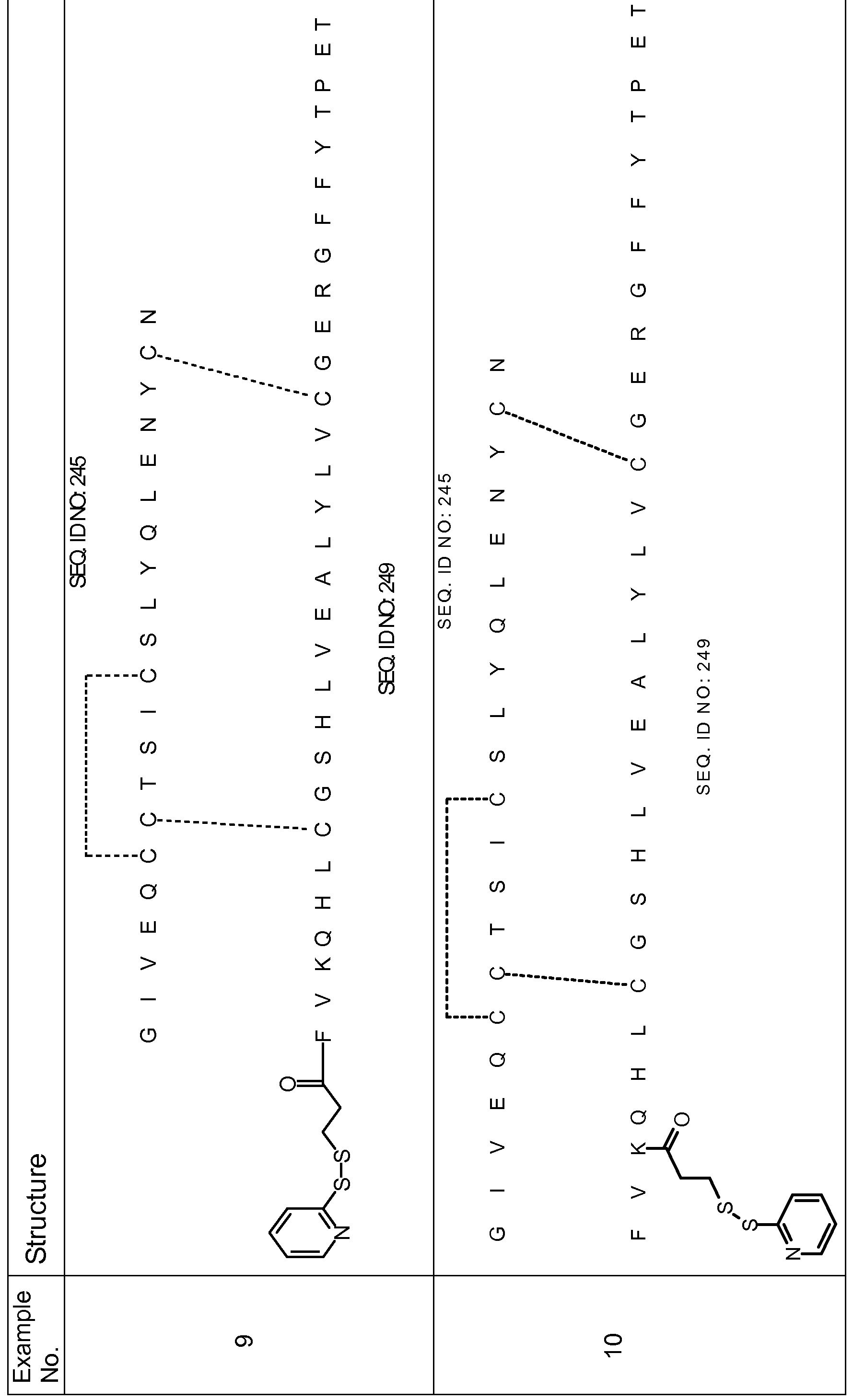
Example
No. Structure ■; SEQIDN0:245
G 1 V E Q C C T S 1 C S L Y Q L E N Y C N
11 J V KQ H L C G S H L V E A L Y L V C G E R G F F Y TP E

SEQIDNQ249


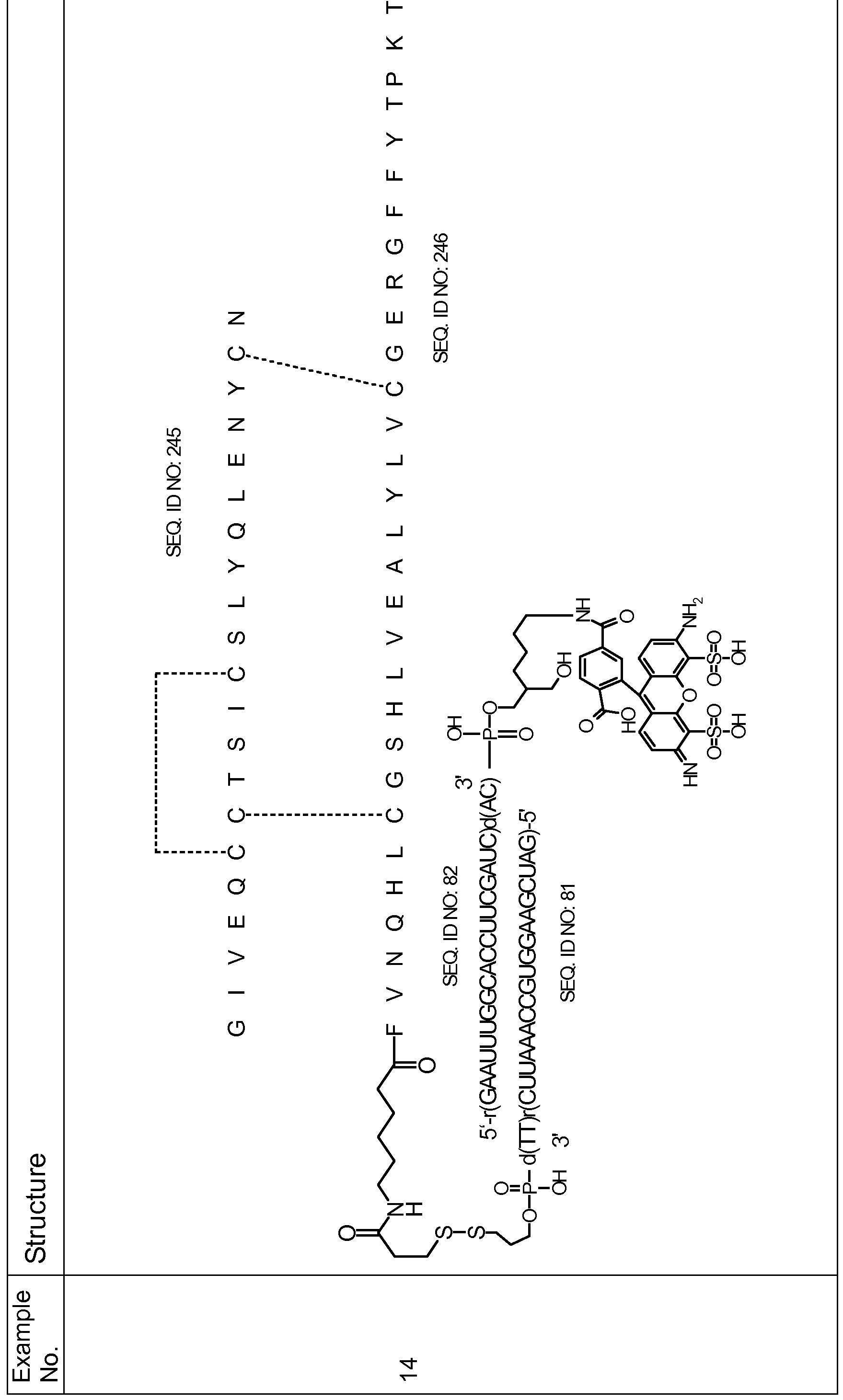

Example
No. Structure N
16 E R G F F Y T P K

SEQ. ID NO: 82 SEQ. ID NO: 245
G l V E Q C C T S I C S L Y Q L E N Y C N
5'-r(GAAUUUGGCACCUUCGAUC)d(AC) 3'
d(TT)r(CUUAAACCGUGGAAGCUAG) s
17 3' I
0=P-OH
SEQ. ID NO: 81 I
oO O
V N Q H L C G S H L V E A L Y L V C G E R G F F Y T P K
SEQ. ID NO: 246


Claims
1 . Chimeric compound comprising an insulin and an siRNA.
2. Chimeric compound according to claim 1 and defined by formula I: Ins - Lin - siRNA (formula I), wherein the insulin (Ins) is attached to the siRNA by a linker (Lin).
3. Chimeric compound according to any of claims 1 or 2, wherein the insulin is
selected from a group comprising human insulin, animal insulin, insulin analogs and insulin derivatives.
4. Chimeric compound according to any of claims 1 to 3, wherein the animal insulin is selected from a group comprising bovine insulin and porcine insulin; the insulin analog is selected from a group comprising Gly(A21 ), Arg(B31 ), Arg(B32) human insulin, Lys(B3), Glu(B29) human insulin, Asp(B28) human insulin, Lys(B28) Pro(B29) human insulin and Des(B30) human insulin, Arg (AO), His (A8), Glu (A5), Asp (A18), Gly (A21 ), Arg (B31 ), Arg (B32) - NH2 human insulin, Arg (AO), His (A8), Glu (A5), Asp (A18), Gly (A21 ), Arg (B31 ), Lys (B32) - NH2 human insulin, Arg (AO), His (A8), Glu (A15), Asp (A18), Gly (A21 ), Arg (B31 ), Arg (B32) - NH2 human insulin; and the insulin derivative is selected from a group comprising
B29-N-myristoyl-des(B30) human insulin, B29-N-palmitoyl-des(B30) human insulin, B29-N-myristoyl human insulin, B29-N-palmitoyl human insulin, B28-N-myristoyl LysB28ProB29 human insulin, B28-N-palmitoyl-LysB28ProB29 human insulin,
B30-N-myristoyl-ThrB29LysB30 human insulin, B30-N-palmitoyl- ThrB29LysB30 human insulin, B29-N-(N-palmitoyl-Y-glutamyl)-des(B39) human insulin,
B29-N-(N-lithocholyl-Y-glutamyl)-des(B30) human insulin,
B29-N-( -carboxyheptadecanoyl)-des(B30) human insulin and
B29-N-(cjo-carboxyheptadecanoyl) human insulin.
5. Chimeric compound according to any of claims 1 to 4, wherein the linker (Lin) is a moiety with the structure
(X1 )q-(L1 )p-(D)d-(L2)r-(X2)s-(Y)t-Z (formula II) wherein
X1 is a moiety independently selected from a group comprising: -C(O)-; -O-C(O) -; -C(O)-O-; -C(O)-N(R1 )-; -N(R1 )-C(O)-; -C(S)-N(R1 )-; -N(R1 )-C(S)-; -SO2-; -C(NH2 +)-; -O-P(O)(OH)-; -S-; -N(R1 )-; =N-N(R1 )-; -O-; heterocyclyl;
L1 is independently selected from a group comprising: alkyl, (O-alkyl)n, (alkyl-O)n, cycloalkyi, (O-cycloalkyl)n, (cycloalkyl-O)n, alkyl-cycloalkyl, cycloalkyl-alkyl, aryl, alkyl-aryl, aryl-alkyl, cycloalkyi -aryl, aryl-cycloalkyl, heteroaryl, alkyl-heteroaryl, heteroaryl-alkyl, cycloalkyl-heteroaryl, heteroaryl-cycloalkyl, heterocyclyl,
alkyl-heterocyclyl, heterocyclyl-alkyl, cycloalkyl-heterocyclyl, heterocyclyl-cycloalkyi;
D is independently selected from a group comprising: -C(O)-, -C(O)O-, -O-C(O)-, -N(R1 )-C(O)-, -C(O)N(R1 )-, -N(R1 )C(O)-N(R1 )-, -C(S)N(R1 )-, -SOm-, -C(NH2 +)-, -P(O)(OH)O-, -N(R1 )-, -N(R1 )-N=, =N-N(R1 )-, -N(R1 )-N(R1 )-, -O-, -S-, -S-S-,
-O-(CH2)-, -(CH2)-O-, (O-alkyl)n, (alkyl-O)n, (S-alkyl), (O-SO2-N(R1 )-alkyl),
(N(RI )-alkyl), (N(R1 )C(O)-alkyl), (N(R1 )C(NH2 +)-alkyl), (N(R1 )C(O)-N(R1 )-alkyl), (C(O)-N(R1 )-alkyl), (N(R1 )-SO2-N(R1 )-alkyl), (N(R1 )-SO2-alkyl), (SO2-N(R1 )-alkyl), (N(R1 )-SO2-O-alkyl), (SOm-alkyl), (O-C(O)-alkyl), (C(O)-O-alkyl), (O-C(O)-O-alkyl), (O-C(O)-N(R1 )-alkyl), (N(R1 )-C(O)-O-alkyl),
(O-cycloalkyl)n, (cycloalkyl-O)n, (S-cycloalkyl), (O-SO2-N(R1 )-cycloalkyl),
(N(R1 )-cycloalkyl), (N(R1 )C(O)-cycloalkyl), (N(R1 )C(NH2 +)-cycloalkyl),
(N(R1 )C(O)-N(R1 )-cycloalkyl), (C(O)-N(R1 )-cycloalkyl), (N(R1 )-SO2-N(R1 )-cycloalkyl), (N(R1 )-SO2-cycloalkyl), (SO2-N(R1 )-cycloalkyl), (N(R1 )-SO2-O-cycloalkyl),
(SOm-cycloalkyl), (O-C(O)-cycloalkyl), (C(O)-O-cycloalkyl), (O-C(O)-O-cycloalkyl), (O-C(O)-N(RI )-cycloalkyl), (N(R1 )-C(O)-O-cycloalkyl), (O-alkyl-cycloalkyl)n, (S-alkyl-cycloalkyl), (O-SO2-N(R1 )-alkyl-cycloalkyl), (N(R1 )-alkyl-cycloalkyl), (N(R1 )C(O)-alkyl-cycloalkyl),
(N(R1 )C(O)-N(R1 )-alkyl-cycloalkyl), (C(O)-N(R1 )-alkyl-cycloalkyl),
(N(R1 )-SO2-N(R1 )-alkyl-cycloalkyl), (N(R1 )-SO2-alkyl-cycloalkyl),
(SO2-N(R1 )-alkyl-cycloalkyl), (N(R1 )-SO2-O-alkyl-cycloalkyl), (SOm-alkyl-cycloalkyl), (O-C(O)-alkyl-cycloalkyl), (C(O)-O-alkyl-cycloalkyl), (O-C(O)-O-alkyl-cycloalkyl), (O-C(O)-N(RI )-alkyl-cycloalkyl), (N(R1 )-C(O)-O-alkyl-cycloalkyl), (O-cycloalkyl-alkyl)n, (S-cycloalkyl-alkyl), (O-SO2-N(R1 )-cycloalkyl-alkyl),
(N(R1 )-cycloalkyl-alkyl), (N(R1 )C(O)-cycloalkyl-alkyl),
(N(R1 )C(O)-N(R1 )-cycloalkyl-alkyl), (C(O)-N(R1 )-cycloalkyl-alkyl),
(N(R1 )-SO2-N(R1 )-cycloalkyl-alkyl), (N(R1 )-SO2-cycloalkyl-alkyl),
(SO2-N(R1 )-cycloalkyl-alkyl), (N(R1 )-SO2-O-cycloalkyl-alkyl), (SOm-cycloalkyl-alkyl), (O-C(O)-cycloalkyl-alkyl), (C(O)-O-cycloalkyl-alkyl), (O-C(O)-O-cycloalkyl-alkyl), (O-C(O)-N(RI )-cycloalkyl-alkyl), (N(R1 )-C(O)-O-cycloalkyl-alkyl),
(O-aryl)nj (S-aryl), (O-SO2-N(R1 )-aryl), (N(R1 )-aryl), (N(R1 )C(0)-aryl),
(N(R1 )C(O)-N(R1 )-aryl), (C(O)-N(R1 )-aryl), (N(R1 )-SO2-N(R1 )-aryl), (N(R1 )-SO2-aryl), (SO2-N(R1 )-aryl), (N(R1 )-SO2-O-aryl), (SOm-aryl), (O-C(O)-aryl), (C(O)-O-aryl), (O-C(O)-O-aryl), (O-C(O)-N(R1 )-aryl), (N(R1 )-C(O)-O-aryl),
(O-alkyl-aryl)n, (S-alkyl-aryl), (O-S02-N(R1 )-alkyl-aryl), (N(R1 )-alkyl-aryl),
(N(R1 )C(O)-alkyl-aryl), (N(R1 )C(O)-N(R1 )-alkyl-aryl), (C(O)-N(R1 )-alkyl-aryl),
(N(R1 )-SO2-N(R1 )- alkyl-aryl), (N(R1 )-SO2-alkyl-aryl), (SO2-N(R1 )- alkyl-aryl),
(N(R1 )-SO2-O-alkyl-aryl), (SOm-alkyl-aryl), (O-C(O)- alkyl-aryl), (C(O)-O-alkyl-aryl), (O-C(O)-O-alkyl-aryl), (O-C(O)-N(RI )-alkyl-aryl), (N(R1 )-C(O)-O-alkyl-aryl),
(O-aryl-alkyl)n, (S-aryl-alkyl), (O-SO2-N(R1 )-aryl-alkyl), (N(R )-aryl-alkyl),
(N(R1 )C(O)-aryl-alkyl), (N(R1 )C(O)-N(R1 )-aryl-alkyl), (C(O)-N(R1 )-aryl-alkyl),
(N(R1 )-SO2-N(R1 )-aryl-alkyl), (N(R1 )-SO2-aryl-alkyl), (SO2-N(R1 )-aryl-alkyl),
(N(R1 )-SO2-O-aryl-alkyl), (SOm-aryl-alkyl), (O-C(O)-aryl-alkyl), (C(O)-O-aryl-alkyl), (O-C(O)-O-aryl-alkyl), (O-C(O)-N(RI )-aryl-alkyl), (N(R1 )-C(0)-0-aryl-alkyl),
(O- cycloalkyl-aryl)n, (S- cycloalkyl-aryl), (O-SO2-N(R1 )-cycloalkyl-aryl),
(N(R1 )-cycloalkyl-aryl), (N(R1 )C(O)-cycloalkyl-aryl), (N(R1 )C(O)-N(R1 )-cycloalkyl-aryl), (C(O)-N(R1 )-cycloalkyl-aryl), (N(R1 )-SO2-N(R1 )-cycloalkyl-aryl),
(N(R1 )-SO2-cycloalkyl-aryl), (SO2-N(R1 )-cycloalkyl-aryl),
(N(R1 )-SO2-O-cycloalkyl-aryl), (SOm-cycloalkyl-aryl), (O-C(O)-cycloalkyl-aryl),
(C(O)-O-cycloalkyl-aryl), (O-C(O)-O-cycloalkyl-aryl), (O-C(O)-N(RI )-cycloalkyl-aryl), (N(R1 )-C(O)-O-cycloalkyl-aryl),
(O-aryl-cycloalkyl)n, (S-aryl-cycloalkyl), (O-SO2-N(R1 )-aryl-cycloalkyl),
(N(R1 )-aryl-cycloalkyl), (N(R1 )C(O)-aryl-cycloalkyl), (N(R1 )C(O)-N(R1 )-aryl-cycloalkyl), (C(O)-N(R1 )-aryl-cycloalkyl), (N(R1 )-SO2-N(R1 )-aryl-cycloalkyl),
(N(R1 )-SO2-aryl-cycloalkyl), (SO2-N(R1 )-aryl-cycloalkyl),
(N(R1 )-SO2-O-aryl-cycloalkyl), (SOm-aryl-cycloalkyl), (O-C(O)-aryl-cycloalkyl),
(C(O)-O-aryl-cycloalkyl), (O-C(O)-O-aryl-cycloalkyl), (O-C(O)-N(RI )-aryl-cycloalkyl), (N(R1 )-C(O)-O-aryl-cycloalkyl),
(O-heteroaryl)n, (S-heteroaryl), (O-SO2-N(R1 )-heteroaryl), (N(RI )-heteroaryl),
(N(R1 )C(O)-heteroaryl), (N(R1 )C(O)-N(R1 )-heteroaryl), (C(O)-N(R1 )-heteroaryl), (N(R1 )-SO2-N(R1 )- heteroaryl), (N(R1 )-SO2-heteroaryl), (SO2-N(R1 )-heteroaryl), (N(R1 )-SO2-O-heteroaryl), (SOm-heteroaryl), (O-C(O)-heteroaryl), (C(O)-O-heteroaryl), (O-C(O)-O-heteroaryl), (O-C(O)-N(RI )-heteroaryl), (N(R1 )-C(O)-O-heteroaryl), (O-alkyl-heteroaryl)n, (S-alkyl-heteroaryl), (O-SO2-N(R1 )-alkyl-heteroaryl),
(N(R1 )-alkyl-heteroaryl), (N(R1 )C(O)-alkyl-heteroaryl),
(N(R1 )C(O)-N(R1 )-alkyl-heteroaryl), (C(O)-N(R1 )-alkyl-heteroaryl),
(N(R1 )-SO2-N(R1 )-alkyl-heteroaryl), (N(R1 )-SO2- alkyl -heteroaryl),
(SO2-N(R1 )-alkyl-heteroaryl), (N(R1 )-SO2-O-alkyl-heteroaryl), (SOm- alkyl-heteroaryl), (O-C(O)- alkyl-heteroaryl), (C(O)-O- alkyl-heteroaryl), (O-C(O)-O-alkyl-heteroaryl), (O-C(O)-N(RI )-alkyl-heteroaryl), (N(R1 )-C(O)-O-alkyl-heteroaryl), (O-heteroaryl-alkyl)n, (S-heteroaryl-alkyl), (O-SO2-N(R1 )-heteroaryl-alkyl), (N(RI )-heteroaryl-alkyl), (N(R1 )C(O)- heteroaryl-alkyl),
(N(R1 )C(O)-N(R1 )-heteroaryl-alkyl), (C(O)-N(R1 )- heteroaryl-alkyl),
(N(R1 )-SO2-N(R1 )-heteroaryl-alkyl), (N(R1 )-SO2- heteroaryl-alkyl),
(SO2-N(R1 )-heteroaryl-alkyl), (N(R1 )-SO2-O-heteroaryl-alkyl), (SOm-heteroaryl-alkyl), (O-C(O)-heteroaryl-alkyl), (C(O)-O- heteroaryl-alkyl), (O-C(O)-O-heteroaryl-alkyl), (O-C(O)-N(RI )- heteroaryl-alkyl), (N(R1 )-C(O)-O-heteroaryl-alkyl), (O-cycloalkyl-heteroaryl)n, (O-SO2-N(R1 )- cycloalkyi -heteroaryl), (N(R1 )- cycloalkyi -heteroaryl), (N(R1 )C(O)- cycloalkyi -heteroaryl), (N(R1 )C(O)-N(R1 )- cycloalkyi -heteroaryl), (C(O)-N(R1 )- cycloalkyi -heteroaryl), (N(R1 )-SO2-N(R1 )- cycloalkyi -heteroaryl), (N(R1 )-SO2- cycloalkyi -heteroaryl), (SO2-N(R1 )- cycloalkyi -heteroaryl), (N(R1 )-SO2-O- cycloalkyi -heteroaryl), (SOm- cycloalkyi -heteroaryl), (O-C(O)- cycloalkyi -heteroaryl), (C(O)-O- cycloalkyi -heteroaryl), (O-C(O)-O- cycloalkyi
-heteroaryl), (O-C(O)-N(RI )- cycloalkyi -heteroaryl), (N(R1 )-C(O)-O- cycloalkyl-heteroaryl),
(O-heteroaryl- cycloalkyl)n, (S-heteroaryl- cycloalkyi), (O-SO2-N(R1 )-heteroaryl- cycloalkyi), (N(R1 )-heteroaryl- cycloalkyi), (N(R1 )C(O)- heteroaryl- cycloalkyi),
(N(R1 )C(O)-N(R1 )-heteroaryl- cycloalkyi), (C(O)-N(R1 )- heteroaryl- cycloalkyi), (N(R1 )-SO2-N(R1 )-heteroaryl- cycloalkyi), (N(R1 )-SO2- heteroaryl- cycloalkyi),
(SO2-N(R1 )-heteroaryl- cycloalkyi), (N(R1 )-SO2-O-heteroaryl- cycloalkyi),
(SOm-heteroaryl- cycloalkyi), (O-C(O)-heteroaryl-cycloalkyl), (C(O)-O- heteroaryl- cycloalkyi), (O-C(O)-O-heteroaryl- cycloalkyi), (O-C(O)-N(RI )- heteroaryl- cycloalkyi), (N(R1 )-C(O)-O-heteroaryl- cycloalkyi),
(O-heterocyclyl)n, (S-heterocyclyl), (O-SO2-N(R1 )-heterocyclyl), (N(RI )-heterocyclyl), (N(R1 )C(O)-heterocyclyl), (N(R1 )C(O)-N(R1 )-heterocyclyl), (C(O)-N(R1 )-heterocyclyl), (N(R1 )-SO2-N(R1 )-heterocyclyl), (N(R1 )-SO2-heterocyclyl), (SO2-N(R1 )-heterocyclyl), (N(R1 )-SO2-O-heterocyclyl), (SOm-heterocyclyl), (O-C(O)-heterocyclyl),
(C(O)-O-heterocyclyl), (O-C(O)-O-heterocyclyl), (O-C(O)-N(RI )-heterocyclyl), (N(R1 )-C(O)-O-heterocyclyl),
(O-alkyl-heterocyclyl)n, (S-alkyl-heterocyclyl), (O-SO2-N(R1 )-alkyl-heterocyclyl), (N(RI )-alkyl-heterocyclyl), (N(R1 )C(O)- alkyl-heterocyclyl),
(N(R1 )C(O)-N(R1 )-alkyl-heterocyclyl), (C(O)-N(R1 )- alkyl-heterocyclyl),
(N(R1 )-SO2-N(R1 )-alkyl-heterocyclyl), (N(R1 )-SO2- alkyl-heterocyclyl),
(SO2-N(R1 )-alkyl-heterocyclyl), (N(R1 )-SO2-O-alkyl-heterocyclyl),
(SOm-alkyl-heterocyclyl), (O-C(O)-alkyl-heterocyclyl), (C(O)-O-alkyl-heterocyclyl), (O-C(O)-O-alkyl-heterocyclyl), (O-C(O)-N(R1 )-alkyl-heterocyclyl),
(N(R1 )-C(O)-O-alkyl-heterocyclyl),
(O-heterocyclyl-alkyl)n, (S-heterocyclyl-alkyl), (O-SO2-N(R1 )-heterocyclyl-alkyl), (N(R1 )-heterocyclyl-alkyl), (N(R1 )C(O)-heterocyclyl-alkyl),
(N(R1 )C(O)-N(R1 )-heterocyclyl-alkyl), (C(O)-N(R1 )-heterocyclyl-alkyl),
(N(R1 )-SO2-N(R1 )-heterocyclyl-alkyl), (N(R1 )-SO2-heterocyclyl-alkyl),
(SO2-N(R1 )-heterocyclyl-alkyl), (N(R1 )-SO2-O-heterocyclyl-alkyl),
(SOm-heterocyclyl-alkyl), (O-C(O)-heterocyclyl-alkyl), (C(O)-O-heterocyclyl-alkyl), (O-C(O)-O-heterocyclyl-alkyl), (O-C(O)-N(R1 )-heterocyclyl-alkyl),
(N(R1 )-C(O)-O-heterocyclyl-alkyl),
(O-cycloalkyl-heterocyclyl)n, (O-SO2-N(R1 )- cycloalkyi -heterocyclyl), (N(R1 )- cycloalkyi -heterocyclyl), (N(R1 )C(O)- cycloalkyi -heterocyclyl), (N(R1 )C(O)-N(R1 )- cycloalkyi -heterocyclyl), (C(O)-N(R1 )- cycloalkyi -heterocyclyl), (N(R1 )-SO2-N(R1 )- cycloalkyi -heterocyclyl), (N(R1 )-SO2- cycloalkyi -heterocyclyl), (SO2-N(R1 )- cycloalkyi
-heterocyclyl), (N(R1 )-SO2-O- cycloalkyi -heterocyclyl), (SOm- cycloalkyi -heterocyclyl), (O-C(O)- cycloalkyi -heterocyclyl), (C(O)-O- cycloalkyi -heterocyclyl), (O-C(O)-O- cycloalkyl -heterocyclyl), (O-C(O)-N(RI )- cycloalkyi -heterocyclyl), (N(R1 )-C(O)-O- cycloalkyl-heterocyclyl),
(O-heterocyclyl- cycloalkyl)n, (O-SO2-N(R1 )-heterocyclyl- cycloalkyi),
(N(R1 )-heterocyclyl- cycloalkyi), (N(R1 )C(O)-heterocyclyl- cycloalkyi),
(N(R1 )C(O)-N(R1 )-heterocyclyl- cycloalkyi), (C(O)-N(R1 )-heterocyclyl- cycloalkyi), (N(R1 )-SO2-N(R1 )-heterocyclyl- cycloalkyi), (N(R1 )-SO2-heterocyclyl- cycloalkyi), (SO2-N(R1 )-heterocyclyl- cycloalkyi), (N(R1 )-SO2-O-heterocyclyl- cycloalkyi),
(SOm-heterocyclyl- cycloalkyi), (O-C(O)-heterocyclyl- cycloalkyi), (C(O)-O-heterocyclyl- cycloalkyl), (O-C(O)-O-heterocyclyl- cycloalkyi), (O-C(O)-N(R1 )-heterocyclyl- cycloalkyl), (N(R1 )-C(O)-O-heterocyclyl- cycloalkyi),
L2 is selected from a group comprising: alkyl, (O-alkyl)n, (alkyl-O)n, cycloalkyi, alkyl-cycloalkyl, cycloalkyl-alkyl, aryl, alkyl-aryl, aryl-alkyl, cycloalkyl-aryl,
aryl-cycloalkyl, heteroaryl, alkyl-heteroaryl, heteroaryl-alkyl, cydoalkyl-heteroaryl, heteroaryl-cycloalkyl, heterocyclyl, alkyl-heterocyclyl, heterocyclyl-alkyl,
cycloalkyl-heterocyclyl, heterocyclyl-cycloalkyl;
X2 is a moiety selected from a group comprising: -C(O)-; -O-C(O) -; -C(O)-O-,
-N(R1 )-C(O)-; -C(O)-N(R1 )-; -N(R1 )-C(S)-; -SO2-; -C(NH2 +)-; -O-P(O)(OH)-; -S-;
-N(R1 )- ;-O-;
Y is a moiety selected from a group comprising: -C(O)- ; -S-; -N(R1 )-; -N(R1 )-N=;
=N-N(R1 )-;
Z is selected from a group comprising a direct bond, alkyl, (O-alkyl)n, (alkyl-O)n, alkyl-C(O)-, cycloalkyl-C(O)-, aryl-C(O)-, alkyl-aryl-C(O)-, aryl-alkyl-C(O)-,
cycloalkyl-aryl-C(O)-, aryl-cycloalkyl-C(O)-, heteroaryl-C(O)-, alkyl-heteroaryl-C(O)-, heteroaryl-alkyl-C(O)-, cycloalkyl-heteroaryl-C(O)-, heteroaryl-cycloalkyl-C(O)-, heterocyclyl-C(O)-, alkyl-heterocyclyl-C(O)-, heterocyclyl-alkyl-C(O)-,
cycloalkyl-heterocyclyl-C(O)-, heterocyclyl-cycloalkyl-C(O)-, alkyl-N=, cycloalkyl-N=, aryl-N=, alkyl-aryl-N=, aryl-alkyl-N=, cycloalkyl-aryl-N=, aryl-cycloalkyl-N=, heteroaryl-N=, alkyl-heteroaryl-N=, heteroaryl-alkyl-N=,
cycloalkyl-heteroaryl-N=, heteroaryl-cycloalkyl-N=, heterocyclyl-N=,
alkyl-heterocyclyl-N=, heterocyclyl-alkyl-N=, cycloalkyl-heterocyclyl-N=,
heterocyclyl-cycloalkyl-N=, alkyl-N(RI )-, cycloalkyl-N(RI )-, aryl-N(R1 )-, alkyl-aryl-N(RI )-, aryl-alkyl-N(RI )-, cycloalkyl-aryl-N(R1 )-, aryl-cycloalkyl-N(R1 )-, heteroaryl-N(R1 )-,
alkyl-heteroaryl-N(R1 )-, heteroaryl-alkyl-N(R1 )-, cycloalkyl-heteroaryl-N(R1 )-, heteroaryl-cycloalkyl-N(R1 )-, heterocyclyl-N(R1 )-, alkyl-heterocyclyl-N(R1 )-, heterocyclyl-alkyl-N(RI )-, cycloalkyl-heterocyclyl-N(RI )-,
heterocyclyl-cycloalkyl-N(R1 )-,
-O-P(O)(OH)-, alkyl-0-P(0)(OH)-, (0-alkyl)n-0-P(0)(OH)-, (alkyl-O)n-P(O)(OH)-, cycloalkyl-O-P(O)(OH)-, alkyl-cycloalkyl-O-P(O)(OH)-, cycloalkyl-alkyl-O-P(O)(OH)-, aryl-O-P(O)(OH), heteroaryl-O-P(O)(OH)-, alkyl-aryl-0-P(0)(OH)-,
aryl-alkyl-0-P(0)(OH)-, cycloalkyl-aryl-O-P(O)(OH)-, aryl-cycloalkyl-O-P(O)(OH)-, alkyl-heteroaryl-O-P(O)(OH)-, heteroaryl-alkyl-O-P(O)(OH)-,
cycloalkyl-heteroaryl-O-P(O)(OH)-, heteroaryl-cycloalkyl-O-P(O)(OH)-,
heterocyclyl-O-P(O)(OH)-, heterocyclyl-alkyl-O-P(O)(OH)-,
alkyl-heterocyclyl-O-P(O)(OH)-, heterocyclyl-cycloalkyl-O-P(O)(OH)-,
cycloalkyl-heterocyclyl-O-P(O)(OH)-,
-0-P(S)(OH)-, alkyl-0-P(S)(OH)-, (0-alkyl)n-0-P(S)(OH)-, (alkyl-O)n-P(S)(OH)-, cycloalkyl-O-P(S)(OH)-, alkyl-cycloalkyl-O-P(S)(OH)-, cycloalkyl-alkyl-O-P(S)(OH)-, aryl-O-P(S)(OH), heteroaryl-O-P(S)(OH)-, alkyl-aryl-0-P(S)(OH)-,
aryl-alkyl-0-P(S)(OH)-, cycloalkyl-aryl-O-P(S)(OH)-, aryl-cycloalkyl-O-P(S)(OH)-, alkyl-heteroaryl-O-P(S)(OH)-, heteroaryl-alkyl-O-P(S)(OH)-,
cycloalkyl-heteroaryl-O-P(S)(OH)-, heteroaryl-cycloalkyl-O-P(S)(OH)-,
heterocyclyl-O-P(S)(OH)-, heterocyclyl-alkyl-O-P(S)(OH)-,
alkyl-heterocyclyl-O-P(S)(OH)-, heterocyclyl-cycloalkyl-O-P(S)(OH)-,
cycloalkyl-heterocyclyl-O-P(S)(OH)-,
-0-P(S)(SH)-, alkyl-0-P(S)(SH)-, (0-alkyl)n-0-P(S)(SH)-, (alkyl-0)n-P(S)(SH)-, cycloalkyl-O-P(S)(SH)-, alkyl-cycloalkyl-O-P(S)(SH)-, cycloalkyl-alkyl-O-P(S)(SH)-, aryl-O-P(S)(SH), heteroaryl-O-P(S)(SH)-, alkyl-aryl-0-P(S)(SH)-,
aryl-alkyl-0-P(S)(SH)-, cycloalkyl-aryl-O-P(S)(SH)-, aryl-cycloalkyl-O-P(S)(SH)-, alkyl-heteroaryl-O-P(S)(SH)-, heteroaryl-alkyl-O-P(S)(SH)-, cycloalkyl-heteroaryl-O-P(S)(SH)-, heteroaryl-cycloalkyl-O-P(S)(SH)-, heterocyclyl-O-P(S)(SH)-, heterocyclyl-alkyl-O-P(S)(SH)-,
alkyl-heterocyclyl-O-P(S)(SH)-, heterocyclyl-cycloalkyl-O-P(S)(SH)-,
cycloalkyl-heterocyclyl-O-P(S)(SH)-,
-0-P(0)(alkyl)-, alkyl-0-P(O)(alkyl)-, (O-alkyl)n-O-P(O)(alkyl)-, (alkyl-O)n-P(O)(alkyl)-, cycloalkyl-0-P(0)(alkyl)-, alkyl-cycloalkyl-O-P(O)(alkyl)-,
cycloalkyl-alkyl-O-P(O)(alkyl)-, aryl-0-P(0)(alkyl), heteroaryl-O-P(O)(alkyl)-, alkyl-aryl-0-P(0)(alkyl)-, aryl-alkyl-0-P(0)(alkyl)-, cycloalkyl-aryl-0-P(0)(alkyl)-, aryl-cycloalkyl-O-P(O)(alkyl)-, alkyl-heteroaryl-O-P(O)(alkyl)-,
heteroaryl-alkyl-O-P(O)(alkyl)-, cycloalkyl-heteroaryl-O-P(0)(alkyl)-,
heteroaryl-cycloalkyl-O-P(O)(alkyl)-, heterocyclyl-O-P(O)(alkyl)-,
heterocyclyl-alkyl-O-P(O)(alkyl)-, alkyl-heterocyclyl-O-P(O)(alkyl)-,
heterocyclyl-cycloalkyl-O-P(O)(alkyl)-, cycloalkyl-heterocyclyl-O-P(O)(alkyl)-,
-0-P(0)(N(R2R3))-, alkyl-0-P(0)(N(R2R3))-, (0-alkyl)n-0-P(0)(N(R2R3))-,
(alkyl-0)n-P(0)(N(R2R3))-, cycloalkyl-O-P(O)(N(R2R3))-,
alkyl-cycloalkyl-O-P(O)(N(R2R3))-, cycloalkyl-alkyl-0-P(O)(N(R2R3))-,
aryl-0-P(0)(N(R2R3))-, heteroaryl-O-P(O)(N(R2R3))-, alkyl-aryl-0-P(0)(N(R2R3))-, aryl-alkyl-0-P(0)(N(R2R3))-, cycloalkyl-aryl-O-P(O)(N(R2R3))-,
aryl-cycloalkyl-O-P(O)(N(R2R3))-, alkyl-heteroaryl-O-P(O)(N(R2R3))-,
heteroaryl-alkyl-O-P(O)(N(R2R3))-, cycloalkyl-heteroaryl-O-P(O)(N(R2R3))-, heteroaryl-cycloalkyl-0-P(O)(N(R2R3))-, heterocyclyl-O-P(O)(N(R2R3))-,
heterocyclyl-alkyl-O-P(O)(N(R2R3))-, alkyl-heterocyclyl-O-P(O)(N(R2R3))-, heterocyclyl-cycloalkyl-O-P(O)(N(R2R3))-, cycloalkyl-heterocyclyl-O-P(O)(N(R2R3))-,
-N(R1 )-P(0)(OH)-, alkyl-N(R1 )-P(O)(OH)-, (O-alkyl)n-N(R1 )-P(0)(OH)-,
cycloalkyl-N(R1 )-P(O)(OH)-, alkyl-cycloalkyl-N(R1 )-P(O)(OH)-,
cycloalkyl-alkyl-N(R1 )-P(O)(OH)-, aryl-N(R1 )-P(O)(OH), heteroaryl-N(R1 )-P(O)(OH)-, alkyl-aryl-N(R1 )-P(O)(OH)-, aryl-alkyl-N(R1 )-P(O)(OH)-,
cycloalkyl-aryl-N(R1 )-P(0)(OH)-, aryl-cycloalkyl-N(R1 )-P(0)(OH)-,
alkyl-heteroaryl-N(R1 )-P(O)(OH)-, heteroaryl-alkyl-N(R1 )-P(O)(OH)-, cycloalkyl-heteroaryl-N(R1 )-P(O)(OH)-, heteroaryl-cycloalkyl-N(R1 )-P(O)(OH)-, heterocyclyl-N(R1 )-P(O)(OH)-, heterocyclyl-alkyl-N(R1 )-P(O)(OH)-,
alkyl-heterocyclyl-N(R1 )-P(O)(OH)-, heterocyclyl-cycloalkyl-N(R1 )-P(O)(OH)-, cycloalkyl-heterocyclyl-N(R1 )-P(O)(OH)-; d is an integer between 0 and 10;
n is an integer between 1 and 1 1 ;
m is 0, 1 or 2;
q, p, r, s, t are independently from each other 0, 1 or 2;
R1 is H, (Ci-C6)-alkyl;
R2 and R3 are independently H, (Ci-C6)-alkyl, whereby R2 and R3 together with the nitrogen atom to which they are bonded may form a saturated 5- to 6-membered monocyclic heterocyclyl group.
6. Chimeric compound according to any of claims 1 to 5, wherein the siRNA is composed of two separate strands, whereby only one of the strands is covalently attached to the unit (Ins)-(Lin), and the second strand is associated with the strand covalently attached to (Ins)-(Lin) by nucleic acid base-pairing, where each strand can be between 1 1 and 35 nucleotides long.
7. Chimeric compound according to claim 6, wherein each strand is 21 , 22 or 23 nucleotides long whereby the strands are complimentary to each other over a stretch of 19, 20, or 21 nucleotides, with single-stranded overhangs of 2, 3 or 4 nucleotides at the 3'-end of each strand.
8. Chimeric compound according to any of claims 1 to 7, wherein the nucleobase moieties of the siRNA are independently selected from a group comprising adenine, guanine, cytosine, thymine, uracil, 5-propynyluracil, 5-methylcytosine,
5-propynylcytosine, 5-fluorouracil, 5-acrylamido uracil derivatives,
N2-alkylaminoguanine derivatives, 5-acrylamido cytosine derivatives,
5-(amino-alkyl)-pyrimidine derivatives, 5-(amino-alkenyl)-pyrimidine derivatives, and 5-(amino-alkynyl)-pyrimidine derivatives.
9. Chimeric compound according to any of claims 1 to 8, wherein the sugar moieties of the siRNA are independently selected from a group comprising ribose, 2'-deoxyribose, 2'-O-4'-C-methylene ribose, 2'-O-alkyl-ribose, 2'-O-allyl-ribose,
2'-O-(2-alkoxyethyl)-ribose, 2'-O-(2-hydroxyethyl)-ribose, 2'-O-(2-aminoethyl)-ribose, 2'-deoxy-2'-amino-ribose, 2'-deoxy-2'-fluoro-ribose, 5'-deoxy-5'-amino-ribose,
2',5'-dideoxy-5'-amino-ribose, 5'-deoxy-5'-mercapto-ribose,
2',5'-dideoxy-5'-mercapto-ribose, 5'-carboxy-ribose and 5'-carboxy-2'-deoxyribose.
10. Chimeric compound according to any of claims 1 to 9, wherein the internucleotide linkages are independently selected from a group comprising phosphodiesters, phosphorothioates, phosphorodithioates, phosphoramidates, alkyl- and
aryl-phosphonates, and boranophosphonates.
1 1 . Chimeric compound according to any of claims 1 to 10, wherein siRNA is modified by the attachment of non-nucleotide units either 3'-, and/or 5'-termini, whereby modification at the 5'-terminus of the antisense strand is limited to phosphate and the non-nucleotide terminal modifications are independently selected from a group comprising:
(Ci-Cio)-alkyl,
HO-P(G)(OH)-, (Ci-C2o)-alkyl-O-P(G)(OH)-, H-(O-(C2-C3)-alkyl)n-O-P(G)(OH)-, ((C2-C3)-alkyl-O)n-P(G)(OH)-, (C6-Ci0)-aryl-O-P(G)(OH),
(Ci-C6)-alkyl-(C6-Cio)-aryl-O-P(G)(OH)-, (C6-Cio)-aryl-(Ci-C6)-alkyl-O-P(G)(OH)-, (C2-C9)-heterocyclyl-O-P(G)(OH)-, (C2-C9)-heterocyclyl-( Ci-C6)-alkyl-O-P(G)(OH)-, (Ci-C6)-alkyl-( C2-C9)-heterocyclyl-O-P(G)(OH)-,
R4-(Ci-C20)-alkyl-O-P(G)(OH)-, R4-((C2-C3)-alkyl-O)n-P(G)(OH)-,
R4-(C3-C6)-cycloalkyl-O-P(G)(OH)-, R4-(Ci-C6)-alkyl-(C3-C6)-cycloalkyl-O-P(G)(OH)-, R4-(C3-C6)-cycloalkyl-(Ci-C6)-alkyl-O-P(G)(OH)-,
R4-(Ci-C6)-alkyl-(C6-Cio)-aryl-O-P(G)(OH)-,
R4-(C3-C6)-cycloalkyl-(C6-Cio)-aryl-O-P(G)(OH)-,
R4-(Ci-C6)-alkyl-(Ci-C9)-heteroaryl-O-P(G)(OH)-, R4-(Ci-C9)-heteroaryl-(Ci-C6)-alkyl-O-P(G)(OH)-,
R4-(C3-C6)-cycloalkyl-(Ci-C9)-heteroaryl-O-P(G)(OH)-,
R4-(Ci-C9)-heteroaryl-(C3-C6)-cycloalkyl-O-P(G)(OH)-,
R4-(C2-C9)-heterocyclyl-O-P(G)(OH)-,
R4-(C2-C9)-heterocyclyl-(Ci-C6)-alkyl-O-P(G)(OH)-,
R4-( Ci-C6)-alkyl-(C2-C9)-heterocyclyl-O-P(G)(OH)-,
where
n is an integer between 1 and 1 1
G is O or S
R1 is H, (C1 -C3)-alkyl
R4 is NH(R1 ), SH, C(0)R1 , C(O)OR1 , cholesteryl-C(O)N(R1 ), tocopheryl-,
tocopheryl-C(O).
12. Chimeric compound characterized by any of the formulas 13 - 22 of Table 4.
13. Pharmaceutical formulation comprising a chimeric compound according to any of claims 1 - 12.
14. Use of a pharmaceutical formulation according to claim 13 or a chimeric compound according to any of claims 1 - 12 for the treatment of diabetes mellitus.
15. Process for preparing a chimeric compound according to any of claims 1 - 12 by
(a) recombinant production of the desired insulin
(b) covalent attachment of the linker to the insulin and subsequent
(c) covalent attachment of the siRNA, or
(d) instead of steps (b) and (c), covalent attachment of a preformed complex of linker and siRNA to the insulin,
and purification of the resulting chimeric compound.
Applications Claiming Priority (4)
| Application Number | Priority Date | Filing Date | Title |
|---|---|---|---|
| EP10305388.0 | 2010-04-14 | ||
| EP10305388 | 2010-04-14 | ||
| US38716210P | 2010-09-28 | 2010-09-28 | |
| US61/387,162 | 2010-09-28 |
Publications (1)
| Publication Number | Publication Date |
|---|---|
| WO2011128374A1 true WO2011128374A1 (en) | 2011-10-20 |
Family
ID=42633135
Family Applications (1)
| Application Number | Title | Priority Date | Filing Date |
|---|---|---|---|
| PCT/EP2011/055823 Ceased WO2011128374A1 (en) | 2010-04-14 | 2011-04-13 | Insulin-sirna conjugates |
Country Status (4)
| Country | Link |
|---|---|
| AR (1) | AR080884A1 (en) |
| TW (1) | TW201141513A (en) |
| UY (1) | UY33326A (en) |
| WO (1) | WO2011128374A1 (en) |
Cited By (16)
| Publication number | Priority date | Publication date | Assignee | Title |
|---|---|---|---|---|
| US9345750B2 (en) | 2010-05-19 | 2016-05-24 | Sanofi | Long-acting formulations of insulin |
| US9364519B2 (en) | 2011-09-01 | 2016-06-14 | Sanofi-Aventis Deutschland Gmbh | Pharmaceutical composition for use in the treatment of a neurodegenerative disease |
| US9408893B2 (en) | 2011-08-29 | 2016-08-09 | Sanofi-Aventis Deutschland Gmbh | Pharmaceutical combination for use in glycemic control in diabetes type 2 patients |
| US9526764B2 (en) | 2008-10-17 | 2016-12-27 | Sanofi-Aventis Deutschland Gmbh | Combination of an insulin and a GLP-1-agonist |
| US9707176B2 (en) | 2009-11-13 | 2017-07-18 | Sanofi-Aventis Deutschland Gmbh | Pharmaceutical composition comprising a GLP-1 agonist and methionine |
| US9821032B2 (en) | 2011-05-13 | 2017-11-21 | Sanofi-Aventis Deutschland Gmbh | Pharmaceutical combination for improving glycemic control as add-on therapy to basal insulin |
| US9908908B2 (en) | 2012-08-30 | 2018-03-06 | Jiangsu Hansoh Pharmaceutical Co., Ltd. | Tenofovir prodrug and pharmaceutical uses thereof |
| US9950039B2 (en) | 2014-12-12 | 2018-04-24 | Sanofi-Aventis Deutschland Gmbh | Insulin glargine/lixisenatide fixed ratio formulation |
| US9981013B2 (en) | 2010-08-30 | 2018-05-29 | Sanofi-Aventis Deutschland Gmbh | Use of AVE0010 for the treatment of diabetes mellitus type 2 |
| US10029011B2 (en) | 2009-11-13 | 2018-07-24 | Sanofi-Aventis Deutschland Gmbh | Pharmaceutical composition comprising a GLP-1 agonist, an insulin and methionine |
| US10092513B2 (en) | 2013-04-03 | 2018-10-09 | Sanofi | Treatment of diabetes mellitus by long-acting formulations of insulins |
| US10159713B2 (en) | 2015-03-18 | 2018-12-25 | Sanofi-Aventis Deutschland Gmbh | Treatment of type 2 diabetes mellitus patients |
| US10434147B2 (en) | 2015-03-13 | 2019-10-08 | Sanofi-Aventis Deutschland Gmbh | Treatment type 2 diabetes mellitus patients |
| US11597744B2 (en) | 2017-06-30 | 2023-03-07 | Sirius Therapeutics, Inc. | Chiral phosphoramidite auxiliaries and methods of their use |
| US11981703B2 (en) | 2016-08-17 | 2024-05-14 | Sirius Therapeutics, Inc. | Polynucleotide constructs |
| US12558307B2 (en) | 2009-07-06 | 2026-02-24 | Sanofi-Aventis | Insulin preparations containing methionine |
Citations (15)
| Publication number | Priority date | Publication date | Assignee | Title |
|---|---|---|---|---|
| EP0254516A2 (en) | 1986-07-21 | 1988-01-27 | Novo Nordisk A/S | Novel Peptides |
| EP0280534A2 (en) | 1987-02-25 | 1988-08-31 | Novo Nordisk A/S | Novel insulin derivatives |
| US5618913A (en) | 1985-08-30 | 1997-04-08 | Novo Nordisk A/S | Insulin analogues |
| US5750497A (en) | 1993-09-17 | 1998-05-12 | Novo Nordisk A/S | Acylated insulin |
| US6011007A (en) | 1993-09-17 | 2000-01-04 | Novo Nordisk A/S | Acylated insulin |
| WO2003099227A2 (en) | 2002-05-23 | 2003-12-04 | Ceptyr, Inc. | Modulation of ptp1b signal transduction by rna interference |
| US20040147027A1 (en) | 2003-01-28 | 2004-07-29 | Troy Carol M. | Complex for facilitating delivery of dsRNA into a cell and uses thereof |
| WO2005002515A2 (en) * | 2003-06-20 | 2005-01-13 | Biomarin Pharmaceutical Inc. | Delivery of therapeutic compounds to the brain and other tissues |
| US20060019913A1 (en) | 2001-05-18 | 2006-01-26 | Sirna Therapeutics, Inc. | RNA interference mediated inhibtion of protein tyrosine phosphatase-1B (PTP-1B) gene expression using short interfering nucleic acid (siNA) |
| WO2006037126A2 (en) | 2004-09-27 | 2006-04-06 | Nastech Pharmaceutical Company Inc. | Method of treating an inflammatory disease by double stranded ribonucleic acid |
| WO2006079641A2 (en) | 2005-01-27 | 2006-08-03 | Novo Nordisk A/S | Insulin derivatives conjugated with structurally well defined branched polymers |
| WO2007007345A1 (en) | 2005-07-08 | 2007-01-18 | Biocon Limited | Preparation of insulin conjugates |
| WO2007043059A1 (en) | 2005-10-13 | 2007-04-19 | Biocon Limited | Process for the preparation of insulin conjugates. |
| WO2007056153A2 (en) | 2005-11-04 | 2007-05-18 | Nastech Pharmaceutical Company Inc. | Peptide-dicer substrate rna conjugates as delivery vehicles for sirna |
| WO2008109068A2 (en) | 2007-03-05 | 2008-09-12 | Syracuse University | A conjugate of insulin and vitamin b12 for oral delivery |
-
2011
- 2011-04-12 TW TW100112547A patent/TW201141513A/en unknown
- 2011-04-12 AR ARP110101227A patent/AR080884A1/en unknown
- 2011-04-12 UY UY0001033326A patent/UY33326A/en not_active Application Discontinuation
- 2011-04-13 WO PCT/EP2011/055823 patent/WO2011128374A1/en not_active Ceased
Patent Citations (19)
| Publication number | Priority date | Publication date | Assignee | Title |
|---|---|---|---|---|
| US5618913A (en) | 1985-08-30 | 1997-04-08 | Novo Nordisk A/S | Insulin analogues |
| EP0254516A2 (en) | 1986-07-21 | 1988-01-27 | Novo Nordisk A/S | Novel Peptides |
| EP0280534A2 (en) | 1987-02-25 | 1988-08-31 | Novo Nordisk A/S | Novel insulin derivatives |
| US5750497A (en) | 1993-09-17 | 1998-05-12 | Novo Nordisk A/S | Acylated insulin |
| US6011007A (en) | 1993-09-17 | 2000-01-04 | Novo Nordisk A/S | Acylated insulin |
| US20060025361A1 (en) | 2001-05-18 | 2006-02-02 | Sirna Therapeutics, Inc. | RNA interference mediated inhibition of protein tyrosine phosphatase-1B (PTP-1B) gene expression using short interfering nucleic acid (siNA) |
| US20060019913A1 (en) | 2001-05-18 | 2006-01-26 | Sirna Therapeutics, Inc. | RNA interference mediated inhibtion of protein tyrosine phosphatase-1B (PTP-1B) gene expression using short interfering nucleic acid (siNA) |
| WO2004016735A2 (en) | 2002-05-23 | 2004-02-26 | Ceptyr, Inc. | Modulation of biological signal transduction by rna interference |
| US20040077574A1 (en) | 2002-05-23 | 2004-04-22 | Ceptyr, Inc. | Modulation of biological signal transduction by RNA interference |
| US20040009946A1 (en) | 2002-05-23 | 2004-01-15 | Ceptyr, Inc. | Modulation of PTP1B expression and signal transduction by RNA interference |
| WO2003099227A2 (en) | 2002-05-23 | 2003-12-04 | Ceptyr, Inc. | Modulation of ptp1b signal transduction by rna interference |
| US20040147027A1 (en) | 2003-01-28 | 2004-07-29 | Troy Carol M. | Complex for facilitating delivery of dsRNA into a cell and uses thereof |
| WO2005002515A2 (en) * | 2003-06-20 | 2005-01-13 | Biomarin Pharmaceutical Inc. | Delivery of therapeutic compounds to the brain and other tissues |
| WO2006037126A2 (en) | 2004-09-27 | 2006-04-06 | Nastech Pharmaceutical Company Inc. | Method of treating an inflammatory disease by double stranded ribonucleic acid |
| WO2006079641A2 (en) | 2005-01-27 | 2006-08-03 | Novo Nordisk A/S | Insulin derivatives conjugated with structurally well defined branched polymers |
| WO2007007345A1 (en) | 2005-07-08 | 2007-01-18 | Biocon Limited | Preparation of insulin conjugates |
| WO2007043059A1 (en) | 2005-10-13 | 2007-04-19 | Biocon Limited | Process for the preparation of insulin conjugates. |
| WO2007056153A2 (en) | 2005-11-04 | 2007-05-18 | Nastech Pharmaceutical Company Inc. | Peptide-dicer substrate rna conjugates as delivery vehicles for sirna |
| WO2008109068A2 (en) | 2007-03-05 | 2008-09-12 | Syracuse University | A conjugate of insulin and vitamin b12 for oral delivery |
Non-Patent Citations (93)
| Title |
|---|
| "Hermanson, G.T. Bioconjugate Techniques", 2008, ACADEMIC PRESS, pages: 169 - 211 |
| "The Diabetes Control and Complications Trial Research Group", N. ENGL. J. MED., vol. 329, 1993, pages 977 - 986 |
| *VICENATI ET AL., INT J OBES, vol. 26, 2002, pages 905 - 911 |
| AAGAARD, L, ROSSI, J.J., ADVANCED DRUG DELIVERY REVIEWS, vol. 59, 2007, pages 75 - 86 |
| AIGNER, A, JOURNAL OF BIOMEDICINE AND BIOTECHNOLOGY, vol. 71659, 2006, pages 1 - 15 |
| AKHTAR, S., BENTER, I.F., J. CLIN. INVEST., vol. 117, 2007, pages 3623 - 3632 |
| ALLERSON, C.R. ET AL., J. MED. CHEM., vol. 48, 2005, pages 901 - 904 |
| AMARZGUIOUI, M., NUCLEIC ACIDS RESEARCH, vol. 31, no. 2, 2003, pages 589 - 595 |
| AMARZGUIOUI, M., PRYDZ, H., BIOCHEM. BIOPHYS. RES. COMMUN., vol. 316, 2004, pages 1050 - 1058 |
| ANGEW. CHEM. INT. ED. ENGL., vol. 46, 2007, pages 6985 - 6994 |
| BEAUCAGE, S., CURRENT OPINION IN DRUG DISCOVERY & DEVELOPMENT, vol. 11, no. 2, 2008, pages 203 - 216 |
| BIOL. CHEM. HOPPE SEYLER, 1986, pages 135 - 140 |
| BRAASCH, D.A. ET AL., BIOCHEMISTRY, vol. 42, 2003, pages 7967 - 7975 |
| BUMCROT, D. ET AL., NATURE CHEMICAL BIOLOGY, vol. 2, no. 12, 2006, pages 711 - 719 |
| CANADIAN JOURNAL OF BIOCHEMISTRY, vol. 57, no. 6, 1979, pages 489 - 496 |
| CARPENTIER, J.-L., DIABETOLOGIA, vol. 2, 1994, pages 117 - 124 |
| CESARONE GREGORY ET AL: "Insulin receptor substrate 1 knockdown in human MCF7 ER+ breast cancer cells by nuclease-resistant IRS1 siRNA conjugated to a disulfide-bridged D-Peptide analogue of insulin-like growth factor 1", BIOCONJUGATE CHEMISTRY, vol. 18, 9 October 2007 (2007-10-09), pages 1831 - 1840, XP002598719 * |
| CESARONE, G. ET AL., BIOCONJUGATE CHEM., vol. 18, 2007, pages 1831 - 1840 |
| CHEM. BER., vol. 108, 1975, pages 2758 - 2763 |
| CHIU ET AL., MOLECULAR CELL, vol. 10, 2002, pages 549 - 561 |
| COREY, D.A., J. CLIN. INVEST., vol. 117, 2007, pages 3615 - 3622 |
| CZAUDERNA, F., NUCLEIC ACIDS RESEARCH, vol. 31, no. 11, 2003, pages 2705 - 2716 |
| DE PAULA, D. ET AL., RNA, vol. 13, 2007, pages 431 - 456 |
| DE ROSA, G., MOLECULES, vol. 14, 2009, pages 2801 - 2823 |
| EBERLE, F. ET AL., THE JOURNAL OF IMMUNOLOGY, vol. 180, 2008, pages 3229 - 3237 |
| ELBASHIR, S.M. ET AL., NATURE, vol. 411, 2001, pages 494 - 498 |
| ELCHEBLY, M. ET AL., SCIENCE, vol. 283, no. 5407, 1999, pages 1544 - 1548 |
| FIRE, A. ET AL., NATURE, vol. 391, 1998, pages 806 - 811 |
| FIRE, A., ANGEW. CHEM. INT. ED. ENGL., vol. 46, 2007, pages 6966 - 6984 |
| FOTI, M. ET AL., NOVARTIS FOUNDATION SYMPOSIUM, vol. 262, 2004, pages 125 - 147 |
| GAIT, M.J., CELL. MOL. LIFE SCI., vol. 60, 2003, pages 844 - 853 |
| GERSHONOV, E. ET AL., JOURNAL OF MEDICINAL CHEMISTRY, vol. 43, no. 13, 2000, pages 2530 - 2537 |
| GHILDIYAL, M., ZAMORE, P.D., NATURE REVIEWS GENETICS, vol. 10, 2009, pages 94 - 108 |
| GUPTA, B. ET AL., ADV. DRUG DELIV. REV., vol. 57, 2005, pages 637 - 651 |
| HAMILTON ET AL., SCIENCE, vol. 286, 1999, pages 950 - 951 |
| HERMANSON, G.T.: "Bioconjugate Techniques", 2008, ACADEMIC PRESS |
| HERMANSON, G.T.: "Bioconjugate Techniques", 2008, ACADEMIC PRESS, pages: 215 - 342 |
| HERMANSON, G.T.: "Bioconjugate Techniques", 2008, ACADEMIC PRESS, pages: 277 - 334 |
| HINDS K D ET AL: "Effects of PEG conjugation of insulin properties", ADVANCED DRUG DELIVERY REVIEWS, ELSEVIER BV, AMSTERDAM, NL LNKD- DOI:10.1016/S0169-409X(02)00025-X, vol. 54, 1 January 2002 (2002-01-01), pages 505 - 530, XP003004966, ISSN: 0169-409X * |
| HINDS, K.D., KIM, S.W., ADVANCED DRUG DELIVERY REVIEWS, vol. 54, 2002, pages 505 - 530 |
| HOPPE SEYLERS Z. PHYSIOL. CHEM., vol. 352, 1971, pages 1595 - 1598 |
| HOPPE SEYLERS Z. PHYSIOL. CHEM., vol. 356, 1975, pages 1635 - 1649 |
| HOPPE SEYLERS Z. PHYSIOL. CHEM., vol. 357, 1976, pages 1267 - 1270 |
| HOPPE SEYLERS Z., PHYSIOL. CHEM., vol. 352, 1971, pages 1487 - 1490 |
| HORNUNG, V. ET AL., NATURE MEDICINE, vol. 11, no. 3, 2005, pages 263 - 270 |
| HUANG, J. ET AL., CHINESE CHEMICAL LETTERS, vol. 18, no. 3, 2007, pages 247 - 250 |
| HUCKETT, B. ET AL., BIOCHEMICAL PHARMACOLOGY, vol. 40, no. 2, 1990, pages 253 - 63 |
| IRL B HIRSCH: "Insulin Analogues", THE NEW ENGLAND JOURNAL OF MEDICINE, vol. 352, no. 2, 13 January 2005 (2005-01-13), pages 174 - 183, XP055003660, ISSN: 0028-4793 * |
| J. PHARMACEUTICAL SCIENCES, vol. 86, no. 11, 1997, pages 1264 - 1268 |
| JACKSON, A.L. ET AL., RNA, vol. 12, 2006, pages 1 - 9 |
| JOURNAL OF PHARMACEUTICAL SCIENCES, vol. 86, no. 11, 1997, pages 1264 - 1268 |
| JUDGE, A.D., MOLECULAR THERAPY, vol. 13, no. 3, 2006, pages 494 - 505 |
| JULIANO, R., NUCLEIC ACIDS RESEARCH, vol. 36, no. 12, 2008, pages 4158 - 4171 |
| KASIBHATLA, B. ET AL., CURRENT OPINION IN INVESTIGATIONAL DRUGS, vol. 8, no. 10, 2007, pages 805 - 813 |
| KAWAKAMI, S., HASHIDA, M., DRUG METAB. PHARMACOKINET., vol. 22, no. 3, 2007, pages 142 - 151 |
| KIM, D. H. ET AL., NATURE BIOTECHNOL., vol. 23, 2005, pages 222 - 226 |
| KIM, D.H., ROSSI, J.J., NATURE REVIEWS GENETICS, vol. 8, 2007, pages 173 - 184 |
| KORE, A.R., FORD, L.P., CURRENT BIOACTIVE COMPOUNDS, vol. 4, 2008, pages 6 - 14 |
| KUMAR, P. ET AL., NATURE, vol. 448, 2007, pages 39 - 43 |
| KURTZHALS, P. ET AL., BIOCHEM. J., vol. 312, 1995, pages 725 - 731 |
| LIU, J. ET AL., SCIENCE, vol. 305, 2004, pages 1437 - 1441 |
| MANOHARAN, M., CURRENT OPINION IN CHEMICAL BIOLOGY, vol. 8, 2004, pages 570 - 579 |
| MARQUES, J.T. ET AL., NATURE BIOTECHNOLOGY, vol. 24, no. 5, 2006, pages 559 - 565 |
| MEADE, B.R, DOWDY, S.F., ADVANCED DRUG DELIVERY REVIEWS, vol. 59, 2007, pages 134 - 140 |
| MEADE, B.R., DOWDY, S.F., ADVANCED DRUG DELIVERY REVIEWS, vol. 59, 2007, pages 134 - 140 |
| MURATOVSKA, A. ET AL., FEBS LETTERS, vol. 558, 2004, pages 63 - 68 |
| NISHINA, K. ET AL., MOLECULAR THERAPY, vol. 16, no. 4, 2008 |
| OISHI, M., BIOMACROMOLECULES, vol. 4, 2003, pages 1426 - 1432 |
| OISHI, M., J. AM. CHEM. SOC., vol. 127, 2005, pages 1624 - 1625 |
| OLIVIERA, S. ET AL., JOURNAL OF BIOMEDICINE AND BIOTECHNOLOGY, vol. 63675, 2006, pages 1 - 9 |
| PEPTIDE SCIENCE, vol. 88, no. 5, 2007, pages 687 - 713 |
| POZNANSKY, M. J. ET AL., SCIENCE, vol. 223, no. 4642, 1984, pages 1304 - 6 |
| RANA,T.M., NAT. REV. MOL. CELL. BIOL., vol. 8, 2007, pages 23 - 36 |
| SHEN, Y., DRUGS, vol. 11, no. 8, 2008, pages 572 - 578 |
| SIOLAS, D. ET AL., NATURE BIOTECHNOL., vol. 23, 2005, pages 227 - 231 |
| SNYDER, E.L., DOWDY, S.F., PHARM. RES., vol. 21, 2004, pages 389 - 393 |
| SONG, J-J. ET AL., SCIENCE, vol. 305, 2004, pages 1434 - 1437 |
| SOUTSCHEK, J. ET AL., NATURE, vol. 432, 2004, pages 173 - 178 |
| TAM, S., SAIAH, E., DRUGS OF THE FUTURE, vol. 33, no. 2, 2008, pages 175 - 185 |
| TAYLOR, S.K. ET AL., ANGEW. CHEM., vol. 121, 2009, pages 4458 - 4461 |
| TOMARI, Y., ZAMORE P.D., GENES & DEV., vol. 19, 2005, pages 517 - 529 |
| UCHIO, T. ET AL., ADVANCED DRUG DELIVERY REVIEWS, vol. 35, 1999, pages 289 - 306 |
| UI-TEI, K. ET AL., JOURNAL OF BIOMEDICINE AND BIOTECHNOLOGY, 2006, pages 1 - 8 |
| UI-TEI, K. ET AL., NUCLEIC ACIDS RESEARCH, vol. 36, no. 7, 2008, pages 2136 - 2151 |
| VOLKOV, A.A., OLIGONUCLEOTIDES, vol. 19, no. 2, 2009, pages 191 - 202 |
| WOLFRUM, C. ET AL., NATURE BIOTECHNOLOGY, vol. 25, no. 10, 2007, pages 1149 - 1157 |
| XIA, C. Q. ET AL., JOURNAL OF PHARMACOLOGY AND EXPERIMENTAL THERAPEUTICS, vol. 295, no. 2, 2000, pages 594 - 600 |
| XIA, C-F. ET AL., MOL. PHARMACEUTICS, 2009 |
| YANG, M., MATTES, J., PHARMACOLOGY & THERAPEUTICS, vol. 117, 2008, pages 94 - 104 |
| ZAMORE ET AL., CELL, vol. 101, 2000, pages 25 - 33 |
| ZHANG, Y.-Q. ET AL., JOURNAL OF CONTROLLED RELEASE, vol. 115, no. 3, 2006, pages 307 - 315 |
| ZHONG, Z-Y., LEE, S-Y., EXPERT OPINION IN INVESTIGATIONAL DRUGS, vol. 12, no. 2, 2003, pages 223 - 233 |
| ZORKO, M., LANGEL, U., ADV. DRUG DELIV. REV., vol. 57, 2005, pages 529 - 545 |
Cited By (23)
| Publication number | Priority date | Publication date | Assignee | Title |
|---|---|---|---|---|
| US9526764B2 (en) | 2008-10-17 | 2016-12-27 | Sanofi-Aventis Deutschland Gmbh | Combination of an insulin and a GLP-1-agonist |
| US10117909B2 (en) | 2008-10-17 | 2018-11-06 | Sanofi-Aventis Deutschland Gmbh | Combination of an insulin and a GLP-1 agonist |
| US12558307B2 (en) | 2009-07-06 | 2026-02-24 | Sanofi-Aventis | Insulin preparations containing methionine |
| US10028910B2 (en) | 2009-11-13 | 2018-07-24 | Sanofi-Aventis Deutschland Gmbh | Pharmaceutical composition comprising a GLP-1-agonist and methionine |
| US12303598B2 (en) | 2009-11-13 | 2025-05-20 | Sanofi-Aventis Deutschland Gmbh | Pharmaceutical composition comprising a GLP-1-agonist and methionine |
| US9707176B2 (en) | 2009-11-13 | 2017-07-18 | Sanofi-Aventis Deutschland Gmbh | Pharmaceutical composition comprising a GLP-1 agonist and methionine |
| US10029011B2 (en) | 2009-11-13 | 2018-07-24 | Sanofi-Aventis Deutschland Gmbh | Pharmaceutical composition comprising a GLP-1 agonist, an insulin and methionine |
| US9345750B2 (en) | 2010-05-19 | 2016-05-24 | Sanofi | Long-acting formulations of insulin |
| US9981013B2 (en) | 2010-08-30 | 2018-05-29 | Sanofi-Aventis Deutschland Gmbh | Use of AVE0010 for the treatment of diabetes mellitus type 2 |
| US9821032B2 (en) | 2011-05-13 | 2017-11-21 | Sanofi-Aventis Deutschland Gmbh | Pharmaceutical combination for improving glycemic control as add-on therapy to basal insulin |
| US9408893B2 (en) | 2011-08-29 | 2016-08-09 | Sanofi-Aventis Deutschland Gmbh | Pharmaceutical combination for use in glycemic control in diabetes type 2 patients |
| US9987332B2 (en) | 2011-09-01 | 2018-06-05 | Sanofi-Aventis Deutschland Gmbh | Pharmaceutical composition for use in the treatment of a neurodegenerative disease |
| US9364519B2 (en) | 2011-09-01 | 2016-06-14 | Sanofi-Aventis Deutschland Gmbh | Pharmaceutical composition for use in the treatment of a neurodegenerative disease |
| US9908908B2 (en) | 2012-08-30 | 2018-03-06 | Jiangsu Hansoh Pharmaceutical Co., Ltd. | Tenofovir prodrug and pharmaceutical uses thereof |
| US11191722B2 (en) | 2013-04-03 | 2021-12-07 | Sanofi | Treatment of diabetes mellitus by long-acting formulations of insulins |
| US10092513B2 (en) | 2013-04-03 | 2018-10-09 | Sanofi | Treatment of diabetes mellitus by long-acting formulations of insulins |
| US12186374B2 (en) | 2014-12-12 | 2025-01-07 | Sanofi-Aventis Deutschland Gmbh | Insulin glargine/lixisenatide fixed ratio formulation |
| US9950039B2 (en) | 2014-12-12 | 2018-04-24 | Sanofi-Aventis Deutschland Gmbh | Insulin glargine/lixisenatide fixed ratio formulation |
| US10434147B2 (en) | 2015-03-13 | 2019-10-08 | Sanofi-Aventis Deutschland Gmbh | Treatment type 2 diabetes mellitus patients |
| US10159713B2 (en) | 2015-03-18 | 2018-12-25 | Sanofi-Aventis Deutschland Gmbh | Treatment of type 2 diabetes mellitus patients |
| US11981703B2 (en) | 2016-08-17 | 2024-05-14 | Sirius Therapeutics, Inc. | Polynucleotide constructs |
| US11597744B2 (en) | 2017-06-30 | 2023-03-07 | Sirius Therapeutics, Inc. | Chiral phosphoramidite auxiliaries and methods of their use |
| US12269839B2 (en) | 2017-06-30 | 2025-04-08 | Sirius Therapeutics, Inc. | Chiral phosphoramidite auxiliaries and methods of their use |
Also Published As
| Publication number | Publication date |
|---|---|
| UY33326A (en) | 2011-12-01 |
| AR080884A1 (en) | 2012-05-16 |
| TW201141513A (en) | 2011-12-01 |
Similar Documents
| Publication | Publication Date | Title |
|---|---|---|
| US9895448B2 (en) | Site-specific delivery of nucleic acids by combining targeting ligands with endosomolytic components | |
| US7919473B2 (en) | IRNA agents targeting VEGF | |
| JP2024045156A (en) | Well-stabilized asymmetric SIRNA | |
| KR102689177B1 (en) | MODIFIED RNAi AGENTS | |
| TWI573870B (en) | Single-stranded nucleic acid molecules used to control gene expression (I) | |
| TW201141513A (en) | Insulin-siRNA conjugates | |
| Ezzat et al. | Solid formulation of cell-penetrating peptide nanocomplexes with siRNA and their stability in simulated gastric conditions | |
| KR102776167B1 (en) | Multimeric oligonucleotides having decreased kidney clearance | |
| US20110269814A1 (en) | 2'-f modified rna interference agents | |
| JP2010504355A (en) | Double-stranded oligonucleotide complex, gene silencing method by RNA interference, and pharmaceutical composition | |
| KR20140012943A (en) | Modulation of timp1 and timp2 expression | |
| CN102497870A (en) | Peptide-DICER substrate reagent and method for specifically inhibiting gene expression | |
| JP6808710B2 (en) | A composition that stably contains a nucleic acid molecule | |
| US20210238594A1 (en) | Compositions and methods for improving strand biased | |
| KR20240082358A (en) | Multivalent Ligand Clusters with Diamine Scaffolds for Targeted Delivery of Therapeutics | |
| KR20220115579A (en) | Peptide Docking Vehicles for Targeted Nucleic Acid Delivery | |
| Vita et al. | Serum albumin and nucleic acids biodistribution: From molecular aspects to biotechnological applications | |
| US9970002B2 (en) | Compositions and methods for functional nucleic acid delivery | |
| WO2011135140A1 (en) | Method for the delivery of oligonucleotides | |
| WO2010059829A2 (en) | Compositions and methods for triggered release rna therapeutics | |
| Chen et al. | Synthesis and evaluation of antisense oligonucleotides prodrug with G-quadruplex assembly and lysosome escape capabilities for oncotherapy | |
| US20070276134A1 (en) | Compositions and methods for complexes of nucleic acids and organic cations | |
| Langel | Methods for CPP Functionalization with Oligonucleotides | |
| HK1160484B (en) | Irna agents targeting vegf |
Legal Events
| Date | Code | Title | Description |
|---|---|---|---|
| 121 | Ep: the epo has been informed by wipo that ep was designated in this application |
Ref document number: 11715681 Country of ref document: EP Kind code of ref document: A1 |
|
| NENP | Non-entry into the national phase |
Ref country code: DE |
|
| 122 | Ep: pct application non-entry in european phase |
Ref document number: 11715681 Country of ref document: EP Kind code of ref document: A1 |