WO2011107572A1 - Ferrocenyl flavonoids - Google Patents
Ferrocenyl flavonoids Download PDFInfo
- Publication number
- WO2011107572A1 WO2011107572A1 PCT/EP2011/053249 EP2011053249W WO2011107572A1 WO 2011107572 A1 WO2011107572 A1 WO 2011107572A1 EP 2011053249 W EP2011053249 W EP 2011053249W WO 2011107572 A1 WO2011107572 A1 WO 2011107572A1
- Authority
- WO
- WIPO (PCT)
- Prior art keywords
- alkyl
- alkenyl
- aryl
- hydroxy
- hydrogen
- Prior art date
- Legal status (The legal status is an assumption and is not a legal conclusion. Google has not performed a legal analysis and makes no representation as to the accuracy of the status listed.)
- Ceased
Links
- 0 *c(cc1)cc(C2=O)c1OC2=CC(C1)=C*C*1[Fe] Chemical compound *c(cc1)cc(C2=O)c1OC2=CC(C1)=C*C*1[Fe] 0.000 description 3
Classifications
-
- C—CHEMISTRY; METALLURGY
- C07—ORGANIC CHEMISTRY
- C07F—ACYCLIC, CARBOCYCLIC OR HETEROCYCLIC COMPOUNDS CONTAINING ELEMENTS OTHER THAN CARBON, HYDROGEN, HALOGEN, OXYGEN, NITROGEN, SULFUR, SELENIUM OR TELLURIUM
- C07F17/00—Metallocenes
- C07F17/02—Metallocenes of metals of Groups 8, 9 or 10 of the Periodic Table
-
- A—HUMAN NECESSITIES
- A61—MEDICAL OR VETERINARY SCIENCE; HYGIENE
- A61P—SPECIFIC THERAPEUTIC ACTIVITY OF CHEMICAL COMPOUNDS OR MEDICINAL PREPARATIONS
- A61P35/00—Antineoplastic agents
- A61P35/04—Antineoplastic agents specific for metastasis
Definitions
- the present invention relates to new ferrocenyl compounds, processes for preparing them, pharmaceutical compositions containing them and their uses as pharmaceuticals.
- Ferrocene of formula Fe(C 5 H 5 )2 is a metallocene, a type of organometallic compound consisting of two cyclopentadienyl rings bound on opposite sides of a central metal atom, and in the case of ferrocene: an iron atom.
- flavonoids in health was first reported in 1936 by Rusznyak and Szent-Gyorgyi, and their numerous benefits have been reported in various conditions including cancer, cardio-vascular diseases, asthma, and viral infections.
- some flavonoids are also known to act as prooxidants because they can be metabolized to o- quinones and quinone methides which subsequently produce ROS (reactive oxygen species), which has been proposed as a way to stimulate apoptosis in cancer cells.
- ROS reactive oxygen species
- flavones, flavanones and aurones are biosynthesized from the precursor chalcones.
- Such chalcones are usually experimentally obtained via base catalysed aldolic condensation, followed by cyclization in acidic conditions to form the flavanone or in the presence of l 2 to form the flavone (Cabrera et al. 2007).
- Aurones can be made from the cyclization of o-hydroxylynones (Garcia et al. 1986)
- the key step in the synthesis of ferrocenyl flavones involves the synthesis of a ferrocenyl aurone and optionally ynone precursor(s). Moreover, the toxicity of the resulting aurones and chalcones has been tested and these compounds are among the most cytotoxic flavonoids known to date.
- the invention provides new ferrocenyl flavones, in particular compounds of formula (I):
- Fc is ferrocenyl
- R'i is hydrogen, a halogen, hydroxy, nitro, a C1-C6 alkyl, a C2-C6 alkenyl or R'i together with R' 2 is a C6-C14 aryl,
- R'2 is hydrogen, a halogen, hydroxy, amino (-NH2), a C1 -C6 alkyl, a C2-C6 alkenyl, -OR' 6 , -NH-CO-R'e, -O-CO-R'e or R' 2 together with R'i is a C6-C14 aryl
- R' 3 is hydrogen, a halogen, hydroxy, a C1-C6 alkyl, a C2-C6 alkenyl, -COOH, -OR' 7 , -NH-CO-R'7, -CO-R'7 or R' 3 together with R' 4 is a C6-C14 aryl,
- R' 4 is hydrogen, hydroxy, a C1-C6 alkyl, a C2-C6 alkenyl, -OR' 8 or R' 4 together with R' 3 is a C6-C14 aryl,
- R'e, R'7 and R' 8 are the same or different and are independently selected from a C1 -C6 alkyl, a C2-C6 alkenyl or a C6-C14 aryl.
- C1 -C6 alkyl refers respectively to a linear or branched alkyl comprising 1 to 6 carbon atom(s) or a linear or branched alkenyl comprising 2 to 6 carbon atom(s).
- alkyl and alkenyl comprise 1 to 4 carbon(s), more preferably, alkyl and alkenyl are linear and comprise 1 to 3 carbon(s).
- C6-C14 aryl refers to an optionally substituted, unsaturated aromatic carbocyclic group of from 6 to 14 having a single ring or multiple condensed rings.
- aryl include phenyl, naphtyl, bisphenyl, phenantrenyl and antracenyl, and more preferably, aryl is phenyl.
- Halogens refers to fluoro, chloro, bromo and iodo. Preferred halogens are CI, Br and F.
- the invention also provides ferrocenyl chalcones, in particular compound of formula (II):
- Fc is ferrocenyl
- P is hydrogen, an alcohol protecting group or -BF 2 ,
- R1 is hydrogen, a halogen, hydroxy, nitro, a C1 -C6 alkyl, a C2-C6 alkenyl or R1 together with R2 is a C6-C14 aryl,
- R2 is hydrogen, a halogen, hydroxy, amino (-NH 2 ), a C1 -C6 alkyl, a C2-C6 alkenyl, -OR6, -NH-CO-R6, -0-CO-R6 or R2 together with R1 is a C6-C14 aryl
- R3 is hydrogen, a halogen, hydroxy, a C1 -C6 alkyl, a C2-C6 alkenyl, -COOH, -OR7, -NH-CO-R7, -CO-R7 or R3 together with R4 is a C6-C14 aryl
- R4 is hydrogen, hydroxy, a C1 -C6 alkyl, a C2-C6 alkenyl, -OR8 or R4 together with R3 is a C6-C14 aryl,
- R6, R7 and R8 are the same or different and are independently selected from a C1 -C6 alkyl, a C2-C6 alkenyl or a C6-C14 aryl.
- ferrocenyl chalcones Some of these ferrocenyl chalcones, 2-hydroxy ferrocenyl chalcones, are useful for the preparation of ferrocenyl flavones. Additionally, ferrocenyl chalcones also show a cytotoxic activity.
- Preferred alcohol protecting groups are chosen among methoxy, ethoxy, propoxy, butoxy, tert-butoxy.
- R1 is hydrogen, a halogen, hydroxy, nitro, a C1 -C6 alkyl or R1 together with R2 is a phenyl,
- R2 is hydrogen, a halogen, hydroxy, amino (-NH 2 ), a C1 -C6 alkyl, -OR6, -NH-CO-R6, -0-CO-R6 or R2 together with R1 is a phenyl,
- R3 is hydrogen, a halogen, hydroxy, a C1 -C6 alkyl, -COOH, -OR7, -NH-CO- R7, -CO-R7 or R3 together with R4 is a phenyl
- R4 is hydrogen, hydroxy, a C1-C6 alkyl, -OR8 or R4 together with R3 is a phenyl
- R5, R6, R7 and R8 are the same or different and are independently selected from a C1-C6 alkyl, a C2-C6 alkenyl or a phenyl,
- the ferrocenyl chalcones according to the invention are boron adducts when P is -BF 2 .
- R1 is hydrogen or a halogen
- - R3 is hydrogen, a halogen or -OR7,
- R6, R7 and R8 are the same or different and are independently a C1 -C6 alkyl, preferably an unsubstituted C1 -C6 alkyl, more preferably methyl.
- Some of these ferrocenyl chalcone boron adducts show strong inhibition against HIV-1 integrase.
- the invention also provides ferrocenyl aurones, in particular compound of formula (III):
- Fc is ferrocenyl
- R"i is hydrogen, a halogen, hydroxy, nitro, a C1-C6 alkyl, a C2-C6 alkenyl or R" i together with R" 2 is a C6-C14 aryl,
- R" 2 is hydrogen, a halogen, hydroxy, amino (-NH 2 ), a C1 -C6 alkyl, a C2-C6 alkenyl, -OR" 6 , -NH-CO-R" 6 , -0-CO-R” 6 or R" 2 together with R"i is a C6-C14 aryl,
- R"3 is hydrogen, a halogen, hydroxy, a C1 -C6 alkyl, a C2-C6 alkenyl, -COOH, -OR" 7 , -NH-CO-R"/, -CO-R” 7 or R" 3 together with R" 4 is a C6-C14 aryl,
- R 4 is hydrogen, hydroxy, a C1-C6 alkyl, a C2-C6 alkenyl, -OR"s or R" 4 together with R" 3 is a C6-C14 aryl,
- R" 6 , R'V and R" 8 are the same or different and are independently selected from a C1 -C6 alkyl, a C2-C6 alkenyl or a C6-C14 aryl.
- ferrocenyl aurones are useful precursors for preparing ferrocenyl flavones and also show strong activity against cancer cells.
- the invention also provides ferrocenyl ynones, in particular compound of formula (IV):
- Fc is ferrocenyl
- P is hydrogen or an alcohol protecting group
- R' "i is hydrogen, a halogen, hydroxy, nitro, a C1 -C6 alkyl, a C2-C6 alkenyl or R" ' i together with R'" 2 is a C6-C14 aryl,
- R'" 2 is hydrogen, a halogen, hydroxy, amino (-NH 2 ), a C1 -C6 alkyl, a C2-C6 alkenyl, -OR'" 6 , -NH-CO-R'" 6 , -0-CO-R'" 6 or R'" 2 together with R' "i is a C6-C14 aryl
- R'" 3 is hydrogen, a halogen, hydroxy, a C1 -C6 alkyl, a C2-C6 alkenyl, -COOH, -OR'" 7 , -NH-CO-R'"/, -CO-R'"/ or R'" 3 together with R'" 4 is a C6-C14 aryl,
- R'" 4 is hydrogen, hydroxy, a C1 -C6 alkyl, a C2-C6 alkenyl, -OR'" 8 or R'" 4 together with R'" 3 is a C6-C14 aryl,
- R'" 6 , R' "7 and R'” 8 are the same or different and are independently selected from a C1 -C6 alkyl, a C2-C6 alkenyl or a C6-C14 aryl.
- ferrocenyl ynones are useful precursors for preparing ferrocenyl aurones.
- Preferred compounds according to the invention are (the corresponding developed formula being indicated in figures 1 to 9 in relation with the below- mentioned references):
- the preparation of ferrocenyl flavones required a synthesis comprising at least two steps.
- the first step is the preparation of ferrocenyl aurones.
- Fc is ferrocenyl
- R1 is hydrogen, a halogen, hydroxy, nitro, a C1 -C6 alkyl, a C2-C6 alkenyl or R1 together with R2 is a C6-C14 aryl,
- R2 is hydrogen, a halogen, hydroxy, amino (-NH 2 ), a C1 -C6 alkyl, a C2-C6 alkenyl, -OR6, -NH-CO-R6, -0-CO-R6 or R2 together with R1 is a C6-C14 aryl,
- R3 is hydrogen, a halogen, hydroxy, a C1 -C6 alkyl, a C2-C6 alkenyl, -COOH, -OR7, -NH-CO-R7, -CO-R7 or R3 together with R4 is a C6-C14 aryl,
- R4 is hydrogen, hydroxy, a C1 -C6 alkyl, a C2-C6 alkenyl, -OR8 or R4 together with R3 is a C6-C14 aryl,
- R6, R7 and R8 are the same or different and are independently selected from a C1 -C6 alkyl, a C2-C6 alkenyl or a C6-C14 aryl,
- the strong base is chosen among sodium hydride, potassium t-butoxide, calcium hydride, sodium hydroxide and the oxidizing agent is chosen among silver salts.
- the strong base is sodium hydride and the oxidizing agent is silver triflate, silver tetrafluoroborate and silver hexafluorophosphate.
- the oxidation is conducted in an organic solvent chosen among THF or ethanol.
- the following method can also be used to prepare the ferrocenyl aurones, which comprise the oxidation of a compound of formula (V):
- Fc is ferrocenyl
- R1 is hydrogen, a halogen, hydroxy, nitro, a C1 -C6 alkyl, a C2-C6 alkenyl or R1 together with R2 is a C6-C14 aryl,
- R2 is hydrogen, a halogen, hydroxy, amino (-NH 2 ), a C1 -C6 alkyl, a C2-C6 alkenyl, -OR6, -NH-CO-R6, -0-CO-R6 or R2 together with R1 is a C6-C14 aryl,
- R3 is hydrogen, a halogen, hydroxy, a C1 -C6 alkyl, a C2-C6 alkenyl, -COOH, -OR7, -NH-CO-R7, -CO-R7 or R3 together with R4 is a C6-C14 aryl,
- R4 is hydrogen, hydroxy, a C1 -C6 alkyl, a C2-C6 alkenyl, -OR8 or R4 together with R3 is a C6-C14 aryl,
- R6, R7 and R8 are the same or different and are independently selected from a C1 -C6 alkyl, a C2-C6 alkenyl or a C6-C14 aryl,
- the oxidizing conditions are due to the presence of an oxidizing agent and the nucleophilic conditions are due to the presence of an oxidizing agent which has also a nucleophilic property or a nucleophilic solvent or an additional specific nucleophilic agent.
- the oxidizing agent can be any oxidizing agent such as potassium permanganate, oxone or potassium dichromate.
- a nucleophilic agent or solvent should be used such as alcohol or dimethylamine.
- the oxidizing agent is also a nucleophile and is chosen among mercuryl(ll)acetate and silver salts, in particular silver triflate.
- the solvent is chosen among THF or alcohol, preferably ethanol.
- a strong base is added to the reaction and is chosen among sodium hydride, potassium t-butoxide, sodium hydroxide.
- the reaction is very simple, involves the use of relatively inexpensive reagents, and can be carried out in air, at room temperature, in one pot.
- the reaction yield is usually quantitative, with more than 90% conversion of the precursor 2-hydroxy ferrocenyl chalcone.
- the ferrocenyl flavones can be obtained directly or via the ferrocenyl ynones.
- a compound of formula (IV) such as previously defined, wherein P is hydrogen, can be obtained by reacting a compound of formula (III):
- Fc is ferrocenyl
- R" i is hydrogen, a halogen, hydroxy, nitro, a C1 -C6 alkyl, a C2-C6 alkenyl or R" i together with R" 2 is a C6-C14 aryl,
- R" 2 is hydrogen, a halogen, hydroxy, amino (-NH 2 ), a C1 -C6 alkyl, a C2-C6 alkenyl, -OR" 6 , -NH-CO-R" 6 , -0-CO-R” 6 or R" 2 together with R" i is a C6-C14 aryl,
- R" 3 is hydrogen, a halogen, hydroxy, a C1-C6 alkyl, a C2-C6 alkenyl, -COOH, -OR" 7 , -NH-CO-R"/, -CO-R” 7 or R" 3 together with R" 4 is a C6-C14 aryl,
- R" 4 is hydrogen, hydroxy, a C1 -C6 alkyl, a C2-C6 alkenyl, -OR" 8 or R" 4 together with R" 3 is a C6-C14 aryl,
- R" 6 , R'V and R" 8 are the same or different and are independently selected from a C1 -C6 alkyl, a C2-C6 alkenyl or a C6-C14 aryl
- the not nucleophile strong base is lithium diisopropylamide and the solvent is THF, the reaction being conducted in a melting acetone bath.
- This method comprises the step of reacting a compound of formula (VI):
- Fc is ferrocenyl
- R" ' i is hydrogen, a halogen, hydroxy, nitro, a C1 -C6 alkyl, a C2-C6 alkenyl or R" ' i together with R'" 2 is a C6-C14 aryl,
- R'" 2 is hydrogen, a halogen, hydroxy, amino (-NH 2 ), a C1 -C6 alkyl, a C2-C6 alkenyl, -OR'" 6 , -NH-CO-R'" 6 , -0-CO-R'" 6 or R'" 2 together with R" ' i is a C6-C14 aryl,
- R'" 3 is hydrogen, a halogen, hydroxy, a C1 -C6 alkyl, a C2-C6 alkenyl, -COOH, -OR'" 7 , -NH-CO-R'"/, -CO-R'"/ or R'" 3 together with R'" 4 is a C6-C14 aryl,
- R'" 4 is hydrogen, hydroxy, a C1 -C6 alkyl, a C2-C6 alkenyl, -OR'" 8 or R'" 4 together with R'" 3 is a C6-C14 aryl,
- R'"6, R'"7 and R'"8 are the same or different and are independently selected from a C1-C6 alkyl, a C2-C6 alkenyl or a C6-C14 aryl in the presence of strong base, in a solvent.
- the strong base is an alkoxide, in particular sodium ethoxide and the solvent is an alcohol, in particular, ethanol.
- This method comprises the step of reacting a compound of formula
- Fc is ferrocenyl
- R"i is hydrogen, a halogen, hydroxy, nitro, a C1 -C6 alkyl, a C2-C6 alkenyl or R"i together with R" 2 is a C6-C14 aryl,
- R" 2 is hydrogen, a halogen, hydroxy, amino (-NH 2 ), a C1 -C6 alkyl, a C2-C6 alkenyl, -OR" 6 , -NH-CO-R" 6 , -0-CO-R” 6 or R" 2 together with R"i is a C6-C14 aryl
- R" 3 is hydrogen, a halogen, hydroxy, a C1 -C6 alkyl, a C2-C6 alkenyl, -COOH, -OR" 7 , -NH-CO-R"/, -CO-R” 7 or R" 3 together with R" 4 is a C6-C14 aryl,
- R" 4 is hydrogen, hydroxy, a C1 -C6 alkyl, a C2-C6 alkenyl, -OR" 8 or R" 4 together with R" 3 is a C6-C14 aryl,
- R" 5 , R"e, R"T and R"s are the same or different and are independently selected from a C1 -C6 alkyl, a C2-C6 alkenyl or a C6-C14 aryl
- the solvent is an alcohol, such as ethanol
- the alkoxide base is sodium ethoxide and the reaction is heated.
- the invention further relates to a method of preparation of a ferrocenyl chalcone boron adducts (compounds of formula (I I) wherein P is -BF2), by reacting a compound of formula (V):
- Fc is ferrocenyl
- R1 is hydrogen, a halogen, hydroxy, nitro, a C1 -C6 alkyl, a C2-C6 alkenyl or R1 together with R2 is a C6-C14 aryl,
- R2 is hydrogen, a halogen, hydroxy, amino (-NH 2 ), a C1 -C6 alkyl, a C2-C6 alkenyl, -OR6, -NH-CO-R6, -0-CO-R6 or R2 together with R1 is a C6-C14 aryl,
- R3 is hydrogen, a halogen, hydroxy, a C1 -C6 alkyl, a C2-C6 alkenyl, -COOH, -OR7, -NH-CO-R7, -CO-R7 or R3 together with R4 is a C6-C14 aryl,
- R4 is hydrogen, hydroxy, a C1 -C6 alkyl, a C2-C6 alkenyl, -OR8 or R4 together with R3 is a C6-C14 aryl,
- R6, R7 and R8 are the same or different and are independently selected from a C1 -C6 alkyl, a C2-C6 alkenyl or a C6-C14 aryl,
- the (boron trifluoride. solvent) is chosen among (boron trifluoride. diethyl etherate) or (boron trifluoride. dimethylsulfide).
- the compound of formula (V) is reacted beforehand with a strong base and a strong acid is further added to the reaction mixture after (boron trifluoride. solvent).
- the compounds of the present invention in particular compounds of formula (I), (II), (III) and (IV) such as defined previously, and the pharmaceutically acceptable salts thereof, are for use as a medicament. These compounds can be used advantageously for the manufacture of a medicament for the treatment of cancer. Cancers that can be treated by the compounds according to the invention are more particularly melanoma, breast, prostate, lung, bladder, pancreas, kidney and brain cancers.
- the "pharmaceutically acceptable salt” according to the invention include therapeutically active, non-toxic acid or base salts forms which the compounds according to the invention are able to form.
- the boron adducts according to the invention are also for use as a medicament for the treatment of HIV.
- a further aspect of the invention relates to a pharmaceutical composition
- a pharmaceutical composition comprising an effective amount of a compound according to the invention in combination with a pharmaceutically acceptable diluent or carrier.
- FIG. 1 to 9 show the developed formula of preferred compounds according to the invention
- figure 10 is a chart that illustrates the ferrocenyl flavonoids cytotoxicity.
- Ferrocenyl chalcones 1 a-f possessing a hydroxyl group in the 2' position, were synthesized by the standard method, by combining an equimolar proportion of ferrocene carboxyaldehyde and the appropriate 2-hydroxyacetophenone in the presence of three equivalents NaOH in EtOH and stirring at room temperature overnight or at reflux for 2-3 hours.
- the deep violet products can be separated from unreacted starting material via a silica gel column using petroleum ether and dichloromethane (4:1 ), with yields of 60-70% after purification.
- the organic phase was dried over magnesium sulfate, filtered, and the solvent removed by evaporation.
- the product was purified by silica gel chromatography, using a mixture of petroleum ether/dichloromethane 4:1 as an eluent, and again using HPLC in acetonitrile/water (90:10). After HPLC purification, the acetonitrile was removed under reduced pressure and the aqueous phase extracted with dichloromethane.
- the product was purified using a silica gel column, using a mixture of petroleum ether/dichloromethane 1/1 , and again by HPLC using acetonitrile/water, and the 1 H NMR spectra showed the presence of residual water. Yields were calculated after purification on the silica gel column.
- a 100 mL round-bottom flask was equipped with a magnetic stirring bar and a rubber septum.
- the flask was charged with 0.200 g of the corresponding chalcone in 50 mL of ethanol.
- 0.300 g of potassium tertbutoxide (3 eq) is added and 0.500 g of silver triflate was added in three times every 10 min.
- the reaction mixture was stirred 2 h.
- 30 mL of an aqueous solution of HCI (12M) was added to the flask and the reaction mixture was transferred to a 250 mL separatory funnel.
- the organic phase was separated.
- the aqueous layer was extracted with two 100 mL portions of dichloromethane and the combined organic extracts were dried over anhydrous magnesium sulphate, filtered, and concentrated under reduced pressure.
- the residue was purified by silica gel column chromatography.
- a 100 ml. round-bottom flask was equipped with a large magnetic stirring bar and a rubber septum. The flask was charged with 0.200 g of the corresponding methoxyaurone 11j in 50 ml. of distilled dichloromethane. 0.7 ml. of BBr3 (3 equivalents) was added very slowly to the mixture under argon. After 2h, an aqueous solution of sodium hydroxide was added to the reaction mixture until a basic pH was reached. The residue was transferred to a 250 ml. seperatory funnel and the aqueous layer was washed three times with 100 ml. of dichloromethane. The combined organic extracts were dried over anhydrous magnesium sulfate, filtered, and concentrated under reduced pressure. The residue was purified by silica gel chromatography.
- the obtained green crystals were dried in vacuum and purified by column chromatography, with silica gel as a stationary phase and a 3:1 mixture of dichloromethane and petroleum spirit as an eluent.
- the crystals were purified by recrystallization: crystals were dissolved in a few drops of dichloromethane, and a large excess of petroleum spirit was added on the mixture. The mixture was then placed at 4°C during 10 minutes, filtered by means of a Buchner funnel and rinsed with petroleum spirit.
- Ferrocenyl ynones have been previously synthesized by Pd catalyzed coupling of ethynyl ferrocene and acyl chlorides, and although the protocol described herein requires more steps than the coupling reaction, it is very economical from the point of view of the ferrocenyl starting material (ferrocene carboxyaldehyde).
- Ferrocene chalcone 1 c (10 mg) was dissolved in pyridine (15 mL) in a 50 ml_ two-necked round bottom flask. After stirring for 5 min at room temperature, Hg(OAc)2 (2.5 equiv) was added, and the mixture was stirred at reflux until the starting chalcone was consumed (about 2-3 h). The reaction mixture was then poured into a H20 (100 mL) and HCI 12 M (15 mL). The mixture was extracted with CH2CI2 (3x50 mL), and washed with water. The organic phase was dried over MgS04, filtered and evaporated.
- Ferrocene aurone (10 mg) was dissolved in THF (15 mL) in a 50 mL two-necked round bottom flask, and cooled in an acetone/liquid nitrogen bath. LDA (1 .1 equiv) was added and the solution went from deep violet to a light red. The solution was then allowed to return to room temperature, before being poured into H 2 0 (100 mL) and HCI 12 M (15 mL).
- Ferrocene ynone (10 mg) was dissolved in EtOH (15 mL) in a 50 ml. two-necked round bottom flask. NaOEt (excess) was added and the solution went from red to orange. The solution was then stirred for 24 h, before being poured into a H 2 0 (100 mL) and HCI 12 M (15 mL). The mixture was extracted with CH 2 CI 2 (3x50 mL), and washed with water. The organic phase was dried over MgS04, filtered and evaporated. The product was purified using a silica gel column, using a mixture of petroleum ether/dichloromethane 1 :9 as an eluent. Yields were calculated after purification on the silica gel column.
- 2-ferrocenyl-chromen-4-one 2a (84%). Ferrocene aurone (30 mg) and potassium cyanide (1 ,5 eq) were dissolved in ethanol (25 ml.) in a 50 ml. two- necked round bottom flask, and stirred to reflux for 2 hours; the solution went from deep violet to a deep red. The solution was then allowed to return to room temperature, before being poured into an aqueous solution of NaOH 1 M (100 ml_).
- the mixture was extracted with EtOAc (3x50 ml_), and washed with water.
- the organic phase was dried over MgS04, filtered and evaporated.
- the flavone was purified using a silica gel column, using a mixture of petroleum ether/ethyl acetate 60:40 as an eluent. Yields were calculated after purification on the silica gel column.
- Example 9 Antiproliferative effects in vitro Murine B16 melanoma cells were grown in Dulbecco's modified essential medium (DMEM) containing 2 mM L-glutamine, 10% fetal bovine serum, 100 U/ml penicillin and 100 g/m ⁇ streptomycin (37°C, 5% CO2). Stock solutions of the compounds were prepared in DMSO and further diluted in DMEM at the indicated concentrations with a final DMSO concentration of not exceeding 1 %. Exponentially growing cells were plated onto 96-well plates at a density of 5000 cells per well in 200 ⁇ DMEM, and 24 h later the compounds were added for another 48 h. Control wells were exposed to 1 % DMSO.
- DMEM Dulbecco's modified essential medium
- Viability was assessed using the MTT (1 -(4,5- dimethylthiazol-2-yl)-3,5-diphenyltetrazolium) test and absorbance was read at 562 nm in a microplate reader (BioKinetics Reader, EL340) (Carmichael et al. 1987). Results are presented as the inhibitory concentrations for 50% of cells (IC50) (mean ⁇ SD of 3 determinations) for a 48 h exposure time.
- Compounds 1 a-f, 2a-f and 11 a-f were evaluated for their cytotoxicity against the murine B16 melanoma cancer cell line.
- the chalcone-derived compounds presented inhibitory concentrations for 50% of cells (IC50) in the range of 30 to 84 ⁇ (Table 1 below).
- Figure 10 illustrates the ferrocenyl chalcone and aurone cytotoxicity on murine B16 melanoma cells.
- Compounds 2a-f also show a cytotoxicity against the murine B16 melanoma cancer cell line.
- HIV-1 integrase (IN) has emerged as an important therapeutic target for the design of anti-HIV agents.
- I N catalyzes the insertion of HIV proviral DNA into the host genome.
- This integration occurs via a multi-step process, in which the cleavage of a dinucleotide pair from the 3'-end of the proviral DNA (3'- processing) and the subsequent insertion of the shortened strand into the host genome (strand transfer) are the key catalytic functions of the enzyme.
- Compounds inhibiting IN block one or both of these steps.
- Raltegravir MK-0518
- a pyrimidone carboxamide was recently approved by the FDA as an anti-HIV drug and is the first member of the new class of IN inhibitor drugs.
- 21-mer oligonucleotides [21 top (5'-GTGTGGAAAATCTCTAGCAGT-3') and 21 bot (5'-ACTGCTAGAGATTTTCCA CAC-3')] were purchased from Norris Cancer Center Microsequencing Core Facility (University of Southern California) and purified by UV shadowing on polyacrylamide gel. To analyze the extent of 3'- processing and strand transfer with 5'-end labeled substrates, 21 top was 5'-end labeled by using T4 polynucleotide kinase (Epicentre, Madison, Wl) and [c-32P]- ATP (Amersham Biosciences or ICN). The kinase was heat-inactivated and 21 bot was added in 1.5 M excess. The mixture was heated at 95°C, allowed to slowly cool to room temperature, and purified through a spin 25 minicolumn (USA Scientific, Ocala, FL) to separate annealed double-stranded oligonucleotide from unincorporated material.
- wild-type IN was preincubated at a final concentration of 200 nM with the inhibitor in the reaction buffer [50 mM NaCI, 1 mM HEPES (pH 7.5), 50 ⁇ EDTA, 50 ⁇ dithiothreitol, 10% glycerol (w/v), 7.5 mM MnCI2, 0.1 mg mL-1 bovine serum albumin, 10 mM 2- mercaptoethanol, 10% dimethyl sulfoxide, and 25 mM MOPS (pH 7.2)] at 30°C for 30 min.
- reaction buffer 50 mM NaCI, 1 mM HEPES (pH 7.5), 50 ⁇ EDTA, 50 ⁇ dithiothreitol, 10% glycerol (w/v), 7.5 mM MnCI2, 0.1 mg mL-1 bovine serum albumin, 10 mM 2- mercaptoethanol, 10% dimethyl sulfoxide, and 25 mM MOPS (pH 7.2)] at 30°
- C, N, and D are the fractions of 21-mer substrate converted into 19-mer (product of 3'-processing) or strand-transfer products for DNA alone, DNA plus IN without drug and with drug, respectively.
- IC50 values were determined by plotting the logarithm of drug concentration as a function of %l to obtain the concentration that produced 50% inhibition.
Landscapes
- Chemical & Material Sciences (AREA)
- Organic Chemistry (AREA)
- Health & Medical Sciences (AREA)
- Oncology (AREA)
- Chemical Kinetics & Catalysis (AREA)
- General Chemical & Material Sciences (AREA)
- Medicinal Chemistry (AREA)
- Nuclear Medicine, Radiotherapy & Molecular Imaging (AREA)
- Pharmacology & Pharmacy (AREA)
- Life Sciences & Earth Sciences (AREA)
- Animal Behavior & Ethology (AREA)
- General Health & Medical Sciences (AREA)
- Public Health (AREA)
- Veterinary Medicine (AREA)
- Pharmaceuticals Containing Other Organic And Inorganic Compounds (AREA)
Abstract
The present invention relates to new ferrocenyl flavonoids, processes for preparing them, pharmaceutical compositions containing them and their uses as pharmaceuticals.
Description
Ferrocenyl flavonoids
The present invention relates to new ferrocenyl compounds, processes for preparing them, pharmaceutical compositions containing them and their uses as pharmaceuticals.
The modification of the properties of biologically active molecules is currently an active field of research. Among others, modification by addition of ferrocene has given access to active ferrocenyl phenolic compounds.
Ferrocene, of formula Fe(C5H5)2, is a metallocene, a type of organometallic compound consisting of two cyclopentadienyl rings bound on opposite sides of a central metal atom, and in the case of ferrocene: an iron atom.

flavanones flavones
The importance of flavonoids in health was first reported in 1936 by Rusznyak and Szent-Gyorgyi, and their numerous benefits have been reported in various conditions including cancer, cardio-vascular diseases, asthma, and viral infections. Several pathways for chemoprevention and anti-aging properties have been elucidated, particularly protective antioxidant properties. However, some flavonoids are also known to act as prooxidants because they can be metabolized to o- quinones and quinone methides which subsequently produce ROS (reactive oxygen species), which has been proposed as a way to stimulate apoptosis in cancer cells.
In plants, flavones, flavanones and aurones are biosynthesized from the precursor chalcones.

Such chalcones are usually experimentally obtained via base catalysed aldolic condensation, followed by cyclization in acidic conditions to form the flavanone or in the presence of l2 to form the flavone (Cabrera et al. 2007). Aurones can be made from the cyclization of o-hydroxylynones (Garcia et al. 1986)
Wu et al. (Bioorganic & Medicinal Chemistry Letters 12, 2002, 2299-2302) disclosed some ferrocenyl chalcones having an antimalarial activity.
It is remarkable that only a few ferrocenyl chalcones have been studied. Additionally, although these few ferrocenyl chalcones have been widely studied for over 50 years, there are, to date, no reports of the corresponding ferrocenyl flavones, flavanones or aurones.
This lack of these compounds is probably due to the fact that such compounds can not be always obtained by classical means. For example, the difficulty to form the corresponding flavones from the ferrocenyl chalcones probably arises from the electronic effects of the ferrocenyl unit, which deactivates the adjacent carbon atom to nucleophilic attack.
The key step in the synthesis of ferrocenyl flavones involves the synthesis of a ferrocenyl aurone and optionally ynone precursor(s). Moreover, the toxicity of the resulting aurones and chalcones has been tested and these compounds are among the most cytotoxic flavonoids known to date.
"Ferrocenyl chalcones", "ferrocenyl aurones" and "ferrocenyl flavones" usually refer to compounds having the following skeletons:

ferrocenyl chalcones ferrocenyl fl avones ferrocenyl aurones
The invention provides new ferrocenyl flavones, in particular compounds of formula (I):

Formula (I)
wherein
Fc is ferrocenyl,
R'i is hydrogen, a halogen, hydroxy, nitro, a C1-C6 alkyl, a C2-C6 alkenyl or R'i together with R'2 is a C6-C14 aryl,
R'2 is hydrogen, a halogen, hydroxy, amino (-NH2), a C1 -C6 alkyl, a C2-C6 alkenyl, -OR'6, -NH-CO-R'e, -O-CO-R'e or R'2 together with R'i is a C6-C14 aryl, R'3 is hydrogen, a halogen, hydroxy, a C1-C6 alkyl, a C2-C6 alkenyl, -COOH, -OR'7, -NH-CO-R'7, -CO-R'7 or R'3 together with R'4 is a C6-C14 aryl,
R'4 is hydrogen, hydroxy, a C1-C6 alkyl, a C2-C6 alkenyl, -OR'8 or R'4 together with R'3 is a C6-C14 aryl,
R'e, R'7 and R'8 are the same or different and are independently selected from a C1 -C6 alkyl, a C2-C6 alkenyl or a C6-C14 aryl.
These ferrocenyl flavones show strong activity against cancer cells.
The following paragraphs provide definitions and preferred embodiments are intended to apply uniformly throughout the specification and claims:
"C1 -C6 alkyl", "C2-C6 alkenyl" refers respectively to a linear or branched alkyl comprising 1 to 6 carbon atom(s) or a linear or branched alkenyl comprising 2 to 6 carbon atom(s).
These terms are exemplified by groups such as methyl, ethyl, vinyl, n-propyl, allyl, isopropyl, iso-propenyl, n-butyl, isobutyl, tert-butyl, butenyl.
Preferably, alkyl and alkenyl comprise 1 to 4 carbon(s), more preferably, alkyl and alkenyl are linear and comprise 1 to 3 carbon(s).
"C6-C14 aryl" refers to an optionally substituted, unsaturated aromatic carbocyclic group of from 6 to 14 having a single ring or multiple condensed rings. Preferably, aryl include phenyl, naphtyl, bisphenyl, phenantrenyl and antracenyl, and more preferably, aryl is phenyl.
"Halogens" refers to fluoro, chloro, bromo and iodo. Preferred halogens are CI, Br and F.
The invention also provides ferrocenyl chalcones, in particular compound of formula (II):

Formula (II)
wherein
Fc is ferrocenyl,
P is hydrogen, an alcohol protecting group or -BF2,
R1 is hydrogen, a halogen, hydroxy, nitro, a C1 -C6 alkyl, a C2-C6 alkenyl or R1 together with R2 is a C6-C14 aryl,
R2 is hydrogen, a halogen, hydroxy, amino (-NH2), a C1 -C6 alkyl, a C2-C6 alkenyl, -OR6, -NH-CO-R6, -0-CO-R6 or R2 together with R1 is a C6-C14 aryl, R3 is hydrogen, a halogen, hydroxy, a C1 -C6 alkyl, a C2-C6 alkenyl, -COOH, -OR7, -NH-CO-R7, -CO-R7 or R3 together with R4 is a C6-C14 aryl,
R4 is hydrogen, hydroxy, a C1 -C6 alkyl, a C2-C6 alkenyl, -OR8 or R4 together with R3 is a C6-C14 aryl,
R6, R7 and R8 are the same or different and are independently selected from a C1 -C6 alkyl, a C2-C6 alkenyl or a C6-C14 aryl.
with the proviso that the following compounds are excluded:
3-ferrocenyl-1 -(2-hydroxyphenyl)-prop-2-en-1-one,
3-ferrocenyl-1 -(2,4-dihydroxyphenyl)-prop-2-en-1-one,
3-ferrocenyl-1 -(2,4-dimethoxyphenyl)-prop-2-en-1 -one,
- 3-ferrocenyl-1 -(2,3,4-trimethoxyphenyl)-prop-2-en-1 -one.
Some of these ferrocenyl chalcones, 2-hydroxy ferrocenyl chalcones, are useful for the preparation of ferrocenyl flavones. Additionally, ferrocenyl chalcones also show a cytotoxic activity.
Preferred alcohol protecting groups are chosen among methoxy, ethoxy, propoxy, butoxy, tert-butoxy.
Preferably, when P is hydrogen or an alcohol protecting group:
R1 is hydrogen, a halogen, hydroxy, nitro, a C1 -C6 alkyl or R1 together with R2 is a phenyl,
R2 is hydrogen, a halogen, hydroxy, amino (-NH2), a C1 -C6 alkyl, -OR6, -NH-CO-R6, -0-CO-R6 or R2 together with R1 is a phenyl,
- R3 is hydrogen, a halogen, hydroxy, a C1 -C6 alkyl, -COOH, -OR7, -NH-CO- R7, -CO-R7 or R3 together with R4 is a phenyl,
R4 is hydrogen, hydroxy, a C1-C6 alkyl, -OR8 or R4 together with R3 is a phenyl,
R5, R6, R7 and R8 are the same or different and are independently selected from a C1-C6 alkyl, a C2-C6 alkenyl or a phenyl,
In a specific embodiment, the ferrocenyl chalcones according to the invention are boron adducts when P is -BF2.
Preferably, when P is -BF2 in compounds of formula (II),
R1 is hydrogen or a halogen,
- R2 is -OR6,
- R3 is hydrogen, a halogen or -OR7,
- R4 is -OR8,
R6, R7 and R8 are the same or different and are independently a C1 -C6 alkyl, preferably an unsubstituted C1 -C6 alkyl, more preferably methyl.
Some of these ferrocenyl chalcone boron adducts show strong inhibition against HIV-1 integrase.
The invention also provides ferrocenyl aurones, in particular compound of formula (III):

Formula (III)
wherein
Fc is ferrocenyl,
R"i is hydrogen, a halogen, hydroxy, nitro, a C1-C6 alkyl, a C2-C6 alkenyl or R" i together with R"2 is a C6-C14 aryl,
R"2 is hydrogen, a halogen, hydroxy, amino (-NH2), a C1 -C6 alkyl, a C2-C6 alkenyl, -OR"6, -NH-CO-R"6, -0-CO-R"6 or R"2 together with R"i is a C6-C14 aryl,
R"3 is hydrogen, a halogen, hydroxy, a C1 -C6 alkyl, a C2-C6 alkenyl, -COOH, -OR"7, -NH-CO-R"/, -CO-R"7 or R"3 together with R"4 is a C6-C14 aryl,
R 4 is hydrogen, hydroxy, a C1-C6 alkyl, a C2-C6 alkenyl, -OR"s or R"4 together with R"3 is a C6-C14 aryl,
R"6, R'V and R"8 are the same or different and are independently selected from a C1 -C6 alkyl, a C2-C6 alkenyl or a C6-C14 aryl.
These ferrocenyl aurones are useful precursors for preparing ferrocenyl flavones
and also show strong activity against cancer cells.
The invention also provides ferrocenyl ynones, in particular compound of formula (IV):

Fc is ferrocenyl,
P is hydrogen or an alcohol protecting group
R' "i is hydrogen, a halogen, hydroxy, nitro, a C1 -C6 alkyl, a C2-C6 alkenyl or R" ' i together with R'"2 is a C6-C14 aryl,
R'"2 is hydrogen, a halogen, hydroxy, amino (-NH2), a C1 -C6 alkyl, a C2-C6 alkenyl, -OR'"6, -NH-CO-R'"6, -0-CO-R'"6 or R'"2 together with R' "i is a C6-C14 aryl, R'"3 is hydrogen, a halogen, hydroxy, a C1 -C6 alkyl, a C2-C6 alkenyl, -COOH, -OR'"7, -NH-CO-R'"/, -CO-R'"/ or R'"3 together with R'"4 is a C6-C14 aryl,
R'"4 is hydrogen, hydroxy, a C1 -C6 alkyl, a C2-C6 alkenyl, -OR'"8 or R'"4 together with R'"3 is a C6-C14 aryl,
R'"6, R' "7 and R'"8 are the same or different and are independently selected from a C1 -C6 alkyl, a C2-C6 alkenyl or a C6-C14 aryl.
These ferrocenyl ynones are useful precursors for preparing ferrocenyl aurones. Preferred compounds according to the invention are (the corresponding developed formula being indicated in figures 1 to 9 in relation with the below- mentioned references):
1 b : (E)-1 -(5-chloro-2-hydroxyphenyl)-3-ferrocenylprop-2-en-1 -one
1 c : (E)-1 -(5-bromo-2-hydroxyphenyl)-3-ferrocenylprop-2-en-1 -one
1 d : (E)-1 -(3,5-dichloro-2-hydroxyphenyl)-3-ferrocenylprop-2-en-1 -one
1 e : (E)-1 -(3,5-dibromo-2-hydroxyphenyl)-3-ferrocenylprop-2-en-1 -one
1f : (E)-1 -(3,5-difluoro-2-hydroxyphenyl)-3-ferrocenylprop-2-en-1 -one
2a : 2-ferrocenyl-4H-chromen-4-one
2b : 6-chloro-2-ferrocenyl-4H-chromen-4-one
2c : 6-bromo-2-ferrocenyl-4H-chromen-4-one
2d : 6,8-dichloro-2-ferrocenyl-4H-chromen-4-one
2e : 6,8-dibromo-2-ferrocenyl-4H-chromen-4-one
2f : 6,8-difluoro-2-ferrocenyl-4H-chromen-4-one
3g : (E)-1 -(2-hydroxy-5-methoxyphenyl)-3-ferrocenylprop-2-en-1 -one
3h : (E)-1-(2-hydroxy-4,6-dimethoxyphenyl)-3-ferrocenylprop-2-en-1 -one 3i : (E)-1 -(2-hydroxy-4-methoxyphenyl)-3-ferrocenylprop-2-en-1 -one
3j : (E)-1 -(2-hydroxy-6-methoxyphenyl)-3-ferrocenylprop-2-en-1 -one
3k : (E)-1 -(2,6-dihydroxyphenyl)-3-ferrocenylprop-2-en-1 -one
4j : 5-methoxy-2-ferrocenyl-4H-chromen-4-one
4h : 5,7-dimethoxy-2-ferrocenyl-4H-chromen-4-one
41 : 5-hydroxy-2-ferrocenyl-4H-chromen-4-one
4m : 5,7-dihydroxy-2-ferrocenyl-4H-chromen-4-one
5I : (E)-1-(2,6-dihydroxyphenyl)-3-ferrocenylprop-2-en-1 -one
5m : (E)-3-ferrocenyl-1 -(2,4,6-trihydroxyphenyl)prop-2-en-1-one
5o : (E)-1-(4-fluoro-2-hydroxyphenyl)-3-ferrocenylprop-2-en-1 -one
5p : (E)-4-hydroxy-3-(3-ferrocenylacryloyl)benzoic acid
5q : (E)-3-ferrocenyl-1 -(2,3,4-trihydroxyphenyl)prop-2-en-1-one
5r : (E)-1-(4-ethoxy-2-hydroxyphenyl)-3-ferrocenylprop-2-en-1 -one
5s : (E)-1 -(2-hydroxy-4,5-dimethylphenyl)-3-ferrocenylprop-2-en-1 -one 5t : (E)-1 -(3-chloro-2-hydroxyphenyl)-3-ferrocenylprop-2-en-1-one
5u : (E)-1 -(4-amino-2-hydroxyphenyl)-3-ferrocenylprop-2-en-1 -one
5v: :(E)-1 -(5-acetyl-2,4-dihydroxyphenyl)-3-ferrocenylprop-2-en-1 -one 5w : (E)-1-(2,5-dihydroxy-4-methylphenyl)-3-ferrocenylprop-2-en-1 -one 5x : (E)-1 -(2,6-dihydroxy-3-methylphenyl)-3-ferrocenylprop-2-en-1 -one 5y : (E)-1-(2-hydroxy-4-methylphenyl)-3-ferrocenylprop-2-en-1 -one
5z : (E)-1-(2,6-dihydroxy-4-methoxyphenyl)-3-ferrocenylprop-2-en-1-one 5aa : (E)-3-hydroxy-4-(3-ferrocenylacryloyl)phenyl acetate
5ac : (E)-1 -(2-hydroxy-4,6-dimethylphenyl)-3-ferrocenylprop-2-en-1-one 5ad : (E)-1 -(2-ethoxy-6-hydroxyphenyl)-3-ferrocenylprop-2-en-1 -one
5ae : (E)-1 -(2-hydroxy-5-methylphenyl)-3-ferrocenylprop-2-en-1 -one
5af : (E)-1-(5-chloro-2-hydroxy-4-methylphenyl)-3-ferrocenylprop-2-en-1 -one 5ag : (E)-N-(3-hydroxy-4-(3-ferrocenylacryloyl)phenyl)acetamide
5ah : (E)-1 -(5-ethoxy-2-hydroxyphenyl)-3-ferrocenylprop-2-en-1 -one
5ai : (E)-1 -(2-hydroxy-5-methyl-3-nitrophenyl)-3-ferrocenylprop-2-en-1 -one 5aj : (E)-1 -(5-bromo-2-hydroxy-3-nitrophenyl)-3-ferrocenylprop-2-en-1 -one 5ak : (E)-1 -(4-chloro-2-hydroxyphenyl)-3-ferrocenylprop-2-en-1 -one
5am : (E)-1 -(5-bromo-2-hydroxy-4-methylphenyl)-3-ferrocenylprop-2-en-1 -one 5an : (E)-1 -(1 -hydroxynaphthalen-2-yl)-3-ferrocenylprop-2-en-1 -one
5ao : (E)-1 -(2-hydroxynaphthalen-1-yl)-3-ferrocenylprop-2-en-1 -one
5ap : (E)-1 -(5-(allyloxy)-2-hydroxyphenyl)-3-ferrocenyl)prop-2-en-1-one
5aq : (E)-N-(4-hydroxy-3-(3-ferrocenylacryloyl)phenyl)butyramide
5ar : (E)-N-(4-hydroxy-3-(3-ferrocenylacryloyl)phenyl)acetamide
6g : 6-methoxy-2-ferrocenyl-4H-chromen-4-one
6i : 7-methoxy-2-ferrocenyl-4H-chromen-4-one
6k : 6-hydroxy-2-ferrocenyl-4H-chromen-4-one
6n : 7-hydroxy-2-ferrocenyl-4H-chromen-4-one
6o : 7-fluoro-2-ferrocenyl-4H-chromen-4-one
6p : 4-oxo-2-ferrocenyl-4H-chromene-6-carboxylic acid
6q : 7,8-dihydroxy-2-ferrocenyl-4H-chromen-4-one
6r : 7-ethoxy-2-ferrocenyl-4H-chromen-4-one
6s : 6,7-dimethyl-2-ferrocenyl-4H-chromen-4-one
6t : 8-chloro-2-ferrocenyl-4H-chromen-4-one
6u : 7-amino-2-ferrocenyl-4H-chromen-4-one
6v : 6-acetyl-7-hydroxy-2-ferrocenyl-4H-chromen-4-one
6w : 6-hydroxy-7-methyl-2-ferrocenyl-4H-chromen-4-one
6x : 5-hydroxy-8-methyl-2-ferrocenyl-4H-chromen-4-one
6y : 7-methyl-2-ferrocenyl-4H-chromen-4-one
6z : 5-hydroxy-7-methoxy-2-ferrocenyl-4H-chromen-4-one
6aa : 4-oxo-2-ferrocenyl-4H-chromen-7-yl acetate
6ac : 5,7-dimethyl-2-ferrocenyl-4H-chromen-4-one
6ad : 5-ethoxy-2-ferrocenyl-4H-chromen-4-one
6ae : 6-methyl-2-ferrocenyl-4H-chromen-4-one
6af : 6-chloro-7-methyl-2-ferrocenyl-4H-chromen-4-one
6ag : N-(4-oxo-2-ferrocenyl-4H-chromen-7-yl)acetamide
6ah : 6-ethoxy-2-ferrocenyl-4H-chromen-4-one
6ai : 6-methyl-8-nitro-2-ferrocenyl-4H-chromen-4-one
6aj : 6-bromo-8-nitro-2-ferrocenyl-4H-chromen-4-one
6ak : 7-chloro-2-ferrocenyl-4H-chromen-4-one
6am : 6-bromo-7-methyl-2-ferrocenyl-4H-chromen-4-one
6an : 2-ferrocenyl-4H-benzo[h]chromen-4-one
6ao : 3-ferrocenyl-1 H-benzo[f]chromen-1 -one
6ap : 6-(allyloxy)-2-ferrocenyl-4H-chromen-4-one
6aq : N-(4-oxo-2-ferrocenyl-4H-chromen-6-yl)butyramide
6ar : N-(4-oxo-2-ferrocenyl-4H-chromen-6-yl)acetamide
9a : (E)-1-(2-(difluoroboryloxy)phenyl)-3-ferrocenylprop-2-en-1 -one
9b : (E)-1 -(2-(difluoroboryloxy)-5-chlorophenyl)-3-ferrocenylprop-2-en-1 -one
9c : (E)-1 -(2-(difluoroboryloxy)-5-bromophenyl)-3-ferrocenylprop-2-en-1 -one 9d : (E)-1 -(2-(difluoroboryloxy)-3,5-dichlorophenyl)-3-ferrocenylprop-2-en-1 -one 9e : (E)-1 -(2-(difluoroboryloxy)-3,5-dibromophenyl)-3-ferrocenylprop-2-en-1 -one 9f : (E)-1 -(2-(difluoroboryloxy)-3,5-difluorophenyl)-3-ferrocenylprop-2-en-1 -one 9g : (E)-1 -(2-(difluoroboryloxy)-5-methoxyphenyl)-3-ferrocenylprop-2-en-1 -one
9h (E)-1 -(2-(difluoroboryloxy)-4,6-dimethoxyphenyl)-3-ferrocenylprop-2-en-1 - one
9i : (E)-1-(2-(difluoroboryloxy)-4-methoxyphenyl)-3-ferrocenylprop-2-en-1 -one 9j : (E)-1-(2-(difluoroboryloxy)-6-methoxyphenyl)-3-ferrocenylprop-2-en-1 -one 9k : (E)-1 -(2-(difluoroboryloxy)-5-hydroxyphenyl)-3-ferrocenylprop-2-en-1-one 9I : (E)-1-(2-(difluoroboryloxy)-6-hydroxyphenyl)-3-ferrocenylprop-2-en-1 -one 9m : (E)-1 -(2-(difluoroboryloxy)-4,6-dihydroxyphenyl)-3-ferrocenylprop-2-en-1- one
9n : (E)-1-(2-(difluoroboryloxy)-4-hydroxyphenyl)-3-ferrocenylprop-2-en-1 -one 9o : (E)-1 -(2-(difluoroboryloxy)-4-fluorophenyl)-3-ferrocenylprop-2-en-1 -one 9p : (E)-4-(difluoroboryloxy)-3-(3-(ferrocenyl)acryloyl)benzoic acid
9q (E)-1 -(2-(difluoroboryloxy)-3,4-dihydroxyphenyl)-3-ferrocenylprop-2-en-1- one
9r : (E)-1-(2-(difluoroboryloxy)-4-ethoxyphenyl)-3-ferrocenylprop-2-en-1 -one 9s : (E)-1 -(2-(difluoroboryloxy)-4,5-dimethylphenyl)-3-ferrocenylprop-2-en-1 -one 9t : (E)-1 -(2-(difluoroboryloxy)-3-chlorophenyl)-3-ferrocenylprop-2-en-1-one 9u : (E)-1-(2-(difluoroboryloxy)-4-aminophenyl)-3-ferrocenylprop-2-en-1-one 9v: (E)-4-(difluoroboryloxy)-2-hydroxy-5-(3-(ferrocenyl)acryloyl)benzoic acid 9w : (E)-1 -(2-(difluoroboryloxy)-5-hydroxy-4-methylphenyl)-3-ferrocenylprop-2- en-1 -one
9x : (E)-1 -(2-(difluoroboryloxy)-6-hydroxy-3-methylphenyl)-3-ferrocenylprop-2- en-1 -one
9y : (E)-1-(2-(difluoroboryloxy)-4-methylphenyl)-3-ferrocenylprop-2-en-1 -one 9z : (E)-1 -(2-(difluoroboryloxy)-6-hydroxy-4-methoxyphenyl)-3-ferrocenylprop-2- en-1 -one
9aa : (E)-3-(difluoroboryloxy)-5-hydroxy-4-(3-(ferrocenyl)acryloyl)phenyl acetate 9ac (E)-1 -(2-(difluoroboryloxy)-4,6-dimethylphenyl)-3-ferrocenylprop-2-en-1 - one
9ad : (E)-1 -(2-(difluoroboryloxy)-6-ethoxyphenyl)-3-ferrocenylprop-2-en-1 -one 9ae : (E)-1 -(2-(difluoroboryloxy)-5-methylphenyl)-3-ferrocenylprop-2-en-1 -one
9af : (E)-1 -(2-(difluoroboryloxy)-5-chloro-4-methylphenyl)-3-ferrocenylprop-2-en- 1 -one
9ag : (E)-N-(3-(difluoroboryloxy)-4-(3-(ferrocenyl)acryloyl)phenyl)acetamide 9ah : (E)-1 -(2-(difluoroboryloxy)-5-ethoxyphenyl)-3-ferrocenylprop-2-en-1 -one 9ai : (E)-1 -(2-(difluoroboryloxy)-5-methyl-3-nitrophenyl)-3-ferrocenylprop-2-en-1 - one
9aj : (E)-1 -(2-(difluoroboryloxy)-5-bromo-3-nitrophenyl)-3-ferrocenylprop-2-en-1- one
9ak : (E)-1-(2-(difluoroboryloxy)-4-chlorophenyl)-3-ferrocenylprop-2-en-1 -one 9am : (E)-1 -(2-(difluoroboryloxy)-5-bromo-4-methylphenyl)-3-ferrocenylprop-2- en-1 -one
9an : (E)-1 -(1 -(difluoroboryloxy)naphthalen-2-yl)-3-ferrocenylprop-2-en-1 -one 9ao : (E)-1 -(2-(difluoroboryloxy)naphthalen-1 -yl)-3-ferrocenylprop-2-en-1 -one 9ap : (E)-1 -(2-(difluoroboryloxy)-5-(allyloxy)phenyl)-3-ferrocenyl)prop-2-en-1 -one 9aq : (E)-N-(4-(difluoroboryloxy)-3-(3-(ferrocenyl)acryloyl)phenyl)butyramide 9ar : (E)-N-(4-(difluoroboryloxy)-3-(3-(ferrocenyl)acryloyl)phenyl)acetamide 10a : 1 -(2-hydroxyphenyl)-3-ferrocenylprop-2-yn-1 -one
10b : 1 -(5-chloro-2-hydroxyphenyl)-3-ferrocenylprop-2-yn-1 -one
10c : 1-(5-bromo-2-hydroxyphenyl)-3-ferrocenylprop-2-yn-1 -one
10d : 1 -(3,5-dichloro-2-hydroxyphenyl)-3-ferrocenylprop-2-yn-1 -one
10e : 1 -(3,5-dibromo-2-hydroxyphenyl)-3-ferrocenylprop-2-yn-1 -one
10f : 1 -(3,5-fluoro-2-hydroxyphenyl)-3-ferrocenylprop-2-yn-1 -one
10g : 1 -(5-methoxy-2-hydroxyphenyl)-3-ferrocenylprop-2-yn-1 -one
10h : 1 -(4,6-dimethoxy-2-hydroxyphenyl)-3-ferrocenylprop-2-yn-1 -one
10i : 1-(4-methoxy-2-hydroxyphenyl)-3-ferrocenylprop-2-yn-1 -one
10j : 1-(6-methoxy-2-hydroxyphenyl)-3-ferrocenylprop-2-yn-1 -one
10k : 1-(2,5-dihydroxyphenyl)-3-ferrocenylprop-2-yn-1 -one
101 : 2,6-dihydroxyphenyl-3-ferrocenylprop-2-yn-1 -one
10m : 2,4,6-trihydroxyphenyl-3-ferrocenylprop-2-yn-1 -one
10n : 2,4-dihydroxyphenyl-3-ferrocenylprop-2-yn-1 -one
10o : 4-fluoro-2-hydroxyphenyl-3-ferrocenylprop-2-yn-1 -one
10p : 2,4-dihydroxy-5-(3-(ferrocenyl)propioloyl)benzoic acid
10q : 2,3,4-trihydroxyphenyl-3-ferrocenylprop-2-yn-1 -one
10r : 4-ethoxy-2-hydroxyphenyl-3-ferrocenylprop-2-yn-1 -one
10s : 2-hydroxy-4,5-dimethylphenyl-3-ferrocenylprop-2-yn-1 -one
10t : 3-chloro-2-hydroxyphenyl-3-ferrocenylprop-2-yn-1 -one
10u : 4-amino-2-hydroxyphenyl-3-ferrocenylprop-2-yn-1 -one
10v : 4-hydroxy-3-(3-(ferrocenyl)propioloyl)benzoic acid
10w : 2,5-dihydroxy-4-methylphenyl-3-ferrocenylprop-2-yn-1 -one
10x : 2,6-dihydroxy-3-methylphenyl-3-ferrocenylprop-2-yn-1 -one
10y : 2-hydroxy-4-methylphenyl-3-ferrocenylprop-2-yn-1-one
10z : 2,6-dihydroxy-4-methoxyphenyl-3-ferrocenylprop-2-yn-1-one
10aa : 3-hydroxy-4-(3-(ferrocenyl)propioloyl)phenyl acetate
10ac : 2-hydroxy-4,6-dimethylphenyl -3-ferrocenylprop-2-yn-1 -one
10ad : 2-ethoxy-6-hydroxyphenyl-3-ferrocenylprop-2-yn-1 -one
10ae : 2-hydroxy-5-methylphenyl-3-ferrocenylprop-2-yn-1-one
10af : 5-chloro-2-hydroxy-4-methylphenyl-3-ferrocenylprop-2-yn-1 -one
10ag : N-(3-hydroxy-4-(3-(ferrocenyl)propioloyl)phenyl)acetamide
10ah : 5-ethoxy-2-hydroxyphenyl-3-ferrocenylprop-2-yn-1 -one
10ai : 2-hydroxy-5-methyl-3-nitrophenyl-3-ferrocenylprop-2-yn-1 -one
10aj : 5-bromo-2-hydroxy-3-nitrophenyl-3-ferrocenylprop-2-yn-1 -one
10ak : 4-chloro-2-hydroxyphenyl-3-ferrocenylprop-2-yn-1 -one
10am : 5-bromo-2-hydroxy-4-methylphenyl-3-ferrocenylprop-2-yn-1 -one
10an : 1-hydroxynaphthalen-2-yl-3-ferrocenylprop-2-yn-1-one
10ao : 2-hydroxynaphthalen-1-yl-3-ferrocenylprop-2-yn-1-one
10ap : 5-(allyloxy)-2-hydroxyphenyl-3-ferrocenylprop-2-yn-1 -one
10aq : N-(4-hydroxy-3-(3-(ferrocenyl)propioloyl)phenyl)butyramide
10ar : N-(4-hydroxy-3-(3-(ferrocenyl)propioloyl)phenyl)acetamide
11 a : 2-(ferrocenylidene)benzofuran-3-one disclaimed
11 b : 6-chloro-2-(ferrocenylidene)benzofuran-3-one disclaimed
11 c : 6-bromo-2-(ferrocenylidene)benzofuran-3-one disclaimed
11 d : 6,8-dichloro-2-(ferrocenylidene)benzofuran-3-one disclaimed
11 e : 6,8-dibromo-2-(ferrocenylidene)benzofuran-3-one disclaimed
1 f : 6,8-difluoro-2-(ferrocenylidene)benzofuran-3-one disclaimed
11 g : 6-methoxy-2-(ferrocenylidene)benzofuran-3-one
11 h : 5,7-dimethoxy-2-(ferrocenylidene)benzofuran-3-one
I I i : 7-methoxy-2-(ferrocenylidene)benzofuran-3-one
11j : 5-methoxy-2-(ferrocenylidene)benzofuran-3-one
11 k : 6-hydroxy-2-(ferrocenylidene)benzofuran-3-one
I I I : 5-hydroxy-2-(ferrocenylidene)benzofuran-3-one
11 m : 5,7-dihydroxy-2-(ferrocenylidene)benzofuran-3-one
11 n : 7-hydroxy-4-hydroxy-2-(ferrocenylidene)benzofuran-3-one
11 o : 7-fluoro-2-(ferrocenylidene)benzofuran-3-one
11 p : 2-(ferrocenylmethylene)-3-oxo-2,3-dihydrobenzofuran-5-carboxylic acid 11 q : 7,8-dihydroxy-2-(ferrocenylidene)benzofuran-3-one
11 r : 7-ethoxy-2-(ferrocenylidene)benzofuran-3-one
11 s : 6,7-dimethyl-2-(ferrocenylidene)benzofuran-3-one
11t : 8-chloro-2-(ferrocenylidene)benzofuran-3-one
11 u : 7-amino-2-(ferrocenylidene)benzofuran-3-one
11 v : 6-hydroxy-2-(ferrocenylmethylene)-3-oxo-2,3-dihydrobenzofuran-5- carboxylic acid
11w : 6-hydroxy-7-methyl-2-(ferrocenylidene)benzofuran-3-one
11x : 5-hydroxy-8-methyl-2-(ferrocenylidene)benzofuran-3-one
11 y : 7-methyl-2-(ferrocenylidene)benzofuran-3-one
11z : 5-hydroxy-7-methoxy-2-(ferrocenylidene)benzofuran-3-one
11 aa : 2-ferrocenylidene-3-oxo-2,3-dihydrobenzofuran-6-yl acetate
11 ac : 5,7-dimethyl-2-(ferrocenylidene)benzofuran-3-one
11 ad : 5-ethoxy-2-(ferrocenylidene)benzofuran-3-one
11 ae : 6-methyl-2-(ferrocenylidene)benzofuran-3-one
11 af : 6-chloro-7-methyl-2-(ferrocenylidene)benzofuran-3-one
11 ag : N-(2-ferrocenylidene-3-oxo-2,3-dihydrobenzofuran-6-yl) acetamide
11 ah : 6-ethoxy-2-(ferrocenylidene)benzofuran-3-one
11 ai : 6-methyl-8-nitro-2-(ferrocenylidene)benzofuran-3-one
11 aj : 6-bromo-8-nitro-2-(ferrocenylidene)benzofuran-3-one
11 ak : 7-chloro-2-(ferrocenylidene)benzofuran-3-one
11 am : 6-bromo-7-methyl-2-(ferrocenylidene)benzofuran-3-one
11 an : 2-(ferrocenylidene)naphtho[1 ,2-£)]furan-3-one
11 ao : 2-(ferrocenylidene)naphtho[2,1-£)]furan-1 -one
11 ap : 6-(allyloxy)-2-(ferrocenylidene)benzofuran-3-one
11 aq : 2-(ferrocenylidene)-3-oxo-2,3-dihydrobenzofuran-5-yl)butyramide
11 ar : 2-(ferrocenylidene)-3-oxo-2,3-dihydrobenzofuran-5-yl)acetamide
Starting from ferrocenyl chalcones precursors, the preparation of ferrocenyl flavones required a synthesis comprising at least two steps.
The first step is the preparation of ferrocenyl aurones.
Then, a method of preparation of ferrocenyl aurones of formula (III) such as defined previously is disclosed. This method comprise the oxidation of a compound of formula (V):

wherein
Fc is ferrocenyl,
R1 is hydrogen, a halogen, hydroxy, nitro, a C1 -C6 alkyl, a C2-C6 alkenyl or R1 together with R2 is a C6-C14 aryl,
R2 is hydrogen, a halogen, hydroxy, amino (-NH2), a C1 -C6 alkyl, a C2-C6 alkenyl, -OR6, -NH-CO-R6, -0-CO-R6 or R2 together with R1 is a C6-C14 aryl,
R3 is hydrogen, a halogen, hydroxy, a C1 -C6 alkyl, a C2-C6 alkenyl, -COOH, -OR7, -NH-CO-R7, -CO-R7 or R3 together with R4 is a C6-C14 aryl,
R4 is hydrogen, hydroxy, a C1 -C6 alkyl, a C2-C6 alkenyl, -OR8 or R4 together with R3 is a C6-C14 aryl,
R6, R7 and R8 are the same or different and are independently selected from a C1 -C6 alkyl, a C2-C6 alkenyl or a C6-C14 aryl,
in the presence of strong base and an oxidizing agent.
Advantageously, the strong base is chosen among sodium hydride, potassium t-butoxide, calcium hydride, sodium hydroxide and the oxidizing agent is chosen among silver salts.
Preferably, the strong base is sodium hydride and the oxidizing agent is silver triflate, silver tetrafluoroborate and silver hexafluorophosphate.
In a preferred embodiment, the oxidation is conducted in an organic solvent chosen among THF or ethanol.
Alternatively, the following method can also be used to prepare the ferrocenyl aurones, which comprise the oxidation of a compound of formula (V):

Formula (V)
wherein
Fc is ferrocenyl,
R1 is hydrogen, a halogen, hydroxy, nitro, a C1 -C6 alkyl, a C2-C6 alkenyl or R1 together with R2 is a C6-C14 aryl,
R2 is hydrogen, a halogen, hydroxy, amino (-NH2), a C1 -C6 alkyl, a C2-C6 alkenyl, -OR6, -NH-CO-R6, -0-CO-R6 or R2 together with R1 is a C6-C14 aryl,
R3 is hydrogen, a halogen, hydroxy, a C1 -C6 alkyl, a C2-C6 alkenyl, -COOH,
-OR7, -NH-CO-R7, -CO-R7 or R3 together with R4 is a C6-C14 aryl,
R4 is hydrogen, hydroxy, a C1 -C6 alkyl, a C2-C6 alkenyl, -OR8 or R4 together with R3 is a C6-C14 aryl,
R6, R7 and R8 are the same or different and are independently selected from a C1 -C6 alkyl, a C2-C6 alkenyl or a C6-C14 aryl,
in the presence of oxidizing and nucleophilic conditions.
Preferably, the oxidizing conditions are due to the presence of an oxidizing agent and the nucleophilic conditions are due to the presence of an oxidizing agent which has also a nucleophilic property or a nucleophilic solvent or an additional specific nucleophilic agent.
The oxidizing agent can be any oxidizing agent such as potassium permanganate, oxone or potassium dichromate. In this case, a nucleophilic agent or solvent should be used such as alcohol or dimethylamine. Advantageously, the oxidizing agent is also a nucleophile and is chosen among mercuryl(ll)acetate and silver salts, in particular silver triflate.
Advantageously, the solvent is chosen among THF or alcohol, preferably ethanol.
Optionally, a strong base is added to the reaction and is chosen among sodium hydride, potassium t-butoxide, sodium hydroxide.
These methods give access to a new class of cytotoxic compounds, ferrocenyl aurones. The reaction is very simple, involves the use of relatively inexpensive reagents, and can be carried out in air, at room temperature, in one pot. The reaction yield is usually quantitative, with more than 90% conversion of the precursor 2-hydroxy ferrocenyl chalcone.
Starting from the ferrocenyl aurones, the ferrocenyl flavones can be obtained directly or via the ferrocenyl ynones.
Thus a method of preparation of ferrocenyl ynones is also disclosed. A compound of formula (IV) such as previously defined, wherein P is hydrogen, can be obtained by reacting a compound of formula (III):

Formula (III)
wherein
Fc is ferrocenyl,
R" i is hydrogen, a halogen, hydroxy, nitro, a C1 -C6 alkyl, a C2-C6 alkenyl or R" i together with R"2 is a C6-C14 aryl,
R"2 is hydrogen, a halogen, hydroxy, amino (-NH2), a C1 -C6 alkyl, a C2-C6 alkenyl, -OR"6, -NH-CO-R"6, -0-CO-R"6 or R"2 together with R" i is a C6-C14 aryl,
R"3 is hydrogen, a halogen, hydroxy, a C1-C6 alkyl, a C2-C6 alkenyl, -COOH, -OR"7, -NH-CO-R"/, -CO-R"7 or R"3 together with R"4 is a C6-C14 aryl,
R"4 is hydrogen, hydroxy, a C1 -C6 alkyl, a C2-C6 alkenyl, -OR"8 or R"4 together with R"3 is a C6-C14 aryl,
R"6, R'V and R"8 are the same or different and are independently selected from a C1 -C6 alkyl, a C2-C6 alkenyl or a C6-C14 aryl
in the presence of a not nucleophile strong base, in an aprotic solvent. Preferably, the not nucleophile strong base is lithium diisopropylamide and the solvent is THF, the reaction being conducted in a melting acetone bath.
The resulting ferrocenyl ynones are finally transformed in ferrocenyl flavones. This method comprises the step of reacting a compound of formula (VI):

wherein
Fc is ferrocenyl,
R" ' i is hydrogen, a halogen, hydroxy, nitro, a C1 -C6 alkyl, a C2-C6 alkenyl or R" ' i together with R'"2 is a C6-C14 aryl,
R'"2 is hydrogen, a halogen, hydroxy, amino (-NH2), a C1 -C6 alkyl, a C2-C6 alkenyl, -OR'"6, -NH-CO-R'"6, -0-CO-R'"6 or R'"2 together with R" ' i is a C6-C14 aryl,
R'"3 is hydrogen, a halogen, hydroxy, a C1 -C6 alkyl, a C2-C6 alkenyl, -COOH, -OR'"7, -NH-CO-R'"/, -CO-R'"/ or R'"3 together with R'"4 is a C6-C14 aryl,
R'"4 is hydrogen, hydroxy, a C1 -C6 alkyl, a C2-C6 alkenyl, -OR'"8 or R'"4 together with R'"3 is a C6-C14 aryl,
R'"6, R'"7 and R'"8 are the same or different and are independently selected from a C1-C6 alkyl, a C2-C6 alkenyl or a C6-C14 aryl
in the presence of strong base, in a solvent.
Preferably, the strong base is an alkoxide, in particular sodium ethoxide and the solvent is an alcohol, in particular, ethanol.
Finally, the method of preparation of ferrocenyl flavones directly from the aurones is disclosed.
This method comprises the step of reacting a compound of formula

Formula (I II)
wherein
Fc is ferrocenyl,
R"i is hydrogen, a halogen, hydroxy, nitro, a C1 -C6 alkyl, a C2-C6 alkenyl or R"i together with R"2 is a C6-C14 aryl,
R"2 is hydrogen, a halogen, hydroxy, amino (-NH2), a C1 -C6 alkyl, a C2-C6 alkenyl, -OR"6, -NH-CO-R"6, -0-CO-R"6 or R"2 together with R"i is a C6-C14 aryl, R"3 is hydrogen, a halogen, hydroxy, a C1 -C6 alkyl, a C2-C6 alkenyl, -COOH, -OR"7, -NH-CO-R"/, -CO-R"7 or R"3 together with R"4 is a C6-C14 aryl,
R"4 is hydrogen, hydroxy, a C1 -C6 alkyl, a C2-C6 alkenyl, -OR"8 or R"4 together with R"3 is a C6-C14 aryl,
R"5, R"e, R"T and R"s are the same or different and are independently selected from a C1 -C6 alkyl, a C2-C6 alkenyl or a C6-C14 aryl
in the presence of potassium cyanide or an alkoxide base, in a solvent.
Preferably the solvent is an alcohol, such as ethanol, the alkoxide base is sodium ethoxide and the reaction is heated.
The invention further relates to a method of preparation of a ferrocenyl chalcone boron adducts (compounds of formula (I I) wherein P is -BF2), by reacting a compound of formula (V):

Formula (V)
wherein
Fc is ferrocenyl,
R1 is hydrogen, a halogen, hydroxy, nitro, a C1 -C6 alkyl, a C2-C6 alkenyl or R1 together with R2 is a C6-C14 aryl,
R2 is hydrogen, a halogen, hydroxy, amino (-NH2), a C1 -C6 alkyl, a C2-C6 alkenyl, -OR6, -NH-CO-R6, -0-CO-R6 or R2 together with R1 is a C6-C14 aryl,
R3 is hydrogen, a halogen, hydroxy, a C1 -C6 alkyl, a C2-C6 alkenyl, -COOH, -OR7, -NH-CO-R7, -CO-R7 or R3 together with R4 is a C6-C14 aryl,
R4 is hydrogen, hydroxy, a C1 -C6 alkyl, a C2-C6 alkenyl, -OR8 or R4 together with R3 is a C6-C14 aryl,
R6, R7 and R8 are the same or different and are independently selected from a C1 -C6 alkyl, a C2-C6 alkenyl or a C6-C14 aryl,
with (boron trifluoride. solvent).
Advantageously, the (boron trifluoride. solvent) is chosen among (boron trifluoride. diethyl etherate) or (boron trifluoride. dimethylsulfide).
Advantageously, the compound of formula (V) is reacted beforehand with a strong base and a strong acid is further added to the reaction mixture after (boron trifluoride. solvent).
The compounds of the present invention, in particular compounds of formula (I), (II), (III) and (IV) such as defined previously, and the pharmaceutically acceptable salts thereof, are for use as a medicament. These compounds can be used advantageously for the manufacture of a medicament for the treatment of cancer. Cancers that can be treated by the compounds according to the invention are more particularly melanoma, breast, prostate, lung, bladder, pancreas, kidney and brain cancers.
The "pharmaceutically acceptable salt" according to the invention include therapeutically active, non-toxic acid or base salts forms which the compounds according to the invention are able to form.
In another embodiment, the boron adducts according to the invention (i.e., compounds of formula II wherein P is -BF2) are also for use as a medicament for the treatment of HIV.
A further aspect of the invention relates to a pharmaceutical composition comprising an effective amount of a compound according to the invention in combination with a pharmaceutically acceptable diluent or carrier.
Other characteristics and advantages of the invention will be made clear in the following examples, with reference to the drawings, in which, respectively:
figures 1 to 9 show the developed formula of preferred compounds
according to the invention,
figure 10 is a chart that illustrates the ferrocenyl flavonoids cytotoxicity.
Example 1 : Preparation of ferrocenyl aurones - general procedure
Ferrocenyl chalcones 1 a-f, possessing a hydroxyl group in the 2' position, were synthesized by the standard method, by combining an equimolar proportion of ferrocene carboxyaldehyde and the appropriate 2-hydroxyacetophenone in the presence of three equivalents NaOH in EtOH and stirring at room temperature overnight or at reflux for 2-3 hours. The deep violet products can be separated from unreacted starting material via a silica gel column using petroleum ether and dichloromethane (4:1 ), with yields of 60-70% after purification.
1 a was dissolved in THF and 2.5 eq NaH was added. The violet solution quickly became light red in color as the phenolate formed. One equivalent of the oxidizing agent silver triflate was then added, and a black precipitate formed, indicating the formation of elemental silver. After 5 minutes of stirring, TLC indicated the formation of a new, blue product, which was more polar than 1 a. Unexpectedly, the new product was identified as the ferrocenyl aurone (scheme 1 , below). The 1 H NMR spectra in deuterated chloroform indicated the disappearance of the vinylic doublet of 1 a, (2 doublets at 7.93 and 7.88 ppm with a coupling constant of 15.1 Hz) and the appearance of a singlet integrating for 1 H at 6.89 ppm. Its mass spectrum (APCI) exhibited a molecular ion at m/z = 331 .07 [M+H] + corresponding to the ferrocene aurone. The conversion of the chalcones to the corresponding aurones was > 95% by 1 H HMR.

1a-f 11a-f
Scheme 1. a:

f: R!=R2=F
Example 2: Synthesis of ferrocenyl chalcones 1 a-f
General preparation of ferrocenyl chalcones: Ferrocene carboxaldehyde (1 eq) and the appropriate 2-hydroxyacetophenone (1 eq) were dissolved in absolute ethanol (40 ml.) in a 100 ml. two necked round bottom flask. After stirring the mixture 10 to 15 min. at room temperature, sodium hydroxide (3 eq) was added, and the solution was stirred overnight at room temperature, or 2-3h at reflux. The
mixture was poured into water (100 ml.) and hydrochloric acid (12 M, 15 ml_), extracted with dichloromethane (3 x 50 ml_), and washed with water. The organic phase was dried over magnesium sulfate, filtered, and the solvent removed by evaporation. The product was purified by silica gel chromatography, using a mixture of petroleum ether/dichloromethane 4:1 as an eluent, and again using HPLC in acetonitrile/water (90:10). After HPLC purification, the acetonitrile was removed under reduced pressure and the aqueous phase extracted with dichloromethane.
(E)-1 -(2-hydroxyphenyl)-3-ferrocenylprop-2-en-1 -one, 1 a. Violet solid. NMR 1 H (300 MHz, CDCI3): δ 7.90 (d, J=15.1 Hz, 1 H, Hvinyl), 7.86 (d, J=7.7 Hz, 1 H, Har), 7.48 (t, J=7.8 Hz, 1 H, Har), 7.25 (d, J=15.1 Hz, 1 H, Hvinyl), 7.02 (d, J=7.8 Hz, 1 H, Har), 6.93 (t, J=7.7 Hz, 1 H, 1 Har), 4.64 (s, 2H, C5H4), 4.55 (s, 2H, C5H4), 4.20 (s, 5H, C5H5). NMR 13C (75 MHz, CDCI3): δ 192.7 (Cketone), 162.6 (Car), 147.9 (Cvinyl), 135.9 (Car), 129.3 (Car), 120.0 (Cvinyl), 118.7 (Car), 118.6 (Car), 116.7 (Car), 78.9 (C5H4, Cquad), 71.8 (C5H4), 69.9 (C5H5), 69.3 (C5H4). MS (APCI) m/z 332.07 [M+H]+, Anal. Calcd for C19H16O2Fe-0.35 dichloromethane: C 64.22, H 4.65. Found: C 64.43, H 4.89.
(E)-1 -(5-chloro-2-hydroxyphenyl)-3-ferrocenylprop-2-en-1 -one, 1 b. Violet solid. NMR 1 H (300 MHz, CDCI3): δ 7.94 (d, J=15 Hz, 1 H, Hvinyl), 7.80 (d, J=2.4 Hz, 1 H, Har), 7.42(dd, 3J=9 Hz, 4J=2.4 Hz, 1 H, Har), 7.14 (d, J=15 Hz, 1 H, Hvinyl), 6.96 (d, J=9 Hz, 1 H, Har), 4.66 (s, 2H, C5H4), 4.51 (s, 2H, C5H4), 4.22 (s, 5H, C5H5). NMR 13C (75 MHz, CDCI3): δ 191 .7 (Cketone), 162.1 (Car), 149.4 (Cvinyl), 135.6 (Car), 128.5 (Car), 123.3 (Cvinyl), 120.7 (Car), 120.2 (Car), 115.9 (Car), 78.6 (C5H4, Cquad), 72.2 (C5H4), 70.0 (C5H5), 69.5 (C5H4). MS (APCI) m/z 366.03 [M+H]+, Anal. Calcd for C19H15O2FeCI-0.06 dichloromethane: C 61.59, H 4.1. Found: C 61.75, H 4.02.
(E)-1 -(5-bromo-2-hydroxyphenyl)-3-ferrocenylprop-2-en-1 -one, 1 c. Violet solid. NMR 1 H (300 MHz, CDCI3): δ 7.94 (d, J=14.4 Hz, 1 H, Hvinyl), 7.92 (m, 1 H, Har), 7.55 (d, J=8.1 Hz, 1 H, Har), 7.13 (d, J=14.5 Hz, 1 H, Hvinyl), 6.92 (d, J=8.1 Hz, 1 H, Har), 4.66 (s, 2H, C5H4), 4.58 (s, 2H, C5H4), 4.22 (s, 5H, C5H5). NMR 13C (75 MHz, CDCI3): δ 191 .6 (Cketone), 162.5 (Car), 149.4 (Cvinyl), 138.4 (Car), 131.6 (Car), 121.3 (Cvinyl), 120.6 (Car), 115.9 (Car), 110.3 (Car), 78.6 (C5H4, Cquad), 72.3 (C5H4), 70.1 (C5H5), 69.5 (C5H4). MS (APCI) m/z 410.05 [M+H]+, Anal. Calcd for C19H15O2FeBr-0.05 dichloromethane: C 55.09, H 3.66. Found: C 55.04, H 3.73.
(E)-1 -(3,5-dichloro-2-hydroxyphenyl)-3-ferrocenylprop-2-en-1 -one, 1d. Violet solid. NMR 1 H (300 MHz, CDCI3): δ 8.00 (d, J=15 Hz, 1 H, Hvinyl), 7.74 (s, 1 H, Har), 7.57 (s, 1 H, Har), 7.01 (d, J=15 Hz, 1 H, Hvinyl), 4.67 (s, 2H, C5H4), 4.62 (s,
2H, C5H4), 4.23 (s, 5H, C5H5). NMR 13C (75 MHz, CDCI3): δ 190.2 (Cketone), 157.0 (Car), 149.8 (Cvinyl), 134.1 (Car), 126.1 (Car), 122.9 (Car), 122.0, (Car) 120.2 (Car), 114.2 (Cvinyl), 77.3 (C5H4, Cquad), 71.6 (C5H4), 69.1 (C5H5), 68.7 (C5H4). MS (APCI) m/z 400.08 [M+H]+, Anal. Calcd for C19H14O2FeCI2-0.125 dichloromethane: C 55.80, H 3.49. Found: C 55.72, H 3.49.
(E)-1 -(3,5-dibromo-2-hydroxyphenyl)-3-ferrocenylprop-2-en-1 -one, 1e. Violet solid. NMR 1 H (300 MHz, CDCI3): δ 7.99 (d, J=14.7 Hz, 1 H, Hvinyl), 7.91 (d, 4J=1.8 Hz, 1 H, Har), 7.86 (d, 4J=1.8 Hz, 1 H, Har), 7.10 (d, J=14.7 Hz, 1 H, Hvinyl), 4.67 (s, 2H, C5H4), 4.62 (s, 2H, C5H4), 4.23 (s, 5H, C5H5). NMR 13C (75 MHz, CDCI3): δ 191.0 (Cketone), 159.3 (Car) 150.8 (Cvinyl), 140.7 (Car), 130.8 (Car), 121.7 (Car), 115.1 (Cvinyl), 113.3(Car), 110.1 (Car), 78.37 (C5H4, Cquad) 72.6 (C5H4), 70.1 (C5H5), 69.7 (C5H4). MS (APCI) m/z 488.01 [M+H]+, Anal. Calcd for C19H14O2FeBr2-0.25 dichloromethane: C 45.23, H 2.86. Found: C 45.24, H 2.70.
(E)-1 -(3,5-difluoro-2-hydroxyphenyl)-3-ferrocenylprop-2-en-1 -one, 1f. Violet solid. NMR 1 H (300 MHz, CDCI3): δ 7.98 (d, J=15 Hz, 1 H, Hvinyl), 7.34 (s, 1 H, Har), 7.06 (m, 2H, Hvinyl, Har) , 4.66 (s, 2H, C5H4), 4.61 (s, 2H, C5H4), 4.22 (s, 5H, C5H5). NMR 13C (100 MHz, CDCI3): δ 191 .6 (Cketone), 153.3 (dd, 1 J=238.6 Hz, 3J=9 Hz, Car), -151 (Car overlap) 150.5 (Cvinyl), 148.8 (d, 2J=11.9 Hz, Car) 120.9 (Car), 115.7 (Cvinyl), 110.5 (dd, 2J=26 Hz, 2J=21 Hz, Car), 109.6 (d, 2J=23 Hz, Car), 78.4 (C5H4, Cquad), 72.6 (C5H4), 70.2 (C5H5), 69.7 (C5H4). MS (APCI) m/z 368.07 [M+H]+, Anal. Calcd for C19H14O2FeF2-0.2 dichloromethane: C 59.88, H 3.77. Found: C 60.25, H 4.04.
Example 3: Synthesis of ferrocenyl aurones 11 a-f
General preparation of ferrocenyl aurones: Ferrocenyl chalcone (1 eq) was dissolved in tetrahydrofuran (15 mL) in a 50 mL two-necked round bottom flask. Sodium hydride (3 eq) was added and the solution went from deep violet to a light red. After stirring for 5 min, AgOTf (2.5 eq) was added, and the mixture was stirred for another 5 min, before being poured into a water (100 mL) and HCI 12 M (15 mL). The mixture was extracted with dichloromethane (3 x 50 mL), and washed with water. The organic phase was dried over magnesium sulfate, filtered and evaporated. The product was purified using a silica gel column, using a mixture of petroleum ether/dichloromethane 1/1 , and again by HPLC using acetonitrile/water, and the 1 H NMR spectra showed the presence of residual water. Yields were calculated after purification on the silica gel column.
(Z)-2-(ferrocenylidene)benzofuran-3-one, 11a. Violet solid. Yield: 80%. NMR 1 H (300 MHz, CDCI3): δ 7.80 (d, J=7.5 Hz, 1 H, Har), 7.64 (t, J=7.2 Hz, 1 H, Har),
7.29 (d, J=7.2 Hz, 1 H, Har), 7.19 (t, J=7.5 Hz 1 H, Har), 6.89 (s, 1 H, Hvinyl), 4.92 (s, 2H, C5H4), 4.60 (s, 2H, C5H4), 4.22 (s, 5H, C5H5). NMR 13C C(75 MHz; CDCI3; Me4Si): δ 182.9 (Cketone), 165.4 (Car), 146.0 (Cvinyl), 136.1 (Car), 124.5 (Car), 123.1 (Car), 122.6 (Car), 116.4 (Cvinyl), 112.9 (Car), 75.1 (C5H4, Cq), 71 .8 (C5H4), 71 .5 (C5H4), 70.0 (C5H5). MS (APCI) m/z 331 .07 [M+H]+. Anal. Calcd for C19H14O2Fe-0.5 water: C 67.28, H 4.46. Found: C 67.60, H 4.66.
(Z)-5-chloro-2-(ferrocenylidene)benzofuran-3-one, 11 b. Violet solid. Yield: 78% NMR 1 H (300 MHz, CDCI3): δ 7.77 (d, J=2.1 Hz, 1 H, Har), 7.57 (dd, 4J=2.1 Hz, 3J=8.7 Hz, 1 H, Har), 7.24 (m, 1 H, Har), 6.92 (s, 1 H, Hvinyl), 4.91 (s, 2H, C5H4), 4.63 (s, 2H, C5H4), 4.24 (s, 5H, C5H5). NMR 13C C(75 MHz; CDCI3; Me4Si): δ 181.4 (Cketone), 163.5 (Car), 146.1 (Cvinyl), 135.8 (Car), 128.8 (Car), 124.0 (Car), 123.8 (Car), 117.9 (Cvinyl), 114.2 (Car), 74.7 (C5H4, Cq), 72.2 (C5H4), 71 .6 (C5H4), 70.0 (C5H5). MS (APCI) m/z 364.02 [M+H]+. Anal. Calcd for C19H13O2FeCI-0.25 water: C 61.66, H 3.69. Found: C 61 .65, H 3.67.
(Z)-5-bromo-2-(ferrocenylidene)benzofuran-3-one, 11c. Violet solid. Yield: 64%. NMR 1 H (300 MHz, CDCI3): δ 7.93 (d, J=2.1 Hz, 1 H, Har), 7.72 (dd, 4J=2.1 Hz, 3J=8.7 Hz, 1 H, Har), 7.20 (d, J=8.7 Hz, 1 H, Har), 6.94 (s, 1 H, Hvinyl), 4.86 (m, 2H, C5H4), 4.60 (m, 2H, C5H4), 4.19 (s, 5H, C5H5). NMR 13C C(75 MHz; CDCI3; Me4Si): δ 181.2 (Cketone), 163.9 (Car), 145.9 (Cvinyl), 138.5 (Car), 127.1 (Car), 124.4 (Car), 118.0 (Cvinyl), 115.9 (Car), 114.7 (Car),74.7 (C5H4, Cq), 72.2 (C5H4), 71 .7 (C5H4), 70.1 (C5H5). MS (APCI) m/z 408.08 [M+H]+. Anal. Calcd for C19H13O2FeBr-0.165 water: C 55.39, H 3.26. Found: C 55.77, H 3.65.
(Z)-3,5-dichloro-2-(ferrocenylidene)benzofuran-3-one, 11 d. Blue solid. Yield: 62%. NMR 1 H (300 MHz, CDCI3): δ 7.69 (d, J=2.1 Hz, 1 H, Har), 7.64 (d, J=2.1 Hz, 1 H, Har), 7.06 (s, 1 H, Hvinyl), 4.93 (s, 2H, C5H4), 4.66 (s, 2H, C5H4), 4.22 (s, 5H, C5H5). NMR 13C C(75 MHz; CDCI3; Me4Si): δ 179.3 (Cketone), 158.2 (Car), 144.8 (Cvinyl), 134.0 (Car), 127.9 (Car),124.1 (Car), 121.4 (Car), 118.9 (Cvinyl), 118.4 (Car), 73.3 (C5H4, Cq), 71 .7 (C5H4), 71 .0 (C5H4), 69.2 (C5H5). MS (APCI) m/z 398.00 [M+H]+. Anal. Calcd for C19H12O2FeCI2-0.5 water: C 55.93, H 3.21 . Found: C 56.05, H 3.31 .
(Z)-3,5-dibromo-2-(ferrocenylidene)benzofuran-3-one, 11e. Blue solid. Yield: 80%. 1 H NMR (300 MHz, CDCI3): δ 7.92 (d, J=1 .5 Hz, 1 H, Har), 7.86 (d, J=1.5 Hz, 1 H, Har), 7.03 (s, 1 H, Hvinyl), 4.93 (s, 2H, C5H4), 4.67 (s, 2H, C5H4), 4.22 (s, 5H, C5H5). NMR 13C C(75 MHz; CDCI3; Me4Si): δ 179.3 (Cketone), 159.9 (Car), 144.4 (Cvinyl), 139.2 (Car), 129.8 (Car),125.0 (Car), 124.5 (Car), 119.0 (Cvinyl), 115.0 (Car), 73.3 (C5H4, Cq), 71 .7 (C5H4), 71 .0 (C5H4), 69.2 (C5H5). MS (APCI) m/z 485.99 [M+H]+. Anal. Calcd for C19H12O2FeBr2-0.25 water: C 46.34, H 2.56.
Found: C 46.47, H 2.60.
(Z)-3,5-fluoro-2-(ferrocenylidene)benzofuran-3-one, 11f. Violet-blue solid. Yield: 86%. NMR 1 H (300 MHz, CDCI3): δ 7.31-7.29 (m, 1 H, Har), 7.22 -7.15 (m, 1 H, Har), 7.02 (s, 1 H, Hvinyl), 4.91 (s, 2H, C5H4), 4.65 (s, 2H, C5H4), 4.22 (s, 5H, C5H5). NMR 13C C(75 MHz; CDCI3; Me4Si): δ 180.7 (Cketone), 157.9 (dd, 1 J=246.5 Hz, 3J=7.3 Hz, Car), 148.8 (d,2J=11 .3 Hz, Car), 148.1 (dd, 1J=254.7 Hz, 3J=11.2 Hz, Car), 145.9 (Cvinyl), 125.6 (d, 3J=7.7 Hz, Car),119.8 (Cvinyl), 110.9 (dd, 2J=19.7 Hz, 2J=24.3 Hz, Car), 105.5 (dd, 2J=23.8 Hz, 4J=4.1 Hz, Car), 74.3 (C5H4, Cq), 72.6 (C5H4), 71 .9 (C5H4), 70.2 (C5H5). MS (APCI) m/z 366.04 [M+H] +. Anal. Calcd for C19H12O2FeF2-0.5 water: C 60.83, H 3.49. Found: C 61.04, H 3.22.
Example 4: Synthesis of aurones 11 g— 11 j
Synthesis:
A 100 mL round-bottom flask was equipped with a magnetic stirring bar and a rubber septum. The flask was charged with 0.200 g of the corresponding chalcone in 50 mL of ethanol. 0.300 g of potassium tertbutoxide (3 eq) is added and 0.500 g of silver triflate was added in three times every 10 min. The reaction mixture was stirred 2 h. 30 mL of an aqueous solution of HCI (12M) was added to the flask and the reaction mixture was transferred to a 250 mL separatory funnel. The organic phase was separated. The aqueous layer was extracted with two 100 mL portions of dichloromethane and the combined organic extracts were dried over anhydrous magnesium sulphate, filtered, and concentrated under reduced pressure. The residue was purified by silica gel column chromatography.
Results:
(Z)-4,6-dimethoxy-2-(ferrocenylidene)benzofuran-3-one, 11h. Violet solid. Yield: 68%. δΗ (300 MHz; CDCI3; Me4Si) 3,91 (s, 3H, OMe), 3,94 (s, 3H, OMe), 4.15 (s, 5H, CsHs), 4.51 (s, 2H, C5H4), 4.79 (s, 2H, C5H4), 6.11 (s, 1 H, C=CH), 6.35 (s, 2H, C6H2), 6.72 (s, 1 H, C6H2). 5C (75 MHz; CDCI3; Me4Si) 56.0 (OMe), 56.1 (OMe), 69.7 (CsHs), 70.9 (C5H4), 71.1 (C5H4), 75.3 (C5H4 ipso), 89.0 (C6H3), 93.7 (C6H3), 105.9 (C6H3), 113.2 (C=C), 117.1 (C6H3), 146.8 (C=C), 159.2 (C6H3), 168.3 (C6H3), 179.3 (C=0). HRMS (ESI) calcd. for C2oH16Fe03Na+: 413,04467, found: 413,04467.
(Z)-5-methoxy-2-(ferrocenylidene)benzofuran-3-one, 11g. Violet solid. Yield 80%. mp = 142°C, δΗ (300 MHz; CDCI3; Me4Si) 3.88 (s, 3H, OMe), 4.21 (s, 5H, C5H5), 4.56 (m, 2H, C5H4), 5.01 (m, 2H, C5H4), 6.42 (s, 1 H, C=CH), 7.32 (m, 1 H, C6H3), 7.46 (d, 1 H, J 3.0, C6H3), 7.55 (d, 1 H, J 9.0, C6H3). 5C (100 MHz; CDCI3; Me4Si) 56.1 (OMe), 70.1 (C5H5), 71.6 (C5H4), 71.9 (C5H4), 75.2 (C5H4 ipso),
105.1 (C6H3), 113.9 (C6H3), 116.7 (C=C), 122.7 (C6H3), 125.7 (C6H3), 146.9 (C=C), 156.0 (C6H3), 160.6 (C6H3), 183.1 (C=0). (CI NH3) m/z 361.0 (MH+). HRMS (ESI) calcd. for C20H16FeO3Na+: 383,03466, found: 360,03411 .
(Z)-6-methoxy-2-(ferrocenylidene)benzofuran-3-one, 11j. Violet solid. Yield: 66%. δΗ (300 MHz; CDCI3; Me4Si) 4,00 (s, 3H, OMe), 4.17 (s, 5H, C5H5), 4.47 (s, 2H, CsH4), 4.53 (s, 2H, C5H4), 6.59 (d, 1 H, J 8.2, C6H3), 6.82-6.86 (m, 2H, C6H3 and C=CH), 7.58 (m, 1 H, C6H3)),. 5C (100 MHz; CDCI3; Me4Si) 55.8 (OMe), 69.5 (C5H5), 70.9 (C5H4), 71 .2 (C5H4), 74.8 (C5H4 ipso), 104.2 (C6H3), 104.4 (C6H3), 110.8 (C6H3), 114.4 (C=C), 137.3 (C6H3), 145.4 (C=C), 157.9 (C6H3), 165.9 (C6H3), 181 .3 (C=0). HRMS (ESI) calcd. for C2oH16Fe03Na+: 383,03411 , found: 383,03411.
(Z)-4-methoxy-2-(ferrocenylidene)benzofuran-3-one, 11i. Violet solid. Yield: 75%. δΗ (300 MHz; CDCI3; Me4Si) 3.93 (s, 3H, OMe), 4.19 (s, 5H, C5H5), 4.53 (m, 2H, C5H4), 4.85 (m, 2H, C5H4), 6.74 (s, 1 H, C=CH), 6.72-6.79 (m, 2H, C6H3), 7.71 (d, 1 H, J 8.1 , C6H3). 5c (100 MHz; CDCI3; Me4Si) 55.7 (OMe), 69.5 (C5H5), 70.9 (CsH4), 71 .2 (CsH4), 74.8 (C5H4 ipso), 96.3 (C6H3), 111.8 (C6H3), 114.4 (C=C), 115.4 (C6H3), 125.2 (C6H3), 146.5 (C=C), 166.6 (C6H3), 167.5 (C6H3), 181 .1 (C=0). HRMS (ESI) calcd. for C2oH16Fe03 +: 360,04489, found: 360,04434.
Example 5: Synthesis of aurones 111
Synthesis:
A 100 ml. round-bottom flask was equipped with a large magnetic stirring bar and a rubber septum. The flask was charged with 0.200 g of the corresponding methoxyaurone 11j in 50 ml. of distilled dichloromethane. 0.7 ml. of BBr3 (3 equivalents) was added very slowly to the mixture under argon. After 2h, an aqueous solution of sodium hydroxide was added to the reaction mixture until a basic pH was reached. The residue was transferred to a 250 ml. seperatory funnel and the aqueous layer was washed three times with 100 ml. of dichloromethane. The combined organic extracts were dried over anhydrous magnesium sulfate, filtered, and concentrated under reduced pressure. The residue was purified by silica gel chromatography.
Results:
111 : Violet solid. RMN 1 H (300 MHz, CDCI3): δ 7.9 (t, J= 15 Hz, 1 H, Har), 7.55 (s, 1 H, Hvinyl), 6.9 (d, J=15Hz, 1 H, Har), 6.85 (d, J=15 Hz, 1 H, Har), 6.6 (s, 2H, C5 H4), 4.9 (s, 2H, C5 H4), 4.6 (s, 2H, C5H4), 4.2 (s, 5H, C5H4). MS CI(NH4+) [M+H+]=347
Example 6: Synthesis of boron adducts
Synthesis:
To a solution of chalcone (approximately 300 mg scale) in 50 ml. of distilled CH2CI2 was added 3 equivalents of NaH under argon. The reaction mixture was stirred for 10 minutes. Then 3 equivalents of BF3-OEt2 was added dropwise to the reaction mixture, which immediately became green. To the reaction mixture was added a solution of hydrochloric acid 37% in water, and the mixture was separated. The aqueous phase was washed 3 times with 100 ml. CH2CI2. The organic phase was dried over MgS04, and distilled off using a rotary evaporator at 650 mbar. The obtained green crystals were dried in vacuum and purified by column chromatography, with silica gel as a stationary phase and a 3:1 mixture of dichloromethane and petroleum spirit as an eluent. The crystals were purified by recrystallization: crystals were dissolved in a few drops of dichloromethane, and a large excess of petroleum spirit was added on the mixture. The mixture was then placed at 4°C during 10 minutes, filtered by means of a Buchner funnel and rinsed with petroleum spirit.
Results:
9a : Green solid. TLC (dichloromethane/petroleum spirit 3:1 ): Rf=0,237. MS (APCI) m/z 380.00 [M]+°. Yield=80%.
9b : Green solid. TLC (dichloromethane/petroleum spirit 3:1 ): Rf=0,312. NMR 1 H (300 MHz, CDCI3): 4.377 (s, 5H, H1 ferrocene), 4.890 (s, 2H, H2 or H3 ferrocene), 5.079 (s, 2H, H2 or H3 ferrocene), 6.958 (d, 1 H, H6 aromatic, J=8,7 MHz), 7.088 (d, 1 H, H4 or H5 vinyl, J=14,1 MHz), 7.629 (d, 1 H, H7 aromatic, J=8,3 MHz), 7.786 (s, 1 H, H8 aromatic), 8.693 (d, 1 H, H4 or H5 vinyl, J=14,1 MHz). NMR 13C (75 MHz, CDCI3): 72.3 (C1 ferrocene), 79.3 (Cquat ferrocene), 110.6 (C aromatic), 123.4 (C aromatic), 125.4 (Cquat aromatic), 127.4 (C4 or C5 vinyl), 140.4 (C aromatic), 161.5 (C aromatic), 162.2 (Cquat aromatic), 182.2 (Cquat ketone). MS (APCI) m/z 414.04 [M]+°. Yield=85%.
9c : Green solid. TLC (dichloromethane/petroleum spirit 3:1 ): Rf=0,231. NMR 1 H (300 MHz, CDCI3): 4.28 (s, 5H, H1 ferrocene), 4.79 (s, 2H, H2 or H3 ferrocene), 4.98 (s, 2H, H2 or H3 ferrocene), 6.84 (d, 1 H, H6 aromatic, J=8.8 MHz), 6.89 (d, 2H, H4 or H5 vinyl, J=13.9 MHz), 7.46 (d, 1 H, H7 aromatic, J=8.5 MHz), 7.84 (m, 1 H, H8 aromatic), 8.61 (d, 1 H, H4 or H5 vinyl, J=14.0 MHz). NMR 13C (75 MHz, CDCI3): 71.8 (C1 ferrocene), 78.8 (Cquat ferrocene), 110.3 (C aromatic), 112.1 (Cquat aromatic), 120.6 (C aromatic), 123.3 (C4 or C5 vinyl), 130.2, 131 .7 (C aromatic), 138.4 (C aromatic), 161.2 (C4 or C5 vinyl), 162.5 ( Cquat aromatic). MS (APCI) m/z 457.96 [M]+°. Yield=98%.
9d : Green solid. TLC (dichloromethane/petroleum spirit 3:1 ): Rf=0,195.
NMR 1 H (300 MHz, CDCI3): 4.401 (s, 5H, H1 ferrocene), 4.355 (s, 2H, H2 or H3 ferrocene), 4.459 (s, 2H, H2 or H3 ferrocene), 7.70 (m, 2H, H6 and H7 aromatic), 6.906 (d, 1 H, H4 or H5 vinyl, J=13.8 MHz), 8.764 (d, 1 H, H4 or H5 vinyl, J=15.0 MHz). MS (APCI) m/z 448.10 [M]+°. Yield=84%.
9e : Green solid. TLC (dichloromethane/petroleum spirit 3:1 ): Rf=0,256. MS (APCI) m/z 538.09 [M]+°. Yield=67%.
9f : Green solid. TLC (dichloromethane/petroleum spirit 3:1 ): Rf=0,273. NMR 1 H (300 MHz, CDCI3): 4.395 (s, 5H, H1 ferrocene), 4.892 (s, 2H, H2 or H3 ferrocene), 5.147 (s, 2H, H2 or H3 ferrocene), 6.856 (d, 1 H, H4 or H5 vinyl, J=11 ,1 MHz), 7.0 (m, 2H, H6 and H7 aromatic), 8.759 (d, 1 H, H4 or H5 vinyl, J=11 ,5 MHz). MS (APCI) m/z 416.02 [M]+°. Yield=54%.
9g : Green solid. TLC (dichloromethane/petroleum spirit 3:1 ): Rf=0,128. NMR 1 H (300 MHz, CDCI3): 3.786 (s, 3H, H9 methoxy), 4.270 (s, 5H, H1 ferrocene), 4.766 (s, 2H, H2 or H3 ferrocene), 4.892 (s, 2H, H2 or H3 ferrocene), 6.877 (d, 1 H, H4 or H5 vinyl, J=14.1 MHz), 6.941 (s, 1 H, H8 aromatic), 6.984 (d, 1 H, H6 aromatic, J=7.6 MHz), 7.289 (d, 1 H, H7 aromatic, J=8.1 MHz), 8.477 (d, 1 H, H4 or H5 vinyl, J=12.3 MHz) NMR 13C (75 MHz, CDCI3): 56.2 (Cquat methoxy), 71 .6 (C1 ferrocene), 78.8 (Cquat ferrocene), 108.4 (C aromatic), 111 .2 (C aromatic), 116.0 (Cquat aromatic), 122.4 (C aromatic), 130.8 (C vinyl), 152.8 (Cquat aromatic), 159.1 (Cquat aromatic), 159.4 (C vinyl), 182.4 ( Cquat ketone). MS (APCI) m/z 410.08 [M]+°.Yield=23%.
9h : Green solid. TLC (dichloromethane/petroleum spirit 3:1 ): Rf=0,156. NMR 1 H (300 MHz, CDCI3): 3.743 (s, 6H, H8 and H9 methoxy), 3.885 (s, 5H, H 1 ferrocene), 4.529 (s, 2H, H2 or H3 ferrocene), 4.585 (s, 2H, H2 or H3 ferrocene), 5.801 (d, 1 H, H7 aromatic, J=9.3 MHz), 6.003 (d, 1 H, H6 aromatic, J=13,1 MHz), 7.393 (d, 1 H, H4 or H5 vinyl, J=14.7 MHz), 8.220 (d, 1 H, H4 or H5 vinyl, J=15.0 MHz) NMR 13C (75 MHz, CDCI3): 56.2 (Cquat methoxy), 70.7 (C1 ferrocene), 79.0 (Cquat ferrocene), 93.0 (C aromatic), 93.3 (C aromatic), 94.8 (Cquat aromatic), 95.4 (C vinyl), 117.9 (Cquat aromatic), 155.6 (Cquat aromatic), 196.0( Cquat ketone). MS (APCI) m/z 440.20 [M]+°.Yield=17%.
9i : Green solid. TLC (dichloromethane/petroleum spirit 3:1 ): Rf=0,205. NMR 1 H (300 MHz, CDCI3): 3.839 (d, 3H, H9 methoxy, J=20,7 MHz), 4.212 (s, 5H, H1 ferrocene), 4.545 (s, 2H, H2 or H3 ferrocene), 4.732 (s, 2H, H2 or H3 ferrocene), 6.902 (d, 1 H, H4 or H5 vinyl, J=14,1 MHz), 6.452 (s, 1 H, H6 aromatic), 6.510 (d, 1 H, H8 aromatic, J=9.6 MHz), 7.565 (d, 1 H, H7 aromatic, J=8,5 MHz), 8.374 (d, 1 H, H4 or H5 vinyl, J=14,1 MHz). NMR 13C (75 MHz, CDCI3): 55.6 (Cquat methoxy), 70.9 (C1 ferrocene), 77.2 (Cquat ferrocene), 101.9 (C aromatic),
111.5 (Cquat aromatic), 112.2 (C aromatic), 130.6 (C vinyl), 132.3 (C aromatic),
156.6 (C vinyl). MS (APCI) m/z 410.20 [M]+°. Yield=16%.
9j : Green solid. TLC (dichloromethane/petroleum spirit 3:1 ): Rf=0,188. NMR 1 H (300 MHz, CDCI3): 3.785 (s, 3H, H9 methoxy), 4.087 (s, 5H, H1 ferrocene), 4.536 (s, 2H, H2 or H3 ferrocene), 4.651 (s, 2H, H2 or H3 ferrocene), 6.209 (d, 1 H, H8 aromatic, J=7.9 MHz), 6.465 (d, 1 H, H6 aromatic, J=8,1 MHz), 7,360 (m, 1 H, H7 aromatic), 7.400 (d, 1 H, H4 or H5 vinyl, J=14.7 MHz), 8.333 (d, 1 H, H4 or H5 vinyl, J=14.4 MHz) NMR 13C (75 MHz, CDCI3): 53.4 (Cquat methoxy), 56.3 - 71 .0 (C1 ferrocene), 79.0 (Cquat ferrocene), 102.0 (C aromatic), 113.3 (C vinyl), 117.8 (C aromatic), 140.8 (C aromatic), 158.8 (C aromatic), 158.6 (C vinyl), 161.7 (Cquat aromatic), 164.8 (Cquat aromatic), 182.5 ( Cquat ketone). MS (APCI) m/z 410.07 [M]+°. Yield=57%.
Example 7 : Synthesis of ferrocenyl ynones and flavones
Treatment of the ferrocenyl aurones 11 a, c, g with lithium diisopropylamide (LDA) in THF yielded, after workup, a deep red solid which was identified as the ynone by NMR spectroscopy and X-ray crystallography (scheme 2 below). Presumably, deprotonation of the vinyl proton leads to a rearrangement and ring- opening, and ynones 3a-c were the sole product obtained in about 70% yield after purification. Ferrocenyl ynones have been previously synthesized by Pd catalyzed coupling of ethynyl ferrocene and acyl chlorides, and although the protocol described herein requires more steps than the coupling reaction, it is very economical from the point of view of the ferrocenyl starting material (ferrocene carboxyaldehyde).

11a, 11 c, 11g 10a, 10c, 10g 2a, 2c, 6g
Scheme 2. Synthesis of ferrocenyl ynones 10a, c, g via ring-opening of aurones 11a, c, g and synthesis of ferrocenyl flavones 2a, c and 6g via cyclization of ynones 10a, c, g. R=H (a); R=Br (c); R=OMe (g).
(Z)-5-methoxy-2-(ferrocenylidene)benzofuran-3-one, 11g.
Ferrocene chalcone 1 c (10 mg) was dissolved in pyridine (15 mL) in a 50 ml_ two-necked round bottom flask. After stirring for 5 min at room temperature,
Hg(OAc)2 (2.5 equiv) was added, and the mixture was stirred at reflux until the starting chalcone was consumed (about 2-3 h). The reaction mixture was then poured into a H20 (100 mL) and HCI 12 M (15 mL). The mixture was extracted with CH2CI2 (3x50 mL), and washed with water. The organic phase was dried over MgS04, filtered and evaporated. The product was purified using a silica gel column, using a mixture of petroleum ether/dichloromethane 1/1 as an eluent. Yield: 80%; mp = 142°C, δΗ (300 MHz; CDCI3; Me4Si) 3.88 (s, 3H, OMe), 4.21 (s, 5H, C5H5), 4.56 (m, 2H, C5H4), 5.01 (m, 2H, C5H4), 6.42 (s, 1 H, C=CH), 7.32 (m, 1 H, C6H3), 7.46 (d, 1 H, J 3.0, C6H3), 7.55 (d, 1 H, J 9.0, C6H3). 5C (100 MHz; CDCI3; Me4Si) 56.1 (OMe), 70.1 (C5H5), 71 .6 (C5H4), 71.9 (C5H4), 75.2 (C5H4 ipso), 105.1 (C6H3), 113.9 (C6H3), 116.7 (C=C), 122.7 (C6H3), 125.7 (C6H3), 146.9 (C=C), 156.0 (C6H3), 160.6 (C6H3), 183.1 (C=0). (CI NH3) m/z 361.0 (MH+). HRMS (ESI) calcd. for C2oH16Fe03Na+: 383,03466, found: 360,03411. Compounds 11 a and 11 c were also synthesized by this method in 75% and 71 % yields, respectively.
General preparation of ferrocenyl ynones.
Ferrocene aurone (10 mg) was dissolved in THF (15 mL) in a 50 mL two-necked round bottom flask, and cooled in an acetone/liquid nitrogen bath. LDA (1 .1 equiv) was added and the solution went from deep violet to a light red. The solution was then allowed to return to room temperature, before being poured into H20 (100 mL) and HCI 12 M (15 mL).
The mixture was extracted with EtOAc (3x50 mL), and washed with water. The organic phase was dried over MgS04, filtered and evaporated. The product was purified using a silica gel colum n , using a mixture of petroleum ether/dichloromethane 3:1 as an eluent. Yields were calculated after purification on the silica gel column.
1 -(2-hydroxyphenyl)-3-ferrocenylprop-2-yn-1 -one, 10a. Yield: 78%, mp = 130°C, δΗ (300 MHz; CDCI3; Me4Si) 4.30 (s, 5H, C5H5), 4.47 (s, 2H, C5H4), 4.71 (s, 2H, C5H4), 7.00 (m, 2H, C6H5), 7.52 (t, 2H, J 7.7, C6H5), 8.05 (d, 1 H, J 8.3, C6H5). 5C (75 MHz; acetone; Me4Si) 59.8 (alkyne), 70.7 (C5H5), 71 .3 (C5H4), 73.4 (C5H4), 72.7 (C6H5), 100.2 (alkyne), 118.2 (C6H5), 119.4 (C6H5), 121.0 (C6H5), 133.0 (C6H5), 136.8 (C6H5), 162.8 (C6H5), 181.9 (C=0). (CI NH3) m/z 330 (MH+). HRMS (ESI) calcd. for C19H14Fe02 +: 330,03432, found: 330,03377.
1 -(5-bromo-2-hydroxyphenyl)-3-ferrocenylprop-2-yn-1 -one, 10c. Yield: 65%, mp = 132°C, δΗ (400 MHz; CDCI3; Me4Si) 4,32 (s, 5H, C5H5), 4.50 (m, 2H, C5H4),
4.74 (s, 2H, C5H4), 6.90 (d, 1 H, J 8.9, CeHs), 7.58 (dd, 1 H, J 8,9, J 2.5, C6H3), 8,13 (d, 1 H, J 2.5, CeHs), 11 .85 (s, 1 H, OH). (CI NH3) m/z 409.04 (MH+) HRMS (ESI) calcd. for Ci9Hi4BrFe02 +: 408,9527 and 410,9506 found : 408,9537 and 409,9518
1 -(5-methoxy-2-hydroxyphenyl)-3-ferrocenylprop-2-yn-1 -one, 10g. Yield: 73%; mp = 120°C, δΗ (400 MHz; Acetone; Me4Si) 3.91 (s, 3H, OMe) 4.37 (s, 5H, C5H5), 4.59 (s, 2H, C5H4), 4.84 (s, 2H, C5H4), 6.94 (d, 1 H, J 6.8, C6H4), 7.26 (dd, 1 H, J 6.8, J 2.3, C6H4), 7.58 (d, 1 H, J 2.3, C6H4), 11 .5 (s, 1 H, OH). 5C (100 MHz; acetone; Me4Si) 56.0 (OMe), 60.1 (alkyne), 71.3 (C5H5), 72.2 (C5H4), 74.0 (C5H4), 84.6 (C6H4), 100.9 (alkyne), 114.8 (C6H4), 119.7 (C6H4), 121 .0 (C6H4), 125.9 (C6H4), 153.1 (C6H4), 157.8 (C6H4), 181.8 (C=0). (CI NH3) m/z 361.11 (MH+) HRMS (ESI) calcd. for C2oH16Fe03 +: 360,04489, found: 360,04422.
General preparation of ferrocenyl flavones.
Ferrocene ynone (10 mg) was dissolved in EtOH (15 mL) in a 50 ml. two-necked round bottom flask. NaOEt (excess) was added and the solution went from red to orange. The solution was then stirred for 24 h, before being poured into a H20 (100 mL) and HCI 12 M (15 mL). The mixture was extracted with CH2CI2 (3x50 mL), and washed with water. The organic phase was dried over MgS04, filtered and evaporated. The product was purified using a silica gel column, using a mixture of petroleum ether/dichloromethane 1 :9 as an eluent. Yields were calculated after purification on the silica gel column.
2-ferrocenyl-chromen-4-one, 2a. Yield: 68%; mp = 110°C, δΗ (300 MHz; CDCI3; Me4Si) 4.17 (s, 5H, C5H5), 4.54 (s, 2H, C5H4), 4.88 (s, 2H, C5H4), 6.47 (s, 1 H, C=CH), 7.41 (t, 1 H, J 6.8, C6H4), 7.51 (d, 1 H, J 8.1 , C6H4), 7.68 (t, 1 H, J 8.0, C6H4), 8.22 (d, 1 H, J 6.8, C6H4). 5C (75 MHz; acetone; Me4Si), 68.4 (C5H4), 71 .0 (C5H5), 72.2 (C5H4), 76.2 (C5H4 ipso), 106.1 (C=C), 118.9 (C6H4), 125.1 (C6H4), 125.8 (C6H4), 126.0 (C6H4), 134.3 (C6H4), 157.2 (C6H4), 168.7 (C=C), 168.7 (C=0). (CI NH3) m/z 330.1 (MH+). HRMS (ESI) calcd. for Ci9H14Fe02Na+: 353,02409, found: 353,02354
6-bromo-2-ferrocenyl-chromen-4-one, 2c. Yield: 65%; mp = 177°C, δΗ (400 MHz; acetone; Me4Si) 4.18 (s, 5H, C5H5), 4.56 (t, 2H, J 1 .9, C5H4), 4.88 (t, 2H, J 1 .9, C5H4), 6.47 (s, 1 H, C=CH), 7.40 (d, 1 H, J 8.8, C6H3), 7.75 (dd, 1 H, J 8.8, J 2.4, C6H3), 8.34 (d, 1 H, J 2.4, C6H3). 5C (100 MHz; acetone; Me4Si), 67.6 (C5H4), 70.4 (C5H5), 71.8 (C5H4), 74.6 (C5H4 ipso), 105.8 (C=C), 118.5 (C6H3), 119.8 (C6H3), 125.7 (C6H3), 128.5 (C6H3), 136.3 (C6H3), 155.1 (C6H3), 168.8
(C=C), 176.0 (C=0). (CI NH3) m/z 408.9-410.9 (MH+). HRMS (ESI) calcd. for Ci9H13BrFe02 +: 430,93460 and 432,93256 found : 430,93406 and 432,93201.
6-methoxy-2-ferrocenyl-chromen-4-one, 6g. Yield: 63%; mp = 140°C, δΗ (300 MHz; CDCI3; Me4Si) 3.88 (s, 3H, OMe) 4.21 (s, 5H, C5H5), 4.59 (m, 2H, C5H4), 4.90 (m, 2H, C5H4), 6.92 (s, 1 H, C=CH), 7.26 (m, 2H, C6H3), 7.31 (s, 1 H, C6H3). 5C (75 MHz; CDCI3; Me4Si), 56.0 (OMe), 67.4 (C5H4), 70.2 (C5H5), 71.3 (C5H4), 75.1 (C5H4 ipso), 105.0 (C6H3),105.1 (C=C), 119.2 (C6H3), 123.2 (C6H3), 124.6 (C6H3), 151 .1 (C6H3), 156.8 (C6H3), 168.0 (C=CH), 173.3 (C=0). (CI NH3) m/z 361.0 (MH+). HRMS (ESI) calcd. for C2oH16Fe03 +: 383,03466, found: 383,03411.
Example 8 : Synthesis of ferrocenyl flavones directly from aurones
2-ferrocenyl-chromen-4-one 2a (84%). Ferrocene aurone (30 mg) and potassium cyanide (1 ,5 eq) were dissolved in ethanol (25 ml.) in a 50 ml. two- necked round bottom flask, and stirred to reflux for 2 hours; the solution went from deep violet to a deep red. The solution was then allowed to return to room temperature, before being poured into an aqueous solution of NaOH 1 M (100 ml_).
The mixture was extracted with EtOAc (3x50 ml_), and washed with water. The organic phase was dried over MgS04, filtered and evaporated. The flavone was purified using a silica gel column, using a mixture of petroleum ether/ethyl acetate 60:40 as an eluent. Yields were calculated after purification on the silica gel column.
6-chloro-2-ferrocenyl-chromen-4-one, 2b. Red solid. Yield: 72%. δΗ (300 MHz; acetone; Me4Si) 4.17 (s, 5H, C5H5), 4.54 (s, 2H, C5H4), 4.85 (s, 2H, C5H4), 6.45 (s, 1 H, C=CH), 7.45 (d, 1 H, J 8.5, C6H3), 7.59 (d, 1 H, J 8.5, C6H3), 8.16 (s, 1 H, C6H3). MS (CI NH3) m/z 364,9 (MH+).
6,8-dichloro-2-ferrocenyl-chromen-4-one, 2d. Red solid. Yield: 60%. δΗ (300 MHz; CDCI3; Me4Si) 4.20 (s, 5H, C5H5), 4.58 (s, 2H, C5H4), 4.92 (s, 2H, C5H4), 6.47 (s, 1 H, C=CH), 7.71 (s, 1 H, C6H2), 8,08 (s, 1 H, C6H2)
6,8-dibromo-2-ferrocenyl-chromen-4-one, 2e. Red solid Yield: 55%. δΗ (300 MHz; CDCI3; Me4Si) 4.21 (s, 5H, C5H5), 4.59 (s, 2H, C5H4), 4.94 (s, 2H, C5H4), 6.45 (s, 1 H, C=CH), 8,01 (d, 1 H, J 2,1 , C6H3), 8,28 (d, 1 H, J 2.1 , C6H3). MS (El 70ev) m/z 486,1 (M+ ).
6,8-difluoro-2-ferrocenyl-chromen-4-one, 2f. Red solidYield: 60%. MS (CI NH3): m/z 367,07 (MH+)
5,7-dimethoxy-2-ferrocenyl-chromen-4-one 4h. Red solid. Yield: 67% 5H (300 MHz; CDCIs; Me4Si) 3.90 (s, 3H, OMe), 3.93 (s, 3H , OMe), 4.14 (s, 5H, C5H5), 4.45 (m, 2H, C5H4), 4.77 (m, 2H, C5H4), 6.30 (s, 1 H, C=CH), 6.34 (d, 1 H, J 2.3, C6H3), 6,48 (d, 1 H, J 2.3, CeHs). ). MS (CI NH3) m/z 391 ,1 (MH+).
7-methoxy-2-ferrocenyl-chromen-4-one 4i. Red solid. Yield: 70%. δΗ (300 MHz; CDCI3; Me4Si) 3.93 (s, 3H , OMe) 4.17 (s, 5H, C5H5), 4.50 (m, 2H, C5H4), 4.83 (m, 2H, C5H4), 6.40 (s, 1 H, C=CH), 6.89 (d, 1 H , J 2.3, C6H3), 6.95 (dd, 1 H, J 2.3, J 8.9, C6H3), 8.10 (d, 1 H, J 8.9, C6H3). MS (CI NH3) m/z 361 , 1 (MH+)
5-methoxy-2-ferrocenyl-chromen-4-one 4j. Red solid. Yield: 73%. δΗ (300 MHz; CDCI3; Me4Si) 3.99 (s, 3H , OMe) 4.16 (s, 5H, C5H5), 4.48 (m, 2H, C5H4), 4.81 (m, 2H, C5H4), 6.37 (s, 1 H, C=CH), 6.80 (d, 1 H, J 8.2, C6H3), 7.06 (d, 1 H, J 8.4, C6H3), 7.54 (t, 1 H, J 8.4, C6H3). MS (CI NH3) m/z 361 ,1 (MH+)
Example 9 : Antiproliferative effects in vitro Murine B16 melanoma cells were grown in Dulbecco's modified essential medium (DMEM) containing 2 mM L-glutamine, 10% fetal bovine serum, 100 U/ml penicillin and 100 g/m\ streptomycin (37°C, 5% CO2). Stock solutions of the compounds were prepared in DMSO and further diluted in DMEM at the indicated concentrations with a final DMSO concentration of not exceeding 1 %. Exponentially growing cells were plated onto 96-well plates at a density of 5000 cells per well in 200 μΙ DMEM, and 24 h later the compounds were added for another 48 h. Control wells were exposed to 1 % DMSO. Viability was assessed using the MTT (1 -(4,5- dimethylthiazol-2-yl)-3,5-diphenyltetrazolium) test and absorbance was read at 562 nm in a microplate reader (BioKinetics Reader, EL340) (Carmichael et al. 1987). Results are presented as the inhibitory concentrations for 50% of cells (IC50) (mean ± SD of 3 determinations) for a 48 h exposure time.
Compounds 1 a-f, 2a-f and 11 a-f were evaluated for their cytotoxicity against the murine B16 melanoma cancer cell line. The chalcone-derived compounds presented inhibitory concentrations for 50% of cells (IC50) in the range of 30 to 84 μΜ (Table 1 below). Figure 10 illustrates the ferrocenyl chalcone and aurone cytotoxicity on murine B16 melanoma cells.
Table 1 .
Compound IC50
1 a 43.7 ± 1 .8
1 b 29.5 ± 1 .8
1 c 44.6 ± 2.8
1 d 73.6 ± 2.6
1 e 84.2 ± 4.8
1f 49.4 ± 1.3
11 a 33.9 ± 0.8
11 b 15.6 ± 0.3
11 c 15.9 ± 0.3
11 d 12.1 ± 0.4
11 e 13.7 ± 1.0
11f 18.0 ± 0.2
In this series, compounds 1 d, 1 e, and 1f, bearing 2 halogens in the meta position of cycle A, presented a decrease in cytotoxic activity. For the aurone- derived ferrocenyl compounds (11 a-f), the presence of halogens on the A cycle markedly increased the cytotoxic activity, by decreasing the IC50 of the reference compound 11 a (lacking halogens) by a factor of 2.
It is of interest that most ferrocenyl aurones bearing halogens on 6-membered cycle presented IC50 values in the low micromolar range (12 - 18 μΜ).
Compounds 2a-f also show a cytotoxicity against the murine B16 melanoma cancer cell line.
Example 10 : In vitro IN inhibition
In recent years, HIV-1 integrase (IN) has emerged as an important therapeutic target for the design of anti-HIV agents. I N catalyzes the insertion of HIV proviral DNA into the host genome. This integration occurs via a multi-step process, in which the cleavage of a dinucleotide pair from the 3'-end of the proviral DNA (3'- processing) and the subsequent insertion of the shortened strand into the host genome (strand transfer) are the key catalytic functions of the enzyme. Compounds inhibiting IN block one or both of these steps. Raltegravir (MK-0518), a pyrimidone carboxamide, was recently approved by the FDA as an anti-HIV drug and is the first member of the new class of IN inhibitor drugs. Elvitegravir (GS-9137), another IN inhibitor based on a dihydroquinoline carboxylic acid structure, is undergoing advanced clinical evaluations. However, the propensity for emergence of resistant IN strains necessitates continual efforts to design structurally novel IN inhibitors. Moreover, studies with diverse classes of inhibitors may also help better understand the mechanisms of IN action.
Inhibition of the IN catalytic activities were measured using an in vitro assay
specific for IN. Table 2 presents the IC50 values for 3' processing and strand transfer inhibition for series 9a-j. Each of the adducts 9a-j studied inhibited 3' processing with an IC50 value equal or below 25 μΜ. The best values were found for halogenated compounds, with an IC50 value as low as 3 μΜ for the difluoronated compound 9f. The poorest values were found for those molecules with methoxyl groups in the 6-position, while compounds with methoxyl groups in the 4 or 5 position showed moderate activity. For strand transfer inhibition, the results appear random and no structure-activity relationships can be drawn. In general, fluoro and chloro substituents enhanced activity, as well as methoxyl substitution in the 4 position.

SI (selectivity index) = 3'P/ST
Experimental
The experiments were conducted following the literature procedure described in Dayam et al., 2005.
IN inhibition. All compounds were dissolved in DMSO, and stock solutions were stored at -20°C. γ-[32Ρ]-ΑΤΡ was purchased either from Amersham Biosciences or ICN. The expression system for wild-type IN was a generous gift of Dr. Robert Craigie, Laboratory of Molecular Biology, NIDDK, NIH (Bethesda, MD).
21-mer oligonucleotides [21 top (5'-GTGTGGAAAATCTCTAGCAGT-3') and 21 bot (5'-ACTGCTAGAGATTTTCCA CAC-3')] were purchased from Norris Cancer Center Microsequencing Core Facility (University of Southern California) and purified by UV shadowing on polyacrylamide gel. To analyze the extent of 3'- processing and strand transfer with 5'-end labeled substrates, 21 top was 5'-end labeled by using T4 polynucleotide kinase (Epicentre, Madison, Wl) and [c-32P]- ATP (Amersham Biosciences or ICN). The kinase was heat-inactivated and 21 bot was added in 1.5 M excess. The mixture was heated at 95°C, allowed to slowly cool to room temperature, and purified through a spin 25 minicolumn (USA
Scientific, Ocala, FL) to separate annealed double-stranded oligonucleotide from unincorporated material.
To determine the extent of 3'-processing and strand transfer, wild-type IN was preincubated at a final concentration of 200 nM with the inhibitor in the reaction buffer [50 mM NaCI, 1 mM HEPES (pH 7.5), 50 μΜ EDTA, 50 μΜ dithiothreitol, 10% glycerol (w/v), 7.5 mM MnCI2, 0.1 mg mL-1 bovine serum albumin, 10 mM 2- mercaptoethanol, 10% dimethyl sulfoxide, and 25 mM MOPS (pH 7.2)] at 30°C for 30 min. Next, 20 nM of the 5'-end 32P-labeled linear oligonucleotide substrate was added, and incubation for an additional 1 h. Reactions were quenched by addition of 50x of loading dye (98% deionized formamide, 10 mM EDTA, 0.025% xylene cyanol, and 0.025% bromophenol blue). An aliquot (5 μΙ_) was subjected to electrophoresis on a denaturing polyacrylamide gel (0.09 M Tris-borate, pH 8.3, 2 mM EDTA, 20% acrylamide, 8 M urea). Gels were dried under vacuum, exposed in a Phosphorlmager cassette and visualized with a Typhoon 8610 Variable Mode Imager (Amersham Biosciences). Quantification was done with Image Quant 5.2 software. Percent inhibition (%l) was calculated using the following equation:
%l = 100 x (1 - (D - C) / (N - C)
where C, N, and D are the fractions of 21-mer substrate converted into 19-mer (product of 3'-processing) or strand-transfer products for DNA alone, DNA plus IN without drug and with drug, respectively.
IC50 values were determined by plotting the logarithm of drug concentration as a function of %l to obtain the concentration that produced 50% inhibition.
Claims
1. Compound of formula (I):

Formula (I)
wherein
Fc is ferrocenyl,
R'i is hydrogen, a halogen, hydroxy, nitro, a C1 -C6 alkyl, a C2-C6 alkenyl or R'i together with R'2 is a C6-C14 aryl,
R'2 is hydrogen, a halogen, hydroxy, amino (-NH2), a C1 -C6 alkyl, a C2-C6 alkenyl, -OR'e, -NH-CO-R'e, -O-CO-R'e or R'2 together with R'i is a C6-C14 aryl,
R'3 is hydrogen, a halogen, hydroxy, a C1-C6 alkyl, a C2-C6 alkenyl, -COOH, -OR'/, -NH-CO-R'7, -CO-R'7 or R'3 together with R'4 is a C6-C14 aryl,
R'4 is hydrogen, hydroxy, a C1 -C6 alkyl, a C2-C6 alkenyl, -OR's or R'4 together with R'3 is a C6-C14 aryl,
R'e, R and R's are the same or different and are independently selected from a C1 -C6 alkyl, a C2-C6 alkenyl or a C6-C14 aryl.
2. Compound of formula (II):
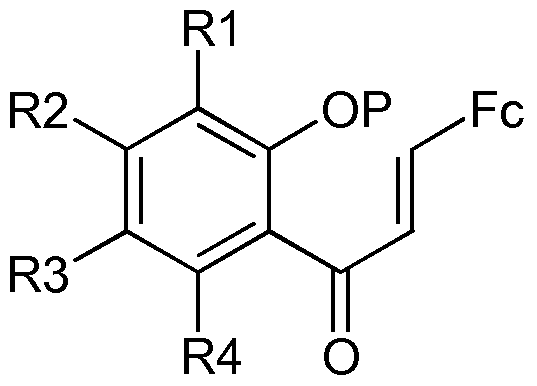
Formula (II)
wherein
Fc is ferrocenyl,
P is hydrogen, an alcohol protecting group or -BF2,
R1 is hydrogen, a halogen, hydroxy, nitro, a C1 -C6 alkyl, a C2-C6 alkenyl or R1 together with R2 is a C6-C14 aryl,
R2 is hydrogen, a halogen, hydroxy, amino (-NH2), a C1 -C6 alkyl, a C2-C6 alkenyl, -OR6, -NH-CO-R6, -0-CO-R6 or R2 together with R1 is a C6-C14 aryl,
R3 is hydrogen, a halogen, hydroxy, a C1 -C6 alkyl, a C2-C6 alkenyl, -COOH, -OR7, -NH-CO-R7, -CO-R7 or R3 together with R4 is a C6-C14 aryl,
R4 is hydrogen, hydroxy, a C1-C6 alkyl, a C2-C6 alkenyl, -OR8 or R4 together with R3 is a C6-C14 aryl,
R6, R7 and R8 are the same or different and are independently selected from a C1 -C6 alkyl, a C2-C6 alkenyl or a C6-C14 aryl.
with the proviso that the following compounds are excluded:
3-ferrocenyl-1 -(2-hydroxyphenyl)-prop-2-en-1 -one,
3-ferrocenyl-1 -(2,4-dihydroxyphenyl)-prop-2-en-1-one,
3-ferrocenyl-1 -(2,4-dimethoxyphenyl)-prop-2-en-1 -one,
3-ferrocenyl-1-(2,3,4-trimethoxyphenyl)-prop-2-en-1 -one.
3. Compound according to claim 2, wherein
- P is -BF2,
R1 is hydrogen or a halogen,
- R2 is -OR6,
R3 is hydrogen, a halogen or -OR7,
- R4 is -OR8,
R6, R7 and R8 are the same or different and are independently a C1-C6 alkyl.
4. Compound of formula (III):

Formula (III)
wherein
Fc is ferrocenyl,
R"i is hydrogen, a halogen, hydroxy, nitro, a C1 -C6 alkyl, a C2-C6 alkenyl or R" i together with R"2 is a C6-C14 aryl,
Rr2 is hydrogen, a halogen, hydroxy, amino (-NH2), a C1 -C6 alkyl, a C2-C6 alkenyl, -OR"6, -NH-CO-R"6, -0-CO-R"6 or R"2 together with R" i is a C6-C14 aryl,
Rr3 is hydrogen, a halogen, hydroxy, a C1-C6 alkyl, a C2-C6 alkenyl, -COOH, -OR"7, -NH-CO-R'V, -CO-R"7 or R"3 together with R"4 is a C6-C14 aryl,
R"4 is hydrogen, hydroxy, a C1 -C6 alkyl, a C2-C6 alkenyl, -OR"8 or R"4 together with R"3 is a C6-C14 aryl,
R"6, R'V and R"8 are the same or different and are independently selected from a C1 -C6 alkyl, a C2-C6 alkenyl or a C6-C14 aryl.
5. Compound of formula (IV): 
Formula (IV)
wherein
Fc is ferrocenyl,
P is hydrogen or an alcohol protecting group
R'"i is hydrogen, a halogen, hydroxy, nitro, a C1 -C6 alkyl, a C2-C6 alkenyl or R"' i together with R'"2 is a C6-C14 aryl,
R'"2 is hydrogen, a halogen, hydroxy, amino (-NH2), a C1 -C6 alkyl, a C2-C6 alkenyl, -OR'"6, -NH-CO-R'"6, -0-CO-R'"6 or R'"2 together with R"'i is a C6-C14 aryl, R'"3 is hydrogen, a halogen, hydroxy, a C1-C6 alkyl, a C2-C6 alkenyl, -COOH, -OR'"7, -NH-CO-R'"/, -CO-R'"/ or R'"3 together with R'"4 is a C6-C14 aryl,
R'"4 is hydrogen, hydroxy, a C1-C6 alkyl, a C2-C6 alkenyl, -OR'"8 or R'"4 together with R'"3 is a C6-C14 aryl,
R'"6, R'"7 and R'"8 are the same or different and are independently selected from a C1 -C6 alkyl, a C2-C6 alkenyl or a C6-C14 aryl.
6. Method of preparation of compounds according to claim 4, by oxidation of a compound of formula (V):
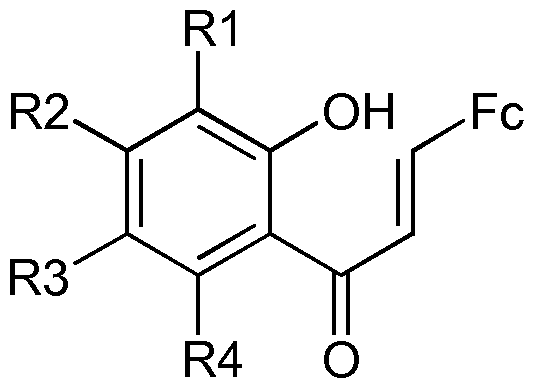
Formula (V)
wherein
Fc is ferrocenyl,
R1 is hydrogen, a halogen, hydroxy, nitro, a C1 -C6 alkyl, a C2-C6 alkenyl or R1 together with R2 is a C6-C14 aryl,
R2 is hydrogen, a halogen, hydroxy, amino (-NH2), a C1 -C6 alkyl, a C2-C6 alkenyl, -OR6, -NH-CO-R6, -0-CO-R6 or R2 together with R1 is a C6-C14 aryl,
R3 is hydrogen, a halogen, hydroxy, a C1 -C6 alkyl, a C2-C6 alkenyl, -COOH, -OR7, -NH-CO-R7, -CO-R7 or R3 together with R4 is a C6-C14 aryl,
R4 is hydrogen, hydroxy, a C1-C6 alkyl, a C2-C6 alkenyl, -OR8 or R4 together with R3 is a C6-C14 aryl, - 3 / - 011/107572 PCT/EP2011/053249
R6, R7 and R8 are the same or different and are independently selected from a C1 -C6 alkyl, a C2-C6 alkenyl or a C6-C14 aryl.
in the presence of oxidizing and nucleophilic conditions.
7. Method according to claim 6, wherein the oxidizing conditions are due to the presence of an oxidizing agent and the nucleophilic conditions are due to the presence of an oxidizing agent which has also a nucleophilic property, a solvent or a specific nucleophilic agent.
8. Method of preparation of a compound according to claim 2 wherein P is -BF2, by reacting a compound of formula (V):

Formula (V)
wherein
Fc is ferrocenyl,
R1 is hydrogen, a halogen, hydroxy, nitro, a C1 -C6 alkyl, a C2-C6 alkenyl or R1 together with R2 is a C6-C14 aryl,
R2 is hydrogen, a halogen, hydroxy, amino (-NH2), a C1 -C6 alkyl, a C2-C6 alkenyl, -OR6, -NH-CO-R6, -0-CO-R6 or R2 together with R1 is a C6-C14 aryl,
R3 is hydrogen, a halogen, hydroxy, a C1 -C6 alkyl, a C2-C6 alkenyl, -COOH, -OR7, -NH-CO-R7, -CO-R7 or R3 together with R4 is a C6-C14 aryl,
R4 is hydrogen, hydroxy, a C1-C6 alkyl, a C2-C6 alkenyl, -OR8 or R4 together with R3 is a C6-C14 aryl,
R6, R7 and R8 are the same or different and are independently selected from a C1 -C6 alkyl, a C2-C6 alkenyl or a C6-C14 aryl,
with with (boron trifluoride. solvent).
9. Method according to claim 8, wherein the solvent is a non coordinating solvent.
10. Method of preparation of a compound according to claim 5, wherein P is hydrogen, by reacting a compound of formula (III): 
Formula (I II)
wherein
Fc is ferrocenyl,
R"i is hydrogen, a halogen, hydroxy, nitro, a C1 -C6 alkyl, a C2-C6 alkenyl or R" i together with R"2 is a C6-C14 aryl,
R"2 is hydrogen, a halogen, hydroxy, amino (-NH2), a C1 -C6 alkyl, a C2-C6 alkenyl, -OR"6, -NH-CO-R"6, -0-CO-R"6 or R"2 together with R"i is a C6-C14 aryl, R"3 is hydrogen, a halogen, hydroxy, a C1 -C6 alkyl, a C2-C6 alkenyl, -COOH, -OR"7, -NH-CO-R'V, -CO-R"7 or R"3 together with R"4 is a C6-C14 aryl,
R"4 is hydrogen, hydroxy, a C1 -C6 alkyl, a C2-C6 alkenyl, -OR"8 or R"4 together with R"3 is a C6-C14 aryl,
R"6, R'V and R"8 are the same or different and are independently selected from a C1 - C6 alkyl, a C2-C6 alkenyl or a C6-C14 aryl
in the presence of a not nucleophile strong base, in an aprotic solvent.
11 . Method according to claim 10, wherein the not nucleophile strong base is lithium diisopropylamide and the solvent is THF, the reaction being conducted in melting acetone.
12. Method of preparation of a compound according to claim 1 , by reacting a compound of formula (VI):

Formula (IV)
wherein
Fc is ferrocenyl,
R"'i is hydrogen, a halogen, hydroxy, nitro, a C1 -C6 alkyl, a C2-C6 alkenyl or R"'i together with R'"2 is a C6-C14 aryl,
R'"2 is hydrogen, a halogen, hydroxy, amino (-NH2), a C1 -C6 alkyl, a C2-C6 alkenyl, -OR'"6, -NH-CO-R'"6, -0-CO-R'"6 or R'"2 together with R"'i is a C6-C14 aryl, R'"3 is hydrogen, a halogen, hydroxy, a C1 -C6 alkyl, a C2-C6 alkenyl, -COOH, -OR'"7, -NH-CO-R'"/, -CO-R'"7 or R'"3 together with R'"4 is a C6-C14 aryl,
R'"4 is hydrogen, hydroxy, a C1-C6 alkyl, a C2-C6 alkenyl, -OR'"s or R'"4 together with R'"3 is a C6-C14 aryl,
R'"6, R'"7 and R'"8 are the same or different and are independently selected from a C1 -C6 alkyl, a C2-C6 alkenyl or a C6-C14 aryl
in the presence of strong base, in a solvent.
13. Method according to claim 12, wherein the strong base is an alkoxide and the solvent is an alcohol.
14. Method of preparation of a compound according to claim 1 , by reacting a compound of formula (III):

Formula (III)
wherein
Fc is ferrocenyl,
R"i is hydrogen, a halogen, hydroxy, nitro, a C1 -C6 alkyl, a C2-C6 alkenyl or R" i together with R"2 is a C6-C14 aryl,
R"2 is hydrogen, a halogen, hydroxy, amino (-NH2), a C1-C6 alkyl, a C2-C6 alkenyl, -OR"6, -NH-CO-R"6, -0-CO-R"6 or R"2 together with R"i is a C6-C14 aryl, R"3 is hydrogen, a halogen, hydroxy, a C1 -C6 alkyl, a C2-C6 alkenyl, -COOH, -OR"7, -NH-CO-R"/, -CO-R"/ or R"3 together with R"4 is a C6-C14 aryl,
R"4 is hydrogen, hydroxy, a C1-C6 alkyl, a C2-C6 alkenyl, -OR"3 or R"4 together with R"3 is a C6-C14 aryl,
R"5, R"e, R"/ and R"3 are the same or different and are independently selected from a C1 -C6 alkyl, a C2-C6 alkenyl or a C6-C14 aryl
in the presence of potassium cyanide or an alkoxide base, in a solvent.
15. Method according to claim 14, wherein the solvent is an alcohol and the reaction is heated.
16. Compounds according to any of claims 1 , 3 to 5, or a pharmaceutically acceptable salt thereof, for use as a medicament.
17. Compounds according to any of claims 1 to 5, or a pharmaceutically acceptable salt thereof, for the treatment of cancer.
18. Compounds according to claims 3, or a pharmaceutically acceptable salt thereof, for the treatment of HIV.
Applications Claiming Priority (2)
| Application Number | Priority Date | Filing Date | Title |
|---|---|---|---|
| EP10305215A EP2368895A1 (en) | 2010-03-03 | 2010-03-03 | Ferrocenyl flavonoids |
| EP10305215.5 | 2010-03-03 |
Publications (2)
| Publication Number | Publication Date |
|---|---|
| WO2011107572A1 true WO2011107572A1 (en) | 2011-09-09 |
| WO2011107572A8 WO2011107572A8 (en) | 2012-04-26 |
Family
ID=42262328
Family Applications (1)
| Application Number | Title | Priority Date | Filing Date |
|---|---|---|---|
| PCT/EP2011/053249 Ceased WO2011107572A1 (en) | 2010-03-03 | 2011-03-03 | Ferrocenyl flavonoids |
Country Status (2)
| Country | Link |
|---|---|
| EP (1) | EP2368895A1 (en) |
| WO (1) | WO2011107572A1 (en) |
Cited By (2)
| Publication number | Priority date | Publication date | Assignee | Title |
|---|---|---|---|---|
| US10899727B2 (en) | 2016-04-11 | 2021-01-26 | Middle Tennessee State University | Therapeutic aurones |
| CN113512074A (en) * | 2021-07-19 | 2021-10-19 | 河南中烟工业有限责任公司 | (E)-4-methyl-7-hydroxy-8-(3-(ferrocenyl)acryloyl)coumarin and its preparation method and application |
Citations (1)
| Publication number | Priority date | Publication date | Assignee | Title |
|---|---|---|---|---|
| WO1985003507A2 (en) * | 1984-02-08 | 1985-08-15 | Koepf Maier Petra | Metallicenium salts and utilization thereof as cytostatic agents for combatting cancer |
-
2010
- 2010-03-03 EP EP10305215A patent/EP2368895A1/en not_active Withdrawn
-
2011
- 2011-03-03 WO PCT/EP2011/053249 patent/WO2011107572A1/en not_active Ceased
Patent Citations (1)
| Publication number | Priority date | Publication date | Assignee | Title |
|---|---|---|---|---|
| WO1985003507A2 (en) * | 1984-02-08 | 1985-08-15 | Koepf Maier Petra | Metallicenium salts and utilization thereof as cytostatic agents for combatting cancer |
Non-Patent Citations (4)
| Title |
|---|
| CHONGLONG LI ET AL: "Convenient Synthesis of Ferrocenylethynyl Ketones via Carbonylative Coupling of Ferrocenylethyne with Aryl Iodides by Using Water as Solvent", CATALYSIS LETTERS, KLUWER ACADEMIC PUBLISHERS-PLENUM PUBLISHERS, NE, vol. 127, no. 1-2, 11 October 2008 (2008-10-11), pages 152 - 157, XP019640359, ISSN: 1572-879X * |
| MONSERRAT JEAN-PHILIPPE ET AL: "Synthesis of cytotoxic ferrocenyl flavones via a ferricenium-mediated 1,6-oxidative cyclization", CHEMICAL COMMUNICATIONS - CHEMCOM, vol. 46, no. 28, 16 June 2010 (2010-06-16), pages 5145 - 5147, XP009148144, ISSN: 1359-7345, [retrieved on 20100616], DOI: DOI:10.1039/C0CC01290D * |
| MONSERRAT JEAN-PHILLIPPE ET AL: "Synthesis of cytotoxic ferrocenyl flavones via a ferricenium-mediated 1,6-oxidative cyclization. [Erratum to document cited in CA153:359139]", CHEMICAL COMMUNICATIONS - CHEMCOM, ROYAL SOCIETY OF CHEMISTRY, GB, vol. 46, no. 48, 26 December 2010 (2010-12-26), pages 9265, XP009148143, ISSN: 1359-7345, DOI: DOI:10.1039/C0CC90142C * |
| WU ET AL., BIOORGANIC & MEDICINAL CHEMISTRY LETTERS, vol. 12, 2002, pages 2299 - 2302 |
Cited By (4)
| Publication number | Priority date | Publication date | Assignee | Title |
|---|---|---|---|---|
| US10899727B2 (en) | 2016-04-11 | 2021-01-26 | Middle Tennessee State University | Therapeutic aurones |
| US11286245B2 (en) | 2016-04-11 | 2022-03-29 | Middle Tennessee State University | Therapeutic aurones |
| CN113512074A (en) * | 2021-07-19 | 2021-10-19 | 河南中烟工业有限责任公司 | (E)-4-methyl-7-hydroxy-8-(3-(ferrocenyl)acryloyl)coumarin and its preparation method and application |
| CN113512074B (en) * | 2021-07-19 | 2022-07-26 | 河南中烟工业有限责任公司 | (E)-4-methyl-7-hydroxy-8-(3-(ferrocenyl)acryloyl)coumarin and its preparation method and application |
Also Published As
| Publication number | Publication date |
|---|---|
| WO2011107572A8 (en) | 2012-04-26 |
| EP2368895A1 (en) | 2011-09-28 |
Similar Documents
| Publication | Publication Date | Title |
|---|---|---|
| Halevas et al. | Structurally characterized gallium–chrysin complexes with anticancer potential | |
| Bhat et al. | Microwave assisted one-pot catalyst free green synthesis of new methyl-7-amino-4-oxo-5-phenyl-2-thioxo-2, 3, 4, 5-tetrahydro-1H-pyrano [2, 3-d] pyrimidine-6-carboxylates as potent in vitro antibacterial and antifungal activity | |
| He et al. | Efficient synthesis of tertiary α-hydroxy ketones through CO 2-promoted regioselective hydration of propargylic alcohols | |
| KR102073181B1 (en) | Process for preparation of optically pure and optionally substituted 2-(1-hydroxy-alkyl)-chromen-4-one derivatives and their use in preparing pharmaceuticals | |
| Wang et al. | Somophilic isocyanide insertion: synthesis of 6-arylated and 6-trifluoromethylated phenanthridines | |
| Nardi et al. | 1, 5-Benzoheteroazepines through eco-friendly general condensation reactions | |
| Ahmed et al. | Synthesis of flavonoids based novel tetrahydropyran conjugates (Prins products) and their antiproliferative activity against human cancer cell lines | |
| CN111072720B (en) | Synthesis method of five-membered cyclic compound substituted by phosphono methylene | |
| WO2011107572A1 (en) | Ferrocenyl flavonoids | |
| Arshad et al. | A convenient synthesis of β-carbolines by iron-catalyzed aerobic decarboxylative/dehydrogenative aromatization of tetrahydro-β-carbolines under air | |
| Choi et al. | Synthesis of 6, 6-bisbenzannulated spiroketals related to the rubromycins using a double intramolecular hetero-Michael addition (DIHMA) | |
| Gritzenco et al. | Base-Free Synthesis and Synthetic Applications of Novel 3-(Organochalcogenyl) prop-2-yn-1-yl Esters: Promising Anticancer Agents | |
| Wang et al. | A highly efficient metal-free selective 1, 4-addition of difluoroenoxysilanes to chromones | |
| CN103408525B (en) | A kind of synthetic method of flavonoid compound and application thereof | |
| Li et al. | Copper-Catalyzed Synthesis of Difluoromethylated/C-4-and C-5-Functionalized Polycyclic Coumarin Derivatives | |
| Thangamani | Grindstone chemistry: an efficient and green synthesis of 2-amino-4H-benzo [b] pyrans | |
| Wei et al. | Iodine-mediated synthesis of benzopyridothiazines via tandem C–H thiolation and amination | |
| CN115677659A (en) | Preparation method of erlotinib | |
| Yuan et al. | Photoredox-catalysed radical difluoromethylation/cyclization of N-acryloyl-2-arylbenzimidazole to access CF 2 H-substituted benzimidazo [2, 1-a] isoquinolin-6 (5 H)-ones | |
| Khabibrakhmanova et al. | Synthesis of heterocycles bearing 2 (5 H)-furanone and (S)-naproxen moieties | |
| CN111747975B (en) | Preparation method of bedaquiline racemate and intermediate thereof | |
| CN102351870A (en) | Method for preparing benzacridine derivative and application of benzacridine derivative as anti-cancer medicine | |
| Fenton et al. | Synthesis of unsymmetrical dinucleating ligands bearing nitrogen and oxygen donor atoms | |
| CN109988197B (en) | A kind of ferrocene coumarin compound and its preparation method and use | |
| Weising et al. | Stereoselective Synthesis of 1′, 2′-cis-Disubstituted Carbocyclic ribo-Nucleoside Analogues |
Legal Events
| Date | Code | Title | Description |
|---|---|---|---|
| 121 | Ep: the epo has been informed by wipo that ep was designated in this application |
Ref document number: 11711488 Country of ref document: EP Kind code of ref document: A1 |
|
| NENP | Non-entry into the national phase |
Ref country code: DE |
|
| 122 | Ep: pct application non-entry in european phase |
Ref document number: 11711488 Country of ref document: EP Kind code of ref document: A1 |