WO2011107474A1 - Derivatives of aminoindanes, their preparation and their application in therapeutics - Google Patents

Derivatives of aminoindanes, their preparation and their application in therapeutics Download PDF

Info

Publication number
WO2011107474A1
WO2011107474A1 PCT/EP2011/053024 EP2011053024W WO2011107474A1 WO 2011107474 A1 WO2011107474 A1 WO 2011107474A1 EP 2011053024 W EP2011053024 W EP 2011053024W WO 2011107474 A1 WO2011107474 A1 WO 2011107474A1
Authority
WO
WIPO (PCT)
Prior art keywords
dihydro
inden
radicals
oxy
aminopiperidin
Prior art date
Legal status (The legal status is an assumption and is not a legal conclusion. Google has not performed a legal analysis and makes no representation as to the accuracy of the status listed.)
Ceased
Application number
PCT/EP2011/053024
Other languages
French (fr)
Inventor
Markus Follmann
Pascale Goberville
Stéphanie HACHTEL
Gerhard Hessler
Heinz-Werner Kleemann
Thomas Maier
Gary Mc Cort
Carsten STRÜBING
Bérangère THIERS
Li-Hsing Wang
Current Assignee (The listed assignees may be inaccurate. Google has not performed a legal analysis and makes no representation or warranty as to the accuracy of the list.)
Sanofi Aventis France
Original Assignee
Sanofi Aventis France
Priority date (The priority date is an assumption and is not a legal conclusion. Google has not performed a legal analysis and makes no representation as to the accuracy of the date listed.)
Filing date
Publication date
Priority to CN2011800220896A priority Critical patent/CN102884044A/en
Priority to US13/582,171 priority patent/US20130131034A1/en
Priority to MX2012010127A priority patent/MX2012010127A/en
Priority to CA2791431A priority patent/CA2791431A1/en
Priority to JP2012555400A priority patent/JP2013521250A/en
Priority to EP11706236A priority patent/EP2542524A1/en
Priority to BR112012022109A priority patent/BR112012022109A2/en
Priority to KR1020127025592A priority patent/KR20130020775A/en
Application filed by Sanofi Aventis France filed Critical Sanofi Aventis France
Priority to RU2012141607/04A priority patent/RU2012141607A/en
Priority to AU2011223042A priority patent/AU2011223042A1/en
Publication of WO2011107474A1 publication Critical patent/WO2011107474A1/en
Priority to IL221730A priority patent/IL221730A0/en
Anticipated expiration legal-status Critical
Ceased legal-status Critical Current

Links

Classifications

    • CCHEMISTRY; METALLURGY
    • C07ORGANIC CHEMISTRY
    • C07DHETEROCYCLIC COMPOUNDS
    • C07D487/00Heterocyclic compounds containing nitrogen atoms as the only ring hetero atoms in the condensed system, not provided for by groups C07D451/00 - C07D477/00
    • C07D487/02Heterocyclic compounds containing nitrogen atoms as the only ring hetero atoms in the condensed system, not provided for by groups C07D451/00 - C07D477/00 in which the condensed system contains two hetero rings
    • C07D487/08Bridged systems
    • AHUMAN NECESSITIES
    • A61MEDICAL OR VETERINARY SCIENCE; HYGIENE
    • A61KPREPARATIONS FOR MEDICAL, DENTAL OR TOILETRY PURPOSES
    • A61K31/00Medicinal preparations containing organic active ingredients
    • A61K31/33Heterocyclic compounds
    • A61K31/395Heterocyclic compounds having nitrogen as a ring hetero atom, e.g. guanethidine or rifamycins
    • A61K31/41Heterocyclic compounds having nitrogen as a ring hetero atom, e.g. guanethidine or rifamycins having five-membered rings with two or more ring hetero atoms, at least one of which being nitrogen, e.g. tetrazole
    • A61K31/41921,2,3-Triazoles
    • AHUMAN NECESSITIES
    • A61MEDICAL OR VETERINARY SCIENCE; HYGIENE
    • A61KPREPARATIONS FOR MEDICAL, DENTAL OR TOILETRY PURPOSES
    • A61K31/00Medicinal preparations containing organic active ingredients
    • A61K31/33Heterocyclic compounds
    • A61K31/395Heterocyclic compounds having nitrogen as a ring hetero atom, e.g. guanethidine or rifamycins
    • A61K31/435Heterocyclic compounds having nitrogen as a ring hetero atom, e.g. guanethidine or rifamycins having six-membered rings with one nitrogen as the only ring hetero atom
    • A61K31/44Non condensed pyridines; Hydrogenated derivatives thereof
    • A61K31/445Non condensed piperidines, e.g. piperocaine
    • A61K31/4453Non condensed piperidines, e.g. piperocaine only substituted in position 1, e.g. propipocaine, diperodon
    • AHUMAN NECESSITIES
    • A61MEDICAL OR VETERINARY SCIENCE; HYGIENE
    • A61PSPECIFIC THERAPEUTIC ACTIVITY OF CHEMICAL COMPOUNDS OR MEDICINAL PREPARATIONS
    • A61P11/00Drugs for disorders of the respiratory system
    • AHUMAN NECESSITIES
    • A61MEDICAL OR VETERINARY SCIENCE; HYGIENE
    • A61PSPECIFIC THERAPEUTIC ACTIVITY OF CHEMICAL COMPOUNDS OR MEDICINAL PREPARATIONS
    • A61P13/00Drugs for disorders of the urinary system
    • A61P13/12Drugs for disorders of the urinary system of the kidneys
    • AHUMAN NECESSITIES
    • A61MEDICAL OR VETERINARY SCIENCE; HYGIENE
    • A61PSPECIFIC THERAPEUTIC ACTIVITY OF CHEMICAL COMPOUNDS OR MEDICINAL PREPARATIONS
    • A61P21/00Drugs for disorders of the muscular or neuromuscular system
    • AHUMAN NECESSITIES
    • A61MEDICAL OR VETERINARY SCIENCE; HYGIENE
    • A61PSPECIFIC THERAPEUTIC ACTIVITY OF CHEMICAL COMPOUNDS OR MEDICINAL PREPARATIONS
    • A61P25/00Drugs for disorders of the nervous system
    • A61P25/04Centrally acting analgesics, e.g. opioids
    • AHUMAN NECESSITIES
    • A61MEDICAL OR VETERINARY SCIENCE; HYGIENE
    • A61PSPECIFIC THERAPEUTIC ACTIVITY OF CHEMICAL COMPOUNDS OR MEDICINAL PREPARATIONS
    • A61P29/00Non-central analgesic, antipyretic or antiinflammatory agents, e.g. antirheumatic agents; Non-steroidal antiinflammatory drugs [NSAID]
    • AHUMAN NECESSITIES
    • A61MEDICAL OR VETERINARY SCIENCE; HYGIENE
    • A61PSPECIFIC THERAPEUTIC ACTIVITY OF CHEMICAL COMPOUNDS OR MEDICINAL PREPARATIONS
    • A61P31/00Antiinfectives, i.e. antibiotics, antiseptics, chemotherapeutics
    • AHUMAN NECESSITIES
    • A61MEDICAL OR VETERINARY SCIENCE; HYGIENE
    • A61PSPECIFIC THERAPEUTIC ACTIVITY OF CHEMICAL COMPOUNDS OR MEDICINAL PREPARATIONS
    • A61P35/00Antineoplastic agents
    • AHUMAN NECESSITIES
    • A61MEDICAL OR VETERINARY SCIENCE; HYGIENE
    • A61PSPECIFIC THERAPEUTIC ACTIVITY OF CHEMICAL COMPOUNDS OR MEDICINAL PREPARATIONS
    • A61P7/00Drugs for disorders of the blood or the extracellular fluid
    • AHUMAN NECESSITIES
    • A61MEDICAL OR VETERINARY SCIENCE; HYGIENE
    • A61PSPECIFIC THERAPEUTIC ACTIVITY OF CHEMICAL COMPOUNDS OR MEDICINAL PREPARATIONS
    • A61P9/00Drugs for disorders of the cardiovascular system
    • AHUMAN NECESSITIES
    • A61MEDICAL OR VETERINARY SCIENCE; HYGIENE
    • A61PSPECIFIC THERAPEUTIC ACTIVITY OF CHEMICAL COMPOUNDS OR MEDICINAL PREPARATIONS
    • A61P9/00Drugs for disorders of the cardiovascular system
    • A61P9/04Inotropic agents, i.e. stimulants of cardiac contraction; Drugs for heart failure
    • AHUMAN NECESSITIES
    • A61MEDICAL OR VETERINARY SCIENCE; HYGIENE
    • A61PSPECIFIC THERAPEUTIC ACTIVITY OF CHEMICAL COMPOUNDS OR MEDICINAL PREPARATIONS
    • A61P9/00Drugs for disorders of the cardiovascular system
    • A61P9/10Drugs for disorders of the cardiovascular system for treating ischaemic or atherosclerotic diseases, e.g. antianginal drugs, coronary vasodilators, drugs for myocardial infarction, retinopathy, cerebrovascula insufficiency, renal arteriosclerosis
    • AHUMAN NECESSITIES
    • A61MEDICAL OR VETERINARY SCIENCE; HYGIENE
    • A61PSPECIFIC THERAPEUTIC ACTIVITY OF CHEMICAL COMPOUNDS OR MEDICINAL PREPARATIONS
    • A61P9/00Drugs for disorders of the cardiovascular system
    • A61P9/12Antihypertensives
    • CCHEMISTRY; METALLURGY
    • C07ORGANIC CHEMISTRY
    • C07DHETEROCYCLIC COMPOUNDS
    • C07D205/00Heterocyclic compounds containing four-membered rings with one nitrogen atom as the only ring hetero atom
    • C07D205/02Heterocyclic compounds containing four-membered rings with one nitrogen atom as the only ring hetero atom not condensed with other rings
    • C07D205/04Heterocyclic compounds containing four-membered rings with one nitrogen atom as the only ring hetero atom not condensed with other rings having no double bonds between ring members or between ring members and non-ring members
    • CCHEMISTRY; METALLURGY
    • C07ORGANIC CHEMISTRY
    • C07DHETEROCYCLIC COMPOUNDS
    • C07D207/00Heterocyclic compounds containing five-membered rings not condensed with other rings, with one nitrogen atom as the only ring hetero atom
    • C07D207/02Heterocyclic compounds containing five-membered rings not condensed with other rings, with one nitrogen atom as the only ring hetero atom with only hydrogen or carbon atoms directly attached to the ring nitrogen atom
    • C07D207/04Heterocyclic compounds containing five-membered rings not condensed with other rings, with one nitrogen atom as the only ring hetero atom with only hydrogen or carbon atoms directly attached to the ring nitrogen atom having no double bonds between ring members or between ring members and non-ring members
    • C07D207/08Heterocyclic compounds containing five-membered rings not condensed with other rings, with one nitrogen atom as the only ring hetero atom with only hydrogen or carbon atoms directly attached to the ring nitrogen atom having no double bonds between ring members or between ring members and non-ring members with hydrocarbon radicals, substituted by hetero atoms, attached to ring carbon atoms
    • CCHEMISTRY; METALLURGY
    • C07ORGANIC CHEMISTRY
    • C07DHETEROCYCLIC COMPOUNDS
    • C07D211/00Heterocyclic compounds containing hydrogenated pyridine rings, not condensed with other rings
    • C07D211/04Heterocyclic compounds containing hydrogenated pyridine rings, not condensed with other rings with only hydrogen or carbon atoms directly attached to the ring nitrogen atom
    • C07D211/06Heterocyclic compounds containing hydrogenated pyridine rings, not condensed with other rings with only hydrogen or carbon atoms directly attached to the ring nitrogen atom having no double bonds between ring members or between ring members and non-ring members
    • C07D211/36Heterocyclic compounds containing hydrogenated pyridine rings, not condensed with other rings with only hydrogen or carbon atoms directly attached to the ring nitrogen atom having no double bonds between ring members or between ring members and non-ring members with hetero atoms or with carbon atoms having three bonds to hetero atoms with at the most one bond to halogen, e.g. ester or nitrile radicals, directly attached to ring carbon atoms
    • C07D211/56Nitrogen atoms
    • CCHEMISTRY; METALLURGY
    • C07ORGANIC CHEMISTRY
    • C07DHETEROCYCLIC COMPOUNDS
    • C07D211/00Heterocyclic compounds containing hydrogenated pyridine rings, not condensed with other rings
    • C07D211/04Heterocyclic compounds containing hydrogenated pyridine rings, not condensed with other rings with only hydrogen or carbon atoms directly attached to the ring nitrogen atom
    • C07D211/06Heterocyclic compounds containing hydrogenated pyridine rings, not condensed with other rings with only hydrogen or carbon atoms directly attached to the ring nitrogen atom having no double bonds between ring members or between ring members and non-ring members
    • C07D211/36Heterocyclic compounds containing hydrogenated pyridine rings, not condensed with other rings with only hydrogen or carbon atoms directly attached to the ring nitrogen atom having no double bonds between ring members or between ring members and non-ring members with hetero atoms or with carbon atoms having three bonds to hetero atoms with at the most one bond to halogen, e.g. ester or nitrile radicals, directly attached to ring carbon atoms
    • C07D211/56Nitrogen atoms
    • C07D211/58Nitrogen atoms attached in position 4
    • CCHEMISTRY; METALLURGY
    • C07ORGANIC CHEMISTRY
    • C07DHETEROCYCLIC COMPOUNDS
    • C07D243/00Heterocyclic compounds containing seven-membered rings having two nitrogen atoms as the only ring hetero atoms
    • C07D243/06Heterocyclic compounds containing seven-membered rings having two nitrogen atoms as the only ring hetero atoms having the nitrogen atoms in positions 1 and 4
    • C07D243/08Heterocyclic compounds containing seven-membered rings having two nitrogen atoms as the only ring hetero atoms having the nitrogen atoms in positions 1 and 4 not condensed with other rings
    • CCHEMISTRY; METALLURGY
    • C07ORGANIC CHEMISTRY
    • C07DHETEROCYCLIC COMPOUNDS
    • C07D295/00Heterocyclic compounds containing polymethylene-imine rings with at least five ring members, 3-azabicyclo [3.2.2] nonane, piperazine, morpholine or thiomorpholine rings, having only hydrogen atoms directly attached to the ring carbon atoms
    • C07D295/04Heterocyclic compounds containing polymethylene-imine rings with at least five ring members, 3-azabicyclo [3.2.2] nonane, piperazine, morpholine or thiomorpholine rings, having only hydrogen atoms directly attached to the ring carbon atoms with substituted hydrocarbon radicals attached to ring nitrogen atoms
    • C07D295/08Heterocyclic compounds containing polymethylene-imine rings with at least five ring members, 3-azabicyclo [3.2.2] nonane, piperazine, morpholine or thiomorpholine rings, having only hydrogen atoms directly attached to the ring carbon atoms with substituted hydrocarbon radicals attached to ring nitrogen atoms substituted by singly bound oxygen or sulfur atoms
    • CCHEMISTRY; METALLURGY
    • C07ORGANIC CHEMISTRY
    • C07DHETEROCYCLIC COMPOUNDS
    • C07D295/00Heterocyclic compounds containing polymethylene-imine rings with at least five ring members, 3-azabicyclo [3.2.2] nonane, piperazine, morpholine or thiomorpholine rings, having only hydrogen atoms directly attached to the ring carbon atoms
    • C07D295/04Heterocyclic compounds containing polymethylene-imine rings with at least five ring members, 3-azabicyclo [3.2.2] nonane, piperazine, morpholine or thiomorpholine rings, having only hydrogen atoms directly attached to the ring carbon atoms with substituted hydrocarbon radicals attached to ring nitrogen atoms
    • C07D295/08Heterocyclic compounds containing polymethylene-imine rings with at least five ring members, 3-azabicyclo [3.2.2] nonane, piperazine, morpholine or thiomorpholine rings, having only hydrogen atoms directly attached to the ring carbon atoms with substituted hydrocarbon radicals attached to ring nitrogen atoms substituted by singly bound oxygen or sulfur atoms
    • C07D295/096Heterocyclic compounds containing polymethylene-imine rings with at least five ring members, 3-azabicyclo [3.2.2] nonane, piperazine, morpholine or thiomorpholine rings, having only hydrogen atoms directly attached to the ring carbon atoms with substituted hydrocarbon radicals attached to ring nitrogen atoms substituted by singly bound oxygen or sulfur atoms with the ring nitrogen atoms and the oxygen or sulfur atoms separated by carbocyclic rings or by carbon chains interrupted by carbocyclic rings
    • CCHEMISTRY; METALLURGY
    • C07ORGANIC CHEMISTRY
    • C07DHETEROCYCLIC COMPOUNDS
    • C07D401/00Heterocyclic compounds containing two or more hetero rings, having nitrogen atoms as the only ring hetero atoms, at least one ring being a six-membered ring with only one nitrogen atom
    • C07D401/02Heterocyclic compounds containing two or more hetero rings, having nitrogen atoms as the only ring hetero atoms, at least one ring being a six-membered ring with only one nitrogen atom containing two hetero rings
    • CCHEMISTRY; METALLURGY
    • C07ORGANIC CHEMISTRY
    • C07DHETEROCYCLIC COMPOUNDS
    • C07D401/00Heterocyclic compounds containing two or more hetero rings, having nitrogen atoms as the only ring hetero atoms, at least one ring being a six-membered ring with only one nitrogen atom
    • C07D401/02Heterocyclic compounds containing two or more hetero rings, having nitrogen atoms as the only ring hetero atoms, at least one ring being a six-membered ring with only one nitrogen atom containing two hetero rings
    • C07D401/12Heterocyclic compounds containing two or more hetero rings, having nitrogen atoms as the only ring hetero atoms, at least one ring being a six-membered ring with only one nitrogen atom containing two hetero rings linked by a chain containing hetero atoms as chain links
    • CCHEMISTRY; METALLURGY
    • C07ORGANIC CHEMISTRY
    • C07DHETEROCYCLIC COMPOUNDS
    • C07D403/00Heterocyclic compounds containing two or more hetero rings, having nitrogen atoms as the only ring hetero atoms, not provided for by group C07D401/00
    • C07D403/02Heterocyclic compounds containing two or more hetero rings, having nitrogen atoms as the only ring hetero atoms, not provided for by group C07D401/00 containing two hetero rings
    • C07D403/12Heterocyclic compounds containing two or more hetero rings, having nitrogen atoms as the only ring hetero atoms, not provided for by group C07D401/00 containing two hetero rings linked by a chain containing hetero atoms as chain links
    • CCHEMISTRY; METALLURGY
    • C07ORGANIC CHEMISTRY
    • C07DHETEROCYCLIC COMPOUNDS
    • C07D405/00Heterocyclic compounds containing both one or more hetero rings having oxygen atoms as the only ring hetero atoms, and one or more rings having nitrogen as the only ring hetero atom
    • C07D405/02Heterocyclic compounds containing both one or more hetero rings having oxygen atoms as the only ring hetero atoms, and one or more rings having nitrogen as the only ring hetero atom containing two hetero rings
    • C07D405/12Heterocyclic compounds containing both one or more hetero rings having oxygen atoms as the only ring hetero atoms, and one or more rings having nitrogen as the only ring hetero atom containing two hetero rings linked by a chain containing hetero atoms as chain links
    • CCHEMISTRY; METALLURGY
    • C07ORGANIC CHEMISTRY
    • C07DHETEROCYCLIC COMPOUNDS
    • C07D411/00Heterocyclic compounds containing two or more hetero rings, at least one ring having oxygen and sulfur atoms as the only ring hetero atoms
    • C07D411/02Heterocyclic compounds containing two or more hetero rings, at least one ring having oxygen and sulfur atoms as the only ring hetero atoms containing two hetero rings
    • C07D411/12Heterocyclic compounds containing two or more hetero rings, at least one ring having oxygen and sulfur atoms as the only ring hetero atoms containing two hetero rings linked by a chain containing hetero atoms as chain links
    • CCHEMISTRY; METALLURGY
    • C07ORGANIC CHEMISTRY
    • C07DHETEROCYCLIC COMPOUNDS
    • C07D413/00Heterocyclic compounds containing two or more hetero rings, at least one ring having nitrogen and oxygen atoms as the only ring hetero atoms
    • C07D413/02Heterocyclic compounds containing two or more hetero rings, at least one ring having nitrogen and oxygen atoms as the only ring hetero atoms containing two hetero rings
    • C07D413/12Heterocyclic compounds containing two or more hetero rings, at least one ring having nitrogen and oxygen atoms as the only ring hetero atoms containing two hetero rings linked by a chain containing hetero atoms as chain links

Definitions

  • the instant invention relates to derivatives of aminoindanes, to their preparation and to their application in therapeutics.
  • Transient receptor potential cation channel, subfamily C, member 6, also known as TRPC6, is a human gene encoding a protein of the same name.
  • TRPC6 has been associated with fibrotic disorders, such as focal segmental glomerulosclerosis (a) Winn et al, Science 2005, 308, 1801 -1804. b) Hsu et al., Biochim. Biophys. Acta, Molec. Basis of Disease 2007, 1772, 928-936. c) Kriz, Trends Molec. Med. 2005, 11, 527-530. d) Winn et al, J. Amer.Soc.Nephrol.
  • A is a 6 to 10 membered aryl radical or a 5 to 10 membered heteroaryl radical, where the aryl and heteroaryl radical may be mono- or bicyclic, and the heteroaryl radical may comprise one or more heteroatoms selected from the group of nitrogen, oxygen and sulfur;
  • substituents R1 which are selected independently of one another from the group of H, F, CI, Br, I, (C 1 -C 10 )- alkyl, (C 2 -Ci 0 )-alkenyl, (C 2 -Ci 0 )-alkynyl, (C 3 -Ci 4 )-cycloalkyl, (C 4 -C 20 )- cycloalkylalkyl, (C 4 -C 20 )-cycloalkylalkyloxy, (d-Cio)-alkoxy, (C 1 -C 10 )- alkylthio, (C 6 -C 14 )-aryl, (C 2 -C 13 )-heteroaryl, -CN, -OH, -NR13R14, -C(0)R12, -SF 5 , -S(0) n R12
  • cycloalkyi or cycloheteroalkyi units may be saturated or partly unsaturated, and where the heterocyclic groups may comprise one or more heteroatoms selected from the group of nitrogen, oxygen and sulfur; where one or more hydrogen atoms in the radicals B may be replaced by substituents R5 which are selected independently of one another from the group of (CrCi 0 )-alkyl radicals, of (C 2 -Ci 0 )-alkenyl radicals, of (C 2 -Ci 0 )- alkynyl radicals, of (CrCi 0 )-alkoxy radicals, of (CrCi 0 )-alkylthio radicals, of (C 3 -Ci 4 )-cycloalkyl radicals, of (C 4 -C 20 )-cycloalkylalkyl radicals, of (C 4 -C 20 )- cycloalkylalkyloxy, of (C 2 -Ci 9 )
  • cycloalkyl and cycloheteroalkyl units may be saturated or partly unsaturated
  • radicals R5 may be replaced by further radicals which are selected independently of one another from the group of R1 1 radicals,
  • R16, R17 and R18 independently of one another for a radical selected from the group of H, (C 2 -Ci 9 )-cycloheteroalkyl, (C 3 -C M )- cycloalkyl, (C 6 -Ci 0 )-aryl, (d-Cio)-alkyl radicals,
  • L is a covalent bond or an alkylene bridge having 1 to 10 carbon atoms
  • X is a group -N(R6)-, -0-, -S(0) n -, or alkylene having 1 to 5 carbon atoms, where
  • R6 may be hydrogen or may be (CrCi 0 )-alkyl, (C 3 -Ci 4 )-cycloalkyl, (C 4 -C 20 )-cycloalkylalkyl radical, all of which may be substituted independently of one another one or more times by F, or R6 may be -COR12; -CO(NR13R14), S(0) n R12, -S(0) 2 NR13R14;
  • R2 is absent or is one or more substituents which may be selected independently of one another from the group of F, (CrCi 0 )-alkyl and (CrCi 0 )-alkoxy radical, where the alkyl and alkoxy radicals may be substituted independently of one another one or more times by F;
  • R3 and R4 are independently of one another a hydrogen radical or a radical which is selected from the group of (CrCi 0 )-alkyl radicals, of (C 2 -Ci 0 )-alkenyl radicals, of
  • (C 2 -Cio)-alkynyl radicals of (C 3 -Ci 4 )-cycloalkyl radicals, of (C 4 -C 20 )-cycloalkylalkyl radicals, of (C 2 -Ci 9 )-cycloheteroalkyl radicals, of (C 3 -Ci 9 )-cycloheteroalkylalkyl radicals, of (C 6 -Ci 0 )-aryl radicals, of (C 7 -C 20 )-arylalkyl radicals, of (CrC 9 )- heteroaryl radicals, of (C 2 -Ci 9 )-heteroarylalkyl radicals, where
  • heterocyclic radicals may be substituted independently of one another one or more times by radicals selected from the group of R7 and R9, and where
  • heterocyclic radicals may be bridged by a bond, by a saturated or unsaturated (d-Cio)-alkyl or (CrC 9 )-heteroalkyl chain or by -NR15-, -0-, -S-, and where
  • the alkyl and heteroalkyl chains may also form a spirocyclic ring system with the ring system formed by R3 and R4, where the alkyl and heteroalkyl bridges may be substituted independently of one another one or more times by radicals selected from the group of R7 and R9,
  • R10 is a radical selected from the group of F, OH, CN, (CrCi 0 )-alkoxy, (C1 -C10)- alkylthio, N0 2 , -NR13R14, -NR13COR12, -NR13COOR12, -NR13CONR13R14, -NR13-S(0) 2 -R12, -NR12-S(0) 2 -NR13R14, -COOR12, -COR12, -CO(NR13R14), S(0) n R12, -S(0) 2 NR13R14;
  • R1 1 is a radical selected from the group of (d-Cio)-alkyl, (C 2 -Ci 0 )-alkenyl, (C 2 -Ci 0 )- alkynyl, (CrCi 0 )-alkoxy, (CrC 20 )-alkylthio, (C 3 -Ci 4 )-cyclo
  • n 0, 1 or 2;
  • p 1 or 2
  • R3 and R4 are H, (C C 10 )-alkyl, (C 3 -C 14 )-cycloalkyl, (C 7 -C 20 )- arylalkyl or R3 and R4 together are an unsubstituted pyrrolidinyl, morpholinyl, piperidinyl or piperazinyl radical or 4-methylpiperazinyl radical, at least one R5 radical which is not a (d-Cio)-alkyl, (CrCi 0 )-alkoxy, OH, CF 3 , F, CI, Br or I radical must be present,
  • R3 and R4 are a (C Cio)-alkyl, (C 3 -Ci 4 )-cycloalkyl or a (C 4 -C 20 )-cycloalkylalkyl radical, at least one R5 radical which is not an F, CI, Br, I, (C C 4 )-alkyl, (C C 4 )-alkoxy, CF 3 , OCF 3 , CN, N0 2 , NH 2 , -NH((C C 10 )-alkyl), -N((C C 10 )-alkyl) 2 , unsubstituted or substituted benzoyl or an unsubstituted or substituted phenyl-(CH 2 ) r -Y-(CH 2 ) s - radical, with Y being a bond or an oxygen and r and s being
  • A is a 6 to 10 membered aryl radical or a 5 to 10 membered heteroaryl radical, where the aryl and heteroaryl radical may be mono- or bicyclic, and the heteroaryl radical may comprise one or more heteroatoms selected from the group of nitrogen, oxygen and sulfur;
  • substituents R1 which are selected independently of one another from the group of H, F, CI, Br, I, (d-Ci 0 )- alkyl, (C 2 -C 10 )-alkenyl, (C 2 -C 10 )-alkynyl, (C 3 -C 14 )-cycloalkyl, (C 4 -C 20 )- cycloalkylalkyl, (C 4 -C 20 )-cycloalkylalkyloxy, (CrCi 0 )-alkoxy, (C Cio)- alkylthio, (C 6 -C 14 )-aryl, (C 2 -C 13 )-heteroaryl, -CN, -OH, -NR13R14, -C(0)R12, -SF 5 , -S(0) n R12, -C(0)OR12
  • cycloalkyi or cycloheteroalkyi units may be saturated or partly unsaturated, and where the heterocyclic groups may comprise one or more heteroatoms selected from the group of nitrogen, oxygen and sulfur; where one or more hydrogen atoms in the radicals B may be replaced by substituents R5 which are selected independently of one another from the group of (CrCi 0 )-alkyl radicals, of (C 2 -Ci 0 )-alkenyl radicals, of (C 2 -Ci 0 )- alkynyl radicals, of (CrCi 0 )-alkoxy radicals, of (CrCi 0 )-alkylthio radicals, of (C 3 -Ci 4 )-cycloalkyl radicals, of (C 4 -C 20 )-cycloalkylalkyl radicals, of (C 4 -C 20 )- cycloalkylalkyloxy, of (C 2 -Ci 9 )
  • the cycloalkyi and cycloheteroalkyi units may be saturated or partly unsaturated, and where one or more hydrogen atoms in said radicals R5 may be replaced by further radicals which are selected independently of one another from the group of R1 1 radicals,
  • R16, R17 and R18 independently of one another for a radical selected from the group of H, (C 2 -Ci 9 )-cycloheteroalkyl, (C 3 -Ci 4 )- cycloalkyl, (C 6 -Ci 0 )-aryl, (CrCi 0 )-alkyl radicals,
  • X is a group -N(R6)-, -0-, -S(0) n -, or alkylene having 1 to 5 carbon atoms, where
  • R6 may be hydrogen or may be (CrCi 0 )-alkyl, (C 3 -Ci 4 )-cycloalkyl, (C 4 -C 20 )-cycloalkylalkyl radical, all of which may be substituted independently of one another one or more times by F, or R6 may be -COR12; -CO(NR13R14), S(0) traversR12, -S(0) 2 NR13R14;
  • R2 is absent or is one or more substituents which may be selected independently of one another from the group of F, (CrCi 0 )-alkyl and (CrCi 0 )-alkoxy radical, where the alkyl and alkoxy radicals may be substituted independently of one another one or more times by F;
  • R3 and R4 form together with the nitrogen to which they are bonded a 4-10 membered, saturated, heterocycle which may additionally comprise one or more heteroatoms from the list -0-, -S(0) n -, and -NR8-, where
  • heterocyclic radicals may be substituted independently of one another one or more times by radicals selected from the group of R7 and R9, and where
  • heterocyclic radicals may be bridged by a bond, by a saturated or unsaturated (CrCi 0 )-alkyl or (CrC 9 )-heteroalkyl chain or by -NR15-, -0-, -S-, and where
  • the alkyl and heteroalkyl chains may also form a spirocyclic ring system with the ring system formed by R3 and R4, where the alkyl and heteroalkyl bridges may be substituted independently of one another one or more times by radicals selected from the group of R7 and R9,
  • R10 is a radical selected from the group of F, OH, CN, (CrCi 0 )-alkoxy, (C 1 -C 10 )- alkylthio, N0 2 , -NR13R14, -NR13COR12, -NR13COOR12, -NR13CONR13R14, -NR13-S(0) 2 -R12, -NR12-S(0) 2 -NR13R14, -COOR12, -COR12, -CO(NR13R14), S(0) n R12, -S(0) 2 NR13R14;
  • R1 1 is a radical selected from the group of (CrCi 0 )-alkyl, (C 2 -Ci 0 )-alkenyl, (C 2 -Ci 0 )- alkynyl, (CrCi 0 )-alkoxy, (CrC 20 )-alkylthio, (C 3 -Ci 4 )-cycloalkyl, (C 4 -Ci 0 )- cycloalkylalkyl, (C 2 -Ci 3 )-cycloheteroalkyl, (C 4 -Ci 9 )-cycloheteroalkylalkyl, (C 3 -C )- cycloalkyloxy, (C 2 -Ci 3 )-cycloheteroalkyloxy,
  • n 0, 1 or 2;
  • p 1 or 2
  • q is 0 or 1 , in the form of a free base or of an addition salt with an acid, as well as in the form of an hydrate or of a solvate,
  • A is phenyl
  • B is phenyl or benzodioxolanyl
  • X is -O- or -S-
  • L is a bond and R3 and R4 together are an unsubstituted pyrrolidinyl, morpholinyl, piperidinyl or piperazinyl radical or 4-methylpiperazinyl radical, at least one R5 radical which is not a (CrCi 0 )-alkyl, (CrCi 0 )-alkoxy, OH, CF 3 , F, CI, Br or I radical must be present.
  • L is a covalent bond
  • X is a group -0-; and q is 0.
  • the compounds of formula (I) can comprise one or more asymmetric carbon atoms. They can therefore exist in the form of enantiomers or diastereoisomers. These enantiomers and diastereoisomers, as well as their mixtures, including racemic mixtures, form part of the invention.
  • the compounds of formula (I) can be provided in the form of a free base or in the form of addition salts with acids, which also form part of the invention.
  • salts are advantageously prepared with pharmaceutically acceptable acids, but salts with other acids, useful for example for the purification or for the isolation of the compounds of formula (I), also form part of the invention.
  • the compounds of formula (I) can also be provided in the form of an hydrate or of a solvate, i.e. in the form of associations or combinations with one or more water or solvent molecules. Such hydrates and solvates also form part of the invention.
  • halogen atom corresponds to a fluorine, chlorine, bromine or iodine atom
  • - (d-Cio)-Alkyl radicals may in the context of the present invention be straight- chain or branched. This also applies when they carry substituents or occur as substituents of other radicals, for example in fluoroalkyl radicals or alkoxy radicals.
  • Preferred alkyl radicals are methyl, ethyl, n- propyl, isopropyl, n-butyl and tert-butyl.
  • - (C 3 -Ci 4 )-Cycloalkyl radicals in the context of the present invention may be saturated or partly unsaturated. This also applies when they carry substituents or occur as substituents of other radicals. Cycloalkyl radicals having 3, 4, 5, 6, 7 or 8 carbon atoms are preferred. Examples of cycloalkyl radicals are cyclopropyl, cyclobutyl, cyclopentyl, cyclohexyl, cycloheptyl and cyclooctyl a fluoroalkyl group corresponds to an alkyl group, wherein one or more hydrogen atoms have been substituted by fluorine atoms;
  • cycloheteroalkyl radicals in the context of the present invention may be saturated or partly unsaturated. This also applies when they carry substituents or occur as substituents of other radicals.
  • the cycloheteroalkyl radicals preferably have heteroatoms selected from the group of nitrogen, oxygen and sulfur. Cycloheteroalkyl radicals having 2, 3, 4, 5, 6, 7, 8 or 9 carbon atoms are preferred, it being possible for 1 or 2 nitrogen atoms, 1 or 2 oxygen atoms, 1 or 2 sulfur atoms, 1 nitrogen and 1 oxygen atom or 1 sulfur atom or 1 oxygen and 1 sulfur atom to be present as heteroatoms.
  • the cycloheteroalkyi radicals can be attached by any position.
  • heterocycles are selected from the group of oxiranyl, thiiranyl, aziridinyl, oxetanyl, thietanyl, azetidinyl, diazetidinyl, pyrrolidinyl, dihydropyrrolyl, dihydroimidazolyl, dihydropyrazolyl, tetrahydropyrazolyl, oxolanyl, dihydrofuranyl, dioxolanyl, thiolanyl, dihydrothiophenyl, oxazolanyl, dihydrooxazolyl, isooxazolanyl, dihydroisooxazolyl, thiazolidinyl, dihydrothiazolyl, isothiazolidinyl, dihydroisothiazolyl, oxathiolidinyl, 2/- -pyranyl, 4H-pyranyl, tetrahydropyranyl,
  • bicyclic ring systems examples include octahydropyrrolo[1 ,2a]pyrazinyl, octahydropyrrolo[3,4b]pyrrolyl, hexahydropyrrolo[3,4- c]pyrrolyl- and octahydropyrrolo[3,4-c]pyrrolyl.
  • Prefered cycloheteroalkyi are azetidinyl, pyrrolidinyl, piperidinyl, homopiperazine or 2,5-diazabicyclo[2.2.1 ]heptane.
  • alkenyl radicals in the context of the present invention may likewise be straight-chain or branched. This also applies when they carry substituents or occur as substituents of other radicals. Examples of alkenyl radicals are ethenyl, propenyl and butenyl.
  • alkynyl radicals in the context of the present invention may likewise be straight-chain or branched. This also applies when they carry substituents or occur as substituents of other radicals.
  • alkynyl radicals are ethynyl, propynyl and butynyl.an alkoxy group corresponds to an -O-alkyI group, wherein the alkyl group is as defined above;
  • Examples of preferred (C 6 -Ci 0 )-aryl radicals are phenyl and naphthyl. This also applies when they carry substituents or occur as substituents of other radicals.
  • (Ci-Cg)-Heteroaryl radicals are aromatic ring compounds in which one or more ring atoms are oxygen atoms, sulfur atoms or nitrogen atoms, e.g. 1 , 2 or 3 nitrogen atoms, 1 or 2 oxygen atoms, 1 or 2 sulfur atoms or a combination of various heteroatoms. This also applies when they carry substituents or occur as substituents of other radicals.
  • the heteroaryl radicals may be attached by all positions.
  • Heteroaryl means for example furanyl, thiophenyl, pyrrolyl, imidazolyl, pyrazolyl, triazolyl, tetrazolyl, oxazolyl, isoxazolyl, thiazolyl, isothiazolyl, pyridyl, pyrazinyl, pyrimidinyl, pyridazinyl, indolyl, indazolyl, quinolyl, isoquinolyl, phthalazinyl, quinoxalinyl, quinazolinyl and cinnolinyl.
  • Preferred heteroaryl radicals are 2- or 3-thiophenyl, 2- or 3-furyl, 1 -, 2- or 3- pyrrolyl, 1 -, 2-, 4- or 5-imidazolyl, 1 -, 3-, 4- or 5-pyrazolyl, 1 ,2,3-triazol-1 -, -4- or -5-yl, 1 ,2,4-triazol- 1 -, -3- or -5-yl, 1 - or 5-tetrazolyl, 2-, 4- or 5-oxazolyl, 3-, 4- or 5-isoxazolyl, 1 ,2,3- oxadiazol-4- or -5-yl, 1 ,2,4-oxadiazol-3- or -5-yl, 1 ,3,4-oxadiazol-2-yl or -5-yl, 2-, 4- or 5- thiazolyl, 3-, 4- or 5-isothiazolyl, 1 ,3,4-thiadiazol-2- or -5-yl, 1 ,2,4
  • heteroaryl radicals are pyrazolyl, isoxasolyl, benzotriazolyl;
  • - (C 9 -Ci 4 )-Cycloalkylaryl radicals are preferably selected from the group of fused ring systems having a cycloalkyl ring and an aryl ring, in particular a phenyl ring.
  • Particularly preferred cycloalkylaryl radicals are indenyl, dihydronaphthyl, tetrahydronaphthyl and indanyl.
  • - (C 5 -Ci 3 )-Cycloalkylheteroaryl radicals are preferably selected from the group of fused ring systems having a cycloalkyl ring and a heteroaryl ring.
  • - (C 7 -Ci 3 )-Cycloheteroalkylaryl radicals are preferably fused ring systems having a cycloheteroalkyi ring and an aryl ring, in particular a phenyl ring.
  • Preferred cycloheteroalkylaryl radicals are benzodihydrothiophenyl, benzothiolanyl, benzodihydrofuranyl, benzooxolanyl, benzodioxolanyl, benzodihydropyrrolyl, benzodihydroimidazolyl, benzodihydropyrazolyl, benzodihydrotriazolyl, benzopiperazinyl, benzodihydrothiazolyl, benzomorpholinyl benzodihydrooxazolyl, dihydroquinolinyl, dihydroisoquinolinyl, tetrahydroisoquinolinyl and tetrahydroquinolinyl.
  • Particularly preferred are cycloheteroalk laryl radicals of formula:
  • - (C 4 -Ci 2 )-Cycloheteroalkylheteroaryl radicals are preferably selected from the group of fused ring systems having a cycloheteroalkyi ring and a heteroaryl ring.
  • a cycloheteroalkyi corresponds to a cyclic group comprising between 3 and 19 carbon atoms and between 1 and 3 heteroatoms, preferably nitrogen atoms.
  • T and T" are independently N or CR1 ;
  • substituents R1 which are selected independently of one another from the group of H, F, CI, Br, I, (d-Cio)-alkyl-, (CrCi 0 )-alkoxy-, -CN, -OH, -S(0) n R12, -;
  • alkyl and alkoxy radicals may be substituted independently of one another one or more times by F
  • R12 is H or (CrCi 0 )-alkyl, optionally substituted one or more times by F; is a 6 membered aryl radical or a 6 membered heteroaryl radical, where T is N or CR5; is absent or is radical chosen from a (C 6 -Ci 0 )-aryl radical and a (C 3 -C 6 )- cycloheteroalkyl radical comprising one ore more heteroatoms chosen from O, N and S,
  • substituents R5 which are selected independently of one another from the group of (CrCi 0 )-alkyl radicals, of (CrCi 0 )-alkoxy radicals, of (C 3 -Ci 4 )- cycloalkyl radicals, of (CrC 9 )-heteroaryl radicals, where
  • the cycloalkyl units may be saturated or partly unsaturated, and where one or more hydrogen atoms in said radicals R5 may be replaced by further radicals which are selected independently of one another from the group of F, CI, Br and I, it is further possible for R5 to be one or more radicals which are selected independently of one another from the group of OH, F, CI, Br, I, CN, N0 2 ,
  • R16, R17 and R18 independently of one another for a radical selected from the group of H and (d-Cio)-alkyl radicals, which may be substituted independently of one another by F, CI, Br, I, a covalent bond or a methylene bridge;
  • X is a group -O- or -S(0) n -;
  • R3 and R4 are independently of one another a hydrogen radical, a (CrCi 0 )-alkyl radical or a (C 3 -Ci 9 )-cycloheteroalkyl radical comprising at least one nitrogen atom, or R3 and R4 form together with the nitrogen to which they are bonded a 4-7 membered, saturated mono-or bi-cycloheteroalkyl radical which may additionally comprise one or more -NR8- heteroatom, where
  • the cycloheteroalkyl radical may be substituted independently of one another one time by a radical-(CR20R21 ) r -NR22R23, in which r is 0 or 1 and R20, R21 , R22 and R23 are independently of one another H or a (C Cio)-alkyl radical optionally substituted one or more times by F, CI, Br and/or I,
  • R8 is an H or a (CrCi 0 )-alkyl radical
  • n 0, 1 or 2;
  • q is 0 or 1 , in the form of a free base or of an addition salt with an acid, as well as in the form of an hydrate or of a solvate.
  • the compounds of the invention are of formula (II) above, wherein : A is a 6 membered aryl radical or a 6 membered heteroaryl radical, where T and T" are independently N or CR1 ;
  • substituents R1 which are selected independently of one another from the group of H, F, CI, Br, I, (CrCi 0 )-alkyl-, (CrCi 0 )-alkoxy-,
  • alkyl and alkoxy radicals may be substituted independently of one another one or more times by F
  • R12 is H or (d-Cio)-alkyl, optionally substituted one or more times by F;
  • B' is a 6 membered aryl radical or a 6 membered heteroaryl radical, where T is N or CR5;
  • B" is absent or is radical chosen from a (C 6 -Ci 0 )-aryl radical and a (C 3 -C 6 )- cycloheteroalkyl radical comprising one ore more heteroatoms chosen from O, N and S,
  • substituents R5 which are selected independently of one another from the group of (CrCi 0 )-alkyl radicals, of (CrCi 0 )-alkoxy radicals, of (C 3 -Ci 4 )- cycloalkyl radicals, of (CrC 9 )-heteroaryl radicals, where
  • the cycloalkyl units may be saturated or partly unsaturated, and where one or more hydrogen atoms in said radicals R5 may be replaced by further radicals which are selected independently of one another from the group of F, CI, Br and I, it is further possible for R5 to be one or more radicals which are selected independently of one another from the group of OH, F, CI, Br, I, CN, N0 2 , -COOR16, -CO(NR17R18),
  • R16, R17 and R18 independently of one another for a radical selected from the group of H and (CrCi 0 )-alkyl radicals, which may be substituted independently of one another by F, CI, Br, I,
  • L is a covalent bond or a methylene bridge
  • X is a group -O- or -S(0) n -;
  • R3 and R4 form together with the nitrogen to which they are bonded a 4-7 membered, saturated mono-or bi-cycloheteroalkyl radical which may additionally comprise one or more -NR8- heteroatom, where
  • the cycloheteroalkyi radical may be substituted independently of one another one time by a radical-(CR20R21 ) r -NR22R23, in which r is 0 or 1 and R20, R21 , R22 and R23 are independently of one another H or a (C Cio)-alkyl radical optionally substituted one or more times by F, CI, Br and/or I,
  • R8 is an H or a (d-Cio)-alkyl radical
  • n 0, 1 or 2;
  • q is 0 or 1 , in the form of a free base or of an addition salt with an acid, as well as in the form of an hydrate or of a solvate as appropriate.
  • a protecting group Pg corresponds to a group which enables, on the one hand, the protection of a reactive function such as an hydroxy or an amine during a synthesis step and, on then other hand, to recover the intact reactive function at the end of the synthesis step.
  • Examples of protecting groups, as well as methods for protecting and deprotecting various functional groups, are given in « Protective Groups in Organic Synthesis » Green et al., 2 nd Edition (John Wiley & Sons, Inc., New York).
  • a leaving group corresponds to a group which may easily be cleaved from a molecule by breaking a heterolytic bond, with departure of electronic pair. This group may then easily be replaced by another functional group during a substitution reaction, for example.
  • Such leaving groups may consist in halogen atoms or activated hydroxy groups, such as mesylate, tosylate, triflate or acetyl groups, etc. Examples of leaving groups, as well as references relating to their preparation, are given in « Advances in Organic Chemistry » J. March, 3 rd Edition, Wiley Interscience, p. 310- 316.
  • General processes suitable for preparing compounds of the general formula I are described below. The compounds of the formula I can in this connection be prepared by different chemical processes.
  • the groups and radicals A, B, L, X, R1 , R2, R3, R4 and R5 and index p mentioned in the following methods have the abovementioned meaning unless they are explicitly defined otherwise.
  • aryl or heteroaryl thiols B-SH or aryl- or heteroarylcarboxylic acids B-C0 2 H which may be substituted one or more times by R5 in order to obtain the corresponding -S- or -C0 2 H- bridged derivatives.
  • Mitsunobu reactions are, as is known, carried out in the presence of a phosphine, e.g. such as triphenylphosphine and of azodicarboxylic esters such as, for example, diisopropyl azodicarboxylate in inert solvents such as acetonitrile, CH 2 CI 2 or tetrahydrofuran.
  • a phosphine e.g. such as triphenylphosphine
  • azodicarboxylic esters such as, for example, diisopropyl azodicarboxylate
  • inert solvents such as acetonitrile, CH 2 CI 2 or tetra
  • these functional groups can be further modified where appropriate, for example by alkylation with an alkylating agent or by acylation and subsequent reduction in order to obtain further compounds I.
  • the starting materials employed in scheme A such as the epoxides of the formula II, the amine NHR3R4, and the hydroxyaryls or hydroxyheteroaryls or the thiol derivatives thereof are either commercially available, known from the literature or can be synthesized easily in analogy to compounds known from the literature. A few suitable synthetic schemes for such starting materials are reproduced by way of example in the experimental section.
  • Y is in this connection a suitable leaving group such as, for example, fluorine, chlorine or trifluoromesyloxy. If the radicals R3 and R4 are substituted for example by amino or hydroxy groups, these should be protected where appropriate by base-stable protective groups such as, for instance, alkyl- or aryl-substituted silyl groups.
  • a further process relates to those compounds of the formula I in which the amine group NR3R4 is linked via a carbon-containing bridge to position 2, that is q is 1 in general formula I.
  • ketones of the formula VII are reacted with formamide acetals, preferably ⁇ , ⁇ -dimethylformamide dimethyl acetal, in order to obtain the corresponding dimethylaminomethylene compounds of the formula VII I.
  • the dimethylamino group can be replaced in the next stage by other amino groups to give aminomethylene compounds of the formula IX. This can take place for example by heating compounds of the formula VIII in DMF in the presence of excess amine HNR3R4. Subsequent reduction, for example by sodium borohydride in methanol, ordinarily affords mixtures of stereoisomeric amine alcohols of the formula X which can, where appropriate after separation into the individual components, be arylated in analogy to the illustration in scheme B to give the compounds I of the invention.
  • L is an alkylene bridge
  • the compounds I contain further functional groups such as, for example, alcohols or amines, these can be reacted further in a known manner as in scheme E. Suitable examples are acylations, alkylations or acylation/reduction sequences. The procedure is described in the experimental section by means of exemplary embodiments.
  • allyl amines XI which for example can be synthesized following method A, are deprotected using nucleophiles, e.g. such as thiosalicylic acid or dimethylbarbituric acid, in inert solvents such as CH 2 CI 2 or THF.
  • nucleophiles e.g. such as thiosalicylic acid or dimethylbarbituric acid
  • inert solvents such as CH 2 CI 2 or THF.
  • Pd Suitable Pd sources are for example Pd(PPh 3 ) 4 or Pd(dba) 2 in the presence of stabilizing ligands such as bis(diphenylphosphino)butane.
  • both allyl groups can be cleaved using at least 2 equivalents of a suitable nucleophile and prolonged reaction times.
  • Compounds of the general formula I which are synthesized following method F, are available for further manipulations e.g. acylation or alkylation.
  • the following examples describe the synthesis of some compounds according to the invention. These examples are not intended to be limitative and only illustrate the present invention.
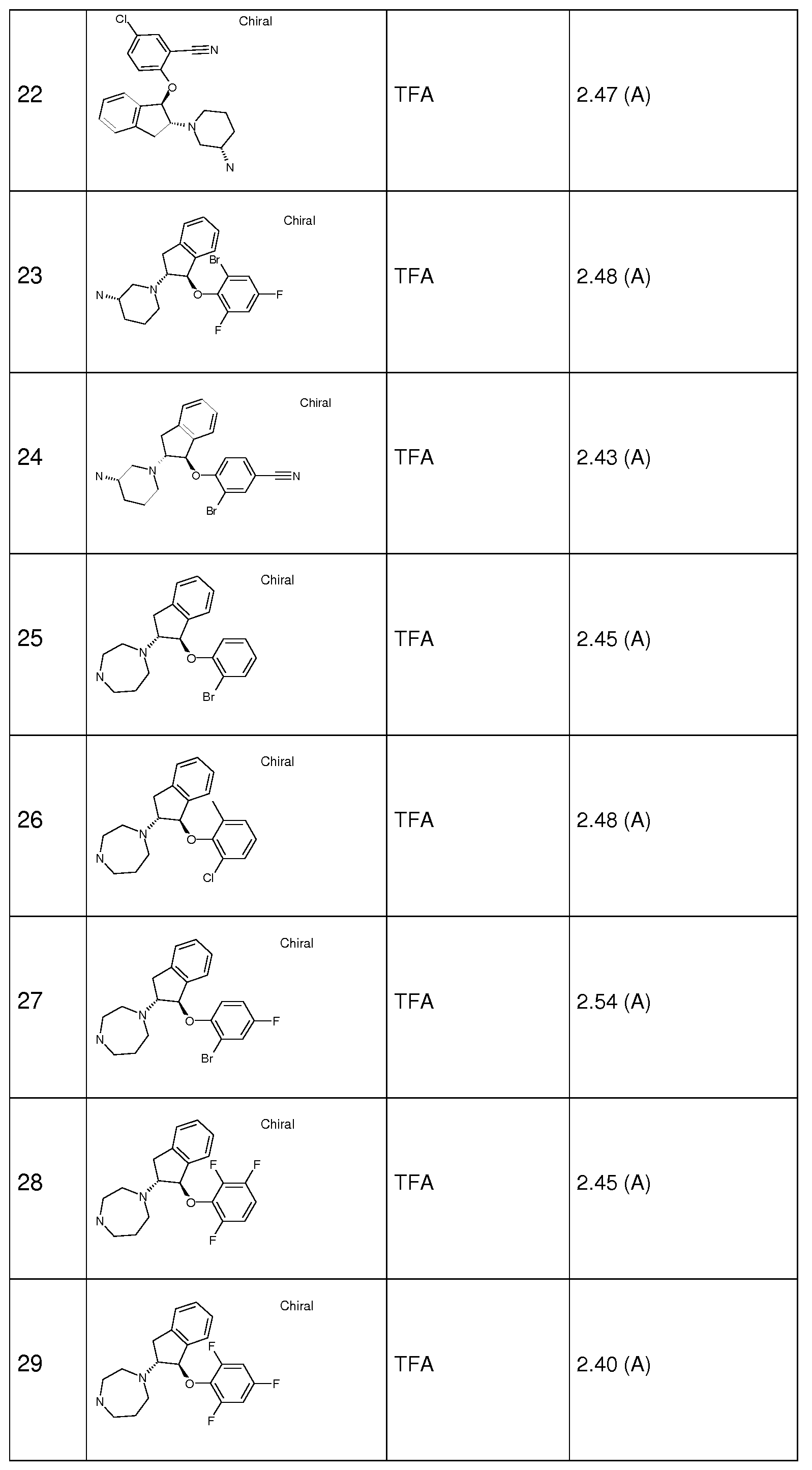
  • the numbers of the exemplified compounds refer to those in the table given later, which illustrate the chemical structures and the physical properties of a number of compounds according to the invention.
  • Method B Solvent: (H 2 O+0,05%TFA)/(AcN+0,035%TFA) 98:2 (1 min) to 0:100 (3min)
  • Method C Solvent: (CH 3 COONH 4 + 3%AcN)/AcN 100:0 (5 min) to 0:100 (5min)
  • Example 1 (3R)-1- ⁇ (1 ,2-c/ ' s)-5-chloro-1-[(2-chloro-5-fluorobenzyl)oxy]- 2,3dihydro-1 H-inden-2-yl ⁇ piperidin-3-amine compound 1 )
  • the residue is dissolved in 100 ml THF at 0 ⁇ € and 5 ml H 2 0 2 (35 %) and NaOH (10 ml, 4N) are added. After 2 h at 0 ⁇ €, water (100 ml) and EtOAc (100 ml) are added. The aqueous layer is extracted with EtOAc. The combined organic layers are dried over anhydrous MgS0 4 , filtered and concentrated under reduced pressure. The residue is purified via chromatography on silica gel (EtOAc as eluent) to yield the title compound.
  • the purified product is taken up in 1 ml TFA/CH 2 CI 2 (1/9) and shaken for 1 h at
  • the title compound is prepared following the method used for example 2.
  • the title compound is prepared following the method used for example 2.
  • the title compound is prepared following the method used for example 2.
  • the aqueous layer is separated and extracted with CH 2 CI 2 .
  • the combined organic layers are dried over anhydrous Na 2 S0 4 , filtered and concentrated under reduced pressure.
  • the residue is purified by column chromatography (CH 2 CI 2 /EtOAc, 80/20).
  • the product is dissolved in CH 2 CI 2 and treated with HCI (0.10ml, 4N in dioxane).
  • Example 7 6-( ⁇ (1 R,2R)-2-[(3R)-3-aminopiperidin-1-yl]-6-methoxy-2,3-dihydro- 1 H-inden-1 -yl ⁇ oxy)-3,4-dihydroquinolin-2(1 H)-one (compound 131 )
  • CH 2 CI 2 (1 1 ml) is added polymer-bound PPh 3 (1 .31 g, 3mmol/g, 2.50eq.) and tert-butyl ⁇ (3R)-1 -[(1 S,2S)-2-hydroxy-6-methoxy-2,3-dihydro-1 H-inden-1 -yl]piperidin-3-yl ⁇ carbamate (0.85g, 1 eq.).
  • the suspension is cooled to 0°C and a solution of di-tert-butyl azodicarboxylate (0.92g, 2eq.) in CH 2 CI 2 (6.7ml) is added dropwise. The mixture is stirred over night at RT, then filtered on celite®.
  • the filter is washed twice with CH 2 CI 2 .
  • the filtrate is evaporated under reduced pressure and the residue is purified by column chromatography (CH 2 CI 2 /methanol, 100/0 to 90/10) to yield 0.43g (43%) of an orange foam.
  • the residue is then dissolved in CH 2 CI 2 (5 ml) and HCI (0.82ml, 2N in Et 2 0) is added.
  • Example 8 6-( ⁇ (1 R,2R)-2-[(3R)-3-aminopiperidin-1-yl]-2,3-dihydro-1 H-inden-1 - yl ⁇ oxy)-7-chloro-3,4-dihydroquinolin-2(1 H)-one (compound 132)
  • « salt » column « - » represents a compound as a free base
  • “TFA” represents a compound in the form of a trifluoroacetic acid salt
  • « HCI » represents a compound in the form of a hydrochloride, the ratio in parentheses being the acid to base ratio.
  • the compounds of the invention underwent pharmacological studies which demonstrated their ability to inhibit TRCP6.
  • the method for testing the TRPC6 inhibitory activity of the compounds of the invention is as described in the patent application WO 2006/074802.
  • the IC 50 of the compounds of the invention are lower than 10 ⁇ , demonstrating their value as therapeutically active substances. More specifically, the IC 50 values of the compounds described in table 1 are comprised between 0.001 ⁇ and 1 ⁇ .
  • compounds 8 and 63 display IC 50 of 1 .20 x 10 ⁇ 8 and 8.1 1 x 10 ⁇ 7 ⁇ , respectively.
  • the compounds according to the invention therefore display inhibition activity towards TRPC6.
  • the compounds of formula (I) are inhibitors of TRCP6, and are therefore useful for the prevention and treatment of fibrotic disorders, such as focal segmental glomerulosclerosis, skeletal muscle dysfunction, renal failure, atherosclerosis, heart failure, cancer (e.g. oesophageal cancer, breast cancer), chronic obstructive pulmonary disease, pain, pulmonary hypertension, ischemic stroke, myocardial infarction, inflammation or peripheral arterial occlusive disease.
  • fibrotic disorders such as focal segmental glomerulosclerosis, skeletal muscle dysfunction, renal failure, atherosclerosis, heart failure, cancer (e.g. oesophageal cancer, breast cancer), chronic obstructive pulmonary disease, pain, pulmonary hypertension, ischemic stroke, myocardial infarction, inflammation or peripheral arterial occlusive disease.
  • the invention also relates to a medicament, comprising a compound of formula (I) as defined above, or an addition salt of said compound to a pharmaceutically acceptable salt, or an hydrate or solvate of said compound.
  • the invention also relates to compounds of formula (I) as drugs.
  • the compounds according to the invention can indeed be useful for the preparation of drugs, specifically of medicaments inhibiting TRCP6, in particular medicaments for the prevention and the treatment of fibrotic disorders, such as focal segmental glomerulosclerosis, skeletal muscle dysfunction, renal failure, atherosclerosis, heart failure, cancer (e.g. oesophageal cancer, breast cancer), chronic obstructive pulmonary disease, pain, pulmonary hypertension, ischemic stroke, myocardial infarction, inflammation or peripheral arterial occlusive disease.
  • fibrotic disorders such as focal segmental glomerulosclerosis, skeletal muscle dysfunction, renal failure, atherosclerosis, heart failure, cancer (e.g. oesophageal cancer, breast cancer), chronic obstructive pulmonary disease, pain, pulmonary hypertension, ischemic stroke, myocardial infarction, inflammation or peripheral arterial occlusive disease.
  • the invention also relates to a pharmaceutical composition, comprising a compound of formula (I) as defined above, or an addition salt of said compound to a pharmaceutically acceptable salt, or an hydrate or solvate of said compound, as active principle, and at least one pharmaceutically acceptable excipient.
  • compositions comprise an effective dose of at least one compound according to the invention, or an addition salt thereof with a pharmaceutically acceptable salt, or an hydrate or solvate of the latter, and at least one pharmaceutically acceptable excipient.
  • excipients are chosen according to the pharmaceutical form and the administration route desired, among usual excipients known of one of skill in the art.
  • the active principle of formula (I) above, its salt, solvate or hydrate can be administered as a unitary dosage form, in blend with usual pharmaceutical excipients, to animals and human beings for the prevention or for the treatment of diseases mentioned above.
  • the appropriate unitary dosage forms comprise the oral forms, such as tablets, hard or soft gelatin capsules, powders, granules and oral solutions or suspensions, the sublingual, buccal, intratracheal, intraocular, intranasal forms, by inhalation, the topical, transdermal, sub-cutaneous, intramuscular or intra-venous forms, the rectal forms and the implants.
  • the compounds of the invention may be used as creams, gels, ointments or lotions.
  • a unitary dosage form for a compound according to the invention in the form of a tablet, can comprise the following ingredients:
  • the present invention also relates to a method for the treatment or prevention of the above pathologies, which comprises the administration to a patient of an effective dose of a compound according to the invention, or a salt with a pharmaceutically acceptable salt thereof, or an hydrate or a solvate thereof.

Landscapes

  • Chemical & Material Sciences (AREA)
  • Organic Chemistry (AREA)
  • Health & Medical Sciences (AREA)
  • Animal Behavior & Ethology (AREA)
  • Veterinary Medicine (AREA)
  • Public Health (AREA)
  • General Health & Medical Sciences (AREA)
  • Pharmacology & Pharmacy (AREA)
  • Medicinal Chemistry (AREA)
  • Life Sciences & Earth Sciences (AREA)
  • Chemical Kinetics & Catalysis (AREA)
  • General Chemical & Material Sciences (AREA)
  • Nuclear Medicine, Radiotherapy & Molecular Imaging (AREA)
  • Bioinformatics & Cheminformatics (AREA)
  • Engineering & Computer Science (AREA)
  • Cardiology (AREA)
  • Heart & Thoracic Surgery (AREA)
  • Pain & Pain Management (AREA)
  • Neurology (AREA)
  • Urology & Nephrology (AREA)
  • Epidemiology (AREA)
  • Vascular Medicine (AREA)
  • Hospice & Palliative Care (AREA)
  • Biomedical Technology (AREA)
  • Hematology (AREA)
  • Neurosurgery (AREA)
  • Rheumatology (AREA)
  • Communicable Diseases (AREA)
  • Oncology (AREA)
  • Pulmonology (AREA)
  • Orthopedic Medicine & Surgery (AREA)
  • Physical Education & Sports Medicine (AREA)
  • Diabetes (AREA)
  • Pharmaceuticals Containing Other Organic And Inorganic Compounds (AREA)
  • Plural Heterocyclic Compounds (AREA)
  • Pyrrole Compounds (AREA)
  • Nitrogen Condensed Heterocyclic Rings (AREA)
  • Hydrogenated Pyridines (AREA)
  • Organic Low-Molecular-Weight Compounds And Preparation Thereof (AREA)
  • Acyclic And Carbocyclic Compounds In Medicinal Compositions (AREA)

Abstract

The instant invention relates to derivatives of formula (I) and their application in therapeutics.

Description

DERIVATIVES OF AM I NO IN DANES, THEIR PREPARATION
AND THEIR APPLICATION IN THERAPEUTICS
The instant invention relates to derivatives of aminoindanes, to their preparation and to their application in therapeutics.
Transient receptor potential cation channel, subfamily C, member 6, also known as TRPC6, is a human gene encoding a protein of the same name. TRPC6 has been associated with fibrotic disorders, such as focal segmental glomerulosclerosis (a) Winn et al, Science 2005, 308, 1801 -1804. b) Hsu et al., Biochim. Biophys. Acta, Molec. Basis of Disease 2007, 1772, 928-936. c) Kriz, Trends Molec. Med. 2005, 11, 527-530. d) Winn et al, J. Amer.Soc.Nephrol. 2005, 17, 378-387), skeletal muscle dysfunction (Millay et al., PNAS 2009, 106, 19023 -19028), renal failure, atherosclerosis, heart failure (Kuwahara et al., J. Clin. Invest. 2006, 116, 31 14-26), cancer (e.g. oesophageal cancer, breast cancer) (a) Aydar et al., Cancer Cell Int. 2009, 9, 23. b) Cai et al., Int. J. Cancer. 2009, 125, 2281 - 2287. c) Shi et al., Gut 2009, 58, 1443-1450), chronic obstructive pulmonary disease (Sel et al., Clin. Exp. Allergy. 2008, 38, 1548-1558), pain (Alessandri-Haber et al., J. Neurosci. 2009, 29, 6217-6228), pulmonary hypertension (Yu et al., Circulation 2009, 1 19, 2313- 2322), ischemic stroke, myocardial infarction (Varga-Szabo et al., J. Thromb. and Haemost. 2009, 7, 1057-1066), inflammation or peripheral arterial occlusive disease.
It is thus desirable to provide novel TRPC6 inhibitors for the prevention or treatment of these pathologies.
The compounds according to the instant invention respond to the general formula
(I) :
Figure imgf000003_0001
in which
A is a 6 to 10 membered aryl radical or a 5 to 10 membered heteroaryl radical, where the aryl and heteroaryl radical may be mono- or bicyclic, and the heteroaryl radical may comprise one or more heteroatoms selected from the group of nitrogen, oxygen and sulfur;
where one or more hydrogen atoms in said mono- or bicyclic aryl or heteroaryl radicals may be replaced by substituents R1 which are selected independently of one another from the group of H, F, CI, Br, I, (C1-C10)- alkyl, (C2-Ci0)-alkenyl, (C2-Ci0)-alkynyl, (C3-Ci4)-cycloalkyl, (C4-C20)- cycloalkylalkyl, (C4-C20)-cycloalkylalkyloxy, (d-Cio)-alkoxy, (C1-C10)- alkylthio, (C6-C14)-aryl, (C2-C13)-heteroaryl, -CN, -OH, -NR13R14, -C(0)R12, -SF5, -S(0)nR12, -C(0)OR12, -C(0)NR13R14, -S(0)nNR13R14; where two adjacent radicals R1 may also form a saturated or partly unsaturated (C5-Ci0)-cycloalkyl radical or a saturated or partly unsaturated (C2-C9)-cycloheteroalkyl radicals, where the cycloheteroalkyi radical may comprise 1 , 2 or 3 nitrogen, 1 or 2 oxygen, 1 or 2 sulfur, 1 or 2 nitrogen and 1 oxygen or 1 sulfur atom ; where said alkyl, alkenyl, alkynyl, cycloalkyi, cycloalkylalkyl, cycloalkylalkyloxy, cycloheteroalkyi, alkoxy, and alkylthio radicals may be substituted independently of one another one or more times by F, OH or (CrCi0)-alkoxy;
is a mono- or fused bicyclic radical selected from the group of
6 to 10 membered aryl radicals,
of 5 to 10 membered heteroaryl radicals,
of 3 to 10 membered cycloalkyi radicals,
of 9 to 14 membered cycloalkylaryl radicals,
of 8 to 14 membered cycloalkylheteroaryl radicals,
of 3 to 10 membered cycloheteroalkyi radicals,
of 9 to 14 membered cycloheteroalkylaryl radicals and
of 8 to 14 membered cycloheteroalkylheteroaryl radicals,
where the cycloalkyi or cycloheteroalkyi units may be saturated or partly unsaturated, and where the heterocyclic groups may comprise one or more heteroatoms selected from the group of nitrogen, oxygen and sulfur; where one or more hydrogen atoms in the radicals B may be replaced by substituents R5 which are selected independently of one another from the group of (CrCi0)-alkyl radicals, of (C2-Ci0)-alkenyl radicals, of (C2-Ci0)- alkynyl radicals, of (CrCi0)-alkoxy radicals, of (CrCi0)-alkylthio radicals, of (C3-Ci4)-cycloalkyl radicals, of (C4-C20)-cycloalkylalkyl radicals, of (C4-C20)- cycloalkylalkyloxy, of (C2-Ci9)-cycloheteroalkyl radicals, of (C3-C19)- cycloheteroalkylalkyl radicals, of (C3-Cn)-cycloalkyloxy radicals, of (C2-Cn)- cycloheteroalkyloxy radicals, of (C6-Ci0)-aryl radicals, of (CrC9)-heteroaryl radicals, of (C9-Ci4)-cycloalkylaryl radicals, of (C5-Ci3)-cycloalkylheteroaryl radicals, (C7-Ci3)-cycloheteroalkylaryl radicals, (C4-Ci2)- cycloheteroalkylheteroaryl radicals, where
the cycloalkyl and cycloheteroalkyl units may be saturated or partly unsaturated,
and where one or more hydrogen atoms in said radicals R5 may be replaced by further radicals which are selected independently of one another from the group of R1 1 radicals,
it is further possible for R5 to be one or more radicals which are selected independently of one another from the group of H, OH, (=0), NH2, F, CI, Br, I, CN, N02, -NR17R18, -NR16COR17, -NR16COOR17, -NR16CONR17R18, -NR16-S(0)2-R17, -NR16-S(0)2-NR17R18, -COOR16, -COR16; -CO(NR17R18), S(0)nR16, -S(0)2NR17R18,
where R16, R17 and R18 independently of one another for a radical selected from the group of H, (C2-Ci9)-cycloheteroalkyl, (C3-CM)- cycloalkyl, (C6-Ci0)-aryl, (d-Cio)-alkyl radicals,
all of which may be substituted independently of one another by OH, (=0), F, CI, Br, I, CN, N02, -NR13R14, -NR13COR12, -NR13COOR12, -NR12CONR13R14, -NR13-S(0)2-R12, -NR12-S(0)2-R13R14, -COOR12, -COR12; -CO(NR13R14), -S(0)nR12, -S(0)2NR13R14, (C3-C14)-cycloalkyl, (C4-C20)- cycloalkylalkyl, (C2-Ci9)-cycloheteroalkyl, (C3-Ci9)- cycloheteroalkylalkyl, (C6-Ci0)-aryl and (CrC9)-heteroaryl, and where R17 and R18 can form together with the nitrogen to which they are bonded a 4-7 membered, saturated, unsaturated or partly unsaturated heterocycle having 1 to 13 carbon atoms which may additionally comprise one or more heteroatoms from the list -0-, -S(0)n-, =N- and -NR15-,
where the heterocycle formed may be substituted independently of one another one or more times by F, OH, (=0), NH2, NH(C C4)alkyl, N((C C4)alkyl)2, CN or (C C10)- alkoxy, (C C10)-alkyl, (C2-C10)-alkenyl, (C2-C10)-alkynyl, (C3- Ci4)-cycloalkyl, (C4-C20)-cycloalkylalkyl, (C2-C20)- cycloheteroalkyl, (C3-Ci9)-cycloheteroalkylalkyl, each of which may in turn carry independently of one another one or more radicals F, OH, (=0), NH2, NH(Ci-C4)alkyl, N((C C4)alkyl)2, CN or (C C10)-alkoxy;
L is a covalent bond or an alkylene bridge having 1 to 10 carbon atoms,
which may carry independently of one another one or more substituents from the group of radicals (d-Cio)-alkyl, (C3-Ci4)- cycloalkyl, (C4-C20)-cycloalkylalkyl radical, -COR12, -CO(NR13R14), S(0)nR12, -S(0)2NR13R14, (=0) and F; where the alkyl, cycloalkyl and cycloalkyl radicals may be substituted one or more times by F;
X is a group -N(R6)-, -0-, -S(0)n-, or alkylene having 1 to 5 carbon atoms, where
R6 may be hydrogen or may be (CrCi0)-alkyl, (C3-Ci4)-cycloalkyl, (C4-C20)-cycloalkylalkyl radical, all of which may be substituted independently of one another one or more times by F, or R6 may be -COR12; -CO(NR13R14), S(0)nR12, -S(0)2NR13R14;
R2 is absent or is one or more substituents which may be selected independently of one another from the group of F, (CrCi0)-alkyl and (CrCi0)-alkoxy radical, where the alkyl and alkoxy radicals may be substituted independently of one another one or more times by F;
R3 and R4 are independently of one another a hydrogen radical or a radical which is selected from the group of (CrCi0)-alkyl radicals, of (C2-Ci0)-alkenyl radicals, of
(C2-Cio)-alkynyl radicals, of (C3-Ci4)-cycloalkyl radicals, of (C4-C20)-cycloalkylalkyl radicals, of (C2-Ci9)-cycloheteroalkyl radicals, of (C3-Ci9)-cycloheteroalkylalkyl radicals, of (C6-Ci0)-aryl radicals, of (C7-C20)-arylalkyl radicals, of (CrC9)- heteroaryl radicals, of (C2-Ci9)-heteroarylalkyl radicals, where
the radicals R3 and R4 may be substituted independently of one another one or more times by a radical from the group of OH, NH2, (=0), F, CI, Br, I, CN, N02, -NR13R14, -NR13COR12, -NR13COOR12, -NR12CONR13R14, -NR13-S(0)2-R12, -NR13-S(0)2-NR13R14, -COOR12, -COR12; -CO(NR13R14), S(0)nR12, -S(0)2R13R14, or
R3 and R4 form together with the nitrogen to which they are bonded a 4-10 membered, saturated, unsaturated or partly unsaturated heterocycle which may additionally comprise one or more heteroatoms from the list -0-, -S(0)n-, =N- and -NR8-, where
the heterocyclic radicals may be substituted independently of one another one or more times by radicals selected from the group of R7 and R9, and where
the heterocyclic radicals may be bridged by a bond, by a saturated or unsaturated (d-Cio)-alkyl or (CrC9)-heteroalkyl chain or by -NR15-, -0-, -S-, and where
the alkyl and heteroalkyl chains may also form a spirocyclic ring system with the ring system formed by R3 and R4, where the alkyl and heteroalkyl bridges may be substituted independently of one another one or more times by radicals selected from the group of R7 and R9,
and where
R8 in the group NR8 may form with the ring which R3 and R4 may form a further saturated, unsaturated or partly unsaturated heterocycle which may be substituted independently of one another one or more times by radicals selected from the group of R7 and R9, and may additionally comprise one or more heteroatoms from the list -0-, -S(0)n-, -N= and -NR19-; are a (CrCi0)-alkyl radical or (CrCi4)-cycloalkyl radical, where the alkyl radical may be substituted independently of one another one or more times by R9; is an H, a (CrCi0)-alkyl radical or (Ci-CM)-cycloalkyl radical, C0R12, -CO(NR13R14), S(0)nR12, -S(0)2NR13R14, where the alkyl radical may be substituted independently of one another one or more times by R10;
R9 is a radical selected from the group of OH, (=0), F, CI, Br, I, CN, N02, -NR13R14, -NR13COR12, -NR13COOR12, -NR12CONR13R14, -NR13-S(0)2-R12, -NR13-
S(0)2-NR13R14, -C00R12, -C0R12, -CO(NR13R14), S(0)nR12, -S(0)2NR13R14, (C3-C14)-cycloalkyl, (C4-C20)-cycloalkylalkyl, (C C10)-alkoxy, (C2- Ci9)-cycloheteroalkyl, (C3-Ci9)-cycloheteroalkylalkyl, (C6-Ci0)-aryl radicals, of (C C9)-heteroaryl radicals;
R10 is a radical selected from the group of F, OH, CN, (CrCi0)-alkoxy, (C1 -C10)- alkylthio, N02, -NR13R14, -NR13COR12, -NR13COOR12, -NR13CONR13R14, -NR13-S(0)2-R12, -NR12-S(0)2-NR13R14, -COOR12, -COR12, -CO(NR13R14), S(0)nR12, -S(0)2NR13R14; R1 1 is a radical selected from the group of (d-Cio)-alkyl, (C2-Ci0)-alkenyl, (C2-Ci0)- alkynyl, (CrCi0)-alkoxy, (CrC20)-alkylthio, (C3-Ci4)-cycloalkyl, (C4-Ci0)- cycloalkylalkyl, (C2-Ci3)-cycloheteroalkyl, (C4-Ci9)-cycloheteroalkylalkyl, (C3-CM)- cycloalkyloxy, (C2-Ci3)-cycloheteroalkyloxy,
all of which may be substituted independently of one another one or more times by R10;
(=0), CI, Br, I and R10;
R12, R13 and R14 may independently of one another be H, (CrCi0)-alkyl, (C2-Ci0)- alkenyl, (C2-Ci0)-alkynyl, (C3-Ci4)-cycloalkyl, (C4-Ci0)-cycloalkylalkyl, (C2-Ci3)- cycloheteroalkyl, (C3-Ci9)-cycloheteroalkylalkyl, (C6-Ci0)-aryl, each of which may be substituted independently of one another one or more times by F, OH, (=0), NH2, NH(C C4)alkyl, N((C C4)alkyl)2, CN or (C C10)-alkoxy;
or where R13 and R14 may form together with the nitrogen to which they are bonded a 4-7 membered, saturated, unsaturated or partly unsaturated heterocycle having 1 to 13 carbon atoms, which may additionally comprise one or more heteroatoms from the list -0-, -S(0)n-, =N- and -NR15-, where
the formed heterocycle may be substituted independently of one another one or more times by F, OH, (=0), NH2, NH(C C4)alkyl, N((C C4)alkyl)2, CN or (C C10)-alkoxy, (C C10)-alkyl, (C2-C10)-alkenyl, (C2-C10)-alkynyl, (C3-C14)- cycloalkyl, (C4-C20)-cycloalkylalkyl, (C2-C20)-cycloheteroalkyl, (C3-Ci9)- cycloheteroalkylalkyl, each of which may in turn carry independently of one another one or more radicals F, OH, (=0), NH2, NH(C C4)alkyl, N((C C4)alkyl)2, CN or (C C10)-alkoxy; R15 is a radical selected from the group of H, (CrCi0)-alkyl, (C2-Ci0)-alkenyl, (C2-Ci0)- alkynyl, (C3-C )-cycloalkyl, (C4-C20)-cycloalkylalkyl, (C2-Ci3)-cycloheteroalkyl, (C3- Ci9)-cycloheteroalkylalkyl, each of which may be substituted independently of one another one or more times by F, OH, CN or (d-Cio)-alkoxy; R19 is an H, a (C C10)-alkyl radical or (C C14)-cycloalkyl radical, C0R12, -CO(NR13R14), S(0)nR12, -S(0)2NR13R14, where the alkyl radical may be substituted independently of one another one or more times by R10; and in which
n is 0, 1 or 2;
p is 1 or 2 and
q is 0 or 1 , and the pharmaceutically acceptable salts thereof,
and in which
i) in the case where A is phenyl, B is phenyl or benzodioxolanyl, X is -O- or -S-, L is a bond and R3 and R4 are H, (C C10)-alkyl, (C3-C14)-cycloalkyl, (C7-C20)- arylalkyl or R3 and R4 together are an unsubstituted pyrrolidinyl, morpholinyl, piperidinyl or piperazinyl radical or 4-methylpiperazinyl radical, at least one R5 radical which is not a (d-Cio)-alkyl, (CrCi0)-alkoxy, OH, CF3, F, CI, Br or I radical must be present,
ii) in the case where A is phenyl, X is -0-, -S- or -NH- and R3 and R4 are a (C Cio)-alkyl, (C3-Ci4)-cycloalkyl or a (C4-C20)-cycloalkylalkyl radical, at least one R5 radical which is not an F, CI, Br, I, (C C4)-alkyl, (C C4)-alkoxy, CF3, OCF3, CN, N02, NH2, -NH((C C10)-alkyl), -N((C C10)-alkyl)2, unsubstituted or substituted benzoyl or an unsubstituted or substituted phenyl-(CH2)r-Y-(CH2)s- radical, with Y being a bond or an oxygen and r and s being 0 to 4, where r+s is not greater than 4, must be present.
The compounds of the invention advantageously are of the formula (I) above, wherein :
A is a 6 to 10 membered aryl radical or a 5 to 10 membered heteroaryl radical, where the aryl and heteroaryl radical may be mono- or bicyclic, and the heteroaryl radical may comprise one or more heteroatoms selected from the group of nitrogen, oxygen and sulfur;
where one or more hydrogen atoms in said mono- or bicyclic aryl or heteroaryl radicals may be replaced by substituents R1 which are selected independently of one another from the group of H, F, CI, Br, I, (d-Ci0)- alkyl, (C2-C10)-alkenyl, (C2-C10)-alkynyl, (C3-C14)-cycloalkyl, (C4-C20)- cycloalkylalkyl, (C4-C20)-cycloalkylalkyloxy, (CrCi0)-alkoxy, (C Cio)- alkylthio, (C6-C14)-aryl, (C2-C13)-heteroaryl, -CN, -OH, -NR13R14, -C(0)R12, -SF5, -S(0)nR12, -C(0)OR12, -C(0)NR13R14, -S(0)nNR13R14; where two adjacent radicals R1 may also form a saturated or partly unsaturated (C5-Ci0)-cycloalkyl radical or a saturated or partly unsaturated (C2-C9)-cycloheteroalkyl radicals, where the cycloheteroalkyi radical may comprise 1 , 2 or 3 nitrogen, 1 or 2 oxygen, 1 or 2 sulfur, 1 or 2 nitrogen and 1 oxygen or 1 sulfur atom; where said alkyl, alkenyl, alkynyl, cycloalkyi, cycloalkylalkyl, cycloalkylalkyloxy, cycloheteroalkyi, alkoxy, and alkylthio radicals may be substituted independently of one another one or more times by F, OH or (d-Cio)-alkoxy;
is a mono- or fused bicyclic radical selected from the group of
6 to 10 membered aryl radicals,
of 5 to 10 membered heteroaryl radicals,
of 3 to 10 membered cycloalkyi radicals,
of 9 to 14 membered cycloalkylaryl radicals,
of 8 to 14 membered cycloalkylheteroaryl radicals,
of 3 to 10 membered cycloheteroalkyi radicals,
of 9 to 14 membered cycloheteroalkylaryl radicals and
of 8 to 14 membered cycloheteroalkylheteroaryl radicals,
where the cycloalkyi or cycloheteroalkyi units may be saturated or partly unsaturated, and where the heterocyclic groups may comprise one or more heteroatoms selected from the group of nitrogen, oxygen and sulfur; where one or more hydrogen atoms in the radicals B may be replaced by substituents R5 which are selected independently of one another from the group of (CrCi0)-alkyl radicals, of (C2-Ci0)-alkenyl radicals, of (C2-Ci0)- alkynyl radicals, of (CrCi0)-alkoxy radicals, of (CrCi0)-alkylthio radicals, of (C3-Ci4)-cycloalkyl radicals, of (C4-C20)-cycloalkylalkyl radicals, of (C4-C20)- cycloalkylalkyloxy, of (C2-Ci9)-cycloheteroalkyl radicals, of (C3-Ci9)- cycloheteroalkylalkyl radicals, of (C3-Cn)-cycloalkyloxy radicals, of (C2-Cn)- cycloheteroalkyloxy radicals, of (C6-Ci0)-aryl radicals, of (CrC9)-heteroaryl radicals, of (C9-Ci4)-cycloalkylaryl radicals, of (C5-Ci3)-cycloalkylheteroaryl radicals, (C7-Ci3)-cycloheteroalkylaryl radicals, (C4-Ci2)- cycloheteroalkylheteroaryl radicals, where
the cycloalkyi and cycloheteroalkyi units may be saturated or partly unsaturated, and where one or more hydrogen atoms in said radicals R5 may be replaced by further radicals which are selected independently of one another from the group of R1 1 radicals,
it is further possible for R5 to be one or more radicals which are selected independently of one another from the group of OH, (=0), NH2, F, CI, Br, I, CN, N02, -NR17R18, -NR16COR17, -NR16COOR17, -NR16CONR17R18, -NR16-S(0)2-R17, -NR16-S(0)2-NR17R18, -COOR16, -COR16; -CO(NR17R18), S(0)„R16, -S(0)2NR17R18,
where R16, R17 and R18 independently of one another for a radical selected from the group of H, (C2-Ci9)-cycloheteroalkyl, (C3-Ci4)- cycloalkyl, (C6-Ci0)-aryl, (CrCi0)-alkyl radicals,
all of which may be substituted independently of one another by OH, (=0), F, CI, Br, I, CN, N02, -NR13R14, -NR13COR12, -NR13COOR12, -NR12CONR13R14, -NR13-S(0)2-R12, -NR12-S(0)2-R13R14, -C00R12, -C0R12; -CO(NR13R14), -S(0)nR12, -S(0)2NR13R14, (C3-C14)-cycloalkyl, (C4-C20)- cycloalkylalkyl, (C2-Ci9)-cycloheteroalkyl, (C3-Ci9)- cycloheteroalkylalkyl, (C6-Ci0)-aryl and (d-C9)-heteroaryl, and where R17 and R18 can form together with the nitrogen to which they are bonded a 4-7 membered, saturated, unsaturated or partly unsaturated heterocycle having 1 to 13 carbon atoms which may additionally comprise one or more heteroatoms from the list -0-, -S(0)n-, =N- and -NR15-,
where the heterocycle formed may be substituted independently of one another one or more times by F, OH, (=0), NH2, NH(C C4)alkyl, N((C C4)alkyl)2, CN or (C C10)- alkoxy, (C C10)-alkyl, (C2-C10)-alkenyl, (C2-C10)-alkynyl, (C3- C )-cycloalkyl, (C4-C20)-cycloalkylalkyl, (C2-C20)- cycloheteroalkyl, (C3-Ci9)-cycloheteroalkylalkyl, each of which may in turn carry independently of one another one or more radicals F, OH, (=0), NH2, NH(C C4)alkyl, N((C C4)alkyl)2, CN or (C C10)-alkoxy; alent bond or an alkylene bridge having 1 to 10 carbon atoms,
which may carry independently of one another one or more substituents from the group of radicals (d-Cio)-alkyl, (C3-CM)- cycloalkyl, (C4-C20)-cycloalkylalkyl radical, -COR12, -CO(NR13R14), S(0)nR12, -S(0)2NR13R14, (=0) and F; where the alkyl, cycloalkyl and cycloalkyl radicals may be substituted one or more times by F;
X is a group -N(R6)-, -0-, -S(0)n-, or alkylene having 1 to 5 carbon atoms, where
R6 may be hydrogen or may be (CrCi0)-alkyl, (C3-Ci4)-cycloalkyl, (C4-C20)-cycloalkylalkyl radical, all of which may be substituted independently of one another one or more times by F, or R6 may be -COR12; -CO(NR13R14), S(0)„R12, -S(0)2NR13R14;
R2 is absent or is one or more substituents which may be selected independently of one another from the group of F, (CrCi0)-alkyl and (CrCi0)-alkoxy radical, where the alkyl and alkoxy radicals may be substituted independently of one another one or more times by F;
R3 and R4 form together with the nitrogen to which they are bonded a 4-10 membered, saturated, heterocycle which may additionally comprise one or more heteroatoms from the list -0-, -S(0)n-, and -NR8-, where
the heterocyclic radicals may be substituted independently of one another one or more times by radicals selected from the group of R7 and R9, and where
the heterocyclic radicals may be bridged by a bond, by a saturated or unsaturated (CrCi0)-alkyl or (CrC9)-heteroalkyl chain or by -NR15-, -0-, -S-, and where
the alkyl and heteroalkyl chains may also form a spirocyclic ring system with the ring system formed by R3 and R4, where the alkyl and heteroalkyl bridges may be substituted independently of one another one or more times by radicals selected from the group of R7 and R9,
and where
R8 in the group NR8 may form with the ring which R3 and R4 may form a further saturated, unsaturated or partly unsaturated heterocycle which may be substituted independently of one another one or more times by radicals selected from the group of R7 and R9, and may additionally comprise one or more heteroatoms from the list -0-, -S(0)n-, -N= and -NR19-; are a (d-Cio)-alkyl radical or (CrCi4)-cycloalkyl radical, where the alkyl radical may be substituted independently of one another one or more times by R9; is an H, a (CrCi0)-alkyl radical or (Ci-CM)-cycloalkyl radical, COR12, -CO(NR13R14), S(0)nR12, -S(0)2NR13R14, where the alkyl radical may be substituted independently of one another one or more times by R10;
R9 is a radical selected from the group of OH, (=0), F, CI, Br, I, CN, N02, -NR13R14, -NR13COR12, -NR13COOR12, -NR12CONR13R14, -NR13-S(0)2-R12, -NR13-
S(0)2-NR13R14, -COOR12, -COR12, -CO(NR13R14), S(0)nR12, -S(0)2NR13R14, (C3-C14)-cycloalkyl, (C4-C20)-cycloalkylalkyl, (C C10)-alkoxy, (C2- Ci9)-cycloheteroalkyl, (C3-Ci9)-cycloheteroalkylalkyl, (C6-Ci0)-aryl radicals, of (C C9)-heteroaryl radicals;
R10 is a radical selected from the group of F, OH, CN, (CrCi0)-alkoxy, (C1-C10)- alkylthio, N02, -NR13R14, -NR13COR12, -NR13COOR12, -NR13CONR13R14, -NR13-S(0)2-R12, -NR12-S(0)2-NR13R14, -COOR12, -COR12, -CO(NR13R14), S(0)nR12, -S(0)2NR13R14;
R1 1 is a radical selected from the group of (CrCi0)-alkyl, (C2-Ci0)-alkenyl, (C2-Ci0)- alkynyl, (CrCi0)-alkoxy, (CrC20)-alkylthio, (C3-Ci4)-cycloalkyl, (C4-Ci0)- cycloalkylalkyl, (C2-Ci3)-cycloheteroalkyl, (C4-Ci9)-cycloheteroalkylalkyl, (C3-C )- cycloalkyloxy, (C2-Ci3)-cycloheteroalkyloxy,
all of which may be substituted independently of one another one or more times by R10;
(=0), CI, Br, I and R10;
R12, R13 and R14 may independently of one another be H, (CrCi0)-alkyl, (C2-Ci0)- alkenyl, (C2-C10)-alkynyl, (C3-C14)-cycloalkyl, (C4-C10)-cycloalkylalkyl, (C2-C13)- cycloheteroalkyl, (C3-Ci9)-cycloheteroalkylalkyl, (C6-Ci0)-aryl, each of which may be substituted independently of one another one or more times by F, OH, (=0), NH2, NH(C C4)alkyl, N((C C4)alkyl)2, CN or (C C10)-alkoxy;
or where R13 and R14 may form together with the nitrogen to which they are bonded a 4-7 membered, saturated, unsaturated or partly unsaturated heterocycle having 1 to 13 carbon atoms, which may additionally comprise one or more heteroatoms from the list -0-, -S(0)n-, =N- and -NR15-, where
the formed heterocycle may be substituted independently of one another one or more times by F, OH, (=0), NH2, NH(Ci-C4)alkyl, N((Ci-C4)alkyl)2> CN or (Ci-Cio)-alkoxy, (C C10)-alkyl, (C2-C10)-alkenyl, (C2-C10)-alkynyl, (C3-C14)- cycloalkyl, (C4-C20)-cycloalkylalkyl, (C2-C20)-cycloheteroalkyl, (C3-Ci9)- cycloheteroalkylalkyl, each of which may in turn carry independently of one another one or more radicals F, OH, (=0), NH2, NH(C C4)alkyl, N((C C4)alkyl)2, CN or (C C10)-alkoxy; R15 is a radical selected from the group of H, (CrCi0)-alkyl, (C2-Ci0)-alkenyl, (C2-Ci0)- alkynyl, (C3-Ci4)-cycloalkyl, (C4-C20)-cycloalkylalkyl, (C2-Ci3)-cycloheteroalkyl, (C3- Ci9)-cycloheteroalkylalkyl, each of which may be substituted independently of one another one or more times by F, OH, CN or (d-Cio)-alkoxy; R19 is an H, a (C C10)-alkyl radical or (C C14)-cycloalkyl radical, C0R12, -CO(NR13R14), S(0)nR12, -S(0)2NR13R14, where the alkyl radical may be substituted independently of one another one or more times by R10; and in which
n is 0, 1 or 2;
p is 1 or 2 and
q is 0 or 1 , in the form of a free base or of an addition salt with an acid, as well as in the form of an hydrate or of a solvate,
and in which :
in the case where A is phenyl, B is phenyl or benzodioxolanyl, X is -O- or -S-, L is a bond and R3 and R4 together are an unsubstituted pyrrolidinyl, morpholinyl, piperidinyl or piperazinyl radical or 4-methylpiperazinyl radical, at least one R5 radical which is not a (CrCi0)-alkyl, (CrCi0)-alkoxy, OH, CF3, F, CI, Br or I radical must be present.
In one embodiment, compounds of the formula I and the pharmaceutically acceptable salts thereof are preferred wherein:
L is a covalent bond;
X is a group -0-; and q is 0.
The compounds of formula (I) can comprise one or more asymmetric carbon atoms. They can therefore exist in the form of enantiomers or diastereoisomers. These enantiomers and diastereoisomers, as well as their mixtures, including racemic mixtures, form part of the invention.
The compounds of formula (I) can be provided in the form of a free base or in the form of addition salts with acids, which also form part of the invention.
These salts are advantageously prepared with pharmaceutically acceptable acids, but salts with other acids, useful for example for the purification or for the isolation of the compounds of formula (I), also form part of the invention.
The compounds of formula (I) can also be provided in the form of an hydrate or of a solvate, i.e. in the form of associations or combinations with one or more water or solvent molecules. Such hydrates and solvates also form part of the invention.
According to the present invention, the terms below have the following meanings:
- a halogen atom corresponds to a fluorine, chlorine, bromine or iodine atom; - (d-Cio)-Alkyl radicals may in the context of the present invention be straight- chain or branched. This also applies when they carry substituents or occur as substituents of other radicals, for example in fluoroalkyl radicals or alkoxy radicals. Examples of alkyl radicals are methyl, ethyl, n-propyl, isopropyl (= 1 -methylethyl), n-butyl, isobutyl (= 2-methylpropyl), sec-butyl (= 1 -methylpropyl), tert-butyl (= 1 ,1 -dimethylethyl), n-pentyl, isopentyl, tert-pentyl, neopentyl and hexyl. Preferred alkyl radicals are methyl, ethyl, n- propyl, isopropyl, n-butyl and tert-butyl.
- (C3-Ci4)-Cycloalkyl radicals in the context of the present invention may be saturated or partly unsaturated. This also applies when they carry substituents or occur as substituents of other radicals. Cycloalkyl radicals having 3, 4, 5, 6, 7 or 8 carbon atoms are preferred. Examples of cycloalkyl radicals are cyclopropyl, cyclobutyl, cyclopentyl, cyclohexyl, cycloheptyl and cyclooctyl a fluoroalkyl group corresponds to an alkyl group, wherein one or more hydrogen atoms have been substituted by fluorine atoms;
- (C2-Ci9)-Cycloheteroalkyl radicals in the context of the present invention may be saturated or partly unsaturated. This also applies when they carry substituents or occur as substituents of other radicals. The cycloheteroalkyl radicals preferably have heteroatoms selected from the group of nitrogen, oxygen and sulfur. Cycloheteroalkyl radicals having 2, 3, 4, 5, 6, 7, 8 or 9 carbon atoms are preferred, it being possible for 1 or 2 nitrogen atoms, 1 or 2 oxygen atoms, 1 or 2 sulfur atoms, 1 nitrogen and 1 oxygen atom or 1 sulfur atom or 1 oxygen and 1 sulfur atom to be present as heteroatoms. The cycloheteroalkyi radicals can be attached by any position. Examples of such heterocycles are selected from the group of oxiranyl, thiiranyl, aziridinyl, oxetanyl, thietanyl, azetidinyl, diazetidinyl, pyrrolidinyl, dihydropyrrolyl, dihydroimidazolyl, dihydropyrazolyl, tetrahydropyrazolyl, oxolanyl, dihydrofuranyl, dioxolanyl, thiolanyl, dihydrothiophenyl, oxazolanyl, dihydrooxazolyl, isooxazolanyl, dihydroisooxazolyl, thiazolidinyl, dihydrothiazolyl, isothiazolidinyl, dihydroisothiazolyl, oxathiolidinyl, 2/- -pyranyl, 4H-pyranyl, tetrahydropyranyl, 2/- -thiopyranyl, 4H-thiapyranyl, tetrahydrothiopyranyl, piperidinyl, di-, tetrahydropyridyl, piperazinyl, di-, tetrahydropyrazinyl, di-, tetra-, hexahydropyridazinyl, di-, tetra-, hexahydropyrimidinyl, morpholinyl, thiomorpholinyl, azepanyl, thiepanyl and oxepinyl, it also being possible for two of these heterocyclic rings to form a saturated or partly unsaturated fused bicyclic ring system. Examples of such bicyclic ring systems are octahydropyrrolo[1 ,2a]pyrazinyl, octahydropyrrolo[3,4b]pyrrolyl, hexahydropyrrolo[3,4- c]pyrrolyl- and octahydropyrrolo[3,4-c]pyrrolyl. Prefered cycloheteroalkyi are azetidinyl, pyrrolidinyl, piperidinyl, homopiperazine or 2,5-diazabicyclo[2.2.1 ]heptane.
- (C2-Cio)-Alkenyl radicals in the context of the present invention may likewise be straight-chain or branched. This also applies when they carry substituents or occur as substituents of other radicals. Examples of alkenyl radicals are ethenyl, propenyl and butenyl.
- (C2-Cio)-Alkynyl radicals in the context of the present invention may likewise be straight-chain or branched. This also applies when they carry substituents or occur as substituents of other radicals. Examples of alkynyl radicals are ethynyl, propynyl and butynyl.an alkoxy group corresponds to an -O-alkyI group, wherein the alkyl group is as defined above;
- Examples of preferred (C6-Ci0)-aryl radicals are phenyl and naphthyl. This also applies when they carry substituents or occur as substituents of other radicals.
(Ci-Cg)-Heteroaryl radicals are aromatic ring compounds in which one or more ring atoms are oxygen atoms, sulfur atoms or nitrogen atoms, e.g. 1 , 2 or 3 nitrogen atoms, 1 or 2 oxygen atoms, 1 or 2 sulfur atoms or a combination of various heteroatoms. This also applies when they carry substituents or occur as substituents of other radicals. The heteroaryl radicals may be attached by all positions. Heteroaryl means for example furanyl, thiophenyl, pyrrolyl, imidazolyl, pyrazolyl, triazolyl, tetrazolyl, oxazolyl, isoxazolyl, thiazolyl, isothiazolyl, pyridyl, pyrazinyl, pyrimidinyl, pyridazinyl, indolyl, indazolyl, quinolyl, isoquinolyl, phthalazinyl, quinoxalinyl, quinazolinyl and cinnolinyl. Preferred heteroaryl radicals are 2- or 3-thiophenyl, 2- or 3-furyl, 1 -, 2- or 3- pyrrolyl, 1 -, 2-, 4- or 5-imidazolyl, 1 -, 3-, 4- or 5-pyrazolyl, 1 ,2,3-triazol-1 -, -4- or -5-yl, 1 ,2,4-triazol- 1 -, -3- or -5-yl, 1 - or 5-tetrazolyl, 2-, 4- or 5-oxazolyl, 3-, 4- or 5-isoxazolyl, 1 ,2,3- oxadiazol-4- or -5-yl, 1 ,2,4-oxadiazol-3- or -5-yl, 1 ,3,4-oxadiazol-2-yl or -5-yl, 2-, 4- or 5- thiazolyl, 3-, 4- or 5-isothiazolyl, 1 ,3,4-thiadiazol-2- or -5-yl, 1 ,2,4-thiadiazol-3- or -5-yl, 1 ,2,3-thiadiazol-4- or -5-yl, 2-, 3- or 4-pyridyl, 2-, 4-, 5- or 6-pyrimidinyl, 3- or 4-pyridazinyl, pyrazinyl, 1 -, 2-, 3-, 4-, 5-, 6- or 7-indolyl, 1 -, 2-, 4- or 5-benzimidazolyl, 1 -, 3-, 4-, 5-, 6- or 7-indazolyl, 2-, 3-, 4-, 5-, 6-, 7- or 8-quinolyl, 1 -, 3-, 4-, 5-, 6-, 7- or 8-isoquinolyl, 2-, 4-, 5-, 6-, 7- or 8-quinazolinyl, 3-, 4-, 5-, 6-, 7- or 8-cinnolinyl, 2-, 3-, 5-, 6-, 7- or 8-quinoxalinyl, 1 -, 4-, 5-, 6-, 7- or 8-phthalazinyL
Particularly preferred heteroaryl radicals are pyrazolyl, isoxasolyl, benzotriazolyl;
- (C9-Ci4)-Cycloalkylaryl radicals are preferably selected from the group of fused ring systems having a cycloalkyl ring and an aryl ring, in particular a phenyl ring. Particularly preferred cycloalkylaryl radicals are indenyl, dihydronaphthyl, tetrahydronaphthyl and indanyl.
- (C5-Ci3)-Cycloalkylheteroaryl radicals are preferably selected from the group of fused ring systems having a cycloalkyl ring and a heteroaryl ring.
- (C7-Ci3)-Cycloheteroalkylaryl radicals are preferably fused ring systems having a cycloheteroalkyi ring and an aryl ring, in particular a phenyl ring. Preferred cycloheteroalkylaryl radicals are benzodihydrothiophenyl, benzothiolanyl, benzodihydrofuranyl, benzooxolanyl, benzodioxolanyl, benzodihydropyrrolyl, benzodihydroimidazolyl, benzodihydropyrazolyl, benzodihydrotriazolyl, benzopiperazinyl, benzodihydrothiazolyl, benzomorpholinyl benzodihydrooxazolyl, dihydroquinolinyl, dihydroisoquinolinyl, tetrahydroisoquinolinyl and tetrahydroquinolinyl. Particularly preferred are cycloheteroalk laryl radicals of formula:
Figure imgf000017_0001
- (C4-Ci2)-Cycloheteroalkylheteroaryl radicals are preferably selected from the group of fused ring systems having a cycloheteroalkyi ring and a heteroaryl ring.
- A cycloheteroalkyi corresponds to a cyclic group comprising between 3 and 19 carbon atoms and between 1 and 3 heteroatoms, preferably nitrogen atoms.
The compounds of the invention advantageously respond to the general formula
Figure imgf000018_0001
is a 6 membered aryl radical or a 6 membered heteroaryl radical, where T and T" are independently N or CR1 ;
where one or more hydrogen atoms in said aryl or heteroaryl radicals may be replaced by substituents R1 which are selected independently of one another from the group of H, F, CI, Br, I, (d-Cio)-alkyl-, (CrCi0)-alkoxy-, -CN, -OH, -S(0)nR12, -;
where said alkyl and alkoxy radicals may be substituted independently of one another one or more times by F
and R12 is H or (CrCi0)-alkyl, optionally substituted one or more times by F; is a 6 membered aryl radical or a 6 membered heteroaryl radical, where T is N or CR5; is absent or is radical chosen from a (C6-Ci0)-aryl radical and a (C3-C6)- cycloheteroalkyl radical comprising one ore more heteroatoms chosen from O, N and S,
where at least one hydrogen atoms in the radicals B' and/or B" is replaced by substituents R5 which are selected independently of one another from the group of (CrCi0)-alkyl radicals, of (CrCi0)-alkoxy radicals, of (C3-Ci4)- cycloalkyl radicals, of (CrC9)-heteroaryl radicals, where
the cycloalkyl units may be saturated or partly unsaturated, and where one or more hydrogen atoms in said radicals R5 may be replaced by further radicals which are selected independently of one another from the group of F, CI, Br and I, it is further possible for R5 to be one or more radicals which are selected independently of one another from the group of OH, F, CI, Br, I, CN, N02,
-COOR16, -CO(NR17R18),
where R16, R17 and R18 independently of one another for a radical selected from the group of H and (d-Cio)-alkyl radicals, which may be substituted independently of one another by F, CI, Br, I, a covalent bond or a methylene bridge;
X is a group -O- or -S(0)n-;
R3 and R4 are independently of one another a hydrogen radical, a (CrCi0)-alkyl radical or a (C3-Ci9)-cycloheteroalkyl radical comprising at least one nitrogen atom, or R3 and R4 form together with the nitrogen to which they are bonded a 4-7 membered, saturated mono-or bi-cycloheteroalkyl radical which may additionally comprise one or more -NR8- heteroatom, where
the cycloheteroalkyl radical may be substituted independently of one another one time by a radical-(CR20R21 )r-NR22R23, in which r is 0 or 1 and R20, R21 , R22 and R23 are independently of one another H or a (C Cio)-alkyl radical optionally substituted one or more times by F, CI, Br and/or I,
R8 is an H or a (CrCi0)-alkyl radical; and in which
n is 0, 1 or 2; and
q is 0 or 1 , in the form of a free base or of an addition salt with an acid, as well as in the form of an hydrate or of a solvate. Particularly preferred, the compounds of the invention are of formula (II) above, wherein : A is a 6 membered aryl radical or a 6 membered heteroaryl radical, where T and T" are independently N or CR1 ;
where one or more hydrogen atoms in said aryl or heteroaryl radicals may be replaced by substituents R1 which are selected independently of one another from the group of H, F, CI, Br, I, (CrCi0)-alkyl-, (CrCi0)-alkoxy-,
-CN, -OH, -S(0)nR12, -; where said alkyl and alkoxy radicals may be substituted independently of one another one or more times by F
and R12 is H or (d-Cio)-alkyl, optionally substituted one or more times by F;
B' is a 6 membered aryl radical or a 6 membered heteroaryl radical, where T is N or CR5;
B" is absent or is radical chosen from a (C6-Ci0)-aryl radical and a (C3-C6)- cycloheteroalkyl radical comprising one ore more heteroatoms chosen from O, N and S,
where at least one hydrogen atoms in the radicals B' and/or B" is replaced by substituents R5 which are selected independently of one another from the group of (CrCi0)-alkyl radicals, of (CrCi0)-alkoxy radicals, of (C3-Ci4)- cycloalkyl radicals, of (CrC9)-heteroaryl radicals, where
the cycloalkyl units may be saturated or partly unsaturated, and where one or more hydrogen atoms in said radicals R5 may be replaced by further radicals which are selected independently of one another from the group of F, CI, Br and I, it is further possible for R5 to be one or more radicals which are selected independently of one another from the group of OH, F, CI, Br, I, CN, N02, -COOR16, -CO(NR17R18),
where R16, R17 and R18 independently of one another for a radical selected from the group of H and (CrCi0)-alkyl radicals, which may be substituted independently of one another by F, CI, Br, I,
L is a covalent bond or a methylene bridge;
X is a group -O- or -S(0)n-;
R3 and R4 form together with the nitrogen to which they are bonded a 4-7 membered, saturated mono-or bi-cycloheteroalkyl radical which may additionally comprise one or more -NR8- heteroatom, where
the cycloheteroalkyi radical may be substituted independently of one another one time by a radical-(CR20R21 )r-NR22R23, in which r is 0 or 1 and R20, R21 , R22 and R23 are independently of one another H or a (C Cio)-alkyl radical optionally substituted one or more times by F, CI, Br and/or I,
R8 is an H or a (d-Cio)-alkyl radical; and in which
n is 0, 1 or 2; and
q is 0 or 1 , in the form of a free base or of an addition salt with an acid, as well as in the form of an hydrate or of a solvate as appropriate.
The compounds of the invention advantageously respond to the general formula
Figure imgf000021_0001
in which A, B\ B", T, T, T", R1 , R3, R4, R5, X, L and q are as defined above for compounds of formula (II), in the form of a free base or of an addition salt with an acid, as well as in the form of an hydrate or of a solvate.
Among the compounds of formula (I) according to the instant invention, the following compounds may be cited, in the same order as for the compounds depicted in the table hereafter, illustrating some examples of compounds:
(3R)-1 -{(1 R,2S)-5-chloro-1 -[(2-chloro-5-fluorobenzyl)oxy]-2,3-dihydro-1 H-inden-2- yl}piperidin-3-amine
(3S)-1 -[(1 R,2S)-5-chloro-1 -{[2-fluoro-3-(trifluoromethyl)benzyl]oxy}-2,3-dihydro-1 H- inden-2-yl]piperidin-3-amine
1 -({(1 S,2R)-1 -[3-(trifluoromethoxy)phenoxy]-2,3-dihydro-1 H-inden-2- yl}methyl)pyrrolidine
1 -({(1 S,2R)-1 -[3-(trifluoromethoxy)phenoxy]-2,3-dihydro-1 H-inden-2- yl}methyl)piperidine
1 -[1 -(2-cyclopentylphenoxy)-2,3-dihydro-1 H-inden-2-yl]piperidin-4-amine
N-{(1 -[(6-chloropyridin-3-yl)oxy]-2,3-dihydro-1 H-inden-2-yl}-N-methylpiperidin-3- amine
(3R)-1 -{(1 R,2R)-1 -[2-(2H-benzotriazol-2-yl)-4-methylphenoxy]-2,3-dihydro-1 H-inden- 2-yl}piperidin-3-amine
4-({(1 R,2R)-2-[(3R)-3-aminopiperidin-1 -yl]-2,3-dihydro-1 H-inden-1 -yl}oxy)-3- chlorobenzonitrile
(3R)-1 -[(1 R,2R)-4,6-dichloro-1 -(4-fluorophenoxy)-2,3-dihydro-1 H-inden-2- yl]piperidin-3-amine
4-({(1 R,2R)-2-[(3R)-3-aminopiperidin-1 -yl]-4,6-dichloro-2,3-dihydro-1 H-inden-1 - yl}oxy)-3-fluorobenzonitrile
4-({(1 R,2R)-2-[(3R)-3-aminopiperidin-1 -yl]-2,3-dihydro-1 H-inden-1 - yl}sulfanyl)benzonitrile
4-({(1 R,2R)-2-[(3S)-3-aminopiperidin-1 -yl]-2,3-dihydro-1 H-inden-1 - yl}oxy)benzonitrile
4-({(1 R,2R)-2-[(3S)-3-aminopiperidin-1 -yl]-2,3-dihydro-1 H-inden-1 -yl}oxy)-2- fluorobenzonitrile
4-({(1 R,2R)-2-[(3S)-3-aminopiperidin-1 -yl]-2,3-dihydro-1 H-inden-1 -yl}oxy)-3- fluorobenzonitrile
4-({(1 R,2R)-2-[(3S)-3-aminopiperidin-1 -yl]-2,3-dihydro-1 H-inden-1 -yl}oxy)-3- chlorobenzonitrile
4-({(1 R,2R)-2-[(3S)-3-aminopiperidin-1 -yl]-2,3-dihydro-1 H-inden-1 -yl}oxy)-2,3- difluorobenzonitrile
4-({(1 R,2R)-2-[(3S)-3-aminopiperidin-1 -yl]-2,3-dihydro-1 H-inden-1 -yl}oxy)-3- (trifluoromethyl)benzonitrile
(3S)-1 -[(1 R,2R)-1 -(2-chloro-6-methylphenoxy)-2,3-dihydro-1 H-inden-2-yl]piperidin-3- amine
(3S)-1 -{(1 R,2R)-1 -[2-(2H-benzotriazol-2-yl)-4-methylphenoxy]-2,3-dihydro-1 H-inden- 2-yl}piperidin-3-amine
4-({(1 R,2R)-2-[(3S)-3-aminopiperidin-1 -yl]-2,3-dihydro-1 H-inden-1 -yl}oxy)-3- nitrobenzonitrile
2-({(1 R,2R)-2-[(3S)-3-aminopiperidin-1 -yl]-2,3-dihydro-1 H-inden-1 -yl}oxy)-5- bromobenzonitrile
2- ({(1 R,2R)-2-[(3S)-3-aminopiperidin-1 -yl]-2,3-dihydro-1 H-inden-1 -yl}oxy)-5- chlorobenzonitrile
(3S)-1 -[(1 R,2R)-1 -(2-bromo-4,6-difluorophenoxy)-2,3-dihydro-1 H-inden-2- yl]piperidin-3-amine
4-({(1 R,2R)-2-[(3S)-3-aminopiperidin-1 -yl]-2,3-dihydro-1 H-inden-1 -yl}oxy)-3- bromobenzonitrile
1 -[(1 R,2R)-1 -(2-bromophenoxy)-2,3-dihydro-1 H-inden-2-yl]-1 ,4-diazepane
1 -[(1 R,2R)-1 -(2-chloro-6-methylphenoxy)-2,3-dihydro-1 H-inden-2-yl]-1 ,4-diazepane 1 -[(1 R,2R)-1 -(2-bromo-4-fluorophenoxy)-2,3-dihydro-1 H-inden-2-yl]-1 ,4-diazepane 1 -[(1 R,2R)-1 -(2,3,6-trifluorophenoxy)-2,3-dihydro-1 H-inden-2-yl]-1 ,4-diazepane 1 -[(1 R,2R)-1 -(2,4,6-trifluorophenoxy)-2,3-dihydro-1 H-inden-2-yl]-1 ,4-diazepane 1 -[(1 R,2R)-1 -(2-bromo-4,6-difluorophenoxy)-2,3-dihydro-1 H-inden-2-yl]-1 ,4- diazepane
(3R)-1 -[(1 R,2R)-1 -(2,4-dichlorophenoxy)-2,3-dihydro-1 H-inden-2-yl]piperidin-3- amine
4-({(1 R,2R)-2-[(3R)-3-aminopiperidin-1 -yl]-2,3-dihydro-1 H-inden-1 - yl}oxy)benzonitrile
4-({(1 R,2R)-2-[(3R)-3-aminopiperidin-1 -yl]-2,3-dihydro-1 H-inden-1 -yl}oxy)-3- fluorobenzonitrile
4-({(1 R,2R)-2-[(3R)-3-aminopiperidin-1 -yl]-2,3-dihydro-1 H-inden-1 -yl}oxy)-2- chlorobenzonitrile
4-({(1 R,2R)-2-[(3R)-3-aminopiperidin-1 -yl]-2,3-dihydro-1 H-inden-1 -yl}oxy)-2,3- difluorobenzonitrile
4-({(1 R,2R)-2-[(3R)-3-aminopiperidin-1 -yl]-2,3-dihydro-1 H-inden-1 -yl}oxy)-3- (trifluoromethyl)benzonitrile
4-({(1 R,2R)-2-[(3R)-3-aminopiperidin-1 -yl]-2,3-dihydro-1 H-inden-1 -yl}oxy)-3- methoxybenzonitrile
(3R)-1 -[(1 R,2R)-1 -(4-chloro-2-methylphenoxy)-2,3-dihydro-1 H-inden-2-yl]piperidin-
3- amine
(3R)-1 -[(1 R,2R)-1 -(2,4-difluorophenoxy)-2,3-dihydro-1 H-inden-2-yl]piperidin-3- amine
(3R)-1 -[(1 R,2R)-1 -(4-bromo-3-fluorophenoxy)-2,3-dihydro-1 H-inden-2-yl]piperidin-3- amine
4- ({(1 R,2R)-2-[(3R)-3-aminopiperidin-1 -yl]-2,3-dihydro-1 H-inden-1 -yl}oxy)-3- nitrobenzonitrile
(3R)-1 -[(1 R,2R)-1 -(4-fluoro-2-methylphenoxy)-2,3-dihydro-1 H-inden-2-yl]piperidin-3- amine
2-({(1 R,2R)-2-[(3R)-3-aminopiperidin-1 -yl]-2,3-dihydro-1 H-inden-1 -yl}oxy)-5- bromobenzonitrile
2-({(1 R,2R)-2-[(3R)-3-aminopiperidin-1 -yl]-2,3-dihydro-1 H-inden-1 -yl}oxy)-5- chlorobenzonitrile
5- ({(1 R,2R)-2-[(3R)-3-aminopiperidin-1 -yl]-2,3-dihydro-1 H-inden-1 -yl}oxy)-1 ,3- benzoxathiol-2-one
2-({(1 R,2R)-2-[(3R)-3-aminopiperidin-1 -yl]-2,3-dihydro-1 H-inden-1 -yl}oxy)-6- fluorobenzonitrile
(3R)-1 -{(1 R,2R)-1 -[4-bromo-2-(1 H-pyrazol-3-yl)phenoxy]-2,3-dihydro-1 H-inden-2- yl}piperidin-3-amine
4-({(1 R,2R)-2-[(3R)-3-aminopiperidin-1 -yl]-2,3-dihydro-1 H-inden-1 -yl}oxy)-3- ethoxybenzonitrile
2-({(1 R,2R)-2-[(3R)-3-aminopiperidin-1 -yl]-2,3-dihydro-1 H-inden-1 - yl}oxy)benzonitrile
(3R)-1 -[(1 R,2R)-1 -(4-bromophenoxy)-2,3-dihydro-1 H-inden-2-yl]piperidin-3-amine (3R)-1 -[(1 R,2R)-1 -(4-fluorophenoxy)-2,3-dihydro-1 H-inden-2-yl]piperidin-3-amine (3R)-1 -[(1 R,2R)-1 -(2-bromo-4-chlorophenoxy)-2,3-dihydro-1 H-inden-2-yl]piperidin-3- amine
2- ({(1 R,2R)-2-[(3R)-3-aminopiperidin-1 -yl]-2,3-dihydro-1 H-inden-1 -yl}oxy)-5- chlorobenzamide
6- ({(1 R,2R)-2-[(3R)-3-aminopiperidin-1 -yl]-2,3-dihydro-1 H-inden-1 -yl}oxy)-3,4- dihydroquinolin-2(1 H)-one
(3R)-1 -{(1 R,2R)-1 -[4-methyl-2-(1 H-pyrazol-3-yl)phenoxy]-2,3-dihydro-1 H-inden-2- yl}piperidin-3-amine
3- ({(1 R,2R)-2-[(3R)-3-aminopiperidin-1 -yl]-2,3-dihydro-1 H-inden-1 -yl}oxy)-N,N- dimethylnaphthalene-2-carboxamide
2-({(1 R,2R)-2-[(3R)-3-aminopiperidin-1 -yl]-2,3-dihydro-1 H-inden-1 -yl}oxy)-4- bromobenzonitrile
2-({(1 R,2R)-2-[(3S)-3-aminopiperidin-1 -yl]-2,3-dihydro-1 H-inden-1 -yl}oxy)-6- fluorobenzonitrile
4- ({(1 R,2R)-2-[(3R)-3-aminopyrrolidin-1 -yl]-2,3-dihydro-1 H-inden-1 - yl}oxy)benzonitrile 4-({(1 R,2R)-2-[(3R)-3-aminopyrrolidin-1 -yl]-2,3-dihydro-1 H-inden-1 -yl}oxy)-3- fluorobenzonitrile
4-({(1 R,2R)-2-[(3R)-3-aminopyrrolidin-1 -yl]-2,3-dihydro-1 H-inden-1 -yl}oxy)-3- chlorobenzonitrile
(3R)-1 -{(1 R,2R)-1 -[2-(2H-benzotriazol-2-yl)-4-methylphenoxy]-2,3-dihydro-1 H-inden- 2-yl}pyrrolidin-3-amine
4-({(1 R,2R)-2-[(3R)-3-aminopyrrolidin-1 -yl]-2,3-dihydro-1 H-inden-1 -yl}oxy)-3- nitrobenzonitrile
(3R)-1 -[(1 R,2R)-1 -(2-bromo-4-fluorophenoxy)-2,3-dihydro-1 H-inden-2-yl]piperidin-3- amine
(3R)-1 -{(1 R,2R)-1 -[4-chloro-2-(1 H-pyrazol-3-yl)phenoxy]-2,3-dihydro-1 H-inden-2- yl}piperidin-3-amine
(3R)-1 -{(1 R,2R)-1 -[4-chloro-2-(1 ,2-oxazol-5-yl)phenoxy]-2,3-dihydro-1 H-inden-2- yl}piperidin-3-amine
(3R)-1 -[(1 R,2R)-1 -(2-bromo-4,6-difluorophenoxy)-2,3-dihydro-1 H-inden-2- yl]piperidin-3-amine
(3R)-1 -[(1 R,2R)-1 -(4-chloro-2-fluorophenoxy)-2,3-dihydro-1 H-inden-2-yl]piperidin-3- amine
4-({(1 R,2R)-2-[(3R)-3-aminopiperidin-1 -yl]-2,3-dihydro-1 H-inden-1 -yl}oxy)-3- bromobenzonitrile
(3R)-1 -{(1 R,2R)-1 -[4-bromo-2-(1 ,2-oxazol-5-yl)phenoxy]-2,3-dihydro-1 H-inden-2- yl}piperidin-3-amine
4-({(1 R,2R)-2-[(3S)-3-aminopyrrolidin-1 -yl]-2,3-dihydro-1 H-inden-1 - yl}oxy)benzonitrile
4-({(1 R,2R)-2-[(3S)-3-aminopyrrolidin-1 -yl]-2,3-dihydro-1 H-inden-1 -yl}oxy)-2- fluorobenzonitrile
4-({(1 R,2R)-2-[(3S)-3-aminopyrrolidin-1 -yl]-2,3-dihydro-1 H-inden-1 -yl}oxy)-3- fluorobenzonitrile
4-({(1 R,2R)-2-[(3S)-3-aminopyrrolidin-1 -yl]-2,3-dihydro-1 H-inden-1 -yl}oxy)-3- chlorobenzonitrile
4-({(1 R,2R)-2-[(3S)-3-aminopyrrolidin-1 -yl]-2,3-dihydro-1 H-inden-1 -yl}oxy)-2,3- difluorobenzonitrile
1 -[(1 R,2R)-1 -(2-chloro-6-fluoro-3-methylphenoxy)-2,3-dihydro-1 H-inden-2-yl]-1 ,4- diazepane
(3S)-1 -{(1 R,2R)-1 -[2-(2H-benzotriazol-2-yl)-4-methylphenoxy]-2,3-dihydro-1 H-inden- 2-yl}pyrrolidin-3-amine
4-({(1 R,2R)-2-[(3S)-3-aminopyrrolidin-1 -yl]-2,3-dihydro-1 H-inden-1 -yl}oxy)-3- nitrobenzonitrile
2-({-2-[(3S)-3-aminopyrrolidin-1 -yl]-2,3-dihydro-1 H-inden-1 -yl}oxy)-5- bromobenzonitrile
2- ({(1 R,2R)-2-[(3S)-3-aminopyrrolidin-1 -yl]-2,3-dihydro-1 H-inden-1 -yl}oxy)-5- chlorobenzonitrile
4-({(1 S,2S)-2-[(3R)-3-aminopiperidin-1 -yl]-4-methyl-2,3-dihydro-1 H-inden-1 -yljoxy)-
3- chlorobenzonitrile
4- ({(1 R,2R)-2-[3-(methylamino)pyrrolidin-1 -yl]-2,3-dihydro-1 H-inden-1 - yl}oxy)benzonitrile
3-fluoro-4-({(1 R,2R)-2-[3-(methylamino)pyrrolidin-1 -yl]-2,3-dihydro-1 H-inden-1 - yl}oxy)benzonitrile
3-chloro-4-({(1 R,2R)-2-[3-(methylamino)pyrrolidin-1 -yl]-2,3-dihydro-1 H-inden-1 - yl}oxy)benzonitrile
1 -{(1 R,2R)-1 -[2-(2H-benzotriazol-2-yl)-4-methylphenoxy]-2,3-dihydro-1 H-inden-2-yl}- N-methylpyrrolidin-3-amine
1 -{(3R)-1 -[(1 R,2R)-1 -(4-nitrophenoxy)-2,3-dihydro-1 H-inden-2-yl]pyrrolidin-3- yljmethanamine
1 -{(3R)-1 -[(1 R,2R)-1 -(4-bromophenoxy)-2,3-dihydro-1 H-inden-2-yl]pyrrolidin-3- yljmethanamine
1 -{(3R)-1 -[(1 R,2R)-1 -(2-chloro-4-fluorophenoxy)-2,3-dihydro-1 H-inden-2- yl]pyrrolidin-3-yl}methan amine
1 -{(3R)-1 -[(1 R,2R)-1 -(2-chloro-4-nitrophenoxy)-2,3-dihydro-1 H-inden-2-yl]pyrrolidin-
3- yl}methanamine
2-({(1 R,2R)-2-[(3R)-3-(aminomethyl)pyrrolidin-1 -yl]-2,3-dihydro-1 H-inden-1 - yl}oxy)benzonitrile
1 -{(3R)-1 -[(1 R,2R)-1 -(2-bromo-4-chlorophenoxy)-2,3-dihydro-1 H-inden-2- yl]pyrrolidin-3-yl}methan amine
2- ({(1 R,2R)-2-[(3R)-3-(aminomethyl)pyrrolidin-1 -yl]-2,3-dihydro-1 H-inden-1 -yljoxy)-
5- chlorobenzonitrile
methyl 4-({(1 R,2R)-2-[(3R)-3-(aminomethyl)pyrrolidin-1 -yl]-2,3-dihydro-1 H-inden-1 - yl}oxy)-3-chlorobenzoate
4- ({(1 R,2R)-2-[(3R)-3-(aminomethyl)pyrrolidin-1 -yl]-2,3-dihydro-1 H-inden-1 -yljoxy)-
3- chlorobenzonitrile 1 -{(3R)-1 -[(1 R,2R)-1 -(4-bromo-2-chlorophenoxy)-2,3-dihydro-1 H-inden-2- yl]pyrrolidin-3-yl}methan amine
1 -[(3R)-1 -{(1 R,2R)-1 -[4-bromo-2-(1 H-pyrazol-3-yl)phenoxy]-2,3-dihydro-1 H-inden-2- yl}pyrrolidin-3-yl]methan amine
2- ({(1 R,2R)-2-[(3R)-3-(aminomethyl)pyrrolidin-1 -yl]-2,3-dihydro-1 H-inden-1 -yljoxy)-
5- bromobenzonitrile
4-({(1 R,2R)-2-[(3R)-3-(aminomethyl)pyrrolidin-1 -yl]-2,3-dihydro-1 H-inden-1 -yljoxy)-
3- bromobenzonitrile
1 -[(3R)-1 -{(1 R,2R)-1 -[4-chloro-2-(1 H-pyrazol-3-yl)phenoxy]-2,3-dihydro-1 H-inden-2- yl}pyrrolidin-3-yl]methan amine
1 -[(3R)-1 -{(1 R,2R)-1 -[4-methyl-2-(1 H-pyrazol-3-yl)phenoxy]-2,3-dihydro-1 H-inden-2- yl}pyrrolidin-3-yl]methan amine
1 -{(3R)-1 -[(1 R,2R)-1 -(2,4-dichlorophenoxy)-2,3-dihydro-1 H-inden-2-yl]pyrrolidin-3- yljmethanamine
1 -{(3R)-1 -[(1 R,2R)-1 -(4-chlorophenoxy)-2,3-dihydro-1 H-inden-2-yl]pyrrolidin-3- yljmethanamine
4- ({(1 R,2R)-2-[(3R)-3-(aminomethyl)pyrrolidin-1 -yl]-2,3-dihydro-1 H-inden-1 -yljoxy)-
2- fluorobenzonitrile
4-({(1 R,2R)-2-[(3R)-3-(aminomethyl)pyrrolidin-1 -yl]-2,3-dihydro-1 H-inden-1 -yljoxy)-
3- methoxybenzonitrile
4- ({(1 R,2R)-2-[(3R)-3-(aminomethyl)pyrrolidin-1 -yl]-2,3-dihydro-1 H-inden-1 -yljoxy)- 2-chlorobenzonitrile
4-({(1 R,2R)-2-[(3R)-3-(aminomethyl)pyrrolidin-1 -yl]-2,3-dihydro-1 H-inden-1 -yljoxy)- 2,6-difluorobenzonitrile
2- ({(1 R,2R)-2-[(3R)-3-(aminomethyl)pyrrolidin-1 -yl]-2,3-dihydro-1 H-inden-1 -yljoxy)-
6- fluorobenzonitrile
4-({(1 R,2R)-2-[(3R)-3-(aminomethyl)pyrrolidin-1 -yl]-2,3-dihydro-1 H-inden-1 -yljoxy)-
3- fluorobenzonitrile
4- ({(1 R,2R)-2-[(3R)-3-(aminomethyl)pyrrolidin-1 -yl]-2,3-dihydro-1 H-inden-1 -yljoxy)- 2,3-difluorobenzonitrile
4-({(1 R,2R)-2-[(3R)-3-(aminomethyl)pyrrolidin-1 -yl]-2,3-dihydro-1 H-inden-1 -yljoxy)- 3-(trifluoromethyl)benzonitrile
1 -{(3S)-1 -[(1 R,2R)-1 -(4-nitrophenoxy)-2,3-dihydro-1 H-inden-2-yl]pyrrolidin-3- yljmethanamine
1 -{(3S)-1 -[(1 R,2R)-1 -(2-chloro-4-nitrophenoxy)-2,3-dihydro-1 H-inden-2-yl]pyrrolidin- 3- yl}methanamine
2- ({(1 R,2R)-2-[(3S)-3-(aminomethyl)pyrrolidin-1 -yl]-2,3-dihydro-1 H-inden-1 -yljoxy)- 5-chlorobenzonitrile
4- ({(1 R,2R)-2-[(3S)-3-(aminomethyl)pyrrolidin-1 -yl]-2,3-dihydro-1 H-inden-1 -yljoxy)-
3- chlorobenzonitrile
2-({(1 R,2R)-2-[(3S)-3-(aminomethyl)pyrrolidin-1 -yl]-2,3-dihydro-1 H-inden-1 -yljoxy)-
5- bromobenzonitrile
1 -{(3S)-1 -[(1 R,2R)-1 -(4-chlorophenoxy)-2,3-dihydro-1 H-inden-2-yl]pyrrolidin-3- yljmethanamine
4- ({(1 R,2R)-2-[(3S)-3-(aminomethyl)pyrrolidin-1 -yl]-2,3-dihydro-1 H-inden-1 -yljoxy)- 2-fluorobenzonitrile
4-({(1 R,2R)-2-[(3S)-3-(aminomethyl)pyrrolidin-1 -yl]-2,3-dihydro-1 H-inden-1 -yljoxy)-
2- chlorobenzonitrile
3- chloro-4-({(1 R,2R)-2-[4-(dimethylamino)piperidin-1 -yl]-2,3-dihydro-1 H-inden-1 - yl}oxy)benzonitrile
4- ({(1 R,2R)-2-[(3R)-3-aminopiperidin-1 -yl]-6-methoxy-2,3-dihydro-1 H-inden-1 - yl}oxy)-3-chlorobenzonitrile
(2R,3R)-2-[(3R)-3-aminopiperidin-1 -yl]-3-(2-chloro-4-cyanophenoxy)-2,3-dihydro- 1 H-indene-5-carbonitrile
(1 R,2R)-2-[(3R)-3-aminopiperidin-1 -yl]-1 -(2-chloro-4-cyanophenoxy)-2,3-dihydro- 1 H-indene-5-carbonitrile
4-{[(1 R,2R)-2-[(3R)-3-aminopiperidin-1 -yl]-6-(methylsulfonyl)-2,3-dihydro-1 H-inden- 1 -yl]oxy}-3-chlorobenzonitrile
4-({(1 R,2R)-2-[(3R)-3-aminopiperidin-1 -yl]-5-fluoro-2,3-dihydro-1 H-inden-1 -yljoxy)-
3- chlorobenzonitrile
4- ({(1 R,2R)-2-[3-(2-aminopropan-2-yl)azetidin-1 -yl]-2,3-dihydro-1 H-inden-1 -yljoxy)- 3-chlorobenzonitrile
3-chloro-4-({(1 R,2R)-2-[(1 S,4S)-2,5-diazabicyclo[2.2.1 ]hept-2-yl]-2,3-dihydro-1 H- inden-1 -yl}oxy)benzonitrile
methyl 4-({(1 R,2R)-2-[(3R)-3-aminopiperidin-1 -yl]-2,3-dihydro-1 H-inden-1 -yl}oxy)-3- chlorobenzoate
3-chloro-4-({(1 R,2R)-2-[(3R)-3-(methylamino)piperidin-1 -yl]-2,3-dihydro-1 H-inden-1 - yl}oxy)benzonitrile
1 -{(1 R,2R)-1 -[2-(2H-benzotriazol-2-yl)-4-methylphenoxy]-2,3-dihydro-1 H-inden-2-yl}- N-methylpyrrolidin-3-amine 4-({(1 R,2R)-2-[(3R)-3-aminopiperidin-1 -yl]-6-hydroxy-2,3-dihydro-1 H-inden-1 - yl}oxy)-3-chlorobenzonitrile
6-({(1 R,2R)-2-[(3R)-3-aminopiperidin-1 -yl]-6-methoxy-2,3-dihydro-1 H-inden-1 - yl}oxy)-3,4-dihydroquinolin-2(1 H)-one
6-({(1 R,2R)-2-[(3R)-3-aminopiperidin-1 -yl]-2,3-dihydro-1 H-inden-1 -yl}oxy)-7-chloro- 3,4-dihydroquinolin-2(1 H)-one
4-({(1 R,2R)-2-[(3R)-3-aminopiperidin-1 -yl]-5-bromo-2,3-dihydro-1 H-inden-1 -yljoxy)-
3- chlorobenzonitrile
4- ({(1 R,2R)-2-[(3R)-3-aminopiperidin-1 -yl]-4,6-dichloro-2,3-dihydro-1 H-inden-1 - yl}oxy)-3-chlorobenzonitrile
6-({(1 R,2R)-2-[(3R)-3-aminopiperidin-1 -yl]-5-chloro-6-methoxy-2,3-dihydro-1 H- inden-1 -yl}oxy)-3,4-dihydroquinolin-2(1 H)-one
6-{[(1 R,2R)-2-[(3R)-3-aminopiperidin-1 -yl]-6-(trifluoromethyl)-2,3-dihydro-1 H-inden- 1 -yl]oxy}-3,4-dihydroquinolin-2(1 H)-one
4-({(5R,6R)-6-[(3R)-3-aminopiperidin-1 -yl]-6,7-dihydro-5H-cyclopenta[b]pyridin-5- yl}oxy)-3-chlorobenzonitrile
4-({(6R,7S)-6-[(3R)-3-aminopiperidin-1 -yl]-6,7-dihydro-5H-cyclopenta[b]pyridin-7- yl}oxy)-3-chlorobenzonitrile
in the form of a free base or of an addition salt with an acid, as well as in the form of an hydrate or of a solvate.
A protecting group Pg, as mentioned hereafter, corresponds to a group which enables, on the one hand, the protection of a reactive function such as an hydroxy or an amine during a synthesis step and, on then other hand, to recover the intact reactive function at the end of the synthesis step. Examples of protecting groups, as well as methods for protecting and deprotecting various functional groups, are given in « Protective Groups in Organic Synthesis », Green et al., 2nd Edition (John Wiley & Sons, Inc., New York).
A leaving group, as mentioned hereafter, corresponds to a group which may easily be cleaved from a molecule by breaking a heterolytic bond, with departure of electronic pair. This group may then easily be replaced by another functional group during a substitution reaction, for example. Such leaving groups may consist in halogen atoms or activated hydroxy groups, such as mesylate, tosylate, triflate or acetyl groups, etc. Examples of leaving groups, as well as references relating to their preparation, are given in « Advances in Organic Chemistry », J. March, 3rd Edition, Wiley Interscience, p. 310- 316. General processes suitable for preparing compounds of the general formula I are described below. The compounds of the formula I can in this connection be prepared by different chemical processes. The groups and radicals A, B, L, X, R1 , R2, R3, R4 and R5 and index p mentioned in the following methods have the abovementioned meaning unless they are explicitly defined otherwise.
Abbreviations:
HPLC high performance liquid chromatography
LC liquid chromatography
Rt retention time
THF tetrahydrofuran
TFA trifluoroacetic acid
DMSO dimethyl sulfoxide
DMF dimethylformamide
AcN acetonitrile
RT room temperature
min. minutes
h hour(s)
ES = ESI electrospray ionization
MS Mass Spectroscopy
HCI Hydrochloric acid
EtOAc Ethyl acetate
m multiplet
bs broad singlet
s singlet
Method A:
For example, as shown in scheme A that starting from epoxides of the formula II which initially, after epoxide ring opening with an amine of the formula HNR3R4, afford a corresponding 1 -amino 2-ol intermediate of the formula III, which is subsequently subjected to a Mitsunobu reaction with an aryl or heteroaryl compounds B-OH which may be substituted one or more times by R5. Phenols are preferably employed in this reaction. It is also possible alternatively to employ aryl or heteroaryl thiols B-SH or aryl- or heteroarylcarboxylic acids B-C02H which may be substituted one or more times by R5 in order to obtain the corresponding -S- or -C02H- bridged derivatives. Mitsunobu reactions are, as is known, carried out in the presence of a phosphine, e.g. such as triphenylphosphine and of azodicarboxylic esters such as, for example, diisopropyl azodicarboxylate in inert solvents such as acetonitrile, CH2CI2 or tetrahydrofuran. In the case of 1 -amino 2-ols of the formula III, this entails migration of the amine residue NR3R4 into position 2 of the basic structure (J. Org. Chem. 1991 , 56, 670-672).
Scheme A: Synthesis of compounds of the formula I via Mitsunobu inversion
Figure imgf000031_0001
in which L is a covalent bond, -C(=0)- and X is O,
or L is a covalent bond and X is S.
It is possible in this way to prepare a large number of compounds I, preferably those in which the two substituents are in a trans configuration relative to one another. If one of the radicals R3 and R4 of the amine substituent is to be replaced by a further functional group such as, for example, a hydroxy group or an amino group, care must be taken where appropriate to protect such groups during the Mitsunobu reaction. This can take place for example by trialkyl or triarylsilyl groups in the case of OH groups or by the BOC protective groups in the case of amino groups. After the Mitsunobu reaction, the protective group is then removed again, for example by treatment with hydrochloric acid or trifluoroacetic acid, to obtain the compounds of the formula I. After deprotection, these functional groups can be further modified where appropriate, for example by alkylation with an alkylating agent or by acylation and subsequent reduction in order to obtain further compounds I. The starting materials employed in scheme A, such as the epoxides of the formula II, the amine NHR3R4, and the hydroxyaryls or hydroxyheteroaryls or the thiol derivatives thereof are either commercially available, known from the literature or can be synthesized easily in analogy to compounds known from the literature. A few suitable synthetic schemes for such starting materials are reproduced by way of example in the experimental section.
Method B:
A further method for preparing compounds of the formula I is depicted in scheme
B.
Scheme B: Synthesis of the compounds I by nucleophilic aromatic substitution
Figure imgf000032_0001
In this process, 2-bromo 1 -one compounds of the formula IV are reacted with amines of the formula R3-NH-R4 to give the corresponding amino ketones V. The keto group is then reduced to the 1 -hydroxy group, resulting in the intermediates of the formula VI. It is possible in this connection for products VI with both the cis and the trans configuration with regard to centers 1 and 2 to be produced. The resulting intermediates of the formula VI are then arylated by nucleophilic aromatic substitution on aryl or heteroaryl compounds B-Y, where B may be substituted one or more times by R5, using a strong base such as, for example, sodium hydride or powdered NaOH in an inert solvent such as DMSO. Y is in this connection a suitable leaving group such as, for example, fluorine, chlorine or trifluoromesyloxy. If the radicals R3 and R4 are substituted for example by amino or hydroxy groups, these should be protected where appropriate by base-stable protective groups such as, for instance, alkyl- or aryl-substituted silyl groups.
It is also possible with this process to have recourse to a large extent to known or commercially available bromo ketones IV or can easily be obtained for example by bromination under standard conditions from the appropriate ketones.
Method C:
A further process relates to those compounds of the formula I in which the amine group NR3R4 is linked via a carbon-containing bridge to position 2, that is q is 1 in general formula I.
Scheme C: Synthesis of compounds of the formula I via Mannich-like products
Figure imgf000033_0001
In this case, ketones of the formula VII are reacted with formamide acetals, preferably Ν,Ν-dimethylformamide dimethyl acetal, in order to obtain the corresponding dimethylaminomethylene compounds of the formula VII I. The dimethylamino group can be replaced in the next stage by other amino groups to give aminomethylene compounds of the formula IX. This can take place for example by heating compounds of the formula VIII in DMF in the presence of excess amine HNR3R4. Subsequent reduction, for example by sodium borohydride in methanol, ordinarily affords mixtures of stereoisomeric amine alcohols of the formula X which can, where appropriate after separation into the individual components, be arylated in analogy to the illustration in scheme B to give the compounds I of the invention. Method D:
A further process for preparing compounds of the formula I is depicted in scheme D. Benzoic esters I which are synthesized as in scheme A are hydrolyzed in a known manner to give compounds of the general formula VI. This takes place for example in solvents such as acetone/water mixtures and using suitable bases such as sodium hydroxide. Compounds of the formula VI are then reacted with suitable alkylating agents such as, for example, benzyl bromides in solvents such as, for example, THF in the presence of suitable bases such as sodium hydride. The compound I obtained in this way is available where appropriate for further manipulations. Scheme D: Synthesis of the compounds I via alkylation
Figure imgf000034_0001
in which L is an alkylene bridge.
If the compounds I contain further functional groups such as, for example, alcohols or amines, these can be reacted further in a known manner as in scheme E. Suitable examples are acylations, alkylations or acylation/reduction sequences. The procedure is described in the experimental section by means of exemplary embodiments.
Scheme E: Optional further reactions of compounds I
o
R alkylation acylation — R reduction — R
l-w' "* l-WH *~ l-W l-W
W = 0; NH; NR for W = NH; NR
Method E:
A further process relates to those compounds of the formula I in which one or two substituents R3 or R4 at the amine group NR3R4 equals hydrogen, that is R3 = H or R3 = R4 = H in general formula I.
Scheme F: Synthesis of compounds of the formula I via Pd catalyzed deprotection of allyl amines
Figure imgf000036_0001
In this process, allyl amines XI, which for example can be synthesized following method A, are deprotected using nucleophiles, e.g. such as thiosalicylic acid or dimethylbarbituric acid, in inert solvents such as CH2CI2 or THF. The reaction is catalyzed by Pd. Suitable Pd sources are for example Pd(PPh3)4 or Pd(dba)2 in the presence of stabilizing ligands such as bis(diphenylphosphino)butane. In case of bisallyl amines (R3 = R4 = allyl) both allyl groups can be cleaved using at least 2 equivalents of a suitable nucleophile and prolonged reaction times. Compounds of the general formula I, which are synthesized following method F, are available for further manipulations e.g. acylation or alkylation. The following examples describe the synthesis of some compounds according to the invention. These examples are not intended to be limitative and only illustrate the present invention. The numbers of the exemplified compounds refer to those in the table given later, which illustrate the chemical structures and the physical properties of a number of compounds according to the invention.
LC/MS spectra were recorded according to the following methods.
Method A: Solvent: (H2O+0.05%TFA)/(AcN+0.05%TFA) 98:2 (1 min) to 5:95 (5min) to
5:95 (6min)
Method B: Solvent: (H2O+0,05%TFA)/(AcN+0,035%TFA) 98:2 (1 min) to 0:100 (3min) Method C: Solvent: (CH3COONH4 + 3%AcN)/AcN 100:0 (5 min) to 0:100 (5min) Example 1 : (3R)-1-{(1 ,2-c/'s)-5-chloro-1-[(2-chloro-5-fluorobenzyl)oxy]- 2,3dihydro-1 H-inden-2-yl}piperidin-3-amine compound 1 )
Figure imgf000037_0001
1 .1 [(R)-1 -(cis-5-chloro-1 -keto-indan-2-yl)-piperidin-3-yl]-carbamic acid tert-butyl ester
A mixture of 1 .00 eq. (20.2 mmol, 4.79 g) 2-bromo-5-chloro-indane-1 -one, 1 .20 eq. (24.2 mmol, 5.00 g) (R)-3-N-Boc-aminopiperidine and 1 .60 eq. (32.0 mmol, 4.47 g) potassium carbonate in 150 ml acetone is stirred at RT for 2 h. After addition of 100 ml of water and 100 ml of EtOAc the layers are separated and the aqueous layer is extracted with EtOAc. The combined organic layers are dried with anhydrous MgS04, filtered, concentrated under reduced pressure and the residue is used in the next step without further purification.
1 .2 [(R)-1 -(cis-5-chloro-1 -hydroxy-indan-2-yl)-piperidin-3-yl]-carbamic acid tert- butyl ester
[(R)-1 -(cis-5-chloro-1 -keto-indan-2-yl)-piperidin-3-yl]-carbamic acid tert-butyl ester is dissolved in 150 ml dry THF and 1 .50 eq. (30.0 mmol, 30.0 ml of 1 M solution) of L- selectride is added at 0 'Ό with stirring. The mixture is allowed to warm up to RT and stirring is continued for 2 days. 150 ml water and 150 ml EtOAc are added, the layers are separated and the aqueous layer is extracted with EtOAc. After drying, filtering and concentrating under reduced pressure the combined organic layers, the residue is dissolved in 100 ml THF at 0 <€ and 5 ml H202 (35 %) and NaOH (10 ml, 4N) are added. After 2 h at 0 <€, water (100 ml) and EtOAc (100 ml) are added. The aqueous layer is extracted with EtOAc. The combined organic layers are dried over anhydrous MgS04, filtered and concentrated under reduced pressure. The residue is purified via chromatography on silica gel (EtOAc as eluent) to yield the title compound.
1 .3 (3R)-1 -{(1 ,2-cis)-5-chloro-1 -[(2-chloro-5-fluorobenzyl)oxy]-2,3dihydro-1 H- inden-2-yl}piperidin-3-amine
[(R)-1 -(cis-5-chloro-1 -hydroxy-indan-2-yl)-piperidin-3-yl]-carbamic acid tert-butyl ester (0.1 mmol), 1 -chloro-2-(chloromethyl)-4-fluorobenzene (0.2 mmol) and Ag20 (0.5 mmol) are stirred in 2.5 ml dry toluene for 3h at δδ'Ό. The cooled reaction mixture is filtered and the filtrate is evaporated under reduced pressure. The residue is dissolved in DMF and subjected to preparative HPLC purification.
The purified product is taken up in 1 ml TFA/CH2CI2 (1/9) and shaken for 1 h at
RT, then evaporated (12 mbar, 40°C over night in a drying cabinet) to afford the desired product: LCMS (ESI) M+ 409.2537.
Example 2: (3R)-1-{(1 R,2R)-1 -[2-(2H-benzotriazol-2-yl)-4-methylphenoxy]-2,3- dihydro-1 H-inden-2-yl}piperidin-3-amine compound 7)
Figure imgf000038_0001
2.1 (1 aR,6aS)-6,6a-dihydro-1 aH-indeno[1 ,2-b]oxirene
In a three-neck round bottom flask is introduce NaOCI (50.4ml, 0.31 eq., 2N). The flask is then flushed with argon and cooled to 0°C. A solution of (R,R)-N,N'-bis(3,5-di-tert- butylsalicylidene)-1 ,2-cyclohexanediaminomanganese(lll) chloride (2.06g, 0.01 eq.) and 4- (3-phenylpropyl)pyridine-N-oxide (2.08g, 0.03eq.) in CH2CI2 (166ml) is added. The suspension is stirred for 15 min. To the cooled solution is added simultaneously via two addition funnels NaOCI (152ml, 0.93eq., 2N) and a solution of indene (37.85g, 1 eq.) in CH2CI2 (107ml). The mixture is then stirred at 0°C for 1 h and the temperature is let warmed up to RT over night. The suspension is diluted with water and CH2CI2 and filtered through celite®. The aqueous layer is separated and extracted three times with CH2CI2. The combined organic layers are washed with brine, dried over anhydrous Na2S04, filtered and concentrated under reduced pressure to afford 18.64g (43%) of the desired compound as a yellow oil, used in the next step without further purification.
2.2 tert-butyl {(3R)-1 -[(1 S,2S)-2-hydroxy-2,3-dihydro-1 H-inden-1 -yl]piperidin-3- yljcarbamate
To a solution of (1 aR,6aS)-6,6a-dihydro-1 aH-indeno[1 ,2-b]oxirene (6g, 1 .00eq.) in AcN (122ml) is added tert-butyl (3R)-piperidin-3-ylcarbamate (12.27g, 1 .35eq.). The solution is brought to reflux and heated overnight. After cooling, the solvents are evaporated under reduced pressure and the residue is purified by column chromatography (Heptane/EtOAc, 100/0 to 70/30) to afford 12.3g (82%) of the desired product as a solid. 2.3 (3R)-1 -{(1 R,2R)-1 -[2-(2H-benzotriazol-2-yl)-4-methylphenoxy]-2,3-dihydro-1 H- inden-2-yl}piperidin-3-amine
Tert-butyl {(3R)-1 -[(1 S,2S)-2-hydroxy-2,3-dihydro-1 H-inden-1 -yl]piperidin-3- yljcarbamate (3.0 mmol), 2-(2H-benzotriazol-2-yl)-4-methylphenol (3.3 mmol) and triphenylphosphin (5.2 mmol) are dissolved in THF under Argon, then diisopropylazodicarboxylate (4.5 mmol) is added and the mixture is stirred over night at RT. After evaporation of the solvent, the crude product is stirred in 15% TFA in DCM at RT over night. The solvent is evaporated under reduced pressure and the residue is purified by preparative HPLC to afford the desired compound: H NMR (500 MHz, DMSO- d6) δ 8.20 (bs, 2H), 8.05-7.90 (m, 2H), 7.65-7.40 (m, 5H), 7.35-7.15 (m, 4H), 6.25 (s, 1 H), 3.90 (s, 1 H), 3.40-2.95 (m, 5H), 2.85-2.55 (m, 2H), 2.38 (s, 3H), 2.00-1 .83 (m, 2H), 1 .70- 1 .55 (m, 1 H), 1 .52-1 .40 (m, 1 H); LCMS (ESI) M+ 440.2551 .
Example 3: 4-({(1 R,2R)-2-[(3R)-3-aminopiperidin-1-yl]-2,3-dihydro-1 H-inden-1 - yl}oxy)-3-chlorobenzonitrile (compound 8)
Figure imgf000039_0001
3.1 (1 aR,6aS)-6,6a-dihydro-1 aH-indeno[1 ,2-b]oxirene
The title compound is prepared following the method used for example 2.
3.2 tert-butyl {(3R)-1 -[(1 S,2S)-2-hydroxy-2,3-dihydro-1 H-inden-1 -yl]piperidin-3- yljcarbamate
The title compound is prepared following the method used for example 2.
3.3 4-({(1 R,2R)-2-[(3R)-3-aminopiperidin-1 -yl]-2,3-dihydro-1 H-inden-1 -yl}oxy)-3- chlorobenzonitrile
Tert-butyl {(3R)-1 -[(1 S,2S)-2-hydroxy-2,3-dihydro-1 H-inden-1 -yl]piperidin-3- yljcarbamate (0.10 mmol), 3-chloro-4-hydroxybenzonitrile (0.12 mmol) and polymer- bound PPh3 (Argonaut, 0.25 mmol) in 2.5 ml THF are treated with di-isopropyl azodicarboxylate (0.2 mmol). The mixture is stirred over night at RT then filtered on celite®. The filter is washed with CH2CI2. The filtrate is evaporated under reduced pressure. The residue is purified by column chromatography (CH2CI2/methanol, 100/0 to 90/10) and then dissolved in CH2CI2 and treated with HCI (1 ml, 2N in Et20). The precipitate is filtered and dried under reduced pressure to afford the desired compound as an off-white solid: H NMR (400 MHz, DMSO-d6) δ 8.50 (bs, 2H), 8.18 (s, 1 H), 8.05-7.95 (m, 1 H), 7.83-7.75 (m, 1 H), 7.50-7.40 (m, 2H), 7.32-7.28 (m, 1 H), 7.15-7.12 (m, 1 H), 6.75 (bs, 1 H), 4.18-4.12 (m, 1 H), 3.45-3.40 (m, 7H), 1 .94-1 .90 (m, 4H); LCMS (ES) M+ 368; [aD] = -215.5° (CH30H); mp = 221 .3°C.
Example 4: 4-{[(1 R,2R)-2-[(3R)-3-aminopiperidin-1 -yl]-6-(methylsulf onyl)-2,3- dihydro-1 H-inden-1 -yl]oxy}-3-chlorobenzonitrile (compound 123)
Figure imgf000040_0001
4.1 6-(methylsulfonyl)-2,3-dihydro-1 H-inden-1 -ol
To a cooled solution (0°C) of 6-(methylsulfonyl)-2,3-dihydro-1 H-inden-1 -one (2.50g, 1 eq.) in THF (48ml) and methanol (10ml) is added sodium borohydride (0.89g, 2eq.) portionwise. The suspension is stirred at RT overnight. The mixture is diluted with water. The aqueous layer is extracted with CH2CI2. The organic layer is dried over anhydrous Na2S04, filtered and concentrated under reduced pressure to afford 1 .99g (79%) of the desired product as a white solid, used in the next step without further purification.
4.2 1 H-inden-5-yl methyl sulfone
In a round bottom flask equipped with a dean starck is introduced a solution of 6- (methylsulfonyl)-2,3-dihydro-1 H-inden-1 -ol (2g, 1 eq.) in toluene (85ml). Para- toluenesulfonic acid (0.02g, 0.01 eq.) is added and the mixture is brought to reflux. The solution is heated for 7h. After cooling, the mixture is diluted with CH2CI2. The organic layer is washed with saturated aqueous NaHC03 and water. The organic layer is dried over anhydrous Na2S04, filtered and concentrated under reduced pressure. The residue is purified by column chromatography (CH2CI2/methanol, 100/0 to 95/5) to afford 0.54g (30%) of the desired product as a white solid.
4.3 (1 aR,6aS)-3-(methylsulfonyl)-6,6a-dihydro-1 aH-indeno[1 ,2-b]oxirene
In a three-neck round bottom flask is introduce NaOCI (0.43ml, 0.31 eq., 2N). The flask is then flushed with argon and cooled to 0°C. A solution of (R,R)-N,N'-bis(3,5-di-tert- butylsalicylidene)-1 ,2-cyclohexanediaminomanganese(lll) chloride (0.02g, 0.01 eq.) and 4- (3-phenylpropyl)pyridine-N-oxide (0.02g, 0.03eq.) in CH2CI2 (1 ml) is added. The suspension is stirred for 15 min. To the cooled solution is added simultaneously via two addition funnels NaOCI (1 .3ml, 0.93eq., 2N) and a solution of 1 H-inden-5-yl methyl sulfone (0.55g, 1 eq.) in CH2CI2 (0.7ml). The mixture is then stirred at 0°C for 1 h and the temperature is let warmed up to RT over night. The suspension is diluted with water and CH2CI2 and filtered through celite®. The aqueous layer is separated and extracted three times with CH2CI2. The combined organic layers are washed with brine, dried over anhydrous Na2S04, filtered and concentrated under reduced pressure to afford 0.51 g (86%) of the desired compound as a brown oil, used in the next step without further purification.
4.4 tert-butyl {(3R)-1 -[(1 S,2S)-2-hydroxy-6-(methylsulfonyl)-2,3-dihydro-1 H-inden- 1 -yl]piperidin-3-yl}carbamate
To a solution of (1 aR,6aS)-3-(methylsulfonyl)-6,6a-dihydro-1 aH-indeno[1 ,2- b]oxirene (0.5g, 1 .00eq.) in AcN (7ml) is added tert-butyl (3R)-piperidin-3-ylcarbamate (0.69g, 1 .45eq.). The solution is brought to reflux and heated overnight. After cooling, the solvents are evaporated under reduced pressure and the residue is purified by column chromatography (CH2CI2/methanol, 100/0 to 95/5) to afford 0.73g (75%) of the desired product as a greenish foam. 4.5 4-{[(1 R,2R)-2-[(3R)-3-aminopiperidin-1 -yl]-6-(methylsulfonyl)-2,3-dihydro-1 H- inden-1 -yl]oxy}-3-chlorobenzonitrile
To a solution of 3-chloro-4-hydroxybenzonitrile (0.23g, 1 .25eq.) in CH2CI2 (7ml) is added polymer-bound PPh3 (1 g, 3mmol/g, 2.50eq.) and tert-butyl {(3R)-1 -[(1 S,2S)-2- hydroxy-6-(methylsulfonyl)-2,3-dihydro-1 H-inden-1 -yl]piperidin-3-yl}carbamate (0.50g, 1 eq.). The suspension is cooled to 0°C and a solution of di-tert-butyl azodicarboxylate
(0.56g, 2eq.) in CH2CI2 (3ml) added dropwise. The mixture is stirred over night at RT, then filtered on celite®. The filter is washed twice with CH2CI2. The filtrate is evaporated under reduced pressure and the residue is purified by column chromatography
(CH2Cl2/methanol, 100/0 to 95/5) to yield 0.66g (quantitative) of a white foam. The residue is then dissolved in ethanol (1 ml) and HCI (0.6ml, 2N in Et20) is added. The precipitate is filtered and dried under reduced pressure to afford 0.12g of the desired compound as an off-white solid: H NMR (400 MHz, DMSO-d6) δ 8.38 (bs, 2H), 8.15 (s, 1 H), 8.02-8.00 (m, 1 H), 8.00-7.98 (m, 1 H), 7.88-7.85 (m, 1 H), 7.75 (s, 1 H), 7.76-7.74 (m, 1 H), 6.28 (s, 1 H), 3.92-3.88 (m, 1 H), 3.35-3.10 (m, 4H), 3.1 1 (s, 3H), 2.81 -2.75 (m, 1 H), 2.70-2.51 (m, 2H), 1 .95-1 .80 (m, 2H), 1 .65-1 .50 (m, 2H); LCMS (ES) M+ 446; [aD] = -187.1 0 (CH3OH); mp = 162 <€.
Example 5: 4-({(1 R,2R)-2-[3-(2-aminopropan-2-yl)azetidin-1-yl]-2,3-dihydro- 1 H-inden-1 -yl}oxy)-3-chlorobenzonitrile (compound 125)
Figure imgf000042_0001
5.1 (1 aR,6aS)-6,6a-dihydro-1 aH-indeno[1 ,2-b]oxirene
The title compound is prepared following the method used for example 2.
5.2 tert-butyl (2-{1 -[(1 S,2S)-2-hydroxy-2,3-dihydro-1 H-inden-1 -yl]azetidin-3- yl}propan-2-yl)carbamate
To a solution of (1 aR,6aS)-6,6a-dihydro-1 aH-indeno[1 ,2-b]oxirene (0.34g, 1 .00eq.) in AcN (7ml) is added tert-butyl [2-(azetidin-3-yl)propan-2-yl]carbamate (0.92g, 1 .45eq.). The solution is brought to reflux and heated overnight. After cooling, the solvents are evaporated under reduced pressure and the residue is purified by column chromatography (CH2CI2/methanol, 100/0 to 90/10) to afford 0.47g (53%) of the desired product.
5.3 4-({(1 R,2R)-2-[3-(2-aminopropan-2-yl)azetidin-1 -yl]-2,3-dihydro-1 H-inden-1 - yl}oxy)-3-chlorobenzonitrile
To a solution of 3-chloro-4-hydroxybenzonitrile (0.26g, 1 .25eq.) in CH2CI2 (10ml) is added polymer-bound PPh3 (1 .12g, 3mmol/g, 2.50eq.) and tert-butyl (2-{1 -[(1 S,2S)-2- hydroxy-2,3-dihydro-1 H-inden-1 -yl]azetidin-3-yl}propan-2-yl)carbamate (0.47g, 1 eq.). The suspension is cooled to 0°C and a solution of di-isopropyl azodicarboxylate (0.63g, 2eq.) in CH2CI2 (4ml) is added dropwise. The mixture is stirred over night at RT, then filtered on celite®. The filter is washed twice with CH2CI2. The filtrate is evaporated under reduced pressure and the residue is purified by column chromatography (cyclohexane/EtOAc, 100/0 to 70/30) to yield 0.1 Og (15%) of the product. The residue is then dissolved in ethanol (2 ml) and HCI (1 ml, 1 N in Et20) is added. The precipitate is filtered and dried under reduced pressure to afford 0.03g of the desired compound as a white solid: H NMR (400 MHz, DMSO-d6) δ 8.25 (bs, 2H), 8.10 (s, 1 H), 7.94-7.90 (m, 1 H), 7.76-7.74 (m, 1 H), 7.46-7.43 (m, 1 H), 7.43 (s, 1 H), 7.32-7.28 (m, 1 H), 7.22-7.19 (m, 1 H), 6.45 (s, 1 H), 4.80-4.68 (m, 1 H), 4.58-4.00 (m, 5H), 1 .40-1 .25 (m, 2H), 1 .20 (s, 6H); LCMS (ES) M+ 382; mp = 93 <€.
Example 6: 3-chloro-4-({(1 R,2R)-2-[(3R)-3-(methylamino)piperidin-1 -yl]-2,3- dihydro-1 H-inden-1 -yl}oxy)benzonitrile (compound 128)
Figure imgf000043_0001
6.1 tert-butyl {(3R)-1 -[(1 R,2R)-1 -(2-chloro-4-cyanophenoxy)-2,3-dihyd
2-yl]piperidin-3-yl}carbamate
The title compound is prepared following the method used in example 3.
6.2 3-chloro-4-({(1 R,2R)-2-[(3R)-3-(methylamino)piperidin-1 -yl]-2,3-dihydro-1 H- inden-1 -yl}oxy)benzonitrile
To a solution of tert-butyl {(3R)-1 -[(1 R,2R)-1 -(2-chloro-4-cyanophenoxy)-2,3- dihydro-1 H-inden-2-yl]piperidin-3-yl}carbamate (0.23g, 1 eq.) in DMF (1 ml) is added water (10μΙ) and sodium hydride (0.13g, 60% in mineral oil, 7eq.) at 0°C. After stirring for 1 h at 0°C, methyl iodide (0.09g, 1 .50eq.) is added and the mixture is stirred at RT overnight. The mixture is then diluted with CH2CI2 (40ml) and water (5ml). The aqueous layer is separated and extracted with CH2CI2. The combined organic layers are dried over anhydrous Na2S04, filtered and concentrated under reduced pressure. The residue is purified by column chromatography (CH2CI2/EtOAc, 80/20). The product is dissolved in CH2CI2 and treated with HCI (0.10ml, 4N in dioxane). The precipitate is then filtered and dried under vaccum to afford 35mg of the desired product as a beige powder: H NMR (400 MHz, DMSO-d6) δ 9.00 (bs, 1 H), 8.00 (s, 1 H), 7.90-7.82 (m, 1 H), 7.79-7.71 (m, 1 H), 7.42-7.40 (m, 1 H), 7.40 (s, 1 H), 7.30-7.20 (m, 2H), 6.40 (s, 1 H), 4.02-3.90 (m, 1 H), 3.70- 3.20 (m, 4H), 2.92-2.80 (m, 3H), 2.60 (s, 3H), 2.06-1 .60 (m, 4H); LCMS (ES) M+ 382; [aD] = -197.7° (CH3OH).
Example 7: 6-({(1 R,2R)-2-[(3R)-3-aminopiperidin-1-yl]-6-methoxy-2,3-dihydro- 1 H-inden-1 -yl}oxy)-3,4-dihydroquinolin-2(1 H)-one (compound 131 )
Figure imgf000044_0001
7.1 6-methoxy-2,3-dihydro-1 H-inden-1 -ol
To a cooled solution (0°C) of 6-methoxyindanone (4g, 1 eq.) in THF (100ml) and methanol (23ml) is added sodium borohydride (1 .86g, 2eq.) portionwise. The suspension is stirred at RT overnight. The mixture is diluted with water. The aqueous layer is extracted with CH2CI2. The organic layer is dried over anhydrous Na2S04, filtered and concentrated under reduced pressure to afford 4.0g (98%) of the desired product as a yellow oil, used in the next step without further purification
7.2 1 H-inden-5-yl methyl ether
In a round bottom flaky equipped with a dean starck is introduced a solution of 6- methoxy-2,3-dihydro-1 H-inden-1 -ol (4g, 1 eq.) in toluene (121 ml). Para-toluenesulfonic acid (0.05g, 0.01 eq.) is added and the mixture is brought to reflux. The solution is heated for 7h. After cooling, the mixture is diluted with CH2CI2. The organic layer is washed with saturated aqueous NaHC03 and water. The organic layer is dried over anhydrous Na2S04, filtered and concentrated under reduced pressure. The residue is purified by column chromatography (heptane/EtOAc, 100/0 to 50/50) to afford 2.69g (75%) of the desired product as acolorless oil.
7.3 (1 aR,6aS)-3-methoxy-6,6a-dihydro-1 aH-indeno[1 ,2-b]oxirene
In a three-neck round bottom flask is introduce NaOCI (2.8ml, 0.31 eq., 2N). The flask is then flushed with argon and cooled to 0°C. A solution of (R,R)-N,N'-bis(3,5-di-tert- butylsalicylidene)-1 ,2-cyclohexanediaminomanganese(lll) chloride (0.12g, 0.01 eq.) and 4- (3-phenylpropyl)pyridine-N-oxide (0.12g, 0.03eq.) in CH2CI2 (9.5ml) is added. The suspension is stirred for 15 min. To the cooled solution is added simultaneously via two addition funnels NaOCI (12.5ml, 0.93eq., 2N) and a solution of 1 H-inden-5-yl methyl ether (2.69g, 1 eq.) in CH2CI2 (5.8ml). The mixture is then stirred at 0°C for 1 h and the temperature is let warmed up to RT over night. The suspension is diluted with water and CH2CI2 and filtered through celite®. The aqueous layer is separated and extracted three times with CH2CI2. The combined organic layers are washed with brine, dried over anhydrous Na2S04, filtered and concentrated under reduced pressure to afford 2.90g (97%) of the desired compound as a brown oil, used in the next step without further purification.
7.4 tert-butyl {(3R)-1 -[(1 S,2S)-2-hydroxy-6-methoxy-2,3-dihydro-1 H-inden-1 - yl]piperidin-3-yl}carbamate
To a solution of (1 aR,6aS)-3-methoxy-6,6a-dihydro-1 aH-indeno[1 ,2-b]oxirene (0.70g, LOOeq.) in AcN (16ml) is added tert-butyl (3R)-piperidin-3-ylcarbamate (1 .25g, 1 .45eq.). The solution is brought to reflux and heated overnight. After cooling, the solvents are evaporated under reduced pressure and the residue is purified by column chromatography (CH2CI2/methanol, 100/0 to 95/5) to afford 0.85g (85%) of the desired product as a brown foam.
7.5 6-({(1 R,2R)-2-[(3R)-3-aminopiperidin-1 -yl]-6-methoxy-2,3-dihydro-1 H-inden-1 - yl}oxy)-3,4-dihydroquinolin-2(1 H)-one
To a solution of 6-hydroxy-3,4-dihydroquinolin-2(1 H)-one (0.40g, 1 .25eq.) in
CH2CI2 (1 1 ml) is added polymer-bound PPh3 (1 .31 g, 3mmol/g, 2.50eq.) and tert-butyl {(3R)-1 -[(1 S,2S)-2-hydroxy-6-methoxy-2,3-dihydro-1 H-inden-1 -yl]piperidin-3-yl}carbamate (0.85g, 1 eq.). The suspension is cooled to 0°C and a solution of di-tert-butyl azodicarboxylate (0.92g, 2eq.) in CH2CI2 (6.7ml) is added dropwise. The mixture is stirred over night at RT, then filtered on celite®. The filter is washed twice with CH2CI2. The filtrate is evaporated under reduced pressure and the residue is purified by column chromatography (CH2CI2/methanol, 100/0 to 90/10) to yield 0.43g (43%) of an orange foam. The residue is then dissolved in CH2CI2 (5 ml) and HCI (0.82ml, 2N in Et20) is added. The precipitate is filtered and dried under reduced pressure to afford 0.25g of the desired compound as an orange solid: H NMR (400 MHz, DMSO-d6) δ 9.55 (s, 1 H), 8.30 (bs, 2H), 7.21 -7.15 (m, 1 H), 6.95 (s, 1 H), 6.90-6.75 (m, 3H), 6.60 (s, 1 H), 6.05 (s, 1 H), 3.94-3.80 (m, 1 H), 3.62 (s, 3H), 3.55-2.96 (m, 7H), 2.85-2.75 (m, 2H), 2.40-2.35 (m, 2H), 1 .98-1 .85 (m, 1 H), 1 .85-1 .70 (m, 2H), 1 .65-1 .50 (m, 1 H); LCMS (ES) M+ 408; mp = 145.6°C.
Example 8: 6-({(1 R,2R)-2-[(3R)-3-aminopiperidin-1-yl]-2,3-dihydro-1 H-inden-1 - yl}oxy)-7-chloro-3,4-dihydroquinolin-2(1 H)-one (compound 132)
Figure imgf000046_0001
8.1 tert-butyl {(3R)-1 -[(1 S,2S)-2-hydroxy-2,3-dihydro-1 H-inden-1 -yl]piperidin-3- yljcarbamate
The title compound is prepared following the method used in example 2.
8.2 6-({(1 R,2R)-2-[(3R)-3-aminopiperidin-1 -yl]-2,3-dihydro-1 H-inden-1 -yl}oxy)-7- chloro-3,4-dihydroquinolin-2(1 H)-one
To a solution of 6-hydroxy-7-chloro-3,4-dihydroquinolin-2(1 H)-one (0.26g, 1 .25eq.) in CH2CI2 (7ml) is added polymer-bound PPh3 (0.69g, 3mmol/g, 2.50eq.) and tert-butyl {(3R)-1 -[(1 S,2S)-2-hydroxy-2,3-dihydro-1 H-inden-1 -yl]piperidin-3-yl}carbamate (0.35g, 1 eq.). The suspension is cooled to 0°C and a solution of di-tert-butyl azodicarboxylate (0.48g, 2eq.) in CH2CI2 (3ml) is added dropwise. The mixture is stirred over night at RT, then filtered on celite®. The filter is washed twice with CH2CI2. The filtrate is evaporated under reduced pressure and the residue is purified by column chromatography
(CH2CI2/methanol, 100/0 to 92/8) to yield 0.36g (67%) of the product. The residue is then dissolved in CH2Cl2 (5 ml) and HCI (0.7ml, 2N in Et20) is added. The precipitate is filtered and dried under reduced pressure to afford 0.18g of the desired compound as an orange solid: H NMR (400 MHz, DMSO-d6) δ 9.75 (s, 1 H), 8.45 (bs, 2H), 7.42-7.38 (m, 1 H), 7.35 (s, 1 H), 7.32-7.18 (m, 3H), 7.00 (s, 1 H), 6.18 (s, 1 H), 4.10-4.00 (m, 1 H), 3.60-3.20 (m, 1 1 H), 2.09-2.78 (m, 3H), 1 .72-1 .60 (m, 1 H); LCMS (ES) M+ 412; mp = 183.7°C. Example 9: 4-({(5R,6R)-6-[(3R)-3-aminopiperidin-1-yl]-6,7-dihydro-5H- cyclopenta[b]pyridin-5-yl}oxy)-3-chlorobenzonitrile (compound 137)
Figure imgf000047_0001
9.1 6,7-dihydro-5H-cyclopenta[ib]pyridine 1 -oxide
To a solution of 6,7-dihydro-5H-cyclopenta[ifc>]pyridine (5g, 1 eq.) in acetic acid (25 ml) is added H202 (2.51 g, 50% in water, 0.88 eq.). The solution is warmed to 70 °C. After 3 hours, further H202 (2.51 g, 50% in water, 0.88 eq.) is added and the mixture is stirred at 70 ^ over night. After cooling down, the solvent is evaporated under reduced pressure and water (20 ml) is added to the residue. Solid K2C03 is then added to have pH=9. The aqueous layer is separated and extracted three times with CH2CI2. The combined organic layers are dried over anhydrous Na2S04, filtered and evaporated under reduced pressure to yield 5.55g (97%) of the desired compound, used in the next step without further purification. 9.2 6, 7-dihydro-5H-cyclopenta[ifc>]pyridin-7-yl acetate
To a solution of acetic anhydride (44g, 10.50eq.) and water (0.42g, 0.50eq.) is added 6,7-dihydro-5H-cyclopenta[ifc>]pyridine 1 -oxide (5.55g, 1 eq.). After stirring for 1 h at RT, the mixture is heated gently to 80 °C. The temperature is monitored in order not to rise above 95 'Ό. When the exothermy is over, the Brownish red solution is heated to 100 <€ for 3h. After cooling to RT, water (150ml) and Et20 (300ml) are added. The aqueous layer is separated and extracted three times with Et20. The combined organic layers are dried over Na2S04, filtered and evaporated under reduced pressure to yield 3.75g (87%) of the desired compound, used in the next step without further purification. 9.3 5H-cyclopenta[b]pyridine and 7H-cyclopenta[b]pyridine
Concentrated sulphuric acid (20.5ml, 6.63eq.) is added to 6,7-dihydro-5H- cyclopenta[£>]pyridin-7-yl acetate (5.3g, 1 eq.). The mixture is stirred at 130°C for 1 h then stirred at RT overnight. Ice is added, followed by sodium hydroxide (25ml, 35%) and water (120ml). The aqueous layer is extracted 3 times with CH2CI2. The combined organic layers are dried over anhydrous Na2S04, filtered and concentrated under reduced pressure to obtain 3.2g (95%) of a 65:35 mixture of the 2 regioisomers as a black oil, used in the next step without further purification.
9.4 (1 aR,6aS)-6,6a-dihydro-1 aH-oxireno[4,5]cyclopenta[1 ,2-b]pyridine and (1 aS,6aR) 2,6b-dihydro-1 aH-oxireno[3,4]cyclopenta[1 ,2-b]pyridine
In a three-neck round bottom flask is introduce NaOCI (7.1 ml, 1 eq., 2N). The flask is then flushed with argon and cooled to O 'C. A solution of (R,R)-N,N'-bis(3,5-di-tert- butylsalicylidene)-1 ,2-cyclohexanediaminomanganese(lll) chloride (0.17g, 0.01 eq.) and 4- (3-phenylpropyl)pyridine-N-oxide (0.17g, 0.03eq.) in CH2CI2 (8ml) is added. The suspension is stirred for 15 min. Simultaneous addition of NaOCI (10ml, 1 .2eq., 2N) and a solution of 5H-cyclopenta[b]pyridine and 7H-cyclopenta[b]pyridine (3.3g, 1 eq.) in CH2CI2 (8ml) via two addition funnel follows. The mixture is then stirred at 0°C for 1 h and the temperature is let warmed up to RT over night. The suspension is diluted with water and CH2CI2 and filtered through celite®. The aqueous layer is separated and extracted three times with CH2CI2. The combined organic layers are washed with brine, dried over anhydrous Na2S04, filtered and concentrated under reduced pressure to afford 3.70g (quantitative) of a 65:35 mixture of the 2 desired regioisomers, used in the next step without further purification.
9.5 tert-butyl {(3R)-1 -[(5S,6S)-6-hydroxy-6,7-dihydro-5H-cyclopenta[b]pyridin-5- yl]piperidin-3-yl}carbamate and tert-butyl {(3R)-1 -[(6S,7S)-6-hydroxy-6,7-dihydro-5H- cyclopenta[b]pyridin-7-yl]piperidin-3-yl}carbamate
To a solution of (1 aR,6aS)-6,6a-dihydro-1 aH-oxireno[4,5]cyclopenta[1 ,2-b]pyridine and (1 aS,6aR)-2,6b-dihydro-1 aH-oxireno[3,4]cyclopenta[1 ,2-b]pyridine (3.70g, 1 eq.) in AcN (70ml) is added tert-butyl (3R)-piperidine-3-yl carbamate (7.98g, 1 .43eq.). The solution is brought to reflux and heated over night. After cooling, the mixture is evaporated under reduced pressure and the resulting residue is purified by column chromatography (CH2CI2/methanol, 100/0 to 90/10) to afford 3.08g of tert-butyl {(3R)-1 - [(5S,6S)-6-hydroxy-6,7-dihydro-5H-cyclopenta[b]pyridin-5-yl]piperidin-3-yl}carbamate and 1 .85g of tert-butyl {(3R)-1 -[(6S,7S)-6-hydroxy-6,7-dihydro-5H-cyclopenta[b]pyridin-7- yl]piperidin-3-yl}carbamate.
9.6 4-({(5R,6R)-6-[(3R)-3-aminopiperidin-1 -yl]-6,7-dihydro-5H- cyclopenta[b]pyridin-5-yl}oxy)-3-chlorobenzonitrile
To a solution of 3-chloro-4-hydroxybenzonitrile (0.48g, 1 .05eq.) in THF (36ml) is added polymer-bound PPh3 (2.36g, 3mmol/g, 3eq.) and tert-butyl {(3R)-1 -[(5S,6S)-6- hydroxy-6,7-dihydro-5H-cyclopenta[b]pyridin-5-yl]piperidin-3-yl}carbamate (1 g, 1 eq.). The suspension is cooled to 0°C and a solution of di-isopropyl azodicarboxylate (1 .82g, 3eq.) in THF (3ml) is added dropwise. The mixture is stirred over night at RT, then filtered on celite®. The filter is washed twice with CH2CI2. The filtrate is evaporated under reduced pressure and the residue is purified by column chromatography (Ch^C /methanol, 100/0 to 95/5) to yield 0.2g of the desired product. The residue is then dissolved in CH2CI2 (1 .4ml) and HCI (0.5ml, 4N in Et20) is added. The precipitate is filtered and dried under reduced pressure to afford 0.1 Og of the desired compound as light grey solid: H NMR (400 MHz, DMSO-d6) δ 8.60-8.55 (m, 1 H), 8.32 (bs, 2H), 8.02 (s, 1 H), 7.92-7.88 (m, 1 H), 7.83-7.79 (m, 1 H), 7.65-7.60 (m, 1 H), 7.37-7.28 (m, 1 H), 6.56 (s, 1 H), 4.25-4.15 (m, 1 H), 3.58-3.35 (m, 4H), 3.12-3.00 (m, 1 H), 3.00-2.80 (m, 2H), 2.06-1 .60 (m, 4H); LCMS (ES) M+ 369; [aD] = -1 13 ° (CH3OH); mp = 172 <C.
Example 10: 4-({(6R,7S)-6-[(3R)-3-aminopiperidin-1-yl]-6,7-dihydro-5H- cyclopenta[b]pyridin-7-yl}oxy)-3-chlorobenzonitrile (compound 138)
Figure imgf000049_0001
To a solution of 3-chloro-4-hydroxybenzonitrile (0.72g, 1 .05eq.) in THF (53ml) is added polymer-bound PPh3 (3.54g, 3mmol/g, 3eq.) and tert-butyl {(3R)-1 -[(6S,7S)-6- hydroxy-6,7-dihydro-5H-cyclopenta[b]pyridin-7-yl]piperidin-3-yl}carbamate (1 .50g, 1 eq.). The suspension is cooled to 0 °C and a solution of di-isopropyl azodicarboxylate (2.73g, 3eq.) in THF (3ml) is added dropwise. The mixture is stirred over night at RT, then filtered on celite®. The filter is washed twice with CH2CI2. The filtrate is evaporated under reduced pressure and the residue is purified by column chromatography
(CH2Cl2/methanol, 100/0 to 95/5) to yield 0.5g of the desired product. The residue is then dissolved in CH2CI2 (3.9ml) and HCI (1 .5ml, 4N in Et20) is added. The precipitate is filtered and dried under reduced pressure to afford 0.18g of the desired product as a white solid: H NMR (400 MHz, DMSO-d6) δ 8.45-8.40 (m, 1 H), 8.35 (bs, 2H), 7.99 (s, 1 H), 7.90-7.80 (m, 3H), 7.42-7.38 (m, 1 H), 6.45 (s, 1 H), 4.25-4.15 (m, 1 H), 3.58-3.35 (m, 2H), 3.35-3.20 (m, 2H) 3.15-2.80 (m, 3H), 2.06-1 .60 (m, 4H); LCMS (ES) M+ 369; [aD] = - 245.9° (CH3OH); mp = 180°C. The following table illustrates the chemical structures and the physical properties of some examples of compounds according to the present invention. In this table, in the « salt » column, « - » represents a compound as a free base, whereas "TFA" represents a compound in the form of a trifluoroacetic acid salt, « HCI » represents a compound in the form of a hydrochloride, the ratio in parentheses being the acid to base ratio.
Figure imgf000050_0001
Figure imgf000051_0001
Figure imgf000052_0001
Figure imgf000053_0001
Figure imgf000054_0001
Figure imgf000055_0001
Figure imgf000056_0001
54 HCI (2) 0.68 (B)
55 TFA 2.69 (A)
56 TFA 2.48 (A)
/
57 TFA 2.48 (A)
58 TFA 2.32 (A)
59 TFA 2.30 (A)
60 TFA 2.29 (A)
61 TFA 2.40 (A)
Figure imgf000058_0001
Figure imgf000059_0001
Figure imgf000060_0001
Figure imgf000061_0001
Figure imgf000062_0001
Figure imgf000063_0001
Figure imgf000064_0001
Figure imgf000065_0001
Figure imgf000066_0001
Figure imgf000067_0001
The compounds of the invention underwent pharmacological studies which demonstrated their ability to inhibit TRCP6. The method for testing the TRPC6 inhibitory activity of the compounds of the invention is as described in the patent application WO 2006/074802.
The IC50 of the compounds of the invention are lower than 10 μΜ, demonstrating their value as therapeutically active substances. More specifically, the IC50 values of the compounds described in table 1 are comprised between 0.001 μΜ and 1 μΜ. For example, compounds 8 and 63 display IC50 of 1 .20 x 10~8 and 8.1 1 x 10~7 μΜ, respectively.
The compounds according to the invention therefore display inhibition activity towards TRPC6.
The compounds of formula (I) are inhibitors of TRCP6, and are therefore useful for the prevention and treatment of fibrotic disorders, such as focal segmental glomerulosclerosis, skeletal muscle dysfunction, renal failure, atherosclerosis, heart failure, cancer (e.g. oesophageal cancer, breast cancer), chronic obstructive pulmonary disease, pain, pulmonary hypertension, ischemic stroke, myocardial infarction, inflammation or peripheral arterial occlusive disease.
The invention also relates to a medicament, comprising a compound of formula (I) as defined above, or an addition salt of said compound to a pharmaceutically acceptable salt, or an hydrate or solvate of said compound.
The invention also relates to compounds of formula (I) as drugs.
The compounds according to the invention can indeed be useful for the preparation of drugs, specifically of medicaments inhibiting TRCP6, in particular medicaments for the prevention and the treatment of fibrotic disorders, such as focal segmental glomerulosclerosis, skeletal muscle dysfunction, renal failure, atherosclerosis, heart failure, cancer (e.g. oesophageal cancer, breast cancer), chronic obstructive pulmonary disease, pain, pulmonary hypertension, ischemic stroke, myocardial infarction, inflammation or peripheral arterial occlusive disease.
The invention also relates to a pharmaceutical composition, comprising a compound of formula (I) as defined above, or an addition salt of said compound to a pharmaceutically acceptable salt, or an hydrate or solvate of said compound, as active principle, and at least one pharmaceutically acceptable excipient.
These pharmaceutical compositions comprise an effective dose of at least one compound according to the invention, or an addition salt thereof with a pharmaceutically acceptable salt, or an hydrate or solvate of the latter, and at least one pharmaceutically acceptable excipient.
Said excipients are chosen according to the pharmaceutical form and the administration route desired, among usual excipients known of one of skill in the art. In the pharmaceutical compositions according to the invention for the oral, sublingual, sub-cutaneous, intramuscular, intra-venous, topical, local, intratracheal, intranasal, transdermal or rectal administration, the active principle of formula (I) above, its salt, solvate or hydrate, can be administered as a unitary dosage form, in blend with usual pharmaceutical excipients, to animals and human beings for the prevention or for the treatment of diseases mentioned above. The appropriate unitary dosage forms comprise the oral forms, such as tablets, hard or soft gelatin capsules, powders, granules and oral solutions or suspensions, the sublingual, buccal, intratracheal, intraocular, intranasal forms, by inhalation, the topical, transdermal, sub-cutaneous, intramuscular or intra-venous forms, the rectal forms and the implants. For the topical application, the compounds of the invention may be used as creams, gels, ointments or lotions.
As an example, a unitary dosage form for a compound according to the invention, in the form of a tablet, can comprise the following ingredients:
Compound according to the invention 50,0 mg
Mannitol 223,75 mg
Croscarmellose sodique 6,0 mg
Maize starch 15,0 mg
Hydroxypropyl methylcellulose 2,25 mg
Magnesium stearate 3,0 mg
The present invention, according to another of its aspects, also relates to a method for the treatment or prevention of the above pathologies, which comprises the administration to a patient of an effective dose of a compound according to the invention, or a salt with a pharmaceutically acceptable salt thereof, or an hydrate or a solvate thereof.

Claims

. Compound of formula
Figure imgf000070_0001
in which
A is a 6 to 10 membered aryl radical or a 5 to 10 membered heteroaryl radical, where the aryl and heteroaryl radical may be mono- or bicyclic, and the heteroaryl radical may comprise one or more heteroatoms selected from the group of nitrogen, oxygen and sulfur;
where one or more hydrogen atoms in said mono- or bicyclic aryl or heteroaryl radicals may be replaced by substituents R1 which are selected independently of one another from the group of H, F, CI, Br, I, (C1-C10)- alkyl, (C2-Ci0)-alkenyl, (C2-Ci0)-alkynyl, (C3-Ci4)-cycloalkyl, (C4-C20)- cycloalkylalkyl, (C4-C20)-cycloalkylalkyloxy, (d-Cio)-alkoxy, (C1-C10)- alkylthio, (C6-C14)-aryl, (C2-C13)-heteroaryl, -CN, -OH, -NR13R14, -C(0)R12, -SF5, -S(0)nR12, -C(0)OR12, -C(0)NR13R14, -S(0)nNR13R14; where two adjacent radicals R1 may also form a saturated or partly unsaturated (C5-Ci0)-cycloalkyl radical or a saturated or partly unsaturated (C2-C9)-cycloheteroalkyl radicals, where the cycloheteroalkyl radical may comprise 1 , 2 or 3 nitrogen, 1 or 2 oxygen, 1 or 2 sulfur, 1 or 2 nitrogen and 1 oxygen or 1 sulfur atom; where said alkyl, alkenyl, alkynyl, cycloalkyl, cycloalkylalkyl, cycloalkylalkyloxy, cycloheteroalkyl, alkoxy, and alkylthio radicals may be substituted independently of one another one or more times by F, OH or (CrCi0)-alkoxy;
B is a mono- or fused bicyclic radical selected from the group of
6 to 10 membered aryl radicals,
of 5 to 10 membered heteroaryl radicals,
of 3 to 10 membered cycloalkyl radicals, of 9 to 14 membered cycloalkylaryl radicals,
of 8 to 14 membered cycloalkylheteroaryl radicals,
of 3 to 10 membered cycloheteroalkyi radicals,
of 9 to 14 membered cycloheteroalkylaryl radicals and
of 8 to 14 membered cycloheteroalkylheteroaryl radicals,
where the cycloalkyi or cycloheteroalkyi units may be saturated or partly unsaturated, and where the heterocyclic groups may comprise one or more heteroatoms selected from the group of nitrogen, oxygen and sulfur; where one or more hydrogen atoms in the radicals B may be replaced by substituents R5 which are selected independently of one another from the group of (d-Cio)-alkyl radicals, of (C2-Ci0)-alkenyl radicals, of (C2-Ci0)- alkynyl radicals, of (CrCi0)-alkoxy radicals, of (CrCi0)-alkylthio radicals, of (C3-Ci4)-cycloalkyl radicals, of (C4-C20)-cycloalkylalkyl radicals, of (C4-C20)- cycloalkylalkyloxy, of (C2-Ci9)-cycloheteroalkyl radicals, of (C3-Ci9)- cycloheteroalkylalkyl radicals, of (C3-Cn)-cycloalkyloxy radicals, of (C2-Cn)- cycloheteroalkyloxy radicals, of (C6-Ci0)-aryl radicals, of (CrC9)-heteroaryl radicals, of (C9-Ci4)-cycloalkylaryl radicals, of (C5-Ci3)-cycloalkylheteroaryl radicals, (C7-Ci3)-cycloheteroalkylaryl radicals, (C4-Ci2)- cycloheteroalkylheteroaryl radicals, where
the cycloalkyi and cycloheteroalkyi units may be saturated or partly unsaturated,
and where one or more hydrogen atoms in said radicals R5 may be replaced by further radicals which are selected independently of one another from the group of R1 1 radicals, it is further possible for R5 to be one or more radicals which are selected independently of one another from the group of OH, (=0), NH2, F, CI, Br, I, CN, N02, -NR17R18, -NR16COR17, -NR16COOR17, -NR16CONR17R18, -NR16-S(0)2-R17, -NR16-S(0)2-NR17R18, -COOR16, -COR16; -CO(NR17R18), S(0)„R16, -S(0)2NR17R18,
where R16, R17 and R18 independently of one another for a radical selected from the group of H, (C2-Ci9)-cycloheteroalkyl, (C3-C )- cycloalkyl, (C6-Ci0)-aryl, (CrCi0)-alkyl radicals,
all of which may be substituted independently of one another by OH, (=0), F, CI, Br, I, CN, N02, -NR13R14, -NR13COR12, -NR13COOR12, -NR12CONR13R14, -NR13-S(0)2-R12, -NR12-S(0)2-R13R14, -COOR12, -COR12; -CO(NR13R14), -S(0)nR12, -S(0)2NR13R14, (C3-C14)-cycloalkyl, (C4-C20)- cycloalkylalkyl, (C2-Ci9)-cycloheteroalkyl, (C3-Ci9)- cycloheteroalkylalkyl, (C6-Ci0)-aryl and (CrC9)-heteroaryl, and where R17 and R18 can form together with the nitrogen to which they are bonded a 4-7 membered, saturated, unsaturated or partly unsaturated heterocycle having 1 to 13 carbon atoms which may additionally comprise one or more heteroatoms from the list -0-, -S(0)n-, =N- and -NR15-,
where the heterocycle formed may be substituted independently of one another one or more times by F, OH, (=0), NH2, NH(C C4)alkyl, N((C C4)alkyl)2, CN or (CrC10)- alkoxy, (C C10)-alkyl, (C2-C10)-alkenyl, (C2-C10)-alkynyl, (C3- C )-cycloalkyl, (C4-C20)-cycloalkylalkyl, (C2-C20)- cycloheteroalkyl, (C3-Ci9)-cycloheteroalkylalkyl, each of which may in turn carry independently of one another one or more radicals F, OH, (=0), NH2, NH(C C4)alkyl, N((C C4)alkyl)2, CN or (C C10)-alkoxy; is a covalent bond or an alkylene bridge having 1 to 10 carbon atoms,
which may carry independently of one another one or more substituents from the group of radicals (C-rC-io)-alkyl, (C3-C )- cycloalkyl, (C4-C20)-cycloalkylalkyl radical, -COR12, -CO(NR13R14), S(0)nR12, -S(0)2NR13R14, (=0) and F; where the alkyl, cycloalkyl and cycloalkyl radicals may be substituted one or more times by F; is a group -N(R6)-, -0-, -S(0)n-, or alkylene having 1 to 5 carbon atoms, where
R6 may be hydrogen or may be (C-rC-io)-alkyl, (C3-C )-cycloalkyl, (C4-C20)-cycloalkylalkyl radical, all of which may be substituted independently of one another one or more times by F, or R6 may be -C0R12; -CO(NR13R14), S(0)nR12, -S(0)2NR13R14; is absent or is one or more substituents which may be selected independently of one another from the group of F, (d-C-io)-alkyl and (C-rC-io)-alkoxy radical, where the alkyl and alkoxy radicals may be substituted independently of one another one or more times by F;
R3 and R4 form together with the nitrogen to which they are bonded a 4-10 membered, saturated, heterocycle which may additionally comprise one or more heteroatoms from the list -0-, -S(0)n-, and -NR8-, where
the heterocyclic radicals may be substituted independently of one another one or more times by radicals selected from the group of R7 and R9, and where
the heterocyclic radicals may be bridged by a bond, by a saturated or unsaturated (d-Cio)-alkyl or (CrC9)-heteroalkyl chain or by -NR15-, -0-,
-S-, and where
the alkyl and heteroalkyl chains may also form a spirocyclic ring system with the ring system formed by R3 and R4, where the alkyl and heteroalkyl bridges may be substituted independently of one another one or more times by radicals selected from the group of
R7 and R9,
and where
R8 in the group NR8 may form with the ring which R3 and R4 may form a further saturated, unsaturated or partly unsaturated heterocycle which may be substituted independently of one another one or more times by radicals selected from the group of R7 and R9, and may additionally comprise one or more heteroatoms from the list -0-, -S(0)n-, -N= and -NR19-;
R7 are a (CrCi0)-alkyl radical or (CrCi4)-cycloalkyl radical, where the alkyl radical may be substituted independently of one another one or more times by R9;
R8 is an H, a (CrC10)-alkyl radical or (C C14)-cycloalkyl radical, COR12, -CO(NR13R14), S(0)nR12, -S(0)2NR13R14, where the alkyl radical may be substituted independently of one another one or more times by R10;
R9 is a radical selected from the group of OH, (=0), F, CI, Br, I, CN, N02, -NR13R14, -NR13COR12, -NR13COOR12, -NR12CONR13R14, -NR13-S(0)2-R12, -NR13- S(0)2-NR13R14, -COOR12, -COR12, -CO(NR13R14), S(0)nR12, -S(0)2NR13R14, (C3-C14)-cycloalkyl, (C4-C20)-cycloalkylalkyl, (C C10)-alkoxy, (C2- Ci9)-cycloheteroalkyl, (C3-Ci9)-cycloheteroalkylalkyl, (C6-Ci0)-aryl radicals, of (C
C9)-heteroaryl radicals; R10 is a radical selected from the group of F, OH, CN, (d-Cio)-alkoxy, (C1-C10)- alkylthio, N02, -NR13R14, -NR13COR12, -NR13COOR12, -NR13CONR13R14, -NR13-S(0)2-R12, -NR12-S(0)2-NR13R14, -COOR12, -COR12, -CO(NR13R14), S(0)nR12, -S(0)2NR13R14;
R1 1 is a radical selected from the group of (CrCi0)-alkyl, (C2-Ci0)-alkenyl, (C2-Ci0)- alkynyl, (CrCi0)-alkoxy, (CrC20)-alkylthio, (C3-Ci4)-cycloalkyl, (C4-Ci0)- cycloalkylalkyl, (C2-Ci3)-cycloheteroalkyl, (C4-Ci9)-cycloheteroalkylalkyl, (C3-CM)- cycloalkyloxy, (C2-Ci3)-cycloheteroalkyloxy,
all of which may be substituted independently of one another one or more times by R10;
(=0), CI, Br, I and R10; R12, R13 and R14 may independently of one another be H, (CrCi0)-alkyl, (C2-Ci0)- alkenyl, (C2-Ci0)-alkynyl, (C3-Ci4)-cycloalkyl, (C4-Ci0)-cycloalkylalkyl, (C2-Ci3)- cycloheteroalkyl, (C3-Ci9)-cycloheteroalkylalkyl, (C6-Ci0)-aryl, each of which may be substituted independently of one another one or more times by F, OH, (=0), NH2, NH(C C4)alkyl, N((C C4)alkyl)2, CN or (C C10)-alkoxy;
or where R13 and R14 may form together with the nitrogen to which they are bonded a 4-7 membered, saturated, unsaturated or partly unsaturated heterocycle having 1 to 13 carbon atoms, which may additionally comprise one or more heteroatoms from the list -0-, -S(0)n-, =N- and -NR15-, where
the formed heterocycle may be substituted independently of one another one or more times by F, OH, (=0), NH2, NH(C C4)alkyl, N((C C4)alkyl)2, CN or
(Ci-Cio)-alkoxy, (C C10)-alkyl, (C2-C10)-alkenyl, (C2-C10)-alkynyl, (C3-C14)- cycloalkyl, (C4-C20)-cycloalkylalkyl, (C2-C20)-cycloheteroalkyl, (C3-Ci9)- cycloheteroalkylalkyl, each of which may in turn carry independently of one another one or more radicals F, OH, (=0), NH2, NH(C C4)alkyl, N((C C4)alkyl)2, CN or (C C10)-alkoxy;
R15 is a radical selected from the group of H, (CrCi0)-alkyl, (C2-Ci0)-alkenyl, (C2-Ci0)- alkynyl, (C3-C )-cycloalkyl, (C4-C20)-cycloalkylalkyl, (C2-Ci3)-cycloheteroalkyl, (C3- Ci9)-cycloheteroalkylalkyl, each of which may be substituted independently of one another one or more times by F, OH, CN or (d-Cio)-alkoxy; is an H, a (CrCi0)-alkyl radical or (Ci-CM)-cycloalkyl radical, COR12, -CO(NR13R14), S(0)nR12, -S(0)2NR13R14, where the alkyl radical may be substituted independently of one another one or more times by R10; and in which
n is 0, 1 or 2;
p is 1 or 2 and
q is 0 or 1 , in the form of a free base or of an addition salt with an acid, as well as in the form of an hydrate or of a solvate,
and in which :
in the case where A is phenyl, B is phenyl or benzodioxolanyl, X is -O- or -S-, L is a bond and R3 and R4 together are an unsubstituted pyrrolidinyl, morpholinyl, piperidinyl or piperazinyl radical or 4-methylpiperazinyl radical, at least one R5 radical which is not a (CrCi0)-alkyl, (CrCi0)-alkoxy, OH, CF3, F, CI, Br or I radical must be present.
2. Compound according to claim 1 , of formula (II) :
Figure imgf000075_0001
is a 6 membered aryl radical or a 6 membered heteroaryl radical, where T and T" are independently N or CR1 ;
where one or more hydrogen atoms in said aryl or heteroaryl radicals may be replaced by substituents R1 which are selected independently of one another from the group of H, F, CI, Br, I, (CrCi0)-alkyl-, (CrCi0)-alkoxy-, -CN, -OH, -S(0)nR12, -;
where said alkyl and alkoxy radicals may be substituted independently of one another one or more times by F and R12 is H or (d-Cio)-alkyl, optionally substituted one or more times by F;
B' is a 6 membered aryl radical or a 6 membered heteroaryl radical, where T is N or CR5;
B" is absent or is radical chosen from a (C6-Ci0)-aryl radical and a (C3-C6)- cycloheteroalkyl radical comprising one ore more heteroatoms chosen from O, N and S,
where at least one hydrogen atoms in the radicals B' and/or B" is replaced by substituents R5 which are selected independently of one another from the group of (CrCi0)-alkyl radicals, of (CrCi0)-alkoxy radicals, of (C3-Ci4)- cycloalkyl radicals, of (CrC9)-heteroaryl radicals, where
the cycloalkyl units may be saturated or partly unsaturated, and where one or more hydrogen atoms in said radicals R5 may be replaced by further radicals which are selected independently of one another from the group of F, CI, Br and I, it is further possible for R5 to be one or more radicals which are selected independently of one another from the group of OH, F, CI, Br, I, CN, N02, -COOR16, -CO(NR17R18),
where R16, R17 and R18 independently of one another for a radical selected from the group of H and (CrCi0)-alkyl radicals, which may be substituted independently of one another by F, CI, Br, I, L is a covalent bond or a methylene bridge;
X is a group -O- or -S(0)n-;
R3 and R4 form together with the nitrogen to which they are bonded a 4-7 membered, saturated mono-or bi-cycloheteroalkyl radical which may additionally comprise one or more -NR8- heteroatom, where
the cycloheteroalkyl radical may be substituted independently of one another one time by a radical-(CR20R21 )r-NR22R23, in which r is 0 or 1 and R20, R21 , R22 and R23 are independently of one another H or a (C Cio)-alkyl radical optionally substituted one or more times by F, CI, Br and/or I, R8 is an H or a (d-Cio)-alkyl radical; and in which
n is 0, 1 or 2; and
q is 0 or 1 , in the form of a free base or of an addition salt with an acid, as well as in the form of an hydrate or of a solvate (depending on the case).
3. Compound accor
Figure imgf000077_0001
in which A, B', B", T, T, T", R1 , R3, R4, R5, X, L and q are as defined in claim 2.
in the form of a free base or of an addition salt with an acid, as well as in the form of an hydrate or of a solvate.
4. Compound according to claim 1 , chosen from the group:
(3R)-1 -{(1 R,2S)-5-chloro-1 -[(2-chloro-5-fluorobenzyl)oxy]-2,3-dihydro-1 H-inden-2- yl}piperidin-3-amine
(3S)-1 -[(1 R,2S)-5-chloro-1 -{[2-fluoro-3-(trifluoromethyl)benzyl]oxy}-2,3-dihydro-1 H- inden-2-yl]piperidin-3-amine
1 -({(1 S,2R)-1 -[3-(trifluoromethoxy)phenoxy]-2,3-dihydro-1 H-inden-2- yl}methyl)pyrrolidine
1 -({(1 S,2R)-1 -[3-(trifluoromethoxy)phenoxy]-2,3-dihydro-1 H-inden-2- yl}methyl)piperidine
1 -[1 -(2-cyclopentylphenoxy)-2,3-dihydro-1 H-inden-2-yl]piperidin-4-amine
(3R)-1 -{(1 R,2R)-1 -[2-(2H-benzotriazol-2-yl)-4-methylphenoxy]-2,3-dihydro-1 H-inden-
2-yl}piperidin-3-amine 4-({(1 R,2R)-2-[(3R)-3-aminopiperidin-1 -yl]-2,3-dihydro-1 H-inden-1 -yl}oxy)-3- chlorobenzonitrile
(3R)-1 -[(1 R,2R)-4,6-dichloro-1 -(4-fluorophenoxy)-2,3-dihydro-1 H-inden-2- yl]piperidin-3-amine
4-({(1 R,2R)-2-[(3R)-3-aminopiperidin-1 -yl]-4,6-dichloro-2,3-dihydro-1 H-inden-1 - yl}oxy)-3-fluorobenzonitrile
4-({(1 R,2R)-2-[(3R)-3-aminopiperidin-1 -yl]-2,3-dihydro-1 H-inden-1 - yl}sulfanyl)benzonitrile
4-({(1 R,2R)-2-[(3S)-3-aminopiperidin-1 -yl]-2,3-dihydro-1 H-inden-1 - yl}oxy)benzonitrile
4-({(1 R,2R)-2-[(3S)-3-aminopiperidin-1 -yl]-2,3-dihydro-1 H-inden-1 -yl}oxy)-2- fluorobenzonitrile
4-({(1 R,2R)-2-[(3S)-3-aminopiperidin-1 -yl]-2,3-dihydro-1 H-inden-1 -yl}oxy)-3- fluorobenzonitrile
4-({(1 R,2R)-2-[(3S)-3-aminopiperidin-1 -yl]-2,3-dihydro-1 H-inden-1 -yl}oxy)-3- chlorobenzonitrile
4-({(1 R,2R)-2-[(3S)-3-aminopiperidin-1 -yl]-2,3-dihydro-1 H-inden-1 -yl}oxy)-2,3- difluorobenzonitrile
4-({(1 R,2R)-2-[(3S)-3-aminopiperidin-1 -yl]-2,3-dihydro-1 H-inden-1 -yl}oxy)-3- (trifluoromethyl)benzonitrile
(3S)-1 -[(1 R,2R)-1 -(2-chloro-6-methylphenoxy)-2,3-dihydro-1 H-inden-2-yl]piperidin-3- amine
(3S)-1 -{(1 R,2R)-1 -[2-(2H-benzotriazol-2-yl)-4-methylphenoxy]-2,3-dihydro-1 H-inden- 2-yl}piperidin-3-amine
4-({(1 R,2R)-2-[(3S)-3-aminopiperidin-1 -yl]-2,3-dihydro-1 H-inden-1 -yl}oxy)-3- nitrobenzonitrile
2-({(1 R,2R)-2-[(3S)-3-aminopiperidin-1 -yl]-2,3-dihydro-1 H-inden-1 -yl}oxy)-5- bromobenzonitrile
2-({(1 R,2R)-2-[(3S)-3-aminopiperidin-1 -yl]-2,3-dihydro-1 H-inden-1 -yl}oxy)-5- chlorobenzonitrile
(3S)-1 -[(1 R,2R)-1 -(2-bromo-4,6-difluorophenoxy)-2,3-dihydro-1 H-inden-2- yl]piperidin-3-amine
4-({(1 R,2R)-2-[(3S)-3-aminopiperidin-1 -yl]-2,3-dihydro-1 H-inden-1 -yl}oxy)-3- bromobenzonitrile
1 -[(1 R,2R)-1 -(2-bromophenoxy)-2,3-dihydro-1 H-inden-2-yl]-1 ,4-diazepane 1 -[(1 R,2R)-1 -(2-chloro-6-methylphenoxy)-2,3-dihydro-1 H-inden-2-yl]-1 ,4-diazepane 1 -[(1 R,2R)-1 -(2-bromo-4-fluorophenoxy)-2,3-dihydro-1 H-inden-2-yl]-1 ,4-diazepane 1 -[(1 R,2R)-1 -(2,3,6-trifluorophenoxy)-2,3-dihydro-1 H-inden-2-yl]-1 ,4-diazepane 1 -[(1 R,2R)-1 -(2,4,6-trifluorophenoxy)-2,3-dihydro-1 H-inden-2-yl]-1 ,4-diazepane 1 -[(1 R,2R)-1 -(2-bromo-4,6-difluorophenoxy)-2,3-dihydro-1 H-inden-2-yl]-1 ,4- diazepane
(3R)-1 -[(1 R,2R)-1 -(2,4-dichlorophenoxy)-2,3-dihydro-1 H-inden-2-yl]piperidin-3- amine
4-({(1 R,2R)-2-[(3R)-3-aminopiperidin-1 -yl]-2,3-dihydro-1 H-inden-1 - yl}oxy)benzonitrile
4-({(1 R,2R)-2-[(3R)-3-aminopiperidin-1 -yl]-2,3-dihydro-1 H-inden-1 -yl}oxy)-3- fluorobenzonitrile
4-({(1 R,2R)-2-[(3R)-3-aminopiperidin-1 -yl]-2,3-dihydro-1 H-inden-1 -yl}oxy)-2- chlorobenzonitrile
4-({(1 R,2R)-2-[(3R)-3-aminopiperidin-1 -yl]-2,3-dihydro-1 H-inden-1 -yl}oxy)-2,3- difluorobenzonitrile
4-({(1 R,2R)-2-[(3R)-3-aminopiperidin-1 -yl]-2,3-dihydro-1 H-inden-1 -yl}oxy)-3- (trifluoromethyl)benzonitrile
4-({(1 R,2R)-2-[(3R)-3-aminopiperidin-1 -yl]-2,3-dihydro-1 H-inden-1 -yl}oxy)-3- methoxybenzonitrile
(3R)-1 -[(1 R,2R)-1 -(4-chloro-2-methylphenoxy)-2,3-dihydro-1 H-inden-2-yl]piperidin-
3- amine
(3R)-1 -[(1 R,2R)-1 -(2,4-difluorophenoxy)-2,3-dihydro-1 H-inden-2-yl]piperidin-3- amine
(3R)-1 -[(1 R,2R)-1 -(4-bromo-3-fluorophenoxy)-2,3-dihydro-1 H-inden-2-yl]piperidin-3- amine
4- ({(1 R,2R)-2-[(3R)-3-aminopiperidin-1 -yl]-2,3-dihydro-1 H-inden-1 -yl}oxy)-3- nitrobenzonitrile
(3R)-1 -[(1 R,2R)-1 -(4-fluoro-2-methylphenoxy)-2,3-dihydro-1 H-inden-2-yl]piperidin-3- amine
2-({(1 R,2R)-2-[(3R)-3-aminopiperidin-1 -yl]-2,3-dihydro-1 H-inden-1 -yl}oxy)-5- bromobenzonitrile
2-({(1 R,2R)-2-[(3R)-3-aminopiperidin-1 -yl]-2,3-dihydro-1 H-inden-1 -yl}oxy)-5- chlorobenzonitrile
5- ({(1 R,2R)-2-[(3R)-3-aminopiperidin-1 -yl]-2,3-dihydro-1 H-inden-1 -yl}oxy)-1 ,3- benzoxathiol-2-one
2-({(1 R,2R)-2-[(3R)-3-aminopiperidin-1 -yl]-2,3-dihydro-1 H-inden-1 -yl}oxy)-6- fluorobenzonitrile
(3R)-1 -{(1 R,2R)-1 -[4-bromo-2-(1 H-pyrazol-3-yl)phenoxy]-2,3-dihydro-1 H-inden-2- yl}piperidin-3-amine
4-({(1 R,2R)-2-[(3R)-3-aminopiperidin-1 -yl]-2,3-dihydro-1 H-inden-1 -yl}oxy)-3- ethoxybenzonitrile
2-({(1 R,2R)-2-[(3R)-3-aminopiperidin-1 -yl]-2,3-dihydro-1 H-inden-1 - yl}oxy)benzonitrile
(3R)-1 -[(1 R,2R)-1 -(4-bromophenoxy)-2,3-dihydro-1 H-inden-2-yl]piperidin-3-amine (3R)-1 -[(1 R,2R)-1 -(4-fluorophenoxy)-2,3-dihydro-1 H-inden-2-yl]piperidin-3-amine (3R)-1 -[(1 R,2R)-1 -(2-bromo-4-chlorophenoxy)-2,3-dihydro-1 H-inden-2-yl]piperidin-3- amine
2- ({(1 R,2R)-2-[(3R)-3-aminopiperidin-1 -yl]-2,3-dihydro-1 H-inden-1 -yl}oxy)-5- chlorobenzamide
6-({(1 R,2R)-2-[(3R)-3-aminopiperidin-1 -yl]-2,3-dihydro-1 H-inden-1 -yl}oxy)-3,4- dihydroquinolin-2(1 H)-one
(3R)-1 -{(1 R,2R)-1 -[4-methyl-2-(1 H-pyrazol-3-yl)phenoxy]-2,3-dihydro-1 H-inden-2- yl}piperidin-3-amine
3- ({(1 R,2R)-2-[(3R)-3-aminopiperidin-1 -yl]-2,3-dihydro-1 H-inden-1 -yl}oxy)-N,N- dimethylnaphthalene-2-carboxamide
2-({(1 R,2R)-2-[(3R)-3-aminopiperidin-1 -yl]-2,3-dihydro-1 H-inden-1 -yl}oxy)-4- bromobenzonitrile
2-({(1 R,2R)-2-[(3S)-3-aminopiperidin-1 -yl]-2,3-dihydro-1 H-inden-1 -yl}oxy)-6- fluorobenzonitrile
4- ({(1 R,2R)-2-[(3R)-3-aminopyrrolidin-1 -yl]-2,3-dihydro-1 H-inden-1 - yl}oxy)benzonitrile
4-({(1 R,2R)-2-[(3R)-3-aminopyrrolidin-1 -yl]-2,3-dihydro-1 H-inden-1 -yl}oxy)-3- fluorobenzonitrile
4-({(1 R,2R)-2-[(3R)-3-aminopyrrolidin-1 -yl]-2,3-dihydro-1 H-inden-1 -yl}oxy)-3- chlorobenzonitrile
(3R)-1 -{(1 R,2R)-1 -[2-(2H-benzotriazol-2-yl)-4-methylphenoxy]-2,3-dihydro-1 H-inden- 2-yl}pyrrolidin-3-amine
4-({(1 R,2R)-2-[(3R)-3-aminopyrrolidin-1 -yl]-2,3-dihydro-1 H-inden-1 -yl}oxy)-3- nitrobenzonitrile (3R)-1 -[(1 R,2R)-1 -(2-bromo-4-fluorophenoxy)-2,3-dihydro-1 H-inden-2-yl]piperidin-3- amine
(3R)-1 -{(1 R,2R)-1 -[4-chloro-2-(1 H-pyrazol-3-yl)phenoxy]-2,3-dihydro-1 H-inden-2- yl}piperidin-3-amine
(3R)-1 -{(1 R,2R)-1 -[4-chloro-2-(1 ,2-oxazol-5-yl)phenoxy]-2,3-dihydro-1 H-inden-2- yl}piperidin-3-amine
(3R)-1 -[(1 R,2R)-1 -(2-bromo-4,6-difluorophenoxy)-2,3-dihydro-1 H-inden-2- yl]piperidin-3-amine
(3R)-1 -[(1 R,2R)-1 -(4-chloro-2-fluorophenoxy)-2,3-dihydro-1 H-inden-2-yl]piperidin-3- amine
4-({(1 R,2R)-2-[(3R)-3-aminopiperidin-1 -yl]-2,3-dihydro-1 H-inden-1 -yl}oxy)-3- bromobenzonitrile
(3R)-1 -{(1 R,2R)-1 -[4-bromo-2-(1 ,2-oxazol-5-yl)phenoxy]-2,3-dihydro-1 H-inden-2- yl}piperidin-3-amine
4-({(1 R,2R)-2-[(3S)-3-aminopyrrolidin-1 -yl]-2,3-dihydro-1 H-inden-1 - yl}oxy)benzonitrile
4-({(1 R,2R)-2-[(3S)-3-aminopyrrolidin-1 -yl]-2,3-dihydro-1 H-inden-1 -yl}oxy)-2- fluorobenzonitrile
4-({(1 R,2R)-2-[(3S)-3-aminopyrrolidin-1 -yl]-2,3-dihydro-1 H-inden-1 -yl}oxy)-3- fluorobenzonitrile
4-({(1 R,2R)-2-[(3S)-3-aminopyrrolidin-1 -yl]-2,3-dihydro-1 H-inden-1 -yl}oxy)-3- chlorobenzonitrile
4-({(1 R,2R)-2-[(3S)-3-aminopyrrolidin-1 -yl]-2,3-dihydro-1 H-inden-1 -yl}oxy)-2,3- difluorobenzonitrile
1 -[(1 R,2R)-1 -(2-chloro-6-fluoro-3-methylphenoxy)-2,3-dihydro-1 H-inden-2-yl]-1 ,4- diazepane
(3S)-1 -{(1 R,2R)-1 -[2-(2H-benzotriazol-2-yl)-4-methylphenoxy]-2,3-dihydro-1 H-inden- 2-yl}pyrrolidin-3-amine
4-({(1 R,2R)-2-[(3S)-3-aminopyrrolidin-1 -yl]-2,3-dihydro-1 H-inden-1 -yl}oxy)-3- nitrobenzonitrile
2-({-2-[(3S)-3-aminopyrrolidin-1 -yl]-2,3-dihydro-1 H-inden-1 -yl}oxy)-5- bromobenzonitrile
2-({(1 R,2R)-2-[(3S)-3-aminopyrrolidin-1 -yl]-2,3-dihydro-1 H-inden-1 -yl}oxy)-5- chlorobenzonitrile
4-({(1 S,2S)-2-[(3R)-3-aminopiperidin-1 -yl]-4-methyl-2,3-dihydro-1 H-inden-1 -yljoxy)- 3- chlorobenzonitrile
4- ({(1 R,2R)-2-[3-(methylamino)pyrrolidin-1 -yl]-2,3-dihydro-1 H-inden-1 - yl}oxy)benzonitrile
3-fluoro-4-({(1 R,2R)-2-[3-(methylamino)pyrrolidin-1 -yl]-2,3-dihydro-1 H-inden-1 - yl}oxy)benzonitrile
3-chloro-4-({(1 R,2R)-2-[3-(methylamino)pyrrolidin-1 -yl]-2,3-dihydro-1 H-inden-1 - yl}oxy)benzonitrile
1 -{(1 R,2R)-1 -[2-(2H-benzotriazol-2-yl)-4-methylphenoxy]-2,3-dihydro-1 H-inden-2-yl}- N-methylpyrrolidin-3-amine
1 -{(3R)-1 -[(1 R,2R)-1 -(4-nitrophenoxy)-2,3-dihydro-1 H-inden-2-yl]pyrrolidin-3- yljmethanamine
1 -{(3R)-1 -[(1 R,2R)-1 -(4-bromophenoxy)-2,3-dihydro-1 H-inden-2-yl]pyrrolidin-3- yljmethanamine
1 -{(3R)-1 -[(1 R,2R)-1 -(2-chloro-4-fluorophenoxy)-2,3-dihydro-1 H-inden-2- yl]pyrrolidin-3-yl}methan amine
1 -{(3R)-1 -[(1 R,2R)-1 -(2-chloro-4-nitrophenoxy)-2,3-dihydro-1 H-inden-2-yl]pyrrolidin-
3- yl}methanamine
2-({(1 R,2R)-2-[(3R)-3-(aminomethyl)pyrrolidin-1 -yl]-2,3-dihydro-1 H-inden-1 - yl}oxy)benzonitrile
1 -{(3R)-1 -[(1 R,2R)-1 -(2-bromo-4-chlorophenoxy)-2,3-dihydro-1 H-inden-2- yl]pyrrolidin-3-yl}methan amine
2- ({(1 R,2R)-2-[(3R)-3-(aminomethyl)pyrrolidin-1 -yl]-2,3-dihydro-1 H-inden-1 -yljoxy)-
5- chlorobenzonitrile
methyl 4-({(1 R,2R)-2-[(3R)-3-(aminomethyl)pyrrolidin-1 -yl]-2,3-dihydro-1 H-inden-1 - yl}oxy)-3-chlorobenzoate
4- ({(1 R,2R)-2-[(3R)-3-(aminomethyl)pyrrolidin-1 -yl]-2,3-dihydro-1 H-inden-1 -yljoxy)-
3- chlorobenzonitrile
1 -{(3R)-1 -[(1 R,2R)-1 -(4-bromo-2-chlorophenoxy)-2,3-dihydro-1 H-inden-2- yl]pyrrolidin-3-yl}methan amine
1 -[(3R)-1 -{(1 R,2R)-1 -[4-bromo-2-(1 H-pyrazol-3-yl)phenoxy]-2,3-dihydro-1 H-inden-2- yl}pyrrolidin-3-yl]methan amine
2- ({(1 R,2R)-2-[(3R)-3-(aminomethyl)pyrrolidin-1 -yl]-2,3-dihydro-1 H-inden-1 -yljoxy)-
5- bromobenzonitrile
4- ({(1 R,2R)-2-[(3R)-3-(aminomethyl)pyrrolidin-1 -yl]-2,3-dihydro-1 H-inden-1 -yljoxy)-
3- bromobenzonitrile 1 -[(3R)-1 -{(1 R,2R)-1 -[4-chloro-2-(1 H-pyrazol-3-yl)phenoxy]-2,3-dihydro-1 H-inden-2- yl}pyrrolidin-3-yl]methan amine
1 -[(3R)-1 -{(1 R,2R)-1 -[4-methyl-2-(1 H-pyrazol-3-yl)phenoxy]-2,3-dihydro-1 H-inden-2- yl}pyrrolidin-3-yl]methan amine
1 -{(3R)-1 -[(1 R,2R)-1 -(2,4-dichlorophenoxy)-2,3-dihydro-1 H-inden-2-yl]pyrrolidin-3- yljmethanamine
1 -{(3R)-1 -[(1 R,2R)-1 -(4-chlorophenoxy)-2,3-dihydro-1 H-inden-2-yl]pyrrolidin-3- yljmethanamine
4-({(1 R,2R)-2-[(3R)-3-(aminomethyl)pyrrolidin-1 -yl]-2,3-dihydro-1 H-inden-1 -yljoxy)-
2- fluorobenzonitrile
4-({(1 R,2R)-2-[(3R)-3-(aminomethyl)pyrrolidin-1 -yl]-2,3-dihydro-1 H-inden-1 -yljoxy)-
3- methoxybenzonitrile
4- ({(1 R,2R)-2-[(3R)-3-(aminomethyl)pyrrolidin-1 -yl]-2,3-dihydro-1 H-inden-1 -yljoxy)- 2-chlorobenzonitrile
4-({(1 R,2R)-2-[(3R)-3-(aminomethyl)pyrrolidin-1 -yl]-2,3-dihydro-1 H-inden-1 -yljoxy)- 2,6-difluorobenzonitrile
2- ({(1 R,2R)-2-[(3R)-3-(aminomethyl)pyrrolidin-1 -yl]-2,3-dihydro-1 H-inden-1 -yljoxy)- 6-fluorobenzonitrile
4-({(1 R,2R)-2-[(3R)-3-(aminomethyl)pyrrolidin-1 -yl]-2,3-dihydro-1 H-inden-1 -yljoxy)-
3- fluorobenzonitrile
4- ({(1 R,2R)-2-[(3R)-3-(aminomethyl)pyrrolidin-1 -yl]-2,3-dihydro-1 H-inden-1 -yljoxy)- 2,3-difluorobenzonitrile
4- ({(1 R,2R)-2-[(3R)-3-(aminomethyl)pyrrolidin-1 -yl]-2,3-dihydro-1 H-inden-1 -yljoxy)- 3-(trifluoromethyl)benzonitrile
1 -{(3S)-1 -[(1 R,2R)-1 -(4-nitrophenoxy)-2,3-dihydro-1 H-inden-2-yl]pyrrolidin-3- yljmethanamine
1 -{(3S)-1 -[(1 R,2R)-1 -(2-chloro-4-nitrophenoxy)-2,3-dihydro-1 H-inden-2-yl]pyrrolidin-
3- yl}methanamine
2- ({(1 R,2R)-2-[(3S)-3-(aminomethyl)pyrrolidin-1 -yl]-2,3-dihydro-1 H-inden-1 -yljoxy)-
5- chlorobenzonitrile
4- ({(1 R,2R)-2-[(3S)-3-(aminomethyl)pyrrolidin-1 -yl]-2,3-dihydro-1 H-inden-1 -yljoxy)-
3- chlorobenzonitrile
2-({(1 R,2R)-2-[(3S)-3-(aminomethyl)pyrrolidin-1 -yl]-2,3-dihydro-1 H-inden-1 -yljoxy)-
5- bromobenzonitrile
1 -{(3S)-1 -[(1 R,2R)-1 -(4-chlorophenoxy)-2,3-dihydro-1 H-inden-2-yl]pyrrolidin-3- yljmethanamine
4-({(1 R,2R)-2-[(3S)-3-(aminomethyl)pyrrolidin-1 -yl]-2,3-dihydro-1 H-inden-1 -yljoxy)- 2-fluorobenzonitrile
4-({(1 R,2R)-2-[(3S)-3-(aminomethyl)pyrrolidin-1 -yl]-2,3-dihydro-1 H-inden-1 -yljoxy)-
2- chlorobenzonitrile
3- chloro-4-({(1 R,2R)-2-[4-(dimethylamino)piperidin-1 -yl]-2,3-dihydro-1 H-inden-1 - yl}oxy)benzonitrile
4- ({(1 R,2R)-2-[(3R)-3-aminopiperidin-1 -yl]-6-methoxy-2,3-dihydro-1 H-inden-1 - yl}oxy)-3-chlorobenzonitrile
(2R,3R)-2-[(3R)-3-aminopiperidin-1 -yl]-3-(2-chloro-4-cyanophenoxy)-2,3-dihydro- 1 H-indene-5-carbonitrile
(1 R,2R)-2-[(3R)-3-aminopiperidin-1 -yl]-1 -(2-chloro-4-cyanophenoxy)-2,3-dihydro- 1 H-indene-5-carbonitrile
4-{[(1 R,2R)-2-[(3R)-3-aminopiperidin-1 -yl]-6-(methylsulfonyl)-2,3-dihydro-1 H-inden- 1 -yl]oxy}-3-chlorobenzonitrile
4-({(1 R,2R)-2-[(3R)-3-aminopiperidin-1 -yl]-5-fluoro-2,3-dihydro-1 H-inden-1 -yljoxy)-
3- chlorobenzonitrile
4- ({(1 R,2R)-2-[3-(2-aminopropan-2-yl)azetidin-1 -yl]-2,3-dihydro-1 H-inden-1 -yljoxy)- 3-chlorobenzonitrile
3-chloro-4-({(1 R,2R)-2-[(1 S,4S)-2,5-diazabicyclo[2.2.1 ]hept-2-yl]-2,3-dihydro-1 H- inden-1 -yl}oxy)benzonitrile
methyl 4-({(1 R,2R)-2-[(3R)-3-aminopiperidin-1 -yl]-2,3-dihydro-1 H-inden-1 -yl}oxy)-3- chlorobenzoate
3- chloro-4-({(1 R,2R)-2-[(3R)-3-(methylamino)piperidin-1 -yl]-2,3-dihydro-1 H-inden-1 - yl}oxy)benzonitrile
1 -{(1 R,2R)-1 -[2-(2H-benzotriazol-2-yl)-4-methylphenoxy]-2,3-dihydro-1 H-inden-2-yl}- N-methylpyrrolidin-3-amine
4- ({(1 R,2R)-2-[(3R)-3-aminopiperidin-1 -yl]-6-hydroxy-2,3-dihydro-1 H-inden-1 - yl}oxy)-3-chlorobenzonitrile
6-({(1 R,2R)-2-[(3R)-3-aminopiperidin-1 -yl]-6-methoxy-2,3-dihydro-1 H-inden-1 - yl}oxy)-3,4-dihydroquinolin-2(1 H)-one
6-({(1 R,2R)-2-[(3R)-3-aminopiperidin-1 -yl]-2,3-dihydro-1 H-inden-1 -yl}oxy)-7-chloro- 3,4-dihydroquinolin-2(1 H)-one
4-({(1 R,2R)-2-[(3R)-3-aminopiperidin-1 -yl]-5-bromo-2,3-dihydro-1 H-inden-1 -yljoxy)- 3-chlorobenzonitrile 4-({(1 R,2R)-2-[(3R)-3-aminopiperidin-1 -yl]-4,6-dichloro-2,3-dihydro-1 H-inden-1 - yl}oxy)-3-chlorobenzonitrile
6-({(1 R,2R)-2-[(3R)-3-aminopiperidin-1 -yl]-5-chloro-6-methoxy-2,3-dihydro-1 H- inden-1 -yl}oxy)-3,4-dihydroquinolin-2(1 H)-one
6-{[(1 R,2R)-2-[(3R)-3-aminopiperidin-1 -yl]-6-(trifluoromethyl)-2,3-dihydro-1 H-inden- 1 -yl]oxy}-3,4-dihydroquinolin-2(1 H)-one
4-({(5R,6R)-6-[(3R)-3-aminopiperidin-1 -yl]-67-dihydro-5H-cyclopenta[b]pyridin-5- yl}oxy)-3-chlorobenzonitrile
4-({(6R7S)-6-[(3R)-3-aminopiperidin-1 -yl]-67-dihydro-5H-cyclopenta[b]pyridin-7- yl}oxy)-3-chlorobenzonitrile;
in the form of a free base or of an addition salt with an acid, as well as in the form of an hydrate or of a solvate.
5. Medicament, comprising a compound of formula (I) according to claims 1 to 4, or an addition salt of said compound to a pharmaceutically acceptable salt, or an hydrate or solvate of said compound.
6. Pharmaceutical composition, comprising a compound of formula (I) according to claims 1 to 4, or an addition salt of said compound to a pharmaceutically acceptable salt, or an hydrate or solvate of said compound, and at least one pharmaceutically acceptable excipient.
7. Compound of formula (I) according to claims 1 to 4 for use for the prevention and treatment of fibrotic disorders, such as focal segmental glomerulosclerosis, skeletal muscle dysfunction, renal failure, atherosclerosis, heart failure, cancer (e.g. oesophageal cancer, breast cancer), chronic obstructive pulmonary disease, pain, pulmonary hypertension, ischemic stroke, myocardial infarction, inflammation or peripheral arterial occlusive disease.
PCT/EP2011/053024 2010-03-01 2011-03-01 Derivatives of aminoindanes, their preparation and their application in therapeutics Ceased WO2011107474A1 (en)

Priority Applications (11)

Application Number Priority Date Filing Date Title
BR112012022109A BR112012022109A2 (en) 2010-03-01 2011-03-01 aminoindan derivatives, their preparation and their application in therapeutic products
MX2012010127A MX2012010127A (en) 2010-03-01 2011-03-01 Derivatives of aminoindanes, their preparation and their application in therapeutics.
CA2791431A CA2791431A1 (en) 2010-03-01 2011-03-01 Derivatives of aminoindanes, their preparation and their application in therapeutics
JP2012555400A JP2013521250A (en) 2010-03-01 2011-03-01 Derivatives of aminoindane, their preparation and their application in therapy
EP11706236A EP2542524A1 (en) 2010-03-01 2011-03-01 Derivatives of aminoindanes, their preparation and their application in therapeutics
CN2011800220896A CN102884044A (en) 2010-03-01 2011-03-01 Derivatives of aminoindanes, their preparation and their application in therapeutics
AU2011223042A AU2011223042A1 (en) 2010-03-01 2011-03-01 Derivatives of aminoindanes, their preparation and their application in therapeutics
KR1020127025592A KR20130020775A (en) 2010-03-01 2011-03-01 Derivatives of aminoindanes, their preparation and their application in therapeutics
RU2012141607/04A RU2012141607A (en) 2010-03-01 2011-03-01 AMINO INDANE DERIVATIVES, THEIR PRODUCTION AND APPLICATION IN THERAPY
US13/582,171 US20130131034A1 (en) 2010-03-01 2011-03-01 Derivatives of aminoindanes, their preparation and their application in therapeutics
IL221730A IL221730A0 (en) 2010-03-01 2012-08-30 Derivatives of aminoindanes, their preparation and their application in therapeutics

Applications Claiming Priority (2)

Application Number Priority Date Filing Date Title
EP10305207A EP2368876A1 (en) 2010-03-01 2010-03-01 Derivatives of aminoindanes, their preparation and their application in therapeutics
EP10305207.2 2010-03-01

Publications (1)

Publication Number Publication Date
WO2011107474A1 true WO2011107474A1 (en) 2011-09-09

Family

ID=42244370

Family Applications (1)

Application Number Title Priority Date Filing Date
PCT/EP2011/053024 Ceased WO2011107474A1 (en) 2010-03-01 2011-03-01 Derivatives of aminoindanes, their preparation and their application in therapeutics

Country Status (12)

Country Link
US (1) US20130131034A1 (en)
EP (2) EP2368876A1 (en)
JP (1) JP2013521250A (en)
KR (1) KR20130020775A (en)
CN (1) CN102884044A (en)
AU (1) AU2011223042A1 (en)
BR (1) BR112012022109A2 (en)
CA (1) CA2791431A1 (en)
IL (1) IL221730A0 (en)
MX (1) MX2012010127A (en)
RU (1) RU2012141607A (en)
WO (1) WO2011107474A1 (en)

Cited By (5)

* Cited by examiner, † Cited by third party
Publication number Priority date Publication date Assignee Title
WO2014016766A1 (en) 2012-07-25 2014-01-30 Glenmark Pharmaceuticals S.A. Guanidine derivatives as trpc modulators
WO2021210650A1 (en) * 2020-04-16 2021-10-21 帝人ファーマ株式会社 Aryl or heteroaryl derivative
US11332459B2 (en) 2017-10-19 2022-05-17 Teijin Pharma Limited Benzimidazole derivatives and their uses
US20230137816A1 (en) * 2020-02-11 2023-05-04 Deutsches Herzzentrum Muenchen Des Freistaates Bayern Administration of calcium channel trpc6 inhibitors using balloons, stents or other medical devices
US12071428B2 (en) 2020-12-30 2024-08-27 Tyra Biosciences, Inc. Indazole compounds as kinase inhibitors

Families Citing this family (5)

* Cited by examiner, † Cited by third party
Publication number Priority date Publication date Assignee Title
KR102401963B1 (en) * 2016-06-27 2022-05-25 케모센트릭스, 인크. Immunomodulatory compounds
EP4134080B1 (en) * 2016-11-23 2024-11-13 ChemoCentryx, Inc. Ccr2 inhibitors for use in treating renal diseases
TWI830733B (en) * 2018-05-11 2024-02-01 中國大陸商迪哲(江蘇)醫藥有限公司 Cyclopentane compounds
CN114096247B (en) * 2019-04-11 2024-04-26 帝人制药株式会社 Benzimidazole derivatives and uses thereof
WO2021138391A1 (en) 2019-12-30 2021-07-08 Tyra Biosciences, Inc. Indazole compounds

Citations (5)

* Cited by examiner, † Cited by third party
Publication number Priority date Publication date Assignee Title
EP0303961A2 (en) * 1987-08-14 1989-02-22 Merrell Dow Pharmaceuticals Inc. Novel antidepressants
EP0576766A1 (en) * 1992-06-29 1994-01-05 Novo Nordisk A/S Propanolamine derivatives, their preparation and use
WO2004013629A2 (en) * 2002-07-29 2004-02-12 Novartis Ag Screening for agents suitable for treatment of leukocyte associated inflammatory diseases
WO2006074802A1 (en) 2005-01-12 2006-07-20 Sanofi-Aventis Use of a trpc channel for the treatment of a cardiovascular disease
WO2010025856A1 (en) * 2008-09-02 2010-03-11 Sanofi-Aventis Substituted aminoindanes and analogs thereof, and the pharmaceutical use thereof

Family Cites Families (5)

* Cited by examiner, † Cited by third party
Publication number Priority date Publication date Assignee Title
DE2244761A1 (en) * 1972-09-09 1974-03-14 Schering Ag INDAN AND TETRALINE DERIVATIVES
US5149714A (en) * 1987-08-14 1992-09-22 Merrell Dow Pharmaceuticals Inc. Antidepressants
ZA899033B (en) * 1988-12-01 1990-09-26 Merrell Dow Pharma Phenoxy and phenylthio,amino substituted benzocycloalkane derivatives in the treatment and prevention of drug-resistant protozoal infections
GB9315566D0 (en) * 1993-07-28 1993-09-08 Smithkline Beecham Plc Medicaments
US7378552B2 (en) * 2005-06-07 2008-05-27 Neurocrine Biosciences, Inc. Monoamine re-uptake inhibitors and methods relating thereto

Patent Citations (5)

* Cited by examiner, † Cited by third party
Publication number Priority date Publication date Assignee Title
EP0303961A2 (en) * 1987-08-14 1989-02-22 Merrell Dow Pharmaceuticals Inc. Novel antidepressants
EP0576766A1 (en) * 1992-06-29 1994-01-05 Novo Nordisk A/S Propanolamine derivatives, their preparation and use
WO2004013629A2 (en) * 2002-07-29 2004-02-12 Novartis Ag Screening for agents suitable for treatment of leukocyte associated inflammatory diseases
WO2006074802A1 (en) 2005-01-12 2006-07-20 Sanofi-Aventis Use of a trpc channel for the treatment of a cardiovascular disease
WO2010025856A1 (en) * 2008-09-02 2010-03-11 Sanofi-Aventis Substituted aminoindanes and analogs thereof, and the pharmaceutical use thereof

Non-Patent Citations (20)

* Cited by examiner, † Cited by third party
Title
ALESSANDRI-HABER ET AL., J. NEUROSCI., vol. 29, 2009, pages 6217 - 6228
AYDAR ET AL., CANCER CELL INT., vol. 9, 2009, pages 23
BERICHTE DER DEUTSCHEN CHEMISCHEN GESELLSCHAFT [ABTEILUNG] B: ABHANDLUNGEN , 54B, 40-69 CODEN: BDCBAD; ISSN: 0365-9488, 1921 *
CAI ET AL., INT. J. CANCER., vol. 125, 2009, pages 2281 - 2287
CHEMICKE LISTY PRO VEDU A PRUMYSL , 49, 227-30 CODEN: CLPRAN; ISSN: 0366-6832, 1955 *
DATABASE CA [online] CHEMICAL ABSTRACTS SERVICE, COLUMBUS, OHIO, US; 1921, STRAUSS, FRITZ ET AL: ".DELTA.1-Dihydronaphthalene. IV. Conversion of .DELTA.1-dihydronaphthalene into alicyclic substitution products of tetrahydronaphthlene", XP002632483, retrieved from STN Database accession no. 1921:10133 *
DATABASE CA [online] CHEMICAL ABSTRACTS SERVICE, COLUMBUS, OHIO, US; 1956, HACH, VLADIMIR ET AL: "Local anesthetics. IV. p-Aminobenzoates of 4-piperidinomethyl-1,2-benzo-3-cycloalkanols", XP002632482, retrieved from STN Database accession no. 1956:8462 *
GREEN ET AL.: "Protective Groups in Organic Synthesis", JOHN WILEY & SONS, INC.
HSU ET AL., BIOCHIM. BIOPHYS. ACTA, MOLEC. BASIS OF DISEASE, vol. 1772, 2007, pages 928 - 936
J. MARCH: "Advances in Organic Chemistry", WILEY INTERSCIENCE, pages: 310 - 316
J. ORG. CHEM., vol. 56, 1991, pages 670 - 672
KRIZ, TRENDS MOLEC. MED., vol. 11, 2005, pages 527 - 530
KUWAHARA ET AL., J. CLIN. INVEST., vol. 116, 2006, pages 3114 - 26
MILLAY ET AL., PNAS, vol. 106, 2009, pages 19023 - 19028
SEL ET AL., CLIN. EXP. ALLERGY., vol. 38, 2008, pages 1548 - 1558
SHI ET AL., GUT, vol. 58, 2009, pages 1443 - 1450
VARGA-SZABO ET AL., J. THROMB. AND HAEMOST., vol. 7, 2009, pages 1057 - 1066
WINN ET AL., J. AMER.SOC.NEPHROL., vol. 17, 2005, pages 378 - 387
WINN ET AL., SCIENCE, vol. 308, 2005, pages 1801 - 1804
YU ET AL., CIRCULATION, vol. 119, 2009, pages 2313 - 2322

Cited By (11)

* Cited by examiner, † Cited by third party
Publication number Priority date Publication date Assignee Title
WO2014016766A1 (en) 2012-07-25 2014-01-30 Glenmark Pharmaceuticals S.A. Guanidine derivatives as trpc modulators
US11332459B2 (en) 2017-10-19 2022-05-17 Teijin Pharma Limited Benzimidazole derivatives and their uses
US20230137816A1 (en) * 2020-02-11 2023-05-04 Deutsches Herzzentrum Muenchen Des Freistaates Bayern Administration of calcium channel trpc6 inhibitors using balloons, stents or other medical devices
WO2021210650A1 (en) * 2020-04-16 2021-10-21 帝人ファーマ株式会社 Aryl or heteroaryl derivative
JPWO2021210650A1 (en) * 2020-04-16 2021-10-21
KR20220154773A (en) 2020-04-16 2022-11-22 데이진 화-마 가부시키가이샤 Aryl or Heteroaryl Derivatives
JP7614185B2 (en) 2020-04-16 2025-01-15 帝人ファーマ株式会社 Aryl or Heteroaryl Derivatives
TWI910148B (en) * 2020-04-16 2026-01-01 日商帝人製藥股份有限公司 Aryl or heteroaryl derivatives
IL296200B1 (en) * 2020-04-16 2026-04-01 Teijin Pharma Ltd Aryl or heteroaryl derivative
US12071428B2 (en) 2020-12-30 2024-08-27 Tyra Biosciences, Inc. Indazole compounds as kinase inhibitors
US12264149B2 (en) 2020-12-30 2025-04-01 Tyra Biosciences, Inc. Indazole compounds as kinase inhibitors

Also Published As

Publication number Publication date
EP2368876A1 (en) 2011-09-28
AU2011223042A1 (en) 2012-09-27
RU2012141607A (en) 2014-04-10
CA2791431A1 (en) 2011-09-09
KR20130020775A (en) 2013-02-28
US20130131034A1 (en) 2013-05-23
JP2013521250A (en) 2013-06-10
CN102884044A (en) 2013-01-16
IL221730A0 (en) 2012-12-02
MX2012010127A (en) 2013-01-29
BR112012022109A2 (en) 2016-10-25
EP2542524A1 (en) 2013-01-09

Similar Documents

Publication Publication Date Title
EP2542524A1 (en) Derivatives of aminoindanes, their preparation and their application in therapeutics
AU2019211382B2 (en) Aminopyrrolotriazines as kinase inhibitors
TWI796205B (en) Novel cyp11a1 inhibitors
CN107849049B (en) Urea derivatives or their pharmaceutically acceptable salts
CN102203059B (en) Substituted aminoindanes and their analogues and their medicinal use
CN102264707B (en) Bicyclic heterocyclic compound
RU2709482C1 (en) Piperazine derivatives, characterized by multimodal activity on pain
CN111770918B (en) Inhibitors of TRPC6
CN110678177A (en) Pyrazole MAGL inhibitors
WO2008069242A1 (en) Novel bicyclic heterocyclic compound
WO2001027105A1 (en) Pyrimidine-5-carboxamide compounds, process for producing the same and use thereof
CN112689637B (en) Imidazopyridone compounds
WO2007129745A1 (en) Heteroarylamide lower carboxylic acid derivative
CN101903339A (en) Substituted N-phenyl-bipyrrolidine carboxamides and their therapeutic use
EP3292101A1 (en) Tricyclic sulfones as ror modulators
EP4423068B1 (en) Rxfp1 agonists
WO2017123518A1 (en) Aminotriazole immunomodulators for treating autoimmune diseases
CN111094278A (en) Diphenyl derivatives and their uses
TWI756196B (en) Oxadiazaspiro compounds for the treatment of drug abuse and addiction
AU2023203009A1 (en) Glycyrrhetinic acid derivatives for treating hyperkalemia
CN103492366A (en) Primary amine diazeniumdiolate heterocyclic derivatives
ES2870303T3 (en) CGRP receptor antagonists
HK40050961A (en) Imidazopyridinone compound
HK40050961B (en) Imidazopyridinone compound
HK1158644B (en) Substituted isoquinolines and isoquinolinones as rho kinase inhibitors

Legal Events

Date Code Title Description
WWE Wipo information: entry into national phase

Ref document number: 201180022089.6

Country of ref document: CN

121 Ep: the epo has been informed by wipo that ep was designated in this application

Ref document number: 11706236

Country of ref document: EP

Kind code of ref document: A1

ENP Entry into the national phase

Ref document number: 2791431

Country of ref document: CA

WWE Wipo information: entry into national phase

Ref document number: 221730

Country of ref document: IL

WWE Wipo information: entry into national phase

Ref document number: 2012555400

Country of ref document: JP

Ref document number: 2469/KOLNP/2012

Country of ref document: IN

Ref document number: MX/A/2012/010127

Country of ref document: MX

Ref document number: 2011706236

Country of ref document: EP

NENP Non-entry into the national phase

Ref country code: DE

WWE Wipo information: entry into national phase

Ref document number: 2011223042

Country of ref document: AU

ENP Entry into the national phase

Ref document number: 2011223042

Country of ref document: AU

Date of ref document: 20110301

Kind code of ref document: A

ENP Entry into the national phase

Ref document number: 20127025592

Country of ref document: KR

Kind code of ref document: A

WWE Wipo information: entry into national phase

Ref document number: 2012141607

Country of ref document: RU

WWE Wipo information: entry into national phase

Ref document number: 13582171

Country of ref document: US

REG Reference to national code

Ref country code: BR

Ref legal event code: B01A

Ref document number: 112012022109

Country of ref document: BR

ENP Entry into the national phase

Ref document number: 112012022109

Country of ref document: BR

Kind code of ref document: A2

Effective date: 20120831