WO2011106986A1 - Inhibitors of hepatitis c virus ns5b polymerase - Google Patents
Inhibitors of hepatitis c virus ns5b polymerase Download PDFInfo
- Publication number
- WO2011106986A1 WO2011106986A1 PCT/CN2010/080332 CN2010080332W WO2011106986A1 WO 2011106986 A1 WO2011106986 A1 WO 2011106986A1 CN 2010080332 W CN2010080332 W CN 2010080332W WO 2011106986 A1 WO2011106986 A1 WO 2011106986A1
- Authority
- WO
- WIPO (PCT)
- Prior art keywords
- alkyl
- compound
- mhz
- nmr
- hcv
- Prior art date
- Legal status (The legal status is an assumption and is not a legal conclusion. Google has not performed a legal analysis and makes no representation as to the accuracy of the status listed.)
- Ceased
Links
- 0 COc1cc(*)cc(-c2nc3ncccc3[o]2)c1 Chemical compound COc1cc(*)cc(-c2nc3ncccc3[o]2)c1 0.000 description 7
- KLQLXFOUJOGHPT-GWLNDQIASA-N C/C=C(/c1ccccc1C=C1)\N1c1cccc(-c(cc2c(C(NC)=O)c(-c(cc3)ccc3F)[o]c2c2)c2N(C)S(C)(=O)=O)c1 Chemical compound C/C=C(/c1ccccc1C=C1)\N1c1cccc(-c(cc2c(C(NC)=O)c(-c(cc3)ccc3F)[o]c2c2)c2N(C)S(C)(=O)=O)c1 KLQLXFOUJOGHPT-GWLNDQIASA-N 0.000 description 1
- IJXYYQSZOTZHOZ-UHFFFAOYSA-N C1SC1c1cc(-c2nc(nccc3)c3[o]2)ccc1 Chemical compound C1SC1c1cc(-c2nc(nccc3)c3[o]2)ccc1 IJXYYQSZOTZHOZ-UHFFFAOYSA-N 0.000 description 1
- OBMNJSNZOWALQB-RUOROBJFSA-N CC(C)(C)[C@@H](C(N(C[C@@H](C1)Oc2nc(cc(cc3)OC)c3nc2CCCCCC(C2)[C@H]2O2)[C@@H]1C(N[C@](C1)(C1C=C)C(NS(C1CC1)(=O)=O)=O)=O)=O)NC2=O Chemical compound CC(C)(C)[C@@H](C(N(C[C@@H](C1)Oc2nc(cc(cc3)OC)c3nc2CCCCCC(C2)[C@H]2O2)[C@@H]1C(N[C@](C1)(C1C=C)C(NS(C1CC1)(=O)=O)=O)=O)=O)NC2=O OBMNJSNZOWALQB-RUOROBJFSA-N 0.000 description 1
- PQEXJBQAOYIYHO-NCNKOSPKSA-N CC(C)(C)[C@@H](C(N(C[C@@H](C1)Oc2nc(cc(cc3)OC)c3nc2CCCCC[C@H](CCC2)[C@@H]2O2)[C@@H]1C(NC(C1)([C@@H]1C=C)C(NS(C1CC1)(=O)=O)=O)=O)=O)NC2=O Chemical compound CC(C)(C)[C@@H](C(N(C[C@@H](C1)Oc2nc(cc(cc3)OC)c3nc2CCCCC[C@H](CCC2)[C@@H]2O2)[C@@H]1C(NC(C1)([C@@H]1C=C)C(NS(C1CC1)(=O)=O)=O)=O)=O)NC2=O PQEXJBQAOYIYHO-NCNKOSPKSA-N 0.000 description 1
- QHNFLNSDTNFSFY-SKQKNPCBSA-N CCCC[C@H](C(C(NC1CC1)=O)=O)NC([C@H](C[C@H](C1)C(C)C)N1C([C@H](C(C)(C)C)NC(NC1(CS(C(C)(C)C)(=O)=O)CCCCC1)=O)=O)=O Chemical compound CCCC[C@H](C(C(NC1CC1)=O)=O)NC([C@H](C[C@H](C1)C(C)C)N1C([C@H](C(C)(C)C)NC(NC1(CS(C(C)(C)C)(=O)=O)CCCCC1)=O)=O)=O QHNFLNSDTNFSFY-SKQKNPCBSA-N 0.000 description 1
- HRVJVPPTESAVBM-UHFFFAOYSA-N CNC(c(c1c2)c(-c(cc3)ccc3F)[o]c1cc(N(C)S(=O)=O)c2-c1cc(-c2nc3cc(F)ccc3[o]2)ccc1)=C=C Chemical compound CNC(c(c1c2)c(-c(cc3)ccc3F)[o]c1cc(N(C)S(=O)=O)c2-c1cc(-c2nc3cc(F)ccc3[o]2)ccc1)=C=C HRVJVPPTESAVBM-UHFFFAOYSA-N 0.000 description 1
- FRJTZRKTMRNRBF-UHFFFAOYSA-N CNC(c(c1c2)c(-c(cc3)ccc3F)[o]c1cc(N(C)S(C)(=O)=O)c2-c(cc1)cc(-c2nc3cccc(C#N)c3[o]2)c1OC)=O Chemical compound CNC(c(c1c2)c(-c(cc3)ccc3F)[o]c1cc(N(C)S(C)(=O)=O)c2-c(cc1)cc(-c2nc3cccc(C#N)c3[o]2)c1OC)=O FRJTZRKTMRNRBF-UHFFFAOYSA-N 0.000 description 1
- PLZXILVBJVRVEU-UHFFFAOYSA-N CNC(c(c1c2)c(-c(cc3)ccc3F)[o]c1cc(N(C)S(C)(=O)=O)c2-c1cc(-c2nc(C=CC(N3)=O)c3[s]2)ccc1)=O Chemical compound CNC(c(c1c2)c(-c(cc3)ccc3F)[o]c1cc(N(C)S(C)(=O)=O)c2-c1cc(-c2nc(C=CC(N3)=O)c3[s]2)ccc1)=O PLZXILVBJVRVEU-UHFFFAOYSA-N 0.000 description 1
- YZVXYMUHKXWMEK-UHFFFAOYSA-N CNC(c(c1c2)c(-c(cc3)ccc3F)[o]c1cc(N(C)S(C)(=O)=O)c2-c1cc(-c2nc3ccccc3[n]2C)ccc1)=O Chemical compound CNC(c(c1c2)c(-c(cc3)ccc3F)[o]c1cc(N(C)S(C)(=O)=O)c2-c1cc(-c2nc3ccccc3[n]2C)ccc1)=O YZVXYMUHKXWMEK-UHFFFAOYSA-N 0.000 description 1
- XZYBIOJQGUKJAM-UHFFFAOYSA-N CNC(c(c1c2)c(-c(cc3)ccc3F)[o]c1cc(N(C)S(C)(=O)=O)c2-c1cc(-c2nc3ccccc3cc2)ccc1)=O Chemical compound CNC(c(c1c2)c(-c(cc3)ccc3F)[o]c1cc(N(C)S(C)(=O)=O)c2-c1cc(-c2nc3ccccc3cc2)ccc1)=O XZYBIOJQGUKJAM-UHFFFAOYSA-N 0.000 description 1
- UAZDWOFFYYMESF-UHFFFAOYSA-N CNC(c(c1c2)c(-c(cc3)ccc3F)[o]c1cc(N(C)S(C)(=O)=O)c2-c1cccc(-c([nH]c2cccc(C[F]c(cc3)ccc3-c([o]c3c4)c(C(NC)=O)c3cc(-c3cccc(-c5cc6ccccc6[nH]5)c3)c4N(C)S(C)(=O)=O)c22)c2Cl)c1)=O Chemical compound CNC(c(c1c2)c(-c(cc3)ccc3F)[o]c1cc(N(C)S(C)(=O)=O)c2-c1cccc(-c([nH]c2cccc(C[F]c(cc3)ccc3-c([o]c3c4)c(C(NC)=O)c3cc(-c3cccc(-c5cc6ccccc6[nH]5)c3)c4N(C)S(C)(=O)=O)c22)c2Cl)c1)=O UAZDWOFFYYMESF-UHFFFAOYSA-N 0.000 description 1
- VBSPPVQEHXIFEL-OIKRMGMUSA-N C[C@@H](C(N(C[C@@H](C1)Oc2c(CCCCC[C@H](CCC3)[C@@H]3O3)nc(cccc4)c4n2)[C@@H]1C(NC(C1)([C@@H]1C=C)C(NS(C1CC1)(=O)=O)=O)=O)=O)NC3=O Chemical compound C[C@@H](C(N(C[C@@H](C1)Oc2c(CCCCC[C@H](CCC3)[C@@H]3O3)nc(cccc4)c4n2)[C@@H]1C(NC(C1)([C@@H]1C=C)C(NS(C1CC1)(=O)=O)=O)=O)=O)NC3=O VBSPPVQEHXIFEL-OIKRMGMUSA-N 0.000 description 1
- JWFQCHFNEWVUJV-UHFFFAOYSA-N Cc(cc1)cc(-c2nc(c(F)ccc3)c3[o]2)c1OC Chemical compound Cc(cc1)cc(-c2nc(c(F)ccc3)c3[o]2)c1OC JWFQCHFNEWVUJV-UHFFFAOYSA-N 0.000 description 1
Classifications
-
- C—CHEMISTRY; METALLURGY
- C07—ORGANIC CHEMISTRY
- C07D—HETEROCYCLIC COMPOUNDS
- C07D307/00—Heterocyclic compounds containing five-membered rings having one oxygen atom as the only ring hetero atom
- C07D307/77—Heterocyclic compounds containing five-membered rings having one oxygen atom as the only ring hetero atom ortho- or peri-condensed with carbocyclic rings or ring systems
- C07D307/78—Benzo [b] furans; Hydrogenated benzo [b] furans
- C07D307/82—Benzo [b] furans; Hydrogenated benzo [b] furans with hetero atoms or with carbon atoms having three bonds to hetero atoms with at the most one bond to halogen, e.g. ester or nitrile radicals, directly attached to carbon atoms of the hetero ring
- C07D307/84—Carbon atoms having three bonds to hetero atoms with at the most one bond to halogen
-
- A—HUMAN NECESSITIES
- A61—MEDICAL OR VETERINARY SCIENCE; HYGIENE
- A61K—PREPARATIONS FOR MEDICAL, DENTAL OR TOILETRY PURPOSES
- A61K31/00—Medicinal preparations containing organic active ingredients
- A61K31/33—Heterocyclic compounds
- A61K31/335—Heterocyclic compounds having oxygen as the only ring hetero atom, e.g. fungichromin
- A61K31/34—Heterocyclic compounds having oxygen as the only ring hetero atom, e.g. fungichromin having five-membered rings with one oxygen as the only ring hetero atom, e.g. isosorbide
- A61K31/343—Heterocyclic compounds having oxygen as the only ring hetero atom, e.g. fungichromin having five-membered rings with one oxygen as the only ring hetero atom, e.g. isosorbide condensed with a carbocyclic ring, e.g. coumaran, bufuralol, befunolol, clobenfurol, amiodarone
-
- A—HUMAN NECESSITIES
- A61—MEDICAL OR VETERINARY SCIENCE; HYGIENE
- A61K—PREPARATIONS FOR MEDICAL, DENTAL OR TOILETRY PURPOSES
- A61K31/00—Medicinal preparations containing organic active ingredients
- A61K31/70—Carbohydrates; Sugars; Derivatives thereof
- A61K31/7042—Compounds having saccharide radicals and heterocyclic rings
- A61K31/7052—Compounds having saccharide radicals and heterocyclic rings having nitrogen as a ring hetero atom, e.g. nucleosides, nucleotides
- A61K31/7056—Compounds having saccharide radicals and heterocyclic rings having nitrogen as a ring hetero atom, e.g. nucleosides, nucleotides containing five-membered rings with nitrogen as a ring hetero atom
-
- A—HUMAN NECESSITIES
- A61—MEDICAL OR VETERINARY SCIENCE; HYGIENE
- A61K—PREPARATIONS FOR MEDICAL, DENTAL OR TOILETRY PURPOSES
- A61K38/00—Medicinal preparations containing peptides
- A61K38/16—Peptides having more than 20 amino acids; Gastrins; Somatostatins; Melanotropins; Derivatives thereof
- A61K38/17—Peptides having more than 20 amino acids; Gastrins; Somatostatins; Melanotropins; Derivatives thereof from animals; from humans
- A61K38/19—Cytokines; Lymphokines; Interferons
- A61K38/21—Interferons [IFN]
- A61K38/212—IFN-alpha
-
- A—HUMAN NECESSITIES
- A61—MEDICAL OR VETERINARY SCIENCE; HYGIENE
- A61K—PREPARATIONS FOR MEDICAL, DENTAL OR TOILETRY PURPOSES
- A61K45/00—Medicinal preparations containing active ingredients not provided for in groups A61K31/00 - A61K41/00
- A61K45/06—Mixtures of active ingredients without chemical characterisation, e.g. antiphlogistics and cardiaca
-
- A—HUMAN NECESSITIES
- A61—MEDICAL OR VETERINARY SCIENCE; HYGIENE
- A61P—SPECIFIC THERAPEUTIC ACTIVITY OF CHEMICAL COMPOUNDS OR MEDICINAL PREPARATIONS
- A61P31/00—Antiinfectives, i.e. antibiotics, antiseptics, chemotherapeutics
- A61P31/12—Antivirals
-
- C—CHEMISTRY; METALLURGY
- C07—ORGANIC CHEMISTRY
- C07D—HETEROCYCLIC COMPOUNDS
- C07D405/00—Heterocyclic compounds containing both one or more hetero rings having oxygen atoms as the only ring hetero atoms, and one or more rings having nitrogen as the only ring hetero atom
- C07D405/02—Heterocyclic compounds containing both one or more hetero rings having oxygen atoms as the only ring hetero atoms, and one or more rings having nitrogen as the only ring hetero atom containing two hetero rings
- C07D405/10—Heterocyclic compounds containing both one or more hetero rings having oxygen atoms as the only ring hetero atoms, and one or more rings having nitrogen as the only ring hetero atom containing two hetero rings linked by a carbon chain containing aromatic rings
-
- C—CHEMISTRY; METALLURGY
- C07—ORGANIC CHEMISTRY
- C07D—HETEROCYCLIC COMPOUNDS
- C07D405/00—Heterocyclic compounds containing both one or more hetero rings having oxygen atoms as the only ring hetero atoms, and one or more rings having nitrogen as the only ring hetero atom
- C07D405/02—Heterocyclic compounds containing both one or more hetero rings having oxygen atoms as the only ring hetero atoms, and one or more rings having nitrogen as the only ring hetero atom containing two hetero rings
- C07D405/12—Heterocyclic compounds containing both one or more hetero rings having oxygen atoms as the only ring hetero atoms, and one or more rings having nitrogen as the only ring hetero atom containing two hetero rings linked by a chain containing hetero atoms as chain links
-
- C—CHEMISTRY; METALLURGY
- C07—ORGANIC CHEMISTRY
- C07D—HETEROCYCLIC COMPOUNDS
- C07D407/00—Heterocyclic compounds containing two or more hetero rings, at least one ring having oxygen atoms as the only ring hetero atoms, not provided for by group C07D405/00
- C07D407/02—Heterocyclic compounds containing two or more hetero rings, at least one ring having oxygen atoms as the only ring hetero atoms, not provided for by group C07D405/00 containing two hetero rings
- C07D407/12—Heterocyclic compounds containing two or more hetero rings, at least one ring having oxygen atoms as the only ring hetero atoms, not provided for by group C07D405/00 containing two hetero rings linked by a chain containing hetero atoms as chain links
-
- C—CHEMISTRY; METALLURGY
- C07—ORGANIC CHEMISTRY
- C07D—HETEROCYCLIC COMPOUNDS
- C07D409/00—Heterocyclic compounds containing two or more hetero rings, at least one ring having sulfur atoms as the only ring hetero atoms
- C07D409/02—Heterocyclic compounds containing two or more hetero rings, at least one ring having sulfur atoms as the only ring hetero atoms containing two hetero rings
- C07D409/10—Heterocyclic compounds containing two or more hetero rings, at least one ring having sulfur atoms as the only ring hetero atoms containing two hetero rings linked by a carbon chain containing aromatic rings
-
- C—CHEMISTRY; METALLURGY
- C07—ORGANIC CHEMISTRY
- C07D—HETEROCYCLIC COMPOUNDS
- C07D413/00—Heterocyclic compounds containing two or more hetero rings, at least one ring having nitrogen and oxygen atoms as the only ring hetero atoms
- C07D413/02—Heterocyclic compounds containing two or more hetero rings, at least one ring having nitrogen and oxygen atoms as the only ring hetero atoms containing two hetero rings
- C07D413/10—Heterocyclic compounds containing two or more hetero rings, at least one ring having nitrogen and oxygen atoms as the only ring hetero atoms containing two hetero rings linked by a carbon chain containing aromatic rings
-
- C—CHEMISTRY; METALLURGY
- C07—ORGANIC CHEMISTRY
- C07D—HETEROCYCLIC COMPOUNDS
- C07D413/00—Heterocyclic compounds containing two or more hetero rings, at least one ring having nitrogen and oxygen atoms as the only ring hetero atoms
- C07D413/02—Heterocyclic compounds containing two or more hetero rings, at least one ring having nitrogen and oxygen atoms as the only ring hetero atoms containing two hetero rings
- C07D413/12—Heterocyclic compounds containing two or more hetero rings, at least one ring having nitrogen and oxygen atoms as the only ring hetero atoms containing two hetero rings linked by a chain containing hetero atoms as chain links
-
- C—CHEMISTRY; METALLURGY
- C07—ORGANIC CHEMISTRY
- C07D—HETEROCYCLIC COMPOUNDS
- C07D413/00—Heterocyclic compounds containing two or more hetero rings, at least one ring having nitrogen and oxygen atoms as the only ring hetero atoms
- C07D413/14—Heterocyclic compounds containing two or more hetero rings, at least one ring having nitrogen and oxygen atoms as the only ring hetero atoms containing three or more hetero rings
-
- C—CHEMISTRY; METALLURGY
- C07—ORGANIC CHEMISTRY
- C07D—HETEROCYCLIC COMPOUNDS
- C07D417/00—Heterocyclic compounds containing two or more hetero rings, at least one ring having nitrogen and sulfur atoms as the only ring hetero atoms, not provided for by group C07D415/00
- C07D417/02—Heterocyclic compounds containing two or more hetero rings, at least one ring having nitrogen and sulfur atoms as the only ring hetero atoms, not provided for by group C07D415/00 containing two hetero rings
- C07D417/10—Heterocyclic compounds containing two or more hetero rings, at least one ring having nitrogen and sulfur atoms as the only ring hetero atoms, not provided for by group C07D415/00 containing two hetero rings linked by a carbon chain containing aromatic rings
-
- C—CHEMISTRY; METALLURGY
- C07—ORGANIC CHEMISTRY
- C07D—HETEROCYCLIC COMPOUNDS
- C07D417/00—Heterocyclic compounds containing two or more hetero rings, at least one ring having nitrogen and sulfur atoms as the only ring hetero atoms, not provided for by group C07D415/00
- C07D417/02—Heterocyclic compounds containing two or more hetero rings, at least one ring having nitrogen and sulfur atoms as the only ring hetero atoms, not provided for by group C07D415/00 containing two hetero rings
- C07D417/12—Heterocyclic compounds containing two or more hetero rings, at least one ring having nitrogen and sulfur atoms as the only ring hetero atoms, not provided for by group C07D415/00 containing two hetero rings linked by a chain containing hetero atoms as chain links
-
- C—CHEMISTRY; METALLURGY
- C07—ORGANIC CHEMISTRY
- C07D—HETEROCYCLIC COMPOUNDS
- C07D417/00—Heterocyclic compounds containing two or more hetero rings, at least one ring having nitrogen and sulfur atoms as the only ring hetero atoms, not provided for by group C07D415/00
- C07D417/14—Heterocyclic compounds containing two or more hetero rings, at least one ring having nitrogen and sulfur atoms as the only ring hetero atoms, not provided for by group C07D415/00 containing three or more hetero rings
-
- C—CHEMISTRY; METALLURGY
- C07—ORGANIC CHEMISTRY
- C07D—HETEROCYCLIC COMPOUNDS
- C07D471/00—Heterocyclic compounds containing nitrogen atoms as the only ring hetero atoms in the condensed system, at least one ring being a six-membered ring with one nitrogen atom, not provided for by groups C07D451/00 - C07D463/00
- C07D471/02—Heterocyclic compounds containing nitrogen atoms as the only ring hetero atoms in the condensed system, at least one ring being a six-membered ring with one nitrogen atom, not provided for by groups C07D451/00 - C07D463/00 in which the condensed system contains two hetero rings
- C07D471/04—Ortho-condensed systems
-
- C—CHEMISTRY; METALLURGY
- C07—ORGANIC CHEMISTRY
- C07D—HETEROCYCLIC COMPOUNDS
- C07D473/00—Heterocyclic compounds containing purine ring systems
-
- C—CHEMISTRY; METALLURGY
- C07—ORGANIC CHEMISTRY
- C07D—HETEROCYCLIC COMPOUNDS
- C07D473/00—Heterocyclic compounds containing purine ring systems
- C07D473/26—Heterocyclic compounds containing purine ring systems with an oxygen, sulphur, or nitrogen atom directly attached in position 2 or 6, but not in both
- C07D473/32—Nitrogen atom
- C07D473/34—Nitrogen atom attached in position 6, e.g. adenine
-
- C—CHEMISTRY; METALLURGY
- C07—ORGANIC CHEMISTRY
- C07D—HETEROCYCLIC COMPOUNDS
- C07D487/00—Heterocyclic compounds containing nitrogen atoms as the only ring hetero atoms in the condensed system, not provided for by groups C07D451/00 - C07D477/00
- C07D487/02—Heterocyclic compounds containing nitrogen atoms as the only ring hetero atoms in the condensed system, not provided for by groups C07D451/00 - C07D477/00 in which the condensed system contains two hetero rings
- C07D487/04—Ortho-condensed systems
-
- C—CHEMISTRY; METALLURGY
- C07—ORGANIC CHEMISTRY
- C07D—HETEROCYCLIC COMPOUNDS
- C07D498/00—Heterocyclic compounds containing in the condensed system at least one hetero ring having nitrogen and oxygen atoms as the only ring hetero atoms
- C07D498/02—Heterocyclic compounds containing in the condensed system at least one hetero ring having nitrogen and oxygen atoms as the only ring hetero atoms in which the condensed system contains two hetero rings
- C07D498/04—Ortho-condensed systems
-
- C—CHEMISTRY; METALLURGY
- C07—ORGANIC CHEMISTRY
- C07D—HETEROCYCLIC COMPOUNDS
- C07D513/00—Heterocyclic compounds containing in the condensed system at least one hetero ring having nitrogen and sulfur atoms as the only ring hetero atoms, not provided for in groups C07D463/00, C07D477/00 or C07D499/00 - C07D507/00
- C07D513/02—Heterocyclic compounds containing in the condensed system at least one hetero ring having nitrogen and sulfur atoms as the only ring hetero atoms, not provided for in groups C07D463/00, C07D477/00 or C07D499/00 - C07D507/00 in which the condensed system contains two hetero rings
- C07D513/04—Ortho-condensed systems
Definitions
- the present disclosure relates to antiviral compounds that are useful as inhibitors of the hepatitis C virus (HCV) NS5B (non- structural protein 5B) polymerase, compositions comprising such compounds, the use of such compounds for treating HCV infection and/or reducing the likelihood or severity of symptoms of HCV infection, methods for inhibiting the function of the NS5B polymerase, and methods for inhibiting HCV viral replication and/or viral production.
- HCV hepatitis C virus
- HCV infection is a major health problem that leads to chronic liver disease, such as cirrhosis and hepatocellular carcinoma, in a substantial number of infected individuals.
- Current treatments for HCV infection include immunotherapy with recombinant interferon-a alone or in combination with the nucleoside analog ribavirin.
- RNA-dependent RNA polymerase RNA-dependent RNA polymerase
- HCV NS5B polymerase Sven-Erik Behrens et al, Identification and properties of the RNA-dependent RNA polymerase of heptatitis C virus, 15(1) EMBO J. 12-22 (1996). Antagonists of NS5B activity are inhibitors of HCV replication. Steven S . Carroll et al, Inhibition of Hepatitis C Virus RNA Replication by 2 '- Modified Nucleoside Analogs, 278(14) J. BlOL. CHEM. 11979-84 (2003).
- novel Compounds of Formula (I) and/or pharmaceutically acceptable salts thereof are useful, either as compounds or their pharmaceutically acceptable salts (when appropriate), in the inhibition of HCV (hepatitis C virus) NS5B (non- structural 5B) polymerase, the prevention or treatment of one or more of the symptoms of HCV infection, the inhibition of HCV viral replication and/or HCV viral production, and/or as pharmaceutical composition ingredients.
- these compounds and their salts may be the primary active therapeutic agent, and, when appropriate, may be combined with other therapeutic agents including but not limited to other HCV antivirals, anti-infectives, immunomodulators, antibiotics or vaccines, as well as the present standard of care treatment options for HCV
- Z is a phenyl group which is substituted with one R 10 group and optionally further substituted with up to four R 20 groups;
- R 10 is an 8- to 10-membered bicyclic heteroaryl group, wherein said 8- to 10- membered bicyclic heteroaryl group is optionally substituted with up to 4 groups, which can be the same or different, and are selected from halo, Ci-C 6 alkyl, -C(0)H, -(CH 2 ) r N(R 70 ) 2 , -(CH 2 ) r OH, -(CH 2 ) r O-(Ci-C 6 alkyl), -CF 3 , - HC(0)-heterocyclyl, - HC(0)-(Ci-C 6 alkyl), -C(0)NH- (Ci-C 6 alkyl), -C(0)OH, -C(0)0-(Ci-C 6 alkyl), -NHC(0)-aryl, - HS0 2 -aryl, - HS0 2 -alkyl, -O- S0 2 -alkyl, -0-(Ci-C 6
- R 20 represents up to 4 optional substituents, which can be the same or different, and are selected from halo, 8- to 10-membered heteroaryl, C1-C5 alkyl, -0-(Ci-C6 alkyl), -O- (CH 2 )t-OH, -0-(CH 2 )t-heterocyclyl, -0-(Ci-C 6 haloalkyl), -0-S0 2 -(Ci-C 6 alkyl) and -CN;
- R 30 is H or Ci-C 6 alkyl
- R 4U is selected from Ci-C 6 alkyl, Ci-C 6 haloalkyl, -(CH 2 ) r OH, -(CH 2 ) r heterocyclyl,-(CH 2 ) t -N(R 70 ) 2 , -(CH 2 ) r CN, -(CH 2 ) r HC(0)OR 30 and -(CH 2 ) r HC(0)R 30 ;
- R 50 is Ci-C 6 alkyl, C 6 -Cio aryl or C3-C7 cycloalkyl;
- R 60 represents up to 4 optional ring substituents, which can be the same or different, and are selected from halo, C 1 -C5 alkyl, -0-(Ci-C 6 alkyl), -0-(Ci-C 6 haloalkyl) and - CN;
- each occurrence of R 70 is independently H or C 1 -C5 alkyl
- each occurrence of t is independently an integer ranging from 0 to 6.
- the present invention also includes pharmaceutical compositions containing a compound of the present invention and methods of preparing such pharmaceutical compositions.
- the present invention further includes methods of treating or reducing the likelihood or severity of HCV infection, methods for inhibiting the activity of the NS5B polymerase, and methods for inhibiting HCV viral replication and/or viral production.
- the present invention includes Compounds of Formula (I) above, and pharmaceutically acceptable salts thereof.
- the Compounds of Formula (I) are HCV NS5B polymerase inhibitors.
- Z is:
- Z is selected from:
- each occurrence of R is independently CI, F, CN, -OCF 3 or -OCH 3 .
- Z is selected from:
- R is:
- Z is selected from:
- R is independently CI, F, CN, -OCF 3 or -OCH 3 ; and R 10 is selected from:
- Z is selected from:
- R is independently CI, F, CN, -OCF3 or -OCH 3 ; and R is selected from:
- Z is selected from:
- R is -CH 3 .
- R 40 is Ci-C 6 alkyl, Ci-C 6 haloalkyl, -(CH 2 ) t -OH or -(CH 2 ) r CN, wherein t is an integer ranging from 0 to 6.
- R 40 is Ci-C 6 alkyl.
- R 40 is -CH 3 , - (CH 2 ) 3 -CN, -CH 2 CH 2 F, or -CH 2 CH 2 C(CH 3 ) 2 -OH.
- R 40 is -CH 3 .
- R is Ci-C 6 alkyl.
- R is C 6 -Cio aryl.
- R 50 is C3-C7 cycloalkyl.
- R 50 is -CH 3 , phenyl or cyclopropyl.
- R 50 is -CH 3 .
- R represents a single halo group.
- R 60 represents a single F group.
- R 60 represents a single F group at the para position of the phenyl ring to which it is attached.
- R is -CH 3 , -(CH 2 ) 3 -CN, -
- R 40 and R 50 are each -CH 3 .
- R 30 , R 40 and R 50 are each -CH 3 .
- R 40 is -CH 3 , -(CH 2 ) 3 -CN, -CH 2 CH 2 F or -CH 2 CH 2 C(CH 3 ) 2 -OH;
- R 50 is -CH 3 ; and
- R 60 represents a single F group at the para position of the phenyl ring to which it is attached.
- R 30 is -CH 3 ;
- R 40 is -CH 3 , - (CH 2 ) 3 -CN, -CH 2 CH 2 F or -CH 2 CH 2 C(CH 3 ) 2 -OH;
- R 50 is -CH 3 ;
- R 60 represents a single F group at the para position of the phenyl ring to which it is attached.
- R 30 , R 40 and R 50 are each -CH 3 and R 60 represents a single F group at the para position of the phenyl ring to which it is attached.
- R is a 9-membered bicyclic heteroaryl group, wherein said 9-membered bicyclic heteroaryl group is optionally substituted with up to 2 groups, which can be the same or different, and are selected from halo, Ci-C 6 alkyl, -(CH 2 )t-N(R 70 ) 2 , -(CH 2 ) r OH, -(CH 2 ) r O-(Ci-C 6 alkyl), - CF 3 , - HC(0)-heterocyclyl, - HC(0)-(Ci-C 6 alkyl), -C(0) H-(d-C 6 alkyl), -C(0)OH, - C(0)0-(Ci-C 6 alkyl), - HC(0)-aryl, - HS0 2 -aryl, - HS0 2 -alkyl, -0-S0 2 -alkyl,-0-(Ci-C 6 alkyl) and -CN, wherein the
- R 20 represents up to 2 optional substituents, which can be the same or different, and are selected from halo, Ci-C 6 alkyl, -0-(Ci-C 6 alkyl), -0-(CH 2 ) r OH, -0-(CH 2 ) r heterocyclyl, -0-(Ci-C 6 haloalkyl), -0-S0 2 -(Ci-C 6 alkyl) and -CN;
- R 40 is Ci-C 6 alkyl, Ci-C 6 haloalkyl, -(CH 2 ) r OH or -(CH 2 ) r CN; and each occurrence of t is independently an integer ranging from 0 to 6.
- R is selected from:
- Z is selected from:
- Z is:
- Z is:
- Z is:
- Z is:
- Z is:
- Z is:
- Z is:
- R is Ci-C 6 alkyl.
- R 40 is -CH 3 , -(CH 2 ) 3 -CN, - CH 2 CH 2 F, or -CH 2 CH 2 C(CH 3 ) 2 -OH. In a fifth aspect of this twelfth embodiment, R 40 is -CH 3 .
- Z is selected from:
- R 4U is -CH 3 , -(CH 2 ) 3 -CN, -CH 2 CH 2 F, or -CH 2 CH 2 C(CH 3 ) 2 -OH.
- Z is selected from:
- R 4U is -CH 3 .
- Z is:
- the compound of the invention is selected from Compounds 1-256 shown in the Examples below, and
- compositions comprising an effective amount of a Compound of Formula (I) and a pharmaceutically acceptable carrier.
- HCV antiviral agent is an antiviral selected from the group consisting of direct inhibitors of HCV, including but not limited to NS3 and NS3/4A protease inhibitors, NS5 A inhibitors and HCV NS5B polymerase inhibitors.
- a pharmaceutical combination that is (i) a Compound of Formula (I) and (ii) a second therapeutic agent selected from the group consisting of HCV antiviral agents, immunomodulators, and anti-infective agents; wherein the Compound of Formula (I) and the second therapeutic agent are each employed in an amount that renders the combination effective for inhibiting HCV NS5B activity, or for inhibiting HCV viral replication, or for treating HCV infection and/or reducing the likelihood or severity of symptoms of HCV infection.
- HCV antiviral agents are one or more antiviral agents selected from the group consisting of direct inhibitors of HCV, including but not limited to NS3 and NS3/4A protease inhibitors, NS5A inhibitors and HCV NS5B polymerase inhibitors.
- HCV antiviral agent is an antiviral selected from the group consisting of direct inhibitors of HCV, including but not limited to NS3 and NS3/4A protease inhibitors, NS5A inhibitors and HCV NS5B polymerase inhibitors.
- (k) A method of inhibiting HCV viral replication and/or HCV viral production in a cell-based system, which comprises administering to the subject an effective amount of a Compound of Formula (I) in combination with an effective amount of at least one second therapeutic agent selected from the group consisting of HCV antiviral agents,
- HCV antiviral agent is an antiviral selected from the group consisting of direct inhibitors of HCV, including but not limited to NS3 and NS3/4A protease inhibitors, NS5A inhibitors and HCV NS5B polymerase inhibitors.
- a method of inhibiting HCV NS5B activity in a subject in need thereof which comprises administering to the subject the pharmaceutical composition of (a), (b), or (c) or the combination of (d) or (e).
- each embodiment may be combined with one or more other embodiments, to the extent that such a combination provides a stable compound or salt and is consistent with the description of the embodiments. It is further to be understood that the embodiments of compositions and methods provided as (a) through (n) above are understood to include all embodiments of the compounds and/or salts, including such embodiments as result from combinations of embodiments.
- Additional embodiments of the invention include the pharmaceutical compositions, combinations, uses and methods set forth in (a) through (n) above, wherein the compound of the present invention employed therein is a compound of one of the embodiments, aspects, classes, sub-classes, or features of the compounds described above.
- the compound may optionally be used in the form of a pharmaceutically acceptable salt or hydrate as appropriate.
- the present invention also includes a compound of the present invention for use
- the compounds of the present invention can optionally be employed in combination with one or more second therapeutic agents selected from HCV antiviral agents, anti-infective agents, and immunomodulators.
- alkyl refers to any linear or branched chain alkyl group having a number of carbon atoms in the specified range.
- “Ci_6 alkyl” refers to all of the hexyl alkyl and pentyl alkyl isomers as well as n-, iso-, sec- and t-butyl, n- and isopropyl, ethyl and methyl.
- “Ci- 4 alkyl” refers to n-, iso-, sec- and t-butyl, n- and isopropyl, ethyl and methyl. Alkyl groups may be substituted as indicated.
- halogenated refers to a group or molecule in which a hydrogen atom has been replaced by a halogen.
- haloalkyl refers to a halogenated alkyl group.
- halogen refers to atoms of fluorine, chlorine, bromine and iodine (alternatively referred to as fluoro, chloro, bromo, and iodo).
- alkoxy refers to an "alkyl-O-" group. Alkoxy groups may be substituted as indicated.
- cycloalkyl refers to any cyclic ring of an alkane or alkene having a number of carbon atoms in the specified range.
- C3-8 cycloalkyl (or “C3-C8 cycloalkyl”) refers to cyclopropyl, cyclobutyl, cyclopentyl, cyclopentenyl, cyclohexyl, cyclohexenyl, cycloheptyl, cycloheptenyl, cyclooctyl, and cyclooctenyl.
- cycloalkoxy refers to a "cycloalkyl-O-" group.
- Cycloalkyl groups may be substituted as indicated.
- aryl refers to aromatic mono- and poly- carbocyclic ring systems wherein the individual carbocyclic rings in the polyring systems are fused or attached to each other via a single bond.
- aryl includes aromatic mono- and poly-carbocyclic ring systems that include from 0 to 4 heteroatoms (non-carbon atoms) that are independently chosen from N, O and S.
- Suitable aryl groups include phenyl, naphthyl, biphenylenyl, pyridinyl, pyrimidinyl and pyrrolyl, as well as those discussed below.
- Aryl groups may be substituted as indicated.
- Aryl ring systems may include, where appropriate, an indication of the variable to which a particular ring atom is attached.
- Illustrative examples of aryl groups include phenyl, naphthyl and anthracenyl.
- an aryl group is phenyl.
- substituents to the aryl ring systems can be attached to any ring atom, provided that such attachment results in formation of a stable ring system.
- carbocycle (and variations thereof such as “carbocyclic”) as used herein, unless otherwise indicated, refers to (i) a C5 to C 7 monocyclic, saturated or unsaturated ring, or (ii) a C 8 to C 10 bicyclic saturated or unsaturated ring system. Each ring in (ii) is either independent of, or fused to, the other ring, and each ring is saturated or unsaturated. Carbocycle groups may be substituted as indicated. When the carbocycles contain one or more heteroatoms independently chosen from N, O and S, the carbocycles may also be referred to as
- heterocycles as defined below.
- the carbocycle may be attached to the rest of the molecule at any carbon or nitrogen atom that results in a stable compound.
- the fused bicyclic carbocycles are a subset of the carbocycles; i.e. , the term "fused bicyclic carbocycle” generally refers to a C 8 to Cio bicyclic ring system in which each ring is saturated or unsaturated and two adjacent carbon atoms are shared by each of the rings in the ring system.
- a fused bicyclic carbocycle in which both rings are saturated is a saturated bicyclic ring system.
- Saturated carbocyclic rings are also referred to as cycloalkyl rings, e.g. , cyclopropyl, cyclobutyl, etc.
- a fused bicyclic carbocycle in which one or both rings are unsaturated is an unsaturated bicyclic ring system.
- Carbocycle ring systems may include, where appropriate, an indication of the variable to which a particular ring atom is attached. Unless otherwise indicated, substituents to the ring systems can be attached to any ring atom, provided that such attachment results in formation of a stable ring system.
- heterocyclic or “heterocyclyl” broadly refers to (i) a stable 5- to 7-membered, saturated or unsaturated monocyclic ring, or (ii) a stable 8- to 10-membered bicyclic ring system, wherein each ring in (ii) is independent of, or fused to, the other ring or rings and each ring is saturated or unsaturated, and the monocyclic ring or bicyclic ring system contains one or more heteroatoms (e.g., from 1 to 6 heteroatoms, or from 1 to 4 heteroatoms) independently selected from N, O and S and a balance of carbon atoms (the monocyclic ring typically contains at least one carbon atom and the bicyclic ring systems typically contain at least two carbon atoms); and wherein any one or more of the ring nitrogen and ring sulfur heteroatoms is optionally oxidized, for example to provide a ring N-oxide group or a ring -S(0) 2 - group, and any one or more
- heterocyclic ring may be attached at any heteroatom or carbon atom, provided that attachment results in the creation of a stable structure.
- Heterocycle groups may be substituted as indicated, and unless otherwise specified, the substituents may be attached to any atom in the ring, whether a heteroatom or a carbon atom, provided that a stable chemical structure results.
- Representative examples include piperidinyl, piperazinyl, azepanyl, pyrrolidinyl, pyrazolidinyl, imidazolidinyl, oxazolidinyl, isoxazolidinyl, morpholinyl, thiomorpholinyl, thiazolidinyl, isothiazolidinyl, and tetrahydrofuryl (or tetrahydrofuranyl).
- heteroaryl ring system refers to aryl ring systems, as defined above, that include from 1 to 4 heteroatoms (non-carbon atoms) that are independently chosen from N, O and S.
- heteroatoms non-carbon atoms
- substituted heteraromatic rings containing at least one nitrogen atom e.g., pyridine
- such substitutions can be those resulting in N-oxide formation.
- heteroaromatic rings include pyridyl, pyrrolyl, pyrazinyl, pyrimidinyl, pyridazinyl, thienyl (or thiophenyl), thiazolyl, furanyl, imidazolyl, pyrazolyl, triazolyl, tetrazolyl, oxazolyl, isooxazolyl, oxadiazolyl, thiazolyl, isothiazolyl, and thiadiazolyl.
- bicyclic heterocycles include benzotriazolyl, indolyl, isoindolyl, indazolyl, indolinyl, isoindolinyl, quinoxalinyl, quinazolinyl, cinnolinyl, chromanyl, isochromanyl, tetrahydroquinolinyl, quinolinyl, tetrahydroisoquinolinyl, isoquinolinyl,
- alkyl, cycloalkyl, and aryl groups are not substituted.
- the substituents are selected from the group which includes, but is not limited to, halo, Ci-C 2 o alkyl, -CF 3 , -NH 2 , -N(Ci-C 6 alkyl) 2 , -N0 2 , oxo, - CN, -N 3 , -OH, -0(Ci-C 6 alkyl), C 3 -Ci 0 cycloalkyl, C 2 -C 6 alkenyl, C 2 -C 6 alkynyl, (C 0 -C 6 alkyl) S(0)o-2-, aryl-S(O) 0.2 -, (C 0 -C 6 alkyl)S(0) 0 - 2 (Co-C 6 alkyl)-, (C 0 -C 6 alkyl)C(0)NH-,
- the term “compound” is intended to encompass chemical agents described by generic Formula (I) in all forms, including hydrates and solvates of such chemical agents.
- the term “compound” is intended to encompass prodrugs of the chemical agents described by generic Formula (I).
- the atoms may exhibit their natural isotopic abundances, or one or more of the atoms may be artificially enriched in a particular isotope having the same atomic number, but an atomic mass or mass number different from the atomic mass or mass number predominantly found in nature.
- the present invention is meant to include all suitable isotopic variations of the Compounds of Formula (I).
- different isotopic forms of hydrogen (H) include protium (1H) and deuterium ( 2 H or D).
- Protium is the predominant hydrogen isotope found in nature. Enriching for deuterium may afford certain therapeutic advantages, such as increasing in vivo half-life or reducing dosage requirements, or may provide a compound useful as a standard for characterization of biological samples.
- Isotopically-enriched compounds within Formula (I) can be prepared without undue
- heteroaryl ring described as containing from “ 1 to 3 heteroatoms” means the ring can contain 1, 2, or 3 heteroatoms. It is also to be understood that any range cited herein includes within its scope all of the sub-ranges within that range. The oxidized forms of the heteroatoms N and S are also included within the scope of the present invention.
- any variable for example, R 20 or R 60
- its definition on each occurrence is independent of its definition at every other occurrence. Also, combinations of substituents and/or variables are permissible only if such combinations result in stable compounds.
- a “stable” compound is a compound that can be prepared and isolated and whose structure and properties remain or can be caused to remain essentially unchanged for a period of time sufficient to allow use of the compound for the purposes described herein ⁇ e.g., therapeutic or prophylactic administration to a subject).
- substituents and substituent patterns certain of the compounds of the present invention can have asymmetric centers and can occur as mixtures of stereoisomers, or as individual diastereomers, or enantiomers. All isomeric forms of these compounds, whether isolated or in mixtures, are within the scope of the present invention.
- a reference to a Compound of Formula (I) is a reference to the compound per se, or to any one of its tautomers per se, or to mixtures of two or more tautomers.
- the compounds of the present inventions are useful in the inhibition of HCV replication (e.g., HCV NS5B activity), the treatment of HCV infection and/or reduction of the likelihood or severity of symptoms of HCV infection.
- HCV replication e.g., HCV NS5B activity
- the compounds of this invention are useful in treating infection by HCV after suspected past exposure to HCV by such means as blood transfusion, exchange of body fluids, bites, accidental needle stick, or exposure to patient blood during surgery.
- the compounds of this invention are useful in the preparation and execution of screening assays for antiviral compounds.
- the compounds of this invention are useful for identifying resistant HCV replicon cell lines harboring mutations within NS5B, which are excellent screening tools for more powerful antiviral compounds.
- the compounds of this invention are useful in establishing or determining the binding site of other antivirals to the HCV replicase.
- the compounds of the present invention may be administered in the form of pharmaceutically acceptable salts.
- pharmaceutically acceptable salt refers to a salt that possesses the effectiveness of the parent compound and that is not biologically or otherwise undesirable (e.g., is neither toxic nor otherwise deleterious to the recipient thereof).
- Suitable salts include acid addition salts that may, for example, be formed by mixing a solution of the compound of the present invention with a solution of a pharmaceutically acceptable acid such as hydrochloric acid, sulfuric acid, acetic acid, trifluoroacetic acid, or benzoic acid.
- suitable pharmaceutically acceptable salts thereof can include alkali metal salts (e.g., sodium or potassium salts), alkaline earth metal salts (e.g., calcium or magnesium salts), and salts formed with suitable organic ligands such as quaternary ammonium salts.
- pharmaceutically acceptable esters can be employed to modify the solubility or hydrolysis characteristics of the compound.
- administration and variants thereof (e.g., “administering" a compound) in reference to a compound of the invention mean providing the compound or a prodrug of the compound to the individual in need of treatment.
- active agents e.g., antiviral agents useful for treating HCV infection
- “administration” and its variants are each understood to include concurrent and sequential provision of the compound or salt and other agents.
- composition is intended to encompass a product comprising the specified ingredients, as well as any product which results, directly or indirectly, from combining the specified ingredients.
- pharmaceutically acceptable is meant that the ingredients of the pharmaceutical composition must be compatible with each other and not deleterious to the recipient thereof.
- subject refers to human or a chimpanzee. In one embodiment, the subject is a human.
- the term "effective amount” as used herein means that amount of active compound or pharmaceutical agent that elicits the biological or medicinal response in a tissue, system, animal or human that is being sought by a researcher, veterinarian, medical doctor or other clinician.
- the effective amount is a "therapeutically effective amount” for the alleviation of one or more symptoms of the disease or condition being treated.
- the effective amount is a "prophylactically effective amount” for reduction of the severity or likelihood of one or more symptoms of the disease or condition.
- the effective amount is a "therapeutically effective amount” for inhibition of HCV viral replication and/or HCV viral production.
- the term also includes herein the amount of active compound sufficient to inhibit HCV NS5B activity and thereby elicit the response being sought (i.e., an "inhibition effective amount").
- an “inhibition effective amount” When the active compound (i.e., active ingredient) is administered as the salt, references to the amount of active ingredient are to the free acid or free base form of the compound.
- the compounds of the present invention can be administered by any means that produces contact of the active agent with the agent's site of action. They can be administered by one or more
- Liquid preparations suitable for oral administration can be prepared according to techniques known in the art and can employ any of the usual media such as water, glycols, oils, alcohols and the like.
- Solid preparations suitable for oral administration e.g., powders, pills, capsules and tablets
- solid excipients as starches, sugars, kaolin, lubricants, binders,
- Parenteral compositions can be prepared according to techniques known in the art and typically employ sterile water as a carrier and optionally other ingredients, such as solubility aids.
- injectable solutions can be prepared according to methods known in the art wherein the carrier comprises a saline solution, a glucose solution or a solution containing a mixture of saline and glucose. Further description of methods suitable for use in preparing pharmaceutical compositions of the present invention and of ingredients suitable for use in said compositions is provided in Remington: The Science and Practice of Pharmacy. 21 st edition (ed. University of the Sciences in Philadelphia; Lippincott, Williams & Wilkins, 2005).
- the compounds of this invention can be administered orally in a dosage range of 0.001 to 1000 mg/kg of mammal (e.g., human) body weight per day in a single dose or in divided doses.
- mammal e.g., human
- One dosage range is 0.01 to 500 mg/kg body weight per day orally in a single dose or in divided doses.
- Another dosage range is 0.1 to 100 mg/kg body weight per day orally in single or divided doses.
- the compositions can be provided in the form of tablets or capsules containing 1.0 to 500 mg of the active ingredient, particularly 1, 5, 10, 15, 20, 25, 50, 75, 100, 150, 200, 250, 300, 400, and 500 mg of the active ingredient for the symptomatic adjustment of the dosage to the patient to be treated.
- the specific dose level and frequency of dosage for any particular patient may be varied and will depend upon a variety of factors including the activity of the specific compound employed, the metabolic stability and length of action of that compound, the age, body weight, general health, sex, diet, mode and time of administration, rate of excretion, drug combination, the severity of the particular condition, HCV viral genotype, viral resistance, and the host undergoing therapy.
- the present invention also relates to a method of inhibiting HCV NS5B activity, inhibiting HCV viral replication and/or HCV viral production, treating HCV infection and/or reducing the likelihood or severity of symptoms of HCV infection with a compound of the present invention in combination with one or more therapeutic agents and a pharmaceutical composition comprising a compound of the present invention and one or more therapeutic agents selected from the group consisting of a HCV antiviral agent, an
- Such therapeutic agents active against HCV include, but are not limited to, ribavirin, levovirin, viramidine, thymosin alpha- 1, R7025 (an enhanced interferon (Roche)), interferon- ⁇ , interferon- ⁇ , pegylated interferon- ⁇ (peginterferon-a), a combination of interferon- ⁇ and ribavirin, a combination of peginterferon- ⁇ and ribavirin, a combination of interferon- ⁇ and levovirin, and a combination of peginterferon- ⁇ and levovirin.
- Interferon- ⁇ includes, but is not limited to, recombinant interferon-a2a (such as ROFERON interferon available from Hoffmann- LaRoche, Nutley, NJ), pegylated interferon-a2a (PEGASYS), interferon-a2b (such as INTRON-A interferon available from Schering Corp., Kenilworth, NJ), pegylated interferon-a2b
- interferon-a2a such as ROFERON interferon available from Hoffmann- LaRoche, Nutley, NJ
- PEGASYS pegylated interferon-a2a
- interferon-a2b such as INTRON-A interferon available from Schering Corp., Kenilworth, NJ
- the compounds of the invention may also be administered in combination with an antiviral agent NS5B polymerase inhibitor, e.g., R7128 (Roche), valopicitabine (NM-283; Idenix) and 2'-F-2'-beta-methylcytidine (see also WO
- the compounds of the present invention also may be combined for the treatment of HCV infection with antiviral 2'-C-branched ribonucleosides disclosed in Rogers E. Harry-O'Kuru et al. , A Short, Flexible Route toward 2 '-C-Branched Ribonucleosides, 62 J. ORG. CHEM. 1754-59 (1997); Michael S. Wolfe & Rogers E. Harry-O'Kuru, A Concise Synthesis o/2'-C- Methylribonucleosides, 36(42) TETRAHEDRON LETTERS 761 1 - 14 ( 1995); U. S . Patent
- Such 2'-C-branched ribonucleosides include, but are not limited to, 2'-C-methyl-cytidine, 2'-C-methyl-uridine, 2'-C-methyl-adenosine, 2'-C-methyl- guanosine, and 9-(2-C-methyl-P-D-ribofuranosyl)-2,6-diaminopurine, and the corresponding amino acid ester of the ribose C-2', C-3 ', and C-5' hydroxyls and the corresponding optionally substituted cyclic 1,3 -propanediol esters of the 5'-phosphate derivatives.
- the compounds of the present invention may also be administered in combination with an agent that is an inhibitor of HCV NS3 serine protease.
- HCV NS3 serine protease is an essential viral enzyme and has been described to be an excellent target for inhibition of HCV replication.
- Exemplary substrate and non-substrate based inhibitors of HCV NS3 protease inhibitors are disclosed in International Patent Application Publications WO 98/22496, WO 98/46630, WO 99/07733, WO 99/07734, WO 99/38888, WO 99/50230, WO 99/64442, WO 00/09543, WO 00/59929, WO 02/481 16, WO 02/48172, WO 2008/057208 and WO 2008/057209, in British Patent No. GB 2 337 262, and in U. S. Patent Nos. 6,323, 180 and 7,470,664.
- HCV protease inhibitors useful in the present compositions and methods include, but are not limited to, the following compounds:
- the compounds of the present invention may also be combined for the treatment of HCV infection with nucleosides having anti-HCV properties, such as those disclosed in International Patent Application Publications WO 02/51425, WO 01/79246, WO 02/32920, WO 02/48165 and WO 2005/003147 (including R1656, (2'R)-2'-deoxy-2'-fluoro-2'-C- methylcytidine, shown as compounds 3 ⁇ 6 on page 77); WO 01/68663; WO 99/43691 ;
- the compounds of the present invention may also be administered in combination with an agent that is an inhibitor of HCV NS5B polymerase.
- HCV NS5B polymerase inhibitors that may be used as combination therapy include, but are not limited to, those disclosed in International Patent Application Publications
- additional nucleoside HCV NS5B polymerase inhibitors that are used in combination with the present HCV NS5B inhibitors are selected from the following compounds: 4-amino-7-(2-C-methyl-P-D-arabinofuranosyl)-7H-pyrrolo[2,3- ⁇ JJpyrimidine; 4- amino-7-(2-C-methyl-P-D-ribofuranosyl)-7H-pyrrolo[2,3-ii ]pyrimidine; 4-methylamino-7-(2-C- methyl-P-D-ribofuranosyl)-7H-pyrrolo[2,3-ii ]pyrimidine; 4-dimethylamino-7-(2-C-methyl-P-D- ribofuranosyl)-7H-pyrrolo[2,3-ii?]pyrimidine; 4-cyclopropylamino-7-(2-C-methyl-P-D- ribofuranosyl)-7H-pyrrolo[2,3-ii?]pyrimidine; 4-
- the compounds of the present invention may also be combined for the treatment of HCV infection with non-nucleoside inhibitors of HCV polymerase such as those disclosed in U.S. Patent Applciation Publications US 2006/0100262 and US 2009/0048239; International Patent Application Publications WO 01/77091, WO 01/47883, WO 02/04425, WO 02/06246, WO 02/20497, WO 2005/016927 (in particular JTK003), WO 2004/041201, WO 2006/066079, WO 2006/066080, WO 2008/075103, WO 2009/010783 and WO 2009/010785; the content of each is incorporated herein by reference in its entirety.
- additional non-nucleoside HCV NS5B polymerase inhibitors that are used in combination with the present HCV NS5B inhibitors are selected from the following compounds : 14-cyclohexyl-6- [2-(dimethylamino)ethyl] -7-oxo-5 , 6, 7, 8- tetrahydroindolo[2, l-a][2,5]benzodiazocine-l 1-carboxylic acid; 14-cyclohexyl-6-(2-morpholin- 4-ylethyl)-5,6,7,8-tetrahydroindolo[2, l-a][2,5]benzodiazocine-l 1-carboxylic acid; 14- cyclohexyl-6- [2-(dimethylamino)ethyl] -3 -methoxy-5 , 6, 7, 8-tetrahydroindolo [2, 1 -a]
- the present HCV NS5B polymerase inhibitors are used in combination with non-nucleoside HCV NS5 A inhibitors and pharmaceutically acceptable salts thereof.
- the HCV NS5B inhibitory activity of the present compounds may be tested using assays known in the art.
- the HCV NS5B polymerase inhibitors described herein have activities in a genotype lb replicon assay as described in the Examples.
- the assay is performed by incubating a replicon harboring cell-line in the presence of inhibitor for a set period of time and measuring the effect of the inhibitor on HCV replicon replication either directly by quantifying replicon RNA level, or indirectly by measuring enzymatic activity of a co-encoded reporter enzyme such as luciferase or ⁇ -lactamase.
- the effective inhibitory concentration of the inhibitor (EC 50 or EC 90 ) is determined. See Jan M. Vrolijk et al., A replicons-based bioassay for the measurement of interferons in patients with chronic hepatitis C, 110 J. VlROLOGlCAL METHODS 201 (2003). Such assays may also be run in an automated format for high through-put screening. See Paul Zuck et al. , A cell-based ⁇ -lactamase reporter gene assay for the identification of inhibitors of hepatitis C virus replication, 334 ANALYTICAL BIOCHEMISTRY 344 (2004). The present invention also includes processes for making Compounds of Formula (I).
- the compounds of the present invention can be readily prepared according to the following reaction schemes and examples, or modifications thereof, using readily available starting materials, reagents and conventional synthesis procedures. In these reactions, it is also possible to make use of variants which are themselves known to those of ordinary skill in this art, but are not mentioned in greater detail. Furthermore, other methods for preparing compounds of the invention will be readily apparent to the person of ordinary skill in the art in light of the following reaction schemes and examples. Unless otherwise indicated, all variables are as defined above. The following reaction schemes and examples serve only to illustrate the invention and its practice.
- This scheme describes a method useful for making the compounds of formula M, which correspond to the Compounds of Formula (I) wherein BPin is pinacoldiborane; R 60 is para-F ; and R 10 , R 20 , R 30 , R 40 and R 50 are defined above for the Compounds of Formula (I).
- a compound of formula A can be brominated, then esterified using TB ATB in MeOH to provide compounds of formula B.
- the phenol group of B can then be protected as its TBS derivative to provide compounds of formula C, which can be acylated using 4- fluorobenzoyl chloride to provide compounds of formula D.
- the phenol hydroxyl group of D can then be deproteced using TBAF, followed by an intramolecular acid-mediated cycliczation to provide compounds of formulas E and F sequentially.
- a compound of formula F can subsequently be converted to a compound of formula G upon treatment with fuming HNO3.
- Compounds of formula H can be obtained from compounds of formula G via reduction of the nitro group in G, and the resulting amino group in compouns of formula H can then be sulfonylated using a reagent of formula R 50 SO 2 Cl to provide sulfonamide compounds of formula I.
- a compound of formula I can then be coupled with R 40 I in the presence of potassium carbonate to provide compounds of formula J, followed by base-catalyzed hydrolysis of the ester group in J to provide compounds of formula K.
- the carboxylic acid group of K can then be condensed with an amine of formula R 30 H 2 in the presence of an amide-forming reagent, such as EDCI or HOBT, to provide compounds of formula L.
- Transition-metal mediated coupling of the bromo moiety of L with a substituted phenyl boronic ester (alternatively boronic acid, alkyl tin, silicon, or other types of coupling partners may be used) finally provides the target compounds of formula M.
- This scheme describes methods useful for making: (a) compounds of formula O, which correspond to the Compounds of Formula (I) wherein R 10 is benzthiazolyl; R 60 is para-F; and R 20 , R 30 , R 40 and R 50 are defined above for the Compounds of Formula (I), and (b) compounds of formula P, which correspond to the Compounds of Formula (I) wherein R 10 is benzimidazole or other bicyclic imidazole derivative; R is para-F; and R , R , R and R are defined above for the Compounds of Formula (I).
- a compound of formula L can be coupled with a substituted or unsubstituted 3- formylphenylboronic acid using a transition metal catalyst, such as Pd(dppf)Cl 2 , to provide compounds of the formula N.
- a transition metal catalyst such as Pd(dppf)Cl 2
- Compounds of formula N are then cyclized with ortho amino thiophenols or ortho di-amino compounds to provide the target compounds of formulas O and P, respectively.
- This scheme describes a method useful for making the compounds of formula T, which correspond to the Compounds of Formula (I) wherein Het is a heterocyclyl or heteroaryl group; R 60 is para-F; and R 20 , R 30 , R 40 and R 50 are defined above for the Compounds of Formula (I).
- a compound of formula L can be coupled with a substituted or unsubstituted 3- nitrophenylboronic acid catalyzed by a transition metal, in this case Pd(dppf)Cl 2 , to provide the compounds of formula Q.
- Compounds of formula Q can then be hydrogenated to provide the amino compounds of formula R, which are reacted with i-AmONO / I 2 , to provide the iodo compounds of formula S.
- Transition metal mediated coupling of S with a heterocyclic boronic acid (alternatively boronic ester, alkyl tin, silicon, or other types of coupling partners may be used) provides the target compounds of formula T.
- This scheme describes an alternate useful for making the compounds of formula T, which correspond to the Compounds of Formula (I) wherein Het is a heterocyclyl or heteroaryl group; R 60 is para-F; and R 20 , R 30 , R 40 and R 50 are defined above for the Compounds of Formula (I).
- This scheme describes a method useful for making the the compounds of formula W, which correspond to the Compounds of Formula (I) wherein R 10 is indole or other bicyclic pyrrole derivative; R 60 is para-F; and R 20 , R 30 , R 40 and R 50 are defined above for the Compounds of Formula (I).
- a transition metal-mediated coupling of a compound of a bromo compound of formula L with a heterocycle substituted phenyl boronic ester (alternatively boronic acid, alkyl tin, silicon, or other types of coupling partners may be used) provides the compounds of formula V.
- the SEM protecting group of a compound of formula V can subsequently be deproteted using TBAF to provide the compounds of formula W.
- This scheme describes an alternate method useful for making the compounds of formula T, which correspond to the Compounds of Formula (I) wherein Het is a heterocyclyl or heteroaryl group; R 60 is para-F; and R 20 , R 30 , R 40 and R 50 are defined above for the Compounds of Formula (I).
- the ester group of a compound of formula I can be hydrolyzed using aqueous base to provide a compound of formula X.
- the carboxylic acid moiety of X can then be condensed with an amine of formula R 30 H 2 using common amide forming reagents, such as EDCI and HOBT, to provide the compounds of formula Y.
- the sulfonamide group of Y can then be coupled with a reagent of formula R 40 X in the presence of potassium carbonate or with a regent of formula R 40 OH in the presence of PPh 3 and DEAD to provide compounds of fomrula Z.
- Transition metal mediated coupling of a compound of formula Z with a heterocycle-substituted phenyl boronic ester (alternatively boronic acid, alkyl tin, silicon, or other types of coupling partners may be used) provides the compounds of formula T.
- This scheme describes yet another alternate method useful for making the compounds of formula T, which correspond to the Compounds of Formula (I) wherein Het is a heterocyclyl or heteroaryl group; R 60 is para-F; and R 20 , R 30 , R 40 and R 50 are defined above for the Compounds of Formula (I).
- the amino group of a compound of formula I can be sulfonylated using a reagent of formula R 50 SO 2 Cl to provide the sulfonamide compounds of formula AA.
- a compound of formula AA can then be coupled with a reactant of formula R 40 X in the presence of potassium carbonate to provide the compounds of formula AB.
- the ester moiety of the compounds of formula AB can be readily hydrolyzed using aqueous base to provide the compounds of formula AC.
- the carboxylic acid group of AC is then condensed with an amine of formula R 30 H 2 using common amide forming reagents, such as EDCI and HOBT, to provide the compounds of formula to AD.
- Transition metal mediated coupling of a compound of formula AD with a heterocycle-substituted phenyl boronic ester (alternatively boronic acid, alkyl tin, silicon, or other types of coupling partners may be used) provides the compounds of formula T.
- LiHMDS Lithium bis(trimethylsilyl) amide
- Step 8 Synthesis of Methyl 5-bromo-2-(4-fluorophenyl)-6-(methylsulfonamido)-l-benzofuran- 3-carboxylate
- Step 10 Synthesis of 5-bromo-2-(4-fluorophenyl)-6-(N-methylmethylsulfonamido)-l- benzofuran-3-carboxylic acid
- methyl 5-bromo-2-(4-fluorophenyl)-6-(N- methylmethylsulfonamido)-l-benzofuran-3-carboxylate (20 g, 43.8 mmol) in dioxane / H 2 0 (1 / 1, 100 mL) was added LiOH-H 2 0 (18.39 g, 0.44 mol), and the mixture was heated to reflux for 3 hours, filtered and concentrated in vacuo.
- Step 12 Synthesis of 2-(4-fluorophenyl)-N-methyl-6-(N-methylmethylsulfonamido)-5-(3- (oxazolo[ 4, 5-b ]pyridin-2-yl)phenyl)benzofuran-3-carboxamide (Compound 1)
- Step 1 Synthesis of 5-(3-(6-aminobenzo[d]oxazol-2-yl)phenyl)-2-(4-fluorophenyl)-N-methyl-6- (N-methylmethylsulfonamido)benzofuran-3-carboxamide
- Step 2 Synthesis of 2-(4-fluorophenyl)-N-methyl-6-(N-methylmethylsulfonamido)-5-(3-(6- (methylsulfonamido)benzo[d]oxazol-2-yl)phenyl)benzofuran-3-carboxamide (Compound 127)
- Step 1 Synthesis of 2-(4-fluorophenyl)-5-(3-formylphenyl)-N-methyl-6-(N- methylmethylsulfonamido)benzofuran- -carboxamide l)
- Step 2 Synthesis of 5-(3-(6-cyanobenzo[d]thiazol-2-yl)phenyl)-2-(4-fluorophenyl)-N-methyl-6- (N-methylmethylsulfonamido)benzofuran-3-carboxamide (Compound 134)
- Step 1 Synthesis of 2-(4-fluorophenyl)-N-methyl-6-(N-methylmethylsulfonamido)-5-(3- nitrophenyl)benzofuran-3-carboxamide
- Step 2 Synthesis of 5-(3-aminophenyl)-2-(4-fluorophenyl)-N-methyl-6-(N- methylmethylsulfonamido)benzofuran-3-carboxamide
- Step 4 Synthesis of 5-(3-(benzo[b]thiophen-2-yl)phenyl)-2-(4-fluorophenyl)-N-methyl-6-(N- methylmethylsulfonamido)benzofuran-3-carboxamide (Compound 197)
Landscapes
- Chemical & Material Sciences (AREA)
- Organic Chemistry (AREA)
- Health & Medical Sciences (AREA)
- Life Sciences & Earth Sciences (AREA)
- Medicinal Chemistry (AREA)
- Pharmacology & Pharmacy (AREA)
- Animal Behavior & Ethology (AREA)
- General Health & Medical Sciences (AREA)
- Public Health (AREA)
- Veterinary Medicine (AREA)
- Epidemiology (AREA)
- Gastroenterology & Hepatology (AREA)
- Virology (AREA)
- Engineering & Computer Science (AREA)
- Bioinformatics & Cheminformatics (AREA)
- Immunology (AREA)
- Proteomics, Peptides & Aminoacids (AREA)
- Molecular Biology (AREA)
- Zoology (AREA)
- Communicable Diseases (AREA)
- Oncology (AREA)
- Chemical Kinetics & Catalysis (AREA)
- General Chemical & Material Sciences (AREA)
- Nuclear Medicine, Radiotherapy & Molecular Imaging (AREA)
- Pharmaceuticals Containing Other Organic And Inorganic Compounds (AREA)
- Medicines That Contain Protein Lipid Enzymes And Other Medicines (AREA)
Abstract
Compounds of formula (I) that are used as hepatitis C virus (HCV) NS5B polymerase inhibitors, the synthesis of such compounds, and the use of such compounds for inhibiting HCV NS5B polymerase activity, for treating or preventing HCV infections and for inhibiting HCV viral replication and /or viral production in a cell-based system. Wherein Z, R30, R40, R50 and R60 of compounds of formula (I) are herein defined as in the description.
Description
INHIBITORS OF HEPATITIS C VIRUS NS5B POLYMERASE
FIELD OF THE INVENTION
The present disclosure relates to antiviral compounds that are useful as inhibitors of the hepatitis C virus (HCV) NS5B (non- structural protein 5B) polymerase, compositions comprising such compounds, the use of such compounds for treating HCV infection and/or reducing the likelihood or severity of symptoms of HCV infection, methods for inhibiting the function of the NS5B polymerase, and methods for inhibiting HCV viral replication and/or viral production.
BACKGROUND OF THE INVENTION
Hepatitis C virus (HCV) infection is a major health problem that leads to chronic liver disease, such as cirrhosis and hepatocellular carcinoma, in a substantial number of infected individuals. Current treatments for HCV infection include immunotherapy with recombinant interferon-a alone or in combination with the nucleoside analog ribavirin.
Several virally-encoded enzymes are putative targets for therapeutic intervention, including a metalloprotease (NS2-3), a serine protease (NS3, amino acid residues 1-180), a helicase (NS3, full length), an NS3 protease cofactor (NS4A), a membrane protein (NS4B), a zinc metalloprotein (NS5A) and an RNA-dependent RNA polymerase (NS5B).
One identified target for therapeutic intervention is HCV NS5B polymerase. Sven-Erik Behrens et al, Identification and properties of the RNA-dependent RNA polymerase of heptatitis C virus, 15(1) EMBO J. 12-22 (1996). Antagonists of NS5B activity are inhibitors of HCV replication. Steven S . Carroll et al, Inhibition of Hepatitis C Virus RNA Replication by 2 '- Modified Nucleoside Analogs, 278(14) J. BlOL. CHEM. 11979-84 (2003).
There is a clear and long-felt need to develop effective therapeutics for treatment of HCV infection. Specifically, there is a need to develop compounds that selectively inhibit HCV viral replication and that would be useful for treating HCV-infected patients.
SUMMARY OF THE INVENTION
The present disclosure relates to novel Compounds of Formula (I) and/or pharmaceutically acceptable salts thereof. These compounds are useful, either as compounds or their pharmaceutically acceptable salts (when appropriate), in the inhibition of HCV (hepatitis C
virus) NS5B (non- structural 5B) polymerase, the prevention or treatment of one or more of the symptoms of HCV infection, the inhibition of HCV viral replication and/or HCV viral production, and/or as pharmaceutical composition ingredients. As pharmaceutical composition ingredients, these compounds and their salts may be the primary active therapeutic agent, and, when appropriate, may be combined with other therapeutic agents including but not limited to other HCV antivirals, anti-infectives, immunomodulators, antibiotics or vaccines, as well as the present standard of care treatment options for HCV
More particularl the present disclosure relates to Compounds of Formula (I)

(I)
and pharmaceutically acceptable salts thereof,
wherein:
Z is a phenyl group which is substituted with one R10 group and optionally further substituted with up to four R20 groups;
R10 is an 8- to 10-membered bicyclic heteroaryl group, wherein said 8- to 10- membered bicyclic heteroaryl group is optionally substituted with up to 4 groups, which can be the same or different, and are selected from halo, Ci-C6 alkyl, -C(0)H, -(CH2)rN(R70)2, -(CH2)r OH, -(CH2)rO-(Ci-C6 alkyl), -CF3, - HC(0)-heterocyclyl, - HC(0)-(Ci-C6 alkyl), -C(0)NH- (Ci-C6 alkyl), -C(0)OH, -C(0)0-(Ci-C6 alkyl), -NHC(0)-aryl, - HS02-aryl, - HS02-alkyl, -O- S02-alkyl, -0-(Ci-C6 alkyl) and -CN, wherein the heterocyclyl moiety of said -NHC(O)- heterocyclyl group can be optionally substituted on a ring carbon or ring nitrogen atom with a - C(0)0-(Ci-C6 alkyl) group;
R20 represents up to 4 optional substituents, which can be the same or different, and are selected from halo, 8- to 10-membered heteroaryl, C1-C5 alkyl, -0-(Ci-C6 alkyl), -O- (CH2)t-OH, -0-(CH2)t-heterocyclyl, -0-(Ci-C6 haloalkyl), -0-S02-(Ci-C6 alkyl) and -CN;
R30 is H or Ci-C6 alkyl;
R4U is selected from Ci-C6 alkyl, Ci-C6 haloalkyl, -(CH2)rOH, -(CH2)r heterocyclyl,-(CH2)t-N(R70)2, -(CH2)rCN, -(CH2)r HC(0)OR30 and -(CH2)r HC(0)R30;
R50 is Ci-C6 alkyl, C6-Cio aryl or C3-C7 cycloalkyl;
R60 represents up to 4 optional ring substituents, which can be the same or different, and are selected from halo, C1-C5 alkyl, -0-(Ci-C6 alkyl), -0-(Ci-C6 haloalkyl) and - CN;
each occurrence of R70 is independently H or C1-C5 alkyl; and
each occurrence of t is independently an integer ranging from 0 to 6.
The present invention also includes pharmaceutical compositions containing a compound of the present invention and methods of preparing such pharmaceutical compositions. The present invention further includes methods of treating or reducing the likelihood or severity of HCV infection, methods for inhibiting the activity of the NS5B polymerase, and methods for inhibiting HCV viral replication and/or viral production.
Other embodiments, aspects and features of the present invention are either further described in or will be apparent from the ensuing description, examples and appended claims.
DETAILED DESCRIPTION OF THE INVENTION
The present invention includes Compounds of Formula (I) above, and pharmaceutically acceptable salts thereof. The Compounds of Formula (I) are HCV NS5B polymerase inhibitors.
In a first embodiment o on, Z is:

which can be optionally substituted on the depicted phenyl ring with one or two R groups, which can be the same or different.
In a first aspect of this first embodiment, Z is selected from:

wherein each occurrence of R is independently CI, F, CN, -OCF3 or -OCH3.
In a second aspect of this first embodiment, Z is selected from:


In a second aspect of this second embodiment, R is:

which can be optionally substituted as set forth above for the Compounds of Formula (I).
In a third embodiment of the present invention, Z is selected from:

wherein each occurrence of R is independently CI, F, CN, -OCF3 or -OCH3; and R10 is selected from:


In a first aspect of this third embodiment, Z is selected from:

wherein each occurrence of R is independently CI, F, CN, -OCF3 or -OCH3; and R is selected from:

In a second aspect of this third embodiment, Z is selected from:
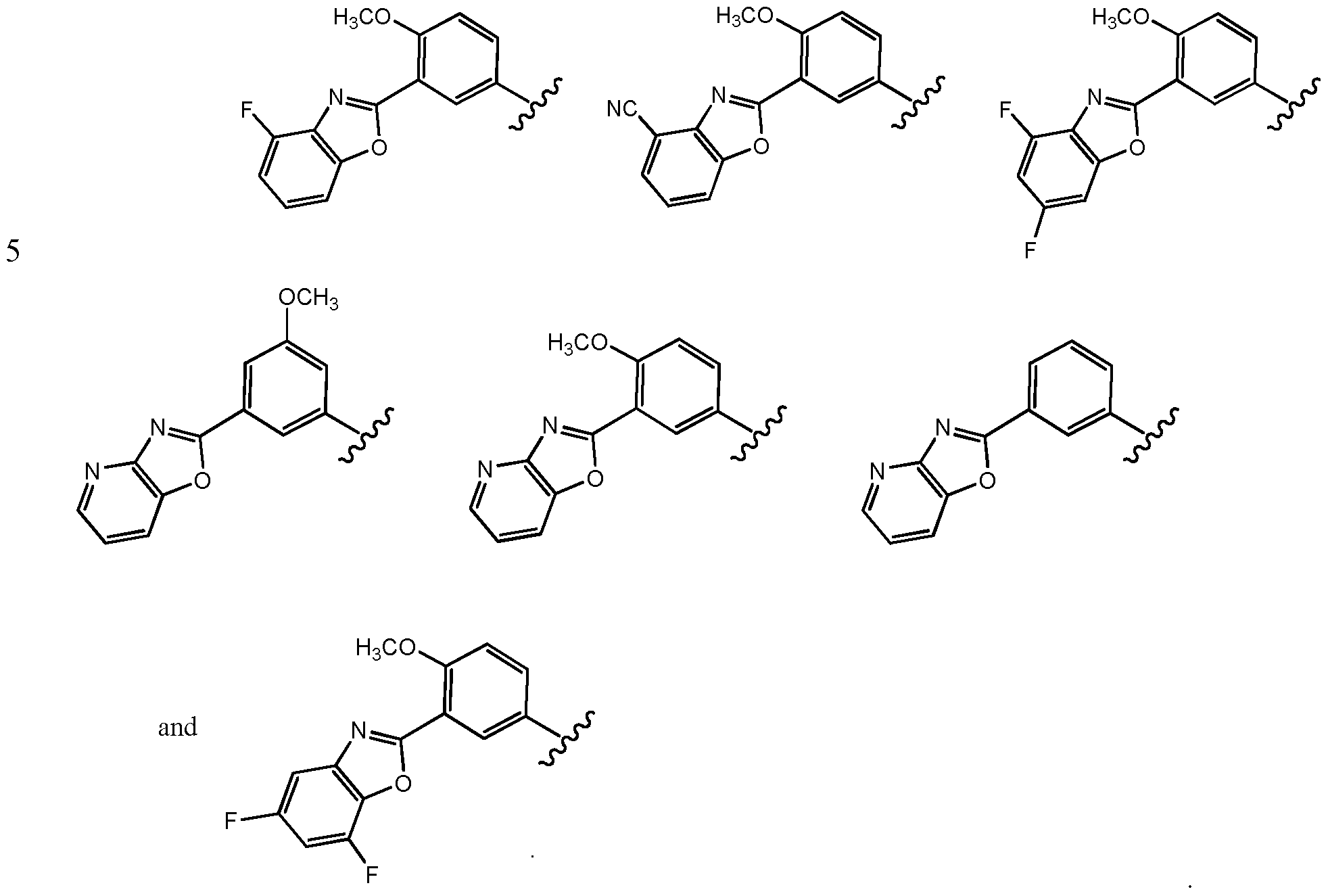
In a fourth embodiment of the present invention, R is -CH3.
In a fifth embodiment of the present invention, R40 is Ci-C6 alkyl, Ci-C6 haloalkyl, -(CH2)t-OH or -(CH2)rCN, wherein t is an integer ranging from 0 to 6. In a first aspect of this fifth embodiment, R40 is Ci-C6 alkyl. In a second aspect of this fifth embodiment, R40 is -CH3, - (CH2)3-CN, -CH2CH2F, or -CH2CH2C(CH3)2-OH. In a third aspect of this fifth embodiment, R40 is -CH3.
In a sixth embodiment of the present invention, R is Ci-C6 alkyl. In a first aspect of this sixth embodiment, R is C6-Cio aryl. In a second aspect of this sixth embodiment, R50 is C3-C7 cycloalkyl. In a third aspect of this sixth embodiment, R50 is -CH3, phenyl or cyclopropyl. In a fourth aspect of this sixth embodiment, R50 is -CH3.
In a seventh embodiment of the present invention, only one R group is present.
In a first aspect of this seventh embodiment, R represents a single halo group. In a second aspect of this seventh embodiment, R60 represents a single F group. In a third aspect of this seventh embodiment, R60 represents a single F group at the para position of the phenyl ring to which it is attached.
In an eighth embodiment of the present invention, R is -CH3, -(CH2)3-CN, -
CH2CH2F or -CH2CH2C(CH3)2-OH, and R3U is -CH3. In a first aspect of this eighth embodiment, R40 and R50 are each -CH3.
In a ninth embodiment of the present invention, R30, R40 and R50 are each -CH3.
In a tenth embodiment of the present invention, R40 is -CH3, -(CH2)3-CN, -CH2CH2F or -CH2CH2C(CH3)2-OH; R50 is -CH3; and R60 represents a single F group at the para position of the phenyl ring to which it is attached.
In an eleventh embodiment of the present invention, R30 is -CH3; R40 is -CH3, - (CH2)3-CN, -CH2CH2F or -CH2CH2C(CH3)2-OH; R50 is -CH3; and R60 represents a single F group at the para position of the phenyl ring to which it is attached. In a first aspect of this eleventh embodiment, R30, R40 and R50 are each -CH3 and R60 represents a single F group at the para position of the phenyl ring to which it is attached.
In a twelfth embodiment of the present invention, the Compounds of Formula (I) have the formula (la):

(la)
or a pharmaceutically acceptable salt thereof,
wherein:
Z is:

R is a 9-membered bicyclic heteroaryl group, wherein said 9-membered bicyclic heteroaryl group is optionally substituted with up to 2 groups, which can be the same or different, and are selected from halo, Ci-C6 alkyl, -(CH2)t-N(R70)2, -(CH2)rOH, -(CH2)rO-(Ci-C6 alkyl), - CF3, - HC(0)-heterocyclyl, - HC(0)-(Ci-C6 alkyl), -C(0) H-(d-C6 alkyl), -C(0)OH, - C(0)0-(Ci-C6 alkyl), - HC(0)-aryl, - HS02-aryl, - HS02-alkyl, -0-S02-alkyl,-0-(Ci-C6 alkyl) and -CN, wherein the heterocyclyl moiety of said -NHC(0)-heterocyclyl group can be optionally substituted on a ring carbon or ring nitrogen atom with a -C(0)0-(Ci-C6 alkyl) group;
R20 represents up to 2 optional substituents, which can be the same or different, and are selected from halo, Ci-C6 alkyl, -0-(Ci-C6 alkyl), -0-(CH2)rOH, -0-(CH2)rheterocyclyl, -0-(Ci-C6 haloalkyl), -0-S02-(Ci-C6 alkyl) and -CN;
R40 is Ci-C6 alkyl, Ci-C6 haloalkyl, -(CH2)rOH or -(CH2)rCN; and each occurrence of t is independently an integer ranging from 0 to 6.
In a first aspect of this twelfth embodiment, R is selected from:
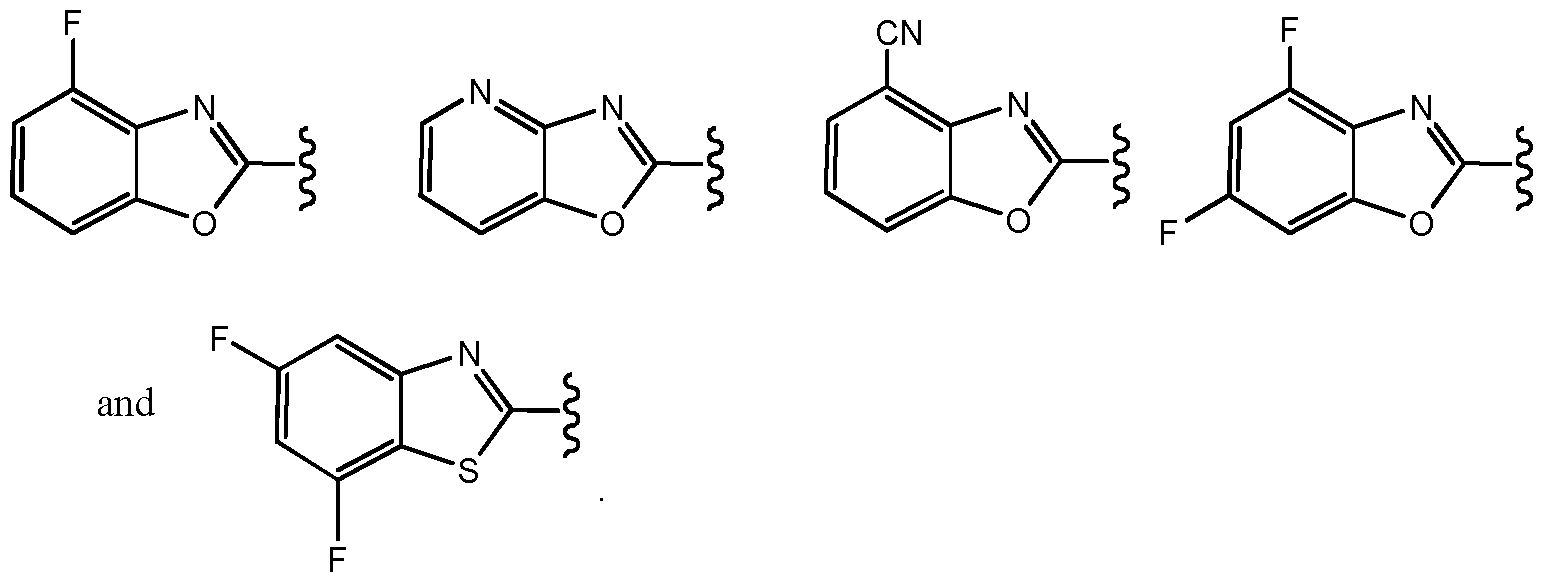
In a second aspect of this twelfth embodiment, Z is selected from:


In a third aspect of this twelfth embodiment, Z is:

In a fourth aspect of this twelfth embodiment, Z is:

In a fifth aspect of this twelfth embodiment, Z is:

In a sixth aspect of this twelfth embodiment, Z is:

In a seventh aspect of this twelfth embodiment, Z is:

In a eighth aspect of this twelfth embodiment, Z is:

In an ninth aspect of this twelfth embodiment, Z is:

In a tenth aspect of this twelfth embodiment, R is Ci-C6 alkyl.
In an eleventh aspect of this twelfth embodiment, R40 is -CH3, -(CH2)3-CN, - CH2CH2F, or -CH2CH2C(CH3)2-OH. In a fifth aspect of this twelfth embodiment, R40 is -CH3.
twelfth aspect of this twelfth embodiment, Z is selected from:


R4U is -CH3, -(CH2)3-CN, -CH2CH2F, or -CH2CH2C(CH3)2-OH.
In a thirteenth aspect of this twelfth embodiment, Z is selected from:

R4U is -CH3.
In a fourteenth aspect of this twelfth embodiment, Z is:

In a thirteenth embodiment of the present invention, the compound of the invention is selected from Compounds 1-256 shown in the Examples below, and
pharmaceutically acceptable salts thereof.
Other embodiments of the present invention include the following: (a) A pharmaceutical composition comprising an effective amount of a Compound of Formula (I) and a pharmaceutically acceptable carrier.
(b) The pharmaceutical composition of (a), further comprising a second therapeutic agent selected from the group consisting of HCV antiviral agents,
immunomodulators, and anti-infective agents.
(c) The pharmaceutical composition of (b), wherein the HCV antiviral agent is an antiviral selected from the group consisting of direct inhibitors of HCV, including but not limited to NS3 and NS3/4A protease inhibitors, NS5 A inhibitors and HCV NS5B polymerase inhibitors.
(d) A pharmaceutical combination that is (i) a Compound of Formula (I) and (ii) a second therapeutic agent selected from the group consisting of HCV antiviral agents, immunomodulators, and anti-infective agents; wherein the Compound of Formula (I) and the second therapeutic agent are each employed in an amount that renders the combination effective for inhibiting HCV NS5B activity, or for inhibiting HCV viral replication, or for treating HCV infection and/or reducing the likelihood or severity of symptoms of HCV infection.
(e) The combination of (d), wherein the HCV antiviral agents are one or more antiviral agents selected from the group consisting of direct inhibitors of HCV, including but not limited to NS3 and NS3/4A protease inhibitors, NS5A inhibitors and HCV NS5B polymerase inhibitors.
(f) A use of a Compound of Formula (I) in the preparation of a medicament for inhibiting HCV NS5B activity in a subject in need thereof.
(g) A use of a Compound of Formula (I) in the preparation of a medicament for preventing and/or treating infection by HCV in a subject in need thereof.
(h) A method of treating HCV infection and/or reducing the likelihood or severity of symptoms of HCV infection in a subject in need thereof, which comprises
administering to the subject an effective amount of a Compound of Formula (I).
(i) The method of (h), wherein the Compound of Formula (I) is administered in combination with an effective amount of at least one second therapeutic agent selected from the group consisting of HCV antiviral agents, immunomodulators, and anti-infective agents.
(j) The method of (i), wherein the HCV antiviral agent is an antiviral selected from the group consisting of direct inhibitors of HCV, including but not limited to NS3 and NS3/4A protease inhibitors, NS5A inhibitors and HCV NS5B polymerase inhibitors.
(k) A method of inhibiting HCV viral replication and/or HCV viral production in a cell-based system, which comprises administering to the subject an effective amount of a Compound of Formula (I) in combination with an effective amount of at least one second therapeutic agent selected from the group consisting of HCV antiviral agents,
immunomodulators, and anti-infective agents.
(1) The method of (k), wherein the HCV antiviral agent is an antiviral selected from the group consisting of direct inhibitors of HCV, including but not limited to NS3 and NS3/4A protease inhibitors, NS5A inhibitors and HCV NS5B polymerase inhibitors.
(m) A method of inhibiting HCV NS5B activity in a subject in need thereof, which comprises administering to the subject the pharmaceutical composition of (a), (b), or (c) or the combination of (d) or (e).
(n) A method of treating HCV infection and/or reducing the likelihood or severity of symptoms of HCV infection in a subject in need thereof, which comprises
administering to the subject the pharmaceutical composition of (a), (b), or (c) or the combination of (d) or (e).
In the embodiments of the compounds and salts provided above, it is to be understood that each embodiment may be combined with one or more other embodiments, to the extent that such a combination provides a stable compound or salt and is consistent with the description of the embodiments. It is further to be understood that the embodiments of compositions and methods provided as (a) through (n) above are understood to include all embodiments of the compounds and/or salts, including such embodiments as result from combinations of embodiments.
Additional embodiments of the invention include the pharmaceutical compositions, combinations, uses and methods set forth in (a) through (n) above, wherein the
compound of the present invention employed therein is a compound of one of the embodiments, aspects, classes, sub-classes, or features of the compounds described above. In all of these embodiments, the compound may optionally be used in the form of a pharmaceutically acceptable salt or hydrate as appropriate.
The present invention also includes a compound of the present invention for use
(i) in, (ii) as a medicament for, or (iii) in the preparation of a medicament for: (a) inhibiting HCV NS5B activity, or (b) inhibiting HCV viral replication, or (c) treating HCV infection and/or reducing the likelihood or severity of symptoms of HCV infection, or (d) use in medicine. In these uses, the compounds of the present invention can optionally be employed in combination with one or more second therapeutic agents selected from HCV antiviral agents, anti-infective agents, and immunomodulators.
As used herein, all ranges are inclusive, and all sub-ranges are included within such ranges, although not necessarily explicitly set forth. In addition, the term "or," as used herein, denotes alternatives that may, where appropriate, be combined; that is, the term "or" includes each listed alternative separately as well as their combination.
As used herein, the term "alkyl" refers to any linear or branched chain alkyl group having a number of carbon atoms in the specified range. Thus, for example, "Ci_6 alkyl" (or "Ci-C6 alkyl") refers to all of the hexyl alkyl and pentyl alkyl isomers as well as n-, iso-, sec- and t-butyl, n- and isopropyl, ethyl and methyl. As another example, "Ci-4 alkyl" refers to n-, iso-, sec- and t-butyl, n- and isopropyl, ethyl and methyl. Alkyl groups may be substituted as indicated.
The term "halogenated" refers to a group or molecule in which a hydrogen atom has been replaced by a halogen. Similarly, the term "haloalkyl" refers to a halogenated alkyl group. The term "halogen" (or "halo") refers to atoms of fluorine, chlorine, bromine and iodine (alternatively referred to as fluoro, chloro, bromo, and iodo).
The term "alkoxy" refers to an "alkyl-O-" group. Alkoxy groups may be substituted as indicated.
The term "cycloalkyl" refers to any cyclic ring of an alkane or alkene having a number of carbon atoms in the specified range. Thus, for example, "C3-8 cycloalkyl" (or "C3-C8 cycloalkyl") refers to cyclopropyl, cyclobutyl, cyclopentyl, cyclopentenyl, cyclohexyl, cyclohexenyl, cycloheptyl, cycloheptenyl, cyclooctyl, and cyclooctenyl. The term "cycloalkoxy" refers to a "cycloalkyl-O-" group. Cycloalkyl groups may be substituted as indicated.
The term "aryl" (or "aryl ring system") refers to aromatic mono- and poly- carbocyclic ring systems wherein the individual carbocyclic rings in the polyring systems are fused or attached to each other via a single bond. As used herein, the term aryl includes aromatic mono- and poly-carbocyclic ring systems that include from 0 to 4 heteroatoms (non-carbon atoms) that are independently chosen from N, O and S. Suitable aryl groups include phenyl, naphthyl, biphenylenyl, pyridinyl, pyrimidinyl and pyrrolyl, as well as those discussed below. Aryl groups may be substituted as indicated. Aryl ring systems may include, where appropriate, an indication of the variable to which a particular ring atom is attached. Illustrative examples of aryl groups include phenyl, naphthyl and anthracenyl. In one embodiment, an aryl group is phenyl. Unless otherwise indicated, substituents to the aryl ring systems can be attached to any ring atom, provided that such attachment results in formation of a stable ring system.
The term "carbocycle" (and variations thereof such as "carbocyclic") as used herein, unless otherwise indicated, refers to (i) a C5 to C7 monocyclic, saturated or unsaturated ring, or (ii) a C8 to C10 bicyclic saturated or unsaturated ring system. Each ring in (ii) is either independent of, or fused to, the other ring, and each ring is saturated or unsaturated. Carbocycle groups may be substituted as indicated. When the carbocycles contain one or more heteroatoms independently chosen from N, O and S, the carbocycles may also be referred to as
"heterocycles," as defined below. The carbocycle may be attached to the rest of the molecule at any carbon or nitrogen atom that results in a stable compound. The fused bicyclic carbocycles are a subset of the carbocycles; i.e. , the term "fused bicyclic carbocycle" generally refers to a C8 to Cio bicyclic ring system in which each ring is saturated or unsaturated and two adjacent carbon atoms are shared by each of the rings in the ring system. A fused bicyclic carbocycle in which both rings are saturated is a saturated bicyclic ring system. Saturated carbocyclic rings are also referred to as cycloalkyl rings, e.g. , cyclopropyl, cyclobutyl, etc. A fused bicyclic carbocycle in which one or both rings are unsaturated is an unsaturated bicyclic ring system.
Carbocycle ring systems may include, where appropriate, an indication of the variable to which a particular ring atom is attached. Unless otherwise indicated, substituents to the ring systems can be attached to any ring atom, provided that such attachment results in formation of a stable ring system.
Unless indicated otherwise, the term "heterocycle" (and variations thereof such as
"heterocyclic" or "heterocyclyl") broadly refers to (i) a stable 5- to 7-membered, saturated or unsaturated monocyclic ring, or (ii) a stable 8- to 10-membered bicyclic ring system, wherein each ring in (ii) is independent of, or fused to, the other ring or rings and each ring is saturated or
unsaturated, and the monocyclic ring or bicyclic ring system contains one or more heteroatoms (e.g., from 1 to 6 heteroatoms, or from 1 to 4 heteroatoms) independently selected from N, O and S and a balance of carbon atoms (the monocyclic ring typically contains at least one carbon atom and the bicyclic ring systems typically contain at least two carbon atoms); and wherein any one or more of the ring nitrogen and ring sulfur heteroatoms is optionally oxidized, for example to provide a ring N-oxide group or a ring -S(0)2- group, and any one or more of the nitrogen heteroatoms is optionally quaternized. Unless otherwise specified, the heterocyclic ring may be attached at any heteroatom or carbon atom, provided that attachment results in the creation of a stable structure. Heterocycle groups may be substituted as indicated, and unless otherwise specified, the substituents may be attached to any atom in the ring, whether a heteroatom or a carbon atom, provided that a stable chemical structure results. Representative examples include piperidinyl, piperazinyl, azepanyl, pyrrolidinyl, pyrazolidinyl, imidazolidinyl, oxazolidinyl, isoxazolidinyl, morpholinyl, thiomorpholinyl, thiazolidinyl, isothiazolidinyl, and tetrahydrofuryl (or tetrahydrofuranyl).
Unless expressly stated to the contrary, the term "heteroaryl ring system" refers to aryl ring systems, as defined above, that include from 1 to 4 heteroatoms (non-carbon atoms) that are independently chosen from N, O and S. In the case of substituted heteraromatic rings containing at least one nitrogen atom (e.g., pyridine), such substitutions can be those resulting in N-oxide formation. Representative examples of heteroaromatic rings include pyridyl, pyrrolyl, pyrazinyl, pyrimidinyl, pyridazinyl, thienyl (or thiophenyl), thiazolyl, furanyl, imidazolyl, pyrazolyl, triazolyl, tetrazolyl, oxazolyl, isooxazolyl, oxadiazolyl, thiazolyl, isothiazolyl, and thiadiazolyl. Representative examples of bicyclic heterocycles include benzotriazolyl, indolyl, isoindolyl, indazolyl, indolinyl, isoindolinyl, quinoxalinyl, quinazolinyl, cinnolinyl, chromanyl, isochromanyl, tetrahydroquinolinyl, quinolinyl, tetrahydroisoquinolinyl, isoquinolinyl,
2,3-dihydrobenzofuranyl, 2,3-dihydrobenzo-l,4-dioxinyl and benzo-l,3-dioxolyl.
Unless otherwise specifically noted as only "substituted", alkyl, cycloalkyl, and aryl groups are not substituted. Preferably, the substituents are selected from the group which includes, but is not limited to, halo, Ci-C2o alkyl, -CF3, -NH2, -N(Ci-C6 alkyl)2, -N02, oxo, - CN, -N3, -OH, -0(Ci-C6 alkyl), C3-Ci0 cycloalkyl, C2-C6 alkenyl, C2-C6 alkynyl, (C0-C6 alkyl) S(0)o-2-, aryl-S(O)0.2-, (C0-C6 alkyl)S(0)0-2(Co-C6 alkyl)-, (C0-C6 alkyl)C(0)NH-, H2N-C(NH)- , -0(Ci-C6 alkyl)CF3, (C0-C6 alkyl)C(O)-, (C0-C6 alkyl)OC(O)-, (Co-C6alkyl)0(Ci-C6 alkyl)-, (Co-C6 alkyl)C(0)i-2(Co-C6 alkyl)-, (C0-C6 alkyl)OC(0)NH-, aryl, aralkyl, heteroaryl, heterocyclylalkyl, halo-aryl, halo-aralkyl, halo-heterocycle and halo-heterocyclylalkyl.
As used herein, the term "compound" is intended to encompass chemical agents described by generic Formula (I) in all forms, including hydrates and solvates of such chemical agents. In addition, the term "compound" is intended to encompass prodrugs of the chemical agents described by generic Formula (I).
In the Compounds of Formula (I), the atoms may exhibit their natural isotopic abundances, or one or more of the atoms may be artificially enriched in a particular isotope having the same atomic number, but an atomic mass or mass number different from the atomic mass or mass number predominantly found in nature. The present invention is meant to include all suitable isotopic variations of the Compounds of Formula (I). For example, different isotopic forms of hydrogen (H) include protium (1H) and deuterium (2H or D). Protium is the predominant hydrogen isotope found in nature. Enriching for deuterium may afford certain therapeutic advantages, such as increasing in vivo half-life or reducing dosage requirements, or may provide a compound useful as a standard for characterization of biological samples.
Isotopically-enriched compounds within Formula (I) can be prepared without undue
experimentation by conventional techniques well known to those skilled in the art or by processes analogous to those described in the Schemes and Examples herein using appropriate isotopically-enriched reagents and/or intermediates.
Unless expressly stated to the contrary, all ranges cited herein are inclusive. For example, a heteroaryl ring described as containing from " 1 to 3 heteroatoms" means the ring can contain 1, 2, or 3 heteroatoms. It is also to be understood that any range cited herein includes within its scope all of the sub-ranges within that range. The oxidized forms of the heteroatoms N and S are also included within the scope of the present invention.
When any variable (for example, R20 or R60) occurs more than one time in any constituent or in Formula (I) or in any other formula depicting and describing compounds of the invention, its definition on each occurrence is independent of its definition at every other occurrence. Also, combinations of substituents and/or variables are permissible only if such combinations result in stable compounds.
Unless expressly stated to the contrary, substitution by a named substituent is permitted on any atom provided such substitution is chemically allowed and results in a stable compound. A "stable" compound is a compound that can be prepared and isolated and whose structure and properties remain or can be caused to remain essentially unchanged for a period of time sufficient to allow use of the compound for the purposes described herein {e.g., therapeutic or prophylactic administration to a subject).
As a result of the selection of substituents and substituent patterns, certain of the compounds of the present invention can have asymmetric centers and can occur as mixtures of stereoisomers, or as individual diastereomers, or enantiomers. All isomeric forms of these compounds, whether isolated or in mixtures, are within the scope of the present invention.
As would be recognized by one of ordinary skill in the art, certain of the compounds of the present invention can exist as tautomers. For the purposes of the present invention a reference to a Compound of Formula (I) is a reference to the compound per se, or to any one of its tautomers per se, or to mixtures of two or more tautomers.
The compounds of the present inventions are useful in the inhibition of HCV replication (e.g., HCV NS5B activity), the treatment of HCV infection and/or reduction of the likelihood or severity of symptoms of HCV infection. For example, the compounds of this invention are useful in treating infection by HCV after suspected past exposure to HCV by such means as blood transfusion, exchange of body fluids, bites, accidental needle stick, or exposure to patient blood during surgery.
The compounds of this invention are useful in the preparation and execution of screening assays for antiviral compounds. For example, the compounds of this invention are useful for identifying resistant HCV replicon cell lines harboring mutations within NS5B, which are excellent screening tools for more powerful antiviral compounds. Furthermore, the compounds of this invention are useful in establishing or determining the binding site of other antivirals to the HCV replicase.
The compounds of the present invention may be administered in the form of pharmaceutically acceptable salts. The term "pharmaceutically acceptable salt" refers to a salt that possesses the effectiveness of the parent compound and that is not biologically or otherwise undesirable (e.g., is neither toxic nor otherwise deleterious to the recipient thereof). Suitable salts include acid addition salts that may, for example, be formed by mixing a solution of the compound of the present invention with a solution of a pharmaceutically acceptable acid such as hydrochloric acid, sulfuric acid, acetic acid, trifluoroacetic acid, or benzoic acid. Many of the compounds of the invention carry an acidic moiety, in which case suitable pharmaceutically acceptable salts thereof can include alkali metal salts (e.g., sodium or potassium salts), alkaline earth metal salts (e.g., calcium or magnesium salts), and salts formed with suitable organic ligands such as quaternary ammonium salts. Also, in the case of an acid (-COOH) or alcohol group being present, pharmaceutically acceptable esters can be employed to modify the solubility or hydrolysis characteristics of the compound.
The term "administration" and variants thereof (e.g., "administering" a compound) in reference to a compound of the invention mean providing the compound or a prodrug of the compound to the individual in need of treatment. When a compound of the invention is provided in combination with one or more other active agents (e.g., antiviral agents useful for treating HCV infection), "administration" and its variants are each understood to include concurrent and sequential provision of the compound or salt and other agents.
As used herein, the term "composition" is intended to encompass a product comprising the specified ingredients, as well as any product which results, directly or indirectly, from combining the specified ingredients.
By "pharmaceutically acceptable" is meant that the ingredients of the pharmaceutical composition must be compatible with each other and not deleterious to the recipient thereof.
The term "subject" (alternatively referred to herein as "patient"), as used herein, refers to human or a chimpanzee. In one embodiment, the subject is a human.
The term "effective amount" as used herein means that amount of active compound or pharmaceutical agent that elicits the biological or medicinal response in a tissue, system, animal or human that is being sought by a researcher, veterinarian, medical doctor or other clinician. In one embodiment, the effective amount is a "therapeutically effective amount" for the alleviation of one or more symptoms of the disease or condition being treated. In another embodiment, the effective amount is a "prophylactically effective amount" for reduction of the severity or likelihood of one or more symptoms of the disease or condition. In another embodiment, the effective amount is a "therapeutically effective amount" for inhibition of HCV viral replication and/or HCV viral production. The term also includes herein the amount of active compound sufficient to inhibit HCV NS5B activity and thereby elicit the response being sought (i.e., an "inhibition effective amount"). When the active compound (i.e., active ingredient) is administered as the salt, references to the amount of active ingredient are to the free acid or free base form of the compound.
For the purposes of inhibiting HCV NS5B polymerase, treating HCV infection and/or reducing the likelihood or severity of symptoms of HCV infection and inhibiting HCV viral replication and/or HCV viral production, the compounds of the present invention, optionally in the form of a salt, can be administered by any means that produces contact of the active agent with the agent's site of action. They can be administered by one or more
conventional means available for use in conjunction with pharmaceuticals, either as individual
therapeutic agents or in a combination of therapeutic agents. They can be administered alone, but typically are administered with a pharmaceutical carrier selected on the basis of the chosen route of administration and standard pharmaceutical practice. The compounds of the invention can, for example, be administered by one or more of the following: orally, parenterally
(including subcutaneous injections, intravenous, intramuscular, intrasternal injection or infusion techniques), by inhalation (such as in a spray form), or rectally, in the form of a unit dosage of a pharmaceutical composition containing an effective amount of the compound and conventional non-toxic pharmaceutically-acceptable carriers, adjuvants and vehicles. Liquid preparations suitable for oral administration (e.g., suspensions, syrups, elixirs and the like) can be prepared according to techniques known in the art and can employ any of the usual media such as water, glycols, oils, alcohols and the like. Solid preparations suitable for oral administration (e.g., powders, pills, capsules and tablets) can be prepared according to techniques known in the art and can employ such solid excipients as starches, sugars, kaolin, lubricants, binders,
disintegrating agents and the like. Parenteral compositions can be prepared according to techniques known in the art and typically employ sterile water as a carrier and optionally other ingredients, such as solubility aids. Injectable solutions can be prepared according to methods known in the art wherein the carrier comprises a saline solution, a glucose solution or a solution containing a mixture of saline and glucose. Further description of methods suitable for use in preparing pharmaceutical compositions of the present invention and of ingredients suitable for use in said compositions is provided in Remington: The Science and Practice of Pharmacy. 21st edition (ed. University of the Sciences in Philadelphia; Lippincott, Williams & Wilkins, 2005).
The compounds of this invention can be administered orally in a dosage range of 0.001 to 1000 mg/kg of mammal (e.g., human) body weight per day in a single dose or in divided doses. One dosage range is 0.01 to 500 mg/kg body weight per day orally in a single dose or in divided doses. Another dosage range is 0.1 to 100 mg/kg body weight per day orally in single or divided doses. For oral administration, the compositions can be provided in the form of tablets or capsules containing 1.0 to 500 mg of the active ingredient, particularly 1, 5, 10, 15, 20, 25, 50, 75, 100, 150, 200, 250, 300, 400, and 500 mg of the active ingredient for the symptomatic adjustment of the dosage to the patient to be treated. The specific dose level and frequency of dosage for any particular patient may be varied and will depend upon a variety of factors including the activity of the specific compound employed, the metabolic stability and length of action of that compound, the age, body weight, general health, sex, diet, mode and time of
administration, rate of excretion, drug combination, the severity of the particular condition, HCV viral genotype, viral resistance, and the host undergoing therapy.
As noted above, the present invention also relates to a method of inhibiting HCV NS5B activity, inhibiting HCV viral replication and/or HCV viral production, treating HCV infection and/or reducing the likelihood or severity of symptoms of HCV infection with a compound of the present invention in combination with one or more therapeutic agents and a pharmaceutical composition comprising a compound of the present invention and one or more therapeutic agents selected from the group consisting of a HCV antiviral agent, an
immunomodulator, and an anti-infective agent. Such therapeutic agents active against HCV include, but are not limited to, ribavirin, levovirin, viramidine, thymosin alpha- 1, R7025 (an enhanced interferon (Roche)), interferon-β, interferon-α, pegylated interferon-α (peginterferon-a), a combination of interferon-α and ribavirin, a combination of peginterferon-α and ribavirin, a combination of interferon-α and levovirin, and a combination of peginterferon-α and levovirin. The combination of pegylated-interferon and ribaviron represents the current Standard of Care for HCV treatment. The combination of one or more compounds of the present invention with the Standard of Care for HCV treatment, pegylated-interferon and ribaviron is specifically contemplated as being encompassed by the present invention. Interferon-α includes, but is not limited to, recombinant interferon-a2a (such as ROFERON interferon available from Hoffmann- LaRoche, Nutley, NJ), pegylated interferon-a2a (PEGASYS), interferon-a2b (such as INTRON-A interferon available from Schering Corp., Kenilworth, NJ), pegylated interferon-a2b
(PEGINTRON), a recombinant consensus interferon (such as interferon alphacon-1), albuferon (interferon-α bound to human serum albumin (Human Genome Sciences)), and a purified interferon-α product. Amgen's recombinant consensus interferon has the brand name INFERGEN. Levovirin is the L-enantiomer of ribavirin which has shown immunomodulatory activity similar to ribavirin. Viramidine represents an analog of ribavirin disclosed in International Patent
Application Publication WO 01/60379. In accordance with the method of the present invention, the individual components of the combination can be administered separately at different times during the course of therapy or concurrently in divided or single combination forms.
For the treatment of HCV infection, the compounds of the invention may also be administered in combination with an antiviral agent NS5B polymerase inhibitor, e.g., R7128 (Roche), valopicitabine (NM-283; Idenix) and 2'-F-2'-beta-methylcytidine (see also WO
2005/003147).
. The compounds of the present invention also may be combined for the treatment of HCV infection with antiviral 2'-C-branched ribonucleosides disclosed in Rogers E. Harry-O'Kuru et al. , A Short, Flexible Route toward 2 '-C-Branched Ribonucleosides, 62 J. ORG. CHEM. 1754-59 (1997); Michael S. Wolfe & Rogers E. Harry-O'Kuru, A Concise Synthesis o/2'-C- Methylribonucleosides, 36(42) TETRAHEDRON LETTERS 761 1 - 14 ( 1995); U. S . Patent
No. 3,480,613; and International Patent Application Publications WO 01/90121, WO 01/92282, WO 02/32920, WO 04/002999, WO 04/003000 and WO 04/002422; the entire contents of each of which are incorporated by reference. Such 2'-C-branched ribonucleosides include, but are not limited to, 2'-C-methyl-cytidine, 2'-C-methyl-uridine, 2'-C-methyl-adenosine, 2'-C-methyl- guanosine, and 9-(2-C-methyl-P-D-ribofuranosyl)-2,6-diaminopurine, and the corresponding amino acid ester of the ribose C-2', C-3 ', and C-5' hydroxyls and the corresponding optionally substituted cyclic 1,3 -propanediol esters of the 5'-phosphate derivatives.
For the treatment of HCV infection, the compounds of the present invention may also be administered in combination with an agent that is an inhibitor of HCV NS3 serine protease. HCV NS3 serine protease is an essential viral enzyme and has been described to be an excellent target for inhibition of HCV replication. Exemplary substrate and non-substrate based inhibitors of HCV NS3 protease inhibitors are disclosed in International Patent Application Publications WO 98/22496, WO 98/46630, WO 99/07733, WO 99/07734, WO 99/38888, WO 99/50230, WO 99/64442, WO 00/09543, WO 00/59929, WO 02/481 16, WO 02/48172, WO 2008/057208 and WO 2008/057209, in British Patent No. GB 2 337 262, and in U. S. Patent Nos. 6,323, 180 and 7,470,664.
Further examples of HCV protease inhibitors useful in the present compositions and methods include, but are not limited to, the following compounds:


and pharmaceutically acceptable salts thereof.
The compounds of the present invention may also be combined for the treatment of HCV infection with nucleosides having anti-HCV properties, such as those disclosed in International Patent Application Publications WO 02/51425, WO 01/79246, WO 02/32920, WO 02/48165 and WO 2005/003147 (including R1656, (2'R)-2'-deoxy-2'-fluoro-2'-C- methylcytidine, shown as compounds 3^6 on page 77); WO 01/68663; WO 99/43691 ;
WO 02/18404 and WO 2006/021341, and U.S. Patent Application Publication US 2005/0038240, including 4'-azido nucleosides such as R1626, 4'-azidocytidine; U.S. Patent Application
Publications US 2002/0019363, US 2003/0236216, US 2004/0006007, US 2004/0063658 and US 2004/0110717; U.S. Patent Nos. 7, 105,499, 7,125,855, 7,202,224; and International Patent Application Publications WO 02/100415, WO 03/026589, WO 03/026675, WO 03/093290, WO 04/011478, WO 04/013300 and WO 04/028481; the content of each is incorporated herein by reference in its entirety.
For the treatment of HCV infection, the compounds of the present invention may also be administered in combination with an agent that is an inhibitor of HCV NS5B polymerase. Such HCV NS5B polymerase inhibitors that may be used as combination therapy include, but are not limited to, those disclosed in International Patent Application Publications
WO 02/057287, WO 02/057425, WO 03/068244, WO 2004/000858, WO 04/003138 and
WO 2004/007512; U.S. Patent Nos. 6,777,392, 7, 105,499, 7, 125,855, 7,202,224 and U.S. Patent
Application Publications US 2004/0067901 and US 2004/0110717; the content of each is incorporated herein by reference in its entirety.
In one embodiment, additional nucleoside HCV NS5B polymerase inhibitors that are used in combination with the present HCV NS5B inhibitors are selected from the following compounds: 4-amino-7-(2-C-methyl-P-D-arabinofuranosyl)-7H-pyrrolo[2,3-<JJpyrimidine; 4- amino-7-(2-C-methyl-P-D-ribofuranosyl)-7H-pyrrolo[2,3-ii ]pyrimidine; 4-methylamino-7-(2-C- methyl-P-D-ribofuranosyl)-7H-pyrrolo[2,3-ii ]pyrimidine; 4-dimethylamino-7-(2-C-methyl-P-D- ribofuranosyl)-7H-pyrrolo[2,3-ii?]pyrimidine; 4-cyclopropylamino-7-(2-C-methyl-P-D- ribofuranosyl)-7H-pyrrolo[2,3-ii?]pyrimidine; 4-amino-7-(2-C-vinyl-P-D-ribofuranosyl)-7H- pyrrolo[2,3-<JJpyrimidine; 4-amino-7-(2-C-hydroxymethyl-P-D-ribofuranosyl)-7H- pyrrolo[2,3-<JJpyrimidine; 4-amino-7-(2-C-fluoromethyl-P-D-ribofuranosyl)-7H- pyrrolo[2,3-<JJpyrimidine; 4-amino-5-methyl-7-(2-C-methyl-P-D-ribofuranosyl)-7H- pyrrolo[2,3-<JJpyrimidine; 4-amino-7-(2-C-methyl-P-D-ribofuranosyl)-7H- pyrrolo[2,3-<JJpyrimidine-5-carboxylic acid; 4-amino-5-bromo-7-(2-C-methyl-P-D- ribofuranosyl)-7H-pyrrolo[2,3-ii?]pyrimidine; 4-amino-5-chloro-7-(2-C-methyl-P-D- ribofuranosyl)-7H-pyrrolo[2,3-ii?]pyrimidine; 4-amino-5-fluoro-7-(2-C-methyl-P-D- ribofuranosyl)-7H-pyrrolo[2,3-ii?]pyrimidine; 2,4-diamino-7-(2-C-methyl-P-D-ribofuranosyl)- 7H-pyrrolo[2,3-<JJpyrimidine; 2-amino-7-(2-C-methyl-P-D-ribofuranosyl)-7H- pyrrolo[2,3-<JJpyrimidine; 2-amino-4-cyclopropylamino-7-(2-C-methyl-P-D-ribofuranosyl)-7H- pyrrolo[2,3-<JJpyrimidine; 2-amino-7-(2-C-methyl-P-D-ribofuranosyl)-7H- pyrrolo[2,3-<JJpyrimidin-4(3H)-one; 4-amino-7-(2-C-ethyl-P-D-ribofuranosyl)-7H- pyrrolo[2,3-<JJpyrimidine; 4-amino-7-(2-C,2-0-dimethyl-P-D-ribofuranosyl)-7H- pyrrolo[2,3-<JJpyrimidine; 7-(2-C-methyl-P-D-ribofuranosyl)-7H-pyrrolo[2,3-ii ]pyrimidin-4(3H)- one; 2-amino-5-methyl-7-(2-C, 2-0-dimethyl-P-D-ribofuranosyl)-7H-pyrrolo[2,3-ii?]pyrimidin- 4(3H)-one; 4-amino-7-(3-deoxy-2-C-methyl-P-D-ribofuranosyl)-7H-pyrrolo[2,3-<JJpyrimidine; 4-amino-7-(3-deoxy-2-C-methyl-P-D-arabinofuranosyl)-7H-pyrrolo[2,3-ii?]pyrimidine; 4-amino- 2-fluoro-7-(2-C-methyl-P-D-ribofuranosyl)-7H-pyrrolo[2,3-ii?]pyrimidine; 4-amino-7-(3-C- methyl-P-D-ribofuranosyl)-7H-pyrrolo[2,3-ii ]pyrimidine; 4-amino-7-(3-C-methyl-P-D- xylofuranosyl)-7H-pyrrolo[2,3-<JJpyrimidine; 4-amino-7-(2,4-di-C-methyl-P-D-ribofuranosyl)- 7H-pyrrolo[2,3-<JJpyrimidine; 4-amino-7-(3-deoxy-3-fluoro-2-C-methyl-P-D-ribofuranosyl)-7H- pyrrolo[2,3-<JJpyrimidine; and the corresponding 5'-triphosphates; or a pharmaceutically acceptable salt thereof.
The compounds of the present invention may also be combined for the treatment of HCV infection with non-nucleoside inhibitors of HCV polymerase such as those disclosed in U.S. Patent Applciation Publications US 2006/0100262 and US 2009/0048239; International Patent Application Publications WO 01/77091, WO 01/47883, WO 02/04425, WO 02/06246, WO 02/20497, WO 2005/016927 (in particular JTK003), WO 2004/041201, WO 2006/066079, WO 2006/066080, WO 2008/075103, WO 2009/010783 and WO 2009/010785; the content of each is incorporated herein by reference in its entirety.
In one embodiment, additional non-nucleoside HCV NS5B polymerase inhibitors that are used in combination with the present HCV NS5B inhibitors are selected from the following compounds : 14-cyclohexyl-6- [2-(dimethylamino)ethyl] -7-oxo-5 , 6, 7, 8- tetrahydroindolo[2, l-a][2,5]benzodiazocine-l 1-carboxylic acid; 14-cyclohexyl-6-(2-morpholin- 4-ylethyl)-5,6,7,8-tetrahydroindolo[2, l-a][2,5]benzodiazocine-l 1-carboxylic acid; 14- cyclohexyl-6- [2-(dimethylamino)ethyl] -3 -methoxy-5 , 6, 7, 8-tetrahydroindolo [2, 1 -a]
[2,5]benzodiazocine-l 1-carboxylic acid; 14-cyclohexyl-3-methoxy-6-methyl-5, 6,7,8- tetrahydroindolo[2, l-a][2,5]benzodiazocine-l l-carboxylic acid; methyl ({[(14-cyclohexyl-3- methoxy-6-methyl-5,6,7,8-tetrahydroindolo[2, l-a][2,5]benzodiazocin-l l- yl)carbonyl] amino }sulfonyl)acetate; ({ [(14-cyclohexyl-3-methoxy-6-methyl-5, 6,7,8- tetrahydroindolo[2, l-a][2,5]benzodiazocin-l l-yl)carbonyl] amino }sulfonyl)acetic acid; 14- cyclohexyl-N- [(dimethylamino)sulfonyl] -3 -methoxy-6-methyl-5 , 6, 7, 8-tetrahydroindolo [2, 1 -a] [2, 5 Jbenzodiazocine- 11 -carboxamide; 3 -chloro- 14-cyclohexyl-6- [2-(dimethylamino)ethyl] -7- oxo-5,6,7,8-tetrahydroindolo[2, l-a][2,5]benzodiazocine 11-carboxylic acid; iV-(l l-carboxy-14- cyclohexyl-7, 8-dihydro-6H-indolo[ 1 ,2-e] [ 1 , 5]benzoxazocin-7-yl)-N,N-dimethyl ethane- 1 ,2- diaminium bis(trifluoroacetate); 14-cyclohexyl-7, 8 -dihydro-6H-indolo [ 1 ,2-e] [ 1 , 5 ]
benzoxazocine-11-carboxylic acid; 14-cyclohexyl-6-methyl-7-oxo-5,6,7,8-tetrahydroindolo [2, 1 -a] [2, 5]benzodiazocine-l 1-carboxylic acid; 14-cyclohexyl-3-methoxy-6-methyl-7-oxo- 5,6,7,8-tetrahydroindolo[2, l-a][2,5]benzodiazocine-l 1-carboxylic acid; 14-cyclohexyl-6-[2- (dimethylamino)ethyl] -3 -methoxy-7-oxo-5 , 6, 7, 8-tetrahydroindolo [2, 1 -a] [2, 5 Jbenzodiazocine- 11-carboxylic acid; 14-cyclohexyl-6-[3-(dimethylamino)propyl]-7-oxo-5,6,7,8-tetrahydroindolo [2, 1 -a] [2, 5]benzodiazocine-l 1-carboxylic acid; 14-cyclohexyl-7-oxo-6-(2-piperidin-l-ylethyl)- 5,6,7,8-tetrahydroindolo[2, l-a][2,5]benzodiazocine-l 1-carboxylic acid; 14-cyclohexyl-6-(2- morpholin-4-ylethyl)-7-oxo-5,6,7,8-tetrahydroindolo[2, l-a][2,5]benzodiazocine-l 1-carboxylic acid; 14-cyclohexyl-6- [2-(diethylamino)ethyl] -7-oxo-5 , 6, 7, 8-tetrahydroindolo [2, 1 -a]
[2, 5 Jbenzodiazocine- 11-carboxylic acid; 14-cyclohexyl-6-(l-methylpiperidin-4-yl)-7-oxo-
5.6.7.8- tetrahydroindolo[2, l-a][2,5]benzodiazocine-l 1-carboxylic acid; 14-cyclohexyl-N- [(dimethylamino)sulfonyl]-7-oxo-6-(2-piperidin-l-ylethyl)-5,6,7,8-tetrahydroindolo[2, l-a] [2,5]benzodiazocine-l l-carboxamide; 14-cyclohexyl-6-[2-(dimethylamino)ethyl]-N- [(dimethylamino)sulfonyl] -7-0X0-5 , 6, 7, 8-tetrahydroindolo [2, 1 -a] [2, 5 Jbenzodiazocine- 11- carboxamide; 14-cyclopentyl-6- [2-(dimethylamino)ethyl] -7-oxo-5 , 6, 7, 8-tetrahydroindolo [2, 1 -a] [2, 5 Jbenzodiazocine- 11-carboxylic acid; 14-cyclohexyl-5,6,7,8-tetrahydroindolo[2, l-a]
[2, 5 Jbenzodiazocine- 11-carboxylic acid; 6-allyl-14-cyclohexyl-3-methoxy-5, 6,7,8- tetrahydroindolo[2, l-a][2,5]benzodiazocine-l 1-carboxylic acid; 14-cyclopentyl-6-[2- (dimethylamino)ethyl] -5 , 6, 7, 8-tetrahydroindolo [2, 1 -a] [2, 5 Jbenzodiazocine- 11 -carboxylic acid; 14-cyclohexyl-6- [2-(dimethylamino)ethyl] -5 , 6, 7, 8-tetrahydroindolo [2, 1 -a] [2, 5 Jbenzodiazocine- 11-carboxylic acid; 13-cyclohexyl-5-methyl-4,5,6,7-tetrahydrofuro[3',2':6,7][l,4]diazocino[l,8- a] indole- 10-carboxylic acid; 15 -cyclohexyl-6- [2-(dimethylamino)ethyl] -7-oxo-6, 7, 8,9- tetrahydro-5H-indolo[2, l-a][2,6]benzodiazonine-12-carboxylic acid; 15-cyclohexyl-8-oxo-
6.7.8.9- tetrahydro-5H-indolo [2, 1 -a] [2, 5 Jbenzodiazonine- 12-carboxylic acid; 13 -cyclohexyl-6- oxo-6,7-dihydro-5H-indolo[l,2-<i][l,4]benzodiazepine-10-carboxylic acid; and pharmaceutically acceptable salts thereof.
In another embodiment, the present HCV NS5B polymerase inhibitors are used in combination with non-nucleoside HCV NS5 A inhibitors and pharmaceutically acceptable salts thereof.
The HCV NS5B inhibitory activity of the present compounds may be tested using assays known in the art. The HCV NS5B polymerase inhibitors described herein have activities in a genotype lb replicon assay as described in the Examples. The assay is performed by incubating a replicon harboring cell-line in the presence of inhibitor for a set period of time and measuring the effect of the inhibitor on HCV replicon replication either directly by quantifying replicon RNA level, or indirectly by measuring enzymatic activity of a co-encoded reporter enzyme such as luciferase or β-lactamase. By performing a series of such measurements at different inhibitor concentrations, the effective inhibitory concentration of the inhibitor (EC50 or EC90) is determined. See Jan M. Vrolijk et al., A replicons-based bioassay for the measurement of interferons in patients with chronic hepatitis C, 110 J. VlROLOGlCAL METHODS 201 (2003). Such assays may also be run in an automated format for high through-put screening. See Paul Zuck et al. , A cell-based β-lactamase reporter gene assay for the identification of inhibitors of hepatitis C virus replication, 334 ANALYTICAL BIOCHEMISTRY 344 (2004).
The present invention also includes processes for making Compounds of Formula (I). The compounds of the present invention can be readily prepared according to the following reaction schemes and examples, or modifications thereof, using readily available starting materials, reagents and conventional synthesis procedures. In these reactions, it is also possible to make use of variants which are themselves known to those of ordinary skill in this art, but are not mentioned in greater detail. Furthermore, other methods for preparing compounds of the invention will be readily apparent to the person of ordinary skill in the art in light of the following reaction schemes and examples. Unless otherwise indicated, all variables are as defined above. The following reaction schemes and examples serve only to illustrate the invention and its practice.
General Schemes
Scheme 1

This scheme describes a method useful for making the compounds of formula M, which correspond to the Compounds of Formula (I) wherein BPin is pinacoldiborane; R60 is para-F ; and R10, R20, R30, R40 and R50 are defined above for the Compounds of Formula (I).
A compound of formula A can be brominated, then esterified using TB ATB in MeOH to provide compounds of formula B. The phenol group of B can then be protected as its TBS derivative to provide compounds of formula C, which can be acylated using 4- fluorobenzoyl chloride to provide compounds of formula D. The phenol hydroxyl group of D
can then be deproteced using TBAF, followed by an intramolecular acid-mediated cycliczation to provide compounds of formulas E and F sequentially. A compound of formula F can subsequently be converted to a compound of formula G upon treatment with fuming HNO3. Compounds of formula H can be obtained from compounds of formula G via reduction of the nitro group in G, and the resulting amino group in compouns of formula H can then be sulfonylated using a reagent of formula R50SO2Cl to provide sulfonamide compounds of formula I. A compound of formula I can then be coupled with R40I in the presence of potassium carbonate to provide compounds of formula J, followed by base-catalyzed hydrolysis of the ester group in J to provide compounds of formula K. The carboxylic acid group of K can then be condensed with an amine of formula R30 H2 in the presence of an amide-forming reagent, such as EDCI or HOBT, to provide compounds of formula L. Transition-metal mediated coupling of the bromo moiety of L with a substituted phenyl boronic ester (alternatively boronic acid, alkyl tin, silicon, or other types of coupling partners may be used) finally provides the target compounds of formula M.
Scheme 2

This scheme describes methods useful for making: (a) compounds of formula O, which correspond to the Compounds of Formula (I) wherein R10 is benzthiazolyl; R60 is para-F; and R20, R30, R40 and R50 are defined above for the Compounds of Formula (I), and (b) compounds of formula P, which correspond to the Compounds of Formula (I) wherein R10 is
benzimidazole or other bicyclic imidazole derivative; R is para-F; and R , R , R and R are defined above for the Compounds of Formula (I).
A compound of formula L can be coupled with a substituted or unsubstituted 3- formylphenylboronic acid using a transition metal catalyst, such as Pd(dppf)Cl2, to provide compounds of the formula N. Compounds of formula N are then cyclized with ortho amino thiophenols or ortho di-amino compounds to provide the target compounds of formulas O and P, respectively. cheme 3

s T
This scheme describes a method useful for making the compounds of formula T, which correspond to the Compounds of Formula (I) wherein Het is a heterocyclyl or heteroaryl group; R60 is para-F; and R20, R30, R40 and R50 are defined above for the Compounds of Formula (I).
A compound of formula L can be coupled with a substituted or unsubstituted 3- nitrophenylboronic acid catalyzed by a transition metal, in this case Pd(dppf)Cl2, to provide the compounds of formula Q. Compounds of formula Q can then be hydrogenated to provide the amino compounds of formula R, which are reacted with i-AmONO / I2, to provide the iodo compounds of formula S. Transition metal mediated coupling of S with a heterocyclic boronic acid (alternatively boronic ester, alkyl tin, silicon, or other types of coupling partners may be used) provides the target compounds of formula T.
Scheme 4

This scheme describes an alternate useful for making the compounds of formula T, which correspond to the Compounds of Formula (I) wherein Het is a heterocyclyl or heteroaryl group; R60 is para-F; and R20, R30, R40 and R50 are defined above for the Compounds of Formula (I).
An iodo compound of formuls S can be converted to boronic ester compounds of formula U in the presence of Pd(dppf)Cl2. A compound of formula U can then be coupled with and aryl bromide or heterocyclic bromide to provide the compounds of formula T. Scheme 5

This scheme describes a method useful for making the the compounds of formula W, which correspond to the Compounds of Formula (I) wherein R10 is indole or other bicyclic pyrrole derivative; R60 is para-F; and R20, R30, R40 and R50 are defined above for the Compounds of Formula (I).
A transition metal-mediated coupling of a compound of a bromo compound of formula L with a heterocycle substituted phenyl boronic ester (alternatively boronic acid, alkyl tin, silicon, or other types of coupling partners may be used) provides the compounds of formula V. The SEM protecting group of a compound of formula V can subsequently be deproteted using TBAF to provide the compounds of formula W.
Scheme 6

This scheme describes an alternate method useful for making the compounds of formula T, which correspond to the Compounds of Formula (I) wherein Het is a heterocyclyl or heteroaryl group; R60 is para-F; and R20, R30, R40 and R50 are defined above for the Compounds of Formula (I).
The ester group of a compound of formula I can be hydrolyzed using aqueous base to provide a compound of formula X. The carboxylic acid moiety of X can then be condensed with an amine of formula R30 H2 using common amide forming reagents, such as EDCI and HOBT, to provide the compounds of formula Y. The sulfonamide group of Y can then be coupled with a reagent of formula R40X in the presence of potassium carbonate or with a regent of formula R40OH in the presence of PPh3 and DEAD to provide compounds of fomrula Z. Transition metal mediated coupling of a compound of formula Z with a heterocycle-substituted phenyl boronic ester (alternatively boronic acid, alkyl tin, silicon, or other types of coupling partners may be used) provides the compounds of formula T.
Scheme 7

T
This scheme describes yet another alternate method useful for making the compounds of formula T, which correspond to the Compounds of Formula (I) wherein Het is a heterocyclyl or heteroaryl group; R60 is para-F; and R20, R30, R40 and R50 are defined above for the Compounds of Formula (I).
The amino group of a compound of formula I can be sulfonylated using a reagent of formula R50SO2Cl to provide the sulfonamide compounds of formula AA. A compound of formula AA can then be coupled with a reactant of formula R40X in the presence of potassium carbonate to provide the compounds of formula AB. The ester moiety of the compounds of formula AB can be readily hydrolyzed using aqueous base to provide the compounds of formula AC. The carboxylic acid group of AC is then condensed with an amine of formula R30 H2 using common amide forming reagents, such as EDCI and HOBT, to provide the compounds of formula to AD. Transition metal mediated coupling of a compound of formula AD with a heterocycle-substituted phenyl boronic ester (alternatively boronic acid, alkyl tin, silicon, or other types of coupling partners may be used) provides the compounds of formula T.
List of Abbreviations
AcOH Acetic acid
i-AmONO z'so- Amylnitrite
n-BuLi «-butyllithium
Bu3N Tributylamine
CDC13 Deuterated chloroform
Cs2C03 Cesium carbonate
DCM Dichloromethane
DEAD Diethylazodicarboxylate
DMF Dimethylformamide
DMSO Dimethylsulfoxide
EDCI N-(3-Dimethylaminopropyl)-N'-ethylcarbodiimide (also EDC)
Et3N Triethylamine
EtOAc Ethyl acetate
EtOH Ethanol
EtOOCCl, CICOOEt Ethyl chloroformate
HOBT 1 -Hydroxy benzotriazole
1H-NMR Proton Nuclear Magnetic Resonance
HPLC High Performance Liquid Chromatography
KOAc Potassium acetate
K3P04 Potassium Phosphate
LDA Lithium diisopropylamide
LiHMDS Lithium bis(trimethylsilyl) amide
LiOH H20 Lithium hydroxide monohydrate
MeNH2 Methanamine
MeCN Acetonitrile
MeOD Deuterated methanol
MeOH Methanol
MeONH2 Methoxyamine
MS Mass spectroscopy
Ms Methanesulfonyl (mesyl)
MsCl Methanesulfonyl chloride
NBS N-Bromosuccinimide
NCS N-Chlorosuccinimide
PE Petroleum ether
PPh3 Triphenylphosphine
Pd-C, Pd/C Palladium on carbon
Pd(dppf)Cl2 1 , 1 '-bis(diphenylphosphino)ferrocene-palladium(II)dichloride
Pd(PPh3)2Cl2 1 , 1 '-bis(tetrakis(triphenylphosphine))palladium(II)dichloride
Pd(PPh3)4 Tetrakis(triphenylphospine)palladium(0)
Ph Phenyl
PhB(OH)2 Phenylboronic acid
PhN02 Nitrobenzene
PhS02Cl Benzenesulfonyl chloride
z-PrNH2 Diisopropylamine
Py Pyridine
RT Room temperature, approximately 25 °C
SEM 2-(Trimethylsilyl)ethoxymethyl
TBAF Tetrabutyl ammonium fluoride
TBATB Tetrabutylammonium tribromide
TBS Tert-butyldimethylsilyl
TBSC1 Tert-butyldimethylsilylchloride
Tf Trifluoromethanesulfonate (triflate)
THF Tetrahydrofuran
TLC Thin layer chromatography
EXAMPLES
Example 1
Preparation of Compound 1

Step 1 - Synthesis of Methyl 2-(5-bromo-2-hydroxyphenyl)acetate

2-(2-hydroxyphenyl)acetic acid (484 g, 3.18 mol) was dissolved in methanol, and then tetrabutylammonium tribromide (1549 g, 3.18 mol) was added to the solution. The resulting mixture was allowed to stir at room temperature for 18 hours. After evaporation of solvent in vacuo, the residue obtained was dissolved in EtOAc. The organic layer was washed with 1 N HC1, water and brine, dried and concentrated, the residue obtained was purified using flash column chromatography on silica gel (eluted with PE / EtOAc = 10 / 1) to give pure methyl 2-(5-bromo-2-hydroxyphenyl)acetate (750 g, 94%). 1H- MR (400 MHz, CDC13) δ 7.48 (br s, 1H), 7.20-7.25 (m, 2H), 6.75-6.78 (m, 1H), 3.74 (s, 3H), 3.62 (s, 2H). MS (M+H)+: 245.
Step 2 - Synthesis of Methyl 2- 5-bromo-2-(tert-butyldimethylsilyloxy)phenyl)acetate

To a stirring solution of methyl 2-(5-bromo-2-hydroxyphenyl)acetate (750 g, 3.06 mol) in dichloromethane (4 L) was added imidazole (416 g, 6.1 mol) and TBSC1 (692 g, 4.6 mol) at 0 °C. After stirred for about 15 hours at room temperature, the reaction mixture was washed with water, brine and concentrated in vacuo, the residue obtained was purified using flash column chromatography on silica gel (eluted with PE / EtOAc = 30 / 1) to furnish pure product of methyl 2-(5-bromo-2-(tertbutyldimethylsilyloxy) phenyl)acetate (880 g, 80%). 1H- MR (400 MHz, CDC13) δ 7.23 (d, J = 2.4 Hz, 1H), 7.17 (dd, Ji = 8.4 Hz, J2 = 2.4 Hz, 1H), 6.61 (d, J = 8.4 Hz, 1H), 3.61 (s, 3H), 3.50 (s, 2H), 0.91 (s, 9H), 0.15 (s, 6H). MS (M+H)+: 359.
Step 3 - Synthesis of Methyl 2-(5-bromo-2-(tert-butyldimethylsilyloxy)phenyl)-3-(4- fluorophenyl) -3-oxopro anoate

A solution of methyl 2-(5-bromo-2-(tert-butyldimethylsilyloxy)phenyl)acetate (220 g, 0.62 mol) in THF (1.5 L) at -78 °C was treated dropwise with a THF solution of LDA (0.74 mol, freshly prepared from i-Pr2 H and n-BuLi). After stirred for 1 hour, a solution of 4-
fluorobenzoyl chloride (106 g, 0.68 mol) in THF was added dropwise. The reaction mixture was allowed to stir at -78 °C for 1 hour and at 0 °C for another 1 hours. The mixture was quenched with 1 N HCI, and then THF was removed in vacuo, the residue obtained was extracted with EtOAc. The organic layer was concentrated and purified using flash column chromatography on silica gel (eluted with PE / EtOAc = 10 / 1) to providepure product of methyl 2-(5-bromo-2-(tert- butyldimethylsilyloxy)phenyl)-3-(4-fluorophenyl)-3-oxopropanoate (236 g, 80%). 1H- MR (400 MHz, CDC13) δ 7.83-7.87 (m, 2H), 7.28 (d, J = 2.4 Hz, 1H), 7.16 (dd, Ji = 8.4 Hz, J2 = 2.4 Hz, 1H), 6.93-6.98 (m, 2H), 6.63 (d, J = 8.4 Hz, 1H), 5.86 (s, 1H), 3.65 (s, 3H), 0.91 (s, 9H), 0.18 (s, 3H), 0.10 (s, 3H). MS (M+H)+: 481.
Step 4 - Synthesis of Methyl 2-(5-bromo-2-hydroxyphenyl)-3-(4-fluorophenyl)-3-oxopropanoate

TBAF (217.5 g, 0.83 mol) was added to a solution of methyl 2-(5-bromo-2-(tert- butyldimethylsilyloxy)phenyl)-3-(4-fluorophenyl)-3-oxopropanoate (267 g, 554.6 mol) in THF (2 L), and the mixture was allowed to stir at 0 °C for 1 hours. The reaction mixture was then concentrated in vacuo and the resulting residue was suspended in H20 and extracted with ethyl acetate. The organic layer was washed with H20, brine and concentrated in vacuo. The residue obtained was purified using flash column chromatography on silica gel (eluted with PE / EtOAc from 10 / 1 to 5 / 1) to provide methyl 2-(5-bromo-2-hydroxyphenyl)-3-(4-fluorophenyl)-3- oxopropanoate (178.6 g, 88%). 1H- MR (400 MHz, CDC13) δ 7.99 (m, 2H), 7.33 (s, 1H), 7.18 (d, J = 8.0 Hz, 1H), 7.07 (m, 2H), 6.68 (d, J = 8.0 Hz, 1H), 5.93 (s, 1H), 3.77 (s, 3H). MS (M+H)+: 367. Step 5 - Synthesis o . Methyl 5-bromo-2-(4-fluorophenyl)-l-benzofuran-3-carboxylate

To a solution of methyl 2-(5-bromo-2-hydroxyphenyl)-3-(4-fluorophenyl)-3- oxopropanoate (50 g, 136.1 mmol) in acetone (200 mL) was added concentrated hydrochloric acid and the mixture was heated to reflux for 1 hour. Then the reaction mixture was
concentrated in vacuo, suspended in H20 and extracted with ethyl acetate. The organic layer was washed with aq. NaHC03 and brine. Then the organic layer was concentrated to provide the crude product of methyl 5-bromo-2-(4-fluorophenyl)-l-benzofuran-3-carboxylate. It was used for the next step without further purification. 1H- MR (400 MHz, CDC13) 5 8.15 (s, 1H), 8.05 (m, 2H), 7.43 (m, 1H), 7.37 (m, 1H), 7.16 (m, 2H), 3.94 (s, 3H). MS (M+H)+: 349.
Synthesis o Methyl 5-bromo-2-(4-fluorophenyl)-6-nitro-l-benzofuran-3-carboxylate

To a solution of methyl 5-bromo-2-(4-fluorophenyl)-l-benzofuran-3-carboxylate (50 g, 143.2 mmol) in CHC13 (300 mL) at room temperature, was added dropwise fuming HN03 (50 mL) and the reaction was allowed to stir for 4 hours. The reaction mixture was poured into ice water and extracted with ethyl acetate. The organic layer was washed with NaHC03 and brine, then concentrated in vacuo to provide methyl 5-bromo-2-(4-fluorophenyl)-6-nitro-l- benzofuran-3-carboxylate, which was used without further purification.
Step 7 - Synthesis of Methyl 6-amino-5-bromo-2-(4fluorophenyl)-l-benzofuran-3-carboxylate

A mixture of methyl 5-bromo-2-(4-fluorophenyl)-6-nitro-l-benzofuran-3- carboxylate (100 g, crude), iron filings (100 g, 1.79 mol) and H4C1 (200 g, 3.74 mol) in MeOH / THF / H20 (8 / 8 / 5, 1 L) was heated to reflux and allowed to stir at this temperature for 3 hours. The reaction mixture was then filtered and concentrated in vacuo, the residue obtained was purified using flash column chromatography on silica gel (eluted with PE / EtOAc = 10 / 1 and then with pure dichloromethane) to furnish pure product of methyl 6-amino-5-bromo-2-(4- fluorophenyl)-l-benzofuran-3-carboxylate (41.2 g, 44.5%, 3 steps overall). 1H- MR (400 MHz, CDC13) δ 7.99 (s, 1H), 7.96 (m, 2H), 7.05-7.10 (m, 2H), 6.82 (s, 1H), 4.18 (br s, 2H), 3.86 (s, 3H). MS (M+H)+: 364.
Step 8 - Synthesis of Methyl 5-bromo-2-(4-fluorophenyl)-6-(methylsulfonamido)-l-benzofuran- 3-carboxylate

MsCI (25.2 g, 219.7 mmol) was added to a solution of methyl 6-amino-5-bromo- 2-(4-fluorophenyl)-l-benzofuran-3-carboxylate (40 g, 109.8 mmol) and pyridine (26.1 g, 329.5 mmol) in dry dichloromethane (300 mL) at 0 °C. After stirred for about 15 hours at room temperature, the mixture was diluted with water, and extracted with dichloromethane. The organic layer was washed with brine, dried over Na2S04, filtered and concentrated in vacuo. The residue obtained was crystalized from EtOAc to providethe product of methyl 5-bromo-2-(4- fluorophenyl)-6-(methylsulfonamido)-l-benzofuran-3-carboxylate (38.2 g, 78.6%). 1H- MR (400 MHz, CDC13) δ 8.21 (s, 1H), 7.99-8.03 (m, 2H), 7.83 (s, 1H), 7.11-7.16 (m, 2H), 6.82 (br s, 1H), 3.90 (s, 3H), 2.96 (s, 3H). MS (M+H)+: 442.
Step 9 - Synthesis of Methyl 5-bromo-2-(4-fluorophenyl)-6-(N-methylmethylsulfonamido)-l- benzofuran-3-carboxylate

CH3I (3.53 g, 24.9 mmol) was added to a mixture of methyl 5-bromo-2-(4- fluorophenyl)-6-(methylsulfonamido)-l-benzofuran-3-carboxylate (10 g, 22.61 mmol), K2C03 (6.25 g, 45.2 mmol) and KI (1.88 g, 11.31 mmol) in DMF (100 mL) under N2 protection. The mixture was allowed to stir at reflux for about 15 hours. After concentrated, H20 was added and the mixture was extracted with dichloromethane. The combined organic layer was washed with H20, brine and concentrated in vacuo. The residue obtained was crystalized from EtOAc to provide methyl 5-bromo-2-(4-fluorophenyl)-6-(N-methylmethylsulfonamido)-l-benzofuran-3- carboxylate (9.6 g, 93%). 1H- MR (400 MHz, CDC13) δ 8.32 (s, 1H), 8.05-8.09 (m, 2H), 7.72 (s, 1H), 7.17-7.22 (m, 2H), 3.96 (s, 3H), 3.35 (s, 3H), 3.10 (s, 3H). MS (M+H)+: 456. Step 10 - Synthesis of 5-bromo-2-(4-fluorophenyl)-6-(N-methylmethylsulfonamido)-l- benzofuran-3-carboxylic acid
 To a solution of methyl 5-bromo-2-(4-fluorophenyl)-6-(N- methylmethylsulfonamido)-l-benzofuran-3-carboxylate (20 g, 43.8 mmol) in dioxane / H20 (1 / 1, 100 mL) was added LiOH-H20 (18.39 g, 0.44 mol), and the mixture was heated to reflux for 3 hours, filtered and concentrated in vacuo. The residue obtained was dissolved in H20, 1 N HCl was added until pH reached 3, and the mixture was extracted with dichloromethane. The organic layer was washed with brine, dried over Na2S04 and filtered. The solvent was removed by concentration to provide the crude product of 5-bromo-2-(4-fluorophenyl)-6-(N- methylmethylsulfonamido)-l-benzofuran-3-carboxylic acid (18.2 g, 93.8%). It was used for the next step without further purification.
Step 11 - Synthesis of 5-bromo-2-(4-fluorophenyl)-N-methyl-6-(N-methylmethylsulfonamido)-l- benzofuran-3-carboxamide (Compound L)

A solution of 5-bromo-2-(4-fluorophenyl)-6-(N-methylmethylsulfonamido)-l- benzofuran-3-carboxylic acid (21 g, 47.5 mmol), HOBT (7.06 g, 52.2 mmol) and EDCI (9 g, 47.5 mmol) in dry DMF (200 mL) was allowed to stir at room temperature. After 30 minutes, Et3N (16 mL) and CH3 H2 (HCl salt, 6.41 g, 95 mmol) was added to the mixture, and the mixture was allowed to stir for about 15 hours. After the solvent was removed, H20 was added and the mixture was extracted with dichloromethane. The combined organic layer was washed with H20, brine and concentrated in vacuo. The residue obtained was crystalized from EtOAc to provide compound L (19.5 g, 90%). 1H- MR (400 MHz, CDC13) δ 8.16 (s, 1H), 7.88-7.92 (m, 2H), 7.70 (s, 1H), 7.18-7.23 (m, 2H), 5.78 (br s, 1H), 3.34 (s, 3H), 3.09 (s, 3H), 3.00 (d, J = 4.8 Hz, 3H). MS (M+H)+: 455. Step 12 - Synthesis of 2-(4-fluorophenyl)-N-methyl-6-(N-methylmethylsulfonamido)-5-(3- (oxazolo[ 4, 5-b ]pyridin-2-yl)phenyl)benzofuran-3-carboxamide (Compound 1)

To a degassed solution of 2-[3-(4,4,5,5-Tetramethyl-[l,3,2]dioxaborolan-2-yl)- phenyl]-oxazolo[4,5-b]pyridine (prepared from corresponding bromide, 587 mg, 1.82 mmol) was added a solution of Compound L (635 mg, 1.40 mmol) and K3P04 (771 mg, 3.64 mmol) in dry DMF (6 mL). To the resulting solution was added Pd(dppf)Cl2 (30 mg) and the reaction mixture was placed under N2 atmosphere, heated to 100 °C and allowed to stir at this temperature for 6 hours. After cooled to room temperature and filtered, the filtrate was washed with H20, brine, and dried over Na2S04, filtered and concentrated in vacuo. The residue obtained was purified using column chromatography (PE : EtOAc = 1 : 1) to provide Compound 1 (430 mg, 53.9%) as white solid. 1H- MR (CDC13, 400 MHz) δ 8.60-8.61 (m, 1H), 8.39 (s, 1H), 8.33 (d, J= 6.8 Hz, 1H), 7.91-7.95 (m, 3H), 7.88 (s, 1H), 7.72 (d, J= 7.6 Hz, 1H), 7.62-7.66 (m, 2H), 7.35-7.38 (m, 1H), 7.20 (d, J= 8.8 Hz, 2H), 5.93-5.94 (m, 1H), 3.18 (s, 3H), 2.99 (d, J= 4.8 Hz, 3H), 2.71 (s, 3H). MS (M+H)+: 571. Compounds 2-29, 31-126, 199, 248-250 and 252-256, depicted in the table below, were prepared using the method described in Example 1 and substituting the appropriate reactants and/or reagents.
MS
Compound Structure NMR
(M+H)+
^-NMR (CDC13, 400 MHz) δ


^-NMR (CDCI3, 400 MHz) δ 7.92-7.95 (m, 2H), 7.87 (s, IH), 7.59-7.68 (m, 3H), 7.49-7.52 (m, 2H), 7.42-7.45 (m, 2H), 7.20 (t, J = 8.8 Hz, 2H), 7.06-7.11 (m, IH),
 5.87 (d, J = 4.4 Hz, IH), 3.17 (s,
3H), 2.97 (d, J = 4.8 Hz, 3H), 2.68 (s, 3H).
^-NMR (CDCI3, 400 MHz) δ 8.33 (s, IH), 8.27 (d, J = 5.2 Hz, IH), 7.96-8.00 (m, 2H), 7.91 (s, IH), 7.65-7.76 (m, 3H), 7.34-7.37 (m, 2H), 7.22-7.27 (m, 2H), 7.13-7.18
 (m, IH), 5.87 (s, IH), 3.22 (s, 3H),
3.04 (d, J = 4.8 Hz, 3H), 2.72 (s, 3H).
^-NMR (CDCI3, 400 MHz) δ 8.37 (s, IH), 8.33 (d, J = 7.6 Hz, IH), 7.96-7.99 (m, 2H), 7.90 (s, IH), 7.64-7.74 (m, 3H), 7.59 (d, J = 8.0 Hz, IH), 7.31-7.36 (m, IH), 7.23 (t, J = 8.4 Hz, 2H), 7.15 (t, J = 9.2 Hz,

IH), 6.03 (d, J = 4.4 Hz, IH), 3.22 (s, 3H), 3.02 (d, J = 4.8 Hz, 3H), 2.73 (s, 3H).
^-NMR (CDCI3, 400 MHz) δ 8.07

3H), 2.94 (d,J= 4.8 Hz, 3H), 2.70 (s, 3H).
^-NMR (CDC13, 400 MHz) δ 8.64

2.92 (d, J = 4.8 Hz, 3H), 2.69 (s, 3H).

(s, 3H), 2.49 (s, 3H).
^-NMR (CDCI3, 400 MHz) δ 8.08

= 4.8 Hz, 3H), 2.71 (s, 3H), 2.52 (s, 3H).
^-NMR (CDCI3, 400 MHz) δ 9.73

2H), 5.31 (s, IH), 3.22 (s, 3H), 3.03 (d, J = 4.8 Hz, 3H), 2.82 (s, 3H). ^-NMR (CDCI3, 400 MHz) δ

IH), 3.22 (s, 3H), 2.92 (d, J = 4.4 Hz, 3H), 2.55 (s, 3H).
^-NMR (DMSO, 400 MHz) δ
8.54-8.55 (d, J = 4.4 Hz, 1H), 8.25 (s, 1H), 8.20-8.22 (d, J = 6.4 Hz,

= 7.6 Hz, 1H), 3.15 (s, 3H), 2.96 (s, 3H), 2.82 (d, J = 4.8 Hz, 3H), 2.60 (s, 3H).
^-NMR (CDCI3, 400 MHz) δ 8.22

3.12 (s, 3H), 2.93 (d, J = 4.8 Hz, 3H), 2.72 (s, 3H).

2.93-2.94 (m, 3H), 2.72 (s, 3H). ^-NMR (CDCI3, 400 MHz) δ 8.21 (d, J = 8.0 Hz, IH), 7.94-7.97 (m, 2H), 7.86 (s, IH), 7.81 (d, J = 4.0 Hz, IH), 7.69 (s, IH), 7.55-7.58 (m, IH), 7.34-7.36 (m, 2H), 7.19-7.13 (m, 2HJ, 6.90 (d, J = 12.0 Hz, IH),

5.89 (s, IH), 4.07 (s, 3H), 3.28 (s, 3H), 3.00 (d, J = 8.0 Hz, 3H), 2.67 (s, 3H).
^-NMR (CDCI3, 400 MHz) δ 7.92 (s, IH), 7.85-7.88 (m, 2H), 7.79 (s, IH), 7.73-7.75 (m, IH), 7.53-7.56 (m, 2H), 7.37-7.41 (m, IH), 7.30-7.33 (m, 2H), 7.11-7.15 (m, 2H), 5.87 (d, J = 4.0 Hz, IH), 4.09
 (d, J = 1.6 Hz, 3H), 3.12 (s, 3H),
2.94 (d, J = 4.8 Hz, 3H), 2.77 (s, 3H).
^-NMR (CDCI3, 400 MHz) δ 7.89-7.91 (m, 2H), 7.82 (s, IH), 7.73-7.76 (m, IH), 7.69 (d, J = 2.0 Hz, IH), 7.54-7.56 (m, IH), 7.52 (s, IH), 7.36 (d, J = 2.0 Hz, IH), 7.30-7.33 (m, 2H), 7.12-7.18 (m,
 2H), 5.77-5.82 (m, IH), 4.01 (s,
3H), 3.92 (s, 3H), 3.02 (s, 3H), 2.94 (d, J = 4.4 Hz, 3H), 2.87 (s, 3H).
^-NMR (CDCI3, 400 MHz) δ 8.43

(d, J = 4.8 Hz, IH), 4.00 (s, 3H). 3.08 (s, 3H), 2.90-2.91 (d, J = 4.4 Hz, 3H), 2.70 (s, 3H).
^-NMR (CDCI3, 400 MHz) 8.16
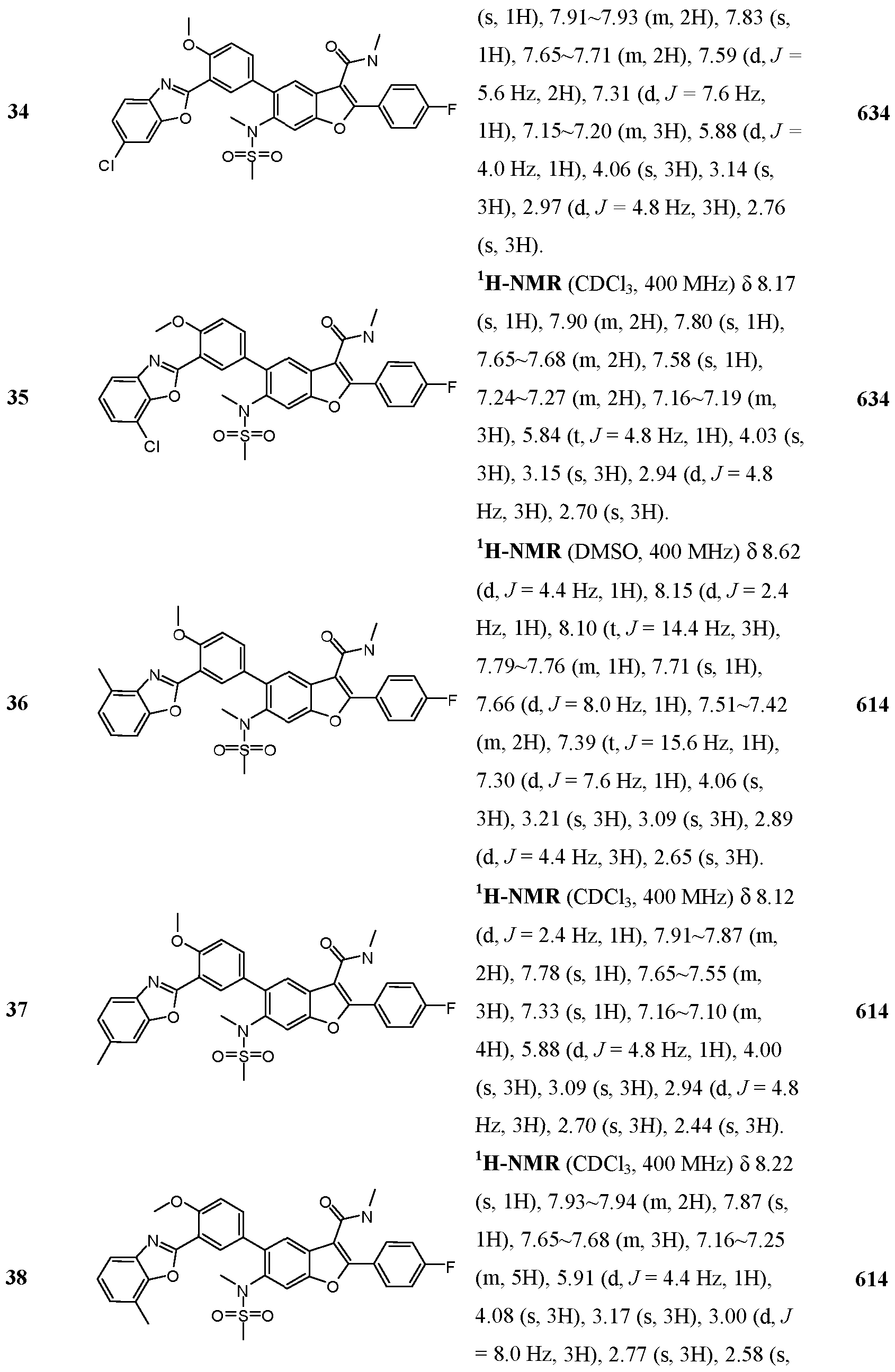
3H).
^-NMR (CDC13, 400 MHz) δ

3H), 2.94 (d, J = 4.8 Hz, 3H), 2.70 (s, 3H), 1.41 (d, J = 6.0 Hz, 6H).

s, 3H), 2.87 (s, 3H).
^-NMR (CDCI3, 400 MHz) δ 8.44

3H), 2.92-2.93 (d, J = 4.0 Hz, 3H), 2.68 (s, 3H).
^-NMR (CDCI3, 400 MHz) δ 8.71

3H), 3.03 (d, J = 5.2 Hz, 3H), 2.78 (s, 3H).
^-NMR (CDCI3, 400 MHz) δ 8.27

IH), 3.12 (s, 3H), 2.91 (d, J = 5.2 Hz, 3H), 2.67 (s, 3H).
^-NMR (CDC13, 400 MHz) δ 8.73

3.23 (s, 3H), 3.05 (d, J = 4.4 Hz,
3H), 2.87 (s, 3H).
^-NMR (CDCI3, 400 MHz) δ 8.44 (s, IH), 8.23 (s, 2H), 8.17-8.19 (m, IH), 7.80-7.83 (m, 2H), 7.64 (s,
45 IH), 7.59-7.61 (m, IH), 7.41-7.43 623
(m, IH), 7.15 (s, 2H), 5.67 (s, IH),

3.10 (s, 3H), 2.84 (d, J = 4.8 Hz,
3H), 2.55 (s, 3H).
^-NMR (CDCI3, 400 MHz) δ

3H), 2.99 (d, J = 4.8 Hz, 3H), 2.81
(s, 3H).
^-NMR (CDCI3, 400 MHz) δ 8.43 (s, IH), 8.31 (s, IH), 8.25 (d, J = 7.6 Hz, IH), 7.86-7.90 (m, 2H), 7.84 (s,
47 IH), 7.66-7.68 (m, IH), 7.57-7.61 589
(m, 3H), 7.13-7.18 (m, 2H), 5.81 (br

s, IH), 3.14 (s, 3H), 2.94 (d, .7 = 4.8
Hz, 3H), 2.65 (s, 3H).
^-NMR (CDCI3, 400 MHz) δ 8.49 (s, IH), 8.32 (s, 2H), 8.27-8.29 (m, IH), 7.90-7.93 (m, 2H), 7.84 (s,
48 IH), 7.69-7.72 (m, IH), 7.61-7.65 605
(m, 2H), 7.15 (s, 2H), 5.77 (s, IH),

3.13 (s, 3H), 2.94 (d, J = 4.8 Hz,
3H), 2.65 (s, 3H).
^-NMR (CDC13, 400 MHz) δ 8.57

3.15 (s, 3H), 2.94 (d, J = 4.8 Hz,
3H), 2.75 (s, 3H).
50 605
51 570
52 655

2.93-2.94 (m, 3H), 2.72 (s, 3H).
^-NMR (CDCI3, 400 MHz) δ 8.49 (d, J = 4.0 Hz, IH), 8.22 (d, J = 8.0
Hz, IH), 7.87-7.90 (m, 2H),
7.78-7.81 (m, 2H), 7.59 (s, IH),
53 7.39-7.46 (m, IH), 7.12-7.16 (m, 619
2H), 6.83 (d, J = 12.0 Hz, IH), 5.89

(s, IH), 4.00 (s, 3H), 3.22 (s, 3H),
2.94 (d, J = 8.0 Hz, 3H), 2.63 (s,
3H).
^-NMR (CDC13, 400 MHz) δ 8.55

(s, 3H), 2.93 (d,J= 4.8 Hz, 3H),
2.85 (s, 3H), 2.68 (s, 3H).
55 .4 596
,

3H), 2.78 (s, 3H).
^-NMR (CDCI3, 400 MHz) δ 8.59

3H), 2.99 (d,J = 4.8 Hz, 3H), 2.71
(s, 3H), 2.53 (s, 3H).
^-NMR (CDCI3, 400 MHz) δ 9.25

2H), 5.83 (s, IH), 3.13 (s, 3H), 2.92
(d,J= 4.8 Hz, 3H), 2.68 (s, 3H).
^-NMR (CDCI3, 400 MHz) δ 9.21

IH), 3.16 (s, 3H), 2.93 (d, .7=4.8
Hz, 3H), 2.80 (s, 3H).
^-NMR (CDCI3, 400 MHz) δ 8.95

5.88-5.87 (m, IH), 3.19 (s, 3H), 2.99 (d, J = 4.8 Hz, 3H), 2.68 (s, 3H).
^-NMR (CDC13, 400 MHz) δ 8.42

IH), 3.25 (s, 3H), 3.04 (d, J = 4.8
Hz, 3H), 2.82 (s, 3H).
^-NMR (CDCI3, 400 MHz) δ 8.27 (s, IH), 8.08 (s, IH), 7.99 (s, IH),
7.83-7.92 (m, 4H), 7.57 (s, IH),
65 7.38 (d, J = 8.0 Hz, IH), 7.13-7.17 623
(m, 2H), 5.83 (s, IH), 3.15 (s, 3H),

2.93 (d, J = 4.0 Hz, 3H), 2.73 (s,
3H).
^-NMR (CDCI3, 400 MHz) δ 8.38

3.03 (d, J = 4.8 Hz, 3H), 2.74 (s,
3H).
^-NMR (CDCI3, 400 MHz) δ

IH), 3.16 (s, 3H), 2.97 (d, J = 4.8
Hz, 3H), 2.77 (s, 3H).
^-NMR (CDCI3, 400 MHz) δ
8.25-8.30 (m, 3H), 8.01 (t, J = 6.8
Hz, IH), 7.88-7.92 (m, 2H), 7.83 (s, IH), 7.62 (s, IH), 7.26-7.32 (m,
68 2H), 7.15 (t, J = 8.4 Hz, 2H), 5.81 589
(d, J = 4.8 Hz, IH), 3.23 (s, 3H),

2.95 (d, J = 4.8 Hz, 3H), 2.58 (s,
3H).
^-NMR (CDCI3, 400 MHz) δ

IH), 3.14 (s, 3H), 2.94 (d, J = 4.0
Hz, 3H), 2.64 (s, 3H).
^-NMR (CDCI3, 400 MHz) δ 8.38 (s, IH), 8.34 (d, J = 7.6 Hz, IH),
8.27 (s, IH), 7.97-8.00 (m, 2H),
70 7.93 (s, IH), 7.67-7.84 (m, 4H), 589
7.25 (t, J = 8.4 Hz, 2H), 5.88 (br, s,

IH), 3.24 (s, 3H), 3.03 (d, J = 4.8
Hz, 3H), 2.74 (s, 3H).
^-NMR (CDCI3, 400 MHz) δ 8.37

3H), 4.17 (s, 3H), 3.21 (s, 3H), 3.01 (d, J = 4.0 Hz, 3H), 2.78 (s, 3H).
^-NMR (CDC13, 400 MHz) δ 8.23

(s, 3H), 2.93 (d, J = 4.0 Hz, 3H),
2.72 (s, 3H).

(d, J = 4.8 Hz, 3H), 2.72 (s, 3H).
^-NMR (CDCI3, 400 MHz) δ 8.43

J =17.6 Hz, 2H), 3.16 (s, 3H), 2.98
(s, 3H), 2.78 (d, J = 4.4 Hz, 3H).
^-NMR (CDCI3, 400 MHz) δ 8.42
(d, J = 3.6 Hz, IH), 8.34 (s, IH),
8.29 (s, 2H), 8.13 (d, J = 7.6 Hz,
IH), 7.96-7.99 (m, IH), 7.93 (s,
75 IH), 7.70 (d, J = 10.0 Hz, 2H), 605
7.41-7.44 (m, IH), 7.25 (t, J = 8.4
 Hz, 2H), 5.90 (s, IH), 3.25 (s, 3H),
3.04 (d, J = 4.8 Hz, 3H), 2.83 (s,
3H).
^-NMR (CDCI3, 400 MHz) δ 8.30

3H), 2.93 (d, J = 4.8 Hz, 3H), 2.57
(s, 3H).
77 655

2.93-2.94 (m, 3H), 2.72 (s, 3H).
^-NMR (CDCI3, 400 MHz) δ 8.61

1.2 Hz, 3H), 3.19 (s, 3H), 2.99 (d, J
= 4.4 Hz, 3H), 2.85 (s, 3H).
^-NMR (CDCI3, 400 MHz) δ 8.34

IH), 4.14 (s, 3H), 3.15 (s, 3H), 2.94
(d, J = 4.0 Hz, 3H), 2.78 (s, 3H).
^-NMR (CDCI3, 400 MHz) δ

3H), 4.00 (s, 3H), 3.11 (s, 3H), 3.02
(d, J = 4.8 Hz, 3H), 2.94 (s, 3H).
^-NMR (CDC13, 400 MHz) δ
8.30-8.32 (m, IH), 8.03-8.06 (m,
IH), 7.89-7.92 (m, 2H), 7.81 (s,
IH), 7.71 (d, J = 2.0 Hz, IH), 7.52
81 (s, IH), 7.39 (d, J = 2.0 Hz, IH), 631
7.29-7.32 (m, IH), 7.12-7.16 (m,
 2H), 5.79-5.81 (m, IH), 4.06 (s,
3H), 3.93 (s, 3H), 3.04 (s, 3H), 2.94
(d, J = 4.8 Hz, 3H), 2.87 (s, 3H).
^-NMR (CDCI3, 400 MHz) δ 8.54

3.15 (br s, 5H), 2.99 (d, J = 4.8 Hz,
3H), 2.93 (br s, 4H), 2.81 (s, 3H).
^-NMR (CDCI3, 400 MHz) δ 8.55

(s, 3H), 3.00 (d, J = 4.8 Hz, 3H),
2.81 (s, 3H).
^-NMR (CDCI3, 400 MHz) δ 8.53

(s, 3H), 2.94 (d, J = 4.8 Hz, 3H),
2.73 (s, 3H).
^-NMR (CDC13, 400 MHz) δ 8.85
(s, IH), 8.54-8.57 (m, 2H), 8.13 (s, IH), 8.02-8.04 (m, 3H), 7.75-7.78
85 (m, IH), 7.62 (s, IH), 7.42-7.45 (m, 635
2H), 5.80 (br s, IH), 4.00 (s3H),

3.15 (s, 3H), 2.99 (s, 3H), 2.80 (d, J
= 4.8 Hz, 3H).
^-NMR (CDCI3, 400 MHz) δ 8.52
(d, J = 2.8 Hz, IH), 8.38 (s, IH),
8.33 (d, .7 = 7.6 Hz, IH), 8.26 (d, J =
2.4 Hz, IH), 7.87-7.91 (m, 2H),
86 7.84 (s, IH), 7.73 (d, J = 8.0 Hz, 572
IH), 7.59-7.64 (m, 2H), 7.15 (t, J =

8.4 Hz, 2H), 5.78 (br, s, IH), 3.16 (s, 3H), 2.93 (d, J = 5.2 Hz, 3H), 2.66
(s, 3H).
^-NMR (CDCI3, 400 MHz) δ 9.14

3.14 (s, 3H), 2.93 (d, J = 4.8 Hz,
3H), 2.69 (s, 3H).
^-NMR (CDCI3, 400 MHz) δ 9.09

IH), 3.15 (s, 3H), 2.94 (d, J = 4.8
Hz, 3H), 2.67 (s, 3H).
^-NMR (DMSO, 400 MHz) δ 8.62

3H), 3.05 (s, 3H), 2.83 (d, J = 4.4 Hz, 3H).
^-NMR (CDC13, 400 MHz) δ 8.42

IH), 3.22 (s, 3H), 3.01 (d, J = 4.8 Hz, 3H), 2.88 (s, 3H).
^-NMR (CDCI3, 400 MHz) δ

2.94 (d, J = 4.8 Hz, 3H), 2.74 (s, 3H).
^-NMR (CDCI3, 400 MHz) δ 9.51

2H), 5.96 (s, IH), 3.21 (s, 3H), 2.98 (d, J = 4.8 Hz, 3H), 2.88 (s, 3H).
^-NMR (CDCI3, 400 MHz) δ

Hz, IH), 4.99 (s, 3H), 4.32 (s, 3H), 4.12 (d, J = 4.8 Hz, 3H), 3.73 (s, 3H).
^-NMR (CDC13, 400 MHz) δ 8.18

3H), 3.01 (d, J = 4.0 Hz, 3H), 2.72
(s, 3H).
^-NMR (CDCI3, 400 MHz) δ 8.42 (d, J = 4.0 Hz, IH), 8.09 (s, IH),
7.91-7.96 (m, 4H), 7.64 (s, 2H),
98 7.39 (s, IH), 7.34-7.36 (m, 2H), 603
6.80 (s, IH), 4.80 (d, J = 4.0 Hz,

IH), 3.24 (s, 3H), 2.76 (d, J = 4.0
Hz, 3H), 2.40 (s, 3H).
^-NMR (CDCI3, 400 MHz) δ 8.45

3.22 (s, 3H), 3.03 (d, J = 4.8 Hz,
3H), 2.82 (s, 3H), 2.73 (s, 3H).
^-NMR (CDCI3, 400 MHz) δ 8.53

3.16 (s, 3H), 2.97 (d, J = 4.0 Hz,
3H), 2.72 (s, 3H).
^-NMR (CDCI3, 400 MHz) δ

IH), 5.86 (s, IH), 3.07 (s, 3H), 2.94
(d, J = 4.8 Hz, 3H), 2.61 (s, 3H).
^-NMR (CDC13, 400 MHz) δ 9.53
(s, IH), 8.69 (s, IH), 8.63-8.65 (m, IH), 8.09-8.12 (m, IH), 7.93-7.97
102 (m, 4H), 7.88 (s, IH), 7.60-7.68 (m, 502
4H), 7.12-7.20 (m, 2H), 5.91 (br s,

IH), 3.20 (s, 3H), 3.02 (s, 3H), 2.62
(s, 3H).
^-NMR (CDCI3, 400 MHz) δ 8.60 (d, J = 6.8 Hz, IH), 8.28 (s, IH),
8.22 (d, J = 7.2 Hz, IH), 7.99 (d, J =
9.2 Hz, IH), 7.91-7.94 (m, 2H),
103 7.80 (s, IH), 7.68 (d, J = 7.6 Hz, 570
IH), 7.57-7.64 (m, 3H), 7.14 (t, J =

8.4 Hz, 3H), 6.18 (s, IH), 3.13 (s,
3H), 2.94 (d, J = 4.4 Hz, 3H), 2.60
(s, 3H).
^-NMR (CDCI3, 400 MHz) δ 8.38 (d, J = 8.0 Hz, IH), 7.87-7.90 (m,
2H), 7.77 (s, IH), 7.61 J = 8.0 Hz,
104 IH), 7.39-7.54 (m, 8H), 7.14 (t, J = 596
8.0 Hz, 2H), 6.54 (d, J = 8.0 Hz,

IH), 5.81 (s, IH), 3.15 (s, 3H), 2.93
(d, J = 4.0 Hz, 3H), 2.67 (s, 3H).
^-NMR (CDCI3, 400 MHz) δ 8.71

3H), 2.94 (d, J = 4.0 Hz, 3H), 2.68
(s, 3H).
^-NMR (CDCI3, 400 MHz) δ

3H), 3.02 (d, J = 4.4 Hz, 3H), 2.84
(s, 3H).
^-NMR (CDC13, 400 MHz) δ 8.60

3H), 2.93 (d, J = 4.0 Hz, 3H), 2.69
(s, 3H).
^-NMR (CDCI3, 400 MHz) δ 9.50 (s, IH), 8.75 (d, J = 8.0 Hz, IH),
8.36 (s, IH), 8.31 (d, J = 4.0 Hz,
IH), 8.24 (d, J = 8.0 Hz, IH),
108 7.93- 7.97 (m, 3H), 7.78 (s, IH), 587
7.70-7.76 (m, IH), 7.68 (s, IH),

7.26-7.30 (m, 2H), 6.00 (d, J = 4.0
Hz, IH), 3.17 (s, 3H), 3.02 (d, J =
4.0 Hz, 3H), 2.92 (s, 3H).

(d, J = 4.8 Hz, 3H), 2.89 (s, 3H).
^-NMR (CDCI3, 400 MHz) δ 9.47 (d, J = 5.6 Hz, IH), 8.68 (d, J = 5.2
Hz, IH), 8.32 (s, IH), 8.18-8.21 (m, 2H), 7.89 (s, IH), 7.84-7.89 (m,
110 2H), 7.72 (d, .7 = 8.0 Hz, IH), 587
7.60-7.64 (m, IH), 7.60 (s, IH),

7.15-7.17 (m, 2H), 5.77 (br s, IH),
3.09 (s, 3H), 2.92 (d, J = 4.0 Hz,
3H), 2.81 (s, 3H).
^-NMR (CDC13, 400 MHz) δ

(s, 3H), 3.01 (d, J = 4.8 Hz, 3H),
2.67 (s, 3H).
^-NMR (CDCI3, 400 MHz) δ 8.79 (d, J = 8.0 Hz, IH), 8.63 (d, J = 8.0
Hz, IH), 8.35 (s, IH), 8.24 (d, J =
8.4 Hz, IH), 8.03-8.14 (m, 5H),
112 7.92 (s, IH), 7.83-7.88 (m, 2H), 580
 7.75 (t, J = 7.6 Hz, IH), 7.62 (s,
IH), 7.23 (t, J = 8.4 Hz, 2H), 6.77
(s, IH), 3.13 (s, 3H), 3.06 (d, J = 7.2 Hz, 3H), 2.93 (s, 3H).
^-NMR (CDCI3, 400 MHz) δ 9.24

3.14 (s, 3H), 2.93 (d, J = 5.2 Hz,
3H), 2.58 (s, 3H).
^-NMR (CDCI3, 400 MHz) δ 9.56

3H), 3.00 (d, J = 4.8 Hz, 3H), 2.63
(s, 3H).
^-NMR (CDC13, 400 MHz) δ 8.68

Hz, IH), 3.06 (s, 3H), 2.94 (d, J = 4.8 Hz, 3H), 2.80 (s, 3H).
^-NMR (CDCI3, 400 MHz) δ 8.55

IH), 5.85 (s, IH), 3.24 (s, 3H), 2.30 (d, 3H), 2.80 (s, 3H).
^-NMR (CDCI3, 400 MHz) δ 8.66

4.19 (s, 3H), 3.19 (s, 3H), 3.03 (d, J = 5.2 Hz, 3H), 2.86 (s, 3H).
^-NMR (DMSO, 400 MHz) δ 8.82

2H), 3.17 (s, 3H), 3.02 (s, 3H), 2.83 (d, J = 4.4 Hz, 3H).
^-NMR (DMSO, 400 MHz) δ 9.27

2.93 (d, J = 8.0 Hz, 3H), 2.70 (s,
3H).
^-NMR (MeOD, 400 MHz) δ
7.94-7.98 (m, 4H), 7.86-7.89 (m,
2H), 7.79 (s, IH), 7.67-7.72 (m,
120 2H), 7.63 (t, J = 8.0 Hz, 2H), 7.57 (s, 618
IH), 7.15 (t, J = 8.8 Hz, 2H), 5.79 (s,

IH), 3.16 (s, 3H), 2.92 (d, J = 4.8
Hz, 3H), 2.71 (s, 3H).

(d, J = 4.8 Hz, 3H), 2.71 (s, 3H).
XH NMR: (CDCI3, 400 MHz) δ

IH), 2.99 (s, 3H), 2.92 (d, J = 4.8
Hz, 3H), 2.60 (s, 3H).
^-NMR (CDCI3, 400 MHz) δ
7.87-7.90 (m, 2H), 7.77 (s, IH),
7.54-7.59 (m, 5H), 7.12-7.17 (m,
123 2H), 6.93-6.97 (m, 4H), 6.64-6.66 621
(br s, IH), 5.80-5.82 (m, IH), 3.13

(s, 3H), 2.95 (d, J = 4.8 Hz, 3H),
2.58 (s, 3H).
^-NMR (CDC13, 400 MHz) δ 8.21

(d,J= 4.8 Hz, 3H), 2.73 (s, 3H).
^-NMR (CDC13, 400 MHz) δ 8.26

3.15 (s, 3H), 2.98 (d, J = 4.8 Hz,
3H), 2.83 (s, 3H).
^-NMR (CDCI3, 400 MHz) δ 8.15

IH), 3.13 (s, 3H), 2.94 (d, J = 4.8
Hz, 3H), 2.74 (s, 3H).
^-NMR (CDCI3, 400 MHz) δ 8.18

3H), 3.13 (s, 3H), 2.97 (s, 3H), 2.78
(d, .7 = 8.0 Hz, 3H).
^-NMR (CDCI3, 400 MHz) δ 8.17

3H), 3.01 (d, J = 4.8 Hz, 3H), 2.82
(s, 3H).
^-NMR (CDCI3, 400 MHz) δ 8.26 (s, IH), 7.95-7.98 (m, 2H), 7.88 (s, IH), 7.74 (d, J = 8.4 Hz, IH), 7.65
254 (s, IH), 7.20-7.23 (m, 3H), 636
7.02-7.11 (m, 2H), 6.07 (s, IH),

4.11 (s, 3H), 3.20 (s, 3H), 3.05 (d, J
= 4.8 Hz, 3H), 2.57 (s, 3H).
^-NMR (CDC13, 400 MHz) δ 8.19
(d, J= 2.0 Hz, 1H), 7.91-7.93 (m,
2H), 7.90 (s, 1H), 7.70-7.72 (m,
1H), 7.62 (s, 1H), 7.34 (d, J= 8.0
255 Hz, 1H), 7.18-7.22 (m, 3H), 636

Hz, 1H), 4.07 (s, 3H), 3.17 (s, 3H),
2.99 (d, J = 4.0 Hz, 3H), 2.80 (s,
3H).
^-NMR (CDCI3, 400 MHz) δ 8.18

(s, 3H). 3.04 (d, J= 4.8 Hz, 3H),
2.74 (s, 3H), 2.56 (s, 3H).
Example 2
Preparation of Compound 127

Step 1 - Synthesis of 5-(3-(6-aminobenzo[d]oxazol-2-yl)phenyl)-2-(4-fluorophenyl)-N-methyl-6- (N-methylmethylsulfonamido)benzofuran-3-carboxamide

To a solution of Compound 41 (prepared according to the method described in Example 1, 530 mg, 0.13 mmol) in MeOH (10 mL), Pd/C (10 mg) was added, and the resulting reaction mixture was allowed to stir under 40 psi of H2 atmosphere for 24 hours at 25 °C. The
reaction mixture was filtered, concentrated in vacuo and the residue obtained was purified using flash column chromatography (PE : EtOAc = 2 : 1) to provide 5-(3-(6-aminobenzo[d]oxazol-2- yl)phenyl)-2-(4-fluorophenyl)-N-methyl-6-(N-methylmethylsulfonamido)benzofuran-3- carboxamide (420 mg, 85%). 1H- MR (DMSO, 400 MHz) δ 8.55 (s, 1H), 8.00-8.11 (m, 5H), 7.59-7.63 (m, 3H), 7.38-7.40 (m, 3H), 6.80 (s, 1H), 6.62-6.64 (d, J= 8.4 Hz, 1H), 5.47 (s, 2H), 3.12 (s, 3H), 2.93 (s, 3H), 2.79-2.80 (d, J= 4.0 Hz, 3H). MS (M+H)+: 585.
Step 2 - Synthesis of 2-(4-fluorophenyl)-N-methyl-6-(N-methylmethylsulfonamido)-5-(3-(6- (methylsulfonamido)benzo[d]oxazol-2-yl)phenyl)benzofuran-3-carboxamide (Compound 127)

To a solution of 5-(3-(6-aminobenzo[d]oxazol-2-yl)phenyl)-2-(4-fluorophenyl)- N-methyl-6-(N-methylmethylsulfonamido)benzofuran-3-carboxamide (50 mg, 0.13 mmol) and pyridine (0.2 mL) in 1 mL of dry dichloromethane, MsCI (50 mg, 0.44 mmol) was added dropwise at 0 °C. After stirred at room temperature for 4 hours, the mixture was quenched with 20%) aq. H4C1, then extracted with dichloromethane and washed with brine, dried over Na2S04, filtered and concentrated in vacuo. The residue obtained was purified using preparative HPLC to provide 2-(4-fluorophenyl)-N-methyl-6-(N-methylmethylsulfonamido)-5-(3-(6- (methylsulfonamido)benzo[d]oxazol-2-yl)phenyl)benzofuran-3-carboxamide (Compound 127, 43 mg, 90.1%). 1H- MR (CDC13, 400 MHz) δ 8.17-8.23 (m, 3H), 7.88-7.92 (m, 2H), 7.80 (s, 1H), 7.55-7.60 (m, 4H), 7.25 (s, 1H), 7.12-7.14 (m, 2H), 7.06-7.08 (m, 1H), 5.79 (s, 1H), 3.13 (s, 3H), 2.93-2.94 (d, J= 4.8 Hz, 3H), 2.60 (s, 3H), 2.56 (s, 3H). MS (M+H)+: 663.
Compounds 128-133, depicted in the table below, were prepared using the method described in Example 2 and substituting the appropriate reactants and/or reagents.
MS
Compound Structure NMR
(M+H)+
^-NMR (CDC13, 400 MHz) δ
128 628
129 690
130 726
131 783

3H), 2.53 (br s. IH), 1.95 (br s, 3H).
1.52 (s, 9H).
^-NMR (CDC13, 400 MHz) δ 8.25
(s, 1H), 8.15 (d, J = 8.0 Hz, 1H),
7.87-7.90 (m, 2H), 7.82 (s, 1H),

5.77 (d, J = 3.6 Hz, 1H), 3.12 (s,
3H), 2.92 (d, J = 4.8 Hz, 3H), 2.63
(s, 3H).
^-NMR (CDCI3, 400 MHz) δ 8.25 (s, 1H), 8.20 (d, J = 8.0 Hz, 1H),
7.91 (t, J = 8.0 Hz, 3H), 7.81 (s,
1H), 7.59 (t, J = 9.6 Hz, 2H), 7.54
(d, J = 7.6 Hz, 1H), 7.45 (s, 2H),
133 7.15 (t, J = 8.4 Hz, 2H), 5.79 (d, J = 783
4.4 Hz, 1H), 4.44-4.48 (m, 1H),
 3.27-3.41 (m, 2H), 3.12 (s, 3H),
2.94 (d, J = 5.2 Hz, 3H), 2.62 (s,
3H), 2.50-2.57 (m, 1H), 1.86-1.90
(m, 3H), 1.45 (s, 9H).
Example 3
Preparation of Compound 134

Step 1 - Synthesis of 2-(4-fluorophenyl)-5-(3-formylphenyl)-N-methyl-6-(N- methylmethylsulfonamido)benzofuran- -carboxamide l)

Step 2 - Synthesis of 5-(3-(6-cyanobenzo[d]thiazol-2-yl)phenyl)-2-(4-fluorophenyl)-N-methyl-6- (N-methylmethylsulfonamido)benzofuran-3-carboxamide (Compound 134)

A mixture of the aryl aldehyhyde Ql (150 mg, 0.31 mmol) and 4-amino-3- mercaptobenzonitrile (56 mg, 0.37 mmol) in DMSO (3 mL) was allowed to stir at 200 °C for 2 hours. After cooled, the mixture was diluted with water and extracted with EtOAc. The combined organic phases were washed with brine, dried over Na2S04, filtered and concentrated in vacuo. The residue was purified using preparative HPLC to provide Compound 134 (150 mg, 79%). 1H- MR (CDC13, 400 MHz) δ 8.27-8.28 (m, 2H), 8.14-8.19 (m, 2H), 7.94-7.99 (m, 3H), 7.76-7.84 (m, 1H), 7.63-7.72 (m, 3H), 7.23-7.25 (m, 2H), 5.91-5.92 (m, 1H), 3.19 (s, 3H), 3.20 (d, J= 4.4 Hz, 3H), 2.81 (s, 3H). MS (M+H)+: 611. Compounds 135-142, depicted in the table below, were prepared using the method described in Example 3 and substituting the appropriate reactants and/or reagents.
MS
Compound Structure NMR
(M+H)'
^-NMR (CDC13, 400 MHz) δ
8.01-8.10 (m, IH), 7.89-7.98 (m, 6H), 7.68 (s, IH), 7.53-7.57 (m,
135 IH), 7.43-7.48 (m, IH), 7.34-7.37
(m, IH), 7.24 (t, J = 8.8 Hz, 2H),
 5.97 (br s, IH), 3.21 (s, 3H), 3.04 (d,
.7 = 4.8 Hz, 3H), 2.84 (s, 3H).
^-NMR (CDCI3, 400 MHz) δ 8.13-8.16 (m, 2H), 8.02-8.05 (m, IH), 7.90-7.96 (m, 2H), 7.88 (d, J = 4.0 Hz, 2H), 7.67 (s, IH), 7.47-7.51
136 (m, IH), 7.37-7.41 (m, IH),
7.26-7.31 (m, IH), 7.17-7.12 (m,

2H), 6.00 (br s, IH), 3.25 (s, 3H), 2.99 (d, J = 4.8 Hz, 3H), 2.64 (s,
137

^-NMR (CDCI3, 400 MHz) δ 8.15 (s, IH), 8.04-8.06 (m, IH), 7.87-7.91 (m, 2H), 7.82 (s, IH), 7.76-7.79 (m, IH), 7.66-7.69 (m,
138 IH), 7.57 (d, .7 = 9.2 Hz, IH),
7.51-7.56 (m, 2H), 7.09-7.17 (m,

3H), 5.80 (d, .7 = 3.6 Hz, IH), 3.11 (s, 3H), 2.92 (d, J = 5.2 Hz, 3H), 2.66 (s, 3H).
^-NMR (CDC13, 400 MHz) δ
8.39-8.41 (m, 1H), 7.94-7.97 (m,
1H), 7.87-7.90 (m, 2H). 7.82 (s,
139 1H), 7.56-7.58 (m, 3H), 7.25-7.30 622
(m, 1H), 7.13-7.17 (m, 3H), 5.78 (s,

1H), 3.09 (s, 3H), 2.93 (d, J = 4.8
Hz, 3H), 2.77 (s, 3H).
^-NMR (CDCI3, 400 MHz) δ 8.41
(d, J = 5.6 Hz, 1H), 7.88-7.92 (m,
3H). 7.81 (s, 1H), 7.68 (s. 1H).
140 7.55-7.58 (m. 2H). 7.25-7.29 (m, 618
2H), 7.12-7.15 (m. 2H), 5.81 (br s,

1H), 3.08 (s, 3H), 2.94 d, J = 4.8
Hz, 3H), 2.76 (s, 3H), 2.46 (s, 3H).
^-NMR (CDCI3, 400 MHz) δ
8.22-8.24 (m, 1H), 8.12 (s. 1H).
8.03-8.05 (m. 1H). 7.81-7.85 (m,
2H), 7.78 (s, 1H), 7.68-7.70 (m, βπ
1H), 7.52-7.62 (m, 4H), 7.13-7.18
 (m, 2H), 6.12-6.13 (m, 1H), 3.12 (s,
3H), 2.96 (d, J = 5.2 Hz. 3H), 2.68
(s. 3H).
142 622

Example 4
Preparation of Compound 143

134 143
To a solution of Compound 134 (120 mg, 0.20 mmol) and H4OH (0.5 mL) in MeOH (10 mL), was added Raney-Ni (100 mg). The resulting solution was degassed and then was shaken under hydrogen gas atmosphere (30 psi) for about 15 hours. The reaction mixture was filtered and the collected solid was washed with MeOH. The filtrate and washing were combined and concentrated in vacuo to provide Compound 143 (80 mg, 66%). 1H-NMR
(MeOD, 400 MHz) δ 8.23 (s, 1H), 8.12-8.14 (m, 1H), 8.06-8.09 (m, 2H), 7.94-7.97 (m, 2H), 7.82 (s, 1H), 7.74 (s, 1H), 7.69 (s, 1H), 7.57-7.67 (m, 2H), 7.22-7.26 (m, 2H), 4.24 (s, 2H), 3.18 (s, 3H), 2.92 (s, 3H), 2.89 (s, 3H). MS (M+H)+: 615.
Example 5
Preparation of Compound 144

CF3COOH (0.1 mL) was added to a solution of Compound 143 (50 mg, 0.08 mmol) and paraformaldehyde (5 mg, 0.16 mmol) in MeOH (2 mL). The resulting reaction was allowed to stir at room temperature for 3 hours, then Na(CN)BH3 (10 mg, 0.16 mmol) was added. The reaction mixture was allowed to stir at room temperature for about 15 hours, then was quenched with saturated H4C1 solution and extracted with EtOAc. The combined organic phases were washed with brine, dried over Na2S04, filtered and concentrated in vacuo. The residue obtained was purified using preparative HPLC to provide Compound 144 (20 mg, 38%). 1H- MR (CDC13, 400 MHz) δ 8.14 (s, 1H), 8.03-8.08 (m, 2H), 7.99 (s, 1H), 7.87-7.91 (m, 2H), 7.83 (s, 1H), 7.53-7.60 (m, 3H), 7.44-7.46 (m, 1H), 7.13-7.17 (m, 2H), 5.82-5.83 (m, 1H), 4.25 (s, 2H), 3.11 (s, 3H), 2.92 (d, J= 8.0 Hz, 3H), 2.75 (s, 6H), 2.67 (s, 3H). MS (M+H)+: 643.
Example 6
Pre aration of Compound 145

145
A solution of aryl aldehyde Ql (100 mg, 0.385 mmol) in pyridine-2, 3 -diamine (58 mg, 0.42 mmol) was heated to 160 °C and allowed to stir at this temperature for 2 hours. The reaction mixture was cooled to room temperature, quenched with water, and extracted with EtOAc. The organic layer was concentrated in vacuo and the resulting residue was purified using prep-TLC (DCM : MeOH = 20 : 1) to provide Compound 145 (50 mg, 53.7%). 1H-NMR (CDC13, 400 MHz) δ 8.26-8.29 (m, 2H), 8.07 (s, 1H), 7.74-7.82 (m, 4H), 7.41-7.52 (m, 3H), 7.25-7.27 (m, 1H), 7.05-7.15 (m, 3H), 3.14 (s, 3H), 2.94 (s, 3H), 2.82 (d, J= 4.8 Hz, 3H). MS (M+H)+: 570.
Compounds 146-196, depicted in the table below, were prepared using the method described in Example 6 and substituting the appropriate reactants and/or reagents.
MS
Compound Structure NMR
(M+H)+
'H-NMR (CDCI3, 400 MHz) δ
8.53-8.56 (m, 1H), 7.98-8.01 (m,
2H), 7.88 (s, 1H), 7.63-7.70 (m, 3H),
146 7.61 (s, 1H), 7.32-7.34 (m, 4H), 587
7.20-7.25 (m, 2H), 6.14 (s, 1H), 3.15

(s, 3H), 3.04 (d, J = 4.8 Hz, 3H), 2.92
(s, 3H).
'H-NMR (CDCI3, 400 MHz) δ
8.15-8.17 (m, 1H), 7.76-7.79 (m,
2H), 7.70 (s, 1H), 7.64 (m, 3H), 7.43
147 (s, 1H), 7.33-7.36 (m, 1H), 7.14-7.17 605
(m, 1H), 7.03-7.07 (m, 2H),

6.95-7.00 (m, 1H), 3.00-3.01 (m,
6H), 2.92 (s, 3H).
'H-NMR (CDCI3, 400 MHz) δ
8.24- 8.26 (m, IH), 7.81-7.87 (m,
601
583
587
588
618

3H).
^-NMR (MeOD. 400 MHz) δ 8.39
602 588 618 602 , 622

3.01 (s, 3H), 2.85 (s, 3H).
'H-NMR: (CDC13, 400 MHz) δ 8.48

3.08 (s, 3H). 2.94 (d. J = 4.8 Hz, 3H). 2.80 (s, 3H).
^-NMR (CDC¾, 400 MHz) δ 9.52-9.61 (m, IH), 8.36 (s, IH),

3.01 (s, 3H). 2.96 (d. J = 4.8 Hz, 3H). 2.86 (s, 3H).
^-NMR (MeOD, 400 MHz) δ 8.54
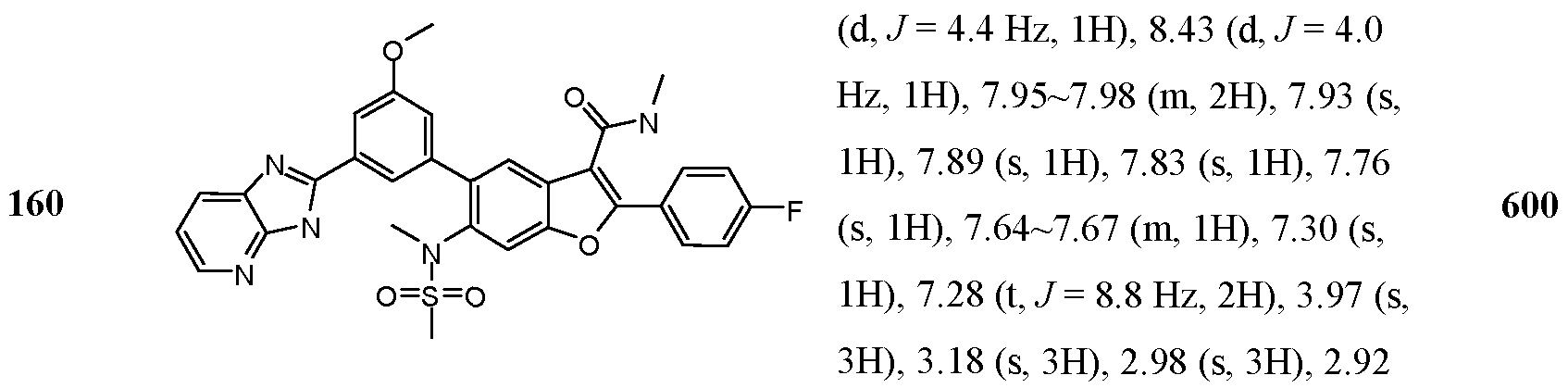
(s. 3H).
^-NMR (MeOD, 400 MHz) δ

3.11 (s, 3H). 2.91 (s. 3H), 2.86 (s, 3H).
^-NMR (CDC13, 400 MHz) δ 8.32

(d, J = 4.0 Hz. IH). δ 8.26 (d, J =
8.0 Hz, IH), 8.05 (s. IH), 7.98-8.00
165 (m. 2H). 7.97 (s, IH), 7.90 (s, IH). 604
7.74-7.78 (m, 2H), 7.49-7.52 (m,

2H), 7.26-7.30 (m, 2H), 3.22 (s,
3H), 2.99 (s, 3H), 2.96 (s, 3H).

2.96 (s. 3H).
^-NMR (MeOD, 400 MHz) δ 8.45
(d, J = 8.0 Hz, IH), 7.96-7.99 (m,
3H), 7.91 (s, IH), 7.76-7.87 (d, J =
167 8.0 Hz, 3H), 7.50-751 (d, J = 4.0 Hz, 618
IH), 7.36-7.31 (m, 2H), 3.21 (s, 3H),

3.00 (s, 3H), 2.95 (s, 3H), 2.84 (s,
3H).
^-NMR (MeOD, 400 MHz) δ
8.42-8.43 (d, J = 4.0 Hz, IH),
8.11-8.12 (d, J = 4.0 Hz, IH),
168 7.97-8.01 (m, 3H), 7.89 (s, IH), 7.79 638
(s, IH), 7.24 (s, 2H), 7.26-7.30 (m,

2H), 3.22 (s, 3H), 2.97 (s, 3H), 2.96
(s, 3H)
^-NMR (MeOD, 400 MHz) δ 8.50


Ή-NMR (CDC13. 400 MHz) δ 8.13 (s, IH), 7.80-7.94 (m, 4H), 7.65 (s, IH). 7.48 (d, J = 7.6 Hz, IH),
173 7.07-7.35 (m, 4H), 6.77 (d, J = 8.0
Hz, IH), 3.86 (s, 3H), 2.96 (s, 3H),

2.92 (d, J = 4.4 Hz, 3H), 2.88 (s, 3H). 5
 J
J
= 4.4 Hz. 3H), 2.83 (s, 3H).
XH NMR (CDCI3, 400 MHz) 5 8.19 (s, IH), 8.15 (d, .7 = 3.6 Hz, IH), 8.09 (d, J = 7.6 Hz, IH), 7.86-7.89
175 (m, 3H), 7.57 (s. 2H), 7.43 (s, IH),
7.06-7.18 (m. 3H). 6.05 (s, IH),
 3.49 (s. 3H), 3.12 (s, 3H), 2.94 (d, J
= 4.8 Hz. 3H), 2.83 (s, 3H).
^-NMR (CDCI3, 400 MHz) δ 7.96-8.00 (m, 2H), 7.84 (s, IH), 7.81 (s, IH), 7.76 (d, J = 7.6 Hz, IH),
176 7.67-7.71 (m. IH), 7.54-7.61 (m,
4H), 7.13-7.18 (m. 2H), 6.72 (d, J = 4

Hz, IH), 4.08 (s. 3H). 3.14 (s, 3H), 2.96 (d. J = 4.4 Hz, 3H), 2.88 (s, 3H).
^-NMR (CDC13, 400 MHz) δ 8.54
(d, J = 4.0 Hz, IH), 8.35 (s, IH), 8.27 (s, IH), 8.23 (s, IH), 8.17(s, IH), 8.04
177 (s, IH), 7.97-8.01 (m, 2H), 7.63-7.66
(m, 2H), 7.38-7.43 (m, 2H), 3.14 (s,

3H), 2.92 (s, 3H). 2.80 (d, J = 4.0 Hz, 3H).
'H-NMR (CDCI3, 400 MHz) δ 7.96-8.00 (m, 4H), 7.84 (s, IH), 7.81 (s, IH), 7.76 (d, J = 7.6 Hz, IH), 7.67-7.71 (m, IH), 7.54-7.61 (m, 4H), 7.13-7.18 (m, 2H), 6.72 (d,
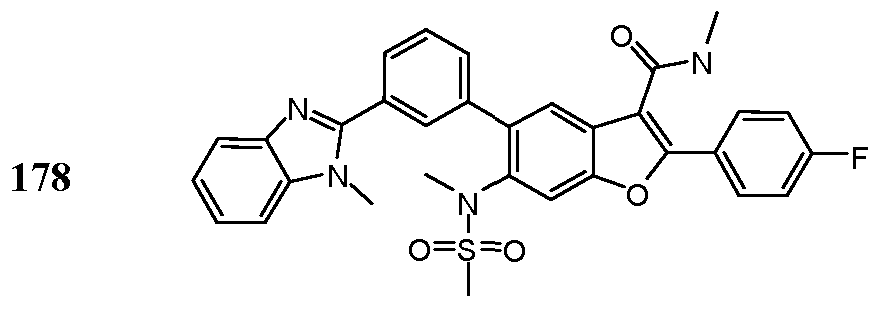 J = 4 Hz, IH). 4.08 (s, 3H), 3.14 (s,
3H), 2.96 (d. J = 4.4 Hz, 3H), 2.88 (s, 3H).
'H-NMR (MeOD, 400 MHz) δ 9.23 (s, IH). 8.53 (d, J = 6.4 Hz, IH), 8.39 (s, IH), 8.28 (d, J = 8 Hz, IH),
179 8.09 (d, J = 6.4 Hz, IH), 7.79-8.01
(m, 2H), 7.92 (s, IH), 7.71-7.83 (m,

3H), 7.27-7.33 (m, 2H), 3.24 (s, 3H), 2.95 (s, 3H). 2.92 (s, 3H). ^-NMR (CDCI3. 400 MHz) δ 9.78 (s. IH). 8.67-8.70 (m, IH), 8.61-8.63 (m, IH), 8.39-8.41 (m, IH), 8.24-8.30 (m, IH), 8.16 (s, IH), 7.85-7.88 (m, 2H), 7.75 (s,
 IH), 7.50 (t, J = 8.8 Hz, 2H), 5.70 (s,
IH), 3.28 (s. 3H), 3.09 (s, 3H), 2.88 (d, .7 = 4.8 Hz. 3H).
^-NMR (CDCI3. 400 MHz) 9.08 (s, IH), 8.27-8.32 (m. 2H). 8.12 (s, IH). 7.86-7.89 (m, 2H), 7.77 (s,
181 2H), 7.51 (s, IH), 7.27 (t, J= 8.8 Hz,
IH), 7.11 (t, J = 8.0 Hz, 2H), 6.53 (s,

IH), 3.23 (s, 3H), 2.90 (d, J = 4.0 Hz, 3H), 2.70 (s, 3H).

3H). 2.94 (s, 3H), 2.93 (s. 3H).
^-NMR (CDCI3, 400 MHz) δ 10.78 (br s, IH), 8.54 (s, IH), 8.40 (s, 2H),
7.84-7.88 (m, 2H), 7.72-7.74 (m,
184 2H), 7.50 (s. IH), 7.08-7.13 (m, 3H). 60i
6.68 (s, IH). 4.14 (s, 3H), 3.07 (s,
 IH). 3.13 (s, 3H), 2.96 (d, J = 4.8 Hz,
3H), 2.82 (s, 3H).
601
605
571  'H-NMR (MeOD. 400 MHz) δ 9.04
(s, IH), 8.89 (s, IH). 8.28-8.31 (m,
IH), 7.87-7.91 (m, 2H), 7.81 (s,
188 IH), 7.67-7.73 (m, 2H), 7.36-7.41 589
(m, 2H), 7.36-7.41 (m. IH), 7.19 (t,

J = 8.8 Hz, 2H), 3.15 (s. 3H). 2.86
(s, 6H).
'H-NMR (DMSO. 400 MHz) δ 9.10 (s, IH), 8.95 (s, IH). 8.52-8.53 (m,
IH), 8.15 (s, IH), 7.97-8.08 (m,
189 4H), 7.70 (s, IH), 7.50-7.52 (m, 589
IH), 7.38-7.42 (m, 2H). 3.18 (s,
 3H). 2.98 (s. 3H), 2.79-2.80 (m.
3H).
Ή-NMR (CDC13, 400 MHz) δ 9.02
(s, IH), 8.91 (s, IH), 8.51 (s, IH),
7.90-7.94 (m, 2H), 7.77 (s, IH),
190 7.68-7.70 (m, IH), 7.55 (s. IH), 601
7.12-7.18 (m, 3H), 4.17 (s. 3H). 3.33
 (s, IH), 3.13 (s. 3H). 2.93 (s, 3H),
2.80 (s, 3H).

(s, IH), 9.06 (s, IH), 8.59 (d, J = 4.0 Hz, IH), 8.04-8.08 (m, 3H), 8.01 (d,
193 J = 4.0 Hz, IH), 7.83-7.85 (m, 2H),
7.76-7.78 (m, 2H , 3.21 (s, 3H),

3.10 (s, 3H), 2.88 (d, J = 8.0 Hz, 3H).

^-NMR (DMSO, 400 MHz) δ
8.55-8.56 (m, IH), 8.30-8.31 (m, IH), 8.04 (s, IH), 8.04-7.97 (m,
195 2H), 7.68-7.70 (m, IH), 7.59 (s,
IH), 7.40-7.45 (m, 3H), 4.11 (br s,

2H), 3.15 (d, J= 4.0 Hz, 6H), 3.00 (s, 3H), 2.80 (d, J= 4.8 Hz, 3H).
196

Example 7
Preparation of Compound 197
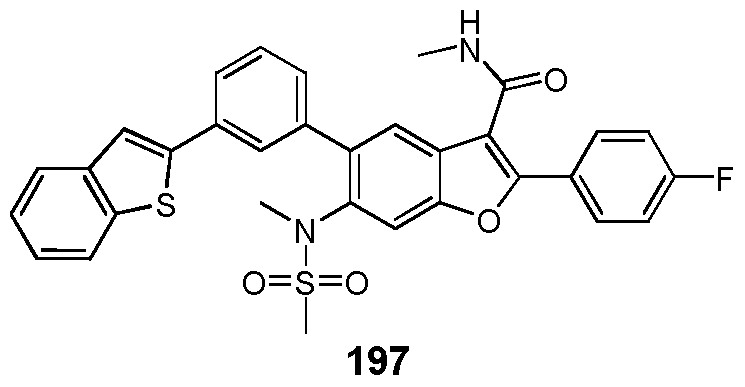
Step 1 - Synthesis of 2-(4-fluorophenyl)-N-methyl-6-(N-methylmethylsulfonamido)-5-(3- nitrophenyl)benzofuran-3-carboxamide

To a degassed solution of Compound L (prepared as described in Example 1, Step 11, 2.0 g, 4.39 mmol) and 3-nitrophenylboronic acid (880 mg, 5.27 mmol) in dry DMF (1.5 mL) were added Pd(dppf)Cl2 (20 mg) and K3PO4 (1.86 g, 8.79 mmol) under N2. The mixture was allowed to stir at 90 °C for about 15 hours. After the mixture was cooled to room temperature, diluted with EtOAc and filtered, the filtrate was washed with H20, brine, and dried over Na2S04. After concentrated, the crude was purified using column chromatography (PE : EtOAc = 3 : 1) to provide 2-(4-fluorophenyl)-N-methyl-6-(N-methylmethylsulfonamido)-5-(3- nitrophenyl)benzofuran-3-carboxamide (1.78 g, 84%). 1H-NMR (CDC13, 400 MHz) δ 8.24 (s, 1H), 8.18 (d, J = 8.4 Hz, 1H), 7.83-7.87 (m, 2H), 7.79 (d, J= 5.6 Hz, 1H), 7.77 (s, 1H), 7.58 (s, 1H), 7.55 (t, J= 4.0 Hz, 1H), 7.15 (t, J= 8.8 Hz, 2H), 5.83 (d, J= 3.2 Hz, 1H), 3.09 (s, 3H), 2.92 (d, J= 4.8 Hz, 3H), 2.73 (s, 3H).
Step 2 - Synthesis of 5-(3-aminophenyl)-2-(4-fluorophenyl)-N-methyl-6-(N- methylmethylsulfonamido)benzofuran-3-carboxamide

To a solution of 2-(4-fluorophenyl)-N-methyl-6-(N-methylmethylsulfonamido)-5- (3-nitrophenyl)benzofuran-3-carboxamide (1.0 g, 2.01 mmol) in MeOH (30 mL), Pd/C (200 mg) was added and the resulting reaction mixture was allowed to stir under 40 psi of H2 atmosphere for 24 hours at 25 °C. Then the reaction mixture was filtered, and the filtrate was concentrated in vacuo to provide 5-(3-aminophenyl)-2-(4-fluorophenyl)-N-methyl-6-(N- methylmethylsulfonamido)benzofuran-3-carboxamide (846 mg, 89%). 1H-NMR (DMSO, 400 MHz) δ 8.49 (d, J= 4.8 Hz, 1H), 7.94-7.97 (m, 2H), 7.84 (s, 1H), 7.43 (s, 1H), 7.38 (t, J= 9.2 Hz, 2H), 7.03 (t, J= 8.0 Hz, 1H), 6.53-6.58 (m, 3H), 5.09 (s, 2H), 3.13 (d, J= 5.6 Hz, 3H), 3.04 (s, 3H), 2.81 (s, 3H). MS (M+H)+: 468.
Step 3 - Synthesis of 2-(4-fluorophenyl)-5-(3-iodophenyl)-N-methyl-6-(N- methylmethylsulfonamido)benzofuran-3-carboxamide

To a stirred solution of 5-(3-aminophenyl)-2-(4-fluorophenyl)-N-methyl-6-(N- methylmethylsulfonamido)benzofuran-3-carboxamide (1.5 g, 3.21 mmol) in MeCN (20 mL) was added I2 (488.6 mg, 1.93 mmol) and Cul (6 mg) at 0 °C, then i-AmONO (394.6 mg, 3.37 mmol) was added dropwise. After the solution was allowed to stir at 25 °C for 6 hours, the mixture was heated to 90 °C for 1 hour. The mixture was diluted with Na2S203 and concentrated to remove the organic solvent, and then the residue obtained was extracted with EtOAc. The organic layer was washed with brine, dried over Na2S04 and concentrated in vacuo. The residue obtained was purified using flash column chromatography (PE : EtOAc = 10 : 1) to provide 2-(4- fluorophenyl)-5-(3-iodophenyl)-N-methyl-6-(N-methylmethylsulfonamido)benzofuran-3- carboxamide (1.17 g, 65%). 1H-NMR (CDC13, 400 MHz) δ 7.85-7.88 (m, 2H), 7.72 (d, J= 7.6 Hz, 2H), 7.66 (d, J= 8.0 Hz, 1H), 7.53 (s, 1H), 7.38 (d, J= 7.6 Hz, 1H), 7.14 (t, J= 6.0 Hz, 2H), 5.77 (d, J= 4.0 Hz, 1H), 3.06 (s, 3H), 2.92 (d, J= 4.8 Hz, 3H), 2.61 (s, 3H). MS (M+H)+: 579.
Step 4 - Synthesis of 5-(3-(benzo[b]thiophen-2-yl)phenyl)-2-(4-fluorophenyl)-N-methyl-6-(N- methylmethylsulfonamido)benzofuran-3-carboxamide (Compound 197)

197
To a degassed solution of 5-(3-aminophenyl)-2-(4-fluorophenyl)-N-methyl-6-(N- methylmethylsulfonamido)benzofuran-3-carboxamide (70 mg, 121.0 umol) and
benzo[b]thiophen-2-ylboronic acid (26.1 mg, 145.1 umol) in dry DMF (1.5 mL) were added Pd(dppf)Cl2 (5 mg) and K3P04 (51.4 mg, 171.2 umol) under N2. The mixture was heated to 90 °C for about 15 hours. After the reaction mixture was cooled to room temperature, diluted with EtOAc and filtered, the filtrate was washed with H20, brine, dried over Na2S04. After
concentrated, the crude was purified using prep-TLC (PE : EtOAc = 3 : 1) to provide 5-(3- (benzo[b]thiophen-2-yl)phenyl)-2-(4-fluorophenyl)-N-methyl-6-(N- methylmethylsulfonamido)benzofuran-3-carboxamide (Compound 197, 38 mg, 60%). 1H-NMR (CDC13, 400 MHz) δ 7.95-7.98 (m, 2H), 7.85 (d, J = 7.2 Hz, 3H), 7.80 (d, J = 7.6 Hz, 1H), 7.76 (d, J = 6.8 Hz, 1H), 7.64 (t, J = 3.2 Hz, 2H), 7.52 (d, J = 7.6 Hz, 1H), 7.44 (d, J = 8.0 Hz, 1H), 7.37 (t, J = 8.8 Hz, 2H), 7.22 (t, J = 8.8 Hz, 2H), 6.04 (d, J = 4.4 Hz, 1H), 3.20 (s, 3H), 2.99 (d, J = 4.8 Hz, 3H), 2.67 (s, 3H). MS (M+H)+: 585.
Compounds 198-207, depicted in the table below, were prepared using the method described in Example 7 and substituting the appropriate reactants and/or reagents.
MS
Compound Structure NMR
(M+H)+
^-NMR (DMSO, 400 MHz) δ 8.53
(d, .7 = 4.8 Hz, 1H), 8.02 (d, .7 = 6.8
Hz, 1H), 8.00 (d, J = 5.6 Hz, 2H),
7.93 (d, J = 7.6 Hz, 1H), 7.62-7.67
198 (m, 3H), 7.58 (t, J = 7.6 Hz, 1H), 569
7.48 (t, J = 6.0 Hz, 2H), 7.39-7.45

(m, 2H), 7.24-7.33 (m, 2H), 3.11 (s,
3H), 2.96 (s, 3H), 2.80 (d, J = 4.4
Hz, 3H).
^-NMR (CDCI3, 400 MHz) δ 9.19
(s, 1H), 8.71 (d, J = 7.2 Hz, 2H),
8.09-8.20 (m, 2H), 7.88-7.91 (m,
200 3H), 7.77-7.82 (m, 3H), 7.53-7.60 580
(m, 3H), 7.11-7.16 (m, 2H), 6.04 (s,

1H), 3.12 (s, 3H), 2.93 (d, J = 4.4
Hz, 3H), 2.72 (s, 3H).
^-NMR (CDCI3, 400 MHz) δ 9.67
(s, 1H), 8.60 (s, 2H), 8.43 (d, J = 8.8
Hz, 1H), 8.15 (m, 2H), 7.95-8.03
201 (m, 4H), 7.78 (d, J = 7.2 Hz, 1H), 580
7.58-7.68 (m, 3H), 7.22-7.27 (m,

2H), 5.91 (s, 1H) 3.12 (s, 3H), 3.01
(d, J = 4.8 Hz, 3H), 2.96 (s, 3H).
^-NMR (CDC13, 400 MHz) δ 8.94
(s, IH), 7.89-7.86 (m, 2H), 7.82 (s, IH), 7.79 (s, IH), 7.62 (d, J = 7.6
Hz, IH), 7.46 (s, IH), 7.43-7.40 (m, 2H), 7.26 (d, J = 7.6 Hz, IH), 7.13 598 (t, J = 8.4 Hz. 2H). 6.83 (s, IH),

6.70 (d, J = 8.4 Hz. 2H). 5.83 (d, J =
4.0 Hz. IH), 3.78 (s, 3H), 2.91 (d, J
= 6.8 Hz. 9H).
XH NMR (CDCI3, 400 MHz) δ 9.18
(s, IH), 8.35 (s, IH), 8.06 (d, J = 8.8 Hz, IH), 7.67-7.86 (m, 3H), 7.66 (s, IH), 7.64 (d, J = 1.2 Hz, IH),
203 7.52- 7.56 (m. 2H). 7.46-7.52 (m, 580
3H), 7.44 (d, J = 1.6 Hz. IH), 7.13

(t. J = 8.8 Hz, 2H), 5.94 (d, J = 4.8
Hz, IH). 3.09 (s, 3H), 2.91 (d, J =
4.8 Hz, 3H), 2.66 (s, 3H).
^-NMR (CDCI3, 400 MHz) δ
8.85-8.88 (m, IH), 8.05-8.20 (m,
2H), 7.99 (d. J = 1.6 Hz, IH), 7.97
(d, J = 1.6 Hz. IH), 7.87-7.91 (m,
2H), 7.80 (d, J = 9.2 Hz, 2H), 7.69
204 {d, J = 8.0 Hz, IH), 7.56 (s, IH). 580
7.52 (t. J = 7.6 Hz, IH), 7.37-7.43

(m, 2H). 7.14 (t, J = 8.8 Hz, 2H),
5.80 (d, J = 4.4 Hz, IH), 3.10 (s,
3H), 2.92 (d, J = 4.8 Hz, 3H), 2.64
(s, 3H).
Ή NMR (CDCI3, 400 MHz) δ
7.92-7.95 (m. 4H). 7.83 (s, IH),

2.97 (d, J = 4.8 Hz, 3H), 2.62 (s,
3H).
XH NMR (CDCI3, 400 MHz) δ 8.92
(s, 1H), 7.92-7.96 (m, 2H), 7.87 (s,

5.76 (d, .7 = 3.6 Hz, 1H), 3.85 (s,
3H), 3.09 (s, 3H), 2.92 (d, J= 4.8
Hz, 3H), 2.75 (s, 3H).
Example 8
Preparation of Compound 208

197 208
To a solution of Compound 197 (100 mg, 0.38 mmol) in 10 mL of acetic acid was added H202 (2 mL) and the resulting reaction mixture was heated to 65 °C and allowed to stir at this temperature for 3 hours. The reaction was then was quenched with aq. Na2S03 and extracted with EtOAc. The organic phase was washed with H20 and brine, dried over MgS04, filtered and concentrated in vacuo. The residue obtained was purified using preparative HPLC to provide Compound 208 (45 mg, 28%). 1H MR: (CDC13, 400 MHz) δ 7.92 (s, 1H), 7.86-7.90 (m, 2H), 7.74-7.76 (s, 2H), 7.69-7.70 (m, 1H), 7.43-7.56 (m, 5H), 7.34-7.38 (m, 2H), 7.14 (t, J = 8.8 Hz, 2H), 5.84 (s, 1H), 3.18 (s, 3H), 2.93 (d, J = 4.8 Hz, 3H), 2.54 (s, 3H). MS (M+H)+: 617.
Example 9
Preparation of Compound 209

208 209
To a solution of Compound 208 (30 mg, 0.13 mmol) in 10 mL of MeOH, was added Pd/C (10 mg); and the resulting reaction was placed under H2 atmosphere (40 Psi) and allowed to stir at room temperature for 24 hours. The reaction mixture was then filtered and concentrated in vacuo, and the residue obtained was purified using preparative HPLC to provide Compound 209 (20 mg, 85%). 1H- MR (CDC13, 400 MHz) δ 7.86-7.90 (m, 2H), 7.72-7.73 (m, 2H), 7.54-7.58 (m, 2H), 7.39-7.46 (m, 6H), 7.11-7.16 (m, 2H), 5.77-5.78 (m, 1H), 4.68 (t, J = 8.2 Hz, 1H), 3.64 (d, J= 8.2 Hz, 2H), 3.09 (s, 3H), 2.93 (d, J= 4.8 Hz, 3H), 2.46 (s, 3H). MS (M+H)+: 619. Example 10
Preparation of Compound 210

210
Step 1 - Synthesis of 2-(4-fluorophenyl)-N-methyl-6-(N-methylmethylsulfonamido)-5-(3-(4,4,5,5- tetramethyl-1, 3, 2-dioxaborolan-2-yl)phenyl) benzofuran-3-carboxamide

To a degassed solution of 2-(4-fluorophenyl)-5-(3-iodophenyl)-N-methyl-6-(N- methylmethylsulfonamido)benzofuran-3-carboxamide (Prepared as described in Example 7, Step 3, 200 mg, 0.346 mmol) and pinacol diborane (132 mg, 0.519 mmol) in dry DMF (1.5 mL) was
added Pd(dppf)Cl2 (10 mg) and KOAc (102 mg, 1.04 mmol). The mixture was placed under N2 atmosphere, then heated to 90 °C and allowed to stir at this temperature for about 15 hours. The reaction mixture was cooled to room temperature, filtered, and the filtrate was washed with H20, brine, dried over Na2S04, filtered and concentrated in vacuo to provide 2-(4-fluorophenyl)-N- methyl-6-(N-methylmethylsulfonamido)-5 -(3 -(4,4, 5 , 5 -tetramethyl- 1 , 3 ,2-dioxaborolan-2- yl)phenyl)benzofuran-3-carboxamide (200 mg, 100%), which was used without further purification. 1H- MR (CDC13, 400 MHz) δ 7.88-7.92 (m, 2H), 7.75-7.78 (m, 2H), 7.72 (s, 1H), 7.56 (s, 1H), 7.49-7.52 (m, 1H), 7.37-7.41 (m, 1H), 7.11-7.15 (m, 2H), 5.81-5.82 (m, 1H), 3.05 (s, 3H), 2.93 (d, J = 4.8 Hz, 3H), 2.51 (s, 3H), 1.29 (s, 12H). MS (M+H)+: 579.
Step 2 - Synthesis of 2-(4-fluorophenyl)-5-(3-(isoquinolin-6-yl)phenyl)-N-methyl-6-(N- methylmethylsulfonamido)benzofuran-3-carboxamide (Compound 210)

Compound 211, depicted in the table below, was prepared using the method described in Example 10 and substituting the appropriate reactants and/or reagents.
MS
Compound Structure NMR
(M+H)+
^-NMR (CDCI3, 400 MHz) δ 9.79
(s, 1H), 8.50 (s, 1H), 8.31 (d, J= 8.0

1H), 3.02 (s, 3H), 2.94 (d, J = 4.8
Hz, 3H), 2.87 (s, 3H).
Example 11
Preparation of Compound 212

212
Step 1 - Synthesis of 2-(4-fluorophenyl)-N-methyl-6-(N-methylmethylsulfonamido)-5-(3-(l-((2- (trimethylsilyl)ethoxy)methyl)-lH-indol-2-yl)phenyl)benzofuran-3-carbo

5-bromo-2-(4-fluorophenyl)-N-methyl-6-(N-methylmethylsulfonamido)-l- benzofuran-3-carboxamide (prepared as described in Example 1, Step 11) was converted to 2-(4- fluorophenyl)-N-methyl-6-(N-methylmethylsulfonamido)-5-(3-(l-((2- (trimethylsilyl)ethoxy)methyl)- 1 H-indol-2-yl)phenyl)benzofuran-3 -carboxamide (120 mg, 53.4%) using the method described in Example 1, Step 1. 1H- MR (CDCI3, 400 MHz) δ 8.07-8.03 (m, 2H), 7.93 (s, 1H), 7.82-7.80 (m, 2H), 7.74-7.72 (m, 2H), 7.65-7.60 (m, 2H), 7.37-7.35 (m, 2H), 7.32-7.27 (m, 3H), 6.77 (s, 1H), 6.05 (d, J = 4.4 Hz, 1H), 5.61 (s, 2H), 3.62
(t, J = 8.4 Hz, 2H), 3.31 (s, 3H), 3.08 (d, J = 4.8 Hz, 3H), 2.72 (s, 3H), 0.95 (t, J = 8.4 Hz, 2H), 0.00 (s, 9H). MS (M+H)+: 698.
Step 2 - Synthesis of 5-(3-(lH-indol-2-yl)phenyl)-2-(4-fluorophenyl)-N-methyl-6-(N- methylmethylsulfonamido)benzofuran-3-carboxamide (Compound 212)

212
2-(4-fluorophenyl)-N-methyl-6-(N-methylmethylsulfonamido)-5-(3-(l-((2-
(trimethylsilyl)ethoxy)methyl)-lH-indol-2-yl)phenyl)benzofuran-3-carboxamide (60 mg, 0.86 mmol) and TBAF (67.44 mg, 2.57 mmol) in DMF (2 mL) was added to a flask, ethylene diamine (25.83 mg, 0.95 mmol) was added. The mixture was purged with nitrogen and heated at 80 °C for about 15 hours. The mixture was diluted with EtOAc and washed with 0.1 M HC1. The phases were separated, and the organic phase was washed with water and brine, dried over Na2S04, filtered and concentrated in vacuo. The resulting redisue was purified using preparative TLC to provde 5 -(3 -( 1 H-indol-2-yl)phenyl)-2-(4-fluorophenyl)-N-methyl-6-(N- methylmethylsulfonamido)benzofuran-3-carboxamide (Compound 212, 20 mg, 41.4%). 1H- MR (CDC13, 400 MHz) δ 9.30 (s, 1H), 7.94 (d, J = 8.8 Hz, 3H), 7.83 (s, 1H), 7.74 (d, J = 8.0 Hz, 1H), 7.65 (t, J = 7.2 Hz, 1H), 7.52-7.47 (m, 2H), 7.43 (d, J = 8.0 Hz, 1H), 7.35 (d, J = 6.8 Hz, 1H), 7.22-7.17 (m, 3H), 7.14-7.10 (m, 1H), 6.85 (s, 1H), 6.09 (d, J = 4.4 Hz, 1H), 2.99 (s, 3H), 2.97 (d, J = 4.0 Hz, 3H), 2.92 (s, 3H). MS (M+H)+: 568.
Compounds 213-226, depicted in the table below, were prepared using the method described in Example 11 and substituting the appropriate reactants and/or reagents.
MS
Compound Structure NMR
(M+H)+
^-NMR (CDC13, 400 MHz) δ 9.10
(s, IH), 7.89-7.84 (m, 4H), 7.66 (d, J = 8.0 Hz, IH), 7.45 (t, J = 5.6 Hz,

(d, J = 4.4 Hz, 3H), 2.45 (s, 3H).
^-NMR (CDC13, 400 MHz) δ 9.15
(s, IH), 7.96-8.01 (m, 3H), 7.93 (s,

(s, 3H), 2.91-2.95 (m, 9H).
^-NMR (CDC13, 400 MHz) δ

(s, 3H).
^-NMR (CDCI3, 400 MHz) δ 9.75
(s, 1H), 8.29-8.31 (m, 1H),
8.01-8.04 (m, 1H), 7.91-7.95 (m,

5.84 (d, J= 4.4 Hz, 1H), 3.02 (s,
3H), 2.98 (d, J= 4.8 Hz, 3H), 2.97
(s, 3H).
Example 12
Preparation of Compound 227

To a solution of Compound 212 (50 mg, 0.088 mmol) in 2 mL of DMF, was added NCS (15 mg, 0.088 mmol), and the resulting reaction was allowed to stir under N2 atmosphere for 4 hours at 25 °C. The reaction mixture was concentrated in vacuo and the resulting residue was diluted EtOAc. The resulting solution was washed with brine, dried over Na2S04, filtered and concentrated in vacuo. The resulting residue was purified using prep-TLC (PE : EtOAc = 2 : 1) to provide Compound 227 (20 mg, 50%) as a white solid. 1H-NMR (CDCI3, 400 MHz) δ 9.29 (s, 1H), 7.97 (d, J= 7.6 Hz, 1H), 7.83-7.86 (m, 2H), 7.78 (s, 1H), 7.57 (d, J= 8.0 Hz, 1H), 7.49 (t, J= 7.6 Hz, 1H), 7.41 (s, 1H), 7.33 (t, J= 5.6 Hz, 2H), 7.17 (d, J = 7.6 Hz, 1H), 7.09-7.15 (m, 3H), 5.92 (d, J= 4.4 Hz, 1H), 2.97 (s, 3H), 2.87 (d, J= 4.8 Hz, 3H), 2.85 (s, 3H). MS (M+H)+: 602.
Example 13
Preparation of Compound 228

To a solution of Compound 212 (50 mg, 0.088 mmol) in 3 mL of DMF, was added NBS (16 mg, 0.088 mmol) and the resulting reaction was heated to 75 °C and allowed to stir at this temperature for 4 hours. The reaction mixture was cooled to room temperature and concentrated in vacuo. The resulting residue was diluted with EtOAc and the resulting solution was washed with brine, dried over Na2S04, filtered and concentrated in vacuo. The residue obtained was purified using prep-TLC (PE : EtOAc = 2 : 1) to provide Compound 228 (40 mg, 89%) as a white solid. 1H-NMR (CDC13, 400 MHz) δ 9.38 (s, 1H), 8.02 (d, J= 8.0 Hz, 1H), 7.94 (s, 1H), 7.88-7.94 (m, 2H), 7.84 (s, 1H), 7.53 (t, J= 7.6 Hz, 2H), 7.46 (d, J= 4.8 Hz, 1H), 7.35-7.40 (m, 2H), 7.11-7.15 (m, 4H), 5.80 (s, 1H), 3.04 (s, 3H), 2.94 (d, J= 5.2 Hz, 3H), 2.87 (s, 3H). MS (M+H)+: 646.
Example 14
Preparation of Compound 229

225 229
L solution of Compound 225 (50 mg, 0.084 mmol) in MeOH (5 mL) added NaBH (17 mg, 0.5 mmol) and the resulting reacton was allowed to stir at room
temperature for 2 hours. The reaction mixture was diluted with water and extracted with dichloromethane and the organic extract was dried over Na2S04, filtered and concentrated in vacuo to provide Compound 229 (20 mg, 40%). 1H-NMR (CDC13, 400 MHz) δ 10.15-10.25 (m, 1H), 8.22 (d, J = 3.6 Hz, 1H), 8.02-8.04 (m, 1H), 7.88-7.91 (m, 3H), 7.82 (s, 1H), 7.70-7.72 (m, 1H), 7.50-7.54 (m, 1H), 7.48 (s, 1H), 7.40-7.42 (m, 1H), 7.12-7.16 (m, 2H), 7.05-7.08 (m, 1H), 5.93-5.98 (m, 1H), 4.92 (s, 2H), 2.96 (s, 3H), 2.91-2.93 (m, 6H).
Example 15
Preparation of Compound 230

230
Step 1 - Synthesis of 5-bromo-2-(4-fluorophenyl)-6-(methylsulfonamido)benzofuran-3-carboxylic acid

To a solution of methyl 5-bromo-2-(4-fluorophenyl)-6-
(methylsulfonamido)benzofuran-3-carboxylate (prepared as described in Example 1, Step 8, 0.5 g, 1.13 mmol) in dioxane (3 mL) and water (1 mL) was LiOH H20 (0.24 g, 5.65 mmol). The resulting reaction was heated to 80 °C and allowed to stir at this temperature for 2 hours. The reaction mixture was cooled to room temperature and adjusted to pH = 6-7 using cone. HC1.
The resulting solution was extracted with EtOAc, and the organic phase was dried over anhydrous Na2S04, filtered and concentrated in vacuo to provide 5-bromo-2-(4-fluorophenyl)-6- (methylsulfonamido) benzofuran-3-carboxylic acid (0.4 g. 87 %) as a white solid. 1H- MR
(DMSO, 400 MHz) δ 13.49 (s, 1H), 9.67 (s, 1H), 8.30 (s, 1H), 8.12-8.17 (m, 2H), 7.87 (s, 1H),
7.45-7.50 (m, 2H), 3.16 (s, 3H). MS (M+H)+: 428.
Step 2 - Synthesis of 5-bromo-2-(4-fluorophenyl)-N-methyl-6-(methylsulfonamido) benzofuran-3- carboxamide

Step 3 - Synthesis of 5-bromo-2-(4-fluorophenyl)-6-(N-(3-hydroxypropyl)methylsulfonamido)-N- methylbenzofuran-3-carboxamide

To a solution of 5-bromo-2-(4-fluorophenyl)-N-methyl-6- (methylsulfonamido)benzofuran-3-carboxamide (300 mg, 0.68 mmol) in DMF (10 mL) was added 3-bromopropan-l-ol (190 mg, 1.36 mmol), K2C03 (188 mg, 1.36 mmol) and KI (11 mg, 0.068 mmol). The resulting reaction was heated to 100 °C and allowed to stir at this temperature for 10 hours. The reaction mixture was cooled to room temperature and concentrated in vacuo. The resulting residue was taken up in EtOAc and the resulting solution was washed with H20, brine, dried over Na2S04, filtered and concentrated in vacuo. The residue obtained was purified by flash column chromatography (PE : EtOAc = 2 : 1) to provide 5-bromo-2-(4-fluorophenyl)-6- (N-(3-hydroxypropyl)methylsulfonamido)-N-methylbenzofuran-3-carboxamide (320 mg., 78.6 %). 1H-NMR (CDC13, 400 MHz) δ 8.12 (s, 1H), 7.76 (d, J= 8.0 Hz, 2H), 7.65 (s, 1H), 7.14 (d, J= 8.4 Hz, 2H), 5.78 (br s, 1H), 3.64-3.67 (m, 2H), 3.55-3.60 (m, 2H), 3.08 (s, 3H), 2.97 (d, J= 4.4 Hz, 3H), 1.72-1.76 (m, 2H). MS (M+H)+: 499.
Step 4 - Synthesis of 2-(4-fluorophenyl)-6-(N-(3-hydroxypropyl)methylsulfonamido)-N-methyl-5- (3-(oxazolo[ 4, 5-b ]pyridin-2-yl)phenyl)benzofuran-3-carboxamide (Compound 230)

To a degassed solution of 5-bromo-2-(4-fluorophenyl)-6-(N-(3- hydroxypropyl)methylsulfonamido)-N-methylbenzofuran-3-carboxamide (100 mg, 0.20 mmol) and 2-(3-(4,4,5,5-tetramethyl-l,3,2-dioxaborolan-2-yl)phenyl)oxazolo[4,5-b]pyridine (77 mg, 0.24 mmol) in dioxane / CH3CN / H20 (10 / 1 / 1, 5 mL) was added Pd(PPh3)4 (2 mg) and K3C03 (100 mg, 0.40 mmol). The reaction was put under N2 atmosphere and heated to 100 °C in microwave for 30 minutes. The reaction mixture was filtered, and the filtrate was diluted with EtOAc, and the resulting solution washed with H20, brine, dried over Na2S04, filtered and concentrated in vacuo. The resulting residue was purified using flash column chromatography (PE : EtOAc = 1 : 1) 2-(4-fluorophenyl)-6-(N-(3-hydroxypropyl)methylsulfonamido)-N-methyl- 5-(3-(oxazolo[4,5-b]pyridin-2-yl)phenyl)benzofuran-3-carboxamide (Compound 230, 38 mg, 30.9%). 1H- MR (CDC13, 400 MHz) δ 8.50 (J= 4.4 Hz, 1H), 8.38-8.41 (m, 1H), 8.23 (d, J = 8.0 Hz, 1H), 7.81-7.87 (m, 2H), 7.56-7.58 (m, 3H), 7.25-7.26 (m, 2H), 7.18-7.20 (m, 1H), 7.11-7.15 (m, 2H), 6.07 (br s, 1H), 3.64-3.67 (m, 2H), 3.41-3.52 (m, 2H), 2.92-2.93 (m, 3H), 2.81 (s, 3H), 1.72-1.76 (m, 2H). MS (M+H)+: 615.
Compounds 231-242, depicted in the table below, were prepared using the method described in Example 230 and substituting the appropriate reactants and/or reagents.
MS
Compound Structure NMR
(M+H)'
^-NMR (CDC13, 400 MHz) δ 8.57
(d, J = 4.8 Hz, IH), 8.46 (s, IH), 8.23 (d, J = 8.0 Hz, IH), 7.98 (d, J = 8.0 Hz, IH), 7.81-7.88 (m, 4H),
231 7.58-7.62 (m, 2H), 7.36-7.41 (m,
IH), 7.12-7.17 (m, 2H), 5.98 (br s,
 IH), 3.60-3.70 (m., 3H), 3.38-3.44
(m, IH), 2.93 (d, J = 4.4 Hz, 3H), 2.89 (s, 3H).
^-NMR (CDCI3, 400 MHz) δ 8.64 (s, IH), 8.36 (s, IH), 7.92-8.03 (m, 5H), 7.73 (d, J = 4.0 Hz, IH), 7.64 (d, J = 8.8 Hz, IH), 7.38-7.42 (m, IH), 7.23-7.25 (m, 2H), 5.96 (br s, IH), 3.74-3.87 (m, 3H), 3.47-3.51
 (m, IH), 3.04 (d, J = 4.8 Hz, 3H),
3.03 (s, 3H ).
^-NMR (CDCI3, 400 MHz) δ 8.53 (d, J = 4.0 Hz, IH), 8.38 (d, J = 4.0 Hz, IH), 8.13-8.15 (m, IH), 7.98-8.00 (m, 2H), 7.94 (d, J = 4.0 Hz, IH), 7.86 (s, IH), 7.73 (s, IH),
233 7.37-7.49 (m, IH), 7.30-7.35 (m,
IH), 7.26-7.30 (m, 2H), 4.08 (s, 3H), 3.71-3.74 (m, IH), 3.46-3.49

(m, 2H), 3.23 (m, 3H), 3.09-3.14 (m, IH), 2.95 (s, 3H).
^-NMR (CDCI3, 400 MHz) δ 8.49-8.50 (m, IH), 8.38-8.41 (m, IH), 8.23-8.24 (m, IH), 7.81-7.87 (m, 2H), 7.56-7.58 (m, 3H), 7.25-7.26 (m, 2H), 7.18-7.20 (m, IH), 7.11-7.15 (m, 2H), 5.98 (s,
 IH), 3.84-3.85 (m, IH), 3.53-3.60
(m, 2H), 2.94-3.19 (m, 6H), 1.07-1.12 (m, 3H).
^-NMR (CDC13, 400 MHz) δ 8.58
(d, J = 4.4 Hz, IH), 8.36 (d, J = 2.0

= 4.8 Hz. 3H), 2.74 (s, 3H) 1.65-1.67 (m, 2H), 1.07-1.12 (m, 6H).
Ill

(m, 2H), 1.75-1.80 (m, 2H).
^-NMR (CDCI3, 400 MHz) δ 8.72-8.73 (m, IH), 8.51 (s, IH), 8.36-8.38 (m, IH), 8.20-8.22 (m, IH), 7.90-7.95 (m, 4H), 7.69-7.73
240 (m, IH), 7.67 (s, IH), 7.56-7.58 (m
IH), 7.22-7.30 (m, 2H), 3.41-3.49 (m, 2H), 3.02-3.05 (m, 6H),

2.22- 2.25 (m, 2H), 1.39-1.58 (m, 4H).
^-NMR (CDCI3, 400 MHz) δ 8.67 (d, J = 4.4 Hz, IH), 8.47 (s, IH), 8.38 (d, J = 8.0 Hz, IH), 8.03 (d, J = 8.0 Hz, IH), 7.96-8.00 (m, 2H), 7.92 (s, IH), 7.89 (d, J = 7.6 Hz, IH), 7.70 (d, J = 8.0 Hz, IH), 7.66 (s, IH), 7.42-7.46 (m, IH),
7.23- 7.31 (m, 2H), 6.10 (br s, IH),

4.75 (br s, IH), 3.43-3.49 (m, 2H), 3.04 (d, J = 4.8 Hz, 3H), 3.02 (s, 3H), 2.84-2.96 (m, 2H), 1.57-1.64 (m, 2H), 1.38 (s, 9H).
^-NMR (CDCI3, 400 MHz) δ 8.39-8.42 (m, 2H), 8.09-8.16 (m, 2H), 7.95-8.01 (m, 2H), 7.82-7.85 (m, 2H), 7.62 (t, J = 8.0 Hz, IH),
242 7.57 (s, IH), 7.38-7.40 (m, IH),
7.20-7.25 (m, 2H), 6.44 (br s, IH),
 3.50-3.70 (m, 2H), 3.01 (d, J = 4.8
Hz, 3H), 2.97 (s, 3H), 2.80-2.90 (m 2H), 1.85-1.95 (m, 2H).
Example 16
Preparation of Compound 243

243
Step 1 - Synthesis of 5-bromo-2-(4-fluorophenyl)-N-methyl-6-(N-(2-morpholinoethyl)
methylsulfonamido)benzofuran-3-carboxamide
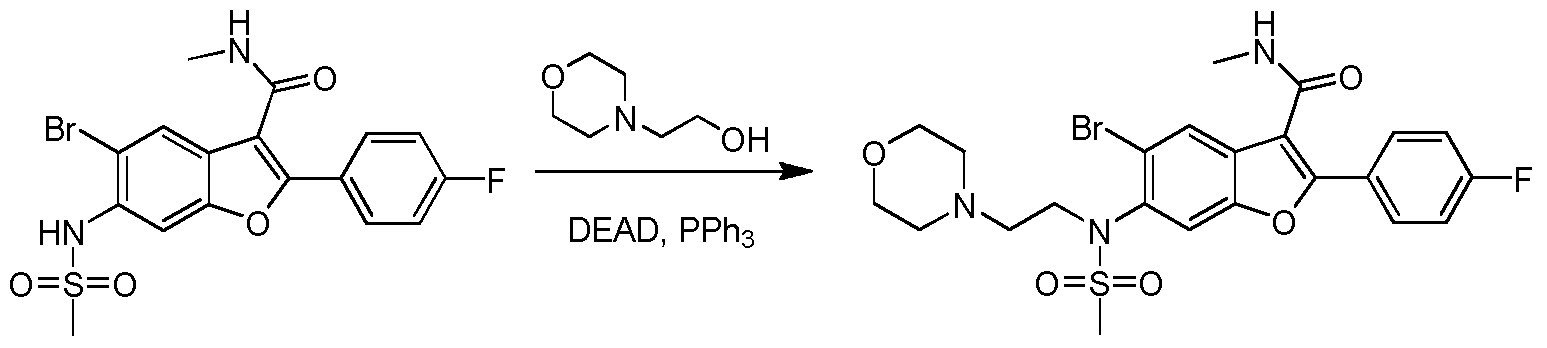
Triphenylphosphine (180 mg, 0.69 mmol) and 5-bromo-2-(4-fluorophenyl)-N- methyl-6-(methylsulfonamido)benzofuran-3-carboxamide (200 mg, 0.45 mmol, prepared by taking the product of Example 1, Step 8 and subjecting it to the methods described in Example 1, Steps 10 and 11) were taken up in anhydrous THF (10 mL) and to the resulting suspension was added DEAD (120 mg, 0.69 mmol). The resulting reaction was allowed to stir at room temperature in the dark for 1 hour, then a solution of 2-morpholinoethanol (90 mg, 0.69 mmol) in anhydrous THF was added, and the resulting reaction was allowed to stir in the dark at room temperature for about 15 hours. The reaction mixture was concentrated in vacuo and the resulting residue was purified using flash chromatography (PE : EtOAc = 1 : l)to provide 5- bromo-2-(4-fluorophenyl)-N-methyl-6-(N-(2-morpholinoethyl)methylsulfonamido) benzofuran- 3-carboxamide (200 mg, 79%). 1H- MR (CDC13, 400 MHz) 5 8.15 (s, 1H), 7.87-7.91 (m, 2H), 7.73 (s, 1H), 7.18-7.23 (m, 2H), 5.93 (br s, 1H), 4.04-4.12 (m, 1H), 3.59-3.66 (m, 5H), 3.11 (s, 3H), 2.99 (d, J= 4.4 Hz, 3H), 2.48-2.55 (m, 4H), 2.33-2.37 (m,2H). MS (M+H)+: 554.
Step 2 - Synthesis of 2-(4-fluorophenyl-N-methyl-6-(N-(2-morpholinoethyl)methylsulfonamido)- 5-(3-(oxazolo[4,5-b]pyridine-2-yl)phenyl)benzofuran-3-carboxamide (Compound 243)

243
5-bromo-2-(4-fluorophenyl)-N-methyl-6-(N-(2- morpholinoethyl)methylsulfonamido) benzofuran-3-carboxamide (20 mg, 0.04 mmol), 2-(3- (4,4,5,5-tetramethyl-l,3,2-dioxaborolan-2-yl)phenyl)oxazolo[4,5-b]pyridine (12 mg, 0.04 mmol) and K2C03 (10 mg, 0.07 mmol) were taken up in a mixture of dioxane/CH3CN/H20 (10/1/1, 1 mL total solution volume). To the resulting solution was added Pd(PPh3)4 (2 mg) and the resulting reaction was put under N2 atmosphere and heated to 100 °C using microwave radiation. The reaction was allowed to remain at this temperature under microwave radiation for 20 minutes, then was cooled to room temperature and concentrated in vacuo. The residue obtained was purified using preparative HPLC to provide 2-(4-fluorophenyl)-N-methyl-6-(N-(2- morpholinoethyl)methylsulfonamido)-5-(3-(oxazolo[4,5-b]pyridin-2-yl)phenyl)benzofuran-3- carboxamide (Compound 243, 15 mg, 62%). 1H- MR (CDC13, 400 MHz) δ 8.56 (br s, 1H), 8.30 (s, 1H), 8.20-8.22 (m , 1H), 7.97 (d, J= 8.0 Hz, 1H), 7.81-7.87 (m, 3H), 7.71 (br s, 1H), 7.58-7.63 (m, 2H), 7.36-7.40 (m, 1H), 7.14-7.19 (m, 2H), 6.37 (br s, 1H), 3.80-4.05 (m, 6H), 3.42 (br s, 2H), 3.21 (br s, 2H), 2.80-3.10 (m, 8H). MS (M+H)+: 670.
Compounds 244-245, depicted in the table below, were prepared using the method described in Example 16 and substituting the appropriate reactants and/or reagents.
MS
Compound Structure NMR
(M+H)+
^-NMR (CDC13, 400 MHz) δ
8.48-8.53 (m, 2H), 8.35 (d, J = 8.0
Hz, 1H), 8.15 (d, J = 8.0 Hz, 1H),
7.92-7.99 (m, 4H), 7.75-7.87 (m,
244 2H), 7.46-7.49 (m, 1H), 7.26-7.30 628
(m, 2H), 3.89-3.94 (m, 2H),

1H ), 3.06 (s, 3H), 2.93 (d, J = 4.0
Hz, 3H), 2.81 (s, 6H).
^-NMR (CDCI3, 400 MHz) δ 8.64
(d, J = 4.8 Hz, 1H), 8.42 (s, 1H),

7H), 2.78-2.87 (m, 7H), 1.98-2.05
(m, 2H).
Example 17
Preparation of Compound 246

To a 0 °C solution of methyl 6-amino-5-bromo-2-(4-fluorophenyl)benzofuran-3- carboxylate (prepared as described in Example 1, Step 7, 500 mg, 1.4 mmol) and pyridine (5 mL)
in dry dichloromethane (10 mL) was added benzenesulfonyl chloride (1.5 g, 8.5 mmol). The cold bath was removed and the resulting reaction was allowed to stir for about 15 hours at room temperature. The reaction mixture was diluted with water, extracted with dichloromethane and the organic extract was washed with brine, dried (Na2S04), filtered and concentrated in vacuo. The residue obtained was purified using flash column chromatography (PE : EtOAc = 5 : 1) to provide methyl 5-bromo-2-(4-fluorophenyl)-6-(phenylsulfonamido) benzofuran-3-carboxylate (600 mg, 87%). 1H- MR (CDC13, 400 MHz) δ 8.01-8.03 (m, 2H), 7.93-7.95 (d, 2H),
7.68-7.69 (d, 1H), 7.62-7.63 (m, 1H), 7.50-7.52 (m, 2H), 7.33-7.37 (m, 1H) 7.10-7.16 (m, 2H) 5.23 (s, 1H). 3.85-3.89 (d, J= 16.8 Hz, 3H). MS (M+H)+: 504.
Step 2 - Synthesis of methyl 5-bromo-2-(4-fluorophenyl)-6-(N-methylphenylsulfonamido) benzofuran-3-carbox late
 A solution of methyl 5-bromo-2-(4-fluorophenyl)-6-
(phenylsulfonamido)benzofuran-3-carboxylate (0.6 g, 1.18 mmol) and K2C03 (1.1 g, 8.0 mmol) in DMF (15 mL) was put under N2 atmosphere. CH3I (1.0 mL, 16.0 mmol) was added and the resulting reaction was heated to 40 °C and allowed to stir at this temperature for about 15 hours. The reaction mixture was then filtered and the filtrate was concentrated in vacuo to provide methyl 5-bromo-2-(4-fluorophenyl)-6-(N-methylphenylsulfonamido)benzofuran-3-carboxylate (500 mg, 81%) which was used without further purification.
Step 3 - Synthesis of 5-bromo-2-(4-fluorophenyl)-6-(N-methylphenylsulfonamido) benzofuran-3- carboxylic acid

To a solution of methyl 5-bromo-2-(4-fluorophenyl)-6-(N- methylphenylsulfonamido)benzofuran-3-carboxylate (500 mg, 0.96 mmol) in a mixture of dioxane/H20 (1/1, 10 mL total volume) was added LiOH-H20 (90 mg, 2.14 mmol), and the
resulting reaction was heated to 100 °C and allowed to stir at this temperature for 2 hours. The reaction mixture was cooled to room temperature, then concentrated in vacuo. The residue obtained was dissolved in H20 and the resulting solution was adjusted to pH 3 using HCl (1 N). The acidific solution was then extracted with EtOAc and the organic extract was washed with brine, dried over Na2S04, filtered and concentrated in vacuo to provide 5-bromo-2-(4- fluorophenyl)-6-(N-methylphenylsulfonamido)benzofuran-3-carboxylic acid (300 mg, 62%), which was used without further purification.
Step 4 - Synthesis of 5-bromo-2-(4-fluorophenyl)-N-methyl-6-(N- methylphenylsulfonamido)benzofuran-3-carboxamide
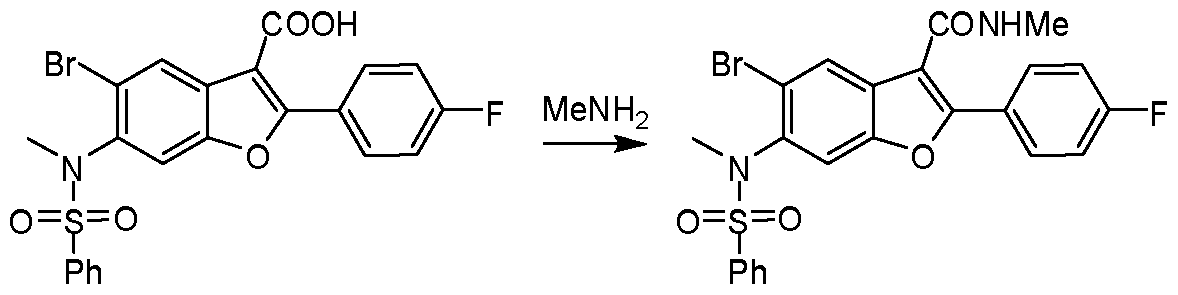
To a solution of 5-bromo-2-(4-fluorophenyl)-6-(N- methylphenylsulfonamido)benzofuran-3-carboxylic acid (300 mg, 0.59 mmol) in dry DMF (10 mL) was added HOBT (100 mg, 0.74 mmol) and EDCI (100 mg, 0.64 mmol) and the resulting reaction was allowed to stir at room temperature for 1 hour. Et3N (2.0 mL) and CH3NH2 (HCl salt, 100 mg, 1.48 mmol) were then added to the reaction mixture and the resulting reaction was allowed to stir for about 15 hours at room temperature. The reaction mixture was concentrated in vacuo, the resulting residue was diluted with H20, and the resulting aqueous solution was extracted with ethyl acetate. The organic extract was washed with H20 and brine, then concentrated in vacuo. The residue obtained was purified by flash column chromatography (PE : EtOAc = 2 : 1) to provide 5-bromo-2-(4-fluorophenyl)-N-methyl-6-(N- methylphenylsulfonamido)benzofuran-3-carboxamide (130 mg, 42%). 1H-NMR (CDC13, 400 MHz) δ 8.02 (s, 1H), 7.83-7.86 (m, 2H), 7.75-7.77 (d, 2H), 7.54-7.56 (m, 1H), 7.44-7.48 (m, 2H), 7.36 (s, 1H), 7.11-7.19 (m, 2H), 5.71 (br s, 1H), 3.20 (s, 3H), 2.94 (d, J= 4.8 Hz, 3H). MS (M+H)+: 517.
Step 5 - Synthesis of 2-(4-fluorophenyl)-N-methyl-6-(N-methylphenylsulfonamido)-5-(3- (oxazolo[ 4, 5-b ]pyridin-2-yl)phenyl)benzofuran-3-carboxamide (Compound 246)

5-bromo-2-(4-fluorophenyl)-N-methyl-6-(N- methylphenylsulfonamido)benzofuran-3-carboxamide (30 mg, 0.06 mmol), 2-(3-(4,4,5,5- tetramethyl-l,3,2-dioxaborolan-2-yl)phenyl)oxazolo[4,5-b]pyridine (22.5 mg, 0.07 mmol) and K2C03 (16 mg, 0.12 mmol) were taken up in a mixture of dioxane-acetonitrile-water (10: 1 : 1, 2 mL total volume). To the resulting solution was added Pd(PPh3)4 (5 mg) and the resulting reaction was put under N2 atmosphere and heated to 100 °C using microwave radiation. The reaction was allowed to remain at this temperature under microwave radiation for 20 minutes, then was cooled to room temperature and concentrated in vacuo. The residue obtained was purified using preparative HPLC to provide 2-(4-fluorophenyl)-N-methyl-6-(N- methylphenylsulfonamido)-5-(3-(oxazolo[4,5-b]pyridin-2-yl)phenyl)benzofuran-3-carboxamide (Compound 246, 4 mg, 1 1%). 1H- MR (CDC13, 400 MHz) δ 8.57 (d, 1H), 8.30 (m, 2H), 7.86-7.90 (m, 3H), 7.82 (s, 1H), 7.68 (d, 1H), 7.53-7.58 (m, 3H), 7.47-7.49 (m, 1H), 7.36-7.40 (m, 2H), 7.30-7.33 (m, 1H), 7.12-7.15 (m, 3H), 5.83 (br s, 1H), 3.06 (s, 3H), (d, J = 4.8 Hz, 3H). MS (M+H)+: 633.
Compound 247, depicted in the table below, was prepared using the method described in Example 17 and substituting the appropriate reactants and/or reagents.
MS
Compound Structure NMR
(M+H)+
^-NMR (CDCI3, 400 MHz) δ
8.57-8.58 (d, J= 4.0 Hz, 1H), 8.36
(s, 1H), 8.29-8.31 (d, J= 8.2 Hz,
1H), 7.82-7.98 (m, 4H), 7.57-7.60
247 (m, 3H), 7.27-7.29 (m, 1H), 585
7.13-7.17 (m, 2H), 5.82-5.83 (d, J =

(d, J= 5.2 Hz, 3H), 2.76-2.78 (m,
2H), 1.09-1.13 (m, 3H).
Example 18
Preparation of Compound 30

Step 1 - Synthesis of l-fluoro-S-methoxy-2-nitrobenzene

To a 0 °C solution of l,3-difluoro-2-nitrobenzene (100 g, 0.63 mol) in MeOH (1.3
L) was slowly added a solution of MeONa (0.69 mol, in MeOH, freshly prepared from 15.9 g of sodium metal and 200 mL of MeOH). The resulting reaction was allowed to stir for about 15 hours at room temperature, then the reaction mixture was concentrated and diluted with EtOAc. The organic phase was washed sequentially with water and brine, dried over Na2S04, then filtered and concentrated in vacuo to provide l-fluoro-3-methoxy-2-nitrobenzene (98 g, yield: 91.4%), which was used without further purification. 1H-NMR (CDC13, 400 MHz) δ 7.38-7.44 (m, 1H), 6.72-6.88 (m, 2H), 3.95 (s, 3H).
Synthesis of 3-fluoro-2-nitrophenol

To a -40 °C solution of l-fluoro-3-methoxy-2-nitrobenzene (98 g, 0.57 mol) in dichloromethane (500 mL) was added dropwise a solution of BBr3 (1 L, 1 M in dichloro methane The resulting reaction was allowed to stir for about 15 hours at room temperature, then the reaction mixture was slowly poured into ice water (500 mL). The resulting solution was extracted with EtOAc (300 mL x 3), and the combined organic layers were washed with sequentially with 5% aqueous NaHC03 and brine, then dried over Na2S04, filtered and concentrated in vacuo to provide 3-fluoro-2-nitrophenol (85 g, yield: 95%), which was used
without further purification. 1H-NMR (CDCI3, 400 MHz) δ 7.43-7.49 (m, 1H), 6.88 (d, J= 8.0 Hz, 1H), 6.73-6.78 (m, 1H).
Step 3 - Synthesis of 5-(3-(4-fluorobenzo[d]oxazol-2-yl)-4-methoxyphenyl)-2-(4-fluorophenyl)-N- methyl-6-(N-methylsulfonamido)benzofuran-3-carboxamide (Compound 251)

3-fluoro-2-nitrophenol (38 g, 0.24 mol) was dissolved in EtOH and then palladium on carbon (5 g, 10% Pd) was added. The reaction flask was evacuated and the reaction mixture was put under H2 atmosphere (1 atm) and allowed to stir for 3 hours at room temperature. The reaction mixture was then filtered through a short pad of celite and the celite was washed with EtOH. The combined filtrate and washing was concentrated in vacuo to provide 2-amino-3-fluorophenol (26 g, yield: 85.7%), which was used without further purification. 1H-NMR (DMSO, 400 MHz) δ 9.43 (s, 1H), 6.42-6.53 (m, 2H), 6.32-6.42 (m, 1H), 4.34 (s, 2H).
- Synthesis of 2-(5-bromo-2-methoxyphenyl)-4-fluorobenzo[d]oxazole

To a solution of 2-amino-3-fluorophenol (9 g 70.8 mmol) in 10 mL of PPA was added 5-bromo-2-methoxybenzoic acid (16.3 g, 70.8 mmol), and the resulting reaction was heated to 140 °C and allowed to stir at this temperature for 4 hours. The reaction mixture was then poured into ice water (50 mL), and extracted with EtOAc. The organic extract was concentrated in vacuo and the residue obtained was purified using flash column chromatography on silica gel (petroleum ether/ethyl acetate = 10 / 1), to provide 2-(5-bromo-2-methoxyphenyl)- 4-fluorobenzo[d]oxazole (16 g, yield: 82%) as a solid. 1H-NMR (CDC13, 400 MHz) δ 8.29 (d, J = 2.4 Hz, 1H), 7.57-7.54 (m, 1H), 7.40 (d, J= 8.0 Hz, 1H), 7.27-7.33 (m, 1H), 7.07 (m, 1H), 6.96 (d, J= 9.2 Hz, 1H), 3.99 (s, 3H).
Step 5 - Synthesis of 4-fluoro-2-(2-methoxy-5-(4,4,5,5-tetramethyl-l,3,2-dioxaborolan-2- yljphenyl) benzof djoxazole

A solution of 2-(5-bromo-2-methoxyphenyl)-4-fluorobenzo[d]oxazole (18.4 g,
57.1 mmol) and bis(pinacolato)diboron (17.4 g, 68.5 mmol) in DMF (10 mL) was placed under N2 atmosphere and to the resulting solution was added Pd(dppf)Cl2 (500 mg) and AcOK (10 g, 114 mmol). The reaction was heated to 80 °C and allowed to stir at this temperature for 3 hours. The reaction mixture was then concentrated in vacuo, the residue obtained was dissolved in dichloromethane, and the resulting solution was filtered through a pad of celite. The organic solution was washed sequentiall wiith H20 and brine, then dried over Na2S04, filtered and concentrated in vacuo. The resulting residue was purified using flash column chromatography on silica gel (PE / EA = 10 / 1) to provide 4-fluoro-2-(2-methoxy-5-(4,4,5,5-tetramethyl-l,3,2- dioxaborolan-2-yl)phenyl)benzo[d]oxazole (10 g, yield: 54%) as a solid. 1H-NMR (CDC13, 400 MHz) δ 8.53 (d, J= 1.6 Hz, 1H), 7.85-7.92 (m, 1H), 7.44 (d, J= 8.0 Hz, 1H), 7.20-7.28 (m, 1H), 6.96-7.05 (m, 2H), 3.97 (s, 3H), 1.29 (s, 12H).
Step 6- Synthesis of 5-(3-(4-fluorobenzo[d]oxazol-2-yl)-4-methoxyphenyl)-2-(4-fluorophenyl)-N- methyl- -(N-methylsulfonamido)benzofuran-3-carboxamide (Compound 30)

To a solution of Compound L (5 g, 11.0 mmol) and 4-fluoro-2-(2-methoxy-5- (4,4,5,5-tetramethyl-l,3,2-dioxaborolan-2-yl)phenyl)benzo[d]oxazole (5.27 g, 14.3 mmol) in DMF (150 mL) under N2 atmosphere was added Pd(dppf)Cl2 (200 mg) and K3P04 (4.66 g, 22.0 mmol). The resulting reaction was heated to 100 °C and allowed to stir at this temperature for 10 hours, then the reaction mixture was concentrated in vacuo. The residue obtained was dissolved in dichloromethane and filtrated through a short pad of celite. The filtrate was washed
sequentially with water and brine, dried over Na2S04, filtered and concentrated in vacuo. The resulting residue was purified using flash column chromatography on silica gel (petroleum ether/ethyl acetate = 4 / 1 to 2 / 1) and the product obtained was then recrystallized from dichlormethane/ethyl acetate = 5 /l to provide Compound 30 (3.8 g, yield: 56%) as white solid. 1H-NMR (CDC13, 400 MHz) δ 8.21 (d, J= 2.0 Hz, 1H), 7.91-7.95 (m, 2H), 7.83 (s, 1H), 7.68 (d, J= 2.0 Hz, 1H), 7.66 (s, 1H), 7.39 (d, J= 8.0 Hz, 1H), 7.14-7.27 (m, 4H), 7.06 (t, J= 8.4 Hz, 1H), 5.95 (br s, 1H), 4.06 (s, 3H), 3.14 (s, 3H), 2.99 (d, J= 4.8 Hz, 3H), 2.77 (s, 3H); MS
(M+H)+ 618.
Example 19
Preparation of Compound 251

251
Synthesis of 3-hydroxy-2-nitrobenzonitrile

To a 0 °C solution of NaN03 (4 g, 47 mmol) and H2S04 (aqueous, 3 M, 45 mL) was added a solution of 3-hydroxybenzonitrile (5 g, 42 mmol) in CH2C12 (80 mL). To the resulting solution was added NaN02 (289 mg, 4.2 mmol) and the resulting reaction was allowed to stir for 16 hours. The reaction mixture was then diluted with CH2C12 and the resulting solution was washed sequentially with H20 and brine, filtered and concentrated in vacuo. The residue obtained was purified using flash column chromatography on silica gel (petroleum ether/ethyl acetate = 40 / 1) to provide 3-hydroxy-2-nitrobenzonitrile (1.7 g, yield: 25%). 1H- NMR (DMSO, 400 MHz) δ 11.73 (s, 1H), 8.25 (d, J= 8.4 Hz, 1H), 7.35 (d, J= 4.4 Hz, 1H), 7.19 (t, J = 8.4 Hz, 1H)
Step 2 - Synthesis of 2-amino-S-hydroxybenzonitrile

To a solution of 3-hydroxy-2-nitrobenzonitrile (1.7 g, 0.01 mol) in MeOH (30 mL) was added SnCl2 (7.9 g, 4.1 mol). The resulting reaction was heated to 50 °C and allowed to stir at this temperature for 6 hours. The reaction mixture was then concentrated in vacuo and the resulting residue was taken up in EtOAc. To the resulting solution was added saturated aqueous NaHC03 solution, which caused a white solid to precipitate out of solution. The resulting suspension was filtered through celite and extracted with EtOAc. The organic layer was dried over MgS04, filtered, and concentrated in vacuo to provide 2-amino-3-hydroxybenzonitrile (1.1 g, yield: 79.7%), which was used without further purification. 1H-NMR (CDC13, 400 MHz) δ 6.94 (d, J= 8.4 Hz, 1H), 6.79 (d, J= 8.0 Hz, 1H), 6.53 (t, J= 8.0 Hz, 1H), 5.17 (s, 1H), 4.43 (s, 2H).
Synthesis of 5-bromo-N-(2-cyano-6-hydroxyphenyl)-2-methoxybenzamide

A solution of 5-bromo-2-methoxybenzoic acid (11.7 g, 50.8 mmol) in SOCl2 (50 mL) was heated to 100 °C and allowed to stir at this temperature for 2 hours. The reaction mixture was then concentrated in vacuo and the resulting residue was dissolved in dry
dichloromethane (30 mL). The resulting solution was then added dropwise to a solution of 2- amino-3-hydroxybenzonitrile (6.2 g, 46.22 mmol) in dichloromethane (30mL) and triethylamine (15 mL) at 0 °C under N2. The resulting reaction was allowed to stir for 5 hours at room temperature, then the reaction mixture was poured into ice water (50 mL) and extracted with dichloromethane. The organic phase was washed sequentially with H20 and brine, dried over Na2S04, filtered and concentrated in vacuo to provide 5-bromo-N-(2-cyano-6-hydroxyphenyl)-2- methoxybenzamide (4.0 g), which was used without further purification.
Synthesis of 2-(5-bromo-2-methoxyphenyl)benzo[d]oxazole-4-carbonitrile

A solution of 5-bromo-N-(2-cyano-6-hydroxyphenyl)-2-heated to reflux and allowed to stir at this temperature for 3 hours using a reflux condenser fitted with a Dean- Stark trap. After the was removed, the residue obtained was dissolved in EtOAc (40 mL). The organic phase was washed sequentially with H20 and brine, dried over Na2S04, filtered and concentrated in vacuo. The residue obtained was purified using flash column chromatography on silica gel (PE / EA = 10 / 1) to provide 2-(5-bromo-2-methoxyphenyl)benzo[d]oxazole-4-carbonitrile (2.1 g, yield: 26 % two steps) as solid. 1H-NMR (CDC13, 400 MHz) δ 8.70 (s, 1H), 8.21-8.24 (m, 1H), 7.81-7.83 (m, 1H), 7.70-7.72 (m, 1H), 7.46-7.48 (m, 1H), 7.15-7.17 (m, 1H), 4.14 (s, 3H).
Step 5 - Synthesis of 2-(2-methoxy-5-(4,4,5,5-tetramethyl-l,3,2-dioxaborolan-2- yljphenyl) benzof dJoxazole-4-carbonitrile

(2.0 g, 6.08 mmol) and bis(pinacolato)diboron (2.01 g, 7.90 mmol) in toluene (25 mL) under N2 atmosphere, was added Pd(dppf)Cl2 (300 mg) and AcOK (1.19 g, 12.15 mmol). The resulting reaction was heated to 80 °C and allowed to stir at this temperature for 3 hours. The reaction mixture was then concentrated in vacuo and the resulting residue was dissolved in
dichloromethane and filtrated through a short pad of celite. The organic phase was washed sequentially with H20 and brine, dried over Na2S04, filtered and concentrated in vacuo. The residue obtained was purified using flash column chromatography on silica gel (petroleum ether/ethyl acetate = 10 / 1) to provide 2-(2-methoxy-5-(4,4,5,5-tetramethyl-l,3,2-dioxaborolan- 2-yl)phenyl)benzo[d]oxazole-4-carbonitrile (1.8 g, yield: 78.6%) as solid, which was used without further purification. 1H-NMR (CDC13, 400 MHz) δ 8.65 (s, 1H), 8.00-8.02 (m, 1H),
7.84-7.86 (m, 1H), 7.68-7.70 (m, 1H), 7.42-7.46 (m, 1H), 7.10-7.12 (m, 1H), 4.08 (s, 3H), 1.41 (s, 12H).
Step 6 - Synthesis of 5-(3-(4-cyanobenzo[d]oxazol-2-yl)-4-methoxyphenyl)-2-(4-fluorophenyl)-N- methyl-6-(N-methylsulfonamido)benzofuran-3-carboxamide ( ompound 251)

To a solution of Compound L (1.21 g, 2.66 mmol) and 2-(2-methoxy-5-(4,4,5,5- tetramethyl-l,3,2-dioxaborolan-2-yl)phenyl)benzo[d]oxazole-4-carbonitrile (1.20 g, 3.19 mmol) in DMF (12 mL) under N2 atmosphere, was added Pd(dppf)Cl2 (400 mg) and K3P04 (1.42 g, 5.32 mmol). The resulting reactionwas heated to 100 °C and allowed to stir at this temperature for 10 hours, then the reaction mixture was cooled to room temperature and concentrated in vacuo. The residue obtained was dissolved in dichloromethane and filtered through a short pad of celite. The filtrate was washed sequentially with water and brine, dried over Na2S04, filtered and concentrated in vacuo. The resulting residue was purified using preparative HPLC to provide Compound 251 (0.81 g, yield: 50%) as white solid. 1H-NMR (CDC13, 400 MHz) δ 8.25 (s, 1H), 7.86-7.89 (m, 2H), 7.76-7.80 (m, 2H), 7.59-7.67 (m, 3H), 7.34-7.38 (m, 1H),
7.11-7.16 (m, 3H), 5.85 (s, 1H), 4.02 (s, 3H), 3.10 (s, 3H), 2.93 (d, J= 4.8 Hz, 3H), 2.78 (s, 3H); MS (M+H)+ 625.
Example 20
Measuring Compound Inhibitory Potency
Measurement of inhibition by compounds was performed using the HCV replicon system. Several different replicons encoding different HCV genotypes or mutations were used. In addition, potency measurements were made using different formats of the replicon assay, including different ways of measurements and different plating formats. See Jan M. Vrolijk et al. , A replicons-based bioassay for the measurement of interferons in patients with chronic hepatitis C, 110 J. ViROLOGiCAL METHODS 201 (2003); Steven S. Carroll et al, Inhibition of Hepatitis C Virus RNA Replication by 2 '-Modified Nucleoside Analogs, 278(14) J. BIOLOGICAL CHEMISTRY 11979 (2003). However, the underlying principles are common to all of these determinations, and are outlined below.
Stable neomycin phosphotransferase encoding replicons-harboring cell lines were used, so all cell lines were maintained under G418 selection prior to the assay. Potency was deteremined using a cell ELISA assay with an antibody to the replicons encoded NS3/4a protease. See Caterina Trozzi et al., In Vitro Selection and Characterization of Hepatitis C Virus Serine Protease Variants Resistant to an Active-Site Peptide Inhibitor, 77(6) J. Virol. 3669
(2003). To initiate an assay, replicon cells were plated in the presence of a dilution series of test compound in the absence of G418. Typically, the assays were performed in a 96-well plate formate for manual operation, or a 384-well plate format for automated assay. Replicon cells and compound were incubated for 96 hours. At the end of the assay, cells were washed free of media and compound, and the cells were then lysed. RNA was quantified indirectly through detection of replicon-encoded NS3/4A protein levels, through an ELISA-based assay with an antibody specific for NS3/4A. IC50 determinations were calculated as a percentage of a DMSO control by fitting the data to a four-parameter fit function and the data obtained is provided in the table below.
Replicon lb Replicon lb Replicon lb
Compound Compound Compound
IC5o(nM) ICso (nM) ICso (nM)
1 1.1 73 2.2 168 19.5
2 6.9 74 3.2 169 2.4
3 22.7 75 3.7 170 3.5
4 4.8 76 8.3 171 3.2
5 1.8 77 6.6 173 3.8
6 7.0 78 2.4 174 13.5
7 3.7 79 2.9 175 4.9
8 8.2 80 2.7 176 2.7
9 8.5 81 4.0 177 1.8
10 16.5 83 2.6 178 9.6
11 4.7 84 2.9 179 6.0
12 4.4 85 2.6 180 3.3
13 10.4 86 1.9 181 26.4
14 3.9 87 9.5 182 2.7
15 6.4 88 4.8 183 7.8
16 5.2 89 1.3 184 1.5
17 6.8 90 1.3 185 4.0
18 27.0 91 2.0 186 15.8
19 5.6 92 3.6 187 14.6
20 10.4 95 2.2 188 5.1
21 13.8 96 5.1 189 3.2
22 3.9 97 4.0 190 2.2
23 7.4 98 78.2 191 2.1
24 7.0 106 3.7 192 165.2
25 7.2 107 2.0 193 8.1
26 5.0 108 5.0 194 72.7
27 5.7 110 2.9 195 5.7
28 2.3 117 1.5 196 0.7
29 1.5 118 3.0 199 4.2
30 0.9 119 2.2 202 5.9
31 2.2 124 3.2 206 30.5
32 2.0 125 3.2 212 4.2
33 2.6 127 3.3 213 3.9
34 5.1 128 2.3 214 1.6
35 1.9 129 17.2 215 2.7
36 2.2 130 5.3 216 8.8
37 4.1 131 10.2 217 5.8
38 1.9 132 5.8 218 13.0
39 1 1.6 135 5.4 219 3.9
40 4.2 136 6.9 220 52.4
44 1.4 138 5.9 221 2.7
45 2.9 139 8.6 223 1.2
46 1.6 140 10.0 224 1.8
47 1.7 141 4.1 226 1.2
48 1.0 142 64.1 227 5.1
49 2.4 143 20.5 228 8.9
50 4.5 144 6.0 229 2.5
51 1 1.9 145 3.3 230 0.9
52 2.1 146 1.5 232 1.3
53 2.4 147 1.9 233 2.3
54 1.8 148 3.1 237 2.4
55 5.5 149 1.8 239 1.2
56 1.9 150 1.3 240 1.4
57 3.3 151 1.1 241 8.2
58 2.6 152 28.8 242 18.2
59 2.5 153 2.4 243 3.6
60 6.3 154 2.5 244 2.4
61 2.1 155 3.7 245 2.8
62 8.2 156 1.8 246 303.4
63 2.1 157 1.7 247 1.8
64 1.8 158 1.1 248 2.6
65 3.0 160 1.5 249 4.7
66 1.5 161 4.5 250 15.1
67 1.7 162 2.8 251 3.8
68 3.5 163 2.9 252 2.8
69 10.0 164 18.7 253 3.8
70 2.3 165 13.6 254 2.1
71 3.6 166 13.1 255 0.5
72 4.0 167 6.6
It will be appreciated that various of the above-discussed and other features and functions, or alternatives thereof, may be desirably combined into many other different systems
or applications. Also that various presently unforeseen or unanticipated alternatives, modifications, variations or improvements therein may be subsequently made by those skilled the art which are also intended to be encompassed by the following claims.
Claims
1. A compound havin the formula:

(I)
or a pharmaceutically acceptable salt thereof,
wherein:
Z is a phenyl group which is substituted with one R10 group and optionally further substituted with up to four R20 groups;
R10 is an 8- to 10-membered bicyclic heteroaryl group, wherein said 8- to 10- membered bicyclic heteroaryl group is optionally substituted with up to 4 groups, which can be the same or different, and are selected from halo, Ci-C6 alkyl, -C(0)H, -(CH2)rN(R70)2, -(CH2)r OH, -(CH2)rO-(Ci-C6 alkyl), -CF3, - HC(0)-heterocyclyl, - HC(0)-(Ci-C6 alkyl), -C(0)NH- (Ci-C6 alkyl), -C(0)OH, -C(0)0-(Ci-C6 alkyl), -NHC(0)-aryl, - HS02-aryl, - HS02-alkyl, -O- S02-alkyl, -0-(Ci-C6 alkyl) and -CN, wherein the heterocyclyl moiety of said -NHC(O)- heterocyclyl group can be optionally substituted on a ring carbon or ring nitrogen atom with a - C(0)0-(Ci-C6 alkyl) group;
R20 represents up to 4 optional substituents, which can be the same or different, and are selected from halo, 8- to 10-membered heteroaryl, C1-C5 alkyl, -0-(Ci-C6 alkyl), -O- (CH2)t-OH, -0-(CH2)t-heterocyclyl, -0-(Ci-C6 haloalkyl), -0-S02-(Ci-C6 alkyl) and -CN;
R30 is H or Ci-C6 alkyl;
R40 is selected from Ci-C6 alkyl, Ci-C6 haloalkyl, -(CH2)rOH, -(CH2)r heterocyclyl,-(CH2)t-N(R70)2, -(CH2)rCN, -(CH2)rNHC(0)OR30 and -(CH2)rNHC(0)R30;
R50 is Ci-C6 alkyl, C6-Cio aryl or C3-C7 cycloalkyl;
R60 represents up to 4 optional ring substituents, which can be the same or different, and are selected from halo, C1-C5 alkyl, -0-(Ci-C6 alkyl), -0-(Ci-C6 haloalkyl) and - CN;
each occurrence of R is independently H or Ci-C6 alkyl; and each occurrence of t is independently an integer ranging from 0 to 6.
2. The compound of claim 1, wherein Z is:

which can be optionally substituted on the depicted phenyl ring with one or two R groups, which can be the same or different.
3. The compound of any of claims 1 and 2, wherein R is selected from:
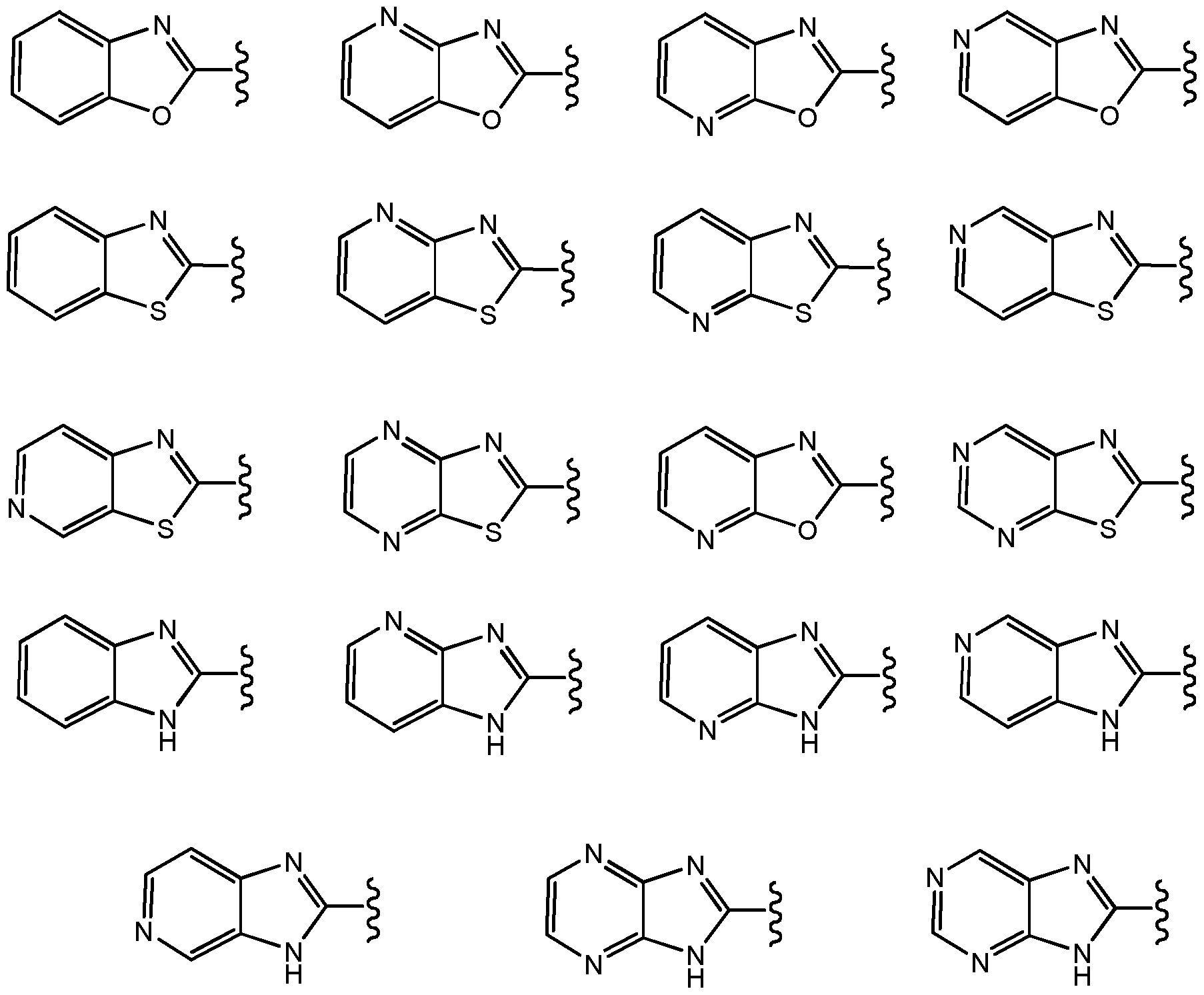


wherein R can be optionally substituted as set forth in claim 1.
The compound o , wherein R

which can be optionally substituted as set forth in claim 1
5. The compound of any of claims 1-4, wherein R and R are each methyl.
6. The compound of any of claims 1-5, wherein R represents a single F group at the para position of the phenyl ring to which it is attached.
7. The compound of any of claims 1-6, wherein R is Ci-C6 alkyl, Ci-C6 haloalkyl -(CH2)rOH or -(CH2)rCN.
8. The compound of claim 1 having the formula:

(la)
or a pharmaceutically acceptable salt thereof,
wherein:
Z is:

R is a 9-membered bicyclic heteroaryl group, wherein said 9-membered bicyclic heteroaryl group is optionally substituted with up to 2 groups, which can be the same or different, and are selected from halo, Ci-C6 alkyl, -(CH2)t-N(R70)2, -(CH2)rOH, -(CH2)rO-(Ci-C6 alkyl), - CF3, - HC(0)-heterocyclyl, - HC(0)-(Ci-C6 alkyl), -C(0) H-(d-C6 alkyl), -C(0)OH, -
C(0)0-(Ci-C6 alkyl), - HC(0)-aryl, - HS02-aryl, - HS02-alkyl, -0-S02-alkyl,-0-(Ci-C6 alkyl) and -CN, wherein the heterocyclyl moiety of said -NHC(0)-heterocyclyl group can be optionally substituted on a ring carbon or ring nitrogen atom with a -C(0)0-(Ci-C6 alkyl) group
R20 represents up to 2 optional substituents, which can be the same or different, and are selected from halo, Ci-C6 alkyl, -0-(Ci-C6 alkyl), -0-(CH2)rOH, -0-(CH2)rheterocyclyl, -0-(Ci-C6 haloalkyl), -0-S02-(Ci-C6 alkyl) and -CN;
R4U is Ci-C6 alkyl, Ci-C6 haloalkyl, -(CH2)rOH or -(CH2)rCN; and each occurrence of t is independently an integer ranging from 0 to 6.
9. The compound of any of claims 1-8, wherein Z is selected from:

wherein each occurrence of R is independently CI, F, CN, -OCF3 or -OCH3.

11. The compound of any of claims 1-10, wherein R is -CH3, -(CH2)3-CN, -CH2CH2F or -CH2CH2C(CH3)2-OH.
12. A compound being any of the compounds numbered from 1-256 in the above specification, or a pharmaceutically acceptable salt thereof.
13. A pharmaceutical composition comprising an effective amount of the compound according to any of claims 1-12, and a pharmaceutically acceptable carrier.
14. The pharmaceutical composition according to claim 13, further comprising a second therapeutic agent selected from the group consisting of HCV antiviral agents, immunomodulators, and anti-infective agents.
15. The pharmaceutical composition according to claim 14, further comprising a second therapeutic agent selected from the group consisting of HCV protease inhibitors, HCV NS5A inhibitors and HCV NS5B polymerase inhibitors. 16. A use of the compound according to any of claims 1-12 in the preparation of a medicament for inhibiting HCV NS5B activity or for preventing and/or treating infection by HCV in a subject in need thereof.
17. A method of treating a patient infected with HCV comprising the step of administering an amount of the compound according to any of claims 1-12 effective to prevent and/or treat infection by HCV in a subject in need thereof.
18. A method according to claim 17, further comprising the step of administering pegylated-interferon alpha and ribovirin.
Priority Applications (9)
| Application Number | Priority Date | Filing Date | Title |
|---|---|---|---|
| PCT/CN2010/080332 WO2011106986A1 (en) | 2010-03-02 | 2010-12-27 | Inhibitors of hepatitis c virus ns5b polymerase |
| ARP110100621A AR080433A1 (en) | 2010-03-02 | 2011-03-01 | USEFUL BENZOFURANCARBOXAMIDS DERIVATIVES TO TREAT OR PREVENT HCV INFECTIONS AND PHARMACEUTICAL COMPOSITIONS CONTAINING THEM. |
| TW100106743A TW201136919A (en) | 2010-03-02 | 2011-03-01 | Inhibitors of hepatitis C virus NS5B polymerase |
| US13/582,240 US20120328569A1 (en) | 2010-03-02 | 2011-03-02 | Inhibitors of hepatitis c virus ns5b polymerase |
| CA2791426A CA2791426A1 (en) | 2010-03-02 | 2011-03-02 | Inhibitors of hepatitis c virus ns5b polymerase |
| JP2012555284A JP2013521237A (en) | 2010-03-02 | 2011-03-02 | Inhibitor of hepatitis C virus NS5B polymerase |
| AU2011223394A AU2011223394A1 (en) | 2010-03-02 | 2011-03-02 | Inhibitors of hepatitis C virus NS5B polymerase |
| PCT/CN2011/000332 WO2011106992A1 (en) | 2010-03-02 | 2011-03-02 | Inhibitors of hepatitis c virus ns5b polymerase |
| EP11750145.2A EP2542545A4 (en) | 2010-03-02 | 2011-03-02 | HEPATITIS C NS5B VIRUS POLYMERASE INHIBITORS |
Applications Claiming Priority (3)
| Application Number | Priority Date | Filing Date | Title |
|---|---|---|---|
| CNPCT/CN2010/070831 | 2010-03-02 | ||
| PCT/CN2010/070831 WO2011106929A1 (en) | 2010-03-02 | 2010-03-02 | Inhibitors of hepatitis c virus ns5b polymerase |
| PCT/CN2010/080332 WO2011106986A1 (en) | 2010-03-02 | 2010-12-27 | Inhibitors of hepatitis c virus ns5b polymerase |
Publications (1)
| Publication Number | Publication Date |
|---|---|
| WO2011106986A1 true WO2011106986A1 (en) | 2011-09-09 |
Family
ID=44541614
Family Applications (2)
| Application Number | Title | Priority Date | Filing Date |
|---|---|---|---|
| PCT/CN2010/070831 Ceased WO2011106929A1 (en) | 2010-03-02 | 2010-03-02 | Inhibitors of hepatitis c virus ns5b polymerase |
| PCT/CN2010/080332 Ceased WO2011106986A1 (en) | 2010-03-02 | 2010-12-27 | Inhibitors of hepatitis c virus ns5b polymerase |
Family Applications Before (1)
| Application Number | Title | Priority Date | Filing Date |
|---|---|---|---|
| PCT/CN2010/070831 Ceased WO2011106929A1 (en) | 2010-03-02 | 2010-03-02 | Inhibitors of hepatitis c virus ns5b polymerase |
Country Status (1)
| Country | Link |
|---|---|
| WO (2) | WO2011106929A1 (en) |
Cited By (5)
| Publication number | Priority date | Publication date | Assignee | Title |
|---|---|---|---|---|
| CN103224479A (en) * | 2013-04-26 | 2013-07-31 | 温州大学 | Synthetic method of 2-arylbenzofuran compounds |
| US8614207B2 (en) | 2010-10-26 | 2013-12-24 | Presidio Pharmaceuticals, Inc. | Inhibitors of hepatitis C virus |
| US8927593B2 (en) | 2011-08-19 | 2015-01-06 | Glaxo Group Limited | Benzofuran compounds for the treatment of hepatitis C virus infections |
| WO2015179392A1 (en) * | 2014-05-21 | 2015-11-26 | Bristol-Myers Squibb Company | 2-(aryl- or heteroaryl-)phenyl (aza)benzofuran compounds for the treatment of hepatitis c |
| US9303020B2 (en) | 2012-02-08 | 2016-04-05 | Bristol-Myers Squibb Company | Compounds for the treatment of hepatitis C |
Families Citing this family (11)
| Publication number | Priority date | Publication date | Assignee | Title |
|---|---|---|---|---|
| US8324212B2 (en) | 2010-02-25 | 2012-12-04 | Bristol-Myers Squibb Company | Compounds for the treatment of hepatitis C |
| US8354410B2 (en) | 2010-03-11 | 2013-01-15 | Bristol-Meyers Squibb Company | Compounds for the treatment of hepatitis C |
| US8445497B2 (en) | 2010-06-30 | 2013-05-21 | Bristol-Myers Squibb Company | Compounds for the treatment of hepatitis C |
| WO2013030750A1 (en) | 2011-09-01 | 2013-03-07 | Lupin Limited | Antiviral compounds |
| WO2013033899A1 (en) * | 2011-09-08 | 2013-03-14 | Merck Sharp & Dohme Corp. | Substituted benzofuran compounds and methods of use thereof for the treatment of viral diseases |
| AU2013217224B2 (en) | 2012-02-10 | 2017-04-06 | Lupin Limited | Antiviral compounds with a dibenzooxaheterocycle moiety |
| US9434738B2 (en) | 2013-01-10 | 2016-09-06 | Bristol-Myers Squibb Company | Macrocyclic benzofuran and azabenzofuran compounds for the treatment of hepatitis C |
| US9920036B2 (en) * | 2014-03-21 | 2018-03-20 | Bristol-Myers Squibb Company | Cyanoamino (aza)benzofuran compounds for the treatment of hepatitis C |
| WO2016133972A1 (en) * | 2015-02-19 | 2016-08-25 | Bristol-Myers Squibb Company | Substituted benzofuran compounds for the treatment of hepatitis c |
| TWI731854B (en) | 2015-03-23 | 2021-07-01 | 美商共結晶製藥公司 | Inhibitors of hepatitis c virus polymerase |
| US12274700B1 (en) | 2020-10-30 | 2025-04-15 | Accencio LLC | Methods of treating symptoms of coronavirus infection with RNA polymerase inhibitors |
Citations (1)
| Publication number | Priority date | Publication date | Assignee | Title |
|---|---|---|---|---|
| CN1731993A (en) * | 2002-11-01 | 2006-02-08 | 维洛药品公司 | Benzofuran compounds, compositions and methods for treatment and prophylaxis of hepatitis c viral infections and associated diseases |
-
2010
- 2010-03-02 WO PCT/CN2010/070831 patent/WO2011106929A1/en not_active Ceased
- 2010-12-27 WO PCT/CN2010/080332 patent/WO2011106986A1/en not_active Ceased
Patent Citations (1)
| Publication number | Priority date | Publication date | Assignee | Title |
|---|---|---|---|---|
| CN1731993A (en) * | 2002-11-01 | 2006-02-08 | 维洛药品公司 | Benzofuran compounds, compositions and methods for treatment and prophylaxis of hepatitis c viral infections and associated diseases |
Cited By (9)
| Publication number | Priority date | Publication date | Assignee | Title |
|---|---|---|---|---|
| US8614207B2 (en) | 2010-10-26 | 2013-12-24 | Presidio Pharmaceuticals, Inc. | Inhibitors of hepatitis C virus |
| US9085587B2 (en) | 2010-10-26 | 2015-07-21 | Presidio Pharmaceuticals, Inc. | Inhibitors of hepatitis C virus |
| US9309260B2 (en) | 2010-10-26 | 2016-04-12 | Presidio Pharmaceuticals, Inc. | Inhibitors of hepatitis C virus |
| US8927593B2 (en) | 2011-08-19 | 2015-01-06 | Glaxo Group Limited | Benzofuran compounds for the treatment of hepatitis C virus infections |
| US9682999B2 (en) | 2011-08-19 | 2017-06-20 | Glaxo Group Limited | Benzofuran compounds for the treatment of hepatitis C virus infections |
| US9303020B2 (en) | 2012-02-08 | 2016-04-05 | Bristol-Myers Squibb Company | Compounds for the treatment of hepatitis C |
| CN103224479A (en) * | 2013-04-26 | 2013-07-31 | 温州大学 | Synthetic method of 2-arylbenzofuran compounds |
| CN103224479B (en) * | 2013-04-26 | 2014-10-15 | 温州大学 | Synthetic method of 2-arylbenzofuran compounds |
| WO2015179392A1 (en) * | 2014-05-21 | 2015-11-26 | Bristol-Myers Squibb Company | 2-(aryl- or heteroaryl-)phenyl (aza)benzofuran compounds for the treatment of hepatitis c |
Also Published As
| Publication number | Publication date |
|---|---|
| WO2011106929A1 (en) | 2011-09-09 |
Similar Documents
| Publication | Publication Date | Title |
|---|---|---|
| WO2011106986A1 (en) | Inhibitors of hepatitis c virus ns5b polymerase | |
| EP2542545A1 (en) | Inhibitors of hepatitis c virus ns5b polymerase | |
| TWI494309B (en) | Inhibitors of hcv ns5a | |
| EP2410844B1 (en) | Inhibitors of hepatitis c virus replication | |
| TWI480278B (en) | Inhibitors of hcv ns5a | |
| JP5685191B2 (en) | Compounds for the treatment of hepatitis C | |
| WO2012067664A1 (en) | Compounds | |
| ES2611731T3 (en) | Benzofuran compounds for the treatment of hepatitis C virus infections | |
| MX2011002471A (en) | Compounds for the treatment of hepatitis c. | |
| WO2014123793A1 (en) | Tetracyclic heterocycle compounds and methods of use thereof for the treatment of hepatitis c | |
| EP2953462B1 (en) | Tetracyclic heterocycle compounds and methods of use thereof for the treatment of hepatitis c | |
| TW201138786A (en) | Therapeutic compounds | |
| CN102892767A (en) | Compounds for the treatment of hepatitis c | |
| EP3013834A1 (en) | Substituted benzofuran compounds and methods of use thereof for the treatment of viral diseases | |
| WO2014209726A1 (en) | Substituted benzofuran compounds and methods of use thereof for the treatment of viral diseases | |
| JP2018509401A (en) | Novel compounds for the treatment of hepatitis C | |
| JP2013540134A (en) | Viral polymerase inhibitor | |
| EP2953461B1 (en) | Tetracyclic heterocycle compounds and methods of use thereof for the treatment of hepatitis c | |
| HK1160359B (en) | Inhibitors of hepatitis c virus replication |
Legal Events
| Date | Code | Title | Description |
|---|---|---|---|
| 121 | Ep: the epo has been informed by wipo that ep was designated in this application |
Ref document number: 10846904 Country of ref document: EP Kind code of ref document: A1 |
|
| NENP | Non-entry into the national phase |
Ref country code: DE |
|
| 122 | Ep: pct application non-entry in european phase |
Ref document number: 10846904 Country of ref document: EP Kind code of ref document: A1 |