WO2011067730A1 - Bells and methods of their design and production - Google Patents
Bells and methods of their design and production Download PDFInfo
- Publication number
- WO2011067730A1 WO2011067730A1 PCT/IB2010/055543 IB2010055543W WO2011067730A1 WO 2011067730 A1 WO2011067730 A1 WO 2011067730A1 IB 2010055543 W IB2010055543 W IB 2010055543W WO 2011067730 A1 WO2011067730 A1 WO 2011067730A1
- Authority
- WO
- WIPO (PCT)
- Prior art keywords
- bell
- mode
- frequency
- vibration
- frustum
- Prior art date
- Legal status (The legal status is an assumption and is not a legal conclusion. Google has not performed a legal analysis and makes no representation as to the accuracy of the status listed.)
- Ceased
Links
Classifications
-
- G—PHYSICS
- G10—MUSICAL INSTRUMENTS; ACOUSTICS
- G10K—SOUND-PRODUCING DEVICES; METHODS OR DEVICES FOR PROTECTING AGAINST, OR FOR DAMPING, NOISE OR OTHER ACOUSTIC WAVES IN GENERAL; ACOUSTICS NOT OTHERWISE PROVIDED FOR
- G10K1/00—Devices in which sound is produced by striking a resonating body, e.g. bells, chimes or gongs
- G10K1/28—Bells for towers or the like
-
- G—PHYSICS
- G10—MUSICAL INSTRUMENTS; ACOUSTICS
- G10K—SOUND-PRODUCING DEVICES; METHODS OR DEVICES FOR PROTECTING AGAINST, OR FOR DAMPING, NOISE OR OTHER ACOUSTIC WAVES IN GENERAL; ACOUSTICS NOT OTHERWISE PROVIDED FOR
- G10K1/00—Devices in which sound is produced by striking a resonating body, e.g. bells, chimes or gongs
- G10K1/06—Devices in which sound is produced by striking a resonating body, e.g. bells, chimes or gongs the resonating devices having the shape of a bell, plate, rod, or tube
- G10K1/062—Devices in which sound is produced by striking a resonating body, e.g. bells, chimes or gongs the resonating devices having the shape of a bell, plate, rod, or tube electrically operated
- G10K1/063—Devices in which sound is produced by striking a resonating body, e.g. bells, chimes or gongs the resonating devices having the shape of a bell, plate, rod, or tube electrically operated the sounding member being a bell
-
- G—PHYSICS
- G10—MUSICAL INSTRUMENTS; ACOUSTICS
- G10K—SOUND-PRODUCING DEVICES; METHODS OR DEVICES FOR PROTECTING AGAINST, OR FOR DAMPING, NOISE OR OTHER ACOUSTIC WAVES IN GENERAL; ACOUSTICS NOT OTHERWISE PROVIDED FOR
- G10K1/00—Devices in which sound is produced by striking a resonating body, e.g. bells, chimes or gongs
- G10K1/06—Devices in which sound is produced by striking a resonating body, e.g. bells, chimes or gongs the resonating devices having the shape of a bell, plate, rod, or tube
- G10K1/07—Devices in which sound is produced by striking a resonating body, e.g. bells, chimes or gongs the resonating devices having the shape of a bell, plate, rod, or tube mechanically operated; Hand bells; Bells for animals
- G10K1/071—Hand bells; Bells for animals
-
- Y—GENERAL TAGGING OF NEW TECHNOLOGICAL DEVELOPMENTS; GENERAL TAGGING OF CROSS-SECTIONAL TECHNOLOGIES SPANNING OVER SEVERAL SECTIONS OF THE IPC; TECHNICAL SUBJECTS COVERED BY FORMER USPC CROSS-REFERENCE ART COLLECTIONS [XRACs] AND DIGESTS
- Y10—TECHNICAL SUBJECTS COVERED BY FORMER USPC
- Y10T—TECHNICAL SUBJECTS COVERED BY FORMER US CLASSIFICATION
- Y10T29/00—Metal working
- Y10T29/49—Method of mechanical manufacture
Definitions
- the present invention relates to bells and methods of designing and producing same. More particularly, the present invention relates to harmonic bells and methods of producing such bells.
- a bell is an object that undergoes vibration and radiates energy into the air to make sound.
- bells are hollow, cone-shaped objects that are induced to make a sound after being struck, usually by a striking device associated with the bell known as a clapper.
- sounds produced by freely vibrating objects, such as bells usually consist of multiple tones, often described as the fundamental (lowest frequency tone) and its overtones. Air-columns and stretched strings naturally vibrate in such a way as to produce overtones at frequencies at integer multiples of the fundamental frequency.
- Such a system of overtones is known as the harmonic series.
- An important property of the human auditory system is that sounds with harmonically tuned overtones usually produce a strong and singular sensation of a musical pitch with a frequency close to that of the fundamental frequency of the harmonic series.
- harmonically tuned bells viz. "harmonic bells”
- harmonic bells have many musical advantageous compared with non-harmonically tuned bells. This is particularly the case when bells are intended to be used to play music, either independently or with other musical instruments.
- the vibration of bells may be regarded as the linear combination of different motions known as the bell's "normal modes of vibration", or simply “modes". Each mode has particular directions and extents of motion in regions of the bell, which occur with specific frequencies of oscillation. Apart from so-called “rigid body modes” which do not contribute to a bell's sound, all modes have nodal lines or points at which the bell surface is stationary. From analytical theory it is known that the frequency of modes of rigid bodies may be altered by substantially changing only the effective stiffness of the body with respect to the mode shape being altered, by substantially changing only the effective mass inertia of the body with respect to the mode shape being altered, or by both simultaneously.
- the frequency of each mode depends on the ratio of the stiffness of the bell for that mode to the inertia of the bell material being set in motion, so the specific shape of a bell directly affects the frequencies of its overtones.
- the ratios of these overtone frequencies to the fundamental frequency of the bell are generally preserved when the bell is scaled, thereby producing a similar sound across a range of musical pitches, as is usually required for a musical instrument.
- the acoustically important modes of a bell are those in which displacement occurs in a direction normal to the bell's surface, as these modes are able to most efficiently radiate their energy in the air in the form of sound.
- a reference to “modes” is a reference only to modes in which vibration occurs in a direction normal to the bell's surface.
- a reference to “frequencies” is a reference only to frequencies due to modes in which vibration occurs in a direction normal to the bell's surface.
- a reference to the first— for example— three modes is a reference to the lowest frequency mode, the second lowest frequency mode and the third lowest frequency mode. Other references to the first number of modes are to be construed similarly.
- modes are referred to as an ordered pair (m, n) where m is the number of meridial nodal lines and n is the number of nodal rings.
- the (2,0) mode is the lowest frequency acoustically important mode ("the fundamental").
- a reference to the "mode sequence" for a bell is a reference to a list of the modes of the bell, in order of the frequency of the modes and starting with the lowest frequency mode.
- references to a "frequency sequence” are references to a list of the modal frequencies of a bell starting with the lowest modal frequency.
- references to frequencies "being tuned”, and similar expressions are references to modal frequencies which are desired to be modified to substantially adopt particular values. For example, in the case of a harmonic bell wherein the first five frequencies are to be substantially in an harmonic sequence, the first five frequencies are all "being tuned" or "to be tuned”.
- a reference to a "tuned bell” is a reference to a bell that has modal frequencies that have been tuned.
- Finite Element Analysis (FEA) methods for numerically estimating the normal modes of a solid body, and their associated frequencies, are well known. These methods can be used when the geometry of the solid body is too complex to be solved by analytically derived equations. In finite element methods the body is notionally divided into many elements. The geometry of this division is known as a "mesh". Individual elements are geometrically defined by "nodes", which are points on the boundaries of elements at the intersection points of the mesh. Elements may have a wide range of properties by virtue of the equations defining their mechanical properties and the values of variables used to model material properties. It is common to use so-called "solid elements” with eight nodes to define a volume and so-called “shell elements” with four nodes to define a surface. A shell thickness must also be provided in the mathematical definition of shell elements.
- the present invention provides a method for designing a bell, comprising:
- frustum is not employed in its precise mathematical sense, but rather to convey the general form of the bell.
- the planes of the two ends of the bell may not be precisely parallel (as would be required of an ideal frustum), and the shortest path along the wall between those ends may not be straight.
- the method comprises determining said optimal size and location of the stiffening element by finite element analysis or by experiment.
- the method may comprise determining the size and location to maximally increase a frequency of the second mode whilst minimally increasing a frequency of a third mode of vibration.
- the method locating the stiffening element at a region of the wall that affects a stiffness of the second mode whilst minimally affecting a stiffness of the third mode.
- the method may comprise locating the stiffing element on an interior surface of the wall at a minimal distance from a larger rim of the bell for which negligible stress is observed for a third mode of vibration.
- the method may comprise fine-tuning a frequency of a fundamental mode of vibration by reducing a stiffness of the frustum by inserting tuning slots in a rim of the smaller end of the frustum. This embodiment may include adjusting the lengths of the tuning slots.
- the method may comprise fine-tuning a frequency of third and fourth modes of vibration by reducing a stiffness of the frustum by inserting tuning slots in a rim of the larger end of the frustum. This embodiment may include adjusting the lengths of the tuning slots.
- the method :
- Numerical methods like FEA are only capable of estimating the mode shapes and frequencies of a particular, given geometry. Tuning the modal frequencies of a rigid body requires that modal analysis be undertaken for a range of geometries of that body.
- the optimal size and location of the stiffening element may be determined.
- the stiffening element maximally increases the frequency of the second mode whilst minimally increasing the frequency of the third mode by being located at a region of the bell wall that affects the stiffness of the second mode without affecting the stiffness of the third mode.
- the stiffening element may be constructed of any suitable material such as, but not limited to sheet metal or ceramic material. In a particular embodiment, the stiffening element is in the shape of a ring.
- mass loading involves providing highly localized masses to specific locations on the bell wall in such a way as to increase mass inertia but not increase the stiffness. The closer these masses are to the large rim of the bell the more they will lower the frequency of higher order modes relative to lower order modes.
- the modes of bells with meridial lines occur in pairs in which each mode of the pair has the same eigenvalues and nominally equal frequency, but is shifted in phase such that the maximum vibratory displacement of one of the pair occurs at the minimum of the other. If by reason of the method of manufacture, one of a pair of modes is higher in frequency, placing the mass at the maximum of vibration of that mode can lower its frequency to match the other mode.
- the stiffness of the cone can be modified by inserting tuning slots at suitable positions on the body wall of the bell.
- these positions are in the rims of the smaller and/or larger end of the cone. Inserting tuning slots in the smaller end of the cone generally only lowers the frequency of the fundamental frequency (a 2,0 mode shape). Inserting tuning slots in the larger end of the cone generally reduces the frequency of higher order circumferential modes more than lower order circumferential modes. The insertion of tuning slots tunes the bell such that it is harmonic.
- the body wall of the bells of the present invention may be constructed from any material with suitable physical properties, for example, able to be obtained in a sheet of constant thickness, able to support audible modes of vibration. Such materials may include, but are not limited to, metal or ceramic materials.
- the body wall of the bell of the present invention may be produced from a continuous sheet of material as a conical frustum or truncated cone (for example made by rolling) or as a faceted truncated cone (made from a series of folds). Fabricating a truncated cone or faceted truncated cone from, for example, sheet metal requires that the metal be joined along a seam.
- the cone may be manufactured from a single piece of metal in which case there will be a seam on one side of the cone. The cone may also be manufactured from multiple pieces in which case there will be multiple seams.
- the beat frequency is the difference in the frequency of the pair of modes with the same eigenvalues and may be tuned by mass loading one mode, lengthening slots in the rim of the bell that predominantly effect the stiffness of the higher frequency mode, or thinning the stiffening element at locations that predominantly effect the stiffness of the higher frequency mode.
- any discontinuities in the mass or stiffness of the bell due to the seam may be distributed to both modes in each of the lower order pairs of modes by fabricating the truncated cone from two unequal segments. For example, if the truncated cone was constructed from 16 facets, a second seam could be placed at the seventh fold from the first seam, or at an angle of 157.5°. A seam will then occur in regions of displacement for both of the modes in each pair and so will substantially reduce the frequency difference between the modes.
- the present invention provides a method of producing a bell, comprising:
- the present invention provides a bell, comprising:
- a body wall in a general form of a frustum that is open at both ends; and a stiffening element sized and located to increase a frequency ratio of a second mode of vibration of the bell relative to one or more other modes of vibration of the bell to be tuned in the bell.
- the stiffening element may be added to the wall of the bell, or manufactured integral with the wall.
- the present invention provides a bell, the bell comprising a body wall having a constant thickness and wherein at least two modes of the bell have frequencies tuned to a harmonic series.
- the bell of the present invention has at least three modes having frequencies tuned to a harmonic series.
- the bell of the present invention is tuned by modifying one or more characteristics of the body wall.
- a characteristic to be modified is stiffness.
- the stiffness of the body wall of the bell of the present invention is modified by the addition of tuning slots and/or a stiffening element to the body wall.
- the mass inertia of the body wall of the bell of the present invention is modified by the addition of localized mass to the body wall.
- the methods of the present invention allow the production of harmonic bells predominantly from material of constant thickness, thereby facilitating economical manufacture of harmonic bells.
- Figures 1 A and 1 B are elevation and plan diagrammatic representations, respectively, of a model of a truncated circular cone (or conical frustum) created as a first step in the modelling of a bell according to a first embodiment of the present invention
- Figures 2A to 2D are diagrammatic elevation representations, respectively, of the vibratory displacements of the first three purely circumferential modes (2,0, 3,0 and 4,0) and the first mode with a nodal ring (2,1 ) for the bell of Figures 1A and 1 B, as calculated by
- Figures 2E to 2H are negative versions of Figures 2A to 2D, respectively
- Figures 3A and 3B are elevation and plan diagrammatic representations, respectively, of a bell in the form of a truncated circular cone or conical frustum with stiffening ring in 3 mm mild steel material, according to the first embodiment of the present invention
- Figures 4A and 4B are elevation and plan diagrammatic representations, respectively, of a faceted truncated circular cone bell with stiffening ring and tuning slots and scallops in 3 mm mild steel material, according to a second embodiment of the present invention.
- Figure 5 is a diagrammatic representation of the unfolded sheet metal components of the bell of Figures 4A and 4B, as prepared for metal cutting and fabrication. Detailed Description of Preferred Embodiments of the Invention
- Truncated cone 10 was defined by the diameters of the smaller end 12 and larger end 14 of truncated cone 10 and the height of truncated cone 10.
- the frequency ratios of the overtones due to modes without nodal rings to the fundamental mode frequency are generally greater than the harmonic series.
- the frequency ratios reduce as the cone angle ⁇ relative to a cylinder increases up to an angle of around 40°.
- the frequency ratios then begin to increase as cone angle ⁇ increases and the geometry becomes closer to a disk.
- the cone angle ⁇ was systematically altered to find the dimensions for which the frequency ratios were as small as possible.
- FIGS 2A to 2D The first four modes of truncated cone 10 are shown in Figures 2A to 2D.
- Figures 2A to 2D are diagrammatic elevation representations, respectively, of the vibratory displacements of the first three purely circumferential modes (2,0, 3,0 and 4,0) and the first mode with a nodal ring (2,1 ) for truncated cone 10, as predicted by FEA. The results are shown as greyscale plots where maximum displacement is lightest.
- Figures 2E to 2H are negative versions of Figures 2A to 2D, respectively, and are provided for clarity; Figures 2E to 2H are thus greyscale plots in which maximum displacement is darkest).
- the first three of these modes exhibit only meridial nodal lines.
- the fourth mode, shown in Figure 2D also exhibits a nodal ring.
- the internal diameter of stiffing ring 32 was adjusted to fine-tune the frequency ratio of the second mode relative to the other modes.
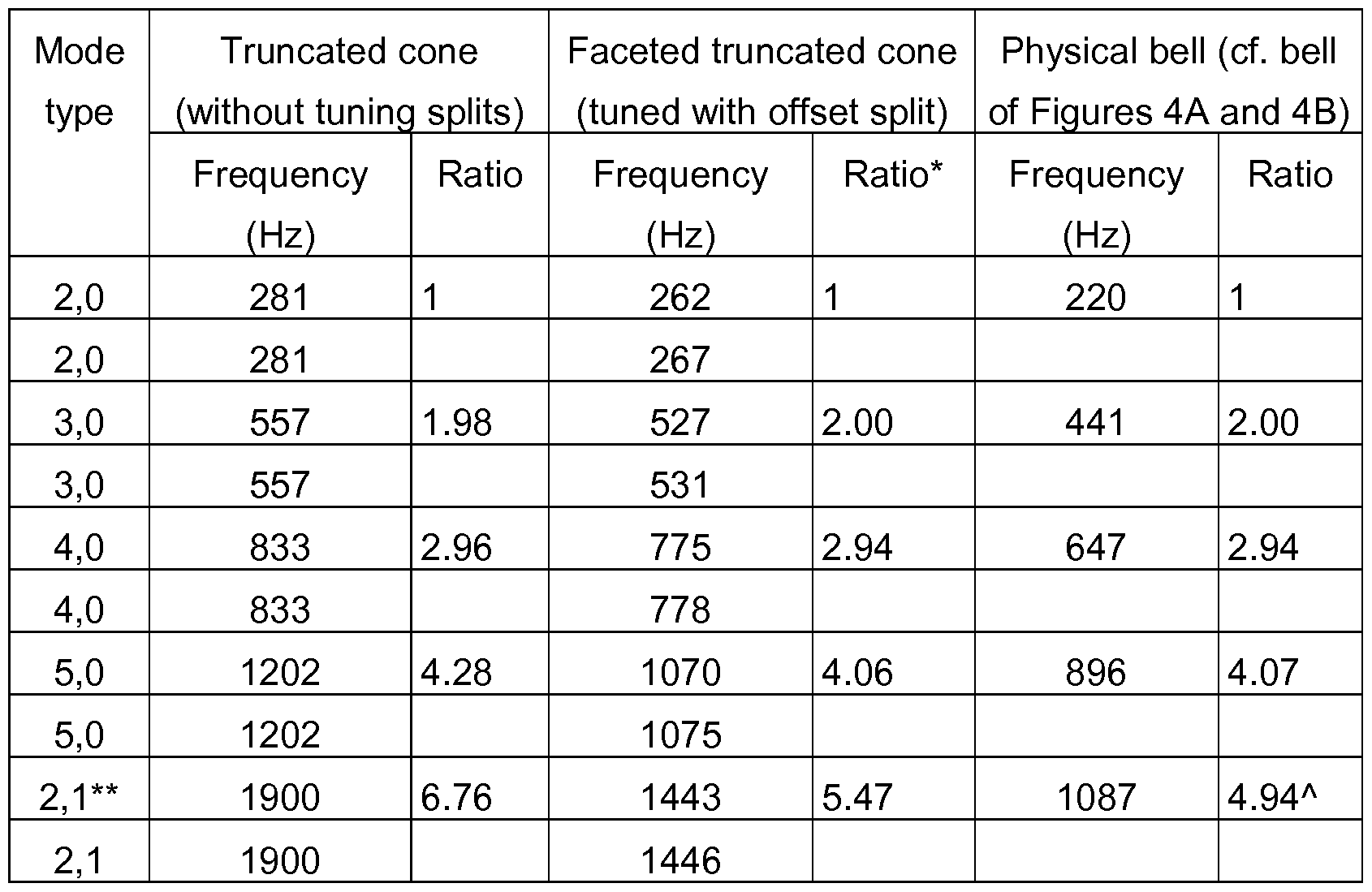
- Table 1 lists the modal frequencies predicted by a finite element analysis of the geometry of bell 30 with a 3 mm thick mild steel model. The first three modes are within 2% of the harmonic series.
- Stiffening ring 32 was also found to increase the frequency of the fundamental. It was found that this could be corrected by inserting slots (not shown) of increasing length in the rim of the smaller end 36 of bell 30. Since higher order modes do not exhibit significant modal Table 1 : the modes tuned and the frequencies and frequency ratios predicted by
- the 2,1 mode appears to be highly sensitive to the method of joining. Stress near the small end of the cone these slots only affect the fundamental frequency.
- the frequency ratios of the third and fourth mode were reduced to tune them to the harmonic series by inserting slots of increasing length in the rim of the larger end of the cone. If these modes could not be tuned correctly for a given truncated cone shape, the shape was adjusted and the process was repeated until minimum tuning errors were achieved.
- Figures 4A and 4B are elevation and plan diagrammatic representations, respectively, of a model of a faceted truncated circular cone bell 40 according to a second embodiment of the present invention.
- Bell 40 modelled as being of folded 3 mm thick mild steel material, comprises 16 facets or sectors 42, a stiffening ring 44 attached internally with tabs 46 to the bell wall, and both tuning slots 48 and tuning scallops 50 in larger rim 52.
- FIG. 5 is a diagrammatic representation 60 of the unfolded sheet metal components of bell 40 of Figures 4A and 4B, as would be prepared for use in metal cutting and fabrication, showing stiffening ring 44, first wall segment 62 and second wall segment 64.
- Bell 40 has a seam 56a created by four discrete tabs 66 (see Figure 5) extending from one 42' of facets 42, which overlap with and are joined to an adjacent facet 42" of the bell wall. Apart from these tabs 66, the two facets 42,42" joined by tabs 6 are separated by a gap 58 of approximately 2 mm to prevent buzzing due to intermediate contact during vibration of bell 40.
- the average frequencies of the first four modes of this bell model are within 2% of the harmonic series for the musical note Middle C (see Table 1 ).
- the effect of any discontinuities in the mass or stiffness of bell 40 due to seam 56a are distributed to both modes in each of the lower order pairs of modes by fabricating the truncated cone from two unequal segments 62, 64 (see Figure 5).
- a second seam 56b is placed at the seventh fold from the first seam 56a, or separated by an angle of 157.5°. (Second seam 56b is closed with tabs 68 comparable to tabs 66.) A seam 56a, 56b is thus provided in regions of displacement for both of the modes in each pair and so will substantially reduce the frequency difference between the modes.
- Geometric discontinuities at a scale substantially smaller than the vibratory wavelength do not affect the frequency of the mode. Internal damping of materials generally cause higher frequency modes to reduce in amplitude compared to lower frequency, longer wavelength modes. It is possible to manufacture the faceted truncated cone from a flat sheet by a series of discrete folds. The faceted truncated cone sounds substantially the same as a circular truncated cone since the shorter wavelength modes at higher frequencies that would be affected by the facets are generally not excited and do not resonate efficiently.
Landscapes
- Physics & Mathematics (AREA)
- Engineering & Computer Science (AREA)
- Acoustics & Sound (AREA)
- Multimedia (AREA)
- Apparatuses For Generation Of Mechanical Vibrations (AREA)
- Vibration Prevention Devices (AREA)
Abstract
Description
Claims
Priority Applications (2)
| Application Number | Priority Date | Filing Date | Title |
|---|---|---|---|
| AU2010325652A AU2010325652A1 (en) | 2009-12-02 | 2010-12-02 | Bells and methods of their design and production |
| US13/513,370 US20120304846A1 (en) | 2009-12-02 | 2010-12-02 | Bells and methods of their design and production |
Applications Claiming Priority (2)
| Application Number | Priority Date | Filing Date | Title |
|---|---|---|---|
| AU2009905894A AU2009905894A0 (en) | 2009-12-02 | Improved bells | |
| AU2009905894 | 2009-12-02 |
Publications (1)
| Publication Number | Publication Date |
|---|---|
| WO2011067730A1 true WO2011067730A1 (en) | 2011-06-09 |
Family
ID=44114650
Family Applications (1)
| Application Number | Title | Priority Date | Filing Date |
|---|---|---|---|
| PCT/IB2010/055543 Ceased WO2011067730A1 (en) | 2009-12-02 | 2010-12-02 | Bells and methods of their design and production |
Country Status (3)
| Country | Link |
|---|---|
| US (1) | US20120304846A1 (en) |
| AU (1) | AU2010325652A1 (en) |
| WO (1) | WO2011067730A1 (en) |
Cited By (1)
| Publication number | Priority date | Publication date | Assignee | Title |
|---|---|---|---|---|
| GB2578319A (en) * | 2018-10-23 | 2020-05-06 | John Taylor Bell Foundry Loughborough Ltd | A bell and a method of designing a bell |
Families Citing this family (1)
| Publication number | Priority date | Publication date | Assignee | Title |
|---|---|---|---|---|
| US10424278B2 (en) * | 2017-08-02 | 2019-09-24 | Applied Invention, Llc | Bell with subharmonic difference tone |
Citations (1)
| Publication number | Priority date | Publication date | Assignee | Title |
|---|---|---|---|---|
| US6915756B1 (en) * | 1999-10-22 | 2005-07-12 | Australian Bell Pty Ltd. | Bells |
Family Cites Families (13)
| Publication number | Priority date | Publication date | Assignee | Title |
|---|---|---|---|---|
| US296515A (en) * | 1884-04-08 | bowees | ||
| US3027794A (en) * | 1962-04-03 | Musical device | ||
| US870025A (en) * | 1906-03-10 | 1907-11-05 | Edward J Elsas | Musical instrument. |
| US2787929A (en) * | 1954-02-04 | 1957-04-09 | Clair O Musser | Bells |
| US2811071A (en) * | 1954-08-27 | 1957-10-29 | Knickerbocker Plastic Co Inc | Toy musical instrument |
| US4127053A (en) * | 1977-06-17 | 1978-11-28 | Latin Percussion, Inc. | Percussion instrument |
| US4599932A (en) * | 1984-01-03 | 1986-07-15 | Malta Jacob H | Handchime with elastomeric hinge |
| USD298543S (en) * | 1986-10-08 | 1988-11-15 | Benson Richard A | Percussion musical instrument |
| US5275080A (en) * | 1992-02-20 | 1994-01-04 | John Stannard | Wind chimes having paired chime members |
| US6005177A (en) * | 1997-04-24 | 1999-12-21 | Malmark, Inc. | Handchime with damper block |
| US6091009A (en) * | 1999-01-26 | 2000-07-18 | Latin Percussion, Inc. | Musical percussion instrument |
| US7199297B2 (en) * | 2004-01-20 | 2007-04-03 | Anderson James M | Cymbal system and method of making |
| US7225753B1 (en) * | 2005-12-28 | 2007-06-05 | Yi Hsuan Lo | Bell device |
-
2010
- 2010-12-02 AU AU2010325652A patent/AU2010325652A1/en not_active Abandoned
- 2010-12-02 US US13/513,370 patent/US20120304846A1/en not_active Abandoned
- 2010-12-02 WO PCT/IB2010/055543 patent/WO2011067730A1/en not_active Ceased
Patent Citations (1)
| Publication number | Priority date | Publication date | Assignee | Title |
|---|---|---|---|---|
| US6915756B1 (en) * | 1999-10-22 | 2005-07-12 | Australian Bell Pty Ltd. | Bells |
Cited By (3)
| Publication number | Priority date | Publication date | Assignee | Title |
|---|---|---|---|---|
| GB2578319A (en) * | 2018-10-23 | 2020-05-06 | John Taylor Bell Foundry Loughborough Ltd | A bell and a method of designing a bell |
| US10777182B2 (en) | 2018-10-23 | 2020-09-15 | John Taylor Bell Foundry (Loughborough) Limited | Bell and a method of designing a bell |
| GB2578319B (en) * | 2018-10-23 | 2023-05-24 | John Taylor Bell Foundry Loughborough Ltd | A bell and a method of designing a bell |
Also Published As
| Publication number | Publication date |
|---|---|
| AU2010325652A1 (en) | 2012-06-21 |
| US20120304846A1 (en) | 2012-12-06 |
Similar Documents
| Publication | Publication Date | Title |
|---|---|---|
| US8492632B1 (en) | Tuned bell harmonic musical instrument | |
| US10373594B1 (en) | Hand pan tongue drum | |
| JP2011510330A (en) | G-pan musical instrument | |
| US20120304846A1 (en) | Bells and methods of their design and production | |
| Kim et al. | Beat characteristics and beat maps of the King Seong-deok Divine Bell | |
| CN106663415A (en) | drum | |
| JP6179536B2 (en) | Musical instrument sound board | |
| Carvalho et al. | Development of a non-destructive bell-tuning technique through optimized structural modifications | |
| Arifin et al. | Modeling of angklung to determine its pitch frequency | |
| US12019404B2 (en) | Method of harmonic tuning of at least one gong of a watch striking mechanism | |
| KR100889495B1 (en) | Beating tuning method of fine asymmetric ring structure | |
| US6915756B1 (en) | Bells | |
| JP6477080B2 (en) | Drum head and drum | |
| Martin et al. | Finite element simulation and experiment in khaen acoustics | |
| Förtsch | Cooperative behavior of both reeds in the channel of a blues harmonica when bending | |
| WO2012019233A1 (en) | Method of manufacturing metal objects with desired structural characteristics | |
| US3683845A (en) | Domes for electric bells | |
| AU666360B2 (en) | A musical percussion instrument | |
| TWI530938B (en) | Pipes with harmonics sound, a method for design the pipes and percussion instruments with pipes | |
| Nigjeh et al. | Application of modal analysis to musical bell design | |
| US20060272475A1 (en) | Percussion instrument having membranes no facing each other | |
| RU2815530C1 (en) | Vibrating tongue element of percussion instrument | |
| TWI550597B (en) | Chimes with harmonics sound, a method for design the chimes, and percussion instruments with chimes | |
| JP3236251U (en) | Resonance weight structure used for sound effect equipment | |
| JP7261437B2 (en) | Bell device |
Legal Events
| Date | Code | Title | Description |
|---|---|---|---|
| 121 | Ep: the epo has been informed by wipo that ep was designated in this application |
Ref document number: 10834298 Country of ref document: EP Kind code of ref document: A1 |
|
| WWE | Wipo information: entry into national phase |
Ref document number: 2010325652 Country of ref document: AU |
|
| NENP | Non-entry into the national phase |
Ref country code: DE |
|
| ENP | Entry into the national phase |
Ref document number: 2010325652 Country of ref document: AU Date of ref document: 20101202 Kind code of ref document: A |
|
| WWE | Wipo information: entry into national phase |
Ref document number: 13513370 Country of ref document: US |
|
| 122 | Ep: pct application non-entry in european phase |
Ref document number: 10834298 Country of ref document: EP Kind code of ref document: A1 |