WO2011059082A1 - 単糖類、二糖類、及び/又はオリゴ糖の製造方法 - Google Patents
単糖類、二糖類、及び/又はオリゴ糖の製造方法 Download PDFInfo
- Publication number
- WO2011059082A1 WO2011059082A1 PCT/JP2010/070267 JP2010070267W WO2011059082A1 WO 2011059082 A1 WO2011059082 A1 WO 2011059082A1 JP 2010070267 W JP2010070267 W JP 2010070267W WO 2011059082 A1 WO2011059082 A1 WO 2011059082A1
- Authority
- WO
- WIPO (PCT)
- Prior art keywords
- acid
- reaction
- polysaccharide
- biomass
- saccharification
- Prior art date
- Legal status (The legal status is an assumption and is not a legal conclusion. Google has not performed a legal analysis and makes no representation as to the accuracy of the status listed.)
- Ceased
Links
Images

Classifications
-
- C—CHEMISTRY; METALLURGY
- C12—BIOCHEMISTRY; BEER; SPIRITS; WINE; VINEGAR; MICROBIOLOGY; ENZYMOLOGY; MUTATION OR GENETIC ENGINEERING
- C12P—FERMENTATION OR ENZYME-USING PROCESSES TO SYNTHESISE A DESIRED CHEMICAL COMPOUND OR COMPOSITION OR TO SEPARATE OPTICAL ISOMERS FROM A RACEMIC MIXTURE
- C12P19/00—Preparation of compounds containing saccharide radicals
- C12P19/02—Monosaccharides
-
- C—CHEMISTRY; METALLURGY
- C12—BIOCHEMISTRY; BEER; SPIRITS; WINE; VINEGAR; MICROBIOLOGY; ENZYMOLOGY; MUTATION OR GENETIC ENGINEERING
- C12P—FERMENTATION OR ENZYME-USING PROCESSES TO SYNTHESISE A DESIRED CHEMICAL COMPOUND OR COMPOSITION OR TO SEPARATE OPTICAL ISOMERS FROM A RACEMIC MIXTURE
- C12P19/00—Preparation of compounds containing saccharide radicals
- C12P19/12—Disaccharides
-
- C—CHEMISTRY; METALLURGY
- C12—BIOCHEMISTRY; BEER; SPIRITS; WINE; VINEGAR; MICROBIOLOGY; ENZYMOLOGY; MUTATION OR GENETIC ENGINEERING
- C12P—FERMENTATION OR ENZYME-USING PROCESSES TO SYNTHESISE A DESIRED CHEMICAL COMPOUND OR COMPOSITION OR TO SEPARATE OPTICAL ISOMERS FROM A RACEMIC MIXTURE
- C12P19/00—Preparation of compounds containing saccharide radicals
- C12P19/14—Preparation of compounds containing saccharide radicals produced by the action of a carbohydrase (EC 3.2.x), e.g. by alpha-amylase, e.g. by cellulase, hemicellulase
Definitions
- the present invention relates to a method for producing polysaccharides, particularly monosaccharides, disaccharides, and / or oligosaccharides (hereinafter collectively referred to as “decomposed sugars”) from biomass.
- Enzymatic saccharification has the advantage that it can be hydrolyzed under mild conditions compared to acid saccharification, but especially when cellulosic biomass is used, the reaction rate is very slow and increasing the saccharification rate is a major issue. Yes.
- a method for improving the saccharification rate a method of pretreating biomass in advance prior to the saccharification step has been studied.
- the pretreatment method for example, a sulfuric acid method, an organic solvent method, a hydrothermal treatment method, mechanical crushing, and the like are known.
- Patent Document 1 A saccharification method of cellulose in which a substance having high affinity with lignin, for example, a protein is added in advance and then the reaction is started by hydrolase (Patent Document 2); A method for hydrolyzing biomass (Non-Patent Document 1) and the like are known.
- the present invention provides a method for producing monosaccharides, disaccharides and / or oligosaccharides in which a hydrolase is allowed to act on polysaccharides in the presence of fatty acids.
- FIG. 1 is a graph showing the influence of fatty acids on the saccharification rate when cellulase is allowed to act on the pulverized wood pulp.
- the inventors of the present invention have intensively studied in view of the above problems, and by causing a hydrolase to act on a polysaccharide in the presence of a fatty acid, a decrease in the reaction rate is suppressed, a saccharification rate is improved, and a decomposed sugar is efficiently produced. It was found that can be manufactured.
- Cellulosic biomass is generally considered to contain a large amount of lignin in the cell walls and intercellular layers constituting the plant, which inhibits hydrolysis by cellulase.
- the saccharification rate can be improved, and it is possible to efficiently produce decomposed sugar.
- the method of the present invention can also be applied to biomass containing polysaccharides, and can be expected as a technique for improving the production efficiency of useful substances such as ethanol from biomass.
- polysaccharide used in the present invention examples include cellulose, hemicellulose, xyloglucan, pectin, starch, mannan, glucomannan, galactomannan, chitin, chitosan, inulin, alginic acid, agar, fucoidan, laminarin, ⁇ -glucan, pullulan. Natural polysaccharides such as these or derivatives thereof. These can be used alone or in combination of two or more. Of these, cellulose, hemicellulose, chitin, and chitosan are preferable, and cellulose and hemicellulose are particularly preferable because they are inexpensive and can be converted into useful substances by fermentation production after decomposition.
- the molecular weight of the polysaccharide used in the present invention is not particularly limited, but generally it is preferably 1,000 or more and 5,000,000 or less.
- the raw material containing the said polysaccharide for example, biomass
- Biomass is an organic resource derived from living organisms, excluding fossil resources.
- the biomass include cellulose-based, starch-based, and saccharide-based biomass, and these can be used alone or in combination of two or more.
- Cellulose biomass is mainly composed of cellulose, hemicellulose, and lignin.
- cellulose hemicellulose
- lignin For example, cotton, wood pulp, kenaf, hemp, small-diameter wood, thinned wood, sawdust, wood waste, waste paper, newspaper, wrapping paper, tissue paper Woody materials such as toilet paper and cardboard; plant biomass such as bagasse, switchgrass, elephant grass, rice straw and wheat straw.
- starch-based biomass include rice, wheat, corn, and potato
- examples of the saccharide-based biomass include sugar-based biomass such as sugar cane, sugar beet, seaweed, shrimp shell, and crab shell.
- pretreatment may be performed prior to the hydrolysis reaction.
- the pretreatment method is not particularly limited, and examples thereof include a sulfuric acid method, an organic solvent method, a hydrothermal treatment method, and mechanical crushing.
- drying pulverization, shredding and the like are preferable.
- a ventilated band dryer, a shelf-type hot air dryer or the like can be used.
- pulverization and chopping for example, a known rotating ball mill, planetary ball mill, disk mill, rod mill, or the like can be used.
- the pulverization and shredding of the biomass is preferably performed to a size of 800 ⁇ m or less, particularly 3 to 300 ⁇ m from the viewpoint of increasing the contact surface area with the hydrolase.
- Biomass is amorphized by pretreatment such as pulverization, and the amorphized biomass is advantageous for enzymatic saccharification.
- the degree of amorphization can be measured by calculating the degree of crystallinity described in the examples.
- the degree of crystallinity of biomass is preferably 80% or less, more preferably 50% or less, further preferably 20% or less, and particularly preferably zero.
- the enzymatic hydrolysis reaction of the polysaccharide is performed in the presence of a fatty acid.
- the fatty acid include linear or branched saturated or unsaturated fatty acids.
- the melting point of the fatty acid is 60 ° C. or less, more preferably ⁇ 10 to 50 ° C., particularly ⁇ 5 to 30 ° C., because it is easy to separate and recover from the sugar solution after hydrolysis, and easy to handle. From the viewpoint of dispersion efficiency and the improvement of saccharification rate.
- the number of carbon atoms of the fatty acid is not particularly limited, but for the same reason, it is preferably 6 to 24 carbon atoms, more preferably 6 to 22 carbon atoms, particularly preferably 6 to 20 carbon atoms, and even more preferably 6 to 12 carbon atoms. .
- caprylic acid is preferable.
- the amount of fatty acid used is preferably from 0.005 to 2.0, more preferably from 0.008 to 1.0, particularly from 0.009 to 2.0 as a mass ratio to the dry solid content of the polysaccharide, which is a substrate, from the viewpoint of improving the saccharification rate. 0.8, especially 0.01 to 0.29 is preferred.
- the polysaccharide is preferably used in the form of a slurry, and the content of the polysaccharide in the slurry is 1 to 200 g / L, more preferably 5 to 150 g / L, particularly 8 to 100 g / L from the viewpoint of fluidity. Is preferred.
- the slurry include water and various buffer solutions. Examples of water include tap water, distilled water, ion exchange water, and purified water.
- As the buffer those having a buffer capacity in the range of pH 3 to 8 are preferable, and examples thereof include a phosphate buffer, a citrate buffer, an acetate buffer, and a Tris buffer.
- the fatty acid is preferably added to the polysaccharide-containing slurry, and the timing of addition may be before or after adding the hydrolase.
- the hydrolase used in the present invention is not particularly limited as long as it has an activity of hydrolyzing polysaccharides.
- amylase, glucoamylase, cellulase, dextranase, glucanase, glucosidase, galactosidase, Mannosidase, agarase, lactose, mutanase, chitinase, chitosanase and the like can be mentioned.
- the origin of the hydrolase is not limited, and it may be an artificial enzyme by gene recombination technique, partial hydrolysis or the like.
- the form of the hydrolase is not particularly limited, and dried enzyme protein, particles containing enzyme protein, liquid containing enzyme protein, and the like can be used.
- the amount of hydrolase used varies depending on the conditions of the hydrolysis reaction, the type of polysaccharide, and the like. For example, in the case of cellulase, 1 to 200 FPU per gram of polysaccharide is preferable, and 5 to 50 FPU is particularly preferable.
- the FPU activity is measured by the IUPAC method shown below. First, 50 mg of filter paper (Whatman No. 1) is used as a substrate, 0.5 mL of enzyme solution and 1.0 mL of 0.05 M citrate buffer (pH 4.8) are added thereto, and the enzyme reaction is carried out at 50 ° C. for 1.0 hour.
- the temperature and pH can be selected according to the characteristics of the enzyme used.
- the pH should be 3 to 8, particularly 4 to 7.
- the temperature is preferably 10 to 80 ° C., more preferably 20 to 60 ° C.
- the reaction temperature is preferably a condition where the fatty acid exists in a liquid state.
- reaction time varies depending on the type of polysaccharide, etc., from the viewpoint of saccharification rate and production efficiency, for example, it is preferably 1 to 240 hours, more preferably 2 to 200 hours, particularly 3 to 140 hours.
- the reaction solution may be separated into a sugar solution containing decomposed sugar and a fatty acid.
- the method for separating the sugar solution containing the decomposed sugar and the fatty acid is not particularly limited, and can be performed, for example, by centrifugation or decantation.
- the recovered fatty acid may be reused.
- examples of the monosaccharide obtained by the hydrolysis reaction include glucose, fructose, mannose, galactose, xylose, arabinose and the like.
- examples of the disaccharide include cellobiose, maltose, di-N-acetylchitobiose, and the like.
- Oligosaccharides include those having 3 to 10 monosaccharide units.
- a decomposing sugar can be produced from a polysaccharide at a saccharification rate of 10 to 100%, further 15 to 100%, particularly 20 to 100%.
- the saccharification rate means a value obtained by dividing the total mass of water-soluble sugars (monosaccharides typified by glucose, disaccharides and oligosaccharides) generated by the hydrolysis reaction by the mass of the raw material polysaccharide. It can be obtained by this method.
- the obtained decomposed sugar can be used to produce useful substances such as ethanol, polylactic acid, amino acids, xylitol, and erythritol by performing microbial fermentation or chemical conversion using these decomposed sugars as a sugar source.
- Saccharification rate (%) ⁇ (water-soluble sugar mass after reaction) ⁇ (water-soluble sugar mass before reaction) ⁇ / mass of raw material polysaccharide ⁇ 100 (1)
- Cellulose type I crystallinity is calculated by the Segal method from the diffraction intensity value by the X-ray diffraction method, and is defined by the following equation (2).
- Cellulose type I crystallinity (%) [(I 22.6 -I 18.5 ) / I 22.6 ] ⁇ 100 (2)
- the cellulose I type crystallinity defined by the above formula (2) may be a negative value in calculation, but in the case of a negative value, the cellulose I type crystallinity is 0%.
- Example 1 1.05 g of microcrystalline powder cellulose (manufactured by Sigma Aldrich, water content 5%, crystallinity 70%) was dispersed in 19.95 g of a 0.1 M citrate buffer solution having a pH of 5.0. To this was added 0.29 g of caprylic acid and 125 ⁇ L of cellulase (1.5 C of cell crust manufactured by Novozymes) (addition per gram of substrate was 8.75 FPU). Hydrolysis was performed for 72 hours in a thermostatic bath at 50 ° C. while shaking at 110 r / min. After completion of the reaction, the reaction solution was filtered through a filter, and the water-soluble sugar concentration was measured. As water-soluble sugars, glucose, cellobiose, and xylose were measured. The reaction conditions and results are shown in Table 1.
- Example 2 The reaction was performed in the same manner as in Example 1 except that 0.18 g of oleic acid was used instead of caprylic acid. The reaction conditions and results are shown in Table 1.
- Comparative Example 1 The reaction was performed in the same manner as in Example 1 except that no fatty acid was added. The reaction conditions and results are shown in Table 1.
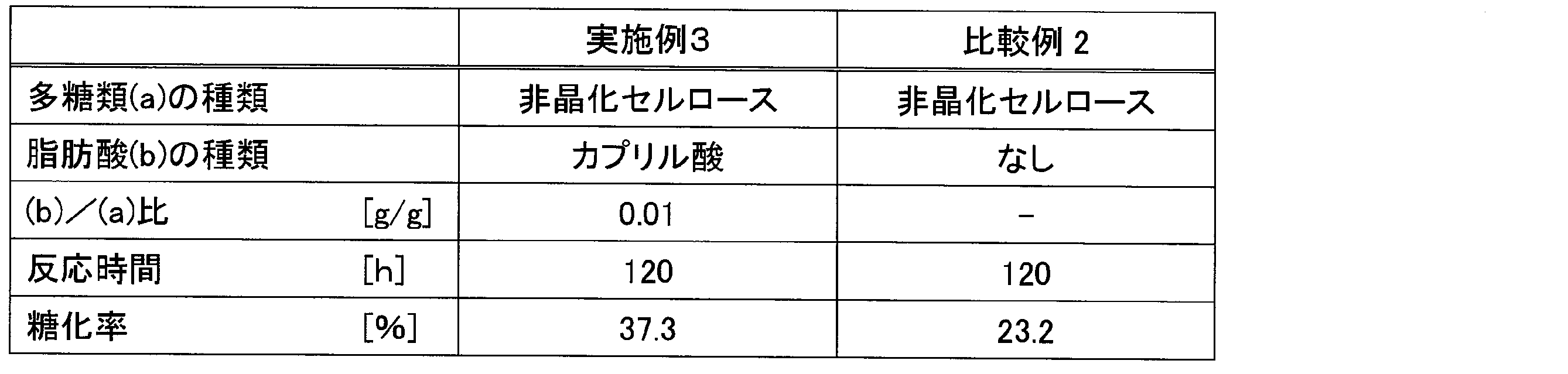
- Example 3 Sheet wood pulp (Blue Bear Ultra Ether manufactured by Borregard, cellulose content 96 mass%) was dry-ground for 30 minutes using a vibrating rod mill ( ⁇ 30 mm ⁇ 13). The crystallinity of the cellulose after the treatment was zero. 1.14 g of this amorphous cellulose (water content: 14%) was dispersed in 19.86 g of a 0.1 M citrate buffer solution having a pH of 5.0. To this was added 0.01 g of caprylic acid and 125 ⁇ L of cellulase (1.5 C of cell crust manufactured by Novozymes) (addition per gram of substrate was 8.75 FPU). Hydrolysis was carried out for 240 hours while shaking at 110 r / min in a constant temperature bath at 50 ° C.
- reaction solution was sampled at any time, each reaction solution was filtered with a filter, and the water-soluble sugar concentration was measured.
- water-soluble sugars glucose, cellobiose, and xylose were measured.
- Table 2 shows the reaction conditions and the results when reacted for 120 hours. Moreover, the time-dependent change of a saccharification rate is shown in FIG.
- Comparative Example 2 The reaction was performed in the same manner as in Example 3 except that no fatty acid was added. The reaction conditions and results are shown in Table 2. Moreover, the time-dependent change of a saccharification rate is shown in FIG.
Landscapes
- Organic Chemistry (AREA)
- Chemical & Material Sciences (AREA)
- Engineering & Computer Science (AREA)
- Zoology (AREA)
- Life Sciences & Earth Sciences (AREA)
- Wood Science & Technology (AREA)
- Chemical Kinetics & Catalysis (AREA)
- Microbiology (AREA)
- General Chemical & Material Sciences (AREA)
- Biotechnology (AREA)
- Health & Medical Sciences (AREA)
- Biochemistry (AREA)
- Bioinformatics & Cheminformatics (AREA)
- General Engineering & Computer Science (AREA)
- General Health & Medical Sciences (AREA)
- Genetics & Genomics (AREA)
- Preparation Of Compounds By Using Micro-Organisms (AREA)
- Saccharide Compounds (AREA)
Abstract
Description
バイオマスからのエタノール等の製造は、バイオマスを糖化工程において糖に分解した後、これを発酵工程においてエタノール等に変換することにより行うことができる。糖化は、硫酸等を用いる酸糖化と酵素糖化に大別される。
糖化率向上のための技術として、糖化工程に先立って予めバイオマスを前処理する方法が検討されている。前処理方法としては、例えば、硫酸法、有機溶媒法、水熱処理法、機械的破砕等が知られている。
一方で、従来の酵素反応時に界面活性剤を添加する方法では、加水分解率を高めるため添加量を多くすると酵素が失活してしまい、却って糖化率が低下する場合がある。また、上記いずれの添加成分も水溶性であるため加水分解後の糖溶液からの除去が困難で、操作が煩雑になる。
従って、本発明は、反応速度の低下を抑制し、効率よく多糖類から分解糖を製造することのできる方法を提供することに関する。
セルロース系バイオマスは、通常、植物を構成する細胞壁や細胞間層にリグニンを多量に含み、これがセルラーゼによる加水分解を阻害していると考えられている。そのため、上記従来技術では、原料に含まれるリグニンをマスキングすることにより、セルラーゼのリグニンへの吸着を抑制し、セルロースにセルラーゼを作用させ易くして糖化率向上を試みている。これに対し、本発明者らは、脂肪酸の存在下で酵素による加水分解反応を行えば、リグニンを含む原料だけでなく、リグニンを含まない原料であっても高い糖化率が得られることを見出した。
なかでも、資源の有効活用の点から、セルロースを含有するセルロース系バイオマスを用いることが好ましい。
乾燥は通気式バンド乾燥機、棚段式熱風乾燥機等を用いることができる。粉砕、細断は、例えば公知の回転ボールミル、遊星型ボールミル、ディスクミル、ロッドミル等を用いることができる。バイオマスの粉砕、細断は、加水分解酵素との接触表面積を大きくする点から、800μm以下、特に3~300μmのサイズまで行うのが好ましい。
バイオマスは、粉砕等の前処理により非晶化が進行し、非晶化されたバイオマスは酵素糖化に有利である。非晶化の程度は、実施例記載の結晶化度の算出により測定できる。バイオマスの結晶化度は80%以下が好ましく、50%以下がより好ましく、20%以下がさらに好ましく、ゼロであるものが特に好ましい。
脂肪酸は、この多糖類を含むスラリーへ添加するのが好ましく、添加のタイミングは、加水分解酵素を添加する前でも後でもよい。
加水分解酵素は、その起源に限定はなく、さらに、遺伝子組み換え技術、部分加水分解等による人工酵素であってもよい。
また、加水分解酵素の形態は特に限定されず、酵素蛋白質の乾燥物、酵素蛋白質を含む粒子、及び酵素蛋白質を含む液体等を用いることができる。
日立製作所製高速液体クロマトグラフを用い、昭和電工製カラムAsahipak NH2P-50 4E(4.5mmφ×250m)を装着し、カラム温度20℃でグラジエント法により行った。移動相A液はアセトニトリル、B液は30%メタノール水とし、1.00mL/分で送液した。グラジエント条件は以下のとおりである。
時間(分) A液(%) B液(%)
0 20 80
45 50 50
45.1 20 80
55 20 80
試料注入量は5μL、検出はESA Biosciences社製コロナCAD検出器を用いた。
糖化率は次式(1)により算出した。
糖化率(%)={(反応後の水溶性糖質量)-(反応前の水溶性糖質量)}/原料多糖類の質量×100 (1)
セルロースI型結晶化度は、X線回折法による回折強度値からSegal法により算出したもので、次式(2)により定義される。
セルロースI型結晶化度(%)=〔(I22.6-I18.5)/I22.6〕×100 (2)
〔I22.6は、X線回折における格子面(002面)(回折角2θ=22.6°)の回折強度、I18.5は、アモルファス部(回折角2θ=18.5°)の回折強度を示す〕
なお、上記式(2)で定義されたセルロースI型結晶化度では計算上マイナスの値になる場合があるが、マイナスの値の場合はセルロースI型結晶化度は0%とする。
微結晶粉末セルロース(シグマアルドリッチ製、含水率5%、結晶化度70%)1.05gをpH5.0の0.1Mクエン酸緩衝溶液19.95gに分散させた。これにカプリル酸0.29gとセルラーゼ(ノボザイムズ製セルクラスト1.5L)125μLを添加した(基質1gあたりの添加は8.75FPU)。加水分解は50℃の恒温槽中、110r/minで振とうしながら72時間行った。反応終了後、反応液をフィルターでろ過し、水溶性糖濃度を測定した。水溶性糖としては、グルコース、セロビオース、キシロースが測定された。反応条件と結果を表1に示す。
カプリル酸の代わりにオレイン酸0.18gを使用した以外は実施例1と同様に反応を行った。反応条件と結果を表1に示す。
脂肪酸を添加しない以外は実施例1と同様に反応を行った。反応条件と結果を表1に示す。

シート状木材パルプ(Borregard社製Blue Bear Ultra Ether、セルロース含有量96質量%)を振動ロッドミル(φ30mm×13本)を用いて30分乾式粉砕した。処理後のセルロースの結晶化度はゼロであった。この非晶化セルロース(含水率14%)1.14gをpH5.0の0.1Mクエン酸緩衝溶液19.86gに分散させた。これにカプリル酸0.01gとセルラーゼ(ノボザイムズ製セルクラスト1.5L)を125μL添加した(基質1gあたりの添加は8.75FPU)。加水分解は50℃の恒温槽中で110r/minで振とうしながら240時間反応を行った。反応中、随時反応液のサンプリングを行い、各反応液をフィルターでろ過し、水溶性糖濃度を測定した。水溶性糖としては、グルコース、セロビオース、キシロースが測定された。反応条件と120時間反応させた時の結果を表2に示す。また、糖化率の経時変化を図1に示す。
脂肪酸を添加しない以外は実施例3と同様に反応を行った。反応条件と結果を表2に示す。また、糖化率の経時変化を図1に示す。
Claims (5)
- 多糖類に脂肪酸の存在下、加水分解酵素を作用させる単糖類、二糖類、及び/又はオリゴ糖の製造方法。
- 多糖類の乾燥固形分に対する脂肪酸の質量比が0.005~2.0である請求項1記載の単糖類、二糖類、及び/又はオリゴ糖の製造方法。
- 脂肪酸の融点が60℃以下である請求項1又は2記載の単糖類、二糖類、及び/又はオリゴ糖の製造方法。
- 脂肪酸の炭素数が6~24である請求項1~3のいずれか1項記載の単糖類、二糖類、及び/又はオリゴ糖の製造方法。
- 多糖類としてセルロース含有バイオマスを用いる、請求項1~4のいずれか1項記載の単糖類、二糖類、及び/又はオリゴ糖の製造方法。
Priority Applications (1)
| Application Number | Priority Date | Filing Date | Title |
|---|---|---|---|
| PH1/2012/500544A PH12012500544A1 (en) | 2009-11-16 | 2010-11-15 | Process for the production of monosaccharide, disaccharide and/or oligosaccharide |
Applications Claiming Priority (2)
| Application Number | Priority Date | Filing Date | Title |
|---|---|---|---|
| JP2009-260837 | 2009-11-16 | ||
| JP2009260837 | 2009-11-16 |
Publications (1)
| Publication Number | Publication Date |
|---|---|
| WO2011059082A1 true WO2011059082A1 (ja) | 2011-05-19 |
Family
ID=43991735
Family Applications (1)
| Application Number | Title | Priority Date | Filing Date |
|---|---|---|---|
| PCT/JP2010/070267 Ceased WO2011059082A1 (ja) | 2009-11-16 | 2010-11-15 | 単糖類、二糖類、及び/又はオリゴ糖の製造方法 |
Country Status (3)
| Country | Link |
|---|---|
| JP (1) | JP2011120578A (ja) |
| PH (1) | PH12012500544A1 (ja) |
| WO (1) | WO2011059082A1 (ja) |
Cited By (1)
| Publication number | Priority date | Publication date | Assignee | Title |
|---|---|---|---|---|
| JP2012115209A (ja) * | 2010-12-01 | 2012-06-21 | Kao Corp | セロオリゴ糖の製造方法 |
Citations (1)
| Publication number | Priority date | Publication date | Assignee | Title |
|---|---|---|---|---|
| JP2008274247A (ja) * | 2007-03-30 | 2008-11-13 | National Institute Of Advanced Industrial & Technology | 微細繊維状セルロース系物質及びその製造方法 |
-
2010
- 2010-11-15 WO PCT/JP2010/070267 patent/WO2011059082A1/ja not_active Ceased
- 2010-11-15 PH PH1/2012/500544A patent/PH12012500544A1/en unknown
- 2010-11-15 JP JP2010254407A patent/JP2011120578A/ja not_active Withdrawn
Patent Citations (1)
| Publication number | Priority date | Publication date | Assignee | Title |
|---|---|---|---|---|
| JP2008274247A (ja) * | 2007-03-30 | 2008-11-13 | National Institute Of Advanced Industrial & Technology | 微細繊維状セルロース系物質及びその製造方法 |
Cited By (1)
| Publication number | Priority date | Publication date | Assignee | Title |
|---|---|---|---|---|
| JP2012115209A (ja) * | 2010-12-01 | 2012-06-21 | Kao Corp | セロオリゴ糖の製造方法 |
Also Published As
| Publication number | Publication date |
|---|---|
| PH12012500544A1 (en) | 2012-11-12 |
| JP2011120578A (ja) | 2011-06-23 |
Similar Documents
| Publication | Publication Date | Title |
|---|---|---|
| Narra et al. | Production of cellulases by solid state fermentation with Aspergillus terreus and enzymatic hydrolysis of mild alkali-treated rice straw | |
| Fang et al. | Co-production of xylooligosaccharides and glucose from birch sawdust by hot water pretreatment and enzymatic hydrolysis | |
| Rabelo et al. | A comparison between lime and alkaline hydrogen peroxide pretreatments of sugarcane bagasse for ethanol production | |
| Yang et al. | Aqueous extraction of corncob xylan and production of xylooligosaccharides | |
| Yanagisawa et al. | Production of high concentrations of bioethanol from seaweeds that contain easily hydrolyzable polysaccharides | |
| Qi et al. | Pretreatment of wheat straw by nonionic surfactant-assisted dilute acid for enhancing enzymatic hydrolysis and ethanol production | |
| Shankar et al. | Fungal-integrated second-generation lignocellulosic biorefinery: utilization of agricultural biomass for co-production of lignocellulolytic enzymes, mushroom, fungal polysaccharides, and bioethanol | |
| JP5126728B2 (ja) | リグノセルロース系バイオマス処理方法 | |
| Sharma et al. | Enzymatic saccharification of brown seaweed for production of fermentable sugars | |
| Hassan et al. | Optimization of pretreatments for the hydrolysis of oil palm empty fruit bunch fiber (EFBF) using enzyme mixtures | |
| Manns et al. | Brown seaweed processing: enzymatic saccharification of Laminaria digitata requires no pre-treatment | |
| US20110003341A1 (en) | Process for producing saccharide | |
| JP5681923B2 (ja) | 高濃度糖化液の製造方法 | |
| Brar et al. | A novel staggered hybrid SSF approach for efficient conversion of cellulose/hemicellulosic fractions of corncob into ethanol | |
| Lesiecki et al. | Enzymatic hydrolysis of potato pulp | |
| Cai et al. | Statistical optimization of dilute sulfuric acid pretreatment of corncob for xylose recovery and ethanol production | |
| Pinar et al. | Assessment of hazelnut husk as a lignocellulosic feedstock for the production of fermentable sugars and lignocellulolytic enzymes | |
| Sadaf et al. | Applicability of Sporotrichum thermophile xylanase in the in situ saccharification of wheat straw pre-treated with ionic liquids | |
| da Silva et al. | Optimization of enzymatic hydrolysis of cellulose extracted from bamboo culm for bioethanol production by Saccharomyces cerevisiae modified via CRISPR/Cas9 | |
| Cutrim et al. | A study of chemical composition and enzymatic hydrolysis of solid organic waste from agrosilvopastoral systems | |
| Bhati et al. | Comparative study of different chemical pretreatments for enhanced enzymatic hydrolysis of sorghum straw | |
| Chaikaew et al. | Application of thermophilic enzymes and water jet system to cassava pulp | |
| Bogolitsyn et al. | Enzymatic hydrolysis of cellulose-rich fraction of Arctic seaweeds using Penicillium-and Myceliophtora-based glycoside hydrolases | |
| Rodrigues et al. | Untreated Chlorella homosphaera biomass allows for high rates of cell wall glucan enzymatic hydrolysis when using exoglucanase-free cellulases | |
| Deshavath et al. | Curtailing citrate buffer inhibition effect on S. cerevisiae to enhance the fermentability of cellulosic hydrolysate |
Legal Events
| Date | Code | Title | Description |
|---|---|---|---|
| 121 | Ep: the epo has been informed by wipo that ep was designated in this application |
Ref document number: 10830038 Country of ref document: EP Kind code of ref document: A1 |
|
| WWE | Wipo information: entry into national phase |
Ref document number: 12012500544 Country of ref document: PH |
|
| NENP | Non-entry into the national phase |
Ref country code: DE |
|
| WWE | Wipo information: entry into national phase |
Ref document number: 1201002037 Country of ref document: TH |
|
| 122 | Ep: pct application non-entry in european phase |
Ref document number: 10830038 Country of ref document: EP Kind code of ref document: A1 |