WO2011056884A2 - Carbene complexes of lithium and/or magnesium metal salts, and uses thereof - Google Patents
Carbene complexes of lithium and/or magnesium metal salts, and uses thereof Download PDFInfo
- Publication number
- WO2011056884A2 WO2011056884A2 PCT/US2010/055313 US2010055313W WO2011056884A2 WO 2011056884 A2 WO2011056884 A2 WO 2011056884A2 US 2010055313 W US2010055313 W US 2010055313W WO 2011056884 A2 WO2011056884 A2 WO 2011056884A2
- Authority
- WO
- WIPO (PCT)
- Prior art keywords
- complex
- metal
- carbene
- transition
- group
- Prior art date
- Legal status (The legal status is an assumption and is not a legal conclusion. Google has not performed a legal analysis and makes no representation as to the accuracy of the status listed.)
- Ceased
Links
- XXSNVHGKBJLMBI-UHFFFAOYSA-N CN(C1)C=CN1I Chemical compound CN(C1)C=CN1I XXSNVHGKBJLMBI-UHFFFAOYSA-N 0.000 description 1
- DCVGYBPMXCXZAV-UHFFFAOYSA-N CN(CC1)CN1I Chemical compound CN(CC1)CN1I DCVGYBPMXCXZAV-UHFFFAOYSA-N 0.000 description 1
Classifications
-
- C—CHEMISTRY; METALLURGY
- C07—ORGANIC CHEMISTRY
- C07F—ACYCLIC, CARBOCYCLIC OR HETEROCYCLIC COMPOUNDS CONTAINING ELEMENTS OTHER THAN CARBON, HYDROGEN, HALOGEN, OXYGEN, NITROGEN, SULFUR, SELENIUM OR TELLURIUM
- C07F15/00—Compounds containing elements of Groups 8, 9, 10 or 18 of the Periodic Table
- C07F15/0006—Compounds containing elements of Groups 8, 9, 10 or 18 of the Periodic Table compounds of the platinum group
- C07F15/0046—Ruthenium compounds
-
- B—PERFORMING OPERATIONS; TRANSPORTING
- B01—PHYSICAL OR CHEMICAL PROCESSES OR APPARATUS IN GENERAL
- B01J—CHEMICAL OR PHYSICAL PROCESSES, e.g. CATALYSIS OR COLLOID CHEMISTRY; THEIR RELEVANT APPARATUS
- B01J31/00—Catalysts comprising hydrides, coordination complexes or organic compounds
- B01J31/16—Catalysts comprising hydrides, coordination complexes or organic compounds containing coordination complexes
- B01J31/22—Organic complexes
- B01J31/2265—Carbenes or carbynes, i.e.(image)
- B01J31/2269—Heterocyclic carbenes
-
- B—PERFORMING OPERATIONS; TRANSPORTING
- B01—PHYSICAL OR CHEMICAL PROCESSES OR APPARATUS IN GENERAL
- B01J—CHEMICAL OR PHYSICAL PROCESSES, e.g. CATALYSIS OR COLLOID CHEMISTRY; THEIR RELEVANT APPARATUS
- B01J31/00—Catalysts comprising hydrides, coordination complexes or organic compounds
- B01J31/16—Catalysts comprising hydrides, coordination complexes or organic compounds containing coordination complexes
- B01J31/22—Organic complexes
- B01J31/2265—Carbenes or carbynes, i.e.(image)
- B01J31/2269—Heterocyclic carbenes
- B01J31/2273—Heterocyclic carbenes with only nitrogen as heteroatomic ring members, e.g. 1,3-diarylimidazoline-2-ylidenes
-
- B—PERFORMING OPERATIONS; TRANSPORTING
- B01—PHYSICAL OR CHEMICAL PROCESSES OR APPARATUS IN GENERAL
- B01J—CHEMICAL OR PHYSICAL PROCESSES, e.g. CATALYSIS OR COLLOID CHEMISTRY; THEIR RELEVANT APPARATUS
- B01J31/00—Catalysts comprising hydrides, coordination complexes or organic compounds
- B01J31/16—Catalysts comprising hydrides, coordination complexes or organic compounds containing coordination complexes
- B01J31/22—Organic complexes
- B01J31/2265—Carbenes or carbynes, i.e.(image)
- B01J31/2278—Complexes comprising two carbene ligands differing from each other, e.g. Grubbs second generation catalysts
-
- C—CHEMISTRY; METALLURGY
- C07—ORGANIC CHEMISTRY
- C07C—ACYCLIC OR CARBOCYCLIC COMPOUNDS
- C07C6/00—Preparation of hydrocarbons from hydrocarbons containing a different number of carbon atoms by redistribution reactions
- C07C6/02—Metathesis reactions at an unsaturated carbon-to-carbon bond
- C07C6/04—Metathesis reactions at an unsaturated carbon-to-carbon bond at a carbon-to-carbon double bond
-
- C—CHEMISTRY; METALLURGY
- C07—ORGANIC CHEMISTRY
- C07C—ACYCLIC OR CARBOCYCLIC COMPOUNDS
- C07C67/00—Preparation of carboxylic acid esters
- C07C67/30—Preparation of carboxylic acid esters by modifying the acid moiety of the ester, such modification not being an introduction of an ester group
- C07C67/333—Preparation of carboxylic acid esters by modifying the acid moiety of the ester, such modification not being an introduction of an ester group by isomerisation; by change of size of the carbon skeleton
-
- B—PERFORMING OPERATIONS; TRANSPORTING
- B01—PHYSICAL OR CHEMICAL PROCESSES OR APPARATUS IN GENERAL
- B01J—CHEMICAL OR PHYSICAL PROCESSES, e.g. CATALYSIS OR COLLOID CHEMISTRY; THEIR RELEVANT APPARATUS
- B01J2231/00—Catalytic reactions performed with catalysts classified in B01J31/00
- B01J2231/50—Redistribution or isomerisation reactions of C-C, C=C or C-C triple bonds
- B01J2231/54—Metathesis reactions, e.g. olefin metathesis
- B01J2231/543—Metathesis reactions, e.g. olefin metathesis alkene metathesis
-
- B—PERFORMING OPERATIONS; TRANSPORTING
- B01—PHYSICAL OR CHEMICAL PROCESSES OR APPARATUS IN GENERAL
- B01J—CHEMICAL OR PHYSICAL PROCESSES, e.g. CATALYSIS OR COLLOID CHEMISTRY; THEIR RELEVANT APPARATUS
- B01J2531/00—Additional information regarding catalytic systems classified in B01J31/00
- B01J2531/02—Compositional aspects of complexes used, e.g. polynuclearity
- B01J2531/0202—Polynuclearity
- B01J2531/0205—Bi- or polynuclear complexes, i.e. comprising two or more metal coordination centres, without metal-metal bonds, e.g. Cp(Lx)Zr-imidazole-Zr(Lx)Cp
-
- B—PERFORMING OPERATIONS; TRANSPORTING
- B01—PHYSICAL OR CHEMICAL PROCESSES OR APPARATUS IN GENERAL
- B01J—CHEMICAL OR PHYSICAL PROCESSES, e.g. CATALYSIS OR COLLOID CHEMISTRY; THEIR RELEVANT APPARATUS
- B01J2531/00—Additional information regarding catalytic systems classified in B01J31/00
- B01J2531/10—Complexes comprising metals of Group I (IA or IB) as the central metal
- B01J2531/11—Lithium
-
- B—PERFORMING OPERATIONS; TRANSPORTING
- B01—PHYSICAL OR CHEMICAL PROCESSES OR APPARATUS IN GENERAL
- B01J—CHEMICAL OR PHYSICAL PROCESSES, e.g. CATALYSIS OR COLLOID CHEMISTRY; THEIR RELEVANT APPARATUS
- B01J2531/00—Additional information regarding catalytic systems classified in B01J31/00
- B01J2531/20—Complexes comprising metals of Group II (IIA or IIB) as the central metal
- B01J2531/22—Magnesium
-
- B—PERFORMING OPERATIONS; TRANSPORTING
- B01—PHYSICAL OR CHEMICAL PROCESSES OR APPARATUS IN GENERAL
- B01J—CHEMICAL OR PHYSICAL PROCESSES, e.g. CATALYSIS OR COLLOID CHEMISTRY; THEIR RELEVANT APPARATUS
- B01J2531/00—Additional information regarding catalytic systems classified in B01J31/00
- B01J2531/80—Complexes comprising metals of Group VIII as the central metal
- B01J2531/82—Metals of the platinum group
- B01J2531/821—Ruthenium
-
- C—CHEMISTRY; METALLURGY
- C07—ORGANIC CHEMISTRY
- C07C—ACYCLIC OR CARBOCYCLIC COMPOUNDS
- C07C2531/00—Catalysts comprising hydrides, coordination complexes or organic compounds
- C07C2531/16—Catalysts comprising hydrides, coordination complexes or organic compounds containing coordination complexes
- C07C2531/22—Organic complexes
Definitions
- This invention generally relates to carbene complexes of lithium and/or magnesium metal salts and to methods of preparation thereof as well as uses of such salts in preparation of catalyst compositions.
- transition metal complexes of cyclic alkyl amino carbenes have been found useful as catalysts for a range of applications (Bertrand et ah, U.S. 7,312,331).
- Pd- cyclic alkyl amino carbenes complexes have been described by Bertrand and coworkers (Angew. Chem. Int. Ed. 2005, 44, 7236-7239) to be highly efficient catalysts for the alpha- arylation of ketones and aldehydes.
- Ru-cyclic alkyl amino carbenes complexes which are have been used as catalysts for alkene metathesis processes, are also of great interest.
- the current invention relates to a carbene complex of a lithium and/or magnesium salt useful as a synthon in the preparation of transition-metal-carbene complexes.
- the current invention also relates to an improved synthetic route to transition-metal-carbene complexes by using a carbene complex of a lithium and/or magnesium salt as a synthon. More particularly, the present invention relates to an improved synthetic route to Ru-cyclic alkyl amino carbenes complexes using a carbene complex of a lithium and/or magnesium salt.
- this improved synthetic route may be carried at temperatures at or above ambient, removing the need for coolants and thereby reducing the overall cost of the synthetic route.
- the improved synthetic route using the invention described herein provides transition-metal-carbene complexes in significantly higher yields than previous reported. Accordingly, the present invention provides a facile, mild, high-yield route to transition-metal-carbene complexes.
- This invention relates to a carbene complex of metal salt represented by the formula:
- R is a monoanionic group
- c is 1 or 2
- M is a Li or Mg
- T is a cyclic carbene ligand
- n is selected from the group of integers comprising 1 to 24 wherein the complex has 50% or less decomposition when stored in 0.01 molar benzene at 23°C for a period of 1 hour.
- This invention also relates to transition-metal-carbene complexes prepared from such carbene complexes of metal salts, where the transition-metal-carbene complex is preferably represented by the formula: [M*(T)(L°)q(L 1" ) s (L 2" ) t ] g , where M* is a transition metal from Group 6, 7, 8, 9, 10, 11, or 12, T is a cyclic carbene ligand, L° is a neutral ligand, L 1" is a monoanionic ligand, L 2" is a dianionic ligand, q is 0, 1, 2, 3 or 4, s is 0, 1, 2, 3, or 4, t is 0, 1, 2, 3, or 4, and g is the overall charge of the complex.
- the transition-metal-carbene complexes may be used for synthesis reactions, including metathesis of olefins.
- Figure 1 depicts the structure of the carbene-lithium salt adduct Compound 1 drawn with 30% thermal ellipsoids as determined by single-crystal X-ray diffraction.
- the carbene ligand coordinated to Li(3) and the hydrogen atoms are omitted for clarity.
- This invention generally relates to carbene complexes of lithium and/or magnesium salts, more particularly, to cyclic alkyl amino carbene (CAAC) complexes of lithium and/or magnesium salts, and even more particularly, to methods of preparation of transition-metal-carbene complexes using carbene complexes of lithium and/or magnesium metal salts in improved yields as compared to conventional routes.
- CAAC cyclic alkyl amino carbene
- the present invention comprises a carbene complex comprising a lithium and/or magnesium salt.
- the present invention also relates to a novel synthetic route to transition- metal-carbene complexes, such as those useful for the cross-metathesis of olefins.
- the present invention comprises a CAAC complex of a lithium and/or magnesium salt.
- the present invention comprises the use of a CAAC complex of a lithium and/or magnesium salt to prepare a transition-metal-carbene complex.
- a substituted hydrocarbyl is a radical made of carbon and hydrogen where at least one hydrogen is replaced by a heteroatom.
- a substituted alkyl or aryl group is an alkyl or aryl radical made of carbon and hydrogen where at least one hydrogen is replaced by a heteroatom or a linear, branched, or cyclic substituted or unsubstituted hydrocarbyl group having 1 to 30 carbon atoms.
- R is at least one of an alkyl sulfonate, aryl sulfonate, alkyl sulfate, aryl sulfate, carboxylate, aryl carboxylate, amidate, amidinate, thiocarboxylate, dithiocarboxylate, borate, chloride, bromide, iodide, nitrate, triflate, or perchlorate.
- R is a triflate (OTf or TfO). Preferred triflates are represented by the Formula (A) below.
- Preferred alkyl sulfonates are represented by the Formula (B) below, where R 2 is a Ci to C30 hydrocarbyl group, fluoro-substituted carbyl group, chloro-substituted carbyl group, aryl group, or substituted aryl group, preferably a Ci to C 12 alkyl or aryl group, preferably trifluoromethyl, methyl, phenyl, para-methyl-phenyl.
- cyclic carbene is defined as a cyclic compound with a neutral dicoordinate carbene center featuring a lone pair of electrons.
- Preferred cyclic carbenes are represented by the Formula (I) below: (Formula I)
- each R* is, independently, H or a Ci to C 20 alkyl
- each E is, independently, selected from the group comprising C, N, S, O, and P, with available valences, if any, optionally occupied by L w , L x , L y , and L z .
- L w , L x , L y , and L z are, independently, hydrogen, hydrocarbyl groups or substituted hydrocarbyl groups.
- L w , L x , L y , and L z are independently selected from the group consisting of hydrocarbyl groups and substituted hydrocarbyl groups having 1 to 40 carbon atoms.
- L w , L x , L y , and L z are independently C 1-10 alkyl, substituted C 1-10 alkyl, C 2-10 alkenyl, substituted C2-10 alkenyl, C 2-10 alkynyl, substituted C 2-10 alkynyl, aryl and substituted aryl.
- L w , L x , L y , and L z are independently selected from the group comprising methyl, ethyl, propyl, butyl (including isobutyl and n-butyl), pentyl, cyclopentyl, hexyl, cyclohexyl, octyl, cyclooctyl, nonyl, decyl, cyclodecyl, dodecyl, cyclododecyl, mesityl, adamantyl, phenyl, benzyl, tolulyl, chlorophenyl, 2,6-diethylphenyl, 2,6- diisopropylphenyl, 2-isopropylphenyl, 2-ethyl-6-methylphenyl, 3,5-ditertbutylphenyl, 2- tertbutylphenyl, and 2,3,4,5,6-pentamethylphenyl
- Useful substituents include C 1-10 alkyl, C2-10 alkenyl, C 2-10 alkynyl, aryl, C 1-10 alkoxy, C 2-10 alkenyloxy C 2-10 , alkynyloxy, aryloxy, C2-10 alkoxycarbonyl, C 1-10 alkylthio, C 1-10 alkylsulfonyl, fluoro, chloro, bromo, iodo, oxo, amino, imine, nitrogen heterocycle, hydroxy, thiol, thiono, phosphorous, and carbene groups.
- Q is carbon
- each R* is hydrogen
- e is 1 or 2 and d is 2.
- L z , L x , and L y are as described above.
- at least two of L x , L y , and L z may be joined to form a 3- to 12-membered spirocyclic ring, with available valences optionally occupied by H, oxo, halogens, hydrocarbyl, or substituted hydrocarbyl groups.
- Useful substituents include C 1-10 alkyl, C 2-10 alkenyl, C 2-10 alkynyl, aryl, C 1-10 alkoxy, C 2-10 alkenyloxy C 2-10 , alkynyloxy, aryloxy, C 2-10 alkoxycarbonyl, C 1-10 alkylthio, C 1-10 alkylsulfonyl, fluoro, chloro, bromo, iodo, oxo, amino, imine, nitrogen heterocycle, hydroxy, thiol, thiono, phosphorous, and carbene groups.
- Preferred cyclic carbenes include N-heterocyclic carbenes (NHCs).
- NHCs are cyclic carbenes of the types described above (such as by Formula I) where each E is N and the available valences on the N are occupied by L x and L y .
- Useful NHCs are represented by the formula:
- L x and L y are independently selected from the group comprising a hydrocarbyl group and substituted hydrocarbyl group having 1 to 40 carbon atoms.
- L x and L y are independently selected from the group comprising C 1-10 alkyl, substituted C 1-10 alkyl, C 2-10 alkenyl, substituted C 2-10 alkenyl, C 2-10 alkynyl, substituted C 2-10 alkynyl, aryl, and substituted aryl.
- L x and L y are independently selected from the group comprising methyl, ethyl, propyl, butyl (including isobutyl and n-butyl), pentyl, cyclopentyl, hexyl, cyclohexyl, octyl, cyclooctyl, nonyl, decyl, cyclodecyl, dodecyl, cyclododecyl, mesityl, adamantyl, phenyl, benzyl, tolulyl, chlorophenyl, 2,6-diethylphenyl, 2,6-diisopropylphenyl, 2-isopropylphenyl, 2-ethyl-6-methylphenyl, 3,5-ditertbutylphenyl, 2- tertbutylphenyl, and 2,3,4,5,6-pentamethylphenyl.
- Useful substituents include C 1-10 alkyl, C2-10 alkenyl, C 2-10 alkynyl, aryl, C 1-10 alkoxy, C 2-10 alkenyloxy C 2-10 , alkynyloxy, aryloxy, C2-10 alkoxycarbonyl, C 1-10 alkylthio, C 1-10 alkylsulfonyl, fluoro, chloro, bromo, iodo, oxo, amino, imine, nitrogen heterocycle, hydroxy, thiol, thiono, phosphorous, and carbene groups.
- Some particularl useful NHCs include:
- NHCs include the compounds described in Hermann, W. A. Chem. Eur. J. 1996, 2, 772 and 1627; Enders, D. et al, Angew. Chem. Int. Ed. 1995, 34, 1021; Alder R. W., Angew. Chem. Int. Ed. 1996, 35, 1121; and Bertrand, G. et al, Chem. Rev. 2000, 100, [0023] Particularly preferred cyclic carbenes include cyclic alkyl amino carbenes (CAACs).
- CAACs cyclic alkyl amino carbenes
- CAACs are cyclic carbenes as described in Formula I where one E is N and the other is C, and the available valences on the N occupied by L x , and available valences on the C are occupied by L y and L z .
- Preferred CAACs are represented by the formula: Formula III
- L x , L z , and L y are independently selected from the group comprising a hydrocarbyl group and substituted hydrocarbyl group having 1 to 40 carbon atoms.
- L x , L z , and L y are independently selected from the group comprising C 1-10 alkyl, substituted C 1-10 alkyl, C 2-10 alkenyl, substituted C 2-10 alkenyl, C 2-10 alkynyl, substituted C 2-10 alkynyl, aryl, and substituted aryl.
- L x , L z , and L y are independently selected from the group comprising methyl, ethyl, propyl, butyl (including isobutyl and n- butyl), pentyl, cyclopentyl, hexyl, cyclohexyl, octyl, cyclooctyl, nonyl, decyl, cyclodecyl, dodecyl, cyclododecyl, mesityl, adamantyl, phenyl, benzyl, tolulyl, chlorophenyl, 2,6- diethylphenyl, 2,6-diisopropylphenyl, 2-isopropylphenyl, 2-ethyl-6-methylphenyl, 3,5- ditertbutylphenyl, 2-tertbutylphenyl, and 2,3,4,5,6-pentamethylphenyl.
- Useful substituents include C 1-10 alkyl, C 2-10 alkenyl, C 2-10 alkynyl, aryl, C 1-10 alkoxy, C 2-10 alkenyloxy C 2-10 , alkynyloxy, aryloxy, C 2-10 alkoxycarbonyl, C 1-10 alkylthio, C 1-10 alkylsulfonyl, fluoro, chloro, bromo, iodo, oxo, amino, imine, nitrogen heterocycle, hydroxy, thiol, thiono, phosphorous, and carbene groups.
- CAACs include:
- CAACs include the compounds described in U.S. 7,312,331 and Bertrand et al, Angew. Chem. Int. Ed. 2005, 44, 7236-7239.
- carbenes useful in embodiments of the present invention include thiazolyidenes, P-heterocyclic carbenes (PHCs), and cyclopropenylidenes.
- the carbene complex of a lithium and or ma nesium salt is represented by the formula:
- M is Li or Mg (preferably Li)
- E, R, c, n, Q, R*, e, d, L w , L x , L z , and L y are as described above.
- the inventors have surprisingly found that certain carbene complexes comprising a lithium and/or magnesium salt form an oligomeric cluster.
- the carbene complex comprising a lithium salt forms an oligomeric cluster.
- the complex comprising a lithium and/or magnesium salt of a carbene forms a cube-like oligomeric cluster, where M and R groups occupy the proximate vertices of the cube, as represented by:
- the complex of the present invention forms a cube-like oligomeric cluster, where Li and OTf groups occupy the proximate vertices of the cube, as represented by:
- T is a CAAC of the type:
- the carbene complexes of lithium and/or magnesium salts described above are typically prepared by contacting a protonated cyclic carbene salt with a lithium or magnesium base (preferably at -40 to 40°C, preferably above 0°C) in a non-polar solvent.
- a non-polar solvent is defined as a solvent that contains only carbon, hydrogen and optional halogen atoms (such as an alkane, arene or halogenated hydrocarbons or halogenated aromatics), while a polar solvent is defined a solvent that contains at least one Group 15 or 16 heteroatom (such as oxygen, or sulfur). Both aliphatic and aromatic non-polar solvents are suitable for use herein.
- Preferred non- polar solvents include benzene, toluene, hexane, pentane, isopentane, and octane.
- the isolation of the carbene complexes of lithium and/or magnesium salts is typically accomplished by crystallization or precipitation of the complex from a non-polar solvent or mixture of non-polar solvents.
- the carbene complexes of lithium and/or magnesium salts described above are prepared by the stepwise addition of a protonated cyclic carbene salt, as either a solid, a solution, or a slurry, to a solution of a lithium or magnesium base in a non-polar solvent.
- the carbene complexes of lithium and/or magnesium salts described above are prepared under conditions such that the temperature is between -40 to 40°C (preferably from 0 to 40°C), the pressure is ambient, and the concentration of each reactant is between 0.00001 M and 1.0 M.
- Suitable lithium and magnesium bases include, but are not limited to, lithium amides, magnesium amides, alkyllithiums, aryl lithiums, dialkylmagnesiums, diary lmagnesiums, and magnesium(alkyl)amides.
- the inventors have surprisingly discovered that the carbene complexes of lithium and/or magnesium salts of the present invention display unexpected and unusual stability in both coordinating and non-coordinating solvents at or above ambient temperatures.
- the inventors have surprisingly discovered that complexes of lithium salts of CAACs with N-substitution such as 2,6-diethylphenyl, are remarkably stable in solution at ambient temperatures.
- solution stability studies of a complex of a particular embodiment of the present invention (Compound 1, reported in Examples 2 & 3, below) only 14% decomposition was observed in benzene at ambient temperature over a period of 4 days.
- less than 5% decomposition was observed in tetrahydrofuran at ambient temperature over a period of 72 hours.
- the inventors believe that the ordered oligomeric clustering observed in the carbene complexes of lithium and/or magnesium salts may provide added stability to the complex as compared to the free carbene.
- the carbene complexes of a lithium and/or magnesium salt described above are stable at 23°C or more.
- the carbene complexes of a lithium and/or magnesium salt described above are stable at 30°C or more, preferably at 50°C or more.
- the carbene complexes of a lithium and/or magnesium salt described above are stable at 23°C, preferably at 30°C, preferably at 50°C.
- the carbene complexes of a lithium and/or magnesium salt described above are stable at from -40 to 80°C, preferably from 0 to 60°C, preferably from 20 to 50°C.
- the carbene complexes of a lithium and/or magnesium salt described above have 50%> or less (preferably 40%> or less, preferably 30%> or less, preferably 20%> or less, preferably 10% or less, preferably 5% or less) decomposition when stored in 0.01 benzene (alternately tetrahydrofuran, alternately hexane) at the selected temperature for a period of 24 hours.
- a method for the preparation of a transition-metal-carbene complex comprises combining a transition metal reactant and at least one carbene complex of a lithium and/or magnesium salt as described above, wherein the carbene is transferred from the lithium and/or magnesium salt to the transition metal reactant.
- a "transition metal reactant” is a compound comprising at least one transition metal with one or more coordinated ligands (the coordinated ligands are typically neutral or anionic non-metal species).
- a "transition metal” is an element from Groups 3, 4, 5, 6, 7, 8, 9, 10, 11, or 12 (including the lanthanides and actinides) of the Periodic Table, as referenced by the IUPAC in Nomenclature of Inorganic Chemistry: Recommendations 1990, G. J. Leigh, Editor, Blackwell Scientific Publications, 1990.
- Transition metal reactants useful in embodiments of the present invention comprise transition metals (M* in the formulae below) from Group 3-12 (preferably M* is Sc, Y, Ti, Zr, Hf, V, Nb, Ta, Cr, Mo, W, Mn, Re, Co, Rh, Ir, Ni, Pd, Pt, Cu, Ag, Au, Fe, Ru and/or Os), more particularly Groups 6-11 (preferably M* is Cr, Co, Ni, Cu, Mn, Rh, Pd, Pt, Ag, Au, Fe, Ru and/or Os), even more particularly Group 8 (preferably M* is Fe, Ru and/or Os, preferably M* is Ru).
- M* is Sc, Y, Ti, Zr, Hf, V, Nb, Ta, Cr, Mo, W, Mn, Re, Co, Rh, Ir, Ni, Pd, Pt, Cu, Ag, Au, Fe, Ru and/or Os
- Groups 6-11 preferably M* is Cr, Co, Ni, Cu, Mn, Rh, P
- the coordinated ligands are typically neutral or anionic non-metal species, such as trialkylphosphines, pyridines, halides, alkyls, aryls, alkylidenes, ethers, and thio ethers. Preferred examples include tricyclohexylphosphine, chlorides, substituted benzylidenes, ether substituted benzylidenes.
- the coordinated ligands feature at least one pair of lone electrons that can form a dative or covalent bond with the transition metal.
- the transition metal reactant features at least one labile neutral ligand, such as tricyclohexyl phosphine, which is exchanged for the cyclic carbene in the reaction.
- the transition metal reactant is represented by the formula: where M* is a transition metal as defined above; L° is a neutral ligand; L 1" is a monoanionic ligand; L 2" is a dianionic ligand; g is the overall charge of the molecule (preferably 0, 1, or 2); q is 0, 1, 2, 3, or 4; s is 0, 1, 2, 3, or 4; and t is 0, 1, 2, 3, or 4; where g+s+2(t) is equal to the valence of the transition metal, M*.
- "valence" is equivalent to oxidation number.
- the overall coordination number of the transition metal is preferably 4, 5, 6, or 7.
- the valence of the metal will be 0, 1, 2, 3, or 4.
- each ligand may be monodentate, bidentate, tridentate, tetradentate, pentadentate, or hexadentate.
- the transition metal reactant is a ruthenium phosphine complex.
- Preferred ruthenium phosphine complexes are typically the combination of ruthenium and a phosphine.
- phosphines are represented by the formula PR 9 3 , wherein each R 9 is independently hydrogen, a Ci to C 12 hydrocarbyl group, a substituted Ci to C 12 hydrocarbyl group, or a halide.
- Preferred ruthenium phosphine complexes are represented by the formula:
- R 10 CH (R 10 CH)j(PR 9 3 ) h RuX k
- Examples of ruthenium phosphine complexes useful in embodiments herein include bis(tricyclohexylphosphine) benzylidine ruthenium dichloride, dichloro(o- isopropoxyphenylmethylene)(tricyclohexylphosphine) ruthenium dichloride, tris(triphenylphosphine) ruthenium dichloride, ⁇ [2-(i-propoxy)-5-(N,N- dimethylaminosulfonyl)phenyl] methylene ⁇ (tricyclohexylphosphine) ruthenium dichloride, bis(i-butylphoban)(3 -phenyl- lH-inden-l-ylidene) ruthenium dichloride, and bis(tricyclohexylphosphine)(3 -phenyl- lH-inden-l-ylidene) ruthenium dichloride.
- the transition metal reactant may be supported on an inert material.
- the inert material tends to render the transition metal reactant heterogeneous, which often simplifies product recovery.
- Suitable support materials include, without limitation, silicas, aluminas, silica-aluminas, aluminosilicates, including zeolites and other crystalline porous aluminosilicates; as well as titanias, zirconia, magnesium oxide, carbon, and cross-linked, reticular polymeric resins, such as functionalized cross-linked polystyrenes, e.g., chloromethyl-functionalized cross-linked polystyrenes.
- the transition metal reactant may be deposited onto the support by any method known to those of ordinary skill in the art, including, for example, impregnation, ion-exchange, deposition-precipitation, and vapor deposition.
- the transition metal reactant may be chemically bound to the support via one or more covalent chemical bonds, for example, the compound may be immobilized by one or more covalent bonds with one or more of the ligands bound to the transition metal.
- the transition metal reactant and the carbene complexes of lithium and/or magnesium salts described above may be used in various synthetic processes.
- a transition metal reactant (as described above) and a carbene complex of a lithium and/or magnesium salt of a carbene (as described above) are combined to form a transition-metal- carbene complex wherein the carbene is transferred from the salt to the transition metal reactant.
- the carbene is transferred from the lithium or magnesium salt to the transition metal reactant in situ.
- the transition-metal-carbene complex is typically used in other processes such as metathesis reactions, for example, the metathesis of olefins.
- the transition metal reactant and the carbene complex of a lithium and/or magnesium salt may be combined in any manner known in the art.
- the transition metal reactant and the lithium or magnesium salt of a carbene may be combined in a non-coordinating solvent, in a coordinating solvent, or a mixture thereof.
- the solvent may be polar or non-polar or may be a blend of polar and non-polar solvents.
- Hydrocarbon solvents, both aliphatic and aromatic are suitable non-polar solvents.
- Alkanes, such as hexane, pentane, isopentane, and octane, are useful. Alternately, mixtures of polar and non- polar solvents can be used.
- a mixture of a non-polar aliphatic or aromatic solvent with a polar solvent particularly diethyl ether can be used.
- Useful polar solvents include diethyl ether, methyl t-butyl ether, tetrahydrofuran, di-n-butyl ether, methyl propyl ether, di-n-propyl ether, diisopropyl ether, ethyl acetate, and acetone.
- Preferred non-polar solvents include toluene, hexane, pentane, isopentane, and octane.
- the carbene complex comprising a lithium and/or magnesium metal salt of a carbene may be generated in situ.
- the carbene complexes of lithium and/or magnesium salts described above are typically formed in situ by contacting a protonated cyclic carbene salt with a lithium or magnesium base (preferably at -40 to 40°C) in a non-polar solvent.
- the solution containing the in-situ formed lithium or magnesium salt complex can then be used in applications analogous to the isolated lithium or magnesium salt complex.
- the in-situ reaction occurs at a temperature of -40 to 40°C, preferably 0 to 40°C, preferably 20 to 30°C.
- in-situ is meant that the product formed in a reaction is used without being isolated from the reaction solution.
- the product formed in the reaction is used without being substantially separated from the reaction medium (such as a solvent); preferably, the product formed in the reaction is used without being separated from the majority of the reaction medium.
- the transfer of the carbene to the transition metal reactant may occur by coordination to the transition metal. In other embodiments, the transfer of the carbene to the transition metal reactant may occur by a substitution reaction, such as ligand exchange.
- the reaction to form a transition-metal-carbene complex by combination of a carbene complex of a lithium or magnesium salt with a transition-metal reactant occurs at a temperature of -40 to 120°C, preferably 0 to 80°C, preferably 20 to 60°C.
- the reaction to form a transition-metal-carbene complex by combination of a carbene complex of a lithium and/or magnesium salt with a transition-metal reactant occurs at a pressure of 0.01 to 100 atmospheres (1.01 tol0132.5 kPa ), preferably 0.8 to 2 atmospheres (81.1 to 202.7 kPa ), preferably at ambient pressure.
- the reaction to form a transition-metal-carbene complex by combination of a carbene complex of a lithium or magnesium salt with a transition-metal reactant occurs at a concentration of reactants of 0.0000001 to 10 molar, preferably 0.0001 to 1 molar, preferably 0.01 to 1 molar.
- M* is a transition metal as defined above; T is a cyclic carbene ligand as defined above; L° is a neutral ligand; L 1" is a monoanionic ligand; L 2" is a dianionic ligand; q is 0, 1, 2, 3, or 4; s is 0, 1, 2, 3, or 4; t is 0, 1, 2, 3, or 4; and g is the overall charge of the molecule (preferably 0, 1, or 2).
- each ligand may be monodentate, bidentate, tridentate, tetradentate, pentadentate, or hexadentate.
- the overall coordination number of the transition metal is preferably 4, 5, 6, or 7.
- the valence of the metal M is g+s+2(t).
- the valence of the metal will be 0, 1, 2, 3, or 4.
- Preferred transition-metal-carbene complexes produced herein include:
- transition metal carbene complexes produced herein may be used as catalysts in many other reactions such as those described by Nolan and coworkers in Chemical Reviews 2009, 109, 3612-3676. These include polymerizations, cyclizations, C-C bond formations, hydrogenations, isomerizations, hydrosilylations, hydroformylations, arylations of carbonyl compounds with boron reagents, reductions, oxidations, hydrogen/deuterium exchanges, cross coupling reactions, allylic alkylations, carbonylations, C-H bond activations, cycloisomerizations, addition reactions, telomerizations, conjugate additions, cycloadditions, and allylic alkylations.
- transition-metal-carbene complexes produced herein may be used in many other reactions, including the metathesis of olefins.
- these transition metal carbene complexes can be combined with a seed oil, triacylglyceride, fatty acid, fatty acid ester, and/or fatty acid alkyl ester, and an alkene such as ethylene, to make linear alpha- olefins (having at least 1 more carbon atom than the starting alkene), preferably 1-decene, 1- butene, and 1-heptene.
- linear alpha olefins can then be used to make polyalphaolefins.
- this invention relates to:
- a process to produce alpha-olefm comprising contacting a seed oil with the transition-metal-carbene complexes produced herein (e.g., using a carbene complex of a lithium and or magnesium salt as a synthon), preferably with one or more of 2-(2,6-diethylphenyl)-3,3,5,5-tetramethylpyrrolidine[2-(i-propoxy)-5-(N,N- dimethylaminosulfonyl)phenyl]methylene ruthenium dichloride (compound D), 2-(2,6- diethylphenyl)-3,3,5,5-tetramethylpyrrolidine(o-isopropoxyphenylmethylene) ruthenium dichloride, 2-(2,4,6-trimethylphenyl)-3,3,5,5-tetramethylpyrrolidine[2-(i-propoxy)-5-(N,N- dimethylaminosulfonyl)phenyl]methylene ruthenium dichloride (compound D), 2-(2,
- the seed oil is selected from the group consisting of canola oil, corn oil, soybean oil, rapeseed oil, algae oil, peanut oil, mustard oil, sunflower oil, tung oil, perilla oil, grapeseed oil, linseed oil, safflower oil, pumpkin oil, palm oil, Jathropa oil, high-oleic soybean oil, high-oleic safflower oil, high-oleic sunflower oil, mixtures of animal and vegetable fats and oils, castor bean oil, dehydrated castor bean oil, cucumber oil, poppyseed oil, flaxseed oil, lesquerella oil, walnut oil, cottonseed oil, meadowfoam, tuna oil, sesame oils and mixtures thereof.
- a process to produce alpha-olefm comprising contacting a triacylglyceride with an alkene and the transition-metal-carbene complexes produced herein (such as the complexes described in paragraph 1), preferably wherein the alpha olefin produced has at least one more carbon atom than the alkene.
- a process to produce alpha-olefm comprising contacting a triacylglyceride with a transition-metal-carbene complex (preferably one or more of the compounds described in paragraph 1), preferably wherein the alpha olefin produced has at least one more carbon atom than the alkene.
- a process to produce alpha-olefm comprising contacting an unsaturated fatty acid ester and or unsaturated fatty acid alkyl ester with an alkene and a transition-metal-carbene complex (preferably one or more of the compounds described in paragraph 1), preferably wherein the alpha olefin produced has at least one more carbon atom than the alkene.
- a process to produce C 4 to C 24 linear alpha-olefm comprising contacting a feed material with an alkene selected from the group consisting of ethylene, propylene butene, pentene, hexene, heptene, octene, nonene and mixtures thereof and a transition-metal-carbene complex (preferably one or more of the compounds described in paragraph 1), wherein the feed material is a triacylglyceride, fatty acid, fatty acid alkyl ester, and/or fatty acid ester derived from seed oil or algae.
- an alkene selected from the group consisting of ethylene, propylene butene, pentene, hexene, heptene, octene, nonene and mixtures thereof and a transition-metal-carbene complex (preferably one or more of the compounds described in paragraph 1), wherein the feed material is a triacylglyceride, fatty acid, fatty acid alkyl ester, and/or
- the inventors believe that the ordered oligomeric clustering observed in the carbene complex comprising a lithium and/or magnesium salt may provide added stability to the complex as compared to the free carbene.
- the yield ((moles of transition-metal-carbene complex divided by moles of transition metal reactant) times 100) is at least 20%, preferably at least 30%, preferably at least 40%, preferably at least 50%, preferably at least 60%, preferably at least 70%), preferably at least 80%>.
- this invention relates to:
- a carbene complex of metal salt represented by the formula:
- R is a monoanionic group; c is 1 or 2; M is a Li or Mg; T is a cyclic carbene ligand; and n is selected from the group of integers comprising 1 to 24 wherein the complex has 50% or less decomposition when stored in 0.01 molar benzene at 23°C for a period of 1 hour.
- each R* is a hydrogen, oxo, hydrocarbyl or substituted hydrocarbyl group
- each E is, independently, C, N, S, O, or P, with available valences, if any, occupied by L w , L x , L y , and L z , where L w , L x , L y , and L z are, independently, hydrogen, hydrocarbyl groups or substituted hydrocarbyl groups.
- L w , L x , L y , and L z are independently Ci_io alkyl, substituted Ci_io alkyl, C 2 _io alkenyl, substituted C 2 _io alkenyl, C 2 _io alkynyl, substituted C 2 _i 0 alkynyl, aryl, and substituted aryl.
- L w , L x , L y , and L z are independently selected from the group comprising methyl, ethyl, propyl, butyl (including isobutyl and n-butyl), pentyl, cyclopentyl, hexyl, cyclohexyl, octyl, cyclooctyl, nonyl, decyl, cyclodecyl, dodecyl, cyclododecyl, mesityl, adamantyl, phenyl, benzyl, tolulyl, chlorophenyl, 2,6-diethylphenyl, 2,6-diisopropylphenyl, 2-isopropylphenyl, 2-ethyl-6-methylphenyl, 3,5- ditertbutylphenyl, 2-tertbutylphenyl, and 2,3,4,5,6
- Useful substituents include Ci_io alkyl, C 2 _io alkenyl, C 2 _io alkynyl, aryl, Ci_io alkoxy, C 2 _io alkenyloxy C 2 _io, alkynyloxy, aryloxy, C 2 _io alkoxycarbonyl, Ci_io alkylthio, Ci_io alkylsulfonyl, fluoro, chloro, bromo, iodo, oxo, amino, imine, nitrogen heterocycle, hydroxy, thiol, thiono, phosphorous, and carbene groups.
- each R is at least one of an alkyl sulfonate, aryl sulfonate, alkyl sulfate, aryl sulfate, carboxylate, aryl carboxylate, amidate, amidinate, thiocarboxylate, dithiocarboxylate, borate, chloride, bromide, iodide, nitrate, triflate, and perchlorate.
- n is 1, 2, 3, 4, 5, 6, 7, 8, 9, 10, 11, 12, 13, 14, 15, 16, 17, 18, 19, 20, 21, 22, 23, or 24; e is 0, 1, or 2; d is 1, 2, 3, or 4; Q is C, Si, N, P, O, or S; each R* is a hydrogen, oxo, hydrocarbyl or substituted hydrocarbyl group; and each E is, independently, C, N, S, O, or P, with available valences, if any, occupied by L w , L x , L y , and L z , where L w , L x , L y , and L z are, independently, hydrogen, hydrocarbyl groups or substituted hydrocarbyl groups.
- M* is a transition metal from Group 6, 7, 8, 9, 10, 11, or 12; T is a cyclic carbene ligand; L° is a neutral ligand; L 1" is a monoanionic ligand; L 2" is a dianionic ligand; q is 0, 1, 2, 3, or 4; s is 0, 1, 2, 3, or 4; t is 0, 1, 2, 3, or 4; g is the overall charge of the molecule.
- each R* is a hydrogen, oxo, hydrocarbyl or substituted hydrocarbyl group
- each E is, independently, C, N, S, O, or P, with available valences, if any, occupied by L w , L x , L y , and L z , where L w , L x , L y , and L z are, independently, hydrogen, hydrocarbyl groups or substituted hydrocarbyl groups.
- a process to make a transition-metal-carbene complex comprising contacting:
- M* is a transition metal selected from Group 6, 7, 8, 9, 10, 11, or 12; L is a neutral ligand; L 1" is a monoanionic ligand; L 2" is a dianionic ligand; g is the overall charge of the molecule; q is 0, 1, 2, 3, or 4; s is 0, 1, 2, 3, or 4; and t is 0, 1, 2, 3, or 4, where g+s+2(t) is equal to the valence of the transition metal, M*.
- each R* is a hydrogen, oxo, hydrocarbyl or substituted hydrocarbyl group
- each E is, independently, C, N, S, O, or P, with available valences, if any, occupied by L w , L x , L y , and L z , where L w , L x , L y , and L z are, independently, hydrogen, hydrocarbyl groups or substituted hydrocarbyl groups.
- a process to produce alpha-olefm comprising contacting algae and or a seed oil with the transition-metal-carbene complex of paragraph 15 or 16 or the transition-metal-carbene complex produced by any of any of paragraphs 17 to 23.
- a process to produce C 4 to C 24 linear alpha-olefm comprising contacting a feed material with an alkene selected from the group consisting of ethylene, propylene butene, pentene, hexene, heptene, octene, nonene and mixtures thereof and a transition-metal-carbene complex, wherein the feed material is a triacylglyceride, fatty acid, fatty acid alkyl ester, and/or fatty acid ester derived from seed oil or algae, and wherein the transition-metal- carbene complex is a transition-metal-carbene complex of paragraph 15 or 16 or a transition- metal-carbene complex produced by any of any of paragraphs 17 to 23.
- an alkene selected from the group consisting of ethylene, propylene butene, pentene, hexene, heptene, octene, nonene and mixtures thereof and a transition-metal-carbene complex
- the feed material is a
- THF is tetrahydrofuran
- iPr or 'Pr is isopropyl
- Me is methyl
- Et is ethyl
- Tf 2 0 is trifluoromethanesulfonic anhydride
- TfO is triflate
- Zhan-lC is ⁇ [2-(i-propoxy)-5-(N,N-dimethylaminosulfonyl)phenyl] methylene ⁇ (tricyclohexylphosphine) ruthenium dichloride.
- Example 1 Synthesis of 2-(2,6-diethylphenyl)-3,3,5,5-tetramethylpyrrolidine[2-(i- propoxy)-5-(N,N-dimethylaminosulfonyl)phenyl] methylene ruthenium dichloride (D), for comparison to Examples 2 and 3.
- Tetrahydrofuran 40 mL was added to K (SiMe 3 ) 2 (0.379 g, 1.90 mmol) to form a homogeneous solution.
- the solution was cooled to -80°C and then a solution of C (0.775 g, 1.90 mmol) in THF (10 mL) was added dropwise over about 10 seconds.
- the filtrate was loaded on to a Si0 2 column (1.25" x 8") that had been packed with the same solvent mixture.
- the column was eluted with 3 :2 hexane:CH 2 Cl 2 (300 mL) and then the solvent polarity was gradually increased to pure CH 2 C1 2 .
- the product eluted as a dark green band. Removal of the volatiles afforded a dark green oil that crystallized upon the addition of pentane (2 mL) and cooling to -10°C overnight.
- the product was isolated as green flocculent crystals (Compound D) that were dried under reduced pressure (0.038 g, 6.4%).
- CeD 6 solution Compound 1 (ca. 10 mg) was combined with C 6 D 6 (1 mL) to give a clear and colorless solution. 1 H NMR spectroscopy indicated that the solution contained essentially pure (>95%) compound 1. After 4 days storage in the dark under an inert atmosphere 1 H NMR spectroscopy indicated that only 14% of compound 1 had decomposed to unidentified products.
- D 8 -THF solution Compound 1 (ca. 10 mg) was combined with D 8 -THF (1 mL) to give a clear and colorless solution.
- 1 H NMR spectroscopy indicated that the solution contained essentially pure (>95%) compound 1.
- 1 H NMR spectroscopy indicated that essentially none ( ⁇ 5%) of compound 1 had decomposed.
Landscapes
- Chemical & Material Sciences (AREA)
- Organic Chemistry (AREA)
- Chemical Kinetics & Catalysis (AREA)
- Inorganic Chemistry (AREA)
- Engineering & Computer Science (AREA)
- Materials Engineering (AREA)
Abstract
This invention relates to a carbene complex of metal salt represented by the formula: [T-M(R)c]n wherein, R is a monoanionic group; c is 1 or 2; M is a Li or Mg; T is a cyclic carbene ligand; and n is selected from the group of integers comprising 1 to 24 wherein the complex has 50% or less decomposition when stored in 0.01 molar benzene at 23°C for a period of 1 hour. This invention also relates to transition-metal-carbene complexes prepared from such carbene complexes of metal salts, where the transition-metal-carbene complex is represented by the formula: [M*(T)(L0)q(L1-)s(L2-)t]g, where M* is a transition metal from Group 6, 7, 8, 9, 10, 11 or 12, T is a cyclic carbene ligand, L0 is a neutral ligand, L1- is a monoanionic ligand, L2- is a dianionic ligand, q is 0, 1, 2, 3 or 4, s is 0, 1, 2, 3, or 4, t is 0, 1, 2, 3,or 4, g is the overall charge of the molecule. The transition-metal-carbene complexes may be used for synthesis reactions, including metathesis of olefins.
Description
CARBENE COMPLEXES OF LITHIUM AND/OR MAGNESIUM METAL SALTS,
AND USES THEREOF
PRIORITY CLAIM
[0001] This invention claims priority to and the benefit of USSN 61/259,521, filed
November 9, 2009.
STATEMENT OF RELATED APPLICATIONS
[0002] This invention is also related to patent application USSN 12/ , filed concurrently herewith (Attorney Docket No. 2009EM268/2) and claiming priority to USSN
61/259,514, filed November 9, 2009.
FIELD OF THE INVENTION
[0003] This invention generally relates to carbene complexes of lithium and/or magnesium metal salts and to methods of preparation thereof as well as uses of such salts in preparation of catalyst compositions.
BACKGROUND OF THE INVENTION
[0004] The development of catalysts with a diverse range of ligand frameworks to perform specific transformations has proven critical for both industry and academia. The success of both homogeneous and heterogeneous catalysis may be largely attributed to the use of various ligands to tune the behavior of transition-metal-containing catalyst complexes. Advances in the synthesis of transition-metal-containing complexes have in turn allowed for the development of novel industrial processes and the improvement of known processes in terms of scope, mildness, and catalyst loadings.
[0005] For instance, transition metal complexes of cyclic alkyl amino carbenes have been found useful as catalysts for a range of applications (Bertrand et ah, U.S. 7,312,331). Pd- cyclic alkyl amino carbenes complexes have been described by Bertrand and coworkers (Angew. Chem. Int. Ed. 2005, 44, 7236-7239) to be highly efficient catalysts for the alpha- arylation of ketones and aldehydes. Ru-cyclic alkyl amino carbenes complexes, which are have been used as catalysts for alkene metathesis processes, are also of great interest. In particular, a series of Ru-cyclic alkyl amino carbenes alkylidenes have been found to be highly active catalysts for the ethenolysis of methyl oleate as described in the Final Technical
Report "Platform Chemicals from an Oilseed Biorefinery" (Award DE-FG36-04GO140016, Department of Energy funded joint project of Materia and Cargill).
[0006] Although this series of Ru-cyclic alkyl amino carbenes complexes demonstrates tremendous utility, the known synthetic routes to these Ru-cyclic alkyl amino carbenes alkylidenes are far from ideal, especially those routes to transition metal complexes of cyclic alkyl amino carbenes ligands having relatively small substituents such as 2,4,6- trimethylphenyl- or 2,6-diethylphenyl- bound to the nitrogen atom (Angew. Chem. Int. Ed. 2007, 46, 7262-7265). These synthetic routes usually include ligand substitution reactions which need to be conducted at sub-ambient temperatures. These reactions tend to be slow, typically resulting in poor yields and add to the cost of the synthetic route. Indeed, the desired Ru-cyclic alkyl amino carbenes complex is often obtained in poor yield. For example, although the above Final Technical Report identified complex 18 (shown in equation 5 of Angew. Chem. Int. Ed. 2007, 46, 7262-7265) as being the highest activity catalyst for methyl oleate etheno lysis, complex 18 was only obtained in an isolated yield of 18%. Accordingly, there is a need for improved synthetic routes to transition-metal-carbene complexes, in particular Ru-cyclic alkyl amino carbenes complexes, in order for these promising catalysts to be commercially viable.
[0007] The current invention relates to a carbene complex of a lithium and/or magnesium salt useful as a synthon in the preparation of transition-metal-carbene complexes. The current invention also relates to an improved synthetic route to transition-metal-carbene complexes by using a carbene complex of a lithium and/or magnesium salt as a synthon. More particularly, the present invention relates to an improved synthetic route to Ru-cyclic alkyl amino carbenes complexes using a carbene complex of a lithium and/or magnesium salt.
[0008] Advantageously, this improved synthetic route may be carried at temperatures at or above ambient, removing the need for coolants and thereby reducing the overall cost of the synthetic route. Even more advantageously, the improved synthetic route using the invention described herein provides transition-metal-carbene complexes in significantly higher yields than previous reported. Accordingly, the present invention provides a facile, mild, high-yield route to transition-metal-carbene complexes.
SUMMARY OF THE INVENTION
[0009] This invention relates to a carbene complex of metal salt represented by the formula:
[T-M(R)c]n
wherein, R is a monoanionic group; c is 1 or 2; M is a Li or Mg; T is a cyclic carbene ligand; and n is selected from the group of integers comprising 1 to 24 wherein the complex has 50% or less decomposition when stored in 0.01 molar benzene at 23°C for a period of 1 hour.
[0010] This invention also relates to transition-metal-carbene complexes prepared from such carbene complexes of metal salts, where the transition-metal-carbene complex is preferably represented by the formula: [M*(T)(L°)q(L1")s(L2")t]g , where M* is a transition metal from Group 6, 7, 8, 9, 10, 11, or 12, T is a cyclic carbene ligand, L° is a neutral ligand, L1" is a monoanionic ligand, L2" is a dianionic ligand, q is 0, 1, 2, 3 or 4, s is 0, 1, 2, 3, or 4, t is 0, 1, 2, 3, or 4, and g is the overall charge of the complex. The transition-metal-carbene complexes may be used for synthesis reactions, including metathesis of olefins.
BRIEF DESCRIPTION OF THE FIGURES
[0011] Figure 1 depicts the structure of the carbene-lithium salt adduct Compound 1 drawn with 30% thermal ellipsoids as determined by single-crystal X-ray diffraction. The carbene ligand coordinated to Li(3) and the hydrogen atoms are omitted for clarity.
DETAILED DESCRIPTION
[0012] This invention generally relates to carbene complexes of lithium and/or magnesium salts, more particularly, to cyclic alkyl amino carbene (CAAC) complexes of lithium and/or magnesium salts, and even more particularly, to methods of preparation of transition-metal-carbene complexes using carbene complexes of lithium and/or magnesium metal salts in improved yields as compared to conventional routes.
[0013] The present invention comprises a carbene complex comprising a lithium and/or magnesium salt. The present invention also relates to a novel synthetic route to transition- metal-carbene complexes, such as those useful for the cross-metathesis of olefins. More particularly, the present invention comprises a CAAC complex of a lithium and/or magnesium salt. Even more particularly, the present invention comprises the use of a CAAC complex of a lithium and/or magnesium salt to prepare a transition-metal-carbene complex.
[0014] For purposes of this invention and claims thereto, a substituted hydrocarbyl is a radical made of carbon and hydrogen where at least one hydrogen is replaced by a heteroatom. For purposes of this invention and claims thereto a substituted alkyl or aryl group is an alkyl or aryl radical made of carbon and hydrogen where at least one hydrogen is replaced by a heteroatom or a linear, branched, or cyclic substituted or unsubstituted hydrocarbyl group having 1 to 30 carbon atoms.
Carbene Complexes Of Lithium And/Or Magnesium Salts
[0015] The present invention relates to a carbene complex of a lithium or magnesium salt, represented by the formula: [T-M(R)c]n , where R is a monoanionic group; M is Li or Mg, preferably Li; T is a cyclic carbene ligand; c is 1 or 2; and, n is selected from the group of integers comprising 1 to 24, e.g. 1, 2, 3, 4, 5, 6, 7, 8, 9, 10, 11, 12 13, 14, 15, 16, 17, 18, 19, 20, 21, 22, 23, and 24, indicating that the complex of a lithium or magnesium salt of a carbene is dimerized (n = 2), trimerized (n =3), tetramerized (n=4), etc.
[0016] In particular embodiments, R is at least one of an alkyl sulfonate, aryl sulfonate, alkyl sulfate, aryl sulfate, carboxylate, aryl carboxylate, amidate, amidinate, thiocarboxylate, dithiocarboxylate, borate, chloride, bromide, iodide, nitrate, triflate, or perchlorate. In preferred embodiments, R is a triflate (OTf or TfO). Preferred triflates are represented by the Formula (A) below. Preferred alkyl sulfonates are represented by the Formula (B) below, where R2 is a Ci to C30 hydrocarbyl group, fluoro-substituted carbyl group, chloro-substituted carbyl group, aryl group, or substituted aryl group, preferably a Ci to C12 alkyl or aryl group, preferably trifluoromethyl, methyl, phenyl, para-methyl-phenyl.

O Formula (A) O Formula (B)
[0017] For purposes of this invention and claims thereto, a "cyclic carbene" is defined as a cyclic compound with a neutral dicoordinate carbene center featuring a lone pair of electrons. Preferred cyclic carbenes are represented by the Formula (I) below:
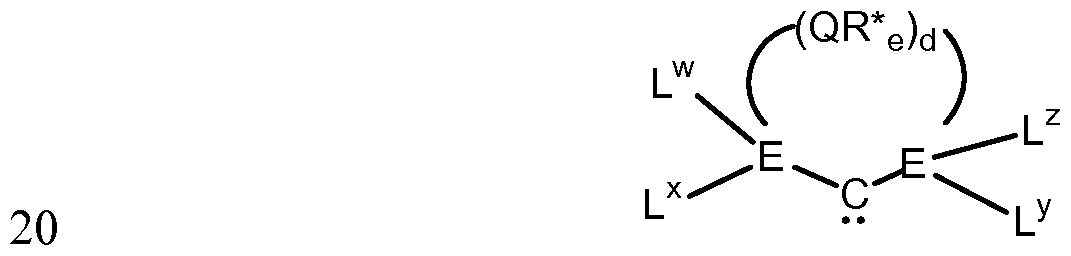 (Formula I)
(for clarity, in the above Formula I a pair of electrons is depicted just below the "C") where e is 0, 1 or 2, d is 1, 2, 3 or 4, Q is C, Si, N, P, O, or S, with available valences (R*) optionally occupied by hydrogen, oxo, hydrocarbyl or substituted hydrocarbyl groups (preferably, each R* is, independently, H or a Ci to C20 alkyl); and each E is, independently, selected from the group comprising C, N, S, O, and P, with available valences, if any, optionally occupied by Lw, Lx, Ly, and Lz. Lw, Lx, Ly, and Lz are, independently, hydrogen,
hydrocarbyl groups or substituted hydrocarbyl groups. In particular embodiments, Lw, Lx, Ly, and Lz are independently selected from the group consisting of hydrocarbyl groups and substituted hydrocarbyl groups having 1 to 40 carbon atoms. In preferred embodiments, Lw, Lx, Ly, and Lz are independently C1-10 alkyl, substituted C1-10 alkyl, C2-10 alkenyl, substituted C2-10 alkenyl, C2-10 alkynyl, substituted C2-10 alkynyl, aryl and substituted aryl. In particularly preferred embodiments, Lw, Lx, Ly, and Lz are independently selected from the group comprising methyl, ethyl, propyl, butyl (including isobutyl and n-butyl), pentyl, cyclopentyl, hexyl, cyclohexyl, octyl, cyclooctyl, nonyl, decyl, cyclodecyl, dodecyl, cyclododecyl, mesityl, adamantyl, phenyl, benzyl, tolulyl, chlorophenyl, 2,6-diethylphenyl, 2,6- diisopropylphenyl, 2-isopropylphenyl, 2-ethyl-6-methylphenyl, 3,5-ditertbutylphenyl, 2- tertbutylphenyl, and 2,3,4,5,6-pentamethylphenyl. Useful substituents include C1-10 alkyl, C2-10 alkenyl, C2-10 alkynyl, aryl, C1-10 alkoxy, C2-10 alkenyloxy C2-10, alkynyloxy, aryloxy, C2-10 alkoxycarbonyl, C1-10 alkylthio, C1-10 alkylsulfonyl, fluoro, chloro, bromo, iodo, oxo, amino, imine, nitrogen heterocycle, hydroxy, thiol, thiono, phosphorous, and carbene groups.
[0018] In a preferred embodiment, Q is carbon, each R* is hydrogen, e is 1 or 2 and d is 2.
[0019] Examples of cyclic carbenes useful in embodiments of the present invention include:

(for clarity, in the above formulae a pair of electrons is depicted just below the "C") where Lz, Lx, and Ly are as described above. In some embodiments, at least two of Lx, Ly, and Lz may be joined to form a 3- to 12-membered spirocyclic ring, with available valences optionally occupied by H, oxo, halogens, hydrocarbyl, or substituted hydrocarbyl groups. Useful substituents include C1-10 alkyl, C2-10 alkenyl, C2-10 alkynyl, aryl, C1-10 alkoxy, C2-10 alkenyloxy C2-10, alkynyloxy, aryloxy, C2-10 alkoxycarbonyl, C1-10 alkylthio, C1-10 alkylsulfonyl, fluoro, chloro, bromo, iodo, oxo, amino, imine, nitrogen heterocycle, hydroxy, thiol, thiono, phosphorous, and carbene groups.
[0020] Preferred cyclic carbenes include N-heterocyclic carbenes (NHCs). For purposes of this invention and claims thereto, "NHCs" are cyclic carbenes of the types described above (such as by Formula I) where each E is N and the available valences on the N are occupied by Lx and Ly. Useful NHCs are represented by the formula:

(for clarity, in the above Formula II a pair of electrons is depicted just below the "C") where Q, R*, e, d, Lx and Ly are as described above. In particular embodiments, Lx and Ly are independently selected from the group comprising a hydrocarbyl group and substituted hydrocarbyl group having 1 to 40 carbon atoms. In preferred embodiments, Lx and Ly are independently selected from the group comprising C1-10 alkyl, substituted C1-10 alkyl, C2-10 alkenyl, substituted C2-10 alkenyl, C2-10 alkynyl, substituted C2-10 alkynyl, aryl, and substituted aryl. In particularly preferred embodiments, Lx and Ly are independently selected from the group comprising methyl, ethyl, propyl, butyl (including isobutyl and n-butyl), pentyl, cyclopentyl, hexyl, cyclohexyl, octyl, cyclooctyl, nonyl, decyl, cyclodecyl, dodecyl, cyclododecyl, mesityl, adamantyl, phenyl, benzyl, tolulyl, chlorophenyl, 2,6-diethylphenyl, 2,6-diisopropylphenyl, 2-isopropylphenyl, 2-ethyl-6-methylphenyl, 3,5-ditertbutylphenyl, 2- tertbutylphenyl, and 2,3,4,5,6-pentamethylphenyl. Useful substituents include C1-10 alkyl, C2-10 alkenyl, C2-10 alkynyl, aryl, C1-10 alkoxy, C2-10 alkenyloxy C2-10, alkynyloxy, aryloxy, C2-10 alkoxycarbonyl, C1-10 alkylthio, C1-10 alkylsulfonyl, fluoro, chloro, bromo, iodo, oxo, amino, imine, nitrogen heterocycle, hydroxy, thiol, thiono, phosphorous, and carbene groups.
[0021] Some particularl useful NHCs include:

(for clarity, in the above formulae a pair of electrons is depicted just below the "C") where Lx and Ly are as described above.
[0022] Other useful NHCs include the compounds described in Hermann, W. A. Chem. Eur. J. 1996, 2, 772 and 1627; Enders, D. et al, Angew. Chem. Int. Ed. 1995, 34, 1021; Alder R. W., Angew. Chem. Int. Ed. 1996, 35, 1121; and Bertrand, G. et al, Chem. Rev. 2000, 100,
[0023] Particularly preferred cyclic carbenes include cyclic alkyl amino carbenes (CAACs). For purposes of this invention and claims thereto, CAACs are cyclic carbenes as described in Formula I where one E is N and the other is C, and the available valences on the N occupied by Lx, and available valences on the C are occupied by Ly and Lz. Preferred CAACs are represented by the formula:
 Formula III
(for clarity, in the above Formula III a pair of electrons is depicted just below the "C" between the N atom and the carbon bound to Lz and Ly)
where Q, R*, e, d, Lx, Lz, and Ly are as described above. In particular embodiments, Lx, Lz, and Ly are independently selected from the group comprising a hydrocarbyl group and substituted hydrocarbyl group having 1 to 40 carbon atoms. In preferred embodiments, Lx, Lz, and Ly are independently selected from the group comprising C1-10 alkyl, substituted C1-10 alkyl, C2-10 alkenyl, substituted C2-10 alkenyl, C2-10 alkynyl, substituted C2-10 alkynyl, aryl, and substituted aryl. In particularly preferred embodiments, Lx, Lz, and Ly are independently selected from the group comprising methyl, ethyl, propyl, butyl (including isobutyl and n- butyl), pentyl, cyclopentyl, hexyl, cyclohexyl, octyl, cyclooctyl, nonyl, decyl, cyclodecyl, dodecyl, cyclododecyl, mesityl, adamantyl, phenyl, benzyl, tolulyl, chlorophenyl, 2,6- diethylphenyl, 2,6-diisopropylphenyl, 2-isopropylphenyl, 2-ethyl-6-methylphenyl, 3,5- ditertbutylphenyl, 2-tertbutylphenyl, and 2,3,4,5,6-pentamethylphenyl. Useful substituents include C1-10 alkyl, C2-10 alkenyl, C2-10 alkynyl, aryl, C1-10 alkoxy, C2-10 alkenyloxy C2-10, alkynyloxy, aryloxy, C2-10 alkoxycarbonyl, C1-10 alkylthio, C1-10 alkylsulfonyl, fluoro, chloro, bromo, iodo, oxo, amino, imine, nitrogen heterocycle, hydroxy, thiol, thiono, phosphorous, and carbene groups.
[0024] Some particularly useful CAACs include:

(for clarity, in the above formulae a pair of electrons is depicted just below the "C").
[0025] Other useful CAACs include the compounds described in U.S. 7,312,331 and Bertrand et al, Angew. Chem. Int. Ed. 2005, 44, 7236-7239.
[0026] Other carbenes useful in embodiments of the present invention include thiazolyidenes, P-heterocyclic carbenes (PHCs), and cyclopropenylidenes.
[0027] In a particularly preferred embodiment, the carbene complex of a lithium and or ma nesium salt is represented by the formula:

where M is Li or Mg (preferably Li), E, R, c, n, Q, R*, e, d, Lw, Lx, Lz, and Ly are as described above.
[0028] The inventors have surprisingly found that certain carbene complexes comprising a lithium and/or magnesium salt form an oligomeric cluster. In preferred embodiments, the carbene complex comprising a lithium salt forms an oligomeric cluster. In particular embodiments, where n is 4, the complex comprising a lithium and/or magnesium salt of a carbene forms a cube-like oligomeric cluster, where M and R groups occupy the proximate vertices of the cube, as represented by:

[0029] In particularly preferred embodiments, where M is Li, n is 4, and R is OTf, the complex of the present invention forms a cube-like oligomeric cluster, where Li and OTf groups occupy the proximate vertices of the cube, as represented by:

[0030] In even more particularly preferred embodiments, T is a CAAC of the type:

Preparation of Carbene Complexes of a Lithium and/or Magnesium Salt
[0031] The carbene complexes of lithium and/or magnesium salts described above are typically prepared by contacting a protonated cyclic carbene salt with a lithium or magnesium base (preferably at -40 to 40°C, preferably above 0°C) in a non-polar solvent. For purposes of this invention and the claims thereto a non-polar solvent is defined as a solvent that contains only carbon, hydrogen and optional halogen atoms (such as an alkane, arene or halogenated hydrocarbons or halogenated aromatics), while a polar solvent is defined a solvent that contains at least one Group 15 or 16 heteroatom (such as oxygen, or sulfur). Both aliphatic and aromatic non-polar solvents are suitable for use herein. Preferred non- polar solvents include benzene, toluene, hexane, pentane, isopentane, and octane.
[0032] The isolation of the carbene complexes of lithium and/or magnesium salts is typically accomplished by crystallization or precipitation of the complex from a non-polar solvent or mixture of non-polar solvents.
[0033] In a preferred embodiment, the carbene complexes of lithium and/or magnesium salts described above are prepared by the stepwise addition of a protonated cyclic carbene salt, as either a solid, a solution, or a slurry, to a solution of a lithium or magnesium base in a non-polar solvent.
[0034] In a preferred embodiment, the carbene complexes of lithium and/or magnesium salts described above are prepared under conditions such that the temperature is between -40 to 40°C (preferably from 0 to 40°C), the pressure is ambient, and the concentration of each reactant is between 0.00001 M and 1.0 M.
[0035] Suitable lithium and magnesium bases include, but are not limited to, lithium amides, magnesium amides, alkyllithiums, aryl lithiums, dialkylmagnesiums, diary lmagnesiums, and magnesium(alkyl)amides.
[0036] The inventors have surprisingly discovered that the carbene complexes of lithium and/or magnesium salts of the present invention display unexpected and unusual stability in both coordinating and non-coordinating solvents at or above ambient temperatures. Specifically, the inventors have surprisingly discovered that complexes of lithium salts of CAACs with N-substitution such as 2,6-diethylphenyl, are remarkably stable in solution at ambient temperatures. For example, in solution stability studies of a complex of a particular embodiment of the present invention (Compound 1, reported in Examples 2 & 3, below) only 14% decomposition was observed in benzene at ambient temperature over a period of 4 days. In another embodiment, less than 5% decomposition was observed in tetrahydrofuran at ambient temperature over a period of 72 hours. Without wishing to be bound by theory, the inventors believe that the ordered oligomeric clustering observed in the carbene complexes of lithium and/or magnesium salts may provide added stability to the complex as compared to the free carbene.
[0037] Hence in a preferred embodiment, the carbene complexes of a lithium and/or magnesium salt described above are stable at 23°C or more. In a preferred embodiment, the carbene complexes of a lithium and/or magnesium salt described above are stable at 30°C or more, preferably at 50°C or more. In a preferred embodiment, the carbene complexes of a lithium and/or magnesium salt described above are stable at 23°C, preferably at 30°C, preferably at 50°C. In a preferred embodiment, the carbene complexes of a lithium and/or magnesium salt described above are stable at from -40 to 80°C, preferably from 0 to 60°C, preferably from 20 to 50°C. (Stable is defined to be 50%> or less decomposition when stored in 0.01 benzene at the selected temperature for a period of 1 hour. When a temperature range (e.g., -40 to 80°C) is indicated, stability is determined by measuring % decomposition at each end of the range. Both values must be at or below the value in question, e.g. 50%> or less). In a preferred embodiment, the carbene complexes of a lithium and/or magnesium salt described above have 50%> or less (preferably 40%> or less, preferably 30%> or less, preferably 20%> or
less, preferably 10% or less, preferably 5% or less) decomposition when stored in 0.01 benzene (alternately tetrahydrofuran, alternately hexane) at the selected temperature for a period of 24 hours.
Transition-metal-carbene Complexes
[0038] The carbene complexes of lithium and/or magnesium salts described above may be used to prepare transition-metal-carbene complexes. In a particular embodiment, a method for the preparation of a transition-metal-carbene complex comprises combining a transition metal reactant and at least one carbene complex of a lithium and/or magnesium salt as described above, wherein the carbene is transferred from the lithium and/or magnesium salt to the transition metal reactant.
[0039] For purposes of this invention and claims thereto, a "transition metal reactant" is a compound comprising at least one transition metal with one or more coordinated ligands (the coordinated ligands are typically neutral or anionic non-metal species). For purposes of this invention and claims thereto, a "transition metal" is an element from Groups 3, 4, 5, 6, 7, 8, 9, 10, 11, or 12 (including the lanthanides and actinides) of the Periodic Table, as referenced by the IUPAC in Nomenclature of Inorganic Chemistry: Recommendations 1990, G. J. Leigh, Editor, Blackwell Scientific Publications, 1990. Transition metal reactants useful in embodiments of the present invention comprise transition metals (M* in the formulae below) from Group 3-12 (preferably M* is Sc, Y, Ti, Zr, Hf, V, Nb, Ta, Cr, Mo, W, Mn, Re, Co, Rh, Ir, Ni, Pd, Pt, Cu, Ag, Au, Fe, Ru and/or Os), more particularly Groups 6-11 (preferably M* is Cr, Co, Ni, Cu, Mn, Rh, Pd, Pt, Ag, Au, Fe, Ru and/or Os), even more particularly Group 8 (preferably M* is Fe, Ru and/or Os, preferably M* is Ru).
[0040] The coordinated ligands are typically neutral or anionic non-metal species, such as trialkylphosphines, pyridines, halides, alkyls, aryls, alkylidenes, ethers, and thio ethers. Preferred examples include tricyclohexylphosphine, chlorides, substituted benzylidenes, ether substituted benzylidenes. The coordinated ligands feature at least one pair of lone electrons that can form a dative or covalent bond with the transition metal. Preferably, the transition metal reactant features at least one labile neutral ligand, such as tricyclohexyl phosphine, which is exchanged for the cyclic carbene in the reaction.
[0041] In a preferred embodiment, the transition metal reactant is represented by the formula:
where M* is a transition metal as defined above; L° is a neutral ligand; L1" is a monoanionic ligand; L2" is a dianionic ligand; g is the overall charge of the molecule (preferably 0, 1, or 2); q is 0, 1, 2, 3, or 4; s is 0, 1, 2, 3, or 4; and t is 0, 1, 2, 3, or 4; where g+s+2(t) is equal to the valence of the transition metal, M*. For purposes of this invention and the claims thereto, "valence" is equivalent to oxidation number. The overall coordination number of the transition metal is preferably 4, 5, 6, or 7. Preferably, the valence of the metal will be 0, 1, 2, 3, or 4. Preferably, each ligand may be monodentate, bidentate, tridentate, tetradentate, pentadentate, or hexadentate.
[0042] In a preferred embodiment, the transition metal reactant is a ruthenium phosphine complex. Preferred ruthenium phosphine complexes are typically the combination of ruthenium and a phosphine. For purposes of this invention and claims thereto, "phosphines" are represented by the formula PR9 3, wherein each R9 is independently hydrogen, a Ci to C12 hydrocarbyl group, a substituted Ci to C12 hydrocarbyl group, or a halide. Preferred ruthenium phosphine complexes are represented by the formula:
(R10CH)j(PR9 3)hRuXk where X is a halogen (preferably chlorine or bromine); R9 is as defined above; h is 1, 2, or 3 (preferably 1 or 2); j is 0, 1, or 2; k = 1 or 2; and R10CH is a dianionic group, such as an alkylidene, substituted alkylidene, or a chelating substituted alkylidene ligand.
[0043] Examples of ruthenium phosphine complexes useful in embodiments herein include bis(tricyclohexylphosphine) benzylidine ruthenium dichloride, dichloro(o- isopropoxyphenylmethylene)(tricyclohexylphosphine) ruthenium dichloride, tris(triphenylphosphine) ruthenium dichloride, {[2-(i-propoxy)-5-(N,N- dimethylaminosulfonyl)phenyl] methylene} (tricyclohexylphosphine) ruthenium dichloride, bis(i-butylphoban)(3 -phenyl- lH-inden-l-ylidene) ruthenium dichloride, and bis(tricyclohexylphosphine)(3 -phenyl- lH-inden-l-ylidene) ruthenium dichloride.
[0044] In some embodiments, the transition metal reactant may be supported on an inert material. The inert material tends to render the transition metal reactant heterogeneous, which often simplifies product recovery. Suitable support materials include, without limitation, silicas, aluminas, silica-aluminas, aluminosilicates, including zeolites and other crystalline porous aluminosilicates; as well as titanias, zirconia, magnesium oxide, carbon, and cross-linked, reticular polymeric resins, such as functionalized cross-linked polystyrenes, e.g., chloromethyl-functionalized cross-linked polystyrenes. The transition metal reactant
may be deposited onto the support by any method known to those of ordinary skill in the art, including, for example, impregnation, ion-exchange, deposition-precipitation, and vapor deposition. Alternatively, the transition metal reactant may be chemically bound to the support via one or more covalent chemical bonds, for example, the compound may be immobilized by one or more covalent bonds with one or more of the ligands bound to the transition metal.
[0045] The transition metal reactant and the carbene complexes of lithium and/or magnesium salts described above may be used in various synthetic processes. For example, a transition metal reactant (as described above) and a carbene complex of a lithium and/or magnesium salt of a carbene (as described above), are combined to form a transition-metal- carbene complex wherein the carbene is transferred from the salt to the transition metal reactant. In some embodiments, the carbene is transferred from the lithium or magnesium salt to the transition metal reactant in situ. The transition-metal-carbene complex is typically used in other processes such as metathesis reactions, for example, the metathesis of olefins.
[0046] The transition metal reactant and the carbene complex of a lithium and/or magnesium salt may be combined in any manner known in the art. In some embodiments, the transition metal reactant and the lithium or magnesium salt of a carbene may be combined in a non-coordinating solvent, in a coordinating solvent, or a mixture thereof. The solvent may be polar or non-polar or may be a blend of polar and non-polar solvents. Hydrocarbon solvents, both aliphatic and aromatic are suitable non-polar solvents. Alkanes, such as hexane, pentane, isopentane, and octane, are useful. Alternately, mixtures of polar and non- polar solvents can be used. Particularly, a mixture of a non-polar aliphatic or aromatic solvent with a polar solvent particularly diethyl ether, can be used. Useful polar solvents include diethyl ether, methyl t-butyl ether, tetrahydrofuran, di-n-butyl ether, methyl propyl ether, di-n-propyl ether, diisopropyl ether, ethyl acetate, and acetone. Preferred non-polar solvents include toluene, hexane, pentane, isopentane, and octane.
[0047] In some embodiments, the carbene complex comprising a lithium and/or magnesium metal salt of a carbene may be generated in situ. In a preferred embodiment, the carbene complexes of lithium and/or magnesium salts described above are typically formed in situ by contacting a protonated cyclic carbene salt with a lithium or magnesium base (preferably at -40 to 40°C) in a non-polar solvent. The solution containing the in-situ formed lithium or magnesium salt complex can then be used in applications analogous to the isolated lithium or magnesium salt complex. Preferably, the in-situ reaction occurs at a temperature
of -40 to 40°C, preferably 0 to 40°C, preferably 20 to 30°C. By in-situ is meant that the product formed in a reaction is used without being isolated from the reaction solution. Preferably, the product formed in the reaction is used without being substantially separated from the reaction medium (such as a solvent); preferably, the product formed in the reaction is used without being separated from the majority of the reaction medium.
[0048] In some embodiments, the transfer of the carbene to the transition metal reactant may occur by coordination to the transition metal. In other embodiments, the transfer of the carbene to the transition metal reactant may occur by a substitution reaction, such as ligand exchange.
[0049] Preferably, the reaction to form a transition-metal-carbene complex by combination of a carbene complex of a lithium or magnesium salt with a transition-metal reactant occurs at a temperature of -40 to 120°C, preferably 0 to 80°C, preferably 20 to 60°C.
[0050] In embodiments, the reaction to form a transition-metal-carbene complex by combination of a carbene complex of a lithium and/or magnesium salt with a transition-metal reactant occurs at a pressure of 0.01 to 100 atmospheres (1.01 tol0132.5 kPa ), preferably 0.8 to 2 atmospheres (81.1 to 202.7 kPa ), preferably at ambient pressure.
[0051] Preferably, the reaction to form a transition-metal-carbene complex by combination of a carbene complex of a lithium or magnesium salt with a transition-metal reactant occurs at a concentration of reactants of 0.0000001 to 10 molar, preferably 0.0001 to 1 molar, preferably 0.01 to 1 molar.
[0052] Preferred transition-metal-carbene complexes produced herein are represented by the formula:
where M* is a transition metal as defined above; T is a cyclic carbene ligand as defined above; L° is a neutral ligand; L1" is a monoanionic ligand; L2" is a dianionic ligand; q is 0, 1, 2, 3, or 4; s is 0, 1, 2, 3, or 4; t is 0, 1, 2, 3, or 4; and g is the overall charge of the molecule (preferably 0, 1, or 2). Preferably, each ligand may be monodentate, bidentate, tridentate, tetradentate, pentadentate, or hexadentate. The overall coordination number of the transition metal is preferably 4, 5, 6, or 7. The valence of the metal M is g+s+2(t). Preferably, the valence of the metal will be 0, 1, 2, 3, or 4.
[0053] Preferred transition-metal-carbene complexes produced herein include:
2-(2,6-diethylphenyl)-3,3,5,5-tetramethylpyrrolidine[2-(i-propoxy)-5-(N,N-
dimethylaminosulfonyl)phenyl]methylene ruthenium dichloride (compound D), 2-(2,6- diethylphenyl)-3,3,5,5-tetramethylpyrrolidine(o-isopropoxyphenylmethylene) ruthenium dichloride, 2-(2,4,6-trimethylphenyl)-3,3,5,5-tetramethylpyrrolidine[2-(i-propoxy)-5-(N,N- dimethylaminosulfonyl)phenyl]methylene ruthenium dichloride, 2-(2,4,6-trimethylphenyl)- 3,3,5,5-tetramethylpyrrolidine(o-isopropoxyphenylmethylene) ruthenium dichloride, 2-(2- isopropylphenyl)-3,3,5,5-tetramethylpyrrolidine[2-(i-propoxy)-5-(N,N- dimethylaminosulfonyl)phenyl]methylene ruthenium dichloride, 2-(2-isopropylphenyl)- 3,3,5,5-tetramethylpyrrolidine(o-isopropoxyphenylmethylene) ruthenium dichloride, 2-(2- ethyl-6-methylphenyl)-3,3,5,5-tetramethylpyrrolidine[2-(i-propoxy)-5-(N,N- dimethylaminosulfonyl)phenyl]methylene ruthenium dichloride, 2-(2-ethyl-6-methylphenyl)- 3,3,5,5-tetramethylpyrrolidine(o-isopropoxyphenylmethylene) ruthenium dichloride, 2-(2,4- dimethylphenyl)-3,3,5,5-tetramethylpyrrolidine[2-(i-propoxy)-5-(N,N- dimethylaminosulfonyl)phenyl]methylene ruthenium dichloride, 2-(2,4-dimethylphenyl)- 3 ,3 ,5 ,5-tetramethylpyrrolidine(o-isopropoxyphenylmethylene) ruthenium dichloride.
[0054] The transition metal carbene complexes produced herein may be used as catalysts in many other reactions such as those described by Nolan and coworkers in Chemical Reviews 2009, 109, 3612-3676. These include polymerizations, cyclizations, C-C bond formations, hydrogenations, isomerizations, hydrosilylations, hydroformylations, arylations of carbonyl compounds with boron reagents, reductions, oxidations, hydrogen/deuterium exchanges, cross coupling reactions, allylic alkylations, carbonylations, C-H bond activations, cycloisomerizations, addition reactions, telomerizations, conjugate additions, cycloadditions, and allylic alkylations.
[0055] The transition-metal-carbene complexes produced herein may be used in many other reactions, including the metathesis of olefins. In particular these transition metal carbene complexes can be combined with a seed oil, triacylglyceride, fatty acid, fatty acid ester, and/or fatty acid alkyl ester, and an alkene such as ethylene, to make linear alpha- olefins (having at least 1 more carbon atom than the starting alkene), preferably 1-decene, 1- butene, and 1-heptene. Such linear alpha olefins can then be used to make polyalphaolefins.
[0056] In other embodiments, this invention relates to:
1. A process to produce alpha-olefm (preferably linear alpha olefin) comprising contacting a seed oil with the transition-metal-carbene complexes produced herein (e.g., using a carbene complex of a lithium and or magnesium salt as a synthon), preferably with one or more of 2-(2,6-diethylphenyl)-3,3,5,5-tetramethylpyrrolidine[2-(i-propoxy)-5-(N,N-
dimethylaminosulfonyl)phenyl]methylene ruthenium dichloride (compound D), 2-(2,6- diethylphenyl)-3,3,5,5-tetramethylpyrrolidine(o-isopropoxyphenylmethylene) ruthenium dichloride, 2-(2,4,6-trimethylphenyl)-3,3,5,5-tetramethylpyrrolidine[2-(i-propoxy)-5-(N,N- dimethylaminosulfonyl)phenyl]methylene ruthenium dichloride, 2-(2,4,6-trimethylphenyl)- 3,3,5,5-tetramethylpyrrolidine(o-isopropoxyphenylmethylene) ruthenium dichloride, 2-(2- isopropylphenyl)-3,3,5,5-tetramethylpyrrolidine[2-(i-propoxy)-5-(N,N- dimethylaminosulfonyl)phenyl]methylene ruthenium dichloride, 2-(2-isopropylphenyl)- 3,3,5,5-tetramethylpyrrolidine(o-isopropoxyphenylmethylene) ruthenium dichloride, 2-(2- ethyl-6-methylphenyl)-3,3,5,5-tetramethylpyrrolidine[2-(i-propoxy)-5-(N,N- dimethylaminosulfonyl)phenyl]methylene ruthenium dichloride, 2-(2-ethyl-6-methylphenyl)- 3,3,5,5-tetramethylpyrrolidine(o-isopropoxyphenylmethylene) ruthenium dichloride, 2-(2,4- dimethylphenyl)-3,3,5,5-tetramethylpyrrolidine[2-(i-propoxy)-5-(N,N- dimethylaminosulfonyl)phenyl]methylene ruthenium dichloride, and 2-(2,4-dimethylphenyl)- 3 ,3 ,5 ,5-tetramethylpyrrolidine(o-isopropoxyphenylmethylene) ruthenium dichloride.
2. The process of paragraph 1, wherein the seed oil is selected from the group consisting of canola oil, corn oil, soybean oil, rapeseed oil, algae oil, peanut oil, mustard oil, sunflower oil, tung oil, perilla oil, grapeseed oil, linseed oil, safflower oil, pumpkin oil, palm oil, Jathropa oil, high-oleic soybean oil, high-oleic safflower oil, high-oleic sunflower oil, mixtures of animal and vegetable fats and oils, castor bean oil, dehydrated castor bean oil, cucumber oil, poppyseed oil, flaxseed oil, lesquerella oil, walnut oil, cottonseed oil, meadowfoam, tuna oil, sesame oils and mixtures thereof.
3. The process of paragraph 1, wherein the seed oil is selected from the group consisting of palm oil and algae oil.
4. A process to produce alpha-olefm comprising contacting a triacylglyceride with an alkene and the transition-metal-carbene complexes produced herein (such as the complexes described in paragraph 1), preferably wherein the alpha olefin produced has at least one more carbon atom than the alkene.
5. The process of paragraph 4, wherein the triacylglyceride is contacted with alcohol and converted to an fatty acid ester or fatty acid alkyl ester prior to contacting with the transition- metal-carbene complex.
6. The process of paragraph 4, wherein the triacylglyceride is contacted with water or an alkaline reagent and converted to a fatty acid prior to contacting with the transition-metal- carbene complex.
7. A process to produce alpha-olefm comprising contacting an unsaturated fatty acid with an alkene and a transition-metal-carbene complex (preferably one or more of the compounds described in paragraph 1), preferably wherein the alpha olefin produced has at least one more carbon atom than the alkene.
8. A process to produce alpha-olefm comprising contacting a triacylglyceride with a transition-metal-carbene complex (preferably one or more of the compounds described in paragraph 1), preferably wherein the alpha olefin produced has at least one more carbon atom than the alkene.
9. A process to produce alpha-olefm comprising contacting an unsaturated fatty acid ester and or unsaturated fatty acid alkyl ester with an alkene and a transition-metal-carbene complex (preferably one or more of the compounds described in paragraph 1), preferably wherein the alpha olefin produced has at least one more carbon atom than the alkene.
10. The process of any of paragraphs 1 to 9, wherein the alpha olefin is a linear alpha- olefm having 4 to 24 carbon atoms.
11. The process of any of paragraphs 1 to 10, wherein the alkene is ethylene, propylene, butene, hexene, or octene.
12. The process of any of paragraphs 1 to 11, wherein the fatty acid ester is a fatty acid methyl ester.
13. The process of any of paragraphs 1 to 12, wherein the triacylglyceride, fatty acid, fatty acid alkyl ester, fatty acid ester is derived from biodiesel.
14. The process of any of paragraphs 1 to 13, wherein the alpha-olefm is butene- 1, decene- 1 , and or heptene- 1.
15. A process to produce C4 to C24 linear alpha-olefm comprising contacting a feed material with an alkene selected from the group consisting of ethylene, propylene butene, pentene, hexene, heptene, octene, nonene and mixtures thereof and a transition-metal-carbene complex (preferably one or more of the compounds described in paragraph 1), wherein the feed material is a triacylglyceride, fatty acid, fatty acid alkyl ester, and/or fatty acid ester derived from seed oil or algae.
[0057] Without wishing to be bound by theory, the inventors believe that the ordered oligomeric clustering observed in the carbene complex comprising a lithium and/or magnesium salt may provide added stability to the complex as compared to the free carbene.
[0058] Decomposition of non-inventive carbene reactants usually occurs through a dimerization of the free carbenes. However, without wishing to be bound by theory, the
inventors believe that the oligomeric clusters of preferred embodiments herein stabilize the carbene by preventing the dimerization and/or other decomposition reactions. Instead, the carbene complexes of the lithium and/or magnesium salts are stabilized in this oligomeric cluster within a timeframe sufficient for synthetic reactions, in particular substitution reactions such as ligand exchange, to take place. Accordingly, the complexes of the present invention provide carbene sources which are stable at ambient and super-ambient temperatures. Therefore the complexes of the present invention fulfill a key need for carbene sources that are stable at the ambient or super-ambient temperatures at which synthetic reactions such as ligand exchange substitution reactions can proceed at a reasonable rate.
[0059] Indeed, the inventors report the synthesis of Compound D, Comparative Example 1 below, according to conventional synthetic routes, with a yield of 6.4%. On preparing Compound D using the novel method of preparation described herein, Example 2 below, the inventors report a dramatically increased yield of 89%. Furthermore, on preparing Compound D using a carbene complex of a lithium and/or magnesium salt generated in situ (Example 3, below), the inventors report an extraordinary 79% yield. The inventors believe that the high yielding ligand exchange reactions described herein may be at least partially attributable to these the increased stability of the carbene complex of a lithium and/or magnesium salt as compared to the free carbene.
[0060] In a preferred embodiment, the yield ((moles of transition-metal-carbene complex divided by moles of transition metal reactant) times 100) is at least 20%, preferably at least 30%, preferably at least 40%, preferably at least 50%, preferably at least 60%, preferably at least 70%), preferably at least 80%>.
[0061] In another embodiment this invention relates to:
1. A carbene complex of metal salt represented by the formula:
[T-M(R)C] I;n wherein, R is a monoanionic group; c is 1 or 2; M is a Li or Mg; T is a cyclic carbene ligand; and n is selected from the group of integers comprising 1 to 24 wherein the complex has 50% or less decomposition when stored in 0.01 molar benzene at 23°C for a period of 1 hour.
2. The complex of paragraph 1, wherein T is represented by Formula (I):

3. The complex of paragraph 1 or 2, wherein Lw, Lx, Ly, and Lz are independently selected from the group consisting of hydrocarbyl groups and substituted hydrocarbyl groups having 1 to 40 carbon atoms.
4. The complex of any of paragraphs 1 to 3, wherein Lw, Lx, Ly, and Lz are independently Ci_io alkyl, substituted Ci_io alkyl, C2_io alkenyl, substituted C2_io alkenyl, C2_io alkynyl, substituted C2_i0 alkynyl, aryl, and substituted aryl.
5. The complex of any of paragraphs 1 to 4, wherein Lw, Lx, Ly, and Lz are independently selected from the group comprising methyl, ethyl, propyl, butyl (including isobutyl and n-butyl), pentyl, cyclopentyl, hexyl, cyclohexyl, octyl, cyclooctyl, nonyl, decyl, cyclodecyl, dodecyl, cyclododecyl, mesityl, adamantyl, phenyl, benzyl, tolulyl, chlorophenyl, 2,6-diethylphenyl, 2,6-diisopropylphenyl, 2-isopropylphenyl, 2-ethyl-6-methylphenyl, 3,5- ditertbutylphenyl, 2-tertbutylphenyl, and 2,3,4,5,6-pentamethylphenyl. Useful substituents include Ci_io alkyl, C2_io alkenyl, C2_io alkynyl, aryl, Ci_io alkoxy, C2_io alkenyloxy C2_io, alkynyloxy, aryloxy, C2_io alkoxycarbonyl, Ci_io alkylthio, Ci_io alkylsulfonyl, fluoro, chloro, bromo, iodo, oxo, amino, imine, nitrogen heterocycle, hydroxy, thiol, thiono, phosphorous, and carbene groups.
6. The complex of any of paragraphs 1 to 5, wherein the complex has 40% or less decomposition when stored in 0.01 molar benzene at 30°C for a period of 1 hour.
7. The complex of any of paragraphs 1 to 6, wherein the complex has 10% or less decomposition when stored in 0.01 molar benzene at 30°C for a period of 1 hour.
8. The complex of any of paragraphs 1 to 7, wherein each R is at least one of an alkyl sulfonate, aryl sulfonate, alkyl sulfate, aryl sulfate, carboxylate, aryl carboxylate, amidate, amidinate, thiocarboxylate, dithiocarboxylate, borate, chloride, bromide, iodide, nitrate, triflate, and perchlorate.
9. The complex of any of paragraphs 1 to 8, wherein M is lithium.
10. The complex of any of paragraphs 1 to 9, wherein the salt forms an oligomeric cluster.
11. The complex of any of paragraphs 1 to 10, wherein n is 4 and the salt forms a cubelike oligomeric cluster in which M and R groups occupy the proximate vertices of the cube, as represented by:

where M, R and T are as defined in paragraph 1.
12. The complex of paragraph 11, wherein each M is Li, and each T is:

13. The complex of any of paragraphs 1 to 12, wherein the salt forms a cube-like oligomeric cluster in which T is as defined in claim 1 , each M is Li and each R is triflate, and the M and R groups occupy the proximate vertices of the cube, as represented by:

14. The complex of any of paragraphs 1 to 13, wherein the complex is represented by the formula:


15. A transition-metal-carbene complex prepared from a carbene complex of a lithium and/or magnesium salt, said transition-metal-carbene complex represented by the formula:

where M* is a transition metal from Group 6, 7, 8, 9, 10, 11, or 12; T is a cyclic carbene ligand; L° is a neutral ligand; L1" is a monoanionic ligand; L2" is a dianionic ligand; q is 0, 1, 2, 3, or 4; s is 0, 1, 2, 3, or 4; t is 0, 1, 2, 3, or 4; g is the overall charge of the molecule.
16. The transition-metal-carbene complex of paragraph 15, wherein T is represented by Formula (I):

where e is 0, 1, or 2; d is 1, 2, 3, or 4; Q is C, Si, N, P, O, or S; each R* is a hydrogen, oxo, hydrocarbyl or substituted hydrocarbyl group; and each E is, independently, C, N, S, O, or P, with available valences, if any, occupied by Lw, Lx, Ly, and Lz, where Lw, Lx, Ly, and Lz are, independently, hydrogen, hydrocarbyl groups or substituted hydrocarbyl groups.
17. A process to make a transition-metal-carbene complex comprising contacting:
1) a stable carbene complex of metal salt of any of paragraphs 1 to 14 with
2) a transition metal reactant represented by the formula:
where M* is a transition metal selected from Group 6, 7, 8, 9, 10, 11, or 12; L is a neutral ligand; L1" is a monoanionic ligand; L2" is a dianionic ligand; g is the overall charge of the molecule; q is 0, 1, 2, 3, or 4; s is 0, 1, 2, 3, or 4; and t is 0, 1, 2, 3, or 4, where g+s+2(t) is equal to the valence of the transition metal, M*.
18. The process of paragraph 17, wherein the stable carbene complex of metal salt and the transition metal reactant are contacted at 0°C or more.
19. The process of paragraph 17, wherein the stable carbene complex of metal salt is not isolated from the reaction medium it was made in prior to contacting with the transition metal reactant.
20. The process of paragraph 17, wherein the stable carbene complex of metal salt is not crystallized into a solid prior to contacting with the transition metal reactant.
21. The process of any of paragraphs 17 to 20, wherein the yield is at least 20%, where yield = ((moles of transition-metal-carbene complex / moles of transition metal reactant) x
100).
22. The process of any of paragraphs 17 to 21, wherein the yield is at least 50%, where yield = ((moles of transition-metal-carbene complex / moles of transition metal reactant) x
100).
The process of any of paragraphs 17 to 22, wherein T is represented by Formula (I)

where e is 0, 1, or 2; d is 1, 2, 3, or 4; Q is C, Si, N, P, O, or S; each R* is a hydrogen, oxo, hydrocarbyl or substituted hydrocarbyl group; and each E is, independently, C, N, S, O, or P, with available valences, if any, occupied by Lw, Lx, Ly, and Lz, where Lw, Lx, Ly, and Lz are, independently, hydrogen, hydrocarbyl groups or substituted hydrocarbyl groups.
24. A process to produce alpha-olefm comprising contacting algae and or a seed oil with the transition-metal-carbene complex of paragraph 15 or 16 or the transition-metal-carbene complex produced by any of any of paragraphs 17 to 23.
25. A process to produce C4 to C24 linear alpha-olefm comprising contacting a feed material with an alkene selected from the group consisting of ethylene, propylene butene, pentene, hexene, heptene, octene, nonene and mixtures thereof and a transition-metal-carbene complex, wherein the feed material is a triacylglyceride, fatty acid, fatty acid alkyl ester,
and/or fatty acid ester derived from seed oil or algae, and wherein the transition-metal- carbene complex is a transition-metal-carbene complex of paragraph 15 or 16 or a transition- metal-carbene complex produced by any of any of paragraphs 17 to 23.
Experimental Section
[0062] For purposes of this invention and the claims thereto, THF is tetrahydrofuran, iPr or 'Pr is isopropyl, Me is methyl, Et is ethyl, Tf20 is trifluoromethanesulfonic anhydride, TfO is triflate, and Zhan-lC is {[2-(i-propoxy)-5-(N,N-dimethylaminosulfonyl)phenyl] methylene} (tricyclohexylphosphine) ruthenium dichloride.
[0063] Typical dry-box procedures for synthesis of air-sensitive compounds were followed including using dried glassware (120°C, >4 hours) and anhydrous solvents purchased from Sigma Aldrich (St. Louis, MO) which were further dried over 3 A sieves. All reagents were purchased from Sigma-Aldrich, unless otherwise noted. 1H and 13C spectra were recorded on Bruker 250 and 500 spectrometers. Single-crystal X-ray diffraction data was recorded on a Rigaku SCXmini diffractometer.
Synthesis of Precursors
[0064] Synthesis of (E)-2,6-diethyl-N-(2-methylpropylidene)aniline (A): Benzene (150 mL) was added to 2,6-diethylaniline (18.59 g, 124.6 mmol) and 3 angstrom molecular sieves (ca. 50 mL). Isobutyraldehyde (9.43 g, 131 mmol) and p-toluenesulfonic acid monohydrate (20 mg, 0.011 mmol) were then added. The flask was sealed and heated to 50°C. After stirring overnight the very pale yellow solution was filtered and the volatiles were removed under reduced pressure to afford 22.5 g of compound A (84.6%) as a clear, pale yellow oil. 1H NMR (C6D6): δ 7.21 (1H, d), 7.02 (2H, m), 2.47 (4H, q), 2.39 (1H, m), 1.11 (6H, t), 1.01 (6H, d).

[0065] Synthesis of lithium (2,6-diethylphenyl)(2-methylprop-l-enyl)amide (B): Benzene (70 mL) and compound A (6.63 g, 32.6 mmol) were combined. Solid lithium diisopropylamide (4.01 g, 37.4 mmol) was then added. The mixture was heated to 50°C to form a cloudy red-orange solution. After a few hours the solution was filtered through diatomaceous earth to afford a clear yellow solution. The volatiles were evaporated to give a
yellow solid. Pentane (15 mL) was added and the mixture was stirred briefly and then cooled to -10°C overnight. The product was then collected on a glass frit and washed with pentane (2 x 20 mL) to yield 5.50 g of compound B (80.6%) as a white solid that was dried under reduced pressure and used without further characterization.

[0066] Synthesis of 1 -(2,6-diethylphenyl)-2,2 A4-tetramethyl-3 ,4-dihydro-2H-pyrrolium triflate (C): Et20 (100 mL) was added to compound B (5.50 g, 26.3 mmol) to form a clear yellow solution. A solution of 1 ,2-epoxy-2-methylpropane (1.90 g, 26.3 mmol) in Et20 (5 mL) was added dropwise over about 10 seconds, and the mixture was stirred overnight. The mixture was then cooled to -80°C and trifluoromethanesulfonic anhydride (7.42 g, 26.3 mmol) was added dropwise. The mixture was warmed to ambient temperature over 1 hour. A thick suspension formed. After stirring for an additional hour, a solid was collected on a glass frit and washed with Et20 (3 x 15 mL). The solid was dried under reduced pressure. The dried solid was then extracted with CH2C12 (60 mL) and filtered through diatomaceous earth. The filter cake was washed with CH2C12 (2 x 30 mL). The combined CH2C12 extracts were evaporated to an oil and Et20 (15 mL) was added which caused a white crystalline solid to form. The ether solution was cooled to -10°C overnight. The white solid was then collected and dried under reduced pressure to afford 1.48 g of product C. To obtain additional product the filter cake was loaded into a thimble. This was placed in a Soxhlet extractor and the solid was extracted with hot CH2C12 overnight. The resulting CH2C12 extract was evaporated and Et20 (10 mL) was added to afford additional product as off- white crystals. The combined yield of compound C was 3.28 g (30.6%). 1H NMR (C6D6): δ 7.21 (1H, d), 7.0

[0067] Tetrahydrofuran (40 mL) was added to K (SiMe3)2 (0.379 g, 1.90 mmol) to form a homogeneous solution. The solution was cooled to -80°C and then a solution of C (0.775 g, 1.90 mmol) in THF (10 mL) was added dropwise over about 10 seconds. After 30 seconds, a solution of { [2-(i-propoxy)-5 -(N,N-dimethylaminosulfonyl)phenyl] methylene}(tricyclohexylphosphine) ruthenium dichloride (0.612 g, 0.865 mmol) in THF (10 mL), which had been cooled to -10°C, was added dropwise over about 15 seconds. The mixture was stirred for 10 minutes then warmed to ambient temperature. The mixture was further stirred at ambient temperature for 2 hours and then the volatiles were removed under reduced pressure. The residue was extracted with 20 mL of a 3 :2 mixture of hexane:CH2Cl2 and filtered. The filtrate was loaded on to a Si02 column (1.25" x 8") that had been packed with the same solvent mixture. The column was eluted with 3 :2 hexane:CH2Cl2 (300 mL) and then the solvent polarity was gradually increased to pure CH2C12. The product eluted as a dark green band. Removal of the volatiles afforded a dark green oil that crystallized upon the addition of pentane (2 mL) and cooling to -10°C overnight. The product was isolated as green flocculent crystals (Compound D) that were dried under reduced pressure (0.038 g, 6.4%). 1H NMR (CD2C12): δ 16.26 (1H, s, RuCH-), 7.96 (1Η, dd), 7.64 (1Η, t), 7.47 (2Η, d), 7.18 (1Η, d, J = 2 Hz), 7.1 1 (1H, d), 5.22 (1H, sept), 2.64 (6H, s), 2.53 (4H, m), 2.19 (2H, s), 2.07 (6H, s), 1.7

Examples 2 & 3:
[0068] Synthesis of Compound 1 , precursor to Compound D in Examples 2 and 3 : Benzene (8 mL) was added to LiN(SiMe3)2 (0.163 g, 0.972 mmol) to form a clear colorless solution. Solid C (0.396 g, 0.972 mmol) was added in small portions to the stirring solution over a few minutes to give a yellow oily- looking mixture. After 15 minutes the mixture had become clear. After stirring for 1 hour the volatiles were removed under a stream of nitrogen
to give a residue. The residue was extracted with pentane (8 mL) and filtered. Concentration of the solution to about 2 mL led to the formation of some crystalline solid. The solution was cooled to -10°C overnight. The solids was isolated and dried under reduced pressure to yield Compound 1 as colorless crystals (0.341 g, 84.9%). 1H NMR (500 MHz, C6D6): δ 7.25 (1H, dd), 7.18 (2H, d), 2.66 (2H, pseudo sextet), 2.43 (2H, pseudo sextet), 1.50 (6H, s), 1.47 (2H, s), 1.34 (6H, t), 0.93 (6H, s). The molecular structure of Compound 1 was determined by single-crystal X-ray diffraction and is depicted in Fi

compound 1
Stability studies of compound 1 in solution:
[0069] CeD6 solution: Compound 1 (ca. 10 mg) was combined with C6D6 (1 mL) to give a clear and colorless solution. 1H NMR spectroscopy indicated that the solution contained essentially pure (>95%) compound 1. After 4 days storage in the dark under an inert atmosphere 1H NMR spectroscopy indicated that only 14% of compound 1 had decomposed to unidentified products.
[0070] D8-THF solution: Compound 1 (ca. 10 mg) was combined with D8-THF (1 mL) to give a clear and colorless solution. 1H NMR spectroscopy indicated that the solution contained essentially pure (>95%) compound 1. After 17 hours storage in the dark under an inert atmosphere 1H NMR spectroscopy indicated that essentially none (<5%) of compound 1 had decomposed.
Example 2: Synthesis of D from isolated Compound 1 and Zhan-lC.
[0071] Benzene (9 mL) was added to compound 1 (0.286 g, 0.692 mmol) and Zhan-lC (0.223 g, 0.315 mmol) to form a red-purple mixture that was then heated to 40°C. After 4 hours CuCl (0.312 g, 3.15 mmol) was added to the mixture. After 30 min the mixture was filtered, and the resulting green solution was loaded on a short silica gel column that had been packed with 1 : 1 CH2CI2 and hexanes. The product was eluted as a green band using a 1 : 1 CfLCb-hexanes mixture and gradually increasing the solvent polarity to pure CH2CI2. The green fraction was dried under reduced pressure to yield 0.192 g of compound D (89.0%>) as a green solid which was. 1H NMR characterization is identical to that described above in Example 1.
Example 3: Synthesis of D from in situ generated Compound 1 and Zhan-lC.
[0072] Benzene (10 mL) was added to LiN(SiMe3)2 (0.185 g, 1.11 mmol) to form a clear colorless solution. Solid C (0.451 g, 1.11 mmol) was added in small portions to the stirring solution over a few minutes to give a yellow oily-looking mixture. After 30 minutes the mixture had become clear. Zhan-lC (0.314 g, 0.443 mmol) was then added and the mixture was heated to 40°C. After 4 hours, CuCl (0.438 g, 4.43 mmol) was added. After stirring for 30 min, 1H NMR analysis of an aliquot of the mixture indicated the presence of product 1 and Zhan-lC in a 95:5 ratio. The mixture was stirred for a further 20 minutes then filtered. The green solution was loaded on a short silica gel column (4 inches x 1 inch) that had been packed with 1 : 1 CH2C12 and hexanes. The product was eluted as a green band using a 1 : 1 CH2Cl2-hexanes mixture and gradually increasing the solvent strength to pure CH2C12. The green fraction was dried under reduced pressure to yield compound D as a green solid (0.24 g, 79%). 1H NMR characterization is identical to that described above in Example 1.
[0073] All documents described herein are incorporated by reference herein, including any priority documents and/or testing procedures to the extent they are not inconsistent with this text, provided however that any priority document not named in the initially filed application or filing documents is NOT incorporated by reference herein. As is apparent from the foregoing general description and the specific embodiments, while forms of the invention have been illustrated and described, various modifications may be made without departing from the spirit and scope of the invention. Accordingly, it is not intended that the invention be limited thereby. Likewise, the term "comprising" is considered synonymous with the term "including" for purposes of Australian law.
Claims
1. A carbene complex of metal salt represented by the formula:
[T-M(R)c]n wherein, R is a monoanionic group; c is 1 or 2; M is a Li or Mg; T is a cyclic carbene ligand; and n is selected from the group of integers comprising 1 to 24 wherein the complex has 50% or less decomposition when stored in 0.01 molar benzene at 23°C for a period of 1 hour.
2. The complex of claim 1 wherein T is represented by Formula (I):

where e is 0, 1 or 2, d is 1 , 2, 3 or 4, Q is C, Si, N, P, O, or S, each R* is a hydrogen, oxo, hydrocarbyl or substituted hydrocarbyl group; and each E is, independently, C, N, S, O, or P, with available valences, if any, occupied by Lw, Lx, Ly, and Lz, where Lw, Lx, Ly, and Lz are, independently, hydrogen, hydrocarbyl groups or substituted hydrocarbyl groups.
3. The complex of claim 1 or 2, wherein Lw, Lx, Ly, and Lz are independently selected from the group consisting of hydrocarbyl groups and substituted hydrocarbyl groups having 1 to 40 carbon atoms.
4. The complex of any of claims 1 to 3, wherein Lw, Lx, Ly, and Lz are independently Ci_ io alkyl, substituted C1-10 alkyl, C2-10 alkenyl, substituted C2-10 alkenyl, C2-10 alkynyl, substituted C2-10 alkynyl, aryl and substituted aryl.
5. The complex of any of claims 1 to 4, wherein Lw, Lx, Ly, and Lz are independently selected from the group comprising methyl, ethyl, propyl, butyl (including isobutyl and n- butyl), pentyl, cyclopentyl, hexyl, cyclohexyl, octyl, cyclooctyl, nonyl, decyl, cyclodecyl, dodecyl, cyclododecyl, mesityl, adamantyl, phenyl, benzyl, tolulyl, chlorophenyl, 2,6- diethylphenyl, 2,6-diisopropylphenyl, 2-isopropylphenyl, 2-ethyl-6-methylphenyl, 3,5- ditertbutylphenyl, 2-tertbutylphenyl, and 2,3,4,5,6-pentamethylphenyl. Useful substituents include C1-10 alkyl, C2-10 alkenyl, C2-10 alkynyl, aryl, C1-10 alkoxy, C2-10 alkenyloxy C2-10, alkynyloxy, aryloxy, C2-10 alkoxycarbonyl, C1-10 alkylthio, C1-10 alkylsulfonyl, fluoro, chloro, bromo, iodo, oxo, amino, imine, nitrogen heterocycle, hydroxy, thiol, thiono, phosphorous, and carbene groups.
6. The complex of any of claims 1 to 5, wherein the complex has 40% or less decomposition when stored in 0.01 molar benzene at 30°C for a period of 1 hour.
7. The complex of any of claims 1 to 6, wherein the complex has 10% or less decomposition when stored in 0.01 molar benzene at 30°C for a period of 1 hour.
8. The complex of any of claims 1 to 7, wherein each R is at least one of an alkyl sulfonate, aryl sulfonate, alkyl sulfate, aryl sulfate, carboxylate, aryl carboxylate, amidate, amidinate, thiocarboxylate, dithiocarboxylate, borate, chloride, bromide, iodide, nitrate, triflate, and perchlorate.
9. The complex of any of claims 1 to 8, wherein M is lithium.
10. The complex of any of claims 1 to 9 wherein the salt forms an oligomeric cluster.
11. The complex of any of claims 1 to 10 wherein n is 4 and the salt forms a cube-like oligomeric cluster in which M and R groups occupy the proximate vertices of the cube, as represented by:

where M, R and T are as defined in claim 1.
12. The complex of claim 11 wherein each M is Li, and each T is:

13. The complex of any of claims 1 to 12, wherein the salt forms a cube-like oligomeric cluster in which T is as defined in claim 1 , each M is Li and each R is triflate, and the M and R groups occupy the proximate vertices of the cube, as represented by: 
14. The complex of any of claims 1 to 13 wherein the complex is represented by the f rmula:

15. A transition-metal-carbene complex prepared from a carbene complex of a lithium and/or magnesium salt, said transition-metal-carbene complex represented by the formula: 
where M* is a transition metal from Group 6, 7, 8, 9, 10, 11 or 12, T is a cyclic carbene ligand, L° is a neutral ligand, L1" is a monoanionic ligand, L2" is a dianionic ligand, q is 0, 1, 2, 3 or 4, s is 0, 1, 2, 3, or 4, t is 0, 1, 2, 3,or 4, g is the overall charge of the molecule.
The transition-metal-carbene complex of claim 15 wherein T is represented by

where e is 0, 1 or 2, d is 1, 2, 3 or 4, Q is C, Si, N, P, O, or S, each R* is a hydrogen, oxo, hydrocarbyl or substituted hydrocarbyl group; and each E is, independently, C, N, S, O, or P, with available valences, if any, occupied by Lw, Lx, Ly, and Lz, where Lw, Lx, Ly, and Lz are, independently, hydrogen, hydrocarbyl groups or substituted hydrocarbyl groups.
17. A process to make a transition-metal-carbene complex comprising contacting:
1) a stable carbene complex of metal salt of any of paragraphs 1 to 14 with
2) a transition metal reactant represented by the formula: 
where M* is a transition metal selected from Group 6, 7, 8, 9, 10, 11, or 12, L is a neutral ligand, L1" is a monoanionic ligand, L2" is a dianionic ligand, g is the overall charg molecule, q is 0, 1, 2, 3 or 4, s is 0, 1, 2, 3 or 4 and t is 0, 1, 2, 3 or 4, where g+s+2(t) is equal to the valence of the transition metal, M*.
18. The process of claim 17 wherein the stable carbene complex of metal salt and the transition metal reactant are contacted at 0°C or more.
19. The process of claim 17 wherein the stable carbene complex of metal salt is not isolated from the reaction medium it was made in prior to contacting with the transition metal reactant.
20. The process of claim 17 wherein the stable carbene complex of metal salt is not crystallized into a solid prior to contacting with the transition metal reactant.
21. The process of any of claims 17 to 20 where the yield is at least 20%, where yield = ((moles of transition-metal-carbene complex / moles of transition metal reactant) x 100).
22. The process of any of claims 17 to 21 where the yield is at least 50%, where yield = ((moles of transition-metal-carbene complex / moles of transition metal reactant) x 100).
23. The process of any of claims 17 to 22 wherein T is represented by Formula (I):  (Formula I) where e is 0, 1 or 2, d is 1, 2, 3 or 4, Q is C, Si, N, P, O, or S, each R* is a hydrogen, oxo, hydrocarbyl or substituted hydrocarbyl group; and each E is, independently, C, N, S, O, or P, with available valences, if any, occupied by Lw, Lx, Ly, and Lz, where Lw, Lx, Ly, and Lz are, independently, hydrogen, hydrocarbyl groups or substituted hydrocarbyl groups.
24. A process to produce alpha-olefm comprising contacting algae and or a seed oil with the transition-metal-carbene complex of claim 15 or 16 or the transition-metal-carbene complex produced by any of any of claims 17 to 23.
25. A process to produce C4 to C24 linear alpha-olefm comprising contacting a feed material with an alkene selected from the group consisting of ethylene, propylene butene, pentene, hexene, heptene, octene, nonene and mixtures thereof and a transition-metal-carbene complex, wherein the feed material is a triacylglyceride, fatty acid, fatty acid alkyl ester, and/or fatty acid ester derived from seed oil or algae, and wherein the transition-metal- carbene complex is a transition-metal-carbene complex of claim 15 or 16 or a transition- metal-carbene complex produced by any of any of claims 17 to 23.
Applications Claiming Priority (2)
| Application Number | Priority Date | Filing Date | Title |
|---|---|---|---|
| US25952109P | 2009-11-09 | 2009-11-09 | |
| US61/259,521 | 2009-11-09 |
Publications (2)
| Publication Number | Publication Date |
|---|---|
| WO2011056884A2 true WO2011056884A2 (en) | 2011-05-12 |
| WO2011056884A3 WO2011056884A3 (en) | 2011-09-09 |
Family
ID=43970724
Family Applications (1)
| Application Number | Title | Priority Date | Filing Date |
|---|---|---|---|
| PCT/US2010/055313 Ceased WO2011056884A2 (en) | 2009-11-09 | 2010-11-03 | Carbene complexes of lithium and/or magnesium metal salts, and uses thereof |
Country Status (1)
| Country | Link |
|---|---|
| WO (1) | WO2011056884A2 (en) |
Cited By (4)
| Publication number | Priority date | Publication date | Assignee | Title |
|---|---|---|---|---|
| WO2013158225A1 (en) | 2012-04-18 | 2013-10-24 | Exxonmobil Chemical Patents Inc. | Polyolefin compositions and methods of production thereof |
| WO2015033313A3 (en) * | 2013-09-06 | 2015-07-30 | Mandal Swadhin Kumar | Abnormal n-heterocyclic carbene metal complexes, synthesis and processes thereof |
| CN105693776A (en) * | 2016-03-08 | 2016-06-22 | 沈阳化工大学 | Crystals of cage-like Ru metal-organic complexes and preparation method of crystals |
| US20240198321A1 (en) * | 2020-07-08 | 2024-06-20 | Centre National De La Recherche Scientifique | Optically pure enantiomers of ruthenium complexes and uses thereof |
Family Cites Families (1)
| Publication number | Priority date | Publication date | Assignee | Title |
|---|---|---|---|---|
| US7312331B2 (en) * | 2005-06-17 | 2007-12-25 | The Regents Of The University Of California | Stable cyclic (alkyl)(amino) carbenes as ligands for transition metal catalysts |
-
2010
- 2010-11-03 WO PCT/US2010/055313 patent/WO2011056884A2/en not_active Ceased
Cited By (6)
| Publication number | Priority date | Publication date | Assignee | Title |
|---|---|---|---|---|
| WO2013158225A1 (en) | 2012-04-18 | 2013-10-24 | Exxonmobil Chemical Patents Inc. | Polyolefin compositions and methods of production thereof |
| WO2015033313A3 (en) * | 2013-09-06 | 2015-07-30 | Mandal Swadhin Kumar | Abnormal n-heterocyclic carbene metal complexes, synthesis and processes thereof |
| CN105693776A (en) * | 2016-03-08 | 2016-06-22 | 沈阳化工大学 | Crystals of cage-like Ru metal-organic complexes and preparation method of crystals |
| CN105693776B (en) * | 2016-03-08 | 2018-03-13 | 沈阳化工大学 | Caged ruthenium Function for Organometallic Complex Crystals and preparation method thereof |
| US20240198321A1 (en) * | 2020-07-08 | 2024-06-20 | Centre National De La Recherche Scientifique | Optically pure enantiomers of ruthenium complexes and uses thereof |
| US12168224B2 (en) * | 2020-07-08 | 2024-12-17 | Centre National De La Recherche Scientifique | Optically pure enantiomers of ruthenium complexes and uses thereof |
Also Published As
| Publication number | Publication date |
|---|---|
| WO2011056884A3 (en) | 2011-09-09 |
Similar Documents
| Publication | Publication Date | Title |
|---|---|---|
| US8519147B2 (en) | Carbene complexes of lithium and/or magnesium metal salts, and uses thereof | |
| JP5131987B2 (en) | Transition metal compounds having cyclic phosphorus-containing ligands and cyclic organic ligands for use in metathesis reactions | |
| Tang et al. | Nickel (II) complexes bearing phosphinooxazoline ligands: Synthesis, structures and their ethylene oligomerization behaviors | |
| CN103936793B (en) | Catalyst containing carbene ligand, its preparation method and its application in double decomposition reaction | |
| CN107250142B (en) | Group 8 transition metal catalysts and methods for their preparation and their use in metathesis reactions | |
| AU2004231197A1 (en) | Synthesis of ruthenium or osmium metathesis catalysts | |
| CN104220418B (en) | Ruthenio metathesis catalyst and for its precursor prepared | |
| García-Eleno et al. | Single step, high yield synthesis of para-hydroxy functionalized POCOP ligands and their Ni (II) pincer derivatives | |
| Lee et al. | Polyhedral oligomeric silsesquioxane-conjugated bis (diphenylphosphino) amine ligand for chromium (III) catalyzed ethylene trimerization and tetramerization | |
| CN102875599A (en) | Novel tridentate phosphine ligand and application of same to linear hydroformylation and similar reactions | |
| Volbeda et al. | Preparation of chiral imidazolin-2-imine ligands and their application in ruthenium-catalyzed transfer hydrogenation | |
| JP2015518482A (en) | Method for producing branched alcohol | |
| CA2541514C (en) | Novel metathesis ruthenium catalyst | |
| WO2011056884A2 (en) | Carbene complexes of lithium and/or magnesium metal salts, and uses thereof | |
| Yu et al. | Synthesis and characterization of non-chelating ruthenium–indenylidene olefin metathesis catalysts derived from substituted 1, 1-diphenyl-2-propyn-1-ols | |
| US11471867B2 (en) | Ligand for forming ruthenium complex, ruthenium complex catalyst, production method therefor and use thereof | |
| Schneider et al. | Synthesis and structural chemistry of oxazolinyl-carbene copper (I) complexes | |
| Diz et al. | New Ru3 (CO) 12 derivatives with bulky diphosphine ligands: synthesis, structure and catalytic potential for olefin hydroformylation | |
| Demir et al. | Synthesis and catalytic properties of novel ruthenium N-heterocyclic-carbene complexes | |
| Zhang et al. | A phosphino-oxazoline ligand as a P, N-bridge in palladium/cobalt or P, N-chelate in nickel complexes: catalytic ethylene oligomerization | |
| Motswainyana et al. | Hemilabile imino-phosphine palladium (II) complexes: synthesis, molecular structure, and evaluation in Heck reactions | |
| Vanitha et al. | One-pot synthesis of sulphur bridged dinuclear rhenium metallacycles via addition of S–S bond across Re–Re bond | |
| EP1381617B1 (en) | New method for the preparation of metal carbene complexes | |
| Kushvaha et al. | Synthesis, oligomerization and catalytic studies of a redox-active Ni 4-cubane: a detailed mechanistic investigation | |
| EP1948671B1 (en) | Preparation of catalysts |
Legal Events
| Date | Code | Title | Description |
|---|---|---|---|
| 121 | Ep: the epo has been informed by wipo that ep was designated in this application |
Ref document number: 10829035 Country of ref document: EP Kind code of ref document: A1 |
|
| NENP | Non-entry into the national phase |
Ref country code: DE |
|
| 122 | Ep: pct application non-entry in european phase |
Ref document number: 10829035 Country of ref document: EP Kind code of ref document: A2 |