WO2011024079A2 - New peptoid agonists of nerve growth factor receptor and their use as medicaments - Google Patents
New peptoid agonists of nerve growth factor receptor and their use as medicaments Download PDFInfo
- Publication number
- WO2011024079A2 WO2011024079A2 PCT/IB2010/002351 IB2010002351W WO2011024079A2 WO 2011024079 A2 WO2011024079 A2 WO 2011024079A2 IB 2010002351 W IB2010002351 W IB 2010002351W WO 2011024079 A2 WO2011024079 A2 WO 2011024079A2
- Authority
- WO
- WIPO (PCT)
- Prior art keywords
- compound
- pharmaceutically acceptable
- disease
- prodrug
- acceptable salt
- Prior art date
- Legal status (The legal status is an assumption and is not a legal conclusion. Google has not performed a legal analysis and makes no representation as to the accuracy of the status listed.)
- Ceased
Links
- 0 CCCN(C)*C Chemical compound CCCN(C)*C 0.000 description 1
Classifications
-
- C—CHEMISTRY; METALLURGY
- C07—ORGANIC CHEMISTRY
- C07D—HETEROCYCLIC COMPOUNDS
- C07D295/00—Heterocyclic compounds containing polymethylene-imine rings with at least five ring members, 3-azabicyclo [3.2.2] nonane, piperazine, morpholine or thiomorpholine rings, having only hydrogen atoms directly attached to the ring carbon atoms
- C07D295/04—Heterocyclic compounds containing polymethylene-imine rings with at least five ring members, 3-azabicyclo [3.2.2] nonane, piperazine, morpholine or thiomorpholine rings, having only hydrogen atoms directly attached to the ring carbon atoms with substituted hydrocarbon radicals attached to ring nitrogen atoms
- C07D295/12—Heterocyclic compounds containing polymethylene-imine rings with at least five ring members, 3-azabicyclo [3.2.2] nonane, piperazine, morpholine or thiomorpholine rings, having only hydrogen atoms directly attached to the ring carbon atoms with substituted hydrocarbon radicals attached to ring nitrogen atoms substituted by singly or doubly bound nitrogen atoms
-
- A—HUMAN NECESSITIES
- A61—MEDICAL OR VETERINARY SCIENCE; HYGIENE
- A61P—SPECIFIC THERAPEUTIC ACTIVITY OF CHEMICAL COMPOUNDS OR MEDICINAL PREPARATIONS
- A61P21/00—Drugs for disorders of the muscular or neuromuscular system
-
- A—HUMAN NECESSITIES
- A61—MEDICAL OR VETERINARY SCIENCE; HYGIENE
- A61P—SPECIFIC THERAPEUTIC ACTIVITY OF CHEMICAL COMPOUNDS OR MEDICINAL PREPARATIONS
- A61P25/00—Drugs for disorders of the nervous system
-
- A—HUMAN NECESSITIES
- A61—MEDICAL OR VETERINARY SCIENCE; HYGIENE
- A61P—SPECIFIC THERAPEUTIC ACTIVITY OF CHEMICAL COMPOUNDS OR MEDICINAL PREPARATIONS
- A61P25/00—Drugs for disorders of the nervous system
- A61P25/02—Drugs for disorders of the nervous system for peripheral neuropathies
-
- A—HUMAN NECESSITIES
- A61—MEDICAL OR VETERINARY SCIENCE; HYGIENE
- A61P—SPECIFIC THERAPEUTIC ACTIVITY OF CHEMICAL COMPOUNDS OR MEDICINAL PREPARATIONS
- A61P25/00—Drugs for disorders of the nervous system
- A61P25/14—Drugs for disorders of the nervous system for treating abnormal movements, e.g. chorea, dyskinesia
- A61P25/16—Anti-Parkinson drugs
-
- A—HUMAN NECESSITIES
- A61—MEDICAL OR VETERINARY SCIENCE; HYGIENE
- A61P—SPECIFIC THERAPEUTIC ACTIVITY OF CHEMICAL COMPOUNDS OR MEDICINAL PREPARATIONS
- A61P25/00—Drugs for disorders of the nervous system
- A61P25/18—Antipsychotics, i.e. neuroleptics; Drugs for mania or schizophrenia
-
- A—HUMAN NECESSITIES
- A61—MEDICAL OR VETERINARY SCIENCE; HYGIENE
- A61P—SPECIFIC THERAPEUTIC ACTIVITY OF CHEMICAL COMPOUNDS OR MEDICINAL PREPARATIONS
- A61P25/00—Drugs for disorders of the nervous system
- A61P25/24—Antidepressants
-
- A—HUMAN NECESSITIES
- A61—MEDICAL OR VETERINARY SCIENCE; HYGIENE
- A61P—SPECIFIC THERAPEUTIC ACTIVITY OF CHEMICAL COMPOUNDS OR MEDICINAL PREPARATIONS
- A61P25/00—Drugs for disorders of the nervous system
- A61P25/28—Drugs for disorders of the nervous system for treating neurodegenerative disorders of the central nervous system, e.g. nootropic agents, cognition enhancers, drugs for treating Alzheimer's disease or other forms of dementia
-
- A—HUMAN NECESSITIES
- A61—MEDICAL OR VETERINARY SCIENCE; HYGIENE
- A61P—SPECIFIC THERAPEUTIC ACTIVITY OF CHEMICAL COMPOUNDS OR MEDICINAL PREPARATIONS
- A61P27/00—Drugs for disorders of the senses
- A61P27/02—Ophthalmic agents
-
- A—HUMAN NECESSITIES
- A61—MEDICAL OR VETERINARY SCIENCE; HYGIENE
- A61P—SPECIFIC THERAPEUTIC ACTIVITY OF CHEMICAL COMPOUNDS OR MEDICINAL PREPARATIONS
- A61P27/00—Drugs for disorders of the senses
- A61P27/02—Ophthalmic agents
- A61P27/06—Antiglaucoma agents or miotics
-
- A—HUMAN NECESSITIES
- A61—MEDICAL OR VETERINARY SCIENCE; HYGIENE
- A61P—SPECIFIC THERAPEUTIC ACTIVITY OF CHEMICAL COMPOUNDS OR MEDICINAL PREPARATIONS
- A61P29/00—Non-central analgesic, antipyretic or antiinflammatory agents, e.g. antirheumatic agents; Non-steroidal antiinflammatory drugs [NSAID]
-
- A—HUMAN NECESSITIES
- A61—MEDICAL OR VETERINARY SCIENCE; HYGIENE
- A61P—SPECIFIC THERAPEUTIC ACTIVITY OF CHEMICAL COMPOUNDS OR MEDICINAL PREPARATIONS
- A61P35/00—Antineoplastic agents
-
- A—HUMAN NECESSITIES
- A61—MEDICAL OR VETERINARY SCIENCE; HYGIENE
- A61P—SPECIFIC THERAPEUTIC ACTIVITY OF CHEMICAL COMPOUNDS OR MEDICINAL PREPARATIONS
- A61P35/00—Antineoplastic agents
- A61P35/02—Antineoplastic agents specific for leukemia
-
- A—HUMAN NECESSITIES
- A61—MEDICAL OR VETERINARY SCIENCE; HYGIENE
- A61P—SPECIFIC THERAPEUTIC ACTIVITY OF CHEMICAL COMPOUNDS OR MEDICINAL PREPARATIONS
- A61P37/00—Drugs for immunological or allergic disorders
- A61P37/02—Immunomodulators
-
- C—CHEMISTRY; METALLURGY
- C07—ORGANIC CHEMISTRY
- C07D—HETEROCYCLIC COMPOUNDS
- C07D295/00—Heterocyclic compounds containing polymethylene-imine rings with at least five ring members, 3-azabicyclo [3.2.2] nonane, piperazine, morpholine or thiomorpholine rings, having only hydrogen atoms directly attached to the ring carbon atoms
- C07D295/04—Heterocyclic compounds containing polymethylene-imine rings with at least five ring members, 3-azabicyclo [3.2.2] nonane, piperazine, morpholine or thiomorpholine rings, having only hydrogen atoms directly attached to the ring carbon atoms with substituted hydrocarbon radicals attached to ring nitrogen atoms
- C07D295/12—Heterocyclic compounds containing polymethylene-imine rings with at least five ring members, 3-azabicyclo [3.2.2] nonane, piperazine, morpholine or thiomorpholine rings, having only hydrogen atoms directly attached to the ring carbon atoms with substituted hydrocarbon radicals attached to ring nitrogen atoms substituted by singly or doubly bound nitrogen atoms
- C07D295/125—Heterocyclic compounds containing polymethylene-imine rings with at least five ring members, 3-azabicyclo [3.2.2] nonane, piperazine, morpholine or thiomorpholine rings, having only hydrogen atoms directly attached to the ring carbon atoms with substituted hydrocarbon radicals attached to ring nitrogen atoms substituted by singly or doubly bound nitrogen atoms with the ring nitrogen atoms and the substituent nitrogen atoms attached to the same carbon chain, which is not interrupted by carbocyclic rings
- C07D295/13—Heterocyclic compounds containing polymethylene-imine rings with at least five ring members, 3-azabicyclo [3.2.2] nonane, piperazine, morpholine or thiomorpholine rings, having only hydrogen atoms directly attached to the ring carbon atoms with substituted hydrocarbon radicals attached to ring nitrogen atoms substituted by singly or doubly bound nitrogen atoms with the ring nitrogen atoms and the substituent nitrogen atoms attached to the same carbon chain, which is not interrupted by carbocyclic rings to an acyclic saturated chain
-
- C—CHEMISTRY; METALLURGY
- C07—ORGANIC CHEMISTRY
- C07K—PEPTIDES
- C07K5/00—Peptides containing up to four amino acids in a fully defined sequence; Derivatives thereof
- C07K5/04—Peptides containing up to four amino acids in a fully defined sequence; Derivatives thereof containing only normal peptide links
- C07K5/08—Tripeptides
- C07K5/0802—Tripeptides with the first amino acid being neutral
- C07K5/0804—Tripeptides with the first amino acid being neutral and aliphatic
- C07K5/0806—Tripeptides with the first amino acid being neutral and aliphatic the side chain containing 0 or 1 carbon atoms, i.e. Gly, Ala
-
- A—HUMAN NECESSITIES
- A61—MEDICAL OR VETERINARY SCIENCE; HYGIENE
- A61K—PREPARATIONS FOR MEDICAL, DENTAL OR TOILETRY PURPOSES
- A61K38/00—Medicinal preparations containing peptides
Definitions
- This invention applies to the area of therapeutics for neurological, psychiatric disorders, and ageing.
- it relates to the neuroprotective effect of small molecule agonists of neurotrophin (Nerve Growth Factor -NGF-) receptor and the use of those agonists as medicaments.
- Neuroprotection is focused on the preservation, recovery, cure, or regeneration of the nervous system, its cells, structure, and function (Vajda et al., 2002).
- a goal of neuroprotection is to prevent or minimize the effects of an original damage to the nervous system, or to prevent or minimize the consequences of endogenous or exogenous noxious processes causing damage to axons, neurons, synapses, and dendrites.
- Treatment strategies in general are frequently based on the modulation of a single proposed injury factor. Although such treatments can be shown to be beneficial in highly constrained animal models, they are less likely to prove efficacious in the more complex human disorder that involves more variable degrees of injury severity in a genetically diverse population (Faden and Stoica, 2007). Importantly, since the presumed mechanisms of neuronal death are both complex and varied, such as oxidative stress, mitochondrial dysfunction, protein aggregation, apoptosis, and inflammation (Youdim et al, 2005), single compounds having multipotential effects on multiple injury mechanisms are desirable.
- NMDA N-methyl D-aspartate
- AMPA ⁇ -amino-3- hydroxy-5-methyl-4-isoxazole propionic acid
- TRH thyrotropin-releasing hormone
- growth factors glucocorticoids
- caffeinol glucocorticoids
- opioid antagonists apoptosis inhibitors
- free radical trappers/scavengers erythropoietin
- calcium channel blockers calcium channel blockers
- magnesium sulfate statins.
- Neurotrophins are growth factors that regulate the development and maintenance of the peripheral and the central nervous systems (Lewin and Barde, 1996).
- Nerve growth factor (NGF) is a homodimeric protein from the neurotrophin family that plays a crucial role in neuronal survival, differentiation and growth (Levi-Montalcini, 1987) and binds two distinct cellular receptors: the tyrosine kinase receptor TrkA and the p75 receptor (Chao, 2003).
- NGF-TrkA binding activates the intrinsic tyrosine kinase of the receptor, causing tyrosine phosphorylation of TrkA and associated signalling partners and therefore activating promotion of cell survival or differentiation (Kaplan and Miller, 2000).
- the p75 receptor is a member of the tumor necrosis factor receptor superfamily. Depending on the cellular environment and the type of ligand, p75 can act as transducer of pro-survival, pro-apoptotic, or pro-differentiation signals (Barker, 1998; Rabizadeh et al, 1999; Zaccaro et al., 2001; Saragovi and Zaccaro, 2002). Accordingly, depending on the metabolic route, binding to either TrkA or p75 receptors may trigger signals, depending on the cell type considered, linked to, indistinctly, differentiation and/or cell survival.
- NGF neurodegenerative disorders
- diseases include neurodegenerative disorders, nerve inflammation and certain types of cancers, multiple sclerosis, neuromyelitis optica, amyotrophic lateral sclerosis (ALS), Parkinson's disease, Alzheimer's disease, Friedreich's ataxia, Huntington's disease, Dementia with Lewy bodies, spinal muscular atrophy, major depressive disorder, schizophrenia, glaucoma or peripheral neuropathies (diabetic or AIDS neuropathy) (Longo et al, 2007; Schulte-Herbruggen, 2007; Shi, 2007; Hellveg, 2008; Shoval, 2005; Apfel, 2002; Anand, 2004).
- NGF has significant immunoregulatory properties during CNS inflammation to contribute to the maintenance of the CNS privilege (Villoslada and Genain, 2004).
- EAE Experimental Autoimmune Encephalomyelitis
- NGF was able to inhibit the development of the clinical symptoms when administered intracerebroventricularly by continuous infusion apparently because of its ability to induce an immunosuppressive microenvironment in the CNS which leads to decreased CNS infiltration (Villoslada et al., 2000).
- the finding that NGF induces immunosuppression during autoimmune demyelination in addition to its neuroprotective properties in neurons and oligodendrocytes makes it a very good candidate for the treatment of CNS inflammatory diseases like MS.
- NGF is not the ideal drug candidate due to its inability to cross the blood-brain barrier (BBB) (Poduslo and Curran, 1996), its short half life and its side effects (Apfel, 2002).
- BBB blood-brain barrier
- different approaches have been attempted (Poduslo and Curran, 1996; Longo et al., 1997; Maliartchouk et al., 2000a; Maliartchouk et al., 2000b; Peleshok and Saragovi, 2006).
- the present inventors have developed a family of compounds distinct from those disclosed in the art.
- the family of compounds of the invention are peptidomimetics of NGF, and agonists to Trk A and p75 specific receptors. Some of the compounds of the invention promote, as a way of example, cell survival to an extent even higher than NGF itself.
- the compounds of the invention are considered peptide-mimetics of neurotrophin and they all share a structure o f N-alkylglycine trimers .
- the present invention is related to the use of peptoid compounds of Formulae I-IV, below, and the pharmaceutically acceptable salts and prodrugs thereof, as agonists of nerve growth factor (NGF) receptors.
- NGF nerve growth factor
- one aspect of the present invention is directed to novel compounds of Formulae I-IV, as well as their pharmaceutically acceptable salts and prodrugs.
- Another aspect of the invention is directed to the use of compounds of any of Formulae I-IV, and their pharmaceutically acceptable salts and prodrugs, as agonists of NGF receptors.
- a further aspect of the invention is to provide a compound of any of Formulae I-IV, or a pharmaceutically acceptable salt or prodrug thereof, for use as a medicament.
- the medicament is for use in preventing or treating nerve cell death or damage.
- the medicament is for use in neuroprotection.
- the medicament is for use in regeneration of nerve cells.
- the medicament is for use in neuroenhancing.
- the medicament is for use in preventing or treating a neurological or a psychiatric disease.
- the medicament is for use in preventing or treating a disease selected from the group consisting of a neurological disease, a preferentially neurodegenerative disorder (such as amyotrophic lateral sclerosis (ALS), Parkinson's disease, Alzheimer's disease, Friedreich's ataxia, Huntington's disease, Dementia with Lewy bodies, and spinal muscular atrophy), nerve inflammation (such as multiple sclerosis and neuromyelitis optica), major depressive disorder, schizophrenia, glaucoma, peripheral neuropathy (such as diabetic or AIDS neuropathy), and cancer (such as glioblastoma, astrocytoma, meduloblastoma, neurinoma, neuroblastoma, meningioma, colon cancer, pancreatic cancer, breast cancer, prostate cancer, leukemia, acute lymphocytic leukemia, osteosarcoma, hepatocellular carcinoma, ovarian carcinoma, lung adenocarcinoma, and esophagic carcinoma).
- a further aspect of the invention is to provide a compound of any of Formulae I-IV (and specifically a compound of Formula II or III), or a pharmaceutically acceptable salt or prodrug thereof, for use as a medicament for treating multiple sclerosis.
- a further aspect of the invention is to provide a compound of any of Formulae I-IV (and specifically a compound of Formula II), or a pharmaceutically acceptable salt or prodrug thereof, for use as a medicament, wherein the medicament is a neuroregenerative drug.
- a further aspect of the invention is to provide a compound of any of Formulae I-IV (and specifically a compound of Formula II), or a pharmaceutically acceptable salt or prodrug thereof, for use as a medicament, wherein the medicament is an immunomodulator.
- a further aspect of the invention is to provide a compound of any of Formulae I-IV (and specifically a compound of Formula II), or a pharmaceutically acceptable salt or prodrug thereof, for use as a medicament, wherein the medicament has a combination of neuroprotective and immunomodulatory effects .
- a further aspect of the present invention is to provide a pharmaceutical composition, comprising a therapeutically effective amount of at least one compound of any of Formulae I-IV, or a pharmaceutically acceptable salt or prodrug thereof, and a pharmaceutically acceptable carrier.
- a further aspect of the invention is to provide the use of a compound of any of Formulae I-IV, or a pharmaceutically acceptable salt or prodrug thereof, in the manufacture of a medicament for preventing or treating nerve cell death or damage.
- a further aspect of the invention is to provide the use of a compound of any of Formulae I-IV, or a pharmaceutically acceptable salt or prodrug thereof, in the manufacture of a medicament for providing neuroprotection.
- a further aspect of the invention is to provide the use of a compound of any of Formulae I-IV, or a pharmaceutically acceptable salt or prodrug thereof, in the manufacture of a medicament for the regeneration of nerve cells.
- a further aspect of the invention is to provide the use of a compound of any of Formulae I-IV, or a pharmaceutically acceptable salt or prodrug thereof, in the manufacture of a medicament for preventing or treating a neurological disease or a psychiatric disease.
- a further aspect of the invention is to provide the use of a compound of any of Formulae I-IV, or a pharmaceutically acceptable salt or prodrug thereof, in the manufacture of a medicament for preventing or treating a disease selected from the group consisting of a neurological disease, a preferentially neurodegenerative disorder (such as amyotrophic lateral sclerosis (ALS), Parkinson's disease, Alzheimer's disease, Friedreich's ataxia, Huntington's disease, Dementia with Lewy bodies, and spinal muscular atrophy), nerve inflammation (such as multiple sclerosis and neuromyelitis optica), major depressive disorder, schizophrenia, glaucoma, peripheral neuropathy (such as diabetic or AIDS neuropathy), and cancer (such as glioblastoma, astrocytoma, meduloblastoma, neurinoma, neuroblastoma, meningioma, colon cancer, pancreatic cancer, breast cancer, prostate cancer, leukemia, acute lymphocytic leukemia, osteosarcom
- a further aspect of the invention is to provide the use of a compound of any of Formulae I-IV (and specifically a compound of Formula II or III), or a pharmaceutically acceptable salt or prodrug thereof, in the manufacture of a medicament for preventing or treating multiple sclerosis.
- a further aspect of the invention is to provide the use of a compound of any of Formulae I-IV (and specifically a compound of Formula II), or a pharmaceutically acceptable salt or prodrug thereof, in the manufacture of a neuroregenerative drug.
- a further aspect of the invention is to provide the use of a compound of any of Formulae I-IV (and specifically a compound of Formula II), or a pharmaceutically acceptable salt or prodrug thereof, in the manufacture of an immunomodulator.
- a further aspect of the invention is to provide the use of a compound of any of Formulae I-IV (and specifically a compound of Formula II), or a pharmaceutically acceptable salt or prodrug thereof, in the manufacture of a medicament having a combination of neuroprotective and immunomodulatory effects.
- a further aspect of the invention is to provide the use of a compound of any of Formulae I-IV, or a pharmaceutically acceptable salt or prodrug thereof, in the manufacture of a neuro enhancing drug.
- a further aspect of the invention is to provide a method for preventing or treating nerve cell death or damage, comprising administering to a subject in need thereof an effective amount of a compound of any of Formulae I-IV, or a pharmaceutically acceptable salt or prodrug thereof, or an effective amount of a pharmaceutical composition comprising a compound of any of Formulae I-IV, or a pharmaceutically acceptable salt or prodrug thereof.
- a further aspect of the invention is to provide a method for providing neuroprotection, comprising administering to a subject in need thereof an effective amount of a compound of any of Formulae I-IV, or a pharmaceutically acceptable salt or prodrug thereof, or an effective amount of a pharmaceutical composition comprising a compound of any of Formulae I-IV, or a pharmaceutically acceptable salt or prodrug thereof.
- a further aspect of the invention is to provide a method for providing immunomodulation, comprising administering to a subject in need thereof an effective amount of a compound of any of Formulae I-IV (and specifically a compound of
- I-IV an specifically a compound of Formula II, or a pharmaceutically acceptable salt or prodrug thereof.
- a further aspect of the invention is to provide a method for regenerating nerve cells, comprising administering to a subject in need thereof an effective amount of a compound of any of Formulae I-IV (and specifically a compound of Formula II), or a pharmaceutically acceptable salt or prodrug thereof, or an effective amount of a pharmaceutical composition comprising a compound of any of Formulae I-IV (and specifically a compound of Formula II), or a pharmaceutically acceptable salt or prodrug thereof.
- a further aspect of the invention is to provide a method for preventing or treating a disease selected from the group consisting of a neurological disease, a preferentially neurodegenerative disorder (such as amyotrophic lateral sclerosis (ALS), Parkinson's disease, Alzheimer's disease, Friedreich's ataxia, Huntington's disease, Dementia with Lewy bodies, and spinal muscular atrophy), nerve inflammation (such as multiple sclerosis and neuromyelitis optica), major depressive disorder, schizophrenia, glaucoma, peripheral neuropathy (such as diabetic or AIDS neuropathy), and cancer (such as glioblastoma, astrocytoma, meduloblastoma, neurinoma, neuroblastoma, meningioma, colon cancer, pancreatic cancer, breast cancer, prostate cancer, leukemia, acute lymphocytic leukemia, osteosarcoma, hepatocellular carcinoma, ovarian carcinoma, lung adenocarcinoma, and esophagic carcinoma
- a further aspect of the invention is to provide a method for preventing or treating multiple sclerosis, comprising administering to a subject in need thereof an effective amount of a compound of any of Formulae II or III, or a pharmaceutically acceptable salt or prodrug thereof, or an effective amount of a pharmaceutical composition comprising a compound of any of Formulae II or III, or a pharmaceutically acceptable salt or prodrug thereof.
- a further aspect of the invention is to provide a method of treating a disease responsive to the stimulation of the activity of nerve growth factor, or a nerve growth factor receptor, in a mammal suffering from lack of stimulation thereof, comprising administering an effective amount a compound of any of Formulae I-IV, or a pharmaceutically acceptable salt or prodrug thereof.
- a further aspect of the invention is to provide a compound of any of Formulae I-IV, or a pharmaceutically acceptable salt or prodrug thereof, for use in stimulating the activity of nerve growth factor, or a nerve growth factor receptor
- a further aspect of the present invention is to provide a method of stimulating nerve growth factor receptor activity in a subject in need thereof, comprising administering a compound of any of Formulae I-IV, or a pharmaceutically acceptable salt or prodrug thereof, to the subject.
- the nerve growth factor receptor is TrkA receptor or p75 receptor.
- a further aspect of the present invention is to provide a method of preparing a pharmaceutical composition, comprising admixing an effective amount of a compound of any of Formulae I-IV, or a pharmaceutically acceptable salt or prodrug thereof, with a pharmaceutically acceptable carrier.
- FIG. 1 depicts induction of PC12 cells differentiation by NGF-like molecules.
- FIG. IA Representative images of PC 12 cells differentiated for 3 days in the presence of N35-4-17C (20 ng/ml and 2 ⁇ g/ml) or NGF (100 ng/ml). Treatments were performed under reduced serum conditions (0.5% FBS and 1% HS).
- FIG. IB Differentiation levels induced after 3 days of treatment with N35-4-8C, N35-4-17C and N6-4-17C. Data are expressed as percentage of the differentiation (cells with neurite processes at least 2 times the diameter of the cell body) induced by NGF. Data are the mean ⁇ SEM of at least three experiments, each in duplicate. *p ⁇ 0.05, **p ⁇ 0.01 (ANOVA) respect to control.
- FIG. 2 shows effects of NGF-like molecules in promotion of RN22 cell survival.
- RN22 schwannoma cells in serum free medium were treated with cupper sulphate (CuSO4) (150 ⁇ M) to generate stress and cell death.
- CuSO4 cupper sulphate
- NGF 100 ng/ml
- NGF-like small Peptoids N35-4-8C, N35-4-17C and N6-4-17C were added at different concentrations.
- Cell viability was analyzed by MTT assay 24 h later. Depicted are the means ⁇ S.E. of three experiments, each in duplicate.
- FIG. 3 depicts the time course of phosphorylation induced by N35-4-8C, N6-4-17C and N35-4-17C pretreatment.
- PC 12 and RN22 cells were treated with NGF (100 ng/ml) or either one of the peptoids (100 ng/ml) for the time indicated.
- Cells were lysed and western blotting was done with anti-p-TrkA (Tyr 490) antibody (1 :1000), anti-p-I ⁇ B ⁇ (Ser 32/36)(5A5) mouse antibody (1/1000) or anti-p-SAPK/JNK
- FIG. 4 depicts the results of N35-4-8C, N35-4-17C and N6-4-17C intraperitoneal administration in C57BL/6 EAE mice.
- FIG. 4 A N35-4-8C administration prevents EAE when administered at high dose (100 mg/kg).
- FIG. 4B N35-4-17C administration prevents EAE when administered at low dose (25 mg/kg).
- FIG. 4C N6-4-17C has no effects in EAE at any of the concentrations tested. The results are expressed as the mean plus standard deviation of the clinical score. Differences between groups were compared with the Mann- Whitney U test. * p ⁇ 0.05 respect to placebo group.
- FIG. 5 depicts effects of N35-4-8C on brain and spinal cord tissues.
- FIG. 5 A Brain and spinal cord from placebo and N35-4-8C treated animals were analyzed at the end of the experiments (day 26)- N35-4-8C-treated animals at the high concentration (100 mg/kg) had a significant lower histological scores at the brain and spinal cord level than placebo animals. Differences between groups were compared with the Mann- Whitney U test. * ( p ⁇ 0.05) respect to placebo group.
- FIG. 5B - Luxol Fast Blue staining of brain and spinal cord tissues from placebo animals.
- FIG. 5C Luxol Fast Blue staining of brain and spinal cord tissues from animals treated with N35-4-8C.
- FIG. 6 depicts effects of N35-4-8C on the peripheral immune response during EAE.
- FIG. 6A N35-4-8C inhibits the proliferation of splenocytes isolated from na ⁇ ve C57BL/6 mice and stimulated with myelin oligodendrocyte glycoprotein (MOG; 10 ⁇ g/ml). Splenocytes were cultured for 2 hours with N35-4-8C before MOG addition. Data are means ⁇ standard error. *p ⁇ 0.05 with respect to cells treated with MOG only.
- FIG. 6A N35-4-8C inhibits the proliferation of splenocytes isolated from na ⁇ ve C57BL/6 mice and stimulated with myelin oligodendrocyte glycoprotein (MOG; 10 ⁇ g/ml). Splenocytes were cultured for 2 hours with N35-4-8C before MOG addition. Data are means ⁇ standard error. *p ⁇ 0.05 with respect to cells treated with MOG only.
- FIG. 6A N35-4-8C inhibits the proliferation
- One aspect of the invention is based on the use of compounds of Formulae I-IV, and the pharmaceutically acceptable salts and prodrugs thereof, as agonists of nerve growth factor (NGF) receptors.
- compounds of Formulae I- IV, and the pharmaceutically acceptable salts and prodrugs thereof are useful for preventing or treating diseases responsive to the stimulation of nerve growth factor, or a nerve growth factor receptor.
- the invention uses a chemical library (Masip et al., 2005) of oligomers of N- substituted glycines, also known as peptoids (5120 molecules distributed in 52 controlled mixtures).
- Peptoids are a family of non-natural molecules with a broad variety of biological activities. They exhibit enhanced stability, bioavailability toward proteolysis relative to natural peptides (Miller et al., 1994) and they have a modular scaffold that makes them amenable to structural optimisation approaches. From the tested molecules the invention selected a family of compounds represented by those of Formula I which showed a good NGF like activity "in vitro" by inducing differentiation of PC 12 cells and promoting cell survival of RN22 cells, therefore, having neuroprotective properties.
- the compounds useful in this aspect of the invention are the peptoids represented by Formula I:
- Rj is phenyl substituted with halogen or trifluoromethyl, and further optionally substituted with one or two substituents selected from the group consisting of halogen, Ci -6 alkyl, (Ci_ 6 )alkoxy, and halo(Ci_ 6 )alkyl, or Rj is pyrrolidin-1-yl, and R 2 is 2-oxo-pyrrolidin-l-ylmethyl or sulfamoylphenyl
- compounds useful in the present invention are compounds of Formula I, wherein Ri is fluorophenyl or pyrrolidin-1-yl, and R 2 is 2-oxo-pyrrolidin- l-ylmethyl or sulfamoylphenyl as follows:
- compounds useful in the present invention are compounds of Formula I, wherein Ri is fluorophenyl.
- the fluorophenyl group is 2-fluorophenyl, 3 -fluorophenyl or 4-fluorophenyl.
- Ri is 2-fluorophenyl.
- compounds useful in the present invention are compounds of Formula I, wherein Ri is trifluoromethylphenyl.
- the trifluoroniethylphenyl group is 2-trifluoromethylphenyl, 3-trifluoromethylphenyl or A- trifluoromethylphenyl.
- Useful compounds include those where Ri is 2- trifluoromethylphenyl .
- compounds useful in the present invention are compounds of Formula I, wherein Ri is pyrrolidin-1-yl.
- compounds useful in the present invention are compounds of
- compounds useful in the present invention are compounds of
- R 2 is sulfamoylphenyl.
- the sulfamoylphenyl group is 2-sulfamoylphenyl, 3 -sulfamoylphenyl, or 4-sulfamoylphenyl.
- R 2 is 4-sulfamoylethyl.
- compounds useful in the present invention are compounds having the Formula I:
- R 1 is 2-fluorophenyl or pyrrolidin-1-yl
- R 2 is 2-oxo-pyrrolidin-l-ylmethyl or 4-sulfamoylphenyl as follows:
- the invention selected 3 peptoids which showed a good NGF like activity "in vitro" by inducing differentiation of PC 12 cells, promotion of survival in RN22 cells (which express p75, but not TrkA) and phosphorylation of TrkA in PC 12 cells, I ⁇ B ⁇ in both cell lines (PC 12 and RN22) and SAPK/JNK in RN22 cell line. Moreover, these 3 molecules resulted effective in the multiple sclerosis animal model EAE, inhibiting brain inflammation and reducing brain damage.
- preferred compounds according to present invention are the 3 members of the family of compounds of Formula I, represented by any of the following Formulae II-IV, and their pharmaceutically acceptable salts and prodrugs:
- the compound of Formula I is the compound of Formula II, or a pharmaceutically acceptable salt or prodrug thereof. In one embodiment, the compound of Formula I is the compound of Formula III, or a pharmaceutically acceptable salt or prodrug thereof.
- the compound of Formula I is the compound of Formula IV, or a pharmaceutically acceptable salt or prodrug thereof.
- Useful alkyl groups are selected from straight-chained and branched Ci -6 alkyl groups, and more preferably straight chain Ci -4 alkyl groups and branched chain Ci -4 alkyl groups.
- Typical C 1-6 alkyl groups include methyl, ethyl, propyl, isopropyl, butyl, sec- butyl, zso-butyl, 3-pentyl, hexyl, among others.
- Useful halo(Ci_ 6 )alkyl groups include any of the above-mentioned C 1-6 alkyl groups substituted by one or more fluorine, chlorine, bromine or iodine atoms (e.g., fluoromethyl, difluoromethyl, trifiuoromethyl, pentafluoroethyl, 1,1-difluoroethyl and trichloromethyl groups).
- the halo(C 1 . 6 )alkyl group is trifiuoromethyl.
- Useful C 1-6 alkoxy groups include oxygen substituted by one of the Ci -6 alkyl groups mentioned above (e.g., methoxy, ethoxy, propoxy, iso-propoxy, butoxy, tert-butoxy, iso-butoxy, sec-butoxy, and pentyloxy).
- prodrug includes any compound derived from the compounds of any of Formulae I-IV, for example, the ester, amide, phosphate, etc., which, upon being administered to an individual, is capable of providing the compounds of any of Formulae I-IV or the pharmaceutically acceptable salt thereof, directly or indirectly, to said individual.
- said derivative is a compound that increases the bioavailability of the compounds of any of Formulae I-IV when administered to an individual or that promotes the release of the compounds of any of Formulae I-IV in a biological compartment.
- the nature of said derivative is not critical, provided that it may be administered to an individual and that it provides the compounds of any of Formulae I-IV in an individual's biological compartment.
- prodrug of the compounds of any of Formulae I-IV can be their encapsulation into liposomes.
- the peptoid is treated with the appropriate liposome precursor (combination of a phospholipid like lecithin, cholesterol and water) in order to be encapsulated.
- the compound will be retained at the lipophilic part of the liposome or at the aqueous inner portion.
- the peptoid could be attached to the polymer by covalent bonds created after regioselective hydrolysis of the terminal carboxamide. This hydrolysis renders a free carboxylic acid that can be condensed with an amino or hydroxyl activated group of the polymer.
- pharmaceutically acceptable means that a compound or combination of compounds is sufficiently compatible with the other ingredients of a formulation, and not deleterious to the patient up to those levels acceptable by the industry standards.
- salts of the compounds of any of Formulae I-IV are those wherein the counter-ion is pharmaceutically acceptable.
- the term "salt” as mentioned herein is meant to comprise any stable salts, which the compounds of any of Formulae I-IV are able to form.
- Preferred are the pharmaceutically acceptable salts. Salts that are not pharmaceutically acceptable are also embraced in the scope of the present invention, since they refer to intermediates that may be useful in the preparation of compounds with pharmacological activity.
- the salts can conveniently be obtained by treating the base form of the compounds of any of Formulae I-IV with such appropriate acids as inorganic acids such as hydrochloric or hydrobromic acid, sulfuric, nitric, phosphoric and the like acids; or organic acids such as, for example, acetic, propanoic, hydroxyacetic, lactic, pyruvic, oxalic (i.e. ethanedioic), malonic, succinic (i.e. butanedioic acid), maleic, fumaric, malic (i.e.
- inorganic acids such as hydrochloric or hydrobromic acid, sulfuric, nitric, phosphoric and the like acids
- organic acids such as, for example, acetic, propanoic, hydroxyacetic, lactic, pyruvic, oxalic (i.e. ethanedioic), malonic, succinic (i.e. butanedioic acid), maleic, fumaric
- hydroxybutanedioic acid tartaric, citric, methanesulfonic, ethanesulfonic, benzenesulfonic, p-toluenesulfonic, cyclamic, salicylic, p-aminosalicylic, pamoic and the like acids.
- the pharmaceutically acceptable salts can be obtained by treating the base form of the compounds of any of Formulae I-IV with such appropriate pharmaceutically acceptable acids like inorganic acids, for example, including hydrochloric, hydrobromic and the like; sulfuric acid; nitric acid; phosphoric acid and the like; or organic acids, for example, acetic, propanoic, hydroxyacetic, 2-hydroxypropanoic, 2- oxopropanoic, oxalic, malonic, succinic, maleic, fumaric, malic, tartaric, 2-hydroxy- 1,2,3-propane-tricarboxylic, methanesulfonic, ethanesulfonic, benzenesulfonic, 4- methylbenzene-sulfonic, cyclohexanesulfamic, 2-hydroxybenzoic, 4-amino-2- hydroxybenzoic and the like acids.
- inorganic acids for example, including hydrochloric, hydrobromic and the like; sulfuric acid; n
- salt form can be converted by treatment with alkali into the free base form.
- composition means for the purpose of the present invention any composition which comprises as an active compound, to which is attributed, fully or in part, the therapeutic (e.g. pharmaceutical) effect, at least one of the compounds of the invention or combinations thereof and that may optionally further comprise at least one pharmaceutically acceptable non-active ingredient, as an excipient, carrier or so.
- preventing refers to keep from happening, existing, or alternatively delaying the onset or recurrence of a disease, disorder, or condition to which such term applies, or of one or more symptoms associated with a disease, disorder, or condition.
- prevention refers to the act of preventing, as “preventing” is defined immediately above.
- treating refers to reversing, alleviating, or inhibiting the progress of the disorder or condition to which such term applies, or one or more symptoms of such disorders or condition.
- treatment refers to the act of treating, as “treating” is defined immediately above.
- subject means animals, in particular mammals such as dogs, cats, cows, horses, sheep, geese, and humans. Particularly preferred subjects are mammals, including humans of both sexes.
- an "effective amount" of the compounds of any of Formulae I-IV and pharmaceutically acceptable salts or prodrugs thereof may be in the range from 0.01 mg to 50 g per day, from 0.02 mg to 40 g per day, from 0.05 mg to 30 g per day, from 0.1 mg to 20 g per day, from 0.2 mg to 1O g per day, from 0.5 mg to 5 g per day, from 1 mg to 3 g per day, from 2 mg to 2 g per day, from 5 mg to 1,5 g per day, from 10 mg to 1 g per day, from 10 mg to 500 mg per day.
- Nerve cells include those cells from any region of the brain, spinal cord, optic nerve, retina, and peripheral ganglia.
- Neurons include those in embryonic, fetal, or adult neural tissue, including tissue from the hippocampus, cerebellum, spinal cord, cortex (e.g., motor or somatosensory cortex), striatum, basal forebrain (cholinergic neurons), ventral mesencephalon (cells of the substantia nigra), and the locus ceruleus (neuroadrenaline cells of the central nervous system).
- cortex e.g., motor or somatosensory cortex
- striatum e.g., basal forebrain (cholinergic neurons), ventral mesencephalon (cells of the substantia nigra), and the locus ceruleus (neuroadrenaline cells of the central nervous system).
- the invention also covers the use of the compounds of any of Formulae I-IV, and pharmaceutically acceptable salts and/or prodrugs thereof, as active ingredients in the manufacture of medicaments for the prevention or treatment of nerve cell death or damage.
- the present invention relates to the compounds of any of Formulae I-IV, and pharmaceutically acceptable salts and/or prodrugs thereof, for use in the prevention or treatment of nerve cell death or damage.
- the present invention relates to a method of neuroprotection comprising administering to a subject in need thereof an effective amount of a compound of any of Formulae I-IV, or pharmaceutically acceptable salts and/or prodrugs thereof.
- the compounds of any of Formulae I-IV, and pharmaceutically acceptable salts and/or prodrugs thereof may be used for the prevention or treatment of one or more, preferably two or more, pathological or harmful conditions related to nerve cell death or damage selected from, but not being limited to, chemical substances such as oxidative stress conditions, toxic substances, infectious organisms, radiation, traumatic injury, hypoxia, ischemia, abnormal misfolded proteins, excitotoxins, free radicals, endoplasmic reticulum stressors, mitochondrial stressors including but not limited to inhibitors of the electron transport chain, Golgi apparatus antagonists, axonal damage or loss, demyelination, inflammation, pathological neuronal burst (seizures).
- the uses and methods of the present invention are directed to preventing or treating nerve cell death or damage, regardless of cause.
- neuroprotective refers to the ability to prevent or reduce death or damage to nerve cells, including neurons and glia, or rescuing, resuscitating or reviving nerve cells, e.g., following in pathological or harmful conditions to the brain, central nervous system or peripheral nervous system.
- this neuroprotective effect comprises the conferred ability of neuronal cells to maintain or recover their neuronal functions. It stabilizes the cell membrane of a neuronal cell or helps in the normalization of neuronal cell functions. It prevents the loss of viability or functions of neuronal cells. It comprises the inhibition of progressive deterioration of neurons that leads to cell death. It refers to any detectable protection of neurons from stress. Neuroprotection includes the regeneration of nerve cells, i.e. the re-growth of a population of nerve cells after disease or trauma.
- the present invention relates to the use of the compounds of any of Formulae I-IV, and pharmaceutically acceptable salts and/or prodrugs thereof, as active ingredients in the manufacture of a medicament for the regeneration of nerve cells.
- the present invention relates to the compounds of any of Formulae I-IV, and pharmaceutically acceptable salts and/or prodrugs thereof, for use for the regeneration of nerve cells.
- the present invention relates to a method of regenerating nerve cells, comprising administering to a subject in need thereof an effective amount of a compound of any of Formulae I-IV, or a pharmaceutically acceptable salt and/or prodrug thereof.
- Neuroprotection may be determined directly by, for example, measuring the delay or prevention of neuronal death, such as, for example, by a reduction in the number of apoptotic neurons in cerebro cortical cultures following a stress. Neuroprotection may also be determined directly by, for example, measuring the severity or extent of damage to, or functional loss by, a tissue or organ of the nervous system following such a stress, such as, for example, by measuring a decrease in the size of brain infarcts after occlusion of the middle cerebral artery (MCAO) or reperfusion injury. Also, neuroprotection can be identified by magnetic resonance imaging (measuring brain volume, tractography, levels of N-acetyl-aspartate by spectroscopy).
- neuroprotection may be determined indirectly by detecting the activation of one or more biological mechanisms for protecting neurons, including, but not limited to, detecting activation of the Keapl/Nrf2 pathway or induction of one or more phase 2 enzymes, including but not limited to hemeoxygenase-1 (HO-I).
- HO-I hemeoxygenase-1
- the various uses and methods employing the compounds of any of Formulae I-IV, and pharmaceutically salts and/or prodrugs thereof, in the present invention comprise acute administration, i.e. occurring within several minutes to about several hours from injury, or chronic administration, suitable for chronic neurological or psychiatric diseases.
- the compounds of any of Formulae I-IV, and pharmaceutically acceptable salts and/or prodrugs thereof are administered to a subject with a neurological or psychiatric disease.
- Neurological diseases are those disorders of the central and peripheral nervous system, including disorders of the brain, spinal cord, cranial nerves, peripheral nerves, nerve roots, autonomic nervous system, neuromuscular junction, and muscle.
- Diseases of the central and peripheral nervous system which may be subject of prevention and/or treatment according to present invention include, without being limited to, as knowledge in clinical manifestations advances, Absence of the Septum Pellucidum, Acid Lipase Disease , Acid Maltase Deficiency, Acquired Epileptiform Aphasia, Acute Disseminated Encephalomyelitis, Adie's Pupil, Adie's Syndrome, Adrenoleukodystrophy, Agenesis of the Corpus Callosum, Agnosia, Aicardi Syndrome, Aicardi-Goutieres Syndrome Disorder, AIDS - Neurological Complications, Alexander Disease, Alpers' Disease, Alternating Hemiplegia, Alzheimer's Disease, Amyotrophic Lateral Sclerosis, Anencephaly, Aneurysm, Angelman Syndrome, Angiomatosis, Anoxia, Antiphospholipid Syndrome, Aphasia, Apraxia, Arachnoid Cysts, Arachnoiditis, Arnold-Chiari Malformation, Ar
- Psychiatric disorders which may be the subject of prevention and/or treatment according to the present invention include those listed by the Diagnostic and Statistical Manual of Mental Disorders, Fourth Edition (DSM-IV) published by the American Psychiatric Association, and covers all mental health disorders for both children and adults.
- DSM-IV Diagnostic and Statistical Manual of Mental Disorders, Fourth Edition
- psychiatric disorders include a disorder selected from Acute Stress Disorder; Adjustment Disorder Unspecified; Adjustment Disorder with Anxiety; Adjustment Disorder with Depressed Mood; Adjustment Disorder with Disturbance of Conduct; Adjustment Disorder with Mixed Anxiety and Depressed Mood; Adjustment Disorder with Mixed Disturbance of Emotions and Conduct; Agoraphobia without History of Panic Disorder; Anorexia Nervosa; Antisocial Personality Disorder; Anxiety Disorder Due to Medical Condition; Anxiety Disorder, NOS; Avoidant Personality Disorder; Bipolar Disorder NOS; Bipolar I Disorder, Most Recent Episode Depressed, In Full Remission; Bipolar I Disorder, Most Recent Episode Depressed, In Partial Remission; Bipolar I Disorder, Most Recent Episode Depressed, Mild; Bipolar I Disorder, Most Recent Episode Depressed, Moderate; Bipolar I Disorder, Most Recent Episode Depressed, Severe With Psychotic Features; Bipolar I Disorder, Most Recent Episode Depressed, Severe Without Psychotic Features; Bipolar I Disorder, Most Recent Episode Depressed, Unspecified
- the compounds of any of Formulae I-IV, and pharmaceutically acceptable salts and/or prodrugs thereof can be used in the treatment of diseases wherein NGF has been proven effective in the state of the art, either in vivo or in vitro, due to their improving effects on cell differentiation and cell survival, through either TrkA and/or p75 pathways.
- the compounds covered in the present invention can be used in the treatment of neurological diseases selected among: neurodegenerative disorders, such as amyotrophic lateral sclerosis (ALS), Parkinson's disease, Alzheimer's disease, Friedreich's ataxia, Huntington's disease, Dementia with Lewy bodies, spinal muscular atrophy; nerve inflammation, such as multiple sclerosis and neuromyelitis optica, major depressive disorder, schizophrenia, glaucoma, or peripheral neuropathies, such as diabetic or AIDS neuropathy.
- the compounds of the invention can also be indicated for treatment of cancer, by modulating NGF cell differentiation activity and stopping cell proliferation.
- glioblastoma astrocytoma, meduloblastoma, neurinoma, neuroblastoma, meningioma, colon cancer, pancreatic cancer, breast cancer, prostate cancer, leukemia, acute lymphocytic leukemia, osteosarcoma, hepatocellular carcinoma, ovarian carcinoma, lung adenocarcinoma or esophagic carcinoma.
- the compounds of any of Formulae I-IV, and pharmaceutically acceptable salts and/or prodrugs thereof are administered to a healthy subject, preferably a healthy subject older than 18 years old, more preferably a healthy subject older than 45 years old, even more preferably a healthy subject older than 55, 60, 65, 70, 75, 80, 85, 90, 95, or 100 years old.
- health subject is meant to comprise its plain meaning as well as those subjects that may suffer from one or more pathological conditions other than a neurological or psychiatric disease.
- the present invention further relates to the use of the compounds of any of Formulae I-IV, its pharmaceutically acceptable salts and/or prodrugs thereof, as active ingredients in the manufacture of a medicament for the prevention or treatment of a neurological or psychiatric disease.
- the present invention also relates to the compounds of any of Formulae I-IV, and pharmaceutically acceptable salts and/or prodrugs thereof, for use in the prevention or treatment of a neurological or psychiatric disease.
- the present invention also relates to a method of prevention or treatment of a neurological or psychiatric disease comprising administering to a subject in need thereof an effective amount of the compound of any of Formulae I-IV, or a pharmaceutically acceptable salt and/or prodrug thereof.
- the neurological or psychiatric disease may be any one from those listed above.
- the neurological or psychiatric disease is selected from neurodegenerative disorders, inflammation and certain types of cancers, multiple sclerosis, neuromyelitis optica, amyotrophic lateral sclerosis (ALS), Parkinson's disease, Alzheimer's disease, Friedreich's ataxia, Huntington's disease, Dementia with Lewy bodies, spinal muscular atrophy, major depressive disorder, schizophrenia, glaucoma or peripheral neuropathies (diabetic or AIDS neuropathy).
- ALS amyotrophic lateral sclerosis
- Parkinson's disease Alzheimer's disease
- Friedreich's ataxia Huntington's disease
- Dementia with Lewy bodies spinal muscular atrophy
- major depressive disorder schizophrenia
- glaucoma or peripheral neuropathies diabetic or AIDS neuropathy
- Another goal of present invention is the use of the compounds of any of Formulae I- IV, and pharmaceutically acceptable salts and/or prodrugs thereof, as neuroenhancing drugs or the use for manufacturing neuroenhancing drugs.
- Neuroenhancing drugs include those that improve learning and memory, attention, mood, communicative skills and sexual performance.
- Examples of neuroenhancing drugs are those that target long-term synaptic potentiation (LTP) or long-term depression (LTD), modulation of calcium channels, or the cAMP response element- binding (CREB) protein.
- cAMP is the acronym for cyclic adenosine monophosphate.
- Particular examples of neuroenhancing drugs are phosphodiesterase inhibitors like rolipram; donepezil; agonists of the NMDA glutamate receptor like D-cycloserine; ampakines; modaf ⁇ nil; methylphenidate.
- compositions usually employed for systemically administering drugs for example any solid (e.g. tablets, capsules, granules, etc.) or liquid composition (e.g. solutions, suspensions, emulsions, etc).
- a pharmaceutically acceptable carrier which carrier may take a wide variety of forms depending on the form of preparation desired for administration.
- compositions are desirable in unitary dosage form suitable, particularly, for administration orally, rectally, percutaneously, intrathecal, intravenous or by parenteral injection.
- any of the usual pharmaceutical media may be employed such as, for example, water, glycols, oils, alcohols and the like in the case of oral liquid preparations such as suspensions, syrups, elixirs, emulsions and solutions; or solid carriers such as starches, sugars, kaolin, lubricants, binders, disintegrating agents and the like in the case of powders, pills, capsules, and tablets. Because of their ease in administration, tablets and capsules represent the most advantageous oral dosage unit forms, in which case solid pharmaceutical carriers are obviously employed.
- the carrier usually comprises sterile water, at least in large part, though other ingredients, for example, to aid solubility, may be included.
- injectable solutions for example, may be prepared in which the carrier comprises saline solution, glucose solution or a mixture of saline and glucose solution.
- injectable suspensions may also be prepared in which case appropriate liquid carriers, suspending agents and the like may be employed.
- solid form preparations which are intended to be converted, shortly before use, to liquid form preparations.
- the carrier optionally comprises a penetration enhancing agent or a suitable wetting agent, or both, optionally combined with suitable additives of any nature in minor proportions, which additives do not introduce a significant deleterious effect on the skin.
- Unit dosage form refers to physically discrete units suitable as unitary dosages, each unit containing a predetermined quantity of active ingredient calculated to produce the desired therapeutic effect in association with the required pharmaceutical carrier.
- Examples of such unit dosage forms are tablets (including scored or coated tablets), capsules, pills, suppositories, powder packets, wafers, injectable solutions or suspensions and the like, and segregated multiples thereof.
- compositions in accordance with this invention may contain the active ingredient in an amount that is in the range of about 0,1 % to 70%, or about 0,5% to 50%, or about 1 % to 25%, or about 5% to 20%, the remainder comprising the carrier, wherein the foregoing percentages are w/w versus the total weight of the composition or dosage form.
- the dose of the compound of any of Formulae I-IV, its pharmaceutically acceptable salt and/or prodrug thereof, to be administered depends on the individual case and, as customary, is to be adapted to the conditions of the individual case for an optimum effect. Thus it depends, of course, on the frequency of administration and on the potency and duration of action of the compound employed in each case for therapy or prophylaxis, but also on the nature and severity of the disease and symptoms, and on the sex, age, weight co-medication and individual responsiveness of the subject to be treated and on whether the therapy is acute or prophylactic. Doses may be adapted in function of weight and for pediatric applications. Daily doses may be administered q.d. or in multiple quantities such as b.i.d., t.i.d. or q.i.d.
- the compounds of the present invention can be prepared using methods known to those skilled in the art in view of this disclosure.
- compounds of the present invention can be prepared as described in Masip, et ah, 2005.
- the compounds of the present invention can be tested in in vitro model for Parkinson's disease as follows:
- the human neuroblastoma cell line SH-SY5Y is used to study the neuroprotective effect of the tested molecules in Parkinson disease.
- the cells are pre-treated for 3 hours with the tested molecules at different concentrations (20 ng/ml, 100 ng/ml, 2 ⁇ g/ml, 20 ⁇ g/ml and 50 ⁇ g/ml) with the tested molecules (100ng/ml).
- MPTP l-methyl-4-phenyl- 1,2,3,6-tetrahydro ⁇ yridine
- the number of surviving cells is determined the day after by 3-(4,5-dimethylthiazol-2-yl)- 2,5-diphenyltetrazolium bromide (MTT) assay.
- MTT 3-(4,5-dimethylthiazol-2-yl)- 2,5-diphenyltetrazolium bromide
- the compounds of the present invention can also tested in an Alzheimer disease in vitro model as follows:
- the human neuroblastoma cell line SH-S Y5 Y is used to study the neuroprotective effect of the tested compound in Alzheimer disease.
- the cells are pre-treated for 3 hours with the tested compound at different concentrations (20 ng/ml, 100 ng/ml, 2 ⁇ g/ml, 20 ⁇ g/ml and 50 ⁇ g/ml) with the tested compound (100 ng/ml).
- Amiloid beta fibrils 100 ⁇ M
- the number of surviving cells is determined the day after by 3-(4,5-dimethylthiazol-2-yl)-2,5- diphenyltetrazolium bromide (MTT) assay.
- MTT 3-(4,5-dimethylthiazol-2-yl)-2,5- diphenyltetrazolium bromide
- the compounds of the present invention can be tested in a glaucoma model as follows: 12 Sprague Dawley rats (4 months of age) are anesthetized with isobutane and subjected to hypertonic saline solution injection into the episcleral vein of the right eye. Intraocular pressure is measured before the operation and is monitored one time a week using a TonoLab for 7 weeks. Treatment with the tested molecules begins one week after glaucoma induction by topical application at the conjunctive. The test molecule is dissolved into physiological solution and is used at two different concentration (200 ⁇ g/ml and 400 ⁇ g/ml).
- NGF is used as positive control (200 ⁇ g/ml) and the physiological solution, used to dissolve all the molecules, is subministered as placebo.
- the animals are divided into 4 groups (3 animals in each group): glaucoma-test molecule 200 ⁇ g/ml; glaucoma-test molecule 400 ⁇ g/ml; glaucoma-NGF; glaucoma-placebo.
- Three animals are used as control without glaucoma.
- Seven weeks after glaucoma induction animals are sacrificed by overdose of anaesthetic and their eyes are taken and fixed in 4% of PFA.
- the eyes are included in paraffin and cut into 20 ⁇ m sections to be used for histological studies (hematoxilin-eosin staining).
- the cell count of the number of retinal ganglion cells (RGC) is performed randomly in ten different fields for each eye.
- Semi-preparative RP-HPLC was performed with a Waters (Milford, MA, U.S.A.) system.
- the synthesis was carried out on a 1 % cross-linked polysterene resin bearing the Fluorenylmethoxycarbonyl (Fmoc)-protected Rink amide linker AM RAM (0.79 mmol/g, Rapp Polymer; Germany).
- a suspension of 4 g of resin in 50 niL DMF was placed in a 100 mL round bottomed flask provided with a magnetic stirrer. The suspension was stirred for 5 min at 20 0 C, the solvent was removed by filtration through a 60 mL polypropylene syringe provided with a polyethylene porous plaque. Then, resin was transfered again to the reaction flask. 1. Fmoc deprotection.
- Second and third acylation steps They were carried out similarly to the first acylation step. In this case, two acylation treatments were enough to complete the reaction.
- Second and third amination coupling steps They were carried out similarly to the first amination step, bu using the coresponding primary amines. Thus, 5 equivalents (1.8 ml, 15.8 mmol) of 3 -methyl- 1-butanamine were used for the second amination coupling.
- 5 equivalents (2.0 mL, 15.8 mmol) of 2- (2-fluorophenyl)ethanamine or 5 equivalents (2.0 mL, 15.8 mmol) of 2-(l- pyrrolidinyl)ethanamine were used as according to the composition of the corresponding peptoid.
- N35-4-8C, N6-4-17C and N35-4-17C NGF-mimetic peptoids induce neuronal differentiation.
- PC 12 cell differentiation was measured by plating cells onto collagen-coated 24-wells plates. NGF (lOOng/ml) or the small chemicals at different concentrations were added and the percentage of cells with neurite processes greater than two cell bodies in length were counted after relevant treatment. For each experiment at least 300 cells were randomly measured (Burstein and Greene, 1978).
- PC12 cells were maintained at 37 0 C in DMEM supplemented with 2.5% FBS, 15% of Horse serum (HS) and penicillin/streptomycin in a humidified 5% CO 2 incubator. The cells were grown on 60-and 100-mm tissue culture dishes (Becton Dickinson). PC 12 cells were cultured for 3 days in the presence of the peptoids (from 2 ng/ml to 50 ⁇ g/ml) under reduced serum conditions (0.5% FBS and 1% HS). The peptoids N35-4-8C, N6-4-17C and N35-4-17C (FIG. 1) were found to induce the differentiation of PC 12 cells at different concentrations to an extent substantially comparable with that induce by NGF (Foehr et al, 2000).
- FIG. IA Representative images of the activity of N35-4-17C on PC12 cells differentiation are shown in FIG. IA. Similar activity was displayed by the peptoids N35-4-8C and N6-4-17C (FIG. IB) showing a dose-response activity.
- FIG. IB Representative images of the activity of N35-4-17C on PC12 cells differentiation.
- N35-4-8C, N6-4-17C and N35-4-17C NGF-mimetic peptoids promote myelin cells survival.
- the library was also tested to assess their capacity to promote cell survival of myelin producing cells.
- TrkA rat schwannoma cell line expressing p75, but not TrkA, (Gentry et al., 2000).
- the rat schawnnoma cell line RN22 was cultured in 5% CO 2 at 37 0 C in Dulbecco's modified Eagle's medium (DMEM) with 10% fetal bovine serum (FBS) and penicillin/streptomycin.
- DMEM Dulbecco's modified Eagle's medium
- FBS fetal bovine serum
- penicillin/streptomycin penicillin/streptomycin
- RN22 cells were plated at 20,000 cells/well on a 24-well plate in DMEM alone and after allowing the cells to adhere for 3 days, cupper sulphate (CuSO4) (150 ⁇ M) was added with or without NGF (100 ng/ml) or the peptoids N35-4-8C, N6-4-17C and N35-4-17C at different concentrations (1 ng/ml - 10 ⁇ g/ml) to generate stress and cell death. After 24 h cell viability was studied by determining the amount of yellow MTT (Sigma) that was reduced to insoluble purple formazan.
- CuSO4 cupper sulphate
- the water-insoluble formazan was solubilised with DMSO (Sigma), and the dissolved material was measured spectrophotometrically at a wavelength of 570 nm, subtracting the background at 650 nm (Frade, 2005). After 24 h, cell viability was tested and the peptoids N35-4-8C, N6-4-17C and N35-4- 17C were found to promote survival of RN22 cells at different concentrations, the majority of them to an extent even higher than the NGF capacity (Foehr et al., 2000; Gentry et al., 200O)(FIG. 2).
- TrkA Activation of TrkA is the first event in the signalling cascade leading to differentiation and survival of NGF responsive neurons and PC 12 cells (Greene and Tischler, 1976;
- Detection of phosphorylated species was performed by using the enhanced chemiluminescence (ECL) system (GE Healthcare Bio-Sciences, Piscataway, NJ). Data in FIG. 3 show that the 3 peptoids induced significant TrkA phosphorylation although while NGF-stimulated TrkA phosphorylation had the maximum at 30 minutes and remained consistently high over a 2 hours time course, maximal values of the peptoids were shorter (5 or 15 minutes ) and phosphorylation decreased at 30 minutes.
- ECL enhanced chemiluminescence
- NF- ⁇ B is functionally active as a transcriptional regulator in a dimeric form consisting of homo-or heterodimers, the prototypic NF- ⁇ B dimmer consisting of the p65 and p50 subunits.
- NF- ⁇ B The activation of NF- ⁇ B occurs primarily through the degradation of the IKB proteins, a family of inhibitory proteins bound to NF -KB dimers. In response to activating stimuli, the inhibitory proteins are phosphorylated, which targets them for ubiquitination and subsequent degradation.
- I ⁇ B ⁇ One member of the inhibitory family, I ⁇ B ⁇ , is degraded in response to the majority of the NF -KB activators (Ghosh et al., 1998).
- westerns blots of total cell extracts from RN22 and PC 12 cells treated with NGF and the peptoids for varying times were probed with an antibody anti-phospho-I ⁇ B ⁇ (FIG. 4).
- JNK activation has been causally linked with the induction of programmed cell death (Bhakar et al., 2003).
- NGF signalling through p75 led to activation of both NF-Kb and JNK, resulting ultimately in programmed cell death (Yoon et al., 1998).
- western blots were done with antibody anti-phospho-SAPK/JNK to assess activation of the pathway. Activation of the JNK pathway was not seen with none of the peptoids (FIG. 4), although phophorylation of SAP/JNK is obvious with NGF.
- mice from Harlan Female C57BL/6 mice from Harlan (8-12 weeks old) were immunized subcutaneously in both hind pads with 300 ⁇ g of myelin oligodendrocyte glycoprotein (MOG) peptide 35-55 (Spikem, Firenze) emulsified with 50 ⁇ g of Mycobacterium tuberculosis (H37Ra strain; Difco, Detroit, MI) in incomplete Freund's adjuvant (IFA) as previously described (Adams et al. 2007).
- MOG myelin oligodendrocyte glycoprotein
- IFA incomplete Freund's adjuvant
- mice were anesthetized and perfused intracardially with 4% of paraformaldehyde in 0.1M phosphate buffer (pH 7.6). Brains, spinal cords and spleens were dissected and either fixed or frozen until use. Serum was obtained from all animals included in the study, and transaminases levels were measured.
- N35-4-8C was tested at 3 different concentrations selected in base to previous experiments using agonist molecules in animal models: 25 mg/kg, 50 mg/kg and 100 mg/kg. N35-4-8C administration was able to prevent EAE clinical severity significantly.
- N6-4-17C was not effective in reducing the clinical severity of EAE and arresting disease progression throughout the observation period that lasted for 26 days. Moreover, the treatment had higher clinical scores with a clear worsening in the progression of the disease (FIG. 4C). This agonist like molecule was also toxic for the animals with elevated transaminases levels in serum.
- RNA was extracted using the RNeasy Mini Kit ( Qiagen, Chatwworth, CA) isolation system, including DNase treatment using the RNase-Free DNase Set (Quiagen).
- Total RNA 35 ⁇ g was reverse transcribed using the Reverse Transcription System (High Capacity cDNA Archive Kit; Applied Biosystems, Foster City, CA). The real time reaction was conducted at 25 0 C for 10 minutes, followed by 37 0 C for 2 hours, and finally stored at 4 0 C.
- Primers and target-specific fluorescence-labeled TaqMan probes were purchased from Applied Biosystems (TaqMan Gene Expression assays). We used the TaqMan Universal Master Mix (Applied biosystems). Amplification of complementary DNA was performed on a DNA Engine Opticon 2 Real-Time System (MJ Research, Watertown, MA) using 0.9 ⁇ M for each primer and 0.25 ⁇ M for the probe and 20ng complementary DNA. The reaction conditions were an initial 2 minutes at 50 0 C, followed by 10 minutes at 95°C and 40 cycles of 15 seconds at 95 0 C and 1 minute at 60 0 C. Each sample was run in triplicate, and in each plate the target and the endogenous control were amplified in different wells. The expression of the gene tested was quantified relative to the level of the housekeeping gene 18rRNA (Palacios et al, 2008).
- Immunohistochemical procedures were performed on 10 ⁇ m paraffin-embedded sections of brain and spinal cord as described previously (Villoslada et al., 2001). Primary antibodies were added at concentrations of 1/1000 for MCA500 (rat anti- mouse CD3 from Serotec) and 1/500 for MCAl 107 (rat anti-mouse CD4 from Serotec). Specificity of the immunoreaction was determined by incubating sections without the primary antibodies or using the corresponding isotype controls which yielded no immunoreactivity. Proliferation assay. Splenocytes from na ⁇ ve, non immunized C57BL/6 mice were obtained for in vitro assessment of the effect of N35-4-8C in cell proliferation. Splenocyte proliferation assay was performed as described previously (Martinez- Forero et al, 2008).
- N35-4-8C treated animals have less inflammatory infiltrates in the brain and the spin al cord (p ⁇ 0.05; see FIG. 5A) when using the higher concentration (100 mg/kg). This concentration is the one able to prevent EAE in mice when administered from the same day of the immunization. Demyelination areas were also decreased in the N35-4-8C treated animals (100 mg/kg) comparing with the placebo group when spinal cord were stained and analysed with Luxol fast blue (FIG. 5B and FIG. 5C).
- IL2 Interferon ⁇
- IFN ⁇ Interferon ⁇
- TNF ⁇ tumor necrosis factor ⁇
- iNOS inducible nitric oxide synthase
- ILlO interleukin 10
- Barker P (1998) p75NTR: A study in contrasts. Cell Death Differ 5:346-356. Bhakar A, Howell J, Paul C, Salehi A, Becker E, Said F, Bonni A, Barker P (2003) Apoptosis induced by p75NTR overexpression requires Jun kinase-dependent phosphorylation ofBad. J Neurosci 23:11373-11381.
Landscapes
- Health & Medical Sciences (AREA)
- Chemical & Material Sciences (AREA)
- Organic Chemistry (AREA)
- General Health & Medical Sciences (AREA)
- Medicinal Chemistry (AREA)
- Life Sciences & Earth Sciences (AREA)
- Chemical Kinetics & Catalysis (AREA)
- General Chemical & Material Sciences (AREA)
- Nuclear Medicine, Radiotherapy & Molecular Imaging (AREA)
- Pharmacology & Pharmacy (AREA)
- Animal Behavior & Ethology (AREA)
- Engineering & Computer Science (AREA)
- Public Health (AREA)
- Veterinary Medicine (AREA)
- Bioinformatics & Cheminformatics (AREA)
- Neurology (AREA)
- Biomedical Technology (AREA)
- Neurosurgery (AREA)
- Psychiatry (AREA)
- Ophthalmology & Optometry (AREA)
- Genetics & Genomics (AREA)
- Molecular Biology (AREA)
- Proteomics, Peptides & Aminoacids (AREA)
- Pain & Pain Management (AREA)
- Immunology (AREA)
- Biophysics (AREA)
- Biochemistry (AREA)
- Hospice & Palliative Care (AREA)
- Psychology (AREA)
- Oncology (AREA)
- Hematology (AREA)
- Rheumatology (AREA)
- Orthopedic Medicine & Surgery (AREA)
- Physical Education & Sports Medicine (AREA)
- Pharmaceuticals Containing Other Organic And Inorganic Compounds (AREA)
- Medicines That Contain Protein Lipid Enzymes And Other Medicines (AREA)
Abstract
Neurotrophin binding to its specific receptors Trk A and p75 leads to the activation of multiple signalling cascades, culminating in neuroprotective and regenerative effects, including neuronal survival and neurite outgrowth. Neurotrophic factors have been used for the treatment of several neurodegenerative diseases. However, their use is limited by their inability to cross the blood-brain barrier, their short half life and their side effects. Small molecule neurotrophin mimetics may be beneficial in treating a number of neurodegenerative disorders. The present invention shows the capacity of nerve growth factor agonist molecules of Formulae I-IV, as defined in the specification, to induce differentiation in PC 12 cells, promote survival in RN22 cells and activate Trk A, IkBa and SAPK/JNK phosphorylation to various extents in both cell lines. In addition these molecules were able to ameliorate acute experimental autoimmune encephalomyelitis (EAE), a multiple sclerosis (MS) animal model, inhibiting brain inflammation and reducing brain damage. We also observed suppression in the production of pro -inflammatory genes like the inducible nitric oxide synthase. These small molecules with NGF agonist activity may be beneficial for MS and other neurodegenerative diseases due to its neuroprotective and immunomodulatory properties.
Description
NEW PEPTOID AGONISTS OF NERVE GROWTH FACTOR RECEPTORAND THEIR USE AS MEDICAMENTS
The present application claims priority to European Patent Application No. 09169045.3, filed August 31, 2009. The full disclosure of this application is herein incorporated by reference.
BACKGROUND OF THE INVENTION
Field of invention
This invention applies to the area of therapeutics for neurological, psychiatric disorders, and ageing. In particular, it relates to the neuroprotective effect of small molecule agonists of neurotrophin (Nerve Growth Factor -NGF-) receptor and the use of those agonists as medicaments.
Background art
Ageing, neurological and psychiatric disorders cause death and damage to nerve cells. Frequent and relevant damage to the nervous system can result from neuronal degeneration, ischemia, inflammation, immune responses, trauma, and cancer, among other things. As a consequence of these, nerve cells can die within minutes or hours or survive this initial damage in an impaired state that activates neurodegeneration, ending equally in cellular death.
Given the importance of the nervous system in enabling basic motor skills and sensing, there exists an interest in finding therapeutic weapons to protect the nervous system. Neuroprotection is focused on the preservation, recovery, cure, or regeneration of the nervous system, its cells, structure, and function (Vajda et al., 2002). A goal of neuroprotection is to prevent or minimize the effects of an original damage to the nervous system, or to prevent or minimize the consequences of endogenous or
exogenous noxious processes causing damage to axons, neurons, synapses, and dendrites.
Treatment strategies in general are frequently based on the modulation of a single proposed injury factor. Although such treatments can be shown to be beneficial in highly constrained animal models, they are less likely to prove efficacious in the more complex human disorder that involves more variable degrees of injury severity in a genetically diverse population (Faden and Stoica, 2007). Importantly, since the presumed mechanisms of neuronal death are both complex and varied, such as oxidative stress, mitochondrial dysfunction, protein aggregation, apoptosis, and inflammation (Youdim et al, 2005), single compounds having multipotential effects on multiple injury mechanisms are desirable.
Several neuroprotective drugs are under investigation including the following classes: anti-inflammatory agents, N-methyl D-aspartate (NMDA) antagonists, α-amino-3- hydroxy-5-methyl-4-isoxazole propionic acid (AMPA) antagonists, dexanabinol, sodium channel blockers, thyrotropin-releasing hormone (TRH), growth factors, glucocorticoids, caffeinol, opioid antagonists, apoptosis inhibitors, free radical trappers/scavengers, erythropoietin, calcium channel blockers, magnesium sulfate, statins.
The ability of these pharmacological agents to limit secondary biochemical damage and cell death has been been disappointing (Faden and Stoica, 2007). Neurotrophins are growth factors that regulate the development and maintenance of the peripheral and the central nervous systems (Lewin and Barde, 1996). Nerve growth factor (NGF) is a homodimeric protein from the neurotrophin family that plays a crucial role in neuronal survival, differentiation and growth (Levi-Montalcini, 1987) and binds two distinct cellular receptors: the tyrosine kinase receptor TrkA and the p75 receptor (Chao, 2003). NGF-TrkA binding activates the intrinsic tyrosine kinase of the receptor, causing tyrosine phosphorylation of TrkA and associated signalling partners and therefore activating promotion of cell survival or differentiation (Kaplan
and Miller, 2000). The p75 receptor is a member of the tumor necrosis factor receptor superfamily. Depending on the cellular environment and the type of ligand, p75 can act as transducer of pro-survival, pro-apoptotic, or pro-differentiation signals (Barker, 1998; Rabizadeh et al, 1999; Zaccaro et al., 2001; Saragovi and Zaccaro, 2002). Accordingly, depending on the metabolic route, binding to either TrkA or p75 receptors may trigger signals, depending on the cell type considered, linked to, indistinctly, differentiation and/or cell survival.
The potential of NGF as a therapeutic agent for several diseases has been indicated by several investigators. Such diseases include neurodegenerative disorders, nerve inflammation and certain types of cancers, multiple sclerosis, neuromyelitis optica, amyotrophic lateral sclerosis (ALS), Parkinson's disease, Alzheimer's disease, Friedreich's ataxia, Huntington's disease, Dementia with Lewy bodies, spinal muscular atrophy, major depressive disorder, schizophrenia, glaucoma or peripheral neuropathies (diabetic or AIDS neuropathy) (Longo et al, 2007; Schulte-Herbruggen, 2007; Shi, 2007; Hellveg, 2008; Shoval, 2005; Apfel, 2002; Anand, 2004). NGF has significant immunoregulatory properties during CNS inflammation to contribute to the maintenance of the CNS privilege (Villoslada and Genain, 2004). During Experimental Autoimmune Encephalomyelitis (EAE) in marmoset, NGF was able to inhibit the development of the clinical symptoms when administered intracerebroventricularly by continuous infusion apparently because of its ability to induce an immunosuppressive microenvironment in the CNS which leads to decreased CNS infiltration (Villoslada et al., 2000). The finding that NGF induces immunosuppression during autoimmune demyelination in addition to its neuroprotective properties in neurons and oligodendrocytes makes it a very good candidate for the treatment of CNS inflammatory diseases like MS. However, NGF is not the ideal drug candidate due to its inability to cross the blood-brain barrier (BBB) (Poduslo and Curran, 1996), its short half life and its side effects (Apfel, 2002). Much effort has been made in the search for small molecules with NGF agonist activity, with better pharmacokinetics and less side effects. To achieve this goal, different approaches have been attempted (Poduslo and Curran, 1996; Longo et al., 1997; Maliartchouk et al., 2000a; Maliartchouk et al., 2000b; Peleshok and Saragovi, 2006).
As such, there is an ongoing need for providing drugs, particularly NGF mimetics, with neuroprotective properties, which have preferably multipotential effects, but without the drawbacks of NGF. The present inventors have developed a family of compounds distinct from those disclosed in the art. The family of compounds of the invention are peptidomimetics of NGF, and agonists to Trk A and p75 specific receptors. Some of the compounds of the invention promote, as a way of example, cell survival to an extent even higher than NGF itself. The compounds of the invention are considered peptide-mimetics of neurotrophin and they all share a structure o f N-alkylglycine trimers .
SUMMARY OF THE INVENTION
The present invention is related to the use of peptoid compounds of Formulae I-IV, below, and the pharmaceutically acceptable salts and prodrugs thereof, as agonists of nerve growth factor (NGF) receptors.
Compounds useful in the present invention have not been heretofore reported. Thus, one aspect of the present invention is directed to novel compounds of Formulae I-IV, as well as their pharmaceutically acceptable salts and prodrugs. Another aspect of the invention is directed to the use of compounds of any of Formulae I-IV, and their pharmaceutically acceptable salts and prodrugs, as agonists of NGF receptors.
A further aspect of the invention is to provide a compound of any of Formulae I-IV, or a pharmaceutically acceptable salt or prodrug thereof, for use as a medicament. In one aspect of the invention, the medicament is for use in preventing or treating nerve cell death or damage. In one aspect of the invention, the medicament is for use in neuroprotection. In one aspect of the invention, the medicament is for use in regeneration of nerve cells. In one aspect of the invention, the medicament is for use in neuroenhancing. In one aspect, the medicament is for use in preventing or treating a neurological or a psychiatric disease. In one aspect of the invention, the medicament
is for use in preventing or treating a disease selected from the group consisting of a neurological disease, a preferentially neurodegenerative disorder (such as amyotrophic lateral sclerosis (ALS), Parkinson's disease, Alzheimer's disease, Friedreich's ataxia, Huntington's disease, Dementia with Lewy bodies, and spinal muscular atrophy), nerve inflammation (such as multiple sclerosis and neuromyelitis optica), major depressive disorder, schizophrenia, glaucoma, peripheral neuropathy (such as diabetic or AIDS neuropathy), and cancer (such as glioblastoma, astrocytoma, meduloblastoma, neurinoma, neuroblastoma, meningioma, colon cancer, pancreatic cancer, breast cancer, prostate cancer, leukemia, acute lymphocytic leukemia, osteosarcoma, hepatocellular carcinoma, ovarian carcinoma, lung adenocarcinoma, and esophagic carcinoma).
A further aspect of the invention is to provide a compound of any of Formulae I-IV (and specifically a compound of Formula II or III), or a pharmaceutically acceptable salt or prodrug thereof, for use as a medicament for treating multiple sclerosis.
A further aspect of the invention is to provide a compound of any of Formulae I-IV (and specifically a compound of Formula II), or a pharmaceutically acceptable salt or prodrug thereof, for use as a medicament, wherein the medicament is a neuroregenerative drug.
A further aspect of the invention is to provide a compound of any of Formulae I-IV (and specifically a compound of Formula II), or a pharmaceutically acceptable salt or prodrug thereof, for use as a medicament, wherein the medicament is an immunomodulator.
A further aspect of the invention is to provide a compound of any of Formulae I-IV (and specifically a compound of Formula II), or a pharmaceutically acceptable salt or prodrug thereof, for use as a medicament, wherein the medicament has a combination of neuroprotective and immunomodulatory effects .
A further aspect of the present invention is to provide a pharmaceutical composition, comprising a therapeutically effective amount of at least one compound of any of Formulae I-IV, or a pharmaceutically acceptable salt or prodrug thereof, and a pharmaceutically acceptable carrier.
A further aspect of the invention is to provide the use of a compound of any of Formulae I-IV, or a pharmaceutically acceptable salt or prodrug thereof, in the manufacture of a medicament for preventing or treating nerve cell death or damage. A further aspect of the invention is to provide the use of a compound of any of Formulae I-IV, or a pharmaceutically acceptable salt or prodrug thereof, in the manufacture of a medicament for providing neuroprotection.
A further aspect of the invention is to provide the use of a compound of any of Formulae I-IV, or a pharmaceutically acceptable salt or prodrug thereof, in the manufacture of a medicament for the regeneration of nerve cells.
A further aspect of the invention is to provide the use of a compound of any of Formulae I-IV, or a pharmaceutically acceptable salt or prodrug thereof, in the manufacture of a medicament for preventing or treating a neurological disease or a psychiatric disease.
A further aspect of the invention is to provide the use of a compound of any of Formulae I-IV, or a pharmaceutically acceptable salt or prodrug thereof, in the manufacture of a medicament for preventing or treating a disease selected from the group consisting of a neurological disease, a preferentially neurodegenerative disorder (such as amyotrophic lateral sclerosis (ALS), Parkinson's disease, Alzheimer's disease, Friedreich's ataxia, Huntington's disease, Dementia with Lewy bodies, and spinal muscular atrophy), nerve inflammation (such as multiple sclerosis and neuromyelitis optica), major depressive disorder, schizophrenia, glaucoma, peripheral neuropathy (such as diabetic or AIDS neuropathy), and cancer (such as glioblastoma, astrocytoma, meduloblastoma, neurinoma, neuroblastoma, meningioma, colon cancer,
pancreatic cancer, breast cancer, prostate cancer, leukemia, acute lymphocytic leukemia, osteosarcoma, hepatocellular carcinoma, ovarian carcinoma, lung adenocarcinoma, and esophagic carcinoma). A further aspect of the invention is to provide the use of a compound of any of Formulae I-IV (and specifically a compound of Formula II or III), or a pharmaceutically acceptable salt or prodrug thereof, in the manufacture of a medicament for preventing or treating multiple sclerosis. A further aspect of the invention is to provide the use of a compound of any of Formulae I-IV (and specifically a compound of Formula II), or a pharmaceutically acceptable salt or prodrug thereof, in the manufacture of a neuroregenerative drug.
A further aspect of the invention is to provide the use of a compound of any of Formulae I-IV (and specifically a compound of Formula II), or a pharmaceutically acceptable salt or prodrug thereof, in the manufacture of an immunomodulator.
A further aspect of the invention is to provide the use of a compound of any of Formulae I-IV (and specifically a compound of Formula II), or a pharmaceutically acceptable salt or prodrug thereof, in the manufacture of a medicament having a combination of neuroprotective and immunomodulatory effects.
A further aspect of the invention is to provide the use of a compound of any of Formulae I-IV, or a pharmaceutically acceptable salt or prodrug thereof, in the manufacture of a neuro enhancing drug.
A further aspect of the invention is to provide a method for preventing or treating nerve cell death or damage, comprising administering to a subject in need thereof an effective amount of a compound of any of Formulae I-IV, or a pharmaceutically acceptable salt or prodrug thereof, or an effective amount of a pharmaceutical composition comprising a compound of any of Formulae I-IV, or a pharmaceutically acceptable salt or prodrug thereof.
A further aspect of the invention is to provide a method for providing neuroprotection, comprising administering to a subject in need thereof an effective amount of a compound of any of Formulae I-IV, or a pharmaceutically acceptable salt or prodrug thereof, or an effective amount of a pharmaceutical composition comprising a compound of any of Formulae I-IV, or a pharmaceutically acceptable salt or prodrug thereof.
A further aspect of the invention is to provide a method for providing immunomodulation, comprising administering to a subject in need thereof an effective amount of a compound of any of Formulae I-IV (and specifically a compound of
Formula II), or a pharmaceutically acceptable salt or prodrug thereof, or an effective amount of a pharmaceutical composition comprising a compound of any of Formulae
I-IV (an specifically a compound of Formula II), or a pharmaceutically acceptable salt or prodrug thereof.
A further aspect of the invention is to provide a method for regenerating nerve cells, comprising administering to a subject in need thereof an effective amount of a compound of any of Formulae I-IV (and specifically a compound of Formula II), or a pharmaceutically acceptable salt or prodrug thereof, or an effective amount of a pharmaceutical composition comprising a compound of any of Formulae I-IV (and specifically a compound of Formula II), or a pharmaceutically acceptable salt or prodrug thereof. A further aspect of the invention is to provide a method for preventing or treating a disease selected from the group consisting of a neurological disease, a preferentially neurodegenerative disorder (such as amyotrophic lateral sclerosis (ALS), Parkinson's disease, Alzheimer's disease, Friedreich's ataxia, Huntington's disease, Dementia with Lewy bodies, and spinal muscular atrophy), nerve inflammation (such as multiple sclerosis and neuromyelitis optica), major depressive disorder, schizophrenia, glaucoma, peripheral neuropathy (such as diabetic or AIDS neuropathy), and cancer (such as glioblastoma, astrocytoma, meduloblastoma, neurinoma, neuroblastoma,
meningioma, colon cancer, pancreatic cancer, breast cancer, prostate cancer, leukemia, acute lymphocytic leukemia, osteosarcoma, hepatocellular carcinoma, ovarian carcinoma, lung adenocarcinoma, and esophagic carcinoma), comprising administering to a subject in need thereof an effective amount of a compound of any of Formulae I-IV, or a pharmaceutically acceptable salt or prodrug thereof, or an effective amount of a pharmaceutical composition comprising a compound of any of Formulae I-IV, or a pharmaceutically acceptable salt or prodrug thereof.
A further aspect of the invention is to provide a method for preventing or treating multiple sclerosis, comprising administering to a subject in need thereof an effective amount of a compound of any of Formulae II or III, or a pharmaceutically acceptable salt or prodrug thereof, or an effective amount of a pharmaceutical composition comprising a compound of any of Formulae II or III, or a pharmaceutically acceptable salt or prodrug thereof.
A further aspect of the invention is to provide a method of treating a disease responsive to the stimulation of the activity of nerve growth factor, or a nerve growth factor receptor, in a mammal suffering from lack of stimulation thereof, comprising administering an effective amount a compound of any of Formulae I-IV, or a pharmaceutically acceptable salt or prodrug thereof.
A further aspect of the invention is to provide a compound of any of Formulae I-IV, or a pharmaceutically acceptable salt or prodrug thereof, for use in stimulating the activity of nerve growth factor, or a nerve growth factor receptor
A further aspect of the present invention is to provide a method of stimulating nerve growth factor receptor activity in a subject in need thereof, comprising administering a compound of any of Formulae I-IV, or a pharmaceutically acceptable salt or prodrug thereof, to the subject. In one embodiment, the nerve growth factor receptor is TrkA receptor or p75 receptor.
A further aspect of the present invention is to provide a method of preparing a pharmaceutical composition, comprising admixing an effective amount of a compound of any of Formulae I-IV, or a pharmaceutically acceptable salt or prodrug thereof, with a pharmaceutically acceptable carrier.
Additional embodiments and advantages of the invention will be set forth in part in the description that follows, and will flow from the description, or may be learned by practice of the invention. The embodiments and advantages of the invention will be realized and attained by means of the elements and combinations particularly pointed out in the appended claims.
It is to be understood that both the foregoing summary and the following detailed description are exemplary and explanatory only and not restrictive of the invention as claimed. BRIEF DESCRIPTION OF THE DRAWINGS/FIGURES
FIG. 1 depicts induction of PC12 cells differentiation by NGF-like molecules. FIG. IA: Representative images of PC 12 cells differentiated for 3 days in the presence of N35-4-17C (20 ng/ml and 2 μg/ml) or NGF (100 ng/ml). Treatments were performed under reduced serum conditions (0.5% FBS and 1% HS). FIG. IB: Differentiation levels induced after 3 days of treatment with N35-4-8C, N35-4-17C and N6-4-17C. Data are expressed as percentage of the differentiation (cells with neurite processes at least 2 times the diameter of the cell body) induced by NGF. Data are the mean ± SEM of at least three experiments, each in duplicate. *p < 0.05, **p < 0.01 (ANOVA) respect to control.
FIG. 2 shows effects of NGF-like molecules in promotion of RN22 cell survival. RN22 schwannoma cells in serum free medium were treated with cupper sulphate (CuSO4) (150 μM) to generate stress and cell death. After that NGF (100 ng/ml) or NGF-like small Peptoids N35-4-8C, N35-4-17C and N6-4-17C were added at different concentrations. Cell viability was analyzed by MTT assay 24 h later.
Depicted are the means ± S.E. of three experiments, each in duplicate. *p < 0.05, **p < 0.01 (ANOVA) respect to stress control.
FIG. 3 depicts the time course of phosphorylation induced by N35-4-8C, N6-4-17C and N35-4-17C pretreatment. PC 12 and RN22 cells were treated with NGF (100 ng/ml) or either one of the peptoids (100 ng/ml) for the time indicated. Cells were lysed and western blotting was done with anti-p-TrkA (Tyr 490) antibody (1 :1000), anti-p-IκBα (Ser 32/36)(5A5) mouse antibody (1/1000) or anti-p-SAPK/JNK
(Thrl83/Tyrl85) antibody(l :1000). The membrane were then stripped and re-probed with the anti TrkA antibody (1 : 1000). anti IκBα (L35 A5) mouse antibody (1 :1000), or anti-SAPK/JNK antibody (1/1000).
FIG. 4 depicts the results of N35-4-8C, N35-4-17C and N6-4-17C intraperitoneal administration in C57BL/6 EAE mice. FIG. 4 A: N35-4-8C administration prevents EAE when administered at high dose (100 mg/kg). FIG. 4B: N35-4-17C administration prevents EAE when administered at low dose (25 mg/kg). FIG. 4C: N6-4-17C has no effects in EAE at any of the concentrations tested. The results are expressed as the mean plus standard deviation of the clinical score. Differences between groups were compared with the Mann- Whitney U test. * p < 0.05 respect to placebo group.
FIG. 5 depicts effects of N35-4-8C on brain and spinal cord tissues. FIG. 5 A.- Brain and spinal cord from placebo and N35-4-8C treated animals were analyzed at the end of the experiments (day 26)- N35-4-8C-treated animals at the high concentration (100 mg/kg) had a significant lower histological scores at the brain and spinal cord level than placebo animals. Differences between groups were compared with the Mann- Whitney U test. * ( p < 0.05) respect to placebo group. FIG. 5B.- Luxol Fast Blue staining of brain and spinal cord tissues from placebo animals. FIG. 5C- Luxol Fast Blue staining of brain and spinal cord tissues from animals treated with N35-4-8C.
FIG. 6 depicts effects of N35-4-8C on the peripheral immune response during EAE. FIG. 6A: N35-4-8C inhibits the proliferation of splenocytes isolated from naϊve
C57BL/6 mice and stimulated with myelin oligodendrocyte glycoprotein (MOG; 10 μg/ml). Splenocytes were cultured for 2 hours with N35-4-8C before MOG addition. Data are means ± standard error. *p < 0.05 with respect to cells treated with MOG only. FIG. 6B: Gene expression profile of cytokines and inducible nitric oxide synthase (iNOS) assayed by quantitative reverse transcriptase -polymerase chain reaction (RT-PCR) in the spleen of placebo and treated animals at the end of the experiment. Data are expressed as fold change in gene expression levels in the treated groups compared with untreated controls. *p < 0.05. IFN = interferon; IL = interleukin; TNF = tumor necrosis factor. DETAILED DESCRIPTION OF THE INVENTION
One aspect of the invention is based on the use of compounds of Formulae I-IV, and the pharmaceutically acceptable salts and prodrugs thereof, as agonists of nerve growth factor (NGF) receptors. In view of this property, compounds of Formulae I- IV, and the pharmaceutically acceptable salts and prodrugs thereof, are useful for preventing or treating diseases responsive to the stimulation of nerve growth factor, or a nerve growth factor receptor.
The invention uses a chemical library (Masip et al., 2005) of oligomers of N- substituted glycines, also known as peptoids (5120 molecules distributed in 52 controlled mixtures). Peptoids are a family of non-natural molecules with a broad variety of biological activities. They exhibit enhanced stability, bioavailability toward proteolysis relative to natural peptides (Miller et al., 1994) and they have a modular scaffold that makes them amenable to structural optimisation approaches. From the tested molecules the invention selected a family of compounds represented by those of Formula I which showed a good NGF like activity "in vitro" by inducing differentiation of PC 12 cells and promoting cell survival of RN22 cells, therefore, having neuroprotective properties. The compounds useful in this aspect of the invention are the peptoids represented by Formula I:

and pharmaceutically acceptable salts and prodrugs thereof,
wherein Rj is phenyl substituted with halogen or trifluoromethyl, and further optionally substituted with one or two substituents selected from the group consisting of halogen, Ci-6 alkyl, (Ci_6)alkoxy, and halo(Ci_6)alkyl, or Rj is pyrrolidin-1-yl, and R2 is 2-oxo-pyrrolidin-l-ylmethyl or sulfamoylphenyl
In one embodiment, compounds useful in the present invention are compounds of Formula I, wherein Ri is fluorophenyl or pyrrolidin-1-yl, and R2 is 2-oxo-pyrrolidin- l-ylmethyl or sulfamoylphenyl as follows:


In one embodiment, compounds useful in the present invention are compounds of Formula I, wherein Ri is fluorophenyl. In one embodiment, the fluorophenyl group is 2-fluorophenyl, 3 -fluorophenyl or 4-fluorophenyl. Preferably, Ri is 2-fluorophenyl.
In one embodiment, compounds useful in the present invention are compounds of Formula I, wherein Ri is trifluoromethylphenyl. In one embodiment, the
trifluoroniethylphenyl group is 2-trifluoromethylphenyl, 3-trifluoromethylphenyl or A- trifluoromethylphenyl. Useful compounds include those where Ri is 2- trifluoromethylphenyl . In one embodiment, compounds useful in the present invention are compounds of Formula I, wherein Ri is pyrrolidin-1-yl.
In one embodiment, compounds useful in the present invention are compounds of
Formula I, wherein R2 is 2-oxo-pyrrolidin-lyl-methyl.
In one embodiment, compounds useful in the present invention are compounds of
Formula I, wherein R2 is sulfamoylphenyl. In one embodiment, the sulfamoylphenyl group is 2-sulfamoylphenyl, 3 -sulfamoylphenyl, or 4-sulfamoylphenyl. Preferably, R2 is 4-sulfamoylethyl.
In one embodiment, compounds useful in the present invention are compounds having the Formula I:

and pharmaceutically acceptable salts and prodrugs thereof,
wherein R1 is 2-fluorophenyl or pyrrolidin-1-yl, and R2 is 2-oxo-pyrrolidin-l-ylmethyl or 4-sulfamoylphenyl as follows:

From the tested molecules the invention selected 3 peptoids which showed a good NGF like activity "in vitro" by inducing differentiation of PC 12 cells, promotion of survival in RN22 cells (which express p75, but not TrkA) and phosphorylation of TrkA in PC 12 cells, IκBα in both cell lines (PC 12 and RN22) and SAPK/JNK in RN22 cell line. Moreover, these 3 molecules resulted effective in the multiple sclerosis animal model EAE, inhibiting brain inflammation and reducing brain damage.
Accordingly, preferred compounds according to present invention are the 3 members of the family of compounds of Formula I, represented by any of the following Formulae II-IV, and their pharmaceutically acceptable salts and prodrugs:
Formula II:

II
[N-(2-(2'-Fluorophenyl)ethyl)glycyl]-[N-(3-methylbutyl)glycyl]-N-[3-(25- oxopyrrolidinyl)propyl] glycinamide (N35 -4-8 C);
Formula III:

[N-(2-(2'-Fluorophenyl)ethyl)glycyl]-[N-(3-methylbutyl)glycyl]-N-[2-(4'- sulfamoylphenyl)ethyl] glycinamide (N35-4-17C); and
Formula IV:
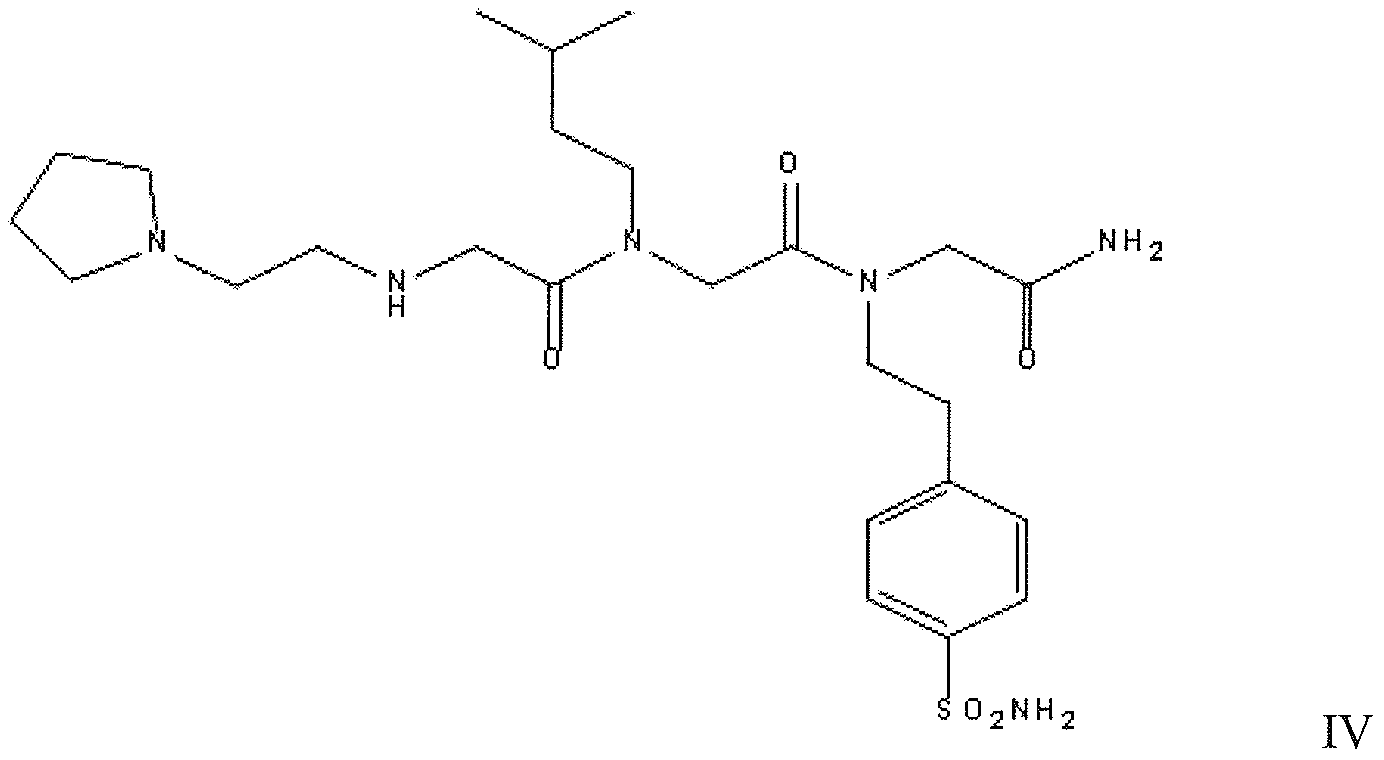
[N-(2-(l-Pyrrolidinyl)ethyl)glycyl]-[N-(3-methylbutyl)glycyl]-N-[2-(4'- sulfamoylphenyl)ethyl] glycinamide (N6-4-17C),
and pharmaceutically acceptable salts and/or prodrugs thereof.
In one embodiment, the compound of Formula I is the compound of Formula II, or a pharmaceutically acceptable salt or prodrug thereof.
In one embodiment, the compound of Formula I is the compound of Formula III, or a pharmaceutically acceptable salt or prodrug thereof.
In one embodiment, the compound of Formula I is the compound of Formula IV, or a pharmaceutically acceptable salt or prodrug thereof.
Useful alkyl groups are selected from straight-chained and branched Ci-6 alkyl groups, and more preferably straight chain Ci-4 alkyl groups and branched chain Ci-4 alkyl groups. Typical C1-6 alkyl groups include methyl, ethyl, propyl, isopropyl, butyl, sec- butyl, zso-butyl, 3-pentyl, hexyl, among others.
Useful halo(Ci_6)alkyl groups include any of the above-mentioned C1-6 alkyl groups substituted by one or more fluorine, chlorine, bromine or iodine atoms (e.g., fluoromethyl, difluoromethyl, trifiuoromethyl, pentafluoroethyl, 1,1-difluoroethyl and trichloromethyl groups). Preferably, the halo(C1.6)alkyl group is trifiuoromethyl.
Useful C1-6 alkoxy groups include oxygen substituted by one of the Ci-6 alkyl groups mentioned above (e.g., methoxy, ethoxy, propoxy, iso-propoxy, butoxy, tert-butoxy, iso-butoxy, sec-butoxy, and pentyloxy).
The term "prodrug", as used herein, includes any compound derived from the compounds of any of Formulae I-IV, for example, the ester, amide, phosphate, etc., which, upon being administered to an individual, is capable of providing the compounds of any of Formulae I-IV or the pharmaceutically acceptable salt thereof, directly or indirectly, to said individual. Preferably, said derivative is a compound that increases the bioavailability of the compounds of any of Formulae I-IV when administered to an individual or that promotes the release of the compounds of any of Formulae I-IV in a biological compartment. The nature of said derivative is not critical, provided that it may be administered to an individual and that it provides the compounds of any of Formulae I-IV in an individual's biological compartment. The preparation of said prodrug may be performed by conventional methods known by those skilled in the art. Conventional procedures for the selection and preparation of
suitable prodrug derivatives are described in, for example, Design of Prodrugs, H. Bundgaard ed., Elsevier (1985). An example of prodrug of the compounds of any of Formulae I-IV can be their encapsulation into liposomes. By this procedure, the peptoid is treated with the appropriate liposome precursor (combination of a phospholipid like lecithin, cholesterol and water) in order to be encapsulated. Depending upon the lipophilicity of the peptoid, the compound will be retained at the lipophilic part of the liposome or at the aqueous inner portion. Regarding the therapeutic polymer, the peptoid could be attached to the polymer by covalent bonds created after regioselective hydrolysis of the terminal carboxamide. This hydrolysis renders a free carboxylic acid that can be condensed with an amino or hydroxyl activated group of the polymer.
The term "pharmaceutically acceptable" means that a compound or combination of compounds is sufficiently compatible with the other ingredients of a formulation, and not deleterious to the patient up to those levels acceptable by the industry standards.
For therapeutic use, salts of the compounds of any of Formulae I-IV are those wherein the counter-ion is pharmaceutically acceptable. The term "salt" as mentioned herein is meant to comprise any stable salts, which the compounds of any of Formulae I-IV are able to form. Preferred are the pharmaceutically acceptable salts. Salts that are not pharmaceutically acceptable are also embraced in the scope of the present invention, since they refer to intermediates that may be useful in the preparation of compounds with pharmacological activity.
The salts can conveniently be obtained by treating the base form of the compounds of any of Formulae I-IV with such appropriate acids as inorganic acids such as hydrochloric or hydrobromic acid, sulfuric, nitric, phosphoric and the like acids; or organic acids such as, for example, acetic, propanoic, hydroxyacetic, lactic, pyruvic, oxalic (i.e. ethanedioic), malonic, succinic (i.e. butanedioic acid), maleic, fumaric, malic (i.e. hydroxybutanedioic acid), tartaric, citric, methanesulfonic, ethanesulfonic,
benzenesulfonic, p-toluenesulfonic, cyclamic, salicylic, p-aminosalicylic, pamoic and the like acids.
The pharmaceutically acceptable salts can be obtained by treating the base form of the compounds of any of Formulae I-IV with such appropriate pharmaceutically acceptable acids like inorganic acids, for example, including hydrochloric, hydrobromic and the like; sulfuric acid; nitric acid; phosphoric acid and the like; or organic acids, for example, acetic, propanoic, hydroxyacetic, 2-hydroxypropanoic, 2- oxopropanoic, oxalic, malonic, succinic, maleic, fumaric, malic, tartaric, 2-hydroxy- 1,2,3-propane-tricarboxylic, methanesulfonic, ethanesulfonic, benzenesulfonic, 4- methylbenzene-sulfonic, cyclohexanesulfamic, 2-hydroxybenzoic, 4-amino-2- hydroxybenzoic and the like acids.
Conversely the salt form can be converted by treatment with alkali into the free base form.
The term "pharmaceutical composition" means for the purpose of the present invention any composition which comprises as an active compound, to which is attributed, fully or in part, the therapeutic (e.g. pharmaceutical) effect, at least one of the compounds of the invention or combinations thereof and that may optionally further comprise at least one pharmaceutically acceptable non-active ingredient, as an excipient, carrier or so.
The term "preventing" refers to keep from happening, existing, or alternatively delaying the onset or recurrence of a disease, disorder, or condition to which such term applies, or of one or more symptoms associated with a disease, disorder, or condition. The term "prevention" refers to the act of preventing, as "preventing" is defined immediately above. The term "treating", as used herein, refers to reversing, alleviating, or inhibiting the progress of the disorder or condition to which such term applies, or one or more
symptoms of such disorders or condition. The term "treatment" refers to the act of treating, as "treating" is defined immediately above.
The term "subject" means animals, in particular mammals such as dogs, cats, cows, horses, sheep, geese, and humans. Particularly preferred subjects are mammals, including humans of both sexes.
An "effective amount" of the compounds of any of Formulae I-IV and pharmaceutically acceptable salts or prodrugs thereof, may be in the range from 0.01 mg to 50 g per day, from 0.02 mg to 40 g per day, from 0.05 mg to 30 g per day, from 0.1 mg to 20 g per day, from 0.2 mg to 1O g per day, from 0.5 mg to 5 g per day, from 1 mg to 3 g per day, from 2 mg to 2 g per day, from 5 mg to 1,5 g per day, from 10 mg to 1 g per day, from 10 mg to 500 mg per day. Nerve cells include those cells from any region of the brain, spinal cord, optic nerve, retina, and peripheral ganglia. Neurons include those in embryonic, fetal, or adult neural tissue, including tissue from the hippocampus, cerebellum, spinal cord, cortex (e.g., motor or somatosensory cortex), striatum, basal forebrain (cholinergic neurons), ventral mesencephalon (cells of the substantia nigra), and the locus ceruleus (neuroadrenaline cells of the central nervous system).
The invention also covers the use of the compounds of any of Formulae I-IV, and pharmaceutically acceptable salts and/or prodrugs thereof, as active ingredients in the manufacture of medicaments for the prevention or treatment of nerve cell death or damage. In other words, the present invention relates to the compounds of any of Formulae I-IV, and pharmaceutically acceptable salts and/or prodrugs thereof, for use in the prevention or treatment of nerve cell death or damage. Similarly, the present invention relates to a method of neuroprotection comprising administering to a subject in need thereof an effective amount of a compound of any of Formulae I-IV, or pharmaceutically acceptable salts and/or prodrugs thereof.
In one embodiment of the present invention, the compounds of any of Formulae I-IV, and pharmaceutically acceptable salts and/or prodrugs thereof, may be used for the prevention or treatment of one or more, preferably two or more, pathological or harmful conditions related to nerve cell death or damage selected from, but not being limited to, chemical substances such as oxidative stress conditions, toxic substances, infectious organisms, radiation, traumatic injury, hypoxia, ischemia, abnormal misfolded proteins, excitotoxins, free radicals, endoplasmic reticulum stressors, mitochondrial stressors including but not limited to inhibitors of the electron transport chain, Golgi apparatus antagonists, axonal damage or loss, demyelination, inflammation, pathological neuronal burst (seizures). Also preferably, the uses and methods of the present invention are directed to preventing or treating nerve cell death or damage, regardless of cause.
The terms "neuroprotection", "neuroprotective", or "neuroprotective effect" refer to the ability to prevent or reduce death or damage to nerve cells, including neurons and glia, or rescuing, resuscitating or reviving nerve cells, e.g., following in pathological or harmful conditions to the brain, central nervous system or peripheral nervous system. Thus, this neuroprotective effect comprises the conferred ability of neuronal cells to maintain or recover their neuronal functions. It stabilizes the cell membrane of a neuronal cell or helps in the normalization of neuronal cell functions. It prevents the loss of viability or functions of neuronal cells. It comprises the inhibition of progressive deterioration of neurons that leads to cell death. It refers to any detectable protection of neurons from stress. Neuroprotection includes the regeneration of nerve cells, i.e. the re-growth of a population of nerve cells after disease or trauma.
Currently the majority of the neurological and psychiatric diseases lacks specific treatments aimed to stop or ameliorate the course of the disease, which are called "disease modifying drugs". This contrasts with the symptomatic therapies which are common for such diseases but do not change the course of the disease. A neuroprotective drug is a Disease Modifying Drug (DMD) for the treatment of brain diseases.
As such, in one embodiment, the present invention relates to the use of the compounds of any of Formulae I-IV, and pharmaceutically acceptable salts and/or prodrugs thereof, as active ingredients in the manufacture of a medicament for the regeneration of nerve cells. In other words, the present invention relates to the compounds of any of Formulae I-IV, and pharmaceutically acceptable salts and/or prodrugs thereof, for use for the regeneration of nerve cells. Similarly, the present invention relates to a method of regenerating nerve cells, comprising administering to a subject in need thereof an effective amount of a compound of any of Formulae I-IV, or a pharmaceutically acceptable salt and/or prodrug thereof.
Neuroprotection may be determined directly by, for example, measuring the delay or prevention of neuronal death, such as, for example, by a reduction in the number of apoptotic neurons in cerebro cortical cultures following a stress. Neuroprotection may also be determined directly by, for example, measuring the severity or extent of damage to, or functional loss by, a tissue or organ of the nervous system following such a stress, such as, for example, by measuring a decrease in the size of brain infarcts after occlusion of the middle cerebral artery (MCAO) or reperfusion injury. Also, neuroprotection can be identified by magnetic resonance imaging (measuring brain volume, tractography, levels of N-acetyl-aspartate by spectroscopy). Alternatively, neuroprotection may be determined indirectly by detecting the activation of one or more biological mechanisms for protecting neurons, including, but not limited to, detecting activation of the Keapl/Nrf2 pathway or induction of one or more phase 2 enzymes, including but not limited to hemeoxygenase-1 (HO-I). Methods of detecting and measuring neuronal protection are provided in the Examples below, and other such methods are known in the art.
The various uses and methods employing the compounds of any of Formulae I-IV, and pharmaceutically salts and/or prodrugs thereof, in the present invention comprise acute administration, i.e. occurring within several minutes to about several hours from injury, or chronic administration, suitable for chronic neurological or psychiatric diseases.
In one embodiment of the present invention, in the various uses and methods of neuroprotection or of prevention or treatment of nerve cell death or damage, the compounds of any of Formulae I-IV, and pharmaceutically acceptable salts and/or prodrugs thereof, are administered to a subject with a neurological or psychiatric disease.
Neurological diseases are those disorders of the central and peripheral nervous system, including disorders of the brain, spinal cord, cranial nerves, peripheral nerves, nerve roots, autonomic nervous system, neuromuscular junction, and muscle.
Diseases of the central and peripheral nervous system, which may be subject of prevention and/or treatment according to present invention include, without being limited to, as knowledge in clinical manifestations advances, Absence of the Septum Pellucidum, Acid Lipase Disease , Acid Maltase Deficiency, Acquired Epileptiform Aphasia, Acute Disseminated Encephalomyelitis, Adie's Pupil, Adie's Syndrome, Adrenoleukodystrophy, Agenesis of the Corpus Callosum, Agnosia, Aicardi Syndrome, Aicardi-Goutieres Syndrome Disorder, AIDS - Neurological Complications, Alexander Disease, Alpers' Disease, Alternating Hemiplegia, Alzheimer's Disease, Amyotrophic Lateral Sclerosis, Anencephaly, Aneurysm, Angelman Syndrome, Angiomatosis, Anoxia, Antiphospholipid Syndrome, Aphasia, Apraxia, Arachnoid Cysts, Arachnoiditis, Arnold-Chiari Malformation, Arteriovenous Malformation, Asperger Syndrome, Ataxia, Ataxia Telangiectasia, Ataxias and Cerebellar or Spinocerebellar Degeneration, Atrial Fibrillation and Stroke, Attention Deficit-Hyperactivity Disorder (ADHD), Autism, Autonomic Dysfunction, Back Pain, Barth Syndrome, Batten Disease, Becker's Myotonia, Behcet's Disease, Bell's Palsy, Benign Essential Blepharospasm, Benign Focal Amyotrophy, Benign Intracranial Hypertension, Bernhardt-Roth Syndrome, Binswanger's Disease, Blepharospasm, Bloch-Sulzberger Syndrome, Brachial Plexus Birth Injuries, Brachial Plexus Injuries, Bradbury-Eggleston Syndrome, Brain and Spinal Tumors, Brain Aneurysm, Brain infarction, Brain ischemia, Brain Injury, Brown-Sequard Syndrome, Bulbospinal Muscular Atrophy, CADASIL, Canavan Disease, Carpal Tunnel Syndrome, Causalgia, Cavernomas, Cavernous Angioma, Cavernous Malformation, Central
Cervical Cord Syndrome, Central Cord Syndrome, Central Pain Syndrome, Central Pontine Myelinolysis, Cephalic Disorders, Ceramidase Deficiency, Cerebellar Degeneration, Cerebellar Hypoplasia, Cerebral Aneurysm, Cerebral Arteriosclerosis, Cerebral Atrophy, Cerebral Beriberi, Cerebral Cavernous Malformation, Cerebral Gigantism, Cerebral Hypoxia, Cerebral Palsy, Cerebro-Oculo-Facio-Skeletal Syndrome, Charcot-Marie-Tooth Disease, Chiari Malformation, Cholesterol Ester Storage Disease, Chorea, Choreoacanthocytosis, Chronic Inflammatory Demyelinating Polyneuropathy (CIDP), Chronic Orthostatic Intolerance, Chronic Pain, Cockayne Syndrome Type II, Coffin Lowry Syndrome, COFS, Colpocephaly, Coma, Complex Regional Pain Syndrome, Congenital Facial Diplegia, Congenital Myasthenia, Congenital Myopathy, Congenital Vascular Cavernous Malformations, Corticobasal Degeneration, Cranial Arteritis, Craniosynostosis, Creutzfeldt-Jakob Disease, Cumulative Trauma Disorders, Cushing's Syndrome, Cytomegalic Inclusion Body Disease, Cytomegalovirus Infection, Dancing Eyes-Dancing Feet Syndrome, Dandy-Walker Syndrome, Dawson Disease, De Morsier's Syndrome, Deep Brain Stimulation for Parkinson's Disease, Dejerine-Klumpke Palsy, Dementia, Dementia - Multi-Infarct, Dementia - Semantic, Dementia - Subcortical, Dementia With Lewy Bodies, Dentate Cerebellar Ataxia, Dentatorubral Atrophy, Dermatomyositis, Developmental Dyspraxia, Devic's Syndrome, Diabetic Neuropathy, Diffuse Sclerosis, Dravet Syndrome, Dysautonomia, Dysgraphia, Dyslexia, Dysphagia, Dyspraxia, Dyssynergia Cerebellaris Myoclonica, Dyssynergia Cerebellaris Progressiva, Dystonias, Early Infantile Epileptic Encephalopathy, Empty Sella Syndrome, Encephalitis, Encephalitis Lethargica, Encephaloceles, Encephalopathy, Encephalopathy, familial infantile, with intracranial calcification and chronic cerebrospinal fluid lymphocytosis; Cree encephalitis; Pseudo-Torch syndrome; Pseudotoxoplasmosis syndrome, Encephalotrigeminal Angiomatosis, Epilepsy, Epileptic Hemiplegia, Erb-Duchenne and Dejerine-Klumpke Palsies, Erb's Palsy, Essential Tremor, Extrapontine Myelinolysis, Fabry Disease, Fahr's Syndrome, Fainting, Familial Dysautonomia, Familial Hemangioma, Familial Idiopathic Basal Ganglia Calcification, Familial Periodic Paralyses, Familial Spastic Paralysis, Farber's Disease, Febrile Seizures, Fibromuscular Dysplasia, Fisher Syndrome, Floppy Infant Syndrome, Foot Drop, Friedreich's Ataxia, Frontotemporal Dementia, Gangliosidoses,
Gaucher's Disease, Gerstmann's Syndrome, Gerstmann-Straussler-Scheinker Disease, Giant Axonal Neuropathy, Giant Cell Arteritis, Giant Cell Inclusion Disease, Globoid Cell Leukodystrophy, Glossopharyngeal Neuralgia, Glycogen Storage Disease, Guillain-Barre Syndrome, Hallervorden-Spatz Disease, Head Injury, Headache, Hemicrania Continua, Hemifacial Spasm, Hemiplegia Alterans, Hereditary Neuropathies, Hereditary Spastic Paraplegia, Heredopathia Atactica Polyneuritiformis, Herpes Zoster, Herpes Zoster Oticus, Hirayama Syndrome, Holmes-Adie syndrome, Holoprosencephaly, HTLV-I Associated Myelopathy, Hughes Syndrome, Huntington's Disease, Hydranencephaly, Hydrocephalus, Hydrocephalus - Normal Pressure, Hydromyelia, Hypercortisolism, Hypersomnia, Hypertonia, Hypotonia, Hypoxia, Immune-Mediated Encephalomyelitis, Inclusion Body Myositis, Incontinentia Pigmenti, Infantile Hypotonia, Infantile Neuroaxonal Dystrophy, Infantile Phytanic Acid Storage Disease, Infantile Refsum Disease, Infantile Spasms, Inflammatory Myopathies, Iniencephaly, Intestinal Lipodystrophy, Intracranial Cysts, Intracranial Hypertension, Isaac's Syndrome, Joubert Syndrome, Kearns-Sayre Syndrome, Kennedy's Disease, Kinsbourne syndrome, Kleine-Levin Syndrome, Klippel-Feil Syndrome, Klippel-Trenaunay Syndrome (KTS), Klϋver- Bucy Syndrome, Korsakoffs Amnesic Syndrome, Krabbe Disease, Kugelberg- Welander Disease, Kuru, Lambert-Eaton Myasthenic Syndrome, Landau-Kleffner Syndrome, Lateral Femoral Cutaneous Nerve Entrapment, Lateral Medullary Syndrome, Learning Disabilities, Leigh's Disease, Lennox-Gastaut Syndrome, Lesch- Nyhan Syndrome, Leukodystrophy, Levine-Critchley Syndrome, Lewy Body Dementia, Lipid Storage Diseases, Lipoid Proteinosis, Lissencephaly, Locked-In Syndrome, Lou Gehrig's Disease, Lupus - Neurological Sequelae, Lyme Disease - Neurological Complications, Machado-Joseph Disease, Macrencephaly, Megalencephaly, Melkersson-Rosenthal Syndrome, Meningitis, Meningitis and Encephalitis, Menkes Disease, Meralgia Paresthetica, Metachromatic Leukodystrophy, Microcephaly, Migraine, Miller Fisher Syndrome, Mild Cognitive Impairment, Mini-Strokes, Mitochondrial Myopathies, Moebius Syndrome, Monomelic Amyotrophy, Motor Neuron Diseases, Moyamoya Disease, Mucolipidoses, Mucopolysaccharidoses, Multifocal Motor Neuropathy, Multi-Infarct Dementia, Multiple Sclerosis, Multiple System Atrophy, Multiple System Atrophy
with Orthostatic Hypotension, Muscular Dystrophy, Myasthenia - Congenital, Myasthenia Gravis, Myelinoclastic Diffuse Sclerosis, Myoclonic Encephalopathy of Infants, Myoclonus, Myopathy, Myopathy - Congenital, Myopathy - Thyrotoxic, Myotonia, Myotonia Congenita, Narcolepsy, Neuroacanthocytosis, Neurodegeneration with Brain Iron Accumulation, Neurofibromatosis, Neuroleptic Malignant Syndrome, Neurological Complications of AIDS, Neurological Complications Of Lyme Disease, Neurological Consequences of Cytomegalovirus Infection, Neurological Manifestations of Pompe Disease, Neurological Sequelae Of Lupus, Neuromyelitis Optica, Neuromyotonia, Neuronal Ceroid Lipofuscinosis, Neuronal Migration Disorders, Neuropathy - Hereditary, Neurosarcoidosis, Neurotoxicity, Nevus Cavernosus, Niemann-Pick Disease, Normal Pressure Hydrocephalus, Occipital Neuralgia, Ohtahara Syndrome, Olivopontocerebellar Atrophy, Opsoclonus Myoclonus, Orthostatic Hypotension, O'Sullivan-McLeod Syndrome, Overuse Syndrome, Pain - Chronic, Pantothenate Kinase-Associated Neurodegeneration, Paraneoplastic Syndromes, Paresthesia, Parkinson's Disease, Paroxysmal Choreoathetosis, Paroxysmal Hemicrania, Parry-Romberg, Pelizaeus- Merzbacher Disease, Pena Shokeir II Syndrome, Perineural Cysts, Periodic Paralyses, Peripheral Neuropathy, Periventricular Leukomalacia, Persistent Vegetative State, Pervasive Developmental Disorders, Phytanic Acid Storage Disease, Pick's Disease, Pinched Nerve, Piriformis Syndrome, Pituitary Tumors, Polymyositis, Pompe Disease, Porencephaly, Postherpetic Neuralgia, Postinfectious Encephalomyelitis, Post-Polio Syndrome, Postural Hypotension, Postural Orthostatic Tachycardia Syndrome, Postural Tachycardia Syndrome, Primary Dentatum Atrophy, Primary Lateral Sclerosis, Primary Progressive Aphasia, Prion Diseases, Progressive Hemifacial Atrophy, Progressive Locomotor Ataxia, Progressive Multifocal Leukoencephalopathy, Progressive Sclerosing Poliodystrophy, Progressive Supranuclear Palsy, Prosopagnosia, Pseudotumor Cerebri, Ramsay Hunt Syndrome I (formerly known as dyssynergia cerebellarismyoclonica, dyssynergia cerebellaris progressiva, dentatorubral degeneration, or Ramsey Hunt cerecellar syndrome), Ramsay Hunt Syndrome II (formerly known as herpes zoster oticus), Rasmussen's Encephalitis, Reflex Sympathetic Dystrophy Syndrome, Refsum Disease, Refsum Disease - Infantile, Repetitive Motion Disorders, Repetitive Stress Injuries, Restless
Legs Syndrome, Retrovirus-Associated Myelopathy, Rett Syndrome, Reye's Syndrome, Rheumatic Encephalitis, Riley-Day Syndrome, Sacral Nerve Root Cysts, Saint Vitus Dance, Salivary Gland Disease, Sandhoff Disease, Schilder's Disease, Schizencephaly, Seitelberger Disease, Seizure Disorder, Semantic Dementia, Septo- Optic Dysplasia, Severe Myoclonic Epilepsy of Infancy (SMEI), Shaken Baby Syndrome, Shingles, Shy-Drager Syndrome, Sjogren's Syndrome, Sleep Apnea, Sleeping Sickness, Sotos Syndrome, Spasticity, Spina Bifida, Spinal Cord Infarction, Spinal Cord Injury, Spinal Cord Tumors, Spinal Muscular Atrophy, Spinocerebellar Atrophy, Spinocerebellar Degeneration, Steele-Richardson-Olszewski Syndrome, Stiff-Person Syndrome, Striatonigral Degeneration, Stroke, Sturge-Weber Syndrome, Subacute Sclerosing Panencephalitis, Subcortical Arteriosclerotic Encephalopathy, SUNCT Headache, Swallowing Disorders, Sydenham Chorea, Syncope, Syphilitic Spinal Sclerosis, Syringohydromyelia, Syringomyelia, Systemic Lupus Erythematosus, Tabes Dorsalis, Tardive Dyskinesia, Tarlov Cysts, Tay-Sachs Disease, Temporal Arteritis, Tethered Spinal Cord Syndrome, Thomsen's Myotonia, Thoracic Outlet Syndrome, Thyrotoxic Myopathy, Tic Douloureux, Todd's Paralysis, Tourette Syndrome, Transient Ischemic Attack, Transmissible Spongiform Encephalopathies, Transverse Myelitis, Traumatic Brain Injury, Tremor, Trigeminal Neuralgia, Tropical Spastic Paraparesis, Troyer Syndrome, Tuberous Sclerosis, Vascular Erectile Tumor, Vasculitis Syndromes of the Central and Peripheral Nervous Systems, Von Economo's Disease, Von Hippel-Lindau Disease (VHL), Von Recklinghausen's Disease, Wallenberg's Syndrome, Werdnig-Hoffman Disease, Wernicke-Korsakoff Syndrome, West Syndrome, Whiplash, Whipple's Disease, Williams Syndrome, Wilson's Disease, Wolman's Disease , X-Linked Spinal and Bulbar Muscular Atrophy, Zellweger Syndrome, optic neuritis, Chronic fatigue syndrome, fibromialgia, psychiatric diseases such as mood disorders, major depression, bipolar syndrome, psycosis, eschizophrenia, obsessive-compulsive-syndrome, etc., Toxic or drug abuse diseases such as alcoholism and drug abuse, Encephalopathy like hepatic encephalopathy.
Psychiatric disorders, which may be the subject of prevention and/or treatment according to the present invention include those listed by the Diagnostic and
Statistical Manual of Mental Disorders, Fourth Edition (DSM-IV) published by the American Psychiatric Association, and covers all mental health disorders for both children and adults. In particular, psychiatric disorders include a disorder selected from Acute Stress Disorder; Adjustment Disorder Unspecified; Adjustment Disorder with Anxiety; Adjustment Disorder with Depressed Mood; Adjustment Disorder with Disturbance of Conduct; Adjustment Disorder with Mixed Anxiety and Depressed Mood; Adjustment Disorder with Mixed Disturbance of Emotions and Conduct; Agoraphobia without History of Panic Disorder; Anorexia Nervosa; Antisocial Personality Disorder; Anxiety Disorder Due to Medical Condition; Anxiety Disorder, NOS; Avoidant Personality Disorder; Bipolar Disorder NOS; Bipolar I Disorder, Most Recent Episode Depressed, In Full Remission; Bipolar I Disorder, Most Recent Episode Depressed, In Partial Remission; Bipolar I Disorder, Most Recent Episode Depressed, Mild; Bipolar I Disorder, Most Recent Episode Depressed, Moderate; Bipolar I Disorder, Most Recent Episode Depressed, Severe With Psychotic Features; Bipolar I Disorder, Most Recent Episode Depressed, Severe Without Psychotic Features; Bipolar I Disorder, Most Recent Episode Depressed, Unspecified; Bipolar I Disorder, Most Recent Episode Manic, In Full Remission; Bipolar I Disorder, Most Recent Episode Manic, In Partial Remission; Bipolar I Disorder, Most Recent Episode Manic, Mild; Bipolar I Disorder, Most Recent Episode Manic, Moderate; Bipolar I Disorder, Most Recent Episode Manic, Severe With Psychotic Features; Bipolar I Disorder, Most Recent Episode Manic, Severe Without Psychotic Features; Bipolar I Disorder, Most Recent Episode Manic, Unspecified; Bipolar I Disorder, Most Recent Episode Mixed, In Full Remission; Bipolar I Disorder, Most Recent Episode Mixed, In Partial Remission; Bipolar I Disorder, Most Recent Episode Mixed, Mild; Bipolar I Disorder, Most Recent Episode Mixed, Moderate; Bipolar I Disorder, Most Recent Episode Mixed, Severe With Psychotic Features; Bipolar I Disorder, Most Recent Episode Mixed, Severe Without Psychotic Features; Bipolar I Disorder, Most Recent Episode Mixed, Unspecified; Bipolar I Disorder, Most Recent Episode Unspecified; Bipolar I Disorder, Most Recent Episode Hypomanic; Bipolar I Disorder, Single Manic Episode, In Full Remission; Bipolar I Disorder, Single Manic Episode, In Partial Remission; Bipolar I Disorder, Single Manic Episode, Mild; Bipolar I Disorder, Single Manic Episode, Moderate; Bipolar I Disorder, Single Manic Episode,
Severe With Psychotic Features; Bipolar I Disorder, Single Manic Episode, Severe Without Psychotic Features; Bipolar I Disorder, Single Manic Episode, Unspecified; Bipolar II Disorder; Body Dysmorphic Disorder; Borderline Personality Disorder; Breathing-Related Sleep Disorder; Brief Psychotic Disorder; Bulimia Nervosa; Circadian Rhythm Sleep Disorder; Conversion Disorder; Cyclothymic Disorder; Delusional Disorder; Dependent Personality Disorder; Depersonalization Disorder; Depressive Disorder NOS; Dissociative Amnesia; Dissociative Disorder NOS; Dissociative Fugue; Dissociative Identity Disorder; Dyspareunia; Dyssomnia NOS; Dyssomnia Related to Another Disorder; Dysthymic Disorder; Eating Disorder NOS; Exhibitionism; Female Dyspareunia Due to Medical Condition; Female Hypoactive Sexual Desire Disorder Due to Medical Condition; Female Orgasmic Disorder; Female Sexual Arousal Disorder; Fetishism; Frotteurism; Gender Identity Disorder in Adolescents or Adults; Gender Identity Disorder in Children; Gender Identity Disorder NOS; Generalized Anxiety Disorder; Histrionic Personality Disorder; Hypoactive Sexual Desire Disorder; Hypochondriasis; Impulse -Control Disorder NOS; Insomnia Related to Another Disorder; Intermittent Explosive Disorder; Kleptomania; Major Depressive Disorder, Recurrent, In Full Remission; Major Depressive Disorder, Recurrent, In Partial Remission; Major Depressive Disorder, Recurrent, Mild; Major Depressive Disorder, Recurrent, Moderate; Major Depressive Disorder, Recurrent, Severe With Psychotic Features; Major Depressive Disorder, Recurrent, Severe Without Psychotic Features; Major Depressive Disorder, Recurrent, Unspecified; Major Depressive Disorder, Single Episode, In Full Remission; Major Depressive Disorder, Single Episode, In Partial Remission; Major Depressive Disorder, Single Episode, Mild; Major Depressive Disorder, Single Episode, Moderate; Major Depressive Disorder, Single Episode, Severe With Psychotic Features; Major Depressive Disorder, Single Episode, Severe Without Psychotic Features; Major Depressive Disorder, Single Episode, Unspecified; Male Dyspareunia Due to Medical Condition; Male Erectile Disorder; Male Erectile Disorder Due to Medical Condition; Male Hypoactive Sexual Desire Disorder Due to Medical Condition; Male Orgasmic Disorder; Mood Disorder Due to Medical Condition; Narcissistic Personality Disorder; Narcolepsy; Nightmare Disorder; Obsessive Compulsive Disorder; Obsessive-Compulsive Personality Disorder; Other Female
Sexual Dysfunction Due to Medical Condition; Other Male Sexual Dysfunction Due to Medical Condition; Pain Disorder Associated with both Psychological Factors and Medical Conditions; Pain Disorder Associated with Psychological Features; Panic Disorder with Agoraphobia; Panic Disorder without Agoraphobia; Paranoid Personality Disorder; Paraphilia, NOS; Parasomnia NOS; Pathological Gambling; Pedophilia; Personality Disorder NOS; Posttraumatic Stress Disorder; Premature Ejaculation; Primary Hypersomnia; Primary Insomnia; Psychotic Disorder Due to Medical Condition, with Delusions; Psychotic Disorder Due to Medical Condition, with Hallucinations; Psychotic Disorder, NOS; Pyromania; Schizoaffective Disorder; Schizoid Personality Disorder; Schizophrenia, Catatonic Type; Schizophrenia, Disorganized Type; Schizophrenia, Paranoid Type; Schizophrenia, Residual Type; Schizophrenia, Undifferentiated Type; Schizophreniform Disorder; Schizotypal Personality Disorder; Sexual Aversion Disorder; Sexual Disorder NOS; Sexual Dysfunction NOS; Sexual Masochism; Sexual Sadism; Shared Psychotic Disorder; Sleep Disorder Due to A Medical Condition, Hypersomnia Type; Sleep Disorder Due to A Medical Condition, Insomnia Type; Sleep Disorder Due to A Medical Condition, Mixed Type; Sleep Disorder Due to A Medical Condition, Parasomnia Type; Sleep Terror Disorder; Sleepwalking Disorder; Social Phobia; Somatization Disorder; Somatoform Disorder NOS; Specific Phobia; Transvestic Fetishism; Trichotillomania; Undifferentiated Somatoform Disorder; Vaginismus; and Voyeurism.
Preferably, the compounds of any of Formulae I-IV, and pharmaceutically acceptable salts and/or prodrugs thereof, can be used in the treatment of diseases wherein NGF has been proven effective in the state of the art, either in vivo or in vitro, due to their improving effects on cell differentiation and cell survival, through either TrkA and/or p75 pathways. Therefore, the compounds covered in the present invention can be used in the treatment of neurological diseases selected among: neurodegenerative disorders, such as amyotrophic lateral sclerosis (ALS), Parkinson's disease, Alzheimer's disease, Friedreich's ataxia, Huntington's disease, Dementia with Lewy bodies, spinal muscular atrophy; nerve inflammation, such as multiple sclerosis and neuromyelitis optica, major depressive disorder, schizophrenia, glaucoma, or peripheral neuropathies, such as diabetic or AIDS neuropathy. Moreover, the
compounds of the invention can also be indicated for treatment of cancer, by modulating NGF cell differentiation activity and stopping cell proliferation. Among the cancer types in which NGF has been proven effective in the state of the art, either in vivo or in vitro, due to improving effects on cell differentiation and cell survival, through either TrIcA and/or p75 pathways, the following may be cited: glioblastoma, astrocytoma, meduloblastoma, neurinoma, neuroblastoma, meningioma, colon cancer, pancreatic cancer, breast cancer, prostate cancer, leukemia, acute lymphocytic leukemia, osteosarcoma, hepatocellular carcinoma, ovarian carcinoma, lung adenocarcinoma or esophagic carcinoma.
In one embodiment of the present invention, in the various uses and methods of neuroprotection or of prevention or treatment of nerve cell death or damage, the compounds of any of Formulae I-IV, and pharmaceutically acceptable salts and/or prodrugs thereof, are administered to a healthy subject, preferably a healthy subject older than 18 years old, more preferably a healthy subject older than 45 years old, even more preferably a healthy subject older than 55, 60, 65, 70, 75, 80, 85, 90, 95, or 100 years old.
The term "healthy subject" is meant to comprise its plain meaning as well as those subjects that may suffer from one or more pathological conditions other than a neurological or psychiatric disease.
The neuroprotective properties of the compounds of any of Formulae I-IV, and pharmaceutically salts and/or prodrugs thereof, have as a consequence the partial or full prevention or treatment of the various disorders in the nervous system functions caused by the neuronal cell death or damage. Therefore, the present invention further relates to the use of the compounds of any of Formulae I-IV, its pharmaceutically acceptable salts and/or prodrugs thereof, as active ingredients in the manufacture of a medicament for the prevention or treatment of a neurological or psychiatric disease. In other words, the present invention also relates to the compounds of any of Formulae I-IV, and pharmaceutically acceptable salts and/or prodrugs thereof, for use in the prevention or treatment of a neurological or psychiatric disease. Similarly, the
present invention also relates to a method of prevention or treatment of a neurological or psychiatric disease comprising administering to a subject in need thereof an effective amount of the compound of any of Formulae I-IV, or a pharmaceutically acceptable salt and/or prodrug thereof. The neurological or psychiatric disease may be any one from those listed above.
Preferably, the neurological or psychiatric disease is selected from neurodegenerative disorders, inflammation and certain types of cancers, multiple sclerosis, neuromyelitis optica, amyotrophic lateral sclerosis (ALS), Parkinson's disease, Alzheimer's disease, Friedreich's ataxia, Huntington's disease, Dementia with Lewy bodies, spinal muscular atrophy, major depressive disorder, schizophrenia, glaucoma or peripheral neuropathies (diabetic or AIDS neuropathy).
Another goal of present invention is the use of the compounds of any of Formulae I- IV, and pharmaceutically acceptable salts and/or prodrugs thereof, as neuroenhancing drugs or the use for manufacturing neuroenhancing drugs.
Neuroenhancing drugs include those that improve learning and memory, attention, mood, communicative skills and sexual performance. Examples of neuroenhancing drugs are those that target long-term synaptic potentiation (LTP) or long-term depression (LTD), modulation of calcium channels, or the cAMP response element- binding (CREB) protein. cAMP is the acronym for cyclic adenosine monophosphate. Particular examples of neuroenhancing drugs are phosphodiesterase inhibitors like rolipram; donepezil; agonists of the NMDA glutamate receptor like D-cycloserine; ampakines; modafϊnil; methylphenidate.
The compounds of any of Formulae I-IV, and pharmaceutically acceptable salts and/or prodrugs thereof, may be formulated into various pharmaceutical forms for administration purposes. As appropriate compositions there may be cited all compositions usually employed for systemically administering drugs, for example any solid (e.g. tablets, capsules, granules, etc.) or liquid composition (e.g. solutions, suspensions, emulsions, etc). To prepare the pharmaceutical compositions of the
compounds of any of Formulae I-IV, an effective amount of the compound of any of Formulae I-IV, optionally in salt form or a prodrug, as the active ingredient is combined in intimate admixture with a pharmaceutically acceptable carrier, which carrier may take a wide variety of forms depending on the form of preparation desired for administration. These pharmaceutical compositions are desirable in unitary dosage form suitable, particularly, for administration orally, rectally, percutaneously, intrathecal, intravenous or by parenteral injection. For example, in preparing the compositions in oral dosage form, any of the usual pharmaceutical media may be employed such as, for example, water, glycols, oils, alcohols and the like in the case of oral liquid preparations such as suspensions, syrups, elixirs, emulsions and solutions; or solid carriers such as starches, sugars, kaolin, lubricants, binders, disintegrating agents and the like in the case of powders, pills, capsules, and tablets. Because of their ease in administration, tablets and capsules represent the most advantageous oral dosage unit forms, in which case solid pharmaceutical carriers are obviously employed. For parenteral compositions, the carrier usually comprises sterile water, at least in large part, though other ingredients, for example, to aid solubility, may be included. Injectable solutions, for example, may be prepared in which the carrier comprises saline solution, glucose solution or a mixture of saline and glucose solution. Injectable suspensions may also be prepared in which case appropriate liquid carriers, suspending agents and the like may be employed. Also included are solid form preparations, which are intended to be converted, shortly before use, to liquid form preparations. In the compositions suitable for percutaneous administration, the carrier optionally comprises a penetration enhancing agent or a suitable wetting agent, or both, optionally combined with suitable additives of any nature in minor proportions, which additives do not introduce a significant deleterious effect on the skin. A review of the different pharmaceutical forms for drug administration and their preparation may be found in the book "Tratado de Farmacia Galenica", de C. Fauli i Trillo, 10th Edition, 1993, Luzan 5, S.A. de Ediciones. It is especially advantageous to formulate the aforementioned pharmaceutical compositions in unit dosage form for ease of administration and uniformity of dosage. Unit dosage form as used herein refers to physically discrete units suitable as unitary
dosages, each unit containing a predetermined quantity of active ingredient calculated to produce the desired therapeutic effect in association with the required pharmaceutical carrier. Examples of such unit dosage forms are tablets (including scored or coated tablets), capsules, pills, suppositories, powder packets, wafers, injectable solutions or suspensions and the like, and segregated multiples thereof.
The compositions in accordance with this invention, including unit dosage forms, may contain the active ingredient in an amount that is in the range of about 0,1 % to 70%, or about 0,5% to 50%, or about 1 % to 25%, or about 5% to 20%, the remainder comprising the carrier, wherein the foregoing percentages are w/w versus the total weight of the composition or dosage form.
The dose of the compound of any of Formulae I-IV, its pharmaceutically acceptable salt and/or prodrug thereof, to be administered depends on the individual case and, as customary, is to be adapted to the conditions of the individual case for an optimum effect. Thus it depends, of course, on the frequency of administration and on the potency and duration of action of the compound employed in each case for therapy or prophylaxis, but also on the nature and severity of the disease and symptoms, and on the sex, age, weight co-medication and individual responsiveness of the subject to be treated and on whether the therapy is acute or prophylactic. Doses may be adapted in function of weight and for pediatric applications. Daily doses may be administered q.d. or in multiple quantities such as b.i.d., t.i.d. or q.i.d.
Synthesis of Compounds
The compounds of the present invention can be prepared using methods known to those skilled in the art in view of this disclosure. For example, compounds of the present invention can be prepared as described in Masip, et ah, 2005.
Testing of Compounds
In addition to the tests described in the Examples, the compounds of the present invention can be tested in in vitro model for Parkinson's disease as follows: The human neuroblastoma cell line SH-SY5Y is used to study the neuroprotective effect of
the tested molecules in Parkinson disease. The cells are pre-treated for 3 hours with the tested molecules at different concentrations (20 ng/ml, 100 ng/ml, 2 μg/ml, 20 μg/ml and 50 μg/ml) with the tested molecules (100ng/ml). Then l-methyl-4-phenyl- 1,2,3,6-tetrahydroρyridine (MPTP) (100 μM) is added and incubated for 24 hrs. The number of surviving cells is determined the day after by 3-(4,5-dimethylthiazol-2-yl)- 2,5-diphenyltetrazolium bromide (MTT) assay.
The compounds of the present invention can also tested in an Alzheimer disease in vitro model as follows: The human neuroblastoma cell line SH-S Y5 Y is used to study the neuroprotective effect of the tested compound in Alzheimer disease. The cells are pre-treated for 3 hours with the tested compound at different concentrations (20 ng/ml, 100 ng/ml, 2 μg/ml, 20 μg/ml and 50 μg/ml) with the tested compound (100 ng/ml). Then Amiloid beta fibrils (100 μM) is added and incubated for 24 hrs. The number of surviving cells is determined the day after by 3-(4,5-dimethylthiazol-2-yl)-2,5- diphenyltetrazolium bromide (MTT) assay.
Further, the compounds of the present invention can be tested in a glaucoma model as follows: 12 Sprague Dawley rats (4 months of age) are anesthetized with isobutane and subjected to hypertonic saline solution injection into the episcleral vein of the right eye. Intraocular pressure is measured before the operation and is monitored one time a week using a TonoLab for 7 weeks. Treatment with the tested molecules begins one week after glaucoma induction by topical application at the conjunctive. The test molecule is dissolved into physiological solution and is used at two different concentration (200 μg/ml and 400 μg/ml). NGF is used as positive control (200 μg/ml) and the physiological solution, used to dissolve all the molecules, is subministered as placebo. The animals are divided into 4 groups (3 animals in each group): glaucoma-test molecule 200 μg/ml; glaucoma-test molecule 400 μg/ml; glaucoma-NGF; glaucoma-placebo. Three animals are used as control without glaucoma. Seven weeks after glaucoma induction, animals are sacrificed by overdose of anaesthetic and their eyes are taken and fixed in 4% of PFA. The eyes are included in paraffin and cut into 20 μm sections to be used for histological studies
(hematoxilin-eosin staining). The cell count of the number of retinal ganglion cells (RGC) is performed randomly in ten different fields for each eye.
The following examples are illustrative, but not limiting, of the compounds, compositions and methods of the present invention. Suitable modifications and adaptations of the variety of conditions and parameters normally encountered in clinical therapy and which are obvious to those skilled in the art in view of this disclosure are within the spirit and scope of the invention. Examples
EXAMPLE 1
Design of NGF agonists by combinatorial chemistry
General. Solvents, amines and other reagents were purchased from commercial suppliers and used without further purification. Reactions carried out under microwave irradiation were conducted in a 100 mL round bottomed flask equipped with a Dimroth condenser. The flask was introduced in the monomode cavity of a CEM Model Discover apparatus. The NMR spectra were recorded on a Varian Inova 500 apparatus (IH NMR, 500 MHz; 13C NMR, 125 MHz) and on a Unity 300 apparatus (IH NMR, 300 MHz; 13C NMR, 75 MHz). When appropriate, the assignment of IH and 13C NMR peaks for compounds were confirmed by gDQCOSY and gHSQC experiments. The occurrence of different conformers led to highly complex spectra; the absorptions given below are referred to the major conformer present in the sample. The RP-HPLC analyses were performed with a Hewlett Packard Series 1100 (UV detector 1315A) modular system using a reverse-phase Kromasil 100 C8 (25 x 0.46 cm, 5 μm) column, with CH3CN-buffer ammonium formate (20 mM, pH=5.0) mixtures at 1 mL/min as mobile phase and monitoring at 220 nm. Semi-preparative RP-HPLC was performed with a Waters (Milford, MA, U.S.A.) system. High resolution mass spectra (HRMS-FAB) were carried out at the IQAC - Institute de Quimica Avanzada de Cataluna - (Spain). Synthesis of individual peptoids. The synthesis of individual peptoids N35-4-
8C, N35-4-17C and N6-4-17C for the in vitro and in vivo assays was carried out
following the substructure procedure reported by the group of Zuckermann with some modifications (Zuckermann et al, 1992)
The synthesis was carried out on a 1 % cross-linked polysterene resin bearing the Fluorenylmethoxycarbonyl (Fmoc)-protected Rink amide linker AM RAM (0.79 mmol/g, Rapp Polymer; Germany). A suspension of 4 g of resin in 50 niL DMF was placed in a 100 mL round bottomed flask provided with a magnetic stirrer. The suspension was stirred for 5 min at 20 0C, the solvent was removed by filtration through a 60 mL polypropylene syringe provided with a polyethylene porous plaque. Then, resin was transfered again to the reaction flask. 1. Fmoc deprotection. A solution of 60 mL of 20% piperidine in DMF was added to the roundbottomed flask containing the resin. The mixture was allowed to react under microwave activation for 5 min at 60 0C and 150 W. The resin was drained on the 60 mL syringe and washed with 40 mL DMF. The treatment was carried out in duplicate. Then, the resin was filtered and washed with DMF (3 x 40 mL), iPrOH (3 x 40 mL), and CH2C12 (3 x 40 mL). Finally, it was drained for 2 min and transferred to the reaction flask. The deprotection was monitored by using the TNBS test (red colour as positive).
2. First acylation. The resin was treated with a solution of 5 equivalents of bromoacetic acid (2.2 g, 15.8 mmol) and 5 equivalents of N,N- diisopropylcarbodiimide (2.5 mL, 15.8 mmol) in 50 mL of DMF. The acylation was conducted under microwave irradiation (5 min, 60 0C, 150 W). Then, the resin was filtered using the syringe, and washed with 40 mL of DMF. The reaction was carred out in duplicate. Afterwards, the resin was filtered and washed with DMF (3 χ 40 mL), iPrOH (3 x 40 mL), and CH2Cl2 (4 x 10 mL). Next, it was drained for 2 min and the absence of primary amine was evaluated by TNBS test.
3. First Amination coupling. A suspension of the acylated resin in 50 mL DMF was treated with the suitable primary amine according to the final compound: 5 equivalents (2.2 mL, 15.8 mmol) of 2.2 mL l-(3-aminopropyl)-2-pyrrolidinone, or 5 equivalents (3.2 g, 15.8 mmol) of 4-(2-aminoethyl)benzenesulfonamide. The reaction
was conducted under microwave irradiation (7 min, 80 0C, 150 W). The reaction was carried out in duplicate, washing and draining the resin through the syringe between the treatments. Finally, the resin was drained for 2 min and transferred to the flask. The incorporation of the amine was confirmed by the chloranil test (green colour for secondary amines).
4. Second and third acylation steps. They were carried out similarly to the first acylation step. In this case, two acylation treatments were enough to complete the reaction.
5. Second and third amination coupling steps. They were carried out similarly to the first amination step, bu using the coresponding primary amines. Thus, 5 equivalents (1.8 ml, 15.8 mmol) of 3 -methyl- 1-butanamine were used for the second amination coupling. For the third amination, 5 equivalents (2.0 mL, 15.8 mmol) of 2- (2-fluorophenyl)ethanamine or 5 equivalents (2.0 mL, 15.8 mmol) of 2-(l- pyrrolidinyl)ethanamine were used as according to the composition of the corresponding peptoid.
6. Cleavage. After draining the resin, it was divided into 4 aliquotes and each one was treated with 20 mL of the cleavage cocktail (60:40:2 (v/v/v) TFA/CH2C12/H2O). The mixtures were stirred for 30 min at 20 0C and filtered through a 10 mL polypropylene syringes provided with a polyethylene porous plaque. The filtrates were collected in a 250 mL flask and solvents were removed under reduced pressure. Finally, the yellow oil residue that was obtained for the case of each peptoid was redissolved in H2O/ ACN mixture and lyophilized to give 1.25-1.80 g of the expected crude peptoid in purities higher than 85% by HPLC.
7. Purification and chemical characterization. Compounds were purified by semipreparative HPLC using a Waters PrePack®-Ci8 (47 x 300 mm, 15- 20 μm,)column, eluting with CH3CN/H2O mixtures containing 0.1% TFA as mobile phases, and a flow rate of at 60 mL/min. a) Solvent gradient used for N35-4-8C: 10 min at 20% ACN, 60 min from 20% to 80%, 10 min from 80% to 100% and 10 min at 100% CAN; b) for N35-4-17C and N6-4-17C: 10 min at 10% ACN, 50 min
from 10% to 50%, 20 min from 50% to 80%, 10 min from 80% to 100% and 10 min at 100% ACN. Final compounds were obtained in purities higher to 98% by HPLC. Quantities obtained were: 830 mg of N35-4-8C (56% yield), 698 mg of N35-4-17C (40% yield), 863 mg of N6-4-17C (51% yield).
[N-(2-(2'-Fluorophenyl)ethyl)gIycyϊ]-[N-(3-methyIbutyl)gIycyI]-N-[3-(2'- oxopyrrolidiny!)propyl]glycinamide (N35-4-8C). 1H NMR (500 MHz, CD3OD) d 13A (IH, HAT), 7.32 (IH, HAr), 7.17 (IH, HAr), 7.12 (IH, EUr), 4.4-3.9 (6H, 3 x COCH2N), 3.5-3.2 (1OH, 4 x NCH2CH2 + 1 x HNCH2CH2), 3.10 (2H, HNCH2CH2), 2.36 (2H, COCH2CH2), 2.03 (2H, COCH2CH2), 1.9-1.7 (2H, NCH2CH2CH2N), 1.60 (IH, (CH3)2CHCH2CH2N), 1.6-1.4 (2H, (CH3)ZCHCH2CH2N), 0.94 (6H, (CH3J2CHCH2CH2N); 13C NMR (125 MHz, CD3OD) d 177.8 (CO), 170.9 (CO),
167.6 (CO), 166.7 (CO), 162.5 (CAr), 132.2 (CHAr), 130.6 (CHA-), 125.8 (CHAr), 124.5 (CAr), 116.5 (CHAΓ), 50.8 (COCH2N), 50.1 (COCH2N), 49.9 (COCH2N), 48.4 (HNCH2CH2), 48.2 (NCH2CH2), 46.9 (NCH2CH2), 46.4 (NCH2CH2), 41.2 (NCH2CH2), 37.1 ((CHs)2CHCH2CH2N), 32.0 (COCH2CH2), 27.1 ((CHs)2CHCH2CH2N), 27.0 (HNCH2CH2), 25.9 (NCH2CH2CH2N), 22.8 (2 x (CH3)2CHCH2CH2N), 18.8 (COCH2CH2); HRMS calcd for C26H4IFN5O4 506.3143 (M + H)+, found 506.3144.
[N-(2-(2'-FluorophenyI)ethyI)gIycyl]-[N-(3-methyIbutyI)gIycyl]-N-[2-(49- sulfamoy!phenyl)ethyi] glycinamide (N35-4-17C). 1H NMR (500 MHz, CD3OD) d 7.88 (d, 3JHH=8 HZ, 2H, HAr), 7.46 (d, 3JHH=8 Hz, 2H, HAr), 7.41 (IH, HAr), 7.38 (IH, HAr), 7.23 (IH, HAT), 7.16 (IH, HAr), 4.3-3.8 (6H, 3 x COCH2N), 3.65 (2H, NCH2CH2CAr), 3.5-3.3 (4H, (CHs)2CHCH2CH2N + HNCH2CH2), 3.14 ( 2H, HNCH2CH2), 2.97 (t, 3JHH=7.5 Hz, 2H, NCH2CH2CAr), 1.64 (IH, (CH3)2CHCH2CH2N), 1.6-1.3 (2H, (CH3)2CHCH2CH2N), 0.96 (6H, (CT3J2CHCH2CH2N); 13C NMR (125 MHz, CD3OD) d 170.7 (CO), 167.4 (CO),
166.7 (CO), 162.5 (CA1), 144.4 (CA1), 143.0 (CA1), 132.2 (CHAr), 130.8 (CHA1-), 130.5 (2 x CHAr), 127.5 (2 x CHAr), 125.8 (CHAr), 124.4 (CAr), 116.6 (CHAr), 51.0
(COCH2N), 50.3 (COCH2N), 50.7 (NCH2CH2CAr), 49.9 (COCH2N), 48.4 (HNCH2CH2), 47.5 (NCH2CH2), 37.0 ((CH3)2CHCH2CH2N), 34.4 (NCH2CH2CAr),
27.1 ((CH3)2CHCH2CH2N), 27.0 (HNCH2CH2), 22.8 (2 x (CHs)2CHCH2CH2N); HRMS calcd for C27H39FN5O5S 564.2656 (M + H)+, found 564.2640.
[N-(2-(l-PyrroIidinyl)ethyI)gIycyI]-[N-(3-methylbutyI)glycy!]-N-[2-(45- snlfamoylpheiiyl)ethyl] glycinamide (N6-4-17C). 1H NMR (500 MHz, CD3OD) d 7.9-7.8 (2H, HAr), 7.5-7.4 (2H, HAr), 4.3-3.8 (6H, 3 x COCH2N), 3.8-3.2 (12H, 4 x NCH2CH2 + HNCH2CH2), 3.1-2.9 (2H, NCH2CH2CAr), 2.12 (4H, NCyCIeCH2CH2CH2CH2), 1.60 (IH, (CH3)2CHCH2CH2N), 1.6-1.2 (2H, (CHs)2CHCH2CH2N), 0.92 (6H, (CH3J2CHCH2CH2N); 13C NMR (125 MHz, CD3OD) d 170.1 (CO), 167.3 (CO), 166.6 (CO), 144.6 (CAr), 143.1 (CAr), 130.5 (2 x CHAr), 127.6 (2 x CHAr), 55.7 (2 x Ncyc]eCH2CH2), 51.3 (COCH2N), 51.0 (COCH2N), 50.9 (HNCH2CH2), 50.6 (COCH2N), 50.3 (NCH2CH2CAr), 47.5 (NCH2CH2), 44.3 (HNCH2CH2), 37.1 ((CH3)2CHCH2CH2N), 34.3 (NCH2CH2CAr), 27.1 ((CH3)2CHCH2CH2N), 24.0 (NcycleCH2CH2CH2CH2), 22.8 (2 x (CHs)2CHCH2CH2N); HRMS calcd for C25H43N6O5S 539.3016 (M + H)+, found 539.3022.
EXAMPLE 2
PCl 2 cell differentiation
N35-4-8C, N6-4-17C and N35-4-17C NGF-mimetic peptoids induce neuronal differentiation.
PC 12 cell differentiation was measured by plating cells onto collagen-coated 24-wells plates. NGF (lOOng/ml) or the small chemicals at different concentrations were added and the percentage of cells with neurite processes greater than two cell bodies in length were counted after relevant treatment. For each experiment at least 300 cells were randomly measured (Burstein and Greene, 1978).
Cell culture. PC12 cells were maintained at 370C in DMEM supplemented with 2.5% FBS, 15% of Horse serum (HS) and penicillin/streptomycin in a humidified 5% CO2 incubator. The cells were grown on 60-and 100-mm tissue culture dishes (Becton Dickinson).
PC 12 cells were cultured for 3 days in the presence of the peptoids (from 2 ng/ml to 50 μg/ml) under reduced serum conditions (0.5% FBS and 1% HS). The peptoids N35-4-8C, N6-4-17C and N35-4-17C (FIG. 1) were found to induce the differentiation of PC 12 cells at different concentrations to an extent substantially comparable with that induce by NGF (Foehr et al, 2000). Representative images of the activity of N35-4-17C on PC12 cells differentiation are shown in FIG. IA. Similar activity was displayed by the peptoids N35-4-8C and N6-4-17C (FIG. IB) showing a dose-response activity. EXAMPLE 3
Survival assays
N35-4-8C, N6-4-17C and N35-4-17C NGF-mimetic peptoids promote myelin cells survival.
The library was also tested to assess their capacity to promote cell survival of myelin producing cells. To delineate p75 signalling independent of TrkA, we used a rat schwannoma cell line (RN22) expressing p75, but not TrkA, (Gentry et al., 2000).
Cell culture. The rat schawnnoma cell line RN22 was cultured in 5% CO2 at 370C in Dulbecco's modified Eagle's medium (DMEM) with 10% fetal bovine serum (FBS) and penicillin/streptomycin.
RN22 cells were plated at 20,000 cells/well on a 24-well plate in DMEM alone and after allowing the cells to adhere for 3 days, cupper sulphate (CuSO4) (150 μM) was added with or without NGF (100 ng/ml) or the peptoids N35-4-8C, N6-4-17C and N35-4-17C at different concentrations (1 ng/ml - 10 μg/ml) to generate stress and cell death. After 24 h cell viability was studied by determining the amount of yellow MTT (Sigma) that was reduced to insoluble purple formazan. After removing the medium, the water-insoluble formazan was solubilised with DMSO (Sigma), and the dissolved material was measured spectrophotometrically at a wavelength of 570 nm, subtracting the background at 650 nm (Frade, 2005).
After 24 h, cell viability was tested and the peptoids N35-4-8C, N6-4-17C and N35-4- 17C were found to promote survival of RN22 cells at different concentrations, the majority of them to an extent even higher than the NGF capacity (Foehr et al., 2000; Gentry et al., 200O)(FIG. 2).
EXAMPLE 4
Induction of TrkA, IκBα and SAPK/JNK phosphorylation
Activation of TrkA is the first event in the signalling cascade leading to differentiation and survival of NGF responsive neurons and PC 12 cells (Greene and Tischler, 1976;
Chao, 2003; Huang and Reichardt, 2003). To evaluate whether the neurotrophic activity of NGF-like peptoids was mediated by the interaction with TrkA receptor, we analyzed their capacity to induce TrkA phosphorylation in PC 12 cells. The activity of peptoids was tested in the range of concentrations that were effective on PC 12 cells differentiation.
Western blot analysis. Subconfluent cells were grown overnight in medium containing 2% FBS and 1% HS and stimulated with 100 ng/ml NGF or the NGF-like small chemicals for the indicated time points. Cells were then washed with cold phosphate- buffered saline (PBS) and briefly sonicated in SDS sample buffer (containing β- mercaptoethanol and 2 niM PMSF). Lysates (200 μg of total proteins) were separated on SDS-PAGE, and transferred to nitrocellulose (Whatman, Dassel, Germany). After blocking with 5% nonfat milk in TBST buffer (1OmM Tris pH 7.5; 150 mM NaCl/0.2 % Tween 20), blots were probed overnight at 40C with anti-p-TrkA (Tyr 490) antibody (1 :1000), anti TrkA antibody (1 :1000), anti-p-IκBα (Ser 32/36)(5A5) mouse antibody (1/1000), anti IκBα (L35A5) mouse antibody (1:1000), anti-p-SAPK/JNK (Thrl83/Tyrl85) antibody(l :1000) or anti-SAPK/JNK antibody (l/1000)(all of them from Cell Signaling), followed by incubation with HRP-conjugated IgG (Jackson ImmunoResearch) for 1 h at room temperature (RT). Detection of phosphorylated species was performed by using the enhanced chemiluminescence (ECL) system (GE Healthcare Bio-Sciences, Piscataway, NJ).
Data in FIG. 3 show that the 3 peptoids induced significant TrkA phosphorylation although while NGF-stimulated TrkA phosphorylation had the maximum at 30 minutes and remained consistently high over a 2 hours time course, maximal values of the peptoids were shorter (5 or 15 minutes ) and phosphorylation decreased at 30 minutes.
To investigate whether our NGF-like small chemicals activate p75 we analyzed the activation of the NF-κB pathway (Bonizzi G, Karin M. 2004) and the SAPK/JNK pathway (cell death) in PC 12 and RN22 cell lines. Important for our studies, RN22 cells express high levels of the p75 receptor message and protein, whereas TrkA expression is undetectable (Gentry et al, 2000). NF-κB is functionally active as a transcriptional regulator in a dimeric form consisting of homo-or heterodimers, the prototypic NF-κB dimmer consisting of the p65 and p50 subunits. The activation of NF-κB occurs primarily through the degradation of the IKB proteins, a family of inhibitory proteins bound to NF -KB dimers. In response to activating stimuli, the inhibitory proteins are phosphorylated, which targets them for ubiquitination and subsequent degradation. One member of the inhibitory family, IκBα, is degraded in response to the majority of the NF -KB activators (Ghosh et al., 1998). To examine NF-κB activation in response to NGF and the different selected peptoids, westerns blots of total cell extracts from RN22 and PC 12 cells treated with NGF and the peptoids for varying times were probed with an antibody anti-phospho-IκBα (FIG. 4). Within 5 minutes after NGF addition p-IκBα levels were significantly increased prior to degradation. Phosphorylation of IκBα was also increased when the 3 peptoids were used but starting later (15 minutes after adding the compound) showing an activation of the pathway in PC12 and in RN22.
In several neuronal systems, JNK activation has been causally linked with the induction of programmed cell death (Bhakar et al., 2003). In culture, NGF signalling through p75 led to activation of both NF-Kb and JNK, resulting ultimately in programmed cell death (Yoon et al., 1998). To examine the activity of JNK in RN22 cells western blots were done with antibody anti-phospho-SAPK/JNK to assess
activation of the pathway. Activation of the JNK pathway was not seen with none of the peptoids (FIG. 4), although phophorylation of SAP/JNK is obvious with NGF.
EXAMPLE 5
Effect of NGF-raimetic peptoids In encephalomyelitis autoimmune experimental, the animal model of Multiple Sclerosis
Animals, Experimental Autoimmune Encephalomyelitis Induction, and Treatment. Trials were approved by the Pare Cientific de Barcelona Committee on Animal Care. Female C57BL/6 mice from Harlan (8-12 weeks old) were immunized subcutaneously in both hind pads with 300 μg of myelin oligodendrocyte glycoprotein (MOG) peptide 35-55 (Spikem, Firenze) emulsified with 50 μg of Mycobacterium tuberculosis (H37Ra strain; Difco, Detroit, MI) in incomplete Freund's adjuvant (IFA) as previously described (Adams et al. 2007). Mice were intraperitoneally injected with Pertussis toxin (Sigma)(500 ng) at the time of immunization and 2 days later. Animals were weighted and inspected for clinical signs of disease on a daily basis by a blinded observer. Disease severity of EAE was assessed according to the following scale: 0 = normal; 0.5 = mild limp tail; 1 = limp tail; 2 = mild parapesis of the hind limbs, unsteady gait; 3 = moderate parapesis, voluntary movements still possible; 4 = paraplegia or tetraparesis; 5 = moribund state. Data shown for the clinical studies are representative of two independent experiments performed with the indicated number of animals (Moreno et al., 2006). The agonist molecules selected for the animal studies, N35-4-8C, N6-4-17C and N35- 4-17C, were prepared in water with 5% DMSO. Animals were treated with the agonist molecule (25, 50 and 100 mg/kg) or placebo (water + 5% DMSO) through daily intraperitoneal injection starting after immunization. At the end of the study, mice were anesthetized and perfused intracardially with 4% of paraformaldehyde in 0.1M phosphate buffer (pH 7.6). Brains, spinal cords and spleens were dissected and either fixed or frozen until use. Serum was obtained from all animals included in the study, and transaminases levels were measured.
In order to evaluate the effects of the NGF-like peptoids "in vivo", we studied the effect of the NGF-mimetic peptoids in the animal model of MS. C57BL/6 mice immunized with MOG35-55 peptide were treated daily with N35-4-8C, N6-4-17C and N35-4-17C intraperitoneally from day 0 to day 25 at a different concentrations of the compound. N35-4-8C was tested at 3 different concentrations selected in base to previous experiments using agonist molecules in animal models: 25 mg/kg, 50 mg/kg and 100 mg/kg. N35-4-8C administration was able to prevent EAE clinical severity significantly. By day 15, placebo animals developed a relapse of moderate severity with limb tails and a decrease in weight; by contrast, animals treated with the high N35-4-8C concentration (100 mg/kg) had almost a complete prevention of EAE (FIG. 4A). 50 mg/kg concentration had also an effect but more moderate and the lower concentration had no effect in disease clinical severity. N35-4-17C was also tested at the same concentrations. The lower concentration (25 mg/kg) prevents significantly the development of clinical symptoms in EAE in comparison with the placebo animals. The higher concentrations appear to have a toxic effect worsening the development of the clinical symptoms (FIG. 4B), confirmed by elevated transaminase levels in serum of these animals. N6-4-17C was not effective in reducing the clinical severity of EAE and arresting disease progression throughout the observation period that lasted for 26 days. Moreover, the treatment had higher clinical scores with a clear worsening in the progression of the disease (FIG. 4C). This agonist like molecule was also toxic for the animals with elevated transaminases levels in serum.
EXAMPLE 6
Effect of N35-4-8C NGF-mimetic peptoid in CNS and peripheral inflammation.
Real- time Quantitative Polymerase Chain Reaction. Brains and spinal cords from mice obtained at the time of death were homogenized in RNA lysis buffer. Total RNA was extracted using the RNeasy Mini Kit ( Qiagen, Chatwworth, CA) isolation system, including DNase treatment using the RNase-Free DNase Set (Quiagen). Total RNA (35 μg) was reverse transcribed using the Reverse Transcription System (High Capacity cDNA Archive Kit; Applied Biosystems, Foster City, CA). The real time
reaction was conducted at 250C for 10 minutes, followed by 370C for 2 hours, and finally stored at 40C. Primers and target-specific fluorescence-labeled TaqMan probes were purchased from Applied Biosystems (TaqMan Gene Expression assays). We used the TaqMan Universal Master Mix (Applied biosystems). Amplification of complementary DNA was performed on a DNA Engine Opticon 2 Real-Time System (MJ Research, Watertown, MA) using 0.9 μM for each primer and 0.25 μM for the probe and 20ng complementary DNA. The reaction conditions were an initial 2 minutes at 50 0C, followed by 10 minutes at 95°C and 40 cycles of 15 seconds at 950C and 1 minute at 600C. Each sample was run in triplicate, and in each plate the target and the endogenous control were amplified in different wells. The expression of the gene tested was quantified relative to the level of the housekeeping gene 18rRNA (Palacios et al, 2008).
Immunohistochemistry. Histological evaluation was done on paraformaldehyde-fixed, paraffin-embedded sections of brain and spinal cord. Sections 10 μm thick) were stained with hematoxylin and Luxol Fast Blue to assess inflammation and demyelination. Semiquantitative histological evaluation for inflammation and demyelination was conducted and scored blindly using the following scale: 0 = normal; 1 = 1 to 3/section perivascular cuffs with minimal demyelination; 2 = 3 to 10 perivascular cuffs/ section accompanied by moderate demyelination; 3 = wide-spread perivascular cuffing, extensive demyelination with large confluent lesions (Villoslada et al., 2001).
Immunohistochemical procedures were performed on 10 μm paraffin-embedded sections of brain and spinal cord as described previously (Villoslada et al., 2001). Primary antibodies were added at concentrations of 1/1000 for MCA500 (rat anti- mouse CD3 from Serotec) and 1/500 for MCAl 107 (rat anti-mouse CD4 from Serotec). Specificity of the immunoreaction was determined by incubating sections without the primary antibodies or using the corresponding isotype controls which yielded no immunoreactivity.
Proliferation assay. Splenocytes from naϊve, non immunized C57BL/6 mice were obtained for in vitro assessment of the effect of N35-4-8C in cell proliferation. Splenocyte proliferation assay was performed as described previously (Martinez- Forero et al, 2008).
Histological evaluation in the CNS showed that N35-4-8C treated animals have less inflammatory infiltrates in the brain and the spin al cord (p < 0.05; see FIG. 5A) when using the higher concentration (100 mg/kg). This concentration is the one able to prevent EAE in mice when administered from the same day of the immunization. Demyelination areas were also decreased in the N35-4-8C treated animals (100 mg/kg) comparing with the placebo group when spinal cord were stained and analysed with Luxol fast blue (FIG. 5B and FIG. 5C).
To assess which was the effect of this compound in the peripheral immune response, the proliferative response against the immunizing antigen (MOG) in splenocytes of naϊve animals and the cytokine profile in spleen cells from placebo and treated animals were evaluated. MOG specific proliferative response was significantly lower in N35-4-8C treated splenocytes (p < 0.05; FIG. 6A). Gene expression of interleukin2
(IL2), Interferon γ (IFNγ), tumor necrosis factor α (TNFα), inducible nitric oxide synthase (iNOS) and interleukin 10 (ILlO) was investigated by quantitative reverse transcriptase PCR at the end of the experiment in splenocytes from placebo and treated animals. We found a significant decrease of TNFα, IL2 and iNOS in the N35-
4-8C treated animals in comparison with the placebo group (FIG. 6B). All these results suggest an immunomodularory effect of N35-4-8C in EAE added to the neuroprotective effect due to p75 and Trk A activation.
Statistical analysis. Statistical analyses were performed with the two-tailed Mann- Whitney U test for comparing EAE scores, chi 2 test for comparing disease incidence and Kaplan-Meier curves for differences in day of onset of EAE. p values less than 0.05 were considered to indicate a significant difference. The statistical evaluation was conducted using the SPSS 16.0 statistical program (SPSS, Chicago, IL).
Having now fully described this invention, it will be understood by those of ordinary skill in the art that the same can be performed within a wide and equivalent range of conditions, formulations and other parameters without affecting the scope of the invention or any embodiment thereof.
Other embodiments of the invention will be apparent to those skilled in the art from consideration of the specification and practice of the invention disclosed herein. It is intended that the specification and examples be considered as exemplary only, with a true scope and spirit of the invention being indicated by the following claims.
All patents and publications cited herein are fully incorporated by reference herein in their entirety.
References
Aloe L, Calza L (2004) Progress in brain research. VoI 146, NGF and related molecules in health and diseases. Amsterdam: Elsevier.
Anand P. Neurotrophic factors and their receptors in human sensory neuropathies. Prog Brain Res. 2004;146:477-92.
Apfel S (2002) Nerve growth factor for the treatment of diabetic neuropathy: what went wrong, what went right, and what does the future hold? Int Rev Neurobiol 50:393-413.
Barker P (1998) p75NTR: A study in contrasts. Cell Death Differ 5:346-356. Bhakar A, Howell J, Paul C, Salehi A, Becker E, Said F, Bonni A, Barker P (2003) Apoptosis induced by p75NTR overexpression requires Jun kinase-dependent phosphorylation ofBad. J Neurosci 23:11373-11381.
Burstein D, Greene L (1978) Evidence for RNA synthesis-dependent and - independent pathways in stimulation of neurite outgrowth by nerve growth factor. Proc Natl Acad Sci U S A 75:6059-6063.
Chao M (2003) Neurotrophins and their receptors: a convergence point for many signalling pathways. Nat Rev Neurosci 4:299-309.
Faden AI, Stoica B. Neuroprotection: challenges and opportunities. Arch Neurol. 2007 Jun;64(6):794-800.
Foehr E, Lin X, O'Mahony A, Geleziunas R, Bradshaw R, Greene W (2000) NF-kappa B signaling promotes both cell survival and neurite process formation in nerve growth factor-stimulated PC12 cells. J Neurosci 20:7556-7563.
Frade J (2005) Nuclear translocation of the p75 neurotrophin receptor cytoplasmic domain in response to neurotrophin binding. J Neurosci 25:1407- 1411.
Gentry J, Casaccia-Bonnefil P, Carter B (2000) Nerve growth factor activation of nuclear factor kappaB through its p75 receptor is an anti-apoptotic signal in RN22 schwannoma cells. J Biol Chem 275:7558-7565.
Ghosh S, May M, Kopp E (1998) NF-kappa B and ReI proteins: evolutionarily conserved mediators of immune responses. Annu Rev Immunol 16:225-260.
Greene L, Tischler A (1976) Establishment of a noradrenergic clonal line of rat adrenal pheochromocytoma cells which respond to nerve growth factor. Proc Natl Acad Sci U S A 73:2424-2428.
Hellweg R, Ziegenhorn A, Heuser I, Deuschle M. Serum concentrations of nerve growth factor and brain-derived neurotrophic factor in depressed patients before and after antidepressant treatment. Pharmacopsychiatry. 2008 Mar;41(2):66-71.
Huang E, Reichardt L (2003) Trk receptors: roles in neuronal signal transduction. Annu Rev Biochem 72:609-642. Epub 2003 Mar 2027.
Kaplan D, Miller F (2000) Neurotrophin signal transduction in the nervous system. Curr Opin Neurobiol 10:381-391.
Levi-Montalcini R (1987) The nerve growth factor 35 years later. Science 237:1154-1162.
Lewin G, Barde Y (1996) Physiology of the neurotrophins. Annu Rev Neurosci 19:289-317.
Longo F, Manthorpe M, Xie Y, Varon S (1997) Synthetic NGF peptide derivatives prevent neuronal death via a p75 receptor-dependent mechanism. J Neurosci Res 48:1-17.
Longo FM, Yang T, Knowles JK, Xie Y, Moore LA, Massa SM. Small molecule neurotrophin receptor ligands: novel strategies for targeting Alzheimer's disease mechanisms. Curr Alzheimer Res. 2007 Dec;4(5):503-6.
Maliartchouk S, Debeir T, Beglova N, Cuello A, Gehring K, Saragovi H (2000a) Genuine monovalent ligands of TrkA nerve growth factor receptors reveal a novel pharmacological mechanism of action. J Biol Chem 275:9946-9956.
Maliartchouk S, Feng Y, Ivanisevic L, Debeir T, Cuello A, Burgess K, Saragovi H (2000b) A designed peptidomimetic agonistic ligand of TrkA nerve growth factor receptors. MoI Pharmacol 57:385-391.
Martinez-Forero I, Garcia-Munoz R, Martinez-Pasamar S, Inoges S, Lopez- Diaz de Cerio A, Palacios R, Sepulcre J, Moreno B, Gonzalez Z, Fernandez-Diez B, Melero I, Bendandi M, Villoslada P (2008) IL-10 suppressor activity and ex vivo TrI cell function are impaired in multiple sclerosis. Eur J Immunol 38:576-586.
Masip, L; Cortes, N.; Abad, M.; Guardiola, M.; Perez-Paya, E.; Ferragut, J.; Ferrer-Montiel, A.; Messeguer, A. (2005). Design and synthesis of an optimized positional scanning library of peptoids: identification of novel multidrug resistance reversal agents. Bioorg. Med. Chem. 13, 1923-1929.
Miller S, Simon R, NG S, Zuckermann R, Kerr J, Moos W (1994) Bioorg Med
Chem Letter 4:2657-2662.
Moreno B, Hevia H, Santamaria M, Sepulcre J, Munoz J, Garcia-Trevijano E, Berasain C, Corrales F, Avila M, Villoslada P (2006) Methylthioadenosine reverses brain autoimmune disease. Ann Neurol 60:323-334.
Palacios R, Comas D, Elorza J, Villoslada P (2008) Genomic regulation of
CTLA4 and multiple sclerosis. J Neuroimmunol 203:108-115.
Peleshok J, Saragovi H (2006) Functional mimetics of neurotrophins and their receptors. Biochem Soc Trans 34:612-617.
Poduslo J, Curran G (1996) Permeability at the blood-brain and blood-nerve barriers of the neurotrophic factors: NGF, CNTF, NT-3, BDNF. Brain Res MoI Brain Res 36:280-286.
Price RD, Milne SA, Sharkey J, Matsuoka N. Advances in small molecules promoting neurotrophic function. Pharmacol Ther. 2007 Aug;l 15(2):292-306.
Rabizadeh S, Ye X, Wang J, Bredesen D (1999) Neurotrophin dependence mediated by p75NTR: contrast between rescue by BDNF and NGF. Cell Death Differ 6:1222-1227.
Saragovi H, Zaccaro M (2002) Small molecule peptidomimetic ligands of neurotrophin receptors, identifying binding sites, activation sites and regulatory sites. Curr Pharm Des 8:2201-2216.
Schulte-Herbrϋggen O, Braun A, Rochlitzer S, Jockers-Scherϋbl MC, Hellweg R. Neurotrophic factors—a tool for therapeutic strategies in neurological, neuropsychiatric and neuroimmunological diseases? Curr Med Chem. 2007;14(22):2318-29.
Sen, S., Roach, S. A convenient Two-step procedure for the Synthesis of Substituted Allylic amines from Allylic Alcohols. Synthesis, 1995, 756-758.)
Shi Z, Birman E, Saragovi HU. Neurotrophic rationale in glaucoma: a TrkA agonist, but not NGF or a p75 antagonist, protects retinal ganglion cells invivo. Dev Neurobiol. 2007 Jun;67(7):884-94.
Shoval G, Weizman A. The possible role of neurotrophins in the pathogenesis and therapy of schizophrenia. Eur Neuropsychopharmacol. 2005 May; 15(3):319-29.
Vajda FJ. Neuroprotection and neurodegenerative disease. J Clin Neurosci.
2002 Jan;9(l):4-8.
Villoslada P, Genain C (2004) Role of nerve growth factor and other trophic factors in brain inflammation. Prog Brain Res 146:403-414.
Villoslada P, Abel K, Heald N, Goertsches R, Hauser S, Genain C (2001) Frequency, heterogeneity and encephalitogenicity of T cells specific for myelin oligodendrocyte glycoprotein in naive outbred primates. Eur J Immunol 31 :2942- 2950.
Villoslada P, Hauser S, Bartke I, Unger J, Heald N, Rosenberg D, Cheung S,
Mobley W, Fisher S, Genain C (2000) Human nerve growth factor protects common marmosets against autoimmune encephalomyelitis by switching the balance of T helper cell type 1 and 2 cytokines within the central nervous system. J Exp Med
191 :1799-1806.
Williams B, Eriksdotter-Jonhagen M, Granholm A (2006) Nerve growth factor in treatment and pathogenesis of Alzheimer's disease. Prog Neurobiol 80:114-128. Epub 2006 Nov 2002.
Youdim MB, Buccafusco JJ. Multi-functional drags for various CNS targets in the treatment of neurodegenerative disorders. Trends Pharmacol Sci. 2005 Jan;26(l):27-35.
Yoon S, Casaccia-Bonnefil P, Carter B, Chao M (1998) Competitive signaling between TrkA and p75 nerve growth factor receptors determines cell survival. J Neurosci 18:3273-3281.
Zaccaro M, Ivanisevic L, Perez P, Meakin S, Saragovi H (2001) p75 Co- receptors regulate ligand-dependent and ligand-independent Trk receptor activation, in part by altering Trk docking subdomains. J Biol Chem 276:31023-31029.
Zuckermann, R.N., Kerr, J.M., Kent, S.B.H., Moos, W.H. (1992). Efficient method for the preparation of peptoids [oligo(N-substituted glycines)] by submonomer solid phase synthesis. J. Am. Chem. Soc. 114, 10646-10647.
Claims
1. A compound or any pharmaceutically acceptable salt and/or prodrug thereof represented by Formula I:

wherein

O

2. A compound according to claim 1 selected among Formula II: 
Formula III: 
Formula IV:

3. The compound of claim 1 or 2, or any pharmaceutically acceptable salt and/or prodrug thereof, for use as medicaments.
4. The compound according to claim 3 for use as medicaments useful in the prevention or treatment of nerve cell death or damage.
5. The compound according to claim 3, wherein the medicament is a neuroprotective drug.
6. The compound according to claim 3, wherein the medicament is useful in the regeneration of nerve cells.
7. The compound according to claim 3, wherein the medicament is a neuroenhancing drug.
8. The compound according to claim 3, wherein the medicament is useful in the prevention or treatment of a neurological or psychiatric disease.
9. The compound according to claim 3, wherein the medicament is useful in the prevention or treatment of a disease selected from: neurological diseases, preferentially neurodegenerative disorders, such as amyotrophic lateral sclerosis (ALS), Parkinson's disease, Alzheimer's disease, Friedreich's ataxia, Huntington's disease, Dementia with Lewy bodies, spinal muscular atrophy; nerve inflammation, such as multiple sclerosis and neuromyelitis optica, major depressive disorder, schizophrenia, glaucoma; peripheral neuropathies, such as diabetic or AIDS neuropathy; and cancer, such as glioblastoma, astrocytoma, meduloblastoma, neurinoma, neuroblastoma, meningioma, colon cancer, pancreatic cancer, breast cancer, prostate cancer, leukemia, acute lymphocytic leukemia , osteosarcoma, hepatocellular carcinoma, ovarian carcinoma, lung adenocarcinoma , and esophagic carcinoma.
10. The compound of Formula II or III or any pharmaceutically acceptable salt and/or prodrug thereof, according to claim 3, wherein the medicament is useful in the treatment of multiple sclerosis.
11. The compound of Formula II or any pharmaceutically acceptable salt and/or prodrug thereof, according to claim 3, wherein the medicament is a neuroregenerative drug.
12. The compound of Formula II or any pharmaceutically acceptable salt and/or prodrug thereof, according to claim 3, wherein the medicament is an immunomodulator.
13. The compound of Formula II or any pharmaceutically acceptable salt and/or prodrug thereof, according to claim 3, wherein the medicament has a combination of neuroprotective and immunomodulatory effects.
14. A pharmaceutical composition, comprising a therapeutically effective amount of at least one compound of claim 1 or 2, or combinations thereof and, optionally, further comprising, at least one pharmaceutically acceptable non-active ingredient, preferably at least one excipient and/or carrier.
15. Use of the compound of claim 1 or 2 as an active ingredient in the manufacture of a medicament for the prevention or treatment of nerve cell death or damage.
16. Use of the compound of claim 1 or 2 as an active ingredient in the manufacture of a neuroprotective medicament.
17. Use of the compound of claim 1 or 2 as an active ingredient in the manufacture of a medicament for the regeneration of nerve cells.
18. Use of the compound of claim 1 or 2 as an active ingredient in the manufacture of a medicament for the prevention or treatment of a neurological or psychiatric disease.
19. Use, according to claim 18, of the compound of claim 1 or 2 as an active ingredient in the manufacture of a medicament for the prevention or treatment of a disease selected from: neurological diseases, preferentially neurodegenerative disorders, such as amyotrophic lateral sclerosis (ALS), Parkinson's disease, Alzheimer's disease, Friedreich's ataxia, Huntington's disease, Dementia with Lewy bodies, spinal muscular atrophy; nerve inflammation, such as multiple sclerosis and neuromyelitis optica, major depressive disorder, schizophrenia, glaucoma; peripheral neuropathies, such as diabetic or AIDS neuropathy; and cancer, such as glioblastoma, astrocytoma, meduloblastoma, neurinoma, neuroblastoma, meningioma, colon cancer, pancreatic cancer, breast cancer, prostate cancer, leukemia, acute lymphocytic leukemia , osteosarcoma, hepatocellular carcinoma, ovarian carcinoma, lung adenocarcinoma , and esophagic carcinoma.
20. Use, according to claim 19, of the compound of Formula II or III, or any pharmaceutically acceptable salt and/or prodrug thereof, as active ingredient in the manufacture of a medicament for the prevention or treatment of multiple sclerosis.
21. Use of the compound of Formula II according to claim 2, or any pharmaceutically acceptable salt and/or prodrug thereof, as active ingredient in the manufacture of a neuroregenerative drug.
22. Use of the compound of Formula II according to claim 2, or any pharmaceutically acceptable salt and/or prodrug thereof, as active ingredient in the manufacture of an immunomodulator.
23. Use of the compound of Formula II according to claim 2, or any pharmaceutically acceptable salt and/or prodrug thereof, as active ingredient in the manufacture of a medicament which has a combination of neuroprotective and immunomodulatory effects.
24. Use of the compound of claim 1 or 2, or any pharmaceutically acceptable salt and/or prodrug thereof, as active ingredient in the manufacture of a neuroenhancing drug.
25. A method of prevention or treatment of nerve cell death or damage comprising administering to a subject in need thereof an effective amount of the compound of claim 1 or 2; or of the pharmaceutical composition of claim 13.
26. A method of neuroprotection, comprising administering to a subject in need thereof an effective amount of the compound of claim 1 or 2; or of the pharmaceutical composition of claim 13.
27. A method of neuroprotection, according to claim 26, further comprising immunomodulation, comprising administering to a subject in need thereof an effective amount of the compound of Formula II or any pharmaceutically acceptable salt and/or prodrug thereof; or of the pharmaceutical compositions of claim 13 containing the same.
28. A method of regenerating nerve cells, comprising administering to a subject in need thereof an effective amount of the compound of claim 1 or 2; or of the pharmaceutical composition of claim 13.
29. A method of regenerating nerve cells, according to claim 28, comprising administering to a subject in need thereof an effective amount of the compound of Formula II or any pharmaceutically acceptable salt and/or prodrug thereof ; or of the pharmaceutical composition of claim 13 containing the same.
30. A method of prevention or treatment of a disease, comprising administering to a subject in need thereof an effective amount of the compound of claim 1 or 2; or of the pharmaceutical composition of claim 13, wherein the disease is selected from: neurological diseases, preferentially neurodegenerative disorders, such as amyotrophic lateral sclerosis (ALS), Parkinson's disease, Alzheimer's disease, Friedreich's ataxia, Huntington's disease, Dementia with Lewy bodies, spinal muscular atrophy; nerve inflammation, such as multiple sclerosis and neuromyelitis optica, major depressive disorder, schizophrenia, glaucoma; peripheral neuropathies, such as diabetic or AIDS neuropathy; and cancer, such as glioblastoma, astrocytoma, meduloblastoma, neurinoma, neuroblastoma, meningioma, colon cancer, pancreatic cancer, breast cancer, prostate cancer, leukemia, acute lymphocytic leukemia, osteosarcoma, hepatocellular carcinoma, ovarian carcinoma, lung adenocarcinoma, and esophagic carcinoma.
31. A method of prevention or treatment of multiple sclerosis, comprising administering to a subject in need thereof an effective amount of the compound of Formula II or III according to claim 2, or any pharmaceutically acceptable salt and/or prodrug thereof; or of the pharmaceutical composition of claim 13 containing the same.
32. A method of treating a disease responsive to the stimulation of the activity of nerve growth factor, or a nerve growth factor receptor, in a mammal suffering from lack of stimulation thereof, comprising administering an effective amount a compound of claim 1 or claim 2, or a pharmaceutically acceptable salt or prodrug thereof.
33. A compound of claim 1 or 2, or a pharmaceutically acceptable salt or prodrug thereof, for use in stimulating the activity of nerve growth factor, or a nerve growth factor receptor.
34. A method of stimulating nerve growth factor receptor activity in a subject in need thereof, comprising administering a compound of claim 1 or 2, or a pharmaceutically acceptable salt or prodrug thereof.
35. The method of claim 34, wherein the nerve growth factor receptor is TrkA receptor or p75 receptor.
36. A method of preparing a pharmaceutical composition, comprising admixing an effective amount of a compound of claim 1 or 2, or a pharmaceutically acceptable salt or prodrug thereof, with a pharmaceutically acceptable carrier.
37. A compound having the Formula I:

or a pharmaceutically acceptable salt or prodrug thereof,
wherein Ri is phenyl substituted with halogen or trifluoromethyl, and further optionally substituted with one or two substituents selected from the group consisting of halogen, Ci-6 alkyl, (C^alkoxy, and halo(Ci_6)alkyl, or Ri is pyrrolidin-1-yl, and R2 is 2-oxo-pyrrolidin-l-ylmethyl or sulfamoylphenyl.
Priority Applications (1)
| Application Number | Priority Date | Filing Date | Title |
|---|---|---|---|
| US13/393,458 US20120237552A1 (en) | 2009-08-31 | 2010-08-31 | Peptoid Agonists of Nerve Growth Factor and Their Use as Medicaments |
Applications Claiming Priority (2)
| Application Number | Priority Date | Filing Date | Title |
|---|---|---|---|
| EP09169045.3 | 2009-08-31 | ||
| EP09169045A EP2289886A1 (en) | 2009-08-31 | 2009-08-31 | Peptoid agonists of nerve growth factor and their use as medicaments |
Publications (2)
| Publication Number | Publication Date |
|---|---|
| WO2011024079A2 true WO2011024079A2 (en) | 2011-03-03 |
| WO2011024079A3 WO2011024079A3 (en) | 2011-05-26 |
Family
ID=42123178
Family Applications (1)
| Application Number | Title | Priority Date | Filing Date |
|---|---|---|---|
| PCT/IB2010/002351 Ceased WO2011024079A2 (en) | 2009-08-31 | 2010-08-31 | New peptoid agonists of nerve growth factor receptor and their use as medicaments |
Country Status (3)
| Country | Link |
|---|---|
| US (1) | US20120237552A1 (en) |
| EP (1) | EP2289886A1 (en) |
| WO (1) | WO2011024079A2 (en) |
Cited By (2)
| Publication number | Priority date | Publication date | Assignee | Title |
|---|---|---|---|---|
| US8791076B2 (en) | 2010-08-31 | 2014-07-29 | Pablo Villoslada | Agonists of neurotrophin receptors and their use as medicaments |
| EP4671235A1 (en) * | 2024-06-26 | 2025-12-31 | Oculis Operations Sàrl | Synthesis of small molecule agonists of neurotrophin |
Families Citing this family (6)
| Publication number | Priority date | Publication date | Assignee | Title |
|---|---|---|---|---|
| CN110730786B (en) * | 2017-04-12 | 2025-01-07 | 先时迈纳米生物科技股份有限公司 | Peptoid polymers and methods of use |
| SG11202003390UA (en) * | 2017-10-18 | 2020-05-28 | Intrabio Ltd | Therapeutic agents for neurodegenerative diseases |
| US11197908B2 (en) | 2018-07-17 | 2021-12-14 | The Board Of Trustees Of The University Of Arkansas | Peptoids and methods for attenuating inflammatory response |
| US12049443B2 (en) | 2018-12-10 | 2024-07-30 | Provivi, Inc. | Synthesis of conjugated diene pheromones and related compounds |
| US12398185B2 (en) * | 2019-05-31 | 2025-08-26 | Case Western Reserve University | Peptoid blocking O-GlcNAcylated NF-kappaB c-Rel |
| FR3114739B1 (en) * | 2020-10-06 | 2022-08-26 | Centre Nat Rech Scient | NEW PEPTOIDS AND THEIR USE IN THE PREVENTION OR TREATMENT OF CHRONIC PAIN |
Family Cites Families (2)
| Publication number | Priority date | Publication date | Assignee | Title |
|---|---|---|---|---|
| ES2169690B1 (en) * | 2000-10-06 | 2004-03-16 | Diverdrugs Sl | QUARTERS OF N-ALQUILGLICINA CAPABLE OF PROTECTING NEURONS AGAINST EXCITOTOX AGGRESSIONS, AND COMPOSITIONS CONTAINING THEM. |
| HUE029393T2 (en) * | 2010-08-31 | 2017-03-28 | Bionure Farma S L | Agonists of neurotrophin receptors and their use as medicaments |
-
2009
- 2009-08-31 EP EP09169045A patent/EP2289886A1/en not_active Withdrawn
-
2010
- 2010-08-31 US US13/393,458 patent/US20120237552A1/en not_active Abandoned
- 2010-08-31 WO PCT/IB2010/002351 patent/WO2011024079A2/en not_active Ceased
Non-Patent Citations (49)
| Title |
|---|
| "Diagnostic and Statistical Manual of Mental Disorders", AMERICAN PSYCHIATRIC ASSOCIATION |
| ALOE L; CALZA L: "NGF and related molecules in health and diseases", vol. 146, 2004, ELSEVIER, article "Progress in brain research" |
| ANAND P: "Neurotrophic factors and their receptors in human sensory neuropathies", PROG BRAIN RES., vol. 146, 2004, pages 477 - 92, XP009113631 |
| APFEL S: "Nerve growth factor for the treatment of diabetic neuropathy: what went wrong, what went right, and what does the future hold?", INT REV NEUROBIOL, vol. 50, 2002, pages 393 - 413, XP009136429 |
| BARKER P: "75NTR: A study in contrasts", CELL DEATH DIFFER, vol. 5, 1998, pages 346 - 356 |
| BHAKAR A; HOWELL J; PAUL C; SALEHI A; BECKER E; SAID F; BONNI A; BARKER P: "Apoptosis induced by p75NTR overexpression requires Jun kinase-dependent phosphorylation of Bad", J NEUROSCI, vol. 23, 2003, pages 11373 - 11381, XP002373059 |
| BURSTEIN D; GREENE L: "Evidence for RNA synthesis-dependent and - independent pathways in stimulation of neurite outgrowth by nerve growth factor", PROC NATL ACAD SCI U S A, vol. 75, 1978, pages 6059 - 6063 |
| C. FAULI I TRILLO: "Tratado de Farmacia Galenica, 10th Edition,", vol. 5, 1993, S.A. DE EDICIONES |
| CHAO M: "Neurotrophins and their receptors: a convergence point for many signalling pathways", NAT REV NEUROSCI, vol. 4, 2003, pages 299 - 309, XP003020518, DOI: doi:10.1038/nrn1078 |
| EPUB, March 2003 (2003-03-01), pages 2027 |
| FADEN AI; STOICA B: "Neuroprotection: challenges and opportunities", ARCH NEUROL., vol. 64, no. 6, June 2007 (2007-06-01), pages 794 - 800 |
| FOEHR E; LIN X; O'MAHONY A; GELEZIUNAS R; BRADSHAW R; GREENE W: "NF-kappa B signaling promotes both cell survival and neurite process formation in nerve growth factor-stimulated PC12 cells", J NEUROSCI, vol. 20, 2000, pages 7556 - 7563 |
| FRADE J: "Nuclear translocation of the p75 neurotrophin receptor cytoplasmic domain in response to neurotrophin binding", J NEUROSCI, vol. 25, 2005, pages 1407 - 1411 |
| GENTRY J; CASACCIA-BONNEFIL P; CARTER B: "Nerve growth factor activation of nuclear factor kappaB through its p75 receptor is an anti-apoptotic signal in RN22 schwannoma cells", J BIOL CHEM, vol. 275, 2000, pages 7558 - 7565, XP002400289, DOI: doi:10.1074/jbc.275.11.7558 |
| GHOSH S; MAY M; KOPP E: "NF-kappa B and Rel proteins: evolutionarily conserved mediators of immune responses", ANNU REV IMMUNOL, vol. 16, 1998, pages 225 - 260 |
| GREENE L; TISCHLER A: "Establishment of a noradrenergic clonal line of rat adrenal pheochromocytoma cells which respond to nerve growth factor", PROC NATL ACAD SCI U S A, vol. 73, 1976, pages 2424 - 2428, XP003017866, DOI: doi:10.1073/pnas.73.7.2424 |
| H. BUNDGAARD: "Design of Prodrugs", 1985, ELSEVIER |
| HELLWEG R; ZIEGENHOM A; HEUSER I; DEUSCHLE M: "Serum concentrations of nerve growth factor and brain-derived neurotrophic factor in depressed patients before and after antidepressant treatment", PHARMACOPSYCHIATRY, vol. 41, no. 2, 2008, pages 66 - 71 |
| HUANG E; REICHARDT L: "Trk receptors: roles in neuronal signal transduction", ANNU REV BIOCHEM, vol. 72, 2003, pages 609 - 642 |
| KAPLAN D; MILLER F: "Neurotrophin signal transduction in the nervous system", CURR OPIN NEUROBIOL, vol. 10, 2000, pages 381 - 391 |
| LEVI-MONTALCINI R: "The nerve growth -factor 35 years later", SCIENCE, vol. 237, 1987, pages 1154 - 1162 |
| LEWIN G; BARDE Y: "Physiology of the neurotrophins", ANNU REV NEUROSCI, vol. 19, 1996, pages 289 - 317, XP000907180, DOI: doi:10.1146/annurev.ne.19.030196.001445 |
| LONGO F; MANTHORPE M; XIE Y; VARON S: "Synthetic NGF peptide derivatives prevent neuronal death via a p75 receptor-dependent mechanism", J NEUROSCI RES, vol. 48, 1997, pages 1 - 17, XP001023088, DOI: doi:10.1002/(SICI)1097-4547(19970401)48:1<1::AID-JNR1>3.0.CO;2-K |
| LONGO FM; YANG T; KNOWLES JK; XIE Y; MOORE LA; MASSA SM: "Small molecule neurotrophin receptor ligands: novel strategies for targeting Alzheimer's disease mechanisms", CURR ALZHEIMER RES., vol. 4, no. 5, December 2007 (2007-12-01), pages 503 - 6 |
| MALIARTCHOUK S; DEBEIR T; BEGLOVA N; CUELLO A; GEHRING K; SARAGOVI H: "Genuine monovalent ligands of TrkA nerve growth factor receptors reveal a novel pharmacological mechanism of action", J BIOL CHEM, vol. 275, 2000, pages 9946 - 9956 |
| MALIARTCHOUK S; FENG Y; IVANISEVIC L; DEBEIR T; CUELLO A; BURGESS K; SARAGOVI H: "A designed peptidomimetic agonistic ligand of TrkA nerve growth factor receptors", MOL PHARMACOL, vol. 57, 2000, pages 385 - 391, XP001000324 |
| MARTINEZ-FORERO I; GARCIA-MUNOZ R; MARTINEZ-PASAMAR S; INOGES S; LOPEZ-DIAZ DE CERIO A; PALACIOS R; SEPULCRE J; MORENO B; GONZALEZ: "IL-10 suppressor activity and ex vivo Tr1 cell function are impaired in multiple sclerosis", EUR J IMMUNOL, vol. 38, 2008, pages 576 - 586 |
| MASIP, I.; CORTÉS, N.; ABAD, M.; GUARDIOLA, M.; PEREZ-PAYA, E.; FERRAGUT, J.; FERRER-MONTIEL, A.; MESSEGUER, A.: "Design and synthesis of an optimized positional scanning library of peptoids: identification of novel multidrug resistance reversal agents", BIOORG. MED. CHEM., vol. 13, 2005, pages 1923 - 1929, XP004758994, DOI: doi:10.1016/j.bmc.2005.01.024 |
| MILLER S; SIMON R; NG S; ZUCKERMANN R; KERR J; MOOS W, BIOORG MED CHEM LETTER, vol. 4, 1994, pages 2657 - 2662 |
| MORENO B; HEVIA H; SANTAMARIA M; SEPULCRE J; MUNOZ J; GARCIA-TREVIJANO E; BERASAIN C; CORRALES F; AVILA M; VILLOSLADA P: "Methylthioadenosine reverses brain autoimmune disease", ANN NEUROL, vol. 60, 2006, pages 323 - 334, XP009084728, DOI: doi:10.1002/ana.20895 |
| PALACIOS R; COMAS D; ELORZA J; VILLOSLADA P: "Genomic regulation of CTLA4 and multiple sclerosis", J NEUROIMMUNOL, vol. 203, 2008, pages 108 - 115, XP025470728, DOI: doi:10.1016/j.jneuroim.2008.06.021 |
| PELESHOK J; SARAGOVI H: "Functional mimetics of neurotrophins and their receptors", BIOCHEM SOC TRANS, vol. 34, 2006, pages 612 - 617, XP009084092, DOI: doi:10.1042/BST0340612 |
| PODUSLO J; CURRAN G: "Permeability at the blood-brain and blood-nerve barriers of the neurotrophic factors: NGF, CNTF, NT-3, BDNF", BRAIN RES MOL BRAIN RES, vol. 36, 1996, pages 280 - 286 |
| PRICE RD; MILNE SA; SHARKEY J; MATSUOKA N: "Advances in small molecules promoting neurotrophic function", PHARMACOL THER., vol. 115, no. 2, August 2007 (2007-08-01), pages 292 - 306, XP022152219, DOI: doi:10.1016/j.pharmthera.2007.03.005 |
| RABIZADEH S; YE X; WANG J; BREDESEN D: "Neurotrophin dependence mediated by p75NTR: contrast between rescue by BDNF and NGF", CELL DEATH DIFFER, vol. 6, 1999, pages 1222 - 1227 |
| SARAGOVI H; ZACCARO M: "Small molecule peptidomimetic ligands of neurotrophin receptors, identifying binding sites, activation sites and regulatory sites", CURR PHARM DES, vol. 8, 2002, pages 2201 - 2216, XP008055846, DOI: doi:10.2174/1381612023393215 |
| SCHULTE-HERBRÜGGEN 0; BRAUN A; ROCHLITZER S; JOCKERS-SCHER3BL MC; HELLWEG R.: "Neurotrophic factors--a tool for therapeutic strategies in neurological, neuropsychiatric and neuroimmunological diseases", CURR MED CHEM., vol. 14, no. 22, 2007, pages 2318 - 29, XP055153453, DOI: doi:10.2174/092986707781745578 |
| SEN, S.; ROACH, S. A: "Two-step procedure for the Synthesis of Substituted Allylic amines from Allylic Alcohols", SYNTHESIS, 1995, pages 756 - 758, XP001154238, DOI: doi:10.1055/s-1995-4012 |
| SHI Z; BIRMAN E; SARAGOVI HU: "Neurotrophic rationale in glaucoma: a TrkA agonist, but not NGF or a p75 antagonist, protects retinal ganglion cells invivo", DEV NEUROBIOL., vol. 67, no. 7, June 2007 (2007-06-01), pages 884 - 94 |
| SHOVAL G; WEIZMAN A: "The possible role of neurotrophins in the pathogenesis and therapy of schizophrenia", EUR NEUROPSYCHOPHARMACOL., vol. 15, no. 3, May 2005 (2005-05-01), pages 319 - 29, XP025327765, DOI: doi:10.1016/j.euroneuro.2004.12.005 |
| VAJDA FJ.: "Neuroprotection and neurodegenerative disease", J CLIN NEUROSCI., vol. 9, no. 1, January 2002 (2002-01-01), pages 4 - 8 |
| VILLOSLADA P; ABEL K; HEALD N; GOERTSCHES R; HAUSER S; GENAIN C: "Frequency, heterogeneity and encephalitogenicity of T cells specific for myelin oligodendrocyte glycoprotein in naive outbred primates", EUR J IMMUNOL, vol. 31, 2001, pages 2942 - 2950 |
| VILLOSLADA P; GENAIN C: "Role of nerve growth factor and other trophic factors in brain inflammation", PROG BRAIN RES, vol. 146, 2004, pages 403 - 414 |
| VILLOSLADA P; HAUSER S; BARTKE I; UNGER J; HEALD N; ROSENBERG D; CHEUNG S; MOBLEY W; FISHER S; GENAIN C: "Human nerve growth factor protects common marmosets against autoimmune encephalomyelitis by switching the balance of T helper cell type 1 and 2 cytokines within the central nervous system", J EXP MED, vol. 191, 2000, pages 1799 - 1806 |
| WILLIAMS B; ERIKSDOTTER-JONHAGEN M; GRANHOLM A: "Nerve growth factor in treatment and pathogenesis of Alzheimer's disease", PROG NEUROBIOL, vol. 80, 2006, pages 114 - 128, XP025050629, DOI: doi:10.1016/j.pneurobio.2006.09.001 |
| YOON S; CASACCIA-BONNEFIL P; CARTER B; CHAO M: "Competitive signaling between TrkA and p75 nerve growth factor receptors determines cell survival", J NEUROSCI, vol. 18, 1998, pages 3273 - 3281 |
| YOUDIM MB; BUCCAFUSCO JJ: "Multi-functional drugs for various CNS targets in the treatment of neurodegenerative disorders", TRENDS PHARMACOL SCI., vol. 26, no. 1, January 2005 (2005-01-01), pages 27 - 35, XP004700492, DOI: doi:10.1016/j.tips.2004.11.007 |
| ZACCARO M; IVANISEVIC L; PEREZ P; MEAKIN S; SARAGOVI H: "Co- receptors regulate ligand-dependent and ligand-independent Trk receptor activation, in part by altering Trk docking subdomains", J BIOL CHEM, vol. 276, 2001, pages 31023 - 31029 |
| ZUCKERMANN, R.N.; KERR, J.M.; KENT, S.B.H.; MOOS, W.H.: "Efficient method for the preparation of peptoids [oligo(N-substituted glycines)] by submonomer solid phase synthesis", J. AM. CHEM. SOC., vol. 114, 1992, pages 10646 - 10647 |
Cited By (5)
| Publication number | Priority date | Publication date | Assignee | Title |
|---|---|---|---|---|
| US8791076B2 (en) | 2010-08-31 | 2014-07-29 | Pablo Villoslada | Agonists of neurotrophin receptors and their use as medicaments |
| US9453047B2 (en) | 2010-08-31 | 2016-09-27 | Bionure Farma, S.L. | Agonists of neurotrophin receptors and their use as medicaments |
| US10106577B2 (en) | 2010-08-31 | 2018-10-23 | Bionure Farma, S.L. | Agonists of neurotrophin receptors and their use as medicaments |
| EP4671235A1 (en) * | 2024-06-26 | 2025-12-31 | Oculis Operations Sàrl | Synthesis of small molecule agonists of neurotrophin |
| WO2026003097A1 (en) * | 2024-06-26 | 2026-01-02 | Oculis Operations Sàrl | Synthesis of small molecule agonists of neurotrophin |
Also Published As
| Publication number | Publication date |
|---|---|
| EP2289886A1 (en) | 2011-03-02 |
| US20120237552A1 (en) | 2012-09-20 |
| WO2011024079A3 (en) | 2011-05-26 |
Similar Documents
| Publication | Publication Date | Title |
|---|---|---|
| US10106577B2 (en) | Agonists of neurotrophin receptors and their use as medicaments | |
| US20120237552A1 (en) | Peptoid Agonists of Nerve Growth Factor and Their Use as Medicaments | |
| KR101692275B1 (en) | Secondary structure stabilized nmda receptor modulators and uses thereof | |
| RU2566821C2 (en) | Modulator of nmda-receptor with stabilised secondary structure and its usage | |
| EP1224212B1 (en) | Tetrapeptide stimulating functional activity of neurones, pharmacological agent based thereon and method of use thereof | |
| US8013170B2 (en) | Substituted pyrrolo[1,2-d][1,4]-diazonines and treatment of brain damage | |
| US20120083464A1 (en) | Neuroprotective properties of 5'-methylthioadenosine | |
| EP2289882A1 (en) | 3-oxopiperazinium derivatives as agonists of nerve growth factor and their use as medicaments | |
| EP2478001B1 (en) | Advantageous mu-opiate receptor peptide compounds | |
| T CAMENTS | neuroprotection is to prevent or minimize the effects of an original damage to the nervous system, or to prevent or minimize the consequences of endogenous or | |
| Moreno et al. | 3-Oxopiperazinium derivatives as agonists of nerve growth factor and their use as medicaments | |
| RU2800369C1 (en) | Dimeric dipeptide mimetics of neurotrofin-3 | |
| RU2800369C9 (en) | Dimeric dipeptide mimetics of neurotrofin-3 | |
| Ignat'ev et al. | Effects of a number of short peptides isolated from the brain of the hibernating ground squirrel on the EEG and behavior in rats | |
| EP0099056A2 (en) | N-acyl derivatives of dipeptides, their manufacture and use in treating diseases, and means therefor |
Legal Events
| Date | Code | Title | Description |
|---|---|---|---|
| 121 | Ep: the epo has been informed by wipo that ep was designated in this application |
Ref document number: 10768550 Country of ref document: EP Kind code of ref document: A2 |
|
| NENP | Non-entry into the national phase |
Ref country code: DE |
|
| WWE | Wipo information: entry into national phase |
Ref document number: 13393458 Country of ref document: US |
|
| 122 | Ep: pct application non-entry in european phase |
Ref document number: 10768550 Country of ref document: EP Kind code of ref document: A2 |