WO2011022396A1 - Lipid construct for delivery of insulin to a mammal - Google Patents
Lipid construct for delivery of insulin to a mammal Download PDFInfo
- Publication number
- WO2011022396A1 WO2011022396A1 PCT/US2010/045757 US2010045757W WO2011022396A1 WO 2011022396 A1 WO2011022396 A1 WO 2011022396A1 US 2010045757 W US2010045757 W US 2010045757W WO 2011022396 A1 WO2011022396 A1 WO 2011022396A1
- Authority
- WO
- WIPO (PCT)
- Prior art keywords
- insulin
- lipid
- biotin
- construct
- sensor
- Prior art date
- Legal status (The legal status is an assumption and is not a legal conclusion. Google has not performed a legal analysis and makes no representation as to the accuracy of the status listed.)
- Ceased
Links
- 0 Cc1c(*)[n](*)c(NC(CN(*)*)=O)c1C#N Chemical compound Cc1c(*)[n](*)c(NC(CN(*)*)=O)c1C#N 0.000 description 1
Classifications
-
- A—HUMAN NECESSITIES
- A61—MEDICAL OR VETERINARY SCIENCE; HYGIENE
- A61K—PREPARATIONS FOR MEDICAL, DENTAL OR TOILETRY PURPOSES
- A61K9/00—Medicinal preparations characterised by special physical form
- A61K9/10—Dispersions; Emulsions
- A61K9/127—Synthetic bilayered vehicles, e.g. liposomes or liposomes with cholesterol as the only non-phosphatidyl surfactant
-
- A—HUMAN NECESSITIES
- A61—MEDICAL OR VETERINARY SCIENCE; HYGIENE
- A61K—PREPARATIONS FOR MEDICAL, DENTAL OR TOILETRY PURPOSES
- A61K38/00—Medicinal preparations containing peptides
- A61K38/16—Peptides having more than 20 amino acids; Gastrins; Somatostatins; Melanotropins; Derivatives thereof
- A61K38/17—Peptides having more than 20 amino acids; Gastrins; Somatostatins; Melanotropins; Derivatives thereof from animals; from humans
- A61K38/22—Hormones
- A61K38/28—Insulins
-
- A—HUMAN NECESSITIES
- A61—MEDICAL OR VETERINARY SCIENCE; HYGIENE
- A61M—DEVICES FOR INTRODUCING MEDIA INTO, OR ONTO, THE BODY; DEVICES FOR TRANSDUCING BODY MEDIA OR FOR TAKING MEDIA FROM THE BODY; DEVICES FOR PRODUCING OR ENDING SLEEP OR STUPOR
- A61M5/00—Devices for bringing media into the body in a subcutaneous, intra-vascular or intramuscular way; Accessories therefor, e.g. filling or cleaning devices, arm-rests
- A61M5/14—Infusion devices, e.g. infusing by gravity; Blood infusion; Accessories therefor
- A61M5/168—Means for controlling media flow to the body or for metering media to the body, e.g. drip meters, counters ; Monitoring media flow to the body
- A61M5/172—Means for controlling media flow to the body or for metering media to the body, e.g. drip meters, counters ; Monitoring media flow to the body electrical or electronic
- A61M5/1723—Means for controlling media flow to the body or for metering media to the body, e.g. drip meters, counters ; Monitoring media flow to the body electrical or electronic using feedback of body parameters, e.g. blood-sugar, pressure
Definitions
- Type I and Type II diabetes aim primarily at normalizing blood glucose levels to prevent short- and long-term complications. Many patients require multiple daily injections of an insulin to control their diabetes.
- Several insulin products have been produced that control blood sugar levels over differing time intervals.
- Several products combine various forms of insulin in an attempt to provide a preparation which controls glucose levels over a longer period of time.
- Glargine insulin is a long-acting form of insulin in which insulin is released from the subcutaneous tissue around the site of injection into the bloodstream at a slow, relatively constant rate throughout the day.
- glargine insulin is released at a constant rate throughout the day, the released insulin reaches a wide range of systems within the body rather than being delivered to targeted areas of the body. What is needed is a composition of insulin where a portion of the dosed insulin is released at a relatively constant rate throughout the day and another portion of insulin that is time released from the site of
- a lipid construct is a lipid/phospholipid particle in which individual lipid molecules cooperatively interact to create a bipolar lipid membrane which encloses and isolates a portion of the medium in which it was formed.
- the lipid construct releases free insulin over time as well as targets a portion of the remaining insulin to the hepatocytes in the liver to better control glucose storage and production.
- the present invention provides a system for the infusion of a lipid construct into a patient in need thereof.
- the system includes an electro-mechanical device for the delivery of a fluid; at least one reservoir fluidically connected to said electro-mechanical device and at least one reservoir containing a lipid construct.
- the lipid construct comprises insulin, an amphipathic lipid, and an extended amphipathic lipid, wherein the extended amphipathic lipid comprises proximal, medial and distal moieties.
- the proximal moiety connects the extended amphipathic lipid to the construct
- the distal moiety targets the construct to a receptor displayed by a hepatocyte
- the medial moiety connects the proximal and distal moieties.
- the system can further include at least one central processing unit (CPU) for controlling said electro-mechanical device.
- CPU central processing unit
- the system includes at least one sensor for monitoring either the concentration of at least one of insulin or glucose in said patient.
- the system includes at least one sensor capable of monitoring any other factor which determines whether or not additional insulin is needed.
- the at least one sensor provides data to the CPU so that the CPU can regulate the electro-mechanical device according to pre-programmed or user-specified parameters.
- the at least one sensor is selected from the group consisting of an implantable sensor, a subcutaneous sensor, a topical sensor, and combinations thereof.
- the system can optionally further include at least one input key or touch liquid crystal display (LCD) screen for inputting data into said system.
- LCD liquid crystal display
- the insulin is selected from the group consisting of insulin lispro, insulin aspart, regular insulin, insulin zinc, human buffered regular insulin, insulin glulisine, recombinant human regular insulin, premixed combinations of any of the aforementioned insulins, and derivatives thereof.
- the amphipathic lipid comprises at least one lipid selected from the group consisting of l,2-distearoyl-sn-glycero-3- phosphocholine, cholesterol, dicetyl phosphate, and mixtures of any of the foregoing compounds.
- the proximal moiety of the extended amphipathic lipid comprises at least one, but not more than two, long acyl
- hydrocarbon chains bound to a backbone wherein each hydrocarbon chain is independently selected from the group consisting of a saturated hydrocarbon chain and an unsaturated hydrocarbon chain.
- the backbone comprises glycerol.
- the distal moiety of the extended amphipathic lipid comprises at least one member selected from the group consisting of biotin, a biotin derivative, iminobiotin, an iminobiotin derivative, biocytin, a biocytin derivative, iminobiocytin, an iminobiocytin derivative, and a hepatocyte specific molecule that binds to a receptor in a hepatocyte.
- the extended amphipathic lipid is selected from the group consisting of N-hydroxysuccinimide (NHS) biotin; sulfo-NHS-biotin;
- amphipathic lipid comprises a thio-acetyl triglycine polymer or a derivative thereof, wherein the extended amphipathic lipid molecule extends outward from the surface of the lipid construct.
- the insulin is associated with a water insoluble target molecule complex.
- the target molecule complex comprises a plurality of linked individual units.
- the individual units comprise a complexing component and a bridging component selected from the group consisting of a transition element, an inner transition element, a neighbor element of the transition element, and a mixture of any of the foregoing elements, provided that when the transition element is chromium, a chromium target molecule complex is formed.
- the reservoir further includes at least one insulin that is not associated with said target molecule complex.
- the bridging component is chromium.
- the complexing component comprises poly(bis)-[(N-(2,6-diisopropylphenyl)carbamoyl methyl) iminodiacetic acid].
- the distal moiety of the extended amphipathic lipid comprises a non-polar derivatized benzene ring or a heterobicyclic ring structure.
- the construct presents a positive charge, a negative charge, or both.
- the extended amphipathic lipid includes at least one carbonyl group positioned at a distance of about 13.5 angstroms or less from the terminal end of the distal moiety.
- the extended amphipathic lipid includes at least one carbamoyl moiety comprising a secondary amine.
- the extended amphipathic lipid includes charged chromium in the medial position.
- the lipid construct further comprises at least one charged organic molecule bound to the insulin.
- the charged organic molecule is selected from the group consisting of derivatives of polylysine, highly basic amino acid polymers, poly (arg-pro-thr)n in a mole ratio of 1 :1 :1, poly (DL-Ala-poly-L-lys)n in a mole ratio of 6: 1 , histones, sugar polymers that contain a positive charge contributed by a primary amino group or quaternary ammonium, polynucleotides with primary amino groups, carboxylated polymers and polymeric amino acids, fragments of proteins that contain large amounts of amino acid residues with carboxyl (COO-) or sulfhydral (S-) functional groups, derivative of proteins with negatively charged terminal acidic carboxyl groups, acidic polymers, sugar polymers containing negatively charged carboxyl groups, a derivative thereof, and any combination of the aforementioned compounds.
- the present invention further provides a method of treating diabetes, a diabetes related ailment, and/or a disease or condition other than diabetes or a diabetes related ailment.
- the method comprises infusing a hepatocyte-targeting composition into a patient in need thereof using an insulin infusion system.
- the hepatocyte-targeting composition comprises at least one free insulin and at least one insulin associated with a water-insoluble target molecule complex.
- the target molecule complex is comprised of multiple linked individual units wherein the individual units comprise at least one bridging component selected from the group consisting of a transition element, an inner transition element, and a neighbor element of the transition element; a complexing agent; and a lipid construct matrix comprising at least one lipid component.
- the transition element is chromium
- a chromium target molecule complex is created and the target molecule complex includes a negative charge.
- the at least one free insulin and insulin associated with the water insoluble target molecule complex are independently selected from the group consisting of insulin lispro, insulin aspart, regular insulin, insulin zinc, human buffered regular insulin, insulin glulisine, recombinant human regular insulin, premixed combinations of any of the
- the insulin comprises an insulin-like moiety having the biological activity of insulin, including a fragment of an insulin molecule.
- the lipid component comprises at least one lipid selected from the group consisting of 1 ,2-distearoyl-sn-glycero-3- phosphocholine, 1 ,2-dipalmitoyl-sn-glycero-3-phosphocholine, 1 ,2-dimyristoyl-sn- glycero-3-phosphocholine, cholesterol, cholesterol oleate, dicetylphosphate, 1,2- distearoyl-sn-glycero-3-phosphate, l,2-dipalmitoyl-sn-glycero-3-phosphate, and 1,2- dimyristoyl-sn-glycero-3-phosphate.
- the lipid component comprises at least one lipid selected from the group consisting of l,2-distearoyl-sn-glycero-3- phosphocholine, cholesterol, dicetyl phosphate, and combinations thereof.
- the lipid component is a mixture of 1 ,2- distearoyl-sn-glycero-S-phosphocholine, cholesterol and dicetyl phosphate.
- the bridging component is chromium.
- the complexing component comprises at least one member selected from the group consisting of:
- the complexing component comprises poly(bis)[N-(2,6-diisopropylphenylcarbamoylmethyl) iminodiacetic acid] .
- the present invention further provides a method of treating diabetes, a diabetes related ailment, and/or a disease or condition other than diabetes or a diabetes related ailment.
- This method comprises infusing into a patient in need thereof an effective amount of a lipid construct using an infusion system.
- the lipid construct comprises insulin, an amphipathic lipid, and an extended amphipathic lipid.
- the extended amphipathic lipid comprises proximal, medial and distal moieties and the proximal moiety connects the extended amphipathic lipid to the construct while the distal moiety targets the construct to a receptor displayed by a hepatocyte.
- the medial moiety connects the proximal and distal moieties.
- the infusion is intravenenous or subcutaneous.
- the infusion system includes an electro- mechanical device for the delivery of said lipid construct and at least one reservoir for storing said lipid construct.
- the at least one reservoir is fluidically connected to the electro-mechanical device.
- the system further includes at least one CPU for controlling said electro-mechanical device and, optionally, at least one sensor for monitoring either the concentration of at least one of insulin or glucose in a patient or any other factor which determines whether or not additional insulin is needed.
- the sensor provides data to the CPU so that the CPU can regulate the electro-mechanical device according to pre-programmed or user-specified parameters.
- the at least one sensor may be selected from the group consisting of an implantable sensor, a subcutaneous sensor, a topical sensor, and combinations thereof.
- the system may further optionally include at least one input key or touch LCD screen for inputting data into said system.
- the infusion system is activated by a change in concentration of at least one of insulin or glucose; or any other factor which indicates a need for additional insulin.
- the change or other factor is measured or monitored with the at least one sensor.
- the present invention further includes a method of treating diabetes, a diabetes related ailment, and/or a disease or condition other than diabetes or a diabetes related ailment, comprising infusing into a patient in need thereof, an effective amount of a lipid construct comprising insulin, an amphipathic lipid, and an extended amphipathic lipid.
- the extended amphipathic lipid comprises proximal, medial and distal moieties, wherein the proximal moiety connects the extended amphipathic lipid to the construct, the distal moiety targets the construct to a receptor displayed by a hepatocyte, and the medial moiety connects the proximal and distal moieties.
- the extended amphipathic lipid is biotin-DHPE or biotin-X-DHPE.
- the present invention provides a method of treating diabetes, a diabetes related ailment, and/or a disease or condition other than diabetes.
- the present invention further provides a method of treating diabetes, a diabetes related ailment, and/or a disease or condition other than diabetes or a diabetes related ailment.
- This method comprises infusing into a patient in need thereof an effective amount of a lipid construct using an infusion system.
- the lipid construct comprises insulin, an amphipathic lipid, and an extended amphipathic lipid.
- the extended amphipathic lipid comprises proximal, medial and distal moieties and the proximal moiety connects the extended amphipathic lipid to the construct while the distal moiety targets the construct to a receptor displayed by a hepatocyte.
- the medial moiety connects the proximal and distal moieties.
- the extended amphipathic lipid is biotin-DHPE or biotin-X-DHPE.
- the present invention provides A method of treating diabetes, a diabetes related ailment, and/or a disease or condition other than diabetes or a diabetes related ailmentThis method comprises infusing into a patient in need thereof an effective amount of a lipid construct using an infusion system.
- the lipid construct comprises insulin, an amphipathic lipid, and an extended amphipathic lipid.
- the extended amphipathic lipid comprises proximal, medial and distal moieties and the proximal moiety connects the extended amphipathic lipid to the construct while the distal moiety targets the construct to a receptor displayed by a hepatocyte.
- the medial moiety connects the proximal and distal moieties.
- This method further comprises co -administering one or more therapeutic agents not associated with the lipid construct.
- the extended amphipathic lipid is biotin-DHPE or biotin-X-DHPE.
- the infusion system comprises, an electro-mechanical device for the delivery of said lipid construct, at least one reservoir for storing said lipid construct, wherein said at least one reservoir is fluidically connected to said electro-mechanical device; at least one CPU for controlling said electro-mechanical device; optionally, at least one sensor for monitoring either the concentration of at least one of insulin or glucose in said patient or any other factor which determines whether or not additional insulin is needed.
- the at least one sensor provides data to the CPU so that the CPU can regulate the electro-mechanical device according to pre-programmed or user-specified parameters.
- the sensor is selected from the group consisting of an implantable sensor, a subcutaneous sensor, a topical sensor, and combinations thereof.
- the system may further optionally include at least one input key or touch LCD screen for inputting data into said system.
- the present invention further provides a kit comprising an infusion system and a lipid construct.
- the infusion system includes an electro-mechanical device for the delivery of said lipid construct and at least one reservoir for storing said lipid construct.
- the at least one reservoir is fluidically connected to the electromechanical device.
- the system further includes at least one CPU for controlling said electro-mechanical device and, optionally, at least one sensor for monitoring either the concentration of at least one of insulin or glucose in a patient or any other factor which determines whether or not additional insulin is needed.
- the sensor provides data to the CPU so that the CPU can regulate the electro-mechanical device according to pre-programmed or user-specified parameters.
- the at least one sensor may be selected from the group consisting of an implantable sensor, a subcutaneous sensor, a topical sensor, and combinations thereof.
- the system may further optionally include at least one input key or touch LCD screen for inputting data into said system.
- the lipid construct comprises insulin, an amphipathic lipid, and an extended amphipathic lipid.
- the extended amphipathic lipid comprises proximal, medial and distal moieties.
- the proximal moiety connects the extended amphipathic lipid to the construct, the distal moiety targets the construct to a receptor displayed by a hepatocyte, and the medial moiety connects the proximal and distal moieties.
- the infusion system comprises an electro-mechanical device for the delivery of said lipid construct and at least one reservoir for storing said lipid construct.
- the at least one reservoir is fluidically connected to the electro-mechanical device.
- the system further includes at least one CPU for controlling said electro-mechanical device and, optionally, at least one sensor for monitoring either the concentration of at least one of insulin or glucose in a patient or any other factor which determines whether or not additional insulin is needed.
- the sensor provides data to the CPU so that the CPU can regulate the electro-mechanical device according to pre-programmed or user-specified parameters.
- the at least one sensor may be selected from the group consisting of an implantable sensor, a subcutaneous sensor, a topical sensor, and combinations thereof.
- the system may further optionally include at least one input key or touch LCD screen for inputting data into said system.
- the infusion system is activated by a change in concentration in at least one of insulin or glucose, or any other factor which indicates a need for additional insulin wherein the change or other factor is measured or monitored with said at least one sensor.
- Figure 1 is a generalized depiction of an insulin binding lipid construct comprising insulin, amphipathic lipid molecules and an extended amphipathic lipid.
- Figure 2 is depiction of a route for manufacturing biocytin.
- Figure 3 is a depiction of a route for manufacturing iminobiocytin.
- Figure 4 is a depiction of a route for manufacturing benzoyl thioacetyl triglycine iminobiocytin (BTA-3gly-iminobiocytin).
- Figure 5 is a depiction of a route for manufacturing benzoyl thioacetyl triglycine.
- Figure 6 is a depiction of a route for manufacturing benzoyl thioacetyl triglycine sulfo-N-hydroxysuccinimide (BTA-3-gly-sulfo-NHS).
- Figure 7 is a depiction of a route for manufacturing benzoyl thioacetyl triglycine iminobiocytin (BTA-3-gly-iminobiocytin).
- Figure 8 is a depiction of a route for manufacturing a lipid anchoring and hepatocyte receptor binding molecule (LA-HRBM).
- LA-HRBM lipid anchoring and hepatocyte receptor binding molecule
- Figure 9 is a depiction of potential sites for binding between cellulose acetate hydrogen phthalate and insulin.
- Figure 10 is a depiction of the change in structure of iminobiotin under acidic versus basic conditions.
- Figure 11 is a depiction of a pharmaceutical composition that combines free insulin and insulin associated with a water insoluble target molecule complex.
- Figure 12 is an outline of a method of manufacturing an insulin binding lipid construct comprising amphipathic lipid molecules and an extended amphipathic lipid.
- Figure 13 indicates the concentration of glycogen present in the liver of rats treated with various hepatocyte targeted compositions.
- the various embodiments of insulin described herein may remedy this substantial deficiency as the present invention provides hepatocyte targeted insulin that is capable of reaching and acting on hepatocytes.
- the present disclosure provides systems and methods of treating diabetes, diabetes related ailments, and diseases or ailments other than diabetes and diabetes related ailments, using an insulin infusion system.
- the invention includes a hepatocyte targeted pharmaceutical composition where insulin is associated with a water insoluble target molecule complex within the construct and the composition is targeted to hepatocytes in the liver of a patient to provide an effective means of managing diabetes.
- the invention includes a lipid construct comprising insulin, an amphipathic lipid and an extended amphipathic lipid (a receptor binding molecule).
- the extended amphipathic lipid comprises proximal, medial and distal moieties.
- the proximal moiety connects the extended lipid molecule to the construct, the distal moiety targets the construct to a receptor displayed by a hepatocyte, and the medial moiety connects the proximal and distal moieties.
- a lipid construct is a spherical lipid and phospholipid particle in which individual lipid molecules cooperatively interact to create a bipolar lipid membrane which encloses and isolates a portion of the medium in which it was formed.
- the lipid construct can target the delivery of insulin to the hepatocytes in the liver and provide for a sustained release of insulin to better control diabetes.
- the invention also includes a hepatocyte targeted pharmaceutical composition that combines free insulin and insulin associated with a water insoluble target molecule complex targeted to hepatocytes in the liver of a patient to provide an effective means of managing blood glucose levels.
- composition of the invention can be administered by various routes, including subcutaneously or orally, for the purpose of treating mammals afflicted with diabetes.
- the invention further provides a method of manufacturing a lipid construct comprising insulin, an amphipathic lipid and an extended amphipathic lipid.
- the extended amphipathic lipid molecule comprises proximal, medial and distal moieties.
- the proximal moiety connects the extended lipid to the construct.
- the distal moiety targets the construct to a receptor displayed by a hepatocyte, and the medial moiety connects the proximal and distal moieties.
- the invention also provides a method of manufacturing a composition comprising free insulin and insulin associated with a water insoluble target molecule complex within the lipid construct that targets delivery of the complex to hepatocytes.
- the target molecule complex comprises a lipid construct matrix containing multiple linked individual units of a structure formed by a metal complex.
- the invention provides methods of treating individuals afflicted with diabetes by administering an effective dose of a lipid construct comprising insulin, an amphipathic lipid and an extended amphipathic lipid, targeted for delivery to hepatocytes.
- the invention also provides methods of treating individuals afflicted with diabetes by administering an effective dose of a lipid construct comprising insulin, an amphipathic lipid, an extended amphipathic lipid and a water insoluble target molecule complex, targeted for delivery to hepatocytes.
- the invention provides methods of managing blood glucose levels in individuals with Type I and Type II diabetes or diabetes related ailments by administering an effective dose of a hepatocyte targeted pharmaceutical composition that combines free insulin and insulin associated with a water insoluble target molecule complex targeted for delivery to hepatocytes.
- a hepatocyte targeted pharmaceutical composition that combines free insulin and insulin associated with a water insoluble target molecule complex targeted for delivery to hepatocytes.
- the combination of free insulin and insulin associated with a water insoluble target molecule complex creates a dynamic equilibrium process between the two forms of insulin that occurs in vivo to help control the movement of free insulin to the receptor sites of hormonal action, such as the muscle and adipose tissue of a diabetic patient over a designated time period.
- Hepatocyte targeted insulin is also delivered to the liver of a diabetic patient, or a patient suffering from a diabetes related ailment, over a different designated time period than free insulin thereby introducing new pharmacodynamic profiles of insulin when free insulin is released from the lipid construct.
- a portion of insulin that is associated with the lipid construct is targeted to the liver.
- This new pharmacodynamic profile of the product provides not only long-acting basal insulin for peripheral tissues, but also meal-time hepatic insulin stimulation for the management of hepatic glucose storage during a meal.
- Free insulin is released from the site of administration and is distributed throughout the body. Insulin associated with a water insoluble target molecule complex is delivered to the liver.
- the rate of release of insulin associated with the target molecule complex is different than the rate of release of free insulin from the site of
- the hepatocyte targeted composition can also comprise other types of insulin, or a combination of other types of insulin.
- an element means one element or more than one element.
- active ingredient refers to recombinant human insulin isophane, recombinant human regular insulin and other insulins.
- amino acids are represented by the full name thereof, by the three-letter code as well as the one-letter code corresponding thereto, as indicated in the following tables:
- lower means the group it is describing contains from 1 to 6 carbon atoms.
- alkyl by itself or as part of another substituent means, unless otherwise stated, a straight, branched or cyclic chain hydrocarbon having the number of carbon atoms designated (i.e. C 1 -C 6 means one to six carbons) and includes straight, branched chain or cyclic groups. Examples include: methyl, ethyl, propyl, isopropyl, butyl, isobutyl, tert-butyl, pentyl, neopentyl, hexyl, cyclohexyl and cyclopropylmethyl. Most preferred is (C 1 -C 3 ) alkyl, particularly ethyl, methyl and isopropyl.
- aryl employed alone or in combination with other terms, means, unless otherwise stated, a cyclic carbon ring structure, with or without saturation, containing one or more rings (typically one, two or three rings) wherein such rings may be attached together in a pendant manner, such as a biphenyl, or may be fused, such as naphthalene. Examples include phenyl; anthracyl; and naphthyl.
- the structure can have one or more substitution sites where functional groups, such as alcohol, alkoxy, amides, amino, cyanides, halogen, and nitro, are bound.
- arylloweralkyl means a functional group wherein an aryl group is attached to a lower alkylene group, e.g., -CH 2 CH 2 -phenyl.
- alkoxy employed alone or in combination with other terms means, unless otherwise stated, an alkyl group or an alkyl group containing a substituent such as a hydroxyl group, having the designated number of carbon atoms connected to the rest of the molecule via an oxygen atom, such as, for example, - OCHOH-, -OCH 2 OH, methoxy (-OCH 3 ), ethoxy (-OCH 2 CH 3 ), 1-propoxy (- OCH 2 CH 2 CH 3 ), 2-propoxy (isopropoxy), butoxy (-OCH 2 CH 2 CH 2 CH 3 ), pentoxy (- OCH 2 CH 2 CH 2 CH 2 CH 3 ), and the higher homologs and isomers.
- halo or halogen by themselves or as part of another substituent mean, unless otherwise stated, a fluorine, chlorine, bromine, or iodine atom.
- heterocycle or “heterocyclyl” or “heterocyclic” by itself or as part of another substituent means, unless otherwise stated, an unsubstituted or substituted, stable, mono- or multicyclic heterocyclic ring system comprising carbon atoms and at least one heteroatom selected from the group comprising N, O, and S, and wherein the nitrogen and sulfur heteroatoms may be optionally oxidized, and the nitrogen atom may be optionally quaternized.
- the heterocyclic system may be attached, unless otherwise stated, at any heteroatom or carbon atom which affords a stable structure.
- Examples include pyrrole, imidazole, benzimidazole, phthalein, pyridenyl, pyranyl, furanyl, thiazole, thiophene, oxazole, pyrazole, 3-pyrroline, pyrrolidene, pyrimidine, purine, quinoline, isoquinoline, carbazole, etc.
- chromium target molecule complex refers to a complex comprising a number of individual units, where each unit comprises chromium (Cr) atoms capable of accepting up to six ligands contributed by multivalent molecules, such as ligands from numerous molecules of N-(2,6-diisopropylphenylcarbamoyl methyl) iminodiacetic acid.
- the individual units are linked to each other forming a complicated polymeric structure linked in a three-dimensional array.
- the polymeric complex is insoluble in water but soluble in organic solvents.
- lipid construct refers to a lipid and/or phospholipid particle in which individual lipid molecules cooperatively interact to create a bipolar lipid membrane which encloses and isolates a portion of the medium in which the construct resides.
- amphipathic lipid means a lipid molecule having a polar and non-polar end.
- extended amphipathic lipid means an amphipathic molecule with a structure that, when part of a lipid construct, extends from the lipid construct into media around the construct, and can bind or interact with a receptor.
- a “complexing agent” is a compound that will form a polymeric complex with a selected metal bridging agent, e. g. a salt of chromium, zirconium, etc., that exhibits polymeric properties where the polymeric complex is substantially insoluble in water and soluble in organic solvents.
- a selected metal bridging agent e. g. a salt of chromium, zirconium, etc.
- aqueous media water or water containing buffer or salt.
- substantially soluble is meant that the material, such as the resultant polymeric chromium target molecule complex or other metal targeting complexes which may be crystalline or amorphous in composition that are formed from complexing agents, exhibit the property of being insoluble in water at room temperature.
- a polymeric complex or a dissociated form thereof when associated with a lipid construct matrix forms a transport agent which functions to carry and deliver insulin to hepatocytes in the liver of a warm-blooded host.
- substantially insoluble is meant that a polymeric complex, such as a polymeric chromium target molecule complex or other metal targeting
- Such a polymeric complex which may be crystalline, amorphous in composition, or a dissociated form thereof, when associated with a lipid construct forms a transport agent that carries and delivers insulin to hepatocytes in the liver.
- insulin refers to natural or recombinant forms of insulin, and derivatives of the aforementioned insulins.
- examples of insulin include, but are not limited to insulin lispro, insulin aspart, regular insulin, insulin zinc, human buffered regular insulin, insulin glulisine, and recombinant human regular insulin.
- animal insulins such as bovine or porcine insulin.
- free insulin refers to an insulin that is not associated with a target molecule complex.
- non-glargine insulin refers at all insulins, either natural or recombinant that are not glargine insulin.
- the term includes insulin-like moieties, including fragments of insulin molecules, that have biological activity of insulins.
- insulin refers to all insulins, either natural or recombinant, that are not recombinant human insulin isophane.
- the term includes insulin- like moieties, including fragments of insulin molecules that have biological activity of insulins.
- HDV Hepatocyte Delivery Vehicle
- a water insoluble target molecule complex comprising a lipid construct matrix containing multiple linked individual units of a structure formed by the combination of a metal bridging agent and a complexing agent.
- HDV is described in WO 99/59545, Targeted Liposomal Drug Delivery System.
- bioavailability refers to a measurement of the rate and extent that insulin reaches the systemic circulation and is available at the sites of action.
- Statistical structure denotes a structure formed from molecules that can migrate from one lipid construct to another and the structure is present in a plurality of particle sizes that can be represented by a Gaussian distribution.
- Multi-dentate binding is a chemical binding process that utilizes multiple binding sites within the lipid construct, such as cellulose acetate hydrogen phthalate, phospholipids and insulin. These binding sites promote hydrogen bonding, ion-dipole and dipole-dipole interactions where the individual molecules work in tandem to form non-covalent associations that serve to bind or connect two or more molecules.
- to "treat” means reducing the frequency with which symptoms of a disease, disorder, or adverse condition, and the like, are experienced by a patient.
- the term "pharmaceutically acceptable carrier” means a chemical composition with which the active ingredient may be combined and which, following the combination, can be used to administer the active ingredient to a subject.
- physiologically acceptable means that the ingredient is not deleterious to the subject to which the composition is to be administered.
- “combination therapy” as well as variations thereof, mean administering a lipid construct comprising insulin as described herein, before, during, or after the administration of one or more additional therapeutic agents wherein the one or more additional therapeutic agents is not associated with the lipid construct.
- Coadministration may take place via the same or different routes of administration. Coadministration may be concurrent, sequential, or spaced at specific time intervals. Co-administration need not, however, take place within a set time period.
- administration of the lipid construct comprising insulin, as described herein, at any time before or after the administration of one or more additional therapeutic agents constitutes co-administration so long as either construct comprising insulin or the one or more additional therapeutics (whichever is administered first) is still present in the patient at the time of co-administration.
- the first administered compound need not be present in the patient at the time of co-administration.
- diabetes related ailments include, but are not limited to, diseases or conditions including obesity, fatty liver, cardiovascular disease, diabetic coma, diabetic nephrophathy, diabetic neuropathy, erectile dysfunction, metabolic syndrome, diabetic retinopathy, peripheral insulin level elevation, pre- diabetes, cerebral vasospasm, coronary vasospasm, bronchial asthma, preterm labor, glaucoma, vascular smooth muscle cell proliferation, myocardial hypertrophy, malignoma, ischemia/rep erfusion-induced injury, endothelial dysfunction, Crohn's Disease and colitis, neurite outgrowth, Raynaud's Disease, angina, Alzheimer's disease, or benign prostatic hyperplasia, peripheral vascular disease, gout, dementia or decreased mental acuity, as well as any other disease, symptom, or condition, related to, caused by, or otherwise associated with the diabetic condition.
- diseases or conditions including obesity, fatty liver, cardiovascular disease, diabetic coma, diabetic
- diabetes and diabetes related ailments include reducing peripheral insulin levels, weight management, weight loss, and administration of insulin before, during, or after surgery as an anti-stress metabolic enhancement agent.
- cardiovascular disease includes, but is not limited to, atherosclerosis, hyperlipidaemias, such as elevated LDL or triglycerides, angina pectoris, hypertension, or cardiac risk.
- therapeutic agent refers to the non-insulin class of compounds useful for the treatment of diabetes, diabetes related ailments, and/or affecting diseases or conditions other than diabetes or diabetes related ailments.
- therapeutic agents include, but are not limited to, CC- glucosidase inhibitors, lipase inhibitors, sulfonyl ureas, meglitinides, biguanides, thiazolidinediones, pramlintide, incretin mimetics, GLP-I receptor agonists, DPP-IV inhibitors, aspirin, niacin, fibrates, bile acid sequestrants, cholesterol absorption inhibitors, omega-3 acid ethyl esters, secretory phospholipase A2 (“sPLA2”) inhibitors, oligonucleotide-based apolipoprotein B (“apoB”) inhibitors, squalene synthase inhibitors, statins, fixed dose combination statin therapies, glucose, gluca
- antidepressants include antidepressants, anticonvulsants, opioids and opioid-like drugs, C-peptide, aldose reductase inhibitors, pancreatic lipase inhibitors, Serotonin-norepinephrine reuptake inhibitors, and cannabinoid ("CBl") receptor antagonists, leptin receptor agonists, oxyntomodulin or an oxyntomodulin-derived peptide, peptide tyrosine-tyrosine
- anti-obesity therapies anti-obesity combination therapies
- erectile dysfunction medications alpha- 1 -adrenergic receptor blockers
- 5-alpha reductase inhibitors fish oil, plant sterols and stanols
- immunosuppressors immunosuppressors.
- ⁇ -glucosidase inhibitor includes, but is not limited to, acarbose, miglitol, and voglibose.
- lipase inhibitor includes, but is not limited to, orlistat.
- sulfonyl urea includes, but is not limited to, acetohexamide, chlorpropamide, tolbutamide, tolazamide, gliclazide, glyburide, glibenclamide, glipizide, glimepiride, and gliquidone.
- mitiglinide includes, but is not limited to, mitiglinide, nateglinide, and repaglinide.
- biguanide includes, but is not limited to, metformin, phenformin, and buformin.
- thiazolidinedione includes, but is not limited to, rosiglitazone, pioglitazone, troglitazone, and tesaglitazar.
- cretin mimetic includes, but is not limited to, exenatide, and liraglutide.
- GLP-I receptor agonist includes, but is not limited to, GLP-I.
- DPP-IV inhibitor includes, but is not limited to, sitagliptin, a combination of sitagliptin and metformin, vildagliptin, and a
- niacin includes but is not limited to, immediate and controlled release formulations of niacin. Niacin also includes metabolites of niacin which may be synthesized and dosed independently of the parent niacin molecule.
- fibrate includes, but is not limited to, fenofibrate, bezaf ⁇ brate, and gemfibrozil.
- Bile acid sequestrant includes, but is not limited to, colesevelam and cholestyramine.
- cholesterol absorption inhibitor includes, but is not limited to, ezetimibe, FM-VP4, AEGR-733, implitapide and JTT-130.
- omega-3 acid ethyl esters includes, but is not limited to, OmacorTM, EsapentTM, SeacorTM , and MaxepaTM.
- secretory phospholipase A2 inhibitor or "sPLA2 inhibitor,” includes, but is not limited to, S-5920, LY315920, and A-002. These experimental drugs are available from Anthera Pharmaceuticals, Inc.
- oligonucleotide-based apolipoprotein B inhibitor includes, but is not limited to, mipomersen sodium.
- statin includes, but is not limited to, mevastatin, lovastatin, simvastatin, pravastatin, fluvastatin, pitavastatin, atorvastatin, cerivastatin, and rosuvastatin.
- squalene synthase inhibitor includes, but is not limited to, lapaquistat.
- fixed dose combination statin therapy includes, but is not limited to, VytorinTM (simvastatin and ezetimibe), CaduetTM (atorvastatin and amlodipine), and AdvicorTM (lovastatin and nicotinic acid).
- angiotensin II receptor antagonist includes, but is not limited to, valsartan, losartan, irbesartan, candesartan celexetil, and olmesartan.
- Angiotensin II Receptor Antagonists also include combination therapies such as combinations of losartan and hydrochlorothiazide, valsartan and hydrochlorothiazide.
- ACE inhibitors includes, but is not limited to, benazepril, captopril, lisinopril, ramipril, and enalapril. ACE inhibitors also include combination therapies such as combinations of lisinopril and hydrochlorothiazide, and a combination of benazepril and amlodipine.
- antidepressant includes, but is not limited to, amitriptyline, imipramine, desipramine, duloxetine, venlafaxin, bupropion, paroxetine, citalopram, dapoxetine, escitalopram, fluoxetine, fluvoxamine, paroxetine, sertraline, and zimelidine.
- anticonvulsant includes, but is not limited to, pregabalin, gabapentin, carbamazepine, lamotrigine, and topiramate.
- opioid refers to both actual opioids as well as opioid- like drugs. Examples include, but are not limited to, morphine, codeine, thebaine, hydromorphone, hydrocodone, oxycodone, oxymorphone, desomorphine,
- nicomorphine dipropanoylmorphine, benzylmorphine, ethylmorphine, fentanyl, pethidine, methadone, tramadol and propoxyphene.
- aldose reductase inhibitor includes, but is not limited to, epalrestat and ranirestat.
- pancreatic lipase inhibitor includes, but is not limited to orlistat.
- statin-norepinephrine reuptake inhibitor includes, but is not limited to, sibutramine.
- cannabinoid receptor antagonist includes, but is not limited to, rimonabant and MK-0364.
- anti-obesity combination therapy includes, but is not limited to, a combination of topiramate and phentermine, a combination of bupropion and zonisamide, a combination of bupropion and naltrexone, a combination of phentermine and fluoxetine, a combination of phentermine and sertraline, a combination of phentermine and citalopram, a combination of phentermine and escitalopram, and a combination of phentermine and trazadone.
- erectile dysfunction medication includes, but is not limited to alprostadil, tadalaf ⁇ l, vardenafil, and sildenafil.
- alpha- 1 -adrenergic receptor blockers include, but are not limited to, doxazosin, prazosin, trimazosin, tamsulosin, alfuzosin, terazosin, phenoxybenzamine, and phentolamine.
- 5-alpha reductase inhibitors include, but are not limited to finasteride, dutasteride, isotretinoin, and FCE 28260.
- fish oil includes, but is not limited to, omega-3-acid ethyl esters.
- omega-3-acide ethyl esters include eicosapentaenoic acid (“EPA”) and docosahexaenoic acid (“DHA”), as well as combinations thereof.
- EPA eicosapentaenoic acid
- DHA docosahexaenoic acid
- plant sterols and stanols include, but are not limited to, ⁇ -sitosterol, ⁇ -sitostanol, campesterol, and sigmasterol, as well as combinations thereof.
- immunosuppressors include, but are not limited to, cyclosporine, prednisone, a combination of prednisone and azathioprine, azathioprine, rapamycine, anti-CD3 mAb, ILlO, a combination of sirolimus and tacrolimus, vitamin D, a combination of cyclophosphamide and antithymocyte globulin, mycophenoalte mofetil, anti-IL2 receptor Ab, anti-CD20 Ab, anti-thymocyte globulin, somatostatin, and diazoxide.
- electro-mechanical device refers to an electronically controllable mechanical system, such as a pump, that is useful for the metered delivery of a fluid.
- central processing unit or "CPU” refers to any standard, general or special purpose computing device, such as, but not limited to, a silicon microprocessor and known variants thereof, as well as equivalents developed hereafter. Description of the Invention - Composition
- the extended amphipathic lipid also known as a receptor binding molecule, comprises proximal, medial and distal moieties, wherein the proximal moiety connects the extended lipid molecule to the construct, the distal moiety targets the construct to a receptor displayed by a hepatocyte, and the medial moiety connects the proximal and distal moieties.
- Suitable amphipathic lipids generally comprise a polar head group and non-polar tail group that are attached to each other through a glycerol-backbone.
- Suitable amphipathic lipids include l,2-distearoyl-sn-glycero-3- phosphocholine, 1 ,2-dipalmitoyl-sn-glycero-3-phosphocholine, 1 ,2-dimyristoyl-sn- glycero-3-phosphocholine, cholesterol, cholesterol oleate, dicetyl phosphate, 1,2- distearoyl-sn-glycero-3-phosphate, 1 ,2-dipalmitoyl-sn-glycero-3-phosphate, 1 ,2- dimyristoyl-sn-glycero-3 -phosphate, 1 ,2-dipalmitoyl-sn-glycero-3- phosphoethanolamine-N-(Cap Biotinyl), 1 ,2-distearoyl-sn-glycero-3- phosphoethanolamine, l,2-dipalmitoyl-sn-glycero-3-phosphoethanolamine-N- (s
- amphipathic lipid molecules include 1 ,2-distearoyl- sn-glycero-3-phosphocholine, cholesterol, dicetyl phosphate, 1,2-dipalmitoyl-sn- glycero-3-phosphoethanolamine-N-(Cap Biotinyl); 1 ,2-distearoyl-sn-glycero-3- phosphoethanolamine, 1 ⁇ -dipalmitoyl-sn-glycero-S-phosphoethanolamine-N-
- the extended amphipathic lipid molecule also know as a receptor binding molecule, comprises proximal, medial and distal moieties.
- the proximal moiety connects the extended lipid molecule to the construct, and the distal moiety targets the construct to a receptor displayed by a hepatocyte.
- the proximal and distal moieties are connected through a medial moiety.
- the composition of various receptor binding molecules is described below.
- hepatocyte receptor binding molecules from one or more of the groups listed below can be present to bind the construct to receptors in the hepatocytes.
- One group of hepatocyte receptor binding molecules comprises a terminal biotin or iminobiotin moiety, as well as derivatives thereof.
- the structural formulas of biotin, iminobiotin, carboxybiotin and biocytin are shown in Table 1.
- These molecules can be attached to a phospholipid molecule using a variety of techniques to create lipid anchoring molecules that can be intercalated into a lipid construct.
- These hepatocyte receptor binding molecules comprise an anchoring portion located in the proximal position to the lipid construct.
- the anchor portion comprises one or two lipophilic hydrocarbon chains that can associate and bind with other lipophilic hydrocarbon chains on phospholipid molecules within the lipid construct.
- a second group of hepatocyte receptor binding molecules comprises a terminal biotin or iminobiotin moiety located in the distal position from the lipid construct.
- the structures of such compounds are given in Table 2.
- Both biotin and iminobiotin contain a mildly lipophilic bicyclic ring structure attached to a five-carbon valeric acid chain at the 4-carbon position on the bicyclic ring.
- L-lysine amino acid may be covalently bound to the valeric acid C-terminal carboxyl functional group by reacting the carboxyl group on valeric acid with either the N-terminal ⁇ -amino group or the ⁇ -amino group of L- lysine. This coupling reaction is performed using carbodiimide conjugation methods and results in the formation of an amide bond between L-lysine and biotin, as illustrated in Figure 2.
- a third group of hepatocyte receptor binding molecules comprise iminobiotin, carboxybiotin and biocytin with the valeric acid side chain attached via an amide bond to either the ⁇ -amino group or the ⁇ -amino group of the amino acid L- lysine.
- a preferred embodiment uses iminobiotin in forming an iminobiocytin moiety as shown in Figure 3.
- the ⁇ -amino group of iminobiocytin can react with the activated ester benzoyl thioacetyl triglycine-sulfo-N-hydroxysuccinimide (BTA-3gly-sulfo-NHS) to form the active hepatocyte binding molecule (BTA-3gly-iminobiocytin) as shown in Figure 4.
- BTA-3gly-iminobiocytin functions as a molecular spacer that ultimately expresses an active nucleophilic sulfhydral functional group that can be used in subsequent coupling reactions.
- the spacer is located in the medial position in relation to the lipid construct and allows the terminal iminobiocytin moiety to extend approximately thirty angstroms from the surface of the lipid construct to develop an optimal and non- restricted orientation of iminobiocytin for binding to the hepatocyte receptor.
- the medial spacer can include other derivatives that provide the correct stereo-chemical orientation for the terminal biotin moiety.
- the main function of the medial spacer is to properly and covalently connect the proximal and distal moieties in a linear array.
- the BTA-3gly-sulfo-NHS portion of the hepatocyte receptor binding molecule can be synthesized by a number of means and in subsequent steps be linked to biocytin or iminobiocytin.
- the initial step comprises adding benzoyl chloride to thioacetic acid to form by nucleophilic addition a protective group for the active thio functionality.
- the products of the reaction are the benzoyl thioacetic acid complex and hydrochloric acid, as shown in Figure 5. Additional steps in the synthesis involve reacting benzoyl thioacetic acid with sulfo-N-hydroxysuccinimide using
- BTA-sulfo- NHS benzoyl thioacetyl sulfo-N-hydroxysuccinimide
- Benzoyl thioacetyl sulfo-N-hydroxysuccinimide is then reacted with the amino acid polymer (glycine-glycine-glycine).
- benzoyl thioacetyl triglycine (BTA-3gly) is formed while the sulfo-N-hydroxysuccinimide leaving group is solubilized by aqueous media, as shown in Figure 5.
- Benzoyl thioacetyl triglycine is again reacted with dicyclohexylcarbodiimide or l-ethyl-3-(3-dimethylaminopropyl) carbodiimide to form an ester bond with sulfo-N-hydroxysuccinimide, as shown in Figure 6.
- the sulfo-N-hydroxysuccinimide ester of activated benzoyl thioacetyl triglycine (BTA-3gly-sulfo-NHS) is then reacted with the ⁇ -amino group of the L- lysine functionality of biocytin or iminobiocytin to form the hepatocyte receptor binding moiety, the extended amphipathic lipid molecule of benzoyl thioacetyl triglycine -iminobiocytin (BTA-3gly-iminobiocytin) illustrated in Figure 7.
- a second major coupling reaction for the synthesis of an hepatocyte receptor binding molecule is illustrated where benzoyl thioacetyl triglycine iminobiocytin is covalently attached through a thioether bond to a N-para- maleimidophenylbutyrate phosphatidylethanolamine, a preferred phospholipid anchoring molecule.
- This reaction results in a molecule that provides the correct molecular spacing between the terminal iminobiocytin ring and the lipid construct.
- An entire reaction scheme for forming a hepatocyte receptor binding molecule that functions as an extended amphipathic lipid molecule is depicted in Figure 8.
- the benzoyl protecting group Prior to reacting benzoyl thioacetyl triglycine iminobiocytin with N-para- maleimidophenylbutyrate phosphatidylethanolamine to form a thioether linkage, the benzoyl protecting group is removed by heating in order to expose the free sulfhydral functionality.
- the reaction should be performed in an oxygen free environment to minimize oxidation of the sulfhydrals to the disulfide. Further oxidation could lead to the formation of a sulfone, sulfoxide, sulfenic acid or sulfonic acid derivative.
- the anchoring moiety of the molecule contains a pair of acyl hydrocarbon chains that form a lipid portion of the molecule. This portion of the molecule is non-covalently bound within the lipid domains of the lipid construct.
- the anchoring moiety is produced from is N-para- maleimidophenylbutyrate phosphatidylethanolamine.
- anchoring molecules can include thiocholesterol, cholesterol oleate, dicetyl phosphate; l,2-distearoyl-sn-glycero-3- phosphoethanolamine, 1 ⁇ -dipalmitoyl-sn-glycero-S-phosphoethanolamine-N-
- a fourth group of hepatocyte receptor binding molecule comprises amphipathic organic molecules having both a water-soluble moiety and a water- insoluble moiety.
- the water-insoluble moiety reacts with a medial or connector moiety by coordination and bioconjugation chemical reactions, while the water- insoluble moiety binds to the hepatocyte binding receptor in the liver.
- the molecule contains a distal component comprising either by a non-polar derivatized benzene ring structure, such as a 2,6-diisopropylbenzene derivative, or by a lipophilic
- heterobicyclic ring structure The entire hepatocyte receptor binding molecule possesses fixed or transient charges, either positive or negative, or various combinations thereof
- These molecules contain at least one carbonyl group located equal to or less than, but not greater than, approximately 13.5 angstroms from the terminal end of the distal moiety, and at least one carbamoyl moiety containing a secondary amine and carbonyl group.
- the presence of a carbamoyl moiety or moieties enhances the molecular stability of the organic molecule.
- a plurality of secondary amines can be present within the molecule. These secondary amines contain a pair of unshared electrons allowing for ion-dipole and dipole-dipole bonding interactions with other molecules within the construct. These amines enhance molecular stability and provide a partially created negative charge that interacts with the distal moiety to promote hepatocyte receptor binding and specificity.
- chromium III is located in the medial position of the hepatocyte receptor binding molecule.
- the proximal moiety of the hepatocyte specific binding molecule contains hydrophobic and/or non-polar structures that allow the molecules to be intercalated into, and subsequently bound within, the lipid construct.
- the medial and proximal moieties also allow for the correct stereo-chemical orientation of the distal portion of the hepatocyte receptor binding molecule.
- the structure and properties of the lipid construct are governed by the structure of the lipids and interaction between lipids.
- the structure of the lipids is governed primarily by covalent bonding.
- Covalent bonding is the molecular bonding force necessary to retain the structural integrity of the molecules comprising the individual constituents of the lipid construct.
- the non-covalent bond can be represented in general terms by an ion- dipole or induced ion-dipole bond, and by the hydrogen bonds associated with the various polar groups on the head of the lipid. Hydrophobic bonds and van der Waal's interactions can be generated through induced dipole associations between the lipid acyl chains.
- a plurality of transiently induced dipole interactions are formed between acyl lipid chains throughout the lipid construct.
- the structure of the lipid construct is maintained by the exchange of lipid components between constructs. While the composition of the individual components of the construct is fixed, individual components of lipid constructs are subject to exchange reactions between constructs. These exchanges are initially governed by zero-order kinetics when a lipid component departs from a lipid construct. After the lipid component is released from the lipid construct, it may be recaptured by a neighboring lipid construct. The recapture of the released component is controlled by second-order reaction kinetics, which is affected by the concentration of the released component in aqueous media around the construct capturing the component and the concentration of the lipid construct which is capturing the released component. Examples of extended amphipathic lipids, along with their respective identifiers, shown in Table 3 along with their chemical names, are:
- iminobiotin compounds are not shown in Table 3.
- the iminobiotin structures are analogs of the biotin structure where the biotin group is replaced by a an iminobiotin group.
- An example is shown below with the analogs N-hydroxysuccinimide biotin and N- hydroxysuccinimide iminobiotin.
- a cellulose acetate hydrogen phthalate polymer is incorporated into the lipid construct where it can bind to hydrophilic functional groups on the insulin molecule and protect insulin from hydrolytic degradation.
- Cellulose acetate hydrogen phthalate comprises two glucose molecules linked beta (1 ⁇ 4) in a polymeric arrangement in which some of the hydrogen atoms on the hydroxyl groups of the polymer are replaced by an acetyl functionality (a methyl group bound to a carbonyl carbon) or a phthalate group (represented by a benzene ring with two carboxyl groups in the first and second positions of the benzene ring).
- the structural formula of cellulose acetate hydrogen phthalate polymer is shown in Figure 9.
- cellulose acetate hydrogen phthalate polymer interacts with the lipids through ion-dipole bonding with l,2-distearoyl-sn-glycero-3- phosphocholine phosphate and dicetyl phosphate molecules.
- the ion-dipole bonding occurs between the ⁇ + hydrogen on the hydroxyl groups of cellulose and the negatively charged oxygen atom on the phosphate moiety of the phospholipid molecules.
- the functional groups with the largest role in the ion-dipole interaction are the negatively charged oxygen atoms on the phosphate groups of the phospholipid molecules, hydrogen atoms on the hydroxyl groups and the hydrogen atoms on amide bonds of the insulin molecules.
- Negatively charged functional groups form sites for ion-dipole interactions and for reacting with the ⁇ + hydrogen atom on individual hydroxyl groups and the hydroxyl groups of the carboxyl functionalities on cellulose acetate hydrogen phthalate.
- Ion-dipoles can be formed between the positively charged quaternary amines on the phosphocholine functionalities and the ⁇ carbonyl oxygen found on cellulose acetate hydrogen phthalate and insulin.
- Sugar molecules comprising branched hydrophilic structures in insulin can participate in hydrogen bonding and ion-dipole interactions.
- the molecular configuration and the size of the polymer (with an approximate molecular weight of 15,000 or more) enables cellulose acetate hydrogen phthalate to coat individual phospholipid molecules of the lipid construct in the region of the hydrophilic head group. This coating protects insulin within the lipid construct from the acid milieu of the stomach.
- cellulose acetate hydrogen phthalate can be attached to the surface of molecules within the lipid construct.
- a preferred means of linking cellulose acetate hydrogen phthalate to the surface of the lipid construct is to attach the polymeric cellulosic species to a tail of an insulin molecule that presents a sugar that projects from the surface of the lipid construct. This protects the insulin proteinaceous tails from enzymatic hydrolysis.
- An extended amphipathic lipid comprises a variety of multi-dentate binding sites for attachment to the receptor.
- Multi-dentate binding requires a plurality of potential binding sites on the surface of insulin and its accompanying sugar moieties, as well as on the lipid construct that can interface with carbonyl, carboxyl and hydroxyl functional groups on the cellulose acetate hydrogen phthalate polymer. This enables the cellulose acetate hydrogen phthalate polymer to bind to a plurality of hydrophilic regions not only on the lipid construct but also on molecules of insulin in order to establish a shield of hydro lytic protection for the lipid construct. In this manner both insulin and the lipid construct are protected from the acid environment of the stomach following oral administration of the insulin dosage form.
- cellulose acetate hydrogen phthalate covers or shields individual lipid molecules within and on the surface of the lipid construct while passing through the stomach, once the construct migrates to the alkaline region of the small intestine, cellulose acetate hydrogen phthalate is hydrolytically degraded. After cellulose acetate hydrogen phthalate is removed from the surface of the molecules of the lipid construct, a lipid anchoring-hepatocyte receptor binding molecule, such as 1 ,2- dipalmitoyl-sn-glycero-3-phosphoethanolamine-N-(Cap Biotinyl), becomes exposed and then is available to bind with the receptor. The employment of a cellulose acetate hydrogen phthalate coating on insulin and the lipid construct is needed to ensure that a greater bioavailability of insulin is achieved.
- Target Molecule Complex such as 1 ,2- dipalmitoyl-sn-glycero-3-phosphoethanolamine-N-(Cap Biotinyl
- the lipid construct comprises a target molecule complex comprising multiple linked individual units formed by complexing a bridging component with a complexing agent.
- the bridging component is a water soluble salt of a metal capable of forming a water-insoluble coordinated complex with a complexing agent.
- a suitable metal is selected from the transition and inner transition metals or neighbors of the transition metals.
- the transition and inner transition metals from which the metal are selected from: Sc (scandium), Y (yttrium), La (lanthanum), Ac (actinium), the actinide series; Ti (titanium), Zr (zirconium), Hf (hafnium), V (vanadium), Nb (niobium), Ta (tantalum), Cr (chromium), Mo
- the neighbors of the transition metals from which the metal can be selected are: Cu (copper), Ag (silver), Au (gold), Zn (zinc), Cd (cadmium), Hg (mercury), Al (aluminum), Ga (gallium), In (indium), Tl
- metal compounds useful as bridging agents include chromium chloride (III) hexahydrate; chromium (III) fluoride tetrahydrate; chromium (III) bromide hexahydrate; zirconium (IV) citrate ammonium complex; zirconium (IV) chloride; zirconium (IV) fluoride hydrate; zirconium (IV) iodide; molybdenum (III) bromide; molybdenum (III) chloride; molybdenum (IV) sulfide; iron (III) hydrate; iron (III) phosphate tetrahydrate, iron (III) sulfate pentahydrate, and the like.
- the complexing agent is a compound capable of forming a water insoluble coordinated complex with a bridging component.
- suitable complexing agents There are several families of suitable complexing agents.
- a complexing agent can be selected from the family of iminodiacetic acids of the formula (1) where Ri is loweralkyl, aryl, arylloweralkyl, and a heterocyclic substituent.
- Suitable compounds of the formula (1) include:
- R 2 and R 3 are the following:
- a complexing agent is selected from the family of imino diacid derivatives of the general formula (3), where R 4 , R 5 , and R 6 are independent of each other and can be hydrogen, loweralkyl, aryl, arylloweralkyl, alkoxyloweralkyl, and heterocyclic.
- Suitable compounds of the formula (3) include: N'-(2-acetylnaphthyl) iminodiacetic acid (NAIDA); N'-(2-naphthylmethyl) iminodiacetic acid (NMIDA); iminodicarboxymethyl-2-naphthylketone phthalein complexone; 3 (3: 7a: 12a:
- a complexing agent is selected from the family of amino acids of formula (4),
- R 7 is an amino acid side chain
- R 8 is loweralkyl, aryl, arylloweralkyl
- Rg is pyridoxylidene
- Suitable amino acids of the formula (4) are aliphatic amino acids, including, but not limited to: glycine, alanine, valine, leucine, isoleucine;
- hydroxyamino acids including serine, and threonine
- dicarboxylic amino acids and their amides including aspartic acid, asparagine, glutamic acid, glutamine
- amino acids having basic functions including lysine, hydroxylysine, histidine, arginine;
- aromatic amino acids including phenylalanine, tyrosine, tryptophan, thyroxine; and sulfur-containing amino acids, including cystine, methionine.
- a complexing agent is selected from amino acid derivatives including, but not necessarily limited to (3-alanine-y-amino) butyric acid, O-diazoacetylserine (azaserine), homoserine, ornithine, citrulline, penicillamine and members of the pyridoxylidene class of compounds including, but are not limited to: pyridoxylidene glutamate; pyridoxylidene isoleucine; pyridoxylidene phenylalanine; pyridoxylidene tryptophan; pyridoxylidene-5 -methyl tryptophan; pyridoxylidene-5- hydroxytryptamine; and pyridoxylidene-5-butyltryptamine.
- amino acid derivatives including, but not necessarily limited to (3-alanine-y-amino) butyric acid, O-diazoacetylserine (azaserine), homoserine
- a complexing agent is selected from the family of diamines of the general formula (6),
- Rio is hydrogen, loweralkyl, or aryl
- Rn is loweralkylene or arylloweralky
- Ri 2 and Rn independently are hydrogen, loweralkyl, alkyl, aryl, arylloweralkyl
- diamines of the formula (6) include, but are not limited to, ethylenediamine-N, N diacetic acid; ethylenediamine-N,N-bis (-2-hydroxy-5- bromophenyl) acetate; N'-acetylethylenediamine-N,N diacetic acid; N'-benzoyl ethylenediamine-N,N diacetic acid; N'-(p-toluenesulfonyl) ethylenediamine-N, N diacetic acid; N'-(p-t-butylbenzoyl) ethylenediamine-N, N diacetic acid; N'- (benzenesulfonyl) ethylenediamine-N, N diacetic acid; N'- (p-chlorobenzenesulfonyl) ethylenediamine-N, N diacetic acid; N'-(p-ethylbenzenesulfonyl ethylenediamine-N,N diacetic acid
- Suitable complexing compounds or agents include, but are not limited to: penicillamine; p-mercaptoisobutyric acid; dihydrothioctic acid; 6- mercaptopurine; kethoxal-bis(thiosemicarbazone); Hepatobiliary Amine Complexes, 1-hydrazinophthalazine (hydralazine); sulfonyl urea; Hepatobiliary Amino Acid Schiff Base Complexes; pyridoxylidene glutamate; pyridoxylidene isoleucine;
- pyridoxylidene phenylalanine pyridoxylidene tryptophan; pyridoxylidene 5 -methyl tryptophan; pyridoxylidene-5 -hydroxytryptamine; pyridoxylidene-5 -butyltryptamine; tetracycline; 7-carboxy-p-hydroxyquinoline; phenolphthalein; eosin I bluish; eosin I yellowish; verograffin; 3-hydroxyl-4-formyl-pyridene glutamic acid; Azo substituted iminodiacetic acid; hepatobiliary dye complexes, such as rose bengal; congo red; bromosulfophthalein; bromophenol blue; toluidine blue; and indocyanine green; hepatobiliary contrast agents, such as iodipamide; and ioglycamic acid; bile salts, such as bilirubin; cholgy
- hepatobiliary amino acid Schiff Base complexes including pyridoxylidene-5 - hydroxytryptamine; and pyridoxylidene-5-butyltryptamine; hepatobiliary protein complexes, such as protamine; ferritin; and asialo-orosomucoid; and asialo complexes, such as lactosaminated albumin; immunoglobulins, G, IgG; and hemoglobin.
- the bridging agent is a metal salt, such as chromium chloride hexahydrate, capable of forming a coordinated complex with complexing agents, such as N-(2,6-diisopropylphenylcarbamoylmethyl) iminodiacetic acid.
- the bridging agent and the complexing agents are combined to form a complex composed of multiple linked units in a three-dimensional array.
- the complex is composed of multiple units of chromium (bis) [N-(2,6-(diisopropylphenyl)carbamoyl methyl)imino diacetic acid] linked together.
- the chromium target molecule complex substance is soluble in a mixture of lipids containing l,2-distearoyl-sn-glycero-3-phosphocholine, dicetyl phosphate and cholesterol. The complex is incorporated within a lipid construct formed from the groups of lipids previously described.
- a pharmaceutical composition may comprise two or more insulins.
- the target molecule complex comprises multiple linked individual units formed by complexing a bridging component with a complexing agent.
- the bridging component is a water soluble salt of a metal capable of forming a water-insoluble coordinated complex with a complexing agent.
- a suitable metal is selected from the transition and inner transition metals or neighbors of the transition metals.
- a pharmaceutical composition comprises a mixture of free insulin and insulin associated with a water insoluble target molecule complex. Free insulin is not associated with the target molecule complex and is soluble in water. The other form of insulin in the composition is associated with a water insoluble target molecule complex.
- free form of insulin in solution or suspension For each of the insulins, there is an equilibrium between the free form of insulin in solution or suspension and the forms of the insulin associated with the water insoluble target molecule complex. Because the interactions between each form of insulin and the target molecule complex involve equilibria, over time the free forms of the insulins bind and partition into the lipid domains and/or the central core volume of the water insoluble target molecule complex.
- free recombinant human regular insulin can be transformed into transitory lipid derivatives by adsorbing onto, or reacting with, individual molecules of lipid that are in equilibrium with the water insoluble target molecule complex. These derivatives associate with the lipids of the water insoluble target molecule complex and enter the core-volume of the complex, thus affecting the pharmacological activity of the product.
- Adjustment of the pH of an aqueous solution surrounding the lipid construct containing the target molecule complex results in a negative charge in the lipid construct structure.
- the pH range at which this occurs depends upon the composition of the lipids.
- a preferred lipid system is a mixture of l,2-distearoyl-sn-glycero-3-phosphocholine, cholesterol and dicetylphosphate. This mixture forms a negatively charged lipid construct structure under physiological conditions.
- the lipid construct exhibits hepatocyte targeting specificity, i.e. is specific for cellular hepatocytes, thereby allowing the construct to be targeted to the liver.
- Description of the Invention - Method of Manufacturing the Lipid Construct Figure 12 demonstrates an outline for the process for manufacturing a lipid construct comprising an amphipathic lipid, an extended amphipathic lipid and insulin.
- the manufacture of the composition comprises three overall steps: preparing a mixture of an amphipathic lipid and an extended amphipathic lipid, preparing a lipid construct from the mixture of an amphipathic lipid and an extended amphipathic lipid, and combining insulin into the lipid construct.
- the aqueous lipid construct formulations of the invention comprise 0.1% to 10% active agent by weight (i.e. 1-10 mg drug per ml), and 0.1% to 4% lipid by weight in an aqueous solution, optionally containing salts and buffers, in a quantity to make 100% by volume.
- active agent i.e. 1-10 mg drug per ml
- aqueous solution optionally containing salts and buffers, in a quantity to make 100% by volume.
- formulations which comprise 0.1% to 5% active agent.
- Most preferred is a formulation comprising 0.01% to 5% active agent by weight and up to 2% by weight of a lipid component in an amount of aqueous solution sufficient (q. s.) to make 100% by volume.
- the lipid construct is prepared by the following procedure. Individual lipid constituents are mixed together in an organic solvent system where the solvent had been dried over molecular sieves for approximately two hours to remove any residual water that may have accompanied the solvent.
- the solvent system comprises a mixture chloroform and methanol in the ratio 2: 1 by volume.
- Other organic solvents that can be easily removed from a mixture of dried lipids also can be used.
- the solvent is removed under high vacuum until a dried mixture of the lipids forms.
- the solvent is removed under vacuum using a rotoevaporator, or other methods known in the art, with slow turning at approximately 6O 0 C for approximately two hours. This mixture of lipids can be stored for further use, or used directly.
- the lipid construct is prepared from the dried mixture of amphipathic lipids and an extended amphipathic lipid.
- the dried mixture of lipids are added to an appropriate amount of aqueous buffered media, then the mixture is swirled to form a homogeneous suspension.
- the lipid mixture is then heated with mixing at approximately 8O 0 C for approximately 30 minutes under a dry nitrogen atmosphere.
- the heated homogeneous suspension is immediately transferred to a micro-fluidizer preheated to approximately 7O 0 C.
- the suspension is passed through the
- the suspension may require additional passes through the
- microfluidizer to obtain a homogeneous lipid micro-suspension.
- a Model #M-110 EHI micro-fluidizer was used where the pressure on the first pass was approximately 9,000 psig.
- a second pass of the lipid suspension through the microfluidizer may be needed to produce a product that exhibits the properties of a homogeneous lipid micro-suspension.
- This product is defined structurally and morphologically as a three-dimensional lipid construct which contains a hepatocyte receptor binding molecule.
- Insulin is loaded into the lipid constructs using one of two methods: equilibrium loading and non-equilibrium loading.
- Equilibrium loading of insulin begins when insulin is added to a suspension of the lipid constructs. Over time, insulin molecules move into and out of the lipid construct. The movement is governed by partitioning equilibrium, where movement into the lipid construct after the initial introduction of insulin to the suspension.
- Non-equilibrium loading of insulin into the lipid constructs localizes insulin within the lipid construct. Following equilibrium loading of free insulin into the lipid construct, the bulk phase media that contains free insulin is removed.
- the non-equilibrium loading procedure is a vector-driven process that begins the instant the external bulk phase media is removed.
- the gradient potential for insulin to migrate out of the lipid constructs is eliminated when the aqueous phase containing insulin has been removed.
- the overall process results in a greater concentration of insulin within the final lipid construct because movement of insulin from within the construct is eliminated.
- the equilibrium loading of insulin is a time-dependent phenomenon whereas the non-equilibrium loading procedure is practically instantaneous.
- Non-equilibrium loading can be initiated by a variety of processes where the material in solution is separated from the lipid construct. Examples of such processes include, but are not limited to: filtration, centricon filtration, centrifugation, batch style affinity chromatography, streptavidin agarose affinity-gel chromatography or batch style ion-exchange chromatography. Any means that eliminates the gradient potential for insulin diffusion and leakage and causes the insulin to be retained by the lipid construct can be utilized.
- the affinity or ion-exchange gel is mixed rapidly with the mixture of insulin and the construct. Binding to the chromatography medium occurs rapidly and the chromatography medium is removed from the aqueous media by decanting of the aqueous phase or by using classic filtering techniques such as the use of filter paper and a B ⁇ chner funnel.
- the lipid construct contains a discrete amount of loaded insulin located not only inside, but also within and on the surface of the lipid construct.
- the lipid construct created is a new and novel composition of matter and becomes a composition for delivering an effective amount of insulin as a result of non- equilibrium loading.
- the loading of insulin into this lipid construct and the subsequent removal of bulk phase insulin results in a high concentration of insulin in a lipid construct by shortening the length of time needed for removal of the external phase media. It would be difficult to achieve this level of loading insulin into the construct using time-dependent procedures, such as ion-exchange or gel-filtration chromatography, since these procedures require a constant infusion of buffer comprising high concentrations of insulin.
- loading insulin into the construct using small scale column chromatography requires approximately twenty minutes to remove the external bulk phase media containing insulin from the construct containing insulin. Equilibrium conditions are reestablished during this time period by movement of insulin from the construct. Maintaining a high concentration of insulin in and on the lipid construct is one of the positive benefits of using non-equilibrium loading.
- cellulose acetate hydrogen phthalate is added to the lipid construct during the step of loading insulin to the lipid construct after the insulin has undergone equilibrium loading but before the non-equilibrium loading process is initiated.
- the nature and structure of the insulin molecule allows it to be intercalated into the lipid construct were insulin is dispersed throughout the lipid construct. Hydrophilic portions of insulin, as well as branched complex sugars and additional functional groups, extend into the bulk phase media from the surface of the lipid construct.
- Cellulose acetate hydrogen phthalate offers a unique means of combining with the molecules of the lipid construct to provide an excellent shield for masking the contents of the lipid construct from the digestive milieu of the stomach.
- the digestive processes in the stomach result from the hydrolytic cleavage of proteinaceous substrates by the enzyme pepsin as well as cleavage by acid hydrolysis.
- the acidic environment of the stomach degrades free insulin and can hydro lyze the ester bonds that hold the acyl hydrocarbon chains to the glycerol backbone in the phospholipid molecules. Hydrolytic cleavage can also occur on either side of the phosphate functionality in the phosphocholine group.
- Amino acid lysing enzymes such as alpha amino peptidases, can degrade proteins such as insulin from the N- terminal end.
- the presence of cellulose acetate hydrogen phthalate in the lipid construct protects insulin from hydrolytic degradation.
- cellulose acetate hydrogen phthalate is covalently bound to either insulin or the lipid construct using a variety of methods.
- one method involves coupling the hydroxyl groups on cellulose acetate hydrogen phthalate with the amine functionalities on either l,2-diacyl-sn-glycero-3- phosphoethanolamine or the ⁇ -amino group of the ten L-lysines in the insulin molecule utilizing the Mannich reaction.
- cellulose acetate hydrogen phthalate is loaded into the lipid construct during equilibrium loading of insulin into the construct.
- Hydrogen bonds between cellulose acetate hydrogen phthalate and the construct are formed concurrently as insulin is loaded under equilibrium conditions into the lipid construct creating a shield around insulin and around the construct.
- HDV-Insulin is recovered and recycled from aqueous media by binding it to streptavidin-agarose iminobiotin.
- Streptavidin covalently bound to cyanogen bromide activated agarose provides a means to separate an iminobiotin- based lipid construct from insulin in the aqueous media at the end of non-equilibrium loading of insulin into the construct.
- an iminobiotin derivative forms the hepatocyte receptor binding portion of the phospholipid moiety within the lipid construct.
- the water-soluble portion of the lipid anchoring molecule extends approximately 30 angstroms from the lipid surface to facilitate binding of the hepatocyte receptor binding portion of the phospholipid moiety with a hepatocyte receptor and to aid in the attachment of the lipid construct to streptavidin.
- Streptavidin reversibly binds to iminobiotin at pH values of 9.5 and greater, where the uncharged guandino functional group of iminobiotin strongly binds to one of the four binding sites on streptavidin located approximately nine angstroms below the surface of the protein.
- a lipid construct containing iminobiotin is removed from buffered media by raising the pH of an aqueous mixture of the construct to pH 9.5 by the addition of a 20 niM sodium carbonate-sodium bicarbonate buffer. At this pH, the bulk phase media contains free insulin which is reclaimed and separated from the lipid construct using a variety of procedures including to, but not limited to filtration, centrifugation or chromatography.
- the mixture at pH 9.5 is then mixed with streptavidin-agarose cross- linked beads, where the construct is adsorbed onto the streptavidin.
- the beads which are approximately 120 microns in diameter, are separated from the solution by filtration.
- the lipid construct is released from the streptavidin-agarose affinity-gel by reducing the pH from pH 9.5 to pH 4.5 by the addition of a 20 niM sodium acetate- acetic acid buffer at pH 4.5.
- the guandino group of iminobiotin becomes protonated and positively charged, as shown in Figure 10.
- the lipid construct is released and separated from the streptavidin-agarose bead by filtration.
- the streptavidin-agarose bead are reclaimed for additional usage.
- a composition that provides for the extended release of insulin is produced when iminobiotin or iminobiocytin lipid constructs are loaded with insulin using streptavidin-agarose beads.
- the forementioned construct is adjusted from pH 9.5 to pH 4.5 insulin will precipitate within the lipid construct at approximately pH 5.9.
- the isoelectric point of human recombinant regular insulin is at pH 5.3 and represents the pH at which insulin has its lowest water-solubility. Over a pH range of from about pH 5.1 to about pH 5.3 human recombinant regular insulin remains essentially insoluble and exhibits properties that are commonly attributed to particulate matter.
- the insolubilized insulin within a lipid construct creates a novel insulin formulation that provides for the time-release of insulin molecules when administered by subcutaneous injection or through oral dosing.
- the lipid construct is freeze-dried or kept in a non-aqueous environment prior to dosing.
- the pH of the insulin solution is maintained at approximately pH 6.5 in order to maintain insulin in the insoluble form.
- insulin is solubilized and move from the lipid construct, thereby supplying insulin to other tissues.
- Insulin remaining with the lipid construct maintains the capability of being directed to the hepatocyte binding receptor on the hepatocytes in the liver. Therefore two forms of insulin are produced from this particular lipid construct.
- free and lipid associated insulin are generated in a time-dependent manner. It is anticipated that the solubilization of insulin that is lipid associated, as previously described, can be manufactured to release of insulin over a designated time-release period. This could lead to less frequent dosing schedules for patients afflicted with diabetes.
- insulin molecules move into the lipid construct and become sequestered within the lipid domains of the loaded lipid construct.
- a vector-driven process is employed to move insulin molecules in one direction during the final phase of the insulin loading procedure when the chemical equilibrium is disrupted.
- the buffer or aqueous media is rapidly removed so that the insulin molecules associated with the lipid construct are deprived of an external media into which to migrate. Removal of the external media effectively quenches the equilibrium between insulin associated with the lipid construct and insulin solubilized in the external media. This process is termed non-equilibrium loading, as decribed elsewhere herein.
- a lipid construct is loaded with insulin using equilibrium methods, an insulin concentration of 273,000 units of insulin per microgram of protein is selected to initiate the loading procedure. Equilibrium loading continues until the lipid construct is saturated with insulin.
- the end process of non-equilibrium loading of insulin into the lipid construct requires using a procedure that separates the solid lipid construct from the buffered media containing free insulin.
- a filtration procedure with a very fine micro-pore synthetic membrane is used to separate the lipid construct from the external media.
- a centricon device equipped with an appropriate filter with a 100,000 molecular weight cut off membrane, such as NanoSep filter is used to remove the lipid construct from the buffered media containing free insulin.
- the concentration of insulin in the lipid construct is maintained because associated insulin is no longer in equilibrium with the free insulin molecules located in the bulk phase media that had been removed from the construct. Free insulin which was in solution is available to load other lipid constructs.
- the vector-driven process of concentrating insulin within the lipid construct is achieved in one-step in essentially a time-independent procedure.
- lipid constructs After the lipid construct is isolated from the bulk phase media, it can range in size from approximately 0.0200 microns to 0.4000 microns in diameter. Lipid constructs comprise different particle sizes that generally follow a Gaussian distribution. The appropriate size of the lipid construct needed to achieve the intended pharmacological efficacy can be selected from lipid constructs that comprise particle sizes in a Gaussian distribution by the hepatocyte binding receptor.
- the lipid construct comprising insulin, lipids and the hepatocyte receptor binding molecule is prepared by using a micro-fluidization process that provides a high shear force which degrades larger lipid constructs into smaller constructs.
- the amphipathic lipid constituents of the lipid construct are 1,2- distearoyl-sn-glycero-3-phosphocholine, cholesterol, dicetyl phosphate, 1,2- dipalmitoyl-sn-glycero-3-phosphoethanolamine-N-(Cap Biotinyl), 1 ,2-distearoyl-sn- glycero-3-phosphoethanolamine, l,2-dipalmitoyl-sn-glycero-3-phosphoethanolamine- N-(succinyl), l,2-dipalmitoyl-sn-glycero-3-[phospho-rac-(l-glycerol)] (sodium salt), triethylammonium 2,3-diacetoxypropyl 2-
- the lipids are l,2-distearoyl-sn-glycero-3- phosphocholine, cholesterol, and dicetyl phosphate, and the hepatocyte receptor binding molecule is biotin-X-DHPE or biotin-DHPE.
- a construct comprises a target molecule complex comprising multiple linked individual units formed by complexing a bridging component with a complexing agent.
- the target molecule complex is formed by combining the selected metal compound, e. g. chromium chloride (III) hexahydrate, with an aqueous buffered solution of the complexing agent.
- an aqueous buffered solution of the complexing agent is prepared by dissolving the complexing agent, e.g., N-(2,6-diisopropylphenylcarbamoyl methyl)iminodiacetic acid, in an aqueous buffered solution, e.g., 10 mM sodium acetate buffer at a final pH of 3.2-3.3.
- the metal compound is added in excess in an amount sufficient to complex with an isolatable portion of the complexing agent, and the reaction is conducted at a temperature of 20 0 C to 33°C for 24 to 96 hours, or until the resultant complex precipitates out of aqueous buffered solution.
- the precipitated complex is then mixed with the selected lipids or the lipids of the lipid construct and dissolved in an organic solvent.
- the organic solvent is chloroform:methanol (2:1 v/v).
- the lipids are in a
- the mixture of the complex and the selected lipids that form the lipid construct are maintained at a temperature of approximately 60 0 C when a high transition temperature lipid, such as l,2-distearoyl-sn-glycero-3-phosphocholine, is employed. Lower temperatures may be used depending upon the transition temperature of the lipids selected for incorporation into the lipid construct. A time period from 30 minutes to 2 hours under vacuum is generally required to dry the lipids and remove any residual organic solvent from the lipid matrix in order to form the target molecule complex intermediate.
- a high transition temperature lipid such as l,2-distearoyl-sn-glycero-3-phosphocholine
- the aqueous lipid construct formulations of the invention will comprise 0.1% to 10% active agent by weight (i.e. 1 -100 mg drug per ml), and 0.1% to 4% lipid by weight in an aqueous solution, optionally containing salts and buffers, in a quantity to make 100% by volume.
- formulations which comprise 0.01% to 5% active agent.
- Most preferred is a formulation comprising 0.01% to 5% active agent by weight and up to 2% by weight of a lipid component in an amount of aqueous solution sufficient (q. s.) to make 100% by volume.
- the target molecule complex comprises multiple individual units linked together in a polymeric array. Each unit comprises a bridging component and a complexing agent.
- the target molecule complex is formed by combining the selected metal compound, e. g. chromium chloride (III) hexahydrate, with an aqueous buffered solution of the complexing agent.
- an aqueous buffered solution of the complexing agent is prepared by dissolving a complexing agent, e.g., N-(2,6-diisopropylphenylcarbamoylmethyl) iminodiacetic acid, in an aqueous buffered solution, e.g., 10 mM sodium acetate buffer at a final pH of 3.2-3.3.
- a metal compound is added in excess in an amount sufficient to complex with an isolatable portion of the complexing agent, and the reaction is conducted at a temperature of approximately 20 0 C to 33°C for approximately 24 to 96 hours, or until the resultant complex precipitates out of the aqueous buffered solution. The precipitated complex is then isolated for future use.
- the precipitated complex is then mixed with the selected lipids or the lipids of the lipid construct and dissolved in an organic solvent.
- the organic solvent is chloroform:methanol (2:1 v/v).
- the lipids are in a
- the mixture of the complex and the selected lipids that form the lipid construct are maintained at a temperature of approximately 60 0 C when a high transition temperature lipid, such as l,2-distearoyl-sn-glycero-3-phosphocholine, is employed. Lower temperatures may be used depending upon the transition temperature of the lipids selected for incorporation into the lipid construct. A time period from 30 minutes to 2 hours under vacuum is generally required to dry the lipids and remove any residual organic solvent from the lipid matrix in order to form the target molecule complex intermediate.
- a high transition temperature lipid such as l,2-distearoyl-sn-glycero-3-phosphocholine
- Lipids can be produced and loaded by the methods disclosed herein, and those methods described in U. S. Patent Nos. 4,946,787; 4,603,044; and
- the aqueous lipid construct formulations of the invention will comprise 0.1% to 10% active agent by weight (i.e. 1 -100 mg drug per ml), and 0.1% to 4% lipid by weight in an aqueous solution, optionally containing salts and buffers, in a quantity to make 100% by volume.
- formulations which comprise 0.01% to 5% active agent.
- Most preferred is a formulation comprising 0.01% to 5% active agent by weight and up to 2% by weight of a lipid component in an amount of aqueous solution sufficient (q. s.) to make 100% by volume.
- Patients with Type I or Type II diabetes are administered an effective amount of a hepatocyte targeted lipid construct comprising an amphipathic lipid, an extended amphipathic lipid and insulin.
- a hepatocyte targeted lipid construct comprising an amphipathic lipid, an extended amphipathic lipid and insulin.
- amphipathic lipid binds the lipid construct to receptors of hepatocytes.
- a portion of the administered composition is exposed to an external gradient in vivo where insulin can be solubilized and then move from the lipid construct thereby supplying insulin to the muscle and adipose tissue.
- Insulin that remains with the lipid construct maintains the capability of being directed to the hepatocyte binding receptor on the hepatocytes in the liver. Therefore two forms of insulin are produced from this particular lipid construct.
- free and lipid associated insulin are generated in a time-dependent manner.
- the lipid construct structure of the invention provides a useful agent for pharmaceutical application for administering insulin to a host.
- the structures of the invention are useful as pharmaceutical compositions in combination with pharmaceutically acceptable carriers.
- Administration of the structures described herein can be via any of the accepted modes of administration for insulin that are desired to be administered. These methods include oral, parenteral, nasal and other systemic or aerosol forms. Preferably administration is subcutaneous via an infusion system.
- Oral administration of a pharmaceutical composition comprising insulin associated with a target molecule complex is followed by intestinal absorption of insulin associated with the target molecule complex into the circulatory system of the body where it is also exposed to the physiological pH of the blood.
- the lipid construct is targeted for delivery to the liver.
- the lipid construct is shielded by the presence of cellulose acetate hydrogen phthalate within the construct.
- the shielded lipid construct transverses the oral cavity, migrates through the stomach and moves into the small intestine where the alkaline pH of the small intestine degrades the cellulose acetate hydrogen phthalate shield.
- the de-shielded lipid construct is absorbed into the circulatory system.
- a receptor binding molecule such as l,2-dipalmitoyl-sn-glycero-3-phosphoethanolamine-N- (Cap Biotinyl) or other forementioned hepatocyte specific molecules, provides a means for lipid construct to bind to the receptor and then be engulfed or endocytosed by the hepatocytes. Insulin is then released from the lipid construct where, upon gaining access to the cellular environment, it performs its designated function with regard to acting as an agent to control diabetes.
- the amount of insulin administered will be dependent on the subject being treated, the type and severity of the affliction, the manner of administration and the judgment of the prescribing physician. Although effective dosage ranges for specific biologically active substances of interest are dependent upon a variety of factors, and are generally known to one of ordinary skill in the art, some dosage guidelines can be generally defined.
- the lipid component will be suspended in an aqueous solution and generally not exceed 4.0% (w/v) of the total formulation.
- the drug component of the formulation will most likely be less than 20% (w/v) of the formulation and generally greater than 0.01% (w/v).
- the lipid construct structures of the invention provides a useful agent for pharmaceutical application for administering insulin to a host. Accordingly, the structures of the invention are useful as pharmaceutical compositions in combination with pharmaceutically acceptable carriers. Administration of the structures described herein can be via any of the accepted modes of administration for insulin that are desired to be administered. These methods include oral, parenteral, nasal and other systemic or aerosol forms.
- the amount of insulin administered will be dependent on the subject being treated, the type and severity of the affliction, the manner of administration and the judgment of the prescribing physician. Although effective dosage ranges for specific biologically active substances of interest are dependent upon a variety of factors, and are generally known to one of ordinary skill in the art, some dosage guidelines can be generally defined.
- the lipid component will be suspended in an aqueous solution and generally not exceed 4.0% (w/v) of the total formulation.
- the drug component of the formulation will most likely be less than 20% (w/v) of the formulation and generally greater than 0.01% (w/v).
- Dosage forms or compositions containing active ingredient in the range of 0.005% to 5% with the balance made up from non-toxic carriers may be prepared.
- compositions may vary widely depending on the particular properties of the drug in question. However, they will generally comprise from 0.01% to 5%, and preferably from 0.05% to 1% active ingredient for highly potent drugs, and from 2%-4% for moderately active drugs.
- compositions The percentage of active ingredient contained in such parenteral compositions is highly dependent on the specific nature thereof, as well as the activity of the active ingredient and the needs of the subject. However, percentages of active ingredient of 0.01% to 5% in solution are employable, and will be higher if the composition is a solid which will be subsequently diluted to the above percentages. Preferably the composition will comprise 0.2%-2.0% of the active agent in solution.
- compositions described herein may be prepared by any method known or hereafter developed in the art of pharmacology.
- preparatory methods include the step of bringing the active ingredient into association with a carrier or one or more other ingredients, and then, if necessary or desirable, shaping or packaging the product into a desired single- or multi-dose unit.
- compositions are principally directed to pharmaceutical compositions which are suitable for ethical administration to humans, it will be understood by the skilled artisan that such compositions are generally suitable for administration to animals of all sorts.
- compositions suitable for administration to humans in order to render the compositions suitable for administration to various animals is well understood, and the ordinarily skilled veterinary pharmacologist can design and perform such modification with merely ordinary, if any, experimentation.
- Subjects to which administration of the pharmaceutical compositions of the invention is contemplated include, but are not limited to, humans and other primates, mammals including commercially relevant mammals such as cattle, pigs, horses, sheep, cats, and dogs.
- compositions that are useful in the methods of the invention may be prepared, packaged, or sold in formulations suitable for oral, parenteral, pulmonary, intranasal, buccal, or another route of administration.
- a pharmaceutical composition of the invention may be prepared, packaged, or sold in bulk, as a single unit dose, or as a plurality of single unit doses.
- a "unit dose" is discrete amount of the pharmaceutical composition comprising a predetermined amount of the active ingredient.
- the amount of the active ingredient is generally equal to the dosage of the active ingredient which would be administered to a subject or a convenient fraction of such a dosage such as, for example, one-half or one-third of such a dosage.
- delivery of the active agent as set forth in the invention may be as low as 1/10, 1/100 or 1/1,000 or smaller than the dose normally administered because of the targeted nature of the insulin therapeutic agent.
- compositions of the invention will vary, depending upon the identity, size, and condition of the subject treated and further depending upon the route by which the composition is to be administered.
- the composition may comprise between 0.1% and 100% (w/w) active ingredient.
- a formulation of a pharmaceutical composition of the invention suitable for oral administration may be prepared, packaged, or sold in the form of a discrete solid dose unit including, but not limited to, a tablet, a hard or soft capsule, a cachet, a troche, or a lozenge, each containing a predetermined amount of the active ingredient.
- Other formulations suitable for oral administration include, but are not limited to, a powdered or granular formulation, an aqueous or oily suspension, an aqueous or oily solution, or an emulsion.
- an "oily" liquid is one which comprises a carbon- containing liquid molecule and which exhibits a less polar character than water.
- a tablet comprising the active ingredient may, for example, be made by compressing or molding the active ingredient, optionally with one or more additional ingredients.
- Compressed tablets may be prepared by compressing, in a suitable device, the active ingredient in a free-flowing form such as a powder or granular preparation, optionally mixed with one or more of a binder, a lubricant, an excipient, a surface active agent, and a dispersing agent.
- Molded tablets may be made by molding, in a suitable device, a mixture of the active ingredient, a
- Pharmaceutically acceptable excipients used in the manufacture of tablets include, but are not limited to, inert diluents, granulating and disintegrating agents, binding agents, and lubricating agents.
- Known dispersing agents include, but are not limited to, potato starch and sodium starch glycollate.
- Known surface active agents include, but are not limited to, sodium lauryl sulphate.
- Known diluents include, but are not limited to, calcium carbonate, sodium carbonate, lactose, microcrystalline cellulose, calcium phosphate, calcium hydrogen phosphate, and sodium phosphate.
- Known granulating and disintegrating agents include, but are not limited to, corn starch and alginic acid.
- binding agents include, but are not limited to, gelatin, acacia, pre-gelatinized maize starch, polyvinylpyrrolidone, and hydroxypropyl methylcellulose.
- Known lubricating agents include, but are not limited to, magnesium stearate, stearic acid, silica, and talc.
- Tablets may be non-coated or they may be coated using known methods to achieve delayed disintegration in the gastrointestinal tract of a subject, thereby providing sustained release and absorption of the active ingredient.
- a material such as glyceryl monostearate or glyceryl distearate may be used to coat tablets.
- tablets may be coated using methods described in U.S. Patents numbers 4,256,108; 4,160,452; and 4,265,874 to form osmotically-controlled release tablets.
- Tablets may further comprise a sweetening agent, a flavoring agent, a coloring agent, a preservative, or some combination of these in order to provide pharmaceutically elegant and palatable preparation.
- Hard capsules comprising the active ingredient may be made using a physiologically degradable composition, such as gelatin. Such hard capsules comprise the active ingredient, and may further comprise additional ingredients including, for example, an inert solid diluent such as calcium carbonate, calcium phosphate, kaolin or cellulose acetate hydrogen phthalate.
- an inert solid diluent such as calcium carbonate, calcium phosphate, kaolin or cellulose acetate hydrogen phthalate.
- Soft gelatin capsules comprising the active ingredient may be made using a physiologically degradable composition, such as gelatin.
- Such soft capsules comprise the active ingredient, which may be mixed with water or an oil medium such as peanut oil, liquid paraffin, or olive oil.
- Liquid formulations of a pharmaceutical composition of the invention which are suitable for oral administration may be prepared, packaged, and sold either in liquid form or in the form of a dry product intended for reconstitution with water or another suitable vehicle prior to use.
- Liquid suspensions may be prepared using conventional methods to achieve suspension of the active ingredient in an aqueous or oily vehicle.
- Aqueous vehicles include, for example, water and isotonic saline.
- Oily vehicles include, for example, almond oil, oily esters, ethyl alcohol, vegetable oils such as arachis, olive, sesame, or coconut oil, fractionated vegetable oils, and mineral oils such as liquid paraffin.
- Liquid suspensions may further comprise one or more additional ingredients including, but not limited to, suspending agents, dispersing or wetting agents, emulsifying agents, demulcents, preservatives, buffers, salts, flavorings, coloring agents, and sweetening agents.
- Oily suspensions may further comprise a thickening agent.
- suspending agents include, but are not limited to, sorbitol syrup, hydrogenated edible fats, sodium alginate, polyvinylpyrrolidone, gum tragacanth, gum acacia, and cellulose derivatives such as sodium carboxymethylcellulose, methylcellulose, hydroxypropylmethylcellulose.
- Known dispersing or wetting agents include, but are not limited to, naturally-occurring phosphatides such as lecithin, condensation products of an alkylene oxide with a fatty acid, with a long chain aliphatic alcohol, with a partial ester derived from a fatty acid and a hexitol, or with a partial ester derived from a fatty acid and a hexitol anhydride (e.g. polyoxyethylene stearate, heptadecaethyleneoxycetanol, polyoxyethylene sorbitol monooleate, and polyoxyethylene sorbitan monooleate, respectively).
- Known emulsifying agents include, but are not limited to, lecithin and acacia.
- Known preservatives include, but are not limited to, methyl, ethyl, or n-propyl-para-hydroxybenzoates, ascorbic acid, and sorbic acid.
- Known sweetening agents include, for example, glycerol, propylene glycol, sorbitol, sucrose, and saccharin.
- suspensions include, for example, beeswax, hard paraffin, and cetyl alcohol.
- Liquid solutions of the active ingredient in aqueous or oily solvents may be prepared in substantially the same manner as liquid suspensions, the primary difference being that the active ingredient is dissolved, rather than suspended in the solvent.
- Liquid solutions of the pharmaceutical composition of the invention may comprise each of the components described with regard to liquid suspensions, it being understood that suspending agents will not necessarily aid dissolution of the active ingredient in the solvent.
- Aqueous solvents include, for example, water and isotonic saline.
- Oily solvents include, for example, almond oil, oily esters, ethyl alcohol, vegetable oils such as arachis, olive, sesame, or coconut oil, fractionated vegetable oils, and mineral oils such as liquid paraffin.
- Powdered and granular formulations of a pharmaceutical preparation of the invention may be prepared using known methods. Such formulations may be administered directly to a subject, used, for example, to form tablets, to fill capsules, or to prepare an aqueous or oily suspension or solution by addition of an aqueous or oily vehicle thereto. Each of these formulations may further comprise one or more of dispersing or wetting agent, a suspending agent, and a preservative. Additional excipients, such as fillers and sweetening, flavoring, or coloring agents, may also be included in these formulations.
- a pharmaceutical composition of the invention may also be prepared, packaged, or sold in the form of oil-in- water emulsion or a water-in-oil emulsion.
- the oily phase may be a vegetable oil such as olive or arachis oil, a mineral oil such as liquid paraffin, or a combination of these.
- compositions may further comprise one or more emulsifying agents such as naturally occurring gums such as gum acacia or gum tragacanth, naturally-occurring phosphatides such as soybean or lecithin phosphatide, esters or partial esters derived from combinations of fatty acids and hexitol anhydrides such as sorbitan monooleate, and condensation products of such partial esters with ethylene oxide such as polyoxyethylene sorbitan monooleate.
- emulsions may also contain additional ingredients including, for example, sweetening or flavoring agents.
- parenteral administration of a pharmaceutical composition includes any route of administration characterized by physical breaching of a tissue of a subject and administration of the pharmaceutical composition through the breach in the tissue.
- Parenteral administration thus includes, but is not limited to, administration of a pharmaceutical composition by injection of the composition, by application of the composition through a surgical incision, by application of the composition through a tissue-penetrating non-surgical wound, and the like.
- parenteral administration is contemplated to include, but is not limited to, subcutaneous, intraperitoneal, intramuscular, intrasternal injection, and kidney dialytic infusion techniques as well as infusion of a composition of the invention via an infusion system, such as an infusion pump.
- Formulations of a pharmaceutical composition suitable for parenteral administration comprise the active ingredient combined with a pharmaceutically acceptable carrier, such as sterile water or sterile isotonic saline. Such formulations may be prepared, packaged, or sold in a form suitable for bolus administration or for continuous administration, such as, for example, in an infusion system. Injectable formulations may be prepared, packaged, or sold in unit dosage form, such as in ampoules or in multi-dose containers containing a preservative. Formulations for parenteral administration include, but are not limited to, suspensions, solutions, emulsions in oily or aqueous vehicles, pastes, and implantable sustained-release or biodegradable formulations. Such formulations may further comprise one or more additional ingredients including, but not limited to, suspending, stabilizing, or dispersing agents.
- the active ingredient is provided in dry (i.e. powder or granular) form for
- a suitable vehicle e.g. sterile pyrogen-free water
- compositions may be prepared, packaged, or sold in the form of a sterile injectable aqueous or oily suspension or solution.
- This suspension or solution may be formulated according to the known art, and may comprise, in addition to the active ingredient, additional ingredients such as the dispersing agents, wetting agents, or suspending agents described herein.
- Such sterile injectable formulations may be prepared using a non-toxic parenterally-acceptable diluent or solvent, such as water or 1,3 -butane diol, for example.
- Other acceptable diluents and solvents include, but are not limited to, Ringer's solution, isotonic sodium chloride solution, and fixed oils such as synthetic mono- or di-glycerides.
- compositions for sustained release or implantation may comprise pharmaceutically acceptable polymeric or hydrophobic materials such as an emulsion, an ion exchange resin, a sparingly soluble polymer, or a sparingly soluble salt.
- a pharmaceutical composition of the invention may be prepared, packaged, or sold in a formulation suitable for pulmonary administration via the buccal cavity.
- a formulation may comprise dry particles which comprise the active ingredient and which have a diameter in the range from about 0.5 to about 7 microns, and preferably from about 1 to about 6 microns.
- Such compositions are conveniently in the form of dry powders for administration using a device comprising a dry powder reservoir to which a stream of propellant may be directed to disperse the powder or using a self-propelling solvent/powder-dispensing container such as a device comprising the active ingredient dissolved or suspended in a low-boiling propellant in a sealed container.
- such powders comprise particles wherein at least 98% of the particles by weight have a diameter greater than 0.5 microns and at least 95% of the particles by number have a diameter less than 7 microns. More preferably, at least 95% of the particles by weight have a diameter greater than 1 nanometer and at least 90% of the particles by number have a diameter less than 6 microns.
- Dry powder compositions preferably include a solid fine powder diluent such as sugar and are conveniently provided in a unit dose form.
- Low boiling propellants generally include liquid propellants having a boiling point of below 65°F at atmospheric pressure. Generally the propellant may constitute 50 to 99.9% (w/w) of the composition, and the active ingredient may constitute 0.1 to 20% (w/w) of the composition.
- the propellant may further comprise additional ingredients such as a liquid non-ionic or solid anionic surfactant or a solid diluent (preferably having a particle size of the same order as particles comprising the active ingredient).
- compositions of the invention formulated for pulmonary delivery may also provide the active ingredient in the form of droplets of a solution or suspension.
- Such formulations may be prepared, packaged, or sold as aqueous or dilute alcoholic solutions or suspensions, optionally sterile, comprising the active ingredient, and may conveniently be administered using any nebulization or atomization device.
- Such formulations may further comprise one or more additional ingredients including, but not limited to, a flavoring agent such as saccharin sodium, a volatile oil, a buffering agent, a surface active agent, or a preservative such as methylhydroxybenzoate.
- the droplets provided by this route of administration preferably have an average diameter in the range from about 0.1 to about 200 microns.
- formulations described herein as being useful for pulmonary delivery are also useful for intranasal delivery of a pharmaceutical composition of the invention.
- Another formulation suitable for intranasal administration is a coarse powder comprising the active ingredient and having an average particle from about 0.2 to 500 microns. Such a formulation is administered in the manner in which snuff is taken i.e. by rapid inhalation through the nasal passage from a container of the powder held close to the nares.
- Formulations suitable for nasal administration may, for example, comprise from about as little as 0.1% (w/w) and as much as 75% (w/w) of the active ingredient, and may further comprise one or more of the additional ingredients described herein.
- a pharmaceutical composition of the invention may be prepared, packaged, or sold in a formulation suitable for buccal administration.
- Such formulations may, for example, be in the form of tablets or lozenges made using conventional methods, and may, for example, 0.1 to 20% (w/w) active ingredient, the balance comprising an orally dissolvable or degradable composition and, optionally, one or more of the additional ingredients described herein.
- formulations suitable for buccal administration may comprise a powder or an aerosolized or atomized solution or suspension comprising the active ingredient.
- Such powdered, aerosolized, or aerosolized formulations, when dispersed preferably have an average particle or droplet size in the range from about 0.1 to about 200 microns, and may further comprise one or more of the additional ingredients described herein.
- a pharmaceutical composition of the invention may be prepared, packaged, or sold in a formulation suitable for ophthalmic administration.
- Such formulations may, for example, be in the form of eye drops including, for example, a 0.1%- 1.0% (w/w) solution or suspension of the active ingredient in an aqueous or oily liquid carrier.
- Such drops may further comprise buffering agents, salts, or one or more other of the additional ingredients described herein.
- Other opthalmically- administrable formulations which are useful include those which comprise the active ingredient in microcrystalline form or in a lipid construct preparation.
- additional ingredients include, but are not limited to, one or more of the following: excipients; surface active agents; dispersing agents; inert diluents; granulating and disintegrating agents; binding agents; lubricating agents; sweetening agents; flavoring agents; coloring agents; preservatives;
- physiologically degradable compositions such as gelatin; aqueous vehicles and solvents; oily vehicles and solvents; suspending agents; dispersing or wetting agents; emulsifying agents, demulcents; buffers; salts; thickening agents; fillers; emulsifying agents; antioxidants; antibiotics; antifungal agents; stabilizing agents; and
- compositions of the invention are known in the art and described, for example in Genaro, ed., 1985,
- dosages of the active ingredient in the composition of the invention which may be administered to an animal, preferably a human, range in amount from 1 micrograms to about 100 g per kilogram of body weight of the animal. While the precise dosage administered will vary depending upon any number of factors, including but not limited to, the type of animal and type of disease state being treated, the age of the animal and the route of administration. Preferably, the dosage of the active ingredient will vary from about 1 mg to about 1O g per kilogram of body weight of the animal. More preferably, the dosage will vary from about 10 mg to about 1 g per kilogram of body weight of the animal.
- composition may be administered to an animal as frequently as several times daily, or it may be administered less frequently, such as once a day, once a week, once every two weeks, once a month, or even less frequently, such as once every several months or even once a year or less.
- the frequency of the dose will be readily apparent to the skilled physician and will depend upon any number of factors, such as, but not limited to, the type and severity of the disease being treated, the type and age of the animal, etc.
- the invention also includes a kit comprising the composition of the invention and an instructional material which describes administering the composition to a tissue of a mammal.
- this kit comprises a (preferably sterile) solvent suitable for dissolving or suspending the composition of the invention prior to administering the composition to the mammal.
- an "instructional material” includes a publication, a recording, a diagram, or any other medium of expression which can be used to communicate the usefulness of the protein of the invention in the kit for effecting alleviation of the various diseases or disorders recited herein.
- the instructional material may describe one or more methods of alleviation the diseases or disorders in a cell or a tissue of a mammal.
- the instructional material of the kit of the invention may, for example, be affixed to a container which contains the components of the invention or be shipped together with a container which contains the components of the invention. Alternatively, the instructional material may be shipped separately from the container with the intention that the instructional material and the composition be used cooperatively by the recipient.
- compositions useful for practicing the invention may be administered to deliver a dose equivalent to standard doses of insulin.
- compositions are principally directed to pharmaceutical compositions which are suitable for ethical administration to humans, it will be understood by the skilled artisan that such compositions are generally suitable for administration to animals of all sorts.
- compositions suitable for administration to humans in order to render the compositions suitable for administration to various animals is well understood, and the ordinarily skilled veterinary pharmacologist can design and perform such modification with merely ordinary, if any, experimentation.
- Subjects to which administration of the pharmaceutical compositions of the invention is contemplated include, but are not limited to, humans and other primates, companion animals and other mammals.
- compositions that are useful in the methods of the invention may be prepared, packaged, or sold in formulations suitable for oral or injectable routes of administration.
- compositions of the invention will vary, depending upon the identity, size, and condition of the subject treated and further depending upon the route by which the composition is to be administered.
- formulation of HDV insulin described herein may be metered and delivered to a patient in need thereof through the use of an insulin infusion system.
- the infusion system may be manually controlled such that an individual utilizing such a device is required to input information, such as meal time, blood glucose levels, or other functional data into the system through the use of one or more input keys or touch LCD screen, which causes the infusion system to actuate and deliver insulin to the patient.
- the infusion system may be controlled via a feedback loop wherein one or more sensors measures, for example, blood glucose levels, blood insulin levels, ECG and EEG, or any other factor which correlates with diabetes, and determines whether or not additional insulin is needed.
- Examples of such infusion systems are well known in the literature and include, but are not limited to, various Medtronic products such as Paradigm Insulin Infusion Pump Models MMT-522, MMT-722, MMT-522K, MMT-722K, MMT-512, MMT-712, MMT-515 and MMT-715; Medtronic Minimed Paradigm Insulin Pump Model MMT-712E; Medtronic Minimed Leapfrog II Infusion Set, Models MMT- 801Sl, MMT-801L1, MMT-801S2, MMT-801L2, and MMT-803Sl; Medtronic Minimed Paradigm Leapfrog II Infusion Set, Models MMT-802S1, MMT-802L1, MMT-802S2, and MMT-802L2; Medtronic Micromed 407C Infusion Pump, Model MMT-407C; Medtronic Minimed Paradigm Model 511 Insulin Pump; Medtronic Minimed Paradigm Insulin Pump, Models MMT-515 and MMT-715; Med
- Minimed Infusion Pump Model 505; Minimed Sof-Serter Infusion Set Insertion System, Model 300; Polyf ⁇ n Extension Set, Models 126 and 128; Polyf ⁇ n With Wings Infusion Sets, Models 306, 307, and 333; Polyf ⁇ n QR With Wings Infusion Sets, Models 365, 366, and 367; Polyf ⁇ n Infusion Set MMT-106, MMT-107, and MMT- 133; Polyf ⁇ n QR Subcutaneous Infusion Set; Minimed Infusion Pump, Model MMT- 507; Sof-Set Qr Infusion Sets, Models MMT-115 and MMT-116; Minimed Model 404-SP and 504-S; Model 404-SP and 504-SP Infusion Pumps Modified; Minimed(R) Model 506 External Insulin Pump; Modified Minimed III Infusion Pump; Modified Minimed MDL404-SP/504-S Drug Insulin Pump; Minimed Model 404-SP External Infusion Pump; Minimed III Infusion Pump and Uni-Set
- WO2003/034902 WO2003/020336; WO2002/087681; U.S. 2009/0149803; U.S. 2009/0143662; U.S. 2009/0118665; U.S. 2009/0118664; U.S. 2009/0112076; U.S.
- U.S. 6,572,542 describes an insulin delivery system that can be manually or automatically triggered by various combination of changes in EEG and ECG measurements
- U.S. 6,666,821 describes an insulin delivery system with multiple implantable sensors, capable of measuring blood glucose and/or insulin levels, and a pump.
- the pump can be an implantable drug infusion pump such as the SynchroMed pump or a pump as described in U.S. 5,820,589.
- the SynchroMed is an internally-powered programmable pump having features which allow physicians to change fluid delivery parameters, such as flow rate, infusion period, ramp time, and bolus volume.
- U.S. 7,043,295 discloses a peristaltic roller pump for delivery of insulin to the intrathecal space.
- the pump includes a motor that drives a gear train, which in turn drives a shaft that is connected to an arm that supports a pair of rollers.
- the details of the construction and operation of the roller pump may be found in U.S. 5,643,207 and 5,782,798.
- U.S. 7,171,274 discloses an implantable device comprising a housing or cover preferably made of titanium that may or may not be coated to enhance biocompatibility, processing electronics including at least one CPU and memory elements for storing control program and operation data, a battery for providing power to the system, an RF telemetry system for communicating (sending/receiving commands) with an external control device, an alarm or buzzer for providing feedback to the user, a refill port for accepting a new supply of a drug such as insulin as needed, a reservoir fluidically connected to the refill port for storing the drug such as insulin, and a pumping mchaniasm for forcing selected quantities of drug from the reservoir through a catheter to the body of a patient.
- processing electronics including at least one CPU and memory elements for storing control program and operation data, a battery for providing power to the system, an RF telemetry system for communicating (sending/receiving commands) with an external control device, an alarm or buzzer for providing feedback to the user, a refill port for accepting a
- the pump mechanism may be a low power, electromagnetically driven piston pump such as Model Nos. P650005 or P650009 as sold by Wilson Greatbatch Ltd. of Clarence, NY. These pumps have stroke volumes of 0.5 ⁇ L and draw under 7 mJ and 4 mJ per pump stroke, respectively.
- the pump mechanism dispenses a sufficiently small volume of insulin per stroke so that a desired level of infusion resolution is achieved. For example if an infusion resolution of 0.2 units of insulin were desired when using U400 insulin, then a stroke volume of about 0.5 ⁇ L would be appropriate.
- U.S. 7,171,274 however also anticipates the use of other pumps, such as peristaltic pumps, screw driven pumps and the like.
- the pump can be controlled via RF communications with an external control device.
- U.S. 7,171,274 prefers an implantable device
- the patent also discloses the utility of subcutaneous delivery infusion pumps that dispense their insulin into a patient at a subcutaneous site.
- the external control device may communicate with the subcutaneous delivery infusion pump via RF communications or via some form of physical contact, such as one or more wires or other standard electrical interconnects. Power may likewise be transferred through this physical connection.
- the control device may accept feedback from one or more implantable, subcutaneous, or external sensors that measure parameters such as blood glucose level, insulin level, or other parameters useful for initiating insulin release from the pump.
- the sensor may provide data which the patient is required to enter into the external control device.
- the external control device may further include a display, such as an LCD screen, for displaying critical information such as blood glucose levels, etc.
- 7,171,274 include U.S. 7,024,245; U.S. 6,974,437; U.S. 6,958,705; U.S. 6,873,268; U.S. 6,813,519; U.S. 6,811,534; U.S. 6,851,533; U.S. 6,810,290; U.S. 6,758,810; U.S. 6,740,075; U.S. 6,694,191; U.S. 6,687,546; U.S. 6,659,948; U.S. 6,571,128; U.S. 6,562,001; U.S. 6,585,644; U.S. 6,577,899; U.S. 6,564,105; and U.S. 6,427,088;
- U.S. Patent 6,551,276 discloses another embodiment of an insulin infusion system.
- the infusion system disclosed therein comprises an external infusion device including a drive mechanism operatively coupled with a reservoir to infuse a liquid into a body.
- the infusion system also includes a housing adapted for use on an exterior of the body, wherein the housing is sized to contain at least a portion of a reservoir and also houses the drive mechanism.
- the external infusion device is capable of being concealed from view on an individual.
- the external infusion system further includes an infusion device receiver coupled to the housing, wherein the receiver is for receiving remotely generated commands.
- the system includes a processor coupled to the housing and the receiver, wherein the processor receives remotely generated commands from the receiver and controls the external infusion device in accordance with the remotely generated commands.
- the system also includes an infusion device transmitter coupled to the housing for wirelessly communicating to a receiver present in a remote commander.
- the system further includes a remote commander for remotely commanding the external infusion system.
- the remote commander includes a commander housing, an input device coupled to the commander housing for inputting commands. Examples of input devices include, but are not limited to, an LCD touch screen and one or more input keys arranged in any of variously known patterns.
- the remote commander also includes a commander transmitter for wirelessly transmitting commands to the infusion device receiver, and a commander receiver for receiving communications from the infusion device transmitter.
- U.S. 6,809,653 discloses a telemetered characteristic monitor transmitter coupled to a sensor set, that may be implanted in and/or through subcutaneous, dermal, sub-dermal, inter-peritoneal or peritoneal tissue, that transmits data from the sensor set to the characteristic monitor for determining body characteristics.
- a telemetered characteristic monitor transmitter coupled to a sensor set, that may be implanted in and/or through subcutaneous, dermal, sub-dermal, inter-peritoneal or peritoneal tissue, that transmits data from the sensor set to the characteristic monitor for determining body characteristics.
- the sensor set and monitor are for determining glucose levels in the blood and/or body fluids of the user without the use of, or necessity of, a wire or cable connection between the transmitter and the monitor.
- U.S. 5,665,065, discloses a programmable infusion pump capable of automatically adjusting the amount of insulin delivered to a patient fitted with an implanted or subcutaneous glucose monitor.
- 6,852,104 describes a programmable infusion pump controlled solely by user input, rather than a sensor detecting the levels of, for example, insulin or glucose.
- Another infusion system the Accue-Chek Spirit Insulin Pump, is produced by Roche (Disetronic). This infusion system and various related components
- Diabecare R DANA Diabecare R, Diabecare IISG, Diabecare IIS, and Diabecare II insulin pumps. These products are externally digitally controlled syringe pump intended for the subcutaneous delivery of insulin. Sooil infusion products for treating diabetes are also described in EP980687B 1 and EP 1166808B 1.
- EP980687 describes a portable automatic syringe device having a configuration including a separable rotating shaft adapted to provide a drive force to a piston included in the automatic syringe device so that the rotating shaft can be separated, along with the piston, from a housing of the syringe device upon refilling a syringe of the syringe device with a liquid medicine.
- a coupling member is coupled between the rotating shaft and power transmission means.
- the coupling member has a reduction gear engaging with an output gear of the power transmission means, and a cross groove.
- a horizontal engaging pin is fixed to a lower end of the rotating shaft in such a fashion that it is engaged in the cross groove when the rotating shaft is positioned in position in the syringe device, thereby causing the rotating shaft to be coupled to the coupling member.
- An injection needle unit is also provided which includes an "L" shaped injection needle member provided with a curved portion capable of absorbing impact, thereby preventing a breakage of the injection needle member.
- the injection needle unit also includes a sensor for sensing an abnormal blood sugar level generated due to an abnormal injection of insulin.
- EPl 166808 describes an injection needle unit suitable for use in an automatic syringe device.
- the injection needle unit comprises a glucose sensor attached to the injection needle and adapted to penetrate the body of the user when the injection needle penetrates the body of the user.
- the glucose sensor comprises an electrode wire wound around an injection needle in the form of a core, an insulating layer coated over the injection needle to insulate the injection needle from the electrode wire, and an enzyme member fitted around a portion of the injection needle adjacent to the injection tip while being insulated from the electrode wire.
- the enzyme member and the electrode wire penetrating the body of the user when the injection needle penetrates the body of the user, and leads connected to the enzyme member and the electrode wire, respectively, to electrically connect the enzyme member and the electrode wire to a voltage sensing means included in the automatic syringe device.
- the glucose sensor described EPl 166808 makes it possible to sense an abnormal blood sugar level generated due to an abnormal injection, thus making it possible to control, automatically, the action of the attached automatic syringe device through the use of an appropriate feedback monitoring system housed within the automatic syringe device.
- Insulet Still other insulin infusion systems are produced by Insulet. Their products include the OmniPodTM insulin pump, which is described in greater detail in U.S. 6,740,059. Specifically, the Insulet product comprises a device for delivering fluid to a patient, including an exit port assembly adapted to connect to a
- transcutaneous patient access tool a dispenser for causing fluid from a reservoir to flow to the exit port assembly, a local processor connected to the dispenser and programmed to cause a flow of fluid to the exit port assembly based on flow instructions from a separate, remote control device, and a wireless receiver connected to the local processor for receiving the flow instructions from a separate, remote control device and delivering the flow instructions to the local processor.
- the device also includes a housing containing the exit port assembly, the dispenser, the local processor, and the wireless receiver.
- the housing is free of user input components for providing flow instructions to the local processor in order to reduce the size, complexity and costs of the device, such that the device lends itself to being disposable in nature.
- the insulin in the system may be metered out of either through the use of a pressure differential, e.g. by compressing a compressible insulin reservoir such that the contents of the reservoir are under greater than atmospheric pressure.
- the system may employ a peristaltic pump for dispensing insulin.
- Nipro Diabetes Systems Yet another infusion system manufacturer is Nipro Diabetes Systems. Nipro produces the Ami go insulin pump. The pumping mechanism of the Amigo is described in detail in U.S. 6,854,620 and is essentially a microprocessor controlled syringe pump. The system includes an LCD display and manual inputs for increasing or decreasing insulin delivery.
- each pump has been limited to the delivery of short, long, or a combination of short and long acting insulins. While short and long acting insulins are capable of regulating diabetes, these insulins are typically degraded or otherwise systemically distributed such that they do not reach or act upon hepatocytes. The inability of presently available insulin to act at the liver is long unresolved issue for diabetic patients.
- hexokinase which phosphorylates glucose and traps it within a given hepatocyte
- glucose-6-phosphatase in hepatocytes is not deactivated, resulting in the release of additional glucose into the body. This glucose release counteracts the effects of systemic insulin, requiring additional insulin loading.
- the various embodiments of insulin described herein may remedy this substantial deficiency as the present invention provides hepatocyte targeted insulin that is capable of reaching and acting on hepatocytes in a rapid, potentially instanteous, fashion. This enables the hepatocyte to react in a
- the present invention provides a targeted insulin molecule well suited to be delivered via an infusion system.
- the present invention includes a hepatocyte targeted pharmaceutical composition wherein insulin is associated with a water insoluble target molecule complex within a construct.
- the present disclosure further provides a lipid construct comprising insulin, an
- amphipathic lipid and an extended amphipathic lipid such as biotin-HDPE or biotin- X-HDPE, or any of the various other molecules described in Table 3.
- the various constructs described above may be administered to a patient as a pure construct comprising insulin.
- the constructs described above may be administered as a mixture of construct comprising insulin and free insulin.
- the ratio of the insulin incorporated into the construct to the quantity of free insulin may be from about 1 ,00OU: IU to about IU: 1 ,000U, as well as any whole or partial increment therebetween. These ratios may be achieved via the preparative methods described herein. Alternatively, these ratios may be achieved by the co-administration of free insulin (via any methodlogy described herein, including infusion) and administration of the construct comprising insulin via an infusion pump.
- an infusion system may comprise two reservoirs, wherein one reservoir contains the construct comprising insulin and the second reservoir contains free insulin.
- the infusion system will have at least one pump, and in certain embodiments, two or more.
- insulin of the construct as described herein When the insulin of the construct as described herein is administered via an infusion pump, it may be administered subcutaneously or it may be administered subcutaneously or it may be administered subcutaneously or it may be administered subcutaneously or it may be administered subcutaneously or it may be administered subcutaneously or it may be administered subcutaneously or it may be administered subcutaneously or it may be administered subcutaneously or it may be administered subcutaneously or it may be administered subcutaneously or it may be administered subcutaneously or it may be administered subcutaneously or it may be administered subcutaneously or it may be administered subcutaneously or it may be administered subcutaneously or it may be administered subcutaneously or it may be administered subcutaneously or it may be administered subcutaneously or it may be administered subcutaneously or it may be administered subcutaneously or it may be administered subcutaneously or it may be administered subcutaneously or it may be administered subcutaneously or it may be administered subcutaneously or it may be administered subcutaneously or it may be administered subcutaneously or it may be administered subcutaneously or it may be administered
- administration via infusion pump is subcutaneous.
- infusion of a lipid construct comprising insulin may also be used to treat diabetes related ailments and/or diseases or conditions other than diabetes or diabetes related aliments.
- these ailments and diseases include, but are not limited to, obesity, fatty liver,
- cardiovascular disease diabetic coma, diabetic nephrophathy, diabetic neuropathy, erectile dysfunction, metabolic syndrome, diabetic retinopathy, peripheral insulin level elevation, cerebral vasospasm, coronary vasospasm, bronchial asthma, preterm labor, glaucoma, vascular smooth muscle cell proliferation, myocardial hypertrophy, malignoma, ischemia/rep erfusion-induced injury, endothelial dysfunction, Crohn's Disease and colitis, neurite outgrowth, Raynaud's Disease, angina, Alzheimer's disease, or benign prostatic hyperplasia, peripheral vascular disease, gout, dementia, and loss of mental acuity.
- HDV insulin may also be administered alone to reduce peripheral insulin levels, affect weight loss, or to assist with weight management.
- a lipid construct comprising insulin may also be infused into a patient before, during, or after surgery as an anti-stress metabolic enhancement agent.
- the infusion system described herein may also be used in conjuction with a second therapeutic agent.
- the lipid construct comprising insulin may be infused into the patient while the patient is coadministered one or more additional therapeutic agents via an appropriate route.
- the combination therapy may be taken to treat diabetes, diabetes related ailments, and/or diseases or conditions other than diabetes related ailments.
- ailments and diseases that can be treated using this methodology include, but are not limited to, obesity, fatty liver, cardiovascular disease, diabetic coma, diabetic nephrophathy, diabetic neuropathy, erectile dysfunction, metabolic syndrome, diabetic retinopathy, peripheral insulin level elevation, pre-diabetes, cerebral vasospasm, coronary vasospasm, bronchial asthma, preterm labor, glaucoma, vascular smooth muscle cell proliferation, myocardial hypertrophy, malignoma, ischemia/reperfusion-induced injury, endothelial dysfunction, Crohn's Disease and colitis, neurite outgrowth, Raynaud's Disease, angina, Alzheimer's disease, or benign prostatic hyperplasia, peripheral vascular disease, gout, dementia, and loss of mental acuity.
- the lipid construct comprising insulin may also be co-administered with one or more additional therapeutic agents to reduce peripheral insulin levels, affect weight loss, or to assist with weight management. Similarly, the lipid construct comprising insulin may be coadministered with one or more additional therapeutic agents before, during, or after surgery as an anti-stress metabolic enhancement agent.
- Examples of appropriate additional therapeutic agents appropriate for co-administration include, but are not limited to, ⁇ -glucosidase inhibitors, lipase inhibitors, sulfonyl ureas, meglitinides, biguanides, thiazolidinediones, pramlintide, incretin mimetics, GLP-I receptor agonists, DPP-IV inhibitors, aspirin, niacin, f ⁇ brates, bile acid sequestrants, cholesterol absorption inhibitors, omega-3 acid ethyl esters, secretory phospholipase A2 (“sPLA2”) inhibitors, oligonucleotide-based apolipoprotein B (“apoB”) inhibitors, squalene synthase inhibitors, statins, fixed dose combination statin therapies, glucose, glucagon, heparin, angiotensin II receptor antagonists, ACE inhibitors, antidepressants, anticonvulsants, opioids and opioid-like
- the range of insulin that may be delivered to treat any of the above described diseases or ailments is from about 0.1 to about 1000 units per hour, but may be any number of units per hour including 1, 2, 3, 4, 5, 10, 15, 20, 25, 30, 35, or other whole or partial increment therebetween.
- a given rate may also exceed 1000 units per hour.
- Treatment of any of the above disclosed diseases or ailments may be undertaken at any time of the day or night as well as any time pre- or post-prandially, or during the course of a meal. Treatment may likewise be continuous.
- a lipid construct comprising insulin is co-administered with one or more additional therapeutic agents, the one or more additional therapeutic agents may be administered according to any acceptable route of administration appropriate for the given therapeutic agent.
- the present invention further includes a pharmaceutical composition comprising 1) a lipid construct comprising insulin and 2) one or more therapeutic agents not associated with the lipid construct.
- therapeutic agents include, but are not limited to, ⁇ -glucosidase inhibitors, lipase inhibitors, sulfonyl ureas, meglitinides, biguanides, thiazolidinediones, pramlintide, incretin mimetics, GLP-I receptor agonists, DPP-IV inhibitors, aspirin, niacin, f ⁇ brates, bile acid sequestrants, cholesterol absorption inhibitors, omega-3 acid ethyl esters, secretory phospholipase A2 (“sPLA2”) inhibitors, oligonucleotide-based apolipoprotein B (“apoB”) inhibitors, squalene synthase inhibitors, statins, fixed dose combination statin therapies, glucose, glucagon, heparin, angiotens
- This pharmaceutical composition may be prepared by first preparing the lipid construct comprising insulin according to the general procedure set forth herein and then formulating the lipid construct comprising insulin with one or more therapeutic agents.
- the pharmaceutical composition is formulated in liquid form suitable for administration using an infusion system.
- the pharmaceutical composition may be formulated as a solid that can be later
- This pharmaceutical composition may then be used to treat diabetes, diabetes related ailments, and/or diseases other than diabetes or diabetes related ailments to a patient in need thereof.
- these ailments and diseases include, but are not limited to, diabetes, obesity, fatty liver, cardiovascular disease, diabetic coma, diabetic nephrophathy, diabetic neuropathy, erectile dysfunction, metabolic syndrome, diabetic retinopathy, peripheral insulin level elevation, pre-diabetes, cerebral vasospasm, coronary vasospasm, bronchial asthma, preterm labor, glaucoma, vascular smooth muscle cell proliferation, myocardial hypertrophy, malignoma,
- a pharmaceutical composition comprising HDV insulin and one or more additional therapeutic agents not associated with HDV insulin may also be administered to a patient in need thereof to reduce peripheral insulin levels, affect weight loss, or to assist with weight management.
- HDV insulin and one or more additional therapeutic agents not associated with HDV insulin may be administered before, during, or after surgery as an anti-stress metabolic enhancement agent.
- additional therapeutic agents include, but are not limited to, ⁇ -glucosidase inhibitors, lipase inhibitors, sulfonyl ureas, meglitinides, biguanides, thiazolidinediones, pramlintide, incretin mimetics, GLP-I receptor agonists, DPP-IV inhibitors, aspirin, niacin, f ⁇ brates, bile acid sequestrants, cholesterol absorption inhibitors, omega-3 acid ethyl esters, secretory phospho lipase A2 (“sPLA2”) inhibitors, oligonucleotide-based apolipoprotein B (“apoB”) inhibitors, squalene synthase inhibitors, statins, fixed dose combination statin therapies, glucose, glucagon, heparin, angiotensin II receptor antagonists, ACE inhibitors, antidepressants, anticonvulsants, opioids and opioid-like drugs, C-peptide
- the range of insulin that may be delivered to treat any of the above described diseases or ailments is from about 0.1 to about 1000 units per hour, but may be any number of units per hour including 1, 2, 3, 4, 5, 10, 15, 20, 25, 30, 35, or other whole or partial increment therebetween.
- a given rate may also exceed 1000 units per hour.
- Treatment of the above described diseases and ailments using any of the infusion systems described herein may be undertaken at any time of the day or night as well as any time pre- or post-prandially, or during the course of a meal.
- a lipid construct comprises a mixture of the lipids 1 ,2-distearoyl-sn- glycero-3-phosphocholine, cholesterol, dicetyl phosphate, 1 ,2-distearoyl-sn-glycero-
- a lipid construct comprises a mixture of the lipids 1 ,2-distearoyl-sn- glycero-3-phosphocholine, cholesterol, dicetyl phosphate, 1 ,2-distearoyl-sn-glycero- 3-phosphoethanolamine, l,2-dipalmitoyl-sn-glycero-3-phosphoethanolamine-N- (succinyl), l,2-dipalmitoyl-sn-glycero-3-[phospho-rac-(l-glycero)] (sodium salt), insulin, the receptor binding molecule l,2-dipalmitoyl-sn-glycero-3- phosphoethanolamine-N-(Cap Biotinyl), and/or polychromium-poly(bis)-[N-(2,6- diisopropylphenylcarbamoylmethyl) imino diacetic acid].
- the lipid anchoring- hepatocyte receptor binding molecule l,2-dipalmitoyl-sn-glycero-3- phosphoethanolamine-N-(Cap Biotinyl) and polychromium-poly(bis)-[N-(2,6- diisopropylphenylcarbamoyl methyl)imino diacetic acid] had been added to the lipid construct at a level of 1.68% ⁇ 0.5% by weight and 1.2% ⁇ 0.5% by weight, respectively.
- a lipid construct comprises a mixture of the amphipathic lipids 1,2- distearoyl-sn-glycero-3-phosphocholine (12.09 g), cholesterol (1.60 g), dicetyl phosphate (3.10 g), polychromium-poly(bis)-[N-(2,6-diisopropylphenyl
- the lipid construct was formed by preparing a mixture of amphipathic lipid molecules and an extended amphipathic lipid, preparing a lipid construct from the mixture of amphipathic lipid molecules and an extended amphipathic lipid, and combining insulin into the lipid construct.
- a mixture of amphipathic lipid molecules and an extended amphipathic lipid was produced using the following procedure.
- a mixture of the lipid components [total mass of 8.5316 g] of the lipid construct was prepared by combining aliquots of the lipids l,2-distearoyl-sn-glycero-3-phosphocholine (5.6881 g), cholesterol crystalline (0.7980 g), dicetyl phosphate (1.5444 g), 1,2-dipalmitoyl-sn- glycero-3-phosphoethanolamine-N-(Cap Biotinyl) (0.1436 g), 1 ,2-distearoyl-sn- glycero-3-phosphoethanolamine (0.1144 g), l,2-dipalmitoyl-sn-glycero-3- phosphoethanolamine-N-(succinyl) (0.1245 g) and l,2-dipalmitoyl-sn-glycero-3- [phospho-
- a 100 ml solution of chloroform:methanol (2:1 v:v) was dehydrated over 5.0 grams of molecular sieves.
- the mixture of the lipid components of lipid construct was placed in a 3 liter flask and 45 mis of the chloroform/methanol solution was added to the lipid mixture.
- the solution was placed in flask on a rotoevaporator with a water bath at 60°C ⁇ 2° C and turned slowly.
- the chloroform/methanol solution was removed under vacuum on a rotary evaporator using an aspirator for approximately 45 minutes, followed by a vacuum pump for approximately two hours to remove residual solvent, and the solid mixture of the lipids formed.
- the dried mixture of lipids can be stored in a freezer at approximately -2O 0 C-O 0 C for an indefinite time period.
- the lipid construct was prepared from the mixture of amphipathic lipid molecules and an extended amphipathic lipid using the following procedure.
- the lipid mixture was mixed with approximately 600 ml of 18 mM sodium phosphate (monobasic-dibasic) buffer at pH 7.0.
- the lipid mixture was swirled, then placed in a heated water bath at 80° C ⁇ 4° C for 30 minutes while slowly turning to hydrate the lipids.
- a M-I lO EHI microfluidizer was preheated to 70° C ⁇ 10° C using SWI with a pH between 6.5 - 7.5.
- the suspension of the hydrated target complex was transferred to the microfluidizer and microfluidized at approximately 9000 psig using one pass of the suspension of the hydrated target molecule complex through the fluidizer.
- an unfiltered sample 2.0 - 5.0 ml
- the sample was diluted with 0.2 micron filtered SWI that has been pH adjusted to between 6.5 - 7.5.
- the particle size was required to range from 0.020 - 0.40 microns. If the particle size was not within this range, the suspension was passed through the microfluidizer again at approximately 9000 psig, and the particle size was analyzed again until the particle size requirements are reached. The microfluidized target molecule complex was collected in a sterile container.
- the microfluidized target molecule complex was maintained at 60° C ⁇ 2 0 C while filtered twice through a sterile 0.8 micron + 0.2 micron gang filter attached to a 5.0 ml syringe. An aliquot of the filtered suspension was analyzed to determine the particle size range of particles in the suspension. The particle size range of the final 0.2 micron filtered sample should be in the range from 0.0200 - 0.2000 microns as determined from the unimodal distribution printout from the particle size analyzer.
- Insulin is loaded into the construct by reverse loading of the construct using the methods described in U.S. 5,104,661, which is incorporated herein by reference.
- hepatic directed vesicle (HDV) insulin on hepatic glycogen was evaluated in a rat model.
- streptozotocin was prepared in pH 7 0.01 M phosphate buffer by weighing 5 mg per niL of each material so that the final concentration is 5 mg alloxan per mL and 5 mg streptozotocin per mL.
- the AS mixture was administered 0.5 mL of the mixture of alloxan and streptozotocin via intraperitoneal injection at 20 mg/kg body weight (10 mg/kg alloxan and 10 mg/kg streptozotocin).
- AS will cause a massive release of insulin resulting in a profound and transient hypoglycemia a few hours after injecting AS.
- a 10% glucose in water solution was injected subcutaneously as needed to prevent hypoglycemia and keep the rats adequately hydrated during the second day.
- a normal chow diet and water were available ad libitum.
- a baseline tail-vein blood glucose sample is taken at 0 Minutes, followed immediately by a subcutaneous injection of one of the following solutions at 0.32 U insulin/rat, corresponding to the group to which the rat was assigned.
- HDV -insulin with a Cr-disofenin [polychromium-poly(bis)-[N- (2,6-diisopropylphenyl carbamoyl methyl)imino diacetic acid]] hepatocyte target molecule (HTM) (Positive) control.
- HTM hepatocyte target molecule
- HDV -insulin test material 1 where the extended amphipathic lipid was Biotin-X DHPE [triethylammonium 2,3-diacetoxypropyl 2-(6- (5-((3aS,6aR)-2-oxohexahydro-lH-thieno[3,4-d]imidazol-4-yl) pentanamido)hexanamido)ethyl phosphate].
- the amount of amphipathic lipids present provided a dose of about 14.5 micrograms of amphipathic lipids per kilogram of rat.
- the amount of extended amphipathic lipid present provided a dose of about 191 nanograms of extended amphipathic lipid per kilogram of rat.
- HDV -insulin test material 2 where the extended amphipathic lipid was Biotin DHPE [triethylammonium 2,3-diacetoxypropyl 2-(5- ((3aS,6aR)-2-oxohexahydro-lH-thieno[3,4-d]imidazol-4-yl) pentanamido)ethyl phosphate].
- the amount of amphipathic lipids present provided a dose of about 7.25 micrograms of amphipathic lipids per kilogram of rat.
- the amount of extended amphipathic lipid present provided a dose of about 95.5 nanograms of extended amphipathic lipid per kilogram of rat.
- HDV -insulin test material 3 where the extended amphipathic lipid was Biotin DHPE [triethylammonium 2,3-diacetoxypropyl 2-(5- ((3aS,6aR)-2-oxohexahydro-lH-thieno[3,4-d]imidazol-4-yl) pentanamido)ethyl phosphate].
- the amount of amphipathic lipids present provided a dose of about 14.5 micrograms of amphipathic lipids per kilogram of rat.
- the amount of extended amphipathic lipid present provided a dose of about 191 nanograms of extended amphipathic lipid per kilogram of rat.
- amphipathic lipids were a mixture of l,2-distearoyl-sn-glycero-3-phosphocholine, cholesterol, and dicetyl phosphate.
- each rat was also gavaged with 375 mg glucose in 3.75 ml water (10% glucose).
- Hepatic glycogen was determined by the following procedure which is described by Ong KC and Kho HE, Life Sciences 67 (2000) 1695-1705. Weighed amounts (0.3-0.5g) of frozen liver tissue were homogenized in 10 volumes of ice-cold 30% KOH and then boiled at 100°C for 30 minutes. Glycogen was precipitated with ethanol, pelleted, washed, and resolubilized in distilled water. Glycogen content was determined by treating the aqueous solution with anthrone reagent (I g anthrone dissolved in 500 ml cone. H 2 SO 4 ). The absorbance of the solution at 625 nm was measured in a spectrometer and the amount of glycogen present was calculated.
- anthrone reagent I g anthrone dissolved in 500 ml cone. H 2 SO 4
- Test material 2 which also had biotin-X DHPE, but with lipid concentrations one-half of those in test
Landscapes
- Health & Medical Sciences (AREA)
- Life Sciences & Earth Sciences (AREA)
- Chemical & Material Sciences (AREA)
- Animal Behavior & Ethology (AREA)
- General Health & Medical Sciences (AREA)
- Public Health (AREA)
- Veterinary Medicine (AREA)
- Engineering & Computer Science (AREA)
- Medicinal Chemistry (AREA)
- Pharmacology & Pharmacy (AREA)
- Epidemiology (AREA)
- Diabetes (AREA)
- Endocrinology (AREA)
- Vascular Medicine (AREA)
- Gastroenterology & Hepatology (AREA)
- Dispersion Chemistry (AREA)
- Bioinformatics & Cheminformatics (AREA)
- Immunology (AREA)
- Proteomics, Peptides & Aminoacids (AREA)
- Zoology (AREA)
- Anesthesiology (AREA)
- Biomedical Technology (AREA)
- Heart & Thoracic Surgery (AREA)
- Hematology (AREA)
- Medicines That Contain Protein Lipid Enzymes And Other Medicines (AREA)
- Infusion, Injection, And Reservoir Apparatuses (AREA)
Abstract
The instant invention is drawn to an infusion system for the delivery of a hepatocyte targeted composition comprising insulin associated with a lipid construct. The lipid construct comprises an amphipathic lipid and an extended amphipathic lipid, wherein the extended amphipathic lipid targets the construct to a receptor on a hepatocyte.
Description
TITLE OF THE INVENTION
Lipid Construct for Delivery of Insulin to a Mammal
BACKGROUND OF THE INVENTION
Diabetes is a disorder affecting large numbers of people worldwide. Management approaches to control Type I and Type II diabetes aim primarily at normalizing blood glucose levels to prevent short- and long-term complications. Many patients require multiple daily injections of an insulin to control their diabetes. Several insulin products have been produced that control blood sugar levels over differing time intervals. Several products combine various forms of insulin in an attempt to provide a preparation which controls glucose levels over a longer period of time.
Previous attempts to normalize blood glucose levels in Type I and Type II diabetic patients have centered on the subcutaneous administration of insulin in various time-released formulations, such as ULTRALENTE® and HUMULIN® NPH insulin pharmaceutical products. These formulations have attempted to delay and subsequently control the bio-distribution of insulin by regulating release of insulin to peripheral tissues with the expectation that sustained management of insulin bio-availability will lead to better glucose control. Glargine insulin is a long-acting form of insulin in which insulin is released from the subcutaneous tissue around the site of injection into the bloodstream at a slow, relatively constant rate throughout the day. Although glargine insulin is released at a constant rate throughout the day, the released insulin reaches a wide range of systems within the body rather than being delivered to targeted areas of the body. What is needed is a composition of insulin where a portion of the dosed insulin is released at a relatively constant rate throughout the day and another portion of insulin that is time released from the site of
administration and targeted for delivery to the liver to better control glucose production.
There is, therefore, an unmet need in the art for compositions and methods of managing blood glucose levels in Type I and Type II diabetic patients. The present invention meets these needs by providing a long-acting composition comprising insulin that is free and insulin that is associated with a lipid construct targeted for delivery to hepatocytes. A lipid construct is a lipid/phospholipid particle
in which individual lipid molecules cooperatively interact to create a bipolar lipid membrane which encloses and isolates a portion of the medium in which it was formed. The lipid construct releases free insulin over time as well as targets a portion of the remaining insulin to the hepatocytes in the liver to better control glucose storage and production.
BRIEF SUMMARY OF THE INVENTION
The present invention provides a system for the infusion of a lipid construct into a patient in need thereof. In one embodiment, the system includes an electro-mechanical device for the delivery of a fluid; at least one reservoir fluidically connected to said electro-mechanical device and at least one reservoir containing a lipid construct. The lipid construct comprises insulin, an amphipathic lipid, and an extended amphipathic lipid, wherein the extended amphipathic lipid comprises proximal, medial and distal moieties. The proximal moiety connects the extended amphipathic lipid to the construct, the distal moiety targets the construct to a receptor displayed by a hepatocyte, and the medial moiety connects the proximal and distal moieties.
The system can further include at least one central processing unit (CPU) for controlling said electro-mechanical device. Optionally, the system includes at least one sensor for monitoring either the concentration of at least one of insulin or glucose in said patient. Alternatively, the system includes at least one sensor capable of monitoring any other factor which determines whether or not additional insulin is needed. The at least one sensor provides data to the CPU so that the CPU can regulate the electro-mechanical device according to pre-programmed or user-specified parameters. The at least one sensor is selected from the group consisting of an implantable sensor, a subcutaneous sensor, a topical sensor, and combinations thereof. The system can optionally further include at least one input key or touch liquid crystal display (LCD) screen for inputting data into said system.
In one embodiment, the insulin is selected from the group consisting of insulin lispro, insulin aspart, regular insulin, insulin zinc, human buffered regular insulin, insulin glulisine, recombinant human regular insulin, premixed combinations of any of the aforementioned insulins, and derivatives thereof.
In another embodiment, the amphipathic lipid comprises at least one lipid selected from the group consisting of l,2-distearoyl-sn-glycero-3-
phosphocholine, cholesterol, dicetyl phosphate, and mixtures of any of the foregoing compounds.
In another embodiment, the proximal moiety of the extended amphipathic lipid comprises at least one, but not more than two, long acyl
hydrocarbon chains bound to a backbone, wherein each hydrocarbon chain is independently selected from the group consisting of a saturated hydrocarbon chain and an unsaturated hydrocarbon chain.
In a further embodiment, the backbone comprises glycerol.
In another embodiment, the distal moiety of the extended amphipathic lipid comprises at least one member selected from the group consisting of biotin, a biotin derivative, iminobiotin, an iminobiotin derivative, biocytin, a biocytin derivative, iminobiocytin, an iminobiocytin derivative, and a hepatocyte specific molecule that binds to a receptor in a hepatocyte.
In another embodiment, the extended amphipathic lipid is selected from the group consisting of N-hydroxysuccinimide (NHS) biotin; sulfo-NHS-biotin;
N-hydroxysuccinimide long chain biotin; sulfo-N-hydroxysuccinimide long chain biotin; D-biotin; biocytin; sulfo-N-hydroxysuccinimide-S-S-biotin; biotin-BMCC; biotin-HPDP; iodoacetyl-LC-biotin; biotin-hydrazide; biotin-LC-hydrazide; biocytin hydrazide; biotin cadaverine; carboxybiotin; photobiotin; p-aminobenzoyl biocytin trifluoroacetate; p-diazobenzoyl biocytin; biotin DHPE; biotin-X-DHPE; 12-
((biotinyl)amino)dodecanoic acid; 12-((biotinyl)amino)dodecanoic acid succinimidyl ester; S-biotinyl homocysteine; biocytin-X; biocytin x-hydrazide;
biotinethylenediamine; biotin-XL; biotin-X-ethylenediamine; biotin-XX hydrazide; biotin-XX-SE; biotin-XX, SSE; biotin-X-cadaverine; α-(t-BOC)biocytin; N- (biotinyl)-N'-(iodoacetyl) ethylenediamine; DNP-X-biocytin-X-SE; biotin-X- hydrazide; norbiotinamine hydrochloride; 3-(N-maleimidylpropionyl)biocytin; ARP; biotin-1-sulfoxide; biotin methyl ester; biotin-maleimide; biotin- poly(ethyleneglycol)amine; (+) biotin 4-amidobenzoic acid sodium salt; Biotin 2 -N- acetylamino-2-deoxy-β-D-glucopyranoside; Biotin-α-D-N-acetylneuraminide; Biotin- α-L-fucoside; Biotin lacto-N-bioside; Biotin-Lewis-A trisaccharide; Biotin-Lewis-Y tetrasaccharide; Biotin-α-D-mannopyranoside; biotin 6-O-phospho-α-D- mannopyranoside; and polychromium-poly(bis)-N-[2,6-(diisopropylphenyl) carbamoyl methylimino] diacetic acid.
In another embodiment, the medial moiety of the extended
amphipathic lipid comprises a thio-acetyl triglycine polymer or a derivative thereof, wherein the extended amphipathic lipid molecule extends outward from the surface of the lipid construct.
In still another embodiment, the insulin is associated with a water insoluble target molecule complex. The target molecule complex comprises a plurality of linked individual units. The individual units, in turn, comprise a complexing component and a bridging component selected from the group consisting of a transition element, an inner transition element, a neighbor element of the transition element, and a mixture of any of the foregoing elements, provided that when the transition element is chromium, a chromium target molecule complex is formed.
In one embodiment, the reservoir further includes at least one insulin that is not associated with said target molecule complex.
In another embodiment, the bridging component is chromium.
In another embodiment, the complexing component comprises poly(bis)-[(N-(2,6-diisopropylphenyl)carbamoyl methyl) iminodiacetic acid].
In another embodiment, the distal moiety of the extended amphipathic lipid comprises a non-polar derivatized benzene ring or a heterobicyclic ring structure.
In another embodiment, the construct presents a positive charge, a negative charge, or both.
In another embodiment, the extended amphipathic lipid includes at least one carbonyl group positioned at a distance of about 13.5 angstroms or less from the terminal end of the distal moiety.
In another embodiment, the extended amphipathic lipid includes at least one carbamoyl moiety comprising a secondary amine.
In still another embodiment, the extended amphipathic lipid includes charged chromium in the medial position.
In yet another embodiment, the lipid construct further comprises at least one charged organic molecule bound to the insulin. In certain embodiments, the charged organic molecule is selected from the group consisting of derivatives of polylysine, highly basic amino acid polymers, poly (arg-pro-thr)n in a mole ratio of 1 :1 :1, poly (DL-Ala-poly-L-lys)n in a mole ratio of 6: 1 , histones, sugar polymers that contain a positive charge contributed by a primary amino group or quaternary
ammonium, polynucleotides with primary amino groups, carboxylated polymers and polymeric amino acids, fragments of proteins that contain large amounts of amino acid residues with carboxyl (COO-) or sulfhydral (S-) functional groups, derivative of proteins with negatively charged terminal acidic carboxyl groups, acidic polymers, sugar polymers containing negatively charged carboxyl groups, a derivative thereof, and any combination of the aforementioned compounds.
The present invention further provides a method of treating diabetes, a diabetes related ailment, and/or a disease or condition other than diabetes or a diabetes related ailment. The method comprises infusing a hepatocyte-targeting composition into a patient in need thereof using an insulin infusion system. In the system, the hepatocyte-targeting composition comprises at least one free insulin and at least one insulin associated with a water-insoluble target molecule complex.
The target molecule complex is comprised of multiple linked individual units wherein the individual units comprise at least one bridging component selected from the group consisting of a transition element, an inner transition element, and a neighbor element of the transition element; a complexing agent; and a lipid construct matrix comprising at least one lipid component. When the transition element is chromium, a chromium target molecule complex is created and the target molecule complex includes a negative charge.
In one embodiment of the above described method, the at least one free insulin and insulin associated with the water insoluble target molecule complex are independently selected from the group consisting of insulin lispro, insulin aspart, regular insulin, insulin zinc, human buffered regular insulin, insulin glulisine, recombinant human regular insulin, premixed combinations of any of the
aforementioned insulins, and derivatives and combinations thereof.
In another embodiment, the insulin comprises an insulin-like moiety having the biological activity of insulin, including a fragment of an insulin molecule.
In another embodiment, the lipid component comprises at least one lipid selected from the group consisting of 1 ,2-distearoyl-sn-glycero-3- phosphocholine, 1 ,2-dipalmitoyl-sn-glycero-3-phosphocholine, 1 ,2-dimyristoyl-sn- glycero-3-phosphocholine, cholesterol, cholesterol oleate, dicetylphosphate, 1,2- distearoyl-sn-glycero-3-phosphate, l,2-dipalmitoyl-sn-glycero-3-phosphate, and 1,2- dimyristoyl-sn-glycero-3-phosphate.
In another embodiment, the lipid component comprises at least one lipid selected from the group consisting of l,2-distearoyl-sn-glycero-3- phosphocholine, cholesterol, dicetyl phosphate, and combinations thereof.
In another embodiment, the lipid component is a mixture of 1 ,2- distearoyl-sn-glycero-S-phosphocholine, cholesterol and dicetyl phosphate.
In another embodiment, the bridging component is chromium.
In one embodiment, the complexing component comprises at least one member selected from the group consisting of:
N-(2,6-diisopropylphenylcarbamoylmethyl) iminodiacetic acid;
N-(2,6-diethylphenylcarbamoylmethyl) iminodiacetic acid;
N-(2,6-dimethylphenylcarbamoylmethyl) iminodiacetic acid;
N-(4-isopropylphenylcarbamoylmethyl) iminodiacetic acid;
N-(4-butylphenylcarbamoylmethyl) iminodiacetic acid;
N-(2,3-dimethylphenylcarbamoylmethyl) iminodiacetic acid;
N-(2,4-dimethylphenylcarbamoylmethyl) iminodiacetic acid;
N-(2,5-dimethylphenylcarbamoylmethyl) iminodiacetic acid;
N-(3,4-dimethylphenylcarbamoylmethyl) iminodiacetic acid;
N-(3,5-dimethylphenylcarbamoylmethyl) iminodiacetic acid;
N-(3-butylphenylcarbamoylmethyl) iminodiacetic acid;
N-(2-butylphenylcarbamoylmethyl) iminodiacetic acid;
N-(4-tertiary butylphenylcarbamoylmethyl) iminodiacetic acid;
N-(3-butoxyphenylcarbamoylmethyl) iminodiacetic acid;
N-(2-hexyloxyphenylcarbamoylmethyl) iminodiacetic acid;
N-(4-hexyloxyphenylcarbamoylmethyl) iminodiacetic acid;
aminopyrrol iminodiacetic acid;
N-(3-bromo-2,4,6-trimethylphenylcarbamoylmethyl) iminodiacetic acid;
benzimidazole methyl iminodiacetic acid;
N-(3-cyano-4,5-dimethyl-2-pyrrylcarbamoylmethyl) iminodiacetic acid;
N-(3-cyano-4-methyl-5-benzyl-2-pyrrylcarbamoylmethyl) iminodiacetic acid; and N-(3-cyano-4-methyl-2-pyrrylcarbamoylmethyl) iminodiacetic acid.
In another embodiment, the complexing component comprises poly(bis)[N-(2,6-diisopropylphenylcarbamoylmethyl) iminodiacetic acid] .
The present invention further provides a method of treating diabetes, a diabetes related ailment, and/or a disease or condition other than diabetes or a diabetes
related ailment. This method comprises infusing into a patient in need thereof an effective amount of a lipid construct using an infusion system. According to this method, the lipid construct comprises insulin, an amphipathic lipid, and an extended amphipathic lipid. The extended amphipathic lipid comprises proximal, medial and distal moieties and the proximal moiety connects the extended amphipathic lipid to the construct while the distal moiety targets the construct to a receptor displayed by a hepatocyte. The medial moiety connects the proximal and distal moieties.
In one embodiment, the infusion is intravenenous or subcutaneous. In another embodiment, the infusion system includes an electro- mechanical device for the delivery of said lipid construct and at least one reservoir for storing said lipid construct. The at least one reservoir is fluidically connected to the electro-mechanical device. The system further includes at least one CPU for controlling said electro-mechanical device and, optionally, at least one sensor for monitoring either the concentration of at least one of insulin or glucose in a patient or any other factor which determines whether or not additional insulin is needed. The sensor provides data to the CPU so that the CPU can regulate the electro-mechanical device according to pre-programmed or user-specified parameters. The at least one sensor may be selected from the group consisting of an implantable sensor, a subcutaneous sensor, a topical sensor, and combinations thereof. The system may further optionally include at least one input key or touch LCD screen for inputting data into said system.
In one embodiment of this method, the infusion system is activated by a change in concentration of at least one of insulin or glucose; or any other factor which indicates a need for additional insulin. The change or other factor is measured or monitored with the at least one sensor.
The present invention further includes a method of treating diabetes, a diabetes related ailment, and/or a disease or condition other than diabetes or a diabetes related ailment, comprising infusing into a patient in need thereof, an effective amount of a lipid construct comprising insulin, an amphipathic lipid, and an extended amphipathic lipid. The extended amphipathic lipid comprises proximal, medial and distal moieties, wherein the proximal moiety connects the extended amphipathic lipid to the construct, the distal moiety targets the construct to a receptor displayed by a hepatocyte, and the medial moiety connects the proximal and distal moieties.
In one embodiment, the extended amphipathic lipid is biotin-DHPE or biotin-X-DHPE.
In another emdobiment, the present invention provides a method of treating diabetes, a diabetes related ailment, and/or a disease or condition other than diabetes. The present invention further provides a method of treating diabetes, a diabetes related ailment, and/or a disease or condition other than diabetes or a diabetes related ailment. This method comprises infusing into a patient in need thereof an effective amount of a lipid construct using an infusion system. According to this method, the lipid construct comprises insulin, an amphipathic lipid, and an extended amphipathic lipid. The extended amphipathic lipid comprises proximal, medial and distal moieties and the proximal moiety connects the extended amphipathic lipid to the construct while the distal moiety targets the construct to a receptor displayed by a hepatocyte. The medial moiety connects the proximal and distal moieties. This method further comprises co-administering a second therapeutic agent.
In one embodiment, the extended amphipathic lipid is biotin-DHPE or biotin-X-DHPE.
In another embodiment, the present invention provides A method of treating diabetes, a diabetes related ailment, and/or a disease or condition other than diabetes or a diabetes related ailmentThis method comprises infusing into a patient in need thereof an effective amount of a lipid construct using an infusion system.
According to this method, the lipid construct comprises insulin, an amphipathic lipid, and an extended amphipathic lipid. The extended amphipathic lipid comprises proximal, medial and distal moieties and the proximal moiety connects the extended amphipathic lipid to the construct while the distal moiety targets the construct to a receptor displayed by a hepatocyte. The medial moiety connects the proximal and distal moieties. This method further comprises co -administering one or more therapeutic agents not associated with the lipid construct.
In certain embodiments of the method and systems described herein, the extended amphipathic lipid is biotin-DHPE or biotin-X-DHPE.
In certain embodiments of the present invention, the infusion system comprises, an electro-mechanical device for the delivery of said lipid construct, at least one reservoir for storing said lipid construct, wherein said at least one reservoir is fluidically connected to said electro-mechanical device; at least one CPU for controlling said electro-mechanical device; optionally, at least one sensor for
monitoring either the concentration of at least one of insulin or glucose in said patient or any other factor which determines whether or not additional insulin is needed.
The at least one sensor provides data to the CPU so that the CPU can regulate the electro-mechanical device according to pre-programmed or user-specified parameters. The sensor is selected from the group consisting of an implantable sensor, a subcutaneous sensor, a topical sensor, and combinations thereof. The system may further optionally include at least one input key or touch LCD screen for inputting data into said system.
The present invention further provides a kit comprising an infusion system and a lipid construct. The infusion system includes an electro-mechanical device for the delivery of said lipid construct and at least one reservoir for storing said lipid construct. The at least one reservoir is fluidically connected to the electromechanical device. The system further includes at least one CPU for controlling said electro-mechanical device and, optionally, at least one sensor for monitoring either the concentration of at least one of insulin or glucose in a patient or any other factor which determines whether or not additional insulin is needed. The sensor provides data to the CPU so that the CPU can regulate the electro-mechanical device according to pre-programmed or user-specified parameters. The at least one sensor may be selected from the group consisting of an implantable sensor, a subcutaneous sensor, a topical sensor, and combinations thereof. The system may further optionally include at least one input key or touch LCD screen for inputting data into said system.
The lipid construct comprises insulin, an amphipathic lipid, and an extended amphipathic lipid. The extended amphipathic lipid comprises proximal, medial and distal moieties. The proximal moiety connects the extended amphipathic lipid to the construct, the distal moiety targets the construct to a receptor displayed by a hepatocyte, and the medial moiety connects the proximal and distal moieties.
In one embodiment of a method of the invention, the infusion system comprises an electro-mechanical device for the delivery of said lipid construct and at least one reservoir for storing said lipid construct. The at least one reservoir is fluidically connected to the electro-mechanical device. The system further includes at least one CPU for controlling said electro-mechanical device and, optionally, at least one sensor for monitoring either the concentration of at least one of insulin or glucose in a patient or any other factor which determines whether or not additional insulin is needed. The sensor provides data to the CPU so that the CPU can regulate the
electro-mechanical device according to pre-programmed or user-specified parameters. The at least one sensor may be selected from the group consisting of an implantable sensor, a subcutaneous sensor, a topical sensor, and combinations thereof. The system may further optionally include at least one input key or touch LCD screen for inputting data into said system.
In another embodiment of a method of the invention, the infusion system is activated by a change in concentration in at least one of insulin or glucose, or any other factor which indicates a need for additional insulin wherein the change or other factor is measured or monitored with said at least one sensor.
BRIEF DESCRIPTION OF THE DRAWINGS
For the purposes of illustrating the invention, there are depicted in the drawings certain embodiments of the invention. However, the invention is not limited to the precise arrangements and instrumentalities of the embodiments depicted in the drawings.
Figure 1 is a generalized depiction of an insulin binding lipid construct comprising insulin, amphipathic lipid molecules and an extended amphipathic lipid.
Figure 2 is depiction of a route for manufacturing biocytin.
Figure 3 is a depiction of a route for manufacturing iminobiocytin. Figure 4 is a depiction of a route for manufacturing benzoyl thioacetyl triglycine iminobiocytin (BTA-3gly-iminobiocytin).
Figure 5 is a depiction of a route for manufacturing benzoyl thioacetyl triglycine.
Figure 6 is a depiction of a route for manufacturing benzoyl thioacetyl triglycine sulfo-N-hydroxysuccinimide (BTA-3-gly-sulfo-NHS).
Figure 7 is a depiction of a route for manufacturing benzoyl thioacetyl triglycine iminobiocytin (BTA-3-gly-iminobiocytin).
Figure 8 is a depiction of a route for manufacturing a lipid anchoring and hepatocyte receptor binding molecule (LA-HRBM).
Figure 9 is a depiction of potential sites for binding between cellulose acetate hydrogen phthalate and insulin.
Figure 10 is a depiction of the change in structure of iminobiotin under acidic versus basic conditions.
Figure 11 is a depiction of a pharmaceutical composition that combines free insulin and insulin associated with a water insoluble target molecule complex.
Figure 12 is an outline of a method of manufacturing an insulin binding lipid construct comprising amphipathic lipid molecules and an extended amphipathic lipid.
Figure 13 indicates the concentration of glycogen present in the liver of rats treated with various hepatocyte targeted compositions.
DETAILED DESCRIPTION OF THE INVENTION
While previously available insulins delivered subcutaneously via an infusion system acted to decrease blood glucose levels, these insulins did not act at the liver, resulting in incomplete treatment and a tendency to cause excessive hypoglycemic episodes. The various embodiments of insulin described herein, however, may remedy this substantial deficiency as the present invention provides hepatocyte targeted insulin that is capable of reaching and acting on hepatocytes. Thus, the present disclosure provides systems and methods of treating diabetes, diabetes related ailments, and diseases or ailments other than diabetes and diabetes related ailments, using an insulin infusion system.
The invention includes a hepatocyte targeted pharmaceutical composition where insulin is associated with a water insoluble target molecule complex within the construct and the composition is targeted to hepatocytes in the liver of a patient to provide an effective means of managing diabetes.
The invention includes a lipid construct comprising insulin, an amphipathic lipid and an extended amphipathic lipid (a receptor binding molecule). The extended amphipathic lipid comprises proximal, medial and distal moieties. The proximal moiety connects the extended lipid molecule to the construct, the distal moiety targets the construct to a receptor displayed by a hepatocyte, and the medial moiety connects the proximal and distal moieties.
A lipid construct is a spherical lipid and phospholipid particle in which individual lipid molecules cooperatively interact to create a bipolar lipid membrane which encloses and isolates a portion of the medium in which it was formed. The lipid construct can target the delivery of insulin to the hepatocytes in the liver and provide for a sustained release of insulin to better control diabetes.
The invention also includes a hepatocyte targeted pharmaceutical composition that combines free insulin and insulin associated with a water insoluble target molecule complex targeted to hepatocytes in the liver of a patient to provide an effective means of managing blood glucose levels. When a mixture of different forms of insulin are associated with a target molecule complex to create a unique mixture of insulin molecules, an added therapeutic benefit is achieved once these insulins are combined in a hepatocyte targeted lipid construct. The composition of the invention can be administered by various routes, including subcutaneously or orally, for the purpose of treating mammals afflicted with diabetes.
The invention further provides a method of manufacturing a lipid construct comprising insulin, an amphipathic lipid and an extended amphipathic lipid. The extended amphipathic lipid molecule comprises proximal, medial and distal moieties. The proximal moiety connects the extended lipid to the construct. The distal moiety targets the construct to a receptor displayed by a hepatocyte, and the medial moiety connects the proximal and distal moieties.
The invention also provides a method of manufacturing a composition comprising free insulin and insulin associated with a water insoluble target molecule complex within the lipid construct that targets delivery of the complex to hepatocytes. The target molecule complex comprises a lipid construct matrix containing multiple linked individual units of a structure formed by a metal complex.
Additionally, the invention provides methods of treating individuals afflicted with diabetes by administering an effective dose of a lipid construct comprising insulin, an amphipathic lipid and an extended amphipathic lipid, targeted for delivery to hepatocytes.
The invention also provides methods of treating individuals afflicted with diabetes by administering an effective dose of a lipid construct comprising insulin, an amphipathic lipid, an extended amphipathic lipid and a water insoluble target molecule complex, targeted for delivery to hepatocytes.
Additionally, the invention provides methods of managing blood glucose levels in individuals with Type I and Type II diabetes or diabetes related ailments by administering an effective dose of a hepatocyte targeted pharmaceutical composition that combines free insulin and insulin associated with a water insoluble target molecule complex targeted for delivery to hepatocytes. The combination of free insulin and insulin associated with a water insoluble target molecule complex
creates a dynamic equilibrium process between the two forms of insulin that occurs in vivo to help control the movement of free insulin to the receptor sites of hormonal action, such as the muscle and adipose tissue of a diabetic patient over a designated time period.
Hepatocyte targeted insulin is also delivered to the liver of a diabetic patient, or a patient suffering from a diabetes related ailment, over a different designated time period than free insulin thereby introducing new pharmacodynamic profiles of insulin when free insulin is released from the lipid construct. In addition, a portion of insulin that is associated with the lipid construct is targeted to the liver. This new pharmacodynamic profile of the product provides not only long-acting basal insulin for peripheral tissues, but also meal-time hepatic insulin stimulation for the management of hepatic glucose storage during a meal. Free insulin is released from the site of administration and is distributed throughout the body. Insulin associated with a water insoluble target molecule complex is delivered to the liver.
The rate of release of insulin associated with the target molecule complex is different than the rate of release of free insulin from the site of
administration. These different release rates of insulin delivery, combined with the targeted delivery of insulin associated with a lipid construct to the liver, provide for the normalization of glucose concentrations in patients with Type I and Type II diabetes. The hepatocyte targeted composition can also comprise other types of insulin, or a combination of other types of insulin.
Definitions
Unless defined otherwise, all technical and scientific terms used herein generally have the same meaning as commonly understood by one of ordinary skill in the art to which the invention belongs. Generally, the nomenclature used herein and the laboratory procedures in organic chemistry and protein chemistry are those well known and commonly employed in the art.
The articles "a" and "an" are used herein to refer to one or to more than one {i.e., to at least one) of the grammatical object of the article. By way of example, "an element" means one element or more than one element.
The term "active ingredient" refers to recombinant human insulin isophane, recombinant human regular insulin and other insulins.
As used herein, amino acids are represented by the full name thereof, by the three-letter code as well as the one-letter code corresponding thereto, as indicated in the following tables:


The term "lower" means the group it is describing contains from 1 to 6 carbon atoms.
The term "alkyl", by itself or as part of another substituent means, unless otherwise stated, a straight, branched or cyclic chain hydrocarbon having the number of carbon atoms designated (i.e. C1-C6 means one to six carbons) and includes straight, branched chain or cyclic groups. Examples include: methyl, ethyl, propyl, isopropyl, butyl, isobutyl, tert-butyl, pentyl, neopentyl, hexyl, cyclohexyl and cyclopropylmethyl. Most preferred is (C1-C3) alkyl, particularly ethyl, methyl and isopropyl.
The term "alkylene", by itself or as part of another substituent means, unless otherwise stated, a straight, branched or cyclic chain hydrocarbon having two substitution sites, e. g., methylene (-CH2-), ethylene (-CH2CH2-), isopropylene (-CH(CHs)=CH2), etc.
The term "aryl", employed alone or in combination with other terms, means, unless otherwise stated, a cyclic carbon ring structure, with or without saturation, containing one or more rings (typically one, two or three rings) wherein such rings may be attached together in a pendant manner, such as a biphenyl, or may be fused, such as naphthalene. Examples include phenyl; anthracyl; and naphthyl.
The structure can have one or more substitution sites where functional groups, such as alcohol, alkoxy, amides, amino, cyanides, halogen, and nitro, are bound.
The term "arylloweralkyl" means a functional group wherein an aryl group is attached to a lower alkylene group, e.g., -CH2CH2-phenyl.
The term "alkoxy" employed alone or in combination with other terms means, unless otherwise stated, an alkyl group or an alkyl group containing a substituent such as a hydroxyl group, having the designated number of carbon atoms connected to the rest of the molecule via an oxygen atom, such as, for example, - OCHOH-, -OCH2OH, methoxy (-OCH3), ethoxy (-OCH2CH3), 1-propoxy (- OCH2CH2CH3), 2-propoxy (isopropoxy), butoxy (-OCH2CH2CH2CH3), pentoxy (- OCH2CH2CH2CH2CH3), and the higher homologs and isomers.
The term "acyl" means a functional group of the general formula -C(=0)-R, wherein -R is hydrogen, hydrocarbyl, amino or alkoxy. Examples include acetyl (-C(=0)CH3), propionyl (-C(=O)CH2CH3), benzoyl (-C(=O)C6H5),
phenylacetyl (-Q=O)CH2C6H5), carboethoxy (-CO2 CH2CH3), and
dimethylcarbamoyl (-C(=O)N(CH3)2).
The terms "halo" or "halogen" by themselves or as part of another substituent mean, unless otherwise stated, a fluorine, chlorine, bromine, or iodine atom.
The term "heterocycle" or "heterocyclyl" or "heterocyclic" by itself or as part of another substituent means, unless otherwise stated, an unsubstituted or substituted, stable, mono- or multicyclic heterocyclic ring system comprising carbon atoms and at least one heteroatom selected from the group comprising N, O, and S, and wherein the nitrogen and sulfur heteroatoms may be optionally oxidized, and the nitrogen atom may be optionally quaternized. The heterocyclic system may be attached, unless otherwise stated, at any heteroatom or carbon atom which affords a stable structure. Examples include pyrrole, imidazole, benzimidazole, phthalein, pyridenyl, pyranyl, furanyl, thiazole, thiophene, oxazole, pyrazole, 3-pyrroline, pyrrolidene, pyrimidine, purine, quinoline, isoquinoline, carbazole, etc.
The term "chromium target molecule complex" refers to a complex comprising a number of individual units, where each unit comprises chromium (Cr) atoms capable of accepting up to six ligands contributed by multivalent molecules, such as ligands from numerous molecules of N-(2,6-diisopropylphenylcarbamoyl methyl) iminodiacetic acid. The individual units are linked to each other forming a
complicated polymeric structure linked in a three-dimensional array. The polymeric complex is insoluble in water but soluble in organic solvents.
The term "lipid construct" refers to a lipid and/or phospholipid particle in which individual lipid molecules cooperatively interact to create a bipolar lipid membrane which encloses and isolates a portion of the medium in which the construct resides.
The term "amphipathic lipid" means a lipid molecule having a polar and non-polar end.
The term "extended amphipathic lipid" means an amphipathic molecule with a structure that, when part of a lipid construct, extends from the lipid construct into media around the construct, and can bind or interact with a receptor.
A "complexing agent" is a compound that will form a polymeric complex with a selected metal bridging agent, e. g. a salt of chromium, zirconium, etc., that exhibits polymeric properties where the polymeric complex is substantially insoluble in water and soluble in organic solvents.
By "aqueous media" is meant water or water containing buffer or salt.
By "substantially soluble" is meant that the material, such as the resultant polymeric chromium target molecule complex or other metal targeting complexes which may be crystalline or amorphous in composition that are formed from complexing agents, exhibit the property of being insoluble in water at room temperature. Such a polymeric complex or a dissociated form thereof when associated with a lipid construct matrix forms a transport agent which functions to carry and deliver insulin to hepatocytes in the liver of a warm-blooded host.
By "substantially insoluble" is meant that a polymeric complex, such as a polymeric chromium target molecule complex or other metal targeting
complexes, exhibits the property of being insoluble in water at room temperature. Such a polymeric complex, which may be crystalline, amorphous in composition, or a dissociated form thereof, when associated with a lipid construct forms a transport agent that carries and delivers insulin to hepatocytes in the liver.
By use of the term "associated with" is meant that the referenced material is incorporated into or on the surface of, or within, the lipid construct matrix.
The term "insulin" refers to natural or recombinant forms of insulin, and derivatives of the aforementioned insulins. Examples of insulin include, but are not limited to insulin lispro, insulin aspart, regular insulin, insulin zinc, human
buffered regular insulin, insulin glulisine, and recombinant human regular insulin. Also included are animal insulins, such as bovine or porcine insulin.
The term "free insulin" refers to an insulin that is not associated with a target molecule complex.
The term "non-glargine insulin" refers at all insulins, either natural or recombinant that are not glargine insulin. The term includes insulin-like moieties, including fragments of insulin molecules, that have biological activity of insulins.
The term "at least one insulin that is not recombinant human insulin isophane insulin" refers to all insulins, either natural or recombinant, that are not recombinant human insulin isophane. The term includes insulin- like moieties, including fragments of insulin molecules that have biological activity of insulins.
"HDV", or "Hepatocyte Delivery Vehicle", is a water insoluble target molecule complex comprising a lipid construct matrix containing multiple linked individual units of a structure formed by the combination of a metal bridging agent and a complexing agent. "HDV" is described in WO 99/59545, Targeted Liposomal Drug Delivery System.
The term "bioavailability" refers to a measurement of the rate and extent that insulin reaches the systemic circulation and is available at the sites of action.
"Statistical structure" denotes a structure formed from molecules that can migrate from one lipid construct to another and the structure is present in a plurality of particle sizes that can be represented by a Gaussian distribution.
"Multi-dentate binding" is a chemical binding process that utilizes multiple binding sites within the lipid construct, such as cellulose acetate hydrogen phthalate, phospholipids and insulin. These binding sites promote hydrogen bonding, ion-dipole and dipole-dipole interactions where the individual molecules work in tandem to form non-covalent associations that serve to bind or connect two or more molecules.
As used herein, to "treat" means reducing the frequency with which symptoms of a disease, disorder, or adverse condition, and the like, are experienced by a patient.
As used herein, the term "pharmaceutically acceptable carrier" means a chemical composition with which the active ingredient may be combined and which,
following the combination, can be used to administer the active ingredient to a subject.
As used herein, the term "physiologically acceptable" means that the ingredient is not deleterious to the subject to which the composition is to be administered.
As used herein, "co-administration" or "co-administering" or
"combination therapy" as well as variations thereof, mean administering a lipid construct comprising insulin as described herein, before, during, or after the administration of one or more additional therapeutic agents wherein the one or more additional therapeutic agents is not associated with the lipid construct. Coadministration may take place via the same or different routes of administration. Coadministration may be concurrent, sequential, or spaced at specific time intervals. Co-administration need not, however, take place within a set time period. As such, and by way of example only, administration of the lipid construct comprising insulin, as described herein, at any time before or after the administration of one or more additional therapeutic agents constitutes co-administration so long as either construct comprising insulin or the one or more additional therapeutics (whichever is administered first) is still present in the patient at the time of co-administration. In certain embodiments, though, the first administered compound need not be present in the patient at the time of co-administration.
As used herein, "diabetes related ailments" include, but are not limited to, diseases or conditions including obesity, fatty liver, cardiovascular disease, diabetic coma, diabetic nephrophathy, diabetic neuropathy, erectile dysfunction, metabolic syndrome, diabetic retinopathy, peripheral insulin level elevation, pre- diabetes, cerebral vasospasm, coronary vasospasm, bronchial asthma, preterm labor, glaucoma, vascular smooth muscle cell proliferation, myocardial hypertrophy, malignoma, ischemia/rep erfusion-induced injury, endothelial dysfunction, Crohn's Disease and colitis, neurite outgrowth, Raynaud's Disease, angina, Alzheimer's disease, or benign prostatic hyperplasia, peripheral vascular disease, gout, dementia or decreased mental acuity, as well as any other disease, symptom, or condition, related to, caused by, or otherwise associated with the diabetic condition.
As used herein, "diseases or conditions other than diabetes and diabetes related ailments" include reducing peripheral insulin levels, weight
management, weight loss, and administration of insulin before, during, or after surgery as an anti-stress metabolic enhancement agent.
As used herein "cardiovascular disease" includes, but is not limited to, atherosclerosis, hyperlipidaemias, such as elevated LDL or triglycerides, angina pectoris, hypertension, or cardiac risk.
The term "therapeutic agent" as used herein refers to the non-insulin class of compounds useful for the treatment of diabetes, diabetes related ailments, and/or affecting diseases or conditions other than diabetes or diabetes related ailments. Examples of therapeutic agents include, but are not limited to, CC- glucosidase inhibitors, lipase inhibitors, sulfonyl ureas, meglitinides, biguanides, thiazolidinediones, pramlintide, incretin mimetics, GLP-I receptor agonists, DPP-IV inhibitors, aspirin, niacin, fibrates, bile acid sequestrants, cholesterol absorption inhibitors, omega-3 acid ethyl esters, secretory phospholipase A2 ("sPLA2") inhibitors, oligonucleotide-based apolipoprotein B ("apoB") inhibitors, squalene synthase inhibitors, statins, fixed dose combination statin therapies, glucose, glucagon, heparin, angiotensin II receptor antagonists, ACE inhibitors,
antidepressants, anticonvulsants, opioids and opioid-like drugs, C-peptide, aldose reductase inhibitors, pancreatic lipase inhibitors, Serotonin-norepinephrine reuptake inhibitors, and cannabinoid ("CBl") receptor antagonists, leptin receptor agonists, oxyntomodulin or an oxyntomodulin-derived peptide, peptide tyrosine-tyrosine
(PYY), anti-obesity therapies, anti-obesity combination therapies, erectile dysfunction medications, alpha- 1 -adrenergic receptor blockers, 5-alpha reductase inhibitors, fish oil, plant sterols and stanols, and immunosuppressors.
As used herein "α-glucosidase inhibitor," includes, but is not limited to, acarbose, miglitol, and voglibose.
As used herein "lipase inhibitor," includes, but is not limited to, orlistat.
As used herein "sulfonyl urea" includes, but is not limited to, acetohexamide, chlorpropamide, tolbutamide, tolazamide, gliclazide, glyburide, glibenclamide, glipizide, glimepiride, and gliquidone.
As used herein "meglitinide" includes, but is not limited to, mitiglinide, nateglinide, and repaglinide.
As used herein "biguanide" includes, but is not limited to, metformin, phenformin, and buformin.
As used herein "thiazolidinedione" includes, but is not limited to, rosiglitazone, pioglitazone, troglitazone, and tesaglitazar.
As used herein "incretin mimetic" includes, but is not limited to, exenatide, and liraglutide.
As used herein ""GLP-I receptor agonist" includes, but is not limited to, GLP-I.
As used herein "DPP-IV inhibitor" includes, but is not limited to, sitagliptin, a combination of sitagliptin and metformin, vildagliptin, and a
combination of vildagliptin and metformin, alogliptin, a combination of alogliptin and metform, and saxagliptin.
As used herein "niacin," includes but is not limited to, immediate and controlled release formulations of niacin. Niacin also includes metabolites of niacin which may be synthesized and dosed independently of the parent niacin molecule.
As used herein "fibrate" includes, but is not limited to, fenofibrate, bezafϊbrate, and gemfibrozil.
As used herein "bile acid sequestrant" includes, but is not limited to, colesevelam and cholestyramine.
As used herein "cholesterol absorption inhibitor" includes, but is not limited to, ezetimibe, FM-VP4, AEGR-733, implitapide and JTT-130.
As used herein "omega-3 acid ethyl esters" includes, but is not limited to, Omacor™, Esapent™, Seacor™ , and Maxepa™.
As used herein "secretory phospholipase A2 inhibitor" or"sPLA2 inhibitor," includes, but is not limited to, S-5920, LY315920, and A-002. These experimental drugs are available from Anthera Pharmaceuticals, Inc.
As used herein "oligonucleotide-based apolipoprotein B inhibitor," (or "ApoB inhibitor") includes, but is not limited to, mipomersen sodium.
As used herein "statin" includes, but is not limited to, mevastatin, lovastatin, simvastatin, pravastatin, fluvastatin, pitavastatin, atorvastatin, cerivastatin, and rosuvastatin.
As used herein "squalene synthase inhibitor" includes, but is not limited to, lapaquistat.
As used herein "fixed dose combination statin therapy" includes, but is not limited to, Vytorin™ (simvastatin and ezetimibe), Caduet™ (atorvastatin and amlodipine), and Advicor™ (lovastatin and nicotinic acid).
As used herein "angiotensin II receptor antagonist" includes, but is not limited to, valsartan, losartan, irbesartan, candesartan celexetil, and olmesartan.
Angiotensin II Receptor Antagonists also include combination therapies such as combinations of losartan and hydrochlorothiazide, valsartan and hydrochlorothiazide.
As used herein "ACE inhibitors" includes, but is not limited to, benazepril, captopril, lisinopril, ramipril, and enalapril. ACE inhibitors also include combination therapies such as combinations of lisinopril and hydrochlorothiazide, and a combination of benazepril and amlodipine.
As used herein "antidepressant" includes, but is not limited to, amitriptyline, imipramine, desipramine, duloxetine, venlafaxin, bupropion, paroxetine, citalopram, dapoxetine, escitalopram, fluoxetine, fluvoxamine, paroxetine, sertraline, and zimelidine.
As used herein "anticonvulsant" includes, but is not limited to, pregabalin, gabapentin, carbamazepine, lamotrigine, and topiramate.
As used herein "opioid" refers to both actual opioids as well as opioid- like drugs. Examples include, but are not limited to, morphine, codeine, thebaine, hydromorphone, hydrocodone, oxycodone, oxymorphone, desomorphine,
nicomorphine, dipropanoylmorphine, benzylmorphine, ethylmorphine, fentanyl, pethidine, methadone, tramadol and propoxyphene.
As used herein "aldose reductase inhibitor" includes, but is not limited to, epalrestat and ranirestat.
As used herein "pancreatic lipase inhibitor" includes, but is not limited to orlistat.
As used herein "serotonin-norepinephrine reuptake inhibitor" includes, but is not limited to, sibutramine.
As used herein "cannabinoid receptor antagonist" (or "CBl receptor antagonist") includes, but is not limited to, rimonabant and MK-0364.
As used herein "anti-obesity combination therapy" includes, but is not limited to, a combination of topiramate and phentermine, a combination of bupropion and zonisamide, a combination of bupropion and naltrexone, a combination of phentermine and fluoxetine, a combination of phentermine and sertraline, a
combination of phentermine and citalopram, a combination of phentermine and escitalopram, and a combination of phentermine and trazadone.
As used herein "erectile dysfunction medication" includes, but is not limited to alprostadil, tadalafϊl, vardenafil, and sildenafil.
As used herein, "alpha- 1 -adrenergic receptor blockers" include, but are not limited to, doxazosin, prazosin, trimazosin, tamsulosin, alfuzosin, terazosin, phenoxybenzamine, and phentolamine.
As used herein, "5-alpha reductase inhibitors" include, but are not limited to finasteride, dutasteride, isotretinoin, and FCE 28260.
As used herein "fish oil" includes, but is not limited to, omega-3-acid ethyl esters. Examples of omega-3-acide ethyl esters include eicosapentaenoic acid ("EPA") and docosahexaenoic acid ("DHA"), as well as combinations thereof.
As used herein "plant sterols and stanols" include, but are not limited to, β-sitosterol, β-sitostanol, campesterol, and sigmasterol, as well as combinations thereof.
As used herein "immunosuppressors" include, but are not limited to, cyclosporine, prednisone, a combination of prednisone and azathioprine, azathioprine, rapamycine, anti-CD3 mAb, ILlO, a combination of sirolimus and tacrolimus, vitamin D, a combination of cyclophosphamide and antithymocyte globulin, mycophenoalte mofetil, anti-IL2 receptor Ab, anti-CD20 Ab, anti-thymocyte globulin, somatostatin, and diazoxide.
As used herein the phrase "electro-mechanical device" refers to an electronically controllable mechanical system, such as a pump, that is useful for the metered delivery of a fluid.
As used herein the phrase "central processing unit" or "CPU" refers to any standard, general or special purpose computing device, such as, but not limited to, a silicon microprocessor and known variants thereof, as well as equivalents developed hereafter. Description of the Invention - Composition
Lipid Construct
A depiction of an insulin binding lipid construct comprising insulin, an amphipathic lipid and an extended amphipathic lipid is shown in Figure 1. The extended amphipathic lipid, also known as a receptor binding molecule, comprises
proximal, medial and distal moieties, wherein the proximal moiety connects the extended lipid molecule to the construct, the distal moiety targets the construct to a receptor displayed by a hepatocyte, and the medial moiety connects the proximal and distal moieties. Suitable amphipathic lipids generally comprise a polar head group and non-polar tail group that are attached to each other through a glycerol-backbone.
Suitable amphipathic lipids include l,2-distearoyl-sn-glycero-3- phosphocholine, 1 ,2-dipalmitoyl-sn-glycero-3-phosphocholine, 1 ,2-dimyristoyl-sn- glycero-3-phosphocholine, cholesterol, cholesterol oleate, dicetyl phosphate, 1,2- distearoyl-sn-glycero-3-phosphate, 1 ,2-dipalmitoyl-sn-glycero-3-phosphate, 1 ,2- dimyristoyl-sn-glycero-3 -phosphate, 1 ,2-dipalmitoyl-sn-glycero-3- phosphoethanolamine-N-(Cap Biotinyl), 1 ,2-distearoyl-sn-glycero-3- phosphoethanolamine, l,2-dipalmitoyl-sn-glycero-3-phosphoethanolamine-N- (succinyl), l,2-dipalmitoyl-sn-glycero-3-[phospho-rac-(l -glycerol)] (sodium salt), triethylammonium 2,3-diacetoxypropyl 2-(5-((3aS,6aR)-2-oxohexahydro-lH- thieno[3,4-d]imidazol-4-yl) pentanamido)ethyl phosphate and a mixture of any of the foregoing lipids or appropriate derivative of these lipids.
In an embodiment, amphipathic lipid molecules include 1 ,2-distearoyl- sn-glycero-3-phosphocholine, cholesterol, dicetyl phosphate, 1,2-dipalmitoyl-sn- glycero-3-phosphoethanolamine-N-(Cap Biotinyl); 1 ,2-distearoyl-sn-glycero-3- phosphoethanolamine, 1 ^-dipalmitoyl-sn-glycero-S-phosphoethanolamine-N-
(succinyl), l,2-dipalmitoyl-sn-glycero-3-[phospho-rac-(l-glycerol)] (sodium salt), triethylammonium 2,3-diacetoxypropyl 2-(5-((3aS,6aR)-2-oxohexahydro-lH- thieno[3,4-d]imidazol-4-yl) pentanamido)ethyl phosphate and a mixture of any of the foregoing lipids.
The extended amphipathic lipid molecule, also know as a receptor binding molecule, comprises proximal, medial and distal moieties. The proximal moiety connects the extended lipid molecule to the construct, and the distal moiety targets the construct to a receptor displayed by a hepatocyte. The proximal and distal moieties are connected through a medial moiety. The composition of various receptor binding molecules is described below. Within a lipid construct, hepatocyte receptor binding molecules from one or more of the groups listed below can be present to bind the construct to receptors in the hepatocytes.
One group of hepatocyte receptor binding molecules comprises a terminal biotin or iminobiotin moiety, as well as derivatives thereof. The structural formulas of biotin, iminobiotin, carboxybiotin and biocytin are shown in Table 1.
Table 1

These molecules can be attached to a phospholipid molecule using a variety of techniques to create lipid anchoring molecules that can be intercalated into a lipid construct. These hepatocyte receptor binding molecules comprise an anchoring portion located in the proximal position to the lipid construct. The anchor portion comprises one or two lipophilic hydrocarbon chains that can associate and bind with
other lipophilic hydrocarbon chains on phospholipid molecules within the lipid construct.
In a preferred embodiment, a second group of hepatocyte receptor binding molecules comprises a terminal biotin or iminobiotin moiety located in the distal position from the lipid construct. The structures of such compounds are given in Table 2.
Table 2.

Both biotin and iminobiotin contain a mildly lipophilic bicyclic ring structure attached to a five-carbon valeric acid chain at the 4-carbon position on the bicyclic ring. In an embodiment, L-lysine amino acid may be covalently bound to the valeric acid C-terminal carboxyl functional group by reacting the carboxyl group on
valeric acid with either the N-terminal α-amino group or the ε-amino group of L- lysine. This coupling reaction is performed using carbodiimide conjugation methods and results in the formation of an amide bond between L-lysine and biotin, as illustrated in Figure 2.
A third group of hepatocyte receptor binding molecules comprise iminobiotin, carboxybiotin and biocytin with the valeric acid side chain attached via an amide bond to either the α-amino group or the ε-amino group of the amino acid L- lysine. A preferred embodiment uses iminobiotin in forming an iminobiocytin moiety as shown in Figure 3. During synthesis of the hepatocyte receptor binding molecule, the α-amino group of iminobiocytin can react with the activated ester benzoyl thioacetyl triglycine-sulfo-N-hydroxysuccinimide (BTA-3gly-sulfo-NHS) to form the active hepatocyte binding molecule (BTA-3gly-iminobiocytin) as shown in Figure 4. BTA-3gly-iminobiocytin functions as a molecular spacer that ultimately expresses an active nucleophilic sulfhydral functional group that can be used in subsequent coupling reactions. The spacer is located in the medial position in relation to the lipid construct and allows the terminal iminobiocytin moiety to extend approximately thirty angstroms from the surface of the lipid construct to develop an optimal and non- restricted orientation of iminobiocytin for binding to the hepatocyte receptor. The medial spacer can include other derivatives that provide the correct stereo-chemical orientation for the terminal biotin moiety. The main function of the medial spacer is to properly and covalently connect the proximal and distal moieties in a linear array.
The BTA-3gly-sulfo-NHS portion of the hepatocyte receptor binding molecule can be synthesized by a number of means and in subsequent steps be linked to biocytin or iminobiocytin. The initial step comprises adding benzoyl chloride to thioacetic acid to form by nucleophilic addition a protective group for the active thio functionality. The products of the reaction are the benzoyl thioacetic acid complex and hydrochloric acid, as shown in Figure 5. Additional steps in the synthesis involve reacting benzoyl thioacetic acid with sulfo-N-hydroxysuccinimide using
dicyclohexylcarbodiimide or l-ethyl-3-(3-dimethylaminopropyl) carbodiimide as a coupling agent to form benzoyl thioacetyl sulfo-N-hydroxysuccinimide (BTA-sulfo- NHS), as depicted in Figure 5. Benzoyl thioacetyl sulfo-N-hydroxysuccinimide is then reacted with the amino acid polymer (glycine-glycine-glycine). Following nucleophilic attack by the α-amino group of triglycine, benzoyl thioacetyl triglycine (BTA-3gly) is formed while the sulfo-N-hydroxysuccinimide leaving group is
solubilized by aqueous media, as shown in Figure 5. Benzoyl thioacetyl triglycine is again reacted with dicyclohexylcarbodiimide or l-ethyl-3-(3-dimethylaminopropyl) carbodiimide to form an ester bond with sulfo-N-hydroxysuccinimide, as shown in Figure 6. The sulfo-N-hydroxysuccinimide ester of activated benzoyl thioacetyl triglycine (BTA-3gly-sulfo-NHS) is then reacted with the α-amino group of the L- lysine functionality of biocytin or iminobiocytin to form the hepatocyte receptor binding moiety, the extended amphipathic lipid molecule of benzoyl thioacetyl triglycine -iminobiocytin (BTA-3gly-iminobiocytin) illustrated in Figure 7.
A second major coupling reaction for the synthesis of an hepatocyte receptor binding molecule is illustrated where benzoyl thioacetyl triglycine iminobiocytin is covalently attached through a thioether bond to a N-para- maleimidophenylbutyrate phosphatidylethanolamine, a preferred phospholipid anchoring molecule. This reaction results in a molecule that provides the correct molecular spacing between the terminal iminobiocytin ring and the lipid construct. An entire reaction scheme for forming a hepatocyte receptor binding molecule that functions as an extended amphipathic lipid molecule is depicted in Figure 8. Prior to reacting benzoyl thioacetyl triglycine iminobiocytin with N-para- maleimidophenylbutyrate phosphatidylethanolamine to form a thioether linkage, the benzoyl protecting group is removed by heating in order to expose the free sulfhydral functionality. The reaction should be performed in an oxygen free environment to minimize oxidation of the sulfhydrals to the disulfide. Further oxidation could lead to the formation of a sulfone, sulfoxide, sulfenic acid or sulfonic acid derivative.
In an embodiment, the anchoring moiety of the molecule contains a pair of acyl hydrocarbon chains that form a lipid portion of the molecule. This portion of the molecule is non-covalently bound within the lipid domains of the lipid construct. In an embodiment the anchoring moiety is produced from is N-para- maleimidophenylbutyrate phosphatidylethanolamine. Other anchoring molecules may be used. In an embodiment, anchoring molecules can include thiocholesterol, cholesterol oleate, dicetyl phosphate; l,2-distearoyl-sn-glycero-3- phosphoethanolamine, 1 ^-dipalmitoyl-sn-glycero-S-phosphoethanolamine-N-
(succinyl), l,2-dipalmitoyl-sn-glycero-3-[phospho-rac-(l -glycerol)] (sodium salt), and mixtures, thereof. The entire molecular structure of the fully developed lipid anchoring and hepatocyte receptor binding molecule designated LA-HRBM is shown in Figure 8.
A fourth group of hepatocyte receptor binding molecule comprises amphipathic organic molecules having both a water-soluble moiety and a water- insoluble moiety. The water-insoluble moiety reacts with a medial or connector moiety by coordination and bioconjugation chemical reactions, while the water- insoluble moiety binds to the hepatocyte binding receptor in the liver. The molecule contains a distal component comprising either by a non-polar derivatized benzene ring structure, such as a 2,6-diisopropylbenzene derivative, or by a lipophilic
heterobicyclic ring structure. The entire hepatocyte receptor binding molecule possesses fixed or transient charges, either positive or negative, or various
combinations thereof. These molecules contain at least one carbonyl group located equal to or less than, but not greater than, approximately 13.5 angstroms from the terminal end of the distal moiety, and at least one carbamoyl moiety containing a secondary amine and carbonyl group. The presence of a carbamoyl moiety or moieties enhances the molecular stability of the organic molecule. A plurality of secondary amines can be present within the molecule. These secondary amines contain a pair of unshared electrons allowing for ion-dipole and dipole-dipole bonding interactions with other molecules within the construct. These amines enhance molecular stability and provide a partially created negative charge that interacts with the distal moiety to promote hepatocyte receptor binding and specificity. An example of this group of receptor binding molecules is polychromium-poly(bis)-[N-(2,6- (diisopropylphenyl)carbamoyl methyl)imino diacetic acid]. In an embodiment, chromium III is located in the medial position of the hepatocyte receptor binding molecule. The proximal moiety of the hepatocyte specific binding molecule contains hydrophobic and/or non-polar structures that allow the molecules to be intercalated into, and subsequently bound within, the lipid construct. The medial and proximal moieties also allow for the correct stereo-chemical orientation of the distal portion of the hepatocyte receptor binding molecule.
The structure and properties of the lipid construct are governed by the structure of the lipids and interaction between lipids. The structure of the lipids is governed primarily by covalent bonding. Covalent bonding is the molecular bonding force necessary to retain the structural integrity of the molecules comprising the individual constituents of the lipid construct. Through non-covalent interactions between lipids, the lipid construct is maintained in a three-dimensional conformation.
The non-covalent bond can be represented in general terms by an ion- dipole or induced ion-dipole bond, and by the hydrogen bonds associated with the various polar groups on the head of the lipid. Hydrophobic bonds and van der Waal's interactions can be generated through induced dipole associations between the lipid acyl chains. These bonding mechanisms are transient in nature and result in a bond- making and bond breaking process that occurs in a sub-femtosecond time interval. For example, van der Waal's interaction arises from a momentary change in dipole moment arising from a brief shift of orbital electrons to one side of one atom or molecule, creating a similar shift in adjacent atoms or molecules. The proton assumes a δ+ charge and the single electron a δ~ charge, thus forming a dipole. Dipole interactions occur with great frequency between the hydrocarbon acyl chains of amphipathic lipid molecules. Once individual dipoles are formed they can
momentarily induce new dipole formation in neighboring atoms containing a methylenic (-CH2-) functionality. A plurality of transiently induced dipole interactions are formed between acyl lipid chains throughout the lipid construct.
These induced dipole interactions last for only a fraction of a femtosecond (1 x 10~15 sec) but exert a strong force when functioning collectively. These interactions are constantly changing and have a force approximately one-twentieth the strength of a covalent bond. They are nevertheless responsible for transient bonding between stable covalent molecules that determine the three-dimensional statistical structure of the construct and the stereo-specific molecular orientation of molecules within the lipid construct.
As a consequence of these induced-dipole interactions, the structure of the lipid construct is maintained by the exchange of lipid components between constructs. While the composition of the individual components of the construct is fixed, individual components of lipid constructs are subject to exchange reactions between constructs. These exchanges are initially governed by zero-order kinetics when a lipid component departs from a lipid construct. After the lipid component is released from the lipid construct, it may be recaptured by a neighboring lipid construct. The recapture of the released component is controlled by second-order reaction kinetics, which is affected by the concentration of the released component in aqueous media around the construct capturing the component and the concentration of the lipid construct which is capturing the released component.
Examples of extended amphipathic lipids, along with their respective identifiers, shown in Table 3 along with their chemical names, are:
N-hydroxysuccinimide (NHS) biotin [I]; sulfo-NHS-biotin [2]; N- hydroxysuccinimide long chain biotin [3], sulfo-N-hydroxysuccinimide long chain biotin [4]; D-biotin [5]; biocytin [6]; sulfo-N-hydroxysuccinimide-S-S-biotin [7]; biotin-BMCC [8]; biotin-HPDP [9]; iodoacetyl-LC-biotin [10]; biotin-hydrazide [H]; biotin-LC-hydrazide [12]; biocytin hydrazide [13]; biotin cadaverine [14];
carboxybiotin [15]; photobiotin [16]; yO-aminobenzoyl biocytin trifluoroacetate [17]; yo-diazobenzoyl biocytin [18]; biotin DHPE [19]; biotin-X-DHPE [20]; 12- ((biotinyl)amino)dodecanoic acid [21 ] ; 12-((biotinyl)amino)dodecanoic acid succinimidyl ester [22]; S-biotinyl homocysteine [23]; biocytin-X [24]; biocytin x- hydrazide [25]; biotinethylenediamine [26]; biotin-XL [27]; biotin-X-ethylenediamine [28]; biotin-XX hydrazide [29]; biotin-XX-SE [30]; biotin-XX, SSE [31]; biotin-X- cadaverine [32]; α-(t-BOC)biocytin [33]; N-(biotinyl)-N'-(iodoacetyl)ethylenediamine [34]; DNP-X-biocytin-X-SE [35]; biotin-X-hydrazide [36]; norbiotinamine hydrochloride [37]; 3-(N-maleimidylpropionyl) biocytin [38]; ARP [39]; biotin-1- sulfoxide [40]; biotin methyl ester [41]; biotin-maleimide [42]; biotin- poly(ethyleneglycol)amine [43]; (+) biotin 4-amidobenzoic acid sodium salt [44]; Biotin 2-N-acetylamino-2-deoxy-β-D-glucopyranoside [45]; Biotin-α-D-N- acetylneuraminide [46]; Biotin-α-L-fucoside [47]; Biotin lacto-N-bioside [48]; Biotin- Lewis-A trisaccharide [49]; Biotin-Lewis-Y tetrasaccharide [50]; Biotin-α-D- mannopyranoside [51]; biotin 6-O-phospho-α-D-mannopyranoside [52]; and polychromium-poly(bis)-[N-(2,6-(diisopropylphenyl) carbamoyl
methyl)imino]diacetic acid [53].
Table 3.


16 Photobiotin
N-(3-((3-(4-azido-2- nitrophenylamino)propyl)(methy
l)amino)propyl)-5-((3aS,6aR)-2- oxohexahydro- 1 H-thieno [3 ,A- d]imidazol-4-yl)pentanamide
17 p-aminobenzoyl biocytin
trifluoroacetate
2-(4-aminobenzamido)-6-(5- ((3aS,6aR)-2-oxohexahydro-lH- thieno[3,4-d]imidazol-4- yl)pentanamido)hexanoic acid
2,2,2-trifluoroacetate
18 p-diazobenzoyl biocytin
4-(l-carboxy-5-(5-((3aS,6aR)-2- oxohexahydro-1 H-thieno [3,4- d]imidazol-4-yl)pentanamido) H pentylcarbamoyl)
benzenediazonium chloride


40 biotin-1-sulfoxide
5-((3aS,6aR)-2-oxohexahydro- 1 H-thieno[3 ,4-d]imidazol-4-yl) pentanoic acid sulfoxide
41 biotin methyl ester
methyl 5-((3aS,6aR)-2- oxohexahydro- 1 H-thieno [3 ,4-d] imidazol-4-yl)pentanoate
42 biotin-maleimide
6-(2,5-dioxo-2,5-dihydro-lH- pyrrol-l-yl)-N'-(5-((3aS,6aR)-2- oxohexahydro- 1 H-thieno
[3 ,4-d]imidazol-4-yl)pentanoyl) hexanehydrazide
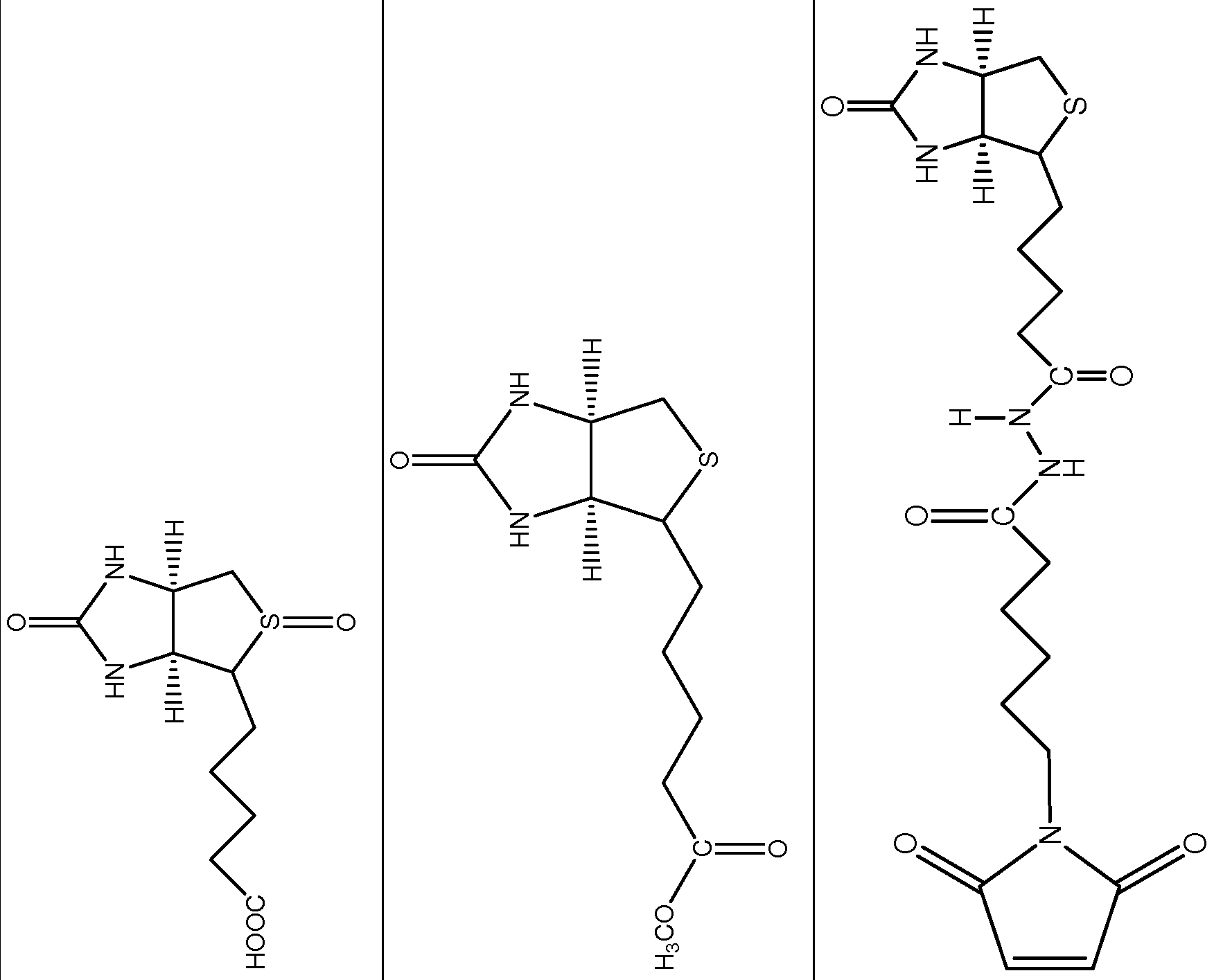
43 Biotin-poly(ethyleneglycol)
amine
aminomethyl polyethylene 5- ((3aS,6aR)-2-oxohexahydro-lH- thieno[3,4-d]imidazol-4-yl)
pentanoate
44 (+) biotin 4-amidobenzoic acid
sodium salt
sodium 4-(5-((3aS,6aR)-2- oxohexahydro- 1 H-thieno
[3,4-d]imidazol-4-yl)
pentanamido) benzoate
45 Biotin 2-N-acetylamino-2- deoxy-β-D-glucopyranoside
((2R,5S)-3-acetamido-4,5- dihydroxy-6-(hydroxymethyl)- H
2,3 ,4,5 ,6-pentamethyltetrahydro-
2H-pyran-2-yl)methyl 5-
((3aS,6aR)-2-oxohexahydro-lH- thieno[3,4-d]imidazol-4-yl)
pentanoate


Names of Compounds 48-50.
48. ((2R,5S)-3-acetamido-5-hydroxy-6-(hydroxymethyl)-2,3,4,6-tetramethyl-4-((((2S,5R)-3,4,5-trihydroxy-6-(hydroxymethyl)-2,3,4,5,6- pentamethyltetrahydro-2H-pyran-2-yl)methoxy)methyl) tetrahydro-2H-pyran-2-yl)methyl 5-((3aS,6aR)-2-oxohexahydro-lH- thieno[3,4-d]imidazol-4-yl)pentanoate ((2R,5S)-3-acetamido-5-hydroxy-6-(hydroxymethyl)-2,3,4,6-tetramethyl-4-((((2S,5R)-3,4,5- trihydroxy-6-(hydroxymethyl)-2,3,4,5,6-pentamethyltetrahydro-2H-pyran-2-yl)methoxy)methyl) tetrahydro-2H-pyran-2-yl)methyl 5- ((3aS,6aR)-2-oxohexahydro-lH-thieno[3,4-d]imidazol-4-yl)pentanoate
49. (2R,3R,5S)-5-((((2S,3S,5S)-3-acetamido-5-hydroxy-6-(hydroxymethyl)-2,4,6-trimethyl-4-((((2S,5R)-3,4,5-trihydroxy-6- (hydroxymethyl)-2,3 ,4,5 ,6-pentamethyltetrahydro-2H-pyran-2-yl)methoxy) methyl)tetrahydro-2H-pyran-2-yl)methoxy)methyl)-3 ,4- dihydroxy-2,4,5,6,6-pentamethyltetrahydro-2H-pyran-2-yl 5-((3aS,6aR)-2-oxohexahydro-lH-thieno[3,4-d]imidazol-4-yl)pentanoate
50. (2S,5S)-3-acetamido-4-((((2R,5S)-5-((((2R,5S)-4,5-dihydroxy-6-(hydroxymethyl)-2,3,4,5,6-pentamethyl-3-((((2S,5S)-3,4,5- trihydroxy-2,3 ,4,5 ,6,6-hexamethyltetrahydro-2H-pyran-2-yl)methoxy)methyl)tetrahydro-2H-pyran-2-yl)methoxy) methyl)-3 ,4- dihydroxy-2,3 ,4,5 ,6,6-hexamethyltetrahydro-2H-pyran-2-yl)methoxy)methyl)-5 -hydroxy-6-(hydroxymethyl)-2,3 ,4,5 ,6- pentamethyltetrahydro-2H-pyran-2-yl 5-((3aS,6aR)-2-oxohexahydro-lH-thieno[3,4-d]imidazol-4-yl)pentanoate
10
Structure of iminobiotin compounds are not shown in Table 3. The iminobiotin structures are analogs of the biotin structure where the biotin group is replaced by a an iminobiotin group. An example is shown below with the analogs N-hydroxysuccinimide biotin and N- hydroxysuccinimide iminobiotin.
15

N-hydroxysuccinimide biotin N-hydroxysuccinimide iminobiotin
In an embodiment, a cellulose acetate hydrogen phthalate polymer is incorporated into the lipid construct where it can bind to hydrophilic functional groups on the insulin molecule and protect insulin from hydrolytic degradation. Cellulose acetate hydrogen phthalate comprises two glucose molecules linked beta (1→4) in a polymeric arrangement in which some of the hydrogen atoms on the hydroxyl groups of the polymer are replaced by an acetyl functionality (a methyl group bound to a carbonyl carbon) or a phthalate group (represented by a benzene ring with two carboxyl groups in the first and second positions of the benzene ring). The structural formula of cellulose acetate hydrogen phthalate polymer is shown in Figure 9. Only one carboxyl group on the phthalate ring structure is involved in a covalent ester linkage to the cellulose acetate molecule. The other carboxyl group, which contains a carbonyl carbon and a hydroxyl functionality, participates in hydrogen bonding with neighboring negative and positive charged dipoles residing on insulin and various lipid molecules.
In an embodiment, cellulose acetate hydrogen phthalate polymer interacts with the lipids through ion-dipole bonding with l,2-distearoyl-sn-glycero-3- phosphocholine phosphate and dicetyl phosphate molecules. The ion-dipole bonding occurs between the δ+ hydrogen on the hydroxyl groups of cellulose and the negatively charged oxygen atom on the phosphate moiety of the phospholipid molecules. The functional groups with the largest role in the ion-dipole interaction are the negatively charged oxygen atoms on the phosphate groups of the phospholipid molecules, hydrogen atoms on the hydroxyl groups and the hydrogen atoms on amide bonds of the insulin molecules. Negatively charged functional groups form sites for ion-dipole interactions and for reacting with the δ+ hydrogen atom on individual hydroxyl groups and the hydroxyl groups of the carboxyl functionalities on cellulose acetate hydrogen phthalate. Ion-dipoles can be formed between the positively charged quaternary amines on the phosphocholine functionalities and the δ carbonyl oxygen found on cellulose acetate hydrogen phthalate and insulin. Sugar molecules comprising branched hydrophilic structures in insulin can participate in hydrogen bonding and ion-dipole interactions.
The molecular configuration and the size of the polymer (with an approximate molecular weight of 15,000 or more) enables cellulose acetate hydrogen phthalate to coat individual phospholipid molecules of the lipid construct in the region
of the hydrophilic head group. This coating protects insulin within the lipid construct from the acid milieu of the stomach. There are several ways that cellulose acetate hydrogen phthalate can be attached to the surface of molecules within the lipid construct. A preferred means of linking cellulose acetate hydrogen phthalate to the surface of the lipid construct is to attach the polymeric cellulosic species to a tail of an insulin molecule that presents a sugar that projects from the surface of the lipid construct. This protects the insulin proteinaceous tails from enzymatic hydrolysis.
An extended amphipathic lipid comprises a variety of multi-dentate binding sites for attachment to the receptor. Multi-dentate binding, as defined herein, requires a plurality of potential binding sites on the surface of insulin and its accompanying sugar moieties, as well as on the lipid construct that can interface with carbonyl, carboxyl and hydroxyl functional groups on the cellulose acetate hydrogen phthalate polymer. This enables the cellulose acetate hydrogen phthalate polymer to bind to a plurality of hydrophilic regions not only on the lipid construct but also on molecules of insulin in order to establish a shield of hydro lytic protection for the lipid construct. In this manner both insulin and the lipid construct are protected from the acid environment of the stomach following oral administration of the insulin dosage form. Even though cellulose acetate hydrogen phthalate covers or shields individual lipid molecules within and on the surface of the lipid construct while passing through the stomach, once the construct migrates to the alkaline region of the small intestine, cellulose acetate hydrogen phthalate is hydrolytically degraded. After cellulose acetate hydrogen phthalate is removed from the surface of the molecules of the lipid construct, a lipid anchoring-hepatocyte receptor binding molecule, such as 1 ,2- dipalmitoyl-sn-glycero-3-phosphoethanolamine-N-(Cap Biotinyl), becomes exposed and then is available to bind with the receptor. The employment of a cellulose acetate hydrogen phthalate coating on insulin and the lipid construct is needed to ensure that a greater bioavailability of insulin is achieved.
Target Molecule Complex
In an embodiment, the lipid construct comprises a target molecule complex comprising multiple linked individual units formed by complexing a bridging component with a complexing agent. The bridging component is a water soluble salt of a metal capable of forming a water-insoluble coordinated complex with a complexing agent. A suitable metal is selected from the transition and inner transition metals or neighbors of the transition metals. The transition and inner transition metals from which the metal are selected from: Sc (scandium), Y (yttrium), La (lanthanum), Ac (actinium), the actinide series; Ti (titanium), Zr (zirconium), Hf (hafnium), V (vanadium), Nb (niobium), Ta (tantalum), Cr (chromium), Mo
(molybdenum), W (tungsten), Mn (manganese), Tc(technetium), Re (rhenium), Fe (iron), Co (cobalt), Ni (nickel), Ru (ruthenium), Rh (rhodium), Pd (palladium), Os (osmium), Ir (iridium), and Pt (platinum). The neighbors of the transition metals from which the metal can be selected are: Cu (copper), Ag (silver), Au (gold), Zn (zinc), Cd (cadmium), Hg (mercury), Al (aluminum), Ga (gallium), In (indium), Tl
(thallium), Ge (germanium), Sn (tin), Pb (lead), Sb (antimony) and Bi (bismuth), and Po (polonium). Examples of metal compounds useful as bridging agents include chromium chloride (III) hexahydrate; chromium (III) fluoride tetrahydrate; chromium (III) bromide hexahydrate; zirconium (IV) citrate ammonium complex; zirconium (IV) chloride; zirconium (IV) fluoride hydrate; zirconium (IV) iodide; molybdenum (III) bromide; molybdenum (III) chloride; molybdenum (IV) sulfide; iron (III) hydrate; iron (III) phosphate tetrahydrate, iron (III) sulfate pentahydrate, and the like.
The complexing agent is a compound capable of forming a water insoluble coordinated complex with a bridging component. There are several families of suitable complexing agents.
A complexing agent can be selected from the family of iminodiacetic acids of the formula (1) where Ri is loweralkyl, aryl, arylloweralkyl, and a heterocyclic substituent.
O O
HO C-CH2-N-CH2-C OH
Lowθralkylθnθ ^ '
C N R1
O H
Suitable compounds of the formula (1) include:
N-(2,6-diisopropylphenylcarbamoylmethyl) iminodiacetic acid;
N-(2,6-diethylphenylcarbamoylmethyl) iminodiacetic acid;
N-(2,6-dimethylphenylcarbamoylmethyl) iminodiacetic acid;
N-(4-isopropylphenylcarbamoylmethyl) iminodiacetic acid;
N-(4-butylphenylcarbamoylmethyl) iminodiacetic acid;
N-(2,3-dimethylphenylcarbamoylmethyl) iminodiacetic acid;
N-(2,4-dimethylphenylcarbamoylmethyl) iminodiacetic acid;
N-(2,5-dimethylphenylcarbamoylmethyl) iminodiacetic acid;
N-(3,4-dimethylphenylcarbamoylmethyl) iminodiacetic acid;
N- (3,5-dimethylphenylcarbamoylmethyl) iminodiacetic acid;
N-(3-butylphenylcarbamoylmethyl) iminodiacetic acid;
N-(2-butylphenylcarbamoylmethyl) iminodiacetic acid;
N-(4-tertiary butylphenylcarbamoylmethyl) iminodiacetic acid;
N-(3-butoxyphenylcarbamoylmethyl) iminodiacetic acid;
N-(2-hexyloxyphenylcarbamoylmethyl) iminodiacetic acid;
N-(4-hexyloxyphenylcarbamoylmethyl) iminodiacetic acid;
aminopyrrol iminodiacetic acid;
N-(3-bromo-2,4,6-trimethylphenylcarbamoylmethyl) iminodiacetic acid; benzimidazole methyl iminodiacetic acid;
N-(3-cyano-4,5-dimethyl-2-pyrrylcarbamoylmethyl) iminodiacetic acid;
N-(3-cyano-4-methyl-5-benzyl-2-pyrrylcarbamoylmethyl) iminodiacetic acid; and
N-(3-cyano-4-methyl-2-pyrrylcarbamoylmethyl) iminodiacetic acid and other derivatives ofN-(3-cyano-4-methyl-2-pyrrylcarbamoylmethyl) iminodiacetic acid of formula (2),

where R2 and R3 are the following:
R2 R1

H CH2CH2SCH3
H CH2C6H4-P-OH
CH3 CH3

CH3 CH2CH2SCH3
CH3 C6H5
CH3 CH2C6H5
CH3 CH2C6H4-P-OCH3
A complexing agent is selected from the family of imino diacid derivatives of the general formula (3), where R4, R5, and R6 are independent of each other and can be hydrogen, loweralkyl, aryl, arylloweralkyl, alkoxyloweralkyl, and heterocyclic.
O O
R4 O C loweralkylene N loweralkylene C O R6 (3) R5
Suitable compounds of the formula (3) include: N'-(2-acetylnaphthyl) iminodiacetic acid (NAIDA); N'-(2-naphthylmethyl) iminodiacetic acid (NMIDA); iminodicarboxymethyl-2-naphthylketone phthalein complexone; 3 (3: 7a: 12a:
trihydroxy-24-norchol anyl -23 -iminodiacetic acid; benzimidazole methyl
iminodiacetic acid; and N- (5,pregnene-3-p-ol-2-oyl carbamoylmethyl) iminodiacetic acid.
A complexing agent is selected from the family of amino acids of formula (4),
O
R7 CH-C O R8 (4) K9
where R7 is an amino acid side chain, R8 is loweralkyl, aryl, arylloweralkyl, and Rg is pyridoxylidene.
Suitable amino acids of the formula (4) are aliphatic amino acids, including, but not limited to: glycine, alanine, valine, leucine, isoleucine;
hydroxyamino acids, including serine, and threonine; dicarboxylic amino acids and their amides, including aspartic acid, asparagine, glutamic acid, glutamine; amino
acids having basic functions, including lysine, hydroxylysine, histidine, arginine;
aromatic amino acids, including phenylalanine, tyrosine, tryptophan, thyroxine; and sulfur-containing amino acids, including cystine, methionine.
A complexing agent is selected from amino acid derivatives including, but not necessarily limited to (3-alanine-y-amino) butyric acid, O-diazoacetylserine (azaserine), homoserine, ornithine, citrulline, penicillamine and members of the pyridoxylidene class of compounds including, but are not limited to: pyridoxylidene glutamate; pyridoxylidene isoleucine; pyridoxylidene phenylalanine; pyridoxylidene tryptophan; pyridoxylidene-5 -methyl tryptophan; pyridoxylidene-5- hydroxytryptamine; and pyridoxylidene-5-butyltryptamine.
A complexing agent is selected from the family of diamines of the general formula (6),
R1 1 COOR10
R12 N loweralkylene N (g)
I R11COOR10
r"M3
where Rio is hydrogen, loweralkyl, or aryl; Rn is loweralkylene or arylloweralky; Ri2 and Rn independently are hydrogen, loweralkyl, alkyl, aryl, arylloweralkyl,
acylheterocyclic, toluene, sulfonyl or tosylate.
Some suitable diamines of the formula (6) include, but are not limited to, ethylenediamine-N, N diacetic acid; ethylenediamine-N,N-bis (-2-hydroxy-5- bromophenyl) acetate; N'-acetylethylenediamine-N,N diacetic acid; N'-benzoyl ethylenediamine-N,N diacetic acid; N'-(p-toluenesulfonyl) ethylenediamine-N, N diacetic acid; N'-(p-t-butylbenzoyl) ethylenediamine-N, N diacetic acid; N'- (benzenesulfonyl) ethylenediamine-N, N diacetic acid; N'- (p-chlorobenzenesulfonyl) ethylenediamine-N, N diacetic acid; N'-(p-ethylbenzenesulfonyl ethylenediamine-N,N diacetic acid; N'-acyl and N'-sulfonyl ethylenediamine-N, N diacetic acid; N'- (p-n- propylbenzenesulfonyl) ethylenediamine-N, N diacetic acid; N'- (naphthalene-2- sulfonyl) ethylenediamine-N, N diacetic acid; and N'- (2, 5-dimethylbenzenesulfonyl) ethylenediamine-N, N diacetic acid.
Other suitable complexing compounds or agents include, but are not limited to: penicillamine; p-mercaptoisobutyric acid; dihydrothioctic acid; 6- mercaptopurine; kethoxal-bis(thiosemicarbazone); Hepatobiliary Amine Complexes, 1-hydrazinophthalazine (hydralazine); sulfonyl urea; Hepatobiliary Amino Acid
Schiff Base Complexes; pyridoxylidene glutamate; pyridoxylidene isoleucine;
pyridoxylidene phenylalanine; pyridoxylidene tryptophan; pyridoxylidene 5 -methyl tryptophan; pyridoxylidene-5 -hydroxytryptamine; pyridoxylidene-5 -butyltryptamine; tetracycline; 7-carboxy-p-hydroxyquinoline; phenolphthalein; eosin I bluish; eosin I yellowish; verograffin; 3-hydroxyl-4-formyl-pyridene glutamic acid; Azo substituted iminodiacetic acid; hepatobiliary dye complexes, such as rose bengal; congo red; bromosulfophthalein; bromophenol blue; toluidine blue; and indocyanine green; hepatobiliary contrast agents, such as iodipamide; and ioglycamic acid; bile salts, such as bilirubin; cholgycyliodohistamine; and thyroxine; hepatobiliary thio complexes, such as penicillamine; p-mercaptoisobutyric acid; dihydrothiocytic acid; 6-mercaptopurine; and kethoxal-bis (thiosemicarbazone); hepatobiliary amine complexes, such as 1-hydrazinophthalazine (hydralazine); and sulfonyl urea;
hepatobiliary amino acid Schiff Base complexes, including pyridoxylidene-5 - hydroxytryptamine; and pyridoxylidene-5-butyltryptamine; hepatobiliary protein complexes, such as protamine; ferritin; and asialo-orosomucoid; and asialo complexes, such as lactosaminated albumin; immunoglobulins, G, IgG; and hemoglobin.
The three-dimensional target molecule complex made from combining bridging agents and complexing agents is described in WO 99/59545, which is incorporated herein by reference. In an embodiment, the bridging agent is a metal salt, such as chromium chloride hexahydrate, capable of forming a coordinated complex with complexing agents, such as N-(2,6-diisopropylphenylcarbamoylmethyl) iminodiacetic acid. The bridging agent and the complexing agents are combined to form a complex composed of multiple linked units in a three-dimensional array. In a preferred embodiment, the complex is composed of multiple units of chromium (bis) [N-(2,6-(diisopropylphenyl)carbamoyl methyl)imino diacetic acid] linked together. In an embodiment, the chromium target molecule complex substance is soluble in a mixture of lipids containing l,2-distearoyl-sn-glycero-3-phosphocholine, dicetyl phosphate and cholesterol. The complex is incorporated within a lipid construct formed from the groups of lipids previously described.
A depiction of a pharmaceutical composition that combines free insulin and insulin associated with a target molecule complex is shown in Figure 11. In an embodiment, a pharmaceutical composition may comprise two or more insulins. The target molecule complex comprises multiple linked individual units formed by
complexing a bridging component with a complexing agent. The bridging component is a water soluble salt of a metal capable of forming a water-insoluble coordinated complex with a complexing agent. A suitable metal is selected from the transition and inner transition metals or neighbors of the transition metals. A description of the target molecule complex and its components was previously described herein. In an embodiment, a pharmaceutical composition comprises a mixture of free insulin and insulin associated with a water insoluble target molecule complex. Free insulin is not associated with the target molecule complex and is soluble in water. The other form of insulin in the composition is associated with a water insoluble target molecule complex.
For each of the insulins, there is an equilibrium between the free form of insulin in solution or suspension and the forms of the insulin associated with the water insoluble target molecule complex. Because the interactions between each form of insulin and the target molecule complex involve equilibria, over time the free forms of the insulins bind and partition into the lipid domains and/or the central core volume of the water insoluble target molecule complex. In an embodiment, free recombinant human regular insulin can be transformed into transitory lipid derivatives by adsorbing onto, or reacting with, individual molecules of lipid that are in equilibrium with the water insoluble target molecule complex. These derivatives associate with the lipids of the water insoluble target molecule complex and enter the core-volume of the complex, thus affecting the pharmacological activity of the product.
Adjustment of the pH of an aqueous solution surrounding the lipid construct containing the target molecule complex, by the addition of acids, bases, or buffers, results in a negative charge in the lipid construct structure. The pH range at which this occurs depends upon the composition of the lipids. A preferred lipid system is a mixture of l,2-distearoyl-sn-glycero-3-phosphocholine, cholesterol and dicetylphosphate. This mixture forms a negatively charged lipid construct structure under physiological conditions. The lipid construct exhibits hepatocyte targeting specificity, i.e. is specific for cellular hepatocytes, thereby allowing the construct to be targeted to the liver.
Description of the Invention - Method of Manufacturing the Lipid Construct
Figure 12 demonstrates an outline for the process for manufacturing a lipid construct comprising an amphipathic lipid, an extended amphipathic lipid and insulin. The manufacture of the composition comprises three overall steps: preparing a mixture of an amphipathic lipid and an extended amphipathic lipid, preparing a lipid construct from the mixture of an amphipathic lipid and an extended amphipathic lipid, and combining insulin into the lipid construct.
Lipids are produced and loaded by the methods disclosed herein, and those methods described in U. S. Patent Nos. 4,946,787; 4,603,044; and 5,104,661, and the references cited therein. Typically, the aqueous lipid construct formulations of the invention comprise 0.1% to 10% active agent by weight (i.e. 1-10 mg drug per ml), and 0.1% to 4% lipid by weight in an aqueous solution, optionally containing salts and buffers, in a quantity to make 100% by volume. Preferred are formulations which comprise 0.1% to 5% active agent. Most preferred is a formulation comprising 0.01% to 5% active agent by weight and up to 2% by weight of a lipid component in an amount of aqueous solution sufficient (q. s.) to make 100% by volume.
In an embodiment, the lipid construct is prepared by the following procedure. Individual lipid constituents are mixed together in an organic solvent system where the solvent had been dried over molecular sieves for approximately two hours to remove any residual water that may have accompanied the solvent. In an embodiment, the solvent system comprises a mixture chloroform and methanol in the ratio 2: 1 by volume. Other organic solvents that can be easily removed from a mixture of dried lipids also can be used. Use of a single-step addition of the lipid constituents in the initial mixing procedure obviates the need for introducing any additional coupling reactions which would unnecessarily complicate the structure of the lipid construct and require additional separation procedures. The lipid
components and the hepatocyte receptor binding molecule are dissolved in the solvent, then the solvent is removed under high vacuum until a dried mixture of the lipids forms. In an embodiment, the solvent is removed under vacuum using a rotoevaporator, or other methods known in the art, with slow turning at approximately 6O0C for approximately two hours. This mixture of lipids can be stored for further use, or used directly.
The lipid construct is prepared from the dried mixture of amphipathic lipids and an extended amphipathic lipid. The dried mixture of lipids are added to an appropriate amount of aqueous buffered media, then the mixture is swirled to form a
homogeneous suspension. The lipid mixture is then heated with mixing at approximately 8O0C for approximately 30 minutes under a dry nitrogen atmosphere. The heated homogeneous suspension is immediately transferred to a micro-fluidizer preheated to approximately 7O0C. The suspension is passed through the
microfluidizer. The suspension may require additional passes through the
microfluidizer to obtain a homogeneous lipid micro-suspension. In an embodiment a Model #M-110 EHI micro-fluidizer was used where the pressure on the first pass was approximately 9,000 psig. A second pass of the lipid suspension through the microfluidizer may be needed to produce a product that exhibits the properties of a homogeneous lipid micro-suspension. This product is defined structurally and morphologically as a three-dimensional lipid construct which contains a hepatocyte receptor binding molecule.
Insulin is loaded into the lipid constructs using one of two methods: equilibrium loading and non-equilibrium loading. Equilibrium loading of insulin begins when insulin is added to a suspension of the lipid constructs. Over time, insulin molecules move into and out of the lipid construct. The movement is governed by partitioning equilibrium, where movement into the lipid construct after the initial introduction of insulin to the suspension.
Non-equilibrium loading of insulin into the lipid constructs localizes insulin within the lipid construct. Following equilibrium loading of free insulin into the lipid construct, the bulk phase media that contains free insulin is removed. The non-equilibrium loading procedure is a vector-driven process that begins the instant the external bulk phase media is removed. The gradient potential for insulin to migrate out of the lipid constructs is eliminated when the aqueous phase containing insulin has been removed. The overall process results in a greater concentration of insulin within the final lipid construct because movement of insulin from within the construct is eliminated. The equilibrium loading of insulin is a time-dependent phenomenon whereas the non-equilibrium loading procedure is practically instantaneous. Non-equilibrium loading can be initiated by a variety of processes where the material in solution is separated from the lipid construct. Examples of such processes include, but are not limited to: filtration, centricon filtration, centrifugation, batch style affinity chromatography, streptavidin agarose affinity-gel chromatography or batch style ion-exchange chromatography. Any means that eliminates the gradient
potential for insulin diffusion and leakage and causes the insulin to be retained by the lipid construct can be utilized.
When using batch-style chromatography, the affinity or ion-exchange gel is mixed rapidly with the mixture of insulin and the construct. Binding to the chromatography medium occurs rapidly and the chromatography medium is removed from the aqueous media by decanting of the aqueous phase or by using classic filtering techniques such as the use of filter paper and a Bϋchner funnel.
The lipid construct contains a discrete amount of loaded insulin located not only inside, but also within and on the surface of the lipid construct. The lipid construct created is a new and novel composition of matter and becomes a composition for delivering an effective amount of insulin as a result of non- equilibrium loading. The loading of insulin into this lipid construct and the subsequent removal of bulk phase insulin results in a high concentration of insulin in a lipid construct by shortening the length of time needed for removal of the external phase media. It would be difficult to achieve this level of loading insulin into the construct using time-dependent procedures, such as ion-exchange or gel-filtration chromatography, since these procedures require a constant infusion of buffer comprising high concentrations of insulin. For example, loading insulin into the construct using small scale column chromatography requires approximately twenty minutes to remove the external bulk phase media containing insulin from the construct containing insulin. Equilibrium conditions are reestablished during this time period by movement of insulin from the construct. Maintaining a high concentration of insulin in and on the lipid construct is one of the positive benefits of using non-equilibrium loading.
In certain embodiments, cellulose acetate hydrogen phthalate is added to the lipid construct during the step of loading insulin to the lipid construct after the insulin has undergone equilibrium loading but before the non-equilibrium loading process is initiated. The nature and structure of the insulin molecule allows it to be intercalated into the lipid construct were insulin is dispersed throughout the lipid construct. Hydrophilic portions of insulin, as well as branched complex sugars and additional functional groups, extend into the bulk phase media from the surface of the lipid construct. These extended hydrophilic portions of insulin can participate in hydrogen bonding, dipole-dipole and ion-dipole interactions at the surface of the lipid
construct with the hydroxyl groups, carboxyl groups and carbonyl functionalities of cellulose acetate hydrogen phthalate as illustrated in Figure 9.
Cellulose acetate hydrogen phthalate offers a unique means of combining with the molecules of the lipid construct to provide an excellent shield for masking the contents of the lipid construct from the digestive milieu of the stomach. The digestive processes in the stomach result from the hydrolytic cleavage of proteinaceous substrates by the enzyme pepsin as well as cleavage by acid hydrolysis. The acidic environment of the stomach degrades free insulin and can hydro lyze the ester bonds that hold the acyl hydrocarbon chains to the glycerol backbone in the phospholipid molecules. Hydrolytic cleavage can also occur on either side of the phosphate functionality in the phosphocholine group. The digestive system changes from the acid region of the stomach to an alkaline region of the small intestine were enzymatic action of trypsin and chymotrypsin occurs. Amino acid lysing enzymes, such as alpha amino peptidases, can degrade proteins such as insulin from the N- terminal end. The presence of cellulose acetate hydrogen phthalate in the lipid construct protects insulin from hydrolytic degradation. As the alkaline environment of the small intestine hydro lyrically degrades the cellulose acetate hydrogen phthalate shield of the lipid construct the hepatocyte receptor binding molecule becomes available to direct binding of the construct to the hepatocyte binding receptor. While not wishing to be bound by any particular theory, there is a synergy of hydrolytic protection upon the addition of cellulose acetate hydrogen phthalate at the end point of non-equilibrium loading. The protection is distributed not only to insulin and individual lipid molecules, but also to the entire lipid construct. This synergy provides collective as well as individual molecular protection from enzymatic and acid hydrolysis.
In an embodiment, cellulose acetate hydrogen phthalate is covalently bound to either insulin or the lipid construct using a variety of methods. For example, one method involves coupling the hydroxyl groups on cellulose acetate hydrogen phthalate with the amine functionalities on either l,2-diacyl-sn-glycero-3- phosphoethanolamine or the ε-amino group of the ten L-lysines in the insulin molecule utilizing the Mannich reaction.
In an embodiment, cellulose acetate hydrogen phthalate is loaded into the lipid construct during equilibrium loading of insulin into the construct. The hydroxyl and carbonyl functionalities of the cellulose acetate hydrogen phthalate
hydrogen bond with lipid molecules in a lipid construct. Hydrogen bonds between cellulose acetate hydrogen phthalate and the construct are formed concurrently as insulin is loaded under equilibrium conditions into the lipid construct creating a shield around insulin and around the construct.
HDV-Insulin is recovered and recycled from aqueous media by binding it to streptavidin-agarose iminobiotin. Streptavidin covalently bound to cyanogen bromide activated agarose provides a means to separate an iminobiotin- based lipid construct from insulin in the aqueous media at the end of non-equilibrium loading of insulin into the construct. In an embodiment, an iminobiotin derivative forms the hepatocyte receptor binding portion of the phospholipid moiety within the lipid construct. The water-soluble portion of the lipid anchoring molecule extends approximately 30 angstroms from the lipid surface to facilitate binding of the hepatocyte receptor binding portion of the phospholipid moiety with a hepatocyte receptor and to aid in the attachment of the lipid construct to streptavidin.
Streptavidin reversibly binds to iminobiotin at pH values of 9.5 and greater, where the uncharged guandino functional group of iminobiotin strongly binds to one of the four binding sites on streptavidin located approximately nine angstroms below the surface of the protein. A lipid construct containing iminobiotin is removed from buffered media by raising the pH of an aqueous mixture of the construct to pH 9.5 by the addition of a 20 niM sodium carbonate-sodium bicarbonate buffer. At this pH, the bulk phase media contains free insulin which is reclaimed and separated from the lipid construct using a variety of procedures including to, but not limited to filtration, centrifugation or chromatography.
The mixture at pH 9.5 is then mixed with streptavidin-agarose cross- linked beads, where the construct is adsorbed onto the streptavidin. The beads, which are approximately 120 microns in diameter, are separated from the solution by filtration. The lipid construct is released from the streptavidin-agarose affinity-gel by reducing the pH from pH 9.5 to pH 4.5 by the addition of a 20 niM sodium acetate- acetic acid buffer at pH 4.5. At pH 4.5 the guandino group of iminobiotin becomes protonated and positively charged, as shown in Figure 10. The lipid construct is released and separated from the streptavidin-agarose bead by filtration. The streptavidin-agarose bead are reclaimed for additional usage. Thus both free insulin and streptavidin-agarose are conserved and can be re-used.
In an embodiment, a composition that provides for the extended release of insulin is produced when iminobiotin or iminobiocytin lipid constructs are loaded with insulin using streptavidin-agarose beads. When the pH of the
forementioned construct is adjusted from pH 9.5 to pH 4.5 insulin will precipitate within the lipid construct at approximately pH 5.9. The isoelectric point of human recombinant regular insulin is at pH 5.3 and represents the pH at which insulin has its lowest water-solubility. Over a pH range of from about pH 5.1 to about pH 5.3 human recombinant regular insulin remains essentially insoluble and exhibits properties that are commonly attributed to particulate matter. The insolubilized insulin within a lipid construct creates a novel insulin formulation that provides for the time-release of insulin molecules when administered by subcutaneous injection or through oral dosing.
The lipid construct is freeze-dried or kept in a non-aqueous environment prior to dosing. In an aqueous dosage form of insulin, the pH of the insulin solution is maintained at approximately pH 6.5 in order to maintain insulin in the insoluble form. When insulin is exposed to an external pH gradient in vivo insulin is solubilized and move from the lipid construct, thereby supplying insulin to other tissues. Insulin remaining with the lipid construct maintains the capability of being directed to the hepatocyte binding receptor on the hepatocytes in the liver. Therefore two forms of insulin are produced from this particular lipid construct. In an in vivo setting, free and lipid associated insulin are generated in a time-dependent manner. It is anticipated that the solubilization of insulin that is lipid associated, as previously described, can be manufactured to release of insulin over a designated time-release period. This could lead to less frequent dosing schedules for patients afflicted with diabetes.
In a preferred embodiment, insulin molecules move into the lipid construct and become sequestered within the lipid domains of the loaded lipid construct. A vector-driven process is employed to move insulin molecules in one direction during the final phase of the insulin loading procedure when the chemical equilibrium is disrupted. During the final phase of insulin loading, the buffer or aqueous media is rapidly removed so that the insulin molecules associated with the lipid construct are deprived of an external media into which to migrate. Removal of the external media effectively quenches the equilibrium between insulin associated
with the lipid construct and insulin solubilized in the external media. This process is termed non-equilibrium loading, as decribed elsewhere herein.
In an embodiment, a lipid construct is loaded with insulin using equilibrium methods, an insulin concentration of 273,000 units of insulin per microgram of protein is selected to initiate the loading procedure. Equilibrium loading continues until the lipid construct is saturated with insulin.
The end process of non-equilibrium loading of insulin into the lipid construct requires using a procedure that separates the solid lipid construct from the buffered media containing free insulin. In an embodiment, a filtration procedure with a very fine micro-pore synthetic membrane is used to separate the lipid construct from the external media. In another embodiment, a centricon device equipped with an appropriate filter with a 100,000 molecular weight cut off membrane, such as NanoSep filter is used to remove the lipid construct from the buffered media containing free insulin. The concentration of insulin in the lipid construct is maintained because associated insulin is no longer in equilibrium with the free insulin molecules located in the bulk phase media that had been removed from the construct. Free insulin which was in solution is available to load other lipid constructs. Thus, the vector-driven process of concentrating insulin within the lipid construct is achieved in one-step in essentially a time-independent procedure.
After the lipid construct is isolated from the bulk phase media, it can range in size from approximately 0.0200 microns to 0.4000 microns in diameter. Lipid constructs comprise different particle sizes that generally follow a Gaussian distribution. The appropriate size of the lipid construct needed to achieve the intended pharmacological efficacy can be selected from lipid constructs that comprise particle sizes in a Gaussian distribution by the hepatocyte binding receptor.
The lipid construct comprising insulin, lipids and the hepatocyte receptor binding molecule is prepared by using a micro-fluidization process that provides a high shear force which degrades larger lipid constructs into smaller constructs. The amphipathic lipid constituents of the lipid construct are 1,2- distearoyl-sn-glycero-3-phosphocholine, cholesterol, dicetyl phosphate, 1,2- dipalmitoyl-sn-glycero-3-phosphoethanolamine-N-(Cap Biotinyl), 1 ,2-distearoyl-sn- glycero-3-phosphoethanolamine, l,2-dipalmitoyl-sn-glycero-3-phosphoethanolamine- N-(succinyl), l,2-dipalmitoyl-sn-glycero-3-[phospho-rac-(l-glycerol)] (sodium salt), triethylammonium 2,3-diacetoxypropyl 2-(5-((3aS,6aR)-2-oxohexahydro-lH-
thieno[3,4-d]imidazol-4-yl) pentanamido)ethyl phosphate and appropriate derivatives thereof whose representative structures are depicted in Table 1.
In one embodiment, the lipids are l,2-distearoyl-sn-glycero-3- phosphocholine, cholesterol, and dicetyl phosphate, and the hepatocyte receptor binding molecule is biotin-X-DHPE or biotin-DHPE.
In another embodiment, a construct comprises a target molecule complex comprising multiple linked individual units formed by complexing a bridging component with a complexing agent. Typically the target molecule complex is formed by combining the selected metal compound, e. g. chromium chloride (III) hexahydrate, with an aqueous buffered solution of the complexing agent. In an embodiment, an aqueous buffered solution of the complexing agent is prepared by dissolving the complexing agent, e.g., N-(2,6-diisopropylphenylcarbamoyl methyl)iminodiacetic acid, in an aqueous buffered solution, e.g., 10 mM sodium acetate buffer at a final pH of 3.2-3.3. The metal compound is added in excess in an amount sufficient to complex with an isolatable portion of the complexing agent, and the reaction is conducted at a temperature of 200C to 33°C for 24 to 96 hours, or until the resultant complex precipitates out of aqueous buffered solution.
The precipitated complex is then mixed with the selected lipids or the lipids of the lipid construct and dissolved in an organic solvent. In an embodiment, the organic solvent is chloroform:methanol (2:1 v/v). The lipids are in a
concentration sufficient to dissolve and incorporate either all or a portion of the metal complex therein. The mixture of the complex and the selected lipids that form the lipid construct are maintained at a temperature of approximately 600C when a high transition temperature lipid, such as l,2-distearoyl-sn-glycero-3-phosphocholine, is employed. Lower temperatures may be used depending upon the transition temperature of the lipids selected for incorporation into the lipid construct. A time period from 30 minutes to 2 hours under vacuum is generally required to dry the lipids and remove any residual organic solvent from the lipid matrix in order to form the target molecule complex intermediate.
Lipids are produced and loaded by the methods disclosed herein, and those methods described in U. S. Patent Nos. 4,946,787; 4,603,044; and 5,104,661, and the references cited therein. Typically, the aqueous lipid construct formulations of the invention will comprise 0.1% to 10% active agent by weight (i.e. 1 -100 mg drug per ml), and 0.1% to 4% lipid by weight in an aqueous solution, optionally
containing salts and buffers, in a quantity to make 100% by volume. Preferred are formulations which comprise 0.01% to 5% active agent. Most preferred is a formulation comprising 0.01% to 5% active agent by weight and up to 2% by weight of a lipid component in an amount of aqueous solution sufficient (q. s.) to make 100% by volume.
The target molecule complex comprises multiple individual units linked together in a polymeric array. Each unit comprises a bridging component and a complexing agent. In an embodiment, the target molecule complex is formed by combining the selected metal compound, e. g. chromium chloride (III) hexahydrate, with an aqueous buffered solution of the complexing agent. In an embodiment, an aqueous buffered solution of the complexing agent is prepared by dissolving a complexing agent, e.g., N-(2,6-diisopropylphenylcarbamoylmethyl) iminodiacetic acid, in an aqueous buffered solution, e.g., 10 mM sodium acetate buffer at a final pH of 3.2-3.3. A metal compound is added in excess in an amount sufficient to complex with an isolatable portion of the complexing agent, and the reaction is conducted at a temperature of approximately 200C to 33°C for approximately 24 to 96 hours, or until the resultant complex precipitates out of the aqueous buffered solution. The precipitated complex is then isolated for future use.
The precipitated complex is then mixed with the selected lipids or the lipids of the lipid construct and dissolved in an organic solvent. In an embodiment, the organic solvent is chloroform:methanol (2:1 v/v). The lipids are in a
concentration sufficient to dissolve and incorporate either all or a portion of the metal complex therein. The mixture of the complex and the selected lipids that form the lipid construct are maintained at a temperature of approximately 600C when a high transition temperature lipid, such as l,2-distearoyl-sn-glycero-3-phosphocholine, is employed. Lower temperatures may be used depending upon the transition temperature of the lipids selected for incorporation into the lipid construct. A time period from 30 minutes to 2 hours under vacuum is generally required to dry the lipids and remove any residual organic solvent from the lipid matrix in order to form the target molecule complex intermediate.
Lipids can be produced and loaded by the methods disclosed herein, and those methods described in U. S. Patent Nos. 4,946,787; 4,603,044; and
5,104,661, and the references cited therein. Typically, the aqueous lipid construct formulations of the invention will comprise 0.1% to 10% active agent by weight (i.e.
1 -100 mg drug per ml), and 0.1% to 4% lipid by weight in an aqueous solution, optionally containing salts and buffers, in a quantity to make 100% by volume.
Preferred are formulations which comprise 0.01% to 5% active agent. Most preferred is a formulation comprising 0.01% to 5% active agent by weight and up to 2% by weight of a lipid component in an amount of aqueous solution sufficient (q. s.) to make 100% by volume.
Description of the Invention - Method of Use
Patients with Type I or Type II diabetes are administered an effective amount of a hepatocyte targeted lipid construct comprising an amphipathic lipid, an extended amphipathic lipid and insulin. When this composition is administered subcutaneously, a portion of the composition enters the circulatory system where the composition is transported to the liver and other areas where the extended
amphipathic lipid binds the lipid construct to receptors of hepatocytes. A portion of the administered composition is exposed to an external gradient in vivo where insulin can be solubilized and then move from the lipid construct thereby supplying insulin to the muscle and adipose tissue. Insulin that remains with the lipid construct maintains the capability of being directed to the hepatocyte binding receptor on the hepatocytes in the liver. Therefore two forms of insulin are produced from this particular lipid construct. In an in vivo setting, free and lipid associated insulin are generated in a time-dependent manner.
The lipid construct structure of the invention provides a useful agent for pharmaceutical application for administering insulin to a host. Accordingly, the structures of the invention are useful as pharmaceutical compositions in combination with pharmaceutically acceptable carriers. Administration of the structures described herein can be via any of the accepted modes of administration for insulin that are desired to be administered. These methods include oral, parenteral, nasal and other systemic or aerosol forms. Preferably administration is subcutaneous via an infusion system.
Oral administration of a pharmaceutical composition comprising insulin associated with a target molecule complex is followed by intestinal absorption of insulin associated with the target molecule complex into the circulatory system of the body where it is also exposed to the physiological pH of the blood. The lipid construct is targeted for delivery to the liver. In an embodiment, the lipid construct is
shielded by the presence of cellulose acetate hydrogen phthalate within the construct. In the case of oral administration, the shielded lipid construct transverses the oral cavity, migrates through the stomach and moves into the small intestine where the alkaline pH of the small intestine degrades the cellulose acetate hydrogen phthalate shield. The de-shielded lipid construct is absorbed into the circulatory system. This enables the lipid construct to be delivered to the sinusoids of the liver. A receptor binding molecule, such as l,2-dipalmitoyl-sn-glycero-3-phosphoethanolamine-N- (Cap Biotinyl) or other forementioned hepatocyte specific molecules, provides a means for lipid construct to bind to the receptor and then be engulfed or endocytosed by the hepatocytes. Insulin is then released from the lipid construct where, upon gaining access to the cellular environment, it performs its designated function with regard to acting as an agent to control diabetes.
The amount of insulin administered will be dependent on the subject being treated, the type and severity of the affliction, the manner of administration and the judgment of the prescribing physician. Although effective dosage ranges for specific biologically active substances of interest are dependent upon a variety of factors, and are generally known to one of ordinary skill in the art, some dosage guidelines can be generally defined. For most forms of administration, the lipid component will be suspended in an aqueous solution and generally not exceed 4.0% (w/v) of the total formulation. The drug component of the formulation will most likely be less than 20% (w/v) of the formulation and generally greater than 0.01% (w/v).
The lipid construct structures of the invention provides a useful agent for pharmaceutical application for administering insulin to a host. Accordingly, the structures of the invention are useful as pharmaceutical compositions in combination with pharmaceutically acceptable carriers. Administration of the structures described herein can be via any of the accepted modes of administration for insulin that are desired to be administered. These methods include oral, parenteral, nasal and other systemic or aerosol forms.
The amount of insulin administered will be dependent on the subject being treated, the type and severity of the affliction, the manner of administration and the judgment of the prescribing physician. Although effective dosage ranges for specific biologically active substances of interest are dependent upon a variety of factors, and are generally known to one of ordinary skill in the art, some dosage
guidelines can be generally defined. For most forms of administration, the lipid component will be suspended in an aqueous solution and generally not exceed 4.0% (w/v) of the total formulation. The drug component of the formulation will most likely be less than 20% (w/v) of the formulation and generally greater than 0.01% (w/v).
Dosage forms or compositions containing active ingredient in the range of 0.005% to 5% with the balance made up from non-toxic carriers may be prepared.
The exact composition of these formulations may vary widely depending on the particular properties of the drug in question. However, they will generally comprise from 0.01% to 5%, and preferably from 0.05% to 1% active ingredient for highly potent drugs, and from 2%-4% for moderately active drugs.
The percentage of active ingredient contained in such parenteral compositions is highly dependent on the specific nature thereof, as well as the activity of the active ingredient and the needs of the subject. However, percentages of active ingredient of 0.01% to 5% in solution are employable, and will be higher if the composition is a solid which will be subsequently diluted to the above percentages. Preferably the composition will comprise 0.2%-2.0% of the active agent in solution.
The formulations of the pharmaceutical compositions described herein may be prepared by any method known or hereafter developed in the art of pharmacology. In general, such preparatory methods include the step of bringing the active ingredient into association with a carrier or one or more other ingredients, and then, if necessary or desirable, shaping or packaging the product into a desired single- or multi-dose unit.
Although the descriptions of pharmaceutical compositions provided herein are principally directed to pharmaceutical compositions which are suitable for ethical administration to humans, it will be understood by the skilled artisan that such compositions are generally suitable for administration to animals of all sorts.
Modification of pharmaceutical compositions suitable for administration to humans in order to render the compositions suitable for administration to various animals is well understood, and the ordinarily skilled veterinary pharmacologist can design and perform such modification with merely ordinary, if any, experimentation. Subjects to which administration of the pharmaceutical compositions of the invention is contemplated include, but are not limited to, humans and other primates, mammals
including commercially relevant mammals such as cattle, pigs, horses, sheep, cats, and dogs.
Pharmaceutical compositions that are useful in the methods of the invention may be prepared, packaged, or sold in formulations suitable for oral, parenteral, pulmonary, intranasal, buccal, or another route of administration.
A pharmaceutical composition of the invention may be prepared, packaged, or sold in bulk, as a single unit dose, or as a plurality of single unit doses. As used herein, a "unit dose" is discrete amount of the pharmaceutical composition comprising a predetermined amount of the active ingredient. The amount of the active ingredient is generally equal to the dosage of the active ingredient which would be administered to a subject or a convenient fraction of such a dosage such as, for example, one-half or one-third of such a dosage. However, delivery of the active agent as set forth in the invention may be as low as 1/10, 1/100 or 1/1,000 or smaller than the dose normally administered because of the targeted nature of the insulin therapeutic agent.
The relative amounts of the active ingredient, the pharmaceutically acceptable carrier, and any additional ingredients in a pharmaceutical composition of the invention will vary, depending upon the identity, size, and condition of the subject treated and further depending upon the route by which the composition is to be administered. By way of example, the composition may comprise between 0.1% and 100% (w/w) active ingredient.
A formulation of a pharmaceutical composition of the invention suitable for oral administration may be prepared, packaged, or sold in the form of a discrete solid dose unit including, but not limited to, a tablet, a hard or soft capsule, a cachet, a troche, or a lozenge, each containing a predetermined amount of the active ingredient. Other formulations suitable for oral administration include, but are not limited to, a powdered or granular formulation, an aqueous or oily suspension, an aqueous or oily solution, or an emulsion.
As used herein, an "oily" liquid is one which comprises a carbon- containing liquid molecule and which exhibits a less polar character than water.
A tablet comprising the active ingredient may, for example, be made by compressing or molding the active ingredient, optionally with one or more additional ingredients. Compressed tablets may be prepared by compressing, in a suitable device, the active ingredient in a free-flowing form such as a powder or
granular preparation, optionally mixed with one or more of a binder, a lubricant, an excipient, a surface active agent, and a dispersing agent. Molded tablets may be made by molding, in a suitable device, a mixture of the active ingredient, a
pharmaceutically acceptable carrier, and at least sufficient liquid to moisten the mixture. Pharmaceutically acceptable excipients used in the manufacture of tablets include, but are not limited to, inert diluents, granulating and disintegrating agents, binding agents, and lubricating agents. Known dispersing agents include, but are not limited to, potato starch and sodium starch glycollate. Known surface active agents include, but are not limited to, sodium lauryl sulphate. Known diluents include, but are not limited to, calcium carbonate, sodium carbonate, lactose, microcrystalline cellulose, calcium phosphate, calcium hydrogen phosphate, and sodium phosphate. Known granulating and disintegrating agents include, but are not limited to, corn starch and alginic acid. Known binding agents include, but are not limited to, gelatin, acacia, pre-gelatinized maize starch, polyvinylpyrrolidone, and hydroxypropyl methylcellulose. Known lubricating agents include, but are not limited to, magnesium stearate, stearic acid, silica, and talc.
Tablets may be non-coated or they may be coated using known methods to achieve delayed disintegration in the gastrointestinal tract of a subject, thereby providing sustained release and absorption of the active ingredient. By way of example, a material such as glyceryl monostearate or glyceryl distearate may be used to coat tablets. Further by way of example, tablets may be coated using methods described in U.S. Patents numbers 4,256,108; 4,160,452; and 4,265,874 to form osmotically-controlled release tablets. Tablets may further comprise a sweetening agent, a flavoring agent, a coloring agent, a preservative, or some combination of these in order to provide pharmaceutically elegant and palatable preparation.
Hard capsules comprising the active ingredient may be made using a physiologically degradable composition, such as gelatin. Such hard capsules comprise the active ingredient, and may further comprise additional ingredients including, for example, an inert solid diluent such as calcium carbonate, calcium phosphate, kaolin or cellulose acetate hydrogen phthalate.
Soft gelatin capsules comprising the active ingredient may be made using a physiologically degradable composition, such as gelatin. Such soft capsules comprise the active ingredient, which may be mixed with water or an oil medium such as peanut oil, liquid paraffin, or olive oil.
Liquid formulations of a pharmaceutical composition of the invention which are suitable for oral administration may be prepared, packaged, and sold either in liquid form or in the form of a dry product intended for reconstitution with water or another suitable vehicle prior to use.
Liquid suspensions may be prepared using conventional methods to achieve suspension of the active ingredient in an aqueous or oily vehicle. Aqueous vehicles include, for example, water and isotonic saline. Oily vehicles include, for example, almond oil, oily esters, ethyl alcohol, vegetable oils such as arachis, olive, sesame, or coconut oil, fractionated vegetable oils, and mineral oils such as liquid paraffin. Liquid suspensions may further comprise one or more additional ingredients including, but not limited to, suspending agents, dispersing or wetting agents, emulsifying agents, demulcents, preservatives, buffers, salts, flavorings, coloring agents, and sweetening agents. Oily suspensions may further comprise a thickening agent. Known suspending agents include, but are not limited to, sorbitol syrup, hydrogenated edible fats, sodium alginate, polyvinylpyrrolidone, gum tragacanth, gum acacia, and cellulose derivatives such as sodium carboxymethylcellulose, methylcellulose, hydroxypropylmethylcellulose. Known dispersing or wetting agents include, but are not limited to, naturally-occurring phosphatides such as lecithin, condensation products of an alkylene oxide with a fatty acid, with a long chain aliphatic alcohol, with a partial ester derived from a fatty acid and a hexitol, or with a partial ester derived from a fatty acid and a hexitol anhydride (e.g. polyoxyethylene stearate, heptadecaethyleneoxycetanol, polyoxyethylene sorbitol monooleate, and polyoxyethylene sorbitan monooleate, respectively). Known emulsifying agents include, but are not limited to, lecithin and acacia. Known preservatives include, but are not limited to, methyl, ethyl, or n-propyl-para-hydroxybenzoates, ascorbic acid, and sorbic acid. Known sweetening agents include, for example, glycerol, propylene glycol, sorbitol, sucrose, and saccharin. Known thickening agents for oily
suspensions include, for example, beeswax, hard paraffin, and cetyl alcohol.
Liquid solutions of the active ingredient in aqueous or oily solvents may be prepared in substantially the same manner as liquid suspensions, the primary difference being that the active ingredient is dissolved, rather than suspended in the solvent. Liquid solutions of the pharmaceutical composition of the invention may comprise each of the components described with regard to liquid suspensions, it being understood that suspending agents will not necessarily aid dissolution of the active
ingredient in the solvent. Aqueous solvents include, for example, water and isotonic saline. Oily solvents include, for example, almond oil, oily esters, ethyl alcohol, vegetable oils such as arachis, olive, sesame, or coconut oil, fractionated vegetable oils, and mineral oils such as liquid paraffin.
Powdered and granular formulations of a pharmaceutical preparation of the invention may be prepared using known methods. Such formulations may be administered directly to a subject, used, for example, to form tablets, to fill capsules, or to prepare an aqueous or oily suspension or solution by addition of an aqueous or oily vehicle thereto. Each of these formulations may further comprise one or more of dispersing or wetting agent, a suspending agent, and a preservative. Additional excipients, such as fillers and sweetening, flavoring, or coloring agents, may also be included in these formulations.
A pharmaceutical composition of the invention may also be prepared, packaged, or sold in the form of oil-in- water emulsion or a water-in-oil emulsion. The oily phase may be a vegetable oil such as olive or arachis oil, a mineral oil such as liquid paraffin, or a combination of these. Such compositions may further comprise one or more emulsifying agents such as naturally occurring gums such as gum acacia or gum tragacanth, naturally-occurring phosphatides such as soybean or lecithin phosphatide, esters or partial esters derived from combinations of fatty acids and hexitol anhydrides such as sorbitan monooleate, and condensation products of such partial esters with ethylene oxide such as polyoxyethylene sorbitan monooleate. These emulsions may also contain additional ingredients including, for example, sweetening or flavoring agents.
As used herein, "parenteral administration" of a pharmaceutical composition includes any route of administration characterized by physical breaching of a tissue of a subject and administration of the pharmaceutical composition through the breach in the tissue. Parenteral administration thus includes, but is not limited to, administration of a pharmaceutical composition by injection of the composition, by application of the composition through a surgical incision, by application of the composition through a tissue-penetrating non-surgical wound, and the like. In particular, parenteral administration is contemplated to include, but is not limited to, subcutaneous, intraperitoneal, intramuscular, intrasternal injection, and kidney dialytic infusion techniques as well as infusion of a composition of the invention via an infusion system, such as an infusion pump.
Formulations of a pharmaceutical composition suitable for parenteral administration comprise the active ingredient combined with a pharmaceutically acceptable carrier, such as sterile water or sterile isotonic saline. Such formulations may be prepared, packaged, or sold in a form suitable for bolus administration or for continuous administration, such as, for example, in an infusion system. Injectable formulations may be prepared, packaged, or sold in unit dosage form, such as in ampoules or in multi-dose containers containing a preservative. Formulations for parenteral administration include, but are not limited to, suspensions, solutions, emulsions in oily or aqueous vehicles, pastes, and implantable sustained-release or biodegradable formulations. Such formulations may further comprise one or more additional ingredients including, but not limited to, suspending, stabilizing, or dispersing agents. In one embodiment of a formulation for parenteral administration, the active ingredient is provided in dry (i.e. powder or granular) form for
reconstitution with a suitable vehicle (e.g. sterile pyrogen-free water) prior to parenteral administration of the reconstituted composition.
The pharmaceutical compositions may be prepared, packaged, or sold in the form of a sterile injectable aqueous or oily suspension or solution. This suspension or solution may be formulated according to the known art, and may comprise, in addition to the active ingredient, additional ingredients such as the dispersing agents, wetting agents, or suspending agents described herein. Such sterile injectable formulations may be prepared using a non-toxic parenterally-acceptable diluent or solvent, such as water or 1,3 -butane diol, for example. Other acceptable diluents and solvents include, but are not limited to, Ringer's solution, isotonic sodium chloride solution, and fixed oils such as synthetic mono- or di-glycerides. Other parentally-administrable formulations which are useful include those which comprise the active ingredient in microcrystalline form, in a lipid construct preparation, or as a component of a biodegradable polymer system. Compositions for sustained release or implantation may comprise pharmaceutically acceptable polymeric or hydrophobic materials such as an emulsion, an ion exchange resin, a sparingly soluble polymer, or a sparingly soluble salt.
A pharmaceutical composition of the invention may be prepared, packaged, or sold in a formulation suitable for pulmonary administration via the buccal cavity. Such a formulation may comprise dry particles which comprise the active ingredient and which have a diameter in the range from about 0.5 to about 7
microns, and preferably from about 1 to about 6 microns. Such compositions are conveniently in the form of dry powders for administration using a device comprising a dry powder reservoir to which a stream of propellant may be directed to disperse the powder or using a self-propelling solvent/powder-dispensing container such as a device comprising the active ingredient dissolved or suspended in a low-boiling propellant in a sealed container. Preferably, such powders comprise particles wherein at least 98% of the particles by weight have a diameter greater than 0.5 microns and at least 95% of the particles by number have a diameter less than 7 microns. More preferably, at least 95% of the particles by weight have a diameter greater than 1 nanometer and at least 90% of the particles by number have a diameter less than 6 microns. Dry powder compositions preferably include a solid fine powder diluent such as sugar and are conveniently provided in a unit dose form.
Low boiling propellants generally include liquid propellants having a boiling point of below 65°F at atmospheric pressure. Generally the propellant may constitute 50 to 99.9% (w/w) of the composition, and the active ingredient may constitute 0.1 to 20% (w/w) of the composition. The propellant may further comprise additional ingredients such as a liquid non-ionic or solid anionic surfactant or a solid diluent (preferably having a particle size of the same order as particles comprising the active ingredient).
Pharmaceutical compositions of the invention formulated for pulmonary delivery may also provide the active ingredient in the form of droplets of a solution or suspension. Such formulations may be prepared, packaged, or sold as aqueous or dilute alcoholic solutions or suspensions, optionally sterile, comprising the active ingredient, and may conveniently be administered using any nebulization or atomization device. Such formulations may further comprise one or more additional ingredients including, but not limited to, a flavoring agent such as saccharin sodium, a volatile oil, a buffering agent, a surface active agent, or a preservative such as methylhydroxybenzoate. The droplets provided by this route of administration preferably have an average diameter in the range from about 0.1 to about 200 microns.
The formulations described herein as being useful for pulmonary delivery are also useful for intranasal delivery of a pharmaceutical composition of the invention.
Another formulation suitable for intranasal administration is a coarse powder comprising the active ingredient and having an average particle from about 0.2 to 500 microns. Such a formulation is administered in the manner in which snuff is taken i.e. by rapid inhalation through the nasal passage from a container of the powder held close to the nares.
Formulations suitable for nasal administration may, for example, comprise from about as little as 0.1% (w/w) and as much as 75% (w/w) of the active ingredient, and may further comprise one or more of the additional ingredients described herein.
A pharmaceutical composition of the invention may be prepared, packaged, or sold in a formulation suitable for buccal administration. Such formulations may, for example, be in the form of tablets or lozenges made using conventional methods, and may, for example, 0.1 to 20% (w/w) active ingredient, the balance comprising an orally dissolvable or degradable composition and, optionally, one or more of the additional ingredients described herein. Alternately, formulations suitable for buccal administration may comprise a powder or an aerosolized or atomized solution or suspension comprising the active ingredient. Such powdered, aerosolized, or aerosolized formulations, when dispersed, preferably have an average particle or droplet size in the range from about 0.1 to about 200 microns, and may further comprise one or more of the additional ingredients described herein.
A pharmaceutical composition of the invention may be prepared, packaged, or sold in a formulation suitable for ophthalmic administration. Such formulations may, for example, be in the form of eye drops including, for example, a 0.1%- 1.0% (w/w) solution or suspension of the active ingredient in an aqueous or oily liquid carrier. Such drops may further comprise buffering agents, salts, or one or more other of the additional ingredients described herein. Other opthalmically- administrable formulations which are useful include those which comprise the active ingredient in microcrystalline form or in a lipid construct preparation.
As used herein, "additional ingredients" include, but are not limited to, one or more of the following: excipients; surface active agents; dispersing agents; inert diluents; granulating and disintegrating agents; binding agents; lubricating agents; sweetening agents; flavoring agents; coloring agents; preservatives;
physiologically degradable compositions such as gelatin; aqueous vehicles and solvents; oily vehicles and solvents; suspending agents; dispersing or wetting agents;
emulsifying agents, demulcents; buffers; salts; thickening agents; fillers; emulsifying agents; antioxidants; antibiotics; antifungal agents; stabilizing agents; and
pharmaceutically acceptable polymeric or hydrophobic materials. Other "additional ingredients" which may be included in the pharmaceutical compositions of the invention are known in the art and described, for example in Genaro, ed., 1985,
Remington's Pharmaceutical Sciences, Mack Publishing Co., Easton, PA, which is incorporated herein by reference.
Typically dosages of the active ingredient in the composition of the invention which may be administered to an animal, preferably a human, range in amount from 1 micrograms to about 100 g per kilogram of body weight of the animal. While the precise dosage administered will vary depending upon any number of factors, including but not limited to, the type of animal and type of disease state being treated, the age of the animal and the route of administration. Preferably, the dosage of the active ingredient will vary from about 1 mg to about 1O g per kilogram of body weight of the animal. More preferably, the dosage will vary from about 10 mg to about 1 g per kilogram of body weight of the animal.
The composition may be administered to an animal as frequently as several times daily, or it may be administered less frequently, such as once a day, once a week, once every two weeks, once a month, or even less frequently, such as once every several months or even once a year or less. The frequency of the dose will be readily apparent to the skilled physician and will depend upon any number of factors, such as, but not limited to, the type and severity of the disease being treated, the type and age of the animal, etc.
The invention also includes a kit comprising the composition of the invention and an instructional material which describes administering the composition to a tissue of a mammal. In another embodiment, this kit comprises a (preferably sterile) solvent suitable for dissolving or suspending the composition of the invention prior to administering the composition to the mammal.
As used herein, an "instructional material" includes a publication, a recording, a diagram, or any other medium of expression which can be used to communicate the usefulness of the protein of the invention in the kit for effecting alleviation of the various diseases or disorders recited herein. Optionally, or alternately, the instructional material may describe one or more methods of alleviation the diseases or disorders in a cell or a tissue of a mammal. The instructional material
of the kit of the invention may, for example, be affixed to a container which contains the components of the invention or be shipped together with a container which contains the components of the invention. Alternatively, the instructional material may be shipped separately from the container with the intention that the instructional material and the composition be used cooperatively by the recipient.
The pharmaceutical compositions useful for practicing the invention may be administered to deliver a dose equivalent to standard doses of insulin.
Although the descriptions of pharmaceutical compositions provided herein are principally directed to pharmaceutical compositions which are suitable for ethical administration to humans, it will be understood by the skilled artisan that such compositions are generally suitable for administration to animals of all sorts.
Modification of pharmaceutical compositions suitable for administration to humans in order to render the compositions suitable for administration to various animals is well understood, and the ordinarily skilled veterinary pharmacologist can design and perform such modification with merely ordinary, if any, experimentation. Subjects to which administration of the pharmaceutical compositions of the invention is contemplated include, but are not limited to, humans and other primates, companion animals and other mammals.
Pharmaceutical compositions that are useful in the methods of the invention may be prepared, packaged, or sold in formulations suitable for oral or injectable routes of administration.
The relative amounts of the active ingredient, the pharmaceutically acceptable carrier, and any additional ingredients in a pharmaceutical composition of the invention will vary, depending upon the identity, size, and condition of the subject treated and further depending upon the route by which the composition is to be administered.
Mechanical Delivery via An Infusion System
In addition to the methods of delivery described above, any
formulation of HDV insulin described herein may be metered and delivered to a patient in need thereof through the use of an insulin infusion system. The infusion system may be manually controlled such that an individual utilizing such a device is required to input information, such as meal time, blood glucose levels, or other functional data into the system through the use of one or more input keys or touch
LCD screen, which causes the infusion system to actuate and deliver insulin to the patient. Alternatively, the infusion system may be controlled via a feedback loop wherein one or more sensors measures, for example, blood glucose levels, blood insulin levels, ECG and EEG, or any other factor which correlates with diabetes, and determines whether or not additional insulin is needed.
Examples of such infusion systems are well known in the literature and include, but are not limited to, various Medtronic products such as Paradigm Insulin Infusion Pump Models MMT-522, MMT-722, MMT-522K, MMT-722K, MMT-512, MMT-712, MMT-515 and MMT-715; Medtronic Minimed Paradigm Insulin Pump Model MMT-712E; Medtronic Minimed Leapfrog II Infusion Set, Models MMT- 801Sl, MMT-801L1, MMT-801S2, MMT-801L2, and MMT-803Sl; Medtronic Minimed Paradigm Leapfrog II Infusion Set, Models MMT-802S1, MMT-802L1, MMT-802S2, and MMT-802L2; Medtronic Micromed 407C Infusion Pump, Model MMT-407C; Medtronic Minimed Paradigm Model 511 Insulin Pump; Medtronic Minimed Paradigm Insulin Pump, Models MMT-515 and MMT-715; Medtronic Minimed MMT-407C Ambulatory Infusion Pump, Model MMT-407C; Medtronic Minimed Paradigm Countach Infusion Set, Model MMT 310; Medtronic Minimed Countach Infusion Set, Model 313; Medtronic Diabetes Data Management System (DDMS), Model 7333; Medtronic Minimed Paradigm Polyfϊn QR, Model MMT 312L And 312S; Medtronic Minimed Paradigm Insulin Pump, Model MMT-712; Medtronic Minimed Paradigm Model 512 Insulin Pump and the BD Paradigm Link Glucose Meter; Medtronic Minimed Sof-Site Infusion Set, Models MMT-359S6, MMT- 359M6, MMT-359L6, MMT-359S9, MMT-359M9, and MMT-359L9; Medtronic Minimed Comlink, Hardware Model 7304 and Software Model 7311; Sof-Set Micro QR Infusion Set, Models 320 and 321; Quick-Serter, Model 395; Minimed 407C
Infusion Pump, Model 407C; Minimed 508 Insulin Pump; Minimed Sof-Set Ultimate QR Infusion Set Models 315 and 316; Minimed Infusion Pump, Model 507C;
Minimed Infusion Pump, Model 505; Minimed Sof-Serter Infusion Set Insertion System, Model 300; Polyfϊn Extension Set, Models 126 and 128; Polyfϊn With Wings Infusion Sets, Models 306, 307, and 333; Polyfϊn QR With Wings Infusion Sets, Models 365, 366, and 367; Polyfϊn Infusion Set MMT-106, MMT-107, and MMT- 133; Polyfϊn QR Subcutaneous Infusion Set; Minimed Infusion Pump, Model MMT- 507; Sof-Set Qr Infusion Sets, Models MMT-115 and MMT-116; Minimed Model
404-SP and 504-S; Model 404-SP and 504-SP Infusion Pumps Modified; Minimed(R) Model 506 External Insulin Pump; Modified Minimed III Infusion Pump; Modified Minimed MDL404-SP/504-S Drug Insulin Pump; Minimed Model 404-SP External Infusion Pump; Minimed III Infusion Pump and Uni-Set Admin Set; Model 304-S External Micro-Volume Infusion Pump; Minimed Model 404-S External Infusion Pump; Model 504-S External Infusion Pump For Diabetics.
The above disclosed Medtronic systems are described variously in U.S.
4,562,751; U.S. 5,050,764; U.S. 5,376,070; U.S. 4,678,408; U.S. 5,080,653; U.S.
5,399,823; U.S. 4,685,903; and U.S. 5,097,122. Other embodiments, however, have also been disclosed. See, for example, U.S. 7,429,255; U.S. 7,347,819; U.S.
7,324,012; U.S. 7,278,983; U.S. 7,229,288; U.S. 7,171,274; U.S. 7,043,295; U.S.
7,024,245; U.S. 6,974,437; U.S. 6,958,705; U.S. 6,873,268; U.S. 6,813,519; U.S.
6,811,534; U.S. 6,811,533; U.S. 6,810,290; U.S. 6,758,810; U.S. 6,740,075; U.S.
6,694,191; U.S. 6,687,546; U.S. 6,666,821; U.S. 6,659,948; U.S. 6,571,128; U.S. 6,562,001; U.S. 6,585,644; U.S. 6,577,899; U.S. 6,564,105; U.S. 6,572,542; U.S.
6,427,088; U.S. 7,025,743; U.S. 6,997,920; U.S. 6,979,326; U.S. 6,936,029; U.S.
6,872,200; U.S. 6,554,798; U.S. 6,551,276; EP1706022; EPI l 15435; EP939602;
WO2009/070675; WO2009/032588; WO2008/150633; WO2008/086541;
WO2008/094249; WO2008/088490; WO2008/048452; WO2008/086541;
WO2008/030347; WO2008/016486; WO2007/145951; WO2007/021894;
WO2007/021892; WO2007/005170; WO2006/132899; WO2006/019623;
WO2006/001929; WO2005/065535; WO2005/039622; WO2004/028337;
WO2004/008956; WO2004/009161; WO2003/094958; WO2003/057028;
WO2003/034902; WO2003/020336; WO2002/087681; U.S. 2009/0149803; U.S. 2009/0143662; U.S. 2009/0118665; U.S. 2009/0118664; U.S. 2009/0112076; U.S.
2009/0099509; U.S. 2009/0062767; U.S. 2009/0048584; U.S. 2009/0043291; U.S.
2008/0300572; U.S. 2008/0161664; U.S. 2008/0097289; U.S. 2008/0039822; U.S.
2008/0030369; U.S. 2007/0293843; U.S. 2007/0173761; U.S. 2007/0166170; U.S.
2007/0087315; U.S. 2007/0093786; U.S. 2007/0033074; U.S. 2007/0040449; U.S. 2006/0272652; U.S. 2006/0031094; U.S. 2005/0182389; U.S. 2005/0143636; U.S.
2005/0084477; U.S. 2005/0096637; U.S. 2005/0065464; U.S. 2004/0225338; U.S.
2004/0210267; U.S. 2004/0193090; U.S. 2004/0167464; U.S. 2004/0068230; U.S.
2004/0064133; U.S. 2003/0212000; U.S. 2003/0212441; U.S. 2003/0212364; U.S.
2003/0195462; U.S. 2003/0191431; U.S. 2003/0187525; U.S. 2003/0181852; U.S. 2003/0176933; and U.S. 2003/0069614;
U.S. 6,572,542, for example, describes an insulin delivery system that can be manually or automatically triggered by various combination of changes in EEG and ECG measurements
Similalrly, U.S. 6,666,821 describes an insulin delivery system with multiple implantable sensors, capable of measuring blood glucose and/or insulin levels, and a pump. The pump can be an implantable drug infusion pump such as the SynchroMed pump or a pump as described in U.S. 5,820,589. The SynchroMed is an internally-powered programmable pump having features which allow physicians to change fluid delivery parameters, such as flow rate, infusion period, ramp time, and bolus volume.
U.S. 7,043,295 discloses a peristaltic roller pump for delivery of insulin to the intrathecal space. The pump includes a motor that drives a gear train, which in turn drives a shaft that is connected to an arm that supports a pair of rollers. The details of the construction and operation of the roller pump may be found in U.S. 5,643,207 and 5,782,798.
U.S. 7,171,274 discloses an implantable device comprising a housing or cover preferably made of titanium that may or may not be coated to enhance biocompatibility, processing electronics including at least one CPU and memory elements for storing control program and operation data, a battery for providing power to the system, an RF telemetry system for communicating (sending/receiving commands) with an external control device, an alarm or buzzer for providing feedback to the user, a refill port for accepting a new supply of a drug such as insulin as needed, a reservoir fluidically connected to the refill port for storing the drug such as insulin, and a pumping mchaniasm for forcing selected quantities of drug from the reservoir through a catheter to the body of a patient.
The pump mechanism may be a low power, electromagnetically driven piston pump such as Model Nos. P650005 or P650009 as sold by Wilson Greatbatch Ltd. of Clarence, NY. These pumps have stroke volumes of 0.5 μL and draw under 7 mJ and 4 mJ per pump stroke, respectively. The pump mechanism dispenses a sufficiently small volume of insulin per stroke so that a desired level of infusion resolution is achieved. For example if an infusion resolution of 0.2 units of insulin
were desired when using U400 insulin, then a stroke volume of about 0.5 μL would be appropriate. U.S. 7,171,274, however also anticipates the use of other pumps, such as peristaltic pumps, screw driven pumps and the like. The pump can be controlled via RF communications with an external control device.
Although U.S. 7,171,274 prefers an implantable device, the patent also discloses the utility of subcutaneous delivery infusion pumps that dispense their insulin into a patient at a subcutaneous site. The external control device may communicate with the subcutaneous delivery infusion pump via RF communications or via some form of physical contact, such as one or more wires or other standard electrical interconnects. Power may likewise be transferred through this physical connection.
The control device may accept feedback from one or more implantable, subcutaneous, or external sensors that measure parameters such as blood glucose level, insulin level, or other parameters useful for initiating insulin release from the pump. Alternatively, the sensor may provide data which the patient is required to enter into the external control device. The external control device may further include a display, such as an LCD screen, for displaying critical information such as blood glucose levels, etc.
Other patents disclosing systems of the type disclosed in U.S.
7,171,274 include U.S. 7,024,245; U.S. 6,974,437; U.S. 6,958,705; U.S. 6,873,268; U.S. 6,813,519; U.S. 6,811,534; U.S. 6,851,533; U.S. 6,810,290; U.S. 6,758,810; U.S. 6,740,075; U.S. 6,694,191; U.S. 6,687,546; U.S. 6,659,948; U.S. 6,571,128; U.S. 6,562,001; U.S. 6,585,644; U.S. 6,577,899; U.S. 6,564,105; and U.S. 6,427,088;
U.S. Patent 6,551,276 discloses another embodiment of an insulin infusion system. In certain embodiments, the infusion system disclosed therein comprises an external infusion device including a drive mechanism operatively coupled with a reservoir to infuse a liquid into a body. The infusion system also includes a housing adapted for use on an exterior of the body, wherein the housing is sized to contain at least a portion of a reservoir and also houses the drive mechanism. Preferably, the external infusion device is capable of being concealed from view on an individual.
The external infusion system further includes an infusion device receiver coupled to the housing, wherein the receiver is for receiving remotely generated commands. The system includes a processor coupled to the housing and
the receiver, wherein the processor receives remotely generated commands from the receiver and controls the external infusion device in accordance with the remotely generated commands. The system also includes an infusion device transmitter coupled to the housing for wirelessly communicating to a receiver present in a remote commander.
The system further includes a remote commander for remotely commanding the external infusion system. The remote commander includes a commander housing, an input device coupled to the commander housing for inputting commands. Examples of input devices include, but are not limited to, an LCD touch screen and one or more input keys arranged in any of variously known patterns. The remote commander also includes a commander transmitter for wirelessly transmitting commands to the infusion device receiver, and a commander receiver for receiving communications from the infusion device transmitter. Various additional
embodiments are disclosed in U.S. 6,554,798; U.S. 6,872,200; U.S. 6,936,029; U.S. 6,979,326; U.S. 6,997,920; and U.S. 7,025,743.
U.S. 6,809,653 discloses a telemetered characteristic monitor transmitter coupled to a sensor set, that may be implanted in and/or through subcutaneous, dermal, sub-dermal, inter-peritoneal or peritoneal tissue, that transmits data from the sensor set to the characteristic monitor for determining body characteristics. In preferred embodiments of the invention disclosed in U.S.
6,809,653, the sensor set and monitor are for determining glucose levels in the blood and/or body fluids of the user without the use of, or necessity of, a wire or cable connection between the transmitter and the monitor.
Other well known infusion systems include those produced by Smiths Medical (Deltec) and include its brand of CozMore™ products such as Models 1800 and 1700. The functionality and components of these products are described variously in U.S. 5,665,065; 6,241,704; 6,650,951; 6,554,798; 6,744,350; 6,852,104; 7,033,338; and 7,041,082. U.S. 5,665,065, for example discloses a programmable infusion pump capable of automatically adjusting the amount of insulin delivered to a patient fitted with an implanted or subcutaneous glucose monitor. Separately, U.S. 6,852,104 describes a programmable infusion pump controlled solely by user input, rather than a sensor detecting the levels of, for example, insulin or glucose.
Another infusion system, the Accue-Chek Spirit Insulin Pump, is produced by Roche (Disetronic). This infusion system and various related
technologies are described in EP143895, U.S. 7,553,281; U.S. 7,291,107; U.S.
6,986,755; U.S. 6,780,156; U.S. 2008/0242963; U.S. 2007/0233206;
WO2007/149319; and WO2006/108304.
Other types of infusion systems are produced by Johnson & Johnson under the Animas brand name and include, for example, the OneTouch Ping™, the Animas 2020, Animas IR 1250, Animas IR 1200, and Animas IR 1000. Patent publications describing the Animas technology include U.S. 6,656,148 as well as U.S. 7,523,004; U.S. 7,435,922; U.S. 2009/0076731; U.S. 7,295,867; U.S. 7,228,163; U.S. 7,189,341; U.S. 7,183,068; U.S. 7,179,226; U.S. 7,174,199; U.S. 7,163,511; U.S. 7,150,975; U.S. 7,052,483; U.S. 7,024,236; U.S. 7,018,568; U.S. 7,011,630; U.S. 6,999,810; U.S. 2009/0112154; U.S. 2009/0099525; U.S. 2009/0112169; U.S.
2009/0112162; U.S. 2009/0105646; and U.S. 2009/0099505.
Other insulin infusion systems are produced by Sooil, and include the
DANA Diabecare R, Diabecare IISG, Diabecare IIS, and Diabecare II insulin pumps. These products are externally digitally controlled syringe pump intended for the subcutaneous delivery of insulin. Sooil infusion products for treating diabetes are also described in EP980687B 1 and EP 1166808B 1.
EP980687 describes a portable automatic syringe device having a configuration including a separable rotating shaft adapted to provide a drive force to a piston included in the automatic syringe device so that the rotating shaft can be separated, along with the piston, from a housing of the syringe device upon refilling a syringe of the syringe device with a liquid medicine.
A coupling member is coupled between the rotating shaft and power transmission means. The coupling member has a reduction gear engaging with an output gear of the power transmission means, and a cross groove. A horizontal engaging pin is fixed to a lower end of the rotating shaft in such a fashion that it is engaged in the cross groove when the rotating shaft is positioned in position in the syringe device, thereby causing the rotating shaft to be coupled to the coupling member. An injection needle unit is also provided which includes an "L" shaped injection needle member provided with a curved portion capable of absorbing impact, thereby preventing a breakage of the injection needle member. The injection needle
unit also includes a sensor for sensing an abnormal blood sugar level generated due to an abnormal injection of insulin.
EPl 166808 describes an injection needle unit suitable for use in an automatic syringe device. The injection needle unit comprises a glucose sensor attached to the injection needle and adapted to penetrate the body of the user when the injection needle penetrates the body of the user.
The glucose sensor comprises an electrode wire wound around an injection needle in the form of a core, an insulating layer coated over the injection needle to insulate the injection needle from the electrode wire, and an enzyme member fitted around a portion of the injection needle adjacent to the injection tip while being insulated from the electrode wire. The enzyme member and the electrode wire penetrating the body of the user when the injection needle penetrates the body of the user, and leads connected to the enzyme member and the electrode wire, respectively, to electrically connect the enzyme member and the electrode wire to a voltage sensing means included in the automatic syringe device.
The glucose sensor described EPl 166808 makes it possible to sense an abnormal blood sugar level generated due to an abnormal injection, thus making it possible to control, automatically, the action of the attached automatic syringe device through the use of an appropriate feedback monitoring system housed within the automatic syringe device.
Still other insulin infusion systems are produced by Insulet. Their products include the OmniPod™ insulin pump, which is described in greater detail in U.S. 6,740,059. Specifically, the Insulet product comprises a device for delivering fluid to a patient, including an exit port assembly adapted to connect to a
transcutaneous patient access tool, a dispenser for causing fluid from a reservoir to flow to the exit port assembly, a local processor connected to the dispenser and programmed to cause a flow of fluid to the exit port assembly based on flow instructions from a separate, remote control device, and a wireless receiver connected to the local processor for receiving the flow instructions from a separate, remote control device and delivering the flow instructions to the local processor.
The device also includes a housing containing the exit port assembly, the dispenser, the local processor, and the wireless receiver. The housing is free of user input components for providing flow instructions to the local processor in order
to reduce the size, complexity and costs of the device, such that the device lends itself to being disposable in nature.
The insulin in the system may be metered out of either through the use of a pressure differential, e.g. by compressing a compressible insulin reservoir such that the contents of the reservoir are under greater than atmospheric pressure.
Alternatively, the system may employ a peristaltic pump for dispensing insulin.
Yet another infusion system manufacturer is Nipro Diabetes Systems. Nipro produces the Ami go insulin pump. The pumping mechanism of the Amigo is described in detail in U.S. 6,854,620 and is essentially a microprocessor controlled syringe pump. The system includes an LCD display and manual inputs for increasing or decreasing insulin delivery.
Each of the above referenced U.S. patents, U.S. patent applications, and EP patents are hereby inorporated by reference in their entirety.
Although each of the above described infusion systems are known in the art, each has suffered from the same inherent deficiency. Specifically, each pump has been limited to the delivery of short, long, or a combination of short and long acting insulins. While short and long acting insulins are capable of regulating diabetes, these insulins are typically degraded or otherwise systemically distributed such that they do not reach or act upon hepatocytes. The inability of presently available insulin to act at the liver is long unresolved issue for diabetic patients.
For example, when insulin is unable to reach hepatocytes, hexokinase, which phosphorylates glucose and traps it within a given hepatocyte, is not activated. Similarly, in the absence of insulin, glucose-6-phosphatase in hepatocytes is not deactivated, resulting in the release of additional glucose into the body. This glucose release counteracts the effects of systemic insulin, requiring additional insulin loading.
Thus, while previously available insulins delivered subcutaneously via an infusion pump acted to decrease blood glucose levels, these insulins did not act at the liver, resulting in incomplete treatment and frequently resulted in hypoglycemic episodes. The various embodiments of insulin described herein, however, may remedy this substantial deficiency as the present invention provides hepatocyte targeted insulin that is capable of reaching and acting on hepatocytes in a rapid, potentially instanteous, fashion. This enables the hepatocyte to react in a
physiologically appropriate manner, decreasing hypo- and hyper- glycemic affects
often felt by diabeteic patients. Thus, the present invention provides a targeted insulin molecule well suited to be delivered via an infusion system.
Specifically, and as described elsewhere herein, the present invention includes a hepatocyte targeted pharmaceutical composition wherein insulin is associated with a water insoluble target molecule complex within a construct. The present disclosure further provides a lipid construct comprising insulin, an
amphipathic lipid and an extended amphipathic lipid, such as biotin-HDPE or biotin- X-HDPE, or any of the various other molecules described in Table 3.
As is set forth herein, the various constructs described above, may be administered to a patient as a pure construct comprising insulin. Alternatively, the constructs described above may be administered as a mixture of construct comprising insulin and free insulin.
When prepared and administered as a mixture, the ratio of the insulin incorporated into the construct to the quantity of free insulin may be from about 1 ,00OU: IU to about IU: 1 ,000U, as well as any whole or partial increment therebetween. These ratios may be achieved via the preparative methods described herein. Alternatively, these ratios may be achieved by the co-administration of free insulin (via any methodlogy described herein, including infusion) and administration of the construct comprising insulin via an infusion pump.
In order to achieve the desired ratio of bound to free insulin, an infusion system may comprise two reservoirs, wherein one reservoir contains the construct comprising insulin and the second reservoir contains free insulin. In such an embodiment containing two reservoirs, the infusion system will have at least one pump, and in certain embodiments, two or more.
When the insulin of the construct as described herein is administered via an infusion pump, it may be administered subcutaneously or it may be
administered intraveneously. Preferably, however, administration via infusion pump is subcutaneous.
In addition to treating diabetes, infusion of a lipid construct comprising insulin may also be used to treat diabetes related ailments and/or diseases or conditions other than diabetes or diabetes related aliments. Examples of these ailments and diseases include, but are not limited to, obesity, fatty liver,
cardiovascular disease, diabetic coma, diabetic nephrophathy, diabetic neuropathy, erectile dysfunction, metabolic syndrome, diabetic retinopathy, peripheral insulin
level elevation, cerebral vasospasm, coronary vasospasm, bronchial asthma, preterm labor, glaucoma, vascular smooth muscle cell proliferation, myocardial hypertrophy, malignoma, ischemia/rep erfusion-induced injury, endothelial dysfunction, Crohn's Disease and colitis, neurite outgrowth, Raynaud's Disease, angina, Alzheimer's disease, or benign prostatic hyperplasia, peripheral vascular disease, gout, dementia, and loss of mental acuity. HDV insulin may also be administered alone to reduce peripheral insulin levels, affect weight loss, or to assist with weight management. A lipid construct comprising insulin may also be infused into a patient before, during, or after surgery as an anti-stress metabolic enhancement agent.
Combination Therapies
In as much as the use an infusion system described herein facilitates delivery of targeted insulin to the liver, the infusion system described herein may also be used in conjuction with a second therapeutic agent. For example, the lipid construct comprising insulin may be infused into the patient while the patient is coadministered one or more additional therapeutic agents via an appropriate route. The combination therapy may be taken to treat diabetes, diabetes related ailments, and/or diseases or conditions other than diabetes related ailments.
Examples of ailments and diseases that can be treated using this methodology include, but are not limited to, obesity, fatty liver, cardiovascular disease, diabetic coma, diabetic nephrophathy, diabetic neuropathy, erectile dysfunction, metabolic syndrome, diabetic retinopathy, peripheral insulin level elevation, pre-diabetes, cerebral vasospasm, coronary vasospasm, bronchial asthma, preterm labor, glaucoma, vascular smooth muscle cell proliferation, myocardial hypertrophy, malignoma, ischemia/reperfusion-induced injury, endothelial dysfunction, Crohn's Disease and colitis, neurite outgrowth, Raynaud's Disease, angina, Alzheimer's disease, or benign prostatic hyperplasia, peripheral vascular disease, gout, dementia, and loss of mental acuity. The lipid construct comprising insulin may also be co-administered with one or more additional therapeutic agents to reduce peripheral insulin levels, affect weight loss, or to assist with weight management. Similarly, the lipid construct comprising insulin may be coadministered with one or more additional therapeutic agents before, during, or after surgery as an anti-stress metabolic enhancement agent.
Examples of appropriate additional therapeutic agents appropriate for co-administration include, but are not limited to, α-glucosidase inhibitors, lipase inhibitors, sulfonyl ureas, meglitinides, biguanides, thiazolidinediones, pramlintide, incretin mimetics, GLP-I receptor agonists, DPP-IV inhibitors, aspirin, niacin, fϊbrates, bile acid sequestrants, cholesterol absorption inhibitors, omega-3 acid ethyl esters, secretory phospholipase A2 ("sPLA2") inhibitors, oligonucleotide-based apolipoprotein B ("apoB") inhibitors, squalene synthase inhibitors, statins, fixed dose combination statin therapies, glucose, glucagon, heparin, angiotensin II receptor antagonists, ACE inhibitors, antidepressants, anticonvulsants, opioids and opioid-like drugs, C-peptide, aldose reductase inhibitors, pancreatic lipase inhibitors, serotonin- norepinephrine reuptake inhibitors, and cannabinoid ("CBl") receptor antagonists, leptin receptor agonists, oxyntomodulin or an oxyntomodulin-derived peptide, peptide tyrosine-tyrosine (PYY), anti-obesity therapies, anti-obesity combination therapies, erectile dysfunction medications, alpha- 1 -adrenergic receptor blockers, 5-alpha reductase inhibitors, fish oil, plant sterols and stanols, and immunosuppressors.
Although a physician, pre-programmed, or programmable CPU in an infusion system will be able to select the appropriate rates for a given patient, the range of insulin that may be delivered to treat any of the above described diseases or ailments is from about 0.1 to about 1000 units per hour, but may be any number of units per hour including 1, 2, 3, 4, 5, 10, 15, 20, 25, 30, 35, or other whole or partial increment therebetween. A given rate may also exceed 1000 units per hour.
Treatment of any of the above disclosed diseases or ailments may be undertaken at any time of the day or night as well as any time pre- or post-prandially, or during the course of a meal. Treatment may likewise be continuous. When a lipid construct comprising insulin is co-administered with one or more additional therapeutic agents, the one or more additional therapeutic agents may be administered according to any acceptable route of administration appropriate for the given therapeutic agent.
The present invention further includes a pharmaceutical composition comprising 1) a lipid construct comprising insulin and 2) one or more therapeutic agents not associated with the lipid construct. Examples of therapeutic agents include, but are not limited to, α-glucosidase inhibitors, lipase inhibitors, sulfonyl ureas, meglitinides, biguanides, thiazolidinediones, pramlintide, incretin mimetics,
GLP-I receptor agonists, DPP-IV inhibitors, aspirin, niacin, fϊbrates, bile acid sequestrants, cholesterol absorption inhibitors, omega-3 acid ethyl esters, secretory phospholipase A2 ("sPLA2") inhibitors, oligonucleotide-based apolipoprotein B ("apoB") inhibitors, squalene synthase inhibitors, statins, fixed dose combination statin therapies, glucose, glucagon, heparin, angiotensin II receptor antagonists, ACE inhibitors, antidepressants, anticonvulsants, opioids and opioid-like drugs, C-peptide, aldose reductase inhibitors, pancreatic lipase inhibitors, Serotonin-norepinephrine reuptake inhibitors, and cannabinoid ("CBl") receptor antagonists, leptin receptor agonists, oxyntomodulin or an oxyntomodulin-derived peptide, peptide tyrosine- tyrosine (PYY), anti-obesity therapies, anti-obesity combination therapies, erectile dysfunction medications, alpha- 1 -adrenergic receptor blockers, 5-alpha reductase inhibitors, fish oil, plant sterols and stanols, and immunosuppressors.
This pharmaceutical composition may be prepared by first preparing the lipid construct comprising insulin according to the general procedure set forth herein and then formulating the lipid construct comprising insulin with one or more therapeutic agents. Preferably, the pharmaceutical composition is formulated in liquid form suitable for administration using an infusion system. Alternatively, the pharmaceutical composition may be formulated as a solid that can be later
reconstituted into a liquid formulation for administration using an infusion system. The one or more therapeutic agents are not associated with the lipid construct comprising insulin. This pharmaceutical composition may then be used to treat diabetes, diabetes related ailments, and/or diseases other than diabetes or diabetes related ailments to a patient in need thereof.
Examples of these ailments and diseases include, but are not limited to, diabetes, obesity, fatty liver, cardiovascular disease, diabetic coma, diabetic nephrophathy, diabetic neuropathy, erectile dysfunction, metabolic syndrome, diabetic retinopathy, peripheral insulin level elevation, pre-diabetes, cerebral vasospasm, coronary vasospasm, bronchial asthma, preterm labor, glaucoma, vascular smooth muscle cell proliferation, myocardial hypertrophy, malignoma,
ischemia/reperfusion-induced injury, endothelial dysfunction, Crohn's Disease and colitis, neurite outgrowth, Raynaud's Disease, angina, Alzheimer's disease, or benign prostatic hyperplasia, peripheral vascular disease, gout, dementia, and loss of mental acuity. A pharmaceutical composition comprising HDV insulin and one or more additional therapeutic agents not associated with HDV insulin may also be
administered to a patient in need thereof to reduce peripheral insulin levels, affect weight loss, or to assist with weight management. Similarly, HDV insulin and one or more additional therapeutic agents not associated with HDV insulin may be administered before, during, or after surgery as an anti-stress metabolic enhancement agent.
Examples of appropriate additional therapeutic agents include, but are not limited to, α-glucosidase inhibitors, lipase inhibitors, sulfonyl ureas, meglitinides, biguanides, thiazolidinediones, pramlintide, incretin mimetics, GLP-I receptor agonists, DPP-IV inhibitors, aspirin, niacin, fϊbrates, bile acid sequestrants, cholesterol absorption inhibitors, omega-3 acid ethyl esters, secretory phospho lipase A2 ("sPLA2") inhibitors, oligonucleotide-based apolipoprotein B ("apoB") inhibitors, squalene synthase inhibitors, statins, fixed dose combination statin therapies, glucose, glucagon, heparin, angiotensin II receptor antagonists, ACE inhibitors, antidepressants, anticonvulsants, opioids and opioid-like drugs, C-peptide, aldose reductase inhibitors, pancreatic lipase inhibitors, serotonin-norepinephrine reuptake inhibitors, and cannabinoid ("CBl") receptor antagonists, leptin receptor agonists, oxyntomodulin or an oxyntomodulin-derived peptide, peptide tyrosine- tyrosine (PYY), anti-obesity therapies, anti-obesity combination therapies, erectile dysfunction medications, alpha- 1 -adrenergic receptor blockers, 5-alpha reductase inhibitors, fish oil, plant sterols and stanols, and immunosuppressors.
Although a physician, pre-programmed, or programmable CPU in an infusion system will be able to select the appropriate rates for a given patient, the range of insulin that may be delivered to treat any of the above described diseases or ailments is from about 0.1 to about 1000 units per hour, but may be any number of units per hour including 1, 2, 3, 4, 5, 10, 15, 20, 25, 30, 35, or other whole or partial increment therebetween. A given rate may also exceed 1000 units per hour.
Treatment of the above described diseases and ailments using any of the infusion systems described herein may be undertaken at any time of the day or night as well as any time pre- or post-prandially, or during the course of a meal.
Treatment may also be continuous.
EXPERIMENTAL EXAMPLES
The invention is now described with reference to the following Examples. These Examples are provided for the purpose of illustration only and the invention should in no way be construed as being limited to these Examples, but rather should be construed to encompass any and all variations which become evident as a result of the teaching provided herein.
The materials and methods used in the experiments presented in this
Experimental Example are now described.
Experimental Example 1. Pharmaceutical Composition 1
A lipid construct comprises a mixture of the lipids 1 ,2-distearoyl-sn- glycero-3-phosphocholine, cholesterol, dicetyl phosphate, 1 ,2-distearoyl-sn-glycero-
3-phosphoethanolamine, l,2-dipalmitoyl-sn-glycero-3-phosphoethanolamine-N- (succinyl), l,2-dipalmitoyl-sn-glycero-3-[phospho-rac-(l -glycerol)] (sodium salt), the receptor binding molecule l,2-dipalmitoyl-sn-glycero-3-phosphoethanolamine-N-
(Cap Biotinyl) and insulin.
Experimental Example 2. Pharmaceutical Composition 2
A lipid construct comprises a mixture of the lipids 1 ,2-distearoyl-sn- glycero-3-phosphocholine, cholesterol, dicetyl phosphate, 1 ,2-distearoyl-sn-glycero- 3-phosphoethanolamine, l,2-dipalmitoyl-sn-glycero-3-phosphoethanolamine-N- (succinyl), l,2-dipalmitoyl-sn-glycero-3-[phospho-rac-(l-glycero)] (sodium salt), insulin, the receptor binding molecule l,2-dipalmitoyl-sn-glycero-3- phosphoethanolamine-N-(Cap Biotinyl), and/or polychromium-poly(bis)-[N-(2,6- diisopropylphenylcarbamoylmethyl) imino diacetic acid]. The lipid anchoring- hepatocyte receptor binding molecule l,2-dipalmitoyl-sn-glycero-3- phosphoethanolamine-N-(Cap Biotinyl) and polychromium-poly(bis)-[N-(2,6- diisopropylphenylcarbamoyl methyl)imino diacetic acid] had been added to the lipid construct at a level of 1.68% ± 0.5% by weight and 1.2% ± 0.5% by weight, respectively.
Experimental Example 3. Pharmaceutical Composition 3
A lipid construct comprises a mixture of the amphipathic lipids 1,2- distearoyl-sn-glycero-3-phosphocholine (12.09 g), cholesterol (1.60 g), dicetyl phosphate (3.10 g), polychromium-poly(bis)-[N-(2,6-diisopropylphenyl
carbamoylmethyl)imino] diacetic acid] (0.20 g) and insulin. The mixture was added to a aqueous medium and the total mass was 1200 g.
Experimental Example 4. Preparation of a Lipid construct Containing Insulin
The lipid construct was formed by preparing a mixture of amphipathic lipid molecules and an extended amphipathic lipid, preparing a lipid construct from the mixture of amphipathic lipid molecules and an extended amphipathic lipid, and combining insulin into the lipid construct.
A mixture of amphipathic lipid molecules and an extended amphipathic lipid was produced using the following procedure. A mixture of the lipid components [total mass of 8.5316 g] of the lipid construct was prepared by combining aliquots of the lipids l,2-distearoyl-sn-glycero-3-phosphocholine (5.6881 g), cholesterol crystalline (0.7980 g), dicetyl phosphate (1.5444 g), 1,2-dipalmitoyl-sn- glycero-3-phosphoethanolamine-N-(Cap Biotinyl) (0.1436 g), 1 ,2-distearoyl-sn- glycero-3-phosphoethanolamine (0.1144 g), l,2-dipalmitoyl-sn-glycero-3- phosphoethanolamine-N-(succinyl) (0.1245 g) and l,2-dipalmitoyl-sn-glycero-3- [phospho-rac-(l -glycerol)] (sodium salt) (0.1186 g).
A 100 ml solution of chloroform:methanol (2:1 v:v) was dehydrated over 5.0 grams of molecular sieves. The mixture of the lipid components of lipid construct was placed in a 3 liter flask and 45 mis of the chloroform/methanol solution was added to the lipid mixture. The solution was placed in flask on a rotoevaporator with a water bath at 60°C ±2° C and turned slowly. The chloroform/methanol solution was removed under vacuum on a rotary evaporator using an aspirator for approximately 45 minutes, followed by a vacuum pump for approximately two hours to remove residual solvent, and the solid mixture of the lipids formed. The dried mixture of lipids can be stored in a freezer at approximately -2O0C-O0C for an indefinite time period.
The lipid construct was prepared from the mixture of amphipathic lipid molecules and an extended amphipathic lipid using the following procedure. The lipid mixture was mixed with approximately 600 ml of 18 mM sodium phosphate
(monobasic-dibasic) buffer at pH 7.0. The lipid mixture was swirled, then placed in a heated water bath at 80° C ± 4° C for 30 minutes while slowly turning to hydrate the lipids.
A M-I lO EHI microfluidizer was preheated to 70° C ± 10° C using SWI with a pH between 6.5 - 7.5. The suspension of the hydrated target complex was transferred to the microfluidizer and microfluidized at approximately 9000 psig using one pass of the suspension of the hydrated target molecule complex through the fluidizer. After passing through the microfluidizer, an unfiltered sample (2.0 - 5.0 ml) of the fluidized suspension was collected for particle size analysis using unimodal distribution data from a Coulter N-4 plus particle size analyzer. Prior to all particle size determinations, the sample was diluted with 0.2 micron filtered SWI that has been pH adjusted to between 6.5 - 7.5. The particle size was required to range from 0.020 - 0.40 microns. If the particle size was not within this range, the suspension was passed through the microfluidizer again at approximately 9000 psig, and the particle size was analyzed again until the particle size requirements are reached. The microfluidized target molecule complex was collected in a sterile container.
The microfluidized target molecule complex was maintained at 60° C ± 20C while filtered twice through a sterile 0.8 micron + 0.2 micron gang filter attached to a 5.0 ml syringe. An aliquot of the filtered suspension was analyzed to determine the particle size range of particles in the suspension. The particle size range of the final 0.2 micron filtered sample should be in the range from 0.0200 - 0.2000 microns as determined from the unimodal distribution printout from the particle size analyzer.
Insulin is loaded into the construct by reverse loading of the construct using the methods described in U.S. 5,104,661, which is incorporated herein by reference.
Experimental Example 5. Method of Use
The efficacy of hepatic directed vesicle (HDV) insulin on hepatic glycogen was evaluated in a rat model. A total of 60 Male Sprague-Dawley rats (8 weeks of age; 25Og) were divided into five treatment groups as described below.
For the first day of the study, all rats were fasted for 24 hours with ab libitum water. On the second day, the rats were injected intraperitoneally with a mixture of alloxan and streptozotocin (AS). The mixture of alloxan and
streptozotocin was prepared in pH 7 0.01 M phosphate buffer by weighing 5 mg per
niL of each material so that the final concentration is 5 mg alloxan per mL and 5 mg streptozotocin per mL. The AS mixture was administered 0.5 mL of the mixture of alloxan and streptozotocin via intraperitoneal injection at 20 mg/kg body weight (10 mg/kg alloxan and 10 mg/kg streptozotocin). AS will cause a massive release of insulin resulting in a profound and transient hypoglycemia a few hours after injecting AS. A 10% glucose in water solution was injected subcutaneously as needed to prevent hypoglycemia and keep the rats adequately hydrated during the second day. A normal chow diet and water were available ad libitum.
On the third day, a baseline tail-vein blood glucose sample is taken at 0 Minutes, followed immediately by a subcutaneous injection of one of the following solutions at 0.32 U insulin/rat, corresponding to the group to which the rat was assigned.
(1) HDV -insulin with a Cr-disofenin [polychromium-poly(bis)-[N- (2,6-diisopropylphenyl carbamoyl methyl)imino diacetic acid]] hepatocyte target molecule (HTM) (Positive) control. There was no extended amphipathic lipid present. The amount of amphipathic lipids present provided a dose of about 14.5 micrograms of amphipathic lipids per kilogram of rat.
(2) Regular insulin (negative) control;
(3) HDV -insulin test material 1, where the extended amphipathic lipid was Biotin-X DHPE [triethylammonium 2,3-diacetoxypropyl 2-(6- (5-((3aS,6aR)-2-oxohexahydro-lH-thieno[3,4-d]imidazol-4-yl) pentanamido)hexanamido)ethyl phosphate]. The amount of amphipathic lipids present provided a dose of about 14.5 micrograms of amphipathic lipids per kilogram of rat. The amount of extended amphipathic lipid present provided a dose of about 191 nanograms of extended amphipathic lipid per kilogram of rat. (4) HDV -insulin test material 2, where the extended amphipathic lipid was Biotin DHPE [triethylammonium 2,3-diacetoxypropyl 2-(5- ((3aS,6aR)-2-oxohexahydro-lH-thieno[3,4-d]imidazol-4-yl) pentanamido)ethyl phosphate]. The amount of amphipathic lipids present provided a dose of about 7.25 micrograms of amphipathic lipids per kilogram of rat. The amount of extended amphipathic
lipid present provided a dose of about 95.5 nanograms of extended amphipathic lipid per kilogram of rat.
(5) HDV -insulin test material 3, where the extended amphipathic lipid was Biotin DHPE [triethylammonium 2,3-diacetoxypropyl 2-(5- ((3aS,6aR)-2-oxohexahydro-lH-thieno[3,4-d]imidazol-4-yl) pentanamido)ethyl phosphate]. The amount of amphipathic lipids present provided a dose of about 14.5 micrograms of amphipathic lipids per kilogram of rat. The amount of extended amphipathic lipid present provided a dose of about 191 nanograms of extended amphipathic lipid per kilogram of rat.
For treatment groups 1 and 3-5, the amphipathic lipids were a mixture of l,2-distearoyl-sn-glycero-3-phosphocholine, cholesterol, and dicetyl phosphate.
At "0" minutes, each rat was also gavaged with 375 mg glucose in 3.75 ml water (10% glucose).
Half of the animals of each group were anesthetized and euthanized using ketamine (150mg/kg)/xylazine (15mg/kg) at one hour minutes and the remaining rats at 2 hours via LP. Previous studies with Cr-disofenin HTM have shown the statistically significant effect over 2 hours. The entire liver was removed and stored in liquid nitrogen at -80°C until analyzed for hepatic glycogen.
Hepatic glycogen was determined by the following procedure which is described by Ong KC and Kho HE, Life Sciences 67 (2000) 1695-1705. Weighed amounts (0.3-0.5g) of frozen liver tissue were homogenized in 10 volumes of ice-cold 30% KOH and then boiled at 100°C for 30 minutes. Glycogen was precipitated with ethanol, pelleted, washed, and resolubilized in distilled water. Glycogen content was determined by treating the aqueous solution with anthrone reagent (I g anthrone dissolved in 500 ml cone. H2SO4). The absorbance of the solution at 625 nm was measured in a spectrometer and the amount of glycogen present was calculated.
The results are shown in Figure 13, which compares the concentration of glycogen present in the liver for the five treatment groups. The values are the average of the one and two hour values, which were similar to each other. Regular
insulin, which has been shown to be ineffective as a stimulant for hepatic glucose and glycogen storage, was used as a negative control. HDV-Insulin with the Cr-disofenin HTM was the positive control and it had a significantly higher glycogen content (p<0.05) than did the regular insulin negative control. Thus the expected statistical and biologically significant differences between the negative and positive controls post dosing were observed.
Test materials 1 and 3, which had the extended amphipathic lipids biotin DHPE [triethylammonium 2,3-diacetoxypropyl 2-(5-((3aS,6aR)-2- oxohexahydro-lH-thieno[3,4-d]imidazol-4-yl) pentanamido)ethyl phosphate] and biotin-X DHPE [triethylammonium 2,3-diacetoxypropyl 2-(6-(5-((3aS,6aR)-2- oxohexahydro-lH-thieno[3,4-d]imidazol-4-yl) pentanamido)hexanamido) ethyl phosphate] had statistically higher (p=0.05) glycogen levels than did the regular insulin. Test material 2, which also had biotin-X DHPE, but with lipid concentrations one-half of those in test material 3, had glycogen levels that were higher, but the within group variability was great enough to give a p=0.08.
While the invention has been disclosed with reference to specific embodiments, it is apparent that other embodiments and variations of the invention may be devised by others skilled in the art without departing from the true spirit and scope of the invention. The appended claims are intended to be construed to include all such embodiments and equivalent variations.
Claims
1. A system for the infusion of a lipid construct into a patient in need thereof, said system comprising:
a) an electro -mechanical device for the delivery of a fluid;
b) at least one reservoir fluidically connected to said electro-mechanical device, said at least one reservoir containing a lipid construct comprising insulin, an amphipathic lipid, and an extended amphipathic lipid, wherein the extended amphipathic lipid comprises proximal, medial and distal moieties, wherein the proximal moiety connects the extended amphipathic lipid to the construct, the distal moiety targets the construct to a receptor displayed by a hepatocyte, and the medial moiety connects the proximal and distal moieties;
c) at least one central processing unit (CPU) for controlling said electromechanical device;
d) optionally, at least one sensor for monitoring either
i) the concentration of at least one of insulin or glucose in said patient; or
ii) any other factor which determines whether or not additional insulin is needed,
said at least one sensor providing data to said CPU so that said CPU can regulate said electro-mechanical device according to preprogrammed or user-specified parameters, wherein said at least one sensor is selected from the group consisting of an implantable sensor, a subcutaneous sensor, a topical sensor, and combinations thereof; and e) optionally, at least one input key or touch liquid crystal display (LCD) screen for inputting data into said system.
2. The system of claim 1 , wherein the insulin is selected from the group consisting of insulin lispro, insulin aspart, regular insulin, insulin zinc, human buffered regular insulin, insulin glulisine, recombinant human regular insulin, premixed combinations of any of the aforementioned insulins, and derivatives thereof.
3. The system of claim 1, wherein the amphipathic lipid comprises at least one lipid selected from the group consisting of l,2-distearoyl-sn-glycero-3- phosphocholine, cholesterol, dicetyl phosphate, and mixtures of any of the foregoing compounds.
4. The system of claim 1 , wherein the proximal moiety of the extended amphipathic lipid comprises at least one, but not more than two, long acyl
hydrocarbon chains bound to a backbone, wherein each hydrocarbon chain is independently selected from the group consisting of a saturated hydrocarbon chain and an unsaturated hydrocarbon chain.
5. The system of claim 4, wherein the backbone comprises glycerol.
6. The system of claim 1 , wherein the distal moiety of the extended amphipathic lipid comprises at least one member selected from the group consisting of biotin, a biotin derivative, iminobiotin, an iminobiotin derivative, biocytin, a biocytin derivative, iminobiocytin, an iminobiocytin derivative, and a hepatocyte specific molecule that binds to a receptor in a hepatocyte.
7. The system of claim 1, wherein the extended amphipathic lipid is selected from the group consisting of N-hydroxysuccinimide (NHS) biotin; sulfo-NHS-biotin; N-hydroxysuccinimide long chain biotin; sulfo-N-hydroxysuccinimide long chain biotin; D-biotin; biocytin; sulfo-N-hydroxysuccinimide-S-S-biotin; biotin-BMCC; biotin-HPDP; iodoacetyl-LC-biotin; biotin-hydrazide; biotin-LC-hydrazide; biocytin hydrazide; biotin cadaverine; carboxybiotin; photobiotin; p-aminobenzoyl biocytin trifluoroacetate; p-diazobenzoyl biocytin; biotin DHPE; biotin-X-DHPE; 12- ((biotinyl)amino)dodecanoic acid; 12-((biotinyl)amino)dodecanoic acid succinimidyl ester; S-biotinyl homocysteine; biocytin-X; biocytin x-hydrazide;
biotinethylenediamine; biotin-XL; biotin-X-ethylenediamine; biotin-XX hydrazide; biotin-XX-SE; biotin-XX, SSE; biotin-X-cadaverine; α-(t-BOC)biocytin; N- (biotinyl)-N'-(iodoacetyl) ethylenediamine; DNP-X-biocytin-X-SE; biotin-X- hydrazide; norbiotinamine hydrochloride; 3-(N-maleimidylpropionyl)biocytin; ARP; biotin-1-sulfoxide; biotin methyl ester; biotin-maleimide; biotin- poly(ethyleneglycol)amine; (+) biotin 4-amidobenzoic acid sodium salt; Biotin 2 -N- acetylamino-2-deoxy-β-D-glucopyranoside; Biotin-α-D-N-acetylneuraminide; Biotin- α-L-fucoside; Biotin lacto-N-bioside; Biotin-Lewis-A trisaccharide; Biotin-Lewis-Y tetrasaccharide; Biotin-α-D-mannopyranoside; biotin 6-O-phospho-α-D- mannopyranoside; and polychromium-poly(bis)-N-[2,6-(diisopropylphenyl) carbamoyl methylimino] diacetic acid.
8. The system of claim 1 , wherein the medial moiety of the extended
amphipathic lipid comprises a thio-acetyl triglycine polymer or a derivative thereof, wherein the extended amphipathic lipid molecule extends outward from the surface of the lipid construct.
9. The system of claim 1 , wherein the insulin is associated with a water insoluble target molecule complex, said complex comprising a plurality of linked individual units, wherein the individual units comprise: a bridging component selected from the group consisting of a transition element, an inner transition element, a neighbor element of the transition element and a mixture of any of the foregoing elements, and a complexing component, provided that when the transition element is chromium, a chromium target molecule complex is formed.
10. The system of claim 9, wherein said reservoir further includes at least one insulin that is not associated with said target molecule complex.
11. The system of claim 9, wherein the bridging component is chromium.
12. The system of claim 9, wherein the complexing component comprises poly(bis)-[(N-(2,6-diisopropylphenyl)carbamoyl methyl) iminodiacetic acid].
13. The system of claim 1 , wherein the-distal moiety of the extended amphipathic lipid comprises a non-polar derivatized benzene ring or a heterobicyclic ring structure.
14. The system of claim 1, wherein the construct presents a positive charge, a negative charge, or both.
15. The system of claim 1, wherein the extended amphipathic lipid includes at least one carbonyl group positioned at a distance of about 13.5 angstroms or less from the terminal end of the distal moiety.
16. The system of claim 1, wherein the extended amphipathic lipid includes at least one carbamoyl moiety comprising a secondary amine.
17. The system of claim 1, wherein the extended amphipathic lipid includes charged chromium in the medial position.
18. The system of claim 1, wherein the lipid construct further comprises at least one charged organic molecule bound to the insulin.
19. The system of claim 18, wherein the charged organic molecule is selected from the group consisting of derivatives of polylysine, highly basic amino acid polymers, poly (arg-pro-thr)H in a mole ratio of 1 : 1 : 1 , poly (DL-Ala-poly-L-lys)H in a mole ratio of 6:1, histones, sugar polymers that contain a positive charge contributed by a primary amino group or quaternary ammonium, polynucleotides with primary amino groups, carboxylated polymers and polymeric amino acids, fragments of proteins that contain large amounts of amino acid residues with carboxyl (COO ) or sulfhydral (S") functional groups, derivative of proteins with negatively charged terminal acidic carboxyl groups, acidic polymers, sugar polymers containing negatively charged carboxyl groups, a derivative thereof, and any combination of the aforementioned compounds.
20. A method of treating diabetes, a diabetes related ailment, and/or a disease or condition other than diabetes or a diabetes related ailment, said method comprising: infusing a hepatocyte -targeting composition into a patient in need thereof using an insulin infusion system, said hepatocyte-targeting composition comprising:
a) at least one free insulin; and
b) at least one insulin associated with a water-insoluble target molecule complex wherein the target molecule complex is comprised of:
i) multiple linked individual units;
1) the individual units comprising at least one bridging component selected from the group consisting of a transition element, an inner transition element, and a neighbor element of the transition element; and
2) a complexing component; and
c) a lipid construct matrix comprising at least one lipid component, provided that when the transition element is chromium, a chromium target molecule complex is created and the target molecule complex includes a negative charge.
21. The method of claim 20, wherein the at least one free insulin and insulin associated with the water insoluble target molecule complex are independently selected from the group consisting of insulin lispro, insulin aspart, regular insulin, insulin zinc, human buffered regular insulin, insulin glulisine, recombinant human regular insulin, premixed combinations of any of the aforementioned insulins, and derivatives and combinations thereof.
22. The method of claim 20, wherein the insulin comprises an insulin-like moiety having the biological activity of insulin, including a fragment of an insulin molecule.
23. The method of claim 20, wherein the lipid component comprises at least one lipid selected from the group consisting of l,2-distearoyl-sn-glycero-3- phosphocholine, 1 ,2-dipalmitoyl-sn-glycero-3-phosphocholine, 1 ,2-dimyristoyl-sn- glycero-3-phosphocholine, cholesterol, cholesterol oleate, dicetylphosphate, 1,2- distearoyl-sn-glycero-3-phosphate, l^-dipalmitoyl-sn-glycero-S-phosphate, and 1,2- dimyristoyl-sn-glycero-3-phosphate.
24. The method of claim 20, wherein the lipid component comprises at least one lipid selected from the group consisting of l,2-distearoyl-sn-glycero-3- phosphocholine, cholesterol, dicetyl phosphate, and combinations thereof.
25. The method of claim 24, wherein the lipid component is a mixture of 1 ,2- distearoyl-sn-glycero-3-phosphocholine, cholesterol and dicetyl phosphate.
26. The method of claim 20, wherein the bridging component is chromium.
27. The method of claim 20, wherein the complexing component comprises at least one member selected from the group consisting of:
N-(2,6-diisopropylphenylcarbamoylmethyl) iminodiacetic acid;
N-(2,6-diethylphenylcarbamoylmethyl) iminodiacetic acid;
N-(2,6-dimethylphenylcarbamoylmethyl) iminodiacetic acid;
N-(4-isopropylphenylcarbamoylmethyl) iminodiacetic acid;
N-(4-butylphenylcarbamoylmethyl) iminodiacetic acid;
N-(2,3-dimethylphenylcarbamoylmethyl) iminodiacetic acid;
N-(2,4-dimethylphenylcarbamoylmethyl) iminodiacetic acid;
N-(2,5-dimethylphenylcarbamoylmethyl) iminodiacetic acid;
N-(3,4-dimethylphenylcarbamoylmethyl) iminodiacetic acid;
N-(3,5-dimethylphenylcarbamoylmethyl) iminodiacetic acid;
N-(3-butylphenylcarbamoylmethyl) iminodiacetic acid;
N-(2-butylphenylcarbamoylmethyl) iminodiacetic acid;
N-(4-tertiary butylphenylcarbamoylmethyl) iminodiacetic acid;
N-(3-butoxyphenylcarbamoylmethyl) iminodiacetic acid;
N-(2-hexyloxyphenylcarbamoylmethyl) iminodiacetic acid;
N-(4-hexyloxyphenylcarbamoylmethyl) iminodiacetic acid;
aminopyrrol iminodiacetic acid;
N-(3-bromo-2,4,6-trimethylphenylcarbamoylmethyl) iminodiacetic acid;
benzimidazole methyl iminodiacetic acid; N-(3-cyano-4,5-dimethyl-2-pyrrylcarbamoylmethyl) iminodiacetic acid;
N-(3-cyano-4-methyl-5-benzyl-2-pyrrylcarbamoylmethyl) iminodiacetic acid; and N-(3-cyano-4-methyl-2-pyrrylcarbamoylmethyl) iminodiacetic acid.
28. The method of claim 27, wherein the complexing component comprises poly(bis)[N-(2,6-diisopropylphenylcarbamoylmethyl) iminodiacetic acid] .
29. A method of treating diabetes, a diabetes related ailment, and/or a disease or condition other than diabetes or a diabetes related ailment, said method comprising infusing into a patient in need thereof an effective amount of a lipid construct using an infusion system, said lipid construct comprising insulin, an amphipathic lipid, and an extended amphipathic lipid, wherein the extended amphipathic lipid comprises proximal, medial and distal moieties, and said the proximal moiety connects the extended amphipathic lipid to the construct, the distal moiety targets the construct to a receptor displayed by a hepatocyte, and the medial moiety connects the proximal and distal moieties.
30. The method of method of claim 29, wherein the infusion is intravenenous or subcutaneous.
31. The method of claim 29, wherein said infusion system comprises:
a) an electro -mechanical device for the delivery of said lipid construct; b) at least one reservoir for storing said lipid construct, wherein said at least one reservoir is fluidically connected to said electro-mechanical device;
c) at least one CPU for controlling said electro-mechanical device;
d) optionally, at least one sensor for monitoring either
i) the concentration of at least one of insulin or glucose in said patient; or
ii) any other factor which determines whether or not additional insulin is needed,
said at least one sensor providing data to said CPU so that said CPU can regulate said electro-mechanical device according to pre- programmed or user-specified parameters, wherein said at least one sensor is selected from the group consisting of an implantable sensor, a subcutaneous sensor, a topical sensor, and combinations thereof; and e) optionally, at least one input key or touch LCD screen for inputting data into said system.
32. The method of claim 31 , wherein said infusion system is activated by:
a) a change in concentration in at least one of insulin or glucose, or b) any other factor which indicates a need for additional insulin; wherein said change or other factor is measured or monitored with said at least one sensor.
33. A method of treating diabetes, a diabetes related ailment, and/or a disease or condition other than diabetes or a diabetes related ailment, said method comprising infusing into a patient in need thereof, an effective amount of a lipid construct comprising insulin, an amphipathic lipid, and an extended amphipathic lipid, wherein the extended amphipathic lipid comprises proximal, medial and distal moieties, wherein the proximal moiety connects the extended amphipathic lipid to the construct, the distal moiety targets the construct to a receptor displayed by a hepatocyte, and the medial moiety connects the proximal and distal moieties.
34. The method of claim 29, wherein the extended amphipathic lipid is biotin- DHPE or biotin-X-DHPE.
35. A method of treating diabetes, a diabetes related ailment, and/or a disease or condition other than diabetes or a diabetes related ailment, said method comprising:
a) infusing into a patient in need thereof, an effective amount of a lipid construct comprising insulin, an amphipathic lipid, and an extended amphipathic lipid, wherein the extended amphipathic lipid comprises proximal, medial and distal moieties, wherein the proximal moiety connects the extended amphipathic lipid to the construct, the distal moiety targets the construct to a receptor displayed by a hepatocyte, and the medial moiety connects the proximal and distal moieties; and b) co-administering a second therapeutic agent.
36. The method of claim 35, wherein the extended amphipathic lipid is biotin- DHPE or biotin-X-DHPE.
37. A method of treating diabetes, a diabetes related ailment, and/or a disease or condition other than diabetes or a diabetes related ailment, said method comprising, infusing into a patient in need thereof, an effective amount of a composition comprising:
a) a lipid construct comprising insulin, an amphipathic lipid, and an extended amphipathic lipid, wherein the extended amphipathic lipid comprises proximal, medial and distal moieties, wherein the proximal moiety connects the extended amphipathic lipid to the construct, the distal moiety targets the construct to a receptor displayed by a hepatocyte, and the medial moiety connects the proximal and distal moieties; and
b) one or more therapeutic agents not associated with the lipid construct.
38. The method of claim 37, wherein the extended amphipathic lipid is biotin- DHPE or biotin-X-DHPE.
39. The system of claim 7, wherein the extended amphipathic lipid is biotin- DHPE or biotin-X-DHPE.
40. The method of claim 20, wherein said infusion system comprises:
a) an electro -mechanical device for the delivery of said lipid construct; b) at least one reservoir for storing said lipid construct, wherein said at least one reservoir is fluidically connected to said electro-mechanical device;
c) at least one CPU for controlling said electro-mechanical device;
d) optionally, at least one sensor for monitoring either
i) the concentration of at least one of insulin or glucose in said patient; or ii) any other factor which determines whether or not additional insulin is needed,
said at least one sensor providing data to said CPU so that said CPU can regulate said electro-mechanical device according to preprogrammed or user-specified parameters, wherein said at least one sensor is selected from the group consisting of an implantable sensor, a subcutaneous sensor, a topical sensor, and combinations thereof; and e) optionally, at least one input key or touch LCD screen for inputting data into said system.
41. A kit comprising :
a) an infusion system including:
i) an electro -mechanical device for the delivery of a fluid;
ii) at least one reservoir, wherein said at least one reservoir is fluidically connected to said electro-mechanical device;
iii) at least one CPU for controlling said electro-mechanical device; iv) optionally, at least one sensor for monitoring either
1) the concentration of at least one of insulin or glucose in said patient; or
2) any other factor which determines whether or not
additional insulin is needed,
said at least one sensor providing data to said CPU so that said CPU can regulate said electro-mechanical device according to pre-programmed or user-specified parameters, wherein said at least one sensor is selected from the group consisting of an implantable sensor, a subcutaneous sensor, a topical sensor, and combinations thereof; and
v) optionally, at least one input key or touch LCD screen for
inputting data into said system; and
b) a lipid construct comprising insulin, an amphipathic lipid, and an
extended amphipathic lipid, wherein the extended amphipathic lipid comprises proximal, medial and distal moieties, wherein the proximal moiety connects the extended amphipathic lipid to the construct, the distal moiety targets the construct to a receptor displayed by a hepatocyte, and the medial moiety connects the proximal and distal moieties.
42. The method of claim 20, wherein said infusion system comprises:
a) an electro -mechanical device for the delivery of said lipid construct; b) at least one reservoir for storing said lipid construct, wherein said at least one reservoir is fluidically connected to said electro-mechanical device;
c) at least one CPU for controlling said electro-mechanical device;
d) optionally, at least one sensor for monitoring either
i) the concentration of at least one of insulin or glucose in said patient; or
ii) any other factor which determines whether or not additional insulin is needed,
said at least one sensor providing data to said CPU so that said CPU can regulate said electro-mechanical device according to preprogrammed or user-specified parameters, wherein said at least one sensor is selected from the group consisting of an implantable sensor, a subcutaneous sensor, a topical sensor, and combinations thereof; and e) optionally, at least one input key or touch LCD screen for inputting data into said system.
43. The method of claim 40, wherein said infusion system is activated by:
a) a change in concentration in at least one of insulin or glucose, or b) any other factor which indicates a need for additional insulin; wherein said change or other factor is measured or monitored with said at least one sensor.
Applications Claiming Priority (2)
| Application Number | Priority Date | Filing Date | Title |
|---|---|---|---|
| US23488009P | 2009-08-18 | 2009-08-18 | |
| US61/234,880 | 2009-08-18 |
Publications (1)
| Publication Number | Publication Date |
|---|---|
| WO2011022396A1 true WO2011022396A1 (en) | 2011-02-24 |
Family
ID=43607302
Family Applications (1)
| Application Number | Title | Priority Date | Filing Date |
|---|---|---|---|
| PCT/US2010/045757 Ceased WO2011022396A1 (en) | 2009-08-18 | 2010-08-17 | Lipid construct for delivery of insulin to a mammal |
Country Status (1)
| Country | Link |
|---|---|
| WO (1) | WO2011022396A1 (en) |
Cited By (2)
| Publication number | Priority date | Publication date | Assignee | Title |
|---|---|---|---|---|
| US10287528B2 (en) | 2012-03-30 | 2019-05-14 | Micelle Biopharma, Inc. | Omega-3 fatty acid ester compositions |
| US10894027B2 (en) | 2012-03-30 | 2021-01-19 | Micelle Biopharma, Inc. | Sickle cell disease treatment utilizing omega-3 fatty acids |
Citations (2)
| Publication number | Priority date | Publication date | Assignee | Title |
|---|---|---|---|---|
| WO2006127361A2 (en) * | 2005-05-23 | 2006-11-30 | Sdg, Inc. | Lipid construct for delivery of insulin to a mammal |
| US20090164190A1 (en) * | 2007-12-19 | 2009-06-25 | Abbott Diabetes Care, Inc. | Physiological condition simulation device and method |
-
2010
- 2010-08-17 WO PCT/US2010/045757 patent/WO2011022396A1/en not_active Ceased
Patent Citations (2)
| Publication number | Priority date | Publication date | Assignee | Title |
|---|---|---|---|---|
| WO2006127361A2 (en) * | 2005-05-23 | 2006-11-30 | Sdg, Inc. | Lipid construct for delivery of insulin to a mammal |
| US20090164190A1 (en) * | 2007-12-19 | 2009-06-25 | Abbott Diabetes Care, Inc. | Physiological condition simulation device and method |
Cited By (3)
| Publication number | Priority date | Publication date | Assignee | Title |
|---|---|---|---|---|
| US10287528B2 (en) | 2012-03-30 | 2019-05-14 | Micelle Biopharma, Inc. | Omega-3 fatty acid ester compositions |
| US10894027B2 (en) | 2012-03-30 | 2021-01-19 | Micelle Biopharma, Inc. | Sickle cell disease treatment utilizing omega-3 fatty acids |
| US10898458B2 (en) | 2012-03-30 | 2021-01-26 | Micelle Biopharma, Inc. | Self-micellizing fatty acids and fatty acid ester compositions and their use in the treatment of disease states |
Similar Documents
| Publication | Publication Date | Title |
|---|---|---|
| DK2859015T3 (en) | LIGANDS MODIFIED BY CIRCULAR MODIFICATION AS AGONISTS AND ANTAGONISTS | |
| US20260124139A1 (en) | Lipid construct for delivery of insulin to a mammal | |
| EP2205217B1 (en) | Orally bioavailable lipid-based constructs | |
| US20120035105A1 (en) | Insulin Therapies for the Treatment of Diabetes, Diabetes Related Ailments, and/or Diseases or Conditions Other Than Diabetes or Diabetes Related Ailments | |
| EP2552202B1 (en) | Methods and compositions for weight loss | |
| US8257735B2 (en) | Method of increasing the bioavailability of recombinant human insulin isophane in a patient | |
| US10463616B2 (en) | Lipid construct for delivery of insulin to a mammal | |
| US9145453B2 (en) | Orally bioavailable lipid-based constructs | |
| US7871641B2 (en) | Hepatocyte-targeting vehicle for delivery of glargine insulin to a mammal | |
| US20220110870A1 (en) | Lipid construct for delivery of insulin to a mammal | |
| AU2012247063B2 (en) | Lipid construct for delivery of insulin to a mammal | |
| CA2864366C (en) | Lipid construct comprising an amphipathic lipid, cholesterol, dicetyl phosphate, and a hepatocyte receptor binding molecule | |
| HK1116396B (en) | Lipid construct for delivery of insulin to a mammal | |
| HK1116396A (en) | Lipid construct for delivery of insulin to a mammal | |
| HK1259503A1 (en) | Orally bioavailable lipid-based constructs | |
| HK1262603B (en) | Lipid construct for delivery of insulin to a mammal | |
| HK1262603A1 (en) | Lipid construct for delivery of insulin to a mammal | |
| AU2015249189A1 (en) | Lipid construct for delivery of insulin to a mammal |
Legal Events
| Date | Code | Title | Description |
|---|---|---|---|
| 121 | Ep: the epo has been informed by wipo that ep was designated in this application |
Ref document number: 10810487 Country of ref document: EP Kind code of ref document: A1 |
|
| NENP | Non-entry into the national phase |
Ref country code: DE |
|
| 122 | Ep: pct application non-entry in european phase |
Ref document number: 10810487 Country of ref document: EP Kind code of ref document: A1 |