WO2011022348A1 - Ethylene diamine modulators of fatty acid amide hydrolase - Google Patents
Ethylene diamine modulators of fatty acid amide hydrolase Download PDFInfo
- Publication number
- WO2011022348A1 WO2011022348A1 PCT/US2010/045683 US2010045683W WO2011022348A1 WO 2011022348 A1 WO2011022348 A1 WO 2011022348A1 US 2010045683 W US2010045683 W US 2010045683W WO 2011022348 A1 WO2011022348 A1 WO 2011022348A1
- Authority
- WO
- WIPO (PCT)
- Prior art keywords
- phenyl
- diamine
- chloro
- ethane
- pyrimidin
- Prior art date
- Legal status (The legal status is an assumption and is not a legal conclusion. Google has not performed a legal analysis and makes no representation as to the accuracy of the status listed.)
- Ceased
Links
- 0 *c1cc(NCC(N*)[Al]I)ncn1 Chemical compound *c1cc(NCC(N*)[Al]I)ncn1 0.000 description 2
- GDAAEIMYBAJZCX-UHFFFAOYSA-N CC1(C)OB(c2cc(cc(cc3)OC(F)(F)F)c3[s]2)OC1(C)C Chemical compound CC1(C)OB(c2cc(cc(cc3)OC(F)(F)F)c3[s]2)OC1(C)C GDAAEIMYBAJZCX-UHFFFAOYSA-N 0.000 description 1
- XEBBULDKGSNDSX-SFHVURJKSA-N CCSc(cc1)ccc1-c1ncnc(NC[C@@H](c2ccccc2)N)c1 Chemical compound CCSc(cc1)ccc1-c1ncnc(NC[C@@H](c2ccccc2)N)c1 XEBBULDKGSNDSX-SFHVURJKSA-N 0.000 description 1
- VHJDUXYPHPYRHA-INIZCTEOSA-N COc1ccc([C@H](CNc2cc(-c3cc(Cl)c(C(F)(F)F)cc3)ncn2)N)cc1OC Chemical compound COc1ccc([C@H](CNc2cc(-c3cc(Cl)c(C(F)(F)F)cc3)ncn2)N)cc1OC VHJDUXYPHPYRHA-INIZCTEOSA-N 0.000 description 1
- BOKVKOXIPIKXAK-HNNXBMFYSA-N N[C@@H](CNc1cc(-c(cc2)cc3c2OCO3)ncn1)c1ccccc1 Chemical compound N[C@@H](CNc1cc(-c(cc2)cc3c2OCO3)ncn1)c1ccccc1 BOKVKOXIPIKXAK-HNNXBMFYSA-N 0.000 description 1
- YXRWXSCSMQTILJ-HNNXBMFYSA-N N[C@@H](CNc1cc(-c(cc2)cc3c2c(C(C(F)(F)F)(F)F)n[o]3)ncn1)c1ccccc1 Chemical compound N[C@@H](CNc1cc(-c(cc2)cc3c2c(C(C(F)(F)F)(F)F)n[o]3)ncn1)c1ccccc1 YXRWXSCSMQTILJ-HNNXBMFYSA-N 0.000 description 1
- RFWWKGAYIUTJDX-KRWDZBQOSA-N N[C@@H](CNc1cc(-c(cc2)ccc2OCC(F)(F)F)ncn1)c1ccccc1 Chemical compound N[C@@H](CNc1cc(-c(cc2)ccc2OCC(F)(F)F)ncn1)c1ccccc1 RFWWKGAYIUTJDX-KRWDZBQOSA-N 0.000 description 1
- UHCYLSPHJOVTHW-HNNXBMFYSA-N N[C@@H](CNc1cc(-c2cc(Cl)c(C(F)(F)F)cc2)ncn1)c(c(F)ccc1)c1F Chemical compound N[C@@H](CNc1cc(-c2cc(Cl)c(C(F)(F)F)cc2)ncn1)c(c(F)ccc1)c1F UHCYLSPHJOVTHW-HNNXBMFYSA-N 0.000 description 1
- CUOZDMZHRJGAIF-INIZCTEOSA-N N[C@@H](CNc1cc(-c2cc(Cl)c(C(F)(F)F)cc2)ncn1)c(cc1)ccc1Cl Chemical compound N[C@@H](CNc1cc(-c2cc(Cl)c(C(F)(F)F)cc2)ncn1)c(cc1)ccc1Cl CUOZDMZHRJGAIF-INIZCTEOSA-N 0.000 description 1
- HHQBHHNENONVAF-INIZCTEOSA-N N[C@@H](CNc1cc(-c2cc(Cl)c(C(F)(F)F)cc2)ncn1)c1ccc(C(F)(F)F)cc1 Chemical compound N[C@@H](CNc1cc(-c2cc(Cl)c(C(F)(F)F)cc2)ncn1)c1ccc(C(F)(F)F)cc1 HHQBHHNENONVAF-INIZCTEOSA-N 0.000 description 1
- UKCUCTTYXSRJIE-LBPRGKRZSA-N N[C@@H](CNc1cc(-c2cc(Cl)c(C(F)(F)F)cc2)ncn1)c1ncc[s]1 Chemical compound N[C@@H](CNc1cc(-c2cc(Cl)c(C(F)(F)F)cc2)ncn1)c1ncc[s]1 UKCUCTTYXSRJIE-LBPRGKRZSA-N 0.000 description 1
- SFINIUISYTZRJH-INIZCTEOSA-N N[C@@H](CNc1cc(-c2cc(Cl)ccc2)ncn1)c1ccccc1 Chemical compound N[C@@H](CNc1cc(-c2cc(Cl)ccc2)ncn1)c1ccccc1 SFINIUISYTZRJH-INIZCTEOSA-N 0.000 description 1
- NZJOEJFTZLDDDE-INIZCTEOSA-N N[C@@H](CNc1cc(-c2cc(cc(cc3)F)c3[s]2)ncn1)c1ccccc1 Chemical compound N[C@@H](CNc1cc(-c2cc(cc(cc3)F)c3[s]2)ncn1)c1ccccc1 NZJOEJFTZLDDDE-INIZCTEOSA-N 0.000 description 1
- QXXJSOGNBICPMN-KRWDZBQOSA-N N[C@@H](CNc1cc(-c2ccc(C(F)(F)F)c(Cl)c2)ncn1)c1cc(-c2ncccc2)c[s]1 Chemical compound N[C@@H](CNc1cc(-c2ccc(C(F)(F)F)c(Cl)c2)ncn1)c1cc(-c2ncccc2)c[s]1 QXXJSOGNBICPMN-KRWDZBQOSA-N 0.000 description 1
Classifications
-
- C—CHEMISTRY; METALLURGY
- C07—ORGANIC CHEMISTRY
- C07D—HETEROCYCLIC COMPOUNDS
- C07D239/00—Heterocyclic compounds containing 1,3-diazine or hydrogenated 1,3-diazine rings
- C07D239/02—Heterocyclic compounds containing 1,3-diazine or hydrogenated 1,3-diazine rings not condensed with other rings
- C07D239/24—Heterocyclic compounds containing 1,3-diazine or hydrogenated 1,3-diazine rings not condensed with other rings having three or more double bonds between ring members or between ring members and non-ring members
- C07D239/28—Heterocyclic compounds containing 1,3-diazine or hydrogenated 1,3-diazine rings not condensed with other rings having three or more double bonds between ring members or between ring members and non-ring members with hetero atoms or with carbon atoms having three bonds to hetero atoms with at the most one bond to halogen, directly attached to ring carbon atoms
- C07D239/32—One oxygen, sulfur or nitrogen atom
- C07D239/42—One nitrogen atom
-
- A—HUMAN NECESSITIES
- A61—MEDICAL OR VETERINARY SCIENCE; HYGIENE
- A61P—SPECIFIC THERAPEUTIC ACTIVITY OF CHEMICAL COMPOUNDS OR MEDICINAL PREPARATIONS
- A61P1/00—Drugs for disorders of the alimentary tract or the digestive system
-
- A—HUMAN NECESSITIES
- A61—MEDICAL OR VETERINARY SCIENCE; HYGIENE
- A61P—SPECIFIC THERAPEUTIC ACTIVITY OF CHEMICAL COMPOUNDS OR MEDICINAL PREPARATIONS
- A61P1/00—Drugs for disorders of the alimentary tract or the digestive system
- A61P1/04—Drugs for disorders of the alimentary tract or the digestive system for ulcers, gastritis or reflux esophagitis, e.g. antacids, inhibitors of acid secretion, mucosal protectants
-
- A—HUMAN NECESSITIES
- A61—MEDICAL OR VETERINARY SCIENCE; HYGIENE
- A61P—SPECIFIC THERAPEUTIC ACTIVITY OF CHEMICAL COMPOUNDS OR MEDICINAL PREPARATIONS
- A61P1/00—Drugs for disorders of the alimentary tract or the digestive system
- A61P1/08—Drugs for disorders of the alimentary tract or the digestive system for nausea, cinetosis or vertigo; Antiemetics
-
- A—HUMAN NECESSITIES
- A61—MEDICAL OR VETERINARY SCIENCE; HYGIENE
- A61P—SPECIFIC THERAPEUTIC ACTIVITY OF CHEMICAL COMPOUNDS OR MEDICINAL PREPARATIONS
- A61P1/00—Drugs for disorders of the alimentary tract or the digestive system
- A61P1/12—Antidiarrhoeals
-
- A—HUMAN NECESSITIES
- A61—MEDICAL OR VETERINARY SCIENCE; HYGIENE
- A61P—SPECIFIC THERAPEUTIC ACTIVITY OF CHEMICAL COMPOUNDS OR MEDICINAL PREPARATIONS
- A61P15/00—Drugs for genital or sexual disorders; Contraceptives
-
- A—HUMAN NECESSITIES
- A61—MEDICAL OR VETERINARY SCIENCE; HYGIENE
- A61P—SPECIFIC THERAPEUTIC ACTIVITY OF CHEMICAL COMPOUNDS OR MEDICINAL PREPARATIONS
- A61P15/00—Drugs for genital or sexual disorders; Contraceptives
- A61P15/04—Drugs for genital or sexual disorders; Contraceptives for inducing labour or abortion; Uterotonics
-
- A—HUMAN NECESSITIES
- A61—MEDICAL OR VETERINARY SCIENCE; HYGIENE
- A61P—SPECIFIC THERAPEUTIC ACTIVITY OF CHEMICAL COMPOUNDS OR MEDICINAL PREPARATIONS
- A61P17/00—Drugs for dermatological disorders
- A61P17/04—Antipruritics
-
- A—HUMAN NECESSITIES
- A61—MEDICAL OR VETERINARY SCIENCE; HYGIENE
- A61P—SPECIFIC THERAPEUTIC ACTIVITY OF CHEMICAL COMPOUNDS OR MEDICINAL PREPARATIONS
- A61P19/00—Drugs for skeletal disorders
-
- A—HUMAN NECESSITIES
- A61—MEDICAL OR VETERINARY SCIENCE; HYGIENE
- A61P—SPECIFIC THERAPEUTIC ACTIVITY OF CHEMICAL COMPOUNDS OR MEDICINAL PREPARATIONS
- A61P19/00—Drugs for skeletal disorders
- A61P19/08—Drugs for skeletal disorders for bone diseases, e.g. rachitism, Paget's disease
- A61P19/10—Drugs for skeletal disorders for bone diseases, e.g. rachitism, Paget's disease for osteoporosis
-
- A—HUMAN NECESSITIES
- A61—MEDICAL OR VETERINARY SCIENCE; HYGIENE
- A61P—SPECIFIC THERAPEUTIC ACTIVITY OF CHEMICAL COMPOUNDS OR MEDICINAL PREPARATIONS
- A61P25/00—Drugs for disorders of the nervous system
-
- A—HUMAN NECESSITIES
- A61—MEDICAL OR VETERINARY SCIENCE; HYGIENE
- A61P—SPECIFIC THERAPEUTIC ACTIVITY OF CHEMICAL COMPOUNDS OR MEDICINAL PREPARATIONS
- A61P25/00—Drugs for disorders of the nervous system
- A61P25/08—Antiepileptics; Anticonvulsants
-
- A—HUMAN NECESSITIES
- A61—MEDICAL OR VETERINARY SCIENCE; HYGIENE
- A61P—SPECIFIC THERAPEUTIC ACTIVITY OF CHEMICAL COMPOUNDS OR MEDICINAL PREPARATIONS
- A61P25/00—Drugs for disorders of the nervous system
- A61P25/14—Drugs for disorders of the nervous system for treating abnormal movements, e.g. chorea, dyskinesia
-
- A—HUMAN NECESSITIES
- A61—MEDICAL OR VETERINARY SCIENCE; HYGIENE
- A61P—SPECIFIC THERAPEUTIC ACTIVITY OF CHEMICAL COMPOUNDS OR MEDICINAL PREPARATIONS
- A61P25/00—Drugs for disorders of the nervous system
- A61P25/14—Drugs for disorders of the nervous system for treating abnormal movements, e.g. chorea, dyskinesia
- A61P25/16—Anti-Parkinson drugs
-
- A—HUMAN NECESSITIES
- A61—MEDICAL OR VETERINARY SCIENCE; HYGIENE
- A61P—SPECIFIC THERAPEUTIC ACTIVITY OF CHEMICAL COMPOUNDS OR MEDICINAL PREPARATIONS
- A61P25/00—Drugs for disorders of the nervous system
- A61P25/22—Anxiolytics
-
- A—HUMAN NECESSITIES
- A61—MEDICAL OR VETERINARY SCIENCE; HYGIENE
- A61P—SPECIFIC THERAPEUTIC ACTIVITY OF CHEMICAL COMPOUNDS OR MEDICINAL PREPARATIONS
- A61P25/00—Drugs for disorders of the nervous system
- A61P25/24—Antidepressants
-
- A—HUMAN NECESSITIES
- A61—MEDICAL OR VETERINARY SCIENCE; HYGIENE
- A61P—SPECIFIC THERAPEUTIC ACTIVITY OF CHEMICAL COMPOUNDS OR MEDICINAL PREPARATIONS
- A61P25/00—Drugs for disorders of the nervous system
- A61P25/28—Drugs for disorders of the nervous system for treating neurodegenerative disorders of the central nervous system, e.g. nootropic agents, cognition enhancers, drugs for treating Alzheimer's disease or other forms of dementia
-
- A—HUMAN NECESSITIES
- A61—MEDICAL OR VETERINARY SCIENCE; HYGIENE
- A61P—SPECIFIC THERAPEUTIC ACTIVITY OF CHEMICAL COMPOUNDS OR MEDICINAL PREPARATIONS
- A61P25/00—Drugs for disorders of the nervous system
- A61P25/30—Drugs for disorders of the nervous system for treating abuse or dependence
-
- A—HUMAN NECESSITIES
- A61—MEDICAL OR VETERINARY SCIENCE; HYGIENE
- A61P—SPECIFIC THERAPEUTIC ACTIVITY OF CHEMICAL COMPOUNDS OR MEDICINAL PREPARATIONS
- A61P27/00—Drugs for disorders of the senses
- A61P27/02—Ophthalmic agents
-
- A—HUMAN NECESSITIES
- A61—MEDICAL OR VETERINARY SCIENCE; HYGIENE
- A61P—SPECIFIC THERAPEUTIC ACTIVITY OF CHEMICAL COMPOUNDS OR MEDICINAL PREPARATIONS
- A61P27/00—Drugs for disorders of the senses
- A61P27/02—Ophthalmic agents
- A61P27/06—Antiglaucoma agents or miotics
-
- A—HUMAN NECESSITIES
- A61—MEDICAL OR VETERINARY SCIENCE; HYGIENE
- A61P—SPECIFIC THERAPEUTIC ACTIVITY OF CHEMICAL COMPOUNDS OR MEDICINAL PREPARATIONS
- A61P29/00—Non-central analgesic, antipyretic or antiinflammatory agents, e.g. antirheumatic agents; Non-steroidal antiinflammatory drugs [NSAID]
-
- A—HUMAN NECESSITIES
- A61—MEDICAL OR VETERINARY SCIENCE; HYGIENE
- A61P—SPECIFIC THERAPEUTIC ACTIVITY OF CHEMICAL COMPOUNDS OR MEDICINAL PREPARATIONS
- A61P3/00—Drugs for disorders of the metabolism
-
- A—HUMAN NECESSITIES
- A61—MEDICAL OR VETERINARY SCIENCE; HYGIENE
- A61P—SPECIFIC THERAPEUTIC ACTIVITY OF CHEMICAL COMPOUNDS OR MEDICINAL PREPARATIONS
- A61P3/00—Drugs for disorders of the metabolism
- A61P3/04—Anorexiants; Antiobesity agents
-
- A—HUMAN NECESSITIES
- A61—MEDICAL OR VETERINARY SCIENCE; HYGIENE
- A61P—SPECIFIC THERAPEUTIC ACTIVITY OF CHEMICAL COMPOUNDS OR MEDICINAL PREPARATIONS
- A61P3/00—Drugs for disorders of the metabolism
- A61P3/08—Drugs for disorders of the metabolism for glucose homeostasis
- A61P3/10—Drugs for disorders of the metabolism for glucose homeostasis for hyperglycaemia, e.g. antidiabetics
-
- A—HUMAN NECESSITIES
- A61—MEDICAL OR VETERINARY SCIENCE; HYGIENE
- A61P—SPECIFIC THERAPEUTIC ACTIVITY OF CHEMICAL COMPOUNDS OR MEDICINAL PREPARATIONS
- A61P31/00—Antiinfectives, i.e. antibiotics, antiseptics, chemotherapeutics
- A61P31/12—Antivirals
- A61P31/14—Antivirals for RNA viruses
-
- A—HUMAN NECESSITIES
- A61—MEDICAL OR VETERINARY SCIENCE; HYGIENE
- A61P—SPECIFIC THERAPEUTIC ACTIVITY OF CHEMICAL COMPOUNDS OR MEDICINAL PREPARATIONS
- A61P35/00—Antineoplastic agents
-
- A—HUMAN NECESSITIES
- A61—MEDICAL OR VETERINARY SCIENCE; HYGIENE
- A61P—SPECIFIC THERAPEUTIC ACTIVITY OF CHEMICAL COMPOUNDS OR MEDICINAL PREPARATIONS
- A61P37/00—Drugs for immunological or allergic disorders
-
- A—HUMAN NECESSITIES
- A61—MEDICAL OR VETERINARY SCIENCE; HYGIENE
- A61P—SPECIFIC THERAPEUTIC ACTIVITY OF CHEMICAL COMPOUNDS OR MEDICINAL PREPARATIONS
- A61P37/00—Drugs for immunological or allergic disorders
- A61P37/02—Immunomodulators
- A61P37/06—Immunosuppressants, e.g. drugs for graft rejection
-
- A—HUMAN NECESSITIES
- A61—MEDICAL OR VETERINARY SCIENCE; HYGIENE
- A61P—SPECIFIC THERAPEUTIC ACTIVITY OF CHEMICAL COMPOUNDS OR MEDICINAL PREPARATIONS
- A61P37/00—Drugs for immunological or allergic disorders
- A61P37/08—Antiallergic agents
-
- A—HUMAN NECESSITIES
- A61—MEDICAL OR VETERINARY SCIENCE; HYGIENE
- A61P—SPECIFIC THERAPEUTIC ACTIVITY OF CHEMICAL COMPOUNDS OR MEDICINAL PREPARATIONS
- A61P9/00—Drugs for disorders of the cardiovascular system
- A61P9/12—Antihypertensives
-
- C—CHEMISTRY; METALLURGY
- C07—ORGANIC CHEMISTRY
- C07D—HETEROCYCLIC COMPOUNDS
- C07D401/00—Heterocyclic compounds containing two or more hetero rings, having nitrogen atoms as the only ring hetero atoms, at least one ring being a six-membered ring with only one nitrogen atom
- C07D401/02—Heterocyclic compounds containing two or more hetero rings, having nitrogen atoms as the only ring hetero atoms, at least one ring being a six-membered ring with only one nitrogen atom containing two hetero rings
- C07D401/04—Heterocyclic compounds containing two or more hetero rings, having nitrogen atoms as the only ring hetero atoms, at least one ring being a six-membered ring with only one nitrogen atom containing two hetero rings directly linked by a ring-member-to-ring-member bond
-
- C—CHEMISTRY; METALLURGY
- C07—ORGANIC CHEMISTRY
- C07D—HETEROCYCLIC COMPOUNDS
- C07D403/00—Heterocyclic compounds containing two or more hetero rings, having nitrogen atoms as the only ring hetero atoms, not provided for by group C07D401/00
- C07D403/02—Heterocyclic compounds containing two or more hetero rings, having nitrogen atoms as the only ring hetero atoms, not provided for by group C07D401/00 containing two hetero rings
- C07D403/12—Heterocyclic compounds containing two or more hetero rings, having nitrogen atoms as the only ring hetero atoms, not provided for by group C07D401/00 containing two hetero rings linked by a chain containing hetero atoms as chain links
-
- C—CHEMISTRY; METALLURGY
- C07—ORGANIC CHEMISTRY
- C07D—HETEROCYCLIC COMPOUNDS
- C07D405/00—Heterocyclic compounds containing both one or more hetero rings having oxygen atoms as the only ring hetero atoms, and one or more rings having nitrogen as the only ring hetero atom
- C07D405/02—Heterocyclic compounds containing both one or more hetero rings having oxygen atoms as the only ring hetero atoms, and one or more rings having nitrogen as the only ring hetero atom containing two hetero rings
- C07D405/04—Heterocyclic compounds containing both one or more hetero rings having oxygen atoms as the only ring hetero atoms, and one or more rings having nitrogen as the only ring hetero atom containing two hetero rings directly linked by a ring-member-to-ring-member bond
-
- C—CHEMISTRY; METALLURGY
- C07—ORGANIC CHEMISTRY
- C07D—HETEROCYCLIC COMPOUNDS
- C07D405/00—Heterocyclic compounds containing both one or more hetero rings having oxygen atoms as the only ring hetero atoms, and one or more rings having nitrogen as the only ring hetero atom
- C07D405/02—Heterocyclic compounds containing both one or more hetero rings having oxygen atoms as the only ring hetero atoms, and one or more rings having nitrogen as the only ring hetero atom containing two hetero rings
- C07D405/12—Heterocyclic compounds containing both one or more hetero rings having oxygen atoms as the only ring hetero atoms, and one or more rings having nitrogen as the only ring hetero atom containing two hetero rings linked by a chain containing hetero atoms as chain links
-
- C—CHEMISTRY; METALLURGY
- C07—ORGANIC CHEMISTRY
- C07D—HETEROCYCLIC COMPOUNDS
- C07D409/00—Heterocyclic compounds containing two or more hetero rings, at least one ring having sulfur atoms as the only ring hetero atoms
- C07D409/02—Heterocyclic compounds containing two or more hetero rings, at least one ring having sulfur atoms as the only ring hetero atoms containing two hetero rings
- C07D409/04—Heterocyclic compounds containing two or more hetero rings, at least one ring having sulfur atoms as the only ring hetero atoms containing two hetero rings directly linked by a ring-member-to-ring-member bond
-
- C—CHEMISTRY; METALLURGY
- C07—ORGANIC CHEMISTRY
- C07D—HETEROCYCLIC COMPOUNDS
- C07D409/00—Heterocyclic compounds containing two or more hetero rings, at least one ring having sulfur atoms as the only ring hetero atoms
- C07D409/02—Heterocyclic compounds containing two or more hetero rings, at least one ring having sulfur atoms as the only ring hetero atoms containing two hetero rings
- C07D409/12—Heterocyclic compounds containing two or more hetero rings, at least one ring having sulfur atoms as the only ring hetero atoms containing two hetero rings linked by a chain containing hetero atoms as chain links
-
- C—CHEMISTRY; METALLURGY
- C07—ORGANIC CHEMISTRY
- C07D—HETEROCYCLIC COMPOUNDS
- C07D413/00—Heterocyclic compounds containing two or more hetero rings, at least one ring having nitrogen and oxygen atoms as the only ring hetero atoms
- C07D413/02—Heterocyclic compounds containing two or more hetero rings, at least one ring having nitrogen and oxygen atoms as the only ring hetero atoms containing two hetero rings
- C07D413/04—Heterocyclic compounds containing two or more hetero rings, at least one ring having nitrogen and oxygen atoms as the only ring hetero atoms containing two hetero rings directly linked by a ring-member-to-ring-member bond
-
- C—CHEMISTRY; METALLURGY
- C07—ORGANIC CHEMISTRY
- C07D—HETEROCYCLIC COMPOUNDS
- C07D413/00—Heterocyclic compounds containing two or more hetero rings, at least one ring having nitrogen and oxygen atoms as the only ring hetero atoms
- C07D413/02—Heterocyclic compounds containing two or more hetero rings, at least one ring having nitrogen and oxygen atoms as the only ring hetero atoms containing two hetero rings
- C07D413/12—Heterocyclic compounds containing two or more hetero rings, at least one ring having nitrogen and oxygen atoms as the only ring hetero atoms containing two hetero rings linked by a chain containing hetero atoms as chain links
-
- C—CHEMISTRY; METALLURGY
- C07—ORGANIC CHEMISTRY
- C07D—HETEROCYCLIC COMPOUNDS
- C07D417/00—Heterocyclic compounds containing two or more hetero rings, at least one ring having nitrogen and sulfur atoms as the only ring hetero atoms, not provided for by group C07D415/00
- C07D417/02—Heterocyclic compounds containing two or more hetero rings, at least one ring having nitrogen and sulfur atoms as the only ring hetero atoms, not provided for by group C07D415/00 containing two hetero rings
- C07D417/12—Heterocyclic compounds containing two or more hetero rings, at least one ring having nitrogen and sulfur atoms as the only ring hetero atoms, not provided for by group C07D415/00 containing two hetero rings linked by a chain containing hetero atoms as chain links
Definitions
- Certain ethylene diamine compounds, pharmaceutical compositions containing them, and methods of using them for the treatment of disease states, disorders, and conditions mediated by fatty acid amide hydrolase (FAAH) activity are provided.
- THC tetrahydro-cannabinol
- CB 1 and CB 2 cannabinoid receptors responsible for its pharmacological actions
- endocannabinoids The first endocannabinoid identified was the fatty acid amide anandamide (AEA). AEA itself elicits many of the pharmacological effects of exogenous cannabinoids (Piomelli, Nat. Rev. Neurosci. 2003, 4(11), 873).
- FAAH integral membrane bound protein fatty acid amide hydrolase
- FAAH is additionally responsible for the catabolism of a large number of important lipid signaling fatty acid amides including: another major endocannabinoid, 2-arachidonoylglycerol (2-AG) (Science 1992, 258, 1946-1949); the sleep-inducing substance, oleamide (OEA) (Science 1995, 268, 1506); the appetite-suppressing agent, N-oleoylethanolamine (Rodriguez de Fonesca, Nature 2001 , 414, 209); and the anti-inflammatory agent, palmitoylethanolamide (PEA) (Lambert, Curr. Med. Chem. 2002, 9(6), 663).
- 2-AG 2-arachidonoylglycerol
- the sulfonylfluoride AM374 was also shown to significantly reduce spasticity in chronic relapsing experimental autoimmune encephalomyelitis (CREAE) mice, an animal model of multiple sclerosis (Baker, FASEB J. 2001 , 750, 300).
- CREAE chronic relapsing experimental autoimmune encephalomyelitis
- oxazolopyridine ketone OL-135 is reported to be a potent inhibitor of FAAH, and has been reported to have analgesic activity in both the hot plate and tail emersion tests of thermal nociception in rats (WO 04/033652).
- cannabinoids include the relief of chemotherapy-induced nausea and emesis among patients with cancer and appetite enhancement in patients with HIV/AIDs who experience anorexia as a result of wasting syndrome.
- Two products are commercially available in some countries for these indications, namely, dronabinol (Marinol ® ) and nabilone.
- analgesia i.e., the treatment of pain.
- Five small randomized controlled trials showed that THC is superior to placebo, producing dose- related analgesia (Robson, Br. J. Psychiatry 2001 , 778, 107-115). Atlantic
- CT-3 a synthetic cannabinoid
- CT-3 a 1 ,1- dimethyl heptyl derivative of the carboxylic metabolite of tetrahydrocannabinol
- a pilot phase Il trial in chronic neuropathic pain with CT-3 was reportedly initiated in Germany in May 2002.
- a number of individuals with locomotor activity-related diseases, such as multiple sclerosis have claimed a benefit from cannabis for both disease-related pain and spasticity, with support from small controlled trials (Croxford et el., J.
- lipid signaling fatty acid amides catabolized by FAAH, oleoylethanolamide (OEA), is one of the most active agonists of the recently de-orphanised GPCR 119 (GPR119) (also termed glucose dependent insulinotropic receptor).
- GPR119 also termed glucose dependent insulinotropic receptor
- GPR119 agonists can suppress glucose excursions when administered during oral glucose tolerance tests, and OEA has also been shown independently to regulate food intake and body weight gain when administered to rodents, indicating a probable benefit energy metabolism disorders, such as insulin resistance and diabetes.
- the FAAH substrate palmitoylethanolamide (PEA) is an agonist at the PPAR ⁇ receptor.
- PPAR ⁇ agonism offers the potential for inducing a coordinated PPAR ⁇ response that may improve dyslipidaemia, repress inflammation and limit atherosclerosis in patients with the metabolic syndrome or type 2 diabetes.
- the FAAH substrate anandamide (AEA) is an agonist at the PPAR ⁇ receptor.
- Anandamide treatment induces 3T3-L1 differentiation into adipocytes, as well as triglyceride droplet accumulation and expression of adiponectin (Bouaboula et al., E. J. Pharmacol. 2005, 577, 174-181 ).
- Osteoporosis is one of the most common degenerative diseases. It is
- BMD bone mineral density
- CB 2 -deficient mice have a markedly accelerated age-related trabecular bone loss and cortical expansion.
- a CB 2 -selective agonism enhances endocortical osteoblast number and activity and restrains trabecular osteoclastogenesis and attenuates ovariectomy-induced bone loss (Ofek et al., Proc. Natl. Acad. Sci. U.S.A. 2006, 703, 696-701 ).
- BMD bone mineral density
- small-molecule FAAH inhibitors should be useful in treating pain of various etiologies, anxiety, multiple sclerosis, Parkinson's disease and other movement disorders, nausea/emesis, eating disorders, epilepsy, glaucoma, inflammation, itch, immunosuppression, neuroprotection, depression, cognition enhancement, sleep disorders, dyslipidemia, liver steatosis, steatohepatitis, obesity, metabolic syndrome, osteoporosis, and other diseases/disorders referenced above, and potentially with fewer side effects than treatment with an exogenous cannabinoid.
- Certain amino-substituted pyrimidine compounds have been described in the literature. Certain 2,6-substituted-4-monosubstituted pyrimidines were disclosed as prostaglandin D2 receptor antagonists (PCT Pat. Appl. Publ. No. WO 2006/044732). Certain 2,4-Pyrimidinediamine compounds appear in U.S. Pat. Appl. Publ. No. US 2006/0058525. U.S. Pat. Appl. Publ. No. US 2003/0187026 describes certain heterocyclic compounds as kinase inhibitors. Certain arylalkyl heterocyclic
- Certain ⁇ -keto heterocyclic compounds were disclosed as inhibitors of FAAH in U.S. Patent Nos. 6,462,054 and 6,891 ,043, U.S. Pat. Appl. Publ. Nos. US 2005/0239785 and US 2006/0111359, and PCT Pat. Appl. Publ. No. WO 2004/033652.
- Certain oxadiazole ketone compounds were disclosed as inhibitors of FAAH in U.S. Pat. Appl. Publ. No. US 2006/0100212, and PCT Pat. Appl. Publ. No. WO 2006/044617.
- Certain oxazole ketone compounds were disclosed as inhibitors of FAAH in U.S. Pat. Appl. Publ. No.
- the invention is directed to compounds of Formula (I):
- R 1 is -H, -C(O)CF 3 , or -CO 2 C(CH 3 ) 3 ;
- Ar 1 is phenyl, napthyl, a 5 or 6 membered monocyclic heteroaryl group with carbon at the point of attachment, or a 9 or 10 membered bicyclic heteroaryl group with carbon at the point of attachment, each unsubstituted or substituted with;
- each R c moiety is independently -Ci -4 alkyl, -Ci -4 alkyl-CN, -OH, perfluoroalkyl, perfluoroalkoxy, -S(O) 0-2 Ci -4 alkyl, -SCF 3 , -SO 2 CF 3 , -CHO, -COCi -4 alkyl, -CO 2 Ci -4 alkyl, -CO 2 H, -N(R d )R e , -SO 2 NR d R e , -NR d SO 2 R e , -C(O)NR d R e , -NO 2 , -CN, imidazolyl, phenyl, pyridyl, pyrrolidinyl, thiophenyl, or halo,
- R d and R e are each independently H or -Ci -4 alkyl, or taken together R d and R e with the nitrogen of attachment form a 4-7 membered heterocycloalkyl ring; or
- R c moieties where two R c moieties are adjacent to each other and together form -O(CH 2 )i-3 ⁇ - unsubstituted or substituted with one or two fluoro groups
- the third R c moiety when present, is -Ci -4 alkyl-OH, -Ci- 4 alkyl-CN, perfluoroalkyl, -OH, -OCi -4 alkyl, perfluoroalkoxy, -S(O) 0-2 Ci -4 alkyl, -SCF 3 , -SO 2 CF 3 , -CHO, -COCi -4 alkyl, -CO 2 Ci -4 alkyl, -CO 2 H, -N(R d )R e ,
- R d and R e are each independently -H or -Ci -4 alkyl
- R 9 moieties each at a meta or para position, and optionally with one or two additional R 9 moieties at an ortho position;
- each R 9 moiety is independently halo, OH, -Ci -4 alkyl-OH, -Ci- 4 alkyl-CN, perfluoroalkyl, perfluoroalkoxy , -OCi -4 alkyl,
- R 1 is -Ci -4 alkyl or monoyclic cycloalkyl group
- R J is H or -Ci -4 alkyl
- R k is H, or monoyclic cycloalkyl group; or R J and R k taken together with the atoms to which they are attached form a monocyclic heterocycloalkyl ring; or
- each R 1 moiety is independently -Ci -4 alkyl, -OCi -4 alkyl, perfluoroalkyl, perfluoroalkoxy , -NO 2 , -CN, or halo.
- the invention also relates to pharmaceutically acceptable salts of compounds of Formula (I), pharmaceutically acceptable prodrugs of compounds of Formula (I), and pharmaceutically acceptable metabolites of compounds of Formula (I).
- the compound of Formula (I) is a compound selected from those species described or exemplified in the detailed description below.
- the invention relates to pharmaceutical
- compositions each comprising: (a) a therapeutically effective amount of at least one chemical entity selected from compounds of Formula (I), pharmaceutically acceptable salts of compounds of Formula (I), pharmaceutically acceptable prodrugs of
- embodiments of the invention are useful as FAAH
- the invention is directed to a method for modulating FAAH activity, comprising exposing FAAH to a therapeutically effective amount of at least one chemical entity selected from compounds of Formula (I), pharmaceutically acceptable salts of compounds of Formula (I), pharmaceutically acceptable prodrugs of
- the invention is directed to a method of treating a subject suffering from or diagnosed with a disease, disorder, or medical condition mediated by FAAH activity, comprising administering to the subject in need of such treatment an effective amount of at least one agent selected from compounds of Formula (I) and their pharmaceutically acceptable salts, pharmaceutically active prodrugs, and pharmaceutically active metabolites.
- the disease, disorder, or medical condition is selected from:
- HIV wasting syndrome closed head injury, stroke, learning and memory disorders, Alzheimer's disease, epilepsy, Tourette's syndrome, Niemann-Pick disease, Parkinson's disease, Huntington's chorea, optic neuritis, autoimmune uveitis, symptoms of drug or alcohol withdrawal, nausea, emesis, sexual dysfunction, anxiety, post-traumatic stress disorder, cerebral vasospasm, glaucoma, irritable bowel syndrome, inflammatory bowel disease, immunosuppression, itch, gastroesophageal reflux disease, paralytic ileus, secretory diarrhea, gastric ulcer, rheumatoid arthritis, unwanted pregnancy, hypertension, cancer, hepatitis, allergic airway disease, auto-immune diabetes, intractable pruritis, neuroinflammation, diabetes, metabolic syndrome, osteoporosis, dyslipidemia, liver steatosis, and steatohepatitis.
- alkyl refers to a straight- or branched-chain alkyl group having from
- alkyl groups include methyl (Me, which also may be structurally depicted by / symbol), ethyl (Et), n-propyl, isopropyl, butyl, isobutyl, sec-butyl, tert-butyl (tBu), pentyl, isopentyl, tert-pentyl, hexyl, isohexyl, and so on.
- cycloalkyl refers to a saturated or partially saturated, monocyclic, fused polycyclic, or spiro polycyclic carbocycle having from 3 to 12 ring atoms per carbocycle.
- Illustrative examples of cycloalkyl groups include the following entities, in the form of properly bonded moieties:
- heterocycloalkyl refers to a monocyclic, or fused, bridged, or spiro polycyclic ring structure that is saturated or partially saturated and has from 3 to 12 ring atoms per ring structure selected from carbon atoms and one, two, or three heteroatoms independently selected from nitrogen, oxygen, and sulfur.
- the ring structure may optionally contain up to two oxo groups on carbon or sulfur ring members.
- Illustrative examples of heterocycloalkyl groups include the following entities, in the form of properly bonded moieties:
- heteroaryl refers to a monocyclic, fused bicyclic, or fused polycyclic aromatic heterocycle (ring structure having ring atoms selected from carbon atoms and up to four heteroatoms selected from nitrogen, oxygen, and sulfur) having from 3 to 12 ring atoms per heterocycle.
- heteroaryl groups include the following entities, in the form of properly bonded moieties:
- halogen represents chlorine, fluorine, bromine or iodine.
- halo represents chloro, fluoro, bromo or iodo.
- substituted means that the specified group or moiety bears one or more substituents.
- unsubstituted means that the specified group bears no substituents.
- optionally substituted means that the specified group is unsubstituted or substituted by one or more substituents. Where the term “substituted” is used to describe a structural system, the substitution is meant to occur at any valency-allowed position on the system. In cases where a specified moiety or group is not expressly noted as being optionally substituted or substituted with any specified substituent, it is understood that such a moiety or group is intended to be
- the invention relates to compounds that are encompassed by Formula (I) and pharmaceutically acceptable salts, pharmaceutically acceptable prodrugs, and pharmaceutically active metabolites of such compounds.
- the invention relates to pharmaceutical compositions each comprising a therapeutically effective amount of a FAAH-modulating agent selected from compounds of Formula (I) and pharmaceutically acceptable salts, pharmaceutically acceptable prodrugs, and pharmaceutically active metabolites of such compounds.
- Compounds encompassed by Formula (I) having asymmetric or chiral centers may exist in different enantiomeric forms. All stereoisomers of the compounds of the general formula and racemates or mixtures of various combinations thereof, are intended to be represented by the formula.
- a general formula shown herein is intended to represent all racemates, enantiomerically pure forms, diastereomehc forms, atropisomeric forms, and mixtures thereof.
- certain structures may exist as geometric isomers (i.e., cis and trans isomers), as tautomers, or as atropisomers, which are intended to be encompassed by a structural formula.
- a formula given herein is intended to embrace hydrates, solvates, and polymorphs of such compounds, and mixtures thereof.
- perfluoroalkyl refers to a straight- or branched-chain alkyl group having from 1 to 4 carbon atoms in the chain optionally substituting hydrogens with fluorines.
- perfluoroalkyl groups include trifluoromethyl (CF 3 ),
- perfluoroalkoxy refers to a straight- or branched-chain alkoxy group having from 1 to 4 carbon atoms in the chain optionally substituting hydrogens with fluorines.
- perfluoroalkoxy groups include trifluoromethoxy (OCF 3 ), difluoromethoxy (OCF 2 H), monofluoromethoxy (OCH 2 F), pentafluoroethoxy
- a structural formula given herein is also intended to represent unlabeled forms as well as isotopically labeled forms of the compounds, lsotopically labeled
- isotopes that can be incorporated into compounds of the invention include isotopes of hydrogen, carbon, nitrogen, oxygen, phosphorous, fluorine, chlorine, and iodine, such as 2 H, 3 H, 11 C, 13 C, 14 C, 15 N, 18 O, 17 O, 32 P, 33 P, 35 S, 18 F, 36 CI, and 125 I, respectively.
- Such isotopically labeled compounds are useful in metabolic studies (preferably with 14 C), reaction kinetic studies (with, for example 2 H or 3 H), detection or imaging techniques [such as positron emission tomography (PET) or single-photon emission computed tomography (SPECT)], including drug or substrate tissue distribution assays, or in radioactive treatment of patients.
- PET positron emission tomography
- SPECT single-photon emission computed tomography
- an 18 F- or 11 C- labeled compound may be preferred for PET or SPECT studies.
- substitution with heavier isotopes such as deuterium (i.e., 2 H) may afford certain therapeutic advantages resulting from greater metabolic stability, for example increased in vivo half-life or reduced dosage requirements.
- Isotopically labeled compounds of this invention and prodrugs thereof can generally be prepared by carrying out the procedures disclosed in the schemes or in the examples and preparations described below by substituting a readily available isotopically labeled reagent for a non- isotopically labeled reagent.
- R 1 is -H, -C(O)CF 3 , or -CO 2 C(CH 3 )3.
- Ar 1 is phenyl, napthyl, a 5 or 6 membered monocyclic heteroaryl group with carbon at the point of attachment, or a 9 or 10 membered bicyclic heteroaryl group with carbon at the point of attachment, each unsubstituted or substituted with one, two, or three R c moieties.
- each R c moiety is independently -Ci -4 alkyl, -Ci -4 alkyl-OH,
- each R c substituent is selected from halo, -CF 3 , -CN, -SCH 3 , -SCF 3 , -S(O)(O)CH 3 , or two adjacent substituents together form -OCF 2 O-.
- two R c moieties are adjacent to each other and together form -O(CH 2 )i -3 O- unsubstituted or substituted with one or two fluoro groups
- an optional third R c moiety when present, is -Ci -4 alkyl, -Ci -4 alkyl-OH, -CF 3 , -OH, -OCi -4 alkyl, -OCF 3 , -OCHF 2 , -OCH 2 CF 3 , -S(O)o -2 Ci -4 alkyl, -SCF 3 , -SO 2 CF 3 , -CHO, -COCi -4 alkyl, -CO 2 Ci- 4 alkyl, -CO 2 H, -N(R d )R e , -SO 2 NR d R e , -NR d SO 2 R e , -C(O)NR d R e , -NO 2 ,
- each R c moiety is independently fluoro, chloro, nitro, trifluoromethyl, methoxy, hydroxy, or trifluoromethoxy, or two adjacent R c moieties together form -O(CH 2 )i -2 O- or -0(CF 2 )O-.
- Ar 1 is phenyl, 4-fluorophenyl, 4-nitrophenyl, 4-trifluoromethylphenyl, 4- chlorophenyl, 4-hydroxyphenyl, 4-methoxyphenyl, 4-hydroxy-3-methoxyphenyl, 3,4- dichlorophenyl, 3,4-difluorophenyl, 2-chlorophenyl, 3-chlorophenyl, 3-methoxyphenyl, 2-methoxyphenyl, 3,5-dichlorophenyl, 3-trifluoromethoxyphenyl, 3-fluorophenyl, 4- chloro-3-fluorophenyl, 3-chloro-4-fluorophenyl, 3-trifluoromethylphenyl, 2-pyridinyl, 3- pyridinyl, 4-pyridinyl, 1 ,3-benzodioxolyl, or 2,2-difluoro-1 ,3-benzodioxolyl.
- 2-pyridinyl 3- pyri
- Ar 2 is phenyl substituted with one, two, or three R g moieties each at a meta or para position, and optionally with one or two additional R g moieties at an ortho position.
- Ar 2 is a monocyclic heteroaryl group substituted with one, two, or three R g moieties.
- Ar 2 is naphthyl or bicyclic heteroaryl group unsubstituted or substituted with one, two, or three R 1 moieties where each R 1 moiety is independently Ci -4 alkyl, - perfluoroalkyl, perfluoroalkoxy , NO 2 , -CN, or halo.
- each R g moiety is independently halo, -Ci -4 alkyl, -Ci- 4 alkyl-OH, perfluoroalkyl, perfluoroalkoxy , -OCi -4 alkyl, -OCi -4 alkyl- (monocyclic cycloalkyl), -S(O) 0- 2Ci -4 alkyl, -SCF 3 , -SO 2 CF 3 , -CHO, -COCi -4 alkyl, -CO 2 Ci -4 alkyl, -CO 2 H, -N(R h )R', -SO 2 NR J R k , -NR h SO 2 R', -C(O)NR J R k , -NO 2 , -CN; or a phenoxy, benzyl, phenethyl, or benzoyl group unsubstituted or substituted with -Ci- 4 alkyl,
- each said R g moiety is independently chloro, fluoro, -CF 3 , -OCF 3 , -OCH 2 CH 3 , - OCH 2 CF 3 , -OCHF 2 , -SCF 3 , -SCH 2 CH 3 , -S(O)(O)N(CH 3 ) 2 , or two adjacent R g moieties together form -OCF 2 O-.
- R h is H or -Ci -4 alkyl
- R' is -Ci -4 alkyl or monoyclic cycloalkyl group
- R h and R' taken together with the atoms to which they are attached form a monocyclic heterocycloalkyl ring
- R J is H or -Ci -4 alkyl
- R k is H, or a monoyclic cycloalkyl group.
- R J and R k taken together with the atoms to which they are attached form a monocyclic heterocycloalkyl ring
- Ar 2 is a phenyl substituted at either or both of the meta and para positions with one, two or three R g moieties.
- Ar 2 is a thiophenyl, pyridinyl, pyrimidinyl, or pyrazolyl group, each substituted with one, two, or three R g moieties.
- Ar 2 is 3-trifluoromethyl-benzo[d]isoxazol-6-yl or 1-benzothiophen-2-yl substituted at the 5 position with methyl or trifluoromethoxy.
- each R g moiety is independently methyl, ethyl, isopropyl, tert-butyl, hydroxym ethyl, 1-hydroxyethyl, cyanomethyl, cyano- dimethyl-methyl, trifluoromethyl, methoxy, ethoxy, propoxy, isopropoxy, butoxy, isobutoxy, trifluoromethoxy, difluoromethoxy, trifluoroethoxy, cyclopropylmethoxy, methylsulfanyl, ethylsulfanyl, isopropylsulfanyl, methylsulfonyl, formyl, acetyl, dimethylamino, morpholin-4-yl, sulfamoyl, dimethylsulfamoyl, cyclopropylsulfamoyl, piperidine-1 -sulfonyl, pyrrolidine-1-sulfonyl,
- Ar 2 is 3,4- dimethylphenyl, 4-tert-butylphenyl, 4-cyanophenyl, 4-acetylphenyl, 4-methylphenyl, A- chlorophenyl, 4-fluorophenyl, 4-trifluoromethylphenyl, 4-methoxyphenyl, 4-nitrophenyl, 3-methylphenyl, 3-trifluoromethoxyphenyl, 4-ethylphenyl, 4-isopropylphenyl, 3,4- dichlorophenyl, 3-chlorophenyl, 3-chloro-4-trifluoromethylphenyl, 4-ethoxyphenyl, A- isopropoxyphenyl, 4-phenoxy-phenyl, 3-chloro-4-ethoxyphenyl, 3-chloro-4- isopropoxyphenyl, 3-fluoro-4-methylphenyl, 4-hydroxymethylphenyl, 4-formyl phenyl, 3- formylphenyl, 4-trifluoromethylphenyl, 4-tri
- Ar 2 is a naphthyl
- each R 1 moiety is independently methyl.
- Ar 2 is naphthyl, 2,1 ,3-benzoxadiazol-5-yl, 1 H-indol-5-yl, 1 H-indol-6-yl, 1- methyl-1 H-indol-2-yl, 1-methyl-1 H-indol-5-yl, 5-methyl-1-benzothiophen-2-yl, benzothiophen-3-yl, benzothiophen-5-yl, quinolin-3-yl, or 3-methyl-1 H-indazol-6-yl.
- R 9 and/or R 1 is perfluoroalkyl or perfluoroalkoxy.
- the secondary amine group adjacent to Ar 1 is in the configuration. In further embodiments, the amine group is in the configuration.
- Ar 1 is (i) phenyl optionally substituted with one or two R c moieties selected from halo, -CF 3 , -CN, -OCHF 2 , -OCH 3 , -OCF 3 , -CF 3 , -SCH 3 , -SCF 3 , -S(O)(O)CH 3 , imidazolyl,
- Ar 2 is a phenyl substituted with one, two or three R g moieties each at a meta or para position wherein each said R g moiety is independently chloro, fluoro, -CF 3 , -OCF 3 , -OCH 2 CH 3 , -OCH 2 CF 3 , -OCHF 2 , -SCF 3 , -SCH 2 CH 3 , - S(O)(O)N(CH 3 ) 2 , or two adjacent R g moieties together form -OCF 2 O- and R 1 is H.
- Ar 1 is (i) phenyl optionally substituted with one or two R c moieties selected from halo, -CF 3 , -CN, -SCH 3 , -SCF 3 , -S(O)(O)CH 3 , or two adjacent substituents together form -OCF 2 O-; or (ii) napthyl; and Ar 2 is: (i) phenyl optionally substituted with one, two, or three R g moieties each at a meta or para position, wherein each said R g moiety is independently chloro, fluoro, -CF 3 , -OCF 3 , -OCH 2 CH 3 , - OCH 2 CF 3 , -OCHF 2 , -SCF 3 , -SCH 2 CH 3 , -S(O)(O)N(CH 3 ) 2 , or two adjacent R g moieties together form -OCF 2 O-; (ii) 1-benzothiophen-2
- the invention also relates to pharmaceutically acceptable salts of the free acids or bases represented by Formula (I) preferably of the preferred embodiments described above and of the specific compounds exemplified herein.
- “pharmaceutically acceptable salt” is intended to mean a salt of a free acid or base of a compound represented by Formula (I) that is non-toxic, biologically tolerable, or otherwise biologically suitable for administration to the subject. See, generally, S. M. Berge, et al., "Pharmaceutical Salts", J. Pharm. Sci., 1977, 66:1-19, and Handbook of Pharmaceutical Salts, Properties, Selection, and Use, Stahl and Wermuth, Eds., Wiley-VCH and VHCA, Zurich, 2002.
- Preferred pharmaceutically acceptable salts are those that are
- a compound of Formula (I) may possess a sufficiently acidic group, a sufficiently basic group, or both types of functional groups, and accordingly react with a number of inorganic or organic bases, and inorganic and organic acids, to form a pharmaceutically acceptable salt. Examples of
- salts include sulfates, pyrosulfates, bisulfates, sulfites, bisulfites, phosphates, monohydrogen-phosphates, dihydrogenphosphates, metaphosphates, pyrophosphates, chlorides, bromides, iodides, acetates,
- propionates decanoates, caprylates, acrylates, formates, isobutyrates, caproates, heptanoates, propiolates, oxalates, malonates, succinates, suberates, sebacates, fumarates, maleates, butyne-1 ,4-dioates, hexyne-1 ,6-dioates, benzoates,
- methoxybenzoates phthalates, sulfonates, xylenesulfonat.es, phenylacetates, phenylpropionates, phenylbutyrates, citrates, lactates, ⁇ -hydroxybutyrates, glycolates, tartrates, methane-sulfonates, propanesulfonates, naphthalene-1 -sulfonates, naphthalene-2-sulfonates, and mandelates.
- pharmaceutically acceptable salt may be prepared by any suitable method available in the art, for example, by treatment of the free base with an inorganic acid, such as hydrochloric acid, hydrobromic acid, sulfuric acid, sulfamic acid, nitric acid, boric acid, phosphoric acid, and the like; or with an organic acid, such as acetic acid, phenylacetic acid, propionic acid, stearic acid, lactic acid, ascorbic acid, maleic acid, hydroxymaleic acid, isethionic acid, succinic acid, valeric acid, fumaric acid, malonic acid, pyruvic acid, oxalic acid, glycolic acid, salicylic acid, oleic acid, palmitic acid, lauric acid, a pyranosidyl acid, such as glucuronic acid or galacturonic acid, an alpha-hydroxy acid, such as mandelic acid, citric acid, or tartaric acid; an amino acid, such as aspartic acid or glutamic acid
- a compound of Formula (I) is an acid such as a carboxylic acid or sulfonic acid
- the desired pharmaceutically acceptable salt may be prepared by any suitable method, for example, by treatment of the free acid with an inorganic or organic base, such as an amine (primary, secondary or tertiary), an alkali metal hydroxide, alkaline earth metal hydroxide, or any compatible mixture of bases such as those given as examples herein.
- suitable salts include organic salts derived from amino acids, such as glycine and arginine, ammonia, carbonates, bicarbonates, primary, secondary, and tertiary amines, and cyclic amines, such as benzylamines, pyrrolidines, piperidine, morpholine, and piperazine, and inorganic salts derived from sodium, calcium, potassium, magnesium, manganese, iron, copper, zinc, aluminum, and lithium.
- amino acids such as glycine and arginine
- ammonia carbonates, bicarbonates, primary, secondary, and tertiary amines
- cyclic amines such as benzylamines, pyrrolidines, piperidine, morpholine, and piperazine
- inorganic salts derived from sodium, calcium, potassium, magnesium, manganese, iron, copper, zinc, aluminum, and lithium.
- the invention also relates to pharmaceutically acceptable prodrugs of the compounds of Formula (I).
- prodrug means a precursor of a designated compound that, following administration to a subject, yields the compound in vivo via a chemical or physiological process such as solvolysis or enzymatic cleavage, or under physiological conditions (e.g., a prodrug on being brought to physiological pH is converted to the compound of Formula (I)).
- a "pharmaceutically acceptable prodrug” is a prodrug that is non-toxic, biologically tolerable, and otherwise biologically suitable for administration to the subject. Illustrative procedures for the selection and preparation of suitable prodrug derivatives are described, for example, in “Design of Prodrugs", ed. H. Bundgaard, Elsevier, 1985.
- prodrugs include compounds having an amino acid residue, or a polypeptide chain of two or more (e.g., two, three or four) amino acid residues, covalently joined through an amide or ester bond to a free amino, hydroxy, or carboxylic acid group of a compound of Formula (I).
- amino acid residues include the twenty naturally occurring amino acids, commonly designated by three letter symbols, as well as 4-hydroxyproline, hydroxylysine, demosine, isodemosine, 3- methylhistidine, norvalin, beta-alanine, gamma-aminobutyric acid, citrulline
- homocysteine homoserine, ornithine and methionine sulfone.
- prodrugs may be produced, for instance, by derivatizing free carboxyl groups of structures of Formula (I) as amides or alkyl esters.
- amides include those derived from ammonia, primary Chalky! amines and secondary di(Ci- 6 alkyl) amines. Secondary amines include 5- or 6-membered heterocycloalkyl or heteroaryl ring moieties.
- amides include those that are derived from ammonia, Chalky! primary amines, and di(Ci-2alkyl)amines.
- esters of the invention include Ci -7 alkyl, C 5-7 cycloalkyl, phenyl, and phenyl(Ci -6 alkyl) esters.
- esters include methyl esters.
- Prodrugs may also be prepared by dehvatizing free hydroxy groups using groups including hemisuccinates, phosphate esters, dimethylaminoacetates, and phosphoryloxymethyloxycarbonyls, following procedures such as those outlined in Adv. Drug Delivery Rev. 1996, 19, 115. Carbamate derivatives of hydroxy and amino groups may also yield prodrugs. Carbonate derivatives, sulfonate esters, and sulfate esters of hydroxy groups may also provide prodrugs.
- acyloxy groups as (acyloxy)methyl and (acyloxy)ethyl ethers, wherein the acyl group may be an alkyl ester, optionally substituted with one or more ether, amine, or carboxylic acid functionalities, or where the acyl group is an amino acid ester as described above, is also useful to yield prodrugs.
- Prodrugs of this type may be prepared as described in J. Med. Chem. 1996, 39, 10. Free amines can also be derivatized as amides, sulfonamides or phosphonamides. All of these prodrug moieties may incorporate groups including ether, amine, and carboxylic acid functionalities.
- the present invention also relates to pharmaceutically active metabolites of compounds of Formula (I).
- a "pharmaceutically active metabolite” means a
- Prodrugs and active metabolites of a compound may be determined using routine techniques known or available in the art. See, e.g., Bertolini et al., J. Med. Chem. 1997, 40, 2011-2016; Shan et al., J. Pharm. Sci. 1997, 86 (7), 765-767; Bagshawe, Drug Dev. Res. 1995, 34, 220-230; Bodor, Adv. Drug Res.
- active agents The compounds of Formula (I), and their pharmaceutically acceptable salts, pharmaceutically acceptable prodrugs, and pharmaceutically active metabolites (collectively, “active agents") of the present invention are useful as FAAH inhibitors in the methods of the invention.
- the active agents may be used in the inventive methods for the treatment of medical conditions, diseases, or disorders mediated through inhibition or modulation of FAAH, such as those described herein.
- Active agents according to the invention may therefore be used as an analgesic, anti-depressant, cognition enhancer, neuroprotectant, sedative, appetite stimulant, or contraceptive.
- Exemplary medical conditions, diseases, and disorders mediated by FAAH activity include anxiety, depression, pain, sleep disorders, eating disorders,
- Alzheimer's disease epilepsy, Tourette's syndrome, epilepsy, Niemann-Pick disease, Parkinson's disease, Huntington's chorea, optic neuritis, autoimmune uveitis, symptoms of drug or alcohol withdrawal, nausea, emesis, sexual dysfunction, post-traumatic stress disorder, cerebral vasospasm, diabetes, metabolic syndrome, osteoarthritis and osteoporosis.
- the active agents may be used to treat subjects diagnosed with or suffering from such a disease, disorder, or condition.
- treat or “treating” as used herein is intended to refer to administration of an agent or composition of the invention to a subject for the purpose of effecting a therapeutic benefit through modulation of FAAH activity. Treating includes reversing, ameliorating, alleviating, inhibiting the progress of, lessening the severity of, reducing the incidence of, or preventing a disease, disorder, or condition, or one or more symptoms of such disease, disorder or condition mediated through modulation of FAAH activity.
- subject refers to a mammalian patient in need of such treatment, such as a human.
- Modules include both inhibitors and activators, where “inhibitors” refer to compounds that decrease, prevent, inactivate, desensitize or down-regulate FAAH expression or activity, and “activators” are compounds that increase, activate, facilitate, sensitize, or up-regulate FAAH expression or activity.
- the invention relates to methods of using the active agents described herein to treat subjects diagnosed with or suffering from a disease, disorder, or condition mediated through FAAH activity, such as: anxiety, pain, sleep disorders, eating disorders, inflammation, movement disorders (e.g., multiple sclerosis), glucose and lipid metabolism (e.g. diabetes) and bone homeostasis (e.g. osteoporosis).
- a disease, disorder, or condition mediated through FAAH activity such as: anxiety, pain, sleep disorders, eating disorders, inflammation, movement disorders (e.g., multiple sclerosis), glucose and lipid metabolism (e.g. diabetes) and bone homeostasis (e.g. osteoporosis).
- a FAAH-inhibiting agent for example, includes cancer pain, postoperative pain, Gl tract pain, spinal cord injury pain, visceral hyperalgesia, thalamic pain, headache (including stress headache and migraine), low back pain, neck pain, musculoskeletal pain, peripheral neuropathic pain, central neuropathic pain, neurogenerative disorder related pain, and menstrual pain.
- HIV wasting syndrome includes associated symptoms such as appetite loss and nausea.
- Parkinson's disease includes, for example, levodopa-induced dyskinesia.
- Treatment of multiple sclerosis may include treatment of symptoms such as spasticity, neurogenic pain, central pain, or bladder dysfunction.
- Symptoms of drug withdrawal may be caused by, for example, addiction to opiates or nicotine.
- Nausea or emesis may be due to chemotherapy, postoperative, or opioid related causes.
- Treatment of sexual dysfunction may include improving libido or delaying ejaculation.
- Treatment of cancer may include treatment of glioma.
- Sleep disorders include, for example, sleep apnea, insomnia, and disorders calling for treatment with an agent having a sedative or narcotic-type effect.
- Eating disorders include, for example, anorexia or appetite loss associated with a disease such as cancer or HIV infection/AIDS.
- an effective amount of at least one active agent according to the invention is administered to a subject suffering from or diagnosed as having such a disease, disorder, or condition.
- a "therapeutically effective amount” or “effective amount” means an amount or dose of a FAAH- modulating agent sufficient to generally bring about a desired therapeutic benefit in patients in need of treatment for a disease, disorder, or condition mediated by FAAH activity.
- An exemplary dose is in the range of from about 0.0001 to about 200 mg of active agent per kg of subject's body weight per day, preferably about 0.001 to 100 mg/kg/day, or about 0.01 to 35 mg/kg/day, or about 0.1 to 10 mg/kg daily in single or divided dosage units (e.g., BID, TID, QID).
- a suitable dosage amount is from about 0.05 to about 7 g/day, or about 0.2 to about 5 g/day.
- the active agents of the invention may be used in combination with additional active ingredients in the treatment of the above conditions.
- the additional active ingredients may be coadministered separately with an active agent of Formula (I), or included with such an agent in a pharmaceutical composition according to the invention.
- additional active ingredients are those that are known or discovered to be effective in the treatment of conditions, disorders, or diseases mediated by FAAH activity, such as another FAAH modulator or a compound active against another target associated with the particular condition, disorder, or disease.
- the combination may serve to increase efficacy (e.g., by including in the combination a compound potentiating the potency or effectiveness of an active agent according to the invention), decrease one or more side effects, or decrease the required dose of the active agent according to the invention.
- a composition according to the invention may contain one or more additional active ingredients selected from opioids, non-steroidal anti-inflammatory drugs (NSAID) (e.g., ibuprofen, cyclooxygenase-2 (COX-2) inhibitors, and naproxen), gabapentin, pregabalin, tramadol, acetaminophen, and aspirin.
- NSAID non-steroidal anti-inflammatory drugs
- COX-2 cyclooxygenase-2
- naproxen naproxen
- a "pharmaceutically acceptable excipient” refers to a substance that is nontoxic, biologically tolerable, and otherwise biologically suitable for administration to a subject, such as an inert substance, added to a pharmacological composition or otherwise used as a vehicle, carrier, or diluent to facilitate administration of a agent and that is compatible therewith.
- excipients include calcium carbonate, calcium phosphate, various sugars and types of starch, cellulose derivatives, gelatin, vegetable oils, and polyethylene glycols.
- compositions containing one or more dosage units of the active agents may be prepared using suitable pharmaceutical excipients and compounding techniques known or that become available to those skilled in the art.
- the compositions may be administered in the inventive methods by a suitable route of delivery, e.g., oral, parenteral, rectal, topical, or ocular routes, or by inhalation.
- the active agents of the invention can be provided in the form of tablets or capsules, or as a solution, emulsion, or suspension.
- the active agents may be formulated to yield a dosage of, e.g., from about 5 mg to 5 g daily, or from about 50 mg to 5 g daily, in single or divided doses.
- a total daily dosage of about 5 mg to 5 g daily may be accomplished by dosing once, twice, three, or four times per day.
- Oral tablets may include the active ingredient(s) mixed with compatible pharmaceutically acceptable excipients such as diluents, disintegrating agents, binding agents, lubricating agents, sweetening agents, flavoring agents, coloring agents and preservative agents.
- suitable inert fillers include sodium and calcium carbonate, sodium and calcium phosphate, lactose, starch, sugar, glucose, methyl cellulose, magnesium stearate, mannitol, sorbitol, and the like.
- Exemplary liquid oral excipients include ethanol, glycerol, water, and the like.
- Starch, polyvinyl-pyrrolidone (PVP), sodium starch glycolate, microcrystalline cellulose, and alginic acid are exemplary disintegrating agents.
- Binding agents may include starch and gelatin.
- the lubricating agent if present, may be magnesium stearate, stearic acid or talc. If desired, the tablets may be coated with a material such as glyceryl monostearate or glyceryl distearate to delay absorption in the gastrointestinal tract, or may be coated with an enteric coating.
- Capsules for oral administration include hard and soft gelatin capsules.
- active ingredient(s) may be mixed with a solid, semi- solid, or liquid diluent.
- Soft gelatin capsules may be prepared by mixing the active ingredient with water, an oil such as peanut oil or olive oil, liquid paraffin, a mixture of mono and di-glycerides of short chain fatty acids, polyethylene glycol 400, or propylene glycol.
- non-aqueous vehicles e.g., oil (for example, almond oil or fractionated coconut oil), propylene glycol, ethyl alcohol, or water; preservatives (for example, methyl or propyl p-hydroxybenzoate or sorbic acid); wetting agents such as lecithin; and, if desired, flavoring or coloring agents.
- compositions may be formulated for rectal administration as a suppository.
- parenteral use including intravenous, intramuscular, intraperitoneal, or subcutaneous routes, the agents of the invention may be provided in sterile aqueous solutions or suspensions, buffered to an appropriate pH and isotonicity or in parenterally acceptable oil.
- Suitable aqueous vehicles include Ringer's solution and isotonic sodium chloride.
- Such forms may be presented in unit-dose form such as ampules or disposable injection devices, in multi-dose forms such as vials from which the appropriate dose may be withdrawn, or in a solid form or pre-concentrate that can be used to prepare an injectable formulation.
- Illustrative infusion doses range from about 1 to 1000 ⁇ g/kg/minute of agent admixed with a pharmaceutical carrier over a period ranging from several minutes to several days.
- the agents may be mixed with a pharmaceutical carrier at a concentration of about 0.1 % to about 10% of drug to vehicle.
- a pharmaceutical carrier for topical administration, may be mixed with a pharmaceutical carrier at a concentration of about 0.1 % to about 10% of drug to vehicle.
- Another mode of administering the agents of the invention may utilize a patch formulation to affect transdermal delivery.
- Active agents may alternatively be administered in methods of this invention by inhalation, via the nasal or oral routes, e.g., in a spray formulation also containing a suitable carrier.
- Chiral N-protected ethylene diamines are accessed via condensation of an aldehyde with a chiral sufinamide as shown in Scheme A.
- Aldehydes (II) are treated with a chiral sufinamide, preferably (R) or (S) t-butyl or tolylsulfinamide, in the presence of Ti(OEt) 4 in solvents such as THF at temperatures ranging from O 0 C to rt to give the corresponding imine (III).
- Y is t-butyl or tolyl.
- Compounds (IV) are formed by addition of nitromethane (CH 3 NO 2 ) in the presence of base, such as NaOH, KOH, KOt-Bu, NaOt-Bu, TBAF, or NaH, in solvents such as THF or MeOH, at temperatures between O 0 C and the reflux temperature of the solvent.
- Ethylene diamines (V) are obtained by reduction of the nitro group of compounds (IV) using generally known methods such as hydrogenation over Pd catalyst using H 2 , NH 4 HCO 2 , or cyclohexadiene as the hydrogen source in solvents such as MeOH and EtOH at temperatures between room temperature and the reflux temperature of the solvent.
- the nitro group can be reduced through the use of a stoichiometric reductant such as Zn metal powder in the presence of NH 4 CI or HOAc in a solvent such as MeOH, EtOH, or THF at temperatures between room temperature and the reflux temperature of the solvent.
- a stoichiometric reductant such as Zn metal powder
- a solvent such as MeOH, EtOH, or THF at temperatures between room temperature and the reflux temperature of the solvent.
- Sulfinamide protected ethylene diamines (V) are installed via nucleophilic aromatic substitution (S N A ⁇ ) reactions shown in Scheme B and are subsequently deprotected using known methods described therein.
- Pyrimidines of formula (VII) are obtained via palladium-mediated cross-coupling of reagents (Vl) with suitable aryl boronic acids.
- pyrimidines of formula (Vl) are treated with the desired boronic acid in the presence of a base such as K 3 PO 4 or KF, in a suitable polar solvent such as CH 3 CN, 1 ,2-dimethoxyethane (DME), tetrahydrofuran (THF), water, or a mixture thereof, at a temperature from about 50 0 C to about 180 0 C using conventional heating or a microwave reactor.
- Pyrimidines (VII) are converted to compounds of Formula (I) via nucleophilic aromatic substitution (S N A ⁇ ) with N-protected aryl-substituted ethylene diamines, such as compounds of Formula (V) or other appropriate commercially available chemical reagents, in the presence of a suitable base such as NaHCO 3 , (i-Pr) 2 EtN, Et 3 N, or a mixture thereof, either neat or in a solvent such as 1 ,4-dioxane, THF, t-amyl alcohol, n-BuOH, or a mixture thereof, at a temperature from about 80 0 C to about 150 0 C.
- Suitable protecting groups (X) for the amine include t-butyl carbamate (Boc), benzyl, acetyl, and t-butyl- or tolyl sufinamide.
- pyrimidines of Formula (I) are obtained by S N Ar displacement of compounds (Vl) with N-protected ethylene diamines, such as compounds of Formula (V) or other appropriate commercially available chemical reagents, followed by palladium-mediated cross-coupling using known procedures.
- Certain embodiments of compounds of Formula (I) contain a protected form of an amine.
- Certain embodiments of compounds of Formula (I) contain a deprotected form of an amine. Where deprotection of Formula (I) compounds is desired, the protecting group may be removed using generally accepted methods.
- a group such as a t-butyl carbamate or t-butyl sulfinamide may be removed with an acid such as trifluoroacetic acid or HCI, in a solvent such as Et 2 O, dioxane, EtOH, or MeOH to afford the acid salts of compounds (I).
- an acid such as trifluoroacetic acid or HCI
- a solvent such as Et 2 O, dioxane, EtOH, or MeOH
- the free base of compounds (I) can be obtained by known methods to one skilled in the art.
- the free base is obtained by filtration of the salt through PL-HCO 3 MP resin using an alcoholic solvent, preferably MeOH.
- Compounds of Formula (I) may be converted to their corresponding salts by applying general techniques described in the art.
- a compound of Formula (I) may be treated with trifluoroacetic acid, HCI, or citric acid in a solvent such as Et 2 O, 1 ,4-dioxane, DCM, THF, or MeOH to provide the corresponding salt forms.
- Compounds prepared according to the schemes described above may be obtained as single enantiomers or diastereomers by enantio- or diastero- specific synthesis, or by resolution.
- Compounds prepared according to the schemes above may alternatively be obtained as racemic (1 :1 ) or non-racemic (not 1 :1 ) mixtures or as mixtures of diastereomers or regioisomers.
- racemic and non-racemic mixtures of enantiomers are obtained, single enantiomers may be isolated using conventional separation methods, such as chiral chromatography, recrystallization, diastereomeric salt formation, derivatization into diastereomeric adducts, biotransformation, or enzymatic transformation.
- regioisomeric or diastereomeric mixtures are obtained, single isomers may be separated using conventional methods such as chromatography or crystallization.
- NMR spectra were obtained on Bruker model DRX spectrometers (400, 500, or 600 MHz).
- the format of 1 H NMR data below is: chemical shift in ppm downfield of the tetramethylsilane reference (multiplicity, coupling constant J in Hz, integration).
- Mass spectra were obtained on an Agilent series 1100 MSD using electrospray ionization (ESI) in either positive or negative modes as indicated. Calculated mass corresponds to the exact mass.
- ESI electrospray ionization
- Thin-layer chromatography was performed using Merck silica gel 60 F25 4 2.5 cm x 7.5 cm 250 ⁇ m or 5.0 cm x 10.0 cm 250 ⁇ m pre-coated silica gel plates.
- Preparative thin-layer chromatography was performed using EM Science silica gel 60 F25 4 20 cm x 20 cm 0.5 mm pre-coated plates with a 20 cm x 4 cm concentrating zone.
- Normal phase purification was typically done by normal phase flash column chromatography (FCC) with RediSep® silica gel columns using EtOAc/hexanes or CH2Cl2/MeOH as eluent unless otherwise specified.
- Microwave reactions were carried out in either a CEM Discover® or a Biotage InitiatorTM Microwave at specified temperatures.
- reaction solutions were concentrated using a rotary evaporator under reduced pressure. Unless otherwise specified, reaction solutions were stirred at room temperature (rt) under a N2(g) atmosphere.
- Hydrochloride salts were obtained by treating the corresponding free bases with HCI (4 N in dioxane or 1.25 N in MeOH) at rt. The mixtures were either concentrated to obtain the HCI salt, or the resulting solid was isolated by filtration. Trifluoroacetic acid salts were obtained by purification of the crude reaction product by preparative reverse phase HPLC.
- Step A 5-Trifluoromethoxy-benzo[b]thiophene.
- a mixture of 5- trifluoromethoxy-benzo[b]thiophene-2-carboxylic acid (2.00 g, 7.63 mmol) and 1 ,8- diazabicyclo[5.4.0]undec-7-ene (DBU) (5.0 mL, 32 mmol) in DMA (12 ml_) was heated via microwave irradiation at 200 °C for 1 h. The reaction was cooled to rt, diluted with HCI (1 N aq., 15 mL) and extracted with EtOAc (15 mL). The organic layer was washed with water (10 mL), dried (Na2SO 4 ) and concentrated.
- DBU 1 ,8- diazabicyclo[5.4.0]undec-7-ene
- Step B 4,4,5,5-Tetramethyl-2-(5-trifluoromethoxy-benzo[b]thiophen-2-yl)- [1 ,3,2]dioxaborolane.
- [lr(OMe)(COD)] 2 15 mg, 0.02 mmol
- 4,4'-di-te/t-butyl-2,2'-bipyridine (dtbpy) 12 mg, 0.05 mmol
- Step A 4,4,5,5-Tetramethyl-2-(4-trifluoromethylsulfanyl-phenyl)- [1 ,3,2]dioxaborolane.
- the title compound was prepared using methods analogous to those described for Intermediate 2 substituting 1-bromo-4-trifluoromethylsulfanyl- benzene as a starting material.
- Step B 4-trifluoromethylsulfanyl-benzene boronic acid.
- 44,5,5-tetramethyl-2-(4-trifluoromethylsulfanyl-phenyl)- [1 ,3,2]dioxaborolane 960 mg, 3.16 mmol
- sodium periodate 2.03 g, 9.48 mmol
- the resulting suspension was stirred at rt for 30 min.
- HCI (1 N aq., 2.21 ml_) was added to the suspension and the reaction mixture was stirred at rt for 18 h.
- Step A 1-(4-Bromo-2-fluoro-phenyl)-2,2,2-trifluoro-ethanol.
- a mixture of 4- bromo-2-fluoro-benzaldehyde (8.12 g, 40.0 mmol) and (trifluoromethyl)trimethylsilane (7.50 ml_, 48.0 mmol) in THF (40 mL) was cooled to 0 0 C before treating with TBAF (1 M in THF, 0.6 mL) and warming to rt. After 3 h, an additional portion of TBAF (1 M in THF, 8.0 mL) was added.
- Step B 1-(4-Bromo-2-fluoro-phenyl)-2,2,2-trifluoro-ethanone.
- Dess-Martin periodinane (16.57 g, 39.06 mmol) was added to a solution of 1-(4-bromo-2 -fluorophenyl) ⁇ , 2, 2-trifluoro-ethanol (10.66 g, 39.06 mmol) in DCM (100 mL) and the reaction mixture was stirred at rt for 1.5 h.
- Na 2 S 2 Os (10% aq., 100 mL) was added and the resulting mixture extracted with CH 2 CI 2 (100 mL).
- the organic layer was washed with Na 2 S 2 O 3 (50 mL x 2), NaHCO 3 (satd. aq., 100 mL x 2), and brine (100 mL x 2).
- the organic layers were dried (Na 2 SO 4 ) and concentrated.
- the crude material was purified (FCC) to yield the title compound (3.20 g, 30%).
- Step C 1-(4-Bromo-2-fluoro-phenyl)-2,2,2-trifluoro-ethanone oxime.
- a solution consisting of 1-(4-bromo-2-fluoro-phenyl)-2,2,2-trifluoro-ethanone (3.12 g, 11.5 mmol) and MeOH (50 ml_) was added hydroxylamine hydrochloride (4.00 g, 57.5 mmol) and sodium acetate (5.90 g, 71.9 mmol).
- the resulting mixture was heated at 64 °C for 19 h, after which time additional hydroxylamine hydrochloride (2.40 g, 34.5 mmol) and sodium acetate (3.54 g, 43.1 mmol) were added.
- Step D 6-Bromo-3-trifluoromethyl-benzo[d]isoxazole.
- Step E 3-Trifluoromethyl-benzo[d]isoxazole-6-boronic acid.
- Title compound was prepared using methods analogous to those described in Intermediate 4.
- Example 1 (1 R)-N 2 - ⁇ 6-[3-Chloro-4-(trifluoromethyl)phenyl]pyrimidin-4-yl ⁇ -1 - phenylethane-1 ,2-diamine hydrochloride acid salt.
- Step A tert-Butyl [(1 R)-2-( ⁇ 6-[3-chloro-4-(trifluoromethyl)phenyl]pyhmidin-4- yl ⁇ amino)-1-phenylethyl]carbamate.
- 4-chloro-6-(3-chloro-4- trifluoromethyl-phenyl)-pyrimidine (220 mg, 0.75 mmol) in dioxane (6 ml_) was added [2-amino-(1 R)-phenyl-ethyl]-carbamic acid tert-butyl ester (177 mg, 0.75 mmol) (Gerber-Lemaire et. al.
- Step B A HCI solution (2 M in Et 2 O, 1.01 ml_) was added to tert-butyl [(1 R)-2- ( ⁇ 6-[3-chloro-4-(trifluoromethyl)phenyl]pyrimidin-4-yl ⁇ amino)-1-phenylethyl]carbamate (200 mg, 0.41 mmol) in CH 2 CI 2 (4 ml_). The reaction mixture was stirred at rt overnight. The precipitate was filtered and washed with Et 2 O to yield the title compound (138 mg, 79%). MS (ESI): mass calcd. for Ci 9 Hi 6 CIF 3 N 4 , 392.10; m/z found, 393.1 [M+H] + .
- Examples 2 to 3 were prepared using methods analogous to those described in Example 1.
- Example 2 (1 R)- ⁇ 2-[6-(3-Chloro-4-trifluoromethyl-phenyl)-pyrimidin-4-ylamino]-1- phenyl-ethyl ⁇ -carbamic acid tert-butyl ester.
- Example 3 (1 S)-N 2 - ⁇ 6-[3-Chloro-4-(trifluoromethyl)phenyl]py ⁇ midin-4-yl ⁇ -1 - phenylethane-1 ,2-diamine hydrochloride acid salt.
- Example 4 (1 R)-N 2 - ⁇ 6-[3-Fluoro-4-(trifluoromethyl)phenyl]pyrimidin-4-yl ⁇ -1 - phenylethane-1 ,2-diamine hydrochloride acid salt.
- Step A [2-(6-Chloro-pyrimidin-4-ylamino)-1-phenyl-ethyl]-carbamic acid tert- butyl ester.
- 4,6-dichloropyhmidine (4.32 g, 29.0 mmol) in dioxane (150 ml_) was added [2-amino-(1 R)-phenyl-ethyl]-carbamic acid tert-butyl ester (6.86 g, 29.0 mmol) and NaHCO 3 (14.6 g, 174 mmol).
- the reaction mixture was heated to 100 °C overnight.
- the reaction mixture was cooled to rt, diluted with CH2CI2 (150 ml_) and washed with water (200 ml_ x 2).
- the combined organic layers were dried
- Step B tert-Butyl-[(1 R)-2-( ⁇ 6-[3-fluoro-4-(trifluoromethyl)phenyl]pyrimidin-4- yl ⁇ amino)-1 -phenylethyl]carbamate.
- the reaction mixture was cooled to rt and was filtered through a pad of MgSO 4 .
- the pad was washed with CH 2 CI 2 .
- the crude filtrate was concentrated under reduced pressure and the residue was purified via reverse phase chromatography to yield the title compound (87.0 mg, 59%).
- Step C (1 R)-N 2 - ⁇ 6-[3-Fluoro-4-(trifluoromethyl)phenyl]pyrimidin-4-yl ⁇ -1 - phenylethane-1 ,2-diamine hydrochloride acid salt.
- Title compound was prepared using methods similar to those described in Example 1.
- Examples 5 to 23 were prepared using methods analogous to those described in Example 4.
- Example 5 (1 R)-1 -Phenyl-N 2 - ⁇ 6-[4-(trifluoromethyl)phenyl]pyrimidin-4-yl ⁇ ethane-1 ,2- diamine hydrochloride acid salt.
- Example 6 (1 R)-1 -Phenyl-N 2 - ⁇ 6-[4-(trifluoromethoxy)phenyl]pyrimidin-4-yl ⁇ ethane-1 ,2- diamine hydrochloride acid salt.
- Example 7 (1 R)-N - ⁇ 6-[3-Chloro-4-(trifluoromethoxy)phenyl]pyrimidin-4-yl ⁇ -1 - phenylethane-1 ,2-diamine hydrochloride acid salt.
- Example 8 (1 R)-N 2 - ⁇ 6-[3-Fluoro-4-(thfluoromethoxy)phenyl]pyrimidin-4-yl ⁇ -1 - phenylethane-1 ,2-diamine hydrochloride acid salt.
- Example 9 (1 R)-N 2 -[6-(5-Methyl-1 -benzothiophen-2-yl)pyrimidin-4-yl]-1 - phenylethane-1 ,2-diamine hydrochloride acid salt.
- Example 10 (1 R)-N 2 - ⁇ 6-[4-Ethoxy-3-(trifluoromethyl)phenyl]pyrimidin-4-yl ⁇ -1 - phenylethane-1 ,2-diamine hydrochloride acid salt.
- Example 11 (1 R)-1 -Phenyl-N 2 -(6- ⁇ 4-[(trifluoromethyl)sulfanyl]phenyl ⁇ pyrimidin-4- yl)ethane-1 ,2-diamine hydrochloride acid salt.
- Example 12 (1 R)-N 2 - ⁇ 6-[4-(Difluoromethoxy)-3,5-difluorophenyl]pyhmidin-4-yl ⁇ -1 - phenylethane-1 ,2-diamine hydrochloride acid salt.
- Example 13 (1 R)-1 -Phenyl-N 2 -[6-(3-(trifluoromethyl)-benzo[d]isoxazol-6-yl)pyrimidin- 4-yl]-ethane-1,2-diamine hydrochloride acid salt.
- Example 14 (1 R)-N 2 -[6-(4-Chlorophenyl)pyrimidin-4-yl]-1 -phenylethane-1 ,2-diamine hydrochloride acid salt.
- Example 16 (1 R)-N 2 -[6-(3,4-Dichlorophenyl)pyrimidin-4-yl]-1 -phenylethane-1 ,2- diamine hydrochloride acid salt.
- Example 17 (1 R)-N 2 - ⁇ 6-[4-Chloro-3-(trifluoromethyl)phenyl]pyrimidin-4-yl ⁇ -1 - phenylethane-1 ,2-diamine hydrochloride acid salt.
- Example 19 (1 R)-N 2 -[6-(4-Ethoxyphenyl)pyrimidin-4-yl]-1 -phenylethane-1 ,2-diamine hydrochloride acid salt.
- Example 20 (1 R)-1 -Phenyl-N 2 - ⁇ 6-[4-(2,2,2-trifluoroethoxy)phenyl]pyhmidin-4- yl ⁇ ethane-1 ,2-diamine hydrochloride acid salt.
- Example 21 (1 R)-N 2 - ⁇ 6-[3-Fluoro-4-(2,2,2-trifluoroethoxy)phenyl]pyrimidin-4-yl ⁇ -1 - phenylethane-1 ,2-diamine hydrochloride acid salt.
- Example 22 (1 R)-N - ⁇ 6-[4-(Ethylsulfanyl)phenyl]pyrimidin-4-yl ⁇ -1 -phenylethane-1 ,2- diamine hydrochloride acid salt.
- Example 24 (1 R)-N 2 -[6-(2,2-Difluoro-1 ,3-benzodioxol-5-yl)pyrimidin-4-yl]-1 - phenylethane-1 ,2-diamine hydrochloride acid salt.
- Step B tert-Butyl [(1 R)-2-( ⁇ 6-[2,2-difluoro-1 ,3-benzodioxo-5-yl]pyrimidin-4- yl ⁇ amino)-1 -phenylethyl]carbamate.
- Step C (1 R)-N 2 -[6-(2,2-Difluoro-1 ,3-benzodioxol-5-yl)pyrimidin-4-yl]-1 - phenylethane-1 ,2-diamine.
- Example 25 was prepared using methods analogous to those described in Example 24.
- Example 25 (1 R)- 1 -Phenyl-N 2 - ⁇ 6-[5-(trifluoromethoxy)-1 -benzothiophen-2- yl]pyrimidin-4-yl ⁇ ethane-1 ,2-diamine hydrochloride acid salt.
- Example 26 N-[(1 R)-2-( ⁇ 6-[3-chloro-4-(trifluoromethyl)phenyl]pyhmidin-4-yl ⁇ amino)-1 - phenylethyl]-2,2,2-thfluoroacetamide.
- Example 27 (1 R)-N 2 -[6-(3-Chloro-4-trifluoromethyl-phenyl)-pyrimidin-4-yl]-1 -(4-fluoro- phenyl)-ethane-1 ,2-diamine.
- Step A (1 R)-2-Methyl-propane-2-sulfinic acid 4-fluoro-benzylideneamide.
- Step B (R,R)-2-Methyl-propane-2-sulfinic acid [1-(4-fluoro-phenyl)-2-nitro- ethyl]-amide.
- nitromethane (2.19 ml_, 40.7 mmol)
- THF (30 ml_ at 0 °C
- t-BuOK (1 M in THF, 8.14 ml_
- Step C (R,R)-2-Methyl-propane-2-sulfinic acid [2-amino-1-(4-fluoro-phenyl)- ethyl]-amide.
- Zn powder (5.07 g, 77.6 mmol) was added to a solution of (R,R)-2- methyl-propane-2-sulfinic acid [1-(4-fluoro-phenyl)-2-nitro-ethyl]-amide (2.24 g, 7.76 mmol) and NH 4 CI (4.15 g, 77.6 mmol) in 5:1 acetone/H 2 O (24 ml_) at rt.
- Step D (R,R)-2-Methyl-propane-2-sulfinic acid [2-[6-(3-chloro-4-trifluoromethyl- phenyl)-pyrimidin-4-ylamino]-1-(4-fluoro-phenyl)-ethyl]-amide.
- Step E (1 R)-N 2 -[6-(3-Chloro-4-trifluoromethyl-phenyl)-pyrimidin-4-yl]-1 -(4- fluoro-phenyl)-ethane-1 ,2-diamine.
- Examples 28 to 65 were prepared using methods analogous to those described for Example 27, using the appropriate commercially available aldehyde.
- Example 28 (1 S)-N 2 -[6-(3-Chloro-4-trifluoromethyl-phenyl)-pyrimidin-4-yl]-1 -(4-fluoro- phenyl)-ethane-1 ,2-diamine.
- Example 29 (1 S)-N 2 -[6-(3-Chloro-4-trifluoromethyl-phenyl)-pyrimidin-4-yl]-1 -(4- trifluoromethyl-phenyl)-ethane-1 ,2-diamine.
- Example 30 (1 R)-N 2 -[6-(3-Chloro-4-trifluoromethyl-phenyl)-pyrimidin-4-yl]-1 -(4- trifluoromethyl-phenyl)-ethane-1 ,2-diamine.
- Example 31 (1 S)-N 2 -[6-(3-Chloro-4-trifluoromethyl-phenyl)-pyrimidin-4-yl]-1 -(2,2- difluoro-benzo[1 ,3]dioxol-5-yl)-ethane-1 ,2-diamine.
- Example 32 (1 R)-N 2 -[6-(3-Chloro-4-trifluoromethyl-phenyl)-pyhmidin-4-yl]-1 -(2,2- difluoro-benzo[1 ,3]dioxol-5-yl)-ethane-1 ,2-diamine.
- Example 33 (1 S)-4- ⁇ 1 -Amino-2-[6-(3-chloro-4-trifluoromethyl-phenyl)-pyrimidin-4- ylamino]-ethyl ⁇ -benzonitrile.
- Example 34 (1 R)-4- ⁇ 1 -Amino-2-[6-(3-chloro-4-trifluoromethyl-phenyl)-pyhmidin-4- ylamino]-ethyl ⁇ -benzonitrile.
- Example 35 N 2 -[6-(3-Chloro-4-trifluoromethyl-phenyl)-pyrimidin-4-yl]-1 -(2-fluoro- phenyl)-ethane-1 ,2-diamine.
- Example 36 (1 S)-N 2 -[6-(3-Chloro-4-trifluoromethyl-phenyl)-pyrimidin-4-yl]-1 -(3-fluoro- phenyl)-ethane-1,2-diamine, trifluoroacetic acid salt.
- Example 37 (1 R)-N 2 -[6-(3-Chloro-4-trifluoromethyl-phenyl)-pyhmidin-4-yl]-1 -(3-fluoro- phenyl)-ethane-1,2-diamine, trifluoroacetic acid salt.
- Example 38 (1 S)-N 2 -1 -(4-Chloro-phenyl)-[6-(3-chloro-4-trifluoromethyl-phenyl)- pyrimidin-4-yl]-ethane-1 ,2-diamine, trifluoroacetic acid salt.
- Example 39 (1 R)-N 2 -1 -(4-Chloro-phenyl)-[6-(3-chloro-4-trifluoromethyl-phenyl)- pyrimidin-4-yl]-ethane-1 ,2-diamine, trifluoroacetic acid salt.
- Example 40 (1 S)-N 2 -[6-(3-Chloro-4-trifluoromethyl-phenyl)-pyrimidin-4-yl]-1 -(3,4- difluoro-phenyl)-ethane-1 ,2-diamine, trifluoroacetic acid salt.
- Example 41 (1 R)-N 2 -[6-(3-Chloro-4-trifluoromethyl-phenyl)-pyrimidin-4-yl]-1 -(3,4- difluoro-phenyl)-ethane-1 ,2-diamine, trifluoroacetic acid salt.
- Example 42 (1 S)-N 2 -[6-(3-Chloro-4-trifluoromethyl-phenyl)-pyrimidin-4-yl]-1 -(3,4- dichloro-phenyl)-ethane-1 ,2-diamine.
- Example 44 (1 S)-N 2 -1 -(4-Chloro-3-fluoro-phenyl)-[6-(3-chloro-4-trifluoromethyl- phenyl)-pyrimidin-4-yl]-ethane-1 ,2-diamine.
- Example 45 (1 R)-N 2 -1 -(4-Chloro-3-fluoro-phenyl)-[6-(3-chloro-4-thfluoromethyl- phenyl)-pyrimidin-4-yl]-ethane-1 ,2-diamine.
- Example 46 (1 S)-N 2 -1 -(3-Chloro-4-fluoro-phenyl)-[6-(3-chloro-4-trifluoromethyl- phenyl)-pyrimidin-4-yl]-ethane-1 ,2-diamine.
- Example 47 (1 R)-N 2 -1 -(3-Chloro-4-fluoro-phenyl)-[6-(3-chloro-4-trifluoromethyl- phenyl)-pyrimidin-4-yl]-ethane-1 ,2-diamine.
- Example 48 (1 S)-3- ⁇ 1 -Amino-2-[6-(3-chloro-4-trifluoromethyl-phenyl)-pyrimidin-4- ylamino]-ethyl ⁇ -benzonitrile.
- Example 49 (1 R)-3- ⁇ 1 -Amino-2-[6-(3-chloro-4-trifluoromethyl-phenyl)-py ⁇ midin-4- ylamino]-ethyl ⁇ -benzonitrile.
- Example 50 (1 R)-N 2 -1 -(3-Chloro-4-fluoro-phenyl)-[6-(3-chloro-4-thfluoromethyl- phenyl)-pyrimidin-4-yl]-ethane-1 ,2-diamine.
- Example 51 (1 R)-N 2 -[6-(3-Chloro-4-trifluoromethyl-phenyl)-pyrimidin-4-yl]-1 - naphthalen-2-yl-ethane-1 ,2-diamine.
- Example 52 (1 R)-4- ⁇ 1 -Amino-2-[6-(3-chloro-4-trifluoromethyl-phenyl)-pyrimidin-4- ylamino]-ethyl ⁇ -2-fluoro-benzonitrile.
- Example 53 (1 R)-N 2 -[6-(3-Chloro-4-trifluoromethyl-phenyl)-pyhmidin-4-yl]-1 -(3,4- dichloro-phenyl)-ethane-1 ,2-diamine.
- Example 54 (1 R)-N 2 -[6-(3-Chloro-4-trifluoromethyl-phenyl)-pyrimidin-4-yl]-1 -(4- methylsulfanyl-phenyl)-ethane-1 ,2-diamine.
- Example 55 (1 R)-3- ⁇ 1 -Amino-2-[6-(3-chloro-4-trifluoromethyl-phenyl)-pyhmidin-4- ylamino]-ethyl ⁇ -benzonitrile.
- Example 56 (1 R)-N 2 -[6-(3-Chloro-4-trifluoromethyl-phenyl)-pyrimidin-4-yl]-1 -(2- methoxy-phenyl)-ethane-1 ,2-diamine.
- Example 57 (1 S)-3- ⁇ 1 -Amino-2-[6-(3-chloro-4-trifluoromethyl-phenyl)-pyrimidin-4- ylamino]-ethyl ⁇ -benzonitrile.
- Example 58 (1 S)-N 2 -1 -(3-Chloro-4-fluoro-phenyl)-[6-(3-chloro-4-trifluoromethyl- phenyl)-pyrimidin-4-yl]-ethane-1 ,2-diamine.
- Example 59 (1 S)-N 2 -[6-(3-Chloro-4-trifluoromethyl-phenyl)-pyrimidin-4-yl]-1 -(3,4- dichloro-phenyl)-ethane-1 ,2-diamine.
- Example 60 (1 S)-N 2 -1 -(4-Chloro-3-fluoro-phenyl)-[6-(3-chloro-4-trifluoromethyl- phenyl)-pyrimidin-4-yl]-ethane-1 ,2-diamine.
- Example 61 (1 R)-N 2 -[6-(3-Chloro-4-trifluoromethyl-phenyl)-pyrimidin-4-yl]-1 -(4- trifluoromethylsulfanyl-phenyl)-ethane-1 ,2-diamine.
- Example 62 (1 R)-5- ⁇ 1 -Amino-2-[6-(3-chloro-4-trifluoromethyl-phenyl)-pyrimidin-4- ylamino]-ethyl ⁇ -2-fluoro-benzonitrile.
- Example 63 (1 R)-N 2 -[6-(3-Chloro-4-trifluoromethyl-phenyl)-pyhmidin-4-yl]-1 -(4- methanesulfonyl-phenyl)-ethane-1 ,2-diamine.
- Example 64 (1 R)-N -I -(4-Fluoro-phenyl)-[6-(3-fluoro-4-trifluoromethoxy-phenyl)- pyrimidin-4-yl]-ethane-1 ,2-diamine, trifluoroacetic acid salt.
- Example 65 (1 R)-N 2 -1 -(4-Fluoro-phenyl)-[6-(3-trifluoromethyl-benzo[d]isoxazol-6-yl)- pyrimidin-4-yl]-ethane-1 ,2-diamine, trifluoroacetic acid salt.
- Example 66 (1 R)-Phenyl-N -(6-quinolin-6-yl-pyrimidin-4-yl)-ethane-1 ,2-diamine.
- Example 67 (1 R)-N 2 -[6-(5-Fluoro-benzo[b]thiophen-2-yl)-pyrimidin-4-yl]-1 -phenyl- ethane-1 ,2-diamine.
- Example 68 (1 R)-Phenyl-N 2 -[6-(5-trifluoromethyl-benzo[b]thiophen-2-yl)-pyrimidin-4- yl]-ethane-1 ,2-diamine.
- Example 69 (1 R)- ⁇ 4-[6-(2-Amino-2-phenyl-ethylamino)-pyrimidin-4-yl]-2-fluoro- phenyl ⁇ -ethanol.
- Example 70 (1 R)-Phenyl-N 2 -[6-(6-trifluoromethyl-benzo[b]thiophen-2-yl)-pyrimidin-4- yl]-ethane-1 ,2-diamine.
- Example 71 (1 R)-N 2 -[6-(3-Methyl-benzo[d]isoxazol-6-yl)-pyrimidin-4-yl]-1 -phenyl- ethane-1 ,2-diamine.
- Example 72 (1 R)-N -(6-Benzo[b]thiophen-2-yl-pyrimidin-4-yl)-1 -phenyl-ethane-1 ,2- diamine.
- Example 73 (1 R)- ⁇ 5-[6-(2-Amino-2-phenyl-ethylamino)-pyrimidin-4-yl]-thiophen-2-yl ⁇ - ethanone.
- Example 74 (1 R)-N -[6-(3,4-Dimethoxy-phenyl)-pyrimidin-4-yl]-1 -phenyl-ethane-1 ,2- diamine.
- Example 75 (1 R)-N 2 -(6-Benzo[1 ,3]dioxol-5-yl-pyrimidin-4-yl)-1 -phenyl-ethane-1 ,2- diamine.
- Example 76 (1 R)-4-[6-(2-Amino-2-phenyl-ethylamino)-pyrimidin-4-yl]-phenol.
- Example 77 (1 R)-N -[6-(3-Pentafluoroethyl-benzo[d]isoxazol-6-yl)-pyrimidin-4-yl]-1- phenyl-ethane-1 ,2-diamine.
- Example 78 (1 R)-N 2 -[6-(3,4-Dichloro-phenyl)-pyhmidin-4-yl]-1 -phenyl-ethane-1 ,2- diamine.
- Example 79 (1 R)-N -[6-(4-Methoxy-phenyl)-pyrimidin-4-yl]-1 -phenyl-ethane-1 ,2- diamine.
- Example 80 (1 R)-4-[6-(2-Amino-2-phenyl-ethylamino)-pyrimidin-4-yl]-N-tert-butyl- benzenesulfonamide.
- Example 81 (1 R)-1 -Phenyl-N 2 - ⁇ 6-[4-(thiomorpholine-4-sulfonyl)-phenyl]-pyrimidin-4- yl ⁇ -ethane-1 ,2-diamine.
- Example 82 (1 R)-N 2 -[6-(3-Chloro-4-trifluoromethyl-phenyl)-pyrimidin-4-yl]-1 -thiophen- 3-yl-ethane-1 ,2-diamine.
- Example 83 (1 R)-N 2 -[6-(3-Chloro-4-trifluoromethyl-phenyl)-pyrimidin-4-yl]-1 -thiazol-2- yl-ethane-1 ,2-diamine.
- Example 84 (1 R)- 1 -Benzo[b]thiophen-2-yl-N2-[6-(3-chloro-4-trifluoromethyl-phenyl)- pyrimidin-4-yl]-ethane-1 ,2-diamine.
- Example 85 (1 R)- 1 -Benzo[b]thiophen-3-yl-N 2 -[6-(3-chloro-4-trifluoromethyl-phenyl)- pyrimidin-4-yl]-ethane-1 ,2-diamine.
- Example 86 (1 R)-N 2 -[6-(3-Chloro-4-trifluoromethyl-phenyl)-pyrimidin-4-yl]-1 -(3-fluoro- 4-trifluoromethyl-phenyl)-ethane-1 ,2-diamine.
- Example 87 (1 R)-N 2 -[6-(3-Chloro-4-trifluoromethyl-phenyl)-pyrimidin-4-yl]-1 -(2,3- dihydro-benzo[1 ,4]dioxin-6-yl)-ethane-1 ,2-diamine.
- Example 88 (1 R)-N 2 -[6-(3-Chloro-4-trifluoromethyl-phenyl)-pyrimidin-4-yl]-1 -(4- imidazol-1 -yl-phenyl)-ethane-1 ,2-diamine.
- Example 89 (1 R)-N 2 -[6-(3-Chloro-4-trifluoromethyl-phenyl)-py ⁇ midin-4-yl]-1 -(3- trifluoromethylsulfanyl-phenyl)-ethane-1 ,2-diamine.
- Example 90 (1 R)-N 2 -[6-(3-Chloro-4-trifluoromethyl-phenyl)-py ⁇ midin-4-yl]-1 -(3,4- dimethoxy-phenyl)-ethane-1 ,2-diamine.
- Example 91 (1 R)-1 -(3-Chloro-4-methoxy-phenyl)-N 2 -[6-(3-chloro-4-trifluoromethyl- phenyl)-pyrimidin-4-yl]-ethane-1 ,2-diamine.
- Example 92 (1 R)-N 2 -[6-(3-Chloro-4-trifluoromethyl-phenyl)-pyrimidin-4-yl]-1-(3,4- dihydro-2H-benzo[b][1 ,4]dioxepin-7-yl)-ethane-1 ,2-diamine.
- Example 95 (1 R)-N 2 -[6-(3-Chloro-4-trifluoromethyl-phenyl)-pyrimidin-4-yl]-1 -(4- pyrrolidin-1 -yl-phenyl)-ethane-1 ,2-diamine.
- Example 96 (1 R)-N 2 -[6-(3-Chloro-4-trifluoromethyl-phenyl)-pyrimidin-4-yl]-1-(3- phenyl-isoxazol-5-yl)-ethane-1 ,2-diamine.
- Example 97 (1 R)-N 2 -[6-(3-Chloro-4-trifluoromethyl-phenyl)-py ⁇ midin-4-yl]-1 -(4- pyridin-2-yl-thiophen-2-yl)-ethane-1 ,2-diamine.
- Example 99 (1 R)-1 -Biphenyl-4-yl-N 2 -[6-(3-chloro-4-trifluoromethyl-phenyl)-pyrimidin- 4-yl]-ethane-1 ,2-diamine.
- Example 100 (I R ⁇ N ⁇ e-Ca-Chloro ⁇ -trifluoromethyl-phenyO-py ⁇ midin ⁇ -yll-I ⁇ S- trifluoromethyl-phenyl)-ethane-1 ,2-diamine.
- Example 101 (1 R)-N 2 -[6-(3-Chloro-4-trifluoromethyl-phenyl)-py ⁇ midin-4-yl]-1 -(2,6- difluoro-phenyl)-ethane-1 ,2-diamine.
- Example 102 (1 R)-N 2 -[6-(3-Chloro-4-trifluoromethyl-phenyl)-pyrimidin-4-yl]-1 -(4- thiophen-2-yl-phenyl)-ethane-1 ,2-diamine.
- Example 103 (1 R)-N -[6-(3-Chloro-4-trifluoromethyl-phenyl)-pyrimidin-4-yl]-1 -(3- trifluoromethoxy-phenyl)-ethane-1 ,2-diamine.
- A. Transfection of Cells with Human FAAH A 10-cm tissue culture dish with a confluent monolayer of SK-N-MC cells was split 2 days (d) prior to transfection. Using sterile technique, the media was removed and the cells were detached from the dish by the addition of trypsin. One fifth of the cells were then placed onto a new 10-cm dish. Cells were grown in a 37 0 C incubator with 5% CO 2 in Minimal Essential Media Eagle with 10% Fetal Bovine Serum. After 2 d, cells were approximately 80% confluent. These cells were removed from the dish with trypsin and pelleted in a clinical centrifuge.
- the pellet was re-suspended in 400 ⁇ l_ complete media and transferred to an electroporation cuvette with a 0.4 cm gap between the electrodes.
- Supercoiled human FAAH cDNA (1 ⁇ g) was added to the cells and mixed.
- the voltage for the electroporation was set at 0.25 kV, and the capacitance was set at 960 ⁇ F.
- the cells were diluted into complete media (10 ml_) and plated onto four 10-cm dishes. Because of the variability in the efficiency of electroporation, four different concentrations of cells were plated. The ratios used were 1 :20, 1 :10, and 1 :5, with the remainder of the cells being added to the fourth dish.
- the cells were allowed to recover for 24 h before adding the selection media (complete media with 600 ⁇ g/mL G418). After 10 d, dishes were analyzed for surviving colonies of cells. Dishes with well-isolated colonies were used. Cells from individual colonies were isolated and tested. The clones that showed the most FAAH activity, as measured by anandamide hydrolysis, were used for further study.
- T84 frozen cell pellets or transfected SK-N-MC cells were homogenized in 50 ml_ of FAAH assay buffer (125 mM Tris, 1 mM EDTA, 0.2% Glycerol, 0.02% Triton X-100, 0.4 mM Hepes, pH 9).
- the assay mixture consisted of 50 ⁇ l_ of the cell homogenate, 10 ⁇ l_ of the test compound, and 40 ⁇ l_ of anandamide [1- 3 H-ethanolamine] ( 3 H-AEA, Perkin-Elmer, 10.3 C/mmol), which was added last, for a final tracer concentration of 80 nM.
- reaction mixture was incubated at rt for 1 h.
- 96-well Multiscreen filter plates catalog number MAFCNOB50; Millipore, Bedford, MA, USA
- 25 ⁇ l_ of activated charcoal Multiscreen column loader, catalog number MACL09625, Millipore
- washed once with 100 ⁇ l_ of MeOH washed once with 100 ⁇ l_ of MeOH.
- 96-well DYNEX MicroLite plates (catalog number NL510410) were loaded with 100 ⁇ l_ of MicroScint40 (catalog number 6013641 , Packard Bioscience, Meriden, CT, USA).
- a 10-cm tissue culture dish with a confluent monolayer of SK-N-MC cells was split 2 days (d) prior to transfection. Using sterile technique, the media was removed and the cells were detached from the dish by the addition of trypsin. One fifth of the cells were then placed onto a new 10-cm dish. Cells were grown in a 37 0 C incubator with 5% CO 2 in Minimal Essential Media Eagle with 10% Fetal Bovine Serum. After 2 d, cells were approximately 80% confluent. These cells were removed from the dish with trypsin and pelleted in a clinical centrifuge. The pellet was re-suspended in 400 ⁇ l_ complete media and transferred to an electroporation cuvette with a 0.4 cm gap between the electrodes. Supercoiled rat FAAH cDNA (1 ⁇ g) was added to the cells and mixed. The voltage for the electroporation was set at 0.25 kV, and the
- capacitance was set at 960 ⁇ F.
- the cells were diluted into complete media (10 ml_) and plated onto four 10-cm dishes. Because of the variability in the efficiency of electroporation, four different concentrations of cells were plated. The ratios used were 1 :20, 1 :10, and 1 :5, with the remainder of the cells being added to the fourth dish. The cells were allowed to recover for 24 h before adding the selection media (complete media with 600 ⁇ g/mL G418). After 10 d, dishes were analyzed for surviving colonies of cells. Dishes with well-isolated colonies were used. Cells from individual colonies were isolated and tested. The clones that showed the most FAAH activity, as measured by anandamide hydrolysis, were used for further study.
- reaction mixture was incubated at rt for 1 h.
- 96-well Multiscreen filter plates catalog number MAFCNOB50; Millipore, Bedford, MA, USA
- activated charcoal Multiscreen column loader, catalog number MACL09625, Millipore
- 96-well DYNEX MicroLite plates catalog number NL510410
- MicroScint40 catalog number 6013641 , Packard Bioscience, Meriden, CT, USA.
- Results for Example compounds tested in these assays are presented in Table 1. Where activity is shown as greater than (>) a particular value, the value is the solubility limit of the compound in the assay medium or the highest concentration tested in the assay.
Landscapes
- Health & Medical Sciences (AREA)
- Organic Chemistry (AREA)
- Chemical & Material Sciences (AREA)
- Life Sciences & Earth Sciences (AREA)
- Bioinformatics & Cheminformatics (AREA)
- Public Health (AREA)
- Medicinal Chemistry (AREA)
- Pharmacology & Pharmacy (AREA)
- General Chemical & Material Sciences (AREA)
- Animal Behavior & Ethology (AREA)
- General Health & Medical Sciences (AREA)
- Chemical Kinetics & Catalysis (AREA)
- Veterinary Medicine (AREA)
- Engineering & Computer Science (AREA)
- Nuclear Medicine, Radiotherapy & Molecular Imaging (AREA)
- Neurology (AREA)
- Biomedical Technology (AREA)
- Neurosurgery (AREA)
- Immunology (AREA)
- Diabetes (AREA)
- Physical Education & Sports Medicine (AREA)
- Endocrinology (AREA)
- Hematology (AREA)
- Obesity (AREA)
- Rheumatology (AREA)
- Pain & Pain Management (AREA)
- Psychiatry (AREA)
- Ophthalmology & Optometry (AREA)
- Virology (AREA)
- Psychology (AREA)
- Orthopedic Medicine & Surgery (AREA)
- Reproductive Health (AREA)
- Hospice & Palliative Care (AREA)
- Communicable Diseases (AREA)
- Heart & Thoracic Surgery (AREA)
- Molecular Biology (AREA)
- Pulmonology (AREA)
- Cardiology (AREA)
- Oncology (AREA)
- Emergency Medicine (AREA)
Abstract
Certain ethylene diamine compounds of Formula (I) are described, which are useful as FAAH inhibitors. Such compounds may be used in pharmaceutical compositions and methods for the treatment of disease states, disorders, and conditions mediated by fatty acid amide hydrolase (FAAH) activity, such as anxiety, pain, inflammation, sleep disorders, eating disorders, energy metabolism disorders, and movement disorders (e.g., multiple sclerosis). Methods of synthesizing such compounds are also disclosed.
Description
ETHYLENE DIAMINE MODULATORS OF FATTY ACID AMIDE HYDROLASE
Cross Reference to Related Application
This application claims the benefit of US provisional patent application serial number 61/234,955, filed August 18, 2009.
Field of the Invention
Certain ethylene diamine compounds, pharmaceutical compositions containing them, and methods of using them for the treatment of disease states, disorders, and conditions mediated by fatty acid amide hydrolase (FAAH) activity are provided.
Background of the Invention
Medicinal benefits have been attributed to the cannabis plant for centuries. The primary bioactive constituent of cannabis is Δ9-tetrahydro-cannabinol (THC). The discovery of THC eventually led to the identification of two endogenous cannabinoid receptors responsible for its pharmacological actions, namely CB1 and CB2 (Goya, Exp. Opin. Ther. Patents 2000, 10, 1529). These discoveries not only established the site of action of THC, but also inspired inquiries into the endogenous agonists of these receptors, or "endocannabinoids". The first endocannabinoid identified was the fatty acid amide anandamide (AEA). AEA itself elicits many of the pharmacological effects of exogenous cannabinoids (Piomelli, Nat. Rev. Neurosci. 2003, 4(11), 873).
The catabolism of AEA is primarily attributable to the integral membrane bound protein fatty acid amide hydrolase (FAAH), which hydrolyzes AEA to arachidonic acid. FAAH was characterized in 1996 by Cravatt and co-workers (Cravatt, Nature 1996, 384, 83). It was subsequently determined that FAAH is additionally responsible for the catabolism of a large number of important lipid signaling fatty acid amides including: another major endocannabinoid, 2-arachidonoylglycerol (2-AG) (Science 1992, 258, 1946-1949); the sleep-inducing substance, oleamide (OEA) (Science 1995, 268, 1506); the appetite-suppressing agent, N-oleoylethanolamine (Rodriguez de Fonesca,
Nature 2001 , 414, 209); and the anti-inflammatory agent, palmitoylethanolamide (PEA) (Lambert, Curr. Med. Chem. 2002, 9(6), 663).
Small-molecule inhibitors of FAAH should elevate the concentrations of these endogenous signaling lipids and thereby produce their associated beneficial pharmacological effects. There have been some reports of the effects of various FAAH inhibitors in pre-clinical models.
In particular, two carbamate-based inhibitors of FAAH were reported to have analgesic properties in animal models. In rats, BMS-1 (see WO 02/087569), which has the structure shown below, was reported to have an analgesic effect in the Chung spinal nerve ligation model of neuropathic pain, and the Hargraves test of acute thermal nociception. URB-597 was reported to have efficacy in the zero plus maze model of anxiety in rats, as well as analgesic efficacy in the rat hot plate and formalin tests (Kathuha, Nat. Med. 2003, 9(1), 76). The sulfonylfluoride AM374 was also shown to significantly reduce spasticity in chronic relapsing experimental autoimmune encephalomyelitis (CREAE) mice, an animal model of multiple sclerosis (Baker, FASEB J. 2001 , 750, 300).


AM-374
In addition, the oxazolopyridine ketone OL-135 is reported to be a potent inhibitor of FAAH, and has been reported to have analgesic activity in both the hot plate and tail emersion tests of thermal nociception in rats (WO 04/033652).

OL-135
Results of research on the effects of certain exogenous cannabinoids has elucidated that a FAAH inhibitor may be useful for treating various conditions, diseases, disorders, or symptoms. These include pain, nausea/emesis, anorexia, spasticity, movement disorders, epilepsy and glaucoma. To date, approved
therapeutic uses for cannabinoids include the relief of chemotherapy-induced nausea and emesis among patients with cancer and appetite enhancement in patients with HIV/AIDs who experience anorexia as a result of wasting syndrome. Two products are commercially available in some countries for these indications, namely, dronabinol (Marinol®) and nabilone.
Apart from the approved indications, a therapeutic field that has received much attention for cannabinoid use is analgesia, i.e., the treatment of pain. Five small randomized controlled trials showed that THC is superior to placebo, producing dose- related analgesia (Robson, Br. J. Psychiatry 2001 , 778, 107-115). Atlantic
Pharmaceuticals is reported to be developing a synthetic cannabinoid, CT-3, a 1 ,1- dimethyl heptyl derivative of the carboxylic metabolite of tetrahydrocannabinol, as an orally active analgesic and anti-inflammatory agent. A pilot phase Il trial in chronic neuropathic pain with CT-3 was reportedly initiated in Germany in May 2002.
A number of individuals with locomotor activity-related diseases, such as multiple sclerosis have claimed a benefit from cannabis for both disease-related pain and spasticity, with support from small controlled trials (Croxford et el., J.
Neuroimmunol, 2008, 193, 120-9; Svendsen, Br. Med. J. 2004, 329, 253). Likewise, various victims of spinal cord injuries, such as paraplegia, have reported that their painful spasms are alleviated after smoking marijuana. A report showing that cannabinoids appear to control spasticity and tremor in the CREAE model of multiple sclerosis demonstrated that these effects are mediated by CBi and CB2 receptors (Baker, Nature 2000, 404, 84-87). Phase 3 clinical trials have been undertaken in multiple sclerosis and spinal cord injury patients with a narrow ratio mixture of tetrahydrocannabinol/cannabidiol (THC/CBD). It has been reported that FAAH knockout mice consistently recover to a better clinical score than wild type controls, and this improvement is not a result of anti-inflammatory activity, but rather may reflect
some neuroprotection or remyelination promoting effect of lack of the enzyme (Webb et al, Neurosci Lett, 2008, vol. 439, 106-110).
Reports of small-scale controlled trials to investigate other potential commercial uses of cannabinoids have been made. Trials in volunteers have been reported to have confirmed that oral, injected, and smoked cannabinoids produced dose-related reductions in intraocular pressure (lOP) and therefore may relieve glaucoma symptoms. Ophthalmologists have prescribed cannabis for patients with glaucoma in whom other drugs have failed to adequately control intraocular pressure (Robson, 2001 , supra).
Inhibition of FAAH using a small-molecule inhibitor may be advantageous compared to treatment with a direct-acting CBi agonist. Administration of exogenous CBi agonists may produce a range of responses, including reduced nociception, catalepsy, hypothermia, and increased feeding behavior. These four in particular are termed the "cannabinoid tetrad." Experiments with FAAH -/- mice show reduced responses in tests of nociception, but did not show catalepsy, hypothermia, or increased feeding behavior (Cravatt, Proc. Natl. Acad. Sci. USA 2001 , 98(16), 9371 ). Fasting caused levels of AEA to increase in rat limbic forebrain, but not in other brain areas, providing evidence that stimulation of AEA biosynthesis may be anatomically regionalized to targeted CNS pathways (Kirkham, Br. J. Pharmacol. 2002, 736, 550). The finding that AEA increases are localized within the brain, rather than systemic, suggests that FAAH inhibition with a small molecule could enhance the actions of AEA and other fatty acid amides in tissue regions where synthesis and release of these signaling molecules is occurring in a given pathophysiological condition (Piomelli, 2003, supra).
In addition to the effects of a FAAH inhibitor on AEA and other
endocannabinoids, inhibitors of FAAH's catabolism of other lipid mediators may be used in treating certain other therapeutic indications. For example, PEA has demonstrated biological effects in animal models of inflammation (Holt, et al. Br. J. Pharmacol. 2005, 146, 467-476), immunosuppression, analgesia, and neuroprotection (Ueda, J. Biol. Chem. 2001 , 276(38), 35552). Oleamide, another substrate of FAAH, induces sleep (Boger, Proc. Natl. Acad. Sci. USA 2000, 97(10), 5044; Mendelson,
Neuropsychopharmacology 2001 , 25, S36). Inhibition of FAAH has also been implicated in cognition (Varvel et al., J. Pharmacol. Exp. Ther. 2006, 317(1 ), 251-257) and depression (Gobbi et al., PNAS, USA 2005, 102(51 ), 18620-18625).
Two additional indications for FAAH are supported by recent data indicating that FAAH substrate activated receptors are important in energy metabolism, and in bone homeostasis (Overton et al., Br. J. Pharmacol. 2008, in press; and Plutzky, Diab.
Vase. Dis. Res. 2007, 4 Suppl 3, S12-4). It has been shown that the previously mentioned lipid signaling fatty acid amides catabolized by FAAH, oleoylethanolamide (OEA), is one of the most active agonists of the recently de-orphanised GPCR 119 (GPR119) (also termed glucose dependent insulinotropic receptor). This receptor is expressed predominantly in the pancreas in humans and activation improves glucose homeostasis via glucose-dependent insulin release in pancreatic beta-cells. GPR119 agonists can suppress glucose excursions when administered during oral glucose tolerance tests, and OEA has also been shown independently to regulate food intake and body weight gain when administered to rodents, indicating a probable benefit energy metabolism disorders, such as insulin resistance and diabetes. The FAAH substrate palmitoylethanolamide (PEA) is an agonist at the PPARα receptor.
Evidence from surrogate markers in human studies with the PPARα agonist fenofibrate is supportive of the concept that PPARα agonism offers the potential for inducing a coordinated PPARα response that may improve dyslipidaemia, repress inflammation and limit atherosclerosis in patients with the metabolic syndrome or type 2 diabetes. The FAAH substrate anandamide (AEA) is an agonist at the PPARγ receptor. Anandamide treatment induces 3T3-L1 differentiation into adipocytes, as well as triglyceride droplet accumulation and expression of adiponectin (Bouaboula et al., E. J. Pharmacol. 2005, 577, 174-181 ). Low dose cannabinoid therapy has been shown to reduce atherosclerosis in mice, further suggesting a therapeutic benefit of FAAH inhibition in dyslipidemia, liver steatosis, steatohepatitis, obesity, and metabolic syndrome (Steffens et al., Nature, 2005, 434, 782-6).
Osteoporosis is one of the most common degenerative diseases. It is
characterized by reduced bone mineral density (BMD) with an increased risk for bone fractures. CB2-deficient mice have a markedly accelerated age-related trabecular
bone loss and cortical expansion. A CB2-selective agonism enhances endocortical osteoblast number and activity and restrains trabecular osteoclastogenesis and attenuates ovariectomy-induced bone loss (Ofek et al., Proc. Natl. Acad. Sci. U.S.A. 2006, 703, 696-701 ). There is a substantial genetic contribution to BMD, although the genetic factors involved in the pathogenesis of human osteoporosis are largely unknown. The applicability to human BMD is suggested by genetic studies in which a significant association of single polymorphisms and haplotypes was found
encompassing the CNR2 gene on human chromosome 1 p36, demonstrating a role for the peripherally expressed CB2 receptor in the etiology of osteoporosis (Karsak et al., Hum. MoI. Genet, 2005, 14, 3389-96). Research also demonstrates a role in osteoarthritis.
Thus, small-molecule FAAH inhibitors should be useful in treating pain of various etiologies, anxiety, multiple sclerosis, Parkinson's disease and other movement disorders, nausea/emesis, eating disorders, epilepsy, glaucoma, inflammation, itch, immunosuppression, neuroprotection, depression, cognition enhancement, sleep disorders, dyslipidemia, liver steatosis, steatohepatitis, obesity, metabolic syndrome, osteoporosis, and other diseases/disorders referenced above, and potentially with fewer side effects than treatment with an exogenous cannabinoid.
Certain amino-substituted pyrimidine compounds have been described in the literature. Certain 2,6-substituted-4-monosubstituted pyrimidines were disclosed as prostaglandin D2 receptor antagonists (PCT Pat. Appl. Publ. No. WO 2006/044732). Certain 2,4-Pyrimidinediamine compounds appear in U.S. Pat. Appl. Publ. No. US 2006/0058525. U.S. Pat. Appl. Publ. No. US 2003/0187026 describes certain heterocyclic compounds as kinase inhibitors. Certain arylalkyl heterocyclic
compounds are shown as pharmaceutical agents in U.S. Pat. No. 6,881 ,740. Certain piperazinyl and piperidinyl ureas, heteroaryl piperazinyl ureas, and heteroaryl- substituted ureas were disclosed as inhibitors of FAAH in U.S. Pat. Appl. Publ. No. US 2006/0173184, U.S. Pat. Appl. Publ. No. US 2007/0004741 , respectively. Certain α- keto-oxazole and oxazolyl piperidine compounds were disclosed as inhibitors of FAAH in PCT Pat. Appl. Publ. No. WO 2007/061862 and WO 2007/14005, respectively. Certain α -keto heterocyclic compounds were disclosed as inhibitors of FAAH in U.S.
Patent Nos. 6,462,054 and 6,891 ,043, U.S. Pat. Appl. Publ. Nos. US 2005/0239785 and US 2006/0111359, and PCT Pat. Appl. Publ. No. WO 2004/033652. Certain oxadiazole ketone compounds were disclosed as inhibitors of FAAH in U.S. Pat. Appl. Publ. No. US 2006/0100212, and PCT Pat. Appl. Publ. No. WO 2006/044617. Certain oxazole ketone compounds were disclosed as inhibitors of FAAH in U.S. Pat. Appl. Publ. No. US 2007/0203156, and PCT Pat. Appl. Publ. No. WO 2007/098142. Certain aryl-hydroxyethylamino-pyrimidine and triazine FAAH modulators are disclosed in U.S. Pat. Ser. No.: 12/378,734. Certain heterocycles as inhibitors of cyclin-dependent kinases are disclosed in PCT Pat. Appl. Publ. No. WO 2009/047359.
Despite the progress that has been achieved, there remains a desire for potent
FAAH modulators with suitable pharmaceutical properties.
Summary of the Invention
Certain ethylene diamine derivatives are herein described, which have been found to have FAAH-modulating activity. The invention is directed to the general and preferred embodiments defined, respectively, by the independent and dependent claims appended hereto, which are incorporated by reference herein.
In one general aspect, the invention is directed to compounds of Formula (I):

wherein
R1 is -H, -C(O)CF3, or -CO2C(CH3)3;
Ar1 is phenyl, napthyl, a 5 or 6 membered monocyclic heteroaryl group with carbon at the point of attachment, or a 9 or 10 membered bicyclic heteroaryl group with carbon at the point of attachment, each unsubstituted or substituted with;
(i) one, two, or three Rc moieties,
where each Rc moiety is independently -Ci-4alkyl,
 -Ci-4alkyl-CN, -OH,
 perfluoroalkyl, perfluoroalkoxy, -S(O)0-2Ci-4alkyl, -SCF3, -SO2CF3, -CHO, -COCi-4alkyl, -CO2Ci-4alkyl, -CO2H, -N(Rd)Re, -SO2NRdRe,
-NRdSO2Re, -C(O)NRdRe, -NO2, -CN, imidazolyl, phenyl, pyridyl, pyrrolidinyl, thiophenyl, or halo,
perfluoroalkyl, perfluoroalkoxy, -S(O)0-2Ci-4alkyl, -SCF3, -SO2CF3, -CHO, -COCi-4alkyl, -CO2Ci-4alkyl, -CO2H, -N(Rd)Re, -SO2NRdRe,
-NRdSO2Re, -C(O)NRdRe, -NO2, -CN, imidazolyl, phenyl, pyridyl, pyrrolidinyl, thiophenyl, or halo,
where Rd and Re are each independently H or -Ci-4alkyl, or taken together Rd and Re with the nitrogen of attachment form a 4-7 membered heterocycloalkyl ring; or
(ii) two or three Rc moieties where two Rc moieties are adjacent to each other and together form -O(CH2)i-3θ- unsubstituted or substituted with one or two fluoro groups, and the third Rc moiety, when present, is
 -Ci-4alkyl-OH, -Ci- 4alkyl-CN, perfluoroalkyl, -OH, -OCi-4alkyl, perfluoroalkoxy, -S(O)0-2Ci-4alkyl, -SCF3, -SO2CF3, -CHO, -COCi-4alkyl, -CO2Ci-4alkyl, -CO2H, -N(Rd)Re,
-SO2NRdRe, -NRdSO2Re, -C(O)NRdRe, -NO2, -CN, or halo,
where Rd and Re are each independently -H or -Ci-4alkyl;
is:
(i) phenyl substituted with;
one, two, or three R9 moieties each at a meta or para position, and optionally with one or two additional R9 moieties at an ortho position;
where each R9 moiety is independently halo, OH,
 -Ci-4alkyl-OH, -Ci- 4alkyl-CN, perfluoroalkyl, perfluoroalkoxy , -OCi-4alkyl,

(monocyclic cycloalkyl),
 -SCF3, -SO2CF3, -CHO, -COCi- 4alkyl, -CO2Ci-4alkyl, -CO2H, -N(Rh)R', -SO2NRJRk, -NRhSO2R', -C(O)NRJRk,
-NO2, -CN; or a phenoxy, benzyl, phenethyl, or benzoyl group unsubstituted or substituted with -Ci-4alkyl,
 perfluoroalkyl, perfluoroalkoxy , -NO2, -CN, or halo; or two adjacent R9 moieties taken together form - O(CH2)i-2O- unsubstituted or substituted with one or two fluoro groups; where Rh is H or -C^alkyl;
R1 is -Ci-4alkyl or monoyclic cycloalkyl group;
or Rh and R' taken together with the atoms to which they are attached form a monocyclic heterocycloalkyl ring;
RJ is H or -Ci-4alkyl; and
Rk is H,
 or monoyclic cycloalkyl group;
or RJ and Rk taken together with the atoms to which they are attached form a monocyclic heterocycloalkyl ring; or
or monoyclic cycloalkyl group;
or RJ and Rk taken together with the atoms to which they are attached form a monocyclic heterocycloalkyl ring; or
(ii) a monocyclic heteroaryl group substituted with one, two, or three Rg moieties; or
(iii) a naphthyl or bicyclic heteroaryl group unsubstituted or substituted with one, two, or three R1 moieties;
where each R1 moiety is independently -Ci-4alkyl, -OCi-4alkyl, perfluoroalkyl, perfluoroalkoxy , -NO2, -CN, or halo.
The invention also relates to pharmaceutically acceptable salts of compounds of Formula (I), pharmaceutically acceptable prodrugs of compounds of Formula (I), and pharmaceutically acceptable metabolites of compounds of Formula (I). In certain preferred embodiments, the compound of Formula (I) is a compound selected from those species described or exemplified in the detailed description below.
In a further general aspect, the invention relates to pharmaceutical
compositions each comprising: (a) a therapeutically effective amount of at least one chemical entity selected from compounds of Formula (I), pharmaceutically acceptable salts of compounds of Formula (I), pharmaceutically acceptable prodrugs of
compounds of Formula (I), and pharmaceutically acceptable metabolites of
compounds of Formula (I); and (b) a pharmaceutically acceptable excipient.
In another aspect, embodiments of the invention are useful as FAAH
modulators. Thus, the invention is directed to a method for modulating FAAH activity, comprising exposing FAAH to a therapeutically effective amount of at least one chemical entity selected from compounds of Formula (I), pharmaceutically acceptable salts of compounds of Formula (I), pharmaceutically acceptable prodrugs of
compounds of Formula (I), and pharmaceutically active metabolites of compounds of Formula (I).
In another general aspect, the invention is directed to a method of treating a subject suffering from or diagnosed with a disease, disorder, or medical condition mediated by FAAH activity, comprising administering to the subject in need of such treatment an effective amount of at least one agent selected from compounds of Formula (I) and their pharmaceutically acceptable salts, pharmaceutically active
prodrugs, and pharmaceutically active metabolites. In preferred embodiments of the inventive method, the disease, disorder, or medical condition is selected from:
anxiety, depression, pain, sleep disorders, eating disorders, inflammation, multiple sclerosis and other movement disorders, HIV wasting syndrome, closed head injury, stroke, learning and memory disorders, Alzheimer's disease, epilepsy, Tourette's syndrome, Niemann-Pick disease, Parkinson's disease, Huntington's chorea, optic neuritis, autoimmune uveitis, symptoms of drug or alcohol withdrawal, nausea, emesis, sexual dysfunction, anxiety, post-traumatic stress disorder, cerebral vasospasm, glaucoma, irritable bowel syndrome, inflammatory bowel disease, immunosuppression, itch, gastroesophageal reflux disease, paralytic ileus, secretory diarrhea, gastric ulcer, rheumatoid arthritis, unwanted pregnancy, hypertension, cancer, hepatitis, allergic airway disease, auto-immune diabetes, intractable pruritis, neuroinflammation, diabetes, metabolic syndrome, osteoporosis, dyslipidemia, liver steatosis, and steatohepatitis.
Additional embodiments, features, and advantages of the invention will be apparent from the following detailed description and through practice of the invention.
Detailed Description of Invention and Its Preferred Embodiments The invention may be more fully appreciated by reference to the following detailed description, including the following glossary of terms and the concluding examples. For the sake of brevity, the disclosures of the publications, including patents, cited in this specification are herein incorporated by reference.
As used herein, the terms "including", "containing" and "comprising" are used in their open, non-limiting sense.
The term "alkyl" refers to a straight- or branched-chain alkyl group having from
1 to 12 carbon atoms in the chain. Examples of alkyl groups include methyl (Me, which also may be structurally depicted by / symbol), ethyl (Et), n-propyl, isopropyl, butyl, isobutyl, sec-butyl, tert-butyl (tBu), pentyl, isopentyl, tert-pentyl, hexyl, isohexyl, and so on.
The term "cycloalkyl" refers to a saturated or partially saturated, monocyclic, fused polycyclic, or spiro polycyclic carbocycle having from 3 to 12 ring atoms per
carbocycle. Illustrative examples of cycloalkyl groups include the following entities, in the form of properly bonded moieties:

A "heterocycloalkyl" refers to a monocyclic, or fused, bridged, or spiro polycyclic ring structure that is saturated or partially saturated and has from 3 to 12 ring atoms per ring structure selected from carbon atoms and one, two, or three heteroatoms independently selected from nitrogen, oxygen, and sulfur. The ring structure may optionally contain up to two oxo groups on carbon or sulfur ring members. Illustrative examples of heterocycloalkyl groups include the following entities, in the form of properly bonded moieties:

The term "heteroaryl" refers to a monocyclic, fused bicyclic, or fused polycyclic aromatic heterocycle (ring structure having ring atoms selected from carbon atoms and up to four heteroatoms selected from nitrogen, oxygen, and sulfur) having from 3
to 12 ring atoms per heterocycle. Illustrative examples of heteroaryl groups include the following entities, in the form of properly bonded moieties:

The term "halogen" represents chlorine, fluorine, bromine or iodine. The term "halo" represents chloro, fluoro, bromo or iodo.
The term "substituted" means that the specified group or moiety bears one or more substituents. The term "unsubstituted" means that the specified group bears no substituents. The term "optionally substituted" means that the specified group is unsubstituted or substituted by one or more substituents. Where the term "substituted" is used to describe a structural system, the substitution is meant to occur at any valency-allowed position on the system. In cases where a specified moiety or group is not expressly noted as being optionally substituted or substituted with any specified substituent, it is understood that such a moiety or group is intended to be
unsubstituted.
The terms "para", "meta", and "ortho" have the meanings as understood in the art. Thus, for example, a fully substituted phenyl group has substituents at both "ortho"(o) positions adjacent to the point of attachment of the phenyl ring, both "meta" (m) positions, and the one "para" (p) position across from the point of attachment as illustrated below.

In one general embodiment, the invention relates to compounds that are encompassed by Formula (I) and pharmaceutically acceptable salts, pharmaceutically acceptable prodrugs, and pharmaceutically active metabolites of such compounds. In another general embodiment, the invention relates to pharmaceutical compositions each comprising a therapeutically effective amount of a FAAH-modulating agent selected from compounds of Formula (I) and pharmaceutically acceptable salts, pharmaceutically acceptable prodrugs, and pharmaceutically active metabolites of such compounds. Compounds encompassed by Formula (I) having asymmetric or chiral centers may exist in different enantiomeric forms. All stereoisomers of the compounds of the general formula and racemates or mixtures of various combinations thereof, are intended to be represented by the formula. Thus, except where a stereocenter is shown as having a specific stereoisomeric form, a general formula shown herein is intended to represent all racemates, enantiomerically pure forms, diastereomehc forms, atropisomeric forms, and mixtures thereof. Furthermore, certain structures may exist as geometric isomers (i.e., cis and trans isomers), as tautomers, or as atropisomers, which are intended to be encompassed by a structural formula. Additionally, a formula given herein is intended to embrace hydrates, solvates, and polymorphs of such compounds, and mixtures thereof.
The term "perfluoroalkyl" refers to a straight- or branched-chain alkyl group having from 1 to 4 carbon atoms in the chain optionally substituting hydrogens with fluorines. Examples of perfluoroalkyl groups include trifluoromethyl (CF3),
difluoromethyl (CF2H), monofluoromethyl (CH2F), pentafluoroethyl (CF2CF3), tetrafluoroethyl (CHFCF3), trifluoroethyl (CH2CF3), tetrafluorotrifluoromethylethyl (- CF(CF3)2), and groups that in light of the ordinary skill in the art and the teachings provided herein would be considered equivalent to any one of the foregoing examples.
The term "perfluoroalkoxy" refers to a straight- or branched-chain alkoxy group having from 1 to 4 carbon atoms in the chain optionally substituting hydrogens with
fluorines. Examples of perfluoroalkoxy groups include trifluoromethoxy (OCF3), difluoromethoxy (OCF2H), monofluoromethoxy (OCH2F), pentafluoroethoxy
(OCF2CF3), tetrafluoroethoxy (OCHFCF3), trifluoroethoxy (OCH2CF3),
tetrafluorotrifluoromethylethoxy (-OCF(CF3)2), and groups that in light of the ordinary skill in the art and the teachings provided herein would be considered equivalent to any one of the foregoing examples.
A structural formula given herein is also intended to represent unlabeled forms as well as isotopically labeled forms of the compounds, lsotopically labeled
compounds have structures depicted by the formulas given herein except that one or more atoms are replaced by an atom having a selected atomic mass or mass number. Examples of isotopes that can be incorporated into compounds of the invention include isotopes of hydrogen, carbon, nitrogen, oxygen, phosphorous, fluorine, chlorine, and iodine, such as 2H, 3H, 11C, 13C, 14C, 15N, 18O, 17O, 32P, 33P, 35S, 18F, 36CI, and 125I, respectively. Such isotopically labeled compounds are useful in metabolic studies (preferably with 14C), reaction kinetic studies (with, for example 2H or 3H), detection or imaging techniques [such as positron emission tomography (PET) or single-photon emission computed tomography (SPECT)], including drug or substrate tissue distribution assays, or in radioactive treatment of patients. In particular, an 18F- or 11C- labeled compound may be preferred for PET or SPECT studies. Further, substitution with heavier isotopes such as deuterium (i.e., 2H) may afford certain therapeutic advantages resulting from greater metabolic stability, for example increased in vivo half-life or reduced dosage requirements. Isotopically labeled compounds of this invention and prodrugs thereof can generally be prepared by carrying out the procedures disclosed in the schemes or in the examples and preparations described below by substituting a readily available isotopically labeled reagent for a non- isotopically labeled reagent.
When referring to any formula given herein, the selection of a particular moiety from a list of possible species for a specified variable is not intended to define the moiety for the variable appearing elsewhere. In other words, where a formula variable appears more than once, the choice of the species from a specified list is independent of the choice of the species for the same variable elsewhere in the formula.
In certain embodiments of Formula (I), R1 is -H, -C(O)CF3, or -CO2C(CH3)3. In certain embodiments of Formula (I), Ar1 is phenyl, napthyl, a 5 or 6 membered monocyclic heteroaryl group with carbon at the point of attachment, or a 9 or 10 membered bicyclic heteroaryl group with carbon at the point of attachment, each unsubstituted or substituted with one, two, or three Rc moieties. In certain
embodiments, each Rc moiety is independently -Ci-4alkyl, -Ci-4alkyl-OH,

-CF3, -OH, -0Ci-4alkyl, -OCF3, -OCHF2, -OCH2CF3,
 -SCF3, -SO2CF3, -CHO, -COC^alkyl, -CO2C^alkyl, -CO2H, -N(Rd)Re, -SO2NRdRe, -NRdSO2Re, -C(O)NRdRe, -NO2, -CN, phenyl, pyridyl, or halo where Rd and Re are each
independently H or -Ci-4alkyl, or taken together Rd and Re with the nitrogen of attachment form a 4-7 membered heterocycloalkyl ring. In certain embodiments, each Rc substituent is selected from halo, -CF3, -CN, -SCH3, -SCF3, -S(O)(O)CH3, or two adjacent substituents together form -OCF2O-. In further embodiments, two Rc moieties are adjacent to each other and together form -O(CH2)i-3O- unsubstituted or substituted with one or two fluoro groups, and an optional third Rc moiety, when present, is -Ci-4alkyl, -Ci-4alkyl-OH,
 -CF3, -OH, -OCi-4alkyl, -OCF3, -OCHF2, -OCH2CF3, -S(O)o-2Ci-4alkyl, -SCF3, -SO2CF3, -CHO, -COCi-4alkyl, -CO2Ci- 4alkyl, -CO2H, -N(Rd)Re, -SO2NRdRe, -NRdSO2Re, -C(O)NRdRe, -NO2, -CN, or halo, where Rd and Re are each independently -H or -Ci-4alkyl.
In preferred embodiments of Formula (I), each Rc moiety is independently fluoro, chloro, nitro, trifluoromethyl, methoxy, hydroxy, or trifluoromethoxy, or two adjacent Rc moieties together form -O(CH2)i-2O- or -0(CF2)O-. In some embodiments of Formula (I), Ar1 is phenyl, 4-fluorophenyl, 4-nitrophenyl, 4-trifluoromethylphenyl, 4- chlorophenyl, 4-hydroxyphenyl, 4-methoxyphenyl, 4-hydroxy-3-methoxyphenyl, 3,4- dichlorophenyl, 3,4-difluorophenyl, 2-chlorophenyl, 3-chlorophenyl, 3-methoxyphenyl, 2-methoxyphenyl, 3,5-dichlorophenyl, 3-trifluoromethoxyphenyl, 3-fluorophenyl, 4- chloro-3-fluorophenyl, 3-chloro-4-fluorophenyl, 3-trifluoromethylphenyl, 2-pyridinyl, 3- pyridinyl, 4-pyridinyl, 1 ,3-benzodioxolyl, or 2,2-difluoro-1 ,3-benzodioxolyl. In still other embodiments of Formula (I), Ar1 is unsubstituted phenyl, 4-fluorophenyl, or 4- trifluoromethoxyphenyl.
In certain embodiments of Formula (I), Ar2 is phenyl substituted with
one, two, or three Rg moieties each at a meta or para position, and optionally with one or two additional Rg moieties at an ortho position. In certain embodiments, Ar2 is a monocyclic heteroaryl group substituted with one, two, or three Rg moieties. In further embodiments, Ar2 is naphthyl or bicyclic heteroaryl group unsubstituted or substituted with one, two, or three R1 moieties where each R1 moiety is independently Ci-4alkyl, -
 perfluoroalkyl, perfluoroalkoxy , NO2, -CN, or halo.
In certain embodiments, each Rg moiety is independently halo, -Ci-4alkyl, -Ci- 4alkyl-OH,
 perfluoroalkyl, perfluoroalkoxy , -OCi-4alkyl, -OCi-4alkyl- (monocyclic cycloalkyl), -S(O)0-2Ci-4alkyl, -SCF3, -SO2CF3, -CHO, -COCi-4alkyl, -CO2Ci-4alkyl, -CO2H, -N(Rh)R', -SO2NRJRk, -NRhSO2R', -C(O)NRJRk, -NO2, -CN; or a phenoxy, benzyl, phenethyl, or benzoyl group unsubstituted or substituted with -Ci- 4alkyl, -OCi-4alkyl, perfluoroalkyl, perfluoroalkoxy , -NO2, -CN, or halo. In certain embodiments, two adjacent Rg moieties taken together form -O(CH2)i-2O- unsubstituted or substituted with one or two fluoro groups. In certain embodiments, each said Rg moiety is independently chloro, fluoro, -CF3, -OCF3, -OCH2CH3, - OCH2CF3, -OCHF2, -SCF3, -SCH2CH3, -S(O)(O)N(CH3)2, or two adjacent Rg moieties together form -OCF2O-.
In certain embodiments, Rh is H or -Ci-4alkyl, R' is -Ci-4alkyl or monoyclic cycloalkyl group, Rh and R' taken together with the atoms to which they are attached form a monocyclic heterocycloalkyl ring, RJ is H or -Ci-4alkyl, and Rk is H,
 or a monoyclic cycloalkyl group. In certain embodiments, RJ and Rk taken together with the atoms to which they are attached form a monocyclic heterocycloalkyl ring
In further embodiments of Formula (I), Ar2 is a phenyl substituted at either or both of the meta and para positions with one, two or three Rg moieties. In some embodiments of Formula (I), Ar2 is a thiophenyl, pyridinyl, pyrimidinyl, or pyrazolyl group, each substituted with one, two, or three Rg moieties. In some embodiments, Ar2 is 3-trifluoromethyl-benzo[d]isoxazol-6-yl or 1-benzothiophen-2-yl substituted at the 5 position with methyl or trifluoromethoxy.
In some embodiments of Formula (I), each Rg moiety is independently methyl, ethyl, isopropyl, tert-butyl, hydroxym ethyl, 1-hydroxyethyl, cyanomethyl, cyano- dimethyl-methyl, trifluoromethyl, methoxy, ethoxy, propoxy, isopropoxy, butoxy,
isobutoxy, trifluoromethoxy, difluoromethoxy, trifluoroethoxy, cyclopropylmethoxy, methylsulfanyl, ethylsulfanyl, isopropylsulfanyl, methylsulfonyl, formyl, acetyl, dimethylamino, morpholin-4-yl, sulfamoyl, dimethylsulfamoyl, cyclopropylsulfamoyl, piperidine-1 -sulfonyl, pyrrolidine-1-sulfonyl, nitro, cyano, chloro, fluoro, iodo, phenoxy, benzyl, benzoyl, or phenethyl, or two adjacent Rg moieties together form -0(CH2)I-2O- or -0(CF2)O-. In further preferred embodiments of Formula (I), Ar2 is 3,4- dimethylphenyl, 4-tert-butylphenyl, 4-cyanophenyl, 4-acetylphenyl, 4-methylphenyl, A- chlorophenyl, 4-fluorophenyl, 4-trifluoromethylphenyl, 4-methoxyphenyl, 4-nitrophenyl, 3-methylphenyl, 3-trifluoromethoxyphenyl, 4-ethylphenyl, 4-isopropylphenyl, 3,4- dichlorophenyl, 3-chlorophenyl, 3-chloro-4-trifluoromethylphenyl, 4-ethoxyphenyl, A- isopropoxyphenyl, 4-phenoxy-phenyl, 3-chloro-4-ethoxyphenyl, 3-chloro-4- isopropoxyphenyl, 3-fluoro-4-methylphenyl, 4-hydroxymethylphenyl, 4-formyl phenyl, 3- formylphenyl, 4-trifluoroethoxyphenyl, 3-thfluoroethoxyphenyl, 4-chloro-3- methylphenyl, 4-chloro-3-fluorophenyl, 4-chloro-3-trifluoromethylphenyl, 3-fluoro-4- trifluoromethoxyphenyl, 4-ethoxy-3-fluorophenyl, 4-ethoxy-3-methylphenyl, A- cyclopropylmethoxyphenyl, 4-butoxy-3-fluorophenyl, 4-butoxyphenyl, 3-fluoro-4- propoxyphenyl, 3-fluoro-4-isopropoxyphenyl, 4-isobutoxyphenyl, 4-methoxy-3- methylphenyl, 3-chloro-4-methylphenyl, 3,5-dimethylphenyl, 3-fluoro-4- thfluoromethylphenyl, 3-fluoro-5-thfluoromethylphenyl, 3-chloro-5-fluorophenyl, A- propoxyphenyl, 4-isopropoxy-3-methylphenyl, 4-difluoromethoxy-3,5-difluorophenyl, A- (cyano-dimethyl-methyl)phenyl, 4-acetyl-3-fluorophenyl, 3,5-dimethyl-4- isopropoxyphenyl, 3,4,5-trifluorophenyl, 4-benzoylphenyl, 3,5-difluorophenyl, 3,4- difluorophenyl, 4-dimethylaminophenyl, 4-methylsulfonylphenyl, A- cyclopropylsulfamoylphenyl, 3-fluoro-4-methoxyphenyl, 1 ,4-benzodioxin-6-yl, A- dimethylsulfamoylphenyl, 4-piperidine-1-sulfonylphenyl, 4-pyrrolidine-1-sulfonylphenyl, 3-chloro-4-fluorophenyl, 4-methylsulfanylphenyl, 4-cyano-3-fluorophenyl, 3-cyano-4- fluorophenyl, 4-isopropylsulfanylphenyl, 4-cyanomethylphenyl, 4-ethylsulfanylphenyl, 3-ethoxyphenyl, 3-propoxyphenyl, 3-butoxyphenyl, 4-trifluoromethoxyphenyl, 3- trifluoromethylphenyl, 4-(2-o-tolyl-ethyl)phenyl, 3-fluoro-4-(1-hydroxy-ethyl)phenyl, A- iodophenyl, 4-ethoxy-3-trifluoromethylphenyl, 3,4-dimethoxyphenyl, 3-methoxyphenyl, 2,4-bis(trifluoromethyl)phenyl, 2-methoxy-4-(trifluoromethoxy)phenyl, 4-ethoxy-2-
methylphenyl, 2,2-difluoro-1 ,3-benzodioxol-5-yl, 1 ,3-benzodioxol-5-yl, 5-acetyl- thiophen-2-yl, 6-methoxypyridin-3-yl, 6-ethoxypyridin-3-yl, 6-morpholin-4-ylpyridin-3-yl, 6-fluoro-5-methyl-pyridin-3-yl, 6-cyanopyridin-3-yl, 6-(dimethylamino)pyridine-3-yl, 2- morpholin-4-ylpyrimidin-5-yl, or 1-benzyl-1 H-pyrazol-4-yl.
In other preferred embodiments of Formula (I), Ar2 is a naphthyl,
benzoxadiazolyl, indolyl, benzothiophenyl, quinolinyl, or indazolyl, each unsubstituted or substituted with one, two, or three R1 moieties. In some embodiments of Formula (I), each R1 moiety is independently methyl. In further preferred embodiments of Formula (I), Ar2 is naphthyl, 2,1 ,3-benzoxadiazol-5-yl, 1 H-indol-5-yl, 1 H-indol-6-yl, 1- methyl-1 H-indol-2-yl, 1-methyl-1 H-indol-5-yl, 5-methyl-1-benzothiophen-2-yl, benzothiophen-3-yl, benzothiophen-5-yl, quinolin-3-yl, or 3-methyl-1 H-indazol-6-yl.
In certain embodiments of Formula (I), R9 and/or R1 is perfluoroalkyl or perfluoroalkoxy.
In preferred embodiments of Formula (I), the secondary amine group adjacent to Ar1 is in the
 configuration. In further embodiments, the amine group is in the
 configuration.
Further preferred embodiments of Formula (I) encompass combinations of two or more of the preferred embodiments for each of R1, Ar1, and Ar2 listed above. In certain embodiments, Ar1 is phenyl optionally substituted with one or two Rc
substitutents selected from halo, -CF3, -CN, -SCH3, -SCF3, -S(O)(O)CH3, or two adjacent substituents together form -OCF2O- and R1 is H. In certain embodiments, Ar1 is (i) phenyl optionally substituted with one or two Rc moieties selected from halo, -CF3, -CN, -OCHF2, -OCH3, -OCF3, -CF3, -SCH3, -SCF3, -S(O)(O)CH3, imidazolyl,
pyrrolidinyl, pyridyl, phenyl, thiophenyl, or two adjacent substituents together form - O(CH2)2-3O- or -OCF2O-; (ii) napthyl; (iii) thiophenyl optionally substituted with pyhdinyl; (iv) thiazolyl; (v) benzothiophenyl; (vi) isoxazolyl; and Ar2 is (i) phenyl optionally substituted with one, two, or three R9 moieties each at a meta or para position, wherein each said R9 moiety is independently chloro, fluoro, -CF3, - CH(OH)CH3, -OH, -OCF3, -OCH3, -OCH2CH3, -OCH2CF3, -OCHF2, -SCF3, -SCH2CH3,
-S(O)(O)N(CHs)2, -S(O)(O)NHC(CHs)3, -S(O)(O)-thiomorpholin-4-yl, or two adjacent Rg moieties together form -OCH2O- unsubstituted or substituted with two fluoro atoms; (ii) 1-benzothiophen-2-yl optionally substituted at the 5- or 6- position with F, CF3, methyl or trifluoromethoxy; (iii) benzo[d]isoxazol-6-yl optionally substituted at the 3 position with -CF3, -CH3, or -CH2CF3; (iv) quinolin-6-yl; or (v) 5-acetyl-thiophen-2-yl. In further embodiments, Ar2 is a phenyl substituted with one, two or three Rg moieties each at a meta or para position wherein each said Rg moiety is independently chloro, fluoro, -CF3, -OCF3, -OCH2CH3, -OCH2CF3, -OCHF2, -SCF3, -SCH2CH3, - S(O)(O)N(CH3)2, or two adjacent Rg moieties together form -OCF2O- and R1 is H. In further embodiments, Ar1 is (i) phenyl optionally substituted with one or two Rc moieties selected from halo, -CF3, -CN, -SCH3, -SCF3, -S(O)(O)CH3, or two adjacent substituents together form -OCF2O-; or (ii) napthyl; and Ar2 is: (i) phenyl optionally substituted with one, two, or three Rg moieties each at a meta or para position, wherein each said Rg moiety is independently chloro, fluoro, -CF3, -OCF3, -OCH2CH3, - OCH2CF3, -OCHF2, -SCF3, -SCH2CH3, -S(O)(O)N(CH3)2, or two adjacent Rg moieties together form -OCF2O-; (ii) 1-benzothiophen-2-yl substituted at the 5 position with methyl or trifluoromethoxy; or (iii) 3-thfluoromethyl-benzo[d]isoxazol-6-yl.
The invention also relates to pharmaceutically acceptable salts of the free acids or bases represented by Formula (I) preferably of the preferred embodiments described above and of the specific compounds exemplified herein. A
"pharmaceutically acceptable salt" is intended to mean a salt of a free acid or base of a compound represented by Formula (I) that is non-toxic, biologically tolerable, or otherwise biologically suitable for administration to the subject. See, generally, S. M. Berge, et al., "Pharmaceutical Salts", J. Pharm. Sci., 1977, 66:1-19, and Handbook of Pharmaceutical Salts, Properties, Selection, and Use, Stahl and Wermuth, Eds., Wiley-VCH and VHCA, Zurich, 2002.
Preferred pharmaceutically acceptable salts are those that are
pharmacologically effective and suitable for contact with the tissues of patients without undue toxicity, irritation, or allergic response. A compound of Formula (I) may possess a sufficiently acidic group, a sufficiently basic group, or both types of functional groups,
and accordingly react with a number of inorganic or organic bases, and inorganic and organic acids, to form a pharmaceutically acceptable salt. Examples of
pharmaceutically acceptable salts include sulfates, pyrosulfates, bisulfates, sulfites, bisulfites, phosphates, monohydrogen-phosphates, dihydrogenphosphates, metaphosphates, pyrophosphates, chlorides, bromides, iodides, acetates,
propionates, decanoates, caprylates, acrylates, formates, isobutyrates, caproates, heptanoates, propiolates, oxalates, malonates, succinates, suberates, sebacates, fumarates, maleates, butyne-1 ,4-dioates, hexyne-1 ,6-dioates, benzoates,
chlorobenzoates, methylbenzoates, dinitrobenzoates, hydroxybenzoates,
methoxybenzoates, phthalates, sulfonates, xylenesulfonat.es, phenylacetates, phenylpropionates, phenylbutyrates, citrates, lactates, γ-hydroxybutyrates, glycolates, tartrates, methane-sulfonates, propanesulfonates, naphthalene-1 -sulfonates, naphthalene-2-sulfonates, and mandelates.
If a compound of Formula (I) contains a basic nitrogen, the desired
pharmaceutically acceptable salt may be prepared by any suitable method available in the art, for example, by treatment of the free base with an inorganic acid, such as hydrochloric acid, hydrobromic acid, sulfuric acid, sulfamic acid, nitric acid, boric acid, phosphoric acid, and the like; or with an organic acid, such as acetic acid, phenylacetic acid, propionic acid, stearic acid, lactic acid, ascorbic acid, maleic acid, hydroxymaleic acid, isethionic acid, succinic acid, valeric acid, fumaric acid, malonic acid, pyruvic acid, oxalic acid, glycolic acid, salicylic acid, oleic acid, palmitic acid, lauric acid, a pyranosidyl acid, such as glucuronic acid or galacturonic acid, an alpha-hydroxy acid, such as mandelic acid, citric acid, or tartaric acid; an amino acid, such as aspartic acid or glutamic acid; an aromatic acid, such as benzoic acid, 2-acetoxybenzoic acid, naphthoic acid, or cinnamic acid; a sulfonic acid, such as laurylsulfonic acid, p- toluenesulfonic acid, methanesulfonic acid, or ethanesulfonic acid; or any compatible mixture of acids such as those given as examples herein.
If a compound of Formula (I) is an acid such as a carboxylic acid or sulfonic acid, the desired pharmaceutically acceptable salt may be prepared by any suitable method, for example, by treatment of the free acid with an inorganic or organic base, such as an amine (primary, secondary or tertiary), an alkali metal hydroxide, alkaline
earth metal hydroxide, or any compatible mixture of bases such as those given as examples herein. Illustrative examples of suitable salts include organic salts derived from amino acids, such as glycine and arginine, ammonia, carbonates, bicarbonates, primary, secondary, and tertiary amines, and cyclic amines, such as benzylamines, pyrrolidines, piperidine, morpholine, and piperazine, and inorganic salts derived from sodium, calcium, potassium, magnesium, manganese, iron, copper, zinc, aluminum, and lithium.
The invention also relates to pharmaceutically acceptable prodrugs of the compounds of Formula (I). The term "prodrug" means a precursor of a designated compound that, following administration to a subject, yields the compound in vivo via a chemical or physiological process such as solvolysis or enzymatic cleavage, or under physiological conditions (e.g., a prodrug on being brought to physiological pH is converted to the compound of Formula (I)). A "pharmaceutically acceptable prodrug" is a prodrug that is non-toxic, biologically tolerable, and otherwise biologically suitable for administration to the subject. Illustrative procedures for the selection and preparation of suitable prodrug derivatives are described, for example, in "Design of Prodrugs", ed. H. Bundgaard, Elsevier, 1985.
Examples of prodrugs include compounds having an amino acid residue, or a polypeptide chain of two or more (e.g., two, three or four) amino acid residues, covalently joined through an amide or ester bond to a free amino, hydroxy, or carboxylic acid group of a compound of Formula (I). Examples of amino acid residues include the twenty naturally occurring amino acids, commonly designated by three letter symbols, as well as 4-hydroxyproline, hydroxylysine, demosine, isodemosine, 3- methylhistidine, norvalin, beta-alanine, gamma-aminobutyric acid, citrulline
homocysteine, homoserine, ornithine and methionine sulfone.
Additional types of prodrugs may be produced, for instance, by derivatizing free carboxyl groups of structures of Formula (I) as amides or alkyl esters. Examples of amides include those derived from ammonia, primary Chalky! amines and secondary di(Ci-6alkyl) amines. Secondary amines include 5- or 6-membered heterocycloalkyl or heteroaryl ring moieties. Examples of amides include those that are derived from ammonia, Chalky! primary amines, and di(Ci-2alkyl)amines. Examples of esters of
the invention include Ci-7alkyl, C5-7cycloalkyl, phenyl, and phenyl(Ci-6alkyl) esters. Preferred esters include methyl esters. Prodrugs may also be prepared by dehvatizing free hydroxy groups using groups including hemisuccinates, phosphate esters, dimethylaminoacetates, and phosphoryloxymethyloxycarbonyls, following procedures such as those outlined in Adv. Drug Delivery Rev. 1996, 19, 115. Carbamate derivatives of hydroxy and amino groups may also yield prodrugs. Carbonate derivatives, sulfonate esters, and sulfate esters of hydroxy groups may also provide prodrugs. Derivatization of hydroxy groups as (acyloxy)methyl and (acyloxy)ethyl ethers, wherein the acyl group may be an alkyl ester, optionally substituted with one or more ether, amine, or carboxylic acid functionalities, or where the acyl group is an amino acid ester as described above, is also useful to yield prodrugs. Prodrugs of this type may be prepared as described in J. Med. Chem. 1996, 39, 10. Free amines can also be derivatized as amides, sulfonamides or phosphonamides. All of these prodrug moieties may incorporate groups including ether, amine, and carboxylic acid functionalities.
The present invention also relates to pharmaceutically active metabolites of compounds of Formula (I). A "pharmaceutically active metabolite" means a
pharmacologically active product of metabolism in the body of a compound of Formula (I) or a salt thereof. Prodrugs and active metabolites of a compound may be determined using routine techniques known or available in the art. See, e.g., Bertolini et al., J. Med. Chem. 1997, 40, 2011-2016; Shan et al., J. Pharm. Sci. 1997, 86 (7), 765-767; Bagshawe, Drug Dev. Res. 1995, 34, 220-230; Bodor, Adv. Drug Res. 1984, 13, 224-331 ; Bundgaard, Design of Prodrugs (Elsevier Press, 1985); and Larsen, Design and Application of Prodrugs, Drug Design and Development (Krogsgaard- Larsen et al., eds., Harwood Academic Publishers, 1991 ).
The compounds of Formula (I), and their pharmaceutically acceptable salts, pharmaceutically acceptable prodrugs, and pharmaceutically active metabolites (collectively, "active agents") of the present invention are useful as FAAH inhibitors in the methods of the invention. The active agents may be used in the inventive methods for the treatment of medical conditions, diseases, or disorders mediated through inhibition or modulation of FAAH, such as those described herein. Active agents
according to the invention may therefore be used as an analgesic, anti-depressant, cognition enhancer, neuroprotectant, sedative, appetite stimulant, or contraceptive.
Exemplary medical conditions, diseases, and disorders mediated by FAAH activity include anxiety, depression, pain, sleep disorders, eating disorders,
inflammation, multiple sclerosis and other movement disorders, HIV wasting
syndrome, closed head injury, stroke, learning and memory disorders, Alzheimer's disease, epilepsy, Tourette's syndrome, epilepsy, Niemann-Pick disease, Parkinson's disease, Huntington's chorea, optic neuritis, autoimmune uveitis, symptoms of drug or alcohol withdrawal, nausea, emesis, sexual dysfunction, post-traumatic stress disorder, cerebral vasospasm, diabetes, metabolic syndrome, osteoarthritis and osteoporosis.
Thus, the active agents may be used to treat subjects diagnosed with or suffering from such a disease, disorder, or condition. The term "treat" or "treating" as used herein is intended to refer to administration of an agent or composition of the invention to a subject for the purpose of effecting a therapeutic benefit through modulation of FAAH activity. Treating includes reversing, ameliorating, alleviating, inhibiting the progress of, lessening the severity of, reducing the incidence of, or preventing a disease, disorder, or condition, or one or more symptoms of such disease, disorder or condition mediated through modulation of FAAH activity. The term "subject" refers to a mammalian patient in need of such treatment, such as a human. "Modulators" include both inhibitors and activators, where "inhibitors" refer to compounds that decrease, prevent, inactivate, desensitize or down-regulate FAAH expression or activity, and "activators" are compounds that increase, activate, facilitate, sensitize, or up-regulate FAAH expression or activity.
Accordingly, the invention relates to methods of using the active agents described herein to treat subjects diagnosed with or suffering from a disease, disorder, or condition mediated through FAAH activity, such as: anxiety, pain, sleep disorders, eating disorders, inflammation, movement disorders (e.g., multiple sclerosis), glucose and lipid metabolism (e.g. diabetes) and bone homeostasis (e.g. osteoporosis).
Symptoms or disease states are intended to be included within the scope of
"medical conditions, disorders, or diseases." For example, pain may be associated
with various diseases, disorders, or conditions, and may include various etiologies. Illustrative types of pain treatable with a FAAH-modulating agent, in one example herein a FAAH-inhibiting agent, according to the invention include cancer pain, postoperative pain, Gl tract pain, spinal cord injury pain, visceral hyperalgesia, thalamic pain, headache (including stress headache and migraine), low back pain, neck pain, musculoskeletal pain, peripheral neuropathic pain, central neuropathic pain, neurogenerative disorder related pain, and menstrual pain. HIV wasting syndrome includes associated symptoms such as appetite loss and nausea. Parkinson's disease includes, for example, levodopa-induced dyskinesia. Treatment of multiple sclerosis may include treatment of symptoms such as spasticity, neurogenic pain, central pain, or bladder dysfunction. Symptoms of drug withdrawal may be caused by, for example, addiction to opiates or nicotine. Nausea or emesis may be due to chemotherapy, postoperative, or opioid related causes. Treatment of sexual dysfunction may include improving libido or delaying ejaculation. Treatment of cancer may include treatment of glioma. Sleep disorders include, for example, sleep apnea, insomnia, and disorders calling for treatment with an agent having a sedative or narcotic-type effect. Eating disorders include, for example, anorexia or appetite loss associated with a disease such as cancer or HIV infection/AIDS.
In treatment methods according to the invention, an effective amount of at least one active agent according to the invention is administered to a subject suffering from or diagnosed as having such a disease, disorder, or condition. A "therapeutically effective amount" or "effective amount" means an amount or dose of a FAAH- modulating agent sufficient to generally bring about a desired therapeutic benefit in patients in need of treatment for a disease, disorder, or condition mediated by FAAH activity. Effective amounts or doses of the active agents of the present invention may be ascertained by routine methods such as modeling, dose escalation studies or clinical trials, and by taking into consideration routine factors, e.g., the mode or route of administration or drug delivery, the pharmacokinetics of the agent, the severity and course of the disease, disorder, or condition, the subject's previous or ongoing therapy, the subject's health status and response to drugs, and the judgment of the treating physician. An exemplary dose is in the range of from about 0.0001 to about
200 mg of active agent per kg of subject's body weight per day, preferably about 0.001 to 100 mg/kg/day, or about 0.01 to 35 mg/kg/day, or about 0.1 to 10 mg/kg daily in single or divided dosage units (e.g., BID, TID, QID). For a 70-kg human, an illustrative range for a suitable dosage amount is from about 0.05 to about 7 g/day, or about 0.2 to about 5 g/day. Once improvement of the patient's disease, disorder, or condition has occurred, the dose may be adjusted for maintenance treatment. For example, the dosage or the frequency of administration, or both, may be reduced as a function of the symptoms, to a level at which the desired therapeutic effect is maintained. Of course, if symptoms have been alleviated to an appropriate level, treatment may cease. Patients may, however, require intermittent treatment on a long-term basis upon any recurrence of symptoms.
In addition, the active agents of the invention may be used in combination with additional active ingredients in the treatment of the above conditions. The additional active ingredients may be coadministered separately with an active agent of Formula (I), or included with such an agent in a pharmaceutical composition according to the invention. In an exemplary embodiment, additional active ingredients are those that are known or discovered to be effective in the treatment of conditions, disorders, or diseases mediated by FAAH activity, such as another FAAH modulator or a compound active against another target associated with the particular condition, disorder, or disease. The combination may serve to increase efficacy (e.g., by including in the combination a compound potentiating the potency or effectiveness of an active agent according to the invention), decrease one or more side effects, or decrease the required dose of the active agent according to the invention. In one illustrative embodiment, a composition according to the invention may contain one or more additional active ingredients selected from opioids, non-steroidal anti-inflammatory drugs (NSAID) (e.g., ibuprofen, cyclooxygenase-2 (COX-2) inhibitors, and naproxen), gabapentin, pregabalin, tramadol, acetaminophen, and aspirin.
The active agents of the invention are used, alone or in combination with one or more additional active ingredients, to formulate pharmaceutical compositions of the invention. A pharmaceutical composition of the invention comprises: (a) an effective
amount of at least one active agent in accordance with the invention; and (b) a pharmaceutically acceptable excipient.
A "pharmaceutically acceptable excipient" refers to a substance that is nontoxic, biologically tolerable, and otherwise biologically suitable for administration to a subject, such as an inert substance, added to a pharmacological composition or otherwise used as a vehicle, carrier, or diluent to facilitate administration of a agent and that is compatible therewith. Examples of excipients include calcium carbonate, calcium phosphate, various sugars and types of starch, cellulose derivatives, gelatin, vegetable oils, and polyethylene glycols.
Delivery forms of the pharmaceutical compositions containing one or more dosage units of the active agents may be prepared using suitable pharmaceutical excipients and compounding techniques known or that become available to those skilled in the art. The compositions may be administered in the inventive methods by a suitable route of delivery, e.g., oral, parenteral, rectal, topical, or ocular routes, or by inhalation.
The preparation may be in the form of tablets, capsules, sachets, dragees, powders, granules, lozenges, powders for reconstitution, liquid preparations, or suppositories. Preferably, the compositions are formulated for intravenous infusion, topical administration, or oral administration.
For oral administration, the active agents of the invention can be provided in the form of tablets or capsules, or as a solution, emulsion, or suspension. To prepare the oral compositions, the active agents may be formulated to yield a dosage of, e.g., from about 5 mg to 5 g daily, or from about 50 mg to 5 g daily, in single or divided doses. For example, a total daily dosage of about 5 mg to 5 g daily may be accomplished by dosing once, twice, three, or four times per day.
Oral tablets may include the active ingredient(s) mixed with compatible pharmaceutically acceptable excipients such as diluents, disintegrating agents, binding agents, lubricating agents, sweetening agents, flavoring agents, coloring agents and preservative agents. Suitable inert fillers include sodium and calcium carbonate, sodium and calcium phosphate, lactose, starch, sugar, glucose, methyl cellulose, magnesium stearate, mannitol, sorbitol, and the like. Exemplary liquid oral excipients
include ethanol, glycerol, water, and the like. Starch, polyvinyl-pyrrolidone (PVP), sodium starch glycolate, microcrystalline cellulose, and alginic acid are exemplary disintegrating agents. Binding agents may include starch and gelatin. The lubricating agent, if present, may be magnesium stearate, stearic acid or talc. If desired, the tablets may be coated with a material such as glyceryl monostearate or glyceryl distearate to delay absorption in the gastrointestinal tract, or may be coated with an enteric coating.
Capsules for oral administration include hard and soft gelatin capsules. To prepare hard gelatin capsules, active ingredient(s) may be mixed with a solid, semi- solid, or liquid diluent. Soft gelatin capsules may be prepared by mixing the active ingredient with water, an oil such as peanut oil or olive oil, liquid paraffin, a mixture of mono and di-glycerides of short chain fatty acids, polyethylene glycol 400, or propylene glycol.
Liquids for oral administration may be in the form of suspensions, solutions, emulsions or syrups or may be lyophilized or presented as a dry product for reconstitution with water or other suitable vehicle before use. Such liquid compositions may optionally contain: pharmaceutically-acceptable excipients such as suspending agents (for example, sorbitol, methyl cellulose, sodium alginate, gelatin,
hydroxyethylcellulose, carboxymethylcellulose, aluminum stearate gel and the like); non-aqueous vehicles, e.g., oil (for example, almond oil or fractionated coconut oil), propylene glycol, ethyl alcohol, or water; preservatives (for example, methyl or propyl p-hydroxybenzoate or sorbic acid); wetting agents such as lecithin; and, if desired, flavoring or coloring agents.
The active agents of this invention may also be administered by non-oral routes. For example, compositions may be formulated for rectal administration as a suppository. For parenteral use, including intravenous, intramuscular, intraperitoneal, or subcutaneous routes, the agents of the invention may be provided in sterile aqueous solutions or suspensions, buffered to an appropriate pH and isotonicity or in parenterally acceptable oil. Suitable aqueous vehicles include Ringer's solution and isotonic sodium chloride. Such forms may be presented in unit-dose form such as ampules or disposable injection devices, in multi-dose forms such as vials from which
the appropriate dose may be withdrawn, or in a solid form or pre-concentrate that can be used to prepare an injectable formulation. Illustrative infusion doses range from about 1 to 1000 μg/kg/minute of agent admixed with a pharmaceutical carrier over a period ranging from several minutes to several days.
For topical administration, the agents may be mixed with a pharmaceutical carrier at a concentration of about 0.1 % to about 10% of drug to vehicle. Another mode of administering the agents of the invention may utilize a patch formulation to affect transdermal delivery.
Active agents may alternatively be administered in methods of this invention by inhalation, via the nasal or oral routes, e.g., in a spray formulation also containing a suitable carrier.
Exemplary active agents useful in methods of the invention will now be described by reference to illustrative synthetic schemes for their general preparation below and the specific examples that follow. Artisans will recognize that, to obtain the various compounds herein, starting materials may be suitably selected so that the ultimately desired substituents will be carried through the reaction scheme with or without protection as appropriate to yield the desired product. Alternatively, it may be necessary or desirable to employ, in the place of the ultimately desired substituent, a suitable group that may be carried through the reaction scheme and replaced as appropriate with the desired substituent. Unless otherwise specified, the variables are as defined above in reference to Formula (I).
Scheme A

(H)
Addition

(V) (IV)
Chiral N-protected ethylene diamines (V) are accessed via condensation of an aldehyde with a chiral sufinamide as shown in Scheme A. Aldehydes (II) are treated with a chiral sufinamide, preferably (R) or (S) t-butyl or tolylsulfinamide, in the presence of Ti(OEt)4 in solvents such as THF at temperatures ranging from O 0C to rt to give the corresponding imine (III). In the schemes, Y is t-butyl or tolyl. Compounds (IV) are formed by addition of nitromethane (CH3NO2) in the presence of base, such as NaOH, KOH, KOt-Bu, NaOt-Bu, TBAF, or NaH, in solvents such as THF or MeOH, at temperatures between O 0C and the reflux temperature of the solvent. Ethylene diamines (V) are obtained by reduction of the nitro group of compounds (IV) using generally known methods such as hydrogenation over Pd catalyst using H2, NH4HCO2, or cyclohexadiene as the hydrogen source in solvents such as MeOH and EtOH at temperatures between room temperature and the reflux temperature of the solvent. Alternatively, the nitro group can be reduced through the use of a stoichiometric reductant such as Zn metal powder in the presence of NH4CI or HOAc in a solvent such as MeOH, EtOH, or THF at temperatures between room temperature and the reflux temperature of the solvent. Sulfinamide protected ethylene diamines (V) are installed via nucleophilic aromatic substitution (SNAΓ) reactions shown in Scheme B and are subsequently deprotected using known methods described therein.
Scheme B
N ^N N ^N
Coupling Ar2Λ^z
(Vl) (VII)
Nucleophilic Nucleophilic
Aromatic Aromatic Deprotection
Substitution Substitution

Referring to Scheme B, compounds of Formula (I) are prepared from pyrimidines (Vl), where Z is halo or another suitable substituent. Various substituted pyrimidines are commercially available or are prepared using known methods.
Pyrimidines of formula (VII) are obtained via palladium-mediated cross-coupling of reagents (Vl) with suitable aryl boronic acids. Preferably, pyrimidines of formula (Vl) are treated with the desired boronic acid in the presence of a base such as K3PO4 or KF, in a suitable polar solvent such as CH3CN, 1 ,2-dimethoxyethane (DME), tetrahydrofuran (THF), water, or a mixture thereof, at a temperature from about 50 0C to about 180 0C using conventional heating or a microwave reactor. Pyrimidines (VII) are converted to compounds of Formula (I) via nucleophilic aromatic substitution (SNAΓ) with N-protected aryl-substituted ethylene diamines, such as compounds of Formula (V) or other appropriate commercially available chemical reagents, in the presence of a suitable base such as NaHCO3, (i-Pr)2EtN, Et3N, or a mixture thereof, either neat or in a solvent such as 1 ,4-dioxane, THF, t-amyl alcohol, n-BuOH, or a mixture thereof, at a temperature from about 80 0C to about 150 0C. Suitable protecting groups (X) for the amine include t-butyl carbamate (Boc), benzyl, acetyl, and t-butyl- or tolyl sufinamide.
In alternative embodiments, pyrimidines of Formula (I) are obtained by SNAr displacement of compounds (Vl) with N-protected ethylene diamines, such as compounds of Formula (V) or other appropriate commercially available chemical
reagents, followed by palladium-mediated cross-coupling using known procedures. Certain embodiments of compounds of Formula (I) contain a protected form of an amine. Certain embodiments of compounds of Formula (I) contain a deprotected form of an amine. Where deprotection of Formula (I) compounds is desired, the protecting group may be removed using generally accepted methods. More specifically, a group such as a t-butyl carbamate or t-butyl sulfinamide may be removed with an acid such as trifluoroacetic acid or HCI, in a solvent such as Et2O, dioxane, EtOH, or MeOH to afford the acid salts of compounds (I).
The free base of compounds (I) can be obtained by known methods to one skilled in the art. In preferred methods, the free base is obtained by filtration of the salt through PL-HCO3 MP resin using an alcoholic solvent, preferably MeOH.
Compounds of Formula (I) may be converted to their corresponding salts by applying general techniques described in the art. For example, a compound of Formula (I) may be treated with trifluoroacetic acid, HCI, or citric acid in a solvent such as Et2O, 1 ,4-dioxane, DCM, THF, or MeOH to provide the corresponding salt forms.
Compounds prepared according to the schemes described above may be obtained as single enantiomers or diastereomers by enantio- or diastero- specific synthesis, or by resolution. Compounds prepared according to the schemes above may alternatively be obtained as racemic (1 :1 ) or non-racemic (not 1 :1 ) mixtures or as mixtures of diastereomers or regioisomers. Where racemic and non-racemic mixtures of enantiomers are obtained, single enantiomers may be isolated using conventional separation methods, such as chiral chromatography, recrystallization, diastereomeric salt formation, derivatization into diastereomeric adducts, biotransformation, or enzymatic transformation. Where regioisomeric or diastereomeric mixtures are obtained, single isomers may be separated using conventional methods such as chromatography or crystallization.
The following specific examples are provided to further illustrate the invention and various preferred embodiments. Examples
Chemistry
In obtaining the characterization data described in the examples below, the following analytical protocols were followed unless otherwise indicated.
NMR spectra were obtained on Bruker model DRX spectrometers (400, 500, or 600 MHz). The format of 1H NMR data below is: chemical shift in ppm downfield of the tetramethylsilane reference (multiplicity, coupling constant J in Hz, integration).
Mass spectra were obtained on an Agilent series 1100 MSD using electrospray ionization (ESI) in either positive or negative modes as indicated. Calculated mass corresponds to the exact mass.
Thin-layer chromatography was performed using Merck silica gel 60 F254 2.5 cm x 7.5 cm 250 μm or 5.0 cm x 10.0 cm 250 μm pre-coated silica gel plates. Preparative thin-layer chromatography was performed using EM Science silica gel 60 F254 20 cm x 20 cm 0.5 mm pre-coated plates with a 20 cm x 4 cm concentrating zone.
Normal phase purification was typically done by normal phase flash column chromatography (FCC) with RediSep® silica gel columns using EtOAc/hexanes or CH2Cl2/MeOH as eluent unless otherwise specified.
Reverse phase high performance liquid chromatography (HPLC) was performed under the following conditions: Instrument, Shimadzu; Column, Phenomenex Gemini column 5 μm C18 (150 x 21.2 mm) or Waters Xterra RP18 OBD 5 μm (100 x 30 mm); Gradient, 95:5 to 0:100 water (0.05% TFA)/CH3CN (0.05% TFA); Flow rate, 30-80 mL/min; Detection, UV at λ = 220-254 nM, Gilson; Column, Phenomenex LUNA column 5 μm C18 (250 x 50 mm) or Waters XBridge Prep C18 OBD 5 μm (30 x 150 mm); Gradient, 95:5 to 0:100 water (0.05% TFA)/CH3CN (0.05% TFA); Flow rate, 30- 80 mL/min; Detection, UV at λ = 220-254 nM.
Microwave reactions were carried out in either a CEM Discover® or a Biotage Initiator™ Microwave at specified temperatures.
Where solutions were "concentrated", they were concentrated using a rotary evaporator under reduced pressure. Unless otherwise specified, reaction solutions were stirred at room temperature (rt) under a N2(g) atmosphere.
Hydrochloride salts were obtained by treating the corresponding free bases with HCI (4 N in dioxane or 1.25 N in MeOH) at rt. The mixtures were either concentrated to obtain the HCI salt, or the resulting solid was isolated by filtration.
Trifluoroacetic acid salts were obtained by purification of the crude reaction product by preparative reverse phase HPLC.
Intermediate 1 : 4-Chloro-6-(3-chloro-4-trifluoromethyl-phenyl)-pyrimidine.

To a solution of CH3CN and water (75:25 ml_) that has been degassed by bubbling N2 into the solvent was added 4,6-dichloro-pyrimidine (3.63 g, 22.7 mmol) and PhβP (840 mg, 2.20 mmol). De-gassing was continued for an additional 15 min before adding 3-chloro-4-trifluoromethylphenyl boronic acid (5 g, 22 mmol), Pd(OAc)2 (250 mg, 1.11 mmol) and KsPO4 (9.4 g, 44.3 mmol). The resulting mixture was stirred at rt for 2 h before diluting with water and extracting with EtOAc. The organic layer was dried (Na2SO4), and concentrated. The crude residue was purified (FCC) to give the title compound (2.3 g, 35%). Intermediate 2: 2,2-Difluoro-5-(4,4,5,5-tetramethyl-[1 ,3,2]dioxaborolan-2-yl)- benzo[1 ,3]dioxole.
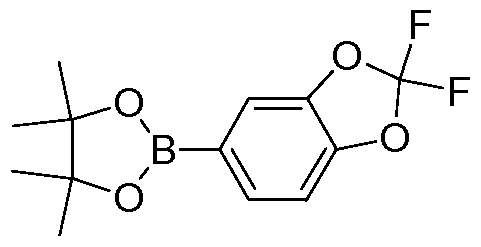
To an 80 ml_ microwave vessel was added 5-bromo-2,2-difluoro- benzo[1 ,3]dioxole (2.0 g, 8.44 mmol), bis(pinocolato)diboron (2.36 g, 9.28 mmol), potassium acetate (1.66 g, 16.9 mmol), Pd(dppf)CI2 »CH2CI2 (689 mg, 0.84 mmol) and 1 ,4-dioxane (25 ml_). The vessel was purged with N2 and then heated via microwave irradiation for 45 min at 140 °C. The reaction mixture was diluted, filtered through a pad of Celite® and then filtered through a 0.45 μM nylon filter to remove residual palladium particulates, dried (Na2SO4) and concentrated. The crude material was purified (FCC) to yield the title compound as a green oil (1.41 g, 59%).
Intermediate 3: 4,4,5,5-Tetramethyl-2-(5-trifluoromethoxy-benzo[b]thiophen-2-yl)- [1 ,3,2]dioxaborolane.

Step A: 5-Trifluoromethoxy-benzo[b]thiophene. A mixture of 5- trifluoromethoxy-benzo[b]thiophene-2-carboxylic acid (2.00 g, 7.63 mmol) and 1 ,8- diazabicyclo[5.4.0]undec-7-ene (DBU) (5.0 mL, 32 mmol) in DMA (12 ml_) was heated via microwave irradiation at 200 °C for 1 h. The reaction was cooled to rt, diluted with HCI (1 N aq., 15 mL) and extracted with EtOAc (15 mL). The organic layer was washed with water (10 mL), dried (Na2SO4) and concentrated. The residue was taken up in Et2O (25 mL) and washed with water (25 mL). The aqueous layer was extracted with Et2O (10 mL x 2). The combined Et2O layers were dried (Na2SO4) and concentrated. The crude material was purified (FCC) to yield the title compound (518 mg, 31 %).
Step B: 4,4,5,5-Tetramethyl-2-(5-trifluoromethoxy-benzo[b]thiophen-2-yl)- [1 ,3,2]dioxaborolane. To a 2-necked round bottom flask was added [lr(OMe)(COD)]2 (15 mg, 0.02 mmol) and 4,4'-di-te/t-butyl-2,2'-bipyridine (dtbpy) (12 mg, 0.05 mmol) and the flask was evacuated and refilled with N2. The flask was charged with a solution consisting of 5-trifluoromethoxy-benzo[b]thiophene (330 mg, 1.5 mmol) and hexane (9 mL), followed by pinacolborane (0.28 mL, 1.9 mmol). The reaction mixture was allowed to stir at rt for 3.5 h before diluting with CH2CI2 (10 mL) and washing with water (10 mL). The organic layer was dried (Na2SO4), concentrated and purified (FCC) to yield the title compound (350 mg, 68%).
Intermediate 4: 4-trifluoromethylsulfanyl-benzene boronic acid.

Step A: 4,4,5,5-Tetramethyl-2-(4-trifluoromethylsulfanyl-phenyl)- [1 ,3,2]dioxaborolane. The title compound was prepared using methods analogous to
those described for Intermediate 2 substituting 1-bromo-4-trifluoromethylsulfanyl- benzene as a starting material.
Step B: 4-trifluoromethylsulfanyl-benzene boronic acid. To a round-bottomed flask was added 4,4,5,5-tetramethyl-2-(4-trifluoromethylsulfanyl-phenyl)- [1 ,3,2]dioxaborolane (960 mg, 3.16 mmol) and sodium periodate (2.03 g, 9.48 mmol) in THF and water (4:1 , 26 ml_). The resulting suspension was stirred at rt for 30 min. HCI (1 N aq., 2.21 ml_) was added to the suspension and the reaction mixture was stirred at rt for 18 h. The resulting precipitate was removed by filtration and washed with hexanes. The filtrate was diluted with water (25 ml_) and extracted with EtOAc (25 ml_). The aqueous layer was extracted with EtOAc (10 ml_ x 2), and the combined organic layers dried (Na2SO4) and concentrated to yield the title compound (512 mg, 73%).
Intermediate 5: 3-Trifluoromethyl-benzo[d]isoxazole-6-boronic acid.

Step A: 1-(4-Bromo-2-fluoro-phenyl)-2,2,2-trifluoro-ethanol. A mixture of 4- bromo-2-fluoro-benzaldehyde (8.12 g, 40.0 mmol) and (trifluoromethyl)trimethylsilane (7.50 ml_, 48.0 mmol) in THF (40 mL) was cooled to 0 0C before treating with TBAF (1 M in THF, 0.6 mL) and warming to rt. After 3 h, an additional portion of TBAF (1 M in THF, 8.0 mL) was added. The resultant mixture was allowed to stir for 10 min before adding HCI (1 N aq., 40 mL) and extracting with Et2O (40 mL). The Et2O layer was dried (MgSO4) and concentrated to yield the title compound (10.7 g, 98%).
Step B: 1-(4-Bromo-2-fluoro-phenyl)-2,2,2-trifluoro-ethanone. Dess-Martin periodinane (16.57 g, 39.06 mmol) was added to a solution of 1-(4-bromo-2 -fluorophenyl)^, 2, 2-trifluoro-ethanol (10.66 g, 39.06 mmol) in DCM (100 mL) and the reaction mixture was stirred at rt for 1.5 h. Na2S2Os (10% aq., 100 mL) was added and the resulting mixture extracted with CH2CI2 (100 mL). The organic layer was washed with Na2S2O3 (50 mL x 2), NaHCO3 (satd. aq., 100 mL x 2), and brine (100 mL
x 2). The organic layers were dried (Na2SO4) and concentrated. The crude material was purified (FCC) to yield the title compound (3.20 g, 30%).
Step C: 1-(4-Bromo-2-fluoro-phenyl)-2,2,2-trifluoro-ethanone oxime. To a solution consisting of 1-(4-bromo-2-fluoro-phenyl)-2,2,2-trifluoro-ethanone (3.12 g, 11.5 mmol) and MeOH (50 ml_) was added hydroxylamine hydrochloride (4.00 g, 57.5 mmol) and sodium acetate (5.90 g, 71.9 mmol). The resulting mixture was heated at 64 °C for 19 h, after which time additional hydroxylamine hydrochloride (2.40 g, 34.5 mmol) and sodium acetate (3.54 g, 43.1 mmol) were added. Heating was continued for 24 h and the mixture filtered to remove solids. The filtrate was diluted with EtOAc (150 ml_), washed with water (150 ml_), dried (Na2SO4) and concentrated. The title compound was obtained as a 70:30 ratio of the E and Z oxime isomers (3.28 g, 100%).
Step D: 6-Bromo-3-trifluoromethyl-benzo[d]isoxazole. A solution consisting of 1-(4-bromo-2-fluoro-phenyl)-2,2,2-trifluoro-ethanone oxime (3.2 g, 11 mmol), 1 ,8- diazabicyclo[5.4.0]undec-7-ene (DBU) (1.1 ml_, 7.4 mmol) and THF (42 ml_) was heated at 150 °C via microwave irradiation for 30 min. The reaction mixture was diluted with CH2CI2 (25 ml_) and washed with HCI (1 N aq., 25 ml_). The organic layer was then dried (Na2SO4), concentrated and purified (FCC) to yield the title compound (1.97 g, 66%).
Step E: 3-Trifluoromethyl-benzo[d]isoxazole-6-boronic acid. Title compound was prepared using methods analogous to those described in Intermediate 4.
Example 1 : (1 R)-N2-{6-[3-Chloro-4-(trifluoromethyl)phenyl]pyrimidin-4-yl}-1 - phenylethane-1 ,2-diamine hydrochloride acid salt.

Step A: tert-Butyl [(1 R)-2-({6-[3-chloro-4-(trifluoromethyl)phenyl]pyhmidin-4- yl}amino)-1-phenylethyl]carbamate. To a solution of 4-chloro-6-(3-chloro-4-
trifluoromethyl-phenyl)-pyrimidine (220 mg, 0.75 mmol) in dioxane (6 ml_) was added [2-amino-(1 R)-phenyl-ethyl]-carbamic acid tert-butyl ester (177 mg, 0.75 mmol) (Gerber-Lemaire et. al. Heterocycles 2006, 69, 179-192) and NaHCO3 (378 mg, 4.50 mmol). The reaction mixture was heated at 100 °C for 16 h, then cooled to rt and diluted with CH2CI2 (25 ml_), washed with water (20 ml_), dried (MgSO4) and
concentrated. The crude material was purified (FCC) to yield the final product (208 mg, 56%).
Step B: A HCI solution (2 M in Et2O, 1.01 ml_) was added to tert-butyl [(1 R)-2- ({6-[3-chloro-4-(trifluoromethyl)phenyl]pyrimidin-4-yl}amino)-1-phenylethyl]carbamate (200 mg, 0.41 mmol) in CH2CI2 (4 ml_). The reaction mixture was stirred at rt overnight. The precipitate was filtered and washed with Et2O to yield the title compound (138 mg, 79%). MS (ESI): mass calcd. for Ci9Hi6CIF3N4, 392.10; m/z found, 393.1 [M+H]+. 1H NMR (CD3OD): 8.85 (s, 1 H), 8.13 (s, 1 H), 8.04 (d, J = 8.3 Hz, 1 H), 7.93 (d, J = 8.3 Hz, 1 H), 7.56-7.44 (m, 5H), 7.15 (s, 1 H), 4.74-4.70 (m, 1 H), 4.26 (dd, J = 14.1 , 7.1 Hz, 1 H), 4.14 (dd, J = 14.4, 7.1 Hz, 1 H).
Examples 2 to 3 were prepared using methods analogous to those described in Example 1. Example 2: (1 R)-{2-[6-(3-Chloro-4-trifluoromethyl-phenyl)-pyrimidin-4-ylamino]-1- phenyl-ethyl}-carbamic acid tert-butyl ester.

MS (ESI): mass calcd. for C24H24CIF3N4O2, 492.15; m/z found, 493.2 [M+H]+. 1H NMR (CDCI3): 8.66 (s, 1 H), 8.20-8.17 (br s, 1 H), 8.02-7.79 (br s, 1 H), 7.77 (d, J = 8.2 Hz, 1 H), 7.40-7.38 (m, 2H), 7.34-7.33 (m, 3H), 6.98-6.80 (br s, 1 H), 5.60-5.50 (br s, 1 H), 5.33-5.19 (br s, 1 H), 4.92-4.87 (m, 1 H), 3.97-3.88 (br s, 1 H), 3.76-3.68 (br s, 1 H), 1.47-1.38 (br s, 9H).
Example 3: (1 S)-N2-{6-[3-Chloro-4-(trifluoromethyl)phenyl]pyπmidin-4-yl}-1 - phenylethane-1 ,2-diamine hydrochloride acid salt.

MS (ESI): mass calcd. for Ci9H16CIF3N4, 392.10; m/z found, 393.1 [M+H]+. 1H NMR (CD3OD): 8.85 (s, 1 H), 8.13 (s, 1 H), 8.04 (d, J = 8.3 Hz, 1 H), 7.93 (d, J = 8.3 Hz, 1 H), 7.56-7.44 (m, 5H), 7.15 (s, 1 H), 4.74-4.70 (m, 1 H), 4.26 (dd, J = 14.1 , 7.1 Hz, 1 H), 4.14 (dd, J = 14.4, 7.1 Hz, 1 H).
Example 4: (1 R)-N2-{6-[3-Fluoro-4-(trifluoromethyl)phenyl]pyrimidin-4-yl}-1 - phenylethane-1 ,2-diamine hydrochloride acid salt.

Step A: [2-(6-Chloro-pyrimidin-4-ylamino)-1-phenyl-ethyl]-carbamic acid tert- butyl ester. To a solution of 4,6-dichloropyhmidine (4.32 g, 29.0 mmol) in dioxane (150 ml_) was added [2-amino-(1 R)-phenyl-ethyl]-carbamic acid tert-butyl ester (6.86 g, 29.0 mmol) and NaHCO3 (14.6 g, 174 mmol). The reaction mixture was heated to 100 °C overnight. The reaction mixture was cooled to rt, diluted with CH2CI2 (150 ml_) and washed with water (200 ml_ x 2). The combined organic layers were dried
(Na2SO4), and concentrated under reduced pressure. The residue was purified (FCC) to yield the desired product (8.11 g, 80%).
Step B: tert-Butyl-[(1 R)-2-({6-[3-fluoro-4-(trifluoromethyl)phenyl]pyrimidin-4- yl}amino)-1 -phenylethyl]carbamate. [2-(6-Chloro-pyrimidin-4-ylamino)-1 -phenyl-ethyl]- carbamic acid tert-butyl ester (87 mg, 0.25 mmol), 3-fluoro-4-(trifluoromethyl)-phenyl boronic acid (57 mg, 0.28 mmol), Pd(PPh3)4 (2.9 mg, 2.5 μmol) and K3PO4 (110 mg, 0.50 mmol) were placed in a sealed tube which was evacuated and refilled with N2. 1 ,2-Dimethoxyethane (2 ml_) and water (0.5 ml_) were added to the sealed tube. The
reaction mixture was stirred at 85 °C overnight. The reaction mixture was cooled to rt and was filtered through a pad of MgSO4. The pad was washed with CH2CI2. The crude filtrate was concentrated under reduced pressure and the residue was purified via reverse phase chromatography to yield the title compound (87.0 mg, 59%).
Step C: (1 R)-N2-{6-[3-Fluoro-4-(trifluoromethyl)phenyl]pyrimidin-4-yl}-1 - phenylethane-1 ,2-diamine hydrochloride acid salt. Title compound was prepared using methods similar to those described in Example 1. MS (ESI): mass calcd. for Ci9Hi6F4N4, 376.13; m/z found, 377.2 [M+H]+. 1H NMR (CD3OD): 8.86 (s, 1 H), 7.99- 7.96 (m, 1 H), 7.89 (d, J = 11.0 Hz, 1 H), 7.83 (d, J = 7.7 Hz, 1 H), 7.56-7.54 (m, 2H), 7.52-7.46 (m, 3H), 7.14 (s, 1 H), 4.73-4.71 (m, 1 H), 4.25 (dd, J = 14.0, 6.9 Hz, 1 H), 4.13 (dd, J = 14.0, 6.6 Hz, 1 H).
Examples 5 to 23 were prepared using methods analogous to those described in Example 4.
Example 5: (1 R)-1 -Phenyl-N2-{6-[4-(trifluoromethyl)phenyl]pyrimidin-4-yl}ethane-1 ,2- diamine hydrochloride acid salt.

MS (ESI): mass calcd. for Ci9Hi7F3N4, 358.14; m/z found, 359.2 [M+H πf+. 1 Ηι NMR (CD3OD): 8.86 (s, 1 H), 8.03 (d, J = 8.2 Hz, 2H), 7.94 (d, J = 8.2 Hz, 2H), 7.55- 7.46 (m, 5H), 7.12 (s, 1 H), 4.73-4.70 (m, 1 H), 4.26 (dd, J = 14.3, 6.9 Hz, 1 H), 4.13 (dd, J = 14.8, 7.1 Hz, 1 H).
Example 6: (1 R)-1 -Phenyl-N2-{6-[4-(trifluoromethoxy)phenyl]pyrimidin-4-yl}ethane-1 ,2- diamine hydrochloride acid salt.
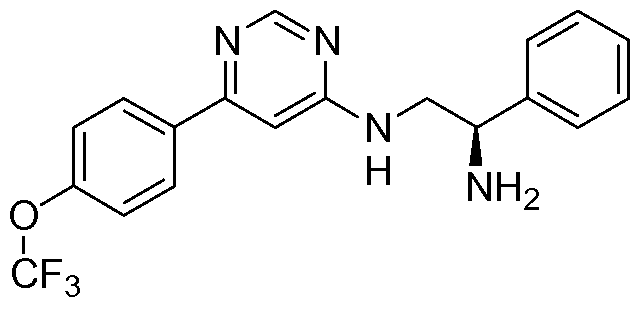
Example 7: (1 R)-N -{6-[3-Chloro-4-(trifluoromethoxy)phenyl]pyrimidin-4-yl}-1 - phenylethane-1 ,2-diamine hydrochloride acid salt.

MS (ESI): mass calcd. for Ci9Hi6CIF3N4O, 408.10; m/z found, 409.1 [M+H]+. 1H NMR (CD3OD): 8.84 (s, 1 H), 8.12 (s, 1 H), 7.90-7.88 (m, 1 H), 7.73-7.71 (m, 1 H), 7.55- 7.46 (m, 5H), 7.10 (s, 1 H), 4.73-4.70 (m, 1 H), 4.26 (dd, J = 14.3, 7.1 Hz, 1 H), 4.13 (dd, J = 14.0, 6.6 Hz, 1 H).
Example 8: (1 R)-N2-{6-[3-Fluoro-4-(thfluoromethoxy)phenyl]pyrimidin-4-yl}-1 - phenylethane-1 ,2-diamine hydrochloride acid salt.

MS (ESI): mass calcd. for Ci9Hi6F4N4O, 392.13; m/z found, 393.2 [M+H]+. 1H NMR (CD3OD): 8.83 (s, 1 H), 7.91 (d, J = 10.7 Hz, 1 H), 7.77-7.75 (m, 1 H), 7.73-7.70 (m, 1 H), 7.54-7.46 (m, 5H), 7.08 (s, 1 H), 4.72-4.69 (m, 1 H), 4.24 (dd, J = 14.3, 7.1 Hz, 1 H), 4.11 (dd, J = 14.3, 6.6 Hz, 1 H).
Example 9: (1 R)-N2-[6-(5-Methyl-1 -benzothiophen-2-yl)pyrimidin-4-yl]-1 - phenylethane-1 ,2-diamine hydrochloride acid salt.
 MS (ESI): mass calcd. for C2i H20N4S, 360.14; m/z found, 361.2 [M+H]+. 1H NMR (CD3OD): 8.75 (s, 1 H), 8.12 (s, 1 H), 7.87 (d, J = 8.2 Hz, 1 H), 7.79 (s, 1 H), 7.53- 7.48 (m, 5H), 7.39 (dd, J = 8.2, 1.4 Hz, 1 H), 7.03 (s, 1 H), 4.70-4.68 (m, 1 H), 4.23 (dd, J = 14.3, 6.9 Hz, 1 H), 4.09 (dd, J = 14.3, 6.9 Hz, 1 H), 2.49 (s, 3H).
Example 10: (1 R)-N2-{6-[4-Ethoxy-3-(trifluoromethyl)phenyl]pyrimidin-4-yl}-1 - phenylethane-1 ,2-diamine hydrochloride acid salt.

MS (ESI): mass calcd. for C2iH2i F3N4O, 402.17; m/z found, 403.2 [M+H]+. 1H NMR (CD3OD): 8.80 (s, 1 H), 8.08 -8.06 (m, 2H), 7.55-7.43 (m, 6H), 7.06 (s, 1 H), 4.73- 4.70 (m, 1 H), 4.30 (q, J = 7.1 Hz, 2H), 4.24 (dd, J = 14.0, 6.9 Hz, 1 H), 4.13 (dd, J = 14.3, 6.6 Hz, 1 H), 1.47 (t, J = 7.1 Hz, 3H).
Example 11 : (1 R)-1 -Phenyl-N2-(6-{4-[(trifluoromethyl)sulfanyl]phenyl}pyrimidin-4- yl)ethane-1 ,2-diamine hydrochloride acid salt.

MS (ESI): mass calcd. for Ci9Hi7F3N4S, 390.11 ; m/z found, 391.2 [M+H]+. 1H NMR (CD3OD): 8.84 (s, 1 H), 7.95 (s, 4H), 7.55-7.47 (m, 5H), 7.10 (s, 1 H), 4.72-4.70 (m, 1 H), 4.25 (dd, J = 14.3, 7.1 Hz, 1 H), 4.12 (dd, J = 14.0, 7.1 Hz, 1 H).
Example 12: (1 R)-N2-{6-[4-(Difluoromethoxy)-3,5-difluorophenyl]pyhmidin-4-yl}-1 - phenylethane-1 ,2-diamine hydrochloride acid salt.

MS (ESI): mass calcd. for Ci9Hi6F4N4O, 392.13; m/z found, 393.2 [M+H]+. 1H NMR (CD3OD): 8.83 (s, 1H), 7.70 (d, J = 7.7 Hz, 2H), 7.55-7.46 (m, 5H), 7.08 (s, 1H), 7.01 (t, J = 72.2 Hz, 1 H), 4.72-4.69 (m, 1 H), 4.24 (dd, J = 14.3, 7.1 Hz, 1 H), 4.12 (dd, J = 14.0, 6.0Hz, 1H).
Example 13: (1 R)-1 -Phenyl-N2-[6-(3-(trifluoromethyl)-benzo[d]isoxazol-6-yl)pyrimidin- 4-yl]-ethane-1,2-diamine hydrochloride acid salt.

MS (ESI): mass calcd. for C2OHi6F3N5O, 399.13; m/z found, 400.2 [M+H]+. 1H NMR (CD3OD): 8.91 (s, 1H), 8.38 (s, 1H), 8.19 (d, J = 8.3 Hz, 1H), 7.97 (d, J = 8.6 Hz, 1H), 7.57-7.50 (m, 5H), 7.21 (s, 1H), 4.77-4.72 (m, 1H), 4.29 (dd, J= 14.1, 6.8 Hz, 1H), 4.17 (dd, J= 14.4, 7.1 Hz, 1H).
Example 14: (1 R)-N2-[6-(4-Chlorophenyl)pyrimidin-4-yl]-1 -phenylethane-1 ,2-diamine hydrochloride acid salt.

MS(ESI): masscalcd. for Ci8Hi7CIN4, 324.11; m/z found, 325.1 [M+H]+. 1H NMR (CD3OD): 8.81 (s, 1H), 7.83 (d, J = 8.5 Hz, 2H), 7.67 (d, J = 8.5 Hz, 2H), 7.54- 7.48 (m, 5H), 7.05 (s, 1 H), 4.72-4.69 (m, 1 H), 4.24 (dd, J = 14.2, 6.7 Hz, 1 H), 4.11 (dd, J =14.0, 6.6Hz, 1H).
Example 15: (1 R)-N2-[6-(3-Chlorophenyl)pyrimidin-4-yl]-1 -phenylethane-1 ,2-diamine hydrochloride acid salt.

MS (ESI): mass calcd. for Ci8Hi7CIN4, 324.11 ; m/z found, 325.1 [M+H]+. 1H NMR (CD3OD): 8.82 (s, 1 H), 7.89-7.88 (m, 1 H), 7.77 (d, J = 7.7 Hz, 1 H), 7.73-7.69 (m, 1 H), 7.63 (t, J = 8.0 Hz, 1 H), 7.54-7.47 (m, 5H), 7.06 (s, 1 H), 4.72-4.69 (m, 1 H), 4.24 (dd, J = 14.3, 6.7 Hz, 1 H), 4.12 (dd, J = 13.5, 6.3 Hz, 1 H).
Example 16: (1 R)-N2-[6-(3,4-Dichlorophenyl)pyrimidin-4-yl]-1 -phenylethane-1 ,2- diamine hydrochloride acid salt.
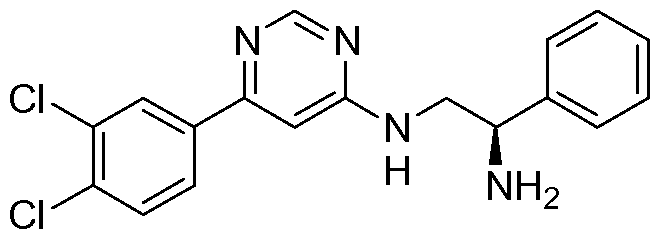
MS (ESI): mass calcd. for Ci8Hi6CI2N4, 358.08; m/z found, 359.1 [M+H]+. 1H NMR (CD3OD): 8.82 (s, 1 H), 8.06 (d, J = 1.9 Hz, 1 H), 7.81 (d, J = 8.5 Hz, 1 H), 7.77- 7.75 (m, 1 H), 7.54-7.47 (m, 5H), 7.07 (s, 1 H), 4.72-4.69 (m, 1 H), 4.23 (dd, J = 14.3, 7.1 Hz, 1 H), 4.12 (dd, J = 14.3, 6.7 Hz, 1 H).
Example 17: (1 R)-N2-{6-[4-Chloro-3-(trifluoromethyl)phenyl]pyrimidin-4-yl}-1 - phenylethane-1 ,2-diamine hydrochloride acid salt.

MS (ESI): mass calcd. for Ci9Hi6CIF3N4, 392.10; m/z found, 393.1 [M+H]+. 1H NMR (CD3OD): 8.84 (s, 1 H), 8.25 (d, J = 2.2 Hz, 1 H), 8.08-8.06 (m, 1 H), 7.91 (d, J = 8.2 Hz, 1 H), 7.54-7.47 (m, 5H), 7.10 (s, 1 H), 4.72-4.69 (m, 1 H), 4.25 (dd, J = 14.0, 6.9 Hz, 1 H), 4.12 (dd, J = 14.0, 6.9 Hz, 1 H).
Example 18: (1 R)-1 -Phenyl-N2-{6-[3-(trifluoromethoxy)phenyl]pyrimidin-4-yl}ethane- 1 ,2-diamine hydrochloride acid salt.

MS (ESI): mass calcd. for Ci9H17F3N4O, 374.14; m/z found, 375.2 [M+H]+. 1H NMR (CD3OD): 8.84 (s, 1 H), 7.84 (d, J = 7.7 Hz, 1 H), 7.78-7.74 (m, 2H), 7.64 (d, J = 8.2 Hz, 1 H), 7.55-7.47 (m, 5H), 7.10 (s, 1 H), 4.73-4.70 (m, 1 H), 4.25 (dd, J = 14.3, 7.1 Hz, 1 H), 4.13 (dd, J = 14.0, 7.1 Hz, 1 H).
Example 19: (1 R)-N2-[6-(4-Ethoxyphenyl)pyrimidin-4-yl]-1 -phenylethane-1 ,2-diamine hydrochloride acid salt.

MS (ESI): mass calcd. for C20H22N4O, 334.18; m/z found, 335.2 [M+H]+. 1H NMR (CD3OD): 8.76 (s, 1 H), 7.80 (d, J = 8.5 Hz, 2H), 7.54-7.47 (m, 5H), 7.15 (d, J = 9.1 Hz, 2H), 6.99 (s, 1 H), 4.71-4.68 (m, 1 H), 4.23 (dd, J = 14.3, 6.7 Hz, 1 H), 4.15 (q, J = 7.1 Hz, 2H), 4.10 (dd, J = 14.3, 6.6 Hz, 1 H), 1.43 (t, J = 7.1 Hz, 3H).
Example 20: (1 R)-1 -Phenyl-N2-{6-[4-(2,2,2-trifluoroethoxy)phenyl]pyhmidin-4- yl}ethane-1 ,2-diamine hydrochloride acid salt.

MS (ESI): mass calcd. for C20H19F3N4O, 388.15; m/z found, 389.2 [M+H]+. 1H NMR (CD3OD): 8.78 (s, 1 H), 7.85 (d, J = 8.8 Hz, 2H), 7.54-7.47 (m, 5H), 7.28 (d, J =
9.1 Hz, 2H), 7.01 (s, 1 H), 4.72-4.67 (m, 3H), 4.23 (dd, J = 14.0, 7.1 Hz, 1 H), 4.10 (dd, J = 14.0, 6.9 Hz, 1 H).
Example 21 : (1 R)-N2-{6-[3-Fluoro-4-(2,2,2-trifluoroethoxy)phenyl]pyrimidin-4-yl}-1 - phenylethane-1 ,2-diamine hydrochloride acid salt.

MS (ESI): mass calcd. for C20Hi8F4N4O, 406.14; m/z found, 407.2 [M+H]+. 1H NMR (CD3OD): 8.79 (s, 1 H), 7.73 (d, J = 11.0 Hz, 1 H), 7.69 (d, J = 8.2 Hz, 1 H), 7.54- 7.44 (m, 6H), 7.04 (s, 1 H), 4.79 (q, J = 8.2 Hz, 2H), 4.72-4.69 (m, 1 H), 4.24 (dd, J = 14.3, 7.1 Hz, 1 H), 4.11 (dd, J = 14.3, 7.1 Hz, 1 H).
Example 22: (1 R)-N -{6-[4-(Ethylsulfanyl)phenyl]pyrimidin-4-yl}-1 -phenylethane-1 ,2- diamine hydrochloride acid salt.

MS (ESI): mass calcd. for C20H22N4S, 350.16; m/z found, 351.2 [M+H]+. 1H NMR (CD3OD): 8.78 (s, 1 H), 7.75 (d, J = 8.5 Hz, 2H), 7.54-7.47 (m, 7H), 7.03 (s, 1 H), 4.71-4.68 (m, 1 H), 4.24 (dd, J = 14.3, 7.1 Hz, 1 H), 4.11 (m, J = 14.5, 7.1 Hz, 1 H), 3.10 (q, J = 7.4 Hz, 2H), 1.37 (t, J = 7.4 Hz, 3H). Example 23: 4-(6-{[(2R)-2-Amino-2-phenylethyl]amino}pyrimidin-4-yl)-N,N- dimethylbenzenesulfonamide hydrochloride acid salt.

Example 24: (1 R)-N2-[6-(2,2-Difluoro-1 ,3-benzodioxol-5-yl)pyrimidin-4-yl]-1 - phenylethane-1 ,2-diamine hydrochloride acid salt.

The title compound was prepared using methods analogous to those described in Example 4 with the following modifications performed in step B.
Step B: tert-Butyl [(1 R)-2-({6-[2,2-difluoro-1 ,3-benzodioxo-5-yl]pyrimidin-4- yl}amino)-1 -phenylethyl]carbamate. [2-(6-Chloro-pyrimidin-4-ylamino)-1 -phenyl-ethyl]- carbamic acid tert-butyl ester (87.2 mg, 0.25 mmol), 2,2-difluoro-5-(4,4,5,5- tetramethyl-[1 ,3,2]dioxaborolan-2-yl)-benzo[1 ,3]dioxole (71.0 mg, 0.25 mmol),
Pd(OAc)2 (1.1 mg, 0.005 mmol), 2-dicyclohexylphosphino-2', 6'-dimethoxy-1 , 1 '- biphenyl (S-Phos) (4.1 mg, 0.01 mmol) and K3PO4 (159 mg, 0.75 mmol) were dissolved in 1 ,4-dioxane (2.0 ml_) and water (0.2 ml_) in a microwave tube. The tube was evacuated and refilled with N2 and heated at 90 °C overnight. The reaction mixture was cooled to rt and filtered through a pad of MgSO4. The pad was washed with CH2CI2 and the filtrate was concentrated under reduced pressure. The crude residue was purified (FCC) to yield the desired product (81 mg, 69%).
Step C: (1 R)-N2-[6-(2,2-Difluoro-1 ,3-benzodioxol-5-yl)pyrimidin-4-yl]-1 - phenylethane-1 ,2-diamine. MS (ESI): mass calcd. for Ci9Hi6F2N4O2, 370.12; m/z found, 371.2 [M+H]+. 1H NMR (CD3OD): 8.83 (s, 1 H), 7.74 (s, 1 H), 7.68 (d, J = 8.8 Hz, 1 H), 7.55-7.47 (m, 6H), 7.04 (s, 1 H), 4.72-4.70 (m, 1 H), 4.25 (dd, J = 14.3, 6.9 Hz, 1 H), 4.13 (dd, J = 14.3, 6.9 Hz, 1 H).
Example 25 was prepared using methods analogous to those described in Example 24.
Example 25: (1 R)- 1 -Phenyl-N2-{6-[5-(trifluoromethoxy)-1 -benzothiophen-2- yl]pyrimidin-4-yl}ethane-1 ,2-diamine hydrochloride acid salt.

MS (ESI): mass calcd. for C2i Hi7F3N4OS, 430.11 ; m/z found, 431.1 [M+H]+. 1H NMR (CD3OD): 8.79 (s, 1 H), 8.22 (s, 1 H), 8.11 (d, J = 8.8 Hz, 1 H), 7.94 (s, 1 H), 7.53- 7.46 (m, 6H), 7.09 (s, 1 H), 4.72-4.69 (m, 1 H), 4.24 (dd, J = 14.0, 7.1 Hz, 1 H), 4.10 (dd, J = 14.3, 7.1 Hz, 1 H).
Example 26: N-[(1 R)-2-({6-[3-chloro-4-(trifluoromethyl)phenyl]pyhmidin-4-yl}amino)-1 - phenylethyl]-2,2,2-thfluoroacetamide.

To a solution of (1 R)-N^-{6-[3-chloro-4-(trifluoromethyl)phenyl]pyrimidin-4-yl}-1 - phenylethane-1 ,2-diamine (215 mg, 0.50 mmol) in anhydrous THF (4 ml_) and thethylamine (0.15 ml_, 1.1 mmol) at 0 °C was added dropwise a solution of
trifluoroacetic anhydride (0.10 ml_, 0.75 mmol) in anhydrous THF (0.15 ml_). The reaction was stirred for 2.5 h. and then diluted with water (20 ml_) and EtOAc (20 ml_). The layers were separated and the organic layer was washed with a 2 N aq. HCI (10 ml_), followed by brine (10 ml_), dried (MgSO4) and concentrated under reduced pressure. The reaction mixture was purified (FCC) to yield the title compound (173 mg, 71 %). MS (ESI): mass calcd. for C2i Hi5CIF6N4O, 488.08; m/z found, 489.1
[M+H]+. 1H NMR (CDCI3): 8.73 (d, J = 0.8 Hz, 1 H), 8.14 (s, 1 H), 7.94 (d, J = 7.6 Hz, 1 H), 7.79 (d, J = 8.3 Hz, 1 H), 7.41-7.37 (m, 2H), 7.35-7.28 (m, 3H), 6.79 (s, 1 H), 5.27-
5.18 (br s, 1 H), 5.14-5.10 (m, 1 H), 4.01-3.93 (m, 1 H), 3.87 (ddd, J = 14.7, 6.1 , 3.3 Hz, 1 H).
Example 27: (1 R)-N2-[6-(3-Chloro-4-trifluoromethyl-phenyl)-pyrimidin-4-yl]-1 -(4-fluoro- phenyl)-ethane-1 ,2-diamine.
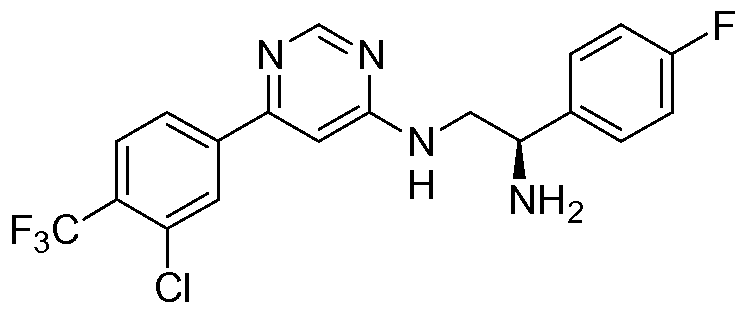
Step A: (1 R)-2-Methyl-propane-2-sulfinic acid 4-fluoro-benzylideneamide. To a solution consisting of 4-fluorobenzaldehyde (0.69 ml_, 8.06 mmol), (1 R)-2-methyl- propane-2-sulfinic acid amide (1.08 g, 8.89 mmol) and THF (90 ml_) was added Ti(OEt)4 (3.4 ml_, 16.1 mmol). The reaction mixture was stirred for 16 h at rt. NaCI (sat. aq., 100 ml_) was added to the reaction mixture and a white solid precipitated. The mixture was diluted with H2O (500 ml_) and filtered through a pad of Celite®. The resultant filtrate was extracted with EtOAc (100 ml_) and washed with sat. aq. NaCI (2 x 100 ml_). The organic layer was separated, dried (MgSO4), and concentrated under reduced pressure. The crude residue was purified (FCC) to give the title compound as a pale yellow oil (1.57 g, 85%). MS (ESI+): calcd for Cn Hi4FNOS m/z 227.08, found 228.1 (M+H)+. 1H NMR (CDCI3): 8.55 (s, 1 H), 7.87 (dd, J = 8.8, 5.5, 2H), 7.17 (t, J = 8.6, 2H), 1.27 (s, 9H).
Step B: (R,R)-2-Methyl-propane-2-sulfinic acid [1-(4-fluoro-phenyl)-2-nitro- ethyl]-amide. To a cooled mixture of nitromethane (2.19 ml_, 40.7 mmol) and THF (30 ml_ at 0 °C was added t-BuOK (1 M in THF, 8.14 ml_) dropwise. A white precipitate formed. Stirring was continued for 10 min at 0 °C and then a solution of (1 R)-2- methyl-propane-2-sulfinic acid 4-fluoro-benzylideneamide (0.925 g, 4.07 mmol) in THF (10 ml_) was added dropwise. The reaction was stirred for an additional 10 min at 0 °C before slowly warming to rt overnight. After 16 h, glacial acetic acid (2 ml_) was added to the reaction mixture which lowered the pH to 5. The mixture was then washed with brine (2 x 10OmL). The organic layer was dried (MgSO4), filtered and concentrated under reduced pressure. The crude residue was purified (FCC) providing (R,S)-2-
methyl-propane-2-sulfinic acid [1-(4-fluoro-phenyl)-2-nitro-ethyl]-amide (59 mg, 5%) and (R,R)-2-methyl-propane-2-sulfinic acid [1-(4-fluoro-phenyl)-2-nitro-ethyl]-amide (669 mg, 57%) respectively. MS (ESI+): calcd for Ci2Hi7FN2O3S m/z 288.09, found 289.1 (M+H)+. 1H NMR (CDCI3): 7.35 (dd, J = 8.7, 5.2 Hz, 2H), 7.07 (t, J = 8.6 Hz, 2H), 5.11-5.06 (m, 1 H), 4.85 (dd, J = 13.3, 7.5 Hz, 1 H), 4.75 (dd, J = 13.3, 5.0 Hz, 1 H), 4.58 (d, J = 5.2 Hz, 1 H), 1.22 (s, 9H).
Step C: (R,R)-2-Methyl-propane-2-sulfinic acid [2-amino-1-(4-fluoro-phenyl)- ethyl]-amide. Zn powder (5.07 g, 77.6 mmol) was added to a solution of (R,R)-2- methyl-propane-2-sulfinic acid [1-(4-fluoro-phenyl)-2-nitro-ethyl]-amide (2.24 g, 7.76 mmol) and NH4CI (4.15 g, 77.6 mmol) in 5:1 acetone/H2O (24 ml_) at rt. After 10 min, the reaction mixture was filtered and the filtrate concentrated under reduced pressure. The crude residue was crystallized using CH2CI2 (20 ml_) and hexanes (50 ml_) to provide (R,R)-2-methyl-propane-2-sulfinic acid [2-amino-1-(4-fluoro-phenyl)-ethyl]- amide (1.8 g, 89%). MS (ESI+): calcd for Ci2Hi9FN2OS m/z 258.12, found 259.1 (M+H)+.
Step D: (R,R)-2-Methyl-propane-2-sulfinic acid [2-[6-(3-chloro-4-trifluoromethyl- phenyl)-pyrimidin-4-ylamino]-1-(4-fluoro-phenyl)-ethyl]-amide. A solution of 4-chloro-6- (3-chloro-4-trifluoromethyl-phenyl)-pyrimidine (0.200 g, 0.68 mmol), (R,R)-2-methyl- propane-2-sulfinic acid [2-amino-1-(4-fluoro-phenyl)-ethyl]-amide (0.720 g, 2.79 mmol) and DIPEA (0.18 mL, 1.02 mmol) in DMF (5 mL) was heated at 80 0C for 16 h. The reaction mixture was cooled to rt, diluted with EtOAc (20 mL) and washed with NaCI (sat. aq., 2 x 30 mL). The organic layer was dried (MgSO4) and concentrated under reduced pressure. The crude residue was purified (FCC) to give the title compound (0.172 g, 50%) as a yellow solid. MS (ESI+): calcd for C23H23CIF4N4OS m/z 514.12, found 515.1 (M+H)+.
Step E: (1 R)-N2-[6-(3-Chloro-4-trifluoromethyl-phenyl)-pyrimidin-4-yl]-1 -(4- fluoro-phenyl)-ethane-1 ,2-diamine. A solution of (R,R)-2-methyl-propane-2-sulfinic acid [2-[6-(3-chloro-4-trifluoromethyl-phenyl)-pyrimidin-4-ylamino]-1-(4-fluoro-phenyl)- ethyl]-amide (0.172 g, 0.337 mmol) in MeOH (5 mL) was added HCI (4 N in dioxane, 0.34 mL) at rt. After 30 min, the reaction mixture was purified directly via reverse phase chromatography. The desired fractions were then free-based by washing with
sat. aq. NaHCO3 (2 x 30 ml_) and extracting with EtOAc (2 x 25 ml_). The organic layers were combined, dried (MgSO4), filtered and concentrated under reduced pressure to give the title compound (75 mg, 54%) as a white solid. MS (ESI+): calcd for Ci9Hi5CIF4N4 m/z 410.09, found 411.1 (M+H)+. 1H NMR (CDCI3): 8.60 (s, 1 H), 8.05 (s, 1 H), 7.86 (d, J = 8.2 Hz, 1 H), 7.73 (d, J = 8.3 Hz, 1 H), 7.35 (dd, J = 8.6, 5.3 Hz, 2H), 7.05 (t, J = 8.6 Hz, 2H), 6.66 (s, 1 H), 5.89 (s, 1 H), 4.27 (s, 1 H), 3.76-3.64 (m, 1 H), 3.59-3.50 (m, 1 H), 3.03-2.85 (m, 2H).
Examples 28 to 65 were prepared using methods analogous to those described for Example 27, using the appropriate commercially available aldehyde.
Example 28: (1 S)-N2-[6-(3-Chloro-4-trifluoromethyl-phenyl)-pyrimidin-4-yl]-1 -(4-fluoro- phenyl)-ethane-1 ,2-diamine.

MS (ESI+): calcd for Ci9Hi5CIF4N4 m/z 410.09, found 411.1 (M+H)+. 1H NMR (CDCI3): 8.65 (s, 1 H), 8.10 (s, 1 H), 7.91 (d, J = 8.3 Hz, 1 H), 7.76 (d, J = 8.2 Hz, 1 H), 7.36 (dd, J = 8.7, 5.3 Hz, 2H), 7.06 (t, J = 8.7 Hz, 2H), 6.68 (s, 1 H), 5.55 (s, 1 H), 4.28- 4.20 (m, 1 H), 3.75-3.62 (m, 1 H), 3.56-3.51 (m, 1 H), 1.71-1.60 (m, 2H).
Example 29: (1 S)-N2-[6-(3-Chloro-4-trifluoromethyl-phenyl)-pyrimidin-4-yl]-1 -(4- trifluoromethyl-phenyl)-ethane-1 ,2-diamine.

MS (ESI+): calcd for C20HI5CIF6N4 m/z 460.09, found 461.1 (M+H)+. 1H NMR (CDCI3): 8.62 (s, 1 H), 8.05 (s, 1 H), 7.86 (d, J = 7.5 Hz, 1 H), 7.73 (d, J = 8.3 Hz, 1 H),
7.62 (d, J = 8.1 Hz, 2H), 7.52 (d, J = 8.1 Hz, 2H), 6.67 (s, 1 H), 5.83 (s, 1 H), 4.41 (s, 1 H), 4.07 (s, 2H), 3.84-3.75 (m, 1 H), 3.65-3.55 (m, 1 H).
Example 30: (1 R)-N2-[6-(3-Chloro-4-trifluoromethyl-phenyl)-pyrimidin-4-yl]-1 -(4- trifluoromethyl-phenyl)-ethane-1 ,2-diamine.
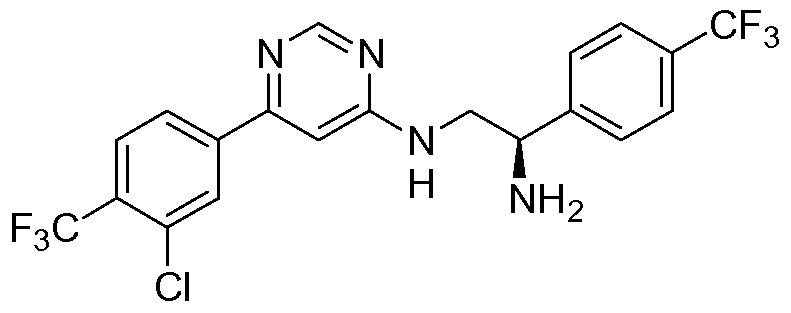
MS (ESI+): calcd for C20Hi5CIF6N4 m/z 460.09, found 461.1 (M+H)+. 1H NMR (CDCI3): 8.61 (s, 1 H), 8.04 (s, 1 H), 7.84 (d, J = 8.2 Hz, 1 H), 7.73 (d, J = 8.3 Hz, 1 H), 7.62 (d, J = 8.2 Hz, 2H), 7.51 (d, J = 8.1 Hz, 2H), 6.66 (s, 1 H), 5.88 (s, 1 H), 4.53-4.31 (m, 3H), 3.87-3.73 (m, 1 H), 3.66-3.55 (m, 1 H).
Example 31 : (1 S)-N2-[6-(3-Chloro-4-trifluoromethyl-phenyl)-pyrimidin-4-yl]-1 -(2,2- difluoro-benzo[1 ,3]dioxol-5-yl)-ethane-1 ,2-diamine.
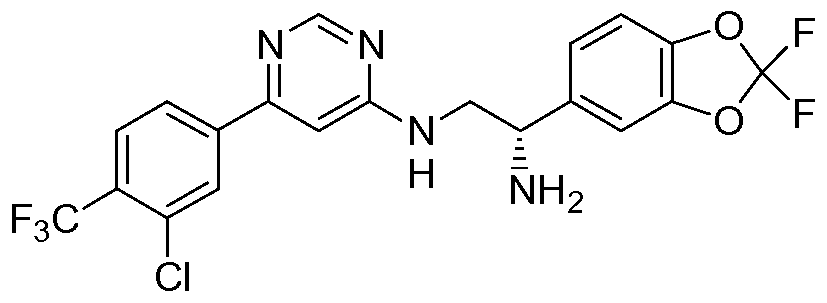
MS (ESI+): calcd for C20Hi4CIF5N4O2 m/z 472.07, found 473.1 (M+H)+. 1H NMR (CDCI3): 8.65 (s, 1 H), 8.09 (s, 1 H), 7.90 (d, J = 8.2 Hz, 1 H), 7.75 (d, J = 8.3 Hz, 1 H), 7.16 (s, 1 H), 7.09 (d, J = 8.2 Hz, 1 H), 7.03 (d, J = 8.1 Hz, 1 H), 6.69 (s, 1 H), 5.57 (s, 1 H), 4.31 (s, 1 H), 3.79-3.62 (m, 1 H), 3.60-3.48 (m, 1 H), 2.78-2.20 (m, 2H).
Example 32: (1 R)-N2-[6-(3-Chloro-4-trifluoromethyl-phenyl)-pyhmidin-4-yl]-1 -(2,2- difluoro-benzo[1 ,3]dioxol-5-yl)-ethane-1 ,2-diamine.
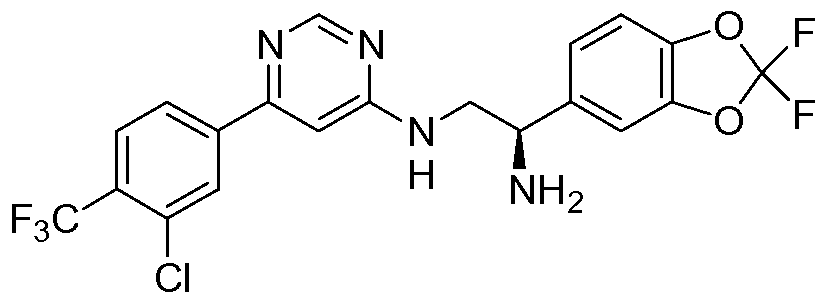
Example 33: (1 S)-4-{1 -Amino-2-[6-(3-chloro-4-trifluoromethyl-phenyl)-pyrimidin-4- ylamino]-ethyl}-benzonitrile.

MS (ESI+): calcd for C20Hi5CIF3N5 m/z 417.10, found 418.1 (M+H)+. 1H NMR (CDCI3): 8.65 (s, 1 H), 8.10 (s, 1 H), 7.92 (d, J = 8.2, 1 H), 7.76 (d, J = 8.3, 1 H), 7.65 (d, J = 8.5, 2H), 7.54 (d, J = 8.3, 2H), 6.72 (s, 1 H), 5.61 (s, 1 H), 4.35 (s, 1 H), 3.79-3.70 (m, 1 H), 3.59-3.47 (m, 1 H), 1.76-1.60 (m, 2H).
Example 34: (1 R)-4-{1 -Amino-2-[6-(3-chloro-4-trifluoromethyl-phenyl)-pyhmidin-4- ylamino]-ethyl}-benzonitrile.

MS (ESI+): calcd for C20Hi5CIF3N5 m/z 417.10, found 418.1 (M+H)+. 1H NMR (CDCI3): 8.66 (s, 1 H), 8.10 (s, 1 H), 7.92 (d, J = 9.0 Hz, 1 H), 7.76 (d, J = 8.3 Hz, 1 H), 7.65 (d, J = 8.4 Hz, 2H), 7.54 (d, J = 8.2 Hz, 2H), 6.72 (d, J = 1.0 Hz, 1 H), 5.62-5.52 (m, 1 H), 4.39-4.30 (m, 1 H), 3.79-3.71 (m, 1 H), 3.58-3.49 (m, 1 H), 1.76-1.58 (m, 2H).
Example 35: N2-[6-(3-Chloro-4-trifluoromethyl-phenyl)-pyrimidin-4-yl]-1 -(2-fluoro- phenyl)-ethane-1 ,2-diamine.

MS (ESI+): calcd for Ci9Hi5CIF4N4 m/z 410.09, found 411.1 (M+H)+. 1HNMR (CDCI3): 8.64 (s, 1 H), 8.12 (s, 1 H), 7.93 (d, J = 8.1 Hz, 1 H), 7.77 (d, J = 8.2 Hz, 1 H), 7.43 (t, J = 7.0 Hz, 1H), 7.32-7.26 (m, 1H), 7.16 (t, J = 7.1 Hz, 1H), 7.11-7.04 (m, 1H), 6.74 (s, 1H), 5.70 (s, 1H), 4.49 (s, 1H), 3.83-3.72 (m, 1H), 3.63-3.50 (m, 1H), 2.23- 1.90 (m, 2H).
Example 36: (1 S)-N2-[6-(3-Chloro-4-trifluoromethyl-phenyl)-pyrimidin-4-yl]-1 -(3-fluoro- phenyl)-ethane-1,2-diamine, trifluoroacetic acid salt.

MS (ESI+): calcd for Ci9Hi5CIF4N4 m/z 410.09, found 411.1 (M+H)+. 1HNMR (de-DMSO): 8.67-8.55 (m, 3H), 8.28 (s, 1H), 8.17-8.09 (m, 1H), 8.00 (d, J = 8.4 Hz, 1H), 7.75(s, 1H), 7.50 (dd, J= 14.1, 8.0 Hz, 1H), 7.41 (d, J= 10.0 Hz, 1H), 7.34 (d, J = 7.8 Hz, 1H), 7.29-7.22 (m, 1H), 7.13 (s, 1H), 4.61 (s, 1H), 3.96-3.76 (m, 2H).
Example 37: (1 R)-N2-[6-(3-Chloro-4-trifluoromethyl-phenyl)-pyhmidin-4-yl]-1 -(3-fluoro- phenyl)-ethane-1,2-diamine, trifluoroacetic acid salt.

MS (ESI+): calcd for Ci9Hi5CIF4N4 m/z 410.09, found 411.1 (M+H)+. 1HNMR (de-DMSO): 8.63 (s, 1H), 8.57 (s, 2H), 8.28 (s, 1H), 8.17-8.09 (m, 1H), 8.00 (d, J = 8.3 Hz, 1 H), 7.73 (s, 1 H), 7.50 (dd, J = 14.2, 7.9 Hz, 1 H), 7.40 (d, J = 9.9 Hz, 1 H), 7.33 (d, J = 7.6 Hz, 1H), 7.29-7.21 (m, 1H), 7.13 (s, 1H), 4.61 (s, 1H), 3.96-3.88 (m, 2H).
Example 38: (1 S)-N2-1 -(4-Chloro-phenyl)-[6-(3-chloro-4-trifluoromethyl-phenyl)- pyrimidin-4-yl]-ethane-1 ,2-diamine, trifluoroacetic acid salt.

MS (ESI+): calcd for Ci9Hi5CI2F3N4 m/z 426.06, found 427.1 (M+H)+. 1H NMR (de-DMSO): 8.63 (s, 1 H), 8.54 (s, 2H), 8.27 (s, 1 H), 8.16-8.09 (m, 1 H), 8.00 (d, J = 8.4 Hz, 1 H), 7.75-7.67 (m, 1 H), 7.53 (s, 4H), 7.11 (d, J = 1.0 Hz, 1 H), 4.59 (s, 1 H), 3.95- 3.86 (m, 1 H), 3.83-3.73 (m, 1 H).
Example 39: (1 R)-N2-1 -(4-Chloro-phenyl)-[6-(3-chloro-4-trifluoromethyl-phenyl)- pyrimidin-4-yl]-ethane-1 ,2-diamine, trifluoroacetic acid salt.

MS (ESI+): calcd for Ci9Hi5CI2F3N4 m/z 426.06, found 427.1 (M+H)+. 1H NMR (de-DMSO): 8.63 (s, 1 H), 8.54 (s, 2H), 8.27 (s, 1 H), 8.16-8.09 (m, 1 H), 8.00 (d, J = 8.4 Hz, 1 H), 7.75-7.67 (m, 1 H), 7.53 (s, 4H), 7.11 (d, J = 1.0 Hz, 1 H), 4.59 (s, 1 H), 3.95- 3.86 (m, 1 H), 3.83-3.73 (m, 1 H).
Example 40: (1 S)-N2-[6-(3-Chloro-4-trifluoromethyl-phenyl)-pyrimidin-4-yl]-1 -(3,4- difluoro-phenyl)-ethane-1 ,2-diamine, trifluoroacetic acid salt.

MS (ESI+): calcd for Ci9Hi4CIF5N4 m/z 428.08, found 429.1 (M+H)+. 1H NMR (de-DMSO): 8.63 (s, 1 H), 8.26 (d, J = 9.0 Hz, 1 H), 8.10 (d, J = 9.4 Hz, 1 H), 8.00 (d, J
8.3 Hz, 1 H), 7.74 - 7.58 (m, 2H), 7.58 (s, 1 H), 7.36 (s, 1 H), 7.12 (s, 1 H), 4.60 (s, 1 H), 3.98 - 3.89 (m, 2H).
Example 41 : (1 R)-N2-[6-(3-Chloro-4-trifluoromethyl-phenyl)-pyrimidin-4-yl]-1 -(3,4- difluoro-phenyl)-ethane-1 ,2-diamine, trifluoroacetic acid salt.

MS (ESI+): calcd for Ci9Hi4CIF5N4 m/z 428.08, found 429.1 (M+H)+. 1H NMR (de-DMSO): 8.63 (s, 1 H), 8.28 (s, 1 H), 8.12 (s, 1 H), 8.00 (d, J = 8.3 Hz, 1 H), 7.77 (s, 1 H), 7.70 - 7.61 (m, 1 H), 7.53 (dt, J = 10.6, 8.5 Hz, 1 H), 7.36 (d, J = 8.5 Hz, 1 H), 7.14 (d, J = 7.3 Hz, 1 H), 4.60 (s, 1 H), 3.94 (dt, J = 12.8, 6.3 Hz, 1 H), 3.88 - 3.75 (m, 1 H).
Example 42: (1 S)-N2-[6-(3-Chloro-4-trifluoromethyl-phenyl)-pyrimidin-4-yl]-1 -(3,4- dichloro-phenyl)-ethane-1 ,2-diamine.

MS (ESI+): calcd for Ci9Hi4CI3F3N4 m/z 460.02, found 461.0 (M+H)+. 1H NMR (CDCI3): 8.66 (s, 1 H), 8.11 (s, 1 H), 7.92 (d, J = 8.2 Hz, 1 H), 7.77 (d, J = 8.3 Hz, 1 H), 7.52 (d, J = 2.0 Hz, 1 H), 7.43 (d, J = 8.3 Hz, 1 H), 7.23 (dd, J = 8.3, 2.0 Hz, 1 H), 6.70 (s, 1 H), 5.49 (s, 1 H), 4.24 (dd, J = 7.1 , 5.5 Hz, 1 H), 3.76-3.64 (m, 1 H), 3.58-3.45 (m, 1 H), 1.57 (s, 2H).
Example 43: (1 R)-N2-[6-(3-Chloro-4-trifluoromethyl-phenyl)-pyhmidin-4-yl]-1 -(3,4- dichloro-phenyl)-ethane-1 ,2-diamine.

MS (ESI+): calcd for Ci9Hi4CI3F3N4 m/z 460.02, found 461.0 (M+H)+. 1H NMR (CDCI3): 8.66 (s, 1 H), 8.11 (s, 1 H), 7.91 (d, J = 8.2 Hz, 1 H), 7.76 (d, J = 8.3 Hz, 1 H), 7.52 (d, J = 2.0 Hz, 1 H), 7.43 (d, J = 8.3 Hz, 1 H), 7.23 (dd, J = 8.3, 2.0 Hz, 1 H), 6.70 (s, 1 H), 5.55 (s, 1 H), 4.24 (dd, J = 7.4, 5.3 Hz, 1 H), 3.76-3.65 (m, 1 H), 3.57-3.46 (m, 1 H), 1.60 (s, 2H).
Example 44: (1 S)-N2-1 -(4-Chloro-3-fluoro-phenyl)-[6-(3-chloro-4-trifluoromethyl- phenyl)-pyrimidin-4-yl]-ethane-1 ,2-diamine.

MS (ESI+): calcd for Ci9Hi4CI2F4N4 m/z 444.05, found 445.1 (M+H)+. 1H NMR (CDCI3): 8.66 (s, 1 H), 8.11 (s, 1 H), 7.92 (d, J = 8.2 Hz, 1 H), 7.77 (d, J = 8.2 Hz, 1 H), 7.39 (t, J = 7.8 Hz, 1 H), 7.23 (dd, J = 9.9, 1.9 Hz, 1 H), 7.13 (dd, J = 8.2, 1.5 Hz, 1 H), 6.70 (s, 1 H), 5.45 (s, 1 H), 4.25 (dd, J = 7.2, 5.4 Hz, 1 H), 3.76-3.65 (m, 1 H), 3.56-3.46 (m, 1 H), 1.57 (s, 2H).
Example 45: (1 R)-N2-1 -(4-Chloro-3-fluoro-phenyl)-[6-(3-chloro-4-thfluoromethyl- phenyl)-pyrimidin-4-yl]-ethane-1 ,2-diamine.

MS (ESI+): calcd for Ci9Hi4CI2F4N4 m/z 444.05, found 445.1 (M+H)+. 1H NMR (CDCI3): 8.67 (s, 1 H), 8.11 (s, 1 H), 7.92 (d, J = 7.4 Hz, 1 H), 7.77 (d, J = 8.3 Hz, 1 H), 7.42-7.35 (m, 1 H), 7.23 (dd, J = 9.9, 2.0 Hz, 1 H), 7.13 (dd, J = 8.2, 2.0 Hz, 1 H), 6.70 (d, J = 0.9
Hz, 1 H), 5.45 (s, 1 H), 4.26 (dd, J = 7.4, 5.2 Hz, 1 H), 3.76-3.66 (m, 1 H), 3.56-3.48 (m, 1 H), 1.74 (s, 2H).
Example 46: (1 S)-N2-1 -(3-Chloro-4-fluoro-phenyl)-[6-(3-chloro-4-trifluoromethyl- phenyl)-pyrimidin-4-yl]-ethane-1 ,2-diamine.

MS (ESI+): calcd for Ci9Hi4CI2F4N4 m/z 444.05, found 445.1 (M+H)+. 1H NMR (CDCI3): 8.66 (s, 1 H), 8.11 (s, 1 H), 7.92 (d, J = 8.3 Hz, 1 H), 7.77 (d, J = 8.3 Hz, 1 H), 7.47 (dd, J = 7.0, 2.1 Hz, 1 H), 7.29-7.23 (m, 1 H), 7.13 (t, J = 8.6 Hz, 1 H), 6.71 (s, 1 H), 5.54 (s, 1 H), 4.24 (dd, J = 7.3, 5.3 Hz, 1 H), 3.76-3.63 (m, 1 H), 3.57-3.46 (m, 1 H), 1.57 (s, 2H).
Example 47: (1 R)-N2-1 -(3-Chloro-4-fluoro-phenyl)-[6-(3-chloro-4-trifluoromethyl- phenyl)-pyrimidin-4-yl]-ethane-1 ,2-diamine.

MS (ESI+): calcd for Ci9Hi4CI2F4N4 m/z 444.05, found 445.1 (M+H)+. 1H NMR (CDCI3): 8.65 (s, 1 H), 8.10 (s, 1 H), 7.91 (d, J = 8.6 Hz, 1 H), 7.76 (d, J = 8.3 Hz, 1 H), 7.47 (dd, J = 7.0, 2.2 Hz, 1 H), 7.29-7.23 (m, 1 H), 7.13 (t, J = 8.6 Hz, 1 H), 6.71 (d, J = 0.6 Hz, 1 H), 5.66 (s, 1 H), 4.24 (dd, J = 7.6, 5.2 Hz, 1 H), 3.75-3.64 (m, 1 H), 3.56-3.46 (m, 1 H), 1.91 (s, 2H).
Example 48: (1 S)-3-{1 -Amino-2-[6-(3-chloro-4-trifluoromethyl-phenyl)-pyrimidin-4- ylamino]-ethyl}-benzonitrile.

MS (ESI+): calcd for C20Hi5CIF3N5 m/z 417.10, found 418.1 (M+H)+. 1H NMR (CDCI3): 8.67 (d, J = 0.7 Hz, 1 H), 8.12 (s, 1 H), 7.93 (d, J = 7.5 Hz, 1 H), 7.80-7.74 (m, 2H), 7.66 (d, J = 7.8 Hz, 1 H), 7.60 (d, J = 7.7 Hz, 1 H), 7.49 (t, J = 7.8 Hz, 1 H), 6.73 (s, 1 H), 5.57 (s, 1 H), 4.37 (dd, J = 7.7, 4.8 Hz, 1 H), 3.82-3.71 (m, 1 H), 3.61-3.52 (m, 1 H), 2.12-1.99 (m, 2H).
Example 49: (1 R)-3-{1 -Amino-2-[6-(3-chloro-4-trifluoromethyl-phenyl)-pyπmidin-4- ylamino]-ethyl}-benzonitrile.

MS (ESI+): calcd for C20HI5CIF3N5 m/z 417.10, found 418.1 (M+H)+. 1H NMR (CDCI3): 8.63 (s, 1 H), 8.08 (s, 1 H), 7.89 (d, J = 8.2 Hz, 1 H), 7.76-7.72 (m, 2H), 7.67 (d, J = 7.8 Hz, 1 H), 7.57 (d, J = 7.7 Hz, 1 H), 7.47 (t, J = 7.7 Hz, 1 H), 6.73 (s, 1 H), 5.89 (s, 1 H), 4.42-4.32 (m, 1 H), 3.77-3.72 (m, 1 H), 3.62-3.52 (m, 1 H), 2.80 (s, 2H).
Example 50: (1 R)-N2-1 -(3-Chloro-4-fluoro-phenyl)-[6-(3-chloro-4-thfluoromethyl- phenyl)-pyrimidin-4-yl]-ethane-1 ,2-diamine.

MS (ESI+): calcd for Ci9H14CI2F4N4 m/z 444.05, found 445.1 (M+H)+. 1H NMR (CDCI3): 8.65 (s, 1 H), 8.10 (s, 1 H), 7.95 - 7.87 (m, 1 H), 7.77 (t, J = 6.8 Hz, 1 H), 7.47 (dd, J = 7.0, 2.2 Hz, 1 H), 7.29 - 7.22 (m, 1 H), 7.12 (dd, J = 10.5, 6.7 Hz, 1 H), 6.71 (d,
J = 0.6 Hz, 1 H), 5.66 (s, 1 H), 4.24 (dd, J = 7.6, 5.2 Hz, 1 H), 3.76 - 3.62 (m, 1 H), 3.57 - 3.45 (m, 1 H), 1.91 (s, 2H).
Example 51 : (1 R)-N2-[6-(3-Chloro-4-trifluoromethyl-phenyl)-pyrimidin-4-yl]-1 - naphthalen-2-yl-ethane-1 ,2-diamine.

MS (ESI+): calcd for C23Hi8CIF3N4 m/z 442.12, found 443.1 (M+H)+. 1H NMR (CDCI3): 8.65 (d, J = 8.8 Hz, 1 H), 8.02 (d, J = 10.0 Hz, 1 H), 7.86 - 7.76 (m, 5H), 7.68 (dd, J = 11.5, 7.5 Hz, 1 H), 7.51 - 7.41 (m, 3H), 6.58 (s, 1 H), 5.86 - 5.57 (m, 1 H), 4.35 (dd, J = 7.1 , 5.7 Hz, 1 H), 3.75 (s, 1 H), 3.68 - 3.52 (m, 1 H), 1.75 (s, 2H).
Example 52: (1 R)-4-{1 -Amino-2-[6-(3-chloro-4-trifluoromethyl-phenyl)-pyrimidin-4- ylamino]-ethyl}-2-fluoro-benzonitrile.

MS (ESI+): calcd for C20Hi4CIF4N5 m/z 435.09, found 436.1 (M+H)+. 1H NMR (CDCI3): 8.65 (d, J = 0.7 Hz, 1 H), 8.11 (s, 1 H), 7.94 (dd, J = 8.2, 0.7 Hz, 1 H), 7.76 (d, J = 8.3 Hz, 1 H), 7.59 (dt, J = 14.1 , 7.1 Hz, 1 H), 7.43 - 7.33 (m, 2H), 6.89 (s, 1 H), 6.18 (s, 1 H), 4.40 (dd, J = 7.7, 4.7 Hz, 1 H), 3.84 - 3.73 (m, 1 H), 3.53 (ddd, J = 13.6, 7.7, 5.9 Hz, 1 H).
Example 53: (1 R)-N2-[6-(3-Chloro-4-trifluoromethyl-phenyl)-pyhmidin-4-yl]-1 -(3,4- dichloro-phenyl)-ethane-1 ,2-diamine.

MS (ESI+): calcd for Ci9Hi4CI3F3N4 m/z 460.02, found 461.0 (M+H)+. 1H NMR (CDCI3): 8.65 (d, J = 12.1 Hz, 1 H), 8.11 (s, 1 H), 7.91 (d, J = 8.2 Hz, 1 H), 7.81 - 7.71 (m, 1 H), 7.52 (d, J = 2.0 Hz, 1 H), 7.43 (d, J = 8.3 Hz, 1 H), 7.23 (dd, J = 8.3, 2.0 Hz, 1 H), 6.69 (d, J = 12.2 Hz, 1 H), 5.55 (s, 1 H), 4.36 - 4.15 (m, 1 H), 3.79 - 3.64 (m, 1 H), 3.61 - 3.44 (m, 1 H), 1.77 - 1.45 (m, 2H).
Example 54: (1 R)-N2-[6-(3-Chloro-4-trifluoromethyl-phenyl)-pyrimidin-4-yl]-1 -(4- methylsulfanyl-phenyl)-ethane-1 ,2-diamine.

MS (ESI+): calcd for C20Hi8CIF3N4S m/z 438.09, found 439.1 (M+H)+. 1H NMR (CDCI3): 8.66 (d, J = 11.8 Hz, 1 H), 8.09 (s, 1 H), 7.90 (d, J = 8.2 Hz, 1 H), 7.75 (d, J = 8.3 Hz, 1 H), 7.34 - 7.19 (m, 6H), 6.66 (s, 1 H), 5.61 (s, 1 H), 4.18 (dt, J = 14.8, 7.4 Hz, 1 H), 3.65 (s, 1 H), 3.51 (dt, J = 16.6, 7.9 Hz, 1 H), 2.47 (s, 3H).
Example 55: (1 R)-3-{1 -Amino-2-[6-(3-chloro-4-trifluoromethyl-phenyl)-pyhmidin-4- ylamino]-ethyl}-benzonitrile.

MS (ESI+): calcd for C20Hi5CIF3N5 m/z 417.10, found 418.1 (M+H)+. 1H NMR (CDCI3): 8.63 (s, 1 H), 8.08 (d, J = 7.4 Hz, 1 H), 7.90 (dd, J = 8.8, 8.2 Hz, 1 H), 7.74 (d, J = 8.1 Hz, 2H), 7.67 (d, J = 7.8 Hz, 1 H), 7.57 (dt, J = 7.6, 1.2 Hz, 1 H), 7.46 (dd, J =
14.5, 6.7 Hz, 1 H), 6.76 - 6.71 (m, 1 H), 5.98 - 5.81 (m, 1 H), 4.42 - 4.27 (m, 1 H), 3.75 (s, 1 H), 3.62 - 3.52 (m, 1 H), 2.80 (s, 2H).
Example 56: (1 R)-N2-[6-(3-Chloro-4-trifluoromethyl-phenyl)-pyrimidin-4-yl]-1 -(2- methoxy-phenyl)-ethane-1 ,2-diamine.

MS (ESI+): calcd for C20Hi8CIF3N4O m/z 422.11 , found 423.2 (M+H)+. 1H NMR (CDCI3): 8.62 (s, 1 H), 8.09 (s, 1 H), 7.93 (d, J = 8.1 Hz, 1 H), 7.76 (d, J = 8.2 Hz, 1 H), 7.34 (d, J = 7.4 Hz, 1 H), 7.28 - 7.22 (m, 1 H), 6.96 (ddd, J = 20.4, 13.5, 4.5 Hz, 2H), 6.73 (d, J = 0.7 Hz, 1 H), 5.87 (s, 1 H), 4.50 - 4.39 (m, 1 H), 3.94 - 3.83 (m, 3H), 3.74 (dd, J = 18.7, 11.0 Hz, 1 H), 3.49 (d, J = 14.3 Hz, 1 H).
Example 57: (1 S)-3-{1 -Amino-2-[6-(3-chloro-4-trifluoromethyl-phenyl)-pyrimidin-4- ylamino]-ethyl}-benzonitrile.
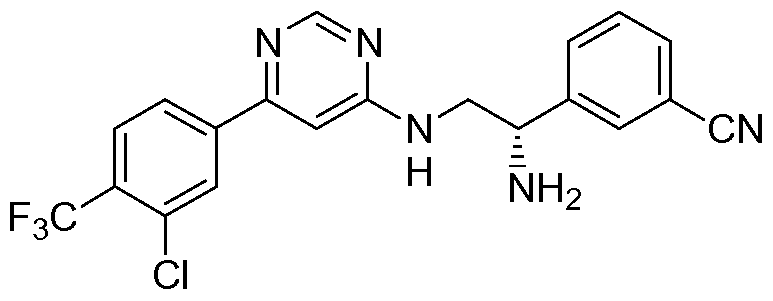
MS (ESI+): calcd for C20Hi5CIF3N5 m/z 417.10, found 418.1 (M+H)+. 1H NMR (CDCI3): 8.67 (s, 1 H), 8.12 (s, 1 H), 7.93 (d, J = 8.3 Hz, 1 H), 7.77 (dd, J = 14.7, 6.4 Hz, 2H), 7.66 (d, J = 7.8 Hz, 1 H), 7.62 - 7.58 (m, 1 H), 7.52 - 7.46 (m, 1 H), 6.73 (s, 1 H), 5.57 (s, 1 H), 4.37 (dd, J = 7.7, 4.8 Hz, 1 H), 3.73 (d, J = 19.8 Hz, 1 H), 3.65 - 3.50 (m, 1 H), 2.07 (d, J = 20.2 Hz, 2H).
Example 58: (1 S)-N2-1 -(3-Chloro-4-fluoro-phenyl)-[6-(3-chloro-4-trifluoromethyl- phenyl)-pyrimidin-4-yl]-ethane-1 ,2-diamine.

MS (ESI+): calcd for Ci9Hi4CI2F4N4 m/z 444.05, found 445.1 (M+H)+. 1H NMR (CDCI3): 8.67 (d, J = 5.6 Hz, 1 H), 8.11 (s, 1 H), 7.92 (d, J = 8.3 Hz, 1 H), 7.77 (d, J = 8.3 Hz, 1 H), 7.46 (dt, J = 9.0, 4.5 Hz, 1 H), 7.25 (dd, J = 4.5, 2.2 Hz, 1 H), 7.13 (t, J = 8.6 Hz, 1 H), 6.71 (s, 1 H), 5.54 (s, 1 H), 4.24 (dd, J = 7.3, 5.3 Hz, 1 H), 3.78 - 3.62 (m, 1 H), 3.63 - 3.45 (m, 1 H), 1.54 (d, J = 25.6 Hz, 2H).
Example 59: (1 S)-N2-[6-(3-Chloro-4-trifluoromethyl-phenyl)-pyrimidin-4-yl]-1 -(3,4- dichloro-phenyl)-ethane-1 ,2-diamine.

MS (ESI+): calcd for Ci9Hi4CI3F3N4 m/z 460.02, found 461.0 (M+H)+. 1H NMR (CDCI3): 8.66 (s, 1 H), 8.11 (s, 1 H), 7.92 (d, J = 8.2 Hz, 1 H), 7.77 (d, J = 8.3 Hz, 1 H), 7.52 (d, J = 2.0 Hz, 1 H), 7.46 - 7.40 (m, 1 H), 7.23 (dd, J = 8.3, 2.0 Hz, 1 H), 6.70 (s, 1 H), 5.49 (s, 1 H), 4.32 - 4.15 (m, 1 H), 3.78 - 3.61 (m, 1 H), 3.63 - 3.45 (m, 1 H), 1.54 (d, J = 24.7 Hz, 2H).
Example 60: (1 S)-N2-1 -(4-Chloro-3-fluoro-phenyl)-[6-(3-chloro-4-trifluoromethyl- phenyl)-pyrimidin-4-yl]-ethane-1 ,2-diamine.

MS (ESI+): calcd for Ci9Hi4CI2F4N4 m/z 444.05, found 445.1 (M+H)+. 1H NMR (CDCI3): 8.67 (d, J = 6.8 Hz, 1 H), 8.11 (s, 1 H), 7.92 (d, J = 8.2 Hz, 1 H), 7.77 (d, J = 8.2 Hz, 1 H), 7.42 - 7.35 (m, 1 H), 7.23 (dd, J = 9.9, 1.9 Hz, 1 H), 7.15 - 7.09 (m, 1 H), 6.70
(s, 1 H), 5.45 (s, 1 H), 4.25 (dd, J = 7.2, 5.4 Hz, 1 H), 3.76 - 3.64 (m, 1 H), 3.57 - 3.46 (m, 1 H).
Example 61 : (1 R)-N2-[6-(3-Chloro-4-trifluoromethyl-phenyl)-pyrimidin-4-yl]-1 -(4- trifluoromethylsulfanyl-phenyl)-ethane-1 ,2-diamine.

MS (ESI+): calcd for C20Hi5CIF6N4S m/z 492.06, found 493.1 (M+H)+. 1H NMR (de-DMSO): 8.58 (s, 1 H), 8.26 (s, 1 H), 8.10 (s, 1 H), 8.03 - 7.96 (m, 1 H), 7.92 (d, J = 8.2 Hz, 2H), 7.69 (t, J = 21.0 Hz, 3H), 7.12 (s, 1 H), 4.36 (s, 1 H), 3.61 (s, 2H).
Example 62: (1 R)-5-{1 -Amino-2-[6-(3-chloro-4-trifluoromethyl-phenyl)-pyrimidin-4- ylamino]-ethyl}-2-fluoro-benzonitrile.

MS (ESI+): calcd for C20Hi4CIF4N5 m/z 435.09, found 436.1 (M+H)+. 1H NMR (de-DMSO): 8.52 (d, J = 20.1 Hz, 1 H), 8.25 (s, 1 H), 8.12 (d, J = 15.5 Hz, 1 H), 7.99 (d, J = 8.2 Hz, 1 H), 7.69 (d, J = 7.9 Hz, 2H), 7.62 (d, J = 8.2 Hz, 2H), 7.12 (s, 1 H), 4.24 (s, 1 H), 3.60 (d, J = 33.2 Hz, 2H).
Example 63: (1 R)-N 2-[6-(3-Chloro-4-trifluoromethyl-phenyl)-pyhmidin-4-yl]-1 -(4- methanesulfonyl-phenyl)-ethane-1 ,2-diamine.

Example 64: (1 R)-N -I -(4-Fluoro-phenyl)-[6-(3-fluoro-4-trifluoromethoxy-phenyl)- pyrimidin-4-yl]-ethane-1 ,2-diamine, trifluoroacetic acid salt.

MS (ESI+): calcd for Ci9Hi5CIF5N4O m/z 410.12, found 411.1 (M+H)+. 1H NMR (de-DMSO): 8.63 (s, 1 H), 8.54 (s, 2H), 8.27 (s, 1 H), 8.16-8.09 (m, 1 H), 8.00 (d, J = 8.4 Hz, 1 H), 7.75-7.67 (m, 1 H), 7.53 (s, 4H), 7.11 (d, J = 1.0 Hz, 1 H), 4.59 (s, 1 H), 3.95- 3.86 (m, 1 H), 3.83-3.73 (m, 1 H).
Example 65: (1 R)-N2-1 -(4-Fluoro-phenyl)-[6-(3-trifluoromethyl-benzo[d]isoxazol-6-yl)- pyrimidin-4-yl]-ethane-1 ,2-diamine, trifluoroacetic acid salt.

MS (ESI+): calcd for C20Hi5F4N5O m/z 417.12, found 418.2 (M+H)+. 1H NMR (de-DMSO): 8.63 (s, 1 H), 8.54 (s, 2H), 8.27 (s, 1 H), 8.16-8.09 (m, 1 H), 8.00 (d, J = 8.4 Hz, 1 H), 7.75-7.67 (m, 1 H), 7.53 (s, 4H), 7.11 (d, J = 1.0 Hz, 1 H), 4.59 (s, 1 H), 3.95- 3.86 (m, 1 H), 3.83-3.73 (m, 1 H).
The following examples may be synthesized by using synthetic methods analogous to those described in Schemes A and B and exemplified in Examples 1 through 65.
Example 66: (1 R)-Phenyl-N -(6-quinolin-6-yl-pyrimidin-4-yl)-ethane-1 ,2-diamine.

Example 67: (1 R)-N2-[6-(5-Fluoro-benzo[b]thiophen-2-yl)-pyrimidin-4-yl]-1 -phenyl- ethane-1 ,2-diamine.

Example 68: (1 R)-Phenyl-N2-[6-(5-trifluoromethyl-benzo[b]thiophen-2-yl)-pyrimidin-4- yl]-ethane-1 ,2-diamine.

Example 69: (1 R)-{4-[6-(2-Amino-2-phenyl-ethylamino)-pyrimidin-4-yl]-2-fluoro- phenyl}-ethanol.

Example 70: (1 R)-Phenyl-N2-[6-(6-trifluoromethyl-benzo[b]thiophen-2-yl)-pyrimidin-4- yl]-ethane-1 ,2-diamine.

Example 71 : (1 R)-N2-[6-(3-Methyl-benzo[d]isoxazol-6-yl)-pyrimidin-4-yl]-1 -phenyl- ethane-1 ,2-diamine.

Example 72: (1 R)-N -(6-Benzo[b]thiophen-2-yl-pyrimidin-4-yl)-1 -phenyl-ethane-1 ,2- diamine.

Example 73: (1 R)-{5-[6-(2-Amino-2-phenyl-ethylamino)-pyrimidin-4-yl]-thiophen-2-yl}- ethanone.


Example 75: (1 R)-N2-(6-Benzo[1 ,3]dioxol-5-yl-pyrimidin-4-yl)-1 -phenyl-ethane-1 ,2- diamine.

Example 76: (1 R)-4-[6-(2-Amino-2-phenyl-ethylamino)-pyrimidin-4-yl]-phenol.
 Example 77: (1 R)-N -[6-(3-Pentafluoroethyl-benzo[d]isoxazol-6-yl)-pyrimidin-4-yl]-1- phenyl-ethane-1 ,2-diamine.

Example 78: (1 R)-N2-[6-(3,4-Dichloro-phenyl)-pyhmidin-4-yl]-1 -phenyl-ethane-1 ,2- diamine.

Example 79: (1 R)-N -[6-(4-Methoxy-phenyl)-pyrimidin-4-yl]-1 -phenyl-ethane-1 ,2- diamine.

Example 80: (1 R)-4-[6-(2-Amino-2-phenyl-ethylamino)-pyrimidin-4-yl]-N-tert-butyl- benzenesulfonamide.
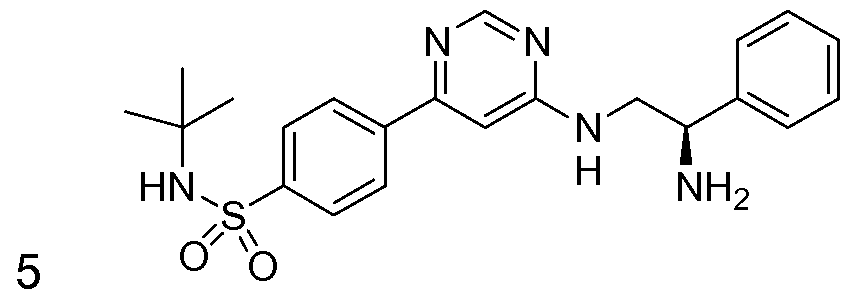
Example 81 : (1 R)-1 -Phenyl-N2-{6-[4-(thiomorpholine-4-sulfonyl)-phenyl]-pyrimidin-4- yl}-ethane-1 ,2-diamine.

Example 82: (1 R)-N2-[6-(3-Chloro-4-trifluoromethyl-phenyl)-pyrimidin-4-yl]-1 -thiophen- 3-yl-ethane-1 ,2-diamine.

Example 83: (1 R)-N2-[6-(3-Chloro-4-trifluoromethyl-phenyl)-pyrimidin-4-yl]-1 -thiazol-2- yl-ethane-1 ,2-diamine.


Example 85: (1 R)- 1 -Benzo[b]thiophen-3-yl-N2-[6-(3-chloro-4-trifluoromethyl-phenyl)- pyrimidin-4-yl]-ethane-1 ,2-diamine.

Example 86: (1 R)-N2-[6-(3-Chloro-4-trifluoromethyl-phenyl)-pyrimidin-4-yl]-1 -(3-fluoro- 4-trifluoromethyl-phenyl)-ethane-1 ,2-diamine.

Example 87: (1 R)-N2-[6-(3-Chloro-4-trifluoromethyl-phenyl)-pyrimidin-4-yl]-1 -(2,3- dihydro-benzo[1 ,4]dioxin-6-yl)-ethane-1 ,2-diamine.

Example 88: (1 R)-N2-[6-(3-Chloro-4-trifluoromethyl-phenyl)-pyrimidin-4-yl]-1 -(4- imidazol-1 -yl-phenyl)-ethane-1 ,2-diamine.
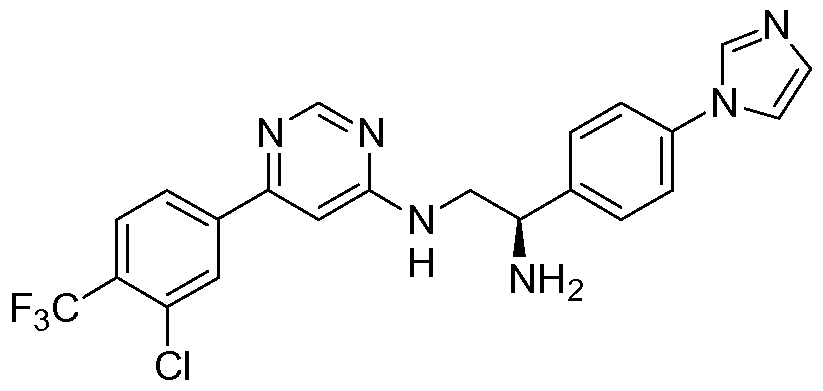
Example 89: (1 R)-N2-[6-(3-Chloro-4-trifluoromethyl-phenyl)-pyπmidin-4-yl]-1 -(3- trifluoromethylsulfanyl-phenyl)-ethane-1 ,2-diamine.

Example 90: (1 R)-N2-[6-(3-Chloro-4-trifluoromethyl-phenyl)-pyπmidin-4-yl]-1 -(3,4- dimethoxy-phenyl)-ethane-1 ,2-diamine.

Example 91 : (1 R)-1 -(3-Chloro-4-methoxy-phenyl)-N2-[6-(3-chloro-4-trifluoromethyl- phenyl)-pyrimidin-4-yl]-ethane-1 ,2-diamine.


Example 93: (1 R)-N2-[6-(3-Chloro-4-trifluoromethyl-phenyl)-pyrimidin-4-yl]-1 -(2- difluoromethoxy-phenyl)-ethane-1 ,2-diamine.

Example 94: (1 R)-N2-[6-(3-Chloro-4-trifluoromethyl-phenyl)-pyrimidin-4-yl]-1 -(2-fluoro- 5-trifluoromethyl-phenyl)-ethane-1 ,2-diamine.

Example 95: (1 R)-N2-[6-(3-Chloro-4-trifluoromethyl-phenyl)-pyrimidin-4-yl]-1 -(4- pyrrolidin-1 -yl-phenyl)-ethane-1 ,2-diamine.


Example 97: (1 R)-N2-[6-(3-Chloro-4-trifluoromethyl-phenyl)-pyπmidin-4-yl]-1 -(4- pyridin-2-yl-thiophen-2-yl)-ethane-1 ,2-diamine.
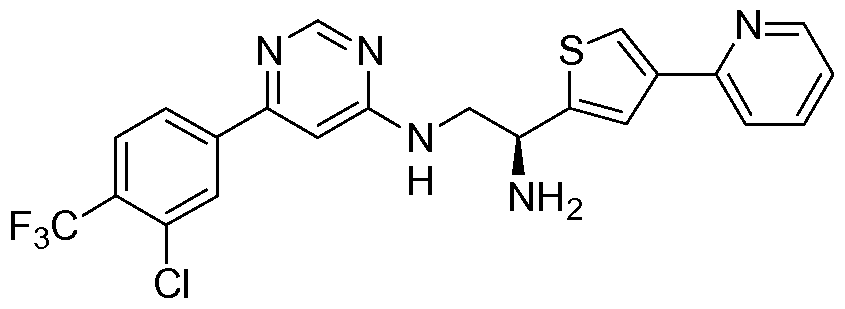
Example 98: (1 R)-N2-[6-(3-Chloro-4-trifluoromethyl-phenyl)-pyrimidin-4-yl]-1 -(4- pyridin-2-yl-phenyl)-ethane-1 ,2-diamine.

Example 99: (1 R)-1 -Biphenyl-4-yl-N2-[6-(3-chloro-4-trifluoromethyl-phenyl)-pyrimidin- 4-yl]-ethane-1 ,2-diamine.


Example 101 : (1 R)-N2-[6-(3-Chloro-4-trifluoromethyl-phenyl)-pyπmidin-4-yl]-1 -(2,6- difluoro-phenyl)-ethane-1 ,2-diamine.

Example 102: (1 R)-N2-[6-(3-Chloro-4-trifluoromethyl-phenyl)-pyrimidin-4-yl]-1 -(4- thiophen-2-yl-phenyl)-ethane-1 ,2-diamine.

Example 103: (1 R)-N -[6-(3-Chloro-4-trifluoromethyl-phenyl)-pyrimidin-4-yl]-1 -(3- trifluoromethoxy-phenyl)-ethane-1 ,2-diamine.

Assay Method 1
A. Transfection of Cells with Human FAAH
A 10-cm tissue culture dish with a confluent monolayer of SK-N-MC cells was split 2 days (d) prior to transfection. Using sterile technique, the media was removed and the cells were detached from the dish by the addition of trypsin. One fifth of the cells were then placed onto a new 10-cm dish. Cells were grown in a 37 0C incubator with 5% CO2 in Minimal Essential Media Eagle with 10% Fetal Bovine Serum. After 2 d, cells were approximately 80% confluent. These cells were removed from the dish with trypsin and pelleted in a clinical centrifuge. The pellet was re-suspended in 400 μl_ complete media and transferred to an electroporation cuvette with a 0.4 cm gap between the electrodes. Supercoiled human FAAH cDNA (1 μg) was added to the cells and mixed. The voltage for the electroporation was set at 0.25 kV, and the capacitance was set at 960 μF. After electroporation, the cells were diluted into complete media (10 ml_) and plated onto four 10-cm dishes. Because of the variability in the efficiency of electroporation, four different concentrations of cells were plated. The ratios used were 1 :20, 1 :10, and 1 :5, with the remainder of the cells being added to the fourth dish. The cells were allowed to recover for 24 h before adding the selection media (complete media with 600 μg/mL G418). After 10 d, dishes were analyzed for surviving colonies of cells. Dishes with well-isolated colonies were used. Cells from individual colonies were isolated and tested. The clones that showed the most FAAH activity, as measured by anandamide hydrolysis, were used for further study.
B. Human FAAH Assay
T84 frozen cell pellets or transfected SK-N-MC cells (contents of 1 x 15 cm culture dishes) were homogenized in 50 ml_ of FAAH assay buffer (125 mM Tris, 1 mM EDTA, 0.2% Glycerol, 0.02% Triton X-100, 0.4 mM Hepes, pH 9). The assay mixture consisted of 50 μl_ of the cell homogenate, 10 μl_ of the test compound, and 40 μl_ of anandamide [1-3H-ethanolamine] (3H-AEA, Perkin-Elmer, 10.3 C/mmol), which was added last, for a final tracer concentration of 80 nM. The reaction mixture was incubated at rt for 1 h. During the incubation, 96-well Multiscreen filter plates (catalog number MAFCNOB50; Millipore, Bedford, MA, USA) were loaded with 25 μl_ of activated charcoal (Multiscreen column loader, catalog number MACL09625, Millipore) and washed once with 100 μl_ of MeOH. Also during the incubation, 96-well DYNEX
MicroLite plates (catalog number NL510410) were loaded with 100 μl_ of MicroScint40 (catalog number 6013641 , Packard Bioscience, Meriden, CT, USA). After the 1 h incubation, 60 μl_ of the reaction mixture were transferred to the charcoal plates, which were then assembled on top of the DYNEX plates using Centrifuge Alignment Frames (catalog number MACF09604, Millipore). The unbound labeled ethanolamine was centrifuged through to the bottom plate (5 min at 2000 rpm), which was preloaded with the scintillant, as described above. The plates were sealed and left at rt for 1 h before counting on a Hewlett Packard TopCount.
Assay Method 2
A. Transfection of Cells with Rat FAAH-1
A 10-cm tissue culture dish with a confluent monolayer of SK-N-MC cells was split 2 days (d) prior to transfection. Using sterile technique, the media was removed and the cells were detached from the dish by the addition of trypsin. One fifth of the cells were then placed onto a new 10-cm dish. Cells were grown in a 37 0C incubator with 5% CO2 in Minimal Essential Media Eagle with 10% Fetal Bovine Serum. After 2 d, cells were approximately 80% confluent. These cells were removed from the dish with trypsin and pelleted in a clinical centrifuge. The pellet was re-suspended in 400 μl_ complete media and transferred to an electroporation cuvette with a 0.4 cm gap between the electrodes. Supercoiled rat FAAH cDNA (1 μg) was added to the cells and mixed. The voltage for the electroporation was set at 0.25 kV, and the
capacitance was set at 960 μF. After electroporation, the cells were diluted into complete media (10 ml_) and plated onto four 10-cm dishes. Because of the variability in the efficiency of electroporation, four different concentrations of cells were plated. The ratios used were 1 :20, 1 :10, and 1 :5, with the remainder of the cells being added to the fourth dish. The cells were allowed to recover for 24 h before adding the selection media (complete media with 600 μg/mL G418). After 10 d, dishes were analyzed for surviving colonies of cells. Dishes with well-isolated colonies were used. Cells from individual colonies were isolated and tested. The clones that showed the most FAAH activity, as measured by anandamide hydrolysis, were used for further study.
B. Rat FAAH-1 Assay
T84 frozen cell pellets or transfected SK-N-MC cells (contents of 1 x 15 cm culture dishes) were homogenized in 50 ml_ of FAAH assay buffer (125 mM Tris, 1 mM EDTA, 0.2% Glycerol, 0.02% Triton X-100, 0.4 mM Hepes, pH 9). The assay mixture consisted of 50 μl_ of the cell homogenate, 10 μL of the test compound, and 40 μl_ of anandamide [1-3H-ethanolamine] (3H-AEA, Perkin-Elmer, 10.3 d/mmol), which was added last, for a final tracer concentration of 80 nM. The reaction mixture was incubated at rt for 1 h. During the incubation, 96-well Multiscreen filter plates (catalog number MAFCNOB50; Millipore, Bedford, MA, USA) were loaded with 25 μL of activated charcoal (Multiscreen column loader, catalog number MACL09625, Millipore) and washed once with 100 μL of MeOH. Also during the incubation, 96-well DYNEX MicroLite plates (catalog number NL510410) were loaded with 100 μL of MicroScint40 (catalog number 6013641 , Packard Bioscience, Meriden, CT, USA). After the 1 h incubation, 60 μL of the reaction mixture were transferred to the charcoal plates, which were then assembled on top of the DYNEX plates using Centrifuge Alignment Frames (catalog number MACF09604, Millipore). The unbound labeled ethanolamine was centrifuged through to the bottom plate (5 min at 2000 rpm), which was preloaded with the scintillant, as described above. The plates were sealed and left at rt for 1 h before counting on a Hewlett Packard TopCount.
Results for Example compounds tested in these assays are presented in Table 1. Where activity is shown as greater than (>) a particular value, the value is the solubility limit of the compound in the assay medium or the highest concentration tested in the assay.
Table 1


While the invention has been illustrated by reference to exemplary and preferred embodiments, it will be understood that the invention is intended not to be limited to the foregoing detailed description, but to be defined by the appended claims as properly construed under principles of patent law.
Claims
1. A compound of Formula (I): 
wherein
R1 is -H, -C(O)CF3, Or -CO2C(CHs)3;
Ar1 is phenyl, napthyl, a 5 or 6 membered monocyclic heteroaryl group with carbon at the point of attachment, or a 9 or 10 membered bicyclic heteroaryl group with carbon at the point of attachment, each unsubstituted or substituted with;
(i) one, two, or three Rc moieties,
where each Rc moiety is independently -Ci-4alkyl,  -Ci-4alkyl-CN, -OH,
  perfluoroalkyl, perfluoroalkoxy, -S(O)0-2Ci-4alkyl, -SCF3, -SO2CF3, -CHO, -COCi-4alkyl, -CO2Ci-4alkyl, -CO2H, -N(Rd)Re, -SO2NRdRe, -NRdSO2Re, -C(O)NRdRe, -NO2, -CN, imidazolyl, phenyl, pyridyl, pyrrolidinyl, thiophenyl, or halo,
where Rd and Re are each independently H or -Ci-4alkyl, or taken together Rd and Re with the nitrogen of attachment form a 4-7 membered heterocycloalkyl ring; or
(ii) two or three Rc moieties where two Rc moieties are adjacent to each other and together form -O(CH2)i-3O- unsubstituted or substituted with one or two fluoro groups, and the third Rc moiety, when present, is  -Ci-4alkyl-OH, -Ci- 4alkyl-CN, perfluoroalkyl, -OH, -OCi-4alkyl, perfluoroalkoxy, -S(O)0-2Ci-4alkyl, -SCF3, -SO2CF3, -CHO, -COCi-4alkyl, -CO2Ci-4alkyl, -CO2H, -N(Rd)Re,
-SO2NRdRe, -NRdSO2Re, -C(O)NRdRe, -NO2, -CN, or halo,
where Rd and Re are each independently -H or -Ci-4alkyl;
Ar2 is:
(i) phenyl substituted with;
one, two, or three Rg moieties each at a meta or para position, and optionally with one or two additional Rg moieties at an ortho position; where each Rg moiety is independently halo, OH,  -Ci-4alkyl-OH, -Ci- 4alkyl-CN, perfluoroalkyl, perfluoroalkoxy , -OCi-4alkyl,
(monocyclic cycloalkyl),  -SCF3, -SO2CF3, -CHO, -COCi- 4alkyl, -CO2Ci-4alkyl, -CO2H, -N(Rh)R', -SO2NRJRk, -NRhSO2R', -C(O)NRJRk, -NO2, -CN; or a phenoxy, benzyl, phenethyl, or benzoyl group unsubstituted or substituted with -Ci-4alkyl,
  perfluoroalkyl, perfluoroalkoxy , -NO2, -CN, or halo; or two adjacent Rg moieties taken together form - O(CH2)i-2O- unsubstituted or substituted with one or two fluoro groups; where Rh is H or
R' is -Ci-4alkyl or monoyclic cycloalkyl group;
or Rh and R' taken together with the atoms to which they are attached form a monocyclic heterocycloalkyl ring;
RJ is H or -Ci-4alkyl; and
Rk is H,  or monoyclic cycloalkyl group;
or RJ and Rk taken together with the atoms to which they are attached form a monocyclic heterocycloalkyl ring; or
(ii) a monocyclic heteroaryl group substituted with one, two, or three Rg moieties; or
(iii) a naphthyl or bicyclic heteroaryl group unsubstituted or substituted with one, two, or three R1 moieties;
where each R1 moiety is independently -Ci-4alkyl, -OCi-4alkyl, perfluoroalkyl, perfluoroalkoxy , -NO2, -CN, or halo;
or a pharmaceutically acceptable salt or pharmaceutically acceptable prodrug of said compound.
2. A compound as defined in claim 1 , wherein Ar1 is
(i) phenyl optionally substituted with one or two Rc moieties selected from halo, - CF3, -CN, -OCHF2, -OCH3, -OCF3, -CF3, -SCH3, -SCF3, -S(O)(O)CH3, imidazolyl, pyrrolidinyl, pyridyl, phenyl, thiophenyl, or two adjacent substituents together form - O(CH2)2-3O-, or -OCF2O-;
(ii) napthyl; (iii) thiophenyl optionally substituted with pyridinyl;
(iv) thiazolyl;
(v) benzothiophenyl; or
(vi) isoxazolyl; and
Ar2 is
(i) phenyl optionally substituted with one, two, or three Rg moieties each at a meta or para position, wherein each said Rg moiety is independently chloro, fluoro, - CF3, -CH(OH)CH3, -OH, -OCF3, -OCH3, -OCH2CH3, -OCH2CF3, -OCHF2, -SCF3, -SCH2CH3, -S(O)(O)N(CH3)2, -S(O)(O)NHC(CH3)3, -S(O)(O)-thiomorpholin-4-yl, or two adjacent Rg moieties together form -OCH2O- unsubstituted or substituted with two fluoro atoms;
(ii) 1-benzothiophen-2-yl optionally substituted at the 5- or 6- position with F, CF3, methyl or trifluoromethoxy;
(iii) benzo[d]isoxazol-6-yl optionally substituted at the 3 position with -CF3, -CH3, or -CH2CF3;
(iv) quinolin-6-yl; or
(v) 5-acetyl-thiophen-2-yl;
or a pharmaceutically acceptable salt or pharmaceutically acceptable prodrug of said compound.
3. A compound as defined in claim 1 , wherein Ar1 is
(i) phenyl optionally substituted with one or two Rc moieties selected from halo, - CF3, -CN, -SCH3, -SCF3, -S(O)(O)CH3, or two adjacent substituents together form - OCF2O-; or
(ii) napthyl; and
Ar2 is
(i) phenyl optionally substituted with one, two, or three R9 moieties each at a meta or para position, wherein each said R9 moiety is independently chloro, fluoro, - CF3, -OCF3, -OCH2CH3, -OCH2CF3, -OCHF2, -SCF3, -SCH2CH3, - S(O)(O)N(CH3)2, or two adjacent R9 moieties together form -OCF2O-; (ii) 1-benzothiophen-2-yl substituted at the 5 position with methyl or trifluoromethoxy; or
(iii) 3-trifluoromethyl-benzo[d]isoxazol-6-yl;
or a pharmaceutically acceptable salt or pharmaceutically acceptable prodrug of said compound.
4. A compound as defined in claim 3, wherein Ar1 is phenyl optionally substituted with one or two Rc substitutents selected from halo, -CF3, -CN, -SCH3, -SCF3, - S(O)(O)CH3, or two adjacent substituents together form -OCF2O-.
5. A compound as defined in claim 4, wherein R1 is H.
6. A compound as defined in claim 1 , wherein Ar1 is a phenyl group, unsubstituted or substituted with one, two, or three Rc moieties.
7. A compound as defined in claim 6, wherein each Rc moiety is selected from halo, -CF3, -CN, -SCH3, -SCF3, -S(O)(O)CH3, or two adjacent substituents together form -OCF2O-.
8. A compound as defined in claim 1 , wherein Ar2 is a phenyl substituted with one, two or three Rg moieties each at a meta or para position.
9. A compound as defined in claim 8, wherein each said Rg moiety is
independently chloro, fluoro, -CF3, -OCF3, -OCH2CH3, -OCH2CF3, -OCHF2, -SCF3, - SCH2CH3, -S(O)(O)N(CH3)2, or two adjacent Rg moieties together form -OCF2O-.
10. A compound as defined in claim 9, wherein R1 is H.
11. A compound as defined in claim 1 , wherein Ar2 is 1 -benzothiophen-2-yl optionally substituted at the 5 position with methyl or trifluoromethoxy.
12. A compound as defined in claim 1 , wherein Ar2 is a thiophenyl, pyridinyl, pyrimidinyl, or pyrazolyl group, each substituted with one, two, or three Rg moieties.
13. A compound as defined in claim 1 , wherein Ar2 is a naphthyl, benzoxadiazolyl, indolyl, benzothiophenyl, quinolinyl, or indazolyl, each unsubstituted or substituted with one, two, or three Rg moieties.
14. A compound selected from the group consisting of:
(1 R)-N2-{6-[3-Chloro-4-(trifluoromethyl)phenyl]pyrimidin-4-yl}-1 -phenylethane-1 ,2- diamine;
(1 R)-{2-[6-(3-Chloro-4-trifluoromethyl-phenyl)-pyhmidin-4-ylamino]-1 -phenyl -ethyl}- carbamic acid tert-butyl ester;
(1 S)-N2-{6-[3-Chloro-4-(trifluoromethyl)phenyl]pyrimidin-4-yl}-1 -phenylethane-1 ,2- diamine;
(1 R)-N2-{6-[3-Fluoro-4-(thfluoromethyl)phenyl]pyrimidin-4-yl}-1 -phenylethane-1 ,2- diamine;
(1 R)-1 -Phenyl-N2-{6-[4-(trifluoromethyl)phenyl]pyrimidin-4-yl}ethane-1 ,2-diamine; (1 R)-1 -Phenyl-N2-{6-[4-(trifluoromethoxy)phenyl]pyhmidin-4-yl}ethane-1 ,2-diamine; (1 R)-N2-{6-[3-Chloro-4-(trifluoromethoxy)phenyl]pyrimidin-4-yl}-1 -phenylethane-1 ,2- diamine;
(1 R)-N2-{6-[3-Fluoro-4-(thfluoromethoxy)phenyl]pyrimidin-4-yl}-1 -phenylethane-1 ,2- diamine;
(1 R)-N2-[6-(5-Methyl-1 -benzothiophen-2-yl)pyrimidin-4-yl]-1 -phenylethane-1 ,2- diamine;
(1 R)-N2-{6-[4-Ethoxy-3-(trifluoromethyl)phenyl]pyhmidin-4-yl}-1 -phenylethane-1 ,2- diamine;
(1 R)-1 -Phenyl-N2-(6-{4-[(thfluoromethyl)sulfanyl]phenyl}pyrimidin-4-yl)ethane-1 ,2- diamine;
(1 R)-N2-{6-[4-(Difluoromethoxy)-3,5-difluorophenyl]pyrimidin-4-yl}-1-phenylethane- 1 ,2-diamine; (1 R)-1 -Phenyl-N2-{6-[3-(trifluoromethyl)-1 ,2-benzisoxazol-6-yl]pyrimidin-4-yl}ethane-
1 ,2-diamine;
(1 R)-N2-[6-(4-Chlorophenyl)pyrimidin-4-yl]-1 -phenylethane-1 ,2-diamine;
(1 R)-N2-[6-(3-Chlorophenyl)pyrimidin-4-yl]-1 -phenylethane-1 ,2-diamine;
(1 R)-N2-[6-(3,4-Dichlorophenyl)pyhmidin-4-yl]-1 -phenylethane-1 ,2-diamine;
(1 R)-N2-{6-[4-Chloro-3-(trifluoromethyl)phenyl]pyrimidin-4-yl}-1 -phenylethane-1 ,2- diamine;
(1 R)-1 --PFhenyl-N2-{6-[3-(trifluoromethoxy)phenyl]pyhmidin-4-yl}ethane-1 ,2-diamine;
(1 R)-N2-[6-(4-Ethoxyphenyl)pyhmidin-4-yl]-1 -phenylethane-1 ,2-diamine;
(1 R)-1 -Phenyl-N2-{6-[4-(2,2,2-thfluoroethoxy)phenyl]pyrimidin-4-yl}ethane-1 ,2- diamine;
(1 R)-N2-{6-[3-Fluoro-4-(2,2,2-trifluoroethoxy)phenyl]pyhmidin-4-yl}-1-phenylethane- 1 ,2-diamine;
(1 R)-N2-{6-[4-(Ethylsulfanyl)phenyl]pyrimidin-4-yl}-1 -phenylethane-1 ,2-diamine; 4-(6-{[(2R)-2-Amino-2-phenylethyl]amino}pyrimidin-4-yl)-N,N- dimethylbenzenesulfonamide;
(1 R)-N2-[6-(2,2-Difluoro-1 ,3-benzodioxol-5-yl)pyrimidin-4-yl]-1 -phenylethane-1 ,2- diamine;
(1 R)-1 -Phenyl-N2-{6-[5-(trifluoromethoxy)-1 -benzothiophen-2-yl]pyrimidin-4- yl}ethane-1 ,2-diamine;
N-^I R^-^β-CS-chloro^trifluoromethyOphenyllpyhmidin^-ylJamino)-!- phenylethyl]-2,2,2-thfluoroacetamide;
(1 R)-N2-[6-(3-Chloro-4-trifluoromethyl-phenyl)-pyrimidin-4-yl]-1-(4-fluoro-phenyl)- ethane-1 ,2-diamine;
(1S)-N2-[6-(3-Chloro-4-trifluoromethyl-phenyl)-pyrimidin-4-yl]-1-(4-fluoro-phenyl)- ethane-1 ,2-diamine;
(1S)-N2-[6-(3-Chloro-4-trifluoromethyl-phenyl)-pyhmidin-4-yl]-1-(4-trifluoromethyl- phenyl)-ethane-1 ,2-diamine;
(1 R)-N2-[6-(3-Chloro-4-trifluoromethyl-phenyl)-pyhmidin-4-yl]-1-(4-trifluoromethyl- phenyl)-ethane-1 ,2-diamine;
(1S)-N2-[6-(3-Chloro-4-trifluoromethyl-phenyl)-pyrimidin-4-yl]-1-(2,2-difluoro- benzo[1 ,3]dioxol-5-yl)-ethane-1 ,2-diamine;
(1 R)-[6-(3-Chloro-4-trifluoromethyl-phenyl)-pyrimidin-4-yl]-1-(2,2-difluoro- benzo[1 ,3]dioxol-5-yl)-ethane-1 ,2-diamine;
(1S)-4-{1-Amino-2-[6-(3-chloro-4-trifluoromethyl-phenyl)-pyπmidin-4-ylamino]-ethyl}- benzonitrile;
(1 R)-4-{1-Amino-2-[6-(3-chloro-4-tπfluoromethyl-phenyl)-pyπmidin-4-ylamino]- ethyl}-benzonitrile;
N2-[6-(3-Chloro-4-trifluoromethyl-phenyl)-pyπmidin-4-yl]-1-(2-fluoro-phenyl)-ethane-
1 ,2-diamine;
(1S)-N2-[6-(3-Chloro-4-trifluoromethyl-phenyl)-pyrimidin-4-yl]-1-(3-fluoro-phenyl)- ethane-1 ,2-diamine;
(1 R)-N2-[6-(3-Chloro-4-trifluoromethyl-phenyl)-pyrimidin-4-yl]-1-(3-fluoro-phenyl)- ethane-1 ,2-diamine;
(1S)-N2-1-(4-Chloro-phenyl)-[6-(3-chloro-4-trifluoromethyl-phenyl)-pyrimidin-4-yl]- ethane-1 ,2-diamine;
(1 R)-N2-1-(4-Chloro-phenyl)-[6-(3-chloro-4-thfluoromethyl-phenyl)-pyrimidin-4-yl]- ethane-1 ,2-diamine;
(1S)-N2-[6-(3-Chloro-4-trifluoromethyl-phenyl)-pyrimidin-4-yl]-1-(3,4-difluoro- phenyl)-ethane-1 ,2-diamine;
(1 R)-N2-[6-(3-Chloro-4-trifluoromethyl-phenyl)-pyhmidin-4-yl]-1-(3,4-difluoro- phenyl)-ethane-1 ,2-diamine;
(ISJ-N^tβ^S-Chloro^-trifluoromethyl-phenyO-pyrimidin^-yll-I^S^-dichloro- phenyl)-ethane-1 ,2-diamine;
(1 R)-N2-[6-(3-Chloro-4-trifluoromethyl-phenyl)-pyhmidin-4-yl]-1-(3,4-dichloro- phenyl)-ethane-1 ,2-diamine;
(1 S)- N2-1 -(4-Chloro-3-fluoro-phenyl)-[6-(3-chloro-4-trifluoromethyl-phenyl)- pyrimidin-4-yl]-ethane-1 ,2-diamine;
(1 R)-N2-1-(4-Chloro-3-fluoro-phenyl)-[6-(3-chloro-4-thfluoromethyl-phenyl)- pyrimidin-4-yl]-ethane-1 ,2-diamine;
(1S)-N2-1-(3-Chloro-4-fluoro-phenyl)-[6-(3-chloro-4-trifluoromethyl-phenyl)- pyrimidin-4-yl]-ethane-1 ,2-diamine; (1 R)-N2-1-(3-Chloro-4-fluoro-phenyl)-[6-(3-chloro-4-tπfluoromethyl-phenyl)- pyrimidin-4-yl]-ethane-1 ,2-diamine;
(1S)-3-{1-Amino-2-[6-(3-chloro-4-trifluoromethyl-phenyl)-pyπmidin-4-ylamino]-ethyl}- benzonitrile;
(1 R)-3-{1-Amino-2-[6-(3-chloro-4-tπfluoromethyl-phenyl)-pyπmidin-4-ylamino]- ethyl}-benzonitrile;
(1 R)-N2-1-(3-Chloro-4-fluoro-phenyl)-[6-(3-chloro-4-tπfluoromethyl-phenyl)- pyrimidin-4-yl]-ethane-1 ,2-diamine;
(1 R)-N2-[6-(3-Chloro-4-trifluoromethyl-phenyl)-pyπmidin-4-yl]-1-naphthalen-2-yl- ethane-1 ,2-diamine;
(1 R)-4-{1-Amino-2-[6-(3-chloro-4-tπfluoromethyl-phenyl)-pyπmidin-4-ylamino]- ethyl}-2-fluoro-benzonitrile;
(1 R)-N2-[6-(3-Chloro-4-trifluoromethyl-phenyl)-pyπmidin-4-yl]-1-(3,4-dichloro- phenyl)-ethane-1 ,2-diamine;
(1 R)-N2-[6-(3-Chloro-4-trifluoromethyl-phenyl)-pyπmidin-4-yl]-1-(4-methylsulfanyl- phenyl)-ethane-1 ,2-diamine;
(1 R)-3-{1-Amino-2-[6-(3-chloro-4-thfluoromethyl-phenyl)-pyhmidin-4-ylamino]- ethyl}-benzonitrile;
(1 R)-N2-[6-(3-Chloro-4-trifluoromethyl-phenyl)-pyrimidin-4-yl]-1-(2-methoxy-phenyl)- ethane-1 ,2-diamine;
(1S)-3-{1-Amino-2-[6-(3-chloro-4-trifluoromethyl-phenyl)-pyhmidin-4-ylamino]-ethyl}- benzonithle;
(1S)-N2-1-(3-Chloro-4-fluoro-phenyl)-[6-(3-chloro-4-trifluoromethyl-phenyl)- pyrimidin-4-yl]-ethane-1 ,2-diamine;
(IS^N^^S-Chloro^-trifluoromethyl-phenyO-pyrimidin^-yll-I^S^-dichloro- phenyl)-ethane-1 ,2-diamine;
(1S)-N2-1-(4-Chloro-3-fluoro-phenyl)-[6-(3-chloro-4-trifluoromethyl-phenyl)- pyrimidin-4-yl]-ethane-1 ,2-diamine;
(1 R)-N2-[6-(3-Chloro-4-trifluoromethyl-phenyl)-pyrimidin-4-yl]-1-(4- thfluoromethylsulfanyl-phenyl)-ethane-1 ,2-diamine;
(1 R)-5-{1-Amino-2-[6-(3-chloro-4-thfluoromethyl-phenyl)-pyhmidin-4-ylamino]- ethyl}-2-fluoro-benzonitrile;
(1 R)-N2-[6-(3-Chloro-4-trifluoromethyl-phenyl)-pyrimidin-4-yl]-1-(4-methanesulfonyl- phenyl)-ethane-1 ,2-diamine;
(1 R)-N2-1-(4-Fluoro-phenyl)-[6-(3-fluoro-4-tπfluoromethoxy-phenyl)-pyrimidin-4-yl]- ethane-1 ,2-diamine;
(1 R)-N2-1-(4-Fluoro-phenyl)-[6-(3-trifluoromethyl-benzo[d]isoxazol-6-yl)-pyrimidin-4- yl]-ethane-1 ,2-diamine;
(1 R)-Phenyl-N2-(6-quinolin-6-yl-pyrimidin-4-yl)-ethane-1 ,2-diamine;
(1 R)-N2-[6-(5-Fluoro-benzo[b]thiophen-2-yl)-pyhmidin-4-yl]-1-phenyl- ethane-1 ,2-diamine;
(1 R)-Phenyl-N2-[6-(5-trifluoromethyl-benzo[b]thiophen-2-yl)-pyrimidin-4- yl]-ethane-1 ,2-diamine;
(1 R)-{4-[6-(2-Amino-2-phenyl-ethylamino)-pyhmidin-4-yl]-2-fluoro-phenyl}-ethanol; (1 R)-Phenyl-N2-[6-(6-trifluoromethyl-benzo[b]thiophen-2-yl)-pyrimidin-4-yl]-ethane- 1 ,2-diamine;
(1 R)-N2-[6-(3-Methyl-benzo[d]isoxazol-6-yl)-pyrimidin-4-yl]-1 -phenyl-ethane-1 ,2- diamine;
(1 R)-N2-(6-Benzo[b]thiophen-2-yl-pyrimidin-4-yl)-1 -phenyl-ethane-1 ,2-diamine; (1 R)-{5-[6-(2-Amino-2-phenyl-ethylamino)-pyhmidin-4-yl]-thiophen-2-yl}-ethanone; (1 R)-N2-[6-(3,4-Dimethoxy-phenyl)-pyrimidin-4-yl]-1 -phenyl-ethane-1 ,2-diamine; (1 R)-N2-(6-Benzo[1 ,3]dioxol-5-yl-pyrimidin-4-yl)-1 -phenyl-ethane-1 ,2-diamine;
(1 R)-4-[6-(2-Amino-2-phenyl-ethylamino)-pyhmidin-4-yl]-phenol;
(1 R)-N2-[6-(3-Pentafluoroethyl-benzo[d]isoxazol-6-yl)-pyhmidin-4-yl]-1 -phenyl- ethane-1 , 2-diamine;
(1 R)-N2-[6-(3,4-Dichloro-phenyl)-pyrimidin-4-yl]-1 -phenyl-ethane-1 ,2-diamine;
(1 R)-N2-[6-(4-Methoxy-phenyl)-pyrimidin-4-yl]-1 -phenyl-ethane-1 ,2-diamine;
(1 R)-4-[6-(2-Amino-2-phenyl-ethylamino)-pyrimidin-4-yl]-N-tert-butyl- benzenesulfonamide;
(1 R)-1-Phenyl-N2-{6-[4-(thiomorpholine-4-sulfonyl)-phenyl]-pyrimidin-4-yl}-ethane- 1 , 2-diamine;
(1 R)-N2-[6-(3-Chloro-4-trifluoromethyl-phenyl)-pyrimidin-4-yl]-1-thiophen-3-yl- ethane-1 ,2-diamine;
(1 R)-N2-[6-(3-Chloro-4-trifluoromethyl-phenyl)-pyrimidin-4-yl]-1-thiazol-2-yl-ethane-
1 ,2-diamine;
(1 R)-1-Benzo[b]thiophen-2-yl-N2-[6-(3-chloro-4-trifluoromethyl-phenyl)-pyrimidin-4- yl]-ethane-1 ,2-diamine;
(1 R)-1-Benzo[b]thiophen-3-yl-N2-[6-(3-chloro-4-trifluoromethyl-phenyl)-pyrimidin-4- yl]-ethane-1 ,2-diamine;
(1 R)-N2-[6-(3-Chloro-4-trifluoromethyl-phenyl)-pyrimidin-4-yl]-1-(3-fluoro-4- thfluoromethyl-phenyl)-ethane-1 ,2-diamine;
(1 R)-N2-[6-(3-Chloro-4-trifluoromethyl-phenyl)-pyrimidin-4-yl]-1-(2,3-dihydro- benzo[1 ,4]dioxin-6-yl)-ethane-1 ,2-diamine;
(1 R)-N2-[6-(3-Chloro-4-trifluoromethyl-phenyl)-pyrimidin-4-yl]-1 -(4-imidazol-1 -yl- phenyl)-ethane-1 ,2-diamine;
(1 R)-N2-[6-(3-Chloro-4-trifluoromethyl-phenyl)-pyrimidin-4-yl]-1-(3- thfluoromethylsulfanyl-phenyl)-ethane-1 ,2-diamine;
(1 R)-N2-[6-(3-Chloro-4-trifluoromethyl-phenyl)-pyhmidin-4-yl]-1-(3,4-dimethoxy- phenyl)-ethane-1 ,2-diamine;
(1 R)-1-(3-Chloro-4-methoxy-phenyl)-N2-[6-(3-chloro-4-thfluoromethyl-phenyl)- pyrimidin-4-yl]-ethane-1 ,2-diamine;
(1 R)-N2-[6-(3-Chloro-4-trifluoromethyl-phenyl)-pyrimidin-4-yl]-1-(3,4-dihydro-2H- benzo[b][1 ,4]dioxepin-7-yl)-ethane-1 ,2-diamine;
(1 R)-N2-[6-(3-Chloro-4-trifluoromethyl-phenyl)-pyrimidin-4-yl]-1-(2-difluoromethoxy- phenyl)-ethane-1 ,2-diamine;
(1 R)-N2-[6-(3-Chloro-4-trifluoromethyl-phenyl)-pyrimidin-4-yl]-1-(2-fluoro-5- thfluoromethyl-phenyl)-ethane-1 ,2-diamine;
(1 R)-N2-[6-(3-Chloro-4-trifluoromethyl-phenyl)-pyrimidin-4-yl]-1 -(4-pyrrolidin-1 -yl- phenyl)-ethane-1 ,2-diamine;
(1 R)-N2-[6-(3-Chloro-4-trifluoromethyl-phenyl)-pyhmidin-4-yl]-1-(3-phenyl-isoxazol-
5-yl)-ethane-1 ,2-diamine;
(1 R)-N2-[6-(3-Chloro-4-trifluoromethyl-phenyl)-pyrimidin-4-yl]-1-(4-pyridin-2-yl- thiophen-2-yl)-ethane-1 ,2-diamine; (1 R)-N2-[6-(3-Chloro-4-trifluoromethyl-phenyl)-pyrimidin-4-yl]-1-(4-pyridin-2-yl- phenyl)-ethane-1 ,2-diamine;
(1 R)-1-Biphenyl-4-yl-N2-[6-(3-chloro-4-trifluoromethyl-phenyl)-pyrimidin-4-yl]- ethane-1 ,2-diamine;
(1 R)-N2-[6-(3-Chloro-4-trifluoromethyl-phenyl)-pyπmidin-4-yl]-1-(3-trifluoromethyl- phenyl)-ethane-1 ,2-diamine;
(1 R)-N2-[6-(3-Chloro-4-trifluoromethyl-phenyl)-pyπmidin-4-yl]-1-(2,6-difluoro- phenyl)-ethane-1 ,2-diamine;
(1 R)-N2-[6-(3-Chloro-4-trifluoromethyl-phenyl)-pyhmidin-4-yl]-1-(4-thiophen-2-yl- phenyl)-ethane-1 ,2-diamine;
(1 R)-N2-[6-(3-Chloro-4-trifluoromethyl-phenyl)-pyhmidin-4-yl]-1-(3-trifluoromethoxy- phenyl)-ethane-1 ,2-diamine;
or a pharmaceutically acceptable salt or a pharmaceutically acceptable prodrug of said compound.
15. A pharmaceutical composition comprising:
(a) a therapeutically effective amount of at least one compound of Formula (I): 
wherein
R1 is -H, -C(O)CF3, Or -CO2C(CHs)3;
Ar1 is phenyl, napthyl, a 5 or 6 membered monocyclic heteroaryl group with carbon at the point of attachment, or a 9 or 10 membered bicyclic heteroaryl group with carbon at the point of attachment, each unsubstituted or substituted with;
(i) one, two, or three Rc moieties,
where each Rc moiety is independently -Ci-4alkyl,  -Ci-4alkyl-CN,
-OH,  perfluoroalkyl, perfluoroalkoxy, -S(O)0-2Ci-4alkyl, -SCF3, -SO2CF3, -CHO, -COCi-4alkyl, -CO2Ci-4alkyl, -CO2H, -N(Rd)Re, -SO2NRdRe,
-NRdSO2Re, -C(O)NRdRe, -NO2, -CN, imidazolyl, phenyl, pyridyl, pyrrolidinyl, thiophenyl, or halo, where Rd and Re are each independently H or -Ci-4alkyl, or taken together Rd and Re with the nitrogen of attachment form a 4-7 membered heterocycloalkyl ring; or
(ii) two or three Rc moieties where two Rc moieties are adjacent to each other and together form -O(CH2)i-3θ- unsubstituted or substituted with one or two fluoro groups, and the third Rc moiety, when present, is  -Ci-4alkyl-OH, -Ci- 4alkyl-CN, perfluoroalkyl, -OH, -OCi-4alkyl, perfluoroalkoxy, -S(O)0-2Ci-4alkyl, -SCF3, -SO2CF3, -CHO, -COCi-4alkyl, -CO2Ci-4alkyl, -CO2H, -N(Rd)Re,
-SO2NRdRe, -NRdSO2Re, -C(O)NRdRe, -NO2, -CN, or halo,
where Rd and Re are each independently -H or -Ci-4alkyl;
is:
(i) phenyl substituted with;
one, two, or three R9 moieties each at a meta or para position, and optionally with one or two additional R9 moieties at an ortho position;
where each R9 moiety is independently halo, OH,  -Ci-4alkyl-OH, -Ci- 4alkyl-CN, perfluoroalkyl, perfluoroalkoxy , -OCi-4alkyl,
(monocyclic cycloalkyl),  -SCF3, -SO2CF3, -CHO, -COCi- 4alkyl, -CO2Ci-4alkyl, -CO2H, -N(Rh)R', -SO2NRJRk, -NRhSO2R', -C(O)NRJRk, -NO2, -CN; or a phenoxy, benzyl, phenethyl, or benzoyl group unsubstituted or substituted with -Ci-4alkyl,
  perfluoroalkyl, perfluoroalkoxy ,
-NO2, -CN, or halo; or two adjacent R9 moieties taken together form - O(CH2)i-2O- unsubstituted or substituted with one or two fluoro groups; where Rh is H or 
R1 is -Ci-4alkyl or monoyclic cycloalkyl group;
or Rh and R' taken together with the atoms to which they are attached form a monocyclic heterocycloalkyl ring;
RJ is H or -Ci-4alkyl; and
Rk is H,  or monoyclic cycloalkyl group;
or RJ and Rk taken together with the atoms to which they are attached form a monocyclic heterocycloalkyl ring; or (ii) a monocyclic heteroaryl group substituted with one, two, or three Rg moieties; or
(iii) a naphthyl or bicyclic heteroaryl group unsubstituted or substituted with one, two, or three R1 moieties;
where each R1 moiety is independently -Ci-4alkyl, -OCi-4alkyl, perfluoroalkyl, perfluoroalkoxy , -NO2, -CN, or halo;
and pharmaceutically acceptable salts and pharmaceutically acceptable prodrugs of said compounds of Formula (I); and
(b) a pharmaceutically acceptable excipient.
16. A method for modulating FAAH activity, comprising exposing FAAH to a therapeutically effective amount of at least one chemical entity as defined in claim 15.
17. A method of treating a subject suffering from or diagnosed with a disease, disorder, or medical condition mediated by FAAH activity, comprising administering to the subject in need of such treatment a therapeutically effective amount of a
compound as defined in claim 15.
18. A method according to claim 17, wherein the disease, disorder, or medical condition is selected from the group consisting of: anxiety, depression, pain, sleep disorders, eating disorders, inflammation, movement disorders, HIV wasting
syndrome, closed head injury, stroke, learning and memory disorders, Alzheimer's disease, epilepsy, Tourette's syndrome, Niemann-Pick disease, Parkinson's disease, Huntington's chorea, optic neuritis, autoimmune uveitis, drug withdrawal, nausea, emesis, sexual dysfunction, post-traumatic stress disorder, cerebral vasospasm, glaucoma, irritable bowel syndrome, inflammatory bowel disease, immunosuppression, gastroesophageal reflux disease, paralytic ileus, secretory diarrhea, gastric ulcer, rheumatoid arthritis, unwanted pregnancy, hypertension, cancer, hepatitis, allergic airway disease, autoimmune diabetes, intractable pruritis, neuroinflammation, diabetes, metabolic syndrome, and osteoporosis.
19. A method according to claim 17, wherein the disease, disorder, or medical condition is pain or inflammation.
20. A method according to claim 17, wherein the disease, disorder, or medical condition is anxiety, a sleep disorder, an eating disorder, or a movement disorder.
21. A method according to claim 17, wherein the disease, disorder, or medical condition is multiple sclerosis.
22. A method according to claim 17, wherein the disease, disorder, or medical condition is energy metabolism or bone homeostasis.
Priority Applications (1)
| Application Number | Priority Date | Filing Date | Title |
|---|---|---|---|
| US13/390,984 US8906914B2 (en) | 2009-08-18 | 2010-08-17 | Ethylene diamine modulators of fatty acid hydrolase |
Applications Claiming Priority (2)
| Application Number | Priority Date | Filing Date | Title |
|---|---|---|---|
| US23495509P | 2009-08-18 | 2009-08-18 | |
| US61/234,955 | 2009-08-18 |
Publications (1)
| Publication Number | Publication Date |
|---|---|
| WO2011022348A1 true WO2011022348A1 (en) | 2011-02-24 |
Family
ID=42827372
Family Applications (1)
| Application Number | Title | Priority Date | Filing Date |
|---|---|---|---|
| PCT/US2010/045683 Ceased WO2011022348A1 (en) | 2009-08-18 | 2010-08-17 | Ethylene diamine modulators of fatty acid amide hydrolase |
Country Status (2)
| Country | Link |
|---|---|
| US (1) | US8906914B2 (en) |
| WO (1) | WO2011022348A1 (en) |
Cited By (18)
| Publication number | Priority date | Publication date | Assignee | Title |
|---|---|---|---|---|
| US9296701B2 (en) | 2012-04-24 | 2016-03-29 | Vertex Pharmaceuticals Incorporated | DNA-PK inhibitors |
| CN105503741A (en) * | 2015-12-25 | 2016-04-20 | 厦门稀土材料研究所 | Carbamyl uracil derivative and application thereof |
| US9340557B2 (en) | 2013-03-12 | 2016-05-17 | Vertex Pharmaceuticals Incorporated | Substituted quinoxaline DNA-PK inhibitors |
| US10039761B2 (en) | 2013-10-17 | 2018-08-07 | Vertex Pharmaceuticals Incorporated | Co-crystals and pharmaceutical compositions comprising the same |
| WO2018210988A1 (en) | 2017-05-18 | 2018-11-22 | Idorsia Pharmaceuticals Ltd | Pyrimidine derivatives as pge2 receptor modulators |
| WO2018210987A1 (en) | 2017-05-18 | 2018-11-22 | Idorsia Pharmaceuticals Ltd | Benzofurane and benzothiophene derivatives as pge2 receptor modulators |
| WO2018210994A1 (en) | 2017-05-18 | 2018-11-22 | Idorsia Pharmaceuticals Ltd | Phenyl derivatives as pge2 receptor modulators |
| WO2018210992A1 (en) | 2017-05-18 | 2018-11-22 | Idorsia Pharmaceuticals Ltd | Pyrimidine derivatives |
| WO2020179859A1 (en) | 2019-03-06 | 2020-09-10 | 第一三共株式会社 | Pyrrolopyrazole derivative |
| US11110108B2 (en) | 2016-09-27 | 2021-09-07 | Vertex Pharmaceuticals Incorporated | Method for treating cancer using a combination of DNA-damaging agents and DNA-PK inhibitors |
| US11241431B2 (en) | 2015-11-20 | 2022-02-08 | Idorsia Pharmaceuticals Ltd | N-substituted indole derivatives as PGE2 receptor modulators |
| EP3774732A4 (en) * | 2018-04-04 | 2022-02-09 | Janssen Pharmaceutica NV | Substituted pyridine and pyrimidines and their use as glun2b receptor modulators |
| US11447503B2 (en) | 2019-06-14 | 2022-09-20 | Janssen Pharmaceutica Nv | Pyridine carbamates and their use as GLUN2B receptor modulators |
| US11459336B2 (en) | 2019-06-14 | 2022-10-04 | Janssen Pharmaceutica Nv | Pyrazine carbamates and their use as GluN2B receptor modulators |
| US11530210B2 (en) | 2019-06-14 | 2022-12-20 | Janssen Pharmaceutica Nv | Substituted heteroaromatic pyrazolo-pyridines and their use as GLUN2B receptor modulators |
| US11618750B2 (en) | 2019-06-14 | 2023-04-04 | Janssen Pharmaceutica Nv | Substituted pyrazolo-pyridine amides and their use as GluN2B receptor modulators |
| US11993587B2 (en) | 2019-06-14 | 2024-05-28 | Janssen Pharmaceutica Nv | Substituted pyrazolo-pyrazines and their use as GluN2B receptor modulators |
| US12172997B2 (en) | 2019-06-14 | 2024-12-24 | Janssen Pharmaceutica Nv | Substituted pyrazolo-pyridine amides and their use as GluN2B receptor modulators |
Families Citing this family (1)
| Publication number | Priority date | Publication date | Assignee | Title |
|---|---|---|---|---|
| DE102013226575B4 (en) | 2013-12-19 | 2021-06-24 | Evonik Operations Gmbh | Composition suitable for the production of polyurethane foams, containing at least one unsaturated fluorocarbon or unsaturated fluorocarbon as blowing agent, polyurethane foams, processes for their production and their use |
Citations (14)
| Publication number | Priority date | Publication date | Assignee | Title |
|---|---|---|---|---|
| US6462054B1 (en) | 2000-03-27 | 2002-10-08 | The Scripps Research Institute | Inhibitors of fatty acid amide hydrolase |
| WO2002087569A1 (en) | 2001-04-27 | 2002-11-07 | Bristol-Myers Squibb Company | Bisarylimidazolyl fatty acid amide hydrolase inhibitors |
| US20030187026A1 (en) | 2001-12-13 | 2003-10-02 | Qun Li | Kinase inhibitors |
| WO2004033652A2 (en) | 2002-10-08 | 2004-04-22 | The Scripps Research Institute | Inhibitors of fatty acid amide hydrolase |
| US6881740B1 (en) | 1998-07-08 | 2005-04-19 | Monash University | Pharmaceutical agents |
| US20060058525A1 (en) | 2004-09-01 | 2006-03-16 | Rajinder Singh | Synthesis of 2,4-pyrimidinediamine compounds |
| WO2006044732A2 (en) | 2004-10-15 | 2006-04-27 | Aventis Pharmaceuticals Inc. | 2, 6-substituted-4-monosubstitutedamino-pyrimidine as prostaglandin d2 receptor antagonists |
| WO2006044617A1 (en) | 2004-10-15 | 2006-04-27 | The Scripps Research Institute | Oxadiazole ketone inhibitors of fatty acid amide hydrolase |
| US20060173184A1 (en) | 2004-12-30 | 2006-08-03 | Richard Apodaca | Piperazinyl and piperidinyl ureas as modulators of fatty acid amide hydrolase |
| US20070004741A1 (en) | 2005-06-30 | 2007-01-04 | Richard Apodaca | N-heteroarylpiperazinyl ureas as modulators of fatty acid amide hydrolase |
| WO2007014005A1 (en) | 2005-07-22 | 2007-02-01 | Siemens Power Generation, Inc. | Cmc with multiple matrix phases separated by diffusion barrier |
| WO2007061862A2 (en) | 2005-11-18 | 2007-05-31 | Janssen Pharmaceutica N.V. | 2-keto-oxazoles as modulators of fatty acid amide hydrolase |
| WO2007098142A2 (en) | 2006-02-17 | 2007-08-30 | The Scripps Research Institute | Oxazole ketones as modulators of fatty acid amide hydrolase |
| WO2009047359A1 (en) | 2007-10-12 | 2009-04-16 | Ingenium Pharmaceuticals Gmbh | Inhibitors of protein kinases |
Family Cites Families (2)
| Publication number | Priority date | Publication date | Assignee | Title |
|---|---|---|---|---|
| WO2007140005A2 (en) | 2006-05-26 | 2007-12-06 | Janssen Pharmaceutica N.V. | Oxazolyl piperidine modulators of fatty acid amide hydrolase |
| EP2254415B1 (en) | 2008-02-19 | 2013-01-23 | Janssen Pharmaceutica, N.V. | Aryl-hydroxyethylamino-pyrimidines and triazines as modulators of fatty acid amide hydrolase |
-
2010
- 2010-08-17 US US13/390,984 patent/US8906914B2/en active Active
- 2010-08-17 WO PCT/US2010/045683 patent/WO2011022348A1/en not_active Ceased
Patent Citations (19)
| Publication number | Priority date | Publication date | Assignee | Title |
|---|---|---|---|---|
| US6881740B1 (en) | 1998-07-08 | 2005-04-19 | Monash University | Pharmaceutical agents |
| US6891043B2 (en) | 2000-03-27 | 2005-05-10 | The Scripps Research Institute | Inhibitors of fatty acid amide hydrolase |
| US20050239785A1 (en) | 2000-03-27 | 2005-10-27 | The Scripps Research Institute | Inhibitors of fatty acid amide hydrolase |
| US6462054B1 (en) | 2000-03-27 | 2002-10-08 | The Scripps Research Institute | Inhibitors of fatty acid amide hydrolase |
| WO2002087569A1 (en) | 2001-04-27 | 2002-11-07 | Bristol-Myers Squibb Company | Bisarylimidazolyl fatty acid amide hydrolase inhibitors |
| US20030187026A1 (en) | 2001-12-13 | 2003-10-02 | Qun Li | Kinase inhibitors |
| US20060111359A1 (en) | 2002-10-08 | 2006-05-25 | The Scripps Research Institute | Inhibitors of fatty acid amide hydrolase |
| WO2004033652A2 (en) | 2002-10-08 | 2004-04-22 | The Scripps Research Institute | Inhibitors of fatty acid amide hydrolase |
| US20060058525A1 (en) | 2004-09-01 | 2006-03-16 | Rajinder Singh | Synthesis of 2,4-pyrimidinediamine compounds |
| WO2006044732A2 (en) | 2004-10-15 | 2006-04-27 | Aventis Pharmaceuticals Inc. | 2, 6-substituted-4-monosubstitutedamino-pyrimidine as prostaglandin d2 receptor antagonists |
| US20060100212A1 (en) | 2004-10-15 | 2006-05-11 | The Scripps Research Institute | Oxadiazole ketone inhibitors of fatty acid amide hydrolase |
| WO2006044617A1 (en) | 2004-10-15 | 2006-04-27 | The Scripps Research Institute | Oxadiazole ketone inhibitors of fatty acid amide hydrolase |
| US20060173184A1 (en) | 2004-12-30 | 2006-08-03 | Richard Apodaca | Piperazinyl and piperidinyl ureas as modulators of fatty acid amide hydrolase |
| US20070004741A1 (en) | 2005-06-30 | 2007-01-04 | Richard Apodaca | N-heteroarylpiperazinyl ureas as modulators of fatty acid amide hydrolase |
| WO2007014005A1 (en) | 2005-07-22 | 2007-02-01 | Siemens Power Generation, Inc. | Cmc with multiple matrix phases separated by diffusion barrier |
| WO2007061862A2 (en) | 2005-11-18 | 2007-05-31 | Janssen Pharmaceutica N.V. | 2-keto-oxazoles as modulators of fatty acid amide hydrolase |
| WO2007098142A2 (en) | 2006-02-17 | 2007-08-30 | The Scripps Research Institute | Oxazole ketones as modulators of fatty acid amide hydrolase |
| US20070203156A1 (en) | 2006-02-17 | 2007-08-30 | The Scripps Research Institute | Oxazole ketones as modulators of fatty acid amide hydrolase |
| WO2009047359A1 (en) | 2007-10-12 | 2009-04-16 | Ingenium Pharmaceuticals Gmbh | Inhibitors of protein kinases |
Non-Patent Citations (39)
| Title |
|---|
| ADV. DRUG DELIVERY REV., vol. 19, 1996, pages 115 |
| BAGSHAWE, DRUG DEV. RES., vol. 34, 1995, pages 220 - 230 |
| BAKER, NATURE, vol. 404, 2000, pages 84 - 87 |
| BERTOLINI ET AL., J. MED. CHEM., vol. 40, 1997, pages 2011 - 2016 |
| BODOR, ADV. DRUG RES., vol. 13, 1984, pages 224 - 331 |
| BOGER, PROC. NATL. ACAD. SCI. USA, vol. 97, no. 10, 2000, pages 5044 |
| BOUABOULA ET AL., E. J. PHARMACOL., vol. 517, 2005, pages 174 - 181 |
| BUNDGAARD: "Design of Prodrugs", 1985, ELSEVIER PRESS |
| CRAVATT, NATURE, vol. 384, 1996, pages 83 |
| CRAVATT, PROC. NATL. ACAD. SCI. USA, vol. 98, no. 16, 2001, pages 9371 |
| CROXFORD, J. NEUROIMMUNOL, vol. 193, 2008, pages 120 - 9 |
| GERBER-LEMAIRE, HETEROCYCLES, vol. 69, 2006, pages 179 - 192 |
| GOBBI ET AL., PNAS, vol. 102, no. 51, 2005, pages 18620 - 18625 |
| GOYA, EXP. OPIN. THER. PATENTS, vol. 10, 2000, pages 1529 |
| H. BUNDGAARD,: "Design of Prodrugs", 1985, ELSEVIER |
| HOLT ET AL., BR. J. PHARMACOL., vol. 146, 2005, pages 467 - 476 |
| J. MED. CHEM., vol. 39, 1996, pages 10 |
| KARSAK ET AL., HUM. MOL. GENET, vol. 14, 2005, pages 3389 - 96 |
| KATHURIA, NAT. MED., vol. 9, no. 1, 2003, pages 76 |
| KIRKHAM, BR. J. PHARMACOL., vol. 136, 2002, pages 550 |
| LAMBERT, CURR. MED. CHEM., vol. 9, no. 6, 2002, pages 663 |
| LARSEN ET AL.: "Drug Design and Development", 1991, HARWOOD ACADEMIC, article "Design and Application of Prodrugs" |
| MENDELSON, NEUROPSYCHOPHARMACOLOGY, vol. 25, 2001, pages S36 |
| OFEK ET AL., PROC. NATL. ACAD. SCI. U.S.A., vol. 703, 2006, pages 696 - 701 |
| OVERTON ET AL., BR. J. PHARMACOL., 2008 |
| PIOMELLI, NAT. REV. NEUROSCI., vol. 4, no. 11, 2003, pages 873 |
| PLUTZKY, DIAB. VASC. DIS. RES., vol. 4, no. 3, 2007, pages S12 - 4 |
| ROBSON, BR. J. PSYCHIATRY, vol. 178, 2001, pages 107 - 115 |
| RODRIGUEZ DE FONESCA, NATURE, vol. 414, 2001, pages 209 |
| S.M. BERGE ET AL.: "Pharmaceutical Salts", J. PHARM. SCI., vol. 66, 1977, pages 1 - 19 |
| SCIENCE, vol. 258, 1992, pages 1946 - 1949 |
| SCIENCE, vol. 268, 1995, pages 1506 |
| SHAN ET AL., J. PHARM. SCI., vol. 86, no. 7, 1997, pages 765 - 767 |
| STAHL AND WERMUTH,: "Handbook of Pharmaceutical Salts, Properties, Selection, and Use", 2002, WILEY-VCH AND VHCA |
| STEFFENS ET AL., NATURE, vol. 434, 2005, pages 782 - 6 |
| SVENDSEN, BR. MED. J., vol. 329, 2004, pages 253 |
| UEDA, J. BIOL. CHEM., vol. 276, no. 38, 2001, pages 35552 |
| VARVEL ET AL., J. PHARMACOL. EXP. THER., vol. 317, no. 1, 2006, pages 251 - 257 |
| WEBB ET AL., NEUROSCI LETT., vol. 439, 2008, pages 106 - 110 |
Cited By (42)
| Publication number | Priority date | Publication date | Assignee | Title |
|---|---|---|---|---|
| US10501439B2 (en) | 2012-04-24 | 2019-12-10 | Vertex Pharmaceuticals Incorporated | DNA-PK inhibitors |
| US10391095B2 (en) | 2012-04-24 | 2019-08-27 | Vertex Pharmaceuticals Incorporated | DNA-PK inhibitors |
| US11021465B2 (en) | 2012-04-24 | 2021-06-01 | Vertex Pharmaceuticals Incorporated | DNA-PK inhibitors |
| US11008305B2 (en) | 2012-04-24 | 2021-05-18 | Vertex Pharmaceuticals Incorporated | DNA-PK inhibitors |
| US9376448B2 (en) | 2012-04-24 | 2016-06-28 | Vertex Pharmaceuticals Incorporated | DNA-PK inhibitors |
| US9592232B2 (en) | 2012-04-24 | 2017-03-14 | Vertex Pharmaceuticals Incorporated | DNA-PK inhibitors |
| US9878993B2 (en) | 2012-04-24 | 2018-01-30 | Vertex Pharmaceuticals Incorporated | DNA-PK inhibitors for treatment of cancer |
| US9925188B2 (en) | 2012-04-24 | 2018-03-27 | Vertex Pharmaceuticals Incorporated | DNA-PK inhibitors and uses thereof |
| US9296701B2 (en) | 2012-04-24 | 2016-03-29 | Vertex Pharmaceuticals Incorporated | DNA-PK inhibitors |
| US10442791B2 (en) | 2012-04-24 | 2019-10-15 | Vertex Pharmaceuticals Incorporated | DNA-PK inhibitors |
| US10076521B2 (en) | 2012-04-24 | 2018-09-18 | Vertex Pharamceuticals Incorporated | DNA-PK inhibitors |
| US10973830B2 (en) | 2013-03-12 | 2021-04-13 | Vertex Pharmaceuticals Incorporated | Substituted quinoxaline DNA-PK inhibitors |
| US11813267B2 (en) | 2013-03-12 | 2023-11-14 | Vertex Pharmaceuticals Incorporated | DNA-PK inhibitors |
| US9340557B2 (en) | 2013-03-12 | 2016-05-17 | Vertex Pharmaceuticals Incorporated | Substituted quinoxaline DNA-PK inhibitors |
| US9359380B2 (en) | 2013-03-12 | 2016-06-07 | Vertex Pharmaceuticals Incorporated | DNA-PK inhibitors |
| US10258627B2 (en) | 2013-03-12 | 2019-04-16 | Vertex Pharmaceutical Incorporated | DNA-PK inhibitors |
| US12251387B2 (en) | 2013-03-12 | 2025-03-18 | Vertex Pharmaceuticals Incorporated | Substituted quinoxalines and benzo[c][1,2,5]oxadiazoles as DNA-PK inhibitors |
| US10786512B2 (en) | 2013-03-12 | 2020-09-29 | Vertex Pharmaceuticals Incorporated | DNA-PK inhibitors |
| US9987284B2 (en) | 2013-03-12 | 2018-06-05 | Vertex Pharmaceuticals Incorporated | Substituted benzooxadiazole DNA-PK inhibitors |
| US10716789B2 (en) | 2013-10-17 | 2020-07-21 | Vertex Pharmaceuticals Incorporated | Co-crystals and pharmaceutical compositions comprising the same |
| US10039761B2 (en) | 2013-10-17 | 2018-08-07 | Vertex Pharmaceuticals Incorporated | Co-crystals and pharmaceutical compositions comprising the same |
| US11241431B2 (en) | 2015-11-20 | 2022-02-08 | Idorsia Pharmaceuticals Ltd | N-substituted indole derivatives as PGE2 receptor modulators |
| US12011444B2 (en) | 2015-11-20 | 2024-06-18 | Idorsia Pharmaceuticals Ltd | N-substituted indole derivatives as PGE2 receptor modulators |
| CN105503741A (en) * | 2015-12-25 | 2016-04-20 | 厦门稀土材料研究所 | Carbamyl uracil derivative and application thereof |
| US11980633B2 (en) | 2016-09-27 | 2024-05-14 | Vertex Pharmaceuticals Incorporated | Method for treating cancer using a combination of DNA-damaging agents and DNA-PK inhibitors |
| US11110108B2 (en) | 2016-09-27 | 2021-09-07 | Vertex Pharmaceuticals Incorporated | Method for treating cancer using a combination of DNA-damaging agents and DNA-PK inhibitors |
| US11446298B2 (en) | 2017-05-18 | 2022-09-20 | Idorsia Pharmaceuticals Ltd | Pyrimidine derivatives |
| WO2018210992A1 (en) | 2017-05-18 | 2018-11-22 | Idorsia Pharmaceuticals Ltd | Pyrimidine derivatives |
| US11325899B2 (en) | 2017-05-18 | 2022-05-10 | Idorsia Pharmaceuticals Ltd | Benzofurane and benzothiophene derivatives as PGE2 receptor modulators |
| WO2018210988A1 (en) | 2017-05-18 | 2018-11-22 | Idorsia Pharmaceuticals Ltd | Pyrimidine derivatives as pge2 receptor modulators |
| WO2018210987A1 (en) | 2017-05-18 | 2018-11-22 | Idorsia Pharmaceuticals Ltd | Benzofurane and benzothiophene derivatives as pge2 receptor modulators |
| WO2018210994A1 (en) | 2017-05-18 | 2018-11-22 | Idorsia Pharmaceuticals Ltd | Phenyl derivatives as pge2 receptor modulators |
| US11839613B2 (en) | 2017-05-18 | 2023-12-12 | Idorsia Pharmaceuticals Ltd | Pyrimidine derivatives as PGE2 receptor modulators |
| US11712438B2 (en) | 2017-05-18 | 2023-08-01 | Idorsia Pharmaceuticals Ltd | Phenyl derivatives as PGE2 receptor modulators |
| EP3774732A4 (en) * | 2018-04-04 | 2022-02-09 | Janssen Pharmaceutica NV | Substituted pyridine and pyrimidines and their use as glun2b receptor modulators |
| WO2020179859A1 (en) | 2019-03-06 | 2020-09-10 | 第一三共株式会社 | Pyrrolopyrazole derivative |
| US11618750B2 (en) | 2019-06-14 | 2023-04-04 | Janssen Pharmaceutica Nv | Substituted pyrazolo-pyridine amides and their use as GluN2B receptor modulators |
| US11530210B2 (en) | 2019-06-14 | 2022-12-20 | Janssen Pharmaceutica Nv | Substituted heteroaromatic pyrazolo-pyridines and their use as GLUN2B receptor modulators |
| US11993587B2 (en) | 2019-06-14 | 2024-05-28 | Janssen Pharmaceutica Nv | Substituted pyrazolo-pyrazines and their use as GluN2B receptor modulators |
| US11459336B2 (en) | 2019-06-14 | 2022-10-04 | Janssen Pharmaceutica Nv | Pyrazine carbamates and their use as GluN2B receptor modulators |
| US12172997B2 (en) | 2019-06-14 | 2024-12-24 | Janssen Pharmaceutica Nv | Substituted pyrazolo-pyridine amides and their use as GluN2B receptor modulators |
| US11447503B2 (en) | 2019-06-14 | 2022-09-20 | Janssen Pharmaceutica Nv | Pyridine carbamates and their use as GLUN2B receptor modulators |
Also Published As
| Publication number | Publication date |
|---|---|
| US20120149696A1 (en) | 2012-06-14 |
| US8906914B2 (en) | 2014-12-09 |
Similar Documents
| Publication | Publication Date | Title |
|---|---|---|
| US8906914B2 (en) | Ethylene diamine modulators of fatty acid hydrolase | |
| CA2714743C (en) | Aryl-hydroxyethylamino-pyrimidines and triazines as modulators of fatty acid amide hydrolase | |
| DK1836179T3 (en) | PIPERIDINE AND PIPERAZINE-1-CARBOXYLIC ACID AMIDE DERIVATIVES AND RELATED COMPOUNDS AS MODULATORS OF FAT ACID AMIDE HYDRALASE (FAAH) FOR THE TREATMENT OF ANCIENT, PAIN AND OTHER CONDITIONS | |
| US11535593B2 (en) | 3-phosphoglycerate dehydrogenase inhibitors and uses thereof | |
| US8461159B2 (en) | Heteroaryl-substituted urea modulators of fatty acid amide hydrolase | |
| US20100292266A1 (en) | Oxazolyl Piperidine Modulators of Fatty Acid Amide Hydrolase | |
| US7915270B2 (en) | Oxazole ketones as modulators of fatty acid amide hydrolase | |
| US8598356B2 (en) | Heteroaryl-substituted urea modulators of fatty acid amide hydrolase | |
| CA2688343A1 (en) | Heteroaryl-substituted urea modulators of fatty acid amide hydrolase | |
| WO2012089633A9 (en) | Novel pyrimidine derivatives, preparation thereof, and pharmaceutical use thereof as akt(pkb) phosphorylation inhibitors | |
| CN103298799A (en) | Heterocyclic compounds suitable for the treatment of dyslipidemia | |
| US8901111B2 (en) | Aryl-substituted heterocyclic urea modulators of fatty acid amide hydrolase | |
| JP2004238296A (en) | Novel triazolopyrimidine derivatives, pharmaceutical compositions containing them and uses thereof | |
| FR2969608A1 (en) | New pyrimidinone compounds are akt phosphorylation inhibitors useful for treating e.g. thyroid cancer, allergies, asthma, thrombosis, nervous system diseases, retinopathy, psoriasis, rheumatoid arthritis, diabetes and muscle degeneration | |
| TW200948790A (en) | Aryl-hydroxyethylamino-pyrimidines and triazines as modulators of fatty acid amide hydrolase | |
| FR2969609A1 (en) | New dihydro-6-oxo-pyrimidine compounds are akt phosphorylation inhibitors useful for treating e.g. gastric cancer, glioblastomas, thyroid cancer, bladder cancer, breast cancer, melanoma, myeloid hematopoietic tumors, and sarcomas |
Legal Events
| Date | Code | Title | Description |
|---|---|---|---|
| 121 | Ep: the epo has been informed by wipo that ep was designated in this application |
Ref document number: 10747359 Country of ref document: EP Kind code of ref document: A1 |
|
| WWE | Wipo information: entry into national phase |
Ref document number: 13390984 Country of ref document: US |
|
| NENP | Non-entry into the national phase |
Ref country code: DE |
|
| 122 | Ep: pct application non-entry in european phase |
Ref document number: 10747359 Country of ref document: EP Kind code of ref document: A1 |