WO2011008475A1 - Optionally substituted 2-(arylmethyl, aryloxy or arylthio) -n- pyridin-2 -yl-aryl acetamide or 2, 2-bis (aryl) -n-pyridin-2-yl acetamide compounds as medicaments for the treatment of eye diseases - Google Patents
Optionally substituted 2-(arylmethyl, aryloxy or arylthio) -n- pyridin-2 -yl-aryl acetamide or 2, 2-bis (aryl) -n-pyridin-2-yl acetamide compounds as medicaments for the treatment of eye diseases Download PDFInfo
- Publication number
- WO2011008475A1 WO2011008475A1 PCT/US2010/040014 US2010040014W WO2011008475A1 WO 2011008475 A1 WO2011008475 A1 WO 2011008475A1 US 2010040014 W US2010040014 W US 2010040014W WO 2011008475 A1 WO2011008475 A1 WO 2011008475A1
- Authority
- WO
- WIPO (PCT)
- Prior art keywords
- chlorophenyl
- mmol
- group
- chloropyridin
- compound
- Prior art date
- Legal status (The legal status is an assumption and is not a legal conclusion. Google has not performed a legal analysis and makes no representation as to the accuracy of the status listed.)
- Ceased
Links
- 0 CC1C=CC(C(C(O)=O)Oc2cccc*2C)=CC=C1 Chemical compound CC1C=CC(C(C(O)=O)Oc2cccc*2C)=CC=C1 0.000 description 2
- DLROZVUQZWPDFP-UHFFFAOYSA-N Cc(cc1)ccc1SC(C(Nc(nc1)ccc1Cl)=O)c(cc1)ccc1Cl Chemical compound Cc(cc1)ccc1SC(C(Nc(nc1)ccc1Cl)=O)c(cc1)ccc1Cl DLROZVUQZWPDFP-UHFFFAOYSA-N 0.000 description 1
- QXBNWQBYGVPPSL-UHFFFAOYSA-N Cc(cc1)cnc1NC(C(Cc1ccccc1)c1ccccc1)=O Chemical compound Cc(cc1)cnc1NC(C(Cc1ccccc1)c1ccccc1)=O QXBNWQBYGVPPSL-UHFFFAOYSA-N 0.000 description 1
- IKZZTQCNAFOURQ-UHFFFAOYSA-N Cc1nc(NC(C(Cc2ccccc2)c2ccccc2)=O)ccc1Br Chemical compound Cc1nc(NC(C(Cc2ccccc2)c2ccccc2)=O)ccc1Br IKZZTQCNAFOURQ-UHFFFAOYSA-N 0.000 description 1
- ICSNLGPSRYBMBD-UHFFFAOYSA-N Nc1ccccn1 Chemical compound Nc1ccccn1 ICSNLGPSRYBMBD-UHFFFAOYSA-N 0.000 description 1
- VRFROZNBSIAJND-UHFFFAOYSA-N O=C(C(c(cc1)ccc1Cl)Sc(cc1)ccc1Cl)Nc(cc1)ncc1Br Chemical compound O=C(C(c(cc1)ccc1Cl)Sc(cc1)ccc1Cl)Nc(cc1)ncc1Br VRFROZNBSIAJND-UHFFFAOYSA-N 0.000 description 1
- ABKKHABSUPINPL-UHFFFAOYSA-N O=C(C(c1ccccc1)Sc1cccc(Cl)c1)Nc(nc1)ccc1Cl Chemical compound O=C(C(c1ccccc1)Sc1cccc(Cl)c1)Nc(nc1)ccc1Cl ABKKHABSUPINPL-UHFFFAOYSA-N 0.000 description 1
- WAKFRZBXTKUFIW-UHFFFAOYSA-N OC(C(c1ccccc1)Br)=O Chemical compound OC(C(c1ccccc1)Br)=O WAKFRZBXTKUFIW-UHFFFAOYSA-N 0.000 description 1
- ISWSIDIOOBJBQZ-UHFFFAOYSA-N Oc1ccccc1 Chemical compound Oc1ccccc1 ISWSIDIOOBJBQZ-UHFFFAOYSA-N 0.000 description 1
Classifications
-
- C—CHEMISTRY; METALLURGY
- C07—ORGANIC CHEMISTRY
- C07D—HETEROCYCLIC COMPOUNDS
- C07D213/00—Heterocyclic compounds containing six-membered rings, not condensed with other rings, with one nitrogen atom as the only ring hetero atom and three or more double bonds between ring members or between ring members and non-ring members
- C07D213/02—Heterocyclic compounds containing six-membered rings, not condensed with other rings, with one nitrogen atom as the only ring hetero atom and three or more double bonds between ring members or between ring members and non-ring members having three double bonds between ring members or between ring members and non-ring members
- C07D213/04—Heterocyclic compounds containing six-membered rings, not condensed with other rings, with one nitrogen atom as the only ring hetero atom and three or more double bonds between ring members or between ring members and non-ring members having three double bonds between ring members or between ring members and non-ring members having no bond between the ring nitrogen atom and a non-ring member or having only hydrogen or carbon atoms directly attached to the ring nitrogen atom
- C07D213/60—Heterocyclic compounds containing six-membered rings, not condensed with other rings, with one nitrogen atom as the only ring hetero atom and three or more double bonds between ring members or between ring members and non-ring members having three double bonds between ring members or between ring members and non-ring members having no bond between the ring nitrogen atom and a non-ring member or having only hydrogen or carbon atoms directly attached to the ring nitrogen atom with hetero atoms or with carbon atoms having three bonds to hetero atoms with at the most one bond to halogen, e.g. ester or nitrile radicals, directly attached to ring carbon atoms
- C07D213/72—Nitrogen atoms
- C07D213/75—Amino or imino radicals, acylated by carboxylic or carbonic acids, or by sulfur or nitrogen analogues thereof, e.g. carbamates
-
- A—HUMAN NECESSITIES
- A61—MEDICAL OR VETERINARY SCIENCE; HYGIENE
- A61P—SPECIFIC THERAPEUTIC ACTIVITY OF CHEMICAL COMPOUNDS OR MEDICINAL PREPARATIONS
- A61P11/00—Drugs for disorders of the respiratory system
-
- A—HUMAN NECESSITIES
- A61—MEDICAL OR VETERINARY SCIENCE; HYGIENE
- A61P—SPECIFIC THERAPEUTIC ACTIVITY OF CHEMICAL COMPOUNDS OR MEDICINAL PREPARATIONS
- A61P27/00—Drugs for disorders of the senses
- A61P27/02—Ophthalmic agents
-
- A—HUMAN NECESSITIES
- A61—MEDICAL OR VETERINARY SCIENCE; HYGIENE
- A61P—SPECIFIC THERAPEUTIC ACTIVITY OF CHEMICAL COMPOUNDS OR MEDICINAL PREPARATIONS
- A61P27/00—Drugs for disorders of the senses
- A61P27/02—Ophthalmic agents
- A61P27/06—Antiglaucoma agents or miotics
-
- A—HUMAN NECESSITIES
- A61—MEDICAL OR VETERINARY SCIENCE; HYGIENE
- A61P—SPECIFIC THERAPEUTIC ACTIVITY OF CHEMICAL COMPOUNDS OR MEDICINAL PREPARATIONS
- A61P7/00—Drugs for disorders of the blood or the extracellular fluid
- A61P7/10—Antioedematous agents; Diuretics
-
- A—HUMAN NECESSITIES
- A61—MEDICAL OR VETERINARY SCIENCE; HYGIENE
- A61P—SPECIFIC THERAPEUTIC ACTIVITY OF CHEMICAL COMPOUNDS OR MEDICINAL PREPARATIONS
- A61P9/00—Drugs for disorders of the cardiovascular system
Definitions
- the present invention relates to derivatives and/or analogues of sphingosine which are useful as drugs for the treatment of eye diseases and conditions selected from the group consisting of glaucoma, dry eye and angiogenesis and pulmonary edema.
- Sphingosine is a compound having the chemical structure shown in the general formula described below, in which Y 1 is hydrogen. It is known that various sphingo lipids, having sphingosine as a constituent, are widely distributed in the living body including on the surface of cell membranes of cells in the nervous system
- a sphingo lipid is one of the lipids having important roles in the living body.
- a disease called lipidosis is caused by accumulation of a specified sphingo lipid in the body.
- Sphingolipids present on cell membranes function to regulate cell growth; participate in the development and differentiation of cells; function in nerves; are involved in the infection and malignancy of cells; etc. Many of the physiological roles of sphingolipids remain to be solved.
- Sphingosine-1 -phosphate is an important cellular metabolite, derived from ceramide that is synthesized de novo or as part of the sphingomeyeline cycle (in animals cells). It has also been found in insects, yeasts and plants.
- the enzyme, ceramidase acts upon ceramides to release sphingosine, which is phosphorylated by spingosine kinase, a ubiquitous enzyme in the cytosol and endoplasmic reticulum, to form sphingosine-1 -phosphate.
- the reverse reaction can occur also by the action of sphingosine phosphatases, and the enzymes act in concert to control the cellular concentrations of the metabolite, which concentrations are always low. In plasma, such concentration can reach 0.2 to 0.9 ⁇ M, and the metabolite is found in association with the lipoproteins, especially the HDL.
- sphingosine-1 -phosphate formation is an essential step in the catabolism of sphingoid bases.
- sphingosine-1 -phosphate is a potent messenger molecule that perhaps uniquely operates both intra- and inter-cellularly, but with very different functions from ceramides and sphingosine.
- the balance between these various sphingolipid metabolites may be important for health. For example, within the cell, sphingosine- 1- phosphate promotes cellular division (mitosis) as opposed to cell death (apoptosis), which it inhibits. Intracellularly, it also functions to regulate calcium mobilization and cell growth in response to a variety of extracellular stimuli. Current opinion appears to suggest that the balance between sphingosine-1 -phosphate and ceramide and/or spingosine levels in cells is critical for their viability.
- sphingosine- 1- phosphate exerts many of its extra-cellular effects through interaction with five specific G protein-coupled receptors on cell surfaces. These are important for the growth of new blood vessels, vascular maturation, cardiac development and immunity, and for directed cell movement.
- Sphingosine-1 phosphate is stored in relatively high concentrations in human platelets, which lack the enzymes responsible for its catabolism, and it is released into the blood stream upon activation of physiological stimuli, such as growth factors, cytokines, and receptor agonists and antigens. It may also have a critical role in platelet aggregation and thrombosis and could aggravate cardiovascular disease.
- physiological stimuli such as growth factors, cytokines, and receptor agonists and antigens. It may also have a critical role in platelet aggregation and thrombosis and could aggravate cardiovascular disease.
- HDL high-density lipoproteins
- sphingosylphosphorylcholine and lysosulfatide are responsible for the beneficial clinical effects of HDL by stimulating the production of the potent antiatherogenic signaling molecule nitric oxide by the vascular endothelium.
- lysophosphatidic acid it is a marker for certain types of cancer, and there is evidence that its role in cell division or proliferation may have an influence on the development of cancers.
- Fungi and plants have sphingolipids and the major sphingosine contained in these organisms has the formula described below. It is known that these lipids have important roles in the cell growth of fungi and plants, but details of the roles remain to be solved.
- derivatives of sphingolipids and their related compounds exhibit a variety of biological activities through inhibition or stimulation of the metabolism pathways.
- These compounds include inhibitors of protein kinase C, inducers of apoptosis, immuno-suppressive compounds, antifungal compounds, and the like.
- Substances having these biological activities are expected to be useful compounds for various diseases.
- the present invention provides compounds that are able to regulate the functions of sphingolipid, and pharmaceutical compositions comprising said compounds.
- A is O, S or (CR 2 X wherein R is selected from the group consisting of H, or lower alkyl;
- n and p are 0 or an integer of from 1 to 5, e.g. lor 2;
- a is 0 or 1 ,
- X and Y are independently selected from the group consisting of alkyl, preferably lower alkyl, e.g. methyl, alkyloxy, preferably lower alkyloxy, e.g.
- Z is selected from the group consisting of alkyl, preferably lower alkyl, e.g. methyl, alkyloxy, preferably lower alkoxy, e.g. methoxy, hydroxyl, halogen, e.g. fluoro, chloro, or bromo, nitrile, trifluoromethy 1 and carboxy and
- X, Y are independently selected from the group consisting of alkyl, preferably lower alkyl, e.g. methyl, alkyloxy, preferably lower alkoxy, e.g. methoxy, hydroxyl, halogen, nitrile, trifluoromethyl, and carboxy; and
- Z is selected from the group consisting of alkyl, preferably lower alkyl, e.g. methyl, alkyloxy, preferably lower alkyloxy, e.g. methoxy, hydroxyl, halogen, preferably fluoro, nitrile, trifluoromethyl and carboxy provided however that when a is 0 and the pyridyl ring is (a) 5 -chloro pyridyl, then both (i) m and n are not 0 and (ii) X and Y are not chloro or methyl or (b) 5-bromo or iodo pyridyl, then both m and n are not 0,or a pharmaceutically acceptable salt of said compound.
- alkyl preferably lower alkyl, e.g. methyl, alkyloxy, preferably lower alkyloxy, e.g. methoxy, hydroxyl, halogen, preferably fluoro, nitrile, trifluoromethyl and carb
- a method of treating or preventing a disease or condition selected from the group consisting of glaucoma, dry eye, angiogenesis and pulmonary edema which comprises administering to a patient in need thereof a compound represented by the formula II
- A is O, S or (CR 2 X wherein R is selected from the group consisting of H, or lower alkyl;
- n and p are 0 or an integer of from 1 to 5, e.g. 1 or 2;
- a is 0 or 1 ,
- X and Y are independently selected from the group consisting of alkyl, preferably lower alkyl, e.g. methyl, alkyloxy, preferably lower alkyloxy, e.g. methoxy, hydroxyl, halogen, e.g. chloro or bromo, nitrile, trifluoromethy and carboxy; and.
- Z is selected from the group consisting of alkyl, preferably lower alkyl, e.g. methyl, alkyloxy, preferably lower alkoxy, e.g. methoxy, hydroxyl, halogen, e.g. fluoro, chloro, or bromo, nitrile, trifluoromethyl and carboxy, or a pharmaceutically acceptable salt of said compound
- Novel compounds having this general structure were synthesized and tested for sphingosine 1 -phosphate receptor (SlP) activity using the FLIPR assay.
- Cells expressing the receptor of interest (SlPi, SlP 2 or SIP 3 ) and a G-protein (Gqi5 or G 16) are loaded with fluo-4, a calcium sensitive dye. After removal of excess dye by washing, the cells are placed in the FLIPR TETRA instrument. Baseline fluorescence readings are taken prior to addition the compound to be tested. Agonists will trigger the receptor to interact with the G-protein, leading to an increase in intracellular calcium. The increase in intracellular calcium causes an increase in the fluorescence of the cells, due to the presence of fluo-4.
- This fluorescence increase is recorded by the FLIPR TETRA. After the calcium transient signal has decreased towards baseline, the standard agonist sphingosine 1 -phosphate is added. If the test compound is an antagonist, an initial calcium signal will not be generated and the antagonist will prevent the generation of a calcium signal from sphingosine 1 -phosphate. The level of fluorescence is compared to that of sphingosine 1- phosphate, and the EC50 or IC50 of the compound determined by curve fitting.
- the compounds in this invention will be useful for the treatment of mammals, including humans, for diseases or conditions selected from the group consisting of glaucoma, dry eye and angiogenesis disorders and pulmonary edema.
- diseases or conditions selected from the group consisting of glaucoma, dry eye and angiogenesis disorders and pulmonary edema.
- Specific Examples of the compounds of formula I include the compounds of Table 1, below.
- the intermediate 2-(substituted phenoxy)-2-(substituted phenyl)acetic acid is obtained from the appropriate substituted ⁇ -bromophenylacetic acid (1 eq), substituted phenol (1 eq) and sodium hydride (2-3 eq) according to the synthetic protocol published in William T. Brady, Yun Seng F. Giang, Alan P. Marchand, An Hsiang Wu J. Org. Chem.; 1987; 52(15); 3457-3461 , (hereinafter Brady et a!.).
- This carboxylic acid is then converted into the correspond acid chloride by the method published in Martin Newcomb, Michael T. Burchill, Thomas M. Deeb J. Am.
- the intermediate 2-(substituted phenoxy)-2-(substituted phenyl)acetic acid is obtained from the appropriate substituted ⁇ -bromophenylacetic acid (1 eq), substituted phenol (1 eq) and sodium hydride (2-3 eq) according to the synthetic protocol published in William T. Brady, Yun Seng F. Giang, Alan P. Marchand, An Hsiang Wu J. Org. Chem/, 1987; 52(15); 3457-3461 , This carboxylic acid is then mixed with an appropriate substituted 2-aminopyridine (1.2-1.5 eq) in 50ml of dichloromethane at room temperature.
- the title compound was generated from commercially available 2-bromo-2-(4- chlorophenyl)acetic acid, 4-chloro-3-methylphenol and 5-chloropyridin-2-amine according to General procedure B described above.
- the intermediate 2-(4-chloro-3-methylphenoxy)- 2-(4-chlorophenyl)acetic acid was used in the subsequent synthetic transformation without further purification.
- 2-(4-Chloro-3-methylphenoxy)-2-(4-chlorophenyl)acetic acid The title compound was obtained from commercially available 2-bromo-2-(4-chlorophenyl)acetic acid (12.00 g, 48.10 mmol), 4-chloro-3-methylphenol (5.90 g, 41.38 mmol) and sodium hydride (60% oil dispersion, 5.50 g, 137.50 mmol) according to the protocols as outlined in general procedure B above. This acid was used in the next synthetic step without further purification.
- the title compound was generated from commercially available 2-bromo-2-(4- chlorophenyl)acetic acid, /?-cresol and 5-bromopyridin-2-amine according to General procedure B described above.
- the intermediate 2-(4-chlorophenyl)-2-(p-tolyloxy)acetic acid was used in the subsequent synthetic transformation without further purification.
- 2-(4-Chloro-phenyl)-2-(p-tolyloxy)acetic acid The title compound was obtained from commercially available 2-bromo-2-(4-chlorophenyl)acetic acid (12.00 g, 48.10 mmol), /?-cresol (5.20 g, 48.09 mmol) and sodium hydride (60% oil dispersion, 5.50 g, 137.50 mmol) according to the protocols as outlined in general procedure B above. This acid was used in the next synthetic step without further purification.
- hydrochloride The title compound was obtained from 2-(4-chloro-phenyl)-2-(p- tolyloxy)acetic acid (taken from the previous step, crude, 2.70 g, 9.76 mmol), 5- bromopyridin-2-amine (1.90 g, 10.98 mmol) and EDCI (3.50 g, 18.25 mmol) according to the protocols as outlined in general procedure B above.
- 2-(4-Chlorophenyl)-2-(4-methoxyphenoxy)acetic acid The title compound was obtained from commercially available 2-bromo-2-(4-chlorophenyl)acetic acid (12.00 g, 48.10 mmol), 4-methoxyphenol (6.00 g, 48.33 mmol) and sodium hydride (60% oil dispersion, 5.50 g, 137.50 mmol) according to the protocols as outlined in general procedure B above. This acid was used in the next synthetic step without further purification.
- 2-(4-Chlorophenyl)-N-(5-chloropyridin-2-yl)-2-(4-methoxyphenoxy)acetamide hydrochloride The title compound was obtained from 2-(4-chlorophenyl)-2-(4- methoxyphenoxy)acetic acid (taken from the previous step, crude, 2.90 g, 9.91 mmol), 5- chloropyridin-2-amine (1.50 g, 11.67 mmol) and EDCI (3.80 g, 19.82 mmol) according to the protocols as outlined in general procedure B above.
- 2-(4-Bromophenoxy)-2-(4-chlorophenyl)acetic acid The title compound was obtained from commercially available 2-bromo-2-(4-chlorophenyl)acetic acid (12.00 g, 48.10 mmol), 4-bromophenol (8.30 g, 47.97 mmol) and sodium hydride (60% oil dispersion, 5.50 g, 137.50 mmol) according to the protocols as outlined in general procedure B above. This acid was used in the next synthetic step without further purification.
- 2-(4-Bromophenoxy)-2-(4-chlorophenyl)acetic acid The title compound was obtained from commercially available 2-bromo-2-(4-chlorophenyl)acetic acid (12.00 g, 48.10 mmol), 4-bromophenol (8.30 g, 47.97 mmol) and sodium hydride (60% oil dispersion, 5.50 g, 137.50 mmol) according to the protocols as outlined in general procedure B above. This acid was used in the next synthetic step without further purification.
- 2-(4-Bromophenoxy)-2-(4-chlorophenyl)acetic acid The title compound was obtained from commercially available 2-bromo-2-(4-chlorophenyl)acetic acid (12.00 g, 48.10 mmol), 4-bromophenol (8.30 g, 47.97 mmol) and sodium hydride (60% oil dispersion, 5.50 g, 137.50 mmol) according to the protocols as outlined in general procedure B above. This acid was used in the next synthetic step without further purification.
- 2-(4-Chlorophenoxy)-2-(4-chlorophenyl)acetyl chloride The title compound was obtained from commercially available 2-bromo-2-(4-chlorophenyl)acetic acid (12.26 g, 49.14 mmol), 4-chlorophenol (6.30 g, 49.00 mmol), sodium hydride (60% oil dispersion, 5.5O g, 137.50 mmol) and oxalyl chloride (2 M in dichloromethane, 50.00 mL, 100.00 mmol) according to the protocols as outlined in general procedure A above. This acid chloride was used in the next synthetic step without further purification.
- 2-(4-Chlorophenoxy)-2-(4-chlorophenyl)-N-(5-fluoropyridin-2-yl)acetamide hydrochloride The title compound was obtained from 2-(4-chlorophenoxy)-2-(4- chlorophenyl)acetic acid (taken from the previous step, crude, 2.00 g, 6.34 mmol), 5- fluoropyridin-2-amine (1.20 g, 10.70 mmol) and H ⁇ nig's base (3.50 mL, 20.09 mmol) according to the protocols as outlined in general procedure A above.
- 2-(4-Chlorophenoxy)-2-(4-chlorophenyl)acetyl chloride The title compound was obtained from commercially available 2-bromo-2-(4-chlorophenyl)acetic acid (12.26 g, 49.14 mmol), 4-chlorophenol (6.30 g, 49.00 mmol), sodium hydride (60% oil dispersion, 5.5O g, 137.50 mmol) and oxalyl chloride (2 M in dichloromethane, 50.00 mL, 100.00 mmol) according to the protocols as outlined in general procedure A above. This acid chloride was used in the next synthetic step without further purification.
- N-(5-Bromopyridin-2-yl)-2-(4-chlorophenoxy)-2-(4-chlorophenyl)acetamide hydrochloride The title compound was obtained from 2-(4-chlorophenoxy)-2-(4- chlorophenyl)acetic acid (taken from the previous step, crude, 3.15 g, 9.98 mmol), 5- bromopyridin-2-amine (1.80 g, 10.40 mmol) and H ⁇ nig's base (5.00 mL, 28.66 mmol) according to the protocols as outlined in general procedure A above.
- 2-(4-Chlorophenoxy)-2-(4-chlorophenyl)acetyl chloride The title compound was obtained from commercially available 2-bromo-2-(4-chlorophenyl)acetic acid (12.26 g, 49.14 mmol), 4-chlorophenol (6.30 g, 49.00 mmol), sodium hydride (60% oil dispersion, 5.5O g, 137.50 mmol) and oxalyl chloride (2 M in dichloromethane, 50.00 mL, 100.00 mmol) according to the protocols as outlined in general procedure A above. This acid chloride was used in the next synthetic step without further purification.
- 2-(4-Chlorophenoxy)-2-(4-chlorophenyl)-N-(5-chloropyridin-2-yl)acetamide hydrochloride The title compound was obtained from 2-(4-chlorophenoxy)-2-(4- chlorophenyl)acetic acid (taken from the previous step, crude, 3.15 g, 9.98 mmol), 5- chloropyridin-2-amine (1.30 g, 10.11 mmol) and H ⁇ nig's base (5.00 mL, 28.66 mmol) according to the protocols as outlined in general procedure A above.
- the intermediate 2-(substituted phenylthio)-2-(substituted phenyl)acetic acid was obtained from the appropriately substituted -bromophenylacetic acid (1 eq), substituted thiophenol (1 eq) and sodium hydride (2-3 eq) according to the synthetic protocol published in Brady et al.. This carboxylic acid was then converted into the corresponding acid chloride by the method published in Newcomb et al.. The acid chloride (1 eq) and an appropriately substituted 2-aminopyridine (1.5-2.0 eq) were dissolved in 50ml of dichloromethane at room temperature.
- the intermediate 2-(substituted phenylthio)-2-(substituted phenyl)acetic acid was obtained from the appropriately substituted -bromophenylacetic acid (1 eq), substituted thiophenol (1 eq) and sodium hydride (2-3 eq) according to the synthetic protocol published in Brady et al.
- This carboxylic acid was then mixed with an appropriately substituted 2-aminopyridine (1.2-1.5 eq) in 50ml of dichloromethane at room temperature.
- EDCI 1.5 to 2 eq
- DMAP a catalytic amount
- the title compound was generated from commercially available 2-phenyl-2- (phenylthio)acetic acid, oxalyl chloride and 5-chloropyridin-2-amine according to General procedure A described above.
- N-(5-Bromopyridin-2-yl)-2-phenyl-2-(phenylthio)acetamide hydrochloride The title compound was obtained from 2-phenyl-2-(phenylthio)acetic acid (commercially available from VWR), 5-bromoopyridin-2-amine (1.60 g, 9.25 mmol) according to the protocols as outlined in general procedure A above.
- the title compound was generated from commercially available 2-bromo-2-(4- chlorophenyl)acetic acid, 4-methoxybenzenethiol and 5-bromopyridin-2-amine according to general procedure B described above.
- the intermediate 2-(4-chlorophenyl)-2-(4- methoxyphenylthio)acetic acid was used in the subsequent synthetic transformation without further purification.
- 2-(4-Chlorophenyl)-2-(4-methoxyphenylthio)acetic acid The title compound was obtained from commercially available 2-bromo-2-(4-chlorophenyl)acetic acid (10.61 g, 42.53 mmol), 4-methoxybenzenethiol (6.30 g, 44.94 mmol) and sodium hydride (60% oil dispersion, 5.50 g, 137.50 mmol) according to the protocols as outlined in general procedure B above. This acid was used in the next synthetic step without further purification.
- N-(5-Bromopyridin-2-yl)-2-(4-chlorophenyl)-2-(4-methoxyphenylthio)acetamide hydrochloride The title compound was obtained from 2-(4-chlorophenyl)-2-(4- methoxyphenylthio)acetic acid (taken from the previous step, crude, 3.00 g, 9.72 mmol), 5-bromopyridin-2-amine (1.90 g, 10.98 mmol) and EDCI (3.50 g, 18.25 mmol) according to the protocols as outlined in general procedure B above.
- 2-(4-Chlorophenyl)-2-(4-methoxyphenylthio)acetic acid The title compound was obtained from commercially available 2-bromo-2-(4-chlorophenyl)acetic acid (10.61 g, 42.53 mmol), 4-methoxybenzenethiol (6.30 g, 44.94 mmol) and sodium hydride (60% oil dispersion, 5.50 g, 137.50 mmol) according to the protocols as outlined in general procedure B above. This acid was used in the next synthetic step without further purification
- 2-(4-Chlorophenyl)-N-(5-chloropyridin-2-yl)-2-(4-methoxyphenylthio)acetamide hydrochloride The title compound was obtained from 2-(4-chlorophenyl)-2-(4- methoxyphenylthio)acetic acid (taken from the previous step, crude, 3.00 g, 9.72 mmol), 5-chloropyridin-2-amine (1.50 g, 11.67 mmol) and EDCI (3.50 g, 18.25 mmol) according to the protocols as outlined in general procedure B above.
- 2-(4-Chlorophenyl)-2-(4-fluorophenylthio)acetic acid The title compound was obtained from commercially available 2-bromo-2-(4-chlorophenyl)acetic acid (10.45 g, 41.89 mmol), 4-fluorobenzenethiol (5.50 g, 42.91 mmol) and sodium hydride (60% oil dispersion, 5.50 g, 137.50 mmol) according to the protocols as outlined in general procedure B above. This acid was used in the next synthetic step without further purification.
- 2-(4-Chlorophenyl)-N-(5-chloropyridin-2-yl)-2-(4-fluorophenylthio)acetamide hydrochloride The title compound was obtained from 2-(4-chlorophenyl)-2-(4- fluorophenylthio)acetic acid (taken from the previous step, crude, 3.00 g, 9.65 mmol), 5- chloropyridin-2-amine (1.50 g, 11.67 mmol) and EDCI (3.50 g, 18.26 mmol) according to the protocols as outlined in general procedure B above.
- 2-(4-Chlorophenyl)-2-(4-fluorophenylthio)acetic acid The title compound was obtained from commercially available 2-bromo-2-(4-chlorophenyl)acetic acid (10.45 g, 41.89 mmol), 4-fluorobenzenethiol (5.50 g, 42.91 mmol) and sodium hydride (60% oil dispersion, 5.50 g, 137.50 mmol) according to the protocols as outlined in general procedure B above. This acid was used in the next synthetic step without further purification.
- N-(5-Bromopyridin-2-yl)-2-(4-chlorophenyl)-2-(4-fluorophenylthio)acetamide hydrochloride The title compound was obtained from 2-(4-chlorophenyl)-2-(4- fluorophenylthio)acetic acid (taken from the previous step, crude, 3.00 g, 9.65 mmol), 5- bromopyridin-2-amine (2.00 g, 11.56 mmol) and EDCI (3.50 g, 18.26 mmol) according to the protocols as outlined in general procedure B above.
- 2-(4-Chlorophenyl)-2-(3,4-dimethylphenylthio)acetic acid The title compound was obtained from commercially available 2-bromo-2-(4-chlorophenyl)acetic acid (11.47 g, 45.97 mmol), 3,4-dimethylbenzenethiol (6.50 g, 47.02 mmol) and sodium hydride (60% oil dispersion, 5.50 g, 137.50 mmol) according to the protocols as outlined in general procedure B above. This acid was used in the next synthetic step without further purification.
- 2-(4-Chlorophenyl)-N-(5-chloropyridin-2-yl)-2-(3,4-dimethylphenylthio)acetamide hydrochloride The title compound was obtained from 2-(4-bromophenoxy)-2-(4- chlorophenyl)acetic acid (taken from the previous step, crude, 3.00 g, 9.78 mmol), 5- chloropyridin-2-amine (1.50 g, 11.67 mmol) and EDCI (3.50 g, 18.26 mmol) according to the protocols as outlined in general procedure B above.
- 2-(4-Chlorophenyl)-2-(p-tolylthio)acetic acid The title compound was obtained from commercially available 2-bromo-2-(4-chlorophenyl)acetic acid (10.67 g, 42.77 mmol), 4-methylbenzenethiol (5.60 g, 45.09 mmol) and sodium hydride (60% oil dispersion, 5.50 g, 137.50 mmol) according to the protocols as outlined in general procedure B above. This acid was used in the next synthetic step without further purification.
- 2-(4-Chlorophenyl)-2-(p-tolylthio)acetic acid The title compound was obtained from commercially available 2-bromo-2-(4-chlorophenyl)acetic acid (10.67 g, 42.77 mmol), 4-methylbenzenethiol (5.60 g, 45.09 mmol) and sodium hydride (60% oil dispersion, 5.50 g, 137.50 mmol) according to the protocols as outlined in general procedure B above. This acid was used in the next synthetic step without further purification
- hydrochloride The title compound was obtained from 2-(4-chlorophenyl)-2-(p- tolylthio)acetic acid (taken from the previous step, crude, 3.00 g, 10.25 mmol), 5- chloropyridin-2-amine (1.50 g, 11.67 mmol) and EDCI (3.50 g, 18.26 mmol) according to the protocols as outlined in general procedure B above.
- 2-(3,4-Dichlorophenylthio)-2-phenylacetyl chloride The title compound was obtained from commercially available 2-bromo-2-phenylacetic acid (12.00 g, 55.80 mmol), 3,4-dichlorobenzenethiol (10.00 g, 55.84 mmol), sodium hydride (60% oil dispersion, 5.00 g, 125.00 mmol) and oxalyl chloride (2 M in dichloromethane, 50.00 mL, 100.00 mmol) according to the protocols as outlined in general procedure A above. This acid chloride was used in the next synthetic step without further purification.
- N-(5-Bromopyridin-2-yl)-2-(3, 4-dichlorophenylthio)-2-phenylacetamide The title compound was obtained from 2-(3,4-dichlorophenylthio)-2-phenylacetyl chloride (taken from the previous step, crude, 3.31 g, 10.00 mmol), 5-bromopyridin-2-amine (1.90 g, 10.98 mmol) and H ⁇ nig's base (4.00 mL, 22.93 mmol) according to the protocols as outlined in general procedure A above. Free base was obtained.
- 2-(3,4-Dichlorophenylthio)-2-phenylacetyl chloride The title compound was obtained from commercially available 2-bromo-2-phenylacetic acid (12.00 g, 55.80 mmol), 3,4-dichlorobenzenethiol (10.00 g, 55.84 mmol), sodium hydride (60% oil dispersion, 5.00 g, 125.00 mmol) and oxalyl chloride (2 M in dichloromethane, 50.00 mL, 100.00 mmol) according to the protocols as outlined in general procedure A above. This acid chloride was used in the next synthetic step without further purification.
- N-(5-Chloropyridin-2-yl)-2-(3 , 4-dichlorophenylthio)-2-phenylacetamide The title compound was obtained from 2-(3,4-dichlorophenylthio)-2-phenylacetyl chloride (taken from the previous step, crude, 3.31 g, 10.00 mmol), 5-chloropyridin-2-amine (1.50 g, 11.67 mmol) and H ⁇ nig's base (4.00 mL, 22.93 mmol) according to the protocols as outlined in general procedure A above. Free base was obtained.
- the title compound was generated from commercially available 2-bromo-2- phenylacetic acid, 3-chlorobenzenethiol, oxalyl chloride and 5-bromopyridin-2-amine according to general procedure A described above.
- the intermediate 2-(3- chlorophenylthio)-2-phenylacetyl chloride was used in the subsequent synthetic transformation without further purification.
- 2-(3-Chlorophenylthio)-2-phenylacetyl chloride The title compound was obtained from commercially available 2-bromo-2-phenylacetic acid (12.00 g, 55.80 mmol), 3- chlorobenzenethiol (8.07 g, 55.80 mmol), sodium hydride (60% oil dispersion, 5.50 g, 137.50 mmol) and oxalyl chloride (2 M in dichloromethane, 50.00 mL, 100.00 mmol) according to the protocols as outlined in general procedure A above. This acid chloride was used in the next synthetic step without further purification.
- hydrochloride The title compound was obtained from 2-(3-chlorophenylthio)-2- phenylacetyl chloride (taken from the previous step, crude, 2.80 g, 9.42 mmol), 5- bromopyridin-2-amine (1.90 g, 10.98 mmol) and H ⁇ nig's base (4.00 mL, 22.93 mmol) according to the protocols as outlined in general procedure A above.
- the title compound was generated from commercially available 2-bromo-2- phenylacetic acid, 3-chlorobenzenethiol, oxalyl chloride and 5-chloropyridin-2-amine according to general procedure A described above.
- the intermediate 2-(3- chlorophenylthio)-2-phenylacetyl chloride was used in the subsequent synthetic transformation without further purification.
- 2-(3-Chlorophenylthio)-2-phenylacetyl chloride The title compound was obtained from commercially available 2-bromo-2-phenylacetic acid (12.00 g, 55.80 mmol), 3- chlorobenzenethiol (8.07 g, 55.80 mmol), sodium hydride (60% oil dispersion, 5.50 g, 137.50 mmol) and oxalyl chloride (2 M in dichloromethane, 50.00 mL, 100.00 mmol) according to the protocols as outlined in general procedure A above. This acid chloride was used in the next synthetic step without further purification.
- hydrochloride The title compound was obtained from 2-(3-chlorophenylthio)-2- phenylacetyl chloride (taken from the previous step, crude, 2.80 g, 9.42 mmol), 5- chloropyridin-2-amine (1.50 g, 11.67 mmol) and H ⁇ nig's base (4.00 mL, 22.93 mmol) according to the protocols as outlined in general procedure A above.
- Spectroscopic Data 1 H NMR (500 MHz, DMSO-J 6 ) IH NMR (500 MHz, ⁇ dmso>) ⁇ ppm 5.67 (s, 1 H), 6.00 (br.
- the title compound was generated from commercially available 2-bromo-2-(4- chlorophenyl)acetic acid, 4-chlorobenzenethiol, oxalyl chloride and 5-bromopyridin-2- amine according to general procedure A described above.
- the intermediate 2-(4- chlorophenyl)-2-(4-chlorophenylthio)acetyl chloride was used in the subsequent synthetic transformation without further purification.
- 2-(4-Chlorophenyl)-2-(4-chlorophenylthio)acetyl chloride The title compound was obtained from commercially available 2-bromo-2-(4-chlorophenyl)acetic acid (12.00 g, 48.10 mmol), 4-chlorobenzenethiol (6.96 g, 48.13 mmol), sodium hydride (60% oil dispersion, 5.50 g, 137.50 mmol) and oxalyl chloride (2 M in dichloromethane, 50.00 mL, 100.00 mmol) according to the protocols as outlined in general procedure A above. This acid chloride was used in the next synthetic step without further purification.
- N-(5-Bromopyridin-2-yl)-2-(4-chlorophenyl)-2-(4-chlorophenylthio)acetamide hydrochloride The title compound was obtained from 2-(4-chlorophenyl)-2-(4- chlorophenylthio)acetyl chloride (taken from the previous step, crude, 3.30 g, 9.95 mmol), 5-bromopyridin-2-amine (1.90 g, 10.98 mmol) and H ⁇ nig's base (4.00 mL, 22.93 mmol) according to the protocols as outlined in general procedure A above.
- the title compound was generated from commercially available 2-bromo-2-(4- chlorophenyl)acetic acid, 4-chlorobenzenethiol, oxalyl chloride and 5-chloropyridin-2- amine according to general procedure A described above.
- the intermediate 2-(4- chlorophenyl)-2-(4-chlorophenylthio)acetyl chloride was used in the subsequent synthetic transformation without further purification.
- 2-(4-Chlorophenyl)-2-(4-chlorophenylthio)acetyl chloride The title compound was obtained from commercially available 2-bromo-2-(4-chlorophenyl)acetic acid (12.00 g, 48.10 mmol), 4-chlorobenzenethiol (6.96 g, 48.13 mmol), sodium hydride (60% oil dispersion, 5.50 g, 137.50 mmol) and oxalyl chloride (2 M in dichloromethane, 50.00 mL, 100.00 mmol) according to the protocols as outlined in general procedure A above. This acid chloride was used in the next synthetic step without further purification.
- 2-(4-Chlorophenyl)-2-(4-chlorophenylthio)-N-(5-chloropyridin-2-yl)acetamide hydrochloride The title compound was obtained from 2-(4-chlorophenyl)-2-(4- chlorophenylthio)acetyl chloride (taken from the previous step, crude, 3.30 g, 9.95 mmol), 5-chloropyridin-2-amine (1.50 g, 11.67 mmol) and H ⁇ nig's base (4.00 mL, 22.93 mmol) according to the protocols as outlined in general procedure A above.
- the title compound was generated from commercially available 2-bromo-2- phenylacetic acid, 4-bromobenzenethiol, oxalyl chloride and 5-chloropyridin-2-amine according to general procedure A described above.
- the intermediate 2-(4- bromophenylthio)-2-phenylacetyl chloride was used in the subsequent synthetic transformation without further purification.
- 2-(4-Bromophenylthio)-2-phenylacetyl chloride The title compound was obtained from commercially available 2-bromo-2-phenylacetic acid (10.00 g, 46.50 mmol), 4- bromobenzenethiol (8.80 g, 46.56 mmol), sodium hydride (60% oil dispersion, 5.50 g, 137.50 mmol) and oxalyl chloride (2 M in dichloromethane, 60.00 mL, 120.00 mmol) according to the protocols as outlined in general procedure A above. This acid chloride was used in the next synthetic step without further purification.
- the title compound was generated from commercially available 2-bromo-2- phenylacetic acid, 4-bromobenzenethiol, oxalyl chloride and 5-bromopyridin-2-amine according to general procedure A described above.
- the intermediate 2-(4- bromophenylthio)-2-phenylacetyl chloride was used in the subsequent synthetic transformation without further purification.
- 2-(4-Bromophenylthio)-2-phenylacetyl chloride The title compound was obtained from commercially available 2-bromo-2-phenylacetic acid (10.00 g, 46.50 mmol), A- bromobenzenethiol (8.80 g, 46.56 mmol), sodium hydride (60% oil dispersion, 5.50 g, 137.50 mmol) and oxalyl chloride (2 M in dichloromethane, 60.00 mL, 120.00 mmol) according to the protocols as outlined in general procedure A above. This acid chloride was used in the next synthetic step without further purification.
- 2-(4-Bromophenylthio)-N-(5-bromopyridin-2-yl)-2-phenylacetamide The title compound was obtained from 2-(4-bromophenylthio)-2-phenylacetyl chloride (taken from the previous step, crude, 3.40 g, 9.95 mmol), 5-bromopyridin-2-amine (1.73 g, 10.00 mmol) and H ⁇ nig's base (5.00 mL, 28.66 mmol) according to the protocols as outlined in general procedure A above. Free base was obtained.
- 2-(4-Chlorophenylthio)-2-(4-fluorophenyl)acetyl chloride The title compound was obtained from commercially available 2-bromo-2-phenylacetic acid (12.80 g, 54.94 mmol), 4-chlorobenzenethiol (8.00 g, 55.32 mmol), sodium hydride (60% oil dispersion, 5.30 g, 132.50 mmol) and oxalyl chloride (2 M in dichloromethane, 60.00 niL, 120.00 mmol) according to the protocols as outlined in general procedure A above. This acid chloride was used in the next synthetic step without further purification.
- 2-(4-Chlorophenylthio)-N-(5-chloropyridin-2-yl)-2-(4-fluorophenyl)acetamide The title compound was obtained from 2-(4-chlorophenylthio)-2-(4-fluorophenyl)acetyl chloride (taken from the previous step, crude, 3.15 g, 10.00 mmol), 5-chloropyridin-2- amine (1.28 g, 10.00 mmol) and H ⁇ nig's base (5.00 mL, 28.66 mmol) according to the protocols as outlined in general procedure A above. Free base was obtained.
- the title compound was generated from commercially available 2-bromo-2- phenylacetic acid, 4-chlorobenzenethiol, oxalyl chloride and 5-chloropyridin-2-amine according to general procedure A described above.
- the intermediate 2-(4- chlorophenylthio)-2-phenylacetyl chloride was used in the subsequent synthetic transformation without further purification.
- 2-(4-Chlorophenylthio)-2-phenylacetyl chloride The title compound was obtained from commercially available 2-bromo-2-phenylacetic acid (12.00 g, 55.81 mmol), 4- chlorobenzenethiol (8.00 g, 55.32 mmol), sodium hydride (60% oil dispersion, 5.00 g, 125.00 mmol) and oxalyl chloride (2 M in dichloromethane, 60.00 mL, 120.00 mmol) according to the protocols as outlined in general procedure A above. This acid chloride was used in the next synthetic step without further purification.
- the title compound was generated from commercially available 2-phenyl-2- (phenylthio)acetic acid, oxalyl chloride and 5-iodopyridin-2-amine according to general procedure A described above.
- the intermediate 2-phenyl-2-(phenylthio)acetyl chloride was used in the subsequent synthetic transformation without further purification.
- 2-Phenyl-2-(phenylthio)acetyl chloride The title compound was obtained from commercially available 2-phenyl-2-(phenylthio)acetic acid (25.00 g, 102.33 mmol) and oxalyl chloride (2 M in dichloromethane, 100.00 mL, 200.00 mmol) according to the protocols as outlined in general procedure A above. This acid chloride was used in the next synthetic step without further purification.
- N-(5-Iodopyridin-2-yl)-2-phenyl-2-(phenylthio)acetamide The title compound was obtained from 2-phenyl-2-(phenylthio)acetic acid (taken from the previous step, crude, 2.62 g, 10.72 mmol), 5-iodopyridin-2-amine (2.00 g, 9.09 mmol) and H ⁇ nig's base (4.00 mL, 22.93 mmol) according to the protocols as outlined in general procedure A above. Free base was obtained.
- hydrochloride The title compound was generated from commercially available 2,3- diphenylpropanoic acid, thionyl chloride and 5-chlororopyridin-2-amine according to the general procedure described above. The intermediate 2,3-diphenylpropanoic acid chloride was used in the subsequent synthetic transformation without further purification.
- 2,3-Diphenylpropanoic acid chloride The title compound was obtained from commercially available 2,3-diphenylpropanoic acid (25.00 g, 110.49 mmol) and thionyl chloride (20.00 mL, 274.19 mmol) according to the protocols as outlined in the general procedure above. This acid chloride was used in the next synthetic step without further purification.
- N-(5-Chloropyridin-2-yl)-2,3-diphenylpropanamide hydrochloride The title compound was obtained from 2,3-diphenylpropanoic acid chloride (taken from the previous step, crude, 2.50 g, 10.22 mmol), 5-chloropyridin-2-amine (1.28 g, 10.00 mmol) and H ⁇ nig's base (3.50 mL, 20.09 mmol) according to the protocols as outlined in the general procedure above.
- hydrochloride The title compound was generated from commercially available 2,3- diphenylpropanoic acid, thionyl chloride and 5-bromoropyridin-2-amine according to the general procedure described above. The intermediate 2,3-diphenylpropanoic acid chloride was used in the subsequent synthetic transformation without further purification.
- 2,3-Diphenylpropanoic acid chloride The title compound was obtained from commercially available 2,3-diphenylpropanoic acid (25.00 g, 110.49 mmol) and thionyl chloride (20.00 mL, 274.19 mmol) according to the protocols as outlined in the general procedure above. This acid chloride was used in the next synthetic step without further purification.
- N-(5-Bromopyridin-2-yl)-2,3-diphenylpropanamide hydrochloride The title compound was obtained from 2,3-diphenylpropanoic acid chloride (taken from the previous step, crude, 2.50 g, 10.22 mmol), 5-bromopyridin-2-amine (1.63 g, 9.42 mmol) and H ⁇ nig's base (3.50 mL, 20.09 mmol) according to the protocols as outlined in the general procedure above.
- 2,3-Diphenylpropanoic acid chloride The title compound was obtained from commercially available 2,3-diphenylpropanoic acid (25.00 g, 110.49 mmol) and thionyl chloride (20.00 mL, 274.19 mmol) according to the protocols as outlined in the general procedure above. This acid chloride was used in the next synthetic step without further purification.
- N-(5-Bromo-6-methylpyridin-2-yl)-2, 3-diphenylpropanamide hydrochloride The title compound was obtained from 2,3-diphenylpropanoic acid chloride (taken from the previous step, crude, 2.50 g, 10.22 mmol), 5-bromo-6-methylpyridin-2-amine (1.87 g, 10.00 mmol) and H ⁇ nig's base (3.00 mL, 17.22 mmol) according to the protocols as outlined in the general procedure above.
- the title compound was generated from commercially available 2,3- diphenylpropanoic acid, thionyl chloride and 5-methylpyridin-2-amine according to the general procedure described above.
- the intermediate 2,3-diphenylpropanoic acid chloride was used in the subsequent synthetic transformation without further purification.
- 2,3-Diphenylpropanoic acid chloride The title compound was obtained from commercially available 2,3-diphenylpropanoic acid (25.00 g, 110.49 mmol) and thionyl chloride (20.00 mL, 274.19 mmol) according to the protocols as outlined in the general procedure above. This acid chloride was used in the next synthetic step without further purification.
- N-(5-Methylpyridin-2-yl)-2,3-diphenylpropanamide hydrochloride The title compound was obtained from 2,3-diphenylpropanoic acid chloride (taken from the previous step, crude, 2.50 g, 10.22 mmol), 5-methylpyridin-2-amine (1.08 g, 10.00 mmol) and H ⁇ nig's base (3.50 mL, 20.09 mmol) according to the protocols as outlined in the general procedure above.
- N-(5-Bromopyridin-2-yl)-2,2-bis(4-chlorophenyl)acetamide The title compound was obtained from 2,2-bis(4-chlorophenyl)acetic acid chloride (taken from the previous step, crude, 3.00 g, 10.01 mmol), 5-bromopyridin-2-amine (1.90 g, 10.98 mmol) and H ⁇ nig's base (3.00 mL, 17.22 mmol) according to the protocols as outlined in the general procedure above.
- 2,3-Diphenylpropanoic acid chloride The title compound was obtained from commercially available 2,3-diphenylpropanoic acid (25.00 g, 110.49 mmol) and thionyl chloride (20.00 mL, 274.19 mmol) according to the protocols as outlined in the general procedure above. This acid chloride was used in the next synthetic step without further purification.
- N-(5-Cyanopyridin-2-yl)-2,3-diphenylpropanamide hydrochloride The title compound was obtained from 2,3-diphenylpropanoic acid chloride (taken from the previous step, crude, 3.00 g, 12.26 mmol), 5-cyanopyridin-2-amine (2.00 g, 16.79 mmol) and H ⁇ nig's base (3.50 mL, 20.09 mmol) according to the protocols as outlined in the general procedure above.
- DCM refers to dichloromethane
- DMSO dimethyl sulfoxide
- EDCI refers tol-ethyl-3-(3-dimethylaminopropyl)carbodiimide
- THF refers to tetrahydrofuran
- EtOAc refers to ethylacetate
- Me refers to methyl
- Ph refers to phenyl
- “Pharmaceutically acceptable salt” refers to those salts which retain the biological effectiveness and properties of the free bases and which are obtained by reaction with inorganic acids such as hydrochloric acid, hydrobromic acid, sulfuric acid, nitric acid, phosphoric acid, methanesulfonic acid, ethanesulfonic acid, p-toluenesulfonic acid, salicylic acid and the like.
- Alkyl refers to a straight-chain, branched or cyclic saturated aliphatic
- the alkyl group has 1 to 12 carbons. More preferably, it is a lower alkyl of from 1 to 7 carbons, most preferably 1 to 4 carbons.
- Typical alkyl groups include methyl, ethyl, propyl, isopropyl, butyl, isobutyl, tertiary butyl, pentyl, hexyl and the like.
- alkenyl refers to a straight-chain, branched or cyclic unsaturated hydrocarbon group containing at least one carbon—carbon double bond.
- the alkenyl group has 2 to 12 carbons. More preferably it is a lower alkenyl of from 2 to 7 carbons, most preferably 2 to 4 carbons.
- the alkenyl group may be optionally substituted with one or more substituents selected from the group consisting of hydroxyl, cyano, alkoxy, O, S, NO 2 , halogen, dimethyl amino and SH.
- Alkynyl refers to a straight-chain, branched or cyclic unsaturated hydrocarbon containing at least one carbon—carbon triple bond.
- the alkynyl group has 2 to 12 carbons. More preferably it is a lower alkynyl of from 2 to 7 carbons, most preferably 2 to 4 carbons.
- the alkynyl group may be optionally substituted with one or more substituents selected from the group consisting of hydroxyl, cyano, alkoxy, O, S, NO 2 , halogen, dimethyl amino and SH.
- Alkoxy refers to an “O-alkyl” group.
- Aryl refers to an aromatic group which has at least one ring having a conjugated pi electron system and includes carbocyclic aryl, heterocyclic aryl and biaryl groups.
- the aryl group may be optionally substituted with one or more substituents selected from the group consisting of halogen, trihalomethyl, hydroxyl, SH, OH, NO 2 , amine, thioether, cyano, alkoxy, alkyl, and amino.
- Alkaryl refers to an alkyl that is covalently joined to an aryl group.
- the alkyl is a lower alkyl.
- Aryloxy refers to an “O-aryl” group.
- Arylalkyloxy refers to an "O-alkaryl” group.
- Carbocyclic refers to cyclic saturated or unsaturated aliphatic hydrocarbon and aryl hydrocarbon groups wherein the ring atoms are exclusively carbons, and comprises from 6 to 20 carbon atoms, including said ring atoms.
- Carbocyclic aryl refers to an aryl group wherein the ring atoms are carbon.
- Heterocyclic refers to cyclic groups wherein the ring atoms comprise carbon atoms and at least one oxygen, nitrogen, and/or sulfur atom and may be saturated, unsaturated, i.e. have one or more double bonds, or aryl, and comprises up to 20 carbon atoms and from 1 to 5 of the above heteroatoms.
- Heterocyclic aryl refers to an aryl group having from 1 to 3 heteroatoms as ring atoms, the remainder of the ring atoms being carbon. Heteroatoms include oxygen, sulfur, and nitrogen.
- Hydrocarbyl refers to a hydrocarbon radical having only carbon and hydrogen atoms.
- the hydrocarbyl radical has from 1 to 20 carbon atoms, more preferably from 1 to 12 carbon atoms and most preferably from 1 to 7 carbon atoms.
- Substituted hydrocarbyl refers to a hydrocarbyl radical wherein one or more, but not all, of the hydrogen and/or the carbon atoms are replaced by a halogen, nitrogen, oxygen, sulfur or phosphorus atom or a radical including a halogen, nitrogen, oxygen, sulfur or phosphorus atom, e.g. fluoro, chloro, cyano, nitro, hydroxyl, phosphate, thiol, etc.
- Amide refers to -C(O)-NH-R', wherein R' is alkyl, aryl, alkylaryl or hydrogen.
- Ester refers to -C(O)-O-R', wherein R is alkyl, aryl or alkylaryl.
- Thioamide refers to -C(S)-NH-R, wherein R' is alkyl, aryl, alkylaryl or hydrogen.
- Thiol ester refers to -C(O)-S-R, wherein R is alkyl, aryl, alkylaryl or hydrogen.
- “Amine” refers to a— N(R")R'" group, wherein R" and R" are independently selected from the group consisting of alkyl, aryl, and alkylaryl.
- Thioether refers to— S— R", wherein R" is alkyl, aryl, or alkylaryl.
- the substituent on the phenyl moiety may be referred to as an o, m or p substituent or a 2, 3 or 4 substituent, respectively. (Obviously, the 5 substituent is also a m substituent and the 6 substituent is an o substituent.)
- treating means ameliorating and/or modulating a disease or disorder that exists in a subject (whether the subject is aware of the disease or disorder or not) or delaying the onset of the disease or disorder and
- preventing means preventing the recurrence, onset or development of one or more symptoms of a disease or disorder in a subject by administering one or more compounds of the invention.
- S1P3 subtypes are expressed in primary human trabecular meshwork cells and SlP decreases outflow facility >30% in perfused porcine eyes (See IOVS 45, 2263; 2004) by altering paracellular permeability.
- S1P3 receptor subtype is expressed in vascular endothelial cells and siRNA knockdown of SlPl and S1P3 inhibits angiogenesis. SlP also promotes vascular endothelial cell migration and promotes barrier assembly and integrity.
- mice lack SlP induced pulmonary edema.
- the present invention includes, as novel compounds, having subtype-selective modulating activity of sphingosine-l-phosphate-3 (SIP3) receptors, compounds selected from the group consisting of 2-(substituted)(arylmethyl, aryloxy, and arylthio)-N-(substituted pyridin-2- yl)-2-(substituted aryl) compounds, wherein said aryl is a carbocyclic aryl or a heterocyclic aryl, which is substituted with one or more radicals selected from the group consisting of alkyl, alkenyl, alkynyl, alkaryl, alkyloxy, aryloxy, arylalkyloxy, amine, amide, hydroxyl, halogen, nitrile, nitro, trifluoromethyl, carboxy, ester, thiolester, thioether and sulfonyl.
- SIP3 sphingosine-l-phosphat
Landscapes
- Health & Medical Sciences (AREA)
- Organic Chemistry (AREA)
- Chemical & Material Sciences (AREA)
- Life Sciences & Earth Sciences (AREA)
- Veterinary Medicine (AREA)
- Bioinformatics & Cheminformatics (AREA)
- Chemical Kinetics & Catalysis (AREA)
- General Chemical & Material Sciences (AREA)
- Medicinal Chemistry (AREA)
- Nuclear Medicine, Radiotherapy & Molecular Imaging (AREA)
- Animal Behavior & Ethology (AREA)
- Pharmacology & Pharmacy (AREA)
- Engineering & Computer Science (AREA)
- Public Health (AREA)
- General Health & Medical Sciences (AREA)
- Ophthalmology & Optometry (AREA)
- Heart & Thoracic Surgery (AREA)
- Cardiology (AREA)
- Diabetes (AREA)
- Hematology (AREA)
- Pulmonology (AREA)
- Pyridine Compounds (AREA)
- Pharmaceuticals Containing Other Organic And Inorganic Compounds (AREA)
Abstract
The invention provides compounds represented by the formula (I), each of which compounds may have sphingosine-1-phosphate receptor agonist and or antagonist biological activity: wherein: A, m, n, p, a, X, Y and Z are defined in the specification. These compounds are useful for treating a disease or condition selected from the group consisting of glaucoma, dry eye, angiogenesis and pulmonary edema.
Description
OPTIONALLY SUBSTITUTED 2-(ARYLMEHTYL, ARYLOXY OR ARYLTHIO
-N-PYRIDIN-2-YL-ARYL ACETAMIDE OR 2,2-BIS (ARYL) -N-PYRIDIN-2-YL ACETAMIDE
COUMPOUNDS AS MEDICAMENTS FOR THE TREATMENT OF EYE DISEASES By Inventors
Wenkui Ken Fang and Ken Chow
CROSS REFERENCE
This application claims the benefit of U.S. Provisional Patent Application Serial Number 61/221,687, filed on June 30, 2009, the entire disclosure of which is incorporated herein by this specific reference."
FIELD OF THE INVENTION
The present invention relates to derivatives and/or analogues of sphingosine which are useful as drugs for the treatment of eye diseases and conditions selected from the group consisting of glaucoma, dry eye and angiogenesis and pulmonary edema.
SUMMARY OF ART
Sphingosine is a compound having the chemical structure shown in the general formula described below, in which Y1 is hydrogen. It is known that various sphingo lipids, having sphingosine as a constituent, are widely distributed in the living body including on the surface of cell membranes of cells in the nervous system
H OH NH2
H3C - (CH2)I2 - C = CH - CH - CH - CH2O-Y1
I
H
A sphingo lipid is one of the lipids having important roles in the living body. A disease called lipidosis is caused by accumulation of a specified sphingo lipid in the body. Sphingolipids present on cell membranes function to regulate cell growth; participate in the development and differentiation of cells; function in nerves; are involved in the infection and malignancy of cells; etc. Many of the physiological roles of sphingolipids remain to be solved. Recently the possibility that ceramide, a derivative of sphingosine, has an important role in the mechanism of cell signal transduction has been indicated, and studies about its effect on apoptosis and cell cycle have been reported
Sphingosine-1 -phosphate is an important cellular metabolite, derived from ceramide that is synthesized de novo or as part of the sphingomeyeline cycle (in animals cells). It has also been found in insects, yeasts and plants.
The enzyme, ceramidase, acts upon ceramides to release sphingosine, which is phosphorylated by spingosine kinase, a ubiquitous enzyme in the cytosol and endoplasmic reticulum, to form sphingosine-1 -phosphate. The reverse reaction can occur also by the action of sphingosine phosphatases, and the enzymes act in concert to control the cellular concentrations of the metabolite, which concentrations are always low. In plasma, such concentration can reach 0.2 to 0.9 μM, and the metabolite is found in association with the lipoproteins, especially the HDL. It should also be noted that sphingosine-1 -phosphate formation is an essential step in the catabolism of sphingoid bases.
Like its precursors, sphingosine-1 -phosphate is a potent messenger molecule that perhaps uniquely operates both intra- and inter-cellularly, but with very different functions from ceramides and sphingosine. The balance between these various sphingolipid metabolites may be important for health. For example, within the cell, sphingosine- 1- phosphate promotes cellular division (mitosis) as opposed to cell death (apoptosis), which it inhibits. Intracellularly, it also functions to regulate calcium mobilization and cell growth in response to a variety of extracellular stimuli. Current opinion appears to suggest that the balance between sphingosine-1 -phosphate and ceramide and/or spingosine levels in cells is critical for their viability. In common with the lysophospholipids, especially lysophosphatidic acid, with which it has some structural similarities, sphingosine- 1- phosphate exerts many of its extra-cellular effects through interaction with five specific G protein-coupled receptors on cell surfaces. These are important for the growth of new blood vessels, vascular maturation, cardiac development and immunity, and for directed cell movement.
Sphingosine-1 phosphate is stored in relatively high concentrations in human platelets, which lack the enzymes responsible for its catabolism, and it is released into the blood stream upon activation of physiological stimuli, such as growth factors, cytokines, and receptor agonists and antigens. It may also have a critical role in platelet aggregation and thrombosis and could aggravate cardiovascular disease. On the other hand the relatively high concentration of the metabolite in high-density lipoproteins (HDL) may have beneficial implications for atherogenesis. For example, there are recent suggestions that sphingosine-1 -phosphate, together with other lysolipids such as
sphingosylphosphorylcholine and lysosulfatide, are responsible for the beneficial clinical
effects of HDL by stimulating the production of the potent antiatherogenic signaling molecule nitric oxide by the vascular endothelium. In addition, like lysophosphatidic acid, it is a marker for certain types of cancer, and there is evidence that its role in cell division or proliferation may have an influence on the development of cancers. These are currently topics that are attracting great interest amongst medical researchers, and the potential for therapeutic intervention in sphingosine-1 -phosphate metabolism is under active investigation.
Fungi and plants have sphingolipids and the major sphingosine contained in these organisms has the formula described below. It is known that these lipids have important roles in the cell growth of fungi and plants, but details of the roles remain to be solved.
OH OH NH2
H3C - (CH2)i2 - CH2 - CH - CH - CH - CH2OH
Recently it has been known that derivatives of sphingolipids and their related compounds exhibit a variety of biological activities through inhibition or stimulation of the metabolism pathways. These compounds include inhibitors of protein kinase C, inducers of apoptosis, immuno-suppressive compounds, antifungal compounds, and the like.
Substances having these biological activities are expected to be useful compounds for various diseases.
Derivatives of sphingosine have been prepared in various patents. For example, see U.S. Patents 4,952,683; 5,110,987; 6,235,912 and 6,239,297 which are hereby incorporated by reference.
Also, compounds which are similar to certain spingosine derivatives, but which are not reported as being ligands for the spingosine receptors are reported in various patents and published patent applications. See for example, U.S. Patents 5,294,722; 5,102,901;
5,403,851, 5,580,878 and U.S. Patent Application Publication No. U.S. 2003/0125371 A2 which are hereby incorporated by reference in their entirety.
SUMMARY OF THE INVENTION
The present invention provides compounds that are able to regulate the functions of sphingolipid, and pharmaceutical compositions comprising said compounds.
In one aspect of the present invention there is disclosed compounds, having sphingosine-1 -phosphate receptor agonist and or antagonist biological activity, represented by the formula I:

wherein:
A is O, S or (CR2X wherein R is selected from the group consisting of H, or lower alkyl;
m, n and p are 0 or an integer of from 1 to 5, e.g. lor 2;
a is 0 or 1 ,
wherein when a is 1 ,
X and Y are independently selected from the group consisting of alkyl, preferably lower alkyl, e.g. methyl, alkyloxy, preferably lower alkyloxy, e.g.
methoxy, hydroxyl, halogen, e.g. chloro or bromo, nitrile, trifluoromethy and carboxy; and
Z is selected from the group consisting of alkyl, preferably lower alkyl, e.g. methyl, alkyloxy, preferably lower alkoxy, e.g. methoxy, hydroxyl, halogen, e.g. fluoro, chloro, or bromo, nitrile, trifluoromethy 1 and carboxy and
when a is 0,
X, Y are independently selected from the group consisting of alkyl, preferably lower alkyl, e.g. methyl, alkyloxy, preferably lower alkoxy, e.g. methoxy, hydroxyl, halogen, nitrile, trifluoromethyl, and carboxy; and
Z is selected from the group consisting of alkyl, preferably lower alkyl, e.g. methyl, alkyloxy, preferably lower alkyloxy, e.g. methoxy, hydroxyl, halogen, preferably fluoro, nitrile, trifluoromethyl and carboxy provided however that when a is 0 and the pyridyl ring is (a) 5 -chloro pyridyl, then both (i) m and n are not 0 and (ii) X and Y are not chloro or methyl or (b) 5-bromo or iodo pyridyl, then both m and n are not 0,or a pharmaceutically acceptable salt of said compound.
In another aspect of this invention, there is disclosed a method of treating or preventing a disease or condition selected from the group consisting of glaucoma, dry eye, angiogenesis and pulmonary edema, which comprises administering to a patient in need thereof a compound represented by the formula II

wherein:
A is O, S or (CR2X wherein R is selected from the group consisting of H, or lower alkyl;
m, n and p are 0 or an integer of from 1 to 5, e.g. 1 or 2;
a is 0 or 1 ,
X and Y are independently selected from the group consisting of alkyl, preferably lower alkyl, e.g. methyl, alkyloxy, preferably lower alkyloxy, e.g. methoxy, hydroxyl, halogen, e.g. chloro or bromo, nitrile, trifluoromethy and carboxy; and.
Z is selected from the group consisting of alkyl, preferably lower alkyl, e.g. methyl, alkyloxy, preferably lower alkoxy, e.g. methoxy, hydroxyl, halogen, e.g. fluoro, chloro, or bromo, nitrile, trifluoromethyl and carboxy, or a pharmaceutically acceptable salt of said compound
DETAILED DESCRIPTION OF THE INVENTION
Novel compounds having this general structure were synthesized and tested for sphingosine 1 -phosphate receptor (SlP) activity using the FLIPR assay. Cells expressing the receptor of interest (SlPi, SlP2 or SIP3) and a G-protein (Gqi5 or G 16) are loaded with fluo-4, a calcium sensitive dye. After removal of excess dye by washing, the cells are placed in the FLIPR TETRA instrument. Baseline fluorescence readings are taken prior to addition the compound to be tested. Agonists will trigger the receptor to interact with the G-protein, leading to an increase in intracellular calcium. The increase in intracellular calcium causes an increase in the fluorescence of the cells, due to the presence of fluo-4. This fluorescence increase is recorded by the FLIPR TETRA. After the calcium transient signal has decreased towards baseline, the standard agonist sphingosine 1 -phosphate is added. If the test compound is an antagonist, an initial calcium signal will not be generated and the antagonist will prevent the generation of a calcium signal from sphingosine 1 -phosphate. The level of fluorescence is compared to that of sphingosine 1- phosphate, and the EC50 or IC50 of the compound determined by curve fitting.
The compounds in this invention will be useful for the treatment of mammals, including humans, for diseases or conditions selected from the group consisting of glaucoma, dry eye and angiogenesis disorders and pulmonary edema. Specific Examples of the compounds of formula I include the compounds of Table 1, below.
TABLE 1


The invention is further illustrated by the following examples which are illustrative of a specific mode of practicing the invention and are not intended as limiting the scope of the claims.
General Procedure A for the Synthesis of 2-(Substituted Phenoxy)-2-(substituted phenyl)-7V-(substituted pyridin-2-yl)acetamide Hydrochloride:

Hunig's base
DCM, rt, 16 h
The intermediate 2-(substituted phenoxy)-2-(substituted phenyl)acetic acid is obtained from the appropriate substituted α-bromophenylacetic acid (1 eq), substituted phenol (1 eq) and sodium hydride (2-3 eq) according to the synthetic protocol published in William T. Brady, Yun Seng F. Giang, Alan P. Marchand, An Hsiang Wu J. Org. Chem.; 1987; 52(15); 3457-3461 , (hereinafter Brady et a!.).
This carboxylic acid is then converted into the correspond acid chloride by the method published in Martin Newcomb, Michael T. Burchill, Thomas M. Deeb J. Am.
Chem. Soc; 1988; 110(19); 6528-6535 (hereinafter Newcomb et al.). The acid chloride (1 eq) and an appropriate substituted 2-aminopyridine (1.5-2.0 eq) are dissolved in 50 ml of dichloromethane at room temperature. Hunig's base (3.50 mL) is added, and the resulting reaction mixture is stirred at room temperature for 14 hours. The reaction mixture is then concentrated and diluted with ethyl acetate. The organic phase is washed sequentially with water and brine, then dried with sodium sulfate and concentrated. Flash chromatography (30 % EtOAc/hexanes) gives the desired free base, which is mixed with HCl in MeOH. Concentration and recrystallization from ether gives the final desired product in HCl salt form.
General Procedure B for the Synthesis of 2-(Substituted phenoxy)-2- (substituted phenyl)-7V-(substituted pyridin-2-yl)acetamide Hydrochloride:


The intermediate 2-(substituted phenoxy)-2-(substituted phenyl)acetic acid is obtained from the appropriate substituted α-bromophenylacetic acid (1 eq), substituted phenol (1 eq) and sodium hydride (2-3 eq) according to the synthetic protocol published in William T. Brady, Yun Seng F. Giang, Alan P. Marchand, An Hsiang Wu J. Org. Chem/, 1987; 52(15); 3457-3461 , This carboxylic acid is then mixed with an appropriate substituted 2-aminopyridine (1.2-1.5 eq) in 50ml of dichloromethane at room temperature. EDCI (1.5 to 2 eq) is added, followed by a catalytic amount of DMAP (30 mg). The resulting reaction mixture is stirred at room temperature for 14 hours. The reaction mixture is then concentrated and chromatographed (30 % EtOAc/hexanes) to give the desired free base, which is mixed with HCl in MeOH. Concentration and recrystallization from ether gives the final desired product in HCl salt form.
EXAMPLE 1

Synthesis of 2-(4-chloro-3-methylphenoxy)-2-(4-chlorophenyl)-7V-(5- chloropyridin-2-yl)acetamide hydrochloride:
The title compound was generated from commercially available 2-bromo-2-(4- chlorophenyl)acetic acid, 4-chloro-3-methylphenol and 5-chloropyridin-2-amine according
to General procedure B described above. The intermediate 2-(4-chloro-3-methylphenoxy)- 2-(4-chlorophenyl)acetic acid was used in the subsequent synthetic transformation without further purification.
2-(4-Chloro-3-methylphenoxy)-2-(4-chlorophenyl)acetic acid: The title compound was obtained from commercially available 2-bromo-2-(4-chlorophenyl)acetic acid (12.00 g, 48.10 mmol), 4-chloro-3-methylphenol (5.90 g, 41.38 mmol) and sodium hydride (60% oil dispersion, 5.50 g, 137.50 mmol) according to the protocols as outlined in general procedure B above. This acid was used in the next synthetic step without further purification.
2-(4-Chloro-3-methylphenoxy)-2-(4-chlorophenyl)-N-(5-chloropyridin-2- yljacetamide hydrochloride: The title compound was obtained from 2-(4-chloro-3- methylphenoxy)-2-(4-chlorophenyl)acetic acid (taken from the previous step, crude, 3.00 g, 9.64 mmol), 5-chloropyridin-2-amine (1.50 g, 11.67 mmol) and EDCI (3.50 g, 18.25 mmol) according to the protocols as outlined in general procedure B above. Spectroscopic Data: 1H NMR (500 MHz, DMSO-J6) δ ppm 2.23 (s, 3 H), 6.21 (s, 1 H), 6.85 (dd, J =
8.80, 2.93 Hz, 1 H), 7.04 (d, J= 2.69 Hz, 1 H), 7.29 (d, J= 8.56 Hz, 1 H), 7.46 (d, J= 8.56 Hz, 2 H), 7.67 (d, J= 8.56 Hz, 2 H), 7.85 (dd, J= 8.93, 2.57 Hz, 1 H), 7.97 (d, J= 8.80 Hz, 1 H), 8.36 (d, J= 2.44 Hz, 1 H), 11.28 (s, 1 H), 11.43 - 11.93 (br s, 1 H).
EXAMPLE 2

Synthesis of 7V-(5-bromopyridin-2-yl)-2-(4-chlor ophenyl)-2-(p- tolyloxy)acetamide hydrochloride:
The title compound was generated from commercially available 2-bromo-2-(4- chlorophenyl)acetic acid, /?-cresol and 5-bromopyridin-2-amine according to General procedure B described above. The intermediate 2-(4-chlorophenyl)-2-(p-tolyloxy)acetic acid was used in the subsequent synthetic transformation without further purification.
2-(4-Chloro-phenyl)-2-(p-tolyloxy)acetic acid: The title compound was obtained from commercially available 2-bromo-2-(4-chlorophenyl)acetic acid (12.00 g, 48.10 mmol), /?-cresol (5.20 g, 48.09 mmol) and sodium hydride (60% oil dispersion, 5.50 g,
137.50 mmol) according to the protocols as outlined in general procedure B above. This acid was used in the next synthetic step without further purification.
N-(5-Bromopyridin-2-yl)-2-(4-chlorophenyl)-2-(p-tolyloxy)acetamide
hydrochloride: The title compound was obtained from 2-(4-chloro-phenyl)-2-(p- tolyloxy)acetic acid (taken from the previous step, crude, 2.70 g, 9.76 mmol), 5- bromopyridin-2-amine (1.90 g, 10.98 mmol) and EDCI (3.50 g, 18.25 mmol) according to the protocols as outlined in general procedure B above. Spectroscopic Data: 1H NMR (500 MHz, DMSO-J6) δ ppm 2.18 (s, 3 H), 6.09 (s, 1 H), 6.89 (d, J= 8.56 Hz, 2 H), 7.07 (d, J = 8.80 Hz, 2 H), 7.47 (d, J= 8.56 Hz, 2 H), 7.66 (d, J= 8.56 Hz, 2 H), 7.90 - 7.95 (m, 1 H), 7.96 - 8.01 (m, 1 H), 8.05 (br s, 1 H) 8.45 (d, J= 2.45 Hz, 1 H), 11.17 (s, 1 H).

Synthesis of 2-(4-chlorophenyl)-7V-(5-chloropyridin-2-yl)-2-(4- methoxyphenoxy)acetamide hydrochloride : The title compound was generated from commercially available 2-bromo-2-(4- chlorophenyl)acetic acid, 4-methoxyphenol and 5-chloropyridin-2-amine according to General procedure B described above. The intermediate 2-(4-chlorophenyl)-2-(4- methoxyphenoxy)acetic acid was used in the subsequent synthetic transformation without further purification.
2-(4-Chlorophenyl)-2-(4-methoxyphenoxy)acetic acid: The title compound was obtained from commercially available 2-bromo-2-(4-chlorophenyl)acetic acid (12.00 g, 48.10 mmol), 4-methoxyphenol (6.00 g, 48.33 mmol) and sodium hydride (60% oil dispersion, 5.50 g, 137.50 mmol) according to the protocols as outlined in general procedure B above. This acid was used in the next synthetic step without further purification.
2-(4-Chlorophenyl)-N-(5-chloropyridin-2-yl)-2-(4-methoxyphenoxy)acetamide hydrochloride: The title compound was obtained from 2-(4-chlorophenyl)-2-(4- methoxyphenoxy)acetic acid (taken from the previous step, crude, 2.90 g, 9.91 mmol), 5-
chloropyridin-2-amine (1.50 g, 11.67 mmol) and EDCI (3.80 g, 19.82 mmol) according to the protocols as outlined in general procedure B above. Spectroscopic Data: 1H NMR (500 MHz, DMSO-J6) δ ppm 3.65 (s, 3 H), 6.06 (s, 1 H), 6.76 - 6.88 (m, 2 H), 6.89 - 7.03 (m, 2 H), 7.38 - 7.53 (m, 2 H), 7.66 (d, J= 8.56 Hz, 2 H), 7.87 (dd, J= 8.93, 2.57 Hz, 1 H), 7.99 (d, J= 9.05 Hz, 1 H), 8.38 (d, J= 2.69 Hz, 1 H), 10.60 (br s, 1 H), 11.16 (s, 1 H).

Synthesis of 2-(4-bromophenoxy)-2-(4-chlorophenyl)-7V-(5-fluoropyridin-2- yl)acetamide hydrochloride: The title compound was generated from commercially available 2-bromo-2-(4- chlorophenyl)acetic acid, 4-bromophenol and 5-fluoropyridin-2-amine according to General procedure B described above. The intermediate 2-(4-bromophenoxy)-2-(4- chlorophenyl)acetic acid was used in the subsequent synthetic transformation without further purification.
2-(4-Bromophenoxy)-2-(4-chlorophenyl)acetic acid: The title compound was obtained from commercially available 2-bromo-2-(4-chlorophenyl)acetic acid (12.00 g, 48.10 mmol), 4-bromophenol (8.30 g, 47.97 mmol) and sodium hydride (60% oil dispersion, 5.50 g, 137.50 mmol) according to the protocols as outlined in general procedure B above. This acid was used in the next synthetic step without further purification.
2- (4-Bromophenoxy)-2- (4-chlorophenyl)-N- (5-fluoropyridin-2-yl)acetamide hydrochloride: The title compound was obtained from 2-(4-bromophenoxy)-2-(4- chlorophenyl)acetic acid (taken from the previous step, crude, 3.40 g, 9.95 mmol), 5- fluoropyridin-2-amine (1.10 g, 9.81 mmol) and EDCI (3.50 g, 18.26 mmol) according to the protocols as outlined in general procedure B above. Spectroscopic Data: 1H NMR (500 MHz, DMSO-J6) δ ppm 6.22 (s, 1 H), 6.81 - 7.15 (m, 2 H), 7.45 (t, J= 9.05 Hz, 4 H), 7.68 (d, J= 8.56 Hz, 3 H), 7.98 (dd, J= 9.05, 4.16 Hz, 1 H), 8.32 (d, J= 2.93 Hz, 1 H), 10.88 - 11.21 (br s, I H), 11.25 (s, I H).
EXAMPLE 5

Synthesis of 2-(4-bromophenoxy)-7V-(5-bromopyridin-2-yl)-2-(4- chlorophenyl)acetamide hydrochloride: The title compound was generated from commercially available 2-bromo-2-(4- chlorophenyl)acetic acid, 4-bromophenol and 5-bromopyridin-2-amine according to General procedure B described above. The intermediate 2-(4-bromophenoxy)-2-(4- chlorophenyl)acetic acid was used in the subsequent synthetic transformation without further purification.
2-(4-Bromophenoxy)-2-(4-chlorophenyl)acetic acid: The title compound was obtained from commercially available 2-bromo-2-(4-chlorophenyl)acetic acid (12.00 g, 48.10 mmol), 4-bromophenol (8.30 g, 47.97 mmol) and sodium hydride (60% oil dispersion, 5.50 g, 137.50 mmol) according to the protocols as outlined in general procedure B above. This acid was used in the next synthetic step without further purification.
2- (4-Bromophenoxy)-N- (5-bromopyridin-2-yl)-2- (4-chlorophenyl)acetamide hydrochloride: The title compound was obtained from 2-(4-bromophenoxy)-2-(4- chlorophenyl)acetic acid (taken from the previous step, crude, 3.40 g, 9.95 mmol), 5- bromopyridin-2-amine (1.90 g, 10.98 mmol) and EDCI (3.50 g, 18.26 mmol) according to the protocols as outlined in general procedure B above. Spectroscopic Data: 1H NMR (500 MHz, DMSO-J6) δ ppm 6.22 (s, 1 H), 6.97 (q, J= 5.62 Hz, 2 H), 7.45 (dd, J= 10.51, 8.80 Hz, 4 H), 7.67 (d, J= 8.56 Hz, 2 H), 7.84 - 8.06 (m, 2 H), 8.43 (d, J= 2.45 Hz, 1 H), 11.31 (s, 1 H), 11.59 (br s, I H).

Synthesis of 2-(4-bromophenoxy)-2-(4-chlorophenyl)-7V-(5-chloropyridin-2- yl)acetamide hydrochloride: The title compound was generated from commercially available 2-bromo-2-(4- chlorophenyl)acetic acid, 4-bromophenol and 5-chloropyridin-2-amine according to General procedure B described above. The intermediate 2-(4-bromophenoxy)-2-(4- chlorophenyl)acetic acid was used in the subsequent synthetic transformation without further purification.
2-(4-Bromophenoxy)-2-(4-chlorophenyl)acetic acid: The title compound was obtained from commercially available 2-bromo-2-(4-chlorophenyl)acetic acid (12.00 g, 48.10 mmol), 4-bromophenol (8.30 g, 47.97 mmol) and sodium hydride (60% oil dispersion, 5.50 g, 137.50 mmol) according to the protocols as outlined in general procedure B above. This acid was used in the next synthetic step without further purification.
2- (4-Bromophenoxy)-2- (4-chlorophenyl)-N- (5-chloropyridin-2-yl)acetamide hydrochloride: The title compound was obtained from 2-(4-bromophenoxy)-2-(4- chlorophenyl)acetic acid (taken from the previous step, crude, 3.40 g, 9.95 mmol), 5- chloropyridin-2-amine (1.50 g, 11.67 mmol) and EDCI (3.80 g, 19.82 mmol) according to the protocols as outlined in general procedure B above. Spectroscopic Data: 1H NMR (500 MHz, DMSO-J6) δ ppm 6.22 (s, 1 H), 6.97 (d, J= 9.05 Hz, 2 H), 7.46 (dd, J= 9.78, 8.80 Hz, 4 H), 7.67 (d, J= 8.56 Hz, 2 H), 7.85 (dd, J= 9.05, 2.69 Hz, 1 H), 7.97 (d, J= 9.05 Hz, 1 H), 8.36 (d, J= 2.69 Hz, 1 H), 10.07 (br s, 1 H), 11.31 (s, 1 H).
EXAMPLE 7

Synthesis of 2-(4-chlorophenoxy)-2-(4-chlorophenyl)-7V-(5-fluoropyridin-2- yl)acetamide hydrochloride: The title compound was generated from commercially available 2-bromo-2-(4- chlorophenyl)acetic acid, 4-chlorophenol, oxalyl chloride and 5-fluoropyridin-2-amine according to General procedure A described above. The intermediate 2-(4- chlorophenoxy)-2-(4-chlorophenyl)acetyl chloride was used in the subsequent synthetic transformation without further purification.
2-(4-Chlorophenoxy)-2-(4-chlorophenyl)acetyl chloride: The title compound was obtained from commercially available 2-bromo-2-(4-chlorophenyl)acetic acid (12.26 g, 49.14 mmol), 4-chlorophenol (6.30 g, 49.00 mmol), sodium hydride (60% oil dispersion, 5.5O g, 137.50 mmol) and oxalyl chloride (2 M in dichloromethane, 50.00 mL, 100.00 mmol) according to the protocols as outlined in general procedure A above. This acid chloride was used in the next synthetic step without further purification.
2-(4-Chlorophenoxy)-2-(4-chlorophenyl)-N-(5-fluoropyridin-2-yl)acetamide hydrochloride: The title compound was obtained from 2-(4-chlorophenoxy)-2-(4- chlorophenyl)acetic acid (taken from the previous step, crude, 2.00 g, 6.34 mmol), 5- fluoropyridin-2-amine (1.20 g, 10.70 mmol) and Hϋnig's base (3.50 mL, 20.09 mmol) according to the protocols as outlined in general procedure A above. Spectroscopic Data: 1H NMR (500 MHz, DMSO-J6) δ ppm 6.17 (s, 1 H), 7.03 (d, J= 8.80 Hz, 2 H), 7.07 (dd, J=9.90, 4.52 Hz, 1 H), 7.32 - 7.37 (m, 1 H), 7.48 (d, J=8.56 Hz, 2 H), 7.67 (d, J=8.31 Hz, 2 H), 7.71 (td, J=8.68, 2.93 Hz, 1 H), 8.00 (td, J=10.03, 7.34 Hz, 1 H), 8.19 (t, J=3.06 Hz, 1 H), 8.34 (d, J=3.18 Hz, 1 H), 11.20 (s, 1 H).
EXAMPLE 8

Synthesis of 7V-(5-bromopyridin-2-yl)-2-(4-chlor ophenoxy)-2-(4- chlorophenyl)acetamide hydrochloride: The title compound was generated from commercially available 2-bromo-2-(4- chlorophenyl)acetic acid, 4-chlorophenol, oxalyl chloride and 5-bromopyridin-2-amine according to General procedure A described above. The intermediate 2-(4- chlorophenoxy)-2-(4-chlorophenyl)acetyl chloride was used in the subsequent synthetic transformation without further purification.
2-(4-Chlorophenoxy)-2-(4-chlorophenyl)acetyl chloride: The title compound was obtained from commercially available 2-bromo-2-(4-chlorophenyl)acetic acid (12.26 g, 49.14 mmol), 4-chlorophenol (6.30 g, 49.00 mmol), sodium hydride (60% oil dispersion, 5.5O g, 137.50 mmol) and oxalyl chloride (2 M in dichloromethane, 50.00 mL, 100.00 mmol) according to the protocols as outlined in general procedure A above. This acid chloride was used in the next synthetic step without further purification.
N-(5-Bromopyridin-2-yl)-2-(4-chlorophenoxy)-2-(4-chlorophenyl)acetamide hydrochloride: The title compound was obtained from 2-(4-chlorophenoxy)-2-(4- chlorophenyl)acetic acid (taken from the previous step, crude, 3.15 g, 9.98 mmol), 5- bromopyridin-2-amine (1.80 g, 10.40 mmol) and Hϋnig's base (5.00 mL, 28.66 mmol) according to the protocols as outlined in general procedure A above. Spectroscopic Data: 1H NMR (500 MHz, DMSO-J6) δ ppm 6.16 (s, 1 H), 7.02 (d, J= 9.05 Hz, 2 H), 7.34 (d, J = 9.05 Hz, 2 H), 7.48 (d, J= 8.56 Hz, 2 H), 7.66 (d, J= 8.56 Hz, 2 H), 7.89 - 7.95 (m, 1 H), 7.96 - 8.03 (m, 1 H), 8.45 (d, J= 2.69 Hz, 1 H), 10.03 - 10.47 (br s, 1 H), 11.25 (s, 1 H).
EXAMPLE 9

Synthesis of 2-(4-chlorophenoxy)-2-(4-chlorophenyl)-7V-(5-chloropyridin-2- yl)acetamide hydrochloride: The title compound was generated from commercially available 2-bromo-2-(4- chlorophenyl)acetic acid, 4-chlorophenol, oxalyl chloride and 5-chloropyridin-2-amine according to General procedure A described above. The intermediate 2-(4- chlorophenoxy)-2-(4-chlorophenyl)acetyl chloride was used in the subsequent synthetic transformation without further purification.
2-(4-Chlorophenoxy)-2-(4-chlorophenyl)acetyl chloride: The title compound was obtained from commercially available 2-bromo-2-(4-chlorophenyl)acetic acid (12.26 g, 49.14 mmol), 4-chlorophenol (6.30 g, 49.00 mmol), sodium hydride (60% oil dispersion, 5.5O g, 137.50 mmol) and oxalyl chloride (2 M in dichloromethane, 50.00 mL, 100.00 mmol) according to the protocols as outlined in general procedure A above. This acid chloride was used in the next synthetic step without further purification.
2-(4-Chlorophenoxy)-2-(4-chlorophenyl)-N-(5-chloropyridin-2-yl)acetamide hydrochloride: The title compound was obtained from 2-(4-chlorophenoxy)-2-(4- chlorophenyl)acetic acid (taken from the previous step, crude, 3.15 g, 9.98 mmol), 5- chloropyridin-2-amine (1.30 g, 10.11 mmol) and Hϋnig's base (5.00 mL, 28.66 mmol) according to the protocols as outlined in general procedure A above. Spectroscopic Data: 1H NMR (500 MHz, DMSO-J6) δ ppm 6.18 (s, 1 H), 7.02 (d, J= 9.05 Hz, 2 H), 7.34 (d, J = 9.05 Hz, 2 H), 7.48 (d, J= 8.31 Hz, 2 H), 7.67 (d, J= 8.56 Hz, 2 H), 7.87 (dd, J= 9.05, 2.69 Hz, 1 H), 7.98 (d, J= 9.05 Hz, 1 H), 8.38 (d, J= 2.69 Hz, 1 H), 10.75 (br s, 1 H), 11.28 (s, 1 H). General Procedure A for the Synthesis of 2-(Substituted Phenylthio)-2-
(substituted phenyl)-7V-(substituted pyridin-2-yl)acetamide Hydrochloride:


Hunig's base
DCM, rt, 16 h
The intermediate 2-(substituted phenylthio)-2-(substituted phenyl)acetic acid was obtained from the appropriately substituted -bromophenylacetic acid (1 eq), substituted thiophenol (1 eq) and sodium hydride (2-3 eq) according to the synthetic protocol published in Brady et al.. This carboxylic acid was then converted into the corresponding acid chloride by the method published in Newcomb et al.. The acid chloride (1 eq) and an appropriately substituted 2-aminopyridine (1.5-2.0 eq) were dissolved in 50ml of dichloromethane at room temperature. Hunig's base (3.50 mL) was added, and the resulting reaction mixture was stirred at room temperature for 14 hours. The reaction mixture was then concentrated and diluted with ethyl acetate. The organic phase was washed sequentially with water and brine, then dried with sodium sulfate and
concentrated. Flash chromatography (30 % EtOAc/hexanes) gave the desired free base, which was mixed with HCl in MeOH. Concentration and recrystallization from ether gave the final desired product in HCl salt form.
General Procedure B for the Synthesis of 2-(Substituted phenylthio)-2- (substituted phenyl)-7V-(substituted pyridin-2-yl)acetamide Hydrochloride:

The intermediate 2-(substituted phenylthio)-2-(substituted phenyl)acetic acid was obtained from the appropriately substituted -bromophenylacetic acid (1 eq), substituted thiophenol (1 eq) and sodium hydride (2-3 eq) according to the synthetic protocol published in Brady et al. This carboxylic acid was then mixed with an appropriately substituted 2-aminopyridine (1.2-1.5 eq) in 50ml of dichloromethane at room temperature. EDCI (1.5 to 2 eq) was added, followed by a catalytic amount of DMAP (30 mg). The resulting reaction mixture was stirred at room temperature for 14 hours. The reaction mixture was then concentrated and chromatographed (30 % EtOAc/hexanes) to give the desired free base, which was mixed with HCl in MeOH. Concentration and
recrystallization from ether gave the final desired product in HCl salt form.
EXAMPLE 10

Synthesis of7V-(5-bromopyridin-2-yl)-2-phenyl-2-(phenylthio)acetamide hydrochloride:
The title compound was generated from commercially available 2-phenyl-2- (phenylthio)acetic acid, oxalyl chloride and 5-chloropyridin-2-amine according to General procedure A described above.
N-(5-Bromopyridin-2-yl)-2-phenyl-2-(phenylthio)acetamide hydrochloride: The title compound was obtained from 2-phenyl-2-(phenylthio)acetic acid (commercially available from VWR), 5-bromoopyridin-2-amine (1.60 g, 9.25 mmol) according to the
protocols as outlined in general procedure A above. Spectroscopic Data: 1H NMR (500 MHz, DMSO-J6) δ ppm 5.62 (s, 1 H), 7.17 - 7.23 (m, 1 H), 7.28 (t, J=7.58 Hz, 3 H), 7.31 - 7.37 (m, 4 H), 7.54 (d, J=7.09 Hz, 2 H), 7.97 (d, J=I.47 Hz, 2 H), 8.41 (t, J=I.59 Hz, 1 H), 11.17 (s, I H).

Synthesis of 7V-(5-bromopyridin-2-yl)-2-(4-chlor ophenyl)-2-(4- methoxyphenylthio)acetamide hydrochloride:
The title compound was generated from commercially available 2-bromo-2-(4- chlorophenyl)acetic acid, 4-methoxybenzenethiol and 5-bromopyridin-2-amine according to general procedure B described above. The intermediate 2-(4-chlorophenyl)-2-(4- methoxyphenylthio)acetic acid was used in the subsequent synthetic transformation without further purification.
2-(4-Chlorophenyl)-2-(4-methoxyphenylthio)acetic acid: The title compound was obtained from commercially available 2-bromo-2-(4-chlorophenyl)acetic acid (10.61 g, 42.53 mmol), 4-methoxybenzenethiol (6.30 g, 44.94 mmol) and sodium hydride (60% oil dispersion, 5.50 g, 137.50 mmol) according to the protocols as outlined in general procedure B above. This acid was used in the next synthetic step without further purification.
N-(5-Bromopyridin-2-yl)-2-(4-chlorophenyl)-2-(4-methoxyphenylthio)acetamide hydrochloride: The title compound was obtained from 2-(4-chlorophenyl)-2-(4- methoxyphenylthio)acetic acid (taken from the previous step, crude, 3.00 g, 9.72 mmol), 5-bromopyridin-2-amine (1.90 g, 10.98 mmol) and EDCI (3.50 g, 18.25 mmol) according to the protocols as outlined in general procedure B above. Spectroscopic Data: 1H NMR (500 MHz, DMSO-J6) δ ppm 3.69 (s, 3 H), 5.37 (s, 1 H), 6.85 (q, J=5.22 Hz, 2 H), 7.29 (d, J=8.80 Hz, 2 H), 7.36 - 7.43 (m, 2 H), 7.45 - 7.51 (m, 2 H), 7.98 (d, J=I.47 Hz, 2 H), 8.41 (t, J=I.59 Hz, 1 H), 9.67 (br. s., 1 H), 11.08 (s, 1 H).
EXAMPLE 12

Synthesis of 2-(4-chlorophenyl)-7V-(5-chloropyridin-2-yl)-2-(4- methoxyphenylthio)acetamide hydrochloride: The title compound was generated from commercially available 2-bromo-2-(4- chlorophenyl)acetic acid, 4-methoxybenzenethiol and 5-chloropyridin-2-amine according to general procedure B described above. The intermediate 2-(4-chlorophenyl)-2-(4- methoxyphenylthio)acetic acid was used in the subsequent synthetic transformation without further purification.
2-(4-Chlorophenyl)-2-(4-methoxyphenylthio)acetic acid: The title compound was obtained from commercially available 2-bromo-2-(4-chlorophenyl)acetic acid (10.61 g, 42.53 mmol), 4-methoxybenzenethiol (6.30 g, 44.94 mmol) and sodium hydride (60% oil dispersion, 5.50 g, 137.50 mmol) according to the protocols as outlined in general procedure B above. This acid was used in the next synthetic step without further purification
2-(4-Chlorophenyl)-N-(5-chloropyridin-2-yl)-2-(4-methoxyphenylthio)acetamide hydrochloride: The title compound was obtained from 2-(4-chlorophenyl)-2-(4- methoxyphenylthio)acetic acid (taken from the previous step, crude, 3.00 g, 9.72 mmol), 5-chloropyridin-2-amine (1.50 g, 11.67 mmol) and EDCI (3.50 g, 18.25 mmol) according to the protocols as outlined in general procedure B above. Spectroscopic Data: 1H NMR (500 MHz, DMSO-J6) δ ppm 3.69 (s, 3 H), 5.37 (s, 1 H), 6.86 (q, J=5.30 Hz, 2 H), 7.29 (q, J=5.14 Hz, 2 H), 7.39 (q, J=4.40 Hz, 2 H), 7.43 - 7.53 (m, 2 H), 7.88 (dd, J=9.05, 2.69 Hz, 1 H), 8.03 (d, J=8.80 Hz, 1 H), 8.34 (d, J=2.69 Hz, 1 H), 9.12 (br. s., 1 H), 11.09 (s, 1 H).
EXAMPLE 13

Synthesis of 2-(4-chlorophenyl)-7V-(5-chloropyridin-2-yl)-2-(4- fluorophenylthio)acetamide hydrochloride: The title compound was generated from commercially available 2-bromo-2-(4- chlorophenyl)acetic acid, 4-fluorobenzenethiol and 5-chloropyridin-2-amine according to general procedure B described above. The intermediate 2-(4-chlorophenyl)-2-(4- fluorophenylthio)acetic acid was used in the subsequent synthetic transformation without further purification.
2-(4-Chlorophenyl)-2-(4-fluorophenylthio)acetic acid: The title compound was obtained from commercially available 2-bromo-2-(4-chlorophenyl)acetic acid (10.45 g, 41.89 mmol), 4-fluorobenzenethiol (5.50 g, 42.91 mmol) and sodium hydride (60% oil dispersion, 5.50 g, 137.50 mmol) according to the protocols as outlined in general procedure B above. This acid was used in the next synthetic step without further purification.
2-(4-Chlorophenyl)-N-(5-chloropyridin-2-yl)-2-(4-fluorophenylthio)acetamide hydrochloride: The title compound was obtained from 2-(4-chlorophenyl)-2-(4- fluorophenylthio)acetic acid (taken from the previous step, crude, 3.00 g, 9.65 mmol), 5- chloropyridin-2-amine (1.50 g, 11.67 mmol) and EDCI (3.50 g, 18.26 mmol) according to the protocols as outlined in general procedure B above. Spectroscopic Data: 1H NMR (500 MHz, DMSO-J6) δ ppm 5.48 (s, 1 H), 7.15 (t, J=8.80 Hz, 2 H), 7.36 - 7.45 (m, 4 H), 7.50 (d, J=8.31 Hz, 2 H), 7.88 (dd, J=8.93, 2.57 Hz, 1 H), 8.02 (d, J=8.80 Hz, 1 H), 8.35 (d, J=2.45 Hz, I H), 11.14 (s, I H).
EXAMPLE 14

Synthesis of 7V-(5-bromopyridin-2-yl)-2-(4-chlor ophenyl)-2-(4- fluorophenylthio)acetamide hydrochloride: The title compound was generated from commercially available 2-bromo-2-(4- chlorophenyl)acetic acid, 4-fluorobenzenethiol and 5-bromopyridin-2-amine according to general procedure B described above. The intermediate 2-(4-chlorophenyl)-2-(4- fluorophenylthio)acetic acid was used in the subsequent synthetic transformation without further purification.
2-(4-Chlorophenyl)-2-(4-fluorophenylthio)acetic acid: The title compound was obtained from commercially available 2-bromo-2-(4-chlorophenyl)acetic acid (10.45 g, 41.89 mmol), 4-fluorobenzenethiol (5.50 g, 42.91 mmol) and sodium hydride (60% oil dispersion, 5.50 g, 137.50 mmol) according to the protocols as outlined in general procedure B above. This acid was used in the next synthetic step without further purification.
N-(5-Bromopyridin-2-yl)-2-(4-chlorophenyl)-2-(4-fluorophenylthio)acetamide hydrochloride: The title compound was obtained from 2-(4-chlorophenyl)-2-(4- fluorophenylthio)acetic acid (taken from the previous step, crude, 3.00 g, 9.65 mmol), 5- bromopyridin-2-amine (2.00 g, 11.56 mmol) and EDCI (3.50 g, 18.26 mmol) according to the protocols as outlined in general procedure B above. Spectroscopic Data: 1H NMR (500 MHz, DMSO-J6) δ ppm 5.56 (s, 1 H), 7.14 (t, 2 H), 7.35 - 7.44 (m, 4 H), 7.51 (d, J=8.31 Hz, 2 H), 7.97 (s, 2 H), 8.40 (t, J=I.59 Hz, 1 H), 10.66 (br. s., 1 H), 11.20 (s, 1 H).

Synthesis of 2-(4-chlorophenyl)-7V-(5-chloropyridin-2-yl)-2-(3,4- dimethylphenylthio)acetamide hydrochloride: The title compound was generated from commercially available 2-bromo-2-(4- chlorophenyl)acetic acid, 3,4-dimethylbenzenethiol and 5-chloropyridin-2-amine according to general procedure B described above. The intermediate 2-(4-chlorophenyl)- 2-(3,4-dimethylphenylthio)acetic acid was used in the subsequent synthetic transformation without further purification.
2-(4-Chlorophenyl)-2-(3,4-dimethylphenylthio)acetic acid: The title compound was obtained from commercially available 2-bromo-2-(4-chlorophenyl)acetic acid (11.47 g, 45.97 mmol), 3,4-dimethylbenzenethiol (6.50 g, 47.02 mmol) and sodium hydride (60% oil dispersion, 5.50 g, 137.50 mmol) according to the protocols as outlined in general procedure B above. This acid was used in the next synthetic step without further purification.
2-(4-Chlorophenyl)-N-(5-chloropyridin-2-yl)-2-(3,4-dimethylphenylthio)acetamide hydrochloride: The title compound was obtained from 2-(4-bromophenoxy)-2-(4- chlorophenyl)acetic acid (taken from the previous step, crude, 3.00 g, 9.78 mmol), 5- chloropyridin-2-amine (1.50 g, 11.67 mmol) and EDCI (3.50 g, 18.26 mmol) according to the protocols as outlined in general procedure B above. Spectroscopic Data: 1H NMR (500 MHz, DMSO-J6) δ ppm 2.11 (s, 3 H), 2.11 (s, 3 H), 5.55 (s, 1 H), 6.97 - 7.04 (m, 1 H), 7.04 - 7.09 (m, 1 H), 7.15 (s, 1 H), 7.32 - 7.44 (m, 2 H), 7.46 - 7.61 (m, 2 H), 7.86 (dd, J=8.93, 2.57 Hz, 1 H), 8.02 (d, J=8.80 Hz, 1 H), 8.34 (d, J=2.45 Hz, 1 H), 8.70 (br. s., 2 H), 11.17 (s, I H).
EXAMPLE 16

Synthesis of N-(5-bromopyridin-2-yl)-2-(4-chlorophenyl)-2-(p- tolylthio)acetamide hydrochloride : The title compound was generated from commercially available 2-bromo-2-(4- chlorophenyl)acetic acid, 4-methylbenzenethiol and 5-bromopyridin-2-amine according to General procedure B described above. The intermediate 2-(4-chlorophenyl)-2-(p- tolylthio)acetic acid was used in the subsequent synthetic transformation without further purification.
2-(4-Chlorophenyl)-2-(p-tolylthio)acetic acid: The title compound was obtained from commercially available 2-bromo-2-(4-chlorophenyl)acetic acid (10.67 g, 42.77 mmol), 4-methylbenzenethiol (5.60 g, 45.09 mmol) and sodium hydride (60% oil dispersion, 5.50 g, 137.50 mmol) according to the protocols as outlined in general procedure B above. This acid was used in the next synthetic step without further purification.
2-(4-N-(5-Bromopyridin-2-yl)-2-(4-chlorophenyl)-2-(p-tolylthio)acetamide hydrochloride: The title compound was obtained from 2-(4-chlorophenyl)-2-(p- tolylthio)acetic acid (taken from the previous step, crude, 3.00 g, 10.25 mmol), 5- bromopyridin-2-amine (2.00 g, 11.56 mmol) and EDCI (3.50 g, 18.26 mmol) according to the protocols as outlined in general procedure B above. Spectroscopic Data: 1H NMR (500 MHz, DMSO-J6) δ ppm 2.22 (s, 3 H), 5.51 (s, 1 H), 7.10 (d, J=8.07 Hz, 2 H), 7.24 (d, J=8.07 Hz, 2 H), 7.35 (dd, J=16.87, 6.36 Hz, 1 H), 7.38 - 7.44 (m, 2 H), 7.51 (d, J=8.56 Hz, 2 H), 7.90 - 8.01 (m, 1 H), 8.42 (dd, J=2.08, 1.10 Hz, 1 H), 11.15 (s, 1 H).

Synthesis of 2-(4-chlorophenyl)-7V-(5-chloropyridin-2-yl)-2-(p- tolylthio)acetamide hydrochloride : The title compound was generated from commercially available 2-bromo-2-(4- chlorophenyl)acetic acid, 4-methylbenzenethiol and 5-chloropyridin-2-amine according to general procedure B described above. The intermediate 2-(4-chlorophenyl)-2-(p- tolylthio)acetic acid was used in the subsequent synthetic transformation without further purification.
2-(4-Chlorophenyl)-2-(p-tolylthio)acetic acid: The title compound was obtained from commercially available 2-bromo-2-(4-chlorophenyl)acetic acid (10.67 g, 42.77 mmol), 4-methylbenzenethiol (5.60 g, 45.09 mmol) and sodium hydride (60% oil dispersion, 5.50 g, 137.50 mmol) according to the protocols as outlined in general procedure B above. This acid was used in the next synthetic step without further purification
2-(4-Chlorophenyl)-N-(5-chloropyridin-2-yl)-2-(p-tolylthio)acetamide
hydrochloride: The title compound was obtained from 2-(4-chlorophenyl)-2-(p- tolylthio)acetic acid (taken from the previous step, crude, 3.00 g, 10.25 mmol), 5- chloropyridin-2-amine (1.50 g, 11.67 mmol) and EDCI (3.50 g, 18.26 mmol) according to the protocols as outlined in general procedure B above. Spectroscopic Data: 1H NMR (500 MHz, DMSO-J6) δ ppm 2.20 (s, 3 H), 5.58 (s, 1 H), 7.07 (d, J=7.82 Hz, 2 H), 7.24 (d, J=8.07 Hz, 2 H), 7.38 (d, J=8.56 Hz, 2 H), 7.53 (d, J=8.56 Hz, 2 H), 7.85 (dd, J=8.93, 2.57 Hz, 1 H), 8.02 (d, J=9.05 Hz, 1 H), 8.33 (d, J=2.69 Hz, 1 H), 10.42 (br. s., 1 H), 11.22 (s, 1 H).
EXAMPLE 18
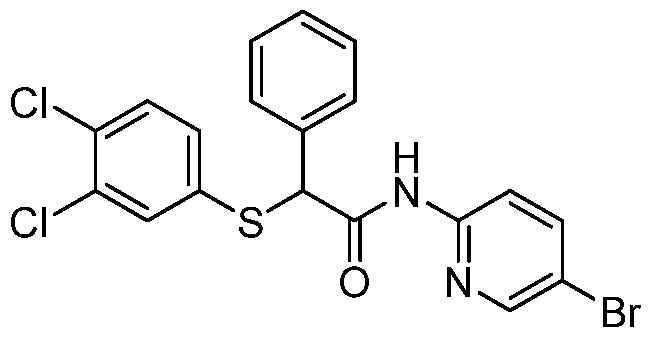
Synthesis of7V-(5-bromopyridin-2-yl)-2-(3,4-dichlorophenylthio)-2- phenylacetamide: The title compound was generated from commercially available 2-bromo-2- phenylacetic acid, 3,4-dichlorobenzenethiol, oxalyl chloride and 5-bromopyridin-2-amine according to general procedure A described above. The intermediate 2-(3,4- dichlorophenylthio)-2-phenylacetyl chloride was used in the subsequent synthetic transformation without further purification.
2-(3,4-Dichlorophenylthio)-2-phenylacetyl chloride: The title compound was obtained from commercially available 2-bromo-2-phenylacetic acid (12.00 g, 55.80 mmol), 3,4-dichlorobenzenethiol (10.00 g, 55.84 mmol), sodium hydride (60% oil dispersion, 5.00 g, 125.00 mmol) and oxalyl chloride (2 M in dichloromethane, 50.00 mL, 100.00 mmol) according to the protocols as outlined in general procedure A above. This acid chloride was used in the next synthetic step without further purification.
N-(5-Bromopyridin-2-yl)-2-(3, 4-dichlorophenylthio)-2-phenylacetamide: The title compound was obtained from 2-(3,4-dichlorophenylthio)-2-phenylacetyl chloride (taken from the previous step, crude, 3.31 g, 10.00 mmol), 5-bromopyridin-2-amine (1.90 g, 10.98 mmol) and Hϋnig's base (4.00 mL, 22.93 mmol) according to the protocols as outlined in general procedure A above. Free base was obtained. Spectroscopic Data: 1H NMR (500 MHz, DMSO-J6) δ ppm 5.60 (s, 1 H), 7.31 (t, J=7.21 Hz, 2 H), 7.36 (t, J=7.34 Hz, 2 H), 7.46 - 7.67 (m, 4 H), 7.87 - 8.10 (m, 2 H), 8.43 (s, 1 H), 11.15 (s, 1 H).
EXAMPLE 19

Synthesis of 7V-(5-chloropyridin-2-yl)-2-(3,4-dichlorophenylthio)-2- phenylacetamide: The title compound was generated from commercially available 2-bromo-2- phenylacetic acid, 3,4-dichlorobenzenethiol, oxalyl chloride and 5-chloropyridin-2-amine according to general procedure A described above. The intermediate 2-(3,4- dichlorophenylthio)-2-phenylacetyl chloride was used in the subsequent synthetic transformation without further purification.
2-(3,4-Dichlorophenylthio)-2-phenylacetyl chloride: The title compound was obtained from commercially available 2-bromo-2-phenylacetic acid (12.00 g, 55.80 mmol), 3,4-dichlorobenzenethiol (10.00 g, 55.84 mmol), sodium hydride (60% oil dispersion, 5.00 g, 125.00 mmol) and oxalyl chloride (2 M in dichloromethane, 50.00 mL, 100.00 mmol) according to the protocols as outlined in general procedure A above. This acid chloride was used in the next synthetic step without further purification.
N-(5-Chloropyridin-2-yl)-2-(3 , 4-dichlorophenylthio)-2-phenylacetamide: The title compound was obtained from 2-(3,4-dichlorophenylthio)-2-phenylacetyl chloride (taken from the previous step, crude, 3.31 g, 10.00 mmol), 5-chloropyridin-2-amine (1.50 g, 11.67 mmol) and Hϋnig's base (4.00 mL, 22.93 mmol) according to the protocols as outlined in general procedure A above. Free base was obtained. Spectroscopic Data: 1H NMR (500 MHz, DMSO-J6) δ ppm 5.61 (s, 1 H), 7.31 (t, J=6.97 Hz, 2 H), 7.36 (t, J=7.34 Hz, 2 H), 7.47 - 7.63 (m, 4 H), 7.88 (dd, J=8.93, 2.32 Hz, 1 H), 8.02 (d, J=9.05 Hz, 1 H), 8.36 (d, J=2.20 Hz, 1 H), 11.15 (s, 1 H).
EXAMPLE 20

The title compound was generated from commercially available 2-bromo-2- phenylacetic acid, 3-chlorobenzenethiol, oxalyl chloride and 5-bromopyridin-2-amine according to general procedure A described above. The intermediate 2-(3- chlorophenylthio)-2-phenylacetyl chloride was used in the subsequent synthetic transformation without further purification.
2-(3-Chlorophenylthio)-2-phenylacetyl chloride: The title compound was obtained from commercially available 2-bromo-2-phenylacetic acid (12.00 g, 55.80 mmol), 3- chlorobenzenethiol (8.07 g, 55.80 mmol), sodium hydride (60% oil dispersion, 5.50 g, 137.50 mmol) and oxalyl chloride (2 M in dichloromethane, 50.00 mL, 100.00 mmol) according to the protocols as outlined in general procedure A above. This acid chloride was used in the next synthetic step without further purification.
N-(5-Bromopyridin-2-yl)-2-(3-chlorophenylthio)-2-phenylacetamide
hydrochloride: The title compound was obtained from 2-(3-chlorophenylthio)-2- phenylacetyl chloride (taken from the previous step, crude, 2.80 g, 9.42 mmol), 5- bromopyridin-2-amine (1.90 g, 10.98 mmol) and Hϋnig's base (4.00 mL, 22.93 mmol) according to the protocols as outlined in general procedure A above. Spectroscopic Data: 1H NMR (500 MHz, DMSO-J6) δ ppm 5.71 (s, 1 H), 7.20 - 7.32 (m, 3 H), 7.35 (t, J=7.46 Hz, 2 H), 7.39 - 7.43 (m, 1 H), 7.55 (d, J=7.09 Hz, 1 H), 7.92 - 8.01 (m, 2 H), 8.42 (t, 1 H), 8.97 (br. s., I H), 11.22 (s, I H).
EXAMPLE 21

Synthesis of 2-(3-chlorophenylthio)-7V-(5-chloropyridin-2-yl)-2- phenylacetamide hydrochloride:
The title compound was generated from commercially available 2-bromo-2- phenylacetic acid, 3-chlorobenzenethiol, oxalyl chloride and 5-chloropyridin-2-amine according to general procedure A described above. The intermediate 2-(3-
chlorophenylthio)-2-phenylacetyl chloride was used in the subsequent synthetic transformation without further purification.
2-(3-Chlorophenylthio)-2-phenylacetyl chloride: The title compound was obtained from commercially available 2-bromo-2-phenylacetic acid (12.00 g, 55.80 mmol), 3- chlorobenzenethiol (8.07 g, 55.80 mmol), sodium hydride (60% oil dispersion, 5.50 g, 137.50 mmol) and oxalyl chloride (2 M in dichloromethane, 50.00 mL, 100.00 mmol) according to the protocols as outlined in general procedure A above. This acid chloride was used in the next synthetic step without further purification.
2-(3-Chlorophenylthio)-N-(5-chloropyridin-2-yl)-2-phenylacetamide
hydrochloride: The title compound was obtained from 2-(3-chlorophenylthio)-2- phenylacetyl chloride (taken from the previous step, crude, 2.80 g, 9.42 mmol), 5- chloropyridin-2-amine (1.50 g, 11.67 mmol) and Hϋnig's base (4.00 mL, 22.93 mmol) according to the protocols as outlined in general procedure A above. Spectroscopic Data: 1H NMR (500 MHz, DMSO-J6) IH NMR (500 MHz, <dmso>) δ ppm 5.67 (s, 1 H), 6.00 (br. s., 1 H), 7.24 - 7.32 (m, 3 H), 7.36 (t, J=7.34 Hz, 2 H), 7.39 - 7.43 (m, 1 H), 7.55 (d, J=7.09 Hz, 2 H), 7.88 (dd, J=9.05, 2.69 Hz, 1 H), 8.02 (d, J=9.05 Hz, 1 H), 8.36 (d, J=2.69 Hz, I H), 11.20 (s, I H).
EXAMPLE 22

Synthesis of 7V-(5-bromopyridin-2-yl)-2-(4-chlorophenyl)-2-(4- chlorophenylthio)acetamide hydrochloride :
The title compound was generated from commercially available 2-bromo-2-(4- chlorophenyl)acetic acid, 4-chlorobenzenethiol, oxalyl chloride and 5-bromopyridin-2- amine according to general procedure A described above. The intermediate 2-(4- chlorophenyl)-2-(4-chlorophenylthio)acetyl chloride was used in the subsequent synthetic transformation without further purification.
2-(4-Chlorophenyl)-2-(4-chlorophenylthio)acetyl chloride: The title compound was obtained from commercially available 2-bromo-2-(4-chlorophenyl)acetic acid (12.00
g, 48.10 mmol), 4-chlorobenzenethiol (6.96 g, 48.13 mmol), sodium hydride (60% oil dispersion, 5.50 g, 137.50 mmol) and oxalyl chloride (2 M in dichloromethane, 50.00 mL, 100.00 mmol) according to the protocols as outlined in general procedure A above. This acid chloride was used in the next synthetic step without further purification.
N-(5-Bromopyridin-2-yl)-2-(4-chlorophenyl)-2-(4-chlorophenylthio)acetamide hydrochloride: The title compound was obtained from 2-(4-chlorophenyl)-2-(4- chlorophenylthio)acetyl chloride (taken from the previous step, crude, 3.30 g, 9.95 mmol), 5-bromopyridin-2-amine (1.90 g, 10.98 mmol) and Hϋnig's base (4.00 mL, 22.93 mmol) according to the protocols as outlined in general procedure A above. Spectroscopic Data: 1H NMR (500 MHz, DMSO-J6) δ ppm 5.63 (s, 1 H), 6.47 (br. s., 1 H), 7.35 (s, 4 H), 7.39 - 7.42 (m, 1 H), 7.53 (d, J=8.56 Hz, 2 H), 7.93 - 7.97 (m, 1 H), 7.97 - 8.01 (m, 1 H), 8.42 (d, J=3.18 Hz, I H), 11.22 (s, 1 H).
EXAMPLE 23

Synthesis of 2-(4-chlorophenyl)-2-(4-chlorophenylthio)-7V-(5-chloropyridin-2- yl)acetamide hydrochloride:
The title compound was generated from commercially available 2-bromo-2-(4- chlorophenyl)acetic acid, 4-chlorobenzenethiol, oxalyl chloride and 5-chloropyridin-2- amine according to general procedure A described above. The intermediate 2-(4- chlorophenyl)-2-(4-chlorophenylthio)acetyl chloride was used in the subsequent synthetic transformation without further purification.
2-(4-Chlorophenyl)-2-(4-chlorophenylthio)acetyl chloride: The title compound was obtained from commercially available 2-bromo-2-(4-chlorophenyl)acetic acid (12.00 g, 48.10 mmol), 4-chlorobenzenethiol (6.96 g, 48.13 mmol), sodium hydride (60% oil dispersion, 5.50 g, 137.50 mmol) and oxalyl chloride (2 M in dichloromethane, 50.00 mL, 100.00 mmol) according to the protocols as outlined in general procedure A above. This acid chloride was used in the next synthetic step without further purification.
2-(4-Chlorophenyl)-2-(4-chlorophenylthio)-N-(5-chloropyridin-2-yl)acetamide hydrochloride: The title compound was obtained from 2-(4-chlorophenyl)-2-(4- chlorophenylthio)acetyl chloride (taken from the previous step, crude, 3.30 g, 9.95 mmol), 5-chloropyridin-2-amine (1.50 g, 11.67 mmol) and Hϋnig's base (4.00 mL, 22.93 mmol) according to the protocols as outlined in general procedure A above. Spectroscopic Data: 1H NMR (500 MHz, DMSO-J6) δ ppm 5.61 (s, 1 H), 6.94 (br. s., 1 H), 7.33 - 7.38 (m, 4 H), 7.41 (d, J=8.31 Hz, 2 H), 7.53 (d, J=8.56 Hz, 2 H), 7.88 (dd, J=8.93, 2.57 Hz, 1 H), 8.01 (d, J=8.80 Hz, 1 H), 8.35 (d, J=2.45 Hz, 1 H), 11.22 (s, 1 H).
EXAMPLE 24

Synthesis of 2-(4-bromophenylthio)-7V-(5-chloropyridin-2-yl)-2- phenylacetamide:
The title compound was generated from commercially available 2-bromo-2- phenylacetic acid, 4-bromobenzenethiol, oxalyl chloride and 5-chloropyridin-2-amine according to general procedure A described above. The intermediate 2-(4- bromophenylthio)-2-phenylacetyl chloride was used in the subsequent synthetic transformation without further purification.
2-(4-Bromophenylthio)-2-phenylacetyl chloride: The title compound was obtained from commercially available 2-bromo-2-phenylacetic acid (10.00 g, 46.50 mmol), 4- bromobenzenethiol (8.80 g, 46.56 mmol), sodium hydride (60% oil dispersion, 5.50 g, 137.50 mmol) and oxalyl chloride (2 M in dichloromethane, 60.00 mL, 120.00 mmol) according to the protocols as outlined in general procedure A above. This acid chloride was used in the next synthetic step without further purification.
2-(4-Bromophenylthio)-N-(5-chloropyridin-2-yl)-2-phenylacetamide: The title compound was obtained from 2-(4-bromophenylthio)-2-phenylacetyl chloride (taken from the previous step, crude, 3.40 g, 9.95 mmol), 5-chloropyridin-2-amine (1.28 g, 9.96 mmol) and Hϋnig's base (5.00 mL, 28.66 mmol) according to the protocols as outlined in general procedure A above. Free base was obtained. Spectroscopic Data: 1H NMR (500 MHz,
DMSO-J6) δ ppm 5.58 (s, 1 H), 7.31 (d, J=8.56 Hz, 3 H), 7.38 (t, J=7.34 Hz, 2 H), 7.52 (d,
J=8.56 Hz, 2 H), 7.56 (d, J=I.34 Hz, 2 H), 7.90 (dd, J=8.93, 2.57 Hz, 1 H), 8.06 (d, J=8.80 Hz, 1 H), 8.38 (d, J=2.45 Hz, 1 H), 11.19 (s, 1 H).
EXAMPLE 25

Synthesis of 2-(4-bromophenylthio)-7V-(5-bromopyridin-2-yl)-2- phenylacetamide:
The title compound was generated from commercially available 2-bromo-2- phenylacetic acid, 4-bromobenzenethiol, oxalyl chloride and 5-bromopyridin-2-amine according to general procedure A described above. The intermediate 2-(4- bromophenylthio)-2-phenylacetyl chloride was used in the subsequent synthetic transformation without further purification.
2-(4-Bromophenylthio)-2-phenylacetyl chloride: The title compound was obtained from commercially available 2-bromo-2-phenylacetic acid (10.00 g, 46.50 mmol), A- bromobenzenethiol (8.80 g, 46.56 mmol), sodium hydride (60% oil dispersion, 5.50 g, 137.50 mmol) and oxalyl chloride (2 M in dichloromethane, 60.00 mL, 120.00 mmol) according to the protocols as outlined in general procedure A above. This acid chloride was used in the next synthetic step without further purification.
2-(4-Bromophenylthio)-N-(5-bromopyridin-2-yl)-2-phenylacetamide: The title compound was obtained from 2-(4-bromophenylthio)-2-phenylacetyl chloride (taken from the previous step, crude, 3.40 g, 9.95 mmol), 5-bromopyridin-2-amine (1.73 g, 10.00 mmol) and Hϋnig's base (5.00 mL, 28.66 mmol) according to the protocols as outlined in general procedure A above. Free base was obtained. Spectroscopic Data: 1H NMR (500 MHz, DMSO-J6) δ ppm 5.57 (s, 1 H), 7.24 - 7.34 (m, 2 H), 7.37 (t, J=7.34 Hz, 2 H), 7.53 (dd, J=13.94, 7.83 Hz, 4 H), 8.00 (s, 2 H), 8.45 (s, 1 H), 11.18 (s, 1 H).
EXAMPLE 26

Synthesis of 2-(4-chlorophenylthio)-7V-(5-chloropyridin-2-yl)-2-(4- fluorophenyl)acetamide : The title compound was generated from commercially available 2-bromo-2-(4- fluorophenyl)acetic acid, 4-chlorobenzenethiol, oxalyl chloride and 5-chloropyridin-2- amine according to general procedure A described above. The intermediate 2-(4- chlorophenylthio)-2-(4-fluorophenyl)acetyl chloride was used in the subsequent synthetic transformation without further purification.
2-(4-Chlorophenylthio)-2-(4-fluorophenyl)acetyl chloride: The title compound was obtained from commercially available 2-bromo-2-phenylacetic acid (12.80 g, 54.94 mmol), 4-chlorobenzenethiol (8.00 g, 55.32 mmol), sodium hydride (60% oil dispersion, 5.30 g, 132.50 mmol) and oxalyl chloride (2 M in dichloromethane, 60.00 niL, 120.00 mmol) according to the protocols as outlined in general procedure A above. This acid chloride was used in the next synthetic step without further purification.
2-(4-Chlorophenylthio)-N-(5-chloropyridin-2-yl)-2-(4-fluorophenyl)acetamide: The title compound was obtained from 2-(4-chlorophenylthio)-2-(4-fluorophenyl)acetyl chloride (taken from the previous step, crude, 3.15 g, 10.00 mmol), 5-chloropyridin-2- amine (1.28 g, 10.00 mmol) and Hϋnig's base (5.00 mL, 28.66 mmol) according to the protocols as outlined in general procedure A above. Free base was obtained.
Spectroscopic Data: 1H NMR (500 MHz, DMSO-J6) δ ppm 5.56 (s, 1 H), 7.21 (t, J=8.80 Hz, 2 H), 7.38 (dd, J=19.07, 2.45 Hz, 4 H), 7.57 (dd, J=8.44, 5.50 Hz, 2 H), 7.90 (dd, J=9.05, 2.45 Hz, 1 H), 8.06 (d, J=8.80 Hz, 1 H), 8.38 (d, J=2.20 Hz, I H), 11.17 (s, I H).
EXAMPLE 27

The title compound was generated from commercially available 2-bromo-2- phenylacetic acid, 4-chlorobenzenethiol, oxalyl chloride and 5-chloropyridin-2-amine according to general procedure A described above. The intermediate 2-(4- chlorophenylthio)-2-phenylacetyl chloride was used in the subsequent synthetic transformation without further purification.
2-(4-Chlorophenylthio)-2-phenylacetyl chloride: The title compound was obtained from commercially available 2-bromo-2-phenylacetic acid (12.00 g, 55.81 mmol), 4- chlorobenzenethiol (8.00 g, 55.32 mmol), sodium hydride (60% oil dispersion, 5.00 g, 125.00 mmol) and oxalyl chloride (2 M in dichloromethane, 60.00 mL, 120.00 mmol) according to the protocols as outlined in general procedure A above. This acid chloride was used in the next synthetic step without further purification.
2-(4-Chlorophenylthio)-N-(5-chloropyridin-2-yl)-2-phenylacetamide: The title compound was obtained from 2-(4-chlorophenylthio)-2-phenylacetyl chloride (taken from the previous step, crude, 3.00 g, 10.09 mmol), 5-chloropyridin-2-amine (1.28 g, 9.96 mmol) and Hϋnig's base (5.00 mL, 28.66 mmol) according to the protocols as outlined in general procedure A above. Free base was obtained. Spectroscopic Data: 1H NMR (500 MHz, DMSO-J6) δ ppm 5.57 (br. s., 1 H), 7.26 - 7.46 (m, 7 H), 7.55 (d, J=7.34 Hz, 2 H), 7.90 (d, J=1.22 Hz, 1 H), 8.06 (d, J=8.80 Hz, 1 H), 8.37 (br. s., 1 H), 11.16 (br. s., 1 H).
EXAMPLE 28

Synthesis of N-(5-iodopyridin-2-yl)-2-phenyl-2-(phenylthio)acetamide:
The title compound was generated from commercially available 2-phenyl-2- (phenylthio)acetic acid, oxalyl chloride and 5-iodopyridin-2-amine according to general procedure A described above. The intermediate 2-phenyl-2-(phenylthio)acetyl chloride was used in the subsequent synthetic transformation without further purification.
2-Phenyl-2-(phenylthio)acetyl chloride: The title compound was obtained from commercially available 2-phenyl-2-(phenylthio)acetic acid (25.00 g, 102.33 mmol) and oxalyl chloride (2 M in dichloromethane, 100.00 mL, 200.00 mmol) according to the protocols as outlined in general procedure A above. This acid chloride was used in the next synthetic step without further purification.
N-(5-Iodopyridin-2-yl)-2-phenyl-2-(phenylthio)acetamide: The title compound was obtained from 2-phenyl-2-(phenylthio)acetic acid (taken from the previous step, crude, 2.62 g, 10.72 mmol), 5-iodopyridin-2-amine (2.00 g, 9.09 mmol) and Hϋnig's base (4.00 mL, 22.93 mmol) according to the protocols as outlined in general procedure A above. Free base was obtained. Spectroscopic Data: 1H NMR (500 MHz, DMSO-ύk) δ ppm 5.61 (s, 1 H), 7.23 (d, J=7.34 Hz, 1 H), 7.30 (t, J=7.70 Hz, 3 H), 7.33 - 7.40 (m, 4 H), 7.56 (d, J=7.09 Hz, 2 H), 7.89 (d, J=8.56 Hz, 1 H), 8.10 (dd, J=8.80, 2.20 Hz, 1 H), 8.53 (d, J=2.44 Hz, 1 H), 11.13 (s, 1 H).
General procedure for the Synthesis of 2-(Substituted Phenyl)-3-(substituted phenyl)-7V-(substituted pyridin-2-yl)acetamide Hydrochloride:

Hunig's base
DCM, rt, 16 h
An appropriately substituted carboxylic acid was converted into the corresponding acid chloride by the method published in Newcomb et al.. The acid chloride (1 eq) and an appropriately substituted 2-aminopyridine (1.5-2.0 eq) were dissolved in 50ml of dichloromethane at room temperature. Hϋnig's base (3.50 mL) was added, and the resulting reaction mixture was stirred at room temperature for 14 hours. The reaction mixture was then concentrated and diluted with ethyl acetate. The organic phase was washed sequentially with water and brine, then dried with sodium sulfate and
concentrated. Flash chromatography (30 % EtOAc/hexanes) gave the desired free base, which was mixed with HCl in MeOH. Concentration and recrystallization from ether gave the final desired product in HCl salt form.
EXAMPLE 29

Synthesis of 7V-(5-chloropyridin-2-yl)-2,3-diphenylpr opanamide
hydrochloride: The title compound was generated from commercially available 2,3- diphenylpropanoic acid, thionyl chloride and 5-chlororopyridin-2-amine according to the general procedure described above. The intermediate 2,3-diphenylpropanoic acid chloride was used in the subsequent synthetic transformation without further purification.
2,3-Diphenylpropanoic acid chloride: The title compound was obtained from commercially available 2,3-diphenylpropanoic acid (25.00 g, 110.49 mmol) and thionyl chloride (20.00 mL, 274.19 mmol) according to the protocols as outlined in the general procedure above. This acid chloride was used in the next synthetic step without further purification.
N-(5-Chloropyridin-2-yl)-2,3-diphenylpropanamide hydrochloride: The title compound was obtained from 2,3-diphenylpropanoic acid chloride (taken from the previous step, crude, 2.50 g, 10.22 mmol), 5-chloropyridin-2-amine (1.28 g, 10.00 mmol) and Hϋnig's base (3.50 mL, 20.09 mmol) according to the protocols as outlined in the general procedure above. Spectroscopic Data: 1H NMR (500 MHz, DMSO-ύk) δ ppm 2.95 (dd, J=13.69, 6.11 Hz, 1 H), 3.40 (dd, J=13.57, 9.17 Hz, 1 H), 4.26 (dd, J=9.17, 6.24 Hz, 1 H), 7.16 - 7.25 (m, 5 H), 7.30 (t, J=7.58 Hz, 3 H), 7.43 (d, J=7.09 Hz, 2 H), 7.83 (dd,
J=9.05, 2.69 Hz, 1 H), 8.06 (d, J=9.05 Hz, 1 H), 8.29 (d, J=2.20 Hz, 1 H), 10.82 (s, 1 H).
EXAMPLE 30

Synthesis of 7V-(5-bromopyridin-2-yl)-2,3-diphenylpropanamide
hydrochloride: The title compound was generated from commercially available 2,3- diphenylpropanoic acid, thionyl chloride and 5-bromoropyridin-2-amine according to the general procedure described above. The intermediate 2,3-diphenylpropanoic acid chloride was used in the subsequent synthetic transformation without further purification.
2,3-Diphenylpropanoic acid chloride: The title compound was obtained from commercially available 2,3-diphenylpropanoic acid (25.00 g, 110.49 mmol) and thionyl chloride (20.00 mL, 274.19 mmol) according to the protocols as outlined in the general procedure above. This acid chloride was used in the next synthetic step without further purification.
N-(5-Bromopyridin-2-yl)-2,3-diphenylpropanamide hydrochloride: The title compound was obtained from 2,3-diphenylpropanoic acid chloride (taken from the previous step, crude, 2.50 g, 10.22 mmol), 5-bromopyridin-2-amine (1.63 g, 9.42 mmol) and Hϋnig's base (3.50 mL, 20.09 mmol) according to the protocols as outlined in the general procedure above. Spectroscopic Data: 1H NMR (500 MHz, DMSO-ύk) δ ppm 2.95 (dd, J=13.69, 6.11 Hz, 1 H), 3.40 (dd, J=13.69, 9.29 Hz, 1 H), 4.26 (dd, J=9.17, 6.24 Hz, 1 H), 7.17 - 7.24 (m, 5 H), 7.30 (t, J=7.58 Hz, 3 H), 7.43 (d, J=7.09 Hz, 2 H), 7.91 - 7.96 (m, 1 H), 7.98 - 8.06 (m, 1 H), 8.36 (d, J=2.45 Hz, 1 H), 10.82 (s, 1 H).
EXAMPLE 31

Synthesis of7V-(5-bromo-6-methylpyridin-2-yl)-2,3-diphenylpropanamide hydrochloride: The title compound was generated from commercially available 2,3- diphenylpropanoic acid, thionyl chloride and 5-bromo-6-methylpyridin-2-amine according to the general procedure described above. The intermediate 2,3-diphenylpropanoic acid chloride was used in the subsequent synthetic transformation without further purification.
2,3-Diphenylpropanoic acid chloride: The title compound was obtained from commercially available 2,3-diphenylpropanoic acid (25.00 g, 110.49 mmol) and thionyl chloride (20.00 mL, 274.19 mmol) according to the protocols as outlined in the general procedure above. This acid chloride was used in the next synthetic step without further purification.
N-(5-Bromo-6-methylpyridin-2-yl)-2, 3-diphenylpropanamide hydrochloride: The title compound was obtained from 2,3-diphenylpropanoic acid chloride (taken from the previous step, crude, 2.50 g, 10.22 mmol), 5-bromo-6-methylpyridin-2-amine (1.87 g, 10.00 mmol) and Hϋnig's base (3.00 mL, 17.22 mmol) according to the protocols as outlined in the general procedure above. Spectroscopic Data: 1H NMR (500 MHz, DMSO-J6) δ ppm 2.43 (s, 3 H), 2.93 (dd, J=13.69, 6.11 Hz, 1 H), 3.39 (dd, J=13.69, 9.54 Hz, 1 H), 4.27 (dd, 1 H), 6.61 (br. s., 1 H), 7.08 - 7.14 (m, 1 H), 7.16 - 7.24 (m, 5 H), 7.29 (t, J=7.58 Hz, 2 H), 7.43 (d, J=7.34 Hz, 2 H), 7.78 - 7.84 (m, 1 H), 7.85 - 7.90 (m, 1 H), 10.73 (s, 1 H).
EXAMPLE 32

Synthesis of 7V-(5-methylpyridin-2-yl)-2,3-diphenylpropanamide
hydrochloride:
The title compound was generated from commercially available 2,3- diphenylpropanoic acid, thionyl chloride and 5-methylpyridin-2-amine according to the general procedure described above. The intermediate 2,3-diphenylpropanoic acid chloride was used in the subsequent synthetic transformation without further purification.
2,3-Diphenylpropanoic acid chloride: The title compound was obtained from commercially available 2,3-diphenylpropanoic acid (25.00 g, 110.49 mmol) and thionyl chloride (20.00 mL, 274.19 mmol) according to the protocols as outlined in the general procedure above. This acid chloride was used in the next synthetic step without further purification.
N-(5-Methylpyridin-2-yl)-2,3-diphenylpropanamide hydrochloride: The title compound was obtained from 2,3-diphenylpropanoic acid chloride (taken from the previous step, crude, 2.50 g, 10.22 mmol), 5-methylpyridin-2-amine (1.08 g, 10.00 mmol) and Hϋnig's base (3.50 mL, 20.09 mmol) according to the protocols as outlined in the general procedure above. Spectroscopic Data: 1H NMR (500 MHz, DMSO-ύk) δ ppm 2.26 (s, 3 H), 3.04 (dd, ./=13.82, 6.72 Hz, 1 H), 3.45 (dd, J=13.82, 8.68 Hz, 1 H), 4.46 (t, J=7.70 Hz, 1 H), 6.28 (br s, 1 H), 7.10-7.15 (m, 1 H), 7.17 - 7.26 (m, 5 H), 7.27 - 7.34 (m, 2 H), 7.50 (d, J=7.34 Hz, 2 H), 7.84 (d, J=8.80 Hz, 1 H), 8.00 (d, J=8.56 Hz, 1 H), 8.15 (s, 1 H), 12.51 (br. s., I H).
EXAMPLE 33

Synthesis of7V-(5-bromopyridin-2-yl)-2,2-bis(4-chlorophenyl)acetamide: The title compound was generated from commercially available 2,3- diphenylpropanoic acid, thionyl chloride and 5-cyanopyridin-2-amine according to the general procedure described above. The intermediate 2,3-diphenylpropanoic acid chloride was used in the subsequent synthetic transformation without further purification.
2, 2-bis(4-Chlorophenyl) acetic acid chloride: The title compound was obtained from commercially available 2,2-bis(4-chlorophenyl)acetic acid (10.00 g, 35.57 mmol) and thionyl chloride (20.00 mL, 274.19 mmol) according to the protocols as outlined in the general procedure above. This acid chloride was used in the next synthetic step without further purification.
N-(5-Bromopyridin-2-yl)-2,2-bis(4-chlorophenyl)acetamide: The title compound was obtained from 2,2-bis(4-chlorophenyl)acetic acid chloride (taken from the previous step, crude, 3.00 g, 10.01 mmol), 5-bromopyridin-2-amine (1.90 g, 10.98 mmol) and Hϋnig's base (3.00 mL, 17.22 mmol) according to the protocols as outlined in the general procedure above. Spectroscopic Data: 1H NMR (500 MHz, DMSO-J6) δ ppm 5.39 (s, 1 H), 7.27 - 7.36 (m, 4 H), 7.37 - 7.46 (m, 4 H), 7.95 - 8.03 (m, 1 H), 8.04 - 8.11 (m, 1 H), 8.43 (d, J=2.45 Hz, 1 H), 11.17 (s, 1 H).
EXAMPLE 34

Synthesis of 7V-(5-cyanopyridin-2-yl)-2,3-diphenylpropanamide hydrochloride:
The title compound was generated from commercially available 2,3- diphenylpropanoic acid, thionyl chloride and 5-cyanopyridin-2-amine according to the general procedure described above. The intermediate 2,3-diphenylpropanoic acid chloride was used in the subsequent synthetic transformation without further purification.
2,3-Diphenylpropanoic acid chloride: The title compound was obtained from commercially available 2,3-diphenylpropanoic acid (25.00 g, 110.49 mmol) and thionyl chloride (20.00 mL, 274.19 mmol) according to the protocols as outlined in the general procedure above. This acid chloride was used in the next synthetic step without further purification.
N-(5-Cyanopyridin-2-yl)-2,3-diphenylpropanamide hydrochloride: The title compound was obtained from 2,3-diphenylpropanoic acid chloride (taken from the previous step, crude, 3.00 g, 12.26 mmol), 5-cyanopyridin-2-amine (2.00 g, 16.79 mmol) and Hϋnig's base (3.50 mL, 20.09 mmol) according to the protocols as outlined in the general procedure above. Spectroscopic Data: 1H NMR (500 MHz, DMSO-ύk) δ ppm 2.96 (dd, J=13.69, 6.11 Hz, 1 H), 3.41 (dd, J=13.69, 9.29 Hz, 1 H), 4.29 (dd, J=9.05, 6.36 Hz, 1 H), 5.58 - 5.75 (m, 1 H), 7.07 - 7.15 (m, 1 H), 7.16 - 7.26 (m, 5 H), 7.31 (t, J=7.58 Hz, 3 H), 7.44 (d, J=7.34 Hz, 2 H), 8.07 (d, J=8.80 Hz, 1 H), 8.17 (dd, J=8.80, 2.45 Hz, 1 H), 8.73 (d, J=I.96 Hz, 1 H), 10.94 (s, 1 H).
Unless otherwise indicated, the following terms as used throughout this specification have the following meanings:
DCM refers to dichloromethane,
DMSO refers to dimethyl sulfoxide,
EDCI refers tol-ethyl-3-(3-dimethylaminopropyl)carbodiimide,
THF refers to tetrahydrofuran,
EtOAc refers to ethylacetate,
"Me" refers to methyl.,
"Ph" refers to phenyl,
"Pharmaceutically acceptable salt" refers to those salts which retain the biological effectiveness and properties of the free bases and which are obtained by reaction with inorganic acids such as hydrochloric acid, hydrobromic acid, sulfuric acid, nitric acid,
phosphoric acid, methanesulfonic acid, ethanesulfonic acid, p-toluenesulfonic acid, salicylic acid and the like.
"Alkyl" refers to a straight-chain, branched or cyclic saturated aliphatic
hydrocarbon. Preferably, the alkyl group has 1 to 12 carbons. More preferably, it is a lower alkyl of from 1 to 7 carbons, most preferably 1 to 4 carbons. Typical alkyl groups include methyl, ethyl, propyl, isopropyl, butyl, isobutyl, tertiary butyl, pentyl, hexyl and the like. The alkyl group may be optionally substituted with one or more substituents selected from the group consisting of hydroxyl, cyano, alkoxy, =0, =S, NO2, halogen, dimethyl amino and SH.
"Alkenyl" refers to a straight-chain, branched or cyclic unsaturated hydrocarbon group containing at least one carbon—carbon double bond. Preferably, the alkenyl group has 2 to 12 carbons. More preferably it is a lower alkenyl of from 2 to 7 carbons, most preferably 2 to 4 carbons. The alkenyl group may be optionally substituted with one or more substituents selected from the group consisting of hydroxyl, cyano, alkoxy, O, S, NO2, halogen, dimethyl amino and SH.
"Alkynyl" refers to a straight-chain, branched or cyclic unsaturated hydrocarbon containing at least one carbon—carbon triple bond. Preferably, the alkynyl group has 2 to 12 carbons. More preferably it is a lower alkynyl of from 2 to 7 carbons, most preferably 2 to 4 carbons. The alkynyl group may be optionally substituted with one or more substituents selected from the group consisting of hydroxyl, cyano, alkoxy, O, S, NO2, halogen, dimethyl amino and SH.
"Alkoxy" refers to an "O-alkyl" group.
"Aryl" refers to an aromatic group which has at least one ring having a conjugated pi electron system and includes carbocyclic aryl, heterocyclic aryl and biaryl groups. The aryl group may be optionally substituted with one or more substituents selected from the group consisting of halogen, trihalomethyl, hydroxyl, SH, OH, NO2, amine, thioether, cyano, alkoxy, alkyl, and amino.
"Alkaryl" refers to an alkyl that is covalently joined to an aryl group. Preferably, the alkyl is a lower alkyl.
"Aryloxy" refers to an "O-aryl" group.
"Arylalkyloxy" refers to an "O-alkaryl" group.
"Carbocyclic" refers to cyclic saturated or unsaturated aliphatic hydrocarbon and aryl hydrocarbon groups wherein the ring atoms are exclusively carbons, and comprises from 6 to 20 carbon atoms, including said ring atoms.
"Carbocyclic aryl" refers to an aryl group wherein the ring atoms are carbon.
"Heterocyclic" refers to cyclic groups wherein the ring atoms comprise carbon atoms and at least one oxygen, nitrogen, and/or sulfur atom and may be saturated, unsaturated, i.e. have one or more double bonds, or aryl, and comprises up to 20 carbon atoms and from 1 to 5 of the above heteroatoms.
"Heterocyclic aryl" refers to an aryl group having from 1 to 3 heteroatoms as ring atoms, the remainder of the ring atoms being carbon. Heteroatoms include oxygen, sulfur, and nitrogen.
"Hydrocarbyl" refers to a hydrocarbon radical having only carbon and hydrogen atoms. Preferably, the hydrocarbyl radical has from 1 to 20 carbon atoms, more preferably from 1 to 12 carbon atoms and most preferably from 1 to 7 carbon atoms.
"Substituted hydrocarbyl" refers to a hydrocarbyl radical wherein one or more, but not all, of the hydrogen and/or the carbon atoms are replaced by a halogen, nitrogen, oxygen, sulfur or phosphorus atom or a radical including a halogen, nitrogen, oxygen, sulfur or phosphorus atom, e.g. fluoro, chloro, cyano, nitro, hydroxyl, phosphate, thiol, etc.
"Amide" refers to -C(O)-NH-R', wherein R' is alkyl, aryl, alkylaryl or hydrogen. "Ester" refers to -C(O)-O-R', wherein R is alkyl, aryl or alkylaryl.
"Thioamide" refers to -C(S)-NH-R, wherein R' is alkyl, aryl, alkylaryl or hydrogen.
"Thiol ester" refers to -C(O)-S-R, wherein R is alkyl, aryl, alkylaryl or hydrogen.
"Amine" refers to a— N(R")R'" group, wherein R" and R" are independently selected from the group consisting of alkyl, aryl, and alkylaryl.
"Thioether" refers to— S— R", wherein R" is alkyl, aryl, or alkylaryl.
"Sulfonyl" refers to -S(O)2 -R"", where R"" is aryl, C(CN)=C-aryl, CH2 CN, alkyaryl, sulfonamide, NH-alkyl, NH-alkylaryl, or NH-aryl.
Also, alternatively the substituent on the phenyl moiety may be referred to as an o, m or p substituent or a 2, 3 or 4 substituent, respectively. (Obviously, the 5 substituent is also a m substituent and the 6 substituent is an o substituent.)
The above compounds are evaluated for S1P3 activity according to the above assay: The results are reported in TABLE 2, below.
TABLE 2


As a result of the above activity of the compounds utilized in the method of the present invention, it is clear that such compounds may be used in treating and/or preventing the following diseases and conditions of the eye as well as other diseases and conditions discussed below. (It should be noted that "treating" means ameliorating and/or modulating a disease or disorder that exists in a subject (whether the subject is aware of the disease or disorder or not) or delaying the onset of the disease or disorder and
"preventing" means preventing the recurrence, onset or development of one or more
symptoms of a disease or disorder in a subject by administering one or more compounds of the invention.)
Glaucoma
S1P3 subtypes are expressed in primary human trabecular meshwork cells and SlP decreases outflow facility >30% in perfused porcine eyes (See IOVS 45, 2263; 2004) by altering paracellular permeability.
Dry Eye/Immunology
Induces lymphocyte sequestration without affecting T cell proliferation.
Angiogenesis disorders
S1P3 receptor subtype is expressed in vascular endothelial cells and siRNA knockdown of SlPl and S1P3 inhibits angiogenesis. SlP also promotes vascular endothelial cell migration and promotes barrier assembly and integrity.
Cardiovascular (S1P3)
S1P3 "knock out" mice lack SlP induced pulmonary edema.
The foregoing description details specific methods and compositions that can be employed to practice the present invention, and represents the best mode contemplated. Thus, however detailed the foregoing may appear in text, it should not be construed as limiting the overall scope hereof; rather, the ambit of the present invention was to be governed only by the lawful construction of the appended claims. In particular, the present invention includes, as novel compounds, having subtype-selective modulating activity of sphingosine-l-phosphate-3 (SIP3) receptors, compounds selected from the group consisting of 2-(substituted)(arylmethyl, aryloxy, and arylthio)-N-(substituted pyridin-2- yl)-2-(substituted aryl) compounds, wherein said aryl is a carbocyclic aryl or a heterocyclic aryl, which is substituted with one or more radicals selected from the group consisting of alkyl, alkenyl, alkynyl, alkaryl, alkyloxy, aryloxy, arylalkyloxy, amine, amide, hydroxyl, halogen, nitrile, nitro, trifluoromethyl, carboxy, ester, thiolester, thioether and sulfonyl.
Claims
WHAT IS CLAIMED IS:
1. Compounds represented by the formula I having sphingosine- 1 -phosphate receptor antagonist biological activity:

wherein:
A is O, S or (CR2X wherein R is selected from the group consisting of H, or lower alkyl;
m, n, p are 0 or an integer of from 1 to 5;
a is O or l,
wherein when a is 1 ,
X and Y are independently selected from the group consisting of alkyl, alkyloxy, hydroxyl, halogen, nitrile, trifluoromethyl and carboxy;
Z is selected from the group consisting of alkyl, alkyloxy, hydroxyl, halogen, nitrile, trifluoromethyl and carboxy, and
when a is 0,
X, Y are independently selected from the group consisting of alkyl, alkyloxy, hydroxyl, halogen, nitrile, trifluoromethyl, and carboxy;
Z is selected from the group consisting of alkyl, alkyloxy, hydroxyl, halogen, nitrile, trifluoromethyl, and carboxy,
provided however that when a is 0 and when the pyridyl ring is (a) 5-chloro pyridyl, then both (i) m and n are not 0 and (ii) X and Y are not chloro or methyl or (b) 5- bromo or iodo pyridyl, than both m and n are not 0,or a pharmaceutically acceptable salt of said compound. 2. The compound of claim 1 wherein m, n, and p are 0 or an integer of 1 or 2.
3. The compound of claim 2 wherein X and Y are independently selected from the group consisting of lower alkyl, lower alkyloxy, hydroxyl. chloro, bromo, nitrile, trifluoromethyl and carboxy; and
Z is selected from the group consisting of lower alkyl, lower alkoxy, hydroxyl, fluoro, chloro, bromo, nitrile, trifluoromethyl, and carboxy.
4. The compound of claim 3 wherein A is (CR2)a and a is 1.
5. The compound of claim 4 wherein m and n are 0 and Z is selected from the group consisting of fluoro, chloro, bromo, and methyl.
6. The compound of claim 2 wherein A is (CR2X and a is 0. 7. The compound of claim 6 wherein Z is fluoro.
9. The compound of claim 2 wherein A is S.
10. The compound of claim 9 wherein m and n are 0.
11. The compound of claim 10 wherein Z is selected from the group consisting of chloro and bromo. 12. The compound of claim 2 wherein A is O.
13. The compound of claim 12 wherein X and Y are independently selected from the group consisting of lower alkyl, lower alkyloxy, hydroxyl. chloro, bromo, nitrile, trifluoromethyl, and carboxy; and
Z is selected from the group consisting of lower alkyl, lower alkoxy, hydroxyl, fluoro, chloro, bromo, nitrile, trifluoromethyl, and carboxy.
14. The compound of claim 13 wherein X and Y are independently selected from the group consisting of methyl, methyloxy, chloro and bromo; and Z is selected from the group consisting of fluoro, chloro, bromo and methyl.
15. The compound of claim 2 selected from the group consisting of:
2-(4-chloro-3-methylphenoxy)-2-(4-chlorophenyl)-Λ/-(5-chloropyridin-2- yl)acetamide hydrochloride,
N-(5-bromopyridin-2-yl)-2-(4-chlorophenyl)-2-(p-tolyloxy)acetamide
hydrochloride,
2-(4-chlorophenyl)-Λ/-(5-chloropyridin-2-yl)-2-(4-methoxyphenoxy)acetamide hydrochloride,
2-(4-bromophenoxy)-2-(4-chlorophenyl)-Λ/-(5-fluoropyridin-2-yl)acetamide hydrochloride,
2-(4-bromophenoxy)-Λ/-(5-bromopyridin-2-yl)-2-(4-chlorophenyl)acetamide hydrochloride,
2-(4-bromophenoxy)-2-(4-chlorophenyl)-Λ/-(5-chloropyridin-2-yl)acetamide hydrochloride,
2-(4-chlorophenoxy)-2-(4-chlorophenyl)-Λ/-(5-fluoropyridin-2-yl)acetamide hydrochloride,
N-(5-bromopyridin-2-yl)-2-(4-chlorophenoxy)-2-(4-chlorophenyl)acetamide hydrochloride, and
2-(4-chlorophenoxy)-2-(4-chlorophenyl)-Λ/-(5-chloropyridin-2-yl)acetamide hydrochloride.
16. The compound of claim 2 selected from the group consisting of:
Λ/-(5-bromopyridin-2-yl)-2-phenyl-2-(phenylthio)acetamide hydrochloride, N-(5-bromopyridin-2-yl)-2-(4-chlorophenyl)-2-(4-methoxyphenylthio)acetamide hydrochloride,
2-(4-chlorophenyl)-Λ/-(5-chloropyridin-2-yl)-2-(4-methoxyphenylthio)acetamide hydrochloride,
2-(4-chlorophenyl)-Λ/-(5-chloropyridin-2-yl)-2-(4-fluorophenylthio)acetamide hydrochloride,
N-(5-bromopyridin-2-yl)-2-(4-chlorophenyl)-2-(4-fluorophenylthio)acetamide hydrochloride,
2-(4-chlorophenyl)-Λ/-(5-chloropyridin-2-yl)-2-(3, 4-dimethylphenylthio)acetamide hydrochloride,
N-(5-bromopyridin-2-yl)-2-(4-chlorophenyl)-2-(p-tolylthio)acetamide
hydrochloride,
2-(4-chlorophenyl)-Λ/-(5-chloropyridin-2-yl)-2-(p-tolylthio)acetamide
hydrochloride,
N-(5-bromopyridin-2-yl)-2-(3, 4-dichlorophenylthio)-2-phenylacetamide,
N-(5-chloropyridin-2-yl)-2-(3, 4-dichlorophenylthio)-2-phenylacetamide,
N-(5 -bromopyridin-2-yl)-2-(3 -chlorophenylthio)-2-phenylacetamide hydrochloride, 2-(3-chlorophenylthio)-Λ/-(5-chloropyridin-2-yl)-2-phenylacetamide hydrochloride,
N-(5-bromopyridin-2-yl)-2-(4-chlorophenyl)-2-(4-chlorophenylthio)acetamide hydrochloride,
2-(4-chlorophenyl)-2-(4-chlorophenylthio)-Λ/-(5-chloropyridin-2-yl)acetamide hydrochloride,
2-(4-bromophenylthio)-Λ/-(5-chloropyridin-2-yl)-2-phenylacetamide,
2-(4-bromophenylthio)-Λ/-(5-bromopyridin-2-yl)-2-phenylacetamide,
2-(4-chlorophenylthio)-Λ/-(5-chloropyridin-2-yl)-2-(4-fluorophenyl)acetamide, 2-(4-chlorophenylthio)-Λ/-(5-chloropyridin-2-yl)-2-phenylacetamide, and
N-(5-iodopyridin-2-yl)-2-phenyl-2-(phenylthio)acetamide.
17. The compound of claim 2 selected from the group consisting of:
jV-(5-chloropyridin-2-yl)-2, 3-diphenylpropanamide hydrochloride,
jV-(5-bromopyridin-2-yl)-2, 3-diphenylpropanamide hydrochlorideiV-(5- bromopyridin-2-yl)-2, 3-diphenylpropanamide hydrochloride,
JV-(5-bromo-6-methylpyridin-2-yl)-2, 3-diphenylpropanamide hydrochloride, and jV-(5-methylpyridin-2-yl)-2, 3-diphenylpropanamide hydrochloride.
18. A novel compound that is acompound selected from the group consisting of 2- (substituted)(arylmethyl, aryloxy, and arylthio)-N-(substituted pyridin-2-yl)-2-(substituted aryl) compounds. 19. A method of treating or preventing diseases and conditions of the eye selected from the group consisting of glaucoma, dry eye and angiogenesis disorders and pulmonary edema which comprises administering to an animal in need thereof a compound according to claim 1.
20. A method of treating or preventing diseases and conditions of the eye selected from the group consisting of glaucoma, dry eye and angiogenesis disorders and pulmonary edema which comprises administering to an animal in need thereof a compound according to claim 18.
21. A method of treating an eye disease of a mammal selected from the group consisting of glaucoma, dry eye and angiogenesis disorders and pulmonary edema which comprises administering to a patient in need thereof a compound having sphingosine-1- phosphate receptor agonist and or antagonist biological activity represented by the general formula II:

A is O, S or (CR2X wherein R is selected from the group consisting of H, or lower alkyl;
m, n, p are 0 or an integer of from 1 to 5;
a is 0 or 1 ,
X and Y are independently selected from the group consisting of alkyl, alkyloxy, hydroxyl, halogen, nitrile, trifluoromethyl and carboxy; and
Z is selected from the group consisting of alkyl, alkyloxy, hydroxyl, halogen, nitrile, trifluoromethyl, or a pharmaceutically acceptable salt of said compound.
Priority Applications (1)
| Application Number | Priority Date | Filing Date | Title |
|---|---|---|---|
| US13/320,374 US20120088800A1 (en) | 2009-06-30 | 2010-06-25 | 2-(SUBSTITUTED) (ARYLMETHYL, ARYLOXY and ARYLTHIO))-N-(SUBSTITUTED PYRIDIN-2-YL)-2-(SUBSTITUTED ARYL) COMPOUNDS AS SUBTYPE-SELECTIVE MODULATORS OF SPHINGOSINE-1-PHOSPHATE-3 (S1P3) RECEPTORS |
Applications Claiming Priority (2)
| Application Number | Priority Date | Filing Date | Title |
|---|---|---|---|
| US22168709P | 2009-06-30 | 2009-06-30 | |
| US61/221,687 | 2009-06-30 |
Publications (1)
| Publication Number | Publication Date |
|---|---|
| WO2011008475A1 true WO2011008475A1 (en) | 2011-01-20 |
Family
ID=42989614
Family Applications (1)
| Application Number | Title | Priority Date | Filing Date |
|---|---|---|---|
| PCT/US2010/040014 Ceased WO2011008475A1 (en) | 2009-06-30 | 2010-06-25 | Optionally substituted 2-(arylmethyl, aryloxy or arylthio) -n- pyridin-2 -yl-aryl acetamide or 2, 2-bis (aryl) -n-pyridin-2-yl acetamide compounds as medicaments for the treatment of eye diseases |
Country Status (4)
| Country | Link |
|---|---|
| US (1) | US20120088800A1 (en) |
| AR (1) | AR077306A1 (en) |
| TW (1) | TW201113020A (en) |
| WO (1) | WO2011008475A1 (en) |
Cited By (3)
| Publication number | Priority date | Publication date | Assignee | Title |
|---|---|---|---|---|
| WO2012074718A1 (en) * | 2010-12-03 | 2012-06-07 | Allergan, Inc. | Novel oxadiazole derivatives as sphingosine 1-phosphate (s1p) receptor modulators |
| KR20160093710A (en) * | 2013-12-02 | 2016-08-08 | 시에나 바이오테크 에스.피.에이. | S1p3 antagonists |
| WO2023275796A1 (en) * | 2021-07-01 | 2023-01-05 | Novartis Ag | Heterocyclic derivatives as sphingosine-1-phosphate 3 inhibitors |
Citations (10)
| Publication number | Priority date | Publication date | Assignee | Title |
|---|---|---|---|---|
| US4952683A (en) | 1983-12-05 | 1990-08-28 | Solco Basel Ag | Process for the preparation of sphingosine derivatives |
| US5102901A (en) | 1989-04-18 | 1992-04-07 | Duphar International Research B.V. | New 3-n substituted carbamoyl-indole derivatives |
| US5110987A (en) | 1988-06-17 | 1992-05-05 | Emory University | Method of preparing sphingosine derivatives |
| US5294722A (en) | 1992-04-16 | 1994-03-15 | E. R. Squibb & Sons, Inc. | Process for the preparation of imidazoles useful in angiotensin II antagonism |
| US5403851A (en) | 1994-04-05 | 1995-04-04 | Interneuron Pharmaceuticals, Inc. | Substituted tryptamines, phenalkylamines and related compounds |
| US6235912B1 (en) | 1997-03-12 | 2001-05-22 | Takara Shuzo Co., Ltd. | Sphingosine analogues |
| US6239297B1 (en) | 1997-09-11 | 2001-05-29 | Takara Shuzo Co., Ltd. | Sphingosine derivatives and medicinal composition |
| US20030125371A1 (en) | 2001-06-20 | 2003-07-03 | Wyeth | Substituted indole acid derivatives as inhibitors of plasminogen activator inhibitor-1 (PAI-1) |
| WO2003055482A1 (en) * | 2001-12-21 | 2003-07-10 | Novo Nordisk A/S | Amide derivatives as gk activators |
| WO2007095561A2 (en) * | 2006-02-15 | 2007-08-23 | Allergan, Inc. | Indole-3-carboxylic acid amide, ester, thioamide and thiol ester compounds bearing aryl or heteroaryl groups having sphingosine-1-phosphate (s1p) receptor antagonist biological activity |
-
2010
- 2010-06-25 WO PCT/US2010/040014 patent/WO2011008475A1/en not_active Ceased
- 2010-06-25 US US13/320,374 patent/US20120088800A1/en not_active Abandoned
- 2010-06-30 TW TW099121561A patent/TW201113020A/en unknown
- 2010-06-30 AR ARP100102344A patent/AR077306A1/en unknown
Patent Citations (11)
| Publication number | Priority date | Publication date | Assignee | Title |
|---|---|---|---|---|
| US4952683A (en) | 1983-12-05 | 1990-08-28 | Solco Basel Ag | Process for the preparation of sphingosine derivatives |
| US5110987A (en) | 1988-06-17 | 1992-05-05 | Emory University | Method of preparing sphingosine derivatives |
| US5102901A (en) | 1989-04-18 | 1992-04-07 | Duphar International Research B.V. | New 3-n substituted carbamoyl-indole derivatives |
| US5294722A (en) | 1992-04-16 | 1994-03-15 | E. R. Squibb & Sons, Inc. | Process for the preparation of imidazoles useful in angiotensin II antagonism |
| US5403851A (en) | 1994-04-05 | 1995-04-04 | Interneuron Pharmaceuticals, Inc. | Substituted tryptamines, phenalkylamines and related compounds |
| US5580878A (en) | 1994-04-05 | 1996-12-03 | Interneuron Pharmaceuticals, Inc. | Substituted tryptamines phenalkylamines and related compounds |
| US6235912B1 (en) | 1997-03-12 | 2001-05-22 | Takara Shuzo Co., Ltd. | Sphingosine analogues |
| US6239297B1 (en) | 1997-09-11 | 2001-05-29 | Takara Shuzo Co., Ltd. | Sphingosine derivatives and medicinal composition |
| US20030125371A1 (en) | 2001-06-20 | 2003-07-03 | Wyeth | Substituted indole acid derivatives as inhibitors of plasminogen activator inhibitor-1 (PAI-1) |
| WO2003055482A1 (en) * | 2001-12-21 | 2003-07-10 | Novo Nordisk A/S | Amide derivatives as gk activators |
| WO2007095561A2 (en) * | 2006-02-15 | 2007-08-23 | Allergan, Inc. | Indole-3-carboxylic acid amide, ester, thioamide and thiol ester compounds bearing aryl or heteroaryl groups having sphingosine-1-phosphate (s1p) receptor antagonist biological activity |
Non-Patent Citations (3)
| Title |
|---|
| MARTIN NEWCOMB; MICHAEL T. BURCHILL; THOMAS M. DEEB, J. AM. CHEM. SOC., vol. 110, no. 19, 1988, pages 6528 - 6535 |
| WILLIAM T. BRADY; YUN SENG F. GIANG; ALAN P. MARCHAND; AN HSIANG WU, J. ORG. CHEM., 1987, pages 3457 - 3461 |
| WILLIAM T. BRADY; YUN SENG F. GIANG; ALAN P. MARCHAND; AN HSIANG WU, J. ORG. CHEM., vol. 52, no. 15, 1987, pages 3457 - 3461 |
Cited By (14)
| Publication number | Priority date | Publication date | Assignee | Title |
|---|---|---|---|---|
| WO2012074718A1 (en) * | 2010-12-03 | 2012-06-07 | Allergan, Inc. | Novel oxadiazole derivatives as sphingosine 1-phosphate (s1p) receptor modulators |
| WO2012074719A1 (en) * | 2010-12-03 | 2012-06-07 | Allergan, Inc. | Novel pyridine derivatives as sphingosine 1-phosphate (s1p) receptor modulators |
| US8288555B2 (en) | 2010-12-03 | 2012-10-16 | Allergan, Inc. | Alkene derivatives as sphingosine 1-phosphate (S1P) receptor modulators |
| US8399492B2 (en) | 2010-12-03 | 2013-03-19 | Allergan, Inc. | Pyridine derivatives as sphingosine 1-phosphate (S1P) receptor modulators |
| US8492410B2 (en) | 2010-12-03 | 2013-07-23 | Allergan, Inc. | Pyridine derivatives as sphingosine 1-phosphate (S1P) receptor modulators |
| US8618139B2 (en) | 2010-12-03 | 2013-12-31 | Allergan, Inc. | Oxadiazole derivatives as sphingosine 1-phosphate (S1P) receptor modulators |
| KR20160093710A (en) * | 2013-12-02 | 2016-08-08 | 시에나 바이오테크 에스.피.에이. | S1p3 antagonists |
| CN106232182A (en) * | 2013-12-02 | 2016-12-14 | 梯瓦制药工业有限公司 | S1P3 antagonist |
| JP2016539174A (en) * | 2013-12-02 | 2016-12-15 | シエナ・バイオテック・エス・ピー・エー | S1P3 antagonist |
| CN106232182B (en) * | 2013-12-02 | 2019-11-01 | 梯瓦制药工业有限公司 | S1P3 antagonist |
| JP2020023512A (en) * | 2013-12-02 | 2020-02-13 | テバ ファーマシューティカル インダストリーズ リミティド | S1P3 antagonist |
| KR102386815B1 (en) | 2013-12-02 | 2022-04-14 | 시에나 바이오테크 에스.피.에이. | S1p3 antagonists |
| US11472772B2 (en) | 2013-12-02 | 2022-10-18 | Teva Pharmaceutical Industries Limited | S1P3 antagonists |
| WO2023275796A1 (en) * | 2021-07-01 | 2023-01-05 | Novartis Ag | Heterocyclic derivatives as sphingosine-1-phosphate 3 inhibitors |
Also Published As
| Publication number | Publication date |
|---|---|
| TW201113020A (en) | 2011-04-16 |
| US20120088800A1 (en) | 2012-04-12 |
| AR077306A1 (en) | 2011-08-17 |
Similar Documents
| Publication | Publication Date | Title |
|---|---|---|
| US7737173B2 (en) | Indole-3-carboxylic acid amide, ester, thioamide and thiol ester compounds bearing aryl or heteroaryl groups having sphingosine-1-phosphate (S1P) receptor antagonist biological activity | |
| US20120252849A1 (en) | Cyclopropyl dicarboxamides and analogs exhibiting anti-cancer and anti-proliferative activities | |
| JP2010504286A (en) | Heteroaromatic compounds having sphingosine-1-phosphate (S1P) receptor agonist and / or antagonist biological activity | |
| US8703797B2 (en) | Condensed ring pyridine compounds as subtype-selective modulators of sphingosine-1-phosphate-2 (S1P2) receptors | |
| US20110105567A1 (en) | Pyrrole Compounds Having Sphingosine-1-Phosphate Receptor Agonist Or Antagonist Biological Activity | |
| KR20200142022A (en) | Monovalent-(acid) salts of 6-aminoisoquinoline and uses thereof | |
| CA2729552A1 (en) | Aza-indoles and related compounds having sphingosine-1-phosphate (s1p) receptor antagonist biological activity | |
| US7728014B2 (en) | Heteroaromatic compounds having sphingosine-1-phosphate (S1P) receptor agonist biological activity | |
| WO2011008475A1 (en) | Optionally substituted 2-(arylmethyl, aryloxy or arylthio) -n- pyridin-2 -yl-aryl acetamide or 2, 2-bis (aryl) -n-pyridin-2-yl acetamide compounds as medicaments for the treatment of eye diseases | |
| AU2009282017B2 (en) | Sphingosine-1-phosphate (S1P) receptor antagonists and methods for use thereof | |
| WO2012079164A1 (en) | Activators of cylindrical proteases | |
| CA2462390A1 (en) | Anthranilic acid amides and pharmaceutical use thereof | |
| EP2064183A2 (en) | Heteroaromatic compounds having sphingosine-1-phosphate (s1p) receptor agonist biological activity | |
| AU2008304657A1 (en) | Indole compounds bearing aryl or heteroaryl groups having sphingosine-1-phosphate (S1P) receptor biological activity | |
| JP2006527211A (en) | 1-Aryl-4- (aryloxycarbonyl) -piperazine derivatives for use as inhibitors of hormone sensitive lipase | |
| US8168795B2 (en) | Selective sphingosine-1-phosphate receptor antagonists |
Legal Events
| Date | Code | Title | Description |
|---|---|---|---|
| 121 | Ep: the epo has been informed by wipo that ep was designated in this application |
Ref document number: 10732558 Country of ref document: EP Kind code of ref document: A1 |
|
| WWE | Wipo information: entry into national phase |
Ref document number: 13320374 Country of ref document: US |
|
| NENP | Non-entry into the national phase |
Ref country code: DE |
|
| 122 | Ep: pct application non-entry in european phase |
Ref document number: 10732558 Country of ref document: EP Kind code of ref document: A1 |