WO2011005295A1 - Modulators of the sphingosine-1-phosphate (s1p) receptor useful for the treatment of disorders related thereto - Google Patents
Modulators of the sphingosine-1-phosphate (s1p) receptor useful for the treatment of disorders related thereto Download PDFInfo
- Publication number
- WO2011005295A1 WO2011005295A1 PCT/US2010/001803 US2010001803W WO2011005295A1 WO 2011005295 A1 WO2011005295 A1 WO 2011005295A1 US 2010001803 W US2010001803 W US 2010001803W WO 2011005295 A1 WO2011005295 A1 WO 2011005295A1
- Authority
- WO
- WIPO (PCT)
- Prior art keywords
- phenyl
- trifluoromethyl
- indol
- acetic acid
- cyano
- Prior art date
- Legal status (The legal status is an assumption and is not a legal conclusion. Google has not performed a legal analysis and makes no representation as to the accuracy of the status listed.)
- Ceased
Links
- 0 CC(C)(CCC=N)C1(*)C2SC(CCCC3)C3*2CC*1 Chemical compound CC(C)(CCC=N)C1(*)C2SC(CCCC3)C3*2CC*1 0.000 description 3
- XDTMQSROBMDMFD-UHFFFAOYSA-N C1CCCCC1 Chemical compound C1CCCCC1 XDTMQSROBMDMFD-UHFFFAOYSA-N 0.000 description 1
- RNLQPOVTMNUPHB-UHFFFAOYSA-N Cc1n[o]c([AlH2])n1 Chemical compound Cc1n[o]c([AlH2])n1 RNLQPOVTMNUPHB-UHFFFAOYSA-N 0.000 description 1
Classifications
-
- C—CHEMISTRY; METALLURGY
- C07—ORGANIC CHEMISTRY
- C07D—HETEROCYCLIC COMPOUNDS
- C07D471/00—Heterocyclic compounds containing nitrogen atoms as the only ring hetero atoms in the condensed system, at least one ring being a six-membered ring with one nitrogen atom, not provided for by groups C07D451/00 - C07D463/00
- C07D471/02—Heterocyclic compounds containing nitrogen atoms as the only ring hetero atoms in the condensed system, at least one ring being a six-membered ring with one nitrogen atom, not provided for by groups C07D451/00 - C07D463/00 in which the condensed system contains two hetero rings
- C07D471/04—Ortho-condensed systems
-
- A—HUMAN NECESSITIES
- A61—MEDICAL OR VETERINARY SCIENCE; HYGIENE
- A61P—SPECIFIC THERAPEUTIC ACTIVITY OF CHEMICAL COMPOUNDS OR MEDICINAL PREPARATIONS
- A61P29/00—Non-central analgesic, antipyretic or antiinflammatory agents, e.g. antirheumatic agents; Non-steroidal antiinflammatory drugs [NSAID]
-
- A—HUMAN NECESSITIES
- A61—MEDICAL OR VETERINARY SCIENCE; HYGIENE
- A61P—SPECIFIC THERAPEUTIC ACTIVITY OF CHEMICAL COMPOUNDS OR MEDICINAL PREPARATIONS
- A61P31/00—Antiinfectives, i.e. antibiotics, antiseptics, chemotherapeutics
- A61P31/12—Antivirals
-
- A—HUMAN NECESSITIES
- A61—MEDICAL OR VETERINARY SCIENCE; HYGIENE
- A61P—SPECIFIC THERAPEUTIC ACTIVITY OF CHEMICAL COMPOUNDS OR MEDICINAL PREPARATIONS
- A61P37/00—Drugs for immunological or allergic disorders
-
- C—CHEMISTRY; METALLURGY
- C07—ORGANIC CHEMISTRY
- C07D—HETEROCYCLIC COMPOUNDS
- C07D487/00—Heterocyclic compounds containing nitrogen atoms as the only ring hetero atoms in the condensed system, not provided for by groups C07D451/00 - C07D477/00
- C07D487/02—Heterocyclic compounds containing nitrogen atoms as the only ring hetero atoms in the condensed system, not provided for by groups C07D451/00 - C07D477/00 in which the condensed system contains two hetero rings
- C07D487/04—Ortho-condensed systems
-
- C—CHEMISTRY; METALLURGY
- C07—ORGANIC CHEMISTRY
- C07D—HETEROCYCLIC COMPOUNDS
- C07D491/00—Heterocyclic compounds containing in the condensed ring system both one or more rings having oxygen atoms as the only ring hetero atoms and one or more rings having nitrogen atoms as the only ring hetero atoms, not provided for by groups C07D451/00 - C07D459/00, C07D463/00, C07D477/00 or C07D489/00
- C07D491/02—Heterocyclic compounds containing in the condensed ring system both one or more rings having oxygen atoms as the only ring hetero atoms and one or more rings having nitrogen atoms as the only ring hetero atoms, not provided for by groups C07D451/00 - C07D459/00, C07D463/00, C07D477/00 or C07D489/00 in which the condensed system contains two hetero rings
- C07D491/04—Ortho-condensed systems
-
- C—CHEMISTRY; METALLURGY
- C07—ORGANIC CHEMISTRY
- C07D—HETEROCYCLIC COMPOUNDS
- C07D498/00—Heterocyclic compounds containing in the condensed system at least one hetero ring having nitrogen and oxygen atoms as the only ring hetero atoms
- C07D498/02—Heterocyclic compounds containing in the condensed system at least one hetero ring having nitrogen and oxygen atoms as the only ring hetero atoms in which the condensed system contains two hetero rings
- C07D498/04—Ortho-condensed systems
Definitions
- the present invention relates to certain compounds of Formula (Ia) and
- compositions containing compounds of the invention and methods of using the compounds and compositions of the invention in the treatment of SlPl receptor-associated disorders, for example, psoriasis, rheumatoid arthritis, Crohn's disease, transplant rejection, multiple sclerosis, systemic lupus erythematosus, ulcerative colitis, type I diabetes, acne, myocardial ischemia-reperfusion injury, hypertensive nephropathy, glomerulosclerosis, gastritis, polymyositis, thyroiditis, vitiligo, hepatitis, biliary cirrhosis, microbial infections and associated diseases, viral infections and associated diseases, diseases and disorders mediated by lymphocytes, auto immune diseases, inflammatory diseases, and cancer.
- SlPl receptor-associated disorders for example, psoriasis, rheumatoid arthritis, Crohn's disease, transplant rejection, multiple sclerosis, systemic lupus erythematosus
- the present invention relates to compounds that are SlPl receptor agonists having at least immunosuppressive, anti-inflammatory, and/or hemostatic activities, e.g. by virtue of modulating leukocyte trafficking, sequestering lymphocytes in secondary lymphoid tissues, and/or enhancing vascular integrity.
- the present application is in part focused on addressing an unmet need for
- immunosuppressive agents such as may be orally available which have therapeutic efficacy for at least autoimmune diseases and disorders, inflammatory diseases and disorders (e.g., acute and chronic inflammatory conditions), transplant rejection, cancer, and/or conditions that have an underlying defect in vascular integrity or that are associated with angiogenesis such as may be pathologic (e.g., as may occur in inflammation, tumor development, and atherosclerosis) with fewer side effects such as the impairment of immune responses to systemic infection.
- the sphingosine-1 -phosphate (SlP) receptors 1-5 constitute a family of G protein- coupled receptors with a seven-transmembrane domain. These receptors, referred to as SlPl to S1P5 (formerly termed endothelial differentiation gene (EDG) receptor- 1, -5, -3, -6, and -8, respectively; Chun et al., Pharmacological Reviews, 54:265-269, 2002), are activated via binding by sphingosine-1 -phosphate, which is produced by the sphingosine kinase-catalyzed phosphorylation of sphingosine.
- EDG endothelial differentiation gene
- SlPl, S1P4, and S1P5 receptors activate Gi but not Gq, whereas S1P2 and S1P3 receptors activate both Gi and Gq.
- the S1P3 receptor, but not the SlPl receptor responds to an agonist with an increase in intracellular calcium.
- SlP receptor agonists having agonist activity on the SlPl receptor have been shown to rapidly and reversibly induce lymphopenia (also referred to as peripheral lymphocyte lowering (PLL); Hale et al, Bioorg. Med. Chem. Lett., 14:3351-3355, 2004).
- lymphocyte sequestration for example in lymph nodes, is thought to be a consequence of concurrent agonist-driven functional antagonism of the SlPl receptor on T-cells (whereby the ability of SlP to mobilize T-cell egress from lymph nodes is reduced) and persistent agonism of the SlPl receptor on lymph node endothelium (such that barrier function opposing transmigration of lymphocytes is increased) (Matloubian et al, Nature, 427:355-360, 2004; Baumruker et al, Expert Opin. Investig. Drugs, 16:283-289, 2007).
- agonism of the SlPl receptor alone is sufficient to achieve lymphocyte sequestration (Sanna et al, J Biol Chem., 279:13839-13848, 2004) and that this occurs without impairment of immune responses to systemic infection (Brinkmann et al, Transplantation, 72:764-769, 2001; Brinkmann et al, Transplant Pr oc, 33:530-531, 2001).
- SlP receptor agonist having agonist activity on the SlPl receptor is FTY720 (fingolimod), an immunosuppressive agent currently in clinical trials (Martini et al, Expert Opin. Investig. Drugs, 16:505-518, 2007).
- FTY720 acts as a prodrug which is phosphorylated in vivo; the phosphorylated derivative is an agonist for SlPl, S1P3, S1P4, and S1P5 receptors (but not the S1P2 receptor) (Chiba, Pharmacology & Therapeutics, 108:308- 319, 2005).
- FTY720 has been shown to rapidly and reversibly induce lymphopenia (also referred to as peripheral lymphocyte lowering (PLL); Hale et al, Bioorg. Med. Chem. Lett., 14:3351-3355, 2004). This is attended by clinically useful immunosuppression by virtue of sequestering T- and B-cells in secondary lymphoid tissue (lymph nodes and Peyer's patches) and thus apart from sites of inflammation and organ grafts (Rosen et al, Immunol. Rev., 195:160-177, 2003; Schwab et al, Nature Immunol, 8:1295-1301, 2007).
- lymphopenia also referred to as peripheral lymphocyte lowering (PLL); Hale et al, Bioorg. Med. Chem. Lett., 14:3351-3355, 2004. This is attended by clinically useful immunosuppression by virtue of sequestering T- and B-cells in secondary lymphoid tissue (lymph nodes and Pe
- FTY720 elicited an adverse event ⁇ i.e., transient asymptomatic bradycardia) due to its agonism of the S1P3 receptor (Budde et al, J. Am. Soc. Nephrol,
- FTY720 has been reported to have therapeutic efficacy in at least: a rat model for autoimmune myocarditis and a mouse model for acute viral myocarditis (Kiyabayashi et al, J. Cardiovasc. Pharmacol, 35:410-416, 2000; Miyamoto et al., J. Am. Coll. Cardiol., 37: 1713- 1718, 2001); mouse models for inflammatory bowel disease including colitis (Mizushima et al., Inflamm.
- FTY720 may have therapeutic efficacy for /3-amyloid-related inflammatory diseases including Alzheimer's disease (Kaneider et al, FASEB J., 18:309-311, 2004).
- KRP-203 an SlP receptor agonist having agonist activity on the SlPl receptor, has been reported to have therapeutic efficacy in a rat model for autoimmune myocarditis (Ogawa et al, BBRC, 361 :621-628, 2007).
- SlPl receptor agonist SEW2871 agonism of endothelial SlPl receptors prevents proinflammatory monocyte/endothelial interactions in type I diabetic vascular endothelium (Whetzel et al, Circ. Res., 99:731-739, 2006) and protects the vasculature against TNF ⁇ -mediated monocyte/endothelial interactions (Bolick et al, Arterioscler. Thromb. Vase. Biol, 25:976-981, 2005).
- FTY720 has been reported to have therapeutic efficacy in experimental autoimmune encephalomyelitis (EAE) in rats and mice, a model for human multiple sclerosis (Brinkmann et al, J. Biol. Chem., 277:21453-21457, 2002; Fujino et al, J. Pharmacol. Exp. Ther., 305:70-77, 2003; Webb et al, J. Neuroimmunol., 153: 108-121, 2004; Rausch et al, J. Magn. Reson. Imaging, 20: 16-24, 2004; Kataoka et al, Cellular & Molecular Immunology, 2:439-448, 2005; Brinkmann et al, Pharmacology & Therapeutics, 115:84-105, 2007;
- FTY720 has been found to have therapeutic efficacy for multiple sclerosis in clinical trials.
- FTY720 was found to reduce the number of lesions detected by magnetic resonance imaging (MRI) and clinical disease activity in patients with multiple sclerosis (Kappos et al, N. Engl. J. Med., 355:1124-1140, 2006; Martini et al, Expert Opin. Investig.
- MRI magnetic resonance imaging
- FTY720 has been reported to impair migration of dendritic cells infected with
- Francisella tularensis to the mediastinal lymph node, thereby reducing the bacterial colonization of it. Francisella tularensis is associated with tularemia, ulceroglandular infection, respiratory infection and a typhoidal disease (E. Bar-Haim et al, PLoS Pathogens, 4(11):
- Agonism of the S 1 P 1 receptor has been implicated in enhancement of survival of oligodendrocyte progenitor cells. Survival of oligodendrocyte progenitor cells is a required component of the remyelination process. Remyelination of multiple sclerosis lesions is considered to promote recovery from clinical relapses. (Miron et al, Ann. Neurol., 63:61-71, 2008; Coelho et al, J. Pharmacol. Exp. Ther., 323:626-635, 2007; Dev et al., Pharmacology and Therapeutics, 117:77-93, 2008).
- SlPl receptor plays a role in platelet-derived growth factor (PDGF)-induced oligodendrocyte progenitor cell mitogenesis (Jung et al, GHa, 55:1656-1667, 2007).
- PDGF platelet-derived growth factor
- Agonism of the SlPl receptor has also been reported to mediate migration of neural stem cells toward injured areas of the central nervous system (CNS), including in a rat model of spinal cord injury (Kimura et al., Stem Cells, 25:115-124, 2007).
- Agonism of the SlPl receptor has been implicated in the inhibition of keratinocyte proliferation (Sauer et al., J. Biol. Chem., 279:38471-38479, 2004), consistent with reports that SlP inhibits keratinocyte proliferation (Kim et al., Cell Signal, 16:89-95, 2004).
- the hyperproliferation of keratinocytes at the entrance to the hair follicle, which can then become blocked, and an associated inflammation are significant pathogenetic factors of acne (Koreck et al., Dermatology, 206:96-105, 2003; Webster, Cutis, 76:4-7, 2005).
- FTY720 has been reported to have therapeutic efficacy in inhibiting pathologic angiogenesis, such as that as may occur in tumor development. Inhibition of angiogenesis by FTY720 is thought to involve agonism of the SlPl receptor (Oo et al., J. Biol. Chem., 282;9082-9089, 2007; Schmid et al., J. Cell Biochem., 101:259-270, 2007). FTY720 has been reported to have therapeutic efficacy for inhibiting primary and metastatic tumor growth in a mouse model of melanoma (LaMontagne et al., Cancer Res., 66:221-231, 2006). FTY720 has been reported to have therapeutic efficacy in a mouse model for metastatic hepatocellular carcinoma (Lee et al, Clin. Cancer Res., 11:84588466, 2005).
- Cyclosporin A and FK506 are drugs used to prevent rejection of transplanted organs. Although they are effective in delaying or suppressing transplant rejection, classical immunosuppressants such as cyclosporin A and FK506 are known to cause several undesirable side effects including nephrotoxicity, neurotoxicity, /3-cell toxicity and
- immunosuppressant without these side effects which is effective as a monotherapy or in combination with a classical immunosuppressant for inhibiting migration of, e.g., alloantigen- reactive T-cells to the grafted tissue, thereby prolonging graft survival.
- FTY720 has been shown to have therapeutic efficacy in transplant rejection both as a monotherapy and in synergistic combination with a classical immunosuppressant, including cyclosporin A, FK506 and RAD (an mTOR inhibitor). It has been shown that, unlike the classical immunosuppressants cyclosporin A, FK506 and RAD, FTY720 has efficacy for prolonging graft survival without inducing general immunosuppression, and this difference in drug action is believed to be relevant to the synergism observed for the combination (Brinkmann et al, Transplant Proc, 33:530-531, 2001; Brinkmann et al, Transplantation, 72:764-769, 2001).
- a classical immunosuppressant including cyclosporin A, FK506 and RAD (an mTOR inhibitor). It has been shown that, unlike the classical immunosuppressants cyclosporin A, FK506 and RAD, FTY720 has efficacy for prolonging graft survival without
- Agonism of the SlPl receptor has been reported to have therapeutic efficacy for prolonging allograft survival in mouse and rat skin allograft models (Lima et al., Transplant Proc, 36:1015-1017, 2004; Yan et al, Bioorg. & Med. Chem. Lett., 16:3679-3683, 2006).
- FTY720 has been reported to have therapeutic efficacy for prolonging allograft survival in a rat cardiac allograft model (Suzuki et al., Transpl. Immunol, 4:252-255, 1996).
- FTY720 has been reported to act synergistically with cyclosporin A to prolong rat skin allograft survival
- KRP-203 an SlP receptor agonist has been reported to have therapeutic efficacy for prolonging allograft survival in a rat skin allograft model and both as monotherapy and in synergistic combination with cyclosporin A in a rat cardiac allograft model (Shimizu et al, Circulation, 111 :222-229, 2005).
- KRP-203 also has been reported to have therapeutic efficacy in combination with mycophenolate mofetil (MMF; a prodrug for which the active metabolite is mycophenolic acid, an inhibitor of purine biosynthesis) for prolonging allograft survival both in a rat renal allograft model and in a rat cardiac allograft model (Suzuki et al, J. Heart Lung Transplant, 25:302-209, 2006; Fujishiro et al, J. Heart Lung Transplant, 25:825-833, 2006). It has been reported that an agonist of the SlPl receptor, AUY954, in combination with a subtherapeutic dose of RADOOl
- FTY720 has been reported to have therapeutic efficacy in a mouse islet graft model (Fu et al, Transplantation, 73: 1425-1430, 2002; Liu et al, Microsurgery, 27:300-304; 2007) and in a study using human islet cells to evidence no detrimental effects on human islet function (Truong et al, American Journal of Transplantation, 7:2031-2038, 2007).
- FTY720 has been reported to reduce the nociceptive behavior in the spared nerve injury model for neuropathic pain which does not depend on prostaglandin synthesis (O. Costu et al, Journal of Cellular and Molecular Medicine 12(3), 995-1004, 2008).
- FTY720 has been reported to impair initiation of murine contact hypersensitivity (CHS). Adoptive transfer of immunized lymph node cells from mice treated with FTY720 during the sensitization phase was virtually incapable of inducing CHS response in recipients (D. Nakashima et al, J. Investigative Dermatology (128(12), 2833-2841, 2008).
- the present invention encompasses compounds which are agonists of the SlPl receptor having selectivity over the S1P3 receptor.
- the S1P3 receptor and not the SlPl receptor, has been directly implicated in bradycardia (Sanna et al, J. Biol. Chem., 279:13839-13848, 2004).
- An SlPl receptor agonist selective over at least the S1P3 receptor has advantages over current therapies by virtue of an enhanced therapeutic window, allowing better tolerability with higher dosing and thus improving efficacy as therapy.
- the present invention encompasses compounds which are agonists of the SlPl receptor and which exhibit no or substantially no activity for bradycardia.
- SlPl receptor agonists are useful for treating or preventing conditions where suppression of the immune system or agonism of the SlPl receptor is in order, such as diseases and disorders mediated by lymphocytes, transplant rejection, autoimmune diseases and disorders, inflammatory diseases and disorders, and conditions that have an underlying defect in vascular integrity or that relate to angiogenesis such as may be pathologic.
- the present invention encompasses compounds of Formula (Ia) and pharmaceutically acceptable salts, solvates, and hydrates thereof:
- n O or 1;
- A is N, and B is CR 2 ; or A is C, and B is NH;
- E is NR 3 or O
- L is l,2,4-oxadiazole-3,5-diyl or -CH 2 -O-;
- R 1 is H or C-C 4 alkyl
- R 2 is selected from the group consisting of H, Ci-C 6 alkyl, C 3 -C7 cycloalkyl, and halogen;
- R 3 is H or C 1 -C 4 alkyl
- Ar is phenyl or pyridinyl, each optionally substituted with 1 or 2 substituents independently selected from the group consisting Of Ci-C 6 alkoxy, Ci-C 6 alkyl, Ci-C 6 alkylsulfonyl, Ci-C 6 alkylthio, cyano, C 3 -C 7 cycloalkoxy, C 3 -C 7 cycloalkyl, Q-C 6 alkylamino, C 2 -C 8 dialkylamino, Ci-C 6 haloalkoxy, Ci-C 6 haloalkyl, halogen, and heterocyclyl, wherein the Ci-C 6 alkoxy is optionally substituted with one C 3 -C 7 cycloalkyl group.
- the present invention encompasses compounds of Formula (Ia) and pharmaceutically acceptable salts, solvates, and hydrates thereof:
- n 0 or 1
- A is N, and B is CR 2 ; or A is C, and B is NH;
- E is NH or O
- L is l,2,4-oxadiazole-3,5-diyl or -CH 2 -O-;
- R 1 is H or Ci-C 4 alkyl
- R 2 is selected from the group consisting of H, Ci-C 6 alkyl, C 3 -C 7 cycloalkyl, and halogen;
- Ar is phenyl or pyridinyl, each optionally substituted with 1 or 2 substituents independently selected from the group consisting Of Ci-C 6 alkoxy, C]-C 6 alkyl, Ci-C 6 alkylsulfonyl, Ci-C 6 alkylthio, cyano, C 3 -C 7 cycloalkoxy, C 3 -C 7 cycloalkyl, C r C 6 alkylamino, C 2 -C 8 dialkylamino, Ci -C 6 haloalkoxy, Ci-C 6 haloalkyl, halogen, and heterocyclyl, wherein the C]-C 6 alkoxy is optionally substituted with one C 3 -C 7 cycloalkyl group.
- One aspect of the present invention pertains to compounds of Formula (Ia) provided that when n is 0, E is NH, and L is -CH 2 -O-, then Ar is substituted with 2 substituents.
- One aspect of the present invention pertains to compounds of Formula (Ia) provided that when n is 0, A is C, B is NH, E is NH, and L is -CH 2 -O-, then Ar is substituted with 2 substituents.
- the present invention encompasses compounds which are SlPl receptor agonists having at least immunosuppressive, anti-inflammatory and/or hemostatic activities, e.g. by virtue of modulating leukocyte trafficking, sequestering lymphocytes in secondary lymphoid tissues, and/or enhancing vascular integrity.
- SlPl receptor agonists are useful for treating or preventing conditions where suppression of the immune system or agonism of the SlPl receptor is in order, such as diseases and disorders mediated by lymphocytes, transplant rejection, autoimmune diseases and disorders, inflammatory diseases and disorders (e.g., acute and chronic inflammatory conditions), cancer, and conditions that have an underlying defect in vascular integrity or that are associated with angiogenesis such as may be pathologic (e.g., as may occur in inflammation, tumor development and atherosclerosis).
- diseases and disorders mediated by lymphocytes include diseases and disorders mediated by lymphocytes; conditions that have an underlying defect in vascular integrity; autoimmune diseases and disorders; inflammatory diseases and disorders (e.g., acute and chronic
- arthritis including psoriatic arthritis, and rheumatoid arthritis
- diabetes including type I diabetes
- demyelinating disease including multiple sclerosis
- ischemia-reperfusion injury including renal and cardiac ischemia-reperfusion injury
- inflammatory skin disease including psoriasis, atopic dermatitis, and acne
- hyperproliferative skin disease including acne
- inflammatory bowel disease including Crohn's disease, and ulcerative colitis
- systemic lupus erythematosus includes asthma; uveitis; myocarditis; allergy; atherosclerosis; brain inflammation, including Alzheimer's disease, and brain inflammatory reaction following traumatic brain injury; central nervous system disease, including spinal cord injury, or cerebral infarction; pathologic angiogenesis, including as may occur in primary and metastatic tumor growth;
- rheumatoid arthritis diabetic retinopathy, atherosclerosis; cancer; chronic pulmonary disease; acute lung injury; acute respiratory disease syndrome; sepsis; and the like.
- One aspect of the present invention pertains to pharmaceutical compositions comprising a compound of the present invention and a pharmaceutically acceptable carrier.
- One aspect of the present invention pertains to methods for treating an SlPl receptor-associated disorder in an individual comprising administering to the individual in need thereof a therapeutically effective amount of a compound of the present invention or a pharmaceutical composition thereof.
- One aspect of the present invention pertains to methods for treating a disease or disorder mediated by lymphocytes in an individual comprising administering to the individual in need thereof a therapeutically effective amount of a compound of the present invention or a pharmaceutical composition thereof.
- One aspect of the present invention pertains to methods for treating an autoimmune disease or disorder in an individual comprising administering to the individual in need thereof a therapeutically effective amount of a compound of the present invention or a pharmaceutical composition thereof.
- One aspect of the present invention pertains to methods for treating an inflammatory disease or disorder in an individual comprising administering to the individual in need thereof a therapeutically effective amount of a compound of the present invention or a pharmaceutical composition thereof.
- One aspect of the present invention pertains to methods for treating a microbial infection or disease in an individual comprising administering to the individual in need thereof a therapeutically effective amount of a compound of the present invention or a pharmaceutical composition thereof.
- One aspect of the present invention pertains to methods for treating a viral infection or disease in an individual comprising administering to the individual in need thereof a therapeutically effective amount of a compound of the present invention or a pharmaceutical composition thereof.
- One aspect of the present invention pertains to methods for treating cancer in an individual comprising administering to the individual in need thereof a therapeutically effective amount of a compound of the present invention or a pharmaceutical composition thereof.
- One aspect of the present invention pertains to methods for treating a disorder in an individual comprising administering to the individual in need thereof a therapeutically effective amount of a compound of the present invention or a pharmaceutical composition thereof, wherein the disorder is selected from the group consisting of psoriasis, rheumatoid arthritis, Crohn's disease, transplant rejection, multiple sclerosis, systemic lupus erythematosus, ulcerative colitis, type I diabetes, acne, myocardial ischemia-reperfusion injury, hypertensive nephropathy, glomerulosclerosis, gastritis, polymyositis, thyroiditis, vitiligo, hepatitis, and biliary cirrhosis.
- the disorder is selected from the group consisting of psoriasis, rheumatoid arthritis, Crohn's disease, transplant rejection, multiple sclerosis, systemic lupus erythematosus, ulcerative colitis, type I diabetes,
- One aspect of the present invention pertains to methods for treating psoriasis in an individual comprising administering to the individual in need thereof a therapeutically effective amount of a compound of the present invention or a pharmaceutical composition thereof.
- One aspect of the present invention pertains to methods for treating rheumatoid arthritis in an individual comprising administering to the individual in need thereof a therapeutically effective amount of a compound of the present invention or a pharmaceutical composition thereof.
- One aspect of the present invention pertains to methods for treating Crohn's disease in an individual comprising administering to the individual in need thereof a therapeutically effective amount of a compound of the present invention or a pharmaceutical composition thereof.
- One aspect of the present invention pertains to methods for treating transplant rejection in an individual comprising administering to the individual in need thereof a therapeutically effective amount of a compound of the present invention or a pharmaceutical composition thereof.
- One aspect of the present invention pertains to methods for treating multiple sclerosis in an individual comprising administering to the individual in need thereof a therapeutically effective amount of a compound of the present invention or a pharmaceutical composition thereof.
- One aspect of the present invention pertains to methods for treating systemic lupus erythematosus in an individual comprising administering to the individual in need thereof a therapeutically effective amount of a compound of the present invention or a pharmaceutical composition thereof.
- One aspect of the present invention pertains to methods for treating ulcerative colitis in an individual comprising administering to the individual in need thereof a therapeutically effective amount of a compound of the present invention or a pharmaceutical composition thereof.
- One aspect of the present invention pertains to methods for treating type I diabetes in an individual comprising administering to the individual in need thereof a therapeutically effective amount of a compound of the present invention or a pharmaceutical composition thereof.
- One aspect of the present invention pertains to methods for treating acne in an individual comprising administering to the individual in need thereof a therapeutically effective amount of a compound of the present invention or a pharmaceutical composition thereof.
- One aspect of the present invention pertains to methods for treating myocardial ischemia-reperfusion injury in an individual comprising administering to the individual in need thereof a therapeutically effective amount of a compound of the present invention or a pharmaceutical composition thereof.
- One aspect of the present invention pertains to methods for treating hypertensive nephropathy in an individual comprising administering to the individual in need thereof a therapeutically effective amount of a compound of the present invention or a pharmaceutical composition thereof.
- One aspect of the present invention pertains to methods for treating glomerulosclerosis in an individual comprising administering to the individual in need thereof a therapeutically effective amount of a compound of the present invention or a pharmaceutical composition thereof.
- One aspect of the present invention pertains to methods for treating gastritis in an individual comprising administering to the individual in need thereof a therapeutically effective amount of a compound of the present invention or a pharmaceutical composition thereof.
- One aspect of the present invention pertains to methods for treating polymyositis in an individual comprising administering to the individual in need thereof a therapeutically effective amount of a compound of the present invention or a pharmaceutical composition thereof.
- One aspect of the present invention pertains to methods for treating thyroiditis in an individual comprising administering to the individual in need thereof a therapeutically effective amount of a compound of the present invention or a pharmaceutical composition thereof.
- One aspect of the present invention pertains to methods for treating vitiligo in an individual comprising administering to the individual in need thereof a therapeutically effective amount of a compound of the present invention or a pharmaceutical composition thereof.
- One aspect of the present invention pertains to methods for treating hepatitis in an individual comprising administering to the individual in need thereof a therapeutically effective amount of a compound of the present invention or a pharmaceutical composition thereof.
- One aspect of the present invention pertains to methods for treating biliary cirrhosis in an individual comprising administering to the individual in need thereof a therapeutically effective amount of a compound of the present invention or a pharmaceutical composition thereof.
- One aspect of the present invention pertains to the use of compounds of the present invention in the manufacture of a medicament for the treatment of an SlPl receptor-associated disorder.
- One aspect of the present invention pertains to the use of compounds of the present invention in the manufacture of a medicament for the treatment of a disease or disorder mediated by lymphocytes.
- One aspect of the present invention pertains to the use of compounds of the present invention in the manufacture of a medicament for the treatment of an autoimmune disease or disorder.
- One aspect of the present invention pertains to the use of compounds of the present invention in the manufacture of a medicament for the treatment of an inflammatory disease or disorder.
- One aspect of the present invention pertains to the use of compounds of the present invention in the manufacture of a medicament for the treatment of a microbial infection or disease.
- One aspect of the present invention pertains to the use of compounds of the present invention in the manufacture of a medicament for the treatment of a viral infection or disease.
- One aspect of the present invention pertains to the use of compounds of the present invention in the manufacture of a medicament for the treatment of cancer.
- One aspect of the present invention pertains to the use of compounds of the present invention in the manufacture of a medicament for the treatment of an SlPl receptor-associated disorder selected from the group consisting of psoriasis, rheumatoid arthritis, Crohn's disease, transplant rejection, multiple sclerosis, systemic lupus erythematosus, ulcerative colitis, type I diabetes, acne, myocardial ischemia-reperfusion injury, hypertensive nephropathy, glomerulosclerosis, gastritis, polymyositis, thyroiditis, vitiligo, hepatitis, and biliary cirrhosis.
- an SlPl receptor-associated disorder selected from the group consisting of psoriasis, rheumatoid arthritis, Crohn's disease, transplant rejection, multiple sclerosis, systemic lupus erythematosus, ulcerative colitis, type I diabetes, acne, myocardial ischemia-re
- One aspect of the present invention pertains to the use of compounds of the present invention in the manufacture of a medicament for the treatment of psoriasis.
- One aspect of the present invention pertains to the use of compounds of the present invention in the manufacture of a medicament for the treatment of rheumatoid arthritis.
- One aspect of the present invention pertains to the use of compounds of the present invention in the manufacture of a medicament for the treatment of Crohn's disease.
- One aspect of the present invention pertains to the use of compounds of the present invention in the manufacture of a medicament for the treatment of transplant rejection.
- One aspect of the present invention pertains to the use of compounds of the present invention in the manufacture of a medicament for the treatment of multiple sclerosis.
- One aspect of the present invention pertains to the use of compounds of the present invention in the manufacture of a medicament for the treatment of systemic lupus erythematosus.
- One aspect of the present invention pertains to the use of compounds of the present invention in the manufacture of a medicament for the treatment of ulcerative colitis.
- One aspect of the present invention pertains to the use of compounds of the present invention in the manufacture of a medicament for the treatment of type I diabetes.
- One aspect of the present invention pertains to the use of compounds of the present invention in the manufacture of a medicament for the treatment of acne.
- One aspect of the present invention pertains to the use of compounds of the present invention in the manufacture of a medicament for the treatment of myocardial ischemia- reperfusion injury.
- One aspect of the present invention pertains to the use of compounds of the present invention in the manufacture of a medicament for the treatment of hypertensive nephropathy.
- One aspect of the present invention pertains to the use of compounds of the present invention in the manufacture of a medicament for the treatment of glomerulosclerosis.
- One aspect of the present invention pertains to the use of compounds of the present invention in the manufacture of a medicament for the treatment of gastritis.
- One aspect of the present invention pertains to the use of compounds of the present invention in the manufacture of a medicament for the treatment of polymyositis.
- One aspect of the present invention pertains to the use of compounds of the present invention in the manufacture of a medicament for the treatment of thyroiditis.
- One aspect of the present invention pertains to the use of compounds of the present invention in the manufacture of a medicament for the treatment of vitiligo.
- One aspect of the present invention pertains to the use of compounds of the present invention in the manufacture of a medicament for the treatment of hepatitis.
- One aspect of the present invention pertains to the use of compounds of the present invention in the manufacture of a medicament for the treatment of biliary cirrhosis.
- One aspect of the present invention pertains to compounds of the present invention for use in a method for the treatment of the human or animal body by therapy.
- One aspect of the present invention pertains to compounds of the present invention for use in a method for the treatment of an SlPl receptor-associated disorder.
- One aspect of the present invention pertains to compounds of the present invention for use in a method for the treatment of a disease or disorder mediated by lymphocytes.
- One aspect of the present invention pertains to compounds of the present invention for use in a method for the treatment of an autoimmune disease or disorder.
- One aspect of the present invention pertains to compounds of the present invention for use in a method for the treatment of an inflammatory disease or disorder.
- One aspect of the present invention pertains to compounds of the present invention for use in a method for the treatment of a microbial infection or disease.
- One aspect of the present invention pertains to compounds of the present invention for use in a method for the treatment of a viral infection or disease.
- One aspect of the present invention pertains to compounds of the present invention for use in a method for the treatment of cancer.
- One aspect of the present invention pertains to compounds of the present invention for use in a method for the treatment of an SlPl receptor-associated disorder selected from the group consisting of psoriasis, rheumatoid arthritis, Crohn's disease, transplant rejection, multiple sclerosis, systemic lupus erythematosus, ulcerative colitis, type I diabetes, acne, myocardial ischemia-reperfusion injury, hypertensive nephropathy, glomerulosclerosis, gastritis, polymyositis, thyroiditis, vitiligo, hepatitis, and biliary cirrhosis.
- an SlPl receptor-associated disorder selected from the group consisting of psoriasis, rheumatoid arthritis, Crohn's disease, transplant rejection, multiple sclerosis, systemic lupus erythematosus, ulcerative colitis, type I diabetes, acne, myocardial ischemia-reperfusion injury,
- One aspect of the present invention pertains to compounds of the present invention for use in a method for the treatment of psoriasis.
- One aspect of the present invention pertains to compounds of the present invention for use in a method for the treatment of rheumatoid arthritis.
- One aspect of the present invention pertains to compounds of the present invention for use in a method for the treatment of Crohn's disease.
- One aspect of the present invention pertains to compounds of the present invention for use in a method for the treatment of transplant rejection.
- One aspect of the present invention pertains to compounds of the present invention for se in a method for the treatment of multiple sclerosis.
- One aspect of the present invention pertains to compounds of the present invention for se in a method for the treatment of systemic lupus erythematosus.
- One aspect of the present invention pertains to compounds of the present invention for se in a method for the treatment of ulcerative colitis.
- One aspect of the present invention pertains to compounds of the present invention for se in a method for the treatment of type I diabetes.
- One aspect of the present invention pertains to compounds of the present invention for use in a method for the treatment of acne.
- One aspect of the present invention pertains to compounds of the present invention for use in a method for the treatment of myocardial ischemia-reperfusion injury.
- One aspect of the present invention pertains to compounds of the present invention for use in a method for the treatment of hypertensive nephropathy.
- One aspect of the present invention pertains to compounds of the present invention for use in a method for the treatment of glomerulosclerosis.
- One aspect of the present invention pertains to compounds of the present invention for use in a method for the treatment of gastritis.
- One aspect of the present invention pertains to compounds of the present invention for use in a method for the treatment of polymyositis.
- One aspect of the present invention pertains to compounds of the present invention for use in a method for the treatment of thyroiditis.
- One aspect of the present invention pertains to compounds of the present invention for use in a method for the treatment of vitiligo.
- One aspect of the present invention pertains to compounds of the present invention for use in a method for the treatment of hepatitis.
- One aspect of the present invention pertains to compounds of the present invention for use in a method for the treatment of biliary cirrhosis.
- One aspect of the present invention pertains to processes for preparing a composition comprising admixing a compound of the present invention and a pharmaceutically acceptable carrier.
- FIG 2 shows the results of an experiment which measured the ability of Compound
- Figure 6 shows a general synthetic scheme for the preparation of compounds of Formula (Ia) wherein A is N, B is CR 2 , E is O, and L is -CH 2 -O-.
- Figure 7 shows a general synthetic scheme for the preparation of compounds of Formula (Ia) wherein A is N, B is CR 2 , E is NH, and L is -CH 2 -O-.
- Figure 8 shows a general synthetic scheme for the preparation of compounds of Formula (Ia) wherein A is N, B is CR 2 , and L is l,2,4-oxadiazole-3,5-diyl.
- FIG. 9 shows general synthetic scheme for the preparation of compounds of Formula
- Figure 10 shows general synthetic scheme for the preparation of compounds of Formula (Ia) wherein A is C, B is NH, E is NH, and L is -CH 2 -O-.
- Figure 12 shows a general synthetic scheme for the preparation of compounds of Formula (Ia) wherein A is C, B is NH, E is O, and L is l,2,4-oxadiazole-3,5-diyl.
- an agonist is intended to mean a moiety that interacts with and activates a G- protein-coupled receptor, such as the SlPl receptor, such as can thereby initiate a physiological or pharmacological response characteristic of that receptor.
- a G- protein-coupled receptor such as the SlPl receptor
- an agonist activates an intracellular response upon binding to the receptor, or enhances GTP binding to a membrane.
- an agonist of the invention is an SlPl receptor agonist that is capable of facilitating sustained SlPl receptor internalization (see e.g., Matloubian et ai, Nature, 427, 355, 2004).
- antagonist is intended to mean a moiety that competitively binds to the receptor at the same site as an agonist (for example, the endogenous ligand), but which does not activate the intracellular response initiated by the active form of the receptor and can thereby inhibit the intracellular responses by an agonist or partial agonist.
- An antagonist does not diminish the baseline intracellular response in the absence of an agonist or partial agonist.
- hydrate as used herein means a compound of the invention or a salt thereof, that further includes a stoichiometric or non-stoichiometric amount of water bound by non- co valent intermolecular forces.
- solvate means a compound of the invention or a salt, thereof, that further includes a stoichiometric or non-stoichiometric amount of a solvent bound by non- covalent intermolecular forces.
- Preferred solvents are volatile, non-toxic, and/or acceptable for administration to humans in trace amounts.
- in need of treatment and the term “in need thereof when referring to treatment are used interchangeably to mean a judgment made by a caregiver (e.g. physician, nurse, nurse practitioner, etc. in the case of humans; veterinarian in the case of animals, including non-human mammals) that an individual or animal requires or will benefit from treatment. This judgment is made based on a variety of factors that are in the realm of a caregiver's expertise, but that includes the knowledge that the individual or animal is ill, or will become ill, as the result of a disease, condition or disorder that is treatable by the compounds of the invention. Accordingly, the compounds of the invention can be used in a protective or preventive manner; or compounds of the invention can be used to alleviate, inhibit or ameliorate the disease, condition or disorder.
- a caregiver e.g. physician, nurse, nurse practitioner, etc. in the case of humans; veterinarian in the case of animals, including non-human mammals
- mice rats, other rodents, rabbits, dogs, cats, swine, cattle, sheep, horses, or primates and most preferably humans.
- inverse agonist is intended to mean a moiety that binds to the endogenous form of the receptor or to the constitutively activated form of the receptor and which inhibits the baseline intracellular response initiated by the active form of the receptor below the normal base level of activity which is observed in the absence of an agonist or partial agonist, or decreases GTP binding to a membrane.
- the baseline intracellular response is inhibited in the presence of the inverse agonist by at least 30%.
- the baseline intracellular response is inhibited in the presence of the inverse agonist by at least 50%.
- the baseline intracellular response is inhibited in the presence of the inverse agonist by at least 75%, as compared with the baseline response in the absence of the inverse agonist.
- modulate or modulating is intended to mean an increase or decrease in the amount, quality, response or effect of a particular activity, function or molecule.
- composition is intended to mean a composition comprising at least one active ingredient; including but not limited to, salts, solvates, and hydrates of compounds of the present invention, whereby the composition is amenable to investigation for a specified, efficacious outcome in a mammal (for example, without limitation, a human).
- a mammal for example, without limitation, a human.
- terapéuticaally effective amount is intended to mean the amount of active compound or pharmaceutical agent that elicits the biological or medicinal response in a tissue, system, animal, individual or human that is being sought by a researcher, veterinarian, medical doctor or other clinician, caregiver or by an individual, which includes one or more of the following:
- Preventing the disease for example, preventing a disease, condition or disorder in an individual that may be predisposed to the disease, condition or disorder but does not yet experience or display the pathology or symptomatology of the disease;
- Inhibiting the disease for example, inhibiting a disease, condition or disorder in an individual that is experiencing or displaying the pathology or symptomatology of the disease, condition or disorder (i.e., arresting further development of the pathology and/or
- Ameliorating the disease for example, ameliorating a disease, condition or disorder in an individual that is experiencing or displaying the pathology or symptomatology of the disease, condition or disorder (i.e., reversing the pathology and/or symptomatology).
- Cj-C 6 alkoxy is intended to mean a Ci-C 6 alkyl radical, as defined herein, attached directly to an oxygen atom. Some embodiments are 1 to 5 carbons, some embodiments are 1 to 4 carbons, some embodiments are 1 to 3 carbons and some embodiments are 1 or 2 carbons. Examples include methoxy, ethoxy, n-propoxy, isopropoxy, n-butoxy, terf-butoxy, isobutoxy, sec-butoxy and the like.
- Ci-C 6 alkyl is intended to mean a straight or branched carbon radical containing 1 to 6 carbons. Some embodiments are 1 to 5 carbons, some embodiments are 1 to 4 carbons, some embodiments are 1 to 3 carbons and some embodiments are 1 or 2 carbons.
- alkyl examples include, but are not limited to, methyl, ethyl, /i-propyl, isopropyl, n-butyl, sec-butyl, isobutyl, ter/-butyl, pentyl, isopentyl, tert-pentyl, «eo-pentyl, 1 -methylbutyl [i.e., -CH(CH 3 )CH 2 CH 2 CH 3 ], 2-methylbutyl [i.e., -CH 2 CH(CH 3 )CH 2 CH 3 ], /i-hexyl and the like.
- Ci-C 6 alkylamino is intended to mean one alkyl radical attached to an -NH- radical wherein the alkyl radical has the same meaning as described herein. Some examples include, but are not limited to, methylamino, ethylamino, n-propylamino, isopropylamino, n- butylamino, sec-butylammo, isobutylamino, tert-butylamino and the like.
- C 1 -C 6 alkylsulfonyl is intended to mean a Ci -C 6 alkyl radical attached to the sulfur of a sulfone radical having the formula: -S(O) 2 - wherein the alkyl radical has the same definition as described herein. Examples include, but are not limited to, methylsulfonyl, ethylsulfonyl, n-propylsulfonyl, wo-propylsulfonyl, n-butylsulfonyl, sec-butylsulfonyl, iso- butylsulfonyl, tert-butylsulfonyl and the like.
- carboxy or “carboxyl” is intended to mean the group -CO 2 H; also referred to as a carboxy lie acid group.
- cyano is intended to mean the group -CN.
- C 3 -C7 cycloalkoxy is intended to mean a saturated ring radical containing 3 to 7 carbons directly bonded to an oxygen atom.
- Some examples include cyclopropyl-O-, cyclobutyl-O-, cyclopentyl-O-, cyclohexyl-O- and the like.
- C 3 -C 7 cycloalkyl is intended to mean a saturated ring radical containing 3 to 7 carbons. Some embodiments contain 3 to 6 carbons. Some embodiments contain 3 to 5 carbons. Some embodiments contain 5 to 7 carbons. Some embodiments contain 3 to 4 carbons. Examples include cyclopropyl, cyclobutyl, cyclopentyl, cyclohexyl, cycloheptyl and the like.
- C 2 -C 8 dialkylamino denotes an amino substituted with two of the same or different C M alkyl radicals wherein alkyl radical has the same definition as described herein. Some examples include, but are not limited to, dimethylamino, methylethylamino, diethylamino, methylpropylamino, methylisopropylamino, ethylpropylamino, ethylisopropylamino, dipropylamino, propylisopropylamino and the like. Some embodiments are "C 2-4
- Ci-C 6 haloalkoxy is intended to mean a Ci-C 6 haloalkyl, as defined herein, which is directly attached to an oxygen atom. Examples include, but are not limited to, difluoromethoxy, trifluoromethoxy, 2,2,2-trifluoroethoxy, pentafluoroethoxy and the like.
- Ci-C 6 haloalkyl is intended to mean an Ci-C 6 alkyl group, defined herein, wherein the alkyl is substituted with between one halogen up to fully substituted wherein a fully substituted C r C 6 haloalkyl can be represented by the formula C z L 2z+ i wherein L is a halogen and "z" is 1, 2, 3, 4, 5 or 6.
- the halogens may be the same or different and selected from the group consisting of fluoro, chloro, bromo or iodo, preferably fluoro.
- haloalkyl groups include, but are not limited to, fluoromethyl, difluoromethyl, trifluoromethyl, chlorodifluoromethyl, 2,2,2-trifluoroethyl, pentafluoroethyl and the like.
- halogen or halo is intended to mean a fluoro, chloro, bromo or iodo group.
- the nitrogen is optionally substituted with Ci-C 4 acyl or Ci-C 4 alkyl.
- ring carbon atoms are optionally substituted with oxo thus forming a carbonyl group.
- ring sulfur atoms are optionally substituted with oxo thus forming a thiocarbonyl group.
- the heterocyclic group can be attached/bonded to any available ring atom, for example, ring carbon, ring nitrogen and the like. In some embodiments the heterocyclic group is a 3-, 4-, 5-, 6- or 7- membered ring.
- heterocyclic group examples include, but are not limited to, aziridin-1-yl, aziridin-2-yl, azetidin-1-yl, azetidin-2-yl, azetidin-3-yl, piperidin-1-yl, piperidin-2-yl, piperidin- 3-yl, piperidin-4-yl, morpholin-2-yl, morpholin-3-yl, morpholin-4-yl, piperzin-1-yl, piperzin-2- yl, piperzin-3-yl, piperzin-4-yl, pyrrolidin-1-yl, pyrrolidin-2-yl, pyrrolidin-3-yl, [l,3]-dioxolan- 2-yl, thiomorpholin-4-yl, [l,4]oxazepan-4-yl, l,l-dioxothiomorpholin-4-yl, azepan-1-yl,
- One aspect of the present invention pertains to certain compounds of Formula (Ia) and pharmaceutically acceptable salts, solvates, and hydrates thereof:
- n, A, B, E, L, R 1 , and Ar have the same definitions as described herein , supra and infra.
- One aspect of the invention pertains to compounds of Formula (Ia) provided that when n is 0, E is NH, and L is -CH 2 -O-, then Ar is substituted with 2 substituents.
- the present invention pertains to compounds of Formula (Ia) provided that when n is 0, A is C, B is NH, E is NH, and L is -CH 2 -O-, then Ar is substituted with 2 substituents.
- the 2 substituents are selected independently from one or more substituents from the group consisting OfCi-C 6 alkoxy, Cj-C 6 alkyl, Q-C 6 alkylsulfonyl, CpC 6 alkylthio, cyano, C 3 -C 7 cycloalkoxy, C 3 -C 7 cycloalkyl, Ci-C 6 alkylamino, C 2 -C 8 dialkylamino, Ci-C 6 haloalkoxy, C]-C 6 haloalkyl, halogen, and heterocyclyl, wherein the Ci-C 6 alkoxy is optionally substituted with one C 3 -C 7 cycloalkyl group.
- the present invention embraces compounds, solvates and/or hydrates of compounds, pharmaceutically acceptable salts of compounds, and solvates and/or hydrates of pharmaceutically acceptable salts of compounds, wherein the compounds are as described herein.
- substituted indicates that at least one hydrogen atom of the chemical group is replaced by a non-hydrogen substituent or group.
- the non-hydrogen substituent or group can be monovalent or divalent. When the substituent or group is divalent, then it is understood that this group is further substituted with another substituent or group.
- a chemical group herein when a chemical group herein is "substituted" it may have up to the full valence of substitution, for example, a methyl group can be substituted by 1 , 2, or 3 substituents, a methylene group can be substituted by 1 or 2 substituents, a phenyl group can be substituted by 1, 2, 3, 4, or 5 substituents, a naphthyl group can be substituted by 1, 2, 3, 4, 5, 6, or 7 substituents and the like.
- substituted with one or more substituents refers to the substitution of a group with one substituent up to the total number of substituents physically allowed by the group.
- the substituents can be identical or they can be different.
- Compounds of the invention also include tautomeric forms, such as keto-enol tautomers and the like. Tautomeric forms can be in equilibrium or sterically locked into one form by appropriate substitution. It is understood that the various tautomeric forms are within the scope of the compounds of the present invention.
- the present disclosure includes all isotopes of atoms occurring in the present compounds, intermediates, salts and crystalline forms thereof.
- Isotopes include those atoms having the same atomic number but different mass numbers.
- One aspect of the present invention includes every combination of one or more atoms in the present compounds, intermediates, salts, and crystalline forms thereof that is replaced with an atom having the same atomic number but a different mass number.
- One such example is the replacement of an atom that is the most naturally abundant isotope, such as 1 H or 12 C, found in one the present compounds,
- Isotopic-labeling of the present compounds, intermediates, salts, and crystalline forms thereof can be accomplished using any one of a variety of different synthetic methods know to those of ordinary skill in the art and they are readily credited with understanding the synthetic methods and available reagents needed to conduct such isotopic- labeling.
- isotopes of hydrogen include 2 H (deuterium) and 3 H (tritium).
- Isotopes of carbon include 11 C, 13 C, and 14 C.
- Isotopes of nitrogen include 13 N and 15 N.
- Isotopes of oxygen include 15 0, 17 O, and 18 C.
- An isotope of fluorine includes 18 F.
- An isotope of sulfur includes 35 S.
- An isotope of chlorine includes 36 Cl.
- Isotopes of bromine include 75 Br, 76 Br, 77 Br, and 82 Br.
- Isotopes of iodine include 123 1, 124 1, 125 I, and 131 I.
- compositions such as, those prepared during synthesis, preformulation, and the like, and pharmaceutical compositions, such as, those prepared with the intent of using in a mammal for the treatment of one or more of the disorders described herein, comprising one or more of the present compounds, intermediates, salts, and crystalline forms thereof, wherein the naturally occurring distribution of the isotopes in the composition is perturbed.
- compositions and pharmaceutical compositions comprising compounds as described herein wherein the compound is enriched at one or more positions with an isotope other than the most naturally abundant isotope.
- n 0.
- compounds of the present invention are represented by Formula (Qa) as illustrated below:
- n 1
- compounds of the present invention are represented by Formula (Hc) as illustrated below:
- A is C (i.e., carbon), and B is NH.
- compounds of the present invention are represented by Formula (lie) as illustrated below:
- variable in Formula (lie) has the same meaning as described herein, supra and infra.
- A is N
- B is CR 2 .
- compounds of the present invention are represented by Formula (Ilg) as illustrated below:
- E is NH
- compounds of the present invention are represented by Formula (TIi) as illustrated below:
- E is NR 3 , wherein R 3 is C 1 -C 4 alkyl.
- E is NCH 3 .
- E is O.
- compounds of the present invention are represented by Formula (Ilk) as illustrated below:
- L is l,2,4-oxadiazole-3,5-diyl.
- compounds of the present invention are represented by Formula (Ic) as illustrated below:
- L is -CH 2 -O-.
- compounds of the present invention are represented by Formula (Ie) as illustrated below:
- R 1 is H or Cj-C 4 alkyl.
- R 1 is H.
- R 1 is Ci-C 4 alkyl.
- R 1 is methyl
- R 2 is selected from the group consisting of H, Ci-C 6 alkyl, C 3 -C 7 cycloalkyl, and halogen.
- R 2 is selected from the group consisting of H, methyl, chloro, and cyclopropyl.
- Ar is phenyl or pyridinyl, each optionally substituted with 1 or 2 substituents independently selected from the group consisting Of Ci-C 6 alkoxy, Ci-C 6 alkyl, C r C 6 alkylsulfonyl, Ci-C 6 alkylthio, cyano, C 3 -C 7 cycloalkoxy, C 3 -C 7 cycloalkyl, C r C 6 alkylamino, C 2 -C 8 dialkylamino, CpC 6 haloalkoxy, C 1 -C 6 haloalkyl, halogen, and heterocyclyl, wherein the Ci-C 6 alkoxy is optionally substituted with one C 3 -C 7 cycloalkyl group.
- Ar is phenyl or pyridinyl, each optionally substituted with 1 or 2 substituents independently selected from the group consisting Of C]-C 6 alkoxy, Ci-C 6 alkyl, Ci- C 6 alkylsulfonyl, cyano, C 3 -C 7 cycloalkoxy, C 3 -C 7 cycloalkyl, C 2 -C 8 dialkylamino, Ci-C 6 haloalkoxy, C)-C 6 haloalkyl, halogen, and heterocyclyl, wherein the C 1 -C 6 alkoxy is optionally substituted with one C 3 -C 7 cycloalkyl group.
- Ar is phenyl or pyridinyl, each optionally substituted with 1 or 2 substituents independently selected from the group consisting of tert-buty ⁇ , chloro, cyano, cyclohexyl, cyclopentyloxy, cyclopentyl, cyclopropylmethoxy, diethylamino, 1,3- difluoropropan-2-yloxy, fluoro, fluoromethoxy, isobutyl, isopropoxy, methoxy, methylsulfonyl, pyrrolidin-1-yl, trifluoromethoxy, and trifluoromethyl.
- Ar is phenyl optionally substituted with 1 or 2 substituents independently selected from the group consisting of terf-butyl, chloro, cyano, cyclohexyl, cyclopentyloxy, cyclopentyl, cyclopropylmethoxy, diethylamino, l,3-difluoropropan-2-yloxy, fluoro, fluoromethoxy, isobutyl, isopropoxy, methylsulfonyl, trifluoromethoxy, and
- Ar is pyridinyl optionally substituted with 1 or 2 substituents independently selected from the group consisting of chloro, methoxy, pyrrolidin-1-yl, and trifluoromethyl.
- Ar is selected from the group consisting of 3-cyano-4- isopropoxyphenyl, 3-cyano-5-(trifluoromethoxy)phenyl, 4-cyclopentyl-3- (trifluoromethyl)phenyl, 4-chloro-3-(trifiuoromethyl)phenyl, 4-isobutyl-3- (trifluoromethyl)phenyl, 6-methoxy-5-(trifluoromethyl)pyridin-3-yl, 3-chloro-4- (trifluoromethoxy)phenyl, 2,4-bis(trifluoromethyl)phenyl, 4-fluoro-2-(trifluoromethyl)phenyl, A- tert-butylphenyl, 4-(methylsulfonyl)phenyl, 4-(trifluoromethyl)phenyl, 3,4-dichlorophenyl, 6- (pyrrolidin-1 -yl)-5-(trifluoromethyl)pyridin-3-yl, 3-(triflufluoromethyl
- Ar is selected from the group consisting of 3-cyano-4- isopropoxyphenyl, 3-cyano-5-(trifluoromethoxy)phenyl, 4-cyclopentyl-3- (trifluoromethyl)phenyl, 4-chloro-3-(trifluoromethyl)phenyl, 4-isobutyl-3-
- Ar is selected from the group consisting of 3-cyano-4- isopropoxyphenyl, 3-cyano-5-(trifluoromethoxy)phenyl, 4-cyclopentyl-3- (trifluoromethyl)phenyl, 4-chloro-3-(trifluoromethyl)phenyl, 4-isobutyl-3- (trifluoromethyl)phenyl, 3-chloro-4-(trifluoromethoxy)phenyl, 2,4-bis(trifluoromethyl)phenyl, 4-fluoro-2-(trifluoromethyl)phenyl, 4-terf-butylphenyl, 4-(methylsulfonyl)phenyl, 4- (trifluoromethyl)phenyl, 3,4-dichlorophenyl, 3-(trifluoromethoxy)phenyl, 3,5- bis(trifluoromethyl)phenyl, 3-cyano-4-cyclohexylphenylphenyl, 3-cyano-5- (cyclopentyloxy)
- Ar is selected from the group consisting of 3-cyano-4- isopropoxyphenyl, 3-cyano-5-(trifluoromethoxy)phenyl, 4-cyclopentyl-3- (trifluoromethyl)phenyl, 4-chloro-3-(trifluoromethyl)phenyl, 4-isobutyl-3-
- Ar is selected from the group consisting of 6-methoxy-5- (trifluoromethyl)pyridin-3-yl, 6-(pyrrolidm-l-yl)-5-(trifluoromethyl)pyridin-3-yl, and 2-chloro- 6-methoxypyridin-4-yl.
- Ar is 3-cyano-4-isopropoxyphenyl.
- Ar is 3-cyano-5-(trifluoromethoxy)phenyl.
- Ar is 4-cyclopentyl-3-(trifluoromethyl)phenyl.
- Ar is 4-chloro-3-(trifiuoromethyl)phenyl.
- Ar is 4-isobutyl-3-(trifluoromethyl)phenyl.
- Ar is 6-methoxy-5-(trifluoromethyl)pyridin-3-yl.
- Ar is 3-chloro-4-(trifluoromethoxy)phenyl. In some embodiments, Ar is 2,4-bis(trifluoromethyl)phenyl.
- Ar is 4-fluoro-2-(trifluoromethyl)phenyl.
- Ar is 4-/ert-butylphenyl.
- Ar is 4-(methylsulfonyl)phenyl.
- Ar is 4-(trifluoromethyl)phenyl.
- Ar is 3,4-dichlorophenyl.
- Ar is 6-(pyrrolidin-l-yl)-5-(trifluoromethyl)pyridin-3-yl.
- Ar is 3-(trifluoromethoxy)phenyl.
- Ar is 3,5-bis(trifluoromethyl)phenyl.
- Ar is 3-cyano-4-cyclohexylphenylphenyl.
- Ar is 2-chloro-6-methoxypyridin-4-yl.
- Ar is 3-cyano-5-(cyclopentyloxy)phenyl.
- Ar is 4-(diethylamino)phenyl.
- Ar is phenyl
- Ar is 4-isopropoxy-3-(trifluoromethyl)phenyl.
- Ar is 4-(fluoromethoxy)-3-(trifluoromethyl)phenyl.
- Ar is 3-chloro-4-(l,3-difluoropropan-2-yloxy)phenyl.
- Ar is 4-(cyclopropylmethoxy)-3-(trifluoromethyl)phenyl.
- Ar is 4-isobutyl-2-methoxyphenyl.
- Some embodiments of the present invention pertain to compounds selected from compounds of Formula (Ic) and pharmaceutically acceptable salts, solvates, and hydrates thereof:
- n 1;
- A is N, and B is CH; or A is C, and B is NH;
- R 1 is H or C-C 4 alkyl
- E is NH or O
- Ar is phenyl or pyridinyl, each optionally substituted with 1 or 2 substituents independently selected from the group consisting Of Ci-C 6 alkoxy, cyano, C 3 -C 7 cycloalkoxy, C 3 -C 7 cycloalkyl, C 2 -C 8 dialkylamino, C 1 -C 6 haloalkoxy, Q-C 6 haloalkyl, and halogen.
- Some embodiments of the present invention pertain to compounds selected from compounds of Formula (Ic) and pharmaceutically acceptable salts, solvates, and hydrates thereof, wherein:
- n 1;
- A is N, and B is CH; or A is C, and B is NH;
- R 1 is H or methyl
- E is NH or O
- Ar is phenyl or pyridinyl, each optionally substituted with 1 or 2 substituents independently selected from the group consisting of chloro, cyano, cyclohexyl, cyclopentyloxy, cyclopentyl, diethylamino, isopropoxy, methoxy, trifluoromethoxy, and trifluoromethyl .
- Some embodiments of the present invention pertain to compounds selected from compounds of Formula (Ic) and pharmaceutically acceptable salts, solvates, and hydrates thereof, wherein:
- n 1;
- A is N, and B is CH; or A is C, and B is NH;
- R 1 is H or methyl
- E is NH or O
- Ar is selected from the group consisting of 3-cyano-4-isopropoxyphenyl, 3- cyano-5-(trifluoromethoxy)phenyl, 4-cyclopentyl-3-(trifluoromethyl)phenyl, 3,5- bis(trifluoromethyl)phenyl, 3-cyano-4-cyclohexylphenylphenyl, 2-chloro-6- methoxypyridin-4-yl, 3-cyano-5-(cyclopentyloxy)phenyl, and 4-(diethylamino)phenyl.
- Some embodiments of the present invention pertain to compounds selected from compounds of Formula (Ie) and pharmaceutically acceptable salts, solvates, and hydrates thereof:
- n 0 or 1; A is N, and B is CR 2 ; or A is C, and B is NH;
- E is NR 3 or O
- R 1 is H or C 1 -C 4 alkyl
- R 2 is selected from the group consisting of H, C 1 -C 6 alkyl, C 3 -C 7 cycloalkyl, and halogen;
- R 3 is H or C 1 -C 4 alkyl
- Ar is phenyl or pyridinyl, each optionally substituted with 1 or 2 substituents independently selected from the group consisting Of C 1 -C 6 alkoxy, C 1 -C 6 alkyl, C 1 -C 6 alkylsulfonyl, cyano, C 3 -C 7 cycloalkyl, Q-C 6 haloalkoxy, C 1 -C 6 haloalkyl, halogen, and heterocyclyl, wherein the C]-C 6 alkoxy is optionally substituted with one C 3 -C 7 cycloalkyl group.
- Some embodiments of the present invention pertain to compounds selected from compounds of Formula (Ie) and pharmaceutically acceptable salts, solvates, and hydrates thereof:
- n O or 1 ;
- A is N, and B is CR 2 ; or A is C, and B is NH;
- E is NH or O
- R 1 is H or C 1 -C 4 alkyl
- R 2 is selected from the group consisting of H, C 1 -C 6 alkyl, C 3 -C 7 cycloalkyl, and halogen;
- Ar is phenyl or pyridinyl, each optionally substituted with 1 or 2 substituents independently selected from the group consisting Of C 1 -C 6 alkoxy, C 1 -C 6 alkyl, C 1 -C 6 alkylsulfonyl, cyano, C 3 -C 7 cycloalkyl, C 1 -C 6 haloalkoxy, C 1 -C 6 haloalkyl, halogen, and heterocyclyl, wherein the C]-C 6 alkoxy is optionally substituted with one C 3 -C 7 cycloalkyl group.
- Some embodiments of the present invention pertain to compounds selected from compounds of Formula (Ie) and pharmaceutically acceptable salts, solvates, and hydrates thereof, wherein: n is 0 or 1 ;
- A is N, and B is CR 2 ; or A is C, and B is NH,
- E is NH or O
- R 1 is H or methyl
- R 2 is selected from the group consisting of H, methyl, chloro, and cyclopropyl
- Ar is phenyl or py ⁇ dmyl, each optionally substituted with 1 or 2 substituents independently selected from the group consisting of tert-buty ⁇ , chloro, cyano, cyclopentyl, cyclopropylmethoxy, l,3-difluoropropan-2-yloxy, fluoro, fluoromethoxy, isobutyl, isopropoxy, methoxy, methylsulfonyl, pyrrolidin-1-yl, tnfluoromethoxy, and tnfluoromethyl.
- Some embodiments of the present invention pertain to compounds selected from compounds of Formula (Ie) and pharmaceutically acceptable salts, solvates, and hydrates thereof, wherein:
- n 0 or 1
- A is N, and B is CR 2 ; or A is C, and B is NH;
- E is NH or O
- R 1 is H or methyl
- R 2 is selected from the group consisting of H, methyl, chloro, and cyclopropyl
- Ar is selected from the group consisting of 3-cyano-4-isopropoxyphenyl, 3- cyano-5-(t ⁇ fluoromethoxy)phenyl, 4-cyclopentyl-3-(t ⁇ fluoromethyl)phenyl, 4-chloro-
- Some embodiments of the present invention pertain to compounds selected from compounds of Formula (Ie) and pharmaceutically acceptable salts, solvates, and hydrates thereof, wherein:
- n 0 or 1 ;
- A is N, and B is CR 2 ; or A is C, and B is NH;
- E is NH or O
- R 1 is H or methyl
- R 2 is selected from the group consisting of H, methyl, chloro, and cyclopropyl
- Ar is selected from the group consisting of 3-cyano-4-isopropoxyphenyl, 3- cyano-5-(trifluoromethoxy)phenyl, 4-cyclopentyl-3-(trifluoromethyl)phenyl, 4-chloro- 3-(trifluoromethyl)phenyl, 4-isobutyl-3-(trifluoromethyl)phenyl, 6-methoxy-5- (trifluoromethyl)pyridm-3-yl, 3-chloro-4-(trifluoromethoxy)phenyl, 2,4- bis(trifiuoromethyl)phenyl, 4-fluoro-2-(trifluoromethyl)phenyl, 4-tert-butylphenyl, 4-
- Some embodiments of the present invention pertain to compounds selected from compounds of Formula (Ig) and pharmaceutically acceptable salts, solvates, and hydrates thereof:
- E is NH, NCH 3 , or O
- L is l,2,4-oxadiazole-3,5-diyl or -CH 2 -O-;
- R 2 is selected from the group consisting of H, Ci-C 6 alkyl, C 3 -C 7 cycloalkyl, and halogen;
- Ar is phenyl optionally substituted with 1 or 2 substituents independently selected from the group consisting Of Ci-C 6 alkoxy, Ci-C 6 alkyl, cyano, C 3 -C 7 cycloalkyl, Ci-C 6 haloalkoxy, Ci-C 6 haloalkyl, and halogen, wherein the Ci-C 6 alkoxy is optionally substituted with one C 3 -C 7 cycloalkyl group.
- Some embodiments of the present invention pertain to compounds selected from compounds of Formula (Ig) and pharmaceutically acceptable salts, solvates, and hydrates thereof: wherein:
- E is NH or O
- L is l,2,4-oxadiazole-3,5-diyl or -CH 2 -O-;
- R 2 is selected from the group consisting of H, C r C 6 alkyl, C 3 -C 7 cycloalkyl, and halogen;
- Ar is phenyl optionally substituted with 1 or 2 substituents independently selected from the group consisting Of Ci-C 6 alkoxy, Ci-C 6 alkyl, cyano, C 3 -C 7 cycloalkyl, Cj-C 6 haloalkoxy, Ci-C 6 haloalkyl, and halogen, wherein the Ci-C 6 alkoxy is optionally substituted with one C 3 -C 7 cycloalkyl group.
- Some embodiments of the present invention pertain to compounds selected from compounds of Formula (Ig) and pharmaceutically acceptable salts, solvates, and hydrates thereof, wherein:
- E is NH, NCH 3 , or O
- L is 1 ,2,4-oxadiazole-3,5-diyl or -CH 2 -O-;
- R 2 is selected from the group consisting of H, methyl, cyclopropyl, and chloro;
- Ar is phenyl optionally substituted with 1 or 2 substituents independently selected from the group consisting of chloro, cyano, cyclopentyl, cyclopropylmethoxy, l,3-difluoropropan-2-yloxy, fluoromethoxy, isobutyl, isopropoxy, trifluoromethoxy, and trifluoromethyl.
- Some embodiments of the present invention pertain to compounds selected from compounds of Formula (Ig) and pharmaceutically acceptable salts, solvates, and hydrates thereof, wherein:
- E is NH or O
- L is l,2,4-oxadiazole-3,5-diyl or -CH 2 -O-;
- R 2 is selected from the group consisting of H, methyl, cyclopropyl, and chloro;
- Ar is phenyl optionally substituted with 1 or 2 substituents independently selected from the group consisting of chloro, cyano, cyclopentyl, cyclopropylmethoxy, l,3-difluoropropan-2-yloxy, fluoromethoxy, isobutyl, isopropoxy, trifluoromethoxy, and trifluoromethyl.
- Some embodiments of the present invention pertain to compounds selected from compounds of Formula (Ig) and pharmaceutically acceptable salts, solvates, and hydrates thereof, wherein:
- E is NH or O
- L is l,2,4-oxadiazole-3,5-diyl or -CH 2 -O-;
- R 2 is selected from the group consisting of H, methyl, cyclopropyl, and chloro;
- Ar is selected from the group consisting of 3-cyano-4-isopropoxyphenyl, 3- cyano-5 -(trifluoromethoxy)phenyl, 4-cyclopentyl-3 -(trifluoromethyl)phenyl, 4-isobutyl- 3-(trifluoromethyl)phenyl, phenyl, 4-isopropoxy-3-(trifluoromethyl)phenyl, 4- (fluoromethoxy)-3-(trifluoromethyl)phenyl, 3-chloro-4-(l,3-difluoropropan-2- yloxy)phenyl, and 4-(cyclopropylmethoxy)-3-(trifluoromethyl)phenyl.
- Some embodiments of the present invention pertain to compounds selected from compounds of Formula (Ih) and pharmaceutically acceptable salts, solvates, and hydrates thereof:
- L is l,2,4-oxadiazole-3,5-diyl or -CH 2 -O-;
- R 2 is selected from the group consisting of H, Ci-C 6 alkyl, and C 3 -C 7 cycloalkyl;
- R 3 is H or C r C 4 alkyl
- Ar is phenyl optionally substituted with 1 or 2 substituents independently selected from the group consisting OfCi-C 6 alkoxy, Ci-C 6 alkyl, cyano, C 3 -C 7 cycloalkyl, C r C 6 haloalkoxy, and C r C 6 haloalkyl.
- substituents independently selected from the group consisting OfCi-C 6 alkoxy, Ci-C 6 alkyl, cyano, C 3 -C 7 cycloalkyl, C r C 6 haloalkoxy, and C r C 6 haloalkyl.
- L is l,2,4-oxadiazole-3,5-diyl or -CH 2 -O-;
- R 2 is selected from the group consisting of H, methyl, chloro, and cyclopropyl;
- R 3 is H or CH 3 ;
- Ar is phenyl optionally substituted with 1 or 2 substituents independently selected from the group consisting of cyano, cyclopentyl, isobutyl, isopropoxy, trifluoromethoxy, and trifiuoromethyl.
- Some embodiments of the present invention pertain to compounds selected from compounds of Formula (Ih) and pharmaceutically acceptable salts, solvates, and hydrates thereof, wherein:
- L is l,2,4-oxadiazole-3,5-diyl or -CH 2 -O-;
- R 2 is selected from the group consisting of H, methyl, cyclopropyl, and chloro;
- R 3 is H or CH 3 ;
- Ar is selected from the group consisting of 3-cyano-4-isopropoxyphenyl, 4- cyclopentyl-3 -(trifluoromethyl)phenyl, 4-isobutyl-3 -(trifluoromethyl)phenyl, phenyl, and 4-isopropoxy-3-(trifiuoromethyl)phenyl, and 3-cyano-5-(trifluoromethoxy)phenyl.
- Some embodiments of the present invention pertain to compounds selected from compounds of Formula (Ii) and pharmaceutically acceptable salts, solvates, and hydrates thereof:
- L is l,2,4-oxadiazole-3,5-diyl or -CH 2 -O-;
- R 2 is selected from the group consisting of H, Ci-C 6 alkyl, and C 3 -C 7 cycloalkyl;
- Ar is phenyl optionally substituted with 1 or 2 substituents independently selected from the group consisting of Ci-C 6 alkoxy, Ci-C 6 alkyl, cyano, C 3 -C 7 cycloalkyl, and C r C 6 haloalkyl.
- Some embodiments of the present invention pertain to compounds selected from compounds of Formula (Ii) and pharmaceutically acceptable salts, solvates, and hydrates thereof, wherein:
- L is l,2,4-oxadiazole-3,5-diyl or -CH 2 -O-;
- R 2 is selected from the group consisting of H, methyl, chloro, and cyclopropyl;
- Ar is phenyl optionally substituted with 1 or 2 substituents independently selected from the group consisting of cyano, cyclopentyl, isobutyl, isopropoxy, and trifluoromethyl.
- Some embodiments of the present invention pertain to compounds selected from compounds of Formula (Ii) and pharmaceutically acceptable salts, solvates, and hydrates thereof, wherein:
- L is 1 ,2,4-oxadiazole-3 ,5 -diyl or -CH 2 -O-;
- R 2 is selected from the group consisting of H, methyl, cyclopropyl, and chloro;
- Ar is selected from the group consisting of 3-cyano-4-isopropoxyphenyl, 4- cyclopentyl-3-(trifluoromethyl)phenyl, 4-isobutyl-3-(trifluoromethyl)phenyl, phenyl, and 4-isopropoxy-3 -(trifluoromethyl)phenyl .
- Some embodiments of the present invention pertain to compounds selected from compounds of Formula (Ik) and pharmaceutically acceptable salts, solvates, and hydrates thereof:
- L is l,2,4-oxadiazole-3,5-diyl or -CH 2 -O-;
- R 2 is H or halogen
- Ar is phenyl optionally substituted with 1 or 2 substituents independently selected from the group consisting Of Ci-C 6 alkoxy, cyano, C 3 -C 7 cycloalkyl, Ci-C 6 haloalkoxy, C r C 6 haloalkyl, and halogen, wherein the Ci-C 6 alkoxy is optionally substituted with one C 3 -C 7 cycloalkyl group.
- Some embodiments of the present invention pertain to compounds selected from compounds of Formula (Ik) and pharmaceutically acceptable salts, solvates, and hydrates thereof, wherein:
- L is l,2,4-oxadiazole-3,5-diyl or -CH 2 -O-;
- R 2 is H or chloro; and Ar is phenyl optionally substituted with 1 or 2 substituents independently selected from the group consisting of chloro, cyano, cyclopentyl, cyclopropylmethoxy, l,3-difluoropropan-2-yloxy, fluoromethoxy, isopropoxy, trifluoromethoxy, and trifluoromethyl.
- Some embodiments of the present invention pertain to compounds selected from compounds of Formula (Ik) and pharmaceutically acceptable salts, solvates, and hydrates thereof, wherein:
- L is l,2,4-oxadiazole-3,5-diyl or -CH 2 -O-;
- R 2 is H or chloro
- Ar is selected from the group consisting of 3-cyano-4-isopropoxyphenyl, 3- cyano-5-(trifluoromethoxy)phenyl, 4-cyclopentyl-3-(trifluoromethyl)phenyl, 4- isopropoxy-3-(trifluoromethyl)phenyl, 4-(fluoromethoxy)-3-(trifluoromethyl)phenyl, 3- chloro-4-(l ,3-difluoropropan-2-yloxy)phenyl, and 4-(cyclopropylmethoxy)-3- (trifluoromethyl)phenyl.
- Some embodiments of the present invention pertain to compounds selected from compounds of Formula (Im) and pharmaceutically acceptable salts, solvates, and hydrates thereof:
- n 0 or 1
- E is NH or O
- L is l,2,4-oxadiazole-3,5-diyl or -CH 2 -O-;
- R 1 is H or C 1 -C 4 alkyl
- Ar is phenyl or pyridinyl, each optionally substituted with 1 or 2 substituents independently selected from the group consisting Of C 1 -C 6 alkoxy, C 1 -C 6 alkyl, C 1 -C 6 alkylsulfonyl, cyano, C 3 -C 7 cycloalkoxy, C 3 -C 7 cycloalkyl, C 2 -C 8 dialkylamino, C 1 -C 6 haloalkoxy, C 1 -C 6 haloalkyl, halogen, and heterocyclyl.
- Some embodiments of the present invention pertain to compounds selected from compounds of Formula (Im) and pharmaceutically acceptable salts, solvates, and hydrates thereof, wherein:
- L is l,2,4-oxadiazole-3,5-diyl or -CH 2 -O-;
- R 1 is H or methyl
- Ar is phenyl or pyridinyl, each optionally substituted with 1 or 2 substituents independently selected from the group consisting of ter/-butyl, chloro, cyano, cyclohexyl, cyclopentyloxy, cyclopentyl, diethylamino, fluoro, isobutyl, isopropoxy, methoxy, methylsulfonyl, pyrrolidin-1-yl, trifluoromethoxy, and trifluoromethyl.
- Some embodiments of the present invention pertain to compounds selected from compounds of Formula (Im) and pharmaceutically acceptable salts, solvates, and hydrates thereof, wherein:
- n O or 1;
- E is NH or O
- L is l,2,4-oxadiazole-3,5-diyl or -CH 2 -O-;
- R 1 is H or methyl
- Ar is selected from the group consisting of 3-cyano-4-isopropoxyphenyl, 3- cyano-5 -(trifluoromethoxy)phenyl, 4-cyclopentyl-3 -(trifluoromethyl)phenyl, 4-chloro- 3-(trifluoromethyl)phenyl, 4-isobutyl-3-(trifluoromethyl)phenyl, 6-methoxy-5- (trifiuoromethyl)pyridin-3-yl, 3-chloro-4-(trifluoromethoxy)phenyl, 2,4- bis(trifluoromethyl)phenyl, 4-fluoro-2-(trifluoromethyl)phenyl, 4-ter?-butylphenyl, 4-
- Some embodiments of the present invention pertain to compounds selected from compounds of Formula (Im) and pharmaceutically acceptable salts, solvates, and hydrates thereof, wherein:
- n O or l
- E is NH or O
- L is l,2,4-oxadiazole-3,5-diyl or -CH 2 -O-;
- R 1 is H or methyl
- Ar is selected from the group consisting of 3-cyano-4-isopropoxyphenyl, 3- cyano-5-(trifluoromethoxy)phenyl, 4-cyclopentyl-3-(trifluoromethyl)phenyl, 4-chloro-
- Some embodiments of the present invention pertain to compounds selected from compounds of Formula (Io) and pharmaceutically acceptable salts, solvates, and hydrates thereof:
- n 0 or 1 ;
- L is l,2,4-oxadiazole-3,5-diyl or -CH 2 -O-;
- Ar is phenyl or pyridinyl, each optionally substituted with 1 or 2 substituents independently selected from the group consisting Of C 1 -C 6 alkoxy, Ci-C 6 alkyl, C 1 -C 6 alkylsulfonyl, cyano, C 3 -C7 cycloalkoxy, C 3 -C 7 cycloalkyl, C 2 -Cg dialkylamino, C 1 -C 6 haloalkoxy, C 1 -C 6 haloalkyl, halogen, and heterocyclyl.
- Some embodiments of the present invention pertain to compounds selected from compounds of Formula (Io) and pharmaceutically acceptable salts, solvates, and hydrates thereof, wherein:
- n 0 or 1
- L is l,2,4-oxadiazole-3,5-diyl or -CH 2 -O-;
- Ar is phenyl or pyridinyl, each optionally substituted with 1 or 2 substituents independently selected from the group consisting of ter/-butyl, chloro, cyano, cyclohexyl, cyclopentyloxy, cyclopentyl, diethylamino, fluoro, isobutyl, isopropoxy, methoxy, methylsulfonyl, pyrrolidin-1-yl, trifluoromethoxy, and trifluoromethyl.
- Some embodiments of the present invention pertain to compounds selected from compounds of Formula (Io) and pharmaceutically acceptable salts, solvates, and hydrates thereof, wherein:
- n O or 1;
- L is l,2,4-oxadiazole-3,5-diyl or -CH 2 -O-; and Ar is selected from the group consisting of 3-cyano-4-isopropoxyphenyl, 3- cyano-5-(trifluoromethoxy)phenyl, 4-cyclopentyl-3-(trifluoromethyl)phenyl, 4-chloro- 3-(trifluoromethyl)phenyl, 4-isobutyl-3-(trifluoromethyl)phenyl, 6-methoxy-5- (trifluoromethyl)pyridin-3-yl, 3-chloro-4-(trifluoromethoxy)phenyl, 2,4- bis(trifluoromethyl)phenyl, 4-fluoro-2-(trifluoromethyl)phenyl, 4-tert-butylphenyl, A-
- Some embodiments of the present invention pertain to compounds selected from compounds of Formula (Io) and pharmaceutically acceptable salts, solvates, and hydrates thereof, wherein:
- n O or l
- L is l,2,4-oxadiazole-3,5-diyl or -CH 2 -O-;
- Ar is selected from the group consisting of 3-cyano-4-isopropoxyphenyl, 3- cyano-5-(trifluoromethoxy)phenyl, 4-cyclopentyl-3-(trifluoromethyl)phenyl, 4-chloro- 3-(trifluoromethyl)phenyl, 4-isobutyl-3-(trifluoromethyl)phenyl, 6-methoxy-5- (trifluoromethyl)pyridin-3-yl, 3-chloro-4-(trifluoromethoxy)phenyl, 2,4- bis(trifluoromethyl)phenyl, 4-fluoro-2-(trifluoromethyl)phenyl, 4-tert-butylphenyl, A- (methylsulfonyl)phenyl, 4-(trifluoromethyl)phenyl, 3,4-dichlorophenyl, 6-(pyrrolidin-l- yl)-5-(trifluoromethyl)pyridin-3-yl, 3-(trifluoromethoxy)
- Some embodiments of the present invention pertain to compounds selected from compounds of Formula (Iq) and pharmaceutically acceptable salts, solvates, and hydrates thereof:
- L is l,2,4-oxadiazole-3,5-diyl or -CH 2 -O-;
- R 1 is H or Ci-C 4 alkyl; and Ar is phenyl optionally substituted with 1 or 2 substituents independently selected from the group consisting Of C 3 -C 7 cycloalkyl and Ci-C 6 haloalkyl.
- Some embodiments of the present invention pertain to compounds selected from compounds of Formula (Iq) and pharmaceutically acceptable salts, solvates, and hydrates thereof, wherein:
- L is l,2,4-oxadiazole-3,5-diyl or -CH 2 -O-;
- R 1 is H or methyl
- Ar is phenyl optionally substituted with 1 or 2 substituents independently selected from the group consisting of cyclopentyl and trifiuoromethyl.
- Some embodiments of the present invention pertain to compounds selected from compounds of Formula (Iq) and pharmaceutically acceptable salts, solvates, and hydrates thereof, wherein:
- L is l,2,4-oxadiazole-3,5-diyl or -CH 2 -O-;
- R 1 is H or methyl
- Ar is 4-cyclopentyl-3-(trifluoromethyl)phenyl or 3,5- bis(trifluoromethyl)phenyl .
- One aspect of the present invention pertains to compounds of Formula (QIa) as synthetic intermediates useful in the preparation of compounds of Formula (Ia) and/or prodrugs useful for the oral delivery of compounds of Formula (Ia):
- n, A, B, E, L, R 1 , and Ar have the same definitions as described herein, supra and infra, and R a is Ci-C 6 alkyl.
- One aspect of the present invention pertains to compounds of Formula (HTa).
- R a is ethyl
- R a is tert-buty ⁇ .
- One aspect of the present invention pertains to compounds of Formula (Ilia) as esters of compounds, described and shown herein, such as compounds in Table A, where R a is ethyl.
- One aspect of the present invention pertains to compounds of Formula (Ilia) as esters of compounds, described and shown herein, such as compounds in Table A, where R a is tert-buty].
- One aspect of the present invention pertains to compounds of Formula (UIa) as prodrugs useful for the oral delivery of compounds of Formula (Ia).
- One aspect of the present invention pertains to compounds of Formula (Ilia) useful as prodrugs of compounds of Formula (Ia).
- Some embodiments of the present invention include every combination of one or more compounds selected from the following group shown in Table A.
- individual compounds and chemical genera of the present invention encompass all pharmaceutically acceptable salts, solvates, and hydrates, thereof.
- the ring carbon to which the carboxylic acid or acetic acid group is attached is referred to herein as the C(I) Ring Carbon. It is understood that the stereochemistry for the C(I) Ring Carbon contained in the three ring fused system can be either R or S.
- One aspect of the present invention pertains to compounds wherein the stereochemistry of the C(I) ring carbon of the compound is R.
- Some embodiments of the present invention pertain to compounds of Formula (Is) and pharmaceutically acceptable salts, solvates, and hydrates thereof:
- Some embodiments of the present invention pertain to compounds of Formula (Iu) and pharmaceutically acceptable salts, solvates, and hydrates thereof:
- Some embodiments of the present invention include every combination of one or more compounds selected from the following group and pharmaceutically acceptable salts, solvates, and hydrates thereof:
- One aspect of the present invention pertains to compounds wherein the stereochemistry of the C(I) ring carbon of the compound is S.
- Some embodiments of the present invention pertain to compounds of Formula (Iw) and pharmaceutically acceptable salts, solvates, and hydrates thereof:
- Some embodiments of the present invention pertain to compounds of Formula (Iy) and pharmaceutically acceptable salts, solvates, and hydrates thereof:
- Some embodiments of the present invention include every combination of one or more compounds selected from the following group and pharmaceutically acceptable salts, solvates, and hydrates thereof:
- the present invention embraces each diastereomer, each enantiomer and mixtures thereof of each compound and generic formulae disclosed herein just as if they were each individually disclosed with the specific stereochemical designation for each chiral carbon. Separation of the individual isomers (such as, by chiral ⁇ PLC, recrystallization of diastereomeric mixtures and the like) or selective synthesis (such as, by enantiomeric selective syntheses and the like) of the individual isomers is accomplished by application of various methods which are well known to practitioners in the art.
- the compounds of the Formula (Ia) of the present invention may be prepared according to relevant published literature procedures that are used by one skilled in the art. Exemplary reagents and procedures for these reactions appear hereinafter in the working examples.
- Protection and deprotection may be carried out by procedures generally known in the art (see, for example, Greene, T. W. and Wuts, P. G. M., Protecting Groups in Organic Synthesis, 3 rd Edition, 1999 [Wiley]).
- a further aspect of the present invention pertains to pharmaceutical compositions comprising one or more compounds as described herein and one or more pharmaceutically acceptable carriers. Some embodiments pertain to pharmaceutical compositions comprising a compound of the present invention and a pharmaceutically acceptable carrier.
- Some embodiments of the present invention include a method of producing a pharmaceutical composition comprising admixing at least one compound according to any of the compound embodiments disclosed herein and a pharmaceutically acceptable carrier.
- Formulations may be prepared by any suitable method, typically by uniformly mixing the active compound(s) with liquids or finely divided solid carriers, or both, in the required proportions and then, if necessary, forming the resulting mixture into a desired shape.
- excipients such as binding agents, fillers, acceptable wetting agents, tabletting lubricants and disintegrants may be used in tablets and capsules for oral
- Liquid preparations for oral administration may be in the form of solutions, emulsions, aqueous or oily suspensions and syrups.
- the oral preparations may be in the form of dry powder that can be reconstituted with water or another suitable liquid vehicle before use. Additional additives such as suspending or emulsifying agents, non-aqueous vehicles (including edible oils), preservatives and flavorings and colorants may be added to the liquid preparations.
- Parenteral dosage forms may be prepared by dissolving the compound of the invention in a suitable liquid vehicle and filter sterilizing the solution before filling and sealing an appropriate vial or ampule. These are just a few examples of the many appropriate methods well known in the art for preparing dosage forms.
- a compound of the present invention can be formulated into pharmaceutical compositions using techniques well known to those in the art. Suitable pharmaceutically acceptable carriers, outside those mentioned herein, are known in the art; for example, see
- a compound of the invention may, in an alternative use, be administered as a raw or pure chemical, it is preferable however to present the compound or active ingredient as a pharmaceutical formulation or composition further comprising a pharmaceutically acceptable carrier.
- the invention thus further provides pharmaceutical formulations comprising a compound of the invention or a pharmaceutically acceptable salt, solvate, hydrate or derivative thereof together with one or more pharmaceutically acceptable carriers thereof and/or prophylactic ingredients.
- the carrier(s) must be "acceptable” in the sense of being compatible with the other ingredients of the formulation and not overly deleterious to the recipient thereof.
- Transdermal patches dispense a drug at a controlled rate by presenting the drug for absorption in an efficient manner with a minimum of degradation of the drug.
- transdermal patches comprise an impermeable backing layer, a single pressure sensitive adhesive and a removable protective layer with a release liner.
- the compounds of the invention may thus be placed into the form of pharmaceutical formulations and unit dosages thereof and in such form may be employed as solids, such as tablets or filled capsules, or liquids such as solutions, suspensions, emulsions, elixirs, gels or capsules filled with the same, all for oral use; in the form of suppositories for rectal administration; or in the form of sterile injectable solutions for parenteral (including subcutaneous) use.
- Such pharmaceutical compositions and unit dosage forms thereof may comprise conventional ingredients in conventional proportions, with or without additional active compounds or principles and such unit dosage forms may contain any suitable effective amount of the active ingredient commensurate with the intended daily dosage range to be employed.
- the pharmaceutical composition may be in the form of, for example, a tablet, capsule, suspension or liquid.
- the pharmaceutical composition is preferably made in the form of a dosage unit containing a particular amount of the active ingredient.
- Examples of such dosage units are capsules, tablets, powders, granules or suspensions, with conventional additives such as lactose, mannitol, corn starch or potato starch; with binders such as crystalline cellulose, cellulose derivatives, acacia, corn starch or gelatins; with disintegrators such as corn starch, potato starch or sodium carboxymethyl-cellulose; and with lubricants such as talc or magnesium stearate.
- the active ingredient may also be administered by injection as a composition wherein, for example, saline, dextrose or water may be used as a suitable pharmaceutically acceptable carrier.
- active ingredient is defined in the context of a "pharmaceutical composition” and is intended to mean a component of a pharmaceutical composition that provides the primary pharmacological effect, as opposed to an "inactive ingredient” which would generally be recognized as providing no pharmaceutical benefit.
- the dose when using the compounds of the present invention can vary within wide limits and as is customary and known to the physician, it is to be tailored to the individual conditions in each individual case. It depends, for example, on the nature and severity of the illness to be treated, on the condition of the patient, on the compound employed or on whether an acute or chronic disease state is treated or prophylaxis is conducted or on whether further active compounds are administered in addition to the compounds of the present invention.
- Representative doses of the present invention include, but are not limited to, about 0.001 mg to about 5000 mg, about 0.001 mg to about 2500 mg, about 0.001 mg to about 1000 mg, 0.001 mg to about 500 mg, 0.001 mg to about 250 mg, about 0.001 mg to 100 mg, about 0.001 mg to about 50 mg and about 0.001 mg to about 25 mg.
- Multiple doses may be administered during the day, especially when relatively large amounts are deemed to be needed, for example 2, 3 or 4 doses. Depending on the individual and as deemed appropriate by the patient's physician or caregiver it may be necessary to deviate upward or downward from the doses described herein.
- the amount of active ingredient or an active salt, solvate or hydrate derivative thereof, required for use in treatment will vary not only with the particular salt selected but also with the route of administration, the nature of the condition being treated and the age and condition of the patient and will ultimately be at the discretion of the attendant physician or clinician.
- one skilled in the art understands how to extrapolate in vivo data obtained in one model system, typically an animal model, to another, such as a human. In some circumstances, these extrapolations may merely be based on the weight of the animal model in comparison to another, such as a mammal, preferably a human, however, more often, these extrapolations are not simply based on weights, but rather incorporate a variety of factors.
- the dosage regimen for treating a disease condition with the compounds and/or compositions of this invention is selected in accordance with a variety factors including those cited above. Thus, the actual dosage regimen employed may vary widely and therefore may deviate from a preferred dosage regimen and one skilled in the art will recognize that dosage and dosage regimens outside these typical ranges can be tested and, where appropriate, may be used in the methods of this invention.
- the desired dose may conveniently be presented in a single dose or as divided doses administered at appropriate intervals, for example, as 2, 3, 4 or more sub-doses per day.
- the sub-dose itself may be further divided, e.g., into a number of discrete loosely spaced administrations.
- the daily dose can be divided, especially when relatively large amounts are administered as deemed appropriate, into several, for example 2, 3 or 4 part administrations. If appropriate, depending on individual behavior, it may be necessary to deviate upward or downward from the daily dose indicated.
- the suitable pharmaceutically acceptable carrier can be either solid, liquid or a mixture of both.
- Solid form preparations include powders, tablets, pills, capsules, cachets, suppositories and dispersible granules.
- a solid carrier can be one or more substances which may also act as diluents, flavoring agents, solubilizers, lubricants, suspending agents, binders, preservatives, tablet disintegrating agents, or encapsulating materials.
- the carrier is a finely divided solid which is in a mixture with the finely divided active component.
- the active component is mixed with the carrier having the necessary binding capacity in suitable proportions and compacted to the desired shape and size.
- the powders and tablets may contain varying percentage amounts of the active compound.
- a representative amount in a powder or tablet may be from 0.5 to about 90 percent of the active compound. However, an artisan would know when amounts outside of this range are necessary.
- Suitable carriers for powders and tablets include magnesium carbonate, magnesium stearate, talc, sugar, lactose, pectin, dextrin, starch, gelatin, tragacanth,
- methylcellulose, sodium carboxymethylcellulose, a low melting wax, cocoa butter and the like is intended to include the formulation of the active compound with encapsulating material as carrier providing a capsule in which the active component, with or without carriers, is surrounded by a carrier, which is thus in association with it.
- a carrier which is thus in association with it.
- cachets and lozenges are included. Tablets, powders, capsules, pills, cachets and lozenges can be used as solid forms suitable for oral administration.
- a low melting wax such as an admixture of fatty acid glycerides or cocoa butter
- the active component is dispersed homogeneously therein (e.g., by stirring).
- the molten homogenous mixture is then poured into convenient sized molds, allowed to cool and thereby to solidify.
- Formulations suitable for vaginal administration may be presented as pessaries, tampons, creams, gels, pastes, foams or sprays containing in addition to the active ingredient such carriers as are known in the art to be appropriate.
- Liquid form preparations include solutions, suspensions and emulsions, for example, water or water-propylene glycol solutions.
- parenteral injection liquid preparations can be formulated as solutions in aqueous polyethylene glycol solution.
- injectable preparations for example, sterile injectable aqueous or oleaginous suspensions may be formulated according to the known art using suitable dispersing or wetting agents and suspending agents.
- the sterile injectable preparation may also be a sterile injectable solution or suspension in a nontoxic parenterally acceptable diluent or solvent, for example, as a solution in 1,3-butanediol.
- Suitable vehicles and solvents that may be employed are water, Ringer's solution and isotonic sodium chloride solution.
- sterile, fixed oils are conventionally employed as a solvent or suspending medium.
- any bland fixed oil may be employed including synthetic mono- or diglycerides.
- fatty acids such as oleic acid find use in the preparation of injectables.
- the compounds according to the present invention may thus be formulated for parenteral administration (e.g. by injection, for example bolus injection or continuous infusion) and may be presented in unit dose form in ampoules, pre-filled syringes, small volume infusion or in multi-dose containers with an added preservative.
- parenteral administration e.g. by injection, for example bolus injection or continuous infusion
- the pharmaceutical compositions may take such forms as suspensions, solutions, or emulsions in oily or aqueous vehicles and may contain formulatory agents such as suspending, stabilizing and/or dispersing agents.
- the active ingredient may be in powder form, obtained by aseptic isolation of sterile solid or by lyophilization from solution, for constitution with a suitable vehicle, e.g. sterile, pyrogen-free water, before use.
- a suitable vehicle e.g. sterile, pyrogen-free water
- Aqueous formulations suitable for oral use can be prepared by dissolving or suspending the active component in water and adding suitable colorants, flavors, stabilizing and thickening agents, as desired.
- Aqueous suspensions suitable for oral use can be made by dispersing the finely divided active component in water with viscous material, such as natural or synthetic gums, resins, methylcellulose, sodium carboxymethylcellulose, or other well-known suspending agents. Also included are solid form preparations which are intended to be converted, shortly before use, to liquid form preparations for oral administration. Such liquid forms include solutions, suspensions and emulsions. These preparations may contain, in addition to the active component, colorants, flavors, stabilizers, buffers, artificial and natural sweeteners, dispersants, thickeners, solubilizing agents and the like.
- the compounds according to the invention may be formulated as ointments, creams or lotions, or as a transdermal patch.
- Ointments and creams may, for example, be formulated with an aqueous or oily base with the addition of suitable thickening and/or gelling agents.
- Lotions may be formulated with an aqueous or oily base and will in general also contain one or more emulsifying agents, stabilizing agents, dispersing agents, suspending agents, thickening agents, or coloring agents.
- Formulations suitable for topical administration in the mouth include lozenges comprising the active agent in a flavored base, usually sucrose and acacia or tragacanth; pastilles comprising the active ingredient in an inert base such as gelatin and glycerin or sucrose and acacia; and mouthwashes comprising the active ingredient in a suitable liquid carrier.
- Solutions or suspensions are applied directly to the nasal cavity by conventional means, for example with a dropper, pipette or spray.
- the formulations may be provided in single or multi-dose form. In the latter case of a dropper or pipette, this may be achieved by the patient administering an appropriate, predetermined volume of the solution or suspension. In the case of a spray, this may be achieved for example by means of a metering atomizing spray pump.
- Administration to the respiratory tract may also be achieved by means of an aerosol formulation in which the active ingredient is provided in a pressurized pack with a suitable propellant.
- aerosols e.g., nasal aerosols, by inhalation
- this can be carried out, for example, using a spray, a nebulizer, a pump nebulizer, an inhalation apparatus, a metered inhaler or a dry powder inhaler.
- Pharmaceutical forms for administration of the compounds of the present invention as an aerosol can be prepared by processes well known to the person skilled in the art.
- Solutions or dispersions of the compounds of the present invention or a pharmaceutically acceptable salt, solvate, hydrate or derivative thereof in water, water/alcohol mixtures or suitable saline solutions can be employed using customary additives (e.g., benzyl alcohol or other suitable preservatives), absorption enhancers for increasing the bioavailability, solubilizers, dispersants and others and, if appropriate, customary propellants (e.g., carbon dioxide, CFCs, such as, dichlorodifluoromethane, trichlorofluoromethane, dichlorotetrafluoroethane and the like).
- the aerosol may conveniently also contain a surfactant such as lecithin.
- the dose of drug may be controlled by provision of a metered valve.
- the compound In formulations intended for administration to the respiratory tract, including intranasal formulations, the compound will generally have a small particle size for example of the order of 10 microns or less. Such a particle size may be obtained by means known in the art, for example by micronization.
- formulations adapted to give sustained release of the active ingredient may be employed.
- the active ingredients may be provided in the form of a dry powder (e.g., a powder mix of the compound in a suitable powder base such as lactose, starch, starch derivatives such as hydroxypropylmethyl cellulose and polyvinylpyrrolidone (PVP)).
- a dry powder e.g., a powder mix of the compound in a suitable powder base such as lactose, starch, starch derivatives such as hydroxypropylmethyl cellulose and polyvinylpyrrolidone (PVP)
- the powder carrier will form a gel in the nasal cavity.
- the powder composition may be presented in unit dose form (e.g., capsules, cartridges) as for gelatin or blister packs from which the powder may be administered by means of an inhaler.
- the pharmaceutical preparations are preferably in unit dosage forms.
- the preparation is subdivided into unit doses containing appropriate quantities of the active component.
- the unit dosage form can be a packaged preparation, the package containing discrete quantities of preparation, such as packeted tablets, capsules and powders in vials or ampoules.
- the unit dosage form can be a capsule, tablet, cachet, or lozenge itself, or it can be the appropriate number of any of these in packaged form.
- compositions are tablets or capsules for oral administration. In some embodiments, the compositions are liquids for intravenous administration.
- the compounds according to the invention may optionally exist as pharmaceutically acceptable salts including pharmaceutically acceptable acid addition salts prepared from pharmaceutically acceptable non-toxic acids including inorganic and organic acids.
- Representative acids include, but are not limited to, acetic, benzenesulfonic, benzoic, camphorsulfonic, citric, ethenesulfonic, dichloroacetic, formic, fumaric, gluconic, glutamic, hippuric, hydrobromic, hydrochloric, isethionic, lactic, maleic, malic, mandelic,
- the acid addition salts may be obtained as the direct products of compound synthesis.
- the free base may be dissolved in a suitable solvent containing the appropriate acid and the salt isolated by evaporating the solvent or otherwise separating the salt and solvent.
- the compounds of this invention may form solvates with standard low molecular weight solvents using methods known to the skilled artisan.
- Pro-drugs can be converted to "pro-drugs.”
- the term "pro- drugs” refers to compounds that have been modified with specific chemical groups known in the art and that when administered into an individual undergo biotransformation to give the parent compound.
- Pro-drugs can thus be viewed as compounds of the invention containing one or more specialized non-toxic protective groups used in a transient manner to alter or to eliminate a property of the compound.
- the "pro-drug” approach is utilized to facilitate oral absorption.
- T. Higuchi and V. Stella Pro-drugs as Novel Delivery Systems Vol. 14 of the A.C.S. Symposium Series; and in Bioreversible Carriers in Drug Design, ed. Edward B. Roche, American Pharmaceutical Association and Pergamon Press, 1987.
- Some embodiments of the present invention include a method of producing a pharmaceutical composition for "combination-therapy" comprising admixing at least one compound according to any of the compound embodiments disclosed herein, together with at least one known pharmaceutical agent as described herein and a pharmaceutically acceptable carrier.
- SlPl receptor agonists are utilized as active ingredients in a pharmaceutical composition, these are not intended for use only in humans, but in other non- human mammals as well. Indeed, recent advances in the area of animal health-care mandate that consideration be given for the use of active agents, such as SlPl receptor agonists, for the treatment of an SlPl receptor-associated disease or disorder in companionship animals ⁇ e.g., cats, dogs, etc.) and in livestock animals (e.g., cows, chickens, fish, etc.). Those of ordinary skill in the art are readily credited with understanding the utility of such compounds in such settings. Hydrates and Solvates
- the compounds of the present invention can be administrated in a wide variety of oral and parenteral dosage forms. It will be apparent to those skilled in the art that the following dosage forms may comprise, as the active component, either a compound of the invention or a pharmaceutically acceptable salt or as a solvate or hydrate thereof. Moreover, various hydrates and solvates of the compounds of the invention and their salts will find use as intermediates in the manufacture of pharmaceutical compositions. Typical procedures for making and identifying suitable hydrates and solvates, outside those mentioned herein, are well known to those in the art; see for example, pages 202-209 of KJ.
- one aspect of the present invention pertains to hydrates and solvates of compounds of the present invention and/or their pharmaceutical acceptable salts, as described herein, that can be isolated and characterized by methods known in the art, such as, thermogravimetric analysis (TGA), TGA-mass spectroscopy, TGA-Infrared spectroscopy, powder X-ray diffraction (PXRD), Karl Fisher titration, high resolution X-ray diffraction, and the like.
- TGA thermogravimetric analysis
- TGA-mass spectroscopy TGA-Infrared spectroscopy
- PXRD powder X-ray diffraction
- Karl Fisher titration high resolution X-ray diffraction, and the like.
- Polymorphism is the ability of a substance to exist as two or more crystalline phases that have different arrangements and/or conformations of the molecules in the crystal lattice.
- Polymorphs show the same properties in the liquid or gaseous state but they behave differently in the solid state.
- drugs can also exist as salts and other multicomponent crystalline phases.
- solvates and hydrates may contain an API host and either solvent or water molecules, respectively, as guests.
- the guest compound is a solid at room temperature, the resulting form is often called a cocrystal.
- Salts, solvates, hydrates, and cocrystals may show polymorphism as well. Crystalline phases that share the same API host, but differ with respect to their guests, may be referred to as
- Solvates contain molecules of the solvent of crystallization in a definite crystal lattice. Solvates, in which the solvent of crystallization is water, are termed hydrates. Because water is a constituent of the atmosphere, hydrates of drugs may be formed rather easily.
- Another object of the present invention relates to radiolabeled compounds of the present invention that are useful not only in radio-imaging but also in assays, both in vitro and in vivo, for localizing and quantitating the SlPl receptor in tissue samples, including human and for identifying SlPl receptor ligands by inhibition binding of a radiolabeled compound. It is a further object of this invention to develop novel SlPl receptor assays which comprise such radiolabeled compounds.
- the present invention embraces isotopically-labeled compounds of the present invention.
- Isotopically or radiolabeled compounds are those which are identical to compounds disclosed herein, but for the fact that one or more atoms are replaced or substituted by an atom having an atomic mass or mass number different from the atomic mass or mass number most commonly found in nature.
- Suitable radionuclides that may be incorporated in compounds of the present invention include, but are not limited, to 2 H (also written as D for deuterium), 3 H (also written as T for tritium), 11 C, 13 C, 14 C, 13 N, 15 N, 15 0, 17 O, 18 0, 18 F, 35 S, 36 Cl, 75 Br, 76 Br, 77 Br, 82 Br, 123 1, 124 1, 125 I and 131 I.
- the radionuclide that is incorporated in the instant radiolabeled compounds will depend on the specific application of that radiolabeled compound. For example, for in vitro SlPl receptor labeling and competition assays, compounds that incorporate 3 H, 14 C, 82 Br, 125 1, 131 I or 35 S will generally be most useful. For radio-imaging applications 11 C, 18 F, 125 I, 123 1, 124 1, 131 1, 75 Br, 76 Br or 77 Br will generally be most useful.
- radionuclide is selected from the group consisting of 3 H, 14 C, 125 1, 35 S and 82 Br.
- isotopically-labeled compounds of the present invention are useful in compound and/or substrate tissue distribution assays.
- the radionuclide 3 H and/or 14 C isotopes are useful in these studies.
- substitution with heavier isotopes such as deuterium ⁇ i.e., 2 H) may afford certain therapeutic advantages resulting from greater metabolic stability (e.g., increased in vivo half-life or reduced dosage requirements) and hence may be preferred in some circumstances.
- Isotopically labeled compounds of the present invention can generally be prepared by following procedures analogous to those disclosed in Figures 6 to 11 and Examples infra, by substituting an isotopically labeled reagent for a non-isotopically labeled reagent.
- Synthetic methods for incorporating radio-isotopes into organic compounds are applicable to compounds of the invention and are well known in the art. Certain synthetic methods, for example, for incorporating activity levels of tritium into target molecules, are as follows:
- Tritium Gas Exposure Labeling This procedure involves exposing precursors containing exchangeable protons to tritium gas in the presence of a suitable catalyst.
- Synthetic methods for incorporating activity levels of 125 I into target molecules include:
- Aryl and heteroaryl bromide exchange with 125 I This method is generally a two step process.
- the first step is the conversion of the aryl or heteroaryl bromide to the corresponding tri-alkyltin intermediate using for example, a Pd catalyzed reaction [i.e. Pd(Ph 3 P) 4 ] or through an aryl or heteroaryl lithium, in the presence of a tri-alkyltinhalide or hexaalkylditin [e.g.,
- a radiolabeled SlPl receptor compound of Formula (Ia) can be used in a screening assay to identify/evaluate compounds.
- a newly synthesized or identified compound i.e., test compound
- SlPl receptor directly correlates to its binding affinity.
- the labeled compounds of the present invention bind to the SlPl receptor.
- the labeled compound has an IC 50 less than about 500 ⁇ M, in another embodiment the labeled compound has an IC 50 less than about 100 ⁇ M, in yet another embodiment the labeled compound has an IC 50 less than about 10 ⁇ M, in yet another embodiment the labeled compound has an IC 50 less than about 1 ⁇ M and in still yet another embodiment the labeled inhibitor has an IC 50 less than about 0.1 ⁇ M.
- Example 1 Syntheses of Compounds of the Present Invention.
- Proton nuclear magnetic resonance ( 1 H NMR) spectra were recorded on a Bruker Avance-400 equipped with a QNP (Quad Nucleus Probe) or a BBI (Broad Band Inverse) and z-gradient.
- Proton nuclear magnetic resonance ( 1 H NMR) spectra were also recorded on a Bruker Avance-500 equipped a BBI (Broad Band Inverse) and z-gradient. Chemical shifts are given in parts per million (ppm) with the residual solvent signal used as reference.
- TLC Thin-layer chromatography
- PK6F silica gel 60 A 1 mm plates (Whatman) and column chromatography was carried out on a silica gel column using Kieselgel 60, 0.063-0.200 mm (Merck). Evaporation was done under reduced pressure on a B ⁇ chi rotary evaporator.
- Celite ® 545 was used for filtration of palladium.
- Example 1.1 Preparation of 6-(3-Cyano-4-isopropoxybenzyloxy)-2,3,4,9-tetrahydro-i//- pyrido[3,4-b]indole-l-carboxylic Acid (Compound 3).
- Step A Preparation of tert-butyl 2-(5-hydroxy-lH-indoI-3-yl)ethylcarbamate.
- Step B Preparation of tert-Butyl 2-(5-(3-cyano-4-isopropoxybenzyloxy)-l//-indol-3- yl)ethylcarbamate.
- Step C Preparation of 5-((3-(2-AminoethyI)-lH-indol-5-yloxy)methyl)-2- isopropoxybenzonitrile
- Step D Preparation of 6-(3-Cyano-4-isopropoxybenzyloxy)-2,3,4,9-tetrahydro-l//- pyrido[3,4-b]indole-l-carboxylic Acid.
- Example 1.2 Preparation of 2-(6-(3-Cyano-4-isopropoxybenzyloxy)-2,3,4,9-tetrahydro- l//-pyrido[3,4-b]indol-l-yl)acetic Acid (Compound 1).
- Step A Preparation of Methyl 2-(6-(Benzyloxy)-2,3,4,9-tetrahydro-l//-pyrido[3,4- b]indol-l-yl)acetate.
- Step C Preparation of te/t-Butyl 6-Hydroxy-l-(2-methoxy-2-oxoethyl)-3,4- dihydro-lH-pyrido[3,4-b]indole-2(9//)-carboxylate.
- Step D Preparation of terf-Butyl 6-Hydroxy-l-(2-methoxy-2-oxoethyl)-3,4- dihydro-li/-pyrido[3,4-b]indole-2(9/7)-carboxylate.
- Step E Preparation of Methyl 2-(6-(3-Cyano-4-isopropoxybenzyloxy)-2,3,4,9- tetrahydro-l//-pyrido[3,4-b]indol-l-yl)acetate 2,2,2-trifluoroacetate.
- Step F Preparation of 2-(6-(3-Cyano-4-isopropoxybenzyloxy)-2,3,4,9-tetrahydro- lH-pyrido[3,4-b]indoI-l-yl)acetic Acid.
- Step A Preparation of Methyl 2-(6-(3-Cyano-5-(trifluoromethoxy)benzyloxy)-2 r 5,4,9- tetrahydro-l//-pyrido [3,4-b] indol-l-yl)acetate.
- Step B Preparation of 2-(6-(3-Cyano-5-(trifluoromethoxy)benzyIoxy)-2,3,4,9- tetrahydro-lH-pyrido [3,4-b] indol-l-yl)acetic Acid.
- Example 1.4 Preparation of 2-(6-(4-Chloro-3-(trifluoromethyl)benzyloxy)-2 r 3,4,9- tetrahydro-l//-pyrido[3,4-b]indol-l-yl)acetic Acid (Compound 5).
- Step A Preparation of l-Chloro-4-(chloromethyl)-2-(trifluoromethyl)benzene.
- Step B Preparation of tert-Butyl 6-(Benzyloxy)-l-(2-methoxy-2-oxoethyI)-3,4-dihydro- l/7-pyrido[3,4-b]indole-2(9H)-carboxylate.
- Step C Preparation of tert-Butyl 6-Hydroxy-l-(2-methoxy-2-oxoethyl)-3,4- dihydro-lH-pyrido[3,4-b]indole-2(9//)-carboxylate.
- Step D Preparation of tert-Butyl 6-(4-Chloro-3-(trifluoromethyl)benzyloxy)-l-(2- methoxy-2-oxoethyl)-3,4-dihydro-l//-pyrido[3,4-b]indole-2(9//)-carboxyIate.
- Step E Preparation of Methyl 2-(6-(4-Chloro-3-(trifluoromethyl)benzyIoxy)- 2,3,4,9-tetrahydro-l/T-pyrido[3,4-b]indol-l-yi)acetate.
- Step F Preparation of 2-(6-(4-Chloro-3-(trifluoromethyI)benzyloxy)-2,3,4,9- tetrahydro-l//-pyrido[3,4-b]indol-l-y.)acetic Acid.
- Example 1.5 Preparation of 2-(6-(4-Cyclopentyl-3-(trifluoromethyl)benzyloxy)-2,3,4,9- tetrahydro-l//-pyrido[3,4-b]indol-l-yl)acetic Acid (Compound 4).
- Step A Preparation of tert-Butyl 6-(4-Cyclopentyl-3-(trifIuoromethyl)benzyloxy)- l-(2-methoxy-2-oxoethyl)-3,4-dihydro-li/-pyrido[3,4-b]indole-2(9//)-carboxyIate.
- Step C Preparation of 2-(6-(4-CyclopentyI-3-(trifluoromethyI)benzyloxy)-2,3,4,9- tetrahydro-l/Z-pyrido [3,4-b] indol-l-yl)acetic Acid.
- Example 1.6 Preparation of 2-(6-(4-Cyclopentyl-3-(trifluoromethyl)benzyIoxy)-l,3,4,9- tetrahydropyrano[3,4-b]indol-l-yl)acetic Acid (Compound 6).
- Step A Preparation of 2-(5-(4-Cyclopentyl-3-(trifluoromethyl)benzyloxy)-l/T-indol-3- yl)ethanol.
- Step B Preparation of 2-(6-(4-CycIopentyl-3-(trifluoromethyl)benzyloxy)-l,3,4,9- tetrahydropyrano[3,4-b]indol-l-yl)acetic Acid.
- Example 1.7 Preparation of 2-(6-(4-Isobutyl-3-(trifluoromethyl)benzyloxy)-2,3,4,9- tetrahydro-l//-pyrido[3,4-b]indol-l-yl)acetic Acid (Compound 7).
- Step A Preparation of tert-Butyl 6-(4-Isobutyl-3-(trifluoromethyl)benzyloxy)-l- (2-methoxy-2-oxoethyl)-3,4-dihydro-l//-pyrido[3,4-b]indole-2(9H)-carboxylate.
- Step B Preparation of 2-(6-(4-Isobutyl-3-(trifluoromethyl)benzyloxy)-2,3,4,9- tetrahydro-lH-pyrido[3,4-b]indoI-l-yl)acetic Acid.
- tert-Butyl 6-(4-isobutyl-3-(trifluoromethyl)benzyloxy)-l-(2-methoxy-2-oxoethyl)-3,4- dihydro-lH-pyrido[3,4-b]indole-2(9H)-carboxylate (0.083 g, 0.144 mmol) was dissolved in TKF (1.0 mL) and 4.0 M HCl in dioxane (1.0 mL, 4.0 mmol) was added. The reaction was stirred at room temperature for 16 h and then concentrated under reduced pressure. The concentrate was dissolved in T ⁇ F (3.6 mL) and 1 M LiOH (720 ⁇ L) was added.
- Example 1.8 Preparation of 2-(6-((6-Methoxy-5-(trifluoromethyl)pyridin-3-yl)methoxy)- 2,3,4,9-tetrahydro-lH-pyrido[3,4-b]indol-l-yl)acetic Acid (Compound 8).
- Example 1.9 Preparation of 2-(6-(3-Chloro-4-(trifluoromethoxy)benzyloxy)-2,3,4,9- tetrahydro-lH-pyrido[3,4-b]indol-l-yl)acetic Acid (Compound 9).
- the concentrate was dissolved in dioxane (4.0 mL) and 1.0 M aqueous LiOH (0.83 mL) was added. The reaction was stirred at room temperature for 16 h. 4.0 M HCl in dioxane (4.0 mL) was added and the reaction was stirred for 20 min and then concentrated under reduced pressure. The residue was dissolved in MeOH (1.0 mL) and water (15.0 mL) was added. The turbid mixture was stirred for 16 h and then filtered to give a tan solid. The tan solid was triturated with methanol to give the title compound (HCl salt, 23.0 mg).
- Example 1.11 Preparation of 2-(6-(4-(Methylsulfonyl)benzyIoxy)-2,3,4,9-tetrahydro-lJ/- pyrido[3,4-b]indol-l-yl)acetic acid (Compound 13).
- the concentrate was dissolved in dioxane (4.0 mL) and 1.0 M aqueous LiOH (0.83 mL) was added. The mixture was stirred at room temperature for 16 h and 4.0 M HCl in dioxane (6 mL) was added. After 30 min, the reaction was concentrated under reduced pressure and the concentrate was purified by ⁇ PLC to give the title compound (TFA salt, 21 mg).
- Example 1.12 Preparation of 2-(6-(3-(Trifluoromethoxy)benzyloxy)-2,3,4,9-tetrahydro- l//-pyrido[3,4-b]indol-l-yl)acetic Acid (Compound 17).
- Step A Preparation of tert-Butyl l-(2-Methoxy-2-oxoethyl)-6-(4- (trifluoromethyl)benzyIoxy)-3,4-dihydro-l//-pyrido[3,4-b]indole-2(9//)-carboxylate.
- Step B Prepartion of Methyl 2-(6-(4-(Trifluoromethyl)benzyloxy)-2,3,4,9-tetrahydro- l//-pyrido[3,4-b]indol-l-yl)acetate.
- Step C Prepartion of 2-(6-(4-(Trifluoromethyl)benzyloxy)-2 r 3,4,9-tetrahydro-lH- pyrido[3,4-b]indol-l-yl)acetic Acid.
- Example 1.14 Prepartion of 2-(6-(3,4-Dichlorobenzyloxy)-2,3,4,9-tetrahydro-l/f- pyrido[3,4-b]indol-l-yl)acetic Acid (Compound 15).
- Step A Preparation of te/t-Butyl 6-(3,4-Dichlorobenzyloxy)-l-(2-methoxy-2-oxoethyl)- 3,4-dihydro-l/- f -pyrido[3,4-b]indole-2(9H)-carboxylate.
- Step B Preparation of tert-Butyl 6-(3,4-DichlorobenzyIoxy)-l-(2-methoxy-2-oxoethyl)-
- Step C Preparation of 2-(6-(3,4-Dichlorobenzyloxy)-2,3,4,9-tetrahydro-l//-pyrido[3,4- b]indol-l-yl)acetic Acid.
- Example 1.15 Preparation of 2-(6-(2,4-Bis(trifluoromethyl)benzyloxy)-2,3,4,9-tetrahydro- i/7-pyrido[3,4-b]indol-l-yl)acetic Acid (Compound 10).
- Step A Preparation of tert-Butyl 6-(2,4-Bis(trifluoromethyl)benzyloxy)-l-(2- methoxy-2-oxoethyl)-3,4-dihydro-l//-pyrido[3,4-b]indoIe-2(9//)-carboxylate.
- Step B Preparation of 2-(6-(2,4-Bis(trifluoromethyl)benzyloxy)-2-(terf- butoxycarbonyl)-2,3,4,9-tetrahydro-lH-pyrido [3,4-b] indol-l-yl)acetic Acid.
- Step C Preparation of 2-(6-(2,4-Bis(trifluoromethyl)benzyloxy)-2,3,4,9- tetrahydro-l//-pyrido[3,4-b]indol-l-yl)acetic Acid.
- Example 1.16 Preparation of 2-(6-(4-Fluoro-2-(trifluoromethyI)benzyloxy)-2,3,4,9- tetrahydro-l/J-pyridoP ⁇ blindol-l-ytyacetic Acid (Compound 11).
- Example 1.17 Preparation of 2-(6-((6-(Pyrrolidin-l-yl)-5-(trifluoromethyl)pyridin-3- yl)methoxy)-2,3,4,9-tetrahydro-lH-pyrido[3,4-b]indol-l-yl)acetic Acid (Compound 16).
- Step A Preparation of terf-Butyl 6-((6-chloro-5-(trifluoromethyl)pyridin-3- yl)methoxy)-l-(2-methoxy-2-oxoethyl)-3,4-dihydro-l//-pyrido[3,4-b]indole-2(9iZ)- carboxylate.
- Step B Preparation of tert-Butyl l-(2-methoxy-2-oxoethyl)-6-((6-(pyrrolidin-l-yl)- 5-(trifluoromethyl)pyridin-3-yl)methoxy)-3,4-dihydro-lH-pyrido[3,4-b]indole-2(9H)- carboxylate
- Step C Preparation of 2-(6-((6-(pyrrolidin-l-yl)-5-(trifluoromethyl)pyridin-3- yl)methoxy)-2,3,4,9-tetrahydro-lH-pyrido[3,4-b]indol-l-yl)acetic Acid.
- Example 1.18 Preparation of 2-(6-(4-Cyclopentyl-3-(trifluoromethyl)benzyloxy)-l- methyl-l,3,4,9-tetrahydropyrano[3,4-b]indol-l-yl)acetic Acid (Compound 18).
- Step A Preparation of Methyl 2-(6-(4-Cyclopentyl-3-(trifluoromethyl)benzyloxy)- l-methyl-l,3,4,9-tetrahydropyrano[3,4-b]indol-l-yl)acetate.
- Step B Preparation of 2-(6-(4-Cyclopentyl-3-(trifluoromethyl)benzyloxy)-l- methyl-l,3,4,9-tetrahydropyrano[3,4-b]indol-l-yl)acetic Acid.
- Step A Preparation of Ethyl 3-(5-(Benzyloxy)-l-(2-(terf- butyldimethylsilyloxy)ethyl)-l//-indol-2-yl)acrylate.
- Step B Preparation of Ethyl 3-(5-(Benzyloxy)-l-(2-hydroxyethyl)-l/7-indol-2- yl)acrylate.
- Step C Preparation of Ethyl 2-(8-(BenzyIoxy)-3,4-dihydro-lH-[l,4]oxazino[4,3- a]indol-l-yl)acetate.
- Step D Preparation of Ethyl 2-(8-Hydroxy-3,4-dihydro-l J fl r -[l,4]oxazino[4 v 3- a]indol-l-yl)acetate.
- Step E Preparation of Ethyl 2-(8-(3-Cyano-4-isopropoxybenzyloxy)-3,4-dihydro- l//-[l,4]oxazino[4,3-a]indol-l-yl)acetate.
- Step F Preparation of 2-(8-(3-Cyano-4-isopropoxybenzyloxy)-3,4-dihydro-l//- [l,4]oxazino[4,3-a]indol-l-yl)acetic Acid.
- Example 1.20 Preparation of 2-(10-ChIoro-8-(3-cyano-4-isopropoxybenzyloxy)-3,4- dihydro-lH-[l,4]oxazino[4,3-a]indol-l-yl)acetic Acid (Compound 33).
- Example 1.21 Preparation of 2-(6-(5-(3,5-Bis(trifluoromethyl)phenyl)-l,2,4-oxadiazol-3- yl)-2,3,4,9-tetrahydro-lH-pyrido[3,4-b]indol-l-yl)acetic Acid (Compound 19).
- Step A Preparation of Methyl 2-(6-Bromo-2,3,4,9-tetrahydro-lH-pyrido[3,4-b]indol- l-yl)acetate.
- Step B Preparation of terf-Butyl 6-Bromo-l-(2-methoxy-2-oxoethyl)-3,4-dihydro-lH- pyrido[3,4-b]indole-2(9H)-carboxy!ate.
- Step C Preparation of tert-Butyl 6-Cyano-l-(2-methoxy-2-oxoethy.)-3,4-dihydro- lH-pyrido[3,4-b]indole-2(9H)-carboxylate.
- Step D Preparation of tert-Butyl 6-( ⁇ f '-Hydroxycarbamimidoyl)-l-(2-methoxy-2- oxoethyl)-3,4-dihydro-l/- r -pyrido[3,4-b]indole-2(9/- r )-carboxylate.
- Step E Preparation of tert-Butyl 6-(5-(3,5-Bis(trifIuoromethyl)phenyl)-l,2,4- oxadiazol-3-yl)-l-(2-methoxy-2-oxoethyl)-3,4-dihydro-l//-pyrido[3,4-b]indole-2(9H)- carboxylate.
- Step F Preparation of Methyl 2-(6-(5-(3,5-Bis(trifIuoromethyl)phenyl)-l,2,4- oxadiazol-3-yl)-2 r 3,4,9-tetrahydro-l//-pyrido[3,4-b]indol-l-yl)acetate.
- Step G Preparation of 2-(6-(5-(3,5-Bis(trifluoromethyl)phenyl)-l,2,4-oxadiazol-3-yl)-
- Example 1.22 Preparation of 2-(6-(5-(3-Cyano-5-(trifluoromethoxy)phenyl)-l,2,4- oxadiazol-3-yl)-2,3,4,9-tetrahydro-l//-pyrido[3,4-b]indol-l-yr)acetic Acid (Compound 20).
- Step A Preparation of tert-Butyl 6-(5-(3-Cyano-5-(trifluoromethoxy)phenyl)-l,2,4- oxadiazol-3-yl)-l-(2-methoxy-2-oxoethyl)-3,4-dihydro-lH-pyrido[3,4-b]indole-2(9H)- carboxylate.
- Step B Preparation of Methyl 2-(6-(5-(3-Cyano-5-(trifluoromethoxy)phenyl)- l,2,4-oxadiazol-3-yl)-2,3,4,9-tetrahydro-lH-pyrido[3,4-b]indol-l-yl)acetate.
- Step C Preparation of 2-(6-(5-(3-Cyano-5-(trifluoromethoxy)phenyl)-l,2,4- oxadiazol-S-y ⁇ -Z ⁇ -tetrahydro-lH-pyridoP ⁇ blindol-l-yOacetic Acid.
- Example 1.23 Preparation of 2-(6-(5-(3-Cyano-4-cyclohexylphenyl)-l,2,4-oxadiazol-3-yl)- 2,3,4,9-tetrahydro-lH-pyrido[3,4-b]indol-l-yl)acetic Acid (Compound 21).
- Example 1.24 Preparation of 2-(6-(5-(4-(Diethylamino)phenyl)-l,2,4-oxadiazol-3-yl)- 2,3,4,9-tetrahydro-l//-pyrido[3,4-b]indol-l-yl)acetic Acid (Compound 24).
- Example 1.25 Preparation of 2-(6-(5-(2-Chloro-6-methoxypyridin-4-yl)-l,2,4-oxadiazol-3- yl)-2,3,4,9-tetrahydro-l//-pyrido[3,4-b]indol-l-yI)acetic Acid (Compound 22).
- Step A Preparation of tert-Butyl 6-(5-(2-Chloro-6-methoxypyridin-4-yl)-l,2,4- oxadiazol-3-yl)-l-(2-methoxy-2-oxoethyI)-3,4-dihydro-lH-pyrido[3,4-b]indoIe-2(9H)- carboxylate.
- Step B Preparation of Methyl 2-(6-(5-(2-Chloro-6-methoxypyridin-4-yl)-l,2,4- oxadiazol-3-yI)-2,3,4,9-tetrahydro-l//-pyrido[3,4-b]indol-l-yl)acetate.
- Step C Preparation of 2-(6-(5-(2-Chloro-6-methoxypyridin-4-yl)-l,2,4-oxadiazol-
- Step A Preparation of t ⁇ rf-Butyl 6-(5-(2-Chloro-6-methoxypyridin-4-yl)-l,2,4- oxadiazol-3-yl)-l-(2-methoxy-2-oxoethyl)-3,4-dihydro-lH-pyrido[3,4-b]indole-2(9H)- carboxylate.
- Step B Preparation of Methyl 2-(6-(5-(3-Cyano-5-(cyclopentyloxy)phenyl)-l,2,4- oxadiazol-3-yl)-2,3,4,9-tetrahydro-l//-pyrido[3,4-b]indol-l-yl)acetate.
- Step C Preparation of 2-(6-(5-(3-Cyano-5-(cyclopentyloxy)phenyl)-l,2,4-oxadiazoI-3- yl)-2,3,4,9-tetrahydro-l//-pyrido[3,4-b]indoI-l-yl)acetic Acid.
- the title compound was prepared from ethyl 2-(8-hydroxy-3,4-dihydro-lH- [ 1 ,4]oxazino[4,3-a]indol-l -yl)acetate and 4-(chloromethyl)- 1 -isopropoxy-2- (trifluoromethyl)benzene, using a similar method to the one described in Example 1.19, Step E, And Example 1.20.
- Example 1.28 Preparation of 2-(8-(4-CycIopentyl-3-(trifluoromethyl)benzyIoxy)-3,4- dihydro-lH-[l,4]oxazino[4 ⁇ -a]indol-l-yl)acetic Acid (Compound 28).
- Step A Preparation of terf-Butyl 2-(8-(Benzyloxy)-3,4-dihydro-l//- [l,4]oxazino[4,3-a]indol-l-yl)acetate.
- Step B Preparation of tert-Butyl 2-(8-Hydroxy-3,4-dihydro-lH-[l,4]oxazino[4,3- a] indol-l-yl)acetate.
- Step C Preparation of tert-Butyl 2-(8-(4-Cyclopentyl-3- (trifluoromethyI)benzyloxy)-3,4-dihydro-lH-[l,4]oxazino[4,3-a]indol-l-yl)acetate.
- Step D Preparation of 2-(8-(4-Cyclopentyl-3-(trifluoromethyl)benzyloxy)-3,4- dihydro-l//-[l,4]oxazino[4,3-a]indol-l-yl)acetic Acid.
- Example 1.29 Preparation of 2-(10-Chloro-8-(4-cyclopentyl-3- (trifluoromethyl)benzyloxy)-3,4-dihydro-l/7- [1 ,4] oxazino [4,3-a]indol-l-yl)acetic Acid (Compound 29).
- Example 1.30 Preparation of 2-(10-Chloro-8-(4-(cyclopropylmethoxy)-3- (trifluoromethyl)benzyIoxy)-3,4-dihydro-lH-[l,4]oxazino[4 r 3-a]indol-l-yl)acetic Acid (Compound 38).
- Example 1.31 Preparation of 2-(8-(4-(Fluoromethoxy)-3-(trifluoromethyl)benzyloxy)-3,4- dihydro-lH-[l,4]oxazino[4 r 3-a]indol-l-yl)acetic Acid (Compound 36).
- the title compound was prepared from terf-butyl 2-(8-hydroxy-3,4-dihydro-lH- [l,4]oxazino[4,3-a]indol-l-yl)acetate and 4-(chloromethyl)-l-(fluoromethoxy)-2- (trifluoromethyl)benzene using a similar method to the one described in Example 1.28, Steps C & D.
- Example 1.32 Preparation of 2-(8-(3-Chloro-4-(l r 3-difluoropropan-2-yloxy)benzyloxy) 7 3,4-dihydro-lH-[l,4]oxazino[4 ⁇ -a]indol-l-yl)acetic Acid (Compound 37).
- Example 1.33 Preparation of 2-(8-(Benzyloxy)-l,2 r 3,4-tetrahydropyrazino[l,2-a]indol-l- yl)acetic Acid (Compound 27).
- Step A Preparation of terf-Butyl 3-(5-(Benzyloxy)-l-(2-(tert- butyldimethylsilyloxy)ethyl)-l//-indol-2-y-)acrylate.
- Step B Preparation of tert-Butyl 3-(5-(Benzyloxy)-l-(2-hydroxyethyl)-lH-indol-2- yl)acrylate.
- Step C Preparation of tert-Butyl 3-(5-(Benzyloxy)-l-(2-(methylsulfonyloxy)ethyI)- l//-indol-2-yl)acrylate.
- Step D Preparation of tert-Butyl 2-(8-(Benzyloxy)-l,2,3,4-tetrahydropyrazino[l,2- a]indol-l-yl)acetate.
- Step E Preparation of 2-(8-(Benzyloxy)-l,2,3,4-tetrahydropyrazino[l,2-a]indol-l- yl)acetic Acid.
- Example 1.34 Preparation of 2-(8-(3-Cyano-4-isopropoxybenzyloxy)-10-methyl-l,2,3,4- tetrahydropyrazino[l,2-a]indol-l-yl)acetic Acid (Compound 34).
- Step A Preparation of tert-Butyl 8-(Benzyloxy)-l-(2-terf-butoxy-2-oxoethyl)-3,4- dihydropyrazino [ 1 ,2-a] indole-2 (lH)-carboxy late.
- Step B Preparation of tert-Butyl l-(2-tert-Butoxy-2-oxoethyl)-8-hydroxy-3,4- dihydropyrazino[l,2-a]indole-2(lH)-carboxylate.
- Step C Preparation of tert-Butyl l-(2-terf-Butoxy-2-oxoethyl)-8-(3-cyano-4- isopropoxybenzyloxy)-3,4-dihydropyrazino[l,2-a]indole-2(l//)-carboxyIate.
- Step D Preparation of tert-Butyl l-(2-te/*-Butoxy-2-oxoethyl)-8-(3-cyano-4- isopropoxybenzyloxy)-10-iodo-3,4-dihydropyrazino[l,2-a]indole-2(l//)-carboxylate.
- Step E Preparation of 2-(8-(3-Cyano-4-isopropoxybenzyloxy)-10-methyl-l,2,3,4- tetrahydropyrazino[l,2-a]indol-l-yl)acetic Acid Hydrochloride.
- Example 1.35 Preparation of 2-(8-(3-Cyano-4-isopropoxybenzyloxy)-10-cyclopropyl- l,2,3,4-tetrahydropyrazino[l,2-a]indol-l-yl)acetic Acid (Compound 35).
- Step A Preparation of tert-Butyl l-(2-t ⁇ /*-Butoxy-2-oxoethyl)-8-(4-isopropoxy-3- (trifluoromethyl)benzyloxy)-3,4-dihydropyrazino[l,2-a]indole-2(l/2)-carboxylate.
- Step B Preparation of 2-(8-(4-Isopropoxy-3-(trifiuoromethyl)benzyloxy)-l,2,3,4- tetrahydropyrazino[l,2-a]indol-l-yl)acetic Acid.
- Example 1.37 Preparation of 2-(8-(4-Isobutyl-3-(trifluoromethyI)benzyloxy)-l,2 r 3,4- tetrahydropyrazino[l,2-a]indol-l-yl)acetic Acid (Compound 31).
- Step A Preparation of tert-Butyl l-(2-tert-Butoxy-2-oxoethyl)-8-(4-isobutyl-3- (trifluoromethyl)benzyloxy)-3,4-dihydropyrazino[l,2-a]indole-2(l//)-carboxylate.
- Step B Preparation of 2-(8-(4-Isobutyl-3-(trifluoromethyl)benzyloxy)-l, 2,3,4- tetrahydropyrazino[l,2-a]indol-l-yl)acetic Acid Hydrochloride.
- Example 1.38 Preparation of 2-(8-(5-(3-Cyano-4-isopropoxyphenyl)-l,2,4-oxadiazol-3-yl)- 3,4-dihydro-lH-[l,4]oxazino[4 ⁇ -a]indol-l-yl)acetic Acid (Compound 39).
- Step A Preparation of tert-Butyl 2-(8-(Trifluoromethylsulfonyloxy)-3,4-dihydro- lH-[l,4]oxazino[4,3-a]indoI-l-yl)acetate.
- Step B Preparation of tert-Butyl 2-(8-Cyano-3,4-dihydro-l/- r -(l,4]oxazino[4,3- a]indol-l-yl)acetate.
- Step C Preparation of tert-Butyl 2-(8-(iV-HydroxycarbamimidoyI)-3,4-dihydro- lH-[l,4]oxazino[4 ⁇ -a]indol-l-yl)acetate.
- Step D Preparation of tert-Butyl 2-(8-(5-(3-Cyano-4-isopropoxyphenyl)-l,2,4- oxadiazol-3-yl)-3,4-dihydro-l//- [1,4] oxazino [4,3-a] indol-l-yl)acetate.
- Step E Preparation of 2-(8-(5-(3-Cyano-4-isopropoxyphenyl)-l,2,4-oxadiazol-3- yl)-3,4-dihydro-lH- [ 1 ,4]oxazino [4,3-a] indol-l-yl)acetic Acid.
- Example 1.39 Preparation of 2-(8-(5-(4-Cyclopentyl-3-(trifluoromethyl)phenyl)-l,2,4- oxadiazol-3-yl)-l,2,3,4-tetrahydropyrazino[l,2-a]indol-l-yl)acetic Acid (Compound 40).
- Step A Preparation of tert-Butyl l-(2-terf-Butoxy-2-oxoethyl)-8-(5-(4-cyc!opentyl-
- Step B Preparation of 2-(8-(5-(4-Cyclopentyl-3-(trifluoromethyl)phenyl)-l,2,4- oxadiazol-3-yl)-l,2,3,4-tetrahydropyrazino[l,2-a]indol-l-yl)acetic Acid.
- Example 1.40 Preparation of 2-(6-(5-(3,5-Bis(trifluoromethyl)phenyl)-l,2,4-oxadiazol-3- yl)-l-methyl-l,3,4,9-tetrahydropyrano[3,4-b]indol-l-yl)acetic Acid (Compound 25).
- Step A Preparation of Methyl 2-(6-Bromo-l-methyl-l ,3,4,9- tetrahydropyrano[3,4-b]indol-l-yl)acetate.
- 2-(5-bromo-lH-indol-3-yl)ethanol 400 mg, 1.666 mmol
- methyl 3- oxobutanoate 234 ⁇ L, 2.166 mmol
- toluene 5 mL
- /j-toluenesulfonic acid monohydrate 31.7 mg, 0.167 mmol
- Step B Preparation of Methyl 2-(6-Cyano-l-methyl-l,3,4,9-tetrahydropyrano[3,4- b]indol-l-yl)acetate.
Landscapes
- Chemical & Material Sciences (AREA)
- Organic Chemistry (AREA)
- Health & Medical Sciences (AREA)
- Life Sciences & Earth Sciences (AREA)
- Pharmacology & Pharmacy (AREA)
- General Health & Medical Sciences (AREA)
- General Chemical & Material Sciences (AREA)
- Medicinal Chemistry (AREA)
- Nuclear Medicine, Radiotherapy & Molecular Imaging (AREA)
- Chemical Kinetics & Catalysis (AREA)
- Veterinary Medicine (AREA)
- Public Health (AREA)
- Animal Behavior & Ethology (AREA)
- Immunology (AREA)
- Engineering & Computer Science (AREA)
- Bioinformatics & Cheminformatics (AREA)
- Virology (AREA)
- Communicable Diseases (AREA)
- Oncology (AREA)
- Pain & Pain Management (AREA)
- Rheumatology (AREA)
- Pharmaceuticals Containing Other Organic And Inorganic Compounds (AREA)
Abstract
The present invention relates to certain compounds of Formula (Ia) and pharmaceutically acceptable salts, solvates, and hydrates thereof, which exhibit useful pharmacological properties, for example, as agonists of the S1P1 receptor. Also provided by the present invention are pharmaceutical compositions containing compounds of the invention, and methods of using the compounds and compositions of the invention in the treatment of S1P1 receptor-associated disorders, for example, psoriasis, rheumatoid arthritis, Crohn's disease, transplant rejection, multiple sclerosis, systemic lupus erythematosus, ulcerative colitis, type I diabetes, acne, myocardial ischemia-reperfusion injury, hypertensive nephropathy, glomerulosclerosis, gastritis, polymyositis, thyroiditis, vitiligo, hepatitis, biliary cirrhosis, microbial infections and associated diseases, viral infections and associated diseases, diseases and disorders mediated by lymphocytes, auto immune diseases, inflammatory diseases, and cancer.
Description
MODULATORS OF THE SPHINGOSINE-1-PHOSPHATE (SlP) RECEPTOR USEFUL FOR THE TREATMENT OF DISORDERS RELATED THERETO
FIELD OF THE INVENTION
The present invention relates to certain compounds of Formula (Ia) and
pharmaceutically acceptable salts, solvates, and hydrates thereof, which exhibit useful pharmacological properties, for example, as agonists of the SlPl receptor.
Also provided by the present invention are pharmaceutical compositions containing compounds of the invention, and methods of using the compounds and compositions of the invention in the treatment of SlPl receptor-associated disorders, for example, psoriasis, rheumatoid arthritis, Crohn's disease, transplant rejection, multiple sclerosis, systemic lupus erythematosus, ulcerative colitis, type I diabetes, acne, myocardial ischemia-reperfusion injury, hypertensive nephropathy, glomerulosclerosis, gastritis, polymyositis, thyroiditis, vitiligo, hepatitis, biliary cirrhosis, microbial infections and associated diseases, viral infections and associated diseases, diseases and disorders mediated by lymphocytes, auto immune diseases, inflammatory diseases, and cancer.
BACKGROUND OF THE INVENTION
The present invention relates to compounds that are SlPl receptor agonists having at least immunosuppressive, anti-inflammatory, and/or hemostatic activities, e.g. by virtue of modulating leukocyte trafficking, sequestering lymphocytes in secondary lymphoid tissues, and/or enhancing vascular integrity.
The present application is in part focused on addressing an unmet need for
immunosuppressive agents such as may be orally available which have therapeutic efficacy for at least autoimmune diseases and disorders, inflammatory diseases and disorders (e.g., acute and chronic inflammatory conditions), transplant rejection, cancer, and/or conditions that have an underlying defect in vascular integrity or that are associated with angiogenesis such as may be pathologic (e.g., as may occur in inflammation, tumor development, and atherosclerosis) with fewer side effects such as the impairment of immune responses to systemic infection.
The sphingosine-1 -phosphate (SlP) receptors 1-5 constitute a family of G protein- coupled receptors with a seven-transmembrane domain. These receptors, referred to as SlPl to S1P5 (formerly termed endothelial differentiation gene (EDG) receptor- 1, -5, -3, -6, and -8, respectively; Chun et al., Pharmacological Reviews, 54:265-269, 2002), are activated via binding by sphingosine-1 -phosphate, which is produced by the sphingosine kinase-catalyzed phosphorylation of sphingosine. SlPl, S1P4, and S1P5 receptors activate Gi but not Gq, whereas S1P2 and S1P3 receptors activate both Gi and Gq. The S1P3 receptor, but not the SlPl receptor, responds to an agonist with an increase in intracellular calcium.
SlP receptor agonists having agonist activity on the SlPl receptor have been shown to rapidly and reversibly induce lymphopenia (also referred to as peripheral lymphocyte lowering (PLL); Hale et al, Bioorg. Med. Chem. Lett., 14:3351-3355, 2004). This is attended by clinically useful immunosuppression by virtue of sequestering T- and B-cells in secondary lymphoid tissue (lymph nodes and Peyer's patches) and thus apart from sites of inflammation and organ grafts (Rosen et al, Immunol. Rev., 195:160-177, 2003; Schwab et al, Nature Immunol, 8:1295-1301, 2007). This lymphocyte sequestration, for example in lymph nodes, is thought to be a consequence of concurrent agonist-driven functional antagonism of the SlPl receptor on T-cells (whereby the ability of SlP to mobilize T-cell egress from lymph nodes is reduced) and persistent agonism of the SlPl receptor on lymph node endothelium (such that barrier function opposing transmigration of lymphocytes is increased) (Matloubian et al, Nature, 427:355-360, 2004; Baumruker et al, Expert Opin. Investig. Drugs, 16:283-289, 2007). It has been reported that agonism of the SlPl receptor alone is sufficient to achieve lymphocyte sequestration (Sanna et al, J Biol Chem., 279:13839-13848, 2004) and that this occurs without impairment of immune responses to systemic infection (Brinkmann et al, Transplantation, 72:764-769, 2001; Brinkmann et al, Transplant Pr oc, 33:530-531, 2001).
That agonism of endothelial SlPl receptors has a broader role in promoting vascular integrity is supported by work implicating the SlPl receptor in capillary integrity in mouse skin and lung (Sanna et al, Nat Chem Biol, 2:434-441, 2006). Vascular integrity can be
compromised by inflammatory processes, for example as may derive from sepsis, major trauma and surgery so as to lead to acute lung injury or respiratory distress syndrome (Johan
Groeneveld, Vascul Pharmacol, 39:247-256, 2003).
An exemplary SlP receptor agonist having agonist activity on the SlPl receptor is FTY720 (fingolimod), an immunosuppressive agent currently in clinical trials (Martini et al, Expert Opin. Investig. Drugs, 16:505-518, 2007). FTY720 acts as a prodrug which is phosphorylated in vivo; the phosphorylated derivative is an agonist for SlPl, S1P3, S1P4, and S1P5 receptors (but not the S1P2 receptor) (Chiba, Pharmacology & Therapeutics, 108:308- 319, 2005). FTY720 has been shown to rapidly and reversibly induce lymphopenia (also referred to as peripheral lymphocyte lowering (PLL); Hale et al, Bioorg. Med. Chem. Lett., 14:3351-3355, 2004). This is attended by clinically useful immunosuppression by virtue of sequestering T- and B-cells in secondary lymphoid tissue (lymph nodes and Peyer's patches) and thus apart from sites of inflammation and organ grafts (Rosen et al, Immunol. Rev., 195:160-177, 2003; Schwab et al, Nature Immunol, 8:1295-1301, 2007).
In clinical trials, FTY720 elicited an adverse event {i.e., transient asymptomatic bradycardia) due to its agonism of the S1P3 receptor (Budde et al, J. Am. Soc. Nephrol,
13:1073-1083, 2002; Sanna et al, J. Biol. Chem., 279:13839-13848, 2004; Ogawa et al, BBRC, 361 :621-628, 2007).
FTY720 has been reported to have therapeutic efficacy in at least: a rat model for autoimmune myocarditis and a mouse model for acute viral myocarditis (Kiyabayashi et al, J. Cardiovasc. Pharmacol, 35:410-416, 2000; Miyamoto et al., J. Am. Coll. Cardiol., 37: 1713- 1718, 2001); mouse models for inflammatory bowel disease including colitis (Mizushima et al., Inflamm. Bowel Dis., 10:182-192, 2004; Deguchi et al., Oncology Reports, 16:699-703, 2006; Fujii et al., Am. J. Physiol. Gastrointest. Liver Physiol, 291 :G267-G274, 2006; Daniel et al, J. Immunol, 178:2458-2468, 2007); a rat model for progressive mesangioproliferative glomerulonephritis (Martini et al, Am. J. Physiol Renal Physiol, 292:F1761-F1770, 2007); a mouse model for asthma, suggested to be primarily through the SlPl receptor on the basis of work using the SlPl receptor agonist SEW2871 (Idzko et al, J. Clin. Invest., 116:2935-2944,
2006); a mouse model for airway inflammation and induction of bronchial hyperresponsiveness (Sawicka et al, J. Immunol, 171;6206-6214, 2003); a mouse model for atopic dermatitis (Kohno et al, Biol. Pharm. Bull., 27:1392-1396, 2004); a mouse model for ischemia-reperfusion injury (Kaudel et al, Transplant. Proc, 39:499-502, 2007); a mouse model for systemic lupus erythematosus (SLE) (Okazaki et al, J. Rheumatol, 29:707-716, 2002; Herzinger et al, Am. J. Clin. Dermatol., 8:329-336, 2007); rat models for rheumatoid arthritis (Matsuura et al, Int. J. Immunopharmacol, 22:323-331, 2000; Matsuura et al, Inflamm. Res., 49:404-410, 2000); a rat model for autoimmune uveitis (Kurose et al, Exp. Eye Res., 70:7-15, 2000); mouse models for type I diabetes (Fu et al, Transplantation, 73: 1425-1430, 2002; Maki et al, Transplantation, 74:1684-1686, 2002; Yang et al, Clinical Immunology, 107:30-35, 2003; Maki et al,
Transplantation, 79:1051-1055, 2005); mouse models for atherosclerosis (Nofer et al, Circulation, 115:501-508, 2007; Keul et al, Arterioscler. Thromb. Vase. Biol, 27:607-613, 2007); a rat model for brain inflammatory reaction following traumatic brain injury (TBI) (Zhang et al, J. Cell. MoI Med., 11 :307-314, 2007); and mouse models for graft coronary artery disease and graft-versus-host disease (GVHD) (Hwang et al, Circulation, 100:1322-1329, 1999; Taylor et al, Blood, 110:3480-3488, 2007). In vitro results suggest that FTY720 may have therapeutic efficacy for /3-amyloid-related inflammatory diseases including Alzheimer's disease (Kaneider et al, FASEB J., 18:309-311, 2004). KRP-203, an SlP receptor agonist having agonist activity on the SlPl receptor, has been reported to have therapeutic efficacy in a rat model for autoimmune myocarditis (Ogawa et al, BBRC, 361 :621-628, 2007). Using the
SlPl receptor agonist SEW2871, it has been shown that agonism of endothelial SlPl receptors prevents proinflammatory monocyte/endothelial interactions in type I diabetic vascular endothelium (Whetzel et al, Circ. Res., 99:731-739, 2006) and protects the vasculature against TNFα-mediated monocyte/endothelial interactions (Bolick et al, Arterioscler. Thromb. Vase. Biol, 25:976-981, 2005).
Additionally, FTY720 has been reported to have therapeutic efficacy in experimental autoimmune encephalomyelitis (EAE) in rats and mice, a model for human multiple sclerosis
(Brinkmann et al, J. Biol. Chem., 277:21453-21457, 2002; Fujino et al, J. Pharmacol. Exp. Ther., 305:70-77, 2003; Webb et al, J. Neuroimmunol., 153: 108-121, 2004; Rausch et al, J. Magn. Reson. Imaging, 20: 16-24, 2004; Kataoka et al, Cellular & Molecular Immunology, 2:439-448, 2005; Brinkmann et al, Pharmacology & Therapeutics, 115:84-105, 2007;
Baumruker et al, Expert Opin. Investig. Drugs, 16:283-289, 2007; Balatoni et al, Brain
Research Bulletin, 74:307-316, 2007). Furthermore, FTY720 has been found to have therapeutic efficacy for multiple sclerosis in clinical trials. In Phase II clinical trials for relapsing-remitting multiple sclerosis, FTY720 was found to reduce the number of lesions detected by magnetic resonance imaging (MRI) and clinical disease activity in patients with multiple sclerosis (Kappos et al, N. Engl. J. Med., 355:1124-1140, 2006; Martini et al, Expert Opin. Investig.
Drugs, 16:505-518, 2007; Zhang et al, Mini-Reviews in Medicinal Chemistry, 7:845-850, 2007; Brinkmann, Pharmacology & Therapeutics, 115:84-105, 2007). FTY720 is currently in Phase III studies of remitting-relapsing multiple sclerosis (Brinkmann, Pharmacology & Therapeutics, 115:84-105, 2007; Baumruker et al, Expert. Opin. Investig. Drugs, 16:283-289, 2007; Dev et al, Pharmacology and Therapeutics, 1 17:77-93, 2008).
Recently, FTY720 has been reported to have anti-viral activity. Specific data has been presented in the lymphocytic choriomeningitis virus (LCMV) mouse model, wherein the mice were infected with either the Armstrong or the clone 13 strain of LCMV (Premenko-Lanier et al, Nature, 454, 894, 2008).
FTY720 has been reported to impair migration of dendritic cells infected with
Francisella tularensis to the mediastinal lymph node, thereby reducing the bacterial colonization of it. Francisella tularensis is associated with tularemia, ulceroglandular infection, respiratory infection and a typhoidal disease (E. Bar-Haim et al, PLoS Pathogens, 4(11):
el000211. doi: 10.1371/journal.ppat.l000211, 2008).
It has also been recently reported that a short-term high dose of FTY720 rapidly reduced ocular infiltrates in experimental autoimmune uveoretinitis. When given in the early stages of ocular inflammation, FTY720 rapidly prevented retinal damage. It was reported to not only prevent infiltration of target organs, but also reduce existing infiltration (Raveney et al, Arch. Ophthalmol. 126(10), 1390, 2008).
It has been reported that treatment with FTY720 relieved ovariectomy-induced osteoporosis in mice by reducing the number of mature osteoclasts attached to the bone surface. The data provided evidence that SlP controlled the migratory behavior of osteoclast precursors, dynamically regulating bone mineral homeostasis (Ishii et al, Nature, advance online publication, 8 February 2009, doi: 10.1038/nature07713).
Agonism of the S 1 P 1 receptor has been implicated in enhancement of survival of oligodendrocyte progenitor cells. Survival of oligodendrocyte progenitor cells is a required component of the remyelination process. Remyelination of multiple sclerosis lesions is
considered to promote recovery from clinical relapses. (Miron et al, Ann. Neurol., 63:61-71, 2008; Coelho et al, J. Pharmacol. Exp. Ther., 323:626-635, 2007; Dev et al., Pharmacology and Therapeutics, 117:77-93, 2008). It also has been shown that the SlPl receptor plays a role in platelet-derived growth factor (PDGF)-induced oligodendrocyte progenitor cell mitogenesis (Jung et al, GHa, 55:1656-1667, 2007).
Agonism of the SlPl receptor has also been reported to mediate migration of neural stem cells toward injured areas of the central nervous system (CNS), including in a rat model of spinal cord injury (Kimura et al., Stem Cells, 25:115-124, 2007).
Agonism of the SlPl receptor has been implicated in the inhibition of keratinocyte proliferation (Sauer et al., J. Biol. Chem., 279:38471-38479, 2004), consistent with reports that SlP inhibits keratinocyte proliferation (Kim et al., Cell Signal, 16:89-95, 2004). The hyperproliferation of keratinocytes at the entrance to the hair follicle, which can then become blocked, and an associated inflammation are significant pathogenetic factors of acne (Koreck et al., Dermatology, 206:96-105, 2003; Webster, Cutis, 76:4-7, 2005).
FTY720 has been reported to have therapeutic efficacy in inhibiting pathologic angiogenesis, such as that as may occur in tumor development. Inhibition of angiogenesis by FTY720 is thought to involve agonism of the SlPl receptor (Oo et al., J. Biol. Chem., 282;9082-9089, 2007; Schmid et al., J. Cell Biochem., 101:259-270, 2007). FTY720 has been reported to have therapeutic efficacy for inhibiting primary and metastatic tumor growth in a mouse model of melanoma (LaMontagne et al., Cancer Res., 66:221-231, 2006). FTY720 has been reported to have therapeutic efficacy in a mouse model for metastatic hepatocellular carcinoma (Lee et al, Clin. Cancer Res., 11:84588466, 2005).
It has been reported that oral administration of FTY720 to mice potently blocked VEGF-induced vascular permeability, an important process associated with angiogenesis, inflammation, and pathological conditions such as sepsis, hypoxia, and solid tumor growth (T Sanchez et al, J. Biol Chem., 278(47), 47281-47290, 2003).
Cyclosporin A and FK506 (calcineurin inhibitors) are drugs used to prevent rejection of transplanted organs. Although they are effective in delaying or suppressing transplant rejection, classical immunosuppressants such as cyclosporin A and FK506 are known to cause several undesirable side effects including nephrotoxicity, neurotoxicity, /3-cell toxicity and
gastrointestinal discomfort. There is an unmet need in organ transplantation for an
immunosuppressant without these side effects which is effective as a monotherapy or in combination with a classical immunosuppressant for inhibiting migration of, e.g., alloantigen- reactive T-cells to the grafted tissue, thereby prolonging graft survival.
FTY720 has been shown to have therapeutic efficacy in transplant rejection both as a monotherapy and in synergistic combination with a classical immunosuppressant, including cyclosporin A, FK506 and RAD (an mTOR inhibitor). It has been shown that, unlike the
classical immunosuppressants cyclosporin A, FK506 and RAD, FTY720 has efficacy for prolonging graft survival without inducing general immunosuppression, and this difference in drug action is believed to be relevant to the synergism observed for the combination (Brinkmann et al, Transplant Proc, 33:530-531, 2001; Brinkmann et al, Transplantation, 72:764-769, 2001).
Agonism of the SlPl receptor has been reported to have therapeutic efficacy for prolonging allograft survival in mouse and rat skin allograft models (Lima et al., Transplant Proc, 36:1015-1017, 2004; Yan et al, Bioorg. & Med. Chem. Lett., 16:3679-3683, 2006). FTY720 has been reported to have therapeutic efficacy for prolonging allograft survival in a rat cardiac allograft model (Suzuki et al., Transpl. Immunol, 4:252-255, 1996). FTY720 has been reported to act synergistically with cyclosporin A to prolong rat skin allograft survival
(Yanagawa et al, J. Immunol, 160:5493-5499, 1998), to act synergistically with cyclosporin A and with FK506 to prolong rat cardiac allograft survival, and to act synergistically with cyclosporin A to prolong canine renal allograft survival and monkey renal allograft survival (Chiba et al, Cell MoI Biol, 3:11-19, 2006). KRP-203, an SlP receptor agonist has been reported to have therapeutic efficacy for prolonging allograft survival in a rat skin allograft model and both as monotherapy and in synergistic combination with cyclosporin A in a rat cardiac allograft model (Shimizu et al, Circulation, 111 :222-229, 2005). KRP-203 also has been reported to have therapeutic efficacy in combination with mycophenolate mofetil (MMF; a prodrug for which the active metabolite is mycophenolic acid, an inhibitor of purine biosynthesis) for prolonging allograft survival both in a rat renal allograft model and in a rat cardiac allograft model (Suzuki et al, J. Heart Lung Transplant, 25:302-209, 2006; Fujishiro et al, J. Heart Lung Transplant, 25:825-833, 2006). It has been reported that an agonist of the SlPl receptor, AUY954, in combination with a subtherapeutic dose of RADOOl
(Certican/Everolimus, an mTOR inhibitor) can prolong rat cardiac allograft survival (Pan et al, Chemistry & Biology, 13:1227-1234, 2006). In a rat small bowel allograft model, FTY720 has been reported to act synergistically with cyclosporin A to prolong small bowel allograft survival (Sakagawa et al, Transpl. Immunol, 13:161-168, 2004). FTY720 has been reported to have therapeutic efficacy in a mouse islet graft model (Fu et al, Transplantation, 73: 1425-1430, 2002; Liu et al, Microsurgery, 27:300-304; 2007) and in a study using human islet cells to evidence no detrimental effects on human islet function (Truong et al, American Journal of Transplantation, 7:2031-2038, 2007).
FTY720 has been reported to reduce the nociceptive behavior in the spared nerve injury model for neuropathic pain which does not depend on prostaglandin synthesis (O. Costu et al, Journal of Cellular and Molecular Medicine 12(3), 995-1004, 2008).
FTY720 has been reported to impair initiation of murine contact hypersensitivity (CHS). Adoptive transfer of immunized lymph node cells from mice treated with FTY720
during the sensitization phase was virtually incapable of inducing CHS response in recipients (D. Nakashima et al, J. Investigative Dermatology (128(12), 2833-2841, 2008).
It has been reported that prophylactic oral administration of FTY720 (1 mg/kg, three times a week), completely prevented the development of experimental autoimmune myasthenia gravis (EAMG) in C57BL/6 mice (T. Kohono et al, Biological & Pharmaceutical Bulletin, 28(4), 736-739, 2005).
In one embodiment, the present invention encompasses compounds which are agonists of the SlPl receptor having selectivity over the S1P3 receptor. The S1P3 receptor, and not the SlPl receptor, has been directly implicated in bradycardia (Sanna et al, J. Biol. Chem., 279:13839-13848, 2004). An SlPl receptor agonist selective over at least the S1P3 receptor has advantages over current therapies by virtue of an enhanced therapeutic window, allowing better tolerability with higher dosing and thus improving efficacy as therapy. The present invention encompasses compounds which are agonists of the SlPl receptor and which exhibit no or substantially no activity for bradycardia.
SlPl receptor agonists are useful for treating or preventing conditions where suppression of the immune system or agonism of the SlPl receptor is in order, such as diseases and disorders mediated by lymphocytes, transplant rejection, autoimmune diseases and disorders, inflammatory diseases and disorders, and conditions that have an underlying defect in vascular integrity or that relate to angiogenesis such as may be pathologic.
Citation of any reference throughout this application is not to be construed as an admission that such reference is prior art to the present application.
SUMMARY OF THE INVENTION
The present invention encompasses compounds of Formula (Ia) and pharmaceutically acceptable salts, solvates, and hydrates thereof:

(Ia)
wherein:
n is O or 1;
A is N, and B is CR2; or A is C, and B is NH;
E is NR3 or O;
L is l,2,4-oxadiazole-3,5-diyl or -CH2-O-;
R1 is H or C-C4 alkyl;
R2 is selected from the group consisting of H, Ci-C6 alkyl, C3-C7 cycloalkyl, and halogen;
R3 is H or C1-C4 alkyl; and
Ar is phenyl or pyridinyl, each optionally substituted with 1 or 2 substituents independently selected from the group consisting Of Ci-C6 alkoxy, Ci-C6 alkyl, Ci-C6 alkylsulfonyl, Ci-C6 alkylthio, cyano, C3-C7 cycloalkoxy, C3-C7 cycloalkyl, Q-C6 alkylamino, C2-C8 dialkylamino, Ci-C6 haloalkoxy, Ci-C6 haloalkyl, halogen, and heterocyclyl, wherein the Ci-C6 alkoxy is optionally substituted with one C3-C7 cycloalkyl group.
The present invention encompasses compounds of Formula (Ia) and pharmaceutically acceptable salts, solvates, and hydrates thereof:

n is 0 or 1;
A is N, and B is CR2; or A is C, and B is NH;
E is NH or O;
L is l,2,4-oxadiazole-3,5-diyl or -CH2-O-;
R1 is H or Ci-C4 alkyl;
R2 is selected from the group consisting of H, Ci-C6 alkyl, C3-C7 cycloalkyl, and halogen; and
Ar is phenyl or pyridinyl, each optionally substituted with 1 or 2 substituents independently selected from the group consisting Of Ci-C6 alkoxy, C]-C6 alkyl, Ci-C6 alkylsulfonyl, Ci-C6 alkylthio, cyano, C3-C7 cycloalkoxy, C3-C7 cycloalkyl, CrC6 alkylamino, C2-C8 dialkylamino, Ci -C6 haloalkoxy, Ci-C6 haloalkyl, halogen, and heterocyclyl, wherein the C]-C6 alkoxy is optionally substituted with one C3-C7 cycloalkyl group.
One aspect of the present invention pertains to compounds of Formula (Ia) provided that when n is 0, E is NH, and L is -CH2-O-, then Ar is substituted with 2 substituents.
One aspect of the present invention pertains to compounds of Formula (Ia) provided that when n is 0, A is C, B is NH, E is NH, and L is -CH2-O-, then Ar is substituted with 2 substituents.
The present invention encompasses compounds which are SlPl receptor agonists having at least immunosuppressive, anti-inflammatory and/or hemostatic activities, e.g. by
virtue of modulating leukocyte trafficking, sequestering lymphocytes in secondary lymphoid tissues, and/or enhancing vascular integrity.
SlPl receptor agonists are useful for treating or preventing conditions where suppression of the immune system or agonism of the SlPl receptor is in order, such as diseases and disorders mediated by lymphocytes, transplant rejection, autoimmune diseases and disorders, inflammatory diseases and disorders (e.g., acute and chronic inflammatory conditions), cancer, and conditions that have an underlying defect in vascular integrity or that are associated with angiogenesis such as may be pathologic (e.g., as may occur in inflammation, tumor development and atherosclerosis). Such conditions where suppression of the immune system or agonism of the SlPl receptor is in order include diseases and disorders mediated by lymphocytes; conditions that have an underlying defect in vascular integrity; autoimmune diseases and disorders; inflammatory diseases and disorders (e.g., acute and chronic
inflammatory conditions); acute or chronic rejection of cells; tissue or solid organ grafts;
arthritis, including psoriatic arthritis, and rheumatoid arthritis; diabetes, including type I diabetes; demyelinating disease, including multiple sclerosis; ischemia-reperfusion injury, including renal and cardiac ischemia-reperfusion injury; inflammatory skin disease, including psoriasis, atopic dermatitis, and acne; hyperproliferative skin disease, including acne;
inflammatory bowel disease, including Crohn's disease, and ulcerative colitis; systemic lupus erythematosus; asthma; uveitis; myocarditis; allergy; atherosclerosis; brain inflammation, including Alzheimer's disease, and brain inflammatory reaction following traumatic brain injury; central nervous system disease, including spinal cord injury, or cerebral infarction; pathologic angiogenesis, including as may occur in primary and metastatic tumor growth;
rheumatoid arthritis; diabetic retinopathy, atherosclerosis; cancer; chronic pulmonary disease; acute lung injury; acute respiratory disease syndrome; sepsis; and the like.
One aspect of the present invention pertains to pharmaceutical compositions comprising a compound of the present invention and a pharmaceutically acceptable carrier.
One aspect of the present invention pertains to methods for treating an SlPl receptor- associated disorder in an individual comprising administering to the individual in need thereof a therapeutically effective amount of a compound of the present invention or a pharmaceutical composition thereof.
One aspect of the present invention pertains to methods for treating a disease or disorder mediated by lymphocytes in an individual comprising administering to the individual in need thereof a therapeutically effective amount of a compound of the present invention or a pharmaceutical composition thereof.
One aspect of the present invention pertains to methods for treating an autoimmune disease or disorder in an individual comprising administering to the individual in need thereof a
therapeutically effective amount of a compound of the present invention or a pharmaceutical composition thereof.
One aspect of the present invention pertains to methods for treating an inflammatory disease or disorder in an individual comprising administering to the individual in need thereof a therapeutically effective amount of a compound of the present invention or a pharmaceutical composition thereof.
One aspect of the present invention pertains to methods for treating a microbial infection or disease in an individual comprising administering to the individual in need thereof a therapeutically effective amount of a compound of the present invention or a pharmaceutical composition thereof.
One aspect of the present invention pertains to methods for treating a viral infection or disease in an individual comprising administering to the individual in need thereof a therapeutically effective amount of a compound of the present invention or a pharmaceutical composition thereof.
One aspect of the present invention pertains to methods for treating cancer in an individual comprising administering to the individual in need thereof a therapeutically effective amount of a compound of the present invention or a pharmaceutical composition thereof.
One aspect of the present invention pertains to methods for treating a disorder in an individual comprising administering to the individual in need thereof a therapeutically effective amount of a compound of the present invention or a pharmaceutical composition thereof, wherein the disorder is selected from the group consisting of psoriasis, rheumatoid arthritis, Crohn's disease, transplant rejection, multiple sclerosis, systemic lupus erythematosus, ulcerative colitis, type I diabetes, acne, myocardial ischemia-reperfusion injury, hypertensive nephropathy, glomerulosclerosis, gastritis, polymyositis, thyroiditis, vitiligo, hepatitis, and biliary cirrhosis.
One aspect of the present invention pertains to methods for treating psoriasis in an individual comprising administering to the individual in need thereof a therapeutically effective amount of a compound of the present invention or a pharmaceutical composition thereof.
One aspect of the present invention pertains to methods for treating rheumatoid arthritis in an individual comprising administering to the individual in need thereof a therapeutically effective amount of a compound of the present invention or a pharmaceutical composition thereof.
One aspect of the present invention pertains to methods for treating Crohn's disease in an individual comprising administering to the individual in need thereof a therapeutically effective amount of a compound of the present invention or a pharmaceutical composition thereof.
One aspect of the present invention pertains to methods for treating transplant rejection in an individual comprising administering to the individual in need thereof a therapeutically effective amount of a compound of the present invention or a pharmaceutical composition thereof.
One aspect of the present invention pertains to methods for treating multiple sclerosis in an individual comprising administering to the individual in need thereof a therapeutically effective amount of a compound of the present invention or a pharmaceutical composition thereof.
One aspect of the present invention pertains to methods for treating systemic lupus erythematosus in an individual comprising administering to the individual in need thereof a therapeutically effective amount of a compound of the present invention or a pharmaceutical composition thereof.
One aspect of the present invention pertains to methods for treating ulcerative colitis in an individual comprising administering to the individual in need thereof a therapeutically effective amount of a compound of the present invention or a pharmaceutical composition thereof.
One aspect of the present invention pertains to methods for treating type I diabetes in an individual comprising administering to the individual in need thereof a therapeutically effective amount of a compound of the present invention or a pharmaceutical composition thereof.
One aspect of the present invention pertains to methods for treating acne in an individual comprising administering to the individual in need thereof a therapeutically effective amount of a compound of the present invention or a pharmaceutical composition thereof.
One aspect of the present invention pertains to methods for treating myocardial ischemia-reperfusion injury in an individual comprising administering to the individual in need thereof a therapeutically effective amount of a compound of the present invention or a pharmaceutical composition thereof.
One aspect of the present invention pertains to methods for treating hypertensive nephropathy in an individual comprising administering to the individual in need thereof a therapeutically effective amount of a compound of the present invention or a pharmaceutical composition thereof.
One aspect of the present invention pertains to methods for treating glomerulosclerosis in an individual comprising administering to the individual in need thereof a therapeutically effective amount of a compound of the present invention or a pharmaceutical composition thereof.
One aspect of the present invention pertains to methods for treating gastritis in an individual comprising administering to the individual in need thereof a therapeutically effective amount of a compound of the present invention or a pharmaceutical composition thereof.
One aspect of the present invention pertains to methods for treating polymyositis in an individual comprising administering to the individual in need thereof a therapeutically effective amount of a compound of the present invention or a pharmaceutical composition thereof.
One aspect of the present invention pertains to methods for treating thyroiditis in an individual comprising administering to the individual in need thereof a therapeutically effective amount of a compound of the present invention or a pharmaceutical composition thereof.
One aspect of the present invention pertains to methods for treating vitiligo in an individual comprising administering to the individual in need thereof a therapeutically effective amount of a compound of the present invention or a pharmaceutical composition thereof.
One aspect of the present invention pertains to methods for treating hepatitis in an individual comprising administering to the individual in need thereof a therapeutically effective amount of a compound of the present invention or a pharmaceutical composition thereof.
One aspect of the present invention pertains to methods for treating biliary cirrhosis in an individual comprising administering to the individual in need thereof a therapeutically effective amount of a compound of the present invention or a pharmaceutical composition thereof.
One aspect of the present invention pertains to the use of compounds of the present invention in the manufacture of a medicament for the treatment of an SlPl receptor-associated disorder.
One aspect of the present invention pertains to the use of compounds of the present invention in the manufacture of a medicament for the treatment of a disease or disorder mediated by lymphocytes.
One aspect of the present invention pertains to the use of compounds of the present invention in the manufacture of a medicament for the treatment of an autoimmune disease or disorder.
One aspect of the present invention pertains to the use of compounds of the present invention in the manufacture of a medicament for the treatment of an inflammatory disease or disorder.
One aspect of the present invention pertains to the use of compounds of the present invention in the manufacture of a medicament for the treatment of a microbial infection or disease.
One aspect of the present invention pertains to the use of compounds of the present invention in the manufacture of a medicament for the treatment of a viral infection or disease.
One aspect of the present invention pertains to the use of compounds of the present invention in the manufacture of a medicament for the treatment of cancer.
One aspect of the present invention pertains to the use of compounds of the present invention in the manufacture of a medicament for the treatment of an SlPl receptor-associated
disorder selected from the group consisting of psoriasis, rheumatoid arthritis, Crohn's disease, transplant rejection, multiple sclerosis, systemic lupus erythematosus, ulcerative colitis, type I diabetes, acne, myocardial ischemia-reperfusion injury, hypertensive nephropathy, glomerulosclerosis, gastritis, polymyositis, thyroiditis, vitiligo, hepatitis, and biliary cirrhosis.
One aspect of the present invention pertains to the use of compounds of the present invention in the manufacture of a medicament for the treatment of psoriasis.
One aspect of the present invention pertains to the use of compounds of the present invention in the manufacture of a medicament for the treatment of rheumatoid arthritis.
One aspect of the present invention pertains to the use of compounds of the present invention in the manufacture of a medicament for the treatment of Crohn's disease.
One aspect of the present invention pertains to the use of compounds of the present invention in the manufacture of a medicament for the treatment of transplant rejection.
One aspect of the present invention pertains to the use of compounds of the present invention in the manufacture of a medicament for the treatment of multiple sclerosis.
One aspect of the present invention pertains to the use of compounds of the present invention in the manufacture of a medicament for the treatment of systemic lupus erythematosus.
One aspect of the present invention pertains to the use of compounds of the present invention in the manufacture of a medicament for the treatment of ulcerative colitis.
One aspect of the present invention pertains to the use of compounds of the present invention in the manufacture of a medicament for the treatment of type I diabetes.
One aspect of the present invention pertains to the use of compounds of the present invention in the manufacture of a medicament for the treatment of acne.
One aspect of the present invention pertains to the use of compounds of the present invention in the manufacture of a medicament for the treatment of myocardial ischemia- reperfusion injury.
One aspect of the present invention pertains to the use of compounds of the present invention in the manufacture of a medicament for the treatment of hypertensive nephropathy.
One aspect of the present invention pertains to the use of compounds of the present invention in the manufacture of a medicament for the treatment of glomerulosclerosis.
One aspect of the present invention pertains to the use of compounds of the present invention in the manufacture of a medicament for the treatment of gastritis.
One aspect of the present invention pertains to the use of compounds of the present invention in the manufacture of a medicament for the treatment of polymyositis.
One aspect of the present invention pertains to the use of compounds of the present invention in the manufacture of a medicament for the treatment of thyroiditis.
One aspect of the present invention pertains to the use of compounds of the present invention in the manufacture of a medicament for the treatment of vitiligo.
One aspect of the present invention pertains to the use of compounds of the present invention in the manufacture of a medicament for the treatment of hepatitis.
One aspect of the present invention pertains to the use of compounds of the present invention in the manufacture of a medicament for the treatment of biliary cirrhosis.
One aspect of the present invention pertains to compounds of the present invention for use in a method for the treatment of the human or animal body by therapy.
One aspect of the present invention pertains to compounds of the present invention for use in a method for the treatment of an SlPl receptor-associated disorder.
One aspect of the present invention pertains to compounds of the present invention for use in a method for the treatment of a disease or disorder mediated by lymphocytes.
One aspect of the present invention pertains to compounds of the present invention for use in a method for the treatment of an autoimmune disease or disorder.
One aspect of the present invention pertains to compounds of the present invention for use in a method for the treatment of an inflammatory disease or disorder.
One aspect of the present invention pertains to compounds of the present invention for use in a method for the treatment of a microbial infection or disease.
One aspect of the present invention pertains to compounds of the present invention for use in a method for the treatment of a viral infection or disease.
One aspect of the present invention pertains to compounds of the present invention for use in a method for the treatment of cancer.
One aspect of the present invention pertains to compounds of the present invention for use in a method for the treatment of an SlPl receptor-associated disorder selected from the group consisting of psoriasis, rheumatoid arthritis, Crohn's disease, transplant rejection, multiple sclerosis, systemic lupus erythematosus, ulcerative colitis, type I diabetes, acne, myocardial ischemia-reperfusion injury, hypertensive nephropathy, glomerulosclerosis, gastritis, polymyositis, thyroiditis, vitiligo, hepatitis, and biliary cirrhosis.
One aspect of the present invention pertains to compounds of the present invention for use in a method for the treatment of psoriasis.
One aspect of the present invention pertains to compounds of the present invention for use in a method for the treatment of rheumatoid arthritis.
One aspect of the present invention pertains to compounds of the present invention for use in a method for the treatment of Crohn's disease.
One aspect of the present invention pertains to compounds of the present invention for use in a method for the treatment of transplant rejection.
One aspect of the present invention pertains to compounds of the present invention for se in a method for the treatment of multiple sclerosis.
One aspect of the present invention pertains to compounds of the present invention for se in a method for the treatment of systemic lupus erythematosus.
One aspect of the present invention pertains to compounds of the present invention for se in a method for the treatment of ulcerative colitis.
One aspect of the present invention pertains to compounds of the present invention for se in a method for the treatment of type I diabetes.
One aspect of the present invention pertains to compounds of the present invention for use in a method for the treatment of acne.
One aspect of the present invention pertains to compounds of the present invention for use in a method for the treatment of myocardial ischemia-reperfusion injury.
One aspect of the present invention pertains to compounds of the present invention for use in a method for the treatment of hypertensive nephropathy.
One aspect of the present invention pertains to compounds of the present invention for use in a method for the treatment of glomerulosclerosis.
One aspect of the present invention pertains to compounds of the present invention for use in a method for the treatment of gastritis.
One aspect of the present invention pertains to compounds of the present invention for use in a method for the treatment of polymyositis.
One aspect of the present invention pertains to compounds of the present invention for use in a method for the treatment of thyroiditis.
One aspect of the present invention pertains to compounds of the present invention for use in a method for the treatment of vitiligo.
One aspect of the present invention pertains to compounds of the present invention for use in a method for the treatment of hepatitis.
One aspect of the present invention pertains to compounds of the present invention for use in a method for the treatment of biliary cirrhosis.
One aspect of the present invention pertains to processes for preparing a composition comprising admixing a compound of the present invention and a pharmaceutically acceptable carrier.
These and other aspects of the invention disclosed herein will be set forth in greater detail as the patent disclosure proceeds.
BRIEF DESCRIPTION OF THE DRAWINGS
Figure 1 shows the results of an experiment which measured the ability of Compound 41 to lower the absolute count of peripheral lymphocytes in mice compared to vehicle. Values are presented as Mean ± SD; n = 4 per treatment group.
Figure 2 shows the results of an experiment which measured the ability of Compound
25 to lower the absolute count of peripheral lymphocytes in mice compared to vehicle. Values are presented as Mean ± SD; n = 4 per treatment group.
Figure 3 shows the results of an experiment which measured the ability of Compound 31 to lower the absolute count of peripheral lymphocytes in mice compared to vehicle. Values are presented as Mean ± SD; n = 4 per treatment group.
Figure 4 shows the results of an experiment which measured the ability of the 1st enantiomer of Compound 4 (as described in Example 1.5) to lower the absolute count of peripheral lymphocytes in rats compared to vehicle. Values are presented as Mean ± SD; n = 4 per treatment group.
Figure 5 shows the results of an experiment which measured the ability of the 2nd enantiomer of Compound 4 (as described in Example 1.5) to lower the absolute count of peripheral lymphocytes in rats compared to vehicle. Values are presented as Mean ± SD; n = 4 per treatment group.
Figure 6 shows a general synthetic scheme for the preparation of compounds of Formula (Ia) wherein A is N, B is CR2, E is O, and L is -CH2-O-.
Figure 7 shows a general synthetic scheme for the preparation of compounds of Formula (Ia) wherein A is N, B is CR2, E is NH, and L is -CH2-O-.
Figure 8 shows a general synthetic scheme for the preparation of compounds of Formula (Ia) wherein A is N, B is CR2, and L is l,2,4-oxadiazole-3,5-diyl.
Figure 9 shows general synthetic scheme for the preparation of compounds of Formula
(Ia) wherein A is C, B is NH, E is O, and L is -CH2-O-.
Figure 10 shows general synthetic scheme for the preparation of compounds of Formula (Ia) wherein A is C, B is NH, E is NH, and L is -CH2-O-.
Figure 11 shows a general synthetic scheme for the preparation of compounds of Formula (Ia) wherein A is C, B is NH, E is NH, n = 0, and L is -CH2-O-.
Figure 12 shows a general synthetic scheme for the preparation of compounds of Formula (Ia) wherein A is C, B is NH, E is O, and L is l,2,4-oxadiazole-3,5-diyl.
DETAILED DESCRIPTION OF THE INVENTION DEFINITIONS
For clarity and consistency, the following definitions will be used throughout this patent document.
The term "agonist" is intended to mean a moiety that interacts with and activates a G- protein-coupled receptor, such as the SlPl receptor, such as can thereby initiate a physiological or pharmacological response characteristic of that receptor. For example, an agonist activates an intracellular response upon binding to the receptor, or enhances GTP binding to a membrane. In certain embodiments, an agonist of the invention is an SlPl receptor agonist that is capable of facilitating sustained SlPl receptor internalization (see e.g., Matloubian et ai, Nature, 427, 355, 2004).
The term "antagonist" is intended to mean a moiety that competitively binds to the receptor at the same site as an agonist (for example, the endogenous ligand), but which does not activate the intracellular response initiated by the active form of the receptor and can thereby inhibit the intracellular responses by an agonist or partial agonist. An antagonist does not diminish the baseline intracellular response in the absence of an agonist or partial agonist.
The term "hydrate" as used herein means a compound of the invention or a salt thereof, that further includes a stoichiometric or non-stoichiometric amount of water bound by non- co valent intermolecular forces.
The term "solvate" as used herein means a compound of the invention or a salt, thereof, that further includes a stoichiometric or non-stoichiometric amount of a solvent bound by non- covalent intermolecular forces. Preferred solvents are volatile, non-toxic, and/or acceptable for administration to humans in trace amounts.
The term "in need of treatment" and the term "in need thereof when referring to treatment are used interchangeably to mean a judgment made by a caregiver (e.g. physician, nurse, nurse practitioner, etc. in the case of humans; veterinarian in the case of animals, including non-human mammals) that an individual or animal requires or will benefit from treatment. This judgment is made based on a variety of factors that are in the realm of a caregiver's expertise, but that includes the knowledge that the individual or animal is ill, or will become ill, as the result of a disease, condition or disorder that is treatable by the compounds of the invention. Accordingly, the compounds of the invention can be used in a protective or preventive manner; or compounds of the invention can be used to alleviate, inhibit or ameliorate the disease, condition or disorder.
The term "individual" is intended to mean any animal, including mammals, preferably mice, rats, other rodents, rabbits, dogs, cats, swine, cattle, sheep, horses, or primates and most preferably humans.
The term "inverse agonist" is intended to mean a moiety that binds to the endogenous form of the receptor or to the constitutively activated form of the receptor and which inhibits the baseline intracellular response initiated by the active form of the receptor below the normal base level of activity which is observed in the absence of an agonist or partial agonist, or decreases GTP binding to a membrane. In some embodiments, the baseline intracellular response is inhibited in the
presence of the inverse agonist by at least 30%. In some embodiments, the baseline intracellular response is inhibited in the presence of the inverse agonist by at least 50%. In some embodiments, the baseline intracellular response is inhibited in the presence of the inverse agonist by at least 75%, as compared with the baseline response in the absence of the inverse agonist.
The term "modulate or modulating" is intended to mean an increase or decrease in the amount, quality, response or effect of a particular activity, function or molecule.
The term "pharmaceutical composition" is intended to mean a composition comprising at least one active ingredient; including but not limited to, salts, solvates, and hydrates of compounds of the present invention, whereby the composition is amenable to investigation for a specified, efficacious outcome in a mammal (for example, without limitation, a human). Those of ordinary skill in the art will understand and appreciate the techniques appropriate for determining whether an active ingredient has a desired efficacious outcome based upon the needs of the artisan.
The term "therapeutically effective amount" is intended to mean the amount of active compound or pharmaceutical agent that elicits the biological or medicinal response in a tissue, system, animal, individual or human that is being sought by a researcher, veterinarian, medical doctor or other clinician, caregiver or by an individual, which includes one or more of the following:
(1) Preventing the disease, for example, preventing a disease, condition or disorder in an individual that may be predisposed to the disease, condition or disorder but does not yet experience or display the pathology or symptomatology of the disease;
(2) Inhibiting the disease, for example, inhibiting a disease, condition or disorder in an individual that is experiencing or displaying the pathology or symptomatology of the disease, condition or disorder (i.e., arresting further development of the pathology and/or
symptomatology); and
(3) Ameliorating the disease, for example, ameliorating a disease, condition or disorder in an individual that is experiencing or displaying the pathology or symptomatology of the disease, condition or disorder (i.e., reversing the pathology and/or symptomatology).
CHEMICAL GROUP, MOIETY OR RADICAL
The term "Cj-C6 alkoxy" is intended to mean a Ci-C6 alkyl radical, as defined herein, attached directly to an oxygen atom. Some embodiments are 1 to 5 carbons, some embodiments are 1 to 4 carbons, some embodiments are 1 to 3 carbons and some embodiments are 1 or 2 carbons. Examples include methoxy, ethoxy, n-propoxy, isopropoxy, n-butoxy, terf-butoxy, isobutoxy, sec-butoxy and the like.
The term "Ci-C6 alkyl" is intended to mean a straight or branched carbon radical containing 1 to 6 carbons. Some embodiments are 1 to 5 carbons, some embodiments are 1 to 4 carbons, some embodiments are 1 to 3 carbons and some embodiments are 1 or 2 carbons.
Examples of an alkyl include, but are not limited to, methyl, ethyl, /i-propyl, isopropyl, n-butyl, sec-butyl, isobutyl, ter/-butyl, pentyl, isopentyl, tert-pentyl, «eo-pentyl, 1 -methylbutyl [i.e., -CH(CH3)CH2CH2CH3], 2-methylbutyl [i.e., -CH2CH(CH3)CH2CH3], /i-hexyl and the like.
The term "Ci-C6 alkylamino" is intended to mean one alkyl radical attached to an -NH- radical wherein the alkyl radical has the same meaning as described herein. Some examples include, but are not limited to, methylamino, ethylamino, n-propylamino, isopropylamino, n- butylamino, sec-butylammo, isobutylamino, tert-butylamino and the like.
The term "C1-C6 alkylsulfonyl" is intended to mean a Ci -C6 alkyl radical attached to the sulfur of a sulfone radical having the formula: -S(O)2- wherein the alkyl radical has the same definition as described herein. Examples include, but are not limited to, methylsulfonyl, ethylsulfonyl, n-propylsulfonyl, wo-propylsulfonyl, n-butylsulfonyl, sec-butylsulfonyl, iso- butylsulfonyl, tert-butylsulfonyl and the like.
The term "carboxy" or "carboxyl" is intended to mean the group -CO2H; also referred to as a carboxy lie acid group.
The term "cyano" is intended to mean the group -CN.
The term "C3-C7 cycloalkoxy" is intended to mean a saturated ring radical containing 3 to 7 carbons directly bonded to an oxygen atom. Some examples include cyclopropyl-O-, cyclobutyl-O-, cyclopentyl-O-, cyclohexyl-O- and the like.
The term "C3-C7 cycloalkyl" is intended to mean a saturated ring radical containing 3 to 7 carbons. Some embodiments contain 3 to 6 carbons. Some embodiments contain 3 to 5 carbons. Some embodiments contain 5 to 7 carbons. Some embodiments contain 3 to 4 carbons. Examples include cyclopropyl, cyclobutyl, cyclopentyl, cyclohexyl, cycloheptyl and the like.
The term "C2-C8 dialkylamino" denotes an amino substituted with two of the same or different CM alkyl radicals wherein alkyl radical has the same definition as described herein. Some examples include, but are not limited to, dimethylamino, methylethylamino, diethylamino, methylpropylamino, methylisopropylamino, ethylpropylamino, ethylisopropylamino, dipropylamino, propylisopropylamino and the like. Some embodiments are "C2-4
dialkylamino."
The term "Ci-C6 haloalkoxy" is intended to mean a Ci-C6 haloalkyl, as defined herein, which is directly attached to an oxygen atom. Examples include, but are not limited to, difluoromethoxy, trifluoromethoxy, 2,2,2-trifluoroethoxy, pentafluoroethoxy and the like.
The term "Ci-C6 haloalkyl" is intended to mean an Ci-C6 alkyl group, defined herein, wherein the alkyl is substituted with between one halogen up to fully substituted wherein a fully substituted CrC6 haloalkyl can be represented by the formula CzL2z+i wherein L is a halogen and "z" is 1, 2, 3, 4, 5 or 6. When more than one halogen is present, the halogens may be the same or different and selected from the group consisting of fluoro, chloro, bromo or iodo, preferably fluoro. Some embodiments are 1 to 5 carbons, some embodiments are 1 to 4 carbons,
some embodiments are 1 to 3 carbons and some embodiments are 1 or 2 carbons. Examples of haloalkyl groups include, but are not limited to, fluoromethyl, difluoromethyl, trifluoromethyl, chlorodifluoromethyl, 2,2,2-trifluoroethyl, pentafluoroethyl and the like.
The term "halogen" or "halo" is intended to mean a fluoro, chloro, bromo or iodo group.
The term "heterocyclic" or "heterocyclyl" is intended to mean a non-aromatic ring containing 3 to 8 ring atoms wherein one, two or three ring atoms are heteroatoms selected from, for example, the group consisting of O, S, S(=O), S(=O)2 and NH, wherein the N is optionally substituted as described herein. In some embodiments, the nitrogen is optionally substituted with Ci-C4 acyl or Ci-C4 alkyl. In some embodiments, ring carbon atoms are optionally substituted with oxo thus forming a carbonyl group. In some embodiments, ring sulfur atoms are optionally substituted with oxo thus forming a thiocarbonyl group. The heterocyclic group can be attached/bonded to any available ring atom, for example, ring carbon, ring nitrogen and the like. In some embodiments the heterocyclic group is a 3-, 4-, 5-, 6- or 7- membered ring. Examples of a heterocyclic group include, but are not limited to, aziridin-1-yl, aziridin-2-yl, azetidin-1-yl, azetidin-2-yl, azetidin-3-yl, piperidin-1-yl, piperidin-2-yl, piperidin- 3-yl, piperidin-4-yl, morpholin-2-yl, morpholin-3-yl, morpholin-4-yl, piperzin-1-yl, piperzin-2- yl, piperzin-3-yl, piperzin-4-yl, pyrrolidin-1-yl, pyrrolidin-2-yl, pyrrolidin-3-yl, [l,3]-dioxolan- 2-yl, thiomorpholin-4-yl, [l,4]oxazepan-4-yl, l,l-dioxothiomorpholin-4-yl, azepan-1-yl, azepan-2-yl, azepan-3-yl, azepan-4-yl, tetrahydrofuran-2-yl, tetrahydrofuran-3-yl, and the like.
COMPOUNDS OF THE INVENTION:
One aspect of the present invention pertains to certain compounds of Formula (Ia) and pharmaceutically acceptable salts, solvates, and hydrates thereof:

(15O
wherein:
n, A, B, E, L, R1, and Ar have the same definitions as described herein , supra and infra.
One aspect of the invention pertains to compounds of Formula (Ia) provided that when n is 0, E is NH, and L is -CH2-O-, then Ar is substituted with 2 substituents. In another embodiment, the present invention pertains to compounds of Formula (Ia) provided that when n is 0, A is C, B is NH, E is NH, and L is -CH2-O-, then Ar is substituted with 2 substituents. It is understood that when the Ar group is substituted with 2 substituents, the 2 substituents are selected independently from one or more substituents from the group consisting OfCi-C6
alkoxy, Cj-C6 alkyl, Q-C6 alkylsulfonyl, CpC6 alkylthio, cyano, C3-C7 cycloalkoxy, C3-C7 cycloalkyl, Ci-C6 alkylamino, C2-C8 dialkylamino, Ci-C6 haloalkoxy, C]-C6 haloalkyl, halogen, and heterocyclyl, wherein the Ci-C6 alkoxy is optionally substituted with one C3-C7 cycloalkyl group.
It is understood that the present invention embraces compounds, solvates and/or hydrates of compounds, pharmaceutically acceptable salts of compounds, and solvates and/or hydrates of pharmaceutically acceptable salts of compounds, wherein the compounds are as described herein.
It is appreciated that certain features of the invention, which are, for clarity, described in the context of separate embodiments, may also be provided in combination in a single embodiment. Conversely, various features of the invention, which are, for brevity, described in the context of a single embodiment, may also be provided separately or in any suitable subcombination. All combinations of the embodiments pertaining to the chemical groups represented by the variables (e.g., n, A, B, E, L, R1, R2, and Ar) contained within the generic chemical formulae described herein, for example, (Ta), (Ic), (Te), (Ig), (Ii), (Ik), (Im), (Io), (Iq), (Is), (Iu), (Iw), (Iy), (Ila), (lie), (lie), (Hg), (Ili), (Ilk), (HIa), etc. are specifically embraced by the present invention just as if each and every combination was individually explicitly recited, to the extent that such combinations embrace stable compounds (i.e., compounds that can be isolated, characterized and tested for biological activity). In addition, all subcombinations of the chemical groups listed in the embodiments describing such variables, as well as all
subcombinations of uses and medical indications described herein, are also specifically embraced by the present invention just as if each and every subcombination of chemical groups and subcombination of uses and medical indications was individually and explicitly recited herein.
As used herein, "substituted" indicates that at least one hydrogen atom of the chemical group is replaced by a non-hydrogen substituent or group. The non-hydrogen substituent or group can be monovalent or divalent. When the substituent or group is divalent, then it is understood that this group is further substituted with another substituent or group. When a chemical group herein is "substituted" it may have up to the full valence of substitution, for example, a methyl group can be substituted by 1 , 2, or 3 substituents, a methylene group can be substituted by 1 or 2 substituents, a phenyl group can be substituted by 1, 2, 3, 4, or 5 substituents, a naphthyl group can be substituted by 1, 2, 3, 4, 5, 6, or 7 substituents and the like. Likewise, "substituted with one or more substituents" refers to the substitution of a group with one substituent up to the total number of substituents physically allowed by the group. Further, when a group is substituted with more than one substituent, the substituents can be identical or they can be different.
Compounds of the invention also include tautomeric forms, such as keto-enol tautomers and the like. Tautomeric forms can be in equilibrium or sterically locked into one form by appropriate substitution. It is understood that the various tautomeric forms are within the scope of the compounds of the present invention.
The present disclosure includes all isotopes of atoms occurring in the present compounds, intermediates, salts and crystalline forms thereof. Isotopes include those atoms having the same atomic number but different mass numbers. One aspect of the present invention includes every combination of one or more atoms in the present compounds, intermediates, salts, and crystalline forms thereof that is replaced with an atom having the same atomic number but a different mass number. One such example is the replacement of an atom that is the most naturally abundant isotope, such as 1H or 12C, found in one the present compounds,
intermediates, salts, and crystalline forms thereof, with a different atom that is not the most naturally abundant isotope, such as 2H or 3H (replacing 1H), or 11C, 13C, or 14C (replacing 12C). A compound wherein such a replacement has taken place is commonly referred to as being an isotopically-labeled compound. Isotopic-labeling of the present compounds, intermediates, salts, and crystalline forms thereof can be accomplished using any one of a variety of different synthetic methods know to those of ordinary skill in the art and they are readily credited with understanding the synthetic methods and available reagents needed to conduct such isotopic- labeling. By way of general example, and without limitation, isotopes of hydrogen include 2H (deuterium) and 3H (tritium). Isotopes of carbon include 11C, 13C, and 14C. Isotopes of nitrogen include 13N and 15N. Isotopes of oxygen include 150, 17O, and 18C. An isotope of fluorine includes 18F. An isotope of sulfur includes 35S. An isotope of chlorine includes 36Cl. Isotopes of bromine include 75Br, 76Br, 77Br, and 82Br. Isotopes of iodine include 1231, 1241, 125I, and 131I. Another aspect of the present invention includes compositions, such as, those prepared during synthesis, preformulation, and the like, and pharmaceutical compositions, such as, those prepared with the intent of using in a mammal for the treatment of one or more of the disorders described herein, comprising one or more of the present compounds, intermediates, salts, and crystalline forms thereof, wherein the naturally occurring distribution of the isotopes in the composition is perturbed. Another aspect of the present invention includes compositions and pharmaceutical compositions comprising compounds as described herein wherein the compound is enriched at one or more positions with an isotope other than the most naturally abundant isotope. Methods are readily available to measure such isotope perturbations or enrichments, such as, mass spectrometry, and for isotopes that are radio-isotopes additional methods are available, such as, radio-detectors used in connection with HPLC or GC.
It is understood and appreciated that compounds of Formula (Ia) and formulae related thereto may have one or more chiral centers and therefore can exist as enantiomers and/or diastereomers. The invention is understood to extend to and embrace all such enantiomers,
diastereomers and mixtures thereof, including but not limited to racemates. It is understood that Formula (Ia) and formulae used throughout this disclosure are intended to represent all individual enantiomers and mixtures thereof, unless stated or shown otherwise. The Variable "n"
In some embodiments, n is 0.
In some embodiments, compounds of the present invention are represented by Formula (Qa) as illustrated below:

wherein each variable in Formula (Ha) has the same meaning as described herein, supra and infra.
In some embodiments, n is 1.
In some embodiments, compounds of the present invention are represented by Formula (Hc) as illustrated below:

(Hc)
wherein each variable in Formula (lie) has the same meaning as described herein, supra and infra.
The Variables "A" and "B"
In some embodiments, A is C (i.e., carbon), and B is NH.
In some embodiments, compounds of the present invention are represented by Formula (lie) as illustrated below:

wherein each variable in Formula (lie) has the same meaning as described herein, supra and infra.
In some embodiments, A is N, and B is CR2.
In some embodiments, compounds of the present invention are represented by Formula (Ilg) as illustrated below:

wherein each variable in Formula (Ilg) has the same meaning as described herein, supra and infra.
The Variable "E"
In some embodiments, E is NH.
In some embodiments, compounds of the present invention are represented by Formula (TIi) as illustrated below:

(Hi)
wherein each variable in Formula (Hi) has the same meaning as described herein, supra and infra.
In some embodiments, E is NR3, wherein R3 is C1-C4 alkyl.
In some embodiments, E is NCH3.
In some embodiments, E is O.
In some embodiments, compounds of the present invention are represented by Formula (Ilk) as illustrated below:

(Hk)
wherein each variable in Formula (Ilk) has the same meaning as described herein, supra and infra.
The Variable "L"
In some embodiments, L is l,2,4-oxadiazole-3,5-diyl.
In some embodiments, compounds of the present invention are represented by Formula (Ic) as illustrated below:

(Ic)
wherein each variable in Formula (Ic) has the same meaning as described herein, supra and infra.
In some embodiments, L is -CH2-O-.
In some embodiments, compounds of the present invention are represented by Formula (Ie) as illustrated below:

(Ie)
wherein each variable in Formula (Ie) has the same meaning as described herein, supra and infra.
The Variable R1
In some embodiments, R1 is H or Cj-C4 alkyl.
In some embodiments, R1 is H.
In some embodiments, R1 is Ci-C4 alkyl.
In some embodiments, R1 is methyl.
The Group R2
In some embodiments, R2 is selected from the group consisting of H, Ci-C6 alkyl, C3-C7 cycloalkyl, and halogen.
In some embodiments, R2 is selected from the group consisting of H, methyl, chloro, and cyclopropyl. The Group Ar
In some embodiments, Ar is phenyl or pyridinyl, each optionally substituted with 1 or 2 substituents independently selected from the group consisting Of Ci-C6 alkoxy, Ci-C6 alkyl, Cr C6 alkylsulfonyl, Ci-C6 alkylthio, cyano, C3-C7 cycloalkoxy, C3-C7 cycloalkyl, CrC6
alkylamino, C2-C8 dialkylamino, CpC6 haloalkoxy, C1-C6 haloalkyl, halogen, and heterocyclyl, wherein the Ci-C6 alkoxy is optionally substituted with one C3-C7 cycloalkyl group.
In some embodiments, Ar is phenyl or pyridinyl, each optionally substituted with 1 or 2 substituents independently selected from the group consisting Of C]-C6 alkoxy, Ci-C6 alkyl, Ci- C6 alkylsulfonyl, cyano, C3-C7 cycloalkoxy, C3-C7 cycloalkyl, C2-C8 dialkylamino, Ci-C6 haloalkoxy, C)-C6 haloalkyl, halogen, and heterocyclyl, wherein the C1-C6 alkoxy is optionally substituted with one C3-C7 cycloalkyl group.
In some embodiments, Ar is phenyl or pyridinyl, each optionally substituted with 1 or 2 substituents independently selected from the group consisting of tert-buty\, chloro, cyano, cyclohexyl, cyclopentyloxy, cyclopentyl, cyclopropylmethoxy, diethylamino, 1,3- difluoropropan-2-yloxy, fluoro, fluoromethoxy, isobutyl, isopropoxy, methoxy, methylsulfonyl, pyrrolidin-1-yl, trifluoromethoxy, and trifluoromethyl.
In some embodiments, Ar is phenyl optionally substituted with 1 or 2 substituents independently selected from the group consisting of terf-butyl, chloro, cyano, cyclohexyl, cyclopentyloxy, cyclopentyl, cyclopropylmethoxy, diethylamino, l,3-difluoropropan-2-yloxy, fluoro, fluoromethoxy, isobutyl, isopropoxy, methylsulfonyl, trifluoromethoxy, and
trifluoromethyl.
In some embodiments, Ar is pyridinyl optionally substituted with 1 or 2 substituents independently selected from the group consisting of chloro, methoxy, pyrrolidin-1-yl, and trifluoromethyl.
In some embodiments, Ar is selected from the group consisting of 3-cyano-4- isopropoxyphenyl, 3-cyano-5-(trifluoromethoxy)phenyl, 4-cyclopentyl-3- (trifluoromethyl)phenyl, 4-chloro-3-(trifiuoromethyl)phenyl, 4-isobutyl-3- (trifluoromethyl)phenyl, 6-methoxy-5-(trifluoromethyl)pyridin-3-yl, 3-chloro-4- (trifluoromethoxy)phenyl, 2,4-bis(trifluoromethyl)phenyl, 4-fluoro-2-(trifluoromethyl)phenyl, A- tert-butylphenyl, 4-(methylsulfonyl)phenyl, 4-(trifluoromethyl)phenyl, 3,4-dichlorophenyl, 6- (pyrrolidin-1 -yl)-5-(trifluoromethyl)pyridin-3-yl, 3-(trifluoromethoxy)phenyl, 3,5- bis(trifluoromethyl)phenyl, 3-cyano-4-cyclohexylphenylphenyl, 2-chloro-6-methoxypyridin-4- yl, 3-cyano-5-(cyclopentyloxy)phenyl, 4-(diethylamino)phenyl, phenyl, 4-isopropoxy-3- (trifluoromethyl)phenyl, 4-(fluoromethoxy)-3-(trifluoromethyl)phenyl, 3-chloro-4-(l,3- difluoropropan-2-yloxy)phenyl, 4-(cyclopropylmethoxy)-3-(trifluoromethyl)phenyl, and 4- isobutyl-2-methoxyphenyl.
In some embodiments, Ar is selected from the group consisting of 3-cyano-4- isopropoxyphenyl, 3-cyano-5-(trifluoromethoxy)phenyl, 4-cyclopentyl-3- (trifluoromethyl)phenyl, 4-chloro-3-(trifluoromethyl)phenyl, 4-isobutyl-3-
(trifluoromethyl)phenyl, 6-methoxy-5-(trifluoromethyl)pyridin-3-yl, 3-chloro-4- (trifiuoromethoxy)phenyl, 2,4-bis(trifluoromethyl)phenyl, 4-fluoro-2-(trifluoromethyl)phenyl, 4-
/ert-butylphenyl, 4-(methylsulfonyl)phenyl, 4-(trifluoromethyl)phenyl, 3,4-dichlorophenyl, 6- (pyrrolidin-1 -yl)-5-(trifluoromethyl)pyridin-3-yl, 3-(trifluoromethoxy)phenyl, 3,5- bis(trifluoromethyl)phenyl, 3-cyano-4-cyclohexylphenylphenyl, 2-chloro-6-methoxypyridin-4- yl, 3-cyano-5-(cyclopentyloxy)phenyl, 4-(diethylamino)phenyl, phenyl, 4-isopropoxy-3- (trifluoromethyl)phenyl, 4-(fluoromethoxy)-3-(trifluoromethyl)phenyl, 3-chloro-4-(l,3- difluoropropan-2-yloxy)phenyl, and 4-(cyclopropylmethoxy)-3-(trifluoromethyl)phenyl.
In some embodiments, Ar is selected from the group consisting of 3-cyano-4- isopropoxyphenyl, 3-cyano-5-(trifluoromethoxy)phenyl, 4-cyclopentyl-3- (trifluoromethyl)phenyl, 4-chloro-3-(trifluoromethyl)phenyl, 4-isobutyl-3- (trifluoromethyl)phenyl, 3-chloro-4-(trifluoromethoxy)phenyl, 2,4-bis(trifluoromethyl)phenyl, 4-fluoro-2-(trifluoromethyl)phenyl, 4-terf-butylphenyl, 4-(methylsulfonyl)phenyl, 4- (trifluoromethyl)phenyl, 3,4-dichlorophenyl, 3-(trifluoromethoxy)phenyl, 3,5- bis(trifluoromethyl)phenyl, 3-cyano-4-cyclohexylphenylphenyl, 3-cyano-5- (cyclopentyloxy)phenyl, 4-(diethylamino)phenyl, phenyl, 4-isopropoxy-3- (trifluoromethyl)phenyl, 4-(fluoromethoxy)-3-(trifluoromethyl)phenyl, 3-chloro-4-(l,3- difluoropropan-2-yloxy)phenyl, 4-(cyclopropylmethoxy)-3-(trifluoromethyl)phenyl, and 4- isobutyl-2-methoxyphenyl.
In some embodiments, Ar is selected from the group consisting of 3-cyano-4- isopropoxyphenyl, 3-cyano-5-(trifluoromethoxy)phenyl, 4-cyclopentyl-3- (trifluoromethyl)phenyl, 4-chloro-3-(trifluoromethyl)phenyl, 4-isobutyl-3-
(trifluoromethyl)phenyl, 3-chloro-4-(trifluoromethoxy)phenyl, 2,4-bis(trifluoromethyl)phenyl, 4-fluoro-2-(trifluoromethyl)phenyl, 4-tert-butylphenyl, 4-(methylsulfonyl)phenyl, 4- (trifluoromethyl)phenyl, 3,4-dichlorophenyl, 3-(trifluoromethoxy)phenyl, 3,5- bis(trifluoromethyl)phenyl, 3-cyano-4-cyclohexylphenylphenyl, 3-cyano-5- (cyclopentyloxy)phenyl, 4-(diethylamino)phenyl, phenyl, 4-isopropoxy-3-
(trifluoromethyl)phenyl, 4-(fluoromethoxy)-3-(trifluoromethyl)phenyl, 3-chloro-4-( 1 ,3- difluoropropan-2-yloxy)phenyl, and 4-(cyclopropylmethoxy)-3-(trifluoromethyl)phenyl.
In some embodiments, Ar is selected from the group consisting of 6-methoxy-5- (trifluoromethyl)pyridin-3-yl, 6-(pyrrolidm-l-yl)-5-(trifluoromethyl)pyridin-3-yl, and 2-chloro- 6-methoxypyridin-4-yl.
In some embodiments, Ar is 3-cyano-4-isopropoxyphenyl.
In some embodiments, Ar is 3-cyano-5-(trifluoromethoxy)phenyl.
In some embodiments, Ar is 4-cyclopentyl-3-(trifluoromethyl)phenyl.
In some embodiments, Ar is 4-chloro-3-(trifiuoromethyl)phenyl.
In some embodiments, Ar is 4-isobutyl-3-(trifluoromethyl)phenyl.
In some embodiments, Ar is 6-methoxy-5-(trifluoromethyl)pyridin-3-yl.
In some embodiments, Ar is 3-chloro-4-(trifluoromethoxy)phenyl.
In some embodiments, Ar is 2,4-bis(trifluoromethyl)phenyl.
In some embodiments, Ar is 4-fluoro-2-(trifluoromethyl)phenyl.
In some embodiments, Ar is 4-/ert-butylphenyl.
In some embodiments, Ar is 4-(methylsulfonyl)phenyl.
In some embodiments, Ar is 4-(trifluoromethyl)phenyl.
In some embodiments, Ar is 3,4-dichlorophenyl.
In some embodiments, Ar is 6-(pyrrolidin-l-yl)-5-(trifluoromethyl)pyridin-3-yl.
In some embodiments, Ar is 3-(trifluoromethoxy)phenyl.
In some embodiments, Ar is 3,5-bis(trifluoromethyl)phenyl.
In some embodiments, Ar is 3-cyano-4-cyclohexylphenylphenyl.
In some embodiments, Ar is 2-chloro-6-methoxypyridin-4-yl.
In some embodiments, Ar is 3-cyano-5-(cyclopentyloxy)phenyl.
In some embodiments, Ar is 4-(diethylamino)phenyl.
In some embodiments, Ar is phenyl.
In some embodiments, Ar is 4-isopropoxy-3-(trifluoromethyl)phenyl.
In some embodiments, Ar is 4-(fluoromethoxy)-3-(trifluoromethyl)phenyl.
In some embodiments, Ar is 3-chloro-4-(l,3-difluoropropan-2-yloxy)phenyl.
In some embodiments, Ar is 4-(cyclopropylmethoxy)-3-(trifluoromethyl)phenyl.
In some embodiments, Ar is 4-isobutyl-2-methoxyphenyl.
Certain Combinations
Some embodiments of the present invention pertain to compounds selected from compounds of Formula (Ic) and pharmaceutically acceptable salts, solvates, and hydrates thereof:

M
wherein:
n is 1;
A is N, and B is CH; or A is C, and B is NH;
R1 is H or C-C4 alkyl;
E is NH or O; and
Ar is phenyl or pyridinyl, each optionally substituted with 1 or 2 substituents independently selected from the group consisting Of Ci-C6 alkoxy, cyano, C3-C7
cycloalkoxy, C3-C7 cycloalkyl, C2-C8 dialkylamino, C1-C6 haloalkoxy, Q-C6 haloalkyl, and halogen.
Some embodiments of the present invention pertain to compounds selected from compounds of Formula (Ic) and pharmaceutically acceptable salts, solvates, and hydrates thereof, wherein:
n is 1;
A is N, and B is CH; or A is C, and B is NH;
R1 is H or methyl;
E is NH or O; and
Ar is phenyl or pyridinyl, each optionally substituted with 1 or 2 substituents independently selected from the group consisting of chloro, cyano, cyclohexyl, cyclopentyloxy, cyclopentyl, diethylamino, isopropoxy, methoxy, trifluoromethoxy, and trifluoromethyl .
Some embodiments of the present invention pertain to compounds selected from compounds of Formula (Ic) and pharmaceutically acceptable salts, solvates, and hydrates thereof, wherein:
n is 1;
A is N, and B is CH; or A is C, and B is NH;
R1 is H or methyl;
E is NH or O; and
Ar is selected from the group consisting of 3-cyano-4-isopropoxyphenyl, 3- cyano-5-(trifluoromethoxy)phenyl, 4-cyclopentyl-3-(trifluoromethyl)phenyl, 3,5- bis(trifluoromethyl)phenyl, 3-cyano-4-cyclohexylphenylphenyl, 2-chloro-6- methoxypyridin-4-yl, 3-cyano-5-(cyclopentyloxy)phenyl, and 4-(diethylamino)phenyl.
Some embodiments of the present invention pertain to compounds selected from compounds of Formula (Ie) and pharmaceutically acceptable salts, solvates, and hydrates thereof:

(Ie)
wherein:
n is 0 or 1;
A is N, and B is CR2; or A is C, and B is NH;
E is NR3 or O;
R1 is H or C1-C4 alkyl;
R2 is selected from the group consisting of H, C1-C6 alkyl, C3-C7 cycloalkyl, and halogen;
R3 is H or C1-C4 alkyl; and
Ar is phenyl or pyridinyl, each optionally substituted with 1 or 2 substituents independently selected from the group consisting Of C1-C6 alkoxy, C1-C6 alkyl, C1-C6 alkylsulfonyl, cyano, C3-C7 cycloalkyl, Q-C6 haloalkoxy, C1-C6 haloalkyl, halogen, and heterocyclyl, wherein the C]-C6 alkoxy is optionally substituted with one C3-C7 cycloalkyl group.
Some embodiments of the present invention pertain to compounds selected from compounds of Formula (Ie) and pharmaceutically acceptable salts, solvates, and hydrates thereof:

wherein:
n is O or 1 ;
A is N, and B is CR2; or A is C, and B is NH;
E is NH or O;
R1 is H or C1-C4 alkyl;
R2 is selected from the group consisting of H, C1-C6 alkyl, C3-C7 cycloalkyl, and halogen; and
Ar is phenyl or pyridinyl, each optionally substituted with 1 or 2 substituents independently selected from the group consisting Of C1-C6 alkoxy, C1-C6 alkyl, C1-C6 alkylsulfonyl, cyano, C3-C7 cycloalkyl, C1-C6 haloalkoxy, C1-C6 haloalkyl, halogen, and heterocyclyl, wherein the C]-C6 alkoxy is optionally substituted with one C3-C7 cycloalkyl group.
Some embodiments of the present invention pertain to compounds selected from compounds of Formula (Ie) and pharmaceutically acceptable salts, solvates, and hydrates thereof, wherein:
n is 0 or 1 ;
A is N, and B is CR2; or A is C, and B is NH,
E is NH or O;
R1 is H or methyl;
R2 is selected from the group consisting of H, methyl, chloro, and cyclopropyl; and
Ar is phenyl or pyπdmyl, each optionally substituted with 1 or 2 substituents independently selected from the group consisting of tert-buty\, chloro, cyano, cyclopentyl, cyclopropylmethoxy, l,3-difluoropropan-2-yloxy, fluoro, fluoromethoxy, isobutyl, isopropoxy, methoxy, methylsulfonyl, pyrrolidin-1-yl, tnfluoromethoxy, and tnfluoromethyl.
Some embodiments of the present invention pertain to compounds selected from compounds of Formula (Ie) and pharmaceutically acceptable salts, solvates, and hydrates thereof, wherein:

(Ie)
wherein:
n is 0 or 1;
A is N, and B is CR2; or A is C, and B is NH;
E is NH or O;
R1 is H or methyl;
R2 is selected from the group consisting of H, methyl, chloro, and cyclopropyl; and
Ar is selected from the group consisting of 3-cyano-4-isopropoxyphenyl, 3- cyano-5-(tπfluoromethoxy)phenyl, 4-cyclopentyl-3-(tπfluoromethyl)phenyl, 4-chloro-
3 -(tπfluoromethyl)phenyl, 4-isobutyl-3 -(tπfluoromethyl)phenyl, 6-methoxy-5 - (tπfluoromethyl)pyπdin-3-yl, 3-chloro-4-(tnfluoromethoxy)phenyl, 2,4- bis(tπfluoromethyl)phenyl, 4-fluoro-2-(tπfluoromethyl)phenyl, 4-tert-butylphenyl, 4- (methylsulfonyl)phenyl, 4-(tnfluoromethyl)phenyl, 3,4-dichlorophenyl, 6-(pyrrolidin-l- yl)-5-(tπfluoromethyl)pyπdin-3-yl, 3-(tπfluoromethoxy)phenyl, phenyl, 4-isopropoxy-
3 -(tπfluoromethyl)phenyl , 4-(fluoromethoxy)-3 -(tπfluoromethyl)phenyl , 3 -chloro-4- (l,3-difluoropropan-2-yloxy)phenyl, 4-(cyclopropylmethoxy)-3- (tnfluoromethyl)phenyl, and 4-isobutyl-2-methoxyphenyl.
Some embodiments of the present invention pertain to compounds selected from compounds of Formula (Ie) and pharmaceutically acceptable salts, solvates, and hydrates thereof, wherein:
n is 0 or 1 ;
A is N, and B is CR2; or A is C, and B is NH;
E is NH or O;
R1 is H or methyl;
R2 is selected from the group consisting of H, methyl, chloro, and cyclopropyl; and
Ar is selected from the group consisting of 3-cyano-4-isopropoxyphenyl, 3- cyano-5-(trifluoromethoxy)phenyl, 4-cyclopentyl-3-(trifluoromethyl)phenyl, 4-chloro- 3-(trifluoromethyl)phenyl, 4-isobutyl-3-(trifluoromethyl)phenyl, 6-methoxy-5- (trifluoromethyl)pyridm-3-yl, 3-chloro-4-(trifluoromethoxy)phenyl, 2,4- bis(trifiuoromethyl)phenyl, 4-fluoro-2-(trifluoromethyl)phenyl, 4-tert-butylphenyl, 4-
(methylsulfonyl)phenyl, 4-(trifluoromethyl)phenyl, 3,4-dichlorophenyl, 6-(pyrrolidin-l- yl)-5-(trifluoromethyl)pyridin-3-yl, 3-(trifluoromethoxy)phenyl, phenyl, 4-isopropoxy- 3-(trifluoromethyl)phenyl, 4-(fluoromethoxy)-3-(trifluoromethyl)phenyl, 3-chloro-4- (l,3-difluoropropan-2-yloxy)phenyl, and 4-(cyclopropylmethoxy)-3- (trifluoromethyl)phenyl.
Some embodiments of the present invention pertain to compounds selected from compounds of Formula (Ig) and pharmaceutically acceptable salts, solvates, and hydrates thereof:

(1S)
wherein:
E is NH, NCH3, or O;
L is l,2,4-oxadiazole-3,5-diyl or -CH2-O-;
R2 is selected from the group consisting of H, Ci-C6 alkyl, C3-C7 cycloalkyl, and halogen; and
Ar is phenyl optionally substituted with 1 or 2 substituents independently selected from the group consisting Of Ci-C6 alkoxy, Ci-C6 alkyl, cyano, C3-C7
cycloalkyl, Ci-C6 haloalkoxy, Ci-C6 haloalkyl, and halogen, wherein the Ci-C6 alkoxy is optionally substituted with one C3-C7 cycloalkyl group.
Some embodiments of the present invention pertain to compounds selected from compounds of Formula (Ig) and pharmaceutically acceptable salts, solvates, and hydrates thereof: wherein:
E is NH or O;
L is l,2,4-oxadiazole-3,5-diyl or -CH2-O-;
R2 is selected from the group consisting of H, CrC6 alkyl, C3-C7 cycloalkyl, and halogen; and
Ar is phenyl optionally substituted with 1 or 2 substituents independently selected from the group consisting Of Ci-C6 alkoxy, Ci-C6 alkyl, cyano, C3-C7 cycloalkyl, Cj-C6 haloalkoxy, Ci-C6 haloalkyl, and halogen, wherein the Ci-C6 alkoxy is optionally substituted with one C3-C7 cycloalkyl group.
Some embodiments of the present invention pertain to compounds selected from compounds of Formula (Ig) and pharmaceutically acceptable salts, solvates, and hydrates thereof, wherein:
E is NH, NCH3, or O;
L is 1 ,2,4-oxadiazole-3,5-diyl or -CH2-O-;
R2 is selected from the group consisting of H, methyl, cyclopropyl, and chloro; and
Ar is phenyl optionally substituted with 1 or 2 substituents independently selected from the group consisting of chloro, cyano, cyclopentyl, cyclopropylmethoxy, l,3-difluoropropan-2-yloxy, fluoromethoxy, isobutyl, isopropoxy, trifluoromethoxy, and trifluoromethyl.
Some embodiments of the present invention pertain to compounds selected from compounds of Formula (Ig) and pharmaceutically acceptable salts, solvates, and hydrates thereof, wherein:
E is NH or O;
L is l,2,4-oxadiazole-3,5-diyl or -CH2-O-;
R2 is selected from the group consisting of H, methyl, cyclopropyl, and chloro; and
Ar is phenyl optionally substituted with 1 or 2 substituents independently selected from the group consisting of chloro, cyano, cyclopentyl, cyclopropylmethoxy,
l,3-difluoropropan-2-yloxy, fluoromethoxy, isobutyl, isopropoxy, trifluoromethoxy, and trifluoromethyl.
Some embodiments of the present invention pertain to compounds selected from compounds of Formula (Ig) and pharmaceutically acceptable salts, solvates, and hydrates thereof, wherein:
E is NH or O;
L is l,2,4-oxadiazole-3,5-diyl or -CH2-O-;
R2 is selected from the group consisting of H, methyl, cyclopropyl, and chloro; and
Ar is selected from the group consisting of 3-cyano-4-isopropoxyphenyl, 3- cyano-5 -(trifluoromethoxy)phenyl, 4-cyclopentyl-3 -(trifluoromethyl)phenyl, 4-isobutyl- 3-(trifluoromethyl)phenyl, phenyl, 4-isopropoxy-3-(trifluoromethyl)phenyl, 4- (fluoromethoxy)-3-(trifluoromethyl)phenyl, 3-chloro-4-(l,3-difluoropropan-2- yloxy)phenyl, and 4-(cyclopropylmethoxy)-3-(trifluoromethyl)phenyl.
Some embodiments of the present invention pertain to compounds selected from compounds of Formula (Ih) and pharmaceutically acceptable salts, solvates, and hydrates thereof:

Ch)
wherein:
L is l,2,4-oxadiazole-3,5-diyl or -CH2-O-;
R2 is selected from the group consisting of H, Ci-C6 alkyl, and C3-C7 cycloalkyl;
R3 is H or CrC4 alkyl; and
Ar is phenyl optionally substituted with 1 or 2 substituents independently selected from the group consisting OfCi-C6 alkoxy, Ci-C6 alkyl, cyano, C3-C7 cycloalkyl, CrC6 haloalkoxy, and CrC6 haloalkyl. Some embodiments of the present invention pertain to compounds selected from compounds of Formula (Ih) and pharmaceutically acceptable salts, solvates, and hydrates thereof, wherein:
L is l,2,4-oxadiazole-3,5-diyl or -CH2-O-;
R2 is selected from the group consisting of H, methyl, chloro, and cyclopropyl; R3 is H or CH3; and
Ar is phenyl optionally substituted with 1 or 2 substituents independently selected from the group consisting of cyano, cyclopentyl, isobutyl, isopropoxy, trifluoromethoxy, and trifiuoromethyl.
Some embodiments of the present invention pertain to compounds selected from compounds of Formula (Ih) and pharmaceutically acceptable salts, solvates, and hydrates thereof, wherein:
L is l,2,4-oxadiazole-3,5-diyl or -CH2-O-;
R2 is selected from the group consisting of H, methyl, cyclopropyl, and chloro; R3 is H or CH3; and
Ar is selected from the group consisting of 3-cyano-4-isopropoxyphenyl, 4- cyclopentyl-3 -(trifluoromethyl)phenyl, 4-isobutyl-3 -(trifluoromethyl)phenyl, phenyl, and 4-isopropoxy-3-(trifiuoromethyl)phenyl, and 3-cyano-5-(trifluoromethoxy)phenyl.
Some embodiments of the present invention pertain to compounds selected from compounds of Formula (Ii) and pharmaceutically acceptable salts, solvates, and hydrates thereof:

(H)
wherein:
L is l,2,4-oxadiazole-3,5-diyl or -CH2-O-;
R2 is selected from the group consisting of H, Ci-C6 alkyl, and C3-C7 cycloalkyl; and
Ar is phenyl optionally substituted with 1 or 2 substituents independently selected from the group consisting of Ci-C6 alkoxy, Ci-C6 alkyl, cyano, C3-C7 cycloalkyl, and CrC6 haloalkyl.
Some embodiments of the present invention pertain to compounds selected from compounds of Formula (Ii) and pharmaceutically acceptable salts, solvates, and hydrates thereof, wherein:
L is l,2,4-oxadiazole-3,5-diyl or -CH2-O-;
R2 is selected from the group consisting of H, methyl, chloro, and cyclopropyl; and
Ar is phenyl optionally substituted with 1 or 2 substituents independently selected from the group consisting of cyano, cyclopentyl, isobutyl, isopropoxy, and trifluoromethyl.
Some embodiments of the present invention pertain to compounds selected from compounds of Formula (Ii) and pharmaceutically acceptable salts, solvates, and hydrates thereof, wherein:
L is 1 ,2,4-oxadiazole-3 ,5 -diyl or -CH2-O-;
R2 is selected from the group consisting of H, methyl, cyclopropyl, and chloro; and
Ar is selected from the group consisting of 3-cyano-4-isopropoxyphenyl, 4- cyclopentyl-3-(trifluoromethyl)phenyl, 4-isobutyl-3-(trifluoromethyl)phenyl, phenyl, and 4-isopropoxy-3 -(trifluoromethyl)phenyl .
Some embodiments of the present invention pertain to compounds selected from compounds of Formula (Ik) and pharmaceutically acceptable salts, solvates, and hydrates thereof:

<*>
wherein:
L is l,2,4-oxadiazole-3,5-diyl or -CH2-O-;
R2 is H or halogen; and
Ar is phenyl optionally substituted with 1 or 2 substituents independently selected from the group consisting Of Ci-C6 alkoxy, cyano, C3-C7 cycloalkyl, Ci-C6 haloalkoxy, CrC6 haloalkyl, and halogen, wherein the Ci-C6 alkoxy is optionally substituted with one C3-C7 cycloalkyl group.
Some embodiments of the present invention pertain to compounds selected from compounds of Formula (Ik) and pharmaceutically acceptable salts, solvates, and hydrates thereof, wherein:
L is l,2,4-oxadiazole-3,5-diyl or -CH2-O-;
R2 is H or chloro; and
Ar is phenyl optionally substituted with 1 or 2 substituents independently selected from the group consisting of chloro, cyano, cyclopentyl, cyclopropylmethoxy, l,3-difluoropropan-2-yloxy, fluoromethoxy, isopropoxy, trifluoromethoxy, and trifluoromethyl.
Some embodiments of the present invention pertain to compounds selected from compounds of Formula (Ik) and pharmaceutically acceptable salts, solvates, and hydrates thereof, wherein:
L is l,2,4-oxadiazole-3,5-diyl or -CH2-O-;
R2 is H or chloro; and
Ar is selected from the group consisting of 3-cyano-4-isopropoxyphenyl, 3- cyano-5-(trifluoromethoxy)phenyl, 4-cyclopentyl-3-(trifluoromethyl)phenyl, 4- isopropoxy-3-(trifluoromethyl)phenyl, 4-(fluoromethoxy)-3-(trifluoromethyl)phenyl, 3- chloro-4-(l ,3-difluoropropan-2-yloxy)phenyl, and 4-(cyclopropylmethoxy)-3- (trifluoromethyl)phenyl.
Some embodiments of the present invention pertain to compounds selected from compounds of Formula (Im) and pharmaceutically acceptable salts, solvates, and hydrates thereof:

Cm)
wherein:
n is 0 or 1;
E is NH or O;
L is l,2,4-oxadiazole-3,5-diyl or -CH2-O-;
R1 is H or C1-C4 alkyl; and
Ar is phenyl or pyridinyl, each optionally substituted with 1 or 2 substituents independently selected from the group consisting Of C1-C6 alkoxy, C1-C6 alkyl, C1-C6 alkylsulfonyl, cyano, C3-C7 cycloalkoxy, C3-C7 cycloalkyl, C2-C8 dialkylamino, C1-C6 haloalkoxy, C1-C6 haloalkyl, halogen, and heterocyclyl.
Some embodiments of the present invention pertain to compounds selected from compounds of Formula (Im) and pharmaceutically acceptable salts, solvates, and hydrates thereof, wherein:
n is O or 1;
E is NH or O;
L is l,2,4-oxadiazole-3,5-diyl or -CH2-O-;
R1 is H or methyl; and
Ar is phenyl or pyridinyl, each optionally substituted with 1 or 2 substituents independently selected from the group consisting of ter/-butyl, chloro, cyano, cyclohexyl, cyclopentyloxy, cyclopentyl, diethylamino, fluoro, isobutyl, isopropoxy, methoxy, methylsulfonyl, pyrrolidin-1-yl, trifluoromethoxy, and trifluoromethyl.
Some embodiments of the present invention pertain to compounds selected from compounds of Formula (Im) and pharmaceutically acceptable salts, solvates, and hydrates thereof, wherein:
n is O or 1;
E is NH or O;
L is l,2,4-oxadiazole-3,5-diyl or -CH2-O-;
R1 is H or methyl; and
Ar is selected from the group consisting of 3-cyano-4-isopropoxyphenyl, 3- cyano-5 -(trifluoromethoxy)phenyl, 4-cyclopentyl-3 -(trifluoromethyl)phenyl, 4-chloro- 3-(trifluoromethyl)phenyl, 4-isobutyl-3-(trifluoromethyl)phenyl, 6-methoxy-5- (trifiuoromethyl)pyridin-3-yl, 3-chloro-4-(trifluoromethoxy)phenyl, 2,4- bis(trifluoromethyl)phenyl, 4-fluoro-2-(trifluoromethyl)phenyl, 4-ter?-butylphenyl, 4-
(methylsulfonyl)phenyl, 4-(trifluoromethyl)phenyl, 3,4-dichlorophenyl, 6-(pyrrolidin-l- yl)-5-(trifluoromethyl)pyridin-3-yl, 3-(trifluoromethoxy)phenyl, 3,5- bis(trifluoromethyl)phenyl, 3-cyano-4-cyclohexylphenylphenyl, 2-chloro-6- methoxypyridin-4-yl, 3-cyano-5-(cyclopentyloxy)phenyl, 4-(diethylamino)phenyl, and 4-isobutyl-2-methoxyphenyl.
Some embodiments of the present invention pertain to compounds selected from compounds of Formula (Im) and pharmaceutically acceptable salts, solvates, and hydrates thereof, wherein:
n is O or l;
E is NH or O;
L is l,2,4-oxadiazole-3,5-diyl or -CH2-O-;
R1 is H or methyl; and
Ar is selected from the group consisting of 3-cyano-4-isopropoxyphenyl, 3- cyano-5-(trifluoromethoxy)phenyl, 4-cyclopentyl-3-(trifluoromethyl)phenyl, 4-chloro-
3-(trifluoromethyl)phenyl, 4-isobutyl-3-(trifluoromethyl)phenyl, 6-methoxy-5- (trifluoromethyl)pyridin-3-yl, 3-chloro-4-(trifluoromethoxy)phenyl, 2,4-
bis(trifluoromethyl)phenyl, 4-fluoro-2-(trifluoromethyl)phenyl, 4-te/V-butylphenyl, 4- (methylsulfonyl)phenyl, 4-(trifluoromethyl)phenyl, 3,4-dichlorophenyl, 6-(pyrrolidin-l- yl)-5-(trifluoromethyl)pyridin-3-yl, 3-(trifluoromethoxy)phenyl, 3,5- bis(trifluoromethyl)phenyl, 3-cyano-4-cyclohexylphenylphenyl, 2-chloro-6- methoxypyridin-4-yl, 3-cyano-5-(cyclopentyloxy)phenyl, and 4-(diethylamino)phenyl.
Some embodiments of the present invention pertain to compounds selected from compounds of Formula (Io) and pharmaceutically acceptable salts, solvates, and hydrates thereof:

C°)
wherein:
n is 0 or 1 ;
L is l,2,4-oxadiazole-3,5-diyl or -CH2-O-; and
Ar is phenyl or pyridinyl, each optionally substituted with 1 or 2 substituents independently selected from the group consisting Of C1-C6 alkoxy, Ci-C6 alkyl, C1-C6 alkylsulfonyl, cyano, C3-C7 cycloalkoxy, C3-C7 cycloalkyl, C2-Cg dialkylamino, C1-C6 haloalkoxy, C1-C6 haloalkyl, halogen, and heterocyclyl.
Some embodiments of the present invention pertain to compounds selected from compounds of Formula (Io) and pharmaceutically acceptable salts, solvates, and hydrates thereof, wherein:
n is 0 or 1;
L is l,2,4-oxadiazole-3,5-diyl or -CH2-O-; and
Ar is phenyl or pyridinyl, each optionally substituted with 1 or 2 substituents independently selected from the group consisting of ter/-butyl, chloro, cyano, cyclohexyl, cyclopentyloxy, cyclopentyl, diethylamino, fluoro, isobutyl, isopropoxy, methoxy, methylsulfonyl, pyrrolidin-1-yl, trifluoromethoxy, and trifluoromethyl.
Some embodiments of the present invention pertain to compounds selected from compounds of Formula (Io) and pharmaceutically acceptable salts, solvates, and hydrates thereof, wherein:
n is O or 1;
L is l,2,4-oxadiazole-3,5-diyl or -CH2-O-; and
Ar is selected from the group consisting of 3-cyano-4-isopropoxyphenyl, 3- cyano-5-(trifluoromethoxy)phenyl, 4-cyclopentyl-3-(trifluoromethyl)phenyl, 4-chloro- 3-(trifluoromethyl)phenyl, 4-isobutyl-3-(trifluoromethyl)phenyl, 6-methoxy-5- (trifluoromethyl)pyridin-3-yl, 3-chloro-4-(trifluoromethoxy)phenyl, 2,4- bis(trifluoromethyl)phenyl, 4-fluoro-2-(trifluoromethyl)phenyl, 4-tert-butylphenyl, A-
(methylsulfonyl)phenyl, 4-(trifluoromethyl)phenyl, 3,4-dichlorophenyl, 6-(pyrrolidin-l- yl)-5-(trifluoromethyl)pyridin-3-yl, 3-(trifluoromethoxy)phenyl, 3,5- bis(trifluoromethyl)phenyl, 3 -cyano-4-cyclohexylphenylphenyl, 2-chloro-6- methoxypyridin-4-yl, 3-cyano-5-(cyclopentyloxy)phenyl, 4-(diethylamino)phenyl, and 4-isobutyl-2-methoxyphenyl.
Some embodiments of the present invention pertain to compounds selected from compounds of Formula (Io) and pharmaceutically acceptable salts, solvates, and hydrates thereof, wherein:
n is O or l;
L is l,2,4-oxadiazole-3,5-diyl or -CH2-O-; and
Ar is selected from the group consisting of 3-cyano-4-isopropoxyphenyl, 3- cyano-5-(trifluoromethoxy)phenyl, 4-cyclopentyl-3-(trifluoromethyl)phenyl, 4-chloro- 3-(trifluoromethyl)phenyl, 4-isobutyl-3-(trifluoromethyl)phenyl, 6-methoxy-5- (trifluoromethyl)pyridin-3-yl, 3-chloro-4-(trifluoromethoxy)phenyl, 2,4- bis(trifluoromethyl)phenyl, 4-fluoro-2-(trifluoromethyl)phenyl, 4-tert-butylphenyl, A- (methylsulfonyl)phenyl, 4-(trifluoromethyl)phenyl, 3,4-dichlorophenyl, 6-(pyrrolidin-l- yl)-5-(trifluoromethyl)pyridin-3-yl, 3-(trifluoromethoxy)phenyl, 3,5- bis(trifluoromethyl)phenyl, 3-cyano-4-cyclohexylphenylphenyl, 2-chloro-6- methoxypyridin-4-yl, 3-cyano-5-(cyclopentyloxy)phenyl, and 4-(diethylamino)phenyl.
Some embodiments of the present invention pertain to compounds selected from compounds of Formula (Iq) and pharmaceutically acceptable salts, solvates, and hydrates thereof:

(1I)
wherein:
L is l,2,4-oxadiazole-3,5-diyl or -CH2-O-;
R1 is H or Ci-C4 alkyl; and
Ar is phenyl optionally substituted with 1 or 2 substituents independently selected from the group consisting Of C3-C7 cycloalkyl and Ci-C6 haloalkyl.
Some embodiments of the present invention pertain to compounds selected from compounds of Formula (Iq) and pharmaceutically acceptable salts, solvates, and hydrates thereof, wherein:
L is l,2,4-oxadiazole-3,5-diyl or -CH2-O-;
R1 is H or methyl; and
Ar is phenyl optionally substituted with 1 or 2 substituents independently selected from the group consisting of cyclopentyl and trifiuoromethyl.
Some embodiments of the present invention pertain to compounds selected from compounds of Formula (Iq) and pharmaceutically acceptable salts, solvates, and hydrates thereof, wherein:
L is l,2,4-oxadiazole-3,5-diyl or -CH2-O-;
R1 is H or methyl; and
Ar is 4-cyclopentyl-3-(trifluoromethyl)phenyl or 3,5- bis(trifluoromethyl)phenyl . Esters and Prodrugs
One aspect of the present invention pertains to compounds of Formula (QIa) as synthetic intermediates useful in the preparation of compounds of Formula (Ia) and/or prodrugs useful for the oral delivery of compounds of Formula (Ia):

(HIa)
wherein: n, A, B, E, L, R1, and Ar have the same definitions as described herein, supra and infra, and Ra is Ci-C6 alkyl.
One aspect of the present invention pertains to compounds of Formula (HTa).
In some embodiments, Ra is ethyl.
In some embodiments, Ra is tert-buty\.
It is appreciated that all of the embodiments described herein, supra and infra, that relate to the common variables shared between Compounds of Formula (Ia) and (HIa) namely, n, A, B, E, L, R1, R2, and Ar, apply to Compounds of Formula (HIa) just as if they were each individually disclosed herewith with specific reference to Formula (QIa).
One aspect of the present invention pertains to compounds of Formula (Ilia) as synthetic intermediates useful in the preparation of compounds of Formula (Ia).
One aspect of the present invention pertains to compounds of Formula (Ilia) as esters of compounds, described and shown herein, such as compounds in Table A, where Ra is ethyl.
One aspect of the present invention pertains to compounds of Formula (Ilia) as esters of compounds, described and shown herein, such as compounds in Table A, where Ra is tert-buty].
One aspect of the present invention pertains to compounds of Formula (UIa) as prodrugs useful for the oral delivery of compounds of Formula (Ia).
One aspect of the present invention pertains to compounds of Formula (Ilia) useful as prodrugs of compounds of Formula (Ia).
Some embodiments of the present invention include every combination of one or more compounds selected from the following group shown in Table A.
Table A
Cmpd
Chemical Structure Chemical Name
No.
2-(6-(3-cyano-4- isopropoxyben∑yloxy)-
2,3,4,9-tetrahydro-lH- pyrido[3 ,4-b]indol- 1 - yl)acetic acid
2-(6-(3-cyano-5-
(trifluoromethoxy)benzylox y)-2,3 ,4,9-tetrahydro- IH- pyrido[3 ,4-b]indol- 1 - yl)acetic acid
6-(3-cyano-4- isopropoxybenzyloxy)-
2,3 ,4,9-tetrahydro- IH- pyrido[3 ,4-b] indole- 1 - carboxylic acid

 ,4-
,4-


1 -
 - 1 -
- 1 -
 -
-
-


Additionally, individual compounds and chemical genera of the present invention, for example, those compounds found in Table A including diastereomers and enantiomers thereof, encompass all pharmaceutically acceptable salts, solvates, and hydrates, thereof.
C(I) Ring Carbon Stereochemistry
Compounds of the present invention contain a three ring fused system and present on one of the rings is either a carboxylic acid (-CO2H, n = 0) or an acetic acid group (-CH2CO2H, n = 1). The ring carbon to which the carboxylic acid or acetic acid group is attached is referred to herein as the C(I) Ring Carbon. It is understood that the stereochemistry for the C(I) Ring Carbon contained in the three ring fused system can be either R or S.
A. C(I) Ring Carbon R Stereochemistry
One aspect of the present invention pertains to compounds wherein the stereochemistry of the C(I) ring carbon of the compound is R.
Some embodiments of the present invention pertain to compounds of Formula (Is) and pharmaceutically acceptable salts, solvates, and hydrates thereof:

wherein each variable in Formula (Is) has the same meaning as described herein, supra and infra.
Some embodiments of the present invention pertain to compounds of Formula (Iu) and pharmaceutically acceptable salts, solvates, and hydrates thereof:

(Iu)
wherein each variable in Formula (Iu) has the same meaning as described herein, supra and infra.
Some embodiments of the present invention include every combination of one or more compounds selected from the following group and pharmaceutically acceptable salts, solvates, and hydrates thereof:
(i?)-2-(6-(3-cyano-4-isopropoxybenzyloxy)-2,3,4,9-tetrahydro-lH-pyrido[3,4-b]indol-l- yl)acetic acid; (i?)-2-(6-(3 -cyano-5 -(trifluoromethoxy)benzyloxy)-2,3 ,4,9-tetrahydro- IH- pyrido[3,4-b]indol-l -yl)acetic acid; (7?)-6-(3-cyano-4-isopropoxybenzyloxy)-2,3,4,9-tetrahydro- lH-pyrido[3,4-b]indole-l-carboxylic acid; (i?)-2-(6-(4-cyclopentyl-3-
(trifluoromethyl)benzyloxy)-2,3,4,9-tetrahydro-lH-pyrido[3,4-b]indol-l-yl)acetic acid; (i?)-2- (6-(4-chloro-3-(trifluoromethyl)benzyloxy)-2,3,4,9-tetrahydro-lH-pyrido[3,4-b]indol-l- yl)acetic acid; (i?)-2-(6-(4-cyclopentyl-3-(trifluoromethyl)benzyloxy)-l ,3,4,9- tetrahydropyrano[3,4-b]indol-l -yl)acetic acid; (i?)-2-(6-(4-isobutyl-3- (trifluoromethyl)benzyloxy)-2,3,4,9-tetrahydro-lH-pyrido[3,4-b]indol-l-yl)acetic acid; (R)-2- (6-((6-methoxy-5-(trifluoromethyl)pyridin-3-yl)methoxy)-2,3,4,9-tetrahydro-lH-pyrido[3,4- b]indol-l -yl)acetic acid; (Λ)-2-(6-(3-chloro-4-(trifluoromethoxy)benzyloxy)-2,3,4,9-tetrahydro- lH-pyrido[3,4-b]indol-l-yl)acetic acid; (R)-2-(6-(2,4-bis(trifluoromethyl)benzyloxy)-2,3,4,9- tetrahydro-lH-pyrido[3,4-b]indol-l-yl)acetic acid; (R)-2-(6-(4-fluoro-2- (trifluoromethyl)benzyloxy)-2,3,4,9-tetrahydro-lH-pyrido[3,4-b]indol-l-yl)acetic acid; (R)-2- (6-(4-fert-butylbenzyloxy)-2,3 ,4,9-tetrahydro- lH-pyrido[3 ,4-b]indol- 1 -yl)acetic acid; (R)-2-(6- (4-(methylsulfonyl)benzyloxy)-2,3,4,9-tetrahydro-lH-pyrido[3,4-b]indol-l -yl)acetic acid; (/?)-2- (6-(4-(trifluoromethyl)benzyloxy)-2,3,4,9-tetrahydro-lH-pyrido[3,4-b]indol-l-yl)acetic acid; (R)-2-(6-(3,4-dichlorobenzyloxy)-2,3,4,9-tetrahydro-lH-pyrido[3,4-b]indol-l-yl)acetic acid; (i?)-2-(6-((6-(pyrrolidin- 1 -yl)-5-(trifluoromethyl)pyridin-3 -yl)methoxy)-2,3 ,4,9-tetrahydro- IH- pyrido[3,4-b]indol-l-yl)acetic acid; (R)-2-(6-(3-(trifluoromethoxy)benzyloxy)-2,3,4,9- tetrahydro-lH-pyrido[3,4-b]indol-l-yl)acetic acid; (R)-2-(6-(4-cyclopentyl-3- (trifluoromethyl)benzyloxy)- 1 -methyl- 1 ,3 ,4,9-tetrahydropyrano[3 ,4-b]indol- 1 -yl)acetic acid; (^^-(ό-CS^S^-bisCtrifluoromethyOphenyO-l^^-oxadiazol-S-yO^^^^-tetrahydro-lH- pyrido[3,4-b]indol-l-yl)acetic acid; (/?)-2-(6-(5-(3-cyano-5-(trifluoromethoxy)phenyl)-l,2,4- oxadiazol-3-yl)-2,3,4,9-tetrahydro-lH-pyrido[3,4-b]indol-l -yl)acetic acid; (R)-2-(6-(5-(3-cyano- 4-cyclohexylphenyl)- 1 ,2,4-oxadiazol-3 -yl)-2,3 ,4,9-tetrahydro- lH-pyrido[3 ,4-b]indol- 1 -yl)acetic acid; (^^-(β-CS^-chloro-ό-methoxypyridin^-yO-l^^-oxadiazol-S-yO^^^^-tetrahydro-
lH-pyrido[3,4-b]indol-l-yl)acetic acid; (R)-2-(6-(5-(3-cyano-5-(cyclopentyloxy)phenyl)-l,2,4- oxadiazol-3-yl)-2,3,4,9-tetrahydro-lH-pyrido[3,4-b]indol-l-yl)acetic acid; (R)-2-(6-(5-(4- (diethylamino)phenyl)- 1 ,2,4-oxadiazol-3 -yl)-2,3 ,4,9-tetrahydro- 1 H-pyrido[3 ,4-b]indol- 1 - yl)acetic acid; (Λ)-2-(6-(5-(3,5-bis(trifluoromethyl)phenyl)-l,2,4-oxadiazol-3-yl)-l-methyl- l,3,4,9-tetrahydropyrano[3,4-b]indol-l-yl)acetic acid; (R)-2-(8-(3-cyano-4- isopropoxybenzyloxy)-3,4-dihydro-lH-[l,4]oxazino[4,3-a]indol-l-yl)acetic acid; (Z?)-2-(8- (benzyloxy)- 1 ,2,3 ,4-tetrahydropyrazino[ 1 ,2-a]indol- 1 -yl)acetic acid; (R)-2-(8-(4-cyclopentyl-3 - (trifluoromethyl)benzyloxy)-3,4-dihydro-lH-[l,4]oxazino[4,3-a]indol-l-yl)acetic acid; (R)-2- (10-chloro-8-(4-cyclopentyl-3-(trifluoromethyl)benzyloxy)-3,4-dihydro-lH-[l,4]oxazino[4,3- a]indol-l-yl)acetic acid; (i?)-2-(8-(4-isopropoxy-3-(trifluoromethyl)benzyloxy)-l,2,3,4- tetrahydropyrazino[l,2-a]indol-l-yl)acetic acid; (R)-2-(8-(4-isobutyl-3-
(trifluoromethyl)benzyloxy)-l,2,3,4-tetrahydropyrazino[l,2-a]indol-l-yl)acetic acid; (R)-2-(10- chloro-8-(4-isopropoxy-3-(trifluoromethyl)benzyloxy)-3,4-dihydro-lH-[l,4]oxazino[4,3- a]indol-l-yl)acetic acid; (R)-2-(10-chloro-8-(3-cyano-4-isopropoxybenzyloxy)-3,4-dihydro-lH- [l,4]oxazino[4,3-a]indol-l-yl)acetic acid; (R)-2-(8-(3-cyano-4-isopropoxybenzyloxy)-10- methyl-1 ,2,3,4-tetrahydropyrazino[l ,2-a]indol-l -yl)acetic acid; (i?)-2-(8-(3-cyano-4- isopropoxybenzyloxy)-10-cyclopropyl-l,2,3,4-tetrahydropyrazino[l,2-a]indol-l-yl)acetic acid; (i?)-2-(8-(4-(fluoromethoxy)-3-(trifluoromethyl)benzyloxy)-3,4-dihydro-lH-[l,4]oxazino[4,3- a]indol-l-yl)acetic acid; (J?)-2-(8-(3-chloro-4-(l,3-difluoropropan-2-yloxy)benzyloxy)-3,4- dihydro-lH-[l,4]oxazino[4,3-a]indol-l-yl)acetic acid; (R)-2-(10-chloro-8-(4-
(cyclopropylmethoxy)-3-(trifluoromethyl)benzyloxy)-3,4-dihydro-lH-[l,4]oxazino[4,3-a]indol- l-yl)acetic acid; (i?)-2-(8-(5-(3-cyano-4-isopropoxyphenyl)-l,2,4-oxadiazol-3-yl)-3,4-dihydro- lH-[l,4]oxazino[4,3-a]indol-l-yl)acetic acid; (R)-2-(8-(5-(4-cyclopentyl-3- (trifluoromethyl)phenyl)-l ,2,4-oxadiazol-3-yl)-l ,2,3,4-tetrahydropyrazino[l ,2-a]indol-l - yl)acetic acid; (i?)-2-(8-(3-cyano-5-(trifluoromethoxy)benzyloxy)-3,4-dihydro-lH- [ 1 ,4]oxazino[4,3-a]indol- 1 -yl)acetic acid; (R)-2-( 10-chloro-8-(3-cyano-5 - (trifluoromethoxy)benzyloxy)-2 -methyl- 1 ,2,3 ,4-tetrahydropyrazino[ 1 ,2-a]indol- 1 -yl)acetic acid; (R)-2-(10-chloro-8-(4-cyclopentyl-3-(trifluoromethyl)benzyloxy)-2-methyl-l,2,3,4- tetrahydropyrazino[l,2-a]indol-l-yl)acetic acid; and (Z?)-2-(6-(4-isobutyl-2-methoxybenzyloxy)- 2,3,4,9-tetrahydro-lH-pyrido[3,4-b]indol-l-yl)acetic acid.
B. C(I) Ring Carbon "S" Stereochemistry
One aspect of the present invention pertains to compounds wherein the stereochemistry of the C(I) ring carbon of the compound is S.
Some embodiments of the present invention pertain to compounds of Formula (Iw) and pharmaceutically acceptable salts, solvates, and hydrates thereof:
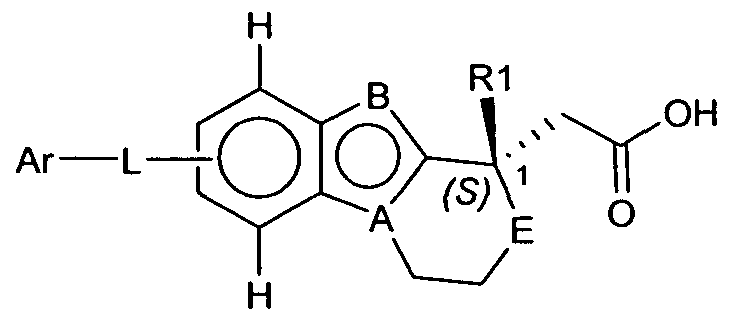
(Iw)
wherein each variable in Formula (Iw) has the same meaning as described herein, supra and infra.
Some embodiments of the present invention pertain to compounds of Formula (Iy) and pharmaceutically acceptable salts, solvates, and hydrates thereof:
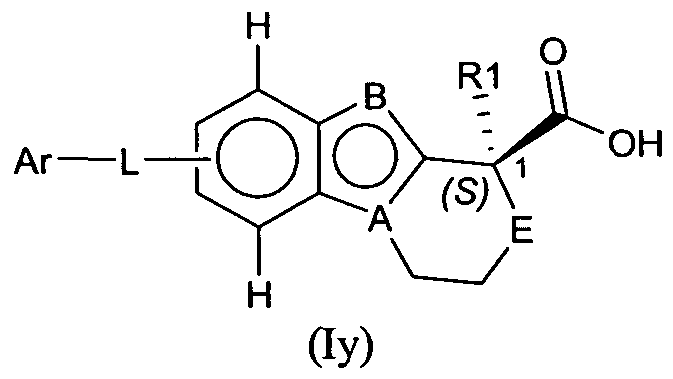
wherein each variable in Formula (Iy) has the same meaning as described herein, supra and infra.
Some embodiments of the present invention include every combination of one or more compounds selected from the following group and pharmaceutically acceptable salts, solvates, and hydrates thereof:
(iS)-2-(6-(3-cyano-4-isopropoxybenzyloxy)-2,3,4,9-tetrahydro-lH-pyrido[3,4-b]indol-l-yl)acetic acid; (5)-2-(6-(3-cyano-5-(trifluoromethoxy)benzyloxy)-2,3,4,9-tetrahydro-lH-pyrido[3,4- b]indol-l-yl)acetic acid; (5)-6-(3-cyano-4-isopropoxybenzyloxy)-2,3,4,9-tetrahydro-lH- pyrido[3,4-b]indole-l-carboxylic acid; (iS)-2-(6-(4-cyclopentyl-3-(trifluoromethyl)benzyloxy)- 2,3 ,4,9-tetrahydro- lH-pyrido[3 ,4-b]indol- 1 -yl)acetic acid; (5)-2-(6-(4-chloro-3 - (trifluoromethyl)benzyloxy)-2,3,4,9-tetrahydro-lH-pyrido[3,4-b]indol-l-yl)acetic acid; (,S)-2-(6- (4-cyclopentyl-3 -(trifluoromethyl)benzyloxy)- 1 ,3 ,4,9-tetrahydropyrano [3 ,4-b] indol- 1 -yl)acetic acid; (5)-2-(6-(4-isobutyl-3-(trifluoromethyl)benzyloxy)-2,3,4,9-tetrahydro-lH-pyrido[3,4- b] indol- l-yl)acetic acid; (5)-2-(6-((6-methoxy-5-(trifluoromethyl)pyridin-3-yl)methoxy)- 2,3,4,9-tetrahydro-lH-pyrido[3,4-b]indol-l -yl)acetic acid; (5)-2-(6-(3-chloro-4- (trifluoromethoxy)benzyloxy)-2,3 ,4,9-tetrahydro- lH-pyrido[3 ,4-b]indol- 1 -yl)acetic acid; (S)-2- (6-(2,4-bis(trifluoromethyl)benzyloxy)-2,3,4,9-tetrahydro-lH-pyrido[3,4-b]indol-l-yl)acetic acid; (.S)-2-(6-(4-fluoro-2-(trifluoromethyl)benzyloxy)-2,3,4,9-tetrahydro-lH-pyrido[3,4- b]indol-l-yl)acetic acid; (5)-2-(6-(4-rerf-butylberi2yloxy)-2,3,4,9-tetrahydro-lH-pyrido[3,4- b]indol-l -yl)acetic acid; (5)-2-(6-(4-(methylsulfonyl)benzyloxy)-2,3,4,9-tetrahydro-lH- pyrido[3,4-b]indol-l -yl)acetic acid; (5)-2-(6-(4-(trifluoromethyl)benzyloxy)-2,3,4,9-tetrahydro- lH-pyrido[3,4-b]indol-l -yl)acetic acid; (5)-2-(6-(3,4-dichlorobenzyloxy)-2,3,4,9-tetrahydro-lH- pyrido[3,4-b]indol-l-yl)acetic acid; (S)-2-(6-((6-(pyrrolidin-l-yl)-5-(trifluoromethyl)pyridin-3-
yl)methoxy)-2,3,4,9-tetrahydro-lH-pyrido[3,4-b]indol-l-yl)acetic acid; (5)-2-(6-(3- (trifluoromethoxy)benzyloxy)-2,3,4,9-tetrahydro-lH-pyrido[3,4-b]indol-l -yl)acetic acid; (5)-2- (6-(4-cyclopentyl-3-(trifluoromethyl)benzyloxy)-l-methyl-l,3,4,9-tetrahydropyrano[3,4- b]indol-l -yl)acetic acid; (S)-2-(6-(5-(3,5-bis(trifluoromethyl)phenyl)-l ,2,4-oxadiazol-3-yl)- 2,3,4,9-tetrahydro-lH-pyrido[3,4-b]indol-l-yl)acetic acid; (S)-2-(6-(5-(3-cyano-5-
(trifluoromethoxy)phenyl)-l,2,4-oxadiazol-3-yl)-2,3,4,9-tetrahydro-lH-pyrido[3,4-b]indol-l- yl)acetic acid; (S)-2-(6-(5-(3-cyano-4-cyclohexylphenyl)-l ,2,4-oxadiazol-3-yl)-2,3,4,9- tetrahydro-lH-pyrido[3,4-b]indol-l-yl)acetic acid; (5)-2-(6-(5-(2-chloro-6-methoxypyridin-4- yl)-l,2,4-oxadiazol-3-yl)-2,3,4,9-tetrahydro-lH-pyrido[3,4-b]indol-l-yl)acetic acid; (S)-2-(6-(5- (3-cyano-5-(cyclopentyloxy)phenyl)-l,2,4-oxadiazol-3-yl)-2,3,4,9-tetrahydro-lH-pyrido[3,4- b]indol-l -yl)acetic acid; (5)-2-(6-(5-(4-(diethylamino)phenyl)-l ,2,4-oxadiazol-3-yl)-2,3,4,9- tetrahydro-lH-pyrido[3,4-b]indol-l -yl)acetic acid; (iS)-2-(6-(5-(3,5-bis(trifluoromethyl)phenyl)- 1 ,2,4-oxadiazol-3-yl)-l -methyl-1 ,3,4,9-tetrahydropyrano[3,4-b]indol-l -yl)acetic acid; (£)-2-(8- (3-cyano-4-isopropoxybenzyloxy)-3,4-dihydro-lH-[l,4]oxazino[4,3-a]indol-l-yl)acetic acid; (5)-2-(8-(benzyloxy)-l,2,3,4-tetrahydropyrazino[l,2-a]indol-l-yl)acetic acid; (S)-2-(8-(4- cyclopentyl-3 -(trifluoromethyl)benzyloxy)-3 ,4-dihydro- lH-[ 1 ,4]oxazino[4,3-a]indol- 1 -yl)acetic acid; (5)-2-(10-chloro-8-(4-cyclopentyl-3-(trifluoromethyl)benzyloxy)-3,4-dihydro-lH- [l,4]oxazino[4,3-a]indol-l-yl)acetic acid; (5)-2-(8-(4-isopropoxy-3- (trifluoromethyl)benzyloxy)-l ,2,3,4-tetrahydropyrazino[l ,2-a]indol-l -yl)acetic acid; (S)-2-(8- (4-isobutyl-3 -(trifluoromethyl)benzyloxy)- 1 ,2,3 ,4-tetrahydropyrazino [ 1 ,2-a] indol- 1 -yl)acetic acid; (1S)-2-(10-chloro-8-(4-isopropoxy-3-(trifluoromethyl)benzyloxy)-3,4-dihydro-lH- [l,4]oxazino[4,3-a]indol-l-yl)acetic acid; (^^-(lO-chloro-δ-CS-cyano^-isopropoxybenzyloxy)- 3 ,4-dihydro- IH-[1 ,4] oxazino [4,3 -a] indol- 1 -yl)acetic acid; (S)-2-(8 -(3 -cyano-4- isopropoxybenzyloxy)-l 0-methyl- 1 ,2,3 ,4-tetrahydropyrazino[ 1 ,2-a]indol- 1 -yl)acetic acid; (5)-2- (8-(3-cyano-4-isopropoxybenzyloxy)-10-cyclopropyl-l,2,3,4-tetrahydropyrazino[l,2-a]indol-l- yl)acetic acid; (5)-2-(8-(4-(fluoromethoxy)-3-(trifluoromethyl)benzyloxy)-3,4-dihydro-lH- [l,4]oxazino[4,3-a]indol-l-yl)acetic acid; (5)-2-(8-(3-chloro-4-(l,3-difluoropropan-2- yloxy)benzyloxy)-3,4-dihydro-lH-[l,4]oxazino[4,3-a]indol-l-yl)acetic acid; (S)-2-(10-chloro-8- (4-(cyclopropylmethoxy)-3-(trifluoromethyl)benzyloxy)-3,4-dihydro-lH-[l,4]oxazino[4,3- a]indol-l-yl)acetic acid; (,S)-2-(8-(5-(3-cyano-4-isopropoxyphenyl)-l,2,4-oxadiazol-3-yl)-3,4- dihydro-lH-[l,4]oxazino[4,3-a]indol-l-yl)acetic acid; (S)-2-(8-(5-(4-cyclopentyl-3- (trifluoromethyl)phenyl)- 1 ,2,4-oxadiazol-3 -yl)- 1 ,2,3 ,4-tetrahydropyrazino[ 1 ,2-a]indol- 1 - yl)acetic acid; (5)-2-(8-(3-cyano-5-(trifluoromethoxy)benzyloxy)-3,4-dihydro-lH- [l,4]oxazino[4,3-a]indol-l-yl)acetic acid; (5)-2-(10-chloro-8-(3-cyano-5- (trifluoromethoxy)benzyloxy)-2 -methyl-1, 2,3,4-tetrahydropyrazino[l,2-a]indol-l-yl)acetic acid; (5)-2-( 10-chloro-8-(4-cyclopentyl-3 -(trifluoromethyl)benzyloxy)-2-methyl- 1 ,2,3 ,4-
tetrahydropyrazino[l,2-a]indol-l-yl)acetic acid; and (S)-2-(6-(4-isobutyl-2-methoxybenzyloxy)- 2,3,4,9-tetrahydro-lH-pyrido[3,4-b]indol-l-yl)acetic acid.
It is understood that the present invention embraces each diastereomer, each enantiomer and mixtures thereof of each compound and generic formulae disclosed herein just as if they were each individually disclosed with the specific stereochemical designation for each chiral carbon. Separation of the individual isomers (such as, by chiral ΗPLC, recrystallization of diastereomeric mixtures and the like) or selective synthesis (such as, by enantiomeric selective syntheses and the like) of the individual isomers is accomplished by application of various methods which are well known to practitioners in the art.
The compounds of the Formula (Ia) of the present invention may be prepared according to relevant published literature procedures that are used by one skilled in the art. Exemplary reagents and procedures for these reactions appear hereinafter in the working examples.
Protection and deprotection may be carried out by procedures generally known in the art (see, for example, Greene, T. W. and Wuts, P. G. M., Protecting Groups in Organic Synthesis, 3rd Edition, 1999 [Wiley]).
PHARMACEUTICAL COMPOSITIONS
A further aspect of the present invention pertains to pharmaceutical compositions comprising one or more compounds as described herein and one or more pharmaceutically acceptable carriers. Some embodiments pertain to pharmaceutical compositions comprising a compound of the present invention and a pharmaceutically acceptable carrier.
Some embodiments of the present invention include a method of producing a pharmaceutical composition comprising admixing at least one compound according to any of the compound embodiments disclosed herein and a pharmaceutically acceptable carrier.
Formulations may be prepared by any suitable method, typically by uniformly mixing the active compound(s) with liquids or finely divided solid carriers, or both, in the required proportions and then, if necessary, forming the resulting mixture into a desired shape.
Conventional excipients, such as binding agents, fillers, acceptable wetting agents, tabletting lubricants and disintegrants may be used in tablets and capsules for oral
administration. Liquid preparations for oral administration may be in the form of solutions, emulsions, aqueous or oily suspensions and syrups. Alternatively, the oral preparations may be in the form of dry powder that can be reconstituted with water or another suitable liquid vehicle before use. Additional additives such as suspending or emulsifying agents, non-aqueous vehicles (including edible oils), preservatives and flavorings and colorants may be added to the liquid preparations. Parenteral dosage forms may be prepared by dissolving the compound of the invention in a suitable liquid vehicle and filter sterilizing the solution before filling and sealing
an appropriate vial or ampule. These are just a few examples of the many appropriate methods well known in the art for preparing dosage forms.
A compound of the present invention can be formulated into pharmaceutical compositions using techniques well known to those in the art. Suitable pharmaceutically acceptable carriers, outside those mentioned herein, are known in the art; for example, see
Remington, The Science and Practice of Pharmacy, 20th Edition, 2000, Lippincott Williams & Wilkins, (Editors: Gennaro et al.)
While it is possible that, for use in the prophylaxis or treatment, a compound of the invention may, in an alternative use, be administered as a raw or pure chemical, it is preferable however to present the compound or active ingredient as a pharmaceutical formulation or composition further comprising a pharmaceutically acceptable carrier.
The invention thus further provides pharmaceutical formulations comprising a compound of the invention or a pharmaceutically acceptable salt, solvate, hydrate or derivative thereof together with one or more pharmaceutically acceptable carriers thereof and/or prophylactic ingredients. The carrier(s) must be "acceptable" in the sense of being compatible with the other ingredients of the formulation and not overly deleterious to the recipient thereof.
Pharmaceutical formulations include those suitable for oral, rectal, nasal, topical (including buccal and sub-lingual), vaginal or parenteral (including intramuscular, subcutaneous and intravenous) administration or in a form suitable for administration by inhalation, insufflation or by a transdermal patch. Transdermal patches dispense a drug at a controlled rate by presenting the drug for absorption in an efficient manner with a minimum of degradation of the drug. Typically, transdermal patches comprise an impermeable backing layer, a single pressure sensitive adhesive and a removable protective layer with a release liner. One of ordinary skill in the art will understand and appreciate the techniques appropriate for manufacturing a desired efficacious transdermal patch based upon the needs of the artisan.
The compounds of the invention, together with a conventional adjuvant, carrier, or diluent, may thus be placed into the form of pharmaceutical formulations and unit dosages thereof and in such form may be employed as solids, such as tablets or filled capsules, or liquids such as solutions, suspensions, emulsions, elixirs, gels or capsules filled with the same, all for oral use; in the form of suppositories for rectal administration; or in the form of sterile injectable solutions for parenteral (including subcutaneous) use. Such pharmaceutical compositions and unit dosage forms thereof may comprise conventional ingredients in conventional proportions, with or without additional active compounds or principles and such unit dosage forms may contain any suitable effective amount of the active ingredient commensurate with the intended daily dosage range to be employed.
For oral administration, the pharmaceutical composition may be in the form of, for example, a tablet, capsule, suspension or liquid. The pharmaceutical composition is preferably
made in the form of a dosage unit containing a particular amount of the active ingredient.
Examples of such dosage units are capsules, tablets, powders, granules or suspensions, with conventional additives such as lactose, mannitol, corn starch or potato starch; with binders such as crystalline cellulose, cellulose derivatives, acacia, corn starch or gelatins; with disintegrators such as corn starch, potato starch or sodium carboxymethyl-cellulose; and with lubricants such as talc or magnesium stearate. The active ingredient may also be administered by injection as a composition wherein, for example, saline, dextrose or water may be used as a suitable pharmaceutically acceptable carrier.
Compounds of the present invention or a salt, solvate, hydrate or physiologically functional derivative thereof can be used as active ingredients in pharmaceutical compositions, specifically as SlPl receptor modulators. The term "active ingredient" is defined in the context of a "pharmaceutical composition" and is intended to mean a component of a pharmaceutical composition that provides the primary pharmacological effect, as opposed to an "inactive ingredient" which would generally be recognized as providing no pharmaceutical benefit.
The dose when using the compounds of the present invention can vary within wide limits and as is customary and known to the physician, it is to be tailored to the individual conditions in each individual case. It depends, for example, on the nature and severity of the illness to be treated, on the condition of the patient, on the compound employed or on whether an acute or chronic disease state is treated or prophylaxis is conducted or on whether further active compounds are administered in addition to the compounds of the present invention.
Representative doses of the present invention include, but are not limited to, about 0.001 mg to about 5000 mg, about 0.001 mg to about 2500 mg, about 0.001 mg to about 1000 mg, 0.001 mg to about 500 mg, 0.001 mg to about 250 mg, about 0.001 mg to 100 mg, about 0.001 mg to about 50 mg and about 0.001 mg to about 25 mg. Multiple doses may be administered during the day, especially when relatively large amounts are deemed to be needed, for example 2, 3 or 4 doses. Depending on the individual and as deemed appropriate by the patient's physician or caregiver it may be necessary to deviate upward or downward from the doses described herein.
The amount of active ingredient or an active salt, solvate or hydrate derivative thereof, required for use in treatment will vary not only with the particular salt selected but also with the route of administration, the nature of the condition being treated and the age and condition of the patient and will ultimately be at the discretion of the attendant physician or clinician. In general, one skilled in the art understands how to extrapolate in vivo data obtained in one model system, typically an animal model, to another, such as a human. In some circumstances, these extrapolations may merely be based on the weight of the animal model in comparison to another, such as a mammal, preferably a human, however, more often, these extrapolations are not simply based on weights, but rather incorporate a variety of factors. Representative factors include the type, age, weight, sex, diet and medical condition of the patient, the severity of the
disease, the route of administration, pharmacological considerations such as the activity, efficacy, pharmacokinetic and toxicology profiles of the particular compound employed, whether a drug delivery system is utilized, whether an acute or chronic disease state is being treated or prophylaxis is conducted or whether further active compounds are administered in addition to the compounds of the present invention and as part of a drug combination. The dosage regimen for treating a disease condition with the compounds and/or compositions of this invention is selected in accordance with a variety factors including those cited above. Thus, the actual dosage regimen employed may vary widely and therefore may deviate from a preferred dosage regimen and one skilled in the art will recognize that dosage and dosage regimens outside these typical ranges can be tested and, where appropriate, may be used in the methods of this invention.
The desired dose may conveniently be presented in a single dose or as divided doses administered at appropriate intervals, for example, as 2, 3, 4 or more sub-doses per day. The sub-dose itself may be further divided, e.g., into a number of discrete loosely spaced administrations. The daily dose can be divided, especially when relatively large amounts are administered as deemed appropriate, into several, for example 2, 3 or 4 part administrations. If appropriate, depending on individual behavior, it may be necessary to deviate upward or downward from the daily dose indicated.
For preparing pharmaceutical compositions from the compounds of the present invention, the suitable pharmaceutically acceptable carrier can be either solid, liquid or a mixture of both. Solid form preparations include powders, tablets, pills, capsules, cachets, suppositories and dispersible granules. A solid carrier can be one or more substances which may also act as diluents, flavoring agents, solubilizers, lubricants, suspending agents, binders, preservatives, tablet disintegrating agents, or encapsulating materials.
In powders, the carrier is a finely divided solid which is in a mixture with the finely divided active component.
In tablets, the active component is mixed with the carrier having the necessary binding capacity in suitable proportions and compacted to the desired shape and size.
The powders and tablets may contain varying percentage amounts of the active compound. A representative amount in a powder or tablet may be from 0.5 to about 90 percent of the active compound. However, an artisan would know when amounts outside of this range are necessary. Suitable carriers for powders and tablets include magnesium carbonate, magnesium stearate, talc, sugar, lactose, pectin, dextrin, starch, gelatin, tragacanth,
methylcellulose, sodium carboxymethylcellulose, a low melting wax, cocoa butter and the like. The term "preparation" is intended to include the formulation of the active compound with encapsulating material as carrier providing a capsule in which the active component, with or without carriers, is surrounded by a carrier, which is thus in association with it. Similarly,
cachets and lozenges are included. Tablets, powders, capsules, pills, cachets and lozenges can be used as solid forms suitable for oral administration.
For preparing suppositories, a low melting wax, such as an admixture of fatty acid glycerides or cocoa butter, is first melted and the active component is dispersed homogeneously therein (e.g., by stirring). The molten homogenous mixture is then poured into convenient sized molds, allowed to cool and thereby to solidify.
Formulations suitable for vaginal administration may be presented as pessaries, tampons, creams, gels, pastes, foams or sprays containing in addition to the active ingredient such carriers as are known in the art to be appropriate.
Liquid form preparations include solutions, suspensions and emulsions, for example, water or water-propylene glycol solutions. For example, parenteral injection liquid preparations can be formulated as solutions in aqueous polyethylene glycol solution. Injectable preparations, for example, sterile injectable aqueous or oleaginous suspensions may be formulated according to the known art using suitable dispersing or wetting agents and suspending agents. The sterile injectable preparation may also be a sterile injectable solution or suspension in a nontoxic parenterally acceptable diluent or solvent, for example, as a solution in 1,3-butanediol. Among the acceptable vehicles and solvents that may be employed are water, Ringer's solution and isotonic sodium chloride solution. In addition, sterile, fixed oils are conventionally employed as a solvent or suspending medium. For this purpose any bland fixed oil may be employed including synthetic mono- or diglycerides. In addition, fatty acids such as oleic acid find use in the preparation of injectables.
The compounds according to the present invention may thus be formulated for parenteral administration (e.g. by injection, for example bolus injection or continuous infusion) and may be presented in unit dose form in ampoules, pre-filled syringes, small volume infusion or in multi-dose containers with an added preservative. The pharmaceutical compositions may take such forms as suspensions, solutions, or emulsions in oily or aqueous vehicles and may contain formulatory agents such as suspending, stabilizing and/or dispersing agents.
Alternatively, the active ingredient may be in powder form, obtained by aseptic isolation of sterile solid or by lyophilization from solution, for constitution with a suitable vehicle, e.g. sterile, pyrogen-free water, before use.
Aqueous formulations suitable for oral use can be prepared by dissolving or suspending the active component in water and adding suitable colorants, flavors, stabilizing and thickening agents, as desired.
Aqueous suspensions suitable for oral use can be made by dispersing the finely divided active component in water with viscous material, such as natural or synthetic gums, resins, methylcellulose, sodium carboxymethylcellulose, or other well-known suspending agents.
Also included are solid form preparations which are intended to be converted, shortly before use, to liquid form preparations for oral administration. Such liquid forms include solutions, suspensions and emulsions. These preparations may contain, in addition to the active component, colorants, flavors, stabilizers, buffers, artificial and natural sweeteners, dispersants, thickeners, solubilizing agents and the like.
For topical administration to the epidermis the compounds according to the invention may be formulated as ointments, creams or lotions, or as a transdermal patch.
Ointments and creams may, for example, be formulated with an aqueous or oily base with the addition of suitable thickening and/or gelling agents. Lotions may be formulated with an aqueous or oily base and will in general also contain one or more emulsifying agents, stabilizing agents, dispersing agents, suspending agents, thickening agents, or coloring agents.
Formulations suitable for topical administration in the mouth include lozenges comprising the active agent in a flavored base, usually sucrose and acacia or tragacanth; pastilles comprising the active ingredient in an inert base such as gelatin and glycerin or sucrose and acacia; and mouthwashes comprising the active ingredient in a suitable liquid carrier.
Solutions or suspensions are applied directly to the nasal cavity by conventional means, for example with a dropper, pipette or spray. The formulations may be provided in single or multi-dose form. In the latter case of a dropper or pipette, this may be achieved by the patient administering an appropriate, predetermined volume of the solution or suspension. In the case of a spray, this may be achieved for example by means of a metering atomizing spray pump.
Administration to the respiratory tract may also be achieved by means of an aerosol formulation in which the active ingredient is provided in a pressurized pack with a suitable propellant. If the compounds of the present invention or pharmaceutical compositions comprising them are administered as aerosols (e.g., nasal aerosols, by inhalation), this can be carried out, for example, using a spray, a nebulizer, a pump nebulizer, an inhalation apparatus, a metered inhaler or a dry powder inhaler. Pharmaceutical forms for administration of the compounds of the present invention as an aerosol can be prepared by processes well known to the person skilled in the art. Solutions or dispersions of the compounds of the present invention or a pharmaceutically acceptable salt, solvate, hydrate or derivative thereof in water, water/alcohol mixtures or suitable saline solutions, for example, can be employed using customary additives (e.g., benzyl alcohol or other suitable preservatives), absorption enhancers for increasing the bioavailability, solubilizers, dispersants and others and, if appropriate, customary propellants (e.g., carbon dioxide, CFCs, such as, dichlorodifluoromethane, trichlorofluoromethane, dichlorotetrafluoroethane and the like). The aerosol may conveniently also contain a surfactant such as lecithin. The dose of drug may be controlled by provision of a metered valve.
In formulations intended for administration to the respiratory tract, including intranasal formulations, the compound will generally have a small particle size for example of the order of 10 microns or less. Such a particle size may be obtained by means known in the art, for example by micronization. When desired, formulations adapted to give sustained release of the active ingredient may be employed.
Alternatively the active ingredients may be provided in the form of a dry powder (e.g., a powder mix of the compound in a suitable powder base such as lactose, starch, starch derivatives such as hydroxypropylmethyl cellulose and polyvinylpyrrolidone (PVP)).
Conveniently the powder carrier will form a gel in the nasal cavity. The powder composition may be presented in unit dose form (e.g., capsules, cartridges) as for gelatin or blister packs from which the powder may be administered by means of an inhaler.
The pharmaceutical preparations are preferably in unit dosage forms. In such form, the preparation is subdivided into unit doses containing appropriate quantities of the active component. The unit dosage form can be a packaged preparation, the package containing discrete quantities of preparation, such as packeted tablets, capsules and powders in vials or ampoules. Also, the unit dosage form can be a capsule, tablet, cachet, or lozenge itself, or it can be the appropriate number of any of these in packaged form.
In some embodiments, the compositions are tablets or capsules for oral administration. In some embodiments, the compositions are liquids for intravenous administration. The compounds according to the invention may optionally exist as pharmaceutically acceptable salts including pharmaceutically acceptable acid addition salts prepared from pharmaceutically acceptable non-toxic acids including inorganic and organic acids.
Representative acids include, but are not limited to, acetic, benzenesulfonic, benzoic, camphorsulfonic, citric, ethenesulfonic, dichloroacetic, formic, fumaric, gluconic, glutamic, hippuric, hydrobromic, hydrochloric, isethionic, lactic, maleic, malic, mandelic,
methanesulfonic, mucic, nitric, oxalic, pamoic, pantothenic, phosphoric, succinic, sulfiric, tartaric, oxalic, p-toluenesulfonic and the like, such as those pharmaceutically acceptable salts listed by Berge et ai, Journal of Pharmaceutical Sciences, 66:1-19 (1977).
The acid addition salts may be obtained as the direct products of compound synthesis. In the alternative, the free base may be dissolved in a suitable solvent containing the appropriate acid and the salt isolated by evaporating the solvent or otherwise separating the salt and solvent. The compounds of this invention may form solvates with standard low molecular weight solvents using methods known to the skilled artisan.
Compounds of the present invention can be converted to "pro-drugs." The term "pro- drugs" refers to compounds that have been modified with specific chemical groups known in the art and that when administered into an individual undergo biotransformation to give the parent compound. Pro-drugs can thus be viewed as compounds of the invention containing one or more
specialized non-toxic protective groups used in a transient manner to alter or to eliminate a property of the compound. In one general aspect, the "pro-drug" approach is utilized to facilitate oral absorption. A thorough discussion is provided in T. Higuchi and V. Stella, Pro-drugs as Novel Delivery Systems Vol. 14 of the A.C.S. Symposium Series; and in Bioreversible Carriers in Drug Design, ed. Edward B. Roche, American Pharmaceutical Association and Pergamon Press, 1987.
Some embodiments of the present invention include a method of producing a pharmaceutical composition for "combination-therapy" comprising admixing at least one compound according to any of the compound embodiments disclosed herein, together with at least one known pharmaceutical agent as described herein and a pharmaceutically acceptable carrier.
It is noted that when SlPl receptor agonists are utilized as active ingredients in a pharmaceutical composition, these are not intended for use only in humans, but in other non- human mammals as well. Indeed, recent advances in the area of animal health-care mandate that consideration be given for the use of active agents, such as SlPl receptor agonists, for the treatment of an SlPl receptor-associated disease or disorder in companionship animals {e.g., cats, dogs, etc.) and in livestock animals (e.g., cows, chickens, fish, etc.). Those of ordinary skill in the art are readily credited with understanding the utility of such compounds in such settings. Hydrates and Solvates
It is understood that when the phrase "pharmaceutically acceptable salts, solvates, and hydrates" is used in reference to a particular formula herein, it is intended to embrace solvates and/or hydrates of compounds of the particular formula, pharmaceutically acceptable salts of compounds of the particular formula as well as solvates and/or hydrates of pharmaceutically acceptable salts of compounds of the particular formula. It is also understood by a person of ordinary skill in the art that hydrates are a subgenus of solvates.
The compounds of the present invention can be administrated in a wide variety of oral and parenteral dosage forms. It will be apparent to those skilled in the art that the following dosage forms may comprise, as the active component, either a compound of the invention or a pharmaceutically acceptable salt or as a solvate or hydrate thereof. Moreover, various hydrates and solvates of the compounds of the invention and their salts will find use as intermediates in the manufacture of pharmaceutical compositions. Typical procedures for making and identifying suitable hydrates and solvates, outside those mentioned herein, are well known to those in the art; see for example, pages 202-209 of KJ. Guillory, "Generation of Polymorphs, Hydrates, Solvates, and Amorphous Solids," in: Polymorphism in Pharmaceutical Solids, ed. Harry G. Brittan, Vol. 95, Marcel Dekker, Inc., New York, 1999. Accordingly, one aspect of the present invention pertains to hydrates and solvates of compounds of the present invention and/or their
pharmaceutical acceptable salts, as described herein, that can be isolated and characterized by methods known in the art, such as, thermogravimetric analysis (TGA), TGA-mass spectroscopy, TGA-Infrared spectroscopy, powder X-ray diffraction (PXRD), Karl Fisher titration, high resolution X-ray diffraction, and the like. There are several commercial entities that provide quick and efficient services for identifying solvates and hydrates on a routine basis. Example companies offering these services include Wilmington PharmaTech (Wilmington, DE), Avantium Technologies (Amsterdam) and Aptuit (Greenwich, CT).
POLYMOPHS AND PSEUDOPOLYMORPHS
Polymorphism is the ability of a substance to exist as two or more crystalline phases that have different arrangements and/or conformations of the molecules in the crystal lattice.
Polymorphs show the same properties in the liquid or gaseous state but they behave differently in the solid state.
Besides single-component polymorphs, drugs can also exist as salts and other multicomponent crystalline phases. For example, solvates and hydrates may contain an API host and either solvent or water molecules, respectively, as guests. Analogously, when the guest compound is a solid at room temperature, the resulting form is often called a cocrystal. Salts, solvates, hydrates, and cocrystals may show polymorphism as well. Crystalline phases that share the same API host, but differ with respect to their guests, may be referred to as
pseudopolymorphs of one another.
Solvates contain molecules of the solvent of crystallization in a definite crystal lattice. Solvates, in which the solvent of crystallization is water, are termed hydrates. Because water is a constituent of the atmosphere, hydrates of drugs may be formed rather easily.
By way of example, Stahly recently published a polymorph screen of 245 compounds consisting of a "wide variety of structural types" that revealed about 90% of the compounds exhibiting multiple solid forms. Overall, approximately half the compounds were polymorphic, often having one to three forms. About one-third of the compounds formed hydrates, and about one-third formed solvates. Data from cocrystal screens of 64 compounds showed that 60% formed cocrystals other than hydrates or solvates. (G. P. Stahly, Crystal Growth & Design (2007), 7(6), 1007-1026.)
OTHER UTBLITEES
Another object of the present invention relates to radiolabeled compounds of the present invention that are useful not only in radio-imaging but also in assays, both in vitro and in vivo, for localizing and quantitating the SlPl receptor in tissue samples, including human and for identifying SlPl receptor ligands by inhibition binding of a radiolabeled compound. It is a
further object of this invention to develop novel SlPl receptor assays which comprise such radiolabeled compounds.
The present invention embraces isotopically-labeled compounds of the present invention. Isotopically or radiolabeled compounds are those which are identical to compounds disclosed herein, but for the fact that one or more atoms are replaced or substituted by an atom having an atomic mass or mass number different from the atomic mass or mass number most commonly found in nature. Suitable radionuclides that may be incorporated in compounds of the present invention include, but are not limited, to 2H (also written as D for deuterium), 3H (also written as T for tritium), 11C, 13C, 14C, 13N, 15N, 150, 17O, 180, 18F, 35S, 36Cl, 75Br, 76Br, 77Br, 82Br, 1231, 1241, 125I and 131I. The radionuclide that is incorporated in the instant radiolabeled compounds will depend on the specific application of that radiolabeled compound. For example, for in vitro SlPl receptor labeling and competition assays, compounds that incorporate 3H, 14C, 82Br, 1251, 131I or 35S will generally be most useful. For radio-imaging applications 11C, 18F, 125I, 1231, 1241, 1311, 75Br, 76Br or 77Br will generally be most useful.
It is understood that a "radiolabeled " or "labeled compound" is a compound of Formula
(Ia), (Ic), (Ie), Cg), (Ii)> (Ik), (Im), βo), (Iq), (Is), (I"), flw), (Iy), (Ha), (He), (Ue), (Hg), (Hi), (Ilk), or (HIa), etc. containing at least one radionuclide. In some embodiments the radionuclide is selected from the group consisting of 3H, 14C, 1251, 35S and 82Br.
Certain isotopically-labeled compounds of the present invention are useful in compound and/or substrate tissue distribution assays. In some embodiments the radionuclide 3H and/or 14C isotopes are useful in these studies. Further, substitution with heavier isotopes such as deuterium {i.e., 2H) may afford certain therapeutic advantages resulting from greater metabolic stability (e.g., increased in vivo half-life or reduced dosage requirements) and hence may be preferred in some circumstances. Isotopically labeled compounds of the present invention can generally be prepared by following procedures analogous to those disclosed in Figures 6 to 11 and Examples infra, by substituting an isotopically labeled reagent for a non-isotopically labeled reagent. Other synthetic methods that are useful are discussed infra. Moreover, it should be understood that all of the atoms represented in the compounds of the invention can be either the most commonly occurring isotope of such atoms or a scarcer radio-isotope or nonradioactive isotope.
Synthetic methods for incorporating radio-isotopes into organic compounds are applicable to compounds of the invention and are well known in the art. Certain synthetic methods, for example, for incorporating activity levels of tritium into target molecules, are as follows:
A. Catalytic Reduction with Tritium Gas: This procedure normally yields high specific activity products and requires halogenated or unsaturated precursors.
B. Reduction with Sodium Borohydride [3H]: This procedure is rather inexpensive and requires precursors containing reducible functional groups such as aldehydes, ketones, lactones, esters and the like.
C. Reduction with Lithium Aluminum Hydride [3H]: This procedure offers products at almost theoretical specific activities. It also requires precursors containing reducible functional groups such as aldehydes, ketones, lactones, esters and the like.
D. Tritium Gas Exposure Labeling: This procedure involves exposing precursors containing exchangeable protons to tritium gas in the presence of a suitable catalyst.
E. N-Methylation using Methyl Iodide [3H]: This procedure is usually employed to prepare O-methyl or N-methyl [3H] products by treating appropriate precursors with high specific activity methyl iodide [3H]. This method in general allows for higher specific activity, such as for example, about 70-90 Ci/mmol.
Synthetic methods for incorporating activity levels of 125I into target molecules include:
A. Sandmeyer and like reactions: This procedure transforms an aryl amine or a heteroaryl amine into a diazonium salt, such as a diazonium tetrafluoroborate salt and subsequently to 125I labeled compound using Na125I. A represented procedure was reported by Zhu, G-D. and co-workers in J. Org. Chem., 2002, 67, 943-948.
B. Ortho 125Iodination of phenols: This procedure allows for the incorporation of 125I at the ortho position of a phenol as reported by Collier, T. L. and co-workers in J. Labelled Compd. Radiopharm., 1999, 42, S264-S266.
C. Aryl and heteroaryl bromide exchange with 125I: This method is generally a two step process. The first step is the conversion of the aryl or heteroaryl bromide to the corresponding tri-alkyltin intermediate using for example, a Pd catalyzed reaction [i.e. Pd(Ph3P)4] or through an aryl or heteroaryl lithium, in the presence of a tri-alkyltinhalide or hexaalkylditin [e.g.,
(CH3)3SnSn(CH3)3]. A representative procedure was reported by Le Bas, M.-D. and co-workers in J. Labelled Compd. Radiopharm. 2001, 44, S280-S282.
A radiolabeled SlPl receptor compound of Formula (Ia) can be used in a screening assay to identify/evaluate compounds. In general terms, a newly synthesized or identified compound (i.e., test compound) can be evaluated for its ability to reduce binding of the
"radiolabeled compound of Formula (Ia)" to the SlPl receptor. Accordingly, the ability of a test compound to compete with the "radiolabeled compound of Formula (Ia)" for the binding to the
SlPl receptor directly correlates to its binding affinity.
The labeled compounds of the present invention bind to the SlPl receptor. In one embodiment the labeled compound has an IC50 less than about 500 μM, in another embodiment the labeled compound has an IC50 less than about 100 μM, in yet another embodiment the labeled compound has an IC50 less than about 10 μM, in yet another embodiment the labeled
compound has an IC50 less than about 1 μM and in still yet another embodiment the labeled inhibitor has an IC50 less than about 0.1 μM.
Other uses of the disclosed receptors and methods will become apparent to those of skill in the art based upon, inter alia, a review of this disclosure.
As will be recognized, the steps of the methods of the present invention need not be performed any particular number of times or in any particular sequence. Additional objects, advantages and novel features of this invention will become apparent to those skilled in the art upon examination of the following examples thereof, which are intended to be illustrative and not intended to be limiting.
EXAMPLES
Example 1: Syntheses of Compounds of the Present Invention.
Illustrated syntheses for compounds of the present invention are shown in Figures 6 through 11 where the variables have the same definitions as used throughout this disclosure.
The compounds of the invention and their syntheses are further illustrated by the following examples. The following examples are provided to further define the invention without, however, limiting the invention to the particulars of these examples. The compounds described herein, supra and infra, are named according to the AutoNom version 2.2, or CS ChemDraw Ultra Version 9.0.7. In certain instances common names are used and it is understood that these common names would be recognized by those skilled in the art.
Chemistry: Proton nuclear magnetic resonance (1H NMR) spectra were recorded on a Bruker Avance-400 equipped with a QNP (Quad Nucleus Probe) or a BBI (Broad Band Inverse) and z-gradient. Proton nuclear magnetic resonance (1H NMR) spectra were also recorded on a Bruker Avance-500 equipped a BBI (Broad Band Inverse) and z-gradient. Chemical shifts are given in parts per million (ppm) with the residual solvent signal used as reference. NMR abbreviations are used as follows: s = singlet, d = doublet, dd = doublet of doublets, dt = doublet of triplets, ddd = doublet of doublet of doublets, t = triplet, td = triplet of doublets, q = quartet, m = multiplet, bs = broad singlet. Microwave irradiations were carried out using a Smith Synthesizer™ or an Emrys Optimizer™ (Biotage). Thin-layer chromatography (TLC) was performed on silica gel 60 F254 (Merck), preparatory thin-layer chromatography (prep TLC) was preformed on PK6F silica gel 60 A 1 mm plates (Whatman) and column chromatography was carried out on a silica gel column using Kieselgel 60, 0.063-0.200 mm (Merck). Evaporation was done under reduced pressure on a Bϋchi rotary evaporator. Celite® 545 was used for filtration of palladium.
LCMS spec: HPLC-pumps: LC-IOAD VP, Shimadzu Inc.; HPLC system controller:
SCL-IOA VP, Shimadzu Inc; UV-Detector: SPD-IOA VP, Shimadzu Inc; Autosampler: CTC
HTS, PAL, Leap Scientific; Mass spectrometer: API 150EX with Turbo Ion Spray source, AB/MDS Sciex; Software: Analyst 1.2
Example 1.1: Preparation of 6-(3-Cyano-4-isopropoxybenzyloxy)-2,3,4,9-tetrahydro-i//- pyrido[3,4-b]indole-l-carboxylic Acid (Compound 3).
Step A: Preparation of tert-butyl 2-(5-hydroxy-lH-indoI-3-yl)ethylcarbamate.
To a suspension of serotonin hydrochloride (5.00 g, 22.8 mmol) in 1,4-dioxane (50 mL) was added tπethylamine (6.4 mL, 45.6 mmol) and di-/ert-butyl dicarbonate (5.53 g, 25.1 mmol). The reaction was stirred at room temperature overnight. The mixture was filtered to remove tπethylammonium chloπde salt and the filtrate was concentrated in vacuo. The residue was dissolved in ethyl acetate and water (20 mL) was added. The solution was acidified with 1 N aqueous hydrochloric acid solution to pH 4. The organic layer was separated, dried over anhydrous sodium sulfate, and concentrated in vacuo to provide the title compound as a beige foam (6.30 g). LCMS m/z = 277.3 [M+H]+; 1H NMR (400 MHz, CDCl3) δ ppm 1.44 (s, 9H), 2.87 (t, J = 6.82 Hz, 2H), 3.39-3.46 (m, 2H), 4.65 (bs, IH), 5.20 (bs, IH), 6.79 (dd, J = 8.72, 2.40 Hz, IH), 6.98 (s, IH), 7.01 (d, J = 2.27 Hz, IH), 7.21 (d, J = 12.0 Hz IH), 7.94 (bs, IH).
Step B: Preparation of tert-Butyl 2-(5-(3-cyano-4-isopropoxybenzyloxy)-l//-indol-3- yl)ethylcarbamate.
To a solution of tert-butyl 2-(5 -hydroxy- lH-mdol-3-yl)ethylcarbamate (4.72 g, 17.1 mmol) in
 (100 mL) was added 5-(chloromethyl)-2- lsopropoxybenzomtnle (3.41 g, 16.3 mmol) and cesium carbonate (6.36 g, 19.5 mmol). The reaction was stirred at room temperature overnight. The mixture was filtered through Cehte®, concentrated in vacuo. The residue was purified by column chromatography and triturated with methyl tert-buty\ ether to provide the title compound as a white solid (5.04 g). LCMS m/z = 450.5 [M+Η]+; 1H ΝMR (400 MHz, DMSCW6) δ ppm 1.31 (d, J = 6.06 Hz, 6H), 1.37 (s, 9H), 2.74 (t, J= 7.52 Hz, 2H), 3.13-3.20 (m, 2H), 4.74-4.82 (m, IH), 5.03 (s, 2H), 6.77 (dd, J= 8.72, 2.40 Hz, IH), 6.82 (bs, IH), 7.08 (d, J= 2.27 Hz, IH), 7.10 (bs, IH), 7.22 (d, J= 8.72 Hz, IH), 7.27 (ά, J = 8.84 Hz, IH), 7.72 (ά, J= 8.72 Hz, IH), 7.78 (d, J= 1.77 Hz, IH), 10.62 (s, IH).
Step C: Preparation of 5-((3-(2-AminoethyI)-lH-indol-5-yloxy)methyl)-2- isopropoxybenzonitrile
To tert-butyl 2-(5 -(3 -cyano-4-isopropoxybenzyloxy)- 1 H-indol-3 -yl)ethylcarbamate (4.26 g, 9.48 mmol) in a sealed tube was added 1.25 M hydrogen chloπde solution in methanol (75.0 mL, 94.0 mmol). The reaction was stirred at 35 0C overnight. The mixture was cooled in a dry ice-bath, basified with 50% aqueous sodium hydroxide solution to pΗ 7 at 0 0C, and concentrated in vacuo. The residue was triturated with acetone and sodium chloπde salt was removed by vacuum filtration. The filtrate was concentrated in vacuo and dπed under vacuum to provide the title compound as an off-white solid (3.66 g). LCMS m/z = 350.4 [M+Η]+; 1H ΝMR
(400 MHz, DMSO-4) δ ppm 1.31 (d, J = 4.00 Hz, 6H), 2.04 (bs, IH), 2.26 (bs, IH), 2.91-2.97 (m, IH), 2.99-3.07 (m, 2H), 4.73-4.84 (m, IH), 5.04 (s, 2H), 6.78-6.83 (m, IH), 7.18 (dd, J = 9.54, 2.34 Hz, 2H), 7.25 (t, J= 4.42 Hz, IH), 7.27 (dd, J= 8.00, 4.00 Hz, IH), 7.72 (dd, J = 8.65, 2.34 Hz, IH), 7.79 (s, IH), 7.85 (bs, 2H), 10.81 (bs, IH).
Step D: Preparation of 6-(3-Cyano-4-isopropoxybenzyloxy)-2,3,4,9-tetrahydro-l//- pyrido[3,4-b]indole-l-carboxylic Acid.
To a solution of 5-((3-(2-aminoethyl)-lH-indol-5-yloxy)methyl)-2- isopropoxybenzonitrile (0.78 g, 2.23 mmol) in water (10 mL) was added glyoxalic acid hydrate (0.23 g, 2.46 mmol). The reaction mixture was added 50% aqueous sodium hydroxide solution dropwise to adjust pΗ to 4-5. It formed a solid right away and the reaction was complete in 30 min. The solid was filtered and purified by ΗPLC. The combined fractions were added saturated aqueous sodium bicarbonate solution to adjust pΗ to 3-4. The organic solvent was removed under reduced pressure and a precipitate was formed out of the aqueous media. The precipitate was collected to give the title compound as a light yellow solid (0.34 g). LCMS m/z = 406.5 [M+Η]+; 1H NMR (400 MHz, DMSO-</6) δ ppm 1.31 (d, J= 6.06 Hz, 6H), 2.72-2.81 (m, IH), 2.84-2.93 (m, IH), 3.22-3.32 (m, IH), 3.36-3.44 (m, IH), 4.62 (s, IH), 4.73-4.83 (m, IH), 5.01 (s, 2H), 6.75 (dd, J= 8.72, 2.40 Hz, IH), 6.97 (d, J= 2.27 Hz, IH), 7.27 (d, J= 8.97 Hz, IH), 7.34 (d, J= 8.84 Hz, IH), 7.70 (dd, J= 8.72, 2.15 Hz, IH), 7.77 (d, J= 2.15 Hz, IH), 8.91 (bs, IH), 10.50 (s, IH).
Example 1.2: Preparation of 2-(6-(3-Cyano-4-isopropoxybenzyloxy)-2,3,4,9-tetrahydro- l//-pyrido[3,4-b]indol-l-yl)acetic Acid (Compound 1).
Step A: Preparation of Methyl 2-(6-(Benzyloxy)-2,3,4,9-tetrahydro-l//-pyrido[3,4- b]indol-l-yl)acetate.
To a suspension of 5-benzyloxytryptamme hydrochloride (2.93 g, 9.48 mmol) in methanol (45 mL) was added methyl 3,3-dimethoxypropanoate (1.7 mL, 11.4 mmol), 2,2,2- trifluoroacetic acid (0.85 mL, 11.4 mmol), and water (0.20 mL, 11.4 mmol). The mixture was heated at 80 0C overnight and allowed to cool to room temperature to form a solid. The solid was filtered and washed with methyl ter/-butyl ether. The solid was dissolved in ethyl acetate and triturated with saturated aqueous sodium bicarbonate solution. The organic layer was dried over anhydrous sodium sulfate and concentrated in vacuo to provide the title compound as an off-white solid (2.61 g). LCMS m/z = 351.40 [M+H]+; 1H NMR (400 MHz, DMSO-^6) δ ppm 2.50-2.57 (m, 3H), 2.82-2.90 (m, IH), 2.95 (dd, J= 15.28, 3.41 Hz, IH), 3.01-3.08 (m, IH), 3.64 (s, 3H), 4.32 (dd, J= 10.29, 3.09 Hz, IH), 5.06 (s, 2H), 6.73 (dd, J= 8.65, 2.46 Hz, IH), 6.95 (d, J= 2.40 Hz, IH), 7.16 (d, J= 8.72 Hz, IH), 7.27-7.32 (m, IH), 7.37 (t, J= 7.39 Hz, 2H), 7.45 (d, J= 6.95 Hz, 2H), 10.49 (s, IH).
Step B: Preparation of Methyl l-^-Hydroxy^S^-tetrahydro-lH-pyridoβ^- b]indol-l-yl)acetate.
To a solution of methyl 2-(6-(benzyloxy)-2,3,4,9-tetrahydro-lH-pyrido[3,4-b]indol-l- yl)acetate (2.61 g, 7.45 mmol) in a mixed solvent of methanol (200 mL) and tetrahydrofuran (30.0 mL) was added palladium on charcoal. The reaction was charged with hydrogen gas and stirred at room temperature for 1 h. The mixture was filtered through Celite® and concentrated in vacuo to provide the title compound as an off-white solid (1.84 g) and used without further purification. LCMS m/z = 261.30 [M+Η]+.
Step C: Preparation of te/t-Butyl 6-Hydroxy-l-(2-methoxy-2-oxoethyl)-3,4- dihydro-lH-pyrido[3,4-b]indole-2(9//)-carboxylate.
To a solution of methyl 2-(6-hydroxy-2,3,4,9-tetrahydro-lH-pyrido[3,4-b]indol-l- yl)acetate (0.99g, 3.80 mmol) in 1,4-dioxane (10 mL) was added triethylamine (1.6 mL, 11.4 mmol) and di-terf-butyl dicarbonate (1.26 g, 5.69 mmol). The mixture was stirred at room temperature for 2 h and concentrated in vacuo. The residue was dissolved in ethyl acetate and acidified with 1 N aqueous hydrochloric acid solution. The organic layer was separated, washed with brine, dried over anhydrous sodium sulfate, and concentrated in vacuo. The residue was purified by silica gel column chromatography to provide the title compound as an off-white foam (0.92 g). LCMS m/z = 361.50 [M+Η]+.
Step D: Preparation of terf-Butyl 6-Hydroxy-l-(2-methoxy-2-oxoethyl)-3,4- dihydro-li/-pyrido[3,4-b]indole-2(9/7)-carboxylate.
To a solution of tert-butyl 6-hydroxy-l-(2-methoxy-2-oxoethyl)-3,4-dihydro-lH- pyrido[3,4-b]indole-2(9H)-carboxylate (0.92 g, 2.55 mmol) and 5-(chloromethyl)-2- isopropoxybenzonitrile (0.54 g, 2.55 mmol) in N,N-dimethylformamide (30 mL) was added cesium carbonate (1.25 g, 3.83 mmol). The mixture was stirred at room temperature overnight. The reaction was filtered through Celite®, concentrated in vacuo, and purified by column chromatography to provide the title compound as a yellow foam (1.12 g). LCMS m/z = 534.50 [M+Η]+.
Step E: Preparation of Methyl 2-(6-(3-Cyano-4-isopropoxybenzyloxy)-2,3,4,9- tetrahydro-l//-pyrido[3,4-b]indol-l-yl)acetate 2,2,2-trifluoroacetate.
To a solution of tert-butyl 6-(3-cyano-4-isopropoxybenzyloxy)-l -(2-methoxy-2- oxoethyl)-3,4-dihydro-lH-pyrido[3,4-b]indole-2(9H)-carboxylate (244.4 mg, 0.458 mmol) in dichloromethane (5 mL) was added 2,2,2-trifluoroacetic acid (1.0 mL, 12.9 mmol). The mixture was stirred at 0 °C for 1 h and concentrated in vacuo to provide the title compound without further purification. LCMS m/z = 434.60 [M+Η]+.
Step F: Preparation of 2-(6-(3-Cyano-4-isopropoxybenzyloxy)-2,3,4,9-tetrahydro- lH-pyrido[3,4-b]indoI-l-yl)acetic Acid.
To a solution of methyl 2-(6-(3-cyano-4-isopropoxybenzyloxy)-2,3,4,9-tetrahydro-lH- pyrido[3,4-b]indol-l-yl)acetate 2,2,2-trifluoroacetate (251.0 mg, 0.458 mmol) in methanol (4.5 mL), tetrahydrofuran (1.5 mL), and water (1.5 mL) was added lithium hydroxide hydrate (67.3 mg, 1.60 mmol). The mixture was stirred at room temperature for 2 h. The mixture was acidified with 1 N aqueous hydrochloric acid solution to pΗ 4-5 to provide the title compound as a beige solid (139.4 mg). LCMS m/z = 420.40 [M+Η]+; 1H NMR (400 MHz, DMSO-^6) δ ppm 1.31 (d, J = 6.06 Hz, 6H), 2.56 (dd, J = 16.29, 8.97 Hz, IH), 2.65-2.75 (m, 3H), 3.09-3.16 (m, IH), 3.24- 3.33 (m, IH), 4.43-4.49 (m, IH), 4.75-4.82 (m, IH), 5.02 (s, 2H), 6.77 (dd, J= 8.72, 2.40 Hz, IH), 7.01 (d, J = 2.40 Hz, IH), 7.21 (d, J= 8.84 Hz, IH), 7.27 (d, J= 8.84 Hz, IH), 7.70 (dd, J = 8.78, 2.21 Hz, IH), 7.77 (d, J= 2.15 Hz, IH), 10.74 (s, IH).
Resolution via Chiral HPLC
Column: normal phase preparative ChiralPak IC, 250 x 4.6 mm ID, 5 μm particle size Eluent: carbon dioxide/methanol/diethylamine = 47/53/0.2%
Gradient: Isocratic
Flow: 3 mL/minute
Pressure: 100 bar
Detector: 230 nm
Retention Times: 1st enantiomer: 8.069 min.; 2nd enantiomer: 18.930 min. Example 1.3: Preparation of 2-(6-(3-Cyano-5-(trifluoromethoxy)benzyloxy)-2,3,4,9- tetrahydro-lH-pyrido[3,4-b]indol-l-yl)acetic Acid (Compound 2).
Step A: Preparation of Methyl 2-(6-(3-Cyano-5-(trifluoromethoxy)benzyloxy)-2r5,4,9- tetrahydro-l//-pyrido [3,4-b] indol-l-yl)acetate.
To a mixture of methyl 2-(6-hydroxy-2,3,4,9-tetrahydro-lH-pyrido[3,4-b]indol-l-yl)acetate (103.9 mg, 0.399 mmol), 3-(hydroxymethyl)-5-(trifluoromethoxy)benzonitrile (125 mg, 0.576 mmol), and triphenylphosphine (157 mg, 0.599 mmol) in TΗF (5 mL) was added diisopropyl azodicarboxylate (DIAD, 116 μL, 0.599 mmol). After stirring at room temperature for 1 h, more DIAD (116 μL, 0.599 mmol) and triphenyl phosphine (100 mg, 0.38 mmol) were added. After stirring for another 1 h, the mixture was purified by ΗPLC to give the title compound as a tan solid (TFA salt, 34.1 mg). LCMS m/z = 460.4 [M+Η]+; 1H NMR (400 MHz, CD3OD) β ppm 3.04-3.09 (m, 3H), 3.32-3.38 (m, IH), 3.50-3.57 (m, IH), 3.71-3.77 (m, IH), 3.84 (s, 3H), 5.11-5.14 (m, IH), 5.24 (s, 2H), 6.98 (dd, J= 8.8, 2.4 Hz, IH), 7.09 (d, J= 2.4 Hz, IH), 7.32 (d, J= 8.8 Hz, IH), 7.68 (s, IH), 7.75 (s, IH), 7.87 (s, IH).
Step B: Preparation of 2-(6-(3-Cyano-5-(trifluoromethoxy)benzyIoxy)-2,3,4,9- tetrahydro-lH-pyrido [3,4-b] indol-l-yl)acetic Acid.
To a solution of methyl 2-(6-(3-cyano-5-(trifluoromethoxy)ben2yloxy)-2,3,4,9-tetrahydro- lH-pyrido[3,4-b]indol-l-yl)acetate (32.0 mg, 0.070 mmol) in 1.5 mL of 3:1 :1 mixture of
THF/MeOH/H2O, was added lithium hydroxide hydrate (2.92 mg, 0.070 mmol). After stirring at room temperature for 1 h, the mixture was purified by HPLC to give the title compound as a tan solid (TFA salt, 14.1 mg). LCMS m/z = 446.6 [M+H]+; 1H NMR (400 MHz, CD3OD) δ ppm 3.00- 3.09 (m, 3H), 3.31-3.37 (m, IH), 3.49-3.56 (m, IH), 3.71-3.77 (m, IH), 5.07-5.11 (m, IH), 5.24 (s, 2H), 6.98 (dd, J = 8.8, 2.4 Hz, IH), 7.12 (d, J = 2.3 Hz, IH), 7.32-7.34 (m, IH), 7.68 (s, IH), 7.76 (d, J= 0.78 Hz, IH), 7.87 (s, IH).
Example 1.4: Preparation of 2-(6-(4-Chloro-3-(trifluoromethyl)benzyloxy)-2r3,4,9- tetrahydro-l//-pyrido[3,4-b]indol-l-yl)acetic Acid (Compound 5).
Step A: Preparation of l-Chloro-4-(chloromethyl)-2-(trifluoromethyl)benzene.
(4-Chloro-3-(trifluoromethyl)phenyl)methanol (5.1 g, 24.22 mmol) was added in small portions to SOCl2 (20 mL, 275 mmol). The reaction was stirred at 50 0C for 18 h and then under reflux for 23 h. The mixture was concentrated and dried under high vacuum to give the title compound as a colorless liquid (5.41 g). 1H NMR (400 MHz, CDCl3) δ ppm 4.58 (s, 2H), 7.50- 7.51(1-1, 2H), 7.71 (s, IH).
Step B: Preparation of tert-Butyl 6-(Benzyloxy)-l-(2-methoxy-2-oxoethyI)-3,4-dihydro- l/7-pyrido[3,4-b]indole-2(9H)-carboxylate.
A mixture of methyl 2-(6-(benzyloxy)-2,3,4,9-tetrahydro-lH-pyrido[3,4-b]indol-l- yl)acetate (2.2 g, 6.28 mmol), BOC-anhydride (2.0 mL, 8.61 mmol), and triethylamine
(2.625mL, 18.83 mmol) in TΗF (60 mL) was stirred at room temperature. After 1 h, the mixture was concentrated and the residue was treated with EtOH. The solid was collected by filtration, washed with additional EtOH, and dried to give the title compound as a white solid (2.3 g).
LCMS m/z = 451.4 [M+Η]+; 1H NMR (400 MHz, CDCl3) δ ppm 1.49 (s, 9H), 2.64-3.09 (m, 5H), 3.76 (s, 3H), 4.34-4.51 (m, IH), 5.10 (s, 2H), 5.48-5.64 (m, IH), 6.90 (dd, J= 8.8, 2.4 Hz, IH), 7.01 (s, IH), 7.21-7.30 (m, IH). 7.30-7.40 (m, 3H), 7.46-7.48 (m, 2H), 8.61-8.76 (m, IH).
Step C: Preparation of tert-Butyl 6-Hydroxy-l-(2-methoxy-2-oxoethyl)-3,4- dihydro-lH-pyrido[3,4-b]indole-2(9//)-carboxylate.
To a solution of tert-buty\ 6-(benzyloxy)-l-(2-methoxy-2-oxoethyl)-3,4-dihydro-lH- pyrido[3,4-b]indole-2(9H)-carboxylate (2.18 g, 4.84 mmol) in EtOH (100 mL) and TΗF (10 mL) was added Pd/C (140 mg, 10% wet, Degυssa Type). H2 was bubbled through the solution for 1 min and then the mixture was stirred under H2 atmosphere (balloon) at room temperature. After stirring for 18 h, an additional amount of Pd/C (140 mg) was added and the reaction was stirred for an additional 2 h. Pd/C was filtered off through Celite®. The filtrate was concentrated to give the title compound as an off-white solid (1.75 g). LCMS m/z = 361.2 [M+H]+; 1H NMR (400 MHz, CDCl3) δ ppm 1.49 (s, 9H), 2.61-3.08 (m, 5H), 3.75 (s, 3H), 4.33-4.51 (m, 2H),
5.48-5.63 (m, IH), 6.72-6.73 (d, J= 6.7 Hz, IH), 6.88 (ά, J= 1.8 Hz, IH), 8.52-8.67 (m, IH).
Step D: Preparation of tert-Butyl 6-(4-Chloro-3-(trifluoromethyl)benzyloxy)-l-(2- methoxy-2-oxoethyl)-3,4-dihydro-l//-pyrido[3,4-b]indole-2(9//)-carboxyIate.
A mixture of ter/-butyl 6-hydroxy-l-(2-methoxy-2-oxoethyl)-3,4-dihydro-lH- pyrido[3,4-b]indole-2(9H)-carboxylate (697 mg, 1.934 mmol), 1 -chloro-4-(chloromethyl)-2- (trifluoromethyl)benzene (445 mg, 1.94 mmol), and cesium carbonate (630 mg, 1.934 mmol) was stirred at room temperature for 3 d. The mixture was concentrated and the residue was extracted with water and CH2Cl2. The organics were dried over MgSO4, filtered, and concentrated. The residue was purified by silica gel column chromatography to give the title compound as a white solid (786 mg). LCMS m/z = 553.5 [M+H]+; 1H NMR (400 MHz, CDCl3) δ ppm 1.49 (s, 9H), 2.64-3.09 (m, 5H), 3.76 (s, 3H), 4.34-4.51 (m, IH), 5.10 (s, 2H), 5.48-5.64 (m, IH), 6.88 (dd, J = 8.7, 2.4 Hz, IH), 6.98 (s, IH), 1.22-126 (m, IH), 7.49-7.59 (m, 2H), 7.80 (s, IH), 8.61-8.76 (m, IH).
Step E: Preparation of Methyl 2-(6-(4-Chloro-3-(trifluoromethyl)benzyIoxy)- 2,3,4,9-tetrahydro-l/T-pyrido[3,4-b]indol-l-yi)acetate.
To a solution of tert-butyl 6-(4-chloro-3-(trifluoromethyl)benzyloxy)-l -(2-methoxy-2- oxoethyl)-3,4-dihydro-lH-pyrido[3,4-b]indole-2(9H)-carboxylate (91.7 mg, 0.166 mmol) in dioxane (1 mL) was added 4 M HCl in dioxane (1 mL, 4.00 mmol). The reaction was stirred overnight at room temperature. The mixture was concentrated and dried under high vacuum to give the title compound as a white solid (HCl salt, 81 mg). LCMS m/z = 553.5 [M+Η]+; 1H NMR (400 MHz, DMSO-4) δ ppm 2.83-2.96 (m, 2H), 3.06-3.12 (m, IH), 3.27-3.42 (m, 2H), 3.55-3.64 (m, IH), 3.74 (s, 3H), 5.01-5.03 (m, IH), 5.21 (s, 2H), 6.88 (dd, J= 8.7, 2.1 Hz, IH), 7.10 (d, J= 2.2 Hz, IH), 7.30 (d, J = 8.8 Hz, IH), 7.74-7.80 (m, 2H), 7.95 (s, IH), 9.30-9.60 (m, 2H), 10.9 (s, IH).
Step F: Preparation of 2-(6-(4-Chloro-3-(trifluoromethyI)benzyloxy)-2,3,4,9- tetrahydro-l//-pyrido[3,4-b]indol-l-y.)acetic Acid.
To a solution of methyl 2-(6-(4-chloro-3-(trifluoromethyl)benzyloxy)-2,3,4,9- tetrahydro-lH-pyrido[3,4-b]indol-l-yl)acetate (60 mg, 0.132 mmol) in 5 mL of
TΗF/Η2O/MeOΗ (3:1:1) was added lithium hydroxide hydrate (27.8 mg, 0.662 mmol). The reaction was stirred at room temperature for 3 h and was partly concentrated. The residue was treated with 1 M HCl (ca. 1 mL) and water. The solid was filtered off, washed with additional water and dried in vacuum oven to give the title compound as a white solid (HCl salt, 54.3 mg). LCMS m/z = 439.4 [M+H]+; 1H NMR (400 MHz, DMSO-^6) δ ppm 2.67-2.90 (m, 3H), 3.04- 3.58 (m, 3H), 4.81-4.83 (m, IH), 5.20 (s, 2H), 6.86 (dd, J= 8.8, 2.4 Hz, IH), 7.08 (d, J= 2.3 Hz, IH), 7.28 (d, J= 8.8 Hz, IH), 7.74-7.80 (m, 2H), 7.94 (s, IH), 10.8 (s, IH).
Example 1.5: Preparation of 2-(6-(4-Cyclopentyl-3-(trifluoromethyl)benzyloxy)-2,3,4,9- tetrahydro-l//-pyrido[3,4-b]indol-l-yl)acetic Acid (Compound 4).
Step A: Preparation of tert-Butyl 6-(4-Cyclopentyl-3-(trifIuoromethyl)benzyloxy)- l-(2-methoxy-2-oxoethyl)-3,4-dihydro-li/-pyrido[3,4-b]indole-2(9//)-carboxyIate.
A mixture of tert-butyl 6-hydroxy-l-(2-methoxy-2-oxoethyl)-3,4-dihydro-lH- pyrido[3,4-b]indole-2(9H)-carboxylate (134 mg, 0.372 mmol), 4-(chloromethyl)-l-cyclopentyl- 2-(trifluoromethyl)benzene (98 mg, 0.372 mmol), and cesium carbonate (121 mg, 0.372 mmol) in DMF (5 mL) was stirred at room temperature for 3 d. The mixture was purified by preparative ΗPLC. The combined fractions were partly concentrated and the residue was diluted with 1 M NaHCO3 and extracted with CH2Cl2. The organics were dried over MgSO4, filtered, and concentrated to give the title compound as a white solid (105 mg). LCMS m/z = 587.7
[M+H]+; 1H NMR (400 MHz, CDCl3) δ ppm 1.59 (s, 9H), 1.54-1.64 (m, 2H), 1.67-1.78 (m, 2H), 1.79-1.91 (m, 2H), 2.05-2.12 (m, 2H), 2.62-3.15 (m, 5H), 3.33-3.42 (m, IH), 3.76 (s, 3H), 4.34- 4.51 (m, IH), 5.08 (s, 2H), 5.50-5.64 (m, IH), 6.90 (dd, J = 8.7, 2.3 Hz, IH), 7.01 (s, IH), 7.23 (d, J = 8.2 Hz, IH), 7.47 (d, J= 8.2 Hz, IH), 7.59 (d, J= 7.9 Hz, IH), 7.70 (s, IH), 8.58-8.73 (m, IH).
Step B: Preparation of Methyl 2-(6-(4-Cyclopentyl-3-(trifluoromethyI)benzyloxy)-
2,3,4,9-tetrahydro-l/y-pyrido[3,4-b]indol-l-yl)acetate.
To a solution of ter/-butyl 6-(4-cyclopentyl-3-(trifluoromethyl)benzyloxy)-l-(2- methoxy-2-oxoethyl)-3,4-dihydro-lH-pyrido[3,4-b]indole-2(9H)-carboxylate (105 mg, 0.179 mmol) in dioxane (2 mL), was added 4 M HCl in dioxane (0.045 mL, 0.179 mmol). After stirring at room temperature for 3 h, the mixture was concentrated and dried under high vacuum to give the title compound as a white solid (HCl salt, 94.0 mg). LCMS m/z = 587.7 [M+Η]+; 1H NMR (400 MHz, DMSO-^6) δ ppm 1.58-1.75 (m, 4H), 1.82-1.92 (m, 2H), 1.99-2.07 (m, 2H), 2.85-2.99 (m, 2H), 3.07-3.14 (m, IH), 3.24-3.35 (m, 2H), 3.39-3.47 (m, IH), 3.56-3.62 (m, IH), 3.77 (s, 3H), 5.04-5.06 (m, IH), 5.18 (s, 2H), 6.88-6.91 (m, J = 8.8, 2.4 Hz, IH), 7.14 (d, J = 2.3 Hz, IH), 7.32 (d, J = 8.7 Hz, IH), 7.65-7.76 (m, 3H), 9.29-9.57 (m, 2H), 10.9 (s, IH).
Step C: Preparation of 2-(6-(4-CyclopentyI-3-(trifluoromethyI)benzyloxy)-2,3,4,9- tetrahydro-l/Z-pyrido [3,4-b] indol-l-yl)acetic Acid.
To a solution of methyl 2-(6-(4-cyclopentyl-3-(trifluoromethyl)benzyloxy)-2,3,4,9- tetrahydro-lH-pyrido[3,4-b]indol-l-yl)acetate hydrochloride (51.0 mg, 0.098 mmol) in 5 mL of TΗF/Η2O/MeOΗ (3:1:1) was added lithium hydroxide hydrate (22.1 mg, 0.527 mmol). After 1 h, the solution was acidified with 1 M HCl and partly concentrated whereupon a solid precipitated. Additional water was added. The solid was filtered off, washed with additional water, and dried under high vacuum to give the title compound as a white solid (HCl salt, 49 mg). LCMS m/z = 473.4 [M+H]+; 1H NMR (400 MHz, DMSO-4) δ ppm 1.59-1.79 (m, 4H), 1.82-1.92 (m, 2H), 1.99-2.07 (m, 2H), 2.85-3.02 (m, 3H), 3.18-3.43 (m, 5H), 3.54-3.60 (m, IH), 4.95-4.97 (m, IH), 5.18 (s, 2H), 6.89 (dd, J= 8.8, 2.3 Hz, IH), 7.12 (d, J= 2.2 Hz, IH), 7.30- 7.33 (d, J= 8.8 Hz, IH), 7.65-7.76 (m, 3H), 10.9 (s, IH).
Resolution via Chiral HPLC
Column: normal phase preparative ChiralPak IC, 250x10 mm ID, 5 μm particle size Eluent: 35%CO2/65%MeOH/0.2%TEA
Gradient: Isocratic
Temperature: 35 0C
Flow: lO mL/minute
Pressure: 300 bar inlet, 100 bar outlet
Detector: 220 nm
Retention Times: 1st enantiomer: 2.9 min.; 2nd enantiomer: 4.5 min.
Example 1.6: Preparation of 2-(6-(4-Cyclopentyl-3-(trifluoromethyl)benzyIoxy)-l,3,4,9- tetrahydropyrano[3,4-b]indol-l-yl)acetic Acid (Compound 6).
Step A: Preparation of 2-(5-(4-Cyclopentyl-3-(trifluoromethyl)benzyloxy)-l/T-indol-3- yl)ethanol.
3-(2-Hydroxyethyl)-lH-indol-5-ol (0.2 g, 1.129 mmol) was dissolved in DMF (10 mL) and
4-(chloromethyl)-l-cyclopentyl-2-(trifluoromethyl)benzene (0.296 g, 1.127 mmol) and cesium carbonate (0.367 g, 1.127 mmol) were added. The reaction mixture was stirred at room temperature for 16 h, then filtered through Celite® and concentrated under reduced pressure. The residue was purified by silica gel column chromatography to provide the title compound (378 mg). LCMS m/z = 404.3 [M+Η]+.
Step B: Preparation of 2-(6-(4-CycIopentyl-3-(trifluoromethyl)benzyloxy)-l,3,4,9- tetrahydropyrano[3,4-b]indol-l-yl)acetic Acid.
To a solution of 2-(5-(4-cyclopentyl-3-(trifluoromethyl)benzyloxy)-lH-indol-3-yl)ethanol (0.1 g, 0.248 mmol) in DCM (1.0 mL) were added methyl 3-methoxyacrylate (0.086 g, 0.744 mmol) and boron trifiuoride etherate (2.324 μL, 0.018 mmol). The reaction was stirred for 1 d at room temperature, warmed to 50 0C and stirred an additional 24 h, and then warmed to 75 0C and stirred 24 h. The mixture was concentrated to an oil, dissolved in dioxane (3 mL) and added 1.0 M LiOH (600 μL). The mixture was stirred for 2 h and then acidified to pΗ 4 with 1 M HCl. The mixture was diluted with water and extracted twice with EtOAc. The combined extracts were dried over sodium sulfate, filtered, and concentrated under reduced pressure. The residue was purified by ΗPLC to provide the title compound (1.0 mg). LCMS m/z = 474.43 [M+Η]+; 1H NMR (400 MHz, CDCl3) δ ppm 1.54-1.65 (m, 2H), 1.67-1.78 (m, 2H), 1.81-2.16 (m, 4H), 2.68-2.76 (m, IH), 2.86-2.98 (m, 2H), 3.04 (dd, J= 16.9, 5.2 Hz, IH), 3.33-3.43 (m, IH), 3.84-3.93 (m, IH), 4.19-4.27 (m, IH), 5.09 (s, 2H), 5.19-5.24 (m, IH), 6.91 (dd, J = 8.7, 2.4 Hz, IH), 7.04 (d, J= 2.4 Hz, IH), 7.24 (d, J = 8.8 Hz, IH), 7.48 (d, J= 8.3 Hz, IH), 7.60 (d, J= 7.7 Hz, IH), 7.70 (s, IH), 8.33 (bs, IH).
Example 1.7: Preparation of 2-(6-(4-Isobutyl-3-(trifluoromethyl)benzyloxy)-2,3,4,9- tetrahydro-l//-pyrido[3,4-b]indol-l-yl)acetic Acid (Compound 7).
Step A: Preparation of tert-Butyl 6-(4-Isobutyl-3-(trifluoromethyl)benzyloxy)-l- (2-methoxy-2-oxoethyl)-3,4-dihydro-l//-pyrido[3,4-b]indole-2(9H)-carboxylate.
tert-Butyl 6-hydroxy-l -(2-methoxy-2-oxoethyl)-3,4-dihydro-lH-pyrido[3,4-b]indole-
2(9H)-carboxylate (0.1 g, 0.277 mmol), 4-(chloromethyl)-l-isobutyl-2-(trifluoromethyl)benzene (0.070 g, 0.277 mmol), and cesium carbonate (0.108 g, 0.333 mmol) were dissolved in DMF (2 mL) and stirred at room temperature for 16 h. The solids were removed by filtration and the filtrate was concentrated. The residue was purified by silica gel column chromatography to give the title compound (83 mg). LCMS m/z = 575.7 [M+Η]+.
Step B: Preparation of 2-(6-(4-Isobutyl-3-(trifluoromethyl)benzyloxy)-2,3,4,9- tetrahydro-lH-pyrido[3,4-b]indoI-l-yl)acetic Acid.
tert-Butyl 6-(4-isobutyl-3-(trifluoromethyl)benzyloxy)-l-(2-methoxy-2-oxoethyl)-3,4- dihydro-lH-pyrido[3,4-b]indole-2(9H)-carboxylate (0.083 g, 0.144 mmol) was dissolved in TKF (1.0 mL) and 4.0 M HCl in dioxane (1.0 mL, 4.0 mmol) was added. The reaction was stirred at room temperature for 16 h and then concentrated under reduced pressure. The concentrate was dissolved in TΗF (3.6 mL) and 1 M LiOH (720 μL) was added. The reaction was stirred at room temperature for 2 h and then acidified to pΗ 3 with 1.0 M aqueous HCl. The reaction mixture was concentrated to an oil, and the residue was purified by ΗPLC to give the title compound (TFA salt, 2.5 mg). LCMS m/z = 461.4 [M+Η]+; 1H NMR (400 MHz, DMSO-^6) δ ppm 0.89 (d, J = 6.6 Hz, 6H), 1.93 (septet, J= 6.9 Hz, IH), 2.59-2.66 (m, 2H), 2.82-3.01 (m, 3H), 3.15-3.30 (m, IH), 3.34-3.46 (m, IH), 3.53-3.63 (m, IH), 4.94-5.03 (m, IH), 5.16 (s, 2H), 6.87 (dd, J= 8.8, 2.4 Hz, IH), 7.10 (d, J= 2.4 Hz, IH), 7.30 (d, J= 8.8Hz, IH), 7.48 (d, J= 8.1 Hz, IH), 7.68 (d, J= 8.1 Hz, IH), 7.76 (s, IH), 10.9 (s, IH).
Example 1.8: Preparation of 2-(6-((6-Methoxy-5-(trifluoromethyl)pyridin-3-yl)methoxy)- 2,3,4,9-tetrahydro-lH-pyrido[3,4-b]indol-l-yl)acetic Acid (Compound 8).
tert-Butyl 6-hydroxy-l-(2-methoxy-2-oxoethyl)-3,4-dihydro-lH-pyrido[3,4-b]indole- 2(9H)-carboxylate (0.1 g, 0.277 mmol), 5-(chloromethyl)-2-methoxy-3- (trifluoromethyl)pyridine (0.063 g, 0.277 mmol), and cesium carbonate (0.108 g, 0.333 mmol) were suspended in DMF (2.0 mL) and stirred at room temperature for 16 h. The reaction mixture was filtered and the filtrate was concentrated under reduced pressure. The residue was dissolved in dioxane (4.0 mL) and 1.0 M aqueous LiOH (0.83 mL) was added. The reaction was stirred at room temperature for 16 h. 4.0 M HCl in dioxane (4.0 mL) was then added, and the reaction was stirred at room temperature for 20 min. The reaction mixture was concentrated under reduced pressure and the residue was dissolved in methanol (1.0 mL). The methanol solution was diluted with water (15 mL) generating a turbid solution with formation of an
observable precipitate. The precipitate was collected by filtration to give the title compound (HCl salt, 9.0 mg). LCMS m/z = 436.3 [M+H]+; 1H NMR (400 MHz, DMSCW6) δ ppm 2.63 (dd, J= 16.4, 9.0 Hz, IH), 2.73-2.84 (m, 3H), 3.16-3.24 (m, IH), 3.31-3.40 (m, IH), 4.02 (s, 3H), 4.52-4.58 (m, IH), 5.15 (s, 2H), 6.83 (dd, 7 = 8.8, 2.5 Hz, IH), 7.10 (d, J= 2.3 Hz, IH), 7.26 (d, J= 8.8 Hz, IH), 8.22 (d, J = 2.0 Hz, IH), 8.58 (d, J= 1.4 Hz, IH), 10.8 (s, IH).
Example 1.9: Preparation of 2-(6-(3-Chloro-4-(trifluoromethoxy)benzyloxy)-2,3,4,9- tetrahydro-lH-pyrido[3,4-b]indol-l-yl)acetic Acid (Compound 9).
tert-Butyl 6-hydroxy-l-(2-methoxy-2-oxoethyl)-3,4-dihydro-lH-pyrido[3,4-b]indole- 2(9H)-carboxylate (0.1 g, 0.277 mmol), 4-(bromomethyl)-2-chloro-l-(trifluoromethoxy)benzene (0.080 g, 0.277 mmol), and cesium carbonate (0.108 g, 0.333 mmol) were suspended in DMF (2.0 mL) and stirred at room temperature for 16 h. The solids were removed by filtration and the filtrate was concentrated under reduced pressure. The concentrate was dissolved in dioxane (4.0 mL) and 1.0 M aqueous LiOH (0.83 mL) was added. The reaction was stirred at room temperature for 16 h. 4.0 M HCl in dioxane (4.0 mL) was added and the reaction was stirred for 20 min and then concentrated under reduced pressure. The residue was dissolved in MeOH (1.0 mL) and water (15.0 mL) was added. The turbid mixture was stirred for 16 h and then filtered to give a tan solid. The tan solid was triturated with methanol to give the title compound (HCl salt, 23.0 mg). LCMS m/z = 455.4 [M+Η]+; 1H NMR (400 MHz, DMSO-<4) δ 2.57 (dd, J = 16.2, 9.0 Hz, IH), 2.68-2.76 (m, 3H), 3.10-3.18 (m, IH), 3.25-3.33 (m, IH), 4.45-4.51 (m, IH), 5.14 (m, 2H), 6.81 (dd, J= 8.7, 2.3 Hz, IH), 7.03 (d, J= 2.3 Hz, IH), 7.23 (d, J= 8.7 Hz, IH), 7.54-7.60 (m, 2H), 7.78 (d, J= 1.1 Hz, IH), 10.8 (s, IH).
Example 1.10: Preparation of 2-(6-(4-tert-ButyIbenzyIoxy)-2,3,4,9-tetrahydro-l//- pyrido[3,4-b]indol-l-yl)acetic acid (Compound 26).
tert-Butyl 6-hydroxy- 1 -(2-methoxy-2-oxoethyl)-3 ,4-dihydro- lH-pyrido[3 ,4-b]indole- 2(9H)-carboxylate (0.1 g, 0.277 mmol), l-(bromomethyl)-4-tert-butylbenzene (0.063 g, 0.277 mmol), and cesium carbonate (0.108 g, 0.333 mmol) were suspended in DMF (2.0 mL) and stirred at room temperature for 24 h. The solids were removed by filtration, and the filtrate was taken up in dioxane (4.0 mL) and 1.0 M aqueous LiOH (0.83 mL) was added. The reaction was stirred at room temperature for 16 h and 4.0 M HCl in dioxane (6.0 mL) was added. After stirring at room temperature for 30 min, the reaction was concentrated under reduced pressure. The residue was purified by ΗPLC to give the title compound (TFA salt, 32 mg). LCMS m/z = 393.2 [M+Η]+; 1H NMR (400 MHz, OMSO-d6) δ ppm 1.28 (s, 9H), 2.82-3.30 (m, 3H), 3.20 (dd, J= 17.9, 3.4 Hz, IH), 3.34-3.45 (m, IH), 3.52-3.62 (m, IH), 4.94-5.02 (m, IH), 5.05 (s, 2H), 6.84 (dd, J= 8.7, 2.4 Hz, IH), 7.08 (d, J = 2.3 Hz, IH), 7.28 (d, J= 8.8 Hz, IH), 7.36-7.42 (m, 4H), 9.00 (bs, IH), 9.31 (bs, IH), 10.8 (s, IH), 13.1 (bs, IH).
Example 1.11: Preparation of 2-(6-(4-(Methylsulfonyl)benzyIoxy)-2,3,4,9-tetrahydro-lJ/- pyrido[3,4-b]indol-l-yl)acetic acid (Compound 13).
/er/-Butyl 6-hydroxy-l-(2-methoxy-2-oxoethyl)-3,4-dihydro-lH-pyrido[3,4-b]indole- 2(9H)-carboxylate (0.1 g, 0.277 mmol), l-(bromomethyl)-4-(methylsulfonyl)benzene (0.069 g, 0.277 mmol), and cesium carbonate (0.108 g, 0.333 mmol) were suspended in DMF (2.0 mL) and stirred at room temperature for 24 h. The solids were removed by filtration and the filtrate was concentrated under reduced pressure. The concentrate was dissolved in dioxane (4.0 mL) and 1.0 M aqueous LiOH (0.83 mL) was added. The mixture was stirred at room temperature for 16 h and 4.0 M HCl in dioxane (6 mL) was added. After 30 min, the reaction was concentrated under reduced pressure and the concentrate was purified by ΗPLC to give the title compound (TFA salt, 21 mg). LCMS m/z = 415.6 [M+Η]+; 1H NMR (400 MHz, DMSO-J6) δ ppm 2.82- 3.01 (m, 3H), 3.16-3.26 (m, 4H), 3.35-3.46 (m, IH), 3.52-3.61 (m, IH), 4.96-5.03 (m, IH), 5.25 (s, 2H), 6.88 (dd, J= 9.0, 2.4 Hz, IH), 7.10 (d, J = 2.3 Hz, IH), 7.30 (d, J= 8.8 Hz, IH), 7.73 (d, J = 8.5 Hz, 2H), 7.94 (d, J = 8.2 Hz, 2H), 9.14 (bs, IH), 9.44 (bs, IH), 10.9 (s, IH).
Example 1.12: Preparation of 2-(6-(3-(Trifluoromethoxy)benzyloxy)-2,3,4,9-tetrahydro- l//-pyrido[3,4-b]indol-l-yl)acetic Acid (Compound 17).
To a solution of tert-butyl 6-hydroxy-l-(2-methoxy-2-oxoethyl)-3,4-dihydro-lH- pyrido[3,4-b]indole-2(9H)-carboxylate (50 mg, 0.139 mmol) in DMF (1.0 mL) was added cesium carbonate (0.166 mmol) and l-(bromomethyl)-3-(trifluoromethoxy)benzene (0.139 mmol). The reaction was stirred overnight at 60 0C. The solids were removed by filtration and the filtrate was concentrated. The residue was diluted with dioxanes (4.0 mL) and 1 N LiOH (0.417 mL) was added. The reaction was stirred overnight and acidified with 4 mL of 4.0 M HCl in dioxanes. After 1 h, the solvent was removed under reduced pressure and the residue was purified by preparative ΗPLC to give the title compound as a solid. LCMS m/z = 421.5 [M+Η]+; 1H NMR (400 MHz, DMSO-J6) δ ppm 2.83-3.00 (m, 3H), 3.20 (dd, J = 17.94, 3.41 Hz, IH), 3.36-3.46 (m, IH), 3.52-3.63 (m, IH), 4.98 (d, J= 7.58 Hz, IH), 5.17 (s, 2H), 6.87 (dd, J = 8.78, 2.46 Hz, IH), 7.09 (d, J = 2.40 Hz, IH), 7.26-7.36 (m, 2H), 7.43-7.59 (m, 3H), 9.16 (bs, IH), 10.87 (s, IH).
Example 1.13: Prepartion of 2-(6-(4-(Trifluoromethyl)benzyloxy)-2,3,4,9-tetrahydro-lH- pyrido[3,4-b]indol-l-yl)acetic Acid (Compound 14).
Step A: Preparation of tert-Butyl l-(2-Methoxy-2-oxoethyl)-6-(4- (trifluoromethyl)benzyIoxy)-3,4-dihydro-l//-pyrido[3,4-b]indole-2(9//)-carboxylate.
A mixture of tert-buty\ 6-hydroxy-l-(2-methoxy-2-oxoethyl)-3,4-dihydro-lH- pyrido[3,4-b]indole-2(9H)-carboxylate (100.4 mg, 0.279 mmol), l-(bromomethyl)^-
(trifluoromethyl)benzene (66.6 mg, 0.279 mmol), and cesium carbonate (109 mg, 0.334 mmol) was stirred at room temperature for 2 days. The mixture was purified by preparative HPLC to give the title compound as a tan, sticky solid (67.1 mg). LCMS m/z = 519.4 [M+H]+.
Step B: Prepartion of Methyl 2-(6-(4-(Trifluoromethyl)benzyloxy)-2,3,4,9-tetrahydro- l//-pyrido[3,4-b]indol-l-yl)acetate.
A mixture of tert-butyl l-(2-methoxy-2-oxoethyl)-6-(4-(trifluoromethyl)benzyloxy)-3,4- dihydro-lH-pyrido[3,4-b]indole-2(9H)-carboxylate (67.7 mg, 0.131 mmol) and 4 M hydrogen chloride solution in dioxane (1 mL, 4.00 mmol) was stirred at room temperature for 1 h. The mixture was concentrated and dried under high vacuum to give the title compound as an off- white solid (HCl salt, 54.5 mg). LCMS m/z = 419.3 [M+Η]+; 1H NMR (400 MHz, DMSO-</6) δ ppm 2.86-2.91 (m, 2H), 3.05-3.12 (m, IH), 3.27-3.41 (m, 2H), 3.54-3.58 (m, IH), 3.74 (s, 3H), 5.00-5.04 (m, IH), 5.22 (s, 2H), 6.87-6.89 (m, IH), 7.09 (d, J= 2.4 Hz, IH), 7.30 (d, J = 8.8 Hz, IH), 7.69 (d, J = 8.2 Hz, 2H), 7.76 (d, J= 8.2 Hz, 2H), 9.28-9.58 (m, 2H), 10.9 (s, IH).
Step C: Prepartion of 2-(6-(4-(Trifluoromethyl)benzyloxy)-2r3,4,9-tetrahydro-lH- pyrido[3,4-b]indol-l-yl)acetic Acid.
A mixture of methyl 2-(6-(4-(trifluoromethyl)benzyloxy)-2,3,4,9-tetrahydro-lH- pyrido[3,4-b]indol-l-yl)acetate hydrochloride (50.8 mg, 0.112 mmol) and lithium hydroxide hydrate (30 mg, 0.715 mmol) in 1.5 mL of 3:1 :1 mixture of TΗF/MeOΗ/Η2O was stirred at room temperature for 1 h. The reaction was acidified with 2 M HCl and partly concentrated. The solid was filtered off, washed with additional water, and dried under high vacuum to give the title compound as an off-white solid (HCl salt, 42 mg). LCMS m/z = 405.4 [M+H]+; 1H NMR (400 MHz, DMSO-</6) δ ppm 2.62-2.85 (m, 4H), 3.16-3.58 (m, 5H), 4.58-4.59 (m, IH), 5.21 (s, 2H), 6.82 (dd, J= 8.7, 2.4 Hz, IH), 7.04 (d, J = 2.3 Hz, IH), 7.24 (d, J = 8.8 Hz, IH), 7.69 (d, J = 8.2, 2H), 7.75 (d, J= 8.2, 2H), 10.8 (s, IH).
Example 1.14: Prepartion of 2-(6-(3,4-Dichlorobenzyloxy)-2,3,4,9-tetrahydro-l/f- pyrido[3,4-b]indol-l-yl)acetic Acid (Compound 15).
Step A: Preparation of te/t-Butyl 6-(3,4-Dichlorobenzyloxy)-l-(2-methoxy-2-oxoethyl)- 3,4-dihydro-l/-f-pyrido[3,4-b]indole-2(9H)-carboxylate.
A mixture of tert-butyl 6-hydroxy-l -(2-methoxy-2-oxoethyl)-3,4-dihydro-lH- pyrido[3,4-b]indole-2(9H)-carboxylate (103.4 mg, 0.287 mmol), 4-(bromomethyl)-l,2- dichlorobenzene (50 μL, 0.294 mmol), and cesium carbonate (112 mg, 0.344 mmol) was stirred at room temperature for 2 days. The mixture was purified by preparative ΗPLC to give the title compound as a tan, sticky solid (TFA salt, 66.9 mg). LCMS m/z = 519.2 [M+Η]+.
Step B: Preparation of tert-Butyl 6-(3,4-DichlorobenzyIoxy)-l-(2-methoxy-2-oxoethyl)-
3,4-dihydro-lH-pyrido[3,4-b]indole-2(9//)-carboxylate.
A mixture of /erf-butyl 6-(3,4-dichlorobenzyloxy)-l-(2-methoxy-2-oxoethyl)-3,4- dihydro-lH-pyrido[3,4-b]indole-2(9H)-carboxylate (65.7mg, 0.126 mmol) and 4 M HCl in dioxane (1 mL, 4.00 mmol) was stirred at room temperature for 1 h. The mixture was
concentrated and the residue was dried under high vacuum to give the title compound as an off- white solid (HCl salt, 57.4 mg). LCMS m/z = 419.2 [M+Η]+; 1H NMR (400 MHz, DMSCW6) δ ppm 2.85-2.91 (m, 2H), 3.05-3.12 (m, IH), 3.27-3.57 (m, 3H), 3.74 (s, 3H), 4.99-5.03 (m, IH), 5.12 (s, 2H), 6.86 (dd, J= 8.8, 2.4 Hz, IH), 7.08 (d, J= 2.3 Hz, IH), 7.29 (d, J= 8.8 Hz, IH), 7.45 (dd, J= 8.3, 1.9 Hz, IH), 7.65 (d, J = 8.3 Hz, IH), 7.72 (d, J= 1.9 Hz, IH), 9.30-9.60 (m, 2H), 10.9 (s, IH).
Step C: Preparation of 2-(6-(3,4-Dichlorobenzyloxy)-2,3,4,9-tetrahydro-l//-pyrido[3,4- b]indol-l-yl)acetic Acid.
A mixture of methyl 2-(6-(3,4-dichlorobenzyloxy)-2,3,4,9-tetrahydro-lH-pyrido[3,4- b]indol-l-yl)acetate hydrochloride (45.4 mg, 0.100 mmol) and lithium hydroxide hydrate (30 mg, 0.715 mmol) in 1.5 mL of 3:l :lmixture of TΗF/MeOΗ/Η2O was stirred at room
temperature for 1 h. The reaction was acidified with 2 M HCl and partly concentrated. The solid was filtered off, washed with additional water, and dried under high vacuum to give the title compound as an off-white solid (HCl salt, 38 mg). LCMS m/z = 405.2 [M+H]+; 1H NMR (400 MHz, DMSCW6) δ ppm 2.78-2.85 (m, 3H), 2.99-3.04 (m, IH), 3.25-3.60 (m, 4H), 4.76-4.78 (m, IH), 5.12 (s, 2H), 6.83 (dd, J= 8.7, 2.4 Hz, IH), 7.05 (d, J= 2.3 Hz, IH), 7.26 (d, J= 8.8 Hz, IH), 7.45 (dd, J= 8.3, 1.8 Hz, IH), 7.65 (d, J= 8.3, IH), 7.72 (d, J= 1.8, IH), 10.8 (s, IH).
Example 1.15: Preparation of 2-(6-(2,4-Bis(trifluoromethyl)benzyloxy)-2,3,4,9-tetrahydro- i/7-pyrido[3,4-b]indol-l-yl)acetic Acid (Compound 10).
Step A: Preparation of tert-Butyl 6-(2,4-Bis(trifluoromethyl)benzyloxy)-l-(2- methoxy-2-oxoethyl)-3,4-dihydro-l//-pyrido[3,4-b]indoIe-2(9//)-carboxylate.
A heterogeneous mixture of tert-buty\ 6-hydroxy-l-(2-methoxy-2-oxoethyl)-3,4- dihydro-lH-pyrido[3,4-b]indole-2(9H)-carboxylate (100 mg, 0.27 mmol), l-(bromomethyl)-2,4- bis(trifluoromethyl)benzene (85 mg, 0.27 mmol), and Cs2CO3 (140 mg, 0.41 mmol) in DMF (2 mL) was stirred overnight at room temperature. The reaction was diluted with H2O (10 mL), and then extracted with DCM (2 x 10 mL). The combined organic layer was washed with H2O, dried over MgSO4, and concentrated to give the title compound (95 mg) and used without further purification. LCMS m/z = 587.4 [M+H]+.
Step B: Preparation of 2-(6-(2,4-Bis(trifluoromethyl)benzyloxy)-2-(terf- butoxycarbonyl)-2,3,4,9-tetrahydro-lH-pyrido [3,4-b] indol-l-yl)acetic Acid.
/ert-Butyl 6-(2,4-bis(trifluoromethyl)benzyloxy)-l-(2-methoxy-2-oxoethyl)-3,4- dihydro-lH-pyrido[3,4-b]indole-2(9H)-carboxylate in dioxane (2 mL) was treated with 1 N
LiOH (0.83 mL) for 4 h at room temperature. The reaction was acidified with 4 N HCl and
extracted with DCM (twice). The combined organic layer was washed with H2O, dried, and concentrated to give the title compound. LCMS m/z = 573.6 [M+H]+.
Step C: Preparation of 2-(6-(2,4-Bis(trifluoromethyl)benzyloxy)-2,3,4,9- tetrahydro-l//-pyrido[3,4-b]indol-l-yl)acetic Acid.
A solution of 2-(6-(2,4-bis(trifluoromethyl)benzyloxy)-2 -(tert-butoxycarbonyl)-2, 3,4,9- tetrahydro-lH-pyrido[3,4-b]indol-l-yl)acetic acid in DCM/TFA (4:1) was stirred for 1 h at room temperature. The reaction mixture was purified by passing through a SCX resin using 0.5 N NH3 in MeOH as an eluting solvent to give the title compound as a white powder (25 mg). LCMS m/z = 473.5 [M+H]+; 1H NMR (400 MHz, DMSO-^6) δ 2.84-2.96 (m, 3H), 3.18 (dd, J = 17.6 and 3.5 Hz, IH), 3.34-3.42 (m, IH), 3.51-3.59 (m, IH), 4.94-4.99 (m, IH), 5.34 (s, 2H), 6.88 (dd, J = 8.7 and 2.4 Hz, IH), 7.08 (d, J= 2.4 Hz, IH), 7.32 (d, J= 8.7 Hz, IH), 8.06 (d, J= 8.2 Hz, IH), 8.09 (s, IH), 8.13 (d, J= 8.4 Hz, IH), 9.16 (bs, IH), 10.9 (s, IH), 13.07 (bs, IH).
Example 1.16: Preparation of 2-(6-(4-Fluoro-2-(trifluoromethyI)benzyloxy)-2,3,4,9- tetrahydro-l/J-pyridoP^blindol-l-ytyacetic Acid (Compound 11).
From tert-butyl 6-hydroxy-l-(2-methoxy-2-oxoethyl)-3,4-dihydro-lH-pyrido[3,4- b]indole-2(9H)-carboxylate and l-(bromomethyl)-4-fluoro-2-(trifluoromethyl)benzene, using a similar method to the one described in Example 1.15, the title compound was obtained. LCMS m/z = 423.3 [M+Η]+; 1H NMR (400 MHz, DMSO-^6) δ ppm 2.64-2.72 (m, 3H), 3.07-3.14 (m, IH), 3.22-3.28 (m, IH), 3.34-3.42 (m, IH), 4.40-4.46 (m, IH), 5.19 (s, 2H), 6.77 (dd, J = 8.8 and 2.5 Hz, IH), 7.01 (d, J= 2.4 Hz, IH), 7.22 (d, J= 8.6 Hz, IH), 7.58 (td, J= 8.4 and 2.8 Hz, IH), 7.68 (dd, J= 9.2 and 2.5 Hz, IH), 7.84 (dd, J= 8.6 and 6.0 Hz, IH), 9.76 (bs, IH), 10.8 (s, IH). Example 1.17: Preparation of 2-(6-((6-(Pyrrolidin-l-yl)-5-(trifluoromethyl)pyridin-3- yl)methoxy)-2,3,4,9-tetrahydro-lH-pyrido[3,4-b]indol-l-yl)acetic Acid (Compound 16).
Step A: Preparation of terf-Butyl 6-((6-chloro-5-(trifluoromethyl)pyridin-3- yl)methoxy)-l-(2-methoxy-2-oxoethyl)-3,4-dihydro-l//-pyrido[3,4-b]indole-2(9iZ)- carboxylate.
The title compound was obtained from tert-butyl 6-hydroxy-l-(2-methoxy-2-oxoethyl)-
3,4-dihydro-lH-pyrido[3,4-b]indole-2(9H)-carboxylate and 2-chloro-5-(chloromethyl)-3-
(trifluoromethyl)pyridine using a similar method to the one described in Example 1.15, Step A.
LCMS m/z = 554.6 [M+Η]+.
Step B: Preparation of tert-Butyl l-(2-methoxy-2-oxoethyl)-6-((6-(pyrrolidin-l-yl)- 5-(trifluoromethyl)pyridin-3-yl)methoxy)-3,4-dihydro-lH-pyrido[3,4-b]indole-2(9H)- carboxylate
A solution of /er/-butyl 6-((6-chloro-5-(trifluoromethyl)pyridin-3-yl)methoxy)-l-(2- methoxy-2-oxoethyl)-3,4-dihydro-lH-pyrido[3,4-b]indole-2(9H)-carboxylate (60 mg, 0.10 mmol) and pyrrolidine (31 mg, 0.40 mmol) in DPA (1 mL) was heated under microwave irradiation for 1 h at 140 0C. The mixture was purified by preparative ΗPLC to give the title compound (22 mg). LCMS m/z = 589.6 [M+Η]+.
Step C: Preparation of 2-(6-((6-(pyrrolidin-l-yl)-5-(trifluoromethyl)pyridin-3- yl)methoxy)-2,3,4,9-tetrahydro-lH-pyrido[3,4-b]indol-l-yl)acetic Acid.
The title compound was obtained from tert-butyl 1 -(2-methoxy-2-oxoethyl)-6-((6- (pyrrolidin- 1 -yl)-5 -(trifiuoromethyl)pyridm-3 -yl)methoxy)-3 ,4-dihydro- 1 H-pyrido [3 ,4-b] indole- 2(9H)-carboxylate using a similar method to the one described in Example 1.15, Step B & C. LCMS m/z = 475.4 [M+Η]+; 1H NMR (400 MHz, DMSO-4) δ 1.86-1.92 (m, 4H), 2.65-2.73 (m, 4H), 3.07-3.16 (m, IH), 3.35-3.41 (m, IH), 3.48-3.54 (m, 4H), 4.42-4.47 (m, IH), 5.01 (s, 2H), 6.76 (dd, J = 8.7 and 2.4 Hz, IH), 7.04 (d, J = 2.4 Hz, IH), 7.21 (d, J = 8.7 Hz, IH), 8.00 (d, J = 2.0 Hz, IH), 8.40 (d, J = 1.9 Hz, IH), 10.7 (s, IH).
Example 1.18: Preparation of 2-(6-(4-Cyclopentyl-3-(trifluoromethyl)benzyloxy)-l- methyl-l,3,4,9-tetrahydropyrano[3,4-b]indol-l-yl)acetic Acid (Compound 18).
Step A: Preparation of Methyl 2-(6-(4-Cyclopentyl-3-(trifluoromethyl)benzyloxy)- l-methyl-l,3,4,9-tetrahydropyrano[3,4-b]indol-l-yl)acetate.
To a stirred solution of 2-(5-(4-cyclopentyl-3-(trifluoromethyl)benzyloxy)-lH-indol-3- yl)ethanol (50 mg, 0.12 mmol) and methyl 3-oxobutanoate (17 μL, 0.16 mmol) in toluene (1 mL) was added /7-toluenesulfonic acid monohydrate (2.4 mg, 0.012 mmol). The reaction mixture was heated at 80 0C for 5 h. The resulting mixture was cooled and ethyl acetate was added. The organic layer was washed with saturated NaΗCOs solution, dried, filtered, and concentrated. The residue was purified using a preparative TLC plate to give the title compound (35 mg). LCMS m/z = 502.2 [M+H]+; 1H NMR (400 MHz, CDCl3) δ 1.56-1.65 (m, 2H), 1.68 (s, 3H), 1.67-1.78 (m, 2H), 1.81-1.90 (m, 2H), 2.06-2.14 (m, 2H), 2.76 (t, J= 5.4 Hz, 2H), 2.88 (d, J= 16.5 Hz, IH), 3.01 (d, J= 16.5 Hz, IH), 3.35-3.41 (m, IH), 3.73 (s, 3H), 4.00-4.04 (m, 2H), 5.09 (s, 2H), 6.90 (dd, J= 8.7 and 2.4 Hz, IH), 7.03 (d, J= 2.3 Hz, IH), 7.26 (d, J= 8.7 Hz, IH), 7.47 (d, J= 8.1 Hz, IH), 7.60 (d, J= 8.0 Hz, IH), 7.70 (s, IH), 8.95 (s, IH).
Step B: Preparation of 2-(6-(4-Cyclopentyl-3-(trifluoromethyl)benzyloxy)-l- methyl-l,3,4,9-tetrahydropyrano[3,4-b]indol-l-yl)acetic Acid.
Methyl 2-(6-(4-cyclopentyl-3 -(trifiuoromethyl)benzyloxy)- 1 -methyl- 1 ,3 ,4,9- tetrahydropyrano[3,4-b]indol-l-yl)acetate (27 mg, 0.054 mmol) was dissolved in dioxane (0.5 mL), then 1 M LiOH aqueous solution (0.27 mL, 0.27 mmol) was added. The reaction mixture was stirred at room temperature for 3 h. Part of the solvent was removed. The residue was acidified with an aqueous HCl solution and extracted with ethyl acetate. The organics were dried
and concentrated to give the title compound (25 mg) as a yellow solid. LCMS m/z = 488.3 [M+H]+; 1H NMR (400 MHz, CDCl3) δ 1.55-1.65 (m, 2H), 1.69 (s, 3H), 1.67-1.78 (m, 2H), 1.81-1.88 (m, 2H), 2.06-2.14 (m, 2H), 2.75-2.85 (m, 2H), 2.95 (d, 7= 16.4 Hz, IH), 3.04 (d, J = 16.4 Hz, IH), 3.35-3.41 (m, IH), 4.05-4.15 (m, 2H), 5.09 (s, 2H), 6.91 (dd, J = 8.7 and 2.4 Hz, IH), 7.03 (d, J = 2.3 Hz, IH), 7.26 (d, J = 8.7 Hz, IH), 7.48 (d, J = 8.0 Hz, IH), 7.60 (d, J = 8.2 Hz, IH), 7.70 (s, IH), 8.38 (s, IH).
Resolution via Chiral HPLC
Column: normal phase Chiralcel OD column, 5cm ID x 50cm L
Eluent: 20% IPA/hexanes
Gradient: Isocratic
Flow: 60 mL/min
Detector: 280 nm
Retention time: 1st enantiomer: 21.1 min, 2nd enantiomer: 30.8 min
Example 1.19: Preparation of 2-(8-(3-Cyano-4-isopropoxybenzyIoxy)-3,4-dihydro-l//- [l,4]oxazino[4,3-a]indol-l-yl)acetic Acid (Compound 26).
Step A: Preparation of Ethyl 3-(5-(Benzyloxy)-l-(2-(terf- butyldimethylsilyloxy)ethyl)-l//-indol-2-yl)acrylate.
To a solution of ethyl 3-(5-(benzyloxy)-lH-indol-2-yl)acrylate (1.46 g, 4.54 mmol) in
DMF (6.0 mL) was added NaH (60% dispersion in mineral oil, 2.0 equivalent). (2- Bromoethoxy)(tert-butyl)dimethylsilane (2.72 g, 11.36 mmol) was added and the mixture was stirred and heated under microwave irraditation at 80 0C for 3 h. The mixture was diluted with MTBE and washed with saturated NH4Cl and brine. The organics were dried over MgSO4, filtered, and concentrated. The residue was purified by silica gel chromatography to give the title compound (1.64 g) as a yellow oil. LCMS m/z = 480.3 [M+H]+.
Step B: Preparation of Ethyl 3-(5-(Benzyloxy)-l-(2-hydroxyethyl)-l/7-indol-2- yl)acrylate.
Ethyl 3-(5-(benzyloxy)-l-(2-(ter/-butyldimethylsilyloxy)ethyl)-lH-indol-2-yl)acrylate was dissolved in TΗF (10 mL). TBAF (1.0 M in TΗF) (5.13 mL, 5.13 mmol) was added. The reaction was stirred overnight at room temperature. The mixture was diluted with MTBE and washed with saturated NH4Cl (2 times) and brine. The organics were dried over MgSO4, filtered, and concentrated. The residue was purified by silica gel chromatography to give the title compound (461 mg) as a yellow solid. LCMS m/z = 366.5 [M+H]+; 1H NMR (400 MHz, CDCl3) δ ppm 1.34 (t, J= 7.1 Hz, 3H), 1.56-1.63 (m, IH), 1.63 (t, J= 6.0 Hz, IH), 3.90-3.96 (m, 2H), 4.26 (q, J = 7.1 Hz, 2H), 4.36 (t, J= 5.5 Hz, 2H), 5.10 (s, 2H), 6.46 (d, J = 15.7 Hz,
IH), 6.89 (s, IH), 7.00 (dd, J = 9.0, 2.4 Hz, IH), 7.10 (d, J = 2.4 Hz, IH), 7.25-7.34 (m, 2H), 7.35-7.41 (m, 2H), 7.44-7.48 (m, 2H), 7.76 (d, J= 15.7 Hz, IH).
Step C: Preparation of Ethyl 2-(8-(BenzyIoxy)-3,4-dihydro-lH-[l,4]oxazino[4,3- a]indol-l-yl)acetate.
To a solution of ethyl 3-(5-(benzyloxy)-l-(2-hydroxyethyl)-lH-indol-2-yl)acrylate (103 mg, 0.282 mmol) in PhCH3A1HF (2:1, 4 mL) was added KOtBu (1.0 M in THF) (352 μL, 0.352 mmol). The reaction was stirred under microwave heating at 60 0C for 1.5 h. The mixture was diluted with MTBE and washed with 1 N HCl and brine. The organics were dried over MgSO4, filtered, and concentrated. The residue was purified by silica gel chromatography to give the title compound (72 mg) as a white solid. LCMS m/z = 366.5 [M+H]+; 1H NMR (400 MHz,
CDCl3) δ ppm 1.31 (t, J= 7.1 Hz, 3H), 2.85 (dd, J= 15.7, 8.9 Hz, IH), 2.98 (dd, J= 15.7, 4.0 Hz, IH), 4.01-4.10 (m, 3H), 4.25 (q, J= 7.1 Hz, 2H), 4.33-4.38 (m, IH), 5.10 (s, 2H), 5.34 (dd, J= 8.8, 4.0 Hz, IH), 6.13 (s, IH), 6.94 (dd, J= 8.8, 2.4 Hz, IH), 7.12 (d, J= 2.4 Hz, IH), 7.18 (d, J= 8.8 Hz, IH), 7.28-7.34 (m, IH), 7.35-7.41 (m, 2H), 7.45-7.49 (m, 2H).
Step D: Preparation of Ethyl 2-(8-Hydroxy-3,4-dihydro-lJflr-[l,4]oxazino[4v3- a]indol-l-yl)acetate.
To a solution of ethyl 2-(8-(benzyloxy)-3,4-dihydro-lH-[l,4]oxazino[4,3-a]indol-l- yl)acetate (72 mg, 0.197 mmol) in EtOAc (5.0 mL) was added 20% Pd hydroxide/C (150 mg). The reaction was placed in a Parr™ shaker at 40 psi H2 for 2 h. The mixture was filtered through Celite® and concentrated to give the title compound as a white solid. LCMS m/z = 276.2
[M+H]+; 1H NMR (400 MHz, CDCl3) δ ppm 1.30 (t, J= 7.1 Hz, 3H), 2.85 (dd, J= 15.8, 9.0 Hz, IH), 2.98 (dd, J= 15.8, 4.0 Hz, IH), 4.00-4.05 (m, 3H), 4.24 (q, J= 7.1 Hz, 2H), 4.32-4.36 (m, IH), 4.62 (bs, IH), 5.33 (dd, J= 9.0, 4.0 Hz, IH), 6.09 (s, IH), 6.78 (dd, J= 8.7, 2.4 Hz, IH), 6.98 (d, J= 2.4 Hz, IH), 7.12 (d, J= 8.7 Hz, IH).
Step E: Preparation of Ethyl 2-(8-(3-Cyano-4-isopropoxybenzyloxy)-3,4-dihydro- l//-[l,4]oxazino[4,3-a]indol-l-yl)acetate.
To a solution of ethyl 2-(8-hydroxy-3,4-dihydro-lH-[l,4]oxazino[4,3-a]indol-l- yl)acetate (50 mg, 0.18 mmol) in DMA (2.0 mL) was added Cs2CO3 (89 mg, 0.272 mmol) followed by 5-(chloromethyl)-2-isopropoxybenzonitrile (42 mg, 0.20 mmol). The reaction was stirred under microwave irradiation at 60 0C for 3.0 h. The mixture was diluted with MTBE and washed with 1 N HCl (twice), and brine. The organics were dried over MgSO4, filtered, and concentrated. The residue was purified by silica gel chromatography to give the title compound (67 mg) as a white solid. LCMS m/z = 449.4 [M+Η]+; 1H NMR (400 MHz, CDCl3) δ ppm 1.30 (t, J= 7.1 Hz, 3H), 1.40 (d, J= 6.0 Hz, 6H), 2.85 (dd, J= 15.7, 8.9 Hz, IH), 2.98 (dd, J= 15.7, 4.0 Hz, IH), 4.01-4.10(m, 3H), 4.24 (q, J= 7.1 Hz, 2H), 4.32-4.38 (m, IH), 4.64 (septet, J= 6.0 Hz, IH), 5.01 (s, 2H), 5.34 (dd, J= 8.9, 4.0 Hz, IH), 6.13 (s, IH), 6.90 (dd, J= 8.8, 2.4 Hz, IH),
6.96 (d, J = 8.7 Hz, IH), 7.08 (d, J= 2.4 Hz, IH), 7.18 (d, J = 8.7 Hz, IH), 7.58 (dd, J = 8.7, 2.1 Hz, IH), 7.64 (d, J = 2.1 Hz, IH).
Step F: Preparation of 2-(8-(3-Cyano-4-isopropoxybenzyloxy)-3,4-dihydro-l//- [l,4]oxazino[4,3-a]indol-l-yl)acetic Acid.
To a solution of ethyl 2-(8-(3-cyano-4-isopropoxybenzyloxy)-3,4-dihydro-lH-
[l,4]oxazino[4,3-a]indol-l-yl)acetate (10 mg, 0.022 mmol) in TΗF/MeOΗ/Η2O (3: 1:1, 3.0 mL) was added LiOH monohydrate (10.0 equiv.). The reaction was stirred at room temperature for 2 h, acidified with 1 N HCl, and purified directly by preparative HPLC. The combined fractions collected were concentrated and extracted with EtOAc. The organics were dried over MgSO4, filtered, and concentrated to give the title compound (8.0 mg) as a white solid. LCMS m/z =
421.4 [M+H]+; 1H NMR (400 MHz, CDCl3) δ ppm 1.40 (d, J= 6.1 Hz, 6H), 2.93 (dd, J= 16.0, 8.7 Hz, IH), 3.07 (dd, J= 16.0, 3.9 Hz, IH), 4.04-4.15 (m, 3H), 4.37-4.41 (m, IH), 4.65 (septet, J= 6.1 Hz, IH), 5.01 (s, 2H), 5.32 (dd, J= 8.7, 3.9 Hz, IH), 6.18 (s, IH), 6.91 (dd, J= 8.8, 2.4 Hz, IH), 6.96 (d, J= 8.7 Hz, IH), 7.08 (d, J= 2.4 Hz, IH), 7.19 (d, J= 8.8 Hz, IH), 7.58 (dd, J = 8.7, 2.2 Hz, IH), 7.64 (d, J= 2.2 Hz, IH).
Example 1.20: Preparation of 2-(10-ChIoro-8-(3-cyano-4-isopropoxybenzyloxy)-3,4- dihydro-lH-[l,4]oxazino[4,3-a]indol-l-yl)acetic Acid (Compound 33).
To a solution of ethyl 2-(8-(3-cyano-4-isopropoxybenzyloxy)-3,4-dihydro-lH- [l,4]oxazino[4,3-a]indol-l-yl)acetate (54 mg, 0.120 mmol) in DCM (3.0 mL) at 0 0C was added NCS (32.2 mg, 0.241 mmol). The reaction was stirred for 20 min and then Na2S2O3 (10% aqueous solution) was added. The layers were separated and the aqueous phase was back- extracted with DCM. The organics were washed with Na2S2O3 (10% aqueous solution) and saturated NaHCO3. The organics were dried over MgSO4, filtered, and concentrated. The residue was dissolved in THF/MeOH/H2O (3 : 1 : 1 , 4.0 mL) and added LiOH monohydrate (5.0 equiv.). The reaction was stirred at room temperature for 1.5 h, acidified with 1 N HCl and purified by preparative HPLC. The combined HPLC fractions collected were concentrated and extracted with EtOAc. The organics were dried over MgSO4, filtered, and concentrated to give the title compound (16 mg) as a white solid. LCMS m/z = 455.4 [M+H]+; 1H NMR (400 MHz, CDCl3) δ ppm 1.41 (d, J= 6.1 Hz, 6H), 2.97 (dd, J= 16.0, 9.8 Hz, IH), 3.50 (dd, J= 16.0, 2.9 Hz, IH), 4.03 (m, 3H), 4.32 (m, IH), 4.66 (septet, J= 6.1 Hz, IH), 5.04 (s, 2H), 5.48 (dd, J = 9.8, 2.9 Hz, IH), 6.95 (dd, J= 8.9, 2.4 Hz, IH), 6.98 (d, J= 8.9 Hz, IH), 7.08 (d, J= 2.4 Hz, IH), 7.07 (d, J= 2.4 Hz, IH), 7.20 (d, J= 8.9 Hz, IH), 7.59 (dd, J= 8.7, 2.2 Hz, IH), 7.64 (d, J = 2.2 Hz, IH).
Example 1.21: Preparation of 2-(6-(5-(3,5-Bis(trifluoromethyl)phenyl)-l,2,4-oxadiazol-3- yl)-2,3,4,9-tetrahydro-lH-pyrido[3,4-b]indol-l-yl)acetic Acid (Compound 19).
Step A: Preparation of Methyl 2-(6-Bromo-2,3,4,9-tetrahydro-lH-pyrido[3,4-b]indol- l-yl)acetate.
A mixture of 2-(5-bromo-lH-indol-3-yl)ethanamine hydrochloride (2.03 g, 7.37 mmol), 2,2,2-trifluoroacetic acid (0.680 mL, 8.83 mmol), methyl 3,3-dimethoxypropanoate (1.253 mL, 8.84 mmol), and water (5 mL) in CH3CN (40 mL) was stirred at 80 0C (oil bath). After 4 h, the suspension was allowed to cool to room temperature. The solid was collected by filtration, washed with additional CH3CN, and dried under high vacuum to give the title compound as a white solid (HCl salt, 1.61 g). LCMS m/z = 323.2 [M+H]+; 1H NMR (400 MHz, DMSO-d6) δ ppm 2.91-3.03 (m, 2H), 3.15-3.22 (m, IH), 3.35-3.45 (m, IH), 3.54-3.60 (m, IH), 3.95 (s, 3H), 5.06-5.08 (m, IH), 7.26 (dd, J= 8.6, 1.8 Hz, IH), 7.39 (d, J= 8.6 Hz, IH), 7.72 (d, J= 1.7 Hz, IH), 9.62-9.86 (m, 2H), 11.40 (s, IH).
Step B: Preparation of terf-Butyl 6-Bromo-l-(2-methoxy-2-oxoethyl)-3,4-dihydro-lH- pyrido[3,4-b]indole-2(9H)-carboxy!ate.
A mixture of methyl 2-(6-bromo-2,3,4,9-tetrahydro-lH-pyrido[3,4-b]indol-l-yl)acetate hydrochloride (1.35 g, 3.75 mmol), di-tert-butyl dicarbonate (1.044 mL, 4.50 mmol), and triethylamine (2.615 mL, 18.76 mmol) in TΗF (70 mL) was stirred at room temperature for 6 h. The mixture was concentrated and the residue was extracted with water and CH2Cl2. The organic extracts were dried over MgSO4, filtered, and concentrated. The residue was treated with EtOAc and hexane. The solid precipitate was filtered off, washed with additional hexane, and dried under high vacuum to give the title compound as a white solid ( 1.51 g). LCMS m/z = 423.2 [M+H]+.
Step C: Preparation of tert-Butyl 6-Cyano-l-(2-methoxy-2-oxoethy.)-3,4-dihydro- lH-pyrido[3,4-b]indole-2(9H)-carboxylate.
A mixture of /ert-butyl 6-bromo-l-(2-methoxy-2-oxoethyl)-3,4-dihydro-lH-pyrido[3,4- b]indole-2(9Η)-carboxylate (1.403 g, 3.31 mmol), dicyanozinc (0.395 g, 3.36 mmol), zinc dust (0.062 g, 0.948 mmol), bis(2,2,2-trifluoroacetoxy)palladium (0.077 g, 0.232 mmol), and 1,1'- binaphthyl-2-yldi-tert-butylphosphine (0.127 g, 0.319 mmol) in DMA (50 mL) was stirred at 100 0C (oil bath) for 16 h. The mixture was concentrated and the residue was purified by silica gel column chromatography. Fractions containing product were concentrated and treated with hexane and EtOAc. The solid was filtered off, washed with additional hexane, and dried to give the title compound as a white solid ( 1.1 g). LCMS m/z = 370.4 [M+H]+; 1H NMR (400 MHz, CDCl3) δ ppm 1.50 (s, 9H), 2.72-3.08 (m, 5H), 3.78 (s, 3H), 4.36-4.57 (m, IH), 5.47-5.65 (m, IH), 7.36-7.41 (m, 2H), 7.82 (s, IH), 9.18-9.33 (m, IH).
Step D: Preparation of tert-Butyl 6-(Λf'-Hydroxycarbamimidoyl)-l-(2-methoxy-2- oxoethyl)-3,4-dihydro-l/-r-pyrido[3,4-b]indole-2(9/-r)-carboxylate.
A solution of tert-butyl 6-cyano-l -(2-methoxy-2-oxoethyl)-3,4-dihydro-lH-pyrido[3,4- b]indole-2(9H)-carboxylate (943 mg, 2.55 mmol) in EtOH (50 mL) was heated to 70 0C (oil bath) and hydroxylamine (50% water, 2.0 mL, 32.6 mmol) was added. After stirring at 70 0C for
5 h, the mixture was concentrated and the residue was purified by silica gel column chromatography to give the title compound as a white solid (1.0 g). LCMS m/z = 403.5 [M+H]+; 1H NMR (400 MHz, CDCl3) δ ppm 1.50 (s, 9H), 2.70-3.10 (m, 5H), 4.13 (s, 3H), 4.34-4.55 (m, IH), 4.90 (s, 2H), 5.50-5.65 (m, IH), 7.31 (dd, J = 8.5, 0.4 Hz, IH), 7.45 (d, J = 8.4 Hz, IH), 7.76 (s, IH), 8.86-9.01 (m, IH).
Step E: Preparation of tert-Butyl 6-(5-(3,5-Bis(trifIuoromethyl)phenyl)-l,2,4- oxadiazol-3-yl)-l-(2-methoxy-2-oxoethyl)-3,4-dihydro-l//-pyrido[3,4-b]indole-2(9H)- carboxylate.
A mixture of tert-butyl 6-(N'-hydroxycarbamimidoyl)-l-(2-methoxy-2-oxoethyl)-3,4- dihydro-lH-pyrido[3,4-b]indole-2(9H)-carboxylate (105 mg, 0.261 mmol), 3,5- bis(trifiuoromethyl)benzoyl chloride (47.0 μL, 0.261 mmol), and triethylamine (182 μL, 1.306 mmol) in dioxane (5 mL) was stirred under reflux for 0.5 h. The mixture was extracted with water and CH2Cl2. The organic extracts were dried over MgSO4, filtered, and concentrated. The residue was purified by column chromatography to give the title compound as a white solid (136 mg). LCMS m/z = 625.7 [M+H]+; 1H ΝMR (400 MHz, CDCl3) δ ppm 1.51 (s, 9H), 2.85- 3.13 (m, 5H), 3.79 (s, 3H), 4.37-4.57 (m, IH), 5.30-5.67 (m, IH), 7.45 (dd, J = 8.5, 1.6 Hz, IH), 8.00 (dd, J = 8.5, 1.6 Hz, IH), 8.11 (s, IH), 8.35 (s, IH), 8.70 (s, IH), 9.03 (s, IH), 9.15-9.30 (m, IH).
Step F: Preparation of Methyl 2-(6-(5-(3,5-Bis(trifIuoromethyl)phenyl)-l,2,4- oxadiazol-3-yl)-2r3,4,9-tetrahydro-l//-pyrido[3,4-b]indol-l-yl)acetate.
A mixture of tert-butyl 6-(5-(3,5-bis(trifluoromethyl)phenyl)-l,2,4-oxadiazol-3-yl)-l- (2-methoxy-2-oxoethyl)-3,4-dihydro-lH-pyrido[3,4-b]indole-2(9H)-carboxylate (134 mg, 0.215 mmol) and 4 M HCl in dioxane (2 mL, 8.00 mmol) was stirred at room temperature for 30 min. Et2O (4 mL) was added and the mixture was kept stirring at room temperature for 1.5 h. The solid was collected by filtration, washed with additional Et2O, and dried under high vacuum to give the title compound as a white solid (HCl salt, 102 mg). LCMS m/z = 525.4 [M+H]+; 1H ΝMR (400 MHz, DMSO-d6) δ ppm 3.15-3.3.64 (m, 6H), 3.79 (s, 3H), 5.13-5.16 (m, IH), 7.63 (d, J= 8.5 Hz, IH), 7.96 (d, J= 8.4 Hz, IH), 8.37 (s, IH), 8.58 (s, IH), 8.78-8.82 (m, 2H), 9.42- 9.71 (m, 2H), 11.60 (s, IH).
Step G: Preparation of 2-(6-(5-(3,5-Bis(trifluoromethyl)phenyl)-l,2,4-oxadiazol-3-yl)-
2,3,4,9-tetrahydro-l//-pyrido[3,4-b]indol-l-yl)acetic Acid.
To a solution of methyl 2-(6-(5-(3,5-bis(trifluoromethyl)phenyl)-l,2,4-oxadiazol-3-yl)- 2,3,4,9-tetrahydro-lH-pyrido[3,4-b]indol-l-yl)acetate hydrochloride (100 mg, 0.178 mmol) in 5 mL of TΗF/MeOΗ/Η2O (3:1 :1), lithium hydroxide hydrate (120 mg, 2.86 mmol) was added. After stirring at room temperature overnight, the mixture was purified by preparative HPLC. To the collected HPLC fractions were added 2M HCl (ca. 5 mL). The mixture was concentrated and dried under high vacuum to give the title compound as a white solid (HCl salt, 58.7 mg). LCMS
m/z = 511.4 [M+H]+; 1H NMR (400 MHz, DMSO-(I6) δ ppm 3.07-3.3.54 (m, 6H), 4.96-4.99 (m, IH), 7.53 (d, J = 8.6 Hz, IH), 7.86 (d, J = 8.5 Hz, IH), 8.26 (s, IH), 8.48 (s, IH), 8.69-8.73 (m, 2H), 9.32-9.61 (m, 2H), 11.51 (s, IH). Example 1.22: Preparation of 2-(6-(5-(3-Cyano-5-(trifluoromethoxy)phenyl)-l,2,4- oxadiazol-3-yl)-2,3,4,9-tetrahydro-l//-pyrido[3,4-b]indol-l-yr)acetic Acid (Compound 20).
Step A: Preparation of tert-Butyl 6-(5-(3-Cyano-5-(trifluoromethoxy)phenyl)-l,2,4- oxadiazol-3-yl)-l-(2-methoxy-2-oxoethyl)-3,4-dihydro-lH-pyrido[3,4-b]indole-2(9H)- carboxylate.
A mixture of tert-butyl 6-(N5 -hydroxycarbamimidoyl)- 1 -(2-methoxy-2-oxoethyl)-3 ,4- dihydro-lH-pyrido[3,4-b]indole-2(9H)-carboxylate (101.2 mg, 0.251 mmol) and CDI (42.0 mg, 0.259 mmol) in DMA (2 mL) was stirred at 60 0C. After 30 min, the mixture was allowed to cool to room temperature. 3-Cyano-5-(trifluoromethoxy)benzoic acid (60.9 mg, 0.263 mmol) and pyridin-2-ol (1 mg, 10.52 μmol) were added. After stirring at 90 0C for 3 h, the mixture was concentrated and the residue was purified by silica gel column chromatography to give the title compound as a white solid (84 mg). LCMS m/z = 598.4 [M+Η]+; 1H ΝMR (400 MHz, CDCl3) δ ppm 1.51 (s, 9H), 2.84-3.13 (m, 5H), 3.79 (s, 3H), 4.38-4.58 (m, IH), 5.67-5.87 (m, IH), 7.456 (d, J= 8.5 Hz, IH), 7.73 (s, IH), 7.97 (d, J= 8.5 Hz, IH), 8.32 (s, 2H), 8.48 (s, IH), 9.03-9.14 (m, IH).
Step B: Preparation of Methyl 2-(6-(5-(3-Cyano-5-(trifluoromethoxy)phenyl)- l,2,4-oxadiazol-3-yl)-2,3,4,9-tetrahydro-lH-pyrido[3,4-b]indol-l-yl)acetate.
A mixture of tert-buty\ 6-(5-(3-cyano-5-(trifluoromethoxy)phenyl)-l,2,4-oxadiazol-3- yl)-l-(2-methoxy-2-oxoethyl)-3,4-dihydro-lH-pyrido[3,4-b]indole-2(9H)-carboxylate (81.7 mg, 0.137 mmol) and 4 M HCl in dioxane (4 mL, 16.00 mmol) was stirred at room temperature. After 15 min, the mixture was concentrated and the residue was purified by ΗPLC to give the title compound as a white solid (7.2 mg). LCMS m/z = 498.4 [M+Η]+; 1H ΝMR (400 MHz, CDCl3) δ ppm 2.82-2.90 (m, 4H), 3.14-3.30 (m, 2H), 3.80 (s, 3H), 4.50-4.53 (m, IH), 7.44 (dd, J= 8.5, 0.55 Hz, IH), 7.72 (s, IH), 7.96 (dd, J= 8.5, 1.6 Hz, IH), 8.32-8.34 (m, 2H), 8.48 (s, IH), 8.93 (s, IH).
Step C: Preparation of 2-(6-(5-(3-Cyano-5-(trifluoromethoxy)phenyl)-l,2,4- oxadiazol-S-y^-Z^^^-tetrahydro-lH-pyridoP^blindol-l-yOacetic Acid.
To a solution of methyl 2-(6-(5-(3-cyano-5-(trifluoromethoxy)phenyl)-l,2,4-oxadiazol- 3-yl)-2,3,4,9-tetrahydro-lH-pyrido[3,4-b]indol-l-yl)acetate (6.0 mg, 0.012 mmol) in 1 mL of CΗ3CΝ/Η2O (100:2), LiBr (10.4 mg, 0.120 mmol) and triethylamine (5 μL, 0.036 mmol) were added. After stirring at 75 0C for 3 h, more LiBr (50 mg, 0.57 mmol) was added. After stirring at 75 °C for 2 h, the mixture was allowed to cool to room temperature and concentrated. The residue was treated with water and 2 M HCl. The solid was collected by filtration, washed with
additional water, and dried under high vacuum to give the title compound as a white solid (HCl salt, 5.8 mg). LCMS m/z = 484.2 [M+H]+.
Example 1.23: Preparation of 2-(6-(5-(3-Cyano-4-cyclohexylphenyl)-l,2,4-oxadiazol-3-yl)- 2,3,4,9-tetrahydro-lH-pyrido[3,4-b]indol-l-yl)acetic Acid (Compound 21).
3-Cyano-4-cyclohexylbenzoic acid (0.057 g, 0.248 mmol) and CDI (0.040 g, 0.248 mmol) in DMA (2.0 mL) were heated to 60 0C for 30 min and then cooled to room temperature. tert-Buty\ 6-(N'-hydroxycarbamimidoyl)-l-(2-methoxy-2-oxoethyl)-3,4-dihydro-lH-pyrido[3,4-b]indole- 2(9H)-carboxylate (0.1 g, 0.248 mmol) was added and the reaction was warmed to 90 0C and stirred for 1 h and then cooled to 60 0C and stirred for 16 h. The reaction mixture was cooled to room temperature and then diluted with water (20 mL) resulting in the formation of a white precipitate. The solid was collected by filtration and dissolved in TΗF (5 mL). 4 M HCl in dioxane (6 mL) was added and the reaction was stirred at room temperature for 1 h and then concentrated to a yellow solid (128 mg). The solid (50 mg, 0.101 mmol) was dissolved in dioxane (2.5 mL) and 1.0 M aqueous LiOH (0.504 mL, 0.504 mmol) was added. The reaction was stirred at room temperature for 1 h and then acidified to pΗ 3 (aqueous 1.0 M HCl). The reaction mixture was diluted with water and then concentrated to dryness to give a light orange solid. The solid was sequentially triturated with water and methanol to give the title compound (29.0 mg). LCMS m/z = 482.4 [M+Η]+; 1H ΝMR (400 MHz, DMSO-d6) δ ppm 1.20-1.65 (m, 5H), 1.70-1.94 (m, 5H), 2.62-2.74 (m, IH), 2.78- 3.03 (m, 4H), 3.12-3.51 (m, 2H), 4.56-4.66 (m, IH), 7.52 (d, J = 8.5 Hz, IH), 7.80-7.87 (m, 2H), 8.23 (s, IH), 8.43 (dd, 7= 8.5, 1.8 Hz, IH), 8.54 (d, 7= 1.6 Hz, IH), 11.4 (s, IH).
Example 1.24: Preparation of 2-(6-(5-(4-(Diethylamino)phenyl)-l,2,4-oxadiazol-3-yl)- 2,3,4,9-tetrahydro-l//-pyrido[3,4-b]indol-l-yl)acetic Acid (Compound 24).
4-(Diethylamino)benzoic acid (0.019 g, 0.099 mmol) and CDI (0.016 g, 0.099 mmol) were stirred in DMA (1.0 mL) at 60 0C for 30 min. ter/-Butyl 6-(N'-hydroxycarbamimidoyl)-l- (2-methoxy-2-oxoethyl)-3,4-dihydro-lH-pyrido[3,4-b]indole-2(9H)-carboxylate (0.04 g, 0.099 mmol) was added and the mixture was warmed to 90 0C and stirred for 2 h. 4- (Diethylamino)benzoic acid (40 mg) and CDI (32 mg) were stirred in DMA (1.0 mL) for 5 minutes at 90 0C and transferred to the reaction. The reaction mixture was stirred at 100 0C for 24 h. The reaction mixture was concentrated to an oil and diluted with dioxane (1.5 mL). 1.0 M aqueous LiOH (0.6 mL) was then added and the mixture was stirred at room temperature for 16 h. 4.0 M ΗCL in dioxane (6.0 mL) was added and the reaction mixture was stirred for 30 min. The reaction was concentrated under reduced pressure. The crude product was purified by
ΗPLC to give the title compound (17 mg). 1H ΝMR (400 MHz, OMSO-d6) δ 1.15 (t, J = 7.2 Hz, 6H), 2.97-3.08 (m, 3H), 3.25 (dd, 7= 17.9, 3.4 Hz, IH), 3.42-3.51 (m, 5H), 3.58-3.67 (m, IH),
5.03-5.11 (m, IH), 6.84 (d, J= 9.1 Hz, 2H), 7.56 (d, J= 8.7 Hz, IH), 7.86 (dd, J= 8.5, 1.5 Hz, IH), 7.95 (d, J= 9.1 Hz, 2H), 8.23 (s, IH), 9.1 (bs, IH), 9.4 (bs, IH), 1 1.4 (s, IH).
Example 1.25: Preparation of 2-(6-(5-(2-Chloro-6-methoxypyridin-4-yl)-l,2,4-oxadiazol-3- yl)-2,3,4,9-tetrahydro-l//-pyrido[3,4-b]indol-l-yI)acetic Acid (Compound 22).
Step A: Preparation of tert-Butyl 6-(5-(2-Chloro-6-methoxypyridin-4-yl)-l,2,4- oxadiazol-3-yl)-l-(2-methoxy-2-oxoethyI)-3,4-dihydro-lH-pyrido[3,4-b]indoIe-2(9H)- carboxylate.
A mixture of tert-butyl 6-(N'-hydroxycarbamimidoyl)-l-(2-methoxy-2-oxoethyl)-3,4- dihydro-lH-pyrido[3,4-b]indole-2(9H)-carboxylate (50.7 mg, 0.126 mmol), 2-chloro-6- methoxyisonicotinoyl chloride (30 mg, 0.146 mmol), and triethylamine (12.75 mg, 0.126 mmol) in dioxane (2 mL) was heated at 100 0C (oil bath) for 4 h. The mixture was purified by preparative HPLC. The combined fractions collected were concentrated to give the title compound (41.5 mg) as an off-white solid. LCMS m/z = 554.3 [M+H]+;
Step B: Preparation of Methyl 2-(6-(5-(2-Chloro-6-methoxypyridin-4-yl)-l,2,4- oxadiazol-3-yI)-2,3,4,9-tetrahydro-l//-pyrido[3,4-b]indol-l-yl)acetate.
A mixture of fert-butyl 6-(5-(2-chloro-6-methoxypyridin-4-yl)-l,2,4-oxadiazol-3-yl)-l- (2-methoxy-2-oxoethyl)-3,4-dihydro-lH-pyrido[3,4-b]indole-2(9H)-carboxylate (41.0 mg, 0.074 mmol) and hydrogen chloride (1 mL, 4.00 mmol) was stirred at room temperature for 30 min. The mixture was concentrated and dried under high vacuum to give the title compound
(HCl salt, 36.3 mg) as a tan solid. LCMS m/z = 454.3 [M+H]+; 1H ΝMR (400 MHz, DMSO-J6) δ ppm 3.05-3.18 (m, 3H), 3.32-3.64 (m, 3H), 3.76 (s, 3H), 3.98 (s, 3H), 5.09-5.13 (m, IH), 7.53 (s, IH), 7.60 (d, J= 8.5 Hz, IH), 7.77 (d, J= 0.8 Hz, IH), 7.90 (dd, J= 8.5, 1.6 Hz, IH), 8.29 (d, J= 0.96 Hz, IH), 9.35-8.63 (m, 2H), 11.5 (s, IH).
Step C: Preparation of 2-(6-(5-(2-Chloro-6-methoxypyridin-4-yl)-l,2,4-oxadiazol-
3-yl)-2,3,4,9-tetrahydro-lH-pyrido[3,4-b]indol-l-yl)acetic Acid.
A mixture of methyl 2-(6-(5-(2-chloro-6-methoxypyridin-4-yl)-l,2,4-oxadiazol-3-yl)- 2,3,4,9-tetrahydro-lH-pyrido[3,4-b]indol-l-yl)acetate hydrochloride (27.7 mg, 0.056 mmol) and lithium bromide (60 mg, 0.691 mmol) in CΗ3CΝ/Η2O (100:2, 1 mL) was stirred at 75 0C (oil bath) for 2 h. To the solution was added water (2 mL) and 2 M HCl (0.2 mL). The solid was filtered off, washed with water, and dried under high vacuum to give the title compound (HCl salt, 18.9 mg). LCMS m/z = 440.4 [M+H]+.
Example 1.26: Preparation of 2-(6-(5-(3-Cyano-5-(cycIopentyloxy)phenyl)-l,2,4-oxadiazol- 3-yl)-2,3,4,9-tetrahydro-lH-pyrido[3,4-b]indol-l-yl)acetic Acid (Compound 23).
Step A: Preparation of tørf-Butyl 6-(5-(2-Chloro-6-methoxypyridin-4-yl)-l,2,4- oxadiazol-3-yl)-l-(2-methoxy-2-oxoethyl)-3,4-dihydro-lH-pyrido[3,4-b]indole-2(9H)- carboxylate.
A mixture of 3-cyano-5-(cyclopentyloxy)benzoic acid (28.0 mg, 0.121 mmol) and di(lH-imidazol-l-yl)methanone (19.8 mg, 0.122 mmol) in DMA (1 mL) was stirred at 70 0C for 30 min. tert-Butyl 6-(N'-hydroxycarbamimidoyl)-l-(2-methoxy-2-oxoethyl)-3,4-dihydro-lH- pyrido[3,4-b]indole-2(9Η)-carboxylate (45.6 mg, 0.113 mmol) was added and the mixture was stirred at 90 0C for 1 h. The mixture was purified by preparative HPLC. The combined fractions collected were concentrated to give the title compound (11.5 mg) as a brownish solid. LCMS m/z = 598.3 [M+H]+.
Step B: Preparation of Methyl 2-(6-(5-(3-Cyano-5-(cyclopentyloxy)phenyl)-l,2,4- oxadiazol-3-yl)-2,3,4,9-tetrahydro-l//-pyrido[3,4-b]indol-l-yl)acetate.
A mixture of ter/-butyl 6-(5-(3-cyano-5-(cyclopentyloxy)phenyl)-l,2,4-oxadiazol-3-yl)- l-(2-methoxy-2-oxoethyl)-3,4-dihydro-lH-pyrido[3,4-b]indole-2(9H)-carboxylate (10.5 mg, 0.018 mmol) and 4.0 M hydrogen chloride in dioxane (1.0 mL) was stirred at room temperature for 1 h. The mixture was concentrated and dried under high vacuum to give the title compound (HCl salt, 9.3 mg) as an off-white solid. LCMS m/z = 498.4 [M+Η]+; 1H ΝMR (400 MHz, DMSO-^6) δ ppm 1.68-1.79 (m, 6H), 1.96-2.04 (m, 2H), 3.05-3.17 (m, 3H), 3.46-3.71 (m, 3H), 3.76 (s, 3H), 5.07-5.10 (m, 2H), 7.58-7.60 (d, J = 8.5 Hz, IH), 7.79-7.80 (m, IH), 7.89-7.91 (m, 2H), 8.14-8.15 (m, IH), 8.30 (s, IH), 9.29-9.59 (m, 2H), 11.4 (s, IH).
Step C: Preparation of 2-(6-(5-(3-Cyano-5-(cyclopentyloxy)phenyl)-l,2,4-oxadiazoI-3- yl)-2,3,4,9-tetrahydro-l//-pyrido[3,4-b]indoI-l-yl)acetic Acid.
A mixture of methyl 2-(6-(5-(3-cyano-5-(cyclopentyloxy)phenyl)-l,2,4-oxadiazol-3-yl)- 2,3,4,9-tetrahydro-lH-pyrido[3,4-b]indol-l-yl)acetate hydrochloride (6.6 mg, 0.012 mmol) and lithium bromide (50 mg, 0.576 mmol) in CΗ3CΝ/Η2O (100: 1 , 1 mL) was stirred at 70 °C for 3 h. 2 M HCl and H2O was added. The precipitate was filtered off, washed with additional water, and dried under high vacuum to give the title compound (HCl salt, 4.5 mg) as an off-white solid. LCMS m/z = 484.3 [M+H]+. Example 1.27: Preparation of 2-(10-Chloro-8-(4-isopropoxy-3-
(trifluoromethyl)benzyIoxy)-3,4-dihydro-lH-[l,4]oxazino[4,3-a]indol-l-yl)acetic Acid (Compound 32).
The title compound was prepared from ethyl 2-(8-hydroxy-3,4-dihydro-lH- [ 1 ,4]oxazino[4,3-a]indol-l -yl)acetate and 4-(chloromethyl)- 1 -isopropoxy-2- (trifluoromethyl)benzene, using a similar method to the one described in Example 1.19, Step E, And Example 1.20. Exact mass calculated for C24H23ClF3NO5: 497.9, found: LCMS m/z = 498.4 [M+H]+; 1H NMR (400 MHz, CDCl3) δ ppm 1.38 (d, J= 6.1 Hz, 6H), 2.96 (dd, J = 16.0,
9.8 Hz, IH), 3.51 (dd, J = 16.0, 2.9 Hz, IH), 3.90-4.10 (m, 3H), 4.32 (m, IH), 4.66 (septet, J = 6.1 Hz, IH), 5.06 (s, 2H), 5.48 (dd, J= 9.8, 2.9 Hz, IH), 6.97 (dd, J= 8.9, 2.4 Hz, IH), 7.02 (d, J= 8.5 Hz, IH), 7.10 (d, J= 2.3 Hz, IH), 7.20 (d, J= 8.9 Hz, IH), 7.56 (dd, J = 8.5, 1.9 Hz, IH), 7.67 (d, J= 1.9 Hz, IH).
Example 1.28: Preparation of 2-(8-(4-CycIopentyl-3-(trifluoromethyl)benzyIoxy)-3,4- dihydro-lH-[l,4]oxazino[4β-a]indol-l-yl)acetic Acid (Compound 28).
Step A: Preparation of terf-Butyl 2-(8-(Benzyloxy)-3,4-dihydro-l//- [l,4]oxazino[4,3-a]indol-l-yl)acetate.
To a solution of tert-buty\ 3-(5-(benzyloxy)-l-(2-hydroxyethyl)-lH-indol-2-yl)acrylate
(3.68 g, 9.36 mmol) in TΗF (90 mL) was added CsF (2.84 g, 18.7 mmol). The reaction was heated in a sealed tube at 100 0C overnight. The mixture was cooled to ambient temperature, diluted with MTBE, and washed with saturated NH4Cl (twice) and brine. The organics were dried over MgSO4, filtered, and concentrated. The residue was purified by silica gel column chromatography to give the title compound (1.70 g) as a white solid. LCMS m/z = 394.3
[M+H]+; 1H NMR (400 MHz, CDCl3) δ ppm 1.51 (s, 9H), 2.77 (dd, J= 15.8, 8.7 Hz, IH), 2.91 (dd, J= 15.8, 4.2 Hz, IH), 4.01^.07 (m, 3H), 4.32-4.37 (m, IH), 5.10 (s, 2H), 5.29 (dd, J= 8.7, 4.2 Hz, IH), 6.13 (s, IH), 6.93 (dd, J= 8.8, 2.4 Hz, IH), 7.12 (d, J= 2.4 Hz, IH), 7.18 (d, J = 8.8 Hz, IH), 7.28-7.33 (m, IH), 7.35-7.40 (m, 2H), 7.46-7.48 (m, 2H).
Step B: Preparation of tert-Butyl 2-(8-Hydroxy-3,4-dihydro-lH-[l,4]oxazino[4,3- a] indol-l-yl)acetate.
A mixture of tert-hutyl 2-(8-(benzyloxy)-3,4-dihydro-lH-[l,4]oxazino[4,3-a]indol-l- yl)acetate (0.1 g, 0.254 mmol), 20% palladium hydroxide on carbon (50 mg) and ammonium formate (0.064 g, 1.017 mmol) in methanol (5 mL) was heated under microwave irradiation for 30 min at 60 0C. After cooling, the mixture was filtered through Celite® and the solvent was removed under reduced pressure. Water (10 mL) and DCM (10 mL) were added and the layers separated. The aqueous layer was back-extracted with DCM. The combined organics were dried by passing through a phase separator cartridge. The solvent was removed under reduced pressure to give the title compound (72 mg) as a white solid. 1H NMR (400 MHz, CDCl3) δ ppm 1.50 (s, 9H), 2.76 (dd, J= 15.8, 8.7 Hz, IH), 2.90 (dd, J= 15.8, 4.2 Hz, 1H),3.99-4.O9 (m, 3H), 4.31-4.38 (m, IH), 4.44 (s, IH), 5.28 (dd, J= 8.7, 4.2 Hz, IH), 6.09 (s, IH), 6.76 (dd, J= 8.7, 2.4 Hz, IH), 6.98 (d, J= 2.4 Hz, iH), 7.13 (d, J= 8.7 Hz, IH).
Step C: Preparation of tert-Butyl 2-(8-(4-Cyclopentyl-3- (trifluoromethyI)benzyloxy)-3,4-dihydro-lH-[l,4]oxazino[4,3-a]indol-l-yl)acetate.
4-(Chloromethyl)-l-cyclopentyl-2-(trifluoromethyl)benzene (68.6 mg, 0.261 mmol), ter/-butyl 2-(8-hydroxy-3,4-dihydro-lH-[l,4]oxazino[4,3-a]indol-l-yl)acetate (72 mg, 0.237 mmol) and K2CO3 (49.2 mg, 0.356 mmol) were taken up in DMF (1.0 mL) and heated to 60 0C
for 16 h in a sealed scintillation vial. The reaction was cooled down to room temperature, filtered through Celite®, and concentrated. The residue was purified by HPLC to give the title compound (25 mg) as a white solid. LCMS m/z = 530.6 [M+H]+.
Step D: Preparation of 2-(8-(4-Cyclopentyl-3-(trifluoromethyl)benzyloxy)-3,4- dihydro-l//-[l,4]oxazino[4,3-a]indol-l-yl)acetic Acid.
To a solution of 2-amino-3-mercaptopropanoic acid (17.16 mg, 0.142 mmol) in TFA (236 μL) was added tert-butyl 2-(8-(4-cyclopentyl-3-(trifluoromethyl)benzyloxy)-3,4-dihydro- lH-[l,4]oxazino[4,3-a]indol-l-yl)acetate (25 mg, 0.047 mmol). The reaction was stirred at 23 0C for 15 min. The mixture was poured into water and stirred for 30 minutes. The precipitate was collected by filtration to give the title compound (11.5 mg) as a white solid. LCMS m/z = 474.5 [M+Η]+; 1H NMR (400 MHz, CDCl3) δ ppm 1.54-1.65 (m, 2H), 1.68-1.78 (m, 2H), 1.86- 1.89 (m, 2H), 2.05-2.14 (m, 2H), 2.94 (dd, J= 16.0, 8.8 Hz, IH), 3.08 (dd, J= 16.0, 3.8 Hz, IH), 3.33-3.43 (m, IH), 4.06-4.14 (m, 3H), 4.37-4.47 (m, IH), 5.09 (s, 2H), 5.34 (dd, J = 8.8, 3.8 Hz, IH), 6.19 (s, IH), 6.95 (dd, J = 8.8, 2.4 Hz, IH), 7.12 (d, J= 2.4 Hz, IH), 7.20 (d, J = 8.8 Hz, IH), 7.48 (d, J= 8.1 Hz, IH), 7.57-7.61 (m, IH), 7.69 (d, J= 1.8 Hz, IH).
Example 1.29: Preparation of 2-(10-Chloro-8-(4-cyclopentyl-3- (trifluoromethyl)benzyloxy)-3,4-dihydro-l/7- [1 ,4] oxazino [4,3-a]indol-l-yl)acetic Acid (Compound 29).
2-(8-(4-Cyclopentyl-3-(trifluoromethyl)benzyloxy)-3,4-dihydro-lH-[l,4]oxazino[4,3- a]indol-l-yl)acetic acid (10 mg, 0.021 mmol) was dissolved in DCM (211 μL) and cooled to 0 0C. NCS (2.8 mg, 0.021 mmol) was added and the reaction was stirred at 0 0C for 15 min in a 20 mL sealed scintillation vial. The mixture was diluted with DCM and washed with water (2 x 10 mL) and saturated sodium thiosulfate (aq) (2 x 10 mL). The organics were dried over MgSO4 and filtered by vacuum filtration through a glass fiber paper. The solvent was removed under reduced pressure to give the title compound (3.0mg). LCMS m/z = 508.2 [M+Η]+; 1H NMR (400 MHz, CDCl3) δ ppm 1.55-1.65 (m, 2H), 1.70-1.77 (m, 2H), 1.81-1.90 (m, 2H), 2.05-2.14 (m, 2H), 2.96 (dd, J= 16.1, 9.8 Hz, IH), 3.34-3.42 (m, IH), 3.51 (dd, J= 16.1, 2.8 Hz, IH), 3.98- 4.13 (m, 3H), 4.29-4.35 (m, IH), 5.11 (s, 2H), 5.48 (dd, J= 9.8, 2.8 Hz, IH), 6.98 (dd, J = 8.8, 2.2 Hz, IH), 7.10 (d, J= 2.2 Hz, IH), 7.20 (d, J= 8.9 Hz, IH), 7.49 (d, J= 8.1 Hz, IH), 7.60 (d, J= 8.1 Hz, IH), 7.71 (s, IH).
Example 1.30: Preparation of 2-(10-Chloro-8-(4-(cyclopropylmethoxy)-3- (trifluoromethyl)benzyIoxy)-3,4-dihydro-lH-[l,4]oxazino[4r3-a]indol-l-yl)acetic Acid (Compound 38).
The title compound was prepared from tert-butyl 2-(8-hydroxy-3,4-dihydro-lH- [ 1 ,4]oxazino[4,3-a]indol-l -yl)acetate and 4-(chloromethyl)- 1 -(cyclopropylmethoxy)-2-
(trifluoromethyl)benzene using a similar method to the one described in Example 1.28, Step C, followed by a similar method to the one described in Example 1.29 followed by a deprotection method as described in Example 1.28, Step D. LCMS m/z = 510.4 [M+H]+. Example 1.31: Preparation of 2-(8-(4-(Fluoromethoxy)-3-(trifluoromethyl)benzyloxy)-3,4- dihydro-lH-[l,4]oxazino[4r3-a]indol-l-yl)acetic Acid (Compound 36).
The title compound was prepared from terf-butyl 2-(8-hydroxy-3,4-dihydro-lH- [l,4]oxazino[4,3-a]indol-l-yl)acetate and 4-(chloromethyl)-l-(fluoromethoxy)-2- (trifluoromethyl)benzene using a similar method to the one described in Example 1.28, Steps C & D. LCMS m/z = 454.4 [M+Η]+; 1H NMR (400 MHz, CDCl3) δ ppm, 2.95 (dd, J = 16.0, 8.7 Hz, IH), 3.08 (dd, J = 16.0, 3.9 Hz, IH), 4.04-4.13 (m, 3H), 4.40 (m, IH), 5.09 (s, 2H), 5.34 (dd, J= 8.7, 3.8 Hz, IH), 5.75 (d, J = 53.9 Hz, 2H), 6.18 (s, IH), 6.94 (dd, J = 8.8, 1.6 Hz, IH), 7.10 (d, J= 1.8 Hz, IH), 7.20 (d, J= 8.7 Hz, IH), 7.29 (d, J = 8.6 Hz, IH), 7.63 (d, J = 8.5 Hz, IH), 7.73 (s, IH).
Example 1.32: Preparation of 2-(8-(3-Chloro-4-(lr3-difluoropropan-2-yloxy)benzyloxy)7 3,4-dihydro-lH-[l,4]oxazino[4^-a]indol-l-yl)acetic Acid (Compound 37).
The title compound was prepared from tert-butyl 2-(8-hydroxy-3,4-dihydro-lH- [l,4]oxazino[4,3-a]indol-l-yl)acetate and 2-chloro-4-(chloromethyl)-l-(l,3-difluoropropan-2- yloxy)benzene using a similar method to the one described in Example 1.31. LCMS m/z =
466.2 [M+Η]+; 1H NMR (400 MHz, CDCl3) δ ppm 2.93 (dd, J= 16.0, 8.7 Hz, IH), 3.08 (dd, J = 16.0, 3.9 Hz, IH), 4.01-4.12 (m, 3H), 4.37-4.42 (m, IH), 4.56-4.70 (m, 3H), 4.75-4.78 (m, 2H), 5.02 (s, 2H), 5.30-5.38 (m, IH), 6.18 (s, IH), 6.93 (dd, J= 8.9, 2.3 Hz, IH), 7.06-7.11 (m, 2H), 7.19 (d, J= 8.8 Hz, IH), 7.31 (dd, J= 8.4, 2.0 Hz, IH), 7.52 (d, J = 1.9 Hz, IH).
Example 1.33: Preparation of 2-(8-(Benzyloxy)-l,2r3,4-tetrahydropyrazino[l,2-a]indol-l- yl)acetic Acid (Compound 27).
Step A: Preparation of terf-Butyl 3-(5-(Benzyloxy)-l-(2-(tert- butyldimethylsilyloxy)ethyl)-l//-indol-2-y-)acrylate.
To a solution of /ert-butyl 3-(5-(benzyloxy)-lH-indol-2-yl)acrylate (4.00 g, 11.45 mmol) in DMF (30 mL) was added NaH (60% dispersion in mineral oil, 2.0 equiv.) at 0 0C. (2- Bromoethoxy)(tert-butyl)dimethylsilane (5.48 g, 22.89 mmol) was added and the reaction was stirred in a sealed tube at 80 0C overnight. The mixture was diluted with MTBE and washed with 1 N HCl , water, and brine. The organics were dried over MgSO4, filtered, and
concentrated. The residue was purified by silica gel chromatography to give the title compound (4.26 g) as a yellow oil. LCMS m/z = 508.4 [M+H]+; 1H NMR (400 MHz, CDCl3) δ ppm -0.16 (s, 6H), 0.79 (s, 9H), 1.49 (s, 9H), 3.86 (t, J = 5.7 Hz, 2H), 4.30 (t, J = 5.7 Hz, 2H), 5.10 (s, 2H),
6.39 (d, J = 15.7 Hz, IH), 6.83 (s, IH), 6.97 (dd, J= 9.0, 2.4 Hz, IH), 7.10 (d, J = 2.4 Hz, IH), 7.23 (d, J = 9.0 Hz, IH), 7.32 (m, IH), 7.39 (m, 2H), 7.47 (m, 2H), 7.68 (d, J = 15.7 Hz, IH).
Step B: Preparation of tert-Butyl 3-(5-(Benzyloxy)-l-(2-hydroxyethyl)-lH-indol-2- yl)acrylate.
To a solution of tert-butyl 3-(5-(benzyloxy)-l-(2-(tert-butyldimethylsilyloxy)ethyl)-lH- indol-2-yl)acrylate (4.23 g, 8.33 mmol) in TΗF (25 mL) was added TBAF (1.0 M in TΗF) (16.66 mL, 16.66 mmol). The reaction was stirred for 3 h at room temperature. The mixture was diluted with MTBE and washed with saturated NH4Cl (twice) and brine. The organics were dried over MgSO4, filtered, and concentrated. The residue was purified by silica gel
chromatography to give the title compound (2.64 g) as a yellow solid. LCMS m/z = 394.3
[M+H]+; 1H NMR (400 MHz, CDCl3) δ ppm 1.54 (s, 9H), 1.63 (t, J = 6.0 Hz, IH), 3.89-3.95 (m, 2H), 4.35 (t, J = 5.6 Hz, 2H), 5.09 (s, 2H), 6.40 (d, J= 15.7 Hz, IH), 6.86 (s, IH), 6.99 (dd, J = 8.9, 2.3 Hz, IH), 7.10 (d, J= 2.4 Hz, IH), 7.25-7.34 (m, 2H), 7.35-7.41 (m, 2H), 7.44-7.48 (m, 2H), 7.68 (d, J= 15.7 Hz, IH).
Step C: Preparation of tert-Butyl 3-(5-(Benzyloxy)-l-(2-(methylsulfonyloxy)ethyI)- l//-indol-2-yl)acrylate.
To a solution of tert-butyl 3-(5-(benzyloxy)-l-(2-hydroxyethyl)-lH-indol-2-yl)acrylate (525 mg, 1.334 mmol) in DCM (4.0 mL) at 0 0C was added MsCl (156 μL, 2.001 mmol) followed by DMAP (652 mg, 5.34 mmol). The reaction was stirred for 0.5 h. The mixture was diluted with MTBE and washed with 1 N HCl (twice), saturated NaHCO3, and brine. The organics were dried over MgSO4, filtered, and concentrated to give the title compound as a white solid. LCMS m/z = 472.5 [M+H]+; 1H NMR (400 MHz, CDCl3) δ ppm 1.55 (s, 9H), 2.68 (s, 3H), 4.46 (t, J= 5.0 Hz, 2H), 4.54 (t, J = 5.0 Hz, 2H), 5.10 (s, 2H), 6.41 (d, J = 15.6 Hz, IH), 6.88 (s, IH), 7.02 (dd, J= 9.0, 2.4 Hz, IH), 7.10 (d, J= 2.3 Hz, IH), 7.25 (d, J= 9.0 Hz, IH), 7.29-7.33 (m, IH), 7.35-7.40 (m, 2H), 7.44-7.48 (m, 2H), 7.62 (d, J= 15.6 Hz, IH).
Step D: Preparation of tert-Butyl 2-(8-(Benzyloxy)-l,2,3,4-tetrahydropyrazino[l,2- a]indol-l-yl)acetate.
To a solution of tert-butyl 3-(5-(benzyloxy)-l-(2-(methylsulfonyloxy)ethyl)-lH-indol-2- yl)acrylate (620 mg, 1.33 mmol) in dioxane (10 mL) was added 7 N ammonia in MeOH (20 mL). The reaction was heated in a sealed tube at 80 0C for 18 h, cooled to room temperature, and concentrated in vacuo. The residue was extracted with DCM and H2O. The layers were separated and the aqueous phase was extracted with DCM. The combined organics were dried over MgSO4, filtered, and concentrated. The residue was purified by silica gel chromatography to give the title compound (330 mg) as a white solid. LCMS m/z = 393.3 [M+H]+; 1H NMR (400 MHz, CDCl3) δ ppm 1.47 (s, 9H), 2.70 (dd, J = 16.6, 9.2 Hz, IH), 2.95 (dd, J = 15.7, 3.5 Hz,
IH), 3.27 (ddd, 7= 15.3, 10.9, 4.4 Hz, IH), 3.46 (ddd, J= 12.7, 4.7, 2.3 Hz, IH), 3.91 (ddd, 7 = 15.8, 11.0, 4.8 Hz, IH), 4.07 (ddd, J= 11.2, 4.3, 2.3 Hz, IH), 4.47 (dd, J= 9.1, 3.5 Hz, IH),
5.10 (s, 2H), 6.12 (s, IH), 6.91 (dd, J = 8.8, 2.4 Hz, IH), 7.12 (d, J= 2.4 Hz, IH), 7.18 (d, J = 8.8 Hz, IH), 7.29-7.33 (m, IH), 7.35-7.40 (m, 2H), 7.44-7.48 (m, 2H).
Step E: Preparation of 2-(8-(Benzyloxy)-l,2,3,4-tetrahydropyrazino[l,2-a]indol-l- yl)acetic Acid.
A solution of tert-buty\ 2-(8-(benzyloxy)-l,2,3,4-tetrahydropyrazino[l,2-a]indol-l- yl)acetate (15 mg, 0.038 mmol) in TFA was stirred at room temperature for 0.5 h. The mixture was concentrated in vacuo to give the title compound. LCMS m/z = 337.6 [M+H]+; 1H NMR (400 MHz, CDCl3) δ ppm 3.22-3.27 (m, 2H), 3.41-3.50 (m, IH), 3.79-3.89 (m, 2H), 4.05-4.12 (m, IH), 4.82-4.89 (m, IH), 5.10 (s, 2H), 6.31 (s, IH), 7.03 (m, 2H), 7.12 (s, IH), 7.29-7.33 (m, IH), 7.35-7.40 (m, 2H), 7.44-7.48 (m, 2H).
Example 1.34: Preparation of 2-(8-(3-Cyano-4-isopropoxybenzyloxy)-10-methyl-l,2,3,4- tetrahydropyrazino[l,2-a]indol-l-yl)acetic Acid (Compound 34).
Step A: Preparation of tert-Butyl 8-(Benzyloxy)-l-(2-terf-butoxy-2-oxoethyl)-3,4- dihydropyrazino [ 1 ,2-a] indole-2 (lH)-carboxy late.
A solution of tert-buty\ 2-(8-(benzyloxy)-l,2,3,4-tetrahydropyrazino[l,2-a]indol-l- yl)acetate (770 mg, 1.962 mmol) and di-/erf-butyl dicarbonate (642 mg, 2.94 mmol) in TΗF (10 mL) was stirred at room temperature for 3 h and concentrated. The residue was purified by silica gel chromatography to give the title compound (795 mg) as a yellow solid. LCMS m/z = 493.5 [M+Η]+; 1H NMR (400 MHz, CDCl3) δ ppm 1.47 (s, 9H), 1.50 (s, 9H), 2.76 (d, J= 7.1 , Hz, 2H), 3.35-3.60 (m, IH), 3.91 (td, J= 11.4, 4.3 Hz, IH), 4.09 (m, IH), 4.32-4.54 (m, IH), 5.09 (s, 2H), 5.79-5.97 (m, IH), 6.23 (s, IH), 6.92 (dd, J= 8.8, 2.3 Hz, IH), 7.10 (d, J= 2.3 Hz, IH), 7.17 (d, J= 8.8 Hz, IH), 7.28-7.33 (m, IH), 7.35-7.40 (m, 2H), 7.40-7.59 (m, 2H).
Step B: Preparation of tert-Butyl l-(2-tert-Butoxy-2-oxoethyl)-8-hydroxy-3,4- dihydropyrazino[l,2-a]indole-2(lH)-carboxylate.
To a solution of tert-butyl 8-(benzyloxy)-l-(2-/ert-butoxy-2-oxoethyl)-3,4- dihydropyrazino[l,2-a]indole-2(lH)-carboxylate (785 mg, 1.594 mmol) in MeOΗ/TΗF (2:1, 25 mL) was added ammonium formate (630 mg, 7.97 mmol) followed by 20% Pd(OΗ)2/C (250 mg). The reaction was stirred at 60 0C overnight in a sealed tube and cooled down. The mixture was filtered through Celite® and concentrated. The residue was added EtOAc/H2O and extracted. The organic layer was separated and washed with brine. The organics were dried over MgSO4, filtered, and concentrated to give the title compound (615 mg) as an off-white solid. LCMS m/z = 403.5 [M+H]+; 1H NMR (400 MHz, CDCl3) δ ppm 1.47 (s, 9H), 1.50 (s, 9H), 2.76 (d, J= 7.1, Hz, 2H), 3.37-3.58 (m, IH), 3.91 (td, J= 11.5, 4.4 Hz, IH), 4.04-4.12 (m, IH), 4.29- 4.62 (m, 2H), 5.78-5.98 (m, IH), 6.19 (s, IH), 6.75 (dd, J= 8.7, 2.4 Hz, IH), 6.96 (d, J= 2.4 Hz, IH), 7.11 (d, J = 8.6 Hz, IH).
Step C: Preparation of tert-Butyl l-(2-terf-Butoxy-2-oxoethyl)-8-(3-cyano-4- isopropoxybenzyloxy)-3,4-dihydropyrazino[l,2-a]indole-2(l//)-carboxyIate.
To a solution of tert-butyl l-(2-ter/-butoxy-2-oxoethyl)-8-hydroxy-3,4- dihydropyrazino[l,2-a]indole-2(lH)-carboxylate (400 mg, 0.994 mmol) in DMA (6.0 mL) was added Cs2CO3 (486 mg, 1.491 mmol) followed by 5-(chloromethyl)-2-isopropoxybenzonitrile (229 mg, 1.093 mmol). The reaction was stirred at 65 0C for 2.5 h under microwave irradiation. The mixture was diluted with MTBE and washed with 1 N HCl (twice) and brine. The organics were dried over MgSO4, filtered, and concentrated. The residue was purified by silica gel column chromatography to give the title compound (419 mg) as a white solid. LCMS m/z = 576.6 [M+Η]+; 1H NMR (400 MHz, CDCl3) δ ppm 1.40 (d, J = 6.1 Hz, 6H), 1.47 (s, 9H), 1.50 (s, 9H), 2.76 (d, J= 7.1, Hz, 2H), 3.35-3.65 (m, IH), 3.92 (td, J= 11.8, 4.2 Hz, IH), 4.09 (m, IH), 4.30-4.59 (m, IH), 4.65 (septet, J= 6.1 Hz, IH), 5.00 (s, 2H), 5.78-5.97 (m, IH), 6.24 (s, IH), 6.88 (dd, J= 8.8, 2.3 Hz, IH), 6.96 (d, J= 8.8 Hz, IH), 7.07 (d, J= 2.3 Hz, IH), 7.17 (d, J = 8.8 Hz, IH), 7.58 (dd, J= 8.8, 2.2 Hz, IH), 7.64 (d, J= 2.2 Hz, IH).
Step D: Preparation of tert-Butyl l-(2-te/*-Butoxy-2-oxoethyl)-8-(3-cyano-4- isopropoxybenzyloxy)-10-iodo-3,4-dihydropyrazino[l,2-a]indole-2(l//)-carboxylate.
To a solution of tert-butyl l-(2-tert-butoxy-2-oxoethyl)-8-(3-cyano-4- isopropoxybenzyloxy)-3,4-dihydropyrazino[l,2-a]indole-2(lH)-carboxylate (220 mg, 0.382 mmol) in DCM (5.0 mL) was added NIS (95 mg, 0.420 mmol). The reaction was stirred at room temperature for 0.5 h and washed with saturated sodium thiosulfate. The organics were dried over MgSO4, filtered, and concentrated. The residue was purified by silica gel column chromatography to give the title compound (183 mg) as a white solid. LCMS m/z = 702.3
[M+Η]+; 1H NMR (400 MHz, CDCl3) δ ppm 1.41 (d, J= 6.1 Hz, 6H), 1.45 (s, 9H), 1.48 (s, 9H), 2.60-2.3.05 (m, 2H), 3.49-3.71 (m, IH), 3.82-3.98 (m, IH), 4.07-4.13 (m, IH), 4.30-4.59 (m, IH), 4.66 (septet, J= 6.1 Hz, IH), 5.04 (s, 2H), 5.72-5.96 (m, IH), 6.92 (m, 2H), 6.98 (d, J= 8.8 Hz, IH), 7.17 (m, IH), 7.60 (dd, J= 8.8, 2.2 Hz, IH), 7.67 (d, J= 2.2 Hz, IH).
Step E: Preparation of 2-(8-(3-Cyano-4-isopropoxybenzyloxy)-10-methyl-l,2,3,4- tetrahydropyrazino[l,2-a]indol-l-yl)acetic Acid Hydrochloride.
To tert-butyl 1 -(2-tert-butoxy-2-oxoethyl)-8-(3 -cyano-4-isopropoxybenzyloxy)- 10- iodo-3,4-dihydropyrazmo[l,2-a]indole-2(lH)-carboxylate (60 mg, 0.086 mmol) in TΗF (1.0 mL) was added methylzinc chloride (2.0 M in TΗF, 214 μL, 0.428 mmol) follwed by Pd(Ph3P)4 (7.41 mg, 6.41 μmol). The reaction was heated to 80 0C for 3 h under microwave irradiation. The mixture was diluted with EtOAc and washed with saturated NaHCO3 and brine. The organics were dried over MgSO4, filtered, and concentrated. The residue was treated with 4 N HCl/dioxane overnight at room temperature. The mixture was concentrated in vacuo. The residue was purified by HPLC. The combined fractions were added 2 N HCl and concentrated to give the title compound (3.1 mg) as a brown solid. LCMS m/z = 434.5 [M+H]+.
Example 1.35: Preparation of 2-(8-(3-Cyano-4-isopropoxybenzyloxy)-10-cyclopropyl- l,2,3,4-tetrahydropyrazino[l,2-a]indol-l-yl)acetic Acid (Compound 35).
The title compound was prepared from tert-buty\ l-(2-/ert-butoxy-2-oxoethyl)-8-(3- cyano-4-isopropoxybenzyloxy)-10-iodo-3,4-dihydropyrazino[l,2-a]mdole-2(lH)-carboxylate (59 mg, 0.084 mmol) and cyclopropylzmc^i) chloπde (0.5 M m Et2O, 1.00 mL, 0.50 mmol) using a similar method to the one descnbed in Example 1.34, Step E. LCMS m/z = 460.4
[M+Η]+. Example 1.36: Preparation of 2-(8-(4-Isopropoxy-3-(trifluoromethyl)benzyloxy)-l,2,3,4- tetrahydropyrazino[l,2-a]indol-l-yl)acetic Acid (Compound 30).
Step A: Preparation of tert-Butyl l-(2-tø/*-Butoxy-2-oxoethyl)-8-(4-isopropoxy-3- (trifluoromethyl)benzyloxy)-3,4-dihydropyrazino[l,2-a]indole-2(l/2)-carboxylate.
The title compound was prepared from tert-buty\ l-(2-/er/-butoxy-2-oxoethyl)-8- hydroxy-3,4-dihydropyrazmo[l,2-a]indole-2(lH)-carboxylate and 4-(chloromethyl)-l- isopropoxy-2-(tπfluoromethyl)benzene using a similar method to the one descnbed in Example 1.34, Step C. LCMS m/z = 619.4 [M+Η]+; 1H NMR (400 MHz, CDCl3) δ ppm 1.37 (d, J= 6.1 Hz, 6H), 1.47 (s, 9H), 1.50 (s, 9H), 2.76 (d, J = 7.1 Hz, 2H), 3.38-3.60 (m, IH), 3.92 (td, J = 11.8, 4.2 Hz, IH), 4.09 (m, IH), 4.30^.52 (m, IH), 4.65 (septet, J= 6.1 Hz, IH), 5.02 (s, 2H), 5.80-5.97 (m, IH), 6.24 (s, IH), 6.90 (dd, J= 8.8, 2.3 Hz, IH), 7.00 (d, J= 8.5 Hz, IH), 7.09 (d, J= 2.3 Hz, IH), 7.17 (d, J= 8.8 Hz, IH), 7.54 (dd, J= 8.5, 1.8 Hz, IH), 7.65 (d, J= 1.8 Hz, IH).
Step B: Preparation of 2-(8-(4-Isopropoxy-3-(trifiuoromethyl)benzyloxy)-l,2,3,4- tetrahydropyrazino[l,2-a]indol-l-yl)acetic Acid.
To a solution of tert-butyl l-(2-tert-butoxy-2-oxoethyl)-8-(4-isopropoxy-3-
(tπfluoromethyl)benzyloxy)-3,4-dihydropyrazmo[l,2-a]mdole-2(lH)-carboxylate (15 mg, 0.024 mmol) in dioxane (1.0 mL) was added 4 N HCl dioxane (1.0 mL). The reaction was stirred at room temperature overnight. The mixture was purified by ΗPLC to give the title compound as a light brown solid. LCMS m/z = 463.4 [M+Η]+; 1H NMR (400 MHz, CD3CN) δ ppm 1.32 (d, J= 6.0, Hz, 6H), 3.21 (m, 2H), 3.58 (m, IH), 3.80 (td, J= 13.1, 3.9 Hz, IH), 4.18 (dd, J= 5.6, 2.5 Hz, IH), 4.34 (m, IH), 4.74 (septet, J= 6.0 Hz, IH), 4.91 (m, IH), 5.07 (s, 2H), 6.36 (s, IH), 6.93 (dd, J= 8.8, 2.4 Hz, IH), 7.14 (d, J= 2.4 Hz, IH), 7.17 (d, J= 8.0 Hz, IH), 7.29 (d, J= 8.9 Hz, IH), 7.62 (m, IH), 7.68 (s, IH). Example 1.37: Preparation of 2-(8-(4-Isobutyl-3-(trifluoromethyI)benzyloxy)-l,2r3,4- tetrahydropyrazino[l,2-a]indol-l-yl)acetic Acid (Compound 31).
Step A: Preparation of tert-Butyl l-(2-tert-Butoxy-2-oxoethyl)-8-(4-isobutyl-3- (trifluoromethyl)benzyloxy)-3,4-dihydropyrazino[l,2-a]indole-2(l//)-carboxylate.
The title compound was prepared from tert-butyl l-(2-tert-butoxy-2-oxoethyl)-8- hydroxy-3,4-dihydropyrazino[l,2-a]indole-2(lH)-carboxylate and 4-(chloromethyl)-l-isobutyl- 2-(trifluoromethyl)benzene using a similar method to the one described in Example 1.34, Step C. LCMS m/z = 611.7 [M+Η]+; 1H NMR (400 MHz, CDCl3) δ ppm 0.93 (d, J = 6.6 Hz, 6H), 1.47 (s, 9H), 1.50 (s, 9H), 1.96 (m, IH), 2.66 (d, J= 7.1 Hz, 2H), 2.76 (d, J = 7.1, Hz, 2H), 3.38- 3.59 (m, IH), 3.92 (td, J= 11.4, 4.3 Hz, IH), 4.10 (m, IH), 4.28-4.55 (m, IH), 5.09 (s, 2H), 5.78-6.00 (m, IH), 6.24 (s, IH), 6.91 (dd, J= 8.8, 2.4 Hz, IH), 7.10 (d, J = 2.4 Hz, IH), 7.18 (d, J= 8.8 Hz, IH), 7.31 (d, J= 7.9 Hz, IH), 7.55 (d, J= 7.9 Hz, IH), 7.72 (s, IH).
Step B: Preparation of 2-(8-(4-Isobutyl-3-(trifluoromethyl)benzyloxy)-l, 2,3,4- tetrahydropyrazino[l,2-a]indol-l-yl)acetic Acid Hydrochloride.
A mixture of tert-butyl l-(2-tert-butoxy-2-oxoethyl)-8-(4-isobutyl-3-
(trifluoromethyl)benzyloxy)-3,4-dihydropyrazino[l,2-a]indole-2(lH)-carboxylate (50 mg, 0.081 mmol) in 4 N HCl dioxane was stirred at room temperature for 18 h. The mixture was concentrated in vacuo to give the title compound (37 mg) as a brown solid. LCMS m/z = 461.2 [M+Η]+; 1H NMR (400 MHz, DMSO-^6) δ ppm 0.89 (d, J= 6.6, Hz, 6H), 1.92 (m, IH), 2.63 (d, J= 7.4 Hz, 2H), 3.07 (dd, J = 17.4, 6.5 Hz, IH), 3.22 (dd, J= 17.4, 5.6 Hz, IH), 3.48 (m, IH), 3.69 (m, IH), 4.10 m, IH), 4.39 (m, IH), 5.03 (m, IH), 45.16 (s, 2H), 6.39 (s, IH), 6.93 (dd, J = 8.8, 2.4 Hz, IH), 7.18 (d, J= 2.4 Hz, IH), 7.38 (d, J= 8.8 Hz, IH), 7.48 (d, J= 8.1 Hz, IH), 7.68 (m, IH), 7.76 (s, IH), 9.5 (bs, IH).
Example 1.38: Preparation of 2-(8-(5-(3-Cyano-4-isopropoxyphenyl)-l,2,4-oxadiazol-3-yl)- 3,4-dihydro-lH-[l,4]oxazino[4^-a]indol-l-yl)acetic Acid (Compound 39).
Step A: Preparation of tert-Butyl 2-(8-(Trifluoromethylsulfonyloxy)-3,4-dihydro- lH-[l,4]oxazino[4,3-a]indoI-l-yl)acetate.
To a solution of tert-butyl 2-(8-hydroxy-3,4-dihydro-lH-[l,4]oxazino[4,3-a]indol-l- yl)acetate (750 mg, 2.472 mmol) in DCM/MeCN (1 : 1, 40 mL) and triethylamine (1.251 g, 12.36 mmol) at 0 0C was added 1,1,1-trifluoro-N-phenyl-N- (trifluoromethylsulfonyl)methanesulfonamide (972 mg, 2.72 mmol). The reaction was slowly warmed to room temperature over 1 h. Additional 1,1,1-trifluoro-N-phenyl-N- (trifluoromethylsulfonyl)methanesulfonamide (417 mg, 4.12 mmol) was added and the reaction was stirred for an additional 2 h. The mixture was concentrated and the residue purified by silica gel column chromatography to give the title compound (969 mg) as a white solid. LCMS m/z = 436.2 [M+Η]+; 1H ΝMR (400 MHz, CDCl3) δ ppm 1.50 (s, 9H), 2.79 (dd, J= 15.9, 8.3 Hz, IH), 2.92 (dd, J= 15.9, 4.5 Hz, IH), 4.08 (m, 3H), 4.38 (m, IH), 5.38 (dd, J= 8.3, 4.5 Hz, IH), 6.27 (s, IH), 7.09 (dd, J= 8.9, 2.4 Hz, IH), 7.29 (d, J= 8.9 Hz, IH), 7.48 (d, J= 2.4 Hz, IH).
Step B: Preparation of tert-Butyl 2-(8-Cyano-3,4-dihydro-l/-r-(l,4]oxazino[4,3- a]indol-l-yl)acetate.
A mixture of ter/-butyl 2-(8-(trifluoromethylsulfonyloxy)-3,4-dihydro-lH- [l,4]oxazino[4,3-a]indol-l-yl)acetate (100 mg, 0.230 mmol), Pd(PPh3)4 (39.8 mg, 0.034 mmol) and sodium cyanide (33.8 mg, 0.689 mmol) in acetonitrile was heated at 130 0C for 2 h under microwave irradiation. The mixture was extracted with EtOAc and H2O. The organics were separated and purified by silica gel column chromatography to give the title compound (29 mg) as a white solid. LCMS Wz = 313.4 [M+H]+; 1H NMR (400 MHz, CDCl3) δ ppm 1.50 (s, 9H), 2.80 (dd, J = 15.9, 8.3 Hz, IH), 2.92 (dd, J = 15.9, 4.5 Hz, IH), 4.09 (m, 3H), 4.39 (m, IH), 5.30 (m, IH), 6.29 (s, IH), 7.32 (d, J = 8.5 Hz, IH), 7.42 (dd, J = 8.5, 1.5 Hz, IH), 7.91 (d, J = 1.5 Hz, IH).
Step C: Preparation of tert-Butyl 2-(8-(iV-HydroxycarbamimidoyI)-3,4-dihydro- lH-[l,4]oxazino[4^-a]indol-l-yl)acetate.
To a solution of tert-butyl 2-(8-cyano-3,4-dihydro-lH-[l,4]oxazino[4,3-a]indol-l- yl)acetate (90 mg, 0.288 mmol) in EtOH (1.5 mL) was added hydroxylamine (50% in H2O, 15.0 equiv.) The reaction was stirred at 70 0C for 3 h under microwave irradiation. The mixture was diluted with EtOAc and washed with H2O and brine. The organics were dried over MgSO4, filtered and concentrated to give the title compound (65 mg). LCMS m/z = 346.3 [M+H]+; 1H NMR (400 MHz, CDCl3) δ ppm 1.50 (s, 9H), 2.79 (dd, J = 15.8, 8.5 Hz, IH), 2.92 (dd, J= 15.8, 4.3 Hz, IH), 4.06 (m, 3H), 4.36 (m, IH), 4.91 (bs, 2H), 5.30 (dd, J= 8.5, 4.3 Hz, IH), 6.24 (s, IH), 7.27 (d, J= 8.5 Hz, IH), 7.50 (dd, J= 8.5, 1.5 Hz, IH), 7.83 (d, J= 1.5 Hz, IH).
Step D: Preparation of tert-Butyl 2-(8-(5-(3-Cyano-4-isopropoxyphenyl)-l,2,4- oxadiazol-3-yl)-3,4-dihydro-l//- [1,4] oxazino [4,3-a] indol-l-yl)acetate.
To a solution of tert-butyl 2-(8-(N'-hydroxycarbamimidoyl)-3,4-dihydro-lH- [l,4]oxazino[4,3-a]indol-l-yl)acetate (55 mg, 0.159 mmol) and 3-cyano-4-isopropoxybenzoic acid (49.0 mg, 0.239 mmol) in dioxane (1.5 mL) was added triethylamine (166 μL, 1.194 mmol) followed by propyl phosphonic acid cyclic anhydride (50% in EtOAc) (0.239 mmol). The reaction was heated at 100 0C for 1.5 h under microwave irradiation. The mixture was diluted with EtOAc and washed sequentially with 1NΗC1, saturated NaHCO3, and brine. The organics were dried over MgSO4, filtered, and concentrated. The residue was purified by silica gel column chromatography to give the title compound (35 mg) as a white solid. LCMS m/z = 515.6 [M+H]+; 1H NMR (400 MHz, CDCl3) δ ppm 1.49 (d, J= 6.1 Hz, 6H), 1.51 (s, 9H), 2.82 (dd, J = 15.8, 8.4 Hz, IH), 2.96 (dd, J= 15.8, 4.4 Hz, IH), 4.10 (m, 3H), 4.40 (m, IH), 4.79 (septet, J = 6.1 Hz, IH), 5.33 (m, IH), 6.33 (s, IH), 7.12 (d, J= 8.9 Hz, IH), 7.38 (d, J= 8.7 Hz, IH), 8.0 (dd, J= 8.5, 1.5 Hz, IH), 8.35 (dd, J= 8.9, 2.2 Hz, IH), 8.41 (d, J= 1.5 Hz, IH), 8.46 (d, J = 2.2 Hz, IH).
Step E: Preparation of 2-(8-(5-(3-Cyano-4-isopropoxyphenyl)-l,2,4-oxadiazol-3- yl)-3,4-dihydro-lH- [ 1 ,4]oxazino [4,3-a] indol-l-yl)acetic Acid.
tert-Buty\ 2-(8-(5-(3 -cyano-4-isopropoxyphenyl)- 1 ,2,4-oxadiazol-3 -yl)-3 ,4-dihydro- IH- [l,4]oxazino[4,3-a]indol-l-yl)acetate (35 mg, 0.068 mmol) was stirred in TFA (3.0 mL) for 30 min. The mixture was concentrated in vacuo and purified by reverse phase ΗPLC to give the title compound (6.0 mg) as a white solid. LCMS m/z = 459.4 [M+Η]+; 1H NMR (400 MHz, DMSO-J6) δ ppm 1.39 (d, J = 6.0 Hz, 6H), 2.68 (dd, J= 15.8, 9.0 Hz, IH), 3.14 (dd, J = 15.8, 3.7 Hz, IH), 4.04 (m, 2H), 4.25 (m, IH), 4.34 (m, IH), 4.98 (septet, J = 6.0 Hz, IH), 5.26 (dd, J = 9.0, 3.7 Hz, IH), 6.51 (s, IH), 7.55 (d, J= 9.2 Hz, IH), 7.59 (d, J= 8.6 Hz, IH), 7.87 (dd, J = 8.6, 1.5 Hz, IH), 8.31 (d, J= 1.5 Hz, IH), 8.41 (dd, J= 8.9, 2.2 Hz, IH), 8.50 (d, J= 2.2 Hz, IH), 12.40 (bs, IH).
Example 1.39: Preparation of 2-(8-(5-(4-Cyclopentyl-3-(trifluoromethyl)phenyl)-l,2,4- oxadiazol-3-yl)-l,2,3,4-tetrahydropyrazino[l,2-a]indol-l-yl)acetic Acid (Compound 40).
Step A: Preparation of tert-Butyl l-(2-terf-Butoxy-2-oxoethyl)-8-(5-(4-cyc!opentyl-
3-(trifluoromethyl)phenyl)-l,2,4-oxadiazoI-3-yl)-3,4-dihydropyrazino[l,2-a]indoIe-2(l/?)r carboxylate.
The title compound was prepared as a white solid from tert-butyl l-(2-tert-butoxy-2- oxoethyl)-8-(N'-hydroxycarbamimidoyl)-3,4-dihydropyrazino[l,2-a]indole-2(lH)-carboxylate and 4-cyclopentyl-3-(trifluoromethyl)benzoic acid using a similar method to the one described in Example 1.38, Step D. LCMS m/z = 515.6 [M+Η]+; 1H ΝMR (400 MHz, CDCl3) δ ppm 1.44 (s, 9H), 1.51 (s, 9H), 1.63 (m, 2H), 1.75 (m, 2H), 1.91 (m, 2H), 2.1 (m, 2H), 2.82 (dd, J = 15.8, 8.4 Hz, IH), 2.96 (dd, J= 15.8, 4.4 Hz, IH), 4.10 (m, 3H), 4.40 (m, IH), 4.79 (septet, J=
6.1 Hz, IH), 5.33 (m, IH), 6.33 (s, IH), 7.12 (d, J= 8.9 Hz, IH), 7.38 (d, J= 8.7 Hz, IH), 8.0 (dd, J= 8.5, 1.5 Hz, IH), 8.35 (dd, J= 8.9, 2.2 Hz, IH), 8.41 (d, J= 1.5 Hz, IH), 8.46 (d, J=
2.2 Hz, IH).
Step B: Preparation of 2-(8-(5-(4-Cyclopentyl-3-(trifluoromethyl)phenyl)-l,2,4- oxadiazol-3-yl)-l,2,3,4-tetrahydropyrazino[l,2-a]indol-l-yl)acetic Acid.
The title compound was prepared as a white solid from tert-butyl 1 -(2-tert-butoxy-2- oxoethyl)-8-(5-(4-cyclopentyl-3-(trifluoromethyl)phenyl)-l,2,4-oxadiazol-3-yl)-3,4- dihydropyrazino[l,2-a]indole-2(lH)-carboxylate using a similar method to the one described in Example 1.38, Step D. LCMS m/z = 511 A
Example 1.40: Preparation of 2-(6-(5-(3,5-Bis(trifluoromethyl)phenyl)-l,2,4-oxadiazol-3- yl)-l-methyl-l,3,4,9-tetrahydropyrano[3,4-b]indol-l-yl)acetic Acid (Compound 25).
Step A: Preparation of Methyl 2-(6-Bromo-l-methyl-l ,3,4,9- tetrahydropyrano[3,4-b]indol-l-yl)acetate.
To a mixture of 2-(5-bromo-lH-indol-3-yl)ethanol (400 mg, 1.666 mmol) and methyl 3- oxobutanoate (234 μL, 2.166 mmol) in toluene (5 mL) was added /j-toluenesulfonic acid monohydrate (31.7 mg, 0.167 mmol). The reaction mixture was stirred at 80 0C for 15 min, cooled, and diluted with ethyl acetate. The organics were washed with saturated NaHCO3, brine and dried over anhydrous Na2SO4. The solvent was evaporated, and the residue was purified by column chromatography to give the title compound (452 mg). LCMS m/z = 338.3 [M+H]+; 1H NMR (400 MHz, CDCl3) δ ppm 1.71 (s, 3H), 2.77-2.82 (m, 2H), 2.92 (d, J = 16.6 Hz, IH), 3.05 (d, J= 16.6 Hz, IH), 3.78 (s, 3H), 4.05 (t, J= 5.5 Hz, IH), 7.24-7.30 (m, 2H), 7.64-7.66 (m, IH), 9.23 (s, IH).
Step B: Preparation of Methyl 2-(6-Cyano-l-methyl-l,3,4,9-tetrahydropyrano[3,4- b]indol-l-yl)acetate.
The reaction mixture of methyl 2-(6-bromo-l-methyl-l,3,4,9-tetrahydropyrano[3,4- b]indol-l-yl)acetate (250 mg, 0.739 mmol) and copper(I) cyanide (166 mg, 1.848 mmol) in NMP (5 mL) was heated at 200 0C under microwave irradiation for 3.5 h, poured into water, and extracted with ethyl acetate. The combined organics were washed with brine and dried over anhydrous Na2SO4. The solvent was evaporated, and the residue was purified by column chromatography to give the title compound (150 mg). LCMS m/z = 285.4 [M+H]+; 1H NMR (400 MHz, CDCl3) δ ppm 1.68 (s, 3H), 2.76-2.82 (m, 2H), 2.92 (d, J= 16.7 Hz, IH), 3.03 (d, J = 16.7 Hz, IH), 3.76 (s, 3H), 4.03 (t, J= 5.5 Hz, IH), 7.37-7.42 (m, 2H), 7.82-7.85 (m, IH), 9.61 (s, IH).
Step C: Preparation of Methyl 2-(6-(iV-Hydroxycarbamimidoyl)-l-methyl-lr3,4,9- tetrahydropyrano[3,4-b]indol-l-yl)acetate.
To a stirred solution of methyl 2-(6-cyano-l-methyl-l,3,4,9-tetrahydropyrano[3,4- b]indol-l-yl)acetate (150 mg, 0.528 mmol) in EtOH (5 mL) was added hydroxylamine (50 wt % solution in water) (323 μL, 5.28 mmol). The reaction mixture was stirred at 70 0C for 4 h. The solvent was evaporated to give the title compound (160 mg) without further purification. LCMS m/z = 318.2 [M+H]+.
Step D: Preparation of Methyl 2-(6-(5-(3,5-Bis(trifluoromethyl)phenyl)-l,2,4- oxadiazol-3-yl)-l-methyl-l,3,4,9-tetrahydropyrano[3,4-b]indol-l-yl)acetate.
To a stirred solution of 3,5-bis(trifluoromethyl)benzoic acid (89 mg, 0.347 mmol),
HATU (180 mg, 0.473 mmol) in DMF (2 mL) was added DIEA (110 μL, 0.630 mmol). The reaction mixture was stirred for 10 min, methyl 2-(6-(N'-hydroxycarbamimidoyl)-l-methyl- l,3,4,9-tetrahydropyrano[3,4-b]indol-l-yl)acetate (100 mg, 0.315 mmol) was added. The reaction mixture was stirred at room temperature for 30 min, then heated at 70 0C for 1 h. The solvent was evaporated, and the residue was purified by column chromatography to give the title compound (100 mg). LCMS m/z = 540.4 [M+H]+; 1H ΝMR (400 MHz, CDCl3) δ ppm 1.71 (s, 3H), 2.88-2.92 (m, 2H), 2.94 (d, J = 16.8 Hz, IH), 3.06 (d, J= 16.8 Hz, IH), 3.76 (s, 3H), 4.04-
4.10 (m, 2H), 7.48 (d, J = 8.5 Hz, IH), 8.00 (dd, J = 8.5, 1.6 Hz, IH), 8.11 (s, IH), 8.37 (m, IH), 8.70 (s, 2H), 9.40 (s, IH).
Step E: Preparation of 2-(6-(5-(3,5-Bis(trifluoromethyl)phenyl)-l,2,4-oxadiazol-3- yl)-l-methyl-l,3,4,9-tetrahydropyrano[3,4-b]indol-l-yl)acetic Acid.
To a stirred solution of methyl 2-(6-(5-(3,5-bis(trifluoromethyl)phenyl)-l ,2,4-oxadiazol-
3-yl)-l-methyl-l,3,4,9-tetrahydropyrano[3,4-b]indol-l-yl)acetate (70 mg, 0.148 mmol) in dioxane (1 mL) was added a 1 M LiOH aqueous solution (593 μL, 0.593 mmol). The reaction mixture was stirred at room temperature for 3 h, diluted with water, acidified with 0.5 M citric acid aqueous solution, extracted with ethyl acetate. The combined organics were washed with water, dried over anhydrous Na2SO4. The solvent was evaporated to give the title compound (58 mg) as a white solid. LCMS m/z = 526.4 [M+H]+; 1H NMR (400 MHz, CDCl3) δ ppm 1.74 (s, 3H), 2.88-3.00 (m, 2H), 3.04 (d, J = 16.6 Hz, IH), 3.10 (d, J= 16.6 Hz, IH), 4.07-4.20 (m, 2H), 7.42 (d, J= 8.5 Hz, IH), 7.98 (dd, J= 8.5, 1.5 Hz, IH), 8.11 (s, IH), 8.37 (m, IH), 8.69 (s, 2H), 8.95 (s, IH).
Example 1.41: Preparation of 2-(8-(3-Cyano-5-(trifluoromethoxy)benzyIoxy)-3,4-dihydro- lH-[l,4]oxazino[4,3-a]indol-l-yI)acetic Acid (Compound 41).
Step A: Preparation of terf-Butyl 2-(8-(3-Cyano-5-(trifluoromethoxy)benzyIoxy)- 3,4-dihydro-Lff-[l,4]oxazino[4,3-a]indol-l-yl)acetate.
3-(Chloromethyl)-5-(trifluoromethoxy)benzonitrile (58.2 mg, 0.247 mmol), terf-butyl 2-
(8-hydroxy-3,4-dihydro-lH-[l,4]oxazino[4,3-a]indol-l-yl)acetate (50.0 mg, 0.165 mmol) and Cs2CO3 (81 mg, 0.247 mmol) were taken up in DMA (2 mL) and heated to 70 0C for 3 h in a 20 mL sealed scintillation vial. The mixture was cooled down to room temperature and filtered by vacuum filtration through Celite® and the solvent was removed under reduced pressure. The residue was purified by silica gel column chromatography to give the title compound (61.2 mg) as a white solid. LCMS m/z = 503.5 [M+Η]+.
Step B: Preparation 2-(8-(3-Cyano-5-(trifluoromethoxy)benzyloxy)-3,4-dihydro- lH-[l,4]oxazino[4,3-a]indol-l-yl)acetic Acid.
A solution of 2-amino-3-mercaptopropanoic acid (21.70 mg, 0.179 mmol) in TFA (1 mL) was added to ter/-butyl 2-(8-(3-cyano-5-(trifluoromethoxy)benzyloxy)-3,4-dihydro-lH- [l,4]oxazino[4,3-a]indol-l-yl)acetate (30 mg, 0.060 mmol) in dioxane (1 mL) and stirred at 23 0C for 3 h in a 20 mL sealed scintillation vial. The reaction mixture was poured into water and stirred for 30 minutes. The resulting precipitate was collected by vacuum filtration and washed with n-hexanes (3 x 10 mL) and dried (vacuum oven) to give the title compound (9.7 mg) as a pink solid. LCMS m/z = 447.6 [M+Η]+; 1H NMR (400 MHz, DMSO-^6) δ ppm 2.61 (dd, J = 15.79, 9.09 Hz, IH), 3.07 (dd, J= 15.85, 3.85 Hz, IH), 3.86-4.02 (m, 2H), 4.08-4.15 (m, IH), 4.25-4.32 (m, IH), 5.18 (dd, J= 8.91, 3.73 Hz, IH), 5.22 (s, 2H), 6.23 (s, IH), 6.89 (dd, J =
8.78, 2.34 Hz, IH), 7.12 (d, J = 2.40 Hz, IH), 7.32 (d, J = 8.84 Hz, IH), 7.83 (s, IH), 7.94-8.00 (m, 2H), 12.41 (s, IH).
Example 1.42: Preparation of 2-(10-ChIoro-8-(3-cyano-5-(trifluoromethoxy)benzyloxy)-2- methyl-l,2,3,4-tetrahydropyrazino[l,2-a]indol-l-yl)acetic Acid (Compound 42).
Step A: Preparation of tert-Butyl 2-(8-(3-Cyano-5-(trifluoromethoxy)benzyloxy)-2- methyl-l,2,3,4-tetrahydropyrazino[l,2-a]indol-l-yl)acetate.
The title compound was prepared in a similar manner as described in Example 1.1 Step C using /erf-butyl 2-(8-hydroxy-2-methyl-l,2,3,4-tetrahydropyrazino[l,2-a]indol-l-yl)acetate and 3-(chloromethyl)-5-(trifluoromethoxy)benzonitrile. LCMS m/z = 516.5 [M+H]+; 1H NMR (400 MHz, CDCl3) δ ppm 1.47 (s, 9H), 2.48 (s, 3H), 2.70-2.82 (m, 2H), 2.97-3.05 (m, IH), 3.25-3.32 (m, IH), 3.95-4.10 (m, 2H), 4.25 (t, J= 6.3 Hz, IH), 5.13 (s, 2H), 6.18 (s, IH), 6.88 (dd, J= 8.8, 2.4 Hz, IH), 7.05 (d, J = 2.4 Hz, IH), 7.19 (d, J= 8.8 Hz, IH), 7.44 (s, IH), 7.58 (s, IH), 7.71 (s, IH).
Step B: Preparation of fm-Butyl 2-(10-Chloro-8-(-(3-cyano-5-
(trifluoromethoxy)benzyloxy)-2-methyl-l,2,3,4-tetrahydropyrazino[l,2-a]indol-l- yl)acetate.
The title compound was prepared in a similar manner as described in Example 1.1 Step D using tert-butyl 2-(8-(3-cyano-5-(trifluoromethoxy)benzyloxy-2-methyl-l, 2,3,4- tetrahydropyrazino[l,2-a]indol-l-yl)acetate and NCS. LCMS m/z = 550.4 [M+H]+; 1H NMR
(400 MHz, CDCl3) δ ppm 1.48 (s, 9H), 2.56 (s, 3H), 2.75 (dd, J = 15.3, 5.3 Hz, IH), 2.84 (dd, J = 15.3, 4.1 Hz, IH), 3.05 (dt, J = 13.8, 3.7 Hz, IH), 3.40-3.48 (m, IH), 3.91-3.98 (m, IH), 4.02- 4.09 (m, IH), 4.45 (dd, J= 9.3, 4.1 Hz, IH), 5.19 (s, 2H), 6.96 (dd, J= 8.8, 2.4 Hz, IH), 7.07 (d, J= 2.4 Hz, IH), 7.25 (d, J= 8.8 Hz, IH), 7.47 (s, IH), 7.62 (s, IH), 7.75 (s, IH).
Step C Preparation of 2-(10-Chloro-8-(3-cyano-5-(trifluoromethoxy)benzyloxy)-2- methyl-l,2,3,4-tetrahydropyrazino[l,2-a]indol-l-yl)acetic Acid (Compound 42).
The title compound was prepared in a similar manner as described in Example 1.1 Step E using tert-butyl 2-(10-chloro-8-(3-cyano-5-(trifluoromethoxy)benzyloxy-2 -methyl- 1,2,3 ,4- tetrahydropyrazino[l,2-a]indol-l-yl)acetate. LCMS m/z = 494.4 [M+H]+; 1H NMR (400 MHz, CDCl3) δ ppm 2.72 (s, 3H), 2.90 (dd, J= 17.2, 10.1 Hz, IH), 2.98 (dd, J= 17.2, 4.5 Hz, IH),
3.23 (dt, J= 14.1, 3.7 Hz, IH), 3.58-3.66 (m, IH), 4.11-4.16 (m, 2H), 4.35 (dd, J= 10.1, 4.5 Hz, IH), 5.17 (s, 2H), 7.01 (dd, J= 8.8, 2.4 Hz, IH), 7.07 (d, J= 2.4 Hz, IH), 7.25 (d, J= 8.8 Hz, IH), 7.47 (s, IH), 7.59 (s, IH), 7.73 (s, IH). Example 1.43: Preparation of 2-(10-ChIoro-8-(4-cyclopentyl-3-
(trifluoromethyl)benzyloxy)-2-methyl-l,2,3,4-tetrahydropyrazino[l,2-a]indol-l-yl)acetic Acid (Compound 43).
Step A: Preparation of tert-Butyl 2-(8-Benzyloxy-2-methyl-l,2,3,4- tetrahydropyrazino[l,2-a]indol-l-yl)acetate.
/er/-Butyl 3-(5-(benzyloxy)-l-(2-(methylsulfonyloxy)ethyl)-lH-indol-2-yl)acrylate (750 mg, 1.590 mmol; prepared as described in Example 1.33 Step C) in a 2 M solution of methylamine in TΗF (40 mL) was heated at 120 0C for 2.5 h under microwave irradiation, and then diluted with ethyl acetate. The organic layer was washed with saturated NaHCO3 and water, and dried over anhydrous Na2SO4, filtered, and then concentrated. The residue was purified by column chromatography with 60% ethyl acetate/hexanes to give the title compound (394 mg) as white solid. LCMS m/z = 407.6 [M+H]+; 1H NMR (400 MHz, CDCl3) δ ppm 1.47 (s, 9H), 2.48 (s, 3H), 2.70-2.80 (m, 2H), 2.97-3.05 (m, IH), 3.25-3.32 (m, IH), 3.95-4.07 (m,
2H), 4.25 (t, J= 6.3 Hz, IH), 5.10 (s, 2H), 6.16 (s, IH), 6.91 (dd, J = 8.8, 2.4 Hz, IH), 7.12 (d, J = 2.4 Hz, IH), 7.18 (d, J= 8.8 Hz, IH), 7.27-7.33 (m, IH), 7.35-7.40 (m, 2H), 7.44-7.48 (m, 2H).
Step B: Preparation of tert-Butyl 2-(8-Hydroxy-2-methyl-l,2,3,4- tetrahydropyrazino[l,2-a]indol-l-yl)acetate.
The reaction mixture of tert-huty\ 2 -(8-(benzyloxy)-2 -methyl- 1,2,3, 4- tetrahydropyrazino[l,2-a]indol-l-yl)acetate (400 mg, 0.984 mmol) and 10% Pd on carbon (150 mg, 0.984 mmol) in THF/MeOH solution (1:2, total 12 mL) was degassed and charged with hydrogen, then stirred overnight at room temperature. The solid was filtered off and washed with ethyl acetate. The filtrate was concentrated to give the title compound (320 mg) as an orange solid. LCMS m/z = 317.0 [M+H]+.
Step C: Preparation of tert-Butyl 2-(8-(4-CyclopenryI-3-
(trifluoromethyl)benzyloxy-2-methyl-l,2,3,4-tetrahydropyrazino[l,2-a]indol-l-yl)acetate.
To a stirred solution of tert-butyl 2-(8-hydroxy-2-methyl-l, 2,3,4- tetrahydropyrazino[l,2-a]indol-l-yl)acetate (70 mg, 0.221 mmol) in DMF (2 mL) was added 4- (chloromethyty-l-cyclopentyl^^trifluoromethytybenzene (92 mg, 0.288 mmol) and cesium carbonate (108 mg, 0.332 mmol). The reaction mixture was heated at 65 0C for 8 h. The solid was filtered off, and washed with ethyl acetate. The filtrate was concentrated, and the residue was purified by column chromatography with 60% ethyl acetate/hexanes to give the title compound. LCMS m/z = 543.5 [M+H]+; 1H NMR (400 MHz, CDCl3) δ ppm 1.47 (s, 9H), 1.55- 1.65 (m, 2H), 1.65-1.78 (2H), 1.80-1.88 (m, 2H), 2.05-2.15 (m, 2H), 2.48 (s, 3H), 2.72-2.82 (m, 2H), 2.97-3.05 (m, IH), 3.25-3.32 (m, IH), 3.34-3.42 (m, IH), 3.95-4.07 (m, 2H), 4.25 (t, J = 6.3 Hz, IH), 5.08 (s, 2H), 6.18 (s, IH), 6.91 (dd, J= 8.8, 2.4 Hz, IH), 7.10 (d, J= 2.4 Hz, IH), 7.18 (d, J= 8.8 Hz, IH), 7.47 (d, J= 8.1 Hz, IH), 7.60 (dd, J= 8.1, 1.2 Hz, IH), 7.70 (d, J= 1.2 Hz, IH).
Step D: Preparation of tert-Butyl 2-(10-Chloro-8-(4-cyclopentyl-3- (trifluoromethyl)benzyloxy)-2-methyl-l,2,3,4-tetrahydropyrazino[l,2-a]indol-l-yl)acetate.
To a stirred solution of tert-buty\ 2-(8-(4-cyclopentyl-3-(trifluoromethyl)benzyloxy)-2- methyl-l,2,3,4-tetrahydropyrazino[l,2-a]indol-l-yl)acetate (30 mg, 0.055 mmol) in DCM (1 mL) was added NCS (8.86 mg, 0.066 mmol) at 0 °C. The reaction mixture was stirred at this temperature for 1 h, and then diluted with DCM. The organic layer was washed with aqueous Na2S2O3 and water, and then dried. The solvent was evaporated, and the residue was purified by column chromatography, eluting with 40% ethyl acetate/hexanes, to give the title compound (22 mg). LCMS m/z = 577.5 [M+H]+; 1H NMR (400 MHz, CDCl3) δ ppm 1.47 (s, 9H), 1.55-1.65 (m, 2H), 1.70-1.78 (2H), 1.80-1.88 (m, 2H), 2.05-2.15 (m, 2H), 2.53 (s, 3H), 2.72 (dd, J = 15.3, 9.4 Hz, IH), 2.82 (dd, J = 15.3, 4.1 Hz, IH), 3.02 (dt, J= 13.8, 3.7 Hz, IH), 3.34-3.46 (m, 2H), 3.86-3.93 (m, IH), 3.98-4.07 (m, IH), 4.45 (dd, J = 9.4, 4.0 Hz, IH), 5.11 (s, 2H), 6.95 (dd, J = 8.8, 2.4 Hz, IH), 7.10 (d, J= 2.4 Hz, IH), 7.20 (d, J = 8.8 Hz, IH), 7.49 (d, J= 8.1 Hz, IH), 7.60 (d, J = 8.1 Hz, IH), 7.71 (s, IH).
Step E: Preparation of 2-(10-Chloro-8-(4-cycIopentyl-3- (trifluoromethyl)benzyloxy)-2-methyl-l,2^,4-tetrahydropyrazino[l,2-a]indol-l-yl)acetic Acid (Compound 43).
DL-cysteine (23.09 mg, 0.191 mmol) was dissolved in TFA (1 mL) and cooled down to 0 0C. The solution was added to a solution of tert-butyl 2-(10-chloro-8-(4-cyclopentyl-3- (trifluoromethyl)benzyloxy)-2-methyl-l,2,3,4-tetrahydropyrazino[l,2-a]indol-l-yl)acetate (22 mg, 0.038 mmol) in DCM (1 mL) at 0 °C. The reaction mixture was slowly warmed to room temperature and stirred for 2 hr, water was added, then ethyl acetate was added. The organic layer was separated, washed with water, and dried over anhydrous Na2SO4. The solvent was evaporated and the residue was lyophilized to give the title compound (17 mg). LCMS m/z = 521.5 [M+H]+; 1H NMR (400 MHz, CDCl3) δ ppm 1.55-1.65 (m, 2H), 1.65-1.78 (2H), 1.80-1.88 (m, 2H), 2.05-2.15 (m, 2H), 2.70 (s, 3H), 2.88 (dd, J= 17.2, 10.2 Hz, IH), 2.96 (dd, J= 17.2, 4.4 Hz, IH), 3.20 (dt, J= 14.0, 3.7 Hz, IH), 3.34-3.42 (m, IH), 3.57-3.65 (m, IH), 4.09-4.15
(m, 2H), 4.35 (dd, 7= 10.4, 4.3 Hz, IH), 5.11 (s, 2H), 7.01 (dd, J= 8.8, 2.4 Hz, IH), 7.10 (d, J = 2.4 Hz, IH), 7.22 (d, J= 8.8 Hz, IH), 7.49 (d, J= 8.1 Hz, IH), 7.60 (d, 7= 8.1 Hz, IH), 7.71 (s, IH). Example 1.44: Preparation of 2-(6-(4-Isobutyl-2-methoxybenzyloxy)-2,3,4,9-tetrahydro- lH-pyrido[3,4-b]indol-l-yl)acetic Acid (Compound 44).
Step A: Preparation of 2-(Trimethylsilyl)ethyl 6-hydroxy-l-(2-methoxy-2-oxoethyl)- 3,4-dihydro-lJΪ-pyrido [3,4-b] indole-2(9//)-carboxylate.
Methyl 2-(6-hydroxy-2,3,4,9-tetrahydro-lH-pyrido[3,4-b]indol-l-yl)acetate (0.130 g, 0.499 mmol, see Example 1.2, Steps A and B) was suspended in dichloromethane (4.99 mL), DIEA (0.113 mL, 0.649 mmol), then TMSCl (0.160 mL, 1.249 mmol) were added at 24 0C to give an amber solution. Additional DIEA (0.113 mL, 0.649 mmol) was added, the reaction
mixture was stirred for 2 h after which 2-(trimethylsilyl)ethyl/?-nitrophenyl carbonate (0.149 g, 0.524 mmol) was added at 24 0C. After 18 h DMF (4.99 mL, 0.499 mmol) was added to the reaction mixture, DCM was removed in vacuo, and the reaction mixture was stirred at 24 0C for 16 h. The solvent was concentrated at 24 0C to give an oil which was partitioned between
EtOAc (50 mL) and water/brine (10 mL/10 mL). The organic layer was washed with brine (20 mL), dried with MgSO4, concentrated, and purified by silica gel flash chromatography to give an oil. This oil was dissolved in DCM (3 mL) and coevaporated in vacuo with hexane (10 mL) to give the title compound as a solid (0.057 g). LCMS m/z = 405.4 [M+H]+. 1H NMR (400 MHz, DMSO-Cf6) δ ppm 0.03 (s, 9 H), 0.90 - 1.05 (m, 2 H), 2.53 - 2.62 (m, 3 H), 2.70 - 2.82 (m, 1 H), 2.83 - 2.90 (m, 1 H), 3.60 (s, 3 H), 4.14 (t, J= 8.27 Hz, 2 H), 4.18 - 4.24 (m, 1 H), 6.57 (dd, J = 8.59, 2.40 Hz, 1 H), 6.69 (d, J= 2.15 Hz, 1 H), 7.09 (d, J= 8.59 Hz, 1 H), 8.58 (s, 1 H), 10.48 (s, 1 H).
Step B: Preparation of 2-(Trimethylsilyl)ethyl 6-(4-isobutyl-2-methoxybenzyloxy)-l-(2- methoxy-2-oxoethyl)-3,4-dihydro-l/-f-pyrido[3,4-b]indole-2(9H)-carboxylate.
2-(Trimethylsilyl)ethyl 6-hydroxy- 1 -(2-methoxy-2-oxoethyl)-3,4-dihydro- 1 H- pyrido[3,4-b]indole-2(9H)-carboxylate (0.0534 g, 0.132 mmol) was dissolved in anhydrous DMF (1.320 ml), cesium carbonate (0.056 g, 0.172 mmol) was added, and after stirring for 10 min at 24 0C, l-(chloromethyl)-4-isobutyl-2-methoxybenzene (0.033 ml, 0.145 mmol) was added. The reaction mixture was heated at 50 0C for 2 h after which the solvent was evaporated to give an oil which was dissolved in EtOAc (50 mL). The solution was washed with water- brine (20 mL) and brine (20 mL), dried with MgSO4, and the organic phase was concentrated to give an oil which was purified by silica gel flash chromatography to give the titled compound as a resin (0.011 g, 0.019 mmol, 14.35 % yield). LCMS m/z = 581.3 [M+Η]+.
Step C: Preparation of Methyl 2-(6-(4-isobutyl-2-methoxybenzyloxy)-2,3,4,9- tetrahydro-l//-pyrido[3,4-b]indol-l-yl)acetate.
2-(Trimethylsilyl)ethyl 6-(4-isobutyl-2-methoxybenzyloxy)- 1 -(2-methoxy-2-oxoethyl)- 3,4-dihydro-lH-pyrido[3,4-b]indole-2(9H)-carboxylate was dissolved in TΗF (1.0 ml) 1.0 M TBAF in TΗF (0.038 ml, 0.038 mmol) was added and the reaction was stirred at 24 0C for 3 h after which additional 1.0 M TBAF in TΗF (0.038 mL, 0.038 mmol) was added. After stirring at 24 0C for 16 h the solvent was evaporated to give the crude product as an oil contaminated with NBu4F. LCMS m/z = 437.4 [M+Η]+. This crude product was used without further purification for the next step.
Step D: Preparation of 2-(6-(4-IsobutyI-2-methoxybenzyloxy)-2,3,4,9-tetrahydro- lH-pyrido[3,4-b]indol-l-yl)acetic Acid (Compound 44).
Methyl 2-(6-(4-isobutyl-2-methoxybenzyloxy)-2,3,4,9-tetrahydro-lH-pvrido[3,4- b]indol-l-yl)acetate as a crude mixture was dissolved in 1,4-dioxane (0.760 mL), 1.0 M lithium hydroxide (0.076 mL, 0.076 mmol) was added at 24 0C, and after 17 h 0.5 M citric acid (0.304
mL, 0.15 mmol) was added to pH 4-5. The reaction mixture was diluted with EtOAc (25 mL), washed with brine (5 mL), and the organic layer was concentrated to give an oil which was purified by preparative HPLC. Appropriate fractions were collected, the pH was adjusted to pH 7 with aqueous saturated NaHCO3 (200 μL), and the mixture was concentrated to a small volume of water (3 mL) to give a white precipitate. The water was decanted and the product was dried in vacuo to give the title compound as a white solid (0.0034 g). LCMS m/z = 423.2
[M+H]+; 1H NMR (400 MHz, DMSO-(Z6) δ ppm 0.88 (d, J = 6.57 Hz, 6 H), 1.80 - 1.94 (m, 1 H), 2.21 - 2.36 (m, 1 H), 2.36 - 2.36 (m, 1 H), 2.37 - 2.42 (m, 1 H), 2.45 (d, J= 7.20 Hz, 2 H), 2.64 - 2.70 (m, 2 H), 2.80 - 2.92 (m, 1 H), 3.82 (s, 3 H), 4.09 - 4.21 (m, 1 H), 4.98 (s, 2 H), 6.66 (dd, J = 8.65, 2.21 Hz, 1 H), 6.74 (d, J= 7.33 Hz, 1 H), 6.83 (s, 1 H), 6.90 (d, J= 1.89 Hz, 1 H), 7.13 (d, J= 8.72 Hz, 1 H), 7.31 (d, J= 7.58 Hz, 1 H), 7.68 (br. s., 1 H), 11.15 (bs, 1 H).
Example 2: Homogeneous Time-Resolved Fluorescence (HTRF®) Assay For Direct cAMP Measurement.
Compounds were screened for agonists of the SlPl receptor (e.g., human SlPl receptor) using the HTRF® assay for direct cAMP measurement (Gabriel et al., Assay and Drug Development Technologies, 1:291-303, 2003) and recombinant CHO-Kl cells stably transfected with SlPl receptors. CHO-Kl cells were obtained from ATCC® (Manassas, VA; Catalog # CCL-61). An agonist of the SlPl receptor was detected in the HTRF® assay for direct cAMP measurement as a compound which decreased cAMP concentration. HTRF® assay also was used to determine EC50 values for SlPl receptor agonists.
Principle of the assay: HTRF® assay kit was purchased from Cisbio-US, Inc. (Bedford, MA; Catalog # 62AM4PEC). The HTRF® assay supported by the kit is a competitive immunoassay between endogenous cAMP produced by the CHO-Kl cells and tracer cAMP labeled with the dye d2. The tracer binding is visualized by a monoclonal anti-cAMP antibody labeled with Cryptate. The specific signal (i.e., fluorescence resonance energy transfer, FRET) is inversely proportional to the concentration of unlabeled cAMP in the standard or sample.
Standard curve: The fluorescence ratio (665 nm/620 nm) of the standards (0.17 to 712 nM cAMP) included in the assay was calculated and used to generate a cAMP standard curve according to the kit manufacturer's instructions. The fluorescence ratio of the samples (test compound or compound buffer) was calculated and used to deduce respective cAMP concentrations by reference to the cAMP standard curve.
Setup of the assay: The HTRF® assay was carried out using a two-step protocol essentially according to the kit manufacturer's instructions, in 20 μL total volume per well in 384-well plate format (ProxiPlates; PerkinElmer, Fremont, CA; catalog # 6008280). To each of the experimental wells was transferred 1500 recombinant CHO-Kl cells in 5 μL phosphate buffered saline containing calcium chloride and magnesium chloride ("PBS+"; Invitrogen,
Carlsbad, CA; catalog # 14040) supplemented with IBMX (250 μM) and rolipram (20 μM) (phosphodiesterase inhibitors; Sigma-Aldrich, St. Louis, MO; catalog # 15879 and catalog # R6520, respectively), followed by test compound in 5 μL compound buffer (PBS+
supplemented with 10 μL NKH477 (water-soluble forskolin derivative; SignaGen Laboratories, Gaithersburg, MD; catalog # PKI-NKH477-010)) or 5 μL compound buffer. The plate was then incubated at room temperature for 1 h. To each well was then added 5 μL cAMP-d2 conjugate in lysis buffer and 5 μL Cryptate conjugate in lysis buffer according to the kit manufacturer's instructions. The plate was then further incubated at room temperature for 1 hour, after which the assay plate was read.
Assay readout: HTRF® readout was accomplished using a PHERAstar (BMG
LABTECH Inc., Durham, NC) or EnVision™ (PerkinElmer, Fremont CA) microplate reader.
Certain compounds of the present invention and their corresponding activity values are shown in Table B.
Table B

Certain other compounds of the invention had activity values ranging from about 15 pm to about 10 μM in this assay.
Example 3: Cellular/Functional Ca2+ Assay for Agonist Activity on S1P3 Receptor.
A compound of the invention can be shown to have no or substantially no agonist activity on the S1P3 receptor by using in assay a human neuroblastoma cell line which endogenously expresses S1P3 (predominantly), S1P2 and S1P5 receptors, but not SlPl or S1P4 receptors, based on mRNA analysis (Villullas et al., J. Neurosci. Res., 73:215-226, 2003). Of these, S1P3 and S1P2 receptors respond to agonists, such as SlP, with an intracellular calcium increase. No or substantially no increase of intracellular calcium in response to a test compound is indicative of the test compound exhibiting no or substantially no agonist activity on the S1P3 receptor. Such an assay can be performed commercially, e.g. by Caliper LifeSciences
(Hopkinton, MA).
Assay: The human neuroblastoma cells are washed and resuspended in physiological buffer. The cells are then loaded with dye that measures intracellular calcium. SlP is used as a
reference agonist. After addition of SlP or a test compound, fluorescence is measured at 485 nm excitation / 525 nm emission every 2 s for at least 60 s. Calcium ionophore A23187 is then added as an internal positive control Example 4: Effect of Compounds in Peripheral Lymphocyte Lowering (PLL) Assay.
A compound of the invention were shown to induce peripheral lymphocyte lowering (PLL) or lymphopenia in Female B 1/6 mice and Male Sprague-Dawley rats as described herein below. Immunosuppression by sequestering lymphocytes into secondary lymphoid tissues [i.e. lymphopenia] and away from graft sites and inflammatory lesions plays a role in the treatment of a number of diseases, such as, rheumatoid arthritis, ulcerative colitis, type I diabetes, multiple sclerosis, and the like.
A. Mouse PLL Assay.
Animals: Female Bl/6 mice (Charles River Laboratories, Wilmington, MA) were housed four per cage and maintained in a humidity-controlled (40 to 60%) and temperature- controlled (68 to 72 0F) facility on a 12 h:12 h light/dark cycle (lights on at 6:30 am) with free access to food (Harlan Teklad, Orange, CA, Rodent Diet 8604) and water. Mice were allowed one week of habituation to the animal facility before testing.
PLL Assay: Mice were given a 1.00 mg/kg intravenous dose of Compound 41, Compound 25, Compound 31, or dosing vehicle (20 % hydroxypropyl cyclodextrin in 0.9% NaCl) in a total volume of 10 mL/kg. Peripheral blood samples were collected at 5 hours post- dose. The mice were anesthetized with isoflurane and blood was collected via cardiac puncture. A complete cell count (CBC), including lymphocyte count, was obtained using a CELL-D YN® 3700 (Abbott Laboratories, Abbott Park, IL) instrument. Results are presented in Figures 1, 2, and 3, in which peripheral blood lymphocyte (PBL) count is shown for the 5 hour group.
Reduction of the PBL count by the test compound in comparison with vehicle is indicative of the test compound exhibiting activity or inducing peripheral lymphocyte lowering. It is apparent from inspection of Figures 1, 2, and 3 that Compound 41, Compound 25, and Compound 31 exhibited activity for inducing PBL lowering (lymphopenia) in the mouse.
B. Rat PLL Assay.
Animals: Male Sprague-Dawley rats (Charles River Laboratories) were housed two per cage and maintained in a humidity-controlled (40-60%) and temperature-controlled (68-72 0F) facility on a 12 h:12 h light/dark cycle (lights on at 6:30 am) with free access to food (Harlan Teklad, Orange, CA, Rodent Diet 8604) and water. Rats were allowed one week of habituation to the animal facility before testing.
PLL Assay: Rats were given a 1.00 mg/kg intravenous dose of either the 1st or the 2nd enantiomer of compound 4 (as described in Example 1.5) or dosing vehicle (40%
hydroxypropyl-cyclo-dextrin in water) via indwelling catheter in a total volume of 2.00 mL/kg.
Peripheral blood samples were collected at 5 hours post-dose. Blood was collected via indwelling catheter. A complete cell count (CBC), including lymphocyte count, was obtained using a CELL-D YN® 3700 (Abbott Laboratories, Abbott Park, IL) instrument. Results are presented in Figure 4 and Figure 5 in which peripheral blood lymphocyte (PBL) count is shown for the 5 hour group. Reduction of the PBL count by the test compound in comparison with vehicle is indicative of the test compound exhibited activity or induced peripheral lymphocyte lowering. It is apparent from inspection of Figure 4 and Figure 5 that the 1st and the 2nd enantiomer of compound 4 exhibited activities for inducing PBL lowering (lymphopenia) in the rat.
Example 5: Effect of Compounds on Experimental Autoimmune Encephalomyelitis (EAE).
A compound of the invention can be shown to have therapeutic efficacy in multiple sclerosis by showing it to have therapeutic efficacy in experimental autoimmune
encephalomyelitis (EAE), an animal model for multiple sclerosis. In certain exemplary well- established models, EAE is induced in rodents by injection of myelin oligodendrocyte glycoprotein (MOG) peptide, by injection of myelin basic protein (MBP) or by injection of proteolipid protein (PLP) peptide.
A. MOG-induced EAE in Mice.
Animals: Female C57BL/6 mice (8 to 10 weeks of age at start of study) (Jackson Laboratory, Bar Harbor, ME) are housed four per cage and maintained in a humidity-controlled (40-60%) and temperature-controlled (68-72 0F) facility on a 12 h: 12 h light/dark cycle (lights on at 6:30 am) with free access to food (Harlan Teklad, Orange, CA, Rodent Diet 8604) and water. Mice are allowed one week of habituation to the animal facility before testing.
Induction of EAE: Mice are immunized subcutaneously, 50 μL per hind flank, with a total of 100 μg MOG35-55 peptide emulsified 1 : 1 with Complete Freund's adjuvant containing 4 mg/mL heat-killed Mycobacterium tuberculosis. Mice also receive 200 ng pertussis toxin intraperitoneally on the day of immunization and 48 h later.
Clinical scoring: Severity of disease symptoms is scored as follows (in increasing order of severity): 0 = normal; 1 = limp tail OR hind limb weakness; 2 = limp tail AND limb weakness / weakness of 2 or more limbs; 3 = severe limb weakness or single limb paralysis; 4 = paralysis of 2 or more limbs; 5 = death.
Drug treatment: Mice are dosed orally, with vehicle or the test compound once a day from day 3 until day 21. Dosing volume is 5 mL/kg. The test compound is dosed at 0.3 mg/kg, 1 mg/kg and 3 mg/kg. Mice are weighed daily. Mice are monitored daily from day 7 onward for disease symptoms. After the last dose on day 21, disease progression is monitored daily for 2 more weeks. Reduction of the severity of disease symptoms by the test compound in comparison with vehicle is indicative of the test compound exhibiting therapeutic efficacy in EAE.
B. PLP-induced EAE in Mice.
Animals: Female SJL/J mice (8 to 10 weeks of age at start of study) (Jackson
Laboratory, Bar Harbor, ME) are housed four per cage and maintained in a humidity-controlled (40-60%) and temperature-controlled (68-72 0F) facility on a 12 h: 12 h light/dark cycle (lights on at 6:30 am) with free access to food (Harlan-Teklad Western Res, Orange, CA, Rodent Diet 8604) and water. Mice are allowed one week of habituation to the animal facility before testing.
Induction of EAE: Mice are immunized subcutaneously with 100 μg
PLPi39.i5i peptide emulsified 1 :1 with Complete Freund's adjuvant containing 4 mg/mL heat- killed Mycobacterium tuberculosis. Mice also receive 200 ng pertussis toxin intravenously on the day of immunization.
Clinical scoring: Severity of disease symptoms is scored as follows (in increasing order of severity): 0 = normal; 1 = limp tail OR hind limb weakness; 2 = limp tail AND limb weakness / weakness of 2 or more limbs; 3 = severe limb weakness or single limb paralysis; 4 = paralysis of 2 or more limbs; 5 = death.
Drug treatment: Mice are dosed orally, with vehicle or a test compound, once a day from day 3 until day 21. Dosing volume is 5 ml/kg. The test compound is dosed at, e.g., 1 mg/kg, 3 mg/kg, 10 mg/kg or 30 mg/kg. Mice are weighed daily. Mice are monitored daily from day 7 onward for disease symptoms. After the last dose on day 21, disease progression is monitored daily for two more weeks.
C. MBP-induced EAE in Rats.
Animals: Male Lewis rats (325-375 g at start of study) (Harlan, San Diego, CA) are housed two per cage and maintained in a humidity-controlled (30-70%) and temperature-controlled (20-22 0C) facility on a 12 h:12 h light/dark cycle (lights on at 6:30 A.M.) with free access to food (Harlan-Teklad Western Res., Orange, CA, Rodent Diet 8604) and water. Rats are allowed one week of habituation to the animal facility before testing. During the study, rats are weighed daily prior to clinical scoring at 11 am.
Induction of EAE: Myelin basic protein (MBP; guinea pig) is dissolved in sterile saline at a concentration of 1 mg/mL, and then emulsified 1:1 with Complete Freund's adjuvant (1 mg/ml). 50 μL of this emulsion is administered by intraplantar (ipl) injection into both hind paws of each rat, for a total injected volume of 100 μL per rat and a total dose of 50 μg of MBP per rat.
Clinical scoring: Severity of disease symptoms is scored daily after body weighing and before drug dosing. Severity of disease symptoms is scored as follows (in increasing order of severity): 0 = normal; 1 = tail OR limb weakness; 2 = tail AND limb weakness; 3 = severe hind limb weakness or single limb paralysis; 4 = loss of tail tone and paralysis of 2 or more limbs; 5 = death.
Drug treatment: Rats are dosed orally, with vehicle or a test compound, 1 hour prior to MBP injection on day 0 and daily thereafter, after clinical scoring, for the duration of the study. Dosing volume is 5 mL/kg. The test compound is dosed at, e.g., 1 mg/kg, 3 mg/kg, 10 mg/kg or 30 mg/kg. Reduction of the severity of disease symptoms by the test compound in comparison with vehicle is indicative of the test compound exhibiting therapeutic efficacy in EAE.
Example 6: Effect of Compounds on Type I Diabetes.
A compound of the invention can be shown to have therapeutic efficacy in type I diabetes using an animal model for type I diabetes, such as cyclophosphamide-induced type I diabetes in mice.
Animals: Baseline blood glucose measurements are taken from 9-10 week old female NOD/Ltj mice (Jackson Laboratory, Bar Harbor, ME) to ensure that they are normoglycemic (blood glucose is 80-120 mg/dL) prior to initiation of the experiment. Blood glucose is measured from tail bleeds using a OneTouch® Ultra® meter and test strips (LifeScan, Milpitas, CA).
Cyclophosphamide induction of type I diabetes: On day 0 and day 14,
normoglycemic NOD mice are injected intraperitoneally with 4 mg cyclophosphamide monohydrate (200 mg/kg) dissolved in 0.9% saline. If mice are diabetic (blood glucose is >250 mg/dL), they are not given a booster dose of cyclophosphamide on day 14.
Drug Treatment: Mice are dosed orally, with vehicle or test compound, once a day from day 0 until day 25. Compounds are suspended in 0.5% methyl cellulose vehicle using a sonicator to ensure uniform suspension. Mice are weighed twice weekly and are dosed according to weight. Dosing volume is 5 mL/kg. The test compound is dosed at, e.g., 1 mg/kg, 3 mg/kg, 10 mg/kg or 30 mg/kg. Blood glucose is measured twice weekly. After dosing is completed at day 25, the mice continue to be monitored and blood glucose measurements are taken once a week for 3 weeks. Promotion of normoglycemia by the test compound in comparison with vehicle is indicative of the test compound exhibiting therapeutic efficacy in type I diabetes.
Example 7: Allograft Survival.
A compound of the invention can be shown to have therapeutic efficacy in prolonging allograft survival by showing it to have therapeutic efficacy in prolonging, e.g. , survival of a skin allograft in an animal model.
Animals: Female Balbc/J mice (6 to 7 weeks of age at start of study) (Jackson
Laboratory, Bar Harbor, ME) are housed four per cage and maintained in a humidity-controlled (40-60%) and temperature-controlled (68-72 0F) facility on a 12 h: 12 h light/dark cycle (lights on at 6:30 am) with free access to food (Harlan Teklad, Orange, CA, Rodent Diet 8604) and water. Female C57BL/6 mice (8 to 10 weeks of age at start of study) (Jackson Laboratory, Bar
Harbor, ME) are similarly housed and maintained. Mice are allowed one week of habituation to the animal facility before testing.
Skin allograft: Balbc/J and C57BL/6 mice are used as donors and recipients, respectively, in a model of skin allograft transplantation. Donor Balbc/J mice are anesthetized, and 0.5 cm - diameter full thickness areas of abdominal skin are surgically removed. Skin grafts harvested from the Balbc/J mice are sutured onto the dorsum of anesthetized recipient C57BL/6 mice. Sutured allografts are covered with Vaseline gauze and Bolster dressing for 7 days. The allografted mice are divided into 8 groups of 8 mice each.
Clinical scoring: Skin allografts are inspected and digital images recorded daily until rejection, which is defined as the first day on which more than 80% of the graft is necrotic.
Histological analysis of the rejected graft is carried out on hematoxylin and eosin (H&E)-stained sections. In an optional related study, on post-transplantation day 5 isolated lymphocytes from peripheral lymph nodes and spleen are counted and characterized for activation markers (e.g., T-cell activation markers) by flow cytometry. Also on day 5, grafts are removed from transplanted recipients, cut into small fragments, digested with collagenase and sedimented over Ficoll-Paque (Pharmacia Biotech, Uppsala, Sweden) to isolate graft-infiltrating lymphocytes, which are counted and characterized for activation markers (e.g., T-cell activation markers) by flow cytometry.
Histological analysis of the graft on day 5 can be carried out on hematoxylin and eosin (H&E)- stained sections.
Drug treatment: Mice are dosed orally, with vehicle or test compound, once a day from the day of transplantation until the end of the study, e.g. until day 14, 21 or 28. Dosing volume is 5 mL/kg. The test compound is dosed at, e.g., 1 mg/kg, 3 mg/kg, 10 mg/kg or 30 mg/kg. Delay of time of rejection of the skin allograft by the test compound in comparison with vehicle is indicative of the test compound exhibiting therapeutic efficacy in prolonging skin allograft survival.
Example 8: Effect of Compounds on Colitis.
A compound of the invention can be shown to have therapeutic efficacy in colitis using an animal model for colitis. Suitable animal models are known in the art (Boismenu et al., J. Leukoc. Biol., 67:267-278, 2000). A first exemplary animal model for colitis is
trinitrobenzenesulfonic acid (TNBS)-induced colitis, which presents clinical and
histopathological findings that resemble those in Crohn's disease (Neurath et al., J. Exp. Med., 182:1281-1290, 1995; Boismenu et al, J. Leukoc. Biol., 67:267-278, 2000). A second exemplary animal model for colitis is dextran sulfate sodium (DSS)-induced colitis, which presents clinical and histopathological findings that resemble those in ulcerative colitis
(Okayasu et al., Gastroenterology, 98:694-702, 1990; Boismenu et al., J. Leukoc. Biol., 67:267-
278, 2000). Compounds can be commercially tested for efficacy in at least DSS-induced colitis and TNBS-induced colitis, e.g. by the Jackson Laboratory (Bar Harbor, ME).
A. Mouse Model for Colitis.
Animals: Male BALB/c mice (6 weeks of age at start of study) (Jackson Laboratory, Bar Harbor, ME) are housed four per cage and maintained in a humidity-controlled (40-60%) and temperature-controlled (68-72 0F) facility on a 12 h: 12 h light/dark cycle (lights on at 6:30 am) with free access to food (Harlan Teklad, Orange CA, Rodent Diet 8604) and water. Mice are allowed one week of habituation to the animal facility before testing.
TNBS induction of colitis: Mice are weighed for baseline body weights and fasted later that day beginning at 6: 15 pm just prior to lights-out (day 0). Body weights are taken again the following morning (day 1) at approximately 7:30 am. Mice are anesthetized with isoflurane prior to induction of colitis. Colitis is induced in the mice by intracolonic injection of about 150 mg/kg TNBS in 50% ethanol (in a volume of 150 μL) using an intubation needle (22 g, 1.5 in) inserted completely into the anus with the mouse held by the tail in a vertical position. The mouse is held vertically for 30 additional seconds to allow thorough absorption and minimize leakage, after which the mouse is returned to its cage. Mice are then fed, following the preceding approximately 14 hour of fasting. Each morning thereafter, the mice are weighed. In control experiments, mice receive 50% ethanol alone using the same protocol.
Drug treatment: Drug treatment begins on day 2. Mice are dosed orally, with vehicle or a test compound, once a day from day 2 until the conclusion of the experiment on, e.g., day 7, 14 or 21. Dosing volume is 5 mL/kg. The test compound is dosed at, e.g., 1 mg/kg, 3 mg/kg, 10 mg/kg or 30 mg/kg.
Clinical scoring: Upon conclusion of the experiment, colons are extracted and measured. Mice are euthanized with CO2 and colon is removed from anus to cecum. Excised colon is measured for entire length, length from anus to end of inflamed area and length of inflamed (affected) area. After measurements, colon is cleared of excrement by flushing with saline and then cut open to clear more thoroughly. Colon is then weighed and preserved in neutral buffered formalin (NBF; 10% formalin, pH 6.7-7.0). The colon tissue is embedded in paraffin and processed for hematoxylin and eosin (H & E)-stained sections. Severity of disease symptoms is scored histologically from the stained sections as follows: 0 = no evidence of inflammation; 1 = low level of leukocyte infiltration with infiltration seen in <10% of high- power fields AND no structural changes; 2 = moderate leukocyte infiltration with infiltration seen in 10% to 25% of high-power fields AND crypt elongation AND bowel wall thickening that does not extend beyond the mucosal layer AND no ulcerations; 3 = high level of leukocyte infiltration seen in 25% to 50% of high-power fields AND crypt elongation AND infiltration beyond the mucosal layer AND thickening of the bowel wall AND superficial ulcerations; 4 = marked degree of transmural leukocyte infiltration seen in >50% of high-power fields AND
elongated and distorted crypts AND bowel wall thickening AND extensive ulcerations.
Reduction of the severity of the disease symptoms by the test compound in comparison with vehicle is indicative of the test compound exhibiting therapeutic efficacy in colitis.
B. Rat Model for Colitis.
Animals: Male Wistar rats (175-200 g at start of study) (Charles River Laboratories,
Wilmington, MA) are housed two per cage and maintained in a humidity-controlled (40-60%) and temperature-controlled (68-72 0F) facility on a 12 h: 12 h light/dark cycle (lights on at 6:30am) with free access to food (Harlan Teklad, Orange CA, Rodent Diet 8604) and water. Rats are allowed one week of habituation to the animal facility before testing.
TNBS induction of colitis: Rats are weighed for baseline body weights and fasted later that day beginning at 6:15 pm just prior to lights-out (day 0). Body weights are taken again the following morning (day 1) at approximately 7:30 am. Rats are anesthetized with isoflurane prior to induction of colitis. Colitis is induced in the rats by intracolonic injection of about 60 mg/kg TNBS in 50% ethanol (in a volume of 500 μL) using a fabricated intubation needle (7.5 Fr umbilical catheter and 14 g hub) inserted 8 cm into the anus with the rat held by the tail in a vertical position. The rat is held vertically for 30 additional s to allow thorough absorption and minimize leakage, after which the rat is returned to its cage. Rats are then fed, following the preceding approximately 14 h of fasting. Each morning thereafter, the rats are weighed. In control experiments, rats receive 50% ethanol alone using the same protocol.
Drug treatment: Drug treatment begins on day 2. Rats are dosed orally, with vehicle or test compound, once a day from day 2 until the conclusion of the experiment on, e.g., day 7, 14 or 21. Dosing volume is 5 mL/kg. Test compound is dosed at, e.g., 1 mg/kg, 3 mg/kg, 10 mg/kg or 30 mg/kg.
Clinical scoring: Upon conclusion of the experiment, colons are extracted and measured. Rats are euthanized with CO2 and colon is removed from anus to cecum. Excised colon is measured for entire length, length from anus to end of inflamed area, and length of inflamed (affected) area. After measurements, colon is cleared of excrement by flushing with saline and then cut open to clear more thoroughly. Colon is then weighed and preserved in neutral buffered formalin (NBF; 10% formalin, pH 6.7-7.0). The colon tissue is embedded in paraffin and processed for hematoxylin and eosin (H & E)-stained sections. Severity of disease symptoms is scored histologically from the stained sections as follows: 0 = no evidence of inflammation; 1 = low level of leukocyte infiltration with infiltration seen in <10% of high-power fields AND no structural changes; 2 = moderate leukocyte infiltration with infiltration seen in 10% to 25% of high-power fields AND crypt elongation AND bowel wall thickening that does not extend beyond the mucosal layer AND no ulcerations; 3 = high level of leukocyte infiltration seen in 25% to 50% of high-power fields AND crypt elongation AND infiltration beyond the mucosal layer AND thickening of the bowel wall AND superficial ulcerations; 4 = marked degree of transmural leukocyte infiltration seen in >50%
of high-power fields AND elongated and distorted crypts AND bowel wall thickening AND extensive ulcerations. Reduction of the severity of the disease symptoms by the test compound in comparison with vehicle is indicative of the test compound exhibiting therapeutic efficacy in colitis. Example 9: Effects of Compounds on Cardiac Telemetry in the Rat.
Animals: Male Sprague-Dawley rats (250-300 g at time of surgery) are implanted by Charles River Laboratories (Wilmington, MA) with cardiac transmitting devices (Data Sciences PhysioTel C50-PXT) into the peritoneal space, with a pressure-sensing catheter inserted into the descending aorta. Rats are allowed at least one week to recover. Rats are housed in individual cages and maintained in a humidity-controlled (30-70%) and temperature-controlled (20-22 0C) facility on a 12 h:12 h light/dark cycle (lights on at 7:00 am) with free access to food (Harlan- Teklad, Orange, CA, Rodent Diet 8604) and water. Rats are allowed one week of habituation to the animal facility before testing.
Measurement of cardiovascular parameters: The implanted transmitting devices transmitted continuous measurements of blood pressure (systolic, diastolic, mean arterial, pulse), heart rate, body temperature, and motor activity in freely moving conscious animals. These data are transmitted via radiofrequency to a computer which binned the data into 1 min averages using DataSciences ART software. Telemetry recording occurs over a 21-h period, starting at noon and continuing until 9:00 am the following day. A maximum of eight rats are tested at a time, and the same eight rats are utilized for all treatment groups in a within-subject design.
Drug treatment: Rats are injected orally with vehicle (PEG400) and the test compound at 1:00 pm. A full study (vehicle + 3 doses) requires four separate testing sessions, which occur on Mondays-Tuesdays and Thursdays-Fridays. During each of the testing sessions, the eight rats are divided into four treatment groups such that each group comprised N = 2 for any given session. Rats are re-tested in subsequent testing sessions in a crossover design such that by the end of the four sessions, all animals had received all treatments in a pseudo-random order, and each group comprised N = 8.
Exemplary bradycardia assay: The rats could be used to show that a compound of the invention had no or substantially no activity for bradycardia. By way of illustration and not limitation, the rats are administered vehicle (PEG 400) and the test compound and heart rate is then measured over a 120 min period. Results of no reduction of heart or substantially no reduction of heart rate is indicative of the test compound exhibiting no or substantially no activity for bradycardia.
Example 10: Effect of Compounds on Arthritis.
Female Lewis rats are used in this study. Acclimated animals are anesthetized with isoflurane and given the first collagen injection (day 0). On day 6, they are anesthetized again for the second collagen injection. Collagen is prepared by making a 4 mg/mL solution in 0.01 N acetic acid. Equal volumes of collagen and incomplete Freund's adjuvant are emulsified by hand mixing until a bead of this material held its form when placed in water. Each animal receives 300 μL of the mixture each time, spread over 3 subcutaneous sites on the back.
Treatment (p.o., q.d., 5 mL/kg dosing volume) begins on day 0 and continues through day 16 with vehicle or compounds given at 24 h intervals. Rats are weighed on days 0, 3, 6 and 9 through 17 and caliper measurements of the ankles taken on days 9 through 17. The test compound is dosed at 0.3, 1 and 3 mg/kg. A reduction in mean ankle diameter in the treated animal compared to vehicle only treated animals is an indication that the test compound exhibits therapeutic efficacy in the collagen-induced arthritis assay.
Those skilled in the art will recognize that various modifications, additions, substitutions and variations to the illustrative examples set forth herein can be made without departing from the spirit of the invention and are, therefore, considered within the scope of the invention.
Claims
1. A compound selected from compounds of Formula (Ia) and pharmaceutically
acceptable salts, solvates, and hydrates thereof:

(Ia)
wherein:
n is 0 or 1 ;
A is N, and B is CR2; or A is C, and B is NH;
E is NR3 or O;
L is l,2,4-oxadiazole-3,5-diyl or -CH2-O-;
R1 is H or C1-C4 alkyl;
R2 is selected from the group consisting of H, C1-C6 alkyl, C3-C7 cycloalkyl, and halogen;
R3 is H or C1-C4 alkyl; and
Ar is phenyl or pyridinyl, each optionally substituted with 1 or 2 substituents independently selected from the group consisting Of C1-C6 alkoxy, C1-C6 alkyl, C1-C6 alkylsulfonyl, C1-C6 alkylthio, cyano, C3-C7 cycloalkoxy, C3-C7 cycloalkyl, C1-C6 alkylamino, C2-Cg dialkylamino, C1-C6 haloalkoxy, C1-C6 haloalkyl, halogen, and heterocyclyl, wherein said Ci-C6 alkoxy is optionally substituted with one C3-C7 cycloalkyl group;
provided that when n is 0, A is C, B is NH, E is NH, and L is -CH2-O-, then Ar is substituted with 2 substituents.
2. The compound according to claim 1, wherein E is NH.
3. The compound according to claim 1, wherein E is NCH3.
4. The compound according to claim 1, wherein E is O.
5. The compound according to any one of claims 1 to 4, wherein n is 1.
6. The compound according to any one of claims 1 to 5, wherein A is C, and B is NH.
7. The compound according to any one of claims 1 to 5, wherein A is N, and B is CR2.
8. The compound according to claim 7, wherein R2 is selected from the group consisting of H, methyl, chloro, and cyclopropyl.
9. The compound according to any one of claims 1 to 8, wherein L is l,2,4-oxadiazole-3,5- diyl.
10. The compound according to any one of claims 1 to 8, wherein L is -CH2-O-.
11. The compound according to any one of claims 1 to 10, wherein R1 is H.
12. The compound according to any one of claims 1 to 11, wherein Ar is phenyl or
pyridinyl, each optionally substituted with 1 or 2 substituents independently selected from the group consisting Of Ci-C6 alkoxy, C]-C6 alkyl, C]-C6 alkylsulfonyl, cyano, C3- C7 cycloalkoxy, C3-C7 cycloalkyl, C2-C8 dialkylamino, C]-C6 haloalkoxy, Cj-C6 haloalkyl, halogen, and heterocyclyl, wherein said C]-C6 alkoxy is optionally substituted with one C3-C7 cycloalkyl group.
13. The compound according to any one of claims 1 to 11, wherein Ar is phenyl or
pyridinyl, each optionally substituted with 1 or 2 substituents independently selected from the group consisting of ter/-butyl, isobutyl, chloro, cyano, cyclohexyl, cyclopentyloxy, cyclopentyl, cyclopropylmethoxy, diethylamino, l,3-difluoropropan-2- yloxy, fluoro, fluoromethoxy, isobutyl, isopropoxy, methoxy, methylsulfonyl, pyrrolidin-1-yl, trifiuoromethoxy, and trifluoromethyl.
14. The compound according to any one of claims 1 to 11, wherein Ar is phenyl optionally substituted with 1 or 2 substituents independently selected from the group consisting of tert-butyl, isobutyl, chloro, cyano, cyclohexyl, cyclopentyloxy, cyclopentyl, cyclopropylmethoxy, diethylamino, l,3-difluoropropan-2 -yloxy, fluoro, fluoromethoxy, isobutyl, isopropoxy, methylsulfonyl, trifiuoromethoxy, and trifluoromethyl.
15. The compound according to any one of claims 1 to 11, wherein Ar is selected from the group consisting of 3-cyano-4-isopropoxyphenyl, 3-cyano-5-(trifluoromethoxy)phenyl,
4-cyclopentyl-3-(trifluoromethyl)phenyl, 4-chloro-3-(trifluoromethyl)phenyl, 4- isobutyl-3-(trifluoromethyl)phenyl, 6-methoxy-5-(trifluoromethyl)pyridin-3-yl, 3- chloro-4-(trifluoromethoxy)phenyl, 2,4-bis(trifluoromethyl)phenyl, 4-fluoro-2- (trifluoromethyl)phenyl, 4-ter/-butylphenyl, 4-(methylsulfonyl)phenyl, 4- (trifluoromethyl)phenyl, 3,4-dichlorophenyl, 6-(pyrrolidin-l-yl)-5- (trifluoromethyl)pyridin-3-yl, 3-(trifluoromethoxy)phenyl, 3,5- bis(trifluoromethyl)phenyl, 3 -cyano^-cyclohexylphenylphenyl, 2-chloro-6- methoxypyridin-4-yl, 3-cyano-5-(cyclopentyloxy)phenyl, 4-(diethylamino)phenyl, phenyl, 4-isopropoxy-3 -(trifluoromethyl)phenyl, 4-(fluoromethoxy)-3 - (trifluoromethyl)phenyl, 3-chloro-4-(l ,3-difluoropropan-2-yloxy)phenyl, 4- (cyclopropylmethoxy)-3-(trifluoromethyl)phenyl, and 4-isobutyl-2-methoxyphenyl.
16. The compound according to claim 1, selected from compounds of Formula (Ic) and pharmaceutically acceptable salts, solvates, and hydrates thereof:

(Ic)
wherein:
n is 1;
A is N, and B is CH; or A is C, and B is NH;
R1 is H or Ci-C4 alkyl;
E is NH or O; and
Ar is phenyl or pyridinyl, each optionally substituted with 1 or 2 substituents independently selected from the group consisting Of C1-C6 alkoxy, cyano, C3-C7 cycloalkoxy, C3-C7 cycloalkyl, C2-C8 dialkylamino, Ci-C6 haloalkoxy, Ci-C6 haloalkyl, and halogen.
17. The compound according to claim 1, selected from compounds of Formula (Ic) and pharmaceutically acceptable salts, solvates, and hydrates thereof:

wherein:
n is 1;
A is N, and B is CH; or A is C, and B is NH; R1 is H or methyl;
E is NH or O; and
Ar is phenyl or pyridinyl, each optionally substituted with 1 or 2 substituents independently selected from the group consisting of chloro, cyano, cyclohexyl, cyclopentyloxy, cyclopentyl, diethylamino, isopropoxy, methoxy, trifluoromethoxy, and trifluoromethyl .
18. The compound according to claim 1, selected from compounds of Formula (Ic) and pharmaceutically acceptable salts, solvates, and hydrates thereof:

wherein:
n is 1;
A is N, and B is CH; or A is C, and B is NH;
R1 is H or methyl;
E is NH or O; and
Ar is selected from the group consisting of 3-cyano-4-isopropoxyphenyl, 3- cyano-5-(trifluoromethoxy)phenyl, 4-cyclopentyl-3-(trifluoromethyl)phenyl, 3,5- bis(trifluoromethyl)phenyl, 3-cyano-4-cyclohexylphenylphenyl, 2-chloro-6- methoxypyridin-4-yl, 3-cyano-5-(cyclopentyloxy)phenyl, and 4-(diethylamino)phenyl.
19. The compound according to claim 1, selected from compounds of Formula (Ie) and pharmaceutically acceptable salts, solvates, and hydrates thereof:

wherein:
n is 0 or 1 ;
A is N, and B is CR2; or A is C, and B is NH;
E is NR3 or O;
R1 is H or CrC4 alkyl; R2 is selected from the group consisting of H, Ci-C6 alkyl, C3-C7 cycloalkyl, and halogen;
R3 is H or C1-C4 alkyl; and
Ar is phenyl or pyridinyl, each optionally substituted with 1 or 2 substituents independently selected from the group consisting Of C1-C6 alkoxy, C1-C6 alkyl, C1-C6 alkylsulfonyl, cyano, C3-C7 cycloalkyl, C1-C6 haloalkoxy, C1-C6 haloalkyl, halogen, and heterocyclyl, wherein said C1-C6 alkoxy is optionally substituted with one C3-C7 cycloalkyl group.
20. The compound according to claim 1, selected from compounds of Formula (Ie) and pharmaceutically acceptable salts, solvates, and hydrates thereof:

(Ie)
wherein:
n is O or 1;
A is N, and B is CR2; or A is C, and B is NH;
E is NH, NCH3, or O;
R1 is H or methyl;
R2 is selected from the group consisting of H, methyl, chloro, and cyclopropyl; and
Ar is phenyl or pyridinyl, each optionally substituted with 1 or 2 substituents independently selected from the group consisting of tert-butyl, isobutyl, chloro, cyano, cyclopentyl, cyclopropylmethoxy, l,3-difluoropropan-2-yloxy, fluoro, fluoromethoxy, isobutyl, isopropoxy, methoxy, methylsulfonyl, pyrrolidin-1-yl, trifluoromethoxy, and trifluoromethyl.
21. The compound according to claim 1, selected from compounds of Formula (Ie) and pharmaceutically acceptable salts, solvates, and hydrates thereof:

wherein: n is 0 or 1;
A is N, and B is CR2; or A is C, and B is NH;
E is NH or O;
R1 is H or methyl;
R2 is selected from the group consisting of H, methyl, chloro, and cyclopropyl; and
Ar is selected from the group consisting of 3-cyano-4-isopropoxyphenyl, 3- cyano-5-(trifluoromethoxy)phenyl, 4-cyclopentyl-3-(trifluoromethyl)phenyl, 4-chloro- 3-(trifluoromethyl)phenyl, 4-isobutyl-3-(trifluoromethyl)phenyl, 6-methoxy-5- (trifluoromethyl)pyridin-3-yl, 3-chloro-4-(trifluoromethoxy)phenyl, 2,4- bis(trifluoromethyl)phenyl, 4-fluoro-2-(trifluoromethyl)phenyl, 4-ter/-butylphenyl, 4- (methylsulfonyl)phenyl, 4-(trifluoromethyl)phenyl, 3,4-dichlorophenyl, 6-(pyrrolidin-l- yl)-5-(trifluoromethyl)pyridin-3-yl, 3-(trifluoromethoxy)phenyl, phenyl, 4-isopropoxy- 3-(trifluoromethyl)phenyl, 4-(fluoromethoxy)-3-(trifluoromethyl)phenyl, 3-chloro-4- (l,3-difluoropropan-2-yloxy)ρhenyl, 4-(cyclopropylmethoxy)-3-
(trifluoromethyl)phenyl, and 4-isobutyl-2-methoxyphenyl.
22. The compound according to claim 1, selected from compounds of Formula (Ig) and pharmaceutically acceptable salts, solvates, and hydrates thereof:

(1S)
wherein:
E is NH, NCH3, or O;
L is l,2,4-oxadiazole-3,5-diyl or -CH2-O-;
R2 is selected from the group consisting of H, C1-C6 alkyl, C3-C7 cycloalkyl, and halogen; and
Ar is phenyl optionally substituted with 1 or 2 substituents independently selected from the group consisting Of Ci-C6 alkoxy, Ci-C6 alkyl, cyano, C3-C7 cycloalkyl, C]-C6 haloalkoxy, CrC6 haloalkyl, and halogen, wherein said Q-C6 alkoxy is optionally substituted with one C3-C7 cycloalkyl group.
23. The compound according to claim 1, selected from compounds of Formula (Ig) and pharmaceutically acceptable salts, solvates, and hydrates thereof: 
(Ig)
wherein:
E is NH, NCH3, or O;
L is l,2,4-oxadiazole-3,5-diyl or -CH2-O-;
R2 is selected from the group consisting of H, methyl, cyclopropyl, and chloro; and
Ar is phenyl optionally substituted with 1 or 2 substituents independently selected from the group consisting of chloro, cyano, cyclopentyl, cyclopropylmethoxy, l,3-difluoropropan-2-yloxy, fluoromethoxy, isobutyl, isopropoxy, trifluoromethoxy, and trifluoromethyl.
24. The compound according to claim 1, selected from compounds of Formula (Ig) and pharmaceutically acceptable salts, solvates, and hydrates thereof:

wherein:
E is NH or O;
L is l,2,4-oxadiazole-3,5-diyl or -CH2-O-;
R2 is selected from the group consisting of H, methyl, cyclopropyl, and chloro; and
Ar is phenyl optionally substituted with 1 or 2 substituents independently selected from the group consisting of chloro, cyano, cyclopentyl, cyclopropylmethoxy, l,3-difluoropropan-2-yloxy, fluoromethoxy, isobutyl, isopropoxy, trifluoromethoxy, and trifluoromethyl.
25. The compound according to claim 1, selected from the following compounds and
pharmaceutically acceptable salts, solvates, and hydrates thereof:
2-(6-(3-cyano-4-isopropoxybenzyloxy)-2,3,4,9-tetrahydro-lH-pyrido[3,4- b]indol-l-yl)acetic acid;
2-(6-(3-cyano-5-(trifluoromethoxy)benzyloxy)-2,3,4,9-tetrahydro-lH- pyrido[3,4-b]indol-l-yl)acetic acid; 6-(3-cyano-4-isopropoxybenzyloxy)-2,3,4,9-tetrahydro-lH-pyrido[3,4-b]indole- 1-carboxylic acid;
2-(6-(4-cyclopentyl-3-(trifluoromethyl)benzyloxy)-2,3,4,9-tetrahydro-lH- pyrido[3,4-b]indol-l-yl)acetic acid;
2-(6-(4-chloro-3-(trifluoromethyl)benzyloxy)-2,3,4,9-tetrahydro-lH-pyrido[3,4- b]indol-l-yl)acetic acid;
2-(6-(4-cyclopentyl-3 -(tτifluoromethyl)benzyloxy)- 1 ,3 ,4,9- tetrahydropyrano[3,4-b]indol-l -yl)acetic acid;
2-(6-(4-isobutyl-3-(trifluoromethyl)benzyloxy)-2,3,4,9-tetrahydro-lH- pyrido[3,4-b]indol-l-yl)acetic acid;
2-(6-((6-methoxy-5-(trifluoromethyl)pyridin-3-yl)methoxy)-2,3,4,9-tetrahydro- 1 H-pyrido [3 ,4-b] indol- 1 -yl)acetic acid;
2-(6-(3 -chloro-4-(trifluoromethoxy)benzyloxy)-2,3 ,4,9-tetrahydro- IH- pyrido[3,4-b]indol-l -yl)acetic acid;
2-(6-(2,4-bis(trifluoromethyl)benzyloxy)-2,3,4,9-tetrahydro-lH-pyrido[3,4- b]indol-l-yl)acetic acid;
2-(6-(4-fluoro-2-(trifluoromethyl)benzyloxy)-2,3,4,9-tetrahydro-lH-pyrido[3,4- b]indol-l-yl)acetic acid;
2-(6-(4-fer/-butylbenzyloxy)-2,3,4,9-tetrahydro-lH-pyrido[3,4-b]indol-l- yl)acetic acid;
2-(6-(4-(methylsulfonyl)benzyloxy)-2,3,4,9-tetrahydro-lH-pyrido[3,4-b]indol- l-yl)acetic acid;
2-(6-(4-(trifluoromethyl)benzyloxy)-2,3,4,9-tetrahydro-lH-pyrido[3,4-b]indol- l-yl)acetic acid;
2-(6-(3,4-dichlorobenzyloxy)-2,3,4,9-tetrahydro-lH-pyrido[3,4-b]indol-l- yl)acetic acid;
2-(6-((6-(pyrrolidin-l-yl)-5-(trifluoromethyl)pyridin-3-yl)methoxy)-2,3,4,9- tetrahydro-lH-pyrido[3,4-b]indol-l -yl)acetic acid;
2-(6-(3-(trifluoromethoxy)benzyloxy)-2,3,4,9-tetrahydro-lH-pyrido[3,4- b] indol- l-yl)acetic acid;
2-(6-(4-cyclopentyl-3-(trifluoromethyl)benzyloxy)-l -methyl-1, 3,4,9- tetrahydropyrano[3,4-b]indol-l -yl)acetic acid;
2-(6-(5-(3,5-bis(trifluoromethyl)phenyl)-l,2,4-oxadiazol-3-yl)-2,3,4,9- tetrahydro- lH-pyrido [3 ,4-b] indol- 1 -yl)acetic acid;
2-(6-(5-(3-cyano-5-(trifluoromethoxy)phenyl)-l,2,4-oxadiazol-3-yl)-2,3,4,9- tetrahydro- lH-pyrido[3 ,4-b]indol- 1 -yl)acetic acid; 2-(6-(5-(3-cyano-4-cyclohexylphenyl)-l,2,4-oxadiazol-3-yl)-2,3,4,9-tetrahydro- lH-pyrido[3,4-b]indol-l-yl)acetic acid;
2-(6-(5-(2-chloro-6-methoxypyridin-4-yl)-l,2,4-oxadiazol-3-yl)-2,3,4,9- tetrahydro- 1 H-pyrido [3 ,4-b] indol- 1 -yl)acetic acid;
2-(6-(5-(3-cyano-5-(cyclopentyloxy)phenyl)-l,2,4-oxadiazol-3-yl)-2,3,4,9- tetrahydro- lH-pyrido[3,4-b]indol- 1 -yl)acetic acid;
2-(6-(5-(4-(diethylaτnino)phenyl)-l,2,4-oxadiazol-3-yl)-2,3,4,9-tetrahydro-lH- pyrido[3,4-b]indol-l -yl)acetic acid;
2-(6-(5-(3,5-bis(trifluoromethyl)phenyl)-l,2,4-oxadiazol-3-yl)-l-methyl- l,3,4,9-tetrahydropyrano[3,4-b]indol-l-yl)acetic acid;
2-(8-(3-cyano-4-isopropoxybenzyloxy)-3,4-dihydro-lH- [l,4]oxazino[4,3- a]indol-l-yl)acetic acid;
2-(8-(benzyloxy)-l,2,3,4-tetrahydropyrazino[l,2-a]indol-l-yl)acetic acid;
2-(8-(4-cyclopentyl-3 -(trifluoromethyl)benzyloxy)-3 ,4-dihydro- IH- [l,4]oxazino[4,3-a]indol-l-yl)acetic acid;
2-( 10-chloro-8-(4-cyclopentyl-3 -(trifluoromethyl)benzyloxy)-3 ,4-dihydro- IH- [1 ,4]oxazino[4,3-a]indol-l -yl)acetic acid;
2-(8-(4-isopropoxy-3 -(trifluoromethyl)benzyloxy)- 1 ,2,3 ,4- tetrahydropyrazino[l ,2-a]indol-l -yl)acetic acid;
2-(8-(4-isobutyl-3-(trifluoromethyl)benzyloxy)-l,2,3,4-tetrahydropyrazino[l,2- a] indol- l-yl)acetic acid;
2-(10-chloro-8-(4-isopropoxy-3-(trifluoromethyl)benzyloxy)-3,4-dihydro-lH- [l,4]oxazino[4,3-a]indol-l-yl)acetic acid;
2-(10-chloro-8-(3-cyano-4-isopropoxybenzyloxy)-3,4-dihydro-lH- [l,4]oxazino[4,3-a]indol-l-yl)acetic acid;
2-(8-(3-cyano-4-isopropoxybenzyloxy)-10-methyl-l, 2,3,4- tetrahydropyrazino[l,2-a]indol-l-yl)acetic acid;
2-(8-(3-cyano-4-isopropoxybenzyloxy)-10-cyclopropyl-l, 2,3,4- tetrahydropyrazmo[l,2-a]indol-l-yl)acetic acid;
2-(8-(4-(fluoromethoxy)-3-(trifluoromethyl)benzyloxy)-3,4-dihydro-lH-
[ 1 ,4]oxazino[4,3 -ajindol- 1 -yl)acetic acid;
2-(8-(3-chloro-4-(l,3-difluoropropan-2-yloxy)benzyloxy)-3,4-dihydro-lH- [1 ,4]oxazino[4,3-a]indol-l -yl)acetic acid;
2-(10-chloro-8-(4-(cyclopropylmethoxy)-3-(trifluoromethyl)benzyloxy)-3,4- dihydro-lH- [l,4]oxazino[4,3-a]indol-l-yl)acetic acid;
2-(8-(5-(3-cyano-4-isopropoxyphenyl)-l,2,4-oxadiazol-3-yl)-3,4-dihydro-lH- [l,4]oxazino[4,3-a]indol-l-yl)acetic acid; 2-(8-(5-(4-cyclopentyl-3-(trifluoromethyl)phenyl)-l,2,4-oxadiazol-3-yl)- 1 ,2,3 ,4-tetrahydropyrazino[ 1 ,2-a] indol- 1 -yl)acetic acid;
2-(8-(3-cyano-5-(trifluoromethoxy)benzyloxy)-3,4-dihydro-lH- [l,4]oxazino[4,3-a]indol-l-yl)acetic acid;
2-(10-chloro-8-(3-cyano-5-(trifluoromethoxy)benzyloxy)-2-methyl-l, 2,3,4- tetrahydropyrazino [ 1 ,2-a] indol- 1 -yl)acetic acid;
2-(10-chloro-8-(4-cyclopentyl-3-(trifluoromethyl)benzyloxy)-2-methyl-l,2,3,4- tetrahydropyrazino[l,2-a]indol-l-yl)acetic acid; and
2-(6-(4-isobutyl-2-methoxybenzyloxy)-2,3 ,4,9-tetrahydro- 1 Η-pyrido[3 ,4- b]indol-l-yl)acetic acid.
26. The compound according to any one of claims 1 to 25, wherein the stereochemistry of the C(I) ring carbon of said compound is R.
27. The compound according to any one of claims 1 to 25, wherein the stereochemistry of the C(I) ring carbon of said compound is S.
28. A pharmaceutical composition comprising a compound according to any one of claims 1 to 27 and a pharmaceutically acceptable carrier.
29. A method for treating an SlPl receptor-associated disorder in an individual comprising administering to said individual in need thereof a therapeutically effective amount of a compound according to any one of claims 1 to 27, or a pharmaceutical composition according to claim 28.
30. A method for treating a disorder in an individual comprising administering to said individual in need thereof a therapeutically effective amount of a compound according to any one of claims 1 to 27, or a pharmaceutical composition according to claim 28, wherein said disorder is selected from the group consisting of psoriasis, rheumatoid arthritis, Crohn's disease, transplant rejection, multiple sclerosis, systemic lupus erythematosus, ulcerative colitis, type I diabetes, acne, myocardial ischemia-reperfusion injury, hypertensive nephropathy, glomerulosclerosis, gastritis, polymyositis, thyroiditis, vitiligo, hepatitis, and biliary cirrhosis.
31. A method for treating psoriasis in an individual comprising administering to said
individual in need thereof a therapeutically effective amount of a compound according to any one of claims 1 to 27, or a pharmaceutical composition according to claim 28.
32. A method for treating multiple sclerosis in an individual comprising administering to said individual in need thereof a therapeutically effective amount of a compound according to any one of claims 1 to 27, or a pharmaceutical composition according to claim 28.
33. Use of a compound according to any one of claims 1 to 27 in the manufacture of a medicament for the treatment of an SlPl receptor-associated disorder.
34. Use of a compound according to any one of claims 1 to 27 in the manufacture of a medicament for the treatment of an SlPl receptor-associated disorder selected from the group consisting of psoriasis, rheumatoid arthritis, Crohn's disease, transplant rejection, multiple sclerosis, systemic lupus erythematosus, ulcerative colitis, type I diabetes, acne, myocardial ischemia-reperfusion injury, hypertensive nephropathy,
glomerulosclerosis, gastritis, polymyositis, thyroiditis, vitiligo, hepatitis, and biliary cirrhosis.
35. Use of a compound according to any one of claims 1 to 27 in the manufacture of a medicament for the treatment of psoriasis.
36. Use of a compound according to any one of claims 1 to 27 in the manufacture of a medicament for the treatment of multiple sclerosis.
37. A compound according to any one of claims 1 to 27 for use in a method for the
treatment of the human or animal body by therapy.
38. A compound according to any one of claims 1 to 27 for use in a method for the
treatment of an SlPl receptor-associated disorder.
39. A compound according to any one of claims 1 to 27 for use in a method for the
treatment of an SlPl receptor-associated disorder selected from the group consisting of psoriasis, rheumatoid arthritis, Crohn's disease, transplant rejection, multiple sclerosis, systemic lupus erythematosus, ulcerative colitis, type I diabetes, acne, myocardial ischemia-reperfusion injury, hypertensive nephropathy, glomerulosclerosis, gastritis, polymyositis, thyroiditis, vitiligo, hepatitis, and biliary cirrhosis.
40. A compound according to any one of claims 1 to 27 for use in a method for the treatment of psoriasis.
41. A compound according to any one of claims 1 to 27 for use in a method for the
treatment of multiple sclerosis.
42. A process for preparing a composition comprising admixing a compound according to any one of claims 1 to 27 and a pharmaceutically acceptable carrier.
Applications Claiming Priority (2)
| Application Number | Priority Date | Filing Date | Title |
|---|---|---|---|
| US26948309P | 2009-06-24 | 2009-06-24 | |
| US61/269,483 | 2009-06-24 |
Publications (2)
| Publication Number | Publication Date |
|---|---|
| WO2011005295A1 true WO2011005295A1 (en) | 2011-01-13 |
| WO2011005295A8 WO2011005295A8 (en) | 2012-09-20 |
Family
ID=42827301
Family Applications (1)
| Application Number | Title | Priority Date | Filing Date |
|---|---|---|---|
| PCT/US2010/001803 Ceased WO2011005295A1 (en) | 2009-06-24 | 2010-06-23 | Modulators of the sphingosine-1-phosphate (s1p) receptor useful for the treatment of disorders related thereto |
Country Status (1)
| Country | Link |
|---|---|
| WO (1) | WO2011005295A1 (en) |
Cited By (13)
| Publication number | Priority date | Publication date | Assignee | Title |
|---|---|---|---|---|
| US8415484B2 (en) | 2008-08-27 | 2013-04-09 | Arena Pharmaceuticals, Inc. | Substituted tricyclic acid derivatives as S1P1 receptor agonists useful in the treatment of autoimmune and inflammatory disorders |
| JP2013521301A (en) * | 2010-03-03 | 2013-06-10 | アリーナ ファーマシューティカルズ, インコーポレイテッド | Process for the preparation of S1P1 receptor modulators and their crystalline forms |
| US8580841B2 (en) | 2008-07-23 | 2013-11-12 | Arena Pharmaceuticals, Inc. | Substituted 1,2,3,4-tetrahydrocyclopenta[b]indol-3-yl)acetic acid derivatives useful in the treatment of autoimmune and inflammatory disorders |
| US8853419B2 (en) | 2010-01-27 | 2014-10-07 | Arena Pharmaceuticals, Inc. | Processes for the preparation of (R)-2-(7-(4-cyclopentyl-3-(trifluoromethyl)benzyloxy)-1,2,3,4-tetrahydrocyclopenta[b]indol-3-yl)acetic acid and salts thereof |
| US9006244B2 (en) | 2012-03-16 | 2015-04-14 | Vitae Pharmaceuticals, Inc. | Liver X receptor modulators |
| US9073931B2 (en) | 2012-03-16 | 2015-07-07 | Vitae Pharmaceuticals, Inc. | Liver X receptor modulators |
| US10301262B2 (en) | 2015-06-22 | 2019-05-28 | Arena Pharmaceuticals, Inc. | Crystalline L-arginine salt of (R)-2-(7-(4-cyclopentyl-3-(trifluoromethyl)benzyloxy)-1,2,3,4-tetrahydrocyclo-penta [b]indol-3-yl)acetic acid(Compund1) for use in SIPI receptor-associated disorders |
| US11007175B2 (en) | 2015-01-06 | 2021-05-18 | Arena Pharmaceuticals, Inc. | Methods of treating conditions related to the S1P1 receptor |
| US11478448B2 (en) | 2017-02-16 | 2022-10-25 | Arena Pharmaceuticals, Inc. | Compounds and methods for treatment of inflammatory bowel disease with extra-intestinal manifestations |
| US11534424B2 (en) | 2017-02-16 | 2022-12-27 | Arena Pharmaceuticals, Inc. | Compounds and methods for treatment of primary biliary cholangitis |
| US11555015B2 (en) | 2018-09-06 | 2023-01-17 | Arena Pharmaceuticals, Inc. | Compounds useful in the treatment of autoimmune and inflammatory disorders |
| CN116462624A (en) * | 2023-03-09 | 2023-07-21 | 杭州医学院 | Preparation method of cyclobutene derivative |
| US12156866B2 (en) | 2018-06-06 | 2024-12-03 | Arena Pharmaceuticals, Inc. | Methods of treating conditions related to the S1P1 receptor |
Citations (3)
| Publication number | Priority date | Publication date | Assignee | Title |
|---|---|---|---|---|
| EP1826197A1 (en) * | 2004-12-13 | 2007-08-29 | Ono Pharmaceutical Co., Ltd. | Aminocarboxylic acid derivative and medicinal use thereof |
| WO2008074821A1 (en) * | 2006-12-21 | 2008-06-26 | Glaxo Group Limited | Indole derivatives as s1p1 receptor agonists |
| WO2010027431A1 (en) * | 2008-08-27 | 2010-03-11 | Arena Pharmaceuticals, Inc. | Substituted tricyclic acid derivatives as s1p1 receptor agonists useful in the treatment of autoimmune and inflammatory disorders |
-
2010
- 2010-06-23 WO PCT/US2010/001803 patent/WO2011005295A1/en not_active Ceased
Patent Citations (3)
| Publication number | Priority date | Publication date | Assignee | Title |
|---|---|---|---|---|
| EP1826197A1 (en) * | 2004-12-13 | 2007-08-29 | Ono Pharmaceutical Co., Ltd. | Aminocarboxylic acid derivative and medicinal use thereof |
| WO2008074821A1 (en) * | 2006-12-21 | 2008-06-26 | Glaxo Group Limited | Indole derivatives as s1p1 receptor agonists |
| WO2010027431A1 (en) * | 2008-08-27 | 2010-03-11 | Arena Pharmaceuticals, Inc. | Substituted tricyclic acid derivatives as s1p1 receptor agonists useful in the treatment of autoimmune and inflammatory disorders |
Non-Patent Citations (101)
| Title |
|---|
| 0. COSTU ET AL., JOURNAL OF CELLULAR AND MOLECULAR MEDICINE, vol. 12, no. 3, 2008, pages 995 - 1004 |
| BALATONI ET AL., BRAIN RESEARCH BULLETIN, vol. 74, 2007, pages 307 - 316 |
| BAUMRUKER ET AL., EXPERT OPIN. INVESTIG. DRUGS, vol. 16, 2007, pages 283 - 289 |
| BAUMRUKER ET AL., EXPERT. OPIN. INVESTIG. DRUGS, vol. 16, 2007, pages 283 - 289 |
| BERGE ET AL., JOURNAL OFPHARMACEUTICAL SCIENCES, vol. 66, 1977, pages 1 - 19 |
| BOISMENU ET AL., J LEUKOC. BIOL., vol. 67, 2000, pages 267 - 278 |
| BOISMENU ET AL., J. LEUKOC. BIOL., vol. 67, 2000, pages 267 - 278 |
| BOLICK ET AL., ARTERIOSCLER. THROMB. VASC. BIOL., vol. 25, 2005, pages 976 - 981 |
| BRINKMANN ET AL., J. BIOL. CHEM., vol. 277, 2002, pages 21453 - 21457 |
| BRINKMANN ET AL., PHARMACOLOGY & THERAPEUTICS, vol. 115, 2007, pages 84 - 105 |
| BRINKMANN ET AL., TRANSPLANT PROC., vol. 33, 2001, pages 530 - 531 |
| BRINKMANN ET AL., TRANSPLANTATION, vol. 72, 2001, pages 764 - 769 |
| BRINKMANN, PHARMACOLOGY & THERAPEUTICS, vol. 115, 2007, pages 84 - 105 |
| BRINLANANN ET AL., TRANSPLANT PROC., vol. 33, 2001, pages 530 - 531 |
| BUDDE ET AL., J. AM. SOC. NEPHROL., vol. 13, 2002, pages 1073 - 1083 |
| CHIBA ET AL., CELL MOL. BIOL., vol. 3, 2006, pages 11 - 19 |
| CHIBA, PHARMACOLOGY & THERAPEUTICS, vol. 108, 2005, pages 308 - 319 |
| CHUN ET AL., PHARMACOLOGICAL REVIEWS, vol. 54, 2002, pages 265 - 269 |
| COELHO ET AL., J. PHARMACOL. EXP. THER., vol. 323, 2007, pages 626 - 635 |
| COLLIER, T. L., J. LABELLED COMPD. RADIOPHARM., vol. 42, 1999, pages S264 - S266 |
| D. NAKASHIMA ET AL., J. INVESTIGATIVE DERMATOLOGY, vol. 128, no. 12, 2008, pages 2833 - 2841 |
| DANIEL ET AL., J. IMMUNOL., vol. 178, 2007, pages 2458 - 2468 |
| DEGUCHI ET AL., ONCOLOGY REPORTS, vol. 16, 2006, pages 699 - 703 |
| DEV ET AL., PHARMACOLOGY AND THERAPEUTICS, vol. 117, 2008, pages 77 - 93 |
| E. BAR-HAIM ET AL., PLOS PATHOGENS, vol. 4, no. 11, 2008, pages E1000211 |
| FU ET AL., TRANSPLANTATION, vol. 73, 2002, pages 1425 - 1430 |
| FUJII ET AL., AM. J. PHYSIOL. GASTROINTEST. LIVER PHYSIOL., vol. 291, 2006, pages G267 - G274 |
| FUJINO ET AL., J. PHARMACOL. EXP. THER., vol. 305, 2003, pages 70 - 77 |
| FUJISHIRO ET AL., J. HEART LUNG TRANSPLANT, vol. 25, 2006, pages 825 - 833 |
| G. P. STAHLY, CRYSTAL GROWTH & DESIGN, vol. 7, no. 6, 2007, pages 1007 - 1026 |
| GABRIEL ET AL., ASSAY AND DRUG DEVELOPMENT TECHNOLOGIES, vol. 1, 2003, pages 291 - 303 |
| HALE ET AL., BIOORG. MED. CHEM. LETT., vol. 14, 2004, pages 3351 - 3355 |
| HERZINGER ET AL., AM. J. CLIN. DERMATOL., vol. 8, 2007, pages 329 - 336 |
| HWANG ET AL., CIRCULATION, vol. 100, 1999, pages 1322 - 1329 |
| IDZKO ET AL., J. CLIN. INVEST., vol. 116, 2006, pages 2935 - 2944 |
| ISHII ET AL., NATURE, 8 February 2009 (2009-02-08) |
| JOHAN GROENEVELD, VASCUL. PHARMACOL., vol. 39, 2003, pages 247 - 256 |
| JUNG ET AL., GLIA, vol. 55, 2007, pages 1656 - 1667 |
| KANEIDER ET AL., FASEB J., vol. 18, 2004, pages 309 - 311 |
| KAPPOS ET AL., N. ENGL. J. MED., vol. 355, 2006, pages 1124 - 1140 |
| KATAOKA ET AL., CELLULAR & MOLECULAR IMMUNOLOGY, vol. 2, 2005, pages 439 - 448 |
| KAUDEL ET AL., TRANSPLANT. PROC, vol. 39, 2007, pages 499 - 502 |
| KEUL ET AL., ARTERIOSCLER. THROMB. VASC. BIOL., vol. 27, 2007, pages 607 - 613 |
| KIM ET AL., CELL SIGNAL, vol. 16, 2004, pages 89 - 95 |
| KIMURA ET AL., STEM CELLS, vol. 25, 2007, pages 115 - 124 |
| KIYABAYASHI ET AL., J. CARDIOVASC. PHARMACOL., vol. 35, 2000, pages 410 - 416 |
| KOHNO ET AL., BIOL. PHARM. BULL., vol. 27, 2004, pages 1392 - 1396 |
| KORECK ET AL., DERMATOLOGY, vol. 206, 2003, pages 96 - 105 |
| KUROSE ET AL., EXP. EYE RES., vol. 70, 2000, pages 7 - 15 |
| LAMONTAGNE ET AL., CANCERRES., vol. 66, 2006, pages 221 - 231 |
| LE BAS, M.-D., J. LABELLED COMPD. RADIOPHARM., vol. 44, 2001, pages S280 - S282 |
| LEE ET AL., CLIN. CANCER RES., vol. 11, 2005, pages 84588466 |
| LIMA ET AL., TRANSPLANT PROC., vol. 36, 2004, pages 1015 - 1017 |
| LIU ET AL., MICROSURGERY, vol. 27, 2007, pages 300 - 304 |
| MAKI ET AL., TRANSPLANTATION, vol. 74, 2002, pages 1684 - 1686 |
| MAKI ET AL., TRANSPLANTATION, vol. 79, 2005, pages 1051 - 1055 |
| MARTINI ET AL., AM. J. PHYSIOL. RENAL PHYSIOL., vol. 292, 2007, pages F1761 - F1770 |
| MARTINI ET AL., EXPERT OPIN. INVESTIG. DRUGS, vol. 16, 2007, pages 505 - 518 |
| MATLOUBIAN ET AL., NATURE, vol. 427, 2004, pages 355 |
| MATLOUBIAN ET AL., NATURE, vol. 427, 2004, pages 355 - 360 |
| MATSUURA ET AL., INFLAMM. RES., vol. 49, 2000, pages 404 - 410 |
| MATSUURA ET AL., INT. J. IMMUNOPHARMACOL., vol. 22, 2000, pages 323 - 331 |
| MIRON ET AL., ANN. NEUROL., vol. 63, 2008, pages 61 - 71 |
| MIYAMOTO ET AL., J. AM. COLL. CARDIOL., vol. 37, 2001, pages 1713 - 1718 |
| MIZUSHIMA ET AL., INFLAMM. BOWEL DIS., vol. 10, 2004, pages 182 - 192 |
| NEURATH ET AL., J. EXP. MED., vol. 182, 1995, pages 1281 - 1290 |
| NOFER ET AL., CIRCULATION, vol. 115, 2007, pages 501 - 508 |
| OGAWA ET AL., BBRC, vol. 361, 2007, pages 621 - 628 |
| OKAYASU ET AL., GASTROENTEROLOGY, vol. 98, 1990, pages 694 - 702 |
| OKAZAKI ET AL., J. RHEUMATOL., vol. 29, 2002, pages 707 - 716 |
| OO ET AL., J. BIOL. CHEM., vol. 282, 2007, pages 9082 - 9089 |
| PAN ET AL., CHEMISTRY & BIOLOGY, vol. 13, 2006, pages 1227 - 1234 |
| PREMENKO-LANIER ET AL., NATURE, vol. 454, 2008, pages 894 |
| RAUSCH ET AL., J. MAGN. RESON. IMAGING, vol. 20, 2004, pages 16 - 24 |
| RAVENEY ET AL., ARCH. OPHTHALMOL., vol. 126, no. 10, 2008, pages 1390 |
| ROSEN ET AL., IMMUNOL. REV., vol. 195, 2003, pages 160 - 177 |
| SAKAGAWA ET AL., TRANSPL. IMMUNOL., vol. 13, 2004, pages 161 - 168 |
| SANNA ET AL., J. BIOL. CHEM., vol. 279, 2004, pages 13839 - 13848 |
| SANNA ET AL., JBIOL CHEM., vol. 279, 2004, pages 13839 - 13848 |
| SANNA ET AL., NAT CHEM BIOL., vol. 2, 2006, pages 434 - 441 |
| SAUER ET AL., J. BIOL. CHEM., vol. 279, 2004, pages 38471 - 38479 |
| SAWICKA ET AL., J. IMMUNOL., vol. 171, 2003, pages 6206 - 6214 |
| SCHMID ET AL., J. CELL BIOCHEM., vol. 101, 2007, pages 259 - 270 |
| SCHWAB ET AL., NATURE IMMUNOL., vol. 8, 2007, pages 1295 - 1301 |
| SHIMIZU ET AL., CIRCULATION, vol. 111, 2005, pages 222 - 229 |
| SUZUKI ET AL., J. HEART LUNG TRANSPLANT, vol. 25, 2006, pages 302 - 209 |
| SUZUKI ET AL., TRANSPL. IMMUNOL., vol. 4, 1996, pages 252 - 255 |
| T SANCHEZ ET AL., J. BIOL. CHEM., vol. 278, no. 47, 2003, pages 47281 - 47290 |
| T. KOHONO ET AL., BIOLOGICAL & PHARMACEUTICAL BULLETIN, vol. 28, no. 4, 2005, pages 736 - 739 |
| TAYLOR ET AL., BLOOD, vol. 110, 2007, pages 3480 - 3488 |
| TRUONG ET AL., AMERICAN JOURNAL OF TRANSPLANTATION, vol. 7, 2007, pages 2031 - 2038 |
| VILLULLAS ET AL., J. NEUROSCI. RES., vol. 73, 2003, pages 215 - 226 |
| WEBB ET AL., J. NEUROIMMUNOL., vol. 153, 2004, pages 108 - 121 |
| WEBSTER, CUTIS, vol. 76, 2005, pages 4 - 7 |
| WHETZEL ET AL., CIRC. RES., vol. 99, 2006, pages 731 - 739 |
| YAN ET AL., BIOORG. & MED. CHEM. LETT., vol. 16, 2006, pages 3679 - 3683 |
| YANAGAWA ET AL., J. IMMUNOL., vol. 160, 1998, pages 5493 - 5499 |
| YANG ET AL., CLINICAL IMMUNOLOGY, vol. 107, 2003, pages 30 - 35 |
| ZHANG ET AL., J. CELL. MOL. MED., vol. 11, 2007, pages 307 - 314 |
| ZHANG ET AL., MINI-REVIEWS IN MEDICINAL CHEMISTRY, vol. 7, 2007, pages 845 - 850 |
| ZHU, G-D., J. ORG. CHEM., vol. 67, 2002, pages 943 - 948 |
Cited By (29)
| Publication number | Priority date | Publication date | Assignee | Title |
|---|---|---|---|---|
| US8580841B2 (en) | 2008-07-23 | 2013-11-12 | Arena Pharmaceuticals, Inc. | Substituted 1,2,3,4-tetrahydrocyclopenta[b]indol-3-yl)acetic acid derivatives useful in the treatment of autoimmune and inflammatory disorders |
| US8415484B2 (en) | 2008-08-27 | 2013-04-09 | Arena Pharmaceuticals, Inc. | Substituted tricyclic acid derivatives as S1P1 receptor agonists useful in the treatment of autoimmune and inflammatory disorders |
| US9108969B2 (en) | 2008-08-27 | 2015-08-18 | Arena Pharmaceuticals, Inc. | Substituted tricyclic acid derivatives as S1P1 receptor agonists useful in the treatment of autoimmune and inflammatory disorders |
| US9447041B2 (en) | 2010-01-27 | 2016-09-20 | Arena Pharmaceuticals, Inc. | Processes for the preparation of (R)-2-(7-4-cyclopentyl-3-(trifluoromethyl)benzyloxy)-1,2,3,4-tetrahydrocyclopenta[B]indol-3-yl)acetic acid and salts thereof |
| US8853419B2 (en) | 2010-01-27 | 2014-10-07 | Arena Pharmaceuticals, Inc. | Processes for the preparation of (R)-2-(7-(4-cyclopentyl-3-(trifluoromethyl)benzyloxy)-1,2,3,4-tetrahydrocyclopenta[b]indol-3-yl)acetic acid and salts thereof |
| US11674163B2 (en) | 2010-01-27 | 2023-06-13 | Arena Pharmaceuticals, Inc. | Processes for the preparation of (R)-2-(7-(4-cyclopentyl-3-(trifluoromethyl)benzyloxy)-1,2,3,4-tetrahydrocyclopenta[b]indol-3-yl)acetic acid and salts thereof |
| US11149292B2 (en) | 2010-01-27 | 2021-10-19 | Arena Pharmaceuticals, Inc. | Processes for the preparation of (R)-2-(7-(4-cyclopentyl-3-(trifluoromethyl)benzyloxy)-1,2,3,4-tetrahydrocyclopenta[B]indol-3-yl)acetic acid and salts thereof |
| US9175320B2 (en) | 2010-01-27 | 2015-11-03 | Arena Pharmaceuticals, Inc. | Processes for the preparation of (R)-2-(7-4-cyclopentyl-3-(trifluoromethyl)benzyloxy)-1,2,3,4-tetrahydrocyclopenta[B]indol-3-yl)acetic acid and salts thereof |
| JP2013521301A (en) * | 2010-03-03 | 2013-06-10 | アリーナ ファーマシューティカルズ, インコーポレイテッド | Process for the preparation of S1P1 receptor modulators and their crystalline forms |
| US9085581B2 (en) | 2010-03-03 | 2015-07-21 | Arena Pharmaceuticals, Inc. | Processes for the preparation of S1P1 receptor modulators and crystalline forms thereof |
| US9814715B2 (en) | 2012-03-16 | 2017-11-14 | Vitae Pharamceuticals, Inc. | Liver X receptor modulators |
| US9006244B2 (en) | 2012-03-16 | 2015-04-14 | Vitae Pharmaceuticals, Inc. | Liver X receptor modulators |
| US9388190B2 (en) | 2012-03-16 | 2016-07-12 | Vitae Pharmaceuticals, Inc. | Liver X receptor modulators |
| US9707232B2 (en) | 2012-03-16 | 2017-07-18 | Vitae Pharmaceuticals, Inc. | Liver X receptor modulators |
| US9073931B2 (en) | 2012-03-16 | 2015-07-07 | Vitae Pharmaceuticals, Inc. | Liver X receptor modulators |
| US9416135B2 (en) | 2012-03-16 | 2016-08-16 | Vitae Pharmaceuticals, Inc. | Liver X receptor modulators |
| US9006245B2 (en) | 2012-03-16 | 2015-04-14 | Vitae Pharmaceuticals, Inc. | Liver X receptor modulators |
| US11007175B2 (en) | 2015-01-06 | 2021-05-18 | Arena Pharmaceuticals, Inc. | Methods of treating conditions related to the S1P1 receptor |
| US11896578B2 (en) | 2015-01-06 | 2024-02-13 | Arena Pharmaceuticals, Inc. | Methods of treating conditions related to the S1P1 receptor |
| US11091435B2 (en) | 2015-06-22 | 2021-08-17 | Arena Pharmaceuticals, Inc. | Crystalline L-arginine salt of (R)-2-(7-(4-cyclopentyl-3-(trifluoromethyl)benzyloxy)-1,2,3, 4-tetrahydrocyclo-penta [b]indol-3-yl)acetic acid(compound1) for use in S1P1 receptor-associated disorders |
| US10676435B2 (en) | 2015-06-22 | 2020-06-09 | Arena Pharmaceuticals, Inc. | Crystalline L-arginine salt of (R)-2-(7-(4-cyclopentyl-3-(trifluoromethyl)benzyloxy)-1,2,3,4-tetrahydrocyclo-penta [b]indol-3-yl)acetic acid(Compound 1) for use in SIPI receptor-associated disorders |
| US10301262B2 (en) | 2015-06-22 | 2019-05-28 | Arena Pharmaceuticals, Inc. | Crystalline L-arginine salt of (R)-2-(7-(4-cyclopentyl-3-(trifluoromethyl)benzyloxy)-1,2,3,4-tetrahydrocyclo-penta [b]indol-3-yl)acetic acid(Compund1) for use in SIPI receptor-associated disorders |
| US11884626B2 (en) | 2015-06-22 | 2024-01-30 | Arena Pharmaceuticals, Inc. | Crystalline L-arginine salt of (R)-2-(7-(4-cyclopentyl-3-(trifluoromethyl)benzyloxy)-1,2,3,4-tetrahydrocyclo-penta [b]indol-3-yl)acetic acid(Compound1) for use in S1P1 receptor-associated disorders |
| US11478448B2 (en) | 2017-02-16 | 2022-10-25 | Arena Pharmaceuticals, Inc. | Compounds and methods for treatment of inflammatory bowel disease with extra-intestinal manifestations |
| US11534424B2 (en) | 2017-02-16 | 2022-12-27 | Arena Pharmaceuticals, Inc. | Compounds and methods for treatment of primary biliary cholangitis |
| US12097182B2 (en) | 2017-02-16 | 2024-09-24 | Arena Pharmaceuticals, Inc. | Compounds and methods for treatment of inflammatory bowel disease with extra-intestinal manifestations |
| US12156866B2 (en) | 2018-06-06 | 2024-12-03 | Arena Pharmaceuticals, Inc. | Methods of treating conditions related to the S1P1 receptor |
| US11555015B2 (en) | 2018-09-06 | 2023-01-17 | Arena Pharmaceuticals, Inc. | Compounds useful in the treatment of autoimmune and inflammatory disorders |
| CN116462624A (en) * | 2023-03-09 | 2023-07-21 | 杭州医学院 | Preparation method of cyclobutene derivative |
Also Published As
| Publication number | Publication date |
|---|---|
| WO2011005295A8 (en) | 2012-09-20 |
Similar Documents
| Publication | Publication Date | Title |
|---|---|---|
| US20250074874A1 (en) | SUBSTITUTED (1,2,3,4-TETRAHYDROCYCLOPENTA[b]INDOL-3-YL)ACETIC ACID DERIVATIVES USEFUL IN THE TREATMENT OF AUTOIMMUNE AND INFLAMMATORY DISORDERS | |
| WO2011005295A1 (en) | Modulators of the sphingosine-1-phosphate (s1p) receptor useful for the treatment of disorders related thereto | |
| EP2342205B1 (en) | Substituted tricyclic acid derivatives as s1p1 receptor agonists useful in the treatment of autoimmune and inflammatory disorders | |
| EP2222668B1 (en) | Tetrahydrocyclopenta[b]indol-3-yl carboxylic acid derivatives useful in the treatment of autoimmune and inflammatory disorders | |
| US20100292233A1 (en) | Dihydro-1h-pyrrolo[1,2-a]indol-1-yl carboxylic acid derivatives which act as s1p1 agonists | |
| WO2011005290A1 (en) | Disubstituted oxadiazole derivatives useful in the treatment of autoimmune and inflammatory disorders | |
| EP2542554B1 (en) | Processes for the preparation of s1p1 receptor modulators and crystalline forms thereof | |
| WO2009151621A1 (en) | Substituted (1, 2, 4-0xadiaz0l-3-yl) indolin-1-yl carboxylic acid derivatives useful as s1p1 agonists | |
| WO2009151626A1 (en) | Substituted (1, 2, 4-0xadiaz0l-3-yl) indolin-1-yl carboxylic acid derivatives useful as s1p1 agonists | |
| HK1158624B (en) | Substituted tricyclic acid derivatives as s1p1 receptor agonists useful in the treatment of autoimmune and inflammatory disorders | |
| HK1157333B (en) | Substituted 1,2,3,4- tetrahydrocyclopenta[b]indol-3-yl) acetic acid derivatives useful in the treatment of autoimmune and inflammatory disorders | |
| HK1179627B (en) | Processes for the preparation of s1p1 receptor modulators and crystalline forms thereof |
Legal Events
| Date | Code | Title | Description |
|---|---|---|---|
| 121 | Ep: the epo has been informed by wipo that ep was designated in this application |
Ref document number: 10730867 Country of ref document: EP Kind code of ref document: A1 |
|
| NENP | Non-entry into the national phase |
Ref country code: DE |
|
| 122 | Ep: pct application non-entry in european phase |
Ref document number: 10730867 Country of ref document: EP Kind code of ref document: A1 |