WO2011002772A1 - Imidazopyridine derivatives and pbk inhibitors containing the same - Google Patents
Imidazopyridine derivatives and pbk inhibitors containing the same Download PDFInfo
- Publication number
- WO2011002772A1 WO2011002772A1 PCT/US2010/040394 US2010040394W WO2011002772A1 WO 2011002772 A1 WO2011002772 A1 WO 2011002772A1 US 2010040394 W US2010040394 W US 2010040394W WO 2011002772 A1 WO2011002772 A1 WO 2011002772A1
- Authority
- WO
- WIPO (PCT)
- Prior art keywords
- imidazo
- pyridine
- carboxamide
- thiophen
- piperidin
- Prior art date
- Legal status (The legal status is an assumption and is not a legal conclusion. Google has not performed a legal analysis and makes no representation as to the accuracy of the status listed.)
- Ceased
Links
- KCDHTDMBWLRPKX-UHFFFAOYSA-N CC(C)(C)OC(NC(CCC1)CN1c1ccnc2c1nc(-c1ccc[s]1)[nH]2)=O Chemical compound CC(C)(C)OC(NC(CCC1)CN1c1ccnc2c1nc(-c1ccc[s]1)[nH]2)=O KCDHTDMBWLRPKX-UHFFFAOYSA-N 0.000 description 1
- SXTKHRHZZUUUOX-UHFFFAOYSA-N CC(C)(C)OC(Nc1c2nc(-c3ccc[s]3)[nH]c2ncc1)=O Chemical compound CC(C)(C)OC(Nc1c2nc(-c3ccc[s]3)[nH]c2ncc1)=O SXTKHRHZZUUUOX-UHFFFAOYSA-N 0.000 description 1
- NQEFSXHQOSHMLE-UHFFFAOYSA-N CCN(CCC1)CC1NC(c1c2nc(-c3ccc[s]3)[nH]c2ncc1)=O Chemical compound CCN(CCC1)CC1NC(c1c2nc(-c3ccc[s]3)[nH]c2ncc1)=O NQEFSXHQOSHMLE-UHFFFAOYSA-N 0.000 description 1
- DOATZQNEWAOVAB-UHFFFAOYSA-N NC(CC(C1)C2)(CC1C1)CC21NC(c1c2nc(-c3ccc[s]3)[nH]c2ncc1)=O Chemical compound NC(CC(C1)C2)(CC1C1)CC21NC(c1c2nc(-c3ccc[s]3)[nH]c2ncc1)=O DOATZQNEWAOVAB-UHFFFAOYSA-N 0.000 description 1
- NJRKYTIUJAGPOZ-UHFFFAOYSA-N NC(CCC1)CC1NC(c1c2nc(-c3ccc[s]3)[nH]c2ncc1)=N Chemical compound NC(CCC1)CC1NC(c1c2nc(-c3ccc[s]3)[nH]c2ncc1)=N NJRKYTIUJAGPOZ-UHFFFAOYSA-N 0.000 description 1
- CBSKVVLFOFZJIX-AFDCSIBUSA-N NC(C[C@H](C1)C2)(C[C@H]1C1)CC21NC(c1c2nc[nH]c2ncc1)=O Chemical compound NC(C[C@H](C1)C2)(C[C@H]1C1)CC21NC(c1c2nc[nH]c2ncc1)=O CBSKVVLFOFZJIX-AFDCSIBUSA-N 0.000 description 1
- RZWCYYKLKRIERF-UHFFFAOYSA-N NCC(CCC1)CN1c1c2nc(-c3ccc[s]3)[nH]c2ncc1 Chemical compound NCC(CCC1)CN1c1c2nc(-c3ccc[s]3)[nH]c2ncc1 RZWCYYKLKRIERF-UHFFFAOYSA-N 0.000 description 1
- DRGZUKXJYFFFJD-CYBMUJFWSA-N O=C(CC[C@@H]1CNCCC1)c1ccnc2c1nc(Cc1ccc[s]1)[nH]2 Chemical compound O=C(CC[C@@H]1CNCCC1)c1ccnc2c1nc(Cc1ccc[s]1)[nH]2 DRGZUKXJYFFFJD-CYBMUJFWSA-N 0.000 description 1
- RMGONWBCZPDODX-JTQLQIEISA-N O=C(c1c2nc(-c([s]3)ccc3Br)[nH]c2ncc1)NC[C@@H]1CNCCC1 Chemical compound O=C(c1c2nc(-c([s]3)ccc3Br)[nH]c2ncc1)NC[C@@H]1CNCCC1 RMGONWBCZPDODX-JTQLQIEISA-N 0.000 description 1
- ICMKPMDIXDPAJY-UHFFFAOYSA-N O=C(c1ccnc2c1nc(-c1ccc[s]1)[nH]2)NC1CNCC1 Chemical compound O=C(c1ccnc2c1nc(-c1ccc[s]1)[nH]2)NC1CNCC1 ICMKPMDIXDPAJY-UHFFFAOYSA-N 0.000 description 1
- UNUNCYXWARWXMF-NSHDSACASA-N O=C(c1ccnc2c1nc(Cc1ccc[s]1)[nH]2)N[C@@H]1CNCCC1 Chemical compound O=C(c1ccnc2c1nc(Cc1ccc[s]1)[nH]2)N[C@@H]1CNCCC1 UNUNCYXWARWXMF-NSHDSACASA-N 0.000 description 1
- HQLJPPUIBDYWOD-XLLULAGJSA-N OC(c1ccc[s]1)c([nH]1)nc2c1nccc2C(N[C@@H]1CNCCC1)=O Chemical compound OC(c1ccc[s]1)c([nH]1)nc2c1nccc2C(N[C@@H]1CNCCC1)=O HQLJPPUIBDYWOD-XLLULAGJSA-N 0.000 description 1
Classifications
-
- A—HUMAN NECESSITIES
- A61—MEDICAL OR VETERINARY SCIENCE; HYGIENE
- A61K—PREPARATIONS FOR MEDICAL, DENTAL OR TOILETRY PURPOSES
- A61K31/00—Medicinal preparations containing organic active ingredients
- A61K31/33—Heterocyclic compounds
- A61K31/395—Heterocyclic compounds having nitrogen as a ring hetero atom, e.g. guanethidine or rifamycins
- A61K31/535—Heterocyclic compounds having nitrogen as a ring hetero atom, e.g. guanethidine or rifamycins having six-membered rings with at least one nitrogen and one oxygen as the ring hetero atoms, e.g. 1,2-oxazines
-
- C—CHEMISTRY; METALLURGY
- C07—ORGANIC CHEMISTRY
- C07D—HETEROCYCLIC COMPOUNDS
- C07D471/00—Heterocyclic compounds containing nitrogen atoms as the only ring hetero atoms in the condensed system, at least one ring being a six-membered ring with one nitrogen atom, not provided for by groups C07D451/00 - C07D463/00
- C07D471/02—Heterocyclic compounds containing nitrogen atoms as the only ring hetero atoms in the condensed system, at least one ring being a six-membered ring with one nitrogen atom, not provided for by groups C07D451/00 - C07D463/00 in which the condensed system contains two hetero rings
- C07D471/04—Ortho-condensed systems
Definitions
- the present invention relates to a compound for inhibiting PBK activity, a method for the preparation thereof, and a pharmaceutical composition containing the compound as an active ingredient.
- PBK PDZ binding kinase
- MAPKK mitogen-activated protein kinase kinase family
- NPL 6 clinical breast cancer samples
- NPL 7 Burkitt's lymphoma
- NPL 8 hematologic malignancies
- PBK-specific inhibitors can be used as a drug applicable for a broad spectrum of cancers.
- PBK is an excellent target for cancer therapy for the following reasons: i) almost no expression in normal organs (except for testis); ii) frequent overexpression in clinical cancer samples; iii) a serine/threonine kinase related to the essential function for cell mitosis.
- the present inventors have endeavored to develop an effective inhibitor of PBK and have found that an imidazopyridine derivative can selectively inhibit the activity of PBK.
- Non Patent Literature NPL 1 Abe Y, et al, J Biol Chem. 275: 21525-21531 , 2000
- NPL 2 Gaudet S, et al, Proc Natl Acad Sci. 97: 5167-5172, 2000
- NPL 3 Matsumoto S, et al, Biochem Biophys Res Commun. 325: 997-1004, 2004
- NPL 4 Gaudet S, et al, Proc Natl Acad Sci. 97: 5167-5172, 2000
- NPL 5 Fujibuchi T, et al, Dev Growth Differ. 47:637 ⁇ 4, 2005
- NPL 6 Park JH, et al, Cancer Res. 66: 9186-95, 2006
- NPL 7 Simons-Evelyn M, et al, Blood Cells MoI Dis. 27: 825- 829, 2001
- NPL 8 Nandi A, et al, Blood Cells MoI Dis. 32: 240-5, 2004 BRIEF SUMMARY OF THE INVENTION
- It is a further object of the present invention to provide a pharmaceutical composition comprising said compound, a pharmaceutically acceptable salt, hydrate, solvate, or isomer thereof.
- X is C or N
- R 2 is 3-10 membered heterocyclic group, 5-10 membered heteroaryl, C 3 -C 10 cycloalkyl or C 5 -C 10 aryl, each optionally substituted by one or more substituents each independently selected from the group consisting of hydroxy, oxo, nitro, cyano, amino, amide, halogen, sulfamoyl, phosphoryl, phosphate group, carbonyl, acyl, carboxyl, Ci-C 6 alkyl, C]-C 6 alkenyl, CpQalkynyl, CpC ⁇ alkoxy, Ci-C 6 alkylamino, aminoCpQ alkyl, CpC 6 alkylcarbonylamino, Ci-C 6 alkylaminocarbonyl, aminocarbonylCpQ alkyl, Cj-C 6 alkylsulfonyl, C]-C 6 alkylsulfonylamino, aminosulfonylCpC ⁇
- R 3 is hydrogen, bicyclo[2.2.1]heptan-2-yl, CpC 6 alkyl, phenyl, thiophen-2-yl, furan-2-yl, cyclopropyl, or cyclopentyl, each optionally substituted by one or more substituents each independently selected from the group consisting of hydroxy, oxo, nitro, cyano, amino, amide, halogen, sulfamoyl, phosphoryl, phosphate group, carbonyl, acyl, carboxyl, CpC 6 alkyl, C 3 -C 10 cycloalkyl, -NR' R", 3-10 membered heterocyclic group, and 5-10 membered heteroaryl, each optionally substituted by halogen, amino or hydroxy, wherein R' or R"is each independently selected from the group consisting of hydrogen, Ci-C 6 alkyl and hydroxyCi-C 6 alkyl; and
- a is 0-5 integer.
- R 3 is hydrogen, bicyclo[2.2.1]heptan-2-yl, Ci-C 6 alkyl, cyclopropyl, furan-2-yl, phenyl, or thiophen-2-yl, wherein the Ci-C 6 alkyl is optionally substituted by 1 or 2 substituents each independently selected from the group consisting of hydroxy, oxo, cyclopropyl, and thiophen-2-yl, wherein the furan-2-yl is optionally substituted by 1 or 2 substituents each independently selected from the group consisting of halogen and piperazine-1 -yl, wherein the phenyl is optionally substituted by 1 or 2 halogen, or wherein the thiophen-2-yl is optionally substituted by 1 or 2 substituents each
- R 2 is adamantyl, azetidine-3-yl, cyclohexyl, imidazole- 2-yl, imidazole-4-yl, phenyl, piperidine-1 -yl, piperidine-2-yl, piperidine-3-yl, pyrrolidine-3- yl, or quinuclidin-3-yl, which are optionally substituted by 1 to 4 substituents each independently selected from hydorxy, aminomethyl, methyl, aminocarboonyl(amide), amino, tert-butoxycarbonyl and tert-butoxycarbonyl-aminomethyl.
- the compound of (3) or (4), the phenyl substituted by 1 or 2 halogen is 4-chlorophenyl.
- the compound of (3) or (4), the thiophen-2-yl substituted by 1 or 2 substituents is A- bromothiophen-2-yl, 5-morpholinothiophen-2-yl, ⁇ 4-[Bis(2-hydroxyethyl)amino]thiophen-2- yl, 5-[(2-Hydroxyethyl)(methyl)amino]thiophen-2-yl, 5-(Piperazin-l-yl)thiophen-2-yl, 5- (piperidin-l-yl)thiophen-2-yl, 5-(3-hydroxypiperidin-l-yl)thiophen-2-yl, 5-(3- Aminopyrrolidin-l-yl)thiophen-2-yl, 5-(3-hydroxypiperidin-l-yl)thiophen-2-yl, 5-(3
- a pharmaceutical composition comprising at least one compound of any one of (1) to (9) and pharmaceutically acceptable carrier.
- a PBK inhibitor comprising at least one compound of any one of (1 ) to (9).
- a heterocyclic group refers to a non-aromatic heterocyclic group having one or more than one hetero atom in the ring system which is saturated or unsaturated.
- 3-10 membered heterocyclic group refers to a heterocyclic group whose ring consists of 3-10 atoms.
- Examples of "3-10 membered heterocyclic group” include, but are not limited to, aziridinyl, azetidinyl, pyrrolidinyl, imidazolidinyl, piperazinyl, piperidinyl, azepanyl, and morpholinyl.
- heteroaryl refers to an aryl having one or more than one hetero atom in the ring system.
- heteroaryl refers to a heteroaryl whose ring consists of 5-10 atoms.
- heteroaryl refers to an aromatic heterocyclic group whose ring consists of 5-10 atoms.
- Examples of "5-10 membered heteroaryl” include, but are not limited to, imidazolyl, pyrrolyl, pyridyl, thienyl, furyl, thiazolyl, pyrazolyl, pyrazolinyl, oxazolyl, isoxazolyl, and indolyl.
- cycloalkyl refers to a saturated carbohydrate ring system.
- C 3 -C 10 cycloalkyl refers to 3-10 membered cycloalkyl.
- Examples OfC 3 -Ci O cycloalkyl include, but are not limited to, cyclopropyl, cyclobutyl, cyclopentyl, cyclohexyl, cycloheptanyl, cyclooctanyl, bicyclo[2.2.1]heptan-2-yl, adamantane-lyl, and adamantane-2yl.
- aryl refers to an aromatic carbohydrate ring system.
- C 5 -C 10 aryl refers to 5-10 membered aryl.
- C 5 -C 10 aryl examples include, but are not limited to, phenyl, and naphthyl.
- alkyl refers to a straight chain or a branched chain hydrocarbon group which does not contain any hetero atoms or unsaturated carbon-carbon bonds.
- C]-C 6 alkyl refers to an alkyl group which has 1 -6 carbon atoms.
- Ci-C 4 alkyl refers to an alkyl group which has 1-4 carbon atoms.
- C1-C6 alkyl examples include, but are not limited to, following groups: methyl, ethyl, 1-propyl, 2-propyl, 2-methyl-l -propyl, 2-methyl-2-propyl (tert-butyl( 1,1 -dimethyl-ethyl), 1 -butyl, 2-butyl, 1 -pentyl, 2-pentyl, 3-pentyl, 2-methyl-l -butyl, 3-methyl-l -butyl, 2-methyl-2- butyl, 3-methyl-2-butyl, 2,2-dimethyl-l -propyl, 1 -hexyl, 2-hexyl, 3-hexyl, 2-methyl-l -pentyl, 3- methyl-1-pentyl, 4-methyl-l-pentyl, 2-methyl-2-pentyl, 3-methyl-2-pentyl, 4-methyl-2-pentyl, 2- methy-3-pentyl, 3-
- alkynyl refers to a straight chain or a branched chain hydrocarbon group which contains at least one triple carbon-carbon bonds and does not contain any hetero atoms.
- C J -C 6 alkynyl refers to an alkynyl group which has 1-6 carbon atoms.
- C1-C6 alkynyl examples include, but are not limited to, following groups:
- alkoxy refers to a group represented by -OR, wherein R is alkyl.
- R is alkyl.
- Cl -C6 alkoxy refers to an alkoxy group which has 1 -6 carbon atoms.
- C 1 -C4 alkoxy refers to an alkoxy group which has 1-4 carbon atoms.
- C1 -C6 alkoxy include, but are not limited to, following groups:
- methylcarbonyl (acetyl), ethylcarbonyl, propylcarbonyl, isopropylcarbonyl, n-butylcarbonyl, s- butylcarbonyl, t-butylcarbonyl, and 2-ethylbutylcarbonyl.
- amino refers to a group represented by -NH 2 whose hydrogens may each be optionally substituted by a substituent.
- Ci-C 6 alkylamino refers to an amino group bound to the said Ci-C 6 alkyl.
- Ci-C 6 alkylamino examples include, but are not limited to, methylamino, ethylamino, propylamino, isopropylamino,n-butylamino, s-butylamino, t-butylamino, and 2- ethylbutylamino.
- Examples OfCi-C 6 alkylcarbonylamino include, but are not limited to,
- C 3 -Cs cycloalkylamino refers to R-NH- wherein R is C 3 - C 8 cycloalkyl.
- Examples OfC 3 -Cs cycloalkyl amino include, but are not limited to,
- sulfonyl is a group represented by -SO 2 -.
- C 1 -C 6 alkylsulfonyl refers to R-SO 2 - wherein R is C]-C 6 alkyl.
- C r C 4 alkylsulfonyl refers to R-SO 2 - wherein R is C-C 4 alkyl.
- Ci-C 6 alkylsulfonyl examples include, but are not limited to, methylsulfonyl, ethylsulfonyl, propylsulfonyl, isopropylsulfonyl, n-butylsulfonyl, s-butylsulfonyl, t- butylsulfonyl, and 2-ethylbutylsulfonyl.
- Ci-C 6 alkylsulfonylamino refers to R-SO2-NH- wherein R is "Ci-C 6 alkyl”.
- C 1 -C 4 alkylsulfonylamino refers to R-SO2-NH- wherein R is"C,-C 4 alkyl”.
- Examples OfC]-C 6 alkylsulfonylamino include, but are not limited to,
- a salt is defined as the product formed from the neutralisation reaction of acids and bases. Salts are ionic compounds composed of cations (positively charged ions) and anions (negative ions) so that the product is electrically neutral. These component ions can be inorganic as well as organic.
- Hydrate is a term used in inorganic chemistry and organic chemistry to indicate that a substance contains water. Solvate refers to a molecule in a solution complexed by solvent molecules. Isomers are compounds with the same molecular formula but different structural formulae. More specifically, isomer includes geometric isomer, optical isomer, stereoisomer, tautomer of the compound, and mixtures thereof.
- the present invention provides a compound represented by formula (I):
- X is C or N
- Ri is -CH 2 NH-, -CONH-, -CONH-, -CON(CH 3 )-, -NHCO-, or single bond;
- R 2 is 3-10 membered heterocyclic group, 5-10 membered heteroaryl, C 3 -C1 0 cycloalkyl or C 5 -C 10 aryl, each optionally substituted by one or more substituents each independently selected from the group consisting of hydroxy, oxo, nitro, cyano, amino, amide, halogen, sulfamoyl, phosphoryl, phosphate group, carbonyl, acyl, carboxyl, C]-C 6 alkyl, Ci-C 6 alkenyl, Ci-C 6 alkynyl, C]-C 6 alkoxy, C]-C 6 alkylamino, aminoCj -C 6 alkyl, Cj-C 6 alkylcarbonylamino, Ci-C 6
- alkylaminocarbonyl aminocarbonylCi-C 6 alkyl, Ci-C 6 alkylsulfonyl, C]-C 6 alkylsulfonylamino, aminosulfonylC]-C 6 alkyl, aminoC]-C 6 alkylsulfonyl, tert-butoxycarbonyl, tert-butoxycarbonyl- aminomethyl, 3-10 membered heterocyclic group, 5-10 membered heteroaryl, C 3 -Ci O cycloalkyl and C 5 -C 10 aryl;
- R 3 is hydrogen, bicyclo[2.2.1]heptan-2-yl, Ci-C 6 alkyl, phenyl, thiophen-2-yl, furan-2-yl, cyclopropyl, or cyclopentyl, each optionally substituted by one or more substituents each independently selected from the group consisting of hydroxy, oxo, nitro, cyano, amino, amide, halogen, sulfamoyl, phosphoryl, phosphate group, carbonyl, acyl, carboxyl, Ci-C 6 alkyl, C 3 -C) O cycloalkyl, -NR'R", 3-10 membered heterocyclic group, and 5-10 membered heteroaryl, each optionally substituted by halogen, amino or hydroxyl, wherein R' or R" is each independently selected from the group consisting of hydrogen, Cj -C 6 alkyl and hydroxyCi -C 6 alkyl; and a is 0-5 integer.
- R 2 is adamantantyl, azetidine-3yl, cyclohexyl, imidazole-2-yl, imidazole-4- yl, phenyl, piperidine-1-yl, piperidine-2-yl piperidine-3-yl, pyrrolidine-3-yl, or quinuclidin-3-yl which are optionally substituted by 1 to 4 substituents each independently selected from the group consisting of hydroxy, aminomethyl, methyl, aminocarbonyl(amide), amino, tert- butoxycarbonyl and tert-butoxycarbonyl-aminomethyl.
- R 2 is preferably C 3 -Ci O heterocyclic group, more preferably piperidine (piperidine-1-yl), which is bound to pyridine ring on its hetero atom.
- R 3 is hydrogen, bicyclo[2.2.1]heptan-2-yl, Ci-C 6 alkyl, cyclopropyl, furan- 2-yl, phenyl, or thiophen-2-yl, wherein the Ci-C 6 alkyl is optionally substituted by 1 or 2 substituents each independently selected from the group consisting of hydroxy, oxo, cyclopropyl, and thiophen-2-yl, wherein the furan-2-yl is optionally substituted by 1 or 2 substituents each independently selected from the group consisting of halogen and piperazine-1-yl, wherein the phenyl is optionally substituted by 1 or 2 halogen, or wherein the thiophen-2-yl is optionally substituted by 1 or 2 substituents each independently selected from the group consisting of halogen, morpholine-4-yl, di(hydroxyethyl)amino, (hydroxyethyl)(methyl)amino,
- R 3 is cyclopropylmethyl, thiophen-2-ylmethyl, hydroxyl(thiophen-2- yl)methyl, thiophene-2-ylcarbonyl, 5-bromofuran-2-yl, 5-(piperazin-l -yl)furan-2-yl, A- chlorophenyl, 4-bromothiophen-2-yl, 5-morpholinothiophen-2-yl, ⁇ 4-[Bis(2- hydroxyethyl)amino]thiophen-2-yl, 5-[(2-Hydroxyethyl)(methyl)amino]thiophen-2-yl, 5- (Piperazin-l-yl)thiophen-2-yl, 5-(piperidin-l-yl)thiophen-2-yl, 5-(3-hydroxypiperidin-l- yl)thiophen-2-yl, 5-(3-Aminopyrrolidin-l -yl, 5-(3-A
- Preferred compounds include those selected from the group consisting of: Example No. 12, 13,14, 15, 16, 17, 18, 19, 20, 21, 22, 23, 24, 25, 26, 27, 28, 29, 30, 31, 32, 33, 34, 35, 36, 37, 38, 39, 40, 41 , 42, 43, 44, 45, 46, 47, 48, 49, 50, 51 , 52, 53, 54, 55, 56, 57, 58, 59a, 59b, 60, 61, 62, 63, 64, 65, 66, 67, 68, 69, 70, 71, 72, 73, 74, 75, 776, 77, 78, 79, 80, 81, 82, 83, 84, 85, 86, 87, 93, 94, 98, 100, 104,107 1 10, and 1 1 1 listed in Table 1 below; and the pharmaceutically acceptable salts, prodrugs, hydrates and solvates of the forgoing compounds.
- the compound of formula (I) of the present invention may be in the form of a pharmaceutically acceptable salt derived from an inorganic or organic acid
- representative examples of the pharmaceutically acceptable salt derived from an inorganic or organic acid include salts obtained by adding an inorganic acid such as hydrochloric acid, hydrobromic acid, phosphoric acid or sulfonic acid, or organic carboxylic acids such as acetic acid, trifluoroacetic acid, citric acid, formic acid, maleic acid, oxalic acid, succinic acid, benzoic acid, tartaric acid, fumaric acid, mandelic acid, ascorbic acid or malic acid, methanesulfonic acid, or para toluenesulfonic acid, which do not limit its scope, to the compound of formula (I).
- Such acids may be prepared by the conventional processes, and other acids, which themselves are not pharmaceutically acceptable, including oxalic acid may be employed in the preparation of the salts.
- the compound of formula (I) of the present invention may also be in the form of a pharmaceutically acceptable salt derived from an inorganic or organic base include salts obtained by adding an inorganic or organic base.
- a pharmaceutically acceptable salt derived from an inorganic or organic base include salts obtained by adding an inorganic or organic base.
- alkalis including sodium hydroxide or potassium hydroxide, or alkaline earth metal hydroxides including calcium hydroxide, magnesium hydroxide, aluminum hydroxide or ammonium hydroxide may be used for the preparation of inorganic salt of the compound.
- organic bases including triethylamine or diisopropylethylamine may also be used for the preparation of organic salt of the compound.
- Acids H were converted to the requisite amides followed by sodium borohydride reduction of the ketone and deprotection to afford compounds of formula I (Scheme III). In some cases, acids H were converted to the requisite amide followed by deprotection to afford compounds of formula I. Finally, in some instances, acids H were converted to the requisite amide followed by reduction of the ketone using hydrazine and potassium hydroxide followed by deprotection to afford compounds of formula I (Scheme III).
- Acids E were converted to the corresponding acyl azides which were heated in tert- butanol to afford the protected anilines M. Removal of the Boc-protecting group followed by coupling with the requisite acid and a final deprotection afforded compounds of formula I (Scheme VIl).
- Compound S can be reacted with the requisite Weinreb amide to afford pyridoindoles T.
- Intermediates T can be converted to the TV-oxide followed by treatment with phosphorous oxychloride to afford chlorides V.
- the chlorides can be converted to the corresponding nitriles W followed by hydrolysis of the nitrile to afford acids X.
- the acids can be coupled to the requisite amines followed by deprotection to afford compounds of formula I (Scheme IX).
- the present invention includes a pharmaceutical composition which comprises a therapeutically effective amount of the compound of formula (I), a salt, hydrate, solvate or isomer thereof as an active ingredient and a pharmaceutically acceptable carrier; therefore, the pharmaceutical composition of the present invention exerts superior preventive and treating effects on PBK dependent diseases.
- a pharmaceutical formulation may be prepared in accordance with any of the conventional procedures.
- the active ingredient is preferably admixed or diluted with a carrier, or enclosed within a carrier, sachet or other container.
- the carrier serves as a diluent, it may be a solid, semi-solid or liquid material acting as a vehicle, excipient or medium for the active ingredient.
- the formulations may be in the form of a tablet, pill, powder, sachet, elixir, suspension, emulsion, solution, syrup, aerosol, soft and hard gelatin capsule, sterile injectable solution, sterile packaged powder and the like.
- compositions of the invention may be formulated so as to provide quick, sustained or delayed release of the active ingredient after their administration to a mammal by employing any of the procedures well known in the art.
- the pharmaceutical composition of the present invention can be administered via various routes including oral, transdermal, subcutaneous, intravenous and intramuscular introduction.
- the present composition may contain other pharmaceutical active ingredients so long as they do not inhibit the in vivo function of the compound of the present invention.
- the composition may further contain chemotherapeutic agents conventionally used for treating cancers.
- the compounds disclosed here can be used to treat or prevent PBK dependent diseases including cancer.
- the present invention provides methods for treating or preventing PBK dependent diseases including cancer in a subject by administering to said subject the compounds disclosed here.
- such compound can be administered to the subject in the form of pharmaceutical composition comprising the compound of the present invention and pharmaceutically or physiologically acceptable carrier.
- the pharmaceutical composition of the present invention can be administered via various routes including oral, transdermal, subcutaneous, intravenous and intramuscular introduction for treating a PBK dependent diseases including cancer in a subject.
- the present invention also provides the use of the compound of the present invention in manufacturing a pharmaceutical composition for treating or preventing a PBK dependent diseases including cancer.
- the present invention relates to a use of the compound of the present invention for manufacturing a pharmaceutical composition for treating or preventing a PBK dependent diseases including cancer.
- the present invention further provides the compound of the present invention for use in treating or preventing a PBK dependent diseases including cancer.
- the present invention further provides a method or process for manufacturing a pharmaceutical composition for treating or preventing PBK dependent diseases including cancer, wherein the method or process comprises step for formulating a
- the present invention also provides a method or process for manufacturing a pharmaceutical composition for treating or preventing a PBK dependent diseases including cancer, wherein the method or process comprises step for admixing an active ingredient with a pharmaceutically or physiologically acceptable carrier, wherein the active ingredient is the compound of the present invention.
- the dosage and method of administration vary according to the body-weight, age, and symptoms of the patient; however, one skilled in the art can suitably select them.
- the dose of a compound of the present invention that regulates its activity depends on the symptoms, the dose is generally about 0.1 mg to about 100 mg per day, preferably about 1.0 mg to about 50 mg per day and more preferably about 1.0 mg to about 20 mg per day, when administered orally to a normal adult human (weight 60 kg).
- Example 1 is intended to further illustrate the present invention without limiting its scope.
- Step 1 A mixture of 4-methylpyridine-2,3-diamine (1.1 g, 8.9 mmol) and 2-thiophene carboxylic acid (1.16 g, 8.93 mmol) was suspended in phosphorous oxychloride (5 mL) and the reaction mixture was heated at 150 0 C for 6 h. The reaction mixture was cooled, poured onto ice and the pH was adjusted to 12 using 6 M NaOH.
- Step 2 A mixture of 7-methyl-2-(thiophen-2-yl)-3H-imidazo[4,5- ⁇ ]pyridine (4.5 g, 21 mmol) and selenium dioxide (9.3 g, 84 mmol) was suspended in pyridine (120 mL) and the reaction mixture was heated at 120 0 C for 18 h. The reaction mixture was cooled, filtered through diatomaceous earth, the filter cake was washed with hot water and the filtrate was concentrated. To the crude carboxylic acid in MeOH (200 mL) at 0 0 C was added thionyl chloride (15 mL, 0.21 mol) dropwise and the reaction mixture was heated at 75 0 C for 3 h.
- Step 3 A mixture of methyl 2-(thiophen-2-yl)-3H-imidazo[4,5-6]pyridine-7- carboxylate (1.2 g, 4.6 mmol) and lithium hydroxide (4.6 mL, 2 M, 9.2 mmol) was suspended in T ⁇ F (40 mL) and the reaction mixture was heated at 60 0 C for 18 h. The reaction mixture was cooled, diluted with water (10 mL) and the p ⁇ was adjusted to 2 using 1 M HCl.
- Step 2 To a mixture of 2-(4-chlorophenyl)-7-rnethyl-3H-imidazo[4,5-&]pyridine (250 mg, 1.0 mmol) in /-BuOH was added potassium permanganate (1.6 g, 10.2 mmol) in water (10 mL) and the reaction mixture was heated at 70 0 C for 18 h. The reaction was filtered through diatomaceous earth, the filter cake was washed with hot water and the filtrate was concentrated. To the crude carboxylic acid in MeOH (20 mL) at 0 0 C was added thionyl chloride (0.75 mL, 10 mmol) dropwise and the reaction mixture was heated at 75 0 C for 18 h.
- Step 3 A mixture of methyl 2-(4-chlorophenyl)-3H-imidazo[4,5- ⁇ ]pyridine-7- carboxylate (190 mg, 0.66 mmol) and lithium hydroxide (1.6 mL, 2 M, 3.3 mmol) in T ⁇ F (5 mL) was stirred at rt for 18 h. The mixture was diluted with water (10 mL) and the p ⁇ was adjusted to 2 using 1 N HCl. The mixture was concentrated under vacuum to afford the crude product as a dark brown solid: ESI MS mlz 21 A [C 13 H 8 ClN 3 O 2 + H] + .
- Example 4 7-Methyl-3H-imidazo[4,5-6]pyridine
- Step 1 A mixture of 4-methylpyridine-2,3-diamine (2.4 g, 19 mmol) was dissolved in formic acid (50 mL) and the reaction mixture was heated at 100 0 C for 18 h. The mixture was cooled, diluted with water and the pH was adjusted to 12 using cone. NH 4 OH.
- Step 2 A mixture of 7-methyl-3H-imidazo[4,5- ⁇ ]pyridine (0.75 g, 5.6 mmol) and selenium dioxide (3.1 g, 28 mmol) in pyridine (50 mL) was heated at 120 0 C for 18 h. Upon cooling the reaction was filtered through diatomaceous earth, washed with hot water and concentrated. The crude carboxylic acid was dissolved in MeOH (20 mL) and thionyl chloride (0.4 mL, 0.28 mol) was added dropwise at 0 0 C. The reaction mixture was heated at 50 0 C for 18 h, concentrated, cooled to 0 0 C, and the p ⁇ was adjusted to 12 using 1 N NaOH.
- Step 3 A suspension of methyl 3H-imidazo[4,5-&]pyridine-7-carboxylate (330 mg, 1.9 mmol) and lithium hydroxide (1.9 mL, 2 M, 3.7 mmol) in T ⁇ F (20 mL) was heated at 60 0 C for 18 h. The reaction mixture was cooled, diluted with water (10 mL), the p ⁇ was adjusted to 2 using 1 N HCl and the mixture was concentrated to afford the crude product as a white solid: ESI MS mlz 164 [C 7 H 5 N 3 O 2 + H] + .
- Step 1 To a mixture of 4-methyl-3-nitropyridin-2-amine (1.5 g, 10 mmol), and 5- bromothiophene-2-carbaldehyde (1.9 g, 10 mmol) in ethanol (35 mL) was added a solution of Na 2 S 2 O 4 (5.2 g, 30 mmol) in water (25 mL) and the resulting mixture was stirred at 80 0 C for 4 d. The reaction mixture was cooled, concentrated and the residue was diluted with water (50 mL) and the pH of the mixture was adjusted to 7 using cone. NH 4 OH.
- Step 2 A mixture of 2-(5-bromothiophen-2-yl)-7-methyl-l H-imidazo[4,5-b]pyridine (1.9 g, 6.5 mmol) and selenium dioxide (2.9 g, 26 mmol) in pyridine (23 mL) was heated at 1 10 0 C for 3 h. The hot reaction mixture was filtered through diatomaceous earth, the filter cake was washed with hot pyridine (10 niL) and CH 3 OH (20 mL), and the filtrate was concentrated and dried. The crude residue was dissolved in CH 3 OH (50 ml) followed by the dropwise addition of SOCl 2 (0.48 mL, 6.5 mmol) at room temperature.
- Step 1 To a mixture of 4-methyl-3-nitropyridin-2-amine (1.5 g, 10 mmol), and 4- bromothiophene-2-carbaldehyde (1.9 g, 10 mmol) in ethanol (35 mL) was added a solution of Na 2 S 2 O 4 (5.2 g, 30 mmol) in water (25 mL) and the resulting mixture was stirred at 80 0 C for 3 d. The reaction mixture was cooled, concentrated, diluted with water (50 mL) and the pH of the mixture was adjusted to 7 using cone. NH 4 OH.
- Step 2 A mixture of 2-(4-bromothiophen-2-yl)-7-methyl-l H-imidazo[4,5-b]pyridine (1.7 g, 5.4 mmol) and selenium dioxide (2.4 g, 21 mmol) in pyridine (15 mL) was heated at 1 10 0 C for 3 h. The hot reaction mixture was filtered through diatomaceous earth, washed with hot pyridine (10 mL) and CH 3 OH (20 mL), and the filtrate was concentrated and dried. The crude residue was dissolved in CH 3 OH (50 ml) followed by the dropwise addition Of SOCl 2 (0.40 mL, 6.5 mmol) at room temperature.
- Step 1 Following the procedure outlined for step 1 in Example 6, 4-methyl-3- nitropyridin-2-amine (3.0 g, 20 mmol) was reacted with 5-bromofuran-2-carbaldehyde (3.42 g, 20 mmol) to obtain the product (1.3 g, 27% yield) as yellow solid: ESl MS m/z 278
- Step 2 Following the procedure outlined for step 2 in Example 6, 2-(5-Bromofuran-2- yl)-7-methyl-3H-imidazo[4,5-b]pyridine (1.3 g, 4.7 mmol) was reacted with selenium dioxide (2.1 g, 19 mmol) and SOCl 2 (0.35 mL, 4.7 mmol) to provide the desired product (0.95 g, 63% yield) as brown-yellow solid: ESI MS m/z 322 [C 12 H 8 BrN 3 O 3 + H] + .
- Step 3 Following the procedure outlined for step 3 in Example 6, methyl 2-(5- bromofuran-2-yl)-3H-imidazo[4,5-b]pyridine-7-carboxylate (0.95 g, 2.9 mmol) was reacted with LiOH (0.52 g, 12 mmol) to provide the desired product (0.95, 63% yield) as a brown solid: ESI MS m/z 308 [C, ,H 6 BrN 3 O 3 + H] + .
- Step 1 Following the procedure outlined for step 1 in Example 6, 1, 4-methyl-3- nitropyridin-2-amine (1.5 g, 10 mmol) was reacted with cyclopropanecarbaldehyde (0.70 g, 10 mmol) to afford the product as brown solid (1.1 g, 64% yield).
- Step 2 Following the procedure outlined for step 2 in Example 6, 2-cyclopropyl-7- methyl-lH-imidazo[4,5-b]pyridine (0.98 g, 5.6 mmol) was reacted with SeO 2 (1.4 g, 13 mmol) and then SOCl 2 (0.42 mL, 5.6 mmol) to afford the product as brown solid (0.89 g, 73% yield): ESI MS m/z 218 [C n H n N 3 O 2 + H] + .
- Step 3 Following the procedure outlined for step 3 in Example 6, methyl 2- cyclopropyl-lH-imidazo[4,5-b]pyridine-7-carboxylate (0.8 g, 3.7 mmol) was reacted with LiOH (0.93 g, 22 mmol) to afford the product as brown-yellow solid (0.72 g, 96% yield): ESI MS m/z Example 9
- Step 1 Following the procedure outlined for step 1 in Example 6, 4-methylpyridine- 2,3-diamine (0.99 g, 8.0 mmol) was reacted with 2-(thiophen-2-yl)acetic acid (1.1 g, 8.0 mmol) to provide the desired product (1.6 g, 88% yield): ESI MS m/z 230 [C 12 H n N 3 S + H] + .
- Step 2 Following the procedure outlined for step 2 in Example 6, 7-methyl-2- (thiophen-2-ylmethyl)-3H-imidazo[4,5-b]pyridine (1.1 g, 4.8 mmol) was reacted with SeO 2 (2.1 g, 19 mmol) and then SOCl 2 (0.36 mL, 4.8 mmol) to afford the product as brown solid (0.68 g, 49% yield): ESI MS m/z 274 [C 13 H n N 3 O 2 S + H] + .
- Step 3 Following the procedure outlined for step 3 in Example 6, methyl 2-(thiophene- 2-carbonyl)-3H-imidazo[4,5-b]pyridine-7-carboxylate (0.6 g, 4.8 mmol) was reacted with LiOH (0.35 g, 8.4 mmol) to afford the product as a brown-yellow solid (0.53 g, 93% yield): ESI MS m/z 260 [Ci 2 H 9 N 3 O 2 S + H] + .
- Example 10 Example 10
- Step 1 A mixture of 4-rnethylpyridine-2,3-diamine (1.1 g, 8.9 mmol), 2- cyclopropylacetic acid (0.89 g, 8.9 mmol) in phosphorous oxychloride (10 mL) was heated at reflux for 3 h. The reaction mixture was cooled, concentrated, diluted in cold water (50 ml) and the pH was adjusted to 8 using 2 N NaOH and satd. aq. NaHCO 3 . The resulting basic mixture was extracted with methylene chloride (3 ⁇ . 50 mL) and the combined organic layers were dried over sodium sulfate, filtered, concentrated and the residue was purified by column
- Step 2 To a solution of 2-(cyclopropylmethyl)-7-methyl-3H-imidazo[4,5-b]pyridine (0.42 g, 2.3 mmol) in methylene chloride (13 mL) at 0 0 C was added w-chloroperoxybenzoic acid (0.78 g, 3.5 mmol) and the mixture was stirred at rt for 18 h. The reaction mixture was concentrated and the residue was used in the next step without further purification or characterization.
- Step 3 The crude 2-(cyclopropylmethyl)-7-methyl-3H-imidazo[4,5-b]pyridine 4-oxide (2.3 mmol) was diluted in acetic anhydride (5 mL) and the reaction mixture was heated at 70 0 C for 1 h. The reaction mixture was cooled using an ice-water bath and neutralized to pH 7 using 1 N NaOH. The mixture was extracted with methylene chloride (3 x 50 mL) and the combined organic layers were concentrated. The residue was dissolved in methanol (20 mL) and 1 N
- Step 4 A suspension OfH 5 IO 6 (221 mg, 0.97 mmol) in CH 3 CN was stirred at rt for 15 min followed by the addition of (2-(cyclopropylmethyl)-3H-imidazo[4,5-b]pyridin-7- yl)methanol (89 mg, 0.44 mmol) and pyridinium chlorochromate (9 mg, 0.044 mmol). The reaction mixture was stirred at rt for 3 h and the precipitate was filtered.
- Step 1 A mixture of 4-methylpyridine-2,3-diamine (1.52 g, 12.4 mmol), bicyclo[2.2.1]heptane-2-carboxylic acid (1.73 g, 12.4 mmol) in phosphorous oxychloride (15 mL) was refluxed for 3 h. The reaction mixture was cooled, concentrated, diluted in cold water (50 ml) and the pH was adjusted to 8 using 2 N NaOH and satd. aq. NaHCO 3 .
- Step 2 To a solution of 2-(bicyclo[2.2.1 ]heptan-2-yl)-7-methyl-3H-imidazo[4,5- b]pyridine 1.65 g, 7.3 mmol) in methylene chloride (30 mL) at 0 0 C was added m- chloroperoxybenzoic acid (2.50 g, 1 1.2 mmol) and the reaction mixture was stirred at rt for 3 h. The reaction was quenched by the addition of satd. aq. NaHCO 3 (20 mL) and the layers were separated. The organic phase was dried over sodium sulfate, filtered, concentrated and the residue was used in the next step without further purification or characterization. [-(Bicyclo[2.2.1]heptan-2-yl)-3H-imidazo[4,5-b]pyridin-7-yl]methanol
- Step 3 A solution of 2-(bicyclo[2.2.1]heptan-2-yl)-7-methyl-3H-imidazo[4,5- b]pyridine 4-oxide (7.3 mmol) in acetic anhydride (40 mL) was heated at 70 0 C for 1 h. The reaction mixture was cooled using an ice-water bath and the pH was adjusted to 7 using 1 N NaOH. The mixture was extracted with methylene chloride (3 x 50 mL) and the combined organic layers were concentrated. The residue was dissolved in methanol (20 mL) and 1 N NaOH (20 mL) and stirred at rt for 30 min. The reaction mixture was extracted with methylene chloride (3 x 50 mL) and the combined organic layers were dried over sodium sulfate, filtered, concentrated and the residue was purified by column chromatography (silica gel, 5%
- Step 4 A suspension Of H 5 IO 6 (412 mg, 1.8 mmol) in CH 3 CN was stirred at rt for 15 min followed by the addition of (2-(bicyclo[2.2.1]heptan-2-yl)-3H-imidazo[4,5-b]pyridin-7- yl)methanol (200 mg, 0.82 mmol) and pyridinium chlorochromate (18 mg, 0.082 mmol). The reaction mixture was stirred at rt for 3 h and the precipitate was filtered. The filtrate was concentrated and the residue was used in the next step without further purification or
- the combined organic layers were dissolved in THF, followed by the addition of 6 M HCl (5 equiv) and the reaction mixture was heated at 60 0 C for 1 h.
- the reaction mixture was cooled, concentrated and purified by preparative HPLC (C 18 silica, 10-90% acetonitrile/water with 0.05% TFA).
- the desired fractions were combined, concentrated and eluted through an ion- exchange column (using methanol and 7 N methanol in ammonia) to obtain the desired products.
- the desired fractions were combined, concentrated and eluted through an ion-exchange column (using methanol and 7 N methanol in ammonia) to obtain the desired products.
- the combined organic layers were dissolved in TFA and stirred at rt for 1 h.
- the reaction mixture was concentrated and purified by preparative HPLC (C 18 silica, 10-90% acetonitrile/water with 0.05% TFA).
- the desired fractions were combined, concentrated and eluted through an ion-exchange column (using methanol and 7 N methanol in ammonia) to obtain the desired products.
- the crude product was purified by preparative HPLC (C 18 silica, 10-90% acetonitrile/water with 0.05% TFA). The desired fractions were combined and concentrated and the residue was dissolved in CH 2 Cl 2 (2 rnL) and TFA (ImL) and the mixture was stirred at rt for 30 min.
- the reaction mixture was heated at 75 0 C for 4 h, cooled, diluted with water (10 mL) and extracted with ethyl acetate (3 x 30 ml). The combined organic layers were dried, concentrated and the crude product was purified by flash chromatography (silica gel, methanol/methylene chloride gradient) to provide the crude product (36 mg) as a light yellow solid.
- the crude intermediate was dissolved in T ⁇ F (5 mL) followed by the addition of 6 M HCl (2 mL).
- reaction mixture was concentrated and the residue was dissolved in DMF (5 mL) followed by the addition of /er/-butyl 3-(aminomethyl)piperidine-l -carboxylate (140 mg, 0.65 mmol) in DMF (2 mL).
- the reaction mixture was stirred at rt for 18 h, diluted with water (50 mL), extracted with ethyl acetate (3 x 30 ml).
- the combined organic layers were dried, concentrated and the crude product was purified by flash chromatography (silica gel, methanol/methylene chloride, gradient) to provide the crude product (77 mg) as a light yellow solid.
- PBK activity was determined in the presence or absence of compounds using fluorescein isothiocyanate-labeled (FITC-labeled) histone H3 peptide as a substrate.
- the extent of FITC-labeled histone H3 peptide phosphorylation was measured by immobilized metal ion affinity-based fluorescence polarization (IMAP) technology (Sportsman JR, et al, Assay Drug Dev. Technol. 2: 205-14, 2004) using IMAP FP Progressive Binding System (Molecular Devices Corporation). Test compounds were dissolved in DMSO at 12.5 mM and then serially diluted as the DMSO concentration in the assays to be 1%.
- IMAP immobilized metal ion affinity-based fluorescence polarization
- IC 50 was used as an indicator of the anti-proliferative activity of the inhibitors, and calculated by serial dilution method (0, 1.5625, 3.125, 6.25, 12.5, 25, 50, 100 micro-M). Accurate IC 50 values were calculated as described previously.
- the present invention provides a novel imidazopyridine derivative compound having PBK inhibitory effect.
- the compounds of the present invention may be used for pharmaceutical composition for inhibiting PBK.
- Such pharmaceutical compositions are suitable for treating or preventing cancer.
Landscapes
- Chemical & Material Sciences (AREA)
- Health & Medical Sciences (AREA)
- Organic Chemistry (AREA)
- Animal Behavior & Ethology (AREA)
- Epidemiology (AREA)
- Life Sciences & Earth Sciences (AREA)
- Pharmacology & Pharmacy (AREA)
- General Health & Medical Sciences (AREA)
- Public Health (AREA)
- Veterinary Medicine (AREA)
- Medicinal Chemistry (AREA)
- Pharmaceuticals Containing Other Organic And Inorganic Compounds (AREA)
- Nitrogen Condensed Heterocyclic Rings (AREA)
Abstract
Imidazopyridine Derivatives, which are useful for PBK inhibitors, are provided. For example, the present invention provides compounds having following general formula described herein.
Description
IMIDAZOPYRIDINE DERIVATIVES AND PBK INHIBITORS
CONTAINING THE SAME
CROSS-REFERENCES TO RELATED APPLICATIONS
[0001] This application claims the benefit of U.S. Provisional Application Serial
No.61/221 , 437 filed June 29, 2009, the contents of which are hereby incorporated by reference in its entirety. STATEMENT AS TO RIGHTS TO INVENTIONS MADE UNDER
FEDERALLY SPONSORED RESEARCH OR DEVELOPMENT
[0002] NOT APPLICABLE REFERENCE TO A "SEQUENCE LISTING," A TABLE, OR A COMPUTER
PROGRAM LISTING APPENDIX SUBMITTED ON A COMPACT DISK
[0003] NOT APPLICABLE FIELD OF THE INVENTION
[0004] The present invention relates to a compound for inhibiting PBK activity, a method for the preparation thereof, and a pharmaceutical composition containing the compound as an active ingredient. BACKGROUND OF THE INVENTION
[0005] Previous studies revealed that PDZ binding kinase (PBK) is a serine/threonine kinase related to the dual specific mitogen-activated protein kinase kinase (MAPKK) family (NPL 1 , NPL 2 and NPL 3). PBK was also indicated to be involved in mitosis as shown by its significant role in highly proliferating spermatocytes (NPL 4 and NPL 5). In fact, abundant expression of
PBK was observed in testis, while almost no PBK expression was detected in other normal organs (NPL 6). PBK regulates cell cycle progression. In accordance with this, its significant overexpression was detected in clinical breast cancer samples (NPL 6), Burkitt's lymphoma (NPL 7) and a variety of hematologic malignancies (NPL 8). [0006] Immunohistochemical analysis of testis revealed the expression of PBK protein around the outer region of seminiferous tubules where repeated mitosis of sperm germ cells followed by meiosis occurs (NPL 5). Especially, at prophase and metaphase, the subcellular localization of PBK was detected around the condensed chromosome in breast cancer cells (NPL 6). Moreover the knockdown of PBK expression with gene specific siRNAs caused dysfunction of cytokinesis and subsequently led to apoptosis of the cancer cells (NPL 6). These indicated the critical function of PBK at mitosis, in testicular and cancer cells.
[0007] Taken together, PBK-specific inhibitors can be used as a drug applicable for a broad spectrum of cancers. PBK is an excellent target for cancer therapy for the following reasons: i) almost no expression in normal organs (except for testis); ii) frequent overexpression in clinical cancer samples; iii) a serine/threonine kinase related to the essential function for cell mitosis.
[0008] The present inventors have endeavored to develop an effective inhibitor of PBK and have found that an imidazopyridine derivative can selectively inhibit the activity of PBK.
Citation List
[0009] Non Patent Literature NPL 1 : Abe Y, et al, J Biol Chem. 275: 21525-21531 , 2000
NPL 2: Gaudet S, et al, Proc Natl Acad Sci. 97: 5167-5172, 2000
NPL 3: Matsumoto S, et al, Biochem Biophys Res Commun. 325: 997-1004, 2004
NPL 4: Gaudet S, et al, Proc Natl Acad Sci. 97: 5167-5172, 2000
NPL 5: Fujibuchi T, et al, Dev Growth Differ. 47:637^4, 2005
NPL 6: Park JH, et al, Cancer Res. 66: 9186-95, 2006
NPL 7: Simons-Evelyn M, et al, Blood Cells MoI Dis. 27: 825- 829, 2001
NPL 8: Nandi A, et al, Blood Cells MoI Dis. 32: 240-5, 2004
BRIEF SUMMARY OF THE INVENTION
[0010] Accordingly, it is an object of the present invention to provide a PBK inhibitor having high inhibitory activity against PBK.
[0011] It is another object of the present invention to provide a method for preparing such inhibitor.
[0012] It is a further object of the present invention to provide a pharmaceutical composition comprising said compound, a pharmaceutically acceptable salt, hydrate, solvate, or isomer thereof.
[0013] In accordance with one aspect of the present invention, there is provided a compound of formula (I), and a pharmaceutically acceptable salt, hydrate, solvate, or isomer thereof as follow:
(.I) A compound represented by formula (I), or a salt, hydrate, solvate, or isomer thereof:

wherein
X is C or N;
Ri is -CH2NH-, -CONH-, -CON(CH3)-, -NHCO-, or single bond;
R2 is 3-10 membered heterocyclic group, 5-10 membered heteroaryl, C3-C10 cycloalkyl or C5-C10 aryl, each optionally substituted by one or more substituents each independently selected from the group consisting of hydroxy, oxo, nitro, cyano, amino, amide, halogen, sulfamoyl, phosphoryl, phosphate group, carbonyl, acyl, carboxyl, Ci-C6 alkyl, C]-C6 alkenyl, CpQalkynyl, CpCβ alkoxy, Ci-C6 alkylamino, aminoCpQ alkyl, CpC6 alkylcarbonylamino, Ci-C6 alkylaminocarbonyl, aminocarbonylCpQ alkyl, Cj-C6 alkylsulfonyl, C]-C6 alkylsulfonylamino, aminosulfonylCpCό alkyl, aminoCi-C6 alkylsulfonyl, tert-butoxycarbonyl, tert-butoxycarbonyl-aminomethyl, 3-10 membered heterocyclic group, 5-10 membered heteroaryl, C3-C10 cycloalkyl and C5-Cioaryl;
R3 is hydrogen, bicyclo[2.2.1]heptan-2-yl, CpC6 alkyl, phenyl, thiophen-2-yl, furan-2-yl, cyclopropyl, or cyclopentyl, each optionally substituted by one or more substituents each independently selected from the group consisting of hydroxy, oxo, nitro, cyano, amino, amide, halogen, sulfamoyl, phosphoryl, phosphate group, carbonyl, acyl, carboxyl, CpC6
alkyl, C3-C10 cycloalkyl, -NR' R", 3-10 membered heterocyclic group, and 5-10 membered heteroaryl, each optionally substituted by halogen, amino or hydroxy, wherein R' or R"is each independently selected from the group consisting of hydrogen, Ci-C6 alkyl and hydroxyCi-C6alkyl; and
a is 0-5 integer.
(2) The compound of (1), wherein R2 is 3-10 membered heterocyclic group which is bound to pyridine ring on its hetero atom when Rl is single bond and a is 0.
(3) The compound of (1), wherein R3 is hydrogen, bicyclo[2.2.1]heptan-2-yl, Ci-C6 alkyl, cyclopropyl, furan-2-yl, phenyl, or thiophen-2-yl, wherein the Ci-C6 alkyl is optionally substituted by 1 or 2 substituents each independently selected from the group consisting of hydroxy, oxo, cyclopropyl, and thiophen-2-yl, wherein the furan-2-yl is optionally substituted by 1 or 2 substituents each independently selected from the group consisting of halogen and piperazine-1 -yl, wherein the phenyl is optionally substituted by 1 or 2 halogen, or wherein the thiophen-2-yl is optionally substituted by 1 or 2 substituents each
independently selected from the group consisting of halogen, morpholine-4-yl,
di(hydroxyethyl)amino, (hydroxyethyl)(methyl)amino, piperazine-1-yl which is optionally substituted by 1 or 2 hydroxy, piperidine-1-yl which is optionally substituted by 1 or 2 hydroxy, and pyrrolidine- 1-yl which is optionally substituted by 1 or 2 substituents each independently selected from the group consisting of hydroxy and amino.
(4) The compound of (1) or (2), wherein R2 is adamantyl, azetidine-3-yl, cyclohexyl, imidazole- 2-yl, imidazole-4-yl, phenyl, piperidine-1 -yl, piperidine-2-yl, piperidine-3-yl, pyrrolidine-3- yl, or quinuclidin-3-yl, which are optionally substituted by 1 to 4 substituents each independently selected from hydorxy, aminomethyl, methyl, aminocarboonyl(amide), amino, tert-butoxycarbonyl and tert-butoxycarbonyl-aminomethyl.
(5) The compound of (2) or (3), wherein the Ci-C6 alkyl substituted by 1 or 2 substituents is cyclopropylmethyl, thiophen-2-ylmethyl, hydroxyl(thiophen-2-yl)methyl or thiophene-2- ylcarbonyl.
(6) The compound of (3) or (4), wherein the furan-2-yl substituted by 1 or 2 substituents is 5- bromofuran-2-yl or 5-(piperazin-l -yl)furan-2-yl.
(7) The compound of (3) or (4), the phenyl substituted by 1 or 2 halogen is 4-chlorophenyl. (8) The compound of (3) or (4), the thiophen-2-yl substituted by 1 or 2 substituents is A- bromothiophen-2-yl, 5-morpholinothiophen-2-yl, {4-[Bis(2-hydroxyethyl)amino]thiophen-2-
yl, 5-[(2-Hydroxyethyl)(methyl)amino]thiophen-2-yl, 5-(Piperazin-l-yl)thiophen-2-yl, 5- (piperidin-l-yl)thiophen-2-yl, 5-(3-hydroxypiperidin-l-yl)thiophen-2-yl, 5-(3- Aminopyrrolidin-l-yl)thiophen-2-yl, 5-(3-hydroxypiperidin-l-yl)thiophen-2-yl, 5-(3- hydroxypyrrolidin-l-yl)thiophen-2-yl, 5-(3-hydroxypyrrolidin-l-yl)thiophen-2-yl, 4- morpholinothiophen-2-yl, 4-(3-hydoroxypyrrolidin-l-yl)thiophen-2-yl, or 4-(pyperazin-l- yl)thiophen-2-yl.
(9) The compound of (1), which is selected from the group consisting of:
N-[2-(lH-imidazol-4-yl)ethyl]-2-(thiophen-2-yl)-3H-imidazo[4,5-b]pyridine-7- carboxamide (Example No. 12),
N-[2-( 1 H-Imidazol-4-yl)ethyl]-2-(4-chlorophenyl)-3H-imidazo[4,5-b]pyridine-7- carboxamide (Example No. 13),
2-(4-Chlorophenyl)-N-(piperidin-3-yl)-3H-imidazo[4,5-b]pyridine-7-carboxamide
(Example No. 14),
N-(Piperidin-3-yl)-2-(thiophen-2-yl)-3H-imidazo[4,5-b]pyridine-7-carboxamide (Example No. 15),
N-(Piperidin-3-ylmethyl)-2-(thiophen-2-yl)-3H-imidazo[4,5-b]pyridine-7-carboxamide (Example No. 16),
N-[3-(lH-Imidazol-2-yl)propyl]-2-(thiophen-2-yl)-3H-imidazo[4,5-b]pyridine-7- carboxamide (Example No. 17),
(R)-N-(Piperidin-3-yl)-2-(thiophen-2-yl)-3H-imidazo[4,5-b]pyridine-7-carboxamide
(Example No. 18),
(S)-N-(Piperidin-3-yl)-2-(thiophen-2-yl)-3H-imidazo[4,5-b]pyridine-7-carboxamide (Example No. 19),
N-(4-Aminocyclohexyl)-2-(thiophen-2-yl)-3H-imidazo[4,5-b]pyridine-7-carboxamide (Example No. 20),
(R)-N-(Piperidin-3-ylmethyl)-2-(thiophen-2-yl)-3H-imidazo[4,5-b]pyridine-7-carboxamide (Example No. 21),
(S)-N-(Piperidin-3-ylmethyl)-2-(thiophen-2-yl)-3H-imidazo[4,5-b]pyridine-7-carboxamide (Example No. 22),
(R)-N-[2-(Piperidin-3-yl)ethyl]-2-(thiophen-2-yl)-3H-imidazo[4,5-b]pyridine-7- carboxamide (Example No. 23),
(S)-N-[2-(Piperidin-3-yl)ethyl]-2-(thiophen-2-yl)-3H-imidazo[4,5-b]pyridine-7- carboxamide (Example No. 24),
N-(Pyrrolidin-3-yl)-2-(thiophen-2-yl)-3H-imidazo[4,5-b]pyridine-7-carboxamide (Example
No. 25),
N-(Piperidin-2-ylmethyl)-2-(thiophen-2-yl)-3H-imidazo[4,5-b]pyridine-7-carboxamide
(Example No. 26),
N-(Azetidin-3-ylmethyl)-2-(thiophen-2-yl)-3H-imidazo[4,5-b]pyridine-7-carboxamide
(Example No. 27),
N-(3-Aminocyclohexyl)-2-(thiophen-2-yl)-3H-imidazo[4,5-b]pyridine-7-carboxamide (Example No. 28),
N-(3-Aminoadamantyl)-2-(thiophen-2-yl)-3H-imidazo[4,5-b]pyridine-7-carboxamide
(Example No. 29),
N-{[(l S,4S)-4-Aminocyclohexyl]methyl}-2-(thiophen-2-yl)-3H-imidazo[4,5-b]pyridine-7- carboxamide (Example No. 30),
trans-N-^^AminomethyOcyclohexylJ^-^hiophen^-y^-SH-imidazo^jS-^pyridine-?- carboxamide (Example No. 31),
trans-N-I^^Aminomethy^cyclohexyljmethyll^-^hiophen^-yO-SH-imidazo^^- b]pyridine-7-carboxamide (Example No. 32),
N-(l-Methylpiperidin-3-yl)-2-(thiophen-2-yl)-3H-imidazo[4,5-b]pyridine-7-carboxamide (Example No. 33),
N-ltS^AminomethyOcyclohexylJmethyll^-^hiophen^-y^-SH-imidazo^^-bJpyridine-?- carboxamide (Example No. 34),
N-[3-(Aminomethyl)-3,5,5-trimethylcyclohexyl]-2-(thiophen-2-yl)-3H-imidazo[4,5- b]pyridine-7-carboxamide (Example No. 35),
N-Methyl-N-(piperidin-3-yl)-2-(thiophen-2-yl)-3H-imidazo[4,5-b]pyridine-7-carboxamide
(Example No. 36),
N-(3-Aminophenyl)-2-(thiophen-2-yl)-3H-imidazo[4,5-b]pyridine-7-carboxamide (Example
No. 37),
N-(Piperidin-3-yl)-3H-imidazo[4,5-b]pyridine-7-carboxamide (Example No. 38),
N-(Aminoadamant-3-yl)-3H-imidazo[4,5-b]pyridine-7-carboxamide (Example No. 39),
N-(Piperidin-3-ylmethyl)-3H-imidazo[4,5-b]pyridine-7-carboxamide (Example No. 40),
N-^-Aminocyclohexyl^H-imidazo^S-bJpyridine^-carboxamide (Example No. 41),
(S)-2-(5-Bromothiophen-2-yl)-N-(piperidin-3-ylmethyl)-3H-imidazo[4,5-b]pyridine-7- carboxamide (Example No. 42),
(R)-2-(5-Bromothiophen-2-yl)-N-(piperidin-3-ylmethyl)-3H-imidazo[4,5-b]pyridine-7- carboxamide (Example No. 43),
2-(5-Bromothiophen-2-yl)-N-(piperidin-2-ylmethyl)-3H-imidazo[4,5-b]pyridine-7- carboxamide (Example No. 44),
(S)-2-(5-Bromothiophen-2-yl)-N-(piperidin-3-yl)-lH-imidazo[4,5-b]pyridine-7- carboxamide (Example No. 45),
(S)-2-(4-Bromothiophen-2-yl)-N-(piperidin-3-yl)-l H-imidazo[4,5-b]pyridine-7- carboxamide (Example No. 49),
(S)-2-(4-bromothiophen-2-yl)-N-(piperidin-3-ylmethyl)-3H-imidazo[4,5-b]pyridine-7- carboxamide (Example No. 50),
(S)-tert-Butyl 3-[2-(5-bromofuran-2-yl)-3H-imidazo[4,5-b]pyridine-7- carboxamido]piperidine-l -carboxylate (Example No. 51),
(S)-2-(5-bromofuran-2-yI)-N-(piperidin-3-yl)-3H-imidazo[4,5-b]pyridine-7-carboxamide
(Example No. 52),
(S)-tert-Butyl 3-{[2-(5-bromofuran-2-yl)-3H-imidazo[4,5-b]pyridine-7- carboxamido]methyl}piperidine-l-carboxylate (Example No. 53),
(R)-2-(5-Bromofuran-2-yl)-N-(piperidin-3-ylmethyl)-3H-imidazo[4,5-b]pyridine-7- carboxamide (Example No. 54),
(S)-2-Cyclopropyl-N-(piperidin-3-yl)-3H-imidazo[4,5-b]pyridine-7-carboxamide (Example
No. 55),
(S)-2-Cyclopropyl-N-(piperidin-3-ylmethyl)-3H-imidazo[4,5-b]pyridine-7-carboxamide
(Example No. 56),
tert-Butyl [(lR,4R)-4-(2-cyclopropyl-3H-imidazo[4,5-b]pyridine-7- carboxamido)cyclohexyl]methylcarbamate (Example No. 57),
N-[(lR,4R)-4-(Aminomethyl)cyclohexyl]-2-cyclopropyl-3H-imidazo[4,5-b]pyridine-7- carboxamide (Example No. 58),
N-[(lR,4R)-4-Aminocyclohexyl]-2-cyclopropyl-3H-imidazo[4,5-b]pyridine-7-carboxamide (Example No. 59),
N-(4-Aminocadamantyl)-2-cyclopropyl-3H-imidazo[4,5-b]pyridine-7-carboxamide
(Example No. 60),
(S)-2-(Cyclopropylmethyl)-N-(piperidin-3-yl)-3H-imidazo[4,5-b]pyridine-7-carboxamide
(Example No. 62),
2-(Bicyclo[2.2.1 ]heptan-2-yl)-N-[(S)-piperidin-3-yl]-3H-imidazo[4,5-b]pyridine-7- carboxamide (Example No. 63a),
2-(Bicyclo[2.2.1 ]heptan-2-yl)-N-[(S)-piperidin-3-yl]-3H-imidazo[4,5-b]pyridine-7- carboxamide (Example No. 63b),
N-{[(l R,4R)-4-(aminomethyl)cyclohexyl]methyl}-2-(bicyclo[2.2.1]heptan-2-yl)-3H- imidazo[4,5-b]pyridine-7-carboxamide (Example No. 64),
N-(piperidin-2-ylmethyl)-2-(thiophene-2-carbonyl)-3H-imidazo[4,5-b]pyridine-7- carboxamide (Example No. 66),
(S)-N-(Piperidin-3-yl)-2-(thiophene-2-carbonyl)-3H-imidazo[4,5-b]pyridine-7-carboxamide
(Example No. 67),
(R)-tert-Butyl 3-[(2-(thiophene-2-carbonyl)-3H-imidazo[4,5-b]pyridine-7- carboxamido]methyl)piperidine-l-carboxylate (Example No. 68),
(S)-tert-Butyl 3-[(2-(thiophene-2-carbonyl)-3H-imidazo[4,5-b]pyridine-7- carboxamido]methyl)piperidine-l-carboxylate (Example No. 69),
(S)-N-(Piperidin-3-ylmethyl)-2-(thiophene-2-carbonyl)-3H-imidazo[4,5-b]pyridine-7- carboxamide (Example No. 70),
(R)-N-(piperidin-3-ylmethyl)-2-(thiophene-2-carbonyl)-3H-imidazo[4,5-b]pyridine-7- carboxamide (Example No. 71),
(S)2-[Hydroxy(thiophen-2-yl)methyl]-N-(piperidin-3-yl)-3H-imidazo[4,5-b]pyridine-7- carboxamide (Example No. 72),
2-[Hydroxy(thiophen-2-yl)methyl]-N-[(S)-piperidin-3-ylmethyl]-3H-imidazo[4,5- b]pyridine-7-carboxamide (Example No. 73),
2-[Hydroxy(thiophen-2-yl)methyl]-N-[(R)-piperidin-3-ylmethyI]-3H-imidazo[4,5- b]pyridine-7-carboxamide (Example No. 74),
(S)-N-(Piperidin-3-yl)-2-(thiophen-2-ylmethyl)-3H-imidazo[4,5-b]pyridine-7-carboxamide
(Example No. 75),
(S)-N-(Piperidin-3-ylmethyl)-2-(thiophen-2-ylmethyl)-3H-imidazo[4,5-b]pyridine-7- carboxamide (Example No. 76),
(R)-N-(piperidin-3-ylmethyl)-2-(thiophen-2-ylmethyl)-3H-imidazo[4,5-b]pyridine-7- carboxamide (Example No. 77),
(S)-2-[5-(Piperazin-l-yl)thiophen-2-yl]-N-(piperidin-3-yl)-l H-imidazo[4,5-b]pyridine-7- carboxamide (Example No. 78),
(S)-2-(5-morpholinothiophen-2-yl)-N-(piperidin-3-yl)-3H-imidazo[4,5-b]pyridine-7- carboxamide (Example No. 79),
(S)-2-[5-(piperidin- 1 -yl)thiophen-2-yl]-N-(piperidin-3-yl)-3H-imidazo[4,5-b]pyridine-7- carboxamide (Example No. 80),
2-[5-(3-hydroxypyrrolidin-l-yl)thiophen-2-yl]-N-[(S)-piperidin-3-yl]-3H-imidazo[4,5- b]pyridine-7-carboxamide (Example No. 81),
2-[5-(3-hydroxypiperidin-l-yl)thiophen-2-yl]-N-((S)-piperidin-3-yl)-3H-imidazo[4,5- b]pyridine-7-carboxamide (Example No. 82),
(S)-2-{5-[(2-Hydroxyethyl)(methyl)amino]thiophen-2-yl}-N-(piperidin-3-yl)-3H- imidazo[4,5-b]pyridine-7-carboxamide (Example No. 83),
2-{5-[(R)-3-Aminopyrrolidin-l-yl]thiophen-2-yl}-N-[(S)-piperidin-3-yl]-3H-imidazo[4,5- b]pyridine-7-carboxamide (Example No. 84),
(S)-2-(4-Morpholinothiophen-2-yl)-N-(piperidin-3-yl)-3H-imidazo[4,5-b]pyridine-7- carboxamide (Example No. 88),
2-[4-(3-Hydroxypyrrolidin-l-yl)thiophen-2-yl]-N-[(S)-piperidin-3-yl]-3H-imidazo[4,5- b]pyridine-7-carboxamide (Example No. 89),
(S)-2-{4-[Bis(2-hydroxyethyl)amino]thiophen-2-yl}-N-(piperidin-3-yl)-3H-imidazo[4,5- b]pyridine-7-carboxamid (Example No. 90),
(S)-2-[4-(Piperazin-l-yl)thiophen-2-yl]-N-(piperidin-3-yl)-3H-imidazo[4,5-b]pyridine-7- carboxamide (Example No. 91),
(R)-2-[5-(Piperazin-l-yl)furan-2-yl]-N-(piperidin-3-yl)-3H-imidazo[4,5-b]pyridine-7- carboxamide (Example No. 92),
N-[2-(Thiophen-2-yl)-3H-imidazo[4,5-b]pyridin-7-yl]methyl)piperidin-3-amine (Example
No. 94),
l-(Piperidin-3-yl)-N-{[2-(thiophen-2-yl)-3H-imidazo[4,5-b]pyridin-7- yl]methyl}methanamine (Example No. 95),
l -[2-(Thiophen-2-yl)-3H-imidazo[4,5-b]pyridin-7-yl]piperidin-3-amine (Example No. 101), 1 -[2-(Thiophen-2-yl)-3H-imidazo[4,5-b]pyridin-7-yl]piperidin-3-yl)methanamine (Example
No. 102),
N-[2-(Thiophen-2-yl)-3H-imidazo[4,5-b]pyridin-7-yl]piperidine-3-carboxamide (Example No. 106),
l-(lH-Pyrrolo[2,3-b]pyridin-4-yl)piperidin-3-amine (Example No. 108),
l-(lH-Pyrrolo[2,3-b]pyridin-4-yl)piperidine-3-carboxamide (Example No. 109),
N-[2-(lH-Imidazol-4-yl)ethyl]-l H-pyrrolo[2,3-b]pyridine-4-carboxamide (Example No.
1 12),
l-[-(Thiophen-2-yl)-lH-pyrrolo[2,3-b]pyridin-4-yl]piperidin-3-amine (Example No. 1 15), N-(Piperidin-3-yl)-2-(thiophen-2-yl)-lH-pyrrolo[2,3-b]pyridine-4-carboxamide (Example No. 1 18), and
N-(Piperidin-3-ylmethyl)-2-(thiophen-2-yl)- 1 H-pyrrolo[2,3-b]pyridine-4-carboxamide
(Example No. 1 19).
(10) A pharmaceutical composition comprising at least one compound of any one of (1) to (9) and pharmaceutically acceptable carrier.
(H) A pharmaceutical composition for preventing or treating PBK dependent diseases
comprising at least one compound of any one of (1) to (9) and pharmaceutically acceptable carrier.
(12) The pharmaceutical composition of (1 1), wherein PBK dependent disease is cancer.
(13) A PBK inhibitor comprising at least one compound of any one of (1 ) to (9).
(14) A method for treating or preventing PBK dependent diseases in a subject, comprising administering to said subject an effective amount of the compound of any one of (1) to (9).
(15) Use of the compound of any one of (1) to (9) in manufacturing a pharmaceutical composition for treating or preventing PBK dependent diseases.
(16) A compound or a pharmaceutically acceptable salt thereof of at least one compound of any one of (1) to (9) for use in a treatment or prevention of PKB dependent diseases.
[0014] It must be noted that as used in the specification and in the appended claims, the singular forms "a", "an", and "the" include plural reference unless the context clearly dictates otherwise. Thus, for example, reference to "a group" is a reference to one or more groups.
BRIEF DESCRIPTION OF THE DRAWINGS
[0015] In the present invention, "a heterocyclic group" refers to a non-aromatic heterocyclic group having one or more than one hetero atom in the ring system which is saturated or
unsaturated. "3-10 membered heterocyclic group" refers to a heterocyclic group whose ring consists of 3-10 atoms.
[0016] Examples of "3-10 membered heterocyclic group" include, but are not limited to, aziridinyl, azetidinyl, pyrrolidinyl, imidazolidinyl, piperazinyl, piperidinyl, azepanyl, and morpholinyl.
[0017] In the present invention, "heteroaryl" refers to an aryl having one or more than one hetero atom in the ring system. "5-10 membered heteroaryl" refers to a heteroaryl whose ring consists of 5-10 atoms. "5-10 membered aromatic heterocyclic group" refers to an aromatic heterocyclic group whose ring consists of 5-10 atoms. [0018] Examples of "5-10 membered heteroaryl" include, but are not limited to, imidazolyl, pyrrolyl, pyridyl, thienyl, furyl, thiazolyl, pyrazolyl, pyrazolinyl, oxazolyl, isoxazolyl, and indolyl.
[0019] In the present invention, "cycloalkyl" refers to a saturated carbohydrate ring system. "C3-C10 cycloalkyl" refers to 3-10 membered cycloalkyl. [0020] Examples OfC3-CiO cycloalkyl" include, but are not limited to, cyclopropyl, cyclobutyl, cyclopentyl, cyclohexyl, cycloheptanyl, cyclooctanyl, bicyclo[2.2.1]heptan-2-yl, adamantane-lyl, and adamantane-2yl.
DETAILED DESCRIPTION OF THE INVENTION
[0021] In the present invention, "aryl" refers to an aromatic carbohydrate ring system. "C5-C10 aryl" refers to 5-10 membered aryl.
[0022] Examples of "C5-C10 aryl" include, but are not limited to, phenyl, and naphthyl.
[0023] In this invention, "alkyl" refers to a straight chain or a branched chain hydrocarbon group which does not contain any hetero atoms or unsaturated carbon-carbon bonds. "C]-C6 alkyl" refers to an alkyl group which has 1 -6 carbon atoms. "Ci-C4 alkyl" refers to an alkyl group which has 1-4 carbon atoms.
[0024] Examples of "C1-C6 alkyl" include, but are not limited to, following groups: methyl, ethyl, 1-propyl, 2-propyl, 2-methyl-l -propyl, 2-methyl-2-propyl (tert-butyl( 1,1 -dimethyl-ethyl), 1 -butyl, 2-butyl, 1 -pentyl, 2-pentyl, 3-pentyl, 2-methyl-l -butyl, 3-methyl-l -butyl, 2-methyl-2-
butyl, 3-methyl-2-butyl, 2,2-dimethyl-l -propyl, 1 -hexyl, 2-hexyl, 3-hexyl, 2-methyl-l -pentyl, 3- methyl-1-pentyl, 4-methyl-l-pentyl, 2-methyl-2-pentyl, 3-methyl-2-pentyl, 4-methyl-2-pentyl, 2- methy-3-pentyl, 3-methyl-3-pentyl, 2,3-dimethyl-l -butyl, 3,3-dimethyl-l -butyl, 2,2-dimethyl-l- butyl, 2-ethyl-l -butyl, 3,3-dimethyl-2-butyl, and 2,3-dimethyl-2-butyl. [0025] In this invention, "alkenyl" refers to a straight chain or a branched chain hydrocarbon group which contains one or more than one unsaturated carbon-carbon bonds and does not contain any hetero atoms. "Ci-Ce alkenyl" refers to an alkenyl group which has 1-6 carbon atoms.
[0026] Examples of "C 1-C6 alkenyl" include, but are not limited to, following groups:
vinyl(ethenyl), 1-propenyl, 2-propenyl, 3-propenyl, 2-methyl-prop-l-en-l-yl (2-methyl-l - propenyl), 2-methyl-prop-l-en-3-yl(2-methyl-2-propenyl), but-1-en-l-yl (1-butenyl), but-l-en-2- yl (1-ethyl-ethenyl), but-l -en-3-yl (l -methyl-2-propenyl), but-2-en-l-yl (2-butenyl), but-2-en-2- yl (1 -methyl- 1-propenyl), pent-1 -en-l -yl (1-pentenyl), pent-l-en-2-yl (1-propyl-ethenyl), pent-1 - en-3-yl (l-ethyl-2-propenyl), pent-l -en-4-yl (l -methyl-3-butenyl), pent-l-en-5-yl (4-pentenyl), pent-2-en-l-yl (2-pentenyl), pent-2-en-2-yl (1 -methyl- 1-butenyl), pent-2-en-3-yl(l -ethyl- 1- propenyl), pent-2-en-4-yl (l-methyl-2-butenyl), pent-2-en-5-yl (3-pentenyl), 2-methyl-but-l-en- 1-yl (2-methyl- 1 -butenyl), 2-methyl-but-l-en-2-yl, 2-methyl-but-l-en-3-yl (l-methyl-2-methyl- 2-propenyl), 2-methyl-but-l -en-4-yl (3-methyl-3-butenyl), 2-methyl-but-2-en-l-yl (2-methyl-2- butenyl), 2-methyl-but-2-en-3-yl (1,2-dimethyl-l -propenyl), 2-methyl -but-2-en-4-yl (3-methyl- 2-butenyl), 3-methyl-but-l-en-l-yl (3-methyl- 1-butenyl), 3-methyl-but-l-en-2-yl (1-isobutyl- ethenyl), 3-methyl-but-l-en-3-yl (l ,l-dimethyl-2-propenyl), 3-methyl-but-l-en-4-yl (2-methyl-3- butenyl), 2,2-dimethyl-prop-l -en-l -yl, 2,2-dimethyl-prop-l-en-2-yl, hex-1-en-l-yl (1-hexenyl), hex-l-en-2-yl (1 -buthyl-ethenyl), hex-l -en-3-yl (l-propyl-2-propenyl), hex-l-en-4-yl (l -ethyl-3- butenyl), hex-l-en-5-yl (l -methyl-4-pentenyl), hex-l -en-6-yl (5-hexenyl), hex-2-en-l-yl (2- hexenyl), hex-2-en-2-yl (1 -methyl- 1-pentenyl), hex-2-en-3-yl (1 -propyl- 1 -propenyl), hex-2-en-4- yl (l -ethyl-2-butenyl), hex-2-en-5-yl (l -methyl-3-pentenyl), hex-2-en-6-yl (4-hexenyl), hex-Sen- 1-yl (3-hexenyl), hex-3-en-2-yl (l -methyl-2-pentenyl), hex-3-en-3-yl (1 -ethyl- 1-butenyl), 2- methyl-pent-1-en-l-yl (2-methyl- 1 -pentenyl), 2-methyl-pent-l-en-3-yl (l-ethyl-2-methyl-2- propenyl), 2-methyl-pent-l -en-4-yl (l ,3-dimethyl-3-butenyl), 2-methyl-pent-l-en-5-yl (4- methyl-4-pentenyl), 2-methyl-pent-2-en-l-yl (2-methyl-2-pentenyl), 2-methyl-pent-2-en-3-yl (1 - ethyl-2-methyl- 1-propenyl), 2-methyl-pent-2-en-4-yl (l ,3-dimethyl-2-butenyl), 2-methyl-pent-2-
en-5-yl (4-methyl-3-pentenyl), 3-methyl-pent-l -en-l-yl (3-methyl-l-pentenyl), 3-methyl-pent-l- en-2-yl (1-sec-butyl-ethenyl), 3-methyl-pent-l-en-3-yl (1 -methyl- l-ethyl-2-propenyl), 3-methyl- pent- 1 -en-4-yl (l,2-dimethyl-3-butenyl), 3-methyl-pent-l -en-5-yl (3-methyl-4-pentenyl), 3- methyl-pent-2-en-l-yl (3-methyl-2-pentenyl), 3-methyl-pent-2-en-2-yl (1 ,2-dimethyl-l-butenyl), 3-methyl-pent-2-en-4-yl (l,2-dimethyl-2-butenyl), 3-methyl-pent-2-en-5-yl (3-methyl-3- pentenyl), 4-methyl-pent-l-en-l -yl (4-methyl-l-pentenyl), 4-methyl-pent-l-en-2-yl (1 -isobutyl- ethenyl), 4-methyl-pent-l-en-3-yl (l -isopropyl-2-propenyl), 4-methyl-pent-l -en-4-yl (1 ,1- dimethyl-3-butenyl), 4-methyl-pent-l -en-5-yl (2-methyl-4-pentenyl), 4-methyl-pent-2-en-l-yl (4-methyl-2-pentenyl), 4-methyl-pent-2-en-2-yl (1 ,3-dimethyl-l -butenyl), 4-methyl-pent-2-en-3- yl (1-isopropyl-l-propenyl), 4-methyl-pent-2-en-4-yl (l,l-dimethyl-2-butenyl), 4-methyl-pent-2- en-5-yl (2-methyl-3-pentenyl), 2,3-dimethyl-but-l-en-l-yl (2,3-dimethyl-l-butenyl), 2,3- dimethyl-but-l-en-3-yl (l,l,2-trimethyl-2-propenyl), 2, 3-dimethyl-but-l -en-4-yl (2,3-dimethyl- 3-butenyl), 2,3-dimethyl-but-2-en-l-yl (2,3-dimethyl-2-butenyl), 3,3-dimethyl-but-l-en-l-yl (3,3-dimethyl-l -butenyl), 3,3-dimethyl-but-l -en-2-yl (l -(l j-dimethyl-ethyl)-ethenyl), 3,3- dimethyl-but-1 -en-4-yl (2,2-dimethyl-3-butenyl), 2-ethyl-but-l -en-l -yl (2-ethyl-l-butenyl), 2- ethyl-but-l-en-3-yl (l-methyl-2-ethyl-2-propenyl), 2-ethyl-but-l -en-4-yl (3-ethyl-3-butenyl), 3- ethyl-but- 1 -en- 1 -yl (3-methyl- 1 -pentenyl), 3 -ethyl-but- 1 -en-2-y 1 ( 1 -( 1 -methy l-propyl)-ethenyl), 3-ethyl-but-l-en-3-yl (1 -methyl- l-ethyl-2-propenyl), 3-ethyl-but-l -en-4-yl (2-ethyl-3-butenyl), 2-ethyl-but-2-en-l-yl (2-ethyl-2-butenyl), 2-ethyl-but-2-en-3-yl (l-methyl-2-ethyl-l-propenyl) and 2-ethyl-but-2-en-4-yl (3-ethyl-2-butenyl).
[0027] In this invention, "alkynyl" refers to a straight chain or a branched chain hydrocarbon group which contains at least one triple carbon-carbon bonds and does not contain any hetero atoms. "C J-C6 alkynyl" refers to an alkynyl group which has 1-6 carbon atoms.
[0028] Examples of "C1-C6 alkynyl" include, but are not limited to, following groups:
ethinyl, 1-propinyl, 2-propinyl, 3-propinyl, 2-methyI-prop-l -in-l -yl, 2-methyl-prop-l-in-3-yl, but-1-in-l-yl (1-butynyl), but-l-in-2-yl , but-l-in-3-yl (l-methyl-2-propynyl), but-2-in-l-yl (2- butynyl), but-2-in-2-yl, pent-1-in-l-yl (1 -pentynyl), pent-l-in-2-yl, pent-l-in-3-yl (l-ethyl-2- propynyl), pent-l-in-4-yl (l-methyl-3-butynyl), pent-l-in-5-yl (4-pentynyl),pent-2-in-l-yl (2- pentynyl), pent-2-in-2-yl, pent-2-in-3-yl, pent-2-in-4-yl (l-methyl-2-butynyl), pent-2-in-5-yl (3- pentynyl), 2-methyl-but-l -in-l-yl , 2-methyl-but-l -in-2-yl, 2-methyl-but-l-in-3-yl, 2-methyl-but- l -in-4-yl, 2-methyl-but-2-in-l-yl, 2-methyl-but-2-in-3-yl, 2-methyl-but-2-in-4-yl, 3-methyl-but- 1 -in-l -yl (3-methyl- 1-butynyl), 3-methyl-but-l -in-2-yl, 3-methyl-but-l-in-3-yl (l ,l -dimethyl-2-
propynyl), 3-methyl-but-l-in-4-yl (2-methyl-3-butynyl), 2,2-dimethyl-prop-l-in-l-yl , 2,2- dimethyl-prop-l-in-2-yl, hex-1-in-l-yl (1-hexynyl), hex-l-in-2-yl , hex-l-in-3-yl (l-propyl-2- propynyl), hex-l-in-4-yl (l-ethyl-3-butynyl), hex-l-in-5-yl (l-methyl-4-pentynyl), hex-l-in-6-yl (5-hexynyl), hex-2-in-l-yl (2-hexynyl), hex-2-in-2-yl, hex-2-in-3-yl, hex-2-in-4-yl (l-ethyl-2- butynyl), hex-2-in-5-yl (l-methyl-3-pentynyl), hex-2-in-6-yl (4-hexynyl), hex-3-in-l-yl (3- hexynyl), hex-3-in-2-yl (l-methyl-2-pentynyl), hex-3-in-3-yl, 2-methyl-pent-l-in-l-yl , 2- methyl-pent-l-in-3-yl, 2-methyl~pent-l-in-4-yl, 2-methyl-pent-l-in-5-yl, 2-methyl-pent-2-in-l- yl, 2-methyl-pent-2-in-3-yl, 2-methyl-pent-2-in-4-yl, 2-methyl-pent-2-in-5-yl, 3-methyl-pent-l- in-l-yl (3-methyl-l-pentynyl), 3-methyl-pent-l-in-2-yI, 3-methyl-pent-l -in-3-yl (1-methyl-l- ethyl-2-propynyl), 3-methyl-pent-l-in-4-yl (l ,2-dimethyl-3-butynyl), 3-methyl-pent-l-in-5-yl (3- methyl-4-pentynyl), 3-methyl-pent-2-in-l -yl , 3-methyl-pent-2-in-2-yl, 3-methyl-pent-2-in-4-yl, 3-methyl-pent-2-in-5-yl, 4-methyl-pent-l-in-l -yl (4-methyl-l -pentynyl), 4-methyl-pent-l-in-2- yl, 4-methyl-pent-l-in-3-yl (l-isopropyl-2-propynyl), 4-methyl-pent-l-in-4-yl (l ,l -dimethyl-3- butynyl), 4-methyl-pent-l -in-5-yl (2-methyl-4-pentynyl), 4-methyl-pent-2-in-l-yl (4-methyl-2- pentynyl), 4-methyl-pent-2-in-2-yl, 4-methyl-pent-2-in-3-yl, 4-methyl-pent-2-in-4-yl (1,1- dimethyl-2-butynyl),4-methyl-pent-2-in-5-yl (2-methyl-3-pentynyl), 2,3-dimethyl-but-l-in-l-yl, 2,3-dimethyl-but-l-in-3-yl, 2,3-dimethyl-but-l-in-4-yl, 2,3-dimethyl-but-2-in-l-yl, 3,3-dimethyl- but-1-in-l-yl (3,3-dimethyl- 1 -butynyl), 3,3-dimethyl-but-l-in-2-yl, 3,3-dimethyl-but-l-in-4-yl (2,2-dimethyl-3-butynyl), 2-ethyl-but-l -in-l-yl , 2-ethyl-but-l-in-3-yl, 2-ethyl-but-l-in-4-yl, 3- ethyl-but-1 -in-l-yl (3-methyl-l-pentynyl), 3-ethyl-but-l-in-2-yl, 3-ethyl-but-l-in-3-yl (1-methyl- 1 -ethyl-2-propynyl), 3-ethyl-but-l-in-4-yl (2-ethyl-3-butynyl), 2-ethyl-but-2-in-l-yl , 2-ethyl- but-2-in-3-yl and 2-ethyl-but-2-in-4-yl.
[0029] In the present invention, "alkoxy" refers to a group represented by -OR, wherein R is alkyl. [0030] "Cl -C6 alkoxy" refers to an alkoxy group which has 1 -6 carbon atoms. "C 1 -C4 alkoxy" refers to an alkoxy group which has 1-4 carbon atoms.
[0031] Examples of "C1 -C6 alkoxy" include, but are not limited to, following groups:
methoxy, ethoxy, 1-propyloxy, 2-propyloxy, 2-methyl-l -propyloxy, 2-methyl-2-propyloxy, 1- butyloxy, and 2- butyloxy. [0032] In this invention, "C1-C6 alkylcarbonyl" refers to R-C=O- wherin R is Ci-C6alkyl "Ci- C4 alkylcarbonyl" refers to R-C=O- wherin R is d-C4alkyl.
[0033] Examples OfC]-C6 alkylcarbonyl" include, but are not limited to,
methylcarbonyl (acetyl), ethylcarbonyl, propylcarbonyl, isopropylcarbonyl, n-butylcarbonyl, s- butylcarbonyl, t-butylcarbonyl, and 2-ethylbutylcarbonyl.
[0034] In this invention, "amino" refers to a group represented by -NH2 whose hydrogens may each be optionally substituted by a substituent.
[0035] In the present invention, "Ci-C6 alkylamino" refers to an amino group bound to the said Ci-C6 alkyl.
[0036] Examples of "Ci-C6 alkylamino" include, but are not limited to, methylamino, ethylamino, propylamino, isopropylamino,n-butylamino, s-butylamino, t-butylamino, and 2- ethylbutylamino.
[0037] In the present invention, "Ci-C6 alkylcarbonylamino" refers to R-C=O-NH- wherein R is Ci-C6 alkyl. C]-C4 alkylcarbonylamino" refers to R-C=O-NH- wherein R is C1-C4 alkyl.an amino group bound to the said Q-C4 alkylcarbonyl.
[0038] Examples OfCi-C6 alkylcarbonylamino" include, but are not limited to,
methylcarbonylamino(acetyl amino), ethylcarbonylamino, 1-propylcarbonylamino, 2- propylcarbonylamino, n-butylcarbonylamino, s-butylcarbonylamino, t-butylcarbonylamino, and 2-ethylbutylcarbonylamino.
[0039] In the present invention, "C3-Cs cycloalkylamino" refers to R-NH- wherein R is C3- C8cycloalkyl. [0040] Examples OfC3-Cs cycloalkyl amino" include, but are not limited to,
cyclopropylamino, cyclobutylamino, cyclopentylamino, cyclohexylamino, cycloheptanylamino, and cyclooctanyl amino.
[0041] In this invention, "sulfonyl" is a group represented by -SO2-.
[0042] In this invention, "C1-C6 alkylsulfonyl" refers to R-SO2- wherein R is C]-C6 alkyl. "Cr C4 alkylsulfonyl" refers to R-SO2- wherein R is C-C4 alkyl.
[0043] Examples of "Ci-C6 alkylsulfonyl" include, but are not limited to, methylsulfonyl, ethylsulfonyl, propylsulfonyl, isopropylsulfonyl, n-butylsulfonyl, s-butylsulfonyl, t- butylsulfonyl, and 2-ethylbutylsulfonyl.
[0044] In the present invention, "Ci-C6 alkylsulfonylamino" refers to R-SO2-NH- wherein R is "Ci-C6 alkyl". "C1-C4 alkylsulfonylamino" refers to R-SO2-NH- wherein R is"C,-C4 alkyl".
[0045] Examples OfC]-C6 alkylsulfonylamino" include, but are not limited to,
methylsulfonylamino, ethylsulfonylamino, propylsulfonylamino, isopropylsulfonylamino, n- butylsulfonylamino, s-butylsulfonylamino, t-butylsulfonylamino, and 2-ethylbutylsulfonylamino.
[0046] A salt is defined as the product formed from the neutralisation reaction of acids and bases. Salts are ionic compounds composed of cations (positively charged ions) and anions (negative ions) so that the product is electrically neutral. These component ions can be inorganic as well as organic. [0047] Hydrate is a term used in inorganic chemistry and organic chemistry to indicate that a substance contains water. Solvate refers to a molecule in a solution complexed by solvent molecules. Isomers are compounds with the same molecular formula but different structural formulae. More specifically, isomer includes geometric isomer, optical isomer, stereoisomer, tautomer of the compound, and mixtures thereof. [0048] The present invention provides a compound represented by formula (I):

wherein
X is C or N;
Ri is -CH2NH-, -CONH-, -CONH-, -CON(CH3)-, -NHCO-, or single bond;
R2 is 3-10 membered heterocyclic group, 5-10 membered heteroaryl, C3-C10 cycloalkyl or C5-C10 aryl, each optionally substituted by one or more substituents each independently selected from the group consisting of hydroxy, oxo, nitro, cyano, amino, amide, halogen, sulfamoyl, phosphoryl, phosphate group, carbonyl, acyl, carboxyl, C]-C6 alkyl, Ci-C6 alkenyl, Ci-C6 alkynyl, C]-C6alkoxy, C]-C6 alkylamino, aminoCj -C6 alkyl, Cj-C6 alkylcarbonylamino, Ci-C6
alkylaminocarbonyl, aminocarbonylCi-C6 alkyl, Ci-C6alkylsulfonyl, C]-C6 alkylsulfonylamino, aminosulfonylC]-C6 alkyl, aminoC]-C6 alkylsulfonyl, tert-butoxycarbonyl, tert-butoxycarbonyl-
aminomethyl, 3-10 membered heterocyclic group, 5-10 membered heteroaryl, C3-CiO cycloalkyl and C5-C10 aryl;
R3 is hydrogen, bicyclo[2.2.1]heptan-2-yl, Ci-C6 alkyl, phenyl, thiophen-2-yl, furan-2-yl, cyclopropyl, or cyclopentyl, each optionally substituted by one or more substituents each independently selected from the group consisting of hydroxy, oxo, nitro, cyano, amino, amide, halogen, sulfamoyl, phosphoryl, phosphate group, carbonyl, acyl, carboxyl, Ci-C6 alkyl, C3-C)O cycloalkyl, -NR'R", 3-10 membered heterocyclic group, and 5-10 membered heteroaryl, each optionally substituted by halogen, amino or hydroxyl, wherein R' or R" is each independently selected from the group consisting of hydrogen, Cj -C6 alkyl and hydroxyCi -C6 alkyl; and a is 0-5 integer.
[0049] Preferably, R2 is adamantantyl, azetidine-3yl, cyclohexyl, imidazole-2-yl, imidazole-4- yl, phenyl, piperidine-1-yl, piperidine-2-yl piperidine-3-yl, pyrrolidine-3-yl, or quinuclidin-3-yl which are optionally substituted by 1 to 4 substituents each independently selected from the group consisting of hydroxy, aminomethyl, methyl, aminocarbonyl(amide), amino, tert- butoxycarbonyl and tert-butoxycarbonyl-aminomethyl. When Ri is single bond and a is 0, R2 is preferably C3-CiO heterocyclic group, more preferably piperidine (piperidine-1-yl), which is bound to pyridine ring on its hetero atom.
[0050] Preferably, R3 is hydrogen, bicyclo[2.2.1]heptan-2-yl, Ci-C6 alkyl, cyclopropyl, furan- 2-yl, phenyl, or thiophen-2-yl, wherein the Ci-C6 alkyl is optionally substituted by 1 or 2 substituents each independently selected from the group consisting of hydroxy, oxo, cyclopropyl, and thiophen-2-yl, wherein the furan-2-yl is optionally substituted by 1 or 2 substituents each independently selected from the group consisting of halogen and piperazine-1-yl, wherein the phenyl is optionally substituted by 1 or 2 halogen, or wherein the thiophen-2-yl is optionally substituted by 1 or 2 substituents each independently selected from the group consisting of halogen, morpholine-4-yl, di(hydroxyethyl)amino, (hydroxyethyl)(methyl)amino, piperazine-1- yl which is optionally substituted by 1 or 2 hydroxyl, piperidine-1 -yl which is optionally substituted by 1 or 2 hydroxy, and pyrrolidin-1-yl which is optionally substituted by 1 or 2 substituents each independently selected from the group consisting of hydroxyl and amino.
[0051] More preferably, R3 is cyclopropylmethyl, thiophen-2-ylmethyl, hydroxyl(thiophen-2- yl)methyl, thiophene-2-ylcarbonyl, 5-bromofuran-2-yl, 5-(piperazin-l -yl)furan-2-yl, A- chlorophenyl, 4-bromothiophen-2-yl, 5-morpholinothiophen-2-yl, {4-[Bis(2-
hydroxyethyl)amino]thiophen-2-yl, 5-[(2-Hydroxyethyl)(methyl)amino]thiophen-2-yl, 5- (Piperazin-l-yl)thiophen-2-yl, 5-(piperidin-l-yl)thiophen-2-yl, 5-(3-hydroxypiperidin-l- yl)thiophen-2-yl, 5-(3-Aminopyrrolidin-l -yl)thiophen-2-yl, 5-(3-hydroxypiperidin-l- yl)thiophen-2-yl, 5-(3-hydroxypyrrolidin-l-yl)thiophen-2-yl, 5-(3-hydroxypyrrolidin-l- yl)thiophen-2-yl, 4-morpholinothiophen-2-yl, 4-(3-hydoroxypyrrolidin-l -yl)thiophen-2-yl, or A- (pyperazin-l-yl)thiophen-2-yl.
[0052] Preferred compounds include those selected from the group consisting of: Example No. 12, 13,14, 15, 16, 17, 18, 19, 20, 21, 22, 23, 24, 25, 26, 27, 28, 29, 30, 31, 32, 33, 34, 35, 36, 37, 38, 39, 40, 41 , 42, 43, 44, 45, 46, 47, 48, 49, 50, 51 , 52, 53, 54, 55, 56, 57, 58, 59a, 59b, 60, 61, 62, 63, 64, 65, 66, 67, 68, 69, 70, 71, 72, 73, 74, 75, 776, 77, 78, 79, 80, 81, 82, 83, 84, 85, 86, 87, 93, 94, 98, 100, 104,107 1 10, and 1 1 1 listed in Table 1 below; and the pharmaceutically acceptable salts, prodrugs, hydrates and solvates of the forgoing compounds.


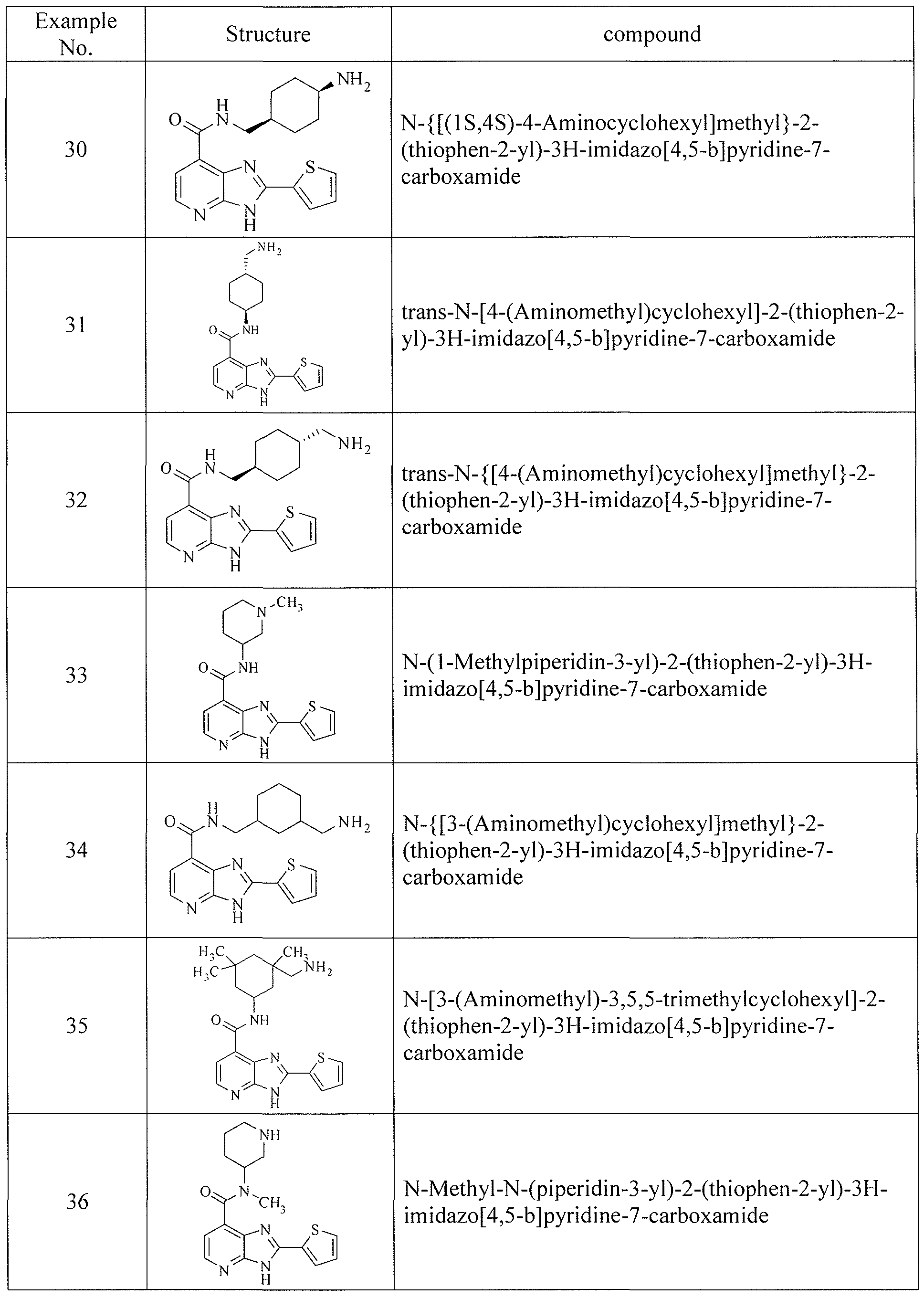


[0053] The compound of formula (I) of the present invention may be in the form of a pharmaceutically acceptable salt derived from an inorganic or organic acid, and representative examples of the pharmaceutically acceptable salt derived from an inorganic or organic acid include salts obtained by adding an inorganic acid such as hydrochloric acid, hydrobromic acid, phosphoric acid or sulfonic acid, or organic carboxylic acids such as acetic acid, trifluoroacetic acid, citric acid, formic acid, maleic acid, oxalic acid, succinic acid, benzoic acid, tartaric acid, fumaric acid, mandelic acid, ascorbic acid or malic acid, methanesulfonic acid, or para toluenesulfonic acid, which do not limit its scope, to the compound of formula (I). Such acids may be prepared by the conventional processes, and other acids, which themselves are not pharmaceutically acceptable, including oxalic acid may be employed in the preparation of the salts.
[0054] Alternatively, the compound of formula (I) of the present invention may also be in the form of a pharmaceutically acceptable salt derived from an inorganic or organic base include salts obtained by adding an inorganic or organic base. For example, alkalis including sodium hydroxide or potassium hydroxide, or alkaline earth metal hydroxides including calcium hydroxide, magnesium hydroxide, aluminum hydroxide or ammonium hydroxide may be used for the preparation of inorganic salt of the compound. Further, organic bases including
triethylamine or diisopropylethylamine may also be used for the preparation of organic salt of the compound.
[0055] The preferred inventive compound of formula (I) may be prepared as in Scheme I to IX.
Scheme I

[0056] Nitroaniline A was reduced under hydrogenation conditions to afford di-amine B which was treated with a variety of acids in the presence of phosphorous oxychloride to afford intermediate imidazopyridines C (Scheme I). In some instances nitroaniline A was reacted with a variety of aldehydes in the presence of various aldehydes to afford compounds C. Compounds C were oxidized to the corresponding acid using selenium dioxide and in some cases the intermediate acid was converted to the acid chloride and coupled with the requisite amines, followed by a deprotection to afford compounds of formula I. In other cases the intermediate acids and converted to the esters D. The esters D were hydrolyzed to give acids E which were reacted with a variety of amines with the appropriate coupling reagent and after a final deprotection afforded compounds of formula I.
Scheme II


[0057] Compounds C was treated with m-CPBA to afford the TV-oxide intermediate F which was reacted with acetic anhydride followed by sodium hydroxide to afford alcohol G (Scheme II). Primary alcohol G was oxidized to the corresponding acid E using PCC in the presence of periodic acid. The acid was reacted with the requisite amine followed by deprotection to afford compounds of formula I.
Scheme III
') H2N (CH2)a— R2
;/) NaBH4
in) TFA

;) H2N (CH2J3- R2
/Z) H2NNH2, KOH
in) TFA
[0058] Acids H were converted to the requisite amides followed by sodium borohydride reduction of the ketone and deprotection to afford compounds of formula I (Scheme III). In
some cases, acids H were converted to the requisite amide followed by deprotection to afford compounds of formula I. Finally, in some instances, acids H were converted to the requisite amide followed by reduction of the ketone using hydrazine and potassium hydroxide followed by deprotection to afford compounds of formula I (Scheme III).
Scheme IV NR2R3


[0059] In some instances, compounds I were reacted with various amines in the presence of copper and copper (I) iodide followed by deprotection to afford compounds of formula I (Scheme IV).
Scheme V

[0060] Compounds D were treated with DIBAL to afford the corresponding alcohols J. The primary alcohols were reacted with triflic anhydride in the presence of diisopropylethyl amine followed by the addition of the requisite amine and deprotection to afford compounds of formula I (Scheme V).
Scheme VI

K L I
[0061] Intermediate K was reacted with the requisite amine in the presence of diisopropylethyl amine to afford compounds L. Intermediates L were reacted with the requisite aldehyde to afford compounds of formula I (Scheme VI).
Scheme VIl

[0062] Acids E were converted to the corresponding acyl azides which were heated in tert- butanol to afford the protected anilines M. Removal of the Boc-protecting group followed by coupling with the requisite acid and a final deprotection afforded compounds of formula I (Scheme VIl).
Scheme VIII

H,N- -(CI I2I -R, 0 H2N (CH2)a— R2
;;) TFA

[0063] Pyridoindole N was converted to the N-oxide O followed by treatment with phosphorous oxychloride to afford intermediate P. The chloride P was displaced with requisite amines to afford compounds of formula I (Scheme VIII). Chloride P were also converted to the nitrile Q using the palladium catalyzed cross-coupling conditions followed by hydrolysis of the
nitrile to afford acid R. Acid R was coupled with the requisite amine followed by deprotection to afford compounds of formula I (Scheme VIII).
Scheme IX

W

[0067] Examples of suitable carriers, excipients, and diluents are lactose, dextrose, sucrose, sorbitol, mannitol, calcium silicate, cellulose, methyl cellulose, microcrystalline cellulose, polyvinylpyrrolidone, water, and mineral oil. The formulations may additionally include fillers, antiemulsifiers, preservatives and the like. The compositions of the invention may be formulated so as to provide quick, sustained or delayed release of the active ingredient after their administration to a mammal by employing any of the procedures well known in the art. [0068] The pharmaceutical composition of the present invention can be administered via various routes including oral, transdermal, subcutaneous, intravenous and intramuscular introduction.
[0069] In addition to the above, the present composition may contain other pharmaceutical active ingredients so long as they do not inhibit the in vivo function of the compound of the present invention. For example, the composition may further contain chemotherapeutic agents conventionally used for treating cancers.
[0070] The compounds disclosed here can be used to treat or prevent PBK dependent diseases including cancer. For example, the present invention provides methods for treating or preventing PBK dependent diseases including cancer in a subject by administering to said subject the compounds disclosed here. In a preferred embodiment, such compound can be administered to the subject in the form of pharmaceutical composition comprising the compound of the present invention and pharmaceutically or physiologically acceptable carrier. The pharmaceutical composition of the present invention can be administered via various routes including oral, transdermal, subcutaneous, intravenous and intramuscular introduction for treating a PBK dependent diseases including cancer in a subject.
[0071] In another embodiment, the present invention also provides the use of the compound of the present invention in manufacturing a pharmaceutical composition for treating or preventing a PBK dependent diseases including cancer. For example, the present invention relates to a use of the compound of the present invention for manufacturing a pharmaceutical composition for treating or preventing a PBK dependent diseases including cancer. In addition, the present
invention further provides the compound of the present invention for use in treating or preventing a PBK dependent diseases including cancer.
[0072] Alternatively, the present invention further provides a method or process for manufacturing a pharmaceutical composition for treating or preventing PBK dependent diseases including cancer, wherein the method or process comprises step for formulating a
pharmaceutically or physiologically acceptable carrier with the compound of the present invention as active ingredients.
[0073] In another embodiment, the present invention also provides a method or process for manufacturing a pharmaceutical composition for treating or preventing a PBK dependent diseases including cancer, wherein the method or process comprises step for admixing an active ingredient with a pharmaceutically or physiologically acceptable carrier, wherein the active ingredient is the compound of the present invention.
[0074] The dosage and method of administration vary according to the body-weight, age, and symptoms of the patient; however, one skilled in the art can suitably select them.
[0075] For example, although the dose of a compound of the present invention that regulates its activity depends on the symptoms, the dose is generally about 0.1 mg to about 100 mg per day, preferably about 1.0 mg to about 50 mg per day and more preferably about 1.0 mg to about 20 mg per day, when administered orally to a normal adult human (weight 60 kg).
[0076] When administering the compound parenterally, in the form of an injection to a normal adult human (weight 60 kg), although there are some differences according to the patient, target organ, symptoms and method of administration, it is convenient to intravenously inject a dose of about 0.01 mg to about 30 mg per day, preferably about 0.1 to about 20 mg per day and more preferably about 0.1 to about 10 mg per day. In the case of other animals, the appropriate dosage amount may be routinely calculated by converting to 60 kg of body-weight. Examples:
[0077] The following examples are intended to further illustrate the present invention without limiting its scope.
Example 1
4-Methylpyridine-2,3-diamine

[0078] A mixture of 4-Methyl-3-nitropyridin-2-amine (5.6 g, 37 mmol) and 10 wt % palladium on carbon (800 mg) was suspended in MeOH (200 mL) at room temperature and the reaction mixture was stirred under an atmosphere of hydrogen for 2 d. The reaction was filtered through diatomaceous earth and the filtrate was concentrated to afford the product (4.39 g, 97% yield) as a brown solid: ESl MS mlz 124 [C6H9N3 + H]+.
Example 2
7-Methyl-2-(thiophen-2-yl)-3H-imidazo[4,5-Z>]pyridine

[0079] Step 1 : A mixture of 4-methylpyridine-2,3-diamine (1.1 g, 8.9 mmol) and 2-thiophene carboxylic acid (1.16 g, 8.93 mmol) was suspended in phosphorous oxychloride (5 mL) and the reaction mixture was heated at 150 0C for 6 h. The reaction mixture was cooled, poured onto ice and the pH was adjusted to 12 using 6 M NaOH. The resulting solid was filtered and washed with water to afford the product (1.9 g, 95% yield) as a brown solid: 1H NMR (300 MHz, DMSO-J6) δ 13.38-13.20 (m, I H), 8.17 (d, J= 5.0 Hz, IH), 7.96-7.95 (m, IH), 7.78 (dd, J = 1.2, 5.0 Hz, I H), 7.25 (dd, J= 3.6, 5.0 Hz, IH), 7.05 (d, J = 5.0 Hz, IH), 2.51 (s, 3H); ESI MS w/z 216 [CnH9N3S + H]+.
Methyl 2-(thiophen-2-yl)-3H-imidazo[4,5-δ]pyridine-7-carboxylate

[0080] Step 2: A mixture of 7-methyl-2-(thiophen-2-yl)-3H-imidazo[4,5-έ]pyridine (4.5 g, 21 mmol) and selenium dioxide (9.3 g, 84 mmol) was suspended in pyridine (120 mL) and the reaction mixture was heated at 120 0C for 18 h. The reaction mixture was cooled, filtered
through diatomaceous earth, the filter cake was washed with hot water and the filtrate was concentrated. To the crude carboxylic acid in MeOH (200 mL) at 0 0C was added thionyl chloride (15 mL, 0.21 mol) dropwise and the reaction mixture was heated at 75 0C for 3 h. The reaction mixture was cooled, concentrated and the pH of the residue was adjusted to 12 using 3 M NaOH. The desired product was extracted with 3:1 CHCl3A-PrOH (3 x 30 mL), the combined organic layers were concentrated and purified by chromatography (silica gel, CH2Cl2ZMeOH gradient) to afford the product (4.2 g, 78% yield) as a orange-brown solid: 1H NMR (300 MHz, DMSO-J6) δ 12.99 (s, I H), 8.53-8.52 (m, IH), 8.37-8.36 (m, IH), 7.88 (d, J= 4.5 Hz, I H), 7.64 (d, J= 4.5 Hz, 1 H), 7.30 (dd, J = 4.5, 3.6 Hz, IH), 4.02 (s, 3H); ESI MS mlz 260
[C12H9N3O2S + H]+.
2-(Thiophen-2-yl)-3H-imidazo[4,5-έ]pyridine-7-carboxylic Acid

[0081] Step 3 : A mixture of methyl 2-(thiophen-2-yl)-3H-imidazo[4,5-6]pyridine-7- carboxylate (1.2 g, 4.6 mmol) and lithium hydroxide (4.6 mL, 2 M, 9.2 mmol) was suspended in TΗF (40 mL) and the reaction mixture was heated at 60 0C for 18 h. The reaction mixture was cooled, diluted with water (10 mL) and the pΗ was adjusted to 2 using 1 M HCl. The mixture was concentrated to afford the crude product (1.5 g) as a bright yellow solid: 1H NMR (300 MHz5 DMSO-J6) δ 8.48 (d, J= 5.1 Hz, IH), 8.41 (d, J= 3.6 Hz, IH), 7.87 (dd, J = 5.1 , 0.9 Hz, IH), 7.62 (d, J= 5.1 Hz, IH), 7.28 (dd, J= 5.1 , 3.6 Hz, I H); ESI MS mlz 246 [CnH7N3O2S + H]+.
[0049]
Example 3
2-(4-Chlorophenyl)-7-methyl-3H-imidazo[4,5-έ]pyridine

[0082] Step 1 : A mixture of 4-methylpyridine-2,3-diamine (0.75 g, 6.1 mmol) and A- chlorobenzoic acid (1.1 g, 7.3 mmol) were suspended in polyphosphoric acid (5 mL) and the mixture was heated at 160 0C for 18 h. The mixture was cooled, diluted with water and the pH
was adjusted to 12 using 6 M NaOH. The resultant solid was filtered and washed with water to afford the product (1.3 g, 87% yield) as a brown solid: 1H NMR (300 MHz, DMSO-^6) δ 13.36-13.34 (m, I H), 8.26 (d, J= 8.4 Hz, 2H), 8.21 (d, J= 4.8 Hz, IH), 7.65 (d, J = 8.4 Hz, 2H), 7.08 (d, J = 4.8 Hz, IH), 2.60 (s, 3H); ESI MS mlz 244 [Ci3H10ClN3 + H]+.
Methyl 2-(4-chlorophenyl)-3H-imidazo[4,5-έ]pyridine-7-carboxylate

[0083] Step 2: To a mixture of 2-(4-chlorophenyl)-7-rnethyl-3H-imidazo[4,5-&]pyridine (250 mg, 1.0 mmol) in /-BuOH was added potassium permanganate (1.6 g, 10.2 mmol) in water (10 mL) and the reaction mixture was heated at 70 0C for 18 h. The reaction was filtered through diatomaceous earth, the filter cake was washed with hot water and the filtrate was concentrated. To the crude carboxylic acid in MeOH (20 mL) at 0 0C was added thionyl chloride (0.75 mL, 10 mmol) dropwise and the reaction mixture was heated at 75 0C for 18 h. The reaction was cooled, concentrated and the pΗ of the residue was adjusted to 12 using 3 M NaOH. The basic aqueous solution was extracted with ethyl acetate (3 x 30 mL) and the combined organic layers were dried over Na2SO4 and concentrated to afford the product (200 mg, 67% yield) as a yellow solid: 1H NMR (300 MHz, CDCl3) δ 8.68 (d, J = 5.0 Hz, IH), 8.13 (d, J= 8.5 Hz, 2H), 7.69 (d, J= 5.0 Hz, IH), 7.55 (d, J= 8.4 Hz, 2H), 4.02 (s, 3H); ESI MS mlz 288 [C14H10ClN3O2 + H]+.
2-(4-Chlorophenyl)-3H-imidazo[4,5-b]pyridine-7-carboxylic Acid

[0084] Step 3: A mixture of methyl 2-(4-chlorophenyl)-3H-imidazo[4,5-ό]pyridine-7- carboxylate (190 mg, 0.66 mmol) and lithium hydroxide (1.6 mL, 2 M, 3.3 mmol) in TΗF (5 mL) was stirred at rt for 18 h. The mixture was diluted with water (10 mL) and the pΗ was adjusted to 2 using 1 N HCl. The mixture was concentrated under vacuum to afford the crude product as a dark brown solid: ESI MS mlz 21 A [C13H8ClN3O2 + H]+. Example 4
7-Methyl-3H-imidazo[4,5-6]pyridine

[0085] Step 1 : A mixture of 4-methylpyridine-2,3-diamine (2.4 g, 19 mmol) was dissolved in formic acid (50 mL) and the reaction mixture was heated at 100 0C for 18 h. The mixture was cooled, diluted with water and the pH was adjusted to 12 using cone. NH4OH. The mixture was extracted with 3:1 CHCl3//-PrOH (3 x 30 ml), the combined organic layers were concentrated and the residue was purified by chromatography (silica gel, CH2Cl2ZMeOH gradient) to afford the product (0.75 g, 30% yield) as a brown solid: 1H NMR (300 MHz, CD3OD) δ 8.35 (s, IH), 8.24 (d, J = 4.8 Hz, 1 H), 7.15 (dd, J = 4.8, 0.9 Hz, 1 H), 2.64 (s, 3H); ESI MS mlz 134 [C7H7N3 + H]+.
Methyl 3H-imidazo[4,5-ό]pyridine-7-carboxylate

[0086] Step 2: A mixture of 7-methyl-3H-imidazo[4,5-ό]pyridine (0.75 g, 5.6 mmol) and selenium dioxide (3.1 g, 28 mmol) in pyridine (50 mL) was heated at 120 0C for 18 h. Upon cooling the reaction was filtered through diatomaceous earth, washed with hot water and concentrated. The crude carboxylic acid was dissolved in MeOH (20 mL) and thionyl chloride (0.4 mL, 0.28 mol) was added dropwise at 0 0C. The reaction mixture was heated at 50 0C for 18 h, concentrated, cooled to 0 0C, and the pΗ was adjusted to 12 using 1 N NaOH. The mixture was extracted with 3: 1 CΗCl3//-PrOΗ (3 x 30 ml), the combined organic layers were concentrated and the residue was purified by chromatography (silica gel, CH2Cl2/Me0H gradient) to afford the product (340 mg, 34% yield) as a white solid: 1H NMR (300 MHz, CD3OD) δ 8.59 (d, J= 5.1 Hz, IH), 8.54 (s, I H), 7.84 (d, J= 5.1 Hz, I H), 4.06 (s, 3H); ESI MS mlz 178 [C8H7N3O2 + H]+.
3H-Imidazo[4,5-6]pyridine-7-carboxylic Acid

[0087] Step 3: A suspension of methyl 3H-imidazo[4,5-&]pyridine-7-carboxylate (330 mg, 1.9 mmol) and lithium hydroxide (1.9 mL, 2 M, 3.7 mmol) in TΗF (20 mL) was heated at 60 0C for 18 h. The reaction mixture was cooled, diluted with water (10 mL), the pΗ was adjusted to 2 using 1 N HCl and the mixture was concentrated to afford the crude product as a white solid: ESI MS mlz 164 [C7H5N3O2 + H]+.
Example 5
2-(5-Bromothiophen-2-yl)-7-methyl-lH-imidazo[4,5-b]pyridine
[0088] Step 1 : To a mixture of 4-methyl-3-nitropyridin-2-amine (1.5 g, 10 mmol), and 5- bromothiophene-2-carbaldehyde (1.9 g, 10 mmol) in ethanol (35 mL) was added a solution of Na2S2O4 (5.2 g, 30 mmol) in water (25 mL) and the resulting mixture was stirred at 80 0C for 4 d. The reaction mixture was cooled, concentrated and the residue was diluted with water (50 mL) and the pH of the mixture was adjusted to 7 using cone. NH4OH. The mixture was extracted with EtOAc (3 x 60 mL) and the combined organic layers were washed with brine (50 mL), dried over Na2SO4, and concentrated to provide the product as yellow solid (2.0 g, 68% yield): ESI MS m/z 294 [C1 1H8BrN3S + H]+.
Methyl 2-(5-bromothiophen-2-yl)-l H-imidazo[4,5-b]pyridine-7-carboxylate

[0089] Step 2: A mixture of 2-(5-bromothiophen-2-yl)-7-methyl-l H-imidazo[4,5-b]pyridine (1.9 g, 6.5 mmol) and selenium dioxide (2.9 g, 26 mmol) in pyridine (23 mL) was heated at 1 10
0C for 3 h. The hot reaction mixture was filtered through diatomaceous earth, the filter cake was washed with hot pyridine (10 niL) and CH3OH (20 mL), and the filtrate was concentrated and dried. The crude residue was dissolved in CH3OH (50 ml) followed by the dropwise addition of SOCl2 (0.48 mL, 6.5 mmol) at room temperature. The reaction mixture was stirred at reflux for 5 h, cooled, concentrated, suspended in ice-water (25 mL) and filtered. The pH of the filtrate was adjusted to 7 using cone. NH4OH followed by extraction with EtOAc (3 x 50 mL). The combined organic layers were washed with brine, dried over Na2SO4 and concentrated to provide the desired product as brown-yellow solid (1.5g, 68% yield): ESI MS m/z 338 [Ci2H8BrN3O2S + H]+. 2-(5-Bromothiophen-2-yl)-lH-imidazo[4,5-b]pyridine-7-carboxylic Acid

[0090] Step 3: To a solution of methyl 2-(5-bromothiophen-2-yl)-lH-imidazo[4,5-b]pyridine- 7-carboxylate (1.3 g, 3.9 mmol) in THF (20 mL) was added a solution of LiOH (0.65 g, 15 mmol) in water (10 mL) and the resulting mixture was stirred at reflux for 4 h. The reaction mixture was cooled, concentrated, diluted with ice-water (15 mL) and the pH was adjusted to 4 using glacial acetic acid. The resulting brown precipitate was filtered, washed with water (20 mL) and dried to provide the desired product (0.89 g, 71% yield): ESI MS m/z 324
[CnH6BrN3O2S + H]+.
Example 6
2-(4-Bromothiophen-2-yl)-7-methyl-l H-imidazo[4,5-b]pyridine

[0091] Step 1 : To a mixture of 4-methyl-3-nitropyridin-2-amine (1.5 g, 10 mmol), and 4- bromothiophene-2-carbaldehyde (1.9 g, 10 mmol) in ethanol (35 mL) was added a solution of Na2S2O4 (5.2 g, 30 mmol) in water (25 mL) and the resulting mixture was stirred at 80 0C for 3 d. The reaction mixture was cooled, concentrated, diluted with water (50 mL) and the pH of the mixture was adjusted to 7 using cone. NH4OH. The mixture was extracted with EtOAc (3 x 60
niL) and the combined organic layers were washed with brine (50 mL), dried over Na2SO4, and concentrated to provide the product as yellow solid (1.7 g, 58% yield): ESI MS m/z 294
[C1 1H8BrN3S + H]+.
Methyl 2-(4-bromothiophen-2-yl)-l H-imidazo[4,5-b]pyridine-7-carboxylate

[0092] Step 2: A mixture of 2-(4-bromothiophen-2-yl)-7-methyl-l H-imidazo[4,5-b]pyridine (1.7 g, 5.4 mmol) and selenium dioxide (2.4 g, 21 mmol) in pyridine (15 mL) was heated at 1 10 0C for 3 h. The hot reaction mixture was filtered through diatomaceous earth, washed with hot pyridine (10 mL) and CH3OH (20 mL), and the filtrate was concentrated and dried. The crude residue was dissolved in CH3OH (50 ml) followed by the dropwise addition Of SOCl2 (0.40 mL, 6.5 mmol) at room temperature. The reaction mixture was stirred at reflux for 5 h, cooled, concentrated, suspended in ice-water (25 mL) and filtered. The pH of the filtrate was adjusted to 7 using cone. NH4OH followed by extraction with EtOAc (3 x 50 mL). The combined organic layers were washed with brine, dried over Na2SO4 and concentrated to provide the desired product as brown-yellow solid (1.5 g, 68% yield): ESI MS m/z 338 [C12H8BrN3O2S + H]+.
2-(4-Bromothiophen-2-yl)-l H-imidazo[4,5-b]pyridine-7-carboxylic Acid

[0093] Step 3: To a solution of methyl 2-(4-brornothiophen-2-yl)-lH-imidazo[4,5-b]pyridine- 7-carboxylate (0.60 g, 1.8 mmol) in THF (10 mL) was added a solution of LiOH (0.45 g, 1 1 mmol) in water (5 mL) and the resulting mixture was stirred at rt for 4 h. The reaction mixture was concentrated, diluted with ice-water (15 mL) and the pH was adjusted to 5 using glacial acetic acid. The resulting brown precipitate was filtered, washed with water (20 mL) and dried to provide the desired product (0.52 g, 91% yield): ESI MS m/z 324 [C1 1H6BrN3O2S + H]+.
Example 7
2-(5-Bromofuran-2-yl)-7-methyl-3H-imidazo[4,5-b]pyridine

[0094] Step 1 : Following the procedure outlined for step 1 in Example 6, 4-methyl-3- nitropyridin-2-amine (3.0 g, 20 mmol) was reacted with 5-bromofuran-2-carbaldehyde (3.42 g, 20 mmol) to obtain the product (1.3 g, 27% yield) as yellow solid: ESl MS m/z 278
[CnH8BrN3O + H]+.
Methyl 2-(5-bromofuran-2-yl)-3H-imidazo[4,5-b]pyridine-7-carboxylate

2-(5-Bromofuran-2-yl)-3H-imidazo[4,5-b]pyridine-7-carboxylic Acid

[0096] Step 3: Following the procedure outlined for step 3 in Example 6, methyl 2-(5- bromofuran-2-yl)-3H-imidazo[4,5-b]pyridine-7-carboxylate (0.95 g, 2.9 mmol) was reacted with LiOH (0.52 g, 12 mmol) to provide the desired product (0.95, 63% yield) as a brown solid: ESI MS m/z 308 [C, ,H6BrN3O3 + H]+.
Example 8
2-Cyclopropyl-7-methyl-lH-imidazo[4,5-b]pyridine

[0097] Step 1 : Following the procedure outlined for step 1 in Example 6, 1, 4-methyl-3- nitropyridin-2-amine (1.5 g, 10 mmol) was reacted with cyclopropanecarbaldehyde (0.70 g, 10 mmol) to afford the product as brown solid (1.1 g, 64% yield). ESI MS m/z 174 [C10HnN3 + H]+.
Methyl 2-cyclopropyl-l H-imidazo[4,5-b]pyridine-7-carboxylate

[0098] Step 2: Following the procedure outlined for step 2 in Example 6, 2-cyclopropyl-7- methyl-lH-imidazo[4,5-b]pyridine (0.98 g, 5.6 mmol) was reacted with SeO2 (1.4 g, 13 mmol) and then SOCl2 (0.42 mL, 5.6 mmol) to afford the product as brown solid (0.89 g, 73% yield): ESI MS m/z 218 [CnHnN3O2 + H]+.
2-Cyclopropyl-lH-imidazo[4,5-b]pyridine-7-carboxylic Acid

[0099] Step 3: Following the procedure outlined for step 3 in Example 6, methyl 2- cyclopropyl-lH-imidazo[4,5-b]pyridine-7-carboxylate (0.8 g, 3.7 mmol) was reacted with LiOH (0.93 g, 22 mmol) to afford the product as brown-yellow solid (0.72 g, 96% yield): ESI MS m/z
 Example 9
7-Methyl-2-(thiophen-2-ylmethyl)-3H-imidazo[4,5-b]pyridine

[0100] Step 1 : Following the procedure outlined for step 1 in Example 6, 4-methylpyridine- 2,3-diamine (0.99 g, 8.0 mmol) was reacted with 2-(thiophen-2-yl)acetic acid (1.1 g, 8.0 mmol) to provide the desired product (1.6 g, 88% yield): ESI MS m/z 230 [C12HnN3S + H]+.
Methyl 2-(thiophene-2-carbonyl)-3H-imidazo[4,5-b]pyridine-7-carboxylate

[0101] Step 2: Following the procedure outlined for step 2 in Example 6, 7-methyl-2- (thiophen-2-ylmethyl)-3H-imidazo[4,5-b]pyridine (1.1 g, 4.8 mmol) was reacted with SeO2 (2.1 g, 19 mmol) and then SOCl2 (0.36 mL, 4.8 mmol) to afford the product as brown solid (0.68 g, 49% yield): ESI MS m/z 274 [C13HnN3O2S + H]+.
2-(Thiophene-2-carbonyl)-3H-imidazo[4,5-b]pyridine-7-carboxylic Acid

[0102] Step 3: Following the procedure outlined for step 3 in Example 6, methyl 2-(thiophene- 2-carbonyl)-3H-imidazo[4,5-b]pyridine-7-carboxylate (0.6 g, 4.8 mmol) was reacted with LiOH (0.35 g, 8.4 mmol) to afford the product as a brown-yellow solid (0.53 g, 93% yield): ESI MS m/z 260 [Ci2H9N3O2S + H]+.
Example 10
2-(Cyclopropylmethyl)-7-methyl-3H-imidazo[4,5-b]pyridine
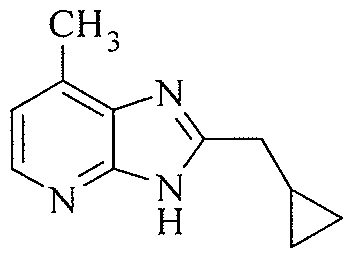
[0103] Step 1 : A mixture of 4-rnethylpyridine-2,3-diamine (1.1 g, 8.9 mmol), 2- cyclopropylacetic acid (0.89 g, 8.9 mmol) in phosphorous oxychloride (10 mL) was heated at reflux for 3 h. The reaction mixture was cooled, concentrated, diluted in cold water (50 ml) and the pH was adjusted to 8 using 2 N NaOH and satd. aq. NaHCO3. The resulting basic mixture was extracted with methylene chloride (3 χ. 50 mL) and the combined organic layers were dried over sodium sulfate, filtered, concentrated and the residue was purified by column
chromatography (silica gel , 5% methanol/methylene chloride) to afford the product (1.3 g, 81 % yield) as a yellow solid: 1H NMR (CDCl3, 500 MHz) 68.16 (d, J= 5.0 Hz, I H), 7.03 (d, J= 5.0 Hz, 1 H), 2.96 (d, J = 7.0 Hz, 2H), 2.69 (s, 3H), 1.30-1.26 (m, 1 H), 0.69-0.65 (m, 2H), 0.41 - 0.38 (m, 2H); ESI MS m/z 188 [M + H]+.
2-(Cyclopropylrnethyl)-7-rnethyl-3H-imidazo[4,5-b]pyridine 4-oxide
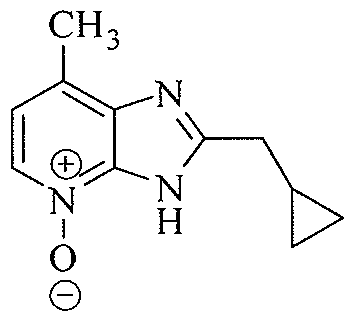
[0104] Step 2: To a solution of 2-(cyclopropylmethyl)-7-methyl-3H-imidazo[4,5-b]pyridine (0.42 g, 2.3 mmol) in methylene chloride (13 mL) at 0 0C was added w-chloroperoxybenzoic acid (0.78 g, 3.5 mmol) and the mixture was stirred at rt for 18 h. The reaction mixture was concentrated and the residue was used in the next step without further purification or characterization.
[2-(cyclopropylmethyl)-3H-imidazo[4,5-b]pyridin-7-yl]methanol
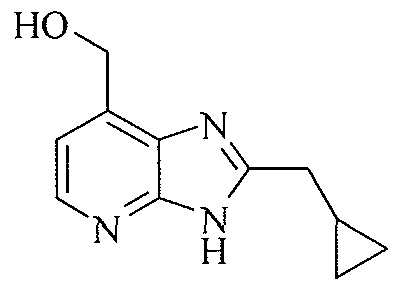
NaOH (20 mL) and stirred at rt for 30 min. The reaction mixture was extracted with methylene chloride (3 x 50 mL) and the combined organic layers were dried over sodium sulfate, filtered, concentrated and the residue was purified by column chromatography (silica gel, 5%
methanol/methylene chloride) to provide the desired product (0.18 g, 39% yield) as a yellow solid: 1H NMR (CD3OD, 500 MHz) δ 8.28 (d, J= 5.0 Hz, I H), 7.33 (d, J= 5.0 Hz, IH), 5.03 (s, 2H), 2.85 (d, J= 7.5 Hz, 2H), 1.27-1.23 (m, IH), 0.62-0.58 (m, 2H), 0.37-0.35 (m, 2H); ESI MS m/z 204 [M + H]+.
2-(Cyclopropylmethyl)-3H-imidazo[4,5-b]pyridine-7-carboxylic acid

[0106] Step 4: A suspension OfH5IO6 (221 mg, 0.97 mmol) in CH3CN was stirred at rt for 15 min followed by the addition of (2-(cyclopropylmethyl)-3H-imidazo[4,5-b]pyridin-7- yl)methanol (89 mg, 0.44 mmol) and pyridinium chlorochromate (9 mg, 0.044 mmol). The reaction mixture was stirred at rt for 3 h and the precipitate was filtered. The filtrate was concentrated and purified by preparative HPLC (Cl 8 silica, 10-90% acetonitrile/water with 0.05% TFA) to afford the product (62 mg, 65% yield) as a yellow solid: 1H NMR (CD3OD, 500 MHz) δ 8.76 (d, J= 5.0 Hz, IH), 8.05 (d, J= 5.0 Hz, 1 H), 3.14 (d, J= 7.0 Hz, 2H), 1.33-1.30 (m, I H), 0.74-0.70 (m, 2H), 0.47-0.44 (m, 2H); ESI MS m/z 218 [M + H]+.
Example 1 1
2-(Bicyclo[2.2.1]heptan-2-yl)-7-methyl-3H-imidazo[4,5-b]pyridine

2-(Bicyclo[2.2.1 ]heptan-2-yl)-7-methyl-3H-imidazo[4,5-b]pyridine 4-oxide

[0108] Step 2: To a solution of 2-(bicyclo[2.2.1 ]heptan-2-yl)-7-methyl-3H-imidazo[4,5- b]pyridine 1.65 g, 7.3 mmol) in methylene chloride (30 mL) at 0 0C was added m- chloroperoxybenzoic acid (2.50 g, 1 1.2 mmol) and the reaction mixture was stirred at rt for 3 h. The reaction was quenched by the addition of satd. aq. NaHCO3 (20 mL) and the layers were separated. The organic phase was dried over sodium sulfate, filtered, concentrated and the residue was used in the next step without further purification or characterization. [-(Bicyclo[2.2.1]heptan-2-yl)-3H-imidazo[4,5-b]pyridin-7-yl]methanol

[0109] Step 3: A solution of 2-(bicyclo[2.2.1]heptan-2-yl)-7-methyl-3H-imidazo[4,5- b]pyridine 4-oxide (7.3 mmol) in acetic anhydride (40 mL) was heated at 70 0C for 1 h. The reaction mixture was cooled using an ice-water bath and the pH was adjusted to 7 using 1 N NaOH. The mixture was extracted with methylene chloride (3 x 50 mL) and the combined
organic layers were concentrated. The residue was dissolved in methanol (20 mL) and 1 N NaOH (20 mL) and stirred at rt for 30 min. The reaction mixture was extracted with methylene chloride (3 x 50 mL) and the combined organic layers were dried over sodium sulfate, filtered, concentrated and the residue was purified by column chromatography (silica gel, 5%
methanol/methylene chloride) to provide the desired product (0.52 g, 27% yield) as an off-white solid (mixture of diastereomers): 1H NMR (CDCl3, 500 MHz) 1H NMR (CDCl3, 500 MHz) δ 8.26 (s, IH), 7.09 (s, IH), 5.16 (s, 2H), 3.46 (br, I H, minor), 3.04 (br, IH, major), 2.76 (s, IH, minor), 2.71 (s, IH, major), 2.48 (s, I H, major), 2.46 (s, IH, minor), 2.29-1.23 (m, 8H); ESI MS m/z 244 [M + H]+. 2-(Bicyclo[2.2.1 ]heptan-2-yl)-3H-imidazo[4,5-b]pyridine-7-carboxylic acid

[0110] Step 4: A suspension Of H5IO6 (412 mg, 1.8 mmol) in CH3CN was stirred at rt for 15 min followed by the addition of (2-(bicyclo[2.2.1]heptan-2-yl)-3H-imidazo[4,5-b]pyridin-7- yl)methanol (200 mg, 0.82 mmol) and pyridinium chlorochromate (18 mg, 0.082 mmol). The reaction mixture was stirred at rt for 3 h and the precipitate was filtered. The filtrate was concentrated and the residue was used in the next step without further purification or
characterization.
General Procedure A - synthesis of compounds of formula I as described in Scheme (1):
[0111] The crude carboxylic acids E (0.22 - 0.94 mmol) were dissolved in mixture of
THF/DMF (2:1) followed by the addition of HATU (1.5 equiv), diisopropylethyl amine (3 equiv) and the requisite amine (2 equiv) and the reaction mixture was stirred at rt for 5 -18 h. The reaction mixture was diluted with water, the pH was adjusted to 12, and the mixture was extracted with ethyl acetate. The combined organic layers were concentrated and purified by preparative HPLC (C 18 silica, 10-90% acetonitrile/water with 0.05% TFA). The desired fractions were combined, concentrated and eluted through an ion-exchange column (using methanol and 7 N methanol in ammonia) to obtain the desired products. In some instances, the combined organic layers were dissolved in THF, followed by the addition of 6 M HCl (5 equiv) and the reaction mixture was heated at 60 0C for 1 h. The reaction mixture was cooled,
concentrated and purified by preparative HPLC (C 18 silica, 10-90% acetonitrile/water with 0.05% TFA). The desired fractions were combined, concentrated and eluted through an ion- exchange column (using methanol and 7 N methanol in ammonia) to obtain the desired products.
Example 12
iV-[2-(lH-imidazol-4-yl)ethyl]-2-(thiophen-2-yl)-3H-imidazo[4,5-ό]pyridine-7-carboxamide

[0112] Following General Procedure A, 2-(thiophene-2-yl)-3H-imidazo[4,5-Z>]pyridine-7- carboxylic acid (139 mg, 0.56 mmol) was reacted with histamine hydrochloride (205 mg, 1.1 mmol) to afford the desired product (37 mg, 19% yield) as a light yellow solid: 1H NMR (300 MHz5 CD3OD) 58.42 (d, J= 5.1 Hz, IH), 7.94-7.91 (m, 2H), 7.77 (d, J= 5.1 Hz, 2H), 7.29- 7.26 (m, IH), 7.12 (s, IH), 3.89 (t, J= 6.8 Hz, 2H), 3.08 (t, J= 6.8 Hz, 2H); ESl MS mlz 339 [C6H14N6OS + H]+; HPLC 95.7% (AUC), /R = 9.36 min.
Example 13
N-[2-(lH-Imidazol-4-yl)ethyl]-2-(4-chlorophenyl)-3H- imidazo[4,5-Z>]pyridine-7-carboxamide

[0113] Following General Procedure A, 2-(4-chlorophenyl)-3//-imidazo[4,5-έ]pyridine-7- carboxylic acid (140 mg, 0.51 mmol) was reacted with histamine hydrochloride (185 mg, 1.0 mmol) to afford the desired product (9 mg, 5% yield) as a light yellow solid: 1H NMR (500 MHz, CD3OD) 58.44 (d, J= 5.0 Hz, I H), 8.10 (d, J= 8.5 Hz, 2H), 7.79 (d, J= 5.0 Hz, I H), 7.75 (s, I H), 7.61 (d, J= 8.5 Hz, 2H), 7.01 (s, I H), 3.90 (t, J= 6.5 Hz, 2H), 3.02 (t, J= 6.5 Hz, 2H); ESl MS mlz 367 [C18Hi5ClN6O + H]+; HPLC 95.7% (AUC), tR = 10.53 min.
Example 14
2-(4-Chlorophenyl)-jV-(piperidin-3-yl)-3H-imidazo[4,5-ό]pyridine-7-carboxamide

[0114] Following General Procedure A, 2-(4-chlorophenyl)-3H-imidazo[4,5-ό]pyridine-7- carboxylic acid (130 mg, 0.47 mmol) was reacted with tert-buty\ 3-aminopiperidine-l- carboxylate (190 mg, 0.94 mmol) to afford the desired product (8 mg, 3% yield) as a light yellow solid: 1H NMR (300 MHz, CD3OD) 58.45 (d, J= 5.1 Hz, I H), 8.25-8.22 (m, 2H), 7.78 (d, J = 5.1 Hz, IH), 7.62-7.59 (m, 2H), 4.21^1.18 (m, IH), 3.08-3.04 (m, I H), 2.90-2.83 (m, 2H), 2.24-2.15 (m, IH), 2.01-1.92 (m, IH), 1.83-1.77 (m, 2H); ESI MS mlz 356 [Ci8Hi8ClN5O + H]+; HPLC 98.4% (AUC), tR = 10.55 min.
Example 15
N-(Piperidin-3-yl)-2-(thiophen-2-yl)-3H-imidazo[4,5-έ]pyridine-7-carboxamide

[0115] Following General Procedure A, 2-(thiophen-2-yl)-3H-imidazo[4,5-ό]pyridine-7- carboxylic acid (200 mg, 0.63 mmol) was reacted with fer/-butyl 3-aminopiperidine-l- carboxylate (250 mg, 1.3 mmol) to afford the desired product (67 mg, 32% yield) as a yellow solid: 1H NMR (300 MHz, DMSO-J6) 59.87 (d, J= 7.5 Hz, IH), 8.36 (d, J= 5.1 Hz, IH), 7.99- 7.98 (m, IH), 7.82-7.80 (m, IH), 7.60 (d, J= 5.1 Hz, I H), 7.27 (dd, J= 3.6, 5.1 Hz, I H), 4.07- 4.04 (m, I H), 3.14-3.09 (m, I H), 2.86-2.68 (m, 3H), 2.02-1.79 (m, 2H), 1.69-1.53 (m, 2H); ESI MS mlz 328 [C16H17N5OS + H]+; HPLC 98.5% (AUC), /R = 10.19 min.
Example 16
N-(Piperidin-3-ylmethyl)-2-(thiophen-2-yl)-3H-imidazo[4,5-έ]pyridine-7-carboxamide
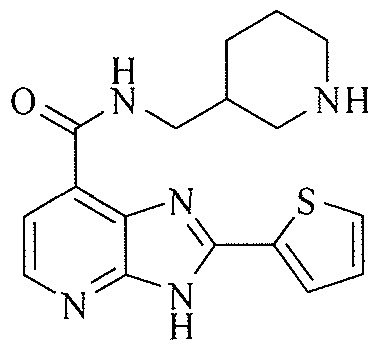
[0116] Following General Procedure A, 2-(thiophen-2-yl)-3H-imidazo[4,5-ό]pyridine-7- carboxylic acid (170 mg, 0.53 mmol) was reacted with tert-butyl 3-(aminomethyl)piperidine-l- carboxylate (230 mg, 1.1 mmol) to afford the desired product (28 mg, 16% yield) as a yellow- brown solid: 1H NMR (300 MHz, DMSO-J6) δl 0.05-9.98 (m, I H), 8.24 (d, J= 7.5 Hz, IH), 7.88 (d, J= 3.3 Hz, I H), 7.68 (d, J= 5.1Hz, I H), 7.45 (d, J= 4.8 Hz, IH), 7.23-7.20 (m, IH), 3.42-3.38 (m, 2H), 3.28-3.24 (m, I H), 3.12-3.08 (m, I H), 2.71-2.57 (m, 2H), 1.99-1.85 (m, 2H), 1.81-1.70 (m, I H), 1.63-1.46 (m, I H), 1.41-1.29 (m, I H); ESI MS mlz 342 [Ci7H19N5OS + H]+; HPLC 97.6% (AUC), /R = 8.87 min.
Example 17
N-[3-(lH-Imidazol-2-yl)propyl]-2-(thiophen-2-yl)-3H- imidazo[4,5-&]pyridine-7-carboxamide

[0117] Following General Procedure A, 2-(thiophen-2-yl)-3H-imidazo[4,5-έ]pyridine-7- carboxylic acid (150 mg, 0.47 mmol) was reacted with 3-(lH-imidazol-2-yl)propan-l -amine
(120 mg, 0.94 mmol) to afford the desired product (33 mg, 20% yield) as a light yellow solid: 1H ΝMR (300 MHz, DMSO-J6) 59.46-9.39 (m, I H), 8.44 (d, J= 4.8 Hz, I H), 8.1 1-8.07 (m, IH), 7.87 (d, J= 5.1 Hz, IH), 7.67 (d, J= 5.1 Hz, IH), 7.31-7.28 (m, I H), 6.89 (s, 2H), 3.54-3.47 (m, 2H), 2.80 (t, J= 7.5 Hz, 2H), 2.00 (t, J= 7.5 Hz, 2H); ESI MS mlz 353 [C17H16N6OS + H]+; HPLC 98.8% (AUC), /R = 8.78 min.
Example 18
(^-N^Piperidin-S-yO^-Cthiophen^-yO-SH-imidazo^^-όJpyridine-y-carboxamide

[0118] Following General Procedure A, 2-(thiophen-2-yl)-3H-imidazo[4,5-δ]pyridine-7- carboxylic acid (140 mg, 0.44 mmol) was reacted with (i?)-/er/-butyl 3-aminopiperidine-l- carboxylate (180 mg, 0.88 mmol) to afford the desired product (30 mg, 21% yield) as a light yellow solid: 1H ΝMR (300 MHz, DMSO-^6) δ9.84 (d, J= 7.2 Hz, IH), 8.38 (d, J= 5.0 Hz, IH), 8.00 (dd, J = 1.2, 3.8 Hz, I H), 7.82 (dd, J = 1.2, 5.0 Hz, IH), 7.61 (d, J= 5.0 Hz, IH), 7.28 (dd, J= 3.8, 5.0 Hz, I H), 4.07^1.05 (m, IH), 3.17-3.10 (m, IH), 2.87-2.69 (m, 3H), 2.02-1.80 (m, 2H), 1.66-1.60 (m, 2H); ESI MS mlz 328 [C16H17N5OS + H]+; HPLC >99% (AUC), /R = 8.68 min.
Example 19
(5)-N-(Piperidin-3-yl)-2-(thiophen-2-yl)-3H-imidazo[4,5-έ]pyridine-7-carboxamide

[0119] Following General Procedure A, 2-(thiophen-2-yl)-3H-imidazo[4,5-Z>]pyridine-7- carboxylic acid (210 mg, 0.66 mmol) was reacted with (S)-ter/-butyl 3-aminopiperidine-l- carboxylate (260 mg, 1.3 mmol) to afford the desired product (40 mg, 19% yield) as a light yellow solid: 1H ΝMR (300 MHz, DMSCMO δ9.87 (d, J= 7.5 Hz, I H), 8.37 (d, J= 5.1 Hz, I H), 7.99 (d, J = 2.7 Hz, I H), 7.81 (d, J = 4.2 Hz, IH), 7.60 (d, J= 5.1 Hz, I H), 7.29-7.26 (m, IH), 4.07^1.05 (m, I H), 3.13-3.09 (m, I H), 2.89-2.68 (m, 3H), 2.02-1.79 (m, 2H), 1.69-1.53 (m, 2H); ESI MS mlz 328 [Ci6H17N5OS + H]+; HPLC >99% (AUC), /R = 10.40 min.
Example 20
N^-AminocyclohexyO^-^hiophen^-y^-SH-imidazo^^-έJpyridine-T-carboxamide

[0120] Following General Procedure A, 2-(thiophen-2-yl)-3H-imidazo[4,5-6]pyridine-7- carboxylic acid (100 mg, 0.33 mmol) was reacted with trans-tert-b\xty\ 4- aminocyclohexylcarbamate (140 mg, 0.66 mmol) to afford the desired product (44 mg, 39% yield) as a light yellow solid: 1H NMR (300 MHz, CD3OD) 58.34 (d, J= 5.1 Hz, IH), 7.92 (dd, J= 1.2, 3.6 Hz, I H), 7.69 (d, J = 5.1 Hz, I H), 7.67 (dd, J = 1.2, 5.1 Hz, IH), 7.23 (dd, J= 3.6, 5.1 Hz, I H), 4.01-3.91 (m, I H), 3.08-2.96 (m, IH), 2.28-2.45 (m, 2H), 2.12-2.08 (m, 2H), 1.61-1.47 (m, 4H); ESI MS mlz 342 [C17Hi9N5OS + H]+; HPLC 97.2% (AUC), /R = 8.60 min.
Example 21
(i?)-N-(Piperidin-3-ylmethyl)-2-(thiophen-2-yl)-3H-imidazo[4,5-ό]pyridine-7-carboxamide

[0121] Following General Procedure A, 2-(thiophen-2-yl)-3H-imidazo[4,5-έ]pyridine-7- carboxylic acid (160 mg, 0.51 mmol) was reacted with (S)-tert-buty\ 3-(aminomethyl)piperidine- 1 -carboxylate (220 mg, 1.0 mmol) to afford the desired product (54 mg, 31% yield) as a light yellow solid: 1H NMR (SOO MHZ5 DMSO-J6) δ 10.07-10.05 (m, I H), 8.23 (d, J= 5.1 Hz, I H), 7.86 (dd, J= 1.2, 3.6 Hz, I H), 7.67-7.65 (m, IH), 7.43 (d, J = 5.1 Hz, IH), 7.20 (dd, J = 3.6, 4.0 Hz, IH), 3.41-3.37 (m, 2H), 3.27-3.23 (m, IH), 3.10-3.06 (m, IH), 2.70-2.55 (m, 2H), 1.98- 1.83 (m, 2H), 1.80-1.71 (m, 1 H), 1.62-1.45 (m, 1 H), 1.40-1.29 (m, 1 H); ESI MS mlz 342
[C7Hi9N5OS + H]+; HPLC >99% (AUC), tR = 8.69 min.
Example 22
(^-^-(Piperidin-S-ylmethyO^-Cthiophen^-yO-SH-imidazo^S-όjpyridine-T-carboxamide

[0122] Following General Procedure A, 2-(thiophen-2-yl)-3H-imidazo[4,5-Z>]pyridine-7- carboxylic acid (160 mg, 0.51 mmol) was reacted with (R)-tert-buty\ 3-(aminomethyl)piperidine- 1-carboxylate (220 mg, 1.0 mmol) to afford the desired product (62 mg, 35% yield) as a light yellow solid: 1H NMR (300 MHz, DMSO-J6) δl 0.07-10.05 (m, I H), 8.23 (d, J= 5.1 Hz, I H), 7.86 (dd, J= 1.2, 3.6 Hz, I H), 7.67-7.65 (m, IH), 7.43 (d, J = 5.1 Hz, IH), 7.20 (dd, J = 3.6, 4.2 Hz, IH), 3.41-3.37 (m, 2H), 3.27-3.23 (m, IH), 3.10-3.06 (m, I H), 2.70-2.55 (m, 2H), 1.99- 1.83 (m, 2H), 1.80-1.70 (m, IH), 1.61-1.46 (m, IH), 1.40-1.25 (m, IH); ESl MS mlz 342
[Ci7Hi9N5OS + H]+; HPLC >99% (AUC), tR = 8.40 min.
Example 23
(i?)-N-[2-(Piperidin-3-yl)ethyl]-2-(thiophen-2-yl)-3H-imidazo[4,5-δ]pyridine-7-carboxamide

[0123] Following General Procedure A, 2-(thiophen-2-yl)-3H-imidazo[4,5-/>]pyridine-7- carboxylic acid (130 mg, 0.39 mmol) was reacted with (i?)-/er/-butyl 3-(2-aminoethyl)piperidine- 1-carboxylate (180 mg, 0.78 mmol) to afford the desired product (30 mg, 21% yield) as a light yellow solid: 1H NMR (300 MHz, DMSO-J6) δ 10.03-10.00 (m, I H), 8.21 (d, J = 5.1 Hz, I H), 7.86 (dd, J= 0.9, 3.6 Hz, IH), 7.65 (dd, J = 0.9, 5.1 Hz, IH), 7.42 (d, J= 5.1 Hz, I H), 7.20 (dd, J = 3.6, 5.1 Hz, I H), 3.57-3.42 (m, 2H), 3.22-3.01 (m, 2H), 2.69-2.58 (m, I H), 1.99-1.89 (m,
IH), 1.80-1.67 (m, 2H), 1.67-1.46 (m, 3H), 1.25-1.14 (m, IH); ESI MS mlz 356 [Ci8H21N5OS + H]+; HPLC >99% (AUC), /R = 8.78 min.
Example 24
(5)-iV-[2-(Piperidin-3-yl)ethyl]-2-(thiophen-2-yl)-3H-imidazo[4,5-6]pyridine-7-carboxamide

[0124] Following General Procedure A, 2-(thiophen-2-yl)-3H-imidazo[4,5-έ]pyridine-7- carboxylic acid (140 mg, 0.42 mmol) was reacted with (S)-tert-buty\ 3-(2-aminoethyl)piperidine- 1 -carboxylate (190 mg, 0.84 mmol) to afford the desired product (23 mg, 15% yield) as a light yellow solid: 1H NMR POO MHZ5 DMSO-^6) δl 0.00-9.98 (m, IH), 8.21 (d, J- 5.1 Hz, IH), 7.87 (dd, J= 0.9, 3.6 Hz, IH), 7.65 (dd, J= 0.9, 5.1 Hz, I H), 7.43 (d, J= 5.1 Hz, IH), 7.20 (dd, J = 3.6, 5.1 Hz, IH), 3.58-3.42 (m, 2H), 3.22-3.02 (m, 2H), 2.70-2.59 (m, I H), 1.99-1.89 (m, 1 H), 1.82-1.67 (m, 2H), 1.67-1.47 (m, 3H), 1.28-1.13 (m, 1 H); ESl MS mlz 356 [C18H2iN5OS + H]+; HPLC >99% (AUC), /R = 8.77 min.
Example25
N-(Pyrrolidin-3-yl)-2-(thiophen-2-yl)-3H-imidazo[4,5-δ]pyridine-7-carboxamide

[0125] Following General Procedure A, 2-(thiophen-2-yl)-3H-imidazo[4,5-έ]pyridine-7- carboxylic acid (150 mg, 0.46 mmol) was reacted with /er/-butyl 3-aminopyrrolidine-l - carboxylate (170 mg, 0.92 mmol) to afford the desired product (49 mg, 34% yield) as a light yellow solid: 1H NMR (300 MHz, DMSO-^6) δ9.95 (d, J = 6.6 Hz, IH), 8.32 (d, J= 5.1 Hz, IH), 7.95 (dd, J= 0.9, 3.6 Hz, IH), 7.76 (dd, J= 0.9, 5.1 Hz, I H), 7.52 (d, J = 5.1 Hz, I H), 7.24 (dd, J= 3.6, 3.8 Hz, IH), 4.54^1.45 (m, IH), 3.35-3.28 (m, I H), 3.23-3.05 (m, 2H), 3.00-2.93 (m, I H), 2.28-2.19 (m, I H), 1.93-1.82 (m, IH); ESI MS mlz 314 [Ci5Hi5N5OS + H]+; HPLC 98.5% (AUC), /R = 7.77 min.
Example 26
N-(Piperidin-2-ylmethyl)-2-(thiophen-2-yl)-3H-imidazo[4,5-ό]pyridine-7-carboxamide

[0126] Following General Procedure A, 2-(thiophen-2-yl)-3H-imidazo[4,5-δ]pyridine-7- carboxylic acid (150 mg, 0.47 mmol) was reacted tert-buty\ 2-(aminomethyl)piperidine-l- carboxylate (200 mg, 0.94 mmol) to afford the desired product (42 mg, 26% yield) as a yellow solid: 1H NMR (300 MHz, DMSO-J6) 59.81-9.78 (m, IH), 8.34 (d, J= 5.1 Hz, IH), 7.98 (dd, J = 0.9, 3.8 Hz, IH), 7.80 (dd, J= 0.9, 5.1 Hz, I H), 7.57 (d, J= 5.1 Hz, IH), 7.26 (dd, J= 3.8, 5.1 Hz, IH), 3.52-3.44 (m, 2H), 3.13-3.04 (m, I H), 2.94-2.84 (m, I H), 2.74-2.61 (m, IH), 1.86- 1.77 (m, 2H), 1.62-1.55 (m, IH), 1.47-1.29 (m, 2H); ESI MS mlz 342 [Ci7Hi9N5OS + H]+; HPLC 98.9% (AUC), tR = 8.36 min.
Example 27
N-(Azetidin-3-ylmethyl)-2-(thiophen-2-yl)-3H-imidazo[4,5-ό]pyridine-7-carboxamide

[0127] Following General Procedure A, 2-(thiophen-2-yl)-3H-imidazo[4,5~ό]pyridine-7- carboxylic acid (140 mg, 0.43 mmol)was reacted tert-buty\ 3-(aminomethyl)azetidine-l- carboxylate (160 mg, 0.86 mmol) to afford the desired product (26 mg, 19% yield) as a light yellow solid: 1H NMR (SOO MHZ3 DMSO-J6) δ 10.06-9.97 (m, I H), 8.23 (d, J= 4.5 Hz, IH), 7.85 (s, IH), 7.66 (d, J= 4.5 Hz, I H), 7.42 (d, J= 4.5 Hz, I H), 7.22-7.19 (m, IH), 3.97 (t, J = 9.0 Hz, 2H), 3.80-3.74 (m, 1 H), 3.68 (t, J= 6.0 Hz, 4H); ESI MS mlz 314 [Ci5Hi5N5OS + H]+.
Example 28
N-P-Aminocyclohexyl^-^hiophen^-yO-SH-imidazo^S-όJpyridine^-carboxamide

[0128] Following General Procedure A, 2-(thiophen-2-yl)-3H-imidazo[4,5-&]pyridine-7- carboxylic acid (300 mg, 0.94 mmol) was reacted tert-buty\ S-aminocyclohexylcarbamate (400 mg, 1.9 mmol) to afford the desired product (77 mg, 24% yield) as a light yellow solid: 1H NMR (300 MHz, DMSO-J6) δ 10.35 (s, IH, minor diastereomer), 9.88 (s, IH, major diastereomer), 8.29-8.25 (m, IH), 7.91-7.87 (m, I H), 7.74-7.69 (m, IH), 7.50-7.46 (m, I H), 7.25-7.22 (m, IH), 4.48^1.42 (m, IH, minor diastereomer), 4.01-3.88 (m, IH, major diastereomer), 3.21-3.1 1 (m, IH), 2.42-2.32 (m, 1 H), 2.09-2.00 (m, I H), 1.98-1.80 (m, 2H), 1.51-1.20 (m, 4H); ESl MS mlz 342 [Ci7Hi9N5OS + H]+; HPLC >99% (AUC), /R = 9.06 min (major diastereomer), 9.33 min (minor diastereomer).
Example 29
N-(3-Aminoadamantyl)-2-(thiophen-2-yl)-3H-imidazo[4,5-Z>]pyridine-7-carboxamide

[0129] Following General Procedure A, 2-(thiophen-2-yl)-3H-imidazo[4,5-έ]pyridine-7- carboxylic acid (1 10 mg, 0.34 mmol) was reacted /<?r/-butyl 3-aminoadamantylcarbamate (180 mg, 0.68 mmol) to afford the desired product (51 mg, 38% yield over two steps) as a white solid: 1H NMR (300 MHz, DMSO-J6) 59.80 (s, IH), 8.35 (d, J= 5.1 Hz, I H), 7.95 (d, J= 3.6 Hz, I H), 7.80 (d, J= 5.1 Hz, I H), 7.56 (d, 7= 5.1 Hz, I H), 7.27 (dd, J= 5.1 , 3.6 Hz, IH), 2.32 (s, 4H),
2.23-2.19 (m, 2H), 2.01-1.97 (m, 2H), 1.85-1.56 (m, 6H); ESI MS mlz 394 [C2IH23N5OS + H]+; HPLC 96.2% (AUC), tR = 10.22 min.
Example 30
N-{[(l S,4S)-4-Aminocyclohexyl]methyl}-2-(thiophen-2-yl)-3H-imidazo[4,5-b]pyridine-7- carboxamide

[0130] Following General Procedure A, 2-(thiophen-2-yl)-3H-imidazo[4,5-6]pyridine-7- carboxylic acid (1 10 mg, 0.33 mmol) was reacted cis-tert-buty\ A-
(aminomethyl)cyclohexylcarbamate (150 mg, 0.66 mmol) to afford the desired product (79 mg, 67% yield) as a light yellow solid: 1H NMR (300 MHz, DMSO-J6) 59.68-9.60 (m, IH), 8.37 (d, J= 5.1 Hz, IH), 8.00 (d, J= 4.5 Hz, IH), 7.82 (d, J= 4.5 Hz, IH), 7.60 (d, J= 4.5 Hz, IH), 7.28 (dd, J= 5.1 , 3.6 Hz, IH), 3.45-3.42 (m, 2H), 3.26-3.18 (m, 2H), 1.88-1.59 (m, 8H); ESI MS mlz 356 [C8H2IN5OS + H]+; HPLC >99% (AUC), /R = 8.96 min.
Example 31
rrfl«^-N-[4-(Aminomethyl)cyclohexyl]-2-(thiophen-2-yl)-3H-imidazo[4,5-δ]pyridine-7- carboxamide
/NH2

[0131] Following General Procedure A, 2-(thiophen-2-yl)-3H-imidazo[4,5-Z>]pyridine-7- carboxylic acid (1 10 mg, 0.33 mmol) was reacted trans-tert-butyl (A- aminocyclohexyl)methylcarbamate (150 mg, 0.66 mmol) to afford the desired product (70 mg, 60% yield) as a light yellow solid: 1H ΝMR (300 MHz, DMSO-^6) 59.96 (d, J= 7.5 Hz, 1 H), 8.24 (d, J= 5.1 Hz, I H), 7.86 (dd, J= 3.6, 1.2 Hz, I H), 7.68 (dd, J= 5.1 , 1.2 Hz, I H), 7.45 (d, J = 5.1 Hz, IH), 7.21 (dd, J= 5.1, 3.6 Hz, IH), 3.85-3.80 (m, I H), 2.70 (d, J= 6.6 Hz, 2H), 2.17- 2.07 (m, 2H), 1.93-1.82 (m, 2H), 1.66-1.52 (m, 1 H), 1.44-1.27 (m, 2H), 1.24-1.07 (m, 2H); ESI MS mlz 356 [Ci8H2iΝ5OS + H]+; HPLC >99% (AUC), /R = 9.02 min.
Example 32
^rαn^-N-j^^ArninomethyOcyclohexyllmethyll^-^hiophen^-yO-SH-irnidazo^^-όjpyridine-V- carboxamide

[0132] Following General Procedure A, 2-(thiophen-2-yl)-3H-imidazo[4,5-6]pyridine-7- carboxylic acid (70 mg, 0.22 mmol) was reacted trans-tert-b\xiy\ [A-
(aminomethyl)cyclohexyl]methylcarbamate (1 10 mg, 0.44 mmol) to afford the desired product (60 mg, 74% yield) as a light yellow solid: 1H NMR (300 MHz, DMSO-cfe) δl 0.03-10.01 (m, 1 H), 8.24 (d, J = 4.8 Hz, 1 H), 7.87 (dd, J = 3.6, 0.9 Hz, 1 H), 7.68 (dd, J = 4.8, 0.9 Hz, 1 H), 7.46 (d, J= 4.8 Hz, I H), 7.22 (dd, J= 4.8, 3.6 Hz, IH), 3.35 (t, J= 6.0 Hz, 2H), 2.69-2.65 (m, 2H), 2.02-1.93 (m, 2H), 1.90-1.80 (m, 2H), 1.61-1.44 (m, 2H), 1.23-0.92 (m, 4H); ESl MS mlz 370 [Ci9H23N5OS + H]+; HPLC >99% (AUC), tR = 9.55 min.
Example 33
N-(l-Methylpiperidin-3-yl)-2-(thiophen-2-yl)-3H-imidazo[4,5-έ]pyridine-7-carboxamide

[0133] Following General Procedure A, 2-(thiophen-2-yl)-3H-imidazo[4,5-ό]pyridine-7- carboxylic acid (62 mg, 0.19 mmol) was reacted l-methylpiperidin-3-amine (45 mg, 0.38 mmol) to afford the desired product (24 mg, 36% yield) as a light yellow semi-solid: 1H NMR (300 MHz5 CD3OD) 58.42 (d, J= 5.1 Hz, IH), 7.94 (dd, J= 3.6, 0.9 Hz, I H), 7.77-7.75 (m, 2H), 7.27 (dd, J= 5.1, 0.9 Hz, IH), 4.45-4.34 (m, IH), 3.66-3.52 (m, I H), 3.24-3.12 (m, IH), 2.88 (s, 3H), 2.33-2.15 (m, 2H), 2.1 1-1.86 (m, 2H); ESI MS mlz 342 [C17H19N5OS + H]+; HPLC >99% (AUC), tR = 9.94 min.
Example 34
iV-{[3-(Aminomethyl)cyclohexyl]methyl}-2-(thiophen-2-yl)-3H-imidazo[4,5-δ]pyridine-7- carboxamide

[0134] Following General Procedure A, 2-(thiophen-2-yl)-3H-imidazo[4,5-έ]pyridine-7- carboxylic acid (80 mg, 0.25 mmol) was reacted /βr/-butyl [3-
(aminomethyl)cyclohexyl]methylcarbamate (120 mg, 0.50 mmol) to afford the desired product (48 mg, 52% yield) as an off-white solid: 1H NMR (300 MHz, DMSO-J6) 59.87-9.83 (m, IH), 8.36 (d, J= 5.1 Hz, IH, minor diastereomer), 8.31 (d, J= 5.1 Hz, IH, major diastereomer), 7.93 (d, J= 3.6 Hz, IH), 7.75 (d, J= 5.1 Hz, IH), 7.59 (d, J= 5.1 Hz, I H, minor diastereomer), 7.53 (d, J= 5.1 Hz, IH, major diastereomer), 7.26-7.24 (m, I H), 3.52-3.26 (m, 2H), 2.82-2.77 (m, 2H, minor diastereomer), 2.71-2.64 (m, 2H, major diastereomer), 2.01-1.75 (m, 4H), 1.69-1.51 (m, 2H), 1.35-1.03 (m, 2H), 0.97-0.75 (m, 2H); ESI MS mlz 370 [Ci9H23N5OS + H]+; HPLC >99% (AUC), tR = 10.88 min. Example 35
N-fS^Aminomethy^-SjSjS-trimethylcyclohexylJ^-^hiophen^-y^-SH-imidazo^jS-δjpyridine-
7-carboxamide

[0135] Following General Procedure A, 2-(thiophen-2-yl)-3H-imidazo[4,5-&]pyridine-7- carboxylic acid (80 mg, 0.25 mmol) was reacted /<?r/-butyl (5-amino-l ,3,3- trimethylcyclohexyl)methylcarbamate (140 mg, 0.50 mmol) to afford the desired product (15 mg, 15% yield) as a light yellow semi-solid: 1H NMR (300 MHz, CD3OD) 59.75-9.70 (m, IH), 8.44 (d, J= 5.1 Hz, IH), 7.97-7.95 (m, IH), 7.81-7.76 (m, 2H), 7.30-7.27 (m, IH), 4.55-4.42
(m, IH), 2.81 (s, 2H), 2.05-1.95 (m, 2H), 1.52-1.1 1 (m, 13H); ESI MS mlz 398 [C21H27N5OS + H]+; HPLC >99% (AUC), /R = 12.24 min.
Example 36
N-Methyl-N-(piperidin-3-yl)-2-(thiophen-2-yl)-3H-imidazo[4,5-δ]pyridine-7-carboxamide

[0136] Following General Procedure A, 2-(thiophen-2-yl)-3H-imidazo[4,5-&]pyridine-7- carboxylic acid (84 mg, 0.26 mmol) was reacted
 3-(methylamino)piperidine-l- carboxylate (1 1 1 mg, 0.52 mmol) to afford the desired product (55 mg, 62% yield) as a white solid: 1H NMR (300 MHz, CD3OD) 58.42 (d, J= 5.1 Hz, IH), 7.96-7.32 (m, I H), 7.77-7.75 (m, IH), 7.32-7.27 (m, 2H), 3.90-3.80 (m, IH, tautomer), 3.68-3.58 (m, IH, tautomer), 3.48- 3.39 (m, IH, tautomer), 3.17-2.80 (m, 5H), 2.20-1.93 (m, 3H), 1.48-1.31 (m, IH, tautomer); ESI MS mlz 342 [C17Hi9N5OS + H]+; HPLC >99% (AUC), /R = 9.14 min.
Example 37
N-(3-Aminophenyl)-2-(thiophen-2-yl)-3H-imidazo[4,5-έ]pyridine-7-carboxamide

[0137] A solution of N-(3-nitrophenyl)-2-(thiophen-2-yl)-3H-imidazo[4,5-£]pyridine-7- carboxamide (42 mg, 0.12 mmol) and tin (II) chloride (109 mg, 0.58 mmol) in EtOH (5 mL) was heated at 75 0C for 18 h. The reaction mixture was diluted with water (20 mL), the pΗ was adjusted to 12 using NaOH (1 M) and extracted with ethyl acetate (3 x 30 mL). The combined organic layers were dried, concentrated and purified using preparative ΗPLC (C 18 silica, 10- 90% acetonitrile/water with 0.05% TFA). The desired fractions were combined, concentrated and eluted through an ion-exchange column (using methanol and 7 N methanol in ammonia) to
obtain the desired product (5 mg, 13% yield) as a light yellow-brown solid: 1H NMR (500 MHz, DMSO-J6) δ 14.27 (s, IH), 1 1.49 (s, IH), 8.51 (d, J= 5.0 Hz, IH), 8.1 1 (s, IH), 7.94 (d, J= 5.0 Hz, IH), 7.78 (d, J= 5.0 Hz, IH), 7.48 (s, IH), 7.35 (t, J= 5.0 Hz, IH), 7.22 (t, J= 8.0 Hz, 1 H), 7.09-7.07 (m, IH), 6.61-6.60 (m, IH); ESI MS mlz 336 [C17H13N5OS+ H]+; HPLC 98.8% (AUC), /R = 1 1.56 min.
Example 38
N~(Piperidin-3-yl)-3H-imidazo[4,5-δ]pyridine-7-carboxamide

[0138] Following General Procedure A, 3H-imidazo[4,5-έ]pyridine-7-carboxylic acid (84 mg, 0.52 mmol) was reacted tert-buty\ 3-aminopiperidine-l-carboxylate (154 mg, 1.0 mmol) to afford the desired product (37 mg, 29% yield) as a light yellow solid: 1H ΝMR (300 MHz, CD3OD) 58.55-8.53 (m, 2H), 7.81 (d, J= 4.8 Hz, IH), 4.38^1.35 (m, IH), 3.62-3.56 (m, IH), 3.18-3.07 (m, 2H), 2.21-2.12 (m, 2H), 1.93-1.85 (m, 2H); ESI MS mlz 246 [Ci2H15N5O + H]+; HPLC 99.0% (AUC), tR = 7.98 min.
Example 39
N-(Aminoadamant-3-y])-3H-imidazo[4,5-δ]pyridine-7-carboxarnide

[0139] Following General Procedure A, 3H-imidazo[4,5-δ]pyridine-7-carboxylic acid (80 mg, 0.49 mmol) was reacted tert-buty\ 3-aminoadamantylcarbamate (260 mg, 1.0 mmol) to afford the desired product (52 mg, 34% yield) as a light yellow solid: 1H ΝMR (300 MHz, CD3OD) 58.47 (d, J= 5.1 Hz, IH), 8.44 (s, IH), 7.75 (d, J= 5.1 Hz, IH), 2.34-2.03 (m, 8H), 1.84-1.66 (m, 6H); ESI MS mlz 312 [C!7H21Ν5O + H]+; HPLC >99% (AUC), /R = 9.28 min.
Example 40
N-(Piperidin-3-ylmethyl)-3H-imidazo[4,5-ό]pyridine-7-carboxamide

[0140] Following General Procedure A, 3H-imidazo[4,5-£]pyridine-7-carboxylic acid (65 mg, 0.39 mmol) was reacted tert-buty\ 3-(aminomethyl)piperidine-l-carboxylate (130 mg, 0.78 mmol) to afford the desired product (10 mg, 10% yield) as a clear glass: 1H NMR (500 MHz, CD3OD) 68.53-8.49 (m, 2H), 7.79 (d, J= 5.0 Hz, I H), 3.54-3.52 (m, 2H), 3.46-3.44 (m, I H), 2.97-2.90 (m, IH), 2.86-2.79 (m, IH), 2.23-2.14 (m, I H), 2.04-1.95 (m, 2H), 1.81-1.71 (m, 1 H), 1.48-1.25 (m, 2H); ESI MS mlz 260 [C13HnN5O + H]+; HPLC 96.4% (AUC), /R = 8.05 min.
Example 41
N-(3-Aminocyclohexyl)-3H-imidazo[4,5-&]pyridine-7-carboxamide
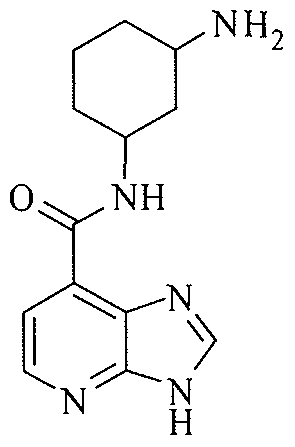
[0141] Following General Procedure A, 3H-imidazo[4,5-Z>]pyridine-7-carboxylic acid (60 mg, 0.37 mmol) was reacted tert-buty\ S-aminocyclohexylcarbamate (1 18 mg, 0.74 mmol) to afford the desired product (30 mg, 31% yield over two steps) as a white solid: 1H NMR (300 MHz, CD3OD) 58.52-8.47 (m, 2H), 7.83-7.78 (m, IH), 4.54-4.48 (m, I H, minor diatereomer), 4.13— 4.01 (m, IH, major diastereomer), 3.23-3.1 1 (m, I H), 2.46-2.38 (m, I H, major diatereomer), 2.20-2.27 (m, IH, minor diastereomer), 2.15-1.71 (m, 4H), 1.63-1.25 (m, 3H); ESI MS w/z 260 [Ci3H17N5O + H]+; HPLC >99% (AUC), tR = 8.36 min (major diatereomer), 8.58 (minor diatereomer).
[0142] General Procedure B - synthesis of compounds of formula I as described in Scheme (I): A suspension of crude carboxylic acid E (1.0 equiv) HOBt (1.1 equiv) and EDCI (1.3 equiv) in
THF were stirred at rt for 20 min followed by the addition of the requisite amine (1.2 equiv). The mixture was stirred at rt for 18 h, diluted with EtOAc and washed with water, 5% NaHCO3 and brine. The combined organic layers were dried and concentrated and purified by preparative HPLC (C 18 silica, 10-90% acetonitrile/water with 0.05% TFA). The desired fractions were combined, concentrated and eluted through an ion-exchange column (using methanol and 7 N methanol in ammonia) to obtain the desired products. In some instances, the combined organic layers were dissolved in TFA and stirred at rt for 1 h. The reaction mixture was concentrated and purified by preparative HPLC (C 18 silica, 10-90% acetonitrile/water with 0.05% TFA). The desired fractions were combined, concentrated and eluted through an ion-exchange column (using methanol and 7 N methanol in ammonia) to obtain the desired products.
[0143] General Procedure C - synthesis of compounds of formula I as described in Scheme (II): A mixture of intermediate C (1.0 equiv) and selenium dioxide (5.0 equiv) in pyridine were heated at 1 10 0C for 18 h. The hot reaction mixture was filtered through diatomaceous earth, washed with hot pyridine and CH3OH and the filtrate was concentrated and dried. The residue was heated with SOCl2 (10 equiv) at 80 0C for 2 h and the reaction mixture was cooled and concentrated. The residue was dissolved in THF followed by the addition of the requisite amine (1.2 equiv) and triethylamine (2.5 equiv) and the reaction mixture was stirred at rt for 18 h. The reaction was concentrated and purified by preparative HPLC (Cl 8 silica, 10-90%
acetonitrile/water with 0.05% TFA). The desired fractions were combined, concentrated and eluted through an ion-exchange column (using methanol and 7 N methanol in ammonia) to obtain the desired products. In some instances, the combined organic layers were dissolved in TFA and stirred at rt for 1 h. The reaction mixture was concentrated and purified by preparative HPLC (C 18 silica, 10-90% acetonitrile/water with 0.05% TFA). The desired fractions were combined, concentrated and eluted through an ion-exchange column (using methanol and 7 N methanol in ammonia) to obtain the desired products.
Example 42
(S)-2-(5-Bromothiophen-2-yl)-N-(piperidin-3-ylmethyl)-3H-imidazo[4,5-b]pyridine-7- carboxamide

Example 43
(R)-2-(5-Bromothiophen-2-yl)-N-(piperidin-3-ylmethyl)-3H-imidazo[4,5-b]pyridine-7- carboxamide

[0145] Following General Procedure B, (R)-tert-butyl 3-[(2-(5-bromothiophen-2-yl)-3H- imidazo[4,5-b]pyridine-7-carboxamido]methyl)piperidine-l-carboxylate (crude) was reacted with TFA to afford the desired product (16 mg, 13% yield) as yellow solid: 1H NMR (300 MHz, CD3OD) δ 8.31 (d, J= 5.4 Hz, I H), 7.69 (d, J= 6.3 Hz, IH), 7.64 (d, J= 5.1 Hz, IH), 7.22 (d, J = 3.9 Hz, IH), 3.54 (d, J= 6.0 Hz, IH), 2.87-2.65 (m, 3H), 2.1 1-2.07 (m, 2H), 1.96-1.91 (m, 2H), 1.78-1.69 (m, IH), 1.52-1.43 (m, IH), 1.30 (d, J= 7.5 Hz, IH); ESI MS m/z 419
[C]7H17N5O2S]+; HPLC >99% (AUC), tR = 10.41 min.
Example 44
2-(5-Bromothiophen-2-yl)-N-(piperidin-2-ylmethyl)-3H-imidazo[4,5-b]pyridine-7-carboxamide

[0146] Following General Procedure B, tert-butyl 3-{[2-(5-bromothiophen-2-yl)-3H- imidazo[4,5-b]pyridine-7-carboxamido]methyl}piperidine-l-carboxylate (crude) was reacted with TFA to afford the desired product (27 mg, 36% yield) as a yellow solid: 1H NMR (500 MHz, CD3OD) δ 8.32 (d, J= 5.5 Hz, IH), 7.68 (d, J= 4.0 Hz, IH), 7.64 (d, J= 5.5 Hz, IH),
7.22 (d, J= 4.0 Hz, IH), 3.68-3.61 (m, 2H), 3.35-3.33 (m, IH), 3.26-3.14 (m, 2H), 2.86-2.81 (m, IH), 2.02 (d, J= 14.5 Hz, IH), 1.94 (d, J= 6.0 Hz, IH), 1.61-1.48 (m, 2H), 1.30 (s, IH); ESI MS m/z 420 [Ci7HnN5O2S]+; HPLC >99% (AUC), /R = 1 1.85 min.
Example 45
(S)-2-(5-Bromothiophen-2-yl)-N-(piperidin-3-yl)-lH-imidazo[4,5-b]pyridine-7-carboxamide

[0147] Following General Procedure B, 2-(5-Bromothiophen-2-yl)-7-methyl-lH-imidazo[4,5- b]pyridine (0.16 g, 0.59 mmol) was reacted (S)-tert-butyl 3-aminopiperidine-l-carboxylate (0.15 g, 0.77 mmol) to afford the desired product (31 mg, 13% yield) as yellow solid: 1H NMR (300 MHz5 DMSO-J6) 59.86 (d, J= 8.5 Hz, IH), 8.33 (d, J= 5.1 Hz, IH), 7.73 (d, J= 3.9 Hz, I H), 7.54 (d, J= 5.1 Hz, IH), 7.37 (d, J= 3.9 Hz, IH), 4.1 1 (bs, IH), 2.88-2.85 (m, I H), 2.84-2.81 (m, 2H), 2.01 (bs, 2H), 1.75-1.68 (m, 2H); ESI MS m/z 406 [C16Hi6BrN5OS + H]+.
Example 46
2-(5-bromothiophen-2-yl)-N-3-(aminoadamane-l-ol)-3-yl)-lH-imidazo[4,5-b]pyridine-7- carboxamide

[0148] Following General Procedure B, 2-(5-bromothiophen-2-yl)-3H-imidazo[4,5-b]pyridine- 7-carboxylic acid (300 mg, 0.92 mmol) was reacted with 3-aminoadamantan-l-ol (310 mg, 1.8 mmol) to afford the desired product (170 mg, 40% yield) as a light yellow solid: 1H NMR (500 MHz, DMSO) δ 14.18 (s, I H), 9.34 (s,l H), 8.45 (d, J= 5.0 Hz, IH), 7.83 (d, J= 4.0 Hz, IH), 7.68 (d, J= 5.0 Hz, IH), 7.46 (d, J= 4.0 Hz, IH), 4.62 (s, I H), 4.02 (s, IH), 3.16 (s, IH), 2.24 (bs, 2H), 1.91 (s, IH), 2.08-1.99 (m, 6H), 1.66-1.58 (m, 5H), 1.52 (d, J= 12.5 Hz, IH); APCI MS m/z, 474 [(CnH21BrN4O2S +2) H]+ ]+; HPLC >99% (AUC), tR =13.73 min.
Example 47
2-(5-bromothiophen-2-yl)-N-(quinuclidin-3-yl)-3H-imidazo[4,5-b]pyridine-7-carboxamide

[0149] Following General Procedure B, 2-(5-bromothiophen-2-yl)-3H-imidazo[4,5-b]pyridine- 7-carboxylic acid (300 mg, 0.92 mmol) was reacted with quinuclidin-3-amine (370 mg, 1.8 mmol) to afford the desired product (64 mg, 20% yield) as a yellow solid: 1H NMR (500 MHz, CD3OD) δ 8.38 (d, J= 5.0 Hz, IH), 7.70 (d, J= 5.0 Hz, IH), 7.62 (d, J= 4.0 Hz, I H), 7.22 (d, J = 4.0 Hz, IH), 4.50^.47 (m, IH), 3.85-3.80 (m, IH), 3.45 (t, J= 8.0 Hz, 2H), 3.35-3.26 (m, 3H), 1.91 (s, 1 H), 2.44-2.39 (m, 2H), 2.13-2.04 (m, 2H), 2.00 (d, J = 8.0 Hz, I H), 1.13-1.01 (m, 2H); ESI MS m/z, 433 [C18H18BrN5OS + H]+]+; HPLC 94.5% (AUC), /R =9.14 min.
Example 48
2-(5-bromothiophen-2-yl)-N-(l ,3-diaminoadamane -3-yl)-lH-imidazo[4,5-b]pyridine-7- carboxamide

[0150] Following General Procedure #, (S)-tert-butyl 3-(2-(5-bromothiophen-2-yl)- 1 H- imidazo[4,5-b]pyridine-7-carboxamido)l,3-diaminoadamantane 1 -carboxylate (60 mg, 0.105 mmol) was reacted with TFA:DCM (50:50) to afford the desired product (32 mg, 66% yield) as a white solid: 1H NMR (500 MHz, DMSO) δ 10.07 (s, IH), 8.21 (d, J= 5.0 Hz, IH), 7.59 (d, J = 4.0 Hz, IH), 7.53 (bs, I H), 7.39 (d, J= 5.0 Hz, IH), 7.30 (d, J= 4.0 Hz, IH), 2.32 (bs, 4H), 2.18 (d, J= 1 1.0 Hz, 2H), 2.06 (t, J= 12 Hz, 2H), 1.90-1.68 (m, 7H), 1.58 (d, J= 12.5 Hz, I H); ESI MS m/z 473 [C2IH22BrN5OS]+; HPLC 95.12% (AUC), tR = 1 1.79 min.
Example 49
(S^^-Bromothiophen^-yO-N-Cpiperidin-S-yO-lH-imidazo^^-bjpyridine-y-carboxamide

[0151] Following General Procedure B, 2-(4-bromothiophen-2-yl)-l H-imidazo[4,5-b]pyridine- 7-carboxylic acid (0.032 g, 0.10 mmol) was reacted (S)-tert-butyl 3-aminopiperidine-l- carboxylate (0.024 g, 1.2 mmol) to afford the desired product (25 mg, 61% yield) as yellow solid: 1H NMR (500 MHz, CD3OD) δ 8.37. (d, J= 5.0 Hz, IH), 7.82 (d, J= 1.0 Hz, IH), 7.70 (d, J= 5.0 Hz, IH), 7.64 (d, J= 1.0 Hz, IH), 4.20^.17 (m, IH), 3.32 (s, IH), 3.07-3.04 (m, IH), 2.94-2.89 (m, 2H), 2.17-2.16 (m, 1 H), 2.04-2.02 (m, 1 H), 1.93 (s, 1 H), 1.85-1.77 (m, 2H), 1.30 (d, J= 1 1.5 Hz, 2H); ESI MS m/z 407 [Ci6H16BrN5OS + H]+ HPLC 98.8% (AUC), /R = 10.21 min.
Example 50
(S)-2-(4-bromothiophen-2-yl)-N-(piperidin-3-ylmethyl)-3H-imidazo[4,5-b]pyridine-7- carboxamide

[0152] Following General Procedure B, 2-(4-bromothiophen-2-yl)-l H-imidazo[4,5-b]pyridine- 7-carboxylic acid (0.064 g, 0.20 mmol) was reacted (R)-tert-butyl 3-(aminomethyl)piperidine-l- carboxylate (0.051 g, 0.24 mmol) to afford the desired product (25 mg, 30% yield) as brown solid: 1 H NMR (SOO MHZ5 CD3OD) δ 8.30 (d, J= 5.5 HZ, I H), 7.81 (d, J= 1.5 Hz, IH), 7.63 (d, J= 5.0 Hz, IH), 7.55 (d, J= 1.0 Hz, IH), 3.44-3.43 (m, 2H), 3.41-3.34 (m, 2H), 3.27-3.16 (m, IH), 2.84-2.78 (m, IH), 2.79 (t, J= 1 1.5 Hz, IH), 2.09-2.07 (m, 2H), 1.95-1.91 (m, IH), 1.73- 1.69 (m, IH), 1.51-1.45 (m, 2H), 1.30 (d, J= 12.0 Hz, I H); ESI MS m/z 421 [Ci7Hi8 BrN5OS + H]+; HPLC 97.9% (AUC), /R = 10.25 min.
Example 51
(S)-tert-Butyl 3-[2-(5-bromofuran-2-yl)-3H-imidazo[4,5-b]pyridine-7-carboxamido]piperidine- carboxylate

[0153] Following General Procedure B, 2-(5-bromofuran-2-yl)-3H-imidazo[4,5-b]pyridine-7- carboxylic acid (150 mg, 0.49 mmol) was reacted with (S)-tert-butyl 3-aminopiperidine-l- carboxylate (195 mg, 0.97mmol) to afford the desired product (1 10 mg, 47% yield) as a yellow solid: 1H NMR (500 MHz, CD3OD) δ 10.12 (bs,l H), 8.46 (d, J= 5.0 Hz, IH), 7.82 (d, J = 5.0 Hz, IH), 7.40 (d, J= 3.5 Hz, IH), 6.76 (d, J= 3.5 Hz, IH), 4.25-4.24 (m, IH), 3.93 (bs, 3H), 3.16 (s, IH), 2.05-2.02 (m, 2H), 1.91 (s, I H), 1.72 (s, IH), 1.48-1.45 (m, 2H), 1.35-1.03 (m, 10H); ESI MS m/z, 490 [C2]H24BrN5O4 + H]+; HPLC >99% (AUC), tR = 14.41min.
Example 52
(S)-2-(5-bromofuran-2-yl)-N-(piperidin-3-yl)-3H-imidazo[4,5-b]pyridine-7-carboxamide
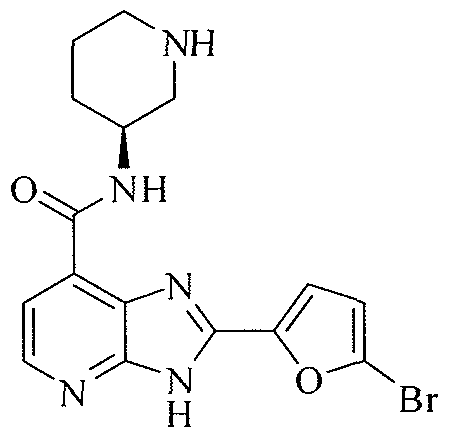
[0154] Following General Procedure B, (S)-tert-butyl 3-(2-(5-bromofuran-2-yl)-3H- imidazo[4,5-b]pyridine-7-carboxamido)piperidine-l-carboxylate(100 mg, 0.20 mmol) to afford the desired product (47 mg, 58% yield) as a yellow solid: 1H NMR (500 MHz, DMSO) δ 8.49 (d, J= 5.0 Hz, IH), 7.17 (bs, 2H), 6.97 (s, I H), 4.28-4.23 (m, I H), 3.46 (d, J= 9.5 Hz, IH), 3.24 (d, J= 12.5 Hz, IH), 3.10-2.98 (m, 2H), 2.09 (bs, IH), 1.98 (bs, IH), 1.79-1.75 (m, 2H), 1.27- 1.23 (m, IH); ESI MS m/z 390 [C16H16BrN5O2]+; HPLC 97.0% (AUC), tR = 8.12 min.
Example 53
(S)-/er/-Butyl 3-{[2-(5-bromofuran-2-yl)-3H-imidazo[4,5-b]pyridine-7- carboxamido]methyl}piperidine-l-carboxylate

[0155] Following General Procedure B, (2-(5-bromofuran-2-yl)-3H-imidazo[4,5-b]pyridine-7- carboxylic acid (150 mg, 0.49 mmol) was reacted with (S)-tert-butyl 3- (aminomethyl)piperidine-l-carboxylate (210 mg, 0.97 mmol) to afford the desired product (70 mg, 28% yield) as a yellow solid: 1H NMR (500 MHz, CD3OD) δ 8.36 (d, J= 5.0 Hz, IH), 7.69 (d, J= 5.0 Hz, IH), 7.35 (bs, IH), 6.65 (d, J= 3.0 Hz, IH), 3.99 (d, J= 1 1.0 Hz, IH), 3.79 (d, J = 13.0 Hz, I H), 3.43-3.34 (m, 2H), 2.79 (d, J= 5.0 Hz, 2H), 1.89-1.76 (m, 2H), 1.6 -1.64 (m, IH), 1.44-1.22 (m, 12H); ESI MS m/z 505 [C22H26BrN5O4 + H]+; HPLC >99% (AUC), tR = 14.90 min.
Example 54
(R)-2-(5-Bromofuran-2-yl)-N-(piperidin-3-ylmethyl)-3H-imidazo[4,5-b]pyridine-7-carboxamide

[0156] Following General Procedure B, (S)-fert-butyl 3-((2-(5-bromofuran-2-yl)-3H- imidazo[4,5-b]pyridine-7-carboxamido)methyl)piperidine-l-carboxylate (50 mg, 0.10 mmol) was reacted with TFA to afford the desired product (1 1 mg, 30% yield) as a yellow glass: 1H NMR (500 MHz, DMSO-J6) δ 9.66 (s, IH), 8.36 (d, J=5.0 Hz, IH), 7.57 (d, J= 4.5 Hz, 1 H), 7.37 (d, J= 3.0 Hz, IH), 6.87 (d, J= 3.5 Hz, IH), 3.47-3.38 (m, 2H), 3.33 (d, J= 10.5 Hz, I H), 3.24 (d, J= 1 1.0 Hz, I H), 2.80 (t, J= 1 1.6 Hz, I H), 2.71 (t, J= 1 1.9 Hz, IH), 2.07 (s, IH), 1.84- 1.65 (m, 2H), 1.68-1.60 (m, 2H), 1.38-1.31 (m, IH), 0.65 (bs, IH); ESI MS m/z 405
[Ci7Hi8BrN5O2 + H]+; HPLC 98.3% (AUC), /R = 8.22 min.
Example 55
(S)-2-Cyclopropyl-N-(piperidin-3-yl)-3H-imidazo[4,5-b]pyridine-7-carboxamide

[0157] Following General Procedure B, 2-cyclopropyl-3H-imidazo[4,5-b]pyridine-7- carboxylic acid (0.081 g, 0.40 mmol) was reacted (S)-tert-butyl 3-aminopiperidine-l-carboxylate (0.096 g, 0.48 mmol) to afford the desired product (69 mg, 60% yield) as yellow solid: 1H NMR (300 MHz, CD3OD) δ 8.32 _(d, J= 5.1 Hz, IH), 7.67 (d, J= 5.1 Hz, IH), 4.14-4.1 1 (m, IH), 3.04-3.00 (m, IH), 2.80-2.72 (m, 2H), 2.23-2.22 (m, IH), 2.14-2.1 1 (m, I H), 1.91-1.86 (m, I H), 1.74-1.68 (m, 2H), 1.31-1.24 (m, 5H); ESI MS m/z 286 [C15H19N5O + H]+. Example 56
(S)-2-Cyclopropyl-N-(piperidin-3-ylmethyl)-3H-imidazo[4,5-b]pyridine-7-carboxamide

[0158] Following General Procedure B, 2-cyclopropyl-3H-imidazo[4,5-b]pyridine-7- carboxylic acid (0.081 g, 0.40 mmol) was reacted (R)-tert-butyl 3-(aminomethyl)piperidine-l- carboxylate (0.10 g, 0.48 mmol) to afford the desired product (78 mg, 65% yield) as brown solid: 1H NMR (300 MHz, CD3OD) 5 8.32 (d, J= 5.1 Hz, IH), 7.67 (d, J= 5.1 Hz, IH), 3.42 (d, J = 6.3 Hz, 2H), 3.18 (d, J= 12.3 Hz, I H), 3.07-3.01 (m, I H), 2.64-2.55 (m, IH), 2.50 (t, J= 10.8 Hz, 1 H), 2.28-2.20 (m, 1 H), 1.98-1.74 (m, 3H), 1.63-1.50 (m, 1 H), 1.36-1.22 (m, 5H); ESI MS m/z 300 [C16H21N5O+ H]+; HPLC >99% (AUC), tR = 6.58 min.
Example 57
tert-Butyl [(lR,4R)-4-(2-cyclopropyl-3H-imidazo[4,5-b]pyridine-7- carboxamido)cyclohexyl]methylcarbamate
,NHBoc

[0159] Following General Procedure B, 2-cyclopropyl-3H-imidazo[4,5-b]pyridine-7- carboxylic acid (80 mg, 0.39 mmol) was reacted with tert-butyl ((l r,4r)-4-aminocyclohexyl) methylcarbamate (1 10 mg, 0.48 mmol) to afford the desired product (45 mg, 30% yield) as a white solid: 1H NMR (500 MHz, CD3OD) δ 8.33 (d, J= 5.2 Hz, IH), 7.68 (d, J= 5.5 Hz, IH), 3.91-3.87 (m, I H), 2.95 (d, J= 6.5 Hz, 2H), 2.27-2.24 (m, IH), 2.15 (d, J= 10.5 Hz, 2H), 1.88 (d, J = 1 1.5 Hz, 2H), 1.44 (s, 9H), 1.40-1.35 (m, 2H), 1.26-1.24 (m, 4H), 1.18-1.15 (m, 2H); ESI MS mlz 414 [C22H31N5O3 + H]+; HPLC >99% (AUC), /R = 10.41min.
Example 58
N-[(lR,4R)-4-(Aminomethyl)cyclohexyl]-2-cyclopropyl-3H-imidazo[4,5-b]pyridine-7- carboxamide
^ NH2

[0160] Following General Procedure B, tert-butyl ((lr,4r)-4-(2-cyclopropyl-3H-imidazo[4,5- b]pyridine-7-carboxamido)cyclohexyl)methylcarbamate (50 mg, 0.12 mmol) was reacted with TFA to afford the desired product (17 mg, 46% yield) as a white solid: 1H NMR (500 MHz, DMSO) δ 9.36 (s, IH), 8.31 (d, J= 5.0 Hz, IH), 7.58 (d, J= 5.5 Hz, IH), 3.81-3.75 (m, IH), 2.56 (d, J= 6.5 Hz, 2H), 2.24-2.21 (m, IH), 2.05 (d, J= 12.0 Hz, 2H), 1.85 (d, J= 12.5 Hz, 2H),
1.43 (bs, IH), 1.30-1.25 (m, 2H), 1.20-1.17 (m, 6H); ESI MS m/z 314 [C17H23N5O + H]+;
HPLC 97.7% (AUC), tR = 12.97 min.
Example 59
N-[(lR,4R)-4-Aminocyclohexyl]-2-cyclopropyl-3H-imidazo[4,5-b]pyridine-7-carboxamide

[0161] Following General Procedure B, 2-cyclopropyl-3H-imidazo[4,5-b]pyridine-7- carboxylic acid (100 mg, 0.49 mmol) was reacted with(l R,4R)-cyclohexane-l,4-diamine (210 mg, 0.98 mmol) to afford the desired product (31 mg, 27% yield) as a yellow solid: 1H NMR (500 MHz, CD3OD) 8.45 (dd, J= 5.0, 1.0 Hz, IH), 7.76 (d, J= 5.5 Hz, IH), 3.96-3.93 (m, IH), 3.31-3.30 (m, IH), 3.24-3.20 (m, IH), 2.25-2.15 (m, 5H), 1.64-1.54 (m, 4H), 1.25-1.22 (m, 4H); ESI MS m/z 300 [Ci6H2iN5O + H]+; HPLC >99% (AUC), fR = 1 1.65 min.
Example 60
N-(4-Aminocadamantyl)-2-cyclopropyl-3H-imidazo[4,5-b]pyridine-7-carboxamide

[0162] Following General Procedure B, 2-cyclopropyl-3H-imidazo[4,5-b]pyridine-7- carboxylic acid (100 mg, 0.49 mmol) was reacted with 1 ,3-diamineadamantane hydrochloride (334 mg, 0.98 mmol) to afford the desired product (7 mg, 22% yield) as a yellow solid: 1H NMR (500 MHz, DMSO) δ 9.27 (bs, I H), 8.42 (bs, I H), 8.25 (s, 3H), 7.72-7.61 (m, IH), 2.69 (s, IH), 2.36 (bs, 3H), 2.30 (s, 2H), 2.12 (d, J = 1 1.5 Hz, 2H), 2.00 (d, J = 1 1.5 Hz, 2H), 1.82 (q, J = 1 1.5 Hz, 4H), 1.66 (d, J = 12.0 Hz, 1 H), 1.56 (d, J = 12.0 Hz, 1 H), 1.26 (d, J = 22.0 Hz, 4H); ESI MS m/z 352 [C20H25N5O + H]+; HPLC 96.2% (AUC), /R = 7.42 min.
Example 61
N-(4-Hydroxyadamantyl)-2-cyclopropyl-3H-imidazo[4,5-b]pyridine-7-carboxamide

[0163] Following General Procedure B, 2-cyclopropyl-3H-imidazo[4,5-b]pyridine-7- carboxylic acid (150 mg, 0.73 mmol) was reacted with 3-aminoadamantan-l-ol (247 mg, 1.48 mmol) to afford the desired product (130 mg, 50% yield) as a white solid: 1H NMR (500 MHz, DMSO) δ 13.33 (s,lH), 9.49 (s,l H), 8.31 (d, J = 5.0 Hz, I H), 7.58 (d, J= 5.0 Hz, IH), 5.75 (bs, IH), 2.20 (s, 3H), 3.16 (s, I H), 2.03-1.93 (m, 5H), 1.78-1.73 (m, 1 H), 1.63-1.54 (m, 5H), 1.50- 1.47 (m, IH), 1.20-1.14 (m, 3H); APCI MS m/z, 353 [(C20H24N4O2 +H]+; HPLC >96.05% (AUC), /R =l 0.82 min.
Example 62
(S)-2-(Cyclopropylmethyl)-N-(piperidin-3-yl)-3H-imidazo[4,5-b]pyridine-7-carboxamide
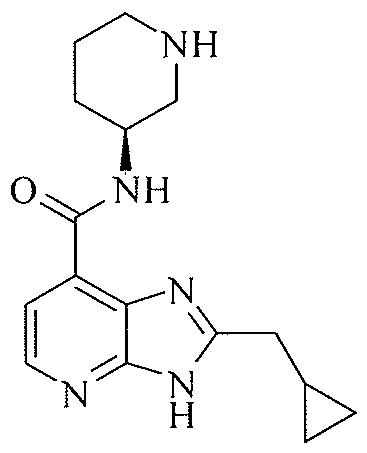
[0164] Following General Procedure B, 2-(cyclopropylmethyl)-3H-imidazo[4,5-b]pyridine-7- carboxylic acid (61 mg, 0.28 mmol) was reacted with (S)-l-Boc-3-aminopiperidine (58 mg, 0.29 mmol) to afford the desired product (42 mg, 50% yield) as an off-white solid: 1H NMR (CD3OD, 500 MHz) δ 8.39 (d, J= 5.0 Hz, I H), 7.71 (d, J= 5.0 Hz, I H), 4.12 (br, IH), 3.30-3.35 (m, I H), 3.16 (br, IH), 2.89 (d, J = 7.0 Hz, 2H), 2.70-2.66 (m, 2H), 2.14 (br, I H), 1.87 (br, IH), 1.67 (br, 2H), 1.27-1.23 (m, IH), 0.62-0.62 (m, 2H), 0.39-0.36(m, 2H); ESI MS m/z 300 [Ci6H2]N5O + H]+.
Example 63a and 63b
2-(Bicyclo[2.2.1]heptan-2-yl)-N-[(S)-piperidin-3-yl]-3H-imidazo[4,5-b]pyridine-7-carboxamide

[0165] Following General Procedure B, 2-(bicyclo[2.2.1]heptan-2-yl)-3H-imidazo[4,5- b]pyridine-7-carboxylic acid (1 10 mg, 0.29 mmol) was reacted with (S)-l-Boc-3- aminopiperidine (104 mg, 0.52 mmol) to afford the desired product as two pairs of
diastereomers:
[0166] Example 63a - Diastereomers A and B (8 mg, 12% yield) obtained as a white solid: 1H NMR (CD3OD, 500 MHz) δ 8.37 (d, J= 5.0 Hz, IH), 7.73 (d, J= 5.0 Hz, I H), 4.15 (br, I H), 3.49-3.47 (m, IH), 3.05-3.02 (m, IH), 2.80-2.77 (m, 3H), 2.41 (s, IH), 2.19-1.20 (m, 13H); ESI MS m/z 340 [C9H25N5O + H]+.
[0167] Example 63b - Diastereomers C and D (36 mg, 53% yield) obtained as a white solid: 1H NMR (CD3OD, 500 MHz) δ 8.36 (d, J= 5.0 Hz, IH), 7.71 (d, J= 5.0 Hz, IH), 4.10 (br, IH), 3.24 (d, J= 7.5 Hz, IH), 3.06-3.03 (m, IH), 2.96-2.93 (m, IH), 2.75-2.70 (m, 2H), 2.72 (br, IH), 2.45 (s, IH), 2.26 (br, I H), 2.16 (br, IH), 1.91-1.28 (m, 10H); ESI MS m/z 340
[C19H25N5O + H]+.
Example 64
N-{[(lR,4R)-4-(aminomethyl)cyclohexyl]methyl}-2-(bicyclo[2.2.1]heptan-2-yl)-3H- imidazo[4,5-b]pyridine-7-carboxamide
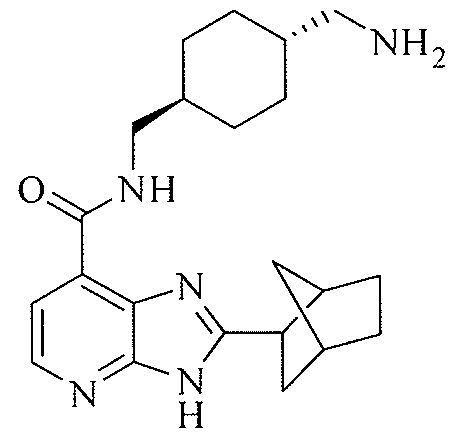
[0168] Following General Procedure B, 2-(bicyclo[2.2.1]heptan-2-yl)-3H-imidazo[4,5- b]pyridine-7-carboxylic acid (1 10 mg, 0.29 mmol) was reacted with tert-butyl [(lR,4R)-4-
(arninornethyOcyclohexylJmethylcarbamate (120 mg, 0.52 mmol) to afford the desired product (28 mg, 25% yield) as a white solid: 1H NMR (CD3OD, 500 MHz) δ 8.36 (d, J= 5.0 Hz, IH), 7.71 (d, J= 5.0 Hz, IH), 3.35 (t, J= 6.0 Hz, 2H), 2.69-2.65 (m, 2H), 2.02-1.93 (m, 2H), 1.90- 1.80 (m, 2H), 1.61-1.44 (m, 2H), 1.23-0.92 (m, 4H), 2.16 (br, IH), 1.91-1.28 (m, 10H); ESI MS m/z 382 [C22H3]N5O + H]+; HPLC >99% (AUC), tR = 9.17 min.
Example 65
V-(3-aminoadamantyl)-2-(bicyclo[2.2.1]heptan-2-yl)-3H-imidazo[4,5-b]pyridine-7-carboxamide

[0169] Following General Procedure B, 2-(bicyclo[2.2.1 ]heptan-2-yl)-3H-imidazo[4,5- b]pyridine-7-carboxylic acid (1 10 mg, 0.29 mmol) was reacted with N-(3-aminoadamantyl)-2- (bicyclo[2.2.1]heptan-2-yl)-3H-imidazo[4,5-b]pyridine-7-carboxamide (mixtures of
diastereomers: 10 mg, 9%) as a white solid: 1H NMR (CD3OD, 500 MHz) δ 8.36 (m, IH), 7.71 (m, IH), 2.61-1.28 (m, 25H); ESI MS m/z 406 [M + H]+; HPLC 97.3% (AUC), tR = 9.42 min.
Example 66
N^piperidin^-ylmethyO^-^hiophene^-carbonyO-SH-imidazo^S-bJpyridine^-carboxamide

[0170] Following General Procedure C, 7-methyl-2-(thiophen-2-ylmethyl)-3H-imidazo[4,5- b]pyridine (0.16 g, 0.50 mmol) was reacted SeO2 (2.9 g, 6.7 mmol) and SOCl2 (10 mL) to afford 0.96 g of the intermediate acid chloride. An aliquot of the crude acid chloride (0.16 g) was reacted with piperidin-3-ylmethanamine (0.13 g, 0.60 mmol) to afford the product as brown- yellow solid (0.01 1 g, 6% yield): 1H NMR (500 MHz, CD3OD) 5 8.21 (d, J= 3.5 Hz, IH), 8.09 (d, J= 4.5 Hz, IH), 7.85 (d, J= 3.5 Hz, IH), 7.38 (d, J= 4.5 Hz, IH), 7.16 (t, J= 4.0 Hz, IH),
3.87 (d, J= 1 1.5 Hz, IH), 3.78-3.68 (m, 2H), 3.48-3.44 (m, IH), 3.17-3.12 (m, 2H), 2.15 (d, J = 14.0 Hz, IH), 2.03 (d, J= 10.0 Hz, I H), 1.93 (d, J= 8.0 Hz, IH), 1.78-1.72 (m, IH), 1.65- 1.60 (m, IH); ESI MS m/z 370 [C7Hi7N5O2S + H]+; HPLC >99% (AUC), /R = 9.41 min.
Example 67
(S)-N-(Piperidin-3-yl)-2-(thiophene-2-carbonyl)-3H-imidazo[4,5-b]pyridine-7-carboxamide

[0171] Following General Procedure C, 7-methyl-2-(thiophen-2-ylmethyl)-3H~imidazo[4,5- b]pyridine (0.16 g, 0.50 mmol) was reacted SeO2 (2.9 g, 6.7 mmol) and SOCl2 (10 mL) to afford 0.96 g of the intermediate acid chloride. An aliquot of the crude acid chloride (0.16 g) was reacted with (S)-tert-butyl 3-aminopiperidine-l-carboxylate (0.096 g, 0.48 mmol) to afford the desired product (9 mg, 5% yield) as yellow solid: 1H NMR (500 MHz, DMSO-J6) δ 9.77 (bs, IH), 8.52 (bs, IH), 8.40 (bs, IH), 8.1 (bs, IH), 7.56 (bs, I H), 7.30 (bs, IH), 3.07 (bs, 2H), 2.09- 2.55 (m, 2H), 1.80-1.74 (m, 3H); ESI MS m/z 356 [Ci7H17N5O2S + H]+.
Example 68
(R)-tert-Butyl 3-{[2-(thiophene-2-carbonyl)-3H-imidazo[4,5-b]pyridine-7- carboxamido]methyl}piperidine-l-carboxylate

[0172] Following General Procedure B, 2-(thiophene-2-carbonyl)-3H-imidazo[4,5-b]pyridine- 7-carboxylic acid (0.18 g, 0.68 mmol) was reacted with (R)-piperidin-3-ylmethanamine (0.17 g, 0.78 mmol) to afford the desired product (0.20 g, 67% yield) as a brown-yellow solid: 1H NMR (500 MHz, DMSO-J6) δ9.23 (s, IH), 8.73 (d, J= 5.0 Hz, IH), 8.63 (s,lH), 8.26 (d, J= 4.5 Hz, 1 H), 7.85 (d, J = 4.5 Hz, 1 H), 7.37 (d, J = 8.5 Hz, 1 H), 3.98 (bs, IH), 3.77 (d, J = 1 1.5 Hz,, 1 H),
3.44 (m, 2H), 2.83-2.79 (m, 2H), 1.90-1.65 (m, 3H), 1.34 (m, 1 IH); ESI MS m/z 470
[C17H17N5O2S + H]+; HPLC 98.1% (AUC), tR = 16.73 min.
Example 69
(S)-tert-Butyl 3-{[(2-(thiophene-2-carbonyl)-3H-imidazo[4,5-b]pyridine-7- carboxamido]methyl}piperidine-l-carboxylate

[0173] Following General Procedure B, 2-(thiophene~2-carbonyl)-3H-imidazo[4,5-b]pyridine- 7-carboxylic acid (0.18 g, 0.68 mmol) was reacted with (S)-piperidin-3-ylmethanamine (0.17 g, 0.78 mmol) to afford the desired product (0.21 g, 69% yield) as a brown-yellow solid: 1H NMR (50O MHz5 DMSO-J6) 59.23 (s, I H), 8.73. (d, J= 5.0 Hz, IH), 8.63 (s,lH), 8.26 (d, J= 4.5 Hz, IH), 7.85 (d, J= 4.0 Hz, IH), 7.37 (d, J= 8.0 Hz, IH), 3.98 (bs, IH), 3.77 (d, J= 14.0 Hz,, I H), 3.45 (m, 2H), 2.83-2.79 (m, I H), 1.90-1.76 (m, 2H), 1.66 (d, J= 9.0 Hz, IH), 1.34 (m, HH); ESI MS m/z 470 [Ci7Hi7N5O2S + H]+ HPLC >99% (AUC), tR = 18.91 min.
Example 70
(S)-N-(Piperidin-3-ylmethyl)-2-(thiophene-2-carbonyl)-3H-imidazo[4,5-b]pyridine-7- carboxamide

[0174] Following General Procedure B, (R)-tert-butyl 3-{[2-(thiophene-2-carbonyl)-3H- imidazo[4,5-b]pyridine-7-carboxamido]methyl}piperidine-l-carboxylate (0.025 g, 0.053 mmol) was treated with TFA to afford the desired product (0.019 g, 97% yield) as a brown-yellow solid: 1H NMR (500 MHz, DMSO-J6) 510.13 (bs, I H), 8.51 .(d, J= 3.0 Hz, IH), 8.46 (J= 4.5 Hz, IH), 8.07 (d, J= 4.5 Hz, IH), 7.56 (d, J= 4.0 Hz, IH), 7.15 (t, J= 4.0 Hz, IH), 3.51-3.42 (m, 4H), 3.16 (s, 2H), 2.82-2.71 (m, 2H), 2.08 (bs, IH), 1.92 (d, J= 1 1.5 Hz, IH), 1.82 (d, J= 14.0 Hz, IH), 1.62-1.60 (m, IH), 1.39-1.34 (m, IH); ESI MS m/z 370 [C17H17N5O2S + H]+.
Example 71
(^^-(piperidin-S-ylmethyO^-^hiophene-l-carbony^-SH-imidazo^jS-bJpyridine-V- carboxamide

[0175] Following General Procedure B, (S)-tert-butyl 3-{[2-(thiophene-2-carbonyl)-3H- imidazo[4,5-b]pyridine-7-carboxamido]methyl}piperidine-l-carboxylate (0.025 g, 0.053 mmol) was treated with TFA to afford the desired product (0.018 g, 92% yield) as a brown-yellow solid: 1H NMR (500 MHz, DMSO-J6) δlθ.13.(bs, 1 H), 8.50 (d, J = 4.0 Hz, 1 H), 8.45 (d, J = 4.0 Hz, I H), 8.06 (d, J= 5.0 Hz, I H), 7.55 (d, J= 4.5 Hz, IH), 7.31 (t, J= 4.0 Hz, IH), 3.49-3.44 (m, 4H), 2.82-2.71 (m, 2H), 2.08 (bs, IH), 1.91 (d, J= 12.0 Hz, IH), 1.82 (d, J= 15.0 Hz, I H), 1.62-1.59 (m, I H), 1.38-1.34 (m, IH); ESI MS 370 m/z [C18Hi9N5O2S + H]+; HPLC 98.1% (AUC), /R = 10.84 min.
Example 72
(S) 2-[Hydroxy(thiophen-2-yl)methyl]-N-(piperidin-3-yl)-3H-imidazo[4,5-b]pyridine-7- carboxamide

[0176] To a solution of tert-butyl 3-[2-(thiophene-2-carbonyl)-3H-imidazo[4,5-b]pyridine-7- carboxamido]piperidine-l -carboxylate (30 mg, 0.066 mmol) in THF (5 mL) was added NaBH4 (9.5 mg, 0.25 mmol) and AcOH (2 drops) and the reaction mixture was stirred at rt for 1 h. The reaction mixture was concentrated, diluted in ice-water (5 mL) and the pH was adjusted to 7 using glacial AcOH. The reaction mixture was extracted with EtOAc (3 x 15 mL) and the combined extracts were washed with brine, dried over Na2SO4 and concentrated. The crude product was purified by preparative HPLC (C 18 silica, 10-90% acetonitrile/water with 0.05%
TFA). The desired fractions were combined and concentrated and the residue was dissolved in CH2Cl2 (2 rnL) and TFA (ImL) and the mixture was stirred at rt for 30 min. The reaction mixture was concentrated and the residue was eluted through an ion-exchange column (SCX-2) (using methanol and 7 N methanol in ammonia) to obtain the product (8.0 mg, 34%) as yellow solid: 1H NMR (500 MHz, DMSO-J6) δ 9.51 .(bs, IH), 8.45-8.44 (m, I H), 7.68 (d, J= 5.0 Hz, I H), 7.52-7.50 (m, IH), 7.17-7.15(m, IH), 7.02-7.00(m, 2H), 6.27 bs, IH), 4.03 (bs, 1H),3.15- 3.13 (m, 2H), 2.88 (bs, I H), 2.66-2.64 (m, 2H), 1.94 (bs, IH), 1.75 (bs, I H), 1.56-1.54 (m, 2H); ESI MS m/z 358 [C17H19N5O2S + H]+.
Example 73
2-[Hydroxy(thiophen-2-yl)methyl]-N-[(S)-piperidin-3-ylmethyl]-3H-imidazo[4,5-b]pyridine-7- carboxamide

[0177] Following the procedure outlined for Example 72, (R)-tert-butyl 3-{[2-(thiophene-2- carbonyl)-3H-imidazo[4,5-b]pyridine-7-carboxamido]methyl}piperidine-l -carboxylate (0.030 g, 0.064 mmol) was treated with NaBH4 (9.5 mg, 2.5 mmol) to afford the desired product (0.015 g, 63% yield) as a brown-yellow solid: 1H NMR (500 MHz, CD3OD) δ 8.43 (d, J= 5.0 Hz, IH), 7.75 (d, J= 5.5 Hz, IH), 7.47 (s, IH), 7.15 (d, J= 2.5 Hz, IH), 7.02 (m, IH), 6.33 (s, I H), 4.57 (s, I H), 3.50-3.42 (m, 3H), 3.18 (m, IH), 2.85 (bs, IH), 2.76-2.72 (m, I H), 2.64-2.58 (m, IH), 2.02-1.84 (m, 6H), 1.68-1.60 (m, 2H), 0.89-0.78 (bs, IH); ESI MS m/z 372 [CnHi7N5O2S + H]+; HPLC 96.5% (AUC), /R = 8.17 min.
Example 74
2-[Hydroxy(thiophen-2-yl)methyl]-N-[(R)-piperidin-3-ylmethyl]-3H-imidazo[4,5-b]pyridine-7- carboxamide

[Ci7Hi7N5O2S + H]+; HPLC 98.4% (AUC), tR = 14.33 min.
Example 75
(S)-N-(Piperidin-3-yl)-2-(thiophen-2-ylmethyl)-3H-imidazo[4,5-b]pyridine-7-carboxamide

[0179] To the suspension of (S)-tert-butyl 3-[2-(thiophene-2-carbonyl)-3H-imidazo[4,5- b]pyridine-7-carboxamido]piperidine-l-carboxylate (55 mg, 0.12 mmol) in ethylene glycol (2 mL) was added NH2NH2^H2O (90 mg, 1.8 mmol) and the mixture was heated at 80 0C for 1 h and 150 0C for 5 h. The reaction mixture was cooled to rt and a solution of KOH (34 mg, 0.6 mmol) in water (0.5 ml) was added and the reaction mixture was stirred at 100 0C for 1 h. The reaction was cooled, concentrated and the residue was diluted in CH3OH (3 mL) and filtered. The filtrate was concentrated and purified by preparative HPLC (Cl 8 silica, 10-90%
acetonitrile/water with 0.05% TFA). The desired fractions were combined, concentrated and the residue was dissolved in CH2Cl2 (2 mL) and TFA (1 mL) and the mixture was stirred at rt for 30 min. The reaction was concentrated and the residue was eluted through an ion-exchange column (using 7 N methanol in ammonia) to obtain the product (16 mg, 39% yield) as yellow solid: 1H NMR (500 MHz, CD3OD) δ 8.41-8.40 (m, IH), 7.72-7.73 (m, I H), 7.33-7.32 (m, I H), 7.06- 7.05 (m, IH), 7.00-6.98 (m, IH), 4.55 (s, 2H), 4.15^.12 (m, IH), 3.04-3.02 (m, IH), 2.19-2.1 A (m, IH), 2.13-2.1 1 (m, IH), 1.89 (bs, IH), 1.71-1.66 (m, 2H; ESI MS m/z 342 [C17H19N5OS + H]+.
Example 76
(S)-N-(Piperidin-3-ylmethyl)-2-(thiophen-2-ylmethyl)-3H-imidazo[4,5-b]pyridine-7- carboxamide

[0180] Following the procedure outlined for Example 75, (R)-tert-butyl 3-{[2-(thiophene-2- carbonyl)-3H-imidazo[4,5-b]pyridine-7-carboxamido]methyl}piperidine-l-carboxylate (56 mg, 0.12 mmol) was treated with NH2NH2^H2O (31 mg, 0.60 mmol) and KOH (34 mg, 0.60 mmol). The intermediate (R)-tert-butyl 3-((2-(thiophen-2-ylrnethyl)-3H-imidazo[4,5-b]pyridine-7- carboxamido)methyl)piperidine-l-carboxylate was treated with TFA (1 mL) to afford the desired product (8 mg, 19% yield) as a brown-yellow solid: 1H NMR (500 MHz, CD3OD) δ 8.40 (d, J = 5.5 Hz, IH), 7.72 (d, J= 5.0 Hz, I H), 7.31 (dd, J= 5.0 Hz, 1.0 Hz, IH), 7.03 (m, IH), 6.98 (dd, J= 5.5, 3.5 Hz, IH), 4.53 (s, 2H), 3.44 (d, , J= 6.0 Hz, 2H), 3.27 (d, , J= 15.5 Hz, IH), 3.13 (d, J= 1 1.5 Hz, IH), 2.70 (t, , J= 1 1.0 Hz, I H), 2.57 (t, , J= 1 1.5 Hz, IH), 1.96-1.93 (m, 3H), 1.83-1.80 (m, IH), 1.65-1.60 (m, IH), 1.34-1.27 (m, 2H), 0.77 (bs, lH); ESI MS m/z 356 [C18H2IN5OS + H]+; HPLC >99% (AUC), tR = 8.71 min.
Example 77
(R)-N-(piperidin-3-ylmethyl)-2-(thiophen-2-ylmethyl)-3H-imidazo[4,5-b]pyridine-7- carboxamide

[0181] Following the procedure outlined for Example 75, (S)-tert-butyl 3-{[2-(thiophene-2- carbonyl)-3H-imidazo[4,5-b]pyridine-7-carboxamido]methyl}piperidine-l-carboxylate (47 mg, 0.12 mmol) was treated with NH2NH2-H2O (25 mg, 0.50 mmol) and KOH (20 mg, 0.50 mmol). The intermediate (S)-tert-butyl 3-((2-(thiophen-2-ylmethyl)-3H-imidazo[4,5-b]pyridine-7- carboxamido)methyl)piperidine-]-carboxylate was treated with TFA (1 mL) to afford the desired
product (1 1 mg, 26% yield) as a brown-yellow solid: 1H NMR (500 MHz, CD3OD) δ 8.40 _(d, J = 5.5 Hz, IH), 7.72 (d, J= 4.0 Hz, IH), 7.31 (dd, J= 5.0, 1.0 Hz, IH), 7.03 (d, J= 3.5 Hz, IH), 6.98 (dd, J= 5.5, 3.5 Hz, IH), 4.53 (s, 2H), 3.44 (d, , J= 6.0 Hz, 2H), 3.25 (d, J= 13.0 Hz, IH), 3.12 (d, J= 12.5 Hz, IH), 2.70-2.64 (m, I H), 2.56 (t, , J= 1 1.0 Hz, IH), 1.98-1.93 (m, 3H), 1.83-1.80 (m, IH), 1.62-1.59 (m, I H), 1.32-1.29 (m, 2H), 0.80 (bs, lH); ESl MS m/z 356 [Ci8H2IN5OS + H]+; HPLC 96.3% (AUC), tR = 8.75 min.
Example 78
(S)-2-[5-(Piperazin-l-yl)thiophen-2-yl]-N-(piperidin-3-yl)-lH-imidazo[4,5-b]pyridine-7- carboxamide

[0182] A mixture of (S)-tert-butyl 3-[2-(5-bromothiophen-2-yl)-lH-irnidazo[4,5-b]pyridine-7- carboxamido]piperidine-l -carboxylate (61 mg, 0.12 mmol), tert-butyl piperazine-1-carboxylate (224 mg, 1.2 mmol), CuI (5.0 mg, 0.02 mmol), Cu (1.5 mg, 0.02 mmol), K3P(VH2O (83 mg, 0.36 mmol) in 2-(dimethylamino)ethanol (2 mL) was stirred at 75 0C for 18 h. The reaction mixture was cooled, concentrated, dissolved in CH3OH (3 mL) and filtered. The filtrate was purified by preparative HPLC (C 18 silica, 10-90% acetonitrile/water with 0.05% TFA). The desired fractions were combined, concentrated and the residue was dissolved in CH2Cl2 (2 mL) and TFA (1 mL) and stirred at rt for 30 min. The reaction mixture was concentrated and the residue was eluted through an ion-exchange column (using 7 N methanol in ammonia) to obtain the desired product (10 mg, 20% yield) as a yellow solid: 1H NMR (500 MHz, CD3OD) δ 8.28 (d, J= 5.5 Hz, IH), 7.68-7.67 (m, I H), 6.29 (d, J= 4.0 Hz, I H), 4.17-4.16 (m, I H), 3.03-2.99 (m, 5H), 2.88-2.84 (m, 2H), 2.46 (bs, IH), 2.18 (bs, IH), 2.01 (bs, I H), 1.80-1.76 (m, 2H); ESI MS m/z 412 [C20H25N7OS + H]+.
Example 79
(S)-2-(5-morpholinothiophen-2-yl)-N-(piperidin-3-yl)-3H-imidazo[4,5-b]pyridine-7- carboxamide

[0183] Following the procedure outlined for example 78, (S)-tert-butyl 3-[2-(5- bromothiophen-2-yl)-l H-imidazo[4,5-b]pyridine-7-carboxamido]piperidine-l-carboxylate (51 mg, 0.10 mmol) was reacted with morpholine (44 mg, 5.0 mmol) to afford the product (18 mg, 86% yield) as yellow solid: 1H NMR (500 MHz, DMSO-J6) 59.60 (s, lH),.8.30.(d, J= 5.0 Hz, I H), 7.80 (d, J = 4.5 Hz, I H), 7.59 (d, J= 5.5 Hz, IH), 6.36 (d, J= 4.0 Hz, IH), 4.1 1 (m, IH), 3.78 (t, J= 4.5 Hz, IH), 3.32 (bs, 9H), 2.96 (bs, 2H), 2.87-2.79 (m, 2H), 1.99 (bs, IH), 1.90 (bs, IH), 1.67-1.64 (m, 2H); ESI MS m/z 413 [C17H17N5O2S + H]+; HPLC 96.2% (AUC), tR = 8.99 min.
Example 80
(S)-2-[5-(piperidin-l-yl)thiophen-2-yl]-N-(piperidin-3-yl)-3H-imidazo[4,5-b]pyridine-7- carboxamide

[0184] Following the procedure outlined for example 78, (S)-tert-butyl 3-[2-(5- bromothiophen-2-yl)-lH-imidazo[4,5-b]pyridine-7-carboxamido]piperidine-l-carboxylate (51 mg, 0.10 mmol) was reacted with piperidine (43 mg, 5.0 mmol) to afford the product (8 mg, 8% yield) as red-orange solid: 1H NMR (300 MHz, CD3OD) 5 8.25 (dd, J= 5.1 , 2.4 Hz, IH), 7.81 (t, J= 2.4 Hz, 2H), 3.14-3.10 (m, IH), 3.01-2.97 (m, IH), 2.83-2.76 (m, 2H), 2.20-2.14 (m, IH), 2.01-1.92 (m , 2H), 1.75-1.65 (m, 9H); ESl MS m/z 41 1 [C21H26N6OS + H]+; HPLC 96.2% (AUC), /R = 10.63 min.
Example 81
2-[5-(3-hydroxypyrrolidin-l-yl)thiophen-2-yl]-N-[(S)-piperidin-3-yl]-3H-imidazo[4,5- b]pyridine-7-carboxamide

[0185] Following the same procedure as descried for example 78, (S)-tert-bυtyl 3-[2-(5- bromothiophen^-yO-lH-imidazo^^-^pyridine-V-carboxamidoJpiperidine-l-carboxylate (1 12 mg, 0.20 mmol) was reacted with pyrrolidin-3-ol (87 mg, 1.0 mmol) to afford the desired product (9.0 mg, 9% yield) as an orange-red solid: 1H NMR (500 MHz, OMSO-d6) δ 8.21 (d, J = 5.0 Hz, IH), 7.67-7.63 (m, 2H), 5.93 (d, J= 4.0 Hz, IH), 4.58^1.57 (m, IH), 4.14-4.13 (m, IH), 3.61-3.57 (m, 2H), 3.47-3.44 (m, IH), 2.99 (bs, I H), 2.84-2.80 (m, 2H), 2.39-2.10 (m, 3H), 1.99-1.93 (m, IH), 1.75-1.73 (m, 2H); ESI MS m/z 413 [C20H24N6O2S + H]+.
Example 82
2-[5-(3-hydroxypiperidin-l-yl)thiophen-2-yl]-N-[(S)-piperidin-3-yl]-3H-imidazo[4,5-b]pyridine-
7-carboxamide

[0186] Following the procedure outlined for example 78, (S)-tert-butyl 3-[2-(5- bromothiophen-2-yl)-3H-imidazo[4,5-b]pyridine-7-carboxamido]piperidine-l -carboxylate (76 mg, 0.15 mmol) was reacted with piperidin-3-ol (76 mg, 0.75 mmol) to afford the desired product as red-brown solid (4.7 mg, 7% yield): 1H NMR (300 MHz, CD3OD) δ 8.26 (d, J= 5.4 Hz, I H), 7.66 (dd, J= 5.1, 3.0 Hz, IH), 6.24 (d, J= 4.5 Hz, IH), 4.17-4.15 (m, IH), 3.85-3.80 (m, IH), 3.65-3.60 (m, 2H), 3.10-3.04 (m, 3H), 2.98-2.83 (m, 4H), 2.45 (s, IH), 2.18 (bs, IH), 2.01-1.93 (m, 4H), 1.80-1.71 (m, 4H), 1.58-1.47 (m, IH), 1.30 (m, I H); ESI MS m/z 427 [C2IH26N6O2S + H]+; HPLC 98.8% (AUC), tR = 8.75 min.
Example 83
(S)-2-{5-[(2-Hydroxyethyl)(methyl)amino]thiophen-2-yl}-N-(piperidin-3-yl)-3H-imidazo[4,5- b]pyridine-7-carboxamide

[0187] Following the procedure outlined for example 78, (S)-tert-butyl 3-[2-(5- bromothiophen-2-yl)-lH-imidazo[4,5-b]pyridine-7-carboxamido]piperidine-l-carboxylate (76 mg, 0.15 mmol) was reacted with 2-(methylamino)ethanol (76 mg, 0.75 mmol) to afford the desired product (1 1 mg, 76% yield) as a red-brown solid: 1H NMR (500 MHz, CD3OD) δ 8.22 (d, J= 5.5 Hz, IH), 7.66 (dd, J= 8.5, 4.5 Hz, IH), 6.05 (d, J= 4.5 Hz5 IH), 4.61-4.59 (m, 3H), 4.15-4.07 (m, IH), 3.82 (t, J= 5.5 Hz, 2H), 3.70-3.65 (m, I H), 3.54 (t, J= 5.5 Hz, 2H), 3.26- 3.24 (m, IH), 2.97-2.94 (m, IH), 2.85-2.76 (m, 3H), 2.52 (s, IH), 2.15 (s, IH), 1.97-1.93 (m, 2H), 1.74-1.69 (m, 2H); ESI MS m/z 401 [C19H24N6O2S + H]+; HPLC 97.7% (AUC), tR = 9.63 min.
Example 84
2-{5-[(R)-3-Aminopyrrolidin-l-yl]thiophen-2-yl}-N-[(S)-piperidin-3-yl]-3H-imidazo[4,5- b]pyridine-7-carboxamide

[0188] Following the procedure outlined for example 78, (S)-tert-butyl 3-[2-(5- bromothiophen-2-yl)-3H-imidazo[4,5-b]pyridine-7-carboxamido]piperidine-l-carboxylate (150 mg, 0.29 mmol) was reacted with (R)-pyrrolidin-3-amine (1 10 mg, 0.59 mmol) to afford the desired product (27mg, 30% yield) as a red-brown solid: 1H NMR (500 MHz, CD3OD) δ 8.45 (d, J= 5.0 Hz, IH), 7.78 (d, J= 5.5 Hz, I H), 7.72 (d, J= 4.0 Hz, IH), 7.30 (d, J= 4.0 Hz, IH), 4.37^1.34 (m, IH), 3.61 (dd, J= 12.5, 3.5 Hz, IH), 3.26-3.15 (m, 2H), 2.65 (s, 2H), 2.27-2.20
(m, 3H), 2.02-1.94 (m, 3H); ESl MS m/z 412 [C20H25N7OS + H]+; HPLC 94.0% (AUC), tR = 9.58 min.
Example 85
2-{5-[(R)-3-hydroxypyrrolidin-l-yl]thiophen-2-yl}-N-((S)-piperidin-3-yl)-3H-imidazo[4,5- b]pyridine-7-carboxamide

[0189] Following the procedure outlined for example 78, (S)-tert-butyl 3-[2-(5- bromothiophen^-y^-SH-imidazo^^-bjpyridine-V-carboxamidoJpiperidine-l-carboxylate (200 mg, 0.39 mmol) was reacted with (R)-pyrrolidin-3-ol (255 mg, 1.97 mmol) to afford the desired product (34 mg, 34% yield) as red-brown solid: 1H NMR (500 MHz, CD3OD) δ 8.19 (d, J= 5.5 Hz, IH), 7.64 (d, J= 4.0 Hz, IH), 7.60 (d, J= 5.0 Hz, IH), 5.90 (d, J= 4.0 Hz, IH), 4.59-4.57 (m, IH), 4.27-4.20 (m, IH), 3.80 (t, J= 5.5 Hz,, 3H), 3.78-3.68 (m, 3H), 3.59-3.55 (m, 2H), 3.30-3.22 (m,, 4H), 3.05 (t, J= 5.5 Hz,, 3H), 3.26-3.23 (m, 2H), 1.13-1.28 (m, IH); ESI MS m/z, 413 [C20H24N6O2S + Hf]+; HPLC 98.08% (AUC), tR = 7.04 min.
Example 86
2-{5-[(S)-3-hydroxypyrrolidin-l -yl]thiophen-2-yl}-N-((S)-piperidin-3-yl)-3H-imidazo[4,5- b]pyridine-7-carboxamide

[0190] Following the procedure outlined for example 78, (S)-tert-butyl 3-[2-(5- bromothiophen-2-yl)-3H-imidazo[4,5-b]pyridine-7-carboxamido]piperidine- 1 -carboxylate (200 mg, 0.39 mmol) was reacted with (S)-pyrrolidin-3-ol (255 mg, 1.97 mmol) to afford the desired product (37 mg, 35% yield) as red-brown solid: 1H NMR (500 MHz, CD3OD) δ 8.22 (d, J= 5.0 Hz, IH), 7.70 (t, J= 2.5 Hz, IH), 7.63 (d, J= 5.5 Hz, IH), 5.95 (d, J= 4.0 Hz, IH), 4.59-4.58
(m, IH), 4.36-3.34 (m, I H), 3.85-3.83 (m, IH), 3.59-3.55 (m, 3H), 3.27-3.23 (m, 4H), 2.91 (d, J = 6.5 Hz, 6H), 2.26-2.22 (m, 3H), 3.26-3.23 (m, 4H), 1.13-1.28 (m, IH); ESI MS m/z, 413
[C20H24N6O2S + H]+]+; HPLC 98.6% (AUC), /R = 7.03 min.
Example 87
2-[5-(3-hydroxypyrrolidin-l-yl)thiophen-2-yl]-N-(l ,3-diaminoadamane-3-yl)-3H-imidazo[4,5- b]pyridine-7-carboxamide

[0191] Following the procedure outlined for example 78, (S)-tert-butyl 3-[2-(5- bromothiophen-2-yl)-l H-imidazo[4,5-b]pyridine-7-carboxamido] 1 ,3-diaminoadamantane 1 - carboxylate (100 mg, 0.17 mmol) was reacted with pyrrolidin-3-ol (1 10 mg, 0.85 mmol) to afford the desired product (68 mg, 82% yield) as a red-brown solid. 1H NMR (500 MHz, CD3OD) δ 9.87 (s, IH), 8.19 (d, J= 5.5 Hz, IH), 7.65 (d, J= 2.5 Hz, IH), 7.60 (d, J= 5.5 Hz,, IH), 5.92 (d, J= 4.5 Hz, IH), 4.59-4.57 (m, IH), 3.60-3.56 (m, 2H), 3.44-3.43 (m, IH), 2.45 (bs, 3H), 2.38 ( d, J= 9.0 Hz, 2H), 2.30 (bs, IH), 2.25 (s, 2 H), 2.13 (t, J= 12.5 Hz,, 4H), 1.98-1.83 (m, 1 IH), 1.75-1.65 (m, 2H); ESI MS m/z 479 [C25H30N6O2S]+; HPLC >99% (AUC), /R = 8.10 min.
Example 88
(S)-2-(4-Morpholinothiophen-2-yl)-N-(piperidin-3-yl)-3H-imidazo[4,5-b]pyridine-7- carboxamide

[0192] Following the procedure outlined for example 78, (S)-tert-butyl 3-[2-(4- bromothiophen-2-yl)-3H-imidazo[4,5-b]pyridine-7-carboxamido]piperidine-l -carboxylate (61 mg, 0.12 mmol) was reacted with morpholine (100 mg, 1.2 mmol) to afford the product (12 mg,
24% yield) as a yellow-brown solid: 1H NMR (500 MHz, CD3OD) δ 8.39 (t, J= 5.5 Hz, I H), 7.73 (t, J= 1.5 Hz, 2H), 6.66 (d, J= 1.5 Hz, IH), 4.18^1.16 (m, IH), 3.86 (t, J= 4.5 Hz, 4H), 3.16 (t, J= 4.5 Hz, 5H), 3.05-3.02 (m, IH), 2.91 (t, J= 12.0 Hz, IH), 2.17 (bs, I H), 2.02 (bs, 1 H), 1.79 (t, J= 3.5 Hz, 2H); ESI MS m/z 413 [C20H24N6O2S + H]+; HPLC >99% (AUC), /R = 10.64 min.
Example 89
2-[4-(3-Hydroxypyrrolidin-l-yl)thiophen-2-yl]-N-[(S)-piperidin-3-yl]-3H-imidazo[4,5- b]pyridine-7-carboxamide

[0193] Following the procedure outlined for example 78, (S)-tert-butyl 3-[2-(4- bromothiophen-2-yl)-3H-imidazo[4,5-b]pyridine-7-carboxamido]piperidine- 1 -carboxylate (61 mg, 0.12 mmol) was reacted with 3-hydroxy pyrrolidine (105 mg, 1.2 mmol) to afford the product (6 mg, 12% yield) as a brown solid: 1H NMR (500 MHz, CD3OD) δ 8.39 (d, J= 5.0 Hz, IH), 7.74 (d, J= 5.0 Hz, IH), 7.54 (d, J= 1.0 Hz, IH), 6.22 (d, J= 1.5 Hz, IH), 4.55-4.53 (m, 2H), 4.22^1.17 (m, IH), 3.76 (t, J= 6.0 Hz, IH), 3.55-3.48 (m, 2H), 3.44-3.43 (m, IH), 3.17- 3.15 (m, IH), 3.10-3.05 (m, IH), 2.96-2.89 (m, 2H), 2.81-2.75 (m, I H), 2.52 (s, 2H), 2.23-2.19 (m, 2H), 2.07-1.99 (m, 2H), 1.93 (s, IH), 1.85-1.80 (m, 2H); ESI MS m/z 413 [C20H24N6O2S + H]+; HPLC 97.4% (AUC), /R = 10.31 min.
Example 90
(S)-2-{4-[Bis(2-hydroxyethyl)amino]thiophen-2-yl}-N-(piperidin-3-yl)-3H-imidazo[4,5- b]pyridine-7-carboxamid

Example 91
(S)-2-[4-(Piperazin-l-yl)thiophen-2-yl]-N-(piperidin-3-yl)-3H-imidazo[4,5-b]pyridine-7- carboxamide

[0195] Following the procedure outlined for example 78, (S)-tert-butyl 3-[2-(4- bromothiophen^-yO-SH-imidazo^jS-bJpyridine^-carboxamidojpiperidine-l-carboxylate (61 mg, 0.12 mmol) was reacted with piperazine (224 mg, 1.2 mmol) to afford the product (6 mg, 12% yield) as a brown solid: 1H NMR (500 MHz, CD3OD) δ 8.38 dd, J= 5.0, 1.0 Hz, IH), 7.73-7..71 (m, 2H), 6.66 (d, J= 1.5 Hz, IH), 4.19-4.15 (m, I H), 3.18 (t, J= 4.5 Hz, 4H), 3.04 (t, J- 5.5 Hz, 5H), 2.90 (q, 2H), 2.19-2.16 (m, I H), 2.04-2.00 (m, I H), 1.93 (s, 2H), 1.86-1.75 (m, 2H), 1.32-1.28 (m, 2H); ESI MS m/z 412 [C20H25N7OS + H]+; HPLC 97.6% (AUC), /R = 8.98 min.
Example 92
(R)-2-[5-(Piperazin-l-yl)furan-2-yl]-N-(piperidin-3-yl)-3H-imidazo[4,5-b]pyridine-7- carboxamide

[0196] Following the procedure outlined for example 78, (S)-fer/-butyl 3-{[2-(5-bromofuran- 2-yl)-3H-imidazo[4,5-b]pyridine-7-carboxamido]methyl}piperidine-l-carboxylate (100 mg, 0.20 mmol) was reacted with piperazine (190 mg, 1.00 mmol) to afford the desired product (12 mg, 14 % yield) as a yellow solid: 1H NMR (500 MHz, CD3OD) δ 8.28 (d, J= 5.0 Hz, IH), 7.62 (d, J= 5.0 Hz, IH), 7.34 (d, J= 4.0 Hz, I H), 5.62 (d, J= 3.5 Hz, IH), 4.29^.24 (m, IH), 3.58-3.56 (m, 4H), 3.51-3.48 (m, 2H), 3.34-3.29. (m, 5H), 3.12-3.02 (m, 3H), 2.14-2.05(m, 3H),1.87- 1.83(m, 3H); ESI MS m/z 396 [C20H25N7O2S+ H]+.
Example 93
[2-(Thiophen-2-yl)-3H-imidazo[4,5-b]pyridin-7-yl]methanol

[0197] To a solution of methyl 2-(thiophen-2-yl)-3H-imidazo[4,5-ό]pyridine-7-carboxylate (750 mg, 2.90 mmol) in TΗF (30 mL) at 0 0C was added Diisobutylaluminium hydride (11.5 mL, 1.0 M, 1 1.6 mmol) and the reaction mixture was stirred at rt for 1 h. The reaction was diluted with water (100 mL) and extracted with 3:1 CΗCl3//-PrOΗ (3 x 30 mL). The combined organic layers were dried, concentrated and the crude product was stirred with AcOH (1 mL) for 30 min, concentrated and purified by flash chromatography (silica, methanol/methylene chloride gradient) to provide the product (377 mg, 56% yield) as a tan solid: ESI MS mlz 232
[CnH9N3OS + H]+.
Example 94
N-[2-(Thiophen-2-yl)-3H-imidazo[4,5-ό]pyridin-7-yl]methyl)piperidin-3-amine

[0198] A suspension of [2-(thiophen-2-yl)-3H-imidazo[4,5-ό]pyridin-7-yl]methanol (75 mg, 0.32 mmol), diisopropylethylamine (0.17 mL, 0.97 mmol) and methanesulfonic acid anhydride (120 mg, 0.71 mmol) in TΗF (10 mL) was stirred at 0 0C for 2 h and at rt for 30 min. The reaction mixture was concentrated and the residue was dissolved in DMF (5 mL) followed by the addition of ter/-Butyl 3-aminopiperidine-l -carboxylate (130 mg, 0.65 mmol) in DMF (1 mL). The reaction mixture was heated at 75 0C for 4 h, cooled, diluted with water (10 mL) and extracted with ethyl acetate (3 x 30 ml). The combined organic layers were dried, concentrated and the crude product was purified by flash chromatography (silica gel, methanol/methylene chloride gradient) to provide the crude product (36 mg) as a light yellow solid. The crude intermediate was dissolved in TΗF (5 mL) followed by the addition of 6 M HCl (2 mL). The reaction mixture was heated at 60 0C for 1 h, cooled, concentrated and the residue was purified by preparative ΗPLC (C 18 silica, 10-90% acetonitrile/water with 0.05% TFA) to afford the desired product (15 mg, 15% yield) as a light yellow semi-solid: 1H NMR (300 MHz, CD3OD) δ 8.39 (d, J= 5.1 Hz, IH), 7.97 (dd, J= 1.2, 3.8 Hz, IH), 7.78 (dd, J= 1.2, 5.1 Hz, IH), 7.42 (d, J = 5.1 Hz, I H), 7.29 (dd, J= 3.6, 5.1 Hz, I H), 4.69 (s, 2H), 3.85-3.78 (m, IH), 3.59-3.48 (m, I H), 3.24-3.14 (m, I H), 3.12-3.00 (m, I H), 2.49-2.39 (m, I H), 2.22-2.1 1 (m, IH), 1.86-1.76 (m, 2H); ESI MS mlz 314 [C16Hi9N5S+ H]+; HPLC 98.7% (AUC), /R = 6.38 min.
Example 95
l-(Piperidin-3-yl)-7V-{[2-(thiophen-2-yl)-3//-imidazo[4,5-Z)]pyridin-7-yl]methyl}methan amine

Example 96
4-Chloro-3-nitropyridin-2-amine

[0200] To a solution of 4-chloro-2-aminopyridine (2.5 g, 19.4 mmol) in cone. H2SO4 (10 mL) at 0 0C was added a solution OfHNO3 (70%, 1.23 mL, 19.4 mmol) in cone. H2SO4 (5 mL) dropwise. Upon complete addition the ice-bath was removed and the mixture was stirred at rt for 2 h. The reaction mixture was poured onto (ice-water) and the pH was adjusted to 6 using 6 N NaOH. The resulting precipitate was collected by filtration, washed with water and dried to obtain the desired product (1.1 g, 34% yield) as a yellow solid: 1H NMR (500 MHz, DMSO-J6) δ 8.12 (d, J= 9.0 Hz, IH), 7.24 (s, 2H), 6.87 (d, J = 8.5 Hz, IH); ESI MS m/z 174 [C5H4ClN3O2 + H]+.
Example 97
tert-Butyl l-(2-amino-3-nitropyridin-4-yl)piperidin-3-ylcarbamate

[0201] A mixture of 4-chloro-3-nitropyridin-2-amine (170 mg, 1.0 mmol), tert-buty\ piperidin- 3-ylcarbamate (200 mg, 1 mmol) and diisopropylethyl amine (200 mg, 2.0 mmol) in isopropanol (20 mL) was heated in a sealed tube at 90 0C for 3 h. The reaction mixture was cooled, concentrated and the residue was purified by column chromatography (silica, 0-10%
methanol/methylene chloride) to afford the desired product (190 mg, 57% yield) as a yellow solid: ESI MS m/z 338 [Ci5H23N5O4 + H]+.
Example 98
fer/-Butyl [ 1 -(2-amino-3-nitropyridin-4-yl)piperidin-3-yl]methylcarbamate

[0202] Following the procedure outlined for Example 97, 4-chloro-3-nitropyridin-2-amine (173 mg, 1 mmol) was reacted with /ert-butyl piperidin-3-ylmethylcarbamate (214 mg, 1 mmol) to afford the desired product (223 mg, 64% yield) as a yellow solid: ESI MS m/z 352
[C16H25N5O4 + H]+.
Example 99
tert-Buty\ l -[2-(thiophen-2-yl)-3H-imidazo[4,5-b]pyridin-7-yl]piperidin-3-ylcarbamate

[0203] To a solution of fer/-butyl l-(2-amino-3-nitropyridin-4-yl)piperidin-3-ylcarbamate (100 mg, 0.30 mmol) and thiophene-2-carbaldehyde (51 mg, 1.5 mmol) in ethanol (9 mL) and DMSO
(5 mL) was added a freshly prepared solution OfNa2S2O4 (1 M, 1.3 mL, 1.3 mmol) and the reaction mixture was heated at 70 0C for 16 h and 90 0C for 8 h. The reaction mixture was cooled, concentrated and purified by column chromatography to give the desired product (17 mg, 14% yield) as an off-white solid: ESI MS m/z 400 [C20H25N5O2S + H]+.
Example 100
ter/-Butyl { l-[2-(thiophen-2-yl)-3H-imidazo[4,5-b]pyridin-7-yl]piperidin-3-yl}methylcarbamate

[0204] Following the procedure outlined in Example 99, /er/-butyl [l-(2-amino-3-nitropyridin- 4-yl)piperidin-3-yl]methylcarbamate (220 g, 0.63 mmol) is reacted with thiophene-2- carbaldehyde (1 10 mg, 0.95 mmol) to afford the desired product (34 mg, 13% yield) as an off- white solid: ESI MS Wz 414 [C2IH27N5O2S + H]+.
Example 101
l-[2-(Thiophen-2-yl)-3H-imidazo[4,5-b]pyridin-7-yl]piperidin-3-amine

[0205] To a solution of ter/-butyl l-[2-(thiophen-2-yl)-3H-imidazo[4,5-b]pyridin-7- yl]piperidin-3-ylcarbamate (17 mg, 0.043 mmol) in CH2Cl2 (2 mL) was added TFA (2 mL) and the reaction mixture was stirred at room temperature for 16 h. The mixture was concentrated and purified by preparative HPLC (C 18 silica, 10-90% acetonitrile/water with 0.05% TFA). The desired product was eluted through an ion-exchange column (using methanol and 7 N methanol in ammonia) to afford the desired product (12 mg, 94% yield) as a white solid: 1H NMR (500 MHz, DMSO-J6) δ 7.92 (d, J= 5.5 Hz, IH), 7.82 (d, J= 3.0 Hz, IH), 7.68 (d, J= 5.0 Hz, IH), 7.21-7.19 (m, IH), 6.52 (d, J= 5.5 Hz, IH), 4.71 (d, J= 13.0 Hz, IH), 4.47 (d, J= 9.0 Hz, IH), 3.26-3.09 (m, 2H), 3.10-3.05 (m, 3H), 1.98 (d, J= 12.0 Hz, IH); 1.82-1.79 (m, IH), 1.62-1.58
(m, IH), 1.60-1.46 (m, IH); ESI MS m/z 300 [C)5H17N5S + H]+; HPLC >99% (AUC), /R = 12.36 min.
Example 102
l-[2-(Thiophen-2-yl)-3H-imidazo[4,5-b]pyridin-7-yl]piperidin-3-yl)methanamine

[0206] Following the procedure outlined for Example 101 , /er/-butyl { l-[2-(thiophen-2-yl)- 3H-imidazo[4,5-b]pyridin-7-yl]piperidin-3-yl}methylcarbamate (34 g, 0.082 mmol) was treated with TFA to afford the desired product (24 mg, 93% yield) as a white solid: 1H NMR (500 MHz, DMSO-J6) δ 7.89 (d, J= 6.0 Hz, I H), 7.77 (d, J= 3.5 Hz, IH), 7.66 (d, J= 5.0 Hz, IH), 7.20 - 7.18 (m, IH), 6.50 (d, J = 6.0 Hz, I H), 4.44 (d, J= 1 1.5 Hz, IH), 4.33 (d, J= 12.5 Hz, I H), 3.39 - 3.17 (m, 4H), 2.71 - 2.67 (m, IH), 2.60 - 2.57 (m, IH), 1.84 - 1.81 (m, IH), 1.76 - 1.73 (m, 2H), 1.58 - 1.37 (m, IH), 1.36 - 1.33 (m, IH); ESI MS m/z 314 [Ci6Hi9N5S + H]+; HPLC >99% (AUC), tR = 13.23 min.
Example 103
2-(Thiophen-2-yl)-3H-imidazo[4,5-b]pyridine-7-carbonyl Azide

[0207] To a suspension of 2-(thiophen-2-yl)-3H-imidazo[4,5-b]pyridine-7-carboxylic acid (0.31 g, 1.3 mmol) in toluene (10 mL) was added thionyl chloride (0.74 mL, 5.0 mmol). The reaction mixture was heated at 70 0C for 21 h, cooled to room temperature and concentrated. The residue was dissolved in acetone (7 mL) followed by dropwise addition of sodium azide
(0.25 g, 3.8 mmol) in water (3.8 mL) at 0 0C. The mixture was stirred at 0 0C for 3 h and filtered to afford the desired product (220 mg, crude) as an off-white solid. ESI MS m/z 271
[C11H6N6OS + H]+.
Example 104
tert-Butyl 2-(thiophen-2-yl)-3H-imidazo[4,5-b]pyridin-7-ylcarbamate

[0208] A suspension of crude 2-(thiophen-2-yl)-3H-imidazo[4,5-b]pyridine-7-carbonyl azide (220 mg) in toluene (10 mL) and /er/-butanol (10 mL) was heated at reflux for 3.5 h. The reaction mixture was cooled, concentrated, and the residue was purified by flash chromatography (silica gel, ethyl acetate/dichloromethane/methanol gradient) to provide the desired product (44 mg, 1 1% yield over three steps): ESl MS m/z 317 [Ci6Hi5N4O2S + H]+.
Example 105
tert-Butyl 3-[2-(thiophen-2-yl)-3H-imidazo[4,5-b]pyridin-7-ylcarbamoyl]piperidine-l - carboxylate

[0209] To
 2-(thiophen-2-yl)-3H-imidazo[4,5-b]pyridin-7-ylcarbamate (44 mg, 0.14 mmol) in TΗF (5 mL) was added HCl (6.0 M, 2.0 mL, 12 mmol) and the reaction mixture was stirred at room temperature for 16 h, heated at 60 0C for 4 h, cooled, and concentrated. The residue was suspended in a mixture of TΗF (3 mL) and DMF (1.5 mL) followed by the addition of l -(/erf-butoxycarbonyl)piperidine-3-carboxylic acid (64 mg, 0.28 mmol), diisopropylethylamine (74 micro L, 0.417 mmol) and ΗATU (106 mg, 0.28 mmol). The reaction mixture was stirred at room temperature for 3 d, diluted with H2O (15 mL) and extracted with ethyl acetate (3 x 20 mL). The combined organic layers were washed with satd. aq.
NaHCO3 (20 mL), dried over Na2SO4 and concentrated. The residue was purified by flash chromatography (silica gel, ethyl acetate/dichloromethane gradient) to give the desired product (41 mg, 79% yield) as a colorless oil: ESI MS m/z 428 [C2iH25N5O3S + H]+.
Example 106
N-[2-(Thiophen-2-yl)-3H-imidazo[4,5-b]pyridin-7-yl]piperidine-3-carboxamide

[0210] To a solution of tert-buty\ 3-[2-(thiophen-2-yl)-3H-imidazo[4,5-b]pyridin-7- ylcarbamoyljpiperidine-l-carboxylate (41 mg, 0.10 mmol) in TΗF (3 mL) was added HCl (6.0 M in H2O, 1.5 mL, 9.0 mmol) and the reaction mixture was heated at 50 0C for 3.5 h, cooled and concentrated. The residue was purified by preparative HPLC (Cl 8 silica, 10-90%
acetonitrile/water with 0.05% TFA). The desired fractions were combined, concentrated and eluted through an ion-exchange column (using methanol and 7 N methanol in ammonia) to provide the desired product (6.2 mg, 19% yield) as a white semisolid: 1H NMR (300 MHz,
CD3OD) δ 8.18 (d, J= 5.7 Hz, IH), 8.06 (d, J- 5.7 Hz, IH), 7.87 (dd, J= 3.7, 1.1 Hz, I H), 7.70 (dd, J= 5.0, 1.1 Hz, IH), 7.25 (dd, J= 5.0, 3.8 Hz, IH), 3.30-3.23 (m, IH), 3.14-2.96 (m, 2H), 2.89-2.73 (m, 2H), 2.24-2.12 (m, IH), 1.95-1.78 (m, 2H) 1.77-1.62 (m, I H); ESI MS mlz 328 [C6H17N5OS + H]+; HPLC >99% (AUC), /R = 13.80 min. Example 107
4-Chloro-lH-pyrrolo[2,3-ό]pyridine

[0211] To a solution of 7-Azaindole (3.6 g, 30 mmol) in a mixture of dimethoxyethane/heptane (50 mL, 1 :2) was added m-CPBA (8.1 g, 77%, 36 mmol) portionwise at rt and the reaction mixture was stirred for 2 h. The solids were filtered and washed with dimethoxyethane/heptane (1 :2) to afford the intermediate N-oxide which was suspended in phosphorus oxychloride (22 mL, 0.24 mol) and heated at 85 0C for 18 h. The reaction was cooled, diluted with water (150 mL) and the pΗ was adjusted to 10 using 6 N NaOH. The resulting precipitate was filtered and washed with water to afford the product (4.1 g, 90% yield) as a brown solid: 1H NMR (300
MHz, DMSO-J6) 512.05 (s, I H), 8.18-8.16 (m, I H), 7.61-7.57 (m, IH), 7.20-7.19 (m, IH), 6.51-6.50 (m, IH); ESI MS mlz 153 [C7H5ClN2 + H]+.
Example 108
l-(lH-Pyrrolo[2,3-&]pyridin-4-yl)piperidin-3-amine

[0212] To a solution of 4-chloro-lH-pyrrolo[2,3-έ]pyridine (50 mg, 0.33 mmol) in N- methylpyrrolidone was added tert-buty\ 3-aminopiperidine-l-carboxylate (130 mg, 0.66 mmol) and the reaction was heated to 160 0C for 2 h in a microwave. The reaction mixture was cooled and eluted through an ion-exchange column (using methanol and 7 N methanol in ammonia). 0 The residue was purified by preparative ΗPLC (C 18 silica, 10-90% acetonitrile/water with
0.05% TFA). The desired fractions were combined, concentrated and eluted through an ion- exchange column (using methanol and 7 N methanol in ammonia) to provide the desired product (23 mg, 32% yield) as a light orange semi-solid: 1H NMR (300 MHz, CD3OD) δ 7.93 (d, J= 5.7 Hz, IH), 7.19 (d, J= 3.6 Hz, IH), 6.57 (d, J= 3.6 Hz, IH), 6.50 (d, J= 5.7 Hz, IH), 3.99-3.945 (m, IH), 3.84-3.80 (m, IH), 3.10-2.98 (m, 2H), 2.91-2.84 (m, IH), 2.08-2.03 (m, IH), 1.94- 1.72 (m, 2H), 1.49-1.38 (m, IH); ESI MS mlz 217 [C12H16N4 + H]+.
Example 109
l-(lH-Pyrrolo[2,3-ά]pyridin-4-yl)piperidine-3-carboxamide

0 [0213] Following the procedure outlined in Example 108, 4-chloro-lH-pyrrolo[2,3-Z>]pyridine (75 mg, 0.49 mmol) was reacted with piperidine-3-carboxamide (130 mg, 1.0 mmol) to afford the desired product (10 mg, 8% yield) as a light yellow solid: 1H NMR (300 MHz, CD3OD) δ 7.94 (d, J= 5.7 Hz, IH), 7.20 (d, J= 3.6 Hz, IH), 6.55-6.52 (m, 2H), 4.14-4.01 (m, 2H), 3.21-
3.09 (m, IH), 3.08-2.97 (m, I H), 2.75-2.63 (m, I H), 2.13-2.02 (m, IH), 1.95-1.74 (m, 3H); ESI MS mlz 217 [C12Hi6N4 + H]+.
Example 1 10
lH-Pyrrolo[2,3-Z>]pyridine-4-carbonitrile

[0214] A suspension of 4-chloro-lH-pyrrolo[2,3-Z>]pyridine (200 mg, 1.31 mmol), zinc dust (17 mg, 0.26 mmol), zinc cyanide (150 mg, 1.31 mmol), tris(dibenzylideneacetone)dipalladium (120 mg, 0.13 mmol) and l ,l '-bis(diphenylphosphino)ferrocene (73 mg, 0.13 mmol) in N5N- dimethylacetamide (3 mL) was degassed with N2 and heated in a microwave at 120 0C for 3 h. The mixture was cooled, diluted with water (10 mL) and filtered. The pΗ of the filtrate was adjusted to 12 using 6 M NaOH and the basic aqueous solution was extracted with ethyl acetate (3 x 30 ml). The combined organic layers were dried and concentrated to provide the product (100 mg, 53% yield) as a yellow solid: 1H NMR (300 MHz, DMSO-J6) δ 12.39 (s, IH), 8.41- 8.40 (m, IH), 7.84-7.83 (m, I H), 7.57-7.55 (m, I H), 6.65-6.64 (m, IH); ESI MS mlz 144
[C8H5N3 + H]+.
Example 1 1 1
lH-Pyrrolo[2,3-Z>]pyridine-4-carboxylic acid
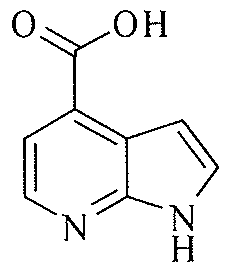
[0215] A solution of lH-pyrrolo[2,3-6]pyridine-4-carbonitrile (90 mg, 0.63 mol) in HCl (10 mL, 6 M) was heated at 100 0C for 2 d. The reaction mixture was cooled and concentrated to afford the crude product as yellow solid: ESI MS mlz 163 [C8H6N2O2 + H]+.
Example 1 12
N-[2-(lH-Imidazol-4-yl)ethyl]-lH-pyrrolo[2,3-ό]pyridine-4-carboxamide

[0216] Following General Procedure A, crude lH-pyrrolo[2,3-έ]pyridine-4-carboxylic acid (0.63 mmol) was reacted with histamine hydrochloride (230 mg, 1.3 mmol) to afford the desired product (41 mg, 25% yield) as an orange-brown solid: 1H NMR (500 MHz, DMSO-J6) δ 1 1.95 (s, IH), 1 1.82 (s, I H), 8.57 (t, J= 5.5 Hz, I H), 8.29 (d, J= 4.5 Hz, IH), 7.57-7.56 (m, 2H), 7.33 (d, J= 5.0 Hz, IH), 6.86 (s, I H), 6.76-6.75 (m, IH), 3.54 (q, J= 7.5 Hz, 2H), 2.80 (t, J= 7.5 Hz, 2H); ESI MS mlz 256 [CnHi3N5O + H]+.
Example 1 13
2-(Thiophen-2-yl)-lH-pyrrolo[2,3-δ]pyridine

[0217] To a solution of ter/-butyl 3-methylpyridin-2-ylcarbamate (2.0 g, 9.6 mmol) in TΗF (100 mL) at -30 0C was added butyl lithium (12 mL, 2.5 M, 29 mmol) and the reaction mixture was warmed to 0 0C and stirred for 1.5 h. A solution of N-methoxy-N-methylthiophene-2- carboxamide (1.6 g, 9.6 mmol) in TΗF (10 mL) was slowly added and the reaction was stirred at 0 0C for 1 h. The reaction mixture was slowly treated with HCl (20 mL, 6 M) followed by heating at 60 0C for 18 h. The reaction mixture was cooled, the layers were separated and the aqueous layer was made basic with ΝaOΗ (6 M) and extracted with ethyl acetate (3 x 30 ml). The combined organic layers were dried, concentrated and the residue was purified by flash chromatography (silica gel, methanol/methylene chloride gradient) to afford the product (1.2 g, 64% yield) as a yellow solid: 1H ΝMR (300 MHz, DMSO-J6) δ 7.36-7.34 (m, I H), 7.14-7.1 1 (m, 1 H), 6.73-6.72 (m, 1 H), 6.64-6.63 (m, 1 H), 6.34-6.36 (m, 1 H); ESI MS mlz 201
[C1 1H8N2S+ H]+.
Example 1 14
4-Chloro-2-(thiophen-2-yl)-lH-pyrrolo[2,3-b]pyridine

[0218] Following the procedure outlined in Example 107, 2-(thiophen-2-yl)-lH-pyrrolo[2,3- έjpyridine (1.3 g, 6.2 mmol) was reacted with m-CPBA (1.9 g, 77%, 7.5 mmol) followed by phosphorus oxychloride (6.0 mL, 65 mmol) to afford the product (0.80 g, 55% yield) as a brown solid: ESI MS w/z 235 [C HH7CIN2S + H]+.
Example 115
l-[-(Thiophen-2-yl)-lH-pyrrolo[2,3-ό]pyridin-4-yl]piperidin-3-amine

[0219] Following the procedure outlined in Example 108, 4-chloro-2-(thiophen-2-yl)-lH- pyrrolo[2,3-δ]pyridine (75 mg, 0.32 mmol) was reacted with fer/-Butyl 3-aminopiperidine-l- carboxylate (130 mg, 0.64 mmol) to afford the desired product (43 mg, 45% yield) as a light yellow solid: 1H NMR (300 MHz, DMSO-J6) δ 7.92 (d, J= 5.7 Hz, IH), 7.58-7.57 (m, IH), 7.52-7.50 (m, I H), 7.14-7.1 1 (m, 2H), 6.67 (s, IH), 6.40 (d, J = 5.7 Hz, IH), 3.88-3.67 (m, 2H), 2.95-2.79 (m, 2H), 2.71-2.61 (m, IH), 1.95-1.73 (m, 2H), 1.69-1.54 (m, IH), 1.31-1.16 (m, IH); ESI MS mlz 299 [C16Hi8N4S + H]+; HPLC 98.1% (AUC), tR = 7.43 min.
Example 1 16
2-(Thiophen-2-yl)-lH-pyrrolo[2,3-έ]pyridine-4-carbonitrile

[0220] A suspension of 4-chloro-2-(thiophen-2-yl)-lH-pyrrolo[2,3-δ]pyridine (200 mg, 0.85 mmol), zinc dust (1 1 mg, 0.17 mmol), zinc cyanide (100 mg, 0.85 mmol),
tris(dibenzylideneacetone)dipalladium (78 mg, 0.090 mmol) and 1 ,1'-
bis(diphenylphosphino)ferrocene (47 mg, 0.090 mmol) in N,N-dimethylacetamide (3 mL) was flushed with N2 and heated in a microwave at 120 0C for 3 h. The mixture was cooled, diluted with ethyl acetate (20 mL) and filtered. The filtrate was washed with a 5% aq. LiCl, dried, concentrated and the residue was purified by flash chromatography (silica gel,
methanol/methylene chloride gradient) to afford crude product (170 mg) as a gummy solid: 1H NMR (300 MHz, CD3OD) δ 8.30 (d, J= 5.1 Hz, IH), 7.66-7.64 (m, IH), 7.57-7.55 (m, IH), 7.39 (d, J= 5.1 Hz, IH), 7.19-7.16 (m, IH), 6.82 (s, I H); ESI MS mlz 226 [C12H7N3S+ H]+.
Example 1 17
2-(Thiophen-2-yl)-lH-pyrrolo[2,3-έ]pyridine-4-carboxylic Acid

[0221] A solution of 2-(thiophen-2-yl)-lH-pyrrolo[2,3-6]pyridine-4-carbonitrile (170 mg, 0.76 mmol) in HCl (10 mL, 6 M) was refluxed for 2 d. The reaction mixture was cooled and concentrated to afford the crude product (280 mg) as a brown solid: ESI MS mlz 245
[C12H8N2O2S+ H]+. Example 1 18
N-(Piperidin-3-yl)-2-(thiophen-2-yl)-lH-pyrrolo[2,3-δ]pyridine-4-carboxamide

[0222] Following General Procedure A, 2-(thiophen-2-yl)-lH-pyrrolo[2,3-Z>]pyridine-4- carboxylic acid (0.38 mmol) was reacted fer/-butyl 3-aminopiperidine-l-carboxylate (200 mg, 1.0 mmol) to afford the desired product (17 mg, 14% yield) as a yellow solid: 1H NMR (300 MHz5 DMSO-^6) 512.44 (s, IH), 8.34 (d, J= 7.8 Hz, IH), 8.28 (d, J=5.1 Hz, IH), 7.71-7.70 (m, I H), 7.63 (dd, J= 0.9, 5.1 Hz, IH), 7.38 (d, J= 5.1 Hz, I H), 7.18 (dd, J= 3.6, 5.1 Hz, IH), 6.96 (s, IH), 3.40-3.86 (m, 2H), 3.09-3.01 (m, IH), 2.90-2.80 (m, IH), 1.95-1.85 (m, IH),
1.73-1.63 (m, IH), 1.61-1.41 (m, 2H); ESI MS m/z 327 [C17H18N4OS + H]+; HPLC >99% (AUC), tR = 8.36 min.
Example 1 19
N-(Piperidin-3-ylmethyl)-2-(thiophen-2-yl)-lH-pyrrolo[2,3-δ]pyridine-4-carboxamide

[0223] Following General Procedure A, 2-(thiophen-2-yl)-lH-pyrrolo[2,3-Z>]pyridine-4- carboxylic acid (130 mg, 0.41 mmol) was reacted /er?-butyl 3-(aminomethyl)piperidine-l- carboxylate (180 mg, 0.82 mmol) to afford the desired product (37 mg, 28% yield) as a yellow solid: 1H NMR (500 MHz, DMSO-J6) 68.57-8.55 (m, IH), 8.28 (d, J= 5.0 Hz, IH), 7.70 (d, J =3.5 Hz, IH), 7.63 (d, J= 5.0 Hz, IH), 7.37 (d, J = 5.0 Hz, IH), 7.18-7.17 (m, IH), 6.98 (s, IH), 3.20-3.15 (m, 2H), 2.98-2.94 (m, I H), 2.85-2.81 (m, IH), 2.47-2.41 (m, IH), 2.27-2.21 (m, IH), 1.81-1.67 (m, 2H), 1.62-1.55 (m, IH), 1.39-1.29 (m, IH), 1.15-1.06 (m, IH); ESI MS m/z 341 [C18H20N4OS + H]+; HPLC >99% (AUC), /R = 8.51 min.
Kinase assay
[0224] PBK activity was determined in the presence or absence of compounds using fluorescein isothiocyanate-labeled (FITC-labeled) histone H3 peptide as a substrate. The extent of FITC-labeled histone H3 peptide phosphorylation was measured by immobilized metal ion affinity-based fluorescence polarization (IMAP) technology (Sportsman JR, et al, Assay Drug Dev. Technol. 2: 205-14, 2004) using IMAP FP Progressive Binding System (Molecular Devices Corporation). Test compounds were dissolved in DMSO at 12.5 mM and then serially diluted as the DMSO concentration in the assays to be 1%. The serially diluted compounds, 0.8 ng/micro-L PBK (Carna Biosciences) and 100 nM FITC-labeled histone H3 peptide were reacted in a reaction buffer (20 mM HEPES, 0.01% Tween-20, 0.3 mM MgCl2, 2 mM dithiothreitol, 50micro-M ATP, pH 7.4) at room temperature for 1 hour. The reaction was stopped by the addition of three fold assay volume of progressive binding solution. Following 0.5 hour incubation at room temperature, fluorescence polarization was measured by Wallac EnVision 2103 multilabel reader (PerkinElmer). IC50 values were calculated by nonlinear four parameter fit using SigmaPlot, version 10.0 (Systat Software, Inc.).
I l l
[0225] IC50 values of the typical compounds of the present invention are shown in following table 2:
Table 2


Examples 49
Western blot analysis
[0226] To evaluate the expression status of PBK in several cell lines, western blot analysis was performed using crude cell lysate collected from those cells. Anti-PBK antibody (clone 31 , BD Biosciences) was used to visualize the expression. Breast cancer lines, T47D and BT-549 expressed PBK significantly although Bladder cancer line and HT-1 197 showed no expression of PBK. Examples 50
Cell-based assay
[0227] Active candidate inhibitors against PBK were evaluated for their target-specific cytotoxicity using T47D, BT-549, and HT-1 197 cells was used for negative control. 100 micro-L of cell suspension was seeded onto 96-well microtiter plate (ViewPlate-96FTC, PerkinElmer). The initial cell concentration of T47D, BT-549 and HT-1 197 were 3,000cells/well,
2,000cells/well and 2,500cells/well respectively. Cellular growth was determined using Cell Counting Kit-8 (DOJINDO) at 72 hours after the exposure of the candidate inhibitors. IC50 was
used as an indicator of the anti-proliferative activity of the inhibitors, and calculated by serial dilution method (0, 1.5625, 3.125, 6.25, 12.5, 25, 50, 100 micro-M). Accurate IC50 values were calculated as described previously.
[0228] IC50 values of the typical compounds of the present invention are shown in following table 3:
Table 3;

16


">100" in the table means over 100 microM.
Industrial Applicability
[0229] The present invention provides a novel imidazopyridine derivative compound having PBK inhibitory effect. The compounds of the present invention may be used for pharmaceutical composition for inhibiting PBK. Such pharmaceutical compositions are suitable for treating or preventing cancer.
Claims
WHAT IS CLAIMED IS: 1. A compound represented by formula (I), or a salt, hydrate, solvate, or isomer thereof:

wherein
X is C or N;
R1 is -CH2NH-, -CONH-, -CON(CH3)-, -NHCO-, or single bond;
R2 is 3-10 membered heterocyclic group, 5-10 membered heteroaryl, C3-C10 cycloalkyl or C5-C10 aryl, each optionally substituted by one or more substituents each independently selected from the group consisting of hydroxy, oxo, nitro, cyano, amino, amide, halogen, sulfamoyl, phosphoryl, phosphate group, carbonyl, acyl, carboxyl, Ci-C6 alkyl, Ci-C6 alkenyl, C]-C6 alkynyl, Ci-C6 alkoxy, C]-C6 alkylamino, aminoC]-C6 alkyl, C1- C6 alkylcarbonylamino, C]-C6 alkylaminocarbonyl, aminocarbonylC]-C6 alkyl, C]-C6 alkylsulfonyl, C1-C6 alkylsulfonylamino, aminosulfonylCi-C6 alkyl, aminoCi-C6 alkylsulfonyl, tert-butoxycarbonyl, tert-butoxycarbonyl-aminomethyl, 3-10 membered heterocyclic group, 5-10 membered heteroaryl, C3-C1O cycloalkyl and Cs-Cjoaryl;
R3 is hydrogen, bicyclo[2.2.1]heptan-2-yl, C1-C6 alkyl, phenyl, thiophen-2- yl, furan-2-yl, cyclopropyl, or cyclopentyl, each optionally substituted by one or more substituents each independently selected from the group consisting of hydroxy, oxo, nitro, cyano, amino, amide, halogen, sulfamoyl, phosphoryl, phosphate group, carbonyl, acyl, carboxyl, C]-C6 alkyl, C3-C1O cycloalkyl, -NR' R", 3-10 membered heterocyclic group, and 5-10 membered heteroaryl, each optionally substituted by halogen, amino or hydroxy, wherein R' or R"is each independently selected from the group consisting of hydrogen, Q- C6 alkyl and hydroxyCi-C6alkyl; and
a is 0-5 integer.
2. The compound of claim 1, wherein R2 is 3-10 membered heterocyclic group which is bound to pyridine ring on its hetero atom when Rl is single bond and a is 0. 3. The compound of claim 1 , wherein R3 is hydrogen, bicyclo[2.2.1]heptan- 2-yl, Ci-C6 alkyl, cyclopropyl, furan-2-yl, phenyl, or thiophen-2-yl, wherein the Q-Cealkyl is optionally substituted by 1 or 2 substituents each independently selected from the group consisting of hydroxy, oxo, cyclopropyl, and thiophen-2-yl, wherein the furan-2-yl is optionally substituted by 1 or 2 substituents each independently selected from the group consisting of halogen and piperazine-1 -yl, wherein the phenyl is optionally substituted by 1 or 2 halogen, or wherein the thiophen-2-yl is optionally substituted by 1 or 2 substituents each independently selected from the group consisting of halogen, morpholine-4-yl, di(hydroxyethyl)amino, (hydroxyethyl)(methyl)amino, piperazine-1-yl which is optionally substituted by 1 or 2 hydroxy, piperidine-1-yl which is optionally substituted by 1 or 2 hydroxy, and pyrrolidine-1-yl which is optionally substituted by 1 or 2 substituents each independently selected from the group consisting of hydroxy and amino. 4. The compound of Claim lor 2, wherein R2 is adamantyl, azetidine-3-yl, cyclohexyl, imidazole-2-yl, imidazole-4-yl, phenyl, piperidine-1-yl, piperidine-2-yl, piperidine- 3-yl, pyrrolidine-3-yl, or quinuclidin-3-yl, which are optionally substituted by 1 to 4 substituents each independently selected from hydorxy, aminomethyl, methyl, aminocarboonyl(amide), amino, tert-butoxycarbonyl and tert-butoxycarbonyl-aminomethyl. 5. The compound of any one of claim 2 or 3, wherein the Ci-C6 alkyl substituted by 1 or 2 substituents is cyclopropylmethyl, thiophen-2-ylmethyl, hydroxyl(thiophen- 2-yl)methyl or thiophene-2-ylcarbonyl. 6. The compound of any one of claim 3 or 4, wherein the furan-2-yl substituted by 1 or 2 substituents is 5-bromofuran-2-yl or 5-(piperazin-l-yl)furan-2-yl. 7. The compound of any one of claim 3 or 4, the phenyl substituted by 1 or 2 halogen is 4-chlorophenyl. 8. The compound of any one of claim 3 or 4, the thiophen-2-yl substituted by 1 or 2 substituents is 4-bromothiophen-2-yl, 5-morpholinothiophen-2-yl, {4-[Bis(2- hydroxyethyl)amino]thiophen-2-yl, 5-[(2-Hydroxyethyl)(methyl)amino]thiophen-2-yl, 5- (Piperazin-l -yl)thiophen-2-yl, 5-(piperidin-l-yl)thiophen-2-yl, 5-(3-hydroxypiperidin-l- yl)thiophen-2-yl, 5-(3-Aminopyrrolidin-l-yl)thiophen-2-yl, 5-(3-hydroxypiperidin-l- yl)thiophen-2-yl, 5-(3-hydroxypyrrolidin-l-yl)thiophen-2-yl, 5-(3-hydroxypyrrolidin-l- yl)thiophen-2-yl, 4-morpholinothiophen-2-yl, 4-(3-hydoroxypyrrolidin-l-yl)thiophen-2-yl, or 4- (pyperazin-l-yl)thiophen-2-yl. 9. The compound of claim 1, which is selected from the group consisting of: N-P-ClH-imidazol^-yOethylJ^-Cthiophen^-yO-SH-imidazo^^-bjpyridine^- carboxamide (Example No. 12),
N-[2-(lH-Imidazol-4-yl)ethyl]-2-(4-chlorophenyl)-3H-imidazo[4,5-b]pyridine-7- carboxamide (Example No. 13),
2-(4-Chlorophenyl)-N-(piperidin-3-yl)-3H-imidazo[4,5-b]pyridine-7-carboxamide (Example No. 14),
N-(Piperidin-3-yl)-2-(thiophen-2-yl)-3H-imidazo[4,5-b]pyridine-7-carboxamide (Example No. 15),
N-(Piperidin-3-ylmethyl)-2-(thiophen-2-yl)-3H-imidazo[4,5-b]pyridine-7- carboxamide (Example No. 16),
N-[3-(lH-Imidazol-2-yl)propyl]-2-(thiophen-2-yl)-3H-imidazo[4,5-b]pyridine-7- carboxamide (Example No. 17),
(R)-N-(Piperidin-3-yl)-2-(thiophen-2-yl)-3H-imidazo[4,5-b]pyridine-7- carboxamide (Example No. 18),
(S)-N-(Piperidin-3-yl)-2-(thiophen-2-yl)-3H-imidazo[4,5-b]pyridine-7- carboxamide (Example No. 19),
N-(4-Aminocyclohexyl)-2-(thiophen-2-yl)-3H-imidazo[4,5-b]pyridine-7- carboxamide (Example No. 20),
(R)-N-(Piperidin-3-ylmethyl)-2-(thiophen-2-yl)-3H-imidazo[4,5-b]pyridine-7- carboxamide (Example No. 21),
(S)-N-(Piperidin-3-ylmethyl)-2-(thiophen-2-yl)-3H-imidazo[4,5-b]pyridine-7- carboxamide (Example No. 22),
(R)-N-[2-(Piperidin-3-yl)ethyl]-2-(thiophen-2-yl)-3H-imidazo[4,5-b]pyridine-7- carboxamide (Example No. 23), (S)-N-[2-(Piperidin-3-yl)ethyl]-2-(thiophen-2-yl)-3H-imidazo[4,5-b]pyridine-7- carboxamide (Example No. 24),
N-(Pyrrolidin-3-yl)-2-(thiophen-2-yl)-3H-imidazo[4,5-b]pyridine-7-carboxamide (Example No. 25),
N-(Piperidin-2-ylmethyl)-2-(thiophen-2-yl)-3H-imidazo[4,5-b]pyridine-7- carboxamide (Example No. 26),
N-(Azetidin-3-ylmethyl)-2-(thiophen-2-yl)-3H-imidazo[4,5-b]pyridine-7- carboxamide (Example No. 27),
N-(3-Aminocyclohexyl)-2-(thiophen-2-yl)-3H-imidazo[4,5-b]pyridine-7- carboxamide (Example No. 28),
N-(3-Aminoadamantyl)-2-(thiophen-2-yl)-3H-imidazo[4,5-b]pyridine-7- carboxamide (Example No. 29),
N-{[(l S,4S)-4-Aminocyclohexyl]methyl}-2-(thiophen-2-yl)-3H-imidazo[4,5- b]pyridine-7-carboxamide (Example No. 30),
trans-N-[4-(Aminomethyl)cyclohexyl]-2-(thiophen-2-yl)-3H-imidazo[4,5- b]pyridine-7-carboxamide (Example No. 31 ),
trans-N-I^^AminomethyOcyclohexyllmethylJ^-^hiophen^-yO-SH- imidazo[4,5-b]pyridine-7-carboxamide (Example No. 32),
N-(l-Methylpiperidin-3-yl)-2-(thiophen-2-yl)-3H-imidazo[4,5-b]pyridine-7- carboxamide (Example No. 33),
N-{[3-(Aminomethyl)cyclohexyl]methyl}-2-(thiophen-2-yl)-3H-imidazo[4,5- b]pyridine-7-carboxamide (Example No. 34),
N-[3-(Aminomethyl)-3,5,5-trimethylcyclohexyl]-2-(thiophen-2-yl)-3H- imidazo[4,5-b]pyridine-7-carboxamide (Example No. 35),
N-Methyl-N-(piperidin-3-yl)-2-(thiophen-2-yl)-3H-imidazo[4,5-b]pyridine-7- carboxamide (Example No. 36),
N-(3-Aminophenyl)-2-(thiophen-2-yl)-3H-imidazo[4,5-b]pyridine-7-carboxamide (Example No. 37),
N-(Piperidin-3-yl)-3H-imidazo[4,5-b]pyridine-7-carboxamide (Example No. 38), N-(Aminoadamant-3-yl)-3H-imidazo[4,5-b]pyridine-7-carboxamide (Example No. 39), N-(Piperidin-3-ylmethyl)-3H-imidazo[4,5-b]pyridine-7-carboxamide (Example No. 40),
N-(3-AminocyclohexyI)-3H-imidazo[4,5-b]pyridine-7-carboxamide (Example No. 41),
(S)-2-(5-Bromothiophen-2-yl)-N-(piperidin-3-ylmethyl)-3H-imidazo[4,5- b]pyridine-7-carboxamide (Example No. 42),
(R)-2-(5-Bromothiophen-2-yl)-N-(piperidin-3-ylmethyl)-3H-imidazo[4,5- b]pyridine-7-carboxamide (Example No. 43),
2-(5-Bromothiophen-2-yl)-N-(piperidin-2-ylmethyl)-3H-imidazo[4,5-b]pyridine- 7-carboxamide (Example No. 44),
(S)-2-(5-Bromothiophen-2-yl)-N-(piperidin-3-yl)- 1 H-imidazo[4,5-b]pyridine-7- carboxamide (Example No. 45),
(S)-2-(4-Bromothiophen-2-yl)-N-(piperidin-3-yl)- 1 H-imidazo[4,5-b]pyridine-7- carboxamide (Example No. 49),
(S)-2-(4-bromothiophen-2-yl)-N-(piperidin-3-ylmethyl)-3H-imidazo[4,5- b]pyridine-7-carboxamide (Example No. 50),
(S)-tert-Butyl 3-[2-(5-bromofuran-2-yl)-3H-imidazo[4,5-b]pyridine-7- carboxamido]piperidine- 1 -carboxy late (Example No. 51),
(S)-2-(5-bromofuran-2-yl)-N-(piperidin-3-yl)-3H-imidazo[4,5-b]pyridine-7- carboxamide (Example No. 52),
(S)-tert-Butyl 3-{[2-(5-bromofuran-2-yl)-3H-imidazo[4,5-b]pyridine-7- carboxamido]methyl}piperidine-l-carboxylate (Example No. 53),
(R)-2-(5-Bromofuran-2-yl)-N-(piperidin-3-ylmethyl)-3H-imidazo[4,5-b]pyridine- 7-carboxamide (Example No. 54),
(S)-2-Cyclopropyl-N-(piperidin-3-yl)-3H-imidazo[4,5-b]pyridine-7-carboxamide (Example No. 55),
(S)-2-Cyclopropyl-N-(piperidin-3-ylmethyl)-3H-imidazo[4,5-b]pyridine-7- carboxamide (Example No. 56),
tert-Butyl [(lR,4R)-4-(2-cyclopropyl-3H-imidazo[4,5-b]pyridine-7- carboxamido)cyclohexyl]methylcarbamate (Example No. 57),
N-[(lR,4R)-4-(Aminomethyl)cyclohexyl]-2-cyclopropyl-3H-imidazo[4,5- b]pyridine-7-carboxamide (Example No. 58), 89 N-[(lR,4R)-4-Aminocyclohexyl]-2-cyclopropyl-3H-imidazo[4,5-b]pyridine-7-
90 carboxamide (Example No. 59),
91 N-(4-Aminocadamantyl)-2-cydopropyl-3H-imidazo[4,5-b]pyridine-7-
92 carboxamide (Example No. 60),
93 (S)-2-(Cyclopropylmethyl)-N-(piperidin-3-yl)-3H-imidazo[4,5-b]pyridine-7-
94 carboxamide (Example No. 62),
95 2-(Bicyclo[2.2.1 ]heptan-2-yl)-N-[(S)-piperidin-3-yl]-3H-imidazo[4,5-b]pyridine-
96 7-carboxamide (Example No. 63a),
97 2-(Bicyclo[2.2.1 ]heptan-2-yl)-N-[(S)-piperidin-3-yl]-3H-imidazo[4,5-b]pyridine-
98 7-carboxamide (Example No. 63b),
99 N-{[(lR,4R)-4-(aminomethyl)cyclohexyl]methyl}-2-(bicyclo[2.2.1]heptan-2-yl)-
100 3H-imidazo[4,5-b]pyridine-7-carboxamide (Example No. 64),
101 N-(piperidin-2-ylmethyl)-2-(thiophene-2-carbonyl)-3H-imidazo[4,5-b]pyridine-7-
102 carboxamide (Example No. 66),
103 (S)-N-(Piperidin-3-yl)-2-(thiophene-2-carbonyl)-3H-imidazo[4,5-b]pyridine-7-
104 carboxamide (Example No. 67),
105 (R)-tert-Butyl 3-[(2-(thiophene-2-carbonyl)-3H-imidazo[4,5-b]pyridine-7-
106 carboxamido]methyl)piperidine- 1 -carboxy late (Example No. 68),
107 (S)-tert-Butyl 3-[(2-(thiophene-2-carbonyl)-3H-imidazo[4,5-b]pyridine-7-
108 carboxamido]methyl)piperidine-l-carboxylate (Example No. 69),
109 (S)-N-(Piperidin-3-ylmethyl)-2-(thiophene-2-carbonyl)-3H-imidazo[4,5-
1 10 b]pyridine-7-carboxamide (Example No. 70),
1 1 1 (R)-N-(piperidin-3-ylmethyl)-2-(thiophene-2-carbonyl)-3H-imidazo[4,5-
112 b]pyridine-7-carboxamide (Example No. 71 ),
1 13 (S)2-[Hydroxy(thiophen-2-yl)methyl]-N-(piperidin-3-yl)-3H-imidazo[4,5-
1 14 b]pyridine-7-carboxamide (Example No. 72),
1 15 2-[Hydroxy(thiophen-2-yl)methyl]-N-[(S)-piperidin-3-ylmethyl]-3H-imidazo[4,5-
1 16 b]pyridine-7-carboxamide (Example No. 73),
1 17 2-[Hydroxy(thiophen-2-yl)methyl]-N-[(R)-piperidin-3-ylmethyl]-3H-
1 18 imidazo[4,5-b]pyridine-7-carboxamide (Example No. 74),
1 19 (S)-N-(Piperidin-3-yl)-2-(thiophen-2-ylmethyl)-3H-imidazo[4,5-b]pyridine-7-
120 carboxamide (Example No. 75), 121 (S)-N-(Piperidin-3-ylmethyl)-2-(thiophen-2-ylmethyl)-3H-imidazo[4,5-
122 b]pyridine-7-carboxamide (Example No. 76),
123 (R)-N-(piperidin-3-ylmethyl)-2-(thiophen-2-ylmethyl)-3H-imidazo[4,5-
124 b]pyridine-7-carboxamide (Example No. 77),
125 (S)-2-[5-(Piperazin-l-yl)thiophen-2-yl]-N-(piperidin-3-yl)-lH-imidazo[4,5-
126 b]pyridine-7-carboxamide (Example No. 78),
127 (S)-2-(5-morpholinothiophen-2-yl)-N-(piperidin-3-yl)-3H-imidazo[4,5-
128 b]pyridine-7-carboxamide (Example No. 79),
129 (S)-2-[5-(piperidin-l-yl)thiophen-2-yl]-N-(piperidin-3-yl)-3H-imidazo[4,5-
130 b]pyridine-7-carboxamide (Example No. 80),
131 2-[5-(3-hydroxypyrrolidin-l-yl)thiophen-2-yl]-N-[(S)-piperidin-3-yl]-3H-
132 imidazo[4,5-b]pyridine-7-carboxamide (Example No. 81),
133 2-[5-(3-hydroxypiperidin-l-yl)thiophen-2-yl]-N-((S)-piperidin-3-yl)-3H-
134 imidazo[4,5-b]pyridine-7-carboxamide (Example No. 82),
135 (S)-2-{5-[(2-Hydroxyethyl)(methyl)amino]thiophen-2-yl}-N-(piperidin-3-yl)-3H-
136 imidazo[4,5-b]pyridine-7-carboxarnide (Example No. 83),
137 2-{5-[(R)-3-Aminopyrrolidin-l-yl]thiophen-2-yl}-N-[(S)-piperidin-3-yl]-3H-
138 imidazo[4,5-b]pyridine-7-carboxamide (Example No. 84),
139 (S)-2-(4-Morpholinothiophen-2-yl)-N-(piperidin-3-yl)-3H-imidazo[4,5-
140 b]pyridine-7-carboxamide (Example No. 88),
141 2-[4-(3-Hydroxypyrrolidin-l-yl)thiophen-2-yl]-N-[(S)-piperidin-3-yl]-3H-
142 imidazo[4,5-b]pyridine-7-carboxamide (Example No. 89),
143 (S)-2-{4-[Bis(2-hydroxyethyl)amino]thiophen-2-yl}-N-(piperidin-3-yl)-3H-
144 imidazo[4,5-b]pyridine-7-carboxamid (Example No. 90),
145 (S)-2-[4-(Piperazin-l -yl)thiophen-2-yl]-N-(piperidin-3-yl)-3H-imidazo[4,5-
146 b]pyridine-7-carboxamide (Example No. 91),
147 (R)-2-[5-(Piperazin-l-yl)furan-2-yl]-N-(piperidin-3-yl)-3H-imidazo[4,5-
148 b]pyridine-7-carboxamide (Example No. 92),
149 N-[2-(Thiophen-2-yl)-3H-imidazo[4,5-b]pyridin-7-yl]methyl)piperidin-3-amine
150 (Example No. 94),
151 l -(Piperidin-3-yl)-N-{[2-(thiophen-2-yl)-3H-imidazo[4,5-b]pyridin-7-
152 yl]methyl}methanamine (Example No. 95), 153 1 -[2-(Thiophen-2-yl)-3H-imidazo[4,5-b]pyridin-7-yl]piperidin-3-amine (Example
154 No. 101),
155 1 -[2-(Thiophen-2-yl)-3H-imidazo[4,5-b]pyridin-7-yl]piperidin-3-yl)methanamine
156 (Example No. 102),
157 N-[2-(Thiophen-2-yl)-3H-imidazo[4,5-b]pyridin-7-yl]piperidine-3-carboxamide
158 (Example No. 106),
159 l-(lH-Pyrrolo[2,3-b]pyridin-4-yl)piperidin-3-amine (Example No. 108),
160 l-(lH-Pyrrolo[2,3-b]pyridin-4-yl)piperidine-3-carboxarnide (Example No. 109),
161 N-[2-(lH-Imidazol-4-yl)ethyl]-lH-pyrrolo[2,3-b]pyridine-4-carboxamide
162 (Example No. 1 12),
163 l-[-(Thiophen-2-yl)-lH-pyrrolo[2,3-b]pyridin-4-yl]piperidin-3-amine (Example
164 No. 1 15),
165 N-(Piperidin-3-yl)-2-(thiophen-2-yl)-lH-pyrrolo[2,3-b]pyridine-4-carboxamide
166 (Example No. 1 18), and
167 N-(Piperidin-3-ylmethyl)-2-(thiophen-2-yl)- 1 H-pyrrolo[2,3-b]pyridine-4-
168 carboxamide (Example No. 1 19).
1 10. A pharmaceutical composition comprising at least one compound of any
2 one of claims 1 to 9 and pharmaceutically acceptable carrier.
1 1 1. A pharmaceutical composition for preventing or treating PBK dependent
2 diseases comprising at least one compound of any one of claims 1 to 9 and pharmaceutically
3 acceptable carrier.
1 12. The pharmaceutical composition of claim 1 1 , wherein PBK dependent
2 disease is cancer.
1 13. A PBK inhibitor comprising at least one compound of any one of claims 1
2 to 9.
1 14. A method for treating or preventing PBK dependent diseases in a subject,
2 comprising administering to said subject an effective amount of the compound of any one of
3 claims 1 to 9.
15. Use of the compound of any one of claims 1 to 9 in manufacturing a pharmaceutical composition for treating or preventing PBK dependent diseases.
16. A compound or a pharmaceutically acceptable salt thereof of at least one compound of any one of claims 1 to 9 for use in a treatment or prevention of PKB dependent diseases.
Applications Claiming Priority (2)
| Application Number | Priority Date | Filing Date | Title |
|---|---|---|---|
| US22143709P | 2009-06-29 | 2009-06-29 | |
| US61/221,437 | 2009-06-29 |
Publications (1)
| Publication Number | Publication Date |
|---|---|
| WO2011002772A1 true WO2011002772A1 (en) | 2011-01-06 |
Family
ID=43411405
Family Applications (1)
| Application Number | Title | Priority Date | Filing Date |
|---|---|---|---|
| PCT/US2010/040394 Ceased WO2011002772A1 (en) | 2009-06-29 | 2010-06-29 | Imidazopyridine derivatives and pbk inhibitors containing the same |
Country Status (1)
| Country | Link |
|---|---|
| WO (1) | WO2011002772A1 (en) |
Cited By (3)
| Publication number | Priority date | Publication date | Assignee | Title |
|---|---|---|---|---|
| CN103788086A (en) * | 2012-10-26 | 2014-05-14 | 中国药科大学 | Pyridoimidazole compounds and preparation method thereof |
| CN108794469A (en) * | 2018-04-28 | 2018-11-13 | 通化师范学院 | A kind of new technique for synthesizing of azole compounds and the purposes of antitumor action |
| US11236086B2 (en) | 2017-10-18 | 2022-02-01 | Blueprint Medicines Corporation | Substituted pyrrolopyridines as inhibitors of activin receptor-like kinase |
Citations (1)
| Publication number | Priority date | Publication date | Assignee | Title |
|---|---|---|---|---|
| US20090163524A1 (en) * | 2007-10-11 | 2009-06-25 | Astrazeneca Ab | Novel Protein Kinase B Inhibitors - 060 |
-
2010
- 2010-06-29 WO PCT/US2010/040394 patent/WO2011002772A1/en not_active Ceased
Patent Citations (1)
| Publication number | Priority date | Publication date | Assignee | Title |
|---|---|---|---|---|
| US20090163524A1 (en) * | 2007-10-11 | 2009-06-25 | Astrazeneca Ab | Novel Protein Kinase B Inhibitors - 060 |
Non-Patent Citations (1)
| Title |
|---|
| YANG ET AL.: "Crystal Structure of an Activated Akt/Protein Kinase B Ternary Complex with GSK3 -peptide and AMP-PNP", NATURE STRUCTURAL BIOLOGY, vol. 9, 2002, pages 941 - 944 * |
Cited By (3)
| Publication number | Priority date | Publication date | Assignee | Title |
|---|---|---|---|---|
| CN103788086A (en) * | 2012-10-26 | 2014-05-14 | 中国药科大学 | Pyridoimidazole compounds and preparation method thereof |
| US11236086B2 (en) | 2017-10-18 | 2022-02-01 | Blueprint Medicines Corporation | Substituted pyrrolopyridines as inhibitors of activin receptor-like kinase |
| CN108794469A (en) * | 2018-04-28 | 2018-11-13 | 通化师范学院 | A kind of new technique for synthesizing of azole compounds and the purposes of antitumor action |
Similar Documents
| Publication | Publication Date | Title |
|---|---|---|
| AU2021203650B2 (en) | Chemical compounds | |
| US11673886B2 (en) | 5-membered and bicyclic heterocyclic amides as inhibitors of ROCK | |
| CN114423753B (en) | Heterobicyclic amides as CD38 inhibitors | |
| CA2646128C (en) | Pyridopyrazines and derivatives thereof as alk and c-met inhibitors | |
| JP5674483B2 (en) | Novel HSP90-inhibiting carbazole derivatives, compositions containing the same and uses thereof | |
| CA2947174C (en) | Substituted 4-phenylpiperidines, their preparaiton and use | |
| ES2704704T3 (en) | New azaindole derivatives as selective inhibitors of histone deacetylase (HDAC) and pharmaceutical compositions comprising them | |
| JP5097696B2 (en) | 2,3-substituted fused pyrimidine-4 (3H) -ones as VR1 antagonists | |
| ES2744099T3 (en) | New condensed pyridine compounds as casein kinase inhibitors | |
| WO2019158019A1 (en) | Pyrimidine-fused cyclic compound, preparation method therefor and application thereof | |
| EP3704121A1 (en) | Diazaspiro rock inhibitors | |
| ES2547571T3 (en) | Tricyclic compounds and PBK inhibitors that contain them | |
| AU2016203274A1 (en) | Indazole inhibitors of the wnt signal pathway and therapeutic uses thereof | |
| CA2986631A1 (en) | 1h-pyrazolo[3,4-.beta.]pyridines and thereapeutic uses thereof | |
| AU2011306664A1 (en) | Pyrazolopyridines as inhibitors of the kinase LRRK2 | |
| PT2424843E (en) | Imidazole derivatives and their use as modulators of cyclin dependent kinases | |
| JP2022519474A (en) | Imidazoquinoline amine derivative, pharmaceutical composition, its use | |
| CN116262750A (en) | A kind of aromatic heterocyclic compound and its preparation method and application | |
| TW202339733A (en) | Methods for treating neurological disorders | |
| CA3206667A1 (en) | Compounds and their use as pde4 activators | |
| WO2011002772A1 (en) | Imidazopyridine derivatives and pbk inhibitors containing the same | |
| IL298397A (en) | Competitive and noncompetitive inhibitors of the muscarinic acetylcholine m5 receptor | |
| EA052590B1 (en) | PROTAC MOLECULES OF THE PROTEIN MALT1 | |
| TW202540097A (en) | 2,3-dihydropyrollopyridine carboxamide compounds and methods of use thereof | |
| HK40087766A (en) | Receptor-interacting protein 1 inhibitors including piperazine heterocyclic amide ureas |
Legal Events
| Date | Code | Title | Description |
|---|---|---|---|
| 121 | Ep: the epo has been informed by wipo that ep was designated in this application |
Ref document number: 10794637 Country of ref document: EP Kind code of ref document: A1 |
|
| NENP | Non-entry into the national phase |
Ref country code: DE |
|
| 122 | Ep: pct application non-entry in european phase |
Ref document number: 10794637 Country of ref document: EP Kind code of ref document: A1 |