WO2011002409A1 - 5h-pyrrolo[3,4-£>]pyrazin-7-amine derivatives inhibitors of beta-secretase - Google Patents
5h-pyrrolo[3,4-£>]pyrazin-7-amine derivatives inhibitors of beta-secretase Download PDFInfo
- Publication number
- WO2011002409A1 WO2011002409A1 PCT/SE2010/050761 SE2010050761W WO2011002409A1 WO 2011002409 A1 WO2011002409 A1 WO 2011002409A1 SE 2010050761 W SE2010050761 W SE 2010050761W WO 2011002409 A1 WO2011002409 A1 WO 2011002409A1
- Authority
- WO
- WIPO (PCT)
- Prior art keywords
- pyrazin
- pyrrolo
- phenyl
- amine
- mmol
- Prior art date
- Legal status (The legal status is an assumption and is not a legal conclusion. Google has not performed a legal analysis and makes no representation as to the accuracy of the status listed.)
- Ceased
Links
- YYFCRSVHNVIYTI-UHFFFAOYSA-N Cc(cc(C(c1nccnc11)(c2cccc(Br)c2)N=C1N)cc1Cl)c1OC Chemical compound Cc(cc(C(c1nccnc11)(c2cccc(Br)c2)N=C1N)cc1Cl)c1OC YYFCRSVHNVIYTI-UHFFFAOYSA-N 0.000 description 1
- JZEKXWKLOKMISM-VWLOTQADSA-N Cc(cc([C@](c1nccnc11)(c2cccc(-c3cnccn3)c2)N=C1N)cc1C)c1OC Chemical compound Cc(cc([C@](c1nccnc11)(c2cccc(-c3cnccn3)c2)N=C1N)cc1C)c1OC JZEKXWKLOKMISM-VWLOTQADSA-N 0.000 description 1
- WONHPIBFWPUJGA-UHFFFAOYSA-N Cc(cc(cc1C2CC2)Br)c1O Chemical compound Cc(cc(cc1C2CC2)Br)c1O WONHPIBFWPUJGA-UHFFFAOYSA-N 0.000 description 1
- RIRRPQROSHNHBP-UHFFFAOYSA-N NC(c1nccnc11)=NC1(c1cccc(Br)c1)c1cc(C2CC2)ncc1 Chemical compound NC(c1nccnc11)=NC1(c1cccc(Br)c1)c1cc(C2CC2)ncc1 RIRRPQROSHNHBP-UHFFFAOYSA-N 0.000 description 1
Classifications
-
- C—CHEMISTRY; METALLURGY
- C07—ORGANIC CHEMISTRY
- C07D—HETEROCYCLIC COMPOUNDS
- C07D487/00—Heterocyclic compounds containing nitrogen atoms as the only ring hetero atoms in the condensed system, not provided for by groups C07D451/00 - C07D477/00
- C07D487/02—Heterocyclic compounds containing nitrogen atoms as the only ring hetero atoms in the condensed system, not provided for by groups C07D451/00 - C07D477/00 in which the condensed system contains two hetero rings
- C07D487/04—Ortho-condensed systems
-
- A—HUMAN NECESSITIES
- A61—MEDICAL OR VETERINARY SCIENCE; HYGIENE
- A61P—SPECIFIC THERAPEUTIC ACTIVITY OF CHEMICAL COMPOUNDS OR MEDICINAL PREPARATIONS
- A61P25/00—Drugs for disorders of the nervous system
- A61P25/28—Drugs for disorders of the nervous system for treating neurodegenerative disorders of the central nervous system, e.g. nootropic agents, cognition enhancers, drugs for treating Alzheimer's disease or other forms of dementia
Definitions
- the present invention relates to novel compounds and therapeutically acceptable salts thereof, their pharmaceutical compositions, processes for making them and their use as medicaments for treatment and/or prevention of various diseases.
- the invention relates to compounds, which are inhibitors of ⁇ -secretase and hence inhibit the formation of amyloid ⁇ (A ⁇ ) peptides and will be used for treatment and/or prevention of A ⁇ -related pathologies such as Alzheimer's disease, Downs syndrome and ⁇ -amyloid angiopathy, such as but not limited to cerebral amyloid angiopathy, hereditary cerebral hemorrhage, disorders associated with cognitive impairment, such as but not limited to MCI ("mild cognitive impairment"), Alzheimer's disease, memory loss, attention deficit symptoms associated with Alzheimer's disease, neurodegeneration associated with diseases such as Alzheimer's disease or dementia including dementia of mixed vascular and degenerative origin, pre-senile dementia, senile dementia and dementia associated with Parkinson's disease, progressive supranuclear palsy or cortical basal degeneration.
- AD Alzheimer's disease
- a ⁇ amyloid ⁇ -peptide
- a ⁇ peptide is an integral fragment of the Type I protein APP (A ⁇ amyloid precursor protein), a protein ubiquitously expressed in human tissues. Since soluble A ⁇ can be found in both plasma and cerebrospinal fluid (CSF), and in the medium from cultured cells, APP has to undergo proteolysis.
- CSF cerebrospinal fluid
- ⁇ -cleavages of APP there are three main cleavages of APP that are relevant to the pathobiology of AD, the so-called ⁇ -, ⁇ -, and ⁇ -cleavages.
- the ⁇ -cleavage which occurs roughly in the middle of the A ⁇ domain in APP is executed by the metalloproteases ADAMlO or ADAM 17 (the latter also known as TACE).
- the ⁇ -cleavage occuring at the N terminus of A ⁇ , is generated by the transmembrane aspartyl protease Beta site APP Cleaving Enzyme 1 (BACEl).
- the ⁇ -cleavage is effected by a multi-subunit aspartyl protease named ⁇ -secretase.
- ADAM 10/ 17 cleavage followed by ⁇ -secretase cleavage results in the release of the soluble p3 peptide, an N-terminally truncated A ⁇ fragment that fails to form amyloid deposits in humans.
- This proteolytic route is commonly referred to as the non-amyloidogenic pathway.
- Consecutive cleavages by BACEl and ⁇ -secretase generates the intact A ⁇ peptide, hence this processing scheme has been termed the amyloidogenic pathway.
- amyloidogenic processing This application focuses on the latter strategy, inhibition or modulation of amyloidogenic processing.
- Amyloidogenic plaques and vascular amyloid angiopathy also characterize the brains of patients with Trisomy 21 (Down's Syndrome), Hereditary Cerebral Hemorrhage with Amyloidosis of the Dutch-type (HCHWA-D), and other neurodegenerative disorders. Neurofibrillary tangles also occur in other neurodegenerative disorders including dementia-inducing disorders (Varghese, J., et al, Journal of Medicinal Chemistry, 2003, 46, 4625-4630). ⁇ -amyloid deposits are predominately an aggregate of AB peptide, which in turn is a product of the proteolysis of amyloid precursor protein (APP).
- APP amyloid precursor protein
- AB peptide results from the cleavage of APP at the C-terminus by one or more ⁇ - secretases, and at the N-terminus by B-secretase enzyme (BACE), also known as aspartyl protease or Asp2 or Beta site APP Cleaving Enzyme (BACE), as part of the B- amyloidogenic pathway.
- BACE B-secretase enzyme
- BACE activity is correlated directly to the generation of AB peptide from APP (Sinha, et al, Nature, 1999, 402, 537-540), and studies increasingly indicate that the inhibition of BACE inhibits the production of ABpeptide (Roberds, S. L., et al, Human Molecular Genetics, 2001, 10, 1317-1324).
- BACE is a membrane bound type 1 protein that is synthesized as a partially active proenzyme, and is abundantly expressed in brain tissue. It is thought to represent the major -secretase activity, and is considered to be the rate- limiting step in the production of amyloid- -peptide (A ). Drugs that reduce or block BACE activity should therefore reduce A levels and levels of fragments of A in the brain, or elsewhere where A or fragments thereof deposit, and thus slow the formation of amyloid plaques and the progression of AD or other maladies involving deposition of A or fragments thereof.
- BACE is therefore an important candidate for the development of drugs as a treatment and/or prophylaxis of A ⁇ -related pathologies such as Downs syndrome, ⁇ -amyloid angiopathy such as but not limited to cerebral amyloid angiopathy or hereditary cerebral hemorrhage, disorders associated with cognitive impairment such as but not limited to MCI ("mild cognitive impairment"), Alzheimer Disease, memory loss, attention deficit symptoms associated with Alzheimer disease, neurodegeneration associated with diseases such as Alzheimer disease or dementia including dementia of mixed vascular and degenerative origin, pre-senile dementia, senile dementia and dementia associated with Parkinson's disease, progressive supranuclear palsy or cortical basal degeneration.
- a ⁇ -related pathologies such as Downs syndrome, ⁇ -amyloid angiopathy such as but not limited to cerebral amyloid angiopathy or hereditary cerebral hemorrhage
- disorders associated with cognitive impairment such as but not limited to MCI (“mild cognitive impairment")
- Alzheimer Disease memory loss
- the present invention relates to a compound according to formula (I)
- A is aryl or heteroaryl, wherein said aryl or heteroaryl is optionally substituted with one to three R 1 ;
- G is aryl or heteroaryl, wherein said aryl or heteroaryl is optionally substituted with one to three R 2 ;
- R 1 is selected from halogen, C 1-4 alkyl, OR 3 , C3-6carbocyclyl, C ⁇ haloalkyl, Ci_4alkylOH, and hydroxy;
- R 2 is selected from halogen, C ⁇ alkoxy, C 2 - 6 alkenyl, C ⁇ alky ⁇ and C 2-6 alkynyl;
- R is selected from C 1-4 alkyl, C ⁇ alkylaryl, C3_6carbocyclyl, Ci_4alkylheteroaryl and C 1 .
- R 5 is selected from fluoro and hydroxy
- n 0, 1 or 2;
- A is phenyl or pyridine, substituted with one to three R 1 .
- G is pyridine, pyrimidine or pyrazine, optionally substituted with one R 2 .
- R 1 is halogen, C 1-4 alkyl, C3_6carbocyclyl, or OR 3 .
- R 1 is halogen, methyl, cyclopropyl or methoxy.
- R is halogen or C 2 - 6 alkynyl.
- R 3 is methyl, ethyl, cyclopropyl or benzyl.
- m is 0
- A is phenyl or pyridine
- G is pyrimidine, pyridine, or pyrazine
- R is halogen, methyl, cyclopropyl, or OR ;
- R 2 is halogen or C 2 - 6 alkynyl
- R is methyl, ethyl, cyclopropyl, or CH2PI1;
- composition comprising as active ingredient a therapeutically effective amount of a compound according formula I in association with pharmaceutically acceptable excipients, carriers or diluents.
- the compounds of the invention can be used as medicaments, e.g. to treat or prevent A ⁇ -related pathologies.
- the compounds of the invention can be used for the manufacture of a medicament to treat or prevent A ⁇ -related pathologies.
- a method for the treatment of A ⁇ - related pathologies comprising administering a therapeutically effective amount of a compound of Formula (I), or a pharmaceutically acceptable salt thereof, to a subject, such as a mammal or a human being, in need thereof.
- the compounds of the invention and their pharmaceutically acceptable salts thereby provides methods of treatment of A ⁇ -related pathologies, such as, but not limited to, Alzheimer's disease, Downs syndrome, ⁇ -amyloid angiopathy, cerebral amyloid angiopathy, hereditary cerebral hemorrhage, a disorder associated with cognitive impairment, MCI ("mild cognitive impairment"), memory loss, attention deficit symptoms associated with Alzheimer's disease, neurodegeneration associated with Alzheimer's disease, dementia of mixed vascular origin, dementia of degenerative origin, pre-senile dementia, senile dementia, dementia associated with Parkinson's disease, progressive supranuclear palsy and cortical basal degeneration.
- a ⁇ -related pathologies such as, but not limited to, Alzheimer's disease, Downs syndrome, ⁇ -amyloid angiopathy, cerebral amyloid angiopathy, hereditary cerebral hemorrhage, a disorder associated with cognitive impairment, MCI (“mild cognitive impairment"), memory loss, attention deficit symptoms associated with Alzheimer's disease,
- the present invention relates to the use of compounds of formula I as hereinbefore defined as well as to the salts thereof.
- Salts for use in pharmaceutical compositions will be pharmaceutically acceptable salts, but other salts may be useful in the production of the compounds of formula I
- the compounds of the formula (I) may be administered in the form of a prodrug which is broken down in the human or animal body to give a compound of the formula (I).
- prodrugs examples include in vivo hydro lysab Ie esters of a compound of the formula (I).
- An in vivo hydro lysable (or cleavable) ester of a compound of the formula (I) that contains a carboxy or a hydroxy group is, for example, a pharmaceutically acceptable ester which is hydrolysed in the human or animal body to produce the parent acid or alcohol.
- Various forms of prodrugs are known in the art.
- alkyl used alone or as a suffix or prefix, is intended to include both branched and straight chain saturated aliphatic hydrocarbon groups having from 1 to 12 carbon atoms or if a specified number of carbon atoms is provided then that specific number would be intended.
- “Co-6 alkyl” denotes alkyl having 0, 1, 2, 3, 4, 5 or 6 carbon atoms.
- alkyl include, but are not limited to, methyl, ethyl, n-propyl, /-propyl, n-butyl, /-butyl, sec-butyl, /-butyl, pentyl, and hexyl.
- a subscript is the integer 0 (zero) the group to which the subscript refers to indicates that the group may be absent, i.e. there is a direct bond between the groups.
- alkenyl used alone or as a suffix or prefix is intended to include both branched and straight-chain alkene or olefin containing aliphatic hydrocarbon groups having from 2 to 12 carbon atoms or if a specified number of carbon atoms is provided then that specific number would be intended.
- C2-6alkenyl denotes alkenyl having 2, 3, 4, 5 or 6 carbon atoms.
- alkenyl examples include, but are not limited to, vinyl, allyl, 1-propenyl, 1-butenyl, 2-butenyl, 3-butenyl, 2-methylbut-2-enyl, 3-methylbut- 1-enyl, 1-pentenyl, 3-pentenyl and 4-hexenyl.
- alkynyl used also or as a suffix or prefix is intended to include to include both branched and straight-chain alkynyl or olefin containing aliphatic hydrocarbon groups having from 2 to 12 carbon atoms or if a specified number of carbon atoms is provided then that specific number would be intended.
- alkynyl used also or as a suffix or prefix is intended to include to include both branched and straight-chain alkynyl or olefin containing aliphatic hydrocarbon groups having from 2 to 12 carbon atoms or if a specified number of carbon atoms is provided then that specific number would be intended.
- ethynyl e.g. 1- propynyl, 2-propynyl
- 3-butynyl pentynyl, hexynyl and l-methylpent-2-ynyl.
- aromatic refers to hydrocarbonyl groups having one or more unsaturated carbon ring(s) having aromatic characters, (e.g. 4n + 2 delocalized electrons) and comprising up to about 14 carbon atoms.
- heteromatic refers to groups having one or more unsaturated rings containing carbon and one or more heteroatoms such as nitrogen, oxygen or sulphur having aromatic character (e.g. 4n + 2 delocalized electrons).
- aryl refers to an aromatic ring structure made up of from 5 to 14 carbon atoms. Ring structures containing 5, 6, 7 and 8 carbon atoms would be single-ring aromatic groups, for example, phenyl. Ring structures containing 8, 9, 10, 11, 12, 13, or 14 would be polycyclic, for example naphthyl.
- the aromatic ring can be substituted at one or more ring positions with such substituents as described above.
- aryl also includes polycyclic ring systems having two or more cyclic rings in which two or more carbons are common to two adjoining rings (the rings are "fused rings") wherein at least one of the rings is aromatic, for example, the other cyclic rings can be cycloalkyls, cycloalkenyls, cycloalkynyls, aryls and/or heterocyclyls.
- cycloalkyl is intended to include saturated ring groups, having the specified number of carbon atoms. These may include fused or bridged polycyclic systems. Preferred cycloalkyls have from 3 to 10 carbon atoms in their ring structure, and more preferably have 3, 4, 5, and 6 carbons in the ring structure.
- C3-6 cycloalkyl denotes such groups as cyclopropyl, cyclobutyl, cyclopentyl, or cyclohexyl.
- cycloalkenyl is intended to include unsaturated ring groups, having the specified number of carbon atoms. These may include fused or bridged polycyclic systems. Preferred cycloalkenyls have from 3 to 10 carbon atoms in their ring structure, and more preferably have 3, 4, 5, and 6 carbons in the ring structure.
- C3-6 cycloalkenyl denotes such groups as cyclopropenyl, cyclobutenyl, cyclopentenyl, or cyclohexenyl.
- halo or “halogen” refers to fluoro, chloro, bromo, and iodo.
- Counterion is used to represent a small, negatively charged species such as chloride, bromide, hydroxide, acetate, sulfate, tosylate, benezensulfonate, and the like.
- heterocyclyl or “heterocyclic” or “heterocycle” refers to a saturated, unsaturated or partially saturated, monocyclic, bicyclic or tricyclic ring (unless otherwise stated) containing 3 to 20 atoms of which 1, 2, 3, 4 or 5 ring atoms are chosen from nitrogen, sulphur or oxygen, which may, unless otherwise specified, be carbon or nitrogen linked, wherein a -CH 2 - group is optionally be replaced by a -C(O)-; and where unless stated to the contrary a ring nitrogen or sulphur atom is optionally oxidised to form the N-oxide or S-oxide(s) or a ring nitrogen is optionally quarternized; wherein a ring -
- heterocyclyl group is bi- or tricyclic then at least one of the rings may optionally be a heteroaromatic or aromatic ring provided that at least one of the rings is non-hetero aromatic. If the said heterocyclyl group is monocyclic then it must not be aromatic.
- heterocyclyls include, but are not limited to, piperidinyl, N- acetylpiperidinyl, N-methylpiperidinyl, N-formylpiperazinyl, N-mesylpiperazinyl, homopiperazinyl, piperazinyl, azetidinyl, oxetanyl, morpholinyl, tetrahydroisoquinolinyl, tetrahydroquinolinyl, indolinyl, tetrahydropyranyl, dihydro-2H-pyranyl, tetrahydrofuranyl, tetrahydro-thiopyranyl, tetrahydro-thiopyran 1 -oxide, tetrahydro-thiopyran 1,1 -dioxide, lH-pyridin-2-one, and 2,5-dioxoimidazolidinyl.
- heteroaryl refers to a heteroaromatic heterocycle having at least one heteroatom ring member such as sulfur, oxygen, or nitrogen.
- Heteroaryl groups include monocyclic and polycyclic (e.g., having 2, 3 or 4 fused rings) systems. Examples of heteroaryl groups include without limitation, pyridyl (i.e., pyridinyl), pyrimidinyl, pyrazinyl, pyridazinyl, triazinyl, furyl (i.e.
- furanyl quinolyl, isoquinolyl, thienyl, imidazolyl, thiazolyl, indolyl, pyrryl, oxazolyl, benzofuryl, benzothienyl, benzthiazolyl, isoxazolyl, pyrazolyl, triazolyl, tetrazolyl, indazolyl, 1,2,4-thiadiazolyl, isothiazolyl, benzothienyl, purinyl, carbazolyl, benzimidazolyl, benzoxazolyl, aza-benzoxazolyl, imidazothiazolyl, benzo[l,4]dioxinyl, benzo[l,3]dioxolyl and the like.
- quinolyl isoquinolyl, thienyl, imidazolyl, thiazolyl, indolyl, pyrryl, oxazolyl, benzofuryl, be
- the heteroaryl group has from 1 to 20 carbon atoms, and in further embodiments from 3 to 20 carbon atoms. In some embodiments, the heteroaryl group contains 3 to 14, 4 to 14, 3 to 7, or 5 to 6 ring-forming atoms. In some embodiments, the heteroaryl group has 1 to 4, 1 to 3, or 1 to 2 heteroatoms. In some embodiments, the heteroaryl group has 1 heteroatom.
- protecting group means temporary substituents which protect a potentially reactive functional group from undesired chemical transformations.
- protecting groups include esters of carboxylic acids, silyl ethers of alcohols, and acetals and ketals of aldehydes and ketones respectively.
- the field of protecting group chemistry has been reviewed (Greene, T.W.; Wuts, P. G. M. Protective Groups in Organic Synthesis, 3 rd ed.; Wiley: New York, 1999).
- pharmaceutically acceptable is employed herein to refer to those compounds, materials, compositions, and/or dosage forms which are, within the scope of sound medical judgment, suitable for use in contact with the tissues of human beings and animals without excessive toxicity, irritation, allergic response, or other problem or complication, commensurate with a reasonable benefit/risk ratio.
- pharmaceutically acceptable salts refer to derivatives of the disclosed compounds wherein the parent compound is modified by making acid or base salts thereof. Examples of pharmaceutically acceptable salts include, but are not limited to, mineral or organic acid salts of basic residues such as amines; alkali or organic salts of acidic residues such as carboxylic acids; and the like.
- the pharmaceutically acceptable salts include the non-toxic salts or the quaternary ammonium salts of the parent compound formed, for example, from non-toxic inorganic or organic acids.
- non-toxic salts include those derived from inorganic acids such as hydrochloric acid.
- the pharmaceutically acceptable salts of the present invention can be synthesized from the parent compound that contains a basic or acidic moiety by conventional chemical methods.
- such salts can be prepared by reacting the free acid or base forms of these compounds with a stoichiometric amount of the appropriate base or acid in water or in an organic solvent, or in a mixture of the two; generally, nonaqueous media like diethyl ether, ethyl acetate, ethanol, isopropanol, or acetonitrile are used.
- tautomer means other structural isomers that exist in equilibrium resulting from the migration of a hydrogen atom. For example, keto-enol tautomerism where the resulting compound has the properties of both a ketone and an unsaturated alcohol.
- stable compound and “stable structure” are meant to indicate a compound that is sufficiently robust to survive isolation to a useful degree of purity from a reaction mixture, and formulation into an efficacious therapeutic agent.
- Compounds of the invention further include hydrates and solvates.
- the present invention further includes isotopically-labelled compounds of the invention.
- An “isotopically” or “radio-labelled” compound is a compound of the invention where one or more atoms are replaced or substituted by an atom having an atomic mass or mass number different from the atomic mass or mass number typically found in nature (i.e., naturally occurring).
- Suitable radionuclides that may be incorporated in compounds of the present invention include but are not limited to 2 H (also written as D for deuterium), 3 H (also written as T for tritium), 11 C, 13 C, 14 C, 13 N, 15 N, 15 O, 17 O, 18 O, 18 F, 35 S, 36 Cl, 82 Br, 75 Br, 76 Br, 77 Br, 123 1, 124 I, 125 I and 131 I.
- the radionuclide that is incorporated in the instant radio-labelled compounds will depend on the specific application of that radio-labeled compound. For example, for in vitro receptor labelling and competition assays, compounds that incorporate 3 H, 14 C, 82 Br, 125 1 , 131 1, 35 S or will generally be most useful. For radio- imaging applications 11 C, 18 F, 125 I, 123 I, 124 I, 131 I, 75 Br, 76 Br or 77 Br will generally be most useful.
- a "radio-labelled compound” is a compound that has incorporated at least one radionuclide.
- the radionuclide is selected from the group consisting of 3 H, 14 C, 125 1 , 35 S and 82 Br.
- Compounds of the present invention may be administered orally, parenteral, buccal, vaginal, rectal, inhalation, insufflation, sublingually, intramuscularly, subcutaneously, topically, intranasally, intraperitoneally, intrathoracially, intravenously, epidurally, intrathecally, intracerebroventricularly and by injection into the joints.
- the dosage will depend on the route of administration, the severity of the disease, age and weight of the patient and other factors normally considered by the attending physician, when determining the individual regimen and dosage level as the most appropriate for a particular patient.
- the quantity of the compound to be administered will vary for the patient being treated and will vary from about 100 ng/kg of body weight to 100 mg/kg of body weight per day.
- dosages can be readily ascertained by those skilled in the art from this disclosure and the knowledge in the art.
- the skilled artisan can readily determine the amount of compound and optional additives, vehicles, and/or carrier in compositions and to be administered in methods of the invention.
- composition comprising as active ingredient a therapeutically effective amount of a compound according formula I in association with pharmaceutically acceptable excipients, carriers or diluents.
- a method of treating or preventing an A ⁇ -related pathology in a mammal comprising administering to said patient a therapeutically effective amount of a compound according to formula I, and at least one cognitive enhancing agent, memory enhancing agent, or choline esterase inhibitor, wherein said A ⁇ -related pathology is Alzheimer Disease.
- the treatment of A ⁇ -related pathology defined herein may be applied as a mono therapy or may involve, in addition to the compound of the invention, conjoint treatment with conventional therapy of value in treating one or more disease conditions referred to herein.
- Such conventional therapy may include one or more of the following categories of agents: acetyl cholinesterase inhibitors, anti-inflammatory agents, cognitive and/or memory enhancing agents or atypical antipsychotic agents.
- Cognitive enhancing agents, memory enhancing agents and acetyl choline esterase inhibitors includes, but not limited to, donepezil (Aricept), galantamine (Reminyl or Razadyne), rivastigmine (Exelon), tacrine (Cognex) and memantine (Namenda, Axura or Ebixa).
- Atypical antipsychotic agents includes, but not limited to, olanzapine (marketed as Zyprexa), aripiprazole (marketed as Abilify), risperidone (marketed as Risperdal), quetiapine (marketed as Seroquel), clozapine (marketed as Clozaril), ziprasidone (marketed as Geodon) and olanzapine/fluoxetine (marketed as Symbyax).
- Such conjoint treatment may be achieved by way of the simultaneous, sequential or separate dosing of the individual components of the treatment.
- Such combination products employ the compounds of the invention.
- Additional conventional therapy may include one or more of the following categories of agents:
- antidepressants such as agomelatine, amitriptyline, amoxapine, bupropion, citalopram, clomipramine, desipramine, doxepin duloxetine, elzasonan, escitalopram, fluvoxamine, fluoxetine, gepirone, imipramine, ipsapirone, maprotiline, nortriptyline, nefazodone, paroxetine, phenelzine, protriptyline, ramelteon, reboxetine, robalzotan, sertraline, sibutramine, thionisoxetine, tranylcypromaine, trazodone, trimipramine, venlafaxine and equivalents and pharmaceutically active isomer(s) and metabolite(s) thereof.
- atypical antipsychotics including for example quetiapine and pharmaceutically active isomer(s) and metabolite(s) thereof.
- antipsychotics including for example amisulpride, aripiprazole, asenapine,
- anxiolytics including for example alnespirone, azapirones,benzodiazepines, barbiturates such as adinazolam, alprazolam, balezepam, bentazepam, bromazepam, brotizolam, buspirone, clonazepam, clorazepate, chlordiazepoxide, cyprazepam, diazepam, diphenhydramine, estazolam, fenobam, flunitrazepam, flurazepam, fosazepam, lorazepam, lormetazepam, meprobamate, midazolam, nitrazepam, oxazepam, prazepam, quazepam, reclazepam, tracazolate, trepipam, temazepam, triazolam, uldazepam, zolazepam and equivalents and pharmaceutically active
- anticonvulsants including for example carbamazepine, clonazepam, ethosuximide, felbamate, fosphenytoin, gabapentin, lacosamide, lamotrogine, levetiracetam,
- Alzheimer's therapies including for example donepezil, rivastigmine, galantamine, memantine, and equivalents and pharmaceutically active isomer(s) and metabolite(s) thereof.
- Parkinson's therapies including for example deprenyl, L-dopa, Requip, Mirapex, MAOB inhibitors such as selegine and rasagiline, comP inhibitors such as Tasmar, A-2 inhibitors, dopamine reuptake inhibitors, NMDA antagonists, Nicotine agonists, Dopamine agonists and inhibitors of neuronal nitric oxide synthase and equivalents and
- migraine therapies including for example almotriptan, amantadine, bromocriptine, butalbital, cabergoline, dichloralphenazone, dihydroergotamine, eletriptan, frovatriptan, lisuride, naratriptan, pergolide, pizotiphen, pramipexole, rizatriptan, ropinirole, sumatriptan, zolmitriptan, zomitriptan, and equivalents and pharmaceutically active isomer(s) and metabolite(s) thereof.
- stroke therapies including for thrombolytic therapy with eg activase and
- urinary incontinence therapies including for example darafenacin, falvoxate, oxybutynin, propiverine, robalzotan, solifenacin, tolterodine and equivalents and pharmaceutically active isomer(s) and metabolite(s) thereof.
- neuropathic pain therapies including for example lidocain, capsaicin, and
- anticonvulsants such as gabapentin, pregabalin, and antidepressants such as duloxetine, venlafaxine, amitriptyline, klomipramine, and equivalents and pharmaceutically active isomer(s) and metabolite(s) thereof.
- nociceptive pain therapies such as paracetamol, NSAIDS and coxibs, such as celecoxib, etoricoxib, lumiracoxib, valdecoxib, parecoxib, diclofenac, loxoprofen, naproxen, ketoprofen, ibuprofen, nabumeton, meloxicam, piroxicam and opioids such as morphine, oxycodone, buprenorfm, tramadol, and equivalents and pharmaceutically active isomer(s) and metabolite(s) thereof.
- coxibs such as celecoxib, etoricoxib, lumiracoxib, valdecoxib, parecoxib, diclofenac, loxoprofen, naproxen, ketoprofen, ibuprofen, nabumeton, meloxicam, piroxicam and opioids such as morphine, oxycodone, buprenorfm
- insomnia therapies including for example agomelatine, allobarbital, alonimid, amobarbital, benzoctamine, butabarbital, capuride, chloral, cloperidone, clorethate, dexclamol, ethchlorvynol, etomidate, glutethimide, halazepam, hydroxyzine,
- mood stabilizers including for example carbamazepine, divalproex, gabapentin, lamotrigine, lithium, olanzapine, quetiapine, valproate, valproic acid, verapamil, and equivalents and pharmaceutically active isomer(s) and metabolite(s) thereof.
- Such combination products employ the compounds of this invention within the dosage range described herein and the other pharmaceutically active compound or compounds within approved dosage ranges and/or the dosage described in the publication reference.
- the present invention also relates to processes for preparing the compound of formula (I) as a free base or a pharmaceutically acceptable salt thereof.
- suitable protecting groups will be added to, and subsequently removed from the various reactants and intermediates in a manner that will be readily understood by one skilled in the art of organic synthesis.
- Conventional procedures for using such protecting groups as well as examples of suitable protecting groups are for example described in Protective Groups in Organic Synthesis by T.W. Greene, P. G. M Wutz, 3 rd Edition, Wiley-Interscience, New York, 1999. It is to be understood that microwaves can alternatively be used for the heating of reaction mixtures.
- Another aspect of the present invention provides a process for preparing a compound of formula (I), or a pharmaceutically acceptable salt thereof, which process (wherein A, G, R 1 , R 2 , R 3 , R 5 and m are, unless otherwise specified, as defined in formula (I)) comprises of:
- a compound of formula (VII) may be obtained as depicted in Scheme 1, for example by reacting a 3-carbamoylpyrazine-2-carboxylic acid of formula (II) with methyl chloro formate (III) in the presence of an amine (IV) like triethyl amine or
- a compound of formula (V) is further reacted with an organometallic reagent M-R (VI), e.g. an organomagnesium reagent, wherein R 20 is an optionally substituted aryl or heteroaryl group, to form a compound of formula (VII).
- organometallic reagent M-R e.g. an organomagnesium reagent, wherein R 20 is an optionally substituted aryl or heteroaryl group
- a compound of formula (X) may be obtained by reacting a compound of formula (VII) with a compound of formula (VIII) (Scheme 2), wherein R 21 is alkyl (such as for example tert-hvXyX). The reaction is performed in the presence of a suitable Lewis acid of formula (IX), wherein R 22 is alkyl (such as ethyl or isopropyl). The reaction is performed in a suitable solvent (such as diethyl ether, tetrahydrofuran or 2-methyltetrahydrofuran) at a temperature between room temperature and reflux temperature.
- Compound (VIII) can be either a racemate or an enantiomerically enriched or enantiopure compound. If compound (VIII) is an optically pure enantiomer the enantiomerically pure compound (X) may be obtained.
- a compound of formula (XII) may be prepared as shown in Scheme 3 by treating a compound of formula (X), with an appropriate organo metallic reagent of formula (XI) wherein M is a metal (such as lithium, zinc or magnesium or a combination thereof), L is a ligand (such as halogen) and n is between 0 and 2, and R 23 is an optionally substituted aryl or heteroaryl group, followed by treatment with a suitable acid, such as hydrochloric acid.
- the reaction may be performed in a suitable solvent, such as diethyl ether or
- the organo metallic reagent of formula (XI) may be generated from the corresponding LG-R , wherein LG represents a leaving group such as a halogen, such as iodide, bromide or or chloride by known methods as described in Advanced Organic Chemistry by Jerry March, 4th edition, Wiley Interscience. If an enantiomerically pure, or enriched, compound (X) is used in this reaction, an enantiomerically pure or enantiomerically enriched compound (XII) may be obtained.
- a compound of formula (I) (Scheme 4) may be obtained by starting from, for example, a compound of formula (XII), and reacting said compound (XII) with a boronic acid or a boronic ester or a stannane of formula T-R G (XIII), wherein T is for example B(OH) 2 , B(Oalkyl) 2 , or SnR 3 , and R G is defined as for G above, under the influence of a transition metal catalyst.
- Such a catalyst could be a palladium catalyst, such as [1,1'- bis(diphenylphosphino)ferrocene]palladium(II) chloride, tetrakis(triphenylphosphine)- palladium(O), palladium diphenylphosphineferrocene dichloride, palladium(II) acetate or bis(dibenzylideneacetone) palladium (0).
- a suitable ligand such as
- triphenylphosphine tri-tert-butylphosphine or 2-(dicyclohexylphosphino)biphenyl, or zinc and sodium triphenylphosphinetrimetasulfonate
- a suitable base such as cesium fluoride, an alkyl amine, such as triethyl amine, or an alkali metal or alkaline earth metal carbonate or hydroxide such as potassium carbonate, sodium carbonate, cesium carbonate, or sodium hydroxide, may be used in the reaction.
- Said reaction may be performed at a temperature range between +20 0 C and +160 0 C, in a suitable solvent, such as toluene, tetrahydrofuran, dioxane, dimethoxyethane, water, ethanol, JV, ⁇ /-dimethylacetamide or ⁇ /, ⁇ /-dimethylformamide, or mixtures thereof. If an enantiomerically pure or enriched compound (XII) is used in this reaction, an enantiomerically pure or enantiomerically enriched compound (I) may be obtained.
- a suitable solvent such as toluene, tetrahydrofuran, dioxane, dimethoxyethane, water, ethanol, JV, ⁇ /-dimethylacetamide or ⁇ /, ⁇ /-dimethylformamide, or mixtures thereof.
- the compound T-R G of formula (XIII) may be generated from the corresponding LG- R G , wherein LG represents a leaving group, such as a halogen, (such as iodide, bromide or chlorine) by known methods as described in for example Advanced Organic Chemistry by Jerry March 4th edition, Wiley Interscience.
- LG represents a leaving group, such as a halogen, (such as iodide, bromide or chlorine) by known methods as described in for example Advanced Organic Chemistry by Jerry March 4th edition, Wiley Interscience.
- Compounds of formula (II), (III), (IV), (V), (VI), (VIII), (IX), (XI) and (XIII) are commercially available compounds, or they are known in the literature, or they are prepared by standard processes known in the art.
- Microwave heating was performed in a Biotage Creator, Initiator or Smith Synthesizer Single-mode microwave cavity producing continuous irradiation at 2450 MHz. It is understood that microwaves can be used for the heating of reaction mixtures.
- Thin layer chromatography TLC was performed on Merck TLC-plates (Silica gel 60 F254) and and spots were UV visualized. Flash chromatography was performed on a Combi Flash® CompanionTM using RediSepTM normal-phase flash columns. Straight phase flash column chromatography was manually performed on Merck Silica gel 60 (0.040- 0.063mm), or automatically using an ISCO Combiflash® CompanionTM system using the solvent system indicated. Phase separation was optionally performed on an Isolute® phase separator.
- 1 H NMR spectra were recorded in the indicated deuterated solvent at 400 MHz unless otherwise indicated. Spectra were obtained using a Bruker av400 NMR spectrometer operating at 400 MHz for 1 H and 100 MHz for 13 C equipped with a 3 mm flow injection SEI 1 HZD- 13 C probe head with Z-gradients, using a BEST 215 liquid handler for sample injection, or using a Bruker DPX400 NMR spectrometer operating at 400 MHz for 1 H, 376 MHz for 19 F, and 100 MHz for 13 C, equipped with a 4-nucleus probehead with Z-gradients.
- 500 MHz spectra were recorded using a Bruker 500MHz Avance III NMR spectrometer, operating at 500 MHz for 1 H, 125 MHz for 13 C, and 50 MHz for 15 N equipped with a 5mm TXI probehead with Z-gradients.
- 600 MHz spectra were recorded using a Bruker DRX600 NMR spectrometer, operating at 600 MHz for 1 H, 150 MHz for 13 C, and 60 MHz for 15 N equipped with a 5mm TXI (or BBO) probehead with Z-gradients. Chemical shifts are given in ppm down- and upfield from TMS (0.00 ppm).
- TMS 0.00 or the residual solvent signal of DMSO-de 2.49, CD 3 OD 3.30, acetone-d ⁇ 2.04 or CDCl 3 7.25 (unless otherwise indicated).
- Resonance multiplicities are denoted s, d, t, q, m, br and app for singlet, doublet, triplet, quartet, multiplet, broad and apparent, respectively. In some cases only diagnostic signals are reported.
- HPLC analyses were performed on an Agilent HPl 100 system consisting of a G1322A Micro Vacuum Degasser, a Gl 311 A Quaternary Pump, a Gl 367 Well-Plate Autosampler, a G1316A Thermostatted Column Compartment and a G1315A Diode Array Detector.
- the column used was an Xbridge C8 30x50mm, 3.5 ⁇ m or a Gemini C18, 3.0 x 50 mm, 3.0 m, 110 A run at a flow rate of 1.0 ml/min.
- HPLC analyses were performed on an Agilent HPl 100 system consisting of a G1379A Micro Vacuum Degasser, a Gl 312A Binary Pump, a Gl 367 Well-Plate Autosampler, a Gl 316A Column Compartment and a G1315B Diode Array Detector.
- the column used was an Xbridge C8 30x50mm, 3.5 ⁇ m or a Gemini C18, 3.0 x 50 mm, 3.0 m, 110 A run at a flow rate of 1.0 ml/min.
- HPLC analyses were performed on an Agilent HPl 100 system consisting of a G1322A Micro Vacuum Degasser, a G1312A Binary Pump, a G1367 Well-Plate Autosampler, a G 1316 A Thermostatted Column Compartment and a G 1315 A Diode Array Detector.
- the column used was an Xbridge C8 30x50mm, 3.5 ⁇ m or a Gemini C18, 3.0 x 50 mm, 3.0 m, 110 A run at a flow rate of 1.0 ml/min.
- GC analyses were performed on a HP 6890 GC equipped with a G1512AX flame ionization detector supplied by Agilent Technologies.
- the column used was DB-5 MS, ID 0.18 mm x 10m, 0.18 m (J&W Scientific). A linear temperature gradient was typically applied.
- Chiral GC analyses were performed on an HP 6890 GC equipped with a flame ionization detector supplied by Agilent Technologies.
- the column used was a Cyclodex B ID 0.25 mm x 30 m, 0.25 m (Agilent Technologies). The temperature of the GC oven was typically held isocratically at for example 100 C for 30 minutes.
- Mass spectra were run using an automated system with atmospheric pressure chemical (APCI or CI) or electrospray (+ESI) ionization. Generally, only spectra where parent masses are observed are reported. The lowest mass major ion is reported for molecules where isotope splitting results in multiple mass spectral peaks (for example when chlorine is present).
- UPLC-MS analyses were performed on a Waters Acquity UPLC system consisting of an Acquity Autosampler, Acquity Sample Organizer, Acquity Column Manager, Acquity Binary Solvent Manager, Acquity UPLC PDA detector and a Waters 3100 Mass Spectrometer. The mass spectrometer was equipped with an
- electrospray ion source operated in positive and negative ion mode. Separation was performed on an Acquity column, UPLC BEH, Cl 8 1.7 ⁇ M run at a flow rate of 0.5 ml/min.
- UPLCMS analyses were performed on a Waters Acquity UPLC system consisting of an Acquity Solvent Manager, Acquity Sample Organizer, Acquity Column Manager, Acquity Binary Solvent Manager, Acquity PDA detector and a Waters SQ Detector.
- the mass spectrometer was equipped with an electrospray ion source (ES) operated in positive and negative ion mode. Separation was performed on an Acquity column, UPLC BEH, Cl 8 1.7 ⁇ M run at a flow rate of 0.5 ml/min.
- LC-MS analyses were performed on an LC-MS system consisting of a Waters Alliance 2795 HPLC, a Waters PDA 2996 diode array detector, a Sedex 75 ELS detector and a ZQ 2000 single quadrupole mass spectrometer.
- the mass spectrometer was equipped with an electrospray ion source (ES) operated in positive and negative ion mode. Separation was performed on a Xbridge C18, 30x50mm, 3.5 ⁇ m column or on a Gemini C18 3.0 x 50, 3 m (Phenomenex) column run at a flow rate of 1 ml/min.
- ES electrospray ion source
- LC-MS analyses were performed on an LC-MS consisting of a Waters sample manager 2777C, a Waters 1525 binary pump, a Waters 1500 column oven, a Waters ZQ single quadrupole mass spectrometer, a Waters PDA2996 diode array detector and a Sedex 85 ELS detector.
- the mass spectrometer was equipped with an electrospray ion source (ES) operated in positive and negative ion mode.
- ES electrospray ion source
- the column used was a Xbridge C 18, 30x50mm, 3.5 ⁇ m or a Gemini Cl 8, 3.0 mm x 50 mm, 3 m, (Phenomenex) which was run at a flow rate of 1 ml/min.
- LC-MS analyses were performed on a LC-MS consisting of a Waters sample manager 2111 C, a Waters 1525 binary pump, a Waters 1500 column oven, a Waters ZQ single quadrupole mass spectrometer, a Waters PDA2996 diode array detector and a Sedex 85 ELS detector.
- the mass spectrometer was configured with an atmospheric pressure chemical ionisation (APCI) ion source which was further equipped with atmospheric pressure photo ionisation (APPI) device.
- APCI atmospheric pressure chemical ionisation
- APPI atmospheric pressure photo ionisation
- the system consisted of a GC 6890N, G1530N, a G2614A Auto-sampler, G2613A injector and a G2589N mass spectrometer.
- the mass spectrometer was equipped with a Direct Inlet Probe (DIP) interface manufactured by SIM GmbH.
- the mass spectrometer was equipped with an electron impact (EI) ion source and the electron voltage was set to 70 eV.
- the mass spectrometer scanned between m/z 50-550 and the scan speed was set to 2.91 scan/s.
- the sample solution was either injected on the GC or introduced by direct inlet to the probe tip.
- the GC column used was a DB-5 MS, ID 0.18 mm x 10m, 0.18 m (J&W Scientific) or a VF-5 MS, ID 0.25 mm x 15m, 0.25 m (Varian Inc.). A linear temperature gradient was typically applied.
- GCMS analysis was performed on a GC-MS system supplied by Agilent Technologies, consisting of a 6890N G1530N GC, a G2614A Auto-sampler, G2613A injector and a G2589N mass spectrometer.
- the column used was a DB-5 MS, ID 0.18 mm x 1 Om, 0.18 m (J&W Scientific) or a VF-5 MS, ID 0.25 mm x 30m, 0.25 m (Varian Inc.). Typically a linear temperature gradient was applied.
- the mass spectrometer was equipped with a chemical ionisation (CI) ion source and the reactant gas was methane or the mass spectrometer was equipped with an electron impact (EI) ion source and the electron voltage was set to 70 eV.
- the mass spectrometer scanned between m/z 50-500 and the scan speed was set to 3.21 scan/s.
- Preparative HPLC was performed on a Waters Auto purification HPLC-UV system with a diode array detector using for example a Waters Xterra® MS Cs column (30x150 mm, 10 m), a Phenomex Gemini-NX column (21x250 mm, 10 m), a Waters XBridge C8 column (19x250 mm, 10 m), or a Waters XBridgeTM C18 column (19x250 mm, 10 m).
- Mobile phase A 0.1 M ammonium acetate in water/mobile phase B (95:5).
- Mobile phase B Mobile phase B:
- Titanium(IV) ethoxide (17.46 g, 76.55 mmol) was dissolved in THF (150 mL) and 3-(4- methoxy-3,5-dimethylbenzoyl)pyrazine-2-carbonitrile (9.3 g, 34.79 mmol) was added followed by 2-methyl-2-propanesulf ⁇ namide (5.48 g, 45.23 mmol). The mixture was heated to 60 0 C for 72 h and subsequently cooled to rt. MeOH (2OmL) and EtOAc (80 mL) was added followed by NaHCO 3 (sat) (2 mL). The mixture was stirred at rt for lOmin. Silica gel was added and the mixture was concentrated to dryness. Chromatography on silica using 0 - 40% EtOAc in heptane as eluent, gave 8.62g (67%) of the title compound.
- Titanium(IV) ethoxide 13.13 g, 57.58 mmol was dissolved in THF (60 mL). 3-(3- bromobenzoyl)pyrazine-2-carbonitrile (7.54 g, 26.17 mmol) was added followed by 2- methyl-2-propanesulf ⁇ namide (4.12 g, 34.02 mmol). The mixture was heated to 50 0 C for 72 h and subsequently cooled to rt. MeOH (2OmL), EtOAc (100 mL) and NaHCO 3 (sat) (2 mL ) were added and the mixture was stirred for 10 min at rt. Silica was added and the solvents were removed under reduced pressure. Chromatography of the residue using 0 - 30% EtOAc in n-heptane as eluent gave 4.8 g (47%) of the title compound.
- ISOMER 1 ISOMER 2 Chiral separation of 5-(3-bromophenyl)-5-(4-methoxy-3,5-dimethylphenyl)-5H- pyrrolo[3,4- ⁇ ]pyrazin-7-amine (200mg) in EtOH(IOmL) into its isomers was performed on a Chiralpak AD column 50*300 mm, 20 ⁇ m, using 20% EtOH+0.1%DEA / 80% rc-heptane as mobile phase at a flowrate of 120mL/min, to yield:
- Example 7i The title compound was synthesized as described for Example 7i in 74% yield starting from 4-bromo-2-cyclopropylpyridine (145 mg, 0.73 mmol) and jV-((3-bromophenyl)(3- cyanopyrazin-2-yl)methylene)-2-methylpropane-2-sulfinamide (220 mg, 0.56 mmol).
- tert-BuLi (1.7 M in pentane, 77.0 mL, 130.9 mmol) was added dropwise to a solution of 1- allyloxy-2-bromo-benzene (14.0 g, 65.7 mmol) in anhydrous Et 2 O (300 mL) over a period of 1 hour at -78 0 C.
- the reaction mixture was stirred for 1 hour at -78 0 C and TMEDA (22.6 mL, 150.7 mmol) was then added slowly.
- the reaction mixture was allowed to warm to room temperature and stirred overnight. Ice-cold saturated NH 4 Cl solution (100 mL) was added and the resulting mixture was extracted with EtOAc (3 x 200 mL).
- tert-BuLi (1.7 M in pentane, 64.0 mL, 108.3 mmol) was added dropwise to a solution of 2- allyloxy-l-bromo-3 -methyl-benzene (12.0 g, 52.84 mmol) in anhydrous diethyl ether (300 mL) at -78 0 C. The resulting mixture was stirred for 30 minutes at -78 0 C and TMEDA (17.5 mL, 116.25 mmol) was added dropwise. The reaction mixture was stirred at -78 0 C for an additional 45 minutes, then allowed to warm to room temperature and stirred overnight.
- reaction mixture was stirred for an additional 10 minutes at 35 0 C, cooled to 0 0 C and added to a solution of 2-methyl- propane-2-sulfmic acid (3-chloro-phenyl)-(3-cyano-pyrazin-2-yl)-methyleneamide (574 mg, 1.7 mmol) in dry T ⁇ F (10 mL).
- the reaction mixture was stirred at room temperature for 4 h.
- Methanol (5 mL) and HCl (1.25 M in MeOH, 4.1 mL, 5.2 mmol) were added and the reaction mixture was stirred for 2 h at room temperature.
- the reaction mixture was quenched using saturated NaHCO 3 solution and extracted with EtOAc (3 x 50 mL).
- tetrakis(triphenylphosphine)palladium(0) (0.147 g, 0.13 mmol) were dissolved in DMF (5 mL) and heated for 60 min to 180 0 C in a microwave oven. Water was added and the mixture was extracted with DCM (3x). The organic phases were pooled, dried over MgSO 4 and concentrated. Chromatography on silica using 0 - 4.5% MeOH (containing approx. 3.5 N NH 3 ) in DCM as eluent and final purification using preparative HPLC gave 97 mg (18%) of the title compound.
- K3PO4 (57 mg, 0.26 mmol) and pyrimidine-5-boronic acid (112 mg, 0.89 mmol) were added to a degassed solution of 7-(3-Chloro-phenyl)-7-(3-cyclopropyl-4-methoxy-5- methyl-phenyl)-7H-pyrrolo[3,4- ⁇ ]pyrazin-5-ylamine (75 mg, 0.18 mmol) in DME (14 mL), followed by 2-dicyclohexylphosphino-2',4',6'-triisopropylbiphenyl (18 mg, 0.04 mmol) and Pd 2 dba3 (17 mg, 0.02 mmol).
- the level of activity of the compounds was tested using the following methods:
- the cDNA for the soluble part of the human ⁇ -Secretase (AA 1 - AA 460) was cloned using the ASP2-FclO-l-IRES-GFP-neoK mammalian expression vector.
- the gene was fused to the Fc domain of IgGl (affinity tag) and stably cloned into HEK 293 cells.
- Purified sBACE-Fc is stored in -8O 0 C in Tris buffer, pH 9.2 and has a purity of 95%.
- the ⁇ -Secretase enzyme used in the TR-FRET assay is described as follows:
- sBACE-Fc is purified using expanded bed adsorption over rPoteinA. The culture broth is not adjusted to pH. The resin is washed with PBS pH 7.4 and elution of BACE-Fc is performed with 50 mM glycine pH 2.5. The pH is immediately adjusted to pH 7.4 with IM Tris-base. No protease inhibitors are added. Purified sB ACE-Fc is stored in -80 0 C, and has a purity of 40%.
- the enzyme (truncated form) is diluted to 6 ⁇ g/mL (stock 1.3 mg/mL) and the substrate (Europium)CEVNLDAEFK(Qsy7) to 200 nM (stock 120 ⁇ M) in reaction buffer
- concentration of substrate is 100 nM (Km of -250 nM).
- the dimethylsulphoxide control instead of test compound, defines the 100% activity level and 0% activity is defined by wells lacking enzyme (replaced with reaction buffer).
- a control inhibitor is also used in dose response assays and has an IC50 of -575 nM.
- SH-SY5Y cells are cultured in DMEM /F- 12 with Glutamax, 10% FCS and 1% nonessential aminoacids and cryopreserved and stored at -140 0 C at a concentration of 7.5xlO 6 cells per vial. Thaw cells and seed at a concentration of 2xlO 5 /mL in DMEM /F- 12 with Glutamax, 10% FCS and 1% non-essential aminoacids to a 384-well tissue culture treated plate, 30 ⁇ L cell suspention/well.
- a 96-well tissue culture treated plate use a 96-well tissue culture treated plate, and seed the cells at a concentration of 1.5xlO 5 /mL in DMEM /F- 12 with Glutamax, 10% FCS and 1% non-essential aminoacids, 100 ⁇ l cell suspention/well.
- the cell plates are then incubated for 7 hours at 37 0 C, 5% CO 2 and the cell medium is then removed.
- this is followed by the addition to each well of 30 ⁇ L compound diluted in DMEM /F- 12 with Glutamax, 10% FCS, 1% non-essential aminoacids and 1% PeSt to a final cone of 1% DMSO.
- MSD Meso Scale Discovery
- MSD sAPP ⁇ plates are blocked in 3% BSA in Tris wash buffer (40 ⁇ L/well in 384-format or 150 ⁇ L/well in 96-format) for 1 hour in RT and washed 4 times in Tris wash buffer (40 ⁇ L/well in 384-format or 150 ⁇ L/well in 96-format). 20 ⁇ L (384-format) or 50 ⁇ L (96- format) of medium is transferred to the pre-b locked and washed 384 well or 96 well MSD sAPP ⁇ microplates, and the cell plates are further used in an ATP assay to measure cytotoxicity. The MSD plates are incubated with shaking in RT for 2 hours (384-format) or
- the plates are used to analyse cytotoxicity using the ViaLightTM Plus cell proliferation/cytotoxicity kit from Cambrex BioScience that measures total cellular ATP.
- the assay is performed according to the manufacture's protocol. Briefly, 10 ⁇ L (384- format) or 25 ⁇ L (96-format) cell lysis reagent is added per well. The plates are incubated at room temperature for 10 min.
- the luminescence is measured in a Wallac Victor2 1420 multilabel counter.
- Typical IC50 values for the compounds of the present invention are in the range of about 0.1 to about 30,000 nM.
- Biological data on exemplified final compounds is given below in Table I. Table I.
Landscapes
- Organic Chemistry (AREA)
- Health & Medical Sciences (AREA)
- Chemical & Material Sciences (AREA)
- Neurosurgery (AREA)
- Engineering & Computer Science (AREA)
- Bioinformatics & Cheminformatics (AREA)
- Biomedical Technology (AREA)
- Neurology (AREA)
- Chemical Kinetics & Catalysis (AREA)
- Psychiatry (AREA)
- Hospice & Palliative Care (AREA)
- General Chemical & Material Sciences (AREA)
- Medicinal Chemistry (AREA)
- Nuclear Medicine, Radiotherapy & Molecular Imaging (AREA)
- Pharmacology & Pharmacy (AREA)
- Life Sciences & Earth Sciences (AREA)
- Animal Behavior & Ethology (AREA)
- General Health & Medical Sciences (AREA)
- Public Health (AREA)
- Veterinary Medicine (AREA)
- Pharmaceuticals Containing Other Organic And Inorganic Compounds (AREA)
Abstract
The present invention relates to novel compounds of formula (I) and their pharmaceutical compositions. In addition, the present invention relates to therapeutic methods for the treatment and/or prevention of Aβ-related pathologies such as Downs syndrome, β- amyloid angiopathy such as but not limited to cerebral amyloid angiopathy or hereditary cerebral hemorrhage, disorders associated with cognitive impairment such as but not limited to MCI ("mild cognitive impairment"), Alzheimer Disease, memory loss, attention deficit symptoms associated with Alzheimer disease, neurodegeneration associated with diseases such as Alzheimer disease or dementia including dementia of mixed vascular and degenerative origin, pre-senile dementia, senile dementia and dementia associated with Parkinson's disease, progressive supranuclear palsy or cortical basal degeneration.
Description
5H-pyrrolo[3,4-ib]pyrazin-7-amine derivatives inhibitors of beta-secretase
Technical Field of the Invention
The present invention relates to novel compounds and therapeutically acceptable salts thereof, their pharmaceutical compositions, processes for making them and their use as medicaments for treatment and/or prevention of various diseases. In particular the invention relates to compounds, which are inhibitors of β-secretase and hence inhibit the formation of amyloid β (Aβ) peptides and will be used for treatment and/or prevention of Aβ-related pathologies such as Alzheimer's disease, Downs syndrome and β-amyloid angiopathy, such as but not limited to cerebral amyloid angiopathy, hereditary cerebral hemorrhage, disorders associated with cognitive impairment, such as but not limited to MCI ("mild cognitive impairment"), Alzheimer's disease, memory loss, attention deficit symptoms associated with Alzheimer's disease, neurodegeneration associated with diseases such as Alzheimer's disease or dementia including dementia of mixed vascular and degenerative origin, pre-senile dementia, senile dementia and dementia associated with Parkinson's disease, progressive supranuclear palsy or cortical basal degeneration.
Background
The prime neuropatho logical event distinguishing Alzheimer's disease (AD) is deposition of the 40-42 residue amyloid β-peptide (Aβ) in brain parenchyma and cerebral vessels. A large body of genetic, biochemical and in vivo data support a pivotal role for Aβ in the pathological cascade that eventually leads to AD. Patients usually present early symptoms (commonly memory loss) in their sixth or seventh decades of life. The disease progresses with increasing dementia and elevated deposition of Aβ. In parallel, a hyperphosphorylated form of the microtubule-associated protein tau accumulates within neurons, leading to a plethora of deleterious effects on neuronal function. The prevailing working hypothesis regarding the temporal relationship between Aβ and tau pathologies states that Aβ deposition precedes tau aggregation in humans and animal models of the disease. Within this context, it is worth noting that the exact molecular nature of Aβ, mediating this pathological function is presently an issue under intense study. Most likely, there is a continuum of toxic species ranging from lower order Aβ oligomers to supramolecular assemblies such as Aβ fibrils.
The Aβ peptide is an integral fragment of the Type I protein APP (Aβ amyloid precursor protein), a protein ubiquitously expressed in human tissues. Since soluble Aβ can be found in both plasma and cerebrospinal fluid (CSF), and in the medium from cultured cells, APP has to undergo proteolysis. There are three main cleavages of APP that are relevant to the pathobiology of AD, the so-called α-, β-, and γ-cleavages. The α-cleavage, which occurs roughly in the middle of the Aβ domain in APP is executed by the metalloproteases ADAMlO or ADAM 17 (the latter also known as TACE). The β-cleavage, occuring at the N terminus of Aβ, is generated by the transmembrane aspartyl protease Beta site APP Cleaving Enzyme 1 (BACEl). The γ-cleavage, generating the Aβ C termini and subsequent release of the peptide, is effected by a multi-subunit aspartyl protease named γ-secretase. ADAM 10/ 17 cleavage followed by γ-secretase cleavage results in the release of the soluble p3 peptide, an N-terminally truncated Aβ fragment that fails to form amyloid deposits in humans. This proteolytic route is commonly referred to as the non-amyloidogenic pathway. Consecutive cleavages by BACEl and γ-secretase generates the intact Aβ peptide, hence this processing scheme has been termed the amyloidogenic pathway. With this knowledge at hand, it is possible to envision two possible avenues of lowering Aβ production: stimulating non-amyloidogenic processing, or inhibit or modulate
amyloidogenic processing. This application focuses on the latter strategy, inhibition or modulation of amyloidogenic processing.
Amyloidogenic plaques and vascular amyloid angiopathy also characterize the brains of patients with Trisomy 21 (Down's Syndrome), Hereditary Cerebral Hemorrhage with Amyloidosis of the Dutch-type (HCHWA-D), and other neurodegenerative disorders. Neurofibrillary tangles also occur in other neurodegenerative disorders including dementia-inducing disorders (Varghese, J., et al, Journal of Medicinal Chemistry, 2003, 46, 4625-4630). β-amyloid deposits are predominately an aggregate of AB peptide, which in turn is a product of the proteolysis of amyloid precursor protein (APP). More specifically, AB peptide results from the cleavage of APP at the C-terminus by one or more γ- secretases, and at the N-terminus by B-secretase enzyme (BACE), also known as aspartyl protease or Asp2 or Beta site APP Cleaving Enzyme (BACE), as part of the B- amyloidogenic pathway.
BACE activity is correlated directly to the generation of AB peptide from APP (Sinha, et al, Nature, 1999, 402, 537-540), and studies increasingly indicate that the inhibition of BACE inhibits the production of ABpeptide (Roberds, S. L., et al, Human Molecular Genetics, 2001, 10, 1317-1324). BACE is a membrane bound type 1 protein that is synthesized as a partially active proenzyme, and is abundantly expressed in brain tissue. It is thought to represent the major -secretase activity, and is considered to be the rate- limiting step in the production of amyloid- -peptide (A ). Drugs that reduce or block BACE activity should therefore reduce A levels and levels of fragments of A in the brain, or elsewhere where A or fragments thereof deposit, and thus slow the formation of amyloid plaques and the progression of AD or other maladies involving deposition of A or fragments thereof. BACE is therefore an important candidate for the development of drugs as a treatment and/or prophylaxis of Aβ-related pathologies such as Downs syndrome, β-amyloid angiopathy such as but not limited to cerebral amyloid angiopathy or hereditary cerebral hemorrhage, disorders associated with cognitive impairment such as but not limited to MCI ("mild cognitive impairment"), Alzheimer Disease, memory loss, attention deficit symptoms associated with Alzheimer disease, neurodegeneration associated with diseases such as Alzheimer disease or dementia including dementia of mixed vascular and degenerative origin, pre-senile dementia, senile dementia and dementia associated with Parkinson's disease, progressive supranuclear palsy or cortical basal degeneration.
It would therefore be useful to inhibit the deposition of A and portions thereof by inhibiting BACE through inhibitors such as the compounds provided herein.
The therapeutic potential of inhibiting the deposition of A has motivated many groups to isolate and characterize secretase enzymes and to identify their potential inhibitors, see e.g WO2006138265, WO2009005471, WO2009005470, WO2007149033, WO2009022961.
Outline of the Invention
The present invention relates to a compound according to formula (I)

wherein
A is aryl or heteroaryl, wherein said aryl or heteroaryl is optionally substituted with one to three R1;
G is aryl or heteroaryl, wherein said aryl or heteroaryl is optionally substituted with one to three R2;
R1 is selected from halogen, C1-4alkyl, OR3, C3-6carbocyclyl, C^haloalkyl, Ci_4alkylOH, and hydroxy;
R2 is selected from halogen, C^alkoxy, C2-6alkenyl, C^alky^and C2-6alkynyl;
R is selected from C1-4alkyl, C^alkylaryl, C3_6carbocyclyl, Ci_4alkylheteroaryl and C1.
4alkylOC1_4alkyl; and
R5 is selected from fluoro and hydroxy;
m is 0, 1 or 2;
as a free base or a pharmaceutically acceptable salt thereof.
In one embodiment of the invention, A is phenyl or pyridine, substituted with one to three R1.
In one embodiment of the invention, G is pyridine, pyrimidine or pyrazine, optionally substituted with one R2. In one embodiment of the invention, R1 is halogen, C1-4alkyl, C3_6carbocyclyl, or OR3. In one embodiment of the invention, R1 is halogen, methyl, cyclopropyl or methoxy.
In one embodiment of the invention, R is halogen or C2-6alkynyl. In one embodiment of the invention, R3 is methyl, ethyl, cyclopropyl or benzyl. In one embodiment of the invention, m is 0
In another embodiment of the invention A is phenyl or pyridine;
G is pyrimidine, pyridine, or pyrazine;
1 3
R is halogen, methyl, cyclopropyl, or OR ;
R2 is halogen or C2-6alkynyl;
R is methyl, ethyl, cyclopropyl, or CH2PI1; and
m is zero.
One embodiment of the present invention is a compound selected from
5 -(4-Methoxy-3 ,5 -dimethylphenyl)-5 -(3 -(pyrimidin-5 -yl)phenyl)-5/f-pyrrolo [3 ,A- δ]pyrazin-7-amine;
(R)- and (5)-5-(4-Methoxy-3,5-dimethylphenyl)-5-(3-(pyrimidin-5-yl)phenyl)-5/f-pyrrolo-
[3,4-δ]pyrazin-7-amine;
5-(3-Chloro-4-methoxy-5-methylphenyl)-5-(3-(pyrimidin-5-yl)phenyl)-5H-pyrrolo[3,4-δ]- pyrazin-7-amine;
5 -(4-Methoxy-3 ,5 -dimethylphenyl)-5 -(3 -(pyrazin-2-yl)phenyl)-5/f-pyrrolo [3 ,4-δ]pyrazin-
7-amine;
5-(3-Cyclopropyl-4-methoxyphenyl)-5-(3-(pyrimidin-5-yl)phenyl)-5/f-pyrrolo[3,4-δ]- pyrazin-7-amine;
5-(2-Cyclopropylpyridin-4-yl)-5-(3-(pyrimidin-5-yl)phenyl)-5H-pyrrolo[3,4-δ]pyrazin-7- amine;
5-(2-(Benzyloxy)pyridin-4-yl)-5-(3-(pyrimidin-5-yl)phenyl)-5H-pyrrolo[3,4-δ]pyrazin-7- amine;
5-(3-Fluoro-4-methoxy-5-methylphenyl)-5-(3-(pyrimidin-5-yl)phenyl)-5/f-pyrrolo[3,4-δ]- pyrazin-7-amine;
5 -(4-Ethoxy-3 ,5 -dimethylphenyl)-5 -(3 -(pyrimidin-5 -yl)phenyl)-5/f-pyrrolo [3 ,4-δ]pyrazin-
7-amine;
5 -(4-Cyclopropoxy-3 -fluoro-5 -methylphenyl)-5 -(3 -(pyrimidin-5 -yl)phenyl)-5/f-pyrrolo-
[3,4-δ]pyrazin-7-amine;
7-(3-Cyclopropyl-4-methoxy-5-methyl-phenyl)-7-(3-pyrimidin-5-yl-phenyl)-7H-pyrrolo-
[3,4-δ]pyrazin-5-ylamine;
5-(3-(5-Chloropyridin-3-yl)phenyl)-5-(2-cyclopropylpyridin-4-yl)-5H-pyrrolo[3,4- b]pyrazin-7-amine;
(S)-5-(4-Methoxy-3,5-dimethylphenyl)-5-(3-(pyrazin-2-yl)phenyl)-5H-pyrrolo[3,4- b]pyrazin-7-amine;
(R)-5-(2-Cyclopropylpyridin-4-yl)-5-(3-(pyrimidin-5-yl)phenyl)-5H-pyrrolo[3,4- b]pyrazin-7-amine;
(S)-5-(2-Cyclopropylpyridin-4-yl)-5-(3-(pyrimidin-5-yl)phenyl)-5H-pyrrolo[3,4-b]pyrazin-
7-amine;
(S)-5-(4-methoxy-3,5-dimethylphenyl)-5-(3-(5-(prop-l-ynyl)pyridin-3-yl)phenyl)-5H- pyrrolo[3,4-b]pyrazin-7-amine;
as a free base or a pharmaceutically acceptable salt thereof.
In another aspect of the invention, there is provided a pharmaceutical composition comprising as active ingredient a therapeutically effective amount of a compound according formula I in association with pharmaceutically acceptable excipients, carriers or diluents.
In another aspect of the invention, there is provided that the compounds of the invention, or a pharmaceutically acceptable salt thereof, can be used as medicaments, e.g. to treat or prevent Aβ-related pathologies.
In another aspect of the invention, there is provided that the compounds of the invention, or a pharmaceutically acceptable salt thereof, can be used for the manufacture of a medicament to treat or prevent Aβ-related pathologies.
In another aspect of the invention, there is provided a method for the treatment of Aβ- related pathologies, comprising administering a therapeutically effective amount of a compound of Formula (I), or a pharmaceutically acceptable salt thereof, to a subject, such as a mammal or a human being, in need thereof.
The compounds of the invention and their pharmaceutically acceptable salts thereby provides methods of treatment of Aβ-related pathologies, such as, but not limited to, Alzheimer's disease, Downs syndrome, β-amyloid angiopathy, cerebral amyloid angiopathy, hereditary cerebral hemorrhage, a disorder associated with cognitive impairment, MCI ("mild cognitive impairment"), memory loss, attention deficit symptoms associated with Alzheimer's disease, neurodegeneration associated with Alzheimer's disease, dementia of mixed vascular origin, dementia of degenerative origin, pre-senile dementia, senile dementia, dementia associated with Parkinson's disease, progressive supranuclear palsy and cortical basal degeneration.
The present invention relates to the use of compounds of formula I as hereinbefore defined as well as to the salts thereof. Salts for use in pharmaceutical compositions will be pharmaceutically acceptable salts, but other salts may be useful in the production of the compounds of formula I
The compounds of the formula (I) may be administered in the form of a prodrug which is broken down in the human or animal body to give a compound of the formula (I).
Examples of prodrugs include in vivo hydro lysab Ie esters of a compound of the formula (I). An in vivo hydro lysable (or cleavable) ester of a compound of the formula (I) that contains a carboxy or a hydroxy group is, for example, a pharmaceutically acceptable ester which is hydrolysed in the human or animal body to produce the parent acid or alcohol. Various forms of prodrugs are known in the art.
The definitions set forth in this application are intended to clarify terms used throughout this application. The term "herein" means the entire application.
A variety of compounds in the present invention may exist in particular geometric or stereoisomeric forms. The present invention takes into account all such compounds, including cis- and trans isomers, R- and S- enantiomers, diastereomers, (D)-isomers, (L)- isomers, the racemic mixtures thereof, and other mixtures thereof, as being covered within the scope of this invention. Additional asymmetric carbon atoms may be present in a substituent such as an alkyl group. All such isomers, as well as mixtures thereof, are intended to be included in this invention. The compounds herein described may have asymmetric centers. Compounds of the present invention containing an asymmetrically substituted atom may be isolated in optically active or racemic forms. It is well known in the art how to prepare optically active forms, such as by resolution of racemic forms, by synthesis from optically active starting materials, or synthesis using optically active reagents. When required, separation of the racemic material can be achieved by methods known in the art. Many geometric isomers of olefins, C=N double bonds, and the like can also be present in the compounds described herein, and all such stable isomers are contemplated in the present invention. Cis and trans geometric isomers of the compounds of the present invention are described and may be isolated as a mixture of isomers or as separated isomeric forms. All chiral, diastereomeric, racemic forms and all geometric isomeric forms of a structure are intended, unless the specific stereochemistry or isomeric form is specifically indicated.
When a bond to a substituent is shown to cross a bond connecting two atoms in a ring, then such substituent may be bonded to any atom on the ring. When a substituent is listed without indicating the atom via which such substituent is bonded to the rest of the compound of a given formula, then such substituent may be bonded via any atom in such substituent. Combinations of substituents, positions of substituents and/or variables are permissible only if such combinations result in stable compounds.
As used in this application, the term "optionally substituted," means that substitution is optional and therefore it is possible for the designated atom or moiety to be unsubstituted.
As used herein, "alkyl", used alone or as a suffix or prefix, is intended to include both branched and straight chain saturated aliphatic hydrocarbon groups having from 1 to 12
carbon atoms or if a specified number of carbon atoms is provided then that specific number would be intended. For example "Co-6 alkyl" denotes alkyl having 0, 1, 2, 3, 4, 5 or 6 carbon atoms. Examples of alkyl include, but are not limited to, methyl, ethyl, n-propyl, /-propyl, n-butyl, /-butyl, sec-butyl, /-butyl, pentyl, and hexyl. In the case where a subscript is the integer 0 (zero) the group to which the subscript refers to indicates that the group may be absent, i.e. there is a direct bond between the groups.
As used herein, "alkenyl" used alone or as a suffix or prefix is intended to include both branched and straight-chain alkene or olefin containing aliphatic hydrocarbon groups having from 2 to 12 carbon atoms or if a specified number of carbon atoms is provided then that specific number would be intended. For example "C2-6alkenyl" denotes alkenyl having 2, 3, 4, 5 or 6 carbon atoms. Examples of alkenyl include, but are not limited to, vinyl, allyl, 1-propenyl, 1-butenyl, 2-butenyl, 3-butenyl, 2-methylbut-2-enyl, 3-methylbut- 1-enyl, 1-pentenyl, 3-pentenyl and 4-hexenyl.
As used herein, "alkynyl" used also or as a suffix or prefix is intended to include to include both branched and straight-chain alkynyl or olefin containing aliphatic hydrocarbon groups having from 2 to 12 carbon atoms or if a specified number of carbon atoms is provided then that specific number would be intended. For example ethynyl, propynyl (e.g. 1- propynyl, 2-propynyl), 3-butynyl, pentynyl, hexynyl and l-methylpent-2-ynyl.
As used herein, "aromatic" refers to hydrocarbonyl groups having one or more unsaturated carbon ring(s) having aromatic characters, (e.g. 4n + 2 delocalized electrons) and comprising up to about 14 carbon atoms. In addition "heteroaromatic" refers to groups having one or more unsaturated rings containing carbon and one or more heteroatoms such as nitrogen, oxygen or sulphur having aromatic character (e.g. 4n + 2 delocalized electrons).
As used herein, the term "aryl" refers to an aromatic ring structure made up of from 5 to 14 carbon atoms. Ring structures containing 5, 6, 7 and 8 carbon atoms would be single-ring aromatic groups, for example, phenyl. Ring structures containing 8, 9, 10, 11, 12, 13, or 14 would be polycyclic, for example naphthyl. The aromatic ring can be substituted at one or
more ring positions with such substituents as described above. The term "aryl" also includes polycyclic ring systems having two or more cyclic rings in which two or more carbons are common to two adjoining rings (the rings are "fused rings") wherein at least one of the rings is aromatic, for example, the other cyclic rings can be cycloalkyls, cycloalkenyls, cycloalkynyls, aryls and/or heterocyclyls.
As used herein, the term "cycloalkyl" is intended to include saturated ring groups, having the specified number of carbon atoms. These may include fused or bridged polycyclic systems. Preferred cycloalkyls have from 3 to 10 carbon atoms in their ring structure, and more preferably have 3, 4, 5, and 6 carbons in the ring structure. For example, "C3-6 cycloalkyl" denotes such groups as cyclopropyl, cyclobutyl, cyclopentyl, or cyclohexyl.
As used herein, the term "cycloalkenyl" is intended to include unsaturated ring groups, having the specified number of carbon atoms. These may include fused or bridged polycyclic systems. Preferred cycloalkenyls have from 3 to 10 carbon atoms in their ring structure, and more preferably have 3, 4, 5, and 6 carbons in the ring structure. For example, "C3-6 cycloalkenyl" denotes such groups as cyclopropenyl, cyclobutenyl, cyclopentenyl, or cyclohexenyl. As used herein, "halo" or "halogen" refers to fluoro, chloro, bromo, and iodo.
"Counterion" is used to represent a small, negatively charged species such as chloride, bromide, hydroxide, acetate, sulfate, tosylate, benezensulfonate, and the like. As used herein, the term "heterocyclyl" or "heterocyclic" or "heterocycle" refers to a saturated, unsaturated or partially saturated, monocyclic, bicyclic or tricyclic ring (unless otherwise stated) containing 3 to 20 atoms of which 1, 2, 3, 4 or 5 ring atoms are chosen from nitrogen, sulphur or oxygen, which may, unless otherwise specified, be carbon or nitrogen linked, wherein a -CH2- group is optionally be replaced by a -C(O)-; and where unless stated to the contrary a ring nitrogen or sulphur atom is optionally oxidised to form the N-oxide or S-oxide(s) or a ring nitrogen is optionally quarternized; wherein a ring -NH is optionally substituted by acetyl, formyl, methyl or mesyl; and a ring is optionally
substituted by one or more halo. It is understood that when the total number of S and O atoms in the heterocyclyl exceeds 1, then these heteroatoms are not adjacent to one another. If the said heterocyclyl group is bi- or tricyclic then at least one of the rings may optionally be a heteroaromatic or aromatic ring provided that at least one of the rings is non-hetero aromatic. If the said heterocyclyl group is monocyclic then it must not be aromatic. Examples of heterocyclyls include, but are not limited to, piperidinyl, N- acetylpiperidinyl, N-methylpiperidinyl, N-formylpiperazinyl, N-mesylpiperazinyl, homopiperazinyl, piperazinyl, azetidinyl, oxetanyl, morpholinyl, tetrahydroisoquinolinyl, tetrahydroquinolinyl, indolinyl, tetrahydropyranyl, dihydro-2H-pyranyl, tetrahydrofuranyl, tetrahydro-thiopyranyl, tetrahydro-thiopyran 1 -oxide, tetrahydro-thiopyran 1,1 -dioxide, lH-pyridin-2-one, and 2,5-dioxoimidazolidinyl.
As used herein, "heteroaryl" refers to a heteroaromatic heterocycle having at least one heteroatom ring member such as sulfur, oxygen, or nitrogen. Heteroaryl groups include monocyclic and polycyclic (e.g., having 2, 3 or 4 fused rings) systems. Examples of heteroaryl groups include without limitation, pyridyl (i.e., pyridinyl), pyrimidinyl, pyrazinyl, pyridazinyl, triazinyl, furyl (i.e. furanyl), quinolyl, isoquinolyl, thienyl, imidazolyl, thiazolyl, indolyl, pyrryl, oxazolyl, benzofuryl, benzothienyl, benzthiazolyl, isoxazolyl, pyrazolyl, triazolyl, tetrazolyl, indazolyl, 1,2,4-thiadiazolyl, isothiazolyl, benzothienyl, purinyl, carbazolyl, benzimidazolyl, benzoxazolyl, aza-benzoxazolyl, imidazothiazolyl, benzo[l,4]dioxinyl, benzo[l,3]dioxolyl and the like. In some
embodiments, the heteroaryl group has from 1 to 20 carbon atoms, and in further embodiments from 3 to 20 carbon atoms. In some embodiments, the heteroaryl group contains 3 to 14, 4 to 14, 3 to 7, or 5 to 6 ring-forming atoms. In some embodiments, the heteroaryl group has 1 to 4, 1 to 3, or 1 to 2 heteroatoms. In some embodiments, the heteroaryl group has 1 heteroatom.
As used herein, the phrase "protecting group" means temporary substituents which protect a potentially reactive functional group from undesired chemical transformations. Examples of such protecting groups include esters of carboxylic acids, silyl ethers of alcohols, and acetals and ketals of aldehydes and ketones respectively. The field of protecting group
chemistry has been reviewed (Greene, T.W.; Wuts, P. G. M. Protective Groups in Organic Synthesis, 3rd ed.; Wiley: New York, 1999).
As used herein, "pharmaceutically acceptable" is employed herein to refer to those compounds, materials, compositions, and/or dosage forms which are, within the scope of sound medical judgment, suitable for use in contact with the tissues of human beings and animals without excessive toxicity, irritation, allergic response, or other problem or complication, commensurate with a reasonable benefit/risk ratio. As used herein, "pharmaceutically acceptable salts" refer to derivatives of the disclosed compounds wherein the parent compound is modified by making acid or base salts thereof. Examples of pharmaceutically acceptable salts include, but are not limited to, mineral or organic acid salts of basic residues such as amines; alkali or organic salts of acidic residues such as carboxylic acids; and the like. The pharmaceutically acceptable salts include the non-toxic salts or the quaternary ammonium salts of the parent compound formed, for example, from non-toxic inorganic or organic acids. For example, such non-toxic salts include those derived from inorganic acids such as hydrochloric acid.
The pharmaceutically acceptable salts of the present invention can be synthesized from the parent compound that contains a basic or acidic moiety by conventional chemical methods. Generally, such salts can be prepared by reacting the free acid or base forms of these compounds with a stoichiometric amount of the appropriate base or acid in water or in an organic solvent, or in a mixture of the two; generally, nonaqueous media like diethyl ether, ethyl acetate, ethanol, isopropanol, or acetonitrile are used.
As used herein, "tautomer" means other structural isomers that exist in equilibrium resulting from the migration of a hydrogen atom. For example, keto-enol tautomerism where the resulting compound has the properties of both a ketone and an unsaturated alcohol.
As used herein "stable compound" and "stable structure" are meant to indicate a compound that is sufficiently robust to survive isolation to a useful degree of purity from a reaction mixture, and formulation into an efficacious therapeutic agent. Compounds of the invention further include hydrates and solvates.
The present invention further includes isotopically-labelled compounds of the invention. An "isotopically" or "radio-labelled" compound is a compound of the invention where one or more atoms are replaced or substituted by an atom having an atomic mass or mass number different from the atomic mass or mass number typically found in nature (i.e., naturally occurring). Suitable radionuclides that may be incorporated in compounds of the present invention include but are not limited to 2H (also written as D for deuterium), 3H (also written as T for tritium), 11C, 13C, 14C, 13N, 15N, 15O, 17O, 18O, 18F, 35S, 36Cl, 82Br, 75Br, 76Br, 77Br, 1231, 124I, 125I and 131I. The radionuclide that is incorporated in the instant radio-labelled compounds will depend on the specific application of that radio-labeled compound. For example, for in vitro receptor labelling and competition assays, compounds that incorporate 3H, 14C, 82Br, 1251 , 1311, 35S or will generally be most useful. For radio- imaging applications 11C, 18F, 125I, 123I, 124I, 131I, 75Br, 76Br or 77Br will generally be most useful.
It is understood that a "radio-labelled compound" is a compound that has incorporated at least one radionuclide. In some embodiments the radionuclide is selected from the group consisting of 3H, 14C, 1251 , 35S and 82Br. Compounds of the present invention may be administered orally, parenteral, buccal, vaginal, rectal, inhalation, insufflation, sublingually, intramuscularly, subcutaneously, topically, intranasally, intraperitoneally, intrathoracially, intravenously, epidurally, intrathecally, intracerebroventricularly and by injection into the joints. The dosage will depend on the route of administration, the severity of the disease, age and weight of the patient and other factors normally considered by the attending physician,
when determining the individual regimen and dosage level as the most appropriate for a particular patient.
The quantity of the compound to be administered will vary for the patient being treated and will vary from about 100 ng/kg of body weight to 100 mg/kg of body weight per day. For instance, dosages can be readily ascertained by those skilled in the art from this disclosure and the knowledge in the art. Thus, the skilled artisan can readily determine the amount of compound and optional additives, vehicles, and/or carrier in compositions and to be administered in methods of the invention.
In another aspect of the invention, there is provided a pharmaceutical composition comprising as active ingredient a therapeutically effective amount of a compound according formula I in association with pharmaceutically acceptable excipients, carriers or diluents.
In another aspect of the invention, there is provided a method of inhibiting activity of BACE with a compound according to formula I.
In another aspect of the invention, there is provided a method of treating or preventing an Aβ-related pathology in a mammal, such as a human being, comprising administering to said patient a therapeutically effective amount of a compound according to formula I, and at least one cognitive enhancing agent, memory enhancing agent, or choline esterase inhibitor, wherein said Aβ-related pathology is Alzheimer Disease. The treatment of Aβ-related pathology defined herein may be applied as a mono therapy or may involve, in addition to the compound of the invention, conjoint treatment with conventional therapy of value in treating one or more disease conditions referred to herein. Such conventional therapy may include one or more of the following categories of agents: acetyl cholinesterase inhibitors, anti-inflammatory agents, cognitive and/or memory enhancing agents or atypical antipsychotic agents. Cognitive enhancing agents, memory enhancing agents and acetyl choline esterase inhibitors includes, but not limited to, donepezil (Aricept), galantamine (Reminyl or Razadyne), rivastigmine (Exelon), tacrine
(Cognex) and memantine (Namenda, Axura or Ebixa). Atypical antipsychotic agents includes, but not limited to, olanzapine (marketed as Zyprexa), aripiprazole (marketed as Abilify), risperidone (marketed as Risperdal), quetiapine (marketed as Seroquel), clozapine (marketed as Clozaril), ziprasidone (marketed as Geodon) and olanzapine/fluoxetine (marketed as Symbyax).
Such conjoint treatment may be achieved by way of the simultaneous, sequential or separate dosing of the individual components of the treatment. Such combination products employ the compounds of the invention.
Additional conventional therapy may include one or more of the following categories of agents:
(i) antidepressants such as agomelatine, amitriptyline, amoxapine, bupropion, citalopram, clomipramine, desipramine, doxepin duloxetine, elzasonan, escitalopram, fluvoxamine, fluoxetine, gepirone, imipramine, ipsapirone, maprotiline, nortriptyline, nefazodone, paroxetine, phenelzine, protriptyline, ramelteon, reboxetine, robalzotan, sertraline, sibutramine, thionisoxetine, tranylcypromaine, trazodone, trimipramine, venlafaxine and equivalents and pharmaceutically active isomer(s) and metabolite(s) thereof. (ii) atypical antipsychotics including for example quetiapine and pharmaceutically active isomer(s) and metabolite(s) thereof.
(iii) antipsychotics including for example amisulpride, aripiprazole, asenapine,
benzisoxidil, bifeprunox, carbamazepine, clozapine, chlorpromazine, debenzapine, divalproex, duloxetine, eszopiclone, haloperidol, iloperidone, lamotrigine, loxapine, mesoridazine, olanzapine, paliperidone, perlapine, perphenazine, phenothiazine, phenylbutylpiperidine, pimozide, prochlorperazine, risperidone, sertindole, sulpiride, suproclone, suriclone, thioridazine, trifluoperazine, trimetozine, valproate, valproic acid, zopiclone, zotepine, ziprasidone and equivalents and pharmaceutically active isomer(s) and metabolite(s) thereof.
(iv) anxiolytics including for example alnespirone, azapirones,benzodiazepines, barbiturates such as adinazolam, alprazolam, balezepam, bentazepam, bromazepam, brotizolam, buspirone, clonazepam, clorazepate, chlordiazepoxide, cyprazepam, diazepam, diphenhydramine, estazolam, fenobam, flunitrazepam, flurazepam, fosazepam, lorazepam, lormetazepam, meprobamate, midazolam, nitrazepam, oxazepam, prazepam, quazepam, reclazepam, tracazolate, trepipam, temazepam, triazolam, uldazepam, zolazepam and equivalents and pharmaceutically active isomer(s) and metabolite(s) thereof.
(v) anticonvulsants including for example carbamazepine, clonazepam, ethosuximide, felbamate, fosphenytoin, gabapentin, lacosamide, lamotrogine, levetiracetam,
oxcarbazepine, phenobarbital, phenytoin, pregabaline, rufmamide, topiramate, valproate, vigabatrine, zonisamide and equivalents and pharmaceutically active isomer(s) and metabolite(s) thereof. (vi) Alzheimer's therapies including for example donepezil, rivastigmine, galantamine, memantine, and equivalents and pharmaceutically active isomer(s) and metabolite(s) thereof.
(vii) Parkinson's therapies including for example deprenyl, L-dopa, Requip, Mirapex, MAOB inhibitors such as selegine and rasagiline, comP inhibitors such as Tasmar, A-2 inhibitors, dopamine reuptake inhibitors, NMDA antagonists, Nicotine agonists, Dopamine agonists and inhibitors of neuronal nitric oxide synthase and equivalents and
pharmaceutically active isomer(s) and metabolite(s) thereof. (viii) migraine therapies including for example almotriptan, amantadine, bromocriptine, butalbital, cabergoline, dichloralphenazone, dihydroergotamine, eletriptan, frovatriptan, lisuride, naratriptan, pergolide, pizotiphen, pramipexole, rizatriptan, ropinirole, sumatriptan, zolmitriptan, zomitriptan, and equivalents and pharmaceutically active isomer(s) and metabolite(s) thereof.
(ix) stroke therapies including for thrombolytic therapy with eg activase and
desmoteplase, abciximab, citicoline, clopidogrel, eptifϊbatide, minocycline, and equivalents and pharmaceutically active isomer(s) and metabolite(s) thereof. (x) urinary incontinence therapies including for example darafenacin, falvoxate, oxybutynin, propiverine, robalzotan, solifenacin, tolterodine and equivalents and pharmaceutically active isomer(s) and metabolite(s) thereof.
(xi) neuropathic pain therapies including for example lidocain, capsaicin, and
anticonvulsants such as gabapentin, pregabalin, and antidepressants such as duloxetine, venlafaxine, amitriptyline, klomipramine, and equivalents and pharmaceutically active isomer(s) and metabolite(s) thereof.
(xii) nociceptive pain therapies such as paracetamol, NSAIDS and coxibs, such as celecoxib, etoricoxib, lumiracoxib, valdecoxib, parecoxib, diclofenac, loxoprofen, naproxen, ketoprofen, ibuprofen, nabumeton, meloxicam, piroxicam and opioids such as morphine, oxycodone, buprenorfm, tramadol, and equivalents and pharmaceutically active isomer(s) and metabolite(s) thereof. (xiϋ) insomnia therapies including for example agomelatine, allobarbital, alonimid, amobarbital, benzoctamine, butabarbital, capuride, chloral, cloperidone, clorethate, dexclamol, ethchlorvynol, etomidate, glutethimide, halazepam, hydroxyzine,
mecloqualone, melatonin, mephobarbital, methaqualone, midaflur, nisobamate, pentobarbital, phenobarbital, propofol, ramelteon, roletamide, triclofos, secobarbital, zaleplon, Zolpidem and equivalents and pharmaceutically active isomer(s) and
metabolite(s) thereof.
(xiv) mood stabilizers including for example carbamazepine, divalproex, gabapentin, lamotrigine, lithium, olanzapine, quetiapine, valproate, valproic acid, verapamil, and equivalents and pharmaceutically active isomer(s) and metabolite(s) thereof.
Such combination products employ the compounds of this invention within the dosage range described herein and the other pharmaceutically active compound or compounds within approved dosage ranges and/or the dosage described in the publication reference. Methods of preparation
The present invention also relates to processes for preparing the compound of formula (I) as a free base or a pharmaceutically acceptable salt thereof. Throughout the following description of such processes it is to be understood that, where appropriate, suitable protecting groups will be added to, and subsequently removed from the various reactants and intermediates in a manner that will be readily understood by one skilled in the art of organic synthesis. Conventional procedures for using such protecting groups as well as examples of suitable protecting groups are for example described in Protective Groups in Organic Synthesis by T.W. Greene, P. G. M Wutz, 3rd Edition, Wiley-Interscience, New York, 1999. It is to be understood that microwaves can alternatively be used for the heating of reaction mixtures.
Another aspect of the present invention provides a process for preparing a compound of formula (I), or a pharmaceutically acceptable salt thereof, which process (wherein A, G, R1, R2, R3, R5 and m are, unless otherwise specified, as defined in formula (I)) comprises of:
(i) Formation of a compound of formula (VII)

(H) (V) (VII)
Scheme I
A compound of formula (VII) may be obtained as depicted in Scheme 1, for example by reacting a 3-carbamoylpyrazine-2-carboxylic acid of formula (II) with methyl chloro formate (III) in the presence of an amine (IV) like triethyl amine or
ethyldiisopropylamine to give a compound of formula (V). The compound of formula (V) is further reacted with an organometallic reagent M-R (VI), e.g. an organomagnesium reagent, wherein R20 is an optionally substituted aryl or heteroaryl group, to form a compound of formula (VII).
(H) Formation of a compound of formula (X)

Scheme 2
A compound of formula (X) may be obtained by reacting a compound of formula (VII) with a compound of formula (VIII) (Scheme 2), wherein R21 is alkyl (such as for example tert-hvXyX). The reaction is performed in the presence of a suitable Lewis acid of formula (IX), wherein R22 is alkyl (such as ethyl or isopropyl). The reaction is performed in a suitable solvent (such as diethyl ether, tetrahydrofuran or 2-methyltetrahydrofuran) at a temperature between room temperature and reflux temperature. Compound (VIII) can be either a racemate or an enantiomerically enriched or enantiopure compound. If compound (VIII) is an optically pure enantiomer the enantiomerically pure compound (X) may be obtained.
(Hi) Formation of a compound of formula (XII)

Scheme 3
A compound of formula (XII) may be prepared as shown in Scheme 3 by treating a compound of formula (X), with an appropriate organo metallic reagent of formula (XI) wherein M is a metal (such as lithium, zinc or magnesium or a combination thereof), L is a ligand (such as halogen) and n is between 0 and 2, and R23 is an optionally substituted aryl or heteroaryl group, followed by treatment with a suitable acid, such as hydrochloric acid. The reaction may be performed in a suitable solvent, such as diethyl ether or
tetrahydrofuran, at a temperature between -105 0C and room temperature. The organo metallic reagent of formula (XI) may be generated from the corresponding LG-R , wherein LG represents a leaving group such as a halogen, such as iodide, bromide or or chloride by known methods as described in Advanced Organic Chemistry by Jerry March, 4th edition, Wiley Interscience. If an enantiomerically pure, or enriched, compound (X) is used in this reaction, an enantiomerically pure or enantiomerically enriched compound (XII) may be obtained.
(iv) Formation of a compound of formula (I)

Scheme 4
A compound of formula (I) (Scheme 4) may be obtained by starting from, for example, a compound of formula (XII), and reacting said compound (XII) with a boronic acid or a boronic ester or a stannane of formula T-RG (XIII), wherein T is for example B(OH)2, B(Oalkyl)2, or SnR3, and RG is defined as for G above, under the influence of a transition metal catalyst. Such a catalyst could be a palladium catalyst, such as [1,1'- bis(diphenylphosphino)ferrocene]palladium(II) chloride, tetrakis(triphenylphosphine)- palladium(O), palladium diphenylphosphineferrocene dichloride, palladium(II) acetate or bis(dibenzylideneacetone) palladium (0). Optionally, a suitable ligand such as
triphenylphosphine, tri-tert-butylphosphine or 2-(dicyclohexylphosphino)biphenyl, or zinc and sodium triphenylphosphinetrimetasulfonate, is used. A suitable base, such as cesium fluoride, an alkyl amine, such as triethyl amine, or an alkali metal or alkaline earth metal carbonate or hydroxide such as potassium carbonate, sodium carbonate, cesium carbonate, or sodium hydroxide, may be used in the reaction. Said reaction may be performed at a temperature range between +20 0C and +160 0C, in a suitable solvent, such as toluene, tetrahydrofuran, dioxane, dimethoxyethane, water, ethanol, JV,Λ/-dimethylacetamide or Λ/,Λ/-dimethylformamide, or mixtures thereof. If an enantiomerically pure or enriched compound (XII) is used in this reaction, an enantiomerically pure or enantiomerically enriched compound (I) may be obtained. The compound T-RG of formula (XIII) may be generated from the corresponding LG- RG, wherein LG represents a leaving group, such as a halogen, (such as iodide, bromide or chlorine) by known methods as described in for example Advanced Organic Chemistry by Jerry March 4th edition, Wiley Interscience. Compounds of formula (II), (III), (IV), (V), (VI), (VIII), (IX), (XI) and (XIII) are commercially available compounds, or they are known in the literature, or they are prepared by standard processes known in the art.
Terms and abbreviations:
atm atmospheric pressure;
ACN acetonitrile;
aq aqueous;
Boc t-butoxycarbonyl;
Cbz benzyloxycarbonyl;
dba dibenzylideneacetone;
DCM dichloromethane;
DIBAL-H diisobutylaluminium hydride;
DIPEA diisopropy lethy lamine ;
DME dimethoxyethane;
DMF iV,jV-dimethyl formamide;
DMSO dimethyl sulfoxide;
Et2O diethyl ether;
EtOAc ethyl acetate;
equiv equivalent;
h hour(s);
HPLC high pressure (performance) liquid chromatography; min minute(s).;
MeOH methanol;
MS mass spectrometry;
NMR nuclear magnetic resonance;
o.n. over night
psi pounds per square inch;
rt room temperature;
sat saturated;
SFC supercritical fluid chromatography;
TFA trifluoroacetic acid;
THF tetrahydrofuran;
TMEDA tetramethy lethy lenediamine ;
TLC thin layer chromatography;
UPLC ultra performance liquid chromatography
X-Phos 2-dicyclohexylphosphino-2',4',6'-triisopropylbiphenyl
General methods:
All solvents used were of analytical grade and commercially available anhydrous solvents were routinely used for reactions. Starting materials used were available from commercial sources, or prepared according to literature procedures. Room temperature refers to 20 - 25 C. Solvent mixture compositions are given as volume percentages or volume ratios.
Microwave heating was performed in a Biotage Creator, Initiator or Smith Synthesizer Single-mode microwave cavity producing continuous irradiation at 2450 MHz. It is understood that microwaves can be used for the heating of reaction mixtures. Thin layer chromatography (TLC) was performed on Merck TLC-plates (Silica gel 60 F254) and and spots were UV visualized. Flash chromatography was performed on a Combi Flash® Companion™ using RediSep™ normal-phase flash columns. Straight phase flash column chromatography was manually performed on Merck Silica gel 60 (0.040- 0.063mm), or automatically using an ISCO Combiflash® Companion™ system using the solvent system indicated. Phase separation was optionally performed on an Isolute® phase separator.
1H NMR spectra were recorded in the indicated deuterated solvent at 400 MHz unless otherwise indicated. Spectra were obtained using a Bruker av400 NMR spectrometer operating at 400 MHz for 1H and 100 MHz for 13C equipped with a 3 mm flow injection SEI 1HZD-13C probe head with Z-gradients, using a BEST 215 liquid handler for sample injection, or using a Bruker DPX400 NMR spectrometer operating at 400 MHz for 1H, 376 MHz for 19F, and 100 MHz for 13C, equipped with a 4-nucleus probehead with Z-gradients. 500 MHz spectra were recorded using a Bruker 500MHz Avance III NMR spectrometer, operating at 500 MHz for 1H, 125 MHz for 13C, and 50 MHz for 15N equipped with a 5mm TXI probehead with Z-gradients. 600 MHz spectra were recorded using a Bruker DRX600 NMR spectrometer, operating at 600 MHz for 1H, 150 MHz for 13C, and 60 MHz for 15N equipped with a 5mm TXI (or BBO) probehead with Z-gradients. Chemical shifts are given in ppm down- and upfield from TMS (0.00 ppm). The following reference signals were used: TMS 0.00, or the residual solvent signal of DMSO-de 2.49, CD3OD 3.30, acetone-dδ 2.04 or CDCl3 7.25 (unless otherwise indicated). Resonance multiplicities are
denoted s, d, t, q, m, br and app for singlet, doublet, triplet, quartet, multiplet, broad and apparent, respectively. In some cases only diagnostic signals are reported.
HPLC analyses were performed on an Agilent HPl 100 system consisting of a G1322A Micro Vacuum Degasser, a Gl 311 A Quaternary Pump, a Gl 367 Well-Plate Autosampler, a G1316A Thermostatted Column Compartment and a G1315A Diode Array Detector. The column used was an Xbridge C8 30x50mm, 3.5μm or a Gemini C18, 3.0 x 50 mm, 3.0 m, 110 A run at a flow rate of 1.0 ml/min. Alternatively, HPLC analyses were performed on an Agilent HPl 100 system consisting of a G1379A Micro Vacuum Degasser, a Gl 312A Binary Pump, a Gl 367 Well-Plate Autosampler, a Gl 316A Column Compartment and a G1315B Diode Array Detector. The column used was an Xbridge C8 30x50mm, 3.5μm or a Gemini C18, 3.0 x 50 mm, 3.0 m, 110 A run at a flow rate of 1.0 ml/min. Alternatively, HPLC analyses were performed on an Agilent HPl 100 system consisting of a G1322A Micro Vacuum Degasser, a G1312A Binary Pump, a G1367 Well-Plate Autosampler, a G 1316 A Thermostatted Column Compartment and a G 1315 A Diode Array Detector. The column used was an Xbridge C8 30x50mm, 3.5μm or a Gemini C18, 3.0 x 50 mm, 3.0 m, 110 A run at a flow rate of 1.0 ml/min.
GC analyses were performed on a HP 6890 GC equipped with a G1512AX flame ionization detector supplied by Agilent Technologies. The column used was DB-5 MS, ID 0.18 mm x 10m, 0.18 m (J&W Scientific). A linear temperature gradient was typically applied. Chiral GC analyses were performed on an HP 6890 GC equipped with a flame ionization detector supplied by Agilent Technologies. The column used was a Cyclodex B ID 0.25 mm x 30 m, 0.25 m (Agilent Technologies). The temperature of the GC oven was typically held isocratically at for example 100 C for 30 minutes.
Mass spectra (MS) were run using an automated system with atmospheric pressure chemical (APCI or CI) or electrospray (+ESI) ionization. Generally, only spectra where parent masses are observed are reported. The lowest mass major ion is reported for molecules where isotope splitting results in multiple mass spectral peaks (for example when chlorine is present). UPLC-MS analyses were performed on a Waters Acquity UPLC system consisting of an Acquity Autosampler, Acquity Sample Organizer, Acquity
Column Manager, Acquity Binary Solvent Manager, Acquity UPLC PDA detector and a Waters 3100 Mass Spectrometer. The mass spectrometer was equipped with an
electrospray ion source (ES) operated in positive and negative ion mode. Separation was performed on an Acquity column, UPLC BEH, Cl 8 1.7 μM run at a flow rate of 0.5 ml/min. Alternatively, UPLCMS analyses were performed on a Waters Acquity UPLC system consisting of an Acquity Solvent Manager, Acquity Sample Organizer, Acquity Column Manager, Acquity Binary Solvent Manager, Acquity PDA detector and a Waters SQ Detector. The mass spectrometer was equipped with an electrospray ion source (ES) operated in positive and negative ion mode. Separation was performed on an Acquity column, UPLC BEH, Cl 8 1.7 μM run at a flow rate of 0.5 ml/min.
LC-MS analyses were performed on an LC-MS system consisting of a Waters Alliance 2795 HPLC, a Waters PDA 2996 diode array detector, a Sedex 75 ELS detector and a ZQ 2000 single quadrupole mass spectrometer. The mass spectrometer was equipped with an electrospray ion source (ES) operated in positive and negative ion mode. Separation was performed on a Xbridge C18, 30x50mm, 3.5μm column or on a Gemini C18 3.0 x 50, 3 m (Phenomenex) column run at a flow rate of 1 ml/min. Alternatively, LC-MS analyses were performed on an LC-MS consisting of a Waters sample manager 2777C, a Waters 1525 binary pump, a Waters 1500 column oven, a Waters ZQ single quadrupole mass spectrometer, a Waters PDA2996 diode array detector and a Sedex 85 ELS detector. The mass spectrometer was equipped with an electrospray ion source (ES) operated in positive and negative ion mode. The column used was a Xbridge C 18, 30x50mm, 3.5μm or a Gemini Cl 8, 3.0 mm x 50 mm, 3 m, (Phenomenex) which was run at a flow rate of 1 ml/min. Alternatively, LC-MS analyses were performed on a LC-MS consisting of a Waters sample manager 2111 C, a Waters 1525 binary pump, a Waters 1500 column oven, a Waters ZQ single quadrupole mass spectrometer, a Waters PDA2996 diode array detector and a Sedex 85 ELS detector. The mass spectrometer was configured with an atmospheric pressure chemical ionisation (APCI) ion source which was further equipped with atmospheric pressure photo ionisation (APPI) device. The mass spectrometer operated in positive and negative ion mode, switching between APCI and APPI mode. Separation was performed using a Gemini column C18, 3.0 mm x 50 mm, 3 m, (Phenomenex) and run at a flow rate of 0.8 ml/min. Typical mobile phase systems for HPLC, UPLC-MS, and
LCMS consisted of A: 1OmM NH4OAc (aq.) in 5% CH3OH) or 1OmM NH4OAc in 5% CH3CN and B: CH3OH or CH3CN and linear gradients from 100% A to 100% B was typically applied. GCMS analysis was performed on a GC/DIP-MS system supplied by Agilent
Technologies. The system consisted of a GC 6890N, G1530N, a G2614A Auto-sampler, G2613A injector and a G2589N mass spectrometer. The mass spectrometer was equipped with a Direct Inlet Probe (DIP) interface manufactured by SIM GmbH. The mass spectrometer was equipped with an electron impact (EI) ion source and the electron voltage was set to 70 eV. The mass spectrometer scanned between m/z 50-550 and the scan speed was set to 2.91 scan/s. The sample solution was either injected on the GC or introduced by direct inlet to the probe tip. The GC column used was a DB-5 MS, ID 0.18 mm x 10m, 0.18 m (J&W Scientific) or a VF-5 MS, ID 0.25 mm x 15m, 0.25 m (Varian Inc.). A linear temperature gradient was typically applied. Alternatively, GCMS analysis was performed on a GC-MS system supplied by Agilent Technologies, consisting of a 6890N G1530N GC, a G2614A Auto-sampler, G2613A injector and a G2589N mass spectrometer. The column used was a DB-5 MS, ID 0.18 mm x 1 Om, 0.18 m (J&W Scientific) or a VF-5 MS, ID 0.25 mm x 30m, 0.25 m (Varian Inc.). Typically a linear temperature gradient was applied. The mass spectrometer was equipped with a chemical ionisation (CI) ion source and the reactant gas was methane or the mass spectrometer was equipped with an electron impact (EI) ion source and the electron voltage was set to 70 eV. The mass spectrometer scanned between m/z 50-500 and the scan speed was set to 3.21 scan/s. Preparative HPLC was performed on a Waters Auto purification HPLC-UV system with a diode array detector using for example a Waters Xterra® MS Cs column (30x150 mm, 10 m), a Phenomex Gemini-NX column (21x250 mm, 10 m), a Waters XBridge C8 column (19x250 mm, 10 m), or a Waters XBridge™ C18 column (19x250 mm, 10 m). Mobile phase A: 0.1 M ammonium acetate in water/mobile phase B (95:5). Mobile phase B:
MeCN or MeOH. Typically a linear gradient of mobile phase B was applied.
Preparative chiral chromatography for separation of enantiomers was run on a Berger Multigram II system (SFC) or a LaPrep® system (HPLC) using the specified column and mobile phase system. Compounds have been named using CambridgeSoft MedChem ELN v2.1 or ACD/Name, version 9.0, 10.0, or 10.06, software from Advanced Chemistry Development, Inc.
(ACD/Labs), Toronto ON, Canada, www.acdlabs.com, 2004, or Lexichem, version 1.7, software from OpenEye. EXAMPLES
Below follows a number of non-limiting examples of compounds of the invention.
Example Ii
Methyl S-cyanopyrazine-l-carboxylate
N
O >=N
— O
Pyrazine-2,3-dicarboxylic acid monoamide (10.79 g, 64.56 mmol) was slurried in DCM (100 mL). Triethylamine (18.85 mL, 135.58 mmol) was added and the mixture was cooled to 0 0C. Methyl chloroformate (10.97 mL, 142.04 mmol) was added dropwise, and the mixture was allowed to reach rt and stirred for 2h. Water and NaHCθ3(sat) -1 :1 were added and the mixture was extracted with DCM. The organic phase were washed with water twice, dried over MgSO4 and concentrated to give 9.15g (87%).
1H NMR (400 MHz, DMSO-J6) δ ppm 9.05 (q, 2 H) 3.98 (s, 3 H); MS (CI) m/z 164
[M+ 1]+. Example 2i
3-(4-Methoxy-3,5-dimethylbenzoyl)pyrazine-2-carbonitrile

1H NMR (400 MHz, DMSO-J6) δ ppm 9.06 - 9.09 (m, 1 H) 9.04 - 9.06 (m, 1 H) 7.68 (s, 2 H) 3.75 (s, 3 H) 2.28 (s, 6 H); MS (CI) m/z 268 [M+l]+.
Example 3i
7V-((3-Cyanopyrazin-2-yl)(4-methoxy-3,5-dimethylphenyl)methylene)-2- methylpropane-2-sulfinamide

Titanium(IV) ethoxide (17.46 g, 76.55 mmol) was dissolved in THF (150 mL) and 3-(4- methoxy-3,5-dimethylbenzoyl)pyrazine-2-carbonitrile (9.3 g, 34.79 mmol) was added followed by 2-methyl-2-propanesulfϊnamide (5.48 g, 45.23 mmol). The mixture was heated to 60 0C for 72 h and subsequently cooled to rt. MeOH (2OmL) and EtOAc (80 mL) was added followed by NaHCO3 (sat) (2 mL). The mixture was stirred at rt for lOmin. Silica gel was added and the mixture was concentrated to dryness. Chromatography on silica using 0 - 40% EtOAc in heptane as eluent, gave 8.62g (67%) of the title compound.
1H NMR (400 MHz, DMSO-J6) δ ppm 9.03 (br. s., 1 H) 8.94 (d, 1 H) 7.31 (s, 2 H) 3.72 (s, 3 H) 2.23 (s, 6 H) 1.26 (s, 9 H); MS (ES) m/z 371 [M+l]+.
Example 4i
5-(3-Bromophenyl)-5-(4-methoxy-3,5-dimethylphenyl)-5H-pyrrolo[3,4-6]pyrazin-7- amine

Magnesium turnings (0.820 g, 33.74 mmol) were stirred under Ar(g) for lOmin. LiCl 0.5M in THF (67.5 mL, 33.74 mmol) was added followed by DIBAL-H (IM in THF) (0.116 mL, 0.12 mmol) and the mixture was stirred for 5 min. l-Bromo-3-iodobenzene (9.22 g, 32.57 mmol) in THF (2 mL) was added in one portion and stirring was continued for 1.5h. The mixture was transferred to a cooled solution of 7V-((3-cyanopyrazin-2-yl)(4-methoxy-3,5- dimethylphenyl)methylene)-2-methylpropane-2-sulfinamide (8.62 g, 23.27 mmol) in THF (22 mL) at -20 0C. The resulting mixture was stirred for another 10 min before the cooling bath was removed and the reaction mixture was allowed to reach rt. The mixture was stirred for another Ih at rt. MeOH(IOmL) was added and the reaction mixture was treated with HCl in MeOH (37.2 mL, 46.54 mmol) for Ih. NaHCO3 (sat) was added and the mixture was concentrated to remove most of the organic solvents. The residue was extracted with EtOAc, the organic phase was washed with brine, dried over MgSO4, filtered and concentrated under reduced pressure. Chromatography of the residue using 0 - 2% MeOH (containing approx. 3.5 N NH3) in DCM gave 7.83g (79%) of the title compound.
1H NMR (400 MHz, DMSO-J6) δ ppm 8.73 - 8.75 (m, 1 H) 8.70 - 8.73 (m, 1 H) 7.69 (t, 1 H) 7.57 - 7.62 (m, 1 H) 7.39 - 7.43 (m, 1 H) 7.26 (t, 1 H) 7.15 (s, 2 H) 7.11 (br. s., 2 H) 3.58 (s, 3 H) 2.13 (s, 6 H); MS (ES) m/z 423, 425 [M+l]+.
Example 5i
3-(3-Bromobenzoyl)pyrazine-2-carbonitrile
 Magnesium turnings (1.142 g, 47.00 mmol) were stirred under Ar(g) for lOmin and LiCl 0.5M in THF (100 mL, 50.05 mmol) was added followed by DIBAL-H (IM in THF) (0.218 mL, 0.22 mmol). The mixture was stirred for 5 min and 1,3-dibromobenzene (10.78 g, 45.70 mmol) was added in one portion and stirred o.n.. The mixture was transferred over 30 min to methyl 3-cyanopyrazine-2-carboxylate (7.1 g, 43.52 mmol) in THF (60 mL) at - 78 0C. The mixture was stirred at this temperature for 1 h. The cooling bath was removed and after 30 min, water (40 mL) was added. Most of the THF was evaporated and NH4Cl (sat) was added. The mixture was extracted with EtOAc. The organic phase was washed with brine, dried over MgSO4 and concentrated. Chromatography of the residue using 0 - 30% EtOAc in n-heptane as eluent gave 7.63 g (61%) of the title compound.
1H NMR (400 MHz, DMSO-J6) δ ppm 9.09 - 9.10 (m, 1 H) 9.05 - 9.06 (m, 1 H) 8.12 (t, 1 H) 7.93 - 8.00 (m, 2 H) 7.57 (t, 1 H); MS (CI) m/z 288, 290 [M+l]+.
Example 6i
7V-((3-Bromophenyl)(3-cyanopyrazin-2-yl)methylene)-2-methylpropane-2-sulfinamide

Titanium(IV) ethoxide (13.13 g, 57.58 mmol) was dissolved in THF (60 mL). 3-(3- bromobenzoyl)pyrazine-2-carbonitrile (7.54 g, 26.17 mmol) was added followed by 2- methyl-2-propanesulfϊnamide (4.12 g, 34.02 mmol). The mixture was heated to 50 0C for 72 h and subsequently cooled to rt. MeOH (2OmL), EtOAc (100 mL) and NaHCO3 (sat) (2 mL ) were added and the mixture was stirred for 10 min at rt. Silica was added and the solvents were removed under reduced pressure. Chromatography of the residue using 0 - 30% EtOAc in n-heptane as eluent gave 4.8 g (47%) of the title compound.
1H NMR (500 MHz, DMSO-J6) δ ppm 9.02 - 9.08 (m, 1 H) 8.95 - 8.98 (m, 1 H) 7.81 - 7.90 (m, 2 H) 7.61 - 7.67 (m, 1 H) 7.49 (t, 1 H) 1.28 (s, 9 H); MS (ES) m/z 391, 393
[M+ 1]+.
Example 7i
5-(3-Bromophenyl)-5-(4-methoxy-3,5-dimethylphenyl)-5H-pyrrolo[3,4-6]pyrazin-7- amine

Magnesium turnings (0.130 g, 5.37 mmol) were stirred under Ar(g) for 10 min and LiCl 0.5M in THF (7.51 mL, 3.76 mmol) was added followed by DIBAL-H (IM in THF) (0.027 mL, 0.03 mmol). The mixture was stirred for 5 min and 5-bromo-2-methoxy-l,3- dimethylbenzene (0.693 g, 3.22 mmol) in THF (1 mL) was added in one portion and stirring was continued o.n. The mixture was transferred to iV-((3-bromophenyl)(3- cyanopyrazin-2-yl)methylene)-2-methylpropane-2-sulfinamide (1.05 g, 2.68 mmol) in THF (5 mL) at rt and the resulting mixture was stirred for 2 h. MeOH (4mL) was added and the mixture was treated with HCl in MeOH (4.29 mL, 5.37 mmol) for 3 h. NaHCO3 (sat) was added and the mixture was extracted with EtOAc. The organic phases were washed with brine, dried over MgSO4 and concentrated. Chromatography using 0 - 2% MeOH (containing approx. 3.5 N NH3) in DCM as eluent gave 0.41 g (36%) of the title compound.
1H NMR (400 MHz, DMSO-J6) δ ppm 8.73 - 8.75 (m, 1 H) 8.70 - 8.73 (m, 1 H) 7.69 (t, 1 H) 7.57 - 7.62 (m, 1 H) 7.39 - 7.43 (m, 1 H) 7.26 (t, 1 H) 7.15 (s, 2 H) 7.11 (br. s., 2 H) 3.58 (s, 3 H) 2.13 (s, 6 H); MS (ES) m/z 423, 425 [M+l]+.
Example 8i
5-(3-Bromophenyl)-5-(4-methoxy-3,5-dimethylphenyl)-5H-pyrrolo[3,4-6]pyrazin-7- amine

ISOMER 1 ISOMER 2
Chiral separation of 5-(3-bromophenyl)-5-(4-methoxy-3,5-dimethylphenyl)-5H- pyrrolo[3,4-δ]pyrazin-7-amine (200mg) in EtOH(IOmL) into its isomers was performed on a Chiralpak AD column 50*300 mm, 20μm, using 20% EtOH+0.1%DEA / 80% rc-heptane as mobile phase at a flowrate of 120mL/min, to yield:
Isomer 1, with unknown absolute configuration, the first to elute (70 mg. 55% yield ): 1H NMR (500 MHz, DMSO-J6) ppm 8.74 (d, 1 H) 8.72 (d, 1 H) 7.70 (t, 1 H) 7.60 (m, 1 H) 7.41 (m, 1 H) 7.26 (t, 1 H) 7.15 (s, 2 H) 7.10 (br. s., 2 H) 3.58 (s, 3 H) 2.13 (s, 6 H); MS (ES) m/z 423, 425 [M+ 1]+; and
Isomer 2, with unknown absolute configuration, the second to elute (72 mg,, 36% >icld),: 1H NMR (500 MHz, DMSO-J6) ppm 8.74 (d, 1 H) 8.72 (d, 1 H) 7.70 (t, 1 H) 7.60 (m, 1 H) 7.41 (m, 1 H) 7.26 (t, 1 H) 7.15 (s, 2 H) 7.10 (br. s., 2 H) 3.58 (s, 3 H) 2.13 (s, 6 H); MS (ES) m/z 423, 425 [M+l]+.
Example 9i
S-Bromo-l-chloro-l-methoxy-S-methylbenzene

4-Bromo-2-chloro-6-methylphenol (2.97 g, 13.41 mmol) and potassium carbonate (2.78 g, 20.11 mmol) was slurried in DMF (10 mL) for 1 min before methyl iodide (1.090 mL, 17.43 mmol) was added. The mixture was stirred o.n. at rt. Water was added and the mixture was extracted with Et2O. The organic phases were washed with water, brine, dried over MgSO4 and concentrated to give 2.96 g (94%) of the title compound.
1H NMR (400 MHz, DMSO-J6) δ ppm 7.54 - 7.58 (m, 1 H) 7.42 - 7.47 (m, 1 H) 3.73 (s, 3 H) 2.26 (s, 3 H); MS (CI) m/z 235, 237 [M+l]+. Example 1Oi
5-(3-Bromophenyl)-5-(3-chloro-4-methoxy-5-methylphenyl)-5H-pyrrolo[3,4- b] pyrazin-7-amine

The title compound was synthesized as described for Example 7i in 78% yield starting from N-((3 -bromophenyl)(3 -cy anopyrazin-2-yl)methylene)-2-methylpropane-2- sulfϊnamide (375mg, 0.96mmol) and 5-bromo-l-chloro-2-methoxy-3-methylbenzene (293mg, 1.25mmol).
1H NMR (400 MHz, DMSO-J6) δ ppm 8.76 - 8.79 (m, 1 H) 8.73 - 8.76 (m, 1 H) 7.69 (t, 1 H) 7.58 - 7.62 (m, 1 H) 7.40 - 7.46 (m, 2 H) 7.35 - 7.37 (m, 1 H) 7.28 (t, 1 H) 7.23 (br. s., 2 H) 3.68 (s, 3 H) 2.20 (s, 3 H); MS (ES) m/z 443, 445 [M+l]+. Example Hi
3-(3-Fluoro-4-methoxybenzoyl)pyrazine-2-carbonitrile

(3 -Fluoro-4-methoxyphenyl)magnesium bromide (49.0 mL, 24.52 mmol) was added dropwise over 20min to methyl 3-cyanopyrazine-2-carboxylate (4 g, 24.52 mmol) in THF (45 mL) at -78 0C under nitrogen atmosphere. The mixture was kept at -78 0C for 15 min. NH4Cl (sat) (5mL) was added and the reaction mixture was allowed to reach rt. Water (5mL) and brine were added, and the mixture was extracted with EtOAc. The organic phases were combined, dried over MgSO4 and concentrated. Chromatography on silica using 0 - 80% EtOAc in heptane as eluent gave 5.19 g (82%) of the title compound.
1H NMR (500 MHz, DMSO-J6) δ ppm 9.08 (d, 1 H) 9.05 (d, 1 H) 7.83 - 7.89 (m, 2 H) 7.37 (t, 1 H) 3.98 (s, 3 H); MS (CI) m/z 258 [M+l]+.
Example 12i
7V-((3-Cyanopyrazin-2-yl)(3-fluoro-4-methoxyphenyl)methylene)-2-methylpropane-2- sulf namide

The title compound was synthesized as described for Example 6i in 60% yield starting from 3-(3-fluoro-4-methoxybenzoyl)pyrazine-2-carbonitrile (5.19 g, 20.18 mmol).
1H NMR (500 MHz, DMSO-J6) δ ppm 9.01 - 9.06 (m, 1 H) 8.95 (d, 1 H) 7.61 (d, 1 H) 7.34 - 7.38 (m, 1 H) 7.25 (t, 1 H) 3.93 (s, 3 H) 1.26 (s, 9 H); MS (ES) m/z 361 [M+l]+.
Example 13i
5-(3-Chlorophenyl)-5-(3-fluoro-4-methoxyphenyl)-5H-pyrrolo[3,4-6]pyrazin-7-amine

(3-Chlorophenyl)magnesium bromide (3.66 mL, 1.83 mmol) was added dropwise to TV- ((3-cyanopyrazin-2-yl)(3-fluoro-4-methoxyphenyl)methylene)-2-methylpropane-2- sulfϊnamide (0.6 g, 1.66 mmol) in THF (11 mL) at rt and the mixture was stirred for 1.5 h. MeOH (5mL) was added followed by HCl in MeOH (2.66 mL, 3.33 mmol) and stirring was continued for another 3 h. NaHCO3 (sat) was added and the resulting mixture was extracted with EtOAc. The organic phases were washed with brine, dried over MgSO4 and concentrated. Chromatography of the residue using 0 - 2% MeOH (containing approx. 3.5 N NH3) in DCM as eluent gave 0.53 g (86%) of the title compound.
1H NMR (500 MHz, DMSO-J6) δ ppm 8.73 - 8.75 (m, 2 H) 7.50 - 7.54 (m, 2 H) 7.26 - 7.35 (m, 4 H) 7.16 (br. s., 2 H) 7.10 (t, 1 H) 3.78 (s, 3 H); MS (ES) m/z 369 [M+l]+.
Example 14i
3-(3-Chlorobenzoyl)pyrazine-2-carbonitrile

1H NMR (500 MHz, DMSO-J6) δ ppm 9.10 (d, 1 H) 9.06 (d, 1 H) 8.00 (t, 1 H) 7.93 - 7.97 (m, 1 H) 7.81 - 7.85 (m, 1 H) 7.64 (t, 1 H); MS (CI) m/z 244 [M+ 1]+.
Example 15i
7V-((3-Chlorophenyl)(3-cyanopyrazin-2-yl)methylene)-2-methylpropane-2-sulfinamide

The title compound was synthesized as described for Example 6i in 43% yield starting from 3-(3-chlorobenzoyl)pyrazine-2-carbonitrile (3.9 g, 16.01 mmol).
1H NMR (500 MHz, DMSO-J6) δ ppm 9.02 - 9.07 (m, 1 H) 8.96 (d, 1 H) 7.67 - 7.76 (m, 2 H) 7.52 - 7.64 (m, 2 H) 1.29 (s, 9 H); MS (ES) m/z 347 [M+l]+. Example 16i
5-(3-Chlorophenyl)-5-(3-cyclopropyl-4-methoxyphenyl)-5H-pyrrolo[3,4-6]pyrazin-7- amine

The title compound was synthesized as described for Example 7i in 71% yield starting from 4-bromo-2-cyclopropyl-l-methoxybenzene (400 mg, 1.76 mmol) and 7V-((3- chlorophenyl)(3-cyanopyrazin-2-yl)methylene)-2-methylpropane-2-sulfϊnamide (611 mg, 1.76 mmol).
1H NMR (400 MHz, DMSO-J6) δ ppm 8.70 - 8.74 (m, 2 H) 7.47 - 7.51 (m, 2 H) 7.25 - 7.33 (m, 3 H) 7.11 (br. s., 2 H) 7.02 (d, 1 H) 6.84 (d, 1 H) 3.74 (s, 3 H) 1.95 - 2.04 (m, 1 H) 0.81 - 0.88 (m, 2 H) 0.37 - 0.44 (m, 2 H); MS (ES) m/z 391 [M+l]+. Example 17i
5-(3-Chlorophenyl)-5-(3,5-difluoro-4-methoxyphenyl)-5H-pyrrolo[3,4-6]pyrazin-7- amine

The title compound was synthesized as described for Example 7i in 82% yield starting from 5-bromo-l,3-difluoro-2-methoxybenzene (347 mg, 1.56 mmol) and JV-((3- chlorophenyl)(3-cyanopyrazin-2-yl)methylene)-2-methylpropane-2-sulfϊnamide (450mg, 1.30 mmol).
1H NMR (400 MHz, DMSO-J6) δ ppm 8.75 - 8.79 (m, 2 H) 7.52 - 7.56 (m, 2 H) 7.22 - 7.39 (m, 6 H) 3.87 (s, 3 H); MS (ES) m/z 387 [M+l]+.
Example 18i
5-(3-Bromophenyl)-5-(2-cyclopropylpyridin-4-yl)-5H-pyrrolo[3,4-6]pyrazin-7-amine

The title compound was synthesized as described for Example 7i in 74% yield starting from 4-bromo-2-cyclopropylpyridine (145 mg, 0.73 mmol) and jV-((3-bromophenyl)(3- cyanopyrazin-2-yl)methylene)-2-methylpropane-2-sulfinamide (220 mg, 0.56 mmol). 1H NMR (400 MHz, DMSO-J6) δ ppm 8.76 - 8.78 (m, 2 H) 8.27 - 8.31 (m, 1 H) 7.73 (t, 1 H) 7.60 - 7.64 (m, 1 H) 7.44 - 7.48 (m, 1 H) 7.37 - 7.40 (m, 1 H) 7.20 - 7.33 (m, 4 H) 1.96 - 2.06 (m, 1 H) 0.82 - 0.89 (m, 4 H); MS (ES) m/z 406, 408 [M+l]+.
Example 19i
2-(Benzyloxy)-4-bromopyridine

4-Bromo-2-fluoropyridine (5.28 g, 30 mmol) and benzyl alcohol (3.24 g, 30.00 mmol) were dissolved in dry THF (50 mL) under an atmosphere of argon. The solution was cooled with an external ice/water bath and held at 0 0C. Potassium tert-butoxidc (3.37 g, 30.00 mmol) was added in portions (approx. 100 mg each) under efficient stirring over a period of 20 min. Stirring at 0 0C was continued for 60 min, whereafter the cooling bath was removed and the mixture was stirred at rt for 30 min. Water (5 mL) was added to the reaction mixture and most of the THF was evaporated under reduced pressure. The remaining mixture was partitioned between pentane (75 mL) and water (50 mL). The organic phase was separated, washed with water (2x25 mL), dried over MgSO4 and the solvents removed in vacuo to afford 7.86 g (99%) of the title compound.
1H NMR (500 MHz, DMSO-J6) δ 8.10 (d, IH) 7.44 (d, 2H) 7.38 (t, 2H) 7.33 (t, IH) 7.25 (d, IH) 7.20 (s, IH) 5.36 (s, 2H).
Example 2Oi
5-(2-(Benzyloxy)pyridin-4-yl)-5-(3-bromophenyl)-5H-pyrrolo[3,4-6]pyrazin-7-amine

The title compound was synthesized as described for Example 7i in 74% yield starting from 2-(benzyloxy)-4-bromopyridine (225 mg, 0.85 mmol) and jV-((3-bromophenyl)(3- cyanopyrazin-2-yl)methylene)-2-methylpropane-2-sulfinamide (256 mg, 0.65 mmol).
1H NMR (400 MHz, DMSO-J6) δ ppm 8.75 - 8.77 (m, 2 H) 8.07 - 8.10 (m, 1 H) 7.75 (t, 1 H) 7.61 - 7.66 (m, 1 H) 7.27 - 7.42 (m, 10 H) 7.09 - 7.14 (m, 1 H) 5.28 (s, 2 H); MS (ES) m/z 472, 474 [M+ 1]+. Example 21i
4-Bromo-2-cyclopropylpyridine

To a solution of 2,4-dibromopyridine (3 g, 12.66 mmol) in dry tetrahydrofuran (10 mL) was added tetrakis(triphenylphosphine)palladium(0) (0.435 g, 0.38 mmol).
Cyclopropylzinc(II) bromide, 0.5M in tetrahydrofuran (30.1 mL, 15.05 mmol) was added over a period of 10 minutes. The reaction mixture was stirred at rt for 80 min. Additional cyclopropylzinc(II) bromide, 0.5M in tetrahydrofuran (7.52 mL, 3.76 mmol), was added and the reaction mixture was stirred for another 40 min before it was poured into saturated aqueous NaHCO3 (100 mL) and diluted with EtOAc (100 mL). The layers were separated and the aqueous layer was extracted with EtOAc (50 mL). The organics were combined, dried over Na2SO4, filtered and evaporated at reduced pressure. The crude was purified by flash chromatography on silica gel to give 2.12 g (85%) of the title compound.
1H NMR (400 MHz, CDCl3) δ ppm 8.25 (d, 1 H) 7.33 (d, 1 H) 7.21 (dd, 1 H) 1.93 - 2.04 (m, 1 H) 0.98 - 1.08 (m, 4 H); MS (CI) m/z 198, 200 [M+l]+.
Example 22i
2-Fluoro-6-methylphenol
OH
3-Fluoro-2-hydroxybenzaldehyde (2.5 g, 17.84 mmol) was dissolved in MeOH (200 mL). Pd/C 10% (0.25 g, 2.35 mmol) was added under a stream of nitrogen. The mixture was hydrogenated at 50 psi and 50 0C for 4 days. Hydrochlorid acid (2 mL, cone) was added followed by Pd/C (10%) (0.25 g, 2.35 mmol). The mixture was hydrogenated at 50 psi and
50 0C over night. The mixture was filtered through a pad of diatomaceous earth and the filter was washed with methanol. The solvents were evaporated to give 0.9 g (40%) of the title compound.
1H NMR (500 MHz, DMSO-J6) δ ppm 2.15 (s, 3 H) 6.62 - 6.70 (m, 1 H) 6.87 (d, 1 H) 6.93 (t, 1 H) 9.28 (br. s., 1 H).
Example 23i
4-Bromo-2-fluoro-6-methylphenol

2-Fluoro-6-methylphenol (0.95 g, 7.53 mmol) was dissolved in acetic acid (15 mL). The mixture was cooled on an ice-water bath. JV-bromosuccinimide (1.408 g, 7.91 mmol) was added in portions and the mixture was allowed to reach rt and was stirred at rt for 3 h. The mixture was concentrated under reduced pressure and the residue was diluted with dichloromethane (100 ml). The organic phase was washed with NaHCO3 (sat, aq) containing Na2S2O3. The aqueous phase was extracted with dichloromethane. The combined organic phases were dried over MgSO4 and evaporated to give 1.36 g (88%) of the title compound.
1H NMR (500 MHz, DMSO-J6) δ ppm 2.16 (s, 3 H) 7.12 (s, 1 H) 7.25 (dd, 1 H) 9.66 (br. s., 1 H).
Example 24i
5-Bromo-l-fluoro-2-methoxy-3-methylbenzene

4-Bromo-2-fluoro-6-methylphenol (0.34 g, 1.66 mmol) was dissolved in acetonitrile (10 mL). Potassium carbonate (0.458 g, 3.32 mmol) was added to the solution, followed by iodomethane (0.207 mL, 3.32 mmol). The mixture was stirred at rt for 60 h. The reaction mixture was diluted with dichloromethane and washed with brine. The aqueous phase was
extracted with dichloromethane. The combined organic phases were dried (MgSO4) and the solvent was removed under reduced pressure. The residue was purified by column chromatography on silica eluting with an increasing gradient of EtOAc in heptane to give 0.15 g (41%) of the title compound.
1H NMR (500 MHz, CDCl3) δ ppm 2.25 (s, 3 H) 3.89 (d, 3 H) 7.07 - 7.12 (m, 2 H).
Example 25i
5-(3-Bromophenyl)-5-(3-fluoro-4-methoxy-5-methylphenyl)-5H-pyrrolo[3,4- b] pyrazin-7-amine

The title compound was synthesized as described for Example 7i in 68% yield starting from 5-bromo-l-fluoro-2-methoxy-3-methylbenzene (154 mg, 0.70 mmol) and N-((3- bromophenyl)(3-cyanopyrazin-2-yl)methylene)-2-methylpropane-2-sulfϊnamide (250mg, 0.64 mmol).
1H NMR (400 MHz, DMSO-J6) δ ppm 8.73 - 8.77 (m, 2 H) 7.69 (t, 1 H) 7.58 - 7.61 (m, 1 H) 7.42 - 7.46 (m, 1 H) 7.27 (t, 1 H) 7.13 - 7.24 (m, 4 H) 3.75 (s, 3 H) 2.16 (s, 3 H); MS (ES) m/z 427, 429 [M+ 1]+.
Example 26i
5-Bromo-2-ethoxy-l,3-dimethylbenzene

The title compound was synthesized as described for Example 9i in 95% yield starting from iodoethane (2.78 mL, 34.82 mmol) and 4-bromo-2,6-dimethylphenol (3.5 g, 17.41 mmol).
1H NMR (400 MHz, DMSO-J6) δ ppm 7.21 - 7.23 (m, 2 H) 3.78 (q, 2 H) 2.19 (s, 6 H) 1.31 (t, 3 H).
Example 27i
5-(3-Bromophenyl)-5-(4-ethoxy-3,5-dimethylphenyl)-5H-pyrrolo[3,4-6]pyrazin-7- amine

The title compound was synthesized as described for Example 7i in 40% yield starting from 5-bromo-2-ethoxy-l,3-dimethylbenzene (221 mg, 0.96 mmol) and JV-((3- bromophenyl)(3 -cyanopyrazin-2-yl)methylene)-2-methylpropane-2-sulfϊnamide (290 mg, 0.74 mmol).
1H NMR (400 MHz, DMSO-J6) δ ppm 8.73 - 8.75 (m, 1 H) 8.70 - 8.72 (m, 1 H) 7.70 (t, 1 H) 7.59 - 7.62 (m, 1 H) 7.39 - 7.43 (m, 1 H) 7.26 (t, 1 H) 7.14 (s, 2 H) 7.10 (br. s., 2 H) 3.72 (q, 2 H) 2.13 (s, 6 H) 1.28 (t, 3 H); MS (ES) m/z 437, 439 [M+l]+.
Example 28i
5-Bromo-l-fluoro-3-methyl-2-(vinyloxy)benzene

4-Bromo-2-fluoro-6-methylphenol (2 g, 9.75 mmol), vinyl acetate (1.8 mL, 19.51 mmol), sodium carbonate (0.620 g, 5.85 mmol) and chloro(l,5-cyclooctadiene)iridium(I) dimer (0.066 g, 0.10 mmol) in toluene (8 mL) were heated to 100 0C under Ar(g) for 3 h. After cooling to rt, the mixture was filtered through a plug of silica eluting with n-heptane.
Evaporation of solvents gave 1.48 g (66%) of the title compound which was used without further purification in the next step.
1H NMR (500 MHz, DMSO-J6) δ ppm 7.49 - 7.54 (m, 1 H) 7.39 (s, 1 H) 6.73 - 6.79 (m, 1 H) 4.28 - 4.33 (m, 1 H) 4.18 - 4.24 (m, 1 H) 2.19 (s, 3 H); MS (CI) m/z 231, 233 [M+l]+.
Example 29i
S-Bromo-l-cyclopropoxy-l-fluoro-S-methylbenzene
Br
/O
5-Bromo-l-fluoro-3-methyl-2-(vinyloxy)benzene (1.48 g, 6.41 mmol) was dissolved in 1 ,2-dichloroethane (20 mL) and chloroiodomethane (1.493 mL, 20.50 mmol) at 0 0C under an atmosphere of argon. Diethylzinc (10.25 mL, 10.25 mmol) was added dropwise. After 10 min the mixture was warmed up to rt and stirred for 1 h. Additional chloroiodomethane (0.744 mL, 10.25 mmol) and diethylzinc (5.12 mL, 5.12 mmol) were added and the mixture was stirred for 2 h. NH4Cl (sat) (20 mL) and NH4OH (cone.) (10 mL) were added and the aqueous phase was extracted with DCM. The organic phases were combined, dried over MgSO4, filtered and concentrated to give 1.52 g (97%) of the title compound.
1H NMR (500 MHz, DMSO-J6) δ ppm 7.39 - 7.44 (m, 1 H) 7.25 - 7.28 (m, 1 H) 4.12 (tq, 1 H) 2.17 (s, 3 H) 0.69 - 0.74 (m, 2 H) 0.56 - 0.62 (m, 2 H); MS (CI) m/z 245, 247 [M+l]+. Example 3Oi
5-(3-Bromophenyl)-5-(4-cyclopropoxy-3-fluoro-5-methylphenyl)-5H-pyrrolo[3,4- b] pyrazin-7-amine

The title compound was synthesized as described for Example 7i in 53% yield starting from 5-bromo-2-cyclopropoxy-l-fluoro-3-methylbenzene (191 mg, 0.78 mmol) and JV-((3- bromophenyl)(3 -cyanopyrazin-2-yl)methylene)-2-methylpropane-2-sulfϊnamide (235 mg,
0.60 mmol).
1H NMR (500 MHz, DMSO-J6) δ ppm 8.73 - 8.78 (m, 2 H) 7.71 (t, 1 H) 7.59 - 7.64 (m, 1
H) 7.41 - 7.46 (m, 1 H) 7.28 (t, 1 H) 7.14 - 7.23 (m, 4 H) 4.02 - 4.07 (m, 1 H) 2.11 (s, 3 H) 0.65 - 0.70 (m, 2 H) 0.50 - 0.57 (m, 2 H); MS (ES) m/z 453, 455 [M+l]+.
Example 3 Ii
l-Allyloxy-2-bromo-benzene

See also e.g. European Journal of Organic Chemistry, 2008, (1), 196-213; Bioorganic & Medicinal Chemistry 2008, 16(2), 762-770.
NaH (60 % suspension in mineral oil, 2.4 g, 60.0 mmol) was added in small portions to a solution of 2-bromo-phenol (10.0 g, 57.8 mmol) in dry DMF (100 mL) at 0 0C. The reaction mixture was stirred vigorously for 1 hour at O0C and allyl bromide (5.8 mL, 68.0 mmol) was added slowly to the reaction mixture. The reaction mixture was allowed to warm to room temperature and stirred for 1 hour. Ice-cold saturated NH4Cl solution (100 mL) was then added and the mixture was extracted with Et2O (3 x 150 mL). The combined extracts were washed with water, dried over MgSO4, filtered and concentrated under reduced pressure. The oily residue was purified by flash column chromatography using 5% EtOAc in hexane, followed by careful evaporation of the solvent in vacuo at low temperature (to avoid loss of material), to afford the title compound (10.5 g, 85%).
1H NMR (400 MHz, CDCl3) δ ppm 7.48 - 7.57 (m, 1 H), 7.23 - 7.28 (m, 1 H), 6.76 - 6.95 (m, 2 H), 5.98 - 6.14 (m, 1 H), 5.41 - 5.54 (m, 1 H), 5.31 (dd, 1 H), 4.62 (d, 2 H). Example 32i
2-Cyclopropyl-phenol

See also e.g. Bioorganic & Medicinal Chemistry 2008, 16(2), 762-770.
tert-BuLi (1.7 M in pentane, 77.0 mL, 130.9 mmol) was added dropwise to a solution of 1- allyloxy-2-bromo-benzene (14.0 g, 65.7 mmol) in anhydrous Et2O (300 mL) over a period of 1 hour at -78 0C. The reaction mixture was stirred for 1 hour at -78 0C and TMEDA (22.6 mL, 150.7 mmol) was then added slowly. The reaction mixture was allowed to warm to room temperature and stirred overnight. Ice-cold saturated NH4Cl solution (100 mL)
was added and the resulting mixture was extracted with EtOAc (3 x 200 mL). The combined extracts were dried over MgSO4, filtered and concentrated under reduced pressure. The residue was purified by flash column chromatography using 10% EtOAc in hexane to afford the title compound followed by careful evaporation of the solvent in vacuo at low temperature (to avoid loss of material), to afford the title compound (8.0 g, 90%).
1H NMR (400 MHz, CDCl3) δ ppm 7.10 - 7.16 (m, 1 H), 7.08 (d, 1 H), 6.82 - 6.88 (m, 2 H), 5.46 (br. s., 1 H), 1.74 - 1.86 (m, 1 H), 0.91 - 1.02 (m, 2 H), 0.59 - 0.69 (m, 2 H). Example 33i
4-Bromo-2-cyclopropyl-phenol

Bromine (3.06 mL, 59.7 mmol) was added dropwise to a solution of 2-cyclopropyl-phenol (8.0 g, 59.7 mmol) in CH2Cl2 (300 mL) at 0 0C. The reaction mixture was stirred for 1 h at 0 0C and then quenched using saturated NaHCO3 solution. The phases were separated and the aqueous layer was further extracted with CH2Cl2 (3 x 50 mL). The combined extracts were dried over MgSO4, filtered and concentrated under reduced pressure. The residue was purified by flash column chromatography using 10% EtOAc in hexane to afford the title compound (12.1 g, 95%).
1H NMR (400 MHz, CDCl3) δ ppm 7.21 (dd, 1 H), 7.16 (d, 1 H), 6.74 (d, 1 H), 5.58 (s, 1 H), 1.76 - 1.85 (m, 1 H), 0.95 - 1.02 (m, 2 H), 0.61 - 0.69 (m, 2 H).
Example 34i
4-Bromo-2-cyclopropyl-l-methoxy-benzene

K2CO3 (8.7 g, 62.9 mmol) was added to a solution of 4-bromo-2-cyclopropyl-phenol (9.0 g, 42.3 mmol) in DMF (40 mL) at 0 0C, followed by addition of MeI (3.7 mL, 59.4 mmol). The reaction mixture was allowed to warm to room temperature and stirred for 2 h. The
reaction mixture was filtered, diluted with H2O (100 mL) and extracted with Et2O (3 x 50 mL). The combined extracts were dried over MgSO4, filtered and concentrated under reduced pressure. The oily residue was purified by flash column chromatography using 3% EtOAc in hexane to give the title compound (8.0 g, 84%).
1H NMR (400 MHz, CDCl3) δ ppm 7.21 (dd, 1 H), 6.91 (d, 1 H), 6.70 (d, 1 H), 3.84 (s, 3 H), 2.13 (tt, 1 H), 0.83 - 1.03 (m, 2 H), 0.53 - 0.70 (m, 2 H); MS (ES) m/z 227, 229
[M+ 1]+.
Example 35i
2-Allyloxy-l-bromo-3-methyl-benzene

A solution of 2-bromo-6-methylphenol (20.0 g, 106.9 mmol) in anhydrous DMF (200 mL) was cooled to 0 0C and NaH (60 % suspension in mineral oil, 5.1 g, 128.3 mmol) was added in small portions. The reaction mixture was stirred for 5 minutes and allyl bromide (10.9 mL, 128.3 mmol) was added dropwise. The resulting mixture was allowed to warm to room temperature and stirred overnight. Water (200 mL) was then added and the mixture extracted with diethyl ether (2 x 300 mL). The combined extracts were washed with water, brine, dried over sodium sulfate and concentrated under reduced pressure. The crude product was purified by flash column chromatography using 5% ethyl acetate in hexanes to afford the title compound (24.5 g, 100%).
1H NMR (400 MHz, CDCl3) δ ppm 7.40 (dd, 1 H), 7.13 (d, 1 H), 6.90 (t, 1 H), 6.20-6.10 (m, 1 H), 5.47 (m, 1 H), 5.30 (m, 1 H), 4.45 (m, 2 H), 2.32 (s, 3 H).
Example 36i
l-Cyclopropyl-ό-methyl-phenol

tert-BuLi (1.7 M in pentane, 64.0 mL, 108.3 mmol) was added dropwise to a solution of 2- allyloxy-l-bromo-3 -methyl-benzene (12.0 g, 52.84 mmol) in anhydrous diethyl ether (300
mL) at -78 0C. The resulting mixture was stirred for 30 minutes at -78 0C and TMEDA (17.5 mL, 116.25 mmol) was added dropwise. The reaction mixture was stirred at -78 0C for an additional 45 minutes, then allowed to warm to room temperature and stirred overnight. Water (300 mL) was added and the mixture was extracted with ethyl acetate (2 x 300 mL). The combined extracts were washed with 2 N HCl (150 mL), brine, dried over sodium sulfate and concentrated under reduced pressure. The residue was purified by flash column chromatography using 10% ethyl acetate in hexanes to afford 7.0 g (89%) of the title compound.
1H NMR (400 MHz, CDCl3) δ ppm 7.01 (d, 1 H), 6.96 (d, 1 H), 6.76 (t, 1 H), 5.55 (s, 1 H), 2.26 (s, 3 H), 1.79-1.73 (m, 1 H), 0.99-0.94 (m, 2 H), 0.65-0.62 (m, 2 H).
Example 37i
4-Bromo-2-cyclopropyl-6-methyl-phenol

Bromine (1.6 mL, 31.7 mmol) was added dropwise to a solution of 2-cyclopropyl-6- methyl-phenol (4.7 g, 31.71 mmol) in dichloromethane (50 mL) at 0 0C. The reaction mixture was allowed to warm to room temperature and stirred for 1 h. The mixture was diluted with dichloromethane (50 mL) and washed with saturated NaHCO3 solution, brine, dried over sodium sulfate and concentrated under reduced pressure. The residue was purified by flash column chromatography using 10% ethyl acetate in hexanes to afford 5.5 g (76%) of the title compound.
1H NMR (400 MHz, CDCl3) δ ppm 7.13 (d, 1 H), 7.05 (d, 1 H), 5.50 (s, 1 H), 2.22 (s, 3 H), 1.76-1.72 (m, 1 H), 1.00-0.96 (m, 2 H), 0.65-0.62 (m, 2 H). Example 38i
S-Bromo-l-cyclopropyl-l-methoxy-S-methyl-benzene
 K2CO3 (3.2 g, 23.2 mmol) was added to a solution of 4-bromo-2-cyclopropyl-6-methyl- phenol (3.0 g, 13.2 mmol) in DMF (30 mL) at 0 0C and the resulting mixture was stirred vigorously for 30 minutes. MeI (0.9 mL, 14.45 mmol) was then added at 0 0C, and the reaction mixture was allowed to warm to room temperature and stirred for 3 hours. The mixture was filtered, diluted with H2O (50 mL) and extracted with Et2O (3 x 50 mL). The combined extracts were dried over MgSO4, filtered and concentrated under reduced pressure. The oily residue was purified by flash column chromatography using 5% EtOAc in hexane to afford the title compound (2.9 g, 93%).
1H NMR (400 MHz, CDCl3) δ ppm 7.10 (d, 1 H), 6.74 (d, 1 H), 3.78 (s, 3 H), 2.26 (s, 3 H), 2.11 - 2.19 (m, 1 H), 0.95 - 1.03 (m, 2 H), 0.63 - 0.69 (m, 2 H).
Example 39i
7-(3-Chloro-phenyl)-7-(3-cyclopropyl-4-methoxy-5-methyl-phenyl)-7H-pyrrolo[3,4- b] pyrazin-5-ylamine

LiCl (0.5M in TΗF, 6.2 mL, 3.1 mmol) was added to magnesium turnings (151 mg, 6.2 mmol) under nitrogen and the mixture was stirred for 15 minutes at room temperature. DIBAL-Η (IM in TΗF, 0.02 mL, 0.02 mmol) was added to the above solution and the stirring at room temperature was continued for 5 minutes. The mixture was then warmed to 35 0C and a solution of 5-bromo-l-cyclopropyl-2-methoxy-3-methyl-benzene (500 mg, 2.1 mmol) in dry TΗF (30 mL) was added slowly. The reaction mixture was stirred for an additional 10 minutes at 35 0C, cooled to 0 0C and added to a solution of 2-methyl- propane-2-sulfmic acid (3-chloro-phenyl)-(3-cyano-pyrazin-2-yl)-methyleneamide (574 mg, 1.7 mmol) in dry TΗF (10 mL). The reaction mixture was stirred at room temperature for 4 h. Methanol (5 mL) and HCl (1.25 M in MeOH, 4.1 mL, 5.2 mmol) were added and the reaction mixture was stirred for 2 h at room temperature. The reaction mixture was quenched using saturated NaHCO3 solution and extracted with EtOAc (3 x 50 mL). The combined extracts were dried over MgSO4, filtered and concentrated in vacuo. The residue
was purified by flash column chromatography using a gradient of 0-2% MeOH (2M NH3) in DCM to afford the title compound (350 mg, 52%).
1H NMR (400 MHz, CDCl3) δ ppm 8.60 (d, 1 H), 8.53 (d, 1 H), 7.53 (s, 1 H), 7.42 - 7.47 (m, 1 H), 7.19 (d, 2 H), 7.15 (d, 1 H), 6.86 (d, 1 H), 5.32 (br. s., 2 H), 3.76 (s, 3 H), 2.23 (s, 3 H), 2.09 - 2.16 (m, 1 H), 0.90 (m, 2 H), 0.58 (m, 2 H); MS (ES) m/z 405 [M+l]+.
Example 4Oi
(R)-N-((3-Cyanopyrazin-2-yl)(4-methoxy-3,5-dimethylphenyl)methylene)-2- methylpropane-2-sulfinamide

3-(4-methoxy-3,5-dimethylbenzoyl)pyrazine-2-carbonitrile (1.35 g, 5.05 mmol), and (R)- (+)-2-methyl-2-propanesulfinamide (1.102 g, 9.09 mmol) was dissolved in THF (9 mL) and titanium(IV) ethoxide (1.903 mL, 9.09 mmol) was added. The mixture was heated to 120 0C with MW for 40 min. The mixture was transferred to a round-bottom flask, EtOAc,(approx 10 mL) MeOH (approx 10 mL) and water (12 mL) was added under stirring and after 5 min silica was added. The mixture was concentrated to dryness and applied on a silica column. Chromatography on silica using 0-30% EtOAc in n-heptane as eluent, gave 1.07g (57% yield) of the title compound.
1H NMR (500 MHz, DMSO-J6) ppm 9.03 (br. s., 1 H) 8.94 (d, 1 H) 7.31 (s, 2 H) 3.72 (s, 3 H) 2.23 (s, 6 H) 1.26 (s, 9 H). MS (ES) m/z 371 [M+l]+.
Example 41i
(R)-5-(3-Bromophenyl)-5-(4-methoxy-3,5-dimethylphenyl)-5H-pyrrolo[3,4-b]pyrazin- 7-amine

The title compound was synthesized as described for Example 4i in 70% yield starting from 1,3-dibromobenzene (0.886 g, 3.75 mmol) and (R)-N-((3-cyanopyrazin-2-yl)(4- methoxy-3,5-dimethylphenyl)methylene)-2-methylpropane-2-sulfinamide (1.07g, 2.89 mmol).
1H NMR (500 MHz, DMSO-J6) ppm 8.74 (d, 1 H) 8.72 (d, 1 H) 7.70 (t, 1 H) 7.58 - 7.61 (m, 1 H) 7.40 - 7.43 (m, 1 H) 7.26 (t, 1 H) 7.15 (s, 2 H) 7.10 (br. s., 2 H) 3.58 (s, 3 H) 2.13 (s, 6 H); MS (ES) m/z 423, 425 [M+l]+ ; Chiral HPLC analysis; 99.5% enantiomeric purity (15% EtOH+DEA 85% n-heptane on Chiralpak AD-H 4.6*250 mm 5μm at 3mL/min) using 5-(3-bromophenyl)-5-(4-methoxy-3,5-dimethylphenyl)-5/f-pyrrolo[3,4-δ]pyrazin-7- amine (Example 8i) as reference. The title compound corresponds to Isomer 2 of the reference.
Example 1
5-(4-Methoxy-3,5-dimethylphenyl)-5-(3-(pyrimidin-5-yl)phenyl)-5H-pyrrolo[3,4- b] pyrazin-7-amine

Pyrimidin-5-ylboronic acid (1.030 g, 8.32 mmol), 5-(3-bromophenyl)-5-(4-methoxy-3,5- dimethylphenyl)-5/f-pyrrolo[3,4-δ]pyrazin-7-amine (1.6 g, 3.78 mmol), cesium carbonate (3.69 g, 11.34 mmol) and dichloro[l,r-bis(diphenylphosphino)ferrocene]palladium (II) dichloromethane adduct (0.247 g, 0.30 mmol) were dissolved in DME :EtOH: Water (6:3:1, 12 mL) and irradiated in a microwave reactor for 25 min at 140 0C. EtOAc, water (10 mL) and brine were added. The organic phase was collected, filtered through celite, washed
with brine, dried over MgSO4 and concentrated. The residue was dissolved in DMSO and purified using preparative HPLC to give 895 mg (56%) of the title compound.
1H NMR (500 MHz, DMSO-J6) δ ppm 9.18 (s, 1 H) 8.97 (s, 2 H) 8.74 (d, 1 H) 8.71 (d, 1 H) 7.89 (t, 1 H) 7.71 - 7.75 (m, 1 H) 7.62 - 7.65 (m, 1 H) 7.47 (t, 1 H) 7.22 (s, 2 H) 7.04 (br. s., 2 H) 3.58 (s, 3 H) 2.13 (s, 6 H); MS (ES) m/z 423 [M+l]+.
Example 2
5-(4-Methoxy-3,5-dimethylphenyl)-5-(3-(pyrimidin-5-yl)phenyl)-5H-pyrrolo[3,4- b] pyrazin-7-amine

ISOMER 1 ISOMER 2
Chiral separation of 5-(4-methoxy-3,5-dimethylphenyl)-5-(3-(pyrimidin-5-yl)phenyl)-5H- pyrrolo[3,4-δ]pyrazin-7-amine into its isomers was performed on a Chiralpak IA column (50*300 mm) using 15% EtOH+0.1%DEA / 85% n-heptane as mobile phase with a flowrate of 120mL/min.
Isomer 1, El : 1H NMR (500 MHz, DMSO-J6) δ ppm 9.18 (s, 1 H) 8.97 (s, 2 H) 8.72 - 8.76 (m, 1 H) 8.69 - 8.72 (m, 1 H) 7.89 (t, 1 H) 7.71 - 7.75 (m, 1 H) 7.61 - 7.65 (m, 1 H) 7.45 - 7.50 (m, 1 H) 7.22 (s, 2 H) 7.04 (br. s., 2 H) 3.58 (s, 3 H) 2.13 (s, 6 H); MS (ES) m/z 423 [M+ 1]+.
Isomer 2, E2: 1H NMR (400 MHz, DMSO-J6) δ ppm 9.18 (s, 1 H) 8.98 (s, 2 H) 8.73 - 8.77 (m, 1 H) 8.70 - 8.73 (m, 1 H) 7.88 (t, 1 H) 7.70 - 7.75 (m, 1 H) 7.61 - 7.66 (m, 1 H) 7.45 - 7.50 (m, 1 H) 7.22 (s, 2 H) 7.07 (br. s, 2 H) 3.57 (s, 3 H) 2.13 (s, 6 H); MS (ES) m/z 423 [M+ 1]+.
Example 3
5-(3-Chloro-4-methoxy-5-methylphenyl)-5-(3-(pyrimidin-5-yl)phenyl)-5H- pyrrolo [3,4-6] pyrazin-7-amine

The title compound was synthesized as described for Example 1 in 58% yield starting from 5-(3-bromophenyl)-5-(3-chloro-4-methoxy-5-methylphenyl)-5H-pyrrolo[3,4-b]pyrazin-7- amine (0.33g, 0.74mmol) and pyrimidin-5-ylboronic acid (138mg, 1.12mmol).
1H NMR (400 MHz, DMSO-J6) δ ppm 9.18 (s, 1 H) 8.99 (s, 2 H) 8.76 - 8.79 (m, 1 H) 8.73 - 8.76 (m, 1 H) 7.87 (t, 1 H) 7.69 - 7.74 (m, 1 H) 7.63 - 7.68 (m, 1 H) 7.46 - 7.52 (m, 2 H) 7.41 - 7.45 (m, 1 H) 7.18 (br. s., 2 H) 3.68 (s, 3 H) 2.20 (s, 3 H); MS (ES) m/z 443 [M+l]+.
Example 4
5-(4-Methoxy-3,5-dimethylphenyl)-5-(3-(pyrazin-2-yl)phenyl)-5H-pyrrolo[3,4- b] pyrazin-7-amine

5-(3-Bromophenyl)-5-(4-methoxy-3,5-dimethylphenyl)-5H-pyrrolo[3,4-δ]pyrazin-7-amine (0.54g, 1.28 mmol), 2-(tributylstannyl)pyrazine (0.442 mL, 1.40 mmol) and
tetrakis(triphenylphosphine)palladium(0) (0.147 g, 0.13 mmol) were dissolved in DMF (5 mL) and heated for 60 min to 180 0C in a microwave oven. Water was added and the mixture was extracted with DCM (3x). The organic phases were pooled, dried over MgSO4 and concentrated. Chromatography on silica using 0 - 4.5% MeOH (containing approx. 3.5 N NH3) in DCM as eluent and final purification using preparative HPLC gave 97 mg (18%) of the title compound.
1H NMR (500 MHz, DMSO-J6) δ ppm 9.11 - 9.16 (m, 1 H) 8.74 - 8.77 (m, 1 H) 8.69 - 8.73 (m, 2 H) 8.58 - 8.62 (m, 1 H) 8.37 (s, 1 H) 7.94 - 7.99 (m, 1 H) 7.72 - 7.78 (m, 1 H) 7.46 (t, 1 H) 7.20 (s, 2 H) 7.06 (br. s., 2 H) 3.58 (s, 3 H) 2.14 (s, 6 H); MS (ES) m/z 423 [M+ 1]+.
Example 5
5-(3-Cyclopropyl-4-methoxyphenyl)-5-(3-(pyrimidin-5-yl)phenyl)-5H-pyrrolo[3,4- b] pyrazin-7-amine
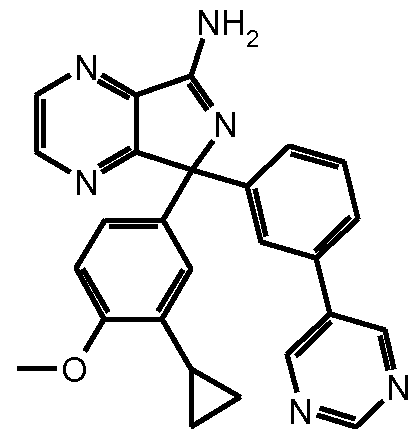
Pyrimidin-5-ylboronic acid (93 mg, 0.75 mmol), 5-(3-chlorophenyl)-5-(3-cyclopropyl-4- methoxyphenyl)-5H-pyrrolo[3,4-δ]pyrazin-7-amine (245mg, 0.63 mmol), tricyclohexyl phosphine (52.7 mg, 0.19 mmol), tris(dibenzylideneacetone)dipalladium(0) (43.0 mg, 0.05 mmol) and potassium orthophosphate (226 mg, 1.07 mmol) were dissolved in DME (4.5 mL) and water (0.5 mL) and the mixture was heated for 3 h to 120 0C using a microwave reactor. EtOAc, water and brine were added to the mixture. The organic phase was collected, filtered through celite, washed with brine, dried over MgSO4 and concentrated.
The residue was purified using preparative ΗPLC to give 110 mg (40%) of the title compound.
1H NMR (400 MHz, DMSO-J6) δ ppm 9.19 (s, 1 H) 8.96 (s, 2 H) 8.70 - 8.75 (m, 2 H) 7.84 (t, 1 H) 7.62 - 7.69 (m, 2 H) 7.46 (t, 1 H) 7.35 - 7.40 (m, 1 H) 7.06 - 7.12 (m, 3 H) 6.85 (d, 1 H) 3.75 (s, 3 H) 1.96 - 2.04 (m, 1 H) 0.81 - 0.88 (m, 2 H) 0.39 - 0.45 (m, 2 H); MS (ES) m/z 435 [M+l]+.
Example 6
5-(2-Cyclopropylpyridin-4-yl)-5-(3-(pyrimidin-5-yl)phenyl)-5H-pyrrolo[3,4- b] pyrazin-7-amine

The title compound was synthesized as described for Example 1 in 53% yield starting from pyrimidin-5-ylboronic acid (38.9 mg, 0.31 mmol) and 5-(3-bromophenyl)-5-(2- cyclopropylpyridin-4-yl)-5/f-pyrrolo[3,4-δ]pyrazin-7-amine (85mg, 0.21 mmol).
1H NMR (400 MHz, DMSO-J6) δ ppm 9.19 (s, 1 H) 9.00 (s, 2 H) 8.75 - 8.79 (m, 2 H) 8.26 - 8.30 (m, 1 H) 7.93 (t, 1 H) 7.72 - 7.77 (m, 1 H) 7.66 - 7.70 (m, 1 H) 7.50 (t, 1 H) 7.45 - 7.48 (m, 1 H) 7.29 - 7.32 (m, 1 H) 7.24 (br. s., 2 H) 1.98 - 2.06 (m, 1 H) 0.82 - 0.89 (m, 4 H); MS (ES) m/z 406 [M+ 1]+.
Example 7
5-(2-(Benzyloxy)pyridin-4-yl)-5-(3-(pyrimidin-5-yl)phenyl)-5H-pyrrolo[3,4-6]pyrazin-
7-amine

The title compound was synthesized as described for Example 1 in 39% yield starting from pyrimidin-5-ylboronic acid (61.0 mg, 0.49 mmol) and 5-(2-(benzyloxy)pyridin-4-yl)-5-(3- bromophenyl)-5/f-pyrrolo[3,4-δ]pyrazin-7-amine (155mg, 0.33 mmol).
1H NMR (400 MHz, DMSO-J6) δ ppm 9.19 (s, 1 H) 8.99 (s, 2 H) 8.75 - 8.78 (m, 2 H) 8.06 - 8.09 (m, 1 H) 7.93 (t, 1 H) 7.73 - 7.77 (m, 1 H) 7.66 - 7.70 (m, 1 H) 7.50 (t, 1 H) 7.38 - 7.42 (m, 2 H) 7.28 - 7.37 (m, 3 H) 7.24 (br. s., 2 H) 7.17 - 7.20 (m, 1 H) 6.96 - 6.99 (m, 1 H) 5.28 (s, 2 H); MS (ES) m/z All [M+ 1]+.
Example 8
(R)- and (S)-5-(3-Fluoro-4-methoxy-5-methylphenyl)-5-(3-(pyrimidin-5-yl)phenyl)-
5H-pyrrolo [3,4-6] pyrazin-7-amine

The title compound was synthesized as described for Example 1 in 47% yield starting from pyrimidin-5-ylboronic acid (69.7 mg, 0.56 mmol) and 5-(3-bromophenyl)-5-(3-fluoro-4- methoxy-5-methylphenyl)-5H-pyrrolo[3,4-δ]pyrazin-7-amine (185 mg, 0.43 mmol).
1H NMR (400 MHz, DMSO-J6) δ ppm 9.18 (s, 1 H) 8.99 (s, 2 H) 8.71 - 8.79 (m, 2 H) 7.88 (t, 1 H) 7.69 - 7.74 (m, 1 H) 7.64 - 7.68 (m, 1 H) 7.48 (t, 1 H) 7.21 - 7.27 (m, 2 H) 7.16 (br. s., 2 H) 3.75 (d, 3 H) 2.16 (s, 3 H); MS (ES) m/z All [M+l]+.
Example 9
5-(4-Ethoxy-3,5-dimethylphenyl)-5-(3-(pyrimidin-5-yl)phenyl)-5H-pyrrolo[3,4- b] pyrazin-7-amine

The title compound was synthesized as described for Example 1 in 72% yield starting from pyrimidin-5-ylboronic acid (55.2 mg, 0.45 mmol) and 5-(3-bromophenyl)-5-(4-ethoxy-3,5- dimethylphenyl)-5/f-pyrrolo[3,4-δ]pyrazin-7-amine (130mg, 0.30 mmol).
1H NMR (400 MHz, DMSO-J6) δ ppm 9.19 (s, 1 H) 8.98 (s, 2 H) 8.74 - 8.76 (m, 1 H) 8.70 - 8.73 (m, 1 H) 7.90 (t, 1 H) 7.72 - 7.76 (m, 1 H) 7.62 - 7.67 (m, 1 H) 7.48 (t, 1 H) 7.22 (s, 2 H) 7.07 (s, 2 H) 3.72 (q, 2 H) 2.13 (s, 6 H) 1.29 (t, 3 H); MS (ES) m/z 437 [M+l]+.
Example 10
5-(4-Cyclopropoxy-3-fluoro-5-methylphenyl)-5-(3-(pyrimidin-5-yl)phenyl)-5H- pyrrolo [3,4-6] pyrazin-7-amine

The title compound was synthesized as described for Example 1 in 34% yield starting from pyrimidin-5-ylboronic acid (28.7 mg, 0.23 mmol) and 5-(3-bromophenyl)-5-(4- cyclopropoxy-3-fluoro-5-methylphenyl)-5/f-pyrrolo[3,4-δ]pyrazin-7-amine (70mg, 0.15 mmol).
1H NMR (500 MHz, DMSO-J6) δ ppm 9.18 (s, 1 H) 8.99 (s, 2 H) 8.77 (d, 1 H) 8.74 (d, 1 H) 7.89 (t, 1 H) 7.71 - 7.76 (m, 1 H) 7.63 - 7.68 (m, 1 H) 7.49 (t, 1 H) 7.23 - 7.28 (m, 2 H) 7.13 (br. s., 2 H) 4.02 - 4.08 (m, 1 H) 2.11 (s, 3 H) 0.65 - 0.70 (m, 2 H) 0.50 - 0.56 (m, 2 H); MS (ES) m/z 453 [M+ 1]+.
Example 11
7-(3-Cyclopropyl-4-methoxy-5-methyl-phenyl)-7-(3-pyrimidin-5-yl-phenyl)-7H- pyrrolo [3,4-6] pyrazin-5-ylamine

K3PO4 (57 mg, 0.26 mmol) and pyrimidine-5-boronic acid (112 mg, 0.89 mmol) were added to a degassed solution of 7-(3-Chloro-phenyl)-7-(3-cyclopropyl-4-methoxy-5- methyl-phenyl)-7H-pyrrolo[3,4-δ]pyrazin-5-ylamine (75 mg, 0.18 mmol) in DME (14 mL), followed by 2-dicyclohexylphosphino-2',4',6'-triisopropylbiphenyl (18 mg, 0.04 mmol) and Pd2dba3 (17 mg, 0.02 mmol). The reaction mixture was heated in a microwave reactor at 120 0C for 1 hour. Water (30 mL) was added and the mixture was extracted with EtOAc (3 x 30 mL). The combined extracts were dried over MgSO4, filtered and
concentrated in vacuo. The residue was purified by preparative TLC using 5% MeOH (2M NH3) in DCM to afford the title compound (41 mg, 51%).
1H NMR (400 MHz, CDCl3) δ ppm 9.18 (s, 1 H), 8.89 (s, 2 H), 8.66 (d, 1 H), 8.57 (d, 1 H), 7.80 (s, 1 H), 7.69 (m, 1 H), 7.41 - 7.48 (m, 2 H), 7.16 - 7.20 (m, 1 H), 6.89 (d, 1 H), 3.76 (s, 3 H), 2.23 (s, 3 H), 2.13 (m, 1 H), 0.87 - 0.94 (m, 2 H), 0.58 (m, 2 H); MS (ES) m/z 449 [M+ 1]+.
Example 12
5-(3-(5-Chloropyridin-3-yl)phenyl)-5-(2-cyclopropylpyridin-4-yl)-5H-pyrrolo[3,4- b]pyrazin-7-amine

The title compound was synthesized as described for Example 1 in 38% yield starting from 5-chloropyridin-3-ylboronic acid (49.4 mg, 0.31 mmol) and 5-(3-bromophenyl)-5-(2- cyclopropylpyridin-4-yl)-5H-pyrrolo[3,4-b]pyrazin-7-amine (85mg, 0.21 mmol).
1H NMR (400 MHz, DMSO-J6) ppm 8.77 - 8.79 (m, 1 H) 8.75 - 8.77 (m, 1 H) 8.71 (d, 1 H) 8.63 (d, 1 H) 8.27 - 8.30 (m, 1 H) 8.10 (t, 1 H) 7.92 (t, 1 H) 7.72 - 7.76 (m, 1 H) 7.62 - 7.67 (m, 1 H) 7.43 - 7.51 (m, 2 H) 7.27 - 7.30 (m, 1 H) 7.24 (br. s., 2 H) 1.98 - 2.05 (m, 1 H) 0.82 - 0.89 (m, 4 H) ; MS (ES) m/z 439 [M+l]+. Example 13
(S)-5-(4-Methoxy-3,5-dimethylphenyl)-5-(3-(pyrazin-2-yl)phenyl)-5H-pyrrolo[3,4- b] pyrazin-7-amine

(R)-5-(3-bromophenyl)-5-(4-methoxy-3,5-dimethylphenyl)-5H-pyrrolo[3,4-b]pyrazin-7- amine (0.67 g, 1.58 mmol), tetrakis(triphenylphosphine)palladium(0) (0.183 g, 0.16 mmol) and 2-(tributylstannyl)pyrazine (0.643 g, 1.74 mmol) were dissolved in DMF (4.5 mL) and heated to 120 0C with MW for 30 min. The mixture was partitioned between ACN and n- heptane. ACN was evaporated and the residue was placed on a silica column eluting with MeOH(containing 7N NH3) from 0-2.5% in DCM to give 236mg (35% yield) of the title compound with 99.5% enantiomeric purity (Chiral HPLC analysis; 20% EtOH+DEA 80%
CO2 on Chiralpak AD-H 4.6*250 mm 5μm at 3mL/min using 5-(4-methoxy-3,5- dimethylphenyl)-5-(3(pyrazin-2-yl)phenyl)-5H-pyrrolo[3,4-δ]pyrazin-7-amine as reference).
1H NMR (500 MHz, DMSO-J6) ppm 9.13 (d, 1 H) 8.75 (d, 1 H) 8.69 - 8.73 (m, 2 H)
8.60 (d, 1 H) 8.36 (t, 1 H) 7.94 - 7.98 (m, 1 H) 7.72 - 7.76 (m, 1 H) 7.45 (t, 1 H) 7.19 (s, 2
H) 7.08 (br. s., 2 H) 3.58 (s, 3 H) 2.13 (s, 6 H); MS (ES) m/z 423 [M+l]+.
Example 14
(R)- and (S)-5-(2-Cyclopropylpyridin-4-yl)-5-(3-(pyrimidin-5-yl)phenyl)-5H- pyrrolo[3,4-b]pyrazin-7-amine

/ 75% CO2 as mobile phase at a flow rate of 50 mL/min at 35 0C).
Isomer 1 with unknown absolute configuration, the first enantiomer to elute was collected
(14 mg, 33% yield): 1H NMR (500 MHz, DMSO-J6) δ ppm 0.77 - 0.93 (m, 4 H), 1.98 - 2.06 (m, 1 H), 7.23 (br. s., 2 H), 7.31 (dd, 1 H), 7.47 (d, 1 H), 7.50 (t, 1 H), 7.65 - 7.72 (m,
1 H), 7.72 - 7.78 (m, 1 H), 7.93 (t, 1 H), 8.28 (d, 1 H), 8.74 - 8.82 (m, 2 H), 9.00 (s, 2 H),
9.19 (s, 1 H); MS (ES+) m/z 406 [M+H]+.
Isomer 2 with unknown absolute configuration, the second enantiomer to elute was collected (13 mg, 31% yield): 1H NMR (500 MHz, DMSO-J6) δ ppm 0.80 - 0.90 (m, 4 H), 1.98 - 2.05 (m, 1 H), 7.23 (br. s., 2 H), 7.31 (dd, 1 H), 7.47 (d, 1 H), 7.50 (t, 1 H), 7.66 -
7.70 (m, 1 H), 7.75 (dt, 1 H), 7.93 (t, 1 H), 8.28 (d, 1 H), 8.75 - 8.80 (m, 2 H), 9.00 (s, 2
H), 9.19 (s, 1 H); MS (ES+) m/z 406 [M+H]+.
Example 15
(S)-5-(4-methoxy-3,5-dimethylphenyl)-5-(3-(5-(prop-l-ynyl)pyridin-3-yl)phenyl)-5H- pyrrolo[3,4-b]pyrazin-7-amine

(R)-5-(3-bromophenyl)-5-(4-methoxy-3,5-dimethylphenyl)-5H-pyrrolo[3,4-b]pyrazin-7- amine (66 mg, 0.16 mmol), 5-(prop-l-ynyl)pyridin-3-yl boronic acid (37.6 mg, 0.23 mmol), [l,r-bis(diphenylphosphino)ferrocene]palladium(II) chloride (6.41 mg, 7.80 μmol), 2M aqueous Potassium carbonate (0.195 mL, 0.39 mmol) and 1,4-dioxane (2 mL) were mixed and stirred under a nitrogen atmosphere at 90 0C for 2 h. More 5-(prop-l- ynyl)pyridin-3-ylboronic acid (37.6 mg, 0.23 mmol), [1,1'- bis(diphenylphosphino)ferrocene]palladium(II) chloride (6.41 mg, 7.80 μmol) and potassium carbonate (0.195 mL, 0.39 mmol) were added and stirring continued at 90 0C for 2 h. When cooled to rt, the mixture was diluted with MeOH, filtered and purified by
preparative HPLC. The fractions containing the title compound were pooled, the MeOH removed in vacuo and the resulting aqueous residue was diluted with saturated aqueous NaHCOβ and extracted with DCM. The combined organics were passed through a phase separator, and the organic phase was collected and concentrated. The crude product was further purified on a silica gel column eluted with 0-10% (0.1M NH3 in MeOH) in DCM to give 24 mg (34% yield) of the title compound.
1H NMR (500 MHz, DMSO-J6) δ ppm 8.73 (d, 2 H) 8.67 (s, 1 H) 8.57 (s, 1 H) 7.91 (s, 1 H) 7.85 (s, 1 H) 7.70 (d, 1 H) 7.58 (d, 1 H) 7.39 - 7.47 (m, 1 H) 7.20 (s, 2 H) 7.07 (br. s., 2 H) 3.57 (s, 3 H) 2.13 (s, 6 H) 2.11 (s, 3 H); MS (ES) m/z 460 [M+l]+.
Assays
The level of activity of the compounds was tested using the following methods:
β-Secretase Enzyme
The enzyme used in the TR-FRET- and the BiaCore-assays is described as follows:
The cDNA for the soluble part of the human β-Secretase (AA 1 - AA 460) was cloned using the ASP2-FclO-l-IRES-GFP-neoK mammalian expression vector. The gene was fused to the Fc domain of IgGl (affinity tag) and stably cloned into HEK 293 cells.
Purified sBACE-Fc is stored in -8O0C in Tris buffer, pH 9.2 and has a purity of 95%.
TR-FRET Assay
The β-Secretase enzyme used in the TR-FRET assay is described as follows:
The cDNA for the soluble part of the human β-Secretase (AA 1 - AA 460) is expressed with a C-terminal Fc-fusion tag in HEK-293 cells. sBACE-Fc is purified using expanded bed adsorption over rPoteinA. The culture broth is not adjusted to pH. The resin is washed with PBS pH 7.4 and elution of BACE-Fc is performed with 50 mM glycine pH 2.5. The pH is immediately adjusted to pH 7.4 with IM Tris-base. No protease inhibitors are added. Purified sB ACE-Fc is stored in -80 0C, and has a purity of 40%.
The enzyme (truncated form) is diluted to 6 μg/mL (stock 1.3 mg/mL) and the substrate (Europium)CEVNLDAEFK(Qsy7) to 200 nM (stock 120 μM) in reaction buffer
(NaAcetate, chaps, triton x-100, EDTA pH4.5). The robotic systems Biomek FX and Velocity 11 are used for all liquid handling and the enzyme and substrate solutions are kept
on ice until they are placed in the robotic system. Enzyme (9 μL) is added to the plate then 1 μl of compound in dimethylsulphoxide is added, mixed and pre-incubated for 10 minutes. Substrate (10 μL) is then added, mixed and the reaction proceeds for 15 minutes at room temperature. The reaction is stopped with the addition of Stop solution (7 μL, NaAcetate, pH ~9). The fluorescence of the product is measured on a Victor II plate reader with an excitation wavelength of 340nm and an emission wavelength of 615nm. The assay is performed in a Costar 384 well round bottom, low volume, non-binding surface plate (Corning #3676). The final concentration of the enzyme is 2.7 μg/mL; the final
concentration of substrate is 100 nM (Km of -250 nM). The dimethylsulphoxide control, instead of test compound, defines the 100% activity level and 0% activity is defined by wells lacking enzyme (replaced with reaction buffer). A control inhibitor is also used in dose response assays and has an IC50 of -575 nM. sAPPβ release assay
SH-SY5Y cells are cultured in DMEM /F- 12 with Glutamax, 10% FCS and 1% nonessential aminoacids and cryopreserved and stored at -140 0C at a concentration of 7.5xlO6 cells per vial. Thaw cells and seed at a concentration of 2xlO5/mL in DMEM /F- 12 with Glutamax, 10% FCS and 1% non-essential aminoacids to a 384-well tissue culture treated plate, 30 μL cell suspention/well. Alternatively, use a 96-well tissue culture treated plate, and seed the cells at a concentration of 1.5xlO5/mL in DMEM /F- 12 with Glutamax, 10% FCS and 1% non-essential aminoacids, 100 μl cell suspention/well. The cell plates are then incubated for 7 hours at 37 0C, 5% CO2 and the cell medium is then removed. In 384 well mode this is followed by the addition to each well of 30 μL compound diluted in DMEM /F- 12 with Glutamax, 10% FCS, 1% non-essential aminoacids and 1% PeSt to a final cone of 1% DMSO. In 96 well mode the removal of cell medium is followed by the addition to each well of 90 μL compound diluted in DMEM /F- 12 with Glutamax, 10% FCS, 1% nonessential aminoacids and 1% PeSt to a final cone of 1% DMSO. The compounds are incubated with the cells for 16h (over night) at 37 0C, 5% CO2.
Meso Scale Discovery (MSD) plates are used for the detection of sAPPβ release.
MSD sAPPβ plates are blocked in 3% BSA in Tris wash buffer (40 μL/well in 384-format or 150 μL/well in 96-format) for 1 hour in RT and washed 4 times in Tris wash buffer (40 μL/well in 384-format or 150 μL/well in 96-format). 20 μL (384-format) or 50 μL (96-
format) of medium is transferred to the pre-b locked and washed 384 well or 96 well MSD sAPPβ microplates, and the cell plates are further used in an ATP assay to measure cytotoxicity. The MSD plates are incubated with shaking in RT for 2 hours (384-format) or
1 hour (96-format) followed by washing 4 times. 10 μL (384-format) or 25 μL (96-format) detection antibody is added (InM) per well followed by incubation with shaking in RT for
2 hours (384-format) or 1 hour (96-format) followed by washing 4 times. 40 μL (384- format) or 150 μL (96-format) Read Buffer is added per well and the plates are read in a SECTOR Imager. ATP assay
As indicated in the sAPPβ release assay, after transferring 20 μL (384-format) or 50 μL (96-format) medium from the cell plates for sAPPβ detection, the plates are used to analyse cytotoxicity using the ViaLightTM Plus cell proliferation/cytotoxicity kit from Cambrex BioScience that measures total cellular ATP.
The assay is performed according to the manufacture's protocol. Briefly, 10 μL (384- format) or 25 μL (96-format) cell lysis reagent is added per well. The plates are incubated at room temperature for 10 min.
Two min after addition of 25 μL (384-format) or 50 μl (96-format) reconstituted
ViaLightTM Plus ATP reagent, the luminescence is measured in a Wallac Victor2 1420 multilabel counter.
Results
Typical IC50 values for the compounds of the present invention are in the range of about 0.1 to about 30,000 nM. Biological data on exemplified final compounds is given below in Table I.
Table I.

Claims
1. A compound according to formula (I)

wherein
A is aryl or heteroaryl, wherein said aryl or heteroaryl is optionally substituted with one to three R1;
G is aryl or heteroaryl, wherein said aryl or heteroaryl is optionally substituted with one to three R2;
R1 is selected from halogen, C1-4alkyl, OR3, C3_6carbocyclyl, C^haloalkyl, C^alkylOH, and hydroxy;
R2 is selected from halogen, C^alkoxy, C2-6alkenyl, C1-3alkyl, and C2-6alkynyl;
R3 is selected from C^alkyl, C^alkylaryl, C3-6carbocyclyl, Ci_4alkylheteroaryl and C1.
4alkyl0C1_4alkyl;
R5 is selected from fluoro and hydroxy;
m is 0, 1 or 2;
as a free base or a pharmaceutically acceptable salt thereof.
2. A compound according to claim 1, wherein A is phenyl or pyridine, substituted with one to three R1.
3. A compound according to claim 1 or claim 2, wherein G is pyridine, pyrimidine or pyrazine, optionally substituted with one R .
4. A compound according to any one of claims 1 to 3, wherein R1 is halogen, Ci_4alkyl, C3. 6carbocyclyl, or OR3.
5. A compound according to claim 4, wherein R1 is halogen, methyl, cyclopropyl or methoxy.
6. A compound according to any one of claims 1 to 5, wherein R2 is halogen, or C2.
6alkynyl.
7. A compound according to any one of claims 1 to 6, wherein R is methyl, ethyl, cyclopropyl or benzyl.
8. A compound according to any one of claims 1-7, wherein m is 0.
9. A compound according to claim 1, wherein
A is phenyl or pyridine;
G is pyrimidine, pyridine or pyrazine;
R is halogen, methyl, cyclopropyl, or OR ;
R2 is halogen, or C2_6alkynyl;
R is methyl, ethyl, cyclopropyl, or CH2PI1; and
m is zero.
10. A compound according to claim 1 selected from
5-(4-Methoxy-3,5-dimethylphenyl)-5-(3-(pyrimidin-5-yl)phenyl)-5/f-pyrrolo[3,4- δ]pyrazin-7-amine;
(R)- and (5)-5-(4-Methoxy-3,5-dimethylphenyl)-5-(3-(pyrimidin-5-yl)phenyl)-5/f-pyrrolo-
[3,4-δ]pyrazin-7-amine;
5-(3-Chloro-4-methoxy-5-methylphenyl)-5-(3-(pyrimidin-5-yl)phenyl)-5/f-pyrrolo[3,4-δ]- pyrazin-7-amine;
5-(4-Methoxy-3,5-dimethylphenyl)-5-(3-(pyrazin-2-yl)phenyl)-5/f-pyrrolo[3,4-δ]pyrazin-
7-amine;
5-(3-Cyclopropyl-4-methoxyphenyl)-5-(3-(pyrimidin-5-yl)phenyl)-5/f-pyrrolo[3,4-δ]- pyrazin-7-amine; 5-(2-Cyclopropylpyridin-4-yl)-5-(3-(pyrimidin-5-yl)phenyl)-5/f-pyrrolo[3,4-δ]pyrazin-7- amine;
5-(2-(Benzyloxy)pyridin-4-yl)-5-(3-(pyrimidin-5-yl)phenyl)-5/f-pyrrolo[3,4-δ]pyrazin-7- amine;
5-(3-Fluoro-4-methoxy-5-methylphenyl)-5-(3-(pyrimidin-5-yl)phenyl)-5H-pyrrolo[3,4-δ]- pyrazin-7-amine;
5-(4-Ethoxy-3,5-dimethylphenyl)-5-(3-(pyrimidin-5-yl)phenyl)-5H-pyrrolo[3,4-δ]pyrazin-
7-amine;
5-(4-Cyclopropoxy-3-fluoro-5-methylphenyl)-5-(3-(pyrimidin-5-yl)phenyl)-5/f-pyrrolo- [3,4-δ]pyrazin-7-amine;
7-(3-Cyclopropyl-4-methoxy-5-methyl-phenyl)-7-(3-pyrimidin-5-yl-phenyl)-7/f-pyrrolo-
[3,4-δ]pyrazin-5-ylamine;
5-(3-(5-Chloropyridin-3-yl)phenyl)-5-(2-cyclopropylpyridin-4-yl)-5H-pyrrolo[3,4- b]pyrazin-7-amine;
(S)-5-(4-Methoxy-3,5-dimethylphenyl)-5-(3-(pyrazin-2-yl)phenyl)-5H-pyrrolo[3,4- b]pyrazin-7-amine;
(R)-5-(2-Cyclopropylpyridin-4-yl)-5-(3-(pyrimidin-5-yl)phenyl)-5H-pyrrolo[3,4- b]pyrazin-7-amine;
(S)-5-(2-Cyclopropylpyridin-4-yl)-5-(3-(pyrimidin-5-yl)phenyl)-5H-pyrrolo[3,4-b]pyrazin- 7-amine;
(S)-5-(4-methoxy-3,5-dimethylphenyl)-5-(3-(5-(prop-l-ynyl)pyridin-3-yl)phenyl)-5H- pyrrolo[3 ,4-b]pyrazin-7-amine;
as a free base or a pharmaceutically acceptable salt thereof.
11. A pharmaceutical composition comprising as active ingredient a therapeutically effective amount of a compound according to any one of claims 1 to 10 in association with pharmaceutically acceptable excipients, carriers or diluents.
12. A compound according to any one of claims 1 to 10, or a pharmaceutically acceptable salt thereof, for use as a medicament.
13. A compound of any one of claims 1 to 10, or a pharmaceutically acceptable salt thereof, as a medicament for treating or preventing an Aβ-related pathology.
14. A compound of any one of claims 1 to 10, or a pharmaceutically acceptable salt thereof, as a medicament for treating or preventing an Aβ-related pathology, wherein said Aβ-related pathology is Downs syndrome, a β-amyloid angiopathy, cerebral amyloid angiopathy, hereditary cerebral hemorrhage, a disorder associated with cognitive impairment, MCI ("mild cognitive impairment"), Alzheimer Disease, memory loss, attention deficit symptoms associated with Alzheimer disease, neurodegeneration associated with Alzheimer Disease, dementia of mixed vascular origin, dementia of degenerative origin, pre-senile dementia, senile dementia, dementia associated with Parkinson's disease, progressive supranuclear palsy or cortical basal degeneration.
15. A compound of any one of claims 1 to 10, or a pharmaceutically acceptable salt thereof, as a medicament for treating or preventing Alzheimer Disease.
16. A compound of any one of claims 1 to 10, or a pharmaceutically acceptable salt thereof, in the manufacture of a medicament for treating or preventing an Aβ-related pathology.
17. Use of a compound of any one of claims 1 to 10, or a pharmaceutically acceptable salt thereof, in the manufacture of a medicament for treating or preventing an Aβ-related pathology, wherein said Aβ-related pathology is Downs syndrome, a β-amyloid angiopathy, cerebral amyloid angiopathy, hereditary cerebral hemorrhage, a disorder associated with cognitive impairment, MCI ("mild cognitive impairment"), Alzheimer Disease, memory loss, attention deficit symptoms associated with Alzheimer disease, neurodegeneration associated with Alzheimer disease, dementia of mixed vascular origin, dementia of degenerative origin, pre-senile dementia, senile dementia, dementia associated with Parkinson's disease, progressive supranuclear palsy or cortical basal degeneration.
18. Use of a compound of any one of claims 1 to 10, or a pharmaceutically acceptable salt thereof, in the manufacture of a medicament for treating or preventing Alzheimer's Disease.
19. A method of treating or preventing an Aβ-related pathology in a patient in need thereof, comprising administering to said patient a therapeutically effective amount of a compound of any one of claims 1 to 10, or a pharmaceutically acceptable salt thereof.
20. The method of claim 19, wherein said Aβ-related pathology is Downs syndrome, a β-amyloid angiopathy, cerebral amyloid angiopathy, hereditary cerebral hemorrhage, a disorder associated with cognitive impairment, MCI ("mild cognitive impairment"), Alzheimer Disease, memory loss, attention deficit symptoms associated with Alzheimer disease, neurodegeneration associated with Alzheimer disease, dementia of mixed vascular origin, dementia of degenerative origin, pre-senile dementia, senile dementia, dementia associated with Parkinson's disease, progressive supranuclear palsy or cortical basal degeneration.
21. A method of treating or preventing an Aβ-related pathology in a patient in need thereof, comprising administering to said patient a therapeutically effective amount of a compound of any one of claims 1 to 10, or a pharmaceutically acceptable salt thereof, and at least one cognitive enhancing agent, memory enhancing agent, or choline esterase inhibitor.
Applications Claiming Priority (2)
| Application Number | Priority Date | Filing Date | Title |
|---|---|---|---|
| US22253809P | 2009-07-02 | 2009-07-02 | |
| US61/222,538 | 2009-07-02 |
Publications (1)
| Publication Number | Publication Date |
|---|---|
| WO2011002409A1 true WO2011002409A1 (en) | 2011-01-06 |
Family
ID=43411291
Family Applications (1)
| Application Number | Title | Priority Date | Filing Date |
|---|---|---|---|
| PCT/SE2010/050761 Ceased WO2011002409A1 (en) | 2009-07-02 | 2010-07-02 | 5h-pyrrolo[3,4-£>]pyrazin-7-amine derivatives inhibitors of beta-secretase |
Country Status (1)
| Country | Link |
|---|---|
| WO (1) | WO2011002409A1 (en) |
Cited By (12)
| Publication number | Priority date | Publication date | Assignee | Title |
|---|---|---|---|---|
| WO2012038438A1 (en) * | 2010-09-22 | 2012-03-29 | Janssen Pharmaceutica Nv | 4,7-DIHYDRO-PYRAZOLO[1,5-a]PYRAZIN-6-YLAMINE DERIVATIVES USEFUL AS INHIBITORS OF BETA-SECRETASE (BACE) |
| WO2012117027A1 (en) * | 2011-03-01 | 2012-09-07 | Janssen Pharmaceutica Nv | 6,7-dihydro-pyrazolo[1,5-a]pyrazin-4-ylamine derivatives useful as inhibitors of beta-secretase (bace) |
| CN103415521A (en) * | 2011-03-09 | 2013-11-27 | 詹森药业有限公司 | 3,4-dihydro-pyrrolo[1,2-a]pyrazin-1-ylamine derivatives useful as inhibitors of beta-secretase (bace) |
| WO2014013076A1 (en) | 2012-07-20 | 2014-01-23 | Eisai R&D Management Co., Ltd. | Hexahydropyrrolothiazine compounds |
| US8729071B2 (en) | 2009-10-08 | 2014-05-20 | Merck Sharp & Dohme Corp. | Iminothiadiazine dioxide compounds as BACE inhibitors, compositions and their use |
| US8921363B2 (en) | 2010-08-05 | 2014-12-30 | Amgen Inc. | Derivatives of 1 H-isoindol-3-amine, 1 H-iso-aza-indol-3amine, 3,4-dihydroisoquinolin-1-amine, and 1,4-dihydroisoquinolin-3-amine as beta-secretase inhibitors |
| CN105283457A (en) * | 2013-06-12 | 2016-01-27 | 詹森药业有限公司 | 4-amino-6-phenyl-5,6-dihydroimidazo[1,5-A]pyrazine derivatives as inhibitors of beta-secretase (BACE) |
| US9751886B2 (en) | 2013-06-12 | 2017-09-05 | Janssen Pharmaceutica Nv | 4-amino-6-phenyl-6,7-dihydro[1,2,3]triazolo[1,5-A]pyrazine derivatives as inhibitors of beta-secretase (BACE) |
| US9828350B2 (en) | 2010-06-09 | 2017-11-28 | Janssen Pharmaceutica Nv | 5,6-dihydro-2H-[1,4]oxazin-3-yl-amine derivatives useful as inhibitors of beta-secretase (BACE) |
| US9834559B2 (en) | 2013-06-12 | 2017-12-05 | Janssen Pharmaceutica Nv | 4-Amino-6-phenyl-5,6-dihydroimidazo[1,5-a]pyrazin-3(2H)-one derivatives as inhibitors of beta-secretase (BACE) |
| US9840507B2 (en) | 2010-12-22 | 2017-12-12 | Janssen Pharmaceutica, Nv | 5,6-dihydro-imidazo[1,2-a]pyrazin-8-ylamine derivatives useful as inhibitors of beta-secretase (BACE) |
| US10106524B2 (en) | 2014-12-18 | 2018-10-23 | Janssen Pharmaceutica Nv | 2,3,4,5-tetrahydropyridin-6-amine and 3,4-dihydro-2H-pyrrol-5-amine compound inhibitors of beta-secretase |
Citations (5)
| Publication number | Priority date | Publication date | Assignee | Title |
|---|---|---|---|---|
| WO2007149033A1 (en) * | 2006-06-22 | 2007-12-27 | Astrazeneca Ab | Substituted isoindoles as bace inhibitors and their use |
| US20080287462A1 (en) * | 2007-05-15 | 2008-11-20 | Astrazeneca Ab | New compounds 834 |
| WO2009005470A1 (en) * | 2007-07-05 | 2009-01-08 | Astrazeneca Ab | Aryl and heteroaryl substituted isoindole derivatives as bace inhibitors |
| WO2009005471A1 (en) * | 2007-07-05 | 2009-01-08 | Astrazeneca Ab | Aryl and heteroaryl substituted isoindole derivatives as bace inhibitors |
| WO2010056194A1 (en) * | 2008-11-14 | 2010-05-20 | Astrazeneca Ab | 5h-pyrrolo [ 3, 4-b] pyridin derivatives and their use |
-
2010
- 2010-07-02 WO PCT/SE2010/050761 patent/WO2011002409A1/en not_active Ceased
Patent Citations (5)
| Publication number | Priority date | Publication date | Assignee | Title |
|---|---|---|---|---|
| WO2007149033A1 (en) * | 2006-06-22 | 2007-12-27 | Astrazeneca Ab | Substituted isoindoles as bace inhibitors and their use |
| US20080287462A1 (en) * | 2007-05-15 | 2008-11-20 | Astrazeneca Ab | New compounds 834 |
| WO2009005470A1 (en) * | 2007-07-05 | 2009-01-08 | Astrazeneca Ab | Aryl and heteroaryl substituted isoindole derivatives as bace inhibitors |
| WO2009005471A1 (en) * | 2007-07-05 | 2009-01-08 | Astrazeneca Ab | Aryl and heteroaryl substituted isoindole derivatives as bace inhibitors |
| WO2010056194A1 (en) * | 2008-11-14 | 2010-05-20 | Astrazeneca Ab | 5h-pyrrolo [ 3, 4-b] pyridin derivatives and their use |
Cited By (35)
| Publication number | Priority date | Publication date | Assignee | Title |
|---|---|---|---|---|
| US8729071B2 (en) | 2009-10-08 | 2014-05-20 | Merck Sharp & Dohme Corp. | Iminothiadiazine dioxide compounds as BACE inhibitors, compositions and their use |
| US9687494B2 (en) | 2009-10-08 | 2017-06-27 | Merck Sharp & Dohme Corp. | Iminothiadiazine dioxide compounds as BACE inhibitors, compositions, and their use |
| US9475785B2 (en) | 2009-10-08 | 2016-10-25 | Merck Sharp & Dohme Corp. | Iminothiadiazine dioxide compounds as BACE inhibitors, compositions and their use |
| US9428475B2 (en) | 2009-10-08 | 2016-08-30 | Merck Sharp & Dohme Corp. | Iminothiadiazine dioxide compounds as BACE inhibitors, compositions, and their use |
| US9029362B2 (en) | 2009-10-08 | 2015-05-12 | Merck Sharp & Dohme Corp. | Iminothiadiazine dioxide compounds as brace inhibitors, compositions, and their use |
| US8940748B2 (en) | 2009-10-08 | 2015-01-27 | Merck Sharp & Dohme Corp. | Iminothiadiazine dioxide compounds as BACE inhibitors, compositions, and their use |
| US9828350B2 (en) | 2010-06-09 | 2017-11-28 | Janssen Pharmaceutica Nv | 5,6-dihydro-2H-[1,4]oxazin-3-yl-amine derivatives useful as inhibitors of beta-secretase (BACE) |
| US8921363B2 (en) | 2010-08-05 | 2014-12-30 | Amgen Inc. | Derivatives of 1 H-isoindol-3-amine, 1 H-iso-aza-indol-3amine, 3,4-dihydroisoquinolin-1-amine, and 1,4-dihydroisoquinolin-3-amine as beta-secretase inhibitors |
| CN103097389B (en) * | 2010-09-22 | 2015-10-14 | 詹森药业有限公司 | 4,7-Dihydro-pyrazolo[1,5-a]pyrazin-6-ylamine derivatives useful as beta-secretase (BACE) inhibitors |
| WO2012038438A1 (en) * | 2010-09-22 | 2012-03-29 | Janssen Pharmaceutica Nv | 4,7-DIHYDRO-PYRAZOLO[1,5-a]PYRAZIN-6-YLAMINE DERIVATIVES USEFUL AS INHIBITORS OF BETA-SECRETASE (BACE) |
| AU2011306941B2 (en) * | 2010-09-22 | 2014-06-12 | Janssen Pharmaceutica Nv | 4,7-dihydro-pyrazolo[1,5-a] pyrazin-6-ylamine derivatives useful as inhibitors of beta-secretase (BACE) |
| CN103097389A (en) * | 2010-09-22 | 2013-05-08 | 詹森药业有限公司 | 4,7-dihydro-pyrazolo[1,5-a]pyrazin-6-ylamine derivatives useful as inhibitors of beta-secretase (bace) |
| US8609660B2 (en) | 2010-09-22 | 2013-12-17 | Janssen Pharmaceutica Nv | 4,7-dihydro-pyrazolo[1,5-a]pyrazin-6-ylamine derivatives useful as inhibitors of beta-secretase (BACE) |
| US20130190318A1 (en) * | 2010-09-22 | 2013-07-25 | Janssen Pharmaceutica Nv | 4,7-DIHYDRO-PYRAZOLO[1,5-a]PYRAZIN-6-YLAMINE DERIVATIVES USEFUL AS INHIBITORS OF BETA-SECRETASE (BACE) |
| EA021723B1 (en) * | 2010-09-22 | 2015-08-31 | Янссен Фармацевтика Нв | DERIVATIVES 4,7-DIHYDROPYRAZOLO [1,5-a] PIRAZIN-6-ILAMINA USED AS BETA SECRETASE INHIBITORS (BACE) |
| US9840507B2 (en) | 2010-12-22 | 2017-12-12 | Janssen Pharmaceutica, Nv | 5,6-dihydro-imidazo[1,2-a]pyrazin-8-ylamine derivatives useful as inhibitors of beta-secretase (BACE) |
| US9346811B2 (en) | 2011-03-01 | 2016-05-24 | Janssen Pharmaceutica Nv | 6,7-dihydro-pyrazolo[1,5-a]pyrazin-4-ylamine derivatives useful as inhibitors of beta-secretase (BACE) |
| KR20140010052A (en) * | 2011-03-01 | 2014-01-23 | 얀센 파마슈티카 엔.브이. | 6,7-dihydro-pyrazolo[1,5-a]pyrazin-4-ylamine derivatives useful as inhibitors of beta-secretase(bace) |
| KR102012671B1 (en) | 2011-03-01 | 2019-08-21 | 얀센 파마슈티카 엔.브이. | 6,7-DIHYDRO-PYRAZOLO[1,5-a]PYRAZIN-4-YLAMINE DERIVATIVES USEFUL AS INHIBITORS OF BETA-SECRETASE(BACE) |
| EA022649B1 (en) * | 2011-03-01 | 2016-02-29 | Янссен Фармацевтика Нв | 6,7-DIHYDRO-PYRAZOLO[1,5-a]PYRAZIN-4-YLAMINE DERIVATIVES USEFUL AS INHIBITORS OF BETA-SECRETASE (BACE) |
| CN103415519B (en) * | 2011-03-01 | 2016-03-02 | 詹森药业有限公司 | As 6,7-dihydro-pyrazol [1, the 5-a] pyrazine-4-yl amine derivatives that beta-secretase (BACE) inhibitor is useful |
| JP2014506907A (en) * | 2011-03-01 | 2014-03-20 | ジヤンセン・フアーマシユーチカ・ナームローゼ・フエンノートシヤツプ | 6,7-Dihydro-pyrazolo [1,5-a] pyrazin-4-ylamine derivatives useful as inhibitors of β-secretase (BACE) |
| AU2012222394B2 (en) * | 2011-03-01 | 2016-06-16 | Janssen Pharmaceutica Nv | 6,7-dihydro-pyrazolo[1,5-a]pyrazin-4-ylamine derivatives useful as inhibitors of beta-secretase (BACE) |
| CN103415519A (en) * | 2011-03-01 | 2013-11-27 | 詹森药业有限公司 | 6,7-dihydro-pyrazolo[1,5-a]pyrazin-4-ylamine derivatives useful as inhibitors of beta-secretase (bace) |
| WO2012117027A1 (en) * | 2011-03-01 | 2012-09-07 | Janssen Pharmaceutica Nv | 6,7-dihydro-pyrazolo[1,5-a]pyrazin-4-ylamine derivatives useful as inhibitors of beta-secretase (bace) |
| CN103415521A (en) * | 2011-03-09 | 2013-11-27 | 詹森药业有限公司 | 3,4-dihydro-pyrrolo[1,2-a]pyrazin-1-ylamine derivatives useful as inhibitors of beta-secretase (bace) |
| CN103415521B (en) * | 2011-03-09 | 2016-01-06 | 詹森药业有限公司 | 3,4-Dihydro-pyrrolo[1,2-a]pyrazin-1-ylamine derivatives useful as beta-secretase (BACE) inhibitors |
| US9845326B2 (en) | 2011-03-09 | 2017-12-19 | Janssen Pharmaceutica Nv | Substituted 3,4-dihydropyrrolo[1,2-A]pyrazines as beta-secretase (BACE) inhibitors |
| WO2014013076A1 (en) | 2012-07-20 | 2014-01-23 | Eisai R&D Management Co., Ltd. | Hexahydropyrrolothiazine compounds |
| US9580433B2 (en) | 2013-06-12 | 2017-02-28 | Janssen Pharmaceutica Nv | 4-amino-6-phenyl-5,6-dihydroimidazo[1,5-A]pyrazine derivatives as inhibitors of beta-secretase (BACE) |
| US9834559B2 (en) | 2013-06-12 | 2017-12-05 | Janssen Pharmaceutica Nv | 4-Amino-6-phenyl-5,6-dihydroimidazo[1,5-a]pyrazin-3(2H)-one derivatives as inhibitors of beta-secretase (BACE) |
| US9751886B2 (en) | 2013-06-12 | 2017-09-05 | Janssen Pharmaceutica Nv | 4-amino-6-phenyl-6,7-dihydro[1,2,3]triazolo[1,5-A]pyrazine derivatives as inhibitors of beta-secretase (BACE) |
| CN105283457B (en) * | 2013-06-12 | 2018-09-18 | 詹森药业有限公司 | 4- amino -6- phenyl -5,6- glyoxalidine as beta-secretase (BACE) inhibitor simultaneously [1,5-A] pyrazines derivatives |
| CN105283457A (en) * | 2013-06-12 | 2016-01-27 | 詹森药业有限公司 | 4-amino-6-phenyl-5,6-dihydroimidazo[1,5-A]pyrazine derivatives as inhibitors of beta-secretase (BACE) |
| US10106524B2 (en) | 2014-12-18 | 2018-10-23 | Janssen Pharmaceutica Nv | 2,3,4,5-tetrahydropyridin-6-amine and 3,4-dihydro-2H-pyrrol-5-amine compound inhibitors of beta-secretase |
Similar Documents
| Publication | Publication Date | Title |
|---|---|---|
| WO2011002409A1 (en) | 5h-pyrrolo[3,4-£>]pyrazin-7-amine derivatives inhibitors of beta-secretase | |
| US8030500B2 (en) | Substituted isoindoles for the treatment and/or prevention of Aβ- related pathologies | |
| EP2655378B1 (en) | Compounds and their use as bace inhibitors | |
| US20100125081A1 (en) | New compounds 574 | |
| US20100125087A1 (en) | New compounds 575 | |
| EP3319966B1 (en) | Bicyclic heterocyclic compounds as pde2 inhibitors | |
| WO2011002407A1 (en) | Novel compounds for treatment of neurodegeneration associated with diseases, such as alzheimer's disease or dementia | |
| EP3270926B1 (en) | Triazolyl pyrimidinone compounds as pde2 inhibitors | |
| EP2864330A1 (en) | Pyrrolopyrazone inhibitors of tankyrase | |
| US20100234593A1 (en) | Imidazo[4,5-B]Pyridine-7-Carboxamides 704 | |
| WO2008121064A1 (en) | New imidazo[4,5-b]pyridine-6-halo-7-aryl/heteroaryl compounds 705 | |
| EP3177624A1 (en) | Imidazopyridazine compounds | |
| WO2011002408A1 (en) | Novel compounds for treatment of neurodegeneration associated with diseases, such as alzheimer's disease or dementia | |
| WO2012064269A1 (en) | COMPOUNDS AND THEIR USE FOR TREATMENT OF Αβ-RELATED DISEASES | |
| CN115745955A (en) | Pyrimidone compounds, preparation method and medical application thereof | |
| EP3285581A1 (en) | Pyrazolyl pyrimidinone compounds as pde2 inhibitors | |
| EP3291817B1 (en) | Heteroaryl-pyrimidinone compounds as pde2 inhibitors | |
| WO2012087236A1 (en) | Compounds and their use as bace inhibitors | |
| HK1190721A (en) | Compounds and their use as bace inhibitors | |
| HK1190721B (en) | Compounds and their use as bace inhibitors |
Legal Events
| Date | Code | Title | Description |
|---|---|---|---|
| 121 | Ep: the epo has been informed by wipo that ep was designated in this application |
Ref document number: 10794462 Country of ref document: EP Kind code of ref document: A1 |
|
| NENP | Non-entry into the national phase |
Ref country code: DE |
|
| 122 | Ep: pct application non-entry in european phase |
Ref document number: 10794462 Country of ref document: EP Kind code of ref document: A1 |