WO2010144293A1 - Synthesis of telcagepant and intermediates thereof - Google Patents
Synthesis of telcagepant and intermediates thereof Download PDFInfo
- Publication number
- WO2010144293A1 WO2010144293A1 PCT/US2010/037148 US2010037148W WO2010144293A1 WO 2010144293 A1 WO2010144293 A1 WO 2010144293A1 US 2010037148 W US2010037148 W US 2010037148W WO 2010144293 A1 WO2010144293 A1 WO 2010144293A1
- Authority
- WO
- WIPO (PCT)
- Prior art keywords
- alkyl
- compound
- salt
- product
- reaction
- Prior art date
- Legal status (The legal status is an assumption and is not a legal conclusion. Google has not performed a legal analysis and makes no representation as to the accuracy of the status listed.)
- Ceased
Links
- COZIJLDLJMKBRZ-LDYMZIIASA-N N[C@H](CC[C@H](CN1CC(F)(F)F)c(cccc2F)c2F)C1=O Chemical compound N[C@H](CC[C@H](CN1CC(F)(F)F)c(cccc2F)c2F)C1=O COZIJLDLJMKBRZ-LDYMZIIASA-N 0.000 description 3
- 0 CC(CCC(C1)(C1[N+]([O-])=O)c(cccc1F)c1F)(C(*)=O)NC(C)=O Chemical compound CC(CCC(C1)(C1[N+]([O-])=O)c(cccc1F)c1F)(C(*)=O)NC(C)=O 0.000 description 2
- PGPIHYYFAZASKA-UHFFFAOYSA-N CC(NC(CCC(CN1CC(F)(F)F)c(cccc2F)c2F)C1=O)=O Chemical compound CC(NC(CCC(CN1CC(F)(F)F)c(cccc2F)c2F)C1=O)=O PGPIHYYFAZASKA-UHFFFAOYSA-N 0.000 description 1
- MAZYUWWAKWXSHD-UHFFFAOYSA-N CC(NC(CCC(CNCC(F)(F)F)c(cccc1F)c1F)C(O)=O)=O Chemical compound CC(NC(CCC(CNCC(F)(F)F)c(cccc1F)c1F)C(O)=O)=O MAZYUWWAKWXSHD-UHFFFAOYSA-N 0.000 description 1
- NNTFPLKBXGDCPG-UHFFFAOYSA-N O=C(N1)N(C2CCNCC2)c2c1nccc2 Chemical compound O=C(N1)N(C2CCNCC2)c2c1nccc2 NNTFPLKBXGDCPG-UHFFFAOYSA-N 0.000 description 1
- GFVLOOLUVCPPPA-MRVPVSSYSA-N O=C(NCC1)N(CC(F)(F)F)C[C@@H]1c1cccc(F)c1F Chemical compound O=C(NCC1)N(CC(F)(F)F)C[C@@H]1c1cccc(F)c1F GFVLOOLUVCPPPA-MRVPVSSYSA-N 0.000 description 1
- TXOMKODUUBRTSU-DUXPYHPUSA-N O=C/C=C/c(cccc1F)c1F Chemical compound O=C/C=C/c(cccc1F)c1F TXOMKODUUBRTSU-DUXPYHPUSA-N 0.000 description 1
- OHGDKEJFHPLVGC-SSDOTTSWSA-N [O-][N+](C[C@@H](CC=O)c(cccc1F)c1F)=O Chemical compound [O-][N+](C[C@@H](CC=O)c(cccc1F)c1F)=O OHGDKEJFHPLVGC-SSDOTTSWSA-N 0.000 description 1
- HVLLSGMXQDNUAL-UHFFFAOYSA-N c(cc1)ccc1OP(Oc1ccccc1)Oc1ccccc1 Chemical compound c(cc1)ccc1OP(Oc1ccccc1)Oc1ccccc1 HVLLSGMXQDNUAL-UHFFFAOYSA-N 0.000 description 1
Classifications
-
- C—CHEMISTRY; METALLURGY
- C07—ORGANIC CHEMISTRY
- C07D—HETEROCYCLIC COMPOUNDS
- C07D223/00—Heterocyclic compounds containing seven-membered rings having one nitrogen atom as the only ring hetero atom
- C07D223/02—Heterocyclic compounds containing seven-membered rings having one nitrogen atom as the only ring hetero atom not condensed with other rings
- C07D223/06—Heterocyclic compounds containing seven-membered rings having one nitrogen atom as the only ring hetero atom not condensed with other rings with hetero atoms or with carbon atoms having three bonds to hetero atoms with at the most one bond to halogen, e.g. ester or nitrile radicals, directly attached to ring carbon atoms
- C07D223/12—Nitrogen atoms not forming part of a nitro radical
-
- C—CHEMISTRY; METALLURGY
- C07—ORGANIC CHEMISTRY
- C07C—ACYCLIC OR CARBOCYCLIC COMPOUNDS
- C07C201/00—Preparation of esters of nitric or nitrous acid or of compounds containing nitro or nitroso groups bound to a carbon skeleton
- C07C201/06—Preparation of nitro compounds
- C07C201/12—Preparation of nitro compounds by reactions not involving the formation of nitro groups
-
- C—CHEMISTRY; METALLURGY
- C07—ORGANIC CHEMISTRY
- C07C—ACYCLIC OR CARBOCYCLIC COMPOUNDS
- C07C205/00—Compounds containing nitro groups bound to a carbon skeleton
- C07C205/44—Compounds containing nitro groups bound to a carbon skeleton the carbon skeleton being further substituted by —CHO groups
-
- C—CHEMISTRY; METALLURGY
- C07—ORGANIC CHEMISTRY
- C07C—ACYCLIC OR CARBOCYCLIC COMPOUNDS
- C07C237/00—Carboxylic acid amides, the carbon skeleton of the acid part being further substituted by amino groups
- C07C237/02—Carboxylic acid amides, the carbon skeleton of the acid part being further substituted by amino groups having the carbon atoms of the carboxamide groups bound to acyclic carbon atoms of the carbon skeleton
- C07C237/20—Carboxylic acid amides, the carbon skeleton of the acid part being further substituted by amino groups having the carbon atoms of the carboxamide groups bound to acyclic carbon atoms of the carbon skeleton the carbon skeleton containing six-membered aromatic rings
-
- C—CHEMISTRY; METALLURGY
- C07—ORGANIC CHEMISTRY
- C07D—HETEROCYCLIC COMPOUNDS
- C07D401/00—Heterocyclic compounds containing two or more hetero rings, having nitrogen atoms as the only ring hetero atoms, at least one ring being a six-membered ring with only one nitrogen atom
- C07D401/02—Heterocyclic compounds containing two or more hetero rings, having nitrogen atoms as the only ring hetero atoms, at least one ring being a six-membered ring with only one nitrogen atom containing two hetero rings
- C07D401/04—Heterocyclic compounds containing two or more hetero rings, having nitrogen atoms as the only ring hetero atoms, at least one ring being a six-membered ring with only one nitrogen atom containing two hetero rings directly linked by a ring-member-to-ring-member bond
Definitions
- CGRP related Peptide receptor antagonist compounds, which are useful for the treatment of diseases or conditions of humans or other species which can be treated with inhibitors, modulators or promoters of the receptor function.
- diseases or conditions include those mentioned in the referenced applications, and specifically include migraine headache and cluster headache.
- telcagepant N-[(3R,65)-6-(2,3-Difluorophenyl)-2-oxo-l -(2,2,2- trifluoroethyl)azepan-3 -yl]-4-(2-oxo-2,3 -dihydro- 1 H-imidazo[4,5-b]pyridin- 1 -yl)piperidine- 1 - carboxamide:
- telcagepant is a potent CGRP modulator.
- the laboratory preparation of telcagepant is described in WO 2004/092166.
- Other methods of preparing telcagepant are described in International applications WO 2007/120589, WO 2007/120590 and WO 2007/120591.
- Salt forms of telcagepant, such as the potassium ethanolate form of telcagepant, are disclosed in WO 2007/120592.
- Applicants have now discovered a more efficient and more cost effective method of manufacturing the caprolactam intermediate (IA). Applicants have also discovered an efficient synthesis of telcagepant, using the caprolactam intermediate (IA).
- the present invention provides an efficient synthesis for the manufacture of (3R,65 r )-3-amino-6-(2,3-difluorophenyl)-l-(2,2,2-trifluoroethyl)azepan-2-one:
- the present invention is further directed to novel compounds which are intermediates in the synthesis of (I) and (IA).
- the present invention further provides an efficient preparation of telcagepant, using compounds (I) and (IA).
- the present invention is directed to a method for manufacture of the caprolactam intermediate of telcagepant, (3i?,65)-3-amino-6-(2,3- difluorophenyl)- 1 -(2,2,2-trifluoroethyl)azepan-2-one:
- the synthesis is the manufacture of (IA) starting from the commercially available starting material 1,2-difluorobenzene:
- the invention also contemplates the intermediate steps and intermediate products of the process from 1,2-difluorobenzene to compound (IA), including:
- 1,2-diflourobenzene is converted to difluorocinnamaldehyde (II) via an addition/rearrangement step, followed by an oxidation step.
- the 1,4-nitromethane addition step may occur in the presence of a catalyst (such as TMS prolinol) and one or more co-catalysts (such as pivalic acid and boric acid, and mixtures thereof).
- a catalyst such as TMS prolinol
- co-catalysts such as pivalic acid and boric acid, and mixtures thereof.
- the catalyst TMS prolinol may be used in crude form, without purification.
- suitable diacid, monoacid or disalts include the diacid (VI):
- enamine acid (IV) is not isolated, and the conversion of the nitroaldehyde to amine ester (V) occurs in a one-pot process.
- the hydrogenation step may occur in the presence of a halide anion, such as LiCl.
- a halide anion such as LiCl.
- the trifluorethylation step may occur in the presence of an organic or inorganic base, including an amine base, such as a tertiary amine.
- the conversion of (I) to (IA) may occur by deprotecting (I) to form the compound (I 1 )
- epimerization will occur by reaction with a catalytic amount of an aldeyhyde (for example, an aromatic aldeyhyde).
- an aldeyhyde for example, an aromatic aldeyhyde
- the conversion of (I) to (IA) may occur by reacting (I) with a base to form the compound (IA')
- the compound may be isolated as its salt or salt solvate, including the HCl salt MTBE solvate.
- the invention is directed to a synthesis of telcagepant
- (IA) comprises deprotecting the compound of (I)
- the conversion of (I) to (IA) comprises deprotecting (I)
- the invention is also directed to novel intermediates of the compounds of the invention, including:
- the first step of the process is the preparation of the difluorocinnamaldehyde (II).
- An exemplary scheme is shown below:
- the difluorophenyl (1,2-difluorobenzene) is reacted with a lithium source, such as n-hexyl lithium, and an aldeyhyde (for example, acrolein) in a suitable solvent (such as THF) to form 2,3-difluorophenyl lithium.
- a lithium source such as n-hexyl lithium
- an aldeyhyde for example, acrolein
- THF a suitable solvent
- Suitable reaction temperatures are less than -3O 0 C, or less than -40 0 C, or less than -55 0 C.
- Alternative sources of lithium including various alkyl lithiums, such as butyl lithium can also be used.
- the 2,3-difluorophenyl lithium product is reacted with an acid (for example, sulfuric acid) to form the difluorocinnamyl alcohol.
- an acid for example, sulfuric acid
- Suitable solvents for this reaction include a mixture of THF and water.
- the reactants may be heated, for example to more than 50 0 C, preferably more than 60 0 C. See also Leleti et al, Tetrahedron Lett 2007, 48: 8505-8507.
- difluorocinnamaldehyde (II).
- exemplary oxidation conditions and reactants include TEMPO (2,2,6,6-Tetramethylpiperidine-l- oxyl), NaOCl, NaBr and K 2 HPO 4 .
- An exemplary solvent includes an MTBE/toluene mixture.
- the oxidation is conducted at a basic pH, for example at 10.50 -11.0.
- the pH can be adjusted by addition of a base, such as KOH.
- the reaction should be maintained at a temperature of up to 25 0 C, for example from 10°-15°C during the addition.
- the aqueous layer can then be removed and the organic layer washed.
- the target compound (II) may be isolated as a solution in MTBE and toluene.
- a suitable diacid or salt thereof (3) is prepared, for use in the Knoevenagel condensation coupling step leading to the caprolactam intermediate.
- the first step may take the form of hydrolysis to form a di-sodium salt, such as shown below:
- R 1 , R 2 and R 3 represent C 1-10 alkyl groups.
- R 1 and R 2 may be ethyl, and R 3 may be methyl.
- the reaction may be performed by treatment with a base (for example, sodium hydroxide), in any suitable solvents.
- a base for example, sodium hydroxide
- Alternative bases include potassium hydroxide and lithium hydroxide.
- Exemplary solvents include a mixture of water and methanol.
- the coupling step of the caprolactam synthesis may alternatively be conducted with a diacid, or monoacid.
- the diacid may be in the form of a phosphate ester , such as a compound of formula (IX), which can be used subsequently to form enamine intermediate IV via a Horner-Wadsworth-Emmons reaction:
- R 1 is a Ci_io alkyl group, for example methyl or ethyl, and each R 2 is a d_io alkyl or Ce- io aryl group.
- the difluorocinnamaldehyde (II) is subjected to a nitromethane 1,4-addition step to form nitroaldehyde (III):
- the reaction may occur with a prolinol catalyst (for example, TMS prolinol) and one or more suitable co-catalysts.
- a prolinol catalyst for example, TMS prolinol
- suitable co-catalysts include a mixture of pivalic acid (up to 50 mol %, preferably up to 20 mol %, or up to 10 mol%) and boric acid (up to 100 mol %, preferably up to about 75%, or about 50 mol %).
- the reaction may occur in various solvents.
- An exemplary solvent is a mixture of THF and water. The reaction may occur at room temperature, or even lower temperatures.
- prolinol catalysts include compounds of formula (VIII):
- R 1 and R 2 are independently selected from the group consisting of (l)-Ci-i ⁇ alkyl,
- each alkyl or aryl is optionally substituted with one or more (a) -Ci-10 alky 1, (b) -OCi-10 alkyl, (c) halogen,
- each R 3 is independently selected from the group consisting of
- the TMS prolinol catalyst may be used in the nitromethane addition step in crude form, without purification.
- a suitable synthesis of the TMS prolinol catalyst is by preparation of prolinol ((S)- ⁇ , ⁇ -diphenyl-2-pyrrolidinemethanol) and an anime (such as imidazole) in a solvent (such as THF), followed by addition of chlorotrimethylsilane.
- the temperature at which the reactants are mixed is not critical, and the reaction may occur at room temperature.
- the nitroaldehyde product (III) of the nitromethane addition step is treated with the diacid or mono or disalts thereof, as described earlier, and a primary or secondary amine.
- An exemplary amine is pyrrolidine, as shown above. Suitable amounts of amine include up to 100 mol %, preferably from 10 to 50 mol %, for example about 35 mol %.
- an additional acid such as HCl, TFA, sulfuric acid or methylsulfonic acid, is added to the reaction mixture.
- Suitable solvents are polar solvents, such as NMP, DMAc, DMF, IPAC, ethyl acetate, MeCN and THF.
- an amine such as TBA
- Suitable solvents include IPAC, EtOAc, THF, MeCN, DMAc, DMF, heptane, hexane, toluene, cyclohexane, methanol, IPA and ethanol.
- nitroaldehyde (III) may be subjected to a Horner-Wadsworth- Emmons type coupling with a phosphate acid or ester to form an enamine acid of generic formula (IV) pr its ester.
- the phosphate acid reactants depicted below are commercially available.
- the tertiary amine salt prepared from the Knoevenagel coupling or the ester prepared from the Horner-Wadsworth-Emmons coupling then may be hydrogenated by various methods known to those skilled in the art.
- an acid such as HCl is added to the tributylamine salt in EtOAc.
- the organic phase may then be solvent switched to IPA.
- Hydrogenation may occur by addition of hydrogen with a palladium catalyst in the presence of an acid (such as sulfuric acid) in a polar solvent (for example, IPA).
- a polar solvent for example, IPA
- the salt is directly used for hydrogenation in a polar solvent such as IPA in the presence of an acid (such as sulfuric acid) and a palladium catalyst.
- additives including halide salts such as LiCl, ZnC ⁇ , n-Bu3NHCl or acids such as HCl allows suppressing the formation of des fluoro byproducts such as VA-I and VA-2, as shown below.
- An exemplary additive is LiCl. Suitable amounts of LiCl include up to 100 mol %, preferably from 5 to 50 mol %, for example about 15 mol %.
- the product of the hydrogenation reaction may then be reacted with a trifluoroethylating reagent (for example, CF 3 CH 2 OT1) in the presence of an organic or inorgance base, including an amine base, such as a tertiary amine (for example, triethylamine, iP ⁇ NEt).
- a suitable solvent is IPA, which may also be used for the hydrogenation step.
- the reaction is carried out with or without an aqueous workup of the crude hydrogenation reaction solution after the catalyst is removed.
- the reaction may be heated to temperatures greater than 30 0 C, or greater than 50 0 C, for example about 60 0 C.
- the reaction results in the production of trifluoroethylated ester, and should be followed by addition of a base (such as sodium hydroxide), to form the corresponding acid via hydrolysis.
- a base such as sodium hydroxide
- triphenyl phosphate is added to the product of the trifluorethylation step
- the product of the trifluoroethylation reaction may be charged with an amine (such as a tertiary amine) in the presence or absence of a catalytic amount of DMAP.
- amine such as a tertiary amine
- a suitable tertiary amine is triethylamine.
- Pivaloyl chloride may then be added, at greater than 0 0 C, or preferably at 35-50 0 C , up to about 60 0 C.
- the resulting product may then be subject to solvent switch, for example to DMSO solvent.
- the product of the cyclization reaction is subject to a deprotection step, by reaction with an acid.
- the resulting product is then subject to epimerization by addition of a catalytic amount of an aldeyhyde (such as an aromatic aldeyhyde).
- an aldeyhyde such as an aromatic aldeyhyde
- the product of the cyclization reaction is subject to a epimerization by reaction with a base (for example, sodium hydroxide, lithium hydroxide, potassium hydroxide or another strong base, or amine bases such as DBU).
- a base for example, sodium hydroxide, lithium hydroxide, potassium hydroxide or another strong base, or amine bases such as DBU.
- the product of the cyclization reaction may be heated, for example to about 20 0 C in a solution.
- Suitable solvents include a mixture of DMSO and water.
- a base, such as sodium hydroxide, can then be added to promote epimerization.
- the epimerization product can be subject to deprotection by treatment with an acid.
- Suitable acids include HCl, HBr, MsOH, HCl-HOAc, and H 2 SO 4 .
- the reaction may occur in an IPA-water or HOAc -water solvent mixture, at a temperature of greater than 60 0 C, or greater than 80 0 C (for example, about 95 0 C) or up to 110 0 C
- deprotection can be done by enzymatic hydrolysis.
- the final step may be isolation of the product in a solution of MTBE and its suitable solvent combination, to form the HCl salt MTBE solvate.
- the caprolactam intermediate (I) may be reacted with the intermediate (II):
- Scheme IA depicts an efficient method of synthesizing the neutral form of telcagepant from compounds (I) and (II) 2 and 3 using l,l'-carbonyldiimidazole as the carbonyl source;
- Scheme IB depicts an efficient method of synthesizing a potassium salt form of telcagepant starting from the neutral form of telcagepant;
- Scheme 1C depicts the efficient synthesis of a potassium salt form of telcagepant directly from compounds (I) and (II) using l,r-carbonyldiimidazole as the carbonyl source, without isolation of the neutral form of telcagepant. Further description of the synthesis of Scheme 2 can be found in International applications WO 2007/120589, WO 2007/120590 and WO 2007/120591.
- the invention is not limited to specific embodiments described in this application, and in fact includes additional features not expressly described above, including but not limited to the use of particular solvents and reaction conditions, the use of particular reagent forms (including neutral forms of compounds (II) and (III), and salt forms other than HCl salt forms), and the use or no-use of particular separation or isolation techniques, and other features.
- n-hexyllithium (2.3M in hexane, 19.21 L, 44.2 mol) dropwise over 3 h, while the internal temperature was maintained at ⁇ -55°C.
- the resulting slurry was aged at -60 to -55 0 C for additional 0.5 h.
- a solution of acrolein (3.26 L, 46.3 mol) in THF (5 L) was then added dropwise over 2.5 h. After additional 30 min. age at -60 to -55 0 C, the cold reaction solution was quenched by transferring the batch to a separate 100 L flask containing water (25 L). The aqueous layer was discarded.
- a solution of above 1,3 -difluorocinnamaldehyde (4) (0.595 mol assay, 100.0 g) was diluted with THF to a total volume of 1.2 L. H 2 O (200 mL), pivalic acid (3.04 g, 0.0297 mol), boric acid (18.39 g, 0.297 mol), TMS-prolinol (9.68 g assay, 0.0297 mol, solution in THF/MTBE, see step 3A procedure), and nitromethane (218 g, 3.568 mol) were added at ambient temperature. The resulting homogeneous solution was stirred at ambient temperature for 30 h (>94% conversion).
- the reaction solution was cooled to 2-7 0 C and quenched by addition of IPAc (1.0 L), 15% aq NaCl (300 mL) and 1 N HCl (100 mL).
- the organic layer was washed with 6% NaHCO 3 in 5% aq NaCl (500 mL) and 15% NaCl aq (300 mL x 2).
- the organic phase was azetropically dried and solvent-switched to IPAc while maintaining internal temperature at ⁇ 15 0 C.
- the final solution ( ⁇ 10 L) was directly used in next step or stored at 5 0 C.
- Sample preparation Pipet 2 mL of 2,4-dinitrophenylhydrazine (DNPH, -cone. 10 mg/mL in acetontitrile), 25 uL H3PO 4 in 25 mL volumetric flask , add 100 uL reaction sample and let sample mixtures react at 40 0 C for 5 min. Dilute to volume with acetonitrile.
- DNPH 2,4-dinitrophenylhydrazine
- H3PO 4 25 uL volumetric flask
- Tributylamine (TBA) salt formation A crude IPAc solution of Knoevenagel product (6) (40 g assay, 0.122 mol) was azeotropically dried with iPAc to 200 mL and filtered to remove inorganic salt. A lL flask equipped with a reflux condenser and an overhead stirrer was charged with tributylamine (43.5 mL, 0.183 mol) and IPAc (120 mL). After about -15% (30 mL) of the above IPAc solution of the free acid was charged dropwsie at 45 0 C, the batch was seeded with TBA salt (313 mg, 0.5 mol %) and aged at 45 0 C for 1-2 h.
- the remaining free acid IPAc solution was charged at 45 0 C over 3-4 h.
- the resulting slurry was aged at 45 0 C for additional 1 h, then, heptane (160 mL) was added dropwise at 45 0 C over 3 h.
- the resulting slurry was aged at 45 0 C for 1 h.
- the batch was gradually cooled to 0-5 0 C over 3 h and aged at 0-5 0 C for 3-6 h.
- the solids were collected by filtration and washed with 40% heptane/IP Ac (120 mL displacement cold wash followed by 120 mL slurry cold wash) while maintaining the batch temperature at 0-5 0 C. Drying in vacuum at 45 0 C afforded the desired TBA salt.
- Sample Preparation To a 10 ml volumetric flask, transfer 2.0 mL of DNPH derivatizing solution (lOmg DNPH/mL in acetonitrile). Add 20 uL of phosphoric acid and 100 uL of end of reaction sample. Heat for 5 min at 40 0 C and fill to volume with acetonitrile.
- Step 4A Preparation of the N-acetamide di-sodium malonate
- the aq phase was extracted with IPAc (1.2 L).
- the combined organic phase was washed with 15wt% brine (400 mL).
- the organic phase was azeotropically dried with IPAc in vacuo and used directly for the next step.
- Ethyl Acetate (EtAc) (1.9 min); Trifluoroethylamine (4.2 min); Amine-IPA Ester (7A) (6.3 min), (7.0 min); Trifluoroethylamine ester (8) (13.0 min); (diastereomer#2) (13.2 min).
- the IPAC solution of the amine acid from the alkylation/ hydrolysis step (10Og assay in IPAc, 0.26 mol) was azetropically distilled under vacuum (internal temperature ⁇ 35 0 C) to a volume of 1.1 L (KF of ⁇ 1000, ⁇ 2 vol% IPA).
- DMAP 0.013 mol, 1.58 g
- Et 3 N 76.6 mL, 0.55 mol
- Trimethylacetyl chloride 38.6 mL, 0.31 mol was added dropwise over 1 h at 35-40 0 C.
- the reaction mixture was stirred for additional 5-8 h until >99% conversion was achieved. Then, the reaction mixture was cooled to ambient temperature and quenched with IN HCl (350 mL).
- the organic phase was washed with 7.5% NaHCO 3 (440 mL).
- the organic layer was solvent switched to DMSO (500 mL) in vacuo at 60 0 C.
- 2.5N NaOH 260 mL was added dropwise while the internal temperature was maintained at ⁇ 30 0 C. After aging 30 min, the batch was seeded and agitated overnight at ambient temperature.
- Water 240 mL was added dropwise over 1-2 h to adjust the DMSO:water ratio to 1 : 1.
- the slurry was aged for 2 h at ambient temperature and filtered.
- the wet cake was washed with DMSO:water (1: 1, 160 mL) followed by water (320 mL). Vacuum dry at 55 0 C under nitrogen gave the desired product.
- the crude product solution was solvent switched to IPA in vacuo azetropically to a final volume of 500 mL with 1-0.3 wt% water.
- MTBE (96mL) followed by 2.56 N HCl in aq IPA (24 mmol, 9.4 mL; prepared by diluting 21.2 mL of 37 wt% HCl with IPA to 100 mL) was added at 30 0 C.
- the resulting solution was seeded with caprolactam HCl salt MTBE solvate (2.60 g) and aged at 30 0 C for 1 h.
- a 30 L reaction vessel equipped with an overhead stirrer and a condenser was charged with amino-carboxylic acid (1.0 kg, 2.62 mol), toluene (12 L), and DMAC (3 L) under nitrogen. The mixture was sparged with nitrogen for 30 min at ambient temperature. Triphenyl phophite (0.813 kg, 2.62 mol) was add and the mixture was aged at 115-120 0 C for several hours. After consumption of all starting material (>99% conversion), the mixture was cooled to 60 0 C and 2.5 N NaOH (10.5 L) was added. The mixture was heated at 60 0 C for several hours to hydrolyze remaining P(OPh)3. Then, the mixture was cooled to rt, the separated organic phase was washed with washed 10% brine (10 L). The organic layer was directly carried to the next step.
- MTBE 100 mL was added. Then, 5 N HCl in IPA (37.4 mL) was added dropwise. The batch was seeded after 10% of HCl in IPA was added. After 30 min age, the rest of HCl-IPA was added dropwise over 1 -2 h while the internal temperature was controlled ⁇ 25 0 C. The slurry was aged at ambient temperature for 2 h before filtration. The wet cake was displacement washed with 70% IPA in MTBE (150 mL) followed by a slurry wash 70% IPA in MTBE (15OmL) and another displacement wash with 70% IPA in MTBE (15OmL). Vacuum dry under nitrogen at ⁇ 25 0 C afforded the product as a white solid.
Landscapes
- Chemical & Material Sciences (AREA)
- Organic Chemistry (AREA)
- Chemical Kinetics & Catalysis (AREA)
- Pharmaceuticals Containing Other Organic And Inorganic Compounds (AREA)
Abstract
Disclosed is an efficient synthesis for the manufacture of the caprolactam intermediate (3R,6S)-3-amino-6-(2,3-difluorophenyl)-1-(2,2,2-trifluoroethyl)azepan-2-one: Formula and salts thereof, and an efficient preparation of telcagepant using the caprolactam intermediate.
Description
TITLE OF THE INVENTION
SYNTHESIS OF TELCAGEP ANT AND INTERMEDIATES THEREOF
BACKGROUND OF THE INVENTION International patent application WO2004/092166 discloses Calcitonin Gene-
Related Peptide (CGRP) receptor antagonist compounds, which are useful for the treatment of diseases or conditions of humans or other species which can be treated with inhibitors, modulators or promoters of the receptor function. Such diseases or conditions include those mentioned in the referenced applications, and specifically include migraine headache and cluster headache.
The compound telcagepant, N-[(3R,65)-6-(2,3-Difluorophenyl)-2-oxo-l -(2,2,2- trifluoroethyl)azepan-3 -yl]-4-(2-oxo-2,3 -dihydro- 1 H-imidazo[4,5-b]pyridin- 1 -yl)piperidine- 1 - carboxamide:

is a potent CGRP modulator. The laboratory preparation of telcagepant is described in WO 2004/092166. Other methods of preparing telcagepant are described in International applications WO 2007/120589, WO 2007/120590 and WO 2007/120591. Salt forms of telcagepant, such as the potassium ethanolate form of telcagepant, are disclosed in WO 2007/120592.
The laboratory preparation of certain intermediates employed in the synthesis of telcagepant is likewise described in the above-listed applications. One intermediate taught in the prior art is the caprolactam intermediate (3i?,6«S)-3-amino-6-(2,3-difluorophenyl)-l-(2,2,2- trifluoroethyl)azepan-2-one, referred to as compound (I):

(IA) and salts thereof, including the hydrochloride salt.
Prior techniques for synthesizing telcagepant using the caprolactam intermediate (I) are relatively inefficient and costly. Thus, there remains a need for an improved synthetic route to telcagepant, and pharmaceutically acceptable salts thereof, which is amenable to large scale production formulation, storage and distribution.
Applicants have now discovered a more efficient and more cost effective method of manufacturing the caprolactam intermediate (IA). Applicants have also discovered an efficient synthesis of telcagepant, using the caprolactam intermediate (IA).
SUMMARY OF THE INVENTION
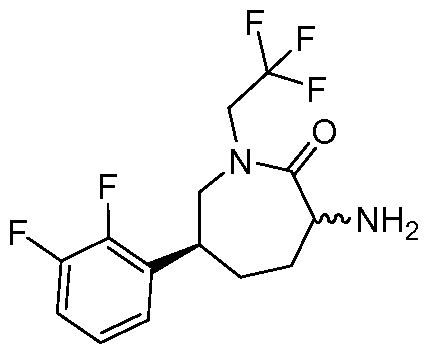
The present invention provides an efficient synthesis for the manufacture of (3R,65r)-3-amino-6-(2,3-difluorophenyl)-l-(2,2,2-trifluoroethyl)azepan-2-one:

(I) and salts thereof, and its stereospecific form (3R,65)-3-amino-6-(2,3-difluorophenyl)-l-(2,2,2- trifluoroethyl)azepan-2-one

(IA) and salts thereof. The present invention is further directed to novel compounds which are intermediates in the synthesis of (I) and (IA). The present invention further provides an efficient preparation of telcagepant, using compounds (I) and (IA).
DETAILED DESCRIPTION OF THE INVENTION
In a first embodiment, the present invention is directed to a method for manufacture of the caprolactam intermediate of telcagepant, (3i?,65)-3-amino-6-(2,3- difluorophenyl)- 1 -(2,2,2-trifluoroethyl)azepan-2-one:

(IA)
In one embodiment, the synthesis is the manufacture of (IA) starting from the commercially available starting material 1,2-difluorobenzene:

(1) The conversion of 1,2-difluorobenzene to difluorocinnamaldehyde (II):

(H)
In a particular embodiment, 1,2-diflourobenzene is converted to difluorocinnamaldehyde (II) via an addition/rearrangement step, followed by an oxidation step.
(2) The 1 ,4-nitromethane addition of difluorocinnamaldehyde to form the corresponding nitroaldehye (III):

(HI) The 1,4-nitromethane addition step may occur in the presence of a catalyst (such as TMS prolinol) and one or more co-catalysts (such as pivalic acid and boric acid, and mixtures thereof). In certain embodiments, the catalyst TMS prolinol may be used in crude form, without purification.
(3) The Knoevenagel condensation coupling of the nitroaldehye (III) with a diacid, monoacid or disalt to form an enamine acid (IV):

(IV)
or a salt or ester thereof, wherein R1 is a -(C=O)-C1-6 alkyl protecting group, such as acetyl, which may be hydrogenated to form the corresponding amine (V):

COOH
HOOC NH^u CH3 (VI) or a monosalt or disalt thereof, and the reaction occurs in the presence of an anime (such as a primary or secondary amine). In certain embodiments, the enamine acid (IV) is not isolated, and the conversion of the nitroaldehyde to amine ester (V) occurs in a one-pot process.
The hydrogenation step may occur in the presence of a halide anion, such as LiCl. (4) The trifluorethylation of the amine (V) to form a trifluoroethyl amine (VII), or salt or ester thereof:

(VII)
The trifluorethylation step may occur in the presence of an organic or inorganic base, including an amine base, such as a tertiary amine.
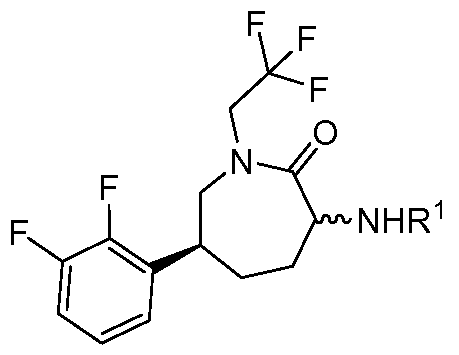
(5) Cyclization of the trifluoroethyl amine (VII), or salt or ester thereof, to form a protected caprolactam (I) (for example, a caprolactam acetamide):

(I) then converting (I) to the desired epimer (IA)

(IA)
The conversion of (I) to (IA) may occur by deprotecting (I) to form the compound (I1)

(I1) and subjecting the product to an epimerization reaction to form the product of compound (IA)

(IA).
Typically, epimerization will occur by reaction with a catalytic amount of an aldeyhyde (for example, an aromatic aldeyhyde).
Alternatively, the conversion of (I) to (IA) may occur by reacting (I) with a base to form the compound (IA')

(IA') followed by deprotection with an acid or enzymatic hydrolysis to form (IA).
After synthesis of (IA), the compound may be isolated as its salt or salt solvate, including the HCl salt MTBE solvate.
In another embodiment, the invention is directed to a synthesis of telcagepant


(IA)
or a pharmaceutically acceptable salt thereof, with 2-oxo-l-(4-piperidinyl)-2,3-dihydro-lH- imidazo [4,5 -b]pyridine :


(V) to a cyclization reaction to form compound (I)

(I) and converting (I) to (IA) (3i?,65)-3-amino-6- (2,3-difluorophenyl)-l-(2,2,2-trifluoroethyl)azepan-2-one.
In one embodiment of the synthesis of telcagepant, the conversion of (I) to
(IA) comprises deprotecting the compound of (I)

(I)
wherein R1 is hydrogen or (C=O)-C1-6 alkyl to form the compound (I1)

(I1) and subjecting (Y) to an epimerization reaction to form (IA).
In another embodiment of the synthesis of telcagepant, the conversion of (I) to (IA) comprises deprotecting (I)


(IA) or salts thereof, wherein the deprotection reaction occurs in the presence of an acid.
The invention is also directed to novel intermediates of the compounds of the invention, including:
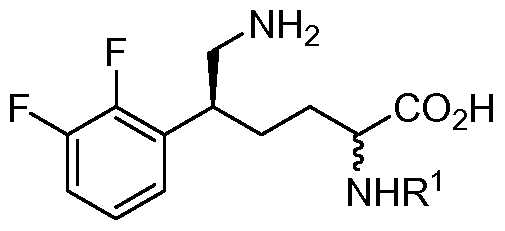
(I) A compound of formula (IV)

or a salt or ester thereof, wherein R1 is -(C=O)-Ci_6 alkyl. Compounds of formula (IV) are present as a mixture of the stereospecific forms (IV') and (IV"):

(IV')
and

(IV")
(2) A compound of formula (V)

(V) or a salt or ester thereof, wherein R1 is -(C=O)-Ci_6 alkyl. Compounds of formula (V) are present as a mixture of the stereospecific forms (V) and (V"):

(V)
and

(V")
(3) A compound of formula (VII)


(VII')
and

(VII")
(4) The compound (III)

(III).
The various steps of the reactions of the invention, and preparation of certain of the reactants, are described in greater detail below:
Preparation of Difluorocinnamaldehyde
The first step of the process is the preparation of the difluorocinnamaldehyde (II). An exemplary scheme is shown below:

oxidation


(II)
First, the difluorophenyl (1,2-difluorobenzene) is reacted with a lithium source, such as n-hexyl lithium, and an aldeyhyde (for example, acrolein) in a suitable solvent (such as
THF) to form 2,3-difluorophenyl lithium. Suitable reaction temperatures are less than -3O0C, or less than -40 0C, or less than -55 0C. Alternative sources of lithium (including various alkyl lithiums, such as butyl lithium) can also be used.
Thereafter, the 2,3-difluorophenyl lithium product is reacted with an acid (for example, sulfuric acid) to form the difluorocinnamyl alcohol. Suitable solvents for this reaction include a mixture of THF and water. After addition of the sulfuric acid the reactants may be heated, for example to more than 50 0C, preferably more than 60 0C. See also Leleti et al, Tetrahedron Lett 2007, 48: 8505-8507.
The resulting product is then oxidized to form difluorocinnamaldehyde (II). Exemplary oxidation conditions and reactants include TEMPO (2,2,6,6-Tetramethylpiperidine-l- oxyl), NaOCl, NaBr and K2HPO4. An exemplary solvent includes an MTBE/toluene mixture.
Preferably, the oxidation is conducted at a basic pH, for example at 10.50 -11.0. The pH can be adjusted by addition of a base, such as KOH. The reaction should be maintained at a temperature of up to 25 0C, for example from 10°-15°C during the addition. The aqueous layer can then be removed and the organic layer washed. The target compound (II) may be isolated as a solution in MTBE and toluene.
Formation of Di-Acid, Di-SaIt or Mono-Salt
In another step of the process, a suitable diacid or salt thereof (3) is prepared, for use in the Knoevenagel condensation coupling step leading to the caprolactam intermediate. The first step may take the form of hydrolysis to form a di-sodium salt, such as shown below:
COOR1 COONa
I ► T
R2OOC NHCOR3 NaOOC^NHR3
R1, R2 and R3 represent C1-10 alkyl groups. For example, R1 and R2 may be ethyl, and R3 may be methyl. The reaction may be performed by treatment with a base (for example, sodium hydroxide), in any suitable solvents. Alternative bases include potassium hydroxide and lithium hydroxide. Exemplary solvents include a mixture of water and methanol.
Other salts may be used, such as potassium, lithium, or other metal salts.
The coupling step of the caprolactam synthesis may alternatively be conducted with a diacid, or monoacid.
Alternatively, the diacid may be in the form of a phosphate ester , such as a compound of formula (IX), which can be used subsequently to form enamine intermediate IV via a Horner-Wadsworth-Emmons reaction:

(IX) wherein R1 is a Ci_io alkyl group, for example methyl or ethyl, and each R2 is a d_io alkyl or Ce- io aryl group.
Nitromethane 1,4-Addition Step
The difluorocinnamaldehyde (II) is subjected to a nitromethane 1,4-addition step to form nitroaldehyde (III):

(III)
The reaction may occur with a prolinol catalyst (for example, TMS prolinol) and one or more suitable co-catalysts. Exemplary co-catalysts include a mixture of pivalic acid (up to 50 mol %, preferably up to 20 mol %, or up to 10 mol%) and boric acid (up to 100 mol %, preferably up to about 75%, or about 50 mol %). The reaction may occur in various solvents. An exemplary solvent is a mixture of THF and water. The reaction may occur at room temperature, or even lower temperatures. Further guidance about using a prolinol catalyst in combination with a co-
catalyst other than in pivalic acid or its combination with boric acid is found in Gotoh et al, Org Lett 2007, 9(25):5307-5309; Wang et al, Chem Comm 2008: 1232-1234; Palomo et al, Agnew Chem Int Ed 2007, 46:8431-8435; Hojabri et al, Adv Synth Catal 2007, 349:740-748; Zu et al, Adv Synth Catal 2007, 349:2660-2664. Suitable prolinol catalysts include compounds of formula (VIII):
R1
CK Rz
"N O-Si(R3)3
(VIII) wherein R1 and R2 are independently selected from the group consisting of (l)-Ci-iθ alkyl,
(2) -C6-10 aryl, wherein each alkyl or aryl is optionally substituted with one or more (a) -Ci-10 alky 1, (b) -OCi-10 alkyl, (c) halogen,
(d) NO2, or
(e) NRARB, wherein RA and RB are selected from the group consisting of
(i) hydrogen, or (ii) -C 1-6 alkyl,
(Ui)-(C=O)-C 1-6 alkyl,
and each R3 is independently selected from the group consisting of
(I)-Ci-IO alkyl, (2) -C6-IO aryl, wherein each alkyl or aryl is optionally substituted with one or more (a) -Ci-io alkyl,
(b) -OCi-IO alkyl, or (c) halogen. An exemplary reaction scheme is shown below:

The TMS prolinol catalyst may be used in the nitromethane addition step in crude form, without purification. A suitable synthesis of the TMS prolinol catalyst is by preparation of prolinol ((S)-α,α-diphenyl-2-pyrrolidinemethanol) and an anime (such as imidazole) in a solvent (such as THF), followed by addition of chlorotrimethylsilane.
TMSCI
, v Ph
CH Ph imidazole OH 20 h C -NK Ph Ph
THF, RT, O.TMS H
The temperature at which the reactants are mixed is not critical, and the reaction may occur at room temperature.
Knoevenagel Coupling Step
In the first part of the Knoevenagel coupling reaction, shown below, the nitroaldehyde product (III) of the nitromethane addition step is treated with the diacid or mono or disalts thereof, as described earlier, and a primary or secondary amine. An exemplary amine is pyrrolidine, as shown above. Suitable amounts of amine include up to 100 mol %, preferably from 10 to 50 mol %, for example about 35 mol %. When the salts of the diacid or monoacid are used, an additional acid, such as HCl, TFA, sulfuric acid or
methylsulfonic acid, is added to the reaction mixture.

Suitable solvents are polar solvents, such as NMP, DMAc, DMF, IPAC, ethyl acetate, MeCN and THF.
As shown below, an amine (such as TBA) may be added to initiate crystallization of a salt of the first reaction product. Suitable solvents include IPAC, EtOAc, THF, MeCN, DMAc, DMF, heptane, hexane, toluene, cyclohexane, methanol, IPA and ethanol.

Alternatively, nitroaldehyde (III) may be subjected to a Horner-Wadsworth- Emmons type coupling with a phosphate acid or ester to form an enamine acid of generic formula (IV) pr its ester. The phosphate acid reactants depicted below are commercially available.


The tertiary amine salt prepared from the Knoevenagel coupling or the ester prepared from the Horner-Wadsworth-Emmons coupling then may be hydrogenated by various methods known to those skilled in the art. In one method, as shown below, an acid such as HCl is added to the tributylamine salt in EtOAc. The organic phase may then be solvent switched to IPA. Hydrogenation may occur by addition of hydrogen with a palladium catalyst in the presence of an acid (such as sulfuric acid) in a polar solvent (for example, IPA). In another method, more streamlined, the salt is directly used for hydrogenation in a polar solvent such as IPA in the presence of an acid (such as sulfuric acid) and a palladium catalyst.

(VA)
(IVA1)
The use of additives including halide salts such as LiCl, ZnC^, n-Bu3NHCl or acids such as HCl allows suppressing the formation of des fluoro byproducts such as VA-I and VA-2, as shown below. An exemplary additive is LiCl. Suitable amounts of LiCl include up to 100 mol %, preferably from 5 to 50 mol %, for example about 15 mol %.

(VA-1 ) (VA-2)
Trifluoroethylation Step
The product of the hydrogenation reaction may then be reacted with a trifluoroethylating reagent (for example, CF3CH2OT1) in the presence of an organic or inorgance base, including an amine base, such as a tertiary amine (for example, triethylamine, iP^NEt). A suitable solvent is IPA, which may also be used for the hydrogenation step. The reaction is carried out with or without an aqueous workup of the crude hydrogenation reaction solution after the catalyst is removed. The reaction may be heated to temperatures greater than 30 0C, or greater than 50 0C, for example about 60 0C. The reaction results in the production of trifluoroethylated ester, and should be followed by addition of a base (such as sodium hydroxide), to form the corresponding acid via hydrolysis.

(VA) (VIIA) (VIIB)
Cyclization Step
In one possible cyclization method, triphenyl phosphate is added to the product of the trifluorethylation step

(VIIB) (I) In an alternative method, cyclization may occur by addition of pivaloyl chloride
(trimethylacetyl chloride). In this procedure, the product of the trifluoroethylation reaction may be charged with an amine (such as a tertiary amine) in the presence or absence of a catalytic
amount of DMAP. A suitable tertiary amine is triethylamine. Pivaloyl chloride may then be added, at greater than 0 0C, or preferably at 35-50 0C , up to about 60 0C.

The resulting product may then be subject to solvent switch, for example to DMSO solvent.
Deprotection/Epimerization Steps
In one method, the product of the cyclization reaction is subject to a deprotection step, by reaction with an acid. The resulting product is then subject to epimerization by addition of a catalytic amount of an aldeyhyde (such as an aromatic aldeyhyde).

ArCHO

In an alternative method, the product of the cyclization reaction is subject to a epimerization by reaction with a base (for example, sodium hydroxide, lithium hydroxide, potassium hydroxide or another strong base, or amine bases such as DBU). The product of the cyclization reaction may be heated, for example to about 20 0C in a solution. Suitable solvents
include a mixture of DMSO and water. A base, such as sodium hydroxide, can then be added to promote epimerization.

Subsequently, the epimerization product can be subject to deprotection by treatment with an acid. Suitable acids include HCl, HBr, MsOH, HCl-HOAc, and H2SO4. The reaction may occur in an IPA-water or HOAc -water solvent mixture, at a temperature of greater than 60 0C, or greater than 80 0C (for example, about 95 0C) or up to 110 0C

Alternatively, deprotection can be done by enzymatic hydrolysis. In either method, the final step may be isolation of the product in a solution of MTBE and its suitable solvent combination, to form the HCl salt MTBE solvate.
An exemplary synthesis of caprolactam intermediate (I) is shown in Scheme 1 below:
Scheme 1 - Telcagepant Caprolactam Synthesis
H2SO4
D

PivCI, Et3N, cat DMAP
 then, aq NaOH , DMSO
P(OPh)3

Caprolactam (HCI/MTBE salt)
The caprolactam intermediate (I) may be reacted with the intermediate (II):

Scheme 2
Scheme 1A

KOtBu1 EtOH
Scheme 1B


Scheme 1C

Scheme IA depicts an efficient method of synthesizing the neutral form of telcagepant from compounds (I) and (II) 2 and 3 using l,l'-carbonyldiimidazole as the carbonyl source; Scheme IB depicts an efficient method of synthesizing a potassium salt form of telcagepant starting from the neutral form of telcagepant; and Scheme 1C depicts the efficient synthesis of a potassium salt form of telcagepant directly from compounds (I) and (II) using l,r-carbonyldiimidazole as the carbonyl source, without isolation of the neutral form of telcagepant. Further description of the synthesis of Scheme 2 can be found in International applications WO 2007/120589, WO 2007/120590 and WO 2007/120591.
The invention is not limited to specific embodiments described in this application, and in fact includes additional features not expressly described above, including but not limited to the use of particular solvents and reaction conditions, the use of particular reagent forms (including neutral forms of compounds (II) and (III), and salt forms other than HCl salt forms), and the use or no-use of particular separation or isolation techniques, and other features.
Several abbreviations, acronyms and other shorthand is presented herein. Although these terms are known to those skilled in the art, presented below is a table summarizing these terms:
Me Methyl
Et ethyl
Ac acetyl
HexLi or nHexLi n-hexyl lithium
Bu butane or butyl t-bu tert-butyl
Ph phenyl
TEMPO 2,2,6,6-Tetramethylpiperidine-l-oxyl
IPAc isopropylacetate
TMS trimethyl silyl
IPA ispropanol
THF tetrahydrofuran
MTBE Methyl tert-butyl ether
DMAc dimethylacetamide
TFA trifluoroacetic acid
DNPH dinitrophenylhydrazine
DMSO dimethylsulfoxide
RT room temperature
Step 1; 1,2-Addition/rearrangement
Hex Li

(1) (2) (3)
To a solution of 1,2-difluorobenzene (1) (4.15 L, 42.1 mol) in THF (38.4 L) in a
100 L flask was added n-hexyllithium (2.3M in hexane, 19.21 L, 44.2 mol) dropwise over 3 h, while the internal temperature was maintained at < -55°C. The resulting slurry was aged at -60 to -55 0C for additional 0.5 h. A solution of acrolein (3.26 L, 46.3 mol) in THF (5 L) was then added dropwise over 2.5 h. After additional 30 min. age at -60 to -55 0C, the cold reaction solution was quenched by transferring the batch to a separate 100 L flask containing water (25 L). The aqueous layer was discarded. To the organic layer was added an aqueous H2SO4 solution (6.0 L of 96% H2SO4 + 13.4 L of water). After the reaction mixture was agitated at 60 0C overnight under nitrogen and cooled to ambient temperature, the layers separated. The aqueous layer was extracted with toluene (20 L). The combined organic phase was washed with water (24 L) followed by half saturated sodium bicarbonate (12 L). The organic layer was then concentrated under reduced pressure to ca. 10 L and the crude was used "as is" in the next step.
Step 2; TEMPO oxidation

(3) (4)
Sodium bromide (0.742 kg, 7.21 mol), potassium phosphate dibasic (3.14 kg, 18.02 mol), and water (11.67 L) were charged to a 100 L vessel. The pH was adjusted to 10.5 - 11.0 with IN KOH (~ 2.5 L). The crude difluorocinnamyl alcohol solution (3) (9.725 kg, 63.05 wt% solution in MTBE/Toluene, 36.0 mol) and MTBE (34.0 L) were added followed by TEMPO (0.056 kg, 0.360 mol) at ambient temperature. The reaction solution was cooled to ~10°C. Sodium hypochlorite (Chlorox®, 39.7 L, 6.15 wt%, 36.0 mol) was added dropwise over 2 h, while the internal temperature was maintained at 10-15 0C. The aqueous layer was removed at ambient temperature and the organic phase was washed with 0.1 M Na2S2U3 (10 L) followed by half-saturated aqueous sodium bicarbonate (10 L). The organic phase was concentrated under reduced pressure to -130 L, and the solvent was switched to THF at the constant volume under reduced pressure by feeding THF. The residual MTBE was less than 0.5 v/v% and the residual toluene was less than 10 v/v%. The desired organic layer was used as is for next step. HPLC conditions;
Column: Zorbax Eclipse Plus Cl 8 (50 X 4.6 mm, 1.8 micron);
Column temperature: 40 0C
Flow rate: 1.5 mL/min
Injection: 5 uL
Wavelength 210 nm
Gradient: min CH^CN 0.1% H^PO4
0 10 90
5 95 5
6 95 5
Retention times (in minutes): 1,2-Difluorobenzene (1) (3.77 min); l-(2,3-Difluorophenyl)prop- 2-en-l-ol (2) (3.31 min.); Difluorocinnamyl alcohol (3) (3.20 min); Toluene (4.17 min); Difluorocinnamaldehyde (4) (3.60 min).
Step 3; Nitromethane 1,4-Addition
CH Ph Ph
"N OTMS

(4) (5)
A solution of above 1,3 -difluorocinnamaldehyde (4) (0.595 mol assay, 100.0 g) was diluted with THF to a total volume of 1.2 L. H2O (200 mL), pivalic acid (3.04 g, 0.0297 mol), boric acid (18.39 g, 0.297 mol), TMS-prolinol (9.68 g assay, 0.0297 mol, solution in THF/MTBE, see step 3A procedure), and nitromethane (218 g, 3.568 mol) were added at ambient temperature. The resulting homogeneous solution was stirred at ambient temperature for 30 h (>94% conversion). The reaction solution was cooled to 2-7 0C and quenched by addition of IPAc (1.0 L), 15% aq NaCl (300 mL) and 1 N HCl (100 mL). The organic layer was washed with 6% NaHCO3 in 5% aq NaCl (500 mL) and 15% NaCl aq (300 mL x 2). The organic phase was azetropically dried and solvent-switched to IPAc while maintaining internal temperature at <15 0C. The final solution (~ 10 L) was directly used in next step or stored at 5 0C.
HPLC conditions;
Column: Ascentis Express Cl 8 (100x4.6mm, 2.7um)
Column temperature: 60 0C Flow rate: 2.5 ml/min Detection: UV at 210nm
Gradient:
Time(min) 0.1% HClO4 (%} MeCN (%}
0 75 25
7 40 60 10 20 80
Retention times (in minutes): MeNO2 (0.47 min); EtOAc (0.79 min); Piv acid/Prolinol (0.95 min); DNPH (1.17 min); IPAC (1.29 min); Nitroaldehyde (5) (2.06 min); 1,3- difluorocinnamaldehyde (4) (2.59 min); toluene (4.03 min); catalyst product (4.35 min); DNPH derivatized hydrazone (6.40 min).
Sample preparation: Pipet 2 mL of 2,4-dinitrophenylhydrazine (DNPH, -cone. 10 mg/mL in acetontitrile), 25 uL H3PO4 in 25 mL volumetric flask , add 100 uL reaction sample and let sample mixtures react at 40 0C for 5 min. Dilute to volume with acetonitrile.
HPLC Chiral Method
Column: ChiralPak AD-RH (150x4.6mm, 5um) or equivalent
Column temperature: 45 0C Flow rate: 0.5 ml/min
Detection: UV at 21 Onm
Isocratic: 30:45:25 (v/v/v) (0.1% H3PO4 in Water: MeCN: MeOH
Retention times: ent - nitroaldehyde (5) (37 min); nitroaldehyde 5 (49 min)
Sample preparation: Pipet 2 mL of 2,4-dinitrophenylhydrazine (DNPH, -cone. 10 mg/mL in acetontitrile), 25 uL H3PO4 in 25 mL volumetric flask , add 100 uL reaction sample and let sample mixtures react at 40 C for 5 min. Dilute to volume with acetonitrile.
Step 3A. Preparation of TMS-prolinol

To a mixture of prolinol (10.0 g, 39.5 mmol) and imidazole (4.57 g, 67.1 mmol) in THF (100 mL) was added chlorotrimethylsilane (5.57 g, 51.3 mmol) over 15 min while maintaining the batch temperature below 30 0C. The resulting slurry was aged at 50 0C for 3-5 h. The reaction mixture was cooled to ambient tempearture and quenched by addition of MTBE (50 mL) and 15% aq NaCl (100 mL). The organic layer was washed with 15% aq NaCl (50 mL). The solution was azeotropically dried at the constant volume by feeding THF.
HPLC Method
Column: Ascentis Express Cl 8 (100x4.6mm, 2.7um)
Column temperature: 45 0C
Flow rate: 1.5 ml/min
Detection: UV at 210nm
Gradient:
Time(min) 0.1% H^PO4 (0A) MeCN (0A)
0 95 5
1 95 5
12 10 90
Retention times (minutes): prolinol (4.8 min); TMS prolinol (7.3 min)
Step 4. Knoevenagel Coupling step

(5) (6)
A three neck flask equipped with an overhead stirrer, a thermocouple and a nitrogen inlet was charged with DMAc (70 mL) and the anhydrous di-Na salt (13.42 g, 65.45 mmol). H2SO4 (96%, 7.5 mL/13.82 g, 135.25 mmol) was added dropwise over 1 h while the internal temperature was maintained O - 10 0C with external cooling. The slurry was aged at O - 10 0C for additional 1 h. More anhydrous di-Na salt (13.42 g, 65.45 mmol) was added in several portions over 1-2 h. The slurry was then aged at O -10 0C for additional 4-6 h. Pyrrolidine (2.55 mL, 30.55 mmol) was added dropwise while the internal temperature was maintained <10 0C. The resulting slurry was aged additional 10 - 30 min. Nitro aldehyde (5) (20 g assay in ~ 200 mL of IPAc, 87.25 mmol) was charged over 15-30 min. The reaction mixture was aged at 15 - 20 0C for 20-24 h. 4wt% Na2CO3 (-350 ml) was added dropwise to adjust pH = 8.5 +0.5, while the internal temperature was maintained < 25 0C. The aq phase was separated at 20 - 25 0C. IPAc (180 mL) was added followed by the slow addition of 5 N HCl (-70 mL) to adjust to pH = 2-3. The organic phase was separated and the aq phase was back extracted with IPAc (60ml). The combined organic phase was washed with 15wt% brine (30 mL).
Tributylamine (TBA) salt formation: A crude IPAc solution of Knoevenagel product (6) (40 g assay, 0.122 mol) was azeotropically dried with iPAc to 200 mL and filtered to remove inorganic salt. A lL flask equipped with a reflux condenser and an overhead stirrer was charged with tributylamine (43.5 mL, 0.183 mol) and IPAc (120 mL). After about -15% (30 mL) of the above IPAc solution of the free acid was charged dropwsie at 45 0C, the batch was seeded with TBA salt (313 mg, 0.5 mol %) and aged at 45 0C for 1-2 h. The remaining free acid IPAc solution was charged at 45 0C over 3-4 h. The resulting slurry was aged at 45 0C for additional 1
h, then, heptane (160 mL) was added dropwise at 45 0C over 3 h. The resulting slurry was aged at 45 0C for 1 h. The batch was gradually cooled to 0-5 0C over 3 h and aged at 0-5 0C for 3-6 h. The solids were collected by filtration and washed with 40% heptane/IP Ac (120 mL displacement cold wash followed by 120 mL slurry cold wash) while maintaining the batch temperature at 0-5 0C. Drying in vacuum at 45 0C afforded the desired TBA salt.
HPLC Method
Column: Ascentis Express C18 (100x4.6mm, 2.7um)
Column temperature: 40 0C
Flow rate: 2.0 ml/min
Detection: UV at 210nm
Gradient:
Time(min) 0.1% HClO4 (%) MeCN (%)
0 90 10
7 70 30
15 15 85
20 15 85
Retention times (min): enamine acid isomer (6)' 1 (5.8 min); enamine acid isomer (6)" 2 (5.8 min); Nitroaldehyde-DNPH derivative (12.1 min).
Sample Preparation:To a 10 ml volumetric flask, transfer 2.0 mL of DNPH derivatizing solution (lOmg DNPH/mL in acetonitrile). Add 20 uL of phosphoric acid and 100 uL of end of reaction sample. Heat for 5 min at 40 0C and fill to volume with acetonitrile.
Step 4A. Preparation of the N-acetamide di-sodium malonate;
COOEt NaOH COONa
EtOOC NHAc ^ NaOOC^NHAc
To a solution of NaOH (40.5 g, 1.013 mol) in water (155 mL) and MeOH (300 mL) at 40-45 0C was added a solution of malonate (100 g, 0.46 mol) in MeOH (500 mL) dropwise. The batch was seeded (-100 mg seeds) right after -15% of the starting material MeOH solution (-75 mL) was added over 30 min dropwise. The seeded batch was aged 1 h at 40-45 0C. Then, the rest of the methanol solution was added over 2 h at 40-45 C. After 30 min age, by LC no starting material was left. The batch was gradually cooled to ambient temperature and aged 2 h before filtration. The wet cake was washed with 5% water in MeOH (200 mL x 2). Vacuum dry at 80 0C with dry N2 sweep until water content was < lwt%.
HPLC Method Mobile phase A: Waters Low UV PIC-A (Paired Ion Regent). Add 1 vial of PIC-A reagent into IL of HPLC grade water. Mobile phase B: HPLC grade acetonitrile
Column: Zorbax SB-C18 (100x4.6mm, 3.5um)
Column temperature: 45 °C
Flow rate: 2.5 ml/min
Detection: UV at 210nm
Gradient:
Time(min) %A %B
0 90 10
1 90 10
3 80 20
4 80 20
Retention times: Acetyls glycine (0.61 min); mono-ester (1.2 min); d
(2.7 min).
Step 5. Hydrogenation step

(6A) (7A) (7B)
A mixture of TBA salt of the Knoevenagel product (6A) (150 g, 0.292 mol), H2SO4 (96%, 40.5 mL, 0.73 mol), LiCl ( 3.71 g, 0.0876 mol), and Pearlman's catalyst (20 g dry basis of 10 wt% Pd(OH)2 on carbon with -50% water) in IPA (900 mL) was hydrogenated under 50 psig H2 at 40 0C for -20 h. The catalyst was removed through filtration and washed with IPA (300 mL). The combined filtrate was azetropically dried (KF < 1000) under vacuum by feeding IPA, while the internal temperature could be maintained at 60 0C. The reaction solution was aged at 60-65 0C for 8 h to complete esterification (> 98% conversion). Then, the batch was further concentrate to -500 mL and KF <3000. The solution was used directly in the next step. HPLC Method
Column: Ascentis Express Cl 8 (100x4.6mm, 2.7um)
Column temperature: 40 0C
Flow rate: 2.0 ml/min
Detection: UV at 210nm
Gradient:
Time(min) 0.1% HClO4(%) MeCN (%;
0 90 10
6 70 30
12 15 85
Retention times: (7B) (1.4 min); Ester (7A) (diastereomer#l) (4.8 min), (5.1 min); Enamine acid (6A) (starting material) (5.8 min).
Step 6. Trifluoroethylation step

(7A) (8) (9) To a IPA solution of the hydrogenated amine ester (95 g assay in -500 mL IPA,
0.278 mol) was added Et3N (174 mL, 1.25 mol) dropwise. The solution was then warmed to 55 0C, and CF3CH2OTf (50 mL, 0.347 mol) was added dropwise over 1-2 h while the reaction temperature was maintained between 50-60 0C. The reaction solution was aged at 60 0C for 8 h until >99% conversion was achieved. The reaction solution was then cooled to ambient temperature. 5N NaOH solution (306 mL, 1.53 mol) was added dropwise over 0.5 - I h. The resulting solution was stirred for 1-2 h at 30 -35 0C until the saponification of the ester was deemed complete by HPLC: >99% conversion. The reaction was cooled to ambient temperature, and water (300 mL) and heptane (500 mL) were added. 6M HCl (-150 mL) was added dropwise to adjust pH = 4-5, while the internal temperature was maintained to <25 0C with external cooling. The aq phase was extracted with IPAc (1.2 L). The combined organic phase was washed with 15wt% brine (400 mL). The organic phase was azeotropically dried with IPAc in vacuo and used directly for the next step.
HPLC Method
Column: Ascentis Express C18 (100x4.6mm, 2.7um)
Column temperature: 60 0C
Flow rate: 2.0 ml/min
Detection: UV at 210nm
Gradient:
Time(min) 0.1% HClO4 (%) MeCN (%)
0 90 10
15 70 30
16 15 30
20 30 70
22 20 80 24 20 80
Retention times: Ethyl Acetate (EtAc) (1.9 min); Trifluoroethylamine (4.2 min); Amine-IPA Ester (7A) (6.3 min), (7.0 min); Trifluoroethylamine ester (8) (13.0 min); (diastereomer#2) (13.2 min).
Chiral HPLC Method
Step 7. Cyclization

(9) (10)
The IPAC solution of the amine acid from the alkylation/ hydrolysis step (10Og assay in IPAc, 0.26 mol) was azetropically distilled under vacuum (internal temperature < 35 0C) to a volume of 1.1 L (KF of <1000, <2 vol% IPA). DMAP (0.013 mol, 1.58 g) and Et3N (76.6 mL, 0.55 mol) were added. Trimethylacetyl chloride (38.6 mL, 0.31 mol) was added dropwise over 1 h at 35-40 0C. The reaction mixture was stirred for additional 5-8 h until >99% conversion was achieved. Then, the reaction mixture was cooled to ambient temperature and quenched with IN HCl (350 mL). The organic phase was washed with 7.5% NaHCO3 (440 mL). The organic layer was solvent switched to DMSO (500 mL) in vacuo at 60 0C. 2.5N NaOH (260 mL) was added dropwise while the internal temperature was maintained at < 30 0C. After aging 30 min, the batch was seeded and agitated overnight at ambient temperature. Water (240 mL) was added dropwise over 1-2 h to adjust the DMSO:water ratio to 1 : 1. The slurry was aged for 2
h at ambient temperature and filtered. The wet cake was washed with DMSO:water (1: 1, 160 mL) followed by water (320 mL). Vacuum dry at 55 0C under nitrogen gave the desired product.
HPLC Method Column: YMC Pack Pro C4 (150x4.6mm, 3um) or equivalent
Column temperature: 20 0C
Flow rate: 1.3 ml/min
Detection: UV at 215nm
Gradient: Timednin) 0.1% HJO4 (%) MeCN (%)
0 80 20
20 25 75
Retention times (minutes, at approximate rt): Pivaloyl acid (5.9 min); Caprolactam Acetamide
(cis) 10 (11.5 min); Caprolactam Acetamide Diasteromer(ϊrαrø) (12.2 min).
HPLC Chiral Method
Column: ChiralPak OD-RH (150x4.6mm, 5um)
Column temperature: 35 0C Flow rate: 0.75 ml/min
Detection: UV at 21 Onm
Isocratic Separation: 77:23 (v/v) 0.1% H3PO4 in Aq. : MeCN
Retention times (minutes, at approximate rt): e«?-caprolactam acetamide 10(approximately 27- 28 min); Caprolactam acetamide 10 (approximately 31 min); Caprolactam acetamide trans (approximately 44-46 min); e«?-caprolactam acetamide trans (approximately 48-50 min).
Step 8. Deprotection step

(10) (H) To a suspension of acetamide 10 (80.0 g, 0.22 mol) in IPA (120 mL) were added
H2O (296 mL) and 37 wt% hydrochloric acid (75.8 g, 0.77 mol). The vessel was closed and pressurized with nitrogen (25 psi). The resulting mixture was heated to 95 0C for 17 h until >99% conversion was achieved. The reaction was allowed to cool to 50 0C, diluted with IPA (120 mL), and further cooled to ambient temperature. 5N aq NaOH (220 mL, 1.1 mol) was added, maintaining the batch temperature below 30 0C. The reaction mixture was extracted with MTBE (400 mL). The organic layer was washed with 0.2 N NaOH (240 mL) followed by H2O (240 mL). The crude product solution was solvent switched to IPA in vacuo azetropically to a final volume of 500 mL with 1-0.3 wt% water. MTBE (96mL) followed by 2.56 N HCl in aq IPA (24 mmol, 9.4 mL; prepared by diluting 21.2 mL of 37 wt% HCl with IPA to 100 mL) was added at 30 0C. The resulting solution was seeded with caprolactam HCl salt MTBE solvate (2.60 g) and aged at 30 0C for 1 h. More 2.56 N HCl in aq IPA (0.229 mol, 89.4 mL; see above for the preparation) was added dropwise at 30 0C over 4 h. After addition, the batch was cooled to ambient temperature over 1 h and aged for 3 h before filtration. The wet cake was washed with 30% MTBE/IPA (184 mL, displacement wash) followed by MTBE wash (248mL x 2). Vacuum dry under nitrogen at <25 0C afforded the product as a white solid. 99.9 LCAP, 100% ee.
HPLC Method
Column: YMC Pro Pack C4, 150 x 4.6 mm, 3 μm particle size Temperature: 20 0C Flow Rate: 1.3 mL/minute Detection: UV absorbance at 215nm
Gradient:
Time (mm.) 0.1% H3PO4 MeCN (%)
0 85 15
10 85 15
30 65 35
45 15 85
50 15 85
Retention times (approximate): Cis caprolactam isomer (13.7 min); trans caprolactam isomer 11(17.5 min);Caprolactam-acetamide 10 (37.1 in).
Chiral HPLC Method
Column: Chiralpak AS-RH, 150 mm x 4.6 mm
Temperature: 25 0C
Flow Rate: 1.0 mL/minute
Detection: UV absorbance at 215 nm
Linear Gradient:
Time (minutes) 5.2 mM sodium MeCN (% tetraborate (%)
0 80 20
30 40 60
Retention times: ent-ll (13. 1 min); 11 (14.5 min).
Step 9. Recrystallization

(H)
A slurry of MTBE solvate salt (50 g, 111.9 mmol) in MeOH (150 mL) was warmed to 35 0C to form a homogenous solution. MTBE (10 mL) was added dropwise, and the batch was seeded with caprolactam HCl salt MTBE solvate (-100 mg) and aged for 30 min. Then, MTBE (290 mL) was added dropwise over 2 h. After addition, the batch was cooled to ambient temperature and aged for 2 h before filtration. The wet cake was displacement washed with 25% MeOH in MTBE (150 ml) followed by a slurry wash with 25% MeOH in MTBE (150 ml) and a displacement wash with MTBE (100 mL). Vacuum dry under nitrogen at <25 0C gave the desired product. >99.9 A%, 100% ee.
Alternative Cyclization step

(9) (12) Procedure:
A 30 L reaction vessel equipped with an overhead stirrer and a condenser was charged with amino-carboxylic acid (1.0 kg, 2.62 mol), toluene (12 L), and DMAC (3 L) under nitrogen. The mixture was sparged with nitrogen for 30 min at ambient temperature. Triphenyl phophite (0.813 kg, 2.62 mol) was add and the mixture was aged at 115-120 0C for several
hours. After consumption of all starting material (>99% conversion), the mixture was cooled to 60 0C and 2.5 N NaOH (10.5 L) was added. The mixture was heated at 60 0C for several hours to hydrolyze remaining P(OPh)3. Then, the mixture was cooled to rt, the separated organic phase was washed with washed 10% brine (10 L). The organic layer was directly carried to the next step.
Alternative epimerization step, with 2-hydroxyl-5-nitroaldehvde

(13) (14)
To a degassed solution of caprolactam HCl salt (13) (50 g, 0.125 mol) and 2- hydroxyl-5-nitrobenzaldehyde (416 mg, 2.49 mmol) in IPA (125 mL) and water (125 mL) at ambient temperature was added Et3N (19.09 mL, 0.137 mol). The solution turned to yellow immediately. The resulting solution was aged 50 0C for 22 h to give a ratio of trans /cis = -97:3. MTBE (750 m L) followed by NaOH (2 N, 93 mL) was added. The organic phase was washed with 5% brine (250 mL) and azetropically solvent switched to IPA (final volume -450 mL). MTBE (100 mL) was added. Then, 5 N HCl in IPA (37.4 mL) was added dropwise. The batch was seeded after 10% of HCl in IPA was added. After 30 min age, the rest of HCl-IPA was added dropwise over 1 -2 h while the internal temperature was controlled <25 0C. The slurry was aged at ambient temperature for 2 h before filtration. The wet cake was displacement washed with 70% IPA in MTBE (150 mL) followed by a slurry wash 70% IPA in MTBE (15OmL) and another displacement wash with 70% IPA in MTBE (15OmL). Vacuum dry under nitrogen at <25 0C afforded the product as a white solid. 99.9 LCAP, 100% ee.
While the invention has been described and illustrated with reference to certain particular embodiments thereof, those skilled in the art will appreciate that various adaptations, changes, modifications, substitutions, deletions, or additions of procedures and protocols may be made without departing from the spirit and scope of the invention. For example, effective dosages other than the particular dosages as set forth herein above may be applicable as a consequence of variations in the responsiveness of the mammal being treated for any of the indications with the compounds of the invention indicated above. Likewise, the specific pharmacological responses observed may vary according to and depending upon the particular active compounds selected or whether there are present pharmaceutical carriers, as well as the type of formulation and mode of administration employed, and such expected variations or differences in the results are contemplated in accordance with the objects and practices of the present invention. It is intended, therefore, that the invention be defined by the scope of the claims which follow and that such claims be interpreted as broadly as is reasonable.
Claims
1. A method of manufacturing the compound (I)

(I) wherein R1 is hydrogen or (C=O)-C1-6 alkyl,
comprising the steps of (1) reacting (III)

(III) with a diacid or salt thereof to form the product (IV)

(IV) or a salt or ester thereof, (2) hydrogenating the product of step (1) to form the product (V) 
(V) or a salt or ester thereof,
(3) trifluoroethylating the product of step (2) to form the product

(VII) or a salt or ester thereof, and
(4) subjecting the product of step (3) to a cyclicization reaction to form the product (I)

(I).
2. The method of claim 1, wherein the diacid of step (1) is (VI)
COOH
HOOC NH^(m CH3
(VI) or a salt or disalt thereof, and the reaction occurs in the presence of a primary or secondary amine.
3. The method of claim 2, wherein the amine is pyrrolidine.
4. The method of any of claims 1 to 3, wherein the hydrogenating step (3) occurs in the presence of a halide anion.
5. The method of any of claims 1 to 4 wherein the trifluoroethylating step (3) comprises reaction of the product of step (2) with ethyl triflate.
6. The method of any of claims 1 to 5 wherein the cyclization reaction of step (4) comprises reacting the product of step (3) with P(OR5)3 ; wherein each R5 is independently selected from the group consisting of (l)-Ci-iθ alkyl,
(2) -C6-10 aryl, wherein each alkyl or aryl is optionally substituted with one or more (a) -Ci-IO alky 1, (b) -OCi-IO alkyl, or (c) halogen.
7. The method of claim 6 wherein each R3 is phenyl.
8. The method of any of claims 1 to 5 wherein the cyclization reaction of step (4) comprises reacting the product of step (3) with pivaloyl chloride.
9. A method of manufacturing (3R,65)-3-amino-6-(2,3-difluorophenyl)-l- (2,2,2-trifluoroethyl)azepan-2-one: 
(IA) comprising deprotecting the compound of

(I) by treatment with an acid, wherein R1 is hydrogen or (C=O)-C1-6 alkyl to form the compound


10. The method of claim 9, wherein the aldeyhyde is an aromatic aldeyhyde.
11. A method of manufacturing (3R,65)-3-amino-6-(2,3-difluorophenyl)-l- (2,2,2-trifluoroethyl)azepan-2-one (IA):

(IA) comprising the step of treating the compound of

(I) wherein R1 is hydrogen or (C=O)-C1-6 alkyl, with a base to form the compound


(IA).
12. The method of claim 11, further comprising the step of isolating the compound

(IA) in a solution of MTBE to form the MTBE solvate.
13. A method of manufacturing the nitroaldehyde


(2) -C6-10 aryl, wherein each alkyl or aryl is optionally substituted with one or more (a) -Ci-IO alkyl,
(b) -OCl-IO alkyl, or (c) halogen,
and each R3 is independently selected from the group consisting of (I)-Cl-IO alkyl,
(2) -C6- 10 aryl, wherein each alkyl or aryl is optionally substituted with one or more (a) -Ci-io alkyl, (b) -OCi-io alkyl, or (c) halogen.
14. The method of claim 13 wherein R1 and R2 are each phenyl, and each R3 is methyl.
15. The method of claim 13 or 14, wherein the reaction occurs in the presence of pivalic acid and boric acid.
16. A compound of formula (IV)

or a salt or ester thereof, wherein R1 is -(C=O)-Ci_6 alkyl.
17. A compound of formula (V)

18. A compound of formula (VII)

(VII) or a salt thereof, wherein R1 is -(C=O)-C1-6 alkyl.
19. The compound (III)

20. A method of manufacturing telcagepant

or a pharmaceutically acceptable salt thereof, by reacting (IA) (3R,65')-3-amino-6-(2,3- difluorophenyl)- 1 -(2,2,2-trifluoroethyl)azepan-2-one

(IA) or a pharmaceutically acceptable salt thereof, with 2-oxo-l-(4-piperidinyl)-2,3-dihydro-lH- imidazo [4,5 -b]pyridine :

(V) to a cyclicization reaction to form compound (I)
(2,3-difluorophenyl)-l-(2,2,2-trifluoroethyl)azepan-2-one.
21. The method of claim 20 wherein the step of converting (I) to (IA) (3R,6«S)-3-amino-6-(2,3-difluorophenyl)-l-(2,2,2-trifluoroethyl)azepan-2-one comprises deprotecting the compound of (I)
(I)
R1 is hydrogen or (C=O)-C1-6 alkyl to form the compound (I1)
(I1) and subjecting (I1) to an epimerization reaction to form the product (IA)

(IA) .
22. The method of claim 20 wherein the step of converting (I) to (IA) (3R,65')-3-amino-6-(2,3-difluorophenyl)-l-(2,2,2-trifluoroethyl)azepan-2-one comprises deprotecting the compound of (I)

(I) wherein R1 is hydrogen or (C=O)-C1-6 alkyl to form the compound (IA)

(IA) or salts thereof, wherein the deprotection reaction occurs in the presence of an acid.
23. The method of claim 22, wherein (IA) is isolated in the form of the HCl salt, MTBE solvate.
Applications Claiming Priority (2)
| Application Number | Priority Date | Filing Date | Title |
|---|---|---|---|
| US18507009P | 2009-06-08 | 2009-06-08 | |
| US61/185,070 | 2009-06-08 |
Publications (1)
| Publication Number | Publication Date |
|---|---|
| WO2010144293A1 true WO2010144293A1 (en) | 2010-12-16 |
Family
ID=43309167
Family Applications (1)
| Application Number | Title | Priority Date | Filing Date |
|---|---|---|---|
| PCT/US2010/037148 Ceased WO2010144293A1 (en) | 2009-06-08 | 2010-06-03 | Synthesis of telcagepant and intermediates thereof |
Country Status (1)
| Country | Link |
|---|---|
| WO (1) | WO2010144293A1 (en) |
Citations (2)
| Publication number | Priority date | Publication date | Assignee | Title |
|---|---|---|---|---|
| US5663360A (en) * | 1995-05-25 | 1997-09-02 | F.I.S. Fabbrica Italiana Sintetici S.P.A. | Process for preparing [R-(R*,R*)]-5-(3-chlorophenyl)-3-[2-(3,4-dimethoxylphenyl)-1-methyl-ethyl]-oxazolidin-2-one |
| WO2007120591A1 (en) * | 2006-04-10 | 2007-10-25 | Merck & Co., Inc. | Process for the preparation of cgrp antagonist |
-
2010
- 2010-06-03 WO PCT/US2010/037148 patent/WO2010144293A1/en not_active Ceased
Patent Citations (2)
| Publication number | Priority date | Publication date | Assignee | Title |
|---|---|---|---|---|
| US5663360A (en) * | 1995-05-25 | 1997-09-02 | F.I.S. Fabbrica Italiana Sintetici S.P.A. | Process for preparing [R-(R*,R*)]-5-(3-chlorophenyl)-3-[2-(3,4-dimethoxylphenyl)-1-methyl-ethyl]-oxazolidin-2-one |
| WO2007120591A1 (en) * | 2006-04-10 | 2007-10-25 | Merck & Co., Inc. | Process for the preparation of cgrp antagonist |
Non-Patent Citations (2)
| Title |
|---|
| GOTOH ET AL.: "Diphenylprolinol Silyl Ether as Catalyst of an Asymmetric, Catalytic, and Direct Michael Reaction of Nitroalkanes with alpha,beta-Unsaturated Aldehydes.", ORGANIC LETTERS, vol. 9, 2007, pages 5307 - 5309, XP002543744, DOI: doi:10.1021/OL702545Z * |
| KIM ET AL.: "A New Convenient Method for Beta-lactam Formation From beta-amino Acids Using Bis(5'-nitro-2-pyridyl) 2,2,2, Trichloroethyl Phosphate", TETRAHEDRON LETTERS, vol. 28, 1987, pages 2735 - 2736 * |
Similar Documents
| Publication | Publication Date | Title |
|---|---|---|
| KR101461291B1 (en) | Process for the manufacture of pharmaceutically active compounds | |
| PL199794B1 (en) | Intermediate compounds for producing cyclic amino acids derivatives | |
| KR20180012788A (en) | Manufacturing method of Bribaracetam | |
| IL227302A (en) | Process for preparing 2-amino-2-(hydroxymethyl)propane-1,3-diol (3-(2-(4-benzoylpiperazin-1-yl)-2-oxoacetyl)-4-methoxy-7-(3-methyl-1h-1,2,4-triazol-1-yl)-1h-pyrrolo[2,3-c]pyridin-1-yl)methyl phosphate and an intermediate obtained in said process | |
| US6414161B1 (en) | Synthesis of (R)-3-(4-Bromobenzyl)-1-(3,5-dichlorophenyl)-5-iodo-3-methyl-1-H-imidazo[1,2-a]imidazol-2-one | |
| JP2018509447A (en) | Preparation of 4,5,6,7-tetrahydroisoxazolo [5,4-c] pyridin-3-ol | |
| CN111943901B (en) | Method for directly synthesizing oxazolidine-2, 4-diketone heterocyclic compound from alkynylamide | |
| ES2676368T3 (en) | Compounds of 2- (alkoxy or aryloxycarbonyl) -4-methyl-6- (2,6,6-trimethylcyclohex-1-enyl) hex-2-enoic acid, their preparation and use | |
| WO2010144293A1 (en) | Synthesis of telcagepant and intermediates thereof | |
| EP2007764B1 (en) | Process for the preparation of cgrp antagonist | |
| EP2007731B1 (en) | Process for the preparation of caprolactam cgrp antagonist intermediate | |
| TWI500596B (en) | Method for synthesizing 3,4-dimethoxybicyclo[4.2.0]oct-1,3,5-triene-7-carbonitrile, and synthesis of ivabradine (IVABRADINE) and its Acceptable acid addition salt application | |
| KR101575736B1 (en) | New process for the synthesis of 3-(2-bromo-4,5-dimethoxyphenyl)propanenitrile, and application in the synthesis of ivabradine and addition salts thereof with a pharmaceutically acceptable acid | |
| JPH04266875A (en) | Novel imidazole compound, preparation thereof and medicinal composition containing the compound | |
| JP5113070B2 (en) | Process for producing 2,5-dioxopyrrolidine-3-carboxylates | |
| JP4508528B2 (en) | Process for producing α-amino substituted carboxylic acid amide | |
| JP5130212B2 (en) | Optically active 3-amino-2,5-dioxopyrrolidine-3-carboxylates, process for producing the same and use of the compounds | |
| HK1199872B (en) | Method for synthesising 3,4-dimethoxybicyclo[4.2.0]octa-1,3,5-triene-7-carbonitrile and use for synthesising ivabradine and the added salts thereof with a pharmaceutically acceptable acid | |
| CN120665002A (en) | Preparation method and application of 3-aminopyrrolidine-1-carboxylic acid tert-butyl ester | |
| HK40033921A (en) | Process for preparing antihelmintic 4-amino-quinoline-3-carboxamide derivatives | |
| HK1199013B (en) | Process for the synthesis of 3-(2-bromo-4,5-dimethoxyphenyl)propanenitrile, and application in the synthesis of ivabradine and addition salts thereof with a pharmaceutically acceptable acid | |
| EP0845460A1 (en) | PROCESS FOR PRODUCING 4a-ARYLDECAHYDROISOQUINOLINE DERIVATIVES | |
| JPH1160513A (en) | Method for producing cyclopropylacetylene derivative | |
| HK1168599A (en) | Novel method for synthesizing ivabradine and the addition salts thereof with a pharmaceutically acceptable acid | |
| WO2014083150A1 (en) | Preparation of 3-amino-piperidine compounds via nitro-tetrahydropyridine precursors |
Legal Events
| Date | Code | Title | Description |
|---|---|---|---|
| 121 | Ep: the epo has been informed by wipo that ep was designated in this application |
Ref document number: 10786586 Country of ref document: EP Kind code of ref document: A1 |
|
| NENP | Non-entry into the national phase |
Ref country code: DE |
|
| 122 | Ep: pct application non-entry in european phase |
Ref document number: 10786586 Country of ref document: EP Kind code of ref document: A1 |