WO2010143803A2 - New nicotinamide derivatives with anti-androgen effects, processes of preparing, and antiandrogens comprising the same - Google Patents
New nicotinamide derivatives with anti-androgen effects, processes of preparing, and antiandrogens comprising the same Download PDFInfo
- Publication number
- WO2010143803A2 WO2010143803A2 PCT/KR2010/000960 KR2010000960W WO2010143803A2 WO 2010143803 A2 WO2010143803 A2 WO 2010143803A2 KR 2010000960 W KR2010000960 W KR 2010000960W WO 2010143803 A2 WO2010143803 A2 WO 2010143803A2
- Authority
- WO
- WIPO (PCT)
- Prior art keywords
- nicotinamide
- isoquinoline
- dihydro
- formula
- methylpyridine
- Prior art date
- Legal status (The legal status is an assumption and is not a legal conclusion. Google has not performed a legal analysis and makes no representation as to the accuracy of the status listed.)
- Ceased
Links
- 0 Cc1cccc(NC(c2ccc(*)nc2)=O)n1 Chemical compound Cc1cccc(NC(c2ccc(*)nc2)=O)n1 0.000 description 3
Images



Classifications
-
- C—CHEMISTRY; METALLURGY
- C07—ORGANIC CHEMISTRY
- C07D—HETEROCYCLIC COMPOUNDS
- C07D401/00—Heterocyclic compounds containing two or more hetero rings, having nitrogen atoms as the only ring hetero atoms, at least one ring being a six-membered ring with only one nitrogen atom
- C07D401/02—Heterocyclic compounds containing two or more hetero rings, having nitrogen atoms as the only ring hetero atoms, at least one ring being a six-membered ring with only one nitrogen atom containing two hetero rings
- C07D401/04—Heterocyclic compounds containing two or more hetero rings, having nitrogen atoms as the only ring hetero atoms, at least one ring being a six-membered ring with only one nitrogen atom containing two hetero rings directly linked by a ring-member-to-ring-member bond
-
- A—HUMAN NECESSITIES
- A61—MEDICAL OR VETERINARY SCIENCE; HYGIENE
- A61P—SPECIFIC THERAPEUTIC ACTIVITY OF CHEMICAL COMPOUNDS OR MEDICINAL PREPARATIONS
- A61P5/00—Drugs for disorders of the endocrine system
- A61P5/24—Drugs for disorders of the endocrine system of the sex hormones
- A61P5/28—Antiandrogens
-
- C—CHEMISTRY; METALLURGY
- C07—ORGANIC CHEMISTRY
- C07D—HETEROCYCLIC COMPOUNDS
- C07D213/00—Heterocyclic compounds containing six-membered rings, not condensed with other rings, with one nitrogen atom as the only ring hetero atom and three or more double bonds between ring members or between ring members and non-ring members
- C07D213/02—Heterocyclic compounds containing six-membered rings, not condensed with other rings, with one nitrogen atom as the only ring hetero atom and three or more double bonds between ring members or between ring members and non-ring members having three double bonds between ring members or between ring members and non-ring members
- C07D213/04—Heterocyclic compounds containing six-membered rings, not condensed with other rings, with one nitrogen atom as the only ring hetero atom and three or more double bonds between ring members or between ring members and non-ring members having three double bonds between ring members or between ring members and non-ring members having no bond between the ring nitrogen atom and a non-ring member or having only hydrogen or carbon atoms directly attached to the ring nitrogen atom
- C07D213/60—Heterocyclic compounds containing six-membered rings, not condensed with other rings, with one nitrogen atom as the only ring hetero atom and three or more double bonds between ring members or between ring members and non-ring members having three double bonds between ring members or between ring members and non-ring members having no bond between the ring nitrogen atom and a non-ring member or having only hydrogen or carbon atoms directly attached to the ring nitrogen atom with hetero atoms or with carbon atoms having three bonds to hetero atoms with at the most one bond to halogen, e.g. ester or nitrile radicals, directly attached to ring carbon atoms
- C07D213/78—Carbon atoms having three bonds to hetero atoms, with at the most one bond to halogen, e.g. ester or nitrile radicals
- C07D213/81—Amides; Imides
- C07D213/82—Amides; Imides in position 3
-
- C—CHEMISTRY; METALLURGY
- C07—ORGANIC CHEMISTRY
- C07D—HETEROCYCLIC COMPOUNDS
- C07D401/00—Heterocyclic compounds containing two or more hetero rings, having nitrogen atoms as the only ring hetero atoms, at least one ring being a six-membered ring with only one nitrogen atom
- C07D401/02—Heterocyclic compounds containing two or more hetero rings, having nitrogen atoms as the only ring hetero atoms, at least one ring being a six-membered ring with only one nitrogen atom containing two hetero rings
- C07D401/12—Heterocyclic compounds containing two or more hetero rings, having nitrogen atoms as the only ring hetero atoms, at least one ring being a six-membered ring with only one nitrogen atom containing two hetero rings linked by a chain containing hetero atoms as chain links
-
- C—CHEMISTRY; METALLURGY
- C07—ORGANIC CHEMISTRY
- C07D—HETEROCYCLIC COMPOUNDS
- C07D401/00—Heterocyclic compounds containing two or more hetero rings, having nitrogen atoms as the only ring hetero atoms, at least one ring being a six-membered ring with only one nitrogen atom
- C07D401/14—Heterocyclic compounds containing two or more hetero rings, having nitrogen atoms as the only ring hetero atoms, at least one ring being a six-membered ring with only one nitrogen atom containing three or more hetero rings
-
- C—CHEMISTRY; METALLURGY
- C07—ORGANIC CHEMISTRY
- C07D—HETEROCYCLIC COMPOUNDS
- C07D417/00—Heterocyclic compounds containing two or more hetero rings, at least one ring having nitrogen and sulfur atoms as the only ring hetero atoms, not provided for by group C07D415/00
- C07D417/14—Heterocyclic compounds containing two or more hetero rings, at least one ring having nitrogen and sulfur atoms as the only ring hetero atoms, not provided for by group C07D415/00 containing three or more hetero rings
Definitions
- the present invention relates to novel nicotinamide derivatives and pharmaceutically acceptable salts thereof having anti-androgen effects, preparing processes of the same and antiandrogens containing the same as an active ingredient. More particularly, the nicotinamide derivatives of the present invention have anti-androgen activity, so that they can be effectively used as a preventive or therapeutic agent for androgen-related diseases, such as prostatic disease, androgenic alopecia and acne.
- Anti-androgen treatment has usually been performed for the treatment of prostatic cancer or prostatic hyperplasia, and for the treatment of alopecia and acne as well. Anti-androgen treatment is based on the suppression of hormone action, so side effects might be of concern.
- Antiandrogens recently used for the treatment of prostatic cancer are Bicalutamide, Flutamide, Nilutamide, and Cyproterone acetate, etc. Unlike the others, Cyproterone acetate is a member of the steroid antiandrogens, which compete with androgens for binding to the androgen receptor.
- Cyproterone acetate Known side-effects of Cyproterone acetate are inertia, sexual subnormality resulting from the decrease of androgens, and rarely, gynecomastia. Cardiovascular disease and liver cancer have also been reported as side-effects of Cyproterone acetate. Among them, liver cancer is the most fatal side-effect.
- Nilutamide carries such side effects as amblyopia, alcohol hypersensitivity, nausea, inertia, epilepsy and liver cancer. Even though the cases of liver cancer as a side effect, are rare, it might be lethal, as Cyproterone acetate is.
- Flutamide causes liver cancer more than any other antiandrogens.
- Bicalutamide is the most widely used antiandrogen, which is mainly used for the treatment of prostatic cancer because it is believed to overcome the problems of sexual subnormality or the decrease of bone density resulting from androgen decline caused by other antiandrogens.
- Bicalutamide also has side-effects, which are exemplified by diarrhea, inertia, nausea, red face, gynecomastia, mastodynia and rarely, liver cancer.
- the antiandrogen Bicalutamide has most commonly been used so far. However, prostatic cancer specific antiandrogens are still in need.
- An object of the present invention is to provide novel nicotinamide derivatives or pharmaceutically acceptable salts thereof having anti-androgen activity.
- Another object of the present invention is to provide a pharmaceutical composition having anti-androgen activity containing the novel nicotinamide derivatives or pharmaceutically acceptable salts thereof as active ingredients.
- Another object of the present invention is to provide a pharmaceutical composition for the prevention and treatment of androgen-related diseases containing the nicotinamide derivatives or pharmaceutically acceptable salts thereof as active ingredients.
- the present invention provides novel nicotinamide derivatives and pharmaceutically acceptable salts thereof represented by formula 1 with anti-androgen effects, the preparing processes of the same and anti-androgens containing the same as an active ingredient. More particularly, the said nicotinamide derivatives have anti-androgen activity, so that they can be effectively used as a preventive or therapeutic agent for androgen-related diseases such as prostatic disease, androgenic alopecia and acne.
- Ar is (C6-C20)aryl or (C3-C20)heteroaryl, the aryl or heteroaryl of Ar can be substituted with halogen, (C1-C20)alkyl or (C1-C20)alkoxy;
- R 1 is halogen, 5- to 7-membered N-heterocycloalkyl, or 5- to 7-membered N-heterocycloalkyl fused aromatic ring, the N-heterocycloalkyl or N-heterocycloalkyl fused aromatic ring of R 1 can be substituted with (C1-C20)alkyl or (C1-C20)alkoxy;
- R 2 through R 4 are independently H or (C1-C20)alkyl
- a is an integer from 0 to 10.
- the nicotinamide derivatives of the present invention represented by formula 1 may be exemplified by the compounds represented by one of Chemical Formulas (2) to (7):
- R 1 is halogen, 5- to 7-membered N-heterocycloalkyl, or 5- to 7-membered N-heterocycloalkyl fused aromatic ring, the N-heterocycloalkyl or N-heterocycloalkyl fused aromatic ring of R 1 can be substituted with (C1-C20)alkyl or (C1-C20)alkoxy; R 11 through R 15 are independently H, halogen, (C1-C20)alkyl or (C1-C20)alkoxy; X is O or S; R 2 is H or (C1-C20)alkyl.]
- R 1 is Cl, F, Br, , , or
- R 21 and R 22 are independently methyl, ethyl, n-propyl, i-propyl, n-butyl, i-butyl, t-butyl, pentyl, hexyl, heptyl, octyl, nonyl, decyl, methoxy, ethoxy, n-propoxy, i-propoxy, n-butoxy, i-butoxy, t-butoxy, pentoxy, hexyloxy, heptyloxy or octyloxy
- R 11 through R 15 are independently H, F, Cl, Br, methyl, ethyl, n-propyl, i-propyl, n-butyl, i-butyl, t-butyl, pentyl, hexyl, heptyl, octyl, nonyl, de
- nicotinamide derivatives of the present invention can be exemplified by those compounds shown below, but the invention cannot be limited to those compounds:
- 6-chloro-N-(6-methylpyridine-2-yl)nicotinamide 6-chloro-N-(5-methylpyridine-2-yl)nicotinamide; 6-chloro-N-(4-methylpyridine-2-yl)nicotinamide; 6-chloro-N-(3-methylpyridine-2-yl)nicotinamide; 6-chloro-N-pyridine-2-yl-nicotinamide; 6-chloro-N-(6-methoxypyridine-3-yl)nicotinamide; 6-chloro-N-pyrimidine-2-yl-nicotinamide; 6-chloro-thiazole-2-yl-nicotinamide; 6-chloro-N-phenylnicotinamide; 6-chloro-N-O-tolylnicotinamide; 6-chloro-N-(3-methoxyphenyl)nicotinamide; 6-chloro-N-(2-methoxypheny
- the nicotinamide derivatives of the present invention can be prepared as shown in reaction formulas 1 and 2 according to the substituents of R 1 .
- the method explained below cannot limit the present invention to produce the nicotinamide derivatives of formula 1, and also it is well understood by those in the art that any modification in the method of the invention can also be included in this invention.
- R 1 is halogen.
- carboxylic acid derivative(a) is refluxed with thionyl chloride to give oxychloride(b), which is reacted with various amine compounds(C) to give the nicotinamide derivative of formula 1 wherein R 1 is halogen.
- Ar is (C6-C20)aryl or (C3-C20)heteroaryl, the aryl or heteroaryl of Ar can be substituted with halogen, (C1-C20)alkyl or (C1-C20)alkoxy; R 1 is halogen; R 2 through R 4 are independently H or (C1-C20)alkyl; and a is an integer from 0 to 10.
- R 1 is 5- to 7-membered N-heterocycloalkyl, or 5- to 7-membered N-heterocycloalkyl fused aromatic ring.
- halogen compound(d) is reacted with N-heterocycloalkyl compound(e) to give the nicotinamide derivative of formula 1 wherein R 1 is 5- to 7-membered N-heterocycloalkyl, or 5- to 7-membered N-heterocycloalkyl fused aromatic ring.
- Y is halogen;
- Ar is (C6-C20)aryl or (C3-C20)heteroaryl, the aryl or heteroaryl of Ar can be substituted with halogen, (C1-C20)alkyl or (C1-C20)alkoxy;
- R 1 is 5- to 7-membered N-heterocycloalkyl, or 5- to 7-membered N-heterocycloalkyl fused aromatic ring, the N-heterocycloalkyl or N-heterocycloalkyl fused aromatic ring of R 1 can be substituted with (C1-C20)alkyl or (C1-C20)alkoxy;
- R 2 through R 4 are independently H or (C1-C20)alkyl; and a is an integer from 0 to 10.
- Nicotinamide derivatives of the present invention represented by formula 1 act like antiandrogens. So, the present invention provides a pharmaceutical composition having anti-androgen activity which comprises nicotinamide derivatives or pharmaceutically acceptable salts thereof represented by formula 1 as active ingredients. The present invention also provides a composition for the prevention and treatment of androgen-related diseases which comprises an effective dose of nicotinamide derivatives or pharmaceutically acceptable salts thereof represented by formula 1 and pharmaceutically acceptable carriers.
- the androgen-related diseases that can be prevented or treated by the pharmaceutical composition of the present invention are exemplified by prostatic diseases such as prostatic cancer, prostatic hyperplasia, prostatitis, prostatovesiculitis, and utriculitis; androgenic alopecia; and acne.
- prostatic diseases such as prostatic cancer, prostatic hyperplasia, prostatitis, prostatovesiculitis, and utriculitis; androgenic alopecia; and acne.
- the pharmaceutical composition of the present invention inhibits
- the acceptable salts appropriate for the pharmaceutical composition can contain organic acid or inorganic acid, and solvate and hydrate of the said salt compound are also included in the criteria of the present invention.
- the pharmaceutically acceptable acid addition salts can be obtained from inorganic acids such as hydrochloric acid, nitric acid, phosphoric acid, sulfuric acid, hydrobromic acid, hydroiodic acid, nitrous acid and phosphorous acid; and nontoxic organic acids such as aliphatic mono/dicarboxylate, phenyl-substituted alkanoate, hydroxyl alkanoate, alkandioate, aromatic acids, and aliphatic/aromatic sulfonic acids.
- Such pharmaceutically nontoxic salts include sulfate, pyrosulfate, bisulfate, sulfite, bisulfite, nitrate, phosphate, monohydrogen phosphate, dihydrogen phosphate, metaphosphate, pyrophosphate, chloride, bromide, iodide, fluoride, acetate, propionate, decanoate, caprylate, acrylate, fomate, isobutylate, caprate, heptanoate, propiolate, oxalate, malonate, succinate, suberate, sebacate, fumarate, maleate, butyn-1,4-dioate, hexane-1,6-dioate, benzoate, chlorobenzoate, methylbenzoate, dinitro benzoate, hydroxybenzoate, methoxybenzoate, phthalate, terephthalate, benzenesulfonate, toluenesulfonate, chlor
- the dosage of nicotinamide derivatives or pharmaceutically acceptable salts thereof of formula 1 of the present invention can be regulated according to the specific target compound, administration method, target subject and target disease, but generally the dosage of nicotinamide derivatives or pharmaceutically acceptable salts thereof of formula 1 of the present invention is 50 mg/Kg - 150 mg/Kg.
- administration frequency is once a day or preferably a few times a day.
- the effective dosage can be determined according to weight, age, gender, health condition, diet, administration frequency, administration method, excretion and severity of a disease.
- the composition of the present invention can be administered orally (for example, tablets, capsules, powders, solutions, etc) or parenterally (for example, intravenous injection, etc).
- the pharmaceutical composition of the present invention can be formulated as various conventional formulations for oral administration.
- the formulations for oral administration are tablets, powders, dry syrups, chewable tablets, granules, capsules, soft capsules, pills, drinks, sublinguals, etc.
- composition of the invention formulated as tablets can be administered to a subject by any method or pathway that delivers the effective dose of the tablet with bioavailability, which can be an oral pathway. And the administration method or pathway can be determined according to the characteristics, stages of the target disease and other conditions.
- the composition of the invention when it is formed as tablets, it can additionally include pharmaceutically acceptable excipients. The content and characteristics of the excipient can be determined by the solubility and chemical properties of the selected tablet, administration pathway and standard pharmaceutical practice.
- the composition of the present invention can include pharmaceutically acceptable excipients and one or more therapeutic components along with nicotinamide derivatives or pharmaceutically acceptable salts thereof of formula 1.
- the excipient can be any solid or half-solid substance that can be a vehicle or a medium for the active ingredient and the acceptable excipients are well-informed to those in the art.
- the excipient can be selected according to the purpose and methods of administration. For example, for the formulation of tablets, powders, chewable tablets, granules, capsules, soft capsules, pills, sublinguals or syrups, the active ingredient can be mixed with inactive non-toxic pharmaceutically acceptable excipients such as lactose and starch.
- the pharmaceutical tablets of the invention can also include a binding agent such as amorphous cellulose, gum tragacanth or gelatin; a disintegrating agent such as alginic acid; a lubricant such as magnesium stearate; a glidant such as colloidal silicon dioxide; a sweetening agent such as sucrose or saccharin; a coloring agent such as peppermint or methyl salicylate; or a flavor. Since it is easy to administrate, tablets are the most preferable unit formulation for oral administration, and if necessary, tablets can be coated with sugar, shellac or other enteric coating agents.
- a binding agent such as amorphous cellulose, gum tragacanth or gelatin
- a disintegrating agent such as alginic acid
- a lubricant such as magnesium stearate
- a glidant such as colloidal silicon dioxide
- a sweetening agent such as sucrose or saccharin
- a coloring agent such as peppermint or methyl salicylate
- the novel nicotinamide derivatives of the present invention compete with DHT (dihydrotestosterone), the androgen receptor (AR) ligand. So, the derivatives are bound to the androgen receptor (AR) and therefore inhibit transcriptional activity of the same, demonstrating anti-androgen effects.
- the androgen receptor is an important factor of prostatic cancer.
- LNCaP prostatic cancer cell line
- the proliferation of the cancer cell line (LNCaP) was inhibited and the expression of PSA protein, known as a target protein for prostatic cancer, was also inhibited, suggesting that the derivatives had anti-androgen effects in prostatic cancer cell lines. That is, the nicotinamide derivatives of the present invention have anti-androgen effects, so that they can be effectively used for the prevention and treatment of androgen-related diseases, including prostatic disease, androgenic alopecia and acne.
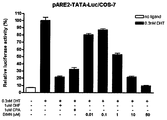
- Fig. 1 is a graph illustrating the result of investigation of AR (androgen receptor) specific transcriptional activity inhibition by nicotinamide derivatives of the invention
- AR androgen receptor
- GR glucocorticoid receptor
- ER estrogen receptor
- DHT Dihydortestosterone
- OHF Hydroxyflutamide
- BIC Bicalutamide
- CPA Cyproterone acetate
- DXM Dexamethason
- E2 Estradiol
- DIMN compound 6a prepared in example 14].
- Fig. 2 is a graph illustrating the result of investigation of dose-dependent AR specific transcriptional activity inhibition by nicotinamide derivatives of the invention [DHT: Dihydortestosterone, OHF: Hydroxyflutamide, CPA: Cyproterone acetate, DIMN: compound 6a prepared in example 14].
- DHT Dihydortestosterone
- OHF Hydroxyflutamide
- CPA Cyproterone acetate
- DIMN compound 6a prepared in example 14].
- Fig. 3 is a graph illustrating the result of investigation of transcriptional activity to AR (androgen receptor) induced by nicotinamide derivatives of the invention
- OPF Hydroxyflutamide
- BIC Bicalutamide
- DIMN compound 6a prepared in example 14
- DIMN-d# d-1 - d-29
- Fig. 4 is a graph illustrating the result of investigation of whether nicotinamide derivatives of the invention inhibit the AR ligand DHT binding competitively [DHT: Dihydortestosterone, OHF: Hydroxyflutamide, BIC: Bicalutamide, DIMN: compound 6a prepared in example 14, DIMN-d7].
- Fig. 5 is a graph illustrating the result of MTA assay investigating whether nicotinamide derivatives of the invention can inhibit the prostatic cancer cell line LNCaP proliferation [DHT: Dihydortestosterone, OHF: Hydroxyflutamide, BIC: Bicalutamide, DIMN: compound 6a prepared in example 14, DIMN-d7].
- DHT Dihydortestosterone
- OHF Hydroxyflutamide
- BIC Bicalutamide
- DIMN compound 6a prepared in example 14, DIMN-d7].
- Fig. 6 is a graph illustrating the result of thymidine incorporation assay investigating whether nicotinamide derivatives of the invention can inhibit the prostatic cancer cell line LNCaP proliferation [DHT: Dihydortestosterone, OHF: Hydroxyflutamide, BIC: Bicalutamide, DIMN: compound 6a prepared in example 14, DIMN-d7].
- DHT Dihydortestosterone
- OHF Hydroxyflutamide
- BIC Bicalutamide
- DIMN compound 6a prepared in example 14, DIMN-d7].
- Fig. 7 is a set of photographs illustrating the result of investigation whether DIMN can inhibit the expression of PSA (prostate specific antigen), the target protein of DHT, in prostatic cancer cell line (LNCaP) [OHF: Hydroxyflutamide, BIC: Bicalutamide, DIMN: compound 6a prepared in example 14].
- PSA prostate specific antigen
- LNCaP prostatic cancer cell line
- Target compound 6b was obtained by using compound 4b (1.0 g, 4.04 mmol), compound 5 (1.08g, 8.08 mmol) and 2-propanol by the same preparation method of compound 6a (light yellow solid, 904 mg, 65%).
- Target compound 6c was obtained using compound 4c (1.7 g, 6.86 mmol), compound 5 (1.82g, 13.7 mmol) and 2-propanol by the same preparation method of compound 6a (white solid, 1.8 g, 76%).
- Target compound 6d was obtained using compound 4d (520 mg, 2.1 mmol), compound 5 (560 mg, 4.2 mmol) and 2-propanol by the same preparation method of compound 6a (yellow solid, 290 mg, 41%).
- Target compound 6e was obtained using compound 4e (600 mg, 2.6 mmol), compound 5 (692 mg, 5.2 mmol) and 2-propanol by the same preparation method of compound 6a (brown solid, 201mg, 23%).
- Target compound 6f was obtained using compound 4f (100 mg, 0.38 mmol), compound 5 (100 mg, 0.76 mmol) and 2-propanol by the same preparation method of compound 6a (bright yellow solid, 50 mg, 37%).
- Target compound 6h was obtained using compound 4h (100 mg, 0.42 mmol), compound 5 (111 mg, 0.83 mmol) and 2-propanol by the same preparation method of compound 6a (brown solid, 23 mg, 16%).
- Target compound 6i was obtained using compound 4i (500 mg, 2.15 mmol), compound 5 (573 mg, 4.30 mmol) and 2-propanol by the same preparation method of compound 6a (white solid, 100 mg, 14%).
- ESI- MS m/z (328, MH - ).
- Target compound 6j was obtained using compound 4j (500 mg, 2.03 mmol), compound 5 (541mg, 4.06 mmol) and 2-propanol by the same preparation method of compound 6a (white solid, 267 mg, 39%).
- Target compound 6k was obtained using compound 4k (500mg, 1.90 mmol), compound 5 (506 mg, 3.80 mmol) and 2-propanol by the same preparation method of compound 6a (white solid, 305 mg, 45%).
- ESI- MS m/z (358, MH - ).
- Target compound 6l was obtained using compound 4l (450 mg, 1.70 mmol), compound 5 (453 mg, 3.40 mmol) and 2-propanol by the same preparation method of compound 6a (yellow solid, 354 mg, 58%).
- Target compound 6m was obtained using compound 4m (500mg, 2.00 mmol), compound 5 (536 mg, 4.00 mmol) and 2-propanol by the same preparation method of compound 6a (white solid, 37 8mg, 54%).
- ESI- MS m/z (346, MH
- Target compound 8b was obtained using compound 4b (500 mg, 2.02 mmol), compound 7 (782 mg, 4.05 mmol) and 2-propanol by the same preparation method of compound 8a (bright yellow solid, 800 mg, 97%).
- Target compound 8c was obtained using compound 4c (250 mg, 1.01 mmol), compound 7 (390 mg, 2.02 mmol) and 2-propanol by the same preparation method of compound 8a (yellow solid, 229 mg, 56%).
- Target compound 8d was obtained using compound 4d (344 mg, 1.39 mmol), compound 7 (537 mg, 2.78 mmol) and 2-propanol by the same preparation method of compound 8a (yellow solid, 130 mg, 23%).
- Target compound 8e was obtained using compound 4e (500 mg, 2.15 mmol), compound 7 (830 mg, 4.3 mmol) and 2-propanol by the same preparation method of compound 8a (yellow solid, 553 mg, 66%).
- Target compound 9b was obtained using compound 4a (248 mg, 1 mmol) and N -ethylpiperazine (228 mg, 2 mmol) by the same preparation method of compound 9a (yellow sticky oil, 179 mg, 52%).
- Target compound 9c was obtained using compound 4a (248 mg, 1 mmol) and N -ethylpiperazine (200 mg, 2 mmol) by the same preparation method of compound 9a (yellow sticky oil, 176 mg, 57%).
- Target compound 9d was obtained using compound 4a (248 mg, 1 mmol) and N -methylhomopiperazine (200 mg, 2 mmol) by the same preparation method of compound 9a (yellow oil, 165 mg, 48%).
- a luciferase assay was performed to investigate transcriptional activity to each AR (Androgen Receptor), GR (Glucocorticoid Receptor), and ER (Estrogen Receptor).
- a transient transfection assay was performed using pARE2-TATA-luc as reporter luc for AR (Androgen Receptor), MMTV-luc as reporter luc for GR (Glucocorticoid Receptor), and ERE-luc as reporter luc for ER (Estrogen Receptor).
- Luciferase assay is a method to investigate promoter activation .
- the promoter region of a specific gene is ligated to a vector containing luciferase.
- luminescence is measured to judge the activation of the promoter.
- the promoter region or regulatory element of a specific gene is cloned into 5 -upstream of the reporter gene to construct the reporter vector.
- This vector is introduced in the target cell (transfection), which is then treated with diverse materials (anti-androgens or ligands). Then, the activity of the reporter enzyme (luciferase) transcribed and translated by the changes of promoter activity is measured.
- PARE2-TATA-luc is DNA used for a luciferase assay, which is prepared by cloning a specific DNA sequence that can be bound to the androgen receptor into the luciferase vector.
- MMTV-luc is DNA used for a luciferase assay, which is prepared by cloning a specific DNA that can be bound to the glucocorticoid receptor into the luciferase vector.
- ERE-luc is DNA used for a luciferase assay, which is prepared by cloning a specific DNA that can be bound to the estrogen receptor into the luciferase vector.
- Transient transfection assay is a method to transfect animals with foreign plasmid DNA. Particularly, foreign DNA that is not originally included in the cell line is introduced into the cell line transiently for transfection.
- DHT(Dihydortestosterone) is a ligand of AR
- OHF(Hydroxyflutamide) is an antagonist of AR
- BIC(Bicalutamide) is an antagonist of AR
- CPA(Cyproterone acetate) is an antagonist of AR
- DXM(Dexamethason) is a ligand of GR
- E2(Estradiol) is a ligand of ER
- DIMN(6-(3,4-dihydro-1H-isoquinoline-2-yl)-N-(6-methylpyridine-2-yl)nicotinamide is the compound 6a prepared in example 14.
- DIMN (compound 6a) treatment did not affect transcriptional activity to GR and ER but inhibited transcriptional activity to AR (see Figure 1).
- Transient transfection was performed using reporter luc for AR (pARE2-TATA-luc), followed by a luciferase assay.
- Transcriptional activity to AR was inhibited dose-dependently by the treatment (0.01uM ⁇ 50uM) of DIMN (compound 6a).
- the inhibitory effect of the AR antagonists OHF (hydroxyflutamide) and CPA (cyproterone acetate) on transcriptional activity was also investigated for comparison. As a result, the transcription activity inhibition effect was observed. At this time, the effect was similar to that of 10 uM of DIMN (compound 6a) (see Figure 2).
- a luciferase assay was performed to investigate the effect of nicotinamide derivatives of the present invention (total 30 compounds) on transcription activity to AR.
- nicotinamide derivatives of the invention could compete with DHT for AR binding
- a competitive steroid binding assay was performed. Wild type AR was transiently transfected into COS-7 cell line. On the next day, two hours before the competitive steroid binding assay, the cells were treated with isotope-labeled 5nM [ 3 H]5 ⁇ -DHT and non-labeled 5nM ⁇ 5uM DHT, 5nM ⁇ 50uM BIC, 5nM ⁇ 50uM OHF, 5nM ⁇ 50uM nicotinamide derivative compound 6a (DIMN) and 5nM ⁇ 50uM nicotinamide derivative compound d-7.
- isotope-labeled 5nM [ 3 H]5 ⁇ -DHT and non-labeled 5nM ⁇ 5uM DHT, 5nM ⁇ 50uM BIC, 5nM ⁇ 50uM OHF, 5nM ⁇ 50uM nicotinamide derivative compound 6a (DIMN) and 5nM
- nicotinamide derivative compound 6a (DIMN) could not bind to AR better than the conventional AR antagonists OHF (hydroxyflutamide) and BIC (bicalutamide) but could bind thereto as well as those antagonists, suggesting that it similarly inhibits AR-DHT binding.
- IC 50 concentration that is able to inhibit AR-DHT binding 50%
- OHF and BIC was respectively 1 ⁇ 2 nM, 0.4 ⁇ 0.5 uM, and 0.9 uM.
- IC 50 of nicotinamide derivative compound 6a (DIMN) was 1 ⁇ 2 uM and that of nicotinamide derivative d-7 was 10 uM.
- Nicotinamide derivative compound 6a demonstrated 2 ⁇ 4 fold lower AR binding than OHF and 1 ⁇ 2 fold lower than BIC (see Figure 4). Therefore, it was confirmed that nicotinamide derivatives of the present invention compete with DHT, the AR ligand, to bind with the AR that plays an important role in prostatic cancer.
- MTS assay was performed.
- the prostatic cancer cell line LNCaP was distributed in a 96-well plate (2,000 cells/well), which was then treated or not treated with the AR ligand DHT or co-treated with DHT and 10 uM of chemicals for 5 days.
- the growth of the prostatic cancer cell line LNCaP was confirmed by measuring OD 490 .
- MTS assay is one of the methods to investigate cell growth. In this experimental example of the invention, MTS assay kit produced by Promega (Cat.No.G1112) was used.
- a thymidine incorporation assay was performed.
- the thymidine incorporation assay is based on the principle that thymidine is incorporated in DNA of growing cells. Particularly, isotope-labeled thymidine is introduced in cells of proliferation and then isotope level is measured.
- the prostatic cancer cell line LNCaP was distributed in a 96-well plate at the density of 2000 cells/well.
- the cells were cultured for 2 days and then treated with the AR antagonists BIC (bicalutamide), OHF (hydroxyflutamide), nicotinamide derivative compound 6a (DIMN) and nicotinamide derivative d-7 along with the AR ligand DHT, followed by further culture for 3 days. 4 hours before performing the thymidine incorporation assay, the cells were treated with 10uCi/ml of thymidine.
- Western blotting was performed to investigate whether DIMN could inhibit the expression of PSA like the other AR antagonists such as OHF (hydroxyflutamide) and BIC (bicalutamide).
- Western blotting or immunoblotting is one of the immunochemical methods, which uses antibody recognizing specific protein (antigen) to screen the target protein (antigen) among protein mixtures bound in membrane.
- the prostatic cancer cell line LNCaP was not treated with the AR ligand DHT (first raw) or treated with DHT alone (second raw) or co-treated with DHT and other compounds together (third raw - seventh raw) for 2 days. Then, expressions of AR and PSA, the target proteins of DHT, were measured. Tublin was also measured to quantify the protein.
- nicotinamide derivative compound 6a (DIMN) was treated to cells at different concentrations, expressions of AR and PSA were decreased dose-dependently. Equal amounts of AR antagonists were treated thereto and protein expressions were observed. As a result, when nicotinamide derivative compound 6a (DIMN) was treated at the concentration of 10 uM, expressions of AR and PSA were much more reduced than when equal concentrations of AR antagonists such as OHF or BIC were treated. Therefore, nicotinamide derivative compound 6a (DIMN) was confirmed to be an excellent candidate for the treatment of prostatic cancer by regulating AR and PSA expressions effectively, compared with the conventional AR antagonists OHF or BIC (see Figure 7).
Landscapes
- Chemical & Material Sciences (AREA)
- Organic Chemistry (AREA)
- Health & Medical Sciences (AREA)
- Medicinal Chemistry (AREA)
- Engineering & Computer Science (AREA)
- Diabetes (AREA)
- Chemical Kinetics & Catalysis (AREA)
- General Chemical & Material Sciences (AREA)
- Bioinformatics & Cheminformatics (AREA)
- Nuclear Medicine, Radiotherapy & Molecular Imaging (AREA)
- Endocrinology (AREA)
- Pharmacology & Pharmacy (AREA)
- Life Sciences & Earth Sciences (AREA)
- Animal Behavior & Ethology (AREA)
- General Health & Medical Sciences (AREA)
- Public Health (AREA)
- Veterinary Medicine (AREA)
- Pyridine Compounds (AREA)
- Pharmaceuticals Containing Other Organic And Inorganic Compounds (AREA)
Abstract
Provided are novel nicotinamide derivatives and pharmaceutically acceptable salts thereof with anti-androgen effects, preparing processes of the same and antiandrogens containing the same as active ingredients. More particularly, the said nicotinamide derivatives have anti-androgen activity, so that they can be effectively used as a preventive or therapeutic agent for androgen-related diseases such as prostatic disease, androgenic alopecia and acne.
Description
The present invention relates to novel nicotinamide derivatives and pharmaceutically acceptable salts thereof having anti-androgen effects, preparing processes of the same and antiandrogens containing the same as an active ingredient. More particularly, the nicotinamide derivatives of the present invention have anti-androgen activity, so that they can be effectively used as a preventive or therapeutic agent for androgen-related diseases, such as prostatic disease, androgenic alopecia and acne.
Anti-androgen treatment has usually been performed for the treatment of prostatic cancer or prostatic hyperplasia, and for the treatment of alopecia and acne as well. Anti-androgen treatment is based on the suppression of hormone action, so side effects might be of concern.
Antiandrogens recently used for the treatment of prostatic cancer are Bicalutamide, Flutamide, Nilutamide, and Cyproterone acetate, etc. Unlike the others, Cyproterone acetate is a member of the steroid antiandrogens, which compete with androgens for binding to the androgen receptor.
Known side-effects of Cyproterone acetate are inertia, sexual subnormality resulting from the decrease of androgens, and rarely, gynecomastia. Cardiovascular disease and liver cancer have also been reported as side-effects of Cyproterone acetate. Among them, liver cancer is the most fatal side-effect.
The administration of Nilutamide carries such side effects as amblyopia, alcohol hypersensitivity, nausea, inertia, epilepsy and liver cancer. Even though the cases of liver cancer as a side effect, are rare, it might be lethal, as Cyproterone acetate is.
The administration of Flutamide carries such side effects as diarrhea, inertia and gynecomastia. Moreover, it was previously reported that Flutamide causes liver cancer more than any other antiandrogens.
Bicalutamide is the most widely used antiandrogen, which is mainly used for the treatment of prostatic cancer because it is believed to overcome the problems of sexual subnormality or the decrease of bone density resulting from androgen decline caused by other antiandrogens. However, Bicalutamide also has side-effects, which are exemplified by diarrhea, inertia, nausea, red face, gynecomastia, mastodynia and rarely, liver cancer.
The administration of those antiandrogens such as Bicalutamide, Flutamide, Nilutamide and Cyproterone acetate was supposed to induce inactivation of trans-activity of the human androgen receptor. But, prostatic tumors begin to show resistance against hormone deficiency and start growing again even during the treatment. Therefore, the androgen receptor still remains active.
To treat prostatic cancer, the antiandrogen Bicalutamide has most commonly been used so far. However, prostatic cancer specific antiandrogens are still in need.
Therefore, it is the intention of the present inventors to develop antiandrogens which can be effectively used for the prevention and treatment of androgen-related diseases, including prostatic disease, androgenic alopecia and acne.
An object of the present invention is to provide novel nicotinamide derivatives or pharmaceutically acceptable salts thereof having anti-androgen activity.
Another object of the present invention is to provide a pharmaceutical composition having anti-androgen activity containing the novel nicotinamide derivatives or pharmaceutically acceptable salts thereof as active ingredients.
Another object of the present invention is to provide a pharmaceutical composition for the prevention and treatment of androgen-related diseases containing the nicotinamide derivatives or pharmaceutically acceptable salts thereof as active ingredients.
To achieve the object of the present invention, the present invention provides novel nicotinamide derivatives and pharmaceutically acceptable salts thereof represented by formula 1 with anti-androgen effects, the preparing processes of the same and anti-androgens containing the same as an active ingredient. More particularly, the said nicotinamide derivatives have anti-androgen activity, so that they can be effectively used as a preventive or therapeutic agent for androgen-related diseases such as prostatic disease, androgenic alopecia and acne.
[Formula 1]

[Wherein, Ar is (C6-C20)aryl or (C3-C20)heteroaryl, the aryl or heteroaryl of Ar can be substituted with halogen, (C1-C20)alkyl or (C1-C20)alkoxy;
R1 is halogen, 5- to 7-membered N-heterocycloalkyl, or 5- to 7-membered N-heterocycloalkyl fused aromatic ring, the N-heterocycloalkyl or N-heterocycloalkyl fused aromatic ring of R1 can be substituted with (C1-C20)alkyl or (C1-C20)alkoxy;
R2 through R4 are independently H or (C1-C20)alkyl;
a is an integer from 0 to 10.]
The nicotinamide derivatives of the present invention represented by formula 1 may be exemplified by the compounds represented by one of Chemical Formulas (2) to (7):
[Formula 2]

[Formula 3]

[Formula 4]

[Formula 5]

[Formula 6]

[Formula 7]

[Wherein, R1 is halogen, 5- to 7-membered N-heterocycloalkyl, or 5- to 7-membered N-heterocycloalkyl fused aromatic ring, the N-heterocycloalkyl or N-heterocycloalkyl fused aromatic ring of R1 can be substituted with (C1-C20)alkyl or (C1-C20)alkoxy; R11 through R15 are independently H, halogen, (C1-C20)alkyl or (C1-C20)alkoxy; X is O or S; R2 is H or (C1-C20)alkyl.]
R1 is Cl, F, Br,  ,
,  ,
,  or
or  , R21 and R22 are independently methyl, ethyl, n-propyl, i-propyl, n-butyl, i-butyl, t-butyl, pentyl, hexyl, heptyl, octyl, nonyl, decyl, methoxy, ethoxy, n-propoxy, i-propoxy, n-butoxy, i-butoxy, t-butoxy, pentoxy, hexyloxy, heptyloxy or octyloxy, R11 through R15 are independently H, F, Cl, Br, methyl, ethyl, n-propyl, i-propyl, n-butyl, i-butyl, t-butyl, pentyl, hexyl, heptyl, octyl, nonyl, decyl, methoxy, ethoxy, n-propoxy, i-propoxy, n-butoxy, i-butoxy, t-butoxy, pentoxy, hexyloxy, heptyloxy or octyloxy, X is O or S, R2 is H or methyl.
The nicotinamide derivatives of the present invention can be exemplified by those compounds shown below, but the invention cannot be limited to those compounds:
6-chloro-N-(6-methylpyridine-2-yl)nicotinamide; 6-chloro-N-(5-methylpyridine-2-yl)nicotinamide; 6-chloro-N-(4-methylpyridine-2-yl)nicotinamide; 6-chloro-N-(3-methylpyridine-2-yl)nicotinamide; 6-chloro-N-pyridine-2-yl-nicotinamide; 6-chloro-N-(6-methoxypyridine-3-yl)nicotinamide; 6-chloro-N-pyrimidine-2-yl-nicotinamide; 6-chloro-N-thiazole-2-yl-nicotinamide; 6-chloro-N-phenylnicotinamide; 6-chloro-N-O-tolylnicotinamide; 6-chloro-N-(3-methoxyphenyl)nicotinamide; 6-chloro-N-(2-methoxyphenyl)nicotinamide; 6-chloro-N-(4-fluorophenyl)nicotinamide; 6-(3,4-dihydro-1H-isoquinoline-2-yl)-N-(6-methylpyridine-2-yl)nicotinamide; 6-(3,4-dihydro-1H-isoquinoline-2-yl)-N-(5-methylpyridine-2-yl)nicotinamide; 6-(3,4-dihydro-1H-isoquinoline-2-yl)-N-(4-methylpyridine-2-yl)nicotinamide; 6-(3,4-dihydro-1H-isoquinoline-2-yl)-N-(3-methylpyridine-2-yl)nicotinamide; 6-(3,4-dihydro-1H-isoquinoline-2-yl)-N-pyridine-2-yl-nicotinamide; 6-(3,4-dihydro-1H-isoquinoline-2-yl)-N-(6-methoxypyridine-3-)nicotinamide; 6-(3,4-dihydro-1H-isoquinoline-2-yl)-N-pyrimidine-2-yl-nicotinamide; 6-(3,4-dihydro-1H-isoquinoline-2-yl)-N-thiazole-2-yl-nicotinamide; 6-(3,4-dihydro-1H-isoquinoline-2-yl)-N-phenylnicotinamide; 6-(3,4-dihydro-1H-isoquinoline-2-yl)-N-O-tolylnicotinamide; 6-(3,4-dihydro-1H-isoquinoline-2-yl)-N-(3-methoxyphenyl)nicotinamide; 6-(3,4-dihydro-1H-isoquinoline-2-yl)-N-(2-methoxyphenyl)nicotinamide; 6-(3,4-dihydro-1H-isoquinoline-2-yl)-N-(4-fluorophenyl)nicotinamide; 6-(6,7-dimethoxy-3,4-dihydro-1H-isoquinoline-2-yl)-N-(6-methylpyridine-2-yl)-nicotinamide; 6-(6,7-dimethoxy-3,4-dihydro-1H-isoquinoline-2-yl)-N-(5-methylpyridine-2-yl)-nicotinamide; 6-(6,7-dimethoxy-3,4-dihydro-1H-isoquinoline-2-yl)-N-(4-methylpyridine-2-yl)-nicotinamide; 6-(6,7-dimethoxy-3,4-dihydro-1H-isoquinoline-2-yl)-N-(3-methylpyridine-2-yl)-nicotinamide; 6-(6,7-dimethoxy-3,4-dihydro-1H-isoquinoline-2-yl)-N-pyridine-2-yl-nicotinamide; 6-(piperidine-1-yl)-N-(6-methylpyridine-2-yl)nicotinamide; 6-(4-ethylpiperazine-1-yl)-N-(6-methylpyridine-2-yl)nicotinamide; 6-(4-methylpiperazine-1-yl)-N-(6-methylpyridine-2-yl)nicotinamide; 6-(4-methyl-1,4-diazephan-1-yl)-N-(6-methylpyridine-2-yl)nicotinamide; 6-(3,4-dihydro-1H-isoquinoline-2-yl)-N-(6-methoxypyridine-3-yl)nicotinamide; 6-(3,4-dihydro-1H-isoquinoline-2-yl)-N-methyl-N-(4-methylpyridine-2-yl)nicotinamide; 6-(3,4-dihydro-1H-isoquinoline-2-yl)-N-(3-methoxybenzyl)nicotinamide; 6-(piperidine-1-yl)-N-(3-methoxybenzyl)nicotinamide; 6-(3,4-dihydro-1H-isoquinoline-2-yl)-N-methyl-N-(3-methoxyphenyl)nicotinamide; 6-(3,4-dihydro-1H-isoquinoline-2-yl)-N-methyl-N-(2-methylphenyl)nicotinamide; 6-(3,4-dihydro-1H-isoquinoline-2-yl)-N-methyl-N-(2-methoxyphenyl)nicotinamide.
The nicotinamide derivatives of the present invention can be prepared as shown in reaction formulas 1 and 2 according to the substituents of R1. The method explained below cannot limit the present invention to produce the nicotinamide derivatives of formula 1, and also it is well understood by those in the art that any modification in the method of the invention can also be included in this invention.
In reaction formula 1, R1 is halogen. In that case, carboxylic acid derivative(a) is refluxed with thionyl chloride to give oxychloride(b), which is reacted with various amine compounds(C) to give the nicotinamide derivative of formula 1 wherein R1 is halogen.
[Reaction Formula 1]

[Wherein, Ar is (C6-C20)aryl or (C3-C20)heteroaryl, the aryl or heteroaryl of Ar can be substituted with halogen, (C1-C20)alkyl or (C1-C20)alkoxy; R1 is halogen; R2 through R4 are independently H or (C1-C20)alkyl; and a is an integer from 0 to 10.]
In reaction formula 2, R1 is 5- to 7-membered N-heterocycloalkyl, or 5- to 7-membered N-heterocycloalkyl fused aromatic ring. In that case, halogen compound(d) is reacted with N-heterocycloalkyl compound(e) to give the nicotinamide derivative of formula 1 wherein R1 is 5- to 7-membered N-heterocycloalkyl, or 5- to 7-membered N-heterocycloalkyl fused aromatic ring.
[Reaction Formula 2]

[Wherein, Y is halogen; Ar is (C6-C20)aryl or (C3-C20)heteroaryl, the aryl or heteroaryl of Ar can be substituted with halogen, (C1-C20)alkyl or (C1-C20)alkoxy; R1 is 5- to 7-membered N-heterocycloalkyl, or 5- to 7-membered N-heterocycloalkyl fused aromatic ring, the N-heterocycloalkyl or N-heterocycloalkyl fused aromatic ring of R1 can be substituted with (C1-C20)alkyl or (C1-C20)alkoxy; R2 through R4 are independently H or (C1-C20)alkyl; and a is an integer from 0 to 10.]
Nicotinamide derivatives of the present invention represented by formula 1 act like antiandrogens. So, the present invention provides a pharmaceutical composition having anti-androgen activity which comprises nicotinamide derivatives or pharmaceutically acceptable salts thereof represented by formula 1 as active ingredients. The present invention also provides a composition for the prevention and treatment of androgen-related diseases which comprises an effective dose of nicotinamide derivatives or pharmaceutically acceptable salts thereof represented by formula 1 and pharmaceutically acceptable carriers. The androgen-related diseases that can be prevented or treated by the pharmaceutical composition of the present invention are exemplified by prostatic diseases such as prostatic cancer, prostatic hyperplasia, prostatitis, prostatovesiculitis, and utriculitis; androgenic alopecia; and acne. Particularly, the pharmaceutical composition of the present invention inhibits prostatic cancer cell proliferation, suggesting that it is effective in the prevention and treatment of prostatic cancer.
The acceptable salts appropriate for the pharmaceutical composition can contain organic acid or inorganic acid, and solvate and hydrate of the said salt compound are also included in the criteria of the present invention. The pharmaceutically acceptable acid addition salts can be obtained from inorganic acids such as hydrochloric acid, nitric acid, phosphoric acid, sulfuric acid, hydrobromic acid, hydroiodic acid, nitrous acid and phosphorous acid; and nontoxic organic acids such as aliphatic mono/dicarboxylate, phenyl-substituted alkanoate, hydroxyl alkanoate, alkandioate, aromatic acids, and aliphatic/aromatic sulfonic acids. Such pharmaceutically nontoxic salts include sulfate, pyrosulfate, bisulfate, sulfite, bisulfite, nitrate, phosphate, monohydrogen phosphate, dihydrogen phosphate, metaphosphate, pyrophosphate, chloride, bromide, iodide, fluoride, acetate, propionate, decanoate, caprylate, acrylate, fomate, isobutylate, caprate, heptanoate, propiolate, oxalate, malonate, succinate, suberate, sebacate, fumarate, maleate, butyn-1,4-dioate, hexane-1,6-dioate, benzoate, chlorobenzoate, methylbenzoate, dinitro benzoate, hydroxybenzoate, methoxybenzoate, phthalate, terephthalate, benzenesulfonate, toluenesulfonate, chlorobenzenesulfonate, xylenesulfonate, phenylacetate, phenylpropionate, phenylbutylate, citrate, lactate, β-hydroxybutylate, glycolate, malate, tartrate, methanesulfonate, propanesulfonate, naphthalene-1-sulfonate, naphthalene-2-sulfonate or mandelate.
To achieve the treatment effect, the dosage of nicotinamide derivatives or pharmaceutically acceptable salts thereof of formula 1 of the present invention can be regulated according to the specific target compound, administration method, target subject and target disease, but generally the dosage of nicotinamide derivatives or pharmaceutically acceptable salts thereof of formula 1 of the present invention is 50 mg/Kg - 150 mg/Kg. And administration frequency is once a day or preferably a few times a day. The effective dosage can be determined according to weight, age, gender, health condition, diet, administration frequency, administration method, excretion and severity of a disease. The composition of the present invention can be administered orally (for example, tablets, capsules, powders, solutions, etc) or parenterally (for example, intravenous injection, etc).
The pharmaceutical composition of the present invention can be formulated as various conventional formulations for oral administration. For example the formulations for oral administration are tablets, powders, dry syrups, chewable tablets, granules, capsules, soft capsules, pills, drinks, sublinguals, etc.
The composition of the invention formulated as tablets can be administered to a subject by any method or pathway that delivers the effective dose of the tablet with bioavailability, which can be an oral pathway. And the administration method or pathway can be determined according to the characteristics, stages of the target disease and other conditions. When the composition of the invention is formed as tablets, it can additionally include pharmaceutically acceptable excipients. The content and characteristics of the excipient can be determined by the solubility and chemical properties of the selected tablet, administration pathway and standard pharmaceutical practice.
The composition of the present invention can include pharmaceutically acceptable excipients and one or more therapeutic components along with nicotinamide derivatives or pharmaceutically acceptable salts thereof of formula 1. The excipient can be any solid or half-solid substance that can be a vehicle or a medium for the active ingredient and the acceptable excipients are well-informed to those in the art. The excipient can be selected according to the purpose and methods of administration. For example, for the formulation of tablets, powders, chewable tablets, granules, capsules, soft capsules, pills, sublinguals or syrups, the active ingredient can be mixed with inactive non-toxic pharmaceutically acceptable excipients such as lactose and starch. The pharmaceutical tablets of the invention can also include a binding agent such as amorphous cellulose, gum tragacanth or gelatin; a disintegrating agent such as alginic acid; a lubricant such as magnesium stearate; a glidant such as colloidal silicon dioxide; a sweetening agent such as sucrose or saccharin; a coloring agent such as peppermint or methyl salicylate; or a flavor. Since it is easy to administrate, tablets are the most preferable unit formulation for oral administration, and if necessary, tablets can be coated with sugar, shellac or other enteric coating agents.
The novel nicotinamide derivatives of the present invention compete with DHT (dihydrotestosterone), the androgen receptor (AR) ligand. So, the derivatives are bound to the androgen receptor (AR) and therefore inhibit transcriptional activity of the same, demonstrating anti-androgen effects. The androgen receptor is an important factor of prostatic cancer. When the nicotinamide derivatives of the present invention were treated to a prostatic cancer cell line (LNCaP), the proliferation of the cancer cell line (LNCaP) was inhibited and the expression of PSA protein, known as a target protein for prostatic cancer, was also inhibited, suggesting that the derivatives had anti-androgen effects in prostatic cancer cell lines. That is, the nicotinamide derivatives of the present invention have anti-androgen effects, so that they can be effectively used for the prevention and treatment of androgen-related diseases, including prostatic disease, androgenic alopecia and acne.
The above and other objects, features and advantages of the present invention will become apparent from the following description of preferred embodiments given in conjunction with the accompanying drawings, in which:
Fig. 1 is a graph illustrating the result of investigation of AR (androgen receptor) specific transcriptional activity inhibition by nicotinamide derivatives of the invention [AR: androgen receptor, GR: glucocorticoid receptor, ER: estrogen receptor, DHT: Dihydortestosterone, OHF: Hydroxyflutamide, BIC: Bicalutamide, CPA: Cyproterone acetate, DXM: Dexamethason, E2: Estradiol, DIMN: compound 6a prepared in example 14].
Fig. 2 is a graph illustrating the result of investigation of dose-dependent AR specific transcriptional activity inhibition by nicotinamide derivatives of the invention [DHT: Dihydortestosterone, OHF: Hydroxyflutamide, CPA: Cyproterone acetate, DIMN: compound 6a prepared in example 14].
Fig. 3 is a graph illustrating the result of investigation of transcriptional activity to AR (androgen receptor) induced by nicotinamide derivatives of the invention [OHF: Hydroxyflutamide, BIC: Bicalutamide, DIMN: compound 6a prepared in example 14, DIMN-d#: d-1 - d-29].
Fig. 4 is a graph illustrating the result of investigation of whether nicotinamide derivatives of the invention inhibit the AR ligand DHT binding competitively [DHT: Dihydortestosterone, OHF: Hydroxyflutamide, BIC: Bicalutamide, DIMN: compound 6a prepared in example 14, DIMN-d7].
Fig. 5 is a graph illustrating the result of MTA assay investigating whether nicotinamide derivatives of the invention can inhibit the prostatic cancer cell line LNCaP proliferation [DHT: Dihydortestosterone, OHF: Hydroxyflutamide, BIC: Bicalutamide, DIMN: compound 6a prepared in example 14, DIMN-d7].
Fig. 6 is a graph illustrating the result of thymidine incorporation assay investigating whether nicotinamide derivatives of the invention can inhibit the prostatic cancer cell line LNCaP proliferation [DHT: Dihydortestosterone, OHF: Hydroxyflutamide, BIC: Bicalutamide, DIMN: compound 6a prepared in example 14, DIMN-d7].
Fig. 7 is a set of photographs illustrating the result of investigation whether DIMN can inhibit the expression of PSA (prostate specific antigen), the target protein of DHT, in prostatic cancer cell line (LNCaP) [OHF: Hydroxyflutamide, BIC: Bicalutamide, DIMN: compound 6a prepared in example 14].
Practical and presently preferred embodiments of the present invention are illustrated as shown in the following examples.
However, it will be appreciated that those skilled in the art, on consideration of this disclosure, may make modifications and improvements within the spirit and scope of the present invention.
Examples 1-13

Example 1: Preparation of 6-chloro-N-(6-methylpyridine-2-yl)nicotinamide[4a]
6-Chloronicotinic acid 1 (1.57 g, 10 mmol) and SOCl2 were mixed, followed by overnight reflux. Excessive SOCl2 was eliminated by vacuum distillation. Residue 2 was dissolved in CH2Cl2, to which the mixed solution comprising 2-amino-methylpyridine 3a (5.4 g, 50 mmol), triethylamine (1.71 g, 17 mmol) and CH2Cl2 was carefully added. The reaction mixture was then stirred at room temperature. Upon completion of the reaction, the reaction mixture was extracted using CH2Cl2, which was washed with water and brine, and then dried over Na2SO4. The organic layer was vacuum-concentrated. The residue was re-crystallized using 2-propanol to produce the white solid compound 4a (2.05 g, 83%). IR (cm-1): 3309 (NH), 1665 (CO). 1H NMR (300 MHz, CDCl3) : 8.95 (1H, m, -N=CH), 8.73 (1H, s, NH), 8.2 8.19 (1H, m, Aromatic-H), 8.13 (1H, d, J = 8.3 Hz, Aromatic-H), 7.76 (1H, m, Aromatic-H), 7.46 (1H, d, J = 8.3 Hz, Aromatic-H), 6.98 (1H, d, J = 7.4 Hz, Aromatic-H), 2.46 (3H, s, -CH3). ESI- MS: m/z (248, MH+).
Example 2: Preparation of 6-chloro-N-(5-methylpyridine-2-yl)nicotinamide[4b]
Compound 4b was obtained using compound 1 (1.57 g, 10mmol) and compound 3b (5.4 g, 50 mmol) in the presence of triethylamine (1.71 g, 17 mmol) by the same preparation method of compound 4a (white solid, 1.6 g, 65%). IR (cm-1): 3237 (NH), 1687 (CO). 1H NMR (300 MHz, CDCl3): 8.94 8.92 (2H, m, -N=CH, NH), 8.24 8.18 (2H, m, Aromatic-H), 8.04 (1H, s, -N=CH), 7.61 7.58 (1H, m, Aromatic-H), 7.46 (1H, d, J = 8.3 Hz, Aromatic-H), 2.32 (3H, s, -CH3). ESI- MS: m/z (248, MH+).
Example 3: Preparation of 6-chloro-N-(4-methylpyridine-2-yl)nicotinamide[4c]
Compound 4c was obtained using compound 1 (2.36 g, 15 mmol) and compound 3c (8.1 g, 75 mmol) in the presence of triethylamine (2.57 g, 25.5 mmol) by the same preparation method of compound 4a (yellow solid, 1.6 g, 65%). IR (cm-1): 3237 (NH), 1687 (CO). 1H NMR (300 MHz, CDCl3): 8.94 8.92 (2H, m, -N=CH, NH), 8.24 8.18 (2H, m, Aromatic-H), 8.04 (1H, s, -N=CH), 7.61 7.58 (1H, m, Aromatic-H), 7.46 (1H, d, J = 8.3 Hz, Aromatic-H), 2.32 (3H, s, -CH3). ESI- MS: m/z (248, MH+).
Example 4: Preparation of 6-chloro-N-(3-methylpyridine-2-yl)nicotinamide[4d]
Compound 4d was obtained using compound 1 (2.35 g, 15 mmol) and compound 3d (0.81 g, 7.5 mmol) in the presence of triethylamine (2.58 g, 25.5 mmol) by the same preparation method of compound 4a (white solid, 950 mg, 25%). 1H NMR (300 MHz, CDCl3): 9.03 (1H, s, -N=CH), 8.30 (1H, d, J = 7.2 Hz, -N=CH), 8.11 (1H, m, Aromatic-H), 7.69 (1H, d, J = 7.5 Hz, Aromatic-H), 7.36 (1H, d, J = 8.1 Hz, Aromatic-H), 7.13 (1H, s, Aromatic-H), 2.37 (3H, s, -CH3). ESI- MS: m/z (248, MH+).
Example 5: Preparation of 6-chloro-N-pyridine-2-yl-nicotinamide[4e]
Compound 4e was obtained using compound 1 (2.36 g, 15 mmol) and compound 3e (7.05 g, 75 mmol) in the presence of triethylamine (2.57 g, 25.5 mmol) by the same preparation method of compound 4a (yellow solid, 2.4 g, 68%). 1H NMR (300 MHz, CDCl3): 9.33 (1H, s, NH), 8.95 (1H, d, J = 2.4 Hz, -N=CH), 8.36 8.33 (1H, m, -N=CH), 8.22 8.19 (2H, m, Aromatic-H), 7.81 7.75 (1H, m, Aromatic-H), 7.45 (1H, d, J = 8.1 Hz, Aromatic-H), 7.10 (1H, t, J = 5.1 Hz, Aromatic-H). ESI- MS: m/z (234, MH+).
Example 6: Preparation of 6-chloro-N-(6-methoxypyridine-3-yl)nicotinamide[4f]
Compound 4f was obtained using compound 2 (440 mg, 2.5 mmol) and compound 3f (352 mg, 2.8 mmol) in the presence of triethylamine (0.49 g, 4.83 mmol) by the same preparation method of compound 4a at 0℃ for 90 minutes (red solid, 172 mg, 26%). 1H NMR (300 MHz, CDCl3): 8.87 (1H, d, J = 2.4 Hz, -N=CH), 8.28 (1H, d, J = 2.7 Hz, -N=CH), 8.18 (1H, dd, J = 8.1, 2.4 Hz, Aromatic-H), 7.98 (1H, dd, J = 8.7, 2.7 Hz, Aromatic-H), 7.65 (1H, s, NH), 7.49 (1H, d, J = 8.1 Hz, Aromatic-H), 6.81 (1H, d, J = 8.7 Hz, Aromatic-H), 3.95 (3H, s, -CH3). ESI- MS: m/z(262, MH-).
Example 7: Preparation of 6-chloro-N-pyridine-2-yl-nicotinamide[4g]
Compound 4g was obtained using compound 1 (1.58 g, 10 mmol) and compound 3g (1.90 g, 20 mmol) in the presence of triethylamine (1.72 g, 17 mmol) by the same preparation method of compound 4a (yellow solid, 0.66 g, 28%). 1H NMR (300 MHz, CDCl3): 8.71 (1H, d, J = 1.8 Hz, -N=CH), 8.66 (1H, d, J = 5.1 Hz, -N=CH), 8.05 (1H, d, J = 2.7 Hz, -N=CH), 8.02 (1H, d, J = 2.4 Hz, Aromatic-H), 7.41 (1H, dd, J = 8.4, 0.6 Hz, Aromatic-H), 7.27 7.21 (1H, m, Aromatic-H). ESI- MS: m/z (233, MH-).
Example 8: Preparation of 6-chloro-N-thiazole-2-yl-nicotinamide[4h]
Compound 4h was obtained using compound 1 (1.58 g, 10 mmol) and compound 3h (2.06 g, 20 mmol) in the presence of triethylamine (1.72 g, 17 mmol) by the same preparation method of compound 4a (white solid, 0.67 g, 28%).
1H NMR (300 MHz, CDCl3) : 9.02 (1H, d, J = 2.4 Hz, -N=CH), 8.27 (1H, dd, J = 8.4, 2.7 Hz, Aromatic-H), 7.26 (1H, dd, J = 7.5, 0.6 Hz, Aromatic-H), 7.33 7.26 (2H, m, NH, -N=CH), 7.06 (1H, d, J = 3.6 Hz, -S-CH). ESI- MS: m/z (238, MH-).
Example 9: Preparation of 6-chloro-N-phenylnicotinamide[4i]
Compound 4i was obtained using compound 1 (1.71 g, 17 mmol) and compound 3i (4.65 g, 50 mmol) in the presence of triethylamine (1.71 g, 17 mmol) by the same preparation method of compound 4a (white solid, 1.39 g, 60%). 1H NMR (300 MHz, CDCl3): 8.85 (1H, d, J = 2.4Hz, -N=CH), 8.16 (1H, dd, J = 8.4, 2.4Hz, Aromatic-H), 7.83 (1H, s, NH), 7.62-7.16 (6H, m, Aromatic-H). ESI- MS: m/z (231, MH-).
Example 10: Preparation of 6-chloro-N-
O
-tolylnicotinamide[4j]
Compound 4j was obtained using compound 1 (1.00 g, 6.3 mmol) and compound 3j (3.38 g, 31.5 mmol) in the presence of triethylamine (1.08 g, 10.7 mmol) by the same preparation method of compound 4a (ivory solid, 0.76 g, 49%). 1H NMR (300 MHz, CDCl3): 8.85 (1H, d, J = 2.1Hz, -N=CH), 8.15 (1H, dd, J = 8.1, 2.4Hz, Aromatic-H), 7.78 (1H, d, J = 7.5Hz, Aromatic-H), 7.68 (1H, s, NH), 7.46-7.13 (4H, m, Aromatic-H), 2.31 (3H, s, -CH3). ESI- MS: m/z (245, MH-).
Example 11: Preparation of 6-chloro-N-(3-methoxyphenyl)nicotinamide[4k]
Compound 4k was obtained using compound 1 (1.00 g, 6.3 mmol) and compound 3k (3.88 g, 31.5 mmol) in the presence of triethylamine (1.08 g, 10.7 mmol) by the same preparation method of compound 4a (light red solid, 1.23 g, 75%). 1H NMR (300 MHz, CDCl3): 8.85 (1H, d, J = 1.8Hz, -N=CH), 8.16 (1H, dd, J = 8.1, 2.4Hz, Aromatic-H), 7.72 (1H, s, NH), 7.47 (1H, d, J = 7.5Hz, Aromatic-H), 7.38-6.73 (4H, m, Aromatic-H), 3.84 (3H, s, -OCH3). ESI- MS: m/z (261, MH-).
Example 12: Preparation of 6-chloro-N-(2-methoxyphenyl)nicotinamide[4l]
Compound 4l was obtained using compound 1 (1.00 g, 6.3 mmol) and compound 3l (3.88 g, 31.5 mmol) in the presence of triethylamine (1.08 g, 10.7 mmol) by the same preparation method of compound 4a (ivory solid, 0.92 g, 56%). 1H NMR (300 MHz, CDCl3): 8.88 (1H, d, J = 2.1Hz, -N=CH), 8.46 (1H, dd, J = 7.8, 1.5Hz, Aromatic-H), 8.18 (1H, dd, J = 8.4, 2.7Hz, Aromatic-H), 7.49-6.92 (4H, m, Aromatic-H), 3.94 (3H, s, -OCH3). ESI- MS: m/z (261, MH-).
Example 13: Preparation of 6-chloro-N-(4-fluorophenyl)nicotinamide[4m]
Compound 4m was obtained using compound 1 (1.00 g, 6.3 mmol) and compound 3m (3.50 g, 31.5 mmol) in the presence of triethylamine (1.08 g, 10.7 mmol) by the same preparation method of compound 4a (light black solid, 0.88 g, 56%). 1H NMR (300 MHz, CDCl3): 8.85 (1H, d, J = 2.4Hz, -N=CH), 8.17 (1H, dd, J = 8.4, 2.7Hz, Aromatic-H), 7.76 (1H, s, NH), 7.60-7.06 (5H, m, Aromatic-H). ESI- MS: m/z (249, MH-). (see Figure 4)
Examples 14-26

Example 14: Preparation of 6-(3,4-dihydro-1H-isoquinoline-2-yl)-N-(6-methylpyridine-2-yl)nicotinamide[6a]
Compound 4a (1.0 g, 4.04 mmol) and 1,2,3,4-tetrahydroisoquinoline 5 (1.08 g, 8.08 mmol) were mixed in 2-propanol, followed by reflux for 48 hours. After eliminating the solvent, the residue was re-crystallized using 2-propanol to produce target compound 6a (ivory solid, 1.0 g, 72%). IR (cm-1): 3435 (NH), 1671 (CO). 1H NMR (300 MHz, CDCl3) : 8.81 (1H, dd, J = 2.6, 0.6 Hz, -N=CH), 8.41 (1H, s, NH), 8.16 (1H, d, J = 8.3 Hz, Aromatic-H), 8.02 (1H, dd, J = 9.0, 2.6 Hz, Aromatic-H), 7.62 (1H, t, J = 7.7 Hz, Aromatic-H), 7.22 7.20 (4H, m, Aromatic-H), 6.90 (1H, d, J = 7.4 Hz, Aromatic-H), 6.66 (1H, d, J = 9.0 Hz, Aromatic-H), 4.80 (2H, s, -CH2-N-), 3.94 3.90 (2H, m, -N-CH
2 -CH2-), 2.99 (2H, t, J = 5.9 Hz, -N-CH2-CH
2 -), 2.46 (3H, s, -CH3). ESI- MS: m/z (345, MH+).
Example 15: Preparation of 6-(3,4-dihydro-1H-isoquinoline-2-yl)-N-(5-methylpyridine-2-yl)nicotinamide[6b]
Target compound 6b was obtained by using compound 4b (1.0 g, 4.04 mmol), compound 5 (1.08g, 8.08 mmol) and 2-propanol by the same preparation method of compound 6a (light yellow solid, 904 mg, 65%). IR (cm-1): 3307 (NH), 1670 (CO). 1H NMR (300 MHz, CDCl3) : 8.79 (1H, d, J = 2.1Hz, -N=CH), 8.49 (1H, s, NH), 8.26 (1H, d, J = 8.5 Hz, Aromatic-H), 8.09 (1H, s, -N=CH), 8.03 (1H, dd, J = 8.9, 2.3Hz, Aromatic-H), 7.55 (1H, d, J = 8.4 Hz, Aromatic-H), 7.23 7.15 (4H, m, Aromatic-H), 6.67 (1H, d, J = 9.0 Hz, Aromatic-H), 4.80 (2H, s, -CH2-N-), 3.92 (2H, t, J = 5.8 Hz, -N-CH
2 -CH2-), 2.99 (2H, t, J = 5.8 Hz, -N-CH2-CH
2 -), 2.30 (3H, s, -CH3). ESI- MS: m/z (345, MH+).
Example 16: Preparation of 6-(3,4-dihydro-1H-isoquinoline-2-yl)-N-(4-methylpyridine-2-yl)nicotinamide[6c]
Target compound 6c was obtained using compound 4c (1.7 g, 6.86 mmol), compound 5 (1.82g, 13.7 mmol) and 2-propanol by the same preparation method of compound 6a (white solid, 1.8 g, 76%). IR (cm-1): 3314 (NH), 1676 (CO). 1H NMR (300 MHz, CDCl3) : 8.81 (1H, d, J = 2.1 Hz, -N=CH), 8.59 (1H, s, NH), 8.22 8.18 (1H, m, -N=CH), 8.11 (1H, d, J = 5.1 Hz, Aromatic-H), 8.03 (1H, dd, J = 8.7, 2.4 Hz, Aromatic-H), 7.23 7.11 (4H, m, Aromatic-H), 6.87 (1H, d, J = 5.1 Hz, Aromatic-H), 6.67 (1H, d, J = 8.7 Hz, Aromatic-H), 4.80 (2H, s, -CH2-N-), 3.92 (2H, t, J = 5.7 Hz, -N-CH
2 -CH2-), 2.99 (2H, t, J = 6.0 Hz, -N-CH2-CH
2 -), 2.39 (3H, s, -CH3). ESI- MS: m/z (345, MH+).
Example 17: Preparation of 6-(3,4-dihydro-1H-isoquinoline-2-yl)-N-(3-methylpyridine-2-yl)nicotinamide[6d]
Target compound 6d was obtained using compound 4d (520 mg, 2.1 mmol), compound 5 (560 mg, 4.2 mmol) and 2-propanol by the same preparation method of compound 6a (yellow solid, 290 mg, 41%). 1H NMR (300 MHz, CDCl3): 8.81 (1H, d, J = 1.8 Hz, -N=CH), 8.27 8.22 (2H, m, -N=CH, NH), 8.06 (1H, dd, J = 9.0, 2.4 Hz, Aromatic-H), 7.66 7.60 (1H, m, Aromatic-H), 7.35 7.10 (5H, m, Aromatic-H), 6.68 (1H, d, J = 8.7 Hz, Aromatic-H), 4.81 (2H, s, -CH2-N-), 3.93 (2H, t, J = 5.7 Hz, -N-CH
2 -CH2-), 2.99 (2H, t, J = 6.0 Hz, -N-CH2-CH
2 -), 2.33 (3H, s, -CH3). ESI- MS: m/z (345, MH+).
Example 18: Preparation of 6-(3,4-dihydro-1H-isoquinoline-2-yl)-N-pyridine-2-yl-nicotinamide[6e]
Target compound 6e was obtained using compound 4e (600 mg, 2.6 mmol), compound 5 (692 mg, 5.2 mmol) and 2-propanol by the same preparation method of compound 6a (brown solid, 201mg, 23%). 1H NMR (300 MHz, CDCl3): 8.80 (1H, d, J = 2.4 Hz, -N=CH), 8.55 (1H, s, NH), 8.38 8.18 (2H, m, Aromatic-H), 8.03 (1H, dd, J = 9.3, 2.7 Hz, Aromatic-H), 7.81 7.70 (1H, m, Aromatic-H), 7.23 7.20 (4H, m, Aromatic-H), 7.06 7.02 (1H, m, Aromatic-H), 6.68 (1H, d, J = 9.0 Hz, Aromatic-H), 4.81 (2H, s, -CH2-N-), 3.92 (2H, t, J = 6.0 Hz, -N-CH
2 -CH2-), 2.99 (2H, t, J = 6.0 Hz, -N-CH2-CH
2 -). ESI- MS: m/z (330, MH+).
Example 19: Preparation of 6-(3,4-dihydro-1H-isoquinoline-2-yl)-N-(6-methoxypyridine-3-yl)nicotinamide[6f]
Target compound 6f was obtained using compound 4f (100 mg, 0.38 mmol), compound 5 (100 mg, 0.76 mmol) and 2-propanol by the same preparation method of compound 6a (bright yellow solid, 50 mg, 37%). 1H NMR (300 MHz, CDCl3): 8.72 (1H, d, J = 2.1 Hz, -N=CH), 8.24 (1H, d, J = 2.4 Hz, -N=CH), 8.01 (2H, dd, J = 9.0, 2.7 Hz, Aromatic-H), 7.54 (1H, s, NH), 7.26 7.19 (4H, m, Aromatic-H), 6.73 (2H, dd, J = 25, 9.0 Hz, Aromatic-H), 4.81 (2H, s, -CH2-N-), 3.94 3.90 (5H, m, -N-CH
2 -CH2-, -OCH3), 2.99 (2H, t, J = 6.0 Hz, -N-CH2-CH
2 -). ESI- MS: m/z (359, MH-).
Example 20: Preparation of 6-(3,4-dihydro-1H-isoquinoline-2-yl)-N-pyrimidine-2-yl-nicotinamide[6g]
Compound 4g (0.60 g, 2.6 mmol), compound 5 (0.69 g, 5.1 mmol) and 2-propanol were reacted by the same preparation method of compound 6a. After eliminating the solvent, the residue was purified by column chromatography with n-hexane-EA (2:1) to produce target compound 6g (white solid, 0.28 g, 32%). 1H NMR (300 MHz, CDCl3): 8.51 (1H, d, J = 2.1 Hz, -N=CH), 7.79 (1H, dd, J = 8.1, 2.1 Hz, Aromatic-H), 7.43 (1H, d, J = 8.1 Hz, -N=CH), 7.26 7.20 (7H, m, -N=CH, Aromatic-H), 6.95 (1H, s, NH), 4.89 (1H, s, -CH2-N-), 4.60 (1H, s, -CH2-N-), 3.99 (1H, s, -N-CH
2 -CH2-), 3.66 (1H, s, -N-CH
2 -CH2-), 2.92 (2H, s, -N-CH2-CH
2 -).
Example 21: Preparation of 6-(3,4-dihydro-1H-isoquinoline-2-yl)-N-thiazole-2-yl-nicotinamide[6h]
Target compound 6h was obtained using compound 4h (100 mg, 0.42 mmol), compound 5 (111 mg, 0.83 mmol) and 2-propanol by the same preparation method of compound 6a (brown solid, 23 mg, 16%). 1H NMR (300 MHz, DMSO-d6): 12.4 (1H, s, NH), 8.88 (1H, d, J = 2.1 Hz, -N=CH), 8.23 (1H, dd, J = 9.0, 2.4 Hz, Aromatic-H), 7.52 (1H, d, J = 3.6 Hz, -N=CH), 7.29 7.20 (5H, m, -S-CH, Aromatic-H), 6.94 (1H, d, J = 9.0 Hz, Aromatic-H), 4.82 (2H, s, -CH2-N-), 3.90 (2H, t, J = 6.0 Hz, -N-CH
2 -CH2-), 2.92 (2H, t, J = 5.7 Hz, -N-CH2-CH
2 -). ESI- MS: m/z (337, MH+).
Example 22: Preparation of 6-(3,4-dihydro-1H-isoquinoline-2-yl)-N-phenylnicotinamide[6i]
Target compound 6i was obtained using compound 4i (500 mg, 2.15 mmol), compound 5 (573 mg, 4.30 mmol) and 2-propanol by the same preparation method of compound 6a (white solid, 100 mg, 14%). 1H NMR (300 MHz, CDCl3): 8.72 (1H, d, J = 2.1Hz, -N=CH), 8.02(1H, dd, J = 9.3, 2.5Hz, Aromatic-H), 7.64-7.10 (9H, m, Aromatic-H), 6.69 (1H, d, J = 9.0Hz, Aromatic-H), 4.81 (2H, s, -CH2-N-), 3.92 (2H, t, J = 6.3Hz, -N-CH
2 -CH2-), 2.99 (2H, t, J = 6.0Hz, -N-CH2-CH
2 -), 1.57 (1H, s, NH). ESI- MS: m/z (328, MH-).
Example 23: Preparation of 6-(3,4-dihydro-1H-isoquinoline-2-yl)-N-O-tolylnicotinamide[6j]
Target compound 6j was obtained using compound 4j (500 mg, 2.03 mmol), compound 5 (541mg, 4.06 mmol) and 2-propanol by the same preparation method of compound 6a (white solid, 267 mg, 39%). 1H NMR (300 MHz, CDCl3): 8.73 (1H, d, J = 1.8Hz, -N=CH), 8.05 (1H, dd, J = 9.0, 2.7Hz, Aromatic-H), 7.97 (1H, d, J = 7.5Hz, Aromatic-H), 7.51 (1H, s, NH), 7.27-6.70 (8H, m, Aromatic-H), 4.81 (2H, s, -CH2-N-), 3.92 (2H, t, J = 5.7Hz, -N-CH
2 -CH2-), 3.00 (2H, t, J = 6.0Hz, -N-CH2-CH
2 -), 2.33 (3H, s, -CH3). ESI- MS: m/z (342, MH-).
Example 24: Preparation of 6-(3,4-dihydro-1H-isoquinoline-2-yl)-N-(3-methoxyphenyl)nicotinamide[6k]
Target compound 6k was obtained using compound 4k (500mg, 1.90 mmol), compound 5 (506 mg, 3.80 mmol) and 2-propanol by the same preparation method of compound 6a (white solid, 305 mg, 45%). 1H NMR (300 MHz, CDCl3): 8.71 (1H, d, J = 2.1Hz, -N=CH), 8.01 (1H, dd, J = 9.0, 2.4Hz, Aromatic-H), 7.62 (1H, s, NH), 7.44-6.67 (9H, m, Aromatic-H), 4.80 (2H, s, -CH2-N-), 3.92 (2H, t, J= 5.7Hz, -N-CH
2 -CH2-), 3.84 (3H, s, -OCH3), 3.00 (2H, t, J = 5.7Hz, -N-CH2-CH
2 -). ESI- MS: m/z (358, MH-).
Example 25: Preparation of 6-(3,4-dihydro-1H-isoquinoline-2-yl)-N-(2-methoxyphenyl)nicotinamide[6l]
Target compound 6l was obtained using compound 4l (450 mg, 1.70 mmol), compound 5 (453 mg, 3.40 mmol) and 2-propanol by the same preparation method of compound 6a (yellow solid, 354 mg, 58%). 1H NMR (300 MHz, CDCl3): 8.75 (1H, d, J = 2.4Hz, -N=CH), 8.50(1H, dd, J = 7.8, 1.8Hz, Aromatic-H), 8.44 (1H, s, NH), 8.06 (1H, dd, J = 9.0, 2.4Hz, Aromatic-H), 7.25-6.70 (8H, m, 8H, Aromatic-H), 4.81 (2H, s, -CH2-N-), 3.92 (2H, t, J = 6.9Hz, -N-CH
2 -CH2-), 3.90 (3H, s, -OCH3), 3.00 (2H, t, J = 6.0Hz, -N-CH2-CH
2 -). ESI- MS: m/z (360, MH+).
Example 26: Preparation of 6-(3,4-dihydro-1H-isoquinoline-2-yl)-N-(4-fluorophenyl)nicotinamide[6m]
Target compound 6m was obtained using compound 4m (500mg, 2.00 mmol), compound 5 (536 mg, 4.00 mmol) and 2-propanol by the same preparation method of compound 6a (white solid, 37 8mg, 54%). 1H NMR (300 MHz, CDCl3): 8.70 (1H, d, J = 2.7Hz, -N=CH), 8.00 (1H, dd, J = 9.0, 2.7Hz, Aromatic-H), 7.60 (1H, s, NH), 7.59-7.02 (8H, m, Aromatic-H), 6.68 (1H, d, J = 9.0Hz, Aromatic-H), 4.80 (2H, s, -CH2-N-), 3.92 (2H, t, J= 6.0Hz, -N-CH
2 -CH2-), 2.99 (2H, t, J = 6.0Hz, -N-CH2-CH
2 -). ESI- MS: m/z (346, MH-).
Examples 27-31

Example 27: Preparation of 6-(6,7-dimethoxy-3,4-dihydro-1H-isoquinoline-2-yl)-N-(6-methylpyridine-2-yl)nicotinamide[8a]
Compound 4a (450 mg, 1.8 mmol) and compound 7 (420 mg, 2.2 mmol) were mixed in 2-propanol, followed by reflux for 48 hours. After eliminating the solvent, the residue was mixed with water, extracted with EA, washed with brine and dried over Na2SO4. The organic layer was concentrated, followed by purification with column chromatography to give target compound 8a (yellow solid, 150 mg, 20%). 1H NMR (300 MHz, CDCl3): 8.80 (1H, d, J = 2.1Hz, -N=CH), 8.38 (1H, s, NH), 8.16 (1H, dd, J = 7.8, 5.1Hz, Aromatic-H), 8.02 (1H, dd, J = 9.0, 2.7Hz, Aromatic-H), 7.68-6.66 (5H, m, Aromatic-H), 4.73 (2H, s, -CH2-N-), 3.96-3.79 (8H, m, -OMe, -N-CH
2 -CH2-), 2.91 (2H, t, J = 6.0Hz, -N-CH2-CH
2 -), 2.47(3H, s, -CH3). ESI- MS: m/z (405, MH+).
Example 28: Preparation of 6-(6,7-dimethoxy-3,4-dihydro-1H-isoquinoline-2-yl)-N-(5-methylpyridine-2-yl)nicotinamide[8b]
Target compound 8b was obtained using compound 4b (500 mg, 2.02 mmol), compound 7 (782 mg, 4.05 mmol) and 2-propanol by the same preparation method of compound 8a (bright yellow solid, 800 mg, 97%). 1H NMR (300 MHz, CDCl3): 8.78 (1H, d, J = 1.8Hz, -N=CH), 8.44 (1H, s, NH), 8.25 (1H, d, J = 8.4Hz, Aromatic-H), 8.10 (1H, s, -N=CH), 8.02 (1H, dd, J = 9.0, 2.4Hz, Aromatic-H), 7.55 (1H, dd, J= 8.4, 1.8Hz, Aromatic-H), 6.72-6.60 (3H, m, Aromatic-H), 4.73 (2H, s, -CH2-N-), 3.94-3.84 (8H, m, -OMe, -N-CH
2 -CH2-), 2.90 (2H, t, J = 5.7Hz, -N-CH2-CH
2 -), 2.30 (3H, s, -CH3). ESI- MS: m/z (405, MH+).
Example 29: Preparation of 6-(6,7-dimethoxy-3,4-dihydro-1H-isoquinoline-2-yl)-N-(4-methylpyridine-2-yl)nicotinamide[8c]
Target compound 8c was obtained using compound 4c (250 mg, 1.01 mmol), compound 7 (390 mg, 2.02 mmol) and 2-propanol by the same preparation method of compound 8a (yellow solid, 229 mg, 56%). 1H NMR (300 MHz, CDCl3): 8.87 (1H, s, NH), 8. 80 (1H, d, J = 2.1Hz, -N=CH), 8.22 (1H, d, J = 1.5Hz, -N=CH), 8.07-8.00 (2H, m, Aromatic-H), 6.83 (1H, d, J = 4.8Hz, Aromatic-H), 6.70-6.63 (3H, m, Aromatic-H), 4.71 (2H, s, -CH2-N-), 3.92-3.86 (8H, m, -OMe, -N-CH
2 -CH2-), 2.89 (2H, t, J = 5.7Hz, -N-CH2-CH
2 -), 2.37 (3H, s, -CH3).
Example 30: Preparation of 6-(6,7-dimethoxy-3,4-dihydro-1H-isoquinoline-2-yl)-N-(3-methylpyridine-2-yl)nicotinamide[8d]
Target compound 8d was obtained using compound 4d (344 mg, 1.39 mmol), compound 7 (537 mg, 2.78 mmol) and 2-propanol by the same preparation method of compound 8a (yellow solid, 130 mg, 23%). 1H NMR (300 MHz, CDCl3): 9.17 (1H, s, NH), 8.81 (1H, d, J = 2.1Hz, -N=CH), 8.21 (1H, d, J = 3.6Hz, -N=CH), 8.04 (1H, dd, J = 8.7, 2.1Hz, Aromatic-H), 7.57 (1H, d, J = 7.5Hz, Aromatic-H), 7.09 (1H, dd, J = 7.2, 5.1Hz, Aromatic-H), 6.69-6.55 (3H, m, Aromatic-H), 4.69 (2H, s, -CH2-N-), 4.09-3.76 (8H, m, -OMe, -N-CH
2 -CH2-), 2.87 (2H, t, J = 5.7Hz, -N-CH2-CH
2 -), 2.30 (3H, s, -CH3). Anal. Calcd for C23H24N4O3.
Example 31: Preparation of 6-(6,7-dimethoxy-3,4-dihydro-1H-isoquinoline-2-yl)-N-pyridine-2-yl-nicotinamide[8e]
Target compound 8e was obtained using compound 4e (500 mg, 2.15 mmol), compound 7 (830 mg, 4.3 mmol) and 2-propanol by the same preparation method of compound 8a (yellow solid, 553 mg, 66%). 1H NMR (300 MHz, CDCl3): 8.79 (1H, d, J = 2.4Hz, -N=CH), 8.46 (1H, s, NH), 8.35 (1H, d, J = 7.5Hz, -N=CH), 8.03 (1H, dd, J = 9.3, 2.7Hz, Aromatic-H), 7.74 (1H, m, Aromatic-H), 7.05 (1H, m, Aromatic-H), 6.72-6.67 (3H, m, Aromatic-H), 4.74 (2H, s, -CH2-N-), 4.15-3.79 (8H, m, -OMe, -N-CH
2 -CH2-), 2.91 (2H, t, J= 6.0Hz, -N-CH2-CH
2 -).
Examples 32-35

Example 32: Preparation of 6-(piperidine-1-yl)-N-(6-methylpyridine-2-yl)nicotinamide[9a]
Compound 4a (112 mg, 0.5 mmol) and piperidine (85 mg, 1mmol) were mixed in DMSO, then stirred at 100℃ for 18 hours. The reaction mixture was extracted with EA, washed with brine and dried over Na2SO4. After eliminating the solvent by vacuum evaporation, the residue was purified by column chromatography to produce target compound 9a (colorless oil, 90 mg, 60%). 1H NMR (300 MHz, CDCl3): 8.74 (1H, d, J = 2.4Hz, -N=CH), 8.55 (1H, s, NH), 8.15 (1H, d, J = 8.4Hz, Aromatic-H), 7.95 (1H, dd, J = 9.0, 2.7Hz, Aromatic-H), 7.60 (1H, t, J = 7.5Hz, Aromatic-H), 6.88 (1H, d, J = 7.5Hz, Aromatic-H), 6.60 (1H, d, J = 8.4Hz, Aromatic-H), 3.65 (4H, t, J = 5.7Hz, -CH2-N-CH2-), 2.44 (3H, s, CH3), 1.73-1.59 (6H, m, aliphatic-H).
Example 33: Preparation of 6-(4-ethylpiperazine-1-yl)-N-(6-methylpyridine-2-yl)nicotinamide[9b]
Target compound 9b was obtained using compound 4a (248 mg, 1 mmol) and N-ethylpiperazine (228 mg, 2 mmol) by the same preparation method of compound 9a (yellow sticky oil, 179 mg, 52%). 1H NMR (300 MHz, CDCl3): 8.80 (1H, s, NH), 8.77 (1H, d, J = 2.4Hz, -N=CH), 8.15 (1H, d, J = 8.4Hz, Aromatic-H), 7.99 (1H, dd, J = 9.0, 2.4Hz, Aromatic-H), 7.59 (1H, t, J = 7.8Hz, Aromatic-H), 6.87 (1H, d, J = 6.9Hz, Aromatic-H), 6.60 (1H, d, J = 9.6Hz, Aromatic-H), 3.68 (5H, t, J = 5.1Hz, -N-C2H5-), 2.60-2.33 (8H, m, -N-C2H4-), 1.12 (3H, s, CH3).
Example 34: Preparation of 6-(4-methylpiperazine-1-yl)-N-(6-methylpyridine-2-yl)nicotinamide[9c]
Target compound 9c was obtained using compound 4a (248 mg, 1 mmol) and N-ethylpiperazine (200 mg, 2 mmol) by the same preparation method of compound 9a (yellow sticky oil, 176 mg, 57%). 1H NMR (300 MHz, CDCl3): 9.04 (1H, s, NH), 8.78 (1H, d, J = 2.1Hz, -N=CH), 8.16 (1H, d, J = 8.1Hz, Aromatic-H), 8.00 (1H, dd, J= 9.0, 2.7Hz, Aromatic-H), 7.59 (1H, t, J = 7.5Hz, Aromatic-H), 6.87 (1H, d, J = 7.5Hz, Aromatic-H), 6.59 (1H, d, J = 9.0Hz, Aromatic-H), 3.68 (4H, t, J = 5.1Hz, -N-C2H4-), 2.50 (4H, t, J = 5.1Hz, -N-C2H4-), 2.40 (3H, s, -N-CH3), 2.33 (3H, s, -CH3).
Example 35: Preparation of 6-(4-methyl-1,4-diazephan-1-yl)-N-(6-methylpyridine-2-yl)nicotinamide[9d]
Target compound 9d was obtained using compound 4a (248 mg, 1 mmol) and N-methylhomopiperazine (200 mg, 2 mmol) by the same preparation method of compound 9a (yellow oil, 165 mg, 48%). 1H NMR (300 MHz, CDCl3): 8.89 (1H, s, NH), 8.75 (1H, d, J = 2.1Hz, -N=CH), 8.15 (1H, d, J = 8.1Hz, Aromatic-H), 7.96 (1H, dd, J = 9.0, 2.4Hz, Aromatic-H), 7.59 (1H, t, J = 7.8Hz, Aromatic-H), 6.86 (1H, d, J = 7.2Hz, Aromatic-H), 6.46 (1H, d, J = 9.3Hz, Aromatic-H), 3.87 (2H, d, J = 3.9Hz, -N-CH
2 -CH2-N-CH3), 3.66 (2H, t, J = 6.0Hz, -N-CH
2 -CH2-CH2-N-CH3), 2.73 (2H, t, J = 4.8Hz, -N-CH2-CH
2 -N-CH3), 2.60 (2H, t, J = 5.1Hz, -N-CH2-CH2-CH
2 -N-CH3), 2.39 (6H, s, CH3), 2.04 (2H, m, -N-CH2-CH
2 -CH2-N-CH3).
Manufacturing Example 1: Preparation of 6,7- dimethoxy 1,2,3,4-tetrahydroisoquinoline[7]
An aqueous solution of 6,7- dimethoxy 1,2,3,4-tetrahydroisoquinoline hydrochlorate was stirred, to which NaHCO3 was added. 30 minutes later, neutralization was measured using pH paper. The reaction mixture was extracted using CH2Cl2, then washed with brine and dried over Na2SO4. The organic layer was vacuum-concentrated to produce the white solid compound 7. 1H NMR (300 MHz, CDCl3): 6.57 (1H, s, Aromatic-H), 6.49 (1H, s, Aromatic-H), 3.93 (2H, s, -CH2-NH), 3.11 (2H, t, J = 6.0Hz, -N-CH
2 -CH2-), 2.70 (2H, t, J= 6.0Hz, -N-CH2-CH
2 -), 2.37 (1H, s, NH).
Experimental Example 1: Inhibitory effect of nicotinamide derivatives of the invention on androgen receptor (AR)-specific transcriptional activity
1. Method
A luciferase assay was performed to investigate transcriptional activity to each AR (Androgen Receptor), GR (Glucocorticoid Receptor), and ER (Estrogen Receptor). A transient transfection assay was performed using pARE2-TATA-luc as reporter luc for AR (Androgen Receptor), MMTV-luc as reporter luc for GR (Glucocorticoid Receptor), and ERE-luc as reporter luc for ER (Estrogen Receptor).
* Terms
Luciferase assay is a method to investigate promoter activation . Particularly, the promoter region of a specific gene is ligated to a vector containing luciferase. When the promoter is activated, luminescence is measured to judge the activation of the promoter. The promoter region or regulatory element of a specific gene is cloned into 5 -upstream of the reporter gene to construct the reporter vector. This vector is introduced in the target cell (transfection), which is then treated with diverse materials (anti-androgens or ligands). Then, the activity of the reporter enzyme (luciferase) transcribed and translated by the changes of promoter activity is measured.
PARE2-TATA-luc is DNA used for a luciferase assay, which is prepared by cloning a specific DNA sequence that can be bound to the androgen receptor into the luciferase vector.
MMTV-luc is DNA used for a luciferase assay, which is prepared by cloning a specific DNA that can be bound to the glucocorticoid receptor into the luciferase vector.
ERE-luc is DNA used for a luciferase assay, which is prepared by cloning a specific DNA that can be bound to the estrogen receptor into the luciferase vector.
Transient transfection assay is a method to transfect animals with foreign plasmid DNA. Particularly, foreign DNA that is not originally included in the cell line is introduced into the cell line transiently for transfection.
DHT(Dihydortestosterone) is a ligand of AR, OHF(Hydroxyflutamide) is an antagonist of AR, BIC(Bicalutamide) is an antagonist of AR, CPA(Cyproterone acetate) is an antagonist of AR, DXM(Dexamethason) is a ligand of GR, E2(Estradiol) is a ligand of ER, and DIMN(6-(3,4-dihydro-1H-isoquinoline-2-yl)-N-(6-methylpyridine-2-yl)nicotinamide is the compound 6a prepared in example 14.
2. Result
DIMN (compound 6a) treatment did not affect transcriptional activity to GR and ER but inhibited transcriptional activity to AR (see Figure 1).
Experimental Example 2: Dose-dependent AR specific transcription activity inhibition of nicotinamide derivatives of the invention
1. Method
Transient transfection was performed using reporter luc for AR (pARE2-TATA-luc), followed by a luciferase assay.
2. Result
Transcriptional activity to AR was inhibited dose-dependently by the treatment (0.01uM ~ 50uM) of DIMN (compound 6a). The inhibitory effect of the AR antagonists OHF (hydroxyflutamide) and CPA (cyproterone acetate) on transcriptional activity was also investigated for comparison. As a result, the transcription activity inhibition effect was observed. At this time, the effect was similar to that of 10 uM of DIMN (compound 6a) (see Figure 2).
Experimental Example 3: Effect of nicotinamide derivatives on transcriptional activity to AR
1. Method
A luciferase assay was performed to investigate the effect of nicotinamide derivatives of the present invention (total 30 compounds) on transcription activity to AR.


2. Result
10 The uM of OHF (hydroxyflutamide), BIC (bicalutamide) and DIMN (compound 6a) demonstrated a similar inhibition effect on transcriptional activity.
When equal amounts were treated, 17 derivatives out of all nicotinamide derivatives of the present invention were confirmed to inhibit transcriptional activity induced by DHT, the AR ligand, by 50% (see 2, 4, 6, 7, 9, 10, 11, 12, 13, 15, 16, 17, 19, 20, 21, 22 and 23 of Figure 3). Particularly, derivatives # 2, 7, 9, 11, 13, 20, and 21 were confirmed to inhibit transcriptional activity as effectively as or more effectively than the AR antagonist OHF (hydroxyflutamide) or BIC (bicalutamide) (see Figure 3).
Experimental Example 4: Investigation of competitive inhibition of nicotinamide derivatives of the invention and the AR ligand DHT
1. Method
To investigate whether nicotinamide derivatives of the invention could compete with DHT for AR binding, a competitive steroid binding assay was performed. Wild type AR was transiently transfected into COS-7 cell line. On the next day, two hours before the competitive steroid binding assay, the cells were treated with isotope-labeled 5nM [3H]5α-DHT and non-labeled 5nM~5uM DHT, 5nM~50uM BIC, 5nM~50uM OHF, 5nM~50uM nicotinamide derivative compound 6a (DIMN) and 5nM~50uM nicotinamide derivative compound d-7.

* Terms
Competitive steroid binding assay is an experiment to investigate whether antiandrogens can compete with the androgen receptor ligand DHT for androgen receptor binding. To do so, tritium-labeled DHT is added, to which non-labeled anti-androgens are added at different concentrations. After the binding reaction, the remaining tritium is measured.
2. Result
After two hours of reaction, radio activity was measured. As a result, nicotinamide derivative compound 6a (DIMN) could not bind to AR better than the conventional AR antagonists OHF (hydroxyflutamide) and BIC (bicalutamide) but could bind thereto as well as those antagonists, suggesting that it similarly inhibits AR-DHT binding. IC50 (concentration that is able to inhibit AR-DHT binding 50%) of each DHT, OHF and BIC was respectively 1~2 nM, 0.4~0.5 uM, and 0.9 uM. IC50 of nicotinamide derivative compound 6a (DIMN) was 1~2 uM and that of nicotinamide derivative d-7 was 10 uM. Nicotinamide derivative compound 6a (DIMN) demonstrated 2~4 fold lower AR binding than OHF and 1~2 fold lower than BIC (see Figure 4). Therefore, it was confirmed that nicotinamide derivatives of the present invention compete with DHT, the AR ligand, to bind with the AR that plays an important role in prostatic cancer.
Experimental Example 5: Inhibition of cell proliferation of prostatic cancer cell line (LNCaP) by nicotinamide derivatives of the invention I
1. Method
To investigate how nicotinamide derivatives of the invention affected cell growth of prostatic cancer cell line (LNCaP), MTS assay was performed. The prostatic cancer cell line LNCaP was distributed in a 96-well plate (2,000 cells/well), which was then treated or not treated with the AR ligand DHT or co-treated with DHT and 10 uM of chemicals for 5 days. The growth of the prostatic cancer cell line LNCaP was confirmed by measuring OD490. MTS assay is one of the methods to investigate cell growth. In this experimental example of the invention, MTS assay kit produced by Promega (Cat.No.G1112) was used.

2. Result
On day 5, the growth was measured. The growth of LNCaP induced by the AR ligand DHT was inhibited 15~17% when the AR antagonists OHF (hydroxyflutamide) and BIC (bicalutamide) were treated at the concentration of 10 uM. On the other hand, when nicotinamide derivative compound 6a (DIMN) was treated, the growth was inhibited 20%. When nicotinamide derivative d-7 was treated, the growth was approximately 30% inhibited. Therefore, nicotinamide derivatives of the invention were confirmed to have better inhibition effects on the growth of the prostatic cancer cell line LNCaP than the conventional AR antagonists (see Figure 5).
Experimental Example 6: Inhibition of cell proliferation of prostatic cancer cell line (LNCaP) by nicotinamide derivatives of the invention II
1. Method
To investigate the effect of DIMN on cell growth of prostatic cancer cell line (LNCaP), a thymidine incorporation assay was performed. The thymidine incorporation assay is based on the principle that thymidine is incorporated in DNA of growing cells. Particularly, isotope-labeled thymidine is introduced in cells of proliferation and then isotope level is measured. First, the prostatic cancer cell line LNCaP was distributed in a 96-well plate at the density of 2000 cells/well. The cells were cultured for 2 days and then treated with the AR antagonists BIC (bicalutamide), OHF (hydroxyflutamide), nicotinamide derivative compound 6a (DIMN) and nicotinamide derivative d-7 along with the AR ligand DHT, followed by further culture for 3 days. 4 hours before performing the thymidine incorporation assay, the cells were treated with 10uCi/ml of thymidine.
2. Result
Considering the cell growth under the AR ligand DHT treatment as 100%, the cell growth under the treatment of each chemical and co-treatment of the AR antagonist and the ligand DHT together was observed. When 1 uM of nicotinamide derivative compound 6a (DIMN) was treated, cell growth was inhibited 20%. When 10 uM of nicotinamide derivative compound 6a (DIMN) was treated, cell growth was inhibited 60%. When nicotinamide derivative d-7 was treated, cell growth was inhibited 40% at the concentration of 1 uM and inhibited 70% at the concentration of 10 uM. When the AR antagonist BIC (bicalutamide) was treated, cell growth was inhibited 10% at the concentration of 1 uM and 20% at the concentration of 10 uM, indicating LNCaP proliferation inhibition effect by this compound was not big. When OHF (hydroxyflutamide) was treated at the concentrations of 1 uM and 10 uM, inhibition effect was not varied from the concentrations and cell growth was inhibited up to 15%. The above results indicate that nicotinamide derivative compound 6a (DIMN) or nicotinamide derivative d-7 can effectively inhibit the proliferation of the prostatic cancer cell line LNCaP, compared with the AR antagonists BIC (bicalutamide) and OHF (hydroxyflutamide) (see Figure 6).
Experimental Example 7: Inhibition of expression of PSA (prostate specific antigen), the target protein of DHT, in prostatic cancer cell line (LNCaP) by nicotinamide derivatives of the invention
1. Method
Western blotting was performed to investigate whether DIMN could inhibit the expression of PSA like the other AR antagonists such as OHF (hydroxyflutamide) and BIC (bicalutamide). Western blotting or immunoblotting is one of the immunochemical methods, which uses antibody recognizing specific protein (antigen) to screen the target protein (antigen) among protein mixtures bound in membrane. The prostatic cancer cell line LNCaP was not treated with the AR ligand DHT (first raw) or treated with DHT alone (second raw) or co-treated with DHT and other compounds together (third raw - seventh raw) for 2 days. Then, expressions of AR and PSA, the target proteins of DHT, were measured. Tublin was also measured to quantify the protein.
2. Result
Compared with when the AR ligand DHT was not treated, when DHT was treated, expressions of AR and PSA were increased. When the AR antagonist OHF (hydroxyflutamide) or BIC (bicalutamide) was treated together with DHT, expressions of AR and PSA increased by DHT were reduced.
When nicotinamide derivative compound 6a (DIMN) was treated to cells at different concentrations, expressions of AR and PSA were decreased dose-dependently. Equal amounts of AR antagonists were treated thereto and protein expressions were observed. As a result, when nicotinamide derivative compound 6a (DIMN) was treated at the concentration of 10 uM, expressions of AR and PSA were much more reduced than when equal concentrations of AR antagonists such as OHF or BIC were treated. Therefore, nicotinamide derivative compound 6a (DIMN) was confirmed to be an excellent candidate for the treatment of prostatic cancer by regulating AR and PSA expressions effectively, compared with the conventional AR antagonists OHF or BIC (see Figure 7).
While the present invention has been described with respect to the specific embodiments, it will be apparent to those skilled in the art that various changes and modifications may be made without departing from the spirit and scope of the invention as defined in the following claims.
Claims (9)
- A nicotinamide derivative or pharmaceutically acceptable salts thereof represented by formula 1.[Formula 1]
 [Wherein, Ar is (C6-C20)aryl or (C3-C20)heteroaryl, the aryl or heteroaryl of Ar can be substituted with halogen, (C1-C20)alkyl or (C1-C20)alkoxy;R1 is halogen, 5- to 7-membered N-heterocycloalkyl, or 5- to 7-membered N-heterocycloalkyl fused aromatic ring, the N-heterocycloalkyl or N-heterocycloalkyl fused aromatic ring of R1 can be substituted with (C1-C20)alkyl or (C1-C20)alkoxy;R2 through R4 are independently H or (C1-C20)alkyl;a is an integer from 0 to 10.]
 - The nicotinamide derivative or pharmaceutically acceptable salts thereof according to claim 1, which is selected from the compounds represented by one of Chemical Formulas (2) to (7):[Formula 2]
 [Formula 3]
 [Formula 4]
 [Formula 5]
 [Formula 6]
 [Formula 7]
 [Wherein, R1 is halogen, 5- to 7-membered N-heterocycloalkyl, or 5- to 7-membered N-heterocycloalkyl fused aromatic ring, the N-heterocycloalkyl or N-heterocycloalkyl fused aromatic ring of R1 can be substituted with (C1-C20)alkyl or (C1-C20)alkoxy; R11 through R15 are independently H, halogen, (C1-C20)alkyl or (C1-C20)alkoxy; X is O or S; R2 is H or (C1-C20)alkyl.]
 - The nicotinamide derivative or pharmaceutically acceptable salts thereof according to claim 2, wherein R1 is Cl, F, Br,,
 ,
, or
or , R21 and R22 are independently methyl, ethyl, n-propyl, i-propyl, n-butyl, i-butyl, t-butyl, pentyl, hexyl, heptyl, octyl, nonyl, decyl, methoxy, ethoxy, n-propoxy, i-propoxy, n-butoxy, i-butoxy, t-butoxy, pentoxy, hexyloxy, heptyloxy or octyloxy, R11 through R15 are independently H, F, Cl, Br, methyl, ethyl, n-propyl, i-propyl, n-butyl, i-butyl, t-butyl, pentyl, hexyl, heptyl, octyl, nonyl, decyl, methoxy, ethoxy, n-propoxy, i-propoxy, n-butoxy, i-butoxy, t-butoxy, pentoxy, hexyloxy, heptyloxy or octyloxy, X is O or S, R2 is H or methyl.
- The nicotinamide derivative or pharmaceutically acceptable salts thereof according to claim 3, wherein the nicotinamide derivative or pharmaceutically acceptable salts thereof are selected among the below compounds.6-chloro-N-(6-methylpyridine-2-yl)nicotinamide; 6-chloro-N-(5-methylpyridine-2-yl)nicotinamide; 6-chloro-N-(4-methylpyridine-2-yl)nicotinamide; 6-chloro-N-(3-methylpyridine-2-yl)nicotinamide; 6-chloro-N-pyridine-2-yl-nicotinamide; 6-chloro-N-(6-methoxypyridine-3-yl)nicotinamide; 6-chloro-N-pyrimidine-2-yl-nicotinamide; 6-chloro-N-thiazole-2-yl-nicotinamide; 6-chloro-N-phenylnicotinamide; 6-chloro-N-O-tolylnicotinamide; 6-chloro-N-(3-methoxyphenyl)nicotinamide; 6-chloro-N-(2-methoxyphenyl)nicotinamide; 6-chloro-N-(4-fluorophenyl)nicotinamide; 6-(3,4-dihydro-1H-isoquinoline-2-yl)-N-(6-methylpyridine-2-yl)nicotinamide; 6-(3,4-dihydro-1H-isoquinoline-2-yl)-N-(5-methylpyridine-2-yl)nicotinamide; 6-(3,4-dihydro-1H-isoquinoline-2-yl)-N-(4-methylpyridine-2-yl)nicotinamide; 6-(3,4-dihydro-1H-isoquinoline-2-yl)-N-(3-methylpyridine-2-yl)nicotinamide; 6-(3,4-dihydro-1H-isoquinoline-2-yl)-N-pyridine-2-yl-nicotinamide; 6-(3,4-dihydro-1H-isoquinoline-2-yl)-N-(6-methoxypyridine-3-)nicotinamide; 6-(3,4-dihydro-1H-isoquinoline-2-yl)-N-pyrimidine-2-yl-nicotinamide; 6-(3,4-dihydro-1H-isoquinoline-2-yl)-N-thiazole-2-yl-nicotinamide; 6-(3,4-dihydro-1H-isoquinoline-2-yl)-N-phenylnicotinamide; 6-(3,4-dihydro-1H-isoquinoline-2-yl)-N-O-tolylnicotinamide; 6-(3,4-dihydro-1H-isoquinoline-2-yl)-N-(3-methoxyphenyl)nicotinamide; 6-(3,4-dihydro-1H-isoquinoline-2-yl)-N-(2-methoxyphenyl)nicotinamide; 6-(3,4-dihydro-1H-isoquinoline-2-yl)-N-(4-fluorophenyl)nicotinamide; 6-(6,7-dimethoxy-3,4-dihydro-1H-isoquinoline-2-yl)-N-(6-methylpyridine-2-yl)-nicotinamide; 6-(6,7-dimethoxy-3,4-dihydro-1H-isoquinoline-2-yl)-N-(5-methylpyridine-2-yl)-nicotinamide; 6-(6,7-dimethoxy-3,4-dihydro-1H-isoquinoline-2-yl)-N-(4-methylpyridine-2-yl)-nicotinamide; 6-(6,7-dimethoxy-3,4-dihydro-1H-isoquinoline-2-yl)-N-(3-methylpyridine-2-yl)-nicotinamide; 6-(6,7-dimethoxy-3,4-dihydro-1H-isoquinoline-2-yl)-N-pyridine-2-yl-nicotinamide; 6-(piperidine-1-yl)-N-(6-methylpyridine-2-yl)nicotinamide; 6-(4-ethylpiperazine-1-yl)-N-(6-methylpyridine-2-yl)nicotinamide; 6-(4-methylpiperazine-1-yl)-N-(6-methylpyridine-2-yl)nicotinamide; 6-(4-methyl-1,4-diazephan-1-yl)-N-(6-methylpyridine-2-yl)nicotinamide; 6-(3,4-dihydro-1H-isoquinoline-2-yl)-N-(6-methoxypyridine-3-yl)nicotinamide; 6-(3,4-dihydro-1H-isoquinoline-2-yl)-N-methyl-N-(4-methylpyridine-2-yl)nicotinamide; 6-(3,4-dihydro-1H-isoquinoline-2-yl)-N-(3-methoxybenzyl)nicotinamide; 6-(piperidine-1-yl)-N-(3-methoxybenzyl)nicotinamide; 6-(3,4-dihydro-1H-isoquinoline-2-yl)-N-methyl-N-(3-methoxyphenyl)nicotinamide; 6-(3,4-dihydro-1H-isoquinoline-2-yl)-N-methyl-N-(2-methylphenyl)nicotinamide; 6-(3,4-dihydro-1H-isoquinoline-2-yl)-N-methyl-N-(2-methoxyphenyl)nicotinamide.
- A process for preparing the nicotinamide derivative represented by formula 1 of claim 1, wherein carboxylic acid derivative of formula a is refluxed with thionyl chloride to give oxychloride of formula b which is reacted with amine compound of formula c to give the nicotinamide derivative of formula 1.[Formula 1]
 [Formula a]
 [Formula b]
 [Formula c]
 [Wherein, Ar is (C6-C20)aryl or (C3-C20)heteroaryl, the aryl or heteroaryl of Ar can be substituted with halogen, (C1-C20)alkyl or (C1-C20)alkoxy; R1 is halogen; R2 through R4 are independently H or (C1-C20)alkyl; and a is an integer from 0 to 10.]
 - A process for preparing the nicotinamide derivative of formula 1 of claim 1, wherein the compound represented by the formula d is reacted with the compound represented by formula e to give the nicotinamide derivative of formula 1.[Formula 1]
 [Formula d]
 [Formula e]
 [Wherein, Y is halogen; Ar is (C6-C20)aryl or (C3-C20)heteroaryl, the aryl or heteroaryl of Ar can be substituted with halogen, (C1-C20)alkyl or (C1-C20)alkoxy; R1 is 5- to 7-membered N-heterocycloalkyl, or 5- to 7-membered N-heterocycloalkyl fused aromatic ring, the N-heterocycloalkyl or N-heterocycloalkyl fused aromatic ring of R1 can be substituted with (C1-C20)alkyl or (C1-C20)alkoxy; R2 through R4 are independently H or (C1-C20)alkyl; and a is an integer from 0 to 10.]
 - A pharmaceutical composition having anti-androgen activity, characteristically containing any nicotinamide derivative or pharmaceutically acceptable salts thereof according to any one of claims 1 to 4 as an active ingredient.
- A pharmaceutical composition for the prevention or treatment of androgen related diseases, characteristically containing an effective dose of any nicotinamide derivative or pharmaceutically acceptable salts thereof according to any one of claims 1 to 4 and a pharmaceutically acceptable carrier.
- The pharmaceutical composition according to claim 8, wherein the androgen-related disease is androgenic alopecia, acne, prostatic cancer, prostatic hyperplasia, prostatitis, prostatovesiculitis or utriculitis.
Applications Claiming Priority (4)
| Application Number | Priority Date | Filing Date | Title |
|---|---|---|---|
| KR20090050320 | 2009-06-08 | ||
| KR10-2009-0050320 | 2009-06-08 | ||
| KR10-2009-0069557 | 2009-07-29 | ||
| KR1020090069557A KR101103503B1 (en) | 2009-06-08 | 2009-07-29 | Nicotinamide derivatives having anti-androgen activity, preparation method thereof, and anti-androgen agent containing the same as an active ingredient |
Publications (2)
| Publication Number | Publication Date |
|---|---|
| WO2010143803A2 true WO2010143803A2 (en) | 2010-12-16 |
| WO2010143803A3 WO2010143803A3 (en) | 2011-01-27 |
Family
ID=43309310
Family Applications (1)
| Application Number | Title | Priority Date | Filing Date |
|---|---|---|---|
| PCT/KR2010/000960 Ceased WO2010143803A2 (en) | 2009-06-08 | 2010-02-17 | New nicotinamide derivatives with anti-androgen effects, processes of preparing, and antiandrogens comprising the same |
Country Status (1)
| Country | Link |
|---|---|
| WO (1) | WO2010143803A2 (en) |
Cited By (3)
| Publication number | Priority date | Publication date | Assignee | Title |
|---|---|---|---|---|
| WO2013064681A1 (en) | 2011-11-04 | 2013-05-10 | Galderma Research & Development | N-(pyrid-4-yl)amides and n-(pyrimidin-4-yl)amides and their pharmaceutical and cosmetic use |
| WO2015089634A1 (en) | 2013-12-19 | 2015-06-25 | Endorecherche, Inc. | Non-steroidal antiandrogens and selective androgen receptor modulators with a pyridyl moiety |
| WO2023119230A1 (en) | 2021-12-22 | 2023-06-29 | L'oreal | Coagulation pathway and nicotinamide-adenine dinucleotide pathway modulating compositions and methods of their use |
Family Cites Families (7)
| Publication number | Priority date | Publication date | Assignee | Title |
|---|---|---|---|---|
| FR2768146B1 (en) * | 1997-09-05 | 2000-05-05 | Oreal | NOVEL COMPOUNDS FROM THE INDOLE-CARBOXYLIC FAMILY AND THEIR USE |
| SE0200979D0 (en) * | 2002-03-28 | 2002-03-28 | Astrazeneca Ab | New compounds |
| US7550470B2 (en) * | 2002-12-11 | 2009-06-23 | Merck & Co. Inc. | Substituted pyrazolo[1,5-A]pyrimidines as tyrosine kinase inhibitors |
| AU2005261487A1 (en) * | 2004-07-12 | 2006-01-19 | Istituto Di Ricerche Di Biologia Molecolare P. Angeletti S.P.A. | Amide derivatives as inhibitors of histone deacetylase |
| CA2587853A1 (en) * | 2004-11-23 | 2006-06-01 | Wyeth | Gonadotropin releasing hormone receptor antagonists |
| WO2007055942A2 (en) * | 2005-11-03 | 2007-05-18 | Merck & Co., Inc. | Substituted nicotinamide compounds |
| AR057579A1 (en) * | 2005-11-23 | 2007-12-05 | Merck & Co Inc | SPIROCICLICAL COMPOUNDS AS INHIBITORS OF ACETYLASE HISTONE (HDAC) |
-
2010
- 2010-02-17 WO PCT/KR2010/000960 patent/WO2010143803A2/en not_active Ceased
Cited By (4)
| Publication number | Priority date | Publication date | Assignee | Title |
|---|---|---|---|---|
| WO2013064681A1 (en) | 2011-11-04 | 2013-05-10 | Galderma Research & Development | N-(pyrid-4-yl)amides and n-(pyrimidin-4-yl)amides and their pharmaceutical and cosmetic use |
| WO2015089634A1 (en) | 2013-12-19 | 2015-06-25 | Endorecherche, Inc. | Non-steroidal antiandrogens and selective androgen receptor modulators with a pyridyl moiety |
| US9682960B2 (en) | 2013-12-19 | 2017-06-20 | Endorecherche, Inc. | Non-steroidal antiandrogens and selective androgen receptor modulators with a pyridyl moiety |
| WO2023119230A1 (en) | 2021-12-22 | 2023-06-29 | L'oreal | Coagulation pathway and nicotinamide-adenine dinucleotide pathway modulating compositions and methods of their use |
Also Published As
| Publication number | Publication date |
|---|---|
| WO2010143803A3 (en) | 2011-01-27 |
Similar Documents
| Publication | Publication Date | Title |
|---|---|---|
| WO2021107656A2 (en) | Novel quercetin redox derivative and use thereof as bet inhibitor | |
| WO2016200101A2 (en) | Tricyclic derivative compound, method for preparing same, and pharmaceutical composition comprising same | |
| WO2015160192A1 (en) | Pharmaceutical composition for treating and preventing leukemia, containing thienopyrimidine derivative or pharmaceutically acceptable salt thereof | |
| WO2020040582A1 (en) | Novel benzopyran derivative or pharmaceutically acceptable salt thereof and pharmaceutical composition comprising same as effective ingredient | |
| WO2024025393A1 (en) | Novel salt of imidazo[1,2-a]pyridine compound, crystalline form thereof, and preparation method | |
| WO2010143803A2 (en) | New nicotinamide derivatives with anti-androgen effects, processes of preparing, and antiandrogens comprising the same | |
| EP2560955A2 (en) | Novel benzamide derivatives | |
| WO2012070700A1 (en) | Quinoline derivative compound, method for preparing same, and pharmaceutical composition containing same | |
| WO2021112620A1 (en) | Pharmaceutical composition for prevention or treatment of sarcopenia or muscle atrophy | |
| WO2021149900A1 (en) | Disubstituted adamantyl derivative or pharmaceutically acceptable salt thereof, and pharmaceutical composition for suppressing cancer growth comprising same as active ingredient | |
| WO2011049274A1 (en) | Imidazole derivatives and compositions for treating melanoma | |
| WO2023287128A1 (en) | Indazole yl benzimidazole derivative or pharmaceutically acceptable salt thereof, and use thereof | |
| WO2024205157A1 (en) | Novel pyrrolidinium compounds having antagonistic activity against muscarinic receptors and use thereof | |
| WO2021029665A1 (en) | Novel imidazole derivative expressing flt3 inhibitory activity, and use thereof | |
| WO2024210689A1 (en) | Salt of benzimidazole derivative | |
| WO2021029450A1 (en) | Novel pyrimidine sulfonamide derivative, and pharmaceutical composition for preventing or treating cancer comprising same as active ingredient | |
| WO2023167516A1 (en) | Novel 2-(phenylamino)pyridine-based tead inhibitor and pharmaceutical composition comprising same | |
| WO2022149925A1 (en) | Novel tryptophan hydroxylase inhibitor and use thereof | |
| WO2021201576A1 (en) | Benzothiazole derivative compound | |
| WO2014185561A1 (en) | Novel compound or pharmaceutically acceptable salt thereof, and pharmaceutical composition for preventing or treating diseases associated with uch-l1, containing same as active ingredient | |
| WO2017171421A1 (en) | Novel pyrimidine-4-carboxylic acid derivative having anticancer activity | |
| WO2011014008A2 (en) | Novel 3-phenoxy-4-pyrone, 3-phenoxy-4-pyridone, or 4-pyridone derivatives, method for preparing same, and antimicrobial composition containing same as an active ingredient | |
| WO2012044046A2 (en) | Novel methylcyclohexane derivatives and uses thereof | |
| WO2025220783A1 (en) | Novel benzimidazole derivative having protein kinase inhibitory activity and use thereof | |
| WO2014088129A1 (en) | Novel heterocyclic compound |
Legal Events
| Date | Code | Title | Description |
|---|---|---|---|
| 121 | Ep: the epo has been informed by wipo that ep was designated in this application |
Ref document number: 10786286 Country of ref document: EP Kind code of ref document: A2 |
|
| NENP | Non-entry into the national phase |
Ref country code: DE |
|
| 122 | Ep: pct application non-entry in european phase |
Ref document number: 10786286 Country of ref document: EP Kind code of ref document: A2 |